ES2890488T3 - Reinforced biodegradable composite material - Google Patents
Reinforced biodegradable composite material Download PDFInfo
- Publication number
- ES2890488T3 ES2890488T3 ES18202311T ES18202311T ES2890488T3 ES 2890488 T3 ES2890488 T3 ES 2890488T3 ES 18202311 T ES18202311 T ES 18202311T ES 18202311 T ES18202311 T ES 18202311T ES 2890488 T3 ES2890488 T3 ES 2890488T3
- Authority
- ES
- Spain
- Prior art keywords
- composite material
- weight
- pla
- pbs
- specifically
- Prior art date
- Legal status (The legal status is an assumption and is not a legal conclusion. Google has not performed a legal analysis and makes no representation as to the accuracy of the status listed.)
- Active
Links
Classifications
-
- C—CHEMISTRY; METALLURGY
- C08—ORGANIC MACROMOLECULAR COMPOUNDS; THEIR PREPARATION OR CHEMICAL WORKING-UP; COMPOSITIONS BASED THEREON
- C08K—Use of inorganic or non-macromolecular organic substances as compounding ingredients
- C08K7/00—Use of ingredients characterised by shape
- C08K7/02—Fibres or whiskers
- C08K7/04—Fibres or whiskers inorganic
- C08K7/14—Glass
-
- C—CHEMISTRY; METALLURGY
- C08—ORGANIC MACROMOLECULAR COMPOUNDS; THEIR PREPARATION OR CHEMICAL WORKING-UP; COMPOSITIONS BASED THEREON
- C08L—COMPOSITIONS OF MACROMOLECULAR COMPOUNDS
- C08L67/00—Compositions of polyesters obtained by reactions forming a carboxylic ester link in the main chain; Compositions of derivatives of such polymers
- C08L67/02—Polyesters derived from dicarboxylic acids and dihydroxy compounds
-
- C—CHEMISTRY; METALLURGY
- C08—ORGANIC MACROMOLECULAR COMPOUNDS; THEIR PREPARATION OR CHEMICAL WORKING-UP; COMPOSITIONS BASED THEREON
- C08J—WORKING-UP; GENERAL PROCESSES OF COMPOUNDING; AFTER-TREATMENT NOT COVERED BY SUBCLASSES C08B, C08C, C08F, C08G or C08H
- C08J5/00—Manufacture of articles or shaped materials containing macromolecular substances
- C08J5/04—Reinforcing macromolecular compounds with loose or coherent fibrous material
- C08J5/0405—Reinforcing macromolecular compounds with loose or coherent fibrous material with inorganic fibres
- C08J5/043—Reinforcing macromolecular compounds with loose or coherent fibrous material with inorganic fibres with glass fibres
-
- C—CHEMISTRY; METALLURGY
- C08—ORGANIC MACROMOLECULAR COMPOUNDS; THEIR PREPARATION OR CHEMICAL WORKING-UP; COMPOSITIONS BASED THEREON
- C08L—COMPOSITIONS OF MACROMOLECULAR COMPOUNDS
- C08L67/00—Compositions of polyesters obtained by reactions forming a carboxylic ester link in the main chain; Compositions of derivatives of such polymers
- C08L67/04—Polyesters derived from hydroxycarboxylic acids, e.g. lactones
-
- C—CHEMISTRY; METALLURGY
- C08—ORGANIC MACROMOLECULAR COMPOUNDS; THEIR PREPARATION OR CHEMICAL WORKING-UP; COMPOSITIONS BASED THEREON
- C08J—WORKING-UP; GENERAL PROCESSES OF COMPOUNDING; AFTER-TREATMENT NOT COVERED BY SUBCLASSES C08B, C08C, C08F, C08G or C08H
- C08J2367/00—Characterised by the use of polyesters obtained by reactions forming a carboxylic ester link in the main chain; Derivatives of such polymers
- C08J2367/02—Polyesters derived from dicarboxylic acids and dihydroxy compounds
-
- C—CHEMISTRY; METALLURGY
- C08—ORGANIC MACROMOLECULAR COMPOUNDS; THEIR PREPARATION OR CHEMICAL WORKING-UP; COMPOSITIONS BASED THEREON
- C08J—WORKING-UP; GENERAL PROCESSES OF COMPOUNDING; AFTER-TREATMENT NOT COVERED BY SUBCLASSES C08B, C08C, C08F, C08G or C08H
- C08J2367/00—Characterised by the use of polyesters obtained by reactions forming a carboxylic ester link in the main chain; Derivatives of such polymers
- C08J2367/04—Polyesters derived from hydroxy carboxylic acids, e.g. lactones
-
- C—CHEMISTRY; METALLURGY
- C08—ORGANIC MACROMOLECULAR COMPOUNDS; THEIR PREPARATION OR CHEMICAL WORKING-UP; COMPOSITIONS BASED THEREON
- C08J—WORKING-UP; GENERAL PROCESSES OF COMPOUNDING; AFTER-TREATMENT NOT COVERED BY SUBCLASSES C08B, C08C, C08F, C08G or C08H
- C08J2467/00—Characterised by the use of polyesters obtained by reactions forming a carboxylic ester link in the main chain; Derivatives of such polymers
- C08J2467/02—Polyesters derived from dicarboxylic acids and dihydroxy compounds
-
- C—CHEMISTRY; METALLURGY
- C08—ORGANIC MACROMOLECULAR COMPOUNDS; THEIR PREPARATION OR CHEMICAL WORKING-UP; COMPOSITIONS BASED THEREON
- C08J—WORKING-UP; GENERAL PROCESSES OF COMPOUNDING; AFTER-TREATMENT NOT COVERED BY SUBCLASSES C08B, C08C, C08F, C08G or C08H
- C08J2467/00—Characterised by the use of polyesters obtained by reactions forming a carboxylic ester link in the main chain; Derivatives of such polymers
- C08J2467/04—Polyesters derived from hydroxy carboxylic acids, e.g. lactones
-
- C—CHEMISTRY; METALLURGY
- C08—ORGANIC MACROMOLECULAR COMPOUNDS; THEIR PREPARATION OR CHEMICAL WORKING-UP; COMPOSITIONS BASED THEREON
- C08L—COMPOSITIONS OF MACROMOLECULAR COMPOUNDS
- C08L2201/00—Properties
- C08L2201/06—Biodegradable
Landscapes
- Chemical & Material Sciences (AREA)
- Health & Medical Sciences (AREA)
- Chemical Kinetics & Catalysis (AREA)
- Medicinal Chemistry (AREA)
- Polymers & Plastics (AREA)
- Organic Chemistry (AREA)
- Inorganic Chemistry (AREA)
- Engineering & Computer Science (AREA)
- Manufacturing & Machinery (AREA)
- Materials Engineering (AREA)
- Compositions Of Macromolecular Compounds (AREA)
- Biological Depolymerization Polymers (AREA)
- Reinforced Plastic Materials (AREA)
Abstract
Un material compuesto que comprende fibra de vidrio y una mezcla de polímeros que comprende ácido poliláctico (PLA) y succinato de polibutileno (PBS), en donde el material compuesto comprende alrededor de 10% en peso a alrededor de 80% en peso de fibra de vidrio, y en donde la mezcla de polímeros comprende alrededor de 20% en peso a alrededor de 60% en peso de PLA y alrededor de 40% en peso a alrededor de 80% en peso de PBS.A composite material comprising glass fiber and a polymer blend comprising polylactic acid (PLA) and polybutylene succinate (PBS), wherein the composite material comprises from about 10 wt% to about 80 wt% glass fiber glass, and wherein the polymer blend comprises about 20 wt% to about 60 wt% PLA and about 40 wt% to about 80 wt% PBS.
Description
DESCRIPCIÓNDESCRIPTION
Material compuesto biodegradable reforzadoReinforced biodegradable composite material
Campo de la invenciónfield of invention
La presente invención se refiere a un material compuesto biodegradable reforzado. Más concretamente, la invención se refiere a un material compuesto basado en ácido poliláctico reforzado con buena resistencia al calor y tenacidad. La invención se refiere además a un artículo que comprende dicho material compuesto.The present invention relates to a reinforced biodegradable composite material. More specifically, the invention relates to a reinforced polylactic acid-based composite material with good heat resistance and toughness. The invention further relates to an article comprising said composite material.
Antecedentes de la invenciónBackground of the invention
En los últimos años, la contaminación ambiental debida al alto impacto de desechos plásticos en el diario uso se ha convertido en una gran preocupación. Una de las posibles soluciones al presente problema es reemplazar los polímeros sintéticos básicos por polímeros biodegradables que son fácilmente susceptibles a la hidrólisis y a la acción microbiana. El ácido poliláctico (PLA, por sus siglas en inglés) y el succinato de polibutileno (PBS, por sus siglas en inglés) son ejemplos de polímeros biodegradables respetuosos con el medio ambiente que tienen por objeto reemplazar los polímeros basados en petróleo sintético básico.In recent years, environmental pollution due to the high impact of plastic waste in daily use has become a major concern. One of the possible solutions to the present problem is to replace basic synthetic polymers with biodegradable polymers that are easily susceptible to hydrolysis and microbial action. Polylactic acid (PLA) and polybutylene succinate (PBS) are examples of environmentally friendly biodegradable polymers intended to replace basic synthetic petroleum-based polymers.
PLA es un poliéster alifático termoplástico biodegradable producido a partir de recursos renovables. PLA tiene buenas propiedades mecánicas y, por lo tanto, es un buen polímero para varias aplicaciones de uso final. Sin embargo, otras propiedades de PLA como resistencia al impacto, temperatura de deflexión térmica (HDT, por sus siglas en inglés), permeabilidad al gas, viscosidad en fundido para el procesamiento, tenacidad, etc., no son suficientemente buenas en aplicaciones como los bienes duraderos. Dado que PLA como materia prima ha sido bastante costoso y la velocidad de producción de PLA es bastante baja, no ha sido económicamente viable aplicar PLA en el uso diario como un material de bienes consumibles o duraderos.PLA is a biodegradable thermoplastic aliphatic polyester produced from renewable resources. PLA has good mechanical properties and is therefore a good polymer for various end-use applications. However, other properties of PLA such as impact resistance, HDT (heat deflection temperature), gas permeability, melt viscosity for processing, toughness, etc., are not good enough in applications such as durable goods. Since PLA as a raw material has been quite expensive and the production speed of PLA is quite low, it has not been economically viable to apply PLA in daily use as a material of consumable or durable goods.
Las varias propiedades de PLA pueden modificarse mezclando PLA con otro polímero biodegradable adecuado que tenga resistencia a la temperatura, resistencia al impacto y procesabilidad en fundido comparativamente mejores, por ejemplo. El presente método puede ser ineficaz debido a la incompatibilidad de los dos polímeros (que se requiere para producir propiedades intermedias) y puede reducir el contenido renovable y la compostabilidad del material. PLA se ha mezclado con succinato de polibutileno (PBS) que tiene alta flexibilidad, resistencia al impacto moderada, y resistencia térmica y química.The various properties of PLA can be modified by blending PLA with another suitable biodegradable polymer having comparatively better temperature resistance, impact resistance, and melt processability, for example. The present method may be ineffective due to the incompatibility of the two polymers (which is required to produce intermediate properties) and may reduce the renewable content and compostability of the material. PLA has been blended with Polybutylene Succinate (PBS) which has high flexibility, moderate impact strength, and thermal and chemical resistance.
El documento WO 2015/000081 A1 describe una composición resistente al calor que comprende ácido poliláctico, poli(succinato de butileno) y un poliéster compostable.WO 2015/000081 A1 describes a heat resistant composition comprising polylactic acid, poly(butylene succinate) and a compostable polyester.
El problema de mezclar PLA y PBS es la miscibilidad de dichas mezclas y la medida de miscibilidad no está totalmente clara. Se ha informado que Tg de PLA no ha cambiado con la adición de PBS y, por lo tanto, se ha concluido que las mezclas han sido inmiscibles, aunque se ha descubierto que los resultados reológicos mostraron compatibilidad cuando el contenido de PBS se encontraba por debajo del 20% en peso. Por otro lado, se ha observado que PBS ha sido miscible con PLA hasta un nivel de adición de 10% en peso. Sin embargo, también se ha informado que PBS y PLA son termodinámicamente incompatibles y las mezclas han exhibido una estructura de fase inmiscible, con un punto de inversión de fase del sistema de mezcla en una relación PLA/PBS de 50/50.The problem with mixing PLA and PBS is the miscibility of said mixtures and the measure of miscibility is not totally clear. It has been reported that the Tg of PLA has not changed with the addition of PBS and therefore the blends have been concluded to have been immiscible, although the rheological results have been found to show compatibility when the PBS content was below 20% by weight. On the other hand, it has been observed that PBS has been miscible with PLA up to an addition level of 10% by weight. However, PBS and PLA have also been reported to be thermodynamically incompatible and the blends have exhibited an immiscible phase structure, with a phase inversion point of the blend system at a PLA/PBS ratio of 50/50.
Los resultados informados en la bibliografía para aumentar la tenacidad de PLA en la mezcla con PBS son, de alguna manera, decepcionantes. No se ha observado mejora alguna en la ductilidad (alargamiento de rotura) de mezclas PLA/PBS hasta que el contenido de PBS alcanzó 90% en peso. La resistencia a la tracción se ha reducido hasta 80% en peso de contenidos de PBS y luego ha aumentado ligeramente a más de 80% en peso de contenidos de PBS. El mismo tipo de comportamiento se ha observado en el módulo de Young.The results reported in the literature for increasing the toughness of PLA in the mix with PBS are somewhat disappointing. No improvement in ductility (elongation at break) of PLA/PBS blends has been observed until the PBS content reached 90% by weight. The tensile strength has been reduced up to 80% by weight of PBS contents and then slightly increased to more than 80% by weight of PBS contents. The same type of behavior has been observed in Young's modulus.
Otra manera de aumentar las propiedades mecánicas y la resistencia al calor de PLA es mediante la creación de un compuesto a través de la adición de rellenos que aumentan la rigidez del material. Sin embargo, el presente método puede también reducir la resistencia al impacto del material, haciéndolo aún más frágil e inadecuado en una cantidad de aplicaciones. Otro método de aumento de la HDT de PLA es aumentar la cristalinidad, mediante reducción del volumen de material amorfo que se suaviza a temperatura de transición vítrea y, de esta manera, permitir que el producto retenga su forma a temperaturas más altas. El aumento de la cristalinidad, sin embargo, con frecuencia requiere el aumento del tiempo de enfriamiento durante el moldeo o corriente abajo después de la extrusión, lo cual reduce la eficiencia del proceso de fabricación, a saber, la velocidad de producción. La cristalización de PLA como polímero puro es lenta y requiere agentes de nucleación, alta temperatura de cristalización, p. ej., alta temperatura de molde para acelerar la cristalización, incluso con la ayuda de los agentes de nucleación los tiempos de cristalización son largos y la velocidad de producción es demasiado baja en comparación con los polímeros basados en petróleo sintético básico, p. ej., PP y ABS. Además, dichas temperaturas de molde altas no son el estándar de la industria y requieren inversiones.Another way to increase the mechanical properties and heat resistance of PLA is by creating a composite through the addition of fillers that increase the material's stiffness. However, the present method can also reduce the impact strength of the material, making it even more brittle and unsuitable in a number of applications. Another method of increasing the HDT of PLA is to increase crystallinity, by reducing the volume of amorphous material that softens at glass transition temperature and thus allows the product to retain its shape at higher temperatures. Increased crystallinity, however, often requires increased cooling time during molding or downstream after extrusion, which reduces the efficiency of the manufacturing process, namely production speed. PLA Crystallization as a pure polymer it is slow and requires nucleating agents, high crystallization temperature, e.g. high mold temperature to speed up crystallization, even with the help of nucleating agents crystallization times are long and production speed is too low compared to basic synthetic petroleum based polymers, e.g. g., PP and ABS. Furthermore, such high mold temperatures are not the industry standard and require investment.
Aún existe la necesidad de materiales basados en PLA biodegradables y compostables que sean comercialmente viables, que tengan alto contenido de material de naturaleza biológica, y que exhiban buenas propiedades mecánicas como, por ejemplo, buena resistencia al impacto, alta resistencia a la deformación, especialmente a temperaturas elevadas, buenas propiedades de flujo de fusión para el moldeo por inyección y bajo coste.There is still a need for biodegradable and compostable PLA-based materials that are commercially viable, have a high content of bio-based material, and exhibit good mechanical properties such as, for example, good impact resistance, high resistance to deformation, especially at elevated temperatures, good melt flow properties for injection molding, and low cost.
Breve descripción de la invenciónBrief description of the invention
Sorprendentemente, se ha descubierto en la presente invención que las propiedades mecánicas y la resistencia al calor de PLA pueden mejorarse mezclando PLA con succinato de polibutileno, a saber, otro polímero biodegradable, y reforzando la mezcla con fibra de vidrio independientemente de la inmiscibilidad de mezclas de pLa y PBS.Surprisingly, it has been discovered in the present invention that the mechanical properties and heat resistance of PLA can be improved by mixing PLA with polybutylene succinate, namely another biodegradable polymer, and reinforcing the mixture with fiberglass regardless of the immiscibility of mixtures. of pLa and PBS.
Además, se ha descubierto, sorprendentemente, en la presente invención, que artículos con buenas propiedades físicas pueden producirse a bajo coste a partir de una mezcla de PLA y PBS mediante introducción de fibra de vidrio en la mezcla.Furthermore, it has surprisingly been found in the present invention that articles with good physical properties can be produced at low cost from a mixture of PLA and PBS by introducing fiberglass into the mixture.
Por consiguiente, en un aspecto, la presente invención provee un material compuesto reforzado que comprende fibra de vidrio y una mezcla de polímeros que comprende ácido poliláctico y succinato de polibutileno, en donde el material compuesto comprende alrededor de 10% en peso a alrededor de 80% en peso de fibra de vidrio, y en donde la mezcla de polímeros comprende alrededor de 20% en peso a alrededor de 60% en peso de PLA y alrededor de 40% en peso a alrededor de 80% en peso de PBS. Incluso si la técnica anterior describe que mezclas >20% en peso de PLA con PBS son miscibles, la mejora de los defectos descritos más arriba de PLA no se logra mediante mezcla de PLA y PBS en las relaciones miscibles. Se ha descubierto, sorprendentemente, que las buenas propiedades mecánicas, la resistencia a las altas temperaturas y la tenacidad pueden lograrse incorporando al menos 10% en peso de fibras de vidrio en las mezclas PLA/PBS cuando la relación PLA/PBS es de entre alrededor de 20/80% en peso a alrededor de 60/40% en peso. Además, con dichas relaciones de mezcla junto con fibras de vidrio, el coste del material y el coste de producción pueden mantenerse bajos, dado que el coste de la fibra de vidrio es más bajo que el de PLA y PBS, y los tiempos de ciclo de producción son más cortos porque la cristalización de PLA puede evitarse. La mejora de las propiedades mecánicas y de la resistencia a la temperatura aumenta con el contenido de fibra de vidrio de al menos 10% en peso. La reducción del coste del material es directamente proporcional al contenido de fibra de vidrio.Accordingly, in one aspect, the present invention provides a reinforced composite material comprising glass fiber and a polymer blend comprising polylactic acid and polybutylene succinate, wherein the composite material comprises from about 10% by weight to about 80 wt% fiberglass, and wherein the polymer blend comprises about 20 wt% to about 60 wt% PLA and about 40 wt% to about 80 wt% PBS. Even if the prior art teaches that >20 wt% blends of PLA with PBS are miscible, the amelioration of the above described defects of PLA is not achieved by blending PLA and PBS in the miscible ratios. It has surprisingly been found that good mechanical properties, high temperature resistance and toughness can be achieved by incorporating at least 10% by weight of glass fibers in PLA/PBS blends when the PLA/PBS ratio is between ca. from 20/80% by weight to about 60/40% by weight. Furthermore, with such mixing ratios together with glass fibers, the material cost and production cost can be kept low, since the cost of glass fiber is lower than that of PLA and PBS, and the cycle times Production times are shorter because crystallization of PLA can be avoided. The improvement in mechanical properties and temperature resistance increases with a glass fiber content of at least 10% by weight. The reduction in material cost is directly proportional to the fiberglass content.
En otro aspecto, la invención provee un artículo que comprende el material compuesto reforzado de la invención. Los artículos incluyen paquetes rígidos, bienes del hogar, dispositivos electrónicos y partes interiores de vehículos.In another aspect, the invention provides an article comprising the reinforced composite material of the invention. Items include rigid packages, household goods, electronic devices, and vehicle interior parts.
La presente invención provee un material compuesto basado en PLA biodegradable reforzado con fibra de vidrio con alta resistencia al calor y altas propiedades mecánicas.The present invention provides a composite material based on biodegradable PLA reinforced with fiberglass with high heat resistance and high mechanical properties.
Una ventaja del material compuesto de la invención y del artículo fabricado con el material compuesto de la invención es que ellos son biodegradables y compostables.An advantage of the composite material of the invention and the article made from the composite material of the invention is that they are biodegradable and compostable.
Una ventaja adicional del material compuesto de la invención y del artículo fabricado con el material compuesto de la invención es que ellos tienen altas propiedades mecánicas, buena resistencia al impacto, buena resistencia a la deformación especialmente a temperaturas elevadas y/o bajo carga, y buenas propiedades de flujo de fusión para el moldeo por inyección. Además, el coste del artículo fabricado con el material compuesto es bajo debido a la ausencia de necesidad de cristalización en el proceso de PLA para lograr resistencia a las altas temperaturas, a saber, temperatura de distorsión al calor, y puede procesarse con tiempo de enfriamiento y tiempo de ciclo comparables con polímeros basados en petróleo sintético básico, p. ej., PP y ABS, y baja temperatura de molde de 20-50°C.A further advantage of the composite material of the invention and the article made of the composite material of the invention is that they have high mechanical properties, good impact resistance, good resistance to deformation especially at elevated temperatures and/or under load, and good melt flow properties for injection molding. In addition, the cost of the article made of the composite material is low due to the absence of the need for crystallization in the PLA process to achieve resistance to high temperatures, namely heat distortion temperature, and it can be processed with cooling time. and cycle times comparable to polymers based on basic synthetic petroleum, e.g. g., PP and ABS, and low mold temperature of 20-50°C.
Descripción detallada de la invenciónDetailed description of the invention
En un aspecto, la invención provee un material compuesto reforzado que comprende fibra de vidrio y una mezcla de polímeros que comprende ácido poliláctico (PLA) y succinato de polibutileno (PBS), en donde el material compuesto comprende alrededor de 10% en peso a alrededor de 80% en peso de fibra de vidrio, y en donde la mezcla de polímeros comprende alrededor de 20% en peso a alrededor de 60% en peso de PLA y alrededor de 40% en peso a alrededor de 80% en peso de PBS.In one aspect, the invention provides a reinforced composite material comprising fiberglass and a polymer blend comprising polylactic acid (PLA) and polybutylene succinate (PBS), wherein the composite material comprises from about 10% by weight to about of 80% by weight of fiberglass, and in which the polymer blend comprises from about 20% by weight to about 60 wt% PLA and about 40 wt% to about 80 wt% PBS.
En el material compuesto reforzado, puede usarse cualquier ácido poliláctico adecuado. Los términos "ácido poliláctico", "poliláctido" y "PLA" se usan de manera intercambiable para incluir homopolímeros y copolímeros de ácido láctico y láctido basados en caracterización de polímeros de los polímeros que se forman con un monómero específico o los polímeros compuestos de las unidades de monómeros más pequeñas que se repiten. El poliláctido es un éster dimérico de ácido láctico y puede formarse para contener pequeñas unidades de monómeros que se repiten de ácido láctico o pueden fabricarse mediante polimerización de un monómero láctido, y resultar en un poliláctido al que se hace referencia tanto como un polímero que contiene residuos de ácido láctico como un polímero que contiene residuos de láctido. Debe comprenderse, sin embargo, que los términos "ácido poliláctico", "poliláctido" y "PLA" no pretenden, necesariamente, ser restrictivos con respecto a la manera en la cual se forma el polímero. PLA adecuados producidos con recursos renovables incluyen homopolímeros y copolímeros de ácido láctico y/o láctido que tienen un peso molecular promedio en peso (Mw ) que, en general, se encuentra en el rango de alrededor de 10.000 g/mol a alrededor de 800.000 g/mol. En una realización, Mw se encuentra en el rango de alrededor de 30.000 g/mol a alrededor de 400.000 g/mol. En otra realización, Mw se encuentra en el rango de alrededor de 50.000 g/mol a alrededor de 200.000 g/mol.In the reinforced composite material, any suitable polylactic acid can be used. The terms "polylactic acid", "polylactide" and "PLA" are used interchangeably to include homopolymers and copolymers of lactic acid and lactide based on polymer characterization of the polymers that are formed with a specific monomer or the polymers composed of the repeating smaller monomer units. Polylactide is a dimeric ester of lactic acid and may be formed to contain small repeating monomer units of lactic acid or may be made by polymerization of a lactide monomer, resulting in a polylactide referred to as both a polymer containing lactic acid residues as a polymer containing lactide residues. It should be understood, however, that the terms "polylactic acid", "polylactide" and "PLA" are not necessarily intended to be restrictive with respect to the manner in which the polymer is formed. Suitable PLAs produced from renewable resources include homopolymers and copolymers of lactic acid and/or lactide having a weight average molecular weight (M w ) that is generally in the range of about 10,000 g/mol to about 800,000 g/mol. g/mole In one embodiment, M w is in the range of from about 30,000 g/mol to about 400,000 g/mol. In another embodiment, M w is in the range of from about 50,000 g/mol to about 200,000 g/mol.
Polímeros de ácido poliláctico comercialmente disponibles que son adecuados en la presente invención incluyen una variedad de ácidos polilácticos que son comercializados por NATUREWORKS® o Total Corbion. El ácido poliláctico modificado y diferentes configuraciones estéreo de aquel pueden también usarse como, por ejemplo, ácido poli D-láctico, ácido poli L-láctico, ácido poli D, L-láctico, y combinaciones de ellos.Commercially available polylactic acid polymers that are suitable in the present invention include a variety of polylactic acids that are marketed by NATUREWORKS® or Total Corbion. Modified polylactic acid and different stereo configurations thereof can also be used, such as, for example, poly D-lactic acid, poly L-lactic acid, poly D,L-lactic acid, and combinations thereof.
El succinato de polibutileno (PBS) es un poliéster alifático biodegradable producido por la reacción de policondensación de 1,4-butanodiol con ácido succínico. Cualquier PBS adecuado o un copolímero de aquel puede usarse en la invención. PBS o un copolímero de él puede fabricarse con recursos renovables o no renovables. PBS puede ahora ser de origen completamente biológico dependiendo de la elección de monómeros.Polybutylene succinate (PBS) is a biodegradable aliphatic polyester produced by the polycondensation reaction of 1,4-butanediol with succinic acid. Any suitable PBS or a copolymer thereof can be used in the invention. PBS or a copolymer of it can be made from renewable or non-renewable resources. PBS can now be entirely biological in origin depending on the choice of monomers.
PBS tiene alta flexibilidad y propiedades mecánicas moderadas como, por ejemplo, resistencia al impacto, y buena resistencia térmica y química. PBS, en la forma de películas y objetos moldeados, exhibe una biodegradación significativa en varios meses en tierra, agua con lodo activado, y agua marina. Una desventaja de PBS es su alto coste.PBS has high flexibility and moderate mechanical properties such as impact resistance, and good thermal and chemical resistance. PBS, in the form of films and molded objects, exhibits significant biodegradation over several months in land, activated sludge-containing water, and seawater. A disadvantage of PBS is its high cost.
La alta fragilidad, la resistividad a la baja temperatura como estado amorfo de PLA y las bajas propiedades mecánicas con el alto coste de PBS son los principales problemas para su comercialización y muchas aplicaciones. Por lo tanto, varias propiedades de materiales basados en PLA y PBS deben mejorarse y el coste de producción debe reducirse con el fin de hacer que los materiales basados en PLA y PBS sean comercialmente viables.The high brittleness, the low temperature resistivity as the amorphous state of PLA and the low mechanical properties with the high cost of PBS are the main problems for its commercialization and many applications. Therefore, various properties of PLA and PBS-based materials must be improved and the production cost must be reduced in order to make PLA and PBS-based materials commercially viable.
El material compuesto reforzado comprende una mezcla de polímeros que comprende PLA y PBS. La cantidad de la mezcla de polímeros del material compuesto se encuentra en el rango de alrededor de 20% en peso a alrededor de 90% en peso, según el peso del material compuesto. En una realización, la cantidad se encuentra en el rango de alrededor de 60% en peso a alrededor de 90% en peso.The reinforced composite material comprises a polymer blend comprising PLA and PBS. The amount of the polymer blend in the composite material is in the range of from about 20 wt% to about 90 wt%, depending on the weight of the composite material. In one embodiment, the amount is in the range of from about 60% by weight to about 90% by weight.
En una realización, la cantidad de PLA de la mezcla de polímeros se encuentra en el rango de alrededor de 30% en peso a alrededor de 55% en peso, según el peso de la mezcla de polímeros. En otra realización, la cantidad de PLA se encuentra en el rango de alrededor de 40% en peso a alrededor de 50% en peso. En una realización adicional, la cantidad de PLA es de alrededor de 50% en peso.In one embodiment, the amount of PLA in the polymer blend is in the range of from about 30 wt% to about 55 wt%, based on the weight of the polymer blend. In another embodiment, the amount of PLA is in the range of about 40 wt% to about 50 wt%. In a further embodiment, the amount of PLA is about 50% by weight.
En una realización, la cantidad de PBS de la mezcla de polímeros se encuentra en el rango de alrededor de 45% en peso a alrededor de 70% en peso, según el peso de la mezcla de polímeros. En otra realización, la cantidad de PBS se encuentra en el rango de alrededor de 50% en peso a alrededor de 60% en peso. En una realización adicional, la cantidad de PBS es de alrededor de 50% en peso. Además de PLA y PBS, la mezcla de polímeros puede comprender polímero(s) adicional(es). En una realización, los polímeros adicionales opcionales son biodegradables. Estos incluyen, sin limitación, los polímeros: poliláctidos (PLA), poli-L-láctido (PLLA), poli-DL-láctido (PDLLA); poliglicólido (PGA); copolímeros de glicólido, copolímeros de glicólido/carbonato de trimetileno (PGA/TMC); otros copolímeros de PLA como, por ejemplo, copolímeros de láctido/tetrametilglicólido, copolímeros de láctido/carbonato de trimetileno, copolímeros de láctido/d-valerolactona, copolímeros de láctido/ecaprolactona, copolímeros de L-láctido/DL-láctido, copolímeros de glicólido/L-láctido (PGA/PLLA), poliláctido-co-glicólido; terpolímeros de PLA como, por ejemplo, terpolímeros de láctido/glicólido/carbonato de trimetileno, terpolímeros de láctido/glicólido/e-caprolactona, copolímeros de PLA/óxido de polietileno; polidepsipéptidos; 3,6-sustituido poli-1,4-dioxano-2,5-diones de manera no simétrica; polihidroxialcanoatos como, por ejemplo, polihidroxibutiratos (PHB); copolímeros de PHB/bhidroxivalerato (PHB/PHV); poli-b-hidroxipropionato (PHPA); poli-p-dioxanona (PDS); copolímeros de poli-d-valerolactona-poli-£-caprolactona, poli(£-caprolactona-DL-láctido); copolímeros de metilmetacrilato-N-vinilpirrolidona; poliesteramidas; poliésteres de ácido oxálico; poliésteres o copolímeros de ácido de succinato; polidihidropiranos; polialquil-2-cianoacrilatos; poliuretanos (PU); polivinilalcohol (PVA); polipéptidos; ácido poli-b-málico (PMLA); ácidos poli-b-alcanoicos; policarbonatos; poliortoésteres; polifosfatos; poli(éster anhídridos); y mezclas de ellos; y polímeros naturales como, por ejemplo, azúcares, almidón, celulosa y derivados de celulosa, polisacáridos, colágeno, quitosano, fibrina, ácido hialurónico, polipéptidos y proteínas. También pueden usarse mezclas de cualquiera de los polímeros descritos más arriba y sus varias formas.In one embodiment, the amount of PBS in the polymer blend is in the range of from about 45 wt% to about 70 wt%, based on the weight of the polymer blend. In another embodiment, the amount of PBS is in the range of from about 50 wt% to about 60 wt%. In a further embodiment, the amount of PBS is about 50% by weight. In addition to PLA and PBS, the polymer blend may comprise additional polymer(s). In one embodiment, the optional additional polymers are biodegradable. These include, without limitation, the polymers: polylactides (PLA), poly-L-lactide (PLLA), poly-DL-lactide (PDLLA); polyglycolide (PGA); glycolide copolymers, glycolide/trimethylene carbonate copolymers (PGA/TMC); other PLA copolymers such as lactide/tetramethylglycolide copolymers, lactide/trimethylene carbonate copolymers, lactide/d-valerolactone copolymers, lactide/ecaprolactone copolymers, L-lactide/DL-lactide copolymers, glycolide copolymers /L-lactide (PGA/PLLA), polylactide-co-glycolide; PLA terpolymers such as lactide/glycolide/trimethylene carbonate terpolymers, lactide/glycolide/e-caprolactone terpolymers, copolymers PLA/polyethylene oxide; polydepsipeptides; non-symmetrically 3,6-substituted poly-1,4-dioxane-2,5-dions; polyhydroxyalkanoates such as polyhydroxybutyrates (PHB); PHB/b-hydroxyvalerate (PHB/PHV) copolymers; poly-b-hydroxypropionate (PHPA); poly-p-dioxanone (PDS); poly-d-valerolactone-poly-£-caprolactone copolymers, poly(£-caprolactone-DL-lactide); methylmethacrylate-N-vinylpyrrolidone copolymers; polyesteramides; oxalic acid polyesters; succinate acid polyesters or copolymers; polydihydropyrans; polyalkyl-2-cyanoacrylates; polyurethanes (PU); polyvinyl alcohol (PVA); polypeptides; poly-b-malic acid (PMLA); poly-b-alkanoic acids; polycarbonates; polyorthoesters; polyphosphates; poly(ester anhydrides); and mixtures of them; and natural polymers such as, for example, sugars, starch, cellulose and cellulose derivatives, polysaccharides, collagen, chitosan, fibrin, hyaluronic acid, polypeptides and proteins. Mixtures of any of the polymers described above and their various forms can also be used.
En una realización, la mezcla de polímeros consiste en PLA y PBS. En una realización, la mezcla de polímeros contiene alrededor de 20% en peso a alrededor de 60% en peso de PLA y alrededor de 40% en peso a alrededor de 80% en peso de PBS, según el peso de la mezcla de polímeros, por medio de lo cual la cantidad total de PLA y PBS asciende al 100% en peso. En otra realización, la mezcla de polímeros contiene alrededor de 30% en peso a alrededor de 55% en peso de PLA y alrededor de 45% en peso a alrededor de 70% en peso de PBS, la cantidad total de PLA y PBS siendo el 100% en peso. En una realización adicional, la mezcla de polímeros contiene alrededor de 40% en peso a alrededor de 50% en peso de PLA y alrededor de 50% en peso a alrededor de 60% en peso de PBS, la cantidad total de PLA y PBS siendo el 100% en peso. En una realización incluso adicional, la mezcla de polímeros consiste en alrededor de 50% en peso de PLA y alrededor de 50% en peso de PBS, la cantidad total de PLA y PBS siendo el 100% en peso.In one embodiment, the polymer blend consists of PLA and PBS. In one embodiment, the polymer blend contains about 20 wt% to about 60 wt% PLA and about 40 wt% to about 80 wt% PBS, based on the weight of the polymer blend, whereby the total amount of PLA and PBS amounts to 100% by weight. In another embodiment, the polymer blend contains about 30 wt% to about 55 wt% PLA and about 45 wt% to about 70 wt% PBS, the total amount of PLA and PBS being the 100% by weight. In a further embodiment, the polymer blend contains about 40 wt% to about 50 wt% PLA and about 50 wt% to about 60 wt% PBS, the total amount of PLA and PBS being 100% by weight. In an even further embodiment, the polymer blend consists of about 50 wt% PLA and about 50 wt% PBS, the total amount of PLA and PBS being 100 wt%.
Además de la mezcla de polímeros descrita más arriba, el material compuesto reforzado de la invención comprende fibra de vidrio como un refuerzo. Cualquier fibra de vidrio adecuada puede usarse en el material compuesto. La fibra de vidrio puede ser fibra de vidrio no degradable convencional como, por ejemplo, E, S, C, AR, ECR. La fibra de vidrio puede también ser fibra de vidrio biocompatible, biodegradable, biorreabsorbible o biosoluble. En una realización, la fibra de vidrio tiene la siguiente composición: SiO260-70% en peso, Na2 O 5-20% en peso, CaO 5-25% en peso, MgO 0-10% en peso, P2 O5 0,5-5% en peso, B2 O3 0-15% en peso, AhO30-5% en peso, U2 O 0-1% en peso, y menos de 0,5% en peso de K.In addition to the polymer blend described above, the reinforced composite material of the invention comprises fiberglass as a reinforcement. Any suitable glass fiber can be used in the composite material. The glass fiber can be conventional non-degradable glass fiber such as E, S, C, AR, ECR. The glass fiber can also be biocompatible, biodegradable, bioresorbable or biosoluble glass fiber. In one embodiment, the glass fiber has the following composition: SiO 2 60-70% by weight, Na 2 O 5-20% by weight, CaO 5-25% by weight, MgO 0-10% by weight, P 2 O 5 0.5-5 wt%, B 2 O 3 0-15 wt%, AhO 3 0-5 wt%, U 2 O 0-1 wt%, and less than 0.5 wt% of K.
En otra realización, la fibra de vidrio tiene la siguiente composición: SiO265-75% en peso, Na2 O 12-17% en peso, CaO 8-11% en peso, MgO 3-7% en peso, P2 O50,5-2,5% en peso, B2 O3 1-4% en peso, K2 O >0,5-4% en peso, SrO 0-4% en peso, y como máximo 0,3% en peso en total de Ah O3 y Fe2 O3.In another embodiment, the glass fiber has the following composition: SiO 2 65-75% by weight, Na 2 O 12-17% by weight, CaO 8-11% by weight, MgO 3-7% by weight, P 2 O 5 0.5-2.5 wt%, B 2 O 3 1-4 wt%, K 2 O >0.5-4 wt%, SrO 0-4 wt%, and at most 0, 3% by weight in total of A h O 3 and Fe 2 O 3 .
La fibra de vidrio puede tener cualquier longitud y grosor adecuados. La fibra de vidrio de longitud de 5 mm o menos se define normalmente como fibra de vidrio corta (SGF, por sus siglas en inglés). La longitud de la fibra de vidrio de más de 5 mm se define normalmente como fibra de vidrio larga (LGF, por sus siglas en inglés).The fiberglass can be of any suitable length and thickness. Glass fiber with a length of 5 mm or less is normally defined as Short Glass Fiber (SGF). Glass fiber length of more than 5mm is normally defined as long glass fiber (LGF).
El material compuesto reforzado de la invención comprende alrededor de 10% en peso a alrededor de 80% en peso de fibra de vidrio. En una realización, la cantidad de fibra de vidrio del material compuesto es de alrededor de 15% en peso a alrededor de 70% en peso. En otra realización, la cantidad de fibra de vidrio es de alrededor de 20% en peso a alrededor de 60% en peso. En una realización adicional, la cantidad de fibra de vidrio es de alrededor de 20% en peso a alrededor de 50% en peso. En una realización incluso adicional, la cantidad de fibra de vidrio es de alrededor de 20% en peso a alrededor de 40% en peso.The reinforced composite material of the invention comprises from about 10% by weight to about 80% by weight of fiberglass. In one embodiment, the amount of glass fiber in the composite is from about 15 wt% to about 70 wt%. In another embodiment, the amount of glass fiber is from about 20 wt% to about 60 wt%. In a further embodiment, the amount of glass fiber is from about 20 wt% to about 50 wt%. In an even further embodiment, the amount of glass fiber is from about 20 wt% to about 40 wt%.
En una realización, la presente invención provee un material compuesto reforzado compostable y/o biodegradable. En la presente realización, el material compuesto contiene polímeros biodegradables que se descomponen en químicos inofensivos ambientalmente aceptables como, por ejemplo, agua, dióxido de carbono y, opcionalmente, metano. La descomposición del material compuesto puede ocurrir, por ejemplo, a través de un proceso anaeróbico bajo ciertas condiciones de compostaje. La descomposición de polímeros bajo condiciones de compostaje se logra, normalmente, en presencia de tierra, humedad, oxígeno y enzimas o microorganismos.In one embodiment, the present invention provides a compostable and/or biodegradable reinforced composite material. In the present embodiment, the composite material contains biodegradable polymers that break down into harmless, environmentally acceptable chemicals such as, for example, water, carbon dioxide, and optionally methane. The decomposition of the composite material can occur, for example, through an anaerobic process under certain composting conditions. The decomposition of polymers under composting conditions is normally achieved in the presence of soil, moisture, oxygen, and enzymes or microorganisms.
Los materiales compuestos reforzados de la invención pueden comprender una variedad de ingredientes adicionales que incluyen ingredientes de origen no biológico y no biodegradables. En una realización, cualquier ingrediente añadido es compostable y/o biodegradable.The reinforced composite materials of the invention may comprise a variety of additional ingredients including ingredients of non-biological origin and non-biodegradable. In one embodiment, any added ingredient is compostable and/or biodegradable.
El material compuesto reforzado de la invención puede comprender modificar(es) de impacto sin comprometer propiedades ya adquiridas. Cualquier modificador de impacto adecuado puede usarse, incluidos los elastómeros acrílicos con estructura núcleo-cubierta. El modificador de impacto puede seleccionarse, por ejemplo, de Sukano im633 (Sukano), PARALOID BPM-520 (DowDuPont). La cantidad del(de los) modificador(es) de impacto es, normalmente, de alrededor de 0,1% en peso a alrededor de 20% en peso, según el peso del material compuesto reforzado. En una realización, la cantidad del(de los) modificador(es) de impacto es de alrededor de 1% en peso a alrededor de 10% en peso. En otra realización, la cantidad es de alrededor de 2% en peso a alrededor de 8% en peso.The reinforced composite material of the invention may comprise impact modifier(s) without compromising already acquired properties. Any suitable impact modifier can be used, including acrylic elastomers with a core-shell structure. The impact modifier can be selected, for example, from Sukano im633 (Sukano), PARALOID BPM-520 (DowDuPont). The The amount of the impact modifier(s) is typically from about 0.1 wt% to about 20 wt%, depending on the weight of the reinforced composite material. In one embodiment, the amount of the impact modifier(s) is from about 1% by weight to about 10% by weight. In another embodiment, the amount is from about 2% by weight to about 8% by weight.
El material compuesto reforzado de la invención puede comprender plastificante(s) sin comprometer propiedades ya adquiridas. Cualquier plastificante adecuado puede usarse, incluidos citrato de trietilo, citrato de tributilo, glicerol, ácido láctico (monómero y oligómeros). La cantidad del(de los) plastificante(s) es, normalmente, de alrededor de 0,01% en peso a alrededor de 20% en peso, según el peso del material compuesto reforzado. En una realización, la cantidad es de alrededor de 0,1% en peso a alrededor de 10% en peso. En otra realización, la cantidad es de alrededor de 0,5% en peso a alrededor de 8% en peso. En una realización adicional, la cantidad es de alrededor de 0,8% en peso a alrededor de 5% en peso. En una realización incluso adicional, la cantidad es de alrededor de 1% en peso a alrededor de 4% en peso.The reinforced composite material of the invention may comprise plasticizer(s) without compromising already acquired properties. Any suitable plasticizer can be used, including triethyl citrate, tributyl citrate, glycerol, lactic acid (monomer and oligomers). The amount of the plasticizer(s) is usually from about 0.01 wt% to about 20 wt%, depending on the weight of the reinforced composite material. In one embodiment, the amount is from about 0.1 wt% to about 10 wt%. In another embodiment, the amount is from about 0.5 wt% to about 8 wt%. In a further embodiment, the amount is from about 0.8 wt% to about 5 wt%. In an even further embodiment, the amount is from about 1 wt% to about 4 wt%.
El material compuesto reforzado de la invención puede comprender retardante(s) de llama sin comprometer propiedades ya adquiridas. Cualquier retardante de llama adecuado puede usarse, incluidos Exolit AP 422 (Clariant), fosfato de pentaeritritol (PEPA), fosfato de melamina (MP) y silsesquioxanos poliédricos oligoméricos (POSS). La cantidad del(de los) retardante(s) de llama es, normalmente, de alrededor de 0,01% en peso a alrededor de 30% en peso, según el peso del material compuesto reforzado. En una realización, la cantidad es de alrededor de 0,1% en peso a alrededor de 20% en peso. En otra realización, la cantidad es de alrededor de 0,5% en peso a alrededor de 15% en peso. En una realización adicional, la cantidad es de alrededor de 3% en peso a alrededor de 12% en peso.The reinforced composite material of the invention may comprise flame retardant(s) without compromising properties already acquired. Any suitable flame retardant can be used, including Exolit AP 422 (Clariant), pentaerythritol phosphate (PEPA), melamine phosphate (MP), and polyhedral oligomeric silsesquioxanes (POSS). The amount of the flame retardant(s) is usually from about 0.01 wt% to about 30 wt%, depending on the weight of the reinforced composite material. In one embodiment, the amount is from about 0.1 wt% to about 20 wt%. In another embodiment, the amount is from about 0.5 wt% to about 15 wt%. In a further embodiment, the amount is from about 3 wt% to about 12 wt%.
El material compuesto reforzado de la invención puede comprender antioxidante(s) sin comprometer propiedades ya adquiridas. Cualquier antioxidante adecuado puede usarse, incluidos los de la serie Irganox (BASF), serie Irgafos (BASF), serie Hostanox (Clariant). La cantidad de antioxidante(s) es, normalmente, de alrededor de 0,01% en peso a alrededor de 20% en peso, según el peso del material compuesto reforzado. En una realización, la cantidad es de alrededor de 0,1% en peso a alrededor de 10% en peso. En otra realización, la cantidad es de alrededor de 0,5% en peso a alrededor de 8% en peso. En una realización adicional, la cantidad es de alrededor de 0,8% en peso a alrededor de 5% en peso. En una realización incluso adicional, la cantidad es de alrededor de 1% en peso a alrededor de 4% en peso.The reinforced composite material of the invention may comprise antioxidant(s) without compromising already acquired properties. Any suitable antioxidant can be used, including Irganox series (BASF), Irgafos series (BASF), Hostanox series (Clariant). The amount of antioxidant(s) is typically from about 0.01 wt% to about 20 wt%, based on the weight of the reinforced composite material. In one embodiment, the amount is from about 0.1 wt% to about 10 wt%. In another embodiment, the amount is from about 0.5 wt% to about 8 wt%. In a further embodiment, the amount is from about 0.8 wt% to about 5 wt%. In an even further embodiment, the amount is from about 1 wt% to about 4 wt%.
El material compuesto reforzado de la invención puede comprender estabilizador(es) de luz y UV sin comprometer propiedades ya adquiridas. Cualquier estabilizador de luz y UV adecuado puede usarse, incluidos los de la serie Hostavin (Clariant), serie de bloque Cesa (Clariant), serie OnCap Bio (Polyone). La cantidad de estabilizador(es) de luz y UV es, normalmente, de alrededor de 0,01% en peso a alrededor de 20% en peso, según el peso del material compuesto reforzado. En una realización, la cantidad es de alrededor de 0,1% en peso a alrededor de 10% en peso. En otra realización, la cantidad es de alrededor de 0,5% en peso a alrededor de 8% en peso. En una realización adicional, la cantidad es de alrededor de 0,8% en peso a alrededor de 5% en peso. En una realización incluso adicional, la cantidad es de alrededor de 1% en peso a alrededor de 4% en peso.The reinforced composite material of the invention may comprise light and UV stabilizer(s) without compromising already acquired properties. Any suitable UV and light stabilizer can be used, including Hostavin series (Clariant), Cesa block series (Clariant), OnCap Bio series (Polyone). The amount of UV and light stabilizer(s) is typically from about 0.01 wt% to about 20 wt%, depending on the weight of the reinforced composite material. In one embodiment, the amount is from about 0.1 wt% to about 10 wt%. In another embodiment, the amount is from about 0.5 wt% to about 8 wt%. In a further embodiment, the amount is from about 0.8 wt% to about 5 wt%. In an even further embodiment, the amount is from about 1 wt% to about 4 wt%.
El material compuesto reforzado de la invención puede comprender colorante(s) sin comprometer propiedades ya adquiridas. Cualquier colorante adecuado puede usarse, incluidos los de la serie Renolnatur (Clariant), serie OnColor Bio (Polyone). La cantidad de colorante(s) es, normalmente, de alrededor de 0,01% en peso a alrededor de 10% en peso, según el peso del material compuesto reforzado. En una realización, la cantidad es de alrededor de 0,1% en peso a alrededor de 7% en peso. En otra realización, la cantidad es de alrededor de 0,5% en peso a alrededor de 5% en peso. En una realización adicional, la cantidad es de alrededor de 0,8% en peso a alrededor de 3% en peso. En una realización incluso adicional, la cantidad es de alrededor de 1% en peso a alrededor de 2% en peso.The reinforced composite material of the invention may comprise colorant(s) without compromising already acquired properties. Any suitable colorant can be used, including Renolnatur series (Clariant), OnColor Bio series (Polyone). The amount of colorant(s) is typically from about 0.01 wt% to about 10 wt%, based on the weight of the reinforced composite material. In one embodiment, the amount is from about 0.1 wt% to about 7 wt%. In another embodiment, the amount is from about 0.5 wt% to about 5 wt%. In a further embodiment, the amount is from about 0.8 wt% to about 3 wt%. In an even further embodiment, the amount is from about 1 wt% to about 2 wt%.
El material compuesto reforzado de la invención puede comprender agente(s) antihidrólisis sin comprometer propiedades ya adquiridas. Cualquier agente antihidrólisis adecuado puede usarse, incluidos los de la serie Carbodilite (químicos Nisshinbo), serie Stabaxol (Lanxess). La cantidad de agente(s) antihidrólisis es, normalmente, de alrededor de 0,01% en peso a alrededor de 10% en peso, según el peso del material compuesto reforzado. En una realización, la cantidad es de alrededor de 0,1% en peso a alrededor de 7% en peso. En otra realización, la cantidad es de alrededor de 0,5% en peso a alrededor de 5% en peso. En una realización adicional, la cantidad es de alrededor de 0,8% en peso a alrededor de 3% en peso. En una realización incluso adicional, la cantidad es de alrededor de 1% en peso a alrededor de 2% en peso.The reinforced composite material of the invention may comprise antihydrolysis agent(s) without compromising already acquired properties. Any suitable antihydrolysis agent can be used, including Carbodilite series (Nisshinbo Chemicals), Stabaxol series (Lanxess). The amount of antihydrolysis agent(s) is typically from about 0.01 wt% to about 10 wt%, based on the weight of the reinforced composite material. In one embodiment, the amount is from about 0.1 wt% to about 7 wt%. In another embodiment, the amount is from about 0.5 wt% to about 5 wt%. In a further embodiment, the amount is from about 0.8 wt% to about 3 wt%. In an even further embodiment, the amount is from about 1 wt% to about 2 wt%.
Ejemplos de otros ingredientes opcionales del material compuesto reforzado de la invención incluyen, pero sin limitación a, goma arábiga, bentonita, sales, agentes de deslizamiento, aceleradores o retardantes de cristalización, agentes de enmascaramiento de olores, agentes de enlace cruzado, emulsionantes, surfactantes, ciclodextrinas, lubricantes, otras ayudas de procesamiento, abrillantadores ópticos, antioxidantes, retardantes de llama, tintes, pigmentos, rellenos, proteínas y sus sales alcalinas, ceras, resinas adherentes, extendedores, quitina, quitosano, y mezclas de ellos.Examples of other optional ingredients of the reinforced composite material of the invention include, but are not limited to, gum arabic, bentonite, salts, slip agents, accelerators or crystallization retardants, odor masking agents, cross-linking agents, emulsifiers, surfactants, cyclodextrins, lubricants, other processing aids, optical brighteners, antioxidants, flame retardants, dyes, pigments, fillers, proteins and their alkali salts, waxes , adherent resins, extenders, chitin, chitosan, and mixtures of them.
El material compuesto reforzado de la invención puede también comprender relleno(s) sin comprometer propiedades ya adquiridas. Relleno(s) adecuado(s) incluye(n), pero sin limitación a, arcillas, sílice, mica, wollastonita, hidróxido de calcio, carbonato de calcio, carbonato sódico, carbonato de magnesio, sulfato de bario, sulfato de magnesio, caolín, óxido de calcio, óxido de magnesio, hidróxido de aluminio, talco, dióxido de titanio, fibras de celulosa, quitina, polvos de quitosano, polvos de organosilicona, polvos de nylon, polvos de poliéster, polvos de polipropileno, almidones, y mezclas de ellos. La cantidad de relleno(s) es, normalmente, de alrededor de 0,01% en peso a alrededor de 60% en peso, según el peso del material compuesto reforzado.The reinforced composite material of the invention may also comprise filler(s) without compromising already acquired properties. Suitable filler(s) include, but are not limited to, clays, silica, mica, wollastonite, calcium hydroxide, calcium carbonate, sodium carbonate, magnesium carbonate, barium sulfate, magnesium sulfate, kaolin , calcium oxide, magnesium oxide, aluminum hydroxide, talc, titanium dioxide, cellulose fibers, chitin, chitosan powders, organosilicone powders, nylon powders, polyester powders, polypropylene powders, starches, and mixtures of they. The amount of filler(s) is typically from about 0.01 wt% to about 60 wt%, depending on the weight of the reinforced composite material.
El material compuesto reforzado de la invención que comprende al menos 10% en peso de fibra de vidrio y una mezcla de polímeros de PLA/PBS en una relación de alrededor de 20/80% en peso a alrededor de 60/40% en peso provee un material compuesto económico con buena resistencia al calor y buenas propiedades mecánicas y tenacidad. El coste del material basado en PLA/PBS puede reducirse en la presente invención mediante la introducción de fibra de vidrio de bajo coste en el material.The reinforced composite material of the invention comprising at least 10% by weight of glass fiber and a mixture of PLA/PBS polymers in a ratio of about 20/80% by weight to about 60/40% by weight provides an economical composite material with good heat resistance and good mechanical properties and toughness. The cost of the PLA/PBS based material can be reduced in the present invention by introducing low cost glass fiber into the material.
Cuando fibras de vidrio convencionales se reemplazan por fibras de vidrio bioerosionables y biodegradables, la invención provee un material compuesto reforzado que es totalmente compostable. En un aspecto, la presente invención provee un proceso para la producción del material compuesto reforzado de la invención. El proceso de la invención comprende las etapas de:When conventional glass fibers are replaced by bioerodible and biodegradable glass fibers, the invention provides a reinforced composite material that is fully compostable. In one aspect, the present invention provides a process for the production of the reinforced composite material of the invention. The process of the invention comprises the steps of:
- proveer ácido poliláctico (PLA), succinato de polibutileno (PBS) y fibra de vidrio,- provide polylactic acid (PLA), polybutylene succinate (PBS) and fiberglass,
- proveer, opcionalmente, polímero(s) e ingredientes adicionales,- provide, optionally, polymer(s) and additional ingredients,
- mezclar PLA, PBS, polímero(s) adicional(es) opcional(es) e ingredientes opcionales juntos bajo tratamiento con calor para proveer un polímero fundido en una extrusora,- mixing PLA, PBS, additional optional polymer(s) and optional ingredients together under heat treatment to provide a molten polymer in an extruder,
- añadir fibra de vidrio al polímero fundido para proveer un polímero reforzado fundido,- adding glass fiber to the molten polymer to provide a molten reinforced polymer,
- extruir el polímero reforzado fundido para proveer un material compuesto reforzado,- extruding the molten reinforced polymer to provide a reinforced composite material,
- peletizar, opcionalmente, el material compuesto reforzado.- optionally pelletizing the reinforced composite material.
Cuando la fibra de vidrio corta (SGF) se usa como un refuerzo, una extrusora de doble tornillo se usa normalmente para mezclar PLA, PBS y fibra de vidrio corta y otros aditivos opcionales descritos más arriba. La mezcla resultante se extruye en hebras y luego se peletiza a la longitud deseada de bolitas. Además de un peletizador de hebras, puede usarse un peletizador de anillo subacuático o de agua. Un proceso típico para fabricar material compuesto reforzado con fibra de vidrio larga (LGF) de la invención es usar línea LFT (termoplásticos reforzados con fibra larga). La línea LFT es un proceso de pultrusión termoplástica, donde hebras de fibra de vidrio continuas (mecha directa o hilo) se impregnan con polímero fundido que se provee normalmente por una extrusora de doble tornillo a la matriz de impregnación. La mezcla de PLA/PBS junto con aditivos opcionales se funde y mezcla en la extrusora de doble tornillo. Las hebras compuestas de fibra de vidrio continuas formadas se peletizan entonces en la longitud deseada y se usan para fabricar el artículo final.When short glass fiber (SGF) is used as a reinforcement, a twin screw extruder is typically used to mix PLA, PBS, and short glass fiber and other optional additives described above. The resulting mix is extruded into strands and then pelletized to the desired length of pellets. In addition to a strand pelletizer, an underwater or water ring pelletizer can be used. A typical process for manufacturing long glass fiber (LGF) reinforced composite material of the invention is to use LFT (long fiber reinforced thermoplastics) line. The LFT line is a thermoplastic pultrusion process, where continuous fiberglass strands (straight roving or yarn) are impregnated with molten polymer which is normally supplied by a twin screw extruder to the impregnation die. The PLA/PBS blend along with optional additives is melted and mixed in the twin screw extruder. The formed continuous fiberglass composite strands are then pelletized to the desired length and used to make the final article.
La temperatura de deflexión térmica (HDT) del material compuesto reforzado de la invención se ha medido según ISO 75:2013 Plásticos - Determinación de temperatura de deflexión bajo carga, método B con 0,455 MPa de carga en un caso donde SGF se ha usado como un refuerzo en el material compuesto. La HDT del artículo de la invención se ha medido según ISO 75:2013 Plásticos -Determinación de temperatura de deflexión bajo carga, método A con 1,82 MPa de carga en un caso donde LGF se ha usado como un refuerzo en el material compuesto.The heat deflection temperature (HDT) of the reinforced composite material of the invention has been measured according to ISO 75:2013 Plastics - Determination of deflection temperature under load, method B with 0.455 MPa load in a case where SGF has been used as a reinforcement in the composite material. The HDT of the article of the invention has been measured according to ISO 75:2013 Plastics - Determination of deflection temperature under load, method A with 1.82 MPa load in a case where LGF has been used as a reinforcement in the composite material.
El material compuesto reforzado de la invención exhibe una temperatura de deflexión térmica (HDT) de 85°C o superior, medida según el estándar ISO 75 Método B. En una realización, la HDT es de 90°C o superior. En otra realización, la HDT es de 95°C o superior. En una realización adicional, la HDT es de 100°C o superior.The reinforced composite material of the invention exhibits a heat deflection temperature (HDT) of 85°C or higher, measured according to ISO 75 Method B. In one embodiment, the HDT is 90°C or higher. In another embodiment, the HDT is 95°C or higher. In a further embodiment, the HDT is 100°C or higher.
El material compuesto reforzado de la invención exhibe una temperatura de deflexión térmica (HDT) de 85°C o superior, medida según el estándar ISO 75 Método A. En una realización, la HDT es de 90°C o superior. En otra realización, la HDT es de 95°C o superior. En una realización adicional, la HDT es de 100°C o superior.The reinforced composite material of the invention exhibits a heat deflection temperature (HDT) of 85°C or higher, measured according to ISO 75 Method A. In one embodiment, the HDT is 90°C or higher. In another embodiment, the HDT is 95°C or higher. In a further embodiment, the HDT is 100°C or higher.
El material compuesto reforzado de la invención exhibe una resistencia al impacto (resistencia al impacto con muesca de Izod) de 10 kJ/m2 o superior, medida según la muestra con muesca ISO 180 método 1A. En una realización, la resistencia al impacto es de 20 kJ/m2 o superior. En otra realización, la resistencia al impacto es de 30 kJ/m2 o superior.The reinforced composite material of the invention exhibits an impact strength (Izod notched impact strength) of 10 kJ/m2 or more, measured according to the ISO 180 notched specimen. method 1A. In one embodiment, the impact resistance is 20 kJ/m2 or more. In another embodiment, the impact resistance is 30 kJ/m2 or more.
En un aspecto, la presente invención provee un artículo que comprende el material compuesto reforzado de la invención. En una realización, el artículo se fabrica con el material compuesto mediante moldeo como, por ejemplo, moldeo por inyección, moldeo por soplado o moldeo por compresión. En otra realización, el artículo se fabrica con el material compuesto mediante extrusión para proveer, por ejemplo, tuberías, tubos, perfiles, cables y películas. Los artículos moldeados o extruidos de la invención pueden ser objetos sólidos como, por ejemplo, juguetes, dispositivos electrónicos, y partes de automóvil, u objetos huecos como, por ejemplo, botellas, contenedores, aplicadores de tampón, aplicadores para inserción de medicamentos en orificios corporales, equipo médico de un solo uso y equipo quirúrgico. En una realización, el artículo de la invención tiene un grosor de pared promedio de 0,6 mm o superior. Los compuestos reforzados con fibra de vidrio basados en PLA/PBS de la presente invención muestran propiedades ventajosas, a saber, un tiempo de enfriado corto y temperaturas de moldeo o corriente abajo bajas, incluso si PLA es principalmente amorfo. Un factor importante que influye en la productividad en el moldeo por inyección es el así llamado "tiempo de ciclo". El término "tiempo de ciclo" significa el período requerido en un sistema de moldeo por inyección para moldear una parte y regresar a su posición/estado original y el término ciclo significa una secuencia completa de operaciones que se repite para moldear por inyección una parte. Como tal, el término "tiempo de ciclo" se usa, en general, en la técnica y el significado del término es conocido para una persona con experiencia en la técnica. El tiempo de enfriamiento incluido en el tiempo de ciclo siempre se está directamente relacionado con el diseño de artículo y el grosor de pared. En el presente contexto, tiempo de enfriamiento bajo significa tiempo de enfriamiento comparable y tiempo de ciclo con polímeros basados en petróleo sintético básico, p. ej., PP y ABS. Según su uso en la presente memoria, el término "principalmente amorfo" se refiere a composiciones que muestran ningún nivel o bajos niveles de cristalinidad. Las presentes composiciones son, preferiblemente, totalmente compostables, donde fibras de vidrio tradicionales se reemplazan por fibras de vidrio bioerosionables y biodegradables.In one aspect, the present invention provides an article comprising the reinforced composite material of the invention. In one embodiment, the article is made of the composite material by molding, such as injection molding, blow molding, or compression molding. In another embodiment, the article is made from the composite material by extrusion to provide, for example, pipes, tubes, profiles, cables and films. The molded or extruded articles of the invention may be solid objects such as toys, electronic devices, and automobile parts, or hollow objects such as bottles, containers, tampon applicators, orifice drug applicators. body, single-use medical equipment and surgical equipment. In one embodiment, the article of the invention has an average wall thickness of 0.6 mm or greater. The PLA/PBS-based glass fiber-reinforced composites of the present invention show advantageous properties, namely short cooling time and low molding or downstream temperatures, even if PLA is mainly amorphous. An important factor influencing productivity in injection molding is the so-called "cycle time". The term "cycle time" means the period required in an injection molding system to mold a part back to its original position/state and the term cycle means a complete sequence of operations that is repeated to injection mold a part. As such, the term "cycle time" is used generally in the art and the meaning of the term is known to one of skill in the art. Cooling time included in cycle time is always directly related to item design and wall thickness. In the present context, low cooling time means comparable cooling time and cycle time with basic synthetic petroleum based polymers, e.g. g., PP and ABS. As used herein, the term "primarily amorphous" refers to compositions that exhibit no or low levels of crystallinity. The present compositions are preferably fully compostable, where traditional glass fibers are replaced by bioerodible and biodegradable glass fibers.
Se contempla que las diferentes partes de la presente descripción puedan combinarse en cualquier manera adecuada. Por ejemplo, los presentes ejemplos, métodos, aspectos, realizaciones o similares pueden implementarse o combinarse, de forma adecuada, con cualquier otra realización, método, ejemplo o aspecto de la invención. A menos que se definan de otra manera, todos los términos técnicos y científicos utilizados en la presente memoria tienen el mismo significado que el comúnmente comprendido por cualquier persona con experiencia ordinaria en la técnica a la cual pertenece la presente invención. Si una definición establecida en la presente memoria es contraria a o de otra manera incoherente con una definición establecida en otra parte, la definición establecida en la presente memoria prevalece con respecto a la definición que se establece en otra parte. El uso de ejemplos en la memoria descriptiva, incluidos los ejemplos de términos, son en aras de la ilustración solamente y no pretenden limitar el alcance y significado de las realizaciones de la invención en la presente memoria. El siguiente ejemplo además ilustra la invención, sin limitar la invención a él.It is contemplated that the different parts of the present disclosure may be combined in any suitable manner. For example, the present examples, methods, aspects, embodiments, or the like may be appropriately implemented or combined with any other embodiment, method, example, or aspect of the invention. Unless otherwise defined, all technical and scientific terms used herein have the same meaning as is commonly understood by one of ordinary skill in the art to which the present invention pertains. If a definition set forth herein is contrary to or otherwise inconsistent with a definition set forth elsewhere, the definition set forth herein takes precedence over the definition set forth elsewhere. The use of examples in the specification, including exemplary terms, are for the purpose of illustration only and are not intended to limit the scope and meaning of the embodiments of the invention herein. The following example further illustrates the invention, without limiting the invention thereto.
EjemploExample
El polímero PLA, de grado HP2500, de NatureWorks LLC, y el polímero PBS, BioPBS FZ71 de PTTMCC, se han usado en la fabricación de una mezcla de polímeros. Dos grados de fibra de vidrio se han provisto por el vidrio de Nippon Electric, el grado de las hebras cortadas (SGF) ha sido ChopVantage HP3730 (longitud de fibra 4,5 mm, diámetro 10 micras) y el grado de mecha directa (LGF) ha sido Tufrow 4588 (diámetro 17 micras).PLA polymer, HP2500 grade, from NatureWorks LLC, and PBS polymer, BioPBS FZ71 from PTTMCC, have been used in the manufacture of a polymer blend. Two grades of glass fiber have been supplied by Nippon Electric Glass, the chopped strand (SGF) grade has been ChopVantage HP3730 (4.5mm fiber length, 10 micron diameter) and the direct roving grade (LGF ) has been Tufrow 4588 (diameter 17 microns).
Los compuestos de PLA/PBS reforzados con fibra de vidrio corta (SGF) se han compuesto con una extrusora de doble tornillo de 25 mm (Coperion ZSK 26 MC18) y se han peletizado y secado antes del moldeo por inyección en las muestras de prueba.Short glass fiber (SGF) reinforced PLA/PBS composites have been compounded with a 25 mm twin screw extruder (Coperion ZSK 26 MC18) and pelletized and dried before injection molding into the test samples.
Los compuestos de PLA/PBS reforzados con fibra de vidrio larga (LGF) se han fabricado mediante proceso de pultrusión termoplástica en bolitas LFT (bolitas reforzadas con fibra larga, longitud de fibra de 8 mm) y se han secado antes del moldeo por inyección en las muestras de prueba.The long glass fiber (LGF) reinforced PLA/PBS composites have been manufactured by thermoplastic pultrusion process into LFT pellets (long fiber reinforced pellets, fiber length 8 mm) and dried prior to injection molding in the test samples.
La muestra de prueba se ha formado para cumplir con la barra de prueba ISO para las propiedades de resistencia a la tracción, flexurales, impacto y HDT. La muestra de prueba tenía un tamaño de 10x4x80 mm.The test sample has been formed to meet the ISO test bar for tensile, flexural, impact and HDT properties. The test sample was 10x4x80 mm in size.
El moldeo por inyección se ha llevado a cabo con una máquina de moldeo por inyección Engel 200ton. The injection molding has been carried out with an Engel 200ton injection molding machine.
La temperatura del molde para probar compuestos de PLA/PBS, mezclas de PLA/PBS no reforzadas, y PBS puro y PLA puro ha sido de 30°C, excepto que la temperatura del molde de 110°C se ha usado en la cristalización incorporada en el proceso de PLA con agente de nucleación LAK-301 de Takemoto Oil & Fat.The mold temperature for testing PLA/PBS composites, unreinforced PLA/PBS blends, and pure PBS and pure PLA has been 30°C, except that the mold temperature of 110°C has been used in the built-in crystallization. in the PLA process with Takemoto Oil & Fat's LAK-301 nucleating agent.
Las relaciones PLA/PBS utilizadas, los contenidos de fibra de vidrio y los resultados se presentan en las Tablas 1 y 2. El material compuesto reforzado descrito en las Tablas ha consistido en una mezcla de polímeros y fibra de vidrio por medio de los cuales la cantidad total de la mezcla y de la fibra de vidrio ha ascendido al 100% en peso del material compuesto. La mezcla de polímeros en cada material compuesto ha consistido en PLA y PBS en cantidades dadas en las Tablas, ascendiendo al 100% en peso de la mezcla de polímeros.The PLA/PBS ratios used, the fiberglass contents and the results are presented in Tables 1 and 2. The reinforced composite material described in the Tables has consisted of a mixture of polymers and fiberglass by means of which the total amount of the mixture and of the glass fiber has amounted to 100% by weight of the composite material. The polymer blend in each composite material has consisted of PLA and PBS in amounts given in the Tables, amounting to 100% by weight of the polymer blend.
Los resultados de las Tablas 1 y 2 muestran que los materiales de referencia de PLA moldeados en frío (a 30°C) tienen tiempos de ciclo aceptables, pero la resistencia al calor HDT B es solo de 54°C. Cuando la cristalización incorporada en el proceso (a saber, recocido) se ha usado con temperatura de molde de 110°C, HDT B es de 122°C y en un nivel aceptable, pero el tiempo de ciclo de 60 segundos no lo es. Independientemente de la temperatura de molde y del tiempo de ciclo, la resistencia al impacto de PLA puro es bastante pobre. Por otro lado, el PBS puro tiene buena resistencia a la temperatura y tiempo de ciclo corto, pero muestra propiedades mecánicas pobres, incluida la resistencia al impacto. Las mezclas de PLA/PBS sin refuerzo de fibra de vidrio han mostrado buena resistencia al impacto, otras propiedades mecánicas encontrándose por debajo de PLA puro. Además, también la resistencia a la temperatura es pobre (solo de alrededor de 53 a 55°C).The results in Tables 1 and 2 show that the PLA reference materials cold molded (at 30°C) have acceptable cycle times, but the HDT B heat resistance is only 54°C. When process-incorporated crystallization (ie, annealing) has been used with 110°C mold temperature, HDT B is 122°C and at an acceptable level, but the 60 second cycle time is not. Regardless of mold temperature and cycle time, the impact resistance of pure PLA is quite poor. On the other hand, pure PBS has good temperature resistance and short cycle time, but shows poor mechanical properties including impact resistance. PLA/PBS blends without fiberglass reinforcement have shown good impact resistance, other mechanical properties being lower than pure PLA. In addition, also the temperature resistance is poor (only about 53 to 55°C).
Los resultados además muestran que la mezcla de PLA/PBS reforzada (50% en peso/50% en peso) de la presente invención exhibe HDT mejorada y propiedades mecánicas a baja temperatura de molde de 30°C y tiempo de ciclo corto de 20 segundos. La mejora de la resistencia a la temperatura ha comenzado a aumentar a partir de 5% en peso de adición de fibra de vidrio corta (SGF). Sin embargo, la mejora ha sido baja (HDT 63°C). Cuando el nivel de refuerzo con fibra de vidrio (SGF) se ha elevado a 10% en peso, la resistencia al calor HDT B se ha elevado a un nivel aceptable y comparable a plásticos basados en aceite como ABS (HDT B alrededor de 88°C). Las propiedades mecánicas diferentes de la resistencia al impacto han sido más bajas que aquellas de PLA puro pero comparables con ABS. La resistencia al impacto ha mejorado frente a PLA puro en 104% y la resistencia a la temperatura HDT B, en 77%. Cuando se utilizó un refuerzo de fibra de vidrio en más del 20% en peso, todas las propiedades han mejorado notablemente como se muestra en la Tabla 3.The results further show that the reinforced PLA/PBS blend (50 wt%/50 wt%) of the present invention exhibits improved HDT and mechanical properties at low mold temperature of 30°C and short cycle time of 20 seconds. . The temperature resistance improvement has started to increase from 5 wt% addition of short glass fiber (SGF). However, the improvement has been low (HDT 63°C). When the level of glass fiber reinforcement (SGF) has been raised to 10% by weight, the HDT B heat resistance has been raised to an acceptable level and comparable to oil-based plastics such as ABS (HDT B around 88° C). The mechanical properties other than impact resistance have been lower than those of pure PLA but comparable with ABS. Impact resistance has improved against pure PLA by 104% and HDT B temperature resistance by 77%. When glass fiber reinforcement was used in more than 20% by weight, all the properties have been remarkably improved as shown in Table 3.
La mezcla de PLA/PBS reforzada con fibra de vidrio larga de la invención muestra incluso mayor mejora en las propiedades mecánicas y resistencia a la temperatura en comparación con PLA puro (Tabla 3) a una temperatura de molde de 30°C y tiempo de ciclo corto de 20 segundos. Como se muestra en la Tabla 2, las propiedades (flexurales y de resistencia a la tracción y HDT) han comenzado a declinar cuando la relación PLA/PBS ha salido del rango de la presente invención. The long glass fiber reinforced PLA/PBS blend of the invention shows even greater improvement in mechanical properties and temperature resistance compared to pure PLA (Table 3) at a 30°C mold temperature and cycle time. 20 second short. As shown in Table 2, the properties (flexural and tensile strength and HDT) have started to decline when the PLA/PBS ratio has gone out of the range of the present invention.
Tabla 1Table 1

* PLA 1% en peso de agente de nucleación (LAK-301 de TakemotO Oil & Fat) Tabla 2 * PLA 1% by weight of nucleating agent (LAK-301 from Takemoto Oil & Fat) Table 2

* P L A * P L A 1% one% en peso de agente de nu c le a c ió n (L A K -301 de by weight of nucleating agent (L A K -301 of T a k e m o to G il & Fat) T a k e m o to Gil & Fat) Tabla 3. Mejora de compuestos de la invención frente a PLA amorfo puroTable 3. Improvement of compounds of the invention against pure amorphous PLA.

Claims (14)
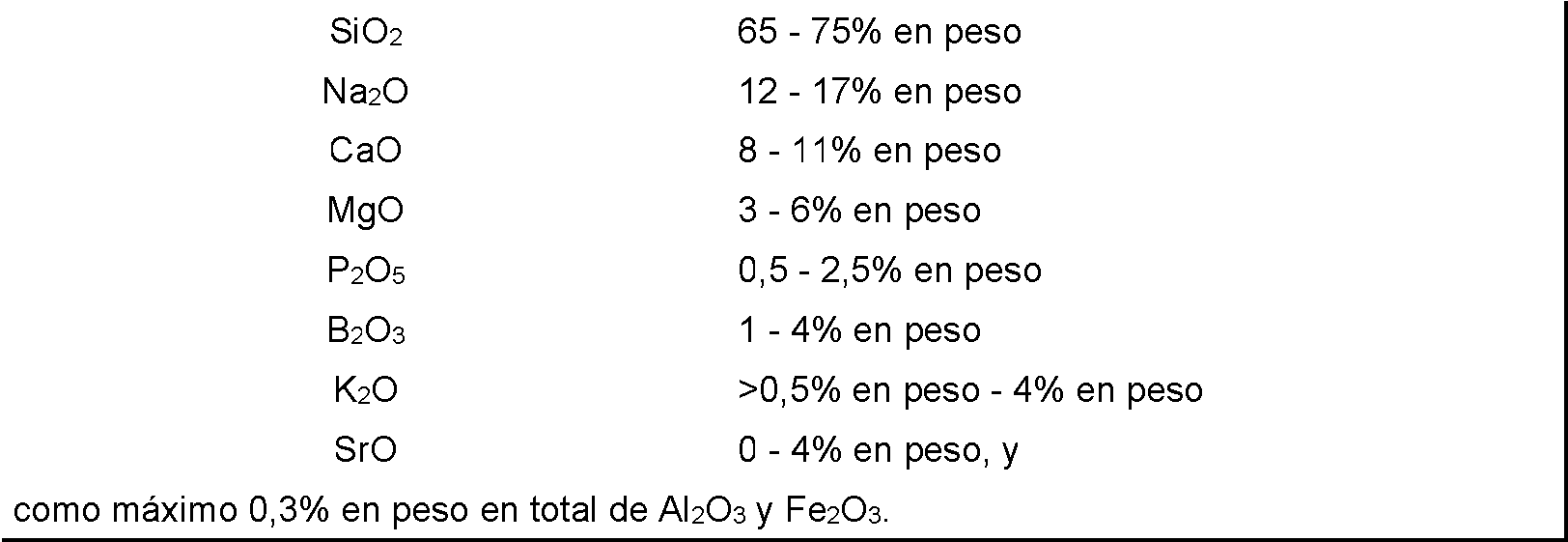
Applications Claiming Priority (1)
| Application Number | Priority Date | Filing Date | Title |
|---|---|---|---|
| EP18202311.9A EP3643742B1 (en) | 2018-10-24 | 2018-10-24 | Reinforced biodegradable composite material |
Publications (1)
| Publication Number | Publication Date |
|---|---|
| ES2890488T3 true ES2890488T3 (en) | 2022-01-20 |
Family
ID=64308460
Family Applications (1)
| Application Number | Title | Priority Date | Filing Date |
|---|---|---|---|
| ES18202311T Active ES2890488T3 (en) | 2018-10-24 | 2018-10-24 | Reinforced biodegradable composite material |
Country Status (9)
| Country | Link |
|---|---|
| US (1) | US12122908B2 (en) |
| EP (1) | EP3643742B1 (en) |
| JP (1) | JP7517703B2 (en) |
| CN (1) | CN113166489B (en) |
| AU (1) | AU2019363680B2 (en) |
| CA (1) | CA3117265A1 (en) |
| ES (1) | ES2890488T3 (en) |
| PL (1) | PL3643742T3 (en) |
| WO (1) | WO2020083959A1 (en) |
Families Citing this family (10)
| Publication number | Priority date | Publication date | Assignee | Title |
|---|---|---|---|---|
| FI129792B (en) * | 2021-06-22 | 2022-08-31 | Valmet Technologies Oy | Elongated component for a manufacturing machine of a fibrous cellulosic web, its use and method for recycling |
| CN114369347B (en) * | 2022-02-08 | 2023-12-19 | 北京纳通医学研究院有限公司 | Degradable flow modification auxiliary agent and preparation method and application thereof |
| CN115746519B (en) * | 2022-11-07 | 2023-12-22 | 深圳市优彩佳科技有限公司 | Production method of keyboard shell and keyboard with antibacterial function |
| CN116444964B (en) * | 2022-12-16 | 2024-07-09 | 杭州泽同新材料科技有限公司 | Biodegradable heat-resistant material and preparation method and application thereof |
| CN116285272A (en) * | 2023-04-11 | 2023-06-23 | 苏州颐顺环保新材料科技有限公司 | Fully-degradable polylactic acid material, preparation method and application |
| CN116694048B (en) * | 2023-07-26 | 2025-12-26 | 安徽同力新材料有限公司 | A high-temperature resistant biodegradable plastic and its production process |
| CN117430935B (en) * | 2023-12-06 | 2024-05-10 | 广州瑞派医疗器械有限责任公司 | A high-strength biodegradable polyester composite material and preparation method thereof |
| WO2025264246A1 (en) * | 2024-06-21 | 2025-12-26 | Plantswitch, Inc | Thermoplastic blends for injection molding |
| US20260002422A1 (en) * | 2024-06-28 | 2026-01-01 | Halliburton Energy Services, Inc. | Method of using degradable glass fibers for downhole tools |
| CN119158087B (en) * | 2024-11-19 | 2025-04-01 | 浙江科惠医疗器械股份有限公司 | Preparation method of bioactive glass fiber reinforced polylactic acid composite material |
Family Cites Families (12)
| Publication number | Priority date | Publication date | Assignee | Title |
|---|---|---|---|---|
| JP2503486B2 (en) | 1987-03-12 | 1996-06-05 | 日本硝子繊維株式会社 | Granular flaky glass |
| JP2004143203A (en) | 2002-10-22 | 2004-05-20 | Mitsubishi Plastics Ind Ltd | Injection molding |
| JP2005179578A (en) * | 2003-12-22 | 2005-07-07 | Daiki Shoji Kk | Biodegradable resin composition and molded product thereof |
| JP4643154B2 (en) | 2004-02-17 | 2011-03-02 | ユニチカ株式会社 | A thermoplastic resin composition and a molded body formed by molding the same. |
| JP2005336220A (en) * | 2004-05-24 | 2005-12-08 | Sumitomo Chemical Co Ltd | Long glass fiber reinforced polylactic acid resin composition, pellets thereof and molded article thereof |
| JP4786151B2 (en) * | 2004-07-15 | 2011-10-05 | 三井化学株式会社 | Resin composition |
| JP4787088B2 (en) | 2006-06-23 | 2011-10-05 | 株式会社住化分析センター | Electrode pattern forming method |
| JP2008001859A (en) * | 2006-06-26 | 2008-01-10 | Ajinomoto Co Inc | Resin composition and merchandise housing tray using the same |
| US8071694B2 (en) * | 2008-02-20 | 2011-12-06 | Sabic Innovative Plastics Ip B.V. | Thermoplastic polycarbonate/polyester blend compositions with improved mechanical properties |
| JP5133742B2 (en) * | 2008-03-12 | 2013-01-30 | ユニチカ株式会社 | Glass fiber reinforced resin composition and method for producing the same |
| EP2243749B1 (en) | 2009-04-23 | 2015-04-08 | PURAC Biochem BV | Resorbable and biocompatible fibre glass compositions and their uses |
| US20160185955A1 (en) * | 2013-07-05 | 2016-06-30 | Solegear Bioplastics Inc. | Heat Resistant Polylactic Acid |
-
2018
- 2018-10-24 PL PL18202311T patent/PL3643742T3/en unknown
- 2018-10-24 ES ES18202311T patent/ES2890488T3/en active Active
- 2018-10-24 EP EP18202311.9A patent/EP3643742B1/en active Active
-
2019
- 2019-10-23 JP JP2021522441A patent/JP7517703B2/en active Active
- 2019-10-23 US US17/288,230 patent/US12122908B2/en active Active
- 2019-10-23 CA CA3117265A patent/CA3117265A1/en active Pending
- 2019-10-23 WO PCT/EP2019/078797 patent/WO2020083959A1/en not_active Ceased
- 2019-10-23 AU AU2019363680A patent/AU2019363680B2/en active Active
- 2019-10-23 CN CN201980075894.1A patent/CN113166489B/en active Active
Also Published As
| Publication number | Publication date |
|---|---|
| CN113166489B (en) | 2023-06-20 |
| WO2020083959A1 (en) | 2020-04-30 |
| CN113166489A (en) | 2021-07-23 |
| AU2019363680B2 (en) | 2025-05-29 |
| JP2022512805A (en) | 2022-02-07 |
| EP3643742A1 (en) | 2020-04-29 |
| US12122908B2 (en) | 2024-10-22 |
| EP3643742B1 (en) | 2021-08-18 |
| CA3117265A1 (en) | 2020-04-30 |
| PL3643742T3 (en) | 2021-12-27 |
| US20210388201A1 (en) | 2021-12-16 |
| JP7517703B2 (en) | 2024-07-17 |
| AU2019363680A1 (en) | 2021-06-03 |
Similar Documents
| Publication | Publication Date | Title |
|---|---|---|
| CN113166489B (en) | Biodegradable reinforced composites | |
| US9062186B2 (en) | Bio-resins | |
| US20160185955A1 (en) | Heat Resistant Polylactic Acid | |
| KR101022786B1 (en) | Polylactic Acid-Containing Biodegradable Resin Compositions | |
| JP5300395B2 (en) | Polyester resin composition, fiber obtained from the resin composition, and method for producing the fiber | |
| CN100406518C (en) | A kind of ternary compound polylactic acid type composite material and its application | |
| JP2021091866A (en) | Poly(3-hydroxybutyrate) resin tube and method for producing the same | |
| Quiroz‐Castillo et al. | Crystallization of PLA and its blends and composites | |
| US20230145613A1 (en) | Poly(3-hydroxybutyrate)-based resin tube and method for producing same | |
| JP2007154147A (en) | Biodegradable resin composition | |
| JP5143374B2 (en) | Biodegradable resin composition | |
| CA2969746A1 (en) | A polymer blend comprising a polyamide polymer, a polyester polymer and an epoxy-based compatibilizer | |
| KR102794957B1 (en) | Biodegradable composition and application products using the composition | |
| HK40046612B (en) | Reinforced biodegradable composite material | |
| HK40046612A (en) | Reinforced biodegradable composite material | |
| US20220363818A1 (en) | Polyester impact modifiers | |
| JP2007091790A (en) | Organic fiber-reinforced polylactic acid resin composition and molded article | |
| EP4282618B1 (en) | Method for producing molded body containing poly-3-hydroxybutyrate-based resin, and use of same | |
| CN112703227A (en) | Resin composition and molded article thereof | |
| JP2008280474A (en) | Polymer alloy comprising polylactic acid and polypropylene, and molded product and production method thereof | |
| JP5418157B2 (en) | Polyacetal resin composition and molded article thereof | |
| JP2024517969A (en) | Polyester impact modifier |