ES2895480T3 - Antibodies reactive with B7-H3, immunologically active fragments thereof and uses thereof - Google Patents
Antibodies reactive with B7-H3, immunologically active fragments thereof and uses thereof Download PDFInfo
- Publication number
- ES2895480T3 ES2895480T3 ES15184260T ES15184260T ES2895480T3 ES 2895480 T3 ES2895480 T3 ES 2895480T3 ES 15184260 T ES15184260 T ES 15184260T ES 15184260 T ES15184260 T ES 15184260T ES 2895480 T3 ES2895480 T3 ES 2895480T3
- Authority
- ES
- Spain
- Prior art keywords
- cancer
- seq
- antibody
- antibodies
- binding
- Prior art date
- Legal status (The legal status is an assumption and is not a legal conclusion. Google has not performed a legal analysis and makes no representation as to the accuracy of the status listed.)
- Active
Links
Classifications
-
- C—CHEMISTRY; METALLURGY
- C07—ORGANIC CHEMISTRY
- C07K—PEPTIDES
- C07K16/00—Immunoglobulins [IG], e.g. monoclonal or polyclonal antibodies
- C07K16/18—Immunoglobulins [IG], e.g. monoclonal or polyclonal antibodies against material from animals or humans
- C07K16/28—Immunoglobulins [IG], e.g. monoclonal or polyclonal antibodies against material from animals or humans against receptors, cell surface antigens or cell surface determinants
- C07K16/2803—Immunoglobulins [IG], e.g. monoclonal or polyclonal antibodies against material from animals or humans against receptors, cell surface antigens or cell surface determinants against the immunoglobulin superfamily
- C07K16/2827—Immunoglobulins [IG], e.g. monoclonal or polyclonal antibodies against material from animals or humans against receptors, cell surface antigens or cell surface determinants against the immunoglobulin superfamily against B7 molecules, e.g. CD80, CD86
-
- C—CHEMISTRY; METALLURGY
- C07—ORGANIC CHEMISTRY
- C07K—PEPTIDES
- C07K16/00—Immunoglobulins [IG], e.g. monoclonal or polyclonal antibodies
- C07K16/18—Immunoglobulins [IG], e.g. monoclonal or polyclonal antibodies against material from animals or humans
- C07K16/28—Immunoglobulins [IG], e.g. monoclonal or polyclonal antibodies against material from animals or humans against receptors, cell surface antigens or cell surface determinants
- C07K16/30—Immunoglobulins [IG], e.g. monoclonal or polyclonal antibodies against material from animals or humans against receptors, cell surface antigens or cell surface determinants from tumour cells
-
- A—HUMAN NECESSITIES
- A61—MEDICAL OR VETERINARY SCIENCE; HYGIENE
- A61K—PREPARATIONS FOR MEDICAL, DENTAL OR TOILETRY PURPOSES
- A61K39/00—Medicinal preparations containing antigens or antibodies
- A61K39/395—Antibodies; Immunoglobulins; Immune serum, e.g. antilymphocytic serum
-
- A—HUMAN NECESSITIES
- A61—MEDICAL OR VETERINARY SCIENCE; HYGIENE
- A61K—PREPARATIONS FOR MEDICAL, DENTAL OR TOILETRY PURPOSES
- A61K39/00—Medicinal preparations containing antigens or antibodies
- A61K39/395—Antibodies; Immunoglobulins; Immune serum, e.g. antilymphocytic serum
- A61K39/39533—Antibodies; Immunoglobulins; Immune serum, e.g. antilymphocytic serum against materials from animals
- A61K39/39558—Antibodies; Immunoglobulins; Immune serum, e.g. antilymphocytic serum against materials from animals against tumor tissues, cells, antigens
-
- A—HUMAN NECESSITIES
- A61—MEDICAL OR VETERINARY SCIENCE; HYGIENE
- A61K—PREPARATIONS FOR MEDICAL, DENTAL OR TOILETRY PURPOSES
- A61K45/00—Medicinal preparations containing active ingredients not provided for in groups A61K31/00 - A61K41/00
- A61K45/06—Mixtures of active ingredients without chemical characterisation, e.g. antiphlogistics and cardiaca
-
- A—HUMAN NECESSITIES
- A61—MEDICAL OR VETERINARY SCIENCE; HYGIENE
- A61P—SPECIFIC THERAPEUTIC ACTIVITY OF CHEMICAL COMPOUNDS OR MEDICINAL PREPARATIONS
- A61P35/00—Antineoplastic agents
-
- A—HUMAN NECESSITIES
- A61—MEDICAL OR VETERINARY SCIENCE; HYGIENE
- A61P—SPECIFIC THERAPEUTIC ACTIVITY OF CHEMICAL COMPOUNDS OR MEDICINAL PREPARATIONS
- A61P35/00—Antineoplastic agents
- A61P35/02—Antineoplastic agents specific for leukemia
-
- A—HUMAN NECESSITIES
- A61—MEDICAL OR VETERINARY SCIENCE; HYGIENE
- A61P—SPECIFIC THERAPEUTIC ACTIVITY OF CHEMICAL COMPOUNDS OR MEDICINAL PREPARATIONS
- A61P43/00—Drugs for specific purposes, not provided for in groups A61P1/00-A61P41/00
-
- C—CHEMISTRY; METALLURGY
- C07—ORGANIC CHEMISTRY
- C07K—PEPTIDES
- C07K16/00—Immunoglobulins [IG], e.g. monoclonal or polyclonal antibodies
- C07K16/18—Immunoglobulins [IG], e.g. monoclonal or polyclonal antibodies against material from animals or humans
- C07K16/28—Immunoglobulins [IG], e.g. monoclonal or polyclonal antibodies against material from animals or humans against receptors, cell surface antigens or cell surface determinants
- C07K16/2803—Immunoglobulins [IG], e.g. monoclonal or polyclonal antibodies against material from animals or humans against receptors, cell surface antigens or cell surface determinants against the immunoglobulin superfamily
-
- C—CHEMISTRY; METALLURGY
- C07—ORGANIC CHEMISTRY
- C07K—PEPTIDES
- C07K16/00—Immunoglobulins [IG], e.g. monoclonal or polyclonal antibodies
- C07K16/18—Immunoglobulins [IG], e.g. monoclonal or polyclonal antibodies against material from animals or humans
- C07K16/28—Immunoglobulins [IG], e.g. monoclonal or polyclonal antibodies against material from animals or humans against receptors, cell surface antigens or cell surface determinants
- C07K16/2896—Immunoglobulins [IG], e.g. monoclonal or polyclonal antibodies against material from animals or humans against receptors, cell surface antigens or cell surface determinants against molecules with a "CD"-designation, not provided for elsewhere
-
- C—CHEMISTRY; METALLURGY
- C07—ORGANIC CHEMISTRY
- C07K—PEPTIDES
- C07K16/00—Immunoglobulins [IG], e.g. monoclonal or polyclonal antibodies
- C07K16/18—Immunoglobulins [IG], e.g. monoclonal or polyclonal antibodies against material from animals or humans
- C07K16/28—Immunoglobulins [IG], e.g. monoclonal or polyclonal antibodies against material from animals or humans against receptors, cell surface antigens or cell surface determinants
- C07K16/30—Immunoglobulins [IG], e.g. monoclonal or polyclonal antibodies against material from animals or humans against receptors, cell surface antigens or cell surface determinants from tumour cells
- C07K16/3076—Immunoglobulins [IG], e.g. monoclonal or polyclonal antibodies against material from animals or humans against receptors, cell surface antigens or cell surface determinants from tumour cells against structure-related tumour-associated moieties
-
- C—CHEMISTRY; METALLURGY
- C07—ORGANIC CHEMISTRY
- C07K—PEPTIDES
- C07K16/00—Immunoglobulins [IG], e.g. monoclonal or polyclonal antibodies
- C07K16/18—Immunoglobulins [IG], e.g. monoclonal or polyclonal antibodies against material from animals or humans
- C07K16/28—Immunoglobulins [IG], e.g. monoclonal or polyclonal antibodies against material from animals or humans against receptors, cell surface antigens or cell surface determinants
- C07K16/30—Immunoglobulins [IG], e.g. monoclonal or polyclonal antibodies against material from animals or humans against receptors, cell surface antigens or cell surface determinants from tumour cells
- C07K16/3076—Immunoglobulins [IG], e.g. monoclonal or polyclonal antibodies against material from animals or humans against receptors, cell surface antigens or cell surface determinants from tumour cells against structure-related tumour-associated moieties
- C07K16/3092—Immunoglobulins [IG], e.g. monoclonal or polyclonal antibodies against material from animals or humans against receptors, cell surface antigens or cell surface determinants from tumour cells against structure-related tumour-associated moieties against tumour-associated mucins
-
- C—CHEMISTRY; METALLURGY
- C07—ORGANIC CHEMISTRY
- C07K—PEPTIDES
- C07K16/00—Immunoglobulins [IG], e.g. monoclonal or polyclonal antibodies
- C07K16/44—Immunoglobulins [IG], e.g. monoclonal or polyclonal antibodies against material not provided for elsewhere, e.g. haptens, metals, DNA, RNA, amino acids
-
- C—CHEMISTRY; METALLURGY
- C07—ORGANIC CHEMISTRY
- C07K—PEPTIDES
- C07K16/00—Immunoglobulins [IG], e.g. monoclonal or polyclonal antibodies
- C07K16/46—Hybrid immunoglobulins
- C07K16/468—Immunoglobulins having two or more different antigen binding sites, e.g. multifunctional antibodies
-
- G—PHYSICS
- G01—MEASURING; TESTING
- G01N—INVESTIGATING OR ANALYSING MATERIALS BY DETERMINING THEIR CHEMICAL OR PHYSICAL PROPERTIES
- G01N33/00—Investigating or analysing materials by specific methods not covered by groups G01N1/00 - G01N31/00
- G01N33/48—Biological material, e.g. blood, urine; Haemocytometers
- G01N33/50—Chemical analysis of biological material, e.g. blood, urine; Testing involving biospecific ligand binding methods; Immunological testing
- G01N33/68—Chemical analysis of biological material, e.g. blood, urine; Testing involving biospecific ligand binding methods; Immunological testing involving proteins, peptides or amino acids
- G01N33/6893—Chemical analysis of biological material, e.g. blood, urine; Testing involving biospecific ligand binding methods; Immunological testing involving proteins, peptides or amino acids related to diseases not provided for elsewhere
-
- A—HUMAN NECESSITIES
- A61—MEDICAL OR VETERINARY SCIENCE; HYGIENE
- A61K—PREPARATIONS FOR MEDICAL, DENTAL OR TOILETRY PURPOSES
- A61K39/00—Medicinal preparations containing antigens or antibodies
- A61K2039/505—Medicinal preparations containing antigens or antibodies comprising antibodies
-
- C—CHEMISTRY; METALLURGY
- C07—ORGANIC CHEMISTRY
- C07K—PEPTIDES
- C07K2317/00—Immunoglobulins specific features
- C07K2317/10—Immunoglobulins specific features characterized by their source of isolation or production
- C07K2317/14—Specific host cells or culture conditions, e.g. components, pH or temperature
-
- C—CHEMISTRY; METALLURGY
- C07—ORGANIC CHEMISTRY
- C07K—PEPTIDES
- C07K2317/00—Immunoglobulins specific features
- C07K2317/20—Immunoglobulins specific features characterized by taxonomic origin
- C07K2317/24—Immunoglobulins specific features characterized by taxonomic origin containing regions, domains or residues from different species, e.g. chimeric, humanized or veneered
-
- C—CHEMISTRY; METALLURGY
- C07—ORGANIC CHEMISTRY
- C07K—PEPTIDES
- C07K2317/00—Immunoglobulins specific features
- C07K2317/30—Immunoglobulins specific features characterized by aspects of specificity or valency
- C07K2317/31—Immunoglobulins specific features characterized by aspects of specificity or valency multispecific
-
- C—CHEMISTRY; METALLURGY
- C07—ORGANIC CHEMISTRY
- C07K—PEPTIDES
- C07K2317/00—Immunoglobulins specific features
- C07K2317/30—Immunoglobulins specific features characterized by aspects of specificity or valency
- C07K2317/33—Crossreactivity, e.g. for species or epitope, or lack of said crossreactivity
-
- C—CHEMISTRY; METALLURGY
- C07—ORGANIC CHEMISTRY
- C07K—PEPTIDES
- C07K2317/00—Immunoglobulins specific features
- C07K2317/50—Immunoglobulins specific features characterized by immunoglobulin fragments
- C07K2317/52—Constant or Fc region; Isotype
-
- C—CHEMISTRY; METALLURGY
- C07—ORGANIC CHEMISTRY
- C07K—PEPTIDES
- C07K2317/00—Immunoglobulins specific features
- C07K2317/50—Immunoglobulins specific features characterized by immunoglobulin fragments
- C07K2317/56—Immunoglobulins specific features characterized by immunoglobulin fragments variable (Fv) region, i.e. VH and/or VL
-
- C—CHEMISTRY; METALLURGY
- C07—ORGANIC CHEMISTRY
- C07K—PEPTIDES
- C07K2317/00—Immunoglobulins specific features
- C07K2317/50—Immunoglobulins specific features characterized by immunoglobulin fragments
- C07K2317/56—Immunoglobulins specific features characterized by immunoglobulin fragments variable (Fv) region, i.e. VH and/or VL
- C07K2317/565—Complementarity determining region [CDR]
-
- C—CHEMISTRY; METALLURGY
- C07—ORGANIC CHEMISTRY
- C07K—PEPTIDES
- C07K2317/00—Immunoglobulins specific features
- C07K2317/70—Immunoglobulins specific features characterized by effect upon binding to a cell or to an antigen
- C07K2317/72—Increased effector function due to an Fc-modification
-
- C—CHEMISTRY; METALLURGY
- C07—ORGANIC CHEMISTRY
- C07K—PEPTIDES
- C07K2317/00—Immunoglobulins specific features
- C07K2317/70—Immunoglobulins specific features characterized by effect upon binding to a cell or to an antigen
- C07K2317/76—Antagonist effect on antigen, e.g. neutralization or inhibition of binding
-
- C—CHEMISTRY; METALLURGY
- C07—ORGANIC CHEMISTRY
- C07K—PEPTIDES
- C07K2317/00—Immunoglobulins specific features
- C07K2317/70—Immunoglobulins specific features characterized by effect upon binding to a cell or to an antigen
- C07K2317/77—Internalization into the cell
-
- C—CHEMISTRY; METALLURGY
- C07—ORGANIC CHEMISTRY
- C07K—PEPTIDES
- C07K2317/00—Immunoglobulins specific features
- C07K2317/90—Immunoglobulins specific features characterized by (pharmaco)kinetic aspects or by stability of the immunoglobulin
- C07K2317/92—Affinity (KD), association rate (Ka), dissociation rate (Kd) or EC50 value
Landscapes
- Health & Medical Sciences (AREA)
- Chemical & Material Sciences (AREA)
- Immunology (AREA)
- Life Sciences & Earth Sciences (AREA)
- Organic Chemistry (AREA)
- Medicinal Chemistry (AREA)
- General Health & Medical Sciences (AREA)
- Molecular Biology (AREA)
- Biochemistry (AREA)
- Proteomics, Peptides & Aminoacids (AREA)
- Biophysics (AREA)
- Genetics & Genomics (AREA)
- Engineering & Computer Science (AREA)
- Cell Biology (AREA)
- Pharmacology & Pharmacy (AREA)
- Veterinary Medicine (AREA)
- Public Health (AREA)
- Animal Behavior & Ethology (AREA)
- Biomedical Technology (AREA)
- Microbiology (AREA)
- Hematology (AREA)
- Epidemiology (AREA)
- Urology & Nephrology (AREA)
- Bioinformatics & Cheminformatics (AREA)
- Mycology (AREA)
- Oncology (AREA)
- Chemical Kinetics & Catalysis (AREA)
- Nuclear Medicine, Radiotherapy & Molecular Imaging (AREA)
- General Chemical & Material Sciences (AREA)
- Biotechnology (AREA)
- Analytical Chemistry (AREA)
- Food Science & Technology (AREA)
- Pathology (AREA)
- General Physics & Mathematics (AREA)
- Physics & Mathematics (AREA)
- Medicines Containing Antibodies Or Antigens For Use As Internal Diagnostic Agents (AREA)
- Medicines That Contain Protein Lipid Enzymes And Other Medicines (AREA)
- Peptides Or Proteins (AREA)
- Pharmaceuticals Containing Other Organic And Inorganic Compounds (AREA)
- Micro-Organisms Or Cultivation Processes Thereof (AREA)
Abstract
Un reactivo de redireccionamiento de doble afinidad, comprendiendo dicho reactivo: (A) una cadena polipeptídica I que comprende un dominio de unión al epítopo VL de inmunoglobulina específico para unirse a B7-H3 y un dominio de unión al epítopo VH específico para unirse a una molécula distinta de B7-H3; y (B) una cadena polipeptídica II que comprende un dominio de unión al epítopo VH de inmunoglobulina específico para unirse a B7-H3 y un dominio de unión al epítopo VL específico para unirse a dicha molécula distinta de B7- H3; en donde las cadenas polipeptídicas I y II se asocian juntas para formar dominios de unión a epítopos funcionales capaces de unirse a B7-H3 y dicha molécula distinta de B7-H3, y en donde: (1) dicha cadena polipeptídica I comprende CDR1, CDR2 y CDR3 que comprenden las secuencias de aminoácidos de la SEQ ID NO: 21, la SEQ ID NO: 23 y la SEQ ID NO: 25, respectivamente, y dicha cadena polipeptídica II comprende CDR1, CDR2 y CDR3 que comprenden las secuencias de aminoácidos de la SEQ ID NO: 29, la SEQ ID NO: 31 y la SEQ ID NO: 33, respectivamente; o (2) dicha cadena polipeptídica I comprende CDR1, CDR2 y CDR3 que comprenden las secuencias de aminoácidos de la SEQ ID NO: 5, la SEQ ID NO: 7 y la SEQ ID NO: 9, respectivamente, y dicha cadena polipeptídica II comprende CDR1, CDR2 y CDR3 que comprenden las secuencias de aminoácidos de la SEQ ID NO: 13, la SEQ ID NO: 15 y la SEQ ID NO: 17, respectivamente; o (3) dicha cadena polipeptídica I comprende CDR1, CDR2 y CDR3 que comprenden las secuencias de aminoácidos de la SEQ ID NO: 37, la SEQ ID NO: 39 y la SEQ ID NO: 41, respectivamente, y dicha cadena polipeptídica II comprende CDR1, CDR2 y CDR3 que comprenden las secuencias de aminoácidos de la SEQ ID NO: 45, la SEQ ID NO: 47 y la SEQ ID NO: 49, respectivamente.A dual affinity retargeting reagent, said reagent comprising: (A) an I polypeptide chain comprising an immunoglobulin VL epitope binding domain specific for binding to B7-H3 and a VH epitope binding domain specific for binding to a molecule other than B7-H3; and (B) a polypeptide chain II comprising an immunoglobulin VH epitope binding domain specific for binding to B7-H3 and a VL epitope binding domain specific for binding to said molecule other than B7-H3; wherein polypeptide chains I and II associate together to form functional epitope binding domains capable of binding to B7-H3 and said molecule other than B7-H3, and wherein: (1) said polypeptide chain I comprises CDR1, CDR2 and CDR3 comprising the amino acid sequences of SEQ ID NO: 21, SEQ ID NO: 23 and SEQ ID NO: 25, respectively, and said polypeptide chain II comprising CDR1, CDR2 and CDR3 comprising the amino acid sequences of SEQ ID NO: 29, SEQ ID NO: 31 and SEQ ID NO: 33, respectively; or (2) said polypeptide chain I comprises CDR1, CDR2 and CDR3 comprising the amino acid sequences of SEQ ID NO: 5, SEQ ID NO: 7 and SEQ ID NO: 9, respectively, and said polypeptide chain II comprises CDR1, CDR2 and CDR3 comprising the amino acid sequences of SEQ ID NO: 13, SEQ ID NO: 15 and SEQ ID NO: 17, respectively; or (3) said polypeptide chain I comprises CDR1, CDR2 and CDR3 comprising the amino acid sequences of SEQ ID NO: 37, SEQ ID NO: 39 and SEQ ID NO: 41, respectively, and said polypeptide chain II comprises CDR1, CDR2 and CDR3 comprising the amino acid sequences of SEQ ID NO: 45, SEQ ID NO: 47 and SEQ ID NO: 49, respectively.
Description
DESCRIPCIÓNDESCRIPTION
Anticuerpos reactivos con B7-H3, fragmentos inmunológicamente activos de los mismos y usos de los mismos B7-H3 reactive antibodies, immunologically active fragments thereof and uses thereof
Referencia cruzada a solicitudes relacionadas:Cross reference to related requests:
La presente solicitud reivindica la prioridad de las solicitudes de patente de los Estados Unidos con números de serie 61/310.692 (presentada el 4 de marzo de 2010; pendiente); 61/310.695 (presentada el 4 de marzo de 2010; pendiente) 61/311.057 (presentada el 5 de marzo de 2010; pendiente).The present application claims priority from US Patent Application Serial Nos. 61/310,692 (filed March 4, 2010; pending); 61/310,695 (filed March 4, 2010; pending) 61/311,057 (filed March 5, 2010; pending).
Referencia al listado de secuencias:Sequence listing reference:
La presente solicitud incluye uno o más listados de secuencias de conformidad con 37 C.F.R. 1.821 et seq., que se desvelan tanto en papel como en medios legibles por ordenador.This application includes one or more sequence listings pursuant to 37 C.F.R. 1,821 et seq., which are disclosed in both paper and computer readable media.
Antecedentes de la invención:Background of the invention:
Campo de la invención:Field of invention:
La presente invención se refiere a anticuerpos y sus fragmentos que son inmunorreactivos para el mamífero y, más particularmente, el receptor B7-H3 humano y sus usos, particularmente en el tratamiento del cáncer y la inflamación. Por tanto, la invención concierne particularmente a anticuerpos reactivos con B7-H3 humanizados y sus fragmentos inmunorreactivos que son capaces de mediar, y más preferentemente potenciar la activación del sistema inmunitario contra las células cancerosas que están asociadas con una variedad de cánceres humanos.The present invention relates to antibodies and fragments thereof that are immunoreactive for mammalian and, more particularly, the human B7-H3 receptor and their uses, particularly in the treatment of cancer and inflammation. Thus, the invention particularly concerns humanized B7-H3-reactive antibodies and immunoreactive fragments thereof that are capable of mediating, and more preferably potentiating, activation of the immune system against cancer cells that are associated with a variety of human cancers.
Descripción de la técnica relacionada:Description of related art:
El crecimiento y la metástasis de los tumores depende en gran medida de su capacidad para evadir la vigilancia inmunitaria del hospedador y superar las defensas del hospedador. La mayoría de los tumores expresan antígenos que pueden ser reconocidos en un grado variable por el sistema inmunitario del hospedador, pero en muchos casos, se provoca una respuesta inmunitaria inadecuada debido a la activación ineficaz de los linfocitos T efectores (Khawli, L.A. et al. (2008) "Cytokine, Chemokine, and Co-Stimulatory Fusion Proteins for the Immunotherapy of Solid Tumors", Exper. Pharmacol. 181:291-328).The growth and metastasis of tumors is highly dependent on their ability to evade host immune surveillance and overcome host defenses. Most tumors express antigens that can be recognized to a variable degree by the host immune system, but in many cases, an inappropriate immune response is elicited due to ineffective activation of effector T cells (Khawli, LA et al. (2008) "Cytokine, Chemokine, and Co-Stimulatory Fusion Proteins for the Immunotherapy of Solid Tumors", Exper. Pharmacol. 181:291-328).
Los linfocitos T CD4+ son los organizadores esenciales de la mayoría de las respuestas inmunitarias y autoinmunitarias de los mamíferos (Dong, C. et al. (2003) "Immune Regulation by Novel Costimulatory Molecules", Immunolog. Res. 28(1):39-48). Se ha descubierto que la activación de los linfocitos T colaboradores CD4+ está mediada por interacciones coestimuladoras entre las células presentadoras de antígeno y los linfocitos T CD4+ sin exposición previa. Se requieren dos interacciones (Viglietta, V. et al. (2007) "Modulating CoStimulation", Neurotherapeutics 4:666-675; Korman, A.J. et al. (2007) "Checkpoint Blockade in Cancer Immunotherapy", Adv. Immunol. 90:297-339). En la primera interacción, una célula presentadora de antígeno debe presentar el antígeno diana relevante unido al complejo mayor de histocompatibilidad de la célula para que pueda unirse al receptor de células T ("TCR") de un linfocito T c D4+ sin exposición previa. En la segunda interacción, un ligando de la célula presentadora de antígeno debe unirse a un receptor CD28 del linfocito T CD4+ (Dong, C. et al. (2003) "Immune Regulation by Novel Costimulatory Molecules", Immunolog. Res. 28(1):39-48; Lindley, P.S. et al. (2009) "The Clinical Utility Of Inhibiting CD28-Mediated Costimulation", Immunol. Rev. 229:307-321). Los linfocitos T colaboradores CD4+ que experimentan ambas señales estimulantes son capaces de responder a las citocinas (como la interleucina-2 y la interleucina-12 para convertirse en linfocitos Th1). Estas células producen interferón-gamma (IFN-y) y factor de necrosis tumoral alfa (TNF-a), que median las respuestas inflamatorias para las células diana que expresan el antígeno diana. También se produce la activación y proliferación de linfocitos B, lo que da como resultado la producción de anticuerpos específicos para el antígeno diana (Bernard, A. et al. (2005) "T and B Cell Cooperation: A Dance of Life and Death", Transplantation 79:S8-S11). En ausencia de ambas señales coestimuladoras durante la interacción del TCR, los linfocitos T entran en un estado funcionalmente carente de respuesta, conocido como anergia clonal (Khawli, L.A. et al. (2008) "Cytokine, Chemokine, and Co-Stimulatory Fusion Proteins for the Immunotherapy of Solid Tumors", Exper. Pharmacol. 181:291-328). En estados patológicos, los linfocitos Th1 son los actores clave de diversas enfermedades autoinmunitarias específicas de órganos, tales como la diabetes de tipo I, la artritis reumatoide y la esclerosis múltiple (Dong, C. et al. (2003) "Immune Regulation by Novel Costimulatory Molecules", Immunolog. Res.CD4+ T cells are the essential organizers of most mammalian immune and autoimmune responses (Dong, C. et al. (2003) "Immune Regulation by Novel Costimulatory Molecules", Immunolog. Res. 28(1):39 -48). Activation of CD4+ helper T cells has been found to be mediated by costimulatory interactions between antigen-presenting cells and naïve CD4+ T cells. Two interactions are required (Viglietta, V. et al. (2007) "Modulating CoStimulation", Neurotherapeutics 4:666-675; Korman, AJ et al. (2007) "Checkpoint Blockade in Cancer Immunotherapy", Adv. Immunol. 90: 297-339). In the first interaction, an antigen-presenting cell must present the relevant target antigen bound to the cell's major histocompatibility complex so that it can bind to the T-cell receptor ("TCR") of a c D4+ T cell without prior exposure. In the second interaction, a ligand on the antigen-presenting cell must bind to a CD28 receptor on the CD4+ T cell (Dong, C. et al. (2003) "Immune Regulation by Novel Costimulatory Molecules", Immunolog. Res. 28(1 ):39-48;Lindley, PS et al. (2009) "The Clinical Utility Of Inhibiting CD28-Mediated Costimulation", Immunol.Rev.229:307-321). CD4+ helper T cells that experience both stimulatory signals are able to respond to cytokines (such as interleukin-2 and interleukin-12 to become Th1 cells). These cells produce interferon-gamma (IFN-y) and tumor necrosis factor alpha (TNF-a), which mediate inflammatory responses to target cells expressing the target antigen. Activation and proliferation of B lymphocytes also occurs, resulting in the production of antibodies specific for the target antigen (Bernard, A. et al. (2005) "T and B Cell Cooperation: A Dance of Life and Death" , Transplantation 79:S8-S11). In the absence of both costimulatory signals during TCR interaction, T cells enter a functionally unresponsive state known as clonal anergy (Khawli, LA et al. (2008) "Cytokine, Chemokine, and Co-Stimulatory Fusion Proteins for the Immunotherapy of Solid Tumors", Exper. Pharmacol. 181:291-328). In disease states, Th1 cells are key players in various organ-specific autoimmune diseases, such as type I diabetes, rheumatoid arthritis, and multiple sclerosis (Dong, C. et al. (2003) "Immune Regulation by Novel Costimulatory Molecules", Immunolog. Res.
28(1):39-48).28(1):39-48.
I. La superfamilia B7 y B7-H3I. The B7 and B7-H3 Superfamily
Las investigaciones sobre los ligandos del receptor CD28 han llevado a la caracterización de un conjunto de moléculas relacionadas conocidas como la superfamilia B7 (Coyle, A.J. et al. (2001) "The Expanding B7 Superfamily: Increasing Complexity In Costimulatory Signals Regulating T Cell Function", Nature Immunol. 2(3):203-209; Sharpe, A.H. et al. (2002) "The B7-CD28 Superfamily", Nature Rev. Immunol. 2:116-126; Greenwald, R.J. et al. (2005) "The B7 Family Revisited", Ann. Rev. Immunol. 23:515-548; Collins, M. et al. (2005) "The B7 Family Of Immune-Regulatory Ligands", Genome Biol. 6:223,1-223,7; Loke, P. et al. (2004) "Emerging Mechanisms Of Immune Regulation: The Extended B7 Family And Regulatory T Cells". Arthritis Res. Ther. 6:208-214; Korman, A.J. et al. (2007) "Checkpoint Blockade in Cancer Immunotherapy", Adv. Immunol. 90:297-339; Flies, D.B. et al. (2007) "The New B7s: Playing a Pivotal Role in Tumor Immunity", J. Immunother. 30(3):251-260; Agarwal, A. et al. (2008) "The Role Of Positive Costimulatory Molecules In Transplantation And Tolerance", Curr. Opin. Organ Transplant. 13:366-372; Lenschow, D.J. et al. (1996) "CD28/B7 System of T Cell Costimulation", Ann. Rev. Immunol. 14:233-258; Wang, S. et al. (2004) "Co-Signaling Molecules Of The B7-CD28 Family In Positive And Negative Regulation Of T Lymphocyte Responses", Microbes Infect.Investigations of CD28 receptor ligands have led to the characterization of a set of related molecules known as the B7 superfamily (Coyle, AJ et al. (2001) "The Expanding B7 Superfamily: Increasing Complexity In Costimulatory Signals Regulating T Cell Function" 2(3):203-209 Sharpe AH et al (2002) "The B7-CD28 Superfamily" Nature Rev Immunol 2:116-126 Greenwald RJ et al (2005) "The B7 Family Revisited", Ann Rev Immunol 23:515-548, Collins M et al (2005) "The B7 Family Of Immune-Regulatory Ligands", Genome Biol. 6:223.1-223.7; Loke, P. et al. (2004) "Emerging Mechanisms Of Immune Regulation: The Extended B7 Family And Regulatory T Cells". Arthritis Res. Ther. 6:208-214; Korman, AJ et al. (2007) "Checkpoint Blockade in Cancer Immunotherapy", Adv. Immunol. 90:297-339; Flies, DB et al. (2007) "The New B7s: Playing a Pivotal Role in Tumor Immunity", J. Immunother. 30(3):251-260; Agarwal, A. et al. (2008) "The Role Of Positive Costimulatory Molecules In Transplantation And Tolerance", Curr. opinion Organ transplant. 13:366-372; Lenschow, DJ et al. (1996) "CD28/B7 System of T Cell Costimulation", Ann. Rev Immunol. 14:233-258; Wang, S. et al. (2004) "Co-Signaling Molecules Of The B7-CD28 Family In Positive And Negative Regulation Of T Lymphocyte Responses", Microbes Infect.
6:759-766). Actualmente hay siete miembros conocidos de la familia: B7.1 (CD80), B7.2 (CD86), el ligando coestimulador inducible (ICOS-L), el ligando de muerte programada 1 (PD-L1), el ligando de muerte programada 2 (PD-L2), B7-H3 y B7-H4 (Collins, M. et al. (2005) "The B7 Family Of Immune-Regulatory Ligands", Genome Biol.6:759-766). There are currently seven known members of the family: B7.1 (CD80), B7.2 (CD86), inducible costimulatory ligand (ICOS-L), programmed death ligand 1 (PD-L1), programmed death ligand 2 (PD-L2), B7-H3 and B7-H4 (Collins, M. et al. (2005) "The B7 Family Of Immune-Regulatory Ligands", Genome Biol.
6:223,1-223,7).6:223.1-223.7).
Los miembros de la familia B7 son miembros de la superfamilia de inmunoglobulinas con un dominio similar a la inmunoglobulina V y un dominio similar a la inmunoglobulina C (por ejemplo, IgV-IgC) (Sharpe, A.H. et al. (2002) "La superfamilia B7-CD28", Nature Rev. Immunol. 2:116-126). Los dominios IgV e IgC de los miembros de la familia B7 están codificados por exones individuales, con exones adicionales que codifican secuencias líder, dominios transmembrana y citoplasmático. Los dominios citoplasmáticos son cortos, que varían en longitud de 19 a 62 restos de aminoácidos y pueden estar codificados por múltiples exones (Collins, M. et al. (2005) "The B7 Family Of Immune-Regulatory Ligands", Genome Biol. 6:223,1-223,7). B7-H3 es único en el sentido de que la forma humana principal contiene dos dominios IgV-IgC en tándem extracelulares (es decir, IgV-IgC-IgV-IgC) (Collins, M. et al. (2005) "The B7 Family Of Immune-Regulatory Ligands", Genome Biol. 6:223,1-223,7). Se prevé que los miembros de la familia B7 formen de manera consecutiva, homodímeros no covalentes en la superficie celular, y tales dímeros se han descubierto con respecto a B7-1 (CD80) y B7-2 (CD86). B7-1 (CD80) y B7-2 (CD86) que presentan una doble especificidad para el receptor CD28 estimulante y el receptor CTLA-4 (CD152) inhibidor (Sharpe, AH et al. (2002) "The B7-CD28 Superfamily", Nature Rev. Immunol. 2:116-126).Members of the B7 family are members of the immunoglobulin superfamily with an immunoglobulin V-like domain and an immunoglobulin C-like domain (eg, IgV-IgC) (Sharpe, AH et al. (2002) "The Superfamily B7-CD28", Nature Rev. Immunol. 2:116-126). The IgV and IgC domains of B7 family members are encoded by individual exons, with additional exons encoding leader sequences, transmembrane and cytoplasmic domains. Cytoplasmic domains are short, ranging in length from 19 to 62 amino acid residues, and can be encoded by multiple exons (Collins, M. et al. (2005) "The B7 Family Of Immune-Regulatory Ligands", Genome Biol. 6 :223.1-223.7). B7-H3 is unique in that the major human form contains two tandem extracellular IgV-IgC domains (ie, IgV-IgC-IgV-IgC) (Collins, M. et al. (2005) "The B7 Family Of Immune-Regulatory Ligands", Genome Biol. 6:223.1-223.7). Members of the B7 family are predicted to consecutively form non-covalent homodimers on the cell surface, and such dimers have been discovered with respect to B7-1 (CD80) and B7-2 (CD86). B7-1 (CD80) and B7-2 (CD86) displaying dual specificity for the stimulating CD28 receptor and the inhibitory CTLA-4 (CD152) receptor (Sharpe, AH et al. (2002) "The B7-CD28 Superfamily" , Nature Rev. Immunol. 2:116-126).
Aunque inicialmente se pensó que solo comprendía 2 dominios Ig (IgV-IgC) (Chapoval, A. et al. (2001) "B7-H3: A Costimulatory Molecule For T Cell Activation and IFN-y Production", Nature Immunol. 2:269-274; Sun, M. et al. (2002) "Characterization of Mouse and Human B7-H3 Genes", J. Immunol. 168:6294-6297) se ha identificado una variante de cuatro dominios extracelulares de inmunoglobulina ("4Ig-B7-H3") y se ha descubierto que es la forma humana más común de la proteína (Sharpe, A.H. et al. (2002) "The B7-CD28 Superfamily", Nature Rev. Immunol. 2:116-126). No se ha observado ninguna diferencia funcional entre estas dos formas, dado que la forma murina natural (2Ig) y la forma 4Ig humana presentan una función similar (Hofmeyer, K. et al. (2008) "The Contrasting Role Of B7-H3", Proc. Natl. Acad. Sci. (EE.UU.) 105(30):10277-10278). La molécula 4Ig-B7-H3 inhibe la lisis de células cancerosas mediada por linfocitos citolíticos naturales (Castriconi, R. et al. "Identification Of 4Ig-B7-H3 As A Neuroblastoma-Associated Molecule That Exerts A Protective Role From An NK Cell-Mediated Lysis", Proc. Natl. Acad. Sci. (EE.UU.) 101(34): 12640-12645). Se ha descubierto que la B7-H3 humana (forma 2Ig) promueve la activación de los linfocitos T y la producción de IFN-y al unirse a un posible receptor en los linfocitos T activados (Chapoval, A. et al. (2001) "B7-H3: A Costimulatory Molecule For T Cell Activation and IFN-y Production", Nature Immunol. 2:269-274; Xu, H. et al. (2009) "MicroRNA miR-29 Modulates Expression of Immunoinhibitory Molecule B7-H3: Potential Implications for Immune Based Therapy of Human Solid Tumors", Cancer Res. 69(15):5275-6281). Tanto B7-H4 como B7-H1 son potentes inhibidores de la función inmunitaria cuando se expresan en células tumorales (Flies, D.B. et al. (2007) "The New B7s: Playing a Pivotal Role in Tumor Immunity", J. Immunother. 30(3):251-260).Although initially thought to comprise only 2 Ig domains (IgV-IgC) (Chapoval, A. et al. (2001) "B7-H3: A Costimulatory Molecule For T Cell Activation and IFN-y Production", Nature Immunol. 2: 269-274; Sun, M. et al. (2002) "Characterization of Mouse and Human B7-H3 Genes", J. Immunol. 168:6294-6297) a variant of four immunoglobulin extracellular domains ("4Ig -B7-H3") and has been found to be the most common human form of the protein (Sharpe, AH et al. (2002) "The B7-CD28 Superfamily", Nature Rev. Immunol. 2:116-126). No functional difference has been observed between these two forms, since the natural murine form (2Ig) and the human 4Ig form have a similar function (Hofmeyer, K. et al. (2008) "The Contrasting Role Of B7-H3" , Proc. Natl. Acad. Sci. (USA) 105(30):10277-10278). The 4Ig-B7-H3 molecule inhibits NK cell-mediated lysis of cancer cells (Castriconi, R. et al. "Identification Of 4Ig-B7-H3 As A Neuroblastoma-Associated Molecule That Exerts A Protective Role From An NK Cell- Mediated Lysis", Proc. Natl. Acad. Sci. (USA) 101(34): 12640-12645). Human B7-H3 (form 2Ig) has been found to promote T cell activation and IFN-y production by binding to a putative receptor on activated T cells (Chapoval, A. et al. (2001)" B7-H3: A Costimulatory Molecule For T Cell Activation and IFN-y Production", Nature Immunol. 2:269-274; Xu, H. et al. (2009) "MicroRNA miR-29 Modulates Expression of Immunoinhibitory Molecule B7-H3 : Potential Implications for Immune Based Therapy of Human Solid Tumors", Cancer Res. 69(15):5275-6281). Both B7-H4 and B7-H1 are potent inhibitors of immune function when expressed on tumor cells (Flies, DB et al. (2007) "The New B7s: Playing a Pivotal Role in Tumor Immunity", J. Immunother. 30 (3):251-260).
El modo de acción de B7-H3 es complejo, ya que la proteína media tanto la coestimulación como la co-inhibición de los linfocitos T (Hofmeyer, K. et al. (2008) "The Contrasting Role Of B7-H3", Proc. Natl. Acad. Sci. (EE.UU.) 105(30):10277-10278; Martin-Orozco, N. et al. (2007) "Inhibitory Costimulation And Anti-Tumor Immunity", Semin. Cancer Biol. 17(4):288-298; Subudhi, S.K. et al. (2005) "The Balance Of Immune Responses: Costimulation Verse Coinhibition", J. Mol. Med. 83:193-202). B7-H3 se une a la transcrito 2 similar a (TREM) (TLT-2) y coestimula la activación de los linfocitos T, pero también se une a receptores aún no identificados para mediar en la inhibición conjunta de los linfocitos T. Además, B7-H3, a través de interacciones con receptores desconocidos es un inhibidor de los linfocitos citolíticos naturales y las células osteoblásticas (Hofmeyer, K. et al. (2008) "The Contrasting Role Of B7-H3", Proc. Natl. Acad. Sci. (EE.UU.) 105(30):10277-10278). La inhibición puede operar a través de interacciones con miembros de las principales vías de señalización a través de las cuales el receptor de linfocitos T (TCR) regula la transcripción de genes (por ejemplo, NFTA, NF-kB, o factores AP-1).The mode of action of B7-H3 is complex, as the protein mediates both costimulation and co-inhibition of T cells (Hofmeyer, K. et al. (2008) "The Contrasting Role Of B7-H3", Proc Natl Acad Sci (USA) 105(30):10277-10278 Martin-Orozco, N et al (2007) "Inhibitory Costimulation And Anti-Tumor Immunity", Semin Cancer Biol 17 (4):288-298;Subudhi, SK et al. (2005) "The Balance Of Immune Responses: Costimulation Verse Coinhibition", J. Mol. Med. 83:193-202). B7-H3 binds to TREM-like transcript 2 (TLT-2) and costimulates T-cell activation, but also binds as yet unidentified receptors to mediate T-cell co-inhibition. B7-H3, through interactions with unknown receptors, is an inhibitor of NK cells and osteoblast cells (Hofmeyer, K. et al. (2008) "The Contrasting Role Of B7-H3", Proc. Natl. Acad. Sci. (USA) 105(30):10277-10278). Inhibition may operate through interactions with members of the major signaling pathways through which the T cell receptor (TCR) regulates gene transcription (eg, NFTA, NF-kB, or AP-1 factors). .
B7-H3 coestimula la proliferación de linfocitos T CD4+ y CD8+. B7-H3 también estimula la producción de IFN-y y la actividad lítica de CD8+ (Chapoval, A. et al. (2001) "B7-H3: A Costimulatory Molecule For T Cell Activation and IFN-y Production", Nature Immunol. 2:269-274; Sharpe, A.H. et al. (2002) "The B7-CD28 Superfamily", Nature Rev. Immunol.B7-H3 co-stimulates the proliferation of CD4+ and CD8+ T lymphocytes. B7-H3 also stimulates IFN-y production and CD8+ lytic activity (Chapoval, A. et al. (2001) "B7-H3: A Costimulatory Molecule For T Cell Activation and IFN-y Production", Nature Immunol. 2:269-274 Sharpe, AH et al (2002) "The B7-CD28 Superfamily", Nature Rev. Immunol.
2:116-126). Sin embargo, la proteína también actúa posiblemente a través de factores n Fa T (factor nuclear para linfocitos T activados), NF-kB (factor nuclear kappa B) y AP-1 (proteína activadora-1) para inhibir la activación de los linfocitos T (Yi. K.H. et al. (2009) "Fine Tuning The Immune Response Through B7-H3 And B7-H4", Immunol. Rev.2:116-126). However, the protein also possibly acts through nFa T (nuclear factor for activated T cells), NF-kB (nuclear factor kappa B), and AP-1 (activating protein-1) factors to inhibit lymphocyte activation. T (Yi. KH et al. (2009) "Fine Tuning The Immune Response Through B7-H3 And B7-H4", Immunol. Rev.
229:145-151). También se cree que B7-H3 inhibe Th1, Th2 o Th17 in vivo (Prasad, DV et al. (2004) "Murine B7-H3 Is A Negative Regulator Of T Cells", J. Immunol. 173:2500-2506; Fukushima, A. et al. (2007) "B7-H3 Regulates The Development Of Experimental Allergic Conjunctivitis In Mice", Immunol. Lett. 113:52-57; Yi. K.H. et al. (2009) "Fine Tuning The Immune Response Through B7-H3 And B7-H4", Immunol. Rev. 229:145-151). Varios estudios independientes han demostrado que las células tumorales malignas humanas presentan un marcado aumento en la expresión de la proteína B7-H3 y que este aumento de expresión se asoció con una mayor gravedad de la enfermedad (Zang, X. et al. (2007) "The B7 Family And Cancer Therapy: Costimulation And Coinhibition", Clin. Cancer Res.229:145-151). B7-H3 is also believed to inhibit Th1, Th2, or Th17 in vivo (Prasad, DV et al. (2004) "Murine B7-H3 Is A Negative Regulator Of T Cells", J. Immunol. 173:2500-2506; Fukushima A. et al (2007) "B7-H3 Regulates The Development Of Experimental Allergic Conjunctivitis In Mice", Immunol Lett 113:52-57, Yi KH et al (2009) "Fine Tuning The Immune Response Through B7-H3 And B7-H4", Immunol. Rev. 229:145-151). various studies Independent studies have shown that human malignant tumor cells exhibit a marked increase in B7-H3 protein expression and that this increased expression was associated with increased disease severity (Zang, X. et al. (2007) "The B7 Family And Cancer Therapy: Costimulation And Coinhibition", Clin. Cancer Res.
13:5271-5279), lo que sugiere que los tumores aprovechan la B7-H3 como una vía de evasión inmunitaria (Hofmeyer, K. et al. (2008) "The Contrasting Role Of B7-H3", Proc. Natl. Acad. Sci. (EE.UU.) 105(30): 10277-10278).13:5271-5279), suggesting that tumors take advantage of B7-H3 as an immune evasion pathway (Hofmeyer, K. et al. (2008) "The Contrasting Role Of B7-H3", Proc. Natl. Acad Sci.(USA) 105(30):10277-10278).
Las moléculas que bloquean la capacidad de una molécula de B7 para unirse a un receptor de linfocitos T (por ejemplo, CD28) inhiben el sistema inmunitario y se han propuesto como tratamientos para enfermedades autoinmunes (Linsley, P.S. et al. (2009) "The Clinical Utility Of Inhibiting CD28-Mediated Co-Stimulation", Immunolog. Rev. 229:307-321). Las células de neuroblastoma que expresan 4Ig-B7-H3 tratadas con anticuerpos anti-4Ig-B7-H3 fueron más susceptibles a los linfocitos citolíticos naturales. Sin embargo, no está claro si esta actividad se puede atribuir solo a anticuerpos contra la forma 4Ig-B7-H3 porque todos los anticuerpos reportados producidos contra 4Ig-B7-H3 también se unieron a las dos formas similares a Ig de B7H3 (Steinberger, P. et al. (2004) "Molecular Characterization of Human 4Ig-B7-H3, a Member of the B7 Family with Four Ig-Like Domains", J. Immunol. 172(4): 2352-2359 y Castriconi et al. (2004) "Identification Of 4Ig-B7-H3 As A Neuroblastoma-Associated Molecule That Exerts A Protective Role From An NK Cell-Mediated Lysis", Proc. Natl. Acad. Sci. (EE.UU.) 101(34):12640-12645).Molecules that block the ability of a B7 molecule to bind to a T cell receptor (eg, CD28) suppress the immune system and have been proposed as treatments for autoimmune diseases (Linsley, PS et al. (2009) "The Clinical Utility Of Inhibiting CD28-Mediated Co-Stimulation", Immunolog. Rev. 229:307-321). Neuroblastoma cells expressing 4Ig-B7-H3 treated with anti-4Ig-B7-H3 antibodies were more susceptible to NK cells. However, it is unclear whether this activity can be attributed only to antibodies against the 4Ig-B7-H3 form because all reported antibodies produced against 4Ig-B7-H3 also bound the two Ig-like forms of B7H3 (Steinberger, P. et al (2004) "Molecular Characterization of Human 4Ig-B7-H3, a Member of the B7 Family with Four Ig-Like Domains", J Immunol 172(4): 2352-2359 and Castriconi et al. (2004) "Identification Of 4Ig-B7-H3 As A Neuroblastoma-Associated Molecule That Exerts A Protective Role From An NK Cell-Mediated Lysis", Proc. Natl. Acad. Sci. (USA) 101(34): 12640-12645).
B7-H3 no se expresa en linfocitos B o T, monocitos o células dendríticas en reposo, sino que es inducida en células dendríticas por IFN-y y en monocitos por GM-CSF (Sharpe, A.H. et al. (2002) "The B7-CD28 Superfamily", Nature Rev. Immunol. 2:116-126). El receptor o receptores que se unen a B7-H3 no se han caracterizado completamente. Los primeros trabajos sugirieron que uno de esos receptores necesitaría ser regulado positivamente rápida y transitoriamente en los linfocitos T después de la activación (Loke, P. et al. (2004) "Emerging Mechanisms Of Immune Regulation: The Extended B7 Family And Regulatory T Cells". Arthritis Res. Ther. 6:208-214). Recientemente, el receptor de transcrito 2 (TLT-2 o t Re ML2) similar a (TREM) (King, R.G. et al. (2006) "Trem-Like Transcript 2 Is Expressed On Cells Of The Myeloid/Granuloid And B Lymphoid Lineage And Is Up-Regulated In Response To Inflammation", J. Immunol. 176:6012-6021; Klesney-Tait, J. et al. (2006) "The TREM Receptor Family And Signal Integration", Nat. Immunol. 7:1266-1273; Yi. K.H. et al. (2009) "Fine Tuning The Immune Response Through B7-H3 And B7-H4", Immunol. Rev. 229:145-151), que se expresa en células mieloides ha demostrado ser capaz de unirse a B7-H3 y, por lo tanto, coestimular la activación de los linfocitos T CD8+ en particular (Zang, X. et al. (2003) "B7x: A Widely Expressed B7 Family Member That Inhibits T Cell Activation", Proc. Natl. Acad. Sci. (EE.UU.) 100:10388-10392; Hashiguchi, M. et al. (2008) "Triggering Receptor Expressed On Myeloid Cell-Like Transcript 2 (TLT-2) Is A Counter-Receptor For B7-H3 And Enhances T Cell Responses", Proc. Natl. Acad. Sci. (EE.u U.) 105(30):10495-10500; Hofmeyer, K. et al. (2008) "The Contrasting Role OfB7-H3", Proc. Natl. Acad. Sci. (EE.UU.) 105(30):10277-10278). B7-H3 is not expressed on resting B or T lymphocytes, monocytes, or dendritic cells, but rather is induced on dendritic cells by IFN-γ and on monocytes by GM-CSF (Sharpe, AH et al. (2002) "The B7 -CD28 Superfamily", Nature Rev. Immunol. 2:116-126). The receptor(s) that bind to B7-H3 have not been fully characterized. Early work suggested that one of these receptors would need to be rapidly and transiently upregulated on T cells after activation (Loke, P. et al. (2004) "Emerging Mechanisms Of Immune Regulation: The Extended B7 Family And Regulatory T Cells Arthritis Res. Ther. 6:208-214). Recently, receptor-like transcript 2 (TLT-2 ot Re ML2) (TREM) (King, RG et al. (2006) "Trem-Like Transcript 2 Is Expressed On Cells Of The Myeloid/Granuloid And B Lymphoid Lineage And Is Up-Regulated In Response To Inflammation", J. Immunol. 176:6012-6021; Klesney-Tait, J. et al. (2006) "The TREM Receptor Family And Signal Integration", Nat. Immunol. 7:1266- 1273; Yi. KH et al. (2009) "Fine Tuning The Immune Response Through B7-H3 And B7-H4", Immunol. Rev. 229:145-151), which is expressed in myeloid cells has been shown to be able to bind to B7-H3 and thus costimulate the activation of CD8+ T cells in particular (Zang, X. et al. (2003) "B7x: A Widely Expressed B7 Family Member That Inhibits T Cell Activation", Proc. Natl Acad Sci (USA) 100:10388-10392 Hashiguchi M et al (2008) "Triggering Receptor Expressed On Myeloid Cell-Like Transcript 2 (TLT-2) Is A Counter-Receptor For B7 -H3 And Enhances T Cell Responses", Proc. Natl. Acad. Sci. (USA) 10 5(30):10495-10500; Hofmeyer, K. et al. (2008) "The Contrasting Role Of B7-H3", Proc. Natl. Acad. Sci. (USA) 105(30):10277-10278).
Además de su expresión en células de neuroblastoma, también se sabe que el antígeno B7-H3 humano se expresa en una diversidad de células cancerosas distintas (por ejemplo, cánceres gástrico, de ovario y de pulmón no microcítico). Se ha detectado inmunohistológicamente la expresión de la proteína B7-H3 en líneas de células tumorales (Chapoval, A. et al. (2001) "B7-H3: A Costimulatory Molecule For T Cell Activation and IFN-y Production", Nature Immunol. 2:269-274; Saatian, B. et al. (2004) "Expression Of Genes For B7-H3 And Other T Cell Ligands By Nasal Epithelial Cells During Differentiation And Activation", Amer. J. Physiol. Lung Cell. Mol. Physiol. 287:L217-L225; Castriconi et al. (2004) "Identification Of 4Ig-B7-H3 As A Neuroblastoma-Associated Molecule That Exerts A Protective Role From An NK Cell-Mediated Lysis", Proc. Natl. Acad. Sci. (EE.UU.) 101(34): 12640-12645); Sun, M. et al. (2002) "Characterization of Mouse and Human B7-H3 Genes", J. Immunol. 168:6294-6297). Se ha encontrado expresión de ARNm en corazón, riñón, testículos, pulmón, hígado, páncreas, próstata, colon y células osteoblásticas (Collins, M. et al. (2005) "The B7 Family Of Immune-Regulatory Ligands", Genome Biol. 6:223,1-223,7). A nivel de proteína, B7-H3 se encuentra en el hígado humano, pulmón, vejiga, testículos, próstata, mama, placenta y órganos linfoides (Hofmeyer, K. et al. (2008) "The Contrasting Role Of B7-H3", Proc. Natl. Acad. Sci. (EE.UU.) 105(30): 10277-10278).In addition to its expression on neuroblastoma cells, the human B7-H3 antigen is also known to be expressed on a variety of other cancer cells (eg, gastric, ovarian, and non-small cell lung cancers). B7-H3 protein expression has been detected immunohistologically in tumor cell lines (Chapoval, A. et al. (2001) "B7-H3: A Costimulatory Molecule For T Cell Activation and IFN-y Production", Nature Immunol. 2:269-274 Saatian, B. et al (2004) "Expression Of Genes For B7-H3 And Other T Cell Ligands By Nasal Epithelial Cells During Differentiation And Activation", Amer J Physiol Lung Cell Mol. Physiol 287:L217-L225 Castriconi et al (2004) "Identification Of 4Ig-B7-H3 As A Neuroblastoma-Associated Molecule That Exerts A Protective Role From An NK Cell-Mediated Lysis", Proc Natl Acad Sci (USA) 101(34): 12640-12645); Sun, M. et al. (2002) "Characterization of Mouse and Human B7-H3 Genes", J. Immunol. 168:6294-6297). mRNA expression has been found in heart, kidney, testis, lung, liver, pancreas, prostate, colon, and osteoblastic cells (Collins, M. et al. (2005) "The B7 Family Of Immune-Regulatory Ligands", Genome Biol. 6:223.1-223.7). At the protein level, B7-H3 is found in the human liver, lung, bladder, testes, prostate, breast, placenta, and lymphoid organs (Hofmeyer, K. et al. (2008) "The Contrasting Role Of B7-H3", Proc. Natl. Acad. Sci. (USA) 105(30): 10277-10278).
II. Anticuerpos terapéuticos II. therapeutic antibodies
Además de sus usos conocidos en el diagnóstico, se ha demostrado que los anticuerpos son útiles como agentes terapéuticos. Por ejemplo, la inmunoterapia o el uso de anticuerpos con fines terapéuticos se ha utilizado en los últimos años para tratar el cáncer. La inmunoterapia pasiva implica el uso de anticuerpos monoclonales en tratamientos contra el cáncer (véase, por ejemplo, DEVITA, HELLMAN, AND ROSENBERG'S CANCER: PRINCIPLES & PRACTICE OF ONCOLOGY, OCTAVA EDICIÓN (2008), DeVita, V. et al. Eds., Lippincott Williams y Wilkins, Philadelphia, PA, págs.In addition to their known uses in diagnosis, antibodies have been shown to be useful as therapeutic agents. For example, immunotherapy or the use of antibodies for therapeutic purposes has been used in recent years to treat cancer. Passive immunotherapy involves the use of monoclonal antibodies in cancer treatments (see, eg, DEVITA, HELLMAN, AND ROSENBERG'S CANCER: PRINCIPLES & PRACTICE OF ONCOLOGY, EIGHTH EDITION (2008), DeVita, V. et al. Eds., Lippincott Williams and Wilkins, Philadelphia, PA, pp.
537-547, 2979-2990). Estos anticuerpos pueden tener una actividad biológica terapéutica inherente tanto por inhibición directa del crecimiento o supervivencia de las células tumorales como por su capacidad para reclutar la actividad natural de destrucción de células del sistema inmunitario del cuerpo. Estos agentes pueden administrarse solos o junto con radiación o agentes quimioterapéuticos. Rituximab y Trastuzumab, aprobados para el tratamiento del linfoma no de Hodgkin y el cáncer de mama, respectivamente, son ejemplos de tales terapias. Como alternativa, los anticuerpos pueden usarse para fabricar conjugados de anticuerpos en los que el anticuerpo se une a un agente tóxico y dirige ese agente al tumor uniéndose específicamente al tumor. Gemtuzumab ozogamicina es un ejemplo de un conjugado de anticuerpos aprobado que se usa para el tratamiento de la leucemia.537-547, 2979-2990). These antibodies may have inherent therapeutic biological activity both by direct inhibition of tumor cell growth or survival and by their ability to recruit the natural cell-killing activity of the body's immune system. These agents can be administered alone or in conjunction with radiation or chemotherapeutic agents. Rituximab and Trastuzumab, approved for the treatment of non-Hodgkin's lymphoma and breast cancer, respectively, are examples of such therapies. Alternatively, the antibodies can be used to make antibody conjugates in which the antibody binds to a toxic agent and targets that agent to the tumor by specifically binding to the tumor. Gemtuzumab ozogamicin is an example of an approved antibody conjugate used to treat leukemia.
Se han desvelado anticuerpos monoclonales que se unen a las células cancerosas y tienen usos potenciales para el diagnóstico y la terapia (véanse, por ejemplo, las siguientes solicitudes de patente que desvelan, entre otros, algunos pesos moleculares de las proteínas diana: la Patente de Estados Unidos N.° 6.054.561 (c-erbB-2 (Her2) de 200 kD y otros antígenos desconocidos de 40-200 KD de tamaño) y la Patente de Estados Unidos N.° 5.656.444 (proteína oncofetal de 50 kD y 55 kD)). Los ejemplos de anticuerpos en ensayos clínicos y/o aprobados para el tratamiento de tumores sólidos incluyen: Trastuzumab (antígeno: 180 kD, HER2/neu), Edrecolomab (antígeno: 40-50 kD, Ep-CAM), anti-glóbulos de grasa de la leche humana (HMFGl) (antígeno> 200 kD, Mucina APM), Cetuximab (antígenos: 150 kD y 170 kD, receptor EGF), Alemtuzumab (antígeno: 21-28 kD, CD52) y rituximab (antígeno: 35 kD, Cd 20).Monoclonal antibodies have been disclosed that bind to cancer cells and have potential uses for diagnosis and therapy (see, for example, the following patent applications which disclose, among others, some molecular weights of target proteins: US Patent No. 6,054,561 (c-erbB-2 (Her2) 200 kD and other unknown antigens 40-200 KD in size) and US Patent No. 5,656,444 (oncofetal protein 50 kD and 55 kD)). Examples of antibodies in clinical trials and/or approved for the treatment of solid tumors include: Trastuzumab (antigen: 180 kD, HER2/neu), Edrecolomab (antigen: 40-50 kD, Ep-CAM), anti-fat globules from human milk (HMFGl) (antigen> 200 kD, Mucin APM), Cetuximab (antigens: 150 kD and 170 kD, EGF receptor), Alemtuzumab (antigen: 21-28 kD, CD52) and rituximab (antigen: 35 kD, CD 20).
Las dianas de antígeno de trastuzumab (receptor Her-2), que se usa para tratar el cáncer de mama, y cetuximab (receptor de EGF), que se encuentra en ensayos clínicos para el tratamiento de varios cánceres, están presentes a algún nivel detectable en una gran cantidad de tejidos adultos humanos normales, incluida la piel, colon, pulmón, ovario, hígado y páncreas. El margen de seguridad en el uso de estos agentes terapéuticos lo proporciona posiblemente la diferencia en los niveles de expresión del antígeno o en el acceso o la actividad del anticuerpo en estos sitios.The antigen targets of trastuzumab (Her-2 receptor), which is used to treat breast cancer, and cetuximab (EGF receptor), which is in clinical trials for the treatment of various cancers, are present at some detectable level in a large number of normal human adult tissues, including the skin, colon, lung, ovary, liver, and pancreas. The margin of safety in the use of these therapeutic agents is possibly provided by the difference in antigen expression levels or in antibody access or activity at these sites.
Otro tipo de inmunoterapia es la inmunoterapia activa o vacunación, con un antígeno presente en un cáncer específico o una construcción de ADN que dirige la expresión del antígeno, que luego evoca la respuesta inmunitaria en el individuo, es decir, para inducir al individuo a producir activamente anticuerpos contra su propio cáncer. La inmunización activa no se ha utilizado con tanta frecuencia como la inmunoterapia pasiva o las inmunotoxinas. Another type of immunotherapy is active immunotherapy or vaccination, with an antigen present in a specific cancer or a DNA construct that directs the expression of the antigen, which then evokes the immune response in the individual, that is, to induce the individual to produce actively antibodies against their own cancer. Active immunization has not been used as frequently as passive immunotherapy or immunotoxins.
Se han sugerido varios modelos de progresión de la enfermedad (incluido el cáncer). Las teorías van desde la causalidad por un solo evento infeccioso/transformador hasta la evolución de un tipo de tejido cada vez más "similar a una enfermedad" o "similar al cáncer" que, en última instancia, conduce a uno con capacidad totalmente patógena o maligna. Algunos argumentan que con el cáncer, por ejemplo, un solo evento mutacional es suficiente para causar malignidad, mientras que otros argumentan que las modificaciones posteriores también son necesarias. Algunos otros han sugerido que el aumento de la carga mutacional y el grado del tumor son necesarios tanto para el inicio como para la progresión de la neoplasia a través de un continuo de eventos de selección de mutaciones a nivel celular. Algunas dianas del cáncer se encuentran solo en tejidos tumorales, mientras que otros están presentes en tejidos normales y están regulados positivamente y/o sobreexpresados en tejidos tumorales. En dichas situaciones, algunos investigadores han sugerido que la sobreexpresión está relacionada con la adquisición de malignidad, mientras que otros sugieren que la sobreexpresión es simplemente un marcador de una tendencia en el camino hacia un estado de enfermedad creciente.Various models of disease progression (including cancer) have been suggested. Theories range from causation by a single infectious/transformative event to the evolution of an increasingly "disease-like" or "cancer-like" tissue type ultimately leading to one with fully pathogenic or malignant. Some argue that with cancer, for example, a single mutational event is enough to cause malignancy, while others argue that further modifications are also necessary. Some others have suggested that increased mutational burden and tumor grade are required for both initiation and progression of neoplasia through a continuum of mutational selection events at the cellular level. Some cancer targets are found only in tumor tissues, while others are present in normal tissues and are upregulated and/or overexpressed in tumor tissues. In such situations, some investigators have suggested that overexpression is related to the acquisition of malignancy, while others suggest that overexpression is simply a marker of a trend toward an increasing disease state.
En algunos casos, las dianas de cáncer, como oncoproteínas expresadas o sobreexpresadas en tumores, se ha demostrado que están presentes durante el desarrollo embrionario y fetal y sirven como regulador del crecimiento y la diferenciación. Algunos investigadores han descubierto que la expresión de estas oncoproteínas durante el desarrollo embrionario y fetal parece estar restringida a tejidos específicos y también restringida a etapas específicas de desarrollo. En cambio, se ha demostrado que la expresión de estas oncoproteínas en el adulto está asociada con una sobreexpresión en el crecimiento tumoral y/o un mal funcionamiento de las proteínas supresoras de tumores.In some cases, cancer targets, such as oncoproteins expressed or overexpressed in tumors, have been shown to be present during embryonic and fetal development and serve as regulators of growth and differentiation. Some investigators have found that the expression of these oncoproteins during embryonic and fetal development appears to be restricted to specific tissues and also restricted to specific stages of development. In contrast, expression of these oncoproteins in adults has been shown to be associated with overexpression in tumor growth and/or malfunction of tumor suppressor proteins.
Un anticuerpo de diagnóstico y/o terapéutico ideal sería específico para un antígeno presente en una gran cantidad de cánceres, pero ausente o presente solo a niveles bajos en cualquier tejido normal. El descubrimiento, la caracterización y el aislamiento de un nuevo anticuerpo capaz de unirse a un antígeno que está específicamente asociado con cáncer o cánceres sería útil de muchas formas. En primer lugar, el anticuerpo tendría actividad biológica contra dichas células cancerosas y podría reclutar la respuesta del sistema inmunitario para tratar así la enfermedad. El anticuerpo podría administrarse como agente terapéutico solo o en combinación con los tratamientos actuales o usarse para preparar inmunoconjugados ligados a agentes tóxicos. Un anticuerpo con la misma especificidad pero con baja o nula actividad biológica cuando se administra solo también podría ser útil porque un anticuerpo podría usarse para preparar un inmunoconjugado con un radioisótopo, una toxina, un agente quimioterapéutico o un liposoma que contiene un agente quimioterapéutico, siendo la forma conjugada biológicamente activa en virtud del anticuerpo que dirige la toxina a las células que contienen antígeno.An ideal diagnostic and/or therapeutic antibody would be specific for an antigen present in a large number of cancers, but absent or present only at low levels in any normal tissue. The discovery, characterization, and isolation of a new antibody capable of binding an antigen that is specifically associated with cancer(s) would be useful in many ways. First, the antibody would have biological activity against these cancer cells and could recruit the immune system response to treat the disease. The antibody could be administered as a therapeutic agent alone or in combination with current treatments or used to prepare immunoconjugates linked to toxic agents. An antibody with the same specificity but with little or no biological activity when administered alone could also be useful because an antibody could be used to prepare an immunoconjugate with a radioisotope, a toxin, a chemotherapeutic agent, or a liposome containing a chemotherapeutic agent, being the conjugated form biologically active by virtue of the antibody that directs the toxin to cells containing antigen.
Tal como se ha analiza anteriormente, se han descrito anticuerpos y otras moléculas que se unen específicamente a B7-H3 (véanse, las patentes de Estados Unidos N.° 7.527.969; 7368554; 7358354; y 7.279.567; las Publicaciones de Solicitud de Patente de Estados Unidos N.° US 20090087416; US 20090022747; US 20090018315; US2008116219; US20080081346; US 20050202536; US20030103963; US20020168762; las publicaciones de PCT N.° WO 2008/116219; WO 2006/016276; WO 2004/093894; WO 04/001381; WO 2002/32375; WO 2002/10187 y WO 2001/094413; EP 1292619B; Modak, S. et al. (Marzo de 1999) "Disialoganglioside GD2 And Antigen 8H9: Potential Targets For Antibody-Based Immunotherapy Against Desmoplastic Small Round Cell Tumor (DSRCT) And Rhabdomyosarcoma (RMS)", Proceedings Of The American Association For Cancer Research Annual Meeting, Vol.As discussed above, antibodies and other molecules that specifically bind to B7-H3 have been described (see, US Patent Nos. 7,527,969; 7,368,554; 7,358,354; and 7,279,567; Application Publications U.S. Patent No. US 20090087416; US 20090022747; US 20090018315; US20080081346; US 20050202536; US20020168762; US Publications No. WO 2008/116219; WO 2006/093894; WO 04/001381; WO 2002/32375; WO 2002/10187 and WO 2001/094413; EP 1292619B; Modak, S. et al. (March 1999) "Disialoganglioside GD2 And Antigen 8H9: Potential Targets For Antibody-Based Immunotherapy Against Desmoplastic Small Round Cell Tumor (DSRCT) And Rhabdomyosarcoma (RMS)", Proceedings Of The American Association For Cancer Research Annual Meeting, Vol.
40:474 (90a Reunión Anual de la Asociación Estadounidense para la Investigación del Cáncer; Philadelphia, Pensilvania, EE.UU.; 10-14 de abril de 1999; Modak, S. et al. (Marzo de 2000) "Radioimmunotargeting To Human Rhabdomyosarcoma Using Monoclonal Antibody 8H9", Proc. Am. Assoc. Cancer Res.41:724; Modak, S. et al. (2001) "Monoclonal Antibody 8H9 Targets A Novel Cell Surface Antigen Expressed By A Wide Spectrum Of Human Solid Tumors", Cancer Res. 61(10):4048-4054; Steinberger, P. et al. (2004) "Molecular Characterization of Human 4Ig-B7-H3, a Member of the B7 Family with Four Ig-Like Domains", J. Immunol. 172(4):2352-2359; Xu, H. et al. (2009) "MicroRNA miR-29 Modulates Expression of Immunoinhibitory Molecule B7-H3: Potential Implications for Immune Based Therapy of Human Solid Tumors", Cáncer Res. 69(15):5275-6281).40:474 (90th Annual Meeting of the American Association for Cancer Research; Philadelphia, Pennsylvania, USA; April 10-14, 1999; Modak, S. et al. (March 2000) "Radioimmunotargeting To Human Rhabdomyosarcoma Using Monoclonal Antibody 8H9", Proc. Am. Assoc. Cancer Res.41:724; Modak, S. et al. (2001) "Monoclonal Antibody 8H9 Targets A Novel Cell Surface Antigen Expressed By A Wide Spectrum Of Human Solid Tumors" Cancer Res . Immunol 172(4):2352-2359 Xu H et al (2009) "MicroRNA miR-29 Modulates Expression of Immunoinhibitory Molecule B7-H3: Potential Implications for Immune Based Therapy of Human Solid Tumors", Cancer Res. 69(15):5275-6281).
No obstante, un aspecto deseable para un anticuerpo de diagnóstico y/o agente terapéutico ideal sería el descubrimiento y caracterización de nuevos anticuerpos capaces de mediar, y particularmente de mejorar la activación del sistema inmunitario contra las células cancerosas (especialmente las células cancerosas humanas) que están asociadas con una variedad de cánceres. Tales composiciones también serían útiles para el descubrimiento de fármacos (por ejemplo, moléculas pequeñas) y para la caracterización adicional de la regulación, el crecimiento y la diferenciación celular.However, a desirable aspect for an ideal diagnostic antibody and/or therapeutic agent would be the discovery and characterization of new antibodies capable of mediating, and particularly enhancing, the activation of the immune system against cancer cells (especially human cancer cells) that are associated with a variety of cancers. Such compositions would also be useful for drug discovery (eg, small molecules) and for further characterization of cell regulation, growth, and differentiation.
Por lo tanto, a pesar de todos los avances anteriores, persiste la necesidad de composiciones mejoradas capaces de unirse a las células cancerosas y de facilitar o mediar una respuesta inmunitaria contra las células cancerosas. Dichas composiciones se pueden usar para diagnosticar y tratar tales cánceres. Existe una necesidad adicional, basándose en los descubrimientos desvelados en el presente documento, para composiciones novedosas que reconocen específicamente dianas dobles en la superficie de las células y que, por lo tanto, pueden modular, ya sea reduciendo o mejorando, las capacidades de B7-H3 para mediar en la activación de los linfocitos T o reconociendo y destruyendo las células cancerosas que expresan B7-H3. Es un objeto de la presente invención identificar tales composiciones. Otro objeto es proporcionar nuevos compuestos para su uso en el ensayo de expresión de B7-H3.Therefore, despite all of the above advances, there remains a need for improved compositions capable of binding to cancer cells and facilitating or mediating an immune response against cancer cells. Said compositions can be used to diagnose and treat such cancers. A further need exists, based on the discoveries disclosed herein, for novel compositions that specifically recognize dual targets on the surface of cells and thus can modulate, by either reducing or enhancing, the capabilities of B7- H3 to mediate T-lymphocyte activation or recognizing and killing cancer cells expressing B7-H3. It is an object of the present invention to identify such compositions. Another object is to provide new compounds for use in the B7-H3 expression assay.
Como se describe con detalle más adelante, la presente invención se refiere a nuevos anticuerpos, incluyendo en particular reactivos de redireccionamiento de afinidad doble ("DART™") que comprenden moduladores de la activación de linfocitos T B7-H3, que son capaces de influir en la activación de los linfocitos T, así como en los nuevos anticuerpos que se unen a los receptores B7-H3 de las células cancerosas y facilitan o median la muerte de dichas células. La presente invención está dirigida a tales composiciones y a sus usos en el diagnóstico y en el tratamiento de enfermedades como el cáncer.As described in detail below, the present invention relates to new antibodies, including in particular dual affinity retargeting reagents ("DART™") comprising modulators of B7-H3 T cell activation, that are capable of influencing in the activation of T lymphocytes, as well as in the new antibodies that bind to the B7-H3 receptors of cancer cells and facilitate or mediate the death of said cells. The present invention is directed to such compositions and their uses in the diagnosis and treatment of diseases such as cancer.
Sumario de la invención:Summary of the invention:
La presente invención se refiere a anticuerpos y sus fragmentos que son inmunorreactivos para el mamífero y, más particularmente, el receptor B7-H3 humano y sus usos, particularmente en el tratamiento del cáncer y la inflamación. Por tanto, la invención concierne particularmente a anticuerpos reactivos con B7-H3 humanizados y sus fragmentos inmunorreactivos que son capaces de mediar, y más preferentemente potenciar la activación del sistema inmunitario contra las células cancerosas que están asociadas con una variedad de cánceres humanos.The present invention relates to antibodies and fragments thereof that are immunoreactive for mammalian and, more particularly, the human B7-H3 receptor and their uses, particularly in the treatment of cancer and inflammation. Thus, the invention particularly concerns humanized B7-H3-reactive antibodies and immunoreactive fragments thereof that are capable of mediating, and more preferably potentiating, activation of the immune system against cancer cells that are associated with a variety of human cancers.
De acuerdo con un primer aspecto de la invención, se proporciona un reactivo de redireccionamiento de afinidad doble de acuerdo con la reivindicación 1 del presente documento. También se describe un anticuerpo aislado o un fragmento inmunorreactivo del mismo, en donde el anticuerpo aislado o el fragmento comprende un dominio variable que se une específicamente a un dominio extracelular de B7-H3, en donde el anticuerpo compite por unirse al B7-H3 con cualquiera de los anticuerpos: BRCA69D, BRCA84D o PRCA157.According to a first aspect of the invention, there is provided a dual affinity retargeting reagent according to claim 1 hereof. Also disclosed is an isolated antibody or immunoreactive fragment thereof, wherein the isolated antibody or fragment comprises a variable domain that specifically binds to an extracellular domain of B7-H3, wherein the antibody competes for binding to B7-H3 with any of the antibodies: BRCA69D, BRCA84D, or PRCA157.
También se describe el anticuerpo aislado descrito anteriormente o su fragmento inmunorreactivo, en donde el anticuerpo o el fragmento comprende un dominio variable que comprende:Also described is the isolated antibody described above or its immunoreactive fragment, wherein the antibody or fragment comprises a variable domain comprising:
(A) CDRi (SEQ ID NO: 21), CDR2 (SEQ ID NO: 23) y CDR3 (SEQ ID NO: 25) de la cadena ligera de BRCA69D y CDR1 (SEQ ID NO: 29), CDR2 (SEQ ID NO: 31) y CDR3 (SEQ ID NO: 33) de la cadena pesada de BRCA69D; (B) CDR1 (SEQ ID NO: 5), CDR2 (SEQ ID NO: 7) y CDR3 (SEQ ID NO: 9) de la cadena ligera de BRCA84D y CDR1 (SEQ ID NO: 13), CDR2 (SEQ ID NO: 15) y CDR3 (SEQ ID NO: 17) de la cadena pesada de BRCA84D; o (C) CDR1 (SEQ ID NO: 37), CDR2 (SEQ ID NO: 39) y CDR3 (SEQ ID NO: 41) de la cadena ligera de PRCA157 y CDR1 (SEQ ID NO: 45), CDR2 (SEQ ID NO: 47) y CDR3 (SEQ ID NO: 49) de la cadena pesada de PRCA157. (A) BRCA69D light chain CDRi (SEQ ID NO: 21), CDR 2 (SEQ ID NO: 23) and CDR 3 (SEQ ID NO: 25) and CDR 1 (SEQ ID NO: 29), CDR 2 (SEQ ID NO: 31) and CDR 3 (SEQ ID NO: 33) of the heavy chain of BRCA69D; (B) BRCA84D light chain CDR 1 (SEQ ID NO: 5), CDR 2 (SEQ ID NO: 7) , and CDR 3 (SEQ ID NO: 9) and CDR 1 (SEQ ID NO: 13), 2 (SEQ ID NO: 15) and CDR 3 (SEQ ID NO: 17) of the BRCA84D heavy chain; or (C) PRCA157 light chain CDR 1 (SEQ ID NO: 37), CDR 2 (SEQ ID NO: 39) and CDR 3 (SEQ ID NO: 41) and CDR 1 (SEQ ID NO: 45), CDR 2 (SEQ ID NO: 47) and CDR 3 (SEQ ID NO: 49) of the heavy chain of PRCA157.
Cualquiera de los anticuerpos aislados descritos anteriormente o sus fragmentos inmunorreactivos pueden unirse a B7-H3 que se expresa endógenamente en la superficie de una célula cancerosa.Any of the isolated antibodies described above or immunoreactive fragments thereof can bind to B7-H3 that is expressed endogenously on the surface of a cancer cell.
Cualquiera de los anticuerpos aislados descritos anteriormente o sus fragmentos inmunorreactivos pueden unirse a B7-H3 que se internaliza al unirse a B7-H3 expresado en la superficie de una célula cancerosa.Any of the isolated antibodies described above or their immunoreactive fragments can bind to B7-H3 which is internalized by binding to B7-H3 expressed on the surface of a cancer cell.
Cualquiera de los anticuerpos aislados descritos anteriormente o fragmentos inmunorreactivos de los mismos puede ser un anticuerpo monoclonal humanizado.Any of the isolated antibodies described above or immunoreactive fragments thereof may be a humanized monoclonal antibody.
Cualquiera de los anticuerpos aislados descritos anteriormente o fragmentos inmunorreactivos de los mismos puede ser un anticuerpo modificado que comprende una variante de región Fc de IgG1 humana, en donde la variante de región Fc de IgG1 humana comprende al menos una modificación de aminoácido con respecto a la región Fc del origen del anticuerpo, la modificación o modificaciones de aminoácidos que comprenden la modificación o modificaciones de aminoácidos que alteran la afinidad o avidez de la variante de región Fc para unirse a un FcyR de manera que el anticuerpo modificado presenta una función efectora mejorada con respecto al anticuerpo original. Any of the isolated antibodies described above or immunoreactive fragments thereof may be a modified antibody comprising a human IgG1 Fc region variant, wherein the human IgG1 Fc region variant comprises at least one amino acid modification relative to the Fc region of the antibody origin, amino acid modification(s) comprising amino acid modification(s) that alter the affinity or avidity of the Fc region variant for binding to an FcR such that the modified antibody exhibits enhanced effector function with relative to the original antibody.
También se describe cualquiera de los anticuerpos aislados descritos anteriormente o fragmentos inmunorreactivos de los mismos, en donde la modificación de la región Fc comprende:Also described are any of the isolated antibodies described above or immunoreactive fragments. thereof, wherein the modification of the Fc region comprises:
(A) al menos una sustitución seleccionada del grupo que consiste en:(A) at least one substitution selected from the group consisting of:
(1) F243L;(1) F243L;
(2) D270E;(2) D270E;
(3) R292P;(3) R292P;
(4) S298N;(4) S298N;
(5) Y300L;(5) Y300L;
(6) V305I;(6) V305I;
(7) A330V; y(7) A330V; and
(8) P396L;(8) P396L;
(B) al menos una sustitución de dos restos de aminoácidos, estando seleccionadas las sustituciones del grupo que consiste en:(B) at least one substitution of two amino acid residues, the substitutions being selected from the group consisting of:
(1) F243L y P396L;(1) F243L and P396L;
(2) F243L y R292P; y(2) F243L and R292P; and
(3) R292P y V305I;(3) R292P and V305I;
(C) al menos una sustitución de tres restos de aminoácidos, estando seleccionadas las sustituciones del grupo que consiste en:(C) at least one substitution of three amino acid residues, the substitutions being selected from the group consisting of:
(1) F243L, R292P y Y300L;(1) F243L, R292P, and Y300L;
(2) F243L, R292P y V305I;(2) F243L, R292P, and V305I;
(3) F243L, R292P y P396L; y(3) F243L, R292P, and P396L; and
(4) R292P, V305I y P396L;(4) R292P, V305I and P396L;
(D) al menos una sustitución de cuatro restos de aminoácidos, estando seleccionadas las sustituciones del grupo que consiste en:(D) at least one substitution of four amino acid residues, the substitutions being selected from the group consisting of:
(1) F243L, R292P, Y300L y P396L; y(1) F243L, R292P, Y300L, and P396L; and
(2) F243L, R292P, V305I y P396L;(2) F243L, R292P, V305I, and P396L;
oor
(E) una sustitución de al menos los cinco restos de aminoácidos: F243L, R292P, Y300L, V305I y P396.(E) a substitution of at least all five amino acid residues: F243L, R292P, Y300L, V305I, and P396.
También se describe el anticuerpo descrito anteriormente, en donde el anticuerpo comprende sustituciones de: Also described is the antibody described above, wherein the antibody comprises substitutions of:
(A) F243L, R292P y Y300L;(A) F243L, R292P, and Y300L;
(B) L235V, F243L, R292P, Y300L y P396L; o(B) L235V, F243L, R292P, Y300L, and P396L; or
(C) F243L, R292P, Y300L, V305I y P396L.(C) F243L, R292P, Y300L, V305I, and P396L.
También se describe el anticuerpo descrito anteriormente, en donde el anticuerpo comprende:Also described is the antibody described above, wherein the antibody comprises:
(A) un dominio variable que comprende CDR1 (SEQ ID NO: 5), CDR2 (SEQ ID NO: 7) y CDR3 (SEQ ID NO: 9) de la cadena ligera de BRCA84D y CDR1 (SEQ ID NO: 13), CDR2 (SEQ ID NO: 15) y CDR3 (SEQ ID NO: 17) de la cadena pesada de BRCA84D; y(A) a variable domain comprising CDR 1 (SEQ ID NO: 5), CDR 2 (SEQ ID NO: 7) and CDR 3 (SEQ ID NO: 9) of the light chain of BRCA84D and CDR 1 (SEQ ID NO : 13), CDR 2 (SEQ ID NO: 15) and CDR 3 (SEQ ID NO: 17) of the BRCA84D heavy chain; and
(B) una modificación de la región Fc que comprende las sustituciones: L235V, F243L, R292P, Y300L y P396L. (B) a modification of the Fc region comprising the substitutions: L235V, F243L, R292P, Y300L and P396L.
También se describe el anticuerpo descrito anteriormente, en donde el anticuerpo es un anticuerpo quimérico o un anticuerpo humanizado.Also described is the antibody described above, wherein the antibody is a chimeric antibody or a humanized antibody.
También se describen los anticuerpos aislados descritos anteriormente o fragmentos inmunorreactivos de los mismos, en donde el anticuerpo comprende:Also disclosed are the isolated antibodies described above or immunoreactive fragments thereof, wherein the antibody comprises:
(A) una cadena ligera variable que tiene la secuencia de aminoácidos de hBRCA84D-2 VL (SEQ ID NO: 89); (B) una cadena pesada variable que tiene la secuencia de aminoácidos de hBRCA84D-2 VH (SEQ ID NO: 99); y (c ) una región Fc que tiene las sustituciones: L235V, F243L, R292P, Y300L y P396L.(A) a variable light chain having the amino acid sequence of hBRCA84D-2 VL (SEQ ID NO: 89); (B) a variable heavy chain having the amino acid sequence of hBRCA84D-2 VH (SEQ ID NO: 99); and (c) an Fc region having the substitutions: L235V, F243L, R292P, Y300L, and P396L.
También se describe un hibridoma que secreta un anticuerpo monoclonal que se une específicamente a un dominio extracelular de B7-H3, en donde el anticuerpo compite por unirse al B7-H3 con cualquiera de los anticuerpos: BRCA69D, BRCA84D o PRCA157.Also described is a hybridoma secreting a monoclonal antibody that specifically binds to an extracellular domain of B7-H3, where the antibody competes for binding to B7-H3 with either of the antibodies: BRCA69D, BRCA84D, or PRCA157.
También se describe una molécula de ácido nucleico que codifica cualquiera de los anticuerpos aislados o fragmentos inmunorreactivos descritos anteriormente. Also disclosed is a nucleic acid molecule encoding any of the isolated antibodies or immunoreactive fragments described above.
También se describe un reactivo de redireccionamiento de afinidad doble (DART™), comprendiendo el reactivo: Also disclosed is a Dual Affinity Retargeting Reagent (DART™), the reagent comprising:
(A) una cadena polipeptídica I que comprende un dominio de unión al epítopo VL de inmunoglobulina específico para unirse a B7-H3 y un dominio de unión al epítopo VH específico para unirse a una molécula distinta de B7-H3; y(A) an I polypeptide chain comprising an immunoglobulin VL epitope-binding domain specific for binding to B7-H3 and a VH epitope-binding domain specific for binding to a molecule other than B7-H3; and
(B) una cadena polipeptídica II que comprende un dominio de unión al epítopo VH de inmunoglobulina específico para unirse a B7-H3 y un dominio de unión al epítopo VL específico para unirse a la molécula distinta de B7-H3; (B) a polypeptide chain II comprising an immunoglobulin VH epitope binding domain specific for binding to B7-H3 and a VL epitope binding domain specific for binding to the molecule other than B7-H3;
en donde las cadenas polipeptídicas I y II se asocian juntas para formar dominios de unión a epítopos funcionales capaces de unirse a B7-H3 y la molécula distinta de B7-H3.wherein polypeptide chains I and II associate together to form functional epitope binding domains capable of binding B7-H3 and the molecule other than B7-H3.
También se describe el reactivo de redireccionamiento de afinidad doble descrito anteriormente (DART™), en donde la molécula distinta de B7-H3 que puede estar unida por DART™ es un hapteno, y particularmente en donde el hapteno es isotiocianato de fluoresceína.Also described is the double affinity retargeting reagent described above (DART™), wherein the molecule other than B7-H3 which may be bound by DART™ is a hapten, and particularly wherein the hapten is fluorescein isothiocyanate.
También se describe el reactivo de redireccionamiento de afinidad doble descrito anteriormente (DART™), en donde la molécula distinta de B7-H3 que puede unirse al DART™ es un receptor de linfocitos T o el receptor NKG2D. Also described is the double affinity retargeting reagent described above (DART™), wherein the molecule other than B7-H3 that can bind to the DART™ is a T cell receptor or the NKG2D receptor.
También se describe el reactivo de redireccionamiento de afinidad doble descrito anteriormente (DART™), en donde la molécula distinta de B7-H3 que puede unirse al DART™ es un antígeno asociado a un tumor y, en particular, en donde el antígeno asociado al tumor se selecciona del grupo que consiste en A33; ADAM-9; ALCAM; BAGE; betacatenina; CA125; Carboxipeptidasa M; CD103; CD19; CD20; CD22; CD23; CD25; CD27; CD28; CD36; CD40/CD154; CD45; CD46; CD5; CD56; CD79a/CD79b; CDK4; CEA; CTLA4; Citoqueratina 8; EGF-R; EphA2; ErbB1; ErbB3; ErbB4; GAGE-1; GAGE-2; GD2/GD3/GM2; gp100; HER-2/neu; virus del papiloma humano E6; virus del papiloma humano E7; integrina alfa-V-beta-6; JAM-3; KID3; KID31; KSA (17-1A); LUCA-2; MAGE-1; MAGE-3; MART; MUC-1; MUM-1; N-acetilglucosaminiltransferasa; oncostatina M; p15; PIPA; p Sa ; PSMA; ROR1; sTn; receptor de TNF-p; receptor de TNF-a; receptor de TNF-y; receptor de transferrina; y receptor de VEGF.Also described is the double affinity retargeting reagent described above (DART™), wherein the molecule other than B7-H3 that can bind to the DART™ is a tumor-associated antigen, and, in particular, wherein the tumor-associated antigen tumor is selected from the group consisting of A33; ADAM-9; ALCAM; BAGE; betacatenin; CA125; Carboxypeptidase M; CD103; CD19; CD20; CD22; CD23; CD25; CD27; CD28; CD36; CD40/CD154; CD45; CD46; CD5; CD56; CD79a/CD79b; CDK4; CEA; CTLA4; Cytokeratin 8; EGF-R; EphA2; ErbB1; ErbB3; ErbB4; GAGE-1; GAGE-2; GD2/GD3/GM2; gp100; HER-2/neu; human papilloma virus E6; human papilloma virus E7; alpha-V-beta-6 integrin; JAM-3; KID3; KID31; KSA(17-1A); LUCA-2; MAGE-1; MAGE-3; MART; MUC-1; MUM-1; N-acetylglucosaminyltransferase; oncostatin M; p15; PIPE; pSa; PSMA; ROR1; sTn; TNF-p receptor; TNF-a receptor; TNF-γ receptor; transferrin receptor; and VEGF receptor.
De acuerdo con otro aspecto de la presente invención, se proporciona una molécula de ácido nucleico de acuerdo con la reivindicación 9 en el presente documento. También se describe una molécula de ácido nucleico que codifica una cadena polipeptídica de cualquiera de los reactivos de redireccionamiento de afinidad doble descritos anteriormente (DART™).According to another aspect of the present invention, a nucleic acid molecule according to claim 9 is provided herein. Also disclosed is a nucleic acid molecule encoding a polypeptide chain of any of the above-described double affinity retargeting reagents (DART™).
De acuerdo con otro aspecto de la presente invención, se proporciona una composición farmacéutica de acuerdo con la reivindicación 10 en el presente documento. También se describe una composición farmacéutica que comprende (i) una cantidad terapéuticamente eficaz de cualquiera de los anticuerpos aislados o fragmentos inmunorreactivos o reactivos de redireccionamiento de afinidad doble (DART™) descritos anteriormente y (ii) un vehículo farmacéuticamente aceptable.According to another aspect of the present invention, there is provided a pharmaceutical composition according to claim 10 herein. Also disclosed is a pharmaceutical composition comprising (i) a therapeutically effective amount of any of the isolated antibodies or immunoreactive fragments or double affinity retargeting reagents (DART™) described above and (ii) a pharmaceutically acceptable carrier.
También se describe la composición farmacéutica descrita anteriormente, en donde el anticuerpo es un anticuerpo humanizado que comprende:The pharmaceutical composition described above is also described, wherein the antibody is a humanized antibody comprising:
(A) un dominio variable que comprende CDRi (SEQ ID NO: 5), CDR2 (SEQ ID NO: 7) y CDR3 (SEQ ID NO: 9) de la cadena ligera de BRCA84D y CDR1 (SEQ ID NO: 13), CDR2 (SEQ ID NO: 15) y CDR3 (SEQ ID NO: 17) de la cadena pesada de BRCA84D; y(A) a variable domain comprising CDRi (SEQ ID NO: 5), CDR 2 (SEQ ID NO: 7) and CDR 3 (SEQ ID NO: 9) of the light chain of BRCA84D and CDR 1 (SEQ ID NO: 13), CDR 2 (SEQ ID NO: 15) and CDR 3 (SEQ ID NO: 17) of the BRCA84D heavy chain; and
(B) una modificación de la región Fc que comprende las sustituciones: L235V, F243L, R292P, Y300L y P396L. (B) a modification of the Fc region comprising the substitutions: L235V, F243L, R292P, Y300L and P396L.
También se describe la composición farmacéutica descrita anteriormente, en donde el anticuerpo es un anticuerpo humanizado que comprende:The pharmaceutical composition described above is also described, wherein the antibody is a humanized antibody comprising:
(A) una cadena ligera variable que tiene la secuencia de aminoácidos de hBRCA84D-2 VL (SEQ ID NO: 89); (B) una cadena pesada variable que tiene la secuencia de aminoácidos de hBRCA84D-2 VH (SEQ ID NO: 99); y (c ) una región Fc que tiene las sustituciones: L235V, F243L, R292P, Y300L y P396L.(A) a variable light chain having the amino acid sequence of hBRCA84D-2 VL (SEQ ID NO: 89); (B) a variable heavy chain having the amino acid sequence of hBRCA84D-2 VH (SEQ ID NO: 99); and (c) an Fc region having the substitutions: L235V, F243L, R292P, Y300L, and P396L.
También se describe cualquiera de las composiciones farmacéuticas descritas anteriormente, que comprende además uno o más agentes contra el cáncer adicionales, y particularmente en donde el agente contra el cáncer adicional es un agente quimioterapéutico, un agente radioterapéutico, un agente terapéutico hormonal o un agente inmunoterapéutico.Also described is any of the pharmaceutical compositions described above, further comprising one or more additional anticancer agents, and particularly wherein the additional anticancer agent is a chemotherapeutic agent, a radiotherapeutic agent, a hormonal therapeutic agent, or an immunotherapeutic agent. .
De acuerdo con otro aspecto de la presente invención, se proporciona un reactivo de redireccionamiento de afinidad doble o una composición farmacéutica para el uso de acuerdo con la reivindicación 12 del presente documento. También se describe el uso de cualquiera de los anticuerpos o fragmentos inmunorreactivos descritos anteriormente o reactivos de redireccionamiento de afinidad doble (DART™) en el diagnóstico de cáncer, en donde el anticuerpo aislado, el fragmento inmunorreactivo o DART™ está marcado de forma detectable. According to another aspect of the present invention, there is provided a dual affinity retargeting reagent or pharmaceutical composition for use according to claim 12 herein. Also disclosed is the use of any of the above-described antibodies or immunoreactive fragments or dual affinity retargeting reagents (DART™) in cancer diagnosis, wherein the isolated antibody, immunoreactive fragment or DART™ is detectably labeled.
El uso descrito anteriormente se puede caracterizar porque el cáncer se caracteriza por la presencia de una célula cancerosa seleccionada del grupo que consiste en una célula de un tumor de la glándula suprarrenal, un cáncer asociado al SIDA, un sarcoma alveolar de las partes blandas, un tumor astrocítico, cáncer de vejiga, cáncer de hueso, un cáncer de cerebro y médula espinal, un tumor cerebral metastásico, un cáncer de mama, un tumor del cuerpo carotídeo, un cáncer de cuello uterino, un condrosarcoma, un cordoma, un carcinoma de células renales cromófobo, un carcinoma de células claras, un cáncer de colon, un cáncer colorrectal, un histiocitoma cutáneo fibroso benigno, un tumor desmoplásico de células redondas pequeñas, un ependimoma, un tumor de Ewing, un condrosarcoma mixoide extraesquelético, una fibrogénesis ósea imperfecta, una displasia fibrosa del hueso, un cáncer de vesícula biliar o de conductos biliares, cáncer gástrico, una enfermedad trofoblástica gestacional, un tumor de células germinales, un cáncer de cabeza y cuello, carcinoma hepatocelular, un tumor de células de los islotes, un sarcoma de Kaposi, un cáncer de riñón, una leucemia, un lipoma/tumor lipomatoso benigno, un liposarcoma/tumor lipomatoso maligno, un cáncer de hígado, un linfoma, un cáncer de pulmón, un meduloblastoma, un melanoma, un meningioma, una neoplasia endocrina múltiple, un mieloma múltiple, un síndrome mielodisplásico, un neuroblastoma, un tumor neuroendocrino, un cáncer de ovario, un cáncer pancreático, un carcinoma papilar de tiroides, un tumor paratiroideo, un cáncer pediátrico, un tumor maligno de la vaina de nervio periférico, un feocromocitoma, un tumor de la pituitaria, un cáncer de próstata, un melanoma uveal posterior, un trastorno hematológico raro, un cáncer metastásico renal, un tumor rabdoide, un rabdomiosarcoma, un sarcoma, un cáncer de piel, un sarcoma de tejidos blandos, un cáncer de células escamosas, un cáncer de estómago, un sarcoma sinovial, un cáncer testicular, un carcinoma tímico, un timoma, un cáncer de tiroides metastásico y un cáncer de útero.The use described above can be characterized in that the cancer is characterized by the presence of a cancer cell selected from the group consisting of a cell from an adrenal gland tumor, an AIDS-associated cancer, an alveolar soft tissue sarcoma, an astrocytic tumor, bladder cancer, bone cancer, brain and spinal cord cancer, metastatic brain tumor, breast cancer, carotid body tumor, cervical cancer, chondrosarcoma, chordoma, carcinoma of the Chromophobe renal cell carcinoma, clear cell carcinoma, colon cancer, colorectal cancer, benign cutaneous fibrous histiocytoma, desmoplastic small round cell tumor, ependymoma, Ewing's tumor, extraskeletal myxoid chondrosarcoma, osseous fibrogenesis imperfecta , fibrous dysplasia of bone, cancer of the gallbladder or bile ducts, gastric cancer, gestational trophoblastic disease, tumor of the e germ cell cancer, head and neck cancer, hepatocellular carcinoma, islet cell tumor, Kaposi's sarcoma, kidney cancer, leukemia, benign lipoma/lipomatous tumor, malignant liposarcoma/lipomatous tumor, liver cancer, lymphoma, lung cancer, medulloblastoma, melanoma, meningioma, multiple endocrine neoplasia, multiple myeloma, myelodysplastic syndrome, neuroblastoma, neuroendocrine tumor, ovarian cancer, pancreatic cancer, papillary thyroid carcinoma, parathyroid tumor, pediatric cancer, malignant peripheral nerve sheath tumor, pheochromocytoma, pituitary tumor, prostate cancer, posterior uveal melanoma, rare hematologic disorder, cancer metastatic kidney, rhabdoid tumor, rhabdomyosarcoma, sarcoma, skin cancer, soft tissue sarcoma, squamous cell cancer, stomach cancer, synovial sarcoma, testicular cancer ular, thymic carcinoma, thymoma, metastatic thyroid cancer, and uterine cancer.
De acuerdo con otro aspecto de la presente invención, se proporciona el uso de acuerdo con la reivindicación 15 en el presente documento. También se describe el uso de cualquiera de los anticuerpos o fragmentos inmunorreactivos o reactivos de redireccionamiento de afinidad doble (DART™) descritos anteriormente en la preparación de un medicamento para el tratamiento o la prevención del cáncer en un paciente. La invención se refiere además a tales usos caracterizados porque el cáncer se caracteriza por la presencia de una célula cancerosa seleccionada del grupo que consiste en una célula de un tumor de la glándula suprarrenal, un cáncer asociado al SIDA, un sarcoma alveolar de las partes blandas, un tumor astrocítico, cáncer de vejiga, cáncer de hueso, un cáncer de cerebro y médula espinal, un tumor cerebral metastásico, un cáncer de mama, un tumor del cuerpo carotídeo, un cáncer de cuello uterino, un condrosarcoma, un cordoma, un carcinoma de células renales cromófobo, un carcinoma de células claras, un cáncer de colon, un cáncer colorrectal, un histiocitoma cutáneo fibroso benigno, un tumor desmoplásico de células redondas pequeñas, un ependimoma, un tumor de Ewing, un condrosarcoma mixoide extraesquelético, una fibrogénesis ósea imperfecta, una displasia fibrosa del hueso, un cáncer de vesícula biliar o de conductos biliares, cáncer gástrico, una enfermedad trofoblástica gestacional, un tumor de células germinales, un cáncer de cabeza y cuello, carcinoma hepatocelular, un tumor de células de los islotes, un sarcoma de Kaposi, un cáncer de riñón, una leucemia, un lipoma/tumor lipomatoso benigno, un liposarcoma/tumor lipomatoso maligno, un cáncer de hígado, un linfoma, un cáncer de pulmón, un meduloblastoma, un melanoma, un meningioma, una neoplasia endocrina múltiple, un mieloma múltiple, un síndrome mielodisplásico, un neuroblastoma, un tumor neuroendocrino, un cáncer de ovario, un cáncer pancreático, un carcinoma papilar de tiroides, un tumor paratiroideo, un cáncer pediátrico, un tumor maligno de la vaina de nervio periférico, un feocromocitoma, un tumor de la pituitaria, un cáncer de próstata, un melanoma uveal posterior, un trastorno hematológico raro, un cáncer metastásico renal, un tumor rabdoide, un rabdomiosarcoma, un sarcoma, un cáncer de piel, un sarcoma de tejidos blandos, un cáncer de células escamosas, un cáncer de estómago, un sarcoma sinovial, un cáncer testicular, un carcinoma tímico, un timoma, un cáncer de tiroides metastásico y un cáncer de útero.According to another aspect of the present invention, the use according to claim 15 is provided herein. Also described is the use of any of the antibodies or immunoreactive fragments or double affinity retargeting reagents (DART™) described above in the preparation of a medicament for the treatment or prevention of cancer in a patient. The invention further relates to such uses characterized in that the cancer is characterized by the presence of a cancer cell selected from the group consisting of a cell from an adrenal gland tumor, an AIDS-associated cancer, an alveolar soft tissue sarcoma astrocytic tumor, bladder cancer, bone cancer, brain and spinal cord cancer, metastatic brain tumor, breast cancer, carotid body tumor, cervical cancer, chondrosarcoma, chordoma, chromophobe renal cell carcinoma, clear cell carcinoma, colon cancer, colorectal cancer, benign cutaneous fibrous histiocytoma, desmoplastic small round cell tumor, ependymoma, Ewing's tumor, extraskeletal myxoid chondrosarcoma, fibrogenesis imperfect bone, fibrous dysplasia of bone, gallbladder or bile duct cancer, gastric cancer, gestational trophoblastic disease, germ cell tumor, head and neck cancer, hepatocellular carcinoma, islet cell tumor, Kaposi's sarcoma, kidney cancer, leukemia, benign lipoma/lipomatous tumor, malignant liposarcoma/lipomatous tumor, liver cancer, lymphoma, lung cancer, medulloblastoma, melanoma, meningioma, multiple endocrine neoplasia, multiple myeloma, myelodysplastic syndrome, neuroblastoma, neuroendocrine tumor, ovarian cancer, pancreatic cancer , papillary thyroid carcinoma, parathyroid tumor, pediatric cancer, malignant peripheral nerve sheath tumor, pheochromocytoma, pituitary tumor, prostate cancer, posterior uveal melanoma, rare hematologic disorder, metastatic kidney cancer, rhabdoid tumor, rhabdomyosarcoma, sarcoma, skin cancer, soft tissue sarcoma, squamous cell cancer, stomach cancer, synovial sarcoma, cancer testicular, thymic carcinoma, thymoma, metastatic thyroid cancer, and uterine cancer.
Los usos descritos anteriormente pueden caracterizarse porque el uso comprende además la administración de una o más terapias contra el cáncer adicionales seleccionadas del grupo que consiste en quimioterapia, inmunoterapia, radioterapia, terapia hormonal y cirugía.The uses described above can be characterized in that the use further comprises the administration of one or more additional cancer therapies selected from the group consisting of chemotherapy, immunotherapy, radiation therapy, hormonal therapy and surgery.
Breve descripción de los dibujos:Brief description of the drawings:
Las Figuras 1A-1B muestran los resultados de las investigaciones de IHC realizadas con páncreas normal, hígado, muestras de tejido de pulmón y colon con BRCA84D a 0,625 pg/ml y 0,078 pg/ml (Figura 1A) y corazón normal, tejido renal y glándula suprarrenal con BRCA84D a 0,625 pg/ml (Figura 1B). Figures 1A-1B show the results of IHC investigations performed with normal pancreas, liver, lung and colon tissue samples with BRCA84D at 0.625 pg/ml and 0.078 pg/ml (Figure 1A) and normal heart, kidney and kidney tissue. adrenal gland with BRCA84D at 0.625 pg/ml (Figure 1B ).
La Figura 2 muestra los resultados de las investigaciones de IHC realizadas con páncreas canceroso, mama, muestras de tejido de colon y pulmón con BRCA84D a 0,625 pg/ml y 0,078 pg/ml. Figure 2 shows the results of IHC investigations performed on cancerous pancreas, breast, colon and lung tissue samples with BRCA84D at 0.625 pg/ml and 0.078 pg/ml.
Las Figuras 3A-3D muestran una eliminación redirigida dependiente de la dosis mediada por los anticuerpos descritos. Las Figuras 3A-3B muestran la eliminación redirigida dependiente de la dosis de células de carcinoma renal A498 (con PBMC en reposo a las 18 horas (LDH)) por anticuerpos monoclonales reactivos contra B7-H3 (relación efector:diana de 20:1) (Figura 3A: BRCA68D, BRCA69D, PRCA157, GB8, TCR-4420; Figura 3B: Figures 3A-3D show a dose-dependent redirected clearance mediated by the described antibodies. Figures 3A-3B show dose-dependent redirected killing of A498 renal carcinoma cells (with resting PBMC at 18 hours (LDH)) by monoclonal antibodies reactive against B7-H3 (effector:target ratio of 20:1). (Figure 3A: BRCA68D, BRCA69D, PRCA157, GB8, TCR-4420; Figure 3B:
OVCA22, BRCA84D, TDH6, Te S7, TCR-4420). Las Figuras 3C-3D muestran la eliminación redirigida dependiente de la dosis de células de cáncer de pulmón A549 (con PBMC en reposo a las 18 horas (LDH)) mediante anticuerpos monoclonales reactivos contra B7-H3 (relación efector:diana de 30:1) (Figura 3C: Br Ca 84D, OVCA22, PRCA157, TES7; Figura 3D: TDH6, BRCA68D, BRCA69D). OVCA22, BRCA84D, TDH6, TeS7, TCR-4420). Figures 3C-3D show dose-dependent redirected killing of A549 lung cancer cells (with resting PBMC at 18 hours (LDH)) by monoclonal antibodies reactive against B7-H3 (30:1 effector:target ratio). ) (Figure 3C: Br Ca 84D, OVCA22, PRCA157, TES7; Figure 3D: TDH6, BRCA68D, BRCA69D).
Las Figuras 4A-4B muestran las capacidades de los anticuerpos anti-B7-H3 para unirse a B7H3-2Ig soluble (Figura 4A) y B7H3-4Ig B7-H3 soluble (Figura 4B) (la concentración de anticuerpos es 100 nM). Leyenda: (A) BLA8; (B) BRCA165; (C) BRCA68D; (D) BRCA69D; (E) BRCA84D; (F) GB8; (G) LUCA1; (H) LUCA50; (I) OVCA21; Figures 4A-4B show the abilities of anti-B7-H3 antibodies to bind to soluble B7H3-2Ig (Figure 4A) and soluble B7H3-4Ig B7-H3 (Figure 4B) (antibody concentration is 100 nM). Legend: (A) BLA8; (B) BRCA165; (C) BRCA68D; (D) BRCA69D; (E) BRCA84D; (F) GB8; (G) LUCA1; (H) LUCA50; (I) OVCA21;
(J) OVCA22; (K) PA20; (L) PRCA123; (M) SG24; (N) SG27; (O) STO9; (P) TDH4 (184-192); (Q) TDH4; (R) TDH5; (J) OVCA22; (K) PA20; (L) PRCA123; (M) SG24; (N) SG27; (O) STO9; (P) TDH4 (184-192); (Q) TDH4; (R) TDH5;
(S) TES7. La posición vertical de la leyenda se correlaciona con la posición de la curva correspondiente. (S) TES7. The vertical position of the legend correlates with the position of the corresponding curve.
Las Figuras 5A-5S demuestran la afinidad de unión entre los antígenos en solución y los anticuerpos monoclonales capturados (líneas continuas; B7-H3(4Ig) 100 nM; líneas discontinuas; B7-H3, 100 nM). Figures 5A-5S demonstrate the binding affinity between antigens in solution and captured monoclonal antibodies (solid lines; B7-H3(4Ig) 100 nM; dashed lines; B7-H3, 100 nM).
Las Figuras 6A-6I muestran los resultados de los análisis BIACORE™ de anticuerpos B7-H3 inmovilizados contra B7-H3-2Ig (líneas grises discontinuas) o B7-H3-4Ig (líneas negras continuas). Los anticuerpos se titularon de 0. 063 |jM a 1 jM . El tiempo está en segundos. Figures 6A-6I show the results of BIACORE™ assays of immobilized B7-H3 antibodies against B7-H3-2Ig (dashed gray lines) or B7-H3-4Ig (solid black lines). Antibodies were titrated from 0.063 µM to 1 µM. The time is in seconds.
La Figura 7 proporciona un análisis BIACORE™ de comparación de los anticuerpos PRCA157, BRCA69D, BLA8, PA20, BRCA84D, GB8 y SG27. Figure 7 provides a BIACORE™ comparison analysis of PRCA157, BRCA69D, BLA8, PA20, BRCA84D, GB8 and SG27 antibodies.
La Figura 8 proporciona un análisis BIACORE™ que demuestra que los anticuerpos BRCA68D, BRCA69D y PRCA157 no compiten con BRCA84D por unirse al B7-H3 humano. Figure 8 provides a BIACORE™ analysis demonstrating that BRCA68D, BRCA69D and PRCA157 antibodies do not compete with BRCA84D for binding to human B7-H3.
Las Figuras 9A-9B muestran los resultados de estudios sobre la capacidad de los anticuerpos anti-B7-H3 para internalizarse al unirse a las células cancerosas (Figura 9A, células CMC de próstata; Figura 9B, células pancreáticas Hs700t). Figures 9A-9B show the results of studies on the ability of anti-B7-H3 antibodies to internalize by binding to cancer cells (Figure 9A, prostate CMC cells; Figure 9B, Hs700t pancreatic cells).
Las Figuras 10A-10F muestran la capacidad de los anticuerpos anti-B7-H3 para bloquearse entre sí, revelando así epítopos superpuestos o distintos. Se empleó un exceso de diez veces de anticuerpo competidor. Figures 10A-10F show the ability of anti-B7-H3 antibodies to block each other, thus revealing overlapping or distinct epitopes. A tenfold excess of competing antibody was used.
Las Figuras 11A-11B muestran la alineación de los restos de aminoácidos de las cadenas ligeras variables (Figura 11A) o cadenas pesadas variables (Figura 11B) de BRCA84D y su derivado humanizado, hBRCA84D. Figures 11A-11B show the alignment of amino acid residues of the variable light chains (Figure 11A) or variable heavy chains (Figure 11B) of BRCA84D and its humanized derivative, hBRCA84D.
La Figura 12 muestra las afinidades de unión relativas de los derivados de la cadena ligera de hBRCA84D BRCA84D-3VL, BRCA84D-4VL y BRCA84D-5VL para B7-H3 humano. Figure 12 shows the relative binding affinities of hBRCA84D light chain derivatives BRCA84D-3VL, BRCA84D-4VL and BRCA84D-5VL for human B7-H3.
La Figura 13 muestra las afinidades de unión relativas de los derivados de la cadena pesada de hBRCA84D BRCA84D-2VH, BRCA84D-3VH y BRCA84D-4VH para B7-H3 humano. Figure 13 shows the relative binding affinities of hBRCA84D heavy chain derivatives BRCA84D-2VH, BRCA84D-3VH and BRCA84D-4VH for human B7-H3.
La Figura 14 muestra las afinidades de unión relativas de (1) anticuerpos que contienen hBRCA84D-2VL y hBRCA84D-2VH (ensayos 1 y 2), (2) BRCA84D quimérico, (3) anticuerpo que contiene hBRCA84D-5VL y BRCA84D-HC quimérico y (4) anticuerpo que contiene hBRCA84D-5VL y hBRCA84D-2VH. Figure 14 shows the relative binding affinities of (1) antibodies containing hBRCA84D-2VL and hBRCA84D-2VH (assays 1 and 2), (2) chimeric BRCA84D, (3) antibody containing hBRCA84D-5VL and chimeric BRCA84D-HC. and (4) antibody containing hBRCA84D-5VL and hBRCA84D-2VH.
La Figura 15 muestra la capacidad de los anticuerpos anti-B7-H3 humanizados modificados con Fc para inhibir el crecimiento tumoral de células de carcinoma de vejiga urinaria HT-1197 in vivo en un sistema modelo de xenoinjerto murino. El anticuerpo hBRCA84D-2 modificado con Fc (que comprende modificaciones de Fc L235V, F243L, R292P, Y300L y P396L) se administró a los ratones (a una dosis de 1 jg/kg, 10 jg/kg, o 20 jg/kg) 7 días, 14 días, 21 días y 28 días después de la implantación de las células cancerosas. Figure 15 shows the ability of Fc-modified humanized anti-B7-H3 antibodies to inhibit tumor growth of HT-1197 urinary bladder carcinoma cells in vivo in a murine xenograft model system. Fc-modified hBRCA84D-2 antibody (comprising L235V, F243L, R292P, Y300L, and P396L Fc modifications) was administered to mice (at a dose of 1 µg/kg, 10 µg/kg, or 20 µg/kg). 7 days, 14 days, 21 days and 28 days after implantation of cancer cells.
La Figura 16 muestra la capacidad de los anticuerpos anti-B7-H3 humanizados modificados con Fc para inhibir el crecimiento tumoral de las células del carcinoma renal A498 in vivo en un sistema modelo de xenoinjerto murino. El anticuerpo hBRCA84D-2 modificado con Fc (que comprende modificaciones de Fc L235V, F243L, R292P, Y300L y P396L) se administró a los ratones (a una dosis de 1 jg/kg, 10 jg/kg, o 20 jg/kg) 7 días, 14 días, 21 días y 28 días después de la implantación de las células cancerosas. Figure 16 shows the ability of Fc-modified humanized anti-B7-H3 antibodies to inhibit tumor growth of A498 renal carcinoma cells in vivo in a murine xenograft model system. Fc-modified hBRCA84D-2 antibody (comprising L235V, F243L, R292P, Y300L, and P396L Fc modifications) was administered to mice (at a dose of 1 µg/kg, 10 µg/kg, or 20 µg/kg). 7 days, 14 days, 21 days and 28 days after implantation of cancer cells.
Las Figuras 17A-17D muestran la capacidad de hBRCA84D-2/anti-TCR DART™ ("T-DART ™") para mediar en la eliminación redirigida de células de cáncer de pulmón SK-MES-1, células de carcinoma renal A498, células de cáncer de próstata LNCaP y células de melanoma UACC-62. Figures 17A-17D show the ability of hBRCA84D-2/anti-TCR DART™ ("T-DART™") to mediate redirected killing of SK-MES-1 lung cancer cells, A498 renal carcinoma cells, LNCaP prostate cancer cells and UACC-62 melanoma cells.
Las Figuras 18A-18C muestran la desintegración farmacocinética de Mab1 anti-B7-H3 en el suero de ratones macho mCD16-/-, hCD16A_FOXN1 (Figuras 18A-18B). La Figura 18C muestra los perfiles farmacocinéticos previstos generados utilizando un modelo de 2 compartimentos con parámetros de la dosis de 5 mg/kg a 0,1, 0,5, 1, 5 y 10 mg/kg. Figures 18A-18C show the pharmacokinetic disintegration of anti-B7-H3 Mab1 in the serum of male mCD16-/-, hCD16A_FOXN1 mice (Figures 18A-18B). Figure 18C shows the predicted pharmacokinetic profiles generated using a 2-compartment model with dose parameters of 5 mg/kg at 0.1, 0.5, 1, 5, and 10 mg/kg.
La Figura 19 muestra la expresión relativa de HER2 y PRCA135 por la línea de cáncer de vejiga HT-1197. Figure 19 shows the relative expression of HER2 and PRCA135 by the HT-1197 bladder cancer line.
La Figura 20 muestra la afinidad de unión de las variantes de hBRCA84D del anticuerpo anti-B7-H3 a las células HT-1197. Figure 20 shows the binding affinity of anti-B7-H3 antibody hBRCA84D variants to HT-1197 cells.
Las Figuras 21A-21C muestran los resultados de un análisis de xenoinjerto murino para HT-1197. Los grupos de 8 ratones hembra recibieron vehículo o 10 mg/kg de control de IgG, o centuximab a una dosis de 1, 5 o 15 mg/kg o anticuerpo Mab1 anti-B7-H3 a una dosis de 0,1, 0,5, 1, 5, o 10 mg/kg (Q7D x5). Las mediciones de los tumores se realizaron cada 3-4 días. La Figura 21A muestra la capacidad del anticuerpo Mab1 anti-B7-H3 para prevenir o inhibir el desarrollo de tumores en el modelo de xenoinjerto murino. Comparaciones frente a control de IgG: Mab1 (1 y 5 mg/kg) frente a control de IgG *** desde el día 51; Mab1 (10 mg/kg) frente a control de IgG ** desde el día 48. La Figura 21B muestra la capacidad de centuximab para prevenir o inhibir el desarrollo de tumores en el modelo de xenoinjerto murino. Cetuximab (7 mg/kg) frente a control de IgG ** desde el día 51; Cetuximab (15 mg/kg) frente a control de IgG *** desde el día 58. La Figura 21C compara los resultados obtenidos a las dosis máximas probadas. Figures 21A-21C show the results of a murine xenograft assay for HT-1197. groups of 8 female mice received vehicle or 10 mg/kg control IgG, or centuximab at a dose of 1, 5, or 15 mg/kg or Mab1 anti-B7-H3 antibody at a dose of 0.1, 0.5, 1 , 5, or 10 mg/kg (Q7D x5). Tumor measurements were made every 3-4 days. Figure 21A shows the ability of the anti-B7-H3 Mab1 antibody to prevent or inhibit tumor development in the murine xenograft model. Comparisons vs. IgG control: Mab1 (1 and 5 mg/kg) vs. IgG control *** from day 51; Mab1 (10 mg/kg) vs. IgG control** from day 48. Figure 21B shows the ability of centuximab to prevent or inhibit tumor development in the murine xenograft model. Cetuximab (7 mg/kg) vs IgG control ** from day 51; Cetuximab (15 mg/kg) vs. IgG control *** from day 58. Figure 21C compares the results obtained at the highest doses tested.
Las Figuras 22A-22B muestran la expresión relativa de HER2 y PMSA por la línea de cáncer de vejiga HT-1376. Figures 22A-22B show the relative expression of HER2 and PMSA by the HT-1376 bladder cancer line.
La Figura 23 muestra los resultados de un análisis de xenoinjerto murino para HT-1376. Los grupos de ratones recibieron vehículo o 1,0 mg/kg de anticuerpo Mab1 anti-B7-H3 (Q7D x4). Figure 23 shows the results of a murine xenograft assay for HT-1376. Groups of mice received vehicle or 1.0 mg/kg Mab1 anti-B7-H3 antibody (Q7D x4).
La Figura 24 muestra los resultados de un análisis de xenoinjerto murino para AGS. Los grupos de ratones recibieron vehículo o 10 mg/kg de anticuerpo Mab1 anti-B7-H3 a una dosis de 0,5, 1, 5 o 10 mg/kg (Q7D x5). Figure 24 shows the results of a murine xenograft analysis for AGS. Groups of mice received vehicle or 10 mg/kg anti-B7-H3 Mab1 antibody at a dose of 0.5, 1, 5, or 10 mg/kg (Q7D x5).
La Figura 25 muestra los resultados de un ensayo in vitro de citotoxicidad de células de cáncer de pulmón A549 tras la incubación con los anticuerpos hBRCA84D, anti-B7-H3, variantes de chBRCA84D y hBRCA84 (Fc Var1) (Relación E:T = 25:1; Efector = PBMC de humano; Lectura del ensayo LDH). Figure 25 shows the results of an in vitro cytotoxicity assay of A549 lung cancer cells after incubation with hBRCA84D, anti-B7-H3, chBRCA84D variant and hBRCA84 (Fc Var1) antibodies (E:T ratio = 25 :1; Effector = human PBMC; LDH assay readout).
La Figura 26 muestra los resultados de un análisis de xenoinjerto murino para A549. Los grupos de ratones recibieron vehículo o 1,0 mg/kg de anticuerpo Mab1 anti-B7-H3 (Q7D x4). Figure 26 shows the results of a murine xenograft assay for A549. Groups of mice received vehicle or 1.0 mg/kg Mab1 anti-B7-H3 antibody (Q7D x4).
La Figura 27 muestra los resultados de un análisis de xenoinjerto murino para CaLu3. Los grupos de ratones recibieron vehículo o 0,5, 1 o 5 mg/kg (Q7D x5) de anticuerpo Mab1 anti-B7-H3 o control de IgG (10 mg/ml). Figure 27 shows the results of a murine xenograft assay for CaLu3. Groups of mice received vehicle or 0.5, 1, or 5 mg/kg (Q7D x5) Mab1 anti-B7-H3 antibody or control IgG (10 mg/ml).
Las Figuras 28A-28C muestran los resultados de un análisis de xenoinjerto murino para células cancerosas de melanoma LOX-IMVI. Los grupos de 8 ratones hembra recibieron vehículo o 5 mg/kg de control de IgG, o docetaxel a una dosis de 5, 10 o 20 mg/kg o anticuerpo Mab1 anti-B7-H3 a una dosis de 0,5, 1, 5 o 10 mg/kg. La Figura 28A muestra la capacidad del anticuerpo Mab1 anti-B7-H3 para prevenir o inhibir el desarrollo de tumores en el modelo de xenoinjerto murino. La Figura 28B muestra la capacidad del docetaxel para prevenir o inhibir el desarrollo de tumores en el modelo de xenoinjerto murino. La Figura 28C compara los resultados obtenidos a las dosis máximas probadas. Figures 28A-28C show the results of a murine xenograft assay for LOX-LVMI melanoma cancer cells. Groups of 8 female mice received vehicle or 5 mg/kg control IgG, or docetaxel at a dose of 5, 10, or 20 mg/kg or Mab1 anti-B7-H3 antibody at a dose of 0.5, 1, 5 or 10mg/kg. Figure 28A shows the ability of the anti-B7-H3 Mab1 antibody to prevent or inhibit tumor development in the murine xenograft model. Figure 28B shows the ability of docetaxel to prevent or inhibit tumor development in the murine xenograft model. Figure 28C compares the results obtained at the highest doses tested.
La Figura 29 muestra el resultado de un análisis de xenoinjerto murino para células de cáncer de melanoma UACC-62. Los grupos de ratones recibieron vehículo o 5 mg/kg de control de IgG, o anticuerpo Mab1 anti-B7-H3 a una dosis de 0,5, 1, 5 o 10 mg/kg. Figure 29 shows the result of a murine xenograft assay for UACC-62 melanoma cancer cells. Groups of mice received vehicle or 5 mg/kg IgG control, or Mab1 anti-B7-H3 antibody at a dose of 0.5, 1, 5, or 10 mg/kg.
Las Figuras 30A-30C muestran los resultados de un análisis de xenoinjerto murino para células de cáncer de próstata 2rv. Los grupos de 8 ratones hembra recibieron vehículo o 10 mg/kg de control de IgG, o trastuzumab a una dosis de 1,7 o 15 mg/kg o anticuerpo Mab1 anti-B7-H3 a una dosis de 0,5, 1, 5 o 10 mg/kg. La Figura 30A muestra la capacidad del anticuerpo Mab1 anti-B7-H3 para prevenir o inhibir el desarrollo de tumores en el modelo de xenoinjerto murino. La Figura 30B muestra la capacidad de trastuzumab para prevenir o inhibir el desarrollo de tumores en el modelo de xenoinjerto murino. La Figura 30C compara los resultados obtenidos a las dosis máximas probadas. Figures 30A-30C show the results of a murine xenograft assay for 2rv prostate cancer cells. Groups of 8 female mice received vehicle or 10 mg/kg control IgG, or trastuzumab at a dose of 1.7 or 15 mg/kg, or Mab1 anti-B7-H3 antibody at a dose of 0.5, 1, 5 or 10mg/kg. Figure 30A shows the ability of the anti-B7-H3 Mab1 antibody to prevent or inhibit tumor development in the murine xenograft model. Figure 30B shows the ability of trastuzumab to prevent or inhibit tumor development in the murine xenograft model. Figure 30C compares the results obtained at the highest doses tested.
La Figura 31 muestra los resultados de un ensayo in vitro de citotoxicidad de células de cáncer renal A498 tras la incubación con los anticuerpos hBRCA84D, anti-B7-H3, variantes de chBRCA84D y hBRCA84 (Fc Var1) (Relación E:T = 25:1; Efector = PBm C de humano; Lectura del ensayo LDH). Figure 31 shows the results of an in vitro cytotoxicity assay of A498 kidney cancer cells after incubation with hBRCA84D, anti-B7-H3, chBRCA84D variant and hBRCA84 (Fc Var1) antibodies (E:T ratio = 25: 1; Effector = human PBm C; LDH assay readout).
La Figura 32 muestra el resultado de un análisis de xenoinjerto murino para células de cáncer renal A498. Los grupos de ratones recibieron vehículo o 10 mg/kg de control de IgG, o anticuerpo Mab1 anti-B7-H3 a una dosis de 0,1, 0,5, 1, 5 o 10 mg/kg. Se administró centuximab (anticuerpo anti-EGRF) a un grupo de control de ratones a dosis de 1, 7 o 15 mg/kg. Figure 32 shows the result of a murine xenograft assay for A498 renal cancer cells. Groups of mice received vehicle or 10 mg/kg IgG control, or Mab1 anti-B7-H3 antibody at a dose of 0.1, 0.5, 1, 5, or 10 mg/kg. Centuximab (anti-EGRF antibody) was administered to a control group of mice at doses of 1, 7 or 15 mg/kg.
Las Figuras 33A-33B muestran el resultado de un análisis de xenoinjerto murino para células de cáncer renal 786 0 en comparación con centuximab. Los grupos de ratones recibieron vehículo o 10 mg/kg de control de IgG, o anticuerpo Mab1 anti-B7-H3 a una dosis de 0,1, 0,5, 1, 5 o 10 mg/kg. Se administró centuximab (anticuerpo anti-EGRF) a un grupo de control de ratones a dosis de 1,7 o 15 mg/kg. Figures 33A-33B show the result of a murine xenograft assay for 786 0 kidney cancer cells compared to centuximab. Groups of mice received vehicle or 10 mg/kg IgG control, or Mab1 anti-B7-H3 antibody at a dose of 0.1, 0.5, 1, 5, or 10 mg/kg. Centuximab (anti-EGRF antibody) was administered to a control group of mice at doses of 1.7 or 15 mg/kg.
La Figura 34 muestra el resultado de un análisis de xenoinjerto murino para células de cáncer renal 786-0 en comparación con paclitaxel. Los grupos de ratones recibieron vehículo o 5 mg/kg de control de IgG, o anticuerpo Mab1 anti-B7-H3 a una dosis de 0,1, 0,5, 1, 5 o 10 mg/kg. Se administró paclitaxel a un grupo de control de ocho de tales ratones a una dosis de 2,5 mg/kg. Figure 34 shows the result of a murine xenograft assay for 786-0 kidney cancer cells compared to paclitaxel. Groups of mice received vehicle or 5 mg/kg control IgG, or Mab1 anti-B7-H3 antibody at a dose of 0.1, 0.5, 1, 5, or 10 mg/kg. Paclitaxel was administered to a control group of eight such mice at a dose of 2.5 mg/kg.
Descripción detallada de la invención:Detailed description of the invention:
La presente invención se refiere a anticuerpos y sus fragmentos que son inmunorreactivos para el mamífero y, más particularmente, el receptor B7-H3 humano y sus usos, particularmente en el tratamiento del cáncer y la inflamación. Por tanto, la invención concierne particularmente a anticuerpos reactivos con B7-H3 humanizados y sus fragmentos inmunorreactivos que son capaces de mediar, y más preferentemente potenciar la activación del sistema inmunitario contra las células cancerosas que están asociadas con una variedad de cánceres humanos.The present invention relates to antibodies and fragments thereof that are immunoreactive for mammalian and, more particularly, the human B7-H3 receptor and their uses, particularly in the treatment of cancer and inflammation. Thus, the invention particularly concerns humanized B7-H3-reactive antibodies and immunoreactive fragments thereof that are capable of mediating, and more preferably potentiating, activation of the immune system against cancer cells that are associated with a variety of human cancers.
I. Técnicas generalesI. General Techniques
La práctica de la presente invención empleará, a menos que se indique otra cosa, técnicas convencionales de biología molecular (incluyendo técnicas recombinantes), microbiología, biología celular, bioquímica e inmunología, que se encuentran entre las capacidades de la técnica. Dichas técnicas se explican con detalle en las referencias, tales como, MOLECULAR CLONING: A LABORATORY MANUAL, Tercera edición (Sambrook et al. Eds., 2001) Cold Spring Harbor Press, Cold Spring Harbor, Nueva York; OLIGONUCLEOTIDE SYNTHESIS: METHODS AND APPLICATIONS (Methods in Molecular Biology), Herdewijn, P., Ed., Humana Press, Totowa, NJ; OLIGONUCLEOTIDE SYNTHESIS (Gait, M.J., Ed., 1984); METHODS IN MOLECULAR BIOLOGY, Humana Press, Totowa, NJ; CELL BIOLOGY: A LABORATORY NOTEBOOK (Cellis, J.E., Ed., 1998) Academic Press, Nueva York, Nueva York; ANIMAL CELL CULTURE (Freshney, R.I., Ed., 1987); INTRODUCTION TO CELL AND TISSUE CULTURE (Mather, J.P. y Roberts, P.E., Eds., 1998) Plenum Press, Nueva York, Nueva York; CELL AND TISSUE CULTURE: LABORATORY PROCEDURES (Doyle, A. et al., Eds., 1993-8) John Wiley and Sons, Hoboken, NJ; METHODS IN ENZYMOLOGY (Academic Press, Inc.) New York, Nueva York; WEIR'S HANDBOOK OF EXPERIMENTAL IMMUNOLOGY (Herzenberg, L.A. et al. Eds. 1997) Wiley-Blackwell Publishers, Nueva York, Nueva York; GENE TRANSFER VECTORS FOR MAMMALIAN CELLS (Miller, J.M. et al. Eds., 1987) Cold Spring Harbor Press, Cold Spring Harbor, Nueva York; CURRENT PROTOCOLS IN MOLECULAR BIOLOGY (Ausubel, F.M. et al., Eds., 1987) Greene Pub. Associates, Nueva York, Nueva York; PCR: THE POLYMERASE CHAIN REACTION, (Mullis, K. et al., Eds., 1994) Birkhauser, Boston MA; CURRENT PROTOCOLS IN IMMUNOLOGY (Coligan, J.E. et al., eds., 1991) John Wiley and Sons, Hoboken, NJ; SHORT PROTOCOLS IN MOLECULAR BIOLOGY (John Wiley and Sons, 1999) Hoboken, NJ; IMMUNOBIOLOGY 7 (Janeway, C.A. et al. 2007) Garland Science, Londres, Reino Unido; Antibodies (P. Finch, 1997) Stride Publications, Devoran, Reino Unido; ANTIBODIES: A PRACTICAL APPROACH (D. Catty., ed., 1989) Oxford University Press, EE.UU., Nueva York NY); MONOCLONAL ANTIBODIES: A PRACTICAL APPROACH (Shepherd, P. et al. Eds., 2000) Oxford University Press, EE.UU., Nueva York NY; USING ANTIBODIES: A LABORATORY MANUAL (Harlow, E. et al. Eds., 1998) Cold Spring Harbor Laboratory Press, Cold Spring Harbor, Nueva York; THE ANTIBODIES (Zanetti, M. et al. Eds. 1995) Harwood Academic Publishers, Londres, Reino Unido); y DEVITA, HELLMAN, AND ROSENBERG'S CANCER: PRINCIPLES & PRACTICE OF ONCOLOGY, OCTAVA EDICIÓN, DeVita, V. et al. Eds. 2008, Lippincott Williams y Wilkins, Philadelphia, PA.The practice of the present invention will employ, unless otherwise indicated, conventional techniques of molecular biology (including recombinant techniques), microbiology, cell biology, biochemistry, and immunology, which are within the capabilities of the art. Such techniques are explained in detail in references such as, MOLECULAR CLONING: A LABORATORY MANUAL, Third Edition (Sambrook et al. Eds., 2001) Cold Spring Harbor Press, Cold Spring Harbor, New York; OLIGONUCLEOTIDE SYNTHESIS: METHODS AND APPLICATIONS (Methods in Molecular Biology), Herdewijn, P., Ed., Humana Press, Totowa, NJ; OLIGONUCLEOTIDE SYNTHESIS (Gait, MJ, Ed., 1984); METHODS IN MOLECULAR BIOLOGY, Humana Press, Totowa, NJ; CELL BIOLOGY: A LABORATORY NOTEBOOK (Cellis, JE, Ed., 1998) Academic Press, New York, New York; ANIMAL CELL CULTURE (Freshney, RI, Ed., 1987); INTRODUCTION TO CELL AND TISSUE CULTURE (Mather, JP and Roberts, PE, Eds., 1998) Plenum Press, New York, New York; CELL AND TISSUE CULTURE: LABORATORY PROCEDURES (Doyle, A. et al., Eds., 1993-8) John Wiley and Sons, Hoboken, NJ; METHODS IN ENZYMOLOGY (Academic Press, Inc.) New York, New York; WEIR'S HANDBOOK OF EXPERIMENTAL IMMUNOLOGY (Herzenberg, LA et al. Eds. 1997) Wiley-Blackwell Publishers, New York, New York; GENE TRANSFER VECTORS FOR MAMMALIAN CELLS (Miller, JM et al. Eds., 1987) Cold Spring Harbor Press, Cold Spring Harbor, New York; CURRENT PROTOCOLS IN MOLECULAR BIOLOGY (Ausubel, FM et al., Eds., 1987) Greene Pub. Associates, New York, New York; PCR: THE POLYMERASE CHAIN REACTION, (Mullis, K. et al., Eds., 1994) Birkhauser, Boston MA; CURRENT PROTOCOLS IN IMMUNOLOGY (Coligan, JE et al., eds., 1991) John Wiley and Sons, Hoboken, NJ; SHORT PROTOCOLS IN MOLECULAR BIOLOGY (John Wiley and Sons, 1999) Hoboken, NJ; IMMUNOBIOLOGY 7 (Janeway, CA et al. 2007) Garland Science, London, UK; Antibodies (P. Finch, 1997) Stride Publications, Devoran, UK; ANTIBODIES: A PRACTICAL APPROACH (D. Catty., ed., 1989) Oxford University Press, USA, New York NY); MONOCLONAL ANTIBODIES: A PRACTICAL APPROACH (Shepherd, P. et al. Eds., 2000) Oxford University Press, USA, New York NY; USING ANTIBODIES: A LABORATORY MANUAL (Harlow, E. et al. Eds., 1998) Cold Spring Harbor Laboratory Press, Cold Spring Harbor, New York; THE ANTIBODIES (Zanetti, M. et al. Eds. 1995) Harwood Academic Publishers, London, UK); and DEVITA, HELLMAN, AND ROSENBERG'S CANCER: PRINCIPLES & PRACTICE OF ONCOLOGY, EIGHTH EDITION, DeVita, V. et al. Eds. 2008, Lippincott Williams and Wilkins, Philadelphia, PA.
II. DefinicionesII. Definitions
Tal como se utiliza en el presente documento, el término "B7-H3" se refiere a un miembro de la familia de proteínas B7 humana, una proteína de membrana de tipo I con dominios similares a Ig también conocida como CD276. El término "2Ig-B7-H3" indica la forma B7-H3 que comprende sólo dos dominios similares a Ig; el término "4Ig-B7-H3" denota la forma B7-H3 que comprende cuatro dominios similares a Ig (véase, Sun, M. et al. (2002) "Characterization of Mouse and Human B7-H3 Genes", J. Immunol. 168:6294-6297; Steinberger et al. (2004), "Molecular Characterization Of Human 4Ig-B7-H3, A Member Of The B7 Family With Four Ig-Like Domains", J. Immunol. 2004, 172(4):2352-2359 y Castriconi et al. (2004) "Identification Of 4Ig-B7-H3 As A Neuroblastoma-Associated Molecule That Exerts A Protective Role From An NK Cell-Mediated Lysis", Proc. Natl. Acad. Sci. (EE.UU.) 101(34):12640-12645). El antígeno "TES7" (WO 2008/066691) es un antígeno que comparte características de 4Ig-B7-H3. Por consiguiente, los anticuerpos que se unen específicamente a TES7 se unen a 4Ig-B7-H3. El antígeno TES7 puede tener más de un epítopo diferente y los epítopos pueden ser no lineales. Se sabe que varios anticuerpos anti-B7-H3 se unen a epítopos no lineales, incluyendo algunos solo presentes en la isoforma 4Ig-B7-H3. Actualmente se cree que TES7 puede estar sobreexpresado en ciertas células cancerosas en comparación con sus homólogos de tejido normal.As used herein, the term "B7-H3" refers to a member of the human B7 family of proteins, a type I membrane protein with Ig-like domains also known as CD276. The term "2Ig-B7-H3" denotes the B7-H3 form comprising only two Ig-like domains; the term "4Ig-B7-H3" denotes the B7-H3 form comprising four Ig-like domains (see, Sun, M. et al. (2002) "Characterization of Mouse and Human B7-H3 Genes", J. Immunol 168:6294-6297;Steinberger et al. (2004), "Molecular Characterization Of Human 4Ig-B7-H3, A Member Of The B7 Family With Four Ig-Like Domains", J. Immunol.2004, 172(4) :2352-2359 and Castriconi et al (2004) "Identification Of 4Ig-B7-H3 As A Neuroblastoma-Associated Molecule That Exerts A Protective Role From An NK Cell-Mediated Lysis", Proc Natl Acad Sci (EE USA) 101(34):12640-12645). The "TES7" antigen (WO 2008/066691) is an antigen that shares characteristics with 4Ig-B7-H3. Therefore, antibodies that specifically bind to TES7 bind to 4Ig-B7-H3. The TES7 antigen may have more than one different epitope and the epitopes may be non-linear. Several anti-B7-H3 antibodies are known to bind nonlinear epitopes, including some only present on the 4Ig-B7-H3 isoform. It is currently believed that TES7 may be overexpressed in certain cancer cells compared to its counterparts in normal tissue.
Se describen agonistas, antagonistas y otros moduladores de la función B7-H3. Estos agonistas, antagonistas y moduladores son polipéptidos que comprenden uno o más de los sitios determinantes antigénicos de B7-H3, o comprenden uno o más fragmentos de dichos sitios, variantes de tales sitios, o peptidomiméticos de tales sitios. Estos compuestos agonistas, antagonistas y moduladores de B7-H37 se proporcionan en forma lineal o ciclada, y opcionalmente comprenden al menos un resto de aminoácido que no se encuentra comúnmente en la naturaleza o al menos un isóstero de amida. Estos compuestos pueden estar glucosilados.Agonists, antagonists, and other modulators of B7-H3 function are described. These agonists, antagonists and modulators are polypeptides that comprise one or more of the antigenic determining sites of B7-H3, or comprise one or more fragments of such sites, variants of such sites, or peptidomimetics of such sites. These B7-H37 agonist, antagonist and modulator compounds are provided in linear or cyclized form, and optionally comprise at least one amino acid residue not commonly found in nature or at least one amide isostere. These compounds may be glycosylated.
Más específicamente, las expresiones "modulador de B7-H3" como se usan en el presente documento se definen como cualquier compuesto que (1) sea capaz de interrumpir o bloquear la interacción entre B7-H3 humano y sus ligandos naturales o un anticuerpo anti-B7-H3; (2) es capaz de unirse a B7-H3 humano y sus ligandos naturales o un anticuerpo anti-B7-H3; (3) contiene un sitio antigénico que puede usarse en la producción de anticuerpos capaces de unirse a B7-H3 humano y sus ligandos naturales o un anticuerpo anti-B7-H3; (4) contiene un sitio antigénico que puede usarse en el cribado de anticuerpos capaces de unirse a B7-H3 humano y sus ligandos naturales o un anticuerpo anti-B7-H3; (5) contiene un sitio antigénico que puede usarse en la producción de anticuerpos capaces de interrumpir o bloquear la interacción entre B7-H3 humano y sus ligandos naturales o un anticuerpo anti-B7-H3; (6) contiene un sitio antigénico que puede usarse en el cribado de anticuerpos capaces de interrumpir o bloquear la interacción entre B7-H3 humano y sus ligandos naturales o un anticuerpo anti-B7-H3. Los moduladores de B7-H3 pueden ser "agonistas de B7-H3" o "antagonistas de B7-H3" dependiendo de si su actividad mejora la activación de los linfocitos T o inhibe la activación de los linfocitos T, respectivamente.More specifically, the terms "B7-H3 modulator" as used herein are defined as any compound that (1) is capable of disrupting or blocking the interaction between human B7-H3 and its natural ligands or an anti- B7-H3; (2) is capable of binding human B7-H3 and its natural ligands or an anti-B7-H3 antibody; (3) contains an antigenic site that can be used in the production of antibodies capable of binding human B7-H3 and its natural ligands or an anti-B7-H3 antibody; (4) contains an antigenic site that can used in screening for antibodies capable of binding human B7-H3 and its natural ligands or an anti-B7-H3 antibody; (5) contains an antigenic site that can be used in the production of antibodies capable of disrupting or blocking the interaction between human B7-H3 and its natural ligands or an anti-B7-H3 antibody; (6) contains an antigenic site that can be used in screening for antibodies capable of disrupting or blocking the interaction between human B7-H3 and its natural ligands or an anti-B7-H3 antibody. Modulators of B7-H3 may be "B7-H3 agonists" or "B7-H3 antagonists" depending on whether their activity enhances T cell activation or inhibits T cell activation, respectively.
Los agonistas, antagonistas y moduladores de B7-H3 incluyen variantes de B7-H3, antagonistas del péptido B7-H3, peptidomiméticos y moléculas pequeñas, anticuerpos anti-B7-H3 y variantes de inmunoglobulina, variantes de aminoácidos de B7-H3 humano, incluidas las variantes de sustitución, deleción y adición de aminoácidos, o cualquier combinación de las mismas, e inmunoglobulinas quiméricas. Los agonistas, los antagonistas y moduladores de B7-H3 se basan en la identificación de los dominios B7-H3 implicados en la unión de B7-H3 humano a sus ligandos naturales o anticuerpos anti-B7-H3. Por lo tanto, se describen agonistas, antagonistas y moduladores de B7-H3 con estructuras moleculares que duplican o imitan uno o más de los dominios de unión anti-B7-H3 de B7-H3 humano. B7-H3 agonists, antagonists and modulators include B7-H3 variants, B7-H3 peptide antagonists, peptidomimetics and small molecules, anti-B7-H3 antibodies and immunoglobulin variants, amino acid variants of human B7-H3, including amino acid substitution, deletion and addition variants, or any combination thereof, and chimeric immunoglobulins. B7-H3 agonists, antagonists, and modulators are based on the identification of B7-H3 domains involved in the binding of human B7-H3 to its natural ligands or anti-B7-H3 antibodies. Therefore, agonists, antagonists, and modulators of B7-H3 with molecular structures that duplicate or mimic one or more of the anti-B7-H3 binding domains of human B7-H3 are disclosed.
Tal como se utiliza en el presente documento, el término "variante B7-H3" denota cualquier variante de aminoácidos de B7-H3 humano, incluyendo variantes de sustitución, deleción y adición de aminoácidos o cualquier combinación de las mismas. La definición abarca moléculas quiméricas tales como quimeras B7-H3 humanas/no humanas y otras moléculas híbridas. También se incluye en la definición cualquier fragmento de una variante de molécula B7-H3 que comprenda la región o regiones híbridas o variantes de la molécula.As used herein, the term "B7-H3 variant" denotes any amino acid variant of human B7-H3, including amino acid substitution, deletion and addition variants or any combination thereof. The definition encompasses chimeric molecules such as human/non-human B7-H3 chimeras and other hybrid molecules. Also included in the definition is any fragment of a variant B7-H3 molecule that comprises the hybrid or variant region(s) of the molecule.
Tal como se utiliza en el presente documento, un "anticuerpo" es una molécula de inmunoglobulina capaz de unirse específicamente a una diana, tales como un carbohidrato, polinucleótido, lípido, polipéptido, etc., a través de al menos un sitio de reconocimiento de antígeno, ubicado en la región variable de la molécula de inmunoglobulina. Tal como se utiliza en el presente documento, el término no solo abarca anticuerpos policlonales o monoclonales intactos, sino también fragmentos de los mismos (tales como Fab, Fab', F(ab')2 Fv), monocatenario (scFv), mutantes de los mismos, variantes de origen natural, proteínas de fusión que comprenden una porción de anticuerpo con un sitio de reconocimiento de antígeno de la especificidad requerida, anticuerpos humanizados, anticuerpos quiméricos, "BiTE®", moléculas "DART™" y cualquier otra configuración modificada de la molécula de inmunoglobulina que comprende un sitio de reconocimiento del antígeno de la especificidad requerida.As used herein, an "antibody" is an immunoglobulin molecule capable of specifically binding a target, such as a carbohydrate, polynucleotide, lipid, polypeptide, etc., through at least one antibody recognition site. antigen, located in the variable region of the immunoglobulin molecule. As used herein, the term encompasses not only intact polyclonal or monoclonal antibodies, but also fragments thereof (such as Fab, Fab', F(ab')2 Fv), single chain (scFv), mutants of the same, naturally occurring variants, fusion proteins comprising an antibody portion with an antigen recognition site of the required specificity, humanized antibodies, chimeric antibodies, "BiTE®", "DART™" molecules, and any other modified configuration of the immunoglobulin molecule comprising an antigen recognition site of the required specificity.
El término "BiTEs" (acopladores de linfocitos T biespecíficos) se refiere a una única molécula de cadena polipeptídica que tiene dos dominios de unión a antígeno, uno de los cuales se une a un antígeno de linfocitos T y el segundo de los cuales se une a un antígeno presente en la superficie de una diana (documento WO 05/061547; Baeuerle, P et al. (2008) "BiTE®: A New Class Of Antibodies That Recruit T Cells", Drugs of the Future 33: 137-147; Bargou, et al. 2008) "Tumor Regression in Cancer Patients by Very Low Doses of a T Cell-Engaging Antibody", Science 321: 974-977). The term "BiTEs" (bispecific T cell couplers) refers to a single polypeptide chain molecule that has two antigen-binding domains, one of which binds a T cell antigen and the second of which binds to an antigen present on the surface of a target (WO 05/061547; Baeuerle, P et al. (2008) "BiTE®: A New Class Of Antibodies That Recruit T Cells", Drugs of the Future 33: 137-147 ; Bargou, et al. 2008) "Tumor Regression in Cancer Patients by Very Low Doses of a T Cell-Engaging Antibody," Science 321: 974-977).
El término "DART™" (reactivo de redireccionamiento de afinidad doble) se refiere a una molécula de inmunoglobulina que comprende al menos dos cadenas polipeptídicas que se asocian (especialmente a través de una interacción covalente) para formar al menos dos sitios de unión al epítopo, que pueden reconocer epítopos iguales o diferentes. Cada una de las cadenas polipeptídicas de un DART™ comprende una región variable de cadena ligera de inmunoglobulina y una región variable de cadena pesada de inmunoglobulina, pero estas regiones no interactúan para formar un sitio de unión al epítopo. En su lugar, la región variable de la cadena pesada de inmunoglobulina de una de las cadenas polipeptídicas de DART™ (por ejemplo, la primera) interactúa con la región variable de la cadena ligera de inmunoglobulina de una cadena polipeptídica de DART™ (por ejemplo, la segunda) para formar un sitio de unión al epítopo. De manera similar, la región variable de la cadena ligera de inmunoglobulina de una (por ejemplo, la primera) de las cadenas polipeptídicas DART™ interactúa con la región variable de la cadena pesada de inmunoglobulina de una cadena polipeptídica de DART™ diferente (por ejemplo, la segunda) para formar un sitio de unión al epítopo. Los DART™ pueden ser monoespecíficos, biespecíficos, triespecíficos, etc., siendo capaces de este modo de unirse simultáneamente a uno, dos, tres o más epítopos diferentes (que pueden ser de antígenos iguales o diferentes). Los DART™ pueden ser adicionalmente monovalentes, bivalentes, trivalentes, tetravalentes, pentavalentes, hexavalentes, etc., siendo capaces de este modo de unirse simultáneamente a uno, dos, tres, cuatro, cinco, seis o más moléculas. Estos dos atributos de los DART™ (es decir, el grado de especificidad y valencia pueden combinarse, por ejemplo para producir anticuerpos biespecíficos (es decir, capaz de unir dos epítopos) que son tetravalentes (es decir, capaz de unir cuatro conjuntos de epítopos), etc. Las moléculas DART™ se desvelan en las publicaciones de PCT WO 2006/113665, WO 2008/157379 y WO 2010/080538.The term "DART™" (dual affinity retargeting reagent) refers to an immunoglobulin molecule comprising at least two polypeptide chains that associate (especially through covalent interaction) to form at least two epitope-binding sites. , which can recognize the same or different epitopes. Each of the polypeptide chains of a DART™ comprises an immunoglobulin light chain variable region and an immunoglobulin heavy chain variable region, but these regions do not interact to form an epitope binding site. Instead, the immunoglobulin heavy chain variable region of one of the DART™ polypeptide chains (for example, the first) interacts with the immunoglobulin light chain variable region of one of the DART™ polypeptide chains (for example, the first). , the second) to form an epitope binding site. Similarly, the immunoglobulin light chain variable region of one (eg, the first) of the DART™ polypeptide chains interacts with the immunoglobulin heavy chain variable region of a different (eg, first) DART™ polypeptide chain. , the second) to form an epitope binding site. The DART™ can be monospecific, bispecific, trispecific, etc., thus being capable of simultaneously binding one, two, three or more different epitopes (which may be from the same or different antigens). The DART™s may additionally be monovalent, bivalent, trivalent, tetravalent, pentavalent, hexavalent, etc., thus being capable of simultaneously binding one, two, three, four, five, six or more molecules. These two attributes of DART™ (i.e. degree of specificity and valence) can be combined, for example to produce bispecific (i.e. capable of binding two epitopes) antibodies that are tetravalent (i.e. capable of binding four sets of epitopes). ), etc. DART™ molecules are disclosed in PCT publications WO 2006/113665, WO 2008/157379 and WO 2010/080538.
La expresión "anticuerpo monoclonal" se refiere a una población homogénea de anticuerpos en donde el anticuerpo monoclonal comprende aminoácidos (naturales y no naturales) que están implicados en la unión selectiva de un antígeno. Los anticuerpos monoclonales son altamente específicos, estando dirigidos contra un único sitio antigénico. La expresión "anticuerpo monoclonal" abarca no solo anticuerpos monoclonales intactos y anticuerpos monoclonales de longitud completa, sino también fragmentos de los mismos (tales como Fab, Fab', F(ab')2 Fv), monocatenario (scFv), mutantes de los mismos, proteínas de fusión que comprenden una porción de anticuerpo, anticuerpos monoclonales humanizados, anticuerpos monoclonales quiméricos y cualquier otra configuración modificada de la molécula de inmunoglobulina que comprende un sitio de reconocimiento de antígeno de la especificidad requerida y la capacidad de unión a un antígeno. No se pretende que esta expresión esté limitada con respecto a la fuente del anticuerpo o la forma en que este se fabrica (por ejemplo, mediante hibridoma, selección de fagos, expresión recombinante, animales transgénicos, etc.). El término incluye inmunoglobulinas completas, así como los fragmentos, etc., descritos anteriormente en la definición de "anticuerpo".The term "monoclonal antibody" refers to a homogeneous population of antibodies where the monoclonal antibody comprises amino acids (natural and non-natural) that are involved in the selective binding of an antigen. Monoclonal antibodies are highly specific, being directed against a single antigenic site. The term "monoclonal antibody" encompasses not only intact monoclonal antibodies and full-length monoclonal antibodies, but also fragments thereof (such as Fab, Fab', F(ab')2 Fv), single-chain (scFv), mutants of themselves, fusion proteins comprising an antibody portion, humanized monoclonal antibodies, chimeric monoclonal antibodies, and any other modified configuration of the immunoglobulin molecule comprising an antigen recognition site of the required specificity and the ability to bind to an antigen. This expression is not intended to be limited with respect to the source of the antibody or how it is made (eg, by hybridoma, phage selection, recombinant expression, transgenic animals, etc.). The term includes whole immunoglobulins, as well as the fragments, etc., described above in the definition of "antibody".
La expresión " anticuerpo humanizado" se refiere a una molécula quimérica, preparada de forma general usando técnicas recombinantes, que tiene un sitio de unión a antígeno derivado de una inmunoglobulina procedente de una especie no humana, mientras que el resto de la estructura de inmunoglobulina de la molécula está basada en la estructura y/o en la secuencia de una inmunoglobulina humana. El dominio de unión a antígeno de tales anticuerpos puede comprender dominios variables completos fusionados con dominios constantes o solo las regiones determinantes de complementariedad (CDR) injertadas en regiones marco apropiadas en los dominios variables. Los sitios de unión a antígeno pueden ser de tipo silvestre o estar modificados por una o más sustituciones de aminoácidos. Esto elimina la región constante como inmunógeno en individuos humanos, pero sigue existiendo la posibilidad de una respuesta inmunitaria a la región variable extraña (LoBuglio, A.F. et al. (1989) "Mouse/Human Chimeric Monoclonal Antibody In Man: Kinetics And Immune Response", Proc. Natl. Acad. Sci. (EE.UU.) 86:4220-4224). Otro enfoque se centra no solamente en proporcionar regiones constantes derivadas de regiones humanas, sino en la modificación de las regiones variables, así como en una remodelación tan estrecha como sea posible de las mismas a la forma humana. Se sabe que las regiones variables de las cadenas pesada y ligera contienen tres regiones determinantes de complementariedad (CDR) que varían en respuesta a los antígenos en cuestión y determinan la capacidad de unión, flanqueadas por cuatro regiones marco (FR) que están relativamente conservadas en una especie dada y que supuestamente proporcionan un andamiaje para las CDR. Cuando se preparan anticuerpos no humanos con respecto a un antígeno particular, las regiones variables se pueden "remodelar" o "humanizar" injertando CDR que provienen de un anticuerpo no humano en las FR presentes en el anticuerpo humano que se va a modificar. La aplicación de este enfoque a diversos anticuerpos se ha notificado por Sato, K. et al. (1993) Cancer Res 53:851-856. Riechmann, L. et al. (1988) "Reshaping Human Antibodies for Therapy", Nature 332:323-327; Verhoeyen, M. et al. (1988) "Reshaping Human Antibodies: Grafting An Antilysozyme Activity", Science 239:1534-1536; Kettleborough, C. A. et al. (1991) "Humanization Of A Mouse Monoclonal Antibody By CDR-Grafting: The Importance Of Framework Residues On Loop Conformation", Protein Engineering 4:773-3783; Maeda, H. et al. (1991) "Construction Of Reshaped Human Antibodies With HIV-Neutralizing Activity", Human Antibodies Hybridoma 2:124-134; Gorman, S. D. et al. (1991) "Reshaping A Therapeutic CD4 Antibody", Proc. Natl. Acad. Sci. (EE.UU.) 88:4181-4185; Tempest, P.R. et al. (1991) "Reshaping A Human Monoclonal Antibody To Inhibit Human Respiratory Syncytial Virus Infection in vivo", Bio/Technology 9:266-271; Co, M. S. et al. (1991) "Humanized Antibodies ForAntiviral Therapy", Proc. Natl. Acad. Sci. (EE.UU.) 88:2869-2873; Carter, P. et al. (1992) "Humanization Of An Anti-p185her2 Antibody For Human Cancer Therapy", Proc. Natl. Acad. Sci. (EE.UU.) 89:4285-4289; y Co, M.S. et al. (1992) "Chimeric And Humanized Antibodies With Specificity For The CD33 Antigen", J. Immunol. 148:1149-1154. En algunas realizaciones, los anticuerpos humanizados conservan todas las secuencias de CDR (por ejemplo, un anticuerpo de ratón humanizado que contiene las seis CDR procedentes de anticuerpos de ratón). En otras realizaciones, los anticuerpos humanizados tienen una o más CDR (una, dos, tres, cuatro, cinco, seis) que se han alterado con respecto al anticuerpo original, que también se denominan una o más CDR "que provienen de" una o más CDR del anticuerpo original.The term "humanized antibody" refers to a chimeric molecule, generally prepared using recombinant techniques, that has an antigen-binding site derived from an immunoglobulin derived from a non-human species, while the remainder of the immunoglobulin structure from the molecule is based on the structure and/or sequence of a human immunoglobulin. The antigen-binding domain of such antibodies may comprise entire variable domains fused to constant domains or only the complementarity determining regions (CDRs) grafted to appropriate framework regions on the variable domains. The antigen binding sites may be wild-type or modified by one or more amino acid substitutions. This eliminates the constant region as an immunogen in human subjects, but the possibility of an immune response to the foreign variable region remains (LoBuglio, AF et al. (1989) "Mouse/Human Chimeric Monoclonal Antibody In Man: Kinetics And Immune Response" , Proc. Natl. Acad. Sci. (USA) 86:4220-4224). Another approach focuses not only on providing constant regions derived from human regions, but on modifying the variable regions, as well as reshaping them as closely as possible to the human shape. The heavy and light chain variable regions are known to contain three complementarity determining regions (CDRs) that vary in response to target antigens and determine binding capacity, flanked by four framework regions (FRs) that are relatively conserved in a given species and supposedly provide a scaffolding for the CDRs. When preparing non-human antibodies to a particular antigen, the variable regions can be "reshaped" or "humanized" by grafting CDRs derived from a non-human antibody onto FRs present in the human antibody to be modified. The application of this approach to various antibodies has been reported by Sato, K. et al. (1993) CancerRes 53:851-856. Riechmann, L. et al. (1988) "Reshaping Human Antibodies for Therapy", Nature 332:323-327; Verhoeyen, M. et al. (1988) "Reshaping Human Antibodies: Grafting An Antilysozyme Activity", Science 239:1534-1536; Kettleborough, CA et al. (1991) "Humanization Of A Mouse Monoclonal Antibody By CDR-Grafting: The Importance Of Framework Residues On Loop Conformation", Protein Engineering 4:773-3783; Maeda, H. et al. (1991) "Construction Of Reshaped Human Antibodies With HIV-Neutralizing Activity", Human Antibodies Hybridoma 2:124-134; Gorman, SD et al. (1991) "Reshaping A Therapeutic CD4 Antibody", Proc. Natl. Acad. Sci. (USA) 88:4181-4185; Tempest, PR et al. (1991) "Reshaping A Human Monoclonal Antibody To Inhibit Human Respiratory Syncytial Virus Infection in vivo", Bio/Technology 9:266-271; Co, MS et al. (1991) "Humanized Antibodies For Antiviral Therapy", Proc. Natl. Acad. Sci. (USA) 88:2869-2873; Carter, P. et al. (1992) "Humanization Of An Anti-p185her2 Antibody For Human Cancer Therapy", Proc. Natl. Acad. Sci. (USA) 89:4285-4289; and Co, MS et al. (1992) "Chimeric And Humanized Antibodies With Specificity For The CD33 Antigen", J. Immunol. 148:1149-1154. In some embodiments, humanized antibodies retain all CDR sequences (eg, a humanized mouse antibody contains all six CDRs from mouse antibodies). In other embodiments, humanized antibodies have one or more CDRs (one, two, three, four, five, six) that have been altered from the original antibody, also referred to as one or more CDRs "derived from" one or more CDRs. plus CDR from the original antibody.
Tal como se utiliza en el presente documento, se dice que un anticuerpo o un polipéptido se une "específicamente" a una región de otra molécula (es decir, un epítopo) si reacciona o se asocia con más frecuencia, más rápidamente, con mayor duración y/o con mayor afinidad con ese epítopo en relación con epítopos alternativos. Por ejemplo, un anticuerpo que se une específicamente a un epítopo B7-H3 es un anticuerpo que se une a este epítopo B7-H3 con mayor afinidad, avidez, más fácilmente y/o con mayor duración de la que se une a otros epítopos de B7-H3 o epítopos no de B7-H3. También se entiende al leer esta definición que, por ejemplo, un anticuerpo (o resto o epítopo) que se une específicamente a una primera diana puede o no unirse específica o preferentemente a una segunda diana. Como tal, una "unión específica" no requiere necesariamente (aunque puede incluir) una unión exclusiva. De manera general, pero no necesariamente, la referencia a la unión significa unión "específica".As used herein, an antibody or polypeptide is said to bind "specifically" to a region of another molecule (i.e., an epitope) if it reacts or associates more frequently, more rapidly, for a longer duration. and/or with greater affinity for that epitope relative to alternative epitopes. For example, an antibody that specifically binds to a B7-H3 epitope is an antibody that binds to this B7-H3 epitope with greater affinity, avidity, more readily, and/or for a longer duration than it binds to other epitopes of B7-H3. B7-H3 or non-B7-H3 epitopes. It is also understood by reading this definition that, for example, an antibody (or moiety or epitope) that specifically binds a first target may or may not specifically or preferentially bind a second target. As such, a "specific binding" does not necessarily require (although it may include) an exclusive binding. Generally, but not necessarily, reference to binding means "specific" binding.
Tal como se utiliza en el presente documento, la expresión "inmunológicamente activo" en referencia a un epítopo que es o "permanece inmunológicamente activo" se refiere a la capacidad de un anticuerpo (por ejemplo, un anticuerpo anti-B7-H3) para unirse al epítopo en diferentes condiciones, por ejemplo, después de que el epítopo haya sido sometido a condiciones reductoras y desnaturalizantes.As used herein, the term "immunologically active" in reference to an epitope that is or "remains immunologically active" refers to the ability of an antibody (eg, an anti-B7-H3 antibody) to bind to the epitope under different conditions, for example, after the epitope has been subjected to reducing and denaturing conditions.
Diferentes funciones biológicas están asociadas con anticuerpos anti-B7-H3, incluyendo, pero no limitado a uno o más de: una capacidad para unirse específicamente a B7-H3 (y en particular a las moléculas B7-H3 que se expresan en las superficies de las células cancerosas, que incluyen, pero sin limitación, células cancerosas de riñón, próstata o pulmón); una capacidad para inhibir competitivamente la unión preferencial de un anticuerpo anti-B7-H3 conocido a B7-H3, incluyendo la capacidad de unirse preferentemente al mismo epítopo B7-H3 al que se une preferentemente el anticuerpo original; la capacidad de unirse a una porción de B7-H3 que está expuesta en la superficie de una célula viva in vitro o in vivo; la capacidad de unirse a una porción de B7-H3 que está expuesta en la superficie de las células cancerosas vivas, tal como, pero sin limitación, células cancerosas de próstata, pulmón o riñón; la capacidad de administrar un agente quimioterapéutico a las células cancerosas (tal como células cancerosas de riñón, próstata o pulmón) que expresan B7-H3 en su superficie; y/o una capacidad para administrar un agente terapéutico o marcador detectable en células cancerosas que expresan B7-H3 en su superficie. Tal como se analiza en el presente documento, los polipéptidos descritos (incluidos los anticuerpos) pueden tener una o más de estas características.Different biological functions are associated with anti-B7-H3 antibodies, including, but not limited to one or more of: an ability to bind specifically to B7-H3 (and in particular to B7-H3 molecules that are expressed on the surfaces of cancer cells, including but not limited to kidney, prostate, or lung cancer cells); an ability to competitively inhibit the preferential binding of a known anti-B7-H3 antibody to B7-H3, including the ability to preferentially bind to the same B7-H3 epitope to which the parent antibody preferentially binds; the ability to bind to a portion of B7-H3 that is exposed on the surface of a living cell in vitro or in vivo; the ability to bind to a portion of B7-H3 that is exposed on the surface of living cancer cells, such as, but not limited to, prostate, lung, or kidney cancer cells; the ability to deliver a chemotherapeutic agent to cancer cells (such as kidney, prostate, or lung cancer cells) that express B7-H3 on their surface; and/or an ability to deliver a therapeutic agent or detectable marker to cancer cells expressing B7-H3 on their surface. As discussed in this document, the disclosed polypeptides (including antibodies) may have one or more of these characteristics.
Un "anticuerpo anti-B7-H3 equivalente" o "polipéptido anti-B7-H3 equivalente" se refiere a un anticuerpo o polipéptido que tiene una o más funciones biológicas asociadas con un anticuerpo anti-B7-H3, tales como, por ejemplo, especificidad de unión.An "equivalent anti-B7-H3 antibody" or "equivalent anti-B7-H3 polypeptide" refers to an antibody or polypeptide that has one or more biological functions associated with an anti-B7-H3 antibody, such as, for example, binding specificity.
Tal como se utiliza en el presente documento, el término "agente" se refiere a un compuesto biológico, químico o farmacéutico. Los ejemplos no limitantes incluyen moléculas orgánicas o inorgánicas simples o complejas, un péptido, una proteína, un oligonucleótido, un anticuerpo, un derivado de anticuerpo, fragmento de anticuerpo, un derivado de vitamina, un carbohidrato, una toxina o un compuesto quimioterapéutico. Se pueden sintetizar diversos compuestos, por ejemplo, moléculas pequeñas y oligómeros (por ejemplo, oligopéptidos y oligonucleótidos) y compuestos orgánicos sintéticos basados en diversas estructuras centrales. Además, diversas fuentes naturales pueden proporcionar compuestos para el cribado, tales como extractos de plantas o animales y similares.As used herein, the term "agent" refers to a biological, chemical, or pharmaceutical compound. Non-limiting examples include simple or complex organic or inorganic molecules, a peptide, a protein, an oligonucleotide, an antibody, an antibody derivative, an antibody fragment, a vitamin derivative, a carbohydrate, a toxin, or a chemotherapeutic compound. Various compounds can be synthesized, eg, small molecules and oligomers (eg, oligopeptides and oligonucleotides) and synthetic organic compounds based on various core structures. In addition, various natural sources can provide screening compounds, such as plant or animal extracts and the like.
Los agentes que se emplean en los métodos de la presente pueden seleccionarse aleatoriamente o seleccionarse o diseñarse racionalmente. Tal como se utiliza en el presente documento, se dice que un agente se selecciona aleatoriamente cuando el agente se elige sin consideración previa o conocimiento del aminoácido específico u otros restos químicos implicados en la asociación de la molécula con su(s) miembro(s) de unión natural o anticuerpos conocidos. Un ejemplo de un agente seleccionado aleatoriamente es un agente que se identifica mediante el uso y el cribado de una biblioteca química o una biblioteca combinatoria de péptidos.The agents employed in the methods herein may be randomly selected or rationally selected or designed. As used herein, an agent is said to be randomly selected when the agent is chosen without prior consideration or knowledge of the specific amino acid or other chemical moieties involved in associating the molecule with its member(s). naturally binding or known antibodies. An example of a randomly selected agent is an agent that is identified by the use and screening of a chemical library or a peptide combinatorial library.
Tal como se utiliza en el presente documento, se dice que un agente se selecciona o diseña racionalmente cuando el agente se elige de forma no aleatoria que tiene en cuenta la secuencia del sitio diana y/o su conformación en relación con la acción del agente. Con respecto a los agentes anti-B7-H3, actualmente se cree que hay al menos tres epítopos en B7-H3 contra los cuales se pueden generar anticuerpos y por lo tanto al menos tres sitios de acción para agentes que bloquean la interacción B7-H3/anti-B7-H3. Se describen agentes que actúan en los sitios de interacción entre B7-H3 y su miembro de unión natural, aunque también se pueden considerar otros ligandos y sus sitios interactivos activos con B7-H3, si se conoce actualmente o se identifica posteriormente. Los agentes pueden seleccionarse racionalmente o diseñarse racionalmente utilizando las secuencias de péptidos que forman los sitios de contacto del receptor/ligando y/o del complejo de B7-H3/anticuerpo anti-B7-H3. Por ejemplo, un agente peptídico seleccionado racionalmente puede ser un péptido cuya secuencia de aminoácidos es idéntica a un epítopo que aparece en B7-H3 cuando se expone en la superficie de una célula viva en su entorno natural. Dicho agente reducirá o bloqueará la asociación del anticuerpo anti-B7-H3 con B7-H3, o la asociación de B7-H3 con su ligando natural, según se desee, uniéndose al anticuerpo anti-B7-H3 o al ligando natural.As used herein, an agent is said to be rationally selected or designed when the agent is chosen in a nonrandom manner that takes into account the sequence of the target site and/or its conformation in relation to the action of the agent. With regard to anti-B7-H3 agents, it is currently believed that there are at least three epitopes on B7-H3 against which antibodies can be raised and thus at least three sites of action for agents that block B7-H3 interaction. /anti-B7-H3. Agents that act at the sites of interaction between B7-H3 and its natural binding member are described, although other ligands and their active interactive sites with B7-H3 may also be considered, if currently known or later identified. Agents can be rationally selected or rationally designed using the peptide sequences that form the receptor/ligand and/or B7-H3/anti-B7-H3 antibody complex contact sites. For example, a rationally selected peptide agent can be a peptide whose amino acid sequence is identical to an epitope that appears on B7-H3 when exposed on the surface of a living cell in its natural environment. Said agent will reduce or block the association of the anti-B7-H3 antibody with B7-H3, or the association of B7-H3 with its natural ligand, as desired, by binding to the anti-B7-H3 antibody or the natural ligand.
Tal como se utiliza en el presente documento, el término "marcado", con respecto a un anticuerpo, pretende abarcar el marcaje directo del anticuerpo mediante el acoplamiento (es decir, el enlace físico) de una sustancia detectable, como un agente radiactivo o un fluoróforo (por ejemplo, ficoeritrina (PE) o isotiocianato de fluoresceína (también conocido como fluoroisotiocianato o FITC)) al anticuerpo, así como un marcaje de la sonda o el anticuerpo por reactividad con una sustancia detectable.As used herein, the term "labelled", with respect to an antibody, is intended to encompass direct labeling of the antibody by the coupling (i.e., physical bonding) of a detectable substance, such as a radioactive agent or a fluorophore (eg, phycoerythrin (PE) or fluorescein isothiocyanate (also known as fluoroisothiocyanate or FITC)) to the antibody, as well as labeling the probe or antibody for reactivity with a detectable substance.
Tal como se utiliza en el presente documento, el término "asociación", con respecto a un anticuerpo, incluye unión covalente y no covalente o unión de un agente (por ejemplo, agente quimioterapéutico) al anticuerpo. El anticuerpo puede asociarse con un agente (por ejemplo, agente quimioterapéutico) mediante unión directa o unión indirecta mediante unión a una plataforma común, de manera que el anticuerpo dirige la localización del agente a la célula cancerosa a la que se une el anticuerpo y en la que el anticuerpo y el agente no se disocian sustancialmente en condiciones fisiológicas de manera que el agente no se dirige a la misma célula cancerosa a la que se une el anticuerpo o de manera que la potencia del agente no disminuya.As used herein, the term "association", with respect to an antibody, includes covalent and non-covalent binding or binding of an agent (eg, chemotherapeutic agent) to the antibody. The antibody may associate with an agent (eg, chemotherapeutic agent) by direct binding or indirect binding by binding to a common platform, such that the antibody directs the localization of the agent to the cancer cell to which the antibody binds and in turn. in which the antibody and the agent do not substantially dissociate under physiological conditions such that the agent does not target the same cancer cell to which the antibody binds or such that the potency of the agent is not diminished.
La expresión "muestra biológica" abarca una variedad de tipos de muestras obtenidas de un individuo y pueden usarse en un ensayo de diagnóstico o seguimiento. La definición abarca la saliva, la sangre y otras muestras líquidas de origen biológico, muestras de tejido sólido, como una muestra de biopsia o cultivos de tejido o células derivadas de los mismos, y la progenie de los mismos, por ejemplo, células obtenidas de una muestra de tejido extraída de un individuo sospechoso de tener cáncer, en realizaciones preferidas de ovario, pulmón, próstata, páncreas, colon y tejido mamario. La definición también incluye muestras que hayan sido manipuladas de alguna manera después de su obtención, tal como mediante tratamiento con reactivos, solubilización o enriquecimiento respecto de determinados componentes, tales como proteínas o polinucleótidos, o embebido en una matriz semisólida o sólida con fines de seccionamiento. La expresión "muestra biológica" abarca una muestra clínica y asimismo, incluye células en cultivo, sobrenadantes celulares, lisados celulares, suero, plasma, fluido biológico y muestras de tejido.The term "biological sample" encompasses a variety of sample types obtained from an individual and may be used in a diagnostic or monitoring assay. The definition encompasses saliva, blood, and other liquid samples of biological origin, solid tissue samples, such as a biopsy sample, or tissue cultures or cells derived from them, and the progeny thereof, for example, cells obtained from a tissue sample taken from an individual suspected of having cancer, in preferred embodiments from ovary, lung, prostate, pancreas, colon, and breast tissue. The definition also includes samples that have been manipulated in some way after collection, such as by treatment with reagents, solubilization or enrichment for certain components, such as proteins or polynucleotides, or embedded in a solid or semi-solid matrix for sectioning purposes. . The term "biological sample" encompasses a clinical sample and also includes cultured cells, cell supernatants, cell lysates, serum, plasma, biological fluid, and tissue samples.
La expresión "célula hospedadora" incluye una célula o cultivo celular individual que puede ser o ha sido un receptor de vector(es) para la incorporación de insertos polinucleotídicos. Las células hospedadoras incluyen la progenie de una sola célula hospedadora, y la progenie puede no ser necesariamente completamente idéntica (en morfología o en complemento de ADN genómico) a la célula parental original debido a una mutación natural, accidental o deliberada. Una célula hospedadora incluye células transfectadas in vivo con un polinucleótido o polinucleótidos de la presente invención. The term "host cell" includes an individual cell or cell culture that may be or has been a recipient of vector(s) for incorporation of polynucleotide inserts. Host cells include the progeny of a single host cell, and the progeny may not necessarily be completely identical (in morphology or in genomic DNA complement) to the original parent cell due to natural, accidental, or deliberate mutation. A host cell includes cells transfected in vivo with a polynucleotide(s) of the present invention.
Tal como se utiliza en el presente documento, la expresión "retrasar el desarrollo de metástasis" significa aplazar, impedir, ralentizar, retardar, estabilizar y/o posponer el desarrollo de metástasis. Este retraso puede ser de longitudes de tiempo variables, dependiendo de los antecedentes del cáncer y/o del individuo que se trate. Como es evidente para un experto en la materia, un retraso suficiente o significativo puede, en efecto, abarcar la prevención, en el sentido de que el individuo no desarrolla la metástasis.As used herein, the term "delaying the development of metastases" means delaying, preventing, slowing, retarding, stabilizing and/or postponing the development of metastases. This delay can be of varying lengths of time, depending on the history of the cancer and/or the individual being treated. As is apparent to one skilled in the art, a sufficient or significant delay may, in effect, encompass prevention, in the sense that the individual does not develop metastasis.
Tal como se utiliza en el presente documento, una "cantidad eficaz" de una composición farmacéutica, en una realización, es una cantidad suficiente para lograr resultados beneficiosos o deseados que incluyen, sin limitación, resultados clínicos como la reducción del tamaño del tumor (en el contexto del cáncer, por ejemplo, cáncer de mama o de próstata), retraso del crecimiento de células cancerosas, retrasar el desarrollo de metástasis, disminuir los síntomas resultantes de la enfermedad, aumentar la calidad de vida de aquellos que padecen la enfermedad, disminuir la dosis de otras medicaciones necesarias para tratar la enfermedad, potenciar el efecto de otro medicamento tal como a través del direccionamiento y/o la internalización, retrasar la progresión de la enfermedad y/o prolongar la supervivencia de los individuos. Una cantidad eficaz puede administrarse en una o más administraciones. A efectos de la presente invención, una cantidad eficaz de fármaco, compuesto o composición farmacéutica es una cantidad suficiente para reducir la proliferación de (o destruir) células cancerosas y para reducir y/o retrasar el desarrollo o crecimiento, de metástasis de células cancerosas, ya sea directa o indirectamente. En algunas realizaciones, una cantidad eficaz de un fármaco, compuesto o composición farmacéutica puede conseguirse o no junto con otro fármaco, compuesto o composición farmacéutica. Por lo tanto, se puede considerar una "cantidad eficaz" en el contexto de la administración de uno o más agentes quimioterapéuticos, y se puede considerar que un único agente se administra en una cantidad eficaz si, junto con uno o más agentes diferentes, puede darse o se consigue un resultado deseable. Si bien las necesidades individuales varían, la determinación de los intervalos óptimos de cantidades eficaces de cada componente está dentro del conocimiento de la técnica. Las dosis típicas comprenden de 0,1 a 100 mg/kg/peso corporal. Las dosis preferidas comprenden de 1 a 100 mg/kg/peso corporal. Las dosis más preferidas comprenden de 10 a 100 mg/kg/peso corporal.As used herein, an "effective amount" of a pharmaceutical composition, in one embodiment, is an amount sufficient to achieve beneficial or desired results including, without limitation, clinical outcomes such as reduction in tumor size (in the context of cancer, for example, breast or prostate cancer), retard the growth of cancer cells, delay the development of metastases, decrease symptoms resulting from the disease, increase the quality of life of those who suffer from the disease, decrease the dose of other medications necessary to treat the disease, enhance the effect of another drug such as through targeting and/or internalization, delay the progression of the disease and/or prolong the survival of individuals. An effective amount can be administered in one or more administrations. For purposes of the present invention, an effective amount of drug, compound or pharmaceutical composition is an amount sufficient to reduce the proliferation of (or kill) cancer cells and to reduce and/or delay the development or growth of cancer cell metastases, either directly or indirectly. In some embodiments, an effective amount of a drug, compound, or pharmaceutical composition may or may not be achieved in conjunction with another drug, compound, or pharmaceutical composition. Therefore, an "effective amount" may be considered in the context of the administration of one or more chemotherapeutic agents, and a single agent may be considered to be administered in an effective amount if, together with one or more other agents, it can occur or achieve a desirable result. While individual needs vary, determination of optimal ranges of effective amounts of each component is within the skill of the art. Typical doses comprise 0.1 to 100 mg/kg/body weight. Preferred doses comprise 1 to 100 mg/kg/body weight. The most preferred doses comprise 10 to 100 mg/kg/body weight.
Tal como se utiliza en el presente documento, una molécula o agente de ácido nucleico, anticuerpo, composición o célula, etc., se dice que está "aislada" cuando esa molécula de ácido nucleico, agente, anticuerpo, composición, o célula, está sustancialmente separada de las moléculas de ácido nucleico contaminantes, anticuerpos, agentes, composiciones, o células, etc. presente de forma natural en su fuente original.As used herein, a nucleic acid molecule or agent, antibody, composition, or cell, etc., is said to be "isolated" when that nucleic acid molecule, agent, antibody, composition, or cell, is substantially separated from contaminating nucleic acid molecules, antibodies, agents, compositions, or cells, etc. naturally present in its original source.
El término "individuo" se refiere a un animal vertebrado, preferentemente, un mamífero. Los mamíferos incluyen, pero sin limitación, seres humanos, animales de granja, animales para el deporte, mascotas, primates, ratones y ratas. En la realización más preferida, el término individuo denota un ser humano.The term "individual" refers to a vertebrate animal, preferably a mammal. Mammals include, but are not limited to, humans, farm animals, sport animals, pets, primates, mice, and rats. In the most preferred embodiment, the term "individual" denotes a human being.
Los términos "polipéptido", "oligopéptido", "péptido" y "proteína" se utilizan indistintamente en el presente documento para referirse a polímeros de aminoácidos de cualquier longitud. El polímero puede ser lineal o ramificado, puede comprender aminoácidos modificados y puede estar interrumpido por no aminoácidos. Los términos también abarcan un polímero de aminoácidos que se ha modificado de manera natural o por intervención; por ejemplo, formación de enlaces de disulfuro, glucosilación, lipidación, acetilación, fosforilación o cualquier otra manipulación o modificación, tal como conjugación con un componente de marcaje. En la definición también se incluyen, por ejemplo, polipéptidos que contienen uno o más análogos de un aminoácido (incluyendo, por ejemplo, aminoácidos no naturales, etc.), así como otras modificaciones conocidas en la técnica. Se entiende que, debido a que los polipéptidos de la presente invención están basados en un anticuerpo, los polipéptidos pueden producirse como cadenas individuales o como cadenas asociadas.The terms "polypeptide", "oligopeptide", "peptide" and "protein" are used interchangeably herein to refer to polymers of amino acids of any length. The polymer may be linear or branched, may comprise modified amino acids, and may be interrupted by non-amino acids. The terms also encompass a polymer of amino acids that has been modified naturally or by intervention; for example, disulfide bond formation, glycosylation, lipidation, acetylation, phosphorylation, or any other manipulation or modification, such as conjugation with a labeling component. Also included in the definition are, for example, polypeptides that contain one or more analogs of an amino acid (including, for example, unnatural amino acids, etc.), as well as other modifications known in the art. It is understood that, because the polypeptides of the present invention are based on an antibody, the polypeptides may be produced as individual chains or as associated chains.
También se describen peptidomiméticos de los agonistas, antagonistas y moduladores del péptido B7-H3 (incluidos los anticuerpos anti-B7-H3) descritos en el presente documento. Dichos peptidomiméticos incluyen péptidos en los que al menos un resto de aminoácido está sustituido con un resto de aminoácido que no se encuentra comúnmente en la naturaleza, tal como el isómero D del aminoácido o una especie N-alquilada del aminoácido. En otras realizaciones, los peptidomiméticos se construyen reemplazando al menos un enlace amida (-C(=O)-NH-) en un agonista, antagonista o moduladores del péptido B7-H3, con un isóstero de amida. Los isósteros de amida adecuados incluyen -CH2-NH-, -CH2-S-, -CH2-S(O)-, -CH2-S(O)2-, -CH2-CH2-, -CH=CH-(forma E o Z), -C(=O)-CH2-, -CH(CN)-NH-, -C(OH)-CH2- y -O-C(=O)-NH-. Los enlaces amida en un agonista, antagonista o modulador del péptido B7-H3 que son candidatos adecuados para el reemplazo con isósteros de amida incluyen enlaces que son hidrolizables por las esterasas o proteasas endógenas del sujeto en el que se pretende el tratamiento con el agonista, antagonista o modulador del péptido B7-H3.Peptidomimetics of the B7-H3 peptide agonists, antagonists, and modulators (including anti-B7-H3 antibodies) described herein are also disclosed. Such peptidomimetics include peptides in which at least one amino acid residue is substituted with an amino acid residue not commonly found in nature, such as the D-isomer of the amino acid or an N-alkylated species of the amino acid. In other embodiments, peptidomimetics are constructed by replacing at least one amide bond (-C(=O)-NH-) in a B7-H3 peptide agonist, antagonist, or modulator with an amide isostere. Suitable amide isosteres include -CH 2 -NH-, -CH 2 -S-, -CH 2 -S(O)-, -CH 2 -S(O) 2 -, -CH 2 -CH 2 -, - CH=CH-(E or Z form), -C(=O)-CH 2 -, -CH(CN)-NH-, -C(OH)-CH 2 - and -OC(=O)-NH- . Amide bonds in a B7-H3 peptide agonist, antagonist, or modulator that are suitable candidates for replacement with amide isosteres include bonds that are hydrolyzable by the endogenous esterases or proteases of the subject in which treatment with the agonist is intended, antagonist or modulator of peptide B7-H3.
Tal como se utiliza en el presente documento, la expresión "sustancialmente puro" se refiere a material que es al menos 50 % puro (es decir, libre de contaminantes), más preferentemente al menos 90 % puro, más preferentemente al menos 95 % puro, más preferentemente al menos 98 % puro, más preferentemente al menos 99 % puro, y más preferentemente más del 99 % puro.As used herein, the term "substantially pure" refers to material that is at least 50% pure (i.e., free of contaminants), more preferably at least 90% pure, most preferably at least 95% pure. , more preferably at least 98% pure, more preferably at least 99% pure, and most preferably greater than 99% pure.
Tal como se utiliza en el presente documento, el término "toxina" se refiere a cualquier sustancia que produzca una respuesta adversa dentro de una célula. Por ejemplo, una toxina dirigida a una célula cancerosa tendría un efecto adverso, efecto a veces deletéreo, en la célula cancerosa. Los ejemplos de toxinas incluyen, pero sin limitación, un taxano, un maitansinoide, una auristatina (por ejemplo, monometil auristatina (MMAE), monometil auristatina F (MMAF), auristatina E (AE), etc.) las nucleobases comprenden aquellas desveladas en la Patente de los Estados Unidos N.° 5.208.020; 5416064; 6333410; 6340701; 6372738; 6436931; 6441163; 6596757; 7276497; 7585857; o 7.851.432), una caliqueamicina, una antraciclina (por ejemplo, doxorrubicina), un análogo de CC-1065, docetaxel; catepsina B o E; ricina, gelonina, exotoxina de Pseudomonas, toxina diftérica y ribonucleasa; anticuerpos radiomarcados (por ejemplo, tiuxetan conjugado o marcado con un radioisótopo tóxico (por ejemplo, 90Y, 131I, 177Lu, 186Re, 188Re, 211At, 212Bi, 213Bi, 225Ac, etc.).As used herein, the term "toxin" refers to any substance that produces an adverse response within a cell. For example, a toxin targeting a cancer cell would have a adverse, sometimes deleterious effect, on the cancer cell. Examples of toxins include, but are not limited to, a taxane, a maytansinoid, an auristatin (eg, monomethyl auristatin (MMAE), monomethyl auristatin F (MMAF), auristatin E (AE), etc.) nucleobases comprise those disclosed in US Patent No. 5,208,020; 5416064; 6333410; 6340701; 6372738; 6436931; 6441163; 6596757; 7276497; 7585857; or 7,851,432), a calicheamicin, an anthracycline (eg, doxorubicin), a CC-1065 analog, docetaxel; cathepsin B or E; ricin, gelonin, Pseudomonas exotoxin, diphtheria toxin, and ribonuclease; radiolabelled antibodies (for example, thiuxetan conjugated or labeled with a toxic radioisotope (for example, 90Y, 131I, 177Lu, 186Re, 188Re, 211At, 212Bi, 213Bi, 225Ac, etc.).
Tal como se utiliza en el presente documento, los términos "tratamiento" o "tratar" denotan un enfoque para obtener un resultado beneficioso o deseado que incluye preferentemente un resultado clínico beneficioso o deseado. Dichos resultados clínicos beneficiosos o deseados incluyen, pero sin limitación, uno o más de los siguientes: reducir la proliferación de (o destruir) células cancerosas u otras enfermas, reducir la metástasis de las células cancerosas que se encuentran en los cánceres, reducir el tamaño del tumor, disminuir los síntomas resultantes de la enfermedad, aumentar la calidad de vida de aquellos que padecen la enfermedad, disminuir la dosis de otras medicaciones necesarias para tratar la enfermedad, retrasar la progresión de la enfermedad, y/o prolongar la supervivencia de los individuos.As used herein, the terms "treatment" or "treating" denote an approach to obtain a beneficial or desired result, preferably including a beneficial or desired clinical result. Such beneficial or desired clinical outcomes include, but are not limited to, one or more of the following: reducing the proliferation of (or killing) cancer or other diseased cells, reducing the metastasis of cancer cells found in cancers, reducing the size of the tumor, decrease symptoms resulting from the disease, increase the quality of life of those with the disease, decrease the dose of other medications needed to treat the disease, delay the progression of the disease, and/or prolong the survival of those with the disease. individuals.
Tal como se utiliza en el presente documento, el término cáncer pretende abarcar cánceres caracterizados por la presencia de una célula cancerosa seleccionada del grupo que consiste en una célula de un tumor de la glándula suprarrenal, un cáncer asociado al SIDA, un sarcoma alveolar de las partes blandas, un tumor astrocítico, cáncer de vejiga (carcinoma de células escamosas y carcinoma de células de transición), cáncer de hueso (adamantinoma, quistes óseos aneurismáticos, osteocondroma, osteosarcoma), un cáncer de cerebro y médula espinal, un tumor cerebral metastásico, un cáncer de mama, un tumor del cuerpo carotídeo, un cáncer de cuello uterino, un condrosarcoma, un cordoma, un carcinoma de células renales cromófobo, un carcinoma de células claras, un cáncer de colon, un cáncer colorrectal, un histiocitoma cutáneo fibroso benigno, un tumor desmoplásico de células redondas pequeñas, un ependimoma, un tumor de Ewing, un condrosarcoma mixoide extraesquelético, una fibrogénesis ósea imperfecta, una displasia fibrosa del hueso, un cáncer de vesícula biliar o de conductos biliares, cáncer gástrico, una enfermedad trofoblástica gestacional, un tumor de células germinales, un cáncer de cabeza y cuello, carcinoma hepatocelular, un tumor de células de los islotes, un sarcoma de Kaposi, un cáncer de riñón (nefroblastoma, carcinoma papilar de células renales), una leucemia, un lipoma/tumor lipomatoso benigno, un liposarcoma/tumor lipomatoso maligno, un cáncer de hígado (hepatoblastoma, carcinoma hepatocelular), un linfoma, un cáncer de pulmón, un meduloblastoma, un melanoma, un meningioma, una neoplasia endocrina múltiple, un mieloma múltiple, un síndrome mielodisplásico, un neuroblastoma, un tumor neuroendocrino, un cáncer de ovario, un cáncer pancreático, un carcinoma papilar de tiroides, un tumor paratiroideo, un cáncer pediátrico, un tumor maligno de la vaina de nervio periférico, un feocromocitoma, un tumor de la pituitaria, un cáncer de próstata, un melanoma uveal posterior, un trastorno hematológico raro, un cáncer metastásico renal, un tumor rabdoide, un rabdomiosarcoma, un sarcoma, un cáncer de piel, un sarcoma de tejido blando, un cáncer de células escamosas, un cáncer de estómago, un sarcoma sinovial, un cáncer testicular, un carcinoma tímico, un timoma, un cáncer de tiroides metastásico y un cáncer de útero (carcinoma de cuello uterino, carcinoma de endometrio y leiomioma).As used herein, the term "cancer" is intended to encompass cancers characterized by the presence of a cancer cell selected from the group consisting of a cell from an adrenal gland tumor, an AIDS-associated cancer, an alveolar sarcoma of the soft tissue, astrocytic tumor, bladder cancer (squamous cell carcinoma and transitional cell carcinoma), bone cancer (adamantinoma, aneurysmal bone cysts, osteochondroma, osteosarcoma), brain and spinal cord cancer, metastatic brain tumor , breast cancer, carotid body tumor, cervical cancer, chondrosarcoma, chordoma, chromophobe renal cell carcinoma, clear cell carcinoma, colon cancer, colorectal cancer, cutaneous fibrous histiocytoma benign, desmoplastic small round cell tumor, ependymoma, Ewing's tumor, extraskeletal myxoid chondrosarcoma, impinging bone fibrogenesis erfecta, fibrous dysplasia of bone, gallbladder or bile duct cancer, gastric cancer, gestational trophoblastic disease, germ cell tumor, head and neck cancer, hepatocellular carcinoma, islet cell tumor, Kaposi's sarcoma, kidney cancer (nephroblastoma, papillary renal cell carcinoma), leukemia, benign lipoma/lipomatous tumor, malignant liposarcoma/lipomatous tumor, liver cancer (hepatoblastoma, hepatocellular carcinoma), lymphoma, lung cancer, medulloblastoma, melanoma, meningioma, multiple endocrine neoplasia, multiple myeloma, myelodysplastic syndrome, neuroblastoma, neuroendocrine tumor, ovarian cancer, pancreatic cancer, papillary thyroid carcinoma, parathyroid tumor, pediatric cancer, malignant peripheral nerve sheath tumor, pheochromocytoma, pituitary tumor, prostate cancer, post uveal melanoma erior, rare hematologic disorder, metastatic renal cancer, rhabdoid tumor, rhabdomyosarcoma, sarcoma, skin cancer, soft tissue sarcoma, squamous cell cancer, stomach cancer, synovial sarcoma, malignant testicular carcinoma, thymic carcinoma, thymoma, metastatic thyroid cancer, and uterine cancer (cervical carcinoma, endometrial carcinoma, and leiomyoma).
III. Métodos de producción de anticuerpos y polipéptidosIII. Antibody and polypeptide production methods
Se conocen en la técnica métodos para preparar anticuerpos monoclonales. Un método que puede emplearse es el método de Kohler, G. et al. (1975) "Continuous Cultures Of Fused Cells Secreting Antibody Of Predefined Specificity", Nature 256:495-497 o una modificación del mismo. Normalmente, los anticuerpos monoclonales se desarrollan en especies no humanas, tales como ratones. En general, se utiliza un ratón o una rata para la inmunización, pero también se pueden utilizar otros animales. Los anticuerpos se producen inmunizando ratones con una cantidad inmunogénica de células, extractos de células o preparaciones de proteínas que contienen B7-H3 humano. El inmunógeno puede ser, pero sin limitación, células primarias, líneas celulares cultivadas, células cancerosas, ácidos nucleicos o tejido. En una realización, se utilizan células de carcinoma de pulmón humano. Las células utilizadas para la inmunización, por ejemplo, testículo humano o adenocarcinoma pancreático o células del estómago, se pueden cultivar durante un período de tiempo (por ejemplo, al menos 24 horas) antes de su uso como inmunógeno. Las células (por ejemplo, células de testículo, estómago o páncreas humano) se pueden usar como inmunógenos por sí mismas o en combinación con un adyuvante no desnaturalizante, como Ribi. En general, las células deben mantenerse intactas y preferentemente viables cuando se usan como inmunógenos. Las células intactas pueden permitir que el animal inmunizado detecte mejor los antígenos que las células rotas. La utilización de adyuvantes desnaturalizantes o agresivos, por ejemplo, adyuvante de Freud, puede romper las células y, por lo tanto, se desaconseja. El inmunógeno se puede administrar varias veces a intervalos periódicos tales como, cada quince días o cada semana, o puede administrarse de tal manera que se mantenga la viabilidad en el animal (por ejemplo, en un tejido recombinante). Methods for preparing monoclonal antibodies are known in the art. One method that can be used is the method of Kohler, G. et al. (1975) "Continuous Cultures Of Fused Cells Secreting Antibody Of Predefined Specificity", Nature 256:495-497 or a modification thereof. Monoclonal antibodies are typically raised in non-human species, such as mice. Generally, a mouse or rat is used for immunization, but other animals can also be used. Antibodies are produced by immunizing mice with an immunogenic amount of cells, cell extracts, or protein preparations containing human B7-H3. The immunogen can be, but is not limited to, primary cells, cultured cell lines, cancer cells, nucleic acids, or tissue. In one embodiment, human lung carcinoma cells are used. Cells used for immunization, eg, human testis or pancreatic adenocarcinoma or stomach cells, can be cultured for a period of time (eg, at least 24 hours) before use as an immunogen. The cells (eg, human testis, stomach, or pancreas cells) can be used as immunogens by themselves or in combination with a non-denaturing adjuvant, such as Ribi. In general, the cells must be kept intact and preferably viable when used as immunogens. Intact cells may allow the immunized animal to better detect antigens than disrupted cells. The use of denaturing or aggressive adjuvants, eg, Freud's adjuvant, can disrupt cells and is therefore discouraged. The immunogen can be administered multiple times at periodic intervals, such as every other week or fortnightly, or it can be administered in such a way as to maintain viability in the animal (eg, in recombinant tissue).
En una realización, los anticuerpos monoclonales que se unen a B7-H3 se obtienen utilizando células hospedadoras que sobreexpresan B7-H3 como inmunógeno. Tales células incluyen, a modo de ejemplo y no de limitación, células de carcinoma de pulmón humano y células de cáncer de colon humano.In one embodiment, monoclonal antibodies that bind to B7-H3 are obtained using host cells that overexpress B7-H3 as the immunogen. Such cells include, by way of example and not limitation, human lung carcinoma cells and human colon cancer cells.
Para monitorear la respuesta de anticuerpos, se puede obtener una pequeña muestra biológica (por ejemplo, sangre) del animal y analizar el título de anticuerpos contra el inmunógeno. El bazo y/o varios ganglios linfáticos grandes se pueden extirpar y disociar en células individuales. Si se desea, las células del bazo se pueden cribar (después de eliminar las células adherentes no específicamente) aplicando una suspensión celular a una placa o un pocillo recubierto con el antígeno. Los linfocitos B, que expresan inmunoglobulina unida a la membrana específica para el antígeno, se unirán a la placa y no se enjuagarán con el resto de la suspensión. Los linfocitos B resultantes, o todas las células del bazo disociadas, luego se pueden fusionar con células de mieloma (por ejemplo, X63-Ag8.653 y las del Instituto Salk, Centro de distribución celular, San Diego, CA). Se puede usar polietilenglicol (PEG) para fusionar el bazo o los linfocitos con las células del mieloma para formar un hibridoma. Luego, el hibridoma se cultiva en un medio selectivo (por ejemplo, hipoxantina, aminopterina, medio de timidina, también conocido como "medio HAT"). Los hibridomas resultantes se siembran luego en placas mediante dilución limitante y se analizan para la producción de anticuerpos que se unen específicamente al inmunógeno, usando, por ejemplo, FACS (clasificación de células activadas por fluorescencia) o cribado inmunohistoquímico (IHC). A continuación, los hibridomas que secretan anticuerpos monoclonales seleccionados se cultivan in vitro (por ejemplo, en botellas de cultivo tisular o reactores de fibra hueca), o in vivo (por ejemplo, como ascitis en ratones).To monitor the antibody response, a small biological sample (for example, blood) may be obtained of the animal and analyze the titer of antibodies against the immunogen. The spleen and/or several large lymph nodes may be removed and dissociated into individual cells. If desired, spleen cells can be screened (after removal of non-specifically adherent cells) by applying a cell suspension to an antigen-coated plate or well. B lymphocytes, expressing membrane-bound immunoglobulin specific for the antigen, will bind to the plate and will not be flushed with the rest of the suspension. The resulting B cells, or all dissociated spleen cells, can then be fused with myeloma cells (eg, X63-Ag8.653 and those from the Salk Institute, Cell Distribution Center, San Diego, CA). Polyethylene glycol (PEG) can be used to fuse spleen or lymphocytes with myeloma cells to form a hybridoma. The hybridoma is then grown in a selective medium (eg, hypoxanthine, aminopterin, thymidine medium, also known as "HAT medium"). The resulting hybridomas are then plated by limiting dilution and analyzed for the production of antibodies that specifically bind the immunogen, using, for example, FACS (fluorescence activated cell sorting) or immunohistochemical (IHC) screening. Hybridomas secreting selected monoclonal antibodies are then cultured in vitro (eg, in tissue culture bottles or hollow fiber reactors), or in vivo (eg, as ascites in mice).
Como otra alternativa a la técnica de fusión celular, los linfocitos B inmortalizados con el virus de Epstein-Barr (VEB) se pueden usar para producir anticuerpos monoclonales. Los hibridomas se expanden y subclonan, si se desea, y los sobrenadantes se analizan para determinar la actividad antiinmunógena mediante procedimientos de ensayo convencionales (por ejemplo, FACS, IHQ, radioinmunoensayo, inmunoensayo enzimático, inmunoensayo de fluorescencia, etc.).As another alternative to the cell fusion technique, Epstein-Barr virus (EBV) immortalized B cells can be used to produce monoclonal antibodies. Hybridomas are expanded and subcloned, if desired, and supernatants are tested for anti-immunogenic activity by standard assay procedures (eg, FACS, IHC, radioimmunoassay, enzyme immunoassay, fluorescence immunoassay, etc.).
En otra alternativa, el anticuerpo monoclonal anti-B7-H3 y cualquier otro anticuerpo equivalente se pueden secuenciar y producir de forma recombinante por cualquier medio conocido en la técnica (por ejemplo, humanización, uso de ratones transgénicos para producir anticuerpos completamente humanos, tecnología de presentación en fagos, etc.). En una realización, el anticuerpo monoclonal anti-B7-H3 se secuencia y la secuencia polinucleotídica se clona luego en un vector para su expresión o propagación. La secuencia que codifica el anticuerpo de interés puede mantenerse en un vector en una célula huésped y la célula huésped posteriormente puede expandirse y congelarse para su uso futuro.In another alternative, the anti-B7-H3 monoclonal antibody and any other equivalent antibodies can be sequenced and recombinantly produced by any means known in the art (eg, humanization, use of transgenic mice to produce fully human antibodies, phage display, etc.). In one embodiment, the anti-B7-H3 monoclonal antibody is sequenced and the polynucleotide sequence is then cloned into a vector for expression or propagation. The sequence encoding the antibody of interest can be maintained on a vector in a host cell and the host cell can subsequently be expanded and frozen for future use.
La secuencia de polinucleótidos del anticuerpo monoclonal anti-B7-H3 y cualquier otro anticuerpo equivalente puede usarse para manipulación genética para generar un anticuerpo "humanizado", para mejorar la afinidad u otras características del anticuerpo. El principio general para humanizar un anticuerpo implica conservar la secuencia básica de la porción del anticuerpo que se une al antígeno, mientras se intercambia el resto no humano del anticuerpo con secuencias de anticuerpos humanos. Hay cuatro etapas generales para humanizar un anticuerpo monoclonal. Estas son: (1) determinar la secuencia de nucleótidos y de aminoácidos predicha de los dominios variables ligeros y pesados del anticuerpo de partida (2) diseñar el anticuerpo humanizado, es decir, decidir qué región marco del anticuerpo usar durante el proceso de humanización (3) utilizar las metodologías/técnicas de humanización reales y (4) realizar la transfección y expresión del anticuerpo humanizado. Véase, por ejemplo, las patentes de Estados Unidos n.° 4.816.567; 5807715; 5866692; y 6.331.415.The polynucleotide sequence of the anti-B7-H3 monoclonal antibody and any other equivalent antibody can be used for genetic manipulation to generate a "humanized" antibody, to improve the affinity or other characteristics of the antibody. The general principle for humanizing an antibody involves conserving the basic sequence of the antigen-binding portion of the antibody, while exchanging the non-human moiety of the antibody with human antibody sequences. There are four general steps to humanizing a monoclonal antibody. These are: (1) determining the predicted nucleotide and amino acid sequence of the heavy and light variable domains of the starting antibody (2) designing the humanized antibody, that is, deciding which framework region of the antibody to use during the humanization process ( 3) use the actual humanization methodologies/techniques and (4) perform the transfection and expression of the humanized antibody. See, for example, US Patent Nos. 4,816,567; 5807715; 5866692; and 6,331,415.
Se han descrito varias moléculas de anticuerpos "humanizadas" que comprenden un sitio de unión al antígeno derivado de una inmunoglobulina no humana, incluyendo anticuerpos quiméricos que tienen regiones V de roedor o roedor modificado y sus regiones determinantes de complementariedad (CDR) asociadas fusionadas a dominios constantes humanos (véase, por ejemplo, Winter et al. (1991) "Man-made Antibodies", Nature 349:293-299; Lobuglio et al. (1989) "Mouse/Human Chimeric Monoclonal Antibody In Man: Kinetics And Immune Response", Proc. Natl. Acad. Sci. (EE.u U.) 86:4220-4224 (1989), Shaw et al. (1987) "Characterization Of A Mouse/Human Chimeric Monoclonal Antibody (17-1A) To A Colon Cancer Tumor-Associated Antigen", J. Immunol. 138:4534-4538, and Brown et al. (1987) "Tumor-Specific Genetically Engineered Murine/Human Chimeric Monoclonal Antibody", Cancer Res. 47:3577-3583). Otras referencias describen CDR de roedores injertadas en una región marco (FR) de soporte humana antes de la fusión con un dominio constante de anticuerpo humano apropiado (véase, por ejemplo, Riechmann, L. et al. (1988) "Reshaping Human Antibodies for Therapy", Nature 332:323-327; Verhoeyen, M. et al. (1988) "Reshaping Human Antibodies: Grafting An Antilysozyme Activity", Science 239:1534-1536; y Jones et al. (1986) "Replacing The Complementarity-Determining Regions In A Human Antibody With Those From A Mouse", Nature 321:522-525). Otra referencia describe CDR de roedor soportadas por regiones marco de roedor revestidas de forma recombinante. Véase, por ejemplo, la publicación de patente europea n.° 519.596. Estas moléculas "humanizadas" están diseñadas para minimizar la respuesta inmunológica no deseada hacia las moléculas de anticuerpos anti-humano de roedores, lo que limita la duración y eficacia de las aplicaciones terapéuticas de esos restos en receptores humanos. Se describen otros métodos de humanización de anticuerpos que también pueden utilizarse por Daugherty et al. (1991) "Polymerase Chain Reaction Facilitates The Cloning, CDR-Grafting, And Rapid Expression Of A Murine Monoclonal Antibody Directed Against The CD18 Component Of Leukocyte Integrins", Nucl. Acids Res. 19:2471-2476 y en las patentes de Estados Unidos n.° 6.180.377; 6054297; 5997867; y 5.866.692.Several "humanized" antibody molecules comprising an antigen-binding site derived from a non-human immunoglobulin have been described, including chimeric antibodies having rodent or rodent-modified V regions and their associated complementarity determining regions (CDRs) fused to V domains. human constants (see, for example, Winter et al. (1991) "Man-made Antibodies", Nature 349:293-299; Lobuglio et al. (1989) "Mouse/Human Chimeric Monoclonal Antibody In Man: Kinetics And Immune Response ", Proc. Natl. Acad. Sci. (USA) 86:4220-4224 (1989), Shaw et al. (1987) "Characterization Of A Mouse/Human Chimeric Monoclonal Antibody (17-1A) To A Colon Cancer Tumor-Associated Antigen", J. Immunol. 138:4534-4538, and Brown et al. (1987) "Tumor-Specific Genetically Engineered Murine/Human Chimeric Monoclonal Antibody", Cancer Res. 47:3577-3583). Other references describe rodent CDRs grafted onto a human framework region (FR) framework prior to fusion with an appropriate human antibody constant domain (see, eg, Riechmann, L. et al. (1988) "Reshaping Human Antibodies for Therapy", Nature 332:323-327; Verhoeyen, M. et al. (1988) "Reshaping Human Antibodies: Grafting An Antilysozyme Activity", Science 239:1534-1536; and Jones et al. (1986) "Replacing The Complementarity -Determining Regions In A Human Antibody With Those From A Mouse", Nature 321:522-525). Another reference describes rodent CDRs supported by recombinantly coated rodent framework regions. See, for example, European Patent Publication No. 519,596. These "humanized" molecules are designed to minimize unwanted immune response to rodent anti-human antibody molecules, thus limiting the duration and efficacy of therapeutic applications of these moieties in human recipients. Other methods of humanizing antibodies that can also be used are described by Daugherty et al. (1991) "Polymerase Chain Reaction Facilitates The Cloning, CDR-Grafting, And Rapid Expression Of A Murine Monoclonal Antibody Directed Against The CD18 Component Of Leukocyte Integrins", Nucl. Acids Res. 19:2471-2476 and in US Patent Nos. 6,180,377; 6054297; 5997867; and 5,866,692.
También se describen fragmentos de región variable de cadena sencilla ("scFv") de anticuerpos de la presente invención, como muanti-B7-H3. Los fragmentos de región variable de cadena sencilla se preparan uniendo regiones variables de cadena ligera y/o pesada mediante el uso de un péptido de unión corto. Bird et al. (1988) ("Single-Chain Antigen-Binding Proteins", Science 242:423-426) describe un ejemplo de péptidos enlazadores que forman un puente de aproximadamente 3,5 nm entre el extremo carboxilo de una región variable y el extremo amino de la otra región variable. Se han diseñado y utilizado enlazadores de otras secuencias (Bird et al. (1988) "Single-Chain Antigen-Binding Proteins", Science 242:423-426). Los enlazadores, a su vez, se pueden modificar para funciones adicionales, tales como la fijación de fármacos o la fijación a soportes sólidos. Las variantes monocatenarias pueden producirse de forma recombinante o sintética. Para la producción sintética de scFv, se puede utilizar un sintetizador automático. Para la producción recombinante de scFv, un plásmido adecuado que contiene un polinucleótido que codifica el scFv se puede introducir en una célula hospedadora adecuada, ya sea eucariota, tal como una levadura, células vegetales, de insecto o de mamífero, o procariota, tal como E. coli. Se pueden preparar polinucleótidos que codifican el scFv de interés mediante manipulaciones de rutina tales como ligamiento de polinucleótidos. El scFv resultante puede aislarse usando técnicas estándar de purificación de proteínas conocidas en la técnica.Also described are single chain variable region fragments ("scFv") of antibodies of the present invention, such as muanti-B7-H3. Single chain variable region fragments are prepared by linking heavy and/or light chain variable regions using a short linker peptide. Bird et al. (1988) ("Single-Chain Antigen-Binding Proteins", Science 242:423-426) describes an example of linker peptides that form a bridge about 3.5 nm between the carboxyl terminus of one variable region and the amino terminus of the other variable region. Linkers from other sequences have been designed and used (Bird et al. (1988) "Single-Chain Antigen-Binding Proteins", Science 242:423-426). The linkers, in turn, can be modified for additional functions, such as drug binding or attachment to solid supports. Single chain variants can be produced recombinantly or synthetically. For the synthetic production of scFv, an automated synthesizer can be used. For recombinant production of scFv, a suitable plasmid containing a polynucleotide encoding the scFv can be introduced into a suitable host cell, whether eukaryotic, such as yeast, plant, insect, or mammalian cells, or prokaryotic, such as E. coli. Polynucleotides encoding the scFv of interest can be prepared by routine manipulations such as polynucleotide ligation. The resulting scFv can be isolated using standard protein purification techniques known in the art.
También se describen modificaciones de anticuerpos y polipéptidos que se unen a B7-H3 y sus agonistas, antagonistas y moduladores, incluyendo anticuerpos y polipéptidos funcionalmente equivalentes que no afectan significativamente a sus propiedades y variantes que tienen actividad mejorada o disminuida. La modificación de polipéptidos es una práctica rutinaria en la técnica y no es necesario describirla en detalle en el presente documento. Los ejemplos de polipéptidos modificados incluyen polipéptidos con sustituciones conservativas de restos de aminoácidos, una o más deleciones o adiciones de aminoácidos que no cambian significativamente de manera perjudicial la actividad funcional o el uso de análogos químicos. Los restos de aminoácidos que se pueden sustituir de forma conservativa entre sí incluyen, pero sin limitación: glicina/alanina; valina/isoleucina/leucina; asparagina/glutamina; ácido aspártico/ácido glutámico; serina/treonina; lisina/arginina; y fenilalanina/tirosina. Estos polipéptidos también incluyen polipéptidos glucosilados y no glucosilados, así como polipéptidos con otras modificaciones postraduccionales, tales como, por ejemplo, glucosilación con diferentes azúcares, acetilación y fosforilación. Preferentemente, las sustituciones de aminoácidos serían conservativas, es decir, el aminoácido sustituido poseería propiedades químicas similares a las del aminoácido original. Tales sustituciones conservativas son conocidas en la técnica y se han proporcionado ejemplos anteriormente. Las modificaciones de aminoácidos pueden variar desde el cambio o la modificación de uno o más aminoácidos hasta el rediseño completo de una región, tal como la región variable. Los cambios en la región variable pueden alterar la afinidad y/o especificidad de unión. Otros métodos de modificación incluyen el uso de técnicas de acoplamiento conocidas en la técnica, incluyendo, pero sin limitación, medios enzimáticos, sustitución oxidativa y quelación. Se pueden utilizar modificaciones, por ejemplo, para la fijación de marcadores para inmunoensayo, tales como la unión de restos radiactivos para radioinmunoensayo. Los polipéptidos modificados se preparan usando procedimientos establecidos en la técnica y se pueden seleccionar usando ensayos estándar conocidos en la técnica.Modifications of antibodies and polypeptides that bind to B7-H3 and their agonists, antagonists, and modulators are also described, including functionally equivalent antibodies and polypeptides that do not significantly affect their properties and variants that have enhanced or decreased activity. Modification of polypeptides is routine practice in the art and need not be described in detail herein. Examples of modified polypeptides include polypeptides with conservative amino acid residue substitutions, one or more amino acid deletions or additions that do not significantly detrimentally change functional activity, or the use of chemical analogs. Amino acid residues that can be conservatively substituted for one another include, but are not limited to: glycine/alanine; valine/isoleucine/leucine; asparagine/glutamine; aspartic acid/glutamic acid; serine/threonine; lysine/arginine; and phenylalanine/tyrosine. These polypeptides also include glycosylated and non-glycosylated polypeptides, as well as polypeptides with other post-translational modifications, such as, for example, glycosylation with different sugars, acetylation, and phosphorylation. Preferably, the amino acid substitutions would be conservative, that is, the substituted amino acid would possess chemical properties similar to those of the original amino acid. Such conservative substitutions are known in the art and examples have been provided above. Amino acid modifications can range from changing or modifying one or more amino acids to completely redesigning a region, such as the variable region. Changes in the variable region can alter binding affinity and/or specificity. Other methods of modification include the use of coupling techniques known in the art, including, but not limited to, enzymatic means, oxidative substitution, and chelation. Modifications can be used, for example, for the attachment of labels for immunoassay, such as the attachment of radioactive moieties for radioimmunoassay. Modified polypeptides are prepared using procedures established in the art and can be screened using standard assays known in the art.
También se describen proteínas de fusión que comprenden uno o más fragmentos o regiones de los polipéptidos y anticuerpos de la presente invención. En una realización, se proporciona un polipéptido de fusión que comprende al menos 10 aminoácidos contiguos de región de cadena ligera variable y al menos 10 aminoácidos de región de cadena pesada variable. En otra realización, el polipéptido de fusión contiene una región constante de inmunoglobulina heteróloga. En otra realización, el polipéptido de fusión contiene una región variable de cadena ligera y una región variable de cadena pesada de un anticuerpo producido a partir de un hibridoma depositado públicamente. A efectos de la presente invención, una proteína de fusión de anticuerpos contiene uno o más dominios polipeptídicos que se unen específicamente a B7-H3 y otra secuencia de aminoácidos a la que no está unida en la molécula natural, por ejemplo, una secuencia heteróloga o una secuencia homóloga de otra región.Fusion proteins comprising one or more fragments or regions of the polypeptides and antibodies of the present invention are also disclosed. In one embodiment, a fusion polypeptide is provided comprising at least 10 contiguous amino acids of variable light chain region and at least 10 amino acids of variable heavy chain region. In another embodiment, the fusion polypeptide contains a heterologous immunoglobulin constant region. In another embodiment, the fusion polypeptide contains a light chain variable region and a heavy chain variable region from an antibody produced from a publicly deposited hybridoma. For purposes of the present invention, an antibody fusion protein contains one or more polypeptide domains that bind specifically to B7-H3 and another amino acid sequence to which it is not bound in the natural molecule, for example, a heterologous sequence or a homologous sequence from another region.
Se pueden crear un polipéptido anti-B7-H3 y otros agonistas, antagonistas y moduladores de B7-H3 mediante métodos conocidos en la técnica, por ejemplo, por síntesis o de forma recombinante. Un método para producir agonistas, antagonistas y moduladores del péptido B7-H3 implica la síntesis química del polipéptido, seguida de un tratamiento en condiciones oxidantes adecuadas para obtener la conformación natural, es decir, los enlaces correctos de puentes disulfuro. Esto se puede lograr utilizando metodologías bien conocidas por los expertos en la técnica (véase, por ejemplo, Kelley, R. F. et al. (1990) En: GENETIC ENGINEERING PRINCIPLES AND METHODS, Setlow, J.K. Ed., Plenum Press, N.Y., vol. 12, pág. 1-19; Stewart, J.M et al. (1984) SOLID PHASE PEPTIDE SYNTHESIS, Pierce Chemical Co., Rockford, IL; véanse también las patentes de Estados Unidos N.° 4.105.603; 3972859; 3842067; y 3.862.925).Anti-B7-H3 polypeptide and other B7-H3 agonists, antagonists, and modulators can be created by methods known in the art, for example, synthetically or recombinantly. One method of producing agonists, antagonists, and modulators of the B7-H3 peptide involves chemical synthesis of the polypeptide, followed by treatment under suitable oxidative conditions to obtain the natural conformation, ie, the correct disulfide bonds. This can be accomplished using methodologies well known to those skilled in the art (see, eg, Kelley, RF et al. (1990) In: GENETIC ENGINEERING PRINCIPLES AND METHODS, Setlow, JK Ed., Plenum Press, NY, Vol. 12, pp 1-19; Stewart, JM et al. (1984) SOLID PHASE PEPTIDE SYNTHESIS, Pierce Chemical Co., Rockford, IL; see also US Patent Nos. 4,105,603; 3972859; 3842067; and 3,862,925).
Los polipéptidos se pueden preparar convenientemente usando síntesis de péptidos en fase sólida (Merrifield, B. (1986) "Solid Phase Synthesis", Science 232(4748):341-347; Houghten, R.A. (1985) "General Method For The Rapid Solid-Phase Synthesis Of Large Numbers Of Peptides: Specificity Of Antigen-Antibody Interaction At The Level Of Individual Amino Acids", Proc. Natl. Acad. Sci. (EE.UU.) 82(15):5131-5135; Ganesan, A. (2006) "Solid-Phase Synthesis In The Twenty-First Century", Mini Rev. Med. Chem. 6(1):3-10).Polypeptides can be conveniently prepared using solid phase peptide synthesis (Merrifield, B. (1986) "Solid Phase Synthesis", Science 232(4748):341-347; Houghten, RA (1985) "General Method For The Rapid Solid -Phase Synthesis Of Large Numbers Of Peptides: Specificity Of Antigen-Antibody Interaction At The Level Of Individual Amino Acids", Proc. Natl. Acad. Sci. (USA) 82(15):5131-5135; Ganesan, A (2006) "Solid-Phase Synthesis In The Twenty-First Century", Mini Rev. Med. Chem. 6(1):3-10).
En otra alternativa más, pueden obtenerse anticuerpos completamente humanos mediante el uso de ratones disponibles comercialmente que han sido diseñados genéticamente para expresar proteínas de inmunoglobulina humana específicas. También pueden utilizarse animales transgénicos que están diseñados para producir una respuesta inmunitaria más deseable (por ejemplo, anticuerpos completamente humanos) o más robusta para la generación de anticuerpos humanizados o humanos. Son ejemplos de dicha tecnología XENOMOUSE™ (Abgenix, Inc., Fremont, CA) y h Um AB-MOUSE® y TC MOUSE ™ (ambos de Medarex, Inc., Princeton, NJ). In yet another alternative, fully human antibodies can be obtained using commercially available mice that have been genetically engineered to express specific human immunoglobulin proteins. Transgenic animals that are engineered to produce a more desirable (eg, fully human antibodies) or more robust immune response can also be used for the generation of humanized or human antibodies. Examples of such technology are XENOMOUSE™ (Abgenix, Inc., Fremont, CA) and h Um AB-MOUSE® and TC MOUSE™ (both from Medarex, Inc., Princeton, NJ).
En una alternativa, los anticuerpos pueden prepararse de forma recombinante y expresarse usando cualquier método conocido en la técnica. Los anticuerpos se pueden producir de forma recombinante aislando primero los anticuerpos producidos en animales hospedadores, obteniendo la secuencia génica y usando la secuencia génica para expresar el anticuerpo de manera recombinante en células hospedadoras (por ejemplo, células CHO). Otro método que puede emplearse es expresar la secuencia de anticuerpos en plantas (por ejemplo, tabaco) o leche transgénica. Se han desvelado métodos adecuados para expresar anticuerpos de forma recombinante en plantas o leche (véase, por ejemplo, Peeters et al. (2001) "Production Of Antibodies And Antibody Fragments In Plants", Vaccine 19:2756; Lonberg, N. et al. (1995) "Human Antibodies From Transgenic Mice", Int. Rev. Immunol 13:65-93; y Pollock et al. (1999) "Transgenic Milk As A Method For The Production Of Recombinant Antibodies", J. Immunol Methods 231:147-157). Los métodos adecuados para fabricar derivados de anticuerpos, por ejemplo, humanizados, monocatenarios, etc. se conocen en la técnica. En otra alternativa, los anticuerpos se pueden producir de forma recombinante mediante tecnología de presentación en fagos (véanse, por ejemplo, las patentes de Estados Unidos N.° 5.565.332; 5580717; 5733743; 6265150; y Winter, G. et al. (1994) "Making Antibodies By Phage Display Technology", Annu. Rev. Immunol.In an alternative, the antibodies can be recombinantly prepared and expressed using any method known in the art. Antibodies can be produced recombinantly by first isolating antibodies produced in animal hosts, obtaining the gene sequence, and using the gene sequence to recombinantly express the antibody in host cells (eg, CHO cells). Another method that can be used is to express the antibody sequence in transgenic plants (eg tobacco) or milk. Suitable methods for recombinantly expressing antibodies in plants or milk have been disclosed (see, eg, Peeters et al. (2001) "Production Of Antibodies And Antibody Fragments In Plants", Vaccine 19:2756; Lonberg, N. et al . ( 1995) "Human Antibodies From Transgenic Mice", Int Rev Immunol 13:65-93, and Pollock et al (1999) "Transgenic Milk As A Method For The Production Of Recombinant Antibodies", J. Immunol Methods 231 :147-157). Suitable methods for making antibody derivatives, eg, humanized, single-chain, etc. are known in the art. In another alternative, antibodies can be produced recombinantly by phage display technology (see, for example, US Patent Nos. 5,565,332; 5,580,717; 5,733,743; 6,265,150; and Winter, G. et al. (1994) "Making Antibodies By Phage Display Technology", Annu Rev. Immunol.
12,433-455).12,433-455).
Los anticuerpos o la proteína de interés pueden someterse a secuenciación mediante degradación de Edman, que es bien conocida por los expertos en la materia. La información de péptidos generada por espectrometría de masas o degradación de Edman se puede usar para diseñar sondas o cebadores que se usan para clonar la proteína de interés. The antibodies or protein of interest can be subjected to Edman degradation sequencing, which is well known to those of skill in the art. Peptide information generated by Edman degradation or mass spectrometry can be used to design probes or primers that are used to clone the protein of interest.
Un método alternativo de clonación de la proteína de interés es mediante "panning" usando B7-H3 purificado o porciones del mismo para las células que expresan el anticuerpo o proteína de interés. B7-H3 existe en forma de "2Ig" y como forma de "4Ig". La secuencia de aminoácidos de la forma "2Ig" de B7-H3 humano es (SEQ ID NO: 1):An alternative method of cloning the protein of interest is by " panning " using purified B7-H3 or portions thereof to cells expressing the antibody or protein of interest. B7-H3 exists in the "2Ig" form and as the "4Ig" form. The amino acid sequence of the "2Ig" form of human B7-H3 is (SEQ ID NO: 1 ):
MLRRRGSPGM GVHVGAALGA LWFCLTGALE VQVPEDPWALVGTDATLCCMLRRRGSPGM GVHVGAALGA LWFCLTGALE VQVPEDPWALVGTDATLCC
SFSPEPGFSL AQLNLIWQLT DTKQLVHSFA EGQDQGSAYANRTALFPDLLSFSPEPGFSL AQLNLIWQLT DTKQLVHSFA EGQDQGSAYANRTALFPDLL
AQGNASLRLQ RVRVADEGSF TCFVSIRDFG SAAVSLQVAA PYSKPSMTLEAQGNASLRLQ RVRVADEGSF TCFVSIRDFG SAAVSLQVAA PYSKPSMTLE
PNKDLRPGDT VTITCSSYRG YPEAEVFWQD GQGVPLTGNVTTSQMANEQGPNKDLRPGDT VTITCSSYRG YPEAEVFWQD GQGVPLTGNVTTSQMANEQG
LFDVHSVLRV VLGANGTYSC LVRNPVLQQD AHGSVTITGQPMTFPPEALWLFDVHSVLRV VLGANGTYSC LVRNPVLQQD AHGSVTITGQPMTFPPEALW
VTVGLSVCLI ALLVALAFVC WRKIKQSCEE ENAGAEDQDGEGEGSKTALQVTVGLSVCLI ALLVALAFVC WRKIKQSCEE ENAGAEDQDGEGEGSKTALQ
PLKHSDSKED DGQEIAPLKHSDSKED DGQEIA
La secuencia de ADNc que codifica la forma "2Ig" de B7-H3 humano es (SEQ ID NO: 2):The cDNA sequence encoding the "2Ig" form of human B7-H3 is (SEQ ID NO: 2 ):
atgctgcgtc ggcggggcag ccctggcatg ggtgtgcatg tgggtgcagc cctgggagca ctgtggttct gcctcacagg agccctggag gtccaggtcc ctgaagaccc agtggtggca ctggtgggca ccgatgccac cctgtgctgc tccttctccc ctgagcctgg cttcagcctg gcacagctca acctcatctg gcagctgaca gataccaaac agctggtgca cagctttgct gagggccagg accagggcag cgcctatgcc aaccgcacgg ccctcttccc ggacctgctg gcacagggca acgcatccct gaggctgcag cgcgtgcgtg tggcggacga gggcagcttc acctgcttcg tgagcatccg ggatttcggc agcgctgccg tcagcctgca ggtggccgct ccctactcga agcccagcat gaccctggag cccaacaagg acctgcggcc aggggacacg gtgaccatca cgtgctccag ctaccggggc taccctgagg ctgaggtgtt ctggcaggat gggcagggtg tgcccctgac tggcaacgtg accacgtcgc agatggccaa cgagcagggc ttgtttgatg tgcacagcgt cctgcgggtg gtgctgggtg cgaatggcac ctacagctgc ctggtgcgca accccgtgct gcagcaggat gcgcacggct ctgtcaccat cacagggcag cctatgacat tccccccaga ggccctgtgg gtgaccgtgg ggctgtctgt ctgtctcatt gcactgctgg tggccctggc tttcgtgtgc tggagaaaga tcaaacagag ctgtgaggag gagaatgcag gagctgagga ccaggatggg gagggagaag gctccaagac agccctgcag cctctgaaac actctgacag caaagaagat gatggacaag aaatagccatgctgcgtc ggcggggcag ccctggcatg ggtgtgcatg tgggtgcagc cctgggagca ctgtggttct gcctcacagg agccctggag gtccaggtcc ctgaagaccc agtggtggca ctggtgggca ccgatgccac cctgtgctgc tccttctccc ctgagcctgg cttcagcctg gcacagctca acctcatctg gcagctgaca gataccaaac agctggtgca cagctttgct gagggccagg accagggcag cgcctatgcc aaccgcacgg ccctcttccc ggacctgctg gcacagggca acgcatccct gaggctgcag cgcgtgcgtg tggcggacga gggcagcttc acctgcttcg tgagcatccg ggatttcggc agcgctgccg tcagcctgca ggtggccgct ccctactcga agcccagcat gaccctggag cccaacaagg acctgcggcc aggggacacg gtgaccatca cgtgctccag ctaccggggc taccctgagg ctgaggtgtt ctggcaggat gggcagggtg tgcccctgac tggcaacgtg accacgtcgc agatggccaa cgagcagggc ttgtttgatg tgcacagcgt cctgcgggtg gtgctgggtg cgaatggcac ctacagctgc ctggtgcgca accccgtgct gcagcaggat gcgcacggct ctgtcaccat cacagggcag cctatgacat tccccccaga ggccctgtgg gtgaccgtgg ggctgtctgt ctgtctcatt gcactgctgg tggccctggc tttcgtgtgc tggagaaaga tcaaacagag ctgtgaggag gagaatgcag gagctgagga ccaggatggg gagggagaag gctccaagac agccctgcag cctctgaaac actctgacag caaagaagat gatggacaag aaatagcc
La secuencia de aminoácidos de la forma "2Ig" de B7-H3 humano (SEQ ID NO: 1) (que se muestra en negrita y subrayado a continuación) está completamente incluida en la forma "4Ig" de B7-H3 humano (SEQ ID NO: 76): The amino acid sequence of the "2Ig" form of human B7-H3 (SEQ ID NO: 1 ) (shown in bold and underlined below) is completely included in the "4Ig" form of human B7-H3 (SEQ ID NOT: 76 ):
MLRRRGSPGM GVHVGAALGA LWFCLTGALE VQVPEDPWA LVGTDATLCC MLRRRGSPGM GVHVGAALGA LWFCLTGALE VQVPEDPWA LVGTDATLCC
SFSPEPGFSL AQLNLIWQLT DTKQLVHSFA EGQDQGSAYA NRTALFPDLLSFSPEPGFSL AQLNLIWQLT DTKQLVHSFA EGQDQGSAYA NRTALFPDLL
AQGNASLRLQ RVRVADEGSF TCFVSIRDFG SAAVSLQVAA PYSKPSMTLEAQGNASLRLQ RVRVADEGSF TCFVSIRDFG SAAVSLQVAA PYSKPSMTLE
PNKDLRPGDT VTITCSSYQG YPEAEVFWQD GQGVPLTGNV TTSQMANEQGPNKDLRPGDT VTITCSSYQG YPEAEVFWQD GQGVPLTGNV TTSQMANEQG
LFDVHSILRV VLGANGTYSC LVRNPVLQQD AHSSVTITPQ RSPTGAVEVQLFDVHSILRV VLGANGTYSC LVRNPVLQQD AHSSVTITPQ RSPTGAVEVQ
VPEDPWALV GTDATLRCSF SPEPGFSLAQ LNLIWQLTDT KQLVHSFTEG VPEDPWALV GTDATLRCSF SPEPGFSLAQ LNLIWQLTDT KQLVHSFTEG
RDQGSAYANR TALFPDLLAQ GNASLRLQRV RVADEGSFTC FVSIRDFGSA RDQGSAYANR TALFPDLLAQ GNASLRLQRV RVADEGSFTC FVSIRDFGSA
AVSLQVAAPY SKPSMTLEPN KDLRPGDTVT ITCSSYRGYP EAEVFWQDGQ AVSLQVAAPY SKPSMTLEPN KDLRPGDTVT ITCSSYRGYP EAEVFWQDGQ
GVPLTGNVTT SQMANEQGLF DVHSVLRWL GANGTYSCLV RNPVLQQDAH GVPLTGNVTT SQMANEQGLF DVHSVLRWL GANGTYSCLV RNPVLQQDAH
GSVTITGQPM TFPPEALWVT VGLSVCLIAL LVALAFVCWR KIKQSCEEENGSVTITGQPM TFPPEALWVT VGLSVCLIAL LVALAFVCWR KIKQSCEEEN
AGAEDQDGEG EGSKTALQPL KHSDSKEDDG QEIAAGAEDQDGEG EGSKTALQPL KHSDSKEDDG QEIA
La secuencia de ADNc que codifica la forma "4Ig" de B7-H3 humano es (SEQ ID NO: 77); los restos que codifican la forma "2Ig" de B7-H3 se muestran en negrita y subrayados:The cDNA sequence encoding the "4Ig" form of human B7-H3 is (SEQ ID NO: 77); residues encoding the "2Ig" form of B7-H3 are shown in bold and underlined:
atgctgcgtc ggcggggcag ccctggcatg ggtgtgcatg tgggtgcagc cctgggagca ctgtggttct gcctcacagg agccctgqaq gtccaggtcc ctgaagaccc agtggtggca ctggtgggca ccgatgccac cctgtgctgc tccttctccc ctgagcctgg cttcagcctg gcacagctca acctcatctg gcagctgaca gataccaaac agctggtgca cagctttgct gagggccagg accagggcag cgcctatgcc aaccgcacgg ccctcttccc ggacctgctg gcacagggca acgcatccct gaggctgcag cgcgtgcgtg tggcggacga gggcagcttc acctgcttcg tgagcatccg ggatttcggc agcgctgccg tcagcctgca ggtggccgct ccctactcga agcccagcat gaccctggag cccaacaagg acctgcggcc aggggacacg gtgaccatca cgtgctccag ctaccagggc taccctgagg ctgaggtgtt ctggcaggat gggcagggtg tgcccctgac tggcaacgtg accacgtcgc agatggccaa cgagcagggc ttgtttgatg tgcacagcat cctgcgggtg gtgctgggtg caaatggcac ctacagctgc ctggtgcgca accccgtgct gcagcaggat gcgcacagct ctgtcaccat cacaccccag agaagcccca caggagccgt ggaggtccag gtccctgagg acccggtggt ggccctagtg ggcaccgatg ccaccctgcg ctgctccttc tcccccgagc ctggcttcag cctggcacag ctcaacctca tctggcagct gacagacacc aaacagctgg tgcacagttt caccgaaggc cgggaccagg gcagcgccta tgccaaccgc acggccctct tcccggacct gctggcacaa ggcaatgcat ccctgaggct gcagcgcgtg cgtgtggcgg acgagggcag cttcacctgc ttcgtgagca tccgggattt cggcagcgct gccgtcagcc tgcaggtggc cgctccctac atgctgcgtc ggcggggcag ccctggcatg ggtgtgcatg tgggtgcagc cctgggagca ctgtggttct gcctcacagg agccctgqaq gtccaggtcc ctgaagaccc agtggtggca ctggtgggca ccgatgccac cctgtgctgc tccttctccc ctgagcctgg cttcagcctg gcacagctca acctcatctg gcagctgaca gataccaaac agctggtgca cagctttgct gagggccagg accagggcag cgcctatgcc aaccgcacgg ccctcttccc ggacctgctg gcacagggca acgcatccct gaggctgcag cgcgtgcgtg tggcggacga gggcagcttc acctgcttcg tgagcatccg ggatttcggc agcgctgccg tcagcctgca ggtggccgct ccctactcga agcccagcat gaccctggag cccaacaagg acctgcggcc aggggacacg gtgaccatca cgtgctccag ctaccagggc taccctgagg ctgaggtgtt ctggcaggat gggcagggtg tgcccctgac tggcaacgtg accacgtcgc agatggccaa cgagcagggc ttgtttgatg tgcacagcat cctgcgggtg gtgctgggtg caaatggcac ctacagctgc ctggtgcgca accccgtgct gcagcaggat gcgcacagct ctgtcaccat cacaccccag agaagcccca caggagccgt ggaggtccag gtccctgagg acccggtggt ggccctagtg ggcaccgatg ccaccctgcg ctgctccttc tcccccgagc ctggcttcag cctggcacag ctcaacctca tctggcagct gacagacacc aaacagctgg tgcacagttt caccgaaggc cgggaccagg gcagcgccta tgccaaccgc acggccctct tcccggacct gctggcacaa ggcaatgcat ccctgaggct gcagcgcgtg cgtgtggcgg acgagggcag cttcacctgc ttcgtgagca tccgggattt cggcagcgct gccgtcagcc tgcaggtggc cgctccctac
tcgaagccca gcatgaccct ggagcccaac aaggacctgc ggccagggga cacggtgacc atcacgtgct ccagctaccg gggctaccct gaggctgagg tgttctggca ggatgggcag ggtgtgcccc tgactggcaa cgtgaccacg tcgcagatgg ccaacgagca gggcttgttt gatgtgcaca gcgtcctgcg ggtggtgctg ggtgcgaatg gcacctacag ctgcctggtg cgcaaccccg tgctgcagca ggatgcgcac ggctctgtca ccatcacagg gcagcctatg acattccccc cagaggccct gtgggtgacc gtggggctgt ctgtctgtct cattgcactg ctggtggccc tggctttcgt gtgctggaga aagatcaaac agagctgtga ggaggagaat gcaggagctg aggaccagga tggggaggga gaaggctcca agacagccct gcagcctctg aaacactctg acagcaaaga agatgatgga caagaaatag cctcgaagccca gcatgaccct ggagcccaac aaggacctgc ggccagggga cacggtgacc atcacgtgct ccagctaccg gggctaccct gaggctgagg tgttctggca ggatgggcag ggtgtgcccc tgactggcaa cgtgaccacg tcgcagatgg ccaacgagca gggcttgttt gatgtgcaca gcgtcctgcg ggtggtgctg ggtgcgaatg gcacctacag ctgcctggtg cgcaaccccg tgctgcagca ggatgcgcac ggctctgtca ccatcacagg gcagcctatg acattccccc cagaggccct gtgggtgacc gtggggctgt ctgtctgtct cattgcactg ctggtggccc tggctttcgt gtgctggaga aagatcaaac agagctgtga ggaggagaat gcaggagctg aggaccagga gaaggctcca tggggaggga agacagccct gcagcctctg aaacactctg acagcaaaga agatgatgga caagaaatag cc
El procedimiento de "panning" se puede realizar obteniendo una biblioteca de ADNc a partir de tejidos o células que expresan B7-H3, sobreexpresar los ADNc en un segundo tipo de célula, y seleccionar las células transfectadas del segundo tipo de célula para una unión específica a B7-H3. En la técnica se pueden encontrar descripciones detalladas de los métodos utilizados en la clonación de genes de mamíferos que codifican proteínas de la superficie celular mediante "panning' (véase, por ejemplo, Aruffo, A. et al. (1987) "Molecular Cloning Of A CD28 cDNA By A High-Efficiency Co S Cell Expression System", Proc. Natl. Acad. Sci. (EE.UU.) 84:8573-8577 y Stephan, J. et al. (1999) "Selective Cloning Of Cell Surface Proteins Involved In Organ Development: Epithelial Glycoprotein Is Involved In Normal Epithelial Differentiation", Endocrinol. 140:5841-5854).The " panning " procedure can be performed by obtaining a cDNA library from tissues or cells that express B7-H3, overexpressing the cDNAs in a second cell type, and selecting the transfected cells of the second cell type for specific binding. to B7-H3. Detailed descriptions of methods used in cloning mammalian genes encoding cell surface proteins by "panning" can be found in the art (see, e.g., Aruffo, A. et al. (1987) "Molecular Cloning Of A CD28 cDNA By A High-Efficiency Co S Cell Expression System", Proc. Natl. Acad. Sci. (USA) 84:8573-8577 and Stephan, J. et al. (1999) "Selective Cloning Of Cell Surface Proteins Involved In Organ Development: Epithelial Glycoprotein Is Involved In Normal Epithelial Differentiation", Endocrinol. 140:5841-5854).
ADNc que codifica anticuerpos anti-B7-H3 y otros agonistas del péptido B7-H3, se pueden obtener antagonistas y moduladores mediante la transcripción inversa de los ARNm de un tipo de célula particular de acuerdo con métodos estándar en la técnica. De manera específica, el ARNm puede aislarse utilizando varias enzimas líticas o soluciones químicas de acuerdo con los procedimientos establecidos en Sambrook et al., citado anteriormente o se extraen mediante resinas de unión a ácidos nucleicos disponibles siguiendo las instrucciones adjuntas proporcionadas por los fabricantes (p. ej., Qiagen, Invitrogen, Promega). Los ADNc sintetizados se introducen después en un vector de expresión para producir el anticuerpo o proteína de interés en células de un segundo tipo. Esto implica que un vector de expresión debe ser replicable en las células hospedadoras como episomas o como parte integral del ADN cromosómico. Vectores de expresión adecuados incluyen, pero sin limitación, plásmidos, vectores víricos, incluyendo adenovirus, virus adenoasociados, retrovirus y cósmidos.cDNA encoding anti-B7-H3 antibodies and other B7-H3 peptide agonists, antagonists and modulators can be obtained by reverse transcription of mRNAs from a particular cell type according to methods standard in the art. Specifically, mRNA can be isolated using various lytic enzymes or chemical solutions according to the procedures set forth in Sambrook et al., supra, or extracted using available nucleic acid binding resins following the accompanying instructions provided by the manufacturers (eg, Qiagen, Invitrogen, Promega). The synthesized cDNAs are then inserted into an expression vector to produce the antibody or protein of interest in cells of a second type. This implies that an expression vector must be replicable in host cells as episomes or as an integral part of chromosomal DNA. Suitable expression vectors include, but are not limited to, plasmids, viral vectors, including adenoviruses, adeno-associated viruses, retroviruses, and cosmids.
Los vectores que contienen polinucleótidos de interés pueden introducirse en la célula hospedadora por cualquiera de varios medios apropiados, incluyendo electroporación, transfección empleando cloruro de calcio, cloruro de rubidio, fosfato cálcico, DEAE-dextrano u otras sustancias; bombardeo de microproyectiles; lipofección; e infección (por ejemplo, cuando el vector es un agente infeccioso tal como el virus vaccinia). La elección de introducir vectores o polinucleótidos dependerá a menudo de las características de la célula hospedadora.Vectors containing polynucleotides of interest can be introduced into the host cell by any of a number of appropriate means, including electroporation, transfection using calcium chloride, rubidium chloride, calcium phosphate, DEAE-dextran, or other substances; microprojectile bombardment; lipofection; and infection (eg, when the vector is an infectious agent such as vaccinia virus). The choice of introducing vectors or polynucleotides will often depend on the characteristics of the host cell.
Cualquier célula hospedadora capaz de sobreexpresar ADN heterólogos puede usarse con el fin de aislar los genes que codifican el anticuerpo, polipéptido o proteína de interés. Los ejemplos no limitantes de células hospedadoras de mamífero adecuadas incluyen, pero sin limitación, células COS, HeLa y CHO. Preferentemente, las células hospedadoras expresan los ADNc a un nivel aproximadamente 5 veces mayor, más preferentemente 10 veces mayor, incluso más preferentemente 20 veces mayor que el del correspondiente anticuerpo o proteína endógena de interés, si están presentes, en las células hospedadoras. La selección de las células hospedadoras en busca de una unión específica a B7-H3 se realiza mediante un inmunoensayo o FACS. Puede identificarse una célula que sobreexpresa el anticuerpo o la proteína de interés.Any host cell capable of overexpressing heterologous DNA can be used in order to isolate genes encoding the antibody, polypeptide, or protein of interest. Non-limiting examples of suitable mammalian host cells include, but are not limited to, COS, HeLa, and CHO cells. Preferably, the host cells express the cDNAs at a level of about 5-fold, more preferably 10-fold, even more preferably 20-fold higher than that of the corresponding endogenous antibody or protein of interest, if present, on the host cells. Screening of host cells for specific binding to B7-H3 is done by immunoassay or FACS. A cell can be identified that overexpresses the antibody or protein of interest.
También están disponibles varias técnicas que ahora pueden emplearse para producir agonistas, antagonistas y moduladores de péptido B7-H3 mutantes que codifican para adiciones, deleciones o cambios en la secuencia de aminoácidos de la proteína resultante en relación con la molécula agonista, antagonista o moduladora del péptido B7-H3 original.Several techniques are also available that can now be used to produce mutant B7-H3 peptide agonists, antagonists, and modulators that code for additions, deletions, or changes in the amino acid sequence of the resulting protein relative to the agonist, antagonist, or modulator molecule. original B7-H3 peptide.
También se describen polipéptidos que comprenden una secuencia de aminoácidos de los anticuerpos de la presente invención. Los polipéptidos se pueden preparar mediante procedimientos conocidos en la técnica. Los polipéptidos pueden producirse mediante degradación proteolítica o de otro tipo de los anticuerpos, por métodos recombinantes (es decir, polipéptidos únicos o de fusión) como se describe anteriormente o por síntesis química. Los polipéptidos de los anticuerpos, especialmente los polipéptidos más cortos de hasta aproximadamente 50 aminoácidos, se fabrican convenientemente mediante síntesis química. Los métodos de síntesis química son conocidos en la técnica y están disponibles comercialmente. Por ejemplo, podría producirse un polipéptido anti-B7-H3 mediante un sintetizador de polipéptidos automatizado empleando el método de fase sólida.Polypeptides comprising an amino acid sequence of the antibodies of the present invention are also disclosed. Polypeptides can be prepared by methods known in the art. Polypeptides can be produced by proteolytic or other degradation of antibodies, by recombinant methods (ie, single or fusion polypeptides) as described above, or by chemical synthesis. Antibody polypeptides, especially shorter polypeptides of up to about 50 amino acids, are conveniently made by chemical synthesis. Chemical synthesis methods are known in the art and are commercially available. For example, an anti-B7-H3 polypeptide could be produced by an automated polypeptide synthesizer using the solid phase method.
IV. Métodos para el cribado de polipéptidos y anticuerpos monoclonalesIV. Methods for screening polypeptides and monoclonal antibodies
Pueden usarse varios métodos para seleccionar polipéptidos y anticuerpos monoclonales que se unen a B7-H3. Se entiende que "unión" se refiere a una unión específica biológica o inmunológicamente relevante, y no se refiere a una unión no específica que pueda ocurrir, por ejemplo, cuando se usa una inmunoglobulina en una concentración muy alta contra una diana no específica. En una realización, los anticuerpos monoclonales se criban para determinar su unión a B7-H3 usando técnicas de cribado estándar. De esta manera, se obtuvo el anticuerpo monoclonal anti-B7-H3. Los hibridomas preferidos son los que producen anticuerpos BRCA69D, BRCA84D o PRCA157.Various methods can be used to screen for polypeptides and monoclonal antibodies that bind to B7-H3. "Binding" is understood to refer to biologically or immunologically relevant specific binding, and does not refer to non-specific binding that may occur, for example, when an immunoglobulin is used in a very high concentration against a non-specific target. In one embodiment, monoclonal antibodies are screened for their binding to B7-H3 using standard screening techniques. In this way, anti-B7-H3 monoclonal antibody was obtained. Preferred hybridomas are those that produce BRCA69D, BRCA84D, or PRCA157 antibodies.
Se pueden identificar anticuerpos monoclonales adicionales que se unen a B7-H3. Para este propósito, los anticuerpos monoclonales se analizan por su capacidad diferencial para unirse a tejidos cancerosos pero no a células no cancerosas. En una realización, se seleccionan los anticuerpos monoclonales que se unen a B7-H3 y que también presentan reactividad cruzada con células o tejidos cancerosos humanos, pero no a células o tejidos normales en el mismo grado. Un método que puede emplearse para el cribado es la inmunohistoquímica (IHC). Las técnicas inmunohistoquímicas estándar son conocidas por los expertos en la técnica. Véase, por ejemplo, ANIMAL CELL CULTURE METHODS (J.P. Mather and D. Barnes, eds., Academic Press, NY, Vol. 57, capítulos 18 y 19, págs. 314 350, 1998). Pueden obtenerse muestras biológicas (por ejemplo, tejidos) de biopsias, autopsias o necropsias. Para determinar si B7-H3 está presente solo en células cancerosas, se pueden usar anticuerpos anti-B7-H3 para detectar la presencia de B7-H3 en tejidos de individuos con cáncer mientras que otros tejidos no cancerosos del individuo que padece cáncer o tejidos de individuos sin cáncer se usan como control. El tejido puede embeberse en una sustancia sólida o semisólida que evite el daño durante la congelación (por ejemplo, gel de agarosa u OCT) y luego se diseccionan para tinción. Se pueden usar cánceres de diferentes órganos y de diferentes grados para detectar anticuerpos monoclonales. Los ejemplos de tejidos que se pueden usar con fines de detección incluyen, entre otros, el ovario, mama, pulmón, próstata, colon, riñón, piel, tiroideo, cerebro, corazón, hígado, estómago, nervios, vasos sanguíneos, hueso, tracto digestivo superior y páncreas. Los ejemplos de diferentes tipos de cáncer que se pueden usar con fines de detección incluyen, pero sin limitación, carcinomas, adenocarcinomas, sarcomas, adenosarcomas, linfomas y leucemias.Additional monoclonal antibodies that bind to B7-H3 can be identified. For this purpose, monoclonal antibodies are tested for their differential ability to bind to cancerous tissue but not to non-cancerous cells. In one embodiment, monoclonal antibodies are selected that bind to B7-H3 and also cross-react with human cancer cells or tissues, but not with normal cells or tissues to the same degree. One method that can be used for screening is immunohistochemistry (IHC). Standard immunohistochemical techniques are known to those of skill in the art. See, for example, ANIMAL CELL CULTURE METHODS (J.P. Mather and D. Barnes, eds., Academic Press, NY, Vol. 57, chapters 18 and 19, pp. 314-350, 1998). Biological samples (eg, tissues) may be obtained from biopsies, autopsies, or necropsies. To determine if B7-H3 is present only in cancer cells, anti-B7-H3 antibodies can be used to detect the presence of B7-H3 in tissues from individuals with cancer while other non-cancerous tissues from the individual with cancer or tissues from individuals without cancer are used as controls. The tissue can be embedded in a solid or semisolid substance that prevents damage during freezing (eg, agarose gel or OCT) and then dissected for staining. Cancers of different organs and of different grades can be used to detect monoclonal antibodies. Examples of tissues that can be used for screening purposes include, but are not limited to, the ovary, breast, lung, prostate, colon, kidney, skin, thyroid, brain, heart, liver, stomach, nerves, blood vessels, bone, tract upper digestive and pancreas. Examples of different types of cancer that can be used for screening purposes include, but are not limited to, carcinomas, adenocarcinomas, sarcomas, adenosarcomas, lymphomas, and leukemias.
En otra alternativa más, líneas de células cancerosas como HMEC (BioWhittaker CC-2251), HUVEC (células endoteliales primarias), BT-474 (n.° de ATCC HTB-20), MCF7 (n.° de ATCC HTB22), MDA-MB-175-VII (n.° de ATCC HB-25), MDA-MB-361 (n.° de ATCC HB-27), SKBR3 (n.° de ATCC HTB-30), A549 (n.° de ATCC CCL-185), Calu-3 (n.° de ATCC HTB-55), SKMES-I (n.° de ATCC HTB-58), ES-2 (n.° de ATCC CRL-1978), SKOV3 (n.° de ATCC HTB-77), Panc-1 (n.° de ATCC CRL-1469), AsPC-I (n.° de ATCC CRL-1682), HPAF-II (n.° de ATCC CRL-1997), Hs700T (n.° de ATCC HTB-174), Colo205 (n.° de ATCC CCL-222), HT-29 (n.° de ATCC HTB-38), SW480 (n.° de ATCC CCL-228), SW948 (n.° de ATCC CCL-237), 293 (n.° de ATCC CRL-1573), 786-O (n.° de ATCC CRL-1932), A498 (n.° de ATCC HTB-44), Caki-2 (n.° de ATCC HTB-47), COS-7 (n.° de ATCC CRL-1651), RL-65 (n.° de ATCC CRL-10345), SV-T2 (n.° de ATCC CCL-163.1), 22RV1 (n.° de ATCC CRL-2505), DU145 (n.° de ATCC HTB-81), LNCaP (n.° de ATCC CRL-1740), PC-3 (n.° de ATCC CRL-1435), HT29 (n.° de ATCC HTB-38), Hs746T (n.° de ATCC HTB-135), NCI-N87 (n.° de ATCC CRL-5822) y se pueden usar células normales de sus respectivos tejidos para seleccionar anticuerpos monoclonales que son específicos para tejido canceroso. Se pueden usar cultivos celulares primarios o de bajo pasaje que provienen de tejidos normales de diferentes órganos, incluidos, entre otros, riñón, ovario, mama, pulmón, próstata, colon, riñón, piel, tiroides, músculo liso aórtico y células endoteliales como controles negativos. Las células cancerosas o no cancerosas se pueden cultivar en portaobjetos de vidrio o cubreobjetos, o en superficies de plástico, o se pueden preparar en un dispositivo CellArray™, tal como se describe en el documento WO 01/43869, y cribarse para determinar la unión del anticuerpo usando IHC como se describió anteriormente para los tejidos. Como alternativa, las células pueden eliminarse de la superficie de crecimiento utilizando medios no proteolíticos y centrifugarse en un sedimento, que luego se embebe y se trata como tejidos para el análisis IHC como se describe anteriormente. Las células pueden inocularse en animales inmunodeficientes, se deja crecer un tumor, y luego se puede extraer este tumor, se embebe y se utiliza como fuente de tejido para análisis IHC. En otra alternativa, las células individuales pueden cribarse incubando con el anticuerpo primario, un anticuerpo secundario "indicador" ligado a una molécula fluorescente y luego se analiza usando una máquina de clasificación de células activadas por fluorescencia (FACS).In yet another alternative, cancer cell lines such as HMEC (BioWhittaker CC-2251), HUVEC (primary endothelial cells), BT-474 (ATCC # HTB-20), MCF7 (ATCC # HTB22), MDA -MB-175-VII (ATCC # HB-25), MDA-MB-361 (ATCC No. HB-27), SKBR3 (ATCC No. HTB-30), A549 (ATCC No. CCL-185), Calu-3 (No. ATCC No. HTB-55), SKMES-I (ATCC No. HTB-58), ES-2 (ATCC No. CRL-1978), SKOV3 (ATCC No. HTB-77), Panc -1 (ATCC # CRL-1469), AsPC-I (ATCC # CRL-1682), HPAF-II (ATCC # CRL-1997), Hs700T (ATCC # HTB- 174), Colo205 (ATCC # CCL-222), HT-29 (ATCC # HTB-38), SW480 (ATCC # CCL-228), SW948 (ATCC # CCL- 237), 293 (ATCC No. CRL-1573), 786-O (ATCC No. CRL-1932), A498 (ATCC No. HTB-44), Caki-2 (ATCC No. HTB-47), COS-7 (ATCC No. CRL-1651), RL-65 (ATCC No. CRL-10345), SV-T2 (ATCC No. CCL-163.1), 22RV1 (No. ATCC No. CRL-2505), DU145 (ATCC No. HTB-81), LNCaP (ATCC No. CRL-1740), PC-3 (ATCC No. CRL-1435), HT29 (No. ATCC No. HTB-38), Hs746T (ATCC No. HTB-135), NCI-N87 (ATCC No. CRL-5822), and normal cells from their respective tissues can be used to select monoclonal antibodies that are specific for tissue c cancerous. Primary or low passage cell cultures derived from normal tissues of different organs including but not limited to kidney, ovary, breast, lung, prostate, colon, kidney, skin, thyroid, aortic smooth muscle, and endothelial cells can be used as controls. negatives. Cancerous or non-cancerous cells can be cultured on glass slides or coverslips, or on plastic surfaces, or prepared on a CellArray™ device, as described in WO 01/43869, and screened for binding. of the antibody using IHC as described above for tissues. Alternatively, cells can be removed from the growth surface using non-proteolytic media and centrifuged into a pellet, which is then embedded and treated as tissues for IHC analysis as described above. The cells can be inoculated into immunodeficient animals, a tumor is allowed to grow, and then this tumor can be removed, embedded, and used as a tissue source for IHC analysis. In another alternative, individual cells can be screened by incubating with the primary antibody, a secondary "reporter" antibody linked to a fluorescent molecule, and then analyzed using a fluorescence-activated cell sorting (FACS) machine.
Se puede utilizar cualquiera de varios sistemas de detección diferentes para detectar la unión de anticuerpos a la sección de tejido. Normalmente, la inmunohistoquímica implica la unión de un anticuerpo primario al tejido y luego se generó un anticuerpo secundario reactivo contra la especie a partir del anticuerpo primario y se conjugó con un marcador detectable (por ejemplo, peroxidasa de rábano picante, HRP o diaminobenzedina, DAB). Un método alternativo que puede usarse son los anticuerpos complementarios policlonales de imagen especular o polyMICA™ (anticuerpos policlonales complementarios de imagen especular; The Binding Site Limited, Birmingham, Reino Unido; Mangham, D.C. et al. (1999) "A Novel Immunohistochemical Detection System Using Mirror Image Complementary Antibodies (MICA)", Histopathology 35(2):129-33). La técnica PolyMICA™ puede usarse para probar la unión de anticuerpos primarios (por ejemplo, anticuerpos anti-B7-H3) al tejido normal y canceroso. Hay varios tipos de kits de detección polyMICA™ disponibles comercialmente: el producto N.° HK004.D es un kit de detección polyMICA™ que utiliza cromógeno DAB; el producto N.° HK004.A es un kit de detección polyMICA™ que utiliza cromógeno AEC. Como alternativa, el anticuerpo primario puede marcarse directamente con el marcador detectable.Any of a number of different detection systems can be used to detect antibody binding to the tissue section. Typically, immunohistochemistry involves binding of a primary antibody to tissue and then a species-reactive secondary antibody was generated from the primary antibody and conjugated with a detectable label (eg, horseradish peroxidase, HRP, or diaminobenzedine, DAB). ). An alternative method that can be used is polyclonal complementary mirror image antibodies or polyMICA™ (Polyclonal complementary mirror image antibodies; The Binding Site Limited, Birmingham, UK; Mangham, DC et al. (1999) "A Novel Immunohistochemical Detection System Using Mirror Image Complementary Antibodies (MICA)", Histopathology 35(2):129-33). The PolyMICA™ technique can be used to test the binding of primary antibodies (eg, anti-B7-H3 antibodies) to normal and cancerous tissue. There are several types of polyMICA™ detection kits commercially available: Product #HK004.D is a polyMICA™ detection kit using DAB chromogen; Product # HK004.A is a polyMICA™ Detection Kit using AEC Chromogen. Alternatively, the primary antibody can be directly labeled with the detectable label.
La primera etapa en el cribado IHC para seleccionar un anticuerpo apropiado es la unión de anticuerpos primarios producidos en ratones (por ejemplo, anticuerpos anti-B7-H3) a uno o más inmunógenos (por ejemplo, células o muestras de tejido). En una realización, la muestra de tejido son secciones de tejido congelado de diferentes órganos. Las células o muestras de tejido pueden ser cancerosas o no cancerosas.The first step in IHC screening to select an appropriate antibody is the binding of primary antibodies produced in mice (eg, anti-B7-H3 antibodies) to one or more immunogens (eg, cells or tissue samples). In one embodiment, the tissue sample is frozen tissue sections from different organs. The cells or tissue samples may be cancerous or noncancerous.
Se pueden preparar tejidos congelados, se diseccionan, con o sin fijación, y se realiza la IHC mediante cualquiera de una serie de métodos conocidos por alguien familiarizado con la técnica (véase, por ejemplo, Stephan et al. (1999) "Distribution And Function Of The Adhesion Molecule BEN During Rat Development", Dev. Biol. 212:264-277 y Stephan et al. (1999) "Selective Cloning Of Cell Surface Proteins Involved In Organ Development: Epithelial Glycoprotein Is Involved In Normal Epithelial Differentiation", Endocrinology 140:5841-5854).Frozen tissues can be prepared, dissected, with or without fixation, and IHC performed by any of a number of methods known to one familiar with the art (see, eg, Stephan et al. (1999) "Distribution And Function Of The Adhesion Molecule BEN During Rat Development", Dev. Biol. 212:264-277 and Stephan et al. (1999) "Selective Cloning Of Cell Surface Proteins Involved In Organ Development: Epithelial Glycoprotein Is Involved In Normal Epithelial Differentiation", Endocrinology 140:5841-5854).
V. Métodos de caracterización de anticuerpos anti-B7-H3V. Methods of characterization of anti-B7-H3 antibodies
Se puede utilizar cualquiera de varios métodos para caracterizar los anticuerpos anti-B7-H3. Un método consiste en identificar el epítopo al que se une. El mapeo de epítopos está disponible comercialmente de varias fuentes, por ejemplo, Pepscan Systems (Lelystad, Países Bajos). El mapeo de epítopos se puede usar para determinar la secuencia a la que se une un anticuerpo anti-B7-H3. El epítopo puede ser un epítopo lineal, es decir, contenido en un solo tramo de aminoácidos, o un epítopo conformacional formado por una interacción tridimensional de aminoácidos que no necesariamente pueden estar contenidos en un solo tramo.Any of several methods can be used to characterize anti-B7-H3 antibodies. One method is to identify the epitope to which it binds. Epitope mapping is commercially available from a number of sources, eg, Pepscan Systems (Lelystad, The Netherlands). Epitope mapping can be used to determine the sequence to which an anti-B7-H3 antibody binds. The epitope can be a linear epitope, that is, contained in a single stretch of amino acids, or a conformational epitope formed by a three-dimensional interaction of amino acids that may not necessarily be contained in a single stretch.
Pueden aislarse o sintetizarse péptidos de diferentes longitudes (por ejemplo, preferentemente de al menos 4-6 aminoácidos de longitud) (por ejemplo, de forma recombinante) y usarse para ensayos de unión con el anticuerpo anti-B7-H3. El epítopo al que se une el anticuerpo anti-B7-H3 se puede determinar en un cribado sistemático utilizando péptidos solapantes que provienen de la secuencia extracelular y determinando la unión por el anticuerpo anti-B7-H3. Peptides of different lengths (eg, preferably at least 4-6 amino acids in length) can be isolated or synthesized (eg, recombinantly) and used for anti-B7-H3 antibody binding assays. The epitope to which the anti-B7-H3 antibody binds can be determined in a systematic screen using overlapping peptides derived from the extracellular sequence and determining binding by the anti-B7-H3 antibody.
Otro método que se puede usar para caracterizar un anticuerpo anti-B7-H3 es usar ensayos de competencia con otros anticuerpos que se sabe que se unen al mismo antígeno, es decir, B7-H3 para determinar si los anticuerpos anti-B7-H3 se unen al mismo epítopo que otros anticuerpos. Pueden estar disponibles ejemplos de anticuerpos comercialmente disponibles para B7-H3 y pueden identificarse usando los ensayos de unión que se enseñan en el presente documento. Los expertos en la técnica conocen bien los ensayos de competición, y dichos procedimientos y datos ilustrativos se detallan con más detalle en los Ejemplos. Los anticuerpos anti-B7-H3 pueden caracterizarse adicionalmente por los tejidos, el tipo de cáncer o el tipo de tumor al que se unen.Another method that can be used to characterize an anti-B7-H3 antibody is to use competition assays with other antibodies known to bind to the same antigen, i.e., B7-H3 to determine if anti-B7-H3 antibodies bind to the same antigen. They bind to the same epitope as other antibodies. Examples of commercially available antibodies to B7-H3 may be available and can be identified using the binding assays taught herein. Competition assays are well known to those skilled in the art, and such illustrative procedures and data are detailed in more detail in the Examples. Anti-B7-H3 antibodies can be characterized additionally by the tissues, the type of cancer or the type of tumor to which they are attached.
Otro método para caracterizar los anticuerpos anti-B7-H3 es por el antígeno al que se une. Se utilizaron anticuerpos anti-B7-H3 en análisis por transferencia de Western con lisados celulares de varios cánceres humanos. Como sabe un experto en la materia, el análisis por transferencia de Western puede implicar la ejecución de lisados celulares y/o fracciones celulares en un gel desnaturalizante o no desnaturalizante, transfiriendo las proteínas al papel de nitrocelulosa y luego probando la transferencia con un anticuerpo (por ejemplo, anticuerpo anti-B7-H3) para ver qué proteínas están unidas por el anticuerpo. B7-H3 está asociado con varios cánceres humanos de diferentes tejidos que incluyen, pero sin limitación a colon, mama, ovario, páncreas y pulmón.Another method to characterize anti-B7-H3 antibodies is by the antigen to which it binds. Anti-B7-H3 antibodies were used in Western blot analysis with cell lysates from various human cancers. As one of skill in the art knows, Western blot analysis can involve running cell lysates and/or cell fractions on a denaturing or nondenaturing gel, transferring the proteins to nitrocellulose paper, and then testing the blot with an antibody ( for example, anti-B7-H3 antibody) to see which proteins are bound by the antibody. B7-H3 is associated with various human cancers of different tissues including, but not limited to colon, breast, ovary, pancreas, and lung.
VI. Métodos para diagnosticar el cáncer utilizando anticuerpos anti-B7-H3 y moduladores de B7-H3SAW. Methods for diagnosing cancer using anti-B7-H3 antibodies and B7-H3 modulators
Los anticuerpos monoclonales para B7-H3 elaborados mediante los métodos descritos en el presente documento se pueden usar para identificar la presencia o ausencia de células cancerosas en una variedad de tejidos, incluyendo, pero sin limitación, ovario, mama, pulmón, próstata, colon, riñón, páncreas, piel, tiroideo, cerebro, corazón, hígado, estómago, nervios, vasos sanguíneos, hueso y tracto digestivo superior, para fines de diagnóstico. Los anticuerpos monoclonales para B7-H3 elaborados mediante los métodos descritos en el presente documento también se pueden usar para identificar la presencia o ausencia de células cancerosas o el nivel de las mismas, que circulan en la sangre después de su liberación desde un tumor sólido. Dicho antígeno en circulación puede ser un antígeno B7-H3 intacto, o un fragmento del mismo que conserva la capacidad de ser detectado según los métodos enseñados en el presente documento. Tal detección se puede realizar mediante análisis FACS usando métodos estándar comúnmente usados en la técnica.Monoclonal antibodies to B7-H3 made by the methods described herein can be used to identify the presence or absence of cancer cells in a variety of tissues, including, but not limited to, ovary, breast, lung, prostate, colon, kidney, pancreas, skin, thyroid, brain, heart, liver, stomach, nerves, blood vessels, bone, and upper digestive tract, for diagnostic purposes. Monoclonal antibodies to B7-H3 made by the methods described herein can also be used to identify the presence, absence, or level of cancer cells circulating in the blood after their release from a solid tumor. Said circulating antigen may be an intact B7-H3 antigen, or a fragment thereof that retains the ability to be detected according to the methods taught herein. Such detection can be performed by FACS analysis using standard methods commonly used in the art.
Estos usos pueden implicar la formación de un complejo entre B7-H3 y un anticuerpo que se une específicamente a B7-H3. Los ejemplos de tales anticuerpos incluyen, pero no se limitan a, los anticuerpos monoclonales anti-B7-H3 producidos por los hibridomas BRCA84D, BRCA69D y PRCA157. La formación de tal complejo puede ser in vitro o in vivo. Sin desear quedar ligados a teoría alguna, el anticuerpo monoclonal anti-B7-H3 puede unirse a B7-H3 a través del dominio extracelular de B7-H3 y luego puede internalizarse.These uses may involve the formation of a complex between B7-H3 and an antibody that specifically binds B7-H3. Examples of such antibodies include, but are not limited to, anti-B7-H3 monoclonal antibodies produced by hybridomas BRCA84D, BRCA69D, and PRCA157. The formation of such a complex can be in vitro or in vivo. Without wishing to be bound by theory, the anti-B7-H3 monoclonal antibody can bind to B7-H3 through the extracellular domain of B7-H3 and can then be internalized.
En una realización preferida de los métodos de diagnóstico de la presente invención, el anticuerpo lleva un marcador detectable. Los ejemplos de marcadores que pueden usarse incluyen un agente radiactivo o un fluoróforo, tales como ficoeritrina o isotiocianato de fluoresceína (también conocido como fluoroisotiocianato o FITC).In a preferred embodiment of the diagnostic methods of the present invention, the antibody carries a detectable label. Examples of labels that can be used include a radioactive agent or fluorophore, such as phycoerythrin or fluorescein isothiocyanate (also known as fluoroisothiocyanate or FITC).
Al igual que con otros anticuerpos conocidos utilizados comercialmente con fines diagnósticos y terapéuticos, el antígeno diana de la presente invención se expresa ampliamente en tejido normal. También está regulado positivamente en algunos tumores. Por lo tanto, las dosis y las vías de administración particulares de los anticuerpos de la presente invención, tal como se usan para agentes de diagnóstico o terapéuticos, se adaptarán al tumor particular o al estado de enfermedad en cuestión, así como al individuo en particular que está siendo tratado.As with other known antibodies used commercially for diagnostic and therapeutic purposes, the target antigen of the present invention is widely expressed in normal tissue. It is also upregulated in some tumors. Therefore, particular doses and routes of administration of the antibodies of the present invention, as used for diagnostic or therapeutic agents, will be tailored to the particular tumor or disease state in question, as well as the particular individual. that is being treated.
Un método de utilizar los anticuerpos para el diagnóstico es la formación de imágenes in vivo del tumor mediante la unión del anticuerpo a un agente radioactivo o radiopaco, administrando el anticuerpo al individuo y usando una radiografía u otra máquina de obtención de imágenes para visualizar la localización del anticuerpo marcado en la superficie de las células cancerosas que expresan el antígeno. El anticuerpo se administra a una concentración que promueve la unión en condiciones fisiológicas.One method of using antibodies for diagnosis is in vivo imaging of the tumor by binding the antibody to a radioactive or radiopaque agent, administering the antibody to the individual, and using an X-ray or other imaging machine to visualize the location. of labeled antibody on the surface of cancer cells that express the antigen. The antibody is administered at a concentration that promotes binding under physiological conditions.
Las técnicas in vitro para la detección de B7-H3 son rutinarias en la técnica e incluyen ensayos inmunoabsorbentes ligados a enzimas (ELISA), inmunoprecipitaciones, inmunofluorescencia, inmunoensayo enzimático (EIA), radioinmunoensayo (RIA) y análisis por transferencia de Western. In vitro techniques for the detection of B7-H3 are routine in the art and include enzyme-linked immunosorbent assays (ELISA), immunoprecipitations, immunofluorescence, enzyme immunoassay (EIA), radioimmunoassay (RIA), and Western blot analysis.
Los métodos de obtención de imágenes radioeléctricas de tumores o neoplasias, o de medición de la eficacia de un método de tratamiento con un anticuerpo radiomarcado, puede comprender la etapa de administrar un anticuerpo específico de tumor radiomarcado contra un individuo siguiendo la práctica descrita en el presente documento. El anticuerpo radiomarcado puede ser un anticuerpo monoclonal o policlonal que comprende un radiomarcaje, preferentemente seleccionado del grupo que consiste en Tecnecio-99m, Indio-111, Yodo-131, Renio-186, Renio-188, Samario-153, Lutecio-177, Cobre-64, Escandio-47, Itrio-90. Los anticuerpos monoclonales marcados con radionúclidos terapéuticos como Yodo-131, Renio-188, Holmio-166, Samario-153 y Escandio-47, que no comprometen la inmunorreactividad de los anticuerpos y no se degraden in vivo, son especialmente preferidos. El experto en la técnica apreciará que se conocen otros isótopos radiactivos y que pueden ser adecuados para aplicaciones específicas. La radiografía se puede realizar mediante tomografía computarizada por emisión de fotón único (SPECT), tomografía de emisión de positrones (TEP), tomografía por computadora (TC) o imágenes por resonancia magnética (IRM). Las imágenes correlativas, que permiten una mayor definición anatómica de la localización de metástasis localizadas por radioinmunoimagen, también se contemplan.Methods of radioelectric imaging of tumors or neoplasms, or of measuring the efficacy of a method of treatment with a radiolabeled antibody, may comprise the step of administering a radiolabeled tumor-specific antibody against an individual following the practice described herein. document. The radiolabeled antibody may be a monoclonal or polyclonal antibody comprising a radiolabel, preferably selected from the group consisting of Technetium-99m, Indium-111, Iodine-131, Rhenium-186, Rhenium-188, Samarium-153, Lutetium-177, Copper-64, Scandium-47, Yttrium-90. Monoclonal antibodies labeled with therapeutic radionuclides such as Iodine-131, Rhenium-188, Holmium-166, Samarium-153, and Scandium-47, which do not compromise the immunoreactivity of the antibodies and do not degrade in vivo, are especially preferred. The skilled artisan will appreciate that other radioactive isotopes are known and may be suitable for specific applications. Radiography can be done using single photon emission computed tomography (SPECT), positron emission tomography (PET), computer tomography (CT), or magnetic resonance imaging (MRI). Correlative images, which allow greater anatomical definition of the location of localized metastases by radioimmunoimaging, are also contemplated.
En otros métodos, las células cancerosas se eliminan y el tejido se prepara para inmunohistoquímica mediante métodos bien conocidos en la técnica (por ejemplo, incrustación en un compuesto de congelación, congelación y disección, con o sin fijación; fijación y embebido en parafina con o sin varios métodos de recuperación de antígeno y contratinción). Los anticuerpos monoclonales también pueden usarse para identificar células cancerosas en diferentes etapas de desarrollo. Los anticuerpos también pueden usarse para determinar qué tumores de individuos expresan el antígeno en su superficie a un nivel predeterminado y, por lo tanto, son candidatos para inmunoterapia usando anticuerpos dirigidos contra dicho antígeno. Los anticuerpos pueden reconocer cánceres tanto primarios como metastatizantes que expresan B7-H3. Tal como se utiliza en el presente documento, la detección puede incluir detección cualitativa y/o cuantitativa y puede incluir comparar el nivel medido con una célula normal para un mayor nivel de expresión de B7-H3 en células cancerosas.In other methods, cancer cells are removed and the tissue is prepared for immunohistochemistry by methods well known in the art (eg, freezing compound embedding, freezing, and dissection, with or without fixation; fixation and paraffin-embedding with or without fixation). without various antigen retrieval methods and counterstain). Monoclonal antibodies can also be used to identify cancer cells at different stages of development. The antibodies can also be used to determine which tumors from individuals express the antigen on their surface at a predetermined level and are therefore candidates for immunotherapy using antibodies directed against said antigen. The antibodies can recognize both primary and metastatic cancers that express B7-H3. As used herein, detection may include qualitative and/or quantitative detection and may include comparing the level measured with a normal cell for a higher level of expression of B7-H3 in cancer cells.
También se describen métodos para ayudar al diagnóstico de cáncer caracterizado por células cancerosas que expresan B7-H3 en un individuo usando cualquier anticuerpo que se una a B7-H3 y cualquier otro método que pueda usarse para determinar el nivel de expresión de B7-H3. Tal como se utiliza en el presente documento, métodos para "ayudar al diagnóstico" significa que estos métodos ayudan a hacer una determinación clínica con respecto a la clasificación, o la naturaleza, del cáncer, y pueden o no ser concluyentes con respecto al diagnóstico definitivo. Por consiguiente, un método para ayudar al diagnóstico de cáncer puede comprender la etapa de detectar el nivel de B7-H3 en una muestra biológica del individuo y/o determinar el nivel de expresión de B7-H3 en la muestra. Los anticuerpos que reconocen el antígeno o una parte del mismo también se pueden usar para crear inmunoensayos de diagnóstico para detectar el antígeno liberado o secretado de células cancerosas vivas o moribundas en los fluidos corporales, incluyendo, pero sin limitación, sangre, saliva, orina, líquido pulmonar o líquido ascítico.Also described are methods to aid in the diagnosis of cancer characterized by B7-H3 expressing cancer cells in an individual using any antibody that binds to B7-H3 and any other method that can be used to determine the level of expression of B7-H3. As used herein, "diagnostic aid" methods mean that these methods help make a clinical determination regarding the classification, or nature, of the cancer, and may or may not be conclusive regarding a definitive diagnosis. . Accordingly, a method to aid in the diagnosis of cancer may comprise the step of detecting the level of B7-H3 in a biological sample from the individual and/or determining the level of expression of B7-H3 in the sample. Antibodies that recognize the antigen or a portion thereof can also be used to create diagnostic immunoassays to detect antigen released or secreted from living or dying cancer cells in body fluids, including, but not limited to, blood, saliva, urine, pulmonary fluid or ascitic fluid.
No todas las células en un tumor de interés particular expresarán B7-H3, y las células cancerosas en otros tejidos pueden expresar B7-H3, por lo tanto, se debe examinar a un individuo para detectar la presencia o ausencia de B7-H3 en células cancerosas para determinar la utilidad de la inmunoterapia en el individuo. Los anticuerpos anti-B7-H3 preparados mediante los métodos descritos en el presente documento se pueden usar para determinar si un individuo diagnosticado con cáncer puede considerarse candidato para inmunoterapia usando anticuerpos dirigidos contra B7-H3. En una realización, se puede analizar un tumor canceroso o una muestra de biopsia para determinar la expresión de B7-H3, utilizando anticuerpos dirigidos contra B7-H3. Los individuos con células cancerosas que expresan B7-H3 son candidatos adecuados para inmunoterapia usando anticuerpos dirigidos contra B7-H3. La tinción con anticuerpo anti-B7-H3 también se puede usar para distinguir tejidos cancerosos de tejidos normales.Not all cells in a particular tumor of interest will express B7-H3, and cancer cells in other tissues may express B7-H3, therefore an individual should be screened for the presence or absence of B7-H3 in cells. cancer cells to determine the usefulness of immunotherapy in the individual. Anti-B7-H3 antibodies prepared by the methods described herein can be used to determine if an individual diagnosed with cancer may be considered a candidate for immunotherapy using antibodies directed against B7-H3. In one embodiment, a cancerous tumor or biopsy sample can be analyzed for B7-H3 expression, using antibodies directed against B7-H3. Individuals with cancer cells expressing B7-H3 are suitable candidates for immunotherapy using antibodies directed against B7-H3. Anti-B7-H3 antibody staining can also be used to distinguish cancerous tissue from normal tissue.
Los métodos de uso de anticuerpos anti-B7-H3 con fines de diagnóstico son útiles tanto antes como después de cualquier forma de tratamiento contra el cáncer, por ejemplo, quimioterapia o radioterapia, para determinar qué tumores tienen más probabilidades de responder a un tratamiento determinado, pronóstico para individuos con cáncer, subtipo de tumor u origen de la enfermedad metastásica y progresión de la enfermedad o respuesta al tratamiento. Methods of using anti-B7-H3 antibodies for diagnostic purposes are useful both before and after any form of cancer treatment, such as chemotherapy or radiation therapy, to determine which tumors are most likely to respond to a given treatment. , prognosis for individuals with cancer, tumor subtype or origin of metastatic disease, and disease progression or response to treatment.
Las composiciones de la presente invención también son adecuadas para el diagnóstico de enfermedades distintas del cáncer, utilizando los métodos descritos en general anteriormente en su aplicación con otras células enfermas (no cancerosas). Las patologías adecuadas para su uso en los métodos de documento incluyen, pero sin limitación, enfermedades o trastornos asociados con respuestas inflamatorias o autoinmunes en individuos. Los métodos descritos anteriormente pueden usarse para modular respuestas inflamatorias o autoinmunes en individuos. Las enfermedades y afecciones que resultan de la inflamación y los trastornos autoinmunes que pueden estar sujetos a diagnóstico y/o tratamiento usando las composiciones y métodos del presente documento incluyen, a modo de ilustración y no de limitación, esclerosis múltiple, meningitis, encefalitis, ictus, otros traumatismos cerebrales, enfermedad inflamatoria del intestino que incluye colitis ulcerosa y enfermedad de Crohn, miastenia grave, lupus, artritis reumatoide, asma, diabetes aguda de inicio juvenil, demencia por SIDA, ateroesclerosis, nefritis, retinitis, dermatitis atópica, psoriasis, isquemia miocárdica y lesión pulmonar aguda mediada por leucocitos.The compositions of the present invention are also suitable for the diagnosis of diseases other than cancer, using the methods described generally above in their application to other diseased (non-cancerous) cells. Pathologies suitable for use in the document methods include, but are not limited to, diseases or disorders associated with inflammatory or autoimmune responses in individuals. The methods described above can be used to modulate inflammatory or autoimmune responses in individuals. Diseases and conditions resulting from inflammation and autoimmune disorders that may be subject to diagnosis and/or treatment using the compositions and methods herein include, by way of illustration and not limitation, multiple sclerosis, meningitis, encephalitis, stroke , other brain injuries, inflammatory bowel disease including ulcerative colitis and Crohn's disease, myasthenia gravis, lupus, rheumatoid arthritis, asthma, acute juvenile-onset diabetes, AIDS dementia, atherosclerosis, nephritis, retinitis, atopic dermatitis, psoriasis, ischemia myocardial and leukocyte-mediated acute lung injury.
Otras indicaciones más para el uso diagnóstico y/o terapéutico de anticuerpos y otros agentes terapéuticos descritos en el presente documento incluyen la administración a individuos con riesgo de rechazo de órganos o injertos. En los últimos años se ha producido un notable aumento en la eficacia de las técnicas quirúrgicas para trasplantar tejidos y órganos tales como la piel, riñón, hígado, corazón, pulmón, páncreas y médula ósea. Quizás, el principal problema más notable es la falta de agentes satisfactorios para inducir inmunotolerancia en el receptor del aloinjerto o del órgano trasplantado. Cuando células u órganos alogénicas se trasplantan a un hospedador (es decir, el donante y el aceptor son individuos diferentes de la misma especie), es probable que el sistema inmunitario del hospedador organice una respuesta inmunitaria hacia los antígenos extraños en el trasplante (enfermedad del hospedador frente al injerto) que conduce a la destrucción del tejido trasplantado.Still other indications for the diagnostic and/or therapeutic use of antibodies and other therapeutic agents described herein include administration to individuals at risk of organ or graft rejection. In recent years there has been a remarkable increase in the efficiency of surgical techniques for transplanting tissues and organs such as skin, kidney, liver, heart, lung, pancreas and bone marrow. Perhaps the most notable major problem is the lack of satisfactory agents to induce immune tolerance in the recipient of the allograft or transplanted organ. When allogeneic cells or organs are transplanted into a host (that is, the donor and the acceptor are different individuals of the same species), the host's immune system is likely to mount an immune response to foreign antigens in the transplant (sickness of the kidney). host versus graft) leading to destruction of the transplanted tissue.
Los usos descritos en cualquier parte de la presente solicitud para los anticuerpos anti-B7-H3 también abarcan el uso de otros agonistas, antagonistas y moduladores de B7-H3 como se describe en el presente documento. En dichas realizaciones, el anticuerpo de B7-H3 se sustituye por el agonista, antagonista de B7-H3 u otro modulador no de anticuerpo que no sea de anticuerpo en las etapas descritas, y se realizan alteraciones dentro del alcance del médico habitualmente experto para adaptar el método a la composición moduladora de B7-H3 sustituida.The uses described elsewhere in this application for anti-B7-H3 antibodies also encompass the use of other B7-H3 agonists, antagonists, and modulators as described herein. In such embodiments, the B7-H3 antibody is substituted for the B7-H3 agonist, antagonist, or other non-antibody non-antibody modulator in the steps described, and alterations are made within the purview of the practitioner of ordinary skill to tailor. the method to the substituted B7-H3 modulator composition.
Los anticuerpos monoclonales para B7-H3 elaborados mediante los métodos desvelados en el presente documento se pueden usar para identificar la presencia o ausencia de células madre cancerosas humanas en una variedad de tejidos. Se ha planteado la hipótesis de que las células madre cancerosas (CMC) desempeñan un papel en el crecimiento tumoral y la metástasis (Ghotra, V.P. et al. (2009) "The Cancer Stem Cell Microenvironment And AntiCáncer Therapy", Int. J. Radiat. Biol. 85(11):955-962; Gupta, P.B. et al. (2009) "Cáncer Stem Cells: Mirage Or Reality?" Nat. Med. 15(9):1010-1012; Lawson, J.C. et al. (2009) "Cancer Stem Cells In Breast Cancer And Metastasis", Breast Cancer Res. Treat. 118(2):241-254; Hermann, P.C. et al. (2009) "Pancreatic Cancer Stem Cells--Insights And Perspectives", Expert Opin. Biol. Ther. 9(10):1271-1278; Schatton, T. et al. (2009) "Identification And Targeting Of Cancer Stem Cells", Bioessays 31(10):1038-1049; Mittal, S. et al. (2009) "Cancer Stem Cells: The Other Face Of Janus", Amer. J. Med. Sci. 338(2): 107-112; Alison, M.R. et al. (2009) "Stem Cells And Lung Cancer: Future Therapeutic Targets?" Expert Opin. Biol. Ther. 9(9):1127-1141; Charafe-Jauffret, E. et al. (2009) "Breast Cancer Stem Cells: Tools And Models To Rely On", BMC Cancer 9:202; Scopelliti, A. et al. (2009) "Therapeutic Implications Of Cancer Initiating Cells", Expert Opin. Biol. Ther. 9(8):1005-1016; la Publicación PCT WO 2008/091908). Bajo esta hipótesis, las CMC proporcionan un pequeño, subconjunto distinto de células dentro de cada tumor que son capaces de autorrenovación indefinida y de convertirse en células tumorales más adultas que tienen una capacidad de replicación relativamente limitada. Se ha planteado la hipótesis de que estas células madre cancerosas podrían ser más resistentes a los agentes quimioterapéuticos, a la radiación u otras condiciones tóxicas, y por lo tanto, persisten después de las terapias clínicas y luego se convierten en tumores secundarios, metástasis o son responsables de la recaída. Se ha sugerido que las CMC pueden surgir de células madre tisulares "normales" o de células progenitoras tisulares más diferenciadas.Monoclonal antibodies to B7-H3 made by the methods disclosed herein can be used to identify the presence or absence of human cancer stem cells in a variety of tissues. Cancer stem cells (CSCs) have been hypothesized to play a role in tumor growth and metastasis (Ghotra, VP et al. (2009) “The Cancer Stem Cell Microenvironment And AntiCancer Therapy", Int. J. Radiat. Biol. 85(11):955-962; Gupta, PB et al. ( 2009) "Cancer Stem Cells: Mirage Or Reality?" Nat. Med. 15(9):1010 -1012; Lawson, JC et al. (2009) "Cancer Stem Cells In Breast Cancer And Metastasis", Breast Cancer Res. Treat. 118(2):241-254; Hermann, PC et al. (2009) "Pancreatic Cancer Stem Cells--Insights And Perspectives", Expert Opin. Biol. Ther. 9(10):1271-1278; Schatton, T. et al. (2009) "Identification And Targeting Of Cancer Stem Cells", Bioessays 31(10) :1038-1049;Mittal, S. et al. (2009) "Cancer Stem Cells: The Other Face Of Janus", Amer. J. Med. Sci. 338(2): 107-112; Alison, MR et al. (2009) "Stem Cells And Lung Cancer: Future Therapeutic Targets? Expert Opin. Biol. Ther. 9(9):1127-1141; Charafe-Jauffret, E. et al. (2009) "Breast Cancer Stem Cells: Tools And Models To Rely On", BMC Cancer 9:202; Scopelliti, A. et al. (2009) "Therapeutic Implications Of Cancer Initiating Cells", Expert Opin. Biol. Ther. 9(8):1005-1016; Publication PCT WO 2008/0 91908). Under this hypothesis, CSCs provide a small, distinct subset of cells within each tumor that are capable of indefinite self-renewal and of becoming more adult tumor cells that have relatively limited replication capacity. It has been hypothesized that these CSCs might be more resistant to chemotherapeutic agents, radiation, or other toxic conditions, and thus persist after clinical therapies and then develop into secondary tumors, metastases, or are responsible for the relapse. It has been suggested that CMCs may arise from "normal" tissue stem cells or from more differentiated tissue progenitor cells.
Las células madre de cáncer humano tienen varias características definitorias. Tales características se describen en la publicación PCT WO 2008/091908. Los anticuerpos monoclonales contra las dianas de la superficie celular en las células madre cancerosas se pueden usar para identificar la presencia o ausencia de células madre cancerosas en una variedad de tejidos. Los anticuerpos monoclonales para B7-H3 elaborados mediante los métodos desvelados en el presente documento también se pueden usar para identificar la presencia o ausencia de células madre cancerosas, o el nivel de células madre cancerosas en una muestra o tejido o en circulación después de su liberación de un tumor sólido. Dicho antígeno en circulación puede ser un antígeno B7-H3 intacto, o un fragmento del mismo que conserva la capacidad de ser detectado según los métodos enseñados en el presente documento. Tal detección se puede realizar mediante análisis FACS usando métodos estándar comúnmente usados en la técnica. En otra realización, tal detección puede efectuarse mediante análisis inmunohistoquímico de muestras de tejido usando métodos estándar comúnmente usados en la técnica.Human cancer stem cells have several defining characteristics. Such features are described in PCT publication WO 2008/091908. Monoclonal antibodies against cell surface targets on CSCs can be used to identify the presence or absence of CSCs in a variety of tissues. Monoclonal antibodies to B7-H3 made by the methods disclosed herein can also be used to identify the presence or absence of cancer stem cells, or the level of cancer stem cells in a sample or tissue or in circulation after their release. of a solid tumor. Said circulating antigen may be an intact B7-H3 antigen, or a fragment thereof that retains the ability to be detected according to the methods taught herein. Such detection can be performed by FACS analysis using standard methods commonly used in the art. In another embodiment, such detection can be effected by immunohistochemical analysis of tissue samples using standard methods commonly used in the art.
Estos usos pueden implicar la formación de un complejo entre B7-H3 y un anticuerpo que se une específicamente a B7-H3 en las células madre cancerosas. Los ejemplos de tales anticuerpos incluyen, pero no se limitan a, los anticuerpos monoclonales anti-B7-H3 producidos por los hibridomas BRCA84D, BRCA69D y PRCA157. La formación de tal complejo puede ser in vitro o in vivo. These uses may involve the formation of a complex between B7-H3 and an antibody that specifically binds B7-H3 on cancer stem cells. Examples of such antibodies include, but are not limited to, anti-B7-H3 monoclonal antibodies produced by hybridomas BRCA84D, BRCA69D, and PRCA157. The formation of such a complex can be in vitro or in vivo.
Los usos descritos en la presente solicitud que mencionan su uso para anticuerpos anti-B7-H3 también abarcan el uso de otros agonistas, antagonistas y moduladores de B7-H3 como se describe en el presente documento para el uso de identificación y tratamiento de células madre cancerosas. En dichas realizaciones, se utilizan los anticuerpos anti-B7-H3 y otros agonistas, antagonistas y moduladores de B7-H3 para la identificación, el diagnóstico o el tratamiento terapéutico de células madre cancerosas usando métodos similares descritos, y se realizan alteraciones dentro del alcance del médico experto para adaptar el método a la identificación/diagnóstico o tratamiento de células madre cancerosas.The uses described in the present application that mention its use for anti-B7-H3 antibodies also encompass the use of other agonists, antagonists and modulators of B7-H3 as described herein for the use of identification and treatment of stem cells. cancerous. In such embodiments, anti-B7-H3 antibodies and other B7-H3 agonists, antagonists, and modulators are used for the identification, diagnosis, or therapeutic treatment of cancer stem cells using similar methods described, and alterations are made within the scope of the expert physician to adapt the method to the identification/diagnosis or treatment of cancer stem cells.
VII. Composiciones preferidas VII. Preferred compositions
Se describen composiciones, incluyendo composiciones farmacéuticas, que comprenden anticuerpos anti-B7-H3, polipéptidos que provienen de anticuerpos anti-B7-H3, polinucleótidos que comprenden una secuencia que codifica anticuerpos anti-B7-H3 y otros agentes como se describe en el presente documento. Tal como se utiliza en el presente documento, las composiciones comprenden además uno o más anticuerpos, polipéptidos y/o proteínas que se unen a B7-H3, agonistas, antagonistas, moduladores de B7-H3 y/o uno o más polinucleótidos que comprenden secuencias que codifican uno o más anticuerpos, polipéptidos y proteínas que se unen a B7-H3.Compositions, including pharmaceutical compositions, comprising anti-B7-H3 antibodies, polypeptides derived from anti-B7-H3 antibodies, polynucleotides comprising a sequence encoding anti-B7-H3 antibodies, and other agents are disclosed as described herein. document. As used herein, the compositions further comprise one or more antibodies, polypeptides and/or proteins that bind to B7-H3, agonists, antagonists, modulators of B7-H3 and/or one or more polynucleotides comprising sequences encoding one or more antibodies, polypeptides, and proteins that bind to B7-H3.
También se describen conjugados de cualquier agonista, antagonista o modulador del péptido B7-H3, y estructuras químicas adicionales que apoyan la función o funciones previstas del agonista, antagonista o modulador del péptido B7-H3 particular.Also disclosed are conjugates of any B7-H3 peptide agonist, antagonist, or modulator, and additional chemical structures that support the intended function(s) of the particular B7-H3 peptide agonist, antagonist, or modulator.
Estos conjugados incluyen el agonista, antagonista o modulador del péptido B7-H3 unido covalentemente a una macromolécula como cualquier matriz de soporte sólido insoluble utilizada en procedimientos de diagnóstico, cribado o purificación tratados en el presente documento. Los materiales de matriz adecuados incluyen cualquier sustancia que sea químicamente inerte, tiene una alta porosidad y un gran número de grupos funcionales capaces de formar enlaces covalentes con ligandos peptídicos. Ejemplos de materiales de matriz y procedimientos para la preparación de conjugados matriz-ligando se describen en Dean. et al. (Eds) AFFINITY Ch Ro MATOGRAPHY: A PrACTICAL APPROACH, IRL Press (1985); Lowe, "An Introduction to Affinity Chromatography", en Work et al. (eds) LABORATORY TECHNIQUES IN BIOCHEMISTRY AND MOLECULAR BIOLOGY, Vol. 7, Parte II, North-Holland (1979); Porath et al., "Biospecific Affinity Chromatography", en Neurath, H. et al. (eds), THE PROTEINS, 3a ed., Vol.These conjugates include the B7-H3 peptide agonist, antagonist, or modulator covalently bound to a macromolecule such as any insoluble solid support matrix used in diagnostic, screening, or purification procedures discussed herein. Suitable matrix materials include any substance that is chemically inert, has high porosity, and has a large number of functional groups capable of forming covalent bonds with peptide ligands. Examples of matrix materials and procedures for the preparation of matrix-ligand conjugates are described in Dean. et al. (Eds) AFFINITY Ch Ro MATOGRAPHY: A PRACTICAL APPROACH, IRL Press (1985); Lowe, "An Introduction to Affinity Chromatography," in Work et al. (eds) LABORATORY TECHNIQUES IN BIOCHEMISTRY AND MOLECULAR BIOLOGY, Vol. 7, Part II, North-Holland (1979); Porath et al., "Biospecific Affinity Chromatography", in Neurath, H. et al. (eds), THE PROTEINS, 3rd ed., Vol.
1, págs. 95-178 (1975); y Schott, H. AFFINITY CHROMATOGRAPHY, Macel Dekker, Inc. NY (1984). 1, pp. 95-178 (1975); and Schott, H. AFFINITY CHROMATOGRAPHY, Macel Dekker, Inc. NY (1984).
También se describen en el presente documento conjugados de agonista, antagonista o modulador de B7-H3 y cualquier resto indicador usado en los procedimientos de diagnóstico tratados en el presente documento. El agonista, antagonista del péptido B7-H3, o los agentes moduladores, polipéptidos y proteínas, incluyendo los anticuerpos dirigidos contra B7-H3, se identifican y caracterizan además por cualquiera (uno o más) de los siguientes criterios: Also described herein are B7-H3 agonist, antagonist, or modulator conjugates and any reporter moieties used in the diagnostic procedures discussed herein. The B7-H3 peptide agonist, antagonist, or modulating agents, polypeptides, and proteins, including antibodies directed against B7-H3, are further identified and characterized by any one (one or more) of the following criteria:
(a) una capacidad para unirse específicamente a B7-H3 (y en particular a las moléculas B7-H3 que se expresan en las superficies de las células cancerosas, que incluyen, pero sin limitación, células cancerosas de riñón, próstata o pulmón);(a) an ability to specifically bind to B7-H3 (and in particular to B7-H3 molecules that are expressed on the surfaces of cancer cells, including, but not limited to, kidney, prostate, or lung cancer cells);
(b) una capacidad para inhibir competitivamente la unión preferencial de un anticuerpo anti-B7-H3 conocido a B7-H3, incluyendo la capacidad de unirse preferentemente al mismo epítopo B7-H3 al que se une preferentemente el anticuerpo original;(b) an ability to competitively inhibit the preferential binding of a known anti-B7-H3 antibody to B7-H3, including the ability to preferentially bind to the same B7-H3 epitope to which the parent antibody preferentially binds;
(c) una capacidad de unirse a una porción de B7-H3 que está expuesta en la superficie de una célula viva in vitro o in vivo; (c) an ability to bind to a portion of B7-H3 that is exposed on the surface of a living cell in vitro or in vivo;
(d) una capacidad de unirse a una porción de B7-H3 que está expuesta en la superficie de las células cancerosas vivas que expresa B7-H3;(d) an ability to bind to a portion of B7-H3 that is exposed on the surface of living cancer cells that express B7-H3;
(e) una capacidad de administrar un agente quimioterapéutico a las células cancerosas (tal como células cancerosas de riñón, próstata o pulmón) que expresan B7-H3 en su superficie; y/o(e) an ability to deliver a chemotherapeutic agent to cancer cells (such as kidney, prostate, or lung cancer cells) that express B7-H3 on their surface; me
(f) una capacidad para administrar un agente terapéutico o marcador detectable en células cancerosas (tales como, pero sin limitarse a, células de cáncer de próstata) que expresan B7-H3 en su superficie.(f) an ability to deliver a therapeutic agent or detectable marker to cancer cells (such as, but not limited to, prostate cancer cells) that express B7-H3 on their surface.
Un anticuerpo preferido presentará tinción IHC diferencial del tejido tumoral en relación con el tejido normal no canceroso, y además será capaz de probar en modelos de primates (y particularmente de mono cinomolgo) la eficacia de los anticuerpos. Los anticuerpos preferidos presentarán adicionalmente niveles deseables de afinidad y especificidad antigénica. Los anticuerpos preferidos presentarán adicionalmente niveles deseables de actividad inmunomoduladora e internalización celular.A preferred antibody will exhibit differential IHC staining of tumor tissue relative to normal non-cancerous tissue, and furthermore will be able to test in primate (and particularly cynomolgus) models the efficacy of the antibodies. Preferred antibodies will additionally exhibit desirable levels of antigenic affinity and specificity. Preferred antibodies will additionally exhibit desirable levels of immunomodulatory activity and cellular internalization.
En algunas realizaciones, el anticuerpo puede ser un anticuerpo producido por el hibridoma BRCA84D, BRCA69D o PRCA157, o su progenie. También se describen diversas formulaciones de anticuerpos producidos por estos hibridomas depositados y anticuerpos equivalentes o fragmentos polipeptídicos (por ejemplo, Fab, Fab', F(ab')2 Fv, Fc, etc.), anticuerpos quiméricos, monocatenario (scFv), mutantes de los mismos, proteínas de fusión que comprenden una porción de anticuerpo, anticuerpos humanizados, y cualquier otra configuración modificada de cualquiera de estos o anticuerpos equivalentes que comprenda un antígeno (B7-H3), sitio de reconocimiento de la especificidad requerida. También se describen anticuerpos humanos que muestran una o más de las características biológicas de un miembro de la familia anti-B7-H3. Los anticuerpos equivalentes de la familia anti-B7-H3 (incluidos los anticuerpos humanizados y los anticuerpos humanos), los fragmentos polipeptídicos y los polipéptidos que comprenden cualquiera de estos fragmentos se identifican y caracterizan por cualquiera (uno o más) de los cinco criterios descritos anteriormente. Las secuencias de dominio variable humanizado murinas e ilustrativas de un anticuerpo anti-B7-H3 se proporcionan en la publicación PCT WO 2008/066691.In some embodiments, the antibody can be an antibody produced by the BRCA84D, BRCA69D, or PRCA157 hybridoma, or its progeny. Also described are various formulations of antibodies produced by these deposited hybridomas and equivalent antibodies or polypeptide fragments (eg, Fab, Fab', F(ab')2 Fv, Fc, etc.), chimeric, single-chain (scFv), mutant antibodies. thereof, fusion proteins comprising an antibody portion, humanized antibodies, and any other modified configuration of any of these or equivalent antibodies comprising an antigen (B7-H3), recognition site of the required specificity. Also described are human antibodies that display one or more of the biological characteristics of a member of the anti-B7-H3 family. Equivalent anti-B7-H3 family antibodies (including humanized antibodies and human antibodies), polypeptide fragments, and polypeptides comprising any of these fragments are identified and characterized by any one (one or more) of the five criteria described previously. Illustrative murine humanized variable domain sequences of an anti-B7-H3 antibody are provided in PCT publication WO 2008/066691.
BRCA84D, BRCA69D y PRCA157 son los anticuerpos B7-H3 preferidos debido a sus perfiles de IHC de tejido normal más claros, diferencial de IHC normal/tumor más fuerte, unión moderada a fuerte (BIACORE ™)/IHC), reactividad cruzada con B7-H3 de monos cinomolgos y potente actividad hacia moléculas DART™ universales ("UDART™ ") en relación con los otros anticuerpos. Las variantes quiméricas y humanizadas de estos anticuerpos preferidos, así como las variantes naturales, quiméricas y humanizadas de estos anticuerpos preferidos que poseen regiones Fc modificadas pueden proporcionarse como se describe a continuación. También se describen moléculas DART™ que poseen las regiones de unión al epítopo de dichos anticuerpos, particularmente en concierto con la(s) región(es) de unión al epítopo que se unen al receptor de linfocitos T, el receptor NKG2D, o un antígeno asociado a un tumor o un hapteno como la fluoresceína (por ejemplo, isotiocianato de fluoresceína (también conocido como fluoroisotiocianato o FITC).BRCA84D, BRCA69D, and PRCA157 are the preferred B7-H3 antibodies due to their clearer normal tissue IHC profiles, stronger normal/tumor IHC differential, moderate to strong binding (BIACORE™)/IHC), cross-reactivity with B7- H3 from cynomolgus monkeys and potent activity towards universal DART™ molecules ("UDART™") relative to the other antibodies. Chimeric and humanized variants of these preferred antibodies, as well as natural, chimeric and humanized variants of these preferred antibodies possessing modified Fc regions can be provided as described below. Also disclosed are DART™ molecules that possess the epitope-binding regions of such antibodies, particularly in concert with the epitope-binding region(s) that bind to the T cell receptor, the NKG2D receptor, or an antigen. associated with a tumor or a hapten such as fluorescein (for example, fluorescein isothiocyanate (also known as fluoroisothiocyanate or FITC).
En algunas realizaciones, los anticuerpos, los polipéptidos y las proteínas que se unen a B7-H3 son anticuerpos, polipéptidos y proteínas que inhiben competitivamente la unión preferencial de un anticuerpo anti-B7-H3 especificado en el presente documento a B7-H3. En algunas realizaciones, los anticuerpos, los polipéptidos y las proteínas se unen preferentemente al mismo epítopo en B7-H3 como se une preferentemente el anticuerpo mu-anti-B7-H3.In some embodiments, B7-H3 binding antibodies, polypeptides, and proteins are antibodies, polypeptides, and proteins that competitively inhibit the preferential binding of an anti-B7-H3 antibody specified herein to B7-H3. In some embodiments, antibodies, polypeptides, and proteins preferentially bind to the same epitope on B7-H3 as the mu-anti-B7-H3 antibody preferentially binds.
También se describen cualquiera de los siguientes (o composiciones, incluyendo composiciones farmacéuticas, que comprenden cualquiera de los siguientes): (a) un anticuerpo producido por la célula hospedadora con un número de depósito identificado anteriormente o su progenie; (b) una forma humanizada de tal anticuerpo; (c) un anticuerpo que comprende una o más de las regiones variables de cadena ligera y/o cadena pesada de dicho anticuerpo; (d) un anticuerpo quimérico que comprende regiones variables homólogas o que provienen de regiones variables de una cadena pesada y una cadena ligera de tal anticuerpo, y regiones constantes homólogas o que provienen de regiones constantes de una cadena pesada y una cadena ligera de un anticuerpo humano; (e) un anticuerpo que comprende una o más de las CDR de cadena ligera y/o cadena pesada (al menos una, dos, tres, cuatro, cinco o seis) de dicho anticuerpo; (f) un anticuerpo que comprende una cadena pesada y/o ligera de dicho anticuerpo; (g) un anticuerpo humano que sea equivalente a dicho anticuerpo. Una forma humanizada del anticuerpo puede tener o no c Dr idénticas a ese anticuerpo original, o un anticuerpo producido por una célula hospedadora con un número de depósito identificado anteriormente. La determinación de las regiones CDR está dentro del conocimiento de la técnica. También se describe un anticuerpo que comprende al menos una CDR que es sustancialmente homóloga al menos a una CDR, al menos dos, al menos tres, al menos cuatro, al menos 5 CDR de un anticuerpo producido por uno de los hibridomas depositados identificados anteriormente (o, en algunas realizaciones, sustancialmente homólogo a las 6 CDR de uno de estos anticuerpos, o que proviene de uno de estos anticuerpos), o anticuerpo producido por la célula hospedadora con un número de depósito identificado anteriormente. Otras realizaciones incluyen anticuerpos que tienen al menos dos, tres, cuatro, cinco, o seis CDR(s) que son sustancialmente homólogas al menos a dos, tres, cuatro, cinco o seis CDR de un anticuerpo producido a partir de un hibridoma depositado como se identifica en el presente documento, o que proviene de dicho anticuerpo. Se entiende que, a efectos de la presente invención, la especificidad de unión y/o la actividad general (que puede ser en términos de administrar un agente quimioterapéutico a las células cancerosas o dentro de ellas para reducir el crecimiento y/o la proliferación de células cancerosas, inducir la muerte celular apoptótica en la célula cancerosa, retrasar el desarrollo de metástasis y/o tratar paliativamente) generalmente se conserva, aunque el grado de actividad puede variar en comparación con un anticuerpo producido por un hibridoma depositado (puede ser mayor o menor). También se describen métodos para producir cualquiera de estos anticuerpos. Los métodos para preparar anticuerpos son conocidos en la técnica y se describen en el presente documento. Also disclosed are any of the following (or compositions, including pharmaceutical compositions, comprising any of the following): (a) an antibody produced by the host cell with a deposit number identified above or its progeny; (b) a humanized form of such antibody; (c) an antibody comprising one or more of the light chain and/or heavy chain variable regions of said antibody; (d) a chimeric antibody comprising variable regions homologous to or derived from variable regions of a heavy chain and a light chain of such antibody, and constant regions homologous to or derived from constant regions of a heavy chain and a light chain of an antibody human; (e) an antibody comprising one or more of the light chain and/or heavy chain CDRs (at least one, two, three, four, five or six) of said antibody; (f) an antibody comprising a heavy and/or light chain of said antibody; (g) a human antibody that is equivalent to said antibody. A humanized form of the antibody may or may not have cDrs identical to that original antibody, or an antibody produced by a host cell with a deposit number previously identified. Determination of CDR regions is within the skill of the art. Also disclosed is an antibody comprising at least one CDR that is substantially homologous to at least one CDR, at least two, at least three, at least four, at least 5 CDRs of an antibody produced by one of the deposited hybridomas identified above ( or, in some embodiments, substantially homologous to, or derived from, the 6 CDRs of one of these antibodies), or antibody produced by the host cell with a deposit number identified above. Other embodiments include antibodies that have at least two, three, four, five, or six CDR(s) that are substantially homologous to at least two, three, four, five, or six CDRs of an antibody produced from a hybridoma deposited as identified herein, or derived from said antibody. It is understood that, for purposes of the present invention, the binding specificity and/or general activity (which may be in terms of delivering a chemotherapeutic agent to or within cancer cells to reduce the growth and/or proliferation of cancer cells, induce apoptotic cell death in the cancer cell, delay the development of metastases and/or treat palliatively) is generally preserved, although the degree of activity may vary compared to an antibody produced by a deposited hybridoma (may be higher or less). Methods for producing any of these antibodies are also described. Methods for preparing antibodies are known in the art and are described herein.
También se describen polipéptidos que comprenden una secuencia de aminoácidos de los anticuerpos de la invención. En algunas realizaciones, el polipéptido comprende una o más de las regiones variables de cadena ligera y/o cadena pesada del anticuerpo. En algunas realizaciones, el polipéptido comprende una o más de las CDR de cadena ligera y/o cadena pesada del anticuerpo. En algunas realizaciones, el polipéptido comprende tres CDR de la cadena ligera y/o cadena pesada del anticuerpo. En algunas realizaciones, el polipéptido comprende una secuencia de aminoácidos del anticuerpo que tiene cualquiera de los siguientes: al menos 5 aminoácidos contiguos de una secuencia del anticuerpo original, al menos 8 aminoácidos contiguos, al menos aproximadamente 10 aminoácidos contiguos, al menos aproximadamente 15 aminoácidos contiguos, al menos aproximadamente 20 aminoácidos contiguos, al menos aproximadamente 25 aminoácidos contiguos, al menos aproximadamente 30 aminoácidos contiguos, en donde al menos 3 de los aminoácidos son de una región variable del anticuerpo. En una realización, la región variable es de una cadena ligera del anticuerpo original. En otra realización, la región variable es de una cadena pesada del anticuerpo. En otra realización, los 5 (o más) aminoácidos contiguos son de una región determinante de complementariedad (CDR) del anticuerpo.Polypeptides comprising an amino acid sequence of the antibodies of the invention are also disclosed. In some embodiments, the polypeptide comprises one or more of the light chain and/or heavy chain variable regions of the antibody. In some embodiments, the polypeptide comprises one or more of the light chain and/or heavy chain CDRs of the antibody. In some embodiments, the polypeptide comprises three CDRs from the light chain and/or heavy chain of the antibody. In some embodiments, the polypeptide comprises an antibody amino acid sequence having any of the following: at least 5 contiguous amino acids from a parent antibody sequence, at least 8 contiguous amino acids, at least about 10 contiguous amino acids, at least about 15 contiguous amino acids contiguous, at least about 20 contiguous amino acids, at least about 25 contiguous amino acids, at least about 30 contiguous amino acids, wherein at least 3 of the amino acids are from a variable region of the antibody. In one embodiment, the variable region is from a light chain of the parent antibody. In another embodiment, the variable region is from a heavy chain of the antibody. In another embodiment, the 5 (or more) contiguous amino acids are from a complementarity determining region (CDR) of the antibody.
Las células que expresan B7-H3, una porción de B7-H3, los anticuerpos anti-B7-H3 u otros polipéptidos de unión a B7-H3 se pueden administrar directamente a un individuo para modular la actividad biológica de B7-H3 in vivo. Cells expressing B7-H3, a portion of B7-H3, anti-B7-H3 antibodies, or other B7-H3-binding polypeptides can be administered directly to an individual to modulate the biological activity of B7-H3 in vivo.
Los anticuerpos anti-B7-H3 preferidos son BRCA84D, BRCA69D y PRCA157, todos los cuales son anticuerpos murinos reactivos frente a la molécula B7-H3 humana. Las secuencias de aminoácidos y polinucleótidos codificantes de la cadena ligera variable y la cadena pesada variable de BRCA84D, BRCA69D y PRCA157 se muestran a continuación junto con los respectivos dominios de CDR1, CDR2 y CDR3 de cada una de esas cadenas. Los expertos en la técnica podrán, por tanto, construir anticuerpos que tengan tales CDR, así como derivados de los mismos, capaces de unirse a los epítopos reconocidos por BRCA84D, BRCA69D y PRCA157.Preferred anti-B7-H3 antibodies are BRCA84D, BRCA69D and PRCA157, all of which are murine antibodies reactive against the human B7-H3 molecule. The encoding amino acid and polynucleotide sequences of the variable light chain and variable heavy chain of BRCA84D, BRCA69D and PRCA157 are shown below along with the respective CDR 1 , CDR 2 and CDR 3 domains of each of those chains. Those skilled in the art will therefore be able to construct antibodies having such CDRs, as well as derivatives thereof, capable of binding epitopes recognized by BRCA84D, BRCA69D and PRCA157.
A. Secuencias de BRCA84DA. BRCA84D sequences
(1) Secuencias de cadenas ligeras de BRCA84D(1) BRCA84D light chain sequences
Secuencia de aminoácidos de la cadena ligera variable BRCA84D (SEQ ID NO: 3): Amino acid sequence of the variable light chain BRCA84D (SEQ ID NO: 3):
DIAMTQSQKF MSTSVGDRVS VTCKASQNVD TNVAWYQQKP GQSPKALIYSDIAMTQSQKF MSTSVGDRVS VTCKASQNVD TNVAWYQQKP GQSPKALIYS
ASYRYSGVPD RFTGSGSGTD FTLTINNVQS EDLAEYFCQQ YNNYPFTFGSASYRYSGVPD RFTGSGSGTD FTLTINNVQS EDLAEYFCQQ YNNYPFTFGS
GTKLEIKGTKLEIK
Secuencia de polinucleótidos que codifica la cadena ligera variable BRCA84D (SEQ ID NO: 4): Polynucleotide sequence encoding the variable light chain BRCA84D (SEQ ID NO: 4):
gacattgcga tgacccagtc tcaaaaattc atgtccacat cagtaggaga cagggtcagc gtcacctgca aggccagtca gaatgtggat actaatgtag cctggtatca acagaaacca gggcaatctc ctaaagcact gatttactcg gcatcctacc ggtacagtgg agtccctgat cgcttcacag gcagtggatc tgggacagat ttcactctca ccatcaacaa tgtgcagtct gaagacttgg cagagtattt ctgtcagcaa tataacaact atccattcac gttcggctcg gggacaaagt tggaaataaa agacattgcga tgacccagtc tcaaaaattc atgtccacat cagtaggaga cagggtcagc aggccagtca gtcacctgca gaatgtggat actaatgtag acagaaacca cctggtatca gggcaatctc ctaaagcact gatttactcg gcatcctacc ggtacagtgg agtccctgat cgcttcacag gcagtggatc tgggacagat ttcactctca ccatcaacaa tgtgcagtct gaagacttgg cagagtattt ctgtcagcaa tataacaact atccattcac gttcggctcg tggaaataaa to gggacaaagt
CDR1 de cadena ligera variable BRCA84D (SEQ ID NO: 5): KASQNVDTNVABRCA84D variable light chain CDR 1 (SEQ ID NO: 5): KASQNVDTNVA
Secuencia de polinucleótidos que codifica la CDR1 de cadena ligera variable BRCA84D (SEQ ID NO: 6): aaggccagtc agaatgtgga tactaatgta gcc Polynucleotide sequence encoding BRCA84D variable light chain CDR 1 (SEQ ID NO: 6 ): aaggccagtc agaatgtgga tactaatgta gcc
CDR2 de cadena ligera variable BRCA84D (SEQ ID NO: 7): SASYRYSBRCA84D variable light chain CDR 2 (SEQ ID NO: 7 ): SASYRYS
Secuencia de polinucleótidos que codifica la CDR2 de cadena ligera variable BRCA84D (SEQ ID NO: 8): tcggcatcct accggtacag tPolynucleotide sequence encoding BRCA84D variable light chain CDR 2 (SEQ ID NO: 8 ): tcggcatcct accggtacag t
CDR3 de cadena ligera variable BRCA84D (SEQ ID NO: 9): QQYNNYPFTBRCA84D variable light chain CDR 3 (SEQ ID NO: 9 ): QQYNNYPFT
Secuencia de polinucleótidos que codifica la CDR3 de cadena ligera variable BRCA84D (SEQ ID NO: 10): cagcaatata acaactatcc attcacgPolynucleotide sequence encoding the BRCA84D variable light chain CDR 3 (SEQ ID NO: 10 ): cagcaatata acaactatcc attcacg
(2) Secuencias de cadenas pesadas BRCA84D(2) BRCA84D heavy chain sequences
Secuencia de aminoácidos de la cadena pesada variable BRCA84D (SEQ ID NO: 11): Amino acid sequence of the variable heavy chain BRCA84D (SEQ ID NO: 11):
DVQLVESGGG LVQPGGSRKL SCAASGFTFS SFGMHWVRQA PEKGLEWVAYDVQLVESGGG LVQPGGSRKL SCAASGFTFS SFGMHWVRQA PEKGLEWVAY
ISSDSSAIYY ADTVKGRFTI SRDNPKNTLF LQMTSLRSED TAMYYCGRGRISSDSSAIYY ADTVKGRFTI SRDNPKNTLF LQMTSLRSED TAMYYCGRGR
ENIYYGSRLD YWGQGTTLTV SSENIYYGSRLD YWGQGTTLTV SS
Secuencia de polinucleótidos que codifica la cadena pesada variable BRCA84D (SEQ ID NO: 12): Polynucleotide sequence encoding the variable heavy chain BRCA84D (SEQ ID NO: 12):
gatgtgcagc tggtggagtc tgggggaggc ttagtgcagc ctggagggtc ccggaaactc tcctgtgcag cctctggatt cactttcagt agctttggaa tgcactgggt tcgtcaggct ccagagaagg ggctggagtg ggtcgcatac attagtagtg acagtagtgc catctactat gcagacacag tgaagggccg attcaccatc tccagagaca atcccaagaa caccctgttc ctgcaaatga ccagtctaag gtctgaggac acggccatgt attactgtgg aagagggagg gaaaacattt actacggtag taggcttgac tactggggcc aaggcaccac tctcacagtc tcctcagatgtgcagc tggtggagtc tgggggaggc ttagtgcagc ctggagggtc ccggaaactc tcctgtgcag cctctggatt cactttcagt agctttggaa tgcactgggt tcgtcaggct ccagagaagg ggctggagtg ggtcgcatac attagtagtg acagtagtgc catctactat gcagacacag tgaagggccg attcaccatc tccagagaca atcccaagaa caccctgttc ctgcaaatga ccagtctaag gtctgaggac acggccatgt attactgtgg aagagggagg gaaaacattt actacggtag taggcttgac tactggggcc aaggcaccac tctcacagtc tcctca
CDR1 de cadena pesada variable BRCA84D (SEQ ID NO: 13): FGMHBRCA84D variable heavy chain CDR 1 (SEQ ID NO: 13): FGMH
Secuencia de polinucleótidos que codifica la CDR1 de cadena pesada variable BRCA84D (SEQ ID NO: 14): tttggaatgcacPolynucleotide sequence encoding BRCA84D variable heavy chain CDR 1 (SEQ ID NO: 14): tttggaatgcac
CDR2 de cadena pesada variable BRCA84D (SEQ ID NO: 15): YISSDSSAIYYADTVKBRCA84D variable heavy chain CDR 2 (SEQ ID NO: 15): YISSDSSAIYYADTVK
Secuencia de polinucleótidos que codifica la CDR2 de cadena pesada variable BRCA84D (SEQ ID NO: 16): tacattagta gtgacagtag tgccatctac tatgcagaca cagtgaagPolynucleotide sequence encoding BRCA84D variable heavy chain CDR 2 (SEQ ID NO: 16 ): tacattagta gtgacagtag tgccatctac tatgcagaca cagtgaag
CDR3 de cadena pesada variable BRCA84D (SEQ ID NO: 17): GRENIYYGSRLDYBRCA84D variable heavy chain CDR 3 (SEQ ID NO: 17): GRENIYYGSRLDY
Secuencia de polinucleótidos que codifica la CDR3 de cadena pesada variable BRCA84D (SEQ ID NO: 18): gggagggaaaacatttacta cggtagtagg cttgactacPolynucleotide sequence encoding the BRCA84D variable heavy chain CDR 3 (SEQ ID NO: 18 ): gggagggaaaacatttacta cggtagtagg cttgactac
B. Secuencias de BRCA69DB. BRCA69D sequences
(1) Secuencias de cadenas ligeras de BRCA69D(1) BRCA69D light chain sequences
Secuencia de aminoácidos de la cadena ligera variable BRCA69D (SEQ ID NO: 19): Amino acid sequence of the variable light chain BRCA69D (SEQ ID NO: 19):
DIQMTQTTSS LSASLGDRVT ISCRASQDIS NYLNWYQQKP DGTVKLLIYYDIQMTQTTSS LSASLGDRVT ISCRASQDIS NYLNWYQQKP DGTVKLLIYY
TSRLHSGVPS RFSGSGSGTD YSLTIDNLEQ EDIATYFCQQ GNTLPPTFGGTSRLHSGVPS RFSGSGSGTD YSLTIDNLEQ EDIATYFCQQ GNTLPPTFGG
GTKLEIKGTKLEIK
Secuencia de polinucleótidos que codifica la cadena ligera variable BRCA69D (SEQ ID NO: 20): Polynucleotide sequence encoding the variable light chain BRCA69D (SEQ ID NO: 20 ):
gatatccaga tgacacagac tacatcctcc ctgtctgcct ctctgggaga cagagtcacc atcagttgca gggcaagtca ggacattagt aattatttaa actggtatca gcagaaacca gatggaactg ttaaactcct gatctactac acatcacgat tacactcagg agtcccatca aggttcagtg gcagtgggtc tggaacagat tattctctca ccattgacaa cctggagcaagatatccaga tgacacagac tacatcctcc ctgtctgcct ctctgggaga cagagtcacc atcagttgca gggcaagtca ggacattagt aattatttaa actggtatca gcagaaacca gatggaactg ttaaactcct gatctactac acatcacgat tacactcagg agtcccatca aggttcagtg gcagtgggtc ggttgacactaca ccattgacat ccagat
gaagatattg ccacttactt ttgccaacag ggtaatacgc ttcctccgac gttcggtgga ggcaccaaac tggaaatcaa agaagatattg ccacttactt ttgccaacag ggtaatacgc ttcctccgac gttcggtgga ggcaccaaac tggaaatcaa a
CDRi de cadena ligera variable BRCA69D (SEQ ID NO: 21): RASQDISNYLNBRCA69D variable light chain CDRi (SEQ ID NO: 21): RASQDISNYLN
Secuencia de polinucleótidos que codifica la CDRi de cadena ligera variable BRCA69D (SEQ ID NO: 22): agggcaagtc aggacattag taattattta aacPolynucleotide sequence encoding the CDRi variable light chain BRCA69D (SEQ ID NO: 22): agggcaagtc aggacattag taattattta aac
CDR2 de cadena ligera variable BRCA69D (SEQ ID NO: 23): YTSRLHSBRCA69D variable light chain CDR 2 (SEQ ID NO: 23): YTSRLHS
Secuencia de polinucleótidos que codifica la CDR2 de cadena ligera variable BRCA69D (SEQ ID NO: 24): tacacatcac gattacactc aPolynucleotide sequence encoding the BRCA69D variable light chain CDR 2 (SEQ ID NO: 24): tacacacatcac gattacactc a
CDR3 de cadena ligera variable BRCA69D (SEQ ID NO: 25): QQGNTLPPTBRCA69D variable light chain CDR 3 (SEQ ID NO: 25): QQGNTLPPT
Secuencia de polinucleótidos que codifica la CDR3 de cadena ligera variable BRCA69D (SEQ ID NO: 26): caacagggta atacgcttcc tccgacgPolynucleotide sequence encoding BRCA69D variable light chain CDR 3 (SEQ ID NO: 26): caacagggta atacgcttcc tccgacg
(2) Secuencias de cadenas pesadas BRCA69D(2) BRCA69D heavy chain sequences
Secuencia de aminoácidos de la cadena pesada variable BRCA69D (SEQ ID NO: 27): Amino acid sequence of the variable heavy chain BRCA69D (SEQ ID NO: 27):
QVQLQQSGAE LARPGASVKL SCKASGYTFT SYWMQWVKQR PGQGLEWIGTQVQLQQSGAE LARPGASVKL SCKASGYTFT SYWMQWVKQR PGQGLEWIGT
IYPGDGDTRY TQKFKGKATL TADKSSSTAY MQLSSLASED SAVYYCARRGIYPGDGDTRY TQKFKGKATL TADKSSSTAY MQLSSLASED SAVYYCARRG
IPRLWYFDVW GAGTTVTVSSIPRLWYFDVW GAGTTVTVSS
Secuencia de polinucleótidos que codifica la cadena pesada variable BRCA69D (SEQ ID NO: 28): Polynucleotide sequence encoding the variable heavy chain BRCA69D (SEQ ID NO: 28):
caggttcagc tccagcagtc tggggctgag ctggcaagac ctggggcttc agtgaagttg tcctgcaagg cttctggcta cacctttact agctactgga tgcagtgggt aaaacagagg cctggacagg gtctggaatg gattgggact atttatcctg gagatggtga tactaggtac actcagaagt tcaagggcaa ggccacattg actgcagata aatcctccag cacagcctac atgcaactca gcagcttggc atctgaggac tctgcggtct attactgtgc aagaagaggg attccacggc tttggtactt cgatgtctgg ggcgcaggga ccacggtcac cgtctcctcacaggttcagc tccagcagtc tggggctgag ctggcaagac ctggggcttc agtgaagttg tcctgcaagg cttctggcta cacctttact agctactgga tgcagtgggt aaaacagagg cctggacagg gtctggaatg gattgggact atttatcctg gagatggtga tactaggtac actcagaagt tcaagggcaa ggccacattg actgcagata aatcctccag cacagcctac atgcaactca gcagcttggc atctgaggac tctgcggtct attactgtgc aagaagaggg attccacggc tttggtactt cgatgtctgg ggcgcaggga ccacggtcac cgtctcctca
CDR1 de cadena pesada variable BRCA69D (SEQ ID NO: 29): SYWMQBRCA69D variable heavy chain CDR 1 (SEQ ID NO: 29): SYWMQ
Secuencia de polinucleótidos que codifica la CDR1 de cadena pesada variable BRCA69D (SEQ ID NO: 30): agctactgga tgcagPolynucleotide sequence encoding BRCA69D variable heavy chain CDR 1 (SEQ ID NO: 30 ): agctactgga tgcag
CDR2 de cadena pesada variable BRCA69D (SEQ ID NO: 31): TIYPGDGDTR YTQKFKGBRCA69D variable heavy chain CDR 2 (SEQ ID NO: 31): TIYPGDGDTR YTQKFKG
Secuencia de polinucleótidos que codifica la CDR2 de cadena pesada variable BRCA69D (SEQ ID NO: 32):actatttatc ctggagatgg tgatactagg tacactcag aagttcaagg gcPolynucleotide sequence encoding BRCA69D variable heavy chain CDR 2 (SEQ ID NO: 32 ): actatttatc ctggagatgg tgatactagg tacactcag aagttcaagg gc
CDR3 de cadena pesada variable BRCA69D (SEQ ID NO: 33): RGIPRLWYFD VBRCA69D variable heavy chain CDR 3 (SEQ ID NO: 33): RGIPRLWYFD V
Secuencia de polinucleótidos que codifica la CDR3 de cadena pesada variable BRCA69D (SEQ ID NO: 34): agagggattc cacggctttg gtacttcgat gtcPolynucleotide sequence encoding BRCA69D variable heavy chain CDR 3 (SEQ ID NO: 34): agagggattc cacggctttg gtacttcgat gtc
C. Secuencias de PRCA157C. PRCA157 sequences
(1) Secuencias de cadenas ligeras de PRCA157(1) PRCA157 light chain sequences
Secuencia de aminoácidos de la cadena ligera variable PRCA157 (SEQ ID NO: 35): Amino acid sequence of the variable light chain PRCA157 (SEQ ID NO: 35):
DIQMTQSPAS LSVSVGETVT ITCRASESIY SYLAWYQQKQ GKSPQLLVYNDIQMTQSPAS LSVSVGETVT ITCRASESIY SYLAWYQQKQ GKSPQLLVYN
TKTLPEGVPS RFSGSGSGTQ FSLKINSLQP EDFGRYYCQH HYGTPPWTFGTKTLPEGVPS RFSGSGSGTQ FSLKINSLQP EDFGRYYCQH HYGTPPWTFG
GGTNLEIKGGTNLEIK
Secuencia de polinucleótidos que codifica la cadena ligera variable PRCA157 (SEQ ID NO: 36): Polynucleotide sequence encoding the variable light chain PRCA157 (SEQ ID NO: 36):
gacatccaga tgactcagtc tccagcctcc ctatctgtat ctgtgggagagacatccaga tgactcagtc tccagcctcc ctatctgtat ctgtgggaga
aactgtcacc attacatgtc gagcaagtga gagtatttac agttatttagaactgtcacc attacatgtc gagcaagtga gagtatttac agttatttag
catggtatca gcagaaacag ggaaaatctc ctcagctcct ggtctataatcatggtatca gcagaaacag ggaaaatctc ctcagctcct ggtctataat
acaaaaacct taccagaggg tgtgccatca aggttcagtg gcagtggatcacaaaaacct taccagaggg tgtgccatca aggttcagtg gcagtggatc
aggcacacag ttttctctga agatcaacag cctgcagcct gaagattttgaggcacacag ttttctctga agatcaacag cctgcagcct gaagattttg
ggagatatta ctgtcaacat cattatggta ctcctccgtg gacgttcggtggagatatta ctgtcaacat cattatggta ctcctccgtg gacgttcggt
ggaggcacca acctggaaat caaaggaggcacca acctggaaat caaa
CDRi de cadena ligera variable PRCA157 (SEQ ID NO: 37): RASESIYSYLACDRi variable light chain PRCA157 (SEQ ID NO: 37): RASESIYSYLA
Secuencia de polinucleótidos que codifica la CDRi de cadena ligera variable PRCA157 (SEQ ID NO: 38): cgagcaagtg agagtattta cagttattta gcaPolynucleotide sequence encoding the variable light chain CDRi PRCA157 (SEQ ID NO: 38 ): cgagcaagtg agagtattta cagttattta gca
CDR2 de cadena ligera variable PRCA157 (SEQ ID NO: 39): NTKTLPEPRCA157 variable light chain CDR 2 (SEQ ID NO: 39): NTKTLPE
Secuencia de polinucleótidos que codifica la CDR2 de cadena ligera variable PRCA157 (SEQ ID NO: 40): aatacaaaaa ccttaccaga gPolynucleotide sequence encoding the PRCA157 variable light chain CDR 2 (SEQ ID NO: 40 ): aatacaaaaa ccttaccaga g
CDR3 de cadena ligera variable PRCA157 (SEQ ID NO: 41): QHHYGTPPWPRCA157 variable light chain CDR 3 (SEQ ID NO: 41): QHHYGTPPW
Secuencia de polinucleótidos que codifica la CDR3 de cadena ligera variable PRCA157 (SEQ ID NO: 42): caacatcatt atggtactcc tccgtggPolynucleotide sequence encoding PRCA157 variable light chain CDR 3 (SEQ ID NO: 42): caacatcatt atggtactcc tccgtgg
(2) Secuencias de cadenas pesadas PRCA157(2) PRCA157 heavy chain sequences
Secuencia de aminoácidos de la cadena pesada variable PRCA157 (SEQ ID NO: 43): Amino acid sequence of the variable heavy chain PRCA157 (SEQ ID NO: 43):
EVQQVESGGD LVKPGGSLKL SCAASGFTFS SYGMSWVRQT PDKRLEWVATEVQQVESGGD LVKPGGSLKL SCAASGFTFS SYGMSWVRQT PDKRLEWVAT
INSGGSNTYY PDSLKGRFTI SRDNAKNTLY LQMRSLKSED TAMYYCARHDINSGGSNTYY PDSLKGRFTI SRDNAKNTLY LQMRSLKSED TAMYYCARHD
GGAMDYWGQG TSVTVSSGGAMDYWGQG TSVTVSS
Secuencia de polinucleótidos que codifica la cadena pesada variable PRCA157 (SEQ ID NO:44):Polynucleotide sequence encoding the variable heavy chain PRCA157 (SEQ ID NO:44):
gaggtgcagc aggtggagtc ggggggagac ttagtgaagc ctggagggtcgaggtgcagc aggtggagtc ggggggagac ttagtgaagc ctggagggtc
cctgaaactc tcctgtgcag cctctggatt cactttcagt tcctatggcacctgaaactc tcctgtgcag cctctggatt cactttcagt tcctatggca
tgtcttgggt tcgccagact ccagacaaga ggctggagtg ggtcgcaacctgtcttgggt tcgccagact ccagacaaga ggctggagtg ggtcgcaacc
attaatagtg gtggaagtaa cacctactat ccagacagtt tgaaggggcgattaatagtg gtggaagtaa cacctactat ccagacagtt tgaaggggcg
attcaccatc tccagagaca atgccaagaa caccctttac ctgcaaatgcattcaccatc tccagagaca atgccaagaa caccctttac ctgcaaatgc
gcagtctgaa gtctgaggac acagccatgt attactgtgc aagacatgacgcagtctgaa gtctgaggac acagccatgt attactgtgc aagacatgac
gggggagcta tggactactg gggtcaagga acctcagtca ccgtctcctc agggggagcta tggactactg gggtcaagga acctcagtca ccgtctcctc a
CDR1 de cadena pesada variable PRCA157 (SEQ ID NO: 45): SYGMSPRCA157 variable heavy chain CDR 1 (SEQ ID NO: 45): SYGMS
Secuencia de polinucleótidos que codifica la CDR1 de cadena pesada variable PRCA157 (SEQ ID NO: 46): tcctatggca tgtctPolynucleotide sequence encoding PRCA157 variable heavy chain CDR 1 (SEQ ID NO: 46): tcctatggca tgtct
CDR2 de cadena pesada variable PRCA157 (SEQ ID NO: 47): VATINSGGSN TYYPDSLKGPRCA157 variable heavy chain CDR 2 (SEQ ID NO: 47): VATINSGGSN TYYPDSLKG
Secuencia de polinucleótidos que codifica la CDR2 de cadena pesada variable PRCA157 (SEQ ID NO: 48): gtcgcaacca ttaatagtgg tggaagtaac acctactatc cagacagttt gaaggggPolynucleotide sequence encoding the PRCA157 variable heavy chain CDR 2 (SEQ ID NO: 48 ): gtcgcaacca ttaatagtgg tggaagtaac acctactatc cagacagttt gaagggg
CDRa de cadena pesada variable PRCA157 (SEQ ID NO: 49): HDGGAMDYCDRa variable heavy chain PRCA157 (SEQ ID NO: 49): HDGGAMDY
Secuencia de polinucleótidos que codifica la CDR3 de cadena pesada variable PRCA157 (SEQ ID NO: 50): catgacgggg gagctatgga ctacPolynucleotide sequence encoding the PRCA157 variable heavy chain CDR 3 (SEQ ID NO: 50 ): catgacgggg gagctatgga ctac
D. Anticuerpos B7-H3 diseñados genéticamente con FcD. Genetically engineered B7-H3 antibodies with Fc
En la función inmunitaria tradicional, la interacción de los complejos anticuerpo-antígeno con células del sistema inmunitario da lugar a una amplia selección de respuestas, que varían de las funciones efectoras tales como la citotoxicidad dependiente de anticuerpos, la desgranulación de mastocitos y la fagocitosis hasta señales inmunomoduladoras, tales como la regulación de la proliferación de linfocitos y la secreción de anticuerpos. Todas estas interacciones se inician a través de la unión del dominio Fc de los anticuerpos o complejos inmunitarios a receptores de superficie de células especializadas en células hematopoyéticas. La diversidad de las respuestas celulares desencadenadas por los anticuerpos y los complejos inmunitarios se debe a la heterogeneidad estructural de los tres receptores de Fc: FcyRI (CD64), FcyRII (CD32) y FcyRIII (CD16). FcyRI (CD64), FcyRIIA (CD32A) y FcyRIII (CD16) son receptores activadores (es decir, potencian el sistema inmunitario); FcyRIIB (CD32B) es un receptor inhibidor (es decir, atenúa el sistema inmunitario). La secuencia de aminoácidos de la región Fc de IgG1 se muestra a continuación (como SEQ ID NO: 51, numerada de acuerdo con Kabat et al., SEQUENCE OF PROTEINS OF IMMUNOLOGICAL INTEREST, 5a Ed. Public Health Service, NIH, MD (1991) y en lo sucesivo denominado "Kabat EU"):In traditional immune function, the interaction of antibody-antigen complexes with cells of the immune system results in a wide array of responses, ranging from effector functions such as antibody-dependent cytotoxicity, mast cell degranulation, and phagocytosis to immunomodulatory signals, such as regulation of lymphocyte proliferation and antibody secretion. All of these interactions are initiated through the binding of the Fc domain of antibodies or immune complexes to specialized cell surface receptors on hematopoietic cells. The diversity of cellular responses elicited by antibodies and immune complexes is due to the structural heterogeneity of the three Fc receptors: FcγRI (CD64), FcγRII (CD32), and FcγRIII (CD16). FcγRI (CD64), FcγRIIA (CD32A), and FcγRIII (CD16) are activating receptors (ie, they enhance the immune system); FcγRIIB (CD32B) is an inhibitory receptor (ie, it dampens the immune system). The amino acid sequence of the IgG1 Fc region is shown below (as SEQ ID NO: 51, numbered according to Kabat et al., SEQUENCE OF PROTEINS OF IMMUNOLOGICAL INTEREST, 5th Ed. Public Health Service, NIH, MD (1991 ) and hereinafter referred to as "Kabat EU"):
SEQ ID NO:51SEQ ID NO:51
PAPEL LGGPS VFLFPPKPKD TL MISRTPEV TCV WDVSHE DPEVKFNWYVPAPER LGGPS VFLFPPKPKD TL MISRTPEV TCV WDVSHE DPEVKFNWYV
230 240 250 260 270230 240 250 260 270
DGVEVHNAKT KPREEQYNST YRVVSVLTVL HQDWLNGKEY KCKVSNKALPDGVEVHNAKT KPREEQYNST YRVVSVLTVL HQDWLNGKEY KCKVSNKALP
280 290 300 310 320280 290 300 310 320
API EKTI SKA KGQPREPQVY TL PPSREEMT KNQVSLTCLV KGFYPSDIAVAPI EKTI SKA KGQPREPQVY TL PPSREEMT KNQVSLTCLV KGFYPSDIAV
0000 r n r \ \ u \ o/in 0 0 0 0 rnr \ \ u \ o/in
J 4U 00 c J4U00c
-Ju 00 c uu 00 n r -Ju 0 0 c uu 0 0 nr
/ u / u
EWESNGQPEN NYKTT PPVLD SDGSFFLYSK L TVDKSRWQQ GNVFSCSVMHEWESNGQPEN NYKTT PPVLD SDGSFFLYSK L TVDKSRWQQ GNVFSCSVMH
380 390 400 410 420380 390 400 410 420
EALHNHYTQK SLSLSPGKEALHNHYTQK SLSLSPGK
430 440430 440
Los restos 230-341 son la región Fc CH2. Los restos 342-447 son la región Fc CH3.Residues 230-341 are the Fc CH2 region. Residues 342-447 are the Fc CH3 region.
También se describen anticuerpos que se unen específicamente a B7-H3 que comprenden una variante de región Fc que tiene una o más modificaciones de aminoácidos (por ejemplo, sustituciones, deleciones, inserciones) en una o más porciones, cuyas modificaciones aumentan la afinidad y la avidez de la variante de región Fc por un FcyR (incluidos los FcyR activadores e inhibidores). En algunas realizaciones, dichas una o más modificaciones de aminoácidos aumentan la afinidad de la variante de región Fc por FcyRIIIA y/o FcyRIIA. En otra realización, la variante de región Fc se une además específicamente a FcyRIIB con una afinidad menor que la región Fc del anticuerpo parental comparable (es decir, un anticuerpo que tiene la misma secuencia de aminoácidos que el anticuerpo descrito en el presente documento excepto por una o más modificaciones de aminoácidos en la región Fc). En algunas realizaciones, tales modificaciones aumentan la afinidad de la variante de región Fc por FcyRIIIA y/o FcyRIIA y también mejoran la afinidad de la variante de región Fc por FcyRIIB en relación con el anticuerpo original. En otras realizaciones, dichas una o más modificaciones de aminoácidos aumentan la afinidad de la variante de región Fc por FcyRIIIA y/o FcyRIIA pero no alteran la afinidad de las variantes de regiones Fc por FcyRIIB con respecto a la región Fc del anticuerpo original. En otra realización, dichas modificaciones de uno o más aminoácidos mejoran la afinidad de la variante de región Fc por FcyRIIIA y FcyRIIA pero reducen la afinidad por FcyRIIB en relación con el anticuerpo original. El aumento de afinidad y/o avidez da como resultado una unión detectable a la actividad FcyR o relacionada con FcyR en células que expresan niveles bajos de FcyR cuando la actividad de unión de la molécula original (sin la región Fc modificada) no puede detectarse en las células. En otras realizaciones, la molécula modificada presenta una unión detectable en células que expresan antígenos diana del receptor no FcyR a una densidad de 30.000 a 20.000 moléculas/célula, a una densidad de 20.000 a 10.000 moléculas/célula, a una densidad de 10.000 a 5.000 moléculas/célula, a una densidad de 5.000 a 1.000 moléculas/célula, a una densidad de 1.000 a 200 moléculas/célula o a una densidad de 200 moléculas/célula o menos (pero al menos 10, 50, 100 o 150 moléculas/célula). Also disclosed are antibodies that specifically bind to B7-H3 that comprise an Fc region variant having one or more amino acid modifications (eg, substitutions, deletions, insertions) in one or more portions, which modifications increase affinity and avidity of the Fc region variant for an FcγR (including activating and inhibitory FcγRs). In some embodiments, said one or more amino acid modifications increase the affinity of the Fc region variant for FcγRIIIA and/or FcγRIIA. In another embodiment, the Fc region variant further specifically binds FcγRIIB with a lower affinity than the Fc region of the comparable parent antibody (i.e., an antibody having the same amino acid sequence as the antibody described herein except for one or more amino acid modifications in the Fc region). In some embodiments, such modifications increase the affinity of the Fc region variant for FcγRIIIA and/or FcγRIIA and also improve the affinity of the Fc region variant for FcγRIIB relative to the parent antibody. In other embodiments, said one or more amino acid modifications increase the affinity of the Fc region variant for FcγRIIIA and/or FcγRIIA but do not alter the affinity of the Fc region variants for FcγRIIB relative to the Fc region of the parent antibody. In another embodiment, said modifications of one or more amino acids improve the affinity of the Fc region variant for FcγRIIIA and FcγRIIA but reduce the affinity for FcγRIIB relative to the parent antibody. Increased affinity and/or avidity results in detectable binding to FcγR or Fcγ-related activity in cells expressing low levels of FcγR when the binding activity of the original molecule (without the modified Fc region) cannot be detected in cells. the cells. In other embodiments, the modified molecule exhibits detectable binding on cells expressing non-FcγR receptor target antigens at a density of 30,000 to 20,000 molecules/cell, at a density of 20,000 to 10,000 molecules/cell, at a density of 10,000 to 5,000 molecules/cell, at a density of 5,000 to 1,000 molecules/cell, at a density of 1,000 to 200 molecules/cell, or at a density of 200 molecules/cell or less (but at least 10, 50, 100, or 150 molecules/cell) .
En otra realización, dichas una o más modificaciones de los aminoácidos de la región Fc reducen la afinidad y la avidez del anticuerpo por uno o más receptores FcyR. También se describen anticuerpos que comprenden una variante de región Fc, en la que dicha variante de región Fc comprende al menos una modificación de aminoácido con respecto a una región Fc de tipo silvestre, variante de región Fc que solo se une a un FcyR, en donde dicho FcyR es FcyRIIIA. También se describen anticuerpos que comprenden una variante de región Fc, en la que dicha variante de región Fc comprende al menos una modificación de aminoácido con respecto a una región Fc de tipo silvestre, variante de región Fc que solo se une a un FcyR, en donde dicho FcyR es FcyRIIA.In another embodiment, said one or more Fc region amino acid modifications reduce the affinity and avidity of the antibody for one or more FcγR receptors. Also disclosed are antibodies comprising an Fc region variant, wherein said Fc region variant comprises at least one amino acid modification relative to a wild-type Fc region, Fc region variant that only binds to one FcγR, in where said FcγR is FcγRIIIA. Also disclosed are antibodies comprising an Fc region variant, wherein said Fc region variant comprises at least one amino acid modification relative to a wild-type Fc region, Fc region variant that only binds to one FcγR, in where said FcγR is FcγRIIA.
Preferentemente, las propiedades de unión de las moléculas descritas en el presente documento se caracterizan por ensayos funcionales in vitro para determinar una o más funciones de células efectoras mediadoras de FcyR (véase la Sección 5.2.7). Las afinidades y las propiedades de unión de las moléculas, por ejemplo, anticuerpos, hacia un FcyR se pueden determinar usando ensayos in vitro (ensayos bioquímicos o inmunológicos) conocidos en la técnica para determinar interacciones anticuerpo-antígeno o Fc-FcyR, es decir, la unión específica de un antígeno a un anticuerpo o la unión específica de una región Fc a un FcyR, respectivamente, incluyendo, pero sin limitación, ensayo de ELISA, ensayo de resonancia de plasmón superficial, ensayos de immunoprecipitación. En la mayoría de las realizaciones preferidas, las moléculas tienen propiedades de unión similares en modelos in vivo (tales como los descritos y desvelados en el presente documento) como aquellos ensayos basados in vitro. Sin embargo, la presente invención no excluye moléculas de la invención que no presenten el fenotipo deseado en los ensayos in vitro, pero que presenten el fenotipo deseado in vivo. Preferably, the binding properties of the molecules described herein are characterized by in vitro functional assays to determine one or more FcγR-mediating effector cell functions (see Section 5.2.7). The affinities and binding properties of molecules, eg, antibodies, towards an FcγR can be determined using in vitro assays (biochemical or immunological assays) known in the art for determining antibody-antigen or Fc-FcγR interactions, i.e., the specific binding of an antigen to an antibody or the specific binding of an Fc region to an Fc and R, respectively, including, but not limited to, ELISA assay, surface plasmon resonance assay, immunoprecipitation assays. In most preferred embodiments, the molecules have similar binding properties in in vivo models (such as those described and disclosed herein) as those in vitro based assays. However, the present invention does not exclude molecules of the invention that do not exhibit the desired phenotype in in vitro assays, but do exhibit the desired phenotype in vivo.
En algunas realizaciones, las moléculas descritas en el presente documento que comprenden una variante de región Fc comprenden al menos una modificación de aminoácido (por ejemplo, que poseen 1, 2, 3, 4, 5, 6, 7, 8, 9 o más modificaciones de aminoácidos) en el dominio CH3 de la región Fc, que se define como que se extiende desde los aminoácidos 342-447. En otras realizaciones, las moléculas descritas en el presente documento que comprenden una variante de región Fc comprenden al menos una modificación de aminoácido (por ejemplo, que poseen 1, 2, 3, 4, 5, 6, 7, 8, 9 o más modificaciones de aminoácidos) en el dominio CH2 de la región Fc, que se define como que se extiende desde los aminoácidos 231-341. En algunas realizaciones, las moléculas descritas en el presente documento comprenden al menos dos modificaciones de aminoácidos (por ejemplo, que posee 2, 3, 4, 5, 6, 7, 8, 9 o más modificaciones de aminoácidos), en donde al menos una de tales modificaciones está en la región CH3 y al menos una de tales modificaciones está en la región CH2. También se describe la modificación de aminoácidos en la región de bisagra. También se describe la modificación de aminoácidos en el dominio CH1 de la región Fc, que se define como que se extiende desde los aminoácidos 216-230.In some embodiments, molecules described herein that comprise an Fc region variant comprise at least one amino acid modification (eg, possessing 1, 2, 3, 4, 5, 6, 7, 8, 9 or more amino acid modifications) in the CH3 domain of the Fc region, which is defined as extending from amino acids 342-447. In other embodiments, molecules described herein that comprise an Fc region variant comprise at least one amino acid modification (eg, possessing 1, 2, 3, 4, 5, 6, 7, 8, 9 or more amino acid modifications) in the CH2 domain of the Fc region, which is defined as extending from amino acids 231-341. In some embodiments, the molecules described herein comprise at least two amino acid modifications (eg, possessing 2, 3, 4, 5, 6, 7, 8, 9 or more amino acid modifications), wherein at least one such modification is in the CH3 region and at least one such modification is in the CH2 region. Modification of amino acids in the hinge region is also described. Also described is the amino acid modification in the CH1 domain of the Fc region, which is defined as extending from amino acids 216-230.
También se describen moléculas que comprenden una variante de región Fc en la que dicha variante confiere o tiene una actividad ADCC aumentada y/o una unión aumentada a FcyRIIA (CD32A), según se mide usando métodos conocidos por un experto en la técnica y ejemplificados en el presente documento. Los ensayos de ADCC usados de acuerdo con los métodos de la presente pueden ser dependientes de linfocitos citolíticos naturales o dependientes de macrófagos.Also disclosed are molecules comprising an Fc region variant wherein said variant confers or has increased ADCC activity and/or increased binding to FcγRIIA (CD32A), as measured using methods known to one of skill in the art and exemplified in This document. ADCC assays used in accordance with the methods herein may be NK cell-dependent or macrophage-dependent.
También se describen moléculas que comprenden una variante de región Fc en la que dicha variante confiere o tiene una actividad ADCC aumentada y/o una unión aumentada a FcyRIIIA (CD16A), según se mide usando métodos conocidos por un experto en la técnica y ejemplificados en el presente documento. Los ensayos de ADCC usados de acuerdo con los métodos de la presente pueden ser dependientes de linfocitos citolíticos naturales o dependientes de macrófagos.Also disclosed are molecules comprising an Fc region variant wherein said variant confers or has increased ADCC activity and/or increased binding to FcγRIIIA (CD16A), as measured using methods known to one of skill in the art and exemplified in This document. ADCC assays used in accordance with the methods herein may be NK cell-dependent or macrophage-dependent.
Las variantes de Fc pueden combinarse con otras modificaciones de Fc, tales como las descritas en las Patentes de Estados Unidos N.° 7.632.497; 7521542; 7425619; 7416727; 7371826; 7355008; 7335742; 7332581; 7183387; 7122637; y 6.737.056; las publicaciones de PCT N.° WO 2008/105886; WO 2008/002933; WO 2007/021841; WO 2007/106707; WO 06/088494; WO 05/115452; WO 05/110474; WO 04/1032269; y en WO 04/063351; y en Presta, L.G. et al. (2002) "Engineering therapeutic antibodies for improved function", Biochem. Soc. Trans. 30(4):487-490; Shields, R.L. et al. (2002) "Lack of fucose on human IgG1 N-linked oligosaccharide improves binding to human Fcgamma RIII and antibody-dependent cellular toxicity", J. Biol. Chem. 26;277(30):26733-26740 y Shields, R.L. et al. (2001) "High resolution mapping of the binding site on human IgG1 for Fc gamma RI, Fc gamma RII, Fc gamma RIII, and FcRn and design of IgG1 variants with improved binding to the Fc gamma R", J. Biol. Chem. 276(9):6591-6604). También se describe la combinación de una variante de Fc con otras modificaciones de Fc para proporcionar propiedades aditivas, sinérgicas o nuevas del anticuerpo modificado. Preferentemente, las variantes de Fc potencian el fenotipo de la modificación con la que se combinan. Por ejemplo, si una variante de Fc se combina con un mutante que se sabe que se une a FcyRIIIA con una mayor afinidad que una región Fc de tipo silvestre comparable; la combinación con un mutante descrito en el presente documento da como resultado un aumento mayor en la afinidad de FcyRIIIA.The Fc variants can be combined with other Fc modifications, such as those described in US Patent Nos. 7,632,497; 7521542; 7425619; 7416727; 7371826; 7355008; 7335742; 7332581; 7183387; 7122637; and 6,737,056; PCT Publication Nos. WO 2008/105886; WO 2008/002933; WO 2007/021841; WO 2007/106707; WO 06/088494; WO 05/115452; WO 05/110474; WO 04/1032269; and in WO 04/063351; and in Presta, LG et al. (2002) "Engineering therapeutic antibodies for improved function", Biochem. Soc. Trans. 30(4):487-490; Shields, RL et al. (2002) "Lack of fucose on human IgG1 N-linked oligosaccharide improves binding to human Fcgamma RIII and antibody-dependent cellular toxicity", J. Biol. Chem. 26;277(30):26733-26740 and Shields, RL et al . (2001) "High resolution mapping of the binding site on human IgG1 for Fc gamma RI, Fc gamma RII, Fc gamma RIII, and FcRn and design of IgG1 variants with improved binding to the Fc gamma R", J. Biol. Chem. 276(9):6591-6604). Also described is the combination of an Fc variant with other Fc modifications to provide additive, synergistic, or novel properties of the modified antibody. Preferably, the Fc variants enhance the phenotype of the modification with which they are combined. For example, if an Fc variant is combined with a mutant known to bind FcγRIIIA with a higher affinity than a comparable wild-type Fc region; combination with a mutant described herein results in a further increase in FcγRIIIA affinity.
También se describen anticuerpos que se unen específicamente a B7-H3 que comprenden una variante de región Fc, en donde la variante de región Fc comprende al menos una modificación de aminoácido (por ejemplo, que poseen 1, 2, 3, 4, 5, 6, 7, 8, 9 o más modificaciones de aminoácidos) en relación con una región Fc de tipo silvestre, tal que la molécula tenga una función efectora mejorada en relación con una molécula que comprende una región Fc de tipo silvestre, siempre que la variante de región Fc no tenga o no sea únicamente una sustitución en una o más de las posiciones 243, 255, 256, 258, 267, 268, 269, 270, 272, 276, 278, 280, 283, 285, 286, 289, 290, 292, 293, 294, 295, 296, 298, 300, 301, 303, 305, 307, 309, 312, 320, 322, 326, 329, 330, 332, 331, 333, 334, 335, 337, 338, 339, 340, 359, 360, 373, 376, 416, 419, 430, 434, 435, 437, 438, 439. También se describen tales anticuerpos que comprenden una variante de región Fc, en donde la variante de región Fc comprende al menos una modificación de aminoácido (por ejemplo, que poseen 1, 2, 3, 4, 5, 6, 7, 8, 9 o más modificaciones de aminoácidos) en relación con una región Fc de tipo silvestre, tal que la molécula se una a un FcyR con una afinidad alterada con respecto a una molécula que comprende una región Fc de tipo silvestre, siempre que la variante de región Fc no tenga o no sea únicamente una sustitución en una o más de las posiciones 243, 255, 258, 267, 269, 270, 276, 278, 280, 283, 285, 289, 292, 293, 294, 295, 296, 300, 303, 305, 307, 309, 320, 322, 329, 332, 331, 337, 338, 340, 373, 376, 416, 419, 434, 435, 437, 438, 439 y no tenga una alanina en ninguna de las posiciones 256, 290, 298, 312, 326, 333, 334, 359, 360 o 430; una asparagina en la posición 268; una glutamina en la posición 272; una glutamina, serina o ácido aspártico en la posición 286; una serina en la posición 290; una metionina en la posición 301; una metionina, glutamina, ácido glutámico o arginina en la posición 320; un ácido glutámico en la posición 322; una asparagina, serina, ácido glutámico o ácido aspártico en la posición 326; una lisina en la posición 330; una glutamina en la posición 334; un ácido glutámico en la posición 334; una metionina en la posición 334; una histidina en la posición 334; una valina en la posición 334; una leucina en la posición 334; una glutamina en la posición 335; una lisina en la posición 335; o una treonina en la posición 339.Also disclosed are antibodies that specifically bind to B7-H3 that comprise an Fc region variant, wherein the Fc region variant comprises at least one amino acid modification (eg, possessing 1, 2, 3, 4, 5, 6, 7, 8, 9 or more amino acid modifications) relative to a wild-type Fc region, such that the molecule has improved effector function relative to a molecule comprising a wild-type Fc region, provided that the variant of the Fc region does not have or is not solely a substitution in one or more of the positions 243, 255, 256, 258, 267, 268, 269, 270, 272, 276, 278, 280, 283, 285, 286, 289, 290, 292, 293, 294, 295, 296, 298, 300, 301 , 303, 305, 307, 309, 312, 320, 322, 326, 329, 330, 332, 331, 333, 334, 335, 337, 338, 339, 340, 359, 360, 373, 376, 416, 419 , 430, 434, 435, 437, 438, 439. Also described are such antibodies that comprise an Fc region variant, wherein the Fc region variant comprises at least one amino acid modification (eg, possessing 1, 2, 3, 4, 5, 6, 7, 8, 9 or more amino acid modifications) relative to a wild-type Fc region, such that the molecule binds an FcγR with altered affinity relative to a molecule comprising a wild-type Fc region, provided that the Fc region variant does not have or is not solely a substitution at one or more of positions 243, 255, 258, 267, 269, 270, 276, 278, 280, 283, 285, 289, 292, 293, 294, 295, 296, 300, 303, 305, 307, 309, 320, 322, 329, 332, 331, 337, 338, 340, 373, 3 76, 416, 419, 434, 435, 437, 438, 439 and does not have an alanine at any of positions 256, 290, 298, 312, 326, 333, 334, 359, 360 or 430; an asparagine at position 268; a glutamine at position 272; a glutamine, serine, or aspartic acid at position 286; a serine at position 290; a methionine at position 301; a methionine, glutamine, glutamic acid, or arginine at position 320; a glutamic acid at position 322; an asparagine, serine, glutamic acid, or aspartic acid at position 326; a lysine at position 330; a glutamine at position 334; a glutamic acid at position 334; a methionine at position 334; a histidine at position 334; a valine at position 334; a leucine at position 334; a glutamine at position 335; a lysine at position 335; or a threonine at position 339.
También se describen anticuerpos que se unen específicamente a B7-H3 que comprenden una variante de región Fc, en donde la variante de la región Fc comprende tales anticuerpos que comprenden una variante de la región Fc, en donde la variante de la región Fc no tiene o no es únicamente una sustitución en una o más de las posiciones 268, 269, 270, 272, 276, 278, 283, 285, 286, 289, 292, 293, 301, 303, 305, 307, 309, 320, 331, 333, 334, 335, 337, 338, 340, 360, 373, 376, 416, 419, 430, 434, 435, 437, 438 o 439 y no tiene una histidina, glutamina o tirosina en la posición 280; una serina, glicina, treonina o tirosina en la posición 290, una asparagina en la posición 294, una lisina en la posición 295; una prolina en la posición 296; una prolina, asparagina, ácido aspártico o valina en la posición 298; o una leucina o isoleucina en la posición 300. También se describen tales anticuerpos que comprenden una variante de región Fc, en donde dicha variante de región Fc comprende al menos una modificación de aminoácido en relación con una región Fc de tipo silvestre, de tal manera que la molécula se una a un FcyR con una afinidad reducida con respecto a la molécula que comprende una región Fc de tipo silvestre siempre que la variante de región Fc no tenga o no sea únicamente una sustitución en una o más de las posiciones 243, 252, 254, 265, 268, 269, 270, 278, 289, 292, 293, 294, 295, 296, 298, 300, 301, 303, 322, 324, 327, 329, 333, 335, 338, 340, 373, 376, 382, 388, 389, 414, 416, 419, 434, 435, 437, 438 o 439. También se describen tales anticuerpos que comprenden una variante de región Fc, en donde dicha variante de región Fc comprende al menos una modificación de aminoácido en relación con una región Fc de tipo silvestre, de tal manera que la molécula se una a un FcyR con una afinidad mejorada con respecto a una molécula que comprende una región Fc de tipo silvestre siempre que la variante de la región Fc no tenga o no sea únicamente una sustitución en una o más de las posiciones 280, 283, 285, 286, 290, 294, 295, 298, 300, 301, 305, 307, 309, 312, 315, 331, 333, 334, 337, 340, 360, 378, 398 o 430.Also disclosed are antibodies that specifically bind to B7-H3 that comprise an Fc region variant, wherein the Fc region variant comprises such antibodies that comprise an Fc region variant, wherein the Fc region variant does not have or is not solely a substitution at one or more of positions 268, 269, 270, 272, 276, 278, 283, 285, 286, 289, 292, 293, 301, 303, 305, 307, 309, 320, 331 , 333, 334, 335, 337, 338, 340, 360, 373, 376, 416, 419, 430, 434, 435, 437, 438 or 439 and does not have a histidine, glutamine or tyrosine at position 280; a serine, glycine, threonine or tyrosine at position 290, an asparagine at position 294, a lysine at position 295; a proline at position 296; a proline, asparagine, aspartic acid, or valine at position 298; or a leucine or isoleucine at position 300. Also disclosed are such antibodies that comprise an Fc region variant, wherein said Fc region variant comprises at least one amino acid modification relative to a wild-type Fc region, such that that the molecule binds to an FcγR with reduced affinity relative to the molecule comprising a wild-type Fc region provided that the Fc region variant does not have or is not solely a substitution at one or more of positions 243, 252 , 254, 265, 268, 269, 270, 278, 289, 292, 293, 294, 295, 296, 298, 300, 301, 303, 322, 324, 327, 329, 333, 335, 338, 340, 373 , 376, 382, 388, 389, 414, 416, 419, 434, 435, 437, 438 or 439. Also disclosed are such antibodies comprising an Fc region variant, wherein said Fc region variant comprises at least one modification of amino acid relative to a wild-type Fc region, such that the molecule binds to an FcγR with an affinity improved over a molecule comprising a wild-type Fc region provided that the Fc region variant does not have or is not solely a substitution at one or more of positions 280, 283, 285, 286, 290, 294, 295 , 298, 300, 301, 305, 307, 309, 312, 315, 331, 333, 334, 337, 340, 360, 378, 398 or 430.
También se describen anticuerpos que se unen específicamente a B7-H3 que comprenden una variante de región Fc, en donde la variante de región Fc no incluye o no es únicamente una sustitución en una o más de las posiciones 330, 243, 247, 298, 241, 240, 244, 263, 262, 235, 269 o 328 y no tiene una leucina en la posición 243, una asparagina en la posición 298, una leucina en la posición 241 e isoleucina o una alanina en la posición 240, una histidina en la posición 244, una valina en la posición 330, o una isoleucina en la posición 328.Also disclosed are antibodies that specifically bind to B7-H3 that comprise an Fc region variant, wherein the Fc region variant does not include or is not solely a substitution at one or more of positions 330, 243, 247, 298, 241, 240, 244, 263, 262, 235, 269, or 328 and does not have a leucine at position 243, an asparagine at position 298, a leucine at position 241, and isoleucine or an alanine at position 240, a histidine at position 244, a valine at position 330, or an isoleucine at position 328.
También se describen anticuerpos que se unen específicamente a B7-H3 que comprenden una variante de región Fc con función efectora mejorada y/o afinidades alteradas por receptores activadores y/o inhibidores, en donde la variante de región Fc comprende: (a) cualquiera de 1, 2, 3, 4, 5 o 6 de las siguientes sustituciones: S239D, S298A, A330L, I332E, E333A o k334A; o (b) cualquiera de las combinaciones de sustituciones: (1) S298A, E333A y K334A; (2) S239D y I332E; o (3) S239D, A330L y I332E.Also disclosed are antibodies that specifically bind to B7-H3 that comprise an Fc region variant with enhanced effector function and/or altered affinities for activating and/or inhibitory receptors, wherein the Fc region variant comprises: (a) any of 1, 2, 3, 4, 5, or 6 of the following substitutions: S239D, S298A, A330L, I332E, E333A, or k334A; or (b) any of the combinations of substitutions: (1) S298A, E333A, and K334A; (2) S239D and I332E; or (3) S239D, A330L and I332E.
También se describen anticuerpos que se unen específicamente a B7-H3 que comprenden una variante de región Fc con función efectora mejorada y/o afinidades alteradas por receptores activadores y/o inhibidores, en donde la variante de región Fc comprende una sustitución:Also disclosed are antibodies that specifically bind to B7-H3 comprising an Fc region variant with enhanced effector function and/or altered affinities for activating and/or inhibitory receptors, wherein the Fc region variant comprises a substitution:
(1) en la posición 288 con asparagina, en la posición 330 con serina y en la posición 396 con leucina;(1) at position 288 with asparagine, at position 330 with serine, and at position 396 with leucine;
(2) en la posición 334 con ácido glutámico, en la posición 359 con asparagina y en la posición 366 con serina;(2) at position 334 with glutamic acid, at position 359 with asparagine, and at position 366 with serine;
(3) en la posición 316 con ácido aspártico, en la posición 378 con valina y en la posición 399 con ácido glutámico; (4) en la posición 247 con leucina y una sustitución en la posición 421 con lisina;(3) at position 316 with aspartic acid, at position 378 with valine, and at position 399 with glutamic acid; (4) at position 247 with leucine and a substitution at position 421 with lysine;
(5) en la posición 392 con treonina y en la posición 396 con leucina;(5) at position 392 with threonine and at position 396 with leucine;
(6) en la posición 221 con ácido glutámico, en la posición 270 con ácido glutámico, en la posición 308 con alanina, en la posición 311 con histidina, en la posición 396 con leucina y en la posición 402 con ácido aspártico;(6) at position 221 with glutamic acid, at position 270 with glutamic acid, at position 308 with alanine, at position 311 with histidine, at position 396 with leucine, and at position 402 with aspartic acid;
(7) en la posición 419 con histidina y una sustitución en la posición 396 con leucina;(7) at position 419 with histidine and a substitution at position 396 with leucine;
(8) en la posición 240 con alanina y en la posición 396 con leucina;(8) at position 240 with alanine and at position 396 with leucine;
(9) en la posición 410 con histidina y en la posición 396 con leucina;(9) at position 410 with histidine and at position 396 with leucine;
(10) en la posición 243 con leucina, en la posición 305 con isoleucina, en la posición 378 con ácido aspártico, en la posición 404 con serina y en la posición 396 con leucina; (10) at position 243 with leucine, at position 305 with isoleucine, at position 378 with aspartic acid, at position 404 with serine, and at position 396 with leucine;
(11) en la posición 255 con isoleucina y en la posición 396 con leucina;(11) at position 255 with isoleucine and at position 396 with leucine;
(12) en la posición 370 con ácido glutámico y en la posición 396 con leucina;(12) at position 370 with glutamic acid and at position 396 with leucine;
(13) en la posición 270 con ácido glutámico;(13) at position 270 with glutamic acid;
oor
(14) cualquier combinación de las sustituciones (1)-(12) anteriores.(14) any combination of substitutions (1)-(12) above.
También se describe un anticuerpo que se une específicamente a B7-H3 que comprende una variante de región Fc que comprende la sustitución: F243L, R292P y Y300L. También se describe un anticuerpo que se une específicamente a B7-H3 que comprende una variante de región Fc que comprende la sustitución: L235V, F243L, R292P, Y300L y P396L. También se describe un anticuerpo que se une específicamente a B7-H3 que comprende una variante de región Fc que comprende la sustitución f243L, R292P, Y300l , V305I y P396L.Also disclosed is an antibody that specifically binds to B7-H3 comprising an Fc region variant comprising the substitution: F243L, R292P and Y300L. Also disclosed is an antibody that specifically binds to B7-H3 comprising an Fc region variant comprising the substitution: L235V, F243L, R292P, Y300L and P396L. Also disclosed is an antibody that specifically binds to B7-H3 comprising a variant Fc region comprising substitution f243L, R292P, Y300I, V305I and P396L.
También se describe un anticuerpo que se une específicamente a B7-H3 que comprende una variante de región Fc que comprende una sustitución en la posición 396 con leucina, en la posición 270 con ácido glutámico y en la posiciónAlso disclosed is an antibody that specifically binds to B7-H3 comprising a variant Fc region comprising a substitution at position 396 with leucine, at position 270 with glutamic acid, and at position
243 con leucina. En otra realización específica, la molécula comprende además una o más modificaciones de aminoácidos como las desveladas en el presente documento.243 with leucine. In another specific embodiment, the molecule further comprises one or more amino acid modifications as disclosed herein.
También se describen anticuerpos que se unen específicamente a B7-H3 que comprenden una variante de región Fc con función efectora mejorada y/o afinidades alteradas por receptores activadores y/o inhibidores, que tienen una modificación de aminoácidos en una o más de las siguientes posiciones: 119, 125, 132, 133, 141, 142, 147, 149, 162,Also disclosed are antibodies that specifically bind to B7-H3 that comprise an Fc region variant with enhanced effector function and/or altered affinities for activating and/or inhibitory receptors, having an amino acid modification at one or more of the following positions : 119, 125, 132, 133, 141, 142, 147, 149, 162,
166, 185, 192, 202, 205, 210, 214, 215, 216, 217, 218, 219, 221, 222, 223, 224, 225, 227, 229, 231, 232, 233, 235,166, 185, 192, 202, 205, 210, 214, 215, 216, 217, 218, 219, 221, 222, 223, 224, 225, 227, 229, 231, 232, 233, 235,
240, 241, 242, 243, 244, 246, 247, 248, 250, 251, 252, 253, 254, 255, 256, 258, 261, 262, 263, 268, 269, 270, 272,240, 241, 242, 243, 244, 246, 247, 248, 250, 251, 252, 253, 254, 255, 256, 258, 261, 262, 263, 268, 269, 270, 272,
274, 275, 276, 279, 280, 281, 282, 284, 287, 288, 289, 290, 291, 292, 293, 295, 298, 301, 303, 304, 305, 306, 307,274, 275, 276, 279, 280, 281, 282, 284, 287, 288, 289, 290, 291, 292, 293, 295, 298, 301, 303, 304, 305, 306, 307,
308, 309, 310, 311, 312, 313, 315, 316, 317, 318, 319, 320, 323, 326, 327, 328, 330, 333, 334, 335, 337, 339, 340,308, 309, 310, 311, 312, 313, 315, 316, 317, 318, 319, 320, 323, 326, 327, 328, 330, 333, 334, 335, 337, 339, 340,
343, 344, 345, 347, 348, 352, 353, 354, 355, 358, 359, 360, 361, 362, 365, 366, 367, 369, 370, 371, 372, 375, 377,343, 344, 345, 347, 348, 352, 353, 354, 355, 358, 359, 360, 361, 362, 365, 366, 367, 369, 370, 371, 372, 375, 377,
378, 379, 380, 381, 382, 383, 384, 385, 386, 387, 388, 389, 390, 392, 393, 394, 395, 396, 397, 398, 399, 400, 401,378, 379, 380, 381, 382, 383, 384, 385, 386, 387, 388, 389, 390, 392, 393, 394, 395, 396, 397, 398, 399, 400, 401,
402, 404, 406, 407, 408, 409, 410, 411, 412, 414, 415, 416, 417, 419, 420, 421, 422, 423, 424, 427, 428, 431, 433,402, 404, 406, 407, 408, 409, 410, 411, 412, 414, 415, 416, 417, 419, 420, 421, 422, 423, 424, 427, 428, 431, 433,
435, 436, 438, 440, 441,442, 443, 446 o 447. Preferentemente, tales mutaciones dan como resultado moléculas a las que se les ha conferido una función mediada por células efectoras y, opcionalmente, tienen una afinidad alterada por un FcyR según se determina usando métodos desvelados y ejemplificados en el presente documento y conocidos por un experto en la técnica.435, 436, 438, 440, 441, 442, 443, 446, or 447. Preferably, such mutations result in molecules that have been conferred effector cell-mediated function and, optionally, have altered affinity for an FcγR as described. determined using methods disclosed and exemplified herein and known to one of skill in the art.
También se describen anticuerpos que se unen específicamente a B7-H3 que comprenden una variante de región Fc con función efectora alterada y/o afinidades alteradas por receptores activadores y/o inhibidores, que tiene:Also disclosed are antibodies that specifically bind to B7-H3 comprising a variant Fc region with altered effector function and/or altered affinities for activating and/or inhibitory receptors, having:
(I) una modificación de aminoácido en una o más de las siguientes posiciones: 235, 240, 241, 243, 244, 247, 262,(I) an amino acid modification at one or more of the following positions: 235, 240, 241, 243, 244, 247, 262,
263, 269, 298, 328 o 330 y más preferentemente una o más de las siguientes modificaciones: V240A, V240I, F241L, F243L, P244H, S298n , L328I, A330V; en donde dichos anticuerpos presentan una función efectora alterada con respecto a los anticuerpos que tienen una región Fc de tipo silvestre que carece de dicha modificación;263, 269, 298, 328 or 330 and more preferably one or more of the following modifications: V240A, V240I, F241L, F243L, P244H, S298n, L328I, A330V; wherein said antibodies exhibit altered effector function relative to antibodies having a wild-type Fc region lacking said modification;
(II) una modificación de aminoácidos en una o más de las siguientes posiciones: 268, 269, 270, 272, 276, 278,(II) an amino acid modification at one or more of the following positions: 268, 269, 270, 272, 276, 278,
283, 285, 286, 289, 292, 293, 301, 303, 305, 307, 309, 331, 333, 334, 335, 337, 338, 340, 360, 373, 376, 416, 419,283, 285, 286, 289, 292, 293, 301, 303, 305, 307, 309, 331, 333, 334, 335, 337, 338, 340, 360, 373, 376, 416, 419,
430, 434, 435, 437, 438 o 439 y más preferentemente una o más de las siguientes modificaciones: D280H, D280Q, D280Y, K290G, K290S, K290T, K290Y, E294N, Q295K, Y296P, S298D, S298N, S298P, S298V, Y300I, Y300L; en donde dichos anticuerpos presentan una función efectora alterada con respecto a los anticuerpos que tienen una región Fc de tipo silvestre que carece de dicha modificación;430, 434, 435, 437, 438 or 439 and more preferably one or more of the following modifications: D280H, D280Q, D280Y, K290G, K290S, K290T, K290Y, E294N, Q295K, Y296P, S298D, S298N, S298P, S298V, Y300I, Y300L; wherein said antibodies exhibit altered effector function relative to antibodies having a wild-type Fc region lacking said modification;
(III) una modificación de aminoácidos en una o más de las siguientes posiciones: 255, 256, 258, 267, 268, 269,(III) an amino acid modification at one or more of the following positions: 255, 256, 258, 267, 268, 269,
270, 272, 276, 278, 280, 283, 285, 286, 289, 290, 292, 293, 294, 295, 296, 298, 300, 301, 303, 3 320, 322, 326, 329, 330, 332, 331, 333, 334, 335, 337, 338, 339, 340, 359, 360, 373, 376, 416, 4 437, 438, 439, y más preferentemente una o más de las siguientes modificaciones: T256A, H268N, E272Q, N286D, N286Q, N286S, K290A, K290S, S298A, R301M, D312A, K320E, K320M, K320Q, K320R, K322E, K326A, K326D, K326E, K326N, K326S, A330K, A339T, E333A, K334A, K334E, K334H, K334L, K334M, K334Q, K334V, T335K, T335Q, T359A, K360A, E430A; en donde dichos anticuerpos presentan una función efectora alterada con respecto a los anticuerpos que tienen una región Fc de tipo silvestre que carece de dicha modificación;270 272 276 278 280 283 285 286 289 290 292 293 294 295 296 298 300 301 303 320 322 326 329 330 , 331, 333, 334, 335, 337, 338, 339, 340, 359, 360, 373, 376, 416, 437, 438, 439, and more preferably one or more of the following modifications: T256A, H268N, E272Q , N286D, N286Q, N286S, K290A, K290S, S298A, R301m, K320m, K320Q, K320R, K326D, K326E, K326N, K326S, A330K, A339T, E333A, K334A, K334E, K334H, K334E , K334M, K334Q, K334V, T335K, T335Q, T359A, K360A, E430A; wherein said antibodies exhibit altered effector function relative to antibodies having a wild-type Fc region lacking said modification;
(IV) una modificación de aminoácidos en una o más de las siguientes posiciones: 252, 254, 265, 268, 269, 270,(IV) an amino acid modification at one or more of the following positions: 252, 254, 265, 268, 269, 270,
278, 289, 292, 293, 294, 295, 296, 298, 300, 301, 303, 322, 324, 327, 329, 333, 335, 338, 340, 3 389, 414, 416, 419, 434, 435, 437, 438 o 439; en donde dichos anticuerpos presentan una función efectora reducida con respecto a los anticuerpos que tienen una región Fc de tipo silvestre que carece de dicha modificación;278, 289, 292, 293, 294, 295, 296, 298, 300, 301, 303, 322, 324, 327, 329, 333, 335, 338, 340, 3389, 414, 416, 419, 434, 435 , 437, 438 or 439; wherein said antibodies have reduced effector function relative to antibodies having a wild-type Fc region lacking said modification;
(V) una modificación de aminoácidos en una o más de las siguientes posiciones: 280, 283, 285, 286, 290, 294,(V) an amino acid modification at one or more of the following positions: 280, 283, 285, 286, 290, 294,
295, 298, 300, 301, 305, 307, 309, 312, 315, 331, 333, 334, 337, 340, 360, 378, 398 o 430; en el que dichos anticuerpos presentan una función efectora mejorada en relación con los anticuerpos que tienen una región Fc de tipo silvestre que carece de dicha modificación;295, 298, 300, 301, 305, 307, 309, 312, 315, 331, 333, 334, 337, 340, 360, 378, 398, or 430; wherein said antibodies exhibit improved effector function relative to antibodies having a wild-type Fc region lacking said modification;
oor
(VI) una modificación de aminoácidos en una o más de las siguientes posiciones: R255A, T256A, E258A, S267A, H268A, H268N, E272A, E272Q, N276A, D280A, E283A, H285A, N286A, N286D, N286Q, N286S, K290A, K290S, R301M, K320E, K320M, K320Q, K320R, K322E, K326A, K326D, K326E, K326S, A330K, P331A, T335Q, S337A, E430A; en donde dichos anticuerpos presentan una función efectora mejorada en relación con los anticuerpos que (VI) an amino acid modification at one or more of the following positions: R255A, T256A, E258A, S267A, H268A, H268N, E272A, E272Q, N276A, D280A, E283A, H285A, N286A, N286D, N286Q, N286S, K290A, K290S, R301M, K320E, K320M, K320Q, K320R, K322E, K326A, K326D, K326E, K326S, A330K, P331A, T335Q, S337A, E430A; wherein said antibodies exhibit enhanced effector function relative to antibodies that
tienen una región Fc de tipo silvestre que carece de dicha modificación.they have a wild-type Fc region that lacks such a modification.
También se describe el uso de cualquier variante de Fc conocida en la técnica, tal como los desvelados en Jefferis, B.J. et al. (2002) "Interaction Sites On Human IgG-Fc For FcgammaR: Current Models", Immunol. Lett. 82:57-65; Presta, L.G. et al. (2002) "Engineering Therapeutic Antibodies For Improved Function", Biochem. Soc. Trans. 30:487-90; Idusogie, E.E. et al. (2001) "Engineered Antibodies With Increased Activity To Recruit Complement", J. Immunol.Also described is the use of any Fc variant known in the art, such as those disclosed in Jefferis, BJ et al. (2002) "Interaction Sites On Human IgG-Fc For FcgammaR: Current Models", Immunol. Lett. 82:57-65; Presta, LG et al. (2002) "Engineering Therapeutic Antibodies For Improved Function", Biochem. Soc. Trans. 30:487-90; Idusogie, EE et al. (2001) "Engineered Antibodies With Increased Activity To Recruit Complement", J. Immunol.
166:2571-75; Shields, R.L. et al. (2001) "High Resolution Mapping Of The Binding Site On Human IgG1 For Fc Gamma RI, Fc Gamma RII, Fc Gamma RIII, And FcRn And Design Of IgGl Variants With Improved Binding To The Fc gamma R", J. Biol. Chem. 276:6591-6604; Idusogie, E.E. et al. (2000) "Mapping Of The C1q Binding Site On Rituxan, A Chimeric Antibody With A Human IgG Fc", J. Immunol. 164:4178-84; Reddy, M.P. et al. (2000) "Elimination Of Fc Receptor-Dependent Effector Functions Of A Modified IgG4 Monoclonal Antibody To Human CD4", J. Immunol.166:2571-75; Shields, RL et al. (2001) "High Resolution Mapping Of The Binding Site On Human IgG1 For Fc Gamma RI, Fc Gamma RII, Fc Gamma RIII, And FcRn And Design Of IgGl Variants With Improved Binding To The Fc gamma R", J. Biol. Chem. 276:6591-6604; Idusogie, EE et al. (2000) "Mapping Of The C1q Binding Site On Rituxan, A Chimeric Antibody With A Human IgG Fc", J. Immunol. 164:4178-84; Reddy, MP et al. (2000) "Elimination Of Fc Receptor-Dependent Effector Functions Of A Modified IgG4 Monoclonal Antibody To Human CD4", J. Immunol.
164:1925-1933; Xu, D. et al. (2000) "In Vitro Characterization of Five Humanized OKT3 Effector Function Variant Antibodies", Cell. Immunol. 200:16-26; Armour, K.L. et al. (1999) "Recombinant human IgG Molecules Lacking Fcgamma Receptor I Binding And Monocyte Triggering Activities", Eur. J. Immunol. 29:2613-24; Jefferis, R. et al. (1996) "Modulation Of Fc(Gamma)R And Human Complement Activation By IgG3-Core Oligosaccharide Interactions", Immunol. Lett. 54:101-04; Lund, J. et al. (1996) "Multiple Interactions Of IgG With Its Core Oligosaccharide Can Modulate Recognition By Complement And Human Fc Gamma Receptor I And Influence The Synthesis Of Its Oligosaccharide Chains", J. Immunol. 157:4963-4969; Hutchins et al. (1995) "Improved Biodistribution, Tumor Targeting, And Reduced Immunogenicity In Mice With A Gamma 4 Variant Of Campath-1H", Proc. Natl. Acad. Sci. (EE.UU.) 92:11980-84; Jefferis, R. et al. (1995) "Recognition Sites On Human IgG For Fc Gamma Receptors: The Role Of Glycosylation", Immunol. Lett. 44:111-17; Lund, J. et al. (1995) "Oligosaccharide-Protein Interactions In IgG Can Modulate Recognition By Fc Gamma Receptors", FASEB J. 9:115-19; Alegre, M.L. et al. (1994) "A Non-Activating "Humanized" Anti-CD3 Monoclonal Antibody Retains Immunosuppressive Properties In Vivo", Transplantation 57:1537-1543; Lund et al. (1992) "Multiple Binding Sites On The CH2 Domain Of IgG For Mouse Fc Gamma R11", Mol. Immunol. 29:53-59; Lund et al. (1991) "Human Fc Gamma RI And Fc Gamma RII Interact With Distinct But Overlapping Sites On Human IgG", J. Immunol. 147:2657-2662; Duncan, A.R. et al. (1988) "Localization Of The Binding Site For The Human High-Affinity Fc Receptor On IgG", Nature 332:563-564; las patentes de Estados Unidos n.° 5.624.821; 5885573; 6194551; 7276586; y 7.317.091; y las publicaciones del PCT WO 00/42072 y PCT WO 99/58572. 164:1925-1933; Xu, D. et al. (2000) "In Vitro Characterization of Five Humanized OKT3 Effector Function Variant Antibodies", Cell. Immunol. 200:16-26; Armor, KL et al. (1999) "Recombinant human IgG Molecules Lacking Fcgamma Receptor I Binding And Monocyte Triggering Activities", Eur. J. Immunol. 29:2613-24; Jefferis, R. et al. (1996) "Modulation Of Fc(Gamma)R And Human Complement Activation By IgG3-Core Oligosaccharide Interactions", Immunol. Lett. 54:101-04; Lund, J. et al. (1996) "Multiple Interactions Of IgG With Its Core Oligosaccharide Can Modulate Recognition By Complement And Human Fc Gamma Receptor I And Influence The Synthesis Of Its Oligosaccharide Chains", J. Immunol. 157:4963-4969; Hutchins et al. (1995) "Improved Biodistribution, Tumor Targeting, And Reduced Immunogenicity In Mice With A Gamma 4 Variant Of Campath-1H", Proc. Natl. Acad. Sci. (USA) 92:11980-84; Jefferis, R. et al. (1995) "Recognition Sites On Human IgG For Fc Gamma Receptors: The Role Of Glycosylation", Immunol. Lett. 44:111-17; Lund, J. et al. (1995) "Oligosaccharide-Protein Interactions In IgG Can Modulate Recognition By Fc Gamma Receptors", FASEB J. 9:115-19; Alegre, ML et al. (1994) "A Non-Activating "Humanized" Anti-CD3 Monoclonal Antibody Retains Immunosuppressive Properties In Vivo", Transplantation 57:1537-1543; Lund et al. (1992) "Multiple Binding Sites On The CH2 Domain Of IgG For Mouse Fc Gamma R11", Mol. Immunol. 29:53-59; Lund et al. (1991) "Human Fc Gamma RI And Fc Gamma RII Interact With Distinct But Overlapping Sites On Human IgG", J. Immunol. 147:2657-2662; Duncan, AR et al. (1988) "Localization Of The Binding Site For The Human High-Affinity Fc Receptor On IgG", Nature 332:563-564; US Patent Nos. 5,624,821; 5885573; 6194551; 7276586; and 7,317,091; and PCT publications WO 00/42072 and PCT publications WO 99/58572.
También se describen moléculas que comprenden variantes de regiones Fc que consisten en o comprenden cualquiera de las mutaciones enumeradas en la tabla siguiente, en la Tabla 1. Molecules comprising variants of Fc regions consisting of or comprising any of the mutations listed in the table below are also described in Table 1.

continuacióncontinuation

continuacióncontinuation

continuacióncontinuation

continuacióncontinuation

En realizaciones específicas, la variante de región Fc de dichos anticuerpos antiB7-H3 tiene:In specific embodiments, the Fc region variant of said anti-B7-H3 antibodies has:
(1) una leucina en la posición 247, una lisina en la posición 421 y un ácido glutámico en la posición 270;(1) a leucine at position 247, a lysine at position 421, and a glutamic acid at position 270;
(2) una treonina en la posición 392, una leucina en la posición 396, un ácido glutámico en la posición 270 y una leucina en la posición 243;(2) a threonine at position 392, a leucine at position 396, a glutamic acid at position 270, and a leucine at position 243;
(3) una histidina en la posición 419, una leucina en la posición 396 y un ácido glutámico en la posición 270; (4) una histidina en la posición 419, una leucina en la posición 396, un ácido glutámico en la posición 270 y una leucina en la posición 243;(3) a histidine at position 419, a leucine at position 396, and a glutamic acid at position 270; (4) a histidine at position 419, a leucine at position 396, a glutamic acid at position 270, and a leucine at position 243;
(5) una alanina en la posición 240, una leucina en la posición 396 y un ácido glutámico en la posición 270;(5) an alanine at position 240, a leucine at position 396, and a glutamic acid at position 270;
(6) una lisina en la posición 255 y una leucina en la posición 396;(6) a lysine at position 255 and a leucine at position 396;
(7) una lisina en la posición 255, una leucina en la posición 396 y un ácido glutámico en la posición 270; (8) una lisina en la posición 255, una leucina en la posición 396, un ácido glutámico en la posición 270 y una lisina en la posición 300;(7) a lysine at position 255, a leucine at position 396, and a glutamic acid at position 270; (8) a lysine at position 255, a leucine at position 396, a glutamic acid at position 270, and a lysine at position 300;
(9) una lisina en la posición 255, una leucina en la posición 396, un ácido glutámico en la posición 270 y una glicina en la posición 292;(9) a lysine at position 255, a leucine at position 396, a glutamic acid at position 270, and a glycine at position 292;
(10) una lisina en la posición 255, una leucina en la posición 396, un ácido glutámico en la posición 270 y una leucina en la posición 243;(10) a lysine at position 255, a leucine at position 396, a glutamic acid at position 270, and a leucine at position 243;
(11) un ácido glutámico en la posición 370, una leucina en la posición 396 y un ácido glutámico en la posición 270; (12) un ácido glutámico en la posición 270, un ácido aspártico en la posición 316 y una glicina en la posición 416; (13) una leucina en la posición 243, una prolina en la posición 292, una isoleucina en la posición 305 y una leucina en la posición 396;(11) a glutamic acid at position 370, a leucine at position 396, and a glutamic acid at position 270; (12) a glutamic acid at position 270, an aspartic acid at position 316, and a glycine at position 416; (13) a leucine at position 243, a proline at position 292, an isoleucine at position 305, and a leucine at position 396;
(14) una leucina en la posición 243, un ácido glutámico en la posición 270, una asparagina en la posición 392 y una leucina en la posición 396;(14) a leucine at position 243, a glutamic acid at position 270, an asparagine at position 392, and a leucine at position 396;
(15) una leucina en la posición 243, una leucina en la posición 255, un ácido glutámico en la posición 270 y una leucina en la posición 396;(15) a leucine at position 243, a leucine at position 255, a glutamic acid at position 270, and a leucine at position 396;
(16) una glutamina en la posición 297; o(16) a glutamine at position 297; or
(17) cualquier combinación de las sustituciones (1)-(16) anteriores.(17) any combination of substitutions (1)-(16) above.
En algunas realizaciones, las moléculas comprenden además uno o más sitios de glucosilación, de modo que uno o más restos de carbohidratos se unen covalentemente a la molécula. Preferentemente, las moléculas con uno o más sitios de glicosilación y/o una o más modificaciones en la región Fc confieren o tienen una función efectora mediada por anticuerpos mejorada, por ejemplo, una actividad de ADCC mejorada, en comparación con un anticuerpo original. También se describen moléculas que comprenden una o más modificaciones de aminoácidos que se sabe directa o indirectamente que interaccionan con un resto de carbohidrato del anticuerpo, incluidos, pero sin limitación, los aminoácidos en las posiciones 241, 243, 244, 245, 245, 249, 256, 258, 260, 262, 264, 265, 296, 299 y 301. En la técnica se conocen aminoácidos que interaccionan directa o indirectamente con un resto de carbohidrato de un anticuerpo, véase, por ejemplo, Jefferis et al., 1995 Immunology Letters, 44: 111-7.In some embodiments, the molecules further comprise one or more glycosylation sites, such that one or more carbohydrate moieties are covalently attached to the molecule. Preferably, molecules with one or more glycosylation sites and/or one or more modifications in the Fc region confer or have improved antibody-mediated effector function, eg, improved ADCC activity, compared to a parent antibody. Also disclosed are molecules comprising one or more amino acid modifications known directly or indirectly to interact with a carbohydrate moiety of the antibody, including, but not limited to, amino acids at positions 241, 243, 244, 245, 245, 249. , 256, 258, 260, 262, 264, 265, 296, 299, and 301. Amino acids that interact directly or indirectly with a carbohydrate moiety of an antibody are known in the art, see, for example, Jefferis et al., 1995 Immunology Letters, 44: 111-7.
También se describen moléculas que se han modificado mediante la introducción de uno o más sitios de glucosilación en uno o más sitios de las moléculas, preferentemente sin alterar la funcionalidad de las moléculas, por ejemplo, la actividad de unión al antígeno diana o FcyR. Se pueden introducir sitios de glicosilación en la región variable y/o constante de las moléculas. Tal como se utiliza en el presente documento, "sitios de glucosilación" incluye cualquier secuencia de aminoácidos específica en un anticuerpo a la que se unirá un oligosacárido (es decir, carbohidratos que contienen dos o más azúcares sencillos unidos entre sí) de forma específica y covalente. Las cadenas laterales de oligosacárido típicamente están unidas a la cadena principal de un anticuerpo a través de enlaces N u O. La N-glucosilación se refiere a la unión de un resto de oligosacárido a la cadena lateral de un resto de asparagina. La O-glucosilación se refiere a la unión de un resto de oligosacárido a un hidroxiaminoácido, por ejemplo, serina, treonina. Las moléculas pueden comprender uno o más sitios de glucosilación, incluyendo sitios de N-glucosilación y O-glucosilación. Puede utilizarse cualquier sitio de glucosilación para la glucosilación N-ligada u O-ligada conocido en la técnica. Un ejemplo de sitio de glucosilación N-ligada que es útil es la secuencia de aminoácidos: Asn-X-Thr/Ser, en donde X puede ser cualquier aminoácido y Thr/Ser indica una treonina o una serina. Dicho sitio o sitios pueden introducirse en una molécula usando métodos bien conocidos en la técnica (véase, por ejemplo, IN VITRO MUTAGENESIS, RECOMBINANT DNA: A SHORT COURSE, J. D. Watson, et al. W.H. Freeman and Company, Nueva York, 1983, capítulo 8, págs. 106-116. Un método ilustrativo para introducir un sitio de glicosilación en una molécula puede comprender: modificar o mutar una secuencia de aminoácidos de la molécula de modo que se obtenga la secuencia Asn-X-Thr/Ser deseada.Also described are molecules that have been modified by introducing one or more glycosylation sites at one or more sites on the molecules, preferably without altering the functionality of the molecules, eg, FcyR or target antigen binding activity. Glycosylation sites can be introduced in the variable and/or constant region of the molecules. As used herein, "glycation sites" includes any specific amino acid sequence on an antibody to which an oligosaccharide (i.e., carbohydrate containing two or more simple sugars linked together) will bind specifically and covalent. Oligosaccharide side chains are typically attached to the main chain of an antibody through N or O bonds. N-glycosylation refers to the attachment of an oligosaccharide moiety to the side chain of an asparagine moiety. O-glycosylation refers to the attachment of an oligosaccharide moiety to a hydroxy amino acid, eg, serine, threonine. The molecules may comprise one or more glycosylation sites, including N-glycosylation and O-glycosylation sites. Any glycosylation site for N-linked or O-linked glycosylation known in the art can be used. An example of a useful N-linked glycosylation site is the amino acid sequence: Asn-X-Thr/Ser, where X can be any amino acid and Thr/Ser indicates a threonine or a serine. Such site(s) may be introduced into a molecule using methods well known in the art (see, eg, IN VITRO MUTAGENESIS, RECOMBINANT DNA: A SHORT COURSE, JD Watson, et al. WH Freeman and Company, New York, 1983, ch. 8, pp. 106-116 An illustrative method of introducing a glycosylation site into a molecule may comprise: modifying or mutating an amino acid sequence of the molecule such that the desired Asn-X-Thr/Ser sequence is obtained.
También se describen métodos para modificar el contenido de carbohidratos de una molécula de la invención mediante la adición o deleción de un sitio de glucosilación. Los métodos para modificar el contenido de carbohidratos de los anticuerpos son bien conocidos en la técnica, véase, por ejemplo, la patente de Estados Unidos N.° 6.218.149; el documento EP 0359096 B1; la publicación de Estados Unidos n.° US 2002/0028486; WO 03/035835; la publicación de Estados Unidos n.° 2003/0115614; la patente de Estados Unidos N.° 6.218.149; la patente de los Estados Unidos N.° 6.472.511. También se describen métodos para modificar el contenido de carbohidratos de una molécula de la invención mediante la deleción de uno o más restos de carbohidratos endógenos de la molécula. El desplazamiento del sitio de glucosilación de la región Fc de un anticuerpo puede proporcionarse modificando las posiciones adyacentes a 297. También se describe la modificación de la posición 296 de modo que esté glucosilada la posición 296 y no la posición 297.Methods for modifying the carbohydrate content of a molecule of the invention by the addition or deletion of a glycosylation site are also described. Methods for modifying the carbohydrate content of antibodies are well known in the art, see, eg, US Patent No. 6,218,149; EP 0359096 B1; United States Publication No. US 2002/0028486; WO 03/035835; United States Publication No. 2003/0115614; US Patent No. 6,218,149; United States Patent No. 6,472,511. Methods for modifying the carbohydrate content of a molecule of the invention by deleting one or more endogenous carbohydrate moieties from the molecule are also described. Displacement of the glycosylation site of the Fc region of an antibody can be provided by modifying positions adjacent to 297. Also described is modifying position 296 so that position 296 and not position 297 is glycosylated.
La función efectora también se puede modificar mediante técnicas tales como la introducción de uno o más restos de cisteína en la región Fc, lo cual permite la formación de enlaces disulfuro intercatenarios en esta región, obteniéndose como resultado la generación de un anticuerpo homodimérico que puede tener una capacidad de internalización mejorada y/o una mayor destrucción de células mediada por el complemento y ADCC (Caron, P.C. et al. (1992) "Engineered Humanized Dimeric Forms Of IgG Are More Effective Antibodies", J. Exp. Med. 176:1191-1195; Shopes, B. (1992) "A Genetically Engineered Human IgG Mutant With Enhanced Cytolytic Activity", J. Immunol. 148(9):2918-2922. Pueden prepararse también anticuerpos homodiméricos con la actividad antitumoral potenciada utilizando agentes de entrecruzamiento heterobifuncionales tales como los que se describen en Wolff, E.A. et al. (1993) "Monoclonal Antibody Homodimers: Enhanced Antitumor Activity In Nude Mice", Cancer Research 53:2560-2565. Como alternativa, puede diseñarse mediante ingeniería genética un anticuerpo que tiene regiones Fc dobles y puede de este modo potenciarse la lisis por el complemento y las capacidades de ADCC (Stevenson, G.T. et al. (1989) "A Chimeric Antibody With Dual Fc Regions (bisFabFc) Prepared By Manipulations At The IgG Hinge", Anti-Cancer Drug Design 3:219-230).The effector function can also be modified by techniques such as the introduction of one or more cysteine residues in the Fc region, which allows the formation of interchain disulfide bonds in this region, resulting in the generation of a homodimeric antibody that may have an enhanced internalizing ability and/or increased complement-mediated cell killing and ADCC (Caron, PC et al. (1992) "Engineered Humanized Dimeric Forms Of IgG Are More Effective Antibodies", J. Exp. Med. 176: 1191-1195;Shopes, B. (1992) "A Genetically Engineered Human IgG Mutant With Enhanced Cytolytic Activity", J. Immunol.148(9):2918-2922 Homodimeric antibodies with enhanced antitumor activity can also be prepared using heterobifunctional crosslinkers such as those described in Wolff, EA et al (1993) "Monoclonal Antibody Homodimers: Enhanced Antitumor Activity In Nude Mice", Cancer Research 53:2560-2565. Alternatively, an antibody can be engineered that has dual Fc regions and can thus enhance complement lysis and ADCC capabilities (Stevenson, GT et al. (1989) "A Chimeric Antibody With Dual Fc Regions (bisFabFc) Prepared By Manipulations At The IgG Hinge", Anti-Cancer Drug Design 3:219-230).
E. DART™ (reactivos de redireccionamiento de afinidad doble) de B7-H3E. B7-H3 DART™ (Dual Affinity Retargeting Reagents)
Tal como se ha analiza anteriormente, también se describen moléculas de "DART™" (reactivo de redireccionamiento de afinidad doble) que comprenden al menos dos cadenas polipeptídicas que forman al menos dos sitios de unión de epítopos, al menos uno de los cuales se une específicamente a B7-H3.As discussed above, "DART™" (drug retargeting reagent) molecules are also disclosed. double-affinity) comprising at least two polypeptide chains that form at least two epitope binding sites, at least one of which specifically binds to B7-H3.
En realizaciones preferidas, la primera cadena polipeptídica del DART™ comprende:In preferred embodiments, the first polypeptide chain of the DART™ comprises:
(i) un dominio (A) que comprende una región de unión de un dominio variable de cadena ligera de una primera inmunoglobulina (VL1) específica de un epítopo (1);(i) a domain (A) comprising a binding region of a light chain variable domain of a first immunoglobulin (VL1) specific for an epitope (1);
(ii) un dominio (B) que comprende una región de unión de un dominio variable de cadena pesada de una segunda inmunoglobulina (VH2) específica de un epítopo (2); y(ii) a domain (B) comprising a binding region of a heavy chain variable domain of a second immunoglobulin (VH2) specific for an epitope (2); and
(iii) un dominio (C).(iii) a domain (C).
La segunda cadena polipeptídica de dicho DART™ comprende:The second polypeptide chain of said DART™ comprises:
(i) un dominio (D) que comprende una región de unión de un dominio variable de cadena ligera de una segunda inmunoglobulina (VL2) específica del epítopo (2);(i) a domain (D) comprising a binding region of a light chain variable domain of a second immunoglobulin (VL2) specific for epitope (2);
(ii) un dominio (E) que comprende una región de unión de un dominio variable de cadena pesada de la primera inmunoglobulina (VH1) específica del epítopo (1); y(ii) a domain (E) comprising a binding region of a heavy chain variable domain of the first immunoglobulin (VH1) specific for epitope (1); and
(iii) un dominio (F).(iii) a domain (F).
Los dominios DART™ (A) y (B) no se asocian entre sí para formar un sitio de unión al epítopo. De manera similar, los dominios DART™ (D) y (E) no se asocian entre sí para formar un sitio de unión al epítopo. En su lugar, los dominios DART™ (A) y (E) se asocian formando un sitio de unión que se une al epítopo (1); dichos dominios DART™ (B) y (D) se asocian formando un sitio de unión que se une al epítopo (2). Los dominios (C) y (F) están asociados covalentemente entre sí.The DART™ domains (A) and (B) do not associate with each other to form an epitope binding site. Similarly, the DART™ domains (D) and (E) do not associate with each other to form an epitope binding site. Instead, the DART™ domains (A) and (E) associate to form a binding site that binds epitope (1); said DART™ domains (B) and (D) associate forming a binding site that binds epitope (2). Domains (C) and (F) are covalently associated with each other.
Cada cadena polipeptídica de la molécula DART™ contiene un dominio VL y un dominio VH, que se unen de manera covalente de modo que se impide el autoensamblaje de los dominios. La interacción de dos de las cadenas polipeptídicas producirá dos apareamientos VL-VH, formando dos sitios de unión al epítopo, es decir, una molécula bivalente. Ni el dominio VH ni el VL están restringidos a una posición dentro de la cadena polipeptídica, es decir, restringidos al extremo amino (N)-terminal o al extremo carboxilo (C)-terminal, ni los dominios están restringidos a sus posiciones relativas entre sí, es decir, el dominio VL puede ser N-terminal respecto al dominio VH y viceversa. La única restricción es que esté disponible una cadena polipeptídica complementaria para formar DART™ funcionales. Cuando los dominios VL y VH se obtienen del mismo anticuerpo, las dos cadenas polipeptídicas complementarias pueden ser idénticas. Por ejemplo, cuando los dominios de unión se derivan de un anticuerpo específico del epítopo A (es decir, el dominio de unión se forma a partir de una interacción VLa-VHa), cada polipéptido comprenderá un VHa y un VLa. La homodimerización de dos cadenas polipeptídicas de anticuerpo producirá la formación de dos sitios de unión VLa-VHa, dando lugar a un anticuerpo monoespecífico bivalente. Cuando los dominios VL y VH se derivan de anticuerpos específicos para diferentes antígenos, la formación de un DART™ biespecífico funcional requiere la interacción de dos cadenas polipeptídicas diferentes, es decir, la formación de un heterodímero. Por ejemplo, para un DART™ biespecífico, una cadena polipeptídica comprenderá un dominio VLa y un VLb; la homodimerización de dicha cadena dará lugar a la formación de dos sitios de unión VLa-VHb, bien de no unión o de unión impredecible. En cambio, cuando dos cadenas polipeptídicas diferentes tienen libertad para interaccionar, por ejemplo, en un sistema de expresión recombinante, comprendiendo una un VLa y un VHb y comprendiendo la otra un VLb y un VHa, se formarán dos sitios de unión distintos: VLa-VHa y VLb-VHb. Para todos los pares de cadenas polipeptídicas DART™, la posibilidad de desalineamiento o la ausencia de unión de las dos cadenas es una posibilidad, es decir, la interacción de los dominios VL-VL o VH-VH; sin embargo, la purificación de los diacuerpos funcionales se controla fácilmente basándose en la inmunoespecificidad del sitio de unión adecuadamente dimerizado usando cualquier método basado en la afinidad conocido en la técnica o ilustrado en el presente documento, por ejemplo, cromatografía de afinidad.Each polypeptide chain of the DART™ molecule contains a VL domain and a VH domain, which are covalently linked in a manner that prevents self-assembly of the domains. The interaction of two of the polypeptide chains will produce two VL-VH pairings, forming two epitope-binding sites, ie, a bivalent molecule. Neither the VH nor the VL domain is restricted to one position within the polypeptide chain, i.e., restricted to the amino (N)-terminus or the carboxyl (C)-terminus, nor are the domains restricted to their relative positions with respect to each other. yes, ie the VL domain can be N-terminal to the VH domain and vice versa. The only restriction is that a complementary polypeptide chain is available to form functional DART™s. When the VL and VH domains are derived from the same antibody, the two complementary polypeptide chains may be identical. For example, when the binding domains are derived from an A epitope-specific antibody (ie, the binding domain is formed from a VLa-VHa interaction), each polypeptide will comprise a VHa and a VLa. Homodimerization of two antibody polypeptide chains will result in the formation of two VLa-VHa binding sites, giving rise to a bivalent monospecific antibody. When the VL and VH domains are derived from antibodies specific for different antigens, the formation of a functional bispecific DART™ requires the interaction of two different polypeptide chains, ie, the formation of a heterodimer. For example, for a bispecific DART™, a polypeptide chain will comprise a VLa and a VLb domain; homodimerization of said chain will give rise to the formation of two VLa-VHb binding sites, either non-binding or unpredictable binding. In contrast, when two different polypeptide chains are free to interact, for example in a recombinant expression system, one comprising a VLa and a VHb and the other comprising a VLb and a VHa, two distinct binding sites will be formed: VLa- VHa and VLb-VHb. For all DART™ polypeptide chain pairs, the possibility of misalignment or non-union of the two chains is a possibility, ie, VL-VL or VH-VH domain interaction; however, purification of functional diabodies is readily monitored based on the immunospecificity of the suitably dimerized binding site using any affinity-based method known in the art or illustrated herein, eg, affinity chromatography.
Una o más de las cadenas polipeptídicas del DART™ pueden comprender opcionalmente un dominio Fc o una parte del mismo (por ejemplo, un dominio CH2 o un dominio CH3). El dominio Fc o parte del mismo puede obtenerse de cualquier isotipo o alotipo de inmunoglobulina incluyendo, pero sin limitación, IgA, IgD, IgG, IgE e IgM. En realizaciones preferidas, el dominio Fc (o parte del mismo) se obtiene de IgG. En realizaciones específicas, el isotipo de IgG es IgG1, IgG2, IgG3 o IgG4 o un alotipo de los mismos. En una realización, la molécula de diacuerpo comprende un dominio Fc, dominio Fc que comprende un dominio CH2 y un dominio CH3 seleccionados de manera independiente a partir de cualquier isotipo de inmunoglobulina (es decir, un dominio Fc que comprende el dominio CH2 derivado de IgG y el dominio CH3 derivado de IgE, o el dominio CH2 derivado de IgG1 y el dominio CH3 derivado de IgG2, etc.). El dominio Fc puede modificarse por ingeniería para dar una cadena polipeptídica que comprenda una molécula de diacuerpo en cualquier posición respecto a otros dominios o partes de dicha cadena polipeptídica (por ejemplo, el dominio Fc o parte del mismo, puede ser C-terminal para ambos dominios VL y VH del polipéptido de la cadena; puede ser N-terminal para los dominios VL y VH; o puede ser N-terminal a un dominio y c-terminal a otro (es decir, entre dos dominios de la cadena polipeptídica)).One or more of the DART™ polypeptide chains may optionally comprise an Fc domain or a portion thereof (eg, a CH2 domain or a CH3 domain). The Fc domain or part thereof can be derived from any immunoglobulin isotype or allotype including, but not limited to, IgA, IgD, IgG, IgE, and IgM. In preferred embodiments, the Fc domain (or part thereof) is derived from IgG. In specific embodiments, the IgG isotype is IgG1, IgG2, IgG3, or IgG4, or an allotype thereof. In one embodiment, the diabody molecule comprises an Fc domain, Fc domain comprising a CH2 domain, and a CH3 domain independently selected from any immunoglobulin isotype (i.e., an Fc domain comprising the CH2 domain derived from IgG and IgE-derived CH3 domain, or IgG1-derived CH2 domain and IgG2-derived CH3 domain, etc.). The Fc domain may be engineered into a polypeptide chain comprising a diabody molecule at any position relative to other domains or parts of said polypeptide chain (for example, the Fc domain, or part thereof, may be C-terminal to both). VL and VH domains of the polypeptide chain; may be N-terminal to VL and VH domains; or may be N-terminal to one domain and C-terminal to another (i.e., between two polypeptide chain domains) .
Los dominios Fc de las cadenas polipeptídicas de las moléculas de DART™ preferentemente se dimerizan, dando lugar a la formación de una molécula de DART™ que presenta propiedades de tipo inmunoglobulina, por ejemplo, interacciones Fc-FcyR. Los diacuerpos que comprenden Fc pueden ser dímeros, por ejemplo, compuestos por dos cadenas polipeptídicas, que comprenden cada una un dominio VH, un dominio VL y un dominio Fc. La dimerización de dichas cadenas polipeptídicas da lugar a un DART™ bivalente que comprende un dominio Fc, aunque con una estructura distinta de la del anticuerpo bivalente no modificado. Dichas moléculas de DART™ presentarán fenotipos modificados con respecto a la inmunoglobulina de tipo silvestre, por ejemplo, semivida en suero modificada, propiedades de unión modificadas, etc. En otras realizaciones, las moléculas de DART™ que comprenden dominios Fc pueden ser tetrámeros. Dichos tetrámeros comprenden dos cadenas polipeptídicas 'más pesadas', es decir, una cadena polipeptídica que comprende un dominio VL, un VH y un Fc, y dos cadenas polipeptídicas 'más ligeras', es decir, cadena polipeptídica que comprende un dominio VL y un dominio VH. Las cadenas más ligeras y más pesadas interactúan para formar un monómero, y dichos monómeros interaccionan a través de sus dominios Fc no apareados para formar una molécula de tipo Ig. Dicho DART™ de tipo Ig es tetravalente y puede ser monoespecífico, biespecífico o tetraespecífico.The Fc domains of the polypeptide chains of the DART™ molecules preferentially dimerize, resulting in the formation of a DART™ molecule that exhibits immunoglobulin-like properties, eg, Fc-Fc and R interactions. Fc-comprising diabodies can be dimers, for example, composed of two polypeptide chains, each comprising a VH domain, a VL domain, and an Fc domain. Dimerization of said polypeptide chains gives rise to a bivalent DART™ comprising an Fc domain, albeit with a different structure from that of the unmodified bivalent antibody. Such DART™ molecules will exhibit modified phenotypes relative to wild-type immunoglobulin, eg, modified serum half-life, modified binding properties, etc. In other embodiments, the DART™ molecules comprising Fc domains may be tetramers. Said tetramers comprise two 'heavier' polypeptide chains, i.e. a polypeptide chain comprising a VL domain, a VH and an Fc, and two 'lighter' polypeptide chains, i.e. a polypeptide chain comprising a VL domain and a VH domain. The lighter and heavier chains interact to form a monomer, and these monomers interact through their unpaired Fc domains to form an Ig-like molecule. Said Ig-type DART™ is tetravalent and can be monospecific, bispecific or tetraspecific.
La formación de una molécula de diacuerpo tetraespecífica como se ha descrito anteriormente requiere la interacción de cuatro cadenas polipeptídicas diferentes. Es difícil lograr dichas interacciones de manera eficaz en un solo sistema de producción recombinante celular, debido a las múltiples variantes de los posibles apareamientos erróneos de las cadenas. Una solución para aumentar la probabilidad de apareamientos erróneos, es modificar por ingeniería mutaciones de tipo "botón en ojal" en los pares de cadenas polipeptídicas deseadas. Dichas mutaciones favorecen la heterodimerización frente a la homodimerización. Por ejemplo, con respecto a las interacciones Fc-Fc, una sustitución de aminoácidos (preferentemente una sustitución con un aminoácido que comprende un grupo lateral voluminoso que forma un "botón", p. ej., triptófano) se puede introducir en el dominio CH2 o CH3 de manera que la interferencia estérica evitará la interacción con un dominio mutado de manera similar y obligará al dominio mutado a emparejarse con un dominio en el que se haya modificado por ingeniería genética una mutación complementaria o adaptativa, es decir, "el ojal" (por ejemplo, una sustitución con glicina). Dichas series de mutaciones pueden modificarse por ingeniería genética en cualquier par de polipéptidos que comprenda la molécula de diacuerpo y, además, modificarse por ingeniería genética en cualquier porción de las cadenas polipeptídicas de dicho par. Los métodos de modificación por ingeniería de proteínas para favorecer la heterodimerización frente a la homodimerización son bien conocidos en la técnica, en particular con respecto a la ingeniería de moléculas de tipo inmunoglobulina, y se incluyen en el presente documento (véase, por ejemplo, Ridgway et al. (1996) "'Knobs-Into-Holes' Engineering Of Antibody CH3 Domains For Heavy Chain Heterodimerization", Protein Engr. 9:617-621, Atwell et al. (1997) "Stable Heterodimers From Remodeling The Domain Interface Of A Homodimer Using A Phage Display Library", J. Mol. Biol. 270: 26-35, y Xie et al. (2005) "A New Format Of Bispecific Antibody: Highly Efficient Heterodimerization, Expression And Tumor Cell Lysis", J. Immunol. Methods 296:95-101.The formation of a tetraspecific diabody molecule as described above requires the interaction of four different polypeptide chains. Such interactions are difficult to achieve efficiently in a single cellular recombinant production system due to the many variants of possible strand mismatches. One solution to increase the probability of mismatches is to engineer buttonhole mutations in the desired polypeptide chain pairs. Such mutations favor heterodimerization over homodimerization. For example, with respect to Fc-Fc interactions, an amino acid substitution (preferably a substitution with an amino acid comprising a bulky side group that forms a "button", eg, tryptophan) can be introduced into the CH2 domain or CH3 such that steric interference will prevent interaction with a similarly mutated domain and force the mutated domain to pair with a domain in which a complementary or adaptive mutation has been engineered, i.e. "the buttonhole" (eg, a substitution with glycine). Said series of mutations may be engineered into any pair of polypeptides comprising the diabody molecule and further engineered into any portion of the polypeptide chains of said pair. Methods of engineering proteins to favor heterodimerization over homodimerization are well known in the art, particularly with respect to engineering immunoglobulin-like molecules, and are included herein (see, eg, Ridgway et al. (1996) "'Knobs-Into-Holes' Engineering Of Antibody CH3 Domains For Heavy Chain Heterodimerization", Protein Engr.9:617-621, Atwell et al. (1997) "Stable Heterodimers From Remodeling The Domain Interface Of A Homodimer Using A Phage Display Library", J. Mol. Biol. 270: 26-35, and Xie et al. (2005) "A New Format Of Bispecific Antibody: Highly Efficient Heterodimerization, Expression And Tumor Cell Lysis", J. Immunol.Methods 296:95-101.
También se describen moléculas de diacuerpo que comprenden variantes de dominios Fc o variantes de Fc-bisagra (o parte de los mismos), variante de dominio Fc que comprende al menos una modificación de aminoácidos (por ejemplo, sustitución, inserción, deleción) con respecto a un dominio Fc de tipo silvestre o dominio bisagra-Fc comparable (o parte de los mismos). Las moléculas que comprenden variantes de dominios Fc o dominios bisagra-Fc (o parte de los mismos) (por ejemplo, anticuerpos) normalmente tienen fenotipos alterados con respecto a moléculas que comprenden dominios Fc de tipo silvestre o dominios Fc-bisagra o partes de los mismos. El fenotipo variante se puede expresar como semivida en suero modificada, una estabilidad modificada, susceptibilidad modificada a enzimas celulares o función efectora modificada según lo determinado en un ensayo dependiente de linfocitos NK o dependiente de macrófagos. Las modificaciones del dominio Fc identificadas como alteración de la función efectora se desvelan anteriormente.Also disclosed are diabody molecules comprising Fc domain variants or Fc-hinge variants (or part thereof), Fc domain variant comprising at least one amino acid modification (eg, substitution, insertion, deletion) with respect to to a comparable wild-type Fc domain or hinge-Fc domain (or part thereof). Molecules comprising variants of Fc domains or Fc-hinge domains (or parts thereof) (eg, antibodies) typically have altered phenotypes relative to molecules comprising wild-type Fc domains or Fc-hinge domains or parts thereof. themselves. The variant phenotype may be expressed as altered serum half-life, altered stability, altered susceptibility to cellular enzymes, or altered effector function as determined in a NK cell-dependent or macrophage-dependent assay. Fc domain modifications identified as impaired effector function are disclosed above.
También se describen moléculas que comprenden un dominio bisagra. El dominio bisagra puede derivarse de cualquier isotipo o alotipo de inmunoglobulina, incluyendo IgA, IgD, IgG, IgE e IgM. En realizaciones preferidas, el dominio bisagra se deriva de IgG, en el que el isotipo de IgG es IgG1, IgG2, IgG3 o IgG4 o un alotipo de los mismos. Dicho dominio bisagra puede modificarse por ingeniería para dar una cadena polipeptídica que comprenda la molécula de diacuerpo junto con un dominio Fc de modo que la molécula de diacuerpo comprenda un dominio bisagra-Fc. En determinadas realizaciones, el dominio bisagra y Fc se seleccionan independientemente de cualquier isotipo de inmunoglobulina conocido en la técnica o ilustrado en el presente documento. En otras realizaciones, el dominio bisagra y Fc están separados por al menos otro dominio de la cadena polipeptídica, por ejemplo, el dominio VL. El dominio bisagra, u opcionalmente, el dominio bisagra-Fc, pueden modificarse por ingeniería para dar un polipéptido en cualquier posición respecto a otros dominios o partes de la cadena polipeptídica. En determinadas realizaciones, una cadena polipeptídica comprende un dominio bisagra, dominio bisagra que está en el extremo C-terminal de la cadena polipeptídica, en el que dicha cadena polipeptídica no comprende un dominio Fc. En otras realizaciones más, una cadena polipeptídica comprende un dominio bisagra-Fc, dominio bisagra-Fc que está en el extremo C-terminal de la cadena polipeptídica. En realizaciones adicionales, una cadena polipeptídica comprende un dominio bisagra-Fc, dominio bisagra-Fc que está en el extremo N-terminal de la cadena polipeptídica.Molecules comprising a hinge domain are also disclosed. The hinge domain can be derived from any immunoglobulin isotype or allotype, including IgA, IgD, IgG, IgE, and IgM. In preferred embodiments, the hinge domain is derived from IgG, where the IgG isotype is IgG1, IgG2, IgG3, or IgG4, or an allotype thereof. Said hinge domain can be engineered into a polypeptide chain comprising the diabody molecule together with an Fc domain such that the diabody molecule comprises an Fc-hinge domain. In certain embodiments, the hinge and Fc domain are independently selected from any immunoglobulin isotype known in the art or illustrated herein. In other embodiments, the hinge and Fc domain are separated by at least one other domain of the polypeptide chain, eg, the VL domain. The hinge domain, or optionally, the Fc-hinge domain, can be engineered into a polypeptide at any position relative to other domains or parts of the polypeptide chain. In certain embodiments, a polypeptide chain comprises a hinge domain, which hinge domain is at the C-terminus of the polypeptide chain, wherein said polypeptide chain does not comprise an Fc domain. In yet other embodiments, a polypeptide chain comprises an Fc-hinge domain, which Fc-hinge domain is at the C-terminus of the polypeptide chain. In further embodiments, a polypeptide chain comprises an Fc-hinge domain, which Fc-hinge domain is at the N-terminus of the polypeptide chain.
Cada dominio de la cadena polipeptídica del DART™, es decir, el dominio VL, VH y Fc puede estar separado por un enlazador peptídico. El enlazador peptídico puede tener 0, 1, 2, 3, 4, 5, 6, 7, 8 o 9 aminoácidos de longitud. En determinadas realizaciones, la secuencia de enlace de aminoácidos es GGGSGGGG (SEQ ID NO: 52) codificada por la secuencia de ácido nucleico ggaggcggat ccggaggcgg aggc (SEQ ID NO: 53). Las cadenas polipeptídicas de la molécula de DART™ se pueden modificar por ingeniería genética para que comprenda al menos un resto de cisteína que interaccione con un resto de cisteína homólogo de una segunda cadena polipeptídica de DART™ para formar un enlace disulfuro entre cadenas. Dichos enlaces disulfuro entre cadenas servirán para estabilizar la molécula de DART™, mejorando así la expresión y recuperación en los sistemas recombinantes, dando lugar a una formulación estable y sistemática y la mejora de la estabilidad del producto aislado y/o purificado in vivo. El resto de cisteína puede introducirse como un solo aminoácido o como parte de una secuencia de aminoácidos mayor, por ejemplo, un dominio bisagra, en cualquier parte de la cadena polipeptídica. En una realización específica, el resto de cisteína se puede diseñar genéticamente para que se produzca en el extremo C-terminal de la cadena polipeptídica. En algunas realizaciones, el resto de cisteína se introduce en la cadena polipeptídica dentro de la secuencia de aminoácidos LGGC. En una realización específica, el extremo C-terminal de las cadenas polipeptídicas que comprenden la molécula DART™ comprende la secuencia de aminoácidos LGGC (SEQ ID NO: 54). En otra realización, el resto de cisteína se introduce en la cadena polipeptídica dentro de una secuencia de aminoácidos que comprende un dominio bisagra, por ejemplo, EPKSCDKTHTCPP (SEQ ID NO: 55) o ESKYGPPCPS (SEQ ID NO: 56). En una realización específica, el extremo C-terminal de una cadena polipeptídica de la molécula de DART™ comprende la secuencia de aminoácidos de un dominio bisagra de IgG, por ejemplo, SEQ ID NO:55 o SEQ ID NO:56. En otra realización, el extremo C-terminal de una cadena polipeptídica de una molécula DART ™ comprende la secuencia de aminoácidos VEPKSC (SEQ ID NO:57), que puede estar codificada por la secuencia de nucleótidos gttgagccca aatcttgt (SEQ ID NO:58). En otras realizaciones, el resto de cisteína se introduce en la cadena polipeptídica dentro de la secuencia de aminoácidos LGGCFNRGEC (SEQ ID NO: 59), que puede estar codificada por la secuencia de nucleótidos ctgggaggct gcttcaacag gggagagtgt (SEQ ID NO:60). En una realización específica, el extremo C-terminal de una cadena polipeptídica que comprende el DART™ comprende la secuencia de aminoácidos LGGCFNRGEC (SEQ ID NO: 59). Each domain of the DART™ polypeptide chain, ie the VL, VH and Fc domain may be separated by a peptide linker. The peptide linker can be 0, 1, 2, 3, 4, 5, 6, 7, 8, or 9 amino acids in length. In certain embodiments, the amino acid linker sequence is GGGSGGGG (SEQ ID NO: 52 ) encoded by the nucleic acid sequence ggaggcggat ccggaggcgg aggc (SEQ ID NO: 53 ). The polypeptide chains of the DART™ molecule can be engineered to comprise at least one cysteine residue that interacts with a homologous cysteine residue of a second DART™ polypeptide chain to form a interchain disulfide bond. Said interchain disulfide bonds will serve to stabilize the DART™ molecule, thus improving expression and recovery in recombinant systems, leading to a stable and consistent formulation and improved stability of the isolated and/or purified product in vivo. The cysteine residue can be introduced as a single amino acid or as part of a larger amino acid sequence, eg, a hinge domain, anywhere in the polypeptide chain. In a specific embodiment, the cysteine residue can be genetically engineered to occur at the C-terminus of the polypeptide chain. In some embodiments, the cysteine residue is introduced into the polypeptide chain within the LGGC amino acid sequence. In a specific embodiment, the C-terminal end of the polypeptide chains comprising the DART™ molecule comprises the amino acid sequence LGGC (SEQ ID NO: 54). In another embodiment, the cysteine residue is introduced into the polypeptide chain within an amino acid sequence comprising a hinge domain, eg, EPKSCDKTHTCPP (SEQ ID NO: 55) or ESKYGPPCPS (SEQ ID NO: 56). In a specific embodiment, the C-terminus of a polypeptide chain of the DART™ molecule comprises the amino acid sequence of an IgG hinge domain, eg, SEQ ID NO:55 or SEQ ID NO:56. In another embodiment, the C-terminus of a polypeptide chain of a DART™ molecule comprises the amino acid sequence VEPKSC (SEQ ID NO:57), which may be encoded by the nucleotide sequence gttgagccca aatcttgt (SEQ ID NO:58). . In other embodiments, the cysteine residue is introduced into the polypeptide chain within the amino acid sequence LGGCFNRGEC (SEQ ID NO:59), which may be encoded by the nucleotide sequence ctgggaggct gcttcaacag gggagagtgt (SEQ ID NO:60 ). In a specific embodiment, the C-terminus of a polypeptide chain comprising the DART™ comprises the amino acid sequence LGGCFNRGEC (SEQ ID NO: 59).
En otras realizaciones más, el resto de cisteína se introduce en la cadena polipeptídica dentro de la secuencia de aminoácidos FNRGEC (SEQ ID NO: 61), que puede estar codificada por la secuencia de nucleótidos ttcaacaggg gagagtgt (SEQ ID NO: 62). En una realización específica, el extremo C-terminal de una cadena polipeptídica que comprende el DART™ comprende la secuencia de aminoácidos FNRGEC (SEQ ID NO: 61). In yet other embodiments, the cysteine residue is introduced into the polypeptide chain within the amino acid sequence FNRGEC (SEQ ID NO: 61), which may be encoded by the nucleotide sequence ttcaacaggg gagagtgt (SEQ ID NO: 62). In a specific embodiment, the C-terminus of a polypeptide chain comprising DART™ comprises the amino acid sequence FNRGEC (SEQ ID NO: 61).
En determinadas realizaciones, la molécula de diacuerpo comprende al menos dos cadenas polipeptídicas, cada una de las cuales comprende la secuencia de aminoácidos LGGC (SEQ ID NO:54) y están unidas de manera covalente por un enlace disulfuro entre los restos de cisteína en las secuencias LGGC (SEQ ID NO:54). En otra realización específica, la molécula de diacuerpo comprende al menos dos cadenas polipeptídicas, una de las cuales comprende la secuencia FNRGEC (SEQ ID NO:61), mientras que la otra comprende un dominio bisagra (que contiene al menos un resto de cisteína), en donde dichas al menos dos cadenas polipeptídicas están unidas de manera covalente por un enlace disulfuro entre el resto de cisteína de FNRGEC (SEQ ID NO: 61) y un resto de cisteína en el dominio bisagra. En aspectos particulares, el resto de cisteína responsable del enlace disulfuro ubicado en el dominio bisagra es Cys-128 (según la numeración de acuerdo con el sistema Kabat EU; ubicado en el dominio de bisagra de una cadena pesada de IgG intacta no modificada) y el resto de cisteína homólogo en la SEQ ID NO:23 es Cys-214 (numerado según Kabat EU; ubicado en el C-terminal de una cadena ligera de IgG intacta no modificada) (Elkabetz et al. (2005) "Cysteines In CH1 Underlie Retention Of Unassembled Ig Heavy Chains", J. Biol. Chem. 280:14402-14412). En otras realizaciones más, el al menos un resto de cisteína se modifica por ingeniería para que se encuentre en el extremo N-terminal de la cadena de aminoácidos. Incluso en otras realizaciones, el al menos un resto de cisteína se modifica por ingeniería para que se encuentre en la parte enlazadora de la cadena polipeptídica de la molécula de diacuerpo. En realizaciones adicionales, el dominio Vh o VL se modifica por ingeniería para que comprenda al menos una modificación de aminoácidos respecto al dominio VH o VL precursor, de modo que la modificación de aminoácidos comprenda una sustitución de un aminoácido precursor por cisteína.In certain embodiments, the diabody molecule comprises at least two polypeptide chains, each of which comprises the amino acid sequence LGGC (SEQ ID NO:54) and are covalently linked by a disulfide bond between the cysteine residues in the LGGC sequences (SEQ ID NO:54) . In another specific embodiment, the diabody molecule comprises at least two polypeptide chains, one of which comprises the sequence FNRGEC (SEQ ID NO:61) , while the other comprises a hinge domain (containing at least one cysteine residue) , wherein said at least two polypeptide chains are covalently linked by a disulfide bond between the FNRGEC cysteine residue (SEQ ID NO: 61) and a cysteine residue in the hinge domain. In particular aspects, the cysteine residue responsible for the disulfide bond located in the hinge domain is Cys-128 (as numbered according to the Kabat EU system; located in the hinge domain of an unmodified, intact IgG heavy chain) and the homologous cysteine residue in SEQ ID NO:23 is Cys-214 (numbered according to Kabat EU; located at the C-terminus of an intact, unmodified IgG light chain) (Elkabetz et al. (2005) "Cysteines In CH1 Underlie Retention Of Unassembled Ig Heavy Chains", J. Biol. Chem. 280:14402-14412). In yet other embodiments, the at least one cysteine residue is engineered to be at the N-terminus of the amino acid chain. In yet other embodiments, the at least one cysteine residue is engineered to be in the linker portion of the polypeptide chain of the diabody molecule. In further embodiments, the Vh or VL domain is engineered to comprise at least one amino acid modification relative to the parent VH or VL domain, such that the amino acid modification comprises a substitution of a parent amino acid for cysteine.
En otro aspecto más de dicha realización, el dominio (C) de la primera cadena polipeptídica comprende la secuencia de aminoácidos VEPKSC (SEQ ID NO: 57), que proviene del dominio bisagra de una IgG humana, y que puede estar codificada por la secuencia de nucleótidos gttgagccca aatcttgt (SEQ ID NO: 58). En otro aspecto de esta realización, el dominio (F) de la segunda cadena polipeptídica comprende la secuencia de aminoácidos VEPKSC (SEQ ID NO: 57). En determinados aspectos de dicha realización, el dominio (C) de la primera cadena polipeptídica comprende los 6 aminoácidos C-terminales de la cadena ligera kappa humana, FNRGEC (SEQ ID NO:61); y el dominio (F) de la segunda cadena polipeptídica comprende la secuencia de aminoácidos VEPKSC (SEQ ID NO: 57) o un dominio de bisagra. En otros aspectos de la dicha realización, el dominio (F) de la segunda cadena polipeptídica comprende los 6 aminoácidos C-terminales de la cadena ligera kappa humana, FNRGEC (SEQ ID NO:61); y el dominio (C) de la primera cadena polipeptídica comprende la secuencia de aminoácidos VEPKSC (SEQ ID NO: 57) o un dominio de bisagra.In yet another aspect of said embodiment, domain (C) of the first polypeptide chain comprises the amino acid sequence VEPKSC (SEQ ID NO: 57), which comes from the hinge domain of a human IgG, and which may be encoded by the sequence of nucleotides gttgagccca aatcttgt (SEQ ID NO: 58). In another aspect of this embodiment, domain (F) of the second polypeptide chain comprises the amino acid sequence VEPKSC (SEQ ID NO: 57). In certain aspects of said embodiment, domain (C) of the first polypeptide chain comprises the C-terminal 6 amino acids of the human kappa light chain, FNRGEC (SEQ ID NO:61); and the domain (F) of the second polypeptide chain comprises the amino acid sequence VEPKSC (SEQ ID NO: 57 ) or a hinge domain. In other aspects of said embodiment, domain (F) of the second polypeptide chain comprises the 6 C-terminal amino acids of the human kappa light chain, FNRGEC (SEQ ID NO:61); and domain (C) of the first polypeptide chain comprises the amino acid sequence VEPKSC (SEQ ID NO: 57 ) or a hinge domain.
Como se apreciará en vista de lo anterior, los polipéptidos individuales de un DART™ biespecífico pueden formar dos especies de homodímeros y una especie de heterodímeros. Puede añadirse un polipéptido cargado al extremo C-terminal de uno, o más preferentemente, ambos polipéptidos DART™. Al seleccionar polipéptidos cargados de carga opuesta para los polipéptidos individuales del DART™ biespecífico, la inclusión de tales polipéptidos cargados favorece la formación de heterodímeros y disminuye la formación de homodímeros. Preferentemente, un polipéptido cargado positivamente contendrá un contenido sustancial de arginina, glutamina, histidina y/o lisina (o mezclas de tales aminoácidos) y un polipéptido cargado negativamente contendrán un contenido sustancial de aspartato o glutamato (o una mezcla de tales aminoácidos). Se prefieren particularmente los polipéptidos cargados positivamente que contienen un contenido sustancial de lisina y los polipéptidos cargados negativamente que contienen un contenido sustancial de glutamato. Para maximizar la atracción electrostática entre dichos polipéptidos cargados de manera opuesta, se prefiere emplear polipéptidos capaces de asumir espontáneamente una conformación helicoidal. As will be appreciated in view of the foregoing, the individual polypeptides of a bispecific DART™ can form two species of homodimers and one species of heterodimers. A charged polypeptide may be added to the C-terminus of one, or more preferably, both DART™ polypeptides. By selecting charged polypeptides of opposite charge to the individual bispecific DART™ polypeptides, the inclusion of such charged polypeptides favors heterodimer formation and decreases homodimer formation. Preferably, a positively charged polypeptide will contain a substantial content of arginine, glutamine, histidine and/or lysine (or mixtures of such amino acids) and a negatively charged polypeptide will contain a substantial content of aspartate or glutamate (or a mixture of such amino acids). Positively charged polypeptides containing substantial lysine content and negatively charged polypeptides containing substantial glutamate content are particularly preferred. To maximize electrostatic attraction between such oppositely charged polypeptides, it is preferred to employ polypeptides capable of spontaneously assuming a helical conformation.
Por lo tanto, en una realización preferida, una "hélice E" cargada positivamente se añadirá a uno de los polipéptidos que se utilizan para formar un DART™ biespecífico y se añadirá una "hélice K" cargada negativamente al segundo de los polipéptidos DART™. Una hélice E particularmente preferida tendrá la secuencia: (EVAALEK)4 [es decir (SEQ ID NO:63) EVAALEKEVAALEKEVAALEKEVAALEK]. Una hélice K particularmente preferida tendrá la secuencia: (KVAALKE)4 [es decir (SEQ ID NO:64) KVAALKEKVAALKEKVAALKEKVAALKE].Therefore, in a preferred embodiment, a positively charged "E-helix" will be added to one of the polypeptides that are used to form a bispecific DART™ and a negatively charged "K-helix" will be added to the second of the DART™ polypeptides. A particularly preferred E-helix will have the sequence: (EVAALEK)4 [ie (SEQ ID NO:63) EVAALEKEVAALEKEVAALEKEVAALEK]. A particularly preferred K-helix will have the sequence: (KVAALKE)4 [ie (SEQ ID NO:64) KVAALKEKVAALKEKVAALKEKVAALKE].
Un polipéptido DART™ preferido que posea tal hélice E tendrá la secuencia general: [Dominio VL]-[GGGSGGGG]-[Dominio Vh ]-[(EVAALe K)4]-GGGNS, donde VL es el dominio de Ig ligera variable de DART™, GGGS-GGGG es Se Q ID NO: 52, VH es el dominio de Ig pesada variable de DART™, (EVAALEK)4 es SEQ ID NO:63, y GGGNS es SEQ ID NO:65. Un polipéptido DART™ preferido que posea tal hélice K tendrá la secuencia general: [Dominio VL]-[GGGSGGGG]-[Dominio VH]-[(KVAALKE)4]-GGGNS, donde VL es el dominio de Ig ligera variable de DART™, GGGSGGGG es SEQ ID NO:52, VH es el dominio de Ig pesada variable de DART™, (KVAALKE)4 es SEQ ID NO:64, y GGGNS es SEQ ID NO:65. A preferred DART™ polypeptide possessing such an E-helix will have the general sequence: [VL domain]-[ GGGSGGGG ]-[Vh domain]-[(EVAALe K)4]-GGGNS, where VL is the DART variable light Ig domain ™, GGGS-GGGG is Se Q ID NO:52, VH is the DART™ variable heavy Ig domain, (EVAALEK)4 is SEQ ID NO:63, and GGGNS is SEQ ID NO:65. A preferred DART™ polypeptide possessing such a K-helix will have the general sequence: [VL domain]-[ GGGSGGGG ]-[VH domain]-[(KVAALKE)4]-GGGNS, where VL is the variable Ig light domain of DART™ , GGGSGGGG is SEQ ID NO:52, VH is the DART™ variable heavy Ig domain, (KVAALKE)4 is SEQ ID NO:64, and GGGNS is SEQ ID NO:65.
En una realización adicional, las regiones Fc se pueden unir a las hélices E y/o K de las hélices E o K de los DART™. Es deseable promover la separación entre las regiones Fc y el dominio VH de DART™ de un DART™ que contiene Fc en los casos en los que una disposición menos separada de dichos dominios da como resultado una interacción reducida entre dichos dominios y sus ligandos de unión o interfiere de otro modo con el montaje de DART™. Aunque se pueden emplear separadores de cualquier secuencia de aminoácidos, es preferible emplear separadores que formen bobinas de hélice a, para extender y proyectar al máximo el dominio Fc lejos de los dominios variables. Debido a que los polipéptidos enrollados de carga opuesta descritos anteriormente funcionan adicionalmente para promover la formación de heterodímeros, tales moléculas son separadores particularmente preferidos. Tales moléculas de Fc-DART™ que contienen hélices proporcionan beneficios similares a los de Fc-DARt ™, incluida la mejora de la vida media en suero y el reclutamiento de la función efectora. Los polipéptidos de hélice E y K descritos anteriormente son particularmente preferidos para este propósito. Por lo tanto, en una realización preferida, el DART™ que contiene Fc hélice E tendrá la secuencia general: [Dominio VL]-[GGGSGGGG]-[Dominio VH]-[(EVAALEK)4]-GGG-Dominio FC comenzando con D234 (numeración de Kabat), donde VL es el dominio de Ig ligera variable de DARt ™, GGGSGGGG es SEQ ID NO:52, VH es el dominio de Ig pesada variable de DART™ y (EVAALEK)4 es SEQ ID NO:63. De manera similar, en una realización preferida, el DART™ que contiene Fc de hélice K tendrá la secuencia general: [Dominio VL]-[GGGSGGGG]-[Dominio VH]-[(KVAALKE)4]-GGG-Dominio FC comenzando con D234 (numeración de Kabat), donde VL es el dominio de Ig ligera variable de DART™, GGGSGGGG es SEQ ID NO:51, VH es el dominio de Ig pesada variable de DART™ y (KVAALKE)4 es SEQ ID NO:64. In a further embodiment, the Fc regions can bind to helices E and/or K of helices E or K of DART™. It is desirable to promote separation between the Fc regions and the DART™ VH domain of an Fc-containing DART™ in cases where a closer arrangement of said domains results in reduced interaction between said domains and their binding ligands. or otherwise interferes with the mounting of the DART™. Although spacers of any amino acid sequence can be used, it is preferable to use spacers that form α-helix coils to maximally extend and project the Fc domain away from the variable domains. Because the coiled-coiled polypeptides of opposite charge described above additionally function to promote heterodimer formation, such molecules are particularly preferred spacers. Such helix-containing Fc-DART™ molecules provide benefits similar to those of Fc-DARt™, including improved serum half-life and recruitment of effector function. The E and K helix polypeptides described above are particularly preferred for this purpose. Therefore, in a preferred embodiment, the DART™ containing Fc helix E will have the general sequence: [VL domain]-[ GGGSGGGG ]-[VH domain]-[(EVAALEK)4] -GGG -FC domain starting with D234 (Kabat numbering), where VL is the DARt™ variable light Ig domain, GGGSGGGG is SEQ ID NO:52, VH is the DART™ variable heavy Ig domain, and (EVAALEK)4 is SEQ ID NO:63. Similarly, in a preferred embodiment, the K-helix Fc-containing DART™ will have the general sequence: [VL domain]-[ GGGSGGGG ]-[VH domain]-[(KVAALKE)4] -GGG -FC domain beginning with D234 (Kabat numbering), where VL is the DART™ variable light Ig domain, GGGSGGGG is SEQ ID NO:51, VH is the DART™ variable heavy Ig domain, and (KVAALKE)4 is SEQ ID NO:64 .
Como se ha indicado anteriormente, una molécula de DART™ que contiene una hélice o una molécula de DART™ que contiene Fc que contiene una hélice puede contener solo un separador de hélice de este tipo, o puede contener más de uno de estos separadores (por ejemplo, dos separadores, preferiblemente de carga opuesta, de los cuales uno está ligado a cada uno de los dominios VH de los polipéptidos de DART™). Al unir la región Fc a dicha(s) molécula(s) de separación, se mejora la capacidad de hacer versiones bivalentes, tetravalentes, etc. de las moléculas Fc-DART™ mediante intercambio de cadenas. Por tanto, se pueden producir moléculas Fc-DART™ que formen monómeros o dímeros dependiendo de si el dominio Fc está unido a uno o ambos dominios VH de DART™As indicated above, a helix-containing DART™ molecule or a helix-containing Fc-containing DART™ molecule may contain only one such helix spacer, or may contain more than one such spacer (for example, two spacers, preferably of opposite charge, one of which is linked to each of the VH domains of the DART™ polypeptides). By attaching the Fc region to said spacer molecule(s), the ability to make bivalent, tetravalent, etc. versions is improved. of the Fc-DART™ molecules by chain exchange. Thus, Fc-DART™ molecules can be produced that form monomers or dimers depending on whether the Fc domain is linked to one or both of the VH domains of DART™.
1. Versatilidad de las moléculas B7-H3 DART™1. Versatility of B7-H3 DART™ Molecules
Los DART™ biespecíficos pueden unirse simultáneamente a dos epítopos separados y distintos. En ciertas realizaciones, los epítopos son del mismo antígeno. En otras realizaciones, los epítopos son de antígenos diferentes. En realizaciones preferidas, al menos un sitio de unión al epítopo es específico de un determinante expresado en una célula efectora inmunitaria (por ejemplo, CD3, CD16, CD32, CD64, receptor de linfocitos T, etc.) que se expresan en linfocitos T, linfocitos citolíticos naturales (NK) u otras células mononucleares. En una realización, la molécula de DART™ se une al determinante de células efectoras y también activa dicha célula efectora. En este sentido, las moléculas de DART™ pueden presentar una funcionalidad similar a la Ig independientemente de si comprenden además un dominio Fc (por ejemplo, como se analiza en cualquier ensayo de la función efectora conocido en la técnica o ilustrado en el presente documento (por ejemplo, ensayo de ADCC)). En ciertas realizaciones, el DART™ biespecífico de la invención se une tanto a un antígeno del cáncer en una célula tumoral como a un determinante de células efectoras mientras activa dicha célula. En realizaciones alternativas, la molécula biespecífica DART™ o DART™ puede inhibir la activación de una diana, por ejemplo, célula efectora, al unir simultáneamente, y así enlazar, un receptor activador e inhibidor en la misma célula (por ejemplo, une CD32A y CD32B, BCR y CD32b , o IgERI y CD32B) como se describe anteriormente (véase, Sección de antecedentes). En un aspecto más de la presente realización, el DART™ biespecífico puede presentar propiedades antivíricas uniendo simultáneamente dos epítopos neutralizantes en un virus (por ejemplo, epítopos de VRS; epítopos de WNV tales como E16 y E53).Bispecific DART™s can simultaneously bind two separate and distinct epitopes. In certain embodiments, the epitopes are from the same antigen. In other embodiments, the epitopes are from different antigens. In preferred embodiments, at least one epitope binding site is specific for a determinant expressed on an immune effector cell (eg, CD3, CD16, CD32, CD64, T cell receptor, etc.) that are expressed on T cells, natural killer (NK) cells or other mononuclear cells. In one embodiment, the DART™ molecule binds to the effector cell determinant and also activates said effector cell. In this regard, DART™ molecules may exhibit Ig-like functionality regardless of whether they further comprise an Fc domain (eg, as tested in any effector function assay known in the art or illustrated herein ( eg, ADCC assay)). In certain embodiments, the bispecific DART™ of the invention binds to both a cancer antigen on a tumor cell and an effector cell determinant while activating said cell. In alternative embodiments, the bispecific DART™ or DART™ molecule can inhibit activation of a target, eg, effector cell, by simultaneously binding, and thus binding, an activating and inhibitory receptor on the same cell (eg, binds CD32A and CD32B, BCR and CD32b, or IgERI and CD32B) as described above (see Background Section). In a further aspect of the present embodiment, the bispecific DART™ can exhibit antiviral properties by simultaneously binding two neutralizing epitopes on a virus (eg, RSV epitopes; WNV epitopes such as E16 and E53).
2. Moléculas universales B7-H3 DART ™2. B7-H3 DART™ Universal Molecules
En una realización, las moléculas DART™ biespecíficas se pueden construir para comprender un dominio de unión de epítopo que se une específicamente a B7-H3 y un segundo dominio de unión de epítopo que se une específicamente a un hapteno, por ejemplo, isotiocianato de fluoresceína (también conocido como fluoroisotiocianato o FITC). Dicho DART™ sirve como adaptador universal ("UDART™"), capaz de coligar B7-H3 con moléculas que interaccionan con los miembros de unión conjugados con fluoresceína. Por ejemplo, el brazo reactivo con FITC del DART™ puede usarse para unirse a un anticuerpo marcado con FITC que está unido a una diana no B7-H3 involucrada en la agrupación intercelular, el reclutamiento intercelular, el reclutamiento libre de células, múltiples dianas, etc. La versión quimérica Fv de ratón/Fc humana del MAb anti-fluoresceína, 4420 puede emplearse como fuente de dominios CDR específicos de FITC (Gruber, M. et al. (1994) "Efficient Tumor Cell Lysis Mediated By A Bispecific Single Chain Antibody Expressed In Escherichia coli", J. Immunol. 152(11): 5368-5374).In one embodiment, bispecific DART™ molecules can be constructed to comprise an epitope-binding domain that specifically binds B7-H3 and a second epitope-binding domain that specifically binds a hapten, eg, fluorescein isothiocyanate. (also known as fluoroisothiocyanate or FITC). Said DART™ serves as a universal adapter ("UDART™"), capable of binding B7-H3 with molecules that interact with the fluorescein-conjugated binding members. For example, the FITC-reactive arm of DART™ can be used to bind an FITC-labeled antibody that is bound to a non-B7-H3 target involved in intercellular clustering, intercellular recruitment, cell-free recruitment, multiple targets, etc. The mouse Fv/human Fc chimeric version of the anti-fluorescein MAb, 4420 can be used as a source of FITC-specific CDR domains (Gruber, M. et al. (1994) "Efficient Tumor Cell Lysis Mediated By A Bispecific Single Chain Antibody Expressed In Escherichia coli", J. Immunol. 152(11): 5368-5374).
3. Moléculas B7-H3 DART™ específicas de células diana3. Target Cell-Specific B7-H3 DART™ Molecules
Las moléculas biespecíficas DART™ ofrecen oportunidades únicas para dirigirse a tipos de células específicos. Por ejemplo, el DART™ o la molécula de DART™ biespecífica puede modificarse por ingeniería para comprender una combinación de sitios de unión al epítopo que reconozcan una serie de antígenos únicos frente a un tipo de célula o tejido diana. Además, cuando cualquiera o ambos antígenos individuales esté/n normalmente separados en otros tipos de tejido y/o célula, es posible usar dominios de unión de baja afinidad con el fin de construir el DART™ o la molécula de DART™. Dichos dominios de unión de baja afinidad serán incapaces de unirse al epítopo o antígeno con suficiente avidez con fines terapéuticos. Sin embargo, cuando están presentes epítopos o antígenos en una sola célula o tejido diana, la avidez del DART™ o la molécula de DART™ hacia la célula o el tejido, con respecto a la célula o al tejido que expresa solo uno de los antígenos, aumentará de modo que la célula o el tejido pueda seleccionarse como diana de manera eficaz. Dicha molécula biespecífica puede presentar una mejor unión a uno o ambos de sus antígenos diana en células que expresen dichos antígenos con respecto a un DART™ monoespecífico o un anticuerpo con una especificidad solo hacia uno de los antígenos.Bispecific DART™ molecules offer unique opportunities to target specific cell types. For example, the DART™ or bispecific DART™ molecule can be engineered to comprise a combination of epitope binding sites that recognize a number of unique antigens against a target cell type or tissue. Furthermore, when either or both individual antigens are/are normally separated in other tissue and/or cell types, it is possible to use low affinity binding domains in order to construct the DART™ or DART™ molecule. Such low affinity binding domains will be unable to bind the epitope or antigen avidly enough for therapeutic purposes. However, when epitopes or antigens are present on a single target cell or tissue, the avidity of the DART™ or the DART™ molecule toward the cell or tissue, relative to the cell or tissue expressing only one of the antigens , will increase so that the cell or tissue can be effectively targeted. Such a bispecific molecule may exhibit better binding to one or both of its target antigens on cells expressing said antigens relative to a monospecific DART™ or an antibody with a specificity for only one of the antigens.
Por ejemplo, los DART™ específicos de B7-H3 pueden construirse para que comprendan un dominio que sea un ligando de unión para el receptor del Natural Killer Group 2D (NKG2D). El receptor NKG2D se expresa en todos los linfocitos citolíticos naturales humanos (y de otros mamíferos) (Bauer, S. et al. (1999) "Activation Of NK Cells And T Cells By NKG2D, A Receptor For Stress-Inducible MICA", Science 285(5428):727-729; Jamieson, A.M. et al. (2002) "The Role Of The NKG2D Immunoreceptor In Immune Cell Activation And Natural Killing", Immunity 17(1):19-29) así como en todas las células T CD8+ (Groh, V. et al. (2001) "Costimulation Of CD8ap T Cells By NKG2D Via Engagement By MIC Induced On Virus-Infected Cells", Nat. Immunol. 2(3):255-260; Jamieson, A.M. et al. (2002) "The Role Of The NKG2D Immunoreceptor In Immune Cell Activation And Natural Killing", Immunity 17(1):19-29). Estos ligandos de unión, y particularmente los que no se expresan en células normales, incluyen la molécula de histocompatibilidad 60 (H60), el producto del gen-1 inducible temprano del ácido retinoico (RAE-1) y el transcrito de tipo proteína de unión a UL16 murino 1 (MULT1) (Raulet D.H. (2003) "Roles Of The NKG2D Immunoreceptor And Its Ligands", Nature Rev. Immunol. 3:781-790; Coudert, J.D. et al. (2005) "Altered NKG2D Function In NK Cells Induced By Chronic Exposure To Altered NKG2D Ligand-Expressing Tumor Cells", Blood 106:1711-1717). Los ligandos adicionales reactivos con la NKG2D humana incluyen las moléculas polimórficas relacionadas con la cadena del MHC de clase I MICA y MICB (Diefenbach, A. et al. (1999) "Natural Killer Cells: Stress Out, Turn On, Tune In", Curr. Biol. 9(22):R851-R8533; Bauer, S. et al. (1999) "Activation Of NK Cells And T Cells By NKG2D, A Receptor For Stress-Inducible MICA", Science 285(5428):727-729; Stephens, H.A. (2001) "MICA And MICB Genes: Can The Enigma Of Their Polymorphism Be Resolved?" Trends Immunol. 22:378-385. La secuencia de MICA es SEQ ID NO:66: For example, B7-H3 specific DART™s can be constructed to comprise a domain that is a binding ligand for the Natural Killer Group 2D (NKG2D) receptor. The NKG2D receptor is expressed on all human (and other mammalian) NK cells (Bauer, S. et al. (1999) "Activation Of NK Cells And T Cells By NKG2D, A Receptor For Stress-Inducible MICA", Science 285(5428):727-729; Jamieson, AM et al. (2002) "The Role Of The NKG2D Immunoreceptor In Immune Cell Activation And Natural Killing", Immunity 17(1):19-29) as well as in all cells CD8+ T (Groh, V. et al. (2001) "Costimulation Of CD8ap T Cells By NKG2D Via Engagement By MIC Induced On Virus-Infected Cells", Nat. Immunol. 2(3):255-260; Jamieson, AM et al (2002) "The Role Of The NKG2D Immunoreceptor In Immune Cell Activation And Natural Killing", Immunity 17(1):19-29). These binding ligands, and particularly those that are not expressed in normal cells, include histocompatibility molecule 60 (H60), the product of the retinoic acid inducible early gene-1 (RAE-1), and the binding protein-like transcript a murine UL16 1 (MULT1) (Raulet DH (2003) "Roles Of The NKG2D Immunoreceptor And Its Ligands", Nature Rev. Immunol. 3:781-790; Coudert, JD et al. (2005) "Altered NKG2D Function In NK Cells Induced By Chronic Exposure To Altered NKG2D Ligand-Expressing Tumor Cells", Blood 106:1711-1717). Additional ligands reactive with human NKG2D include the MHC class I chain-related polymorphic molecules MICA and MICB (Diefenbach, A. et al. (1999) "Natural Killer Cells: Stress Out, Turn On, Tune In", Curr Biol 9(22):R851-R8533 Bauer S et al (1999) "Activation Of NK Cells And T Cells By NKG2D, A Receptor For Stress-Inducible MICA", Science 285(5428):727 -729; Stephens, HA (2001) "MICA And MICB Genes: Can The Enigma Of Their Polymorphism Be Solved?" Trends Immunol. 22:378-385. The sequence of MICA is SEQ ID NO:66:
MGLGPVFLLL AGIFPFAPPG AAAEPHSLRY NLTVLSWDGS VQSGFLTEVHMGLGPVFLLL AGIFPFAPPG AAAEPHSLRY NLTVLSWDGS VQSGFLTEVH
LDGQPFLRCD RQKCRAKPQG QWAEDVLGNK TWDRETRDLT GNGKDLRMTLLDGQPFLRCD RQKCRAKPQG QWAEDVLGNK TWDRETRDLT GNGKDLRMTL
AHIKDQKEGL HSLQEIRVCE 1HEDNSTRSS QHFYYDGELF LSQNLETKEWAHIKDQKEGL HSLQEIRVCE 1HEDNSTRSS QHFYYDGELF LSQNLETKEW
TMPQSSRAQT LAMNVRNFLK EDAMKTKTHY HAMHADCLQE LRRYLKSGVVTMPQSSRAQT LAMNVRNFLK EDAMKTKTHY HAMHADCLQE LRRYLKSGVV
LRRTVPPMVN VTRSEASEGN ITVTCRASGF YPWNITLSWR QDGVSLSHDTLRRTVPPMVN VTRSEASEGN ITVTCRASGF YPWNITLSWR QDGVSLSHDT
QQWGDVLPDG NGTYQTWVAT RICQGEEQRF TCYMEHSGNH STHPVPSGKVQQWGDVLPDG NGTYQTWVAT RICQGEEQRF TCYMEHSGNH STHPVPSGKV
LVLQSHWQTF HVSAVAAAAI FVIIIFYVRC CKKKTSAAEG PELVSLQVLDLVLQSHWQTF HVSAVAAAAI FVIIIFYVRC CKKKTSAAEG PELVSLQVLD
QHPVGTSDHR DATQLGFQPL MSDLGSTGST EGAQHPVGTSDHR DATQLGFQPL MSDLGSTGST EGA
La secuencia de MICB es SEQ ID NO:67: The MICB sequence is SEQ ID NO:67:
PHSLRYNLMV LSQDGSVQSG FLAEGHLDGQ PFLRYDRQKR RAKPQGQWAEPHSLRYNLMV LSQDGSVQSG FLAEHLDGQ PFLRYDRQKR RAKPQGQWAE
DVLGAKTWDT ETEDLTENGQ DLRRTLTHIK DQKGGLHSLQ EIRVCE1HEDDVLGAKTWDT ETEDLTENGQ DLRRTLTHIK DQKGGLHSLQ EIRVCE1HED
SSTRGSRHFY YDGELFLSQN LETQESTVPQ SSRAQTLAMN VTNFWKEDAMSSTRGSRHFY YDGELFLSQN LETQESTVPQ SSRAQTLAMN VTNFWKEDAM
KTKTHYRAMQ ADCLQKLQLP PMVNVICSEV SEGNITVTCR ASSFYPRNITKTKTHYRAMQ ADCLQKLQLP PMVNVICSEV SEGNITVTCR ASSFYPRNIT
LTWRQDGVSL SHNTQQWGDV LPDGNGTYQT WVATRIRQGE EQRFTCYMEHLTWRQDGVSL SHNTQQWGDV LPDGNGTYQT WVATRIRQGE EQRFTCYMEH
SGNHGTHPVP SGKALVLQSQ RTDFPYVSAA MPCFVIIIIL CVPCCKKKTSSGNHGTHPVP SGKALVLQSQ RTDFPYVSAA MPCFVIIIIL CVPCCKKKTS
AAEGPAAEGP
Como alternativa, las moléculas DART™ pueden construirse para comprender un dominio que es un ligando de unión para el receptor de linfocitos T ("TCR") o para CD3 (el correceptor de linfocitos T). El TCR se expresa de forma nativa por linfocitos T CD4+ o CD8+, y permite que dichas células reconozcan péptidos antigénicos que se unen y se presentan por proteínas del MHC de clase I o clase II de células presentadoras de antígeno. El reconocimiento de un complejo pMHC (péptido-MHC) por un TCR inicia la propagación de una respuesta inmunitaria celular que conduce a la producción de citocinas y a la lisis de la célula presentadora de antígeno (véase, por ejemplo, Armstrong, K.M. et al. (2008) "Conformational Changes And Flexibility In T-Cell Receptor Recognition Of Peptide-MHC Complexes", Biochem. J. 415(Pt 2):183-196; Willemsen, R. (2008) "Selection Of Human Antibody Fragments Directed Against Tumor T-Cell Epitopes For Adoptive T-Cell Therapy", Cytometry A. 73(11):1093-1099; Beier, K.C. et al. (2007) "Master Switches Of T-Cell Activation And Differentiation", Eur. Respir. J. 29:804-812; Mallone, R. et al. (2005) "Targeting T Lymphocytes For Immune Monitoring And Intervention In Autoimmune Diabetes", Am. J. Ther. 12(6):534-550). CD3 es el receptor que se une al TCR (Thomas, S. et al. (2010) "Molecular Immunology Lessons From Therapeutic T-Cell Receptor Gene Transfer", Immunology 129(2):170-177; Guy, C.S. et al. (2009) "Organization Of Proximal Signal Initiation At The TCR:CD3 Complex", Immunol. Rev. 232(1):7-21; St. Clair, E.W. (Epub 12 de octubre de 2009) "Novel Targeted Therapies For Autoimmunity", Curr. Opin. Immunol. 21(6):648-657; Baeuerle, P.A. et al. (Epub 9 de junio de 2009) "Bispecific T-Cell Engaging Antibodies For Cancer Therapy", Cancer Res. 69(12):4941-4944; Smith-Garvin, J.E. et al. (2009) "T Cell Activation", Annu. Rev. Immunol. 27:591-619; Renders, L. et al. (2003) "Engineered CD3 Antibodies For Immunosuppression", Clin. Exp. Immunol. 133(3):307-309).Alternatively, DART™ molecules can be constructed to comprise a domain that is a binding ligand for the T-cell receptor ("TCR") or for CD3 (the T-cell co-receptor). The TCR is expressed natively by CD4+ or CD8+ T cells, and allows these cells to recognize antigenic peptides that are bound and presented by MHC class I or class II proteins of antigen-presenting cells. Recognition of a pMHC (peptide-MHC) complex by a TCR initiates the propagation of a cellular immune response leading to cytokine production and antigen-presenting cell lysis (see, eg, Armstrong, KM et al. (2008) "Conformational Changes And Flexibility In T-Cell Receptor Recognition Of Peptide-MHC Complexes", Biochem J 415(Pt 2):183-196 Willemsen R. (2008) "Selection Of Human Antibody Fragments Directed Against Tumor T-Cell Epitopes For Adoptive T-Cell Therapy", Cytometry A. 73(11):1093-1099; Beier, KC et al. (2007) "Master Switches Of T-Cell Activation And Differentiation", Eur. Respir. J. 29:804-812 Mallone, R. et al (2005) "Targeting T Lymphocytes For Immune Monitoring And Intervention In Autoimmune Diabetes", Am J Ther 12(6):534-550). CD3 is the receptor that binds to the TCR (Thomas, S. et al. (2010) "Molecular Immunology Lessons From Therapeutic T-Cell Receptor Gene Transfer", Immunology 129(2):170-177; Guy, CS et al. (2009) "Organization Of Proximal Signal Initiation At The TCR:CD3 Complex", Immunol Rev. 232(1):7-21;St. Clair, EW (Epub Oct 12, 2009) "Novel Targeted Therapies For Autoimmunity" Curr Opin Immunol 21(6):648-657 Baeuerle PA et al (Epub Jun 9 2009) "Bispecific T-Cell Engaging Antibodies For Cancer Therapy" Cancer Res 69(12): 4941-4944 Smith-Garvin JE et al (2009) "T Cell Activation" Annu Rev Immunol 27:591-619 Renders L et al (2003) "Engineered CD3 Antibodies For Immunosuppression" , Clin Exp Immunol 133(3):307-309).
Al construir tales moléculas DART™ para que comprendan adicionalmente al menos un dominio de unión a epítopo capaz de unirse a, por ejemplo, un receptor presente en la superficie de una célula diana, tales moléculas DART™ serán moléculas DART™ y, por lo tanto, serán capaces de unirse a las células diana y, por lo tanto, harán que las células diana muestren el ligando de unión para el receptor Natural Killer Group 2D (NKG2D) o para el TCR (lo que esté presente en el DART™ unido a la célula diana) (véase, por ejemplo, Germain, C. et al. (2008) "Redirecting NK Cells Mediated Tumor Cell Lysis By A New Recombinant Bifunctional Protein", Prot. Engineer. Design Selection 21(11):665-672). Dichos DART™ se pueden usar para redirigir cualquier célula diana deseada a una célula que sea diana de lisis celular mediada por linfocitos citolíticos naturales o citotoxicidad mediada por linfocitos T. En una realización, el dominio de unión al epítopo del DART™ capaz de unirse a un receptor presente en la superficie de una célula diana es un epítopo que se une a un antígeno asociado al tumor para redirigir dichas células cancerosas a sustratos para la lisis celular mediada por linfocitos citolíticos naturales o citotoxicidad mediada por linfocitos T. De particular interés son los antígenos asociados a tumores que son un antígeno de cáncer de mama, un antígeno de cáncer de ovario, un antígeno de cáncer de próstata, un antígeno de cáncer de cuello uterino, un antígeno de carcinoma de páncreas, un antígeno de cáncer de pulmón, un antígeno de cáncer de vejiga, un antígeno de cáncer de colon, un antígeno de cáncer de testículo, un antígeno de cáncer de glioblastoma, un antígeno asociado con una neoplasia maligna de células B, un antígeno asociado con mieloma múltiple, un antígeno asociado con el linfoma no Hodgkin o un antígeno asociado con la leucemia linfocítica crónica.By constructing such DART™ molecules to further comprise at least one epitope binding domain capable of binding to, for example, a receptor present on the surface of a target cell, such DART™ molecules will be DART™ molecules and thus , will be able to bind to target cells and thus cause the target cells to display the binding ligand for either the Natural Killer Group 2D (NKG2D) receptor or the TCR (whichever is present on the DART™ bound to the target cell) (see, for example, Germain, C. et al. (2008) "Redirecting NK Cells Mediated Tumor Cell Lysis By A New Recombinant Bifunctional Protein", Prot. Engineer. Design Selection 21(11):665-672 ). Such DART™s can be used to redirect any desired target cell to a cell that is the target of NK cell-mediated cell lysis or T-cell mediated cytotoxicity. In one embodiment, the epitope-binding domain of the DART™ capable of binding to a receptor present on the surface of a target cell is an epitope that binds to a tumor-associated antigen to redirect said cancer cells to substrates for NK-mediated cell lysis or T-cell-mediated cytotoxicity. Of particular interest are the tumor-associated antigens that are a breast cancer antigen, an ovarian cancer antigen, a prostate cancer antigen, a cervical cancer antigen, a pancreatic carcinoma antigen, a lung cancer antigen, a bladder cancer antigen, a colon cancer antigen, a testicular cancer antigen, a glioblastoma cancer antigen, an associated antigen with a B-cell malignancy, a multiple myeloma-associated antigen, a non-Hodgkin's lymphoma-associated antigen, or a chronic lymphocytic leukemia-associated antigen.
Los antígenos asociados a tumores adecuados para tal uso incluyen A33 (un antígeno de carcinoma colorrectal; Almqvist, Y. 2006, Nucl Med Biol. Nov; 33(8):991-998); B1 (Egloff, A.M. et al. 2006, Cancer Res. 66(1):6-9); BAGE (Bodey, B. 2002 Expert Opin Biol Ther. 2(6):577-84); beta-catenina (Prange W. et al. 2003 J Pathol. 201(2):250-9); CA125 (Bast, R.C. Jr. et al. 2005 Int J Gynecol Cancer 15 Suppl 3:274-81); CD5 (Calin, G.A. et al. 2006 Semin Oncol.Tumor-associated antigens suitable for such use include A33 (a colorectal carcinoma antigen; Almqvist, Y. 2006, Nucl Med Biol. Nov;33(8):991-998); B1 (Egloff, AM et al. 2006, Cancer Res. 66(1):6-9); BAGE (Bodey, B. 2002 Expert Opin Biol Ther. 2(6):577-84); beta-catenin (Prange W. et al. 2003 J Pathol. 201(2):250-9); CA125 (Bast, RC Jr. et al. 2005 Int J Gynecol Cancer 15 Suppl 3:274-81); CD5 (Calin, GA et al. 2006 Semin Oncol.
33(2):167-73; CD19 (Troussard, X. et al. 1998 Hematol Cell Ther. 40(4):139-48); CD20 (Thomas, D.A. et al. 2006 Hematol Oncol Clin North Am. 20(5):1125-36); CD22 (Kreitman, R.J. 2006 AAPS J. 18;8(3):E532-51); CD23 (Rosati, S. et al. 2005 Curr Top Microbiol Immunol. 5;294:91-107); CD25 (Troussard, X. et al. 1998 Hematol Cell Ther.33(2):167-73; CD19 (Troussard, X. et al. 1998 Hematol Cell Ther. 40(4):139-48); CD20 (Thomas, DA et al. 2006 Hematol Oncol Clin North Am. 20(5):1125-36); CD22 (Kreitman, RJ 2006 AAPS J. 18;8(3):E532-51); CD23 (Rosati, S. et al. 2005 Curr Top Microbiol Immunol. 5;294:91-107); CD25 (Troussard, X. et al. 1998 Hematol Cell Ther.
40(4):139-48); CD27 (Bataille, R. 2006 Haematologica 91(9):1234-40); CD28 (Bataille, R. 2006 Haematologica 91(9):1234-40); CD36 (Ge, Y. 2005 Lab Hematol. 11(1):31-7); CD40/CD154 (Messmer, D. et al. 2005 Ann N Y Acad Sci. 1062:51-60); CD45 (Jurcic, J.G. 2005 Curr Oncol Rep. 7(5):339-46); Cd 56 (Bataille, R. 2006 Haematologica 91(9):1234-40); CD79a/CD79b (Troussard, X. et al. 1998 Hematol Cell Ther. 40(4):139-48; Chu, P.G. et al. 2001 Appl Immunohistochem Mol Morphol. 9(2):97-106); CD103 (Troussard, X. et al. 1998 Hematol Cell Ther. 40(4):139-48); CDK4 (Lee, Y.M. et al. 2006 Cell Cycle 5(18):2110-4); Ce a (antígeno carcinoembrionario; Mathelin, C. 2006 Gynecol Obstet Fertil. 34(7-8):638-46; Tellez-Avila, F.I. et al. 2005 Rev Invest Clin. 57(6):814-9); CTLA4 (Peggs, K.S. et al. 40(4):139-48); CD27 (Bataille, R. 2006 Haematologica 91(9):1234-40); CD28 (Bataille, R. 2006 Haematologica 91(9):1234-40); CD36 (Ge, Y. 2005 Lab Hematol. 11(1):31-7); CD40/CD154 (Messmer, D. et al. 2005 Ann NY Acad Sci. 1062:51-60); CD45 (Jurcic, JG 2005 Curr Oncol Rep. 7(5):339-46); Cd 56 (Bataille, R. 2006 Haematologica 91(9):1234-40); CD79a/CD79b (Troussard, X. et al. 1998 Hematol Cell Ther. 40(4):139-48; Chu, PG et al. 2001 Appl Immunohistochem Mol Morphol. 9(2):97-106); CD103 (Troussard, X. et al. 1998 Hematol Cell Ther. 40(4):139-48); CDK4 (Lee, YM et al. 2006 Cell Cycle 5(18):2110-4); Ce a (carcinoembryonic antigen; Mathelin, C. 2006 Gynecol Obstet Fertil. 34(7-8):638-46; Tellez-Avila, FI et al. 2005 Rev Invest Clin. 57(6):814-9); CTLA4 (Peggs, KS et al.
2006 Curr Opin Immunol. 18(2):206-13); EGF-R (receptor de factor de crecimiento epidérmico; Adenis, A. et al. 2003 Bull Cancer. 90 Spec No:S228-32); Erb (ErbB1; ErbB3; ErbB4; Zhou, H. et al. 2002 Oncogene 21(57):8732-40; Rimon, E. et al. 2004 Int J Oncol. 24(5):1325-38); GAGE (GAGE-1; GAGE-2; Akcakanat, A. et al. 2006 Int J Cancer.2006 Curr Opin Immunol. 18(2):206-13); EGF-R (epidermal growth factor receptor; Adenis, A. et al. 2003 Bull Cancer. 90 Spec No:S228-32); Erb (ErbB1; ErbB3; ErbB4; Zhou, H. et al. 2002 Oncogene 21(57):8732-40; Rimon, E. et al. 2004 Int J Oncol. 24(5):1325-38); GAGE (GAGE-1; GAGE-2; Akcakanat, A. et al. 2006 Int J Cancer.
118(1):123-8); GD2/GD3/GM2 (Livingston, P.O. et al. 2005 Cancer Immunol Immunother. 54(10):1018-25); gp100 (Lotem, M. et al. 2006 J Immunother. 29(6):616-27); HER-2/neu (Kumar, Pal S et al. 2006 Semin Oncol. 33(4):386-91); virus del papiloma humano E6/virus del papiloma humano E7 (DiMaio, D. et al. 2006 Adv Virus Res. 66:125-59; KSA (17-1A) (Ragupathi, G. 2005 Cancer Treat Res. 123:157-80); MAGE (MAGE-1; MAGE-3; (Bodey, B. 2002 Expert Opin Biol Ther. 2(6):577-84); MART (Kounalakis, N. et al. 2005 Curr Oncol Rep. 7(5):377-82; MUC-1 (Mathelin, C.118(1):123-8); GD2/GD3/GM2 (Livingston, PO et al. 2005 Cancer Immunol Immunother. 54(10):1018-25); gp100 (Lotem, M. et al. 2006 J Immunother. 29(6):616-27); HER-2/neu (Kumar, Pal S et al. 2006 Semin Oncol. 33(4):386-91); human papillomavirus E6/human papillomavirus E7 (DiMaio, D. et al. 2006 Adv Virus Res. 66:125-59; KSA (17-1A) (Ragupathi, G. 2005 Cancer Treat Res. 123:157- 80); MAGE (MAGE-1; MAGE-3; (Bodey, B. 2002 Expert Opin Biol Ther. 2(6):577-84); MART (Kounalakis, N. et al. 2005 Curr Oncol Rep. 7( 5):377-82; MUC-1 (Mathelin, C.
2006 Gynecol Obstet Fertil. 34(7-8):638-46); MUM-1 (Castelli, C. et al. 2000 J Cell Physiol. 182(3):323-31); N-acetilglucosaminiltransferasa (Dennis, J.W. 1999 Biochim Biophys Acta. 6;1473(1):21-34); p15 (Gil, J. et al. 2006 Nat Rev Mol Cell Biol. 7(9):667-77); PSA (antígeno específico de próstata; Cracco, C.M. et al. 2005 Minerva Urol Nefrol.2006 Gynecol Obstet Fertil. 34(7-8):638-46); MUM-1 (Castelli, C. et al. 2000 J Cell Physiol. 182(3):323-31); N-acetylglucosaminyltransferase (Dennis, JW 1999 Biochim Biophys Acta. 6;1473(1):21-34); p15 (Gil, J. et al. 2006 Nat Rev Mol Cell Biol. 7(9):667-77); PSA (prostate specific antigen; Cracco, CM et al. 2005 Minerva Urol Nefrol.
57(4):301-11); PSm A (Ragupathi, G. 2005 Cancer Treat Res. 123:157-80); sTn (Holmberg, L.A. 2001 Expert Opin Biol Ther. 1(5):881-91); receptor de TNF (receptor de TNF-a, receptor de TNF-p; o receptor de TNF-y; van Horssen, R. et al. 2006 Oncologist. 11(4):397-408; Gardnerova, M. et al. 2000 Curr Drug Targets. 1(4): 327-64); o receptor de VEGF (O'Dwyer. P.J. 2006 Oncologist. 11(9):992-8).57(4):301-11); PSm A (Ragupathi, G. 2005 Cancer Treat Res. 123:157-80); sTn (Holmberg, LA 2001 Expert Opin Biol Ther. 1(5):881-91); TNF receptor (TNF-a receptor, TNF-p receptor; or TNF-y receptor; van Horssen, R. et al. 2006 Oncologist. 11(4):397-408; Gardnerova, M. et al. 2000 Curr Drug Targets.1(4):327-64); or VEGF receptor (O'Dwyer. PJ 2006 Oncologist. 11(9):992-8).
Antígenos asociados a tumores adicionales para tal uso (y publicaciones que desvelan anticuerpos específicamente reactivos para tales antígenos) incluyen a Da M-9 (Publicación de Patente de Estados Unidos N.° 2006/0172350; publicación de PCT n.° WO 06/084075); ALCAM (publicación de PCT n.° WO 03/093443); Carboxipeptidasa M (publicación de patente de Estados Unidos n.° 2006/0166291); CD46 (patente de Estados Unidos n.° 7.148.038; publicación de PCT n.° WO 03/032814); Citoqueratina 8 (publicación de p Ct n.° WO 03/024191); Receptores de efrina (y, en particular, EphA2 (patente de Estados Unidos N.° 7.569.672; publicación de PCT n.° WO 06/084226); Integrina Alfa-V-Beta-6 (publicación de PCT n.° WO 03/087340); JAM-3 (publicación de PCT n.° WO 06/084078); KID3 (publicación de PCT n.° WO 05/028498); KID31 (publicación de PCT n.° WO 06/076584); LUCA-2 (publicación de patente de Estados Unidos n.° 2006/0172349; publicación de PCT n.° WO 06/083852); Oncostatina M (receptor de oncostatina beta) (patente de Estados Unidos n.° 7.572.896; publicación de PCT n.° WO 06/084092); PIPA (patente de Estados Unidos n.° 7.405.061; publicación de PCT n.° WO 04/043239); ROR1 (patente de Estados Unidos n.° 5.843.749); y el receptor de transferrina (Patente de Estados Unidos N.° 7.572.895; publicación de PCT N.° WO 05/121179).Additional tumor-associated antigens for such use (and publications disclosing antibodies specifically reactive for such antigens) include Da M-9 (US Patent Publication No. 2006/0172350; PCT Publication No. WO 06/084075 ); ALCAM (PCT Publication No. WO 03/093443); Carboxypeptidase M (US Patent Publication No. 2006/0166291); CD46 (US Patent No. 7,148,038; PCT Publication No. WO 03/032814); Cytokeratin 8 (p Ct Publication No. WO 03/024191); Ephrin Receptors (and, in particular, EphA2 (US Patent No. 7,569,672; PCT Publication No. WO 06/084226); Integrin Alpha-V-Beta-6 (PCT Publication No. WO 03/087340); JAM-3 (PCT Publication No. WO 06/084078); KID3 (PCT Publication No. WO 05/028498); KID31 (PCT Publication No. WO 06/076584); LUCA -2 (US Patent Publication No. 2006/0172349; PCT Publication No. WO 06/083852); Oncostatin M (Oncostatin receptor beta) (US Patent No. 7,572,896; PCT Publication No. PCT No. WO 06/084092); PIPA (US Patent No. 7,405,061; PCT Publication No. WO 04/043239); ROR1 (US Patent No. 5,843,749); and the transferrin receptor (US Patent No. 7,572,895; PCT Publication No. WO 05/121179).
También son de interés los antígenos específicos de agentes infecciosos particulares, por ejemplo, agentes víricos que incluyen, pero sin limitación, el virus de la inmunodeficiencia humana (VIH), el virus de la hepatitis B (HBV), la gripe, el virus del papiloma humano (VPH), el de pie y mano (coxsackievirus), el virus de la rabia, el virus del herpes simple (VHS) y los agentes causantes de la gastroenteritis, incluidos los rotavirus, adenovirus, calicivirus, astrovirus y virus de Norwalk; agentes bacterianos que incluyen, pero sin limitación, E. coli, Salmonella thyphimurium, Pseudomonas aeruginosa, Vibrio cholerae, Neisseria gonorrhoeae, Helicobacter pylori, Hemophilus influenzae, Shigella dysenteriae, Staphylococcus aureus, Mycobacterium tuberculosis y Streptococcus pneumoniae, agentes fúngicos y parásitos como Giardi.Also of interest are antigens specific to particular infectious agents, for example, viral agents including, but not limited to, human immunodeficiency virus (HIV), hepatitis B virus (HBV), influenza, human papillomavirus (HPV), hand and foot (coxsackievirus), rabies virus, herpes simplex virus (HSV), and the causative agents of gastroenteritis, including rotavirus, adenovirus, calicivirus, astrovirus, and Norwalk virus ; bacterial agents including, but not limited to, E. coli, Salmonella typhimurium, Pseudomonas aeruginosa, Vibrio cholerae, Neisseria gonorrhoeae, Helicobacter pylori, Hemophilus influenzae, Shigella dysenteriae, Staphylococcus aureus, Mycobacterium tuberculosis, and Streptococcus pneumoniae, fungal agents, and parasites such as Giardi.
En algunas realizaciones, las moléculas se modifican por ingeniería genética para que comprendan un patrón de glicosilación modificado o una glicoforma modificada con respecto a la parte comparable de la molécula molde. Las glicoformas modificadas por ingeniería pueden ser útiles para diversos fines, incluyendo, pero sin limitación, mejorar la función efectora. Las glicoformas modificadas por ingeniería se pueden generar mediante cualquier método conocido por un experto en la materia, por ejemplo, usando cepas modificadas por ingeniería o de expresión variable, mediante la expresión conjunta con una o más enzimas, por ejemplo, DI N-acetilglucosaminiltransferasa III (GnTIII), mediante la expresión de un DART™ en diversos organismos o estirpes celulares de diversos organismos, o modificando el/los hidrato/s de carbono después de que el DART™ haya sido expresado y purificado. Los métodos para generar glicoformas modificadas por ingeniería son conocidos en la técnica e incluyen, pero sin limitación, las descritas en Umana et al. (1999) "Engineered Glycoforms Of An Antineuroblastoma IgG1 With Optimized Antibody-Dependent Cellular Cytotoxic Activity, "Nat. Biotechnol 17:176-180; Davies et al. (2001) "Expression Of GnTIII In A Recombinant Anti-CD20 CHO Production Cell Line: Expression Of Antibodies With Altered Glycoforms Leads To An Increase In Adcc Through Higher Affinity For Fc Gamma RIII", Biotechnol Bioeng 74:288-294; Shields et al. (2002) "Lack Of Fucose On Human IgG1 N-Linked Oligosaccharide Improves Binding To Human Fcgamma RIII And Antibody-Dependent Cellular Toxicity", J Biol Chem 277:26733-26740; Shinkawa et al. (2003) "The Absence Of Fucose But Not The Presence Of Galactose Or Bisecting N-Acetylglucosamine Of Human IgG1 Complex-Type Oligosaccharides Shows The Critical Role Of Enhancing Antibody-Dependent Cellular Cytotoxicity", J Biol Chem 278:3466-3473) US 6.602.684; USSN 10/277370; USSN 10/113929; PCT WO 00/61739A1; PCT WO 01/292246A1; PCT WO 02/311140A1; PCT WO 02/30954A1; tecnología Potillegent™ (Biowa, Inc. Princeton, NJ); tecnología de ingeniería de glicosilación GlycoMAb™ (GLYCART biotechnology AG, Zúrich, Suiza). Véase, por ejemplo, WO 00061739; EA01229125; US 20030115614; Okazaki et al. (2004) "Fucose Depletion From Human IgG1 Oligosaccharide Enhances Binding Enthalpy And Association Rate Between IgG1 And FcGammaRIIIA", JMB, 336: 1239-49.In some embodiments, the molecules are genetically engineered to comprise a modified glycosylation pattern or modified glycoform relative to the comparable part of the template molecule. Engineered glycoforms may be useful for a variety of purposes, including, but not limited to, enhancing effector function. Engineered glycoforms can be generated by any method known to one of skill in the art, for example, using engineered or variable expression strains, by co-expression with one or more enzymes, for example, DI N-acetylglucosaminyltransferase III (GnTIII), by expressing a DART™ in various organisms or cell lines of various organisms, or by modifying the carbohydrate(s) after the DART™ has been expressed and purified. Methods for generating engineered glycoforms are known in the art and include, but are not limited to, those described in Umana et al. (1999) "Engineered Glycoforms Of An Antineuroblastoma IgG1 With Optimized Antibody-Dependent Cellular Cytotoxic Activity," Nat. Biotechnol 17:176-180; Davis et al. (2001) "Expression Of GnTIII In A Recombinant Anti-CD20 CHO Production Cell Line: Expression Of Antibodies With Altered Glycoforms Leads To An Increase In Adcc Through Higher Affinity For Fc Gamma RIII", Biotechnol Bioeng 74:288-294; Shields et al. (2002) "Lack Of Fucose On Human IgG1 N-Linked Oligosaccharide Improves Binding To Human Fcgamma RIII And Antibody-Dependent Cellular Toxicity", J Biol Chem 277:26733-26740; Shinkawa et al. (2003) "The Absence Of Fucose But Not The Presence Of Galactose Or Bisecting N-Acetylglucosamine Of Human IgG1 Complex-Type Oligosaccharides Shows The Critical Role Of Enhancing Antibody-Dependent Cellular Cytotoxicity", J Biol Chem 278:3466-3473) US 6.602 .684; USSN 10/277370; USSN 10/113929; PCT WO 00/61739A1; PCT WO 01/292246A1; PCT WO 02/311140A1; PCT WO 02/30954A1; Potillegent™ technology (Biowa, Inc. Princeton, NJ); GlycoMAb™ glycosylation engineering technology (GLYCART biotechnology AG, Zurich, Switzerland). See, for example, WO 00061739; EA01229125; US 20030115614; Okazaki et al. (2004) "Fucose Depletion From Human IgG1 Oligosaccharide Enhances Binding Enthalpy And Association Rate Between IgG1 And FcGammaRIIIA", JMB, 336: 1239-49.
También se describe la incorporación de aminoácidos no naturales para generar los DART™ descritos en el presente documento. Dichos métodos son conocidos por los expertos en la materia, tales como los que usan la maquinaria biosintética natural para permitir la incorporación de aminoácidos no naturales a proteínas, véase, por ejemplo, Wang et al. (2002) "Expanding The Genetic Code", Chem. Comm. 1: 1-11; Wang et al. (2001) "Expanding The Genetic Code Of Escherichia coli", Science, 292: 498-500; van Hest et al. (2001) "Protein-Based Materials, Toward A New Level Of Structural Control", Chem. Comm. 19: 1897-1904. Las estrategias alternativas se centran en las enzimas responsables de la biosíntesis de aminoacil-ARNt, véase, por ejemplo, Tang et al. (2001) "Biosynthesis Of A Highly Stable Coiled-Coil Protein Containing Hexafluoroleucine In An Engineered Bacterial Host", J. Am. Chem. Soc. 123(44): 11089-11090; Kiick et al. (2001) "Identification Of An Expanded Set Of Translationally Active Methionine Analogues In Escherichia coli", FEBS Lett. 502(1-2):25-30. También se describen métodos para modificar un dominio VL, VH o Fc de una molécula de la invención mediante la adición o deleción de un sitio de glucosilación. Los métodos para modificar los carbohidratos de proteínas son bien conocidos en la técnica, véase, por ejemplo, la patente de Estados Unidos N.° 6.218.149; el documento EP 0359096 B1; la publicación de Estados Unidos n.° US 2002/0028486; WO 03/035835; la publicación de Estados Unidos n.° 2003/0115614; la patente de Estados Unidos N.° 6.218.149; la patente de los Estados Unidos N.° 6.472.511.Incorporation of unnatural amino acids to generate the DART™s described herein is also disclosed. Such methods are known to those skilled in the art, such as those that use the natural biosynthetic machinery to allow incorporation of non-natural amino acids into proteins, see, for example, Wang et al. (2002) "Expanding The Genetic Code", Chem. Comm. 1:1-11; Wang et al. (2001) "Expanding The Genetic Code Of Escherichia coli", Science, 292: 498-500; van Hest et al. (2001) "Protein-Based Materials, Toward A New Level Of Structural Control", Chem. Comm. 19: 1897-1904. Alternative strategies focus on the enzymes responsible for aminoacyl-tRNA biosynthesis, see, eg, Tang et al. (2001) "Biosynthesis Of A Highly Stable Coiled-Coil Protein Containing Hexafluoroleucine In An Engineered Bacterial Host", J. Am. Chem. Soc. 123(44): 11089-11090; Kiick et al. (2001) "Identification Of An Expanded Set Of Translationally Active Methionine Analogues In Escherichia coli", FEBS Lett. 502(1-2):25-30. Methods for modifying a VL, VH, or Fc domain of a molecule of the invention by the addition or deletion of a glycosylation site are also described. Methods for modifying protein carbohydrates are well known in the art, see, for example, US Patent No. 6,218,149; EP 0359096 B1; United States Publication No. US 2002/0028486; WO 03/035835; United States Publication No. 2003/0115614; US Patent No. 6,218,149; United States Patent No. 6,472,511.
VIII. Métodos de uso de moduladores B7-H3 y anticuerpos anti-B7-H3 con fines terapéuticosVII. Methods of using B7-H3 modulators and anti-B7-H3 antibodies for therapeutic purposes
Los anticuerpos monoclonales de B7-H3 pueden usarse con fines terapéuticos en individuos con cáncer u otras enfermedades. La terapia con anticuerpos anti-B7-H3 puede implicar la formación de complejos tanto in vitro como in vivo tal como se describió anteriormente. En una realización, el anticuerpo monoclonal anti-B7-H3 puede unirse y reducir la proliferación de células cancerosas. Se entiende que el anticuerpo se administra a una concentración que promueve la unión a condiciones fisiológicas (por ejemplo, in vivo). En otra realización, los anticuerpos monoclonales contra B7-H3 se pueden usar para inmunoterapia dirigida a células cancerosas de diferentes tejidos como el colon, pulmón, mama, próstata, ovario, páncreas, riñón y otros tipos de cáncer como el sarcoma. En otra realización, el anticuerpo monoclonal anti-B7-H3 solo puede unirse y reducir la división celular en la célula cancerosa. En otra realización, el anticuerpo monoclonal anti-B7-H3 puede unirse a células cancerosas y retrasar el desarrollo de metástasis. En otra realización más, un individuo con cáncer recibe tratamiento paliativo con anticuerpo anti-B7-H3. El tratamiento paliativo de un individuo con cáncer implica tratar o disminuir los síntomas adversos de la enfermedad, o los síntomas iatrogénicos que resultan de otros tratamientos administrados para la enfermedad sin afectar directamente la progresión del cáncer. Esto incluye tratamientos para aliviar el dolor, soporte nutricional, problemas sexuales, trastorno psicológico, depresión, fatiga, trastornos psiquiátricos, náuseas, vómitos, etc.Monoclonal antibodies to B7-H3 can be used therapeutically in individuals with cancer or other diseases. Anti-B7-H3 antibody therapy may involve complex formation both in vitro and in vivo as described above. In one embodiment, the anti-B7-H3 monoclonal antibody can bind to and reduce the proliferation of cancer cells. It is understood that the antibody is administered at a concentration that promotes binding under physiological conditions (eg, in vivo). In another embodiment, monoclonal antibodies against B7-H3 can be used for immunotherapy directed at cancer cells of different tissues such as colon, lung, breast, prostate, ovary, pancreas, kidney, and other types of cancer such as sarcoma. In another embodiment, the anti-B7-H3 monoclonal antibody can only bind to and reduce cell division in the cancer cell. In another embodiment, the anti-B7-H3 monoclonal antibody can bind to cancer cells and delay the development of metastases. In yet another embodiment, an individual with cancer receives palliative treatment with anti-B7-H3 antibody. Palliative treatment of an individual with cancer involves treating or lessening adverse symptoms of the disease, or iatrogenic symptoms that result from other treatments given for the disease without directly affecting the progression of the cancer. This includes treatments for pain relief, nutritional support, sexual problems, psychological disorder, depression, fatigue, psychiatric disorders, nausea, vomiting, etc.
En dichas situaciones, el anticuerpo anti-B7-H3 se puede administrar con agentes que mejoran o dirigen la propia respuesta inmunitaria de un individuo, como un agente que refuerza la ADCC.In such situations, the anti-B7-H3 antibody can be administered with agents that enhance or direct an individual's own immune response, such as an agent that enhances ADCC.
En otra realización más, el anticuerpo anti-B7-H3 está conjugado o asociado con una molécula radiactiva, toxina (por ejemplo, caliqueamicina), molécula quimioterapéutica, liposomas u otras vesículas que contienen compuestos quimioterapéuticos y se administran a un individuo que necesita dicho tratamiento para dirigir estos compuestos a la célula cancerosa que contiene el antígeno reconocido por el anticuerpo y así eliminar las células cancerosas o enfermas. Sin limitarse a ninguna teoría particular, el anticuerpo anti-B7-H3 es internalizado por la célula que lleva B7-H3 en su superficie, liberando así el resto conjugado a la célula para inducir el efecto terapéutico. En otra realización más, el anticuerpo puede emplearse como terapia adyuvante en el momento de la extirpación quirúrgica de un cáncer que expresa el antígeno para retrasar el desarrollo de metástasis. El anticuerpo también se puede administrar antes de la cirugía (terapia neoadyuvante) en un individuo con un tumor que expresa el antígeno para disminuir el tamaño del tumor y así permitir o simplificar la cirugía, tejido de repuesto durante la cirugía y/o disminuir la desfiguración resultante.In yet another embodiment, the anti-B7-H3 antibody is conjugated or associated with a radioactive molecule, toxin (eg, calicheamicin), chemotherapeutic molecule, liposomes, or other vesicles containing chemotherapeutic compounds and administered to an individual in need of such treatment. to direct these compounds to the cancer cell that contains the antigen recognized by the antibody and thus kill the cancer or diseased cells. Without being bound by any particular theory, the anti-B7-H3 antibody is internalized by the cell bearing B7-H3 on its surface, thereby releasing the conjugated moiety into the cell to induce therapeutic effect. In yet another embodiment, the antibody may be employed as adjuvant therapy at the time of surgical removal of a cancer expressing the antigen to delay the development of metastases. The antibody may also be administered prior to surgery (neoadjuvant therapy) in an individual with a tumor expressing the antigen to decrease the size of the tumor to allow or simplify surgery, spare tissue during surgery, and/or decrease disfigurement. resulting.
Se contempla la dosificación del ciclo celular. En dichas realizaciones, se usa un agente quimioterapéutico para sincronizar el ciclo celular del tumor u otras células diana enfermas en una etapa predeterminada. Posteriormente, se realiza la administración del anticuerpo anti-B7-H3 descrito en el presente documento (solo o con un resto terapéutico adicional). En realizaciones alternativas, se usa un anticuerpo anti-B7-H3 para sincronizar el ciclo celular y reducir la división celular antes de la administración de una segunda ronda de tratamiento; la segunda ronda puede ser la administración de un anticuerpo anti-B7-H3 y/o un resto terapéutico adicional.Cell cycle dosing is contemplated. In such embodiments, a chemotherapeutic agent is used to synchronize the cell cycle of the tumor or other diseased target cells at a predetermined stage. Subsequently, administration of the anti-B7-H3 antibody described herein (alone or with an additional therapeutic moiety) is performed. In alternative embodiments, an anti-B7-H3 antibody is used to synchronize the cell cycle and reduce cell division prior to administration of a second round of treatment; the second round may be the administration of an anti-B7-H3 antibody and/or an additional therapeutic moiety.
Los agentes quimioterapéuticos incluyen moléculas radiactivas, toxinas, también conocidos como citotoxinas o agentes citotóxicos, que incluye cualquier agente que sea perjudicial para la viabilidad de las células cancerosas, agentes y liposomas u otras vesículas que contienen compuestos quimioterapéuticos. Los ejemplos de agentes quimioterapéuticos adecuados incluyen, pero no se limitan a, 1-deshidrotestosterona, 5-fluorouracil decarbazina, 6-mercaptopurina, 6-tioguanina, actinomicina D, adriamicina, aldesleucina, agentes alquilantes, alopurinol sódico, altretamina, amifostina, anastrozol, antramicina (AMC)), agentes antimitóticos, cis-diclorodiamina platino (II) (DDP) cisplatino), diaminodicloroplatino, antraciclinas, antibióticos, antimetabolitos, asparaginasa, BCG en vivo (intravesical), fosfato sódico de betametasona y acetato de betametasona, bicalutamida, sulfato de bleomicina, busulfano, leucuorina cálcica, calicheamicina, capecitabina, carboplatino, lomustina (CCNU), carmustina (BSNU), clorambucilo, cisplatino, cladribina, colchicina, estrógenos conjugados, ciclofosfamida, ciclotosfamida, citarabina, citarabina, citocalasina B, citoxano, dacarbazina, dactinomicina, dactinomicina (anteriormente actinomicina), daunirrubicina HCL, citrato de daunorucbicina, denileucina diftitox, dexrazoxano, dibromomanitol, dihidroxiantracindiona, docetaxel, dolasetronmesilato, doxorrubicina HCL, dronabinol, L-asparaginasa de E. coli, emetina, epoetina alfa, L-asparaginasa de Erwinia, estrógenos esterificados, estradiol, fosfato sódico de estramustina, bromuro de etidio, etinilestradiol, etidronato, factor de etopósido citrororum, fosfato de etopósido, filgrastim, floxuridina, fluconazol, fosfato de fludarabina, fluorouracilo, flutamida, ácido folínico, gemcitabina HCL, glucocorticoides, acetato de goserelina, gramicidina D, granisetrón HCL, hidroxiurea, idarrubicina HCL, ifosfamida, interferón alfa-2b, irinotecán HCL, letrozol, leucovorina cálcica, acetato de leuprolida, levamisol HCL, lidocaína, lomustina, maitansinoide, mecloretamina HCL, acetato de medroxiprogesterona, acetato de megestrol, melfalán HCL, mercaptipurina, mesna, metotrexato, metiltestosterona, mitramicina, mitomicina C, mitotano, mitoxantrona, nilutamida, acetato de octreotida, ondansetrón HCL, paclitaxel, pamidronato disódico, pentostatina, pilocarpina HCL, plimicina, prolifeprospan 20 (con implante de carmustina), porfímero sódico, procaína, procarbazina HCL, propranolol, rituximab, sargramostim, estreptozotocina, tamoxifeno, taxol, tenipósido, tenopósido, testolactona, tetracaína, tioepa clorambucilo, tioguanina, tiotepa, topotecán HCL, citrato de toremifeno, trastuzumab, tretinoína, valrrubicina, sulfato de vinblastina, sulfato de vincristina y tartrato de vinorelbina.Chemotherapeutic agents include radioactive molecules, toxins, also known as cytotoxins or cytotoxic agents, including any agent that is detrimental to the viability of cancer cells, agents, and liposomes or other vesicles containing chemotherapeutic compounds. Examples of suitable chemotherapeutic agents include, but are not limited to, 1-dehydrotestosterone, 5-fluorouracil decarbazine, 6-mercaptopurine, 6-thioguanine, actinomycin D, adriamycin, aldesleukin, alkylating agents, allopurinol sodium, altretamine, amifostine, anastrozole, anthramycin (AMC)), antimitotic agents, cis-dichlorodiamine platinum (II) (DDP) cisplatin), diaminodichloroplatin, anthracyclines, antibiotics, antimetabolites, asparaginase, BCG in vivo (intravesical), betamethasone sodium phosphate and betamethasone acetate, bicalutamide, bleomycin sulfate, busulfan, calcium leukuorin, calicheamicin, capecitabine, carboplatin, lomustine (CCNU), carmustine (BSNU), chlorambucil, cisplatin, cladribine, colchicine, conjugated estrogens, cyclophosphamide, cyclotosfamide, cytarabine, cytarabine, cytochalasin B, cytoxane, dacarbazine , dactinomycin, dactinomycin (formerly actinomycin), daunirubicin HCL, daunorubicin citrate, denileukin diftitox, dex Razoxane, Dibromomannitol, Dihydroxyanthrazindione, Docetaxel, Dolasetron Mesylate, Doxorubicin HCL, Dronabinol, E. coli L-Asparaginase, Emetine, Epoetin Alfa, Erwinia L-Asparaginase, Esterified Estrogens, Estradiol, Estramustine Sodium Phosphate, Ethidium Bromide, Ethinyl Estradiol, Etidronate, Etoposide Citrororum Factor, Etoposide Phosphate, Filgrastim, Floxuridine, Fluconazole, Fludarabine Phosphate, Fluorouracil, Flutamide, Folinic Acid, Gemcitabine HCL, Glucocorticoids, Goserelin Acetate, Gramicidin D, Granisetron HCL, Hydroxyurea, Idarubicin HCL, Ifosfamide, interferon alfa-2b, irinotecan HCL, letrozole, leucovorin calcium, leuprolide acetate, levamisole HCL, lidocaine, lomustine, maytansinoid, mechlorethamine HCL, medroxyprogesterone acetate, megestrol acetate, melphalan HCL, mercaptipurine, mesna, methotrexate, methyltestosterone, mithramycin, mitomycin C, mitotane, mitoxantrone, nilutamide, octreotide acetate, ondansetron HCL, paclitaxel, pamidronate disodium, pentostatin, pilocarpine HCL, plimicin, prolifeprospan 20 (with carmustine implant), porfimer sodium, procaine, procarbazine HCL, propranolol , rituximab, sargramostim, streptozotocin, tamoxifen, taxol, teniposide, tenoposide, testolactone, tetracaine, thioepa chlorambucil, thioguanine, thiotepa, topotecan HCL, toremifene citrate, trastuzumab, tretinoin, valrubicin, vinblastine sulfate, vincristine sulfate, and vinorelbine tartrate .
En una realización preferida, la citotoxina es especialmente eficaz para dividir o dividir rápidamente las células, de tal manera que las células que no se dividen estén relativamente a salvo de los efectos tóxicos.In a preferred embodiment, the cytotoxin is especially effective at rapidly dividing or dividing cells, such that non-dividing cells are relatively spared from toxic effects.
Los anticuerpos pueden internalizarse dentro de las células enfermas o de carcinoma a las que se unen y, por lo tanto, son particularmente útiles para aplicaciones terapéuticas, por ejemplo, administrar a las células toxinas que necesitan ser internalizadas por su actividad adversa. Ejemplos de tales toxinas incluyen, pero sin limitación, saporina, calicheamicina, auristatina y maitansinoide.Antibodies can be internalized within the diseased or carcinoma cells to which they bind and are therefore particularly useful for therapeutic applications, eg, delivering toxins to cells that need to be internalized because of their adverse activity. Examples of such toxins include, but are not limited to, saporin, calicheamicin, auristatin, and maytansinoid.
Los anticuerpos o polipéptidos pueden asociarse (incluidos conjugados o enlazados) a una molécula radiactiva, una toxina u otros agentes terapéuticos, o liposomas u otras vesículas que contienen agentes terapéuticos de forma covalente o no covalente, directa o indirectamente. El anticuerpo puede estar ligado a la molécula radiactiva, la toxina, o la molécula quimioterapéutica en cualquier lugar a lo largo del anticuerpo, siempre que el anticuerpo pueda unirse a su diana B7-H3.The antibodies or polypeptides may be associated (including conjugated or linked) with a radioactive molecule, a toxin or other therapeutic agents, or liposomes or other vesicles that contain therapeutic agents in a covalent or non-covalent manner, directly or indirectly. The antibody can be bound to the radioactive molecule, the toxin, or the chemotherapeutic molecule anywhere along the antibody, as long as the antibody can bind to its B7-H3 target.
Se puede administrar una toxina o un agente quimioterapéutico al mismo tiempo que (antes, después o durante la administración), o acoplado (por ejemplo, unido covalentemente) a un anticuerpo monoclonal adecuado ya sea directa o indirectamente (por ejemplo, a través de un grupo enlazador, o, como alternativa, a través de una molécula de enlace con sitios de unión apropiados, tal como una molécula plataforma como se describe en la Patente de Estados Unidos N.° 5.552.391). La toxina y el agente quimioterapéutico se pueden acoplar directamente a las proteínas diana particulares utilizando métodos conocidos en la técnica. Por ejemplo, es posible una reacción directa entre un agente y un anticuerpo cuando cada uno posee un sustituyente capaz de reaccionar con el otro. Por ejemplo, un grupo nucleofílico, tal como un grupo amino o sulfhidrilo, uno puede ser capaz de reaccionar con un grupo que contiene carbonilo, tal como un anhídrido o un haluro de ácido, o con un grupo alquilo que contiene un buen grupo saliente (por ejemplo, un haluro) en el otro.A toxin or chemotherapeutic agent may be administered at the same time as (before, after, or during administration), or coupled (eg, covalently linked) to a suitable monoclonal antibody either directly or indirectly (eg, through a linker group, or, alternatively, through a linker molecule with appropriate attachment sites, such as a platform molecule as described in US Patent No. 5,552,391). The toxin and chemotherapeutic agent can be coupled directly to particular target proteins using methods known in the art. For example, a direct reaction between an agent and an antibody is possible when each possesses a substituent capable of reacting with the other. For example, a nucleophilic group, such as an amino or sulfhydryl group, may be capable of reacting with a carbonyl-containing group, such as an anhydride or acid halide, or with an alkyl group containing a good leaving group ( for example, a halide) in the other.
Los anticuerpos o polipéptidos también pueden unirse a un agente quimioterapéutico a través de un microvehículo. El término "microvehículo" se refiere a una partícula biodegradable o no biodegradable que es insoluble en agua y que tiene un tamaño de menos de aproximadamente 150 pm, 120 pm o 100 pm de tamaño, más comúnmente menos de aproximadamente 50-60 pm, preferentemente menos de aproximadamente 10, 5, 2,5, 2 o 1,5 pm. Los microvehículos incluyen "nanovehículos", que son microvehículos que tienen un tamaño de menos de aproximadamente 1 pm, preferentemente menos de aproximadamente 500 nm. Dichas partículas son conocidas en la técnica. Los microvehículos de fase sólida pueden ser partículas formadas a partir de polímeros naturales biocompatibles, polímeros sintéticos o copolímeros sintéticos, que pueden incluir o excluir microvehículos formados a partir de agarosa o agarosa reticulada, así como otros materiales biodegradables conocidos en la técnica. Los microvehículos de fase sólida biodegradables se pueden formar a partir de polímeros que son degradables (por ejemplo, poli(ácido láctico), poli(ácido glicólico) y sus copolímeros) o erosionable (por ejemplo, poli(ortoésteres), tales como 3,9-dietiliden-2,4,8,10-tetraoxaspiro[5.5]undecano (DETOSU) o poli(anhídridos), tales como poli(anhídridos) de ácido sebácico) en condiciones fisiológicas de mamíferos. Los microvehículos también pueden ser en fase líquida (por ejemplo, a base de aceite o lípidos), tales como liposomas, iscoms (complejos inmunoestimulantes), que son complejos estables de colesterol y fosfolípidos, saponina con actividad adyuvante) sin antígeno, o gotitas o micelas que se encuentran en emulsiones de aceite en agua o agua en aceite, siempre que los microvehículos en fase líquida sean biodegradables. Los microvehículos biodegradables en fase líquida normalmente incorporan un aceite biodegradable, una serie de los cuales son conocidos en la técnica, incluyendo escualeno y aceites vegetales. Los microvehículos son típicamente de forma esférica, pero los microvehículos que se desvían de la forma esférica también son aceptables (por ejemplo, elipsoide, en forma de varilla, etc.). Por su naturaleza insoluble (con respecto al agua), los microvehículos se pueden filtrar a partir de agua y soluciones (acuosas) a base de agua.Antibodies or polypeptides can also be linked to a chemotherapeutic agent via a microcarrier. The term "microcarrier" refers to a biodegradable or non-biodegradable particle that is insoluble in water and that is less than about 150 pm, 120 pm, or 100 pm in size, more commonly less than about 50-60 pm, preferably less than about 10, 5, 2.5, 2 or 1.5 pm. Microcarriers include "nanocarriers," which are microcarriers that are less than about 1 pm in size, preferably less than about 500 nm. Such particles are known in the art. Solid phase microcarriers may be particles formed from biocompatible natural polymers, synthetic polymers, or synthetic copolymers, which may include or exclude microcarriers formed from agarose or cross-linked agarose, as well as other biodegradable materials known in the art. Biodegradable solid-phase microcarriers can be formed from polymers that are degradable (eg, poly(lactic acid), poly(glycolic acid), and their copolymers) or erodible (eg, poly(orthoesters), such as 3, 9-diethylidene-2,4,8,10-tetraoxaspiro[5.5]undecane (DETOSU) or poly(anhydrides), such as poly(anhydrides) of sebacic acid) under mammalian physiological conditions. Microcarriers can also be liquid phase (e.g. oil or lipid based), such as liposomes, iscoms (immunostimulating complexes), which are stable complexes of cholesterol and phospholipids, saponin with adjuvant activity) without antigen, or droplets or micelles found in oil-in-water or water-in-oil emulsions, provided that the liquid-phase microcarriers are biodegradable. Liquid phase biodegradable microcarriers typically incorporate a biodegradable oil, a number of which are known in the art, including squalene and vegetable oils. Microcarriers are typically spherical in shape, but microcarriers deviating from spherical shape are also acceptable (eg, ellipsoid, rod-shaped, etc.). Due to their insoluble nature (with respect to water), microcarriers can be filtered from water and water-based (aqueous) solutions.
Los conjugados de anticuerpo o polipéptido pueden incluir un enlazador bifuncional que contiene tanto un grupo capaz de acoplarse a un agente tóxico o agente quimioterapéutico como un grupo capaz de acoplarse al anticuerpo. Un enlazador puede funcionar como un espaciador para distanciar un anticuerpo de un agente con el fin de evitar interferencias con las capacidades de unión. Un enlazador puede ser escindible o no escindible. Un enlazador también puede servir para aumentar la reactividad química de un sustituyente en un agente o un anticuerpo y, por tanto, aumentar la eficacia de acoplamiento. Un aumento de la reactividad química también puede facilitar el uso de agentes o grupos funcionales en agentes, que de otro modo no sería posible. El enlazador bifuncional se puede acoplar al anticuerpo por medios conocidos en la técnica. Por ejemplo, un enlazador que contiene un resto de éster activo, como un éster de N-hidroxisuccinimida, puede usarse para acoplarse a restos de lisina en el anticuerpo a través de un enlace amida. En otro ejemplo, un enlazador que contiene un resto de hidrazina o amina nucleófila puede acoplarse a grupos aldehído producidos por oxidación glicolítica de restos de carbohidrato de anticuerpos. Además de estos métodos directos de acoplamiento, el enlazador se puede acoplar indirectamente al anticuerpo por medio de un vehículo intermedio tal como un aminodextrano. En estas realizaciones, el enlace modificado es a través de lisina, carbohidrato o un vehículo intermedio. En una realización, el enlazador está acoplado en sitios selectivamente a restos de tiol libres en la proteína. Los restos que son adecuados para el acoplamiento selectivo a grupos tiol en proteínas son bien conocidos en la técnica. Los ejemplos incluyen compuestos de disulfuro, compuestos de a-halocarbonilo y ahalocarboxilo y maleimidas. Cuando está presente una función amina nucleófila en la misma molécula que un grupo α-halocarbonilo o carboxilo, existe la posibilidad de que se produzca la ciclación mediante la alquilación intramolecular de la amina. Los métodos para prevenir este problema son bien conocidos por un experto en la técnica, por ejemplo, mediante la preparación de moléculas en las que las funciones amina y α-halo están separadas por grupos inflexibles, tales como grupos arilo o trans-alquenos, que hacen que la ciclación no deseada sea estereoquímicamente desfavorecida. Véase, por ejemplo, la Patente de Estados Unidos N.° 6.441.163 para la preparación de conjugados de maitansinoides y anticuerpos mediante un resto disulfuro.Antibody or polypeptide conjugates can include a bifunctional linker that contains both a group capable of coupling to a toxic agent or chemotherapeutic agent and a group capable of coupling to the antibody. A linker can function as a spacer to distance an antibody from an agent in order to avoid interference with binding capabilities. A linker may be cleavable or non-cleavable. A linker can also serve to increase the chemical reactivity of a substituent on an agent or antibody and thus increase coupling efficiency. An increase in chemical reactivity can also facilitate the use of agents or functional groups in agents, which would not otherwise be possible. The bifunctional linker can be coupled to the antibody by means known in the art. For example, a linker containing an active ester moiety, such as an N-hydroxysuccinimide ester, can be used to couple to lysine moieties on the antibody through an amide bond. In another example, a linker containing a nucleophilic amine or hydrazine moiety can be coupled to aldehyde groups produced by glycolytic oxidation of antibody carbohydrate moieties. In addition to these direct coupling methods, the linker can be indirectly coupled to the antibody via a carrier. intermediate such as an aminodextran. In these embodiments, the modified linkage is through lysine, carbohydrate, or an intermediate carrier. In one embodiment, the linker is site-selectively coupled to free thiol residues on the protein. Moieties that are suitable for selective coupling to thiol groups on proteins are well known in the art. Examples include disulfide compounds, a-halocarbonyl and ahalocarboxyl compounds, and maleimides. When a nucleophilic amine function is present in the same molecule as a α-halocarbonyl or carboxyl group, there is the potential for cyclization to occur by intramolecular alkylation of the amine. Methods to prevent this problem are well known to one skilled in the art, for example, by preparing molecules in which the amine and α-halo functions are separated by inflexible groups, such as aryl or trans- alkenes, which make the unwanted cyclization stereochemically unfavoured. See, eg, US Patent No. 6,441,163 for the preparation of conjugates of maytansinoids and antibodies via a disulfide moiety.
Uno de los enlazadores escindibles que se puede utilizar para la preparación de conjugados de anticuerpo-fármaco es un enlazador lábil al ácido basado en ácido cis-aconítico que aprovecha el entorno ácido de diferentes compartimentos intracelulares, como los endosomas que se encuentran durante la endocitosis mediada por receptores y los lisosomas. Véase, por ejemplo, Shen, W.C. et al. (1981) ("cis-Aconityl Spacer Between Daunomycin And Macromolecular Carriers: A Model Of pH-Sensitive Linkage Releasing Drug From A Lysosomotropic Conjugate", Biochem. Biophys. Res. Comtnun. 102:1048-1054 (1981)) para la preparación de conjugados de daunorrubicina con vehículos macromoleculares; Yang et al. (1988) ("Pharmacokinetics And Mechanism Of Action Of A Doxorubicin-Monoclonal Antibody 9.2.27 Conjugate Directed To A Human Melanoma Proteoglycan", J. Natl. Canc. Inst. 80:1154-1159) para la preparación de conjugados de daunorrubicina a un anticuerpo anti-melanoma; Dillman et al. (1988) ("Superiority Of An Acid-Labile Daunorubicin-Monoclonal Antibody Immunoconjugate Compared To Free Drug", Cancer Res. 48:6097-6102) para usar un enlazador lábil a los ácidos de una manera similar para preparar conjugados de daunorrubicina con un anticuerpo anti-linfocitos T; y Trouet et al. (1982) "A Covalent Linkage Between Daunorubicin And Proteins That Is Stable In Serum And Reversible By Lysosomal Hydrolases, As Required For A Lysosomotropic Drug-Carrier Conjugate: In Vitro And In Vivo Studies", Proc. Natl. Acad. Sci. (EE.Uu .) 79:626-629) para unir daunorrubicina a un anticuerpo a través de un brazo espaciador de péptidos.One of the cleavable linkers that can be used for the preparation of antibody-drug conjugates is a cis-aconitic acid-based acid-labile linker that takes advantage of the acidic environment of different intracellular compartments, such as endosomes encountered during endocytosis. by receptors and lysosomes. See, for example, Shen, WC et al. (1981) ("cis-Aconityl Spacer Between Daunomycin And Macromolecular Carriers: A Model Of pH-Sensitive Linkage Releasing Drug From A Lysosomotropic Conjugate", Biochem. Biophys. Res. Comtnun. 102:1048-1054 (1981)) for the preparation of conjugates of daunorubicin with macromolecular carriers; Yang et al. (1988) ("Pharmacokinetics And Mechanism Of Action Of A Doxorubicin-Monoclonal Antibody 9.2.27 Conjugate Directed To A Human Melanoma Proteoglycan", J. Natl. Canc. Inst. 80:1154-1159) for the preparation of daunorubicin conjugates a an anti-melanoma antibody; Dillman et al. (1988) ("Superiority Of An Acid-Labile Daunorubicin-Monoclonal Antibody Immunoconjugate Compared To Free Drug", Cancer Res. 48:6097-6102) to use an acid-labile linker in a similar manner to prepare conjugates of daunorubicin with a anti-T lymphocyte antibody; and Trouet et al. (1982) "A Covalent Linkage Between Daunorubicin And Proteins That Is Stable In Serum And Reversible By Lysosomal Hydrolases, As Required For A Lysosomotropic Drug-Carrier Conjugate: In Vitro And In Vivo Studies", Proc. Natl. Acad. Sci. (USA) 79:626-629) to link daunorubicin to an antibody through a peptide spacer arm.
Un anticuerpo (o polipéptido) se puede conjugar (unir) a una molécula radiactiva o toxina mediante cualquier método conocido en la técnica. Para una discusión de los métodos para el radiomarcaje de anticuerpos (véase, CANCER THERAPY WITH MONOCLONAL ANTIBODIES, D.M. Goldenberg (Ed.) CRC Press, Boca Raton, 1995). Las toxinas adecuadas incluyen taxanos, maitansinoides, auristatinas (por ejemplo, monometil auristatina (MMAE), monometil auristatina F (MMAF), auristatina E (AE), etc.) las nucleobases comprenden aquellas desveladas en la Patente de los Estados Unidos N.° 5.208.020; 5416064; 6333410; 6340701; 6372738; 6436931; 6441163; 6596757; 7276497; 7585857; o 7.851.432), caliqueamicina, antraciclinas (por ejemplo, doxorrubicina), análogo de CC-1065, docetaxel; catepsina B o E; ricina, gelonina, exotoxina de Pseudomonas, toxina diftérica y ribonucleasa; tiuxetan o radioisótopo tóxico (tal como 90Y; 131I, 177Lu, 186Re, 188Re, 211At, 212Bi, 213Bi, 225Ac, etc.).An antibody (or polypeptide) can be conjugated (attached) to a radioactive molecule or toxin by any method known in the art. For a discussion of methods for radiolabelling antibodies (see, CANCER THERAPY WITH MONOCLONAL ANTIBODIES, DM Goldenberg (Ed.) CRC Press, Boca Raton, 1995). Suitable toxins include taxanes, maytansinoids, auristatins (eg, monomethyl auristatin (MMAE), monomethyl auristatin F (MMAF), auristatin E (AE), etc.) nucleobases include those disclosed in US Patent No. 5,208,020; 5416064; 6333410; 6340701; 6372738; 6436931; 6441163; 6596757; 7276497; 7585857; or 7,851,432), calicheamicin, anthracyclines (eg, doxorubicin), CC-1065 analog, docetaxel; cathepsin B or E; ricin, gelonin, Pseudomonas exotoxin, diphtheria toxin, and ribonuclease; thiuxetan or toxic radioisotope (such as 90Y; 131I, 177Lu, 186Re, 188Re, 211At, 212Bi, 213Bi, 225Ac, etc.).
Como alternativa, un anticuerpo se puede conjugar con un segundo anticuerpo para formar un heteroconjugado de anticuerpo tal como se describe en la patente de EE.UU. N.° 4.676.980. La formación de anticuerpos reticulados puede dirigir el sistema inmunitario a tipos específicos de células, por ejemplo, células cancerosas o enfermas que expresan B7-H3.Alternatively, one antibody can be conjugated to a second antibody to form an antibody heteroconjugate as described in US Patent No. 4,676,980. The formation of cross-linked antibodies can target the immune system to specific types of cells, for example, cancer or diseased cells that express B7-H3.
También se describen métodos para retrasar el desarrollo de metástasis en un individuo con cáncer (que incluyen, pero sin limitación, próstata, cáncer de pulmón o de riñón) usando un anticuerpo anti-B7-H3 u otras realizaciones que se unen a B7-H3 en combinación con un agente quimioterapéutico, o unido a un agente quimioterapéutico. En algunas realizaciones, el anticuerpo es una forma humanizada o quimérica de un anticuerpo anti-B7-H3 no humano.Also described are methods of delaying the development of metastases in an individual with cancer (including, but not limited to, prostate, lung, or kidney cancer) using an anti-B7-H3 antibody or other embodiments that bind to B7-H3. in combination with a chemotherapeutic agent, or attached to a chemotherapeutic agent. In some embodiments, the antibody is a humanized or chimeric form of a non-human anti-B7-H3 antibody.
En otra realización más, el anticuerpo puede emplearse como terapia adyuvante en el momento de la extirpación quirúrgica de un cáncer que expresa el antígeno para retrasar el desarrollo de metástasis. El anticuerpo o anticuerpo asociado con un agente quimioterapéutico también se puede administrar antes de la cirugía (terapia neoadyuvante) en un individuo con un tumor que expresa el antígeno para disminuir el tamaño del tumor y así permitir o simplificar la cirugía, tejido de repuesto durante la cirugía y/o disminuir la desfiguración resultante.In yet another embodiment, the antibody may be employed as adjuvant therapy at the time of surgical removal of a cancer expressing the antigen to delay the development of metastases. The antibody or antibody associated with a chemotherapeutic agent may also be administered prior to surgery (neoadjuvant therapy) in an individual with a tumor expressing the antigen to decrease the size of the tumor and thus allow or simplify surgery, spare tissue during surgery and/or lessen the resulting disfigurement.
En otra realización más, cualquiera de las composiciones de unión a B7-H3 descritas en el presente documento puede unirse a células cancerosas que expresan B7-H3 e inducir una respuesta inmunitaria activa contra las células cancerosas que expresan B7-H3. En algunos casos, la respuesta inmunitaria activa puede causar la muerte de las células cancerosas (por ejemplo, unión de anticuerpos a células cancerosas que inducen la muerte celular apoptótica), o inhibir el crecimiento (por ejemplo, bloquear la progresión del ciclo de células) de las células cancerosas. En otros casos, cualquiera de los nuevos anticuerpos descritos en el presente documento puede unirse a células cancerosas y la citotoxicidad celular dependiente de anticuerpos (ADCC) puede eliminar las células cancerosas a las que se une el anti-B7-H3. Por consiguiente, también se describen métodos para estimular una respuesta inmunitaria que comprenden administrar cualquiera de las composiciones descritas en el presente documento.In yet another embodiment, any of the B7-H3-binding compositions described herein can bind to B7-H3-expressing cancer cells and induce an active immune response against B7-H3-expressing cancer cells. In some cases, the active immune response can cause cancer cell death (eg, binding of antibodies to cancer cells that induce apoptotic cell death), or inhibit growth (eg, block cell cycle progression) of cancer cells. In other cases, any of the novel antibodies described herein can bind to cancer cells and antibody-dependent cellular cytotoxicity (ADCC) can kill cancer cells to which anti-B7-H3 binds. Accordingly, methods of stimulating an immune response comprising administering any of the compositions described herein are also disclosed.
En algunos casos, la unión de anticuerpos también puede activar respuestas inmunitarias tanto celulares como humorales y reclutar más linfocitos citolíticos naturales o aumentar la producción de citocinas (por ejemplo, IL-2, IFNgamma, IL-12, TNF-alfa, TNF-beta, etc.) que activan aún más el sistema inmunitario de un individuo para destruir las células cancerosas. En otra realización más, los anticuerpos anti-B7-H3 pueden unirse a células cancerosas y los macrófagos u otras células fagocíticas pueden opsonizar las células cancerosas.In some cases, antibody binding can also activate both cellular and humoral immune responses and recruit more NK cells or increase cytokine production (eg, IL-2, IFNgamma, IL-12, TNF-alpha, TNF-beta, etc.) that further activate an individual's immune system to destroy cancer cells. In yet another embodiment, anti-B7-H3 antibodies can bind to cancer cells and macrophages or other phagocytic cells can opsonize cancer cells.
Se pueden usar para la administración diversas formulaciones de anticuerpos anti-B7-H3 o fragmentos de los mismos. En algunas realizaciones, los anticuerpos anti-B7-H3 o fragmentos de los mismos se pueden administrar puros. Además del agente farmacológicamente activo, las composiciones descritas en el presente documento pueden contener vehículos adecuados farmacéuticamente aceptables que comprenden excipientes y auxiliares que son bien conocidos en la técnica y son sustancias relativamente inertes que facilitan la administración de una sustancia farmacológicamente eficaz o que facilitan el procesamiento de los compuestos activos en preparaciones que pueden usarse farmacéuticamente para la administración al lugar de la acción. Por ejemplo, un excipiente puede dar forma o consistencia, o actuar como diluyente. Los excipientes adecuados incluyen, entre otros, agentes estabilizantes, agentes humectantes y emulsionantes, sales para variar la osmolaridad, agentes encapsulantes, tampones y potenciadores de la penetración cutánea.Various formulations of anti-B7-H3 antibodies or fragments thereof can be used for administration. In some embodiments, the anti-B7-H3 antibodies or fragments thereof can be administered neat. In addition to the pharmacologically active agent, the compositions described herein may contain suitable pharmaceutically acceptable carriers comprising excipients and auxiliaries that are well known in the art and are relatively inert substances that facilitate the administration of a pharmacologically effective substance or that facilitate processing. of the active compounds in preparations that can be used pharmaceutically for administration to the site of action. For example, an excipient can give shape or consistency, or act as a diluent. Suitable excipients include, but are not limited to, stabilizing agents, wetting and emulsifying agents, salts to vary osmolarity, encapsulating agents, buffers, and skin penetration enhancers.
Las formulaciones adecuadas para administración parenteral incluyen soluciones acuosas de los compuestos activos en forma hidrosoluble, por ejemplo, sales hidrosolubles. Además, se pueden administrar suspensiones de los compuestos activos según sea apropiado para suspensiones inyectables oleosas. Los disolventes o vehículos lipófilos adecuados incluyen aceites grasos, por ejemplo, aceite de sésamo o ésteres de ácidos grasos sintéticos, por ejemplo, oleato de etilo o triglicéridos. Las suspensiones de inyección acuosas pueden contener sustancias que aumentan la viscosidad de la suspensión e incluyen, por ejemplo, carboximetil celulosa sódica, sorbitol y/o dextrano. Opcionalmente, la suspensión también puede contener estabilizantes. Los liposomas también se pueden usar para encapsular el agente para su administración a la célula.Formulations suitable for parenteral administration include aqueous solutions of the active compounds in water-soluble form, eg, water-soluble salts. In addition, suspensions of the active compounds may be administered as appropriate for oily injectable suspensions. Suitable lipophilic solvents or vehicles include fatty oils, eg, sesame oil, or synthetic fatty acid esters, eg, ethyl oleate or triglycerides. Aqueous injection suspensions may contain substances that increase the viscosity of the suspension and include, for example, sodium carboxymethyl cellulose, sorbitol, and/or dextran. Optionally, the suspension may also contain stabilizers. Liposomes can also be used to encapsulate the agent for delivery to the cell.
La formulación farmacéutica para administración sistémica puede formularse para administración enteral, parenteral o tópica. De hecho, los tres tipos de formulación se pueden usar simultáneamente para lograr la administración sistémica del principio activo. Los excipientes y las formulaciones para la administración de fármacos por vía parenteral y no parenteral se establecen en REMINGTON: THE SCIENCE AND PRACTICE OF PHARMACY, 21a Edición, Lippincott Williams & Wilkins Publishing (2005). Las formulaciones adecuadas para la administración oral incluyen cápsulas de gelatina duras o blandas, píldoras, comprimidos, incluyendo comprimidos recubiertos, elixires, suspensiones, jarabes o inhalaciones y formas de liberación controlada de los mismos. De manera general, estos agentes están formulados para su administración mediante inyección {por ejemplo, por vía intraperitoneal, por vía intravenosa, por vía subcutánea, por vía intramuscular, etc.), aunque otras formas de administración (por ejemplo, oral, mucosal, etc.) también se pueden usar. Por consiguiente, los anticuerpos anti-B7-H3 se combinan preferentemente con vehículos farmacéuticamente aceptables como solución salina, solución de Ringer, solución de dextrosa y similares.The pharmaceutical formulation for systemic administration may be formulated for enteral, parenteral, or topical administration. In fact, all three formulation types can be used simultaneously to achieve systemic administration of the active ingredient. Carriers and formulations for parenteral and non-parenteral drug administration are set forth in REMINGTON: THE SCIENCE AND PRACTICE OF PHARMACY, 21st Edition, Lippincott Williams & Wilkins Publishing (2005). Formulations suitable for oral administration include soft or hard gelatin capsules, pills, tablets, including coated tablets, elixirs, suspensions, syrups or inhalations, and controlled release forms thereof. Generally, these agents are formulated for administration by injection {eg, intraperitoneally, intravenously, subcutaneously, intramuscularly, etc.), although other modes of administration (eg, oral, mucosal, etc.) can also be used. Therefore, anti-B7-H3 antibodies are preferably combined with pharmaceutically acceptable carriers such as saline, Ringer's solution, dextrose solution, and the like.
El régimen de dosificación particular, es decir, dosis, sincronización y repetición, dependerá del individuo en particular y del historial médico de ese individuo. De manera general, una dosis de al menos aproximadamente 100 pg/kg de peso corporal, más preferentemente al menos aproximadamente 250 pl de peso corporal, incluso más preferentemente al menos aproximadamente 750 pg/kg de peso corporal, incluso más preferentemente al menos aproximadamente 3 mg/kg de peso corporal, incluso más preferentemente al menos aproximadamente 5 mg/kg de peso corporal, incluso más preferentemente se administra al menos aproximadamente 10 mg/kg de peso corporal. The particular dosage regimen, ie dose, timing and repetition, will depend on the particular individual and that individual's medical history. Generally, a dose of at least about 100 pg/kg of body weight, more preferably at least about 250 μl of body weight, even more preferably at least about 750 pg/kg of body weight, even more preferably at least about 3 mg/kg of body weight, even more preferably at least about 5 mg/kg of body weight, even more preferably at least about 10 mg/kg of body weight is administered.
Consideraciones empíricas, tales como la vida media, generalmente contribuirán a la determinación de la dosis. Los anticuerpos, que son compatibles con el sistema inmunitario humano, tales como anticuerpos humanizados o anticuerpos completamente humanos, se pueden utilizar para prolongar la vida media del anticuerpo y evitar que el sistema inmunitario del hospedador ataque al anticuerpo. La frecuencia de administración puede determinarse y ajustarse durante el transcurso de la terapia y se basa en la reducción del número de células cancerosas, el mantenimiento de la reducción de células cancerosas, la reducción de la proliferación de células cancerosas o el retraso del desarrollo de metástasis. Como alternativa, pueden ser apropiadas las formulaciones de liberación continua sostenida de anticuerpos anti-B7-H3. Se conocen en la técnica diversas formulaciones y dispositivos para lograr una liberación sostenida.Empirical considerations, such as half-life, will generally contribute to dosage determination. Antibodies, which are compatible with the human immune system, such as humanized antibodies or fully human antibodies, can be used to prolong the half-life of the antibody and prevent the host's immune system from attacking the antibody. The frequency of administration can be determined and adjusted during the course of therapy and is based on reduction in the number of cancer cells, maintenance of cancer cell reduction, reduction in cancer cell proliferation, or delay in the development of metastases. . Alternatively, sustained continuous release formulations of anti-B7-H3 antibodies may be appropriate. Various formulations and devices for achieving sustained release are known in the art.
En una realización, las dosis de anticuerpos anti-B7-H3 pueden determinarse empíricamente en individuos que han recibido una o más administraciones. Los individuos reciben dosis en aumento de un anticuerpo anti-B7-H3. Para evaluar la eficacia de los anticuerpos anti-B7-H3, se puede seguir un marcador de la patología del cáncer específico. Estos incluyen mediciones directas del tamaño del tumor mediante palpación u observación visual, medición indirecta del tamaño del tumor mediante rayos X u otras técnicas de formación de imágenes; una mejora evaluada mediante biopsia tumoral directa y examen microscópico de la muestra tumoral; la medición de un marcador tumoral indirecto (por ejemplo, PSA para cáncer de próstata), una disminución del dolor o la parálisis; habla mejorada, visión, respiración u otra discapacidad asociada con el tumor; aumento del apetito; o un aumento en la calidad de vida medida por pruebas aceptadas o una prolongación de la supervivencia. Será evidente para un experto en la técnica que la dosis variará dependiendo del individuo, del tipo de cáncer, de la etapa del cáncer, de si el cáncer ha comenzado a hacer metástasis a otra ubicación en el individuo y de los tratamientos anteriores y concurrentes que se están utilizando. In one embodiment, doses of anti-B7-H3 antibodies can be determined empirically in individuals who have received one or more administrations. Individuals receive increasing doses of an anti-B7-H3 antibody. To assess the efficacy of anti-B7-H3 antibodies, a specific cancer pathology marker can be followed. These include direct measurements of tumor size by palpation or visual observation, indirect measurement of tumor size by X-ray or other imaging techniques; an improvement assessed by direct tumor biopsy and microscopic examination of the tumor sample; measurement of a surrogate tumor marker (eg, PSA for prostate cancer), a decrease in pain, or paralysis; improved speech, vision, breathing, or other disability associated with the tumor; increased appetite; or an increase in quality of life as measured by accepted tests or a prolongation of survival. It will be apparent to one of skill in the art that the dosage will vary depending on the individual, the type of cancer, the stage of the cancer, whether the cancer has begun to metastasize to another location in the individual, and prior and concurrent treatments that are being used.
Otras formulaciones incluyen formas de administración adecuadas conocidas en la técnica que incluyen, pero sin limitación, vehículos tales como liposomas. Véase, por ejemplo, Mahato et al. (1997) "Cationic Lipid-Based Gene Delivery Systems: Pharmaceutical Perspectives", Pharm. Res. 14:853-859. Las preparaciones liposómicas incluyen, pero sin limitación, citofectinas, vesículas multilaminares y vesículas unilaminares.Other formulations include suitable administration forms known in the art including, but not limited to, carriers such as liposomes. See, for example, Mahato et al. (1997) "Cationic Lipid-Based Gene Delivery Systems: Pharmaceutical Perspectives", Pharm. Res. 14:853-859. Liposomal preparations include, but are not limited to, cytofectins, multilamellar vesicles, and unilamellar vesicles.
En algunas realizaciones, puede estar presente más de un anticuerpo. Los anticuerpos pueden ser monoclonales o policlonales. Tales composiciones pueden contener al menos uno, al menos dos, al menos tres, al menos cuatro, al menos cinco anticuerpos diferentes que son reactivos contra carcinomas, adenocarcinomas, sarcomas o adenosarcomas. El anticuerpo anti-B7-H3 se puede mezclar con uno o más anticuerpos reactivos contra carcinomas, adenocarcinomas, sarcomas o adenosarcomas en órganos que incluyen, entre otros, ovario, mama, pulmón, próstata, colon, riñón, piel, tiroideo, hueso, tracto digestivo superior y páncreas. En una realización, se utiliza una mezcla de diferentes anticuerpos anti-B7-H3. Una mezcla de anticuerpos, como a menudo se denotan en la técnica, puede ser particularmente útiles en el tratamiento de una gama más amplia de población de individuos.In some embodiments, more than one antibody may be present. The antibodies can be monoclonal or polyclonal. Such compositions may contain at least one, at least two, at least three, at least four, at least five different antibodies that are reactive against carcinomas, adenocarcinomas, sarcomas, or adenosarcomas. The anti-B7-H3 antibody may be mixed with one or more antibodies reactive against carcinomas, adenocarcinomas, sarcomas, or adenosarcomas in organs including, but not limited to, ovary, breast, lung, prostate, colon, kidney, skin, thyroid, bone, upper digestive tract and pancreas. In one embodiment, a mixture of different anti-B7-H3 antibodies is used. A mixture of antibodies, as they are often denoted in the art, may be particularly useful in treating a broader population range of individuals.
Habiendo ahora descrito de forma general la invención, la misma se entenderá más fácilmente mediante referencia a los siguientes ejemplos, que se proporcionan a modo de ilustración y no tienen por objeto ser limitantes de la presente invención a menos que se especifique.Having now generally described the invention, the same will be more readily understood by reference to the following examples, which are provided by way of illustration and are not intended to be limiting of the present invention unless specified.
Ejemplo 1 Example 1
Investigaciones de inmunohistocompatibilidadImmunohistocompatibility investigations
Se generó un panel de 49 mAb a partir de inmunizaciones de células tumorales/células progenitoras fetales. Se evaluó la capacidad de los anticuerpos para presentar tinción IHC diferencial del tejido tumoral en relación con tejido normal, no canceroso, la capacidad de uso en modelos de primates (y particularmente de monos cinomolgos) de eficacia de anticuerpos, los niveles de afinidad y especificidad antigénica y los niveles de actividad inmunomoduladora e internalización celular. 21 de los mAb se identificaron inicialmente mediante análisis de MS y/o unión a células B7-H3-CHO. Los 28 mAb restantes se identificaron reexaminando la biblioteca mediante ELISA con proteína B7-H3. Las características de 46 de los 49 miembros del panel se proporcionan en la Tabla 2. A panel of 49 mAbs was generated from tumor cell/fetal progenitor cell immunizations. The ability of the antibodies to present differential IHC staining of tumor tissue relative to normal, non-cancerous tissue, the ability to use in primate models (and particularly cynomolgus monkeys) of antibody efficacy, the levels of affinity and specificity were evaluated. antigenic and the levels of immunomodulatory activity and cellular internalization. 21 of the mAbs were initially identified by MS analysis and/or binding to B7-H3-CHO cells. The remaining 28 mAbs were identified by rescreening the library by ELISA with protein B7-H3. The characteristics of 46 of the 49 panel members are provided in Table 2.
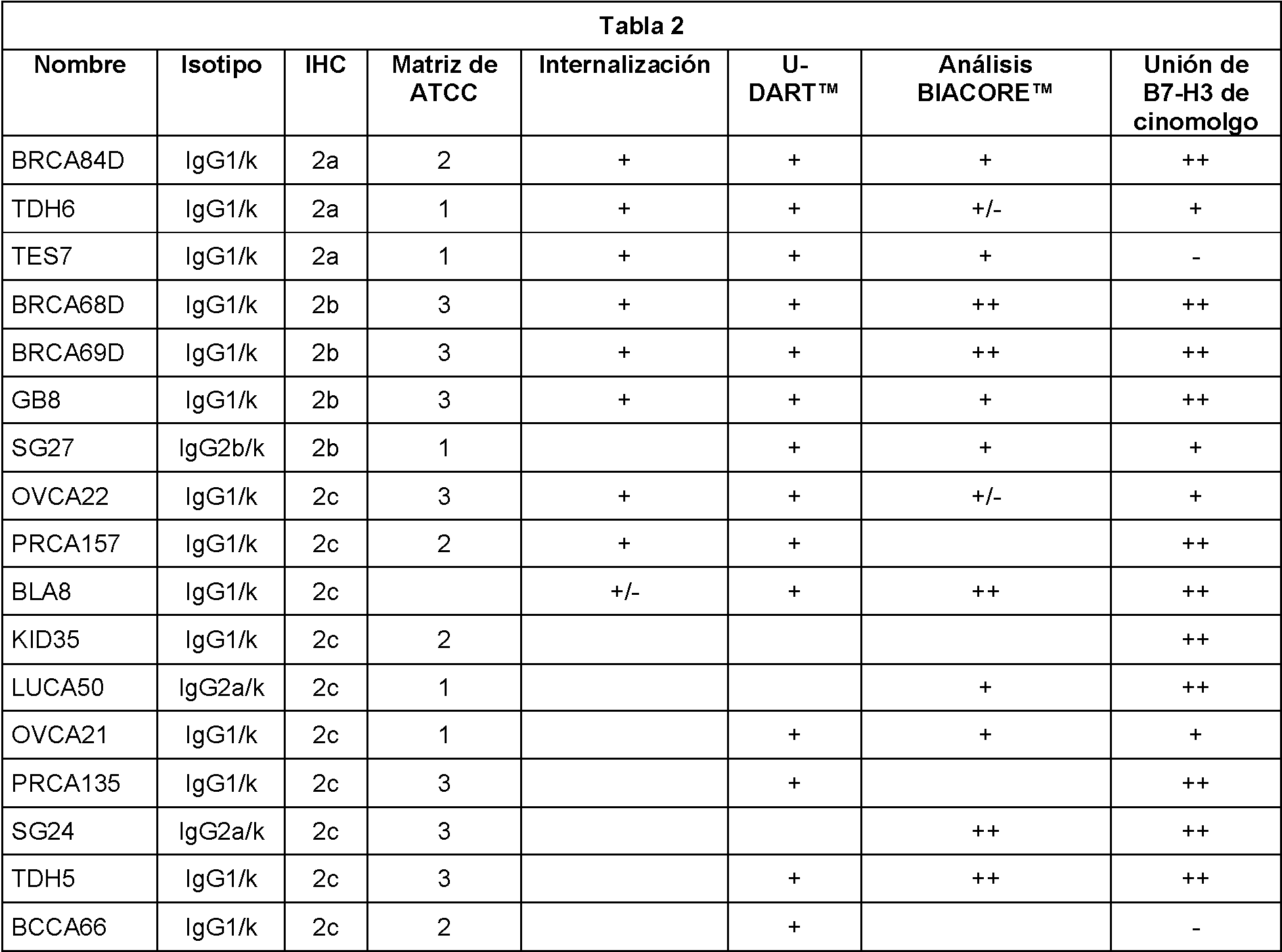
continuacióncontinuation

La tinción de IHC confirmó que el panel comprendía anticuerpos que provocaron un tumor fuerte en el diferencial de unión al tejido normal en muchos de los anticuerpos identificados, presentó una variedad de propiedades de unión por análisis BIACORE™, presentó reactividad a un intervalo de epítopos solapantes y no solapantes y presentó un intervalo de especificidad a 4 Ig frente a 2 Ig de B7-H3. Las características de los nueve mejores candidatos se muestran en Tabla 3 y en la Tabla 4. IHC staining confirmed that the panel comprised antibodies that elicited strong tumor in differential binding to normal tissue in many of the antibodies identified, exhibited a variety of binding properties by BIACORE™ assay, exhibited reactivity to a range of overlapping epitopes and non-overlapping and had a range of specificity at 4 Ig versus 2 Ig of B7-H3. The characteristics of the nine best candidates are shown in Table 3 and Table 4.


La Tabla 5 proporciona un resumen de los perfiles de actividad de estos anticuerpos. Table 5 provides a summary of the activity profiles of these antibodies.

Un análisis de las actividades de los anticuerpos que se muestran en la Tabla 6 reveló que sus respectivos perfiles diferían y que cada anticuerpo estaba asociado con ventajas y desventajas entre sí (Tabla 6). An analysis of the activities of the antibodies shown in Table 6 revealed that their respective profiles differed and that each antibody was associated with advantages and disadvantages relative to each other (Table 6).

continuacióncontinuation

Dado que BRCA84D, BRCA68D, BRCA69D y PRCA157 presentaron perfiles IHC de tejido normal más claros, diferencial de IHC normal/tumor más fuerte, unión de moderada a fuerte (BIACORE™ / IHC), reactividad cruzada con B7-H3 de monos cinomolgos y potente actividad UDART™, estas especies de anticuerpos se seleccionaron para su posterior desarrollo. Estos anticuerpos diferían de TES7 y OVCA2, que presentaron baja afinidad (en el ensayo BIACORE™) y ninguna reactividad cruzada con B7-H3 de monos cinomolgos. Estos anticuerpos difieren de SG27, que presentó baja afinidad (en el ensayo BIACORE™), bajo rendimiento de IHC (unión débil) y menor actividad de UDART™. Estos anticuerpos difieren de GB8, que presentó baja afinidad (en el ensayo BIACORE™), diferencial de tumor/normal de IHC deficiente y menor actividad de UDART™.Since BRCA84D, BRCA68D, BRCA69D, and PRCA157 had clearer normal tissue IHC profiles, stronger normal/tumor IHC differential, moderate to strong binding (BIACORE™ / IHC), cross-reactivity with cynomolgus B7-H3, and potent UDART™ activity, these antibody species were selected for further development. These antibodies differed from TES7 and OVCA2, which exhibited low affinity (in the BIACORE™ assay) and no cross-reactivity with B7-H3 from cynomolgus monkeys. These antibodies differ from SG27, which exhibited low affinity (in the BIACORE™ assay), low IHC yield (weak binding), and lower UDART™ activity. These antibodies differ from GB8, which exhibited low affinity (in the BIACORE™ assay), poor IHC tumor/normal differential, and lower UDART™ activity.
Usando células de control positivo Caki-2 y Hs700T, las investigaciones de IHC revelaron que cada uno de los anticuerpos presentaba una concentración óptima diferente y una concentración diferencial diferente entre sí (Tabla 7). Using Caki-2 and Hs700T positive control cells, IHC investigations revealed that each of the antibodies had a different optimal concentration and a different differential concentration from each other (Table 7).

Usando las concentraciones óptimas y los diferenciales indicados en la Tabla 7, se determinaron las respuestas IHC de los anticuerpos B7-H3 en tejidos humanos. Los resultados de estos análisis para la glándula suprarrenal, el hígado, el páncreas, el riñón, el pulmón y el colon se muestran en las Tablas 8A-8b y en las Tablas 9A-9B (todos los anticuerpos presentaron respuestas IHC negativas para el tejido cardíaco).Using the optimal concentrations and differentials indicated in Table 7, IHC responses of B7-H3 antibodies in human tissues were determined. The results of these analyzes for adrenal gland, liver, pancreas, kidney, lung, and colon are shown in Tables 8A-8b and Tables 9A-9B (all antibodies had negative IHC responses for tissue). cardiac).


continuacióncontinuation


Las investigaciones de IHC realizadas con muestras de cáncer demostraron que los anticuerpos B7-H3 podrían usarse para identificar y diagnosticar el cáncer en múltiples fuentes de tejido (Tabla 10). En la Tabla 10, los números indican el número de signos positivos (1 = , 2 = +, 3 = ++); cada número se refiere a una muestra analizada diferente.IHC investigations conducted with cancer samples demonstrated that B7-H3 antibodies could be used to identify and diagnose cancer in multiple tissue sources (Table 10). In Table 10 , the numbers indicate the number of positive signs (1 = , 2 = +, 3 = ++); each number refers to a different sample tested.

continuacióncontinuation

Para las células de cáncer de próstata, mama, colon y pulmón tratadas con el anticuerpo de B7-H3 BRCA84D, la tinción de la muestra de tumor estaba presente en las células tumorales y las células del estroma, incluida la vasculatura del tumor. En algunas muestras de tumores, la tinción del estroma fue mucho más fuerte que la de las células tumorales. Cuando se tituló el mAb BRCA84D a una concentración más baja, algunos casos mostraron una tinción reducida en las células tumorales, pero aún mantenía una fuerte tinción estromal. Tras teñir con BRCA84D a 0,625 |jg/ml, las células de cáncer de próstata presentaron una IHC de 3/3+; las células de cáncer de mama presentaron una IHC de 4/4+; las células de cáncer de colon presentaron una IHC de 4/4+ y las células de cáncer de pulmón presentaron una IHC de 4/4+. Tras teñir con BRCA84D a 0,078 jg/ml, las células de cáncer de próstata presentaron una IHC de 3/4+; las células de cáncer de mama presentaron una IHC de 5/5+; las células de cáncer de colon presentaron una IHC de 4/4+ y las células de cáncer de pulmón presentaron una IHC de 3/4+.For prostate, breast, colon, and lung cancer cells treated with BRCA84D B7-H3 antibody, tumor sample staining was present in tumor cells and stromal cells, including tumor vasculature. In some tumor samples, the stromal staining was much stronger than that of the tumor cells. When the BRCA84D mAb was titrated to a lower concentration, some cases showed reduced staining in tumor cells, but still maintained strong stromal staining. After staining with BRCA84D at 0.625 µg/ml, prostate cancer cells had an IHC of 3/3+; breast cancer cells had an IHC of 4/4+; colon cancer cells had an IHC of 4/4+ and lung cancer cells had an IHC of 4/4+. After staining with BRCA84D at 0.078 μg/ml, prostate cancer cells had an IHC of 3/4+; breast cancer cells had an IHC of 5/5+; colon cancer cells had an IHC of 4/4+ and lung cancer cells had an IHC of 3/4+.
El hígado normal se trató con el anticuerpo de B7-H3 BRCA68D, y se observó tinción en los hepatocitos y las células de revestimiento sinusoide. El páncreas normal teñido con el anticuerpo de B7-H3 BRCA68D mostró tinción multifocal en la fibra de colágeno y el epitelio. Las células de glándula suprarrenal normales tratadas con anticuerpo de B7-H3 BRCA68D, presentaron tinción en la corteza. Tras teñir con BRCA68D a 0,156 jg/ml, las células de cáncer gástrico, de riñón y de ovario presentaron todas una IHC de 5/5+.Normal liver was treated with the B7-H3 BRCA68D antibody, and staining was observed in hepatocytes and sinusoidal lining cells. Normal pancreas stained with the B7-H3 BRCA68D antibody showed multifocal staining in the collagen fiber and epithelium. Normal adrenal gland cells treated with B7-H3 BRCA68D antibody showed staining in the cortex. After staining with BRCA68D at 0.156 μg/ml, gastric, kidney, and ovarian cancer cells all had an IHC of 5/5+.
Se realizaron análisis adicionales de tinción IHC en muestras de tejidos de cáncer gástrico, de riñón y de ovario. Los resultados de tales análisis se muestran en la Tabla 12. En la Tabla 11, los números indican el número de signos positivos (1= , 2= +, 3 = ++); cada número se refiere a una muestra analizada diferente. Additional IHC staining analyzes were performed on gastric, kidney, and ovarian cancer tissue samples. The results of such analyzes are shown in Table 12. In Table 11 , the numbers indicate the number of positive signs (1= , 2= +, 3 = ++); each number refers to a different sample tested.

En resumen, todos los mAb probados mostraron diversos grados de intensidad de tinción en hígado normal, páncreas, colon y pulmón. La Figura 1A muestra los resultados de las investigaciones de IHC realizadas con páncreas normal, hígado, muestras de tejido de pulmón y colon con BRCA84D a 0,625 pg/ml y 0,078 pg/ml. La tinción del hígado estaba relativamente restringida en las células de revestimiento sinusoide (fibroblasto y células de Kupffer) con BRCA84D y TES7. OVCA22 mostró tinción de hepatocitos de membrana además de la de las células de revestimiento sinusoides a la concentración óptima. Sin embargo, la tinción en los hepatocitos desapareció a la concentración diferencial. Todos los demás mAb mostraron tinción en los hepatocitos, incluida la tinción de la membrana o del citoplasma tanto a la concentración óptima como a la diferencial. Se observó tinción de páncreas en la fibra de colágeno principalmente y en un pequeño porcentaje del epitelio (células acinares y/o células de los conductos intercalados). La tinción en el epitelio disminuyó o desapareció a concentración diferencial. La tinción de colon estaba relativamente restringida en la membrana apical del epitelio de la cripta y el fibroblasto en la mucosa. No se observó unión en los nódulos linfoides del colon. El pulmón mostró una tinción muy débil y en parches en el epitelio con BRCA84D, BRCA68D, BRCA69D y GB8. Sin embargo, la tinción desapareció a la concentración diferencial. No se observó tinción en pulmón con TES7, OVCA22 y PRCA157 en ambas concentraciones. Se observó tinción de la corteza suprarrenal con casi todos los mAb a una concentración óptima, excepto BRCA84D. La tinción en las glándulas suprarrenales obviamente disminuyó con TES7 y OVCA22 a concentración diferencial. El corazón y el riñón no mostraron tinciones obvias con todos los mAb (Figura 1B). A la luz de estas propiedades, BRCA84D fue considerado el mejor de los mAb, seguido en orden por (2) TES7, (3) OVCA22, (4) el grupo BRCA68D, BRCA69D y PRCA157, y por último (5) GB8.In summary, all mAbs tested showed varying degrees of staining intensity in normal liver, pancreas, colon, and lung. Figure 1A shows the results of IHC investigations performed on normal pancreas, liver, lung and colon tissue samples with BRCA84D at 0.625 pg/ml and 0.078 pg/ml. Liver staining was relatively restricted in sinusoidal lining cells (fibroblast and Kupffer cells) with BRCA84D and TES7. OVCA22 showed staining of membrane hepatocytes in addition to that of sinusoidal lining cells at the optimal concentration. However, the staining in hepatocytes disappeared at the differential concentration. All other mAbs showed staining in hepatocytes, including membrane or cytoplasmic staining at both optimal and differential concentrations. Pancreas staining was observed mainly in the collagen fiber and in a small percentage of the epithelium (acinar cells and/or cells of the intercalated ducts). The staining in the epithelium decreased or disappeared at differential concentration. Colon staining was relatively restricted to the apical membrane of the crypt epithelium and the fibroblast in the mucosa. No binding was observed in colonic lymphoid nodes. The lung showed very weak and patchy staining in the epithelium with BRCA84D, BRCA68D, BRCA69D and GB8. However, the staining disappeared at the differential concentration. No staining was observed in the lung with TES7, OVCA22 and PRCA157 at both concentrations. Adrenal cortex staining was observed with almost all mAbs at optimal concentration, except BRCA84D. The staining in the adrenal glands was obviously decreased by TES7 and OVCA22 at differential concentration. Heart and kidney did not show obvious staining with all mAbs (FIG. 1B) . In light of these properties, BRCA84D was considered the best of the mAbs, followed in order by (2) TES7, (3) OVCA22, (4) the BRCA68D, BRCA69D, and PRCA157 group, and lastly (5) GB8.
Todos los mAb incluidos en el estudio mostraron tinción positiva en 4 tipos de cáncer a la concentración óptima. A la concentración diferencial, BRCA84D todavía mantuvo una buena tinción en el cáncer de próstata, cáncer de mama y cáncer de colon. TES7 mantuvo una buena tinción en 4 tipos de cáncer del estudio. Los mAb restantes mostraron varias intensidades de tinción en diferentes tipos de tumores. Se observó tinción de la muestra de tumor en células tumorales y células estromales, incluida la vasculatura. Algunas muestras de tumores mostraron tinción positiva solo en la vasculatura, es decir, BRCA84D, BRCA69D, TES7 y PRCA157. Algunos tumores mostraron una tinción estromal más fuerte que la tinción de células tumorales. Cuando se valoraron los mAb para reducir la concentración en estas muestras, algunos casos mostraron tinción reducida o nula en las células tumorales, pero aún mantenía una fuerte tinción estromal. En general, en términos de expresión en tejidos humanos normales y expresión diferencial en tejidos normales frente a tumores, el orden de mAb desde el mejor rendimiento de IHC hasta el peor rendimiento es el siguiente: (1) BRCA84D, (2) TES7, (3) OVCA22, (4) el grupo BRCA68D, BRCA69D y PRCA157, y por último (5) GB8. La Tabla 12 y la Figura 2 muestran resultados para el anticuerpo BRCA84D.All mAbs included in the study showed positive staining in 4 cancer types at the optimal concentration. At the differential concentration, BRCA84D still maintained good staining in prostate cancer, breast cancer, and colon cancer. TES7 maintained good staining in all 4 cancers in the study. The remaining mAbs showed various staining intensities in different tumor types. Tumor sample staining was observed in tumor cells and stromal cells, including the vasculature. Some tumor samples showed positive staining only in the vasculature, that is, BRCA84D, BRCA69D, TES7, and PRCA157. Some tumors showed stronger stromal staining than tumor cell staining. When mAbs were titrated to lower concentration in these samples, some cases showed reduced or no staining in tumor cells, but still maintained strong stromal staining. In general, in terms of expression in normal human tissues and differential expression in normal versus tumor tissues, the order of mAbs from best IHC performance to worst performance is as follows: (1) BRCA84D, (2) TES7, ( 3) OVCA22, (4) the group BRCA68D, BRCA69D and PRCA157, and finally (5) GB8. Table 12 and Figure 2 show results for the BRCA84D antibody.

Ejemplo 2Example 2
Reactividad cruzada de B7-H3 con mono cinomolgo Cross-reactivity of B7-H3 with cynomolgus monkey
La secuencia del B7-H3 del mono cinomolgo comparte aproximadamente un 90 % de homología con su homólogo humano, sugiriendo que el mono cinomolgo es un modelo excelente para las interacciones humanas de B7-H3. Se llevaron a cabo investigaciones para evaluar la reactividad cruzada de los candidatos de B7H3 BRCA84D, BRCA68D, BRCA69D, TES7, OVCA22 y PRCA157 con glándula suprarrenal, hígado, riñón, páncreas y pulmón, así como un caso de placenta a término de mono cinomolgo, con el fin de comparar cualquier reactividad cruzada con la intensidad de la tinción y los patrones de tinción observados para los tejidos humanos.The cynomolgus monkey B7-H3 sequence shares approximately 90 % homology with its human counterpart, suggesting that the cynomolgus monkey is an excellent model for human B7-H3 interactions. Investigations were carried out to assess the cross-reactivity of B7H3 candidates BRCA84D, BRCA68D, BRCA69D, TES7, OVCA22, and PRCA157 with adrenal gland, liver, kidney, pancreas, and lung, as well as a case of term placenta from cynomolgus monkey, in order to compare any cross-reactivity with the staining intensity and staining patterns observed for human tissues.
La concentración de tinción para cada Mab probado es la concentración óptima que se determinó en las células de control positivo Caki-2 y Hs700T (véase la Tabla 8). Se seleccionó el anti-B7-H3 humano de cabra comercial (con reacción cruzada con cinomolgo) como un anticuerpo de control positivo para teñir el tejido placentario de cinomolgo. Se aplicaron los correspondientes controles de isotipo en cada ejecución de los experimentos. Los resultados de estas investigaciones se muestran en la Tabla 13. The staining concentration for each Mab tested is the optimal concentration that was determined in the Caki-2 and Hs700T positive control cells (see Table 8). Commercial goat anti-human B7-H3 (cross-reactive with cynomolg) was selected as a positive control antibody for staining cynomolg placental tissue. The corresponding isotype controls were applied in each run of the experiments. The results of these investigations are shown in Table 13.

La investigación de la tinción IHC de BRCA84D (0,625 pg/ml) en placenta de cinomolgo mostró tinción en células deciduales, pero no en las vellosidades. No se observó tinción en el hígado ni en el páncreas, sin embargo, se observó tinción de células de revestimiento sinusoide en hígado humano y se observó tinción localizada de fibra y epitelio en tejido de páncreas humano.Investigation of IHC staining of BRCA84D (0.625 pg/ml) in cynomolgus placenta showed staining in decidual cells, but not in villi. No staining was observed in liver or pancreas, however, sinusoidal lining cell staining was observed in human liver and localized fiber and epithelial staining was observed in human pancreas tissue.
La investigación de la tinción IHC de BRCA68D (0,156 pg/ml) en placenta de cinomolgo mostró tinción en células deciduales, células mesenquimales (endotelio y fibroblastos) y vellosidades. La tinción estaba presente en la membrana de los hepatocitos y el citoplasma de los fibroblastos hepáticos, así como en la fibra pancreática y en el citoplasma del epitelio pancreático. Por lo tanto, el tejido de hígado y páncreas humano y de cinomolgo presentan patrones de tinción similares con BRCA68D.Investigation of IHC staining of BRCA68D (0.156 pg/ml) in cynomolgus placenta showed staining in decidual cells, mesenchymal cells (endothelium and fibroblasts), and villi. The staining was present in the membrane of hepatocytes and the cytoplasm of liver fibroblasts, as well as in the pancreatic fiber and in the cytoplasm of the pancreatic epithelium. Therefore, human and cynomolgus liver and pancreas tissue exhibit similar staining patterns with BRCA68D.
En resumen, BRCA84D, BRCA68D, BRCA69D y PRCA157 mostraron reactividad cruzada en los tejidos de cinomolgo. BRCA84D no mostró tinción en hígado y páncreas de mono; tal tinción se observó en el hígado y los tejidos pancreáticos humanos. BRCA68D y BRCA69D mostraron una intensidad de tinción y patrones de tinción similares en los tejidos de los monos. Aunque BRCA68D, BRCA69D y PRCA157 mostraron un patrón de tinción comparable al de los tejidos humanos, la intensidad de la tinción no es idéntica a la de los tejidos humanos en condiciones óptimas. TES7 y OVCA22 no mostraron tinción en tejidos de mono en condiciones óptimas.In summary, BRCA84D, BRCA68D, BRCA69D, and PRCA157 showed cross-reactivity in cynomolgus tissues. BRCA84D showed no staining in monkey liver and pancreas; such staining was observed in human liver and pancreatic tissues. BRCA68D and BRCA69D showed similar staining intensity and staining patterns in monkey tissues. Although BRCA68D, BRCA69D and PRCA157 showed a staining pattern comparable to that of human tissues, the intensity of staining is not identical to that of human tissues under optimal conditions. TES7 and OVCA22 did not show staining in monkey tissues under optimal conditions.
Se proporciona un resumen de los resultados comparativos de la tinción de IHC en tejido de cinomolgo y tejido humano en la Tabla 14. A summary of the comparative results of IHC staining in cynomolgus tissue and human tissue is provided in Table 14.

Ejemplo 3Example 3
Los mAb B7-H3 se unen a múltiples líneas celulares de cáncer de la ATCCB7-H3 mAbs bind to multiple ATCC cancer cell lines
Se descubrió que los anticuerpos descritos en el presente documento eran capaces de unirse a múltiples líneas de células cancerosas contenidas en las colecciones de la American Type Culture Collection. La Tabla 15 y la Tabla 16 resumen los resultados de unión.The antibodies described herein were found to be capable of binding to multiple cancer cell lines contained in the collections of the American Type Culture Collection. Table 15 and Table 16 summarize the binding results.

continuacióncontinuation


continuacióncontinuation

Ejemplo 4Example 4
Eliminación redirigida de mAb B7-H3Redirected deletion of mAb B7-H3
Los anticuerpos descritos en el presente documento se unen a B7-H3 presente en la superficie de las células cancerosas. Usando métodos convencionales, tales anticuerpos pueden marcarse con fluoresceína, tal como se describe anteriormente. Cuando dichas moléculas marcadas se incuban en presencia de moléculas UDART™ que tienen un dominio de unión al epítopo que se une al receptor de linfocitos T y un dominio de unión al epítopo que se une a la fluoresceína ("TCR-UDART™"), pueden unirse a las moléculas DART™ y, por lo tanto, localizarse en la superficie de las células que expresan B7-H3 y causar una muerte redireccionada.The antibodies described herein bind to B7-H3 present on the surface of cancer cells. Using conventional methods, such antibodies can be labeled with fluorescein, as described above. When such labeled molecules are incubated in the presence of UDART™ molecules that have an epitope-binding domain that binds the T cell receptor and an epitope-binding domain that binds fluorescein ("TCR-UDART™"), they can bind to DART™ molecules and thus localize to the surface of B7-H3 expressing cells and cause redirected death.
A. Eliminación redirigida de células de carcinoma renal A498A. Redirected deletion of A498 renal carcinoma cells
Para demostrar tal eliminación redirigida, se incubaron anticuerpos B7-H3 marcados con fluoresceína con dichas moléculas TCR-UDART™ y se evaluó la capacidad de las moléculas para mediar la citotoxicidad de las células del carcinoma renal A498. (Tabla 17). Basándose en los resultados obtenidos, se concluyó que los principales candidatos eran: RECA13, BRCA68D, BRCA69D y TDH6.To demonstrate such redirected clearance, fluorescein-labeled B7-H3 antibodies were incubated with said TCR-UDART™ molecules and the ability of the molecules to mediate cytotoxicity of A498 renal carcinoma cells was assessed. (Table 17). Based on the results obtained, it was concluded that the main candidates were: RECA13, BRCA68D, BRCA69D and TDH6.

continuacióncontinuation

Se incubaron células de carcinoma renal A498 con diferentes concentraciones de anticuerpos monoclonales reactivos contra B7-H3 con el fin de determinar la eliminación redirigida dependiente de la dosis mediada por los anticuerpos. Los resultados de los experimentos (Figuras 3A-3B) muestran que la eliminación redirigida dependía de la dosis. A498 renal carcinoma cells were incubated with different concentrations of monoclonal antibodies reactive against B7-H3 in order to determine dose-dependent redirected clearance mediated by the antibodies. The results of the experiments (Figures 3A-3B) show that the redirected clearance was dose-dependent.
B. Eliminación redirigida de células de cáncer de pulmón A549B. Redirected killing of A549 lung cancer cells
Para demostrar aún más esta eliminación redirigida, los anticuerpos B7-H3 marcados con fluoresceína se incubaron con las moléculas TCR-UDART™ descritas anteriormente o con moléculas UDART™ que tienen un dominio de unión a epítopo que se une a CD16 y un dominio de unión a epítopo que se une a fluoresceína ("CD16-UDART™"), y se evaluó la capacidad de las moléculas para mediar la citotoxicidad de las células de cáncer de pulmón A549 (Tabla 18). Los resultados de los experimentos (Figuras 3C-3D) muestran que la eliminación redirigida dependía de la dosis. Basándose en los resultados obtenidos, se concluyó que los principales candidatos eran: BLA8, BRCA68D, BRCA69D y BRCA84D.To further demonstrate this redirected deletion, fluorescein-labeled B7-H3 antibodies were incubated with the TCR-UDART™ molecules described above or with UDART™ molecules that have a CD16-binding epitope-binding domain and a CD16-binding domain. to a fluorescein-binding epitope ("CD16-UDART™"), and the ability of the molecules to mediate the cytotoxicity of A549 lung cancer cells was evaluated (Table 18). The results of the experiments (Figures 3C-3D) show that the redirected clearance was dose-dependent. Based on the results obtained, it was concluded that the main candidates were: BLA8, BRCA68D, BRCA69D and BRCA84D.

C. Eliminación redirigida de células de cáncer de próstata LNcap C. Redirected killing of LNcap prostate cancer cells
Para demostrar aún más esta eliminación redirigida, los anticuerpos B7-H3 marcados con fluoresceína se incubaron con las moléculas TCR-UDART ™ descritas anteriormente o con moléculas UDART ™ que tienen un dominio de unión a epítopo que se une a CD16 y un dominio de unión a epítopo que se une a fluoresceína ("CD16-UDART™"), y se evaluó la capacidad de las moléculas para mediar la citotoxicidad de las células de cáncer de próstata LNcap (Tabla 19). Basándose en los resultados obtenidos, se concluyó que los principales candidatos eran: BRCA68D, BRCA69D, BRCA84D y PRCA157. To further demonstrate this redirected deletion, fluorescein-labeled B7-H3 antibodies were incubated with the TCR-UDART™ molecules described above or with UDART™ molecules that have a CD16-binding epitope-binding domain and a CD16-binding domain. a fluorescein-binding epitope ("CD16-UDART™"), and the ability of the molecules to mediate the cytotoxicity of LNcap prostate cancer cells was evaluated (Table 19). Based on the results obtained, it was concluded that the main candidates were: BRCA68D, BRCA69D, BRCA84D and PRCA157.

continuacióncontinuation

Ejemplo 5Example 5
Capacidad de los mAb B7-H3 para unirse a B7H3-2Ig soluble y B7H3-4Ig solubleAbility of mAbs B7-H3 to bind to soluble B7H3-2Ig and soluble B7H3-4Ig
Tal como se ha analiza anteriormente, B7-H3 existe tanto en una forma que contiene 4 dominios Ig (B7H3-4I g) como en una forma que contiene 2 dominios Ig (B7H3-2Ig). Los anticuerpos anti-B7-H3 descritos en el presente documento se probaron para determinar su capacidad para unirse a B7H3-2lg soluble (Figura 4A) y B7H3-4Ig B7-H3 soluble (Figura 4B). Se descubrió que los anticuerpos presentaban una amplia gama de características de unión. Se descubrió que los anticuerpos PRCA123, TDH5, BlA8, BRCA68D y SG24 presentan la unión más fuerte a B7H3-2Ig soluble y se descubrió que los anticuerpos TES7, LUCA50, BRCA165, Ov Ca 22, STO9 y PA20 presentaban la unión más débil a B7H3-2Ig soluble. Se descubrió que los anticuerpos PRCA123, BRCA69A, BLA8 y BRCA68D presentan la unión más fuerte a B7H3-4Ig soluble y se descubrió que los anticuerpos TES7, OVCA21, BRCA165 y ST09 presentaban la unión más débil a B7H3-4Ig soluble.As discussed above, B7-H3 exists in both a form containing 4 Ig domains (B7H3-4Ig) and a form containing 2 Ig domains (B7H3-2Ig). The anti-B7-H3 antibodies described herein were tested for their ability to bind to soluble B7H3-2lg (FIG. 4A) and soluble B7H3-4Ig B7-H3 (FIG. 4B). The antibodies were found to exhibit a wide range of binding characteristics. Antibodies PRCA123, TDH5, BlA8, BRCA68D and SG24 were found to have the strongest binding to soluble B7H3-2Ig and antibodies TES7, LUCA50, BRCA165, Ov Ca 22, STO9 and PA20 were found to have the weakest binding to B7H3 -2Ig soluble. PRCA123, BRCA69A, BLA8 and BRCA68D antibodies were found to have the strongest binding to soluble B7H3-4Ig and TES7, OVCA21, BRCA165 and ST09 antibodies were found to have the weakest binding to soluble B7H3-4Ig.
Ejemplo 6Example 6
Unión por afinidad de antígenos en solución a anticuerpos monoclonales capturadosAffinity binding of antigens in solution to captured monoclonal antibodies
Para demostrar la afinidad de unión entre los antígenos en solución y los anticuerpos monoclonales capturados, los anticuerpos se capturaron en fragmentos Fab2 específicos de Fc de IgG inmovilizados a un nivel de 100-200 UR. Los antígenos B7-H3 y B7-H3 (4 Ig) se inyectaron sobre los anticuerpos capturados a una concentración de 100 nM (velocidad de flujo de 20 pl/min durante 120 segundos y se midió la unión. Las respuestas de unión se normalizaron al mismo nivel de mAb capturado y la respuesta de unión al control de anticuerpo m2B6 (mIgGI) se restó como blanco. Los resultados de este análisis (Figuras 5A-5S; líneas continuas; B7-H3(4Ig) 100 nM; líneas discontinuas; B7-H3, 100 nM)) demuestran que los anticuerpos descritos en el presente documento presentan una fuerte unión a B7-H3(4Ig). To demonstrate binding affinity between antigens in solution and captured monoclonal antibodies, antibodies were captured on immobilized IgG Fc-specific Fab2 fragments at a level of 100-200 RU. B7-H3 and B7-H3 antigens (4 µg) were injected onto the captured antibodies at a concentration of 100 nM (flow rate of 20 µl/min for 120 seconds and binding was measured. Binding responses were normalized to same level of captured mAb and binding response to the control antibody m2B6 (mIgGI) was subtracted as blank.The results of this analysis (Figures 5A-5S; solid lines; B7-H3(4Ig) 100 nM; dashed lines; B7 -H3, 100 nM)) demonstrate that the antibodies described herein exhibit strong binding to B7-H3(4Ig).
Ejemplo 7Example 7
Análisis BIACORE™: Titulación de mAb B7-H3 para B7-H3 inmovilizadoBIACORE™ Assay: Titration of mAb B7-H3 for Immobilized B7-H3
Para demostrar las afinidades de unión relativas de B7-H3-2Ig y B7-H3-4Ig por los anticuerpos descritos en el presente documento, se realizó un análisis BIACORE™. Se permitió que los anticuerpos B7-H3 descritos en el presente documento se unieran a B7-H3-2Ig inmovilizado o a B7-H3-4Ig y se evaluó la titulación de la unión a lo largo del tiempo (Figuras 6A-6I). Se descubrió que TDH5, PRCA123, BLA8, BRCA69 tienen una alta afinidad tanto por B7-H3-2Ig como por B7-H3-4Ig. Sin embargo, se encontró que su(s) epítopo(s) estaba(n) en su mayoría excluido(s) en la molécula B7-H3-4Ig, con solo unos pocos disponibles. Se descubrió que OVCA22 tiene una afinidad muy baja tanto por B7-H3-2Ig como por B7-H3-4Ig, estando su epítopo igualmente disponible en ambas moléculas. Sin embargo, es probable que solo la forma B7-H3-4Ig proporcione suficiente proximidad para la unión bivalente del anticuerpo (baja disociación), mientras que la B7-H3-2Ig se puede unir sólo de forma monovalente. Se descubrió que TDH6 apenas tenía afinidad en este formato, con unión a 2Ig probable que sea inespecífica. Se descubrió que TES7 y PA20 eran anticuerpos específicos de B7-H4-4Ig con baja afinidad. Es probable que TES7 tenga una tasa de asociación baja y una tasa de disociación más alta que la PA20. Se descubrió que BRCA84D era un anticuerpo de afinidad intermedia con la posibilidad de múltiples sitios de unión tanto en B7-H3-2Ig como en B7-H3-4Ig. Basado en el análisis BIACORe ™, BRCA84D debido a su sitio de unión inusual se consideró un anticuerpo preferido. TES7 y PA20 se consideraron candidatos para la unión específica a superficies de antígenos de alta densidad y uno de anticuerpos de alta afinidad y baja especificidad (por ejemplo, BRCA69D u otro).To demonstrate the relative binding affinities of B7-H3-2Ig and B7-H3-4Ig for the antibodies described herein, a BIACORE™ assay was performed. The B7-H3 antibodies described herein were allowed to bind to immobilized B7-H3-2Ig or B7-H3-4Ig and the titration of binding over time was assessed (Figures 6A-6I). TDH5, PRCA123, BLA8, BRCA69 were found to have high affinity for both B7-H3-2Ig and B7-H3-4Ig. However, its epitope(s) were found to be mostly excluded in the B7-H3-4Ig molecule, with only a few available. OVCA22 was found to have a very low affinity for both B7-H3-2Ig and B7-H3-4Ig, its epitope being equally available on both molecules. However, it is likely that only the B7-H3-4Ig form provides sufficient proximity for bivalent antibody binding (low dissociation), whereas B7-H3-2Ig can only bind monovalently. TDH6 was found to have little affinity for this format, with 2Ig binding likely to be nonspecific. TES7 and PA20 were found to be B7-H4-4Ig-specific antibodies with low affinity. TES7 is likely to have a low rate of association and a higher rate of dissociation than PA20. BRCA84D was found to be an antibody of intermediate affinity with the potential for multiple binding sites on both B7-H3-2Ig and B7-H3-4Ig. Based on the BIACORE™ analysis, BRCA84D due to its unusual binding site was considered a preferred antibody. TES7 and PA20 were considered candidates for specific binding to surfaces of high-density antigens and one of high-affinity, low-specificity antibodies (eg, BRCA69D or other).
La Figura 7 proporciona un análisis BIACORE™ de comparación de los anticuerpos PRCA157, BRCA69D, BLA8, PA20, BRCA84D, GB8 y SG27, que ilustra que los anticuerpos anti-B7-H3 descritos en el presente documento pueden presentar una variedad de propiedades de unión. Figure 7 provides a BIACORE™ comparison analysis of PRCA157, BRCA69D, BLA8, PA20, BRCA84D, GB8, and SG27 antibodies, illustrating that the anti-B7-H3 antibodies described herein can exhibit a variety of binding properties. .
La Figura 8 demuestra la especificidad no competitiva de varios de los anticuerpos anti-B7-H3 descritos en el presente documento. En el experimento, se incubaron moléculas de B7-H3 humanas en presencia del anticuerpo BRCA84D y se sometieron a análisis BIACORE™. Después de aproximadamente 3 minutos, se añadió a la reacción un segundo anticuerpo anti-B7-H3. Si el segundo anticuerpo compitió con BRCA84D, encontraría los sitios de B7-H3 ocluidos y no podría unirse. Los resultados indican que los anticuerpos BRCA68D, BRCA69D y PRCA157 no compiten con BRCA84D por unirse al B7-H3 humano. Figure 8 demonstrates the noncompetitive specificity of several of the anti-B7-H3 antibodies described herein. In the experiment, human B7-H3 molecules were incubated in the presence of the BRCA84D antibody and subjected to BIACORE™ analysis. After approximately 3 minutes, a second anti-B7-H3 antibody was added to the reaction. If the second antibody competed with BRCA84D, it would find the occluded B7-H3 sites and be unable to bind. The results indicate that BRCA68D, BRCA69D and PRCA157 antibodies do not compete with BRCA84D for binding to human B7-H3.
Ejemplo 8Example 8
Los mAb anti-B7-H3 se internalizan en las líneas celulares CMC y de ATCCAnti-B7-H3 mAbs are internalized into CMC and ATCC cell lines
Se investigó la capacidad de los anticuerpos anti-B7-H3 descritos en el presente documento para internalizarse tras la unión a células cancerosas. Se incubaron células prostáticas CMC y células pancreáticas Hs700t con un anticuerpo anti-B7-H3. La viabilidad de las células se determinó después de la incubación en presencia de un anticuerpo secundario anti-ratón conjugado con saporina que será tóxico para las células si se une al anticuerpo primario y se internaliza. Los resultados de esta investigación para células CMC de próstata (Figura 9A) y para células pancreáticas Hs700t (Figura 9B) demuestran la capacidad de los anticuerpos descritos en el presente documento para internalizarse en las células.The ability of the anti-B7-H3 antibodies described herein to internalize upon binding to cancer cells was investigated. CMC prostate cells and Hs700t pancreatic cells were incubated with an anti-B7-H3 antibody. Cell viability was determined after incubation in the presence of a saporin-conjugated anti-mouse secondary antibody that will be toxic to cells if bound to the primary antibody and internalized. The results of this investigation for prostate CMC cells (FIG. 9A) and for pancreatic Hs700t cells (FIG. 9B) demonstrate the ability of the antibodies described herein to internalize into cells.
Ejemplo 9Example 9
Análisis de unión y bloqueo cruzado de mAb B7-H3 mediante ELISABinding and Cross Blocking Analysis of mAb B7-H3 by ELISA
Para explorar la reactividad cruzada de los anticuerpos descritos en el presente documento y los epítopos reconocidos por dichos anticuerpos, se midió el grado de unión que se produce en presencia de un anticuerpo competidor de B7-H3. Los resultados de este análisis se muestran en Figuras 10A-10F, y muestran que BRCA68D compite con BRCA69D. También se descubrió que TES7 y OVCA22 compiten entre sí, pero se descubrió que TES7 y no OVCA22 también compiten con BRCA68D y BRCA69D. Se descubrió que GB8 compite con SG27 por la unión a B7-H3-2Ig pero no a B7-H3-4Ig. Los datos se resumen en la Tabla 20 y muestran al menos cuatro epítopos distintos para B7-H3-4Ig (es decir, el epítopo reconocido por SG27, el epítopo reconocido por GB8, el epítopo reconocido por OVCA22 y TES7, y el epítopo reconocido por BRCA68D, BRCA69D y TES7) y al menos dos epítopos para B7-H3-2Ig (es decir, el epítopo reconocido por SG27 y GB8, y el epítopo reconocido por BRCA68D y BRCA69D). To explore the cross-reactivity of the antibodies described herein and the epitopes recognized by said antibodies, the extent of binding that occurs in the presence of a B7-H3 competitor antibody was measured. The results of this analysis are shown in Figures 10A-10F, and show that BRCA68D competes with BRCA69D. TES7 and OVCA22 were also found to compete with each other, but TES7 and not OVCA22 were also found to compete with BRCA68D and BRCA69D. GB8 was found to compete with SG27 for binding to B7-H3-2Ig but not B7-H3-4Ig. The data is summarized in Table 20 and shows at least four distinct epitopes for B7-H3-4Ig (i.e., the epitope recognized by SG27, the epitope recognized by GB8, the epitope recognized by OVCA22 and TES7, and the epitope recognized by BRCA68D, BRCA69D, and TES7) and at least two epitopes for B7-H3-2Ig (ie, the epitope recognized by SG27 and GB8, and the epitope recognized by BRCA68D and BRCA69D).

Los atributos de los anticuerpos anti-B7-H3 clave descritos en el presente documento se muestran en la Tabla 21. The attributes of the key anti-B7-H3 antibodies described herein are shown in Table 21.
Basado en su tinción diferencial presentada de tejidos normales y cancerosos, su capacidad para unirse a B7-H3-4Ig así como a B7-H3-2Ig, sus afinidades de unión medidas por el análisis BIACORE™ descrito anteriormente y su capacidad para unirse a los anticuerpos de B7H3 de cinomolgo, se consideró que BRCA68D, BRCA69D, BRCA84D y PRCA157 eran los anticuerpos más preferidosBased on its reported differential staining of normal and cancerous tissues, its ability to bind B7-H3-4Ig as well as B7-H3-2Ig, its binding affinities as measured by the BIACORE™ assay described above, and its ability to bind to cynomolgus B7H3 antibodies, BRCA68D, BRCA69D, BRCA84D and PRCA157 were considered to be the most preferred antibodies

continuacióncontinuation

Ejemplo 10Example 10
Anticuerpos anti-B7-H3 humanizadosHumanized anti-B7-H3 antibodies
El anticuerpo monoclonal BRCA84D se humanizó para producir anticuerpos (designados genéricamente en el presente documento como "hBRCA84D") que ofrecen un potencial terapéutico humano mejorado. Las secuencias de la cadena ligera variable y la cadena pesada variable, y sus respectivas secuencias de aminoácidos y polinucleótidos de un anticuerpo humanizado resultante (designado en el presente documento como "hBRCA84D-1") se proporcionan a continuación:The BRCA84D monoclonal antibody was humanized to produce antibodies (herein referred to generically as "hBRCA84D") that offer improved human therapeutic potential. The variable light chain and variable heavy chain sequences, and their respective amino acid and polynucleotide sequences of a resulting humanized antibody (herein designated "hBRCA84D-1") are provided below:
Cadena ligera variable humanizada BRCA84D-1 (SEQ ID NO: 68): Humanized variable light chain BRCA84D-1 (SEQ ID NO: 68):
DIQLTQSPSF LSASVGDRVT ITCKASQNVD TNVAWYQQKP GKAPKLLIYSDIQLTQSPSF LSASVGDRVT ITCKASQNVD TNVAWYQQKP GKAPKLLIYS
ASYRYSGVPS RFSGSGSGTD FTLTISSLQP EDFATYYCQQ YNNYPFTFGQASYRYSGVPS RFSGSGSGTD FTLTISSLQP EDFATYYCQQ YNNYPFTFGQ
GTKLEIKGTKLEIK
Secuencia de polinucleótidos que codifica la cadena ligera variable BRCA84D-1 humanizada (SEQ ID NO: 69): Polynucleotide sequence encoding the humanized BRCA84D-1 variable light chain (SEQ ID NO: 69):
gacatccagc tgacccagtc cccctccttc ctgtctgcct ccgtgggcga cagagtgacc atcacatgca aggcctccca gaacgtggac accaacgtgg cctggtatca gcagaagcct ggcaaggccc ctaagctgct gatctactcc gcctcctacc ggtactccgg cgtgccttcc aggttctccg gctccggctc tggcaccgac ttcaccctga ccatctccag cctgcagcct gaggacttcg ccacctacta ctgccagcag tacaacaact accctttcac cttcggccag ggcaccaagc tggaaatcaa g gacatccagc tgacccagtc cccctccttc ctgtctgcct ccgtgggcga cagagtgacc atcacatgca aggcctccca gaacgtggac accaacgtgg cctggtatca gcagaagcct ggcaaggccc ctaagctgct gatctactcc gcctcctacc ggtactccgg cgtgccttcc aggttctccg gctccggctc tggcaccgac ttcaccctga ccatctccag cctgcagcct gaggacttcg ccacctacta ctgccagcag tacaacaact accctttcac cttcggccag ggcaccaagc tggaaatcaa g
CDR1 de cadena ligera variable BRCA84D-1 humanizada (SEQ ID NO:70): KASQNVDTNVAHumanized BRCA84D-1 variable light chain CDR 1 (SEQ ID NO:70 ): KASQNVDTNVA
Secuencia de polinucleótidos que codifica la CDR1 de cadena ligera variable BRCA84D-1 humanizada (SEQ ID NO:71): aaggccagtc agaatgtgga tactaatgta gccPolynucleotide sequence encoding humanized BRCA84D-1 variable light chain CDR 1 (SEQ ID NO:71): aaggccagtc agaatgtgga tactaatgta gcc
CDR2 de cadena ligera variable BRCA84D-1 humanizada (SEQ ID NO: 72): SASYRYSHumanized BRCA84D-1 variable light chain CDR 2 (SEQ ID NO: 72): SASYRYS
Secuencia de polinucleótidos que codifica la CDR2 de cadena ligera variable BRCA84D-1 humanizada (SEQ ID NO: 73): tcggcatcct accggtacag tPolynucleotide sequence encoding humanized BRCA84D-1 variable light chain CDR 2 (SEQ ID NO: 73): tcggcatcct accggtacag t
CDR3 de cadena ligera variable BRCA84D-1 humanizada (SEQ ID NO: 74): QQYNNYPFTHumanized BRCA84D-1 variable light chain CDR 3 (SEQ ID NO: 74): QQYNNYPFT
Secuencia de polinucleótidos que codifica la CDR3 de cadena ligera variable BRCA84D-1 humanizada (SEQ ID NO: 75): cagcaatata acaactatcc attcacgPolynucleotide sequence encoding the humanized BRCA84D-1 variable light chain CDR 3 (SEQ ID NO: 75): cagcaatata acaactatcc attcacg
Secuencia de aminoácidos de la cadena pesada variable BRCA84D-1 humanizada (SEQ ID NO:80): Amino acid sequence of humanized BRCA84D-1 variable heavy chain (SEQ ID NO:80):
EVQLVESGGG LVQPGGSLRL SCAASGFTFS SFGMHWVRQA PGKGLEWVAYEVQLVESGGG LVQPGGSLRL SCAASGFTFS SFGMHWVRQA PGKGLEWVAY
ISSDSSAIYY ADTVKGRFTI SRDNAKNSLY LQMNSLRDED TAVYYCARGRISSDSSAIYY ADTVKGRFTI SRDNAKNSLY LQMNSLRDED TAVYYCARGR
ENIYYGSRLD YWGQGTTVTV SSENIYYGSRLD YWGQGTTVTV SS
S e cu e n c ia de p o lin u c le ó tid o s que co d ifica la cad en a p e sad a va ria b le B R C A 84D -1 h u m a n iza d a (S E Q ID NO:81): gaggtgcagc tggtcgagtc tggcggagga ctggtgcagc ctggcggctcS e cu enc ia of po lin uc le o tid os that encodes the humanized BRCA 84D -1 va ria b le chain (SEQ ID NO: 81): gaggtgcagc tggtcgagtc tggcggagga ctggtgcagc ctggcggctc
cctgagactg tcttgcgccg cctccggctt caccttctcc agcttcggcacctgagactg tcttgcgccg cctccggctt caccttctcc agcttcggca
tgcactgggt ccgccaggct ccaggcaagg gactggaatg ggtggcctactgcactgggt ccgccaggct ccaggcaagg gactggaatg ggtggcctac
atctcctccg actcctccgc catctactac gccgacaccg tgaagggcagatctcctccg actcctccgc catctactac gccgacaccg tgaagggcag
gttcaccatc tcccgggaca acgccaagaa ctccctgtac ctgcagatgagttcaccatc tcccgggaca acgccaagaa ctccctgtac ctgcagatga
actccctgcg ggacgaggac accgccgtgt actactgcgc cagaggccggactccctgcg ggacgaggac accgccgtgt actactgcgc cagaggccgg
gagaatatct actacggctc ccggctggat tattggggcc agggcaccacgagaatatct actacggctc ccggctggat tattggggcc agggcaccac
cgtgaccgtg tcctctcgtgaccgtg tcctct
CDRi de cadena pesada variable BRCA84D-1 humanizada (SEQ ID NO:82): FGMHHumanized BRCA84D-1 variable heavy chain RiCD (SEQ ID NO:82): FGMH
Secuencia de polinucleótidos que codifica la CDRi de cadena pesada variable BRCA84D-1 humanizada (SEQ ID NO: 83): tttggaatgcacPolynucleotide sequence encoding the humanized BRCA84D-1 variable heavy chain CDRi (SEQ ID NO: 83): tttggaatgcac
CDR2 de cadena pesada variable BRCA84D humanizada (SEQ ID NO:84): YISSDSSAIYYADTVKHumanized BRCA84D variable heavy chain CDR 2 (SEQ ID NO:84): YISSDSSAIYYADTVK
Secuencia de polinucleótidos que codifica la CDR2 de cadena pesada variable BRCA84D-1 humanizada (SEQ ID NO: 85): tacattagta gtgacagtag tgccatctac tatgcagaca cagtgaagPolynucleotide sequence encoding humanized BRCA84D-1 variable heavy chain CDR 2 (SEQ ID NO: 85): tacattagta gtgacagtag tgccatctac tatgcagaca cagtgaag
CDR3 de cadena pesada variable BRCA84D-1 humanizada (SEQ ID NO:86): GRENIYYGSRLDYHumanized BRCA84D-1 variable heavy chain CDR 3 (SEQ ID NO:86): GRENIYYGSRLDY
Secuencia de polinucleótidos que codifica la CDR3 de cadena pesada variable BRCA84D-1 humanizada (SEQ ID NO: 87): gggagggaaa acatttacta cggtagtagg cttgactacPolynucleotide sequence encoding the humanized BRCA84D-1 variable heavy chain CDR 3 (SEQ ID NO: 87): gggagggaaa acatttacta cggtagtagg cttgactac
Las Figuras 11A-11B muestran la alineación de los restos de aminoácidos de las cadenas ligeras variables (Figura 11A) o cadenas pesadas variables (Figura 11B) de BRCA84D y su derivado humanizado, hBRCA84D. Figures 11A-11B show the alignment of amino acid residues of the variable light chains (Figure 11A) or variable heavy chains (Figure 11B) of BRCA84D and its humanized derivative, hBRCA84D.
Para obtener especies de hBRCA84D que presenten una afinidad mejorada por B7-H3 humano, los polinucleótidos que codifican las cadenas ligeras o pesadas de hBRCA84D-1 (es decir, hBRCA84D-1VL o hBRCA84D-1VH, respectivamente) fueron sometidos a mutagénesis, y derivados de la cadena ligera hBRCA84D-1 mutados hBRCA84D-2VL, hBRCA84D-3VL, hBRCA84D-4VL, hBRCA84D-5VL y hBRCA84D-6VL y derivados de cadena pesada hBRCA84D-1 mutados hBRCA84D-2VH, hBRCA84D-3VH y hBRCA84D-4VH se aislaron y caracterizaron. Las secuencias de aminoácidos y polinucleótidos de las cadenas ligeras y pesadas variables de estos anticuerpos se presentan a continuación:To obtain hBRCA84D species exhibiting enhanced affinity for human B7-H3, polynucleotides encoding hBRCA84D-1 heavy or light chains (i.e., hBRCA84D-1VL or hBRCA84D-1VH, respectively) were mutagenized, and derivatives Mutated hBRCA84D-1 light chain derivatives hBRCA84D-2VL, hBRCA84D-3VL, hBRCA84D-4VL, hBRCA84D-5VL, and hBRCA84D-6VL and mutated hBRCA84D-1 heavy chain derivatives hBRCA84D-2VH, hBRCA84D-3VH, and hBRCA84D-4VH were isolated and characterized. The amino acid and polynucleotide sequences of the variable light and heavy chains of these antibodies are presented below:
hBRCA84D-2VL (SEQ ID NO:89):hBRCA84D-2VL (SEQ ID NO:89):
DIQLTQSPSF LSASVGDRVT ITCKASQNVD TNVAWYQQKP GKAPKALIYSDIQLTQSPSF LSASVGDRVT ITCKASQNVD TNVAWYQQKP GKAPKALIYS
ASYRYSGVPS RFSGSGSGTD FTLTISSLQP EDFATYYCQQ YNNYPFTFGQASYRYSGVPS RFSGSGSGTD FTLTISSLQP EDFATYYCQQ YNNYPFTFGQ
GTKLEIKGTKLEIK
Polinucleótido que codifica hBRCA84D-2VL (SEQ ID NO:90): Polynucleotide encoding hBRCA84D-2VL (SEQ ID NO:90):
gacatccagc tgacccagtc cccctccttc ctgtctgcct ccgtgggcgagacatccagc tgacccagtc cccctccttc ctgtctgcct ccgtgggcga
cagagtgacc atcacatgca aggcctccca gaacgtggac accaacgtggcagagtgacc atcacatgca aggcctccca gaacgtggac accaacgtgg
cctggtatca gcagaagcct ggcaaggccc ctaaggcgct gatctactcccctggtatca gcagaagcct ggcaaggccc ctaaggcgct gatctactcc
gcctcctacc ggtactccgg cgtgccttcc aggttctccg gctccggctcgcctcctacc ggtactccgg cgtgccttcc aggttctccg gctccggctc
tggcaccgac ttcaccctga ccatctccag cctgcagcct gaggacttcgtggcaccgac ttcaccctga ccatctccag cctgcagcct gaggacttcg
ccacctacta ctgccagcag tacaacaact accctttcac cttcggccagccacctacta ctgccagcag tacaacaact accctttcac cttcggccag
ggcaccaagc tggaaatcaa g ggcaccaagc tggaaatcaa g
hBRCA84D-3VL (SEQ ID NO:91):hBRCA84D-3VL (SEQ ID NO:91):
DIQLTQSPSF LSASVGDRVS VTCKASQNVD TNVAWYQQKP GKAPKLLIYSDIQLTQSPSF LSASVGDRVS VTCKASQNVD TNVAWYQQKP GKAPKLLIYS
ASYRYSGVPS RFSGSGSGTD FTLTISSLQP EDFATYYCQQ YNNYPFTFGQASYRYSGVPS RFSGSGSGTD FTLTISSLQP EDFATYYCQQ YNNYPFTFGQ
GTKLEIKGTKLEIK
Polinucleótido que codifica hBRCA84D-3VL (SEQ ID NO:92): Polynucleotide encoding hBRCA84D-3VL (SEQ ID NO:92):
gacatccagc tgacccagtc cccctccttc ctgtctgcct ccgtgggcga cagagtgtcc gtcacatgca aggcctccca gaacgtggac accaacgtgg cctggtatca gcagaagcct ggcaaggccc ctaagctgct gatctactcc gcctcctacc ggtactccgg cgtgccttcc aggttctccg gctccggctc tggcaccgac ttcaccctga ccatctccag cctgcagcct gaggacttcg ccacctacta ctgccagcag tacaacaact accctttcac cttcggccag ggcaccaagc tggaaatcaa g gacatccagc tgacccagtc cccctccttc ctgtctgcct ccgtgggcga cagagtgtcc gtcacatgca aggcctccca gaacgtggac accaacgtgg cctggtatca gcagaagcct ggcaaggccc ctaagctgct gatctactcc gcctcctacc ggtactccgg cgtgccttcc aggttctccg gctccggctc tggcaccgac ttcaccctga ccatctccag cctgcagcct gaggacttcg ccacctacta ctgccagcag tacaacaact accctttcac cttcggccag ggcaccaagc tggaaatcaa g
hBRCA84D-4VL (SEQ ID NO:93):hBRCA84D-4VL (SEQ ID NO:93):
DIQLTQSPSF LSASVGDRVT ITCKASQNVD TNVAWYQQKP GQAPKLLIYSDIQLTQSPSF LSASVGDRVT ITCKASQNVD TNVAWYQQKP GQAPKLLIYS
ASYRYSGVPS RFSGSGSGTD FTLTISSLQP EDFATYYCQQ YNNYPFTFGQASYRYSGVPS RFSGSGSGTD FTLTISSLQP EDFATYYCQQ YNNYPFTFGQ
GTKLEIKGTKLEIK
Polinucleótido que codifica hBRCA84D-4VL (SEQ ID NO:94):Polynucleotide encoding hBRCA84D-4VL (SEQ ID NO:94):
gacatccagc tgacccagtc cccctccttc ctgtctgcct ccgtgggcga cagagtgacc atcacatgca aggcctccca gaacgtggac accaacgtgg cctggtatca gcagaagcct ggccaggccc ctaagctgct gatctactcc gcctcctacc ggtactccgg cgtgccttcc aggttctccg gctccggctc tggcaccgac ttcaccctga ccatctccag cctgcagcct gaggacttcg ccacctacta ctgccagcag tacaacaact accctttcac cttcggccag ggcaccaagc tggaaatcaa g gacatccagc tgacccagtc cccctccttc ctgtctgcct ccgtgggcga cagagtgacc atcacatgca aggcctccca gaacgtggac accaacgtgg cctggtatca gcagaagcct ggccaggccc ctaagctgct gatctactcc gcctcctacc ggtactccgg cgtgccttcc aggttctccg gctccggctc tggcaccgac ttcaccctga ccatctccag cctgcagcct gaggacttcg ccacctacta ctgccagcag tacaacaact accctttcac cttcggccag ggcaccaagc tggaaatcaa g
hBRCA84D-5VL (SEQ ID NO:95):hBRCA84D-5VL (SEQ ID NO:95):
DIQLTQSPSF LSASVGDRVT ITCKASQNVD TNVAWYQQKP GQAPKALIYSDIQLTQSPSF LSASVGDRVT ITCKASQNVD TNVAWYQQKP GQAPKALIYS
ASYRYSGVPS RFSGSGSGTD FTLTISSLQP EDFATYYCQQ YNNYPFTFGQASYRYSGVPS RFSGSGSGTD FTLTISSLQP EDFATYYCQQ YNNYPFTFGQ
GTKLEIKGTKLEIK
Polinucleótido que codifica hBRCA84D-5VL (SEQ ID NO:96): Polynucleotide encoding hBRCA84D-5VL (SEQ ID NO:96):
gacatccagc tgacccagtc cccctccttc ctgtctgcct ccgtgggcga cagagtgacc atcacatgca aggcctccca gaacgtggac accaacgtgg cctggtatca gcagaagcct ggccaggccc ctaaggcgct gatctactcc gcctcctacc ggtactccgg cgtgccttcc aggttctccg gctccggctcgacatccagc tgacccagtc cccctccttc ctgtctgcct ccgtgggcga cagagtgacc atcacatgca aggcctccca gaacgtggac accaacgtgg cctggtatca gcagaagcct ggccaggccc ctaaggcgct gatctactcc gcctcctacc ggtactccgg cgtgccttcc aggttctccg gctccggctc
tggcaccgac ttcaccctga ccatctccag cctgcagcct gaggacttcg ccacctacta ctgccagcag tacaacaact accctttcac cttcggccag ggcaccaagc tggaaatcaa g tggcaccgac ttcaccctga ccatctccag cctgcagcct gaggacttcg ccacctacta ctgccagcag tacaacaact accctttcac cttcggccag ggcaccaagc tggaaatcaa g
hBRCA84D-6VL (SEQ ID NO:97): hBRCA84D-6VL (SEQ ID NO:97):
DIQLTQSPSF LSASVGDRVT ITCKASQNVD TNVAWYQQKP GKAPKLLIYSDIQLTQSPSF LSASVGDRVT ITCKASQNVD TNVAWYQQKP GKAPKLLIYS
ASYRYSGVPS RFSGSGSGTD FTLTISSLQP EDFAEYYCQQ YNNYPFTFGQASYRYSGVPS RFSGSGSGTD FTLTISSLQP EDFAEYYCQQ YNNYPFTFGQ
GTKLEIKGTKLEIK
P o lin u c le ó tid o que co d ifica h B R C A 84 D -6 V L (SEQ ID NO:98): Polynucleotide encoding h BRCA 84 D -6 VL (SEQ ID NO:98):
gacatccagc tgacccagtc cccctccttc ctgtctgcct ccgtgggcga cagagtgacc atcacatgca aggcctccca gaacgtggac accaacgtgg cctggtatca gcagaagcct ggcaaggccc ctaagctgct gatctactcc gcctcctacc ggtactccgg cgtgccttcc aggttctccg gctccggctc tggcaccgac ttcaccctga ccatctccag cctgcagcct gaggacttcg ccgagtacta ctgccagcag tacaacaact accctttcac cttcggccag ggcaccaagc tggaaatcaa ggacatccagc tgacccagtc cccctccttc ctgtctgcct ccgtgggcga cagagtgacc atcacatgca aggcctccca gaacgtggac accaacgtgg cctggtatca gcagaagcct ggcaaggccc ctaagctgct gatctactcc gcctcctacc ggtactccgg cgtgccttcc aggttctccg gctccggctc tggcaccgac ttcaccctga ccatctccag cctgcagcct gaggacttcg ccgagtacta ctgccagcag tacaacaact accctttcac cttcggccag ggcaccaagc tggaaatcaa g
hBRCA84D-2VH (SEQ ID NO:99): hBRCA84D-2VH (SEQ ID NO:99):
EVQLVESGGG LVQPGGSLRL SCAASGFTFS SFGMHWVRQA PGKGLEWVAYEVQLVESGGG LVQPGGSLRL SCAASGFTFS SFGMHWVRQA PGKGLEWVAY
ISSDSSAIYY ADTVKGRFTI SRDNAKNSLY LQMNSLRDED TAVYYCGRGRISSDSSAIYY ADTVKGRFTI SRDNAKNSLY LQMNSLRDED TAVYYCGRGR
ENIYYGSRLD YWGQGTTVTV SSENIYYGSRLD YWGQGTTVTV SS
Polinucleótido que codifica hBRCA84D-2VH (SEQ ID NO:100): Polynucleotide encoding hBRCA84D-2VH (SEQ ID NO:100):
gaggtgcagc tggtcgagtc tggcggagga ctggtgcagc ctggcggctc cctgagactg tcttgcgccg cctccggctt caccttctcc agcttcggca tgcactgggt ccgccaggct ccaggcaagg gactggaatg ggtggcctac atctcctccg actcctccgc catctactac gccgacaccg tgaagggcag gttcaccatc tcccgggaca acgccaagaa ctccctgtac ctgcagatga actccctgcg ggacgaggac accgccgtgt actactgcgg cagaggccgg gagaatatct actacggctc ccggctggat tattggggcc agggcaccac cgtgaccgtg tcctctgaggtgcagc tggtcgagtc tggcggagga ctggtgcagc ctggcggctc cctgagactg tcttgcgccg cctccggctt caccttctcc agcttcggca tgcactgggt ccgccaggct ccaggcaagg gactggaatg ggtggcctac atctcctccg actcctccgc catctactac gccgacaccg tgaagggcag gttcaccatc tcccgggaca acgccaagaa ctccctgtac ctgcagatga actccctgcg ggacgaggac accgccgtgt actactgcgg cagaggccgg gagaatatct actacggctc ccggctggat tattggggcc agggcaccac cgtgaccgtg tcctct
hBRCA84D-3VH (SEQ ID NO:101): hBRCA84D-3VH (SEQ ID NO:101):
EVQLVESGGG LVQPGGSLRL SCAASGFTFS SFGMHWVRQA PGKGLEWVAYEVQLVESGGG LVQPGGSLRL SCAASGFTFS SFGMHWVRQA PGKGLEWVAY
ISSDSSAIYY ADTVKGRFTI SRDNAKNSLY LQMNSLRDED TAMYYCGRGRISSDSSAIYY ADTVKGRFTI SRDNAKNSLY LQMNSLRDED TAMYYCGRGR
ENIYYGSRLD YWGQGTTVTV SSENIYYGSRLD YWGQGTTVTV SS
Polinucleótido que codifica hBRCA84D-3VH (SEQ ID NO:102): Polynucleotide encoding hBRCA84D-3VH (SEQ ID NO:102):
gaggtgcagc tggtcgagtc tggcggagga ctggtgcagc ctggcggctc cctgagactg tcttgcgccg cctccggctt caccttctcc agcttcggca tgcactgggt ccgccaggct ccaggcaagg gactggaatg ggtggcctac atctcctccg actcctccgc catctactac gccgacaccg tgaagggcag gttcaccatc tcccgggaca acgccaagaa ctccctgtac ctgcagatga actccctgcg ggacgaggac accgccatgt actactgcgg cagaggccgg gagaatatct actacggctc ccggctggat tattggggcc agggcaccac cgtgaccgtg tcctctgaggtgcagc tggtcgagtc tggcggagga ctggtgcagc ctggcggctc cctgagactg tcttgcgccg cctccggctt caccttctcc agcttcggca tgcactgggt ccgccaggct ccaggcaagg gactggaatg ggtggcctac atctcctccg actcctccgc catctactac gccgacaccg tgaagggcag gttcaccatc tcccgggaca acgccaagaa ctccctgtac ctgcagatga actccctgcg ggacgaggac accgccatgt actactgcgg cagaggccgg gagaatatct actacggctc ccggctggat tattggggcc agggcaccac cgtgaccgtg tcctct
hBRCA84D-4VH (SEQ ID NO:103): hBRCA84D-4VH (SEQ ID NO:103):
EVQLVESGGG LVQPGGSLRL SCAASGFTFS SFGMHWVRQA PGKGLEWVAYEVQLVESGGG LVQPGGSLRL SCAASGFTFS SFGMHWVRQA PGKGLEWVAY
ISSDSSAIYY ADTVKGRFTI SRDNAKNSLY LQMNSLRSED TAVYYCARGRISSDSSAIYY ADTVKGRFTI SRDNAKNSLY LQMNSLRSED TAVYYCARGR
ENIYYGSRLD YWGQGTTVTV SSENIYYGSRLD YWGQGTTVTV SS
P o lin u c le ó tid o que co d ifica h B R C A 84 D -4 V H (SEQ ID NO:104): P o lin uc le o tid or encoding h BRCA 84 D -4 VH (SEQ ID NO: 104):
gaggtgcagc tggtcgagtc tggcggagga ctggtgcagc ctggcggctc cctgagactg tcttgcgccg cctccggctt caccttctcc agcttcggca tgcactgggt ccgccaggct ccaggcaagg gactggaatg ggtggcctac atctcctccg actcctccgc catctactac gccgacaccg tgaagggcag gttcaccatc tcccgggaca acgccaagaa ctccctgtac ctgcagatga actccctgcg gagcgaggac accgccgtgt actactgcgc cagaggccgg gagaatatct actacggctc ccggctggat tattggggcc agggcaccac cgtgaccgtg tcctctgaggtgcagc tggtcgagtc tggcggagga ctggtgcagc ctggcggctc cctgagactg tcttgcgccg cctccggctt caccttctcc agcttcggca tgcactgggt ccgccaggct ccaggcaagg gactggaatg ggtggcctac atctcctccg actcctccgc catctactac gccgacaccg tgaagggcag gttcaccatc tcccgggaca acgccaagaa ctccctgtac ctgcagatga actccctgcg gagcgaggac accgccgtgt actactgcgc cagaggccgg gagaatatct actacggctc ccggctggat tattggggcc agggcaccac cgtgaccgtg tcctct
La Tabla 22 enumera las mutaciones de cadena ligera variable y cadena pesada variable de hBRCA84D estudiadas; los números se refieren al sistema de numeración de Kabat utilizado en las Figuras 11A y 11B. Table 22 lists the hBRCA84D variable light chain and variable heavy chain mutations studied; the numbers refer to the Kabat numbering system used in Figures 11A and 11B.

Las afinidades de unión relativas de los derivados de la cadena ligera de hBRCA84D hBRCA84D-3VL, hBRCA84D-4VL y hBRCA84D-5VL para B7-H3 humano se determinaron formando anticuerpos que contienen estas regiones variables de cadena ligera y una cadena pesada quimérica BRCA84D-1VH (Figura 12). Se descubrió que BRCA84D-5VL (K42Q, L46A) tiene la mayor afinidad de unión del hBRCA84D-VL probado. Por tanto, se utilizó BRCA84D-5VL como cadena ligera para investigar las afinidades de unión relativas de las cadenas pesadas de hBRCA84D de hBRCA84D-1VH, hBRCA84D-2VH, hBRCA84D-3VH y hBRCA84D-4VH para B7-H3 humano (Figura 13). Se descubrió que hBRCA84D-2VH (A93G) tiene la mayor afinidad de unión de hBRCA84D-VH probado.The relative binding affinities of the hBRCA84D light chain derivatives hBRCA84D-3VL, hBRCA84D-4VL, and hBRCA84D-5VL for human B7-H3 were determined by raising antibodies containing these light chain variable regions and a chimeric BRCA84D-1VH heavy chain. ( Figure 12). BRCA84D-5VL (K42Q, L46A) was found to have the highest binding affinity of the hBRCA84D-VL tested. Therefore, BRCA84D-5VL was used as the light chain to investigate the relative binding affinities of the hBRCA84D heavy chains of hBRCA84D-1VH, hBRCA84D-2VH, hBRCA84D-3VH and hBRCA84D-4VH for human B7-H3 (FIG. 13). hBRCA84D-2VH (A93G) was found to have the highest binding affinity of hBRCA84D-VH tested.
Las secuencias de aminoácidos y polinucleótidos codificantes del BRCA84D-1 quimérico son las siguientes:The coding amino acid and polynucleotide sequences of chimeric BRCA84D-1 are as follows:
Cadena ligera chBRCA84D (SEQ ID NO: 105): chBRCA84D light chain (SEQ ID NO: 105):
DIAMTQSQKF MSTSVGDRVS VTCKASQNVD TNVAWYQQKP GQSPKALIYSDIAMTQSQKF MSTSVGDRVS VTCKASQNVD TNVAWYQQKP GQSPKALIYS
ASYRYSGVPD RFTGSGSGTD FTLTINNVQS EDLAEYFCQQ YNNYPFTFGSASYRYSGVPD RFTGSGSGTD FTLTINNVQS EDLAEYFCQQ YNNYPFTFGS
GTKLEIKRTV AAPSVFIFPP SDEQLKSGTA SWCLLNNFY PREAKVQWKVGTKLEIKRTV AAPSVFIFPP SDEQLKSGTA SWCLLNNFY PREAKVQWKV
DNALQSGNSQ ESVTEQDSKD STYSLSSTLT LSKADYEKHK VYACEVTHQGDNALQSGNSQ ESVTEQDSKD STYSLSSTLT LSKADYEKHK VYACEVTHQG
LSSPVTKSFN RGECLSSPVTKSFN RGEC
Polinucleótido que codifica la cadena ligera chBRCA84D (SEQ ID NO: 106): Polynucleotide encoding the light chain chBRCA84D (SEQ ID NO: 106):
gcatcctacc ggtacagtgg agtccctgat cgcttcacag gcagtggatc tgggacagat ttcactctca ccatcaacaa tgtgcagtct gaagacttgg cagagtattt ctgtcagcaa tataacaact atccattcac gttcggctcg gggacaaagt tggaaataaa acgtacggtg gctgcaccat ctgtcttcat cttcccgcca tctgatgagc agttgaaatc tggaactgcc tctgttgtgt gcctgctgaa taacttctat cccagagagg ccaaagtaca gtggaaggtg gataacgccc tccaatcggg taactcccag gagagtgtca cagagcagga cagcaaggac agcacctaca gcctcagcag caccctgacg ctgagcaaag cagactacga gaaacacaaa gtctacgcct gcgaagtcac ccatcagggc ctgagctcgc ccgtcacaaa gagcttcaac aggggagagt gttag gcatcctacc ggtacagtgg agtccctgat cgcttcacag gcagtggatc tgggacagat ttcactctca ccatcaacaa tgtgcagtct gaagacttgg cagagtattt ctgtcagcaa tataacaact atccattcac gttcggctcg gggacaaagt tggaaataaa acgtacggtg gctgcaccat ctgtcttcat cttcccgcca tctgatgagc agttgaaatc tggaactgcc tctgttgtgt gcctgctgaa taacttctat cccagagagg ccaaagtaca gtggaaggtg gataacgccc tccaatcggg taactcccag gagagtgtca cagagcagga cagcaaggac agcacctaca gcctcagcag caccctgacg ctgagcaaag gaaacacaaa cagactacga gtctacgcct gcgaagtcac ccatcagggc ctgagctcgc ccgtcacaaa gagcttcaac aggggagagt gttag
Cadena pesada chBRCA84D (SEQ ID NO: 107): chBRCA84D heavy chain (SEQ ID NO: 107):
DVQLVESGGG LVQPGGSRKL SCAASGFTFS SFGMHWVRQA PEKGLEWVAYDVQLVESGGG LVQPGGSRKL SCAASGFTFS SFGMHWVRQA PEKGLEWVAY
ISSDSSAIYY ADTVKGRFTI SRDNPKNTLF LQMTSLRSED TAMYYCGRGRISSDSSAIYY ADTVKGRFTI SRDNPKNTLF LQMTSLRSED TAMYYCGRGR
ENIYYGSRLD YWGQGTTLTV SSASTKGPSV FPLAPSSKST SGGTAALGCLENIYYGSRLD YWGQGTTLTV SSASTKGPSV FPLAPSSKST SGGTAALGCL
VKDYFPEPVT VSWNSGALTS GVHTFPAVLQ SSGLYSLSSV VTVPSSSLGTVKDYFPEPVT VSWNSGALTS GVHTFPAVLQ SSGLYSLSSV VTVPSSSLGT
QTYICNVNHK PSNTKVDKRV EPKSCDKTHT CPPCPAPELL GGPSVFLFPPQTYICNVNHK PSNTKVDKRV EPKSCDKTHT CPPCPAPELL GGPSVFLFPP
KPKDTLMISR TPEVTCVWD VSHEDPEVKF NWYVDGVEVH NAKTKPREEQKPKDTLMISR TPEVTCVWD VSHEDPEVKF NWYVDGVEVH NAKTKPREEQ
YNSTYRVVSV LTVLHQDWLN GKEYKCKVSN KALPAPIEKT ISKAKGQPREYNSTYRVVSV LTVLHQDWLN GKEYKCKVSN KALPAPIEKT ISKAKGQPRE
PQVYTLPPSR DELTKNQVSL TCLVKGFYPS DIAVEWESNG QPENNYKTTPPQVYTLPPSR DELTKNQVSL TCLVKGFYPS DIAVEWESNG QPENNYKTTP
PVLDSDGSFF LYSKLTVDKS RWQQGNVFSC SVMHEALHNH YTQKSLSLSPPVLDSDGSFF LYSKLTVDKS RWQQGNVFSC SVMHEALHNH YTQKSLSLSP
GKGK
Polinucleótido que codifica la cadena pesada chBRCA84D (SEQ ID NO: 108): Polynucleotide encoding heavy chain chBRCA84D (SEQ ID NO: 108):
gatgtgcagc tggtggagtc tgggggaggc ttagtgcagc ctggagggtc ccggaaactc tcctgtgcag cctctggatt cactttcagt agctttggaa tgcactgggt tcgtcaggct ccagagaagg ggctggagtg ggtcgcatac attagtagtg acagtagtgc catctactat gcagacacag tgaagggccg attcaccatc tccagagaca atcccaagaa caccctgttc ctgcaaatga ccagtctaag gtctgaggac acggccatgt attactgtgg aagagggagg gaaaacattt actacggtag taggcttgac tactggggcc aaggcaccac tctcacagtc tcctcagcct ccaccaaggg cccatcggtc ttccccctgg caccctcctc caagagcacc tctgggggca cagcggccct gggctgcctg gtcaaggact acttccccga accggtgacg gtgtcgtgga actcaggcgc cctgaccagc ggcgtgcaca ccttcccggc tgtcctacag tcctcaggac tctactccct cagcagcgtg gtgaccgtgc cctccagcag cttgggcacc cagacctaca tctgcaacgt gaatcacaag cccagcaaca ccaaggtgga caagagagtt gagcccaaat cttgtgacaa aactcacaca tgcccaccgt gcccagcacc tgaactcctg gggggaccgt cagtcttcct cttcccccca aaacccaagg acaccctcat gatctcccgg acccctgagg tcacatgcgt ggtggtggac gtgagccacg aagaccctga ggtcaagttc aactggtacg tggacggcgt ggaggtgcat aatgccaaga caaagccgcg ggaggagcag tacaacagca cgtaccgtgt ggtcagcgtc ctcaccgtcc tgcaccaggagatgtgcagc tggtggagtc tgggggaggc ttagtgcagc ctggagggtc ccggaaactc tcctgtgcag cctctggatt cactttcagt agctttggaa tgcactgggt tcgtcaggct ccagagaagg ggctggagtg ggtcgcatac attagtagtg acagtagtgc catctactat gcagacacag tgaagggccg attcaccatc tccagagaca atcccaagaa caccctgttc ctgcaaatga ccagtctaag gtctgaggac acggccatgt attactgtgg aagagggagg gaaaacattt actacggtag taggcttgac tactggggcc aaggcaccac tctcacagtc tcctcagcct ccaccaaggg cccatcggtc ttccccctgg caccctcctc caagagcacc tctgggggca cagcggccct gggctgcctg gtcaaggact acttccccga accggtgacg gtgtcgtgga actcaggcgc cctgaccagc ggcgtgcaca ccttcccggc tgtcctacag tcctcaggac tctactccct cagcagcgtg gtgaccgtgc cctccagcag cttgggcacc cagacctaca tctgcaacgt gaatcacaag cccagcaaca ccaaggtgga caagagagtt gagcccaaat cttgtgacaa aactcacaca tgcccaccgt gcccagcacc tgaactcctg gggggaccgt cagtcttcct cttcccccca aaacccaagg acaccctcat gatctcccgg acccctgagg tcacatgcgt ggtggtggac gtgagccacg aagaccctga ggtcaagttc aactggtacg tggacggcgt ggaggtgcat aatgccaaga caaagccgcg ggaggagcag tacaacagca cgtaccgtgt ggtcagcgtc ctcaccgtcc tgcaccagga
C t y y C tC j ’clcl. t y y C a d y y a y t a C a d y t y C a a Cj’Cj’t C t C C d d C a d a y C C C t C C cagcccccat cgagaaaacc atctccaaag ccaaagggca gccccgagaa ccacaggtgt acaccctgcc cccatcccgg gatgagctga ccaagaacca ggtcagcctg acctgcctgg tcaaaggctt ctatcccagc gacatcgccg tggagtggga gagcaatggg cagccggaga acaactacaa gaccacgcctC t y y C t C j ’clcl. t and and C d and and and t to C to D and T and C to Cj'Cj't C t C C d d C d A and C C C T C C cagcccccat cgagaaaacc atctccaaag ccaaagggca gccccgagaa ccacaggtgt acaccctgcc cccatcccgg gatgagctga ccaagaacca ggtcagcctg acctgcctgg tcaaaggctt ctatcccagc gacatcgccg tggagtggga gagcaatggg cagccggaga acaactacaa gaccacgcct
cccgtgctgg actccgacgg ctccttcttc ctctacagca agctcaccgt ggacaagagc aggtggcagc aggggaacgt cttctcatgc tccgtgatgc atgaggctct gcacaaccac tacacgcaga agagcctctc cctgtctccg ggtaaatgacccgtgctgg actccgacgg ctccttcttc ctctacagca agctcaccgt ggacaagagc aggtggcagc aggggaacgt cttctcatgc tccgtgatgc atgaggctct gcacaaccac tacacgcaga agagcctctc cctgtctccg ggtaaatga
Las afinidades de unión relativas de los anticuerpos que contienen: (1) hBRCA84D-2VL y hBRCA84D-2VH (dos ensayos), (2) BRCA84D quimérico, (3) anticuerpo que contiene hBRCA84D-5VL y BRCA84D-HC quimérico, y (4) anticuerpo que contiene hBRCA84D-5VL y hBRCA84D-2VH se compararon. Los resultados se muestran en la Figura 14. The relative binding affinities of antibodies containing: (1) hBRCA84D-2VL and hBRCA84D-2VH (two assays), (2) chimeric BRCA84D, (3) antibody containing hBRCA84D-5VL and chimeric BRCA84D-HC, and (4 ) antibody containing hBRCA84D-5VL and hBRCA84D-2VH were compared. The results are shown in Figure 14.
Ejemplo 11Example 11
Los anticuerpos anti-B7-H3 humanizados inhiben el crecimiento tumoral en xenoinjertosHumanized anti-B7-H3 antibodies inhibit tumor growth in xenografts
Para demostrar la capacidad de los anticuerpos anti-B7-H3 humanizados para inhibir el crecimiento tumoral in vivo, se estudió el crecimiento tumoral de células de carcinoma de vejiga urinaria HT-1197 y de células de carcinoma renal A498 en un xenoinjerto murino. El anticuerpo humanizado hBRCA84D-2 (cadena VL de hBRCA84D-2/cadena VL de hBRCA84D-2) se modificó para comprender una región Fc con sustituciones L235V, F243L, R292P, Y300L y P396L. El anticuerpo hBRCA84D-2 modificado con Fc se administró a los ratones (a una dosis de 1 pg/kg, 10 pg/kg, o 20 pg/kg) 7 días, 14 días, 21 días y 28 días después de la implantación de las células cancerosas. Los resultados muestran que a todas las dosis, el anticuerpo hBRCA84D-2 modificado con Fc administrado era capaz de inhibir el crecimiento tumoral de las células de carcinoma de vejiga urinaria HT-1197. (Figura 15) y de células de carcinoma renal A498 (Figura 16). To demonstrate the ability of humanized anti-B7-H3 antibodies to inhibit tumor growth in vivo, tumor growth of HT-1197 urinary bladder carcinoma cells and A498 renal carcinoma cells in a murine xenograft was studied. The humanized antibody hBRCA84D-2 (hBRCA84D-2 VL chain/hBRCA84D-2 VL chain) was modified to comprise an Fc region with substitutions L235V, F243L, R292P, Y300L and P396L. Fc-modified hBRCA84D-2 antibody was administered to mice (at a dose of 1 pg/kg, 10 pg/kg, or 20 pg/kg) 7 days, 14 days, 21 days, and 28 days after implantation. cancer cells. The results show that at all doses, the administered Fc-modified hBRCA84D-2 antibody was able to inhibit tumor growth of HT-1197 urinary bladder carcinoma cells. (FIG. 15) and A498 renal carcinoma cells (FIG. 16).
Ejemplo 12Example 12
Los reactivos de redireccionamiento de afinidad doble (DART™) específicos para B7-H3 y el receptor de linfocitos T median la potente eliminación redirigida de linfocitos T Dual Affinity Retargeting Reagents (DART™) Specific for B7-H3 and the T Cell Receptor Mediate Powerful Redirected Killing of T Cells
Se prepararon reactivos de redireccionamiento de afinidad doble (DART™) específicos para B7-H3 y el receptor de linfocitos T ("TCR") y para el receptor Natural Killer Group 2D (NKG2D). Dichos DART™ tienen la capacidad de localizar un linfocito T (uniendo dicho linfocito T a la porción de unión a TCR de un DART™ de unión a TCR) o localizar un linfocito citolítico natural (uniendo dicho linfocito citolítico natural a la NKG2D -porción de unión de un DART™ de unión a NKG2D) a la ubicación de una célula cancerosa (uniendo dicha célula cancerosa a la parte de unión a B7-H3 del DART™). El linfocito T localizado o el linfocito citolítico natural pueden mediar entonces en la destrucción de la célula cancerosa en un proceso denominado en el presente documento eliminación "redirigida".Double Affinity Retargeting Reagents (DART™) specific for B7-H3 and the T cell receptor ("TCR") and for the Natural Killer Group 2D receptor (NKG2D) were prepared. Such DART™s have the ability to localize to a T-cell (by binding said T-cell to the TCR-binding portion of a TCR-binding DART™) or to localize to a natural killer cell (by binding said natural killer cell to the NKG2D-portion of binding of an NKG2D-binding DART™) to the location of a cancer cell (binding said cancer cell to the B7-H3 binding part of the DART™). The localized T cell or natural killer cell can then mediate destruction of the cancer cell in a process referred to herein as "redirected" killing.
El reactivo de redireccionamiento de afinidad doble (DART™) específico para B7-H3 y el receptor de linfocitos T ("TCR") se construyó con los dominios variables anti-B7-H3 de los dominios variables hBRCA84D-2 y anti-TCR: The B7-H3 and T-cell receptor ("TCR")-specific Double Affinity Retargeting Reagent (DART™) was constructed with the anti-B7-H3 variable domains of the hBRCA84D-2 and anti-TCR variable domains:
Cadena TCR VL x hBRCA84D VH-2-hélice E DART™ (SEQ ID NO: 109): TCR VL chain x hBRCA84D VH-2-helix E DART™ (SEQ ID NO: 109):
EIVLTQSPAT LSLSPGERAT LSCSATSSVS YMHWYQQKPG KAPKRWIYDTEIVLTQSPAT LSLSPGERAT LSCSATSSVS YMHWYQQKPG KAPKRWIYDT
SKLASGVPSR FSGSGSGTEF TLTISSLQPE DFATYYCQQW SSNPLTFGQGSKLASGVPSR FSGSGSGTEF TLTISSLQPE DFATYYCQQW SSNPLTFGQG
TKLEIKGGGS GGGGEVQLVE SGGGLVQPGG SLRLSCAASG FTFSSFGMHWTKLEIKGGGS GGGGEVQLVE SGGGLVQPGG SLRLSCAASG FTFSSFGMHW
VRQAPGKGLE WVAYISSDSS AIYYADTVKG RFTISRDNAK NSLYLQMNSLVRQAPGKGLE WVAYISSDSS AIYYADTVKG RFTISRDNAK NSLYLQMNSL
RDEDTAVYYC GRGRENIYYG SRLDYWGQGT TVTVSSGGCG GGEVAALEKERDEDTAVYYC GRGRENIYYG SRLDYWGQGT TVTVSSGGCG GGEVAALEKE
VAALEKEVAA LEKEVAALEKVAALEKEVAA LEKEVAALEK
Polinucleótidos que codifican la cadena TCR VL x hBRCA84D VH-2-hélice E DART™ (SEQ ID NO: 110): Polynucleotides encoding the TCR VL x hBRCA84D VH-2-helix E DART™ chain (SEQ ID NO: 110):
gaaattgtgt tgacacagtc tccagccacc ctgtctttgt ctccagggga aagagccacc ctctcctgca gtgccacctc aagtgtaagt tacatgcact ggtatcagca gaaaccaggg aaagccccta agcgctggat ctatgacaca tccaaactgg cttctggggt cccatcaagg ttcagcggca gtggatctgg gacagaattt actctcacaa tcagcagcct gcagcctgaa gattttgcaa cttattactg tcagcagtgg agtagtaacc cgctcacgtt tggccagggg accaagcttg agatcaaagg aggcggatcc ggcggcggag gcgaggtgca gctggtcgag tctggcggag gactggtgca gcctggcggc tccctgagac tgtcttgcgc cgcctccggc ttcaccttct ccagcttcgg catgcactgg gtccgccagg ctccaggcaa gggactggaa tgggtggcct acatctcctc cgactcctcc gccatctact acgccgacac cgtgaagggc aggttcacca tctcccggga caacgccaag aactccctgt acctgcagat gaactccctg cgggacgagg acaccgccgt gtactactgc ggcagaggcc gggagaatat ctactacggc tcccggctgg attattgggg ccagggcacc accgtgaccg tgtcctccgg aggatgtggc ggtggagaag tggccgcact ggagaaagag gttgctgctt tggagaagga ggtcgctgca cttgaaaagg aggtcgcagc cctggagaaagaaattgtgt tgacacagtc tccagccacc ctgtctttgt ctccagggga aagagccacc ctctcctgca gtgccacctc aagtgtaagt tacatgcact ggtatcagca gaaaccaggg aaagccccta agcgctggat ctatgacaca tccaaactgg cttctggggt cccatcaagg ttcagcggca gtggatctgg gacagaattt actctcacaa tcagcagcct gcagcctgaa gattttgcaa cttattactg tcagcagtgg agtagtaacc cgctcacgtt tggccagggg accaagcttg agatcaaagg aggcggatcc ggcggcggag gcgaggtgca gctggtcgag tctggcggag gactggtgca gcctggcggc tccctgagac tgtcttgcgc cgcctccggc ttcaccttct ccagcttcgg catgcactgg gtccgccagg ctccaggcaa gggactggaa tgggtggcct acatctcctc cgactcctcc gccatctact acgccgacac cgtgaagggc aggttcacca tctcccggga caacgccaag aactccctgt acctgcagat gaactccctg cgggacgagg acaccgccgt gtactactgc ggcagaggcc gggagaatat ctactacggc tcccggctgg attattgggg ccagggcacc accgtgaccg tgtcctccgg aggatgtggc ggtggagaag tggccgcact ggagaaagag gttgctgctt tggagaagga ggtcgctgca cttgaaaagg aggtcgcagc cctggagaaa
Cadena hBRCA84DVL-2 x TCR VH - hélice K (SEQ ID NO: 111): hBRCA84DVL-2 x TCR VH chain - helix K (SEQ ID NO: 111):
DIQLTQSPSF LSASVGDRVT ITCKASQNVD TNVAWYQQKP GKAPKALIYSDIQLTQSPSF LSASVGDRVT ITCKASQNVD TNVAWYQQKP GKAPKALIYS
ASYRYSGVPS RFSGSGSGTD FTLTISSLQP EDFATYYCQQ YNNYPFTFGQASYRYSGVPS RFSGSGSGTD FTLTISSLQP EDFATYYCQQ YNNYPFTFGQ
GTKLEIKGGG SGGGGQVQLV QSGAEVKKPG ASVKVSCKAS GYKFTSYVMHGTKLEIKGGG SGGGGQVQLV QSGAEVKKPG ASVKVSCKAS GYKFTSYVMH
WVRQAPGQGL EWIGYINPYN DVTKYNEKFK GRVTITADKS TSTAYLQMNSWVRQAPGQGL EWIGYINPYN DVTKYNEKFK GRVTITADKS TSTAYLQMNS
LRSEDTAVHY CARGSYYDYD GFVYWGQGTL VTVSSGGCGG GKVAALKEKVLRSEDTAVHY CARGSYYDYD GFVYWGQGTL VTVSSGGGCGG GKVAALKEKV
AALKEKVAAL KEKVAALKEAALKEKVAAL KEKVAALKE
Polinucleótidos que codifican la cadena hBRCA84DVL-2 x TCR VH - hélice K (SEQ ID NO: 112): Polynucleotides encoding the hBRCA84DVL-2 x TCR VH chain - helix K (SEQ ID NO: 112):
gacatccagc tgacccagtc cccctccttc ctgtctgcct ccgtgggcga cagagtgacc atcacatgca aggcctccca gaacgtggac accaacgtgg cctggtatca gcagaagcct ggcaaggccc ctaaggcgct gatctactcc gcctcctacc ggtactccgg cgtgccttcc aggttctccg gctccggctc tggcaccgac ttcaccctga ccatctccag cctgcagcct gaggacttcg ccacctacta ctgccagcag tacaacaact accctttcac cttcggccag ggcaccaagc tggaaatcaa gggaggcgga tccggcggcg gaggccaggt tcagctggtg cagtctggag ctgaggtgaa gaagcctggg gcctcagtga aggtctcctg caaggccagc ggttacaagt ttaccagcta cgtgatgcac tgggtgcgac aggcccctgg acaagggctt gagtggatcg gatatattaa tccttacaat gatgttacta agtacaatga gaagttcaaa ggcagagtca cgattaccgc ggacaaatcc acgagcacag cctacctgca gatgaacagc ctgagatccg aggacacggc cgtgcactac tgtgcgagag ggagctacta tgattacgac gggtttgttt actggggcca agggactctg gtcactgtgagacatccagc tgacccagtc cccctccttc ctgtctgcct ccgtgggcga cagagtgacc atcacatgca aggcctccca gaacgtggac accaacgtgg cctggtatca gcagaagcct ggcaaggccc ctaaggcgct gatctactcc gcctcctacc ggtactccgg cgtgccttcc aggttctccg gctccggctc tggcaccgac ttcaccctga ccatctccag cctgcagcct gaggacttcg ccacctacta ctgccagcag tacaacaact accctttcac cttcggccag ggcaccaagc tggaaatcaa gggaggcgga tccggcggcg gaggccaggt tcagctggtg cagtctggag ctgaggtgaa gaagcctggg gcctcagtga aggtctcctg caaggccagc ggttacaagt ttaccagcta cgtgatgcac tgggtgcgac aggcccctgg acaagggctt gagtggatcg gatatattaa tccttacaat gatgttacta agtacaatga gaagttcaaa ggcagagtca cgattaccgc ggacaaatcc acgagcacag cctacctgca gatgaacagc ctgagatccg aggacacggc cgtgcactac tgtgcgagag ggagctacta tgattacgac gggtttgttt actggggcca agggactctg gtcactgtga
gctccggagg atgtggcggt ggaaaagtgg ccgcactgaa ggagaaagtt gctgctttga aagagaaggt cgccgcactt aaggaaaagg tcgcagccct gaaagag gctccggagg atgtggcggt ggaaaagtgg ccgcactgaa ggagaaagtt gctgctttga aagagaaggt cgccgcactt aaggaaaagg tcgcagccct gaaagag
El reactivo de redireccionamiento de afinidad doble (DART™) específico para B7-H3 y el receptor Natural Killer Group 2D (NKG2D) se construyó con los dominios variables anti-B7-H3 de hBRCA84D-2 y dominios variables anti-TCR: The Double Affinity Retargeting Reagent (DART™) specific for B7-H3 and the Natural Killer Group 2D receptor (NKG2D) was constructed with the anti-B7-H3 variable domains of hBRCA84D-2 and anti-TCR variable domains:
Cadena NKG2D VL x hBRCA84D VH-2-hélice E DART™ (SEQ ID NO: 113): NKG2D VL chain x hBRCA84D VH-2-helix E DART™ (SEQ ID NO: 113):
QSALTQPASV SGSPGQSITI SCSGSSSNIG NNAVNWYQQL PGKAPKLLIYQSALTQPASV SGSPGQSITI SCSGSSSNIG NNAVNWYQQL PGKAPKLLIY
YDDLLPSGVS DRFSGSKSGT SAFLAISGLQ SEDEADYYCA AWDDSLNGPVYDDLLPSGVS DRFSGSKSGT SAFLAISGLQ SEDEADYYCA AWDDSLNGPV
FGGGTKLTVL GGGSGGGGEV QLVESGGGLV QPGGSLRLSC AASGFTFSSFFGGGTKLTVL GGGSGGGGEV QLVESGGGLV QPGGSRLSC AASGFTFSSF
GMHWVRQAPG KGLEWVAYIS SDSSAIYYAD TVKGRFTISR DNAKNSLYLQGMHWVRQAPG KGLEWVAYIS SDSSAIYYAD TVKGRFTISR DNAKNSLYLQ
MNSLRDEDTA VYYCGRGREN IYYGSRLDYW GQGTTVTVSS GGCGGGEVAAMNSLRDEDTA VYYCGRGREN IYYGSRLDYW GQGTTVTVSS GGCGGGEVAA
LEKEVAALEKE VAALEKEVA ALEKLEKEVAALEKE VAALEKEVA ALEK
Polinucleótidos que codifican la cadena NKG2D VL x hBRCA84D VH-2-hélice E DART™ (SEQ ID NO: 114): Polynucleotides encoding the NKG2D VL x hBRCA84D VH-2-helix E DART™ chain (SEQ ID NO: 114):
cagtctgccc tgactcagcc tgcctccgtg tctgggtctc ctggacagtc aatcaccatc tcctgttctg gaagcagctc caacatcgga aataatgctg ttaactggta ccagcagctc ccaggaaagg ctcccaaact cctcatctat tatgatgacc tactgccctc aggggtctct gaccgattct ctggctccaa gtctggcacc tcagccttcc tggccatcag tgggctccag tctgaggatg aggctgatta ttactgtgca gcatgggatg acagcctgaa tggtccagtg ttcggcggag ggaccaagct gaccgtccta ggaggcggat ccggcggcgg aggcgaggtg cagctggtcg agtctggcgg aggactggtg cagcctggcg gctccctgag actgtcttgc gccgcctccg gcttcacctt ctccagcttc ggcatgcact gggtccgcca ggctccaggc aagggactgg aatgggtggc ctacatctcc tccgactcct ccgccatcta ctacgccgac accgtgaagg gcaggttcac catctcccgg gacaacgcca agaactccct gtacctgcag atgaactccc tgcgggacga ggacaccgcc gtgtactact gcggcagagg ccgggagaat atctactacg gctcccggct ggattattgg ggccagggca ccaccgtgac cgtgtcctcc ggaggatgtg gcggtggaga agtggccgca ctggagaaag aggttgctgc tttggagaag gaggtcgctg cacttgaaaa ggaggtcgca gccctggaga aacagtctgccc tgactcagcc tgcctccgtg tctgggtctc ctggacagtc aatcaccatc tcctgttctg gaagcagctc caacatcgga aataatgctg ttaactggta ccagcagctc ccaggaaagg ctcccaaact cctcatctat tatgatgacc tactgccctc aggggtctct gaccgattct ctggctccaa gtctggcacc tcagccttcc tggccatcag tgggctccag tctgaggatg aggctgatta ttactgtgca gcatgggatg acagcctgaa tggtccagtg ttcggcggag ggaccaagct gaccgtccta ggaggcggat ccggcggcgg aggcgaggtg cagctggtcg agtctggcgg aggactggtg cagcctggcg gctccctgag actgtcttgc gccgcctccg gcttcacctt ctccagcttc ggcatgcact gggtccgcca ggctccaggc aagggactgg aatgggtggc ctacatctcc tccgactcct ccgccatcta ctacgccgac accgtgaagg gcaggttcac catctcccgg gacaacgcca agaactccct gtacctgcag atgaactccc tgcgggacga ggacaccgcc gtgtactact gcggcagagg ccgggagaat atctactacg gctcccggct ggattattgg ggccagggca ccaccgtgac cgtgtcctcc ggaggatgtg gcggtggaga agtggccgca ctggagaaag aggttgctgc tttggagaag gaggtcgctg ggaggtcgca cacttgaaaa aa gccctggaga
Cadena hBRCA84DVL-2 x NKG2D VH - hélice K (SEQ ID NO: 115): hBRCA84DVL-2 x NKG2D VH chain - helix K (SEQ ID NO: 115):
DIQLTQSPSF LSASVGDRVT ITCKASQNVD TNVAWYQQKP GKAPKALIYSDIQLTQSPSF LSASVGDRVT ITCKASQNVD TNVAWYQQKP GKAPKALIYS
ASYRYSGVPS RFSGSGSGTD FTLTISSLQP EDFATYYCQQ YNNYPFTFGQASYRYSGVPS RFSGSGSGTD FTLTISSLQP EDFATYYCQQ YNNYPFTFGQ
GTKLEIKGGG SGGGGQVQLV ESGGGLVKPG GSLRLSCAAS GFTFSSYGMHGTKLEIKGGG SGGGGQVQLV ESGGGLVKPG GSLRLSCAAS GFTFSSYGMH
WVRQAPGKGL EWVAFIRYDG SNKYYADSVK GRFTISRDNS KNTLYLQMNSWVRQAPGKGL EWVAFIRYDG SNKYYADSVK GRFTISRDNS KNTLYLQMNS
LRAEDTAVYY CAKDRGLGDG TYFDYWGQGT TVTVSSGGCG GGKVAALKEKLRAEDTAVYY CAKDRGLGDG TYFDYWGQGT TVTVSSGGCG GGKVAALKEK
VAALKEKVAA LKEKVAALKEVAALKEKVAA LKEKVAALKE
Polinudeótidos que codifican la cadena hBRCA84DVL-2 x NKG2D VH - hélice K (SEQ ID NO: 116):Polynucleotides encoding the hBRCA84DVL-2 x NKG2D VH chain - helix K (SEQ ID NO: 116):
gacatccagc tgacccagtc cccctccttc ctgtctgcct ccgtgggcga cagagtgacc atcacatgca aggcctccca gaacgtggac accaacgtgg cctggtatca gcagaagcct ggcaaggccc ctaaggcgct gatctactcc gcctcctacc ggtactccgg cgtgccttcc aggttctccg gctccggctc tggcaccgac ttcaccctga ccatctccag cctgcagcct gaggacttcg ccacctacta ctgccagcag tacaacaact accctttcac cttcggccag ggcaccaagc tggaaatcaa gggaggcgga tccggcggcg gaggccaggt acagctggtg gagtctgggg gaggcctggt caagcctgga gggtccctga gactctcctg tgcagcgtct ggattcacct tcagtagcta tggcatgcac tgggtccgcc aggctccagg caaggggctg gagtgggtgg catttatacg gtatgatgga agtaataaat actatgcaga ctccgtgaag ggccgattca ccatctccag agacaattcc aagaacacgc tgtatctgca aatgaacagc ctgagagctg aggacacggc tgtgtattac tgtgcgaaag atcgaggttt gggggatgga acctactttg actactgggg ccaagggacc acggtcaccg tctcctccgg aggatgtggc ggtggaaaag tggccgcact gaaggagaaa gttgctgctt tgaaagagaa ggtcgccgca cttaaggaaa aggtcgcagc cctgaaagaggacatccagc tgacccagtc cccctccttc ctgtctgcct ccgtgggcga cagagtgacc atcacatgca aggcctccca gaacgtggac accaacgtgg cctggtatca gcagaagcct ggcaaggccc ctaaggcgct gatctactcc gcctcctacc ggtactccgg cgtgccttcc aggttctccg gctccggctc tggcaccgac ttcaccctga ccatctccag cctgcagcct gaggacttcg ccacctacta ctgccagcag tacaacaact accctttcac cttcggccag ggcaccaagc tggaaatcaa gggaggcgga tccggcggcg gaggccaggt acagctggtg gagtctgggg gaggcctggt caagcctgga gggtccctga gactctcctg tgcagcgtct ggattcacct tcagtagcta tggcatgcac tgggtccgcc aggctccagg caaggggctg gagtgggtgg catttatacg gtatgatgga agtaataaat actatgcaga ctccgtgaag ggccgattca ccatctccag agacaattcc aagaacacgc tgtatctgca aatgaacagc ctgagagctg aggacacggc tgtgtattac tgtgcgaaag atcgaggttt gggggatgga acctactttg actactgggg ccaagggacc acggtcaccg tctcctccgg aggatgtggc ggtggaaaag tggccgcact gaaggagaaa gttgctgctt tgaaagagaa ggtcgccgca cttaaggaaa aggtcgcagc cctgaaagag
Con el fin de demostrar la capacidad de DART™ para mediar en dicha eliminación redirigida de células cancerosas, la hBRCA84D-2/anti-TCR DART™ ("T-DART ™") descrita anteriormente, hBRCA84D-2, hBRCA84D-2 (Fc modificado: L235V, F243L, R292P, Y300L y P396L) y un control TCR-DART™ se incubaron a diversas concentraciones con células cancerosas diana (células de cáncer de pulmón SK-MES-1, células de carcinoma renal A498, células de cáncer de próstata LNCaP, o células de melanoma UACC-62) y PBMC efectoras en reposo (proporción E:T = 30:1) y se determinó la citotoxicidad (ensayo LDH). Los resultados de estas investigaciones se muestran en las Figuras 17A-17D y demuestran la capacidad de hBRCA84D-2/anti-TCR DART™ ("T-DART™") para mediar en la eliminación redirigida de células cancerosas.In order to demonstrate the ability of DART™ to mediate such redirected killing of cancer cells, hBRCA84D-2/anti-TCR DART™ ("T-DART™") described above, hBRCA84D-2, hBRCA84D-2 (modified Fc: L235V, F243L, R292P, Y300L and P396L), and a control TCR-DART™ were incubated at various concentrations with target cancer cells (SK-MES-1 lung cancer cells, A498 renal carcinoma cells, LNCaP prostate cancer cells, or UACC-62 melanoma cells) and resting effector PBMC (E: T = 30:1) and cytotoxicity was determined (LDH assay). The results of these investigations are shown in Figures 17A-17D and demonstrate the ability of hBRCA84D-2/anti-TCR DART™ ("T-DART™") to mediate redirected killing of cancer cells.
Ejemplo 13Example 13
Perfil farmacocinético en ratones libres de tumoresPharmacokinetic profile in tumor-free mice
Se inyectó anticuerpo anti-B7-H3 (Mab1) en ratones mCD16-/-, hCD16A_FOXN1 (5 mg/kg; IV) y se analizó el suero (antes de la dosis y) a los 2, 15, 30 minutos y 1, 2, 4, 6 horas y 1, 2, 3, 6, 8, 14, 21 y 28 días después de la inyección. Se descubrió que el anticuerpo tenía una T ^ de 10,54 días y una Cmáx de 43,493 pg/ml. Se descubrió que la concentración de anticuerpos a lo largo del tiempo era bifásica, que se ajusta en un modelo de dos componentes (Figuras 18A-18B). Los perfiles farmacocinéticos previstos generados utilizando un modelo de 2 compartimentos con parámetros de la dosis de 5 mg/kg se muestran en la Figura 18C. Anti-B7-H3 antibody (Mab1) was injected into mCD16-/-, hCD16A_FOXN1 mice (5 mg/kg; IV) and serum (predose y) was analyzed at 2, 15, 30 min and 1, 2, 4, 6 hours and 1, 2, 3, 6, 8, 14, 21 and 28 days after injection. The antibody was found to have a T^ of 10.54 days and a Cmax of 43.493 pg/ml. Antibody concentration over time was found to be biphasic, which fits a two-component model (FIGS. 18A-18B). The predicted pharmacokinetic profiles generated using a 2-compartment model with 5 mg/kg dose parameters are shown in Figure 18C.
Ejemplo 14Example 14
Capacidad del anticuerpo anti-B7-H3 para unirse a células cancerosas de vejiga urinaria HT-1197 y prevenir o inhibir el desarrollo de tumores en un modelo de xenoinjerto murinoAbility of Anti-B7-H3 Antibody to Bind to HT-1197 Urinary Bladder Cancer Cells and Prevent or Inhibit Tumor Development in a Murine Xenograft Model
Se evaluó la capacidad del anticuerpo anti-B7-H3 (Mab1) descrito anteriormente para unirse a HT-1197, una línea celular de carcinoma de vejiga urinaria que expresa B7-H3 humano. Tal como se muestra en la Figura 19, tales células presentan una mayor expresión de PRCA135 que HER2 y, por lo tanto, son particularmente adecuadas para evaluar el potencial terapéutico de los anticuerpos descritos en el presente documento para remediar los tumores HT-1197. De acuerdo con esta conclusión, se descubrió que las variantes de hBRCA84D del anticuerpo anti-B7-H3 eran capaces de unirse a células HT-1197. La Figura 20 muestra la afinidad de unión de los anticuerpos Mab1 a las células HT-1197.The ability of the previously described anti-B7-H3 antibody (Mab1) to bind to HT-1197, a urinary bladder carcinoma cell line expressing human B7-H3, was evaluated. As shown in Figure 19, such cells exhibit a higher expression of PRCA135 than HER2 and are therefore particularly suitable for evaluating the therapeutic potential of the antibodies described herein to remedy HT-1197 tumors. Consistent with this conclusion, hBRCA84D variants of the anti-B7-H3 antibody were found to be capable of binding to HT-1197 cells. Figure 20 shows the binding affinity of Mab1 antibodies to HT-1197 cells.
Los ratones (mCD16-/-, hCD16A+_FoxN1) se implantaron por vía subcutánea en sus flancos con 8 x 10⁶ células HT-1197. Las células tumorales se implantaron en 200 pl de Medio F12 de Ham diluido a 1:1 con MATRIGEL™. El tratamiento con Mab1 se inició dentro de los 7 días de la implantación por vía intravenosa Q7D x5 usando dosis de 0,1, 0,5, 1, 5 o 10 mg/kg (ocho ratones hembra por dosis). Se administró centuximab (anticuerpo anti-EGRF) a un grupo de control de ratones a dosis de 1, 5 o 15 mg/kg (ocho ratones hembra por dosis). También se inyectaron ocho ratones hembra con vehículo o con 10 mg/kg de control de IgG. Las mediciones de los tumores se realizaron cada 3 4 días. Los resultados del experimento (Figura 21A) muestran que Mab1 era capaz de prevenir o inhibir el desarrollo de tumores de vejiga urinaria en el modelo de xenoinjerto murino. La Figura 21b muestra los resultados obtenidos con centimab. Una comparación de las Figuras 21A y 21B demuestra que los anticuerpos descritos en el presente documento son más eficaces que el centimab para prevenir o inhibir el desarrollo de tumores de vejiga urinaria en el modelo de xenoinjerto murino. La Figura 21C compara los resultados obtenidos a las dosis máximas probadas. Mice (mCD16-/-, hCD16A+_FoxN1) were implanted subcutaneously in their flanks with 8 x 10⁶ HT-1197 cells. Tumor cells were implanted in 200 pl of Ham's F12 Medium diluted 1:1 with MATRIGEL™. Mab1 treatment was started within 7 days of Q7D x5 intravenous implantation using doses of 0.1, 0.5, 1, 5, or 10 mg/kg (eight female mice per dose). Centuximab (anti-EGRF antibody) was administered to a control group of mice at doses of 1, 5 or 15 mg/kg (eight female mice per dose). Eight female mice were also injected with vehicle or 10 mg/kg IgG control. Tumor measurements were made every 3-4 days. The results of the experiment (FIG. 21A) show that Mab1 was able to prevent or inhibit the development of urinary bladder tumors in the murine xenograft model. Figure 21b shows the results obtained with centimab. A comparison of Figures 21A and 21B demonstrates that the antibodies described herein are more effective than centimab in preventing or inhibiting the development of urinary bladder tumors in the murine xenograft model. Figure 21C compares the results obtained at the highest doses tested.
Ejemplo 15Example 15
Capacidad del anticuerpo anti-B7-H3 para unirse a células cancerosas de vejiga urinaria HT-1376 y prevenir o inhibir el desarrollo de tumores en un modelo de xenoinjerto murinoAbility of Anti-B7-H3 Antibody to Bind to HT-1376 Urinary Bladder Cancer Cells and Prevent or Inhibit Tumor Development in a Murine Xenograft Model
Se evaluó la capacidad del anticuerpo anti-B7-H3 (Mab1) descrito anteriormente para unirse a HT-1376, una línea celular de carcinoma de vejiga urinaria que expresa B7-H3 humano. Tal como se muestra en las Figuras 22A-22B, tales células presentan una mayor expresión de PRCA135 que HER2 o PMSA y, por lo tanto, son particularmente adecuadas para evaluar el potencial terapéutico de los anticuerpos descritos en el presente documento para remediar los tumores HT-1376. De acuerdo con esta conclusión, se descubrió que las variantes de hBRCA84D del anticuerpo anti-B7-H3 eran capaces de unirse a células HT-1197. Las Figuras 22A-22B muestran la afinidad de unión de los anticuerpos Mab1 a las células HT-1197.The ability of the previously described anti-B7-H3 antibody (Mab1) to bind to HT-1376, a urinary bladder carcinoma cell line expressing human B7-H3, was evaluated. As shown in Figures 22A- 22B, such cells exhibit higher expression of PRCA135 than HER2 or PMSA and are therefore particularly suitable for evaluating the therapeutic potential of the antibodies described herein to remediate HT tumors. -1376. Consistent with this conclusion, hBRCA84D variants of the anti-B7-H3 antibody were found to be capable of binding to HT-1197 cells. Figures 22A-22B show the binding affinity of Mab1 antibodies to HT-1197 cells.
Los ratones (mCD16-/-, hCD16A+_FoxN1) se implantaron por vía subcutánea en sus flancos con 5 x 10⁶ células HT-1376. Las células tumorales se implantaron en 200 pl de Medio F12 de Ham diluido a 1:1 con MATRIGEL™. El tratamiento con Mab1 se inició dentro de los 7 días de la implantación vía iv Q7D x4 a una dosis de 1 mg/kg. Los resultados del experimento (Figura 23) muestran que Mab1 era capaz de prevenir o inhibir el desarrollo de tumores de vejiga urinaria en el modelo de xenoinjerto murino.Mice (mCD16-/-, hCD16A+_FoxN1) were implanted subcutaneously in their flanks with 5 x 10⁶ HT-1376 cells. Tumor cells were implanted in 200 pl of Ham's F12 Medium diluted 1:1 with MATRIGEL™. Mab1 treatment was started within 7 days of implantation via iv Q7D x4 at a dose of 1 mg/kg. The results of the experiment (FIG. 23) show that Mab1 was able to prevent or inhibit the development of urinary bladder tumors in the murine xenograft model.
Ejemplo 16Example 16
Capacidad del anticuerpo anti-B7-H3 para unirse a las células cancerosas Ability of anti-B7-H3 antibody to bind to cancer cells
El anticuerpo anti-B7-H3 BRCA84D se evaluó mediante análisis FACS para determinar su capacidad para unirse a: células de cáncer colorrectal SW480 y SW620; células de cáncer gástrico AGS; células de melanoma M-14 y LOX IMVI; células de cáncer de próstata 22rv; células de cáncer de páncreas AsPC-1 y BxPc-3; células de cáncer renal A498 y 786-0. Se descubrió que el anticuerpo podía unirse a todas esas células.Anti-B7-H3 BRCA84D antibody was evaluated by FACS analysis for its ability to bind to: SW480 and SW620 colorectal cancer cells; AGS gastric cancer cells; melanoma cells M-14 and LOX LVMI; 22rv prostate cancer cells; AsPC-1 and BxPc-3 pancreatic cancer cells; kidney cancer cells A498 and 786-0. The antibody was found to be able to bind to all of those cells.
Ejemplo 17Example 17
Capacidad del anticuerpo anti-B7-H3 para prevenir o inhibir el desarrollo de tumores gástricos en un modelo de xenoinjerto murinoAbility of the anti-B7-H3 antibody to prevent or inhibit the development of gastric tumors in a murine xenograft model
Los ratones (mCD16-/-, hCD16A+_FoxN1) se implantaron por vía subcutánea en sus flancos con 5 x 10⁶ células AGS. Las células tumorales se implantaron en 200 pl de Medio F l2 de Ham diluido a 1:1 con MATRIGEL™. El tratamiento con Mab1 se inició dentro de los 7 días de la implantación por vía intravenosa Q7D x5 usando dosis de 0,5, 1, 5 o 10 mg/kg. Los resultados del experimento (Figura 24) muestran que Mab1 era capaz de prevenir o inhibir el desarrollo de tumores gástricos en el modelo de xenoinjerto murino.Mice (mCD16-/-, hCD16A+_FoxN1) were implanted subcutaneously in their flanks with 5 x 10⁶ AGS cells. Tumor cells were implanted in 200 μl of Ham's Fl2 Medium diluted 1:1 with MATRIGEL™. Mab1 treatment was started within 7 days of Q7D x5 intravenous implantation using doses of 0.5, 1, 5, or 10 mg/kg. The results of the experiment (FIG. 24) show that Mab1 was able to prevent or inhibit the development of gastric tumors in the murine xenograft model.
Ejemplo 18Example 18
Capacidad del anticuerpo anti-B7-H3 para unirse a las células del cáncer de pulmón y prevenir o inhibir el desarrollo de tumores en un modelo de xenoinjerto murinoAbility of Anti-B7-H3 Antibody to Bind to Lung Cancer Cells and Prevent or Inhibit Tumor Development in a Murine Xenograft Model
Las células de cáncer de pulmón A549 se incubaron en presencia de hBRCA84D, la variante de chBRCA84D y hBRCA84 (0264 Fc) y se determinó el efecto citotóxico de estos anticuerpos. Los resultados de este experimento se muestran en la Figura 25, e indican que los tres anticuerpos eran citotóxicos para las células A549.A549 lung cancer cells were incubated in the presence of hBRCA84D, chBRCA84D variant and hBRCA84 (0264 Fc) and the cytotoxic effect of these antibodies was determined. The results of this experiment are shown in Figure 25, and indicate that all three antibodies were cytotoxic to A549 cells.
Los ratones (mCD16-/-, hCD16A+_FoxN1) se implantaron por vía subcutánea en sus flancos con 8 x 10⁶ células A549. Las células tumorales se implantaron en 200 pl de Medio F12 de Ham diluido a 1:1 con MATRIGEL™. El tratamiento con Mab1 se inició dentro de los 7 días de la implantación vía iv Q7D x4 usando una dosis de 1 mg/kg. Los resultados del experimento (Figura 26) muestran que Mab1 era capaz de prevenir o inhibir el desarrollo de tumores de cáncer de pulmón en el modelo de xenoinjerto murino.Mice (mCD16-/-, hCD16A+_FoxN1) were implanted subcutaneously in their flanks with 8 x 10⁶ A549 cells. Tumor cells were implanted in 200 pl of Ham's F12 Medium diluted 1:1 with MATRIGEL™. Mab1 treatment was started within 7 days of implantation via iv Q7D x4 using a dose of 1 mg/kg. The results of the experiment (FIG. 26) show that Mab1 was able to prevent or inhibit the development of lung cancer tumors in the murine xenograft model.
El análisis FACS se realizó en células de cáncer de pulmón CaLu3 para determinar si tales células se unen a anticuerpos anti-B7-H3. El experimento confirmó que tales células expresan B7-H3 y se unen a los anticuerpos descritos en el presente documento. Para determinar si los anticuerpos descritos en el presente documento fueron eficaces para prevenir o inhibir el desarrollo de tumores de cáncer de pulmón, los ratones (mCD16-/-, hCD16A+_FoxN1) se implantaron por vía subcutánea en sus flancos con 5 x 10⁶ células CaLu3. Las células tumorales se implantaron en 200 pl de Medio F12 de Ham diluido a 1:1 con MATRIGEL™. El tratamiento con Mab1 se inició dentro de los 7 días de la implantación vía iv Q7D x4 usando una dosis de 0,5, 1 o 5 mg/kg. Los resultados del experimento (Figura 27) muestran que Mab1 era capaz de prevenir o inhibir el desarrollo de tumores de cáncer de pulmón en el modelo de xenoinjerto murino.FACS analysis was performed on CaLu3 lung cancer cells to determine whether such cells bind anti-B7-H3 antibodies. The experiment confirmed that such cells express B7-H3 and bind the antibodies described herein. To determine whether the antibodies described herein were effective in preventing or inhibiting lung cancer tumor development, mice (mCD16-/-, hCD16A+_FoxN1) were implanted subcutaneously in their flanks with 5 x 10⁶ cells. CaLu3. Tumor cells were implanted in 200 pl of Ham's F12 Medium diluted 1:1 with MATRIGEL™. Mab1 treatment was started within 7 days of implantation via iv Q7D x4 using a dose of 0.5, 1 or 5 mg/kg. The results of the experiment (FIG. 27) show that Mab1 was able to prevent or inhibit the development of lung cancer tumors in the murine xenograft model.
Ejemplo 19Example 19
Capacidad del anticuerpo anti-B7-H3 para prevenir o inhibir el desarrollo de tumores de melanoma LOX en un modelo de xenoinjerto murinoAbility of Anti-B7-H3 Antibody to Prevent or Inhibit LOX Melanoma Tumor Development in a Murine Xenograft Model
Los ratones (ocho hembras mCD16-/-, hCD16A+_FoxN1) se implantaron por vía subcutánea en sus flancos con células cancerosas de melanoma LOX-IMVI y luego se inocularon iv/Q7D x3 con control de PBS, control de IgG (5/mg/kg), Mab1 (0,5, 1, 5 o 10 mg/kg) o ip/BIWx2 con Doxetaxel (5, 10 o 20 mg/kg). Las células tumorales se implantaron en 200 pl de Medio F12 de Ham diluido a 1:1 con MATRIGEL™. El tratamiento con Mab1 se inició dentro de los 7 días posteriores a la implantación. Los resultados del experimento (Figuras 28A-28C) muestran que Mab1 era capaz de prevenir o inhibir el desarrollo de tumores de cáncer de melanoma en el modelo de xenoinjerto murino.Mice (eight female mCD16-/-, hCD16A+_FoxN1) were implanted subcutaneously in their flanks with LOX-LVMI melanoma cancer cells and then inoculated iv/Q7D x3 with PBS control, IgG control (5/mg /kg), Mab1 (0.5, 1, 5 or 10 mg/kg) or ip/BIWx2 with Doxetaxel (5, 10 or 20 mg/kg). Tumor cells were implanted in 200 pl of Ham's F12 Medium diluted 1:1 with MATRIGEL™. Mab1 treatment was started within 7 days post-implantation. The results of the experiment (FIGS. 28A-28C) show that Mab1 was able to prevent or inhibit the development of melanoma cancer tumors in the murine xenograft model.
Ejemplo 20Example 20
Capacidad del anticuerpo anti-B7-H3 para prevenir o inhibir el desarrollo de tumores de melanoma UACC-62 en un modelo de xenoinjerto murinoAbility of the Anti-B7-H3 Antibody to Prevent or Inhibit the Development of UACC-62 Melanoma Tumors in a Murine Xenograft Model
Los ratones (ocho hembras mCD16-/-, hCD16A+_FoxN1) se implantaron por vía subcutánea en sus flancos con células de cáncer de melanoma UACC-62 y luego se inocularon iv/Q7D x5 con control de PBS, control de IgG (5/mg/kg) o Mab1 (0,5, 1, 5 o 10 mg/kg). Las células tumorales se implantaron en 200 pl de Medio F12 de Ham diluido a 1:1 con MATRIGEL™. El tratamiento con Mab1 se inició dentro de los 7 días posteriores a la implantación. Los resultados del experimento (Figura 29) muestran que Mab1 era capaz de prevenir o inhibir el desarrollo de tumores de cáncer de melanoma en el modelo de xenoinjerto murino. Mice (eight female mCD16-/-, hCD16A+_FoxN1) were implanted subcutaneously in their flanks with UACC-62 melanoma cancer cells and then inoculated iv/Q7D x5 with PBS control, IgG control (5/ mg/kg) or Mab1 (0.5, 1, 5 or 10 mg/kg). Tumor cells were implanted in 200 pl of Ham's F12 Medium diluted 1:1 with MATRIGEL™. Mab1 treatment was started within 7 days post-implantation. The results of the experiment (FIG. 29) show that Mab1 was able to prevent or inhibit the development of melanoma cancer tumors in the murine xenograft model.
Ejemplo 21Example 21
Capacidad del anticuerpo anti-B7-H3 para prevenir o inhibir el desarrollo del tumor de próstata 22rv en un modelo de xenoinjerto murinoAbility of Anti-B7-H3 Antibody to Prevent or Inhibit 22rv Prostate Tumor Development in a Murine Xenograft Model
Los ratones (mCD16-/-, hCD16A+_FoxN1) se implantaron por vía subcutánea en sus flancos con 6 x 10⁶ células de cáncer de próstata 22rv y luego se inocularon iv/Q7D x4 con control de PBS, IgG (10 mg/kg), Mab1 (0,5, 1, 5 o 10 mg/kg; Q7D x5) o trastuzumab (1. 7 o 15 mg/kg). Las células tumorales se implantaron en 200 j l de Medio F12 de Ham diluido a 1:1 con MATRIGEL™. El tratamiento con Mab1 se inició dentro de los 7 días posteriores a la implantación. Los resultados del experimento (Figuras 30A-30C) muestran que Mab1 era capaz de prevenir o inhibir el desarrollo de tumores de cáncer de próstata en el modelo de xenoinjerto murino.Mice (mCD16-/-, hCD16A+_FoxN1) were implanted subcutaneously in their flanks with 6 x 10⁶ 22rv prostate cancer cells and then inoculated iv/Q7D x4 with PBS control, IgG (10 mg/kg) , Mab1 (0.5, 1, 5, or 10 mg/kg; Q7D x5) or trastuzumab (1, 7, or 15 mg/kg). Tumor cells were implanted in 200 μl of Ham's F12 Medium diluted 1:1 with MATRIGEL™. Mab1 treatment was started within 7 days post-implantation. The results of the experiment (FIGS. 30A-30C) show that Mab1 was able to prevent or inhibit the development of prostate cancer tumors in the murine xenograft model.
Ejemplo 22Example 22
Capacidad del anticuerpo anti-B7-H3 para unirse a las células del cáncer de riñón y prevenir o inhibir el desarrollo de tumores en un modelo de xenoinjerto murinoAbility of Anti-B7-H3 Antibody to Bind to Kidney Cancer Cells and Prevent or Inhibit Tumor Development in a Murine Xenograft Model
Se incubaron células de cáncer renal A498 en presencia de hBRCA84D, la variante de chBRCA84D y hBRCA84 (0264 Fc) y se determinó el efecto citotóxico de estos anticuerpos. Los resultados de este experimento se muestran en la Figura 31, e indican que los tres anticuerpos eran citotóxicos para las células A498.A498 renal cancer cells were incubated in the presence of hBRCA84D, the chBRCA84D variant and hBRCA84 (0264 Fc) and the cytotoxic effect of these antibodies was determined. The results of this experiment are shown in Figure 31, and indicate that all three antibodies were cytotoxic to A498 cells.
Se incubaron células de cáncer renal A498 en presencia de hBRCA84D, la variante de chBRCA84D y hBRCA84 (0264 Fc) y se determinó el efecto citotóxico de estos anticuerpos. Los resultados de este experimento se muestran en la Figura 31, e indican que los tres anticuerpos eran citotóxicos para las células A498.A498 renal cancer cells were incubated in the presence of hBRCA84D, the chBRCA84D variant and hBRCA84 (0264 Fc) and the cytotoxic effect of these antibodies was determined. The results of this experiment are shown in Figure 31, and indicate that all three antibodies were cytotoxic to A498 cells.
El análisis IHC del tejido tumoral del xenoinjerto A498 se realizó usando anticuerpo BRCA84D biotinilado (20 jg/ml), BRCA69D (5 jg/m l) y anticuerpo anti-Her2 (20 jg/ml). Se descubrió que el anticuerpo BRCA84D se une al 20-40 % del tejido tumoral (débil a moderadamente: o +); Se descubrió que BRCA69D se une al 80-100 % del tejido tumoral (de moderada a fuerte: + o ++). Se descubrió que el anticuerpo BRCA84D se une débilmente al 40 % del tejido tumoral UMUC-3 (+); Se descubrió que BRCA69D se une de forma moderada o fuerte al 70 % de dicho tejido tumoral (++ o ++); se descubrió que el anticuerpo anti-Her2 se une de forma variable al 20 % de dicho tejido tumoral (+ -+++). Como controles, se descubrió que el anticuerpo anti-Her2 se une a células SKBR-3 (+++) y se descubrió que BRCA84D y BRCA69D pueden unirse a células Hs 700T (+++)IHC analysis of A498 xenograft tumor tissue was performed using biotinylated BRCA84D antibody (20 µg/ml), BRCA69D (5 µg/µl), and anti-Her2 antibody (20 µg/ml). BRCA84D antibody was found to bind 20-40% of tumor tissue (weak to moderate: or +); BRCA69D was found to bind 80-100% of tumor tissue (moderate to strong: + or ++). The BRCA84D antibody was found to bind weakly to 40% of UMUC-3 (+) tumor tissue; BRCA69D was found to moderately or strongly bind to 70% of such tumor tissue (++ or ++); anti-Her2 antibody was found to bind variably to 20% of said tumor tissue (+-+++). As controls, anti-Her2 antibody was found to bind to SKBR-3 (+++) cells and BRCA84D and BRCA69D were found to be able to bind to Hs 700T (+++) cells.
Los ratones (mCD16-/-, hCD16A+_FoxN1) se implantaron por vía subcutánea en sus flancos con 5 x 10⁶ células de cáncer renal A498. Las células tumorales se implantaron en 200 j l de Medio F12 de Ham diluido a 1:1 con MATRIGEL™. El tratamiento con Mab1 se inició dentro de los 7 días de la implantación por vía intravenosa Q7D x5 usando dosis de 0,1, 0,5, 1, 5 o 10 mg/kg. Se administró centuximab (anticuerpo anti-EGRF) a un grupo de control de ratones a dosis de 1, 7 o 15 mg/kg. Se inyectaron ratones de control adicionales con vehículo o con 10 mg/kg de control de IgG. Los resultados del experimento (Figura 32) muestran que Mab1 era capaz de prevenir o inhibir el desarrollo de tumores de cáncer renal en el modelo de xenoinjerto murino.Mice (mCD16-/-, hCD16A+_FoxN1) were implanted subcutaneously in their flanks with 5 x 10⁶ A498 kidney cancer cells. Tumor cells were implanted in 200 μl of Ham's F12 Medium diluted 1:1 with MATRIGEL™. Mab1 treatment was started within 7 days of Q7D x5 intravenous implantation using doses of 0.1, 0.5, 1, 5, or 10 mg/kg. Centuximab (anti-EGRF antibody) was administered to a control group of mice at doses of 1, 7 or 15 mg/kg. Additional control mice were injected with vehicle or 10 mg/kg control IgG. The results of the experiment (FIG. 32) show that Mab1 was able to prevent or inhibit the development of renal cancer tumors in the murine xenograft model.
Los ratones (mCD16-/-, hCD16A+_FoxN1) se implantaron alternativamente por vía subcutánea en sus flancos con 5 x 10⁶ células cancerosas renales 786-0. Las células tumorales se implantaron en 200 j l de Medio F12 de Ham diluido a 1:1 con MATRIGEL™. El tratamiento con Mab1 se inició dentro de los 7 días de la implantación por vía intravenosa Q7D x5 usando dosis de 0,1, 0,5, 1, 5 o 10 mg/kg. Se administró centuximab (anticuerpo anti-EGRF) a un grupo de control de ratones a dosis de 1,7 o 15 mg/kg. Se inyectaron ratones de control adicionales con vehículo o con 10 mg/kg de control de IgG. Los resultados del experimento (Figuras 33A-33B) muestran que Mab1 era capaz de prevenir o inhibir el desarrollo de tumores de cáncer renal en el modelo de xenoinjerto murino.Mice (mCD16-/-, hCD16A+_FoxN1) were alternately implanted subcutaneously in their flanks with 5 x 10⁶ 786-0 renal cancer cells. Tumor cells were implanted in 200 μl of Ham's F12 Medium diluted 1:1 with MATRIGEL™. Mab1 treatment was started within 7 days of Q7D x5 intravenous implantation using doses of 0.1, 0.5, 1, 5, or 10 mg/kg. Centuximab (anti-EGRF antibody) was administered to a control group of mice at doses of 1.7 or 15 mg/kg. Additional control mice were injected with vehicle or 10 mg/kg control IgG. The results of the experiment (FIGS. 33A-33B) show that Mab1 was able to prevent or inhibit the development of renal cancer tumors in the murine xenograft model.
La actividad de Mab1 se comparó con la de paclitaxel, un inhibidor mitótico utilizado en la quimioterapia contra el cáncer. Los grupos de ocho ratones hembra (mCD16-/-, hCD16A+_FoxN1) se implantaron por vía subcutánea en sus flancos con células cancerosas renales 786-0 y luego se les proporcionó Mab1 vía Q7D iv a dosis de 0,1, 0,5, 1, 5 o 10 mg/kg. Se administró paclitaxel a un grupo de control de ocho de estos ratones a una dosis de 2,5 mg/kg los días 21, 28 y 35 del estudio. Se inyectaron ratones de control adicionales (siete hembras por grupo) con vehículo o con 5 mg/kg de control de IgG. Los resultados del experimento (Figura 34) muestran que Mab1 era capaz de prevenir o inhibir el desarrollo de tumores de cáncer renal en el modelo de xenoinjerto murino.The activity of Mab1 was compared to that of paclitaxel, a mitotic inhibitor used in cancer chemotherapy. Groups of eight female mice (mCD16-/-, hCD16A+_FoxN1) were implanted subcutaneously in their flanks with 786-0 renal cancer cells and then given Mab1 via Q7D iv at doses of 0.1, 0.5 , 1, 5 or 10 mg/kg. Paclitaxel was administered to a control group of eight of these mice at a dose of 2.5 mg/kg on days 21, 28 and 35 of the study. Additional control mice (seven females per group) were injected with either vehicle or 5 mg/kg control IgG. The results of the experiment (FIG. 34) show that Mab1 was able to prevent or inhibit the development of renal cancer tumors in the murine xenograft model.
Ejemplo 23Example 23
Estudio de toxicología del mono cinomolgoCynomolgus monkey toxicology study
Se realiza un estudio de toxicología de monos cinomolgos para evaluar el perfil de toxicología aguda después de una dosis única de Mab1, determinar el perfil farmacocinético de Mab1, establecer una relación tiempo frente a la dosis para la inducción de citocinas asociadas con la activación de células efectoras, y evaluar el efecto del tratamiento farmacológico sobre el nivel de leucocitos circulantes (por ejemplo, linfocitos citolíticos naturales y linfocitos T). A cynomolgus monkey toxicology study is performed to assess the acute toxicology profile after a single dose of Mab1, determine the pharmacokinetic profile of Mab1, establish a time versus dose relationship for the induction of cytokines associated with cell activation effectors, and to assess the effect of drug treatment on the level of circulating leukocytes (eg, natural killer cells and T cells).
Claims (15)
Applications Claiming Priority (3)
| Application Number | Priority Date | Filing Date | Title |
|---|---|---|---|
| US31069210P | 2010-03-04 | 2010-03-04 | |
| US31069510P | 2010-03-04 | 2010-03-04 | |
| US31105710P | 2010-03-05 | 2010-03-05 |
Publications (1)
| Publication Number | Publication Date |
|---|---|
| ES2895480T3 true ES2895480T3 (en) | 2022-02-21 |
Family
ID=44542802
Family Applications (2)
| Application Number | Title | Priority Date | Filing Date |
|---|---|---|---|
| ES11751204T Active ES2742351T3 (en) | 2010-03-04 | 2011-03-01 | Antibodies reactive with B7-H3, immunologically active fragments thereof and uses thereof |
| ES15184260T Active ES2895480T3 (en) | 2010-03-04 | 2011-03-01 | Antibodies reactive with B7-H3, immunologically active fragments thereof and uses thereof |
Family Applications Before (1)
| Application Number | Title | Priority Date | Filing Date |
|---|---|---|---|
| ES11751204T Active ES2742351T3 (en) | 2010-03-04 | 2011-03-01 | Antibodies reactive with B7-H3, immunologically active fragments thereof and uses thereof |
Country Status (41)
Families Citing this family (373)
| Publication number | Priority date | Publication date | Assignee | Title |
|---|---|---|---|---|
| ES2971647T3 (en) * | 2005-04-15 | 2024-06-06 | Macrogenics Inc | Covalent diabodies and their uses |
| US9963510B2 (en) | 2005-04-15 | 2018-05-08 | Macrogenics, Inc. | Covalent diabodies and uses thereof |
| ES2589912T3 (en) | 2008-04-02 | 2016-11-17 | Macrogenics, Inc. | Specific antibodies for the BCR complex and procedures for their use |
| PH12012501751A1 (en) * | 2010-03-04 | 2012-11-12 | Macrogenics Inc | Antibodies reactive with b7-h3, immunologically active fragments thereof and uses thereof |
| EP2542256B1 (en) | 2010-03-04 | 2019-05-22 | MacroGenics, Inc. | Antibodies reactive with b7-h3, immunologically active fragments thereof and uses thereof |
| AU2011286024B2 (en) * | 2010-08-02 | 2014-08-07 | Macrogenics, Inc. | Covalent diabodies and uses thereof |
| CA2860170C (en) | 2010-12-22 | 2022-06-14 | The Board Of Trustees Of The Leland Stanford Junior University | Superagonists and antagonists of interleukin-2 |
| KR102125672B1 (en) * | 2011-04-25 | 2020-06-23 | 다이이찌 산쿄 가부시키가이샤 | Anti-b7-h3 antibody |
| MX368257B (en) | 2011-08-01 | 2019-09-26 | Genentech Inc | Methods of treating cancer using pd-1 axis binding antagonists and mek inhibitors. |
| UY34317A (en) * | 2011-09-12 | 2013-02-28 | Genzyme Corp | T cell antireceptor antibody (alpha) / ß |
| PT2822575T (en) | 2012-03-03 | 2020-07-02 | Immungene Inc | Engineered antibody-interferon mutant fusion molecules |
| US9790268B2 (en) | 2012-09-12 | 2017-10-17 | Genzyme Corporation | Fc containing polypeptides with altered glycosylation and reduced effector function |
| ES2747920T3 (en) | 2013-02-14 | 2020-03-12 | Innate Pharma | Anti-NKP46 antibody for diagnosis of peripheral non-cutaneous T-cell lymphoma (PTCL) |
| ES2878749T3 (en) | 2013-02-20 | 2021-11-19 | Innate Pharma | A compound that specifically binds to KIR3DL2 for use in the treatment of peripheral T-cell lymphoma |
| US9487587B2 (en) | 2013-03-05 | 2016-11-08 | Macrogenics, Inc. | Bispecific molecules that are immunoreactive with immune effector cells of a companion animal that express an activating receptor and cells that express B7-H3 and uses thereof |
| US9701753B2 (en) | 2013-03-11 | 2017-07-11 | Genzyme Corporation | Hyperglycosylated binding polypeptides |
| US9790282B2 (en) | 2013-03-25 | 2017-10-17 | The United States Of America, As Represented By The Secretary, Department Of Health And Human Services | Anti-CD276 polypeptides, proteins, and chimeric antigen receptors |
| CA2908380A1 (en) | 2013-04-09 | 2014-10-16 | Boston Biomedical, Inc. | Methods for treating cancer |
| RS59756B1 (en) | 2013-08-08 | 2020-02-28 | Cytune Pharma | Combined pharmaceutical composition |
| EP2840091A1 (en) | 2013-08-23 | 2015-02-25 | MacroGenics, Inc. | Bi-specific diabodies that are capable of binding gpA33 and CD3 and uses thereof |
| CN120904322A (en) | 2013-09-13 | 2025-11-07 | 豪夫迈·罗氏有限公司 | Methods and compositions comprising purified recombinant polypeptides |
| RU2016107435A (en) * | 2013-09-13 | 2017-10-18 | Дженентек, Инк. | COMPOSITIONS AND METHODS FOR DETECTING AND QUANTITATIVE DETERMINATION OF THE PROTEIN OF CELLS-OWNERS IN CELL LINES AND RECOMBINANT POLYPEPTIDE PRODUCTS |
| CN105722860A (en) | 2013-09-24 | 2016-06-29 | 梅迪塞纳医疗股份有限公司 | Interleukin-2 fusion proteins and uses thereof |
| MX384246B (en) | 2013-10-30 | 2025-03-14 | Genzyme Corp | Methods for enhancing immunosuppressive therapy by multiple administration of alpha beta tcr-binding polypeptide |
| KR102457145B1 (en) | 2013-12-24 | 2022-10-19 | 브리스톨-마이어스 스큅 컴퍼니 | Tricyclic compounds as anticancer agents |
| KR20160135190A (en) * | 2014-02-14 | 2016-11-25 | 앤드류 에스. 카이 | Improved methods for the treatment of vascularizing cancers |
| US11039621B2 (en) | 2014-02-19 | 2021-06-22 | Corning Incorporated | Antimicrobial glass compositions, glasses and polymeric articles incorporating the same |
| US11039620B2 (en) | 2014-02-19 | 2021-06-22 | Corning Incorporated | Antimicrobial glass compositions, glasses and polymeric articles incorporating the same |
| US9622483B2 (en) | 2014-02-19 | 2017-04-18 | Corning Incorporated | Antimicrobial glass compositions, glasses and polymeric articles incorporating the same |
| EP2915569A1 (en) | 2014-03-03 | 2015-09-09 | Cytune Pharma | IL-15/IL-15Ralpha based conjugates purification method |
| KR102345173B1 (en) | 2014-03-14 | 2021-12-29 | 이나뜨 파르마 에스.에이. | Humanized antibodies with increased stability |
| WO2015143091A1 (en) | 2014-03-19 | 2015-09-24 | Genzyme Corporation | Site-specific glycoengineering of targeting moieties |
| WO2015164815A1 (en) | 2014-04-24 | 2015-10-29 | The Board Of Trustees Of The Leland Stanford Junior University | Superagonists, partial agonists and antagonists of interleukin-2 |
| EP3149040A1 (en) | 2014-05-29 | 2017-04-05 | Spring Bioscience Corporation | Anti-b7-h3 antibodies and diagnostic uses thereof |
| EA035419B9 (en) | 2014-05-29 | 2020-08-07 | Мэкроудженикс, Инк. | Tri-specific binding molecules and methods of use thereof |
| RU2016149812A (en) | 2014-06-06 | 2018-07-17 | Флексус Байосайенсиз, Инк. | IMMUNO REGULATORY MEANS |
| PE20170441A1 (en) | 2014-06-06 | 2017-04-26 | Bristol Myers Squibb Co | ANTIBODIES AGAINST THE GLUCOCORTICOID-INDUCED TUMOR NECROSIS FACTOR RECEPTOR (GITR) AND ITS USES |
| JP6822849B2 (en) | 2014-06-27 | 2021-01-27 | イナート・ファルマ・ソシエテ・アノニムInnate Pharma Pharma S.A. | Multispecific NKp46 binding protein |
| WO2015197598A2 (en) | 2014-06-27 | 2015-12-30 | Innate Pharma | Multispecific antigen binding proteins |
| EP3563870A1 (en) | 2014-07-15 | 2019-11-06 | F. Hoffmann-La Roche AG | Methods of treating cancer using pd-1 axis binding antagonists and mek inhibitors |
| CA2957717C (en) | 2014-08-12 | 2021-10-19 | Massachusetts Institute Of Technology | Synergistic tumor treatment with il-2 and integrin-binding-fc-fusion protein |
| WO2016025647A1 (en) | 2014-08-12 | 2016-02-18 | Massachusetts Institute Of Technology | Synergistic tumor treatment with il-2, a therapeutic antibody, and a cancer vaccine |
| WO2016030488A1 (en) | 2014-08-27 | 2016-03-03 | Innate Pharma | Treatment of celiac disease |
| KR102485788B1 (en) * | 2014-08-27 | 2023-01-09 | 메모리얼 슬로안 케터링 캔서 센터 | Antibodies, compositions, and uses |
| EP3193933B1 (en) | 2014-09-17 | 2021-04-28 | The U.S.A. as represented by the Secretary, Department of Health and Human Services | Anti-cd276 antibodies (b7h3) |
| CA3205824A1 (en) | 2014-10-09 | 2016-04-14 | Genzyme Corporation | Glycoengineered antibody drug conjugates |
| US10329348B2 (en) | 2014-10-23 | 2019-06-25 | Innate Pharma | Treatment of cancers using anti-NKG2A agents |
| CN107148425B (en) | 2014-10-29 | 2021-08-03 | 拜斯科阿迪有限公司 | Bicyclic peptide ligands specific for MT1-MMP |
| BR112017008809A2 (en) | 2014-11-05 | 2017-12-19 | Flexus Biosciences Inc | immunoregulatory agents |
| UY36390A (en) | 2014-11-05 | 2016-06-01 | Flexus Biosciences Inc | MODULATING COMPOUNDS OF INDOLAMINE ENZYME 2,3-DIOXYGENASE (IDO), ITS SYNTHESIS METHODS AND PHARMACEUTICAL COMPOSITIONS CONTAINING THEM |
| UY36391A (en) | 2014-11-05 | 2016-06-01 | Flexus Biosciences Inc | MODULATING COMPOUNDS OF INDOLAMINE ENZYME 2,3-DIOXYGENASE (IDO1), ITS SYNTHESIS METHODS AND PHARMACEUTICAL COMPOSITIONS CONTAINING THEM |
| AU2015349878A1 (en) | 2014-11-21 | 2017-05-25 | Bristol-Myers Squibb Company | Antibodies against CD73 and uses thereof |
| AR103232A1 (en) | 2014-12-22 | 2017-04-26 | Bristol Myers Squibb Co | TGFbR ANTAGONISTS |
| JP6180663B2 (en) | 2014-12-23 | 2017-08-16 | ブリストル−マイヤーズ スクイブ カンパニーBristol−Myers Squibb Company | Antibodies against TIGIT |
| EA037112B1 (en) | 2015-03-02 | 2021-02-08 | Ригель Фармасьютикалс, Инк. | Tgf- inhibitors |
| KR20170134981A (en) | 2015-04-03 | 2017-12-07 | 브리스톨-마이어스 스큅 컴퍼니 | Inhibitor of indoleamine-2,3-dioxygenase for the treatment of cancer |
| TW201642897A (en) | 2015-04-08 | 2016-12-16 | F 星生物科技有限公司 | HER2 binding agent therapies |
| AU2016249981B2 (en) | 2015-04-13 | 2022-02-17 | Five Prime Therapeutics, Inc. | Combination therapy for cancer |
| US10683290B2 (en) | 2015-05-11 | 2020-06-16 | Bristol-Myers Squibb Company | Tricyclic compounds as anticancer agents |
| US9725449B2 (en) | 2015-05-12 | 2017-08-08 | Bristol-Myers Squibb Company | Tricyclic compounds as anticancer agents |
| DK3303396T5 (en) | 2015-05-29 | 2024-10-07 | Bristol Myers Squibb Co | ANTIBODIES AGAINST OX40 AND USES THEREOF |
| TW201717935A (en) | 2015-06-03 | 2017-06-01 | 波士頓生醫公司 | Compositions and methods for treating cancer |
| DK3313876T3 (en) | 2015-06-23 | 2025-04-22 | Innate Pharma | MULTISPECIFIC ANTIGEN-BINDING PROTEINS |
| AU2016284871B2 (en) | 2015-06-23 | 2022-09-29 | Innate Pharma | Multispecific NK engager proteins |
| JP2018518526A (en) * | 2015-06-25 | 2018-07-12 | アドバンスド アクセレレーター アプリケーションズ | Methods for treating neuroendocrine tumors overexpressing somatostatin receptors |
| CN116059395A (en) * | 2015-06-29 | 2023-05-05 | 第一三共株式会社 | Methods for the selective manufacture of antibody-drug conjugates |
| CN107922500A (en) | 2015-06-29 | 2018-04-17 | 洛克菲勒大学 | The anti-CD 40 antibodies of agonist activity with enhancing |
| US10399987B2 (en) | 2015-07-28 | 2019-09-03 | Bristol-Myer Squibb Company | TGF beta receptor antagonists |
| EP3328418A1 (en) * | 2015-07-29 | 2018-06-06 | Novartis AG | Combination therapies comprising antibody molecules to pd-1 |
| HUE068868T2 (en) * | 2015-07-30 | 2025-02-28 | Macrogenics Inc | Pd-1-binding molecules and methods of use thereof |
| US20190002563A1 (en) * | 2015-08-17 | 2019-01-03 | Macrogenics, Inc. | Bispecific Monovalent Diabodies That are Capable of Binding B7-H3 and CD3, and Uses Thereof |
| CN108349976A (en) | 2015-08-25 | 2018-07-31 | 百时美施贵宝公司 | TGFβ receptor antagonist |
| US10562952B2 (en) * | 2015-09-10 | 2020-02-18 | The United States Of America, As Represented By The Secretary, Department Of Health And Human Services | Anti-CD276 chimeric antigen receptors |
| BR112018006251A2 (en) | 2015-09-30 | 2018-10-16 | Janssen Biotech Inc | antagonist antibodies that specifically bind to human cd40 and methods of use |
| BR112018006817A2 (en) * | 2015-10-08 | 2018-10-23 | Macrogenics Inc | cancer treatment method |
| US10273281B2 (en) | 2015-11-02 | 2019-04-30 | Five Prime Therapeutics, Inc. | CD80 extracellular domain polypeptides and their use in cancer treatment |
| PE20181326A1 (en) | 2015-11-03 | 2018-08-20 | Janssen Biotech Inc | ANTIBODIES THAT SPECIFICALLY BIND PD-1 AND ITS USES |
| AU2016354100B2 (en) * | 2015-11-10 | 2023-11-30 | Yale University | Compositions and methods for treating autoimmune diseases and cancers |
| AU2016356780A1 (en) | 2015-11-19 | 2018-06-28 | Bristol-Myers Squibb Company | Antibodies against glucocorticoid-induced tumor necrosis factor receptor (GITR) and uses thereof |
| MX2018006181A (en) | 2015-11-23 | 2018-09-24 | Five Prime Therapeutics Inc | FGFR2 INHIBITORS ALONE OR IN COMBINATION WITH AGENTS THAT STIMULATE THE IMMUNE SYSTEM IN THE TREATMENT AGAINST CANCER. |
| WO2017096137A1 (en) * | 2015-12-02 | 2017-06-08 | The Board Of Trustees Of The Leland Stanford Junior University | Breast cancer detection using b7-h3-targeted molecular imaging |
| IL260021B (en) | 2015-12-14 | 2022-09-01 | Macrogenics Inc | Bispecific molecules having immunoreactivity with pd-1 and ctla-4, and methods of use thereof |
| JP6856648B2 (en) | 2015-12-15 | 2021-04-07 | ブリストル−マイヤーズ スクイブ カンパニーBristol−Myers Squibb Company | CXCR4 receptor antagonist |
| WO2017123627A1 (en) * | 2016-01-11 | 2017-07-20 | Stc Biologics, Inc. | Bispecific targeting agents and methods for their preparation |
| SG10201601719RA (en) | 2016-03-04 | 2017-10-30 | Agency Science Tech & Res | Anti-LAG-3 Antibodies |
| EP3423494A1 (en) | 2016-03-04 | 2019-01-09 | Bristol-Myers Squibb Company | Combination therapy with anti-cd73 antibodies |
| EP3430047A1 (en) | 2016-03-15 | 2019-01-23 | Innate Pharma | Anti-mica antibodies |
| GEP20227398B (en) * | 2016-04-15 | 2022-07-25 | Macrogenics Inc | Novel b7-h3 binding molecules, antibody drug conjugates thereof and usage thereof |
| US12297266B2 (en) | 2016-04-18 | 2025-05-13 | Celldex Therapeutics, Inc. | Agonistic antibodies that bind human CD40 and uses thereof |
| WO2017192844A1 (en) | 2016-05-04 | 2017-11-09 | Bristol-Myers Squibb Company | Inhibitors of indoleamine 2,3-dioxygenase and methods of their use |
| WO2017192813A1 (en) | 2016-05-04 | 2017-11-09 | Bristol-Myers Squibb Company | Inhibitors of indoleamine 2,3-dioxygenase and methods of their use |
| SG10201603721TA (en) | 2016-05-10 | 2017-12-28 | Agency Science Tech & Res | Anti-CTLA-4 Antibodies |
| MX2018015285A (en) * | 2016-06-08 | 2019-09-18 | Abbvie Inc | Anti-b7-h3 antibodies and antibody drug conjugates. |
| WO2017214322A1 (en) * | 2016-06-08 | 2017-12-14 | Abbvie Inc. | Anti-b7-h3 antibodies and antibody drug conjugates |
| AU2017279550A1 (en) * | 2016-06-08 | 2019-01-03 | Abbvie Inc. | Anti-B7-H3 antibodies and antibody drug conjugates |
| CN109757103B (en) | 2016-07-14 | 2024-01-02 | 百时美施贵宝公司 | Antibodies against TIM3 and their uses |
| US20190292179A1 (en) | 2016-07-21 | 2019-09-26 | Bristol-Myers Squibb Company | TGF Beta RECEPTOR ANTAGONISTS |
| NL2017267B1 (en) * | 2016-07-29 | 2018-02-01 | Aduro Biotech Holdings Europe B V | Anti-pd-1 antibodies |
| WO2018031258A1 (en) | 2016-08-12 | 2018-02-15 | Janssen Biotech, Inc. | Engineered antibodies and other fc-domain containing molecules with enhanced agonism and effector functions |
| WO2018031400A1 (en) | 2016-08-12 | 2018-02-15 | Janssen Biotech, Inc. | Fc engineered anti-tnfr superfamily member antibodies having enhanced agonistic activity and methods of using them |
| EP3529277A1 (en) | 2016-10-21 | 2019-08-28 | Innate Pharma | Treatment with anti-kir3dl2 agents |
| US10660909B2 (en) | 2016-11-17 | 2020-05-26 | Syntrix Biosystems Inc. | Method for treating cancer using chemokine antagonists |
| WO2018102427A1 (en) | 2016-11-29 | 2018-06-07 | Boston Biomedical, Inc. | Naphthofuran derivatives, preparation, and methods of use thereof |
| CA3048211A1 (en) | 2016-12-23 | 2018-06-28 | Macrogenics, Inc. | Adam9-binding molecules, and methods of use thereof |
| US20190322767A1 (en) | 2016-12-23 | 2019-10-24 | Innate Pharma | Heterodimeric antigen binding proteins |
| PL3558391T3 (en) | 2016-12-23 | 2022-05-16 | Immunogen, Inc. | ADAM9 PROTEIN IMMUNOCONIUGATES AND THEIR APPLICATION |
| EP3565598A4 (en) | 2017-01-03 | 2020-10-28 | Trellis Bioscience, LLC | NATIVE HUMAN ANTIBODIES FOR IMMUNCHECKPOINT MODULATION TARGETS TIM-3 AND B7-H3 |
| WO2018132279A1 (en) | 2017-01-05 | 2018-07-19 | Bristol-Myers Squibb Company | Tgf beta receptor antagonists |
| AU2018207303A1 (en) | 2017-01-10 | 2019-07-25 | xCella Biosciences, Inc. | Combination tumor treatment with an integrin-binding-Fc fusion protein and immune modulator |
| US10350266B2 (en) | 2017-01-10 | 2019-07-16 | Nodus Therapeutics, Inc. | Method of treating cancer with a multiple integrin binding Fc fusion protein |
| HUE064141T2 (en) | 2017-01-20 | 2024-02-28 | Arcus Biosciences Inc | Azolopyrimidine for the treatment of cancer-related disorders |
| AU2018219887B2 (en) | 2017-02-08 | 2024-08-15 | Dragonfly Therapeutics, LLC | Multi-specific binding proteins for activation of natural killer cells and therapeutic uses thereof to treat cancer |
| EP3580233A1 (en) * | 2017-02-10 | 2019-12-18 | Genmab B.V. | Polypeptide variants and uses thereof |
| CN110944661A (en) | 2017-02-20 | 2020-03-31 | 蜻蜓疗法股份有限公司 | HER2, NKG2D and CD16 binding proteins |
| AU2018224094B2 (en) | 2017-02-24 | 2025-04-17 | Macrogenics, Inc. | Bispecific binding molecules that are capable of binding CD137 and tumor antigens, and uses thereof |
| CN109843927B (en) * | 2017-03-06 | 2022-06-21 | 江苏恒瑞医药股份有限公司 | anti-B7-H3 antibodies, antigen binding fragments thereof, and medical uses thereof |
| FR3064007A1 (en) * | 2017-03-20 | 2018-09-21 | Laboratoire Francais Du Fractionnement Et Des Biotechnologies | ANTIBODIES FOR THE TREATMENT OF CANCERS |
| MX2019011117A (en) * | 2017-03-31 | 2019-11-05 | Jiangsu Hengrui Medicine Co | ANTIBODY B7-H3, ANTIGEN BINDING FRAGMENT OF THE SAME AND MEDICAL USE OF THE SAME. |
| CN110709420A (en) | 2017-03-31 | 2020-01-17 | 戊瑞治疗有限公司 | Cancer combination therapy using anti-GITR antibodies |
| TWI788340B (en) | 2017-04-07 | 2023-01-01 | 美商必治妥美雅史谷比公司 | Anti-icos agonist antibodies and uses thereof |
| MX2019012431A (en) | 2017-04-21 | 2020-08-03 | Ikena Oncology Inc | Indole ahr inhibitors and uses thereof. |
| KR20190139216A (en) | 2017-04-28 | 2019-12-17 | 파이브 프라임 테라퓨틱스, 인크. | Therapeutic Methods Using CD80 Extracellular Domain Polypeptides |
| US11066392B2 (en) | 2017-05-12 | 2021-07-20 | Bristol-Myers Squibb Company | Inhibitors of indoleamine 2,3-dioxygenase and methods of their use |
| WO2018213424A1 (en) | 2017-05-17 | 2018-11-22 | Boston Biomedical, Inc. | Methods for treating cancer |
| PL3634417T3 (en) | 2017-05-17 | 2023-09-25 | Arcus Biosciences, Inc. | Quinazoline-pyrazole derivatives for the treatment of cancer-related disorders |
| CN111201035A (en) | 2017-06-19 | 2020-05-26 | 梅迪塞纳医疗股份有限公司 | Uses and methods of IL-2 superagonists, agonists and fusions thereof |
| CN109097366A (en) * | 2017-06-21 | 2018-12-28 | 黄海东 | People 2Ig-B7-H3 protein coding gene, recombinant vector, its pharmaceutical composition and its application of mutation |
| EP3645549A1 (en) | 2017-06-26 | 2020-05-06 | BicycleRD Limited | Bicyclic peptide ligands with detectable moieties and uses thereof |
| EP3644993B1 (en) | 2017-06-30 | 2023-08-02 | Bristol-Myers Squibb Company | Amorphous and crystalline forms of ido inhibitors |
| JP7186764B2 (en) | 2017-07-28 | 2022-12-09 | ブリストル-マイヤーズ スクイブ カンパニー | Cyclic dinucleotides as anticancer agents |
| JP7670481B2 (en) | 2017-08-04 | 2025-04-30 | バイスクルテクス・リミテッド | Bicyclic peptide ligands specific for CD137 - Patent application |
| BR112020003116A2 (en) | 2017-08-17 | 2020-08-04 | Ikena Oncology, Inc. | ahr inhibitors and their uses |
| JP7208225B2 (en) | 2017-08-31 | 2023-01-18 | ブリストル-マイヤーズ スクイブ カンパニー | Cyclic dinucleotides as anticancer agents |
| US10947263B2 (en) | 2017-08-31 | 2021-03-16 | Bristol-Myers Squibb Company | Cyclic dinucleotides as anticancer agents |
| KR102812783B1 (en) | 2017-08-31 | 2025-05-26 | 브리스톨-마이어스 스큅 컴퍼니 | Cyclic dinucleotides as anticancer agents |
| KR101912587B1 (en) * | 2017-09-14 | 2018-10-30 | 펌텍코리아(주) | Spuit type container having mixed two-type material |
| WO2019060742A1 (en) | 2017-09-22 | 2019-03-28 | Kymera Therapeutics, Inc | Protein degraders and uses thereof |
| US11358948B2 (en) | 2017-09-22 | 2022-06-14 | Kymera Therapeutics, Inc. | CRBN ligands and uses thereof |
| WO2019074822A1 (en) | 2017-10-09 | 2019-04-18 | Bristol-Myers Squibb Company | Inhibitors of indoleamine 2,3-dioxygenase and methods of their use |
| WO2019074824A1 (en) | 2017-10-09 | 2019-04-18 | Bristol-Myers Squibb Company | Inhibitors of indoleamine 2,3-dioxygenase and methods of their use |
| EP3694552A1 (en) | 2017-10-10 | 2020-08-19 | Tilos Therapeutics, Inc. | Anti-lap antibodies and uses thereof |
| US11660311B2 (en) | 2017-10-10 | 2023-05-30 | Bristol-Myers Squibb Company | Cyclic dinucleotides as anticancer agents |
| EP3697801B1 (en) | 2017-10-16 | 2024-11-20 | Bristol-Myers Squibb Company | Cyclic dinucleotides as anticancer agents |
| JP2021501801A (en) | 2017-11-01 | 2021-01-21 | ブリストル−マイヤーズ スクイブ カンパニーBristol−Myers Squibb Company | Immunostimulatory agonist antibody for use in the treatment of cancer |
| EP3707138B1 (en) | 2017-11-06 | 2022-07-13 | Bristol-Myers Squibb Company | Isofuranone compounds useful as hpk1 inhibitors |
| EP3713959A1 (en) | 2017-11-21 | 2020-09-30 | Innate Pharma | Multispecific antigen binding proteins |
| KR20200098590A (en) | 2017-12-12 | 2020-08-20 | 마크로제닉스, 인크. | Bispecific CD16-binding molecule and its use in disease treatment |
| IL315310A (en) | 2017-12-26 | 2024-10-01 | Kymera Therapeutics Inc | IRAK joints and used in them |
| CN111788227B (en) | 2017-12-27 | 2025-02-25 | 百时美施贵宝公司 | Anti-CD40 antibodies and uses thereof |
| US11447449B2 (en) | 2018-01-05 | 2022-09-20 | Bristol-Myers Squibb Company | Inhibitors of indoleamine 2,3-dioxygenase and methods of their use |
| WO2019140380A1 (en) | 2018-01-12 | 2019-07-18 | Kymera Therapeutics, Inc. | Protein degraders and uses thereof |
| WO2019140387A1 (en) | 2018-01-12 | 2019-07-18 | Kymera Therapeutics, Inc. | Crbn ligands and uses thereof |
| EP3737700A1 (en) | 2018-01-12 | 2020-11-18 | Bristol-Myers Squibb Company | Antibodies against tim3 and uses thereof |
| US12398209B2 (en) | 2018-01-22 | 2025-08-26 | Janssen Biotech, Inc. | Methods of treating cancers with antagonistic anti-PD-1 antibodies |
| JP7229257B2 (en) | 2018-01-29 | 2023-02-28 | メルク パテント ゲーエムベーハー | GCN2 inhibitors and uses thereof |
| BR112020015396A2 (en) | 2018-01-29 | 2020-12-08 | Merck Patent Gmbh | GCN2 INHIDERS AND USES OF THE SAME |
| CA3237846A1 (en) | 2018-02-08 | 2019-08-15 | Dragonfly Therapeutics, Inc. | Antibody variable domains targeting the nkg2d receptor |
| BR112020015994A2 (en) | 2018-02-08 | 2020-12-15 | Dragonfly Therapeutics, Inc. | CANCER COMBINATION THERAPY INVOLVING MULTI-SPECIFIC BINDING PROTEINS THAT ACTIVATE NATURAL KILLER CELLS |
| US10519187B2 (en) | 2018-02-13 | 2019-12-31 | Bristol-Myers Squibb Company | Cyclic dinucleotides as anticancer agents |
| JP7337079B2 (en) | 2018-02-15 | 2023-09-01 | マクロジェニクス,インコーポレーテッド | Mutant CD3 binding domains and their use in combination therapy for the treatment of disease |
| WO2019164930A1 (en) | 2018-02-20 | 2019-08-29 | Dragonfly Therapeutics, Inc. | Multi-specific binding proteins that bind cd33, nkg2d, and cd16, and methods of use |
| WO2019165315A1 (en) | 2018-02-23 | 2019-08-29 | Syntrix Biosystems Inc. | Method for treating cancer using chemokine antagonists alone or in combination |
| CN111902429A (en) | 2018-02-23 | 2020-11-06 | 拜斯科技术开发有限公司 | Multimeric bicyclic peptide ligands |
| BR112020019083A2 (en) | 2018-03-21 | 2020-12-29 | Five Prime Therapeutics, Inc. | ANTIBODIES, NUCLEIC ACID, COMPOSITIONS, CELL AND METHODS FOR PREPARING AN ANTIBODY, FOR TREATING CANCER, FOR TREATING AN INFECTIOUS DISEASE, FOR TREATING INFLAMMATION, FOR THE IDENTIFICATION OF AN ANTIBODY, TO IMPROVE THE ANTICORUS OF ANTICORUS AND ANTICORUS OF AN ANTIBODY, TO SELECT AN ANTIBODY, TO IMPROVE ANTIBODY EFFICIENCY, TO ISOLATE ANTIBODIES, TO DETECT VIEW IN A SAMPLE AND TO TREAT CANCER |
| BR112020020826A2 (en) | 2018-04-12 | 2021-01-19 | Bristol-Myers Squibb Company | ANTICANCER COMBINATION THERAPY WITH CD73 ANTAGONIST ANTIBODY AND PD-1 / PD-L1 AXIS ANTIBODY |
| JP2021522211A (en) | 2018-04-16 | 2021-08-30 | アリーズ セラピューティクス, インコーポレイテッド | EP4 inhibitor and its use |
| WO2019225787A1 (en) * | 2018-05-24 | 2019-11-28 | 에이비엘바이오 주식회사 | Anti-b7-h3 antibody and use thereof |
| US12590133B2 (en) | 2018-06-01 | 2026-03-31 | The Board Of Trustees Of The Leland Stanford Junior University | IL-13/IL-4 superkines: immune cell targeting constructs and methods of use thereof |
| WO2019241315A1 (en) | 2018-06-12 | 2019-12-19 | Obsidian Therapeutics, Inc. | Pde5 derived regulatory constructs and methods of use in immunotherapy |
| KR20210035805A (en) | 2018-06-15 | 2021-04-01 | 플래그쉽 파이어니어링 이노베이션스 브이, 인크. | Increased immune activity through regulation of postcellular signaling factors |
| IL279489B2 (en) | 2018-06-22 | 2025-10-01 | Bicycletx Ltd | Bicyclic peptide ligands specific for nectin-4, a drug conjugate comprising the peptide ligand and a pharmaceutical composition comprising the drug conjugate |
| MX2020013466A (en) | 2018-06-26 | 2021-04-19 | Immunogen Inc | Immunoconjugates targeting adam9 and methods of use thereof. |
| CN112585139B (en) | 2018-06-27 | 2023-12-01 | 百时美施贵宝公司 | Naphthyridinone compounds used as T cell activators |
| KR102767739B1 (en) | 2018-06-27 | 2025-02-12 | 브리스톨-마이어스 스큅 컴퍼니 | Substituted naphthyridinone compounds useful as T cell activators |
| WO2020010177A1 (en) | 2018-07-06 | 2020-01-09 | Kymera Therapeutics, Inc. | Tricyclic crbn ligands and uses thereof |
| WO2020010227A1 (en) | 2018-07-06 | 2020-01-09 | Kymera Therapeutics, Inc. | Protein degraders and uses thereof |
| CN113056483B (en) | 2018-07-09 | 2025-08-01 | 戊瑞治疗有限公司 | Antibodies that bind to ILT4 |
| PE20210687A1 (en) | 2018-07-11 | 2021-04-08 | Bristol Myers Squibb Co | ANTIBODIES FROM BINDING TO SIGHT TO ACID PH |
| EP3823614A4 (en) | 2018-07-18 | 2022-03-30 | Arcus Biosciences, Inc. | SOLID FORMS OF AN AZOLOPYRIMIDINE COMPOUND |
| WO2020018964A1 (en) | 2018-07-20 | 2020-01-23 | Fred Hutchinson Cancer Research Center | Compositions and methods for controlled expression of antigen-specific receptors |
| US12059420B2 (en) | 2018-07-23 | 2024-08-13 | Bristol-Myers Squibb Company | Inhibitors of indoleamine 2,3-dioxygenase and methods of their use |
| WO2020023356A1 (en) | 2018-07-23 | 2020-01-30 | Bristol-Myers Squibb Company | Inhibitors of indoleamine 2,3-dioxygenase and methods of their use |
| PL3829581T3 (en) | 2018-07-27 | 2024-07-01 | Arcus Biosciences, Inc. | Pyridone a2r antagonists |
| JP2021534096A (en) * | 2018-08-08 | 2021-12-09 | ドラゴンフライ セラピューティクス, インコーポレイテッド | Proteins that bind to NKG2D, CD16 and tumor-related antigens |
| EA202091888A1 (en) | 2018-08-08 | 2020-10-23 | Драгонфлай Терапьютикс, Инк. | VARIABLE ANTIBODY DOMAINS TARGETED ON THE NKG2D RECEPTOR |
| KR102835308B1 (en) | 2018-08-08 | 2025-07-21 | 드래곤플라이 쎄라퓨틱스, 인크. | Proteins that bind to NKG2D, CD16, and tumor-associated antigens |
| EP3833392A4 (en) | 2018-08-08 | 2022-05-18 | Dragonfly Therapeutics, Inc. | MULTI-SPECIFIC BINDING PROTEINS BINDING TO BCMA, NKG2D AND CD16, AND METHODS OF USE |
| CN113039206A (en) * | 2018-08-31 | 2021-06-25 | 西雅图儿童医院(Dba西雅图儿童研究所) | Methods and compositions comprising B7H3 chimeric antigen receptors |
| CN114957475B (en) * | 2018-09-26 | 2023-06-20 | 福州拓新天成生物科技有限公司 | Anti-B7-H3 monoclonal antibody and its application in cell therapy |
| AU2019346335B2 (en) | 2018-09-28 | 2024-07-25 | Massachusetts Institute Of Technology | Collagen-localized immunomodulatory molecules and methods thereof |
| CN113164780A (en) | 2018-10-10 | 2021-07-23 | 泰洛斯治疗公司 | anti-LAP antibody variants and uses thereof |
| US12331320B2 (en) | 2018-10-10 | 2025-06-17 | The Research Foundation For The State University Of New York | Genome edited cancer cell vaccines |
| CN110305213B (en) * | 2018-11-09 | 2023-03-10 | 泰州复旦张江药业有限公司 | anti-B7-H3 antibody, preparation method thereof, conjugate thereof and application thereof |
| US12312406B2 (en) | 2018-11-09 | 2025-05-27 | Shanghai Fudan-Zhangjiang Bio-Pharmaceutical Co., Ltd. | Anti-B7-H3 antibody, preparation method therefor, conjugate and application thereof |
| WO2020102779A1 (en) * | 2018-11-16 | 2020-05-22 | Albert Einstein College Of Medicine | MONOCLONAL ANTIBODIES AGAINST IgV DOMAIN OF B7-H3 AND USES THEREOF |
| CN113316590B (en) | 2018-11-16 | 2025-02-28 | 百时美施贵宝公司 | Anti-NKG2A antibodies and uses thereof |
| TWI828800B (en) | 2018-11-16 | 2024-01-11 | 美商阿克思生物科學有限公司 | Inhibitors of arg1 and/or arg2 |
| AU2018449846B2 (en) * | 2018-11-22 | 2023-12-14 | Beijing Kanova Biopharmaceutical Co., Ltd. | An anti-B7-H3 antibody |
| CA3119773A1 (en) | 2018-11-30 | 2020-06-04 | Kymera Therapeutics, Inc. | Irak degraders and uses thereof |
| GB201820295D0 (en) | 2018-12-13 | 2019-01-30 | Bicyclerd Ltd | Bicyclic peptide ligands specific for MT1-MMP |
| GB201820325D0 (en) | 2018-12-13 | 2019-01-30 | Bicyclerd Ltd | Bicyclic peptide ligands specific for psma |
| GB201820288D0 (en) | 2018-12-13 | 2019-01-30 | Bicycle Tx Ltd | Bicycle peptide ligaands specific for MT1-MMP |
| EP3670659A1 (en) | 2018-12-20 | 2020-06-24 | Abivax | Biomarkers, and uses in treatment of viral infections, inflammations, or cancer |
| WO2020128527A1 (en) | 2018-12-21 | 2020-06-25 | Bicyclerd Limited | Bicyclic peptide ligands specific for pd-l1 |
| US12492224B2 (en) | 2018-12-21 | 2025-12-09 | Bicycletx Limited | Bicyclic peptide ligands specific for PD-L1 |
| CA3124721A1 (en) * | 2018-12-24 | 2020-07-02 | Xiaoyi Zhou | Recombinant human 21g-b7-h3 protein coding gene, recombinant vector, host cell comprising the same, pharmaceutical composition and use thereof |
| JP7611834B2 (en) | 2019-01-22 | 2025-01-10 | イナート・ファルマ・ソシエテ・アノニム | Treatment of T-cell lymphoma |
| CN109851673B (en) * | 2019-01-22 | 2023-07-25 | 苏州旭光科星抗体生物科技有限公司 | Preparation method of anti-human B7-H3 monoclonal antibody, immunohistochemical detection method and application thereof, and kit thereof |
| EP3914289A1 (en) | 2019-01-23 | 2021-12-01 | Massachusetts Institute of Technology | Combination immunotherapy dosing regimen for immune checkpoint blockade |
| CN113795267A (en) | 2019-03-12 | 2021-12-14 | 艾库斯生物科学有限公司 | Oncogene driven treatment of cancer |
| CN113795264A (en) | 2019-03-19 | 2021-12-14 | 瓦尔希伯伦私人肿瘤研究基金会 | Combination therapy for cancer with Omomyc and antibodies that bind PD-1 or CTLA-4 |
| SG11202110828UA (en) | 2019-04-02 | 2021-10-28 | Bicycletx Ltd | Bicycle toxin conjugates and uses thereof |
| CN120192414A (en) | 2019-04-03 | 2025-06-24 | 建新公司 | Anti-αβTCR binding polypeptides with reduced fragmentation |
| CN120574283A (en) | 2019-04-05 | 2025-09-02 | 凯麦拉医疗公司 | STAT degraders and their uses |
| WO2020227159A2 (en) | 2019-05-03 | 2020-11-12 | Flagship Pioneering Innovations V, Inc. | Methods of modulating immune activity |
| US20230295087A1 (en) | 2019-05-13 | 2023-09-21 | Bristol-Myers Squibb Company | AGONISTS OF ROR GAMMAt |
| US12012374B2 (en) | 2019-05-13 | 2024-06-18 | Bristol-Myers Squibb Company | Agonists of ROR GAMMAt |
| CA3141826A1 (en) | 2019-05-31 | 2020-12-03 | Ikena Oncology, Inc. | Tead inhibitors and uses thereof |
| WO2020251972A1 (en) | 2019-06-10 | 2020-12-17 | Kymera Therapeutics, Inc. | Smarca degraders and uses thereof |
| WO2020263399A1 (en) | 2019-06-26 | 2020-12-30 | Massachusetts Institute Of Technology | Immunomodulatory fusion protein-metal hydroxide complexes and methods thereof |
| PH12022500002A1 (en) | 2019-06-28 | 2023-04-03 | Kymera Therapeutics Inc | Irak degraders and uses thereof |
| US12441802B2 (en) | 2019-07-03 | 2025-10-14 | Crystal Bioscience Inc. | Anti-B7-H3 antibody and methods of use thereof |
| KR102732027B1 (en) | 2019-07-09 | 2024-11-20 | 주식회사 와이바이오로직스 | Antibody specifically binding to B7-H3(CD276) and Use thereof |
| WO2021011868A1 (en) | 2019-07-17 | 2021-01-21 | Kymera Therapeutics, Inc. | Irak degraders and uses thereof |
| TWI860386B (en) | 2019-07-30 | 2024-11-01 | 英商拜西可泰克斯有限公司 | Heterotandem bicyclic peptide complex |
| US20220306630A1 (en) | 2019-08-06 | 2022-09-29 | Bristol-Myers Squibb Company | AGONISTS OF ROR GAMMAt |
| CN111454357B (en) * | 2019-08-14 | 2022-03-15 | 康诺亚生物医药科技(成都)有限公司 | Development and application of tumor therapeutic agent containing antibody |
| AR119821A1 (en) | 2019-08-28 | 2022-01-12 | Bristol Myers Squibb Co | SUBSTITUTED PYRIDOPYRIMIDINOL COMPOUNDS USEFUL AS T-CELL ACTIVATORS |
| MX2022002877A (en) | 2019-09-13 | 2022-08-08 | Nimbus Saturn Inc | HEMATOPOIETIC PROGENITOR KINASE 1 (HPK1) ANTAGONISTS AND THEIR USES. |
| US20220332829A1 (en) | 2019-09-16 | 2022-10-20 | Nanjing Sanhome Pharmaceutical Co., Ltd. | Anti-b7-h3 antibody and application thereof |
| CA3149719A1 (en) | 2019-09-19 | 2021-03-25 | Bristol-Myers Squibb Company | Antibodies binding to vista at acidic ph |
| EP3822288A1 (en) * | 2019-11-18 | 2021-05-19 | Deutsches Krebsforschungszentrum, Stiftung des öffentlichen Rechts | Antibodies targeting, and other modulators of, the cd276 antigen, and uses thereof |
| AU2020387401A1 (en) * | 2019-11-18 | 2022-05-26 | Board Of Regents, The University Of Texas System | Anti-B7-H3 monoclonal antibody and methods of use thereof |
| JP7629459B2 (en) | 2019-11-19 | 2025-02-13 | ブリストル-マイヤーズ スクイブ カンパニー | Compounds useful as inhibitors of Helios protein |
| WO2021101349A1 (en) * | 2019-11-21 | 2021-05-27 | 에이비엘바이오 주식회사 | Antibody that binds to ror1 and b7-h3, antibody-drug conjugate containing same, and use thereof |
| WO2021097800A1 (en) * | 2019-11-22 | 2021-05-27 | Abl Bio Inc. | Anti-pd-l1/anti-b7-h3 multispecific antibodies and uses thereof |
| CN111000978B (en) * | 2019-11-22 | 2023-03-10 | 中山大学附属第五医院 | Application of TLT-2 in preparation of medicine for treating tuberculosis |
| BR112022009944A2 (en) | 2019-11-26 | 2022-08-09 | Bristol Myers Squibb Co | SALTS / COCRYSTALS OF (R)-N-(4-CHLOROPHENYL)-2-((1S,4S)-4-(6-FLUOROQUINOLIN-4-YL)CYCLO-HEXYL)PROPANAMIDE |
| AU2020394424A1 (en) | 2019-11-26 | 2022-06-16 | Ikena Oncology, Inc. | Polymorphic carbazole derivatives and uses thereof |
| WO2021119159A1 (en) | 2019-12-10 | 2021-06-17 | Kymera Therapeutics, Inc. | Irak degraders and uses thereof |
| US20230114107A1 (en) | 2019-12-17 | 2023-04-13 | Flagship Pioneering Innovations V, Inc. | Combination anti-cancer therapies with inducers of iron-dependent cellular disassembly |
| EP4076524A4 (en) | 2019-12-17 | 2023-11-29 | Kymera Therapeutics, Inc. | IRAQ DEGRADATION AGENTS AND THEIR USES |
| KR20220145325A (en) | 2019-12-17 | 2022-10-28 | 카이메라 쎄라퓨틱스 인코포레이티드 | IRAK disintegrants and uses thereof |
| AR120823A1 (en) | 2019-12-23 | 2022-03-23 | Bristol Myers Squibb Co | SUBSTITUTED BICYCLIC COMPOUNDS USEFUL AS T-CELL ACTIVATORS |
| BR112022012179A2 (en) | 2019-12-23 | 2022-09-06 | Bristol Myers Squibb Co | SUBSTITUTED QUINAZOLINE COMPOUNDS USEFUL AS T-CELL ACTIVATORS |
| CA3162979A1 (en) | 2019-12-23 | 2021-07-01 | Upender Velaparthi | Substituted piperazine derivatives useful as t cell activators |
| CN114901306A (en) * | 2019-12-23 | 2022-08-12 | 宏观基因有限公司 | Therapy for the treatment of cancer |
| EP4081308A4 (en) | 2019-12-23 | 2024-01-24 | Kymera Therapeutics, Inc. | SMARCA DEGRADERS AND USES THEREOF |
| BR112022012204A2 (en) | 2019-12-23 | 2022-09-13 | Bristol Myers Squibb Co | SUBSTITUTED HETEROARYL COMPOUNDS USEFUL AS T-CELL ACTIVATORS |
| WO2021133917A1 (en) | 2019-12-23 | 2021-07-01 | Kymera Therapeutics, Inc. | Smarca inhibitors and uses thereof |
| KR20220119456A (en) | 2019-12-23 | 2022-08-29 | 브리스톨-마이어스 스큅 컴퍼니 | Substituted Quinolinonyl Piperazine Compounds Useful as T Cell Activators |
| MX2022009936A (en) | 2020-03-18 | 2022-09-12 | Genmab As | ANTIBODIES THAT BIND TO THE V-SET DOMAIN CONTAINING THE T CELL ACTIVATION INHIBITOR 1 (B7H4). |
| KR20230005160A (en) | 2020-03-19 | 2023-01-09 | 카이메라 쎄라퓨틱스 인코포레이티드 | MDM2 degraders and uses thereof |
| CN119118872A (en) | 2020-03-19 | 2024-12-13 | 艾库斯生物科学有限公司 | Tetralin and tetrahydroquinoline compounds as HIF-2α inhibitors |
| TW202140441A (en) | 2020-03-23 | 2021-11-01 | 美商必治妥美雅史谷比公司 | Substituted oxoisoindoline compounds |
| US20230272056A1 (en) | 2020-04-09 | 2023-08-31 | Merck Sharp & Dohme Llc | Affinity matured anti-lap antibodies and uses thereof |
| CN117024590A (en) * | 2020-04-22 | 2023-11-10 | 复星凯特生物科技有限公司 | Anti-human B7-H3 monoclonal antibodies and their applications |
| JP7512394B2 (en) | 2020-05-06 | 2024-07-08 | ドラゴンフライ セラピューティクス, インコーポレイテッド | Proteins that bind to NKG2D, CD16 and CLEC12A |
| AU2021273467A1 (en) * | 2020-05-12 | 2022-11-24 | Macrogenics, Inc. | Methods for the use of a B7-H3 antibody-drug conjugate alone or in combination |
| CN113754766A (en) * | 2020-06-02 | 2021-12-07 | 明慧医药(上海)有限公司 | anti-B7-H3 antibody and preparation and application thereof |
| MX2022015157A (en) | 2020-06-02 | 2023-01-16 | Arcus Biosciences Inc | ANTIBODIES FOR TIGIT. |
| TW202210483A (en) | 2020-06-03 | 2022-03-16 | 美商凱麥拉醫療公司 | Crystalline forms of irak degraders |
| US20230250110A1 (en) | 2020-06-03 | 2023-08-10 | Kymera Therapeutics, Inc. | Deuterated irak degraders and uses thereof |
| CA3178510A1 (en) * | 2020-06-04 | 2021-12-09 | Ahmed Mahiuddin | Anti-b7h3 antibodies for the treatment of cancer |
| BR112022026508A2 (en) * | 2020-06-24 | 2023-03-07 | Prothena Biosciences Ltd | ANTIBODIES THAT RECOGNIZE SORTILIN |
| US20230355804A1 (en) | 2020-06-29 | 2023-11-09 | Flagship Pioneering Innovations V, Inc. | Viruses engineered to promote thanotransmission and their use in treating cancer |
| CN111662384B (en) | 2020-06-30 | 2021-04-09 | 广州百暨基因科技有限公司 | Anti-B7H3 antibody and its application |
| CN116133692A (en) | 2020-07-30 | 2023-05-16 | 凯麦拉医疗公司 | Methods of treating mutated lymphoma |
| AU2021322934A1 (en) | 2020-08-03 | 2023-03-30 | Bicycletx Limited | Peptide-based linkers |
| CN111944050B (en) * | 2020-08-19 | 2022-05-13 | 苏州普乐康医药科技有限公司 | anti-B7-H3 antibody and application thereof |
| CN112029001B (en) * | 2020-09-02 | 2022-09-06 | 南京北恒生物科技有限公司 | Chimeric antigen receptors targeting NK activating receptors |
| CA3198456A1 (en) | 2020-10-14 | 2022-04-21 | Five Prime Therapeutics, Inc. | Anti-c-c chemokine receptor 8 (ccr8) antibodies and methods of use thereof |
| CN114573695A (en) * | 2020-12-02 | 2022-06-03 | 迈威(上海)生物科技股份有限公司 | Anti-human B7-H3 antibody and application thereof |
| EP4259144A4 (en) | 2020-12-09 | 2025-08-20 | Kymera Therapeutics Inc | SMARCA DECORATORS AND USES THEREOF |
| KR20230124959A (en) * | 2020-12-23 | 2023-08-28 | 이노벤트 바이오로직스 (쑤저우) 컴퍼니, 리미티드 | Anti-B7-H3 Antibodies and Uses Thereof |
| CN116867758A (en) | 2020-12-30 | 2023-10-10 | 凯麦拉医疗公司 | IRAK degraders and their uses |
| AR124681A1 (en) | 2021-01-20 | 2023-04-26 | Abbvie Inc | ANTI-EGFR ANTIBODY-DRUG CONJUGATES |
| WO2022169921A1 (en) | 2021-02-04 | 2022-08-11 | Bristol-Myers Squibb Company | Benzofuran compounds as sting agonists |
| EP4257154A4 (en) | 2021-02-09 | 2026-04-22 | Medilink Therapeutics Suzhou Co Ltd | Bioactive substance conjugate, method of preparation and use thereof |
| EP4291235A4 (en) | 2021-02-12 | 2025-01-08 | Nimbus Saturn, Inc. | HPK1 ANTAGONISTS AND THEIR USES |
| AU2022221124A1 (en) | 2021-02-12 | 2023-08-03 | F. Hoffmann-La Roche Ag | Bicyclic tetrahydroazepine derivatives for the treatment of cancer |
| US12171768B2 (en) | 2021-02-15 | 2024-12-24 | Kymera Therapeutics, Inc. | IRAK4 degraders and uses thereof |
| CN116867494A (en) | 2021-02-15 | 2023-10-10 | 凯麦拉医疗公司 | IRAK4 degraders and their uses |
| EP4301774A4 (en) | 2021-03-03 | 2025-08-13 | Dragonfly Therapeutics Inc | Methods for treating cancer with multispecific binding proteins for binding NKG2D, CD16, and a tumor-associated antigen |
| US11926625B2 (en) | 2021-03-05 | 2024-03-12 | Nimbus Saturn, Inc. | HPK1 antagonists and uses thereof |
| TW202302155A (en) | 2021-03-08 | 2023-01-16 | 美商伊繆諾金公司 | Methods for increasing efficacy of immunoconjugates targeting adam9 for the treatment of cancer |
| WO2022200525A1 (en) | 2021-03-26 | 2022-09-29 | Innate Pharma | Multispecific proteins comprising an nkp46-binding site, a cancer antgienge binding site fused to a cytokine for nk cell engaging |
| KR102919958B1 (en) | 2021-03-26 | 2026-01-29 | 세라노틱스(주) | Antibodies or fragments thereof binding to B7-H3 and use thereof |
| WO2022213062A1 (en) | 2021-03-29 | 2022-10-06 | Nimbus Saturn, Inc. | Hpk1 antagonists and uses thereof |
| EP4313109A1 (en) | 2021-03-31 | 2024-02-07 | Flagship Pioneering Innovations V, Inc. | Thanotransmission polypeptides and their use in treating cancer |
| AU2022253450A1 (en) | 2021-04-05 | 2023-11-16 | Bristol-Myers Squibb Company | Pyridinyl substituted oxoisoindoline compounds for the treatment of cancer |
| EP4320112B1 (en) | 2021-04-06 | 2025-05-14 | Bristol-Myers Squibb Company | Pyridinyl substituted oxoisoindoline compounds |
| US12325697B2 (en) | 2021-04-09 | 2025-06-10 | Nimbus Clio, Inc. | CBL-B modulators and uses thereof |
| CN117751145A (en) * | 2021-04-28 | 2024-03-22 | 礼进生物医药科技(上海)有限公司 | Bispecific antibodies comprising anti-B7H 3 binding molecules |
| KR20240020735A (en) | 2021-05-07 | 2024-02-15 | 카이메라 쎄라퓨틱스 인코포레이티드 | CDK2 degraders and their uses |
| WO2022234146A1 (en) | 2021-05-07 | 2022-11-10 | Genmab A/S | PHARMACEUTICAL COMPOSITIONS COMPRISING BISPECIFIC ANTIBODIES BINDING TO B7H4 and CD3 |
| AU2022274204A1 (en) * | 2021-05-11 | 2024-01-04 | Antengene Biologics Limited | Novel anti-cd276 antibodies and the uses thereof |
| EP4341261A1 (en) | 2021-05-21 | 2024-03-27 | Arcus Biosciences, Inc. | Axl compounds |
| WO2022246179A1 (en) | 2021-05-21 | 2022-11-24 | Arcus Biosciences, Inc. | Axl inhibitor compounds |
| WO2022258678A1 (en) | 2021-06-09 | 2022-12-15 | Innate Pharma | Multispecific proteins binding to nkp30, a cytokine receptor, a tumour antigen and cd16a |
| KR20240019786A (en) | 2021-06-09 | 2024-02-14 | 이나뜨 파르마 에스.에이. | Multispecific antibody that binds to CD20, NKP46, CD16 and conjugated to IL-2 |
| BR112023025331A2 (en) | 2021-06-09 | 2024-02-27 | Innate Pharma | MULTI-SPECIFIC PROTEIN, PHARMACEUTICAL COMPOSITION, RECOMBINANT CELL, NUCLEIC ACID OR NUCLEIC ACID SET, USE OF A PROTEIN OR COMPOSITION, METHODS OR USE |
| WO2022258691A1 (en) | 2021-06-09 | 2022-12-15 | Innate Pharma | Multispecific proteins binding to nkg2d, a cytokine receptor, a tumour antigen and cd16a |
| AU2022303363A1 (en) | 2021-06-29 | 2024-01-18 | Flagship Pioneering Innovations V, Inc. | Immune cells engineered to promote thanotransmission and uses thereof |
| WO2023288254A1 (en) | 2021-07-14 | 2023-01-19 | Blueprint Medicines Corporation | Heterocyclic compounds as map4k1 inhibitors |
| CN113527493B (en) * | 2021-07-20 | 2023-10-27 | 广州爱思迈生物医药科技有限公司 | A B7-H3 antibody and its application |
| KR20230035508A (en) | 2021-08-27 | 2023-03-14 | 세라노틱스(주) | Bispecific molecules specifically binding to B7-H3 and TGFβ and uses thereof |
| CN113683697B (en) * | 2021-08-27 | 2022-06-17 | 上海祥耀生物科技有限责任公司 | anti-B7-H3 antibody, preparation method and application thereof |
| EP4410839A4 (en) * | 2021-09-30 | 2025-10-08 | Bio Thera Solutions Ltd | ANTI-B7-H3 ANTIBODIES AND THEIR USE |
| CA3236265A1 (en) | 2021-10-29 | 2023-05-04 | William Leong | Irak4 degraders and synthesis thereof |
| WO2023077046A1 (en) | 2021-10-29 | 2023-05-04 | Arcus Biosciences, Inc. | Inhibitors of hif-2alpha and methods of use thereof |
| CN116262913B (en) * | 2021-12-14 | 2025-10-31 | 廊坊梅花生物技术开发有限公司 | L-threonine 3-dehydrogenase and uracil-permease mutant and application thereof |
| CA3243560A1 (en) | 2022-01-31 | 2023-08-03 | Kymera Therapeutics, Inc. | Irak degraders and uses thereof |
| WO2023150186A1 (en) | 2022-02-01 | 2023-08-10 | Arvinas Operations, Inc. | Dgk targeting compounds and uses thereof |
| CN118647408A (en) | 2022-02-16 | 2024-09-13 | 苏州宜联生物医药有限公司 | Antibody-eribulin or its derivative conjugate, intermediate, preparation method, pharmaceutical composition and use thereof |
| US20250188167A1 (en) * | 2022-02-25 | 2025-06-12 | Nanjing Probio Biotech Co., Ltd. | Antibodies and variants thereof against human b7-h3 |
| WO2023173393A1 (en) * | 2022-03-18 | 2023-09-21 | 北京天广实生物技术股份有限公司 | B7-h3-binding antibody and use thereof |
| CN119212733A (en) | 2022-05-18 | 2024-12-27 | 苏州宜联生物医药有限公司 | Antibody drug conjugate containing protein degrader-type bioactive compounds and preparation method and use thereof |
| WO2024015251A1 (en) | 2022-07-15 | 2024-01-18 | Arcus Biosciences, Inc. | Inhibitors of hpk1 and methods of use thereof |
| EP4558501A1 (en) | 2022-07-20 | 2025-05-28 | Arcus Biosciences, Inc. | Cbl-b inhibitors and methods of use thereof |
| CN119677740A (en) | 2022-08-09 | 2025-03-21 | 百时美施贵宝公司 | Tertiary amine substituted bicyclic compounds as T cell activators |
| JP2025526726A (en) | 2022-08-11 | 2025-08-15 | エフ・ホフマン-ラ・ロシュ・アクチェンゲゼルシャフト | Bicyclic Tetrahydroazepine Derivatives |
| AU2023322638A1 (en) | 2022-08-11 | 2024-11-28 | F. Hoffmann-La Roche Ag | Bicyclic tetrahydrothiazepine derivatives |
| AU2023322637A1 (en) | 2022-08-11 | 2024-11-14 | F. Hoffmann-La Roche Ag | Bicyclic tetrahydrothiazepine derivatives |
| WO2024033457A1 (en) | 2022-08-11 | 2024-02-15 | F. Hoffmann-La Roche Ag | Bicyclic tetrahydrothiazepine derivatives |
| CN118406150A (en) * | 2022-08-26 | 2024-07-30 | 四川大学 | Anti-B7-H3 antibody and application thereof |
| US20240174732A1 (en) | 2022-10-05 | 2024-05-30 | Flagship Pioneering Innovations V, Inc. | Nucleic acid molecules encoding trif and additional polypeptides and their use in treating cancer |
| EP4602041A1 (en) | 2022-10-14 | 2025-08-20 | Arcus Biosciences, Inc. | Hpk1 inhibitors and methods of use thereof |
| US20240180947A1 (en) | 2022-10-20 | 2024-06-06 | Arcus Biosciences, Inc. | Lyophilized formulations of cd73 compounds |
| EP4608446A1 (en) * | 2022-10-26 | 2025-09-03 | Abbratech Inc. | Chimeric antibodies and methods of making and using same |
| CN117986362A (en) | 2022-11-04 | 2024-05-07 | 茂行制药(苏州)有限公司 | Universal CAR-T cells targeting B7H3 and preparation method and application thereof |
| JP2025541654A (en) * | 2022-11-29 | 2025-12-23 | スーチュアン・コールン-バイオテック・バイオファーマシューティカル・カンパニー・リミテッド | B7-H3 binding protein and uses thereof |
| CN116199779B (en) * | 2022-12-08 | 2023-08-11 | 北京东方百泰生物科技股份有限公司 | anti-LILRB 4 monoclonal antibody, antigen binding fragment thereof and application thereof |
| WO2024151687A1 (en) | 2023-01-09 | 2024-07-18 | Flagship Pioneering Innovations V, Inc. | Genetic switches and their use in treating cancer |
| WO2024148521A1 (en) * | 2023-01-10 | 2024-07-18 | 周田弘 | Recombinant human 2ig-b7-h3 protein-coding gene, recombinant vector, host cell, pharmaceutical composition and use thereof |
| WO2024163499A1 (en) * | 2023-01-30 | 2024-08-08 | Board Of Regents, The University Of Texas System | Antibodies with selectivity for the 4ig isoform of b7-h3 and methods of use thereof |
| WO2024233360A1 (en) | 2023-05-05 | 2024-11-14 | Arcus Biosciences, Inc. | Cbl-b inhibitors and methods of use thereof |
| EP4511371A1 (en) | 2023-05-08 | 2025-02-26 | Bristol-Myers Squibb Company | Substituted phenyl oxazolone compounds |
| EP4720055A1 (en) | 2023-05-25 | 2026-04-08 | Arcus Biosciences, Inc. | Cbl-b inhibitors and methods of use thereof |
| AU2024281056A1 (en) | 2023-05-31 | 2026-01-22 | Bristol-Myers Squibb Company | Substituted oxazolone compound for decreasing levels of ikzf1-4 proteins |
| WO2024249894A2 (en) | 2023-06-02 | 2024-12-05 | Arcus Biosciences, Inc. | Biomarkers for predicting cancer treatment efficacy |
| CN120535628B (en) * | 2023-06-05 | 2025-11-25 | 北京东方百泰生物科技股份有限公司 | Purification method of anti-IL-11 monoclonal antibody |
| CN119925593B (en) * | 2023-06-05 | 2025-11-25 | 北京东方百泰生物科技股份有限公司 | A pharmaceutical formulation of an anti-IL-11 monoclonal antibody |
| AU2024285766A1 (en) | 2023-06-07 | 2026-01-08 | Bristol-Myers Squibb Company | Spirocyclic substituted oxoisoindolinyl piperidine-2,6-dione compound |
| WO2024251884A1 (en) | 2023-06-09 | 2024-12-12 | Innate Pharma | Nk cell engager proteins comprising anti-cd20 and ant-nkp46 antibody, linked to il-2 in treatment of r/r b-nhl |
| AU2024312190A1 (en) | 2023-06-23 | 2025-07-03 | Kymera Therapeutics, Inc. | Irak degraders and uses thereof |
| WO2024263853A1 (en) | 2023-06-23 | 2024-12-26 | Bristol-Myers Squibb Company | Substituted oxoisoindolinyl piperidine-2,6-dione compound as anticancer agent |
| WO2025030002A2 (en) | 2023-08-02 | 2025-02-06 | Arvinas Operations, Inc. | Dgk targeting compounds and uses thereof |
| WO2025038857A1 (en) | 2023-08-16 | 2025-02-20 | Arcus Biosciences, Inc. | TETRALINS TARGETING MUTANT HIF-2α |
| KR102834908B1 (en) | 2023-09-02 | 2025-07-16 | 브리스톨-마이어스 스큅 컴퍼니 | Substituted phenyl oxooxazolyl piperidine dione compounds |
| WO2025064197A1 (en) | 2023-09-02 | 2025-03-27 | Bristol-Myers Squibb Company | Substituted azetidinyl oxoisoindolinyl piperidine-2,6-dione compounds |
| WO2025054339A1 (en) | 2023-09-08 | 2025-03-13 | Arcus Biosciences, Inc. | Triazolopyridine compounds as inhibitors of kit |
| JP7808733B2 (en) | 2023-09-13 | 2026-01-29 | ブリストル-マイヤーズ スクイブ カンパニー | Substituted oxoisoindolinylpiperidine-2,6-dione compounds |
| WO2025072330A1 (en) | 2023-09-26 | 2025-04-03 | Arcus Biosciences, Inc. | Kit inhibitor compounds and methods of use thereof |
| US20260116868A1 (en) | 2023-10-06 | 2026-04-30 | Arcus Biosciences, Inc. | Cbl-b inhibitors and methods of use thereof |
| WO2025096490A1 (en) | 2023-10-31 | 2025-05-08 | Bristol-Myers Squibb Company | Ubiquitin specific processing protease 1 (usp1) compounds |
| WO2025096487A1 (en) | 2023-10-31 | 2025-05-08 | Bristol-Myers Squibb Company | Ubiquitin specific processing protease 1 (usp1) compounds |
| WO2025096489A1 (en) | 2023-10-31 | 2025-05-08 | Bristol-Myers Squibb Company | Ubiquitin specific processing protease 1 (usp1) compounds |
| WO2025096494A1 (en) | 2023-10-31 | 2025-05-08 | Bristol-Myers Squibb Company | Ubiquitin specific processing protease 1 (usp1) compounds |
| WO2025096505A1 (en) | 2023-10-31 | 2025-05-08 | Bristol-Myers Squibb Company | Ubiquitin specific processing protease 1 (usp1) compounds |
| TW202535865A (en) | 2023-10-31 | 2025-09-16 | 美商必治妥美雅史谷比公司 | Ubiquitin specific processing protease 1 (usp1) compounds |
| WO2025096488A1 (en) | 2023-10-31 | 2025-05-08 | Bristol-Myers Squibb Company | Ubiquitin specific processing protease 1 (usp1) compounds |
| TW202523302A (en) | 2023-11-02 | 2025-06-16 | 美商阿克思生物科學有限公司 | Thiazole compounds and methods of use thereof |
| KR20250078727A (en) | 2023-11-24 | 2025-06-04 | 세라노틱스(주) | Pharmaceutical composition for treating or preventing lung cancer comprising antibodies or fragments thereof binding b7-h3 |
| US20250197501A1 (en) * | 2023-12-19 | 2025-06-19 | Development Center For Biotechnology | Recombinant antibody, immunoconjugate comprising the same, and uses thereof in treating cancers |
| WO2025137370A1 (en) | 2023-12-20 | 2025-06-26 | Arcus Biosciences, Inc. | Salt forms of an axl inhibitor |
| WO2025207642A1 (en) * | 2024-03-25 | 2025-10-02 | Seattle Children's Hospital D/B/A Seattle Children's Research Institute | Cxcr3 isoforms to improve recombinant receptor trafficking |
| WO2025226767A1 (en) | 2024-04-24 | 2025-10-30 | Bristol-Myers Squibb Company | Substituted 3-(5-(6-aminopyridin-2-yl)-4-fluoro-1-oxoisoindolin-2-yl)piperidine-2,6-dione compounds for use in the treatment of cancer |
| WO2026006759A1 (en) | 2024-06-28 | 2026-01-02 | Arcus Biosciences, Inc. | Pharmaceutical compositions, dosage forms, and methods of making and using same |
| WO2026035787A1 (en) | 2024-08-07 | 2026-02-12 | Bristol-Myers Squibb Company | Ubiquitin specific processing protease 1 (usp1) macrocyles |
| WO2026059973A1 (en) | 2024-09-11 | 2026-03-19 | Arcus Biosciences, Inc. | Biomarkers for methods of treating cancer |
| WO2026059987A1 (en) | 2024-09-11 | 2026-03-19 | Arcus Biosciences, Inc. | Biomarkers for methods of treating cancer |
| WO2026080794A1 (en) | 2024-10-11 | 2026-04-16 | Bristol-Myers Squibb Company | Chemical compounds useful for degrading proteins |
Family Cites Families (245)
| Publication number | Priority date | Publication date | Assignee | Title |
|---|---|---|---|---|
| US3862925A (en) | 1973-07-05 | 1975-01-28 | American Home Prod | Preparation of somatotropin release inhibiting factor and intermediates therefor |
| US4179337A (en) | 1973-07-20 | 1979-12-18 | Davis Frank F | Non-immunogenic polypeptides |
| US3842067A (en) | 1973-07-27 | 1974-10-15 | American Home Prod | Synthesis of(des-asn5)-srif and intermediates |
| JPS5726506B2 (en) | 1974-03-08 | 1982-06-04 | ||
| US4105603A (en) | 1977-03-28 | 1978-08-08 | The Salk Institute For Biological Studies | Peptides which effect release of hormones |
| US4816567A (en) | 1983-04-08 | 1989-03-28 | Genentech, Inc. | Recombinant immunoglobin preparations |
| US4752601A (en) | 1983-08-12 | 1988-06-21 | Immunetech Pharmaceuticals | Method of blocking immune complex binding to immunoglobulin FC receptors |
| US6054561A (en) | 1984-02-08 | 2000-04-25 | Chiron Corporation | Antigen-binding sites of antibody molecules specific for cancer antigens |
| US5807715A (en) | 1984-08-27 | 1998-09-15 | The Board Of Trustees Of The Leland Stanford Junior University | Methods and transformed mammalian lymphocyte cells for producing functional antigen-binding protein including chimeric immunoglobulin |
| US4676980A (en) | 1985-09-23 | 1987-06-30 | The United States Of America As Represented By The Secretary Of The Department Of Health And Human Services | Target specific cross-linked heteroantibodies |
| US5185432A (en) | 1986-02-26 | 1993-02-09 | Oncogen | Monoclonal antibodies and antigen for human non-small cell lung carcinoma and other certain human carcinomas |
| US5225539A (en) | 1986-03-27 | 1993-07-06 | Medical Research Council | Recombinant altered antibodies and methods of making altered antibodies |
| US6548640B1 (en) | 1986-03-27 | 2003-04-15 | Btg International Limited | Altered antibodies |
| US5985599A (en) | 1986-05-29 | 1999-11-16 | The Austin Research Institute | FC receptor for immunoglobulin |
| US4954617A (en) | 1986-07-07 | 1990-09-04 | Trustees Of Dartmouth College | Monoclonal antibodies to FC receptors for immunoglobulin G on human mononuclear phagocytes |
| US5185462A (en) | 1987-01-08 | 1993-02-09 | Bp Chemicals Limited | Production of carboxylic acids and esters thereof |
| JP3101690B2 (en) | 1987-03-18 | 2000-10-23 | エス・ビィ・2・インコーポレイテッド | Modifications of or for denatured antibodies |
| WO1989007142A1 (en) | 1988-02-05 | 1989-08-10 | Morrison Sherie L | Domain-modified constant region antibodies |
| FR2626882B1 (en) | 1988-02-08 | 1991-11-08 | Ire Celltarg Sa | VINCA DERIVATIVE CONJUGATES COMPRISING A DETERGENT CHAIN IN POSITION C-3 |
| US4861579A (en) | 1988-03-17 | 1989-08-29 | American Cyanamid Company | Suppression of B-lymphocytes in mammals by administration of anti-B-lymphocyte antibodies |
| DE68929546T4 (en) | 1988-05-27 | 2007-03-08 | Applied Research Systems Ars Holding N.V. | Human Fc gamma receptor III |
| US5169933A (en) | 1988-08-15 | 1992-12-08 | Neorx Corporation | Covalently-linked complexes and methods for enhanced cytotoxicity and imaging |
| US5576184A (en) | 1988-09-06 | 1996-11-19 | Xoma Corporation | Production of chimeric mouse-human antibodies with specificity to human tumor antigens |
| DE68928427T2 (en) | 1988-09-15 | 1998-06-04 | Univ Columbia | Modified carbohydrate antibodies and method of manufacture and use |
| US5530101A (en) | 1988-12-28 | 1996-06-25 | Protein Design Labs, Inc. | Humanized immunoglobulins |
| US5116964A (en) | 1989-02-23 | 1992-05-26 | Genentech, Inc. | Hybrid immunoglobulins |
| GB8916400D0 (en) | 1989-07-18 | 1989-09-06 | Dynal As | Modified igg3 |
| US5208020A (en) | 1989-10-25 | 1993-05-04 | Immunogen Inc. | Cytotoxic agents comprising maytansinoids and their therapeutic use |
| US5552391A (en) | 1990-01-16 | 1996-09-03 | La Jolla Pharmaceutical Company | Chemically-defined non-polymeric valency platform molecules and conjugates thereof |
| US5427908A (en) | 1990-05-01 | 1995-06-27 | Affymax Technologies N.V. | Recombinant library screening methods |
| US5364930A (en) | 1990-10-16 | 1994-11-15 | Northwestern University | Synthetic C1q peptide fragments |
| GB9105245D0 (en) | 1991-03-12 | 1991-04-24 | Lynxvale Ltd | Binding molecules |
| EP0519596B1 (en) | 1991-05-17 | 2005-02-23 | Merck & Co. Inc. | A method for reducing the immunogenicity of antibody variable domains |
| WO1994004679A1 (en) | 1991-06-14 | 1994-03-03 | Genentech, Inc. | Method for making humanized antibodies |
| US6800738B1 (en) | 1991-06-14 | 2004-10-05 | Genentech, Inc. | Method for making humanized antibodies |
| US5637481A (en) | 1993-02-01 | 1997-06-10 | Bristol-Myers Squibb Company | Expression vectors encoding bispecific fusion proteins and methods of producing biologically active bispecific fusion proteins in a mammalian cell |
| US5223408A (en) | 1991-07-11 | 1993-06-29 | Genentech, Inc. | Method for making variant secreted proteins with altered properties |
| GB9115364D0 (en) | 1991-07-16 | 1991-08-28 | Wellcome Found | Antibody |
| US5843749A (en) | 1991-07-26 | 1998-12-01 | Regeneron Pharmaceuticals, Inc. | Ehk and Ror tyrosine kinases |
| AU669124B2 (en) | 1991-09-18 | 1996-05-30 | Kyowa Hakko Kirin Co., Ltd. | Process for producing humanized chimera antibody |
| US5565332A (en) | 1991-09-23 | 1996-10-15 | Medical Research Council | Production of chimeric antibodies - a combinatorial approach |
| AU2605592A (en) | 1991-10-15 | 1993-04-22 | Atrix Laboratories, Inc. | Polymeric compositions useful as controlled release implants |
| US5733743A (en) | 1992-03-24 | 1998-03-31 | Cambridge Antibody Technology Limited | Methods for producing members of specific binding pairs |
| CA2118508A1 (en) | 1992-04-24 | 1993-11-11 | Elizabeth S. Ward | Recombinant production of immunoglobulin-like domains in prokaryotic cells |
| US5736137A (en) | 1992-11-13 | 1998-04-07 | Idec Pharmaceuticals Corporation | Therapeutic application of chimeric and radiolabeled antibodies to human B lymphocyte restricted differentiation antigen for treatment of B cell lymphoma |
| GB9225453D0 (en) | 1992-12-04 | 1993-01-27 | Medical Res Council | Binding proteins |
| DK0682710T3 (en) | 1993-02-10 | 2004-03-01 | Unilever Nv | Isolation method using immobilized proteins with specific capacities |
| US5877396A (en) | 1993-04-23 | 1999-03-02 | Sloan Kettering Institute For Cancer Research | Mice mutant for functional Fc receptors and method of treating autoimmune diseases |
| US5885573A (en) | 1993-06-01 | 1999-03-23 | Arch Development Corporation | Methods and materials for modulation of the immunosuppressive activity and toxicity of monoclonal antibodies |
| US6180377B1 (en) | 1993-06-16 | 2001-01-30 | Celltech Therapeutics Limited | Humanized antibodies |
| AU691811B2 (en) | 1993-06-16 | 1998-05-28 | Celltech Therapeutics Limited | Antibodies |
| US5874239A (en) | 1993-07-30 | 1999-02-23 | Affymax Technologies N.V. | Biotinylation of proteins |
| GB9316989D0 (en) | 1993-08-16 | 1993-09-29 | Lynxvale Ltd | Binding molecules |
| ATE214940T1 (en) | 1993-11-10 | 2002-04-15 | Enzon Inc | IMPROVED INTERFERON-POLYMER CONJUGATES |
| US5532159A (en) | 1994-04-01 | 1996-07-02 | The Ohio State University | Monoclonal antibody to canine placental oncofetal protein for detecting cancer |
| US7473423B2 (en) * | 1994-04-29 | 2009-01-06 | Mayo Foundation For Medical Education And Research | Human IgM antibodies, and diagnostic and therapeutic uses thereof particularly in the central nervous system |
| US6132764A (en) | 1994-08-05 | 2000-10-17 | Targesome, Inc. | Targeted polymerized liposome diagnostic and treatment agents |
| AU722247B2 (en) | 1994-08-12 | 2000-07-27 | Edward E. Timm | Spinal support system for seating |
| US5731168A (en) | 1995-03-01 | 1998-03-24 | Genentech, Inc. | Method for making heteromultimeric polypeptides |
| US6019968A (en) | 1995-04-14 | 2000-02-01 | Inhale Therapeutic Systems, Inc. | Dispersible antibody compositions and methods for their preparation and use |
| US6113898A (en) | 1995-06-07 | 2000-09-05 | Idec Pharmaceuticals Corporation | Human B7.1-specific primatized antibodies and transfectomas expressing said antibodies |
| US6265150B1 (en) | 1995-06-07 | 2001-07-24 | Becton Dickinson & Company | Phage antibodies |
| US6410690B1 (en) | 1995-06-07 | 2002-06-25 | Medarex, Inc. | Therapeutic compounds comprised of anti-Fc receptor antibodies |
| US5736152A (en) | 1995-10-27 | 1998-04-07 | Atrix Laboratories, Inc. | Non-polymeric sustained release delivery system |
| US6750334B1 (en) | 1996-02-02 | 2004-06-15 | Repligen Corporation | CTLA4-immunoglobulin fusion proteins having modified effector functions and uses therefor |
| JP4046354B2 (en) | 1996-03-18 | 2008-02-13 | ボード オブ リージェンツ,ザ ユニバーシティ オブ テキサス システム | Immunoglobulin-like domain with increased half-life |
| US5834597A (en) | 1996-05-20 | 1998-11-10 | Protein Design Labs, Inc. | Mutated nonactivating IgG2 domains and anti CD3 antibodies incorporating the same |
| US6300065B1 (en) | 1996-05-31 | 2001-10-09 | Board Of Trustees Of The University Of Illinois | Yeast cell surface display of proteins and uses thereof |
| US6699658B1 (en) | 1996-05-31 | 2004-03-02 | Board Of Trustees Of The University Of Illinois | Yeast cell surface display of proteins and uses thereof |
| DE69738522T2 (en) | 1996-08-02 | 2009-04-02 | Bristol-Myers Squibb Co. | A METHOD FOR INHIBITING IMMUNOGLOBINENE IN IMMUNOGLOBINS IN THERAPY AND IN VIVO DIAGNOSTIC IMMUNOGLOBININE-INDUCED TOXICITY |
| US6025485A (en) | 1997-02-14 | 2000-02-15 | Arcaris, Inc. | Methods and compositions for peptide libraries displayed on light-emitting scaffolds |
| US6339069B1 (en) | 1996-10-15 | 2002-01-15 | Elan Pharmaceuticalstechnologies, Inc. | Peptide-lipid conjugates, liposomes and lipsomal drug delivery |
| WO1998023289A1 (en) | 1996-11-27 | 1998-06-04 | The General Hospital Corporation | MODULATION OF IgG BINDING TO FcRn |
| WO1998034957A1 (en) | 1997-02-11 | 1998-08-13 | Immunomedics, Inc. | STIMULATION OF AN IMMUNE RESPONSE WITH ANTIBODIES LABELED WITH THE α-GALACTOSYL EPITOPE |
| US5942602A (en) * | 1997-02-13 | 1999-08-24 | Schering Aktiengessellschaft | Growth factor receptor antibodies |
| US6277375B1 (en) | 1997-03-03 | 2001-08-21 | Board Of Regents, The University Of Texas System | Immunoglobulin-like domains with increased half-lives |
| US6972323B1 (en) | 1997-04-01 | 2005-12-06 | Sankyo Company, Limited | Anti-Fas antibodies |
| US20030207346A1 (en) | 1997-05-02 | 2003-11-06 | William R. Arathoon | Method for making multispecific antibodies having heteromultimeric and common components |
| DE19721700C1 (en) | 1997-05-23 | 1998-11-19 | Deutsches Krebsforsch | Mutant OKT3 antibody |
| AU4754397A (en) | 1997-10-15 | 1999-05-03 | Medarex, Inc. | Bispecific molecules directed to tumor associated glycoprotein-72 and fc receptor |
| CA2248971A1 (en) | 1997-10-31 | 1999-04-30 | Kyowa Hakko Kogyo Co., Ltd. | .beta.1, 3-n-acetylglucosaminyltransferase, dna encoding it and its use |
| KR20010041010A (en) | 1998-02-17 | 2001-05-15 | 메다렉스, 인코포레이티드 | Treating and diagnosing macrophage-mediated diseases using fc receptor ligands |
| HUP0100813A3 (en) | 1998-02-25 | 2003-08-28 | Lexigen Pharmaceuticals Corp L | Enhancing the circulating half-life of antibody-based fusion proteins |
| ES2312205T3 (en) | 1998-03-10 | 2009-02-16 | Genentech, Inc. | NEW POLYPEPTIDE AND NUCLEIC ACIDS THAT CODE IT. |
| US6455263B2 (en) | 1998-03-24 | 2002-09-24 | Rigel Pharmaceuticals, Inc. | Small molecule library screening using FACS |
| US6194551B1 (en) | 1998-04-02 | 2001-02-27 | Genentech, Inc. | Polypeptide variants |
| US6242195B1 (en) | 1998-04-02 | 2001-06-05 | Genentech, Inc. | Methods for determining binding of an analyte to a receptor |
| ATE375365T1 (en) | 1998-04-02 | 2007-10-15 | Genentech Inc | ANTIBODIES VARIANTS AND FRAGMENTS THEREOF |
| US6528624B1 (en) | 1998-04-02 | 2003-03-04 | Genentech, Inc. | Polypeptide variants |
| DK1071700T3 (en) | 1998-04-20 | 2010-06-07 | Glycart Biotechnology Ag | Glycosylation modification of antibodies to enhance antibody-dependent cellular cytotoxicity |
| EP0953639A1 (en) | 1998-04-30 | 1999-11-03 | Boehringer Ingelheim International GmbH | FAPalpha-specific antibody with improved producibility |
| GB9809951D0 (en) | 1998-05-08 | 1998-07-08 | Univ Cambridge Tech | Binding molecules |
| US6696550B2 (en) | 1998-07-23 | 2004-02-24 | Millennium Pharmaceuticals, Inc. | Humanized anti-CCR2 antibodies and methods of use therefor |
| EP1105427A2 (en) | 1998-08-17 | 2001-06-13 | Abgenix, Inc. | Generation of modified molecules with increased serum half-lives |
| US7315786B2 (en) | 1998-10-16 | 2008-01-01 | Xencor | Protein design automation for protein libraries |
| WO2000029447A1 (en) * | 1998-11-19 | 2000-05-25 | Smithkline Beecham Corporation | Rhamm antagonist antibodies |
| EP1006183A1 (en) | 1998-12-03 | 2000-06-07 | Max-Planck-Gesellschaft zur Förderung der Wissenschaften e.V. | Recombinant soluble Fc receptors |
| US20030009013A1 (en) | 1998-12-30 | 2003-01-09 | Genentech, Inc. | Secreted and transmembrane polypeptides and nucleic acids encoding the same |
| US6737056B1 (en) | 1999-01-15 | 2004-05-18 | Genentech, Inc. | Polypeptide variants with altered effector function |
| US7183387B1 (en) | 1999-01-15 | 2007-02-27 | Genentech, Inc. | Polypeptide variants with altered effector function |
| PL209392B1 (en) | 1999-01-15 | 2011-08-31 | Genentech Inc | Polypeptide variants with altered effector function |
| HUP0301208A2 (en) | 1999-02-12 | 2003-08-28 | Genetics Institute, Llc | Humanized immunoglobulin reactive with b7 molecules and methods of treatment therewith |
| CA2704600C (en) | 1999-04-09 | 2016-10-25 | Kyowa Kirin Co., Ltd. | A method for producing antibodies with increased adcc activity |
| US7527787B2 (en) | 2005-10-19 | 2009-05-05 | Ibc Pharmaceuticals, Inc. | Multivalent immunoglobulin-based bioactive assemblies |
| WO2000068266A1 (en) | 1999-05-11 | 2000-11-16 | Eli Lilly And Company | Amyloid precursor protein protease and related nucleic acid compounds |
| EP1514933A1 (en) | 1999-07-08 | 2005-03-16 | Research Association for Biotechnology | Secretory protein or membrane protein |
| AU7337400A (en) * | 1999-09-03 | 2001-04-10 | Human Genome Sciences, Inc. | B7-like polynucleotides, polypeptides, and antibodies |
| US6429303B1 (en) | 1999-09-03 | 2002-08-06 | Curagen Corporation | Nucleic acids encoding members of the human B lymphocyte activation antigen B7 family and methods of using the same |
| EP1229125A4 (en) | 1999-10-19 | 2005-06-01 | Kyowa Hakko Kogyo Kk | PROCESS FOR PRODUCING A POLYPEPTIDE |
| CA2388063C (en) | 1999-11-24 | 2010-06-08 | Immunogen, Inc. | Cytotoxic agents comprising taxanes and their therapeutic use |
| US6406840B1 (en) | 1999-12-17 | 2002-06-18 | Biomosaic Systems, Inc. | Cell arrays and the uses thereof |
| US6541225B1 (en) | 2000-01-26 | 2003-04-01 | Raven Biotechnologies, Inc. | Methods and compositions for generating human monoclonal antibodies |
| US20040038339A1 (en) | 2000-03-24 | 2004-02-26 | Peter Kufer | Multifunctional polypeptides comprising a binding site to an epitope of the nkg2d receptor complex |
| JP2003531149A (en) | 2000-04-13 | 2003-10-21 | ザ・ロツクフエラー・ユニバーシテイ | Enhancement of antibody-derived immune response |
| US20060154313A1 (en) | 2000-04-13 | 2006-07-13 | Immunex Corporation | Human B7 polypeptide B7-H3A |
| US20030031675A1 (en) | 2000-06-06 | 2003-02-13 | Mikesell Glen E. | B7-related nucleic acids and polypeptides useful for immunomodulation |
| EP1892251A3 (en) | 2000-06-06 | 2008-12-31 | Brystol-Myers Squibb Company | B7-related nucleic acids and polypeptides and their uses for immunomodulation |
| US6965018B2 (en) | 2000-06-06 | 2005-11-15 | Bristol-Myers Squibb Company | Antibodies directed to B7-related polypeptide, BSL-2 |
| CA2410551A1 (en) | 2000-06-30 | 2002-01-10 | Vlaams Interuniversitair Instituut Voor Biotechnologie Vzw (Vib) | Heterodimeric fusion proteins |
| US6891030B2 (en) | 2000-07-27 | 2005-05-10 | Mayo Foundation For Medical Education And Research | T-cell immunoregulatory molecule |
| US6333410B1 (en) | 2000-08-18 | 2001-12-25 | Immunogen, Inc. | Process for the preparation and purification of thiol-containing maytansinoids |
| WO2002022683A1 (en) | 2000-09-12 | 2002-03-21 | Kirin Beer Kabushiki Kaisha | Novel dendritic cell wall membrane and use thereof |
| CA2953239A1 (en) | 2000-10-06 | 2002-04-18 | Kyowa Hakko Kirin Co., Ltd. | Antibody composition-producing cell |
| US6946292B2 (en) | 2000-10-06 | 2005-09-20 | Kyowa Hakko Kogyo Co., Ltd. | Cells producing antibody compositions with increased antibody dependent cytotoxic activity |
| CA2424977C (en) | 2000-10-06 | 2008-03-18 | Kyowa Hakko Kogyo Co., Ltd. | Process for purifying antibody |
| US7737258B2 (en) | 2000-10-18 | 2010-06-15 | Sloan-Kettering Institute For Cancer Research | Uses of monoclonal antibody 8H9 |
| EP1399187A4 (en) | 2000-10-18 | 2005-09-21 | Sloan Kettering Inst Cancer | USES OF MONOCLONAL ANTIBODY 8H9 |
| US7083784B2 (en) | 2000-12-12 | 2006-08-01 | Medimmune, Inc. | Molecules with extended half-lives, compositions and uses thereof |
| EP1497318A4 (en) | 2001-04-18 | 2006-03-01 | Dyax Corp | BONDING MOLECULES FOR FC REGION POLYPEPTIDES |
| EP2165714B1 (en) | 2001-04-30 | 2013-10-23 | Eli Lilly And Company | Humanized antibodies recognizing the beta-amyloid peptide |
| US6972324B2 (en) | 2001-05-18 | 2005-12-06 | Boehringer Ingelheim Pharmaceuticals, Inc. | Antibodies specific for CD44v6 |
| US6441163B1 (en) | 2001-05-31 | 2002-08-27 | Immunogen, Inc. | Methods for preparation of cytotoxic conjugates of maytansinoids and cell binding agents |
| US6833441B2 (en) | 2001-08-01 | 2004-12-21 | Abmaxis, Inc. | Compositions and methods for generating chimeric heteromultimers |
| US20030138425A1 (en) | 2001-09-21 | 2003-07-24 | Mather Jennie Powell | Antibodies that bind to cancer-associated antigen cytokeratin 8 and methods of use thereof |
| CA2462883A1 (en) | 2001-10-12 | 2003-04-17 | Schering Corporation | Use of bispecific antibodies to regulate immune responses |
| US7148038B2 (en) | 2001-10-16 | 2006-12-12 | Raven Biotechnologies, Inc. | Antibodies that bind to cancer-associated antigen CD46 and methods of use thereof |
| ES2254761T3 (en) * | 2001-10-17 | 2006-06-16 | Zeglinski Andre | SLIDING DOOR DEVICE. |
| CA2463879C (en) | 2001-10-25 | 2012-12-04 | Genentech, Inc. | Glycoprotein compositions |
| US7261890B2 (en) | 2001-12-21 | 2007-08-28 | Idexx Laboratories, Inc. | Methods for using canine immunoglobulin variable domains and caninized antibodies |
| AU2003206264A1 (en) | 2002-02-07 | 2003-09-02 | Vereniging Voor Christelijk Wetenschappelijk Onderwijs | MODULATING TOLERANCE BY MODULATING FcGammaRIIB RECEPTOR SIGNALLING |
| US20040002587A1 (en) | 2002-02-20 | 2004-01-01 | Watkins Jeffry D. | Fc region variants |
| AU2003217912A1 (en) | 2002-03-01 | 2003-09-16 | Xencor | Antibody optimization |
| US7317091B2 (en) | 2002-03-01 | 2008-01-08 | Xencor, Inc. | Optimized Fc variants |
| US8188231B2 (en) | 2002-09-27 | 2012-05-29 | Xencor, Inc. | Optimized FC variants |
| US20040132101A1 (en) | 2002-09-27 | 2004-07-08 | Xencor | Optimized Fc variants and methods for their generation |
| CA2481922A1 (en) | 2002-04-12 | 2003-10-23 | Raven Biotechnologies, Inc. | Antibodies that bind to integrin alpha-v-beta-6 and methods of use thereof |
| EP1354600A1 (en) | 2002-04-19 | 2003-10-22 | Affimed Therapeutics AG | Antibody combination useful for tumor therapy |
| US20040048319A1 (en) | 2002-05-03 | 2004-03-11 | Mather Jennie P. | ALCAM and ALCAM modulators |
| ATE525398T1 (en) | 2002-05-10 | 2011-10-15 | Medimmune Inc | EPHA2 MONOCLONAL ANTIBODIES AND THEIR APPLICATION METHOD |
| US6596757B1 (en) | 2002-05-14 | 2003-07-22 | Immunogen Inc. | Cytotoxic agents comprising polyethylene glycol-containing taxanes and their therapeutic use |
| ATE483472T1 (en) | 2002-05-30 | 2010-10-15 | Macrogenics Inc | CD16A BINDING PROTEINS AND USE IN THE TREATMENT OF IMMUNE DISEASES |
| ATE488530T1 (en) | 2002-06-19 | 2010-12-15 | Raven Biotechnologies Inc | INTERNALIZING ANTIBODIES SPECIFIC TO THE RAAG10 CELL SURFACE TARGET |
| JP5138867B2 (en) | 2002-08-01 | 2013-02-06 | イミューノメディクス、インコーポレイテッド | α-fetoprotein Immu31 antibody and fusion protein and method of use thereof |
| DK1534335T4 (en) | 2002-08-14 | 2015-10-05 | Macrogenics Inc | FCGAMMARIIB-SPECIFIC ANTIBODIES AND PROCEDURES FOR USE THEREOF |
| US20090017023A1 (en) | 2002-08-14 | 2009-01-15 | Macrogenics, Inc. | FcGammaRIIB Specific Antibodies and Methods of Use Thereof |
| US8044180B2 (en) | 2002-08-14 | 2011-10-25 | Macrogenics, Inc. | FcγRIIB specific antibodies and methods of use thereof |
| US8187593B2 (en) | 2002-08-14 | 2012-05-29 | Macrogenics, Inc. | FcγRIIB specific antibodies and methods of use thereof |
| US8968730B2 (en) | 2002-08-14 | 2015-03-03 | Macrogenics Inc. | FcγRIIB specific antibodies and methods of use thereof |
| US8530627B2 (en) | 2002-08-14 | 2013-09-10 | Macrogenics, Inc. | FcγRIIB specific antibodies and methods of use thereof |
| US8946387B2 (en) | 2002-08-14 | 2015-02-03 | Macrogenics, Inc. | FcγRIIB specific antibodies and methods of use thereof |
| US8193318B2 (en) | 2002-08-14 | 2012-06-05 | Macrogenics, Inc. | FcγRIIB specific antibodies and methods of use thereof |
| EP1553975B8 (en) | 2002-09-27 | 2023-04-12 | Xencor, Inc. | Optimized fc variants and methods for their generation |
| JP2004126818A (en) | 2002-09-30 | 2004-04-22 | Toshiba Corp | Electronic device system, battery unit, and operation control method for battery unit |
| US20050058661A1 (en) | 2002-10-18 | 2005-03-17 | Sykes Kathryn F. | Methods and compositions for vaccination comprising nucleic acid and/or polypeptide sequences of the genus Borrelia |
| US7405061B2 (en) | 2002-11-13 | 2008-07-29 | Raven Biotechnologies, Inc. | Antigen PIPA and antibodies that bind thereto |
| CA2512729C (en) | 2003-01-09 | 2014-09-16 | Macrogenics, Inc. | Identification and engineering of antibodies with variant fc regions and methods of using same |
| US7960512B2 (en) | 2003-01-09 | 2011-06-14 | Macrogenics, Inc. | Identification and engineering of antibodies with variant Fc regions and methods of using same |
| CA2512974A1 (en) | 2003-01-13 | 2004-07-29 | Macrogenics, Inc. | Soluble fc.gamma.r fusion proteins and methods of use thereof |
| DE10303664A1 (en) | 2003-01-23 | 2004-08-12 | Nemod Immuntherapie Ag | Detection molecules for the treatment and detection of tumors |
| US20090010920A1 (en) | 2003-03-03 | 2009-01-08 | Xencor, Inc. | Fc Variants Having Decreased Affinity for FcyRIIb |
| US20050002935A1 (en) | 2003-04-17 | 2005-01-06 | Vincent Ling | Use of B7-H3 as an immunoregulatory agent |
| US7276497B2 (en) | 2003-05-20 | 2007-10-02 | Immunogen Inc. | Cytotoxic agents comprising new maytansinoids |
| AR044388A1 (en) | 2003-05-20 | 2005-09-07 | Applied Molecular Evolution | CD20 UNION MOLECULES |
| AU2003265522A1 (en) | 2003-08-18 | 2005-03-10 | Macrogenics, Inc. | FCGammaRIIB-SPECIFIC ANTIBODIES AND METHODS OF USE THEREOF |
| CN101048425B (en) | 2003-09-18 | 2012-12-26 | 雷文生物技术公司 | KID3 and KID3 antibodies that bind thereto |
| US7235641B2 (en) | 2003-12-22 | 2007-06-26 | Micromet Ag | Bispecific antibodies |
| SI1706424T1 (en) | 2004-01-12 | 2010-01-29 | Applied Molecular Evolution | Fc region variants |
| US20070135338A1 (en) | 2004-03-31 | 2007-06-14 | Karyn O'neil | Human GLP-1 mimetibodies, compositions, methods and uses |
| JP5367982B2 (en) | 2004-04-16 | 2013-12-11 | マクロジェニクス,インコーポレーテッド | FcγRIIB specific antibody and method of use thereof |
| CA2565874C (en) | 2004-05-10 | 2017-10-03 | Macrogenics, Inc. | Humanized fc.gamma.riib-specific antibodies and methods of use thereof |
| JP4824025B2 (en) | 2004-06-07 | 2011-11-24 | マクロジェニックス ウエスト,インコーポレイテッド | Transferrin receptor antibody |
| US7632924B2 (en) | 2004-06-18 | 2009-12-15 | Ambrx, Inc. | Antigen-binding polypeptides and their uses |
| DK1771482T3 (en) | 2004-07-22 | 2014-10-20 | Genentech Inc | HER2 antibody composition |
| DK1773884T3 (en) | 2004-08-03 | 2012-05-21 | Innate Pharma | THERAPEUTIC AND DIAGNOSTIC PROCEDURES AND COMPOSITIONS FOR TARGETING 4IG-B7-H3 AND ITS SIMILAR NK CELL RECEPTOR |
| AU2005274905B2 (en) | 2004-08-04 | 2010-12-23 | Mentrik Biotech, Llc | Variant Fc regions |
| AU2005282720B2 (en) | 2004-09-02 | 2011-08-04 | Genentech, Inc. | Anti-FC-gamma RIIB receptor antibody and uses therefor |
| US7662926B2 (en) | 2004-09-02 | 2010-02-16 | Genentech, Inc. | Anti-Fc-gamma receptor antibodies, bispecific variants and uses therefor |
| US7655229B2 (en) | 2004-09-02 | 2010-02-02 | Chan Andrew C | Anti-FC-gamma RIIB receptor antibody and uses therefor |
| AU2005335714B2 (en) | 2004-11-10 | 2012-07-26 | Macrogenics, Inc. | Engineering Fc antibody regions to confer effector function |
| AU2005304624B2 (en) | 2004-11-12 | 2010-10-07 | Xencor, Inc. | Fc variants with altered binding to FcRn |
| WO2006066078A2 (en) | 2004-12-15 | 2006-06-22 | Magrogenics, Inc. | Fcϝriib-specific antibodies and methods of use thereof |
| US7687242B2 (en) | 2005-01-12 | 2010-03-30 | Raven Biotechnologies, Inc. | KID31 and antibodies that bind thereto |
| US7847070B2 (en) | 2005-01-31 | 2010-12-07 | Raven Biotechnologies, Inc. | LUCA2 and antibodies that bind thereto |
| US20060171952A1 (en) | 2005-02-02 | 2006-08-03 | Mather Jennie P | JAM-3 and antibodies that bind thereto |
| WO2006084075A2 (en) | 2005-02-02 | 2006-08-10 | Raven Biotechnologies, Inc. | Adam-9 modulators |
| US7572896B2 (en) | 2005-02-03 | 2009-08-11 | Raven Biotechnologies, Inc. | Antibodies to oncostatin M receptor |
| CN101155830B (en) | 2005-02-04 | 2014-06-18 | 雷文生物技术公司 | Antibodies that bind to epha2 and methods of use thereof |
| US20060193849A1 (en) | 2005-02-25 | 2006-08-31 | Antisoma Plc | Biological materials and uses thereof |
| WO2006110593A2 (en) | 2005-04-07 | 2006-10-19 | Macrogenics, Inc. | Biological targets for the diagnosis, treatment and prevention of cancer |
| ES2971647T3 (en) * | 2005-04-15 | 2024-06-06 | Macrogenics Inc | Covalent diabodies and their uses |
| US9963510B2 (en) | 2005-04-15 | 2018-05-08 | Macrogenics, Inc. | Covalent diabodies and uses thereof |
| US9284375B2 (en) | 2005-04-15 | 2016-03-15 | Macrogenics, Inc. | Covalent diabodies and uses thereof |
| US8101183B2 (en) * | 2005-05-06 | 2012-01-24 | Zymogentics, Inc. | Variable region sequences of IL-31 monoclonal antibodies |
| JP2006345852A (en) * | 2005-06-16 | 2006-12-28 | Virxsys Corp | Antibody complex |
| WO2007009064A2 (en) | 2005-07-11 | 2007-01-18 | Macrogenics, Inc. | Methods for the treatment of autoimmune disorders using immunosuppressive monoclonal antibodies with reduced toxicity |
| CN101627054A (en) | 2005-07-11 | 2010-01-13 | 马克罗基因公司 | Methods of treating autoimmune diseases with humanized anti-CD16A antibodies |
| PL2573114T3 (en) | 2005-08-10 | 2016-10-31 | Identification and engineering of antibodies with variant Fc regions and methods of using same | |
| US20080286819A1 (en) | 2005-11-07 | 2008-11-20 | Ravetch Jeffrey V | Reagents, Methods and Systems for Selecting a Cytotoxic Antibody or Variant Thereof |
| FR2894982A1 (en) | 2005-12-16 | 2007-06-22 | Lab Francais Du Fractionnement | Preparation of antibodies selective for activating Fc receptors, useful for treatment of tumors and viral or bacterial infections, by replacing specific histidine residues in the Fc region of a monoclonal antibody |
| EP1999470A4 (en) | 2006-03-10 | 2009-08-19 | Macrogenics Inc | Identification and engineering of antibodies with variant heavy chains and methods of using same |
| WO2007117600A2 (en) | 2006-04-07 | 2007-10-18 | Macrogenics, Inc. | Combination therapy for treating autoimmune diseases |
| WO2008105886A2 (en) | 2006-05-26 | 2008-09-04 | Macrogenics, Inc. | HUMANIZED FCγRIIB-SPECIFIC ANTIBODIES AND METHODS OF USE THEREOF |
| NZ573646A (en) * | 2006-06-12 | 2012-04-27 | Wyeth Llc | Single-chain multivalent binding proteins with effector function |
| SG177907A1 (en) | 2006-06-14 | 2012-02-28 | Macrogenics Inc | Methods for the treatment of autoimmune disorders using immunosuppressive monoclonal antibodies with reduced toxicity |
| WO2008002933A2 (en) | 2006-06-26 | 2008-01-03 | Macrogenics, Inc. | Combination of fcgammariib antibodies and cd20-specific antibodies and methods of use thereof |
| ES2599319T3 (en) | 2006-06-26 | 2017-02-01 | Macrogenics, Inc. | Fc RIIB specific antibodies and their methods of use |
| MX2008015830A (en) | 2006-06-30 | 2009-01-09 | Novo Nordisk As | Anti-nkg2a antibodies and uses thereof. |
| US20080112961A1 (en) | 2006-10-09 | 2008-05-15 | Macrogenics, Inc. | Identification and Engineering of Antibodies with Variant Fc Regions and Methods of Using Same |
| AU2007325872B2 (en) | 2006-11-08 | 2012-12-13 | Macrogenics West, Inc. | TES7 and antibodies that bind thereto |
| US7992748B2 (en) | 2006-11-17 | 2011-08-09 | North Safety Products, Inc. | Earplug dispenser |
| WO2008073300A2 (en) * | 2006-12-08 | 2008-06-19 | Lexicon Pharmaceuticals, Inc. | Monoclonal antibodies against angptl3 |
| US8652466B2 (en) | 2006-12-08 | 2014-02-18 | Macrogenics, Inc. | Methods for the treatment of disease using immunoglobulins having Fc regions with altered affinities for FcγRactivating and FcγRinhibiting |
| CA2673470A1 (en) | 2006-12-21 | 2008-07-03 | Macrogenics, Inc. | Methods for the treatment of lada and other adult-onset autoimmune diabetes using immunosuppressive monoclonal antibodies with reduced toxicity |
| CA2675521C (en) | 2007-01-22 | 2016-04-26 | Raven Biotechnologies | Human cancer stem cells |
| US20100143245A1 (en) * | 2007-03-22 | 2010-06-10 | Sloan-Kettering Institute For Cancer Research | Uses of monoclonal antibody 8h9 |
| FR2916763B1 (en) | 2007-05-31 | 2013-11-15 | Biomerieux Sa | NEW PEPTIDASE SUBSTRATES |
| EP2158221B1 (en) | 2007-06-21 | 2018-08-29 | MacroGenics, Inc. | Covalent diabodies and uses thereof |
| CA2696263C (en) | 2007-08-15 | 2017-06-13 | Bing Liu | Monospecific and multispecific antibodies and method of use |
| CL2008003526A1 (en) | 2007-11-30 | 2010-01-11 | Medarex Inc | Antibody-associated molecule conjugate comprising a human monoclonal anti human b7-h4 / 08e / b7x / b7s1 / bl-cam / b3 / leu-14 / lyb-8 antibody; composition comprising it; in vitro method of inhibition of tumor cell expressing b7-h4 / 08e / b7x / b7s1 / bl-cam / b3 / leu-14 / lyb-8; and use to treat cancer. |
| WO2009083009A2 (en) | 2008-01-03 | 2009-07-09 | Genmab A/S | Monoclonal antibodies against cd32b |
| ES2589912T3 (en) | 2008-04-02 | 2016-11-17 | Macrogenics, Inc. | Specific antibodies for the BCR complex and procedures for their use |
| WO2009123894A2 (en) | 2008-04-02 | 2009-10-08 | Macrogenics, Inc. | Her2/neu-specific antibodies and methods of using same |
| US20090262732A1 (en) | 2008-04-16 | 2009-10-22 | Barry Wood | Data Communications Network |
| US20110081347A1 (en) | 2008-06-04 | 2011-04-07 | Macrogenics, Inc. | Antibodies with Altered Binding to FcRn and Methods of Using Same |
| WO2010027797A1 (en) | 2008-08-26 | 2010-03-11 | Macrogenics Inc. | T-cell receptor antibodies and methods of use thereof |
| DK2786762T3 (en) | 2008-12-19 | 2019-05-06 | Macrogenics Inc | COVALENT DIABODIES AND APPLICATIONS THEREOF |
| CA2729593A1 (en) * | 2009-02-20 | 2010-08-26 | John Wayne Cancer Institute | B7-h3 as a biomarker for diagnosing the progression and early lymph node metastasis of cancer |
| JP5898082B2 (en) | 2009-10-07 | 2016-04-06 | マクロジェニクス,インコーポレーテッド | Fc region-containing polypeptide exhibiting improved effector function by changing the degree of fucosylation and use thereof |
| EP2542256B1 (en) * | 2010-03-04 | 2019-05-22 | MacroGenics, Inc. | Antibodies reactive with b7-h3, immunologically active fragments thereof and uses thereof |
| PH12012501751A1 (en) * | 2010-03-04 | 2012-11-12 | Macrogenics Inc | Antibodies reactive with b7-h3, immunologically active fragments thereof and uses thereof |
| AU2011286024B2 (en) | 2010-08-02 | 2014-08-07 | Macrogenics, Inc. | Covalent diabodies and uses thereof |
| US9487587B2 (en) * | 2013-03-05 | 2016-11-08 | Macrogenics, Inc. | Bispecific molecules that are immunoreactive with immune effector cells of a companion animal that express an activating receptor and cells that express B7-H3 and uses thereof |
| KR102060540B1 (en) * | 2013-04-03 | 2019-12-31 | 삼성전자주식회사 | Pharmaceutical composition for a combination therapy containing an anti-c-Met antibody and anti-Ang2 antibody |
| KR20160135190A (en) * | 2014-02-14 | 2016-11-25 | 앤드류 에스. 카이 | Improved methods for the treatment of vascularizing cancers |
| US11392902B2 (en) | 2017-06-06 | 2022-07-19 | United Parcel Service Of America, Inc. | Systems, methods, apparatuses and computer program products for providing notification of items for pickup and delivery |
-
2011
- 2011-03-01 EP EP11751204.6A patent/EP2542256B1/en active Active
- 2011-03-01 NZ NZ705128A patent/NZ705128A/en unknown
- 2011-03-01 PH PH12018501083A patent/PH12018501083A1/en unknown
- 2011-03-01 MY MYPI2012003933A patent/MY156358A/en unknown
- 2011-03-01 RS RSP20191067 patent/RS59269B1/en unknown
- 2011-03-01 NZ NZ602161A patent/NZ602161A/en unknown
- 2011-03-01 ES ES11751204T patent/ES2742351T3/en active Active
- 2011-03-01 BR BR112012022210-4A patent/BR112012022210B1/en active IP Right Grant
- 2011-03-01 MA MA35203A patent/MA34062B1/en unknown
- 2011-03-01 SG SG10201604336VA patent/SG10201604336VA/en unknown
- 2011-03-01 MX MX2012010201A patent/MX345232B/en active IP Right Grant
- 2011-03-01 CN CN201610635184.8A patent/CN106279416B/en active Active
- 2011-03-01 WO PCT/US2011/026689 patent/WO2011109400A2/en not_active Ceased
- 2011-03-01 LT LT11751204T patent/LT2542256T/en unknown
- 2011-03-01 CA CA2791658A patent/CA2791658C/en active Active
- 2011-03-01 SG SG2012064671A patent/SG183847A1/en unknown
- 2011-03-01 GE GEAP201112866A patent/GEP20166442B/en unknown
- 2011-03-01 PL PL11751204T patent/PL2542256T3/en unknown
- 2011-03-01 NZ NZ701539A patent/NZ701539A/en unknown
- 2011-03-01 AU AU2011223782A patent/AU2011223782B2/en active Active
- 2011-03-01 PE PE2017000721A patent/PE20170779A1/en not_active Application Discontinuation
- 2011-03-01 JP JP2012556173A patent/JP5998060B2/en active Active
- 2011-03-01 BR BR122016002916A patent/BR122016002916B8/en active IP Right Grant
- 2011-03-01 KR KR1020127024855A patent/KR101828570B1/en active Active
- 2011-03-01 CN CN201180022024.1A patent/CN102892426B/en active Active
- 2011-03-01 ME MEP-2019-216A patent/ME03447B/en unknown
- 2011-03-01 DK DK11751204.6T patent/DK2542256T3/en active
- 2011-03-01 EP EP15184260.6A patent/EP2982380B1/en active Active
- 2011-03-01 HR HRP20191483 patent/HRP20191483T1/en unknown
- 2011-03-01 EA EA201270734A patent/EA030226B1/en unknown
- 2011-03-01 PT PT11751204T patent/PT2542256T/en unknown
- 2011-03-01 HU HUE11751204A patent/HUE045487T2/en unknown
- 2011-03-01 PE PE2012001393A patent/PE20130479A1/en active IP Right Grant
- 2011-03-01 ES ES15184260T patent/ES2895480T3/en active Active
- 2011-03-01 US US13/581,340 patent/US9150656B2/en active Active
- 2011-03-01 SM SM20190463T patent/SMT201900463T1/en unknown
- 2011-03-01 GE GEAP201113262A patent/GEP201706660B/en unknown
- 2011-03-01 SI SI201131764T patent/SI2542256T1/en unknown
- 2011-03-04 TW TW105139338A patent/TWI646110B/en active
- 2011-03-04 TW TW102134185A patent/TWI645857B/en active
- 2011-03-04 TW TW105139339A patent/TWI645858B/en active
- 2011-03-04 TW TW103119822A patent/TWI551611B/en not_active IP Right Cessation
- 2011-03-04 TW TW100107346A patent/TWI551296B/en not_active IP Right Cessation
- 2011-03-04 TW TW104144118A patent/TWI639441B/en active
- 2011-03-05 SA SA114350709A patent/SA114350709B1/en unknown
- 2011-03-06 JO JOP/2011/0078A patent/JO3538B1/en active
-
2012
- 2012-08-30 CR CR20120450A patent/CR20120450A/en unknown
- 2012-08-31 ZA ZA2012/06556A patent/ZA201206556B/en unknown
- 2012-09-03 TN TNP2012000437A patent/TN2012000437A1/en unknown
- 2012-09-03 CL CL2012002433A patent/CL2012002433A1/en unknown
- 2012-09-04 HN HN2012001846A patent/HN2012001846A/en unknown
- 2012-09-04 EC ECSP12012139 patent/ECSP12012139A/en unknown
- 2012-09-04 IL IL221767A patent/IL221767B/en active IP Right Grant
- 2012-09-28 CO CO12170684A patent/CO6630123A2/en not_active Application Discontinuation
-
2015
- 2015-06-01 US US14/727,032 patent/US9714295B2/en active Active
- 2015-06-01 US US14/727,135 patent/US9714296B2/en active Active
-
2016
- 2016-02-04 CL CL2016000284A patent/CL2016000284A1/en unknown
- 2016-08-29 JP JP2016166835A patent/JP6294414B2/en active Active
-
2017
- 2017-06-19 US US15/626,709 patent/US10683364B2/en active Active
-
2018
- 2018-08-20 CL CL2018002380A patent/CL2018002380A1/en unknown
- 2018-08-20 CL CL2018002383A patent/CL2018002383A1/en unknown
-
2019
- 2019-08-14 CY CY20191100876T patent/CY1121913T1/en unknown
-
2020
- 2020-05-07 US US16/868,927 patent/US20200377612A1/en not_active Abandoned
-
2024
- 2024-08-05 US US18/794,328 patent/US20240409661A1/en active Pending
Also Published As
Similar Documents
| Publication | Publication Date | Title |
|---|---|---|
| US20240409661A1 (en) | Antibodies Reactive with B7-H3, Immunologically Active Fragments Thereof and Uses Thereof | |
| US10730945B2 (en) | Antibodies reactive with B7-H3 and users thereof |