ES2905164T3 - Peptide amide compound and method of preparation and medical use thereof - Google Patents
Peptide amide compound and method of preparation and medical use thereof Download PDFInfo
- Publication number
- ES2905164T3 ES2905164T3 ES18835454T ES18835454T ES2905164T3 ES 2905164 T3 ES2905164 T3 ES 2905164T3 ES 18835454 T ES18835454 T ES 18835454T ES 18835454 T ES18835454 T ES 18835454T ES 2905164 T3 ES2905164 T3 ES 2905164T3
- Authority
- ES
- Spain
- Prior art keywords
- amino
- alkyl
- group
- tert
- heterocyclic group
- Prior art date
- Legal status (The legal status is an assumption and is not a legal conclusion. Google has not performed a legal analysis and makes no representation as to the accuracy of the status listed.)
- Active
Links
Classifications
-
- C—CHEMISTRY; METALLURGY
- C07—ORGANIC CHEMISTRY
- C07K—PEPTIDES
- C07K5/00—Peptides containing up to four amino acids in a fully defined sequence; Derivatives thereof
- C07K5/04—Peptides containing up to four amino acids in a fully defined sequence; Derivatives thereof containing only normal peptide links
- C07K5/10—Tetrapeptides
- C07K5/1024—Tetrapeptides with the first amino acid being heterocyclic
-
- C—CHEMISTRY; METALLURGY
- C07—ORGANIC CHEMISTRY
- C07K—PEPTIDES
- C07K5/00—Peptides containing up to four amino acids in a fully defined sequence; Derivatives thereof
- C07K5/04—Peptides containing up to four amino acids in a fully defined sequence; Derivatives thereof containing only normal peptide links
- C07K5/10—Tetrapeptides
- C07K5/1002—Tetrapeptides with the first amino acid being neutral
- C07K5/1016—Tetrapeptides with the first amino acid being neutral and aromatic or cycloaliphatic
-
- A—HUMAN NECESSITIES
- A61—MEDICAL OR VETERINARY SCIENCE; HYGIENE
- A61K—PREPARATIONS FOR MEDICAL, DENTAL OR TOILETRY PURPOSES
- A61K38/00—Medicinal preparations containing peptides
-
- A—HUMAN NECESSITIES
- A61—MEDICAL OR VETERINARY SCIENCE; HYGIENE
- A61P—SPECIFIC THERAPEUTIC ACTIVITY OF CHEMICAL COMPOUNDS OR MEDICINAL PREPARATIONS
- A61P25/00—Drugs for disorders of the nervous system
- A61P25/04—Centrally acting analgesics, e.g. opioids
-
- A—HUMAN NECESSITIES
- A61—MEDICAL OR VETERINARY SCIENCE; HYGIENE
- A61P—SPECIFIC THERAPEUTIC ACTIVITY OF CHEMICAL COMPOUNDS OR MEDICINAL PREPARATIONS
- A61P27/00—Drugs for disorders of the senses
- A61P27/02—Ophthalmic agents
- A61P27/06—Antiglaucoma agents or miotics
-
- A—HUMAN NECESSITIES
- A61—MEDICAL OR VETERINARY SCIENCE; HYGIENE
- A61P—SPECIFIC THERAPEUTIC ACTIVITY OF CHEMICAL COMPOUNDS OR MEDICINAL PREPARATIONS
- A61P29/00—Non-central analgesic, antipyretic or antiinflammatory agents, e.g. antirheumatic agents; Non-steroidal antiinflammatory drugs [NSAID]
Landscapes
- Health & Medical Sciences (AREA)
- Chemical & Material Sciences (AREA)
- Organic Chemistry (AREA)
- Life Sciences & Earth Sciences (AREA)
- Medicinal Chemistry (AREA)
- General Health & Medical Sciences (AREA)
- Animal Behavior & Ethology (AREA)
- Pharmacology & Pharmacy (AREA)
- Veterinary Medicine (AREA)
- Public Health (AREA)
- Nuclear Medicine, Radiotherapy & Molecular Imaging (AREA)
- Proteomics, Peptides & Aminoacids (AREA)
- Engineering & Computer Science (AREA)
- Bioinformatics & Cheminformatics (AREA)
- Chemical Kinetics & Catalysis (AREA)
- General Chemical & Material Sciences (AREA)
- Molecular Biology (AREA)
- Pain & Pain Management (AREA)
- Genetics & Genomics (AREA)
- Biophysics (AREA)
- Biochemistry (AREA)
- Ophthalmology & Optometry (AREA)
- Neurosurgery (AREA)
- Neurology (AREA)
- Biomedical Technology (AREA)
- Rheumatology (AREA)
- Immunology (AREA)
- Epidemiology (AREA)
- Pharmaceuticals Containing Other Organic And Inorganic Compounds (AREA)
- Peptides Or Proteins (AREA)
- Medicines That Contain Protein Lipid Enzymes And Other Medicines (AREA)
Abstract
Compuesto de fórmula general (I) o estereoisómero, hidrato, solvato, sal farmacéuticamente aceptable o cocristal del mismo: **(Ver fórmula)** en la que **(Ver fórmula)** R1 se selecciona de cada uno de m1, m2 se selecciona independientemente de 1, 2, 3 ó 4; cada uno de m3, m4 se selecciona independientemente de 0, 1, 2, 3 ó 4; con la condición de que m3 y m4 no pueden ser 0 al mismo tiempo; cada uno de n1, n2 se selecciona independientemente de 0, 1, 2, 3 ó 4; Z se selecciona de CRz1Rz2 o NRz3; cada uno de Rz1, Rz2 se selecciona independientemente de H, F, Cl, Br, I, OH, CF3, nitro, alquilo C1-6, alcoxilo C1-6, alquenilo C2-6, alquinilo C2-6, -C(=O)-alquilo C1-6, -(CH2)q-C(=O)O-alquilo C1-6, -(CH2)q-NR1eR1f, -(CH2)q- COOH, -(CH2)q-CONH2, grupo carbocíclico C3-8 o grupo heterocíclico de 3 a 8 miembros, y el grupo alquilo, alcoxilo, alquenilo, alquinilo, carbocíclico o heterocíclico está opcionalmente sustituido adicionalmente con de 0 a 5 sustituyente(s) seleccionado(s) del grupo que consiste en F, Cl, Br, I, OH, CF3, =O, carboxilo, nitro, ciano, amino, alquilo C1-6, alcoxilo C1-6, alquenilo C2-6, alquinilo C2-6, grupo carbocíclico C3-8 o grupo heterocíclico de 3 a 8 miembros, el grupo heterocíclico contiene de 1 a 3 heteroátomo(s) opcionalmente seleccionado(s) de N, O o S, y cuando el heteroátomo se selecciona de S, está opcionalmente en forma de S, S=O o S(=O)2; cada uno de R1e, R1f se selecciona independientemente de H, alquilo C1-6, -C(=O)O-alquilo C1-6, -C(=O)O- (CH2)q-grupo carbocíclico C3-8 o -C(=O)O-(CH2)q-grupo heterocíclico de 3 a 8 miembros, el grupo alquilo, carbocíclico o heterocíclico está opcionalmente sustituido adicionalmente con de 0 a 5 sustituyente(s) seleccionado(s) del grupo que consiste en F, Cl, Br, I, OH, CF3, ciano, nitro, alquilo C1-6, alcoxilo C1-6, alquenilo C2-6, alquinilo C2-6, grupo carbocíclico C3-8 o grupo heterocíclico de 3 a 8 miembros, y el grupo heterocíclico contiene de 1 a 3 heteroátomo(s) seleccionado(s) de N, O o S; alternativamente, Rz1 y Rz2 forman un anillo heterocíclico que contiene nitrógeno de 3 a 10 miembros con el átomo de carbono al que están unidos, y el anillo está opcionalmente sustituido adicionalmente con sustituyente(s) seleccionado(s) del grupo que consiste en F, Cl, Br, I, OH, CF3, ciano, nitro, =O, alquilo C1-6, alcoxilo C1-6, alquenilo C2-6, alquinilo C2-6, grupo carbocíclico C3-8 o grupo heterocíclico de 3 a 8 miembros; cada uno de R1a, R1b se selecciona independientemente de F, CF3, alquilo C1-6, alquenilo C2-6, alquinilo C2-6 o grupo heterocíclico de 3 a 8 miembros, y el grupo alquilo, alquenilo, alquinilo o heterocíclico está opcionalmente sustituido adicionalmente con de 0 a 5 sustituyente(s) seleccionado(s) del grupo que consiste en F, Cl, Br, I, OH, CF3, nitro, ciano, alquilo C1-6, alcoxilo C1-6, alquenilo C2-6, alquinilo C2-6, grupo carbocíclico C3-8 o grupo heterocíclico de 3 a 8 miembros, y el grupo heterocíclico contiene de 1 a 3 heteroátomo(s) opcionalmente seleccionado(s) de N, O o S; Rz3 se selecciona independientemente de H, -C(=O)-alquilo C1-6, -C(=O)O-alquilo C1-6, -C(=O)-grupo carbocíclico C3-8, -C(=O)O-grupo carbocíclico C3-8, -C(=O)O-(grupo heterocíclico de 3 a 8 miembros), -S(=O)p- alquilo C1-6, -S(=O)p-grupo carbocíclico C3-8, -S(=O)p-(grupo heterocíclico de 3 a 8 miembros), -C(=O)NR1gR1h, -S(=O)p-NR1iR1j o un grupo heterocíclico de 3 a 8 miembros, y el grupo alquilo, carbocíclico o heterocíclico está opcionalmente sustituido adicionalmente con de 0 a 5 sustituyente(s) seleccionado(s) del grupo que consiste en F, Cl, Br, I, OH, CF3, nitro, ciano, amino, alquilo C1-6, alcoxilo C1-6, alquenilo C2-6, alquinilo C2-6, grupo carbocíclico C3-8 o grupo heterocíclico de 3 a 8 miembros, y el grupo heterocíclico contiene de 1 a 3 heteroátomo(s) opcionalmente seleccionado(s) de N, O o S; cada uno de R1g, R1h, R1i, R1j se selecciona independientemente de H o alquilo C1-6; alternativamente, R1g, R1h forman un anillo heterocíclico de 3 a 10 miembros con el átomo de nitrógeno al que están unidos, el anillo está opcionalmente sustituido adicionalmente con sustituyente(s) seleccionado(s) del grupo que consiste en F, Cl, Br, I, OH, CF3, ciano, nitro, alquilo C1-6, alcoxilo C1-6, alquenilo C2-6, alquinilo C2- 6 o -S(=O)p-alquilo C1-6, el grupo heterocíclico contiene de 1 a 3 heteroátomo(s) seleccionado(s) de N, O o S; q se selecciona de 0, 1, 2, 3 ó 4; p se selecciona de 0, 1 ó 2; a se selecciona de 0, 1, 2 ó 3; R4 se selecciona independientemente de H, alquilo C1-6, alquenilo C2-6, alquinilo C2-6 o -(CH2)q-grupo carbocíclico C3-8, el grupo alquilo, alquenilo, alquinilo o carbocíclico está opcionalmente sustituido adicionalmente con de 0 a 5 sustituyente(s) seleccionado(s) del grupo que consiste en F, Cl, Br, I, OH, CN, CF3, NO2, alquilo C1-6, alcoxilo C1-6, alquenilo C2-6, alquinilo C2-6, grupo carbocíclico C3-8 o grupo heterocíclico de 3 a 8 miembros, el grupo heterocíclico contiene de 1 a 3 heteroátomo(s) seleccionado(s) de N, O o S; cada uno de R2, R3, R7, R8 se selecciona independientemente de H, alquilo C1-6, -C(=O)O-alquilo C1- 4, -C(=O)O-(CH2)q-grupo carbocíclico C3-8, -C(=O)O-(CH2)q-grupo heterocíclico de 3 a 8 miembros o y el grupo alquilo, carbocíclico o heterocíclico está opcionalmente sustituido adicionalmente con de 0 a 5 sustituyente(s) seleccionado(s) del grupo que consiste en F, Cl, Br, I, OH, CF3, nitro, ciano, alquilo C1-6, alcoxilo C1-6, alquenilo C2-6, alquinilo C2-6, grupo carbocíclico C3-8 o grupo heterocíclico de 3 a 8 miembros, y el grupo heterocíclico contiene de 1 a 3 heteroátomo(s) opcionalmente seleccionado(s) de N, O o S; b se selecciona de 0, 1, 2, 3, 4 ó 5; c se selecciona de 0, 1, 2, 3, 4 ó 5; cada uno de R5, R6 se selecciona independientemente de F, Cl, Br, I, CF3, ciano, nitro, alquilo C1-4, - OR5a, -C(O)OR5b, -SR5c, -S(O)R5d, -S(O)2R5e o -NR5fR5g; cada uno de R5a, R5b, R5c, R5d, R5e, R5f y R5g se selecciona independientemente de H o alquilo C1-4; alternativamente, R5f, R5g forman un anillo heterocíclico de 5 a 6 miembros con el átomo de nitrógeno al que están unidos, y el grupo heterocíclico contiene de 1 a 3 heteroátomo(s) opcionalmente seleccionado(s) de N, O o S.Compound of general formula (I) or stereoisomer, hydrate, solvate, pharmaceutically acceptable salt or cocrystal thereof: **(See formula)** in which **(See formula)** R1 is selected from each of m1, m2 is independently selected from 1, 2, 3, or 4; each of m3, m4 is independently selected from 0, 1, 2, 3 or 4; provided that m3 and m4 cannot be 0 at the same time; n1, n2 are each independently selected from 0, 1, 2, 3, or 4; Z is selected from CRz1Rz2 or NRz3; each of Rz1, Rz2 is independently selected from H, F, Cl, Br, I, OH, CF3, nitro, C1-6 alkyl, C1-6 alkoxy, C2-6 alkenyl, C2-6 alkynyl, -C(= O)-C1-6 alkyl, -(CH2)q-C(=O)O-C1-6 alkyl, -(CH2)q-NR1eR1f, -(CH2)q- COOH, -(CH2)q-CONH2, carbocyclic group C3-8 or 3 to 8 membered heterocyclic group, and the alkyl, alkoxy, alkenyl, alkynyl, carbocyclic or heterocyclic group is optionally further substituted with 0 to 5 substituent(s) selected from the group consisting of F, Cl, Br, I, OH, CF3, =O, carboxyl, nitro, cyano, amino, C1-6 alkyl, C1-6 alkoxy, C2-6 alkenyl, C2-6 alkynyl, C3-8 carbocyclic group or heterocyclic group of 3 to 8 membered, the heterocyclic group contains 1 to 3 heteroatom(s) optionally selected from N, O, or S, and when the heteroatom is selected from S, is optionally in the S, S=O, or S form (=O)2; each of R1e, R1f is independently selected from H, C1-6 alkyl, -C(=O)O-C1-6 alkyl, -C(=O)O-(CH2)q-C3-8 carbocyclic group, or - C(=O)O-(CH2)q-3 to 8 membered heterocyclic group, the alkyl, carbocyclic or heterocyclic group is optionally further substituted with 0 to 5 substituent(s) selected from the group consisting of F and the heterocyclic group contains 1 to 3 heteroatom(s) selected from N, O, or S; alternatively, Rz1 and Rz2 form a 3 to 10 membered nitrogen-containing heterocyclic ring with the carbon atom to which they are attached, and the ring is optionally further substituted with substituent(s) selected from the group consisting of F, Cl, Br, I, OH, CF3, cyano, nitro, =O, C1-6 alkyl, C1-6 alkoxy, C2-6 alkenyl, C2-6 alkynyl, C3-8 carbocyclic group or 3-8 membered heterocyclic group ; each of R1a, R1b is independently selected from F, CF3, C1-6 alkyl, C2-6 alkenyl, C2-6 alkynyl or 3 to 8 membered heterocyclic group, and the alkyl, alkenyl, alkynyl or heterocyclic group is optionally substituted additionally with 0 to 5 substituent(s) selected from the group consisting of F, Cl, Br, I, OH, CF3, nitro, cyano, C1-6 alkyl, C1-6 alkoxy, C2-6 alkenyl, C2-6 alkynyl, C3-8 carbocyclic group or 3 to 8 membered heterocyclic group, and the heterocyclic group contains 1 to 3 heteroatom(s) optionally selected from N, O or S; Rz3 is independently selected from H, -C(=O)-C1-6 alkyl, -C(=O)O-C1-6 alkyl, -C(=O)-C3-8 carbocyclic group, -C(=O )O-C3-8 carbocyclic group, -C(=O)O-(3 to 8 membered heterocyclic group), -S(=O)p-C1-6 alkyl, -S(=O)p-carbocyclic group C3-8, -S(=O)p-(3 to 8 membered heterocyclic group), -C(=O)NR1gR1h, -S(=O)p-NR1iR1j or a 3 to 8 membered heterocyclic group, and the alkyl, carbocyclic or heterocyclic group is optionally further substituted with 0 to 5 substituent(s) selected from the group consisting of F, Cl, Br, I, OH, CF3, nitro, cyano, amino, C1-alkyl 6, C1-6 alkoxy, C2-6 alkenyl, C2-6 alkynyl, C3-8 carbocyclic group or 3 to 8 membered heterocyclic group, and the heterocyclic group contains 1 to 3 heteroatom(s) optionally selected from N, O or S; R1g, R1h, R1i, R1j are each independently selected from H or C1-6alkyl; alternatively, R1g, R1h form a 3 to 10 membered heterocyclic ring with the nitrogen atom to which they are attached, the ring is optionally further substituted with substituent(s) selected from the group consisting of F, Cl, Br, I, OH, CF3, cyano, nitro, C1-6 alkyl, C1-6 alkoxy, C2-6 alkenyl, C2-6 alkynyl or -S(=O)p-C1-6 alkyl, the heterocyclic group contains 1 to 3 hetero atom(s) selected from N, O or S; q is selected from 0, 1, 2, 3, or 4; p is selected from 0, 1 or 2; a is selected from 0, 1, 2, or 3; R4 is independently selected from H, C1-6 alkyl, C2-6 alkenyl, C2-6 alkynyl or -(CH2)q-C3-8 carbocyclic group, the alkyl, alkenyl, alkynyl or carbocyclic group is optionally further substituted with 0 to 5 substituent(s) selected from the group consisting of F, Cl, Br, I, OH, CN, CF3, NO2, C1-6 alkyl, C1-6 alkoxy, C2-6 alkenyl, C2-6 alkynyl , C3-8 carbocyclic group or 3 to 8 membered heterocyclic group, the heterocyclic group contains 1 to 3 heteroatom(s) selected from N, O or S; each of R2, R3, R7, R8 is independently selected from H, C1-6 alkyl, -C(=O)O-C1-4 alkyl, -C(=O)O-(CH2)q-C3 carbocyclic group -8, -C(=O)O-(CH2)q-3 to 8 membered heterocyclic group or and the alkyl, carbocyclic or heterocyclic group is optionally further substituted with 0 to 5 substituent(s) selected from the group consisting of F, Cl, Br, I, OH, CF3, nitro, cyano, C1-6 alkyl, C1-6 alkoxy, C2-6 alkenyl, C2-6 alkynyl, C3-8 carbocyclic group or heterocyclic group of 3 to 8 members, and the heterocyclic group contains 1 to 3 heteroatom(s) optionally selected from N, O or S; b is selected from 0, 1, 2, 3, 4, or 5; c is selected from 0, 1, 2, 3, 4, or 5; R5, R6 are each independently selected from F, Cl, Br, I, CF3, cyano, nitro, C1-4 alkyl, -OR5a, -C(O)OR5b, -SR5c, -S(O)R5d, - S(O)2R5e or -NR5fR5g; R5a, R5b, R5c, R5d, R5e, R5f and R5g are each independently selected from H or C1-4alkyl; alternatively, R5f, R5g form a 5 to 6 membered heterocyclic ring with the nitrogen atom to which they are attached, and the heterocyclic group contains 1 to 3 heteroatom(s) optionally selected from N, O or S.
Description
DESCRIPCIÓNDESCRIPTION
Compuesto de amida peptídico y método de preparación y uso médico del mismoPeptide amide compound and method of preparation and medical use thereof
Campo técnicotechnical field
La presente invención se refiere a un compuesto de amida peptídico que tiene un efecto analgésico, a un método de preparación del mismo y a su uso en medicina.The present invention relates to a peptide amide compound having an analgesic effect, a method of preparing the same and its use in medicine.
AntecedentesBackground
Los fármacos opioides se han usado para el tratamiento del dolor durante miles de años y desempeñan un papel fisiológico principalmente al unirse a los tres receptores de opioides clásicos conocidos |i, 8 y k . Estos tres receptores son miembros de la familia de receptores acoplados a proteínas g, distribuidos principalmente en el sistema nervioso central y también en muchos tejidos periféricos. Uno de los fármacos más clásicos es la morfina, que ejerce un efecto analgésico principalmente a través de la acción de los receptores de opioides |i.Opioid drugs have been used for the treatment of pain for thousands of years and play a physiological role primarily by binding to the three known classical opioid receptors |i, 8 and k . These three receptors are members of the family of g protein-coupled receptors, distributed mainly in the central nervous system and also in many peripheral tissues. One of the most classic drugs is morphine, which exerts an analgesic effect mainly through the action of i-opioid receptors.
Además, los analgésicos clínicos usados habitualmente incluyen otros fármacos receptores de opioides |i, tales como los opioides tradicionales representados por dihidromorfinona y fentanilo.In addition, commonly used clinical analgesics include other i-opioid receptor drugs, such as the traditional opioids represented by dihydromorphinone and fentanyl.
Sin embargo, los fármacos receptores de opioides |i producen una variedad de efectos secundarios después de un uso prolongado, tales como tolerancia, dependencia y depresión respiratoria, y efectos sobre la motilidad gastrointestinal, lo que no sólo aumenta el coste del tratamiento, sino que también afecta al ciclo del paciente para recuperarse. Algunas inyecciones de fármacos distintos de opioides, tales como paracetamol y los AINE (fármacos antiinflamatorios no esteroideos), tienen un uso y dosificación limitados debido a su escaso efecto analgésico. Además, tienen ciertos efectos secundarios, tales como que el paracetamol aumenta la toxicidad hepática, y los AINE (antiinflamatorios no esteroideos) provocan diversas enfermedades gastrointestinales.However, i-opioid receptor drugs produce a variety of side effects after prolonged use, such as tolerance, dependence and respiratory depression, and effects on gastrointestinal motility, which not only increase the cost of treatment, but also it also affects the patient's cycle to recover. Some injections of non-opioid drugs, such as acetaminophen and NSAIDs (non-steroidal anti-inflammatory drugs), have limited use and dosage due to their poor analgesic effect. In addition, they have certain side effects, such as paracetamol increasing liver toxicity, and NSAIDs (non-steroidal anti-inflammatory drugs) causing various gastrointestinal diseases.
Con la creciente presión de la vida y el trabajo en la sociedad moderna y la llegada de una sociedad envejecida, y ante el papel crítico de los receptores de opioides para el tratamiento de diferentes tipos de dolor, la búsqueda de nuevos opioides con alta actividad analgésica y bajos efectos secundarios tóxicos tienen una significación científica y social importante.With the increasing pressure of life and work in modern society and the arrival of an aging society, and given the critical role of opioid receptors for the treatment of different types of pain, the search for new opioids with high analgesic activity and low toxic side effects have important scientific and social significance.
Algunos estudios han hallado que usando agonistas de los receptores de opioides k , los receptores de opioides k pueden usarse como dianas de intervención para tratar el dolor y prevenir una amplia variedad de enfermedades y afecciones. Por ejemplo, en 1993, Woold et al. describieron el uso de agonistas de receptores de opioides k para el tratamiento de la sensibilización al dolor (Anasthesia and Analgesia, 1993, 77, 362-379); en 1999, Wu et al. propusieron agonistas de receptores de opioides k como dianas para la prevención y el tratamiento de enfermedades cardiovasculares (Circulation Res 1999, 84, 1388-1395); en 2003, Kaushik et al. describieron los efectos neuroprotectores de los agonistas de receptores de opioides k (J. Postgraduate Medicine 2003, 49 (1), 90-95); en 2004, Potter et al. describieron el uso de agonistas de receptores de opioides k en trastornos oculares y dolor ocular (Pharmacol. Exp. Ther 2004, 209, 548-553); en 2005, Wikstrom et al. describieron el uso de agonistas k en el tratamiento de la uremia y el prurito inducido por opio (J. Am. Soc. Nephrol 2005, 16, 3742-3747.); en 2006, Bileviciute-Ljungar et al. evaluaron las propiedades de los agonistas de receptores de opioides k para enfermedades inflamatorias tales como osteoartritis y artritis reumatoide (Rheumatology 2006,45, 295-302); en 2006, Lembo evaluó el uso de agonistas de receptores de opioides k en enfermedades gastrointestinales (Diges. Dis. 2006, 24, 91-98); en 2006, Jolivalt et al. describieron el papel del agonista de receptores de opioides k acimadrina en la neuropatía diabética de roedores (Diabetologia 2006, 49 (11), 2775-2785); en 2008, Schteingart, Claudio, D et al. de Cara Therapeutics Co., Ltd. evaluaron los efectos de los agonistas de receptores de opioides k sobre el dolor visceral, el dolor relacionado con la activación de nociceptores sensibles al pH y el dolor ocular inducido por capsaicina en el documento WO2008057608A2.Some studies have found that using k -opioid receptor agonists, k -opioid receptors can be used as targets of intervention to treat pain and prevent a wide variety of diseases and conditions. For example, in 1993, Woold et al. described the use of k -opioid receptor agonists for the treatment of pain sensitization (Anasthesia and Analgesia, 1993, 77, 362-379); in 1999, Wu et al. proposed k -opioid receptor agonists as targets for the prevention and treatment of cardiovascular diseases (Circulation Res 1999, 84, 1388-1395); in 2003, Kaushik et al. described the neuroprotective effects of k -opioid receptor agonists (J. Postgraduate Medicine 2003, 49(1), 90-95); in 2004, Potter et al. described the use of k -opioid receptor agonists in eye disorders and eye pain (Pharmacol. Exp. Ther 2004, 209, 548-553); in 2005, Wikstrom et al. described the use of k agonists in the treatment of uremia and opium-induced pruritus (J. Am. Soc. Nephrol 2005, 16, 3742-3747.); in 2006, Bileviciute-Ljungar et al. evaluated the properties of k -opioid receptor agonists for inflammatory diseases such as osteoarthritis and rheumatoid arthritis (Rheumatology 2006, 45, 295-302); in 2006, Lembo evaluated the use of k -opioid receptor agonists in gastrointestinal diseases (Diges. Dis. 2006, 24, 91-98); in 2006, Jolivalt et al. described the role of the k -opioid receptor agonist acimadrine in diabetic neuropathy in rodents (Diabetologia 2006, 49(11), 2775-2785); in 2008, Schteingart, Claudio, D et al. by Cara Therapeutics Co., Ltd. evaluated the effects of k -opioid receptor agonists on visceral pain, pain related to activation of pH-sensitive nociceptors, and capsaicin-induced ocular pain in WO2008057608A2.
SumarioSummary
El objeto de la presente invención es proporcionar un agonista de receptores de opioides k que tenga una estructura nueva, mejor actividad biológica y mejor efecto analgésico, y un método de preparación del mismo y su uso en medicina.The object of the present invention is to provide a k -opioid receptor agonist having a novel structure, better biological activity and better analgesic effect, and a preparation method thereof and its use in medicine.
La presente invención proporciona un compuesto de fórmula general (I) o un estereoisómero, hidrato, solvato, sal farmacéuticamente aceptable o cocristal del mismo: The present invention provides a compound of general formula (I) or a stereoisomer, hydrate, solvate, pharmaceutically acceptable salt or co-crystal thereof:

en la quein which
„ 
R1 se seleccionaR1 is selected
cada uno de mi y m2 se selecciona independientemente de 1, 2, 3 ó 4;mi and m2 are each independently selected from 1, 2, 3 or 4;
cada uno de m3 y m4 se selecciona independientemente de 0, 1,2, 3 ó 4; con la condición de que m3 y m4 no pueden ser 0 al mismo tiempo;each of m3 and m4 is independently selected from 0, 1.2, 3 or 4; provided that m3 and m4 cannot be 0 at the same time;
cada uno de n1 y n2 se selecciona independientemente de 0, 1,2, 3 ó 4;each of n1 and n2 is independently selected from 0, 1,2, 3 or 4;
Z se selecciona de CRz1Rz2 o NRz3;Z is selected from CRz1Rz2 or NRz3;
cada uno de Rz1 y Rz2 se selecciona independientemente de H, F, Cl, Br, I, OH, CF3, nitro, alquilo C1-6, alcoxilo C1-6, alquenilo C2-6, alquinilo C2-6, -C(=O)-alquilo C1-6, -(CH2)q-C(=O)O-alquilo C1-6, -(CH2)q-NR1eR1f, -(CH2)q-COOH, -(CH2)q-CONH2, grupo carbocíclico C3-8 o grupo heterocíclico de 3 a 8 miembros. El grupo alquilo, alcoxilo, alquenilo, alquinilo, carbocíclico o heterocíclico está opcionalmente sustituido adicionalmente con de 0 a 5 sustituyente(s) seleccionado(s) del grupo que consiste en F, Cl, Br, I, OH, CF3, =O, carboxilo, nitro, ciano, amino, alquilo C1-6, alcoxilo C1-6, alquenilo C2-6, alquinilo C2-6, grupo carbocíclico C3-8 o grupo heterocíclico de 3 a 8 miembros. El grupo heterocíclico contiene de 1 a 3 heteroátomo(s) opcionalmente seleccionado(s) de N, O o S, y cuando el heteroátomo se selecciona de S, está opcionalmente en forma de S, S=O o S(=O)2;Rz1 and Rz2 are each independently selected from H, F, Cl, Br, I, OH, CF3, nitro, C1-6 alkyl, C1-6 alkoxy, C2-6 alkenyl, C2-6 alkynyl, -C(= O)-C1-6 alkyl, -(CH2)q-C(=O)O-C1-6 alkyl, -(CH2)q-NR1eR1f, -(CH2)q-COOH, -(CH2)q-CONH2, carbocyclic group C3-8 or heterocyclic group with 3 to 8 members. The alkyl, alkoxy, alkenyl, alkynyl, carbocyclic or heterocyclic group is optionally further substituted with 0 to 5 substituent(s) selected from the group consisting of F, Cl, Br, I, OH, CF3, =O, carboxyl, nitro, cyano, amino, C1-6 alkyl, C1-6 alkoxy, C2-6 alkenyl, C2-6 alkynyl, C3-8 carbocyclic group or 3-8 membered heterocyclic group. The heterocyclic group contains from 1 to 3 heteroatom(s) optionally selected from N, O or S, and when the heteroatom is selected from S, it is optionally in the form of S, S=O or S(=O)2 ;
cada uno de R1e, R1f se selecciona independientemente de H, alquilo C1-6, -C(=O)O-alquilo C1-6, -C(=O)O-(CH2)q-grupo carbocíclico C3-8 o -C(=O)O-(CH2)q-grupo heterocíclico de 3 a 8 miembros. El grupo alquilo, carbocíclico o heterocíclico está opcionalmente sustituido adicionalmente con de 0 a 5 sustituyente(s) seleccionado(s) del grupo que consiste en F, Cl, Br, I, OH, CF3, ciano, nitro, alquilo C1-6, alcoxilo C1-6, alquenilo C2-6, alquinilo C2-6, grupo carbocíclico C3-8 o grupo heterocíclico de 3 a 8 miembros. El grupo heterocíclico contiene de 1 a 3 heteroátomo(s) seleccionado(s) de N, O o S;R1e, R1f are each independently selected from H, C1-6 alkyl, -C(=O)O-C1-6 alkyl, -C(=O)O-(CH2)q-C3-8 carbocyclic group or - C(=O)O-(CH2)q-heterocyclic group with 3 to 8 members. The alkyl, carbocyclic or heterocyclic group is optionally further substituted with 0 to 5 substituent(s) selected from the group consisting of F, Cl, Br, I, OH, CF3, cyano, nitro, C1-6 alkyl, C1-6 alkoxy, C2-6 alkenyl, C2-6 alkynyl, C3-8 carbocyclic group or 3-8 membered heterocyclic group. The heterocyclic group contains from 1 to 3 heteroatom(s) selected from N, O or S;
alternativamente, Rz1 y Rz2 forman un anillo heterocíclico que contiene nitrógeno de 3 a 10 miembros con el átomo de carbono al que están unidos. El anillo está opcionalmente sustituido adicionalmente con sustituyente(s) seleccionado(s) del grupo que consiste en F, Cl, Br, I, OH, CF3, ciano, nitro, =O, alquilo C1-6, alcoxilo C1-6, alquenilo C2-6, alquinilo C2-6, grupo carbocíclico C3-8 o grupo heterocíclico de 3 a 8 miembros;alternatively, Rz1 and Rz2 form a 3- to 10-membered nitrogen-containing heterocyclic ring with the carbon atom to which they are attached. The ring is optionally further substituted with substituent(s) selected from the group consisting of F, Cl, Br, I, OH, CF3, cyano, nitro, =O, C1-6 alkyl, C1-6 alkoxy, alkenyl C2-6, C2-6 alkynyl, C3-8 carbocyclic group or 3-8 membered heterocyclic group;
cada uno de R1a, R1b se selecciona independientemente de F, CF3, alquilo C1-6, alquenilo C2-6, alquinilo C2-6 o grupo heterocíclico de 3 a 8 miembros. El grupo alquilo, alquenilo, alquinilo o heterocíclico está opcionalmente sustituido adicionalmente con de 0 a 5 sustituyente(s) seleccionado(s) del grupo que consiste en F, Cl, Br, I, OH, CF3, nitro, ciano, alquilo C1-6, alcoxilo C1-6, alquenilo C2-6, alquinilo C2-6, grupo carbocíclico C3-s o grupo heterocíclico de 3 a 8 miembros. El grupo heterocíclico contiene de 1 a 3 heteroátomo(s) opcionalmente seleccionado(s) de N, O o S; each of R1a, R1b is independently selected from F, CF3, C1-6 alkyl, C2-6 alkenyl, C2-6 alkynyl or 3 to 8 membered heterocyclic group. The alkyl, alkenyl, alkynyl or heterocyclic group is optionally further substituted with 0 to 5 substituent(s) selected from the group consisting of F, Cl, Br, I, OH, CF3, nitro, cyano, C1-alkyl 6, C1-6 alkoxy, C2-6 alkenyl, C2-6 alkynyl, C3-s carbocyclic group or 3-8 membered heterocyclic group. The heterocyclic group contains from 1 to 3 heteroatom(s) optionally selected from N, O or S;
Rz3 se selecciona independientemente de H, -C(=O)-alquilo C1-6, -C(=O)O-alquilo C1-6, -C(=O)-grupo carbocíclico C3-8, -C(=O)O-grupo carbocíclico C3-8, -C(=O)O-(grupo heterocíclico de 3 a 8 miembros), -S(=O)p-alquilo C1-6, -S(=O)p-grupo carbocíclico C3-8, -S(=O)p-(grupo heterocíclico de 3 a 8 miembros), -C(=O)NR1gR1h, -S(=O)p-NR1iR1j o grupo heterocíclico de 3 a 8 miembros. El grupo alquilo, carbocíclico o heterocíclico está opcionalmente sustituido adicionalmente con de 0 a 5 sustituyente(s) seleccionado(s) del grupo que consiste en F, Cl, Br, I, OH, CF3, nitro, ciano, amino, alquilo C1-6, alcoxilo C1-6, alquenilo C2-6, alquinilo C2-6, grupo carbocíclico C3-8 o grupo heterocíclico de 3 a 8 miembros. El grupo heterocíclico contiene de 1 a 3 heteroátomo(s) opcionalmente seleccionado(s) de N, O o S; cada uno de R1g, R1h, R1¡, R1j se selecciona independientemente de H o alquilo Ci-a;Rz3 is independently selected from H, -C(=O)-C1-6 alkyl, -C(=O)O-C1-6 alkyl, -C(=O)-C3-8 carbocyclic group, -C(=O )O-C3-8 carbocyclic group, -C(=O)O-(3 to 8 membered heterocyclic group), -S(=O)p-C1-6 alkyl, -S(=O)p-carbocyclic group C3-8, -S(=O)p-(3 to 8 membered heterocyclic group), -C(=O)NR1gR1h, -S(=O)p-NR1iR1j or 3 to 8 membered heterocyclic group. The alkyl, carbocyclic or heterocyclic group is optionally further substituted with 0 to 5 substituent(s) selected from the group consisting of F, Cl, Br, I, OH, CF3, nitro, cyano, amino, C1-alkyl 6, C1-6 alkoxy, C2-6 alkenyl, C2-6 alkynyl, C3-8 carbocyclic group or 3-8 membered heterocyclic group. The heterocyclic group contains from 1 to 3 heteroatom(s) optionally selected from N, O or S; each of R1g, R1h, R1¡, R1j is independently selected from H or Ci-a alkyl;
alternativamente, R1g, R1h forman un anillo heterocíclico de 3 a 10 miembros con el átomo de nitrógeno al que están unidos. El anillo está opcionalmente sustituido adicionalmente con sustituyente(s) seleccionado(s) del grupo que consiste en F, Cl, Br, I, OH, CF3, ciano, nitro, alquilo C ^ , alcoxilo C ^ , alquenilo C2-6, alquinilo C2-6 o -S(=O)p-alquilo C1-6. El grupo heterocíclico contiene de 1 a 3 heteroátomo(s) seleccionado(s) de N, O o S;alternatively, R1g, R1h form a 3- to 10-membered heterocyclic ring with the nitrogen atom to which they are attached. The ring is optionally further substituted with substituent(s) selected from the group consisting of F, Cl, Br, I, OH, CF3, cyano, nitro, C ^ alkyl, C ^ alkoxy, C 2-6 alkenyl, alkynyl C2-6 or -S(=O)p-C1-6 alkyl. The heterocyclic group contains from 1 to 3 heteroatom(s) selected from N, O or S;
q se selecciona de 0, 1, 2, 3 ó 4;q is selected from 0, 1, 2, 3 or 4;
p se selecciona de 0, 1 ó 2;p is selected from 0, 1 or 2;
a se selecciona de 0, 1, 2 ó 3;a is selected from 0, 1, 2 or 3;
R4 se selecciona independientemente de H, alquilo C ^ , alquenilo C2-6, alquinilo C2-6 o -(CH2)q-grupo carbocíclico C3-8. El grupo alquilo, alquenilo, alquinilo o carbocíclico está opcionalmente sustituido adicionalmente con de 0 a 5 sustituyente(s) seleccionado(s) del grupo que consiste en F, Cl, Br, I, OH, CN, CF3, NO2, alquilo C ^ , alcoxilo C ^ , alquenilo C2-6, alquinilo C2-6, grupo carbocíclico C3-8 o grupo heterocíclico de 3 a 8 miembros. El grupo heterocíclico contiene de 1 a 3 heteroátomo(s) seleccionado(s) de N, O o S;R4 is independently selected from H, C^ alkyl, C2-6 alkenyl, C2-6 alkynyl, or -(CH2)q-C3-8 carbocyclic group. The alkyl, alkenyl, alkynyl or carbocyclic group is optionally further substituted with 0 to 5 substituent(s) selected from the group consisting of F, Cl, Br, I, OH, CN, CF3, NO2, C^alkyl , C ^ alkoxy, C2-6 alkenyl, C2-6 alkynyl, C3-8 carbocyclic group or 3-8 membered heterocyclic group. The heterocyclic group contains from 1 to 3 heteroatom(s) selected from N, O or S;
cada uno de R2, R3, R7, R8 se selecciona independientemente de H, alquilo C-i-e, -C(=O)0-alquilo C1-4, -C(=O)0-(CH2)q-NHeach of R2, R3, R7, R8 is independently selected from H, C-i-e alkyl, -C(=O)0-C1-4 alkyl, -C(=O)0-(CH2)q-NH
> ¡ A Nh> ¡ A Nh
grupo carbocíclico C3-8, -C(=O)0-(CH2)q-grupo heterocíclico de 3 a 8 miembros o 2. El grupo alquilo, carbocíclico o heterocíclico está opcionalmente sustituido adicionalmente con de 0 a 5 sustituyente(s) seleccionado(s) del grupo que consiste en F, Cl, Br, I, OH, CF3, nitro, ciano, alquilo C ^ , alcoxilo C ^ , alquenilo C2-6, alquinilo C2-6, grupo carbocíclico C3-8 o grupo heterocíclico de 3 a 8 miembros. El grupo heterocíclico contiene de 1 a 3 heteroátomo(s) opcionalmente seleccionado(s) de N, O o S;C3-8 carbocyclic group, -C(=O)0-(CH2)q-heterocyclic group of 3 to 8 members or 2. The alkyl, carbocyclic or heterocyclic group is optionally further substituted with 0 to 5 substituent(s) selected (s) from the group consisting of F, Cl, Br, I, OH, CF3, nitro, cyano, C^ alkyl, C^ alkoxy, C2-6 alkenyl, C2-6 alkynyl, C3-8 carbocyclic group, or heterocyclic group from 3 to 8 members. The heterocyclic group contains from 1 to 3 heteroatom(s) optionally selected from N, O or S;
b se selecciona de 0, 1,2, 3, 4 ó 5;b is selected from 0, 1.2, 3, 4 or 5;
c se selecciona de 0, 1, 2, 3, 4 ó 5;c is selected from 0, 1, 2, 3, 4 or 5;
cada uno de R5, R6 se selecciona cada uno independientemente de F, Cl, Br, I, CF3, ciano, nitro, alquilo C1-4, -OR5a, -C(O)OR5b, -SR5c, -S(O)R5d, -S(O)2R5e o -NR5fR5g;each of R5, R6 is each independently selected from F, Cl, Br, I, CF3, cyano, nitro, C1-4 alkyl, -OR5a, -C(O)OR5b, -SR5c, -S(O)R5d , -S(O)2R5e or -NR5fR5g;
cada uno de R5a, R5b, R5c, R5d, R5e, R5f y R5g se selecciona independientemente de H o alquilo C1-4; alternativamente, R5f, R5g forman un anillo heterocíclico de 5 a 6 miembros con el átomo de nitrógeno al que están unidos. El grupo heterocíclico contiene de 1 a 3 heteroátomo(s) opcionalmente seleccionado(s) de N, O o S.R5a, R5b, R5c, R5d, R5e, R5f and R5g are each independently selected from H or C1-4alkyl; alternatively, R5f, R5g form a 5 to 6 membered heterocyclic ring with the nitrogen atom to which they are attached. The heterocyclic group contains from 1 to 3 heteroatom(s) optionally selected from N, O or S.
En una realización preferida de la invención, un compuesto de fórmula general (I) o un estereoisómero, hidrato, solvato, sal farmacéuticamente aceptable o cocristal del mismo, en el que:In a preferred embodiment of the invention, a compound of general formula (I) or a stereoisomer, hydrate, solvate, pharmaceutically acceptable salt or co-crystal thereof, in which:

R1 se selecciona deR1 is selected from
cada uno de ith, m2, m3, mu se selecciona independientemente de 1 ó 2;each of ith, m2, m3, mu is independently selected from 1 or 2;
cada uno de m, n2 se selecciona independientemente de 0, 1 ó 2;each of m, n2 is independently selected from 0, 1 or 2;
Z se selecciona de CRz1Rz2 o NRz3;Z is selected from CRz1Rz2 or NRz3;
cada uno de Rz1, Rz2 se selecciona independientemente de H, F, Cl, Br, I, OH, CF3, nitro, alquilo C1-4, alcoxilo C1-4, alquenilo C2-4, alquinilo C2-4, -C(=O)-alquilo C1.4, -(CH2)q-C(=O)O-alquilo C1.4, -(CH2)q-NR1eR1f, -(CH2)q-COOH, -(CH2)q-CONH2, grupo carbocíclico C3-a o un grupo heterocíclico de 3 a 6 miembros, preferiblemente H, alquilo C1-4, -(CH2)q-C(=O)O-alquilo C1.4, -(CH2)q-NR1eR1f, -(CH2)q-COOH, -(CH2)q-CONH2, grupo carbocíclico C3-a o un grupo heterocíclico de 3 a 6 miembros. El grupo alquilo, alcoxilo, alquenilo, alquinilo, carbocíclico o heterocíclico está opcionalmente sustituido adicionalmente con de 0 a 3 sustituyente(s) seleccionado(s) del grupo que consiste en F, Cl, Br, I, OH, CF3, nitro, =O, carboxilo, ciano, amino, alquilo C1-4, alcoxilo C1-4, alquenilo C2-4, alquinilo C2-4, grupo carbocíclico C3-6 o un grupo heterocíclico de 3 a 6 miembros. El grupo heterocíclico contiene de 1 a 3 heteroátomo(s) opcionalmente seleccionado(s) de N, O o S. El grupo heterocíclico contiene de 1 a 3 heteroátomo(s) opcionalmente seleccionado(s) de N, O o S, y cuando el heteroátomo se selecciona de S, está opcionalmente en forma de S, S=O o S(=O)2; each of Rz1, Rz2 is independently selected from H, F, Cl, Br, I, OH, CF3, nitro, C1-4 alkyl, C1-4 alkoxy, C2-4 alkenyl, C2-4 alkynyl, -C(= O)-C1.4 alkyl, -(CH2)qC(=O)O-C1.4 alkyl, -(CH2)q-NR1eR1f, -(CH2)q-COOH, -(CH2)q-CONH2, carbocyclic group C3-a or a heterocyclic group with 3 to 6 members, preferably H, C1-4 alkyl, -(CH2)qC(=O)O-C1.4 alkyl, -(CH2)q-NR1eR1f, -(CH2)q -COOH, -(CH2)q-CONH2, C3-a carbocyclic group or a 3 to 6 membered heterocyclic group. The alkyl, alkoxy, alkenyl, alkynyl, carbocyclic or heterocyclic group is optionally further substituted with 0 to 3 substituent(s) selected from the group consisting of F, Cl, Br, I, OH, CF3, nitro, = O, carboxyl, cyano, amino, C1-4 alkyl, C1-4 alkoxy, C2-4 alkenyl, C2-4 alkynyl, C3-6 carbocyclic group or 3-6 membered heterocyclic group. The heterocyclic group contains 1 to 3 heteroatom(s) optionally selected from N, O or S. The heterocyclic group contains 1 to 3 heteroatom(s) optionally selected from N, O or S, and when the heteroatom is selected from S, it is optionally in the form of S, S=O or S(=O)2;
cada uno de R1e, R1f se selecciona independientemente de H, alquilo C1-4, -C(=O)O-alquilo C1-4, -C(=O)O-(CH2)q-grupo carbocíclico C3.6 o -C(=O)O-(CH2)q-grupo heterocíclico de 3 a 6 miembros, preferiblemente H, alquilo C1-4, -C(=O)O-alquilo C1.4 o -C(=O)O-(CH2)q-grupo carbocíclico C3-6. El grupo alquilo, carbocíclico o heterocíclico está opcionalmente sustituido adicionalmente con de 0 a 3 sustituyente(s) seleccionado(s) del grupo que consiste en F, Cl, Br, I, OH, CF3, ciano, nitro, alquilo C1-4, alcoxilo C1-4, alquenilo C2-4, alquinilo C2-4, grupo carbocíclico C3-6 o un grupo heterocíclico de 3 a 6 miembros. El grupo heterocíclico contiene de 1 a 3 heteroátomo(s) seleccionado(s) de N, O o S; each of R1e, R1f is independently selected from H, C1-4 alkyl, -C(=O)O-C1-4 alkyl, -C(=O)O-(CH2)q-C3.6 carbocyclic group or - C(=O)O-(CH2)q-heterocyclic group with 3 to 6 members, preferably H, C1-4 alkyl, -C(=O)O-C1.4 alkyl or -C(=O)O-( CH2)q-C3-6 carbocyclic group. The alkyl, carbocyclic or heterocyclic group is optionally further substituted with 0 to 3 substituent(s) selected from the group consisting of F, Cl, Br, I, OH, CF3, cyano, nitro, C1-4 alkyl, C1-4 alkoxy, C2-4 alkenyl, C2-4 alkynyl, C3-6 carbocyclic group or 3-6 membered heterocyclic group. The heterocyclic group contains from 1 to 3 heteroatom(s) selected from N, O or S;
alternativamente, Rz1 y Rz2 forman un anillo heterocíclico que contiene nitrógeno de 3 a 10 miembros, preferiblemente forman un anillo heterocíclico que contiene nitrógeno de 4 a 6 miembros, con el átomo de carbono al que están unidos. El anillo está opcionalmente sustituido adicionalmente con sustituyente(s) seleccionado(s) del grupo que consiste en F, Cl, Br, I, OH, CF3, ciano, nitro, =O, alquilo C1-4, alcoxilo C1-4, alquenilo C2-4, alquinilo C2-4, grupo carbocíclico C3-6 o un grupo heterocíclico de 3 a 6 miembros;alternatively, Rz1 and Rz2 form a 3- to 10-membered nitrogen-containing heterocyclic ring, preferably form a 4- to 6-membered nitrogen-containing heterocyclic ring, with the carbon atom to which they are attached. The ring is optionally further substituted with substituent(s) selected from the group consisting of F, Cl, Br, I, OH, CF3, cyano, nitro, =O, C1-4 alkyl, C1-4 alkoxy, alkenyl C2-4, C2-4 alkynyl, C3-6 carbocyclic group or a 3-6 membered heterocyclic group;
cada uno de R1a, R1b se selecciona independientemente de F, CF3, alquilo C1-6, alquenilo C2-6, alquinilo C2-6 o un grupo heterocíclico de 3 a 6 miembros, preferiblemente F, CF3, alquenilo C2-4 o alquinilo C2-4. El grupo alquilo, alquenilo, alquinilo o heterocíclico está opcionalmente sustituido adicionalmente con de 0 a 3 sustituyente(s) seleccionado(s) del grupo que consiste en F, Cl, Br, I, OH, CF3, nitro, ciano, alquilo C1-4, alcoxilo C1-4, alquenilo C2-4, alquinilo C2-4, grupo carbocíclico C3-6 o un grupo heterocíclico de 3 a 6 miembros. El grupo heterocíclico contiene de 1 a 3 heteroátomo(s) opcionalmente seleccionado(s) de N, O o S;each of R1a, R1b is independently selected from F, CF3, C1-6 alkyl, C2-6 alkenyl, C2-6 alkynyl or a 3-6 membered heterocyclic group, preferably F, CF3, C2-4 alkenyl or C2 alkynyl -4. The alkyl, alkenyl, alkynyl or heterocyclic group is optionally further substituted with 0 to 3 substituent(s) selected from the group consisting of F, Cl, Br, I, OH, CF3, nitro, cyano, C1-alkyl 4, C1-4 alkoxy, C2-4 alkenyl, C2-4 alkynyl, C3-6 carbocyclic group or 3-6 membered heterocyclic group. The heterocyclic group contains from 1 to 3 heteroatom(s) optionally selected from N, O or S;
Rz3 se selecciona independientemente de H, -C(=O)-alquilo C1-4, -C(=O)-grupo carbocíclico C3-6, -C(=O)O-alquilo C1-4, -C(=O)-grupo carbocíclico C3-4, -C(=O)O-grupo carbocíclico C3-6 o -C(=O)O-(grupo heterocíclico de 3 a 6 miembros), -S(=O)p-alquilo C1.4, -S(=O)p-grupo carbocíclico C3-6, -S(=O)p-(grupo heterocíclico de 3 a 6 miembros), -C(=O)NR1gR1h, -S(=O)p-NR1iR1j o un grupo heterocíclico de 3 a 6 miembros, preferiblemente H, -C(=O)-alquilo C1-4, -C(=O)O-alquilo C1.4, -S(=O)p-alquilo C1.4, -S(=O)p-grupo carbocíclico C3-6, -C(=O)NR1gR1h o un grupo heterocíclico de 3 a 6 miembros. El grupo alquilo, alquenilo, alquinilo, carbocíclico o heterocíclico está opcionalmente sustituido adicionalmente con de 0 a 3 sustituyente(s) seleccionado(s) del grupo que consiste en F, Cl, Br, I, OH, CF3, nitro, ciano, amino, alquilo C1-4, alcoxilo C1-4, alquenilo C2-4, alquinilo C2-4, grupo carbocíclico C3-6 o un grupo heterocíclico de 3 a 6 miembros. El grupo heterocíclico contiene de 1 a 3 heteroátomo(s) opcionalmente seleccionado(s) de N, O o S;Rz3 is independently selected from H, -C(=O)-C1-4 alkyl, -C(=O)-C3-6 carbocyclic group, -C(=O)O-C1-4 alkyl, -C(=O )-C3-4 carbocyclic group, -C(=O)O-C3-6 carbocyclic group or -C(=O)O-(3-6 membered heterocyclic group), -S(=O)p-C1 alkyl .4, -S(=O)p-C3-6 carbocyclic group, -S(=O)p-(3-6 membered heterocyclic group), -C(=O)NR1gR1h, -S(=O)p -NR1iR1j or a heterocyclic group with 3 to 6 members, preferably H, -C(=O)-C1-4 alkyl, -C(=O)O-C1.4 alkyl, -S(=O)p-C1 alkyl .4, -S(=O)p-C3-6 carbocyclic group, -C(=O)NR1gR1h or a 3-6 membered heterocyclic group. The alkyl, alkenyl, alkynyl, carbocyclic or heterocyclic group is optionally further substituted with 0 to 3 substituent(s) selected from the group consisting of F, Cl, Br, I, OH, CF3, nitro, cyano, amino , C1-4 alkyl, C1-4 alkoxy, C2-4 alkenyl, C2-4 alkynyl, C3-6 carbocyclic group or a 3-6 membered heterocyclic group. The heterocyclic group contains from 1 to 3 heteroatom(s) optionally selected from N, O or S;
cada uno de R1g, R1h, R1i, R1j se selecciona independientemente de H o alquilo C1-6, preferiblemente H o alquilo C1-4; each of R1g, R1h, R1i, R1j is independently selected from H or C1-6 alkyl, preferably H or C1-4 alkyl;
alternativamente, R1g, R1h forman un anillo heterocíclico de 3 a 10 miembros, preferiblemente forman un anillo heterocíclico de 4 a 6 miembros, con el átomo de nitrógeno al que están unidos. El anillo está opcionalmente sustituido adicionalmente con sustituyente(s) seleccionado(s) del grupo que consiste en F, Cl, Br, I, OH, CF3, ciano, nitro, alquilo C1-4, alcoxilo C1-4, alquenilo C2-4, alquinilo C2-4 o -S(=O)p-alquilo C1.4. El grupo heterocíclico contiene de 1 a 3 heteroátomo(s) seleccionado(s) de N, O o S;alternatively, R1g, R1h form a 3 to 10 membered heterocyclic ring, preferably form a 4 to 6 membered heterocyclic ring, with the nitrogen atom to which they are attached. The ring is optionally further substituted with substituent(s) selected from the group consisting of F, Cl, Br, I, OH, CF3, cyano, nitro, C1-4 alkyl, C1-4 alkoxy, C2-4 alkenyl , C2-4 alkynyl or -S(=O)p-C1.4-alkyl. The heterocyclic group contains from 1 to 3 heteroatom(s) selected from N, O or S;
q se selecciona de 0, 1, 2, 3 ó 4; preferiblemente 0 ó 1;q is selected from 0, 1, 2, 3 or 4; preferably 0 or 1;
p se selecciona de 0, 1 ó 2; preferiblemente 2;p is selected from 0, 1 or 2; preferably 2;
a se selecciona de 0, 1, 2 ó 3; preferiblemente 3;a is selected from 0, 1, 2 or 3; preferably 3;
R4 se selecciona independientemente de H, alquilo C1-4, alquenilo C2-4, alquinilo C2-4 o -(CH2)q-grupo carbocíclico C3-6, preferiblemente alquilo C1-4. El grupo alquilo, alquenilo, alquinilo o carbocíclico está opcionalmente sustituido adicionalmente con de 0 a 3 sustituyente(s) seleccionado(s) del grupo que consiste en F, Cl, Br, I, OH, CN, CF3, NO2, alquilo C1-4, alcoxilo C1-4, alquenilo C2-4, alquinilo C2-4, grupo carbocíclico C3-6 o un grupo heterocíclico de 3 a 6 miembros. El grupo heterocíclico contiene de 1 a 3 heteroátomo(s) seleccionado(s) de N, O o S;R4 is independently selected from H, C1-4 alkyl, C2-4 alkenyl, C2-4 alkynyl, or -(CH2)q-C3-6 carbocyclic group, preferably C1-4 alkyl. The alkyl, alkenyl, alkynyl or carbocyclic group is optionally further substituted with 0 to 3 substituent(s) selected from the group consisting of F, Cl, Br, I, OH, CN, CF3, NO2, C1-alkyl 4, C1-4 alkoxy, C2-4 alkenyl, C2-4 alkynyl, C3-6 carbocyclic group or 3-6 membered heterocyclic group. The heterocyclic group contains from 1 to 3 heteroatom(s) selected from N, O or S;
cada uno de R2, R3, R7, R8 se selecciona independientemente de H, alquilo C1-4, -C(=O)0-alquilo C1-4, C(=O)O-(CH2)q-NHeach of R2, R3, R7, R8 is independently selected from H, C1-4 alkyl, -C(=O)0-C1-4 alkyl, C(=O)O-(CH2)q-NH
K ’^ N H 2K ’^ N H 2
grupo carbocíclico C3-6, -C(=O)0-(CH2)q-grupo heterocíclico de 3 a 6 miembros o > preferiblemente H, alquilo C1-4, -C(=O)O-alquilo C1-4, -C(=O)O-(CH2)q-grupo carbocíclico C3-6. El grupo alquilo, carbocíclico o heterocíclico está opcionalmente sustituido adicionalmente con de 0 a 3 sustituyente(s) seleccionado(s) del grupo que consiste en F, Cl, Br, I, OH, CF3, nitro, ciano, alquilo C1-4, alcoxilo C1-4, alquenilo C2-4, alquinilo C2-4, grupo carbocíclico C3-6 o un grupo heterocíclico de 3 a 6 miembros. El grupo heterocíclico contiene de 1 a 3 heteroátomo(s) opcionalmente seleccionado(s) de N, O o S;C3-6 carbocyclic group, -C(=O)0-(CH2)q-heterocyclic group with 3 to 6 members or > preferably H, C1-4 alkyl, -C(=O)O-C1-4 alkyl, - C(=O)O-(CH2)q-C3-6 carbocyclic group. The alkyl, carbocyclic or heterocyclic group is optionally further substituted with 0 to 3 substituent(s) selected from the group consisting of F, Cl, Br, I, OH, CF3, nitro, cyano, C1-4 alkyl, C1-4 alkoxy, C2-4 alkenyl, C2-4 alkynyl, C3-6 carbocyclic group or 3-6 membered heterocyclic group. The heterocyclic group contains from 1 to 3 heteroatom(s) optionally selected from N, O or S;
b se selecciona de 0, 1, 2, 3, 4 ó 5, preferiblemente 0 ó 1;b is selected from 0, 1, 2, 3, 4 or 5, preferably 0 or 1;
c se selecciona de 0, 1, 2, 3, 4 ó 5, preferiblemente 0 ó 1; c is selected from 0, 1, 2, 3, 4 or 5, preferably 0 or 1;
cada uno de R5, R6 se selecciona cada uno independientemente de F, Cl, Br, I, CF3, ciano, nitro, alquilo C1-4 o -NR5fR5g, preferiblemente F, CF3 o alquilo C1-4;each of R5, R6 is each independently selected from F, Cl, Br, I, CF3, cyano, nitro, C1-4alkyl or -NR5fR5g, preferably F, CF3 or C1-4alkyl;
cada uno de R5f y R5g se selecciona independientemente de H o alquilo C1-4.R5f and R5g are each independently selected from H or C1-4alkyl.
En una realización preferida de la invención, un compuesto de fórmula general (I) o un estereoisómero, hidrato, solvato, sal farmacéuticamente aceptable o cocristal del mismo, en el que:In a preferred embodiment of the invention, a compound of general formula (I) or a stereoisomer, hydrate, solvate, pharmaceutically acceptable salt or co-crystal thereof, in which:
cada uno de ith, m2, m3, itu se selecciona independientemente de 1 ó 2;each of ith, m2, m3, itu is independently selected from 1 or 2;
cada uno de n1, n2 se selecciona independientemente de 0, 1 ó 2;each of n1, n2 is independently selected from 0, 1 or 2;
Z se selecciona de CRz1Rz2 o NRz3;Z is selected from CRz1Rz2 or NRz3;
cada uno de Rz1, Rz2 se selecciona independientemente de H, alquilo C1-4, -(CH2)q-C(=O)O-alquilo C1-4, -(CH2)q-NR1eR1f, -(CH2)q-COOH, -(CH2)q-CONH2, grupo carbocíclico C3-6 o un grupo heterocíclico de 3 a 6 miembros. El grupo alquilo, carbocíclico o heterocíclico está opcionalmente sustituido adicionalmente con de 0 a 5 sustituyente(s) seleccionado(s) del grupo que consiste en F, Cl, Br, I, OH, CF3, =O, carboxilo, nitro, ciano, amino, alquilo C1-4, alcoxilo C1-4, alquenilo C2-4, alquinilo C2-4, grupo carbocíclico C3-6 o un grupo heterocíclico de 3 a 6 miembros. El grupo heterocíclico contiene de 1 a 3 heteroátomo(s) opcionalmente seleccionado(s) de N, O o S, y cuando el heteroátomo se selecciona de S, está opcionalmente en forma de S, S=O o S(=O)2;Rz1, Rz2 are each independently selected from H, C1-4 alkyl, -(CH2)q-C(=O)O-C1-4 alkyl, -(CH2)q-NR1eR1f, -(CH2)q-COOH, - (CH2)q-CONH2, C3-6 carbocyclic group or a 3-6 membered heterocyclic group. The alkyl, carbocyclic or heterocyclic group is optionally further substituted with 0 to 5 substituent(s) selected from the group consisting of F, Cl, Br, I, OH, CF3, =O, carboxyl, nitro, cyano, amino, C1-4 alkyl, C1-4 alkoxy, C2-4 alkenyl, C2-4 alkynyl, C3-6 carbocyclic group or 3-6 membered heterocyclic group. The heterocyclic group contains from 1 to 3 heteroatom(s) optionally selected from N, O or S, and when the heteroatom is selected from S, it is optionally in the form of S, S=O or S(=O)2 ;
cada uno de R1e, R1fse selecciona independientemente de H, alquilo C1-4, -C(=O)O-alquilo C1-4 o -C(=O)O-(CH2)qgrupo carbocíclico C3-6. El grupo alquilo o carbocíclico está opcionalmente sustituido adicionalmente con de 0 a 3 sustituyente(s) seleccionado(s) del grupo que consiste en F, Cl, Br, I, OH, CF3, nitro, ciano, metilo, etilo, metoxilo, etoxilo, fenilo;R1e, R1f are each independently selected from H, C1-4 alkyl, -C(=O)O-C1-4 alkyl, or -C(=O)O-(CH2)qC3-6 carbocyclic group. The alkyl or carbocyclic group is optionally further substituted with 0 to 3 substituent(s) selected from the group consisting of F, Cl, Br, I, OH, CF3, nitro, cyano, methyl, ethyl, methoxy, ethoxy , phenyl;
alternativamente, Rz1 y Rz2 son capaces de formar un anillo heterocíclico que contiene nitrógeno de 4 a 6 miembros con un átomo de carbono al que están unidos. El anillo está opcionalmente sustituido adicionalmente con un sustituyente de =O;alternatively, Rz1 and Rz2 are capable of forming a 4- to 6-membered nitrogen-containing heterocyclic ring with a carbon atom to which they are attached. The ring is optionally further substituted with a =O substituent;
R1a, R1b se seleccionan independientemente de F, CF3, metilo, etilo, propanoílo o isopropilo;R1a, R1b are independently selected from F, CF3, methyl, ethyl, propanoyl, or isopropyl;
Rz3 se selecciona cada uno independientemente de H, -C(=O)-alquilo C1-4, -C(=O)-grupo carbocíclico C3-6, -C(=O)O-alquilo C1-4, -S(=O)p-alquilo C1-4, -S(=O)p-grupo carbocíclico C3-6, -C(=O)NR1gR1h, -S(=O)p-NR1iR1j o un grupo heterocíclico de 3 a 6 miembros. El grupo alquilo, carbocíclico o heterocíclico está opcionalmente sustituido adicionalmente con de 0 a 3 sustituyente(s) seleccionado(s) del grupo que consiste en F, Cl, Br, I, OH, CF3, nitro, ciano, amino, metilo, etilo, metoxilo, etoxilo, ciclopropilo o fenilo. El grupo heterocíclico contiene de 1 a 3 heteroátomo(s) seleccionado(s) de N, O o S;Rz3 is each independently selected from H, -C(=O)-C1-4 alkyl, -C(=O)-C3-6 carbocyclic group, -C(=O)O-C1-4 alkyl, -S( =O)p-C1-4 alkyl, -S(=O)p-C3-6 carbocyclic group, -C(=O)NR1gR1h, -S(=O)p-NR1iR1j or a 3 to 6 membered heterocyclic group . The alkyl, carbocyclic or heterocyclic group is optionally further substituted with 0 to 3 substituent(s) selected from the group consisting of F, Cl, Br, I, OH, CF3, nitro, cyano, amino, methyl, ethyl , methoxy, ethoxy, cyclopropyl or phenyl. The heterocyclic group contains from 1 to 3 heteroatom(s) selected from N, O or S;
cada uno de R1g, R1h, R1i, R1j se selecciona independientemente de H o alquilo C1-4;each of R1g, R1h, R1i, R1j is independently selected from H or C1-4alkyl;
alternativamente, R1g, R1h forman un anillo heterocíclico de 4 a 6 miembros con el átomo de nitrógeno al que están unidos. El anillo está opcionalmente sustituido adicionalmente con uno o más sustituyente(s) seleccionado(s) del grupo que consiste en F, Cl, Br, I, OH, CF3, ciano, nitro, metilo, etilo, metoxilo, etoxilo o -S(=O)p-alquilo C1-4 (preferiblemente -S(=O)p-metilo, preferiblemente -S(=O)p-etilo). El grupo heterocíclico contiene de 1 a 3 heteroátomo(s) seleccionado(s) de N, O o S;alternatively, R1g, R1h form a 4 to 6 membered heterocyclic ring with the nitrogen atom to which they are attached. The ring is optionally further substituted with one or more substituent(s) selected from the group consisting of F, Cl, Br, I, OH, CF3, cyano, nitro, methyl, ethyl, methoxy, ethoxy, or -S( =O)p-C1-4alkyl (preferably -S(=O)p-methyl, preferably -S(=O)p-ethyl). The heterocyclic group contains from 1 to 3 heteroatom(s) selected from N, O or S;
p se selecciona de 2;p is selected from 2;
q se selecciona de 0 ó 1;q is selected from 0 or 1;
a se selecciona de 3;a is selected from 3;
R4 se selecciona de propanoílo o isopropilo;R4 is selected from propanoyl or isopropyl;
cada uno de R2, R3, R7, R8 se selecciona independientemente de H, alquilo C1-4, -C(=O)O-alquilo C1-4 o -C(=O)O-bencilo;each of R2, R3, R7, R8 is independently selected from H, C1-4alkyl, -C(=O)O-C1-4alkyl or -C(=O)O-benzyl;
b se selecciona de 0;b is selected from 0;
c se selecciona de 0.c is selected from 0.
En una realización preferida de la invención, la invención proporciona un compuesto de fórmula general (I), en el que el compuesto se selecciona del compuesto de fórmula general (II) o un estereoisómero, hidrato, solvato, sal farmacéuticamente aceptable o cocristal del mismo, en el que:In a preferred embodiment of the invention, the invention provides a compound of general formula (I), wherein the compound is selected from the compound of general formula (II) or a stereoisomer, hydrate, solvate, salt pharmaceutically acceptable or co-crystal thereof, in which:

R1 se selecciona 
cada uno de m1, m2, m3, m4 se selecciona independientemente de 1 ó 2;each of m1, m2, m3, m4 is independently selected from 1 or 2;
cada uno de n1, n2 se selecciona independientemente de 0 ó 2;each of n1, n2 is independently selected from 0 or 2;
R1a, R1b se seleccionan independientemente de F;R1a, R1b are independently selected from F;
Z se selecciona de CRz1Rz2 o NRz3;Z is selected from CRz1Rz2 or NRz3;

alternativamente, Rz1 y Rz2 son capaces de formar una lactama
Rz3 se selecciona cada uno independientemente de H, -C(=O)-alquilo C1-4, -C(=O)-grupo carbocíclico C3-6, -C(=O)O-alquilo C1-4, -S(=O)p-alquilo C1-4, -S(=O)p-grupo carbocíclico C3-6, -C(=O)NR1gR1h, -S(=O)p-NR1iR1j o un grupo heterocíclico de 3 a 6 miembros. El grupo alquilo, carbocíclico o heterocíclico está opcionalmente sustituido adicionalmente con de 0 a 3 sustituyente(s) seleccionado(s) del grupo que consiste en F, Cl, Br, I, OH, CF3, nitro, ciano, amino, metilo, etilo, metoxilo, etoxilo, ciclopropilo o fenilo. El grupo heterocíclico contiene de 1 a 3 heteroátomo(s) seleccionado(s) de N, O o S;Rz3 is each independently selected from H, -C(=O)-C1-4 alkyl, -C(=O)-C3-6 carbocyclic group, -C(=O)O-C1-4 alkyl, -S( =O)p-C1-4 alkyl, -S(=O)p-C3-6 carbocyclic group, -C(=O)NR1gR1h, -S(=O)p-NR1iR1j or a 3 to 6 membered heterocyclic group . The alkyl, carbocyclic or heterocyclic group is optionally further substituted with 0 to 3 substituent(s) selected from the group consisting of F, Cl, Br, I, OH, CF3, nitro, cyano, amino, methyl, ethyl , methoxy, ethoxy, cyclopropyl or phenyl. The heterocyclic group contains from 1 to 3 heteroatom(s) selected from N, O or S;
cada uno de R1g, R1h, R1i, R1j se selecciona independientemente de H o alquilo C i-4;R1g, R1h, R1i, R1j are each independently selected from H or C i-4 alkyl;
alternativamente, R1g, R1h forman un anillo heterocíclico de 4 a 6 miembros con el átomo de nitrógeno al que están unidos. El anillo está opcionalmente sustituido adicionalmente con sustituyente(s) seleccionado(s) del grupo que consiste en F, CF3, metilo, metoxilo o -S(=O)p-alquilo C1-4. El grupo heterocíclico contiene de 1 a 3 heteroátomo(s) seleccionado(s) de N, O o S;alternatively, R1g, R1h form a 4 to 6 membered heterocyclic ring with the nitrogen atom to which they are attached. The ring is optionally further substituted with substituent(s) selected from the group consisting of F, CF3, methyl, methoxy, or -S(=O)p-C1-4alkyl. The heterocyclic group contains from 1 to 3 heteroatom(s) selected from N, O or S;
p se selecciona de 2; p is selected from 2;
cada uno de R2, R3, R7, R8 se selecciona independientemente de H, metilo o -C(=O)O-terc-butilo.each of R2, R3, R7, R8 is independently selected from H, methyl, or -C(=O)O-tert-butyl.
En una realización preferida de la invención, la invención proporciona un compuesto de fórmula general (II), o un estereoisómero, hidrato, solvato, sal farmacéuticamente aceptable o cocristal del mismo, en el queIn a preferred embodiment of the invention, the invention provides a compound of general formula (II), or a stereoisomer, hydrate, solvate, pharmaceutically acceptable salt or co-crystal thereof, wherein
R1 se selecciona 
cada uno de m1, m2, m3, m4 se selecciona independientemente de 1 ó 2;each of m1, m2, m3, m4 is independently selected from 1 or 2;
cada uno de n1, n2 se selecciona independientemente de 0 ó 2;each of n1, n2 is independently selected from 0 or 2;
R1a, R1b se seleccionan de F;R1a, R1b are selected from F;
Z se selecciona de CRz1Rz2 o NRz3;Z is selected from CRz1Rz2 or NRz3;

alternativamente, Rz1 y Rz2 son capaces de formar una lactama

cada uno de R2, R3, R7, R8 se selecciona independientemente de H, metilo o -C(=O)O-terc-butilo.each of R2, R3, R7, R8 is independently selected from H, methyl, or -C(=O)O-tert-butyl.
En una realización preferida de la invención, la invención proporciona un compuesto de fórmula general (II), o un estereoisómero, hidrato, solvato, sal farmacéuticamente aceptable o cocristal del mismo, en el que:In a preferred embodiment of the invention, the invention provides a compound of general formula (II), or a stereoisomer, hydrate, solvate, pharmaceutically acceptable salt or co-crystal thereof, in which:
R1 se selecciona de 

Z se selecciona de CRz1Rz2 o NRz3;Z is selected from CRz1Rz2 or NRz3;

alternativamente, Rz1 y Rz2 son capaces de formar una lactama
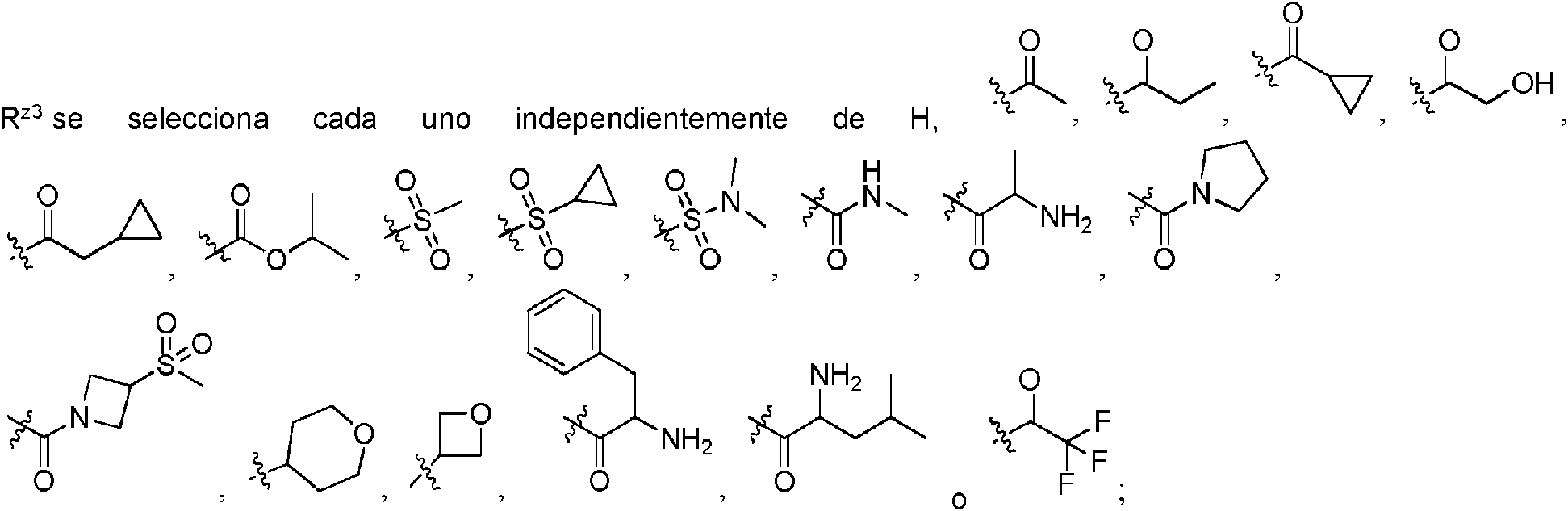
cada uno de R2, R3, R7, R8 se selecciona independientemente de H, metilo o -C(=O)O-terc-butilo.each of R2, R3, R7, R8 is independently selected from H, methyl, or -C(=O)O-tert-butyl.
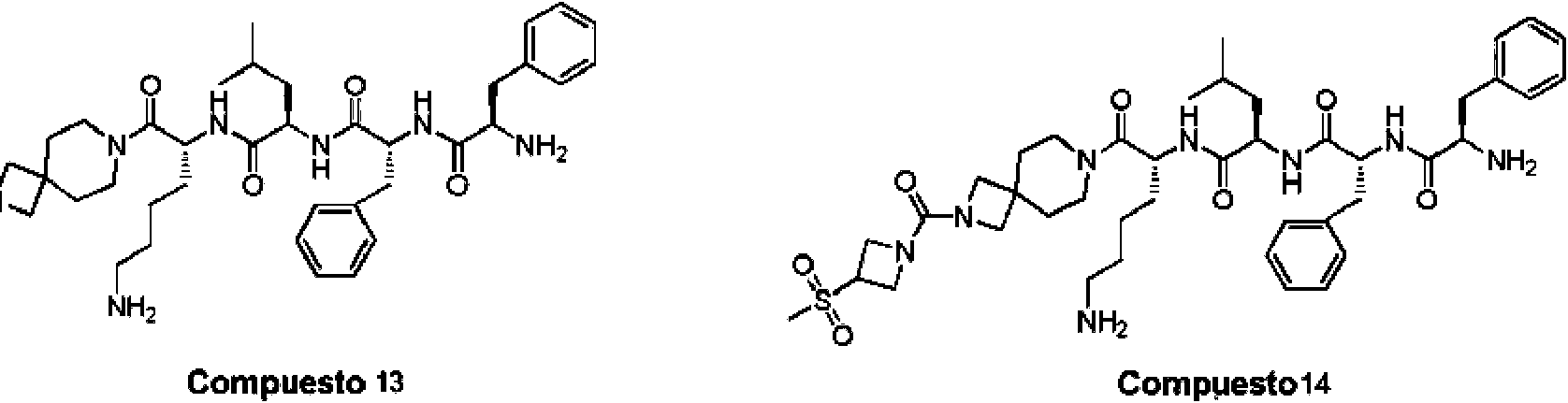
En una realización preferida de la invención, la invención proporciona un compuesto de fórmula general (I) o (II), o un estereoisómero, hidrato, solvato, sal farmacéuticamente aceptable o cocristal del mismo, en el que el compuesto incluye, pero no se limita a, uno de los compuestos representados por la siguiente fórmula estructural:

Comuesto 11 ompuestocompound 11 compound

Compuesto 16Compound 16

puestos ompuestocomposite posts

Compuesto 23 Compuesto 24

Com uesto 25Com posed 25

Com uesto 27Com posed 27

Compuesto 29 Compuesto 30Compound 29 Compound 30

Compuesto 31Compound 31

Compuesto 36 Compuesto: 35 Composite 36 Composite: 35

En una realización preferida de la invención, la invención proporciona un compuesto de fórmula general (I) o (II), o un estereoisómero, hidrato, solvato, sal farmacéuticamente aceptable o cocristal del mismo. La sal farmacéuticamente aceptable se selecciona de un trifluoroacetato.In a preferred embodiment of the invention, the invention provides a compound of general formula (I) or (II), or a stereoisomer, hydrate, solvate, pharmaceutically acceptable salt or co-crystal thereof. The pharmaceutically acceptable salt is selected from a trifluoroacetate.
La invención proporciona una composición farmacéutica que comprende un compuesto de fórmula general (I) o (II), o un estereoisómero, hidrato, solvato, sal farmacéuticamente aceptable o cocristal del mismo, y uno o más portadores y/o excipientes farmacéuticamente aceptables.The invention provides a pharmaceutical composition comprising a compound of general formula (I) or (II), or a stereoisomer, hydrate, solvate, pharmaceutically acceptable salt or co-crystal thereof, and one or more pharmaceutically acceptable carriers and/or excipients.
El uso de un compuesto de fórmula general (I) o (II) de la presente invención, o de un estereoisómero, hidrato, solvato, sal farmacéuticamente aceptable o cocristal del mismo, o de una composición farmacéutica que comprende el compuesto de fórmula general (I) o (II), o un estereoisómero, hidrato, solvato, sal farmacéuticamente aceptable o cocristal del mismo, en la fabricación de un medicamento para el tratamiento o la prevención de una enfermedad o afección asociada con un receptor de opioides k en un mamífero.The use of a compound of general formula (I) or (II) of the present invention, or of a stereoisomer, hydrate, solvate, pharmaceutically acceptable salt or co-crystal thereof, or of a pharmaceutical composition comprising the compound of general formula ( I) or (II), or a stereoisomer, hydrate, solvate, pharmaceutically acceptable salt or co-crystal thereof, in the manufacture of a medicament for the treatment or prevention of a disease or condition associated with a k -opioid receptor in a mammal .
En una realización preferida de la invención, en la que la enfermedad o afección asociada al receptor de opioides k se selecciona del grupo que consiste en dolor, inflamación, prurito, edema, hiponatremia, hipopotasemia, íleo, tos y glaucoma.In a preferred embodiment of the invention, wherein the k -opioid receptor associated disease or condition is selected from the group consisting of pain, inflammation, pruritus, edema, hyponatremia, hypokalemia, ileus, cough, and glaucoma.
En una realización preferida de la invención, en la que el dolor se selecciona del grupo que consiste en dolor neuropático, dolor físico, dolor visceral y dermatalgia. In a preferred embodiment of the invention, wherein the pain is selected from the group consisting of neuropathic pain, physical pain, visceral pain and skin pain.
En una realización preferida de la invención, en la que el dolor se selecciona del grupo que consiste en dolor por artritis, dolor por cálculos renales, histeroespasmo, dismenorrea, endometriosis, dispepsia, dolor posquirúrgico, dolor tras tratamiento médico, dolor ocular, dolor por otitis, dolor oncológico fulminante y dolor asociado con trastornos GI. In a preferred embodiment of the invention, wherein the pain is selected from the group consisting of arthritis pain, kidney stone pain, hysterospasm, dysmenorrhea, endometriosis, dyspepsia, post-surgical pain, pain after medical treatment, eye pain, pain from otitis, fulminant cancer pain and pain associated with GI disorders.
La invención proporciona un método para tratar o prevenir una enfermedad o afección asociada con un receptor de opioides k en un mamífero, comprendiendo el método administrar el compuesto de fórmula general (I) o (II), o un estereoisómero, hidrato, solvato, sal farmacéuticamente aceptable o cocristal del mismo, o la composición farmacéutica que comprende el compuesto de fórmula general (I) o (II), o un estereoisómero, hidrato, solvato, sal farmacéuticamente aceptable o cocristal del mismo. La enfermedad o afección asociada al receptor de opioides k se selecciona preferiblemente del grupo que consiste en dolor, inflamación, prurito, edema, hiponatremia, hipopotasemia, íleo, tos y glaucoma. El dolor se selecciona preferiblemente del grupo que consiste en dolor neuropático, dolor somático, dolor visceral y dermatalgia; o el dolor se selecciona preferiblemente del grupo que consiste en dolor por artritis, dolor por cálculos renales, histeroespasmo, dismenorrea, endometriosis, dispepsia, dolor posquirúrgico, dolor tras tratamiento médico, dolor ocular, dolor por otitis, dolor oncológico fulminante y dolor asociado con trastornos GI (trastornos gastrointestinales).The invention provides a method for treating or preventing a disease or condition associated with a k -opioid receptor in a mammal, the method comprising administering the compound of general formula (I) or (II), or a stereoisomer, hydrate, solvate, salt pharmaceutically acceptable or co-crystal thereof, or the pharmaceutical composition comprising the compound of general formula (I) or (II), or a stereoisomer, hydrate, solvate, pharmaceutically acceptable salt or co-crystal thereof. The k -opioid receptor-associated disease or condition is preferably selected from the group consisting of pain, inflammation, pruritus, edema, hyponatremia, hypokalemia, ileus, cough, and glaucoma. The pain is preferably selected from the group consisting of neuropathic pain, somatic pain, visceral pain and skin pain; or the pain is preferably selected from the group consisting of arthritis pain, kidney stone pain, hysterospasm, dysmenorrhea, endometriosis, dyspepsia, post-surgical pain, pain after medical treatment, eye pain, otitis pain, fulminant cancer pain and pain associated with GI disorders (gastrointestinal disorders).
A menos que se establezcan de otro modo, los términos usados en la memoria descriptiva y las reivindicaciones tienen los siguientes significados.Unless otherwise stated, terms used in the specification and claims have the following meanings.
El carbono, hidrógeno, oxígeno, azufre, nitrógeno o halógeno implicados en los grupos y compuestos de la presente invención incluyen sus isótopos, y el carbono, hidrógeno, oxígeno, azufre, nitrógeno o halógeno implicados en los grupos y compuestos de la presente invención opcionalmente se reemplazan adicionalmente por uno o más de sus isótopos correspondientes, en los que los isótopos de carbono incluyen 12C, 13C y 14C, los isótopos de hidrógeno incluyen protio (H), deuterio (D, también conocido como hidrógeno pesado), tritio (T, también conocido como hidrógeno superpesado), los isótopos de oxígeno incluyen 16O, 17O y 18O, los isótopos del azufre incluyen 32S, 33S, 34S y 36S, los isótopos de nitrógeno incluyen 14N y 15N, los isótopos del flúor incluyen 19F, los isótopos del cloro incluyen 35Cl y 37Cl, los isótopos del bromo incluyen 79Br y 81Br.The carbon, hydrogen, oxygen, sulfur, nitrogen or halogen involved in the groups and compounds of the present invention include their isotopes, and the carbon, hydrogen, oxygen, sulfur, nitrogen or halogen involved in the groups and compounds of the present invention optionally are further replaced by one or more of their corresponding isotopes, where carbon isotopes include 12C, 13C, and 14C, hydrogen isotopes include protium (H), deuterium (D, also known as heavy hydrogen), tritium (T , also known as superheavy hydrogen), isotopes of oxygen include 16O, 17O, and 18O, isotopes of sulfur include 32S, 33S, 34S, and 36S, isotopes of nitrogen include 14N and 15N, isotopes of fluorine include 19F, isotopes of chlorine include 35Cl and 37Cl, isotopes of bromine include 79Br and 81Br.
Un “alquilo” significa un grupo hidrocarbonado saturado monovalente de cadena lineal y ramificada, y el grupo de cadena lineal y ramificada tiene una cadena principal que comprende de 1 a 10 átomos de carbono, preferiblemente de 1 a 8 átomos de carbono, más preferiblemente de 1 a 6 átomos de carbono, más preferiblemente de 1 a 4 átomos de carbono, lo más preferiblemente de 1 a 2 átomos de carbono. Los ejemplos de alquilo incluyen, pero no se limitan a metilo, etilo, n-propilo, isopropilo, n-butilo, isobutilo, sec-butilo, terc-butilo, n-pentilo, 2-pentilo, 3-pentilo, 2-metil-2-butilo, 3-metil-2-butilo, n-hexilo, n-heptilo, n-octilo, n-nonilo y n-decilo, etc. El alquilo también puede estar opcionalmente sustituido con 0, 1, 2, 3, 4 ó 5 sustituyente(s) seleccionado(s) del grupo que consiste en F, Cl, Br, I, =O, hidroxilo, -SR19, nitro, ciano, alquilo C1-6, hidroxialquilo C1-6, alcoxilo C1-6, alquenilo C2-6, alquinilo C2-6, grupo carbocíclico C3-8, grupo heterocíclico de 3 a 8 miembros, -(CH2)a-C(=O)-R19, -(CH2)k-C(=O)-O-R19, -(CH2)k-C(=O)-NR19R19a, -(CH2)k-S(=O)j-R19, -O-C(=O)-O-R19 o -NR19R19a, en los que cada uno de R19y R19a se selecciona independientemente de H, hidroxilo, amino, carboxilo, alquilo C1-8, alcoxilo C1-8, alquenilo C2-8, alquinilo C2-8, grupo carbocíclico de 3 a 10 miembros, grupo heterocíclico de 4 a 10 miembros, grupo carbocicliloxilo de 3 a 10 miembros o grupo oxilo heterocíclico de 4 a 10 miembros, k se selecciona de 0, 1, 2, 3, 4 ó 5, j se selecciona de 0, 1 ó 2. El alquilo, k, j, R19 y R19a, en el presente documento son tal como se definieron anteriormente.An "alkyl" means a straight and branched chain monovalent saturated hydrocarbon group, and the straight and branched chain group has a main chain comprising from 1 to 10 carbon atoms, preferably from 1 to 8 carbon atoms, more preferably from 1 to 6 carbon atoms, more preferably 1 to 4 carbon atoms, most preferably 1 to 2 carbon atoms. Examples of alkyl include but are not limited to methyl, ethyl, n-propyl, isopropyl, n-butyl, isobutyl, sec-butyl, tert-butyl, n-pentyl, 2-pentyl, 3-pentyl, 2-methyl -2-butyl, 3-methyl-2-butyl, n-hexyl, n-heptyl, n-octyl, n-nonyl and n-decyl, etc. Alkyl may also be optionally substituted with 0, 1, 2, 3, 4 or 5 substituent(s) selected from the group consisting of F, Cl, Br, I, =O, hydroxyl, -SR19, nitro, cyano, C1-6 alkyl, C1-6 hydroxyalkyl, C1-6 alkoxy, C2-6 alkenyl, C2-6 alkynyl, C3-8 carbocyclic group, 3-8 membered heterocyclic group, -(CH2)a-C(=O) -R19, -(CH2)k-C(=O)-O-R19, -(CH2)k-C(=O)-NR19R19a, -(CH2)k-S(=O)j-R19, -O-C(=O)-O -R19 or -NR19R19a, wherein each of R19 and R19a is independently selected from H, hydroxyl, amino, carboxyl, C1-8 alkyl, C1-8 alkoxy, C2-8 alkenyl, C2-8 alkynyl, carbocyclic group of 3 to 10 membered, 4 to 10 membered heterocyclic group, 3 to 10 membered carbocyclyloxy group or 4 to 10 membered heterocyclic oxy group, k is selected from 0, 1, 2, 3, 4 or 5, j is selected from 0 , 1 or 2. Alkyl, k, j, R19 and R19a, herein are as defined above.
Un “alquileno” significa un grupo hidrocarbonado saturado divalente de cadena lineal o ramificada, incluyendo -(CH2)v-(v es un número entero de 1 a 10), y los ejemplos de alquileno incluyen, pero no se limitan a, metileno, etileno, propileno, butileno o similar. El alquileno puede estar opcionalmente sustituido adicionalmente con 0, 1,2, 3, 4 ó 5 sustituyente(s) seleccionado(s) del grupo que consiste en F, Cl, Br, I, =O, hidroxilo, -SR19, nitro, ciano, alquilo C1-6, hidroxialquilo C1-6, alcoxilo C1-6, alquenilo C2-6, alquinilo C2-6, grupo carbocíclico C3-8, grupo heterocíclico de 3 a 8 miembros, -(CH2)a-C(=O)-R19, -(CH2)k-C(=O)-O-R19, -(CH2)k-C(=O)-NR19R19a, -(CH2)k-S(=O)j-R19, -O-C(=O)-O-R19 o -NR19R19a. Cuando el número de sustituyente(s) en el grupo alquileno es de 2 o más, el/los sustituyente(s) puede(n) condensarse entre sí para formar una estructura cíclica. El alquileno de la presente invención es tal como se definió anteriormente.An "alkylene" means a divalent straight or branched chain saturated hydrocarbon group, including -(CH2)v-(v is an integer from 1 to 10), and examples of alkylene include, but are not limited to, methylene, ethylene, propylene, butylene or the like. The alkylene may be optionally further substituted with 0, 1,2, 3, 4 or 5 substituent(s) selected from the group consisting of F, Cl, Br, I, =O, hydroxyl, -SR19, nitro, cyano, C1-6 alkyl, C1-6 hydroxyalkyl, C1-6 alkoxy, C2-6 alkenyl, C2-6 alkynyl, C3-8 carbocyclic group, 3-8 membered heterocyclic group, -(CH2)a-C(=O) -R19, -(CH2)k-C(=O)-O-R19, -(CH2)k-C(=O)-NR19R19a, -(CH2)k-S(=O)j-R19, -O-C(=O)-O -R19 or -NR19R19a. When the number of substituent(s) in the alkylene group is 2 or more, the substituent(s) may be condensed with each other to form a cyclic structure. The alkylene of the present invention is as defined above.
Un “alcoxilo” significa un grupo monovalente de un grupo O-alquilo, en el que alquilo es tal como se define en el presente documento, y los ejemplos de alcoxilo incluyen, pero no se limitan a, metoxilo, etoxilo, 1-propoxilo, 2-propoxilo, 1-butoxilo, 2-metil-1-propoxilo, 2-butoxilo, 2-metil-2-propoxilo, 1 -pentiloxilo, 2-pentiloxilo, 3-pentiloxilo, 2-metil-2-butoxilo, 3-metil-2-butoxilo, 3-metil-1-butoxilo y 2-metil-1-butoxilo y similares.An "alkoxy" means a monovalent group of an O-alkyl group, where alkyl is as defined herein, and examples of alkoxy include, but are not limited to, methoxy, ethoxy, 1-propoxy, 2-propoxy, 1-butoxy, 2-methyl-1-propoxy, 2-butoxy, 2-methyl-2-propoxy, 1-pentyloxy, 2-pentyloxy, 3-pentyloxy, 2-methyl-2-butoxy, 3- methyl-2-butoxyl, 3-methyl-1-butoxyl and 2-methyl-1-butoxyl and the like.
Un “alquenilo” significa un grupo hidrocarbonado insaturado monovalente de cadena lineal o ramificada que tiene al menos 1, generalmente 1,2 ó 3 dobles enlaces carbono-carbono, con una cadena principal del mismo que comprende de 2 a 10 átomos de carbono, más preferiblemente de 2 a 6 átomos de carbono, más preferiblemente de 2 a 4 átomos de carbono en la cadena principal. Los ejemplos de alquenilo incluyen, pero no se limitan a, vinilo, alilo, 1-propenilo, 2-propenilo, 1 -butenilo, 2-butenilo, 3-butenilo, 1-pentenilo, 2-pentenilo, 3-pentenilo, 4-pentenilo, 1 -metil-1-butenilo, 2-metil-1-butenilo, 2-metil-3-butenilo, 1-hexenilo, 2-hexenilo, 3-hexenilo, 4-hexenilo, 5-hexenilo, 1-metil-1-pentenilo, 2-metil-1-pentenilo, 1-heptenilo, 2-heptenilo, 3-heptenilo, 4-heptenilo, 1-octenilo, 3-octenilo, 1-nonenilo, 3-nonenilo, 1-decenilo, 4-decenilo, 1,3-butadieno, 1,3-pentadieno, 1,4-pentadieno y 1,4-hexadieno y similares; el alquenilo puede estar opcionalmente sustituido adicionalmente con 0, 1, 2, 3, 4 ó 5 sustituyente(s) seleccionado(s) del grupo que consiste en F, Cl, Br, I, =O, hidroxilo, -SR19, nitro, ciano, alquilo C1-6, hidroxialquilo C1-6, alcoxilo C1.6, alquenilo C2-6, alquinilo C2-6, grupo carbocíclico C3-8, grupo heterocíclico de 3 a 8 miembros, -(CH2)a-C(=O)-R19, -(CH2)k-C(=O)-O-R19, -(CH2)k-C(=O)-NR19R19a, -(CH2)k-S(=O)j-R19, -O-C(=O)-O-R19 o -NR19R19a. El alquenilo de la presente invención es tal como se definió anteriormente.An "alkenyl" means a straight or branched chain monovalent unsaturated hydrocarbon group having at least 1, generally 1, 2 or 3 carbon-carbon double bonds, with a main chain thereof comprising from 2 to 10 carbon atoms, plus preferably 2 to 6 carbon atoms, more preferably 2 to 4 carbon atoms in the main chain. Examples of alkenyl include, but are not limited to, vinyl, allyl, 1-propenyl, 2-propenyl, 1-butenyl, 2-butenyl, 3-butenyl, 1-pentenyl, 2-pentenyl, 3-pentenyl, 4- pentenyl, 1-methyl-1-butenyl, 2-methyl-1-butenyl, 2-methyl-3-butenyl, 1-hexenyl, 2-hexenyl, 3-hexenyl, 4-hexenyl, 5-hexenyl, 1-methyl- 1-pentenyl, 2-methyl-1-pentenyl, 1-heptenyl, 2-heptenyl, 3-heptenyl, 4-heptenyl, 1-octenyl, 3-octenyl, 1-nonenyl, 3-nonenyl, 1-decenyl, 4- decenyl, 1,3-butadiene, 1,3-pentadiene, 1,4-pentadiene, and 1,4-hexadiene, and the like; the alkenyl can be optionally further substituted with 0, 1, 2, 3, 4 or 5 substituent(s) selected from the group consisting of F, Cl, Br, I, =O, hydroxyl, -SR19, nitro, cyano, alkyl C1-6, C1-6 hydroxyalkyl, C1.6 alkoxy, C2-6 alkenyl, C2-6 alkynyl, C3-8 carbocyclic group, 3-8 membered heterocyclic group, -(CH2)aC(=O)-R19, -(CH2)kC(=O)-O-R19, -(CH2)kC(=O)-NR19R19a, -(CH2)kS(=O)j-R19, -OC(=O)-O-R19 or -NR19R19a. The alkenyl of the present invention is as defined above.
Un “alquinilo” significa un grupo hidrocarbonado insaturado monovalente de cadena lineal o ramificada que tiene al menos 1, generalmente 1, 2 ó 3 triples enlaces carbono-carbono, con una cadena principal que comprende de 2 a 10 átomos de carbono, más preferiblemente de 2 a 6 átomos de carbono, más preferiblemente de 2 a 4 átomos de carbono en la cadena principal. Los ejemplos de alquinilo incluyen, pero no se limitan a etinilo, 1 -propinilo, 2-propinilo, butinilo, 2-butinilo, 3-butinilo, 1 -metil-2-propinilo, 4-pentinilo, 3-pentinilo, 1 -metil-2-butinilo, 2-hexinilo, 3-hexinilo, 2-heptinilo, 3-heptinilo, 4-heptinilo, 3-octinilo, 3-noninilo y 4-decinilo y similares; el alquinilo puede estar opcionalmente sustituido adicionalmente con 0, 1, 2, 3, 4 ó 5 sustituyente(s) seleccionado(s) del grupo que consiste en F, Cl, Br, I,An "alkynyl" means a straight or branched chain monovalent unsaturated hydrocarbon group having at least 1, generally 1, 2 or 3 carbon-carbon triple bonds, with a main chain comprising from 2 to 10 carbon atoms, more preferably of 2 to 6 carbon atoms, more preferably 2 to 4 carbon atoms in the main chain. Examples of alkynyl include, but are not limited to ethynyl, 1-propynyl, 2-propynyl, butynyl, 2-butynyl, 3-butynyl, 1-methyl-2-propynyl, 4-pentynyl, 3-pentynyl, 1-methyl -2-butynyl, 2-hexynyl, 3-hexynyl, 2-heptynyl, 3-heptynyl, 4-heptynyl, 3-octynyl, 3-nonynyl, and 4-decynyl, and the like; alkynyl may be optionally further substituted with 0, 1, 2, 3, 4 or 5 substituent(s) selected from the group consisting of F, Cl, Br, I,
=O, hidroxilo, -SR19, nitro, ciano, alquilo C1-6, hidroxialquilo C1-6, alcoxilo C1-6, alquenilo C2-6, alquinilo C2-6, carbocíclico C3-8, grupo heterocíclico de 3 a 8 miembros, -(CH2)a-C(=O)-R19, -(CH2)k-C(=O)-O-R19, -(CH2)k-C(=O)-NR19R19a, -(CH2)k-S(=O)j-R19, -O-C(=O)-O-R19 o -NR19R19a. El alquinilo de la presente invención es tal como se definió anteriormente.=O, hydroxyl, -SR19, nitro, cyano, C1-6 alkyl, C1-6 hydroxyalkyl, C1-6 alkoxy, C2-6 alkenyl, C2-6 alkynyl, C3-8 carbocyclic, 3-8 membered heterocyclic group, -(CH2)a-C(=O)-R19, -(CH2)k-C(=O)-O-R19, -(CH2)k-C(=O)-NR19R19a, -(CH2)k-S(=O)j-R19 , -O-C(=O)-O-R19 or -NR19R19a. The alkynyl of the present invention is as defined above.
Un “cicloalquilo” significa un grupo hidrocarbonado carbocíclico saturado monovalente, que tiene habitualmente de 3 a 10 átomos de carbono, y los ejemplos no limitativos incluyen ciclopropilo, ciclobutilo, ciclopentilo, ciclohexilo o cicloheptilo y similares. El cicloalquilo puede estar opcionalmente sustituido adicionalmente con 0, 1, 2, 3, 4 ó 5 sustituyente(s) seleccionado(s) del grupo que consiste en F, Cl, Br, I, =O, hidroxilo, -SR19, nitro, ciano, alquilo C1-6, hidroxialquilo C1-6, alcoxilo C1-6, alquenilo C2-6, alquinilo C2-6, grupo carbocíclico C3-8, grupo heterocíclico de 3 a 8 miembros, -(CH2)a-C(=O)-R19, -(CH2)k-C(=O)-O-R19, -(CH2)k-C(=O)-NR19R19a, -(CH2)k-S(=O)j-R19, -O-C(=O)-O-R19 o -NR19R19a. El cicloalquilo de la presente invención es tal como se definió anteriormente.A "cycloalkyl" means a monovalent saturated carbocyclic hydrocarbon group, usually having from 3 to 10 carbon atoms, and non-limiting examples include cyclopropyl, cyclobutyl, cyclopentyl, cyclohexyl or cycloheptyl and the like. Cycloalkyl may be optionally further substituted with 0, 1, 2, 3, 4 or 5 substituent(s) selected from the group consisting of F, Cl, Br, I, =O, hydroxyl, -SR19, nitro, cyano, C1-6 alkyl, C1-6 hydroxyalkyl, C1-6 alkoxy, C2-6 alkenyl, C2-6 alkynyl, C3-8 carbocyclic group, 3-8 membered heterocyclic group, -(CH2)a-C(=O) -R19, -(CH2)k-C(=O)-O-R19, -(CH2)k-C(=O)-NR19R19a, -(CH2)k-S(=O)j-R19, -O-C(=O)-O -R19 or -NR19R19a. The cycloalkyl of the present invention is as defined above.
Un “carbociclilo” significa un anillo aromático o no aromático, saturado o insaturado. El anillo aromático o no aromático puede ser un anillo monocíclico de 3 a 10 miembros, un anillo bicíclico de 4 a 12 miembros o un sistema de anillos tricíclico de 10 a 15 miembros. El grupo carbocíclico puede estar unido a un anillo con puente o un espiroanillo. Los ejemplos no limitativos incluyen ciclopropilo, ciclobutilo, ciclopentilo, 1-ciclopentil-1-alquenilo, 1 -ciclopentil-2-alquenilo,A "carbocyclyl" means an aromatic or non-aromatic, saturated or unsaturated ring. The aromatic or non-aromatic ring may be a 3 to 10 membered monocyclic ring, a 4 to 12 membered bicyclic ring or a 10 to 15 membered tricyclic ring system. The carbocyclic group may be attached to a bridged ring or a spiro ring. Non-limiting examples include cyclopropyl, cyclobutyl, cyclopentyl, 1-cyclopentyl-1-alkenyl, 1-cyclopentyl-2-alkenyl,
1 -ciclopentil-3-alquenilo, ciclohexilo, 1 -ciclohexil-2-alquenilo, 1 -ciclohexil-3-alquenilo, ciclohexenilo, ciclohexadienilo, cicloheptilo, ciclooctilo, ciclononilo, ciclodecilo, cicloundecilo, ciclododecilo, fenilo o naftilo. El grupo carbocíclico puede estar opcionalmente sustituido adicionalmente con 0, 1, 2, 3, 4 ó 5 sustituyente(s) seleccionado(s) del grupo que consiste en F, Cl, Br, I, =O, hidroxilo, -SR19, nitro, ciano, alquilo C1-6, hidroxialquilo C1-6, alcoxilo C1-6, alquenilo C2-6, alquinilo C2-6, grupo carbocíclico C3-8, grupo heterocíclico de 3 a 8 miembros, -(CH2)a-C(=O)-R19, -(CH2)k-C(=O)-O-R19, -(CH2)k-C(=O)-NR19R19a, -(CH2)k-S(=O)j-R19, -O-C(=O)-O-R19 o -NR19R19a. El carbociclo de la presente es tal como se definió anteriormente.1-Cyclopentyl-3-alkenyl, cyclohexyl, 1-cyclohexyl-2-alkenyl, 1-cyclohexyl-3-alkenyl, cyclohexenyl, cyclohexadienyl, cycloheptyl, cyclooctyl, cyclononyl, cyclodecyl, cycloundecyl, cyclododecyl, phenyl or naphthyl. The carbocyclic group may be optionally further substituted with 0, 1, 2, 3, 4 or 5 substituent(s) selected from the group consisting of F, Cl, Br, I, =O, hydroxyl, -SR19, nitro , cyano, C1-6 alkyl, C1-6 hydroxyalkyl, C1-6 alkoxy, C2-6 alkenyl, C2-6 alkynyl, C3-8 carbocyclic group, 3-8 membered heterocyclic group, -(CH2)a-C(=O )-R19, -(CH2)k-C(=O)-O-R19, -(CH2)k-C(=O)-NR19R19a, -(CH2)k-S(=O)j-R19, -O-C(=O)- O-R19 or -NR19R19a. The carbocycle herein is as defined above.
Un “heterociclo” significa un anillo aromático o no aromático saturado o insaturado, y el anillo aromático o no aromático puede ser un sistema monocíclico de 3 a 10 miembros, bicíclico de 4 a 12 miembros o tricíclico de 10 a 15 miembros, e incluye de 1 a 4 heteroátomos seleccionados de N, O o S, preferiblemente un grupo heterocíclico de 3 a 8 miembros, y N, S opcionalmente sustituidos en el anillo del grupo heterocíclico pueden oxidarse a diversos estados de oxidación.A "heterocycle" means a saturated or unsaturated aromatic or non-aromatic ring, and the aromatic or non-aromatic ring may be a 3 to 10 membered monocyclic, 4 to 12 membered bicyclic, or 10 to 15 membered tricyclic system, and includes 1 to 4 heteroatoms selected from N, O or S, preferably a 3 to 8-membered heterocyclic group, and N, S optionally substituted in the ring of the heterocyclic group can be oxidized to various oxidation states.
El grupo heterocíclico puede estar unido a un heteroátomo o un átomo de carbono, y el grupo heterocíclico puede estar unido a un anillo con puente o espiroanillo. Los ejemplos no limitativos incluyen epoxietilo, epoxipropilo, azaciclopropilo, oxeciclobutilo, azaciclobutilo, tioheterobutilo, 1,3-dioxolanilo, 1,4-dioxolanilo, 1,3-dioxohexilo, azacicloheptilo, oxepanilo, tiocicloheptilo, oxazepinilo, diazepinilo, tiazepinilo, piridilo, piperidinilo, homopiperidinilo, furilo, tienilo, piranilo, N-alquilpirrolilo, pirimidinilo, pirazinilo, piridazinilo, piperazinilo, homopiperazinilo, imidazolilo, piperidinilo, morfolinilo, tiomorfolinilo, oxatianilo, dihidrofuranilo, dihidropiranilo, ditiapentanilo, tetrahidrofuranilo, tetrahidrotienilo, tetrahidropiranilo, tetrahidrotiranilo, tetrahidropirrolilo, tetrahidroimidazolilo, tetrahidrotiazolilo, tetrahidropiranilo, bencimidazolilo, benzopiridilo, pirrolopiridilo, benzodihidrofurilo, 2-pirrolinilo, 3-pirrolinilo, dihidroindolilo, 2H-piranilo, 4H-piranilo, dioxano, 1,3-dioxolilo, pirazolinilo, ditiaalquilo, ditiacenilo, dihidrotienilo, pirazolidinilo, imidazolinilo, imidazolidinilo, 1,2,3,4-tetrahidroisoquinolinilo, 3-azabiciclo[3.1.0]hexilo, 3-azabiciclo[4.1.0]heptilo, azabiciclo[2.2.2]hexilo, 3H-indolilquinazinilo, N-piridilurea, 1,1-dioxotiomorfolinilo, azabiciclo[3.2.1]octilo, azabiciclo[5.2.0]nonanilo, oxatriciclo[5.3.1.1]dodecilo, azaadamantilo y oxaespiro[3.3]heptilo. El grupo heterocíclico puede estar opcionalmente sustituido adicionalmente con 0, 1, 2, 3, 4 ó 5 sustituyente(s) seleccionado(s) del grupo que consiste en F, Cl, Br, I, =O, hidroxilo, -SR19, nitro, ciano, alquilo C1-6, hidroxialquilo C1-6, alcoxilo C1-6, alquenilo C2-6, alquinilo C2-6, grupo carbocíclico C3-8, grupo heterocíclico de 3 a 8 miembros, -(CH2)a-C(=O)-R19, -(CH2)k-C(=O)-O-R19, -(CH2)k-C(=O)-NR19R19a, -(CH2)k-S(=O)j-R19, -O-C(=O)-O-R19 o -NR19R19a. Los heterociclos del presente documento se definen tal como se describió anteriormente.The heterocyclic group may be attached to a heteroatom or a carbon atom, and the heterocyclic group may be attached to a bridged ring or spiro ring. Non-limiting examples include epoxyethyl, epoxypropyl, azacyclopropyl, oxecyclobutyl, azacyclobutyl, thioheterobutyl, 1,3-dioxolanyl, 1,4-dioxolanyl, 1,3-dioxohexyl, azacycloheptyl, oxepanil, thiocycloheptyl, oxazepinyl, diazepinyl, thiazepinyl, pyridyl, piperidinyl , homopiperidinyl, furyl, thienyl, pyranyl, N-alkylpyrrolyl, pyrimidinyl, pyrazinyl, pyridazinyl, piperazinyl, homopiperazinyl, imidazolyl, piperidinyl, morpholinyl, thiomorpholinyl, oxatianyl, dihydrofuranyl, dihydropyranyl, dithiapentanyl, tetrahydrofuranyl, tetrahydrothienyl, tetrahydropyranyl, tetrahydrotyranyl, tetrahydropyrrolyl, tetrahydropyrrolyl , tetrahydrothiazolyl, tetrahydropyranyl, benzimidazolyl, benzopyridyl, pyrrolopyridyl, benzodihydrofuryl, 2-pyrrolinyl, 3-pyrrolinyl, dihydroindolyl, 2H-pyranyl, 4H-pyranyl, dioxane, 1,3-dioxolyl, pyrazolinyl, dithiaalkyl, dithiacenyl, dihydrothienyl, pyrazolidinyl, imidazolinyl , imidazolidinyl, 1,2,3,4-tetrahydroisoqu Inolinyl, 3-azabicyclo[3.1.0]hexyl, 3-azabicyclo[4.1.0]heptyl, Azabicyclo[2.2.2]hexyl, 3H-indolylquinazinyl, N-pyridylurea, 1,1-dioxothiomorpholinyl, Azabicyclo[3.2.1] octyl, azabicyclo[5.2.0]nonanyl, oxatricyclo[5.3.1.1]dodecyl, azaadamantyl, and oxaspiro[3.3]heptyl. The heterocyclic group may be optionally further substituted with 0, 1, 2, 3, 4 or 5 substituent(s) selected from the group consisting of F, Cl, Br, I, =O, hydroxyl, -SR19, nitro , cyano, C1-6 alkyl, C1-6 hydroxyalkyl, C1-6 alkoxy, C2-6 alkenyl, C2-6 alkynyl, C3-8 carbocyclic group, 3-8 membered heterocyclic group, -(CH2)a-C(=O )-R19, -(CH2)k-C(=O)-O-R19, -(CH2)k-C(=O)-NR19R19a, -(CH2)k-S(=O)j-R19, -O-C(=O)- O-R19 or -NR19R19a. Heterocycles herein are defined as described above.
El “opcional” u “opcionalmente” significa que el evento o entorno descrito posteriormente puede producirse, pero no es necesario que se produzca, lo que indica un caso en el que el evento o entorno se produce o no se produce. Por ejemplo, “grupo alquilo opcionalmente sustituido con F” significa que el grupo alquilo puede, pero no es necesario que esté sustituido con F, lo que indica un caso en el que el grupo alquilo está sustituido con F y un caso en el que el grupo alquilo no está sustituido con F. The "optional" or "optionally" means that the event or environment described below may occur, but need not occur, indicating a case in which the event or environment does or does not occur. For example, "alkyl group optionally substituted with F" means that the alkyl group may, but need not, be substituted with F, indicating a case where the alkyl group is substituted with F and a case where the alkyl group is not substituted with F.
“Composición farmacéutica” significa una mezcla de uno o más de los compuestos descritos en el presente documento o una sal fisiológica/farmacéuticamente aceptable de los mismos, o un estereoisómero, solvato, sal farmacéuticamente aceptable o cocristal de los mismos y otros constituyentes. Donde otros componentes comprenden portadores y excipientes fisiológica/farmacéuticamente aceptables."Pharmaceutical composition" means a mixture of one or more of the compounds described herein or a physiologically/pharmaceutically acceptable salt thereof, or a stereoisomer, solvate, pharmaceutically acceptable salt or co-crystal thereof and other constituents. Where other components comprise physiologically/pharmaceutically acceptable carriers and excipients.
“Estereoisómero” significa isómeros que resultan de la disposición espacial de los átomos en una molécula, incluyendo isómeros cis y trans, enantiómeros e isómeros conformacionales."Stereoisomer" means isomers that result from the spatial arrangement of atoms in a molecule, including cis and trans isomers, enantiomers, and conformational isomers.
“Dosis eficaz” significa la cantidad de un compuesto que provoca una respuesta fisiológica o médica a un tejido, sistema o sujeto, cuya cantidad se busca. Cuando se administra a un sujeto, es suficiente para prevenir la aparición o reducción de uno o más síntomas de las enfermedades o afecciones que están tratándose en cierta medida."Effective dose" means the amount of a compound that elicits a physiological or medical response in a tissue, system, or subject, the amount of which is sought. When administered to a subject, it is sufficient to prevent the appearance or reduction of one or more symptoms of the diseases or conditions being treated to some extent.
“Solvato” significa un compuesto de la invención o una sal del mismo, que también incluye una cantidad estequiométrica o no estequiométrica de disolvente unido por fuerzas intermoleculares no covalentes. Cuando el disolvente es agua, es un hidrato."Solvate" means a compound of the invention or a salt thereof, which also includes a stoichiometric or non-stoichiometric amount of solvent bound by non-covalent intermolecular forces. When the solvent is water, it is a hydrate.
Descripción detalladaDetailed description
Las soluciones técnicas de la presente invención se describen con detalle a continuación con referencia a los dibujos y ejemplos adjuntos, pero el alcance de la presente invención los incluye, pero no los limita. El alcance de la presente invención está definido por las reivindicaciones adjuntas.The technical solutions of the present invention are described in detail below with reference to the accompanying drawings and examples, but the scope of the present invention includes but does not limit them. The scope of the present invention is defined by the appended claims.
La estructura del compuesto se determina mediante resonancia magnética nuclear (RMN) o (y) espectrometría de masas (EM). El desplazamiento de RMN (8) se facilita en unidades de 10-6 (ppm). La RMN se midió usando un aparato magnético nuclear (Avance III 400 de Bruker y Avance 300 de Bruker), y el disolvente para la medición fue dimetilsulfóxido deuterado (DMSO-d6), cloroformo deuterado (CDCh), metanol deuterado (CD3OD) y el patrón interno es tetrametilsilano (TMS).The structure of the compound is determined by nuclear magnetic resonance (NMR) or (and) mass spectrometry (MS). The NMR shift (8) is given in units of 10-6 (ppm). NMR was measured using a nuclear magnetic apparatus (Bruker Avance III 400 and Bruker Avance 300), and the solvent for measurement was deuterated dimethylsulfoxide (DMSO-d6), deuterated chloroform (CDCh), deuterated methanol (CD3OD) and the internal standard is tetramethylsilane (TMS).
La EM se mide usando (6120B (ESI) de Agilent y 6120B (APCI) de Agilent).MS is measured using (Agilent 6120B (ESI) and Agilent 6120B (APCI).
La HPLC se mide usando un cromatógrafo de líquidos de alta presión 1260DAD de Agilent (Zorbax SB-C18 100 x 4,6 mm).HPLC is measured using an Agilent 1260DAD High Pressure Liquid Chromatograph (Zorbax SB-C18 100 x 4.6 mm).
La placa de gel de sílice para cromatografía en capa fina es una placa de gel de sílice HSGF254 de Yantai Yellow Sea 0 GF254 de Qingdao. La placa de gel de sílice usada para la cromatografía en capa fina (CCF) tiene una especificación de 0,15 mm 0,20 mm, y el producto de purificación y separación mediante cromatografía en capa fina tiene una especificación de 0,4 mm 0,5 mm.The silica gel plate for thin-layer chromatography is silica gel plate HSGF254 from Yantai Yellow Sea or GF254 from Qingdao. The silica gel plate used for thin-layer chromatography (TLC) has a specification of 0.15 mm 0.20 mm, and the purification and separation product by thin-layer chromatography has a specification of 0.4 mm 0 .5mm
La cromatografía en columna usa generalmente gel de sílice de malla 200-300 de gel de sílice Yantai Huanghai como portador.Column chromatography generally uses 200-300 mesh silica gel from Yantai Huanghai silica gel as carrier.
Los materiales de partida conocidos de la presente invención pueden sintetizarse mediante o según métodos conocidos en la técnica, o pueden adquirirse de Titan Technology, Energy Chemical, Shanghai DEMO, Chengdu Kelong Chemical, Accela ChemBio Co.Ltd y J&K Scientific Ltd, y similares.Known starting materials of the present invention can be synthesized by or according to methods known in the art, or can be purchased from Titan Technology, Energy Chemical, Shanghai DEMO, Chengdu Kelong Chemical, Accela ChemBio Co.Ltd and J&K Scientific Ltd, and the like.
La atmósfera de nitrógeno se refiere al frasco de reacción conectado a un globo de nitrógeno de aproximadamente 1 l de volumen.Nitrogen atmosphere refers to the reaction flask connected to a nitrogen balloon of approximately 1 L volume.
La atmósfera de hidrógeno se refiere al frasco de reacción conectado a un globo de hidrógeno de aproximadamente 1 l de volumen.Hydrogen atmosphere refers to the reaction flask connected to a hydrogen balloon of approximately 1 L volume.
La reacción de hidrogenación generalmente se evacua y se carga con hidrógeno, y la operación se repite 3 veces. A menos que se indique especialmente en los ejemplos, se permitió que avanzase toda la reacción en una atmósfera de nitrógeno.The hydrogenation reaction is generally evacuated and charged with hydrogen, and the operation is repeated 3 times. Unless specifically indicated in the examples, the entire reaction was allowed to proceed under a nitrogen atmosphere.
A menos que se indique especialmente en los ejemplos, toda las disoluciones significan una disolución acuosa. A menos que se indique especialmente en los ejemplos, todas las temperaturas de reacción son la temperatura ambiente.Unless specially indicated in the examples, all solutions mean an aqueous solution. Unless specially indicated in the examples, all reaction temperatures are room temperature.
La temperatura ambiente es la temperatura de reacción óptima, que oscila entre 20°C y 30°C.Room temperature is the optimal reaction temperature, ranging from 20°C to 30°C.
A menos que se indique especialmente en los ejemplos, todo M es mol/l.Unless specially indicated in the examples, all M is mol/l.
Boc se refiere al grupo terc-butiloxicarbonilo. Boc refers to the tert-butyloxycarbonyl group.
Cbz se refiere al grupo benciloxicarbonilo.Cbz refers to the benzyloxycarbonyl group.
THP se refiere al grupo tetrahidropiranilo.THP refers to the tetrahydropyranyl group.
Producto intermedio 1:Intermediate 1:
Ácido (2R)-6-(terc-butoxicarbonilamino)-2-[[(2R)-2-[[(2R)-2-[[(2R)-2-(terc-butoxicarbonilamino)-3-fenilpropanoil]-amino]-3-fenil-propanoil]amino]-4-metil-pentanoil]amino]hexanoico (producto intermedio 1)(2R)-6-(tert-Butoxycarbonylamino)-2-[[(2R)-2-[[(2R)-2-[[(2R)-2-(tert-butoxycarbonylamino)-3-phenylpropanoyl]- amino]-3-phenyl-propanoyl]amino]-4-methyl-pentanoyl]amino]hexanoic acid (intermediate 1)

Etapa 1:Stage 1:
(2R)-2-[[(2R)-2-(Benciloxicarbonilamino)-4-metil-pentanoil]amino]-6-(terc-butoxicarbonilamino)hexanoato de metilo (1b) Methyl (2R)-2-[[(2R)-2-(Benzyloxycarbonylamino)-4-methyl-pentanoyl]amino]-6-(tert-butoxycarbonylamino)hexanoate (1b)

Se disolvió (2R)-2-amino-6-(terc-butoxicarbonilamino)hexanoato de metilo (1a) (2,6 g, 10mmol) en acetato de etilo (50 ml) a temperatura ambiente y se enfrió la temperatura hasta 0°C. Se añadieron secuencialmente a la disolución de reacción ácido (2R)-2-(benciloxicarbonilamino)-4-metil-pentanoico (2,8 g, 11 mmol), 1-hidroxibenzotriazol (1,62 g, 12 mmol), clorhidrato de 1-(3-dimetilaminopropil)-3-etilcarbodiimida (2,3 g, 12 mmol), y se elevó la temperatura hasta 25°C, y se permitió que avanzase la reacción a esta temperatura durante 15 h. Se añadió una disolución acuosa de ácido clorhídrico 1 M (25 ml) a la disolución de reacción para lavar la reacción y se sometió la mezcla a un proceso de separación de líquido. Se añadió una disolución acuosa saturada de bicarbonato de sodio (25 ml) a la fase orgánica y se agitó la mezcla durante 30 minutos y se sometió la mezcla a un proceso de separación de líquido. Se lavó la fase orgánica con una disolución acuosa de ácido clorhídrico 1 M (25 ml), una disolución acuosa saturada de bicarbonato de sodio (25 ml), una disolución acuosa saturada de cloruro de sodio (25 ml) en este orden y se secó sobre sulfato de sodio anhidro (2 g). Se filtró y se concentró el filtrado a presión reducida para obtener (2R)-2-[[(2R)-2-(benciloxicarbonilamino)-4-metil-pentanoil]amino]-6-(terc-butoxicarbonilamino)hexanoato de metilo (1b) como un sólido espumoso de color blanco (5,0 g, rendimiento del 99%).Methyl (2R)-2-amino-6-(tert-butoxycarbonylamino)hexanoate (1a) (2.6g, 10mmol) was dissolved in ethyl acetate (50mL) at room temperature and cooled to 0°C. c. (2R)-2-(Benzyloxycarbonylamino)-4-methyl-pentanoic acid (2.8 g, 11 mmol), 1-hydroxybenzotriazole (1.62 g, 12 mmol), 1 -(3-dimethylaminopropyl)-3-ethylcarbodiimide (2.3 g, 12 mmol), and the temperature was raised to 25°C, and the reaction was allowed to proceed at this temperature for 15 h. A 1M hydrochloric acid aqueous solution (25 ml) was added to the reaction solution to wash the reaction, and the mixture was subjected to a liquid separation process. A saturated aqueous solution of sodium bicarbonate (25 ml) was added to the organic phase, and the mixture was stirred for 30 minutes, and the mixture was subjected to a liquid separation process. The organic layer was washed with 1M hydrochloric acid aqueous solution (25 ml), saturated sodium bicarbonate aqueous solution (25 ml), saturated sodium chloride aqueous solution (25 ml) in this order and dried. on anhydrous sodium sulfate (2 g). The filtrate was filtered and concentrated under reduced pressure to obtain methyl (2R)-2-[[(2R)-2-(benzyloxycarbonylamino)-4-methyl-pentanoyl]amino]-6-(tert-butoxycarbonylamino)hexanoate ( 1b) as a foamy white solid (5.0 g, 99% yield).
Etapa 2:Stage 2:
(2R)-2-[[(2R)-2-Amino-4-metil-pentanoil]amino]-6-(terc-butoxicarbonilamino)hexanoato de metilo (1c)Methyl (2R)-2-[[(2R)-2-Amino-4-methyl-pentanoyl]amino]-6-(tert-butoxycarbonylamino)hexanoate (1c)

Se disolvió (2R)-2-[[(2R)-2-(benciloxicarbonilamino)-4-metil-pentanoil]amino]-6-(terc-butoxicarbonilamino)hexanoato de metilo (1b) (5,0 g, 10 mmol) en acetato de etilo (50 ml) a temperatura ambiente y se añadió paladio sobre carbono al 10% (1 g, al 20% p/p) a la disolución de reacción, y se reemplazó la atmósfera por hidrógeno 3 veces. Se permitió que avanzase la reacción en una atmósfera de hidrógeno a temperatura ambiente durante 5 h. Se filtró la disolución de reacción a través de tierra de diatomeas (3 g) y se concentró el filtrado a presión reducida para obtener (2R)-2-[[(2R)-2-amino-4-metil-pentanoil]amino]-6-(terc-butoxicarbonilamino)hexanoato de metilo (1c) en bruto como un sólido espumoso de color blanco (3,7 g, rendimiento del 99%) y se usó directamente en la siguiente reacción.Methyl (2R)-2-[[(2R)-2-(benzyloxycarbonylamino)-4-methyl-pentanoyl]amino]-6-(tert-butoxycarbonylamino)hexanoate (1b) (5.0 g, 10 mmol) was dissolved ) in ethyl acetate (50 mL) at room temperature, and 10% palladium carbon (1 g, 20% w/w) was added to the reaction solution, and the atmosphere was replaced with hydrogen 3 times. The reaction was allowed to proceed under an atmosphere of hydrogen at room temperature for 5 h. The reaction solution was filtered through diatomaceous earth (3 g), and the filtrate was concentrated under reduced pressure to obtain (2R)-2-[[(2R)-2-amino-4-methyl-pentanoyl]amino] Crude methyl -6-(tert-butoxycarbonylamino)hexanoate (1c) as a white foamy solid (3.7 g, 99% yield) and used directly in the next reaction.
Etapa 3:Stage 3:
(2R)-2-[[(2R)-2-[[(2R)-2-(Benciloxicarbonilamino)-3-fenil-propanoil]amino]-4-metil-pentanoil]amino]-6-(tercbutoxicarbonilamino)hexanoato de metilo (1d)(2R)-2-[[(2R)-2-[[(2R)-2-(Benzyloxycarbonylamino)-3-phenyl-propanoyl]amino]-4-methyl-pentanoyl]amino]-6-(tert-butoxycarbonylamino)hexanoate methyl (1d)

Se disolvió (2R)-2-[[(2R)-2-amino-4-metil-pentanoil]amino]-6-(terc-butoxicarbonilamino)hexanoato de metilo (1c) en bruto (3,7 g, 9,9 mmol) en acetato de etilo (50 ml) a temperatura ambiente y se enfrió la temperatura hasta 0°C. Se añadieron secuencialmente a la disolución de reacción ácido (2R)-2-(benciloxicarbonilamino)-3-fenilpropanoico (3,3 g, 11 mmol), 1-hidroxibenzotriazol (1,62 g, 12 mmol), clorhidrato de 1-(3-dimetilaminopropil)-3-etilcarbodiimida (2,3 g, 12 mmol), y se elevó la temperatura hasta 25°C, y se permitió que avanzase la reacción a esta temperatura durante 5 h. Se añadió ácido clorhídrico acuoso 1 M (25 ml) para lavar la reacción y se sometió la mezcla a un proceso de separación de líquido. Se añadió una disolución acuosa saturada de bicarbonato de sodio (25 ml) a la fase orgánica y se agitó la mezcla durante 30 minutos y se sometió la mezcla a un proceso de separación de líquido. Se lavó la fase orgánica con una disolución acuosa de ácido clorhídrico 1 M (25 ml), una disolución acuosa saturada de bicarbonato de sodio (25 ml), una disolución acuosa saturada de cloruro de sodio (25 ml) en este orden y se secó sobre sulfato de sodio anhidro (2 g). Se filtró y se concentró el filtrado a presión reducida para obtener (2R)-2-[[(2R)-2-[[(2R)-2-(benciloxicarbonilamino)-3-fenil-propanoil]amino]-4-metil-pentanoil]amino]-6-(terc-butoxicarbonilamino)hexanoato de metilo (1d) como un sólido espumoso de color blanco (3,0 g, rendimiento del 46%), y se usó directamente en la siguiente reacción.Crude methyl (2R)-2-[[(2R)-2-amino-4-methyl-pentanoyl]amino]-6-(tert-butoxycarbonylamino)hexanoate (1c) (3.7 g, 9, 9 mmol) in ethyl acetate (50 ml) at room temperature and the temperature was cooled to 0°C. (2R)-2-(benzyloxycarbonylamino)-3-phenylpropanoic acid (3.3 g, 11 mmol), 1-hydroxybenzotriazole (1.62 g, 12 mmol), 1-( 3-dimethylaminopropyl)-3-ethylcarbodiimide (2.3 g, 12 mmol), and the temperature was raised to 25°C, and the reaction was allowed to proceed at this temperature for 5 h. 1M Aqueous hydrochloric acid (25 mL) was added to wash the reaction and the mixture was subjected to a liquid separation process. A saturated aqueous solution of sodium bicarbonate (25 ml) was added to the organic phase, and the mixture was stirred for 30 minutes, and the mixture was subjected to a liquid separation process. The organic layer was washed with 1M hydrochloric acid aqueous solution (25 ml), saturated sodium bicarbonate aqueous solution (25 ml), saturated sodium chloride aqueous solution (25 ml) in this order and dried. on anhydrous sodium sulfate (2 g). The filtrate was filtered and concentrated under reduced pressure to obtain (2R)-2-[[(2R)-2-[[(2R)-2-(benzyloxycarbonylamino)-3-phenyl-propanoyl]amino]-4-methyl Methyl -pentanoyl]amino]-6-(tert-butoxycarbonylamino)hexanoate (1d) as a white foamy solid (3.0 g, 46% yield), and used directly in the next reaction.
Etapa 4:Stage 4:
(2R)-2-[[(2R)-2-[[(2R)-2-amino-3-fenil-propanoil]amino]-4-metil-pentanoil]amino]-6-(tercbutoxicarbonilamino)hexanoato de metilo (1e)Methyl (2R)-2-[[(2R)-2-[[(2R)-2-amino-3-phenyl-propanoyl]amino]-4-methyl-pentanoyl]amino]-6-(tert-butoxycarbonylamino)hexanoate (1e)

Se disolvió (2R)-2-[[(2R)-2-[[(2R)-2-(benciloxicarbonilamino)-3-fenil-propanoil]amino]-4-metil-pentanoil]amino]-6-(tercbutoxicarbonilamino)hexanoato de metilo (1d) en bruto (3,0 g, 4,58 mmol) en acetato de etilo (50 ml) a temperatura ambiente, se añadió paladio sobre carbono al 10% (1 g, al 33% p/p) a la disolución de reacción y se reemplazó la atmósfera por hidrógeno 3 veces. Se permitió que avanzase la reacción a temperatura ambiente durante 5 h bajo una atmósfera de hidrógeno (globo). Se filtró la disolución de reacción a través de tierra de diatomeas (3 g) y se concentró el filtrado hasta sequedad a presión reducida. Se le añadió acetato de etilo (6 ml) y se calentó la mezcla hasta que se disolvió. Después de añadir éter de petróleo (6 ml), se redujo lentamente la temperatura hasta temperatura ambiente para precipitar un sólido y se filtró. Se secó la torta de filtración a 50°C a presión reducida para obtener (2R)-2-[[(2R)-2-[[(2R)-2-amino-3-fenil-propanoil]amino]-4-metil-pentanoil]amino]-6-(terc-butoxicarbonilamino)hexanoato de metilo (1e) como un sólido espumoso de color blanco (2,1 g, rendimiento del 88%).(2R)-2-[[(2R)-2-[[(2R)-2-(benzyloxycarbonylamino)-3-phenyl-propanoyl]amino]-4-methyl-pentanoyl]amino]-6-(tertbutoxycarbonylamino crude methyl hexanoate (1d) (3.0 g, 4.58 mmol) in ethyl acetate (50 mL) at room temperature, 10% palladium on carbon (1 g, 33% w/w) was added ) to the reaction solution and the atmosphere was replaced with hydrogen 3 times. The reaction was allowed to proceed at room temperature for 5 h under an atmosphere of hydrogen (balloon). The reaction solution was filtered through diatomaceous earth (3 g), and the filtrate was concentrated to dryness under reduced pressure. Ethyl acetate (6 mL) was added and the mixture was heated until dissolved. After adding petroleum ether (6 ml), the temperature was slowly reduced to room temperature to precipitate a solid and filtered. The filter cake was dried at 50°C under reduced pressure to obtain (2R)-2-[[(2R)-2-[[(2R)-2-amino-3-phenyl-propanoyl]amino]-4- Methyl-pentanoyl]amino]-6-(tert-butoxycarbonylamino)hexanoate (1e) as a white foamy solid (2.1 g, 88% yield).
Etapa 5:Stage 5:
(2R)-6-(terc-butoxicarbonilamino)-2-[[(2R)-2-[[(2R)-2-[[(2R)-2-(terc-butoxicarbonilamino)-3-fenil-propanoil]amino]-3-fenil-propanoil]amino]-4-metil-pentanoil]amino]hexanoato de metilo (1f)(2R)-6-(tert-butoxycarbonylamino)-2-[[(2R)-2-[[(2R)-2-[[(2R)-2-(tert-butoxycarbonylamino)-3-phenyl-propanoyl] methyl amino]-3-phenyl-propanoyl]amino]-4-methyl-pentanoyl]amino]hexanoate (1f)

Se disolvió (2R)-2-[[(2R)-2-[[(2R)-2-amino-3-fenil-propanoil]amino]-4-metil-pentanoil]amino]-6-(tercbutoxicarbonilamino)hexanoato de metilo (1e) (2,1 g, 4,0 mmol) en acetato de etilo (30 ml) a temperatura ambiente y se redujo la temperatura hasta 0°C. Se añadieron secuencialmente a la disolución de reacción ácido (2R)-2-(tercbutoxigencarbonil)-3-fenilpropanoico (1,3 g, 4,9 mmol), 1-hidroxibenzotriazol (0,65 g, 4,8 mmol), clorhidrato de 1-(3-dimetilaminopropil)-3-etilcarbodiimida (1,1 g, 5,7 mmol), y se elevó la temperatura hasta 25°C y se permitió que avanzase la reacción a esta temperatura durante 5 h. Se añadió ácido clorhídrico acuoso 1 M (15 ml) para lavar la reacción y se sometió la mezcla a un proceso de separación de líquido. Se añadió una disolución acuosa saturada de bicarbonato de sodio (15 ml) a la fase orgánica y se agitó la mezcla durante 30 minutos y se sometió la mezcla a un proceso de separación de líquido. Se lavó la fase orgánica con una disolución acuosa de ácido clorhídrico 1 M (15 ml), una disolución acuosa saturada de bicarbonato de sodio (15 ml), una disolución acuosa saturada de cloruro de sodio (15 ml) en este orden y se secó sobre sulfato de sodio anhidro. Se filtró y se concentró el filtrado a presión reducida, se separó y se purificó mediante cromatografía en columna de gel de sílice (éter de petróleo/acetato de etilo (v/v) =100:1 ~5:1) para obtener (2R)-6-(terc-butoxicarbonilamino)-2-[[(2R)-2-[[(2R)-2-[[(2R)-2-(terc-butoxicarbonilamino)-3-fenil-propanoil]amino]-3-fenil-propanoil]amino]-4-metil-pentanoil]amino]hexanoato de metilo (1f) como un sólido espumoso de color blanco (2,3 g, rendimiento del 74%).(2R)-2-[[(2R)-2-[[(2R)-2-amino-3-phenyl-propanoyl]amino]-4-methyl-pentanoyl]amino]-6-(tert-butoxycarbonylamino)hexanoate was dissolved solution (1e) (2.1 g, 4.0 mmol) in ethyl acetate (30 mL) at room temperature and the temperature was reduced to 0°C. (2R)-2-(tertbutoxygencarbonyl)-3-phenylpropanoic acid (1.3 g, 4.9 mmol), 1-hydroxybenzotriazole (0.65 g, 4.8 mmol), hydrochloride of 1-(3-dimethylaminopropyl)-3-ethylcarbodiimide (1.1 g, 5.7 mmol), and the temperature was raised to 25°C and the reaction was allowed to proceed at this temperature for 5 h. 1M Aqueous hydrochloric acid (15 mL) was added to wash the reaction and the mixture was subjected to a liquid separation process. A saturated aqueous solution of sodium bicarbonate (15 ml) was added to the organic phase, and the mixture was stirred for 30 minutes, and the mixture was subjected to a liquid separation process. The organic phase was washed with 1M hydrochloric acid aqueous solution (15 ml), saturated sodium bicarbonate aqueous solution (15 ml), saturated sodium chloride aqueous solution (15 ml) in this order, and dried. on anhydrous sodium sulfate. The filtrate was filtered and concentrated under reduced pressure, separated and purified by silica gel column chromatography (petroleum ether/ethyl acetate (v/v) =100:1 ~5:1) to obtain (2R)-6-(tert-butoxycarbonylamino)-2-[[(2R)-2-[[(2R)-2-[[(2R)-2-( Methyl tert-butoxycarbonylamino)-3-phenyl-propanoyl]amino]-3-phenyl-propanoyl]amino]-4-methyl-pentanoyl]amino]hexanoate (1f) as a white foamy solid (2.3 g, yield of 74%).
Etapa 6:Stage 6:
Ácido (2R)-6-(terc-butoxicarbonilamino)-2-[[(2R)-2-[[(2R)-2-[[(2R)-2-(terc-butoxicarbonilamino)-3-fenilpropanoil]amino]-3-fenil-propanoil]amino]-4-metil-pentanoil]amino]hexanoico (producto intermedio 1)(2R)-6-(tert-Butoxycarbonylamino)-2-[[(2R)-2-[[(2R)-2-[[(2R)-2-(tert-butoxycarbonylamino)-3-phenylpropanoyl]amino ]-3-phenyl-propanoyl]amino]-4-methyl-pentanoyl]amino]hexanoic acid (intermediate 1)

Se disolvió (2R)-6-(terc-butoxicarbonilamino)-2-[[(2R)-2-[[(2R)-2-[[(2R)-2-(terc-butoxicarbonilamino)-3-fenilpropanoil]amino]-3-fenil-propanoil]amino]-4-metil-pentanoil]amino]hexanoato de metilo (1f) (2,3 g, 3,0 mmol) en metanol (20 ml) a temperatura ambiente. Se añadió una disolución acuosa de hidróxido de sodio (200 mg, 5,0 mmol) (20 ml) a la disolución de reacción y se permitió que avanzase la reacción a esta temperatura durante 5 h. Se ajustó la disolución de reacción a pH <4 con una disolución acuosa de ácido clorhídrico 1 M, luego se extrajo con acetato de etilo (40 ml) y se sometió la mezcla a un proceso de separación de líquido. Se secó la fase orgánica sobre sulfato de sodio anhidro, se filtró, y se concentró el filtrado a presión reducida para obtener ácido (2R)-6-(tercbutoxicarbonilamino)-2-[[(2R)-2-[[(2R)-2-[[(2R)-2-(terc-butoxicarbonilamino)-3-fenil-propanoil]amino]-3-fenilpropanoil]amino]-4-metil-pentanoil]amino]hexanoico (producto intermedio 1)como un sólido espumoso de color blanco (2,1 g, rendimiento del 93%).(2R)-6-(tert-butoxycarbonylamino)-2-[[(2R)-2-[[(2R)-2-[[(2R)-2-(tert-butoxycarbonylamino)-3-phenylpropanoyl] was dissolved methyl amino]-3-phenyl-propanoyl]amino]-4-methyl-pentanoyl]amino]hexanoate (1f) (2.3 g, 3.0 mmol) in methanol (20 mL) at room temperature. An aqueous solution of sodium hydroxide (200 mg, 5.0 mmol) (20 mL) was added to the reaction solution and the reaction was allowed to proceed at this temperature for 5 h. The reaction solution was adjusted to pH<4 with 1M hydrochloric acid aqueous solution, then extracted with ethyl acetate (40 ml), and the mixture was subjected to liquid separation process. The organic layer was dried over anhydrous sodium sulfate, filtered, and the filtrate was concentrated under reduced pressure to obtain (2R)-6-(tert-butoxycarbonylamino)-2-[[(2R)-2-[[(2R) -2-[[(2R)-2-(tert-butoxycarbonylamino)-3-phenyl-propanoyl]amino]-3-phenylpropanoyl]amino]-4-methyl-pentanoyl]amino]hexanoic acid (intermediate 1)as a solid white sparkling wine (2.1 g, 93% yield).
EM m/z (ESI): 752,5 [M-H]-;MS m/z (ESI): 752.5 [M-H]-;
1H-RMN (400 MHz, CDCls) 87,38-7,27 (m, 3H), 7,25-7,07 (m, 7H), 4,82-4,62 (m, 1H), 4,61-4,41 (m, 2H), 4,37-4,18 (m, 1H), 3,37-2,67 (m, 6H), 2,00-1,65 (m, 3H), 1,59-1,37 (m, 15H), 1,35-1,26 (m, 9H), 0,90-0,80 (m, 6H).1H-NMR (400 MHz, CDCls) 87.38-7.27 (m, 3H), 7.25-7.07 (m, 7H), 4.82-4.62 (m, 1H), 4, 61-4.41 (m, 2H), 4.37-4.18 (m, 1H), 3.37-2.67 (m, 6H), 2.00-1.65 (m, 3H), 1.59-1.37 (m, 15H), 1.35-1.26 (m, 9H), 0.90-0.80 (m, 6H).
Ejemplo 1:Example 1:
Trifluoroacetato del ácido 2-amino-7-[(2R)-6-amino-2-[[(2R)-2-[[(2R)-2-[[(2R)-2-amino-3-fenilpropanoil]amino]-3-fenilpropanoil]amino]-4-metil-pentanoil]amino]hexanoil]-7-azaespiro[3.5]nonano-2-carboxílico 2-Amino-7-[(2R)-6-amino-2-[[(2R)-2-[[(2R)-2-[[(2R)-2-amino-3-phenylpropanoyl] acid trifluoroacetate amino]-3-phenylpropanoyl]amino]-4-methyl-pentanoyl]amino]hexanoyl]-7-azaspiro[3.5]nonane-2-carboxylic

Etapa 1: 2-[(1S)-1-feniletil]imino-7-azaespiro[3.5]nonano-7-carboxilato de terc-butilo (2B)Step 1: tert-butyl 2-[(1S)-1-phenylethyl]imino-7-azaspiro[3.5]nonane-7-carboxylate (2B)

Se disolvieron 2-oxo-7-azaespiro[3.5]nonano-7-carboxilato de terc-butilo (2A) (7,2 g, 30 mmol), (1S)-1-fenetilamina (3,7 g, 31 mmol) en tolueno (100 ml) y se añadió ácido p-toluenosulfónico (300 mg, 1,74 mmol). Se usó un aparato Dean-Stark para calentar el sistema a reflujo para separar el agua. Después de 6 h, se concentró la disolución de reacción hasta sequedad a presión reducida para obtener 2-[(1S)-1-feniletil]imino-7-azaespiro[3.5]nonano-7-carboxilato de terc-butilo (2B) en bruto como un sólido espumoso de color amarillo (10 g, rendimiento del 97%).tert-Butyl 2-oxo-7-azaspiro[3.5]nonane-7-carboxylate (2A) (7.2 g, 30 mmol), (1S)-1-phenethylamine (3.7 g, 31 mmol) were dissolved in toluene (100 mL) and p-toluenesulfonic acid (300 mg, 1.74 mmol) was added. A Dean-Stark apparatus was used to heat the system to reflux to remove water. After 6 h, the reaction solution was concentrated to dryness under reduced pressure to obtain tert-butyl 2-[(1S)-1-phenylethyl]imino-7-azaspiro[3.5]nonane-7-carboxylate (2B) in crude as a foamy yellow solid (10 g, 97% yield).
Etapa 2:Stage 2:
2-Ciano-2-[[(1S)-1-feniletil]amino]-7-azaespiro[3.5]nonano-7-carboxilato de terc-butilo (2C)tert-Butyl 2-Cyano-2-[[(1S)-1-phenylethyl]amino]-7-azaspiro[3.5]nonane-7-carboxylate tert-butyl (2C)

Se disolvió 2-[(1S)-1-feniletil]imino-7-azaespiro[3.5]nonano-7-carboxilato de terc-butilo (2B) en bruto (10 g, 29,2 mmol) en metanol (90 ml) a temperatura ambiente y se enfrió hasta 0°C en un baño de hielo. Se añadió cloruro de zinc (210 mg, 1,54 mmol) con agitación y se añadió lentamente gota a gota cianuro de trimetilsililo (3 g, 30,2 mmol). Se mantuvo la reacción a 0°C durante 3 h. Se filtró la disolución de reacción y se concentró el filtrado a presión reducida. Se separó el residuo y se purificó mediante cromatografía en columna de gel de sílice (éter de petróleo:acetato de etilo (v/v) = 4:1) para obtener 2-ciano-2-[[(1S)-1-feniletil]amino]-7-azaespiro[3.5]nonano-7-carboxilato de terc butilo (2C) como un sólido espumoso de color amarillo (4,7 g, rendimiento del 44%).Crude tert-butyl 2-[(1S)-1-phenylethyl]imino-7-azaspiro[3.5]nonane-7-carboxylate (2B) crude (10 g, 29.2 mmol) was dissolved in methanol (90 mL) at room temperature and cooled to 0°C in an ice bath. Zinc chloride (210 mg, 1.54 mmol) was added with stirring and trimethylsilyl cyanide (3 g, 30.2 mmol) was added slowly dropwise. The reaction was kept at 0°C for 3 h. The reaction solution was filtered, and the filtrate was concentrated under reduced pressure. The residue was separated and purified by silica gel column chromatography (petroleum ether:ethyl acetate (v/v) = 4:1) to obtain 2-cyano-2-[[(1S)-1-phenylethyl ]amino]-7-azaspiro[3.5]nonane-7-carboxylate tert-butyl (2C) as a foamy yellow solid (4.7 g, 44% yield).
Etapa 3: ácido 2-[[(1S)-1-feniletil]amino]-7-azaespiro[3.5]nonano-2-carboxílico (2D)Step 3: 2-[[(1S)-1-phenylethyl]amino]-7-azaspiro[3.5]nonane-2-carboxylic acid (2D)

Se disolvió 2-ciano-2-[[(1S)-1-feniletil]amino]-7-azaespiro[3.5]nonano-7-carboxilato de terc-butilo (2C) (2 g, 5,4 mmol) en ácido clorhídrico concentrado (20 ml) a temperatura ambiente y luego se calentó la mezcla a reflujo durante 40 h. Se redujo la temperatura hasta temperatura ambiente y se concentró la disolución de reacción a presión reducida para obtener ácido 2-[[(1S)-1-feniletil]amino]-7-azaespiro[3.5]nonano-2-carboxílico (2D) en bruto como un líquido oleoso de color amarillo (1,5 g, rendimiento del 96%) y se usó directamente en la siguiente reacción.tert-Butyl 2-cyano-2-[[(1S)-1-phenylethyl]amino]-7-azaspiro[3.5]nonane-7-carboxylate tert-butyl (2C) (2 g, 5.4 mmol) was dissolved in acid concentrated hydrochloric acid (20 ml) at room temperature and then the mixture was heated under reflux for 40 h. The temperature was lowered to room temperature, and the reaction solution was concentrated under reduced pressure to obtain 2-[[(1S)-1-phenylethyl]amino]-7-azaspiro[3.5]nonane-2-carboxylic acid (2D) in crude as a yellow oily liquid (1.5 g, 96% yield) and used directly in the next reaction.
Etapa 4:Stage 4:
Ácido 7-terc-butoxicarbonil-2-[[(1S)-1-feniletil]amino]-7-azaespiro[3.5]nonano-2-carboxílico (2E)7-tert-Butoxycarbonyl-2-[[(1S)-1-phenylethyl]amino]-7-azaspiro[3.5]nonane-2-carboxylic acid (2E)

Se disolvió ácido 2-[[(1S)-1-feniletil]amino]-7-azaespiro[3.5]nonano-2-carboxílico (2D) en bruto (1 g, 3,47 mmol) en tetrahidrofurano (10 ml) a temperatura ambiente. Se añadió una disolución acuosa de hidróxido de sodio (0,5 g, 12,5 mmol) (10 ml), luego se añadió dicarbonato de di-terc-butilo (908 mg, 4,16 mmol) y se permitió que avanzase la reacción a temperatura ambiente durante 6 h. Se filtró la disolución de reacción para obtener ácido 7-tercbutoxicarbonil-2-[[(1S)-1-feniletil]amino]-7-azaespiro[3.5]nonano-2-carboxílico (2E) en bruto como un sólido de color blanco (0,8 g, rendimiento del 60%).Crude 2-[[(1S)-1-phenylethyl]amino]-7-azaspiro[3.5]nonane-2-carboxylic acid (2D) (1 g, 3.47 mmol) was dissolved in tetrahydrofuran (10 mL) at room temperature. Aqueous sodium hydroxide solution (0.5 g, 12.5 mmol) (10 mL) was added, then di-tert-butyl dicarbonate (908 mg, 4.16 mmol) was added and the mixture was allowed to proceed. reaction at room temperature for 6 h. The reaction solution was filtered to obtain crude 7-tert-butoxycarbonyl-2-[[(1S)-1-phenylethyl]amino]-7-azaspiro[3.5]nonane-2-carboxylic acid (2E) as a white solid. (0.8g, 60% yield).
Etapa 5: 2-[[(1S)-1-feniletil]amino]-7-azaespiro[3.5]nonano-2,7-dicarboxilato de O7-terc-butilo y O2-metilo (2F)Step 5: O7-tert-butyl O2-methyl 2-[[(1S)-1-phenylethyl]amino]-7-azaspiro[3.5]nonane-2,7-dicarboxylate (2F)

Se disolvió ácido 7-terc-butoxicarbonil-2-[[(1S)-1-feniletil]amino]-7-azaespiro[3.5]nonano-2-carboxílico (2E) (775 mg, 2,0 mmol) en diclorometano (10 ml) a temperatura ambiente y se añadió metanol (10 ml). Se añadieron secuencialmente a la disolución 1-hidroxibenzotriazol (270 mg, 2,0 mmol), clorhidrato de 1-(3-dimetilaminopropil)-3-etilcarbodiimida (0,6 g, 3,13 mmol) con agitación a temperatura ambiente y se permitió que reaccionase el sistema durante 15 h. Se concentró la disolución de reacción a presión reducida y se separó el residuo y se purificó mediante cromatografía en columna de gel de sílice (éter de petróleo:acetato de etilo (v:v) = 1:1) para obtener 2-[[(1S)-1-feniletil]amino]-7-azaespiro[3.5]nonano-2,7-dicarboxilato de O7-terc-butilo y O2-metilo (2F) como un sólido espumoso de color amarillo claro (560 mg, rendimiento del 70%).7-tert-Butoxycarbonyl-2-[[(1S)-1-phenylethyl]amino]-7-azaspiro[3.5]nonane-2-carboxylic acid (2E) (775 mg, 2.0 mmol) was dissolved in dichloromethane ( 10 ml) at room temperature and methanol (10 ml) was added. 1-Hydroxybenzotriazole (270 mg, 2.0 mmol), 1-(3-dimethylaminopropyl)-3-ethylcarbodiimide hydrochloride (0.6 g, 3.13 mmol) were added sequentially to the solution with stirring at room temperature and allowed the system to react for 15 h. The reaction solution was concentrated under reduced pressure, and the residue was separated and purified by silica gel column chromatography (petroleum ether:ethyl acetate (v:v) = 1:1) to obtain 2-[[( O7-tert-butyl O2-methyl 1S)-1-phenylethyl]amino]-7-azaspiro[3.5]nonane-2,7-dicarboxylate (2F) as a light yellow foamy solid (560 mg, yield of 70%).
Etapa 6: 2-[[(1S)-1-feniletil]amino]-7-azaespiro[3.5]nonano-2-carboxilato de metilo (2G)Step 6: Methyl 2-[[(1S)-1-phenylethyl]amino]-7-azaspiro[3.5]nonane-2-carboxylate methyl (2G)

Se disolvió 2-[[(1S)-1-feniletil]amino]-7-azaespiro[3.5]nonano-2,7-dicarboxilato de O7-terc-butilo y O2-metilo (2F) (500 mg, 1,24 mmol) en diclorometano (4,5 ml) a temperatura ambiente y se redujo la temperatura hasta 0°C. Se añadió ácido trifluoroacético (1,5 ml) y se permitió que avanzase la reacción a temperatura ambiente durante 3 h. Se concentró la disolución de reacción a presión reducida para obtener 2-[[(1S)-1-feniletil]amino]-7-azaespiro[3.5]nonano-2-carboxilato de metilo (2G) como un líquido oleoso de color amarillo (320 mg, rendimiento 85%).Dissolved O7-tert-butyl O2-methyl 2-[[(1S)-1-phenylethyl]amino]-7-azaspiro[3.5]nonane-2,7-dicarboxylate (2F) (500 mg, 1.24 mmol) in dichloromethane (4.5 mL) at room temperature and the temperature was reduced to 0°C. Trifluoroacetic acid (1.5 mL) was added and the reaction was allowed to proceed at room temperature for 3 h. The reaction solution was concentrated under reduced pressure to obtain methyl 2-[[(1S)-1-phenylethyl]amino]-7-azaspiro[3.5]nonane-2-carboxylate (2G) as a yellow oily liquid ( 320 mg, yield 85%).
Etapa 7: Stage 7:
metilomethyl
7-[(2R)-6-(terc-butoxicarbonilamino)-2-[[(2R)-2-[[(2R)-2-[[(2R)-2-(terc-butoxicarbonilamino)-3-fenil-propanoil]amino]-3-fenil-propanoil]amino]-4-metil-pentanoil]amino]hexanoil]-2-[[(1S)-1-feniletil]amino]-7-azaespiro[3.5]nonano-2-carboxilato de metilo7-[(2R)-6-(tert-butoxycarbonylamino)-2-[[(2R)-2-[[(2R)-2-[[(2R)-2-(tert-butoxycarbonylamino)-3-phenyl -propanoyl]amino]-3-phenyl-propanoyl]amino]-4-methyl-pentanoyl]amino]hexanoyl]-2-[[(1S)-1-phenylethyl]amino]-7-azaspiro[3.5]nonane-2 -methyl carboxylate

Se disolvió 2-[[(1S)-1-feniletil]amino]-7-azaespiro[3.5]nonano-2-carboxilato de metilo (2G) (300 mg, 1,0mmol) en diclorometano (10 ml) a temperatura ambiente, y se añadió el producto intermedio 1 (753 mg, 1,0 mmol). Se añadieron secuencialmente 1-hidroxibenzotriazol (135 mg, 1,0 mmol), clorhidrato de 1-(3-dimetilaminopropil)-3-etilcarbodiimida (0,23 g, 1,2 mmol) con agitación a temperatura ambiente y se permitió que reaccionase el sistema durante 15 h. Se concentró la disolución de reacción a presión reducida y se separó el residuo y se purificó mediante cromatografía en columna de gel de sílice (diclorometano:metanol (v:v) = 50:1). Se recogió el eluyentey se concentró a presión reducida para obtener 7-[(2R)-6-(terc-butoxicarbonilamino)-2-[[(2R)-2-[[(2R))-2-[[(2R)fenil-propanoil]amino]-3-fenilpropanoil]amino]-4-metil-pentanoil]amino]hexanoil]-2-[[(1S)-1-feniletil]amino]-7-azaespiro[3.5]nonano-2-carboxilato de metilo (2H) como un sólido espumoso de color blanco (710 mg, rendimiento del 69%).Methyl 2-[[(1S)-1-phenylethyl]amino]-7-azaspiro[3.5]nonane-2-carboxylate (2G) (300mg, 1.0mmol) was dissolved in dichloromethane (10ml) at room temperature , and intermediate 1 (753 mg, 1.0 mmol) was added. 1-Hydroxybenzotriazole (135 mg, 1.0 mmol), 1-(3-dimethylaminopropyl)-3-ethylcarbodiimide hydrochloride (0.23 g, 1.2 mmol) were added sequentially with stirring at room temperature and allowed to react. the system for 15 h. The reaction solution was concentrated under reduced pressure, and the residue was separated and purified by silica gel column chromatography (dichloromethane:methanol (v:v) = 50:1). The eluent was collected and concentrated under reduced pressure to obtain 7-[(2R)-6-(tert-butoxycarbonylamino)-2-[[(2R)-2-[[(2R))-2-[[(2R) phenyl-propanoyl]amino]-3-phenylpropanoyl]amino]-4-methyl-pentanoyl]amino]hexanoyl]-2-[[(1S)-1-phenylethyl]amino]-7-azaspiro[3.5]nonane-2- methyl carboxylate (2H) as a white foamy solid (710 mg, 69% yield).
Etapa 8:Stage 8:
2-Amino-7-[(2R)-6-(terc-butoxicarbonilamino)-2-[[(2R)-2-[[(2R)-2-[[(2R)-2-(terc-butoxicarbonilamino)-3-fenilpropanoil]amino]-3-fenil-propanoil]amino]-4-metil-pentanoil]amino]hexanoil]-7-azaespiro[3.5]nonano-2-carboxilato de metilo (2I)2-Amino-7-[(2R)-6-(tert-butoxycarbonylamino)-2-[[(2R)-2-[[(2R)-2-[[(2R)-2-(tert-butoxycarbonylamino) Methyl (2I) -3-phenylpropanoyl]amino]-3-phenyl-propanoyl]amino]-4-methyl-pentanoyl]amino]hexanoyl]-7-azaspiro[3.5]nonane-2-carboxylate

Se disolvió 7-[(2R)-6-(terc-butoxicarbonilamino)-2-[[(2R)-2-[[(2R))-2-[[(2R)fenilpropanoil]amino]-3-fenilpropanoil]amino]-4-metil-pentanoil]amino]hexanoil]-2-[[(1S)-1-feniletil]amino]-7-azaespiro[3.5]nonano-2-carboxilato de metilo (2H) (700 mg, 0,7 mmol) en acetato de etilo (10 ml) a temperatura ambiente y se añadió paladio sobre carbono (0,1 g, al 20% en peso) a la disolución de reacción. Se reemplazó la atmósfera por hidrógeno 3 veces y se permitió que avanzase la reacción a temperatura ambiente durante 5 h bajo una atmósfera de hidrógeno (globo). Se filtró la disolución de reacción a través de tierra de diatomeas y se concentró el filtrado hasta sequedad. Se separó el residuo y se purificó mediante cromatografía en columna de gel de sílice (diclorometano:metanol (v:v) = 50:1), para obtener 2-amino-7-[(2R)-6-(terc-butoxicarbonilamino)-2-[[(2R)-2-[[(2R)-2-[[(2R)-2-(terc-butoxicarbonilamino)-3-fenilpropanoil]amino]-3-fenil-propanoil]amino]-4-metil-pentanoil]amino]hexanoil]-7-azaespiro[3.5]nonano-2-carboxilato de metilo (2I) como un sólido espumoso de color blanco (370 mg, rendimiento del 60%).7-[(2R)-6-(tert-butoxycarbonylamino)-2-[[(2R)-2-[[(2R))-2-[[(2R)phenylpropanoyl]amino]-3-phenylpropanoyl] was dissolved amino]-4-methyl-pentanoyl]amino]hexanoyl]-2-[[(1S)-1-phenylethyl]amino]-7-azaspiro[3.5]nonane-2-methyl carboxylate (2H) (700 mg, 0 0.7 mmol) in ethyl acetate (10 mL) at room temperature, and palladium carbon (0.1 g, 20 wt%) was added to the reaction solution. The atmosphere was replaced by hydrogen 3 times and the reaction was allowed to proceed at room temperature for 5 h under a hydrogen atmosphere (balloon). The reaction solution was filtered through diatomaceous earth, and the filtrate was concentrated to dryness. The residue was separated and purified by silica gel column chromatography (dichloromethane:methanol (v:v) = 50:1), to obtain 2-amino-7-[(2R)-6-(tert-butoxycarbonylamino) -2-[[(2R)-2-[[(2R)-2-[[(2R)-2-(tert-butoxycarbonylamino)-3-phenylpropanoyl]amino]-3-phenyl-propanoyl]amino]-4 Methyl -methyl-pentanoyl]amino]hexanoyl]-7-azaspiro[3.5]nonane-2-carboxylate (2I) as a white foamy solid (370 mg, 60% yield).
Etapa 9: metiloStep 9: methyl
2-Amino-7-[(2R)-6-amino-2-[[(2R)-2-[[(2R)-2-[[(2R)-2-amino-3-fenilpropanoil]amino]-3-p-fenil-propanoil]amino]-4-metil-pentanoil]amino]hexanoil]-7-azaespiro[3.5]nonano-2-carboxilato de metilo; ácido 2,2,2-trifluoroacético (2j ) Se disolvió 2-amino-7-[(2R)-6-(terc-butoxicarbonilamino)-2-[[(2R)-2-[[(2R)-2-[[(2R)-2-(terc-butoxicarbonilamino)-3-fenil-propanoil]amino]-3-fenil-propanoil]amino]-4-metil-pentanoil]amino]hexanoil]-7-azaespiro[3.5]nonano-2-carboxilato de metilo (2I) (37o mg, 0,4 mmol) en diclorometano (3 ml) a temperatura ambiente y se redujo la temperatura hasta 0°C. Se añadió ácido trifluoroacético (1 ml) y se elevó la temperatura hasta temperatura ambiente y se permitió que reaccionase el sistema durante 3 h. Se concentró la disolución de reacción hasta sequedad a presión reducida para obtener 2-amino-7-[(2R)-6-amino-2-[[(2R)-2-[[(2R)-2-[[(2R))-2-amino-3-fenil-propanoil]amino]-3-fenilpropanoil]amino]-4-metil-pentanoil]amino]hexanoil]-7-azaespiro[3.5]nona-2-carboxilato; tri-ácido trifluoroacético (2J) en bruto como un líquido oleoso de color amarillo (305 mg, rendimiento del 72%).2-Amino-7-[(2R)-6-amino-2-[[(2R)-2-[[(2R)-2-[[(2R)-2-amino-3-phenylpropanoyl]amino]- Methyl 3-p-phenyl-propanoyl]amino]-4-methyl-pentanoyl]amino]hexanoyl]-7-azaspiro[3.5]nonane-2-carboxylate; 2,2,2-trifluoroacetic acid (2j) 2-amino-7-[(2R)-6-(tert-butoxycarbonylamino)-2-[[(2R)-2-[[(2R)-2-[[(2R)-2-(tert- methyl (2I) (37o mg, 0.4 mmol) in dichloromethane (3 mL) at room temperature and the temperature was reduced to 0°C. Trifluoroacetic acid (1 mL) was added and the temperature was raised to room temperature and the system was allowed to react for 3 h. The reaction solution was concentrated to dryness under reduced pressure to obtain 2-amino-7-[(2R)-6-amino-2-[[(2R)-2-[[(2R)-2-[[(2R ))-2-amino-3-phenyl-propanoyl]amino]-3-phenylpropanoyl]amino]-4-methyl-pentanoyl]amino]hexanoyl]-7-azaspiro[3.5]nona-2-carboxylate; crude tri-trifluoroacetic acid (2J) as a yellow oily liquid (305 mg, 72% yield).
Etapa 10:Stage 10:
Ácido 2-amino-7-[(2R)-6-amino-2-[[(2R)-2-[[(2R)-2-[[(2R)-2-amino-3-fenilpropanoil]amino]-3-fenil-propanoil]amino]-4-metil-pentanoil]amino]hexanoil]-7-azaespiro[3.5]nonano-2-carboxílico; tri-ácido trifluoroacético (compuesto 2)2-amino-7-[(2R)-6-amino-2-[[(2R)-2-[[(2R)-2-[[(2R)-2-amino-3-phenylpropanoyl]amino] -3-phenyl-propanoyl]amino]-4-methyl-pentanoyl]amino]hexanoyl]-7-azaspiro[3.5]nonane-2-carboxylic acid; tri-trifluoroacetic acid (compound 2)

Se disolvió hidróxido de sodio (50 mg, 1,25 mmol) en agua (2 ml) a temperatura ambiente y se añadió 2-amino-7-[(2R)-6-amino-2-[[(2R)-2-[[(2R)-2-[[(2R)-2-amino-3-fenil-propanoil]amino]-3-fenil-propanoil]amino]-4-metilpentanoil]amino]hexanoil]-7-azaespiro[3.5]nonano-2-carboxilato; tri-ácido trifluoroacético (2J) (305 mg, 0,288 mmol). Se permitió que reaccionase el sistema durante 5 horas a temperatura ambiente. Se concentró la disolución de reacción hasta sequedad a presión reducida, y se separó y purificó mediante cromatografía de líquidos preparativa (condiciones de preparación: instrumento: GX-281 de Gilson; columna: Xbridge C18, 150 mmol) [[(2R)-2-met; fase móvil: A para ACN y B para H2O; isocrático: 65% de A; velocidad de flujo: 30 ml/min; contrapresión:1000 psi; temperatura de columna: 30°C; longitud de onda: 210 nm; periodo: 18 min; preparación de la muestra: se disolvió el compuesto en 12 ml de metanol; inyección: 0,9 ml/aguja). Se concentró la disolución de preparación a presión reducida para eliminar la mayor parte del disolvente y se liofilizó para obtener ácido 2-amino-7-[(2R)-6-amino-2-[[(2R)-2-[[(2R)-2-[[(2R)-2-amino-3-fenil-propanoil]amino]-3-fenil-propanoil]amino]-4-metil-pentanoil]amino]hexanoil]-7-azaespiro[3.5]nonano-2-carboxílico; tri-ácido trifluoroacético (compuesto 2) (92 mg, rendimiento del 31%).Sodium hydroxide (50 mg, 1.25 mmol) was dissolved in water (2 mL) at room temperature and 2-amino-7-[(2R)-6-amino-2-[[(2R)-2 -[[(2R)-2-[[(2R)-2-amino-3-phenyl-propanoyl]amino]-3-phenyl-propanoyl]amino]-4-methylpentanoyl]amino]hexanoyl]-7-azaspiro[ 3.5]nonane-2-carboxylate; tri-trifluoroacetic acid (2J) (305 mg, 0.288 mmol). The system was allowed to react for 5 hours at room temperature. The reaction solution was concentrated to dryness under reduced pressure, and separated and purified by preparative liquid chromatography (preparation conditions: instrument: Gilson GX-281; column: Xbridge C18, 150 mmol) [[(2R)-2 -met; mobile phase: A for ACN and B for H2O; isocratic: 65% A; flow rate: 30 ml/min; back pressure: 1000 psi; column temperature: 30°C; wavelength: 210nm; period: 18 min; sample preparation: the compound was dissolved in 12 ml of methanol; injection: 0.9 ml/needle). The preparation solution was concentrated under reduced pressure to remove most of the solvent, and lyophilized to obtain 2-amino-7-[(2R)-6-amino-2-[[(2R)-2-[[( 2R)-2-[[(2R)-2-amino-3-phenyl-propanoyl]amino]-3-phenyl-propanoyl]amino]-4-methyl-pentanoyl]amino]hexanoyl]-7-azaspiro[3.5] nonane-2-carboxylic acid; tri-trifluoroacetic acid (compound 2) (92 mg, 31% yield).
EM m/z (ESI): 360,8 [M+2H]+/2;MS m/z (ESI): 360.8 [M+2H]+/2;
1H-RMN (400 MHz, D2O) 87,44-7,18 (m, 10H), 4,65 (t, 1H), 4,33-4,18 (m, 2H), 3,58 (a, 2H), 3,52-3,41 (m, 1H), 3,41 3,29 (m, 1H), 3,17 (d, 2H), 3,10-2,90 (m, 4H), 2,70-2,46 (m, 2H), 2,32-2,18 (m, 2H), 2,05-1,28 (m, 14H), 0,98-0,84 (m, 6H).1H-NMR (400 MHz, D2O) 87.44-7.18 (m, 10H), 4.65 (t, 1H), 4.33-4.18 (m, 2H), 3.58 (a, 2H), 3.52-3.41 (m, 1H), 3.41-3.29 (m, 1H), 3.17 (d, 2H), 3.10-2.90 (m, 4H), 2.70-2.46 (m, 2H), 2.32-2.18 (m, 2H), 2.05-1.28 (m, 14H), 0.98-0.84 (m, 6H ).
Compuesto 2-1 (compuesto 2 en forma libre):Compound 2-1 (compound 2 in free form):
Se hizo pasar el compuesto 2 (7,3 g, 6,88 mmol) a través de una resina de intercambio iónico (300 ml) (se eluyó con amoniaco - al 3,3% en agua) y se concentró la disolución de elución recibida a presión reducida (se concentró a presión reducida hasta 100 ml a 60°C) y se liofilizó adicionalmente para obtener el compuesto 2-1 como un sólido de color blanco (4,5 g, rendimiento del 90,8%).Compound 2 (7.3 g, 6.88 mmol) was passed through ion exchange resin (300 mL) (eluted with 3.3% ammonia-in-water) and the eluting solution was concentrated. received under reduced pressure (concentrated under reduced pressure to 100 mL at 60°C) and further lyophilized to obtain compound 2-1 as a white solid (4.5 g, 90.8% yield).
EM m/z = 720,5 [M+2H]+;MS m/z = 720.5 [M+2H]+;
1H-RMN (400 MHz, D2O) 87,34-7,22 (m, 6H), 7,18-7,06 (m, 4H), 4,78-4,72 (m, 1H), 4,55 (t, 1H), 4,25 (t, 1H), 3,65 3,46 (m, 3H), 3,45-3,25 (m, 2H), 3,09-2,97 (m, 1H), 2,95-2,84 (m, 3H), 2,85-2,73 (m, 2H), 2,51-2,33 (m, 2H), 2,00-1,83 (m, 2H), 1,82-1,25 (m, 13H), 0,96-0,78 (m, 6H).1H-NMR (400 MHz, D2O) 87.34-7.22 (m, 6H), 7.18-7.06 (m, 4H), 4.78-4.72 (m, 1H), 4, 55 (t, 1H), 4.25 (t, 1H), 3.65-3.46 (m, 3H), 3.45-3.25 (m, 2H), 3.09-2.97 (m , 1H), 2.95-2.84 (m, 3H), 2.85-2.73 (m, 2H), 2.51-2.33 (m, 2H), 2.00-1.83 (m, 2H), 1.82-1.25 (m, 13H), 0.96-0.78 (m, 6H).
Ejemplo 2:Example 2:
(2R)-N-[(1R)-5-amino-1-(2-oxo-3,10-diazadiespiro[4,1.5A{7}.1A{5}]tridecano-10-carbonil)pentil]-2-[[(2R)-2-[[(2R)-2-amino-3-fenil-propanoil]amino]-3-fenil-propanoil]amino]-4-metil-pentanamida; di-ácido trifluoroacético (compuesto 3)
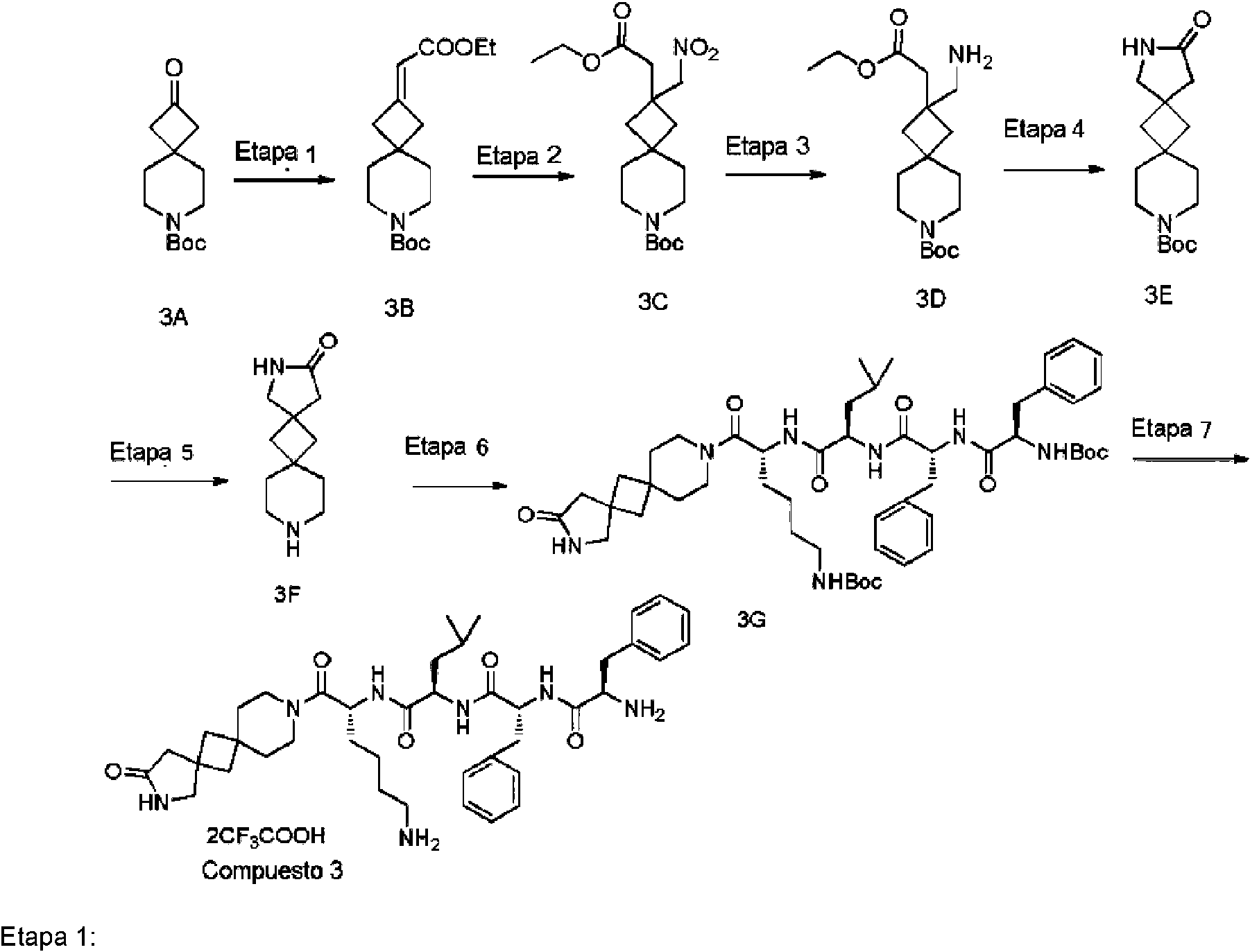
2-(2-Etoxi-2-oxo-etiliden)-7-azaespiro[3.5]nonano-7-carboxilato de terc-butilo (3B)tert-Butyl 2-(2-Ethoxy-2-oxo-ethylidene)-7-azaspiro[3.5]nonane-7-carboxylate (3B)

Bocmouth
Se añadió tetrahidrofurano (50 ml) a un matraz de reacción y se añadió hidruro de sodio (1,3 g, 54,2 mmol) bajo protección de nitrógeno. Se enfrió hasta 0°C en un baño de agua con hielo y se añadió lentamente gota a gota fosfonoacetato de trietilo (6,9 g, 31 mmol). Después de la adición, se llevó a cabo la reacción a 0°C durante 20 minutos. Se enfrió hasta de -5 a 0°C y se añadió lentamente gota a gota 2-oxo-7-azaespiro[3.5]nonano-7-carboxilato de tercbutilo (3A) (5 g, 20,9 mmol) en tetrahidrofurano (20 ml). Después de la adición, se elevó la temperatura hasta temperatura ambiente y se hizo reaccionar durante 1 h. Se añadió una disolución acuosa saturada de cloruro de sodio (50 ml) y se extrajo la mezcla con acetato de etilo (50 ml x 2). Se combinaron las fases orgánicas y se secaron las fases orgánicas sobre sulfato de sodio anhidro, se filtraron y se concentró el filtrado a presión reducida para obtener 2-(2-etoxi-2-oxo-etiliden)-7-azaespiro[3.5]nonano-7-carboxilato de terc-butilo (3B) en bruto como un líquido oleoso de color amarillo claro (6,0 g, rendimiento del 92,8%), y se usó directamente en la siguiente etapa.Tetrahydrofuran (50 mL) was added to a reaction flask and sodium hydride (1.3 g, 54.2 mmol) was added under nitrogen protection. It was cooled to 0°C in an ice-water bath and triethyl phosphonoacetate (6.9 g, 31 mmol) was slowly added dropwise. After the addition, the reaction was carried out at 0°C for 20 minutes. It was cooled to -5 to 0°C and tert-butyl 2-oxo-7-azaspiro[3.5]nonane-7-carboxylate (3A) (5 g, 20.9 mmol) in tetrahydrofuran (20 ml). After the addition, the temperature was raised to room temperature and reacted for 1 h. A saturated aqueous solution of sodium chloride (50 ml) was added, and the mixture was extracted with ethyl acetate (50 ml x 2). The organic layers were combined, and the organic layers were dried over anhydrous sodium sulfate, filtered, and the filtrate was concentrated under reduced pressure to obtain 2-(2-ethoxy-2-oxo-ethylidene)-7-azaspiro[3.5]nonane Crude tert-butyl -7-carboxylate (3B) as a light yellow oily liquid (6.0 g, 92.8% yield), and used directly in the next step.
Etapa 2:Stage 2:
2-(2-Etoxi-2-oxo-etil)-2-(nitrometil)-7-azaespiro[3.5]nonano-7-carboxilato de terc-butilo (3C) tert-Butyl 2-(2-Ethoxy-2-oxo-ethyl)-2-(nitromethyl)-7-azaspiro[3.5]nonane-7-carboxylate (3C)

Se añadió 2-(2-etoxi-2-oxo-etiliden)-7-azaespiro[3.5]nonano-7-carboxilato de terc-butilo (3B) a un matraz de reacción y se añadió tetrahidrofurano (60 ml). Se disolvió completamente a temperatura ambiente con agitación, luego se añadieron nitrometano (6,0 g, 98,3 mmol) y fluoruro de tetrabutilamonio (7,85 g, 30 mmol). Después de la adición, se calentó la reacción a reflujo durante 5 h. Se enfrió la disolución de reacción hasta temperatura ambiente, se añadió acetato de etilo (150 ml) y se usó una disolución acuosa saturada de cloruro de sodio (100 ml x 1) para el lavado y la separación. Se secó la fase orgánica sobre sulfato de sodio anhidro, se filtró y se concentró hasta sequedad a presión reducida. Se separó el residuo y se purificó mediante cromatografía en columna de gel de sílice (éter de petróleo:acetato de etilo (v:v) = 10:1) para obtener 2-(2-etoxi-2-oxo-etil)-2-(nitrometil)-7-azaespiro[3.5]nonano-7-carboxilato de terc-butilo (3C) como un líquido oleoso transparente incoloro (6,5 g, rendimiento del 90%).tert-Butyl 2-(2-ethoxy-2-oxo-ethylidene)-7-azaspiro[3.5]nonane-7-carboxylate (3B) was added to a reaction flask and tetrahydrofuran (60 mL) was added. It completely dissolved at room temperature with stirring, then nitromethane (6.0 g, 98.3 mmol) and tetrabutylammonium fluoride (7.85 g, 30 mmol) were added. After the addition, the reaction was heated at reflux for 5 h. The reaction solution was cooled to room temperature, ethyl acetate (150 ml) was added, and saturated aqueous sodium chloride solution (100 ml x 1) was used for washing and separation. The organic phase was dried over anhydrous sodium sulfate, filtered and concentrated to dryness under reduced pressure. The residue was separated and purified by silica gel column chromatography (petroleum ether:ethyl acetate (v:v) = 10:1) to obtain 2-(2-ethoxy-2-oxo-ethyl)-2 tert-Butyl -(nitromethyl)-7-azaspiro[3.5]nonane-7-carboxylate (3C) as a colorless clear oily liquid (6.5 g, 90% yield).
Etapa 3:Stage 3:
2-(Aminometil)-2-(2-etoxi-2-oxo-etil)-7-azaespiro[3.5]nonano-7-carboxilato de terc-butilo (3D)tert-Butyl 2-(Aminomethyl)-2-(2-ethoxy-2-oxo-ethyl)-7-azaspiro[3.5]nonane-7-carboxylate (3D)

Se añadió 2-(2-etoxi-2-oxo-etil)-2-(nitrometil)-7-azaespiro[3.5]nonano-7-carboxilato de terc-butilo (3C) (6,5 g, 18 mmol) a un matraz de reacción y se añadieron etanol (75 ml) y agua (25 ml), polvo de hierro (4,9 g, 88 mmol) y cloruro de amonio (4,7 g, 88,00 mmol) y se calentó la reacción a reflujo durante 5 h. Se enfrió la temperatura hasta temperatura ambiente y se concentró el sistema de reacción hasta 20 ml. Se añadió agua (30 ml), se ajustó el pH a más de 10 con agua amoniacal y se extrajo con diclorometano (50 ml x 2). Se combinaron las fases orgánicas y se concentraron las fases orgánicas hasta sequedad a presión reducida para obtener 2 -(aminometil)-2 -(2 -etoxi-2 -oxoetil)-7-azaespiro[3.5]nonano-7-carboxilato de terc-butilo (3D) como un líquido oleoso de color amarillo claro (5,1 g, rendimiento del 85%).Added tert-butyl 2-(2-ethoxy-2-oxo-ethyl)-2-(nitromethyl)-7-azaspiro[3.5]nonane-7-carboxylate (3C) (6.5 g, 18 mmol) to A reaction flask and ethanol (75 mL) and water (25 mL), iron powder (4.9 g, 88 mmol) and ammonium chloride (4.7 g, 88.00 mmol) were added and the mixture was heated. reaction at reflux for 5 h. The temperature was cooled to room temperature and the reaction system was concentrated to 20 mL. Water (30 ml) was added, the pH was adjusted to greater than 10 with ammoniacal water and extracted with dichloromethane (50 ml x 2). The organic layers were combined and the organic layers were concentrated to dryness under reduced pressure to obtain tert-2-(aminomethyl)-2-(2-ethoxy-2-oxoethyl)-7-azaspiro[3.5]nonane-7-carboxylate. butyl (3D) as a light yellow oily liquid (5.1 g, 85% yield).
Etapa 4:Stage 4:
2-Oxo-3,10-diazadiespiro[4.1.5A{7}.1A{5}]tridecano-10-carboxilato de terc-butilo (3E)tert-Butyl 2-Oxo-3,10-diazadispiro[4.1.5A{7}.1A{5}]tridecane-10-carboxylate (3E)
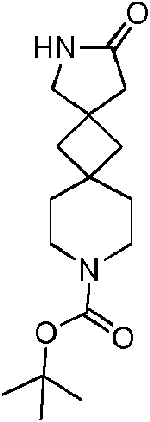
Se añadió 2-(aminometil)-2-(2-etoxi-2-oxo-etil)-7-azaespiro[3.5]nonano-7-carboxilato de terc-butilo (3D) (3 g, 8,8 mmol) a un matraz de reacción, se añadió una disolución acuosa de hidróxido de sodio (400 mg, 10 mmol) (30 ml) y se permitió que reaccionase el sistema a temperatura ambiente durante 5 h. Se filtró la disolución de reacción para obtener 2-oxo-3,10-diazaespiro[4.1.5A{7}.1A{5}]tridecano-10-carboxilato de terc-butilo (3E) como un sólido de color blanco (2 ,10 g, rendimiento del 81 %).tert-Butyl 2-(aminomethyl)-2-(2-ethoxy-2-oxo-ethyl)-7-azaspiro[3.5]nonane-7-carboxylate (3D) (3 g, 8.8 mmol) was added to To a reaction flask, aqueous sodium hydroxide solution (400 mg, 10 mmol) (30 mL) was added and the system was allowed to react at room temperature for 5 h. The reaction solution was filtered to obtain tert-butyl 2-oxo-3,10-diazaspiro[4.1.5A{7}.1A{5}]tridecane-10-carboxylate (3E) as a white solid (2 0.10 g, 81% yield).
Etapa 5:Stage 5:
3,10-diazadiespiro[4.1.5A{7}.1 A{5}]tridecan-2-ona (3F) 3,10-diazadiespiro[4.1.5A{7}.1 A{5}]tridecan-2-one (3F)

Se disolvió 2-oxo-3,10-diazaespiro[4.1.5A{7}.1A{5}]tridecano-10-carboxilato (3E) (1 g, 3,4 mmol) en diclorometano (9 ml) y se añadió ácido trifluoroacético (3 ml). Se permitió que avanzase la reacción a temperatura ambiente durante 5 h para que reaccionase por completo. Se concentró la disolución de reacción hasta sequedad a presión reducida, se añadió agua (20 ml) y el sistema se ajustó a pH> 10 con una disolución acuosa de hidróxido de sodio 2 M. Se extrajo con diclorometano (20 ml x 2) y se sometió la mezcla a un proceso de separación de líquido. Se combinaron las fases orgánicas y concentraron a presión reducida para obtener 3,10-diazaespiro[4.1.5A{7}.1A{5}]tridecano-2-ona (3F) en bruto como un líquido oleoso de color amarillo (0,6 g, rendimiento del 85%).2-oxo-3,10-diazaspiro[4.1.5A{7}.1A{5}]tridecane-10-carboxylate (3E) (1 g, 3.4 mmol) was dissolved in dichloromethane (9 mL) and added trifluoroacetic acid (3 ml). The reaction was allowed to proceed at room temperature for 5 h to fully react. The reaction solution was concentrated to dryness under reduced pressure, water (20 mL) was added, and the system was adjusted to pH>10 with 2M sodium hydroxide aqueous solution. It was extracted with dichloromethane (20 mL x 2) and the mixture was subjected to a liquid separation process. The organic phases were combined and concentrated under reduced pressure to obtain crude 3,10-diazaspiro[4.1.5A{7}.1A{5}]tridecane-2-one (3F) as a yellow oily liquid (0. 6g, 85% yield).
Etapa 6:Stage 6:
N-[(1R)-1-bencil-2-[[(1R)-1-bencil-2-[[(1R)-1-[[(1R)-5-(terc-butoxicarbonilamino)-1-(2-oxo-3,10-diazaespiro[A{7}.1A{5}]tridecano-10-carbonil)pentil]carbamoil]-3-metil-butil]amino]-2-oxo-etil]amino]-2-oxoetil]carbamato de terc-butilo (3G)N-[(1R)-1-benzyl-2-[[(1R)-1-benzyl-2-[[(1R)-1-[[(1R)-5-(tert-butoxycarbonylamino)-1-( 2-oxo-3,10-diazaspiro[A{7}.1A{5}]tridecane-10-carbonyl)pentyl]carbamoyl]-3-methyl-butyl]amino]-2-oxo-ethyl]amino]-2 tert-butyl-oxoethyl]carbamate (3G)

Se añadió diclorometano (30 ml) a un matraz de reacción bajo protección de nitrógeno y se añadieron el producto intermedio 1 (2,25g, 2,98 mmol), 3,10-diazaespiro[4.1.5A{7}.1A{5}]tridecan-2-ona (3F) en bruto (0,6 g, 2,88 mmol), 1-hidroxibenzotriazol (0,39 g, 2,89 mmol), clorhidrato de 1-(3-dimetilaminopropil)-3-etilcarbodiimida (0,83 g, 4,33 mmol). Se permitió que reaccionase el sistema a temperatura ambiente durante 15 h. Luego se añadió agua (20 ml) y se extrajo con acetato de etilo (30 ml x 3), se separaron las fases y se combinaron las fases orgánicas. Se secaron las fases orgánicas sobre sulfato de sodio anhidro, se filtraron y se concentró el filtrado a presión reducida. Se separó el residuo y se purificó mediante cromatografía en columna de gel de sílice (diclorometano:metanol (v:v) = 20:1) para obtener N-[(1R)-1-bencil-2-[[(1R)-1-bencil-2-[[(1R)-1-[[(1R)-5-(terc-butoxicarbonilamino)-1-(2-oxo-3,10-diazaespiro[4.1.5A{7}.1A{5}]tridecano-10-carbonil)pentil]carbamoil]-3-metil-butil]amino]-2-oxo-etil]amino]-2-oxoetil]carbamato de terc-butilo (3G) como un sólido espumoso de color blanco (1,77 g, rendimiento del 73,2%).Dichloromethane (30 mL) was added to a reaction flask under nitrogen protection and intermediate 1 (2.25 g, 2.98 mmol), 3,10-diazaspiro[4.1.5A{7}.1A{5 }]tridecan-2-one (3F) crude (0.6 g, 2.88 mmol), 1-hydroxybenzotriazole (0.39 g, 2.89 mmol), 1-(3-dimethylaminopropyl)-3 hydrochloride -ethylcarbodiimide (0.83 g, 4.33 mmol). The system was allowed to react at room temperature for 15 h. Water (20 mL) was then added and extracted with ethyl acetate (30 mL x 3), the layers separated and the organic layers combined. The organic phases were dried over anhydrous sodium sulfate, filtered, and the filtrate was concentrated under reduced pressure. The residue was separated and purified by silica gel column chromatography (dichloromethane:methanol (v:v) = 20:1) to obtain N-[(1R)-1-benzyl-2-[[(1R)- 1-benzyl-2-[[(1R)-1-[[(1R)-5-(tert-butoxycarbonylamino)-1-(2-oxo-3,10-diazaspiro[4.1.5A{7}.1A{ tert-Butyl 5}]tridecane-10-carbonyl)pentyl]carbamoyl]-3-methyl-butyl]amino]-2-oxo-ethyl]amino]-2-oxoethyl]carbamate (3G) as a foamy colored solid white (1.77 g, 73.2% yield).
Etapa 7:Stage 7:
(2R)-N-[(1R)-5-amino-1-(2-oxo-3,10-diazadiespiro[4.1.5A{7}.1A{5}]tridecano-10-carbonil)pentil]-2-[[(2R)-2-[[(2R)-2-amino-3-fenil-propanoil]amino]-3-fenil-propanoil]amino]-4-metil-pentanamida; di-ácido trifluoroacético (compuesto 3)(2R)-N-[(1R)-5-amino-1-(2-oxo-3,10-diazadispiro[4.1.5A{7}.1A{5}]tridecane-10-carbonyl)pentyl]-2 -[[(2R)-2-[[(2R)-2-amino-3-phenyl-propanoyl]amino]-3-phenyl-propanoyl]amino]-4-methyl-pentanamide; di-trifluoroacetic acid (compound 3)

Se añadieron N-[(1R)-1-bencil-2-[[(1R)-1-bencil-2-[[(1R)-1-[[(1R)-5-(terc-butoxicarbonilamino)1]-(2-oxo-3,10-diazaespiro[4.1.5A{7}.1A{5}]tridecano-10-carbonil)pentil]carbamoil]-3-metil-butil]amino]-2-oxo-etil]amino]-2-oxoetil]carbamato de terc-butilo (3G) (0,90g, 1 mmol) y diclorometano (21 ml) a un matraz de reacción bajo protección con nitrógeno, y se añadió ácido trifluoroacético (7 ml) con agitación. Se permitió que avanzase la reacción a temperatura ambiente durante 3 h. Se concentró la disolución de reacción hasta sequedad a presión reducida y se separó el residuo y se purificó (condiciones de preparación: instrumento: GX-281 de Gilson; columna: Xbridge C18, 150 x 30 mm de D.I., 5 |am; fase móvil: A para ACN y B para H2O; isocrático: 65% de A; velocidad de flujo: 30 ml/min; contrapresión:1000 psi; temperatura de columna: 30°C; longitud de onda: 210 nm; periodo: 18 min; preparación de la muestra: se disolvió el compuesto en 12 ml de metanol; inyección: 0,9 ml/aguja). Se concentró la preparación a presión reducida para eliminar la mayor parte del disolvente y se liofilizó para obtener (2R)-N-[(1R)-5-amino-1-(2-oxo-3,10-diazaespiro[4.1.5A{7}.1A{5}]tridecano-10-carbonil)pentil]-2-[[(2R)-2-[[(2R)-2-amino-3-fenil-propanoil]amino]-3 -fenilpropanoil]amino]-4-metil-pentanamida; di-ácido trifluoroacético (compuesto 3) como un sólido de color blanco (0,98 g, rendimiento del 54%).N-[(1R)-1-benzyl-2-[[(1R)-1-benzyl-2-[[(1R)-1-[[(1R)-5-(tert-butoxycarbonylamino)1] -(2-oxo-3,10-diazaspiro[4.1.5A{7}.1A{5}]tridecane-10-carbonyl)pentyl]carbamoyl]-3-methyl-butyl]amino]-2-oxo-ethyl] tert-butyl amino]-2-oxoethyl]carbamate (3G) (0.90g, 1mmol) and dichloromethane (21ml) to a reaction flask under nitrogen blanket, and trifluoroacetic acid (7ml) was added with stirring. . The reaction was allowed to proceed at room temperature for 3 h. The reaction solution was concentrated to dryness under reduced pressure, and the residue was separated and purified (preparation conditions: instrument: Gilson GX-281; column: Xbridge C18, 150 x 30 mm ID, 5 |am; mobile phase : A for ACN and B for H2O, isocratic: 65% of A, flow rate: 30 mL/min, back pressure: 1000 psi, column temperature: 30°C, wavelength: 210 nm, period: 18 min; preparation of the sample: the compound was dissolved in 12 ml of methanol; injection: 0.9 ml/needle). The preparation was concentrated under reduced pressure to remove most of the solvent and lyophilized to obtain (2R)-N-[(1R)-5-amino-1-(2-oxo-3,10-diazaspiro[4.1.5A {7}.1A{5}]tridecane-10-carbonyl)pentyl]-2-[[(2R)-2-[[(2R)-2-amino-3-phenyl-propanoyl]amino]-3-phenylpropanoyl ]amino]-4-methyl-pentanamide; di-trifluoroacetic acid (compound 3) as a white solid (0.98 g, 54% yield).
EM m/z (ESI): 365,9 [M+2H]+/2;MS m/z (ESI): 365.9 [M+2H]+/2;
1H-RMN (400 MHz, DMSO-da) 88,86-8,67 (m, 1H), 8,40-8,23 (m, 1H), 8,14-8,01 (m, 3H), 7,84-7,72 (m, 2H), 7,52-7,42 (m, 1H), 7,37-7,15 (m, 10H), 4,76-3,94 (m, 4H), 3,59-2,65 (m, 12H), 2,29-2,15 (m, 2H), 1,93-1,19 (m, 17H), 0,88 (dd, 6H).1H-NMR (400 MHz, DMSO-da) 88.86-8.67 (m, 1H), 8.40-8.23 (m, 1H), 8.14-8.01 (m, 3H), 7.84-7.72 (m, 2H), 7.52-7.42 (m, 1H), 7.37-7.15 (m, 10H), 4.76-3.94 (m, 4H ), 3.59-2.65 (m, 12H), 2.29-2.15 (m, 2H), 1.93-1.19 (m, 17H), 0.88 (dd, 6H).
Ejemplo 3:Example 3:
(2R)-N-[(1R)-5-amino-1-(9-oxo-2,8-diazadiespiro[3.1.4A{6}.1A{4}]undecano-2-carbonil)pentil]-2-[[(2R)-2-[[(2R)-2-amino-3-fenil-propanoil]amino]-3-fenil-propanoil]amino]-4-metil-pentanamida; di-ácido trifluoroacético (compuesto 4)(2R)-N-[(1R)-5-amino-1-(9-oxo-2,8-diazadispiro[3.1.4A{6}.1A{4}]undecane-2-carbonyl)pentyl]-2 -[[(2R)-2-[[(2R)-2-amino-3-phenyl-propanoyl]amino]-3-phenyl-propanoyl]amino]-4-methyl-pentanamide; di-trifluoroacetic acid (compound 4)

Etapa 1: 6-(2-etoxi-2-oxo-etiliden)-2-azaespiro[3.3]heptano-2-carboxilato de terc-butilo (4B)Step 1: tert-butyl 6-(2-ethoxy-2-oxo-ethylidene)-2-azaspiro[3.3]heptane-2-carboxylate (4B)

Bocmouth
Se añadió tetrahidrofurano (50 ml) a un matraz de reacción y se añadió hidruro de sodio (2,5 g, 59,2 mmol). Se enfrió hasta 0°C en un baño de agua con hielo y se añadió lentamente gota a gota fosfonoacetato de trietilo (7,96 g, 35,5 mmol). Se permitió que avanzase la reacción a 0°C durante 20 min después de la adición. Luego se enfrió hasta de -5 a 0°C, y se añadió gota a gota lentamente 6-oxo-2-azaespiro[3.3]heptano-2-carboxilato de terc-butilo (4A) (5 g, 23,7 mmol) en tetrahidrofurano (20 ml). Después de la adición, se permitió que avanzase la reacción a temperatura ambiente durante 1 h. Luego, se añadió una disolución acuosa saturada de cloruro de sodio (50 ml) a la disolución de reacción, y se extrajo la mezcla con acetato de etilo (50 ml x 2) y se sometió la mezcla a un proceso de separación de líquido. Se combinaron las fases orgánicas. Se secó la fase orgánica sobre sulfato de sodio anhidro, se filtró y se concentró el filtrado a presión reducida para obtener 6-(2-etoxi-2-oxo-etiliden)-2-azaespiro[3.3]heptano-2-carboxilato de terc-butilo (4B) en bruto como un líquido oleoso de color amarillo (5,5 g, rendimiento del 83%), y se usó directamente en la siguiente etapa.Tetrahydrofuran (50 mL) was added to a reaction flask and sodium hydride (2.5 g, 59.2 mmol) was added. It was cooled to 0°C in an ice-water bath and triethyl phosphonoacetate (7.96 g, 35.5 mmol) was slowly added dropwise. The reaction was allowed to proceed at 0°C for 20 min after the addition. It was then cooled to -5 to 0°C, and tert-butyl 6-oxo-2-azaspiro[3.3]heptane-2-carboxylate (4A) (5 g, 23.7 mmol) was slowly added dropwise. in tetrahydrofuran (20 mL). After the addition, the reaction was allowed to proceed at room temperature for 1 h. Then, a saturated aqueous solution of sodium chloride (50 ml) was added to the reaction solution, and the mixture was extracted with ethyl acetate (50 ml x 2), and the mixture was subjected to a separation process of liquid. The organic phases were combined. The organic layer was dried over anhydrous sodium sulfate, filtered, and the filtrate was concentrated under reduced pressure to obtain tert 6-(2-ethoxy-2-oxo-ethylidene)-2-azaspiro[3.3]heptane-2-carboxylate. -butyl (4B) crude as a yellow oily liquid (5.5 g, 83% yield), and used directly in the next step.
Etapa 2:Stage 2:
6-(2-Etoxi-2-oxo-etil)-6-(nitrometil)-2-azaespiro[3.3]heptano-2-carboxilato de terc-butilo (4C)tert-Butyl 6-(2-Ethoxy-2-oxo-ethyl)-6-(nitromethyl)-2-azaspiro[3.3]heptane-2-carboxylate (4C)

Se añadió 6-(2-etoxi-2-oxo-etiliden)-2-azaespiro[3.3]heptano-2-carboxilato de terc-butilo (4B) en bruto a un matraz de reacción y se añadió tetrahidrofurano (60 ml). Se agitó el sistema para que se disolviera por completo a temperatura ambiente, luego se añadieron nitrometano (6,0 g, 98,3 mmol) y fluoruro de tetrabutilamonio (7,85 g, 30 mmol). Una vez completada la adición, se calentó la reacción a reflujo durante 5 h. Se enfrió la disolución de reacción hasta temperatura ambiente, se le añadió acetato de etilo (150 ml) y se lavó la mezcla con una disolución acuosa saturada de cloruro de sodio (100 ml) y se sometió la mezcla a un proceso de separación de líquido. Se secó la fase orgánica sobre sulfato de sodio anhidro, se filtró y se concentró el filtrado a presión reducida. Se separó el residuo y se purificó mediante cromatografía en columna de gel de sílice (éter de petróleo:acetato de etilo (v:v) = 4:1), para obtener 6-(2-etoxi-2-oxo-etil)-6-(nitrometil)-2-azaespiro[3.3]heptano-2-carboxilato de terc-butilo (4C) como un líquido oleoso transparente incoloro (5,1 g, rendimiento del 76%).Crude tert-butyl 6-(2-ethoxy-2-oxo-ethylidene)-2-azaspiro[3.3]heptane-2-carboxylate (4B) was added crude to a reaction flask and tetrahydrofuran (60 mL) was added. The system was stirred to dissolve completely at room temperature, then nitromethane (6.0 g, 98.3 mmol) and tetrabutylammonium fluoride (7.85 g, 30 mmol) were added. After addition was complete, the reaction was heated at reflux for 5 h. The reaction solution was cooled to room temperature, ethyl acetate (150 mL) was added thereto, and the mixture was washed with a saturated aqueous sodium chloride solution (100 mL), and the mixture was subjected to a liquid separation process. . The organic phase was dried over anhydrous sodium sulfate, filtered, and the filtrate was concentrated under reduced pressure. The residue was separated and purified by silica gel column chromatography (petroleum ether:ethyl acetate (v:v) = 4:1), to obtain 6-(2-ethoxy-2-oxo-ethyl)- tert-Butyl 6-(nitromethyl)-2-azaspiro[3.3]heptane-2-carboxylate (4C) as a clear colorless oily liquid (5.1 g, 76% yield).
Etapa 3:Stage 3:
6-(Aminometil)-6-(2-etoxi-2-oxo-etil)-2-azaespiro[3.3]heptano-2-carboxilato de terc-butilo (4D)tert-Butyl 6-(Aminomethyl)-6-(2-ethoxy-2-oxo-ethyl)-2-azaspiro[3.3]heptane-2-carboxylate (4D)

Se añadió 6-(2-etoxi-2-oxo-etil)-6-(nitrometil)-2-azaespiro[3.3]heptano-2-carboxilato de terc-butilo (4C) (5,1 g, 15 mmol) a un matraz de reacción, se añadieron etanol (75 ml), agua (25 ml), polvo de hierro (4,2 g, 74 mmol) y cloruro de amonio (4,0 g, 74 mmol) y se calentó la reacción a reflujo durante 5 h. Se redujo la temperatura hasta temperatura ambiente y se concentró el sistema de reacción hasta aproximadamente 20 ml. Se añadió agua (30 ml), luego se ajustó el pH a más de 10 con amoniaco, se extrajo con diclorometano (50 ml x 2) y se sometió la mezcla a un proceso de separación de líquido. Se combinaron las fases orgánicas y se concentraron las fases orgánicas a presión reducida para obtener 6-(aminometil)-6-(2-etoxi-2-oxo-etil)-2-azaespiro[3.3]heptano-2-carboxilato de terc-butilo (4D) en bruto (4,6 g, rendimiento del 99%) y se usó directamente en la siguiente etapa.To To a reaction flask, ethanol (75 mL), water (25 mL), iron powder (4.2 g, 74 mmol), and ammonium chloride (4.0 g, 74 mmol) were added, and the reaction was heated to reflux for 5 h. The temperature was reduced to room temperature and the reaction system was concentrated to about 20 mL. Water (30 ml) was added, then the pH was adjusted to more than 10 with ammonia, extracted with dichloromethane (50 ml x 2), and the mixture was subjected to a liquid separation process. The organic layers were combined and the organic layers were concentrated under reduced pressure to obtain 6-(aminomethyl)-6-(2-ethoxy-2-oxo-ethyl)-2-azaspiro[3.3]heptane-2-carboxylate tert- crude butyl (4D) (4.6 g, 99% yield) and used directly in the next step.
Etapa 4:Stage 4:
9-Oxo-2,8-diazadiespiro[3.1.4A{6}.1A{4}]undecano-2-carboxilato de terc-butilo (4E)tert-Butyl 9-Oxo-2,8-diazadiespiro[3.1.4A{6}.1A{4}]undecane-2-carboxylate tert-butyl (4E)

NN
Bocmouth
Se añadió 6-(aminometil)-6-(2-etoxi-2-oxo-etil)-2-azaespiro[3.3]heptano-2-carboxilato de terc-butilo (4D) en bruto (4,6 g, 15 mmol) a un matraz de reacción. Se añadió una disolución acuosa de hidróxido de sodio (600 mg, 15 mmol) (45 ml) y se hizo reaccionar la mezcla a temperatura ambiente durante 5 h. Se filtró la disolución de reacción para obtener 9-oxo-2,8-diazaespiro[3.1.4A{6}.1A{4}]undecano-2-carboxilato de terc-butilo (4E) como un sólido de color blanco (2,90 g, rendimiento del 74%).Crude tert-butyl 6-(aminomethyl)-6-(2-ethoxy-2-oxo-ethyl)-2-azaspiro[3.3]heptane-2-carboxylate (4D) (4.6 g, 15 mmol) was added ) to a reaction flask. An aqueous solution of sodium hydroxide (600 mg, 15 mmol) was added. hydrochloric acid (45 ml) and the mixture was reacted at room temperature for 5 h. The reaction solution was filtered to obtain tert-butyl 9-oxo-2,8-diazaspiro[3.1.4A{6}.1A{4}]undecane-2-carboxylate tert-butyl (4E) as a white solid (2 0.90 g, 74% yield.
Etapa 5:Stage 5:
Clorhidrato de 2,8-diazadiespiro[3.1.4A{6}.1A{4}]undecan-9-ona (4F)2,8-diazadispiro[3.1.4A{6}.1A{4}]undecan-9-one hydrochloride (4F)

Se disolvió 9-oxo-2,8-diazaespiro[3.1.4A{6}.1A{4}]undecano-2-carboxilato de terc-butilo (4E) (2 g, 7,5 mmol) en una disolución de HCl 4 N-isopropanol (9 ml) y se permitió que reaccionase el sistema a temperatura ambiente durante 5 h. Se concentró la disolución de reacción hasta sequedad a presión reducida, para obtener clorhidrato de 2,8-diazaespiro[3.1.4A{6}.1A{4}]undecan-9-ona (4F) en bruto como un sólido de color blanco (0,95 g, rendimiento del 62%) y se usó directamente en la siguiente etapa.tert-Butyl 9-oxo-2,8-diazaspiro[3.1.4A{6}.1A{4}]undecane-2-carboxylate (4E) (2 g, 7.5 mmol) was dissolved in HCl solution 4N-isopropanol (9 mL) and the system was allowed to react at room temperature for 5 h. The reaction solution was concentrated to dryness under reduced pressure, to obtain crude 2,8-diazaspiro[3.1.4A{6}.1A{4}]undecan-9-one hydrochloride (4F) as white solid. (0.95 g, 62% yield) and used directly in the next step.
Etapa 6:Stage 6:
N-[(1R)-1-Bencil-2-[[(1R)-1-bencil-2-[[(1R)-1-[[(1R)-5-(terc-butoxicarbonilamino)-1-(9-oxo-2,8-diazadiespiro[3.1.4A{6}.1A{4}]undecano-2-carbonil)pentil]carbamoil]-3-metil-butil]amino]-2-oxo-etil]amino]-2-oxoetil]carbamato de terc-butilo (4G);N-[(1R)-1-Benzyl-2-[[(1R)-1-benzyl-2-[[(1R)-1-[[(1R)-5-(tert-butoxycarbonylamino)-1-( 9-oxo-2,8-diazadispiro[3.1.4A{6}.1A{4}]undecane-2-carbonyl)pentyl]carbamoyl]-3-methyl-butyl]amino]-2-oxo-ethyl]amino] tert-butyl -2-oxoethyl]carbamate (4G);

Se añadió diclorometano (30 ml) a un matraz de reacción bajo protección de nitrógeno y se añadieron el producto intermedio 1 (2,25g, 2,98 mmol), clorhidrato de 2,8-diazaespiro[3.1.4A{6}.1A{4}]undecan-9-ona (4F) (0,6g, 3,0 mmol), 1-hidroxibenzotriazol (0,39 g, 2,89 mmol), clorhidrato de 1-(3-dimetilaminopropil)-3-etilcarbodiimida (0,83 g, 4,33 mmol). Se permitió que avanzase la reacción a temperatura ambiente durante 15 h. Luego se añadió agua (20 ml) y se extrajo la mezcla con acetato de etilo (30 ml x 3) y se sometió la mezcla a un proceso de separación de líquido. Se combinaron las fases orgánicas y se secaron las fases orgánicas sobre sulfato de sodio anhidro, se filtraron y se concentró el filtrado a presión reducida. Se separó el residuo y se purificó mediante cromatografía en columna de gel de sílice (diclorometano:metanol (v:v) = 10:1) para obtener N-[(1R)-1-bencil-2-[[(1R)-1-bencil-2-[[(1R)-1-[[(1R)-5-(tercbutoxicarbonilamino)-1-(9-oxo-2,8-diazaespiro[3.1.4A{6}.1A{4}]undecano-2-carbonil)pentil]carbamoil]-3-metilbutil]amino]-2-oxo-etil]amino]-2-oxo-etil]carbamato de terc-butilo (4G) como un sólido espumoso de color blanco (1,9 g, rendimiento del 70%).Dichloromethane (30 mL) was added to a reaction flask under nitrogen protection and intermediate 1 (2.25 g, 2.98 mmol), 2,8-diazaspiro[3.1.4A{6}.1A hydrochloride, was added {4}]undecan-9-one (4F) (0.6g, 3.0mmol), 1-hydroxybenzotriazole (0.39g, 2.89mmol), 1-(3-dimethylaminopropyl)-3- ethylcarbodiimide (0.83 g, 4.33 mmol). The reaction was allowed to proceed at room temperature for 15 h. Then water (20 ml) was added, and the mixture was extracted with ethyl acetate (30 ml x 3), and the mixture was subjected to a liquid separation process. The organic layers were combined, and the organic layers were dried over anhydrous sodium sulfate, filtered, and the filtrate was concentrated under reduced pressure. The residue was separated and purified by silica gel column chromatography (dichloromethane:methanol (v:v) = 10:1) to obtain N-[(1R)-1-benzyl-2-[[(1R)- 1-benzyl-2-[[(1R)-1-[[(1R)-5-(tertbutoxycarbonylamino)-1-(9-oxo-2,8-diazaspiro[3.1.4A{6}.1A{4} tert-Butyl]undecane-2-carbonyl)pentyl]carbamoyl]-3-methylbutyl]amino]-2-oxo-ethyl]amino]-2-oxo-ethyl]carbamate (4G) as a white foamy solid ( 1.9 g, 70% yield).
Etapa 7:Stage 7:
(2R)-N-[(1R)-5-amino-1-(9-oxo-2,8-diazadiespiro[3.1.4A{6}.1A{4}]undecano-2-carbonil)pentil]-2-[[(2R)-2-[[(2R)-2-amino-3-fenil-propanoil]amino]-3-fenil-propanoil]amino]-4-metil-pentanamida; di-ácido trifluoroacético (compuesto 4)(2R)-N-[(1R)-5-amino-1-(9-oxo-2,8-diazadispiro[3.1.4A{6}.1A{4}]undecane-2-carbonyl)pentyl]-2 -[[(2R)-2-[[(2R)-2-amino-3-phenyl-propanoyl]amino]-3-phenyl-propanoyl]amino]-4-methyl-pentanamide; di-trifluoroacetic acid (compound 4)

N-[(1R)-1-bencil-2-[[(1R)-1-bencil-2-[[(1R)-1-[[(1R)-5-(terc-butoxicarbonilamino)1]-(9-oxo-2,8-diazaespiro[3.1.4A{6}.1 A{4}]undecano-2-carbonil)pentil]carbamoil]-3-metil-butil]amino]-2-oxo-etil]amino]-2-oxoetil]carbamato de terc-butilo (4G) (1,7g, 1,9 mmol) y diclorometano (21 ml) a un matraz de reacción bajo protección con nitrógeno. Se añadió ácido trifluoroacético (7 ml) con agitación y se permitió que avanzase la reacción a temperatura ambiente durante 3 h. Se concentró la disolución de reacción hasta sequedad a presión reducida y se separó el residuo y se purificó mediante cromatografía preparativa (condiciones de preparación: instrumento: GX-281 de Gilson; columna: Xbridge C18, 150 x 30 mm de D.I., 5 |am; fase móvil: A para ACN y B para H2O; isocrático: 65% de A; velocidad de flujo: 30 ml/min; contrapresión:1000 psi; temperatura de columna: 30°C; longitud de onda: 210 nm; periodo: 18 min; preparación de la muestra: se disolvió el compuesto en 12 ml de metanol; inyección: 0,9 ml/aguja). Se concentró la preparación a presión reducida para eliminar la mayor parte del disolvente y se liofilizó para obtener (2R)-N-[(1R)-5-amino-1-(9-oxo-2,8-diazaespiro[3.1.4A{6}.1A{4}]undecano-2-carbonil)pentil]-2-[[(2R)-2-[[(2R)-2-amino-3-fenil-propanoil]amino]-3-fenil-propanoil]amino]-4-metil-pentanamida; di-ácido trifluoroacético (compuesto 4) como un sólido de color blanco (0,7 g, rendimiento del 40%).N-[(1R)-1-benzyl-2-[[(1R)-1-benzyl-2-[[(1R)-1-[[(1R)-5-(tert-butoxycarbonylamino)1]-( 9-oxo-2,8-diazaspiro[3.1.4A{6}.1 tert-Butyl A{4}]undecane-2-carbonyl)pentyl]carbamoyl]-3-methyl-butyl]amino]-2-oxo-ethyl]amino]-2-oxoethyl]carbamate (4G) (1.7g , 1.9 mmol) and dichloromethane (21 mL) to a reaction flask under nitrogen protection. Trifluoroacetic acid (7 mL) was added with stirring and the reaction was allowed to proceed at room temperature for 3 h. The reaction solution was concentrated to dryness under reduced pressure, and the residue was separated and purified by preparative chromatography (preparation conditions: instrument: Gilson GX-281; column: Xbridge C18, 150 x 30 mm ID, 5 µm ; mobile phase: A for ACN and B for H2O; isocratic: 65% A; flow rate: 30 mL/min; back pressure: 1000 psi; column temperature: 30°C; wavelength: 210 nm; period: 18 min, sample preparation: compound was dissolved in 12 mL methanol, injection: 0.9 mL/needle). The preparation was concentrated under reduced pressure to remove most of the solvent and lyophilized to obtain (2R)-N-[(1R)-5-amino-1-(9-oxo-2,8-diazaspiro[3.1.4A {6}.1A{4}]undecane-2-carbonyl)pentyl]-2-[[(2R)-2-[[(2R)-2-amino-3-phenyl-propanoyl]amino]-3-phenyl -propanoyl]amino]-4-methyl-pentanamide; di-trifluoroacetic acid (compound 4) as a white solid (0.7 g, 40% yield).
EM m/z (ESI): 351,8 [M+2H]+/2;MS m/z (ESI): 351.8 [M+2H]+/2;
1H-RMN (400 MHz, DMSO-De) 88,76 (d, 1H), 8,32 (d, 1H), 8,11-7,97 (m, 4H), 7,85-7,69 (m, 3H), 7,50 (s, 1H), 7,33 7,18 (m, 10H), 4,74-3,74 (m, 8H), 3,24-2,63 (m, 8H), 2,27-2,05 (m, 6H), 1,71-1,17 (m, 9H), 0,89 (dd, 6H).1H-NMR (400 MHz, DMSO-De) 88.76 (d, 1H), 8.32 (d, 1H), 8.11-7.97 (m, 4H), 7.85-7.69 ( m, 3H), 7.50 (s, 1H), 7.33 7.18 (m, 10H), 4.74-3.74 (m, 8H), 3.24-2.63 (m, 8H ), 2.27-2.05 (m, 6H), 1.71-1.17 (m, 9H), 0.89 (dd, 6H).
Ejemplo 4:Example 4:
(2R)-N-[(1R)-5-Amino-1-(2-ciclopropilsulfonil-2,7-diazaespiro[3.5]nonano-7-carbonil)pentil]-2-[[(2R)-2-[[(2R)-2-amino-3-fenil-propanoil]amino]-3-fenil-propanoil]amino]-4-metil-pentanamida (compuesto 6)(2R)-N-[(1R)-5-Amino-1-(2-cyclopropylsulfonyl-2,7-diazaspiro[3.5]nonane-7-carbonyl)pentyl]-2-[[(2R)-2-[ [(2R)-2-amino-3-phenyl-propanoyl]amino]-3-phenyl-propanoyl]amino]-4-methyl-pentanamide (compound 6)

2,7-Diazaespiro[3.5]nonano-2,7-dicarboxilato de 7-bencilo y 2-terc-butilo (6B)7-benzyl 2-tert-butyl 2,7-Diazaspiro[3.5]nonane-2,7-dicarboxylate (6B)

Se añadió gota a gota trietilamina (0,15 ml, 1,1 mmol) a un 2,7-diazaespiro[3.5]nonano-2-carboxilato de tercbutilo (6A) (0,23g, 1 mmol) en una disolución en tetrahidrofurano (5 ml) en un frasco de una sola boca de 50 ml a 0°C. Después de la adición gota a gota, se añadió cloroformiato de bencilo (340 mg, 2 mmol) y se agitó durante 10 min. Se elevó la temperatura hasta temperatura ambiente y se continuó agitando durante 1 h. Se filtró la disolución de reacción a través de tierra de diatomeas y se concentró el filtrado a presión reducida para obtener 2,7-diazaespiro[3.5]nonano-2,7-dicarboxilato de 7-bencilo y 2-terc-butilo (6B) como un producto oleoso incoloro (362 mg, rendimiento del 99%). Triethylamine (0.15 mL, 1.1 mmol) was added dropwise to a tert-butyl 2,7-diazaspiro[3.5]nonane-2-carboxylate (6A) (0.23 g, 1 mmol) in a solution in tetrahydrofuran (5 ml) in a 50 ml single-neck bottle at 0°C. After dropwise addition, benzyl chloroformate (340 mg, 2 mmol) was added and stirred for 10 min. The temperature was raised to room temperature and stirring was continued for 1 h. The reaction solution was filtered through diatomaceous earth, and the filtrate was concentrated under reduced pressure to obtain 7-benzyl 2-tert-butyl 2,7-diazaspiro[3.5]nonane-2,7-dicarboxylate (6B) as a colorless oily product (362 mg, 99% yield).
EM m/z = 383,2 [M+Na]+;MS m/z = 383.2 [M+Na]+;
1H-RMN (400 MHz, CDCla) 87,34-7,32 (m, 5H), 5,12 (s, 2H), 3,64 (s, 4H), 3,43 (dd, 4H), 1,77-1,61 (m, 4H), 1,44 (s, 9H).1H-NMR (400 MHz, CDCla) 87.34-7.32 (m, 5H), 5.12 (s, 2H), 3.64 (s, 4H), 3.43 (dd, 4H), 1 0.77-1.61 (m, 4H), 1.44 (s, 9H).
Etapa 2:Stage 2:
2,7-Diazaespiro[3.5]nonano-7-carboxilato de bencilo (6C)Benzyl 2,7-Diazaspiro[3.5]nonane-7-carboxylate (6C)

Se añadieron 2,7-diazaespiro[3.5]nonano-2,7-dicarboxilato de 7-bencilo y 2-terc-butilo (6B) (0,36 g, 1 mmol) y diclorometano (7 ml) en un matraz de reacción de 50 ml y se añadió gota a gota ácido trifluoroacético (1 ml) a temperatura ambiente. Después de la adición, se permitió que avanzase la reacción a temperatura ambiente durante 3 h. Se concentró la disolución de reacción directamente a presión reducida para obtener 2,7-diazaespiro[3.5]nonano-7-carboxilato de bencilo (6C) en bruto como un líquido oleoso de color amarillo (260 mg, rendimiento del 100%) y se usó directamente en la siguiente reacción.7-Benzyl 2-tert-butyl 2,7-diazaspiro[3.5]nonane-2,7-dicarboxylate (6B) (0.36 g, 1 mmol) and dichloromethane (7 mL) were added to a reaction flask 50 ml and trifluoroacetic acid (1 ml) was added dropwise at room temperature. After the addition, the reaction was allowed to proceed at room temperature for 3 h. The reaction solution was directly concentrated under reduced pressure to obtain crude benzyl 2,7-diazaspiro[3.5]nonane-7-carboxylate (6C) as yellow oily liquid (260 mg, 100% yield), and used directly in the following reaction.
EM m/z = 261,2 [M+H]+;MS m/z = 261.2 [M+H]+;
Etapa 3:Stage 3:
2-Ciclopropilsulfonil-2,7-diazaespiro[3.5]nonano-7-carboxilato de bencilo (6D)Benzyl 2-Cyclopropylsulfonyl-2,7-diazaspiro[3.5]nonane-7-carboxylate (6D)

Se añadieron 2,7-diazaespiro[3.5]nonano-7-carboxilato de bencilo (6C) en bruto (260mg, 1 mmol), trietilamina (200 mg, 2 mmol) y diclorometano (7 ml) en un matraz de reacción de 50 ml. Se enfrió la disolución hasta 0°C en un baño de hielo y se añadió gota a gota cloruro de ciclopropilsulfonilo (170 mg, 1,2 mmol). Después de la adición, se elevó la temperatura hasta temperatura ambiente durante 4 h. Luego, se extinguió el sistema de reacción con bicarbonato de sodio saturado (10 ml), se extrajo con acetato de etilo (5 ml x 3) y se combinaron las fases orgánicas. Se secaron las fases orgánicas sobre sulfato de sodio anhidro, se filtraron y se concentró el filtrado a presión reducida. Se separó el residuo y se purificó mediante cromatografía en columna de gel de sílice (éter de petróleo:acetato de etilo (v:v) = 4:1) para obtener el compuesto 2-ciclopropilsulfonil-2,7-diazaespiro[3.5]nonano-7-carboxilato de bencilo (6D) como un sólido de color blanco (360 mg, rendimiento del 99%).Crude benzyl 2,7-diazaspiro[3.5]nonane-7-carboxylate (6C) (260mg, 1mmol), triethylamine (200mg, 2mmol), and dichloromethane (7mL) were added to a 50 mL reaction flask. ml. The solution was cooled to 0°C in an ice bath and cyclopropylsulfonyl chloride (170 mg, 1.2 mmol) was added dropwise. After the addition, the temperature was raised to room temperature over 4 h. Then, the reaction system was quenched with saturated sodium bicarbonate (10 ml), extracted with ethyl acetate (5 ml x 3), and the organic layers were combined. The organic phases were dried over anhydrous sodium sulfate, filtered, and the filtrate was concentrated under reduced pressure. The residue was separated and purified by silica gel column chromatography (petroleum ether:ethyl acetate (v:v) = 4:1) to obtain 2-cyclopropylsulfonyl-2,7-diazaspiro[3.5]nonane compound Benzyl -7-carboxylate (6D) as a white solid (360 mg, 99% yield).
EM m/z = 365,2 [M+H]+;MS m/z = 365.2 [M+H]+;
1H-RMN (400 MHz, CDCla) 87,43-7,28 (m, 5H), 5,12 (s, 2H), 3,70 (s, 4H), 3,53-3,36 (m, 4H), 2,41-2,22 (m, 1H), 1,85 1,69 (m, 4H)), 1,19-1,09 (m, 2H), 1,04-0,93 (m, 2H).1H-NMR (400 MHz, CDCla) 87.43-7.28 (m, 5H), 5.12 (s, 2H), 3.70 (s, 4H), 3.53-3.36 (m, 4H), 2.41-2.22 (m, 1H), 1.85-1.69 (m, 4H)), 1.19-1.09 (m, 2H), 1.04-0.93 ( m, 2H).
Etapa 4:Stage 4:
2-Ciclopropilsulfonil-2,7-diazaespiro[3.5]nonano (6E) 2-Cyclopropylsulfonyl-2,7-diazaspiro[3.5]nonane (6E)

Se añadieron 2-ciclopropilsulfonil-2,7-diazaespiro[3.5]nonano-7-carboxilato de bencilo (6D) (360 mg, 0,99 mmol), paladio sobre carbono (72 mg, al 20% en peso) y acetato de etilo (10 ml) en un matraz de reacción de 50 ml. Se reemplazó la atmósfera por hidrógeno 3 veces y se permitió que avanzase la reacción a temperatura ambiente durante 2 h bajo una atmósfera de hidrógeno (globo). Se filtró la disolución de reacción a través de tierra de diatomeas y se concentró el filtrado a presión reducida para obtener 2-ciclopropilsulfonil-2,7-diazaespiro[3.5]nonano (6E) como un sólido de color amarillo claro (210 mg, rendimiento del 92%) y se usó directamente en la siguiente reacción.Benzyl 2-cyclopropylsulfonyl-2,7-diazaspiro[3.5]nonane-7-carboxylate benzyl (6D) (360 mg, 0.99 mmol), palladium on carbon (72 mg, 20 wt%) and methyl acetate were added. ethyl (10 mL) in a 50 mL reaction flask. The atmosphere was replaced by hydrogen 3 times and the reaction was allowed to proceed at room temperature for 2 h under a hydrogen atmosphere (balloon). The reaction solution was filtered through diatomaceous earth, and the filtrate was concentrated under reduced pressure to obtain 2-cyclopropylsulfonyl-2,7-diazaspiro[3.5]nonane (6E) as light yellow solid (210 mg, yield 92%) and used directly in the next reaction.
Etapa 5:Stage 5:
N-[(1R)-1-Bencil-2-[[(1R)-1-bencil-2-[[(1R)-1-[[(1R)-5-(terc-butoxicarbonilamino)-1-(2-ciclopropilsulfonil-2,7-diazaespiro[3.5]nonano-7-carbonil)pentil]carbamoil]-3-metil-butil]amino]-2-oxo-etil]amino]-2-oxo-etil]carbamato de terc-butilo (6f)N-[(1R)-1-Benzyl-2-[[(1R)-1-benzyl-2-[[(1R)-1-[[(1R)-5-(tert-butoxycarbonylamino)-1-( tert 2-Cyclopropylsulfonyl-2,7-diazaspiro[3.5]nonane-7-carbonyl)pentyl]carbamoyl]-3-methyl-butyl]amino]-2-oxo-ethyl]amino]-2-oxo-ethyl]carbamate -butyl (6f)
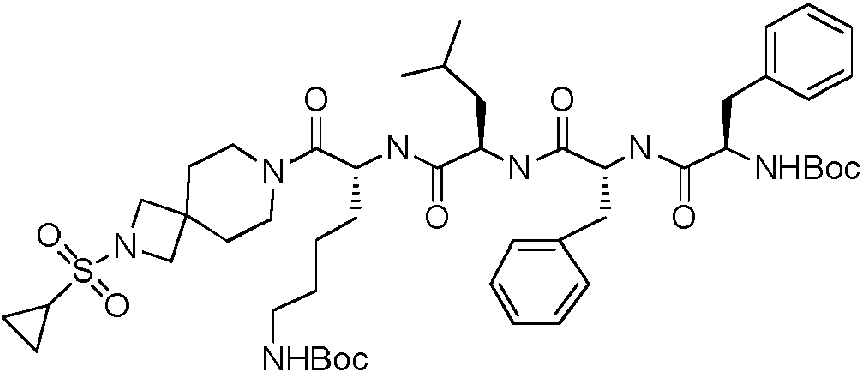
Se añadieron 2-ciclopropilsulfonil-2,7-diazaespiro[3.5]nonano (6E) (161mg, 0,7 mmol), clorhidrato de 1-(3-dimetilaminopropil)-3-etilcarbodiimida (124 mg, 0,8 mmol), 1-hidroxibenzotriazol (108 mg, 0,8 mmol), producto intermedio 1 (500 mg, 0,7 mmol) y diclorometano (30 ml) en un matraz de reacción de 50 ml y se permitió que reaccionase el sistema a temperatura ambiente durante 5 h. Se concentró la disolución de reacción a presión reducida y se separó el residuo y se purificó mediante cromatografía en columna de gel de sílice (éter de petróleo:acetato de etilo (v:v) = 1:2) para obtener N-[(1R)-1-bencil-2-[[(1R)-1-bencil-2-[[(1R)-1-[[(1R)-5-(terc-butoxicarbonilamino)-1-(2-ciclopropilsulfonil-2,7-diazaespiro[3.5]nonano-7-carbonil)pentil]carbamoil]-3-metil-butil]amino]-2-oxo-etil]amino]-2-oxo-etil]carbamato de terc-butilo (6F) como un sólido de color blanco (610 mg, rendimiento del 95%).2-Cyclopropylsulfonyl-2,7-diazaspiro[3.5]nonane (6E) (161mg, 0.7mmol), 1-(3-dimethylaminopropyl)-3-ethylcarbodiimide hydrochloride (124mg, 0.8mmol), 1-hydroxybenzotriazole (108 mg, 0.8 mmol), intermediate 1 (500 mg, 0.7 mmol) and dichloromethane (30 mL) in a 50 mL reaction flask and the system was allowed to react at room temperature for 5 a.m. The reaction solution was concentrated under reduced pressure, and the residue was separated and purified by silica gel column chromatography (petroleum ether:ethyl acetate (v:v) = 1:2) to obtain N-[(1R )-1-benzyl-2-[[(1R)-1-benzyl-2-[[(1R)-1-[[(1R)-5-(tert-butoxycarbonylamino)-1-(2-cyclopropylsulfonyl-2 tert-butyl ,7-diazaspiro[3.5]nonane-7-carbonyl)pentyl]carbamoyl]-3-methyl-butyl]amino]-2-oxo-ethyl]amino]-2-oxo-ethyl]carbamate (6F) as a white solid (610 mg, 95% yield).
Etapa 6:Stage 6:
(2R)-N-[(1R)-5-Amino-1-(2-ciclopropilsulfonil-2,7-diazaespiro[3.5]nonano-7-carbonil)pentil]-2-[[(2R)-2-[[(2R)-2-amino-3-fenil-propanoil]amino]-3-fenil-propanoil]amino]-4-metil-pentanamida (compuesto 6)(2R)-N-[(1R)-5-Amino-1-(2-cyclopropylsulfonyl-2,7-diazaspiro[3.5]nonane-7-carbonyl)pentyl]-2-[[(2R)-2-[ [(2R)-2-amino-3-phenyl-propanoyl]amino]-3-phenyl-propanoyl]amino]-4-methyl-pentanamide (compound 6)

Se añadieron N-[(1R)-1-bencil-2-[[(1R)-1-bencil-2-[[(1R)-1-[[(1R)-5-(terc-butoxicarbonilamino)1]-(2-ciclopropilsulfonil-2,7-diazaespiro[3.5]nonano-7-carbonil)pentil]carbamoil]-3-metil-butil]amino]-2-oxo-etil]amino]-2-oxo-etil]carbamato de terc-butilo (6f) (300 mg, 0,31 mmol) y ácido trifluoroacético (2 ml) en un matraz de reacción de 50 ml y se permitió que reaccionase el sistema a temperatura ambiente durante 2 h. Se concentró la disolución de reacción a presión reducida y se separó el residuo y se purificó mediante cromatografía de líquidos preparativa (condiciones de preparación: instrumento: GX-281 de Gilson; columna: Xbridge C18, 150 x 30 mm de D.I., 5 |am; fase móvil: A para ACN y B para H2O; isocrático: 65% de A; velocidad de flujo: 30 ml/min; contrapresión:1000 psi; temperatura de columna: 30°C; longitud de onda: 210 nm; periodo: 18 min; preparación de la muestra: se disolvió el compuesto en 12 ml de metanol; inyección: 0,9 ml/aguja). Se concentró la preparación a presión reducida para eliminar la mayor parte del disolvente y se liofilizó para obtener un compuesto pulverulento de color blanco. Luego, se usó la resina de intercambio iónico (se eluyó con agua hasta el 3,3% de amoniaco) para concentrar la disolución de elución recibida a presión reducida (se concentró a presión reducida a 25 ml a 60°C) y se liofilizó adicionalmente para obtener (2R)-N-[(1R)-5-amino-1-(2-ciclopropilsulfonil-2,7-diazaespiro[3.5]nonano-7-carbonil)pentil]-2-[[(2R)-2-[[(2R)-2-amino-3-fenil-propanoil]amino]-3-fenil-propanoil]amino]-4-metil-pentanamida (compuesto 6) como un sólido de color blanco (153 mg, rendimiento del 63%).N-[(1R)-1-benzyl-2-[[(1R)-1-benzyl-2-[[(1R)-1-[[(1R)-5-(tert-butoxycarbonylamino)1] -(2-cyclopropylsulfonyl-2,7-diazaspiro[3.5]nonane-7-carbonyl)pentyl]carbamoyl]-3-methyl-butyl]amino]-2-oxo-ethyl]amino]-2-oxo-ethyl]carbamate of tert-butyl (6f) (300 mg, 0.31 mmol) and trifluoroacetic acid (2 mL) in a 50 mL reaction flask and the system was allowed to react at room temperature for 2 h. The reaction solution was concentrated under reduced pressure, and the residue was separated and purified by preparative liquid chromatography (preparation conditions: instrument: Gilson GX-281; column: Xbridge C18, 150 x 30 mm ID, 5 µm ; mobile phase: A for ACN and B for H2O; isocratic: 65% A; flow rate: 30 mL/min; back pressure: 1000 psi; column temperature: 30°C; wavelength: 210 nm; period: 18 min, sample preparation: compound was dissolved in 12 mL methanol, injection: 0.9 mL/needle). The preparation was concentrated under reduced pressure to remove most of the solvent and it was lyophilized to obtain a white powdery compound. Then, the ion-exchange resin (was eluted with water to 3.3% ammonia) was used to concentrate the received eluting solution under reduced pressure (was concentrated under reduced pressure to 25 ml at 60°C) and lyophilized. further to obtain (2R)-N-[(1R)-5-amino-1-(2-cyclopropylsulfonyl-2,7-diazaspiro[3.5]nonane-7-carbonyl)pentyl]-2-[[(2R)- 2-[[(2R)-2-amino-3-phenyl-propanoyl]amino]-3-phenyl-propanoyl]amino]-4-methyl-pentanamide (compound 6) as a white solid (153 mg, yield of 63%).
EM m/z = 383,8 [M+2H]+/2;MS m/z = 383.8 [M+2H]+/2;
1H-RMN (400 MHz, D2O) 87,40-7,24 (m, 6H), 7,16 (dd, 4H), 4,72-4,73 (m, 1H), 4,58-4,52 (m, 1H), 4,25 (t, 1H), 3,84 (dd'' 4H), 3,67-3,55 (m, 3H), 3,46-3,45 (m, 1H), 3,35-3,34 (m, 1H), 3,03 (dd, 1H), 2,91 (dd, 3H), 2,82 (d, 2H), 2,69 (ddd, 1H), 1,85-1,86 (m, 3H), 1,670-1,66 (m, 5H), 1,51-1,49 (m, 3H), 1,38-1,36 (m, 2H), 1,23-1,06 (m, 4H)), 0,88 (dd, 6H).1H-NMR (400 MHz, D2O) 87.40-7.24 (m, 6H), 7.16 (dd, 4H), 4.72-4.73 (m, 1H), 4.58-4, 52 (m, 1H), 4.25 (t, 1H), 3.84 (dd'' 4H), 3.67-3.55 (m, 3H), 3.46-3.45 (m, 1H ), 3.35-3.34 (m, 1H), 3.03 (dd, 1H), 2.91 (dd, 3H), 2.82 (d, 2H), 2.69 (dd, 1H) , 1.85-1.86 (m, 3H), 1.670-1.66 (m, 5H), 1.51-1.49 (m, 3H), 1.38-1.36 (m, 2H) , 1.23-1.06 (m, 4H)), 0.88 (dd, 6H).
Ejemplo 5:Example 5:
Di-trifluoroacetato de (2R)-N-[(1R)-5-amino-1-(2-metilsulfonil-2,7-diazaespiro[3.5]nonano-7-carbonil)pentil]-2-[[(2R)-2-[[(2R)-2-amino-3-fenil-propanoil]amino]-3-fenil-propanoil]amino]-4-metil-pentanamida (compuesto 7)(2R)-N-[(1R)-5-amino-1-(2-methylsulfonyl-2,7-diazaspiro[3.5]nonane-7-carbonyl)pentyl]-2-[[(2R) di-trifluoroacetate -2-[[(2R)-2-amino-3-phenyl-propanoyl]amino]-3-phenyl-propanoyl]amino]-4-methyl-pentanamide (compound 7)

Etapa 1:Stage 1:
2-Metilsulfonil-2,7-diazaespiro[3.5]nonano-7-carboxilato de bencilo (7A)Benzyl 2-methylsulfonyl-2,7-diazaspiro[3.5]nonane-7-carboxylate (7A)

Se añadieron 2,7-diazaespiro[3.5]nonano-7-carboxilato de bencilo (6C) (330mg, 1,3mmol), trietilamina (263 mg, 2,6 mmol) y diclorometano (20 ml) en un matraz de reacción de 50 ml y se agitó para disolverlo. Después de enfriar hasta -10°C, se añadió gota a gota cloruro de metanosulfonilo (164 mg, 1,43 mmol) y se permitió que avanzase la reacción durante 4 h. Luego se elevó la temperatura hasta temperatura ambiente. Se lavó la disolución de reacción con una disolución acuosa saturada de bicarbonato de sodio (60 ml), una disolución acuosa de ácido clorhídrico 3 N (60 ml) y se sometió la mezcla a un proceso de separación de líquido. Se secaron las fases orgánicas sobre sulfato de sodio anhidro, se filtraron y se concentró el filtrado a presión reducida. Se separó el residuo y se purificó mediante cromatografía en columna de gel de sílice (éter de petróleo:acetato de etilo (v:v) = 1:1) para obtener 2-metilsulfonil-2,7-diazaespiro[3.5]nonano-7-carboxilato de bencilo (7A) como una sustancia oleosa de color amarillo claro (236 mg, rendimiento del 54,6%).Benzyl 2,7-diazaspiro[3.5]nonane-7-carboxylate (6C) (330mg, 1.3mmol), triethylamine (263mg, 2.6mmol) and dichloromethane (20mL) were added to a reaction flask of 50 mL and stirred to dissolve. After cooling to -10°C, methanesulfonyl chloride (164 mg, 1.43 mmol) was added dropwise and the reaction was allowed to proceed for 4 h. The temperature was then raised to room temperature. The reaction solution was washed with a saturated sodium bicarbonate aqueous solution (60 ml), a 3N hydrochloric acid aqueous solution (60 ml), and the mixture was subjected to a liquid separation process. The organic phases were dried over anhydrous sodium sulfate, filtered, and the filtrate was concentrated under reduced pressure. The residue was separated and purified by silica gel column chromatography (petroleum ether:ethyl acetate (v:v) = 1:1) to obtain 2-methylsulfonyl-2,7-diazaspiro[3.5]nonane-7 -benzyl carboxylate (7A) as a light yellow oily substance (236 mg, 54.6% yield).
EM m/z = 339,0 [M+H]+;MS m/z = 339.0 [M+H]+;
1H-RMN (400 MHz, CDCls) 87,41-7,28 (m, 5H), 5,12 (s, 2H), 3,68 (s, 4H), 3,50-3,38 (m, 4H), 2,86 (s, 3H), 1,83-1,70 (m, 4H).1H-NMR (400 MHz, CDCls) 87.41-7.28 (m, 5H), 5.12 (s, 2H), 3.68 (s, 4H), 3.50-3.38 (m, 4H), 2.86 (s, 3H), 1.83-1.70 (m, 4H).
Etapa 2:Stage 2:
2-Metilsulfonil-2,7-diazaespiro[3.5]nonano (7B) 2-Methylsulfonyl-2,7-diazaspiro[3.5]nonane (7B)

Se añadieron 2-metilsulfonil-2,7-diazaespiro[3.5]nonano-7-carboxilato de bencilo (7A) (236 mg, 0,7 mmol), paladio sobre carbono (40 mg, al 20% en peso) y metanol (20 ml) en un matraz de reacción de 50 ml. Se reemplazó la atmósfera por hidrógeno 3 veces y se permitió que avanzase la reacción a temperatura ambiente durante 8 h bajo una atmósfera de hidrógeno (globo). Luego, se filtró la disolución de reacción a través de tierra de diatomeasy se concentró el filtrado a presión reducida para obtener 2-metilsulfonil-2,7-diazaespiro[3.5]nonano (7B) en bruto como un sólido de color amarillo claro (133 mg, rendimiento del 100%) y se usó directamente en la siguiente reacción.Benzyl 2-methylsulfonyl-2,7-diazaspiro[3.5]nonane-7-carboxylate (7A) (236 mg, 0.7 mmol), palladium on carbon (40 mg, 20 wt%) and methanol ( 20 ml) in a 50 ml reaction flask. The atmosphere was replaced by hydrogen 3 times and the reaction was allowed to proceed at room temperature for 8 h under a hydrogen atmosphere (balloon). Then, the reaction solution was filtered through diatomaceous earth and the filtrate was concentrated under reduced pressure to obtain crude 2-methylsulfonyl-2,7-diazaspiro[3.5]nonane (7B) as light yellow solid (133 mg, 100% yield) and used directly in the next reaction.
EM m/z = 205,1 [M+1]+;MS m/z = 205.1 [M+1]+;
Etapa 3:Stage 3:
N-[(1R)-1-bencil-2-[[(1R)-1-bencil-2-[[(1R)-1-[[(1R)-5-(terc-butoxicarbonilamino)-1-(2-metilsulfonil-2,7-diazaespiro[3.5]nonano-7-carbonil)pentil]carbamoil]-3-metil-butil]amino]-2-oxo-etil]amino]-2-oxo-etil]carbamato de terc-butilo (7c )N-[(1R)-1-benzyl-2-[[(1R)-1-benzyl-2-[[(1R)-1-[[(1R)-5-(tert-butoxycarbonylamino)-1-( tert 2-methylsulfonyl-2,7-diazaspiro[3.5]nonane-7-carbonyl)pentyl]carbamoyl]-3-methyl-butyl]amino]-2-oxo-ethyl]amino]-2-oxo-ethyl]carbamate -butyl(7c)

Se añadieron 2-metilsulfonil-2,7-diazaespiro[3.5]nonano (7B) en bruto (133mg, 0,65 mmol), clorhidrato de 1-(3-dimetilaminopropil)-3-etilcarbodiimida (374 mg, 1,95 mmol), 1-hidroxibenzotriazol (96,6 mg, 0,72 mmol), producto intermedio 1 (490 mg, 0,65 mmol) y diclorometano (30 ml) en un matraz de reacción de 50 ml y se permitió que reaccionase el sistema a temperatura ambiente durante 5 h. Luego, se concentró la disolución de reacción a presión reducida y se separó el residuo y se purificó mediante cromatografía en columna de gel de sílice (éter de petróleo:acetato de etilo (v:v) = 1:2) para obtener N-[(1R)-1-bencil-2-[[(1R)-1-bencil-2-[[(1R)-1-[[(1R)-5-(tercbutoxicarbonilamino)-1-(2-metilsulfonil-2,7)-diazaespiro[3.5]nonano-7-carbonil)pentil]carbamoil]-3-metil-butil]amino]-2-oxo-etil]amino]-2-oxo-etil]carbamato de terc-butilo (7C) como un sólido de color amarillo claro (317 mg, rendimiento del 52%).Crude 2-methylsulfonyl-2,7-diazaspiro[3.5]nonane (7B) (133mg, 0.65mmol), 1-(3-dimethylaminopropyl)-3-ethylcarbodiimide hydrochloride (374mg, 1.95mmol ), 1-hydroxybenzotriazole (96.6 mg, 0.72 mmol), intermediate 1 (490 mg, 0.65 mmol), and dichloromethane (30 mL) in a 50 mL reaction flask and the system was allowed to react. at room temperature for 5 h. Then, the reaction solution was concentrated under reduced pressure, and the residue was separated and purified by silica gel column chromatography (petroleum ether:ethyl acetate (v:v) = 1:2) to obtain N-[ (1R)-1-benzyl-2-[[(1R)-1-benzyl-2-[[(1R)-1-[[(1R)-5-(tertbutoxycarbonylamino)-1-(2-methylsulfonyl-2 tert-butyl (7C ) as a light yellow solid (317 mg, 52% yield).
Etapa 4:Stage 4:
(2R)-N-[(1R)-5-Amino-1-(2-metilsulfonil-2,7-diazaespiro[3.5]nonano-7-carbonil)pentil]-2-[[(2R)-2-[[(2R)-2-amino-3-fenil-propanoil]amino]-3-fenil-propanoil]amino]-4-metil-pentanamida (compuesto 7)(2R)-N-[(1R)-5-Amino-1-(2-methylsulfonyl-2,7-diazaspiro[3.5]nonane-7-carbonyl)pentyl]-2-[[(2R)-2-[ [(2R)-2-amino-3-phenyl-propanoyl]amino]-3-phenyl-propanoyl]amino]-4-methyl-pentanamide (compound 7)
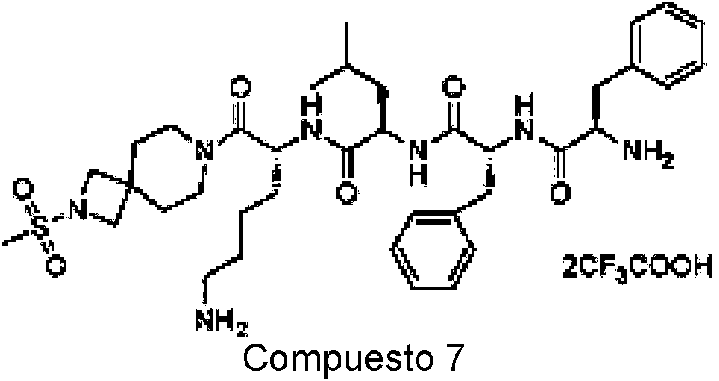
Se añadieron N-[(1R)-1-bencil-2-[[(1R)-1-bencil-2-[[(1R)-1-[[(1R)-5-(terc-butoxicarbonilamino)1-(2)-metilsulfonil-2,7-diazaespiro[3.5]nonano-7-carbonil)pentil]carbamoil]-3-metil-butil]amino]-2-oxo-etil]amino]-2-oxo-etil]carbamato de terc-butilo (7C) (317 mg, 0,34 mmol) y ácido trifluoroacético (2 ml) en un matraz de reacción de 50 ml y se permitió que reaccionase el sistema a temperatura ambiente durante 2 h. Luego, se concentró la disolución de reacción a presión reducida y se separó el residuo y se purificó por cromatografía de líquidos preparativa (condiciones de preparación: instrumento: GX-281 de Gilson; columna: Xbridge C18, 150 x 30 mm de D.I., 5 |am; fase móvil: A para ACN y B para H2O; isocrático: 65% de A; velocidad de flujo: 30 ml/min; contrapresión:1000 psi; temperatura de columna: 30°C; longitud de onda: 210 nm; periodo: 18 min; preparación de la muestra: se disolvió el compuesto en 12 ml de metanol; inyección: 0,9 ml/aguja). Se recogió la preparación y se concentró a presión reducida para eliminar la mayor parte del disolvente orgánico y se liofilizó para obtener (2R)-N-[(1R)-5-amino-1-(2-metilsulfonil-2,7-diazaespiro[3.5]nonano-7-carbonil)pentil]-2-[[(2R)-2-[[(2R)-2-amino-3-fenil-propanoil]amino]-3-fenil-propanoil]amino] 4-metil-pentanamida (compuesto 7) como un polvo de color blanco (217 mg, rendimiento del 66,5%).N-[(1R)-1-benzyl-2-[[(1R)-1-benzyl-2-[[(1R)-1-[[(1R)-5-(tert-butoxycarbonylamino)1- (2)-methylsulfonyl-2,7-diazaspiro[3.5]nonane-7-carbonyl)pentyl]carbamoyl]-3-methyl-butyl]amino]-2-oxo-ethyl]amino]-2-oxo-ethyl]carbamate of tert-butyl (7C) (317 mg, 0.34 mmol) and trifluoroacetic acid (2 mL) in a 50 mL reaction flask and the system was allowed to react at room temperature for 2 h. Then, the reaction solution was concentrated under reduced pressure, and the residue was separated and purified by preparative liquid chromatography (preparation conditions: instrument: Gilson GX-281; column: Xbridge C18, 150 x 30 mm ID, 5 |am Mobile phase: A for ACN and B for H2O Isocratic: 65% A Flow rate: 30 mL/min Back pressure: 1000 psi Column temperature: 30°C Wavelength: 210 nm period: 18 min; sample preparation: compound was dissolved in 12 ml methanol; injection: 0.9 ml/needle). The preparation was collected and concentrated under reduced pressure to remove most of the organic solvent and lyophilized to obtain (2R)-N-[(1R)-5-amino-1-(2-methylsulfonyl-2,7-diazaspiro[3.5]nonane-7-carbonyl)pentyl]-2-[[(2R)-2-[ [(2R)-2-amino-3-phenyl-propanoyl]amino]-3-phenyl-propanoyl]amino] 4-methyl-pentanamide (compound 7) as a white powder (217 mg, 66.5% yield). %).
EM m/z = 370,8 [M+2H]+/2;MS m/z = 370.8 [M+2H]+/2;
1H-RMN (400 MHz, D2O) 87,43-7,27 (m, 6H), 7,25-7,20 (m, 4H), 4,67-4,62 (m, 2H), 4,33-4,20 (m, 2H), 3,87-3,71 (m, 4H), 3,69-3,56 (m, 2H), 3,53-3,41 (m, 1H), 3,40-3,29 (m, 1H), 3,23-3,12 (m, 2H), 3,11-3,07 (m, 3H), 3,07-2,91 (m, 4H)), 1,94-1,78 (m, 3H), 1,78-1,60 (m, 5H), 1,58-1,48 (m, 3H), 1,46-1,28 (m, 2H), 0,98-0,82 (m, 6H).1H-NMR (400 MHz, D2O) 87.43-7.27 (m, 6H), 7.25-7.20 (m, 4H), 4.67-4.62 (m, 2H), 4, 33-4.20 (m, 2H), 3.87-3.71 (m, 4H), 3.69-3.56 (m, 2H), 3.53-3.41 (m, 1H), 3.40-3.29 (m, 1H), 3.23-3.12 (m, 2H), 3.11-3.07 (m, 3H), 3.07-2.91 (m, 4H )), 1.94-1.78 (m, 3H), 1.78-1.60 (m, 5H), 1.58-1.48 (m, 3H), 1.46-1.28 ( m, 2H), 0.98-0.82 (m, 6H).
Ejemplo 6:Example 6:
(2R)-N-[(1R)-1-(2-Acetil-2,7-diazaespiro[3.5]nonano-7-carbonil)-5-amino-pentil]-2-[[(2R)-2-[[(2R)-2-amino-3-fenilpropanoil]amino]-3-fenil-propanoil]amino]-4-metil-pentanamida; di-ácido trifluoroacético (compuesto 8)(2R)-N-[(1R)-1-(2-Acetyl-2,7-diazaspiro[3.5]nonane-7-carbonyl)-5-amino-pentyl]-2-[[(2R)-2- [[(2R)-2-amino-3-phenylpropanoyl]amino]-3-phenyl-propanoyl]amino]-4-methyl-pentanamide; di-trifluoroacetic acid (compound 8)

2-Acetil-2,7-diazaespiro[3.5]nonano-7-carboxilato de bencilo (8A)Benzyl 2-Acetyl-2,7-diazaspiro[3.5]nonane-7-carboxylate (8A)

Se disolvió 2,7-diazaespiro[3.5]nonano-7-carboxilato de bencilo (6C) (520 mg, 2,0 mmol) en diclorometano (5 ml) bajo protección de nitrógeno en un matraz de reacción de 50 ml y se añadió trietilamina (607 mg, 6,0 mmol) con agitación. Luego, se redujo la temperatura hasta -20°C y se añadió gota a gota cloruro de acetilo (314 mg, 4,0 mmol). Después de la adición, se elevó de manera natural la temperatura hasta temperatura ambiente y se agitó durante 2 h. Luego, se añadió a la reacción una disolución acuosa diluida de ácido clorhídrico 0,5 M (20 ml), se separaron las fases con agitación y se sometió la mezcla a un proceso de separación de líquido. Se extrajo la fase acuosa con diclorometano (20 ml x 2) y se combinaron las fases orgánicas. Se secaron las fases orgánicas sobre sulfato de sodio anhidro, se filtraron y se concentró el filtrado a presión reducida. Se separó el residuo y se purificó mediante cromatografía en columna de gel de sílice (acetato de etilo puro) para obtener el compuesto de 2-acetil-2,7-diazaespiro[3.5]nonano-7-carboxilato de bencilo (8A) como un líquido oleoso de color amarillo claro (440 mg, rendimiento del 72,8%).Benzyl 2,7-diazaspiro[3.5]nonane-7-carboxylate (6C) (520 mg, 2.0 mmol) was dissolved in dichloromethane (5 mL) under nitrogen protection in a 50 mL reaction flask and added triethylamine (607 mg, 6.0 mmol) with stirring. The temperature was then lowered to -20°C and acetyl chloride (314 mg, 4.0 mmol) was added dropwise. After the addition, the temperature naturally rose to room temperature and stirred for 2 h. Then, a dilute aqueous solution of 0.5M hydrochloric acid (20 ml) was added to the reaction, the phases were separated with stirring, and the mixture was subjected to a liquid separation process. The aqueous phase was extracted with dichloromethane (20 ml x 2) and the organic phases were combined. The organic phases were dried over anhydrous sodium sulfate, filtered, and the filtrate was concentrated under reduced pressure. The residue was separated and purified by silica gel column chromatography (pure ethyl acetate) to obtain benzyl 2-acetyl-2,7-diazaspiro[3.5]nonane-7-carboxylate compound (8A) as a compound. light yellow oily liquid (440 mg, 72.8% yield).
Etapa 2:Stage 2:
1-(2,7-Diazaespiro[3.5]nonan-2-il)etanona (8B) 1-(2,7-Diazaspiro[3.5]nonan-2-yl)ethanone (8B)

Se añadió 2-acetil-2,7-diazaespiro[3.5]nonano-7-carboxilato de bencilo (8A) (440 mg, 1,46 mmol) a una disolución mixta de acetato de etilo (5 ml) y metanol (2 ml) en un matraz de reacción de 50 ml. Luego se añadió paladio sobre carbono (80 mg, al 20% en peso) y se agitó el sistema bajo una atmósfera de hidrógeno (globo) a temperatura ambiente durante 2 h. Luego, se filtró la disolución de reacción y se concentró el filtrado a presión reducida para obtener 1-(2,7-diazaespiro[3.5]nonan-2-il)etanona (8B) en bruto como un líquido oleoso de color amarillo claro (250 mg, rendimiento del 99%) y se usó directamente en la siguiente reacción.Benzyl 2-acetyl-2,7-diazaspiro[3.5]nonane-7-carboxylate (8A) (440 mg, 1.46 mmol) was added to a mixed solution of ethyl acetate (5 mL) and methanol (2 mL ) in a 50 mL reaction flask. Palladium on carbon (80 mg, 20 wt%) was then added and the system was stirred under an atmosphere of hydrogen (balloon) at room temperature for 2 h. Then, the reaction solution was filtered, and the filtrate was concentrated under reduced pressure to obtain crude 1-(2,7-diazaspiro[3.5]nonan-2-yl)ethanone (8B) as a pale yellow oily liquid ( 250 mg, 99% yield) and used directly in the next reaction.
Etapa 3:Stage 3:
N-[(1R)-2-[[(1R)-2-[[(1R)-1-[[(1R)-1-(2-acetil-2,7-diazaespiro[3.5]nonano-7-carbonil)-5-(tercbutoxicarbonilamino)pentil]carbamoil]-3-metil-butil]amino]-1-bencil-2-oxo-etil]amino]-1-bencil-2-oxo-etil]carbamato de terc-butilo (8C)N-[(1R)-2-[[(1R)-2-[[(1R)-1-[[(1R)-1-(2-acetyl-2,7-diazaspiro[3.5]nonane-7- tert-butyl carbonyl)-5-(tert-butoxycarbonylamino)pentyl]carbamoyl]-3-methyl-butyl]amino]-1-benzyl-2-oxo-ethyl]amino]-1-benzyl-2-oxo-ethyl]carbamate (8C)

Se añadió 1-(2,7-diazaespiro[3.5]nonan-2-il)etanona (8B) en bruto (200 mg, 1,19 mmol) en acetato de etilo (10 ml) en un matraz de reacción de 50 ml bajo protección de nitrógeno. Se enfrió hasta 0°C en un baño de hielo, luego se añadieron el producto intermedio 1 (867 mg, 1,15 mmol), clorhidrato de 1-(3-dimetilaminopropil)-3-etilcarbodiimida (331 mg, 1,73 mmol), 1-hidroxibenzotriazol (186 mg, 1,38 mmol). Después de la adición, se permitió que avanzase la reacción a temperatura ambiente durante 1,5 h. Posteriormente, se añadió a la disolución de reacción una disolución acuosa de ácido clorhídrico 1 N (15 ml), y se agitó la mezcla y luego se sometió a un proceso de separación de líquido. Se añadió una disolución acuosa saturada de carbonato de sodio (15 ml) a la fase orgánica y se agitó la mezcla durante 30 minutos y luego se sometió a un proceso de separación de líquido. Se lavó la fase orgánica con una disolución acuosa saturada de cloruro de sodio (15 ml), se secó sobre sulfato de sodio anhidro, se filtró y se concentró el filtrado a presión reducida para obtener N-[(1R)-2-[[(1R)-2-[[(1R)-1-[[(1R)-1-(2-acetil-2,7-diazaespiro[3.5]nonano-7-carbonil)-5-(terc-butoxicarbonilamino)pentil]carbamoil]-3-metil-butil]amino]-1-bencil-2-oxo-etil]amino]-1-bencil-2-oxoetil]carbamato de terc-butilo (8C) como un sólido espumoso de color amarillo claro (1,04 g, rendimiento del 99%) y se usó directamente en la siguiente reacción.Crude 1-(2,7-diazaspiro[3.5]nonan-2-yl)ethanone (8B) (200 mg, 1.19 mmol) in ethyl acetate (10 mL) was added to a 50 mL reaction flask under nitrogen protection. Cooled to 0°C in an ice bath, then intermediate 1 (867 mg, 1.15 mmol), 1-(3-dimethylaminopropyl)-3-ethylcarbodiimide hydrochloride (331 mg, 1.73 mmol ), 1-hydroxybenzotriazole (186 mg, 1.38 mmol). After the addition, the reaction was allowed to proceed at room temperature for 1.5 h. Subsequently, a 1N hydrochloric acid aqueous solution (15 ml) was added to the reaction solution, and the mixture was stirred and then subjected to a liquid separation process. A saturated aqueous solution of sodium carbonate (15 ml) was added to the organic phase, and the mixture was stirred for 30 minutes, and then subjected to a liquid separation process. The organic layer was washed with a saturated aqueous sodium chloride solution (15 mL), dried over anhydrous sodium sulfate, filtered, and the filtrate was concentrated under reduced pressure to obtain N-[(1R)-2-[[ (1R)-2-[[(1R)-1-[[(1R)-1-(2-acetyl-2,7-diazaspiro[3.5]nonane-7-carbonyl)-5-(tert-butoxycarbonylamino)pentyl tert-Butyl]carbamoyl]-3-methyl-butyl]amino]-1-benzyl-2-oxo-ethyl]amino]-1-benzyl-2-oxoethyl]carbamate (8C) as light yellow foamy solid (1.04 g, 99% yield) and used directly in the next reaction.
Etapa 4:Stage 4:
(2R)-N-[(1R)-1-(2-Acetil-2,7-diazaespiro[3.5]nonano-7-carbonil)-5-amino-pentil]-2-[[(2R)-2-[[(2R)-2-amino-3-fenilpropanoil]amino]-3-fenil-propanoil]amino]-4-metil-pentanamida; di-ácido trifluoroacético (compuesto 8)(2R)-N-[(1R)-1-(2-Acetyl-2,7-diazaspiro[3.5]nonane-7-carbonyl)-5-amino-pentyl]-2-[[(2R)-2- [[(2R)-2-amino-3-phenylpropanoyl]amino]-3-phenyl-propanoyl]amino]-4-methyl-pentanamide; di-trifluoroacetic acid (compound 8)

Se disolvió N-[(1R)-2-[[(1R)-2-[[(1R)-1-[[(1R)-1-(2-acetil-2,7-diazaespiro[3.5]nonano-7-carbonil)-5-(tercbutox¡carbon¡lam¡no)pent¡l]carbamo¡l]-3-metil-but¡ljam¡no]-í-benc¡l-2-oxo-et¡l]am¡no]-1-benc¡l-2-oxo-et¡l]carbamato de terc-butilo (8C) en bruto (1,04 g, 1,15 mmol) en diclorometano (7,5 ml) y se añadió ácido trifluoroacético (3,5 ml). Se agitó el sistema a temperatura ambiente durante 1 h. Posteriormente, se concentró la disolución de reacción a presión reducida. Después de que se separó el residuo y se purificó mediante cromatografía de líquidos preparativa (condiciones de preparación: instrumento: GX-281 de Gilson; columna: Xbridge C18, 150 x 30 mm de D.I., 5 |am; fase móvil: A para ACN y B para H2O; isocrático: 65% de A; velocidad de flujo: 30 ml/min; contrapresión:1000 psi; temperatura de columna: 30°C; longitud de onda: 210 nm; periodo: 18 min; preparación de la muestra: se disolvió el compuesto en 12 ml de metanol; inyección: 0,9 ml/aguja), se recogió la preparación y se concentró a presión reducida para eliminar la mayor parte del disolvente orgánico y se liofilizó para obtener (2R)-N-[(1R)-1-(2-acetil-2,7-diazaespiro[3.5]nonano-7-carbonil)-5-amino-pentil]-2-[[(2R)-2-[[(2R)-2-amino-3-fenilpropanoil]amino]-3-fenilpropanoil]amino]-4-metil-pentanamida; di-ácido trifluoroacético (compuesto 8) como un sólido de color blanco (460 mg, rendimiento en dos etapas del 42,9%).N-[(1R)-2-[[(1R)-2-[[(1R)-1-[[(1R)-1-(2-acetyl-2,7-diazaspiro[3.5]nonane- 7-carbonyl)-5-(tert-butoxycarbon¡lam¡no)pent¡l]carbamo¡l]-3-methyl-but¡ljam¡no]-í-benzil-2-oxo-et¡l] Crude tert-butyl amino]-1-benzyl-2-oxo-ethyl]carbamate (8C) (1.04 g, 1.15 mmol) in dichloromethane (7.5 mL) and trifluoroacetic acid (3.5 mL) was added. The system was stirred at room temperature for 1 h. Subsequently, the reaction solution was concentrated under reduced pressure. After the residue was separated and purified by preparative liquid chromatography (preparation conditions: instrument: Gilson GX-281; column: Xbridge C18, 150 x 30 mm ID, 5 |am; mobile phase: A for ACN and B for H2O; isocratic: 65% A; flow rate : 30 mL/min; back pressure: 1000 psi; column temperature: 30°C; wavelength: 210 nm; period: 18 min; sample preparation: compound was dissolved in 12 mL methanol; injection: 0. 9 mL/needle), the preparation was collected and concentrated under reduced pressure to remove most of the organic solvent and lyophilized to obtain (2R)-N-[(1R)-1-(2-acetyl-2,7 -diazaspiro[3.5]nonane-7-carbonyl)-5-amino-pentyl]-2-[[(2R)-2-[[(2R)-2-amino-3-phenylpropanoyl]amino]-3-phenylpropanoyl] amino]-4-methyl-pentanamide; di-trifluoroacetic acid (compound 8) as a white solid (460 mg, 42.9% two-step yield).
EM m/z (ESI): 352,8 [M+2H]+/2;MS m/z (ESI): 352.8 [M+2H]+/2;
1H-RMN (400 MHz, D2O) 87,49-7,00 (m, 10H), 4,66-4,49 (m, 2H), 4,30-3,93 (m, 4H), 3,79-3,54 (m, 4H), 3,52-3,25 (m, 2H), 3,22-2,90 (m, 6H), 1,92-1,27 (m, 16H), 1,02-0,75 (m, 6H).1H-NMR (400 MHz, D2O) 87.49-7.00 (m, 10H), 4.66-4.49 (m, 2H), 4.30-3.93 (m, 4H), 3, 79-3.54 (m, 4H), 3.52-3.25 (m, 2H), 3.22-2.90 (m, 6H), 1.92-1.27 (m, 16H), 1.02-0.75 (m, 6H).
Compuesto 8-1:Compound 8-1:
Se hizo pasar el compuesto 8 (1,0 g, 1,07 mmol) a través de una resina de intercambio iónico (60 ml) (se eluyó con agua 3,3% de amoniaco) y se concentró la disolución de elución recibida a presión reducida (se concentró a presión reducida hasta 100 ml a 60°C) y se liofilizó adicionalmente para obtener el compuesto 8-1 como la forma libre del compuesto 8 como un sólido de color blanco (451 mg, rendimiento del 60,0%).Compound 8 (1.0 g, 1.07 mmol) was passed through an ion exchange resin (60 mL) (3.3% ammonia water eluted) and the received eluting solution was concentrated to reduced pressure (concentrated under reduced pressure to 100 mL at 60°C) and further lyophilized to obtain compound 8-1 as the free form of compound 8 as a white solid (451 mg, 60.0% yield). ).
EM m/z (ESI): 352,8 [M+2H]+/2;MS m/z (ESI): 352.8 [M+2H]+/2;
1H-RMN (400 MHz, D2O) 87,45-7,32 (m, 6H), 7,23 (dd, 4H), 4,85-4,75 (m, 1H), 4,64 (t, 1H), 4,35 (t, 1H), 4,07 (d, 2H), 3,83 (d, 2H), 3,74-3,63 (m, 3H), 3,62-3,50 (m, 1H), 3,50-3,39 (m, 1H), 3,17-2,65 (m, 6H), 2,01-1,66 (m, 9H), 1,65-1,30 (m, 7H), 0,96 (dd, 6H).1H-NMR (400 MHz, D2O) 87.45-7.32 (m, 6H), 7.23 (dd, 4H), 4.85-4.75 (m, 1H), 4.64 (t, 1H), 4.35 (t, 1H), 4.07 (d, 2H), 3.83 (d, 2H), 3.74-3.63 (m, 3H), 3.62-3.50 (m, 1H), 3.50-3.39 (m, 1H), 3.17-2.65 (m, 6H), 2.01-1.66 (m, 9H), 1.65-1 0.30 (m, 7H), 0.96 (dd, 6H).
Ejemplo 7:Example 7:
7-[(2R)-6-Amino-2-[[(2R)-2-[[(2R)-2-[[(2R)-2-amino-3-fenil-propanoil]amino]-3-fenil-propanoil]amino]-4-metilpentanoil]amino]hexanoil]-2,7-diazaespiro[3.5]nonano-2-carboxilato de isopropilo; di-ácido trifluoroacético (compuesto 9)7-[(2R)-6-Amino-2-[[(2R)-2-[[(2R)-2-[[(2R)-2-amino-3-phenyl-propanoyl]amino]-3- isopropyl phenyl-propanoyl]amino]-4-methylpentanoyl]amino]hexanoyl]-2,7-diazaspiro[3.5]nonane-2-carboxylate; di-trifluoroacetic acid (compound 9)

Etapa 1:Stage 1:
2,7-Diazaespiro[3.5]nonano-2,7-dicarboxilato de O7-bencilo y O2-isopropilo (9A)O7-benzyl O2-isopropyl 2,7-Diazaspiro[3.5]nonane-2,7-dicarboxylate (9A)

Se añadieron 2,7-diazaespiro[3.5]nonano-7-carboxilato de bencilo (6C) (310 mg, 1,2 mmol), trietilamina (364 mg, 3,6 mmol) y diclorometano (20 ml) en un matraz de una sola boca de 50 ml y se disolvió con agitación a temperatura ambiente. Luego se enfrió hasta -10°C y se añadió gota a gota cloroformiato de isopropilo (146 mg, 1,2 mmol). Después de la adición, se elevó la temperatura hasta temperatura ambiente y se permitió que avanzase la reacción durante 4 h. Se lavó el sistema de reacción secuencialmente con una disolución acuosa saturada de bicarbonato de sodio (60 ml), una disolución acuosa de ácido clorhídrico 3 M (60 ml) y se sometió la mezcla a un proceso de separación de líquido. Se secaron las fases orgánicas sobre sulfato de sodio anhidro, se filtraron y se concentró el filtrado a presión reducida. Se separó el residuo y se purificó mediante cromatografía en columna de gel de sílice (éter de petróleo:acetato de etilo (v:v) = 1:1) para obtener el compuesto 2,7-diazaespiro[3.5]nonano-2,7-dicarboxilato de O7-bencilo y O-isopropilo (9A) como un líquido oleoso de color amarillo claro (279 mg, rendimiento del 68%).Benzyl 2,7-diazaspiro[3.5]nonane-7-carboxylate (6C) (310 mg, 1.2 mmol), triethylamine (364 mg, 3.6 mmol), and dichloromethane (20 mL) were added to a flask. a single neck of 50 ml and dissolved with stirring at room temperature. It was then cooled to -10°C and isopropyl chloroformate (146mg, 1.2mmol) added dropwise. After the addition, the temperature was raised to room temperature and the reaction was allowed to proceed for 4 h. The reaction system was washed sequentially with a saturated aqueous sodium bicarbonate solution (60 ml), a 3M aqueous hydrochloric acid solution (60 ml), and the mixture was subjected to a process of liquid separation. The organic phases were dried over anhydrous sodium sulfate, filtered, and the filtrate was concentrated under reduced pressure. The residue was separated and purified by silica gel column chromatography (petroleum ether:ethyl acetate (v:v) = 1:1) to obtain 2,7-diazaspiro[3.5]nonane-2,7 compound O7-benzyl O-isopropyl dicarboxylate (9A) as a light yellow oily liquid (279 mg, 68% yield).
EM m/z = 347,2 [M+H]+;MS m/z = 347.2 [M+H]+;
1H-RMN (400 MHz, CDCls) 87,38-7,30 (m, 5H), 5,12 (s, 2H), 4,95-4,80 (m, 1H), 3,68 (s, 4H), 3,47-3,39 (m, 4H), 1,75 1,68 (m, 4H)), 1,23 (d, 6H).1H-NMR (400 MHz, CDCls) 87.38-7.30 (m, 5H), 5.12 (s, 2H), 4.95-4.80 (m, 1H), 3.68 (s, 4H), 3.47-3.39 (m, 4H), 1.75-1.68 (m, 4H)), 1.23 (d, 6H).
Etapa 2:Stage 2:
2,7-Diazaespiro[3.5]nonano-2-carboxilato de isopropilo (9B)Isopropyl 2,7-Diazaspiro[3.5]nonane-2-carboxylate (9B)

Se añadieron 2,7-diazaespiro[3.5]nonano-2,7-dicarboxilato de O7-bencilo y O-isopropilo (9A) (260 mg, 0,75 mmol), paladio sobre carbono (52 mg, al 20% en peso de l) y metanol (20 ml) en un matraz de una sola boca de 50 ml. Se reemplazó la atmósfera por hidrógeno 3 veces y se hizo reaccionar la mezcla a temperatura ambiente durante 8 h bajo una atmósfera de hidrógeno (globo). Luego, se filtró la disolución de reacción a través de tierra de diatomeas y se concentró el filtrado a presión reducida para obtener 2,7-diazaespiro[3.5]nonano-2-carboxilato de isopropilo (9B) en bruto como un sólido de color amarillo claro (159 mg, rendimiento del 100%) y se usó directamente en la siguiente reacción.O7-benzyl O-isopropyl 2,7-diazaspiro[3.5]nonane-2,7-dicarboxylate (9A) (260 mg, 0.75 mmol), palladium on carbon (52 mg, 20% wt. l) and methanol (20 mL) in a 50 mL single neck flask. The atmosphere was replaced with hydrogen 3 times, and the mixture was reacted at room temperature for 8 h under hydrogen atmosphere (balloon). Then, the reaction solution was filtered through diatomaceous earth, and the filtrate was concentrated under reduced pressure to obtain crude isopropyl 2,7-diazaspiro[3.5]nonane-2-carboxylate (9B) as a yellow solid. clear (159 mg, 100% yield) and used directly in the next reaction.
EM m/z = 213,2 [M+1].MS m/z = 213.2 [M+1].
Etapa 3:Stage 3:
7-[(2R)-6-(terc-Butoxicarbonilamino)-2-[[(2R)-2-[[(2R)-2-[[(2R)-2-(terc-butoxicarbonilamino)-3-]fenil-propanoil]amino]-3-fenil-propanoil]amino]-4-metil-pentanoil]amino]hexanoil]-2,7-diazaespiro[3.5]nonano-2-carboxilato de isopropilo (9C)7-[(2R)-6-(tert-Butoxycarbonylamino)-2-[[(2R)-2-[[(2R)-2-[[(2R)-2-(tert-Butoxycarbonylamino)-3-] Isopropyl phenyl-propanoyl]amino]-3-phenyl-propanoyl]amino]-4-methyl-pentanoyl]amino]hexanoyl]-2,7-diazaspiro[3.5]nonane-2-carboxylate (9C)

Se añadieron 2,7-diazaespiro[3.5]nonano-2-carboxilato de isopropilo (9B) en bruto (159 mg, 0,75 mmol), clorhidrato de 1-(3-dimetilaminopropil)-3-etilcarbodiimida (374 mg, 1,95 mmol), 1-hidroxibenzotriazol (110 mg, 0,81 mmol), producto intermedio 1 (565 mg, 0,75 mmol) y diclorometano (30 ml) en un matraz de una sola boca de 50 ml y se permitió que reaccionase el sistema a temperatura ambiente durante 5 h. Luego, se concentró la disolución de reacción a presión reducida. Se separó el residuo y se purificó mediante cromatografía en columna de gel de sílice (éter de petróleo:acetato de etilo (v:v) = 1:2) para obtener 7-[(2R)-6-(terc-butoxicarbonilamino)-2-[[(2R)-2-[[(2R)-2-[[(2R)-2-(terc-butoxicarbonilamino)-3-fenil-propanoil]amino]-3-fenil-propanoil]amino]-4-metilpentanoil]amino]hexanoil]-2,7-diazaespiro[3.5]nonano-2-carboxilato de isopropilo (9c ) como un sólido de color amarillo claro (556 mg, rendimiento del 78%).Crude isopropyl 2,7-diazaspiro[3.5]nonane-2-carboxylate (9B) (159 mg, 0.75 mmol), 1-(3-dimethylaminopropyl)-3-ethylcarbodiimide hydrochloride (374 mg, 1 0.95 mmol), 1-hydroxybenzotriazole (110 mg, 0.81 mmol), intermediate 1 (565 mg, 0.75 mmol), and dichloromethane (30 mL) in a 50 mL single-neck flask and allowed to react the system at room temperature for 5 h. Then, the reaction solution was concentrated under reduced pressure. The residue was separated and purified by silica gel column chromatography (petroleum ether:ethyl acetate (v:v) = 1:2) to obtain 7-[(2R)-6-(tert-butoxycarbonylamino)- 2-[[(2R)-2-[[(2R)-2-[[(2R)-2-(tert-butoxycarbonylamino)-3-phenyl-propanoyl]amino]-3-phenyl-propanoyl]amino]- Isopropyl 4-methylpentanoyl]amino]hexanoyl]-2,7-diazaspiro[3.5]nonane-2-carboxylate (9c) as light yellow solid (556 mg, 78% yield).
Etapa 4:Stage 4:
7-[(2R)-6-Amino-2-[[(2R)-2-[[(2R)-2-[[(2R)-2-amino-3-fenil-propanoil]amino]-3-fenil-propanoil]amino]-4-metilpentanoil]amino]hexanoil]-2,7-diazaespiro[3.5]nonano-2-carboxilato de isopropilo; di-ácido trifluoroacético (compuesto 9) 7-[(2R)-6-Amino-2-[[(2R)-2-[[(2R)-2-[[(2R)-2-amino-3-phenyl-propanoyl]amino]-3- isopropyl phenyl-propanoyl]amino]-4-methylpentanoyl]amino]hexanoyl]-2,7-diazaspiro[3.5]nonane-2-carboxylate; di-trifluoroacetic acid (compound 9)

Se añadieron 7-[(2R)-6-(terc-butoxicarbonilamino)-2-[[(2R)-2-[[(2R)-2-[[(2R)-2-(terc-butoxicarbonilamino)-3-fenilpropanoil]amino]-3-fenil-propanoil]amino]-4-metilpentanoil]amino]hexanoil]-2,7-diazaespiro[3.5]nonano-2-carboxilato de isopropilo (9C) (317 mg, 0,334 mmol) y ácido trifluoroacético (2 ml) en un matraz de una sola boca de 50 ml y se permitió que reaccionase el sistema a temperatura ambiente durante 2 h. Luego, se concentró la disolución de reacción a presión reducida y se purificó el residuo mediante cromatografía de líquidos preparativa (condiciones de preparación: instrumento: GX-281 de Gilson; columna: Xbridge C18, 150 x 30 mm de D.I., 5 |am; fase móvil: A para ACN y B para H2O; isocrático: 65% de A; velocidad de flujo: 30 ml/min; contrapresión:1000 psi; temperatura de columna: 30°C; longitud de onda: 210 nm; periodo: 18 min; preparación de la muestra: se disolvió el compuesto en 12 ml de metanol; inyección: 0,9 ml/aguja). Se concentró la preparación a presión reducida para eliminar la mayor parte del disolvente y se liofilizó para obtener 7-[(2R)-6-amino-2-[[(2R)-2-[[(2R)-2-[[(2R)-2-amino-3-fenil-propanoil]amino]-3-fenilpropanoil]amino]-4-metil-pentanoil]amino]hexanoil]-2,7-diazaespiro[3.5]nonano-2-carboxilato de isopropilo; di-ácido trifluoroacético (compuesto 9) como un producto pulverulento de color blanco (326 mg, rendimiento del 98%).7-[(2R)-6-(tert-butoxycarbonylamino)-2-[[(2R)-2-[[(2R)-2-[[(2R)-2-(tert-butoxycarbonylamino)-3 Isopropyl -phenylpropanoyl]amino]-3-phenyl-propanoyl]amino]-4-methylpentanoyl]amino]hexanoyl]-2,7-diazaspiro[3.5]nonane-2-carboxylate (9C) (317 mg, 0.334 mmol) and trifluoroacetic acid (2 ml) in a 50 ml one-neck flask and the system was allowed to react at room temperature for 2 h. Then, the reaction solution was concentrated under reduced pressure, and the residue was purified by preparative liquid chromatography (preparation conditions: instrument: Gilson GX-281; column: Xbridge C18, 150 x 30 mm I.D., 5 |am; mobile phase: A for ACN and B for H2O, isocratic: 65% A, flow rate: 30 mL/min, back pressure: 1000 psi, column temperature: 30°C, wavelength: 210 nm, period: 18 min; sample preparation: compound was dissolved in 12 mL methanol; injection: 0.9 mL/needle). The preparation was concentrated under reduced pressure to remove most of the solvent and lyophilized to obtain 7-[(2R)-6-amino-2-[[(2R)-2-[[(2R)-2-[[ Isopropyl (2R)-2-amino-3-phenyl-propanoyl]amino]-3-phenylpropanoyl]amino]-4-methyl-pentanoyl]amino]hexanoyl]-2,7-diazaspiro[3.5]nonane-2-carboxylate ; di-trifluoroacetic acid (compound 9) as a white powdery product (326 mg, 98% yield).
EM m/z = 374,9 [M+2H]+/2;MS m/z = 374.9 [M+2H]+/2;
1H-RMN (400 MHz, D2O) 87,50-7,14 (m, 10H), 4,89-4,78 (m, 1H), 4,66 (t, 1H), 4,30 (t, 1H), 4,22 (t, 1H), 3,89-3,74 (m, 4H), 3,69-3,54 (m, 2H), 3,54-3,41 (m, 1H), 3,41-3,28 (m, 1H), 3,21-3,11 (m, 2H), 3,11-2,90 (m, 4H), 1,93-1,30 (m, 14H), 1,27 (d, 6H), 0,93 (q, 6H).1H-NMR (400 MHz, D2O) 87.50-7.14 (m, 10H), 4.89-4.78 (m, 1H), 4.66 (t, 1H), 4.30 (t, 1H), 4.22 (t, 1H), 3.89-3.74 (m, 4H), 3.69-3.54 (m, 2H), 3.54-3.41 (m, 1H) , 3.41-3.28 (m, 1H), 3.21-3.11 (m, 2H), 3.11-2.90 (m, 4H), 1.93-1.30 (m, 14H), 1.27 (d, 6H), 0.93 (q, 6H).
Ejemplo 8:Example 8:
(2R)-N-[(1R)-5-Amino-1-(2,7-diazaespiro[3.5]nonano-7-carbonil)pentil]-2-[[(2R)-2-[[(2R)-2-amino-3-fenilpropanoil]amino]-3-fenil-propanoil]amino]-4-metil-pentanamida; tri-ácido trifluoroacético (compuesto 10)(2R)-N-[(1R)-5-Amino-1-(2,7-diazaspiro[3.5]nonane-7-carbonyl)pentyl]-2-[[(2R)-2-[[(2R) -2-amino-3-phenylpropanoyl]amino]-3-phenyl-propanoyl]amino]-4-methyl-pentanamide; tri-trifluoroacetic acid (compound 10)
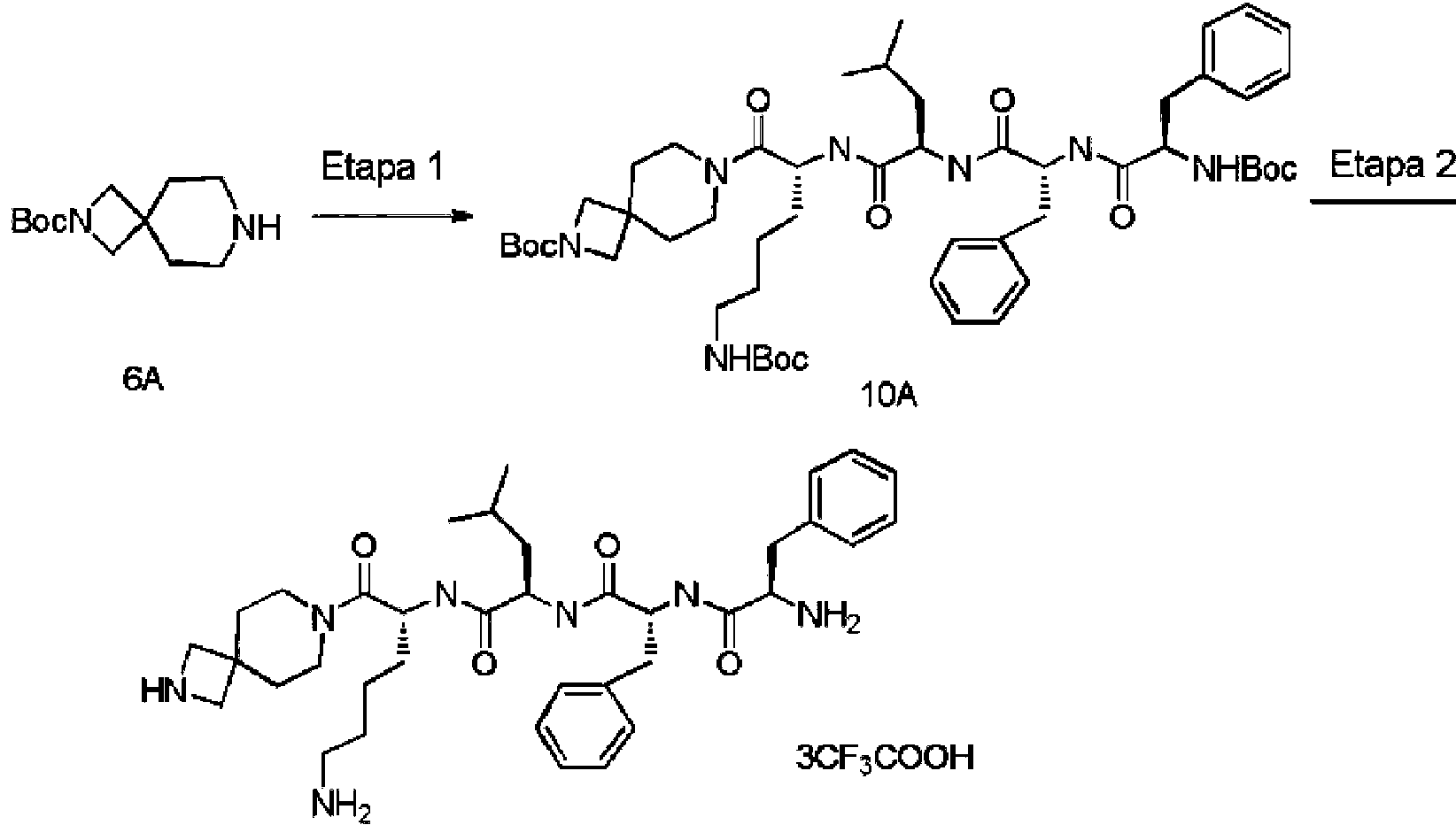
Com puesto 10Com put 10
Etapa 1:Stage 1:
7-[(2R)-6-(terc-Butoxicarbonilamino)-2-[[(2R)-2-[[(2R)-2-[[(2R)-2-(terc-butoxicarbonilamino)-3-fenil-propanoil]amino]-3-fenil-propanoil]amino]-4-metil-pentanoil]amino]hexanoil]-2,7-diazaespiro[3.5]nonano-2-carboxilato de terc-butilo (10a ) 7-[(2R)-6-(tert-Butoxycarbonylamino)-2-[[(2R)-2-[[(2R)-2-[[(2R)-2-(tert-Butoxycarbonylamino)-3-phenyl tert-butyl -propanoyl]amino]-3-phenyl-propanoyl]amino]-4-methyl-pentanoyl]amino]hexanoyl]-2,7-diazaspiro[3.5]nonane-2-carboxylate (10a)

Se añadieron 2,7-diazaespiro[3.5]nonano-2-carboxilato de terc-butilo (6A) (0,11 g, 0,5 mmol), clorhidrato de 1-(3-dimetilaminopropil)-3-etilcarbodiimida (115 mg, 0,6 mmol), 1-hidroxibenzotriazol (81 mg, 0,6 mmol), producto intermedio 1 (378 mg, 0,5 mmol) y diclorometano (30 ml) en un matraz de una sola boca de 50 ml y se permitió que reaccionase el sistema a temperatura ambiente durante 5 h. Luego, se concentró la disolución de reacción a presión reducida. Se separó el residuo y se purificó mediante cromatografía en columna de gel de sílice (éter de petróleo:acetato de etilo (v:v) = 1:2) para obtener 7-[(2R)-6-(terc-butoxicarbonilamino)-2-[[(2R)-2-[[(2R)-2-[[(2R)-2-(terc-butoxicarbonilamino)-3-fenil-propanoil]amino]-3-fenil-propanoil]amino]-4-metil-pentanoil]amino]hexanoil]-2,7-diazaespiro[3.5]nonano-2-carboxilato de terc-butilo (10A)como un sólido de color blanco (450 mg, rendimiento del 93%).tert-Butyl 2,7-diazaspiro[3.5]nonane-2-carboxylate (6A) (0.11 g, 0.5 mmol), 1-(3-dimethylaminopropyl)-3-ethylcarbodiimide hydrochloride (115 mg , 0.6 mmol), 1-hydroxybenzotriazole (81 mg, 0.6 mmol), intermediate 1 (378 mg, 0.5 mmol) and dichloromethane (30 mL) in a 50 mL single neck flask and allowed the system to react at room temperature for 5 h. Then, the reaction solution was concentrated under reduced pressure. The residue was separated and purified by silica gel column chromatography (petroleum ether:ethyl acetate (v:v) = 1:2) to obtain 7-[(2R)-6-(tert-butoxycarbonylamino)- 2-[[(2R)-2-[[(2R)-2-[[(2R)-2-(tert-butoxycarbonylamino)-3-phenyl-propanoyl]amino]-3-phenyl-propanoyl]amino]- tert-butyl 4-methyl-pentanoyl]amino]hexanoyl]-2,7-diazaspiro[3.5]nonane-2-carboxylate tert-butyl (10A) as a white solid (450 mg, 93% yield).
Etapa 2:Stage 2:
(2R)-N-[(1R)-5-Amino-1-(2,7-diazaespiro[3.5]nonano-7-carbonil)pentil]-2-[[(2R)-2-[[(2R)-2-amino-3-fenilpropanoil]amino]-3-fenil-propanoil]amino]-4-metil-pentanamida; tri-ácido trifluoroacético (compuesto 10)(2R)-N-[(1R)-5-Amino-1-(2,7-diazaspiro[3.5]nonane-7-carbonyl)pentyl]-2-[[(2R)-2-[[(2R) -2-amino-3-phenylpropanoyl]amino]-3-phenyl-propanoyl]amino]-4-methyl-pentanamide; tri-trifluoroacetic acid (compound 10)

Se añadieron 7-[(2R)-6-(terc-butoxicarbonilamino)-2-[[(2R)-2-[[(2R)-2-[[(2R)-2-(terc-butoxicarbonilamino)-3-fenilpropanoil]amino]-3-fenil-propanoil]amino]-4-metil-pentanoil]amino]hexanoil]-2,7-diazaespiro[3.5]nonano-2-carboxilato de terc-butilo (10a ) (450 mg, 0,468 mmol) y ácido trifluoroacético (2 ml) en un matraz de una sola boca de 50 ml y se permitió que reaccionase el sistema a temperatura ambiente durante 2 h. Luego, se concentró la disolución de reacción a presión reducida, se purificó el residuo por cromatografía de líquidos preparativa (condiciones de preparación: instrumento: GX-281 de Gilson; columna: Xbridge C18, 150 x 30 mm de D.I., 5 |am; fase móvil: A para ACN y B Para H2O; isocrático: 65% de A; velocidad de flujo: 30 ml/min; contrapresión:1000 psi; temperatura de columna: 30°C; longitud de onda: 210 nm; periodo: 18 min; preparación de la muestra: se disolvió el compuesto en 12 ml de metanol; inyección: 0,9 ml/aguja). Se concentró la preparación a presión reducida para eliminar la mayor parte del disolvente y se liofilizó para obtener (2R)-N-[(1R)-5-amino-1-(2,7-diazaespiro[3.5]nonano-7-carbonil)pentil]-2-[[(2R)-2-[[(2R)-2-amino-3-fenil-propanoil]amino]-3-fenil-propanoil]amino]-4-metil-pentanamida; tri-ácido trifluoroacético (compuesto 10) como un producto pulverulento de color blanco (358 mg, rendimiento del 76%). 7-[(2R)-6-(tert-butoxycarbonylamino)-2-[[(2R)-2-[[(2R)-2-[[(2R)-2-(tert-butoxycarbonylamino)-3 tert-butyl -phenylpropanoyl]amino]-3-phenyl-propanoyl]amino]-4-methyl-pentanoyl]amino]hexanoyl]-2,7-diazaspiro[3.5]nonane-2-carboxylate (10a) (450 mg, 0.468 mmol) and trifluoroacetic acid (2 mL) in a 50 mL one-neck flask and the system was allowed to react at room temperature for 2 h. Then, the reaction solution was concentrated under reduced pressure, the residue was purified by preparative liquid chromatography (preparation conditions: instrument: Gilson GX-281; column: Xbridge C18, 150 x 30 mm I.D., 5 |am; mobile phase: A for ACN and B for H2O, isocratic: 65% A, flow rate: 30 mL/min, back pressure: 1000 psi, column temperature: 30°C, wavelength: 210 nm, period: 18 min; sample preparation: compound was dissolved in 12 mL methanol; injection: 0.9 mL/needle). The preparation was concentrated under reduced pressure to remove most of the solvent and lyophilized to obtain (2R)-N-[(1R)-5-amino-1-(2,7-diazaspiro[3.5]nonane-7-carbonyl )pentyl]-2-[[(2R)-2-[[(2R)-2-amino-3-phenyl-propanoyl]amino]-3-phenyl-propanoyl]amino]-4-methyl-pentanamide; tri-trifluoroacetic acid (compound 10) as a white powdery product (358 mg, 76% yield).
EM m/z = 331,8 [M-2CFsCOOH+2H]+/2;MS m/z = 331.8 [M-2CFsCOOH+2H]+/2;
1H-RMN (400 MHz, D2O) 87,48-7,10 (m, 10H), 4,65-4,61 (m, 2H), 4,28-4,20 (m, 2H), 3,93 (d, 4H), 3,70-3,57 (m, 2H), 3,52-3,39 (m, 1H), 3,39-3,27 (m, 1H), 3,15 (d, 2H), 3,02-2,94 (m, 4H), 1,98-1,87 (m, 3H), 1,82-1,60 (m, 5H), 1,51-1,50 (m, 3H), 1,44-1,36 (m, 2H), 0,89 (dd, 6H).1H-NMR (400 MHz, D2O) 87.48-7.10 (m, 10H), 4.65-4.61 (m, 2H), 4.28-4.20 (m, 2H), 3, 93 (d, 4H), 3.70-3.57 (m, 2H), 3.52-3.39 (m, 1H), 3.39-3.27 (m, 1H), 3.15 ( d, 2H), 3.02-2.94 (m, 4H), 1.98-1.87 (m, 3H), 1.82-1.60 (m, 5H), 1.51-1, 50 (m, 3H), 1.44-1.36 (m, 2H), 0.89 (dd, 6H).
Ejemplo 9:Example 9:
(2R)-N-[(1R)-5-Amino-1-(2,7-diazaespiro[3.5]nonano-2-carbonil)pentil]-2-[[(2R)-2-[[(2R)-2-amino-3-fenilpropanoil]amino]-3-fenil-propanoil]amino]-4-metil-pentanamida; tri-ácido trifluoroacético (compuesto 11) (2R)-N-[(1R)-5-Amino-1-(2,7-diazaspiro[3.5]nonane-2-carbonyl)pentyl]-2-[[(2R)-2-[[(2R) -2-amino-3-phenylpropanoyl]amino]-3-phenyl-propanoyl]amino]-4-methyl-pentanamide; tri-trifluoroacetic acid (compound 11)

Etapa 1:Stage 1:
2- [(2R)-6-(terc-butoxicarbonilamino)-2-[[(2R)-2-[[(2R)-2-[[(2R)-2-(terc-butoxicarbonilamino)-3-]fenil-propanoil]amino]-3- fenil-propanoil]amino]-4-metil-pentanoil]amino]hexanoil]-2,7-diazaespiro[3.5]nonano-7-carboxilato de bencilo (11A)2- [(2R)-6-(tert-butoxycarbonylamino)-2-[[(2R)-2-[[(2R)-2-[[(2R)-2-(tert-butoxycarbonylamino)-3-] benzyl phenyl-propanoyl]amino]-3-phenyl-propanoyl]amino]-4-methyl-pentanoyl]amino]hexanoyl]-2,7-diazaspiro[3.5]nonane-7-carboxylate (11A)

Se añadieron 2,7-diazaespiro[3.5]nonano-7-carboxilato de bencilo (6C) (0,26 g, 1 mmol), clorhidrato de 1-(3-dimetilaminopropil)-3-etilcarbodiimida (230 mg, 1,2 mmol), 1-hidroxibenzotriazol (162 mg, 1,2 mmol), producto intermedio 1 (0,75g, 1 mmol) y diclorometano (30 ml) en un matraz de una sola boca de 50 ml y se permitió que reaccionase el sistema a temperatura ambiente durante 5 h. Luego, se concentró la disolución de reacción a presión reducida y se separó el residuo y se purificó mediante cromatografía en columna de gel de sílice (éter de petróleo:acetato de etilo (v:v) = 1:2) para obtener 2-[(2R)-6-(terc-butoxicarbonilamino)-2-[[(2R)-2-[[(2R))-2-[[(2R)-2-(terc-butoxicarbonilamino]-3-fenilpropanoil]amino]-3-fenil-propanoil]amino]-4-metil-pentanoil]amino]hexanoil]-2,7-diazaespiro[3.5]nonano-7-carboxilato de bencilo (11A) como un sólido de color blanco (850 mg, rendimiento del 85%). Etapa 2:Benzyl 2,7-diazaspiro[3.5]nonane-7-carboxylate (6C) (0.26 g, 1 mmol), 1-(3-dimethylaminopropyl)-3-ethylcarbodiimide hydrochloride (230 mg, 1.2 mmol), 1-hydroxybenzotriazole (162 mg, 1.2 mmol), intermediate 1 (0.75 g, 1 mmol), and dichloromethane (30 mL) in a 50 mL single neck flask and the system allowed to react. at room temperature for 5 h. Then, the reaction solution was concentrated under reduced pressure, and the residue was separated and purified by silica gel column chromatography (petroleum ether:ethyl acetate (v:v) = 1:2) to obtain 2-[ (2R)-6-(tert-butoxycarbonylamino)-2-[[(2R)-2-[[(2R))-2-[[(2R)-2-(tert-butoxycarbonylamino]-3-phenylpropanoyl]amino Benzyl ]-3-phenyl-propanoyl]amino]-4-methyl-pentanoyl]amino]hexanoyl]-2,7-diazaspiro[3.5]nonane-7-carboxylate (11A) as a white solid (850 mg, yield of 85%).Stage 2:
N-[(1R)-1-Bencil-2-[[(1R)-1-bencil-2-[[(1R)-1-[[(1R)-5-(terc-butoxicarbonilamino)-1-(2,7-diazaespiro[3.5]nonano-2-carbonil)pentil]carbamoil]-3-metil-butil]amino]-2-oxo-etil]amino]-2-oxo-etil]carbamato de terc-butilo (11 B)N-[(1R)-1-Benzyl-2-[[(1R)-1-benzyl-2-[[(1R)-1-[[(1R)-5-(tert-butoxycarbonylamino)-1-( tert-butyl 2,7-diazaspiro[3.5]nonane-2-carbonyl)pentyl]carbamoyl]-3-methyl-butyl]amino]-2-oxo-ethyl]amino]-2-oxo-ethyl]carbamate (11 b)

Se añadieron 2-[(2R)-6-(terc-butoxicarbonilamino)-2-[[(2R)-2-[[(2R))-2-[[(2R)-2-(terc-butoxicarbonilamino]-3-) fenilpropanoil]amino]-3-fenil-propanoil]amino]-4-metil-pentanoil]amino]hexanoil]-2,7-diazaespiro[3.5]nonano-7-carboxilato de bencilo (11A) (850 mg, 0,85 mmol), paladio sobre carbono (170 mg, 20% en peso) y metanol (20 ml) en un matraz de una sola boca de 50 ml. Se reemplazó la atmósfera por hidrógeno 3 veces y se permitió que avanzase la reacción a temperatura ambiente durante 8 h bajo una atmósfera de hidrógeno (globo). Luego, se filtró la disolución de reacción a través de tierra de diatomeas y se concentró el filtrado a presión reducida para obtener N-[(1R)-1-bencil-2-[[(1R)-1-bencil-2-[[[(1R)-1-[[(1R)-5-(terc-butoxicarbonilamino)-1-(2,7-diazaespiro[3.5]nonano-2 carbonil)pentil]carbamoil]-3-metil-butil]amino]-2-oxo-etil]amino]-2-oxo-etil]carbamato de terc-butilo (11B) en bruto como un sólido de color blanco (580 mg, rendimiento del 79%) y se usó directamente en la siguiente reacción. Etapa 3:2-[(2R)-6-(tert-butoxycarbonylamino)-2-[[(2R)-2-[[(2R))-2-[[(2R)-2-(tert-butoxycarbonylamino]- benzyl 3-) phenylpropanoyl]amino]-3-phenyl-propanoyl]amino]-4-methyl-pentanoyl]amino]hexanoyl]-2,7-diazaspiro[3.5]nonane-7-carboxylate (11A) (850 mg, 0.85 mmol), palladium on carbon (170 mg, 20 wt%) and methanol (20 mL) in a 50 mL single neck flask. The atmosphere was replaced by hydrogen 3 times and the reaction was allowed to proceed at room temperature for 8 h under a hydrogen atmosphere (balloon). Then, the reaction solution was filtered through diatomaceous earth, and the filtrate was concentrated under reduced pressure to obtain N-[(1R)-1-benzyl-2-[[(1R)-1-benzyl-2-[[[(1R)-1-[[(1R)-5-(tert-butoxycarbonylamino)-1- tert-Butyl (2,7-diazaspiro[3.5]nonane-2-carbonyl)pentyl]carbamoyl]-3-methyl-butyl]amino]-2-oxo-ethyl]amino]-2-oxo-ethyl]carbamate (11B ) crude as a white solid (580 mg, 79% yield) and used directly in the next reaction. Stage 3:
(2R)-N-[(1R)-5-Amino-1-(2,7-diazaespiro[3.5]nonano-2-carbonil)pentil]-2-[[(2R)-2-[[(2R)-2-amino-3-fenilpropanoil]amino]-3-fenil-propanoil]amino]-4-metil-pentanamida; tri-ácido trifluoroacético (compuesto 11)(2R)-N-[(1R)-5-Amino-1-(2,7-diazaspiro[3.5]nonane-2-carbonyl)pentyl]-2-[[(2R)-2-[[(2R) -2-amino-3-phenylpropanoyl]amino]-3-phenyl-propanoyl]amino]-4-methyl-pentanamide; tri-trifluoroacetic acid (compound 11)

Se añadieron N-[(1R)-1-bencil-2-[[(1R)-1-bencil-2-[[(1R)-1-[[(1R)-5-(terc-butoxicarbonilamino)-1-(2,7-diazaespiro[3.5]nonano-2-carbonií)pentil]carbamoil]-3-metil-butil]amino]-2-oxo-etil]amino]-2-oxo-etil]carbamato de terc-butilo (11B) (0,5 g, 0,58 mmol) y ácido trifluoroacético (2 ml) en un matraz de una sola boca de 50 ml y se permitió que reaccionase el sistema a temperatura ambiente durante 2 h. Luego, se concentró la disolución de reacción a presión reducida y se purificó el residuo mediante cromatografía de líquidos preparativa (condiciones de preparación: instrumento: GX-281 de Gilson; columna: Xbridge C18, 150 x 30 mm de D.I., 5 |am; fase móvil: A para ACN y B para H2O; isocrático: 65% de A; velocidad de flujo: 30 ml/min; contrapresión:1000 psi; temperatura de columna: 30°C; longitud de onda: 210 nm; periodo: 18 min; preparación de la muestra: se disolvió el compuesto en 12 ml de metanol; inyección: 0,9 ml/aguja). Se concentró la preparación a presión reducida para eliminar la mayor parte del disolvente y se liofilizó para obtener (2R)-N-[(1R)-5-amino-1-(2,7-diazaespiro[3.5]nonano-2-carbonil)pentil]-2-[[(2R)-2-[[(2R)-2-amino-3-fenil-propanoil]amino]-3-fenil-propanoil]amino]-4-metil-pentanamida; tri-ácido trifluoroacético (compuesto 11) como un producto pulverulento de color blanco (380 mg, rendimiento del 66%).N-[(1R)-1-benzyl-2-[[(1R)-1-benzyl-2-[[(1R)-1-[[(1R)-5-(tert-butoxycarbonylamino)-1 tert-Butyl -(2,7-diazaspiro[3.5]nonane-2-carbonyl)pentyl]carbamoyl]-3-methyl-butyl]amino]-2-oxo-ethyl]amino]-2-oxo-ethyl]carbamate (11B) (0.5 g, 0.58 mmol) and trifluoroacetic acid (2 mL) in a 50 mL single-neck flask and the system was allowed to react at room temperature for 2 h. Then, the reaction solution was concentrated under reduced pressure, and the residue was purified by preparative liquid chromatography (preparation conditions: instrument: Gilson GX-281; column: Xbridge C18, 150 x 30 mm I.D., 5 |am; mobile phase: A for ACN and B for H2O, isocratic: 65% A, flow rate: 30 mL/min, back pressure: 1000 psi, column temperature: 30°C, wavelength: 210 nm, period: 18 min; sample preparation: compound was dissolved in 12 mL methanol; injection: 0.9 mL/needle). The preparation was concentrated under reduced pressure to remove most of the solvent and lyophilized to obtain (2R)-N-[(1R)-5-amino-1-(2,7-diazaspiro[3.5]nonane-2-carbonyl )pentyl]-2-[[(2R)-2-[[(2R)-2-amino-3-phenyl-propanoyl]amino]-3-phenyl-propanoyl]amino]-4-methyl-pentanamide; tri-trifluoroacetic acid (compound 11) as a white powdery product (380 mg, 66% yield).
EM m/z = 331,8 [M-2CFsCOOH+2H]+/2;MS m/z = 331.8 [M-2CFsCOOH+2H]+/2;
1H-RMN (400 MHz, D2O) 87,43-7,13 (m, 10H), 4,61 (t, 1H), 4,28-4,06 (m, 5H), 3,84-3,74 (m, 2H), 3,19-3,14 (m, 6H), 2,99-2,95 (m, 4H), 2,09-1,94 (m, 4H), 1,79-1,61 (m, 4H), 1,55-1,31 (m, 5H), 0,89 (dd, 6H).1H-NMR (400 MHz, D2O) 87.43-7.13 (m, 10H), 4.61 (t, 1H), 4.28-4.06 (m, 5H), 3.84-3, 74 (m, 2H), 3.19-3.14 (m, 6H), 2.99-2.95 (m, 4H), 2.09-1.94 (m, 4H), 1.79- 1.61 (m, 4H), 1.55-1.31 (m, 5H), 0.89 (dd, 6H).
Ejemplo 10:Example 10:
2R)-N-[(1R)-5-Amino-1-(7-metilsulfonil-2,7-diazaespiro[3.5]nonano-2-carbonil)pentil]-2-[[(2R)-2-[[(2R)-2-amino-3-fenilpropanoil]amino]-3-fenil-propanoil]amino]-4-metil-pentanamida; di-ácido trifluoroacético (compuesto 12)2R)-N-[(1R)-5-Amino-1-(7-methylsulfonyl-2,7-diazaspiro[3.5]nonane-2-carbonyl)pentyl]-2-[[(2R)-2-[[ (2R)-2-amino-3-phenylpropanoyl]amino]-3-phenyl-propanoyl]amino]-4-methyl-pentanamide; di-trifluoroacetic acid (compound 12)
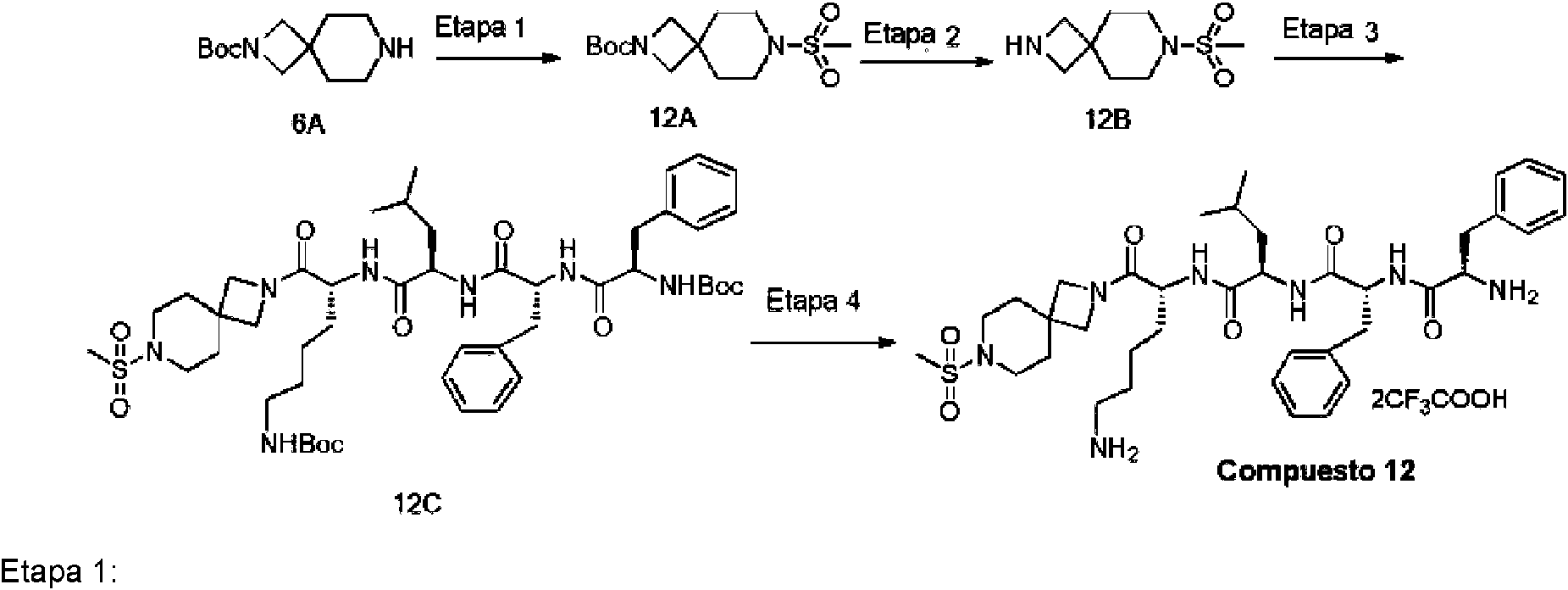
7-Metilsulfonil-2,7-diazaespiro[3.5]nonano-2-carboxilato de terc-butilo (12A)tert-Butyl 7-Methylsulfonyl-2,7-diazaspiro[3.5]nonane-2-carboxylate (12A)

Se añadieron 2,7-diazaespiro[3.5]nonano-2-carboxilato de terc-butilo (6A) (0,23 g, 1 mmol), trietilamina (210 mg, 2,0 mmol) y diclorometano (7 ml) en un matraz de reacción de 50 ml y se disolvieron con agitación. Después de enfriar hasta -10°C, se añadió gota a gota cloruro de metanosulfonilo (140 mg, 1,2 mmol) y se permitió que reaccionase el sistema durante 4 h. Luego se elevó la temperatura hasta temperatura ambiente y se extinguió el sistema de reacción con una disolución acuosa saturada de bicarbonato de sodio (10 ml), se extrajo con acetato de etilo (5 ml x 3) y se combinaron las fases orgánicas. Se secaron las fases orgánicas sobre sulfato de sodio anhidro, se filtraron y se concentró el filtrado a presión reducida. Se separó el residuo y se purificó mediante cromatografía en columna de gel de sílice (éter de petróleo:acetato de etilo (v:v) = 4:1) para obtener 7-metilsulfonil-2,7-diazaespiro[3.5]nonano-2-carboxilato de terc-butilo (12A) como una sustancia oleosa de color amarillo claro (250 mg, rendimiento del 81%). EM m/z = 327,2 [M+Na]+.tert-Butyl 2,7-diazaspiro[3.5]nonane-2-carboxylate (6A) (0.23 g, 1 mmol), triethylamine (210 mg, 2.0 mmol) and dichloromethane (7 mL) in a 50 mL reaction flask and dissolved with stirring. After cooling to -10°C, methanesulfonyl chloride (140 mg, 1.2 mmol) was added dropwise and the system was allowed to react for 4 h. Then the temperature was raised to room temperature and the reaction system was quenched with a saturated aqueous sodium bicarbonate solution (10 ml), extracted with ethyl acetate (5 ml x 3), and the organic phases were combined. The organic phases were dried over anhydrous sodium sulfate, filtered, and the filtrate was concentrated under reduced pressure. The residue was separated and purified by silica gel column chromatography (petroleum ether:ethyl acetate (v:v) = 4:1) to obtain 7-methylsulfonyl-2,7-diazaspiro[3.5]nonane-2 -tert-butyl carboxylate (12A) as a light yellow oily substance (250 mg, 81% yield). MS m/z = 327.2 [M+Na]+.
Etapa 2:Stage 2:
7-Metilsulfonil-2,7-diazaespiro[3.5]nonano (12B)7-Methylsulfonyl-2,7-diazaspiro[3.5]nonane (12B)

Se añadieron 7-metilsulfonil-2,7-diazaespiro[3.5]nonano-2-carboxilato de terc-butilo (12A) (0,25 g, 0,81 mmol) y diclorometano (7 ml) en un matraz de reacción de 50 ml y se añadió gota a gota ácido trifluoroacético (1 ml) a temperatura ambiente. Después de la adición, se permitió que reaccionase el sistema a temperatura ambiente durante 3 h. Se concentró la disolución de reacción directamente a presión reducida para obtener 7-metilsulfonil-2,7-diazaespiro[3.5]nonano (12B) en bruto como un líquido oleoso de color amarillo claro (165 mg, rendimiento del 100%), y se usó directamente en la siguiente reacción.tert-Butyl 7-methylsulfonyl-2,7-diazaspiro[3.5]nonane-2-carboxylate (12A) (0.25 g, 0.81 mmol) and dichloromethane (7 mL) were added to a 50 mL reaction flask. mL and trifluoroacetic acid (1 mL) was added dropwise at room temperature. After the addition, the system was allowed to react at room temperature for 3 h. The reaction solution was directly concentrated under reduced pressure to obtain crude 7-methylsulfonyl-2,7-diazaspiro[3.5]nonane (12B) as light yellow oily liquid (165 mg, 100% yield), and used directly in the following reaction.
Etapa 3:Stage 3:
N-[(1R)-1-Bencil-2-[[(1R)-1-bencil-2-[[(1R)-1-[[(1R)-5-(terc-butoxicarbonilamino)-1-(7-metilsulfonil-2,7-diazaespiro[3.5]nonano-2-carbonil)pentil]carbamoil]-3-metil-butil]amino]-2-oxo-etil]amino]-2-oxo-etil]carbamato de terc-butilo (12C)N-[(1R)-1-Benzyl-2-[[(1R)-1-benzyl-2-[[(1R)-1-[[(1R)-5-(tert-butoxycarbonylamino)-1-( tert 7-methylsulfonyl-2,7-diazaspiro[3.5]nonane-2-carbonyl)pentyl]carbamoyl]-3-methyl-butyl]amino]-2-oxo-ethyl]amino]-2-oxo-ethyl]carbamate -butyl (12C)

Se añadieron 7-metilsulfonil-2,7-diazaespiro[3.5]nonano (12B) en bruto (165 mg, 0,75 mmol), clorhidrato de 1-(3-dimetilaminopropil)-3-etilcarbodiimida (192 mg, 1 mmol), 1-hidroxibenzotriazol (135 mg, 1 mmol), producto intermedio 1 (610mg, 0,81 mmol) y diclorometano (30 ml) en un matraz de una sola boca de 50 ml y se permitió que reaccionase el sistema a temperatura ambiente durante 5 h. Luego, se concentró la disolución de reacción a presión reducida y se separó el residuo y se purificó mediante cromatografía en columna de gel de sílice (éter de petróleo:acetato de etilo (v:v) = 1:2) para obtener N-[(1R)-1-bencil-2-[[(1R)-1-bencil-2-[[(1R)-1-[[(1R)-5-(terc-butoxicarbonilamino)-1-(7-metilsulfonil-2,7-diazaespiro[3.5]nonano-2-carbonil)pentil]carbamoil]-3-metil-butil]amino]-2-oxo-etil]amino]-2-oxoetil]carbamato de terc-butilo (12C) como un sólido de color blanco (630 mg, rendimiento del 82,7%).Crude 7-methylsulfonyl-2,7-diazaspiro[3.5]nonane (12B) (165 mg, 0.75 mmol), 1-(3-dimethylaminopropyl)-3-ethylcarbodiimide hydrochloride (192 mg, 1 mmol) were added , 1-hydroxybenzotriazole (135 mg, 1 mmol), intermediate 1 (610 mg, 0.81 mmol), and dichloromethane (30 mL) in a 50 mL single neck flask and the system was allowed to react at room temperature for 5 a.m. Then, the reaction solution was concentrated under reduced pressure, and the residue was separated and purified by silica gel column chromatography (petroleum ether:ethyl acetate (v:v) = 1:2) to obtain N-[ (1R)-1-benzyl-2-[[(1R)-1-benzyl-2-[[(1R)-1-[[(1R)-5-(tert-butoxycarbonylamino)-1-(7-methylsulfonyl tert-Butyl (12C) -2,7-diazaspiro[3.5]nonane-2-carbonyl)pentyl]carbamoyl]-3-methyl-butyl]amino]-2-oxo-ethyl]amino]-2-oxoethyl]carbamate as a white solid (630 mg, 82.7% yield).
Etapa 4:Stage 4:
(2R)-N-[(1R)-5-Amino-1-(7-metilsulfonil-2,7-diazaespiro[3.5]nonano-2-carbonil)pentil]-2-[[(2R)-2-[[(2R)-2-amino-3-fenil-propanoil]amino]-3-fenil-propanoil]amino]-4-metil-pentanamida; di-ácido trifluoroacético (compuesto 12)(2R)-N-[(1R)-5-Amino-1-(7-methylsulfonyl-2,7-diazaspiro[3.5]nonane-2-carbonyl)pentyl]-2-[[(2R)-2-[ [(2R)-2-amino-3-phenyl-propanoyl]amino]-3-phenyl-propanoyl]amino]-4-methyl-pentanamide; di-trifluoroacetic acid (compound 12)
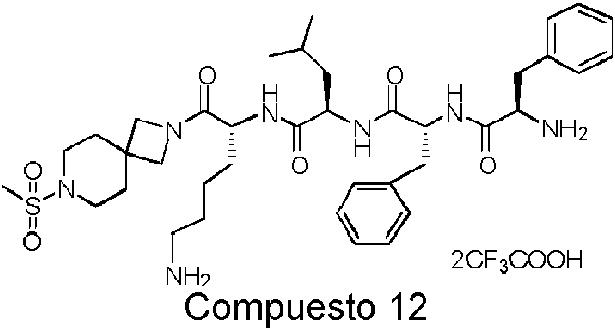
Se añadieron N-[(1R)-1-bencil-2-[[(1 R)-1-bencil-2-[[(1R)-1-[[(1R)-5-(terc-butoxicarbonilamino)-1-(7-metilsulfonil-2,7-diazaespiro[3.5]nonano-2-carbonil)pentil]carbamoil]-3-metil-butil]amino]-2-oxo-etil]amino]-2-oxo-etil]carbamato de terc-butilo (12C) (630 mg, 0,34 mmol) y ácido trifluoroacético (2 ml) en un matraz de reacción de 50 ml y se permitió que reaccionase el sistema a temperatura ambiente durante 2 h. Luego, se concentró la disolución de reacción a presión reducida y se separó el residuo y se purificó mediante cromatografía de líquidos preparativa (condiciones de preparación: instrumento: GX-281 de Gilson; columna: Xbridge C18, 150 x 30 mm de D.I., 5 |am; fase móvil: A para ACN y B para H2O; isocrático: 65% de A; velocidad de flujo: 30 ml/min; contrapresión:1000 psi; temperatura de columna: 30°C; longitud de onda: 210 nm; periodo: 18 min; preparación de la muestra: se disolvió el compuesto en 12 ml de metanol; inyección: 0,9 ml/aguja). Se concentró la preparación a presión reducida para eliminar la mayor parte del disolvente y se liofilizó para obtener (2R)-N-[(1R)-5-amino-1-(7-metilsulfonil-2,7-diazaespiro[3.5]nonano-2-carbonil)pentil]-2-[[(2R)-2-[[(2R)-2-amino-3-fenil-propanoil]amino]-3-fenil-propanoil]amino]-4-metil-pentanamida; di ácido trifluoroacético (compuesto 12) como un polvo de color blanco (410 mg, rendimiento del 63,2%).N-[(1R)-1-benzyl-2-[[(1R)-1-benzyl-2-[[(1R)-1-[[(1R)-5-(tert-butoxycarbonylamino)- 1-(7-methylsulfonyl-2,7-diazaspiro[3.5]nonane-2-carbonyl)pentyl]carbamoyl]-3-methyl-butyl]amino]-2-oxo-ethyl]amino]-2-oxo-ethyl] carbamate of (12C)-tert-butyl (630 mg, 0.34 mmol) and trifluoroacetic acid (2 mL) in a 50 mL reaction flask and the system was allowed to react at room temperature for 2 h. Then, the reaction solution was concentrated under reduced pressure, and the residue was separated and purified by preparative liquid chromatography (preparation conditions: instrument: Gilson GX-281; column: Xbridge C18, 150 x 30 mm ID, 5 |am Mobile phase: A for ACN and B for H2O Isocratic: 65% A Flow rate: 30 mL/min Back pressure: 1000 psi Column temperature: 30°C Wavelength: 210 nm period: 18 min; sample preparation: compound was dissolved in 12 ml methanol; injection: 0.9 ml/needle). The preparation was concentrated under reduced pressure to remove most of the solvent and lyophilized to obtain (2R)-N-[(1R)-5-amino-1-(7-methylsulfonyl-2,7-diazaspiro[3.5]nonane -2-carbonyl)pentyl]-2-[[(2R)-2-[[(2R)-2-amino-3-phenyl-propanoyl]amino]-3-phenyl-propanoyl]amino]-4-methyl- pentanamide; di trifluoroacetic acid (compound 12) as a white powder (410 mg, 63.2% yield).
EM m/z = 370,8 [M+2H]+/2;MS m/z = 370.8 [M+2H]+/2;
1H-RMN (400 MHz, D2O) 87,43-7,15 (m, 10H), 4,61 (t, 1H), 4,33-3,96 (m, 5H), 3,79-3,69 (m, 2H), 3,25-3,13 (m, 7H), 3,02-2,93 (m, 6H), 1,91-1,86 (m, 3H), 1,70-1,64 (m, 3H), 1,56-1,31 (m, 5H), 1,25 (t, 2H), 0,89 (dd, 6H).1H-NMR (400 MHz, D2O) 87.43-7.15 (m, 10H), 4.61 (t, 1H), 4.33-3.96 (m, 5H), 3.79-3, 69 (m, 2H), 3.25-3.13 (m, 7H), 3.02-2.93 (m, 6H), 1.91-1.86 (m, 3H), 1.70- 1.64 (m, 3H), 1.56-1.31 (m, 5H), 1.25 (t, 2H), 0.89 (dd, 6H).
Ejemplo 11:Example 11:
(2R)-2-[[(2R)-2-[[(2R)-2-Amino-3-fenil-propanoil]amino]-3-fenil-propanoil]amino]-N-[(1R)-5-amino-1-[2-(pirrolidin-1-carbonil)-2,7-diazaespiro[3.5]nonano-7-carbonil]pentil]-4-metil-pentanamida; di-ácido trifluoroacético (compuesto 13)(2R)-2-[[(2R)-2-[[(2R)-2-Amino-3-phenyl-propanoyl]amino]-3-phenyl-propanoyl]amino]-N-[(1R)-5 -amino-1-[2-(pyrrolidine-1-carbonyl)-2,7-diazaspiro[3.5]nonane-7-carbonyl]pentyl]-4-methyl-pentanamide; di-trifluoroacetic acid (compound 13)

Cloruro de pirrolidin-1-carbonilo (13B)Pyrrolidine-1-carbonyl chloride (13B)

Se añadieron NaHCO3 (5,04g, 60 mmol), trifosgeno (5,94 g, 20 mmol) y diclorometano (10 ml) en un matraz de una sola boca de 50 ml. Se enfrió la disolución de reacción hasta 10°Cy luego se añadió lentamente gota a gota pirrolidina (2,16 g, 30,4 mmol). Después de la adición, se devolvió la temperatura a la temperatura ambiente y se hizo reaccionar durante la noche. Se filtró la disolución de reacción y se concentró el filtrado a presión reducida y se separó el residuo y se purificó mediante cromatografía en columna de gel de sílice (éter de petróleo:acetato de etilo (v:v) = 3:1), para obtener cloruro de pirrolidin-1-carbonilo (13B) como una sustancia oleosa incolora (2,07 g, rendimiento del 51,65%).NaHCO3 (5.04g, 60mmol), triphosgene (5.94g, 20mmol) and dichloromethane (10ml) were added in a 50ml single neck flask. The reaction solution was cooled to 10°C, and then pyrrolidine (2.16 g, 30.4 mmol) was slowly added dropwise. After the addition, the temperature was returned to room temperature and reacted overnight. The reaction solution was filtered, and the filtrate was concentrated under reduced pressure, and the residue was separated and purified by silica gel column chromatography (petroleum ether:ethyl acetate (v:v) = 3:1), to obtain pyrrolidine-1-carbonyl chloride (13B) as a colorless oily substance (2.07 g, 51.65% yield).
1H-RMN (400 MHz, CDCls) 83,62-3,56 (m, 2H), 3,54-3,44 (m, 2H), 2,02-1,90 (m, 4H).1H-NMR (400 MHz, CDCls) 83.62-3.56 (m, 2H), 3.54-3.44 (m, 2H), 2.02-1.90 (m, 4H).
Etapa 2:Stage 2:
2-(Pirrolidin-1-carbonil)-2,7-diazaespiro[3.5]nonano-7-carboxilato de bencilo (13C) Benzyl 2-(Pyrrolidin-1-carbonyl)-2,7-diazaspiro[3.5]nonane-7-carboxylate (13C)
Se añadieron 2,7-diazaespiro[3.5]nonano-7-carboxilato de bencilo (6C) (350 mg, 1,3mmol), trietilamina (408 mg, 4,03 mmol) y diclorometano (20 ml) en un matraz de una sola boca de 50 ml y se disolvió con agitación a temperatura ambiente. Luego, se enfrió la disolución de reacción hasta 0°C y se añadió gota a gota cloruro de pirrolidin-1-carbonilo (13B) (123 mg, 0,92 mmol). Después de la adición, se elevó la temperatura hasta temperatura ambiente y se permitió que avanzase la reacción durante 4 h. Se lavó la disolución de reacción secuencialmente con una disolución acuosa saturada de bicarbonato de sodio (60 ml), una disolución acuosa de ácido clorhídrico 3 mol/l (60 ml) y se sometió la mezcla a un proceso de separación de líquido. Se secaron las fases orgánicas sobre sulfato de sodio anhidro, se filtraron y se concentró el filtrado a presión reducida para obtener 2-(pirrolidin-1-carbonil)-2,7-diazaespiro[3.5]nonano-7-carboxilato de bencilo (13C) en bruto como un líquido oleoso de color amarillo claro (460 mg, rendimiento del 100%).Benzyl 2,7-diazaspiro[3.5]nonane-7-carboxylate (6C) (350 mg, 1.3 mmol), triethylamine (408 mg, 4.03 mmol), and dichloromethane (20 mL) were added in a 100 mL flask. 50 ml single neck and dissolved with stirring at room temperature. Then, the reaction solution was cooled to 0°C, and pyrrolidine-1-carbonyl chloride (13B) (123 mg, 0.92 mmol) was added dropwise. After the addition, the temperature was raised to room temperature and the reaction was allowed to proceed for 4 h. The reaction solution was washed sequentially with a saturated sodium bicarbonate aqueous solution (60 ml), a 3 mol/L hydrochloric acid aqueous solution (60 ml), and the mixture was subjected to a liquid separation process. The organic phases were dried over anhydrous sodium sulfate, filtered, and the filtrate was concentrated under reduced pressure to obtain benzyl 2-(pyrrolidine-1-carbonyl)-2,7-diazaspiro[3.5]nonane-7-carboxylate benzyl (13C ) crude as a light yellow oily liquid (460 mg, 100% yield).
EM m/z = 358,2 [M+H]+.MS m/z = 358.2 [M+H]+.
Etapa 3:Stage 3:
2,7-Diazaespiro[3.5]nonan-2-il(pirrolidin-1-il)metanona (13D)2,7-Diazaspiro[3.5]nonan-2-yl(pyrrolidin-1-yl)methanone (13D)

Se añadieron 2-(pirrolidin-1-carbonil)-2,7-diazaespiro[3.5]nonano-7-carboxilato de bencilo (13C) en bruto (460 mg, 1,3 mmol), hidróxido de paladio/carbono (100 mg, añ 20% en peso) e isopropanol (20 ml) en un matraz de una sola boca de 50 ml. Se reemplazó la atmósfera por hidrógeno 3 veces y se calentó a 100°C en el baño de aceite durante 8 h bajo una atmósfera de hidrógeno (globo). Luego, se filtró la disolución de reacción a través de tierra de diatomeas y se concentró el filtrado a presión reducida para obtener 2,7-diazaespiro[3.5]nonan-2-il(pirrolidin-1-il)metanona (13D) en bruto como un sólido de color amarillo claro (290 mg, rendimiento del 100%) y se usó directamente en la siguiente reacción.Crude benzyl 2-(pyrrolidine-1-carbonyl)-2,7-diazaspiro[3.5]nonane-7-carboxylate (13C) (460 mg, 1.3 mmol), palladium hydroxide/carbon (100 mg , add 20% by weight) and isopropanol (20 ml) in a 50 ml single neck flask. The atmosphere was replaced by hydrogen 3 times and heated at 100°C in the oil bath for 8 h under a hydrogen atmosphere (balloon). Then, the reaction solution was filtered through diatomaceous earth, and the filtrate was concentrated under reduced pressure to obtain crude 2,7-diazaspiro[3.5]nonan-2-yl(pyrrolidin-1-yl)methanone (13D). as a light yellow solid (290 mg, 100% yield) and used directly in the next reaction.
EM m/z = 224,3 [M+H]+.MS m/z = 224.3 [M+H]+.
Etapa 4:Stage 4:
N-[(1R)-1-Bencil-2-[[(1R)-1-bencil-2-[[(1R)-1-[[(1R)-5-(terc-butoxicarbonilamino)-1-[2-(pirrolidin-1-carbonil)-2,7-diazaespiro[3.5]nonano-7-carbonil]pentil]carbamoil]-3-metil-butil]amino]-2-oxo-etil]amino]-2-oxo-etil]carbamato de terc-butilo (13e)N-[(1R)-1-Benzyl-2-[[(1R)-1-benzyl-2-[[(1R)-1-[[(1R)-5-(tert-butoxycarbonylamino)-1-[ 2-(pyrrolidine-1-carbonyl)-2,7-diazaspiro[3.5]nonane-7-carbonyl]pentyl]carbamoyl]-3-methyl-butyl]amino]-2-oxo-ethyl]amino]-2-oxo tert-butyl -ethyl]carbamate (13e)

Se añadieron secuencialmente 2,7-diazaespiro[3.5]nonan-2-il(pirrolidin-1-il)metanona (13D) en bruto (167 mg, 0,75 mmol), clorhidrato de 1-(3-dimetilaminopropil)-3-etilcarbodiimida (374 mg, 1,95 mmol), 1-hidroxibenzotriazol (108 mg, 0,81 mmol), producto intermedio 1 (556 mg, 0,75 mmol) y diclorometano (30 ml) en un matraz de reacción de 50 ml. Después de la adición, se permitió que reaccionase el sistema a temperatura ambiente durante 5 h. Se concentró la disolución de reacción a presión reducida y se separó el residuo y se purificó mediante cromatografía en columna de gel de sílice (éter de petróleo:acetato de etilo (v:v) = 1:2) para obtener N-[(1R)-1-bencil-2-[[(1R)-1-bencil-2-[[(1R)-1-[[(1R)-5-(terc-butoxicarbonilamino)-1-[2-(pirrolidin-1-carbonil)-2,7-diazaespiro[3.5]nonano-7-carbonil]pentil]carbamoil]-3-metil-butil]amino]-2-oxo-etil]amino]-2-oxo-etil]carbamato de terc-butilo (13E) como un sólido de color blanco (360 mg, rendimiento del 29%).Crude 2,7-diazaspiro[3.5]nonan-2-yl(pyrrolidin-1-yl)methanone (13D) (167 mg, 0.75 mmol), 1-(3-dimethylaminopropyl)-3 -ethylcarbodiimide (374 mg, 1.95 mmol), 1-hydroxybenzotriazole (108 mg, 0.81 mmol), intermediate 1 (556 mg, 0.75 mmol), and dichloromethane (30 mL) in a 50 mL reaction flask. ml. After the addition, the system was allowed to react at room temperature for 5 h. The reaction solution was concentrated under reduced pressure, and the residue was separated and purified by silica gel column chromatography (petroleum ether:ethyl acetate (v:v) = 1:2) to obtain N-[(1R )-1-benzyl-2-[[(1R)-1-benzyl-2-[[(1R)-1-[[(1R)-5-(tert-butoxycarbonylamino)-1-[2-(pyrrolidine- 1-carbonyl)-2,7-diazaspiro[3.5]nonane-7-carbonyl]pentyl]carbamoyl]-3-methyl-butyl]amino]-2-oxo-ethyl]amino]-2-oxo-ethyl]carbamate tert-butyl (13E) as a white solid (360 mg, 29% yield).
Etapa 5:Stage 5:
(2R)-2-[[(2R)-2-[[(2R)-2-Amino-3-fenil-propanoil]amino]-3-fenil-propanoil]amino]-N-[(1R)-5-amino-1-[2-(pirrolidin-1-carbonil)-2,7-diazaespiro[3.5]nonano-7-carbonil]pentil]-4-metil-pentanamida; di-ácido trifluoroacético (compuesto 13) (2R)-2-[[(2R)-2-[[(2R)-2-Amino-3-phenyl-propanoyl]amino]-3-phenyl-propanoyl]amino]-N-[(1R)-5 -amino-1-[2-(pyrrolidine-1-carbonyl)-2,7-diazaspiro[3.5]nonane-7-carbonyl]pentyl]-4-methyl-pentanamide; di-trifluoroacetic acid (compound 13)

Se añadieron N-[(1R)-1-bencil-2-[[(1R)-1-bencil-2-[[(1R)-1-[[(1R)-5-(terc-butoxicarbonilamino)-1-[2-(pirrolidin-1-carbonil)-2,7-diazaespiro[3.5]nonano-7-carbonil]pentil]carbamoil]-3-metil-butil]amino]-2-oxo-etil]amino]-2-oxoetil]carbamato de terc-butilo (13E) (360 mg, 0,38 mmol) y diclorometano (10 ml) en un matraz de reacción de 50 ml y se añadió gota a gota ácido trifluoroacético (3 ml) a temperatura ambiente. Después de la adición, se permitió que reaccionase el sistema durante 2 h. Se concentró la disolución de reacción a presión reducida y se separó el residuo y se purificó mediante cromatografía de líquidos preparativa (condiciones de preparación: instrumento: GX-281 de Gilson; columna: Xbridge C18, 150 x 30 mm de D.I., 5 |am; fase móvil: A para ACN y B para H2O; isocrático: 65% de A; velocidad de flujo: 30 ml/min; contrapresión:1000 psi; temperatura de columna: 30°C; longitud de onda: 210 nm; periodo: 18 min; preparación de la muestra: se disolvió el compuesto en 12 ml de metanol; inyección: 0,9 ml/aguja). Se concentró la preparación a presión reducida para eliminar la mayor parte del disolvente y se liofilizó para obtener (2R)-2-[[(2R)-2-[[(2R)-2-amino-3-fenil-propanoil]amino]-3-fenil-propanoil]amino]-N-[(1R)-5-amino-1-[2-(pirrolidin-1-carbonil)-2,7-diazaespiro[3.5]nonano-7-carbonil]pentil]-4-metil-pentanamida; di-ácido trifluoroacético (compuesto 13) como un sólido de color blanco (169 mg, rendimiento del 45,6%).N-[(1R)-1-benzyl-2-[[(1R)-1-benzyl-2-[[(1R)-1-[[(1R)-5-(tert-butoxycarbonylamino)-1 -[2-(pyrrolidine-1-carbonyl)-2,7-diazaspiro[3.5]nonane-7-carbonyl]pentyl]carbamoyl]-3-methyl-butyl]amino]-2-oxo-ethyl]amino]-2 tert-butyl-oxoethyl]carbamate (13E) (360 mg, 0.38 mmol) and dichloromethane (10 mL) in a 50 mL reaction flask and trifluoroacetic acid (3 mL) was added dropwise at room temperature. After the addition, the system was allowed to react for 2 h. The reaction solution was concentrated under reduced pressure, and the residue was separated and purified by preparative liquid chromatography (preparation conditions: instrument: Gilson GX-281; column: Xbridge C18, 150 x 30 mm I.D., 5 µm ; mobile phase: A for ACN and B for H2O; isocratic: 65% A; flow rate: 30 mL/min; back pressure: 1000 psi; column temperature: 30°C; wavelength: 210 nm; period: 18 min, sample preparation: compound was dissolved in 12 mL methanol, injection: 0.9 mL/needle). The preparation was concentrated under reduced pressure to remove most of the solvent and lyophilized to obtain (2R)-2-[[(2R)-2-[[(2R)-2-amino-3-phenyl-propanoyl]amino ]-3-phenyl-propanoyl]amino]-N-[(1R)-5-amino-1-[2-(pyrrolidine-1-carbonyl)-2,7-diazaspiro[3.5]nonane-7-carbonyl]pentyl ]-4-methyl-pentanamide; di-trifluoroacetic acid (compound 13) as a white solid (169 mg, 45.6% yield).
EM m/z = 380,4 [M+2H]+/2.MS m/z = 380.4 [M+2H]+/2.
1H-RMN (400 MHz, DMSO-D) 88,75 (d, 1H), 8,35 (d, 1H), 8,09 (d, 1H), 8,01 (a, 3H), 7,73 (a, 3H), 7,34-7,17 (m, 10H), 4,71-4,60 (m, 2H), 4,40-4,32 (m, 1H), 4,08-3,96 (m, 2H), 3,73-3,23 (m, 8H), 3,16-3,01 (m, 3H), 2,98-2,86 (m, 1H), 2,85 2,69 (m, 3H), 1,82-1,69 (m, 4H), 1,69-1,42 (m, 11H), 1,36-1,22 (m, 2H), 0,89 (dd, 6H).1H-NMR (400 MHz, DMSO-D) 88.75 (d, 1H), 8.35 (d, 1H), 8.09 (d, 1H), 8.01 (a, 3H), 7.73 (a, 3H), 7.34-7.17 (m, 10H), 4.71-4.60 (m, 2H), 4.40-4.32 (m, 1H), 4.08-3 .96 (m, 2H), 3.73-3.23 (m, 8H), 3.16-3.01 (m, 3H), 2.98-2.86 (m, 1H), 2.85 2.69 (m, 3H), 1.82-1.69 (m, 4H), 1.69-1.42 (m, 11H), 1.36-1.22 (m, 2H), 0, 89 (dd, 6H).
Ejemplo 12:Example 12:
(2R)-N-[(1R)-5-amino-1-[2-(3-metilsulfonilazetidin-1-carbonil)-2,7-diazaespiro[3.5]nonano-7-carbonil]pentil]-2-[[(2R)-2-[[(2R)-2-amino-3-fenil-propanoil]amino]-3-fenil-propanoil]amino]-4-metil-pentanamida; di-ácido trifluoroacético (compuesto 14)(2R)-N-[(1R)-5-amino-1-[2-(3-methylsulfonylazetidine-1-carbonyl)-2,7-diazaspiro[3.5]nonane-7-carbonyl]pentyl]-2-[ [(2R)-2-[[(2R)-2-amino-3-phenyl-propanoyl]amino]-3-phenyl-propanoyl]amino]-4-methyl-pentanamide; di-trifluoroacetic acid (compound 14)

3-Cloruro de metilsulfonilazetidin-1-carbonilo (14B)3-Methylsulfonylazetidine-1-carbonyl chloride (14B)

Se añadieron NaHCO3 (756 mg, 9,0 mmol), trifosgeno (0,89 g, 4,5 mmol) y diclorometano (8 ml) en un matraz de una sola boca de 50 ml. Se enfrió la disolución de reacción hasta-10°Cy luego se añadió lentamente gota a gota clorhidrato de 3-metilsulfonilazetidina (772 mg, 4,5 mmol). Después de la adición, se devolvió la temperatura a la temperatura, se volvió a la temperatura ambiente y se hizo reaccionar durante la noche. Se filtró la disolución de reacción, se concentró a presión reducida y se separó el residuo y se purificó mediante cromatografía en columna de gel de sílice (éter de petróleo:acetato de etilo (v:v) = 1:1) para obtener como una sustancia oleosa incolora, cloruro de 3-metilsulfonilazetidin-1-carbonilo (14B) (494 mg, rendimiento del 50%).NaHCO3 (756 mg, 9.0 mmol), triphosgene (0.89 g, 4.5 mmol), and dichloromethane (8 mL) were added in a 50 mL single neck flask. The reaction solution was cooled to -10°C, and then 3-methylsulfonylazetidine hydrochloride (772 mg, 4.5 mmol) was slowly added dropwise. After the addition, the temperature was returned to room temperature, returned to room temperature and reacted overnight. The reaction solution was filtered, concentrated under reduced pressure and the residue was separated and purified by silica gel column chromatography (petroleum ether:ethyl acetate (v:v) = 1:1) to obtain 3-methylsulfonylazetidine chloride as a colorless oily substance. -1-carbonyl (14B) (494 mg, 50% yield).
1H-RMN (400 MHz, CDCls) 84,62-4,32 (m, 4H), 4,07-3,92 (m, 1H), 2,93 (s, 3H).1H-NMR (400 MHz, CDCls) 84.62-4.32 (m, 4H), 4.07-3.92 (m, 1H), 2.93 (s, 3H).
Etapa 2:Stage 2:
2-(3-Metilsulfonilazetidin-1-carbonil)-2,7-diazaespiro[3.5]nonano-7-carboxilato de bencilo (14C)Benzyl 2-(3-Methylsulfonylazetidine-1-carbonyl)-2,7-diazaspiro[3.5]nonane-7-carboxylate (14C)

Se añadieron 2,7-diazaespiro[3.5]nonano-7-carboxilato de bencilo (6C) (350 mg, 1,3mmol), trietilamina (406 mg, 4,01 mmol) y diclorometano (20 ml) en un matraz de una sola boca de 50 ml y se disolvió con agitación a temperatura ambiente. Luego, se enfrió la disolución de reacción hasta 0°C y se añadió gota a gota cloruro de 3-metilsulfonilazetidin-1-carbonilo (14B) (293 mg, 1,48 mmol). Después de la adición, se elevó la temperatura hasta temperatura ambiente y se permitió que reaccionase el sistema durante 4 h. Se lavó la disolución de reacción secuencialmente con una disolución acuosa saturada de bicarbonato de sodio (60 ml), una disolución acuosa de ácido clorhídrico 3 mol/l (60 ml) y se separó. Se secaron las fases orgánicas sobre sulfato de sodio anhidro, se filtraron y se concentró el filtrado a presión reducida. Se separó el residuo y se purificó mediante cromatografía de líquidos preparativa (condiciones de preparación: instrumento: GX-281 de Gilson; columna: Xbridge C18, 150 x 30 mm de D.I., 5 |am; fase móvil: A para ACN y B para H2O; isocrático: 65% de A; velocidad de flujo: 30 ml/min; contrapresión:1000 psi; temperatura de columna: 30°C; longitud de onda: 210 nm; periodo: 18 min; preparación de la muestra: se disolvió el compuesto en 12 ml de metanol; inyección: 0,9 ml/aguja) para obtener 2-(3-metilsulfonilazetidin-1-carbonil)-2,7-diazaespiro[3.5]nonano-7-carboxilato de bencilo (14C) como un sólido de color blanco (300 mg, rendimiento del 55%). EM m/z = 422,2 [M+H]+;Benzyl 2,7-diazaspiro[3.5]nonane-7-carboxylate (6C) (350mg, 1.3mmol), triethylamine (406mg, 4.01mmol) and dichloromethane (20ml) were added in a 100 ml flask. 50 ml single neck and dissolved with stirring at room temperature. Then, the reaction solution was cooled to 0°C, and 3-methylsulfonylazetidine-1-carbonyl chloride (14B) (293 mg, 1.48 mmol) was added dropwise. After the addition, the temperature was raised to room temperature and the system was allowed to react for 4 h. The reaction solution was washed sequentially with a saturated aqueous sodium bicarbonate solution (60 ml), a 3 mol/L aqueous hydrochloric acid solution (60 ml) and separated. The organic phases were dried over anhydrous sodium sulfate, filtered, and the filtrate was concentrated under reduced pressure. The residue was separated and purified by preparative liquid chromatography (preparation conditions: instrument: Gilson GX-281; column: Xbridge C18, 150 x 30 mm ID, 5 µm; mobile phase: A for ACN and B for H2O, isocratic: 65% A, flow rate: 30 mL/min, back pressure: 1000 psi, column temperature: 30°C, wavelength: 210 nm, period: 18 min, sample preparation: dissolved the compound in 12 ml of methanol; injection: 0.9 ml/needle) to obtain benzyl 2-(3-methylsulfonylazetidine-1-carbonyl)-2,7-diazaspiro[3.5]nonane-7-carboxylate (14C) as a white solid (300 mg, 55% yield). MS m/z = 422.2 [M+H]+;
1H-RMN (400 MHz, CDCls) 87,41-7,28 (m, 5H), 5,12 (s, 2H), 4,30-4,19 (m, 4H), 4,00-3,89 (m, 1H), 3,69 (s, 4H), 3,49 3,36 (m, 4H), 2,90 (s, 3H), 1,79-1,67 (m, 4H).1H-NMR (400 MHz, CDCls) 87.41-7.28 (m, 5H), 5.12 (s, 2H), 4.30-4.19 (m, 4H), 4.00-3, 89 (m, 1H), 3.69 (s, 4H), 3.49-3.36 (m, 4H), 2.90 (s, 3H), 1.79-1.67 (m, 4H).
Etapa 3:Stage 3:
2,7-Diazaespiro[3.5]nonan-2-il-(3-metilsulfonilazetidin-1-il)metanona (14D)2,7-Diazaspiro[3.5]nonan-2-yl-(3-methylsulfonylazetidin-1-yl)methanone (14D)

Se añadieron secuencialmente 2-(3-metilsulfonilazetidin-1-carbonil)-2,7-diazaespiro[3.5]nonano-7-carboxilato de bencilo (14C) (300 mg, 0,7 mmol), hidróxido de paladio/carbono (60 mg, al 20% en peso) e isopropanol (20 ml) en un matraz de una sola boca de 50 ml. Se reemplazó la atmósfera por hidrógeno 3 veces, y se calentó hasta 100°C en el baño de aceite y se hizo reaccionar durante 8 h bajo una atmósfera de hidrógeno (globo). Luego, se filtró la disolución de reacción a través de tierra de diatomeas y se concentró el filtrado a presión reducida para obtener 2,7-diazaespiro[3.5]nonan-2-il-(3-metilsulfonilazetidin-1-il)metanona (14D) en bruto como un sólido de color amarillo claro (202 mg, rendimiento del 100%) y se usó directamente en la siguiente reacción.Benzyl 2-(3-methylsulfonylazetidine-1-carbonyl)-2,7-diazaspiro[3.5]nonane-7-carboxylate (14C) (300 mg, 0.7 mmol), palladium hydroxide/carbon (60 mg, 20% by weight) and isopropanol (20 ml) in a 50 ml single neck flask. The atmosphere was replaced by hydrogen 3 times, and it was heated to 100°C in the oil bath and reacted for 8 h under hydrogen atmosphere (balloon). Then, the reaction solution was filtered through diatomaceous earth, and the filtrate was concentrated under reduced pressure to obtain 2,7-diazaspiro[3.5]nonan-2-yl-(3-methylsulfonylazetidin-1-yl)methanone (14D ) crude as a light yellow solid (202 mg, 100% yield) and used directly in the next reaction.
EM m/z = 288,1 [M+H]+.MS m/z = 288.1 [M+H]+.
Etapa 4:Stage 4:
N-[(1R)-1-Bencil-2-[[(1R)-1-bencil-2-[[(1R)-1-[[(1R)-5-(terc-butoxicarbonilamino)-1-[2-(3-metilsulfonilazetidin-1-carbonil)-2,7-diazaespiro[3.5]nonano-7-carbonil]pentil]carbamoil]-3-metil-butil]amino]-2-oxo-etil]amino]-2-oxoetil]carbamato de terc-butilo (14E) N-[(1R)-1-Benzyl-2-[[(1R)-1-benzyl-2-[[(1R)-1-[[(1R)-5-(tert-butoxycarbonylamino)-1-[ 2-(3-methylsulfonylazetidine-1-carbonyl)-2,7-diazaspiro[3.5]nonane-7-carbonyl]pentyl]carbamoyl]-3-methyl-butyl]amino]-2-oxo-ethyl]amino]-2 tert-butyl -oxoethyl]carbamate (14E)

Se añadieron secuencialmente 2,7-diazaespiro[3.5]nonan-2-il-(3-metilsulfonilazetidin-1-il)metanona (14D) en bruto (202 mg, 0,7 mmol), clorhidrato de 1-(3-dimetilaminopropil)-3-etilcarbodiimida (402 mg, 2,10 mmol), 1-hidroxibenzotriazol (115 mg, 0,85 mmol), producto intermedio 1 (536 mg, 0,71 mmol) y diclorometano (30 ml) en un matraz de reacción de 50 ml. Después de la adición, se permitió que reaccionase el sistema a temperatura ambiente durante 5 h. Se concentró la disolución de reacción a presión reducida y se separó el residuo y se purificó mediante cromatografía en columna de gel de sílice (diclorometano:metanol (v:v) = 40:1) para obtener N-[(1R)-1-bencil-2-[[(1R)-1-bencil-2-[[(1R)-1-[[(1R)-5-(terc-butoxicarbonilamino)-1-[2-(3-metilsulfonilazetidin-1-carbonil)-2,7-diazaespiro[3.5]nonano-7-carbonil]pentil]carbamoil]-3-metil-butil]amino]-2-oxo-etil]amino]-2-oxo-etil]carbamato de terc-butilo (14E) como un sólido de color amarillo claro (686 mg, rendimiento del 96%).Crude 2,7-diazaspiro[3.5]nonan-2-yl-(3-methylsulfonylazetidin-1-yl)methanone (14D) (202 mg, 0.7 mmol), 1-(3-dimethylaminopropyl hydrochloride) )-3-ethylcarbodiimide (402 mg, 2.10 mmol), 1-hydroxybenzotriazole (115 mg, 0.85 mmol), intermediate 1 (536 mg, 0.71 mmol) and dichloromethane (30 mL) in a flask of 50 ml reaction. After the addition, the system was allowed to react at room temperature for 5 h. The reaction solution was concentrated under reduced pressure, and the residue was separated and purified by silica gel column chromatography (dichloromethane:methanol (v:v) = 40:1) to obtain N-[(1R)-1- benzyl-2-[[(1R)-1-benzyl-2-[[(1R)-1-[[(1R)-5-(tert-butoxycarbonylamino)-1-[2-(3-methylsulfonylazetidine-1- tert-carbonyl)-2,7-diazaspiro[3.5]nonane-7-carbonyl]pentyl]carbamoyl]-3-methyl-butyl]amino]-2-oxo-ethyl]amino]-2-oxo-ethyl]carbamate butyl (14E) as a light yellow solid (686 mg, 96% yield).
Etapa 5:Stage 5:
(2R)-N-[(1R)-5-Amino-1-[2-(3-metilsulfonilazetidin-1-carbonil)-2,7-diazaespiro[3.5]nonano-7-carbonil]pentil]-2-[[(2R)-2-[[(2R)-2-amino-3-fenil-propanoil]amino]-3-fenil-propanoil]amino]-4-metil-pentanamida; ácido 2,2,2-trifluoroacético (compuesto 14)(2R)-N-[(1R)-5-Amino-1-[2-(3-methylsulfonylazetidine-1-carbonyl)-2,7-diazaspiro[3.5]nonane-7-carbonyl]pentyl]-2-[ [(2R)-2-[[(2R)-2-amino-3-phenyl-propanoyl]amino]-3-phenyl-propanoyl]amino]-4-methyl-pentanamide; 2,2,2-trifluoroacetic acid (compound 14)

Se añadieron N-[(1R)-1-bencil-2-[[(1R)-1-bencil-2-[[(1R)-1-[[(1R)-5-(terc-butoxicarbonilamino)-1-[2-(3-metilsulfonilazetidin-1-carbonil)-2,7-diazaespiro[3.5]nonano-7-carbonil]pentil]carbamoil]-3-metil-butil]amino]-2-oxoetil]amino]-2-oxo-etilcarbamato de terc-butilo (14E)(680 mg, 0,66 mmol) y diclorometano (10 ml) en un matraz de reacción de 50 ml y se añadió gota a gota ácido trifluoroacético (3 ml) a temperatura ambiente. Después de la adición, se permitió que reaccionase el sistema a temperatura ambiente durante 2 h. Se concentró la disolución de reacción a presión reducida y se separó el residuo y se purificó mediante cromatografía de líquidos preparativa (condiciones de preparación: instrumento: GX-281 de Gilson; columna: Xbridge C18, 150 x 30 mm de D.I., 5 |am; fase móvil: A para ACN y B para H2O; isocrático: 65% de A; velocidad de flujo: 30 ml/min; contrapresión:1000 psi; temperatura de columna: 30°C; longitud de onda: 210 nm; periodo: 18 min; preparación de la muestra: se disolvió el compuesto en 12 ml de metanol; inyección: 0,9 ml/aguja). Se concentró la preparación a presión reducida para eliminar la mayor parte del disolvente y se liofilizó para obtener (2R)-N-[(1R)-5-amino-1-[2-(3-metilsulfonilazetidin-1-carbonil)-2,7-diazaespiro[3.5]nonano-7-carbonil]pentil]-2-[[(2R)-2-[[(2R)-2-amino-3-fenil-propanoil]amino]-3-fenil-propanoil]amino]-4-metil-pentanamida; di-ácido trifluoroacético (compuesto 14) como un sólido de color blanco (330 mg, rendimiento del 41,3%).N-[(1R)-1-benzyl-2-[[(1R)-1-benzyl-2-[[(1R)-1-[[(1R)-5-(tert-butoxycarbonylamino)-1 -[2-(3-methylsulfonylazetidine-1-carbonyl)-2,7-diazaspiro[3.5]nonane-7-carbonyl]pentyl]carbamoyl]-3-methyl-butyl]amino]-2-oxoethyl]amino]-2 tert-butyl-oxo-ethylcarbamate (14E)(680 mg, 0.66 mmol) and dichloromethane (10 mL) in a 50 mL reaction flask and trifluoroacetic acid (3 mL) was added dropwise at room temperature. After the addition, the system was allowed to react at room temperature for 2 h. The reaction solution was concentrated under reduced pressure, and the residue was separated and purified by preparative liquid chromatography (preparation conditions: instrument: Gilson GX-281; column: Xbridge C18, 150 x 30 mm I.D., 5 µm ; mobile phase: A for ACN and B for H2O; isocratic: 65% A; flow rate: 30 mL/min; back pressure: 1000 psi; column temperature: 30°C; wavelength: 210 nm; period: 18 min, sample preparation: compound was dissolved in 12 mL methanol, injection: 0.9 mL/needle). The preparation was concentrated under reduced pressure to remove most of the solvent and lyophilized to obtain (2R)-N-[(1R)-5-amino-1-[2-(3-methylsulfonylazetidine-1-carbonyl)-2 ,7-diazaspiro[3.5]nonane-7-carbonyl]pentyl]-2-[[(2R)-2-[[(2R)-2-amino-3-phenyl-propanoyl]amino]-3-phenyl-propanoyl ]amino]-4-methyl-pentanamide; di-trifluoroacetic acid (compound 14) as a white solid (330 mg, 41.3% yield).
EM m/z = 412,3 [M+2H]+/2;MS m/z = 412.3 [M+2H]+/2;
1H-RMN (400 MHz, D2O) 87,44-7,18 (m, 10H), 4,66 (t, 1H), 4,47-4,16 (m, 7H), 3,90-3,72 (m, 4H), 3,69-3,55 (m, 2H), 3,53-3,41 (m, 1H), 3,39-3,27 (m, 1H), 3,24-3,14 (m, 2H), 3,10 (s, 3H), 3,09-2,90 (m, 4H), 1,94-1,26 (m, 14H), 0,92 (d, 6H).1H-NMR (400 MHz, D2O) 87.44-7.18 (m, 10H), 4.66 (t, 1H), 4.47-4.16 (m, 7H), 3.90-3, 72 (m, 4H), 3.69-3.55 (m, 2H), 3.53-3.41 (m, 1H), 3.39-3.27 (m, 1H), 3.24- 3.14 (m, 2H), 3.10 (s, 3H), 3.09-2.90 (m, 4H), 1.94-1.26 (m, 14H), 0.92 (d, 6H).
Ejemplo 13:Example 13:
7-[(2R)-6-Amino-2-[[(2R)-2-[[(2R)-2-[[(2R)-2-amino-3-fenil-propanoil]amino]-3-fenil-propanoil]amino]-4-metilpentanoil]amino]hexanoil]-N-metil-2,7-diazaespiro[3.5]nona-2-carboxamida; ácido 2,2,2-trifluoroacético (compuesto 15) 7-[(2R)-6-Amino-2-[[(2R)-2-[[(2R)-2-[[(2R)-2-amino-3-phenyl-propanoyl]amino]-3- phenyl-propanoyl]amino]-4-methylpentanoyl]amino]hexanoyl]-N-methyl-2,7-diazaspiro[3.5]none-2-carboxamide; 2,2,2-trifluoroacetic acid (compound 15)

Etapa 1:Stage 1:
2-(Metilcarbamoil)-2,7-diazaespiro[3.5]nonano-7-carboxilato de bencilo (15B)Benzyl 2-(methylcarbamoyl)-2,7-diazaspiro[3.5]nonane-7-carboxylate (15B)

Se añadieron 2,7-diazaespiro[3.5]nonano-7-carboxilato de bencilo (6C) (310 mg, 1,2mmol), trietilamina (364 mg, 3,6 mmol) y diclorometano (20 ml) en un matraz de una sola boca de 50 ml y se disolvió con agitación a temperatura ambiente. Luego, se enfrió la disolución de reacción hasta 0°C y se añadió gota a gota cloruro de metilaminoformilo (15A) (123 mg, 1,32 mmol). Después de la adición, se elevó la temperatura hasta temperatura ambiente y se permitió que avanzase la reacción durante 4 h. Se lavó la disolución de reacción secuencialmente con una disolución acuosa saturada de bicarbonato de sodio (60 ml), una disolución acuosa de ácido clorhídrico 3 mol/l (60 ml) y se separó. Se secaron las fases orgánicas sobre sulfato de sodio anhidro, se filtraron y se concentró el filtrado a presión reducida para obtener 2-(metilcarbamoil)-2,7-diazaespiro[3.5]nonano-7-carboxilato de bencilo (15B) en bruto como una sustancia oleosa de color amarillo (440 mg, rendimiento del 100%).Benzyl 2,7-diazaspiro[3.5]nonane-7-carboxylate (6C) (310 mg, 1.2 mmol), triethylamine (364 mg, 3.6 mmol) and dichloromethane (20 mL) were added in a 100 mL flask. 50 ml single neck and dissolved with stirring at room temperature. Then, the reaction solution was cooled to 0°C, and methylaminoformyl chloride (15A) (123 mg, 1.32 mmol) was added dropwise. After the addition, the temperature was raised to room temperature and the reaction was allowed to proceed for 4 h. The reaction solution was washed sequentially with a saturated aqueous sodium bicarbonate solution (60 ml), a 3 mol/L aqueous hydrochloric acid solution (60 ml) and separated. The organic layers were dried over anhydrous sodium sulfate, filtered, and the filtrate was concentrated under reduced pressure to obtain crude benzyl 2-(methylcarbamoyl)-2,7-diazaspiro[3.5]nonane-7-carboxylate (15B) as a yellow oily substance (440 mg, 100% yield).
EM m/z = 318,2 [M+H]+;MS m/z = 318.2 [M+H]+;
1H-RMN (400 MHz, CDCls) 87,39-7,28 (m, 5H), 5,12 (s, 2H), 3,66 (s, 4H), 3,50-3,36 (m, 4H), 2,79 (s, 3H), 1,82-1,63 (m, 4H).1H-NMR (400 MHz, CDCls) 87.39-7.28 (m, 5H), 5.12 (s, 2H), 3.66 (s, 4H), 3.50-3.36 (m, 4H), 2.79 (s, 3H), 1.82-1.63 (m, 4H).
Etapa 2:Stage 2:
N-Metil-2,7-diazaespiro[3.5]nonano-2-carboxamida (15C)N-Methyl-2,7-diazaspiro[3.5]nonane-2-carboxamide (15C)

Se añadieron secuencialmente 2-(metilcarbamoil)-2,7-diazaespiro[3.5]nonano-7-carboxilato de bencilo (15B) en bruto (260 mg, 0,82 mmol), hidróxido de paladio/carbono (50 mg, 20% en peso) e isopropanol (20 ml) en un matraz de una sola boca de 50 ml. Se reemplazó la atmósfera por hidrógeno 3 veces y se calentó la reacción hasta 100°C en el baño de aceite y se hizo reaccionar durante 8 h bajo una atmósfera de hidrógeno (globo). Luego, se filtró la disolución de reacción a través de tierra de diatomeas y se concentró el filtrado a presión reducida para obtener N-metil-2,7-diazaespiro[3.5]nonano-2-carboxamida (15C) en bruto como un sólido de color amarillo claro (150 mg, rendimiento del 100%) y se usó directamente en la siguiente reacción.Crude benzyl 2-(methylcarbamoyl)-2,7-diazaspiro[3.5]nonane-7-carboxylate (15B) crude (260 mg, 0.82 mmol), palladium hydroxide/carbon (50 mg, 20% by weight) and isopropanol (20 mL) in a 50 mL single neck flask. The atmosphere was replaced by hydrogen 3 times and the reaction was heated to 100°C in the oil bath and reacted for 8 h under hydrogen atmosphere (balloon). Then, the reaction solution was filtered through diatomaceous earth, and the filtrate was concentrated under reduced pressure to obtain crude N-methyl-2,7-diazaspiro[3.5]nonane-2-carboxamide (15C) as a solid of light yellow color (150 mg, 100% yield) and used directly in the next reaction.
EM m/z = 184,3 [M+H]+.MS m/z = 184.3 [M+H]+.
Etapa 3:Stage 3:
N-[(1R)-1-Bencil-2-[[(1R)-1-bencil-2-[[(1R)-1-[[(1R)-5-(terc-butoxicarbonilamino)-1-[2-(metilcarbamoil)-2,7-diazaespiro[3.5]nonano-7-carbonil]pentil]carbamoil]-3-metil-butil]amino]-2-oxo-etil]amino]-2-oxo-etil]carbamato de terc-butilo (15D) N-[(1R)-1-Benzyl-2-[[(1R)-1-benzyl-2-[[(1R)-1-[[(1R)-5-(tert-butoxycarbonylamino)-1-[ 2-(methylcarbamoyl)-2,7-diazaspiro[3.5]nonane-7-carbonyl]pentyl]carbamoyl]-3-methyl-butyl]amino]-2-oxo-ethyl]amino]-2-oxo-ethyl]carbamate tert-butyl (15D)

Se añadieron secuencialmente N-metil-2,7-diazaespiro[3.5]nonano-2-carboxamida (15C) en bruto (150 mg, 0,82 mmol), clorhidrato de 1-(3-dimetilaminopropil)-3-etilcarbodiimida (374 mg, 1,95 mmol), 1-hidroxibenzotriazol (110 mg, 0,81 mmol), producto intermedio 1 (565 mg, 0,75 mmol) y diclorometano (30 ml) en un matraz de reacción de 50 ml. Después de la adición, se permitió que reaccionase el sistema a temperatura ambiente durante 5 h. Se concentró la disolución de reacción a presión reducida y se separó el residuo y se purificó mediante cromatografía en columna de gel de sílice (diclorometano:metanol (v:v) = 40:1) para obtener N-[(1R)-1-bencil-2-[[(1R)-1-bencil-2-[[(1R)-1-[[(1R)-5-(terc-butoxicarbonilamino)-1-[2-(metilcarbamoil)-2,7-diazaespiro[3.5]nonano-7-carbonil]pentil]carbamoil]-3-metil-butil]amino]-2-oxo-etil]amino]-2-oxo-etil]carbamato de terc-butilo (15D)como un sólido de color amarillo claro (480 mg, rendimiento del 63%).Crude N-methyl-2,7-diazaspiro[3.5]nonane-2-carboxamide (15C) (150 mg, 0.82 mmol), 1-(3-dimethylaminopropyl)-3-ethylcarbodiimide hydrochloride (374 mg, 1.95 mmol), 1-hydroxybenzotriazole (110 mg, 0.81 mmol), intermediate 1 (565 mg, 0.75 mmol), and dichloromethane (30 mL) in a 50 mL reaction flask. After the addition, the system was allowed to react at room temperature for 5 h. The reaction solution was concentrated under reduced pressure, and the residue was separated and purified by silica gel column chromatography (dichloromethane:methanol (v:v) = 40:1) to obtain N-[(1R)-1- benzyl-2-[[(1R)-1-benzyl-2-[[(1R)-1-[[(1R)-5-(tert-butoxycarbonylamino)-1-[2-(methylcarbamoyl)-2,7 tert-butyl -diazaspiro[3.5]nonane-7-carbonyl]pentyl]carbamoyl]-3-methyl-butyl]amino]-2-oxo-ethyl]amino]-2-oxo-ethyl]carbamate (15D) as a light yellow solid (480 mg, 63% yield).
Etapa 4:Stage 4:
7-[(2R)-6-Amino-2-[[(2R)-2-[[(2R)-2-[[(2R)-2-amino-3-fenil-propanoil]amino]-3-fenilpropanoil]amino]-4-metilpentanoil]amino]hexanoil]-N-metil-2,7-diazaespiro[3.5]nonano-2-carboxamida; di-ácido trifluoroacético (compuesto 15)7-[(2R)-6-Amino-2-[[(2R)-2-[[(2R)-2-[[(2R)-2-amino-3-phenyl-propanoyl]amino]-3- phenylpropanoyl]amino]-4-methylpentanoyl]amino]hexanoyl]-N-methyl-2,7-diazaspiro[3.5]nonane-2-carboxamide; di-trifluoroacetic acid (compound 15)
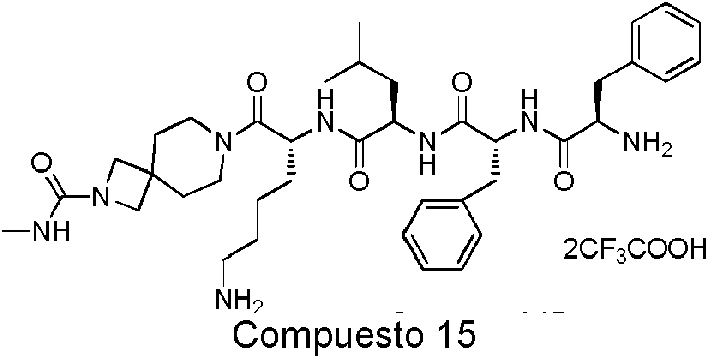
Se añadieron N-[(1R)-1-bencil-2-[[(1R)-1-bencil-2-[[(1R)-1-[[(1R)-5-(terc-butoxicarbonilamino)-1-[2-(metilcarbamoil)-2,7-diazaespiro[3.5]nonano-7-carbonil]pentil]carbamoil]-3-metil-butil]amino]-2-oxo-etil]amino]-2-oxo-etil]carbamato de terc-butilo (15D) (480 mg, 0,52 mmol) y diclorometano (10 ml) en un matraz de reacción de 50 ml y se añadió gota a gota ácido trifluoroacético (3 ml) a temperatura ambiente. Después de la adición, se permitió que reaccionase el sistema durante 2 h. Se concentró la disolución de reacción a presión reducida y se separó el residuo y se purificó mediante cromatografía de líquidos preparativa (condiciones de preparación: instrumento: GX-281 de Gilson; columna: Xbridge C18, 150 x 30 mm de D.I., 5 |am; fase móvil: A para ACN y B para H2O; isocrático: 65% de A; velocidad de flujo: 30 ml/min; contrapresión:1000 psi; temperatura de columna: 30°C; longitud de onda: 210 nm; periodo: 18 min; preparación de la muestra: se disolvió el compuesto en 12 ml de metanol; inyección: 0,9 ml/aguja). Se concentró la preparación a presión reducida para eliminar la mayor parte del disolvente y se liofilizó para obtener 7-[(2R)-6-amino-2-[[(2R)-2-[[(2R)-2-[[(2R)-2-amino-3-fenil-propanoil]amino]-3-fenil-propanoil]amino]-4-metil-pentanoil]amino]hexanoil]-N-metil-2,7-diazaespiro[3.5]nonano-2-carboxamida; di-ácido trifluoroacético (compuesto 15) como un sólido de color blanco (260 mg, rendimiento del 53%).N-[(1R)-1-benzyl-2-[[(1R)-1-benzyl-2-[[(1R)-1-[[(1R)-5-(tert-butoxycarbonylamino)-1 -[2-(methylcarbamoyl)-2,7-diazaspiro[3.5]nonane-7-carbonyl]pentyl]carbamoyl]-3-methyl-butyl]amino]-2-oxo-ethyl]amino]-2-oxo-ethyl tert-butyl ]carbamate (15D) (480 mg, 0.52 mmol) and dichloromethane (10 mL) in a 50 mL reaction flask and trifluoroacetic acid (3 mL) was added dropwise at room temperature. After the addition, the system was allowed to react for 2 h. The reaction solution was concentrated under reduced pressure, and the residue was separated and purified by preparative liquid chromatography (preparation conditions: instrument: Gilson GX-281; column: Xbridge C18, 150 x 30 mm I.D., 5 µm ; mobile phase: A for ACN and B for H2O; isocratic: 65% A; flow rate: 30 mL/min; back pressure: 1000 psi; column temperature: 30°C; wavelength: 210 nm; period: 18 min, sample preparation: compound was dissolved in 12 mL methanol, injection: 0.9 mL/needle). The preparation was concentrated under reduced pressure to remove most of the solvent and lyophilized to obtain 7-[(2R)-6-amino-2-[[(2R)-2-[[(2R)-2-[[ (2R)-2-amino-3-phenyl-propanoyl]amino]-3-phenyl-propanoyl]amino]-4-methyl-pentanoyl]amino]hexanoyl]-N-methyl-2,7-diazaspiro[3.5]nonane -2-carboxamide; di-trifluoroacetic acid (compound 15) as a white solid (260 mg, 53% yield).
EM m/z = 360,3 [M+2H]+/2;MS m/z = 360.3 [M+2H]+/2;
1H-RMN (400 MHz, D2O) 87,43-7,28 (m, 6H), 7,27-7,21 (m, 4H), 4,66 (t, 1H), 4,30 (t, 1H), 4,21 (t, 1H), 3,74 (s, 2H), 3,70 (s, 2H), 3,69-3,59 (m, 2H), 3,55-3,43 (m, 1H), 3,41-3,31 (m, 1H), 3,24-3,12 (m, 2H), 3,11-2,92 (m, 4H), 2,69 (s, 3H), 1,94-1,27 (m, 14H), 0,93 (dd, 6H).1H-NMR (400 MHz, D2O) 87.43-7.28 (m, 6H), 7.27-7.21 (m, 4H), 4.66 (t, 1H), 4.30 (t, 1H), 4.21 (t, 1H), 3.74 (s, 2H), 3.70 (s, 2H), 3.69-3.59 (m, 2H), 3.55-3.43 (m, 1H), 3.41-3.31 (m, 1H), 3.24-3.12 (m, 2H), 3.11-2.92 (m, 4H), 2.69 (s , 3H), 1.94-1.27 (m, 14H), 0.93 (dd, 6H).
Ejemplo 14:Example 14:
(2R)-N-[(1R)-5-Amino-1-(5,5-difluoro-2-metilsulfonil-2,7-diazaespiro[3.5]nonano-7-carbonil)pentil]-2-[[(2R)-2-[[(2R)-2-amino-3-fenil-propanoil]amino]-3-fenil-propanoil]amino]-4-metil-pentanamida; ácido 2,2,2-trifluoroacético (compuesto 16) (2R)-N-[(1R)-5-Amino-1-(5,5-difluoro-2-methylsulfonyl-2,7-diazaspiro[3.5]nonane-7-carbonyl)pentyl]-2-[[( 2R)-2-[[(2R)-2-amino-3-phenyl-propanoyl]amino]-3-phenyl-propanoyl]amino]-4-methyl-pentanamide; 2,2,2-trifluoroacetic acid (compound 16)

Etapa 1:Stage 1:
5,5-Difluoro-2,7-diazaespiro[3.5]nonano-2,7-dicarboxilato de O7-bencilo y O2-terc-butilo (16B)O7-benzyl O2-tert-butyl 5,5-Difluoro-2,7-diazaspiro[3.5]nonane-2,7-dicarboxylate (16B)

Se añadieron secuencialmente trietilamina (0,85 ml, 8,4 mmol), carboxilato de 5,5-difluoro-2,7-diazaespiro[3.5]nonano-2-terc-butilo (16A) (2,1 g, 8,0 mmol) y tetrahidrofurano (15 ml) en un matraz de una sola boca de 50 ml. Se enfrió la disolución de reacción hasta 0°C y luego se añadió lentamente gota a gota cloroformiato de bencilo (1,5 g, 8,8 mmol). Después de la adición, se mantuvo la reacción a 0°C durante 10 minutos y luego se elevó la temperatura de nuevo hasta temperatura ambiente y se continuó agitando durante 5 h. Se filtró la disolución de reacción y se concentró el filtrado a presión reducida para obtener 5,5-difluoro-2,7-diazaespiro[3.5]nonano-2,7-dicarboxilato de O7-bencilo y O2-terc-butilo (16B) como un producto oleoso de color amarillo claro (3,5 g, rendimiento del 100%).Triethylamine (0.85 mL, 8.4 mmol), 5,5-difluoro-2,7-diazaspiro[3.5]nonane-2-tert-butyl carboxylate (16A) (2.1 g, 8, 0 mmol) and tetrahydrofuran (15 mL) in a 50 mL single neck flask. The reaction solution was cooled to 0°C, and then benzyl chloroformate (1.5 g, 8.8 mmol) was slowly added dropwise. After the addition, the reaction was kept at 0°C for 10 min and then the temperature was raised back to room temperature and stirring continued for 5 h. The reaction solution was filtered, and the filtrate was concentrated under reduced pressure to obtain O7-benzyl O2-tert-butyl 5,5-difluoro-2,7-diazaspiro[3.5]nonane-2,7-dicarboxylate (16B) as a light yellow oily product (3.5 g, 100% yield).
EM m/z = 419,3 [M+Na]+;MS m/z = 419.3 [M+Na]+;
Etapa 2:Stage 2:
5,5-Difluoro-2,7-diazaespiro[3.5]nonano-7-carboxilato de bencilo (16C)Benzyl 5,5-Difluoro-2,7-diazaspiro[3.5]nonane-7-carboxylate (16C)
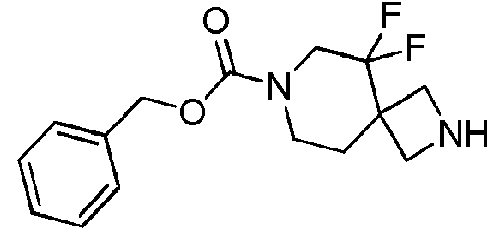
Se añadieron 5,5-difluoro-2,7-diazaespiro[3.5]nonano-2,7-dicarboxilato de O7-bencilo y O2-terc-butilo (16B) (3,17 g, 8,0 mmol) y diclorometano (30 ml) en un matraz de reacción de 50 ml y se añadió gota a gota ácido trifluoroacético (6,0 ml) a temperatura ambiente. Después de la adición, se permitió que reaccionase el sistema a temperatura ambiente durante 3 h. Se ajustó la disolución de reacción a un pH de aproximadamente 13 con agua amoniacal y luego se sometió la mezcla a un proceso de separación de líquido. Se secaron las fases orgánicas sobre sulfato de sodio anhidro, se filtraron y se concentró el filtrado a presión reducida para obtener 5,5-difluoro-2,7-diazaespiro[3.5]nonano-7-carboxilato de bencilo (16C) como un líquido oleoso de color amarillo (2,43 g, rendimiento del 100%) y se usó directamente en la siguiente reacción.O7-benzyl O2-tert-butyl 5,5-difluoro-2,7-diazaspiro[3.5]nonane-2,7-dicarboxylate (16B) (3.17 g, 8.0 mmol) and dichloromethane ( 30 mL) into a 50 mL reaction flask and trifluoroacetic acid (6.0 mL) was added dropwise at room temperature. After the addition, the system was allowed to react at room temperature for 3 h. The reaction solution was adjusted to a pH of about 13 with ammonia water, and then the mixture was subjected to a liquid separation process. The organic layers were dried over anhydrous sodium sulfate, filtered, and the filtrate was concentrated under reduced pressure to obtain benzyl 5,5-difluoro-2,7-diazaspiro[3.5]nonane-7-carboxylate (16C) as a liquid. yellow oily (2.43 g, 100% yield) and used directly in the next reaction.
EM m/z = 297,1 [M+H]+; MS m/z = 297.1 [M+H]+;
Etapa 3:Stage 3:
5,5-Difluoro-2-metilsulfonil-2,7-diazaespiro[3.5]nonano-7-carboxilato de bencilo (16D)Benzyl 5,5-Difluoro-2-methylsulfonyl-2,7-diazaspiro[3.5]nonane-7-carboxylate (16D)

Se añadieron 5,5-difluoro-2,7-diazaespiro[3.5]nonano-7-carboxilato de bencilo (16C) (310 mg, 1,05 mmol), trietilamina (318 mg, 3,14 mmol) y diclorometano (20 ml) en un matraz de reacción de 50 ml y se disolvieron con agitación. Después de enfriar hasta -10°C, se añadió gota a gota cloruro de metanosulfonilo (156 mg, 1,36 mmol) y se permitió que reaccionase el sistema durante 4 h. Luego, se elevó la temperatura hasta temperatura ambiente y se lavó la disolución de reacción secuencialmente con una disolución acuosa saturada de bicarbonato de sodio (60 ml), una disolución acuosa de ácido clorhídrico 3 M (60 ml) y se separó. Se secaron las fases orgánicas sobre sulfato de sodio anhidro, se filtraron y se concentró el filtrado a presión reducida. Se separó el residuo y se purificó mediante cromatografía en columna de gel de sílice (diclorometano:metanol (v:v) = 60:1) para obtener 5,5-difluoro-2-metilsulfonil-2,7-diazaespiro[3.5]nonano-7-carboxilato de bencilo (16D) como un sólido de color blanco (233 mg, rendimiento del 59%).Benzyl 5,5-difluoro-2,7-diazaspiro[3.5]nonane-7-carboxylate (16C) (310 mg, 1.05 mmol), triethylamine (318 mg, 3.14 mmol), and dichloromethane (20 ml) in a 50 ml reaction flask and dissolved with stirring. After cooling to -10°C, methanesulfonyl chloride (156 mg, 1.36 mmol) was added dropwise and the system was allowed to react for 4 h. Then, the temperature was raised to room temperature, and the reaction solution was washed sequentially with a saturated aqueous sodium bicarbonate solution (60 ml), a 3M aqueous hydrochloric acid solution (60 ml) and separated. The organic phases were dried over anhydrous sodium sulfate, filtered, and the filtrate was concentrated under reduced pressure. The residue was separated and purified by silica gel column chromatography (dichloromethane:methanol (v:v) = 60:1) to obtain 5,5-difluoro-2-methylsulfonyl-2,7-diazaspiro[3.5]nonane Benzyl -7-carboxylate (16D) as a white solid (233 mg, 59% yield).
EM m/z = 397,2 [M+Na]+;MS m/z = 397.2 [M+Na]+;
1H-RMN (400 MHz, CDCls) 87,42-7,29 (m, 5H), 5,15 (s, 2H), 4,09 (d, 2H), 3,78-3,59 (m, 4H), 3,51 (t, 2H), 2,89 (s, 3H), 2,08 (s, 2H).1H-NMR (400 MHz, CDCls) 87.42-7.29 (m, 5H), 5.15 (s, 2H), 4.09 (d, 2H), 3.78-3.59 (m, 4H), 3.51 (t, 2H), 2.89 (s, 3H), 2.08 (s, 2H).
Etapa 4:Stage 4:
5,5-Difluoro-2-metilsulfonil-2,7-diazaespiro[3.5]nonano (16E)5,5-Difluoro-2-methylsulfonyl-2,7-diazaspiro[3.5]nonane (16E)
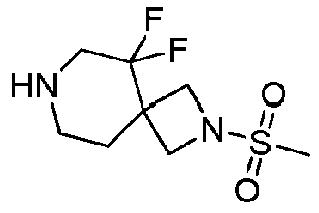
Se añadieron 5,5-difluoro-2-metilsulfonil-2,7-diazaespiro[3.5]nonano-7-carboxilato de bencilo (16D) (230 mg, 0,5 mmol), paladio/carbono (40 mg, al 20% en peso) e isopropanol (20 ml) en un matraz de reacción de 50 ml. Se reemplazó la atmósfera por hidrógeno 3 veces y se calentó la reacción hasta 100°C en el baño de aceite y se hizo reaccionar durante 8 h bajo una atmósfera de hidrógeno (globo). Luego, se filtró la disolución de reacción a través de tierra de diatomeas y se concentró el filtrado a presión reducida para obtener 5,5-difluoro-2-metilsulfonil-2,7-diazaespiro[3.5]nonano (16E)como un sólido de color amarillo claro (155 mg, rendimiento del 100%) y se usó directamente en la siguiente reacción.Benzyl 5,5-difluoro-2-methylsulfonyl-2,7-diazaspiro[3.5]nonane-7-carboxylate (16D) (230 mg, 0.5 mmol), palladium/carbon (40 mg, 20% by weight) and isopropanol (20 mL) in a 50 mL reaction flask. The atmosphere was replaced by hydrogen 3 times and the reaction was heated to 100°C in the oil bath and reacted for 8 h under hydrogen atmosphere (balloon). Then, the reaction solution was filtered through diatomaceous earth, and the filtrate was concentrated under reduced pressure to obtain 5,5-difluoro-2-methylsulfonyl-2,7-diazaspiro[3.5]nonane (16E) as a solid of light yellow color (155 mg, 100% yield) and used directly in the next reaction.
EM m/z = 241,1 [M+H]+;MS m/z = 241.1 [M+H]+;
Etapa 5:Stage 5:
N-[(1R)-1-bencil-2-[[(1R)-1-bencil-2-[[(1R)-1-[[(1R)-5-(terc-butoxicarbonilamino)-? 1-(5,5-difluoro-2-metilsulfonil-2,7-diazaespiro[3.5]nonano-7-carbonil)pentil]carbamoil]-3-metil-butil]amino]-2-oxo-etil]amino]-2-oxo-etil]carbamato de terc-butilo (16F)N-[(1R)-1-benzyl-2-[[(1R)-1-benzyl-2-[[(1R)-1-[[(1R)-5-(tert-butoxycarbonylamino)-? 1-(5,5-difluoro-2-methylsulfonyl-2,7-diazaspiro[3.5]nonane-7-carbonyl)pentyl]carbamoyl]-3-methyl-butyl]amino]-2-oxo-ethyl]amino]- tert-butyl 2-oxo-ethyl]carbamate (16F)

Se añadieron 5,5-difluoro-2-metilsulfonil-2,7-diazaespiro[3.5]nonano (16E) (155 mg, 0,5 mmol), clorhidrato de 1-(3-dimetilaminopropil)-3-etilcarbodiimida (300 mg, 2,0 mmol), 1-hidroxibenzotriazol (115 mg, 0,85 mmol), producto intermedio 1 (377 mg, 0,5 mmol) y diclorometano (30 ml) en un matraz de reacción de 50 ml y se permitió que reaccionase el sistema a temperatura ambiente durante 5 h. Luego, se concentró la disolución de reacción a presión reducida y se separó el residuo y se purificó mediante cromatografía en columna de gel de sílice (diclorometano:metanol (v:v) = 40:1) para obtener N-[(1R)-1-bencil-2-[[(1R)-1-bencil-2-[[(1R)-1-[[(1R)-5-(tercbutoxicarbonilamino)-1-(5,5-difluoro-2-metilsulfonil-2,7-diazaespiro[3.5]nonano-7-carbonil)pentil]carbamoil]-3-metilbutil]amino]-2-oxo-etil]amino]-2-oxo-etil]carbamato de terc-butilo (16F)como un sólido de color blanco (380 mg, rendimiento del 78%).5,5-Difluoro-2-methylsulfonyl-2,7-diazaspiro[3.5]nonane (16E) (155 mg, 0.5 mmol), 1-(3-dimethylaminopropyl)-3-ethylcarbodiimide hydrochloride (300 mg , 2.0 mmol), 1-hydroxybenzotriazole (115 mg, 0.85 mmol), intermediate 1 (377 mg, 0.5 mmol), and dichloromethane (30 mL) in a 50 mL reaction flask and allowed to react the system at room temperature for 5 h. Then, the reaction solution was concentrated under pressure and the residue was separated and purified by silica gel column chromatography (dichloromethane:methanol (v:v) = 40:1) to obtain N-[(1R)-1-benzyl-2-[[(1R )-1-benzyl-2-[[(1R)-1-[[(1R)-5-(tertbutoxycarbonylamino)-1-(5,5-difluoro-2-methylsulfonyl-2,7-diazaspiro[3.5]nonane tert-Butyl -7-carbonyl)pentyl]carbamoyl]-3-methylbutyl]amino]-2-oxo-ethyl]amino]-2-oxo-ethyl]carbamate (16F) as a white solid (380 mg, yield of 78%).
Etapa 6:Stage 6:
(2R)-N-[(1R)-5-Amino-1-(5,5-difluoro-2-metilsulfonil-2,7-diazaespiro[3.5]nonano-7-carbonil)pentil]-2-[[(2R)-2-[[(2R)-2-amino-3-fenil-propanoil]amino]-3-fenil-propanoil]amino]-4-metil-pentanamida; ácido 2,2,2-trifluoroacético (compuesto 16)(2R)-N-[(1R)-5-Amino-1-(5,5-difluoro-2-methylsulfonyl-2,7-diazaspiro[3.5]nonane-7-carbonyl)pentyl]-2-[[( 2R)-2-[[(2R)-2-amino-3-phenyl-propanoyl]amino]-3-phenyl-propanoyl]amino]-4-methyl-pentanamide; 2,2,2-trifluoroacetic acid (compound 16)

Se añadieron N-[(1R)-1-bencil-2-[[(1R)-1-bencil-2-[[(1R)-1-[[(1R)-5-(terc-butoxicarbonilamino)-1-(5,5-difluoro-2-metilsulfonil-2,7-diazaespiro[3.5]nonano-7-carbonil)pentil]carbamoil]-3-metil-butil]amino]-2-oxo-etil]amino]-2-oxoetil]carbamato de terc-butilo (16F) (380 mg, 0,34 mmol) y diclorometano (10 ml) en un matraz de reacción de 50 ml y se añadió gota a gota ácido trifluoroacético (3 ml) a temperatura ambiente. Después de la adición, se permitió que reaccionase el sistema durante 2 h. Luego, se concentró la disolución de reacción a presión reducida y se separó el residuo y se purificó mediante cromatografía de líquidos preparativa (condiciones de preparación: instrumento: GX-281 de Gilson; columna: Xbridge C18, 150 x 30 mm de D.I., 5 p,m; fase móvil: A para ACN y B para H2O; isocrático: 65% de A; velocidad de flujo: 30 ml/min; contrapresión:1000 psi; temperatura de columna: 30°C; longitud de onda: 210 nm; periodo: 18min; preparación de la muestra: se disolvió el compuesto en 12 ml de metanol; inyección: 0,9 ml/aguja). Se concentró la preparación a presión reducida para eliminar la mayor parte del disolvente y se liofilizó para obtener (2R)-N-[(1R)-5-amino-1-(5,5-difluoro-2-metilsulfonil-2,7-diazaespiro[3.5]nonano-7-carbonil)pentil]-2-[[(2R)-2-[[(2R)-2-amino-3-fenil-propanoil]amino]-3-fenil-propanoil]amino]-4-metilpentanamida; di-ácido trifluoroacético (compuesto 16) como un polvo de color blanco (270 mg, rendimiento del 71%).N-[(1R)-1-benzyl-2-[[(1R)-1-benzyl-2-[[(1R)-1-[[(1R)-5-(tert-butoxycarbonylamino)-1 -(5,5-difluoro-2-methylsulfonyl-2,7-diazaspiro[3.5]nonane-7-carbonyl)pentyl]carbamoyl]-3-methyl-butyl]amino]-2-oxo-ethyl]amino]-2 tert-butyl-oxoethyl]carbamate (16F) (380 mg, 0.34 mmol) and dichloromethane (10 mL) in a 50 mL reaction flask and trifluoroacetic acid (3 mL) was added dropwise at room temperature. After the addition, the system was allowed to react for 2 h. Then, the reaction solution was concentrated under reduced pressure, and the residue was separated and purified by preparative liquid chromatography (preparation conditions: instrument: Gilson GX-281; column: Xbridge C18, 150 x 30 mm I.D., 5 mw, mobile phase: A for ACN and B for H2O, isocratic: 65% A, flow rate: 30 mL/min, back pressure: 1000 psi, column temperature: 30°C, wavelength: 210 nm ; period: 18 min; sample preparation: the compound was dissolved in 12 ml of methanol; injection: 0.9 ml/needle). The preparation was concentrated under reduced pressure to remove most of the solvent and lyophilized to obtain (2R)-N-[(1R)-5-amino-1-(5,5-difluoro-2-methylsulfonyl-2,7 -diazaspiro[3.5]nonane-7-carbonyl)pentyl]-2-[[(2R)-2-[[(2R)-2-amino-3-phenyl-propanoyl]amino]-3-phenyl-propanoyl]amino ]-4-methylpentanamide; di-trifluoroacetic acid (compound 16) as a white powder (270 mg, 71% yield).
EM m/z = 388,8 [M+2H]+/2;MS m/z = 388.8 [M+2H]+/2;
1H-RMN (400 MHz, D2O) 87,44-7,17 (m, 10H), 4,66 (t, 1H), 4,42-4,13 (m, 4H), 4,13-3,49 (m, 7H), 3,25-2,92 (m, 9H), 2,30-2,00 (m, 2H), 1,91-1,26 (m, 9H), 0,93 (q, 6H).1H-NMR (400 MHz, D2O) 87.44-7.17 (m, 10H), 4.66 (t, 1H), 4.42-4.13 (m, 4H), 4.13-3, 49 (m, 7H), 3.25-2.92 (m, 9H), 2.30-2.00 (m, 2H), 1.91-1.26 (m, 9H), 0.93 ( q, 6H).
Ejemplo 15:Example 15:
(2R)-N-[(1R)-5-Amino-1-[2-[(2R)-2-aminopropanoil]-2,7-diazaespiro[3.5]nonano-7-carbonil]pentil]-2-[[(2R)-2-[[(2R)-2-amino-3-fenil-propanoil]amino]-3-fenil-propanoil]amino]-4-metil-pentanamida; tri-ácido trifluoroacético (compuesto 17)(2R)-N-[(1R)-5-Amino-1-[2-[(2R)-2-aminopropanoyl]-2,7-diazaspiro[3.5]nonane-7-carbonyl]pentyl]-2-[ [(2R)-2-[[(2R)-2-amino-3-phenyl-propanoyl]amino]-3-phenyl-propanoyl]amino]-4-methyl-pentanamide; tri-trifluoroacetic acid (compound 17)
H2N - Y OH E,aPa 1 B o c H N '^ ^ °ht ,aPa 2 

NHBocNHBoc

Etapa 1:Stage 1:
Ácido (2R-2-(terc-butoxicarbonilamino)propanoico (17B)(2R-2-(tert-butoxycarbonylamino)propanoic acid (17B)

Se añadieron D-alanina (17A) (10 g, 112,24 mmol) y agua (56 ml) en un matraz de reacción de 250 ml y se enfrió la disolución de reacción hasta 0°Cy luego se añadió hidróxido de sodio (6,73 g, 168,36 mmol). Después de la adición, se mantuvo la reacción a 0°C durante 10 minutos y luego se añadió gota a gota una disolución de dicarbonato de diterc-butilo (31,85 g, 145,91 mmol) en tetrahidrofurano (50 ml). Después de la adición, se elevó la temperatura hasta temperatura ambiente y se agitó durante la noche. Se extrajo la disolución de reacción con éter de petróleo (100 ml x 2) y se desechó la fase orgánica. Se acidificó la fase acuosa con una disolución de ácido clorhídrico 4 M hasta un pH de aproximadamente 1 y luego se extrajo con acetato de etilo (100 ml x 4). Se combinaron las fases orgánicas y se secaron sobre sulfato de sodio anhidro, se filtraron y se concentró el filtrado a presión reducida para obtener ácido (2R)-2-(terc-butoxicarbonilamino)propanoico (17B) como una sustancia oleosa incolora (21,2 g, rendimiento:100%). D-alanine (17A) (10 g, 112.24 mmol) and water (56 mL) were added in a 250 mL reaction flask and the reaction solution was cooled to 0°C, and then sodium hydroxide (6 0.73g, 168.36mmol). After the addition, the reaction was kept at 0°C for 10 minutes and then a solution of di-tert-butyl dicarbonate (31.85 g, 145.91 mmol) in tetrahydrofuran (50 mL) was added dropwise. After the addition, the temperature was raised to room temperature and stirred overnight. The reaction solution was extracted with petroleum ether (100 ml x 2), and the organic phase was discarded. The aqueous phase was acidified with 4M hydrochloric acid solution to a pH of about 1, and then extracted with ethyl acetate (100 mL x 4). The organic layers were combined and dried over anhydrous sodium sulfate, filtered, and the filtrate was concentrated under reduced pressure to obtain (2R)-2-(tert-butoxycarbonylamino)propanoic acid (17B) as a colorless oily substance (21, 2 g, yield: 100%).
EM m/z = 212,1 [M+Na]+;MS m/z = 212.1 [M+Na]+;
1H-RMN (400 MHz, DMSO-D) 812,34 (a, 1H), 7,05 (d, 1H), 3,98-3,87 (m, 1H), 1,38 (s, 9H), 1,22 (d, 3H).1H-NMR (400 MHz, DMSO-D) 812.34 (b, 1H), 7.05 (d, 1H), 3.98-3.87 (m, 1H), 1.38 (s, 9H) , 1.22 (d, 3H).
Etapa 2:Stage 2:
2-[(2R)-2-(terc-Butoxicarbonilamino)propanoil]-2,7-diazaespiro[3.5]nonano-7-carboxilato de bencilo (17C)Benzyl 2-[(2R)-2-(tert-Butoxycarbonylamino)propanoyl]-2,7-diazaspiro[3.5]nonane-7-carboxylate (17C)

Se añadieron 2,7-diazaespiro[3.5]nonano-7-carboxilato de bencilo (6C) (335 mg, 1,3 mmol), clorhidrato de 1-(3-dimetilaminopropil)-3-etilcarbodiimida (748 mg, 3,9 mmol), 1-hidroxibenzotriazol (211 mg, 1,56 mmol), ácido (2R)-2-(terc-butoxicarbonilamino)propanoico (17B) (246 mg, 1,3 mmol) y diclorometano (30 ml) en un matraz de reacción de 50 ml y se permitió que reaccionase el sistema a temperatura ambiente durante 5 h. Luego, se concentró la disolución de reacción a presión reducida y se separó el residuo y se purificó mediante cromatografía en columna de gel de sílice (éter de petróleo:acetato de etilo (v:v) = 3:1) para obtener 2-[(2R)-2-(terc-butoxicarbonilamino)propanoil]-2,7-diazaespiro[3.5]nonano-7-carboxilato de bencilo (17C) como un sólido de color blanco (510 mg, rendimiento del 91%). Benzyl 2,7-diazaspiro[3.5]nonane-7-carboxylate (6C) (335 mg, 1.3 mmol), 1-(3-dimethylaminopropyl)-3-ethylcarbodiimide hydrochloride (748 mg, 3.9 mmol), 1-hydroxybenzotriazole (211 mg, 1.56 mmol), (2R)-2-(tert-butoxycarbonylamino)propanoic acid (17B) (246 mg, 1.3 mmol), and dichloromethane (30 mL) in a flask 50 mL reaction mixture and the system was allowed to react at room temperature for 5 h. Then, the reaction solution was concentrated under reduced pressure, and the residue was separated and purified by silica gel column chromatography (petroleum ether:ethyl acetate (v:v) = 3:1) to obtain 2-[ Benzyl (2R)-2-(tert-butoxycarbonylamino)propanoyl]-2,7-diazaspiro[3.5]nonane-7-carboxylate (17C) as a white solid (510 mg, 91% yield).
EM m/Z = 454,3 [M+Na]+;MS m/Z = 454.3 [M+Na]+;
Etapa 3:Stage 3:
N-[(1R)-2-(2,7-Diazaespiro[3.5]nonan-2-il)-1-metil-2-oxo-etil]carbamato de terc-butilo (17D)tert-Butyl N-[(1R)-2-(2,7-Diazaspiro[3.5]nonan-2-yl)-1-methyl-2-oxo-ethyl]carbamate (17D)
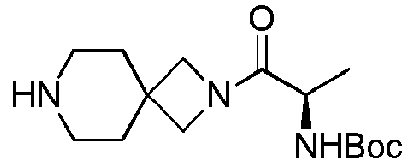
Se añadieron 2-[(2R)-2-(terc-butoxicarbonilamino)propanoil]-2,7-diazaespiro[3.5]nonano-7-carboxilato de bencilo (17C) (460 mg, 1,1 mmol), hidróxido de paladio/carbono (92 mg, 20% en peso) e isopropanol (20 ml) en un matraz de reacción de 50 ml. Se reemplazó la atmósfera por hidrógeno 3 veces y se calentó la reacción a 100°C en el baño de aceite durante 8 h bajo una atmósfera de hidrógeno (globo). Luego se enfrió hasta temperatura ambiente, se filtró la disolución de reacción a través de tierra de diatomeas y se concentró el filtrado a presión reducida para obtener N-[(1R)-2-(2,7-diazaespiro[3.5]nonan-2-il)-1-metil-2-oxo-etil]carbamato de terc-butilo (17D)como un sólido de color amarillo claro (252 mg, rendimiento del 77%) y se usó directamente en la siguiente reacción.Benzyl 2-[(2R)-2-(tert-butoxycarbonylamino)propanoyl]-2,7-diazaspiro[3.5]nonane-7-carboxylate (17C) (460 mg, 1.1 mmol), palladium hydroxide /carbon (92 mg, 20 wt%) and isopropanol (20 mL) in a 50 mL reaction flask. The atmosphere was replaced by hydrogen 3 times and the reaction was heated at 100°C in the oil bath for 8 h under a hydrogen atmosphere (balloon). Then cooled to room temperature, the reaction solution was filtered through diatomaceous earth, and the filtrate was concentrated under reduced pressure to obtain N-[(1R)-2-(2,7-diazaspiro[3.5]nonan-2 tert-butyl -yl)-1-methyl-2-oxo-ethyl]carbamate (17D) as a light yellow solid (252 mg, 77% yield) and used directly in the next reaction.
EM m/z = 298,3 [M+H]+;MS m/z = 298.3 [M+H]+;
Etapa 4:Stage 4:
N-[(1R)-1-Bencil-2-[[(1R)-1-bencil-2-[[(1R)-1-[[(1R)-5-(terc-butoxicarbonilamino)-1-[2-[(2R)-2-(tercbutoxicarbonilamino)propanoil]-2,7-diazaespiro[3.5]nonano-7-carbonil]pentil]carbamoil]-3-metil-butil]amino]-2-oxoetil]amino]-2-oxo-etil]carbamato de terc-butilo (17E) N-[(1R)-1-Benzyl-2-[[(1R)-1-benzyl-2-[[(1R)-1-[[(1R)-5-(tert-butoxycarbonylamino)-1-[ 2-[(2R)-2-(tert-butoxycarbonylamino)propanoyl]-2,7-diazaspiro[3.5]nonane-7-carbonyl]pentyl]carbamoyl]-3-methyl-butyl]amino]-2-oxoethyl]amino]- tert-butyl 2-oxo-ethyl]carbamate (17E)

Se añadieron secuencialmente N-[(1R)-2-(2,7-diazaespiro[3.5]nonan-2-il)-1-metil-2-oxo-etil]carbamato de terc-butilo (17D) en bruto (223 mg, 0,75 mmol), clorhidrato de 1-(3-dimetilaminopropil)-3-etilcarbodiimida (374 mg, 1,95 mmol), 1-hidroxibenzotriazol (110 mg, 0,81 mmol), producto intermedio 1 (565 mg, 0,75 mmol) y diclorometano (30 ml) en un matraz de reacción de 50 ml y se permitió que reaccionase el sistema a temperatura ambiente durante 5 h. Luego, se concentró la disolución de reacción a presión reducida y se separó el residuo y se purificó mediante cromatografía en columna de gel de sílice (diclorometano:metanol (v:v) = 40:1) para obtener N-[(1R)-1-bencil-2-[[(1R)-1-bencil-2-[[(1R)-1-[[(1R)-5-(terc-butoxicarbonilamino)-1-[2-[(2R)-2]-(terc-butoxicarbonilamino)propanoil]-2,7-diazaespiro[3.5]nonano-7-carbonil]pentil]carbamoil]-3-metil-butil]amino]-2-oxo-etil]amino]-2-oxo-etil]carbamato de terc-butilo (17E)como un sólido de color amarillo claro (560 mg, rendimiento del 69%).Crude tert-butyl N-[(1R)-2-(2,7-diazaspiro[3.5]nonan-2-yl)-1-methyl-2-oxo-ethyl]carbamate (17D) were added sequentially (223 mg, 0.75 mmol), 1-(3-dimethylaminopropyl)-3-ethylcarbodiimide hydrochloride (374 mg, 1.95 mmol), 1-hydroxybenzotriazole (110 mg, 0.81 mmol), intermediate 1 (565 mg , 0.75 mmol) and dichloromethane (30 mL) in a 50 mL reaction flask and the system was allowed to react at room temperature for 5 h. Then, the reaction solution was concentrated under reduced pressure, and the residue was separated and purified by silica gel column chromatography (dichloromethane:methanol (v:v) = 40:1) to obtain N-[(1R)- 1-benzyl-2-[[(1R)-1-benzyl-2-[[(1R)-1-[[(1R)-5-(tert-butoxycarbonylamino)-1-[2-[(2R)- 2]-(tert-butoxycarbonylamino)propanoyl]-2,7-diazaspiro[3.5]nonane-7-carbonyl]pentyl]carbamoyl]-3-methyl-butyl]amino]-2-oxo-ethyl]amino]-2- tert-butyl oxo-ethyl]carbamate (17E) as a light yellow solid (560 mg, 69% yield).
Etapa 5:Stage 5:
(2R)-N-[(1R)-5-Amino-1-[2-[(2R)-2-aminopropanoil]-2,7-diazaespiro[3.5]nonano-7-carbonil]pentil]-2-[[(2R)-2-[[(2R)-2-amino-3-fenil-propanoil]amino]-3-fenil-propanoil]amino]-4-metil-pentanamida; tri-ácido trifluoroacético (compuesto 17)(2R)-N-[(1R)-5-Amino-1-[2-[(2R)-2-aminopropanoyl]-2,7-diazaspiro[3.5]nonane-7-carbonyl]pentyl]-2-[ [(2R)-2-[[(2R)-2-amino-3-phenyl-propanoyl]amino]-3-phenyl-propanoyl]amino]-4-methyl-pentanamide; tri-trifluoroacetic acid (compound 17)

Se añadieron N-[(1R)-1-bencil-2-[[(1R)-1-bencil-2-[[(1R)-1-[[(1R)-5-(terc-butoxicarbonilamino)-1-[2-[(2R)-2-(tercbutoxicarbonilamino)propanoil]-2,7-diazaespiro[3.5]nonano-7-carbonil]pentil]carbamoil]-3-metil-butil]amino]-2-oxoetil]amino]-2-oxo-etil]carbamato de terc-butilo (17E) (560 mg, 0,52 mmol) y diclorometano (10 ml) en un matraz de reacción de 50 ml y se añadió gota a gota ácido trifluoroacético (3 ml) a temperatura ambiente. Después de la adición, se permitió que reaccionase el sistema a temperatura ambiente durante 2 h. Luego, se concentró la disolución de reacción a presión reducida y se separó el residuo y se purificó mediante cromatografía de líquidos preparativa (condiciones de preparación: instrumento: GX-281 de Gilson; columna: Xbridge C18, 150 x 30 mm de D.I., 5 |am; fase móvil: A para ACN y B para H2O; isocrático: 65% de A; velocidad de flujo: 30 ml/min; contrapresión:1000 psi; temperatura de columna: 30°C; longitud de onda: 210 nm; periodo: 18 min; preparación de la muestra: se disolvió el compuesto en 12 ml de metanol; inyección: 0,9 ml/aguja). Se concentró la preparación a presión reducida para eliminar la mayor parte del disolvente y se liofilizó para obtener (2R)-N-[(1R)-5-amino-1-[2-[(2R)-2-aminopropanoil]-2,7-diazaespiro[3.5]nonano-7-carbonil]pentil]-2-[[(2R)-2-[[(2R)-2-amino-3-fenil-propanoil]amino]-3-fenil-propanoil]amino]-4-metil-pentanamida; tri-ácido trifluoroacético (compuesto 17) como un polvo de color blanco (310 mg, rendimiento del 45%).N-[(1R)-1-benzyl-2-[[(1R)-1-benzyl-2-[[(1R)-1-[[(1R)-5-(tert-butoxycarbonylamino)-1 -[2-[(2R)-2-(tert-butoxycarbonylamino)propanoyl]-2,7-diazaspiro[3.5]nonane-7-carbonyl]pentyl]carbamoyl]-3-methyl-butyl]amino]-2-oxoethyl]amino tert-Butyl ]-2-oxo-ethyl]carbamate (17E) (560 mg, 0.52 mmol) and dichloromethane (10 mL) in a 50 mL reaction flask and trifluoroacetic acid (3 mL) was added dropwise. ) at room temperature. After the addition, the system was allowed to react at room temperature for 2h. Then, the reaction solution was concentrated under reduced pressure, and the residue was separated and purified by preparative liquid chromatography (preparation conditions: instrument: Gilson GX-281; column: Xbridge C18, 150 x 30 mm I.D., 5 |am Mobile phase: A for ACN and B for H2O Isocratic: 65% A Flow rate: 30 mL/min Back pressure: 1000 psi Column temperature: 30°C Wavelength: 210 nm period: 18 min; sample preparation: compound was dissolved in 12 ml methanol; injection: 0.9 ml/needle). The preparation was concentrated under reduced pressure to remove most of the solvent and lyophilized to obtain (2R)-N-[(1R)-5-amino-1-[2-[(2R)-2-aminopropanoyl]-2 ,7-diazaspiro[3.5]nonane-7-carbonyl]pentyl]-2-[[(2R)-2-[[(2R)-2-amino-3-phenyl-propanoyl]amino]-3-phenyl-propanoyl ]amino]-4-methyl-pentanamide; tri-trifluoroacetic acid (compound 17) as a white powder (310 mg, 45% yield).
EM m/z = 367,3 [M+2H]+/2;MS m/z = 367.3 [M+2H]+/2;
1H-RMN (400 MHz, D2O) 87,44-7,28 (m, 6H), 7,26-7,20 (m, 4H), 4,65 (t, 2H), 4,33-4,21 (m, 2H), 4,19-4,01 (m, 3H), 3,96-3,78 (m, 2H), 3,75-3,59 (m, 2H), 3,56-3,42 (m, 1H), 3,42-3,30 (m, 1H), 3,24-3,12 (m, 2H), 3,10-2,92 (m, 4H), 1,99 1,79 (m, 3H), 1,80-1,63 (m, 5H), 1,53 (d, 3H), 1,50-1,30 (m, 5H), 0,92 (dd, 6H).1H-NMR (400 MHz, D2O) 87.44-7.28 (m, 6H), 7.26-7.20 (m, 4H), 4.65 (t, 2H), 4.33-4, 21 (m, 2H), 4.19-4.01 (m, 3H), 3.96-3.78 (m, 2H), 3.75-3.59 (m, 2H), 3.56- 3.42 (m, 1H), 3.42-3.30 (m, 1H), 3.24-3.12 (m, 2H), 3.10-2.92 (m, 4H), 1, 99 1.79 (m, 3H), 1.80-1.63 (m, 5H), 1.53 (d, 3H), 1.50-1.30 (m, 5H), 0.92 (dd , 6H).
Ejemplo 16:Example 16:
(2R)-N-[(1R)-5-amino-1-[7-[(2R)-2-aminopropanoil]-2,7-diazaespiro[3.5]nonano-2-carbonil]pentil]-2-[[(2R)-2-[[(2R)-2-amino-3-fenil-propanoil]amino]-3-fenil-propanoil]amino]-4-metil-pentanamida; tri-ácido trifluoroacético (compuesto 18) (2R)-N-[(1R)-5-amino-1-[7-[(2R)-2-aminopropanoyl]-2,7-diazaspiro[3.5]nonane-2-carbonyl]pentyl]-2-[ [(2R)-2-[[(2R)-2-amino-3-phenyl-propanoyl]amino]-3-phenyl-propanoyl]amino]-4-methyl-pentanamide; tri-trifluoroacetic acid (compound 18)

Etapa 1:Stage 1:
N-[(1R)-2-(2,7-Diazaespiro[3.5]nonan-7-il)-1-metil-2-oxo-etil]carbamato de bencilo (18B)Benzyl N-[(1R)-2-(2,7-Diazaspiro[3.5]nonan-7-yl)-1-methyl-2-oxo-ethyl]carbamate (18B)

Se añadieron 2,7-diazaespiro[3.5]nonano-2-carboxilato de terc-butilo (6A) (0,45g, 2 mmol), clorhidrato de 1-(3-dimetilaminopropil)-3-etilcarbodiimida (780 mg, 4,1 mmol), 1-hidroxibenzotriazol (340 mg, 2,5 mmol), ácido (2R)-2-(benciloxicarbonilamino)propanoico (446 mg, 2,0 mmol) y diclorometano (30 ml) en un matraz de reacción de 50 ml y se permitió que reaccionase el sistema a temperatura ambiente durante 5 h. Luego, se concentró la disolución de reacción a presión reducida y se separó el residuo y se purificó mediante cromatografía en columna de gel de sílice (diclorometano:metanol (v:v) = 50:1) para obtener N-[(1R)-2-(2,7-diazaespiro[3.5]nonan-7-il)-1-metil-2-oxoetil]carbamato de bencilo (18B) como un sólido de color blanco (860 mg, rendimiento del 99%).tert-Butyl 2,7-diazaspiro[3.5]nonane-2-carboxylate (6A) (0.45g, 2mmol), 1-(3-dimethylaminopropyl)-3-ethylcarbodiimide hydrochloride (780mg, 4, 1 mmol), 1-hydroxybenzotriazole (340 mg, 2.5 mmol), (2R)-2-(benzyloxycarbonylamino)propanoic acid (446 mg, 2.0 mmol), and dichloromethane (30 mL) in a 50 mL reaction flask. mL and the system was allowed to react at room temperature for 5 h. Then, the reaction solution was concentrated under reduced pressure, and the residue was separated and purified by silica gel column chromatography (dichloromethane:methanol (v:v) = 50:1) to obtain N-[(1R)- Benzyl 2-(2,7-diazaspiro[3.5]nonan-7-yl)-1-methyl-2-oxoethyl]carbamate (18B) as a white solid (860 mg, 99% yield).
EM m/Z = 454,2 [M+Na]+.MS m/Z = 454.2 [M+Na]+.
Etapa 2:Stage 2:
N-[(1R)-2-(2,7-Diazaespiro[3.5]nonan-7-il)-1-metil-2-oxo-etil]carbamato de bencilo (18C)Benzyl N-[(1R)-2-(2,7-Diazaspiro[3.5]nonan-7-yl)-1-methyl-2-oxo-ethyl]carbamate (18C)

Se añadieron N-[(1R)-2-(2,7-diazaespiro[3.5]nonan-7-il)-1-metil-2-oxo-etil]carbamato de bencilo (18B) (0,86 g, 2 mmol) y diclorometano (20 ml) en un matraz de reacción de 50 ml y se añadió gota a gota ácido trifluoroacético (2 ml) a temperatura ambiente. Después de la adición, se permitió que reaccionase el sistema a temperatura ambiente durante 3 h. Se concentró la disolución de reacción directamente a presión reducida para obtener N-[(1R)-2-(2,7-diazaespiro[3.5]nonan-7-il)-1-metil-2-oxo-etil]carbamato de bencilo (18C) en bruto como un líquido oleoso de color amarillo (660 mg, rendimiento del 100%) y se usó directamente en la siguiente reacción. Benzyl N-[(1R)-2-(2,7-diazaspiro[3.5]nonan-7-yl)-1-methyl-2-oxo-ethyl]carbamate (18B) (0.86 g, 2 mmol) and dichloromethane (20 mL) in a 50 mL reaction flask and trifluoroacetic acid (2 mL) was added dropwise at room temperature. After the addition, the system was allowed to react at room temperature for 3 h. The reaction solution was concentrated directly under reduced pressure to obtain benzyl N-[(1R)-2-(2,7-diazaspiro[3.5]nonan-7-yl)-1-methyl-2-oxo-ethyl]carbamate (18C) crude as a yellow oily liquid (660 mg, 100% yield) and used directly in the next reaction.
EM m/z = 332,2 [M+H]+;MS m/z = 332.2 [M+H]+;
Etapa 3:Stage 3:
N-[(1R)-1-bencil-2-[[(1R)-1-bencil-2-[[(1R)-1-[[(1R)-1-[7-[(2R)-2Hbenciloxicarbonilamino)propanoil]-2,7-diazaespiro[3.5]nonano-2-carbonil]-5-(terc-butoxicarbonilamino)pentil]carbamoil]-3-metil-butil]amino]-2-oxoetil]amino]-2-oxo-etil]carbamato de terc-butilo (18D)N-[(1R)-1-benzyl-2-[[(1R)-1-benzyl-2-[[(1R)-1-[[(1R)-1-[7-[(2R)-2Hbenzyloxycarbonylamino )propanoyl]-2,7-diazaspiro[3.5]nonane-2-carbonyl]-5-(tert-butoxycarbonylamino)pentyl]carbamoyl]-3-methyl-butyl]amino]-2-oxoethyl]amino]-2-oxo tert-butyl -ethyl]carbamate (18D)

Se añadieron N-[(1R)-2-(2,7-diazaespiro[3.5]nonan-7-il)-1-metil-2-oxo-etil]carbamato de bencilo (18C) (243 mg, 0,7 mmol), clorhidrato de 1-(3-dimetilaminopropil)-3-etilcarbodiimida (300 mg, 2,0 mmol), 1-hidroxibenzotriazol (200 mg, 1,0 mmol), producto intermedio 1 (500 mg, 0,7 mmol) y diclorometano (50 ml) en un matraz de reacción de 100 ml y se permitió que reaccionase el sistema a temperatura ambiente durante 5 h. Se concentró la disolución de reacción a presión reducida y se separó el residuo y se purificó mediante cromatografía en columna de gel de sílice (diclorometano:metanol (v:v) = 30:1) para obtener N-[(1R)-1-bencil-2-[[(1R)-1-bencil-2-[[(1R)-1-[[(1R)-1-[7-[(2R)-2-(benciloxicarbonilamino)propanoil]-2,7-diazaespiro[3.5]nonano-2-carbonil]-5-(tercbutoxicarbonilamino)pentil]carbamoil]-3-metil-butil]amino]-2-oxo-etil]amino]-2-oxo-etil]carbamato de terc-butilo (18D) como un sólido de color amarillo claro (740 mg, rendimiento del 99%).Benzyl N-[(1R)-2-(2,7-diazaspiro[3.5]nonan-7-yl)-1-methyl-2-oxo-ethyl]carbamate (18C) (243 mg, 0.7 mmol), 1-(3-dimethylaminopropyl)-3-ethylcarbodiimide hydrochloride (300 mg, 2.0 mmol), 1-hydroxybenzotriazole (200 mg, 1.0 mmol), Intermediate 1 (500 mg, 0.7 mmol ) and dichloromethane (50 mL) in a 100 mL reaction flask and the system was allowed to react at room temperature for 5 h. The reaction solution was concentrated under reduced pressure, and the residue was separated and purified by silica gel column chromatography (dichloromethane:methanol (v:v) = 30:1) to obtain N-[(1R)-1- benzyl-2-[[(1R)-1-benzyl-2-[[(1R)-1-[[(1R)-1-[7-[(2R)-2-(benzyloxycarbonylamino)propanoyl]-2, tert 7-diazaspiro[3.5]nonane-2-carbonyl]-5-(tert-butoxycarbonylamino)pentyl]carbamoyl]-3-methyl-butyl]amino]-2-oxo-ethyl]amino]-2-oxo-ethyl]carbamate -butyl (18D) as a light yellow solid (740 mg, 99% yield).
Etapa 4:Stage 4:
N-[(1R)-2-[[(1R)-2-[[(1R)-1-[[(1R)-1-[7-[(2R)-2-aminopropanoil]-2,7-]diazaespiro[3.5]nonano-2-carbonil]-5-(tercbutoxicarbonilamino)pentil]carbamoil]-3-metil-butil]amino]-1-bencil-2-oxo-etil]amino]-1-bencil-2-oxo-etil]carbamato de terc-butilo (18E)N-[(1R)-2-[[(1R)-2-[[(1R)-1-[[(1R)-1-[7-[(2R)-2-aminopropanoyl]-2,7- ]diazaspiro[3.5]nonane-2-carbonyl]-5-(tert-butoxycarbonylamino)pentyl]carbamoyl]-3-methyl-butyl]amino]-1-benzyl-2-oxo-ethyl]amino]-1-benzyl-2- tert-butyl oxo-ethyl]carbamate (18E)

Se añadieron N-[(1R)-1-bencil-2-[[(1R)-1-bencil-2-[[(1R)-1-[[(1R)-1-[7-[(2R)-2]-(benciloxicarbonilamino)propanoil]-2,7-diazaespiro[3.5]nonano-2-carbonil]-5-(terc-butoxicarbonilamino)pentil]carbamoil]-3-metil-butil]amino]-2-oxoetil]amino]-2-oxo-etil]carbamato de terc-butilo (18D) (700 mg, 0,7 mmol), paladio sobre carbono (140 mg, al 20% en peso) y metanol (15 ml) en un matraz de reacción de 50 ml. Se reemplazó la atmósfera por hidrógeno 3 veces y se hizo reaccionar la mezcla a temperatura ambiente durante 8 h bajo una atmósfera de hidrógeno. Luego, se filtró la disolución de reacción a través de tierra de diatomeas y se concentró el filtrado a presión reducida para obtener (1R)-2-[[(1R)-2-[[(1R)-1-[[(1R)]-1-[7-[(2R)-2-aminopropanoil]-1,7-diazaespiro[3.5]nonano-2-carbonil]-5-(tercbutoxicarbonil)pentil]carbamoil]-3-metil-butil]amino]-1-bencil-2-oxo-etil]amino]-1-bencil-2-oxo-etil]carbamato de tercbutilo (18E) en bruto como una sustancia oleosa de color amarillo claro (650 mg, rendimiento del 99%) y se usó directamente en la siguiente reacción.N-[(1R)-1-benzyl-2-[[(1R)-1-benzyl-2-[[(1R)-1-[[(1R)-1-[7-[(2R) -2]-(benzyloxycarbonylamino)propanoyl]-2,7-diazaspiro[3.5]nonane-2-carbonyl]-5-(tert-butoxycarbonylamino)pentyl]carbamoyl]-3-methyl-butyl]amino]-2-oxoethyl] tert-butyl amino]-2-oxo-ethyl]carbamate (18D) (700 mg, 0.7 mmol), palladium on carbon (140 mg, 20% wt) and methanol (15 mL) in a flask of 50 ml reaction. The atmosphere was replaced with hydrogen 3 times, and the mixture was reacted at room temperature for 8 h under an atmosphere of hydrogen. Then, the reaction solution was filtered through diatomaceous earth, and the filtrate was concentrated under reduced pressure to obtain (1R)-2-[[(1R)-2-[[(1R)-1-[[(1R )]-1-[7-[(2R)-2-aminopropanoyl]-1,7-diazaspiro[3.5]nonane-2-carbonyl]-5-(tert-butoxycarbonyl)pentyl]carbamoyl]-3-methyl-butyl]amino Crude tert-butyl ]-1-benzyl-2-oxo-ethyl]amino]-1-benzyl-2-oxo-ethyl]carbamate (18E) as light yellow oily substance (650 mg, 99% yield) and used directly in the next reaction.
Etapa 5:Stage 5:
(2R)-N-[(1R)-5-Amino-1-[7-[(2R)-2-aminopropanoil]-2,7-diazaespiro[3.5]nonano-2-carbonil]pentil]-2-[[(2R)-2-[[(2R)-2-amino-3-fenil-propanoil]amino]-3-fenil-propanoil]amino]-4-metil-pentanamida; tri-ácido trifluoroacético (compuesto 18) (2R)-N-[(1R)-5-Amino-1-[7-[(2R)-2-aminopropanoyl]-2,7-diazaspiro[3.5]nonane-2-carbonyl]pentyl]-2-[ [(2R)-2-[[(2R)-2-amino-3-phenyl-propanoyl]amino]-3-phenyl-propanoyl]amino]-4-methyl-pentanamide; tri-trifluoroacetic acid (compound 18)

Se añadieron (1R)-2-[[(1R)-2-[[(1R)-1-[[(1R)-1-[7-[(2R)-2-aminopropanoil]-1,7]-diazaespiro[3.5]nonano-2-carbonil]-5-(terc-butoxicarbonil)pentil]carbamoil]-3-metil-butil]amino]-1-bencil-2-oxo-etil]amino]-1-bencil-2-oxo-etil]carbamato de terc-butilo (18E) en bruto (650 mg, 0,7 mmol) y ácido trifluoroacético (2 ml) en un matraz de reacción de 50 ml y se permitió que reaccionase el sistema a temperatura ambiente durante 2 h. Luego, se concentró la disolución de reacción a presión reducida y se separó el residuo y se purificó mediante cromatografía de líquidos preparativa (condiciones de preparación: instrumento: GX-281 de Gilson; columna: Xbridge C18, 150 x 30 mm de D.I., 5 p,m; fase móvil: A para ACN y B para H2O; isocrático: 65% de A; velocidad de flujo: 30 ml/min; contrapresión:1000 psi; temperatura de columna: 30°C; longitud de onda: 210 nm; periodo: 18 min; preparación de la muestra: se disolvió el compuesto en 12 ml de metanol; inyección: 0,9 ml/aguja). Se concentró la preparación a presión reducida para eliminar la mayor parte del disolvente y se liofilizó para obtener (2R)-N-[(1R)-5-amino-1-[7-[(2R)-2-aminopropanoil]-2,7-diazaespiro[3.5]nonano-2-carbonil]pentil]-2-[[(2R)-2-[[(2R)-2-amino-3-fenil-propanoil]amino]-3-fenil-propanoil]amino]-4-metil-pentanamida; tri-ácido trifluoroacético (compuesto 18) como un polvo de color blanco (170 mg, rendimiento del 19%).(1R)-2-[[(1R)-2-[[(1R)-1-[[(1R)-1-[7-[(2R)-2-aminopropanoyl]-1,7]- diazaspiro[3.5]nonane-2-carbonyl]-5-(tert-butoxycarbonyl)pentyl]carbamoyl]-3-methyl-butyl]amino]-1-benzyl-2-oxo-ethyl]amino]-1-benzyl-2 crude tert-butyl -oxo-ethyl]carbamate (18E) (650 mg, 0.7 mmol) and trifluoroacetic acid (2 mL) in a 50 mL reaction flask and the system was allowed to react at room temperature for 2 hours Then, the reaction solution was concentrated under reduced pressure, and the residue was separated and purified by preparative liquid chromatography (preparation conditions: instrument: Gilson GX-281; column: Xbridge C18, 150 x 30 mm I.D., 5 mw, mobile phase: A for ACN and B for H2O, isocratic: 65% A, flow rate: 30 mL/min, back pressure: 1000 psi, column temperature: 30°C, wavelength: 210 nm ; period: 18 min; sample preparation: compound was dissolved in 12 mL of methanol; injection: 0.9 mL/needle). The preparation was concentrated under reduced pressure to remove most of the solvent and lyophilized to obtain (2R)-N-[(1R)-5-amino-1-[7-[(2R)-2-aminopropanoyl]-2 ,7-diazaspiro[3.5]nonane-2-carbonyl]pentyl]-2-[[(2R)-2-[[(2R)-2-amino-3-phenyl-propanoyl]amino]-3-phenyl-propanoyl ]amino]-4-methyl-pentanamide; tri-trifluoroacetic acid (compound 18) as a white powder (170 mg, 19% yield).
EM m/z = 733,5 [M+H]+;MS m/z = 733.5 [M+H]+;
1H-RMN (400 MHz, D2O) 87,44-7,28 (m, 6H), 7,27-7,20 (m, 4H), 4,64 (t, 1H), 4,55-4,46 (m, 1H), 4,32-4,23 (m, 2H), 4,21-4,05 (m, 3H), 3,86-3,71 (m, 2H), 3,63-3,40 (m, 4H), 3,25-3,10 (m, 2H), 3,10-2,90 (m, 4H), 2,00-1,60 (m, 8H), 1,60 1,29 (m, 8H), 0,92 (dd, 6H).1H-NMR (400 MHz, D2O) 87.44-7.28 (m, 6H), 7.27-7.20 (m, 4H), 4.64 (t, 1H), 4.55-4, 46 (m, 1H), 4.32-4.23 (m, 2H), 4.21-4.05 (m, 3H), 3.86-3.71 (m, 2H), 3.63- 3.40 (m, 4H), 3.25-3.10 (m, 2H), 3.10-2.90 (m, 4H), 2.00-1.60 (m, 8H), 1, 60 1.29 (m, 8H), 0.92 (dd, 6H).
Ejemplo 17:Example 17:
(2R)-N-[(1R)-5-amino-1-[7-[(2R)-2-aminopropanoil]-5,5-difluoro-2,7-diazaespiro[3.5]nonano-2-carbonil]pentil]-2-[[(2R)-2-[[(2R)-2-amino-3-fenil-propanoil]amino]-3-fenil-propanoil]amino]-4-metil-pentanamida; tri-ácido trifluoroacético (compuesto 19)(2R)-N-[(1R)-5-amino-1-[7-[(2R)-2-aminopropanoyl]-5,5-difluoro-2,7-diazaspiro[3.5]nonane-2-carbonyl] pentyl]-2-[[(2R)-2-[[(2R)-2-amino-3-phenyl-propanoyl]amino]-3-phenyl-propanoyl]amino]-4-methyl-pentanamide; tri-trifluoroacetic acid (compound 19)

19C19C
Etapa 1:Stage 1:
2-[(2R)-6-(terc-Butoxicarbonilamino)-2-[[(2R)-2-[[(2R)-2-[[(2R)-2-(terc-butoxicarbonilamino)-3-fenil-propanoil]amino]-3-fenil-propanoil]amino]-4-metil-pentanoil]amino]hexanoil]-5,5-difluoro-2,7-diazaespiro[3.5]nonano-7-carboxilato de bencilo (19A) 2-[(2R)-6-(tert-Butoxycarbonylamino)-2-[[(2R)-2-[[(2R)-2-[[(2R)-2-(tert-Butoxycarbonylamino)-3-phenyl benzyl -propanoyl]amino]-3-phenyl-propanoyl]amino]-4-methyl-pentanoyl]amino]hexanoyl]-5,5-difluoro-2,7-diazaspiro[3.5]nonane-7-carboxylate (19A)

Se añadieron5,5-difluoro-2,7-diazaespiro[3.5]nonano-7-carboxilato de bencilo (16C) (797 mg, 2,69 mmol), clorhidrato de 1-(3-dimetilaminopropil)-3-etilcarbodiimida (1,04 g, 5,4 mmol), 1-hidroxibenzotriazol (400 mg, 3 mmol), producto intermedio 1 (2,03 g, 2,69 mmol) y diclorometano (50 ml) en un matraz de reacción de 100 ml y se permitió que reaccionase el sistema a temperatura ambiente durante 5 h. Se concentró la disolución de reacción a presión reducida y se separó el residuo y se purificó mediante cromatografía en columna de gel de sílice (diclorometano:metanol (v:v) = 30:1) para obtener 2-[(2R)-6-(terc-butoxicarbonilamino)-2-[[(2R)-2-[[(2R)-2-[[(2R)-2-(terc-butoxicarbonilamino)-3-fenil-propanoil]amino]-3-fenil-propanoil]amino]-4-metil-pentanoil]amino]hexanoil]-5,5-difluoro-2,7-diazaespiro[3.5]nonano-7-carboxilato de bencilo (19A) como un sólido de color amarillo claro (2,49 g, rendimiento del 89,6%).Benzyl 5,5-difluoro-2,7-diazaspiro[3.5]nonane-7-carboxylate (16C) (797 mg, 2.69 mmol), 1-(3-dimethylaminopropyl)-3-ethylcarbodiimide hydrochloride (1 0.04 g, 5.4 mmol), 1-hydroxybenzotriazole (400 mg, 3 mmol), intermediate 1 (2.03 g, 2.69 mmol), and dichloromethane (50 mL) in a 100 mL reaction flask and the system was allowed to react at room temperature for 5 h. The reaction solution was concentrated under reduced pressure, and the residue was separated and purified by silica gel column chromatography (dichloromethane:methanol (v:v) = 30:1) to obtain 2-[(2R)-6- (tert-butoxycarbonylamino)-2-[[(2R)-2-[[(2R)-2-[[(2R)-2-(tert-butoxycarbonylamino)-3-phenyl-propanoyl]amino]-3-phenyl benzyl -propanoyl]amino]-4-methyl-pentanoyl]amino]hexanoyl]-5,5-difluoro-2,7-diazaspiro[3.5]nonane-7-carboxylate benzyl (19A) as light yellow solid (2 0.49 g, 89.6% yield.
Etapa 2: N-[(1R)-1-Bencil-2-[[(1R)-1-bencil-2-[[(1R)-1-[[(1R)-5-(terc-butoxicarbonilamino)-1-(5,5-difluoro-2,7-diazaespiro[3.5]nonano-2-carbonil)pentil]carbamoil]-3-metil-butil]amino]-2-oxo-etil]amino]-2-oxo-etil]carbamato de terc-butilo (19b)Step 2: N-[(1R)-1-Benzyl-2-[[(1R)-1-benzyl-2-[[(1R)-1-[[(1R)-5-(tert-butoxycarbonylamino)- 1-(5,5-difluoro-2,7-diazaspiro[3.5]nonane-2-carbonyl)pentyl]carbamoyl]-3-methyl-butyl]amino]-2-oxo-ethyl]amino]-2-oxo- tert-butyl ethyl]carbamate (19b)
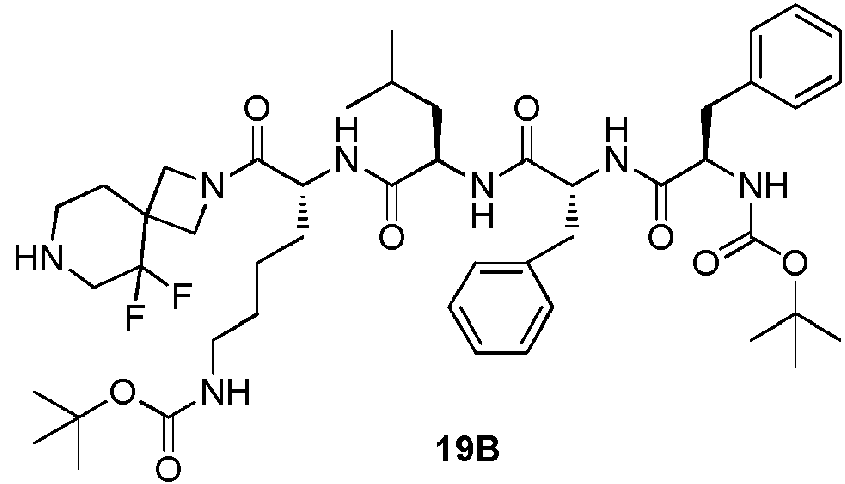
Se añadieron 2-[(2R)-6-(terc-butoxicarbonilamino)-2-[[(2R)-2-[[(2R)-2-[[(2R)-2-(terc-butoxicarbonilamino)-3-fenilpropanoil]amino]-3-fenil-propanoil]amino]-4-metil-pentanoil]amino]hexanoil]-5,5-difluoro-2,7-diazaespiro[3.5]nonano-7-carboxilato de bencilo (19A) (2,49 g, 2,41 mmol), paladio sobre carbono (500 mg, al 20% en peso) y metanol (25 ml) en un matraz de reacción de 50 ml. Se reemplazó la atmósfera por hidrógeno 3 veces y se hizo reaccionar la mezcla a temperatura ambiente durante 4 h bajo una atmósfera de hidrógeno (globo). Luego, se filtró la disolución de reacción a través de tierra de diatomeas y se concentró el filtrado a presión reducida para obtener N-[(1R)-1-bencil-2-[[(1R)-1-bencil-2-[[[(1R)-1-[[(1R)-5-(terc-butoxicarbonilamino)-1-(5,5-difluoro-2,7-diazaespiro[3.5]nonano-2-carbonil)pentil]carbamoil]-3-metil-butil]amino]-2-oxo-etil]amino]-2-oxo-etil]carbamato de terc-butilo (19B) como un sólido oleoso de color amarillo claro (2,16 g, rendimiento del 99%), y se usó directamente en la siguiente reacción. 2-[(2R)-6-(tert-butoxycarbonylamino)-2-[[(2R)-2-[[(2R)-2-[[(2R)-2-(tert-butoxycarbonylamino)-3 benzyl -phenylpropanoyl]amino]-3-phenyl-propanoyl]amino]-4-methyl-pentanoyl]amino]hexanoyl]-5,5-difluoro-2,7-diazaspiro[3.5]nonane-7-carboxylate (19A) (2.49 g, 2.41 mmol), palladium on carbon (500 mg, 20 wt%) and methanol (25 mL) in a 50 mL reaction flask. The atmosphere was replaced with hydrogen 3 times, and the mixture was reacted at room temperature for 4 h under a hydrogen atmosphere (balloon). Then, the reaction solution was filtered through diatomaceous earth, and the filtrate was concentrated under reduced pressure to obtain N-[(1R)-1-benzyl-2-[[(1R)-1-benzyl-2-[ [[(1R)-1-[[(1R)-5-(tert-butoxycarbonylamino)-1-(5,5-difluoro-2,7-diazaspiro[3.5]nonane-2-carbonyl)pentyl]carbamoyl]- tert-butyl 3-methyl-butyl]amino]-2-oxo-ethyl]amino]-2-oxo-ethyl]carbamate (19B) as light yellow oily solid (2.16 g, 99% yield ), and was used directly in the next reaction.
EM m/z = 899,5 [M+H]+;MS m/z = 899.5 [M+H]+;
Etapa 3: N-(1R)-1-Bencil-2-[[(1R)-1-bencil-2-[[(1R)-1-[[(1R)-5-(terc-butoxicarbonilamino)-1-[7-[(2R)-2-(tercbutoxicarbonilamino)propanoil]-5,5-difluoro-2,7-diazaespiro[3.5]nonano-2-carbonil]pentil]carbamoil]-3-metilbutil]amino]-2-oxo-etil]amino]-2-oxo-etil]carbamato de terc-butilo (19C)Step 3: N-(1R)-1-Benzyl-2-[[(1R)-1-benzyl-2-[[(1R)-1-[[(1R)-5-(tert-butoxycarbonylamino)-1 -[7-[(2R)-2-(tert-butoxycarbonylamino)propanoyl]-5,5-difluoro-2,7-diazaspiro[3.5]nonane-2-carbonyl]pentyl]carbamoyl]-3-methylbutyl]amino]-2 tert-butyl -oxo-ethyl]amino]-2-oxo-ethyl]carbamate (19C)

Se añadieron N-[(1R)-1-bencil-2-[[(1R)-1-bencil-2-[[(1R)-1-[[(1R)-5-(terc-butoxicarbonilamino)-1-(5,5-difluoro-2,7-diazaespiro[3.5]nonano-2-carbonil)pentil]carbamoil]-3-metil-butil]amino]-2-oxo-etil]amino]-2-oxo-etil]carbamato de terc-butilo (19B)en bruto (400 mg, 0,4 mmol), clorhidrato de 1-(3-dimetilaminopropil)-3-etilcarbodiimida (0,23 g, 1,2 mmol), 1-hidroxibenzotriazol (70 mg, 0,5 mmol), Boc-D-alanina (78 mg, 0,41 mmol) y diclorometano (50 ml) en un matraz de reacción de 50 ml y se permitió que reaccionase el sistema a temperatura ambiente durante 5 h. Se concentró la disolución de reacción a presión reducida y se separó el residuo y se purificó mediante cromatografía en columna de gel de sílice (diclorometano:metanol (v:v) = 30:1) para obtener N-(1R)-1-bencil-2-[[(1R)-1-bencil-2-[[(1R)-1-[[(1R)-5-(terc-butoxicarbonilamino)-1-[7-[(2R)-2-(terc-butoxicarbonilamino)propanoil]-5,5-difluoro-2,7-diazaespiro[3.5]nonano-2-carbonil]pentil]carbamoil]-3-metil-butil]amino]-2-oxo-etil]amino]-2-oxo-etil]carbamato de terc-butilo (19C) como un sólido de color amarillo claro (340 mg, rendimiento del 79%).N-[(1R)-1-benzyl-2-[[(1R)-1-benzyl-2-[[(1R)-1-[[(1R)-5-(tert-butoxycarbonylamino)-1 -(5,5-difluoro-2,7-diazaspiro[3.5]nonane-2-carbonyl)pentyl]carbamoyl]-3-methyl-butyl]amino]-2-oxo-ethyl]amino]-2-oxo-ethyl Crude tert-butyl (19B)]carbamate (400 mg, 0.4 mmol), 1-(3-dimethylaminopropyl)-3-ethylcarbodiimide hydrochloride (0.23 g, 1.2 mmol), 1-hydroxybenzotriazole ( 70 mg, 0.5 mmol), Boc-D-alanine (78 mg, 0.41 mmol), and dichloromethane (50 mL) in a 50 mL reaction flask and the system was allowed to react at room temperature for 5 h. The reaction solution was concentrated under reduced pressure, and the residue was separated and purified by silica gel column chromatography (dichloromethane:methanol (v:v) = 30:1) to obtain N-(1R)-1-benzyl -2-[[(1R)-1-benzyl-2-[[(1R)-1-[[(1R)-5-(tert-butoxycarbonylamino)-1-[7-[(2R)-2-( tert-butoxycarbonylamino)propanoyl]-5,5-difluoro-2,7-diazaspiro[3.5]nonane-2-carbonyl]pentyl]carbamoyl]-3-methyl-butyl]amino]-2-oxo-ethyl]amino]- tert-Butyl 2-oxo-ethyl]carbamate (19C) as a light yellow solid (340 mg, 79% yield).
Etapa 4:Stage 4:
(2R)-N-[(1R)-5-Amino-1-[7-[(2R)-2-aminopropanoil]-5,5-difluoro-2,7-diazaespiro[3.5]nonano-2-carbonil]pentil]-2-[[(2R)-2-[[(2R)-2-amino-3-fenil-propanoil]amino]-3-fenil-propanoil]amino]-4-metil-pentanamida; tri-ácido trifluoroacético (compuesto 19)(2R)-N-[(1R)-5-Amino-1-[7-[(2R)-2-aminopropanoyl]-5,5-difluoro-2,7-diazaspiro[3.5]nonane-2-carbonyl] pentyl]-2-[[(2R)-2-[[(2R)-2-amino-3-phenyl-propanoyl]amino]-3-phenyl-propanoyl]amino]-4-methyl-pentanamide; tri-trifluoroacetic acid (compound 19)

Se añadieron N-(1R)-1-bencil-2-[[(1R)-1-bencil-2-[[(1R)-1-[[(1R)-5-(terc-butoxicarbonilamino)-1-[7-[(2R)-2-(tercbutoxicarbonilamino)propanoil]-5,5-difluoro-2,7-diazaespiro[3.5]nonano-2-carbonil]pentil]carbamoil]-3-metilbutil]amino]-2-oxo-etil]amino]-2-oxo-etil]carbamato de terc-butilo (19C) (340 mg, 0,32 mmol) y ácido trifluoroacético (2 ml) en un matraz de reacción de 50 ml y se permitió que reaccionase el sistema a temperatura ambiente durante 2 h. Luego, se concentró la disolución de reacción a presión reducida y se separó el residuo y se purificó mediante cromatografía de líquidos preparativa (condiciones de preparación: instrumento: GX-281 de Gilson; columna: Xbridge C18, 150 x 30 mm de D.I., 5 |am; fase móvil: A para ACN y B para H2O; isocrático: 65% de A; velocidad de flujo: 30 ml/min; contrapresión:1000 psi; temperatura de columna: 30°C; longitud de onda: 210 nm; periodo: 18min; preparación de la muestra: se disolvió el compuesto en 12 ml de metanol; inyección: 0,9 ml/aguja). Se concentró la preparación a presión reducida para eliminar la mayor parte del disolvente y se liofilizó para obtener (2R)-N-[(1R)-5-amino-1-[7-[(2R)-2-aminopropanoil]-5,5-difluoro-2,7-diazaespiro[3.5]nonano-2-carbonil]pentil]-2-[[(2R)-2-[[(2R)-2-amino-3-fenilpropanoil]amino]-3-fenil-propanoil]amino]-4-metil-pentanamida; tri-ácido trifluoroacético (compuesto 19) como un polvo de color blanco (170 mg, rendimiento del 48%).N-(1R)-1-benzyl-2-[[(1R)-1-benzyl-2-[[(1R)-1-[[(1R)-5-(tert-butoxycarbonylamino)-1- [7-[(2R)-2-(tert-butoxycarbonylamino)propanoyl]-5,5-difluoro-2,7-diazaspiro[3.5]nonane-2-carbonyl]pentyl]carbamoyl]-3-methylbutyl]amino]-2- (19C)-tert-butyl oxo-ethyl]amino]-2-oxo-ethyl]carbamate (340 mg, 0.32 mmol) and trifluoroacetic acid (2 mL) in a 50 mL reaction flask and allowed to react. the system at room temperature for 2 h. Then, the reaction solution was concentrated under reduced pressure, and the residue was separated and purified by preparative liquid chromatography (preparation conditions: instrument: Gilson GX-281; column: Xbridge C18, 150 x 30 mm I.D., 5 |am Mobile phase: A for ACN and B for H2O Isocratic: 65% A Flow rate: 30 mL/min Back pressure: 1000 psi Column temperature: 30°C Wavelength: 210 nm period: 18 min; sample preparation: the compound was dissolved in 12 ml of methanol; injection: 0.9 ml/needle). The preparation was concentrated under reduced pressure to remove most of the solvent and lyophilized to obtain (2R)-N-[(1R)-5-amino-1-[7-[(2R)-2-aminopropanoyl]-5 ,5-difluoro-2,7-diazaspiro[3.5]nonane-2-carbonyl]pentyl]-2-[[(2R)-2-[[(2R)-2-amino-3-phenylpropanoyl]amino]-3 -phenyl-propanoyl]amino]-4-methyl-pentanamide; tri-trifluoroacetic acid (compound 19) as a white powder (170 mg, 48% yield).
EM m/z (ESI): 385,3 [M+2H]+/2;MS m/z (ESI): 385.3 [M+2H]+/2;
1H-RMN (400 MHz, D2O) 87,43-7,29 (m, 6H), 7,27-7,21 (m, 4H), 4,67-4,47 (m, 3H), 4,31-4,09 (m, 5H), 4,09-3,76 (m, 3H), 3,74-3,46 (m, 2H), 3,18 (d, 2H), 3,10-2,91 (m, 4H), 2,33-1,97 (m, 2H), 1,84-1,61 (m, 4H), 1,61-1,26 (m, 8H), 0,92 (dd, 6H).1H-NMR (400 MHz, D2O) 87.43-7.29 (m, 6H), 7.27-7.21 (m, 4H), 4.67-4.47 (m, 3H), 4, 31-4.09 (m, 5H), 4.09-3.76 (m, 3H), 3.74-3.46 (m, 2H), 3.18 (d, 2H), 3.10- 2.91 (m, 4H), 2.33-1.97 (m, 2H), 1.84-1.61 (m, 4H), 1.61-1.26 (m, 8H), 0, 92 (dd, 6H).
Ejemplo 18:Example 18:
(2R)-N-[(1R)-1-(7-Acetil-2,7-diazaespiro[3.5]nonano-2-carbonil)-5-amino-pentil]-2-[[(2R)-2-[[(2R)-2-amino-3-fenilpropanoil]amino]-3-fenil-propanoil]amino]-4-metil-pentanamida; di-ácido trifluoroacético (compuesto 20)

7-Acetil-2,7-diazaespiro[3.5]nonano-2-carboxilato de terc-butilo (20B)tert-Butyl 7-Acetyl-2,7-diazaspiro[3.5]nonane-2-carboxylate (20B)
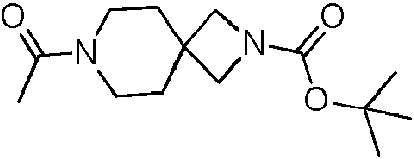
Se disolvió 2,7-diazaespiro[3.5]nonano-2-carboxilato de terc-butilo (6A) (450 mg, 2,0 mmol) en diclorometano (5 ml) en un matraz de reacción de 50 ml bajo protección de nitrógeno y se añadió trietilamina (606 mg, 6,0 mmol) con agitación. Luego, se redujo la temperatura hasta -20°C y se añadió gota a gota cloruro de acetilo (310 mg, 4,0 mmol). Después de la adición, se elevó de manera natural la temperatura hasta temperatura ambiente y se agitó el sistema durante 2 h. Posteriormente, se añadió a la reacción una disolución acuosa de ácido clorhídrico diluido 0,5 M (20 ml) y se separaron las fases mediante agitación y se sometió la mezcla a un proceso de separación de líquido. Se extrajo la fase acuosa con diclorometano (20 ml x 2) y se combinaron las fases orgánicas. Se secaron las fases orgánicas sobre sulfato de sodio anhidro, se filtraron y se concentró el filtrado a presión reducida. Se separó el residuo y se purificó mediante cromatografía en columna de gel de sílice (acetato de etilo puro), para obtener 7-acetil-2,7.-diazaespiro[3.5]nonano-2-carboxilato de terc-butilo (20B) como un líquido oleoso de color amarillo claro (520 mg, rendimiento del 97,0%).tert-Butyl 2,7-diazaspiro[3.5]nonane-2-carboxylate (6A) (450 mg, 2.0 mmol) was dissolved in dichloromethane (5 mL) in a 50 mL reaction flask under nitrogen protection and triethylamine (606 mg, 6.0 mmol) was added with stirring. The temperature was then lowered to -20°C and acetyl chloride (310 mg, 4.0 mmol) was added dropwise. After the addition, the temperature naturally rose to room temperature and the system was stirred for 2 h. Subsequently, a 0.5M dilute hydrochloric acid aqueous solution (20 ml) was added to the reaction, and the phases were separated by stirring, and the mixture was subjected to a liquid separation process. The aqueous phase was extracted with dichloromethane (20 ml x 2) and the organic phases were combined. The organic phases were dried over anhydrous sodium sulfate, filtered, and the filtrate was concentrated under reduced pressure. The residue was separated and purified by silica gel column chromatography (pure ethyl acetate), to obtain tert-butyl 7-acetyl-2,7-diazaspiro[3.5]nonane-2-carboxylate (20B) as a light yellow oily liquid (520 mg, 97.0% yield).
Etapa 2:1-(2,7-Diazaespiro[3.5]nonan-7-il)etanona (20C)Step 2: 1-(2,7-Diazaspiro[3.5]nonan-7-yl)ethanone (20C)
1-(2,7-Diazaespiro[3.5]nonan-7-il)etanona1-(2,7-Diazaspiro[3.5]nonan-7-yl)ethanone

Se añadieron 7-acetil-2,7-diazaespiro[3.5]nonano-2-carboxilato de terc-butilo (20B) (520 mg, 1,9 mmol) y diclorometano (6 ml) en un matraz de reacción de 50 ml y se añadió gota a gota ácido trifluoroacético (3 ml) a temperatura ambiente. Después de la adición, se permitió que reaccionase el sistema a temperatura ambiente durante 3 h. Se concentró la disolución de reacción directamente a presión reducida y al residuo se le añadieron 4 ml de agua amoniacal concentrada, seguido de secado con sulfato de sodio anhidro, lavado con metanol (20 ml) y concentración de la disolución de lavado para obtener 1-(2,7-diazaespiro[3.5]nonan-7-il)etanona (20C) como un líquido oleoso de color amarillo (250 mg, rendimiento del 77%), y se usó directamente en la siguiente reacción.tert-Butyl 7-acetyl-2,7-diazaspiro[3.5]nonane-2-carboxylate (20B) (520 mg, 1.9 mmol) and dichloromethane (6 mL) were added to a 50 mL reaction flask and trifluoroacetic acid (3 mL) was added dropwise at room temperature. After the addition, the system was allowed to react at room temperature for 3 h. The reaction solution was directly concentrated under reduced pressure, and 4 ml of concentrated ammonia water was added to the residue, followed by drying with anhydrous sodium sulfate, washing with methanol (20 ml), and concentration of the washing solution to obtain 1- (2,7-diazaspiro[3.5]nonan-7-yl)ethanone (20C) as a yellow oily liquid (250mg, 77% yield), and used directly in the next reaction.
Etapa 3:Stage 3:
N-(1R)-2-[[(1R)-2-[[(1R)-1-[[(1R)-1-(7-acetil-2,7-diazaespiro[3.5]nonano-2-carbonil)-5-(tercbutoxicarbonilamino)pentil]carbamoil]-3-metil-butil]amino]-1-bencil-2-oxo-etil]amino]-1-bencil-2-oxoetil]carbamato (20D) N-(1R)-2-[[(1R)-2-[[(1R)-1-[[(1R)-1-(7-acetyl-2,7-diazaspiro[3.5]nonane-2-carbonyl )-5-(tert-butoxycarbonylamino)pentyl]carbamoyl]-3-methyl-butyl]amino]-1-benzyl-2-oxo-ethyl]amino]-1-benzyl-2-oxoethyl]carbamate (20D)

Se añadió 1-(2,7-diazaespiro[3.5]nonan-7-il)etanona (20C) (250 mg, 1,49 mmol) en el acetato de etilo (10 ml) en un matraz de reacción de 50 ml bajo protección de nitrógeno. Se enfrió hasta 0°C en un baño de hielo y se añadieron el producto intermedio 1 (800 mg, 1,06 mmol), clorhidrato de 1-(3-dimetilaminopropil)-3-etilcarbodiimida (305 mg, 1,6 mmol), 1-hidroxibenzotriazol (172 mg, 1,27 mmol). Después de la adición, se permitió que avanzase la reacción a temperatura ambiente durante 1,5 h. Posteriormente, se añadió una disolución acuosa de ácido clorhídrico 1 M (15 ml) a la disolución de reacción y se agitó la mezcla y luego se sometió a un proceso de separación de líquido. Se añadió una disolución acuosa saturada de carbonato de sodio (15 ml) a la fase orgánica y se agitó la mezcla durante 30 minutos y luego se sometió a un proceso de separación de líquido. Se lavó la fase orgánica con una disolución acuosa saturada de cloruro de sodio (15 ml), se secó sobre sulfato de sodio anhidro, se filtró y se concentró el filtrado a presión reducida para obtener N-(1R)-2-[[(1R)-2-[[(1R)-1-[[(1R)-1-(7-acetil-2,7-diazaespiro[3.5]nonano-2-carbonil)-5-(tercbutox¡carbon¡lam¡no)pent¡l]carbamoil]-3-met¡l-but¡ljam¡no]-í-benc¡l-2-oxo-et¡l]am¡no]-1-benc¡l-2-oxoetil]carbamato (20D) como un sólido espumoso de color amarillo claro (0,85 g, rendimiento del 88%) y se usó directamente en la siguiente reacción.1-(2,7-diazaspiro[3.5]nonan-7-yl)ethanone (20C) (250 mg, 1.49 mmol) in ethyl acetate (10 mL) was added to a 50 mL reaction flask under nitrogen protection. Cooled to 0°C in an ice bath and intermediate 1 (800 mg, 1.06 mmol), 1-(3-dimethylaminopropyl)-3-ethylcarbodiimide hydrochloride (305 mg, 1.6 mmol) was added. , 1-hydroxybenzotriazole (172 mg, 1.27 mmol). After the addition, the reaction was allowed to proceed at room temperature for 1.5 h. Subsequently, a 1M hydrochloric acid aqueous solution (15 ml) was added to the reaction solution and the mixture was stirred and then subjected to a liquid separation process. A saturated aqueous solution of sodium carbonate (15 ml) was added to the organic phase, and the mixture was stirred for 30 minutes, and then subjected to a liquid separation process. The organic layer was washed with a saturated aqueous sodium chloride solution (15 mL), dried over anhydrous sodium sulfate, filtered, and the filtrate was concentrated under reduced pressure to obtain N-(1R)-2-[[( 1R)-2-[[(1R)-1-[[(1R)-1-(7-acetyl-2,7-diazaspiro[3.5]nonane-2-carbonyl)-5-(tertbutoxycarbon¡lam¡ no)pent¡l]carbamoyl]-3-methyl-but¡ljam¡no]-í-benc¡l-2-oxo-et¡l]am¡no]-1-benzl-2-oxoethyl ]carbamate (20D) as a pale yellow foamy solid (0.85 g, 88% yield) and used directly in the next reaction.
Etapa 4:Stage 4:
(2R)-N-[(1R)-1-(7-Acetil-2,7-diazaespiro[3.5]nonano-2-carbonil)-5-amino-pentil]-2-[[(2R)-2-[[(2R)-2-amino-3-fenilpropanoil]amino]-3-fenil-propanoil]amino]-4-metil-pentanamida; di-ácido trifluoroacético (compuesto 20)(2R)-N-[(1R)-1-(7-Acetyl-2,7-diazaspiro[3.5]nonane-2-carbonyl)-5-amino-pentyl]-2-[[(2R)-2- [[(2R)-2-amino-3-phenylpropanoyl]amino]-3-phenyl-propanoyl]amino]-4-methyl-pentanamide; di-trifluoroacetic acid (compound 20)
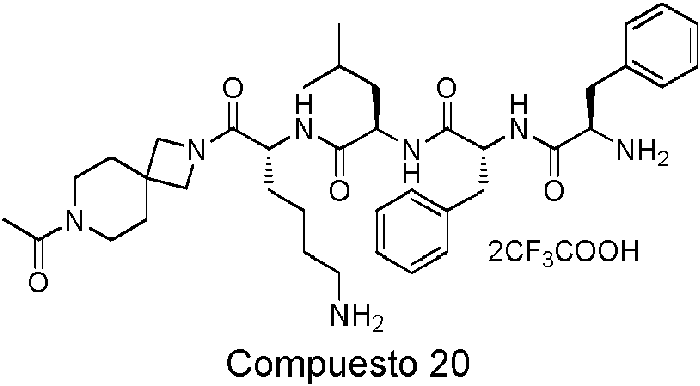
Se disolvió N-(1R)-2-[[(1R)-2-[[(1R)-1-[[(1R)-1-(7-acetil-2,7-diazaespiro[3.5]nonano-2-carbonil)-5-(tercbutoxicarbonilamino)pentil]carbamoil]-3-metil-butil]amino]-1-bencil-2-oxo-etil]amino]-1-bencil-2-oxoetil]carbamato (20D) en bruto (0,85 g, 0,94 mmol) en diclorometano (7,5 ml) y se añadió ácido trifluoroacético (3,5 ml). Se agitó el sistema a temperatura ambiente durante 1 h. Posteriormente, se concentró la disolución de reacción a presión reducida. Después de que se separó el residuo y se purificó mediante cromatografía de líquidos preparativa (condiciones de preparación: instrumento: GX-281 de Gilson; columna: Xbridge C18, 150 * 30 mm de D.I., 5 |am; fase móvil: A para ACN y B para H2O; ¡socrático: 65% de A; velocidad de flujo: 30 ml/min; contrapresión:1000 psi; temperatura de columna: 30°C; longitud de onda: 210 nm; periodo: 18 min; preparación de la muestra: se disolvió el compuesto en 12 ml de metanol; inyección: 0,9 ml/aguja), se concentró la preparación a presión reducida para eliminar la mayor parte del disolvente y se liofilizó para obtener ((2R)-N-[(1R)-1-(7-acetil-2,7-diazaespiro[3.5]nonano-2-carbonil)-5-amino-pentil]-2-[[(2R)-2-[[(2R)-2-amino-3-fenil-propanoil]amino]-3-fenil-propanoil]amino]-4-metilpentanamida; di-ácido trifluoroacético (compuesto 20) como un sólido de color blanco (310 mg, rendimiento del 40,0%).N-(1R)-2-[[(1R)-2-[[(1R)-1-[[(1R)-1-(7-acetyl-2,7-diazaspiro[3.5]nonane-2 was dissolved -carbonyl)-5-(tert-butoxycarbonylamino)pentyl]carbamoyl]-3-methyl-butyl]amino]-1-benzyl-2-oxo-ethyl]amino]-1-benzyl-2-oxoethyl]carbamate (20D) crude (0.85g, 0.94mmol) in dichloromethane (7.5ml) and trifluoroacetic acid (3.5ml) was added. The system was stirred at room temperature for 1 h. Subsequently, the reaction solution was concentrated under reduced pressure. After the residue was separated and purified by preparative liquid chromatography (preparation conditions: instrument: Gilson GX-281; column: Xbridge C18, 150*30mm I.D., 5 |am; mobile phase: A for ACN and B for H2O; isocratic: 65% of A; flow rate: 30 mL/min; back pressure: 1000 psi; column temperature: 30°C; wavelength: 210 nm; period: 18 min; preparation of the sample: the compound was dissolved in 12 mL of methanol; injection: 0.9 mL/needle), the preparation was concentrated under reduced pressure to remove most of the solvent, and lyophilized to obtain ((2R)-N-[( 1R)-1-(7-acetyl-2,7-diazaspiro[3.5]nonane-2-carbonyl)-5-amino-pentyl]-2-[[(2R)-2-[[(2R)-2- amino-3-phenyl-propanoyl]amino]-3-phenyl-propanoyl]amino]-4-methylpentanamide;di-trifluoroacetic acid (compound 20) as a white solid (310 mg, 40.0% yield).
EM m/z (ESI): 352,8 [M+2H]+/2;MS m/z (ESI): 352.8 [M+2H]+/2;
1H-RMN (400 MHz, D2O) 87,46-7,17 (m, 10H), 4,64 (t, 1H), 4,29-4,05 (m, 5H), 3,83-3,74 (m, 2H), 3,57-3,35 (m, 4H), 3,24-3,11 (m, 2H), 3,09-2,93 (m, 4H), 2,17-1,29 (m, 16H), 0,92 (dd, 6H).1H-NMR (400 MHz, D2O) 87.46-7.17 (m, 10H), 4.64 (t, 1H), 4.29-4.05 (m, 5H), 3.83-3, 74 (m, 2H), 3.57-3.35 (m, 4H), 3.24-3.11 (m, 2H), 3.09-2.93 (m, 4H), 2.17- 1.29 (m, 16H), 0.92 (dd, 6H).
Ejemplo 19:Example 19:
(2R)-N-[(1R)-5-Amino-1-[2-(1,1-dioxo-1,4-tiazinan-4-il)-7-azaespiro[3.5]nonano-7-carbonil]pentil]-2-[[(2R)-2-[[(2R)-2-amino-3-fenil-propanoil]amino]-3-fenil-propanoil]amino]-4-metil-pentanamida; ácido trifluoroacético (compuesto 21) (2R)-N-[(1R)-5-Amino-1-[2-(1,1-dioxo-1,4-thiazinan-4-yl)-7-azaspiro[3.5]nonane-7-carbonyl] pentyl]-2-[[(2R)-2-[[(2R)-2-amino-3-phenyl-propanoyl]amino]-3-phenyl-propanoyl]amino]-4-methyl-pentanamide; trifluoroacetic acid (compound 21)

Etapa 1:Stage 1:
2-(1,1-Dioxo-1,4-tiazinan-4-il)-7-azaespiro[3.5]nonano-7-carboxilato de terc-butilo (21A)tert-Butyl 2-(1,1-Dioxo-1,4-thiazinan-4-yl)-7-azaspiro[3.5]nonane-7-carboxylate (21A)

Se añadieron secuencialmente 2-oxo-7-azaespiro[3.5]nonano-7-carboxilato de terc-butilo (3A) (129 mg, 0,54 mmol), ácido acético (65 mg, 1,08 mmol), 1,1-dióxido de 1,4-tiazinano (72 mg, 0,54 mmol), triacetoxiborohidruro de sodio (229 m g, 1,08 mmol) y diclorometano (20 ml) en un matraz de reacción de 50 ml. Después de la adición, se permitió que avanzase la reacción a temperatura ambiente durante 16 h. Se filtró la disolución de reacción con succión y se lavó el filtrado con una disolución saturada de bicarbonato de sodio (50 ml). Después de la separación, se secó la fase orgánica sobre sulfato de sodio anhidro, se filtró con succión y se concentró el filtrado a presión reducida, para obtener de terc-butilo (1,1-dioxo-1,4-tiazinan-4-il)-7-azaespiro[3.5]nonano-7-carboxilato (21A) como un polvo de color blanco (147 mg, rendimiento del 76%).tert-Butyl 2-oxo-7-azaspiro[3.5]nonane-7-carboxylate (3A) (129 mg, 0.54 mmol), acetic acid (65 mg, 1.08 mmol), 1.1 -1,4-thiazinane dioxide (72 mg, 0.54 mmol), sodium triacetoxyborohydride (229 µg, 1.08 mmol), and dichloromethane (20 mL) in a 50 mL reaction flask. After the addition, the reaction was allowed to proceed at room temperature for 16 h. The reaction solution was filtered with suction, and the filtrate was washed with a saturated sodium bicarbonate solution (50 ml). After separation, the organic phase was dried over anhydrous sodium sulfate, suction filtered, and the filtrate was concentrated under reduced pressure to obtain tert-butyl (1,1-dioxo-1,4-thiazinan-4- yl)-7-azaspiro[3.5]nonane-7-carboxylate (21A) as a white powder (147 mg, 76% yield).
Etapa 2:Stage 2:
1,1 -Dióxido de 4-(7-azaespiro[3.5]nonan-2-il)-1,4-tiazinano (21B)4-(7-azaspiro[3.5]nonan-2-yl)-1,4-thiazinan 1,1-dioxide (21B)

Se añadieron (1,1-dioxo-1,4-tiazinan-4-il)-7-azaespiro[3.5]nonano-7-carboxilato de terc-butilo (21A) (147 mg, 0,41 mmol) y diclorometano (10 ml) en un matraz de reacción de 50 ml y se añadió gota a gota ácido trifluoroacético (2 ml) a temperatura ambiente. Después de la adición, se permitió que reaccionase el sistema a temperatura ambiente durante 3 h. Se concentró la disolución de reacción directamente a presión reducida para obtener 1,1-dióxido de 4-(7-azaespiro[3.5]nonan-2-il)-1,4-tiazinano (21B) en bruto como un líquido oleoso de color amarillo (106 mg, rendimiento del 100%) y se usó directamente en la siguiente reacción.tert-Butyl (1,1-dioxo-1,4-thiazinan-4-yl)-7-azaspiro[3.5]nonane-7-carboxylate (21A) (147 mg, 0.41 mmol) and dichloromethane ( 10 mL) into a 50 mL reaction flask and trifluoroacetic acid (2 mL) was added dropwise at room temperature. After the addition, the system was allowed to react at room temperature for 3 h. The reaction solution was concentrated directly under reduced pressure to obtain crude 4-(7-azaspiro[3.5]nonan-2-yl)-1,4-thiazinane 1,1-dioxide (21B) as a colored oily liquid. yellow (106 mg, 100% yield) and used directly in the next reaction.
Etapa 3:Stage 3:
N-[(1R)-1-Bencil-2-[[(1R)-1-bencil-2-[[(1R)-1-[[(1R)-5-(terc-butoxicarbonilamino)-1-[2-(1,1-dioxo-1,4-tiazinan-4-il)-7-azaespiro[3.5]nonano-7-carbonil]pentil]carbamoil]-3-metil-butil]amino]-2-oxo-etil]amino]-2-oxo-etil]carbamato de tercbutilo (21C) N-[(1R)-1-Benzyl-2-[[(1R)-1-benzyl-2-[[(1R)-1-[[(1R)-5-(tert-butoxycarbonylamino)-1-[ 2-(1,1-dioxo-1,4-thiazinan-4-yl)-7-azaspiro[3.5]nonane-7-carbonyl]pentyl]carbamoyl]-3-methyl-butyl]amino]-2-oxo- tert-butyl ethyl]amino]-2-oxo-ethyl]carbamate (21C)

Se añadieron clorhidrato de 1,1-dióxido de 4-(7-azaespiro[3.5]nonan-2-il)-1,4-tiazinano (21B) en bruto (106 mg, 0,41 mmol), 1-(3-dimetilaminopropil)-3-etilcarbodiimida (94 mg, 0,49 mmol), 1-hidroxibenzotriazol (66 mg, 0,49 mmol), producto intermedio 1 (309 mg, 0,41 mmol) y diclorometano (50 ml) en un matraz de una sola boca de 50 ml, se permitió que reaccionase el sistema a temperatura ambiente durante 5 h. Se concentró la disolución de reacción a presión reducida y se separó el residuo y se purificó mediante cromatografía en columna de gel de sílice (diclorometano:metanol (v:v) = 50:1), para obtener de (1R)-1-bencil-2-[[(1R)-1-bencil-2-[[(1R)-1-[[(1R)-5-(tercbutoxicarbonilamino)-1-[2-(1,1-dioxo-1,4-tiazinan-4-il)-7-azaespiro[3.5]nonano-7-carbonil]pentil]carbamoil]-3-metilbutil]amino]-2-oxo-etil]amino]-2-oxo-etil]carbamato de terc-butilo (21C) como un sólido de color blanco (367 mg, rendimiento del 90%).Crude 4-(7-azaspiro[3.5]nonan-2-yl)-1,4-thiazinan 1,1-dioxide hydrochloride (21B) (106 mg, 0.41 mmol), 1-(3 -dimethylaminopropyl)-3-ethylcarbodiimide (94 mg, 0.49 mmol), 1-hydroxybenzotriazole (66 mg, 0.49 mmol), intermediate 1 (309 mg, 0.41 mmol) and dichloromethane (50 mL) in a 50 mL single-neck flask, the system was allowed to react at room temperature for 5 h. The reaction solution was concentrated under reduced pressure, and the residue was separated and purified by silica gel column chromatography (dichloromethane:methanol (v:v) = 50:1), to obtain de (1R)-1-benzyl -2-[[(1R)-1-benzyl-2-[[(1R)-1-[[(1R)-5-(tert-butoxycarbonylamino)-1-[2-(1,1-dioxo-1,4 tert -thiazinan-4-yl)-7-azaspiro[3.5]nonane-7-carbonyl]pentyl]carbamoyl]-3-methylbutyl]amino]-2-oxo-ethyl]amino]-2-oxo-ethyl]carbamate -butyl (21C) as a white solid (367 mg, 90% yield).
Etapa 4:Stage 4:
(2R)-N-[(1R)-5-amino-1-[2-(1,1-dioxo-1,4-tiazinan-4-il)-7-azaespiro[3.5]nonano-7-carbonil]pentil]-2-[[(2R)-2-[[(2R)-2-amino-3-fenil-propanoil]amino]-3-fenil-propanoil]amino]-4-metil-pentanamida; tri-ácido trifluoroacético (compuesto 21)(2R)-N-[(1R)-5-amino-1-[2-(1,1-dioxo-1,4-thiazinan-4-yl)-7-azaspiro[3.5]nonane-7-carbonyl] pentyl]-2-[[(2R)-2-[[(2R)-2-amino-3-phenyl-propanoyl]amino]-3-phenyl-propanoyl]amino]-4-methyl-pentanamide; tri-trifluoroacetic acid (compound 21)

Se añadieron (1R)-1-bencil-2-[[(1R)-1-bencil-2-[[(1R)-1-[[(1R)-5-(terc-butoxicarbonilamino)-1-[2-(1,1-dioxo-1,4-tiazinan-4-il)-7-azaespiro[3.5]nonano-7-carbonil]pentil]carbamoil]-3-metil-butil]amino]-2-oxo-etil]amino]-2-oxoetil]carbamato de terc-butilo (21C) (367 mg, 0,37 mmol) y ácido trifluoroacético (2 ml) en un matraz de reacción de 50 ml, y se permitió que reaccionase el sistema a temperatura ambiente durante 2 h. Luego, se concentró la disolución de reacción a presión reducida y se separó el residuo y se purificó mediante cromatografía de líquidos preparativa (condiciones de preparación: instrumento: GX-281 de Gilson; columna: Xbridge C18, 150 x 30 mm de D.I., 5 ^m; fase móvil: A para ACN y B para H2O; isocrático: 65% de A; velocidad de flujo: 30 ml/min; contrapresión:1000 psi; temperatura de columna: 30°C; longitud de onda: 210 nm; periodo: 18 min; preparación de la muestra: se disolvió el compuesto en 12 ml de metanol; inyección: 0,9 ml/aguja). Se concentró la preparación a presión reducida para eliminar la mayor parte del disolvente y se liofilizó para obtener (2R)-N-[(1R)-5-amino-1-[2-(1,1-dioxo-1,4-tiazinan)-4-il)-7-azaespiro[3.5]nonano-7-carbonil]pentil]-2-[[(2R)-2-[[(2R)-2-amino-3-fenil-propanoil]amino]-3-fenil-propanoil]amino]-4-metil-pentanamida; tri-ácido trifluoroacético (compuesto 21) como un polvo de color blanco (295 mg, rendimiento del 70%).(1R)-1-benzyl-2-[[(1R)-1-benzyl-2-[[(1R)-1-[[(1R)-5-(tert-butoxycarbonylamino)-1-[2 -(1,1-dioxo-1,4-thiazinan-4-yl)-7-azaspiro[3.5]nonane-7-carbonyl]pentyl]carbamoyl]-3-methyl-butyl]amino]-2-oxo-ethyl tert-butyl ]amino]-2-oxoethyl]carbamate (21C) (367 mg, 0.37 mmol) and trifluoroacetic acid (2 mL) in a 50 mL reaction flask, and the system was allowed to react at room temperature. environment for 2 h. Then, the reaction solution was concentrated under reduced pressure, and the residue was separated and purified by preparative liquid chromatography (preparation conditions: instrument: Gilson GX-281; column: Xbridge C18, 150 x 30 mm I.D., 5 ^m Mobile phase: A for ACN and B for H2O Isocratic: 65% A Flow rate: 30 mL/min Back pressure: 1000 psi Column temperature: 30°C Wavelength: 210 nm period: 18 min; sample preparation: compound was dissolved in 12 ml methanol; injection: 0.9 ml/needle). The preparation was concentrated under reduced pressure to remove most of the solvent and lyophilized to obtain (2R)-N-[(1R)-5-amino-1-[2-(1,1-dioxo-1,4- thiazinan)-4-yl)-7-azaspiro[3.5]nonane-7-carbonyl]pentyl]-2-[[(2R)-2-[[(2R)-2-amino-3-phenyl-propanoyl]amino ]-3-phenyl-propanoyl]amino]-4-methyl-pentanamide; tri-trifluoroacetic acid (compound 21) as a white powder (295 mg, 70% yield).
EM m/z = 397,9 [M+2H]+ /2;MS m/z = 397.9 [M+2H] + /2;
1H-RMN (400 MHz, D2O) 57,36-7,19 (m, 10H), 4,63-4,60 (m, 1H), 4,32-4,16 (m, 3H), 3,92-3,78 (m, 1H), 3,63 (d, 9H), 3,53-3,22 (m, 3H), 3,15 (d, 2H), 3,01-2,91 (m, 4H), 2,48-2,32 (m, 2H), 1,98-2,06 (m, 2H), 1,75-1,23 (m, 13H), 0,89 (dd, 6H).1H-NMR (400 MHz, D2O) 57.36-7.19 (m, 10H), 4.63-4.60 (m, 1H), 4.32-4.16 (m, 3H), 3, 92-3.78 (m, 1H), 3.63 (d, 9H), 3.53-3.22 (m, 3H), 3.15 (d, 2H), 3.01-2.91 ( m, 4H), 2.48-2.32 (m, 2H), 1.98-2.06 (m, 2H), 1.75-1.23 (m, 13H), 0.89 (dd, 6H).
Ejemplo 20:Example 20:
7-[(2R)-6-Amino-2-[[(2R)-2-[[(2R)-2-[[(2R)-2-amino-3-fenil-propanoil]amino]-3-fenil-propanoil]amino]-4-metilpentanoil]amino]hexanoil]-N-metil-2,7-diazaespiro[4.4]nona-2-carboxamida; di-ácido trifluoroacético (compuesto 22) 7-[(2R)-6-Amino-2-[[(2R)-2-[[(2R)-2-[[(2R)-2-amino-3-phenyl-propanoyl]amino]-3- phenyl-propanoyl]amino]-4-methylpentanoyl]amino]hexanoyl]-N-methyl-2,7-diazaspiro[4.4]none-2-carboxamide; di-trifluoroacetic acid (compound 22)

Etapa 1:Stage 1:
7-(Metilcarbamoil)-2,7-diazaespiro[4.4]nonano-2-carboxilato de terc-butilo (22B)tert-Butyl 7-(Methylcarbamoyl)-2,7-diazaspiro[4.4]nonane-2-carboxylate (22B)

22B22B
2-Boc-2,7-diazaespiro[4.4]nonano (22A) (452 mg, 2,0 mmol), trietilamina (400 mg, 4,0 mmol) y diclorometano (15 ml) se añadieron en un matraz de reacción de 50 ml y se disolvieron con agitación. Después de enfriar hasta -10°C, se añadió gota a gota cloruro de metil amino formilo (188 mg, 2,01 mmol). Después de la adición, se permitió que avanzase la reacción a temperatura ambiente durante 3 h. Se añadió ácido clorhídrico diluido 3 M (50 ml) a la disolución de reacción y luego se extrajo con diclorometano (60 ml x 2). Se secaron las fases orgánicas sobre sulfato de sodio anhidro, se filtraron y se concentró el filtrado a presión reducida para obtener 7-(metilcarbamoil)-2,7-diazaespiro[4.4]nonano-2-carboxilato de terc-butilo (22B) como un sólido de color blanco (570 mg, rendimiento del 65,5%).2-Boc-2,7-diazaspiro[4.4]nonane (22A) (452 mg, 2.0 mmol), triethylamine (400 mg, 4.0 mmol), and dichloromethane (15 mL) were added to a reaction flask of 50 ml and dissolved with stirring. After cooling to -10°C, methyl amino formyl chloride (188 mg, 2.01 mmol) was added dropwise. After the addition, the reaction was allowed to proceed at room temperature for 3 h. Dilute 3M hydrochloric acid (50 ml) was added to the reaction solution, and then it was extracted with dichloromethane (60 ml x 2). The organic phases were dried over anhydrous sodium sulfate, filtered, and the filtrate was concentrated under reduced pressure to obtain tert-butyl 7-(methylcarbamoyl)-2,7-diazaspiro[4.4]nonane-2-carboxylate (22B) as a white solid (570 mg, 65.5% yield).
1H-RMN (400 MHz, CDCls) 83,51-3,16 (m, 8H), 2,82 (s, 3H), 1,98-1,74 (m, 4H), 1,46 (s, 9H).1H-NMR (400 MHz, CDCls) 83.51-3.16 (m, 8H), 2.82 (s, 3H), 1.98-1.74 (m, 4H), 1.46 (s, 9H).
Etapa 2:Stage 2:
N-Metil-2,7-diazaespiro[4.4]nonano-2-carboxamida (22C)N-Methyl-2,7-diazaspiro[4.4]nonane-2-carboxamide (22C)

Se añadieron 7-(metilcarbamoil)-2,7-diazaespiro[4.4]nonano-2-carboxilato de terc-butilo (22B) (161 mg, 0,568 mmol), diclorometano (10 ml) y ácido trifluoroacético (1,2 ml) en un matraz de reacción de 50 ml y se permitió que reaccionase el sistema a temperatura ambiente durante 2 h. Luego, se concentró la disolución de reacción a presión reducida para obtener N-metil-2,7-diazaespiro[4.4]nonano-2-carboxamida (22C) en bruto como una sustancia oleosa de color amarillo claro, y se usó directamente en la siguiente reacción.tert-Butyl 7-(methylcarbamoyl)-2,7-diazaspiro[4.4]nonane-2-carboxylate (22B) (161 mg, 0.568 mmol), dichloromethane (10 mL) and trifluoroacetic acid (1.2 mL) were added. in a 50 mL reaction flask and the system was allowed to react at room temperature for 2 h. Then, the reaction solution was concentrated under reduced pressure to obtain crude N-methyl-2,7-diazaspiro[4.4]nonane-2-carboxamide (22C) as light yellow oily substance, and directly used in the next reaction.
Etapa 3:Stage 3:
N-[(1R)-1-Bencil-2-[[(1R)-1-bencil-2-[[(1R)-1-[[(1R)-5-(terc-butoxicarbonilamino)-1-[2-(metilcarbamoil)-2,7-diazaespiro[4.4]nonano-7-carbonil]pentil]carbamoil]-3-metil-butil]amino]-2-oxo-etil]amino]-2-oxo-etil]carbamato de terc-butilo (22D) N-[(1R)-1-Benzyl-2-[[(1R)-1-benzyl-2-[[(1R)-1-[[(1R)-5-(tert-butoxycarbonylamino)-1-[ 2-(methylcarbamoyl)-2,7-diazaspiro[4.4]nonane-7-carbonyl]pentyl]carbamoyl]-3-methyl-butyl]amino]-2-oxo-ethyl]amino]-2-oxo-ethyl]carbamate tert-butyl (22D)

Se añadieron secuencialmente N-metil-2,7-diazaespiro[4.4]nonano-2-carboxamida (22C) en bruto (81 mg, 0,44 mmol), clorhidrato de 1-(3-dimetilaminopropil)-3-etilcarbodiimida (0,288 g, 1,5mmol), 1-hidroxibenzotriazol (81 mg, 0,6 mmol), producto intermedio 1 (330 mg, 0,44 mmol) y diclorometano (50 ml) en un matraz de reacción de 50 ml y se permitió que reaccionase el sistema a temperatura ambiente durante 5 h. Se concentró la disolución de reacción a presión reducida y se separó el residuo y se purificó mediante cromatografía en columna de gel de sílice (diclorometano:metanol (v:v) = 30:1) para obtener N-[(1R)-1-bencil-2-[[(1R)-1-bencil-2-[[(1R)-1-[[(1R)-5-(tercbutoxicarbonilamino)-1-[2-(metilcarbamoil)-2,7]-diazaespiro[4.4]nonano-7-carbonil]pentil]carbamoil]-3-metilbutil]amino]-2-oxo-etil]amino]-2-oxo-etil]carbamato de terc-butilo (22D) como un sólido de color amarillo claro (420 mg, rendimiento del 98%).Crude N-methyl-2,7-diazaspiro[4.4]nonane-2-carboxamide (22C) (81 mg, 0.44 mmol), 1-(3-dimethylaminopropyl)-3-ethylcarbodiimide hydrochloride (0.288 g, 1.5mmol), 1-hydroxybenzotriazole (81mg, 0.6mmol), intermediate 1 (330mg, 0.44mmol), and dichloromethane (50mL) in a 50mL reaction flask and allowed to react the system at room temperature for 5 h. The reaction solution was concentrated under reduced pressure, and the residue was separated and purified by silica gel column chromatography (dichloromethane:methanol (v:v) = 30:1) to obtain N-[(1R)-1- benzyl-2-[[(1R)-1-benzyl-2-[[(1R)-1-[[(1R)-5-(tert-butoxycarbonylamino)-1-[2-(methylcarbamoyl)-2,7]- tert-butyl diazaspiro[4.4]nonane-7-carbonyl]pentyl]carbamoyl]-3-methylbutyl]amino]-2-oxo-ethyl]amino]-2-oxo-ethyl]carbamate (22D) as a colored solid light yellow (420 mg, 98% yield).
Etapa 4:Stage 4:
7-[(2R)-6-Amino-2-[[(2R)-2-[[(2R)-2-[[(2R)-2-amino-3-fenil-propanoil]amino]-3-fenil-propanoil]amino]-4-metilpentanoil]amino]hexanoil]-N-metil-2,7-diazaespiro[4.4]nonano-2-carboxamida; di-ácido trifluoroacético (compuesto 22)7-[(2R)-6-Amino-2-[[(2R)-2-[[(2R)-2-[[(2R)-2-amino-3-phenyl-propanoyl]amino]-3- phenyl-propanoyl]amino]-4-methylpentanoyl]amino]hexanoyl]-N-methyl-2,7-diazaspiro[4.4]nonane-2-carboxamide; di-trifluoroacetic acid (compound 22)

Se añadieron N-[(1R)-1-bencil-2-[[(1 R)-1-bencil-2-[[(1R)-1-[[(1R)-5-(terc-butoxicarbonilamino)-1-[2-(metilcarbamoil)-2,7-diazaespiro[4.4]nonano-7-carbonil]pentil]carbamoil]-3-metil-butil]amino]-2-oxo-etil]amino]-2-oxo-etil]carbamato de terc-butilo (22D) (400 mg, 0,44 mmol) y ácido trifluoroacético (2 ml) en un matraz de reacción de 50 ml y se permitió que reaccionase el sistema a temperatura ambiente durante 2 h. Luego, se concentró la disolución de reacción a presión reducida y se separó el residuo y se purificó mediante cromatografía de líquidos preparativa (condiciones de preparación: instrumento: GX-281 de Gilson; columna: Xbridge C18, 150 x 30 mm de D.I., 5 |am; fase móvil: A para ACN y B para H2O; isocrático: 65% de A; velocidad de flujo: 30 ml/min; contrapresión:1000 psi; temperatura de columna: 30°C; longitud de onda: 210 nm; periodo: 18 min; preparación de la muestra: se disolvió el compuesto en 12 ml de metanol; inyección: 0,9 ml/aguja). Se concentró la preparación a presión reducida para eliminar la mayor parte del disolvente y se liofilizó para obtener 7-[(2R)-6-amino-2-[[(2R)-2-[[(2R)-2-[[(2R))-2-amino-3-fenilpropanoil]amino]-3-fenil-propanoil]amino]-4-metil-pentanoil]amino]hexanoil]-N-metil-2,7-diazaespiro[4.4]nonano-2-carboxamida; di-ácido trifluoroacético (compuesto 22) como un polvo de color blanco (130 mg, rendimiento del 31,5%). EM m/z (ESI): 360,3 [M+2H]+72;N-[(1R)-1-benzyl-2-[[(1R)-1-benzyl-2-[[(1R)-1-[[(1R)-5-(tert-butoxycarbonylamino)- 1-[2-(methylcarbamoyl)-2,7-diazaspiro[4.4]nonane-7-carbonyl]pentyl]carbamoyl]-3-methyl-butyl]amino]-2-oxo-ethyl]amino]-2-oxo- tert-butyl ethyl]carbamate (22D) (400 mg, 0.44 mmol) and trifluoroacetic acid (2 mL) in a 50 mL reaction flask and the system was allowed to react at room temperature for 2 h. Then, the reaction solution was concentrated under reduced pressure, and the residue was separated and purified by preparative liquid chromatography (preparation conditions: instrument: Gilson GX-281; column: Xbridge C18, 150 x 30 mm I.D., 5 |am Mobile phase: A for ACN and B for H2O Isocratic: 65% A Flow rate: 30 mL/min Back pressure: 1000 psi Column temperature: 30°C Wavelength: 210 nm period: 18 min; sample preparation: compound was dissolved in 12 ml methanol; injection: 0.9 ml/needle). The preparation was concentrated under reduced pressure to remove most of the solvent and lyophilized to obtain 7-[(2R)-6-amino-2-[[(2R)-2-[[(2R)-2-[[ (2R))-2-amino-3-phenylpropanoyl]amino]-3-phenyl-propanoyl]amino]-4-methyl-pentanoyl]amino]hexanoyl]-N-methyl-2,7-diazaspiro[4.4]nonane- 2-carboxamide; di-trifluoroacetic acid (compound 22) as a white powder (130 mg, 31.5% yield). MS m/z (ESI): 360.3 [M+2H]+72;
1H-RMN (400 MHz, D2O) 87,43-7,19 (m, 10H), 4,68-4,60 (m, 1H), 4,50-4,19 (m, 3H), 3,93-3,62 (m, 2H), 3,55-3,27 (m, 5H), 3,24 (s, 1H), 3,18 (d, 2H), 3,09-2,94 (m, 4H), 2,74-2,66 (m, 3H), 2,10-1,85 (m, 4H), 1,84-1,62 (m, 4H), 1,59-1,43 (m, 4H), 1,43-1,29 (m, 1H), 0,92 (dd, 6H).1H-NMR (400 MHz, D2O) 87.43-7.19 (m, 10H), 4.68-4.60 (m, 1H), 4.50-4.19 (m, 3H), 3, 93-3.62 (m, 2H), 3.55-3.27 (m, 5H), 3.24 (s, 1H), 3.18 (d, 2H), 3.09-2.94 ( m, 4H), 2.74-2.66 (m, 3H), 2.10-1.85 (m, 4H), 1.84-1.62 (m, 4H), 1.59-1, 43 (m, 4H), 1.43-1.29 (m, 1H), 0.92 (dd, 6H).
Ejemplo 21:Example 21:
(2R)-2-[[(2R)-2-[[(2R)-2-Amino-3-fenil-propanoil]amino]-3-fenil-propanoil]amino]-N-[(1R)-5-amino-1-[2-(1-piperidinil)-7-azaespiro[3.5]nonano-7-carbonil]pentil]-4-metil-pentanamida; tri-ácido trifluoroacético (compuesto 23) (2R)-2-[[(2R)-2-[[(2R)-2-Amino-3-phenyl-propanoyl]amino]-3-phenyl-propanoyl]amino]-N-[(1R)-5 -amino-1-[2-(1-piperidinyl)-7-azaspiro[3.5]nonane-7-carbonyl]pentyl]-4-methyl-pentanamide; tri-trifluoroacetic acid (compound 23)

2-(1-Piperidinil)-7-azaespiro[3.5]nonano-7-carboxilato de terc-butilo (23A)tert-Butyl 2-(1-Piperidinyl)-7-azaspiro[3.5]nonane-7-carboxylate (23A)

Se añadieron carboxilato de 2-oxo-7-azaespiro[3.5]nonano-7-de terc-butilo (0,48 g, 2 mmol), piperidina (0,25 g, 3 mmol) y diclorometano (10 ml) a un matraz de reacción y se agitó durante 30 minutos, se enfrió hasta 0-5°C y se añadió cianoborohidruro de sodio (0,13 g, 4 mmol). Después de la adición, se permitió que reaccionase el sistema a temperatura ambiente durante 4 h, y se usó CCF para monitorizar si se completaba la reacción hasta que se completó. Se añadieron diclorometano (10 ml) y agua (10 ml) y se agitó durante 5 min. Se dejaron en reposo las fases y se secó la fase orgánica sobre sulfato de sodio anhidro, se filtró y se concentró a presión reducida para obtener 2-(1-piperidinil)-7-azaespiro[3.5]nonano-7-carboxilato de terc-butilo (23A) en bruto como un sólido de color amarillo claro (0,53 g, rendimiento del 86%) y se usó directamente en la siguiente etapa.tert-Butyl 2-oxo-7-azaspiro[3.5]nonane-7-carboxylate (0.48 g, 2 mmol), piperidine (0.25 g, 3 mmol), and dichloromethane (10 mL) were added to a reaction flask and stirred for 30 min, cooled to 0-5°C and sodium cyanoborohydride (0.13 g, 4 mmol) added. After the addition, the system was allowed to react at room temperature for 4 h, and TLC was used to monitor the completion of the reaction to completion. Dichloromethane (10 mL) and water (10 mL) were added and stirred for 5 min. The phases were allowed to stand, and the organic phase was dried over anhydrous sodium sulfate, filtered, and concentrated under reduced pressure to obtain tert-2-(1-piperidinyl)-7-azaspiro[3.5]nonane-7-carboxylate. crude butyl (23A) as a pale yellow solid (0.53 g, 86% yield) and used directly in the next step.
Etapa 2:Stage 2:
2-(1-Piperidinil)-7-azaespiro[3.5]nonano; ácido 2,2,2-trifluoroacético (23B)2-(1-Piperidinyl)-7-azaspiro[3.5]nonane; 2,2,2-trifluoroacetic acid (23B)

Se añadió 2-(1 -piperidinil)-7-azaespiro[3.5]nonano-7-carboxilato de terc-butilo (23A, 0,53 g, 1,7 mmol) a diclorometano (5 ml) en un matraz de reacción de 50 ml bajo protección de nitrógeno, y se añadió ácido trifluoroacético (2 ml) con agitación. Después de la adición, se permitió que reaccionase el sistema a temperatura ambiente durante 2 h. Se usó CCF para monitorizar si se completaba la reacción y se concentró la reacción hasta sequedad a presión reducida para obtener 2-(1-piperidinil)-7-azaespiro[3.5]nonano; ácido trifluoroacético (23B) como una sustancia oleosa de color amarillo claro (0,50 g, rendimiento del 90%) y se usó directamente en la siguiente etapa.tert-Butyl 2-(1-piperidinyl)-7-azaspiro[3.5]nonane-7-carboxylate (23A, 0.53 g, 1.7 mmol) was added to dichloromethane (5 mL) in a reaction flask of 50 mL under nitrogen protection, and trifluoroacetic acid (2 mL) was added with stirring. After the addition, the system was allowed to react at room temperature for 2h. TLC was used to monitor the completion of the reaction, and the reaction was concentrated to dryness under reduced pressure to obtain 2-(1-piperidinyl)-7-azaspiro[3.5]nonane; trifluoroacetic acid (23B) as light yellow oily substance (0.50 g, 90% yield) and used directly in the next step.
Etapa 3:Stage 3:
N-[(1R)-1-bencil-2-[[(1R)-1-bencil-2-[[(1R)-1-[[(1R)-5-(terc-butoxicarbonilamino)-1-[2-(1-piperidinil)-7-azaespiro[3.5]nonano-7-carbonil]pentil]carbamoil]-3-metil-butil]amino]-2-oxo-etil]amino]-2-oxo-etil]carbamato de tercbutilo (23C) N-[(1R)-1-benzyl-2-[[(1R)-1-benzyl-2-[[(1R)-1-[[(1R)-5-(tert-butoxycarbonylamino)-1-[ 2-(1-piperidinyl)-7-azaspiro[3.5]nonane-7-carbonyl]pentyl]carbamoyl]-3-methyl-butyl]amino]-2-oxo-ethyl]amino]-2-oxo-ethyl]carbamate tert-butyl (23C)

Se añadió ácido 2-(1-piperidinil)-7-azaespiro[3.5]nonanotrifluoroacético (23B, 0,50 g, 1,60 mmol) a diclorometano (10 ml) en un matraz de reacción de 50 ml bajo protección de nitrógeno. Se enfrió hasta 0°C en un baño de hielo y se añadieron el producto intermedio 1 (0,50 g, 0,66 mmol), clorhidrato de 1-(3-dimetilaminopropil)-3-etilcarbodiimida (190 mg, 0,99 mmol), 1-hidroxibenzotriazol (110 mg, 0,81 mmol). Después de la adición, se permitió que reaccionase el sistema a temperatura ambiente durante 3 h. Posteriormente, se añadió una disolución acuosa de ácido clorhídrico 1 M (15 ml) a la disolución de reacción y se agitó la mezcla y luego se sometió a un proceso de separación de líquido. Se añadió una disolución acuosa saturada de carbonato de sodio (15 ml) a la fase orgánica y se agitó la mezcla durante 30 minutos y luego se sometió a un proceso de separación de líquido. Se lavó la fase orgánica con una disolución acuosa saturada de cloruro de sodio (15 ml), se secó sobre sulfato de sodio anhidro, se filtró y se concentró el filtrado a presión reducida para obtener N-[(1R)-1-bencil-2-[[(1R)-1-bencil-2-[[(1R)-1-[[(1R)-5-(tercbutoxicarbonilamino)-1-[2-(1-piperidinil)-7-]azaespiro[3.5]nonano-7-carbonil]pentil]carbamoil]-3-metil-butil]amino]-2-oxo-etil]amino]-2-oxo-etil]carbamato de terc-butilo (23C) en bruto como un sólido espumoso de color amarillo claro (0,45. G, rendimiento del 72%) y se usó directamente en la siguiente reacción.2-(1-Piperidinyl)-7-azaspiro[3.5]nonanetrifluoroacetic acid (23B, 0.50 g, 1.60 mmol) was added to dichloromethane (10 mL) in a 50 mL reaction flask under nitrogen protection. Cooled to 0°C in an ice bath and intermediate 1 (0.50 g, 0.66 mmol), 1-(3-dimethylaminopropyl)-3-ethylcarbodiimide hydrochloride (190 mg, 0.99 mmol) was added. mmol), 1-hydroxybenzotriazole (110 mg, 0.81 mmol). After the addition, the system was allowed to react at room temperature for 3 h. Subsequently, a 1M hydrochloric acid aqueous solution (15 ml) was added to the reaction solution and the mixture was stirred and then subjected to a liquid separation process. A saturated aqueous solution of sodium carbonate (15 ml) was added to the organic phase, and the mixture was stirred for 30 minutes, and then subjected to a liquid separation process. The organic phase was washed with a saturated aqueous sodium chloride solution (15 mL), dried over anhydrous sodium sulfate, filtered, and the filtrate was concentrated under reduced pressure to obtain N-[(1R)-1-benzyl- 2-[[(1R)-1-benzyl-2-[[(1R)-1-[[(1R)-5-(tertbutoxycarbonylamino)-1-[2-(1-piperidinyl)-7-]azaspiro[ Crude tert-butyl 3.5]nonane-7-carbonyl]pentyl]carbamoyl]-3-methyl-butyl]amino]-2-oxo-ethyl]amino]-2-oxo-ethyl]carbamate (23C) as a solid light yellow foam (0.45 g, 72% yield) and used directly in the next reaction.
Etapa 4:Stage 4:
(2R)-2-[[(2R)-2-[[(2R)-2-amino-3-fenil-propanoil]amino]-3-fenil-propanoil]amino]-N-[(1R)-5-amino-1-[2-(1-piperidinil)-7-azaespiro[3.5]nonano-7-carbonil]pentil]-4-metil-pentanamida; tri-ácido trifluoroacético (compuesto 23)(2R)-2-[[(2R)-2-[[(2R)-2-amino-3-phenyl-propanoyl]amino]-3-phenyl-propanoyl]amino]-N-[(1R)-5 -amino-1-[2-(1-piperidinyl)-7-azaspiro[3.5]nonane-7-carbonyl]pentyl]-4-methyl-pentanamide; tri-trifluoroacetic acid (compound 23)

Se disolvió N-[(1R)-1-bencil-2-[[(1R)-1-bencil-2-[[(1R)-1-[[(1R)-5-(terc-butoxicarbonilamino)-1-[2-(1-piperidinil)-7-azaespiro[3.5]nonano-7-carbonil]pentil]carbamoil]-3-metil-butil]amino]-2-oxo-etil]amino]-2-oxo-etil]carbamato de tercbutilo (23C) en bruto (0,45 g, 0,48 mmol) en diclorometano (7,5 ml), se añadió ácido trifluoroacético (3,5 ml) y se agitó el sistema a temperatura ambiente durante 1 h. Posteriormente, se concentró la disolución de reacción a presión reducida. Después de que se separó el residuo y se purificó por cromatografía de líquidos preparativa (condiciones de preparación: instrumento: GX-281 de Gilson; columna: Xbridge C18, 150 x 30 mm de D.I., 5^m; fase móvil: A para ACN y B para H2O; isocrático: 65% de A; velocidad de flujo: 30 ml/min; contrapresión:1000 psi; temperatura de columna: 30°C; longitud de onda: 210 nm; periodo: 18 min; preparación de la muestra: se disolvió el compuesto en 12 ml de metanol; inyección: 0,9 ml/aguja), se concentró la preparación a presión reducida para eliminar la mayor parte del disolvente y se liofilizó para obtener (2R)-2-[[(2R)-2-[[(2R)-2-amino-3-fenil-propanoil]amino]-3-fenilpropanoil]amino]-N-[(1R)-5-amino-1-[2-(1-piperidinil)-7-azaespiro[3.5]nonano-7-carbonil]pentil]-4-metilpentanamida; tri-ácido trifluoroacético (compuesto 23) como un sólido de color blanco (260 mg, rendimiento del 56%).N-[(1R)-1-benzyl-2-[[(1R)-1-benzyl-2-[[(1R)-1-[[(1R)-5-(tert-butoxycarbonylamino)-1 was dissolved -[2-(1-piperidinyl)-7-azaspiro[3.5]nonane-7-carbonyl]pentyl]carbamoyl]-3-methyl-butyl]amino]-2-oxo-ethyl]amino]-2-oxo-ethyl Crude tert-butyl ]carbamate (23C) (0.45 g, 0.48 mmol) in dichloromethane (7.5 mL), trifluoroacetic acid (3.5 mL) was added and the system was stirred at room temperature for 1 h. . Subsequently, the reaction solution was concentrated under reduced pressure. After the residue was separated and purified by preparative liquid chromatography (preparation conditions: instrument: Gilson GX-281; column: Xbridge C18, 150 x 30 mm I.D., 5^m; mobile phase: A for ACN and B for H2O; isocratic: 65% A; flow rate: 30 mL/min; back pressure: 1000 psi; column temperature: 30°C; wavelength: 210 nm; period: 18 min; sample preparation : the compound was dissolved in 12 mL of methanol, injection: 0.9 mL/needle), the preparation was concentrated under reduced pressure to remove most of the solvent, and lyophilized to obtain (2R)-2-[[(2R )-2-[[(2R)-2-amino-3-phenyl-propanoyl]amino]-3-phenylpropanoyl]amino]-N-[(1R)-5-amino-1-[2-(1-piperidinyl )-7-azaspiro[3.5]nonane-7-carbonyl]pentyl]-4-methylpentanamide; tri-trifluoroacetic acid (compound 23) as a white solid (260 mg, 56% yield).
EM m/z (ESI): 372,9 [M+2H]+/2;MS m/z (ESI): 372.9 [M+2H]+/2;
1H-RMN (400 MHz, D2O) 87,48-7,09 (m, 10H), 4,68-4,60 (m, 1H), 4,34-4,17 (m, 2H), 3,73-3,52 (m, 3H), 3,52-2,92 (m, 10H), 2,80-2,64 (m, 2H), 2,47-2,24 (m, 2H), 2,05-1,88 (m, 4H), 1,88-1,20 (m, 18H), 1,00-0,81 (m, 6 H).1H-NMR (400 MHz, D2O) 87.48-7.09 (m, 10H), 4.68-4.60 (m, 1H), 4.34-4.17 (m, 2H), 3, 73-3.52 (m, 3H), 3.52-2.92 (m, 10H), 2.80-2.64 (m, 2H), 2.47-2.24 (m, 2H), 2.05-1.88 (m, 4H), 1.88-1.20 (m, 18H), 1.00-0.81 (m, 6H).
Ejemplo 22:Example 22:
(2R)-2-[[(2R)-2-[[(2R)-2-Amino-3-fenil-propanoil]amino]-3-fenil-propanoil]amino]-N-[(1R)-5-amino-1-(7-tetrahidropiran-4-il-2,7-diazaespiro[3.5]nonano-2-carbonil)pentil]-4-metil-pentanamida; ácido tri-trifluoroacético (compuesto 24)

7-Tetrahidropiran-4-il-2,7-diazaespiro[3.5]nonano-2-carboxilato de terc-butilo (24A)tert-Butyl 7-Tetrahydropyran-4-yl-2,7-diazaspiro[3.5]nonane-2-carboxylate (24A)

Se añadieron 2,7-diazaespiro[3.4]nonano-2-carboxilato de terc-butilo (6A) (0,452 g, 2 mmol), tetrahidropirona (200 mg, 2 mmol), ácido acético (120 mg, 2,0 mmol) y dicloroetano (7 ml) en un matraz de reacción de 50 ml y se agitó durante 0,5 h. Se añadió triacetoxiborohidruro de sodio (0,636 g, 3 mmol) y se permitió que reaccionase el sistema durante 5 h. Luego, se extinguió la disolución de reacción con agua (10 ml), se extrajo con acetato de etilo (5 ml x 3) y se combinaron las fases orgánicas, se secaron sobre sulfato de sodio anhidro, se filtraron y se concentró el filtrado a presión reducida. Se separó el residuo y se purificó mediante cromatografía en columna de gel de sílice (éter de petróleo:acetato de etilo (v:v) = 4:1) para obtener 7-tetrahidropiran-4-il-2,7-diazaespiro[3.5]nonano-2-carboxilato de terc-butilo (24A) como una sustancia oleosa de color amarillo claro (500 mg, rendimiento del 80,64%).tert-Butyl 2,7-diazaspiro[3.4]nonane-2-carboxylate (6A) (0.452 g, 2 mmol), tetrahydropyrone (200 mg, 2 mmol), acetic acid (120 mg, 2.0 mmol) were added. and dichloroethane (7 mL) in a 50 mL reaction flask and stirred for 0.5 h. Sodium triacetoxyborohydride (0.636 g, 3 mmol) was added and the system was allowed to react for 5 h. Then, the reaction solution was quenched with water (10 mL), extracted with ethyl acetate (5 mL x 3), and the organic layers were combined, dried over anhydrous sodium sulfate, filtered, and the filtrate was concentrated to reduced pressure. The residue was separated and purified by silica gel column chromatography (petroleum ether:ethyl acetate (v:v) = 4:1) to obtain 7-tetrahydropyran-4-yl-2,7-diazaspiro[3.5 tert-Butyl ]nonane-2-carboxylate (24A) as light yellow oily substance (500 mg, 80.64% yield).
EM m/z = 311,2 [M+H]+.MS m/z = 311.2 [M+H]+.
Etapa 2:Stage 2:
7-Tetrahidropiran-4-il-2,7-diazaespiro[3.5]nonano (24B)7-Tetrahydropyran-4-yl-2,7-diazaspiro[3.5]nonane (24B)

Se añadieron 7-tetrahidropiran-4-il-2,7-diazaespiro[3.5]nonano-2-carboxilato de terc-butilo (24A) (0,5 g, 1,61 mmol) y diclorometano (7 ml) en un matraz de reacción de 50 ml y se añadió gota a gota ácido trifluoroacético (1 ml) a temperatura ambiente. Después de la adición, se permitió que reaccionase el sistema a temperatura ambiente durante 3 h. Se concentró la disolución de reacción directamente a presión reducida para obtener 7-tetrahidropiran-4-il-2,7-diazaespiro[3.5]nonano (24B) en bruto como un líquido oleoso de color amarillo claro (338 mg, rendimiento del 100%) y se usó directamente en la siguiente reacción.tert-Butyl 7-tetrahydropyran-4-yl-2,7-diazaspiro[3.5]nonane-2-carboxylate (24A) (0.5 g, 1.61 mmol) and dichloromethane (7 mL) were added in a flask 50 mL reaction mixture and trifluoroacetic acid (1 mL) was added dropwise at room temperature. After the addition, the system was allowed to react at room temperature for 3 h. The reaction solution was concentrated directly under reduced pressure to obtain crude 7-tetrahydropyran-4-yl-2,7-diazaspiro[3.5]nonane (24B) as light yellow oily liquid (338 mg, 100% yield). ) and used directly in the next reaction.
Etapa 3:Stage 3:
N-[(1R)-1-Bencil-2-[[(1R)-1-bencil-2-[[(1R)-1-[[(1R)-5-(terc-butoxicarbonilamino)-1-(7-tetrahidropiran-4-il-2,7-diazaespiro[3.5]nonano-2-carbonil)pentil]carbamoil]-3-metil-butil]amino]-2-oxo-etil]amino]-2-oxo-etil]carbamato de terc-butilo (24C)N-[(1R)-1-Benzyl-2-[[(1R)-1-benzyl-2-[[(1R)-1-[[(1R)-5-(tert-butoxycarbonylamino)-1-( 7-tetrahydropyran-4-yl-2,7-diazaspiro[3.5]nonane-2-carbonyl)pentyl]carbamoyl]-3-methyl-butyl]amino]-2-oxo-ethyl]amino]-2-oxo-ethyl tert-butyl ]carbamate (24C)

Se añadieron 7-tetrahidropiran-4-il-2,7-diazaespiro[3.5]nonano (24B) en bruto (338mg, 1,61 mmol), clorhidrato de 1(3-dimetilaminopropil)-3-etilcarbodiimida (384 mg, 2 mmol), 1-hidroxibenzotriazol (270 mg, 2 mmol), producto intermedio 1 (40omg, 0,53 mmol) y diclorometano (30 ml) en un matraz de una sola boca de 50 ml y se permitió que reaccionase el sistema a temperatura ambiente durante 5 h. Luego, se concentró la disolución de reacción a presión reducida y se separó el residuo y se purificó mediante cromatografía en columna de gel de sílice (éter de petróleo:acetato de etilo (v:v) = 1:2) para obtener N-[(1R)-1-bencil-2-[[(1R)-1-bencil-2-[[(1R)-1-[[(1R)-5-(tercbutoxicarbonilamino)-1-(7-tetrahidropiran-4-il-2,7-diazaespiro[3.5]nonano-2-carbonil)pentil]carbamoil]-3-metilbutil]amino]-2-oxo-etil]amino]-2-oxo-etil]carbamato de terc-butilo (24C) como un sólido de color blanco (200 mg, rendimiento del 39,93%)Crude 7-tetrahydropyran-4-yl-2,7-diazaspiro[3.5]nonane (24B) (338mg, 1.61mmol), hydrochloride 1(3-dimethylaminopropyl)-3-ethylcarbodiimide (384mg, 2mmol), 1-hydroxybenzotriazole (270mg, 2mmol), intermediate 1 (40mg, 0.53mmol), and dichloromethane (30ml) in a flask. a single 50 mL neck and the system was allowed to react at room temperature for 5 h. Then, the reaction solution was concentrated under reduced pressure, and the residue was separated and purified by silica gel column chromatography (petroleum ether:ethyl acetate (v:v) = 1:2) to obtain N-[ (1R)-1-benzyl-2-[[(1R)-1-benzyl-2-[[(1R)-1-[[(1R)-5-(tertbutoxycarbonylamino)-1-(7-tetrahydropyran-4 tert-Butyl -yl-2,7-diazaspiro[3.5]nonane-2-carbonyl)pentyl]carbamoyl]-3-methylbutyl]amino]-2-oxo-ethyl]amino]-2-oxo-ethyl]carbamate ( 24C) as a white solid (200 mg, 39.93% yield)
Etapa 4:Stage 4:
(2R)-2-[[(2R)-2-[[(2R)-2-Amino-3-fenil-propanoil]amino]-3-fenil-propanoil]amino]-N-[(1R)-5-amino-1-(2-piperazin-1-il-7-azaespiro[3.5]nonano-7-carbonil)pentil]-4-metil-pentanamida; tri-ácido trifluoroacético (compuesto 24)(2R)-2-[[(2R)-2-[[(2R)-2-Amino-3-phenyl-propanoyl]amino]-3-phenyl-propanoyl]amino]-N-[(1R)-5 -amino-1-(2-piperazin-1-yl-7-azaspiro[3.5]nonane-7-carbonyl)pentyl]-4-methyl-pentanamide; tri-trifluoroacetic acid (compound 24)
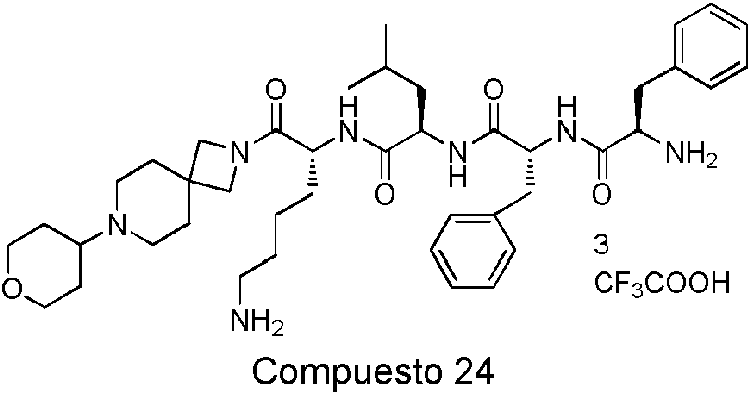
Se añadieron N-[(1R)-1-bencil-2-[[(1R)-1-bencil-2-[[(1R)-1-[[(1R)-5-(terc-butoxicarbonilamino)-1-(7-tetrahidropiran-4-il-2,7-diazaespiro[3.5]nonano-2-carbonil)pentil]carbamoil]-3-metil-butil]amino]-2-oxo-etil]amino]-2-oxo-etil]carbamato de terc-butilo (24C) (200 mg, 0,21 mmol) y ácido trifluoroacético (2 ml) en un matraz de reacción de 50 ml y se permitió que reaccionase el sistema a temperatura ambiente durante 2 h. Luego, se concentró la disolución de reacción a presión reducida y se separó el residuo y se purificó mediante cromatografía de líquidos preparativa (condiciones de preparación: instrumento: GX-281 de Gilson; columna: Xbridge C18, 150 x 30 mm de D.I., 5 |am; fase móvil: A para ACN y B para H2O; isocrático: 65% de A; velocidad de flujo: 30 ml/min; contrapresión:1000 psi; temperatura de columna: 30°C; longitud de onda: 210 nm; periodo: 18 min; preparación de la muestra: se disolvió el compuesto en 12 ml de metanol; inyección: 0,9 ml/aguja). Se concentró la preparación a presión reducida para eliminar la mayor parte del disolvente y se liofilizó para obtener (2R)-2-[[(2R)-2-[[(2R)-2-amino-3-fenil-propanoil]amino]-3-fenilpropanoil]amino]-N-[(1R)-5-amino-1-(7-tetrahidropiran-4-il-2,7-diazaespiro[3.5]nonano2-carbonil)pentil]-4-metilpentanamida; tri-ácido trifluoroacético (compuesto 24) como un polvo de color blanco (135 mg, rendimiento del 86,1%).N-[(1R)-1-benzyl-2-[[(1R)-1-benzyl-2-[[(1R)-1-[[(1R)-5-(tert-butoxycarbonylamino)-1 -(7-tetrahydropyran-4-yl-2,7-diazaspiro[3.5]nonane-2-carbonyl)pentyl]carbamoyl]-3-methyl-butyl]amino]-2-oxo-ethyl]amino]-2-oxo tert-butyl-ethyl]carbamate (24C) (200 mg, 0.21 mmol) and trifluoroacetic acid (2 mL) in a 50 mL reaction flask and the system was allowed to react at room temperature for 2 h. Then, the reaction solution was concentrated under reduced pressure, and the residue was separated and purified by preparative liquid chromatography (preparation conditions: instrument: Gilson GX-281; column: Xbridge C18, 150 x 30 mm I.D., 5 |am Mobile phase: A for ACN and B for H2O Isocratic: 65% A Flow rate: 30 mL/min Back pressure: 1000 psi Column temperature: 30°C Wavelength: 210 nm period: 18 min; sample preparation: compound was dissolved in 12 ml methanol; injection: 0.9 ml/needle). The preparation was concentrated under reduced pressure to remove most of the solvent and lyophilized to obtain (2R)-2-[[(2R)-2-[[(2R)-2-amino-3-phenyl-propanoyl]amino ]-3-phenylpropanoyl]amino]-N-[(1R)-5-amino-1-(7-tetrahydropyran-4-yl-2,7-diazaspiro[3.5]nonane2-carbonyl)pentyl]-4-methylpentanamide; tri-trifluoroacetic acid (compound 24) as a white powder (135 mg, 86.1% yield).
EM m/z = 373,9 [M+2H]+/2;MS m/z = 373.9 [M+2H]+/2;
1H-RMN (400 MHz, D2O) 87,46-7,29 (m, 10H), 4,71 (t, 1H), 4,27-4,16 (m, 7H), 3,93-3,86 (m, 2H), 3,66-3,53 (m, 5H), 3,25-3,05 (m, 8H), 2,34-2,13 (m, 6H), 1,79-1,43 (m, 11H), 1,02-0,95 (m, 6H).1H-NMR (400 MHz, D2O) 87.46-7.29 (m, 10H), 4.71 (t, 1H), 4.27-4.16 (m, 7H), 3.93-3, 86 (m, 2H), 3.66-3.53 (m, 5H), 3.25-3.05 (m, 8H), 2.34-2.13 (m, 6H), 1.79- 1.43 (m, 11H), 1.02-0.95 (m, 6H).
Ejemplo 23:Example 23:
(2R)-2-[[(2R)-2-[[(2R)-2-Amino-3-fenil-propanoil]amino]-3-fenil-propanoil]amino]-N-[(1R)-5-amino-1-(2-pirrolidin-1-il-7-azaespiro[3.5]nonano-7-carbonil)pentil]-4-metil-pentanamida; tri-ácido trifluoroacético (compuesto 25) (2R)-2-[[(2R)-2-[[(2R)-2-Amino-3-phenyl-propanoyl]amino]-3-phenyl-propanoyl]amino]-N-[(1R)-5 -amino-1-(2-pyrrolidin-1-yl-7-azaspiro[3.5]nonane-7-carbonyl)pentyl]-4-methyl-pentanamide; tri-trifluoroacetic acid (compound 25)

Etapa 1:Stage 1:
2-Pirrolidin-1-il-7-azaespiro[3.5]nonano-7-carboxilato de terc-butilo (25A)tert-Butyl 2-Pyrrolidin-1-yl-7-azaspiro[3.5]nonane-7-carboxylate (25A)

Se añadieron secuencialmente 2-oxo-7-azaespiro[3.5]nonano-7-carboxilato de terc-butilo (3A) (131 mg, 0,55 mmol), ácido acético (66 mg, 1,1 mmol), pirrolidina (39 mg, 0,55 mmol), triacetoxiborohidruro de sodio (233 mg, 1,1 mmol) y diclorometano (20 ml) en un matraz de reacción de 50 ml. Después de la adición, se permitió que avanzase la reacción a temperatura ambiente durante 6 h. Se filtró la disolución de reacción con succión y se lavó el filtrado con una disolución saturada de bicarbonato de sodio (30 ml). Después de la separación del líquido, se secó la fase orgánica sobre sulfato de sodio anhidro, se filtró con succión y se concentró el filtrado a presión reducida para obtener 2-pirrolidin-1-il-7-azaespiro[3.5]nonano-7-carboxilato de terc-butilo (25A)) como un polvo de color blanco (120 mg, rendimiento del 75%).tert-Butyl 2-oxo-7-azaspiro[3.5]nonane-7-carboxylate (3A) (131 mg, 0.55 mmol), acetic acid (66 mg, 1.1 mmol), pyrrolidine (39 mg, 0.55 mmol), sodium triacetoxyborohydride (233 mg, 1.1 mmol), and dichloromethane (20 mL) in a 50 mL reaction flask. After the addition, the reaction was allowed to proceed at room temperature for 6 h. The reaction solution was filtered with suction, and the filtrate was washed with a saturated sodium bicarbonate solution (30 ml). After separation of the liquid, the organic phase was dried over anhydrous sodium sulfate, suction filtered, and the filtrate was concentrated under reduced pressure to obtain 2-pyrrolidin-1-yl-7-azaspiro[3.5]nonane-7- tert-butyl carboxylate (25A)) as a white powder (120 mg, 75% yield).
Etapa 2:Stage 2:
2-Pirrolidin-1-il-7-azaespiro[3.5]nonano (25B)2-Pyrrolidin-1-yl-7-azaspiro[3.5]nonane (25B)

Se añadieron (2-pirrolidin-1-il-7-azaespiro[3.5]nonano-7-carboxilato de terc-butilo (25A) (120 mg, 0,41 mmol) y diclorometano (10 ml) en un matraz de reacción de 50 ml y se añadió gota a gota ácido trifluoroacético (2 ml) a temperatura ambiente. Después de la adición, se permitió que reaccionase el sistema a temperatura ambiente durante 3 h. Se concentró la disolución de reacción directamente a presión reducida para obtener 2-pirrolidin-1-il-7-azaespiro[3.5]nonano (25B) en bruto como un líquido oleoso de color amarillo (80 mg, rendimiento del 100%) y se usó directamente en la siguiente reacción.tert-Butyl (2-pyrrolidin-1-yl-7-azaspiro[3.5]nonane-7-carboxylate (25A) (120 mg, 0.41 mmol) and dichloromethane (10 mL) were added to a reaction flask of 50 mL, and trifluoroacetic acid (2 mL) was added dropwise at room temperature. After the addition, the system was allowed to react at room temperature for 3 h. The reaction solution was directly concentrated under reduced pressure to obtain 2- crude pyrrolidin-1-yl-7-azaspiro[3.5]nonane (25B) as a yellow oily liquid (80 mg, 100% yield) and used directly in the next reaction.
Etapa 3:Stage 3:
N-[(1R)-1-Bencil-2-[[(1R)-1-bencil-2-[[(1R)-1-[[(1R)-5-(terc-butoxicarbonilamino)-1-(2-pirrolidin-1-il-7-azaespiro[3.5]nonano-7-carbonil)pentil]carbamoil]-3-metil-butil]amino]-2-oxo-etil]amino]-2-oxo-etil]carbamato de tercbutilo (25C) N-[(1R)-1-Benzyl-2-[[(1R)-1-benzyl-2-[[(1R)-1-[[(1R)-5-(tert-butoxycarbonylamino)-1-( 2-pyrrolidin-1-yl-7-azaspiro[3.5]nonane-7-carbonyl)pentyl]carbamoyl]-3-methyl-butyl]amino]-2-oxo-ethyl]amino]-2-oxo-ethyl]carbamate tert-butyl (25C)

Se añadieron 2-pirrolidin-1-il-7-azaespiro[3.5]nonano (25B) en bruto (80 mg, 0,41 mmol), clorhidrato de 1-(3-dimetilaminopropil)-3-etilcarbodiimida (96 mg, 0,5 mmol), 1-hidroxibenzotriazol (67,5 mg, 0,5 mmol), producto intermedio 1 (309 mg, 0,41 mmol) y diclorometano (20 ml) en un matraz de una sola boca de 50 ml y se permitió que reaccionase el sistema a temperatura ambiente durante 5 h. Se concentró la disolución de reacción a presión reducida y se separó el residuo y se purificó mediante cromatografía en columna de gel de sílice (diclorometano:metanol (v:v) = 50:1) para obtener de (1R)-1-bencil-2-[[(1R)-1-bencil-2-[[(1R)-1-[[(1R)-5-(terc-butoxicarbonilamino)-1-(2-pirrolidin-1-il-7-azaespiro[3.5]nonano-7-carbonil)pentil]carbamoil]-3-metil-butil]amino]-2-oxo-etil]amino]-2-oxo-etil]carbamato de terc-butilo (25C) como un sólido de color amarillo claro (344 mg, rendimiento del 90%).Crude 2-pyrrolidin-1-yl-7-azaspiro[3.5]nonane (25B) (80 mg, 0.41 mmol), 1-(3-dimethylaminopropyl)-3-ethylcarbodiimide hydrochloride (96 mg, 0 0.5 mmol), 1-hydroxybenzotriazole (67.5 mg, 0.5 mmol), intermediate 1 (309 mg, 0.41 mmol) and dichloromethane (20 mL) in a 50 mL single-neck flask and allowed the system to react at room temperature for 5 h. The reaction solution was concentrated under reduced pressure, and the residue was separated and purified by silica gel column chromatography (dichloromethane:methanol (v:v) = 50:1) to obtain de (1R)-1-benzyl- 2-[[(1R)-1-benzyl-2-[[(1R)-1-[[(1R)-5-(tert-butoxycarbonylamino)-1-(2-pyrrolidin-1-yl-7-azaspiro tert-Butyl [3.5]nonane-7-carbonyl)pentyl]carbamoyl]-3-methyl-butyl]amino]-2-oxo-ethyl]amino]-2-oxo-ethyl]carbamate (25C) as a solid of light yellow color (344 mg, 90% yield).
Etapa 4:Stage 4:
(2R)-2-[[(2R)-2-[[(2R)-2-Amino-3-fenil-propanoil]amino]-3-fenil-propanoil]amino]-N-[(1R)-5-amino-1-(2-pirrolidin-1-il-7-azaespiro[3.5]nonano-7-carbonil)pentil]-4-metil-pentanamida; tri-ácido trifluoroacético (compuesto 25)(2R)-2-[[(2R)-2-[[(2R)-2-Amino-3-phenyl-propanoyl]amino]-3-phenyl-propanoyl]amino]-N-[(1R)-5 -amino-1-(2-pyrrolidin-1-yl-7-azaspiro[3.5]nonane-7-carbonyl)pentyl]-4-methyl-pentanamide; tri-trifluoroacetic acid (compound 25)

Se añadieron N(1R)-1-bencil-2-[[(1R)-1-bencil-2-[[(1R)-1-[[(1R)-5-(terc-butoxicarbonilamino)-1-(2-pirrolidin)-1-il-7-azaespiro[3.5]nonano-7-carbonil)pentil]carbamoil]-3-metil-butil]amino]-2-oxo-etil]amino]-2-oxo-etil]carbamato de tercbutilo (25C) (344 mg, 0,37 mmol) y ácido trifluoroacético (2 ml) en un matraz de reacción de 50 ml y se permitió que reaccionase el sistema a temperatura ambiente durante 2 h. Luego, se concentró la disolución de reacción a presión reducida y se separó el residuo y se purificó mediante cromatografía de líquidos preparativa (condiciones de preparación: instrumento: GX-281 de Gilson; columna: Xbridge C18, 150 x 30 mm de D.I., 5 |am; fase móvil: A para ACN y B para H2O; isocrático: 65% de A; velocidad de flujo: 30 ml/min; contrapresión:1000 psi; temperatura de columna: 30°C; longitud de onda: 210 nm; periodo: 18 min; preparación de la muestra: se disolvió el compuesto en 12 ml de metanol; inyección: 0,9 ml/aguja). Se concentró la preparación a presión reducida para eliminar la mayor parte del disolvente y se liofilizó para obtener ((2R)-2-[[(2R)-2-[[(2R)-2-amino-3-fenil-propanoil)amino)-3-fenilpropanoil]amino]-N-[(1R)-5-amino-1-(2-pirrolidin-1-il-7-azaespiro[3.5]nonano-7-carbonil)pentil]-4-metil-pentanamida; tri-ácido trifluoroacético (compuesto 25) como un polvo de color blanco (249 mg, rendimiento del 70%).N(1R)-1-benzyl-2-[[(1R)-1-benzyl-2-[[(1R)-1-[[(1R)-5-(tert-butoxycarbonylamino)-1-( 2-pyrrolidin)-1-yl-7-azaspiro[3.5]nonane-7-carbonyl)pentyl]carbamoyl]-3-methyl-butyl]amino]-2-oxo-ethyl]amino]-2-oxo-ethyl] tert-butyl carbamate (25C) (344 mg, 0.37 mmol) and trifluoroacetic acid (2 mL) in a 50 mL reaction flask and the system was allowed to react at room temperature for 2 h. Then, the reaction solution was concentrated under reduced pressure, and the residue was separated and purified by preparative liquid chromatography (preparation conditions: instrument: Gilson GX-281; column: Xbridge C18, 150 x 30 mm I.D., 5 |am Mobile phase: A for ACN and B for H2O Isocratic: 65% A Flow rate: 30 mL/min Back pressure: 1000 psi Column temperature: 30°C Wavelength: 210 nm period: 18 min; sample preparation: compound was dissolved in 12 ml methanol; injection: 0.9 ml/needle). The preparation was concentrated under reduced pressure to remove most of the solvent and lyophilized to obtain ((2R)-2-[[(2R)-2-[[(2R)-2-amino-3-phenyl-propanoyl) amino)-3-phenylpropanoyl]amino]-N-[(1R)-5-amino-1-(2-pyrrolidin-1-yl-7-azaspiro[3.5]nonane-7-carbonyl)pentyl]-4-methyl -pentanamide; tri-trifluoroacetic acid (compound 25) as a white powder (249 mg, 70% yield).
EM m/z = 365,8 [M+2H]+ /2;MS m/z = 365.8 [M+2H] + /2;
1H-RMN (400 MHz, D2O) 87,43-7,13 (m, 10H), 4,71-4,70 (m, 1H), 4,62 (t, 1H), 4,30-4,17 (m, 2H), 3,82-3,74 (m, 1H), 3,68-3,39 (m, 5H), 3,38-3,21 (m, 1H), 3,15 (d, 2H), 3,06-2,90 (m, 6H), 2,43-2,25 (m, 2H), 2,16-1,89 (m, 6H), 1,78-1,27 (m, 13H), 0,89 (dd, 6H).1H-NMR (400 MHz, D2O) 87.43-7.13 (m, 10H), 4.71-4.70 (m, 1H), 4.62 (t, 1H), 4.30-4, 17 (m, 2H), 3.82-3.74 (m, 1H), 3.68-3.39 (m, 5H), 3.38-3.21 (m, 1H), 3.15 ( d, 2H), 3.06-2.90 (m, 6H), 2.43-2.25 (m, 2H), 2.16-1.89 (m, 6H), 1.78-1, 27 (m, 13H), 0.89 (dd, 6H).
Ejemplo 24:Example 24:
(2R)-1-[7-[(2R)-6-Amino-2-[[[(2R)-2-[[(2R)-2-[[(2R)-2-amino-3-fenil-propanoil]amino]-3-fenil-propanoil]amino]-4-metilpentanoil]amino]hexanoil]-7-azaespiro[3.5]nonan-2-il]pirrolidin-2-carboxílico; tri-ácido trifluoroacético (compuesto 26)
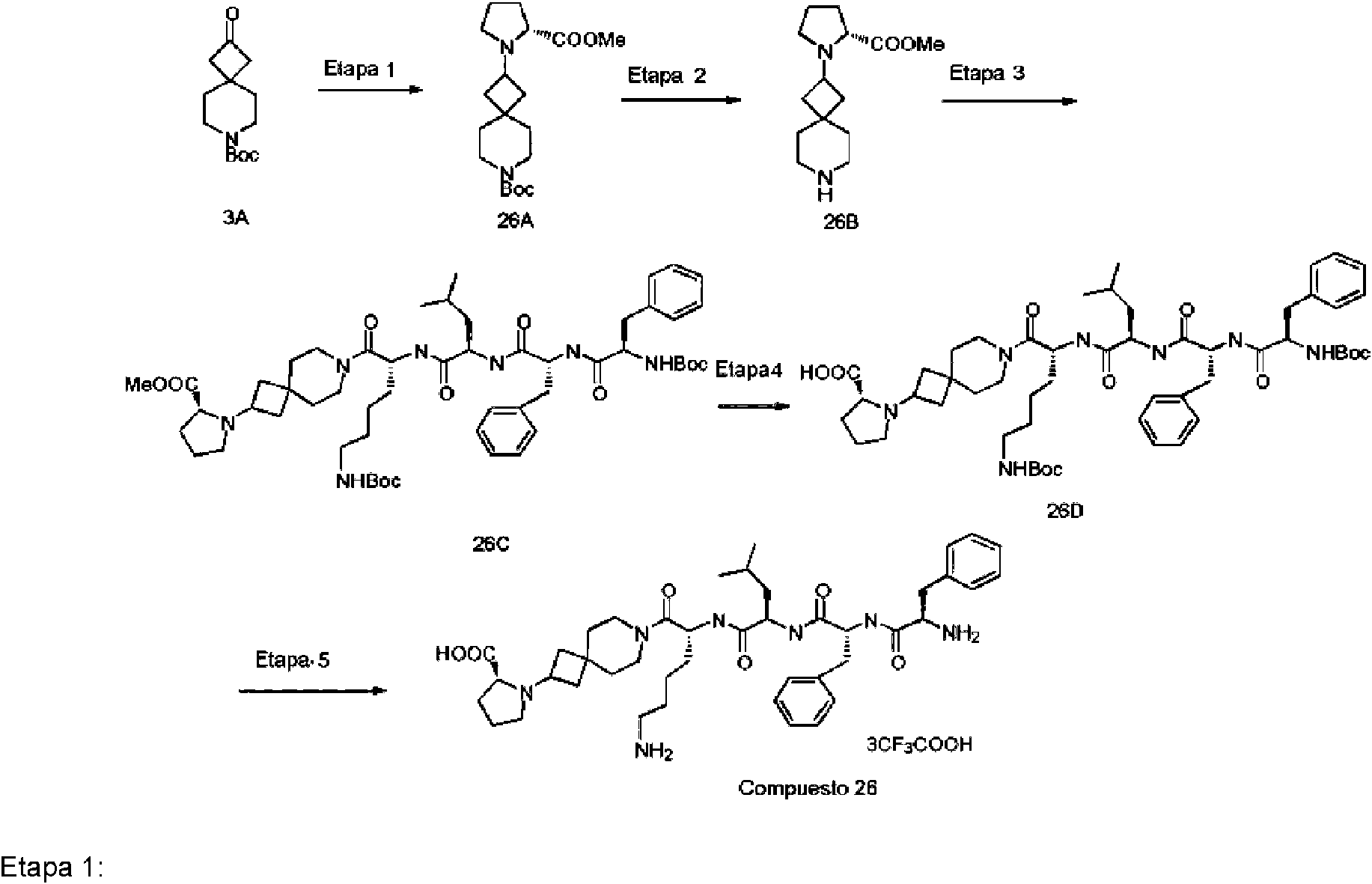
2-[(2R)-2-Metoxicarbonilpirrolidin-1-il]-7-azaespiro[3.5]nonano-7-carboxilato (26A) de terc-butilotert-Butyl 2-[(2R)-2-Methoxycarbonylpyrrolidin-1-yl]-7-azaspiro[3.5]nonane-7-carboxylate (26A)
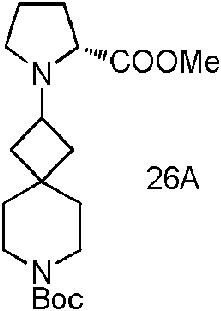
Se añadieron secuencialmente 2-oxo-7-azaespiro[3.5]nonano-7-carboxilato de terc-butilo (3A) (287 mg, 1,2mmol), ácido acético (144 mg, 2,4 mmol), éster metílico de D-prolina (154 mg, 1,2mmol)), triacetoxiborohidruro de sodio (233 mg, 2,4 mmol) y diclorometano (30 ml) en un matraz de reacción de 50 ml. Después de la adición, se permitió que avanzase la reacción a temperatura ambiente durante 6 h. Se filtró la disolución de reacción con succión y se lavó el filtrado con una disolución saturada de bicarbonato de sodio (50 ml). Después de la separación del líquido, se secó la fase orgánica sobre sulfato de sodio anhidro, se filtró con succión y se concentró el filtrado a presión reducida para obtener 2-pirrolidin-1-il-7-azaespiro[3.5]nonano-7-carboxilato de terc-butilo (26A)) como un polvo de color blanco (275 mg, rendimiento del 65%).tert-Butyl 2-oxo-7-azaspiro[3.5]nonane-7-carboxylate (3A) (287mg, 1.2mmol), acetic acid (144mg, 2.4mmol), D -proline (154 mg, 1.2 mmol)), sodium triacetoxyborohydride (233 mg, 2.4 mmol), and dichloromethane (30 mL) in a 50 mL reaction flask. After the addition, the reaction was allowed to proceed at room temperature for 6 h. The reaction solution was filtered with suction, and the filtrate was washed with a saturated sodium bicarbonate solution (50 ml). After separation of the liquid, the organic layer was dried over anhydrous sodium sulfate, suction filtered, and the filtrate was concentrated under reduced pressure to obtain 2-pyrrolidin-1-yl-7-azaspiro[3.5]nonane-7- tert-butyl carboxylate (26A)) as a white powder (275 mg, 65% yield).
Etapa 2:Stage 2:
(2R)-1-(7-azaespiro[3.5]nonan-2-il)pirrolidin-2-carboxilato de metilo (26B)Methyl (2R)-1-(7-azaspiro[3.5]nonan-2-yl)pyrrolidine-2-carboxylate (26B)

Se añadieron 2-[(2R)-2-Metoxicarbonilpirrolidin-1-il]-7-azaespiro[3.5]nonano-7-carboxilato de terc-butilo (26A) (275 mg, 0,78 mmol) y diclorometano (10 ml) en un matraz de reacción de 50 ml y se añadió gota a gota ácido trifluoroacético (2 ml) a temperatura ambiente. Después de la adición, se permitió que reaccionase el sistema a temperatura ambiente durante 3 h. Se concentró la disolución de reacción directamente a presión reducida para obtener (2R)-1-(7-azaespiro[3.5]nonan-2-il)pirrolidin-2-carboxilato de metilo (26B) como un líquido oleoso de color amarillo (196 mg, rendimiento del 100%).) y se usó directamente en la siguiente reacción.tert-Butyl 2-[(2R)-2-Methoxycarbonylpyrrolidin-1-yl]-7-azaspiro[3.5]nonane-7-carboxylate (26A) (275 mg, 0.78 mmol) and dichloromethane (10 mL) were added. ) in a 50 mL reaction flask and trifluoroacetic acid (2 mL) was added dropwise at room temperature. After the addition, the system was allowed to react at room temperature for 3 h. The reaction solution was concentrated directly under reduced pressure to obtain methyl (2R)-1-(7-azaspiro[3.5]nonan-2-yl)pyrrolidine-2-carboxylate (26B) as a color oily liquid. yellow (196 mg, 100% yield)) and used directly in the next reaction.
Etapa 3:Stage 3:
(2R)-1-[7-[(2R)-6-(terc-Butoxicarbonilamino)-2-[[(2R)-2-[[(2R)-2-[[(2R)-2-(terc-butoxicarboxilamino)-3-fenilpropanoil]amino]-3-fenil-propanoil]amino]-4-metil-pentanoil]amino]hexanoil]-7-azaespiro[3.5]nonan-2-il]pirrolidin-2-carboxilato de metilo (26C)(2R)-1-[7-[(2R)-6-(tert-Butoxycarbonylamino)-2-[[(2R)-2-[[(2R)-2-[[(2R)-2-(tert Methyl -butoxycarboxylamino)-3-phenylpropanoyl]amino]-3-phenyl-propanoyl]amino]-4-methyl-pentanoyl]amino]hexanoyl]-7-azaspiro[3.5]nonan-2-yl]pyrrolidine-2-carboxylate (26C)

Se añadieron clorhidrato de (2R)-1-(7-azaespiro[3.5]nonan-2-il)pirrolidin-2-carboxilato de metilo (26B) (196 mg, 0,78 mmol), 1-(3-dimetilaminopropil)-3-etilcarbodiimida (180 mg, 0,94 mmol), 1-hidroxibenzotriazol (127 mg, 0,94 mmol), producto intermedio 1 (587 mg, 0,78 mmol) y diclorometano (20 ml) en un matraz de una sola boca de 50 ml y se permitió que reaccionase el sistema a temperatura ambiente durante 5 h. Se concentró la disolución de reacción a presión reducida y se separó el residuo y se purificó mediante cromatografía en columna de gel de sílice (diclorometano:metanol (v:v) = 50:1) para obtener (2R)-1-[7-[(2R)-6-(terc-butoxicarbonilamino)-2-[[(2R)-2-[[(2R)-2-[[terc-butoxicarbonilamino)-3-fenil-propanoil)amino)-3-fenil-propanoil]amino]-4-metil-pentanoil]amino]hexanoil]-7-azaespiro[3.5]nonan-2-il]pirrolidin-2-carboxilato de metilo (26C) como un sólido de color blanco (385 mg, rendimiento del 50%).Methyl (2R)-1-(7-azaspiro[3.5]nonan-2-yl)pyrrolidine-2-carboxylate hydrochloride (26B) (196 mg, 0.78 mmol), 1-(3-dimethylaminopropyl) -3-ethylcarbodiimide (180 mg, 0.94 mmol), 1-hydroxybenzotriazole (127 mg, 0.94 mmol), intermediate 1 (587 mg, 0.78 mmol), and dichloromethane (20 mL) in a 1-liter flask. 50 ml single neck and the system was allowed to react at room temperature for 5 h. The reaction solution was concentrated under reduced pressure, and the residue was separated and purified by silica gel column chromatography (dichloromethane:methanol (v:v) = 50:1) to obtain (2R)-1-[7- [(2R)-6-(tert-butoxycarbonylamino)-2-[[(2R)-2-[[(2R)-2-[[tert-butoxycarbonylamino)-3-phenyl-propanoyl)amino)-3-phenyl Methyl -propanoyl]amino]-4-methyl-pentanoyl]amino]hexanoyl]-7-azaspiro[3.5]nonan-2-yl]pyrrolidine-2-carboxylate (26C) as a white solid (385 mg, yield of 50%).
Etapa 4:Stage 4:
Ácido (2R)-1-[7-[(2R)-6-(terc-Butoxicarbonilamino)-2-[[(2R)-2-[[(2R)-2-[[(2R)-2-(terc-butoxicarbonilamino)-3-fenilpropanoil]amino]-3-fenil-propanoil]amino]-4-metil-pentanoil]amino]hexanoil]-7-azaespiro[3.5]nonan-2-il]pirrolidin-2-carboxílico (26D)(2R)-1-[7-[(2R)-6-(tert-Butoxycarbonylamino)-2-[[(2R)-2-[[(2R)-2-[[(2R)-2-( tert-butoxycarbonylamino)-3-phenylpropanoyl]amino]-3-phenyl-propanoyl]amino]-4-methyl-pentanoyl]amino]hexanoyl]-7-azaspiro[3.5]nonan-2-yl]pyrrolidine-2-carboxylic ( 26D)

Se disolvió (2R)-1-[7-[(2R)-6-(terc-butoxicarbonilamino)-2-[[(2R)-2-[[(2R)-2-[[terc-butoxicarbonilamino)-3-fenilpropanoil)amino)-3-fenil-propanoil]amino]-4-metil-pentanoil]amino]hexanoil]-7-azaespiro[3.5]nonan-2-il]pirrolidin-2-carboxilato de metilo (26C) (385 mg, 0,39 mmol) en metanol (5 ml) a temperatura ambiente y se añadió una disolución acuosa de hidróxido de sodio (16 mg, 0,4 mmol) (10 ml) a la disolución de reacción. Se permitió que reaccionase el sistema a temperatura ambiente durante 5 h. Se ajustó la disolución de reacción a pH <4 con una disolución acuosa de ácido clorhídrico 1 M, se extrajo con acetato de etilo (20 ml) y se sometió la mezcla a un proceso de separación de líquido. Se secaron las fases orgánicas sobre sulfato de sodio anhidro, se filtraron y se concentró el filtrado a presión reducida para obtener (2R)-1-[7-[(2R)-6-(terc-butoxicarbonilamino)-2-[[(2R)-2-[[(2R)-2-[[(2R)-2-(tercbutoxicarbonilamino)-3-fenil-propanoil)amino)-3-fenil-propanoil]amino]-4-metil-pentanoil]amino]hexanoil]-7-azaespiro[3.5]nonan-2-il]pirrolidin-2-carboxilato de metilo (26D) como un sólido de color blanco (345 mg, rendimiento del 93%).(2R)-1-[7-[(2R)-6-(tert-butoxycarbonylamino)-2-[[(2R)-2-[[(2R)-2-[[tert-butoxycarbonylamino)-3 was dissolved -phenylpropanoyl)amino)-3-phenyl-propanoyl]amino]-4-methyl-pentanoyl]amino]hexanoyl]-7-azaspiro[3.5]nonan-2-yl]pyrrolidine-2-carboxylate methyl (26C) (385 mg, 0.39 mmol) in methanol (5 mL) at room temperature, and aqueous sodium hydroxide solution (16 mg, 0.4 mmol) (10 mL) was added to the reaction solution. The system was allowed to react at room temperature for 5 h. The reaction solution was adjusted to pH<4 with 1M hydrochloric acid aqueous solution, extracted with ethyl acetate (20 ml), and the mixture was subjected to liquid separation process. The organic phases were dried over anhydrous sodium sulfate, filtered, and the filtrate was concentrated under reduced pressure to obtain (2R)-1-[7-[(2R)-6-(tert-butoxycarbonylamino)-2-[[( 2R)-2-[[(2R)-2-[[(2R)-2-(tert-butoxycarbonylamino)-3-phenyl-propanoyl)amino)-3-phenyl-propanoyl]amino]-4-methyl-pentanoyl]amino Methyl ]hexanoyl]-7-azaspiro[3.5]nonan-2-yl]pyrrolidine-2-carboxylate (26D) as a white solid (345 mg, 93% yield).
Etapa 5:Stage 5:
Ácido (2R)-1-[7-[(2R)-6-Amino-2-[[[(2R)-2-[[(2R)-2-[[(2R)-2-amino-3-fenil-propanoil]amino]-3-fenil-propanoil]amino]-4-metil-pentanoil]amino]hexanoil]-7-azaespiro[3.5]nonan-2-il]pirrolidin-2-carboxílico; ácido tri-ácido trifluoroacético (compuesto 26) Acid (2R)-1-[7-[(2R)-6-Amino-2-[[[(2R)-2-[[(2R)-2-[[(2R)-2-amino-3- phenyl-propanoyl]amino]-3-phenyl-propanoyl]amino]-4-methyl-pentanoyl]amino]hexanoyl]-7-azaspiro[3.5]nonan-2-yl]pyrrolidine-2-carboxylic acid; tri-trifluoroacetic acid (compound 26)
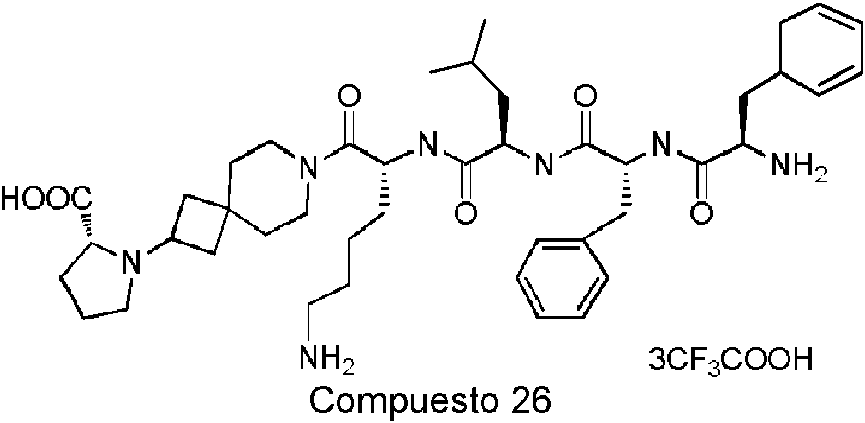
Se añadieron ácido (2R)-1-[7-[(2R)-6-(terc-Butoxicarbonilamino)-2-[[(2R)-2-[[(2R)-2-[[(2R)-2-(tercbutoxicarbonilamino)-3-fenil-propanoil)amino)-3-fenil-propanoil]amino]-4-metil-pentanoil]amino]hexanoil]-7-azaespiro[3.5]nonan-2-il]pirrolidin-2-carboxílico (26D) (345 mg, 0,36 mmol) y ácido trifluoroacético (2 ml) en un matraz de reacción de 50 ml y se permitió que reaccionase el sistema a temperatura ambiente durante 2 h. Luego, se concentró la disolución de reacción a presión reducida y se separó el residuo y se purificó mediante cromatografía de líquidos preparativa (condiciones de preparación: instrumento: GX-281 de Gilson; columna: Xbridge C18, 150 x 30 mm de D.I., 5 |am; fase móvil: A para ACN y B para H2O; isocrático: 65% de A; velocidad de flujo: 30 ml/min; contrapresión:1000 psi; temperatura de columna: 30°C; longitud de onda: 210 nm; periodo: 18 min; preparación de la muestra: se disolvió el compuesto en 12 ml de metanol; inyección: 0,9 ml/aguja), se concentró la preparación a presión reducida para eliminar la mayor parte del disolvente y se liofilizó para obtener ácido (2R)-1-[7-[(2R)-6-amino-2-[[(2R)-2-[[(2R)-2-[[(2R)-2-amino-3-fenilpropanoil]amino]-3-fenil-propanoil]amino]-4-metil-pentanoil]amino]hexanoil]-7-azaespiro[3.5]nonan-2-il]pirrolidin-2-carboxílico; tri-ácido trifluoroacético (compuesto 26) como un polvo de color blanco (240 mg, rendimiento del 60%).(2R)-1-[7-[(2R)-6-(tert-Butoxycarbonylamino)-2-[[(2R)-2-[[(2R)-2-[[(2R)-2 -(tertbutoxycarbonylamino)-3-phenyl-propanoyl)amino)-3-phenyl-propanoyl]amino]-4-methyl-pentanoyl]amino]hexanoyl]-7-azaspiro[3.5]nonan-2-yl]pyrrolidin-2- carboxylic acid (26D) (345 mg, 0.36 mmol) and trifluoroacetic acid (2 mL) in a 50 mL reaction flask and the system was allowed to react at room temperature for 2 h. Then, the reaction solution was concentrated under reduced pressure, and the residue was separated and purified by preparative liquid chromatography (preparation conditions: instrument: Gilson GX-281; column: Xbridge C18, 150 x 30 mm I.D., 5 |am Mobile phase: A for ACN and B for H2O Isocratic: 65% A Flow rate: 30 mL/min Back pressure: 1000 psi Column temperature: 30°C Wavelength: 210 nm period: 18 min; sample preparation: the compound was dissolved in 12 ml of methanol; injection: 0.9 ml/needle), the preparation was concentrated under reduced pressure to remove most of the solvent and lyophilized to obtain acid (2R)-1-[7-[(2R)-6-amino-2-[[(2R)-2-[[(2R)-2-[[(2R)-2-amino-3-phenylpropanoyl] amino]-3-phenyl-propanoyl]amino]-4-methyl-pentanoyl]amino]hexanoyl]-7-azaspiro[3.5]nonan-2-yl]pyrrolidine-2-carboxylic; tri-trifluoroacetic acid (compound 26) as a white powder (240 mg, 60% yield).
EM m/z = 387,8 [M+2H]+/2;MS m/z = 387.8 [M+2H]+/2;
1H-RMN (400 MHz, D2O) 87,44-7,09 (m, 10H), 4,27-4,19 (m, 3H), 3,96-3,84 (m, 2H), 3,67-3,50 (m, 3H), 3,48-3,21 (m, 3H), 3,19-2,89 (m, 7H), 2,50-2,22 (m, 3H), 2,18-1,91 (m, 5H), 1,78-1,24 (m, 13H), 0,88 (dd, 6H).1H-NMR (400 MHz, D2O) 87.44-7.09 (m, 10H), 4.27-4.19 (m, 3H), 3.96-3.84 (m, 2H), 3, 67-3.50 (m, 3H), 3.48-3.21 (m, 3H), 3.19-2.89 (m, 7H), 2.50-2.22 (m, 3H), 2.18-1.91 (m, 5H), 1.78-1.24 (m, 13H), 0.88 (dd, 6H).
Ejemplo 25:Example 25:
2-[(2R)-6-amino-2-[[(2R)-2-[[(2R)-2-[[(2R)-2-amino-3-fenil-propanoil]amino]-3-fenil-propanoil]amino]-4-metilpentanoil]amino]hexanoil]-N-metil-2,7-diazaespiro[3.5]nona-7-carboxamida; di-ácido trifluoroacético (compuesto 27)2-[(2R)-6-amino-2-[[(2R)-2-[[(2R)-2-[[(2R)-2-amino-3-phenyl-propanoyl]amino]-3- phenyl-propanoyl]amino]-4-methylpentanoyl]amino]hexanoyl]-N-methyl-2,7-diazaspiro[3.5]none-7-carboxamide; di-trifluoroacetic acid (compound 27)

Etapa 1:Stage 1:
7-(Metilcarbamoil)-2,7-diazaespiro[3.5]nonano-2-carboxilato de terc-butilo (27A)tert-Butyl 7-(Methylcarbamoyl)-2,7-diazaspiro[3.5]nonane-2-carboxylate (27A)

Se añadieron 2-terc-butoxigencarbonil-2,7-diazaespiro[3.5]nonano (0,45 g, 2 mmol), diclorometano (10 ml) y trietilamina (0,30 g, 3 mmol) a un matraz de reacción bajo protección de nitrógeno; se enfrió hasta 0-5°C y se añadió cloruro de metilaminoformilo (0,20 g, 2,2 mmol). Después de la adición, se retiró el enfriamiento y se elevó la temperatura hasta temperatura ambiente y se hizo reaccionar durante 1 h. Se usó CCF para monitorizar si se completaba la reacción. Se añadieron diclorometano (10 ml) y agua (10 ml) y, después de agitar durante 5 minutos, se dejó que se separasen las fases; se secó la fase orgánica sobre sulfato de sodio anhidro, se filtró y se concentró a presión reducida. Se separó el residuo y se purificó mediante cromatografía en columna de gel de sílice (diclorometano/metanol=(v/v) 20/1) para obtener 7-(metilcarbamoil)-2,7-diazaespiro-[3,5]nonano-2-carboxilato de tercbutilo (27A) como una sustancia aceitosa de color amarillo claro (0,48 g, rendimiento del 85%).2-tert-Butoxygencarbonyl-2,7-diazaspiro[3.5]nonane (0.45 g, 2 mmol), dichloromethane (10 mL) and triethylamine (0.30 g, 3 mmol) were added to a reaction flask under protection nitrogen; cooled to 0-5°C and added methylaminoformyl chloride (0.20g, 2.2mmol). After the addition, the cooling was removed and the temperature was raised to room temperature and reacted for 1 h. TLC was used to monitor if the reaction was complete. Dichloromethane (10 ml) and water (10 ml) were added and after stirring for 5 minutes the phases were allowed to separate; the organic phase was dried over anhydrous sodium sulfate, filtered and concentrated under reduced pressure. The residue was separated and purified by silica gel column chromatography (dichloromethane/methanol=(v/v) 20/1) to obtain 7-(methylcarbamoyl)-2,7-diazaspiro-[3.5]nonane- tert-Butyl 2-carboxylate (27A) as light yellow oily substance (0.48 g, 85% yield).
Etapa 2:Stage 2:
N-Metil-2,7-diazaespiro[3.5]nonano-7-carboxamida; ácido 2,2,2-trifluoroacético (27B)N-Methyl-2,7-diazaspiro[3.5]nonane-7-carboxamide; 2,2,2-trifluoroacetic acid (27B)

Se añadió 7-(metilcarbamoil)-2,7-diazaespiro-[3,5]nonano-2-carboxilato de terc-butilo (27A, 0,48 g, 1,7 mmol) a diclorometano (5 ml) en un matraz de reacción de 50 ml bajo protección de nitrógeno, y se añadió ácido trifluoroacético (2 ml) con agitación. Después de la adición, se permitió que reaccionase el sistema a temperatura ambiente durante 2 h. Se usó CCF para monitorizar que se completaba la reacción, y se concentró la reacción hasta sequedad a presión reducida para obtener N-metil-2,7-diazaespiro[3.5]nonano-7-carboxamida; ácido trifluoroacético (27B) como una sustancia oleosa de color amarillo claro (0,49 g, rendimiento del 97%) y se usó directamente en la siguiente etapa. tert-Butyl 7-(methylcarbamoyl)-2,7-diazaspiro-[3.5]nonane-2-carboxylate (27A, 0.48 g, 1.7 mmol) was added to dichloromethane (5 mL) in a flask 50 mL reaction mixture under nitrogen protection, and trifluoroacetic acid (2 mL) was added with stirring. After the addition, the system was allowed to react at room temperature for 2 h. TLC was used to monitor the completion of the reaction, and the reaction was concentrated to dryness under reduced pressure to obtain N-methyl-2,7-diazaspiro[3.5]nonane-7-carboxamide; trifluoroacetic acid (27B) as light yellow oily substance (0.49 g, 97% yield) and used directly in the next step.
Etapa 3:Stage 3:
N-[(1R)-1-Bencil-2-[[(1R)-1-bencil-2-[[(1R)-1-[[(1R)-5-(terc-butoxicarbonilamino)-1-[7-(metilcarbamoil)-2,7-diazaespiro[3.5]nonano-2-carbonil]pentil]carbamoil]-3-metil-butil]amino]-2-oxo-etil]amino]-2-oxo-etil]carbamato de terc-butilo (27C)N-[(1R)-1-Benzyl-2-[[(1R)-1-benzyl-2-[[(1R)-1-[[(1R)-5-(tert-butoxycarbonylamino)-1-[ 7-(methylcarbamoyl)-2,7-diazaspiro[3.5]nonane-2-carbonyl]pentyl]carbamoyl]-3-methyl-butyl]amino]-2-oxo-ethyl]amino]-2-oxo-ethyl]carbamate tert-butyl (27C)
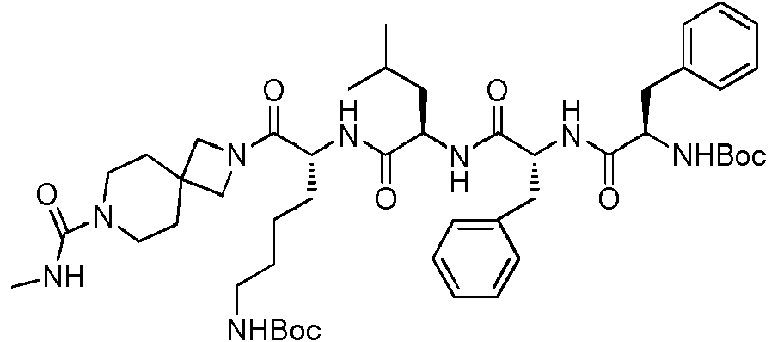
Se añadió N-metil-2,7-diazaespiro[3.5]nonano-7-carboxamida; ácido trifluoroacético (27B) en bruto (0,48 g, 2,60 mmol) en diclorometano (10 ml) en un matraz de reacción de 50 ml bajo protección de nitrógeno. Se enfrió hasta 0°C en un baño de hielo y se añadieron el producto intermedio 1 (0,50 g, 0,66 mmol), clorhidrato de 1-(3-dimetilaminopropil)-3-etilcarbodiimida (200 mg, 1,73 mmol), 1-hidroxibenzotriazol (125 mg, 0,93 mmol). Después de la adición, se permitió que reaccionase el sistema a temperatura ambiente durante 3 h. Posteriormente, se añadió una disolución acuosa de ácido clorhídrico 1 M (15 ml) a la disolución de reacción y se agitó la mezcla y luego se sometió a un proceso de separación de líquido. Se añadió una disolución acuosa saturada de carbonato de sodio (15 ml) a la fase orgánica y se agitó la mezcla durante 30 minutos y luego se sometió a un proceso de separación de líquido. Se lavó la fase orgánica con una disolución acuosa saturada de cloruro de sodio (15 ml), se secó sobre sulfato de sodio anhidro, se filtró y se concentró el filtrado a presión reducida para obtener N-[(1R)-1-bencil-2-[[(1R)-1-bencil-2-[[(1R)-1- [[(1R)-5-(terc-butoxicarbonilamino)-1-[7-(metilcarbamoil)-2,7-]diazaespiro[3.5]nonano-2-carbonil]pentil]carbamoil]-3-metil-butil]amino]-2-oxo-etil]amino]-2-oxo-etil]carbamato de terc-butilo (27 C) en bruto como un sólido espumoso de color amarillo claro (0,5 g, rendimiento del 80%) y se usó directamente en la siguiente reacción.N-methyl-2,7-diazaspiro[3.5]nonane-7-carboxamide was added; Crude trifluoroacetic acid (27B) (0.48 g, 2.60 mmol) in dichloromethane (10 mL) in a 50 mL reaction flask under nitrogen protection. Cooled to 0°C in an ice bath and intermediate 1 (0.50 g, 0.66 mmol), 1-(3-dimethylaminopropyl)-3-ethylcarbodiimide hydrochloride (200 mg, 1.73 mmol) was added. mmol), 1-hydroxybenzotriazole (125 mg, 0.93 mmol). After the addition, the system was allowed to react at room temperature for 3 h. Subsequently, a 1M hydrochloric acid aqueous solution (15 ml) was added to the reaction solution and the mixture was stirred and then subjected to a liquid separation process. A saturated aqueous solution of sodium carbonate (15 ml) was added to the organic phase, and the mixture was stirred for 30 minutes, and then subjected to a liquid separation process. The organic phase was washed with a saturated aqueous sodium chloride solution (15 mL), dried over anhydrous sodium sulfate, filtered, and the filtrate was concentrated under reduced pressure to obtain N-[(1R)-1-benzyl- 2-[[(1R)-1-benzyl-2-[[(1R)-1- [[(1R)-5-(tert-butoxycarbonylamino)-1-[7-(methylcarbamoyl)-2,7-] crude tert-butyl (27 C) diazaspiro[3.5]nonane-2-carbonyl]pentyl]carbamoyl]-3-methyl-butyl]amino]-2-oxo-ethyl]amino]-2-oxo-ethyl]carbamate as a light yellow foamy solid (0.5 g, 80% yield) and used directly in the next reaction.
Etapa 4:Stage 4:
2- [(2R)-6-Amino-2-[[(2R)-2-[[(2R)-2-[[(2R)-2-amino-3-fenil-propanoil]amino]-3-fenil-propanoil]amino]-4-metilpentanoil]amino]hexanoil]-N-metil-2,7-diazaespiro[3.5]nona-7-carboxamida; di-ácido trifluoroacético (compuesto 27) 2- [(2R)-6-Amino-2-[[(2R)-2-[[(2R)-2-[[(2R)-2-amino-3-phenyl-propanoyl]amino]-3- phenyl-propanoyl]amino]-4-methylpentanoyl]amino]hexanoyl]-N-methyl-2,7-diazaspiro[3.5]none-7-carboxamide; di-trifluoroacetic acid (compound 27)

Se disolvió N-[(1R)-1-bencil-2-[[(1R)-1-bencil-2-[[(1R)-1-[[(1R)-5-(terc-butoxicarbonilamino)-1-[7-(metilcarbamoil)-2,7-diazaespiro[3.5]nonano-2-carbonil]pentil]carbamoil]-3-metil-butil]amino]-2-oxo-etil]amino]-2-oxo-etil]carbamato de terc-butilo (27C) en bruto (0,5 g, 0,5 mmol) en diclorometano (7,5 ml) y se añadió ácido trifluoroacético (3,5 ml). Se agitó el sistema a temperatura ambiente durante 1 h. Posteriormente, se concentró la disolución de reacción a presión reducida y se separó el residuo y se purificó mediante cromatografía de líquidos preparativa (condiciones de preparación: instrumento: GX-281 de Gilson; columna: Xbridge C18, 150 x 30 mm de D.I., 5 pm; fase móvil: A para ACN y B para H2O; isocrático: 65% de A; velocidad de flujo: 30 ml/min; contrapresión:1000 psi; temperatura de columna: 30°C; longitud de onda: 210 nm; periodo: 18 min; preparación de la muestra: se disolvió el compuesto en 12 ml de metanol; inyección: 0,9 ml/aguja). Se concentró la preparación a presión reducida para eliminar la mayor parte del disolvente y se liofilizó para obtener 2-[(2R)-6-amino-2-[[(2R)-2-[[(2R)-2-[[(2R)-2-amino-3-fenilpropanoil]amino]-3-fenil-propanoil]amino]-4-metilpentanoil]amino]hexanoil]-N-metil-2,7-diazaespiro[3.5]nonano-7-carboxamida; di-ácido trifluoroacético (compuesto 27) como un sólido de color blanco (220 mg, rendimiento del 40%). N-[(1R)-1-benzyl-2-[[(1R)-1-benzyl-2-[[(1R)-1-[[(1R)-5-(tert-butoxycarbonylamino)-1 was dissolved -[7-(methylcarbamoyl)-2,7-diazaspiro[3.5]nonane-2-carbonyl]pentyl]carbamoyl]-3-methyl-butyl]amino]-2-oxo-ethyl]amino]-2-oxo-ethyl Crude tert-butyl ]carbamate (27C) (0.5 g, 0.5 mmol) in dichloromethane (7.5 mL) and trifluoroacetic acid (3.5 mL) added. The system was stirred at room temperature for 1 h. Subsequently, the reaction solution was concentrated under reduced pressure, and the residue was separated and purified by preparative liquid chromatography (preparation conditions: instrument: Gilson's GX-281; column: Xbridge C18, 150 x 30 mm I.D., 5 pm; mobile phase: A for ACN and B for H2O; isocratic: 65% A; flow rate: 30 mL/min; back pressure: 1000 psi; column temperature: 30°C; wavelength: 210 nm; period : 18 min, sample preparation: compound was dissolved in 12 mL methanol, injection: 0.9 mL/needle). The preparation was concentrated under reduced pressure to remove most of the solvent and lyophilized to obtain 2-[(2R)-6-amino-2-[[(2R)-2-[[(2R)-2-[[ (2R)-2-amino-3-phenylpropanoyl]amino]-3-phenyl-propanoyl]amino]-4-methylpentanoyl]amino]hexanoyl]-N-methyl-2,7-diazaspiro[3.5]nonane-7-carboxamide ; di-trifluoroacetic acid (compound 27) as a white solid (220 mg, 40% yield).
EM m/z (ESI): 360,3 [M+1H]+/2;MS m/z (ESI): 360.3 [M+1H]+/2;
1H-RMN (400 MHz, D2O) 87,45-7,16 (m, 10H), 4,66-4,57 (m, 1H), 4,32-4,19 (m, 2H), 4,19-3,99 (m, 3H), 3,83-3,66 (m, 2H), 3,40-3,22 (m, 4H), 3,22-3,12 (m, 2H), 3,06-2,99 (m, 4H), 2,69 (s, 3H), 1,80-1,62 (m, 8H), 1,58-1,27 (m, 5H), 1,03 0,79 (m, 6H).1H-NMR (400 MHz, D2O) 87.45-7.16 (m, 10H), 4.66-4.57 (m, 1H), 4.32-4.19 (m, 2H), 4, 19-3.99 (m, 3H), 3.83-3.66 (m, 2H), 3.40-3.22 (m, 4H), 3.22-3.12 (m, 2H), 3.06-2.99 (m, 4H), 2.69 (s, 3H), 1.80-1.62 (m, 8H), 1.58-1.27 (m, 5H), 1, 03 0.79 (m, 6H).
Ejemplo 26:Example 26:
7-[(2R)-6-amino-2-[[(2R)-2-[[(2R)-2-[[(2R)-2-amino-3-fenil-propanoil]amino]-3-fenil-propanoil]amino]-4-metilpentanoil]amino]hexanoil]-5,5-difluoro-N-metil-2,7-diazaespiro[3.5]nonano-2-carboxamida; di-ácido trifluoroacético (compuesto 28)7-[(2R)-6-amino-2-[[(2R)-2-[[(2R)-2-[[(2R)-2-amino-3-phenyl-propanoyl]amino]-3- phenyl-propanoyl]amino]-4-methylpentanoyl]amino]hexanoyl]-5,5-difluoro-N-methyl-2,7-diazaspiro[3.5]nonane-2-carboxamide; di-trifluoroacetic acid (compound 28)

Etapa 1:Stage 1:
5,5-Difluoro-2-(metilcarbamoil)-2,7-diazaespiro[3.5]nonano-7-carboxilato de bencilo (28A)Benzyl 5,5-Difluoro-2-(methylcarbamoyl)-2,7-diazaspiro[3.5]nonane-7-carboxylate (28A)

Se añadieron 5,5-difluoro-2,7-diazaespiro[3.5]nonano-7-carboxilato de bencilo (16C) (330 mg, 1,11 mmol), trietilamina (364 mg, 3,6 mmol) y diclorometano (20 ml) en un matraz de reacción de 50 ml y se disolvió con agitación. Después de enfriar hasta -10°C, se añadió gota a gota cloruro de metilaminoformilo (104 mg, 1,11 mmol). Después de la adición, se permitió que avanzase la reacción a temperatura ambiente durante 3 h. Se añadió ácido clorhídrico diluido 3 M (50 ml) a la disolución de reacción y se extrajo la mezcla con diclorometano (60 ml x 2). Se secaron las fases orgánicas sobre sulfato de sodio anhidro, se filtraron y se concentró el filtrado a presión reducida para obtener 5,5-difluoro-2-(metilcarbamoil)-2,7-diazaespiro[3.5]nonano-7-carboxilato de bencilo (28A) como un sólido de color blanco (268 mg, rendimiento del 68,6%).Benzyl 5,5-difluoro-2,7-diazaspiro[3.5]nonane-7-carboxylate (16C) (330 mg, 1.11 mmol), triethylamine (364 mg, 3.6 mmol), and dichloromethane (20 ml) in a 50 ml reaction flask and dissolved with stirring. After cooling to -10°C, methylaminoformyl chloride (104 mg, 1.11 mmol) was added dropwise. After the addition, the reaction was allowed to proceed at room temperature for 3 h. Dilute 3M hydrochloric acid (50 ml) was added to the reaction solution, and the mixture was extracted with dichloromethane (60 ml x 2). The organic phases were dried over anhydrous sodium sulfate, filtered, and the filtrate was concentrated under reduced pressure to obtain benzyl 5,5-difluoro-2-(methylcarbamoyl)-2,7-diazaspiro[3.5]nonane-7-carboxylate benzyl (28A) as a white solid (268 mg, 68.6% yield).
EM m/z (ESI): 354,1 [M+H]+;MS m/z (ESI): 354.1 [M+H]+;
1H-RMN (400 MHz, CDCls) 87,41-7,28 (m, 5H), 5,14 (s, 2H), 4,09 (d, 2H), 3,65 (dd, 4H), 3,51-3,44 (m, 2H), 2,79 (s, 3H), 2,01 (s, 2H).1H-NMR (400 MHz, CDCls) 87.41-7.28 (m, 5H), 5.14 (s, 2H), 4.09 (d, 2H), 3.65 (dd, 4H), 3 0.51-3.44 (m, 2H), 2.79 (s, 3H), 2.01 (s, 2H).
Etapa 2:Stage 2:
5,5-Difluoro-N-metil-2,7-diazaespiro[3.5]nonano-2-carboxamida (28B)5,5-Difluoro-N-methyl-2,7-diazaspiro[3.5]nonane-2-carboxamide (28B)

Se añadieron 5,5-difluoro-2-(metilcarbamoil)-2,7-diazaespiro[3.5]nonano-7-carboxilato de bencilo (28A) (269 mg, 0,76 mmol), paladio sobre carbono (54 mg, al 20% en peso) y metanol (5 ml) en un matraz de reacción de 50 ml. Se reemplazó la atmósfera por hidrógeno 3 veces y se hizo reaccionar la mezcla bajo una atmósfera de hidrógeno (globo) a temperatura ambiente durante 3 h. Luego, se filtró la disolución de reacción a través de tierra de diatomeas y se concentró el filtrado a presión reducida para obtener 5,5-difluoro-N-metil-2,7-diazaespiro[3.5]nonano-2-carboxamida (28B) en bruto como una sustancia oleosa de color amarillo claro (164 mg, rendimiento del 98,55%), y se usó directamente en la siguiente reacción.Benzyl 5,5-difluoro-2-(methylcarbamoyl)-2,7-diazaspiro[3.5]nonane-7-carboxylate (28A) (269 mg, 0.76 mmol), palladium on carbon (54 mg, al 20 wt%) and methanol (5 mL) in a 50 mL reaction flask. The atmosphere was replaced by hydrogen 3 times, and the mixture was reacted under hydrogen atmosphere (balloon) at room temperature for 3 h. Then, the reaction solution was filtered through diatomaceous earth, and the filtrate was concentrated under reduced pressure to obtain 5,5-difluoro-N-methyl-2,7-diazaspiro[3.5]nonane-2-carboxamide (28B) crude as light yellow oily substance (164 mg, 98.55% yield), and used directly in the next reaction.
EM m/z (ESI): 220,2 [M+H]+;MS m/z (ESI): 220.2 [M+H]+;
Etapa 3:Stage 3:
N-[(1R)-1-Bencil-2-[[(1R)-1-bencil-2-[[(1R)-1-[[(1R)-5-(terc-butoxicarbonilamino)-1-[5,5-difluoro-2-(metilcarbamoil)-2,7-diazaespiro[3.5]nonano-7-carbonil]pentil]carbamoil]-3-metil-butil]amino]-2-oxo-etil]amino]-2-oxo-etil]carbamato de terc-butilo (28C)N-[(1R)-1-Benzyl-2-[[(1R)-1-benzyl-2-[[(1R)-1-[[(1R)-5-(tert-butoxycarbonylamino)-1-[ 5,5-difluoro-2-(methylcarbamoyl)-2,7-diazaspiro[3.5]nonane-7-carbonyl]pentyl]carbamoyl]-3-methyl-butyl]amino]-2-oxo-ethyl]amino]-2 tert-butyl-oxo-ethyl]carbamate (28C)

Se añadieron secuencialmente 5,5-difluoro-N-metil-2,7-diazaespiro[3.5]nonano-2-carboxamida (28B) en bruto (164 mg, 0,75 mmol), clorhidrato de 1-(3-dimetilaminopropil)-3-etilcarbodiimida (0,374 g, 1,95 mmol), 1-hidroxibenzotriazol (110 mg, 0,81 mmol), producto intermedio 1 (565 mg, 0,75 mmol) y diclorometano (50 ml) en un matraz de reacción de 50 ml y se permitió que reaccionase el sistema a temperatura ambiente durante 5 h. Se concentró la disolución de reacción a presión reducida y se separó el residuo y se purificó mediante cromatografía en columna de gel de sílice (diclorometano:metanol (v:v) = 50:1) para obtener de N-[(1R)-1-bencil-2-[[(1R)-1-bencil-2 [[(1R)-1-[[(1R)-5-(terc-butoxicarbonilamino)-1-[5,5-difluoro-2-(metilcarbamoil)-2,7-diazaespiro[3.5]nonano-7-carbonil]pentil]carbamoil]-3-metil-1-butil]amino]-2-oxo-etil]amino]-2-oxo-etil]carbamato de terc-butilo (28C) como un sólido de color amarillo claro (600 mg, rendimiento del 84%).Crude 5,5-difluoro-N-methyl-2,7-diazaspiro[3.5]nonane-2-carboxamide (28B) (164 mg, 0.75 mmol), 1-(3-dimethylaminopropyl) hydrochloride were added sequentially -3-ethylcarbodiimide (0.374 g, 1.95 mmol), 1-hydroxybenzotriazole (110 mg, 0.81 mmol), intermediate 1 (565 mg, 0.75 mmol), and dichloromethane (50 mL) in a reaction flask 50 ml and the system was allowed to react at room temperature for 5 h. The reaction solution was concentrated under reduced pressure, and the residue was separated and purified by silica gel column chromatography (dichloromethane:methanol (v:v) = 50:1) to obtain from N-[(1R)-1-benzyl-2-[[(1R)-1-benzyl-2 [[(1R)-1-[[(1R)-5-(tert-butoxycarbonylamino)-1-[5 ,5-difluoro-2-(methylcarbamoyl)-2,7-diazaspiro[3.5]nonane-7-carbonyl]pentyl]carbamoyl]-3-methyl-1-butyl]amino]-2-oxo-ethyl]amino]- tert-Butyl 2-oxo-ethyl]carbamate (28C) as a light yellow solid (600 mg, 84% yield).
Etapa 4:Stage 4:
7-[(2R)-6-Amino-2-[[(2R)-2-[[(2R)-2-[[(2R)-2-amino-3-fenil-propanoil]amino]-3-fenil-propanoil]amino]-4-metilpentanoil]amino]hexanoil]-5,5-difluoro-N-metil-2,7-diazaespiro[3.5]nonano-2-carboxamida; diácido trifluoroacético (compuesto 28)7-[(2R)-6-Amino-2-[[(2R)-2-[[(2R)-2-[[(2R)-2-amino-3-phenyl-propanoyl]amino]-3- phenyl-propanoyl]amino]-4-methylpentanoyl]amino]hexanoyl]-5,5-difluoro-N-methyl-2,7-diazaspiro[3.5]nonane-2-carboxamide; trifluoroacetic diacid (compound 28)

Se añadieron N-[(1R)-1-bencil-2-[[(1R)-1-bencil-2-[[(1R)-1-[[(1R)-5-(terc-butoxicarbonilamino)-1-[5,5-difluoro-2-(metilcarbamoil)-2,7-diazaespiro[3.5]nonano-7-carbonil]pentil]carbamoil]-3-metil-1-butil]amino]-2-oxo-etil]amino]-2-oxo-etil]carbamato de terc-butilo (28C) (600 mg, 0,6 mmol) y ácido trifluoroacético (3 ml) en un matraz de reacción de 50 ml y se permitió que reaccionase el sistema a temperatura ambiente durante 2 h. Luego, se concentró la disolución de reacción a presión reducida y se separó el residuo y se purificó mediante cromatografía de líquidos preparativa (condiciones de preparación: instrumento: GX-281 de Gilson; columna: Xbridge C18, 150 x 30 mm de D.I., 5 |am; fase móvil: A para ACN y B para H2O; isocrático: 65% de A; velocidad de flujo: 30 ml/min; contrapresión:1000 psi; temperatura de columna: 30°C; longitud de onda: 210 nm; periodo: 18 min; preparación de la muestra: se disolvió el compuesto en 12 ml de metanol; inyección: 0,9 ml/aguja). Se concentró la preparación a presión reducida para eliminar la mayor parte del disolvente y se liofilizó para obtener 7-[(2R)-6-amino-2-[[(2R)-2-[[(2R)-2-[[(2R)-2-amino-3-fenilpropanoil]amino]-3-fenil-propanoil]amino]-4-metil-pentanoil]amino]hexanoil]-5,5-difluoro-N-metil-2,7-diazaespiro[3.5]nonano-2-carboxamida; di-ácido trifluoroacético (compuesto 28) como un polvo de color blanco (100 mg, rendimiento del 13%).N-[(1R)-1-benzyl-2-[[(1R)-1-benzyl-2-[[(1R)-1-[[(1R)-5-(tert-butoxycarbonylamino)-1 -[5,5-difluoro-2-(methylcarbamoyl)-2,7-diazaspiro[3.5]nonane-7-carbonyl]pentyl]carbamoyl]-3-methyl-1-butyl]amino]-2-oxo-ethyl] tert-butyl amino]-2-oxo-ethyl]carbamate (28C) (600 mg, 0.6 mmol) and trifluoroacetic acid (3 mL) in a 50 mL reaction flask and the system was allowed to react at room temperature. environment for 2 h. Then, the reaction solution was concentrated under reduced pressure, and the residue was separated and purified by preparative liquid chromatography (preparation conditions: instrument: Gilson GX-281; column: Xbridge C18, 150 x 30 mm I.D., 5 |am Mobile phase: A for ACN and B for H2O Isocratic: 65% A Flow rate: 30 mL/min Back pressure: 1000 psi Column temperature: 30°C Wavelength: 210 nm period: 18 min; sample preparation: compound was dissolved in 12 ml methanol; injection: 0.9 ml/needle). The preparation was concentrated under reduced pressure to remove most of the solvent and lyophilized to obtain 7-[(2R)-6-amino-2-[[(2R)-2-[[(2R)-2-[[ (2R)-2-amino-3-phenylpropanoyl]amino]-3-phenyl-propanoyl]amino]-4-methyl-pentanoyl]amino]hexanoyl]-5,5-difluoro-N-methyl-2,7-diazaspiro [3.5]nonane-2-carboxamide; di-trifluoroacetic acid (compound 28) as a white powder (100 mg, 13% yield).
EM m/z (ESI): 755,5 [M+H]+;MS m/z (ESI): 755.5 [M+H]+;
1H-RMN (400 MHz, D2O) 87,43-7,18 (m, 10H), 4,86-4,75 (m, 1H), 4,65 (t, 1H), 4,39-4,17 (m, 2H), 4,15-4,05 (m, 2H), 4,04-3,45 (m, 6H), 3,24-3,10 (m, 2H), 3,10-2,90 (m, 4H), 2,77-2,60 (m, 3H), 2,06 (d, 2H), 1,85-1,61 (m, 4H), 1,60-1,46 (m, 3H), 1,45-1,27 (m, 2H), 0,92 (dt, 6H).1H-NMR (400 MHz, D2O) 87.43-7.18 (m, 10H), 4.86-4.75 (m, 1H), 4.65 (t, 1H), 4.39-4, 17 (m, 2H), 4.15-4.05 (m, 2H), 4.04-3.45 (m, 6H), 3.24-3.10 (m, 2H), 3.10- 2.90 (m, 4H), 2.77-2.60 (m, 3H), 2.06 (d, 2H), 1.85-1.61 (m, 4H), 1.60-1, 46 (m, 3H), 1.45-1.27 (m, 2H), 0.92 (dt, 6H).
Ejemplo 27:Example 27:
2-[(2R)-6-Amino-2-[[(2R)-2-[[(2R)-2-[[(2R)-2-amino-3-fenil-propanoil]amino]-3-fenil-propanoil]amino]-4-metilpentanoil]amino]hexanoil]-5,5-difluoro-N-metil-2,7-diazaespiro[3.5]nonano-7-carboxamida; diácido trifluoroacético (compuesto 29) 2-[(2R)-6-Amino-2-[[(2R)-2-[[(2R)-2-[[(2R)-2-amino-3-phenyl-propanoyl]amino]-3- phenyl-propanoyl]amino]-4-methylpentanoyl]amino]hexanoyl]-5,5-difluoro-N-methyl-2,7-diazaspiro[3.5]nonane-7-carboxamide; trifluoroacetic diacid (compound 29)
Etapa 1:Stage 1:
5,5-Difluoro-7-(metilcarbamoil)-2,7-diazaespiro[3.5]nonano-2-carboxilato de terc-butilo (29B)tert-Butyl 5,5-Difluoro-7-(methylcarbamoyl)-2,7-diazaspiro[3.5]nonane-2-carboxylate (29B)

Se añadieron 5,5-difluoro-2,7-diazaespiro[3.5]nonano-7-carboxilato de bencilo (16C) (113 mg, 0,43 mmol), trietilamina (43 mg, 0,43 mmol) y diclorometano (10 ml) en un matraz de reacción de 50 ml y se disolvió con agitación. Después de enfriar hasta -10°C, se añadió gota a gota cloruro de metilaminoformilo (42 mg, 0,45 mmol). Después de la adición, se permitió que avanzase la reacción a temperatura ambiente durante 3 h. Se añadió ácido clorhídrico diluido 0,3 M (10 ml) a la disolución de reacción y se extrajo la mezcla con diclorometano (5 ml x 2). Se secaron las fases orgánicas sobre sulfato de sodio anhidro, se filtraron y se concentró el filtrado a presión reducida para obtener 5,5-difluoro-7-(metilcarbamoil)-2,7-diazaespiro[3.5]nonano-2-carboxilato de terc-butilo (29B) como un sólido de color blanco (96 mg, rendimiento del 70%).Benzyl 5,5-difluoro-2,7-diazaspiro[3.5]nonane-7-carboxylate (16C) (113 mg, 0.43 mmol), triethylamine (43 mg, 0.43 mmol) and dichloromethane (10 ml) in a 50 ml reaction flask and dissolved with stirring. After cooling to -10°C, methylaminoformyl chloride (42mg, 0.45mmol) was added dropwise. After the addition, the reaction was allowed to proceed at room temperature for 3 h. Dilute 0.3M hydrochloric acid (10 ml) was added to the reaction solution, and the mixture was extracted with dichloromethane (5 ml x 2). The organic layers were dried over anhydrous sodium sulfate, filtered, and the filtrate was concentrated under reduced pressure to obtain tert 5,5-difluoro-7-(methylcarbamoyl)-2,7-diazaspiro[3.5]nonane-2-carboxylate. -butyl (29B) as a white solid (96 mg, 70% yield).
Etapa 2:Stage 2:
5,5-Difluoro-N-metil-2,7-diazaespiro[3.5]nonano-7-carboxamida (29C)5,5-Difluoro-N-methyl-2,7-diazaspiro[3.5]nonane-7-carboxamide (29C)

Se añadieron 5,5-difluoro-7-(metilcarbamoil)-2,7-diazaespiro[3.5]nonano-2-carboxilato de terc-butilo (29B) (96 mg, 0,3 mmol) y diclorometano (8 ml) en un matraz de reacción de 50 ml y se añadió gota a gota ácido trifluoroacético (2 ml) a temperatura ambiente. Después de la adición, se permitió que reaccionase el sistema a temperatura ambiente durante 3 h. Se concentró la disolución de reacción directamente a presión reducida para obtener 5,5-difluoro-N-metil-2,7-diazaespiro[3.5]nonano-7-carboxamida (29C), como un líquido oleoso de color amarillo (66 mg, rendimiento del 100%), y se usó directamente en la siguiente reacción.tert-Butyl 5,5-difluoro-7-(methylcarbamoyl)-2,7-diazaspiro[3.5]nonane-2-carboxylate (29B) (96 mg, 0.3 mmol) and dichloromethane (8 mL) were added in a 50 mL reaction flask and trifluoroacetic acid (2 mL) was added dropwise at room temperature. After the addition, the system was allowed to react at room temperature for 3 h. The reaction solution was concentrated directly under reduced pressure to obtain 5,5-difluoro-N-methyl-2,7-diazaspiro[3.5]nonane-7-carboxamide (29C) as a yellow oily liquid (66 mg, 100% yield), and used directly in the next reaction.
Etapa 3:Stage 3:
N-[(1R)-1-Bencil-2-[[(1R)-1-bencil-2-[[(1R)-1-[[(1R)-5-(terc-butoxicarbonilamino)-1-[5,5-difluoro-7-(metilcarbamoil)-2,7-diazaespiro[3.5]nonano-2-carbonil]pentil]carbamoil]-3-metil-butil]amino]-2-oxo-etil]amino]-2-oxo-etil]carbamato de terc-butilo (29D)N-[(1R)-1-Benzyl-2-[[(1R)-1-benzyl-2-[[(1R)-1-[[(1R)-5-(tert-butoxycarbonylamino)-1-[ 5,5-difluoro-7-(methylcarbamoyl)-2,7-diazaspiro[3.5]nonane-2-carbonyl]pentyl]carbamoyl]-3-methyl-butyl]amino]-2-oxo-ethyl]amino]-2 tert-butyl-oxo-ethyl]carbamate (29D)

Se añadieron 5,5-difluoro-N-metil-2,7-diazaespiro[3.5]nonano-7-carboxamida (29C) (66 mg, 0,3 mmol), clorhidrato de 1- (3-dimetilaminopropil)-3-etilcarbodiimida (239 mg, 0,36 mmol), 1-hidroxibenzotriazol (49 mg, 0,36 mmol), producto intermedio 1 (226 mg, 0,3 mmol) y diclorometano (30 ml) en un matraz de una sola boca de 50 ml y se permitió que reaccionase el sistema a temperatura ambiente durante 5 h. Se concentró la disolución de reacción a presión reducida y se separó el residuo y se purificó mediante cromatografía en columna de gel de sílice (diclorometano:metanol (v:v) = 50:1) para obtener de (1R)-1-bencil-2-[[(1R)-1-bencil-2-[[(1R)-1-[[(1R)-5-(terc-butoxicarbonilamino)-1-[5,5-difluoro-7-(metilcarbamoil)-2,7-diazaespiro[3.5]nonano-2-carbonil]pentil]carbamoil]-3-metil-butil]amino]-2-oxo-etil]amino]-2-oxoetil]carbamato de terc-butilo (29D) como un sólido blanco (286 mg, rendimiento del 90%).5,5-Difluoro-N-methyl-2,7-diazaspiro[3.5]nonane-7-carboxamide (29C) (66 mg, 0.3 mmol), 1-(3-dimethylaminopropyl)-3- ethylcarbodiimide (239 mg, 0.36 mmol), 1-hydroxybenzotriazole (49 mg, 0.36 mmol), intermediate 1 (226 mg, 0.3 mmol) and dichloromethane (30 mL) in a 2-neck flask. 50 ml and the system was allowed to react at room temperature for 5 h. The reaction solution was concentrated under reduced pressure, and the residue was separated and purified by silica gel column chromatography (dichloromethane:methanol (v:v) = 50:1) to obtain de (1R)-1-benzyl- 2-[[(1R)-1-benzyl-2-[[(1R)-1-[[(1R)-5-(tert-butoxycarbonylamino)-1-[5,5-difluoro-7-(methylcarbamoyl) tert-Butyl -2,7-diazaspiro[3.5]nonane-2-carbonyl]pentyl]carbamoyl]-3-methyl-butyl]amino]-2-oxo-ethyl]amino]-2-oxoethyl]carbamate (29D) as a white solid (286 mg, 90% yield).
Etapa 4:Stage 4:
2- [(2R)-6-Amino-2-[[(2R)-2-[[(2R)-2-[[(2R)-2-amino-3-fenil-propanoil]amino]-3-fenil-propanoil]amino]-4-metilpentanoil]amino]hexanoil]-5,5-difluoro-N-metil-2,7-diazaespiro[3.5]nonano-7-carboxamida; diácido trifluoroacético (compuesto 29) 2- [(2R)-6-Amino-2-[[(2R)-2-[[(2R)-2-[[(2R)-2-amino-3-phenyl-propanoyl]amino]-3- phenyl-propanoyl]amino]-4-methylpentanoyl]amino]hexanoyl]-5,5-difluoro-N-methyl-2,7-diazaspiro[3.5]nonane-7-carboxamide; trifluoroacetic diacid (compound 29)

Se añadieron (1R)-1-Bencil-2-[[(1R)-1-bencil-2-[[(1R)-1-[[(1R)-5-(terc-butoxicarbonilamino)-1-[5,5-difluoro-7-(metilcarbamoil)-2,7-diazaespiro[3.5]nonano-2-carbonil]pentil]carbamoil]-3-metil-butil]amino]-2-oxo-etil]amino]-2-oxoetil]carbamato de terc-butilo (29D) (286 mg, 0,3 mmol) y ácido trifluoroacético (2 ml) en un matraz de reacción de 50 ml y se permitió que reaccionase el sistema a temperatura ambiente durante 2 h. Luego, se concentró la disolución de reacción a presión reducida y se separó el residuo y se purificó mediante cromatografía de líquidos preparativa (condiciones de preparación: instrumento: GX-281 de Gilson; columna: Xbridge C18, 150 x 30 mm de D.I., 5 |am; fase móvil: A para ACN y B para H2O; isocrático: 65% de A; velocidad de flujo: 30 ml/min; contrapresión:1000 psi; temperatura de columna: 30°C; longitud de onda: 210 nm; periodo: 18 min; preparación de la muestra: se disolvió el compuesto en 12 ml de metanol; inyección: 0,9 ml/aguja). Se concentró la preparación a presión reducida para eliminar la mayor parte del disolvente y se liofilizó para obtener 2-[(2R)-6-amino-2-[[(2R)-2-[[(2R)-2-[[(2R)-2-amino-3-fenilpropanoil]amino]-3-fenil-propanoil]amino]-4-metil-pentanoil]amino]hexanoil]-5,5-difluoro-N-metil-2,7-diazaespiro[3.5]nonano-7-carboxamida; di-ácido trifluoroacético (compuesto 29) como un polvo de color blanco (192 mg, rendimiento del 65%).(1R)-1-Benzyl-2-[[(1R)-1-benzyl-2-[[(1R)-1-[[(1R)-5-(tert-butoxycarbonylamino)-1-[5 ,5-difluoro-7-(methylcarbamoyl)-2,7-diazaspiro[3.5]nonane-2-carbonyl]pentyl]carbamoyl]-3-methyl-butyl]amino]-2-oxo-ethyl]amino]-2- tert-butyl oxoethyl]carbamate (29D) (286 mg, 0.3 mmol) and trifluoroacetic acid (2 mL) in a 50 mL reaction flask and the system was allowed to react at room temperature for 2 h. Then, the reaction solution was concentrated under reduced pressure, and the residue was separated and purified by preparative liquid chromatography (preparation conditions: instrument: Gilson GX-281; column: Xbridge C18, 150 x 30 mm I.D., 5 |am Mobile phase: A for ACN and B for H2O Isocratic: 65% A Flow rate: 30 mL/min Back pressure: 1000 psi Column temperature: 30°C Wavelength: 210 nm period: 18 min; sample preparation: compound was dissolved in 12 ml methanol; injection: 0.9 ml/needle). The preparation was concentrated under reduced pressure to remove most of the solvent and lyophilized to obtain 2-[(2R)-6-amino-2-[[(2R)-2-[[(2R)-2-[[ (2R)-2-amino-3-phenylpropanoyl]amino]-3-phenyl-propanoyl]amino]-4-methyl-pentanoyl]amino]hexanoyl]-5,5-difluoro-N-methyl-2,7-diazaspiro [3.5]nonane-7-carboxamide; di-trifluoroacetic acid (compound 29) as a white powder (192 mg, 65% yield).
EM m/z = 378,3 [M+2H]+ /2;MS m/z = 378.3 [M+2H] + /2;
1H-RMN (400 MHz, D2O) 87,46-7,12 (m, 10H), 4,64-4,58 (m, 1H), 4,53-4,43 (m, 1H), 4,26-4,19 (m, 2H), 4,17-4,02 (m, 3H), 3,80-3,76 (m, 1H), 3,72-3,57 (m, 2H), 3,36 (s, 2H), 3,19-3,11 (m, 2H), 3,03-2,95 (m, 4H), 2,68 (s, 3H), 2,03-1,99 (m 2H), 1,75-1,63 (m, 4H), 1,54-1,26 (m, 5H), 0,89 (dd, 6H).1H-NMR (400 MHz, D2O) 87.46-7.12 (m, 10H), 4.64-4.58 (m, 1H), 4.53-4.43 (m, 1H), 4, 26-4.19 (m, 2H), 4.17-4.02 (m, 3H), 3.80-3.76 (m, 1H), 3.72-3.57 (m, 2H), 3.36 (s, 2H), 3.19-3.11 (m, 2H), 3.03-2.95 (m, 4H), 2.68 (s, 3H), 2.03-1, 99 (m 2H), 1.75-1.63 (m, 4H), 1.54-1.26 (m, 5H), 0.89 (dd, 6H).
Ejemplo 28:Example 28:
(2R)-N-[(1R)-1-(7-Acetil-2,7-diazaespiro[3.4]octano-2-carbonil)-5-amino-pentil]-2-[[(2R)-2-[[(2R)-2-amino-3-fenilpropanoil]amino]-3-fenil-propanoil]amino]-4-metil-pentanamida; di-ácido trifluoroacético (compuesto 30)(2R)-N-[(1R)-1-(7-Acetyl-2,7-diazaspiro[3.4]octane-2-carbonyl)-5-amino-pentyl]-2-[[(2R)-2- [[(2R)-2-amino-3-phenylpropanoyl]amino]-3-phenyl-propanoyl]amino]-4-methyl-pentanamide; di-trifluoroacetic acid (compound 30)

7-Acetil-2,7-diazaespiro[3.4]octano-2-carboxilato de terc-butilo (30A)tert-Butyl 7-Acetyl-2,7-diazaspiro[3.4]octane-2-carboxylate (30A)

Se añadieron 2,7-diazaespiro[3.4]octano-2-carboxilato de terc-butilo (A) (0,414 g, 2 mmol), trietilamina (420 mg, 4,0 mmol) y diclorometano (7 ml) en un matraz de reacción de 50 ml y se disolvió con agitación. Después de enfriar hasta -10°C, se añadió cloruro de acetilo (188 mg, 2,4 mmol) y se hizo reaccionar el material resultante durante 10 min. tert-Butyl 2,7-diazaspiro[3.4]octane-2-carboxylate (A) (0.414 g, 2 mmol), triethylamine (420 mg, 4.0 mmol), and dichloromethane (7 mL) were added to a flask. 50 mL reaction and dissolved with stirring. After cooling to -10°C, acetyl chloride (188 mg, 2.4 mmol) was added and the resulting material was reacted for 10 min.
Luego se elevó la temperatura hasta temperatura ambiente y se agitó el sistema durante 3 h. Luego, se extinguió la reacción con una disolución acuosa saturada de bicarbonato de sodio (10 ml) y se extrajo con acetato de etilo (5 ml x 3) y se combinaron las fases orgánicas. Se secaron las fases orgánicas sobre sulfato de sodio anhidro, se filtraron y se concentró el filtrado a presión reducida. Se separó el residuo y se purificó mediante cromatografía en columna de gel de sílice (éter de petróleo:acetato de etilo (v:v) = 4:1) para obtener 7-acetil-2,7-diazaespiro[3.4]octano-2-carboxilato de terc-butilo (30A) como una sustancia oleosa de color amarillo claro (411 mg, rendimiento del 81%).The temperature was then raised to room temperature and the system was stirred for 3 h. The reaction was then quenched with saturated aqueous sodium bicarbonate solution (10 mL) and extracted with ethyl acetate (5 mL x 3) and the organic layers combined. The organic phases were dried over anhydrous sodium sulfate, filtered, and the filtrate was concentrated under reduced pressure. The residue was separated and purified by silica gel column chromatography (petroleum ether:ethyl acetate (v:v) = 4:1) to obtain 7-acetyl-2,7-diazaspiro[3.4]octane-2 -tert-butyl carboxylate (30A) as a light yellow oily substance (411 mg, 81% yield).
EM m/z = 255,2 [M+H]+.MS m/z = 255.2 [M+H]+.
Etapa 2:Stage 2:
7-Acetil-2,7-diazaespiro[3.4]octano (30B)7-Acetyl-2,7-diazaspiro[3.4]octane (30B)

Se añadieron 7-acetil-2,7-diazaespiro[3.4]octano-2-carboxilato de terc-butilo (30A) (0,41 g, 1,62 mmol) y diclorometano (7 ml) en un matraz de reacción de 50 ml y se añadió gota a gota ácido trifluoroacético (1 ml) a temperatura ambiente. Después de la adición, se permitió que reaccionase el sistema a temperatura ambiente durante 3 h. Se concentró la disolución de reacción directamente a presión reducida para obtener 7-acetil-2,7-diazaespiro[3.4]octano (30B) en bruto como un líquido oleoso de color amarillo claro (249 mg, rendimiento del 100%) y se usó directamente en la siguiente reacción.tert-Butyl 7-acetyl-2,7-diazaspiro[3.4]octane-2-carboxylate (30A) (0.41 g, 1.62 mmol) and dichloromethane (7 mL) were added to a 50 mL reaction flask. mL and trifluoroacetic acid (1 mL) was added dropwise at room temperature. After the addition, the system was allowed to react at room temperature for 3 h. The reaction solution was directly concentrated under reduced pressure to obtain crude 7-acetyl-2,7-diazaspiro[3.4]octane (30B) as light yellow oily liquid (249 mg, 100% yield), and used directly in the next reaction.
Etapa 3:Stage 3:
N-[(1R)-2-[[(1R)-2-[[(1 R)-1-[[(1R)-1-(7-Acetil-2,7-diazaespiro[3.4]octano]-2-carbonil)-5-(tercbutoxicarbonilamino)pentil]carbamoil]-3-metil-butil]amino]-1-bencil-2-oxo-etil]amino]-1-bencil-2-oxo-etil]carbamato de terc-butilo (30C)N-[(1R)-2-[[(1R)-2-[[(1R)-1-[[(1R)-1-(7-Acetyl-2,7-diazaspiro[3.4]octane]- tert 2-carbonyl)-5-(tert-butoxycarbonylamino)pentyl]carbamoyl]-3-methyl-butyl]amino]-1-benzyl-2-oxo-ethyl]amino]-1-benzyl-2-oxo-ethyl]carbamate -butyl (30C)

Se añadieron 7-acetil-2,7-diazaespiro[3.4]octano (30B) en bruto (249mg, 1,62 mmol), clorhidrato de 1-(3-dimetilaminopropil)-3-etilcarbodiimida (384 mg, 2 mmol), 1-hidroxibenzotriazol (270 mg, 2 mmol), producto intermedio 1 (400 mg, 0,53 mmol) y diclorometano (30 ml) en un matraz de una sola boca de 50 ml y se permitió que reaccionase el sistema a temperatura ambiente durante 5 h. Luego, se concentró la disolución de reacción a presión reducida y se separó el residuo y se purificó mediante cromatografía en columna de gel de sílice (éter de petróleo:acetato de etilo (v:v) = 1:2) para obtener N-[(1R)-2-[[(1R)-1-[[(1R)-1-(7-acetil-2,7-diazaespiro[3.4]octano-2-carbonil)-5-(tercbutoxicarbonilamino)pentil]carbamoil]-3-metil-butil]amino]-1-bencil-2-oxo-etil]amino]-1-bencil-2-oxo-etil]carbamato de terc-butilo (30C) como un sólido de color blanco (200 mg, rendimiento del 42,3%).Crude 7-acetyl-2,7-diazaspiro[3.4]octane (30B) (249mg, 1.62mmol), 1-(3-dimethylaminopropyl)-3-ethylcarbodiimide hydrochloride (384mg, 2mmol), 1-hydroxybenzotriazole (270 mg, 2 mmol), intermediate 1 (400 mg, 0.53 mmol) and dichloromethane (30 mL) in a 50 mL single-neck flask and the system was allowed to react at room temperature for 5 a.m. Then, the reaction solution was concentrated under reduced pressure, and the residue was separated and purified by silica gel column chromatography (petroleum ether:ethyl acetate (v:v) = 1:2) to obtain N-[ (1R)-2-[[(1R)-1-[[(1R)-1-(7-acetyl-2,7-diazaspiro[3.4]octane-2-carbonyl)-5-(tert-butoxycarbonylamino)pentyl]carbamoyl tert-Butyl]-3-methyl-butyl]amino]-1-benzyl-2-oxo-ethyl]amino]-1-benzyl-2-oxo-ethyl]carbamate (30C) as a white solid (200 mg, 42.3% yield.
Etapa 4:Stage 4:
(2R)-N-[(1R)-1-(7-Acetil-2,7-diazaespiro[3.4]octano-2-carbonil)-5-amino-pentil]-2-[[(2R)-2-[[(2R)-2-amino-3-fenilpropanoil]amino]-3-fenil-propanoil]amino]-4-metil-pentanamida; di-ácido trifluoroacético (compuesto 30)(2R)-N-[(1R)-1-(7-Acetyl-2,7-diazaspiro[3.4]octane-2-carbonyl)-5-amino-pentyl]-2-[[(2R)-2- [[(2R)-2-amino-3-phenylpropanoyl]amino]-3-phenyl-propanoyl]amino]-4-methyl-pentanamide; di-trifluoroacetic acid (compound 30)

Se añadieron N-[(1R)-2-[[(1R)-1-[[(1R)-1-(7-acetil-2,7-diazaespiro[3.4]octano-2-carbonil)-5(tercbutoxicarbonilamino)pentil]carbamoil]-3-metil-butil]amino]-1-bencil-2-oxo-etil]amino]-1-bencil-2-oxo-etil]carbamato de terc-butilo (30C) (200 mg, 0,22 mmol) y ácido trifluoroacético (2 ml) en un matraz de reacción de 50 ml y se permitió que reaccionase el sistema a temperatura ambiente durante 2 h. Luego, se concentró la disolución de reacción a presión reducida y se separó el residuo y se purificó mediante cromatografía de líquidos preparativa (condiciones de preparación: instrumento: GX-281 de Gilson; columna: Xbridge C18, 150 x 30 mm de D.I., 5 |am; fase móvil: A para ACN y B para H2O; isocrático: 65% de A; velocidad de flujo: 30 ml/min; contrapresión:1000 psi; temperatura de columna: 30°C; longitud de onda: 210 nm; periodo: 18 min; preparación de la muestra: se disolvió el compuesto en 12 ml de metanol; inyección: 0,9 ml/aguja). Se concentró la preparación a presión reducida para eliminar la mayor parte del disolvente y se liofilizó para obtener (2R)-N-[(1R)-1-(7-acetil-2,7-diazaespiro[3.4]octano-2-carbonil)-5-aminopentil]-2-[[(2R)-2-[[(2R)-2-amino-3-fenil-propanoil]amino]-3-fenil-propanoil]amino]-4-metil-pentanamida; di-ácido trifluoroacético (compuesto 30) como un polvo de color blanco (120 mg, rendimiento del 79,1%).They were added N-[(1R)-2-[[(1R)-1-[[(1R)-1-(7-acetyl-2,7-diazaspiro[3.4]octane-2-carbonyl)-5(tertbutoxycarbonylamino)pentyl tert-butyl ]carbamoyl]-3-methyl-butyl]amino]-1-benzyl-2-oxo-ethyl]amino]-1-benzyl-2-oxo-ethyl]carbamate (30C) (200 mg, 0. 22 mmol) and trifluoroacetic acid (2 mL) in a 50 mL reaction flask and the system was allowed to react at room temperature for 2 h. Then, the reaction solution was concentrated under reduced pressure, and the residue was separated and purified by preparative liquid chromatography (preparation conditions: instrument: Gilson GX-281; column: Xbridge C18, 150 x 30 mm ID, 5 |am Mobile phase: A for ACN and B for H2O Isocratic: 65% A Flow rate: 30 mL/min Back pressure: 1000 psi Column temperature: 30°C Wavelength: 210 nm period: 18 min; sample preparation: compound was dissolved in 12 ml methanol; injection: 0.9 ml/needle). The preparation was concentrated under reduced pressure to remove most of the solvent and lyophilized to obtain (2R)-N-[(1R)-1-(7-acetyl-2,7-diazaspiro[3.4]octane-2-carbonyl )-5-aminopentyl]-2-[[(2R)-2-[[(2R)-2-amino-3-phenyl-propanoyl]amino]-3-phenyl-propanoyl]amino]-4-methyl-pentanamide ; di-trifluoroacetic acid (compound 30) as a white powder (120 mg, 79.1% yield).
EM m/z = 345,9 [M+2H]+/2;MS m/z = 345.9 [M+2H]+/2;
1H-RMN (400 MHz, D2O) 87,45-7,29 (m, 10H), 4,71 (t, 1H), 4,37-4,2 (m, 5H), 4,05-4,00 (m, 2H), 3,82-3,52 (m, 4H), 3,26-3,05 (m, 6H), 2,32-2,11 (m, 5H), 1,8-1,76 (m, 4H), 1,61-1,45 (m, 5H), 1,02-0,96 (dd, 6H).1H-NMR (400 MHz, D2O) 87.45-7.29 (m, 10H), 4.71 (t, 1H), 4.37-4.2 (m, 5H), 4.05-4, 00 (m, 2H), 3.82-3.52 (m, 4H), 3.26-3.05 (m, 6H), 2.32-2.11 (m, 5H), 1.8- 1.76 (m, 4H), 1.61-1.45 (m, 5H), 1.02-0.96 (dd, 6H).
Ejemplo 29:Example 29:
(2R)-N-[(1R)-1-(7-Acetil-2,7-diazaespiro[4.4]nonano-2-carbonil)-5-amino-pentil]-2-[[(2R)-2-[[(2R)-2-amino-3-fenilpropanoil]amino]-3-fenil-propanoil]amino]-4-metil-pentanamida; di-ácido trifluoroacético (compuesto 31)(2R)-N-[(1R)-1-(7-Acetyl-2,7-diazaspiro[4.4]nonane-2-carbonyl)-5-amino-pentyl]-2-[[(2R)-2- [[(2R)-2-amino-3-phenylpropanoyl]amino]-3-phenyl-propanoyl]amino]-4-methyl-pentanamide; di-trifluoroacetic acid (compound 31)

Etapa 1:Stage 1:
7-Acetil-2,7-diazaespiro[4.4]nonano-2-carboxilato de terc-butilo (31A)tert-Butyl 7-Acetyl-2,7-diazaspiro[4.4]nonane-2-carboxylate (31A)

Se añadieron 2-Boc-2,7-diazaespiro[4.4]nonano (22A) (452 mg, 2,0 mmol), trietilamina (400 mg, 4,0 mmol) y diclorometano (15 ml) en un matraz de reacción de 50 ml y se disolvió con agitación. Después de enfriar hasta -10°C, se añadió gota a gota cloruro de acetilo (160 mg, 2,0 mmol). Después de la adición, se permitió que avanzase la reacción a temperatura ambiente durante 4 h. Luego se añadió ácido clorhídrico diluido 1 M (50 ml) a la disolución de reacción y se extrajo la mezcla con diclorometano (60 ml x 2). Se secaron las fases orgánicas sobre sulfato de sodio anhidro, se filtraron y se concentró el filtrado a presión reducida para obtener 7-acetil-2,7-diazaespiro[4.4]nonano-2-carboxilato de terc-butilo (31A) como una sustancia oleosa de color amarillo claro (392 mg, rendimiento del 73%). EM m/z = 291,2 [M+Na]+.2-Boc-2,7-diazaspiro[4.4]nonane (22A) (452 mg, 2.0 mmol), triethylamine (400 mg, 4.0 mmol), and dichloromethane (15 mL) were added to a reaction flask of 50 mL and dissolved with stirring. After cooling to -10°C, acetyl chloride (160 mg, 2.0 mmol) was added dropwise. After the addition, the reaction was allowed to proceed at room temperature for 4 h. Then 1M diluted hydrochloric acid (50 ml) was added to the reaction solution, and the mixture was extracted with dichloromethane (60 ml x 2). The organic layers were dried over anhydrous sodium sulfate, filtered, and the filtrate was concentrated under reduced pressure to obtain tert-butyl 7-acetyl-2,7-diazaspiro[4.4]nonane-2-carboxylate (31A) as a substance. light yellow oily (392 mg, 73% yield). MS m/z = 291.2 [M+Na]+.
Etapa 2:Stage 2:
1-(2,7-Diazaespiro[4.4]nonan-2-il)etanona (31B) 1-(2,7-Diazaspiro[4.4]nonan-2-yl)ethanone (31B)

Se añadieron 7-acetil-2,7-diazaespiro[4.4]nonano-2-carboxilato de terc-butilo (31A) (161 mg, 0,6 mmol), diclorometano (10 ml) y ácido trifluoroacético (2 ml) en un matraz de reacción de 50 ml y se permitió que reaccionase el sistema a temperatura ambiente durante 2 h. Se concentró la disolución de reacción a presión reducida para obtener 1-(2,7-diazaespiro[4.4]nonano-2-il)etanona (31B) en bruto como una sustancia oleosa de color amarillo claro (100 mg, rendimiento del 99%).tert-Butyl 7-acetyl-2,7-diazaspiro[4.4]nonane-2-carboxylate (31A) (161 mg, 0.6 mmol), dichloromethane (10 mL) and trifluoroacetic acid (2 mL) were added in a 50 mL reaction flask and the system was allowed to react at room temperature for 2 h. The reaction solution was concentrated under reduced pressure to obtain crude 1-(2,7-diazaspiro[4.4]nonane-2-yl)ethanone (31B) as light yellow oily substance (100 mg, 99% yield). ).
Etapa 3:Stage 3:
N-[(1R)-2-[[(1R)-2-[[(1R)-1-[[(1R)-1-(7-Acetil-2,7-diazaespiro[4.4]nonano]-2-carbonil)-5-(tercbutoxicarbonilamino)pentil]carbamoil]-3-metil-butil]amino]-1-bencil-2-oxo-etil]amino]-1-bencil-2-oxo-etil]carbamato de terc-butilo (31C)N-[(1R)-2-[[(1R)-2-[[(1R)-1-[[(1R)-1-(7-Acetyl-2,7-diazaspiro[4.4]nonane]-2 -carbonyl)-5-(tert-butoxycarbonylamino)pentyl]carbamoyl]-3-methyl-butyl]amino]-1-benzyl-2-oxo-ethyl]amino]-1-benzyl-2-oxo-ethyl]carbamate butyl (31C)

Se añadieron secuencialmente 1-(2,7-diazaespiro[4.4]nonano-2-il)etanona (31B) en bruto (100 mg, 0,6 mmol), clorhidrato de 1-(3-dimetilaminopropil)-3-etilcarbodiimida (0,288 g, 1,5 mmol), 1-hidroxibenzotriazol (81 mg, 0,6 mmol), producto intermedio 1 (400 mg, 0,5 mmol) y diclorometano (50 ml) en un matraz de reacción de 50 ml y se permitió que reaccionase el sistema a temperatura ambiente durante 5 h. Se concentró la disolución de reacción a presión reducida y se separó el residuo y se purificó mediante cromatografía en columna de gel de sílice (diclorometano:metanol (v:v) = 30:1) para obtener N-[(1R)-2-[[(1R)-2-[[(1R)-1-[[(1R)-1-(7-acetil-2,7-diazaespiro[4.4]nonano-2-carbonil)-5-(terc-butoxicarbonilamino)pentil]carbamoil]-3-metil-butil]amino]-1-bencil-2-oxoetil]amino]-1-bencil-2-oxo-etil]carbamato de terc-butilo(31C) como un sólido de color amarillo claro (120 mg, rendimiento del 22%).Crude 1-(2,7-diazaspiro[4.4]nonane-2-yl)ethanone (31B) (100 mg, 0.6 mmol), 1-(3-dimethylaminopropyl)-3-ethylcarbodiimide hydrochloride ( 0.288 g, 1.5 mmol), 1-hydroxybenzotriazole (81 mg, 0.6 mmol), intermediate 1 (400 mg, 0.5 mmol), and dichloromethane (50 mL) in a 50 mL reaction flask and allowed the system to react at room temperature for 5 h. The reaction solution was concentrated under reduced pressure, and the residue was separated and purified by silica gel column chromatography (dichloromethane:methanol (v:v) = 30:1) to obtain N-[(1R)-2- [[(1R)-2-[[(1R)-1-[[(1R)-1-(7-acetyl-2,7-diazaspiro[4.4]nonane-2-carbonyl)-5-(tert-butoxycarbonylamino tert-butyl)pentyl]carbamoyl]-3-methyl-butyl]amino]-1-benzyl-2-oxoethyl]amino]-1-benzyl-2-oxo-ethyl]carbamate(31C) as a yellow solid clear (120 mg, 22% yield).
Etapa 4:Stage 4:
(2R)-N-[(1R)-1-(7-Acetil-2,7-diazaespiro[4.4]nonano-2-carbonil)-5-amino-pentil]-2-[[(2R)-2-[[(2R)-2-amino-3-fenilpropanoil]amino]-3-fenil-propanoil]amino]-4-metil-pentanamida; di-ácido trifluoroacético (compuesto 31)(2R)-N-[(1R)-1-(7-Acetyl-2,7-diazaspiro[4.4]nonane-2-carbonyl)-5-amino-pentyl]-2-[[(2R)-2- [[(2R)-2-amino-3-phenylpropanoyl]amino]-3-phenyl-propanoyl]amino]-4-methyl-pentanamide; di-trifluoroacetic acid (compound 31)

Se añadieron N-[(1R)-2-[[(1R)-2-[[(1R)-1-[[(1R)-1-(7-acetil-2,7-diazaespiro[4.4]nonano-2-carbonil)-5-(tercbutox¡carbon¡lam¡no)pent¡l]carbamo¡l]-3-metil-but¡ljam¡no]-í-benc¡l-2-oxo-et¡l]am¡no]-1-benc¡l-2-oxo-et¡l]carbamato de terc-butilo (31C) (120 mg, 0,22 mmol) y ácido trifluoroacético (2 ml) en un matraz de reacción de 50 ml y se permitió que reaccionase el sistema a temperatura ambiente durante 2 h. Luego, se concentró la disolución de reacción a presión reducida y se separó el residuo y se purificó mediante cromatografía de líquidos preparativa (condiciones de preparación: instrumento: GX-281 de Gilson; columna: Xbridge C18, 150 x 30 mm de D.I., 5 |am; fase móvil: A para ACN y B para H2O; ¡socrático: 65% de A; velocidad de flujo: 30 ml/min; contrapresión:1000 psi; temperatura de columna: 30°C; longitud de onda: 210 nm; periodo: 18 min; preparación de la muestra: se disolvió el compuesto en 12 ml de metanol; inyección: 0,9 ml/aguja). Se concentró la preparación a presión reducida para eliminar la mayor parte del disolvente y se liofilizó para obtener (2R)-N-[(1R)-1-(7-acetil-2,7-diazaespiro[4.4]nonano-2-carbonil)-5-aminopentil]-2-[[(2R)-2-[[(2R)-2-amino-3-fenil-propanoil]amino]-3-fenil-propanoil]amino]-4-metil-pentanamida; di-ácido trifluoroacético (compuesto 31) como un polvo de color blanco (77 mg, rendimiento del 85%).N-[(1R)-2-[[(1R)-2-[[(1R)-1-[[(1R)-1-(7-acetyl-2,7-diazaspiro[4.4]nonane- 2-carbonyl)-5-(tert-butoxycarbon¡lam¡no)pent¡l]carbamo¡l]-3-methyl-but¡ljam¡no]-í-benc¡l-2-oxo-et¡l] tert-butyl amino]-1-benzyl-2-oxo-ethyl]carbamate (31C) (120 mg, 0.22 mmol) and trifluoroacetic acid (2 mL) in a 50 mL reaction flask. mL and the system was allowed to react at room temperature for 2 h. Then, the reaction solution was concentrated under reduced pressure, and the residue was separated and purified by preparative liquid chromatography (preparation conditions: instrument: Gilson GX-281; column: Xbridge C18, 150 x 30 mm ID, 5 |am; mobile phase: A for ACN and B for H2O; ¡socratic: 65% of A; flow rate: 30 mL/min; back pressure: 1000 psi; column temperature: 30°C; wavelength: 210 nm ; period: 18 min; sample preparation: compound was dissolved in 12 mL of methanol; injection: 0.9 mL/needle). The preparation was concentrated under reduced pressure to remove most of the solvent and lyophilized to obtain (2R)-N-[(1R)-1-(7-acetyl-2,7-diazaspiro[4.4]nonane-2-carbonyl )-5-aminopentyl]-2-[[(2R)-2-[[(2R)-2-amino-3-phenyl-propanoyl]amino]-3-phenyl-propanoyl]amino]-4-methyl-pentanamide ; di-acid trifluoroacetic acid (compound 31) as a white powder (77 mg, 85% yield).
EM m/z (ESI): 352,7 [M+2H]+/2;MS m/z (ESI): 352.7 [M+2H]+/2;
1H-RMN (400 MHz, D2O) 87,43-7,18 (m, 10H), 4,68-4,60 (m, 1H), 4,47-4,19 (m, 3H), 3,91-3,27 (m, 8H), 3,18 (d, 2H), 3,08-2,92 (m, 4H), 2,13-1,86 (m, 7H), 1,85-1,63 (m, 4H), 1,62-1,27 (m, 5H), 0,92 (dd, 6H).1H-NMR (400 MHz, D2O) 87.43-7.18 (m, 10H), 4.68-4.60 (m, 1H), 4.47-4.19 (m, 3H), 3, 91-3.27 (m, 8H), 3.18 (d, 2H), 3.08-2.92 (m, 4H), 2.13-1.86 (m, 7H), 1.85- 1.63 (m, 4H), 1.62-1.27 (m, 5H), 0.92 (dd, 6H).
Ejemplo 30:Example 30:
(2R)-N-[(1R)-1-(7-Acetil-5,5-difluoro-2,7-diazaespiro[3.5]nonano-2-carbonil)-5-amino-pentil]-2-[[(2R)-2-[[(2R)-2-amino-3-fenil-propanoil]amino]-3-fenil-propanoil]amino]-4-metil-pentanamida; di-ácido trifluoroacético (compuesto 32)(2R)-N-[(1R)-1-(7-Acetyl-5,5-difluoro-2,7-diazaspiro[3.5]nonane-2-carbonyl)-5-amino-pentyl]-2-[[ (2R)-2-[[(2R)-2-amino-3-phenyl-propanoyl]amino]-3-phenyl-propanoyl]amino]-4-methyl-pentanamide; di-trifluoroacetic acid (compound 32)

Etapa 1:Stage 1:
N-[(1R)-2-[[(1R)-2-[[(1R)-1-[[(1R)-1-(7-acetil-5,5-difluoro-2,7-diazaespiro[3.5]nonano-2-carbonil)-5-(tercbutoxicarbonilamino)pentil]carbamoil]-3-metil-butil]amino]-1-bencil-2-oxo-etil]amino]-1-bencil-2-oxo-etil-carbamato de terc-butilo (32A)N-[(1R)-2-[[(1R)-2-[[(1R)-1-[[(1R)-1-(7-acetyl-5,5-difluoro-2,7-diazaspiro[ 3.5]nonane-2-carbonyl)-5-(tert-butoxycarbonylamino)pentyl]carbamoyl]-3-methyl-butyl]amino]-1-benzyl-2-oxo-ethyl]amino]-1-benzyl-2-oxo-ethyl -tert-butyl carbamate (32A)

Se añadieron secuencialmente N-[(1R)-1-bencil-2-[[(1R)-1-bencil-2-[[(1R)-1-[[(1R)-5-(terc-butoxicarbonilamino)-1-(5,5-difluoro-2,7-diazaespiro[3.5]nonano-2-carbonil)pentil]carbamoil]-3-metil-butil]amino]-2-oxo-etil]amino]-2-oxoetil]carbamato de terc-butilo (19B)(430 mg, 0,48 mmol), clorhidrato de 1-(3-dimetilaminopropil)-3-etilcarbodiimida (0,18 g, 0,94 mmol), 1-hidroxibenzotriazol (71 mg, 0,53 mmol), ácido acético (28,8 mg, 0,48 mmol) y diclorometano (20 ml) en un matraz de reacción de 50 ml, y se permitió que reaccionase el sistema a temperatura ambiente durante 3 h. Se concentró la disolución de reacción a presión reducida y se separó el residuo y se purificó mediante cromatografía en columna de gel de sílice (diclorometano:metanol (v:v) = 50:1) para obtener N-[(1R)-2-[[(1R)-2-[[(1R)-1-[[(1R)-1-(7-acetil-5,5-difluoro-2,7-diazaespiro[3.5]nonano-2-carbonil)-5-(terc-butoxicarbonilamino)pentil]carbamoil]-3-metil-butil]amino]-1-bencil-2-oxo-etil]amino]-1-bencil-2-oxo-etil]carbamato de terc-butilo (32A) como un sólido de color blanco (430 mg, rendimiento del 95%).N-[(1R)-1-benzyl-2-[[(1R)-1-benzyl-2-[[(1R)-1-[[(1R)-5-(tert-butoxycarbonylamino)- 1-(5,5-difluoro-2,7-diazaspiro[3.5]nonane-2-carbonyl)pentyl]carbamoyl]-3-methyl-butyl]amino]-2-oxo-ethyl]amino]-2-oxoethyl] tert-butyl carbamate (19B)(430 mg, 0.48 mmol), 1-(3-dimethylaminopropyl)-3-ethylcarbodiimide hydrochloride (0.18 g, 0.94 mmol), 1-hydroxybenzotriazole (71 mg, 0.53 mmol), acetic acid (28.8 mg, 0.48 mmol), and dichloromethane (20 mL) in a 50 mL reaction flask, and the system was allowed to react at room temperature for 3 h. The reaction solution was concentrated under reduced pressure, and the residue was separated and purified by silica gel column chromatography (dichloromethane:methanol (v:v) = 50:1) to obtain N-[(1R)-2- [[(1R)-2-[[(1R)-1-[[(1R)-1-(7-acetyl-5,5-difluoro-2,7-diazaspiro[3.5]nonane-2-carbonyl)- tert-Butyl 5-(tert-butoxycarbonylamino)pentyl]carbamoyl]-3-methyl-butyl]amino]-1-benzyl-2-oxo-ethyl]amino]-1-benzyl-2-oxo-ethyl]carbamate ( 32A) as a white solid (430 mg, 95% yield).
Etapa 2:Stage 2:
(2R)-N-[(1R)-1-(7-Acetil-5,5-difluoro-2,7-diazaespiro[3.5]nonano-2-carbonil)-5-amino-pentil]-2-[[(2R)-2-[[(2R)-2-amino-3-fenil-propanoil]amino]-3-fenil-propanoil]amino]-4-metil-pentanamida; di-ácido trifluoroacético (compuesto 32) (2R)-N-[(1R)-1-(7-Acetyl-5,5-difluoro-2,7-diazaspiro[3.5]nonane-2-carbonyl)-5-amino-pentyl]-2-[[ (2R)-2-[[(2R)-2-amino-3-phenyl-propanoyl]amino]-3-phenyl-propanoyl]amino]-4-methyl-pentanamide; di-trifluoroacetic acid (compound 32)

Se añadieron N-[(1R)-2-[[(1R)-2-[[(1R)-1-[[(1R)-1-(7-acetil-5,5-difluoro-2,7-diazaespiro[3.5]nonano-2-carbonil)-5-(tercbutoxicarbonilamino)pentil]carbamoil]-3-metil-butil]amino]-1-bencil-2-oxoetil]amino]-1-bencil-2-oxo-etil]carbamato de terc-butilo (32A) (430 mg, 0,46 mmol) y ácido trifluoroacético (2 ml) en un matraz de reacción de 50 ml y se permitió que reaccionase el sistema a temperatura ambiente durante 2 h. Luego, se concentró la disolución de reacción a presión reducida y se separó el residuo y se purificó mediante cromatografía de líquidos preparativa (condiciones de preparación: instrumento: GX-281 de Gilson; columna: Xbridge C18, 150 x 30 mm de D.I., 5 |am; fase móvil: A para ACN y B para H2O; isocrático: 65% de A; velocidad de flujo: 30 ml/min; contrapresión:1000 psi; temperatura de columna: 30°C; longitud de onda: 210 nm; periodo: 18 min; preparación de la muestra: se disolvió el compuesto en 12 ml de metanol; inyección: 0,9 ml/aguja). Se concentró la preparación a presión reducida para eliminar la mayor parte del disolvente y se liofilizó para obtener (2R)-N-[(1R)-1-(7-acetil-5,5-difluoro-2,7-diazaespiro[3.5]nonano-2-carbonil)-5-amino-pentil]-2-[[(2R)-2-[[(2R)-2-amino-3-fenil-propanoil]amino]-3-fenil-propanoil]amino]-4-metilpentanamida; di-ácido trifluoroacético (compuesto 32) como un polvo de color blanco (273 mg, rendimiento del 61%).N-[(1R)-2-[[(1R)-2-[[(1R)-1-[[(1R)-1-(7-acetyl-5,5-difluoro-2,7- diazaspiro[3.5]nonane-2-carbonyl)-5-(tert-butoxycarbonylamino)pentyl]carbamoyl]-3-methyl-butyl]amino]-1-benzyl-2-oxoethyl]amino]-1-benzyl-2-oxo-ethyl tert-butyl ]carbamate (32A) (430 mg, 0.46 mmol) and trifluoroacetic acid (2 mL) in a 50 mL reaction flask and the system was allowed to react at room temperature for 2 h. Then, the reaction solution was concentrated under reduced pressure, and the residue was separated and purified by preparative liquid chromatography (preparation conditions: instrument: Gilson GX-281; column: Xbridge C18, 150 x 30 mm I.D., 5 |am Mobile phase: A for ACN and B for H2O Isocratic: 65% A Flow rate: 30 mL/min Back pressure: 1000 psi Column temperature: 30°C Wavelength: 210 nm period: 18 min; sample preparation: compound was dissolved in 12 ml methanol; injection: 0.9 ml/needle). The preparation was concentrated under reduced pressure to remove most of the solvent and lyophilized to obtain (2R)-N-[(1R)-1-(7-acetyl-5,5-difluoro-2,7-diazaspiro[3.5 ]nonane-2-carbonyl)-5-amino-pentyl]-2-[[(2R)-2-[[(2R)-2-amino-3-phenyl-propanoyl]amino]-3-phenyl-propanoyl] amino]-4-methylpentanamide; di-trifluoroacetic acid (compound 32) as a white powder (273 mg, 61% yield).
EM m/z (ESI): 370,8 [M+2H]+72;MS m/z (ESI): 370.8 [M+2H]+72;
1H-RMN (400 MHz, D2O) 87,43-7,19 (m, 10H), 4,67-4,60 (m, 1H), 4,58-4,47 (m, 1H), 4,31-4,08 (m, 5H), 3,98-3,70 (m, 3H), 3,70-3,43 (m, 2H), 3,18 (d, 2H), 3,06-2,94 (m, 4H), 2,23-1,94 (m, 5H), 1,80-1,63 (m, 4H), 1,56-1,29 (m, 5H), 0,91 (dd, 6H).1H-NMR (400 MHz, D2O) 87.43-7.19 (m, 10H), 4.67-4.60 (m, 1H), 4.58-4.47 (m, 1H), 4, 31-4.08 (m, 5H), 3.98-3.70 (m, 3H), 3.70-3.43 (m, 2H), 3.18 (d, 2H), 3.06- 2.94 (m, 4H), 2.23-1.94 (m, 5H), 1.80-1.63 (m, 4H), 1.56-1.29 (m, 5H), 0, 91 (dd, 6H).
Ejemplo 31:Example 31:
(2R)-N-[(1R)-5-Amino-1-[7-(oxetan-3-il)-2,7-diazaespiro[3.5]nonano-2-carbonil]pentil]-2-[[(2R)-2-[[(2R)-2-amino-3-fenil-propanoil]amino]-3-fenil-propanoil]amino]-4-metil-pentanamida; tri-ácido trifluoroacético (compuesto 33)(2R)-N-[(1R)-5-Amino-1-[7-(oxetan-3-yl)-2,7-diazaspiro[3.5]nonane-2-carbonyl]pentyl]-2-[[( 2R)-2-[[(2R)-2-amino-3-phenyl-propanoyl]amino]-3-phenyl-propanoyl]amino]-4-methyl-pentanamide; tri-trifluoroacetic acid (compound 33)

7-(Oxetan-3-il)-2,7-diazaespiro[3.5]nonano-2-carboxilato de terc-butilo (33A)tert-Butyl 7-(Oxetan-3-yl)-2,7-diazaspiro[3.5]nonane-2-carboxylate (33A)

Se añadieron secuencialmente 2,7-diazaespiro[3.5]nonano-2-carboxilato de terc-butilo (6A) (0,452 g, 2,0 mmol), ácido acético (0,24 g, 4,0 mmol), 3-oxetanona (0,288 g, 4,0 mmol), triacetoxiborohidruro de sodio (1,48 g, 6,98 mmol) y diclorometano (20 ml) en un matraz de reacción de 50 ml. Después de la adición, se permitió que avanzase la reacción a temperatura ambiente durante 16 h. Se filtró la disolución de reacción y se lavó el filtrado con una disolución saturada de bicarbonato de sodio (50 ml). Después de la separación del líquido, se secó la fase orgánica sobre sulfato de sodio anhidro, se filtró y se concentró el filtrado a presión reducida para obtener 7-(oxetan-3-il)-2,7-diazaespiro[3.5]nonano-2-carboxilato de terc-butilo (33A) como un polvo de color blanco (432 mg, rendimiento del 76%).tert-Butyl 2,7-diazaspiro[3.5]nonane-2-carboxylate (6A) (0.452 g, 2.0 mmol), acetic acid (0.24 g, 4.0 mmol), 3-oxetanone (0.288 g, 4.0 mmol), sodium triacetoxyborohydride (1.48 g, 6.98 mmol), and dichloromethane (20 mL) in a 50 mL reaction flask. After the addition, the reaction was allowed to proceed at room temperature for 16 h. The reaction solution was filtered, and the filtrate was washed with a saturated sodium bicarbonate solution (50 ml). After separation of the liquid, the organic layer was dried over anhydrous sodium sulfate, filtered, and the filtrate was concentrated under reduced pressure to obtain 7-(oxetan-3-yl)-2,7-diazaspiro[3.5]nonane- tert-Butyl 2-carboxylate (33A) as a white powder (432 mg, 76% yield).
1H-RMN (400 MHz, CDCls) 84,67-4,55 (m, 4H), 3,61 (s, 4H), 3,41 (p, 1H), 2,19 (s, 4H), 1,78 (t, 4H), 1,44 (s, 9H). Etapa 2:1H-NMR (400 MHz, CDCls) 84.67-4.55 (m, 4H), 3.61 (s, 4H), 3.41 (p, 1H), 2.19 (s, 4H), 1 0.78 (t, 4H), 1.44 (s, 9H). Stage 2:
7-(Oxetan-3-il)-2,7-diazaespiro[3.5]nonano (33B)7-(Oxetan-3-yl)-2,7-diazaspiro[3.5]nonane (33B)

Se añadieron 7-(oxetan-3-il)-2,7-diazaespiro[3.5]nonano-2-carboxilato de terc-butilo (33A) (0,14 g, 0,5 mmol) y diclorometano (5 ml) en un matraz de reacción de 50 ml y se añadió gota a gota ácido trifluoroacético (57 mg, 0,5 mmol) a temperatura ambiente. Después de la adición, se permitió que reaccionase el sistema a temperatura ambiente durante 3 h. Se concentró la disolución de reacción directamente a presión reducida para obtener 7-(oxetan-3-il)-2,7-diazaespiro[3.5]nonano (33B) en bruto como un líquido oleoso de color amarillo (70,5 mg, rendimiento del 88%) y se usó directamente en la siguiente reacción.tert-Butyl 7-(oxetan-3-yl)-2,7-diazaspiro[3.5]nonane-2-carboxylate (33A) (0.14 g, 0.5 mmol) and dichloromethane (5 mL) were added in a 50 mL reaction flask and trifluoroacetic acid (57 mg, 0.5 mmol) was added dropwise at room temperature. After the addition, the system was allowed to react at room temperature for 3 h. The reaction solution was concentrated directly under reduced pressure to obtain crude 7-(oxetan-3-yl)-2,7-diazaspiro[3.5]nonane (33B) as a yellow oily liquid (70.5 mg, yield 88%) and used directly in the next reaction.
Etapa 3:Stage 3:
N-[(1R)-1-Bencil-2-[[(1R)-1-bencil-2-[[(1R)-1-[[(1R)-5-(terc-butoxicarbonilamino)-1-[7-(oxetan-3-il)-2,7-diazaespiro[3.5]nonano-2-carbonil]pentil]carbamoil]-3-metil-butil]amino]-2-oxo-etil]amino]-2-oxo-etil]carbamato de terc-butilo (33C)N-[(1R)-1-Benzyl-2-[[(1R)-1-benzyl-2-[[(1R)-1-[[(1R)-5-(tert-butoxycarbonylamino)-1-[ 7-(oxetan-3-yl)-2,7-diazaspiro[3.5]nonane-2-carbonyl]pentyl]carbamoyl]-3-methyl-butyl]amino]-2-oxo-ethyl]amino]-2-oxo tert-butyl -ethyl]carbamate (33C)

Se añadieron 7-(oxetan-3-il)-2,7-diazaespiro[3.5]nonano (33B) en bruto (70,5 mg, 0,44 mmol), clorhidrato de 1-(3-dimetilaminopropil)-3-etilcarbodiimida (288 mg, 1,5 mmol), 1-hidroxibenzotriazol (81 mg, 0,60 mmol), producto intermedio 1 (330 mg, 0,44 mmol) y diclorometano (50 ml) en un matraz de reacción de 100 ml y se permitió que reaccionase el sistema a temperatura ambiente durante 5 h. Se concentró la disolución de reacción a presión reducida y se separó el residuo y se purificó mediante cromatografía en columna de gel de sílice (diclorometano:metanol (v:v) = 50:1) para obtener N-[(1R)-1-bencil-2-[[(1R)-1-bencil-2-[[(1R)-1-[[(1R)-5-(terc-butoxicarbonilamino)-1-[7-(oxetan-3-il)-2,7-diazaespiro[3.5]nonano-2-carbonil]pentil]carbamoil]-3-metil-butil]amino]-2-oxo-etil]amino]-2-oxoetil]carbamato de terc-butilo (33C) como un sólido de color amarillo claro (400 mg, rendimiento del 99%).Crude 7-(oxetan-3-yl)-2,7-diazaspiro[3.5]nonane (33B) (70.5 mg, 0.44 mmol), 1-(3-dimethylaminopropyl)-3- ethylcarbodiimide (288 mg, 1.5 mmol), 1-hydroxybenzotriazole (81 mg, 0.60 mmol), intermediate 1 (330 mg, 0.44 mmol), and dichloromethane (50 mL) in a 100 mL reaction flask and the system was allowed to react at room temperature for 5 h. The reaction solution was concentrated under reduced pressure, and the residue was separated and purified by silica gel column chromatography (dichloromethane:methanol (v:v) = 50:1) to obtain N-[(1R)-1- benzyl-2-[[(1R)-1-benzyl-2-[[(1R)-1-[[(1R)-5-(tert-butoxycarbonylamino)-1-[7-(oxetan-3-yl) tert-Butyl -2,7-diazaspiro[3.5]nonane-2-carbonyl]pentyl]carbamoyl]-3-methyl-butyl]amino]-2-oxo-ethyl]amino]-2-oxoethyl]carbamate (33C) as a light yellow solid (400 mg, 99% yield).
Etapa 4:Stage 4:
(2R)-N-[(1R)-5-Amino-1-[7-(oxetan-3-il)-2,7-diazaespiro[3.5]nonano-2-carbonil]pentil]-2-[[(2R)-2-[[(2R)-2-amino-3-fenil-propanoil]amino]-3-fenil-propanoil]amino]-4-metil-pentanamida; tri-ácido trifluoroacético (compuesto 33)(2R)-N-[(1R)-5-Amino-1-[7-(oxetan-3-yl)-2,7-diazaspiro[3.5]nonane-2-carbonyl]pentyl]-2-[[( 2R)-2-[[(2R)-2-amino-3-phenyl-propanoyl]amino]-3-phenyl-propanoyl]amino]-4-methyl-pentanamide; tri-trifluoroacetic acid (compound 33)

Se añadieron N-[(1R)-1-bencil-2-[[(1R)-1-bencil-2-[[(1R)-1-[[(1R)-5-(terc-butoxicarbonilamino)-1-[7-(oxetan-3-il)-2,7diazaespiro[3.5]nonano-2-carbonil]pentil]carbamoil]-3-metil-il]amino]-2-oxo-etil]amino]-2-oxo-etil]carbamato de tercbutilo (33C) (400 mg, 0,40 mmol) y ácido trifluoroacético (2 ml) en un matraz de reacción de 50 ml y se permitió que reaccionase el sistema a temperatura ambiente durante 2 h. Luego, se concentró la disolución de reacción a presión reducida y se separó el residuo y se purificó mediante cromatografía de líquidos preparativa (condiciones de preparación: instrumento: GX-281 de Gilson; columna: Xbridge C18, 150 x 30 mm de D.I., 5 |am; fase móvil: A para ACN y B para H2O; isocrático: 65% de A; velocidad de flujo: 30 ml/min; contrapresión:1000 psi; temperatura de columna: 30°C; longitud de onda: 210 nm; periodo: 18 min; preparación de la muestra: se disolvió el compuesto en 12 ml de metanol; inyección: 0,9 ml/aguja). Se concentró la preparación a presión reducida para eliminar la mayor parte del disolvente y se liofilizó para obtener (2R)-N-[(1R)-5-amino-1-[7-(oxetan-3-il)-2,7-diazaespiro[3.5]nonano-2-carbonil]pentil]-2-[[(2R)-2-[[(2R)-2-amino-3-fenil-propanoil]amino]-3-fenil-propanoil]amino]-4-metil-pentanamida; ácido tri-trifluoroacético (compuesto 33) como un polvo de color blanco (160 mg, rendimiento del 56%).They were added N-[(1R)-1-benzyl-2-[[(1R)-1-benzyl-2-[[(1R)-1-[[(1R)-5-(tert-butoxycarbonylamino)-1-[ 7-(oxetan-3-yl)-2,7-diazaspiro[3.5]nonane-2-carbonyl]pentyl]carbamoyl]-3-methyl-yl]amino]-2-oxo-ethyl]amino]-2-oxo-ethyl tert-butyl ]carbamate (33C) (400 mg, 0.40 mmol) and trifluoroacetic acid (2 mL) in a 50 mL reaction flask and the system was allowed to react at room temperature for 2 h. Then, the reaction solution was concentrated under reduced pressure, and the residue was separated and purified by preparative liquid chromatography (preparation conditions: instrument: Gilson GX-281; column: Xbridge C18, 150 x 30 mm ID, 5 |am Mobile phase: A for ACN and B for H2O Isocratic: 65% A Flow rate: 30 mL/min Back pressure: 1000 psi Column temperature: 30°C Wavelength: 210 nm period: 18 min; sample preparation: compound was dissolved in 12 ml methanol; injection: 0.9 ml/needle). The preparation was concentrated under reduced pressure to remove most of the solvent and lyophilized to obtain (2R)-N-[(1R)-5-amino-1-[7-(oxetan-3-yl)-2,7 -diazaspiro[3.5]nonane-2-carbonyl]pentyl]-2-[[(2R)-2-[[(2R)-2-amino-3-phenyl-propanoyl]amino]-3-phenyl-propanoyl]amino ]-4-methyl-pentanamide; tri-trifluoroacetic acid (compound 33) as a white powder (160 mg, 56% yield).
EM m/z (ESI): 359,8 [M+2H]+72;MS m/z (ESI): 359.8 [M+2H]+72;
1H-RMN (400 MHz, D2O) 87,42-7,20 (m, 10H), 4,96 (t, 2H), 4,85 (dd, 2H), 4,66-4,56 (m, 2H), 4,48-4,35 (m, 2H), 4,30 4,10 (m, 5H), 3,84 (s, 2H), 3,43 (a, 1H), 3,17 (d, 2H), 3,14 (s, 1H), 3,07-2,93 (m, 4H), 2,12 (a, 4H), 1,80-1,60 (m, 4H), 1,58-1,29 (m, 5H), 0,91 (dd, 6H).1H-NMR (400 MHz, D2O) 87.42-7.20 (m, 10H), 4.96 (t, 2H), 4.85 (dd, 2H), 4.66-4.56 (m, 2H), 4.48-4.35 (m, 2H), 4.30-4.10 (m, 5H), 3.84 (s, 2H), 3.43 (a, 1H), 3.17 ( d, 2H), 3.14 (s, 1H), 3.07-2.93 (m, 4H), 2.12 (a, 4H), 1.80-1.60 (m, 4H), 1 0.58-1.29 (m, 5H), 0.91 (dd, 6H).
Ejemplo 32:Example 32:
(2R)-N-[(1R)-5-amino-1-[7-(dimetilsulfamoil)-2,7-diazaespiro[3.5]nonano-2-carbonil]pentil]-2-[[(2R)-2-[[(2R)-2-amino-3-fenil-propanoil]amino]-3-fenil-propanoil]amino]-4-metil-pentanamida; di-ácido trifluoroacético (compuesto 34)(2R)-N-[(1R)-5-amino-1-[7-(dimethylsulfamoyl)-2,7-diazaspiro[3.5]nonane-2-carbonyl]pentyl]-2-[[(2R)-2 -[[(2R)-2-amino-3-phenyl-propanoyl]amino]-3-phenyl-propanoyl]amino]-4-methyl-pentanamide; di-trifluoroacetic acid (compound 34)

7-(Dimetilsulfamoil)-2,7-diazaespiro[3.5]nonano-2-carboxilato de terc-butilo (34A)tert-Butyl 7-(Dimethylsulfamoyl)-2,7-diazaspiro[3.5]nonane-2-carboxylate (34A)
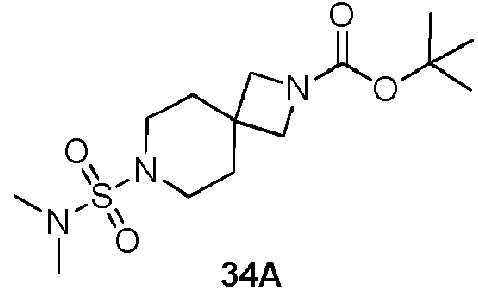
Se añadieron 2,7-diazaespiro[3.5]nonano-2-carboxilato de terc-butilo (6A) (0,452 g, 2 mmol), trietilamina (400 mg, 4,0 mmol) y diclorometano (15 ml) en un matraz de reacción de 50 ml y se disolvió con agitación. Después de enfriar hasta -10°C, se añadió gota a gota cloruro de dimetilaminosulfonilo (287 mg, 2,0 mmol). Después de la adición, se permitió que avanzase la reacción a temperatura ambiente durante 3 h. Se añadió ácido clorhídrico diluido 3 M (50 ml) a la disolución de reacción, seguido de extracción con diclorometano (60 ml x 2). Se secaron las fases orgánicas sobre sulfato de sodio anhidro, se filtraron y se concentró el filtrado a presión reducida para obtener 7-(dimetilsulfamoil)-2,7-diazaespiro[3.5]nonano-2-carboxilato de terc-butilo (34A) en bruto como un sólido de color amarillo claro (440 mg, rendimiento del 66%).tert-Butyl 2,7-diazaspiro[3.5]nonane-2-carboxylate (6A) (0.452 g, 2 mmol), triethylamine (400 mg, 4.0 mmol), and dichloromethane (15 mL) were added to a flask. 50 mL reaction and dissolved with stirring. After cooling to -10°C, dimethylaminosulfonyl chloride (287 mg, 2.0 mmol) was added dropwise. After the addition, the reaction was allowed to proceed at room temperature for 3 h. Dilute 3M hydrochloric acid (50 ml) was added to the reaction solution, followed by extraction with dichloromethane (60 ml x 2). The organic phases were dried over anhydrous sodium sulfate, filtered, and the filtrate was concentrated under reduced pressure to obtain tert-butyl 7-(dimethylsulfamoyl)-2,7-diazaspiro[3.5]nonane-2-carboxylate (34A) in crude as a light yellow solid (440 mg, 66% yield).
Etapa 2:Stage 2:
N,N-Dimetil-2,7-diazaespiro[3.5]nonano-7-sulfonamida (34B) N,N-Dimethyl-2,7-diazaspiro[3.5]nonane-7-sulfonamide (34B)

Se añadieron 7-(dimetilsulfamoil)-2,7-diazaespiro[3.5]nonano-2-carboxilato de terc-butilo (34A) en bruto (0,22 g, 0,66 mmol) y diclorometano (5 ml) en un matraz de reacción de 50 ml y se añadió gota a gota ácido trifluoroacético (2 ml) a temperatura ambiente. Después de la adición, se permitió que reaccionase el sistema a temperatura ambiente durante 3 h. Se concentró la disolución de reacción directamente a presión reducida para obtener N,N-dimetil-2,7-diazaespiro[3.5]nonano-7-sulfonamida (34B) en bruto como un líquido oleoso de color amarillo (103 mg, rendimiento del 76%) y se usó directamente en la siguiente reacción.Crude tert-butyl 7-(dimethylsulfamoyl)-2,7-diazaspiro[3.5]nonane-2-carboxylate (34A) (0.22 g, 0.66 mmol) and dichloromethane (5 mL) were added in a flask 50 mL reaction mixture and trifluoroacetic acid (2 mL) was added dropwise at room temperature. After the addition, the system was allowed to react at room temperature for 3 h. The reaction solution was concentrated directly under reduced pressure to obtain crude N,N-dimethyl-2,7-diazaspiro[3.5]nonane-7-sulfonamide (34B) as yellow oily liquid (103 mg, 76% yield). %) and used directly in the next reaction.
Etapa 3:Stage 3:
N-[(1R)-1-Bencil-2-[[(1R)-1-bencil-2-[[(1R)-1-[[(1R)-5-(terc-butoxicarbonilamino)-1-[7-(dimetilsulfamoil)-2,7-diazaespiro[3.5]nonano-2-carbonil]pentil]carbamoil]-3-metil-butil]amino]-2-oxo-etil]amino]-2-oxo-etil]carbamato de terc-butilo (34C)N-[(1R)-1-Benzyl-2-[[(1R)-1-benzyl-2-[[(1R)-1-[[(1R)-5-(tert-butoxycarbonylamino)-1-[ 7-(dimethylsulfamoyl)-2,7-diazaspiro[3.5]nonane-2-carbonyl]pentyl]carbamoyl]-3-methyl-butyl]amino]-2-oxo-ethyl]amino]-2-oxo-ethyl]carbamate tert-butyl (34C)

Se añadieron N,N-dimetil-2,7-diazaespiro[3.5]nonano-7-sulfonamida (34B) en bruto (103 mg, 0,44 mmol), clorhidrato de 1-(3-dimetilaminopropil)-3-etilcarbodiimida (288 mg, 1,5 mmol), 1-hidroxibenzotriazol (81 mg, 0,60 mmol), producto intermedio 1 (330 mg, 0,44 mmol) y diclorometano (50 ml) en un matraz de reacción de 100 ml y se permitió que reaccionase el sistema a temperatura ambiente durante 5 h. Se concentró la disolución de reacción a presión reducida y se separó el residuo y se purificó mediante cromatografía en columna de gel de sílice (diclorometano:metanol (v:v) = 50:1) para obtener N-[(1R)-1-bencil-2-[[(1R)-1-bencil-2-[[(1R)-1-[[(1R)-5-(terc-butoxicarbonilamino)-1-[7-(dimetilsulfamoil)-2,7]-diazaespiro[3.5]nonano-2-carbonil]pentil]carbamoil]-3-metil-butil]amino]-2-oxo-etil]amino]-2-oxo-etil]carbamato de terc-butilo (34C) como un sólido de color amarillo claro (240 mg, rendimiento del 56%).Crude N,N-dimethyl-2,7-diazaspiro[3.5]nonane-7-sulfonamide (34B) (103 mg, 0.44 mmol), 1-(3-dimethylaminopropyl)-3-ethylcarbodiimide hydrochloride ( 288 mg, 1.5 mmol), 1-hydroxybenzotriazole (81 mg, 0.60 mmol), intermediate 1 (330 mg, 0.44 mmol), and dichloromethane (50 mL) in a 100 mL reaction flask and allowed the system to react at room temperature for 5 h. The reaction solution was concentrated under reduced pressure, and the residue was separated and purified by silica gel column chromatography (dichloromethane:methanol (v:v) = 50:1) to obtain N-[(1R)-1- benzyl-2-[[(1R)-1-benzyl-2-[[(1R)-1-[[(1R)-5-(tert-butoxycarbonylamino)-1-[7-(dimethylsulfamoyl)-2,7 tert-Butyl ]-diazaspiro[3.5]nonane-2-carbonyl]pentyl]carbamoyl]-3-methyl-butyl]amino]-2-oxo-ethyl]amino]-2-oxo-ethyl]carbamate (34C) as a light yellow solid (240 mg, 56% yield).
Etapa 4:Stage 4:
(2R)-N-[(1R)-5-Amino-1-[7-(dimetilsulfamoil)-2,7-diazaespiro[3.5]nonano-2-carbonil]pentil]-2-[[(2R)-2-[[(2R)-2-amino-3-fenil-propanoil]amino]-3-fenil-propanoil]amino]-4-metil-pentanamida; di-ácido trifluoroacético (compuesto 34)(2R)-N-[(1R)-5-Amino-1-[7-(dimethylsulfamoyl)-2,7-diazaspiro[3.5]nonane-2-carbonyl]pentyl]-2-[[(2R)-2 -[[(2R)-2-amino-3-phenyl-propanoyl]amino]-3-phenyl-propanoyl]amino]-4-methyl-pentanamide; di-trifluoroacetic acid (compound 34)

N-[(1R)-1-Bencil-2-[[(1R)-1-bencil-2-[[(1R)-1-[[(1R)-5-(terc-butoxicarbonilamino)-1-[7-(dimetilsulfamoil)-2,7-diazaespiro[3.5]nonano-2-carbonil]pentil]carbamoil]-3-metil-butil]amino]-2-oxo-etil]amino]-2-oxo-etil]carbamato de terc-butilo (34C) (400 mg, 0,4 mmol) y ácido trifluoroacético (2 ml) en un matraz de reacción de 50 ml y se permitió que reaccionase el sistema a temperatura ambiente durante 2 h. Se concentró la disolución de reacción a presión reducida y se separó el residuo y se purificó mediante cromatografía de líquidos preparativa (condiciones de preparación: instrumento: GX-281 de Gilson; columna: Xbridge C18, 150 x 30 mm de D.I., 5 |am; fase móvil: A para ACN y B para H2O; isocrático: 65% de A; velocidad de flujo: 30 ml/min; contrapresión:1000 psi; temperatura de columna: 30°C; longitud de onda: 210 nm; periodo: 18 min; preparación de la muestra: se disolvió el compuesto en 12 ml de metanol; inyección: 0,9 ml/aguja). Se concentró la preparación a presión reducida para eliminar la mayor parte del disolvente y se liofilizó para obtener (2R)-N-[(1R)-5-amino-1-[7-(dimetilsulfamoil)-2,7-diazaespiro[3.5]nonano-2-carbonil]pentil]-2-[[(2R)-2-[[(2R)-2-amino-3-fenil-propanoil]amino]-3-fenil-propanoil]amino]-4-metil- pentanamida; di ácido trifluoroacético (compuesto 34) como un polvo de color blanco (130 mg, rendimiento del 29%). N-[(1R)-1-Benzyl-2-[[(1R)-1-benzyl-2-[[(1R)-1-[[(1R)-5-(tert-butoxycarbonylamino)-1-[ 7-(dimethylsulfamoyl)-2,7-diazaspiro[3.5]nonane-2-carbonyl]pentyl]carbamoyl]-3-methyl-butyl]amino]-2-oxo-ethyl]amino]-2-oxo-ethyl]carbamate of tert-butyl (34C) (400 mg, 0.4 mmol) and trifluoroacetic acid (2 mL) in a 50 mL reaction flask and the system was allowed to react at room temperature for 2 h. The reaction solution was concentrated under reduced pressure, and the residue was separated and purified by preparative liquid chromatography (preparation conditions: instrument: Gilson GX-281; column: Xbridge C18, 150 x 30 mm ID, 5 µm ; mobile phase: A for ACN and B for H2O; isocratic: 65% A; flow rate: 30 mL/min; back pressure: 1000 psi; column temperature: 30°C; wavelength: 210 nm; period: 18 min, sample preparation: compound was dissolved in 12 mL methanol, injection: 0.9 mL/needle). The preparation was concentrated under reduced pressure to remove most of the solvent and lyophilized to obtain (2R)-N-[(1R)-5-amino-1-[7-(dimethylsulfamoyl)-2,7-diazaspiro[3.5 ]nonane-2-carbonyl]pentyl]-2-[[(2R)-2-[[(2R)-2-amino-3-phenyl-propanoyl]amino]-3-phenyl-propanoyl]amino]-4- methylpentanamide; di trifluoroacetic acid (compound 34) as a white powder (130 mg, 29% yield).
EM m/z (ESI): 385,3 [M+2H]+72;MS m/z (ESI): 385.3 [M+2H]+72;
1H-RMN (400 MHz, D2O) 87,46-7,29 (m, 6H), 7,29-7,18 (m, 4H), 4,65 (t, 1H), 4,32-3,99 (m, 5H), 3,85-3,68 (m, 2H), 3,35-3,11 (m, 6H), 3,11-2,92 (m, 4H), 2,81 (d, 6H), 1,96-1,79 (m, 4H), 1,71 (dd, 4H), 1,60-1,32 (m, 5H), 0,93 (dd, 6H). 1H-NMR (400 MHz, D2O) 87.46-7.29 (m, 6H), 7.29-7.18 (m, 4H), 4.65 (t, 1H), 4.32-3, 99 (m, 5H), 3.85-3.68 (m, 2H), 3.35-3.11 (m, 6H), 3.11-2.92 (m, 4H), 2.81 ( d, 6H), 1.96-1.79 (m, 4H), 1.71 (dd, 4H), 1.60-1.32 (m, 5H), 0.93 (dd, 6H).
Ejemplo 33:Example 33:
(2R)-N-[(1R)-5-Amino-1-[7-(dimetilsulfamoil)-2,7-diazaespiro[3.4]octano-2-carbonil]pentil]-2-[[(2R)-2-[[(2R)-2-amino-3-fenil-propanoil]amino]-3-fenil-propanoil]amino]-4-metil-pentanamida; di-ácido trifluoroacético (compuesto 35)(2R)-N-[(1R)-5-Amino-1-[7-(dimethylsulfamoyl)-2,7-diazaspiro[3.4]octane-2-carbonyl]pentyl]-2-[[(2R)-2 -[[(2R)-2-amino-3-phenyl-propanoyl]amino]-3-phenyl-propanoyl]amino]-4-methyl-pentanamide; di-trifluoroacetic acid (compound 35)

7-(Dimetilsulfamoil)-2,7-diazaespiro[3.4]octano-2-carboxilato de terc-butilo (35A)tert-Butyl 7-(Dimethylsulfamoyl)-2,7-diazaspiro[3.4]octane-2-carboxylate (35A)

Se añadieron 2,7-diazaespiro[3.4]octano-2-carboxilato de terc-butilo (A) (0,414 g, 2 mmol), trietilamina (420 mg, 4,0 mmol) y diclorometano (7 ml) en un matraz de reacción de 50 ml y se disolvió con agitación. Después de enfriar hasta -10°C, se añadió gota a gota cloruro de dimetilsulfamoílo (343 mg, 2,4 mmol) y se permitió que avanzase la reacción durante 10 minutos. Luego se elevó la temperatura hasta temperatura ambiente y se agitó durante 3 h. Se extinguió la disolución de reacción con una disolución acuosa saturada de bicarbonato de sodio (10 ml), se extrajo con acetato de etilo (5 ml x 3) y se combinaron las fases orgánicas. Se secaron las fases orgánicas sobre sulfato de sodio anhidro, se filtraron y se concentró el filtrado a presión reducida. Se separó el residuo y se purificó mediante cromatografía en columna de gel de sílice (éter de petróleo:acetato de etilo (v:v) = 4:1) para obtener 7-(dimetilsulfamoil)-2,7-diazaespiro[3.4]octano-2-carboxilato de terc-butilo (35A) como una sustancia oleosa de color amarillo claro (414 mg, rendimiento del 0,65%).tert-Butyl 2,7-diazaspiro[3.4]octane-2-carboxylate (A) (0.414 g, 2 mmol), triethylamine (420 mg, 4.0 mmol), and dichloromethane (7 mL) were added to a flask. 50 mL reaction and dissolved with stirring. After cooling to -10°C, dimethylsulfamoyl chloride (343 mg, 2.4 mmol) was added dropwise and the reaction was allowed to proceed for 10 minutes. The temperature was then raised to room temperature and stirred for 3 h. The reaction solution was quenched with a saturated aqueous sodium bicarbonate solution (10 mL), extracted with ethyl acetate (5 mL x 3), and the organic layers were combined. The organic phases were dried over anhydrous sodium sulfate, filtered, and the filtrate was concentrated under reduced pressure. The residue was separated and purified by silica gel column chromatography (petroleum ether:ethyl acetate (v:v) = 4:1) to obtain 7-(dimethylsulfamoyl)-2,7-diazaspiro[3.4]octane tert-Butyl -2-carboxylate (35A) as a light yellow oily substance (414 mg, 0.65% yield).
EM m/z = 320,2 [M+H]+;MS m/z = 320.2 [M+H]+;
Etapa 2:Stage 2:
7-(Dimetilsulfamoil)-2,7-diazaespiro[3.4]octano (35B)7-(Dimethylsulfamoyl)-2,7-diazaspiro[3.4]octane (35B)

Se añadieron 7-(dimetilsulfamoil)-2,7-diazaespiro[3.4]octano-2-carboxilato de terc-butilo (35A) (0,41 g, 1,3 mmol) y diclorometano (7 ml) en un matraz de reacción de 50 ml y se añadió gota a gota ácido trifluoroacético (1 ml) a temperatura ambiente. Después de la adición, se permitió que reaccionase el sistema a temperatura ambiente durante 3 h. Se concentró la disolución de reacción directamente a presión reducida para obtener 7-(dimetilsulfamoil)-2,7-diazaespiro[3.4]octano (35B) en bruto como un líquido oleoso de color amarillo claro (284 mg, rendimiento del 100%) y se usó directamente en la siguiente reacción. tert-Butyl 7-(dimethylsulfamoyl)-2,7-diazaspiro[3.4]octane-2-carboxylate (35A) (0.41 g, 1.3 mmol) and dichloromethane (7 mL) were added in a reaction flask 50 ml and trifluoroacetic acid (1 ml) was added dropwise at room temperature. After the addition, the system was allowed to react at room temperature for 3 h. The reaction solution was directly concentrated under reduced pressure to obtain crude 7-(dimethylsulfamoyl)-2,7-diazaspiro[3.4]octane (35B) as light yellow oily liquid (284 mg, 100% yield) and was used directly in the next reaction.
Etapa 3:Stage 3:
N-[(1R)-2-[[(1R)-2-[[(1R)-1-[[(1R)-1-(7-Dimetilsulfamoil-2,7-diazaespiro[3.4]octano-2-carbonil)-5-(tercbutoxicarbonilamino)pentil]carbamoil]-3-metil-butil]amino]-1-bencil-2-oxo-etil]amino]-1-bencil-2-oxo-etil]carbamato de terc-butilo (35C)N-[(1R)-2-[[(1R)-2-[[(1R)-1-[[(1R)-1-(7-Dimethylsulfamoyl-2,7-diazaspiro[3.4]octane-2- tert-butyl carbonyl)-5-(tert-butoxycarbonylamino)pentyl]carbamoyl]-3-methyl-butyl]amino]-1-benzyl-2-oxo-ethyl]amino]-1-benzyl-2-oxo-ethyl]carbamate (35C)

Se añadieron 7-(dimetilsulfamoil)-2,7-diazaespiro[3.4]octano (35B) en bruto (284mg, 1,3 mmol), clorhidrato de 1-(3-dimetilaminopropil)-3-etilcarbodiimida (384 mg, 2 mmol), 1-hidroxibenzotriazol (270 mg, 2 mmol), producto intermedio 1 (400mg, 0,53 mmol) y diclorometano (30 ml) en un matraz de una sola boca de 50 ml y se permitió que reaccionase el sistema a temperatura ambiente durante 5 h. Se concentró la disolución de reacción a presión reducida y se separó el residuo y se purificó mediante cromatografía en columna de gel de sílice (éter de petróleo:acetato de etilo (v:v) = 1:2) para obtener N-[(1R)-2-[[(1R)-1-[[(1R)-1-(7-acetil-2,7-diazaespiro[3.4]octano-2-carbonil)-5(tercbutoxicarbonilamino)pentil]carbamoil]-3-metil-butil]amino]-1-bencil-2-oxo-etil]amino]-1-bencil-2-oxo-etil]carbamato de terc-butilo (35C) como un sólido de color blanco (201 mg, rendimiento del 39,7%).Crude 7-(dimethylsulfamoyl)-2,7-diazaspiro[3.4]octane (35B) (284mg, 1.3mmol), 1-(3-dimethylaminopropyl)-3-ethylcarbodiimide hydrochloride (384mg, 2mmol) were added ), 1-hydroxybenzotriazole (270 mg, 2 mmol), intermediate 1 (400 mg, 0.53 mmol), and dichloromethane (30 mL) in a 50 mL single neck flask and the system allowed to react at room temperature for 5 hours. The reaction solution was concentrated under reduced pressure, and the residue was separated and purified by silica gel column chromatography (petroleum ether:ethyl acetate (v:v) = 1:2) to obtain N-[(1R )-2-[[(1R)-1-[[(1R)-1-(7-acetyl-2,7-diazaspiro[3.4]octane-2-carbonyl)-5(tert-butoxycarbonylamino)pentyl]carbamoyl]-3 tert-Butyl -methyl-butyl]amino]-1-benzyl-2-oxo-ethyl]amino]-1-benzyl-2-oxo-ethyl]carbamate (35C) as a white solid (201 mg, yield of 39.7%).
Etapa 4:Stage 4:
(2R)-N-[(1R)-5-Amino-1-[7-(dimetilsulfamoil)-2,7-diazaespiro[3.4]octano-2-carbonil]pentil]-2-[[(2R)-2-[[(2R)-2-amino-3-fenil-propanoil]amino]-3-fenil-propanoil]amino]-4-metil-pentanamida; di-ácido trifluoroacético (compuesto 35)(2R)-N-[(1R)-5-Amino-1-[7-(dimethylsulfamoyl)-2,7-diazaspiro[3.4]octane-2-carbonyl]pentyl]-2-[[(2R)-2 -[[(2R)-2-amino-3-phenyl-propanoyl]amino]-3-phenyl-propanoyl]amino]-4-methyl-pentanamide; di-trifluoroacetic acid (compound 35)

Se añadieron N-[(1R)-2-[[(1R)-1-[[(1R)-1-(7-acetil-2,7-diazaespiro[3.4]octano-2-carbonil)-5(tercbutoxicarbonilamino)pentil]carbamoil]-3-metil-butil]amino]-1-bencil-2-oxo-etil]amino]-1-bencil-2-oxo-etil]carbamato de terc-butilo (35C) (201 mg, 0,17 mmol) y ácido trifluoroacético (2 ml) en un matraz de reacción de 50 ml y se permitió que reaccionase el sistema a temperatura ambiente durante 2 h. Se concentró la disolución de reacción a presión reducida y se separó el residuo y se purificó mediante cromatografía de líquidos preparativa (condiciones de preparación: instrumento: GX-281 de Gilson; columna: Xbridge C18, 150 x 30 mm de D.I., 5 |am; fase móvil: A para ACN y B para H2O; isocrático: 65% de A; velocidad de flujo: 30 ml/min; contrapresión:1000 psi; temperatura de columna: 30°C; longitud de onda: 210 nm; periodo: 18 min; preparación de la muestra: se disolvió el compuesto en 12 ml de metanol; inyección: 0,9 ml/aguja). Se concentró la preparación a presión reducida para eliminar la mayor parte del disolvente y se liofilizó para obtener (2R)-N-[(1R)-5-amino-1-(7-(dimetilsulfamoil)-2,7-diazaespiro[3.4]octano-2-carbonil]pentil]-2-[[(2R)-2-[[(2R)-2-amino-3-fenil-propanoil]amino]-3-fenil-propanoil]amino]-4-metilpentanamida; di ácido trifluoroacético (compuesto 35) como un polvo de color blanco (115 mg, rendimiento del 89,7%).N-[(1R)-2-[[(1R)-1-[[(1R)-1-(7-acetyl-2,7-diazaspiro[3.4]octane-2-carbonyl)-5(tert-butoxycarbonylamino tert-butyl)pentyl]carbamoyl]-3-methyl-butyl]amino]-1-benzyl-2-oxo-ethyl]amino]-1-benzyl-2-oxo-ethyl]carbamate (35C) (201 mg, 0.17 mmol) and trifluoroacetic acid (2 mL) in a 50 mL reaction flask and the system was allowed to react at room temperature for 2 h. The reaction solution was concentrated under reduced pressure, and the residue was separated and purified by preparative liquid chromatography (preparation conditions: instrument: Gilson GX-281; column: Xbridge C18, 150 x 30 mm I.D., 5 µm ; mobile phase: A for ACN and B for H2O; isocratic: 65% A; flow rate: 30 mL/min; back pressure: 1000 psi; column temperature: 30°C; wavelength: 210 nm; period: 18 min, sample preparation: compound was dissolved in 12 mL methanol, injection: 0.9 mL/needle). The preparation was concentrated under reduced pressure to remove most of the solvent and lyophilized to obtain (2R)-N-[(1R)-5-amino-1-(7-(dimethylsulfamoyl)-2,7-diazaspiro[3.4 ]octane-2-carbonyl]pentyl]-2-[[(2R)-2-[[(2R)-2-amino-3-phenyl-propanoyl]amino]-3-phenyl-propanoyl]amino]-4- methylpentanamide, ditrifluoroacetic acid (compound 35) as a white powder (115 mg, 89.7% yield).
EM m/z = 378,3 [M+2H]+/2;MS m/z = 378.3 [M+2H]+/2;
1H-RMN (400 MHz, D2O) 87,46-7,29 (m, 10H), 4,71 (t, 1H), 4,38-4,21 (m, 5H), 4,07-4,05 (m, 2H), 3,60-3,46 (m, 4H), 3,23-3,05 (m, 6H), 2,9-2,89 (d, 6H), 2,32-2,26 (m, 2H) 1,8-1,59 (m, 9H), 1,02-0,96 (dd, 6H).1H-NMR (400 MHz, D2O) 87.46-7.29 (m, 10H), 4.71 (t, 1H), 4.38-4.21 (m, 5H), 4.07-4, 05 (m, 2H), 3.60-3.46 (m, 4H), 3.23-3.05 (m, 6H), 2.9-2.89 (d, 6H), 2.32- 2.26 (m, 2H) 1.8-1.59 (m, 9H), 1.02-0.96 (dd, 6H).
Ejemplo 34:Example 34:
(2R)-2-[[(2R)-2-[[(2R)-2-Amino-3-fenil-propanoil]amino]-3-fenil-propanoil]amino]-N-[(1R)-5-amino-1-(2-piperazin-1-il-7-azaespiro[3.5]nonano-7-carbonil)pentil]-4-metil-pentanamida; tetra-ácido trifluoroacético (compuesto 36)

2-(4-Benciloxicarbonilpiperazin-1-il)-7-azaespiro[3.5]nonano-7-carboxilato de terc-butilo (36A)tert-butyl 2-(4-benzyloxycarbonylpiperazin-1-yl)-7-azaspiro[3.5]nonane-7-carboxylate (36A)
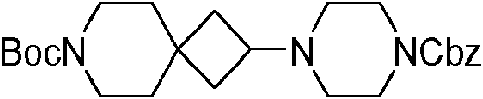
Se añadieron 2-oxo-7-azaespiro[3.5]nonano-7-carboxilato de terc-butilo (C) (0,478 g, 2 mmol), carbonato de bencil-1-piperazina (440 mg, 2 mmol), ácido acético (120 mg, 2,0 mmol) y dicloroetano (7 ml) en un matraz de reacción de 50 ml y se agitó el sistema durante media hora. Se añadió triacetoxiborohidruro de sodio (0,636 g, 3 mmol) y se hizo reaccionar el material resultante durante 5 h. Se extinguió el sistema de reacción con agua (10 ml), se extrajo con acetato de etilo (5 ml x 3) y se combinaron las fases orgánicas. Se secaron las fases orgánicas sobre sulfato de sodio anhidro, se filtraron y se concentró el filtrado a presión reducida. Se separó el residuo y se purificó mediante cromatografía en columna de gel de sílice (éter de petróleo:acetato de etilo (v:v) = 4:1) para obtener 2-(4-benciloxicarbonilpiperazin-1-il)-7-azaespiro[3.5]nonano-7-carboxilato de terc-butilo (36A) como una sustancia oleosa de color amarillo claro (450 mg, rendimiento del 50,79%).tert-Butyl 2-oxo-7-azaspiro[3.5]nonane-7-carboxylate (C) (0.478 g, 2 mmol), benzyl-1-piperazine carbonate (440 mg, 2 mmol), acetic acid ( 120 mg, 2.0 mmol) and dichloroethane (7 mL) in a 50 mL reaction flask and the system was stirred for half an hour. Sodium triacetoxyborohydride (0.636 g, 3 mmol) was added and the resulting material was reacted for 5 h. The reaction system was quenched with water (10 ml), extracted with ethyl acetate (5 ml x 3), and the organic layers were combined. The organic phases were dried over anhydrous sodium sulfate, filtered, and the filtrate was concentrated under reduced pressure. The residue was separated and purified by silica gel column chromatography (petroleum ether:ethyl acetate (v:v) = 4:1) to obtain 2-(4-benzyloxycarbonylpiperazin-1-yl)-7-azaspiro tert-Butyl [3.5]nonane-7-carboxylate (36A) as light yellow oily substance (450 mg, 50.79% yield).
EM m/z = 444,2 [M+H]+;MS m/z = 444.2 [M+H]+;
Etapa 2:Stage 2:
4-(7-Azaespiro[3.5]nonan-2-il)piperazin-1-carboxilato de bencilo (36B)Benzyl 4-(7-azaspiro[3.5]nonan-2-yl)piperazine-1-carboxylate (36B)

Se añadieron 2-(4-benciloxicarbonilpiperazin-1-il)-7-azaespiro[3.5]nonano-7-carboxilato de terc-butilo (36A) (0,45 g, 1,20 mmol) y diclorometano (7 ml) en un matraz de reacción de 50 ml y se añadió gota a gota ácido trifluoroacético (1 ml) a temperatura ambiente. Después de la adición, se permitió que reaccionase el sistema a temperatura ambiente durante 3 h. Se concentró la disolución de reacción directamente a presión reducida para obtener 4-(7-azaespiro[3.5]nonano-2-il)piperazin-1-carboxilato de bencilo (36B) en bruto como un líquido oleoso de color amarillo claro (411 mg, rendimiento del 100%), y se usó directamente en la siguiente reacción.tert-Butyl 2-(4-benzyloxycarbonylpiperazin-1-yl)-7-azaspiro[3.5]nonane-7-carboxylate (36A) (0.45 g, 1.20 mmol) and dichloromethane (7 mL) were added in a 50 mL reaction flask and trifluoroacetic acid (1 mL) was added dropwise at room temperature. After the addition, the system was allowed to react at room temperature for 3 h. The reaction solution was concentrated directly under reduced pressure to obtain crude benzyl 4-(7-azaspiro[3.5]nonane-2-yl)piperazine-1-carboxylate (36B) as light yellow oily liquid (411 mg , 100% yield), and used directly in the next reaction.
Etapa 3:Stage 3:
4-[7-[(2R)-6-(terc-Butoxicarbonilamino)-2-[[(2R)-2-[[(2R)-2-[[(2R)-2-(terc-butoxicarbonilamino)-]3-fenilpropanoil]amino]-3-fenil-propanoil]amino]-4-metil-pentanoil]amino]hexanoil]-7-azaespiro[3.5]nonan-2-il]piperazin-1-carboxilato de bencilo (36C) 4-[7-[(2R)-6-(tert-Butoxycarbonylamino)-2-[[(2R)-2-[[(2R)-2-[[(2R)-2-(tert-Butoxycarbonylamino)- Benzyl]3-phenylpropanoyl]amino]-3-phenyl-propanoyl]amino]-4-methyl-pentanoyl]amino]hexanoyl]-7-azaspiro[3.5]nonan-2-yl]piperazine-1-carboxylate (36C)

Se añadieron 4-(7-azaespiro[3.5]nonano-2-il)piperazin-1-carboxilato de bencilo (36B) en bruto (411 mg, 1,2mmol), clorhidrato de 1-(3-dimetilaminopropil)-3-etilcarbodiimida (384 mg, 2 mmol), 1-hidroxibenzotriazol (270 mg, 2 mmol), producto intermedio 1 (400 mg, 0,53 mmol) y diclorometano (30 ml) en un matraz de una sola boca de 50 ml y se permitió que reaccionase el sistema a temperatura ambiente durante 5 h. Se concentró la disolución de reacción a presión reducida y se separó el residuo y se purificó mediante cromatografía en columna de gel de sílice (éter de petróleo:acetato de etilo (v:v) = 1:2) para obtener 4-[7-[(2R)-6-(terc-butoxicarbonilamino)-2-[[(2R)-2-[[(2R)-2-[[(2R)-2-(terc-butoxicarbonilamino)-3-fenilpropanoil]amino]-3-fenil-propanoil]amino]-4-metilpentanoil]amino]hexanoil]-7-azaespiro[3.5]nonano-2-il]piperazin-1-carboxilato de bencilo (36C) como un sólido de color blanco (300 mg, rendimiento del 52,4%).Crude benzyl 4-(7-azaspiro[3.5]nonane-2-yl)piperazine-1-carboxylate (36B) (411 mg, 1.2mmol), 1-(3-dimethylaminopropyl)-3- ethylcarbodiimide (384 mg, 2 mmol), 1-hydroxybenzotriazole (270 mg, 2 mmol), intermediate 1 (400 mg, 0.53 mmol), and dichloromethane (30 mL) in a 50 mL single neck flask and allowed the system to react at room temperature for 5 h. The reaction solution was concentrated under reduced pressure, and the residue was separated and purified by silica gel column chromatography (petroleum ether:ethyl acetate (v:v) = 1:2) to obtain 4-[7- [(2R)-6-(tert-butoxycarbonylamino)-2-[[(2R)-2-[[(2R)-2-[[(2R)-2-(tert-butoxycarbonylamino)-3-phenylpropanoyl]amino Benzyl]-3-phenyl-propanoyl]amino]-4-methylpentanoyl]amino]hexanoyl]-7-azaspiro[3.5]nonano-2-yl]piperazin-1-carboxylate (36C) as a white solid (300 mg, 52.4% yield).
Etapa 4:Stage 4:
N-[(1R)-1-Bencil-2-[[(1R)-1-bencil-2-[[(1R)-1-[[(1R)-5-(terc-butoxicarbonilamino)-1-(2-piperazin-1-il-7-azaespiro[3.5]nonano-7-carbonil)pentil]carbamoil]-3-metil-butil]amino]-2-oxo-etil]amino]-2-oxo-etil]carbamato de tercbutilo (36D)N-[(1R)-1-Benzyl-2-[[(1R)-1-benzyl-2-[[(1R)-1-[[(1R)-5-(tert-butoxycarbonylamino)-1-( 2-piperazin-1-yl-7-azaspiro[3.5]nonane-7-carbonyl)pentyl]carbamoyl]-3-methyl-butyl]amino]-2-oxo-ethyl]amino]-2-oxo-ethyl]carbamate tert-butyl (36D)

Se añadieron 4-[7-[(2R)-6-(terc-butoxicarbonilamino)-2-[[(2R)-2-[[(2R)-2-[[(2R)-2-(terc-butoxicarbonilamino)-]3-fenilpropanoil]amino]-3-fenil-propanoil]amino]-4-metilpentanoil]amino]hexanoil]-7-azaespiro[3.5]nonano-2-il]piperazin-1-carboxilato de bencilo (36C) (300 mg, 0,27 mmol) y metanol (5 ml), y Pd/C (30 mg) en un matraz de reacción de 50 ml, y se permitió que reaccionase el sistema a temperatura ambiente durante 4 h bajo una atmósfera de hidrógeno. Se filtró la disolución de reacción a través de tierra de diatomeas y se concentró a presión reducida para obtener N-[(1R)-1-bencil-2-[[(1R)-1-bencil-2-[[(1R)-1-[[(1R)-5-(terc-butoxicarbonilamino)-1-(2-piperazin-1-il-7-azaespiro[3.5]nonano-7-carbonil)pentil]carbamoil]-3-metil-butil]amino]-2-oxo-etil]amino]-2-oxo-etil]carbamato de terc-butilo (36D) (255 mg, 100%) y se usó directamente en la siguiente etapa.4-[7-[(2R)-6-(tert-butoxycarbonylamino)-2-[[(2R)-2-[[(2R)-2-[[(2R)-2-(tert-butoxycarbonylamino Benzyl )-]3-phenylpropanoyl]amino]-3-phenyl-propanoyl]amino]-4-methylpentanoyl]amino]hexanoyl]-7-azaspiro[3.5]nonano-2-yl]piperazine-1-carboxylate (36C) (300 mg, 0.27 mmol) and methanol (5 mL), and Pd/C (30 mg) in a 50 mL reaction flask, and the system was allowed to react at room temperature for 4 h under an atmosphere of hydrogen. The reaction solution was filtered through diatomaceous earth and concentrated under reduced pressure to obtain N-[(1R)-1-benzyl-2-[[(1R)-1-benzyl-2-[[(1R) -1-[[(1R)-5-(tert-butoxycarbonylamino)-1-(2-piperazin-1-yl-7-azaspiro[3.5]nonane-7-carbonyl)pentyl]carbamoyl]-3-methyl-butyl tert-butyl]amino]-2-oxo-ethyl]amino]-2-oxo-ethyl]carbamate (36D) (255 mg, 100%) and used directly in the next step.
Etapa 5:Stage 5:
(2R)-2-[[(2R)-2-[[(2R)-2-Amino-3-fenil-propanoil]amino]-3-fenil-propanoil]amino]-N-[(1R)-5-amino-1-(2-piperazin-1-il-7-azaespiro[3.5]nonano-7-carbonil)pentil]-4-metil-pentanamida; tetra-ácido trifluoroacético (compuesto 36)(2R)-2-[[(2R)-2-[[(2R)-2-Amino-3-phenyl-propanoyl]amino]-3-phenyl-propanoyl]amino]-N-[(1R)-5 -amino-1-(2-piperazin-1-yl-7-azaspiro[3.5]nonane-7-carbonyl)pentyl]-4-methyl-pentanamide; tetra-trifluoroacetic acid (compound 36)

Se añadieron N-[(1R)-1-bencil-2-[[(1R)-1-bencil-2-[[(1R)-1-[[(1R)-5-(terc-butoxicarbonilamino)-1-(2-piperazin-1-il-7-azaespiro[3.5]nonano-7-carbonil)pentil]carbamoil]-3-metil-butil]amino]-2-oxo-etil]amino]-2-oxo-etil]carbamato de tercbutilo (36D) en bruto (255 mg, 0,27 mmol) y ácido trifluoroacético (2 ml) en un matraz de reacción de 50 ml y se permitió que reaccionase el sistema a temperatura ambiente durante 2 h. Se concentró la disolución de reacción a presión reducida y se separó el residuo y se purificó mediante cromatografía de líquidos preparativa (condiciones de preparación: instrumento: GX-281 de Gilson; columna: Xbridge C18, 150 x 30 mm de D.I., 5 |am; fase móvil: A para ACN y B para H2O; isocrático: 65% de A; velocidad de flujo: 30 ml/min; contrapresión:1000 psi; temperatura de columna: 30°C; longitud de onda: 210 nm; periodo: 18 min; preparación de la muestra: se disolvió el compuesto en 12 ml de metanol; inyección: 0,9 ml/aguja). Se concentró la preparación a presión reducida para eliminar la mayor parte del disolvente y se liofilizó para obtener (2R)-2-[[(2R)-2-[[(2R)-2-amino-3-fenil-propanoil]amino]-3-fenilpropanoil]amino]-N-[(1R)-5-amino-1-(2-piperazin-1-il-7-azaespiro[3.5]nonano-7-carbonil)pentil]-4-metil-pentanamida; tetra-ácido trifluoroacético (compuesto 36) como un polvo de color blanco (160 mg, rendimiento del 77,6%).N-[(1R)-1-benzyl-2-[[(1R)-1-benzyl-2-[[(1R)-1-[[(1R)-5-(tert-butoxycarbonylamino)-1 -(2-piperazin-1-yl-7-azaspiro[3.5]nonane-7-carbonyl)pentyl]carbamoyl]-3-methyl-butyl]amino]-2-oxo-ethyl]amino]-2-oxo-ethyl crude tert-butyl ]carbamate (36D) (255 mg, 0.27 mmol) and trifluoroacetic acid (2 mL) in a 50 mL reaction flask and the system was allowed to react at room temperature for 2 h. The reaction solution was concentrated under reduced pressure, and the residue was separated and purified by preparative liquid chromatography (preparation conditions: instrument: Gilson GX-281; column: Xbridge C18, 150 x 30 mm ID, 5 µm ; mobile phase: A for ACN and B for H2O; isocratic: 65% of A; flow rate: 30 ml/min; back pressure: 1000 psi; temperature of column: 30°C; wavelength: 210nm; period: 18 min; sample preparation: the compound was dissolved in 12 ml of methanol; injection: 0.9 ml/needle). The preparation was concentrated under reduced pressure to remove most of the solvent and lyophilized to obtain (2R)-2-[[(2R)-2-[[(2R)-2-amino-3-phenyl-propanoyl]amino ]-3-phenylpropanoyl]amino]-N-[(1R)-5-amino-1-(2-piperazin-1-yl-7-azaspiro[3.5]nonane-7-carbonyl)pentyl]-4-methyl- pentanamide; tetra-trifluoroacetic acid (compound 36) as a white powder (160 mg, 77.6% yield).
EM m/z = 373,4 [M+2H]+/2;MS m/z = 373.4 [M+2H]+/2;
1H-RMN (400 MHz, D2O) 87,47-7,30 (m, 10H), 4,71 (t, 1H), 4,36-4,29 (m, 2H), 3,90-3,86 (m, 1H), 3,85-3,24 (m, 12H), 3,23-3,04 (m, 6H), 2,52-2,44 (m, 2H), 2,14-2,12 (m, 2H), 1,77-1,47 (m, 14H), 1,03-0,96 (dd, 6H).1H-NMR (400 MHz, D2O) 87.47-7.30 (m, 10H), 4.71 (t, 1H), 4.36-4.29 (m, 2H), 3.90-3, 86 (m, 1H), 3.85-3.24 (m, 12H), 3.23-3.04 (m, 6H), 2.52-2.44 (m, 2H), 2.14- 2.12 (m, 2H), 1.77-1.47 (m, 14H), 1.03-0.96 (dd, 6H).
Ejemplo 35:Example 35:
(2R)-N-[(1R)-5-Amino-1-[7-[(2R)-2-amino-3-fenilpropanoil]-2,7-diazaespiro[3.5]nonano-2-carbonil]pentil]-2-[[(2R)-2-[[(2R)-2-amino-3-fenil-propanoil]amino]-3-fenil-propanoil]amino]-4-metil-pentanamida; tri-ácido trifluoroacético (compuesto 37)(2R)-N-[(1R)-5-Amino-1-[7-[(2R)-2-amino-3-phenylpropanoyl]-2,7-diazaspiro[3.5]nonane-2-carbonyl]pentyl] -2-[[(2R)-2-[[(2R)-2-amino-3-phenyl-propanoyl]amino]-3-phenyl-propanoyl]amino]-4-methyl-pentanamide; tri-trifluoroacetic acid (compound 37)

7-[(2R)-2-(Benciloxicarbonilamino)-3-fenil-propanoil]-2,7-diazaespiro[3.5]nonano-2-carboxilato de terc-butilo (37A) Boctert-Butyl 7-[(2R)-2-(benzyloxycarbonylamino)-3-phenyl-propanoyl]-2,7-diazaspiro[3.5]nonane-2-carboxylate (37A) Boc

PhpH
37A37A
Se añadieron 2,7-diazaespiro[3.5]nonano-2-carboxilato de terc-butilo (6A) (83 mg, 0,35 mmol), clorhidrato de 1-(3-dimetilaminopropil)-3-etilcarbodiimida (80 mg, 0,42 mmol), 1-hidroxibenzotriazol (57 mg, 0,42 mmol), ácido (2R)-2-(benciloxicarbonilamino)-3-fenil-propanoico (105 mg, 0,35 mmol) y diclorometano (30 ml) en un matraz de reacción de 50 ml y se permitió que reaccionase el sistema a temperatura ambiente durante 5 h. Se concentró la disolución de reacción a presión reducida y se separó el residuo y se purificó mediante cromatografía en columna de gel de sílice (diclorometano:metanol (v:v) = 50:1) para obtener 7-[(2R)-2-(benciloxicarbonilamino)-3-fenil-propanoil]-2,7-diazaespiro[3.5]nonano-2-carboxilato de terc-butilo (37A) como un sólido de color blanco (177 mg, rendimiento del 80%).tert-Butyl 2,7-diazaspiro[3.5]nonane-2-carboxylate (6A) (83 mg, 0.35 mmol), 1-(3-dimethylaminopropyl)-3-ethylcarbodiimide hydrochloride (80 mg, 0 0.42 mmol), 1-hydroxybenzotriazole (57 mg, 0.42 mmol), (2R)-2-(benzyloxycarbonylamino)-3-phenyl-propanoic acid (105 mg, 0.35 mmol), and dichloromethane (30 mL) in a reaction flask 50 ml and the system was allowed to react at room temperature for 5 h. The reaction solution was concentrated under reduced pressure, and the residue was separated and purified by silica gel column chromatography (dichloromethane:methanol (v:v) = 50:1) to obtain 7-[(2R)-2- tert-Butyl (benzyloxycarbonylamino)-3-phenyl-propanoyl]-2,7-diazaspiro[3.5]nonane-2-carboxylate (37A) as a white solid (177 mg, 80% yield).
Etapa 2:Stage 2:
N-[(1R)-1-Bencil-2-(2,7-diazaespiro[3.5]nonan-7-il)-2-oxo-etil]carbamato de bencilo (37B)Benzyl N-[(1R)-1-Benzyl-2-(2,7-diazaspiro[3.5]nonan-7-yl)-2-oxo-ethyl]carbamate (37B)

37B37B
Se añadieron 7-[(2R)-2-(benciloxicarbonilamino)-3-fenil-propanoil]-2,7-diazaespiro[3.5]nonano-2-carboxilato de tercbutilo (37A) (177 mg, 0,35 mmol) y diclorometano (20 ml) en un matraz de reacción de 50 ml y se añadió gota a gota ácido trifluoroacético (2 ml) a temperatura ambiente. Después de la adición, se permitió que reaccionase el sistema a temperatura ambiente durante 3 h. Se concentró la disolución de reacción directamente a presión reducida para obtener N-[(1R)-1-bencil-2-(2,7-diazaespiro[3.5]nonan-7-il)-2-oxo-etil]carbamato de bencilo (37B) como un líquido oleoso de color amarillo (143 mg, rendimiento del 100%) y se usó directamente en la siguiente reacción.tert-Butyl 7-[(2R)-2-(benzyloxycarbonylamino)-3-phenyl-propanoyl]-2,7-diazaspiro[3.5]nonane-2-carboxylate (37A) (177 mg, 0.35 mmol) and dichloromethane (20 mL) in a 50 mL reaction flask and trifluoroacetic acid (2 mL) was added dropwise at room temperature. After the addition, the system was allowed to react at room temperature for 3 h. The reaction solution was concentrated directly under reduced pressure to obtain benzyl N-[(1R)-1-benzyl-2-(2,7-diazaspiro[3.5]nonan-7-yl)-2-oxo-ethyl]carbamate (37B) as a yellow oily liquid (143 mg, 100% yield) and used directly in the next reaction.
Etapa 3:Stage 3:
N-[(1R)-1-Bencil-2-[[(1R)-1-bencil-2-[[(1R)-1-[[(1R)-1-[7-[(2R)-2Hbenciloxicarbonilamino)-3-fenil-propanoil]-2,7-diazaespiro[3.5]nonano-2-carbonil]-5-(terc-butoxicarbonilamino)pentil]carbamoil]-3-metil-butil]amino]-2-oxoetil]amino]-2-oxo-etil]carbamato de terc-butilo (37C)N-[(1R)-1-Benzyl-2-[[(1R)-1-benzyl-2-[[(1R)-1-[[(1R)-1-[7-[(2R)-2Hbenzyloxycarbonylamino )-3-phenyl-propanoyl]-2,7-diazaspiro[3.5]nonane-2-carbonyl]-5-(tert-butoxycarbonylamino)pentyl]carbamoyl]-3-methyl-butyl]amino]-2-oxoethyl]amino tert-butyl ]-2-oxo-ethyl]carbamate (37C)

Se añadieron N-[(1R)-1-bencil-2-(2,7-diazaespiro[3.5]nonan-7-il)-2-oxo-etil]carbamato de bencilo (37B) (143 mg, 0,35 mmol), 1-clorhidrato de (3-dimetilaminopropil)-3-etilcarbodiimida (80 mg, 0,42 mmol), 1-hidroxibenzotriazol (57 mg, 0,42 mmol), producto intermedio 1 (264 mg, 0,35 mmol) y diclorometano (30 ml) en un matraz de una sola boca de 50 ml y se permitió que reaccionase el sistema a temperatura ambiente durante 5 h. Se concentró la disolución de reacción a presión reducida y se separó el residuo y se purificó mediante cromatografía en columna de gel de sílice (diclorometano:metanol (v:v) = 50:1) para obtener (1R)-1-bencil-2-[[(1R)-1-bencil-2-[[(1R)-1-[[(1R)-1-[7-[(2R)-2-(benciloxicarbonilamino)-3-fenilpropanoil]-2,7-diazaespiro[3.5]nonano-2-carbonil]-5-(tercbutoxicarbonilamino)pentil]carbamoil]-3-metil-butil]amino]-2-oxo-etil]amino]-2-oxo-etil]carbamato de terc-butilo (37C) como un sólido de color blanco (400 mg, rendimiento del 99%).Benzyl N-[(1R)-1-benzyl-2-(2,7-diazaspiro[3.5]nonan-7-yl)-2-oxo-ethyl]carbamate (37B) (143 mg, 0.35 mmol), (3-dimethylaminopropyl)-3-ethylcarbodiimide hydrochloride (80 mg, 0.42 mmol), 1-hydroxybenzotriazole (57 mg, 0.42 mmol), Intermediate 1 (264 mg, 0.35 mmol ) and dichloromethane (30 mL) in a 50 mL one-neck flask and the system was allowed to react at room temperature for 5 h. The reaction solution was concentrated under reduced pressure, and the residue was separated and purified by silica gel column chromatography (dichloromethane:methanol (v:v) = 50:1) to obtain (1R)-1-benzyl-2 -[[(1R)-1-benzyl-2-[[(1R)-1-[[(1R)-1-[7-[(2R)-2-(benzyloxycarbonylamino)-3-phenylpropanoyl]-2, tert 7-diazaspiro[3.5]nonane-2-carbonyl]-5-(tert-butoxycarbonylamino)pentyl]carbamoyl]-3-methyl-butyl]amino]-2-oxo-ethyl]amino]-2-oxo-ethyl]carbamate -butyl (37C) as a white solid (400 mg, 99% yield).
Etapa 4:Stage 4:
N-[(1R)-2-[[(1R)-2-[[(1R)-1-[[(1R)-1-[7-[(2R)-2-Amino-3-fenil-propanoil]-2,7-diazaespiro[3.5]nonano-2-carbonil]-5-(tercbutoxicarbonilamino)pentil]carbamoil]-3-metil-butil]amino]-1-bencil-2-oxo-etil]amino]-1-bencil-2-oxo-etil]carbamato de terc-butilo (37D) N-[(1R)-2-[[(1R)-2-[[(1R)-1-[[(1R)-1-[7-[(2R)-2-Amino-3-phenyl-propanoyl ]-2,7-diazaspiro[3.5]nonane-2-carbonyl]-5-(tert-butoxycarbonylamino)pentyl]carbamoyl]-3-methyl-butyl]amino]-1-benzyl-2-oxo-ethyl]amino]-1 tert-butyl -benzyl-2-oxo-ethyl]carbamate (37D)

Se añadieron (1R)-1-bencil-2-[[(1R)-1-bencil-2-[[(1R)-1-[[(1R)-1-[7-[(2R)-2]-(benciloxicarbonilamino)-3-fenil-propanoil]-2,7-diazaespiro[3.5]nonano-2-carbonil]-5-(terc-butoxicarbonilamino)pentil]carbamoil]-3-metil-butil]amino]-2-oxoetil]amino]-2-oxo-etil]carbamato de terc-butilo (37C) (400 mg, 0,35 mmol), paladio sobre carbono (80 mg, al 20% en peso de l) y metanol (20 ml) en un matraz de una sola boca de 50 ml. Se reemplazó la atmósfera por hidrógeno 3 veces y se hizo reaccionar la mezcla a temperatura ambiente durante 3 h bajo una atmósfera de hidrógeno (globo). Se filtró la disolución de reacción a través de tierra de diatomeas y se concentró el filtrado a presión reducida para obtener (1R)-2-[[(1R)-2-[[(1R)-1-[[(1R)-1-[7-[(2R)-2-amino-3-fenil-propanoil]-2,7-diazaespiro[3.5]nonano-2-carbonil]-5-(terc-butoxicarbonilamino)pentil]carbamoil]-3-metil-butil]amino]-1-bencil-2-oxo-etil]amino]-1-bencil-2-oxoetil]carbamato de terc-butilo (37D) como un sólido de color amarillo claro (353 mg, rendimiento del 100%), y se utilizó directamente en la siguiente reacción.(1R)-1-benzyl-2-[[(1R)-1-benzyl-2-[[(1R)-1-[[(1R)-1-[7-[(2R)-2] were added -(benzyloxycarbonylamino)-3-phenyl-propanoyl]-2,7-diazaspiro[3.5]nonane-2-carbonyl]-5-(tert-butoxycarbonylamino)pentyl]carbamoyl]-3-methyl-butyl]amino]-2- tert-butyl oxoethyl]amino]-2-oxo-ethyl]carbamate (37C) (400 mg, 0.35 mmol), palladium on carbon (80 mg, 20% wt of L) and methanol (20 mL) in a 50 ml single neck flask. The atmosphere was replaced with hydrogen 3 times, and the mixture was reacted at room temperature for 3 h under a hydrogen atmosphere (balloon). The reaction solution was filtered through diatomaceous earth, and the filtrate was concentrated under reduced pressure to obtain (1R)-2-[[(1R)-2-[[(1R)-1-[[(1R)- 1-[7-[(2R)-2-amino-3-phenyl-propanoyl]-2,7-diazaspiro[3.5]nonane-2-carbonyl]-5-(tert-butoxycarbonylamino)pentyl]carbamoyl]-3- tert-butyl methyl-butyl]amino]-1-benzyl-2-oxo-ethyl]amino]-1-benzyl-2-oxoethyl]carbamate (37D) as light yellow solid (353 mg, 100% yield). %), and was used directly in the next reaction.
Etapa 5:Stage 5:
(2R)-N-[(1R)-5-Amino-1-[7-[(2R)-2-amino-3-fenilpropanoil]-2,7-diazaespiro[3.5]nonano-2-carbonil]pentil]-2-[[(2R)-2-[[(2R)-2-amino-3-fenil-propanoil]amino]-3-fenil-propanoil]amino]-4-metil-pentanamida; tri-ácido trifluoroacético (compuesto 37)(2R)-N-[(1R)-5-Amino-1-[7-[(2R)-2-amino-3-phenylpropanoyl]-2,7-diazaspiro[3.5]nonane-2-carbonyl]pentyl] -2-[[(2R)-2-[[(2R)-2-amino-3-phenyl-propanoyl]amino]-3-phenyl-propanoyl]amino]-4-methyl-pentanamide; tri-trifluoroacetic acid (compound 37)

Se añadieron (1R)-2-[[(1R)-2-[[(1R)-1-[[(1R)-1-[7-[(2R)-2-amino-3-fenilpropanoil]-2,7-diazaespiro[3.5]nonano-2-carbonil]-5-(terc-butoxicarbonil)pentil]carbamoil]-3-metil-butil]amino]-1-bencil-2-oxo-etil]amino]-1-bencil-2-oxoetil]carbamato de terc-butilo (37d) (353 mg, 0,35 mmol) y ácido trifluoroacético (2 ml) en un matraz de reacción de 50 ml y se permitió que reaccionase el sistema a temperatura ambiente durante 2 h. Se concentró la disolución de reacción a presión reducida y se separó el residuo y se purificó mediante cromatografía de líquidos preparativa (condiciones de preparación: instrumento: GX-281 de Gilson; columna: Xbridge C18, 150 x 30 mm de D.I., 5 |am; fase móvil: A para ACN y B para H2O; isocrático: 65% de A; velocidad de flujo: 30 ml/min; contrapresión:1000 psi; temperatura de columna: 30°C; longitud de onda: 210 nm; periodo: 18 min; preparación de la muestra: se disolvió el compuesto en 12 ml de metanol; inyección: 0,9 ml/aguja). Se concentró la preparación a presión reducida para eliminar la mayor parte del disolvente y se liofilizó para obtener (2R)-N-[(1R)-5-amino-1-[7-[(2R)-2-amino-3-fenil-propanoil]-2,7-diazaespiro[3.5]nonano-2-carbonil]pentil]-2-[[(2R)-2-[[(2R)-2-amino-3-fenilpropanoil]amino]-3-fenil-propanoil]amino]-4-metil-pentanamida; tri-ácido trifluoroacético (compuesto 37) como un polvo de color blanco (282 mg, rendimiento del 70%).(1R)-2-[[(1R)-2-[[(1R)-1-[[(1R)-1-[7-[(2R)-2-amino-3-phenylpropanoyl]-2 ,7-diazaspiro[3.5]nonane-2-carbonyl]-5-(tert-butoxycarbonyl)pentyl]carbamoyl]-3-methyl-butyl]amino]-1-benzyl-2-oxo-ethyl]amino]-1- tert-butyl benzyl-2-oxoethyl]carbamate (37d) (353 mg, 0.35 mmol) and trifluoroacetic acid (2 mL) in a 50 mL reaction flask and the system was allowed to react at room temperature for 2 h. The reaction solution was concentrated under reduced pressure, and the residue was separated and purified by preparative liquid chromatography (preparation conditions: instrument: Gilson GX-281; column: Xbridge C18, 150 x 30 mm I.D., 5 µm ; mobile phase: A for ACN and B for H2O; isocratic: 65% A; flow rate: 30 mL/min; back pressure: 1000 psi; column temperature: 30°C; wavelength: 210 nm; period: 18 min, sample preparation: compound was dissolved in 12 mL methanol, injection: 0.9 mL/needle). The preparation was concentrated under reduced pressure to remove most of the solvent and lyophilized to obtain (2R)-N-[(1R)-5-amino-1-[7-[(2R)-2-amino-3- phenyl-propanoyl]-2,7-diazaspiro[3.5]nonane-2-carbonyl]pentyl]-2-[[(2R)-2-[[(2R)-2-amino-3-phenylpropanoyl]amino]-3 -phenyl-propanoyl]amino]-4-methyl-pentanamide; tri-trifluoroacetic acid (compound 37) as a white powder (282 mg, 70% yield).
EM m/z = 405,3 [M+2H]+/2;MS m/z = 405.3 [M+2H]+/2;
1H-RMN (400 MHz, D2O) 87,52-7,09 (m, 15H), 4,78-4,74 (m, 1H), 4,64-4,58 (m, 1H), 4,26-4,19 (m, 2H), 4,15-3,96 (m, 3H), 3,83 (d, 1H), 3,71-3,63 (m, 1H), 3,59-3,50 (m, 1H) 3,43-2,90 (m, 11H), 1,90-1,18 (m, 13H), 0,98-0,80 (m, 6H). 1H-NMR (400 MHz, D2O) 87.52-7.09 (m, 15H), 4.78-4.74 (m, 1H), 4.64-4.58 (m, 1H), 4, 26-4.19 (m, 2H), 4.15-3.96 (m, 3H), 3.83 (d, 1H), 3.71-3.63 (m, 1H), 3.59- 3.50 (m, 1H) 3.43-2.90 (m, 11H), 1.90-1.18 (m, 13H), 0.98-0.80 (m, 6H).
Ejemplo 36:Example 36:
(2R)-N-[(1R)-5-amino-1-[7-[(2R)-2-amino-4-metil-pentanoil]-2,7-diazaespiro[3.5]nonano-2-carbonil]pentil]-2-[[(2R)-2-[[(2R)-2-amino-3-fenil-propanoil]amino]-3-fenil-propanoil]amino]-4-metil-pentanamida; tri-ácido trifluoroacético (compuesto 38) (2R)-N-[(1R)-5-amino-1-[7-[(2R)-2-amino-4-methyl-pentanoyl]-2,7-diazaspiro[3.5]nonane-2-carbonyl] pentyl]-2-[[(2R)-2-[[(2R)-2-amino-3-phenyl-propanoyl]amino]-3-phenyl-propanoyl]amino]-4-methyl-pentanamide; tri-trifluoroacetic acid (compound 38)

7-[(2R)-2-(Benciloxicarbonilamino)-4-metil-pentanoil]-2,7-diazaespiro[3.5]nonano-2-carboxilato de terc-butilo (38A)tert-butyl 7-[(2R)-2-(benzyloxycarbonylamino)-4-methyl-pentanoyl]-2,7-diazaspiro[3.5]nonane-2-carboxylate (38A)

Se añadieron 2,7-diazaespiro[3.5]nonano-2-carboxilato de terc-butilo (6A) (93mg, 0,41 mmol), clorhidrato de 1-(3-dimetilaminopropil)-3-etilcarbodiimida (94 mg, 0,49 mmol), 1-hidroxibenzotriazol (66 mg, 0,49 mmol), ácido (2R)-2-(benciloxicarbonilamino)propanoico (446 mg, 2,0 mmol) y diclorometano (10 ml) en un matraz de reacción de 50 ml y se permitió que reaccionase el sistema a temperatura ambiente durante 5 h. Se concentró la disolución de reacción a presión reducida y se separó el residuo y se purificó mediante cromatografía en columna de gel de sílice (diclorometano:metanol (v:v) = 50:1) para obtener 7-[(2R)-2-(benciloxicarbonilamino)-4-metil-pentanoil]-2,7-diazaespiro[3.5]nonano-2-carboxilato de terc-butilo (38A) como un sólido de color blanco (175 mg, rendimiento del 90%).tert-Butyl 2,7-diazaspiro[3.5]nonane-2-carboxylate (6A) (93mg, 0.41mmol), 1-(3-dimethylaminopropyl)-3-ethylcarbodiimide hydrochloride (94mg, 0.41mmol) were added. 49 mmol), 1-hydroxybenzotriazole (66 mg, 0.49 mmol), (2R)-2-(benzyloxycarbonylamino)propanoic acid (446 mg, 2.0 mmol), and dichloromethane (10 mL) in a 50 mL reaction flask. mL and the system was allowed to react at room temperature for 5 h. The reaction solution was concentrated under reduced pressure, and the residue was separated and purified by silica gel column chromatography (dichloromethane:methanol (v:v) = 50:1) to obtain 7-[(2R)-2- tert-Butyl (benzyloxycarbonylamino)-4-methyl-pentanoyl]-2,7-diazaspiro[3.5]nonane-2-carboxylate (38A) as a white solid (175 mg, 90% yield).
Etapa 2Stage 2
N-[(1R)-1-(2,7-Diazaespiro[3.5]nonano-7-carbonil)-3-metil-butil]carbamato de bencilo (38B)Benzyl N-[(1R)-1-(2,7-Diazaspiro[3.5]nonane-7-carbonyl)-3-methyl-butyl]carbamate (38B)

Se añadieron 7-[(2R)-2-(benciloxicarbonilamino)-4-metil-pentanoil]-2,7-diazaespiro[3.5]nonano-2-carboxilato de tercbutilo (38A) (175 mg, 0,37 mmol) y diclorometano (20 ml) en un matraz de reacción de 50 ml y se añadió gota a gota ácido trifluoroacético (2 ml) a temperatura ambiente. Después de la adición, se permitió que reaccionase el sistema a temperatura ambiente durante 3 h. Se concentró la disolución de reacción directamente a presión reducida para obtener N-[(1R)-1-(2,7-diazaespiro[3.5]nonano-7-carbonil)-3-metil-butil]carbamato de bencilo (38B) como un líquido oleoso de color amarillo (138 mg, rendimiento del 100%) y se usó directamente en la siguiente reacción. tert-Butyl 7-[(2R)-2-(benzyloxycarbonylamino)-4-methyl-pentanoyl]-2,7-diazaspiro[3.5]nonane-2-carboxylate (38A) (175 mg, 0.37 mmol) and dichloromethane (20 mL) in a 50 mL reaction flask and trifluoroacetic acid (2 mL) was added dropwise at room temperature. After the addition, the system was allowed to react at room temperature for 3 h. The reaction solution was concentrated directly under reduced pressure to obtain benzyl N-[(1R)-1-(2,7-diazaspiro[3.5]nonane-7-carbonyl)-3-methyl-butyl]carbamate (38B) as a yellow oily liquid (138 mg, 100% yield) and used directly in the next reaction.
Etapa 3Stage 3
N-[(1R)-1-Bencil-2-[[(1R)-1-bencil-2-[[(1R)-H[(1R)-1-[7-[(2R)-2Hbenciloxicarbonilamino)-4-metil-pentanoil]-2,7-diazaespiro[3.5]nonano-2-carbonil]-5-(terc-butoxicarbonilamino)pentil]carbamoil]-3-metil-butil]amino]-2-oxoetil]amino]-2-oxo-etil]carbamato de terc-butilo (38C)N-[(1R)-1-Benzyl-2-[[(1R)-1-benzyl-2-[[(1R)-H[(1R)-1-[7-[(2R)-2Hbenzyloxycarbonylamino)- 4-methyl-pentanoyl]-2,7-diazaspiro[3.5]nonane-2-carbonyl]-5-(tert-butoxycarbonylamino)pentyl]carbamoyl]-3-methyl-butyl]amino]-2-oxoethyl]amino]- tert-butyl 2-oxo-ethyl]carbamate (38C)

Se añadieron N-[(1R)-1-(2,7-diazaespiro[3.5]nonano-7-carbonil)-3-metil-butil]carbamato de bencilo (38B) (138 mg, 0,37 mmol), clorhidrato de 1-(3-dimetilaminopropil)-3-etilcarbodiimida (84 mg, 0,44 mmol), 1-hidroxibenzotriazol (59 mg, 0,44 mmol), producto intermedio 1 (279 mg, 0,37 mmol) y diclorometano (30 ml) en un matraz de una sola boca de 50 ml y se permitió que reaccionase el sistema a temperatura ambiente durante 5 h. Se concentró la disolución de reacción a presión reducida y se separó el residuo y se purificó mediante cromatografía en columna de gel de sílice (diclorometano:metanol (v:v) = 50:1) para obtener (1R)-1-bencil-2-[[(1R)-1-bencil-2-[[(1R)-1-[[(1R)-1-[7-[(2R)-2-(benciloxicarbonilamino)-4-metil-pentanoil]-2,7-diazaespiro[3.5]nonano-2-carbonil]-5-(tercbutoxicarbonilamino)pentil]carbamoil]-3-metil-butil]amino]-2-oxo-etil]amino]-2-oxo-etil]carbamato de terc-butilo (38C) como un sólido de color blanco (366 mg, rendimiento del 90%).Added benzyl N-[(1R)-1-(2,7-diazaspiro[3.5]nonane-7-carbonyl)-3-methyl-butyl]carbamate (38B) (138 mg, 0.37 mmol), hydrochloride of 1-(3-dimethylaminopropyl)-3-ethylcarbodiimide (84 mg, 0.44 mmol), 1-hydroxybenzotriazole (59 mg, 0.44 mmol), intermediate 1 (279 mg, 0.37 mmol), and dichloromethane ( 30 ml) in a 50 ml one-neck flask and the system was allowed to react at room temperature for 5 h. The reaction solution was concentrated under reduced pressure, and the residue was separated and purified by silica gel column chromatography (dichloromethane:methanol (v:v) = 50:1) to obtain (1R)-1-benzyl-2 -[[(1R)-1-benzyl-2-[[(1R)-1-[[(1R)-1-[7-[(2R)-2-(benzyloxycarbonylamino)-4-methyl-pentanoyl]- 2,7-diazaspiro[3.5]nonane-2-carbonyl]-5-(tert-butoxycarbonylamino)pentyl]carbamoyl]-3-methyl-butyl]amino]-2-oxo-ethyl]amino]-2-oxo-ethyl]carbamate tert-butyl (38C) as a white solid (366 mg, 90% yield).
Etapa 4:Stage 4:
N-[(1R)-2-[[(1R)-2-[[(1R)-1-[[(1R)-1-[7-[(2R)-2-Amino-4-metil-pentanoil]-2,7-diazaespiro[3.5]nonano-2-carbonil]-5-(terc-butoxicarbonilamino)pentil]carbamoil]-3-metil-butil]amino]-1-bencil-2-oxo-etil]amino]-1-bencil-2-oxoetil]carbamato de terc-butilo (38D)N-[(1R)-2-[[(1R)-2-[[(1R)-1-[[(1R)-1-[7-[(2R)-2-Amino-4-methyl-pentanoyl ]-2,7-diazaspiro[3.5]nonane-2-carbonyl]-5-(tert-butoxycarbonylamino)pentyl]carbamoyl]-3-methyl-butyl]amino]-1-benzyl-2-oxo-ethyl]amino] tert-butyl-1-benzyl-2-oxoethyl]carbamate (38D)

Se añadieron (1R)-1-bencil-2-[[(1R)-1-bencil-2-[[(1R)-1-[[(1R)-1-[7-[(2R)-2]-(benciloxicarbonilamino)-4-metilpentanoil]-2,7-diazaespiro[3.5]nonano-2-carbonil]-5-(terc-butoxicarbonilamino)pentil]carbamoil]-3-metil-butil]amino]-2-oxo-etil]amino]-2-oxo-etil]carbamato de terc-butilo (38C) (366 mg, 0,33 mmol), paladio sobre carbono (73 mg, al 20% en peso de l) y metanol (20 ml) en un matraz de una sola boca de 50 ml. Se reemplazó la atmósfera por hidrógeno 3 veces y se hizo reaccionar la mezcla a temperatura ambiente durante 3 h bajo una atmósfera de hidrógeno. Se filtró la disolución de reacción a través de tierra de diatomeas y se concentró el filtrado a presión reducida para obtener (1R)-2-[(1R)-2-[[(1R)-1-[[(1R)-1-[7-[(2R)-2-amino-4-metil-pentanoil]-2,7-diazaespiro[3.5]nonano-2-carbonil]-5-(tercbutoxicarbonil)pentil]carbamoil]-3-metil-butil]amino]-1-bencil-2-oxo-etil]amino]-1-bencil-2-oxo-etil]carbamato de tercbutilo (38D) como un sólido de color amarillo claro (322 mg, rendimiento del 100%), y se usó directamente en la siguiente reacción.(1R)-1-benzyl-2-[[(1R)-1-benzyl-2-[[(1R)-1-[[(1R)-1-[7-[(2R)-2] were added -(benzyloxycarbonylamino)-4-methylpentanoyl]-2,7-diazaspiro[3.5]nonane-2-carbonyl]-5-(tert-butoxycarbonylamino)pentyl]carbamoyl]-3-methyl-butyl]amino]-2-oxo- tert-butyl ethyl]amino]-2-oxo-ethyl]carbamate (38C) (366 mg, 0.33 mmol), palladium on carbon (73 mg, 20% wt of L) and methanol (20 mL) in a 50 ml single neck flask. The atmosphere was replaced with hydrogen 3 times, and the mixture was reacted at room temperature for 3 h under an atmosphere of hydrogen. The reaction solution was filtered through diatomaceous earth, and the filtrate was concentrated under reduced pressure to obtain (1R)-2-[(1R)-2-[[(1R)-1-[[(1R)-1 -[7-[(2R)-2-amino-4-methyl-pentanoyl]-2,7-diazaspiro[3.5]nonane-2-carbonyl]-5-(tert-butoxycarbonyl)pentyl]carbamoyl]-3-methyl-butyl tert-butyl ]amino]-1-benzyl-2-oxo-ethyl]amino]-1-benzyl-2-oxo-ethyl]carbamate (38D) as light yellow solid (322 mg, 100% yield), and used directly in the next reaction.
Etapa 5:Stage 5:
(2R)-N-[(1R)-5-Amino-1-[7-[(2R)-2-amino-4-metil-pentanoil]-2,7-diazaespiro[3.5]nonano-2-carbonil]pentil]-2-[[(2R)-2-[[(2R)-2-amino-3-fenil-propanoil]amino]-3-fenil-propanoil]amino]-4-metil-pentanamida; tri-ácido trifluoroacético (compuesto 38) (2R)-N-[(1R)-5-Amino-1-[7-[(2R)-2-amino-4-methyl-pentanoyl]-2,7-diazaspiro[3.5]nonane-2-carbonyl] pentyl]-2-[[(2R)-2-[[(2R)-2-amino-3-phenyl-propanoyl]amino]-3-phenyl-propanoyl]amino]-4-methyl-pentanamide; tri-trifluoroacetic acid (compound 38)
Compuesto 38Compound 38
Se añadieron (1R)-2-[(1R)-2-[[(1R)-1-[[(1R)-1-[7-[(2R)-2-amino-4-metil-pentanoil]]-2,7-diazaespiro[3.5]nonano-2-carbonil]-5-(terc-butoxicarbonil)pentil]carbamoil]-3-metil-butil]amino]-1-bencil-2-oxo-etil]amino]-1-bencil-2-oxoetil]carbamato de terc-butilo (38d) (322 mg, 0,33 mmol) y ácido trifluoroacético (2 ml) en un matraz de reacción de 50 ml, y se permitió que reaccionase el sistema a temperatura ambiente durante 2 h. Se concentró la disolución de reacción a presión reducida y se separó el residuo y se purificó mediante cromatografía de líquidos preparativa (condiciones de preparación: instrumento: GX-281 de Gilson; columna: Xbridge C18, 150 x 30 mm de D.I., 5 |am; fase móvil: A para ACN y B para H2O; isocrático: 65% de A; velocidad de flujo: 30 ml/min; contrapresión:1000 psi; temperatura de columna: 30°C; longitud de onda: 210 nm; periodo: 18 min; preparación de la muestra: se disolvió el compuesto en 12 ml de metanol; inyección: 0,9 ml/aguja). Se concentró la preparación a presión reducida para eliminar la mayor parte del disolvente y se liofilizó para obtener (2R)-N-[(1R)-5-amino-1-[7-[(2R)-2-amino-4-metil-pentanoil]-2,7-diazaespiro[3.5]nonano-2-carbonil]pentil]-2-[[(2R)-2-[[(2R)-2-amino-3-fenilpropanoil]amino]-3-fenil-propanoil]amino]-4-metil-pentanamida; tri-ácido trifluoroacético (compuesto 38) como un polvo de color blanco (240 mg, rendimiento del 65%).(1R)-2-[(1R)-2-[[(1R)-1-[[(1R)-1-[7-[(2R)-2-amino-4-methyl-pentanoyl]] were added -2,7-diazaspiro[3.5]nonane-2-carbonyl]-5-(tert-butoxycarbonyl)pentyl]carbamoyl]-3-methyl-butyl]amino]-1-benzyl-2-oxo-ethyl]amino]- tert-Butyl 1-benzyl-2-oxoethyl]carbamate (38d) (322 mg, 0.33 mmol) and trifluoroacetic acid (2 mL) in a 50 mL reaction flask, and the system was allowed to react at room temperature. environment for 2 h. The reaction solution was concentrated under reduced pressure, and the residue was separated and purified by preparative liquid chromatography (preparation conditions: instrument: Gilson GX-281; column: Xbridge C18, 150 x 30 mm I.D., 5 µm ; mobile phase: A for ACN and B for H2O; isocratic: 65% A; flow rate: 30 mL/min; back pressure: 1000 psi; column temperature: 30°C; wavelength: 210 nm; period: 18 min, sample preparation: compound was dissolved in 12 mL methanol, injection: 0.9 mL/needle). The preparation was concentrated under reduced pressure to remove most of the solvent and lyophilized to obtain (2R)-N-[(1R)-5-amino-1-[7-[(2R)-2-amino-4- methyl-pentanoyl]-2,7-diazaspiro[3.5]nonane-2-carbonyl]pentyl]-2-[[(2R)-2-[[(2R)-2-amino-3-phenylpropanoyl]amino]-3 -phenyl-propanoyl]amino]-4-methyl-pentanamide; tri-trifluoroacetic acid (compound 38) as a white powder (240 mg, 65% yield).
EM m/z = 388,3 [M+2H]+/2;MS m/z = 388.3 [M+2H]+/2;
1H-RMN (400 MHz, D2O) 87,44-7,14 (m, 10H), 4,61 (t, 1H), 4,50-4,42 (m, 1H), 4,28-4,02 (m, 5H), 3,83-3,70 (m, 2H), 3,66-3,36 (m, 4H), 3,14 (t, 2H), 2,97 (t, 4H), 1,94-1,64 (m, 10H), 1,54-1,30 (m, 6 H), 1,01-0,81 (m, 12H).1H-NMR (400 MHz, D2O) 87.44-7.14 (m, 10H), 4.61 (t, 1H), 4.50-4.42 (m, 1H), 4.28-4, 02 (m, 5H), 3.83-3.70 (m, 2H), 3.66-3.36 (m, 4H), 3.14 (t, 2H), 2.97 (t, 4H) , 1.94-1.64 (m, 10H), 1.54-1.30 (m, 6H), 1.01-0.81 (m, 12H).
Ejemplo 37:Example 37:
(2R)-N-[(1R)-5-Amino-1-[2-(ciclopropanocarbonil)-2,7-diazaespiro[3.5]nonano-7-carbonil]pentil]-2-[[(2R)-2-[[(2R)-2-amino-3-fenil-propanoil]amino]-3-fenil-propanoil]amino]-4-metil-pentanamida; di-ácido trifluoroacético (compuesto 39)(2R)-N-[(1R)-5-Amino-1-[2-(cyclopropanecarbonyl)-2,7-diazaspiro[3.5]nonane-7-carbonyl]pentyl]-2-[[(2R)-2 -[[(2R)-2-amino-3-phenyl-propanoyl]amino]-3-phenyl-propanoyl]amino]-4-methyl-pentanamide; di-trifluoroacetic acid (compound 39)

Etapa 1:Stage 1:
2-(Ciclopropanocarbonil)-2,7-diazaespiro[3.5]nonano-7-carboxilato de bencilo (39A)Benzyl 2-(Cyclopropanecarbonyl)-2,7-diazaspiro[3.5]nonane-7-carboxylate (39A)

Se añadieron 2,7-diazaespiro[3.5]nonano-7-carboxilato de bencilo (6C) (390 mg, 1,5 mmol), clorhidrato de 1-(3-dimetilaminopropil)-3-etilcarbodiimida (760 mg, 4,9 mmol), 1-hidroxibenzotriazol (300 mg, 2,0 mmol), ácido ciclopropilcarboxílico (172 mg, 2,0 mmol) y diclorometano (50 ml) en un matraz de una sola boca de 50 ml y se permitió que reaccionase el sistema a temperatura ambiente durante 5 h. Se concentró la disolución de reacción a presión reducida y se separó el residuo y se purificó mediante cromatografía en columna de gel de sílice (diclorometano:metanol (v:v) = 50:1) para obtener 2-(ciclopropanocarbonil)-2,7-diazaespiro[3.5]nonano-7-carboxilato de bencilo (39A) como una sustancia aceitosa de color amarillo claro (320 mg, rendimiento del 65%). Benzyl 2,7-diazaspiro[3.5]nonane-7-carboxylate (6C) (390 mg, 1.5 mmol), 1-(3-dimethylaminopropyl)-3-ethylcarbodiimide hydrochloride (760 mg, 4.9 mmol), 1-hydroxybenzotriazole (300 mg, 2.0 mmol), cyclopropylcarboxylic acid (172 mg, 2.0 mmol), and dichloromethane (50 mL) in a 50 mL single neck flask and the system allowed to react. at room temperature for 5 h. The reaction solution was concentrated under reduced pressure, and the residue was separated and purified by silica gel column chromatography (dichloromethane:methanol (v:v) = 50:1) to obtain 2-(cyclopropanecarbonyl)-2,7 benzyl-diazaspiro[3.5]nonane-7-carboxylate (39A) as light yellow oily substance (320 mg, 65% yield).
Etapa 2:Stage 2:
Cidopropil(2,7-diazaespiro[3.5]nonan-2-N)metanona (39B)Cidopropyl(2,7-diazaspiro[3.5]nonan-2-N)methanone (39B)

Se añadieron 2-(ciclopropanocarbonil)-2,7-diazaespiro[3.5]nonano-7-carboxilato de bencilo (39A) (320 mg, 0,97 mmol), paladio sobre carbono (64 mg, 20% en peso de l) y metanol (10 ml) en un matraz de una sola boca de 50 ml. Se reemplazó la atmósfera por hidrógeno 3 veces y se hizo reaccionar a temperatura ambiente durante 3 h bajo una atmósfera de hidrógeno (globo). Se filtró la disolución de reacción a través de tierra de diatomeas y se concentró el filtrado a presión reducida para obtener ciclopropil(2,7-diazaespiro[3.5]nonan-2-il)metanona (39B) en bruto como un sólido de color amarillo claro (189 mg, rendimiento del 100%) y se usó directamente en la siguiente reacción.Benzyl 2-(cyclopropanecarbonyl)-2,7-diazaspiro[3.5]nonane-7-carboxylate (39A) (320 mg, 0.97 mmol), palladium on carbon (64 mg, 20 wt% of L) were added. and methanol (10 mL) in a 50 mL single neck flask. The atmosphere was replaced by hydrogen 3 times and reacted at room temperature for 3 h under hydrogen atmosphere (balloon). The reaction solution was filtered through diatomaceous earth, and the filtrate was concentrated under reduced pressure to obtain crude cyclopropyl(2,7-diazaspiro[3.5]nonan-2-yl)methanone (39B) as a yellow solid. clear (189 mg, 100% yield) and used directly in the next reaction.
Etapa 3:Stage 3:
N-[(1R)-1-bencil-2-[[(1R)-1-bencil-2-[[(1R)-1-[[(1R)-5-(terc-butoxicarbonilamino)-1-[2-(ciclopropanocarbonil)-2,7-diazaespiro[3.5]nonano-7-carbonil]pentil]carbamoil]-3-metil-butil]amino]-2-oxo-etil]amino]-2-oxo-etil]carbamato de terc-butilo (39C)N-[(1R)-1-benzyl-2-[[(1R)-1-benzyl-2-[[(1R)-1-[[(1R)-5-(tert-butoxycarbonylamino)-1-[ 2-(cyclopropanecarbonyl)-2,7-diazaspiro[3.5]nonane-7-carbonyl]pentyl]carbamoyl]-3-methyl-butyl]amino]-2-oxo-ethyl]amino]-2-oxo-ethyl]carbamate tert-butyl (39C)

Se añadieron ciclopropil(2,7-diazaespiro[3.5]nonan-2-il)metanona (39B) en bruto (189 mg, 0,75 mmol), clorhidrato de 1- (3-dimetilaminopropil)-3-etilcarbodiimida (216 mg, 1,13 mmol), 1-hidroxibenzotriazol (122 mg, 0,9 mmol), producto intermedio 1 (565 mg, 0,75 mmol) y diclorometano (30 ml) en un matraz de una sola boca de 50 ml y se permitió que reaccionase el sistema a temperatura ambiente durante 5 h. Se concentró la disolución de reacción a presión reducida y se separó el residuo y se purificó mediante cromatografía en columna de gel de sílice (éter de petróleo:acetato de etilo (v:v) = 1:2) para obtener N-[(1R)-1-bencil-2-[[(1R)-1-bencil-2-[[(1R)-1-[[(1R)-5-(terc-butoxicarbonilamino)-1-[2-(ciclopropanocarbonil)-2,7-diazaespiro[3.5]nonano-7-carbonil]pentil]carbamoil]-3-metil-butil]amino]-2-oxo-etil]amino]-2- oxo-etil]carbamato de terc-butilo (39C) como un sólido de color amarillo claro (410 mg, rendimiento del 45%). Crude cyclopropyl(2,7-diazaspiro[3.5]nonan-2-yl)methanone (39B) (189 mg, 0.75 mmol), 1-(3-dimethylaminopropyl)-3-ethylcarbodiimide hydrochloride (216 mg , 1.13 mmol), 1-hydroxybenzotriazole (122 mg, 0.9 mmol), intermediate 1 (565 mg, 0.75 mmol), and dichloromethane (30 mL) in a 50 mL single-neck flask and allowed the system to react at room temperature for 5 h. The reaction solution was concentrated under reduced pressure, and the residue was separated and purified by silica gel column chromatography (petroleum ether:ethyl acetate (v:v) = 1:2) to obtain N-[(1R )-1-benzyl-2-[[(1R)-1-benzyl-2-[[(1R)-1-[[(1R)-5-(tert-butoxycarbonylamino)-1-[2-(cyclopropanecarbonyl) tert-Butyl -2,7-diazaspiro[3.5]nonane-7-carbonyl]pentyl]carbamoyl]-3-methyl-butyl]amino]-2-oxo-ethyl]amino]-2-oxo-ethyl]carbamate ( 39C) as a light yellow solid (410 mg, 45% yield).
Etapa 4:Stage 4:
(2R)-N-[(1R)-5-Amino-1-[2-(ciclopropanocarbonil)-2,7-diazaespiro[3.5]nonano-7-carbonil]pentil]-2-[[(2R)-2-[[(2R)-2-amino-3-fenil-propanoil]amino]-3-fenil-propanoil]amino]-4-metil-pentanamida; di-ácido trifluoroacético (compuesto 39)(2R)-N-[(1R)-5-Amino-1-[2-(cyclopropanecarbonyl)-2,7-diazaspiro[3.5]nonane-7-carbonyl]pentyl]-2-[[(2R)-2 -[[(2R)-2-amino-3-phenyl-propanoyl]amino]-3-phenyl-propanoyl]amino]-4-methyl-pentanamide; di-trifluoroacetic acid (compound 39)

Se añadieron N-[(1R)-1-bencil-2-[[(1R)-1-bencil-2-[[(1R)-1-[[(1R)-5-(terc-butoxicarbonilamino)-1-[2-(ciclopropanocarbonil)-2,7-diazaespiro[3.5]nonano-7-carbonil]pentil]carbamoil]-3-metil-butil]amino]-2-oxo-etil]amino]-2-oxo-etil]carbamato de terc-butilo (39C) (410 mg, 0,44 mmol) y ácido trifluoroacético (2 ml) en un matraz de reacción de 50 ml y se permitió que reaccionase el sistema a temperatura ambiente durante 2 h. Se concentró la disolución de reacción a presión reducida y se separó el residuo y se purificó mediante cromatografía de líquidos preparativa (condiciones de preparación: instrumento: GX-281 de Gilson; columna: Xbridge C18, 150 x 30 mm de D.I., 5 p,m; fase móvil: A para ACN y B para H2O; isocrático: 65% de A; velocidad de flujo: 30 ml/min; contrapresión:1000 psi; temperatura de columna: 30°C; longitud de onda: 210 nm; periodo: 18 min; preparación de la muestra: se disolvió el compuesto en 12 ml de metanol; inyección: 0,9 ml/aguja). Se concentró la preparación a presión reducida para eliminar la mayor parte del disolvente y se liofilizó para obtener (2R)-N-[(1R)-5-amino-1-[2-(ciclopropanocarbonil)-2,7 diazaespiro[3.5]nonano-7-carbonil]pentil]-2-[[(2R)-2-[[(2R)-2-amino-3-fenil-propanoil]amino]-3-fenil-propanoil]amino]-4-metil-pentanamida; di-ácido trifluoroacético (compuesto 39) como un polvo de color blanco (330 mg, rendimiento del 78%).N-[(1R)-1-benzyl-2-[[(1R)-1-benzyl-2-[[(1R)-1-[[(1R)-5-(tert-butoxycarbonylamino)-1 -[2-(cyclopropanecarbonyl)-2,7-diazaspiro[3.5]nonane-7-carbonyl]pentyl]carbamoyl]-3-methyl-butyl]amino]-2-oxo-ethyl]amino]-2-oxo-ethyl tert-butyl ]carbamate (39C) (410 mg, 0.44 mmol) and trifluoroacetic acid (2 mL) in a 50 mL reaction flask and the system was allowed to react at room temperature for 2 h. The reaction solution was concentrated under reduced pressure, and the residue was separated and purified by preparative liquid chromatography (preparation conditions: instrument: Gilson GX-281; column: Xbridge C18, 150 x 30 mm ID, 5 p, m; mobile phase: A for ACN and B for H2O; isocratic: 65% A; flow rate: 30 mL/min; back pressure: 1000 psi; column temperature: 30°C; wavelength: 210 nm; period : 18 min, sample preparation: compound was dissolved in 12 mL methanol, injection: 0.9 mL/needle). The preparation was concentrated under reduced pressure to remove most of the solvent and lyophilized to obtain (2R)-N-[(1R)-5-amino-1-[2-(cyclopropanecarbonyl)-2,7-diazaspiro[3.5]nonane-7-carbonyl]pentyl]-2-[[(2R)-2- [[(2R)-2-amino-3-phenyl-propanoyl]amino]-3-phenyl-propanoyl]amino]-4-methyl-pentanamide; di-trifluoroacetic acid (compound 39) as a white powder (330 mg, 78% yield).
EM m/z = 365,8 [M+2H]+ /2;MS m/z = 365.8 [M+2H] + /2;
1H-RMN (400 MHz, D2O) 87,45-7,18 (m, 10H), 4,66 (t, 1H), 4,26 (dt, 2H), 4,13 (d, 2H), 3,78 (d, 2H), 3,71-3,61 (m, 2H), 3,56-3,45 (m, 1H), 3,42-3,31 (m, 1H), 3,18 (d, 2H), 3,10-2,93 (m, 4H), 1,99-1,30 (m, 15H), 1,01-0,77 (m, 10H).1H-NMR (400 MHz, D2O) 87.45-7.18 (m, 10H), 4.66 (t, 1H), 4.26 (dt, 2H), 4.13 (d, 2H), 3 .78 (d, 2H), 3.71-3.61 (m, 2H), 3.56-3.45 (m, 1H), 3.42-3.31 (m, 1H), 3.18 (d, 2H), 3.10-2.93 (m, 4H), 1.99-1.30 (m, 15H), 1.01-0.77 (m, 10H).
Ejemplo 38:Example 38:
(2R)-N-[(1R)-5-Amino-1-[7-(cidopropanocarbonil)-2,7-diazaespiro[3.5]nonano-2-carbonil]pentil]-2-[[(2R)-2-[[(2R)-2-amino-3-fenil-propanoil]amino]-3-fenil-propanoil]amino]-4-metil-pentanamida; di-ácido trifluoroacético (compuesto 40)(2R)-N-[(1R)-5-Amino-1-[7-(cidopropanecarbonyl)-2,7-diazaspiro[3.5]nonane-2-carbonyl]pentyl]-2-[[(2R)-2 -[[(2R)-2-amino-3-phenyl-propanoyl]amino]-3-phenyl-propanoyl]amino]-4-methyl-pentanamide; di-trifluoroacetic acid (compound 40)

7-(Ciclopropanocarbonil)-2,7-diazaespiro[3.5]nonano-2-carboxilato de terc-butilo (40A)tert-Butyl 7-(Cyclopropanecarbonyl)-2,7-diazaspiro[3.5]nonane-2-carboxylate (40A)

Se añadieron 2,7-diazaespiro[3.5]nonano-2-carboxilato de terc-butilo (6A) (0,453 g, 2,0 mmol), clorhidrato de 1-(3-dimetilaminopropil)-3-etilcarbodiimida (767 mg, 4,0 mmol), 1-hidroxibenzotriazol (324 mg, 2,4 mmol), ácido ciclopropilcarboxílico (176 mg, 2,2 mmol) y diclorometano (50 ml) en un matraz de una sola boca de 50 ml y se permitió que reaccionase el sistema a temperatura ambiente durante 5 h. Se concentró la disolución de reacción a presión reducida y se separó el residuo y se purificó mediante cromatografía en columna de gel de sílice (diclorometano:metanol (v:v) = 50:1) para obtener 7-(ciclopropanocarbonil)-2,7-diazaespiro[3.5]nonano-2-carboxilato de terc-butilo (40A) como una sustancia oleosa de color amarillo claro (590 mg, rendimiento del 96%). tert-Butyl 2,7-diazaspiro[3.5]nonane-2-carboxylate (6A) (0.453 g, 2.0 mmol), 1-(3-dimethylaminopropyl)-3-ethylcarbodiimide hydrochloride (767 mg, 4 0.0 mmol), 1-hydroxybenzotriazole (324 mg, 2.4 mmol), cyclopropylcarboxylic acid (176 mg, 2.2 mmol), and dichloromethane (50 mL) in a 50 mL single neck flask and allowed to react. the system at room temperature for 5 h. The reaction solution was concentrated under reduced pressure, and the residue was separated and purified by silica gel column chromatography (dichloromethane:methanol (v:v) = 50:1) to obtain 7-(cyclopropanecarbonyl)-2,7 tert-butyl-diazaspiro[3.5]nonane-2-carboxylate (40A) as light yellow oily substance (590 mg, 96% yield).
1H-RMN (400 MHz, CDCls) 83,68 (s, 4H), 3,62-3,52 (m, 4H), 1,81-1,69 (m, 5H), 1,45 (s, 9H), 1,00-0,93 (m, 2H), 0,78 0,71 (m, 2H)).1H-NMR (400 MHz, CDCls) 83.68 (s, 4H), 3.62-3.52 (m, 4H), 1.81-1.69 (m, 5H), 1.45 (s, 9H), 1.00-0.93 (m, 2H), 0.78-0.71 (m, 2H)).
Etapa 2:Stage 2:
Ciclopropil(2,7-diazaespiro[3.5]nonan-7-il)metanona (40B)Cyclopropyl(2,7-diazaspiro[3.5]nonan-7-yl)methanone (40B)

Se añadieron 7-(ciclopropanocarbonil)-2,7-diazaespiro[3.5]nonano-2-carboxilato de terc-butilo (40A)(0,25 g, 0,83 mmol) y diclorometano (7 ml) en un matraz de reacción de 50 ml y se añadió gota a gota ácido trifluoroacético (1 ml) a temperatura ambiente. Después de la adición, se permitió que reaccionase el sistema a temperatura ambiente durante 3 h. Se concentró la disolución de reacción directamente a presión reducida para obtener ciclopropil(2,7-diazaespiro[3.5]nonan-7-il)metanona (40B) en bruto como un líquido oleoso de color amarillo (161 mg, rendimiento del 100%), y se usó directamente en la siguiente reacción.tert-Butyl 7-(cyclopropanecarbonyl)-2,7-diazaspiro[3.5]nonane-2-carboxylate (40A)(0.25 g, 0.83 mmol) and dichloromethane (7 mL) were added in a reaction flask of 50 ml and trifluoroacetic acid was added dropwise (1 mL) at room temperature. After the addition, the system was allowed to react at room temperature for 3 h. The reaction solution was directly concentrated under reduced pressure to obtain crude cyclopropyl(2,7-diazaspiro[3.5]nonan-7-yl)methanone (40B) as a yellow oily liquid (161 mg, 100% yield). , and was used directly in the next reaction.
Etapa 3:Stage 3:
N-[(1R)-1-Bencil-2-[[(1R)-1-bencil-2-[[(1R)-1-[[(1R)-5-(terc-butoxicarbonilamino)-1-[7-(ciclopropanocarbonil)-2,7-diazaespiro[3.5]nonano-2-carbonil]pentil]carbamoil]-3-metil-butil]amino]-2-oxo-etil]amino]-2-oxo-etil]carbamato de terc-butilo (40C)N-[(1R)-1-Benzyl-2-[[(1R)-1-benzyl-2-[[(1R)-1-[[(1R)-5-(tert-butoxycarbonylamino)-1-[ 7-(cyclopropanecarbonyl)-2,7-diazaspiro[3.5]nonane-2-carbonyl]pentyl]carbamoyl]-3-methyl-butyl]amino]-2-oxo-ethyl]amino]-2-oxo-ethyl]carbamate tert-butyl (40C)

Se añadieron (2,7-diazaespiro[3.5]nonan-7-il)metanona (40B) en bruto (0,16 g, 0,83 mmol), clorhidrato de 1-(3-dimetilaminopropil)-3-etilcarbodiimida (239 mg, 1,25 mmol), 1-hidroxibenzotriazol (135 mg, 1,0 mmol), producto intermedio 1 (625 mg, 0,83 mmol) y diclorometano (50 ml) en un matraz de una sola boca de 50 ml y se permitió que reaccionase el sistema a temperatura ambiente durante 5 h. Se concentró la disolución de reacción a presión reducida y se separó el residuo y se purificó mediante cromatografía en columna de gel de sílice (diclorometano:metanol (v:v) = 50:1) para obtener N-[(1R)-1-bencil-2-[[(1R)-1-bencil-2-[[(1R)-1-[[(1R)-5-(terc-butoxicarbonilamino)-1-[7-(ciclopropanocarbonil)-2,7]-diazaespiro[3.5]nonano-2-carbonil]pentil]carbamoil]-3-metil-butil]amino]-2-oxo-etil]amino]-2-oxo-etil]carbamato de terc-butilo (40C) como un sólido de color amarillo claro (700 mg, rendimiento del 90%). Crude (2,7-diazaspiro[3.5]nonan-7-yl)methanone (40B) (0.16 g, 0.83 mmol), 1-(3-dimethylaminopropyl)-3-ethylcarbodiimide hydrochloride (239 mg, 1.25 mmol), 1-hydroxybenzotriazole (135 mg, 1.0 mmol), intermediate 1 (625 mg, 0.83 mmol), and dichloromethane (50 mL) in a 50 mL single neck flask and the system was allowed to react at room temperature for 5 h. The reaction solution was concentrated under reduced pressure, and the residue was separated and purified by silica gel column chromatography (dichloromethane:methanol (v:v) = 50:1) to obtain N-[(1R)-1- benzyl-2-[[(1R)-1-benzyl-2-[[(1R)-1-[[(1R)-5-(tert-butoxycarbonylamino)-1-[7-(cyclopropanecarbonyl)-2,7 tert-butyl ]-diazaspiro[3.5]nonane-2-carbonyl]pentyl]carbamoyl]-3-methyl-butyl]amino]-2-oxo-ethyl]amino]-2-oxo-ethyl]carbamate (40C) as a light yellow solid (700 mg, 90% yield).
Etapa 4:Stage 4:
(2R)-N-[(1R)-5-Amino-1-[7-(ciclopropanocarbonil)-2,7-diazaespiro[3.5]nonano-2-carbonil]pentil]-2-[[(2R)-2-[[(2R)-2-amino-3-fenil-propanoil]amino]-3-fenil-propanoil]amino]-4-metil-pentanamida; di-ácido trifluoroacético (compuesto 40)(2R)-N-[(1R)-5-Amino-1-[7-(cyclopropanecarbonyl)-2,7-diazaspiro[3.5]nonane-2-carbonyl]pentyl]-2-[[(2R)-2 -[[(2R)-2-amino-3-phenyl-propanoyl]amino]-3-phenyl-propanoyl]amino]-4-methyl-pentanamide; di-trifluoroacetic acid (compound 40)

Se añadieron N-[(1R)-1-bencil-2-[[(1R)-1-bencil-2-[[(1R)-1-[[(1R)-5-(terc-butoxicarbonilamino)-1-[7-(ciclopropanocarbonil)-2,7-diazaespiro[3.5]nonano-2-carbonil]pentil]carbamoil]-3-metil-butil]amino]-2-oxo-etil]amino]-2-oxo-etil]carbamato de terc-butilo (40C) (700 mg, 0,75 mmol) y ácido trifluoroacético (3 ml) en un matraz de reacción de 50 ml y se permitió que reaccionase el sistema a temperatura ambiente durante 2 h. Se concentró la disolución de reacción a presión reducida y se separó el residuo y se purificó mediante cromatografía de líquidos preparativa (condiciones de preparación: instrumento: GX-281 de Gilson; columna: Xbridge C18, 150 x 30 mm de D.I., 5 |am; fase móvil: A para ACN y B para H2O; isocrático: 65% de A; velocidad de flujo: 30 ml/min; contrapresión:1000 psi; temperatura de columna: 30°C; longitud de onda: 210 nm; periodo: 18 min; preparación de la muestra: se disolvió el compuesto en 12 ml de metanol; inyección: 0,9 ml/aguja). Se concentró la preparación a presión reducida para eliminar la mayor parte del disolvente y se liofilizó para obtener (2R)-N-[(1R)-5-amino-1-[7-(ciclopropanocarbonil)-2,7-diazaespiro[3.5]nonano-2-carbonil]pentil]-2-[[(2R)-2-[[(2R)-2-amino-3-fenil-propanoil]amino]-3-fenil-propanoil]amino]-4-metil-pentanamida; di-ácido trifluoroacético (compuesto 40) como un polvo de color blanco (200 mg, rendimiento del 28%).N-[(1R)-1-benzyl-2-[[(1R)-1-benzyl-2-[[(1R)-1-[[(1R)-5-(tert-butoxycarbonylamino)-1 -[7-(cyclopropanecarbonyl)-2,7-diazaspiro[3.5]nonane-2-carbonyl]pentyl]carbamoyl]-3-methyl-butyl]amino]-2-oxo-ethyl]amino]-2-oxo-ethyl tert-butyl ]carbamate (40C) (700 mg, 0.75 mmol) and trifluoroacetic acid (3 mL) in a 50 mL reaction flask and the system was allowed to react at room temperature for 2 h. The reaction solution was concentrated under reduced pressure, and the residue was separated and purified by preparative liquid chromatography (preparation conditions: instrument: Gilson GX-281; column: Xbridge C18, 150 x 30 mm I.D., 5 µm ; mobile phase: A for ACN and B for H2O; isocratic: 65% A; flow rate: 30 mL/min; back pressure: 1000 psi; column temperature: 30°C; wavelength: 210 nm; period: 18 min, sample preparation: compound was dissolved in 12 mL methanol, injection: 0.9 mL/needle). The preparation was concentrated under reduced pressure to remove most of the solvent and lyophilized to obtain (2R)-N-[(1R)-5-amino-1-[7-(cyclopropanecarbonyl)-2,7-diazaspiro[3.5 ]nonane-2-carbonyl]pentyl]-2-[[(2R)-2-[[(2R)-2-amino-3-phenyl-propanoyl]amino]-3-phenyl-propanoyl]amino]-4- methyl-pentanamide; di-trifluoroacetic acid (compound 40) as a white powder (200 mg, 28% yield).
EM m/z = 365,8 [M+2H]+/2;MS m/z = 365.8 [M+2H]+/2;
1H-RMN (400 MHz, D2O) 87,40-7,17 (m, 10H), 4,62 (t, 1H), 4,32-4,00 (m, 5H), 3,82-3,60 (m, 4H), 3,48 (a, 2H), 3,23 3,08 (m, 2H), 3,07-2,91 (m, 4H), 2,01-1,61 (m, 9H), 1,58-1,27 (m, 5H), 0,97-0,67 (m, 10H). 1H-NMR (400 MHz, D2O) 87.40-7.17 (m, 10H), 4.62 (t, 1H), 4.32-4.00 (m, 5H), 3.82-3, 60 (m, 4H), 3.48 (a, 2H), 3.23 3.08 (m, 2H), 3.07-2.91 (m, 4H), 2.01-1.61 (m , 9H), 1.58-1.27 (m, 5H), 0.97-0.67 (m, 10H).
Ejemplo 39:Example 39:
(2R)-N-[(1R)-5-Amino-1-[2-[(2R)-2-amino-3-fenilpropanoil]-2,7-diazaespiro[3.5]nonano-7-carbonil]pentil]-2-[[(2R)-2-[[(2R)-2-amino-3-fenil-propanoil]amino]-3-fenil-propanoil]amino]-4-metil-pentanamida; tri-ácido trifluoroacético (compuesto 41)(2R)-N-[(1R)-5-Amino-1-[2-[(2R)-2-amino-3-phenylpropanoyl]-2,7-diazaspiro[3.5]nonane-7-carbonyl]pentyl] -2-[[(2R)-2-[[(2R)-2-amino-3-phenyl-propanoyl]amino]-3-phenyl-propanoyl]amino]-4-methyl-pentanamide; tri-trifluoroacetic acid (compound 41)

2-[(2R)-2-(terc-Butoxicarbonilamino)-3-fenil-propanoil]-2,7-diazaespiro[3.5]nonano-7-carboxilato de bencilo (41A)Benzyl 2-[(2R)-2-(tert-Butoxycarbonylamino)-3-phenyl-propanoyl]-2,7-diazaspiro[3.5]nonane-7-carboxylate (41A)

Se añadieron 2,7-diazaespiro[3.5]nonano-7-carboxilato de bencilo (6C) (390 mg, 1,5mmol), clorhidrato de 1-(3-dimetilaminopropil)-3-etilcarbodiimida (760 mg, 4,9 mmol), 1-hidroxibenzotriazol (300 mg, 2,0 mmol), Boc-D-fenilalanina (530 mg, 2,0 mmol) y diclorometano (50 ml) en un matraz de una sola boca de 50 ml y se permitió que reaccionase el sistema a temperatura ambiente durante 5 h. Se concentró la disolución de reacción a presión reducida y se separó el residuo y se purificó mediante cromatografía en columna de gel de sílice (diclorometano:metanol (v:v) = 50:1) para obtener 2-[(2R)-2-(terc-butoxicarbonilamino)-3-fenil-propanoil]-2,7-diazaespiro[3.5]nonano-7-carboxilato de bencilo (41A), como un sólido de color blanco (514 mg, rendimiento del 67%).Benzyl 2,7-diazaspiro[3.5]nonane-7-carboxylate (6C) (390mg, 1.5mmol), 1-(3-dimethylaminopropyl)-3-ethylcarbodiimide hydrochloride (760mg, 4.9mmol ), 1-hydroxybenzotriazole (300 mg, 2.0 mmol), Boc-D-phenylalanine (530 mg, 2.0 mmol), and dichloromethane (50 mL) in a 50 mL single-neck flask and allowed to react. the system at room temperature for 5 h. The reaction solution was concentrated under reduced pressure, and the residue was separated and purified by silica gel column chromatography (dichloromethane:methanol (v:v) = 50:1) to obtain 2-[(2R)-2- Benzyl (tert-butoxycarbonylamino)-3-phenyl-propanoyl]-2,7-diazaspiro[3.5]nonane-7-carboxylate (41A) as a white solid (514 mg, 67% yield).
Etapa 2:Stage 2:
N-[(1R)-1-Bencil-2-(2,7-diazaespiro[3.5]nonan-2-il)-2-oxo-etil]carbamato de terc-butilo (41B)tert-Butyl N-[(1R)-1-Benzyl-2-(2,7-diazaspiro[3.5]nonan-2-yl)-2-oxo-ethyl]carbamate (41B)

Se añadieron 2-[(2R)-2-(terc-butoxicarbonilamino)-3-fenil-propanoil]-2,7-diazaespiro[3.5]nonano-7-carboxilato de bencilo (41A) (514 mg, 1,01 mmol), paladio sobre carbono (100 mg, 20% en peso) y metanol (20 ml) en un matraz de una sola boca de 50 ml. Se reemplazó la atmósfera por hidrógeno 3 veces y se hizo reaccionar la mezcla a temperatura ambiente durante 3 h bajo una atmósfera de hidrógeno (globo). Se filtró la disolución de reacción a través de tierra de diatomeas y se concentró el filtrado a presión reducida para obtener N-[(1R)-1-bencil-2-(2,7-diazaespiro[3.5]nonan-2-il)-2-oxo-etil]carbamato de terc-butilo (41B) en bruto como un sólido de color amarillo claro (377 mg, rendimiento del 100%) y se usó directamente en la siguiente reacción. Benzyl 2-[(2R)-2-(tert-butoxycarbonylamino)-3-phenyl-propanoyl]-2,7-diazaspiro[3.5]nonane-7-carboxylate (41A) (514 mg, 1.01 mmol) was added ), palladium on carbon (100 mg, 20 wt%) and methanol (20 mL) in a 50 mL single neck flask. The atmosphere was replaced with hydrogen 3 times, and the mixture was reacted at room temperature for 3 h under a hydrogen atmosphere (balloon). The reaction solution was filtered through diatomaceous earth, and the filtrate was concentrated under reduced pressure to obtain N-[(1R)-1-benzyl-2-(2,7-diazaspiro[3.5]nonan-2-yl) Crude tert-butyl -2-oxo-ethyl]carbamate (41B) as a pale yellow solid (377 mg, 100% yield) and used directly in the next reaction.
Etapa 3:Stage 3:
N-[(1R)-1-Bencil-2-[[(1R)-1-bencil-2-[[(1R)-1-[[(1R)-5-(terc-butoxicarbonilamino)-1-[2-[(2R)-2-(tercbutoxicarbonilamino)-3-fenil-propanoil]-2,7-diazaespiro[3.5]nonano-7-carbonil]pentil]carbamoil]-3-metil-butil]amino]-2-oxo-etil]amino]-2-oxo-etil]carbamato de terc-butilo (41C)N-[(1R)-1-Benzyl-2-[[(1R)-1-benzyl-2-[[(1R)-1-[[(1R)-5-(tert-butoxycarbonylamino)-1-[ 2-[(2R)-2-(tert-butoxycarbonylamino)-3-phenyl-propanoyl]-2,7-diazaspiro[3.5]nonane-7-carbonyl]pentyl]carbamoyl]-3-methyl-butyl]amino]-2- tert-butyl oxo-ethyl]amino]-2-oxo-ethyl]carbamate (41C)

Se añadieron N-[(1R)-1-bencil-2-(2,7-diazaespiro[3.5]nonan-2-il)-2-oxo-etil]carbamato de terc-butilo (41B) en bruto (377 mg, 1,01 mmol), clorhidrato de 1-(3-dimetilaminopropil)-3-etilcarbodiimida (290 mg, 1,52 mmol), 1-hidroxibenzotriazol (164 mg, 1,21 mmol), producto intermedio 1 (761 mg, 1,01 mmol) y diclorometano (30 ml) en un matraz de una sola boca de 50 ml y se permitió que reaccionase el sistema a temperatura ambiente durante 5 h. Se concentró la disolución de reacción a presión reducida y se separó el residuo y se purificó mediante cromatografía en columna de gel de sílice (éter de petróleo:acetato de etilo (v:v) = 1:2) para obtener N-[(1R)-1-bencil-2-[[(1R)-1-bencil-2-[[(1R)-1-[[(1R)-5-(terc-butoxicarbonilamino)-1-[2-[(2R)-2-(terc-butoxicarbonilamino)-3-fenil-propanoil]-2,7-diazaespiro[3.5]nonano-7-carbonil]pentil]carbamoil]-3-metil-butil]amino]-2-oxo-etil]amino]-2-oxo-etil]carbamato de terc-butilo (41C), como un sólido de color amarillo claro (410 mg, rendimiento del 36,6%).Crude tert-butyl N-[(1R)-1-benzyl-2-(2,7-diazaspiro[3.5]nonan-2-yl)-2-oxo-ethyl]carbamate (41B) (377 mg , 1.01 mmol), 1-(3-dimethylaminopropyl)-3-ethylcarbodiimide hydrochloride (290 mg, 1.52 mmol), 1-hydroxybenzotriazole (164 mg, 1.21 mmol), Intermediate 1 (761 mg, 1.01 mmol) and dichloromethane (30 mL) in a 50 mL one-neck flask and the system was allowed to react at room temperature for 5 h. The reaction solution was concentrated under reduced pressure, and the residue was separated and purified by silica gel column chromatography (petroleum ether:ethyl acetate (v:v) = 1:2) to obtain N-[(1R )-1-benzyl-2-[[(1R)-1-benzyl-2-[[(1R)-1-[[(1R)-5-(tert-butoxycarbonylamino)-1-[2-[(2R )-2-(tert-butoxycarbonylamino)-3-phenyl-propanoyl]-2,7-diazaspiro[3.5]nonane-7-carbonyl]pentyl]carbamoyl]-3-methyl-butyl]amino]-2-oxo-ethyl tert-butyl ]amino]-2-oxo-ethyl]carbamate (41C) as a light yellow solid (410 mg, 36.6% yield).
Etapa 4:Stage 4:
(2R)-N-[(1R)-5-Amino-1-[2-[(2R)-2-amino-3-fenilpropanoil]-2,7-diazaespiro[3.5]nonano-7-carbonil]pentil]-2-[[(2R)-2-[[(2R)-2-amino-3-fenil-propanoil]amino]-3-fenil-propanoil]amino]-4-metil-pentanamida; tri-ácido trifluoroacético (compuesto 41)(2R)-N-[(1R)-5-Amino-1-[2-[(2R)-2-amino-3-phenylpropanoyl]-2,7-diazaspiro[3.5]nonane-7-carbonyl]pentyl] -2-[[(2R)-2-[[(2R)-2-amino-3-phenyl-propanoyl]amino]-3-phenyl-propanoyl]amino]-4-methyl-pentanamide; tri-trifluoroacetic acid (compound 41)

Se añadieron N-[(1R)-1-bencil-2-[[(1R)-1-bencil-2-[[(1R)-1-[[(1R)-5-(terc-butoxicarbonilamino)-1-[2-[(2R)-2-(tercbutoxicarbonilamino)-3-fenil-propanoil]-2,7-diazaespiro[3.5]nonano-7-carbonil]pentil]carbamoil]-3-metil-butil]amino]-2-oxo-etil]amino]-2-oxo-etil]carbamato de terc-butilo (41C) (410 mg, 0,37 mmol) y ácido trifluoroacético (2 ml) en un matraz de reacción de 50 ml y se permitió que reaccionase el sistema a temperatura ambiente durante 2 h. Se concentró la disolución de reacción a presión reducida y se separó el residuo y se purificó mediante cromatografía de líquidos preparativa (condiciones de preparación: instrumento: GX-281 de Gilson; columna: Xbridge C18, 150 x 30 mm de D.I., 5 |am; fase móvil: A para ACN y B para H2O; isocrático: 65% de A; velocidad de flujo: 30 ml/min; contrapresión:1000 psi; temperatura de columna: 30°C; longitud de onda: 210 nm; periodo: 18 min; preparación de la muestra: se disolvió el compuesto en 12 ml de metanol; inyección: 0,9 ml/aguja). Se concentró la preparación a presión reducida para eliminar la mayor parte del disolvente y se liofilizó para obtener (2R)-N-[(1R)-5-amino-1-[2-[(2R)-2-amino-3-fenil-propanoil]-2,7-diazaespiro[3.5]nonano-7-carbonil]pentil]-2-[[(2R)-2-[[(2R)-2-amino-3-fenilpropanoil]amino]-3-fenil-propanoil]amino]-4-metil-pentanamida: ácido tri-trifluoroacético (compuesto 41) como un polvo de color blanco (298 mg, rendimiento del 70%).N-[(1R)-1-benzyl-2-[[(1R)-1-benzyl-2-[[(1R)-1-[[(1R)-5-(tert-butoxycarbonylamino)-1 -[2-[(2R)-2-(tert-butoxycarbonylamino)-3-phenyl-propanoyl]-2,7-diazaspiro[3.5]nonane-7-carbonyl]pentyl]carbamoyl]-3-methyl-butyl]amino]- tert-Butyl 2-oxo-ethyl]amino]-2-oxo-ethyl]carbamate (41C) (410 mg, 0.37 mmol) and trifluoroacetic acid (2 mL) in a 50 mL reaction flask and allowed to Let the system react at room temperature for 2 h. The reaction solution was concentrated under reduced pressure, and the residue was separated and purified by preparative liquid chromatography (preparation conditions: instrument: Gilson GX-281; column: Xbridge C18, 150 x 30 mm I.D., 5 µm ; mobile phase: A for ACN and B for H2O; isocratic: 65% A; flow rate: 30 mL/min; back pressure: 1000 psi; column temperature: 30°C; wavelength: 210 nm; period: 18 min, sample preparation: compound was dissolved in 12 mL methanol, injection: 0.9 mL/needle). The preparation was concentrated under reduced pressure to remove most of the solvent and lyophilized to obtain (2R)-N-[(1R)-5-amino-1-[2-[(2R)-2-amino-3- phenyl-propanoyl]-2,7-diazaspiro[3.5]nonane-7-carbonyl]pentyl]-2-[[(2R)-2-[[(2R)-2-amino-3-phenylpropanoyl]amino]-3 -phenyl-propanoyl]amino]-4-methyl-pentanamide: tri-trifluoroacetic acid (compound 41) as a white powder (298 mg, 70% yield).
EM m/z = 405,4 [M+2H]+/2;MS m/z = 405.4 [M+2H]+/2;
1H-RMN (400 MHz, D2O) 87,52-7,28 (m, 11H), 7,28-7,20 (m, 4H), 4,67-4,62 (m, 1H), 4,32-4,15 (m, 3H), 3,85-3,38 (m, 6H), 3,37-3,22 (m, 2H), 3,22-3,13 (m, 2H), 3,12-2,90 (m, 6H), 2,65 (dd, 1H), 1,83-1,48 (m, 9H), 1,47-1,28 (m, 3H), 1,25 1,11 (m, 1H), 0,92 (dd, 6H).1H-NMR (400 MHz, D2O) 87.52-7.28 (m, 11H), 7.28-7.20 (m, 4H), 4.67-4.62 (m, 1H), 4, 32-4.15 (m, 3H), 3.85-3.38 (m, 6H), 3.37-3.22 (m, 2H), 3.22-3.13 (m, 2H), 3.12-2.90 (m, 6H), 2.65 (dd, 1H), 1.83-1.48 (m, 9H), 1.47-1.28 (m, 3H), 1, 25 1.11 (m, 1H), 0.92 (dd, 6H).
Ejemplo 40:Example 40:
(2R)-N-[(1R)-5-Amino-1-[2-(2-hidroxiacetil)-2,7-diazaespiro[3.5]nonano-7-carbonil]pentil]-2-[[(2R)-2-[[(2R)-2-amino-3-fenil-propanoil]amino]-3-fenil-propanoil]amino]-4-metil-pentanamida; di-ácido trifluoroacético (compuesto 42)

Ácido 2-tetrahidropiran-2-iloxiacético (42B)2-tetrahydropyran-2-yloxyacetic acid (42B)
OEITHER
hcA ^ othphcA ^ othp
42B42B
Se añadieron secuencialmente 3,4-dihidro-2H-pirano (840 mg, 10 mmol), glicolato de metilo (42A) (900 mg, 10 mmol), ácido p-toluenosulfónico monohidratado (100 mg, 0,5 mmol) y diclorometano (100 ml) en un matraz de una sola boca de 250 ml. Después de la adición, se permitió que reaccionase el sistema a temperatura ambiente durante 2 h. Se concentró la disolución de reacción a presión reducida y se añadió al residuo una disolución de hidróxido de litio (una disolución mixta de 75 ml de metanol 25 ml de agua). Después de la adición, se permitió que avanzase la reacción a temperatura ambiente durante la noche. Se añadió gota a gota ácido clorhídrico diluido 0,1 M (12 ml) a la disolución de reacción y se comprobó que el pH de la disolución de reacción era de 2-3. Se extrajo la disolución de reacción con diclorometano (100 m lx 2), se secó la fase orgánica sobre sulfato de sodio anhidro, se filtró con succión y se concentró el filtrado a presión reducida para obtener ácido 2-tetrahidropiran-2-iloxiacético (42B) como una sustancia aceitosa de color amarillo claro (510 mg, rendimiento del 30%).3,4-Dihydro-2H-pyran (840 mg, 10 mmol), methyl glycolate (42A) (900 mg, 10 mmol), p-toluenesulfonic acid monohydrate (100 mg, 0.5 mmol), and dichloromethane were added sequentially. (100 mL) in a 250 mL single neck flask. After the addition, the system was allowed to react at room temperature for 2h. The reaction solution was concentrated under reduced pressure, and a lithium hydroxide solution (a mixed solution of 75 ml of methanol 25 ml of water) was added to the residue. After the addition, the reaction was allowed to proceed at room temperature overnight. Dilute 0.1M hydrochloric acid (12 ml) was added dropwise to the reaction solution, and the pH of the reaction solution was found to be 2-3. The reaction solution was extracted with dichloromethane (100 mL x 2), the organic phase was dried over anhydrous sodium sulfate, suction filtered, and the filtrate was concentrated under reduced pressure to obtain 2-tetrahydropyran-2-yloxyacetic acid (42B ) as a light yellow oily substance (510 mg, 30% yield).
EM m/z = 183,1 [M+Na]+;MS m/z = 183.1 [M+Na]+;
Etapa 2: 2-(2-tetrahidropiran-2-iloxiacetil)-2,7-diazaespiro[3.5]nonano-7-carboxilato de bencilo (42C)Step 2: Benzyl 2-(2-tetrahydropyran-2-yloxyacetyl)-2,7-diazaspiro[3.5]nonane-7-carboxylate (42C)
oeither
ctefr]x> ^ oTHpctefr]x> ^ oTHp
42C42C
Se añadieron ácido 2-tetrahidropiran-2-iloxiacético (42B) (510 mg, 3,2 mmol), clorhidrato de 1-(3-dimetilaminopropil)-3-etilcarbodiimida (1,2 g, 6,3 mmol), 1-hidroxibenzotriazol (516 mg, 3,82 mmol), 2,7-diazaespiro[3.5]nonano-7-carboxilato de bencilo (6C) (830 mg, 3,2 mmol) y diclorometano (50 ml) en un matraz de una sola boca de 50 ml y se permitió que reaccionase el sistema a temperatura ambiente durante 5 h. Se concentró la disolución de reacción a presión reducida y se separó el residuo y se purificó mediante cromatografía en columna de gel de sílice (diclorometano:metanol (v:v) = 50:1) para obtener 2-(2-tetrahidropiran-2-iloxiacetil)-2,7-diazaespiro[3.5]nonano-7-carboxilato de bencilo (42C) como un sólido de color amarillo claro (580 mg, rendimiento del 45%).2-Tetrahydropyran-2-yloxyacetic acid (42B) (510 mg, 3.2 mmol), 1-(3-dimethylaminopropyl)-3-ethylcarbodiimide hydrochloride (1.2 g, 6.3 mmol), 1- hydroxybenzotriazole (516 mg, 3.82 mmol), benzyl (6C) 2,7-diazaspiro[3.5]nonane-7-carboxylate (830 mg, 3.2 mmol), and dichloromethane (50 mL) in a single-bottle flask. 50 mL neck and the system was allowed to react at room temperature for 5 h. The reaction solution was concentrated under reduced pressure, and the residue was separated and purified by silica gel column chromatography (dichloromethane:methanol (v:v) = 50:1) to obtain 2-(2-tetrahydropyran-2- benzylyloxyacetyl)-2,7-diazaspiro[3.5]nonane-7-carboxylate benzyl (42C) as a light yellow solid (580 mg, 45% yield).
Etapa 3:Stage 3:
1-(2,7-Diazaespiro[3.5]nonan-2-il)-2-tetrahidropiran-2-iloxi-etanona (42D)1-(2,7-Diazaspiro[3.5]nonan-2-yl)-2-tetrahydropyran-2-yloxy-ethanone (42D)

Se añadieron 2-(2-tetrahidropiran-2-iloxiacetil)-2,7-diazaespiro[3.5]nonano-7-carboxilato de bencilo (42C) (580 mg, 1,4 mmol), paladio sobre carbono (120 mg, 20% en peso de l) y metanol (20 ml) en un matraz de una sola boca de 50 ml. Se reemplazó la atmósfera por hidrógeno 3 veces y se hizo reaccionar la mezcla a temperatura ambiente durante 3 h bajo una atmósfera de hidrógeno (globo). Se filtró la disolución de reacción a través de tierra de diatomeas y se concentró el filtrado a presión reducida para obtener 1-(2,7-diazaespiro[3.5]nonan-2-il)-2-tetrahidropiran-2-iloxietanona (42D) en bruto como un sólido de color amarillo claro (387 mg, rendimiento del 100%) y se usó directamente en la siguiente reacción.Benzyl 2-(2-tetrahydropyran-2-yloxyacetyl)-2,7-diazaspiro[3.5]nonane-7-carboxylate (42C) (580 mg, 1.4 mmol), palladium on carbon (120 mg, 20 % by weight of l) and methanol (20 ml) in a 50 ml single neck flask. The atmosphere was replaced with hydrogen 3 times, and the mixture was reacted at room temperature for 3 h under a hydrogen atmosphere (balloon). The reaction solution was filtered through diatomaceous earth. and concentrated the filtrate under reduced pressure to obtain crude 1-(2,7-diazaspiro[3.5]nonan-2-yl)-2-tetrahydropyran-2-yloxyethanone (42D) as a pale yellow solid (387 mg , 100% yield) and used directly in the next reaction.
Etapa 4:Stage 4:
N-[(1R)-1-Bencil-2-[[(1R)-1-bencil-2-[[(1R)-1-[[(1R)-5-(terc-butoxicarbonilamino)-1-[2-(2-tetrahidropiran-2-iloxiacetil)-2,7-diazaespiro[3.5]nonano-7-carbonil]pentil]carbamoil]-3-metil-butil]amino]-2-oxo-etil]amino]-2-oxo-etil]carbamato de terc-butilo (42E)N-[(1R)-1-Benzyl-2-[[(1R)-1-benzyl-2-[[(1R)-1-[[(1R)-5-(tert-butoxycarbonylamino)-1-[ 2-(2-tetrahydropyran-2-yloxyacetyl)-2,7-diazaspiro[3.5]nonane-7-carbonyl]pentyl]carbamoyl]-3-methyl-butyl]amino]-2-oxo-ethyl]amino]-2 tert-butyl-oxo-ethyl]carbamate (42E)

Se añadieron 1-(2,7-diazaespiro[3.5]nonan-2-il)-2-tetrahidropiran-2-iloxi-etanona (42D) en bruto (387 mg, 1,4 mmol), clorhidrato de 1-(3-dimetilaminopropil)-3-etilcarbodiimida (553 mg, 2,88 mmol), 1-hidroxibenzotriazol (233 mg, 1,72 mmol), producto intermedio 1 (1,09 g, 1,45 mmol) y diclorometano (50 ml) en un matraz de una sola boca de 50 ml y se permitió que reaccionase el sistema a temperatura ambiente durante 5 h. Se concentró la disolución de reacción a presión reducida y se separó el residuo y se purificó mediante cromatografía en columna de gel de sílice (diclorometano:metanol (v:v) = 50:1) para obtener N-[(1R)-1-bencil-2-[[(1R)-1-bencil-2-[[(1R)-1-[[(1R)-5-(tercbutoxicarbonilamino)-1-[2-(2-tetrahidropiran-2-iloxiacetil)-2,7-diazaespiro[3.5]nonano-7-carbonil]pentil]carbamoil]-3-metil-butil]amino]-2-oxo-etil]amino]-2-oxo-etil]carbamato de terc-butilo (42E) como un sólido de color amarillo claro (590 mg, rendimiento del 41%).Crude 1-(2,7-diazaspiro[3.5]nonan-2-yl)-2-tetrahydropyran-2-yloxy-ethanone (42D) (387 mg, 1.4 mmol), 1-(3 -dimethylaminopropyl)-3-ethylcarbodiimide (553 mg, 2.88 mmol), 1-hydroxybenzotriazole (233 mg, 1.72 mmol), intermediate 1 (1.09 g, 1.45 mmol) and dichloromethane (50 mL) in a 50 ml one-neck flask and the system was allowed to react at room temperature for 5 h. The reaction solution was concentrated under reduced pressure, and the residue was separated and purified by silica gel column chromatography (dichloromethane:methanol (v:v) = 50:1) to obtain N-[(1R)-1- benzyl-2-[[(1R)-1-benzyl-2-[[(1R)-1-[[(1R)-5-(tertbutoxycarbonylamino)-1-[2-(2-tetrahydropyran-2-yloxyacetyl) tert-Butyl -2,7-diazaspiro[3.5]nonane-7-carbonyl]pentyl]carbamoyl]-3-methyl-butyl]amino]-2-oxo-ethyl]amino]-2-oxo-ethyl]carbamate ( 42E) as a light yellow solid (590 mg, 41% yield).
Etapa 5:Stage 5:
(2R)-N-[(1R)-5-Amino-1-[2-(2-hidroxietil)-2,7-diazaespiro[3.5]nonano-7-carbonil]pentil]-2-[[(2R)-2-[[(2R)-2-amino-3-fenil-propanoil]amino]-3-fenil-propanoil]amino]-4-metil-pentanamida; di-ácido trifluoroacético (compuesto 42)(2R)-N-[(1R)-5-Amino-1-[2-(2-hydroxyethyl)-2,7-diazaspiro[3.5]nonane-7-carbonyl]pentyl]-2-[[(2R) -2-[[(2R)-2-amino-3-phenyl-propanoyl]amino]-3-phenyl-propanoyl]amino]-4-methyl-pentanamide; di-trifluoroacetic acid (compound 42)

Se añadieron N-[(1R)-1-bencil-2-[[(1R)-1-bencil-2-[[(1R)-1-[[(1R)-5-(terc-butoxicarbonilamino)-1-[2-(2-tetrahidropiran-2-iloxiacetil)-2,7-diazaespiro[3.5]nonano-7-carbonil]pentil]carbamoil]-3-metil-butil]amino]-2-oxo-etil]amino]-2-oxoetil]carbamato de terc-butilo (42E) (590 mg, 0,59 mmol) y ácido trifluoroacético (4 ml) en un matraz de reacción de 50 ml y se permitió que reaccionase el sistema a temperatura ambiente durante 2 h. Se concentró la disolución de reacción a presión reducida y se separó el residuo y se purificó mediante cromatografía de líquidos preparativa (condiciones de preparación: instrumento: GX-281 de Gilson; columna: Xbridge C18, 150 x 30 mm de D.I., 5 |am; fase móvil: A para ACN y B para H2O; isocrático: 65% de A; velocidad de flujo: 30 ml/min; contrapresión:1000 psi; temperatura de columna: 30°C; longitud de onda: 210 nm; periodo: 18 min; preparación de la muestra: se disolvió el compuesto en 12 ml de metanol; inyección: 0,9 ml/aguja). Se concentró la preparación a presión reducida para eliminar la mayor parte del disolvente y se liofilizó para obtener (2R)-N-[(1R)-5-amino-1-[2-(2-hidroxietil)-2,7-diazaespiro[3.5]nonano-7-carbonil]pentil]-2-[[(2R)-2-[[(2R)-2-amino-3-fenil-propanoil]amino]-3-fenil-propanoil]amino]-4-metil-pentanamida; di-ácido trifluoroacético (compuesto 42) como un polvo de color blanco (286 mg, rendimiento del 67%).N-[(1R)-1-benzyl-2-[[(1R)-1-benzyl-2-[[(1R)-1-[[(1R)-5-(tert-butoxycarbonylamino)-1 -[2-(2-tetrahydropyran-2-yloxyacetyl)-2,7-diazaspiro[3.5]nonane-7-carbonyl]pentyl]carbamoyl]-3-methyl-butyl]amino]-2-oxo-ethyl]amino] tert-Butyl -2-oxoethyl]carbamate (42E) (590 mg, 0.59 mmol) and trifluoroacetic acid (4 mL) in a 50 mL reaction flask and the system was allowed to react at room temperature for 2 h. . The reaction solution was concentrated under reduced pressure, and the residue was separated and purified by preparative liquid chromatography (preparation conditions: instrument: Gilson GX-281; column: Xbridge C18, 150 x 30 mm I.D., 5 µm ; mobile phase: A for ACN and B for H2O; isocratic: 65% A; flow rate: 30 mL/min; back pressure: 1000 psi; column temperature: 30°C; wavelength: 210 nm; period: 18 min, sample preparation: compound was dissolved in 12 mL methanol, injection: 0.9 mL/needle). The preparation was concentrated under reduced pressure to remove most of the solvent and lyophilized to obtain (2R)-N-[(1R)-5-amino-1-[2-(2-hydroxyethyl)-2,7-diazaspiro [3.5]nonane-7-carbonyl]pentyl]-2-[[(2R)-2-[[(2R)-2-amino-3-phenyl-propanoyl]amino]-3-phenyl-propanoyl]amino]- 4-methyl-pentanamide; di-trifluoroacetic acid (compound 42) as a white powder (286 mg, 67% yield).
EM m/z = 720,3 [M+H]+MS m/z = 720.3 [M+H]+
1H-RMN (400 MHz, D2O) 87,44-7,29 (m, 6H), 7,24 (d, 4H), 4,66 (t, 1H), 4,34-4,20 (m, 2H), 4,14 (d, 2H), 4,02 (d, 2H), 3,83 (d, 2H), 3,72-3,60 (m, 2H), 3,56-3,42 (m, 1H), 3,42-3,30 (m, 1H), 3,18 (d, 2H), 3,10-2,94 (m, 4H), 1,96-1,29 (m, 14H), 0,92 (dd, 6H). 1H-NMR (400 MHz, D2O) 87.44-7.29 (m, 6H), 7.24 (d, 4H), 4.66 (t, 1H), 4.34-4.20 (m, 2H), 4.14 (d, 2H), 4.02 (d, 2H), 3.83 (d, 2H), 3.72-3.60 (m, 2H), 3.56-3.42 (m, 1H), 3.42-3.30 (m, 1H), 3.18 (d, 2H), 3.10-2.94 (m, 4H), 1.96-1.29 (m , 14H), 0.92 (dd, 6H).
Ejemplo 41:Example 41:
(2R)-2-[[(2R)-2-[[(2R)-2-Amino-3-fenil-propanoil]amino]-3-fenil-propanoil]amino]-N-[(1R)-5-amino-1-(2-propanoil-2,7-diazaespiro[3.5]nonano-7-carbonil)pentil]-4-metil-pentanamida; di-ácido trifluoroacético (compuesto 43)(2R)-2-[[(2R)-2-[[(2R)-2-Amino-3-phenyl-propanoyl]amino]-3-phenyl-propanoyl]amino]-N-[(1R)-5 -amino-1-(2-propanoyl-2,7-diazaspiro[3.5]nonane-7-carbonyl)pentyl]-4-methyl-pentanamide; di-trifluoroacetic acid (compound 43)

2-Propanoil-2,7-diazaespiro[3.5]nonano-7-carboxilato de bencilo (43A)Benzyl 2-propanoyl-2,7-diazaspiro[3.5]nonane-7-carboxylate (43A)

Se añadieron 2,7-diazaespiro[3.5]nonano-7-carboxilato de bencilo (6C) (390 mg, 1,5mmol), clorhidrato de 1-(3-dimetilaminopropil)-3-etilcarbodiimida (575 mg, 3,0mmol), 1-hidroxibenzotriazol (243 mg, 1,80 mmol), ácido propanoico (122 mg, 1,65 mmol) y diclorometano (50 ml) en un matraz de una sola boca de 50 ml y se permitió que reaccionase el sistema a temperatura ambiente durante 5 h. Se concentró la disolución de reacción a presión reducida y se separó el residuo y se purificó mediante cromatografía en columna de gel de sílice (diclorometano:metanol (v:v) = 50:1) para obtener 2-propanoil-2,7-diazaespiro[3.5]nonano-7-carboxilato de bencilo (43a ) como un sólido de color amarillo claro (245 mg, rendimiento del 52%).Benzyl 2,7-diazaspiro[3.5]nonane-7-carboxylate (6C) (390 mg, 1.5mmol), 1-(3-dimethylaminopropyl)-3-ethylcarbodiimide hydrochloride (575 mg, 3.0mmol) were added , 1-hydroxybenzotriazole (243 mg, 1.80 mmol), propanoic acid (122 mg, 1.65 mmol), and dichloromethane (50 mL) in a 50 mL single-neck flask and the system allowed to react at room temperature. environment for 5 h. The reaction solution was concentrated under reduced pressure, and the residue was separated and purified by silica gel column chromatography (dichloromethane:methanol (v:v) = 50:1) to obtain 2-propanoyl-2,7-diazaspiro Benzyl [3.5]nonane-7-carboxylate (43a) as a light yellow solid (245 mg, 52% yield).
Etapa 2:Stage 2:
1-(2,7-Diazaespiro[3.5]nonan-2-il)propan-1-ona (43B)1-(2,7-Diazaspiro[3.5]nonan-2-yl)propan-1-one (43B)

Se añadieron 2-propanoil-2,7-diazaespiro[3.5]nonano-7-carboxilato de bencilo (43A) (245 mg, 0,775 mmol), paladio sobre carbono (49 mg, al 20% en peso de l) y metanol (20 ml) en un matraz de una sola boca de 50 ml. Se reemplazó la atmósfera por hidrógeno 3 veces y se hizo reaccionar la mezcla a temperatura ambiente durante 3 h bajo una atmósfera de hidrógeno. Se filtró la disolución de reacción a través de tierra de diatomeas y se concentró el filtrado a presión reducida para obtener 1-(2,7-diazaespiro[3.5]nonan-2-il)propan-1-ona (43B) en bruto como un sólido de color amarillo claro (141 mg, rendimiento del 99,8%) y se usó directamente en la siguiente reacción.Benzyl 2-propanoyl-2,7-diazaspiro[3.5]nonane-7-carboxylate (43A) (245 mg, 0.775 mmol), palladium on carbon (49 mg, 20% wt of L) and methanol ( 20 ml) in a 50 ml single neck flask. The atmosphere was replaced with hydrogen 3 times, and the mixture was reacted at room temperature for 3 h under an atmosphere of hydrogen. The reaction solution was filtered through diatomaceous earth, and the filtrate was concentrated under reduced pressure to obtain crude 1-(2,7-diazaspiro[3.5]nonan-2-yl)propan-1-one (43B) as a light yellow solid (141 mg, 99.8% yield) and used directly in the next reaction.
Etapa 3:Stage 3:
N-[(1R)-1-Bencil-2-[[(1R)-1-bencil-2-[[(1R)-1-[[(1R)-5-(terc-butoxicarbonilamino)-1-(2-propanoil-2,7-diazaespiro[3.5]nonano-7-carbonil)pentil]carbamoil]-3-metil-butil]amino]-2-oxo-etil]amino]-2-oxo-etil]carbamato de terc-butilo (43C) N-[(1R)-1-Benzyl-2-[[(1R)-1-benzyl-2-[[(1R)-1-[[(1R)-5-(tert-butoxycarbonylamino)-1-( tert 2-propanoyl-2,7-diazaspiro[3.5]nonane-7-carbonyl)pentyl]carbamoyl]-3-methyl-butyl]amino]-2-oxo-ethyl]amino]-2-oxo-ethyl]carbamate -butyl (43C)

Se añadieron 1-(2,7-diazaespiro[3.5]nonan-2-il)propan-1-ona (43B) en bruto (141 mg, 0,774 mmol), clorhidrato de 1-(3-dimetilaminopropil)-3-etilcarbodiimida (383 mg, 2,0 mmol), 1-hidroxibenzotriazol (135 mg, 1,0 mmol), producto intermedio 1 (0,565 g, 0,75 mmol) y diclorometano (50 ml) en un matraz de una sola boca de 50 ml y se permitió que reaccionase el sistema a temperatura ambiente durante 5 h. Se concentró la disolución de reacción a presión reducida y se separó el residuo y se purificó mediante cromatografía en columna de gel de sílice (diclorometano:metanol (v:v) = 50:1) para obtener N-[(1R)-1-bencil-2-[[(1R)-1-bencil-2-[[(1R)-1-[[(1R)-5-(terc-butoxicarbonilamino)-1-(2-propanoil-2,7-diazaespiro)[3.5]nonano-7-carbonil)pentil]carbamoil]-3-metil-butil]amino]-2-oxo-etil]amino]-2-oxoetil]carbamato de terc-butilo (43C) como un sólido de color amarillo claro (500 mg, rendimiento del 72,7%).Crude 1-(2,7-diazaspiro[3.5]nonan-2-yl)propan-1-one (43B) (141 mg, 0.774 mmol), 1-(3-dimethylaminopropyl)-3-ethylcarbodiimide hydrochloride were added (383 mg, 2.0 mmol), 1-hydroxybenzotriazole (135 mg, 1.0 mmol), intermediate 1 (0.565 g, 0.75 mmol), and dichloromethane (50 mL) in a 50 mL single-neck flask. mL and the system was allowed to react at room temperature for 5 h. The reaction solution was concentrated under reduced pressure, and the residue was separated and purified by silica gel column chromatography (dichloromethane:methanol (v:v) = 50:1) to obtain N-[(1R)-1- benzyl-2-[[(1R)-1-benzyl-2-[[(1R)-1-[[(1R)-5-(tert-butoxycarbonylamino)-1-(2-propanoyl-2,7-diazaspiro tert-Butyl)[3.5]nonane-7-carbonyl)pentyl]carbamoyl]-3-methyl-butyl]amino]-2-oxo-ethyl]amino]-2-oxoethyl]carbamate (43C) as a colored solid light yellow (500 mg, 72.7% yield).
Etapa 4:Stage 4:
(2R)-2-[[(2R)-2-[[(2R)-2-Amino-3-fenil-propanoil]amino]-3-fenil-propanoil]amino]-N-[(1R)-5-amino-1-(2-propanoil-2,7-diazaespiro[3.5]nonano-7-carbonil)pentil]-4-metil-pentanamida; di-ácido trifluoroacético (compuesto 43)(2R)-2-[[(2R)-2-[[(2R)-2-Amino-3-phenyl-propanoyl]amino]-3-phenyl-propanoyl]amino]-N-[(1R)-5 -amino-1-(2-propanoyl-2,7-diazaspiro[3.5]nonane-7-carbonyl)pentyl]-4-methyl-pentanamide; di-trifluoroacetic acid (compound 43)
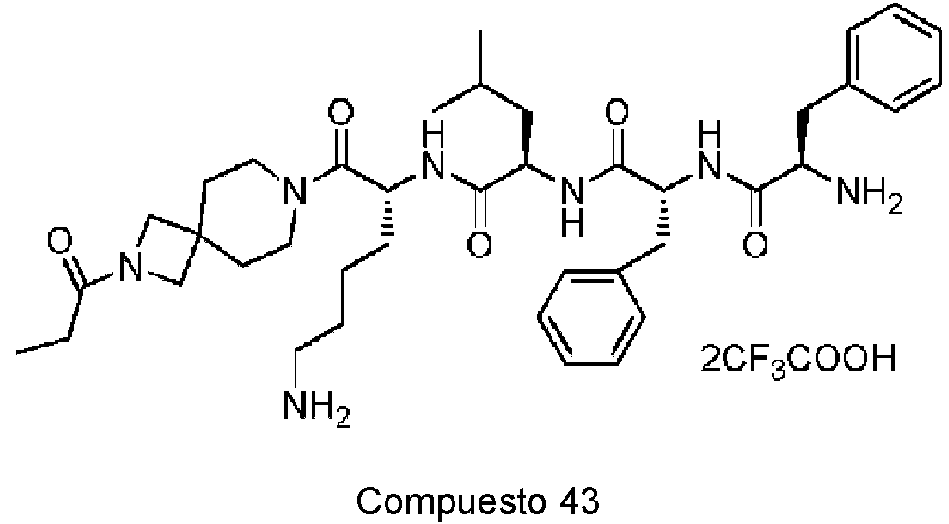
Se añadieron N-[(1R)-1-bencil-2-[[(1R)-1-bencil-2-[[(1R)-1-[[(1R)-5-(terc-butoxicarbonilamino)-1-(2-propanoil-2,7-diazaespiro[3.5]nonano-7-carbonil)pentil]carbamoil]-3-metil-butil]amino]-2-oxo-etil]amino]-2-oxo-etil]carbamato de terc-butilo (43C) (260 mg, 0,28 mmol) y ácido trifluoroacético (1,3 ml) en un matraz de reacción de 50 ml y se permitió que reaccionase el sistema a temperatura ambiente durante 2 h. Se concentró la disolución de reacción a presión reducida y se separó el residuo y se purificó mediante cromatografía de líquidos preparativa (condiciones de preparación: instrumento: GX-281 de Gilson; columna: Xbridge C18, 150 x 30 mm de D.I., 5 |am; fase móvil: A para ACN y B para H2O; isocrático: 65% de A; velocidad de flujo: 30 ml/min; contrapresión:1000 psi; temperatura de columna: 30°C; longitud de onda: 210 nm; periodo: 18 min; preparación de la muestra: se disolvió el compuesto en 12 ml de metanol; inyección: 0,9 ml/aguja). Se concentró la preparación a presión reducida para eliminar la mayor parte del disolvente y se liofilizó para obtener (2R)-2-[[(2R)-2-[[(2R)-2-amino-3-fenil-propanoil]amino]-3-fenilpropanoil]amino]-N-[(1R)-5-amino-1-(2-propanoil-2,7-diazaespiro[3.5]nonano-7-carbonil)pentil]-4-metil-pentanamida; di-ácido trifluoroacético (compuesto 43) como un polvo de color blanco (125 mg, rendimiento del 51%).N-[(1R)-1-benzyl-2-[[(1R)-1-benzyl-2-[[(1R)-1-[[(1R)-5-(tert-butoxycarbonylamino)-1 -(2-propanoyl-2,7-diazaspiro[3.5]nonane-7-carbonyl)pentyl]carbamoyl]-3-methyl-butyl]amino]-2-oxo-ethyl]amino]-2-oxo-ethyl]carbamate of tert-butyl (43C) (260 mg, 0.28 mmol) and trifluoroacetic acid (1.3 mL) in a 50 mL reaction flask and the system was allowed to react at room temperature for 2 h. The reaction solution was concentrated under reduced pressure, and the residue was separated and purified by preparative liquid chromatography (preparation conditions: instrument: Gilson GX-281; column: Xbridge C18, 150 x 30 mm I.D., 5 µm ; mobile phase: A for ACN and B for H2O; isocratic: 65% A; flow rate: 30 mL/min; back pressure: 1000 psi; column temperature: 30°C; wavelength: 210 nm; period: 18 min, sample preparation: compound was dissolved in 12 mL methanol, injection: 0.9 mL/needle). The preparation was concentrated under reduced pressure to remove most of the solvent and lyophilized to obtain (2R)-2-[[(2R)-2-[[(2R)-2-amino-3-phenyl-propanoyl]amino ]-3-phenylpropanoyl]amino]-N-[(1R)-5-amino-1-(2-propanoyl-2,7-diazaspiro[3.5]nonane-7-carbonyl)pentyl]-4-methyl-pentanamide; di-trifluoroacetic acid (compound 43) as a white powder (125 mg, 51% yield).
EM m/z = 359,8 [M+2H]+/2;MS m/z = 359.8 [M+2H]+/2;
1H-RMN (400 MHz, D2O) 87,45-7,28 (m, 6H), 7,24 (d, 4H), 4,80-4,75 (m, 1H) 4,66 (t, 1H), 4,29 (t, 1H), 4,27 (t, 1H), 4,01 (d, 2H), 3,77 (d, 2H), 3,71-3,60 (m, 2H), 3,55-3,42 (m, 1H), 3,41-3,27 (m, 1H), 3,18 (dd, 2H), 3,11-2,93 (m, 4H), 2,19 (qd, 2H), 1,95-1,63 (m, 8H), 1,61-1,49 (m, 3H), 1,48-1,30 (m, 2H), 1,07 (td, 3H), 0,92 (dd, 6H).1H-NMR (400 MHz, D2O) 87.45-7.28 (m, 6H), 7.24 (d, 4H), 4.80-4.75 (m, 1H) 4.66 (t, 1H ), 4.29 (t, 1H), 4.27 (t, 1H), 4.01 (d, 2H), 3.77 (d, 2H), 3.71-3.60 (m, 2H) , 3.55-3.42 (m, 1H), 3.41-3.27 (m, 1H), 3.18 (dd, 2H), 3.11-2.93 (m, 4H), 2 0.19 (qd, 2H), 1.95-1.63 (m, 8H), 1.61-1.49 (m, 3H), 1.48-1.30 (m, 2H), 1.07 (td, 3H), 0.92 (dd, 6H).
Ejemplo 42:Example 42:
(2R)-2-[[(2R)-2-[[(2R)-2-Amino-3-fenil-propanoil]amino]-3-fenil-propanoil]amino]-N-[(1R)-5-amino-1-[2-(2,2,2-trifluoroacetil)-2,7-diazaespiro[3.5]nonano-7-carbonil]pentil]-4-metil-pentanamida; di-ácido trifluoroacético (compuesto 44) (2R)-2-[[(2R)-2-[[(2R)-2-Amino-3-phenyl-propanoyl]amino]-3-phenyl-propanoyl]amino]-N-[(1R)-5 -amino-1-[2-(2,2,2-trifluoroacetyl)-2,7-diazaspiro[3.5]nonane-7-carbonyl]pentyl]-4-methyl-pentanamide; di-trifluoroacetic acid (compound 44)

Etapa 1:Stage 1:
2-(2,2,2-Trifluoroacetil)-2,7-diazaespiro[3.5]nonano-7-carboxilato de bencilo (44A)Benzyl 2-(2,2,2-Trifluoroacetyl)-2,7-diazaspiro[3.5]nonane-7-carboxylate (44A)

Se añadieron 2,7-diazaespiro[3.5]nonano-7-carboxilato de bencilo (6C) (390 mg, 1,5mmol), clorhidrato de 1-(3-dimetilaminopropil)-3-etilcarbodiimida (575 mg, 3,0 mmol), 1-hidroxibenzotriazol (243 mg, 1,80 mmol), ácido trifluoroacético (171 mg, 1,5 mmol) y diclorometano (50 ml) en un matraz de una sola boca de 50 ml y se permitió que reaccionase el sistema a temperatura ambiente durante 5 h. Se concentró la disolución de reacción a presión reducida y se separó el residuo y se purificó mediante cromatografía en columna de gel de sílice (diclorometano:metanol (v:v) = 50:1) para obtener 2-(2,2,2-trifluoroacetil)-2,7-diazaespiro[3.5]nonano-7-carboxilato de bencilo (44A) como un sólido de color amarillo claro (224 mg, rendimiento del 63%).Benzyl 2,7-diazaspiro[3.5]nonane-7-carboxylate (6C) (390mg, 1.5mmol), 1-(3-dimethylaminopropyl)-3-ethylcarbodiimide hydrochloride (575mg, 3.0mmol ), 1-hydroxybenzotriazole (243 mg, 1.80 mmol), trifluoroacetic acid (171 mg, 1.5 mmol) and dichloromethane (50 mL) in a 50 mL single neck flask and the system was allowed to react to room temperature for 5 h. The reaction solution was concentrated under reduced pressure, and the residue was separated and purified by silica gel column chromatography (dichloromethane:methanol (v:v) = 50:1) to obtain 2-(2,2,2- benzyl trifluoroacetyl)-2,7-diazaspiro[3.5]nonane-7-carboxylate (44A) as a light yellow solid (224 mg, 63% yield).
Etapa 2:Stage 2:
1-(2,7-Diazaespiro[3.5]nonan-2-il)-2,2,2-trifluoroetanona (44B)1-(2,7-Diazaspiro[3.5]nonan-2-yl)-2,2,2-trifluoroethanone (44B)

Se añadieron 2-(2,2,2-trifluoroacetil)-2,7-diazaespiro[3.5]nonano-7-carboxilato de bencilo (44A) (223 mg, 0,63 mmol), paladio sobre carbono (46 mg, al 20% en peso de l) y metanol (20 ml) en un matraz de una sola boca de 50 ml. Se reemplazó la atmósfera por hidrógeno 3 veces y se hizo reaccionar la mezcla a temperatura ambiente durante 3 h bajo una atmósfera de hidrógeno (globo). Se filtró la disolución de reacción a través de tierra de diatomeas y se concentró el filtrado a presión reducida para obtener 1-(2,7-diazaespiro[3.5]nonan-2-il)-2,2,2-trifluoroetanona (44B) en bruto como un sólido de color amarillo claro (116 mg, rendimiento del 83%) y se usó directamente en la siguiente reacción.Benzyl 2-(2,2,2-trifluoroacetyl)-2,7-diazaspiro[3.5]nonane-7-carboxylate (44A) (223 mg, 0.63 mmol), palladium on carbon (46 mg, al 20 wt% of l) and methanol (20 ml) in a 50 ml single neck flask. The atmosphere was replaced with hydrogen 3 times, and the mixture was reacted at room temperature for 3 h under a hydrogen atmosphere (balloon). The reaction solution was filtered through diatomaceous earth, and the filtrate was concentrated under reduced pressure to obtain 1-(2,7-diazaspiro[3.5]nonan-2-yl)-2,2,2-trifluoroethanone (44B) crude as a light yellow solid (116 mg, 83% yield) and used directly in the next reaction.
Etapa 3:Stage 3:
N-[(1R)-1-Bencil-2-[[(1R)-1-bencil-2-[[(1R)-1-[[(1R)-5-(terc-butoxicarbonilamino)-1-[2-(2,2,2-trifluoroacetil)-2,7-diazaespiro[3.5]nonano-7-carbonil]pentil]carbamoil]-3-metil-butil]amino]-2-oxo-etil]amino]-2-oxo-etil]carbamato de terc-butilo (44C) N-[(1R)-1-Benzyl-2-[[(1R)-1-benzyl-2-[[(1R)-1-[[(1R)-5-(tert-butoxycarbonylamino)-1-[ 2-(2,2,2-trifluoroacetyl)-2,7-diazaspiro[3.5]nonane-7-carbonyl]pentyl]carbamoyl]-3-methyl-butyl]amino]-2-oxo-ethyl]amino]-2 tert-butyl-oxo-ethyl]carbamate (44C)

Se añadieron 1-(2,7-diazaespiro[3.5]nonan-2-il)-2,2,2-trifluoroetanona (44B) en bruto (116 mg, 0,52 mmol), clorhidrato de 1-(3-dimetilaminopropil)-3-etilcarbodiimida (575 mg, 3,7 mmol), 1-hidroxibenzotriazol (240 mg, 1,3 mmol), producto intermedio 1 (0,47 g, 0,626 mmol) y diclorometano (50 ml) en un matraz de una sola boca de 50 ml y se permitió que reaccionase el sistema a temperatura ambiente durante 5 h. Se concentró la disolución de reacción a presión reducida y se separó el residuo y se purificó mediante cromatografía en columna de gel de sílice (diclorometano:metanol (v:v) = 50:1) para obtener N-[(1R)-1-bencil-2-[[(1R)-1-bencil-2-[[(1R)-1-[[(1R)-5-(terc-butoxicarbonilamino)-1-[2-(2,2,2-trifluoroacetil))-2,7-diazaespiro[3.5]nonano-7-carbonil]pentil]carbamoil]-3-metil-butil]amino]-2-oxo-etil]amino]-2-oxoetil]carbamato de terc-butilo (44c ) como un sólido de color amarillo claro (216 mg, rendimiento del 42%).Crude 1-(2,7-diazaspiro[3.5]nonan-2-yl)-2,2,2-trifluoroethanone (44B) (116 mg, 0.52 mmol), 1-(3-dimethylaminopropyl hydrochloride) )-3-ethylcarbodiimide (575 mg, 3.7 mmol), 1-hydroxybenzotriazole (240 mg, 1.3 mmol), intermediate 1 (0.47 g, 0.626 mmol), and dichloromethane (50 mL) in a flask of a single 50 mL neck and the system was allowed to react at room temperature for 5 h. The reaction solution was concentrated under reduced pressure, and the residue was separated and purified by silica gel column chromatography (dichloromethane:methanol (v:v) = 50:1) to obtain N-[(1R)-1- benzyl-2-[[(1R)-1-benzyl-2-[[(1R)-1-[[(1R)-5-(tert-butoxycarbonylamino)-1-[2-(2,2,2- tert-butyl trifluoroacetyl))-2,7-diazaspiro[3.5]nonane-7-carbonyl]pentyl]carbamoyl]-3-methyl-butyl]amino]-2-oxo-ethyl]amino]-2-oxoethyl]carbamate (44c) as a light yellow solid (216 mg, 42% yield).
Etapa 4:Stage 4:
(2R)-2-[[(2R)-2-[[(2R)-2-Amino-3-fenil-propanoil]amino]-3-fenil-propanoil]amino]-N-[(1R)-5-amino-1-[2-(2,2,2-trifluoroacetil)-2,7-diazaespiro[3.5]nonano-7-carbonil]pentil]-4-metil-pentanamida; di-ácido trifluoroacético (compuesto 44)(2R)-2-[[(2R)-2-[[(2R)-2-Amino-3-phenyl-propanoyl]amino]-3-phenyl-propanoyl]amino]-N-[(1R)-5 -amino-1-[2-(2,2,2-trifluoroacetyl)-2,7-diazaspiro[3.5]nonane-7-carbonyl]pentyl]-4-methyl-pentanamide; di-trifluoroacetic acid (compound 44)
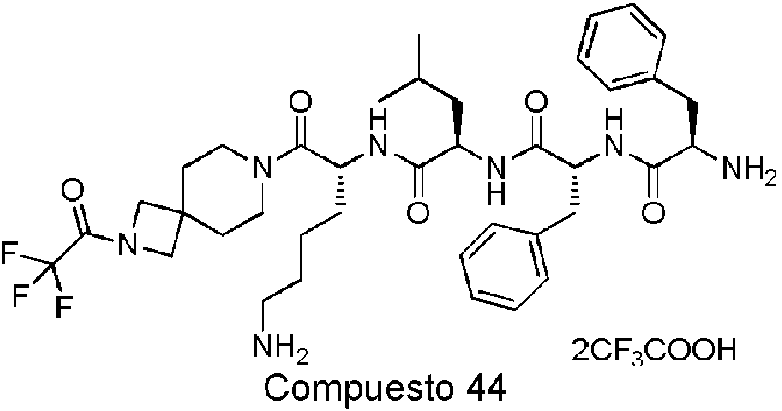
Se añadieron N-[(1R)-1-bencil-2-[[(1R)-1-bencil-2-[[(1R)-1-[[(1R)-5-(terc-butoxicarbonilamino)-1-[2-(2,2,2-trifluoroacetil)-2,7-diazaespiro[3.5]nonano-7-carbonil]pentil]carbamoil]-3-metil-butil]amino]-2-oxo-etil]amino]-2-oxoetil]carbamato de terc-butilo (44C) (210 mg, 0,22 mmol) y ácido trifluoroacético (2 ml) en un matraz de reacción de 50 ml y se permitió que reaccionase el sistema a temperatura ambiente durante 2 h. Se concentró la disolución de reacción a presión reducida y se separó el residuo y se purificó mediante cromatografía de líquidos preparativa (condiciones de preparación: instrumento: GX-281 de Gilson; columna: Xbridge C18, 150 x 30 mm de D.I., 5 |am; fase móvil: A para ACN y B para H2O; isocrático: 65% de A; velocidad de flujo: 30 ml/min; contrapresión:1000 psi; temperatura de columna: 30°C; longitud de onda: 210 nm; periodo: 18 min; preparación de la muestra: se disolvió el compuesto en 12 ml de metanol; inyección: 0,9 ml/aguja). Se concentró la preparación a presión reducida para eliminar la mayor parte del disolvente y se liofilizó para obtener (2R)-2-[[(2R)-2-[[(2R)-2-amino-3-fenil-propanoil]amino]-3-fenilpropanoil]amino]-N-[(1R)-5-amino-1-[2-(2,2,2-trifluoroacetil)-2,7-diazaespiro[3.5]nonano-7-carbonil]pentil]-4-metilpentanamida; ácido di-trifluoroacético (compuesto 44) como un polvo de color blanco (111 mg, rendimiento del 51%). N-[(1R)-1-benzyl-2-[[(1R)-1-benzyl-2-[[(1R)-1-[[(1R)-5-(tert-butoxycarbonylamino)-1 -[2-(2,2,2-trifluoroacetyl)-2,7-diazaspiro[3.5]nonane-7-carbonyl]pentyl]carbamoyl]-3-methyl-butyl]amino]-2-oxo-ethyl]amino] tert-Butyl (44C)-2-oxoethyl]carbamate (210 mg, 0.22 mmol) and trifluoroacetic acid (2 mL) in a 50 mL reaction flask and the system was allowed to react at room temperature for 2 h. . The reaction solution was concentrated under reduced pressure, and the residue was separated and purified by preparative liquid chromatography (preparation conditions: instrument: Gilson GX-281; column: Xbridge C18, 150 x 30 mm I.D., 5 µm ; mobile phase: A for ACN and B for H2O; isocratic: 65% A; flow rate: 30 mL/min; back pressure: 1000 psi; column temperature: 30°C; wavelength: 210 nm; period: 18 min, sample preparation: compound was dissolved in 12 mL methanol, injection: 0.9 mL/needle). The preparation was concentrated under reduced pressure to remove most of the solvent and lyophilized to obtain (2R)-2-[[(2R)-2-[[(2R)-2-amino-3-phenyl-propanoyl]amino ]-3-phenylpropanoyl]amino]-N-[(1R)-5-amino-1-[2-(2,2,2-trifluoroacetyl)-2,7-diazaspiro[3.5]nonane-7-carbonyl]pentyl ]-4-methylpentanamide; di-trifluoroacetic acid (compound 44) as a white powder (111 mg, 51% yield).
EM m/z = 758,3 [M+H]+;MS m/z = 758.3 [M+H]+;
1H-RMN (400 MHz, D2O) 87,44-7,28 (m, 6 H), 7,24 (d, 4H), 4,64 (t, 1H), 4,38-4,21 (m, 4H), 3,97 (d, 2H), 3,73-3,58 (m, 2H), 3,56-3,43 (m, 1H), 3,40-3,32 (m, 1H), 3,25-3,11 (m, 2H), 3,11-2,93 (m, 4H), 1,99-1,63 (m, 9H), 1,53 (d, 3H), 1,49 1,33 (m, 2H), 0,93 (dd, 6 H).1H-NMR (400 MHz, D2O) 87.44-7.28 (m, 6H), 7.24 (d, 4H), 4.64 (t, 1H), 4.38-4.21 (m , 4H), 3.97 (d, 2H), 3.73-3.58 (m, 2H), 3.56-3.43 (m, 1H), 3.40-3.32 (m, 1H ), 3.25-3.11 (m, 2H), 3.11-2.93 (m, 4H), 1.99-1.63 (m, 9H), 1.53 (d, 3H), 1.49 1.33 (m, 2H), 0.93 (dd, 6H).
Ejemplos de pruebas biológicasExamples of biological tests
Prueba 1: Actividad agonista sobre los receptores de opioides k humanosTest 1: Agonist activity on human k -opioid receptors
La forskolina puede estimular la liberación de AMPc desde una línea celular que sobreexpresa el receptor de opioides k humano, las células OPRK1 (DiscoveRx) y los agonistas de receptores de opioides k pueden inhibir la liberación de AMPc estimulada por la forskolina. Detectando el efecto inhibidor del compuesto de prueba sobre la liberación de AMPc estimulada por forskolina, puede determinarse la actividad agonista del compuesto sobre el receptor de opioides k humano. En primer lugar, se incubaron una determinada concentración de forskolina y diferentes concentraciones del compuesto de prueba con líneas celulares que sobreexpresan el receptor de opioides k humano. Se usó un inmunoensayo de AMPc (LANCE®, PerkinElmer) basado en la transferencia de energía de resonancia de fluorescencia con resolución temporal (TR-FRET) para determinar los niveles de AMPc en las células OPRK1 estimuladas. El método específico es el siguiente:Forskolin can stimulate cAMP release from a cell line that overexpresses the human k -opioid receptor, OPRK1 (DiscoveRx) cells, and k -opioid receptor agonists can inhibit forskolin-stimulated cAMP release. By detecting the inhibitory effect of the test compound on forskolin-stimulated cAMP release, the agonistic activity of the compound on the human k -opioid receptor can be determined. First, a certain concentration of forskolin and different concentrations of the test compound were incubated with cell lines that overexpress the human k -opioid receptor. A cAMP immunoassay (LANCE®, PerkinElmer) based on resonance energy transfer of time-resolved fluorescence (TR-FRET) to determine cAMP levels in stimulated OPRK1 cells. The specific method is as follows:
Se cultivaron células OPRK1 (DiscoveRx) que expresan altamente receptores de opioides k humanos en medio 5A de McCoy (16600-082 de Gibco) que contenía FBS al 10% (10099-141 de Gibco). El día del experimento, se lavaron las células en la fase de crecimiento exponencial y se separaron con PBS/EDTA 5 mM, se recogieron mediante centrifugación, se resuspendieron con tampón de estimulación y se contaron. Se ajustó la concentración de las células a 3*105 células/ml. Se usó DMSO para disolver la forskolina y el compuesto de prueba respectivamente, de modo que la concentración de las aguas madres fue de 10 mM, y luego se diluyó la forskolina a 4 |iM con tampón de estimulación y diferentes concentraciones del compuesto de prueba (las concentraciones fueron de 80, 16, 3,2, 0,64, 0,128, 0,0256, 0,00512, 0,001024, 0 |iM), se añadieron 5 |il por pocillo a una placa de 384 pocillos. Se añadieron 5 |il de suspensión celular a cada pocillo y se incubaron a temperatura ambiente durante 30 min. Posteriormente, se añadieron a cada pocillo 5 |il de disolución de trabajo de trazador de 4 x Eu-AMPc (dilución de 50 veces de la disolución madre de Eu-AMPc con tampón de detección de AMPc) y 5 |il de disolución de trabajo 4 x Ulight-anti-AMPc (dilución de 150 veces de disolución madre de ULight-anti-AMPc con tampón de detección de AMPc) y se incubaron a temperatura ambiente durante 1 hora. Se sometieron a ensayo placas de 384 pocillos para determinar los niveles de AMPc usando un método de TR-FRET con lector de microplacas (Perkin Elmer, Envision). Se procesaron los datos obtenidos y se ajustaron a CE50 usando el software Origin 7.5. Se midió la actividad agonista de receptores de opioides k humanos del compuesto de la presente invención mediante los experimentos anteriores, y los valores de CE50 medidos se muestran en la tabla 1.OPRK1 (DiscoveRx) cells highly expressing human k -opioid receptors were cultured in McCoy's 5A medium (Gibco 16600-082) containing 10% FBS (Gibco 10099-141). On the day of the experiment, cells in the exponential growth phase were washed and separated with PBS/5 mM EDTA, collected by centrifugation, resuspended with stimulation buffer and counted. The cell concentration was adjusted to 3*105 cells/ml. DMSO was used to dissolve forskolin and test compound respectively, so that the concentration of the mother liquors was 10 mM, and then forskolin was diluted to 4 µM with stimulation buffer and different concentrations of test compound ( concentrations were 80, 16, 3.2, 0.64, 0.128, 0.0256, 0.00512, 0.001024, 0 µM), 5 µl was added per well to a 384-well plate. 5 µl of cell suspension was added to each well and incubated at room temperature for 30 min. Subsequently, 5 µl of 4 x Eu-cAMP tracer working solution (50-fold dilution of Eu-cAMP stock with cAMP detection buffer) and 5 µl of working solution were added to each well. 4 x ULight-anti-cAMP (150-fold dilution of ULight-anti-cAMP stock solution with cAMP detection buffer) and incubated at room temperature for 1 hour. 384-well plates were assayed for cAMP levels using a microplate reader TR-FRET method (Perkin Elmer, Envision). Obtained data were processed and adjusted to EC50 using Origin 7.5 software. The human k -opioid receptor agonist activity of the compound of the present invention was measured by the above experiments, and the measured EC50 values are shown in Table 1.
Método de preparación del tampón de estimulación: se disolvieron 14 ml de 1*HBSS(invitrogen, n.° de cat. 14025 092), 75 |il de HEPES 1 M (Invitrogen, n.° de cat. 15630-080), 30 |il de IBMX 250 mM en DMSO (Sigma, n.° de cat.Stimulation buffer preparation method: Dissolved 14 mL 1*HBSS (invitrogen, cat. no. 14025 092), 75 μl 1 M HEPES (Invitrogen, cat. no. 15630-080), 30 µl of 250 mM IBMX in DMSO (Sigma, cat. no.
17018) y se mezcló con 200 |il de estabilizador de BSA al 7,5%. Se ajustó el pH de la disolución a 7,4 con NaOH 0,1 N y se enrasó hasta 15 ml con 1 * HBSS.17018) and mixed with 200 µl of 7.5% BSA stabilizer. The pH of the solution was adjusted to 7.4 with 0.1N NaOH and made up to 15 mL with 1*HBSS.
Tabla 1 Actividad agonista de los compuestos de prueba sobre los receptores de opioides k humanosTable 1 Agonist Activity of Test Compounds on Human K -Opioid Receptors

Conclusión: Los compuestos de la invención tienen efectos agonistas significativos sobre los receptores de opioides k humanos.Conclusion: The compounds of the invention have significant agonistic effects on human k -opioid receptors.
Prueba 2: Experimento de placa calefactora con ratónTest 2: Mouse Hot Plate Experiment
Se adquirieron ratones hembra C57 de 18-22 g de Chengdu Dashuo Experimental Animal Co., Ltd. Se fijó la temperatura del instrumento de placa calefactora a 56°C y, después de alcanzar los 56°C, se estabilizó la temperatura durante 30 minutos antes del experimento. Se sometieron los animales a una prueba de placa calefactora para observar la reacción de lamer las patas traseras, que se usó como indicador de la respuesta al dolor. Se registró el tiempo desde la entrada del animal a la placa calefactora hasta el lamido inducido por calor de las patas traseras. Los animales que cumplen con los criterios de inclusión (el tiempo de respuesta para lamerse la pata trasera es menor de 25 segundos) se incluyen en el número de grupo. Se agruparon los animales por umbral de nivel inicial, con 10 en cada grupo. Se administraron compuestos de diferentes concentraciones por vía subcutánea a 10 ml/kg, y se llevó a cabo una detección después de 15 minutos desde la administración, con 30 segundos como tiempo de corte, y se registró el tiempo de reacción. Se analizaron los resultados estadísticamente y se calculó el valor de % de MPE según la fórmula: % de MPE=(Tn-T0)/(30-T0), (Tn es el tiempo para que el animal se lama la pata trasera después de la administración, Tües el tiempo para que el animal se lama la pata antes de la administración). Se muestran los resultados experimentales en la tabla 2. Female C57 mice 18-22 g were purchased from Chengdu Dashuo Experimental Animal Co., Ltd. The temperature of the hot plate instrument was set at 56°C, and after reaching 56°C, the temperature was stabilized for 30 minutes. before the experiment. Animals were subjected to a hot plate test to observe the hind paw licking reaction, which was used as an indicator of pain response. The time from the animal's entry to the heating plate to the heat-induced licking of the hind paws was recorded. Animals that meet the inclusion criteria (response time to hind paw licking is less than 25 seconds) are included in the group number. Animals were grouped by starting level threshold, with 10 in each group. Compounds of different concentrations were administered subcutaneously at 10 ml/kg, and detection was carried out after 15 minutes from the administration, with 30 seconds as the cut-off time, and the reaction time was recorded. The results were statistically analyzed and the % MPE value was calculated according to the formula: % MPE=(Tn-T0)/(30-T0), (Tn is the time for the animal to lick its hind paw after administration, Tües the time for the animal to lick its paw before administration). The experimental results are shown in table 2.
T a b la 2T a b the 2

C o n c lu s ión : El e fec to a n a lg é s ico de los c o m p u e s to s de la p re se n te inve n c ió n se logra a tra v é s de los re ce p to re s de o p io id e s k pe rifé ricos.C onc lu s io n: The analgesic effect of the compounds of the present invention is achieved through the op io id receptors it is k pe rifé rich.
P ru e b a 3: E xp e rim e n to de co n to rs io n e s del ra tónP ru e 3: E x p e ri m e n t o f M ouse Co n to rs io n s
La in ye cc ión in tra p e rito n e a l de ác ido a cé tico en ra to n e s p uede p ro v o c a r co n to rs io n e s en ra tones. La re sp u e s ta de c o n to rs io n e s se re fie re a ra to n e s que p re se n ta n re s p u e s ta s de c o m p o rta m ie n to t íp ic a s que son c a ra c te r ís tic a s de la co n tra c c ió n o e x te n s ió n de los m ú scu lo s a b d o m in a le s . La a c tiv ida d a n a lg é s ica de l c o m p u e s to p uede re fle ja rse d e te c ta n d o el e fe c to in h ib id o r de l c o m p u e s to so b re el c o m p o rta m ie n to de co n to rs io n e s de los ra to n e s p ro vo ca d o po r el ác ido a cé tico . El m é to d o e s p e c ífic o es el s igu ien te :Intraperitoneal injection of acetic acid in mice can cause contorsion in mice. The response of c o n to rs io n s refers to mic e that p re se n t e n s s p e s t e s of t y p o r t i p e r a l e s that are char a c te r is tic a s of the con tra c tio n or e x te n s io n of the abdomin a l m u scules. The analgesic activity of the compound can be reflected by detecting the inhibitory effect of the compound on the behavior of co n to rs io n e s of the mice is caused by the acetic acid. The specific method is as follows:
R a to n e s IC R de 8 s e m a n a s de edad (a d q u ir id o s de C h e n g du D a sh u o B io te c h n o lo g y C o m pa n y, n úm ero de licencia : S C X K (S ich u a n ) 2008 -24 (N O : 51203500002150 )). Se d iv id ie ron los ra to n e s a le a to ria m e n te en g rupos de 10 an im a les, m itad m ach o s y m itad hem bras; en e s ta d o de a yu n o pero con libre a cce so a a g u a d u ra n te 12 h a n tes del exp e rim e nto . El d ía del e xp e rim e n to , se a d m in is tró p o r v ía in tra ve n o sa 1,0 m g/kg de l c o m p u e s to de e n sa yo y se a d m in is tró un rea c tivo de b la n co al g ru p o de con tro l. 15 m inu to s d e sp u é s de la a d m in is tra c ió n , se inyectó p o r v ía in tra p e rito n e a l una d iso luc ió n de á c id o a cé tico al 0 ,6 % (v /v) a una d o s is de 0 ,4 m l/ra tón . S e reg is tró el n ú m e ro de c o n to rs io n e s de l ra tón a los 15 m in y 6 h d e s p u é s de la inye cc ión de á c id o a cé tico , re s p e c tiva m e n te , y se c a lcu ló el p o rce n ta je de inh ib ic ión de las co n to rs io n e s p ro v o c a d a s p o r el á c id o acé tico en ra to n e s p o r el c o m p u e s to , re s p e c tiv a m e n te . S e m ue stra n los re s u lta d o s del aná lis is en la ta b la 3.8-week-old IC R mice (purchased from C h e n g du D a shu o B io t h o l o g y C o m pa n y, license number : S C X K (S ich u a n ) 2008-24 (NO: 51203500002150). The mice were randomly divided into groups of 10 animals, half male and half female; in a fasting state but with free access to water for 12 hours of the experiment. On the day of the experiment, 1.0 mg/kg of the test compound was administered intravenously and a white reagent was administered. co to the control g ru p o l. 15 minutes after administration, a dissolution of acetic acid at 0.6% (v / v ) at a dose of 0.4 ml/mouse. The number of contorsions of the mouse was recorded at 15 min and 6 h after the injection of acetic acid, respectively, and the percentage of inhibition of the co n to rs io ns caused by the acetic acid in mice was calculated by the compound, respectively. The results of the analysis are shown in Table 3.
% de p o rce n ta je de inh ib ic ión = (n ú m e ro de co n to rs io n e s en el g ru p o de co n tro l - n ú m e ro de co n to rs io n e s en el g rupo de a d m in is tra c ió n )/n ú m e ro de co n to rs io n e s en el g ru p o de contro l.% of inh ib ition p e rce n t ag e = (n u m b e r o f co n to rs io n s in th e c o n tro l g ro u p - n u m b e r o f co n to rs io n s in g a d m in is tra tio n ro u p)/n u m b e r o f co n to rs io n s in the control g roup.
T a b la 3 P o rce n ta je de inh ib ic ión de los co m p u e s to s de p ru e b a con resp e c to al c o m p o rta m ie n to de c o n to rs io n e s in d u c id a s p o r ác ido a cé tico de ra tonesT a b le 3 Percentage of inhibition of the test compounds with respect to the behavior of c o n to rs io n s induced by a ce mouse pad


NQ significa no sometido a prueba.NQ means not tested.

su base libre.your free base.
Conclusión: Los compuestos de la presente invención tienen efectos analgésicos significativos. Se sometieron a prueba adicionalmente algunos compuestos de prueba para una prueba de acción prolongada sobre el comportamiento de contorsiones inducidas por ácido acético de ratones. Según el mismo método de prueba tal como se describió anteriormente, el método de administración fue la inyección intravenosa y la dosis fue de 3 mg/kg o 10 mg/kg. Se registró el número de veces que el ratón presentaba contorsiones en el plazo de las 18 h posteriores a la inyección de ácido acético, y se calculó el porcentaje de inhibición del comportamiento de contorsiones inducidas por ácido acético de los ratones por los compuestos de prueba, respectivamente. Se muestran los resultados en la tabla 4.Conclusion: The compounds of the present invention have significant analgesic effects. Some test compounds were further tested for a long-acting test on the acetic acid-induced writhing behavior of mice. According to the same test method as described above, the administration method was intravenous injection and the dose was 3 mg/kg or 10 mg/kg. The number of times the mouse writhed within 18 h after acetic acid injection was recorded, and the percentage inhibition of the mice's acetic acid-induced writhing behavior by the test compounds was calculated, respectively. The results are shown in table 4.
Tabla 4 Porcentaje de inhibición tras 18 horas de los compuestos de prueba con respecto al comportamiento de contorsiones inducidas por ácido acético de ratonesTable 4 Percent inhibition after 18 hours of test compounds with respect to acetic acid-induced writhing behavior of mice

La estructura 
Conclusión: algunos compuestos de la presente invención tienen efectos analgésicos significativos y tienen la ventaja de efectos duraderos.Conclusion: Some compounds of the present invention have significant analgesic effects and have the advantage of long lasting effects.
4. Prueba PK en ratas4. PK test in rats


Tabla 5 Resultados PK de rata (1 mg/kg)Table 5 Rat PK Results (1 mg/kg)

5. Prueba PK de ratón5. Mouse PK test

Tabla 6 Resultados PK de ratón (1 mg/kg)Table 6 Mouse PK Results (1 mg/kg)

Claims (1)
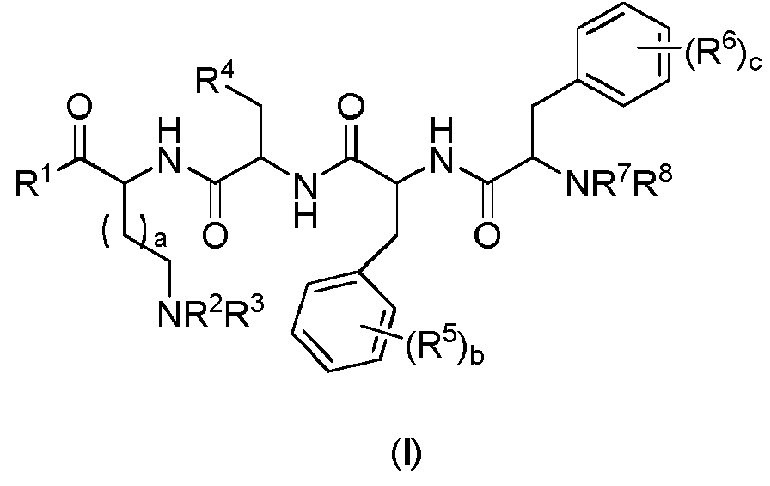


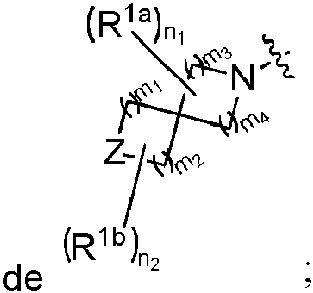


Applications Claiming Priority (3)
| Application Number | Priority Date | Filing Date | Title |
|---|---|---|---|
| CN201710598408 | 2017-07-21 | ||
| CN201810014939 | 2018-01-11 | ||
| PCT/CN2018/096271 WO2019015644A1 (en) | 2017-07-21 | 2018-07-19 | Peptide amide compound and preparation method and medical use thereof |
Publications (1)
| Publication Number | Publication Date |
|---|---|
| ES2905164T3 true ES2905164T3 (en) | 2022-04-07 |
Family
ID=65015483
Family Applications (1)
| Application Number | Title | Priority Date | Filing Date |
|---|---|---|---|
| ES18835454T Active ES2905164T3 (en) | 2017-07-21 | 2018-07-19 | Peptide amide compound and method of preparation and medical use thereof |
Country Status (14)
| Country | Link |
|---|---|
| US (1) | US11014964B2 (en) |
| EP (1) | EP3656782B1 (en) |
| JP (1) | JP7008787B2 (en) |
| KR (1) | KR102375543B1 (en) |
| CN (1) | CN110637025B (en) |
| AU (1) | AU2018303080B2 (en) |
| BR (1) | BR112020001157A2 (en) |
| CA (1) | CA3069820C (en) |
| ES (1) | ES2905164T3 (en) |
| MY (1) | MY200925A (en) |
| PT (1) | PT3656782T (en) |
| TW (1) | TWI712615B (en) |
| WO (1) | WO2019015644A1 (en) |
| ZA (1) | ZA202000491B (en) |
Families Citing this family (15)
| Publication number | Priority date | Publication date | Assignee | Title |
|---|---|---|---|---|
| WO2021013085A1 (en) * | 2019-07-25 | 2021-01-28 | 四川海思科制药有限公司 | Peptide amide salt, preparation method therefor and use thereof in medicine |
| CN114127086B (en) * | 2019-07-25 | 2023-10-20 | 四川海思科制药有限公司 | Deuterated peptide amide compounds and their preparation methods and medicinal uses |
| TWI764248B (en) * | 2019-08-23 | 2022-05-11 | 大陸商四川海思科製藥有限公司 | Peptidamide composition and preparation thereof |
| CN118546202A (en) * | 2019-09-03 | 2024-08-27 | 西藏海思科制药有限公司 | Solid form of polypeptide compound and application thereof in medicine |
| WO2021047470A1 (en) * | 2019-09-10 | 2021-03-18 | 四川海思科制药有限公司 | Method for preparing peptide amide compound and intermediate thereof |
| CN112552374B (en) * | 2019-09-10 | 2024-06-04 | 西藏海思科制药有限公司 | Preparation method of peptide amide compound and intermediate thereof |
| TW202143997A (en) * | 2020-03-18 | 2021-12-01 | 大陸商四川海思科製藥有限公司 | Oral pharmaceutical composition |
| JP7549439B2 (en) * | 2020-04-30 | 2024-09-11 | メッドシャイン ディスカバリー インコーポレイテッド | Phenylpropionamide compounds and their uses |
| BR112023015210A2 (en) | 2021-01-29 | 2023-11-07 | Cedilla Therapeutics Inc | CDK2 INHIBITORS AND METHODS OF USE THEREOF |
| CA3215193A1 (en) * | 2021-04-12 | 2022-10-20 | Yongrui Wang | Use of peptide amide compound in preparation of drug for treating pruritus |
| CA3225439A1 (en) | 2021-06-26 | 2022-12-29 | Cedilla Therapeutics, Inc. | Cdk2 inhibitors and methods of using the same |
| CN115873069A (en) * | 2021-08-18 | 2023-03-31 | 天地恒一制药股份有限公司 | Peptide amide compound, pharmaceutically acceptable salt and stereoisomer thereof, and application thereof |
| CN115707711A (en) * | 2021-08-18 | 2023-02-21 | 天地恒一制药股份有限公司 | Peptide amide compound, pharmaceutically acceptable salt, stereoisomer and application thereof |
| WO2024015106A1 (en) * | 2022-07-11 | 2024-01-18 | Humanwell Pharmacuetical Us | Peptides for treatment of medical disorders |
| WO2025077727A1 (en) * | 2023-10-10 | 2025-04-17 | 海思科医药集团股份有限公司 | Use of peptide amide compound in preparation of drug for preventing nausea and vomiting |
Family Cites Families (13)
| Publication number | Priority date | Publication date | Assignee | Title |
|---|---|---|---|---|
| US4760180A (en) * | 1986-02-14 | 1988-07-26 | G. D. Searle & Co. | N-terminally substituted dipeptide amides |
| EP0215297A3 (en) * | 1985-08-14 | 1989-07-19 | G.D. Searle & Co. | Substituted dipeptide amides |
| US4822775A (en) * | 1986-02-14 | 1989-04-18 | G. D. Searle & Co. | Phenyl substituted dipeptide amides |
| CN103772231B (en) * | 1995-02-27 | 2016-02-03 | 吉里德科学公司 | Compounds, its synthetic method and therepic use |
| US5965701A (en) * | 1997-12-23 | 1999-10-12 | Ferring Bv | Kappa receptor opioid peptides |
| FR2814367B1 (en) * | 2000-09-25 | 2008-12-26 | Inst Nat Sante Rech Med | NPFF RECEPTOR LIGANDS FOR THE TREATMENT OF PAIN AND HYPERALGIA |
| CA2653077A1 (en) * | 2006-05-26 | 2007-12-06 | Cara Therapeutics, Inc. | N-oxides of kappa opioid receptor peptides |
| US7842662B2 (en) * | 2006-11-10 | 2010-11-30 | Cara Therapeutics, Inc. | Synthetic peptide amide dimers |
| RU2500685C2 (en) | 2006-11-10 | 2013-12-10 | Кара Терапеутикс, Инк | Synthetic peptide amides |
| US8236766B2 (en) * | 2006-11-10 | 2012-08-07 | Cara Therapeutics, Inc. | Uses of synthetic peptide amides |
| US8906859B2 (en) * | 2006-11-10 | 2014-12-09 | Cera Therapeutics, Inc. | Uses of kappa opioid synthetic peptide amides |
| EP3294315A2 (en) * | 2015-05-11 | 2018-03-21 | Cadila Healthcare Limited | Novel short-chain peptides as kappa opioid receptors (kor) agonist |
| CN106928127B (en) * | 2015-12-31 | 2021-07-16 | 四川海思科制药有限公司 | Substituted piperidine amide derivative, preparation method and pharmaceutical application thereof |
-
2018
- 2018-07-19 CA CA3069820A patent/CA3069820C/en active Active
- 2018-07-19 TW TW107124926A patent/TWI712615B/en active
- 2018-07-19 KR KR1020207002720A patent/KR102375543B1/en active Active
- 2018-07-19 EP EP18835454.2A patent/EP3656782B1/en active Active
- 2018-07-19 CN CN201880031309.3A patent/CN110637025B/en active Active
- 2018-07-19 PT PT188354542T patent/PT3656782T/en unknown
- 2018-07-19 AU AU2018303080A patent/AU2018303080B2/en active Active
- 2018-07-19 US US16/632,228 patent/US11014964B2/en active Active
- 2018-07-19 JP JP2020501793A patent/JP7008787B2/en active Active
- 2018-07-19 MY MYPI2020000323A patent/MY200925A/en unknown
- 2018-07-19 WO PCT/CN2018/096271 patent/WO2019015644A1/en not_active Ceased
- 2018-07-19 BR BR112020001157-6A patent/BR112020001157A2/en active Search and Examination
- 2018-07-19 ES ES18835454T patent/ES2905164T3/en active Active
-
2020
- 2020-01-24 ZA ZA2020/00491A patent/ZA202000491B/en unknown
Also Published As
| Publication number | Publication date |
|---|---|
| BR112020001157A2 (en) | 2020-07-21 |
| ZA202000491B (en) | 2021-08-25 |
| US11014964B2 (en) | 2021-05-25 |
| US20200172573A1 (en) | 2020-06-04 |
| KR102375543B1 (en) | 2022-03-16 |
| KR20200031114A (en) | 2020-03-23 |
| JP2020526571A (en) | 2020-08-31 |
| EP3656782A4 (en) | 2021-04-21 |
| JP7008787B2 (en) | 2022-01-25 |
| CN110637025B (en) | 2023-07-18 |
| TW201920231A (en) | 2019-06-01 |
| AU2018303080A1 (en) | 2020-01-30 |
| CA3069820A1 (en) | 2019-01-24 |
| AU2018303080B2 (en) | 2020-12-24 |
| MY200925A (en) | 2024-01-24 |
| PT3656782T (en) | 2022-02-08 |
| CA3069820C (en) | 2022-12-06 |
| WO2019015644A1 (en) | 2019-01-24 |
| EP3656782A1 (en) | 2020-05-27 |
| TWI712615B (en) | 2020-12-11 |
| EP3656782B1 (en) | 2021-12-22 |
| CN110637025A (en) | 2019-12-31 |
Similar Documents
| Publication | Publication Date | Title |
|---|---|---|
| ES2905164T3 (en) | Peptide amide compound and method of preparation and medical use thereof | |
| US11052076B2 (en) | Spirocyclic indolines as IL-17 modulators | |
| AU2016215432B2 (en) | 3-alkyl-4-amido-bicyclic [4,5,0] hydroxamic acids as HDAC inhibitors | |
| WO2023275301A1 (en) | Imidazotriazine derivatives as il-17 modulators | |
| US11643436B2 (en) | Polypeptide compound, pharmaceutical composition, preparation method and application thereof | |
| ES2249237T3 (en) | BENCIMIDAZOL COMPOUNDS AS ANOTHONISTS OF ORL1 RECEIVER. | |
| AU2016348847A1 (en) | Oxime compounds as agonists of the muscarinic M1 and/or M4 receptor | |
| BR112020003946A2 (en) | spirocycle compounds and methods for producing and using the same | |
| ES2441221T3 (en) | Piperidine spiro pyrrolidinone and substituted piperidinones used as modulators of H3 | |
| CA3065904A1 (en) | Pharmaceutical compounds | |
| WO2021170631A1 (en) | Difluorocyclohexyl derivatives as il-17 modulators | |
| CA3179686A1 (en) | Difluorocyclohexyl derivatives as il-17 modulators | |
| RS64836B1 (en) | Therapeutic compounds | |
| TWI838736B (en) | COMPOUND AS ADENOSINE A2a RECEPTOR ANTAGONIST AND PHARMACEUTICAL COMPOSITION COMPRISING SAME | |
| EP3807296A1 (en) | Peptidomimetic inhibitors of the peptidyl-prolyl cis/trans isomerase (pin1) | |
| US20250230129A1 (en) | Polyamide compounds, method for preparing same, and medical use thereof | |
| EA040570B1 (en) | PEPTIDE AMIDE COMPOUNDS, METHOD FOR THEIR PRODUCTION AND MEDICAL APPLICATION | |
| HK40011806B (en) | Peptide amide compounds, preparation method thereof and use in medicine | |
| HK40011806A (en) | Peptide amide compounds, preparation method thereof and use in medicine | |
| AU2013382944A1 (en) | 5-Amino-quinoline-8-carboxamide derivatives as 5-HT4 receptor agonists | |
| JP2025537627A (en) | Selenium-containing heterocyclic compounds and uses thereof | |
| NZ709872B2 (en) | Spiro-lactam nmda receptor modulators and uses thereof | |
| HK1254323A1 (en) | Bicyclic-fused heteroaryl or aryl compounds as irak4 modulators |