ES2907992T3 - Novel Imaging Agents to Detect Neurological Dysfunctions - Google Patents
Novel Imaging Agents to Detect Neurological Dysfunctions Download PDFInfo
- Publication number
- ES2907992T3 ES2907992T3 ES09711194T ES09711194T ES2907992T3 ES 2907992 T3 ES2907992 T3 ES 2907992T3 ES 09711194 T ES09711194 T ES 09711194T ES 09711194 T ES09711194 T ES 09711194T ES 2907992 T3 ES2907992 T3 ES 2907992T3
- Authority
- ES
- Spain
- Prior art keywords
- alkyl
- compound
- mmol
- aryl
- cycloalkyl
- Prior art date
- Legal status (The legal status is an assumption and is not a legal conclusion. Google has not performed a legal analysis and makes no representation as to the accuracy of the status listed.)
- Active
Links
- 239000012216 imaging agent Substances 0.000 title description 9
- 230000009251 neurologic dysfunction Effects 0.000 title description 2
- 208000015015 neurological dysfunction Diseases 0.000 title description 2
- 150000001875 compounds Chemical class 0.000 claims abstract description 135
- 125000000217 alkyl group Chemical group 0.000 claims abstract description 102
- -1 nitro, hydroxyl Chemical group 0.000 claims abstract description 49
- 229910052739 hydrogen Inorganic materials 0.000 claims abstract description 32
- 239000001257 hydrogen Substances 0.000 claims abstract description 32
- 125000003545 alkoxy group Chemical group 0.000 claims abstract description 31
- 125000001072 heteroaryl group Chemical group 0.000 claims abstract description 31
- 125000006652 (C3-C12) cycloalkyl group Chemical group 0.000 claims abstract description 30
- 150000003839 salts Chemical class 0.000 claims abstract description 25
- UFHFLCQGNIYNRP-UHFFFAOYSA-N Hydrogen Chemical compound [H][H] UFHFLCQGNIYNRP-UHFFFAOYSA-N 0.000 claims abstract description 18
- 125000005913 (C3-C6) cycloalkyl group Chemical group 0.000 claims abstract description 17
- 125000004435 hydrogen atom Chemical group [H]* 0.000 claims abstract description 16
- 125000005914 C6-C14 aryloxy group Chemical group 0.000 claims abstract description 14
- 125000005553 heteroaryloxy group Chemical group 0.000 claims abstract description 14
- 125000001424 substituent group Chemical group 0.000 claims abstract description 14
- 125000004169 (C1-C6) alkyl group Chemical group 0.000 claims abstract description 12
- 125000000000 cycloalkoxy group Chemical group 0.000 claims abstract description 11
- 125000002924 primary amino group Chemical group [H]N([H])* 0.000 claims abstract description 9
- 125000004093 cyano group Chemical group *C#N 0.000 claims abstract description 5
- 125000005114 heteroarylalkoxy group Chemical group 0.000 claims abstract description 4
- 125000001475 halogen functional group Chemical group 0.000 claims abstract 3
- 239000000203 mixture Substances 0.000 claims description 135
- 208000024827 Alzheimer disease Diseases 0.000 claims description 73
- 125000003118 aryl group Chemical group 0.000 claims description 57
- 230000027455 binding Effects 0.000 claims description 50
- 210000004556 brain Anatomy 0.000 claims description 41
- 238000000034 method Methods 0.000 claims description 39
- 210000005013 brain tissue Anatomy 0.000 claims description 21
- 238000003384 imaging method Methods 0.000 claims description 21
- 241000124008 Mammalia Species 0.000 claims description 19
- 229920000642 polymer Polymers 0.000 claims description 19
- 208000037259 Amyloid Plaque Diseases 0.000 claims description 10
- 238000002600 positron emission tomography Methods 0.000 claims description 9
- 230000008499 blood brain barrier function Effects 0.000 claims description 7
- 210000001218 blood-brain barrier Anatomy 0.000 claims description 7
- 229910052799 carbon Inorganic materials 0.000 claims description 6
- 238000002603 single-photon emission computed tomography Methods 0.000 claims description 6
- 201000010099 disease Diseases 0.000 claims description 4
- 208000037265 diseases, disorders, signs and symptoms Diseases 0.000 claims description 4
- 210000002682 neurofibrillary tangle Anatomy 0.000 claims description 4
- 231100000189 neurotoxic Toxicity 0.000 claims description 4
- 230000002887 neurotoxic effect Effects 0.000 claims description 4
- 238000011282 treatment Methods 0.000 claims description 4
- 238000009826 distribution Methods 0.000 claims description 3
- 230000000971 hippocampal effect Effects 0.000 claims description 3
- 208000019901 Anxiety disease Diseases 0.000 claims description 2
- 208000008589 Obesity Diseases 0.000 claims description 2
- 208000021384 Obsessive-Compulsive disease Diseases 0.000 claims description 2
- 206010034912 Phobia Diseases 0.000 claims description 2
- 230000036506 anxiety Effects 0.000 claims description 2
- 125000003710 aryl alkyl group Chemical group 0.000 claims description 2
- 239000003937 drug carrier Substances 0.000 claims description 2
- 206010015037 epilepsy Diseases 0.000 claims description 2
- 238000011503 in vivo imaging Methods 0.000 claims description 2
- 238000010253 intravenous injection Methods 0.000 claims description 2
- 238000012633 nuclear imaging Methods 0.000 claims description 2
- 235000020824 obesity Nutrition 0.000 claims description 2
- 239000008194 pharmaceutical composition Substances 0.000 claims description 2
- 208000019899 phobic disease Diseases 0.000 claims description 2
- 201000000980 schizophrenia Diseases 0.000 claims description 2
- 208000011580 syndromic disease Diseases 0.000 claims description 2
- 238000002591 computed tomography Methods 0.000 claims 1
- 125000005915 C6-C14 aryl group Chemical group 0.000 abstract 3
- XEKOWRVHYACXOJ-UHFFFAOYSA-N Ethyl acetate Chemical compound CCOC(C)=O XEKOWRVHYACXOJ-UHFFFAOYSA-N 0.000 description 202
- VLKZOEOYAKHREP-UHFFFAOYSA-N n-Hexane Chemical compound CCCCCC VLKZOEOYAKHREP-UHFFFAOYSA-N 0.000 description 202
- 235000019439 ethyl acetate Nutrition 0.000 description 101
- XLYOFNOQVPJJNP-UHFFFAOYSA-N water Substances O XLYOFNOQVPJJNP-UHFFFAOYSA-N 0.000 description 93
- 239000007787 solid Substances 0.000 description 88
- OKKJLVBELUTLKV-UHFFFAOYSA-N Methanol Chemical compound OC OKKJLVBELUTLKV-UHFFFAOYSA-N 0.000 description 87
- 238000006243 chemical reaction Methods 0.000 description 82
- VYPSYNLAJGMNEJ-UHFFFAOYSA-N Silicium dioxide Chemical compound O=[Si]=O VYPSYNLAJGMNEJ-UHFFFAOYSA-N 0.000 description 78
- WEVYAHXRMPXWCK-UHFFFAOYSA-N Acetonitrile Chemical compound CC#N WEVYAHXRMPXWCK-UHFFFAOYSA-N 0.000 description 74
- 239000000047 product Substances 0.000 description 68
- 238000005160 1H NMR spectroscopy Methods 0.000 description 62
- 230000015572 biosynthetic process Effects 0.000 description 51
- 238000002360 preparation method Methods 0.000 description 47
- 239000000243 solution Substances 0.000 description 47
- KDLHZDBZIXYQEI-UHFFFAOYSA-N Palladium Chemical compound [Pd] KDLHZDBZIXYQEI-UHFFFAOYSA-N 0.000 description 41
- 238000003786 synthesis reaction Methods 0.000 description 41
- RTZKZFJDLAIYFH-UHFFFAOYSA-N Diethyl ether Chemical compound CCOCC RTZKZFJDLAIYFH-UHFFFAOYSA-N 0.000 description 40
- 239000012043 crude product Substances 0.000 description 36
- LFQSCWFLJHTTHZ-UHFFFAOYSA-N Ethanol Chemical compound CCO LFQSCWFLJHTTHZ-UHFFFAOYSA-N 0.000 description 35
- 238000004587 chromatography analysis Methods 0.000 description 33
- VEXZGXHMUGYJMC-UHFFFAOYSA-N Hydrochloric acid Chemical compound Cl VEXZGXHMUGYJMC-UHFFFAOYSA-N 0.000 description 32
- 125000000609 carbazolyl group Chemical class C1(=CC=CC=2C3=CC=CC=C3NC12)* 0.000 description 30
- 238000000746 purification Methods 0.000 description 30
- 239000011541 reaction mixture Substances 0.000 description 29
- 239000000377 silicon dioxide Substances 0.000 description 28
- 238000004128 high performance liquid chromatography Methods 0.000 description 27
- CSNNHWWHGAXBCP-UHFFFAOYSA-L Magnesium sulfate Chemical compound [Mg+2].[O-][S+2]([O-])([O-])[O-] CSNNHWWHGAXBCP-UHFFFAOYSA-L 0.000 description 26
- 239000012298 atmosphere Substances 0.000 description 26
- UJOBWOGCFQCDNV-UHFFFAOYSA-N 9H-carbazole Chemical compound C1=CC=C2C3=CC=CC=C3NC2=C1 UJOBWOGCFQCDNV-UHFFFAOYSA-N 0.000 description 25
- 238000003756 stirring Methods 0.000 description 25
- YMWUJEATGCHHMB-UHFFFAOYSA-N Dichloromethane Chemical compound ClCCl YMWUJEATGCHHMB-UHFFFAOYSA-N 0.000 description 23
- FJDQFPXHSGXQBY-UHFFFAOYSA-L caesium carbonate Chemical compound [Cs+].[Cs+].[O-]C([O-])=O FJDQFPXHSGXQBY-UHFFFAOYSA-L 0.000 description 23
- 239000002243 precursor Substances 0.000 description 23
- BWHMMNNQKKPAPP-UHFFFAOYSA-L potassium carbonate Chemical compound [K+].[K+].[O-]C([O-])=O BWHMMNNQKKPAPP-UHFFFAOYSA-L 0.000 description 22
- IAZDPXIOMUYVGZ-UHFFFAOYSA-N Dimethylsulphoxide Chemical compound CS(C)=O IAZDPXIOMUYVGZ-UHFFFAOYSA-N 0.000 description 21
- 238000002474 experimental method Methods 0.000 description 21
- QTBSBXVTEAMEQO-UHFFFAOYSA-N Acetic acid Chemical compound CC(O)=O QTBSBXVTEAMEQO-UHFFFAOYSA-N 0.000 description 20
- IAVCEBMLYVGBLA-UHFFFAOYSA-N 2-[1-[6-[2-fluoroethyl(methyl)amino]naphthalen-2-yl]ethylidene]propanedinitrile Chemical compound C1=C(C(C)=C(C#N)C#N)C=CC2=CC(N(CCF)C)=CC=C21 IAVCEBMLYVGBLA-UHFFFAOYSA-N 0.000 description 19
- 238000010828 elution Methods 0.000 description 18
- 239000008223 sterile water Substances 0.000 description 18
- 239000012044 organic layer Substances 0.000 description 17
- CSCPPACGZOOCGX-WFGJKAKNSA-N acetone d6 Chemical compound [2H]C([2H])([2H])C(=O)C([2H])([2H])[2H] CSCPPACGZOOCGX-WFGJKAKNSA-N 0.000 description 16
- 239000000706 filtrate Substances 0.000 description 16
- KRHYYFGTRYWZRS-BJUDXGSMSA-M fluorine-18(1-) Chemical compound [18F-] KRHYYFGTRYWZRS-BJUDXGSMSA-M 0.000 description 16
- 239000000700 radioactive tracer Substances 0.000 description 16
- 239000012267 brine Substances 0.000 description 15
- 229910000024 caesium carbonate Inorganic materials 0.000 description 15
- 239000003446 ligand Substances 0.000 description 15
- 239000003921 oil Substances 0.000 description 15
- HPALAKNZSZLMCH-UHFFFAOYSA-M sodium;chloride;hydrate Chemical compound O.[Na+].[Cl-] HPALAKNZSZLMCH-UHFFFAOYSA-M 0.000 description 15
- 239000002904 solvent Substances 0.000 description 15
- XKRFYHLGVUSROY-UHFFFAOYSA-N Argon Chemical compound [Ar] XKRFYHLGVUSROY-UHFFFAOYSA-N 0.000 description 14
- OKTJSMMVPCPJKN-UHFFFAOYSA-N Carbon Chemical compound [C] OKTJSMMVPCPJKN-UHFFFAOYSA-N 0.000 description 14
- HEDRZPFGACZZDS-MICDWDOJSA-N Trichloro(2H)methane Chemical compound [2H]C(Cl)(Cl)Cl HEDRZPFGACZZDS-MICDWDOJSA-N 0.000 description 14
- 230000002829 reductive effect Effects 0.000 description 14
- 229910052943 magnesium sulfate Inorganic materials 0.000 description 13
- 235000019341 magnesium sulphate Nutrition 0.000 description 13
- CSCPPACGZOOCGX-UHFFFAOYSA-N Acetone Chemical compound CC(C)=O CSCPPACGZOOCGX-UHFFFAOYSA-N 0.000 description 12
- YXFVVABEGXRONW-UHFFFAOYSA-N Toluene Chemical compound CC1=CC=CC=C1 YXFVVABEGXRONW-UHFFFAOYSA-N 0.000 description 12
- 239000000741 silica gel Substances 0.000 description 12
- 229910002027 silica gel Inorganic materials 0.000 description 12
- 210000004885 white matter Anatomy 0.000 description 12
- RYHBNJHYFVUHQT-UHFFFAOYSA-N 1,4-Dioxane Chemical compound C1COCCO1 RYHBNJHYFVUHQT-UHFFFAOYSA-N 0.000 description 11
- 229910000027 potassium carbonate Inorganic materials 0.000 description 11
- 241000699670 Mus sp. Species 0.000 description 10
- JGFZNNIVVJXRND-UHFFFAOYSA-N N,N-Diisopropylethylamine (DIPEA) Chemical compound CCN(C(C)C)C(C)C JGFZNNIVVJXRND-UHFFFAOYSA-N 0.000 description 10
- 238000003682 fluorination reaction Methods 0.000 description 10
- 238000002347 injection Methods 0.000 description 10
- 239000007924 injection Substances 0.000 description 10
- 235000011181 potassium carbonates Nutrition 0.000 description 10
- 238000010186 staining Methods 0.000 description 10
- 239000000725 suspension Substances 0.000 description 10
- HEMHJVSKTPXQMS-UHFFFAOYSA-M Sodium hydroxide Chemical compound [OH-].[Na+] HEMHJVSKTPXQMS-UHFFFAOYSA-M 0.000 description 9
- ZYGHJZDHTFUPRJ-UHFFFAOYSA-N benzo-alpha-pyrone Natural products C1=CC=C2OC(=O)C=CC2=C1 ZYGHJZDHTFUPRJ-UHFFFAOYSA-N 0.000 description 9
- 239000013020 final formulation Substances 0.000 description 9
- 238000005342 ion exchange Methods 0.000 description 9
- ISWSIDIOOBJBQZ-UHFFFAOYSA-N phenol group Chemical group C1(=CC=CC=C1)O ISWSIDIOOBJBQZ-UHFFFAOYSA-N 0.000 description 9
- 238000011894 semi-preparative HPLC Methods 0.000 description 9
- 239000011734 sodium Substances 0.000 description 9
- MHUIIHOKCRBQES-UHFFFAOYSA-N 2-[2-(2-fluoroethoxy)ethoxy]ethyl 4-methylbenzenesulfonate Chemical compound CC1=CC=C(S(=O)(=O)OCCOCCOCCF)C=C1 MHUIIHOKCRBQES-UHFFFAOYSA-N 0.000 description 8
- NFHFRUOZVGFOOS-UHFFFAOYSA-N Pd(PPh3)4 Substances [Pd].C1=CC=CC=C1P(C=1C=CC=CC=1)C1=CC=CC=C1.C1=CC=CC=C1P(C=1C=CC=CC=1)C1=CC=CC=C1.C1=CC=CC=C1P(C=1C=CC=CC=1)C1=CC=CC=C1.C1=CC=CC=C1P(C=1C=CC=CC=1)C1=CC=CC=C1 NFHFRUOZVGFOOS-UHFFFAOYSA-N 0.000 description 8
- PBCJIPOGFJYBJE-UHFFFAOYSA-N acetonitrile;hydrate Chemical compound O.CC#N PBCJIPOGFJYBJE-UHFFFAOYSA-N 0.000 description 8
- 239000002253 acid Substances 0.000 description 8
- 238000003556 assay Methods 0.000 description 8
- 239000003153 chemical reaction reagent Substances 0.000 description 8
- ADEBPBSSDYVVLD-UHFFFAOYSA-N donepezil Chemical compound O=C1C=2C=C(OC)C(OC)=CC=2CC1CC(CC1)CCN1CC1=CC=CC=C1 ADEBPBSSDYVVLD-UHFFFAOYSA-N 0.000 description 8
- 125000005843 halogen group Chemical group 0.000 description 8
- 229910052763 palladium Inorganic materials 0.000 description 8
- 238000012546 transfer Methods 0.000 description 8
- 125000000171 (C1-C6) haloalkyl group Chemical group 0.000 description 7
- CKEKFQLHCAZGSP-UHFFFAOYSA-N 2-(trifluoromethyl)-3h-benzimidazol-5-amine Chemical compound NC1=CC=C2N=C(C(F)(F)F)NC2=C1 CKEKFQLHCAZGSP-UHFFFAOYSA-N 0.000 description 7
- ZMANZCXQSJIPKH-UHFFFAOYSA-N Triethylamine Chemical compound CCN(CC)CC ZMANZCXQSJIPKH-UHFFFAOYSA-N 0.000 description 7
- 230000029936 alkylation Effects 0.000 description 7
- 238000005804 alkylation reaction Methods 0.000 description 7
- 229910052786 argon Inorganic materials 0.000 description 7
- 238000001816 cooling Methods 0.000 description 7
- 239000012467 final product Substances 0.000 description 7
- 229910052736 halogen Inorganic materials 0.000 description 7
- 239000000463 material Substances 0.000 description 7
- 235000013824 polyphenols Nutrition 0.000 description 7
- 230000001225 therapeutic effect Effects 0.000 description 7
- JTLAIKFGRHDNQM-UHFFFAOYSA-N 1-bromo-2-fluoroethane Chemical compound FCCBr JTLAIKFGRHDNQM-UHFFFAOYSA-N 0.000 description 6
- VHYFNPMBLIVWCW-UHFFFAOYSA-N 4-Dimethylaminopyridine Chemical compound CN(C)C1=CC=NC=C1 VHYFNPMBLIVWCW-UHFFFAOYSA-N 0.000 description 6
- UIIMBOGNXHQVGW-UHFFFAOYSA-M Sodium bicarbonate Chemical compound [Na+].OC([O-])=O UIIMBOGNXHQVGW-UHFFFAOYSA-M 0.000 description 6
- WQDUMFSSJAZKTM-UHFFFAOYSA-N Sodium methoxide Chemical compound [Na+].[O-]C WQDUMFSSJAZKTM-UHFFFAOYSA-N 0.000 description 6
- 125000004429 atom Chemical group 0.000 description 6
- 235000001671 coumarin Nutrition 0.000 description 6
- VRZVPALEJCLXPR-UHFFFAOYSA-N ethyl 4-methylbenzenesulfonate Chemical compound CCOS(=O)(=O)C1=CC=C(C)C=C1 VRZVPALEJCLXPR-UHFFFAOYSA-N 0.000 description 6
- 150000002367 halogens Chemical class 0.000 description 6
- 125000005842 heteroatom Chemical group 0.000 description 6
- 125000000999 tert-butyl group Chemical group [H]C([H])([H])C(*)(C([H])([H])[H])C([H])([H])[H] 0.000 description 6
- JADVWWSKYZXRGX-UHFFFAOYSA-M thioflavine T Chemical compound [Cl-].C1=CC(N(C)C)=CC=C1C1=[N+](C)C2=CC=C(C)C=C2S1 JADVWWSKYZXRGX-UHFFFAOYSA-M 0.000 description 6
- BDZBKCUKTQZUTL-UHFFFAOYSA-N triethyl phosphite Chemical compound CCOP(OCC)OCC BDZBKCUKTQZUTL-UHFFFAOYSA-N 0.000 description 6
- WGWUHHIPQPGNBS-UHFFFAOYSA-N 4-(2-nitro-4-phenylmethoxyphenyl)phenol Chemical compound C1=CC(O)=CC=C1C(C(=C1)[N+]([O-])=O)=CC=C1OCC1=CC=CC=C1 WGWUHHIPQPGNBS-UHFFFAOYSA-N 0.000 description 5
- UYDCNLOPKRFYGG-UHFFFAOYSA-N 7-phenylmethoxy-9h-carbazol-2-ol Chemical compound C=1C(O)=CC=C(C2=CC=3)C=1NC2=CC=3OCC1=CC=CC=C1 UYDCNLOPKRFYGG-UHFFFAOYSA-N 0.000 description 5
- 238000006069 Suzuki reaction reaction Methods 0.000 description 5
- 150000001412 amines Chemical class 0.000 description 5
- 239000000544 cholinesterase inhibitor Substances 0.000 description 5
- 238000001514 detection method Methods 0.000 description 5
- 239000003480 eluent Substances 0.000 description 5
- 239000000284 extract Substances 0.000 description 5
- 125000002496 methyl group Chemical group [H]C([H])([H])* 0.000 description 5
- 238000007069 methylation reaction Methods 0.000 description 5
- 230000009871 nonspecific binding Effects 0.000 description 5
- 238000012216 screening Methods 0.000 description 5
- GNDRTCLMOHNBGG-UHFFFAOYSA-N tert-butyl n-(7-hydroxy-9h-carbazol-2-yl)carbamate Chemical compound OC1=CC=C2C3=CC=C(NC(=O)OC(C)(C)C)C=C3NC2=C1 GNDRTCLMOHNBGG-UHFFFAOYSA-N 0.000 description 5
- AIFRHYZBTHREPW-UHFFFAOYSA-N β-carboline Chemical compound N1=CC=C2C3=CC=CC=C3NC2=C1 AIFRHYZBTHREPW-UHFFFAOYSA-N 0.000 description 5
- LDCSOYKUKWPTHL-UHFFFAOYSA-N 2-(2-fluoroethoxy)-9h-carbazole Chemical compound C1=CC=C2C3=CC=C(OCCF)C=C3NC2=C1 LDCSOYKUKWPTHL-UHFFFAOYSA-N 0.000 description 4
- QBPAUIDFWFXLKB-UHFFFAOYSA-N 9h-carbazol-1-ol Chemical compound N1C2=CC=CC=C2C2=C1C(O)=CC=C2 QBPAUIDFWFXLKB-UHFFFAOYSA-N 0.000 description 4
- GWPGDZPXOZATKL-UHFFFAOYSA-N 9h-carbazol-2-ol Chemical compound C1=CC=C2C3=CC=C(O)C=C3NC2=C1 GWPGDZPXOZATKL-UHFFFAOYSA-N 0.000 description 4
- DLFVBJFMPXGRIB-UHFFFAOYSA-N Acetamide Chemical compound CC(N)=O DLFVBJFMPXGRIB-UHFFFAOYSA-N 0.000 description 4
- 101150041968 CDC13 gene Proteins 0.000 description 4
- OKKJLVBELUTLKV-MZCSYVLQSA-N Deuterated methanol Chemical compound [2H]OC([2H])([2H])[2H] OKKJLVBELUTLKV-MZCSYVLQSA-N 0.000 description 4
- IAZDPXIOMUYVGZ-WFGJKAKNSA-N Dimethyl sulfoxide Chemical compound [2H]C([2H])([2H])S(=O)C([2H])([2H])[2H] IAZDPXIOMUYVGZ-WFGJKAKNSA-N 0.000 description 4
- MHAJPDPJQMAIIY-UHFFFAOYSA-N Hydrogen peroxide Chemical compound OO MHAJPDPJQMAIIY-UHFFFAOYSA-N 0.000 description 4
- 101100208721 Mus musculus Usp5 gene Proteins 0.000 description 4
- JUJWROOIHBZHMG-UHFFFAOYSA-N Pyridine Chemical compound C1=CC=NC=C1 JUJWROOIHBZHMG-UHFFFAOYSA-N 0.000 description 4
- 229940039856 aricept Drugs 0.000 description 4
- 239000000090 biomarker Substances 0.000 description 4
- 210000004027 cell Anatomy 0.000 description 4
- 238000004440 column chromatography Methods 0.000 description 4
- 229960000956 coumarin Drugs 0.000 description 4
- 230000000694 effects Effects 0.000 description 4
- 238000001914 filtration Methods 0.000 description 4
- 210000004884 grey matter Anatomy 0.000 description 4
- 238000012744 immunostaining Methods 0.000 description 4
- 239000003112 inhibitor Substances 0.000 description 4
- DNKXMKNQJFMUHE-UHFFFAOYSA-N n-(7-hydroxy-9h-carbazol-2-yl)formamide Chemical compound O=CNC1=CC=C2C3=CC=C(O)C=C3NC2=C1 DNKXMKNQJFMUHE-UHFFFAOYSA-N 0.000 description 4
- 239000012188 paraffin wax Substances 0.000 description 4
- 230000004224 protection Effects 0.000 description 4
- 230000002285 radioactive effect Effects 0.000 description 4
- PPASLZSBLFJQEF-RKJRWTFHSA-M sodium ascorbate Substances [Na+].OC[C@@H](O)[C@H]1OC(=O)C(O)=C1[O-] PPASLZSBLFJQEF-RKJRWTFHSA-M 0.000 description 4
- 235000010378 sodium ascorbate Nutrition 0.000 description 4
- 229960005055 sodium ascorbate Drugs 0.000 description 4
- PPASLZSBLFJQEF-RXSVEWSESA-M sodium-L-ascorbate Chemical compound [Na+].OC[C@H](O)[C@H]1OC(=O)C(O)=C1[O-] PPASLZSBLFJQEF-RXSVEWSESA-M 0.000 description 4
- MGHMPUOTDNPBTM-UHFFFAOYSA-N tert-butyl n-[7-(4-nitrophenoxy)-9h-carbazol-2-yl]carbamate Chemical compound C=1C(NC(=O)OC(C)(C)C)=CC=C(C2=CC=3)C=1NC2=CC=3OC1=CC=C([N+]([O-])=O)C=C1 MGHMPUOTDNPBTM-UHFFFAOYSA-N 0.000 description 4
- 150000003852 triazoles Chemical class 0.000 description 4
- 239000001993 wax Substances 0.000 description 4
- WKGZJBVXZWCZQC-UHFFFAOYSA-N 1-(1-benzyltriazol-4-yl)-n,n-bis[(1-benzyltriazol-4-yl)methyl]methanamine Chemical compound C=1N(CC=2C=CC=CC=2)N=NC=1CN(CC=1N=NN(CC=2C=CC=CC=2)C=1)CC(N=N1)=CN1CC1=CC=CC=C1 WKGZJBVXZWCZQC-UHFFFAOYSA-N 0.000 description 3
- ZVHZPFSWZWSDEN-UHFFFAOYSA-N 1-bromo-1-fluoroethane Chemical compound CC(F)Br ZVHZPFSWZWSDEN-UHFFFAOYSA-N 0.000 description 3
- KVBJIVDDLMDAPB-UHFFFAOYSA-N 1-chloro-2-nitro-4-phenylmethoxybenzene Chemical compound C1=C(Cl)C([N+](=O)[O-])=CC(OCC=2C=CC=CC=2)=C1 KVBJIVDDLMDAPB-UHFFFAOYSA-N 0.000 description 3
- IBXNCJKFFQIKKY-UHFFFAOYSA-N 1-pentyne Chemical compound CCCC#C IBXNCJKFFQIKKY-UHFFFAOYSA-N 0.000 description 3
- LZIPBJBQQPZLOR-UHFFFAOYSA-N 2-(4-methylphenyl)sulfonyloxyethyl 4-methylbenzenesulfonate Chemical compound C1=CC(C)=CC=C1S(=O)(=O)OCCOS(=O)(=O)C1=CC=C(C)C=C1 LZIPBJBQQPZLOR-UHFFFAOYSA-N 0.000 description 3
- 229960000549 4-dimethylaminophenol Drugs 0.000 description 3
- OWVZHJLQWZMVEQ-UHFFFAOYSA-N 6-bromo-9h-carbazol-2-ol Chemical compound C1=C(Br)C=C2C3=CC=C(O)C=C3NC2=C1 OWVZHJLQWZMVEQ-UHFFFAOYSA-N 0.000 description 3
- OMDJLZIXYTWROG-UHFFFAOYSA-N 7-(2-fluoroethoxy)-9h-carbazol-2-ol Chemical compound FCCOC1=CC=C2C3=CC=C(O)C=C3NC2=C1 OMDJLZIXYTWROG-UHFFFAOYSA-N 0.000 description 3
- VQUIURGGROVPHM-UHFFFAOYSA-N 7-(2-fluoroethoxy)-n-methyl-9h-carbazol-2-amine Chemical compound FCCOC1=CC=C2C3=CC=C(NC)C=C3NC2=C1 VQUIURGGROVPHM-UHFFFAOYSA-N 0.000 description 3
- AOJTUFCIVLPRCW-UHFFFAOYSA-N 7-(2-fluoroethylamino)-9h-carbazol-2-ol Chemical compound FCCNC1=CC=C2C3=CC=C(O)C=C3NC2=C1 AOJTUFCIVLPRCW-UHFFFAOYSA-N 0.000 description 3
- PFXJNZRKHXNVLV-UHFFFAOYSA-N 7-[2-fluoroethyl(methyl)amino]-9h-carbazol-2-ol Chemical compound OC1=CC=C2C3=CC=C(N(CCF)C)C=C3NC2=C1 PFXJNZRKHXNVLV-UHFFFAOYSA-N 0.000 description 3
- XJUZRXYOEPSWMB-UHFFFAOYSA-N Chloromethyl methyl ether Chemical compound COCCl XJUZRXYOEPSWMB-UHFFFAOYSA-N 0.000 description 3
- WSFSSNUMVMOOMR-UHFFFAOYSA-N Formaldehyde Chemical compound O=C WSFSSNUMVMOOMR-UHFFFAOYSA-N 0.000 description 3
- 229930040373 Paraformaldehyde Natural products 0.000 description 3
- VMHLLURERBWHNL-UHFFFAOYSA-M Sodium acetate Chemical compound [Na+].CC([O-])=O VMHLLURERBWHNL-UHFFFAOYSA-M 0.000 description 3
- WEVYAHXRMPXWCK-FIBGUPNXSA-N acetonitrile-d3 Chemical compound [2H]C([2H])([2H])C#N WEVYAHXRMPXWCK-FIBGUPNXSA-N 0.000 description 3
- 229930013930 alkaloid Natural products 0.000 description 3
- 150000001540 azides Chemical class 0.000 description 3
- 239000011230 binding agent Substances 0.000 description 3
- 239000000872 buffer Substances 0.000 description 3
- 150000001721 carbon Chemical group 0.000 description 3
- 208000010877 cognitive disease Diseases 0.000 description 3
- 230000003920 cognitive function Effects 0.000 description 3
- 229940125773 compound 10 Drugs 0.000 description 3
- 229910000365 copper sulfate Inorganic materials 0.000 description 3
- ARUVKPQLZAKDPS-UHFFFAOYSA-L copper(II) sulfate Chemical compound [Cu+2].[O-][S+2]([O-])([O-])[O-] ARUVKPQLZAKDPS-UHFFFAOYSA-L 0.000 description 3
- 150000004775 coumarins Chemical class 0.000 description 3
- 125000000753 cycloalkyl group Chemical group 0.000 description 3
- 238000011161 development Methods 0.000 description 3
- 238000003745 diagnosis Methods 0.000 description 3
- 238000010494 dissociation reaction Methods 0.000 description 3
- 230000005593 dissociations Effects 0.000 description 3
- 230000002349 favourable effect Effects 0.000 description 3
- 229930003944 flavone Natural products 0.000 description 3
- 235000011949 flavones Nutrition 0.000 description 3
- PCHJSUWPFVWCPO-UHFFFAOYSA-N gold Chemical compound [Au] PCHJSUWPFVWCPO-UHFFFAOYSA-N 0.000 description 3
- 229910052737 gold Inorganic materials 0.000 description 3
- 239000010931 gold Substances 0.000 description 3
- 125000001188 haloalkyl group Chemical group 0.000 description 3
- 230000026030 halogenation Effects 0.000 description 3
- 238000005658 halogenation reaction Methods 0.000 description 3
- 125000000623 heterocyclic group Chemical group 0.000 description 3
- RAXXELZNTBOGNW-UHFFFAOYSA-N imidazole Natural products C1=CNC=N1 RAXXELZNTBOGNW-UHFFFAOYSA-N 0.000 description 3
- 238000001727 in vivo Methods 0.000 description 3
- ZLVXBBHTMQJRSX-VMGNSXQWSA-N jdtic Chemical compound C1([C@]2(C)CCN(C[C@@H]2C)C[C@H](C(C)C)NC(=O)[C@@H]2NCC3=CC(O)=CC=C3C2)=CC=CC(O)=C1 ZLVXBBHTMQJRSX-VMGNSXQWSA-N 0.000 description 3
- INKLOBOQIFYNAT-UHFFFAOYSA-N n-methyl-6-phenylmethoxy-9h-carbazol-3-amine Chemical compound C1=C2C3=CC(NC)=CC=C3NC2=CC=C1OCC1=CC=CC=C1 INKLOBOQIFYNAT-UHFFFAOYSA-N 0.000 description 3
- YJVFFLUZDVXJQI-UHFFFAOYSA-L palladium(ii) acetate Chemical compound [Pd+2].CC([O-])=O.CC([O-])=O YJVFFLUZDVXJQI-UHFFFAOYSA-L 0.000 description 3
- 229920002866 paraformaldehyde Polymers 0.000 description 3
- 239000002244 precipitate Substances 0.000 description 3
- 230000008569 process Effects 0.000 description 3
- 102000004169 proteins and genes Human genes 0.000 description 3
- 108090000623 proteins and genes Proteins 0.000 description 3
- 150000003254 radicals Chemical class 0.000 description 3
- 238000011160 research Methods 0.000 description 3
- 239000001632 sodium acetate Substances 0.000 description 3
- 235000017281 sodium acetate Nutrition 0.000 description 3
- 235000017557 sodium bicarbonate Nutrition 0.000 description 3
- 229910000030 sodium bicarbonate Inorganic materials 0.000 description 3
- 239000000758 substrate Substances 0.000 description 3
- 229910052717 sulfur Inorganic materials 0.000 description 3
- 102000013498 tau Proteins Human genes 0.000 description 3
- 108010026424 tau Proteins Proteins 0.000 description 3
- QSPZPPNAGGOCFE-UHFFFAOYSA-N tert-butyl n-(4-chloro-3-nitrophenyl)carbamate Chemical compound CC(C)(C)OC(=O)NC1=CC=C(Cl)C([N+]([O-])=O)=C1 QSPZPPNAGGOCFE-UHFFFAOYSA-N 0.000 description 3
- ZHEYWXGLPOUWEY-UHFFFAOYSA-N tert-butyl n-(7-phenylmethoxy-9h-carbazol-2-yl)carbamate Chemical compound C=1C(NC(=O)OC(C)(C)C)=CC=C(C2=CC=3)C=1NC2=CC=3OCC1=CC=CC=C1 ZHEYWXGLPOUWEY-UHFFFAOYSA-N 0.000 description 3
- 210000001519 tissue Anatomy 0.000 description 3
- 239000003039 volatile agent Substances 0.000 description 3
- XXCHNRKACRXBGR-UHFFFAOYSA-N (6-bromo-9h-carbazol-2-yl) acetate Chemical compound C1=C(Br)C=C2C3=CC=C(OC(=O)C)C=C3NC2=C1 XXCHNRKACRXBGR-UHFFFAOYSA-N 0.000 description 2
- KVFDJBFPVMQYFO-UHFFFAOYSA-N 1-[2-hydroxy-4-(methoxymethoxy)phenyl]ethanone Chemical compound COCOC1=CC=C(C(C)=O)C(O)=C1 KVFDJBFPVMQYFO-UHFFFAOYSA-N 0.000 description 2
- WMCUHRDQSHQNRW-UHFFFAOYSA-N 1-bromo-4-fluorobutane Chemical compound FCCCCBr WMCUHRDQSHQNRW-UHFFFAOYSA-N 0.000 description 2
- LBBJNGFCXDOYMQ-UHFFFAOYSA-N 1-methyl-2,9-dihydropyrido[3,4-b]indol-7-one Chemical compound C1=CC(=O)C=C2NC3=C(C)NC=CC3=C21 LBBJNGFCXDOYMQ-UHFFFAOYSA-N 0.000 description 2
- SULYEHHGGXARJS-UHFFFAOYSA-N 2',4'-dihydroxyacetophenone Chemical compound CC(=O)C1=CC=C(O)C=C1O SULYEHHGGXARJS-UHFFFAOYSA-N 0.000 description 2
- IBGBGRVKPALMCQ-UHFFFAOYSA-N 3,4-dihydroxybenzaldehyde Chemical compound OC1=CC=C(C=O)C=C1O IBGBGRVKPALMCQ-UHFFFAOYSA-N 0.000 description 2
- ZFCWURBGTORKKO-UHFFFAOYSA-N 3,4-dihydroxychromen-2-one Chemical compound C1=CC=CC2=C1OC(=O)C(O)=C2O ZFCWURBGTORKKO-UHFFFAOYSA-N 0.000 description 2
- TUUQYQCDTCXIEH-UHFFFAOYSA-N 3-(methoxymethoxy)-4-phenylmethoxybenzaldehyde Chemical compound COCOC1=CC(C=O)=CC=C1OCC1=CC=CC=C1 TUUQYQCDTCXIEH-UHFFFAOYSA-N 0.000 description 2
- HUNGEAFDVLSPAM-UHFFFAOYSA-N 3-hydroxy-4-phenylmethoxybenzaldehyde Chemical compound OC1=CC(C=O)=CC=C1OCC1=CC=CC=C1 HUNGEAFDVLSPAM-UHFFFAOYSA-N 0.000 description 2
- QBGFOPPJYCVPPT-UHFFFAOYSA-N 3-methoxy-6-nitro-9h-carbazole Chemical compound C1=C([N+]([O-])=O)C=C2C3=CC(OC)=CC=C3NC2=C1 QBGFOPPJYCVPPT-UHFFFAOYSA-N 0.000 description 2
- FRLSFSKSFCJBGQ-UHFFFAOYSA-N 4-nitro-n-(4-phenylmethoxyphenyl)aniline Chemical compound C1=CC([N+](=O)[O-])=CC=C1NC(C=C1)=CC=C1OCC1=CC=CC=C1 FRLSFSKSFCJBGQ-UHFFFAOYSA-N 0.000 description 2
- YYROPELSRYBVMQ-UHFFFAOYSA-N 4-toluenesulfonyl chloride Chemical compound CC1=CC=C(S(Cl)(=O)=O)C=C1 YYROPELSRYBVMQ-UHFFFAOYSA-N 0.000 description 2
- NLPZFGLHKNHASG-UHFFFAOYSA-N 6-phenylmethoxy-9h-carbazol-3-amine Chemical compound C1=C2C3=CC(N)=CC=C3NC2=CC=C1OCC1=CC=CC=C1 NLPZFGLHKNHASG-UHFFFAOYSA-N 0.000 description 2
- AQZUMUBUJIKXHQ-UHFFFAOYSA-N 7-phenylmethoxy-9h-carbazol-2-amine Chemical compound C=1C(N)=CC=C(C2=CC=3)C=1NC2=CC=3OCC1=CC=CC=C1 AQZUMUBUJIKXHQ-UHFFFAOYSA-N 0.000 description 2
- RQTYNXBODFYTDX-UHFFFAOYSA-N 9-nitro-3-phenylmethoxycarbazole Chemical compound C=1C=C2N([N+](=O)[O-])C3=CC=CC=C3C2=CC=1OCC1=CC=CC=C1 RQTYNXBODFYTDX-UHFFFAOYSA-N 0.000 description 2
- RZPPWGSAHMLQHK-UHFFFAOYSA-N 9h-carbazol-2-yl acetate Chemical compound C1=CC=C2C3=CC=C(OC(=O)C)C=C3NC2=C1 RZPPWGSAHMLQHK-UHFFFAOYSA-N 0.000 description 2
- 102100033639 Acetylcholinesterase Human genes 0.000 description 2
- 108010022752 Acetylcholinesterase Proteins 0.000 description 2
- 229940100578 Acetylcholinesterase inhibitor Drugs 0.000 description 2
- HEDRZPFGACZZDS-UHFFFAOYSA-N Chloroform Chemical compound ClC(Cl)Cl HEDRZPFGACZZDS-UHFFFAOYSA-N 0.000 description 2
- DHMQDGOQFOQNFH-UHFFFAOYSA-N Glycine Chemical compound NCC(O)=O DHMQDGOQFOQNFH-UHFFFAOYSA-N 0.000 description 2
- SATMZMMKDDTOSQ-UHFFFAOYSA-N Harmol Natural products C12=CC=C(O)C=C2NC2=C1C=CN=C2C SATMZMMKDDTOSQ-UHFFFAOYSA-N 0.000 description 2
- WHUUTDBJXJRKMK-VKHMYHEASA-N L-glutamic acid Chemical compound OC(=O)[C@@H](N)CCC(O)=O WHUUTDBJXJRKMK-VKHMYHEASA-N 0.000 description 2
- WMFOQBRAJBCJND-UHFFFAOYSA-M Lithium hydroxide Chemical compound [Li+].[OH-] WMFOQBRAJBCJND-UHFFFAOYSA-M 0.000 description 2
- 206010028980 Neoplasm Diseases 0.000 description 2
- 240000005523 Peganum harmala Species 0.000 description 2
- 235000005126 Peganum harmala Nutrition 0.000 description 2
- 241000700159 Rattus Species 0.000 description 2
- 241000700157 Rattus norvegicus Species 0.000 description 2
- CDBYLPFSWZWCQE-UHFFFAOYSA-L Sodium Carbonate Chemical compound [Na+].[Na+].[O-]C([O-])=O CDBYLPFSWZWCQE-UHFFFAOYSA-L 0.000 description 2
- ATJFFYVFTNAWJD-UHFFFAOYSA-N Tin Chemical compound [Sn] ATJFFYVFTNAWJD-UHFFFAOYSA-N 0.000 description 2
- OUAWMKXLNFVZDA-UHFFFAOYSA-N [3-(dimethylamino)-6-phenylmethoxycarbazol-9-yl]methanol Chemical compound C1=C2C3=CC(N(C)C)=CC=C3N(CO)C2=CC=C1OCC1=CC=CC=C1 OUAWMKXLNFVZDA-UHFFFAOYSA-N 0.000 description 2
- 125000002777 acetyl group Chemical group [H]C([H])([H])C(*)=O 0.000 description 2
- OIPILFWXSMYKGL-UHFFFAOYSA-N acetylcholine Chemical compound CC(=O)OCC[N+](C)(C)C OIPILFWXSMYKGL-UHFFFAOYSA-N 0.000 description 2
- 229960004373 acetylcholine Drugs 0.000 description 2
- 229940022698 acetylcholinesterase Drugs 0.000 description 2
- 150000007513 acids Chemical class 0.000 description 2
- 125000003342 alkenyl group Chemical group 0.000 description 2
- 125000002947 alkylene group Chemical group 0.000 description 2
- 125000003277 amino group Chemical group 0.000 description 2
- 238000004458 analytical method Methods 0.000 description 2
- 238000000376 autoradiography Methods 0.000 description 2
- AGEZXYOZHKGVCM-UHFFFAOYSA-N benzyl bromide Chemical compound BrCC1=CC=CC=C1 AGEZXYOZHKGVCM-UHFFFAOYSA-N 0.000 description 2
- MUALRAIOVNYAIW-UHFFFAOYSA-N binap Chemical compound C1=CC=CC=C1P(C=1C(=C2C=CC=CC2=CC=1)C=1C2=CC=CC=C2C=CC=1P(C=1C=CC=CC=1)C=1C=CC=CC=1)C1=CC=CC=C1 MUALRAIOVNYAIW-UHFFFAOYSA-N 0.000 description 2
- 229960002685 biotin Drugs 0.000 description 2
- 239000011616 biotin Substances 0.000 description 2
- 230000037396 body weight Effects 0.000 description 2
- 239000011575 calcium Substances 0.000 description 2
- 239000011203 carbon fibre reinforced carbon Substances 0.000 description 2
- OGHNVEJMJSYVRP-UHFFFAOYSA-N carvedilol Chemical compound COC1=CC=CC=C1OCCNCC(O)COC1=CC=CC2=C1C1=CC=CC=C1N2 OGHNVEJMJSYVRP-UHFFFAOYSA-N 0.000 description 2
- 229960004195 carvedilol Drugs 0.000 description 2
- 230000001413 cellular effect Effects 0.000 description 2
- 239000000460 chlorine Substances 0.000 description 2
- 229910052804 chromium Inorganic materials 0.000 description 2
- 239000011651 chromium Substances 0.000 description 2
- 230000006999 cognitive decline Effects 0.000 description 2
- 230000000295 complement effect Effects 0.000 description 2
- 239000010949 copper Substances 0.000 description 2
- 125000004122 cyclic group Chemical group 0.000 description 2
- 230000006735 deficit Effects 0.000 description 2
- 125000000950 dibromo group Chemical group Br* 0.000 description 2
- 239000006185 dispersion Substances 0.000 description 2
- 238000004821 distillation Methods 0.000 description 2
- VYFYYTLLBUKUHU-UHFFFAOYSA-N dopamine Chemical compound NCCC1=CC=C(O)C(O)=C1 VYFYYTLLBUKUHU-UHFFFAOYSA-N 0.000 description 2
- 229920001971 elastomer Polymers 0.000 description 2
- 125000001301 ethoxy group Chemical group [H]C([H])([H])C([H])([H])O* 0.000 description 2
- 125000001495 ethyl group Chemical group [H]C([H])([H])C([H])([H])* 0.000 description 2
- 150000002212 flavone derivatives Chemical class 0.000 description 2
- 150000002213 flavones Chemical class 0.000 description 2
- ASUTZQLVASHGKV-JDFRZJQESA-N galanthamine Chemical compound O1C(=C23)C(OC)=CC=C2CN(C)CC[C@]23[C@@H]1C[C@@H](O)C=C2 ASUTZQLVASHGKV-JDFRZJQESA-N 0.000 description 2
- 229930195712 glutamate Natural products 0.000 description 2
- XMBWDFGMSWQBCA-UHFFFAOYSA-N hydrogen iodide Chemical compound I XMBWDFGMSWQBCA-UHFFFAOYSA-N 0.000 description 2
- 150000002460 imidazoles Chemical class 0.000 description 2
- 230000002401 inhibitory effect Effects 0.000 description 2
- 230000005764 inhibitory process Effects 0.000 description 2
- 229910052740 iodine Inorganic materials 0.000 description 2
- 239000010410 layer Substances 0.000 description 2
- 125000005647 linker group Chemical group 0.000 description 2
- 238000004895 liquid chromatography mass spectrometry Methods 0.000 description 2
- 230000014759 maintenance of location Effects 0.000 description 2
- 210000005171 mammalian brain Anatomy 0.000 description 2
- 238000004519 manufacturing process Methods 0.000 description 2
- BDAGIHXWWSANSR-UHFFFAOYSA-N methanoic acid Natural products OC=O BDAGIHXWWSANSR-UHFFFAOYSA-N 0.000 description 2
- 230000011987 methylation Effects 0.000 description 2
- YKTYQEDBWQCKII-UHFFFAOYSA-N n-(4-methoxyphenyl)-4-nitroaniline Chemical compound C1=CC(OC)=CC=C1NC1=CC=C([N+]([O-])=O)C=C1 YKTYQEDBWQCKII-UHFFFAOYSA-N 0.000 description 2
- YEOXBUAQBMMZFX-UHFFFAOYSA-N n-(7-hydroxy-9h-carbazol-2-yl)-n-methylformamide Chemical compound OC1=CC=C2C3=CC=C(N(C=O)C)C=C3NC2=C1 YEOXBUAQBMMZFX-UHFFFAOYSA-N 0.000 description 2
- KHJKOGMFMOMJGN-UHFFFAOYSA-N n-(7-phenylmethoxy-9h-carbazol-2-yl)formamide Chemical compound C=1C(NC=O)=CC=C(C2=CC=3)C=1NC2=CC=3OCC1=CC=CC=C1 KHJKOGMFMOMJGN-UHFFFAOYSA-N 0.000 description 2
- SLPNVYWMRHYMNQ-UHFFFAOYSA-N n-[4-(2-nitro-4-phenylmethoxyphenyl)phenyl]formamide Chemical compound C=1C=C(C=2C=CC(NC=O)=CC=2)C([N+](=O)[O-])=CC=1OCC1=CC=CC=C1 SLPNVYWMRHYMNQ-UHFFFAOYSA-N 0.000 description 2
- UPJWMCLDJBWFNP-UHFFFAOYSA-N n-[7-(4-fluorobutoxy)-9h-carbazol-2-yl]formamide Chemical compound O=CNC1=CC=C2C3=CC=C(OCCCCF)C=C3NC2=C1 UPJWMCLDJBWFNP-UHFFFAOYSA-N 0.000 description 2
- ZTZLNDWKVPMJJT-UHFFFAOYSA-N n-methyl-7-phenylmethoxy-9h-carbazol-2-amine Chemical compound C=1C(NC)=CC=C(C2=CC=3)C=1NC2=CC=3OCC1=CC=CC=C1 ZTZLNDWKVPMJJT-UHFFFAOYSA-N 0.000 description 2
- WZPBJXOCNOKIQU-UHFFFAOYSA-N n-methyl-n-(7-phenylmethoxy-9h-carbazol-2-yl)formamide Chemical compound C=1C(N(C=O)C)=CC=C(C2=CC=3)C=1NC2=CC=3OCC1=CC=CC=C1 WZPBJXOCNOKIQU-UHFFFAOYSA-N 0.000 description 2
- 230000000926 neurological effect Effects 0.000 description 2
- LQNUZADURLCDLV-UHFFFAOYSA-N nitrobenzene Substances [O-][N+](=O)C1=CC=CC=C1 LQNUZADURLCDLV-UHFFFAOYSA-N 0.000 description 2
- 229910052757 nitrogen Inorganic materials 0.000 description 2
- QJGQUHMNIGDVPM-UHFFFAOYSA-N nitrogen group Chemical group [N] QJGQUHMNIGDVPM-UHFFFAOYSA-N 0.000 description 2
- 231100000252 nontoxic Toxicity 0.000 description 2
- 230000003000 nontoxic effect Effects 0.000 description 2
- 229910052760 oxygen Inorganic materials 0.000 description 2
- 125000006239 protecting group Chemical group 0.000 description 2
- UMJSCPRVCHMLSP-UHFFFAOYSA-N pyridine Natural products COC1=CC=CN=C1 UMJSCPRVCHMLSP-UHFFFAOYSA-N 0.000 description 2
- LISFMEBWQUVKPJ-UHFFFAOYSA-N quinolin-2-ol Chemical class C1=CC=C2NC(=O)C=CC2=C1 LISFMEBWQUVKPJ-UHFFFAOYSA-N 0.000 description 2
- 229930185107 quinolinone Natural products 0.000 description 2
- PUMYFTJOWAJIKF-UHFFFAOYSA-N ro5-4864 Chemical compound N=1CC(=O)N(C)C2=CC=C(Cl)C=C2C=1C1=CC=C(Cl)C=C1 PUMYFTJOWAJIKF-UHFFFAOYSA-N 0.000 description 2
- 239000000523 sample Substances 0.000 description 2
- 239000012279 sodium borohydride Substances 0.000 description 2
- 229910000033 sodium borohydride Inorganic materials 0.000 description 2
- LSODCCFQUIMPIG-UHFFFAOYSA-N tert-butyl 2-[formyl(methyl)amino]-7-hydroxycarbazole-9-carboxylate Chemical compound OC1=CC=C2C3=CC=C(N(C=O)C)C=C3N(C(=O)OC(C)(C)C)C2=C1 LSODCCFQUIMPIG-UHFFFAOYSA-N 0.000 description 2
- WJGWOUVJOHLKSO-UHFFFAOYSA-N tert-butyl 2-[formyl(methyl)amino]-7-phenylmethoxycarbazole-9-carboxylate Chemical compound C=1C(N(C=O)C)=CC=C(C2=CC=3)C=1N(C(=O)OC(C)(C)C)C2=CC=3OCC1=CC=CC=C1 WJGWOUVJOHLKSO-UHFFFAOYSA-N 0.000 description 2
- QWGVSLOJOVUSQO-UHFFFAOYSA-N tert-butyl n-(2-oxo-1,9-dihydropyrido[2,3-b]indol-7-yl)carbamate Chemical compound OC1=CC=C2C3=CC=C(NC(=O)OC(C)(C)C)C=C3NC2=N1 QWGVSLOJOVUSQO-UHFFFAOYSA-N 0.000 description 2
- 238000012360 testing method Methods 0.000 description 2
- 238000002560 therapeutic procedure Methods 0.000 description 2
- JOXIMZWYDAKGHI-UHFFFAOYSA-M toluene-4-sulfonate Chemical compound CC1=CC=C(S([O-])(=O)=O)C=C1 JOXIMZWYDAKGHI-UHFFFAOYSA-M 0.000 description 2
- VZCYOOQTPOCHFL-UHFFFAOYSA-N trans-butenedioic acid Natural products OC(=O)C=CC(O)=O VZCYOOQTPOCHFL-UHFFFAOYSA-N 0.000 description 2
- KQBDLOVXZHOAJI-UHFFFAOYSA-N (4-phenylmethoxyphenyl)azanium;chloride Chemical compound Cl.C1=CC(N)=CC=C1OCC1=CC=CC=C1 KQBDLOVXZHOAJI-UHFFFAOYSA-N 0.000 description 1
- VHNYOQKVZQVBLC-RTCGXNAVSA-N (4r,7e,9as)-7-[[3-methoxy-4-(4-methylimidazol-1-yl)phenyl]methylidene]-4-(3,4,5-trifluorophenyl)-1,3,4,8,9,9a-hexahydropyrido[2,1-c][1,4]oxazin-6-one Chemical compound C1([C@@H]2COC[C@@H]3CC\C(C(N32)=O)=C/C=2C=C(C(=CC=2)N2C=C(C)N=C2)OC)=CC(F)=C(F)C(F)=C1 VHNYOQKVZQVBLC-RTCGXNAVSA-N 0.000 description 1
- 125000006273 (C1-C3) alkyl group Chemical group 0.000 description 1
- BOKLPUXSDLSCNH-XYOKQWHBSA-N (e)-1-[2-hydroxy-4-(methoxymethoxy)phenyl]-3-[3-(methoxymethoxy)-4-phenylmethoxyphenyl]prop-2-en-1-one Chemical compound OC1=CC(OCOC)=CC=C1C(=O)\C=C\C(C=C1OCOC)=CC=C1OCC1=CC=CC=C1 BOKLPUXSDLSCNH-XYOKQWHBSA-N 0.000 description 1
- 125000003363 1,3,5-triazinyl group Chemical group N1=C(N=CN=C1)* 0.000 description 1
- JMXJCFJYPRPNOY-UHFFFAOYSA-N 1-[2-[2-[2-(2-fluoroethoxy)ethoxy]ethoxy]carbazol-9-yl]ethanone Chemical compound C1=C(OCCOCCOCCF)C=C2N(C(=O)C)C3=CC=CC=C3C2=C1 JMXJCFJYPRPNOY-UHFFFAOYSA-N 0.000 description 1
- HCMZFUYXZAURKZ-UHFFFAOYSA-N 1-azido-2-ethyl-9H-carbazole Chemical compound C1=CC=C2NC3=C(N=[N+]=[N-])C(CC)=CC=C3C2=C1 HCMZFUYXZAURKZ-UHFFFAOYSA-N 0.000 description 1
- ZDFBKZUDCQQKAC-UHFFFAOYSA-N 1-bromo-4-nitrobenzene Chemical compound [O-][N+](=O)C1=CC=C(Br)C=C1 ZDFBKZUDCQQKAC-UHFFFAOYSA-N 0.000 description 1
- WFQDTOYDVUWQMS-UHFFFAOYSA-N 1-fluoro-4-nitrobenzene Chemical compound [O-][N+](=O)C1=CC=C(F)C=C1 WFQDTOYDVUWQMS-UHFFFAOYSA-N 0.000 description 1
- SCCCFNJTCDSLCY-UHFFFAOYSA-N 1-iodo-4-nitrobenzene Chemical compound [O-][N+](=O)C1=CC=C(I)C=C1 SCCCFNJTCDSLCY-UHFFFAOYSA-N 0.000 description 1
- YBYIRNPNPLQARY-UHFFFAOYSA-N 1H-indene Natural products C1=CC=C2CC=CC2=C1 YBYIRNPNPLQARY-UHFFFAOYSA-N 0.000 description 1
- SVUOLADPCWQTTE-UHFFFAOYSA-N 1h-1,2-benzodiazepine Chemical compound N1N=CC=CC2=CC=CC=C12 SVUOLADPCWQTTE-UHFFFAOYSA-N 0.000 description 1
- ONRILIKKLGEWHW-UHFFFAOYSA-N 2-(9h-carbazol-2-yloxy)ethyl 2-nitrobenzenesulfonate Chemical compound [O-][N+](=O)C1=CC=CC=C1S(=O)(=O)OCCOC1=CC=C2C3=CC=CC=C3NC2=C1 ONRILIKKLGEWHW-UHFFFAOYSA-N 0.000 description 1
- XNDCPFTULXRWQH-HNENSFHCSA-N 2-[(2e)-2-(1-azabicyclo[2.2.2]octan-3-ylidene)-2-fluoroethoxy]-9h-carbazole Chemical compound C/1N(CC2)CCC2C\1=C(/F)COC1=CC=C2C3=CC=CC=C3NC2=C1 XNDCPFTULXRWQH-HNENSFHCSA-N 0.000 description 1
- JWNAVCUBHGOIGR-UHFFFAOYSA-N 2-[(7-formamido-9h-carbazol-2-yl)oxy]ethyl 4-methylbenzenesulfonate Chemical compound C1=CC(C)=CC=C1S(=O)(=O)OCCOC1=CC=C2C3=CC=C(NC=O)C=C3NC2=C1 JWNAVCUBHGOIGR-UHFFFAOYSA-N 0.000 description 1
- BBFZZKXFLJFNQR-UHFFFAOYSA-N 2-[2-[2-[[7-[formyl(methyl)amino]-9h-carbazol-2-yl]oxy]ethoxy]ethoxy]ethyl 4-methylbenzenesulfonate Chemical compound C=1C(N(C=O)C)=CC=C(C2=CC=3)C=1NC2=CC=3OCCOCCOCCOS(=O)(=O)C1=CC=C(C)C=C1 BBFZZKXFLJFNQR-UHFFFAOYSA-N 0.000 description 1
- ZQAQXZBSGZUUNL-BJUDXGSMSA-N 2-[4-(methylamino)phenyl]-1,3-benzothiazol-6-ol Chemical compound C1=CC(N[11CH3])=CC=C1C1=NC2=CC=C(O)C=C2S1 ZQAQXZBSGZUUNL-BJUDXGSMSA-N 0.000 description 1
- LDLCZOVUSADOIV-UHFFFAOYSA-N 2-bromoethanol Chemical compound OCCBr LDLCZOVUSADOIV-UHFFFAOYSA-N 0.000 description 1
- ZVZPFTCEXIGSHM-UHFFFAOYSA-N 2-fluoropropanoic acid Chemical compound CC(F)C(O)=O ZVZPFTCEXIGSHM-UHFFFAOYSA-N 0.000 description 1
- JXPDNDHCMMOJPC-UHFFFAOYSA-N 2-hydroxybutanedinitrile Chemical compound N#CC(O)CC#N JXPDNDHCMMOJPC-UHFFFAOYSA-N 0.000 description 1
- MXNLRVZITPPZHT-UHFFFAOYSA-N 2-phenylmethoxy-5-(4,4,5,5-tetramethyl-1,3,2-dioxaborolan-2-yl)pyridine Chemical compound O1C(C)(C)C(C)(C)OB1C(C=N1)=CC=C1OCC1=CC=CC=C1 MXNLRVZITPPZHT-UHFFFAOYSA-N 0.000 description 1
- 125000001494 2-propynyl group Chemical group [H]C#CC([H])([H])* 0.000 description 1
- 125000001698 2H-pyranyl group Chemical group O1C(C=CC=C1)* 0.000 description 1
- PCYGLFXKCBFGPC-UHFFFAOYSA-N 3,4-Dihydroxy hydroxymethyl benzene Natural products OCC1=CC=C(O)C(O)=C1 PCYGLFXKCBFGPC-UHFFFAOYSA-N 0.000 description 1
- XHLOLFKZCUCROE-UHFFFAOYSA-N 3,6-dihydroxy-2-phenylchromen-4-one Chemical compound OC=1C(=O)C2=CC(O)=CC=C2OC=1C1=CC=CC=C1 XHLOLFKZCUCROE-UHFFFAOYSA-N 0.000 description 1
- OSWFIVFLDKOXQC-UHFFFAOYSA-N 4-(3-methoxyphenyl)aniline Chemical compound COC1=CC=CC(C=2C=CC(N)=CC=2)=C1 OSWFIVFLDKOXQC-UHFFFAOYSA-N 0.000 description 1
- BICZJRAGTCRORZ-UHFFFAOYSA-N 4-(4,4,5,5-tetramethyl-1,3,2-dioxaborolan-2-yl)phenol Chemical compound O1C(C)(C)C(C)(C)OB1C1=CC=C(O)C=C1 BICZJRAGTCRORZ-UHFFFAOYSA-N 0.000 description 1
- FOHHWGVAOVDVLP-UHFFFAOYSA-N 4-chloro-3-nitroaniline Chemical compound NC1=CC=C(Cl)C([N+]([O-])=O)=C1 FOHHWGVAOVDVLP-UHFFFAOYSA-N 0.000 description 1
- JUIKCULGDIZNDI-UHFFFAOYSA-N 4-chloro-3-nitrophenol Chemical compound OC1=CC=C(Cl)C([N+]([O-])=O)=C1 JUIKCULGDIZNDI-UHFFFAOYSA-N 0.000 description 1
- JXRGUPLJCCDGKG-UHFFFAOYSA-N 4-nitrobenzenesulfonyl chloride Chemical compound [O-][N+](=O)C1=CC=C(S(Cl)(=O)=O)C=C1 JXRGUPLJCCDGKG-UHFFFAOYSA-N 0.000 description 1
- 125000001826 4H-pyranyl group Chemical group O1C(=CCC=C1)* 0.000 description 1
- YDEUKNRKEYICTH-UHFFFAOYSA-N 5-aminoquinolin-8-ol Chemical compound C1=CC=C2C(N)=CC=C(O)C2=N1 YDEUKNRKEYICTH-UHFFFAOYSA-N 0.000 description 1
- MXYUEMWMHJSSSJ-KWCOIAHCSA-N 5-fluoranylpent-1-yne Chemical compound [18F]CCCC#C MXYUEMWMHJSSSJ-KWCOIAHCSA-N 0.000 description 1
- ODHCTXKNWHHXJC-VKHMYHEASA-N 5-oxo-L-proline Chemical compound OC(=O)[C@@H]1CCC(=O)N1 ODHCTXKNWHHXJC-VKHMYHEASA-N 0.000 description 1
- KIDHTYCXMSTLHB-UHFFFAOYSA-N 6-(methylamino)-9h-carbazol-3-ol Chemical compound C1=C(O)C=C2C3=CC(NC)=CC=C3NC2=C1 KIDHTYCXMSTLHB-UHFFFAOYSA-N 0.000 description 1
- HYMHLDYNCYFHHL-UHFFFAOYSA-N 6-methoxy-9h-carbazol-3-amine Chemical compound C1=C(N)C=C2C3=CC(OC)=CC=C3NC2=C1 HYMHLDYNCYFHHL-UHFFFAOYSA-N 0.000 description 1
- JRVIIPJSVKTPBK-UHFFFAOYSA-N 7,8-dihydroxy-4-phenyl-2h-chromen-2-one Chemical compound C=1C(=O)OC2=C(O)C(O)=CC=C2C=1C1=CC=CC=C1 JRVIIPJSVKTPBK-UHFFFAOYSA-N 0.000 description 1
- STQGQHZAVUOBTE-UHFFFAOYSA-N 7-Cyan-hept-2t-en-4,6-diinsaeure Natural products C1=2C(O)=C3C(=O)C=4C(OC)=CC=CC=4C(=O)C3=C(O)C=2CC(O)(C(C)=O)CC1OC1CC(N)C(O)C(C)O1 STQGQHZAVUOBTE-UHFFFAOYSA-N 0.000 description 1
- HVLNOWLSMIOOTG-UHFFFAOYSA-N 7-[2-[2-(2-fluoroethoxy)ethoxy]ethoxy]-9h-carbazol-2-amine Chemical compound FCCOCCOCCOC1=CC=C2C3=CC=C(N)C=C3NC2=C1 HVLNOWLSMIOOTG-UHFFFAOYSA-N 0.000 description 1
- XWWZUJSAORWKRB-UHFFFAOYSA-N 7-[2-[2-(2-fluoroethoxy)ethoxy]ethoxy]-n-methyl-9h-carbazol-2-amine Chemical compound FCCOCCOCCOC1=CC=C2C3=CC=C(NC)C=C3NC2=C1 XWWZUJSAORWKRB-UHFFFAOYSA-N 0.000 description 1
- HBAQYPYDRFILMT-UHFFFAOYSA-N 8-[3-(1-cyclopropylpyrazol-4-yl)-1H-pyrazolo[4,3-d]pyrimidin-5-yl]-3-methyl-3,8-diazabicyclo[3.2.1]octan-2-one Chemical class C1(CC1)N1N=CC(=C1)C1=NNC2=C1N=C(N=C2)N1C2C(N(CC1CC2)C)=O HBAQYPYDRFILMT-UHFFFAOYSA-N 0.000 description 1
- ZIKXHZSORLSPCO-UHFFFAOYSA-N 9h-carbazol-3-ol Chemical class C1=CC=C2C3=CC(O)=CC=C3NC2=C1 ZIKXHZSORLSPCO-UHFFFAOYSA-N 0.000 description 1
- QTBSBXVTEAMEQO-UHFFFAOYSA-M Acetate Chemical compound CC([O-])=O QTBSBXVTEAMEQO-UHFFFAOYSA-M 0.000 description 1
- HGINCPLSRVDWNT-UHFFFAOYSA-N Acrolein Chemical compound C=CC=O HGINCPLSRVDWNT-UHFFFAOYSA-N 0.000 description 1
- VHUUQVKOLVNVRT-UHFFFAOYSA-N Ammonium hydroxide Chemical compound [NH4+].[OH-] VHUUQVKOLVNVRT-UHFFFAOYSA-N 0.000 description 1
- 101710137189 Amyloid-beta A4 protein Proteins 0.000 description 1
- 101710151993 Amyloid-beta precursor protein Proteins 0.000 description 1
- 102100022704 Amyloid-beta precursor protein Human genes 0.000 description 1
- 239000004475 Arginine Substances 0.000 description 1
- 241001266506 Banisteriopsis caapi Species 0.000 description 1
- BVKZGUZCCUSVTD-UHFFFAOYSA-M Bicarbonate Chemical compound OC([O-])=O BVKZGUZCCUSVTD-UHFFFAOYSA-M 0.000 description 1
- BTBUEUYNUDRHOZ-UHFFFAOYSA-N Borate Chemical compound [O-]B([O-])[O-] BTBUEUYNUDRHOZ-UHFFFAOYSA-N 0.000 description 1
- 208000014644 Brain disease Diseases 0.000 description 1
- CPELXLSAUQHCOX-UHFFFAOYSA-M Bromide Chemical compound [Br-] CPELXLSAUQHCOX-UHFFFAOYSA-M 0.000 description 1
- 108010053652 Butyrylcholinesterase Proteins 0.000 description 1
- OZKYVNKXVHASGF-UHFFFAOYSA-N CC1=CC=C(O)C(C=2ON=CC=2)=C1 Chemical compound CC1=CC=C(O)C(C=2ON=CC=2)=C1 OZKYVNKXVHASGF-UHFFFAOYSA-N 0.000 description 1
- OYPRJOBELJOOCE-UHFFFAOYSA-N Calcium Chemical compound [Ca] OYPRJOBELJOOCE-UHFFFAOYSA-N 0.000 description 1
- 239000004215 Carbon black (E152) Substances 0.000 description 1
- BVKZGUZCCUSVTD-UHFFFAOYSA-L Carbonate Chemical compound [O-]C([O-])=O BVKZGUZCCUSVTD-UHFFFAOYSA-L 0.000 description 1
- VEXZGXHMUGYJMC-UHFFFAOYSA-M Chloride anion Chemical compound [Cl-] VEXZGXHMUGYJMC-UHFFFAOYSA-M 0.000 description 1
- 108010009685 Cholinergic Receptors Proteins 0.000 description 1
- 102100032404 Cholinesterase Human genes 0.000 description 1
- KRKNYBCHXYNGOX-UHFFFAOYSA-K Citrate Chemical compound [O-]C(=O)CC(O)(CC([O-])=O)C([O-])=O KRKNYBCHXYNGOX-UHFFFAOYSA-K 0.000 description 1
- 208000028698 Cognitive impairment Diseases 0.000 description 1
- 241000557626 Corvus corax Species 0.000 description 1
- RGHNJXZEOKUKBD-SQOUGZDYSA-M D-gluconate Chemical compound OC[C@@H](O)[C@@H](O)[C@H](O)[C@@H](O)C([O-])=O RGHNJXZEOKUKBD-SQOUGZDYSA-M 0.000 description 1
- AEMOLEFTQBMNLQ-AQKNRBDQSA-N D-glucopyranuronic acid Chemical compound OC1O[C@H](C(O)=O)[C@@H](O)[C@H](O)[C@H]1O AEMOLEFTQBMNLQ-AQKNRBDQSA-N 0.000 description 1
- WEAHRLBPCANXCN-UHFFFAOYSA-N Daunomycin Natural products CCC1(O)CC(OC2CC(N)C(O)C(C)O2)c3cc4C(=O)c5c(OC)cccc5C(=O)c4c(O)c3C1 WEAHRLBPCANXCN-UHFFFAOYSA-N 0.000 description 1
- 206010012289 Dementia Diseases 0.000 description 1
- BUDQDWGNQVEFAC-UHFFFAOYSA-N Dihydropyran Chemical compound C1COC=CC1 BUDQDWGNQVEFAC-UHFFFAOYSA-N 0.000 description 1
- 206010061818 Disease progression Diseases 0.000 description 1
- 108010044266 Dopamine Plasma Membrane Transport Proteins Proteins 0.000 description 1
- 102000004190 Enzymes Human genes 0.000 description 1
- 108090000790 Enzymes Proteins 0.000 description 1
- 239000005977 Ethylene Substances 0.000 description 1
- LYCAIKOWRPUZTN-UHFFFAOYSA-N Ethylene glycol Chemical compound OCCO LYCAIKOWRPUZTN-UHFFFAOYSA-N 0.000 description 1
- 241001248531 Euchloe <genus> Species 0.000 description 1
- KRHYYFGTRYWZRS-UHFFFAOYSA-M Fluoride anion Chemical compound [F-] KRHYYFGTRYWZRS-UHFFFAOYSA-M 0.000 description 1
- BDAGIHXWWSANSR-UHFFFAOYSA-M Formate Chemical compound [O-]C=O BDAGIHXWWSANSR-UHFFFAOYSA-M 0.000 description 1
- 239000004471 Glycine Substances 0.000 description 1
- BXNJHAXVSOCGBA-UHFFFAOYSA-N Harmine Chemical class N1=CC=C2C3=CC=C(OC)C=C3NC2=C1C BXNJHAXVSOCGBA-UHFFFAOYSA-N 0.000 description 1
- CPELXLSAUQHCOX-UHFFFAOYSA-N Hydrogen bromide Chemical compound Br CPELXLSAUQHCOX-UHFFFAOYSA-N 0.000 description 1
- DGAQECJNVWCQMB-PUAWFVPOSA-M Ilexoside XXIX Chemical compound C[C@@H]1CC[C@@]2(CC[C@@]3(C(=CC[C@H]4[C@]3(CC[C@@H]5[C@@]4(CC[C@@H](C5(C)C)OS(=O)(=O)[O-])C)C)[C@@H]2[C@]1(C)O)C)C(=O)O[C@H]6[C@@H]([C@H]([C@@H]([C@H](O6)CO)O)O)O.[Na+] DGAQECJNVWCQMB-PUAWFVPOSA-M 0.000 description 1
- 102000009032 Imidazoline Receptors Human genes 0.000 description 1
- 108010049134 Imidazoline Receptors Proteins 0.000 description 1
- ODKSFYDXXFIFQN-BYPYZUCNSA-P L-argininium(2+) Chemical compound NC(=[NH2+])NCCC[C@H]([NH3+])C(O)=O ODKSFYDXXFIFQN-BYPYZUCNSA-P 0.000 description 1
- CKLJMWTZIZZHCS-REOHCLBHSA-N L-aspartic acid Chemical compound OC(=O)[C@@H](N)CC(O)=O CKLJMWTZIZZHCS-REOHCLBHSA-N 0.000 description 1
- KDXKERNSBIXSRK-YFKPBYRVSA-N L-lysine Chemical compound NCCCC[C@H](N)C(O)=O KDXKERNSBIXSRK-YFKPBYRVSA-N 0.000 description 1
- FEWJPZIEWOKRBE-JCYAYHJZSA-L L-tartrate(2-) Chemical compound [O-]C(=O)[C@H](O)[C@@H](O)C([O-])=O FEWJPZIEWOKRBE-JCYAYHJZSA-L 0.000 description 1
- JVTAAEKCZFNVCJ-UHFFFAOYSA-M Lactate Chemical compound CC(O)C([O-])=O JVTAAEKCZFNVCJ-UHFFFAOYSA-M 0.000 description 1
- KDXKERNSBIXSRK-UHFFFAOYSA-N Lysine Natural products NCCCCC(N)C(O)=O KDXKERNSBIXSRK-UHFFFAOYSA-N 0.000 description 1
- 239000004472 Lysine Substances 0.000 description 1
- FYYHWMGAXLPEAU-UHFFFAOYSA-N Magnesium Chemical compound [Mg] FYYHWMGAXLPEAU-UHFFFAOYSA-N 0.000 description 1
- OFOBLEOULBTSOW-UHFFFAOYSA-L Malonate Chemical compound [O-]C(=O)CC([O-])=O OFOBLEOULBTSOW-UHFFFAOYSA-L 0.000 description 1
- 206010027476 Metastases Diseases 0.000 description 1
- 241001465754 Metazoa Species 0.000 description 1
- AFVFQIVMOAPDHO-UHFFFAOYSA-N Methanesulfonic acid Chemical compound CS(O)(=O)=O AFVFQIVMOAPDHO-UHFFFAOYSA-N 0.000 description 1
- 102000010909 Monoamine Oxidase Human genes 0.000 description 1
- 108010062431 Monoamine oxidase Proteins 0.000 description 1
- 208000019022 Mood disease Diseases 0.000 description 1
- HOKKHZGPKSLGJE-GSVOUGTGSA-N N-Methyl-D-aspartic acid Chemical compound CN[C@@H](C(O)=O)CC(O)=O HOKKHZGPKSLGJE-GSVOUGTGSA-N 0.000 description 1
- 239000007832 Na2SO4 Substances 0.000 description 1
- 102000004108 Neurotransmitter Receptors Human genes 0.000 description 1
- 108090000590 Neurotransmitter Receptors Proteins 0.000 description 1
- MUBZPKHOEPUJKR-UHFFFAOYSA-N Oxalic acid Chemical compound OC(=O)C(O)=O MUBZPKHOEPUJKR-UHFFFAOYSA-N 0.000 description 1
- 238000012879 PET imaging Methods 0.000 description 1
- 229910019142 PO4 Inorganic materials 0.000 description 1
- 101100272976 Panax ginseng CYP716A53v2 gene Proteins 0.000 description 1
- 208000018737 Parkinson disease Diseases 0.000 description 1
- NBIIXXVUZAFLBC-UHFFFAOYSA-L Phosphate ion(2-) Chemical compound OP([O-])([O-])=O NBIIXXVUZAFLBC-UHFFFAOYSA-L 0.000 description 1
- ZLMJMSJWJFRBEC-UHFFFAOYSA-N Potassium Chemical compound [K] ZLMJMSJWJFRBEC-UHFFFAOYSA-N 0.000 description 1
- XSVMFMHYUFZWBK-NSHDSACASA-N Rivastigmine Chemical compound CCN(C)C(=O)OC1=CC=CC([C@H](C)N(C)C)=C1 XSVMFMHYUFZWBK-NSHDSACASA-N 0.000 description 1
- 102100040119 SH3 domain-binding protein 5 Human genes 0.000 description 1
- PMZURENOXWZQFD-UHFFFAOYSA-L Sodium Sulfate Chemical compound [Na+].[Na+].[O-]S([O-])(=O)=O PMZURENOXWZQFD-UHFFFAOYSA-L 0.000 description 1
- 102100033928 Sodium-dependent dopamine transporter Human genes 0.000 description 1
- QAOWNCQODCNURD-UHFFFAOYSA-L Sulfate Chemical compound [O-]S([O-])(=O)=O QAOWNCQODCNURD-UHFFFAOYSA-L 0.000 description 1
- GAMYVSCDDLXAQW-AOIWZFSPSA-N Thermopsosid Natural products O(C)c1c(O)ccc(C=2Oc3c(c(O)cc(O[C@H]4[C@H](O)[C@@H](O)[C@H](O)[C@H](CO)O4)c3)C(=O)C=2)c1 GAMYVSCDDLXAQW-AOIWZFSPSA-N 0.000 description 1
- DTQVDTLACAAQTR-UHFFFAOYSA-N Trifluoroacetic acid Chemical class OC(=O)C(F)(F)F DTQVDTLACAAQTR-UHFFFAOYSA-N 0.000 description 1
- WETWJCDKMRHUPV-UHFFFAOYSA-N acetyl chloride Chemical compound CC(Cl)=O WETWJCDKMRHUPV-UHFFFAOYSA-N 0.000 description 1
- 239000012346 acetyl chloride Substances 0.000 description 1
- 102000034337 acetylcholine receptors Human genes 0.000 description 1
- 150000001266 acyl halides Chemical class 0.000 description 1
- 125000005354 acylalkyl group Chemical group 0.000 description 1
- 125000004423 acyloxy group Chemical group 0.000 description 1
- WNLRTRBMVRJNCN-UHFFFAOYSA-L adipate(2-) Chemical compound [O-]C(=O)CCCCC([O-])=O WNLRTRBMVRJNCN-UHFFFAOYSA-L 0.000 description 1
- 125000004183 alkoxy alkyl group Chemical group 0.000 description 1
- 125000004171 alkoxy aryl group Chemical group 0.000 description 1
- 125000000278 alkyl amino alkyl group Chemical group 0.000 description 1
- 125000004414 alkyl thio group Chemical group 0.000 description 1
- 239000002168 alkylating agent Substances 0.000 description 1
- 229940100198 alkylating agent Drugs 0.000 description 1
- 125000005275 alkylenearyl group Chemical group 0.000 description 1
- 125000000304 alkynyl group Chemical group 0.000 description 1
- 229910052782 aluminium Inorganic materials 0.000 description 1
- XAGFODPZIPBFFR-UHFFFAOYSA-N aluminium Chemical compound [Al] XAGFODPZIPBFFR-UHFFFAOYSA-N 0.000 description 1
- 125000004103 aminoalkyl group Chemical group 0.000 description 1
- 235000011114 ammonium hydroxide Nutrition 0.000 description 1
- 230000006933 amyloid-beta aggregation Effects 0.000 description 1
- DZHSAHHDTRWUTF-SIQRNXPUSA-N amyloid-beta polypeptide 42 Chemical compound C([C@@H](C(=O)N[C@@H](C)C(=O)N[C@@H](CCC(O)=O)C(=O)N[C@@H](CC(O)=O)C(=O)N[C@H](C(=O)NCC(=O)N[C@@H](CO)C(=O)N[C@@H](CC(N)=O)C(=O)N[C@@H](CCCCN)C(=O)NCC(=O)N[C@@H](C)C(=O)N[C@H](C(=O)N[C@@H]([C@@H](C)CC)C(=O)NCC(=O)N[C@@H](CC(C)C)C(=O)N[C@@H](CCSC)C(=O)N[C@@H](C(C)C)C(=O)NCC(=O)NCC(=O)N[C@@H](C(C)C)C(=O)N[C@@H](C(C)C)C(=O)N[C@@H]([C@@H](C)CC)C(=O)N[C@@H](C)C(O)=O)[C@@H](C)CC)C(C)C)NC(=O)[C@H](CC=1C=CC=CC=1)NC(=O)[C@@H](NC(=O)[C@H](CC(C)C)NC(=O)[C@H](CCCCN)NC(=O)[C@H](CCC(N)=O)NC(=O)[C@H](CC=1N=CNC=1)NC(=O)[C@H](CC=1N=CNC=1)NC(=O)[C@@H](NC(=O)[C@H](CCC(O)=O)NC(=O)[C@H](CC=1C=CC(O)=CC=1)NC(=O)CNC(=O)[C@H](CO)NC(=O)[C@H](CC(O)=O)NC(=O)[C@H](CC=1N=CNC=1)NC(=O)[C@H](CCCNC(N)=N)NC(=O)[C@H](CC=1C=CC=CC=1)NC(=O)[C@H](CCC(O)=O)NC(=O)[C@H](C)NC(=O)[C@@H](N)CC(O)=O)C(C)C)C(C)C)C1=CC=CC=C1 DZHSAHHDTRWUTF-SIQRNXPUSA-N 0.000 description 1
- 229940082992 antihypertensives mao inhibitors Drugs 0.000 description 1
- 238000013459 approach Methods 0.000 description 1
- 239000007864 aqueous solution Substances 0.000 description 1
- ODKSFYDXXFIFQN-UHFFFAOYSA-N arginine Natural products OC(=O)C(N)CCCNC(N)=N ODKSFYDXXFIFQN-UHFFFAOYSA-N 0.000 description 1
- 125000006615 aromatic heterocyclic group Chemical group 0.000 description 1
- 150000004945 aromatic hydrocarbons Chemical class 0.000 description 1
- 125000001769 aryl amino group Chemical group 0.000 description 1
- 125000004104 aryloxy group Chemical group 0.000 description 1
- 229940009098 aspartate Drugs 0.000 description 1
- 125000005334 azaindolyl group Chemical group N1N=C(C2=CC=CC=C12)* 0.000 description 1
- 125000002785 azepinyl group Chemical group 0.000 description 1
- 125000002393 azetidinyl group Chemical group 0.000 description 1
- 125000004069 aziridinyl group Chemical group 0.000 description 1
- 230000004888 barrier function Effects 0.000 description 1
- 230000008901 benefit Effects 0.000 description 1
- JUHORIMYRDESRB-UHFFFAOYSA-N benzathine Chemical compound C=1C=CC=CC=1CNCCNCC1=CC=CC=C1 JUHORIMYRDESRB-UHFFFAOYSA-N 0.000 description 1
- SRSXLGNVWSONIS-UHFFFAOYSA-M benzenesulfonate Chemical compound [O-]S(=O)(=O)C1=CC=CC=C1 SRSXLGNVWSONIS-UHFFFAOYSA-M 0.000 description 1
- 125000003785 benzimidazolyl group Chemical group N1=C(NC2=C1C=CC=C2)* 0.000 description 1
- 229940049706 benzodiazepine Drugs 0.000 description 1
- 125000000499 benzofuranyl group Chemical group O1C(=CC2=C1C=CC=C2)* 0.000 description 1
- 125000004618 benzofuryl group Chemical group O1C(=CC2=C1C=CC=C2)* 0.000 description 1
- WPYMKLBDIGXBTP-UHFFFAOYSA-N benzoic acid Chemical compound OC(=O)C1=CC=CC=C1 WPYMKLBDIGXBTP-UHFFFAOYSA-N 0.000 description 1
- 125000001164 benzothiazolyl group Chemical group S1C(=NC2=C1C=CC=C2)* 0.000 description 1
- 125000004196 benzothienyl group Chemical group S1C(=CC2=C1C=CC=C2)* 0.000 description 1
- 125000004541 benzoxazolyl group Chemical group O1C(=NC2=C1C=CC=C2)* 0.000 description 1
- 239000002876 beta blocker Substances 0.000 description 1
- 229940097320 beta blocking agent Drugs 0.000 description 1
- 150000005347 biaryls Chemical group 0.000 description 1
- 230000000903 blocking effect Effects 0.000 description 1
- 210000000988 bone and bone Anatomy 0.000 description 1
- ZADPBFCGQRWHPN-UHFFFAOYSA-N boronic acid Chemical compound OBO ZADPBFCGQRWHPN-UHFFFAOYSA-N 0.000 description 1
- 230000003925 brain function Effects 0.000 description 1
- 229910052794 bromium Inorganic materials 0.000 description 1
- YRIBGSCJIMXMPJ-UHFFFAOYSA-N butyrylcholine Chemical compound CCCC(=O)OCC[N+](C)(C)C YRIBGSCJIMXMPJ-UHFFFAOYSA-N 0.000 description 1
- 229910052791 calcium Inorganic materials 0.000 description 1
- BQXQGZPYHWWCEB-UHFFFAOYSA-N carazolol Chemical compound N1C2=CC=CC=C2C2=C1C=CC=C2OCC(O)CNC(C)C BQXQGZPYHWWCEB-UHFFFAOYSA-N 0.000 description 1
- 229960004634 carazolol Drugs 0.000 description 1
- OKTJSMMVPCPJKN-BJUDXGSMSA-N carbon-11 Chemical compound [11C] OKTJSMMVPCPJKN-BJUDXGSMSA-N 0.000 description 1
- 125000005518 carboxamido group Chemical group 0.000 description 1
- 125000003178 carboxy group Chemical group [H]OC(*)=O 0.000 description 1
- 150000001733 carboxylic acid esters Chemical class 0.000 description 1
- PUXBGTOOZJQSKH-UHFFFAOYSA-N carprofen Chemical compound C1=C(Cl)C=C2C3=CC=C(C(C(O)=O)C)C=C3NC2=C1 PUXBGTOOZJQSKH-UHFFFAOYSA-N 0.000 description 1
- 229960003184 carprofen Drugs 0.000 description 1
- 230000015556 catabolic process Effects 0.000 description 1
- 239000003054 catalyst Substances 0.000 description 1
- 210000003169 central nervous system Anatomy 0.000 description 1
- 238000005119 centrifugation Methods 0.000 description 1
- 210000003710 cerebral cortex Anatomy 0.000 description 1
- 229910052801 chlorine Inorganic materials 0.000 description 1
- 150000001805 chlorine compounds Chemical class 0.000 description 1
- OEYIOHPDSNJKLS-UHFFFAOYSA-N choline Chemical compound C[N+](C)(C)CCO OEYIOHPDSNJKLS-UHFFFAOYSA-N 0.000 description 1
- 229960001231 choline Drugs 0.000 description 1
- 235000012721 chromium Nutrition 0.000 description 1
- 229940001468 citrate Drugs 0.000 description 1
- ZPUCINDJVBIVPJ-LJISPDSOSA-N cocaine Chemical class O([C@H]1C[C@@H]2CC[C@@H](N2C)[C@H]1C(=O)OC)C(=O)C1=CC=CC=C1 ZPUCINDJVBIVPJ-LJISPDSOSA-N 0.000 description 1
- 231100000870 cognitive problem Toxicity 0.000 description 1
- 239000012230 colorless oil Substances 0.000 description 1
- 230000002860 competitive effect Effects 0.000 description 1
- 229940125782 compound 2 Drugs 0.000 description 1
- 229940125898 compound 5 Drugs 0.000 description 1
- 230000001276 controlling effect Effects 0.000 description 1
- OPQARKPSCNTWTJ-UHFFFAOYSA-L copper(ii) acetate Chemical compound [Cu+2].CC([O-])=O.CC([O-])=O OPQARKPSCNTWTJ-UHFFFAOYSA-L 0.000 description 1
- 230000001054 cortical effect Effects 0.000 description 1
- 239000013058 crude material Substances 0.000 description 1
- 238000009109 curative therapy Methods 0.000 description 1
- 125000001995 cyclobutyl group Chemical group [H]C1([H])C([H])([H])C([H])(*)C1([H])[H] 0.000 description 1
- 125000000582 cycloheptyl group Chemical group [H]C1([H])C([H])([H])C([H])([H])C([H])([H])C([H])(*)C([H])([H])C1([H])[H] 0.000 description 1
- 125000000113 cyclohexyl group Chemical group [H]C1([H])C([H])([H])C([H])([H])C([H])(*)C([H])([H])C1([H])[H] 0.000 description 1
- 125000001511 cyclopentyl group Chemical group [H]C1([H])C([H])([H])C([H])([H])C([H])(*)C1([H])[H] 0.000 description 1
- 125000001559 cyclopropyl group Chemical group [H]C1([H])C([H])([H])C1([H])* 0.000 description 1
- 231100000433 cytotoxic Toxicity 0.000 description 1
- 230000001472 cytotoxic effect Effects 0.000 description 1
- STQGQHZAVUOBTE-VGBVRHCVSA-N daunorubicin Chemical compound O([C@H]1C[C@@](O)(CC=2C(O)=C3C(=O)C=4C=CC=C(C=4C(=O)C3=C(O)C=21)OC)C(C)=O)[C@H]1C[C@H](N)[C@H](O)[C@H](C)O1 STQGQHZAVUOBTE-VGBVRHCVSA-N 0.000 description 1
- 230000007123 defense Effects 0.000 description 1
- 230000001419 dependent effect Effects 0.000 description 1
- 230000008021 deposition Effects 0.000 description 1
- 238000002405 diagnostic procedure Methods 0.000 description 1
- ZFTFAPZRGNKQPU-UHFFFAOYSA-N dicarbonic acid Chemical compound OC(=O)OC(O)=O ZFTFAPZRGNKQPU-UHFFFAOYSA-N 0.000 description 1
- ZBCBWPMODOFKDW-UHFFFAOYSA-N diethanolamine Chemical compound OCCNCCO ZBCBWPMODOFKDW-UHFFFAOYSA-N 0.000 description 1
- HPNMFZURTQLUMO-UHFFFAOYSA-N diethylamine Chemical compound CCNCC HPNMFZURTQLUMO-UHFFFAOYSA-N 0.000 description 1
- 125000001028 difluoromethyl group Chemical group [H]C(F)(F)* 0.000 description 1
- 125000004852 dihydrofuranyl group Chemical group O1C(CC=C1)* 0.000 description 1
- NBIIXXVUZAFLBC-UHFFFAOYSA-M dihydrogenphosphate Chemical compound OP(O)([O-])=O NBIIXXVUZAFLBC-UHFFFAOYSA-M 0.000 description 1
- 125000005043 dihydropyranyl group Chemical group O1C(CCC=C1)* 0.000 description 1
- 125000005057 dihydrothienyl group Chemical group S1C(CC=C1)* 0.000 description 1
- 229950010286 diolamine Drugs 0.000 description 1
- 230000005750 disease progression Effects 0.000 description 1
- 238000006073 displacement reaction Methods 0.000 description 1
- 229960003638 dopamine Drugs 0.000 description 1
- 239000003814 drug Substances 0.000 description 1
- 238000007876 drug discovery Methods 0.000 description 1
- 230000009977 dual effect Effects 0.000 description 1
- 230000008030 elimination Effects 0.000 description 1
- 238000003379 elimination reaction Methods 0.000 description 1
- 230000002255 enzymatic effect Effects 0.000 description 1
- 229940088598 enzyme Drugs 0.000 description 1
- 150000002148 esters Chemical class 0.000 description 1
- XGGQGEAXLNJTTO-UHFFFAOYSA-N ethane 4-methylbenzenesulfonic acid Chemical compound C1(=CC=C(C=C1)S(=O)(=O)O)C.C1(=CC=C(C=C1)S(=O)(=O)O)C.CC XGGQGEAXLNJTTO-UHFFFAOYSA-N 0.000 description 1
- 238000011156 evaluation Methods 0.000 description 1
- 238000003818 flash chromatography Methods 0.000 description 1
- 125000003983 fluorenyl group Chemical group C1(=CC=CC=2C3=CC=CC=C3CC12)* 0.000 description 1
- 239000007850 fluorescent dye Substances 0.000 description 1
- 229910052731 fluorine Inorganic materials 0.000 description 1
- 150000002222 fluorine compounds Chemical class 0.000 description 1
- 229940044170 formate Drugs 0.000 description 1
- 235000019253 formic acid Nutrition 0.000 description 1
- 229940050411 fumarate Drugs 0.000 description 1
- VZCYOOQTPOCHFL-OWOJBTEDSA-L fumarate(2-) Chemical compound [O-]C(=O)\C=C\C([O-])=O VZCYOOQTPOCHFL-OWOJBTEDSA-L 0.000 description 1
- 230000006870 function Effects 0.000 description 1
- 125000000524 functional group Chemical group 0.000 description 1
- 125000004612 furopyridinyl group Chemical group O1C(=CC2=C1C=CC=N2)* 0.000 description 1
- 125000002541 furyl group Chemical group 0.000 description 1
- 229960003980 galantamine Drugs 0.000 description 1
- ASUTZQLVASHGKV-UHFFFAOYSA-N galanthamine hydrochloride Natural products O1C(=C23)C(OC)=CC=C2CN(C)CCC23C1CC(O)C=C2 ASUTZQLVASHGKV-UHFFFAOYSA-N 0.000 description 1
- 229940050410 gluconate Drugs 0.000 description 1
- 229940097042 glucuronate Drugs 0.000 description 1
- 230000003400 hallucinatory effect Effects 0.000 description 1
- 230000004217 heart function Effects 0.000 description 1
- 125000000592 heterocycloalkyl group Chemical group 0.000 description 1
- IPCSVZSSVZVIGE-UHFFFAOYSA-M hexadecanoate Chemical compound CCCCCCCCCCCCCCCC([O-])=O IPCSVZSSVZVIGE-UHFFFAOYSA-M 0.000 description 1
- 229930195733 hydrocarbon Natural products 0.000 description 1
- 150000002431 hydrogen Chemical class 0.000 description 1
- QAOWNCQODCNURD-UHFFFAOYSA-M hydrogensulfate Chemical compound OS([O-])(=O)=O QAOWNCQODCNURD-UHFFFAOYSA-M 0.000 description 1
- RJTZUHVCZIGJMB-UHFFFAOYSA-N hydron;1h-indole;chloride Chemical compound Cl.C1=CC=C2NC=CC2=C1 RJTZUHVCZIGJMB-UHFFFAOYSA-N 0.000 description 1
- 125000004356 hydroxy functional group Chemical group O* 0.000 description 1
- 125000002887 hydroxy group Chemical group [H]O* 0.000 description 1
- 125000002768 hydroxyalkyl group Chemical group 0.000 description 1
- 125000002632 imidazolidinyl group Chemical group 0.000 description 1
- 125000002636 imidazolinyl group Chemical group 0.000 description 1
- 125000002883 imidazolyl group Chemical group 0.000 description 1
- 125000003392 indanyl group Chemical group C1(CCC2=CC=CC=C12)* 0.000 description 1
- 125000003453 indazolyl group Chemical group N1N=C(C2=C1C=CC=C2)* 0.000 description 1
- 125000003454 indenyl group Chemical group C1(C=CC2=CC=CC=C12)* 0.000 description 1
- 125000003387 indolinyl group Chemical group N1(CCC2=CC=CC=C12)* 0.000 description 1
- 125000003406 indolizinyl group Chemical group C=1(C=CN2C=CC=CC12)* 0.000 description 1
- 125000001041 indolyl group Chemical group 0.000 description 1
- 208000015181 infectious disease Diseases 0.000 description 1
- 230000003993 interaction Effects 0.000 description 1
- 230000003834 intracellular effect Effects 0.000 description 1
- 238000006192 iodination reaction Methods 0.000 description 1
- PNDPGZBMCMUPRI-UHFFFAOYSA-N iodine Chemical compound II PNDPGZBMCMUPRI-UHFFFAOYSA-N 0.000 description 1
- INQOMBQAUSQDDS-BJUDXGSMSA-N iodomethane Chemical compound I[11CH3] INQOMBQAUSQDDS-BJUDXGSMSA-N 0.000 description 1
- INQOMBQAUSQDDS-UHFFFAOYSA-N iodomethane Chemical compound IC INQOMBQAUSQDDS-UHFFFAOYSA-N 0.000 description 1
- 125000000904 isoindolyl group Chemical group C=1(NC=C2C=CC=CC12)* 0.000 description 1
- 125000001449 isopropyl group Chemical group [H]C([H])([H])C([H])(*)C([H])([H])[H] 0.000 description 1
- 125000005956 isoquinolyl group Chemical group 0.000 description 1
- 125000001786 isothiazolyl group Chemical group 0.000 description 1
- 125000000842 isoxazolyl group Chemical group 0.000 description 1
- 238000002372 labelling Methods 0.000 description 1
- 210000000265 leukocyte Anatomy 0.000 description 1
- 230000007787 long-term memory Effects 0.000 description 1
- 239000011777 magnesium Substances 0.000 description 1
- 229910052749 magnesium Inorganic materials 0.000 description 1
- 229940049920 malate Drugs 0.000 description 1
- BJEPYKJPYRNKOW-UHFFFAOYSA-L malate(2-) Chemical compound [O-]C(=O)C(O)CC([O-])=O BJEPYKJPYRNKOW-UHFFFAOYSA-L 0.000 description 1
- VZCYOOQTPOCHFL-UPHRSURJSA-N maleic acid Chemical compound OC(=O)\C=C/C(O)=O VZCYOOQTPOCHFL-UPHRSURJSA-N 0.000 description 1
- 230000007257 malfunction Effects 0.000 description 1
- 238000013507 mapping Methods 0.000 description 1
- 230000001404 mediated effect Effects 0.000 description 1
- 229960004640 memantine Drugs 0.000 description 1
- LDDHMLJTFXJGPI-UHFFFAOYSA-N memantine hydrochloride Chemical compound Cl.C1C(C2)CC3(C)CC1(C)CC2(N)C3 LDDHMLJTFXJGPI-UHFFFAOYSA-N 0.000 description 1
- 239000012528 membrane Substances 0.000 description 1
- 230000006386 memory function Effects 0.000 description 1
- 229910052751 metal Inorganic materials 0.000 description 1
- 239000002184 metal Substances 0.000 description 1
- 125000000956 methoxy group Chemical group [H]C([H])([H])O* 0.000 description 1
- JZMJDSHXVKJFKW-UHFFFAOYSA-M methyl sulfate(1-) Chemical compound COS([O-])(=O)=O JZMJDSHXVKJFKW-UHFFFAOYSA-M 0.000 description 1
- OIRDBPQYVWXNSJ-BJUDXGSMSA-N methyl trifluoromethanesulfonate Chemical compound [11CH3]OS(=O)(=O)C(F)(F)F OIRDBPQYVWXNSJ-BJUDXGSMSA-N 0.000 description 1
- OIRDBPQYVWXNSJ-UHFFFAOYSA-N methyl trifluoromethansulfonate Chemical compound COS(=O)(=O)C(F)(F)F OIRDBPQYVWXNSJ-UHFFFAOYSA-N 0.000 description 1
- CXKWCBBOMKCUKX-UHFFFAOYSA-M methylene blue Chemical compound [Cl-].C1=CC(N(C)C)=CC2=[S+]C3=CC(N(C)C)=CC=C3N=C21 CXKWCBBOMKCUKX-UHFFFAOYSA-M 0.000 description 1
- 229960000907 methylthioninium chloride Drugs 0.000 description 1
- 238000012544 monitoring process Methods 0.000 description 1
- 239000002899 monoamine oxidase inhibitor Substances 0.000 description 1
- 125000002950 monocyclic group Chemical group 0.000 description 1
- 239000000178 monomer Substances 0.000 description 1
- 235000019799 monosodium phosphate Nutrition 0.000 description 1
- 210000003205 muscle Anatomy 0.000 description 1
- 210000004165 myocardium Anatomy 0.000 description 1
- UMBVAWHYPCOPSB-UHFFFAOYSA-N n,n-dimethyl-7-phenylmethoxy-9h-carbazol-2-amine Chemical compound C=1C(N(C)C)=CC=C(C2=CC=3)C=1NC2=CC=3OCC1=CC=CC=C1 UMBVAWHYPCOPSB-UHFFFAOYSA-N 0.000 description 1
- CDYFHMUSLGPPMI-UHFFFAOYSA-N n-[4-(4,4,5,5-tetramethyl-1,3,2-dioxaborolan-2-yl)phenyl]formamide Chemical compound O1C(C)(C)C(C)(C)OB1C1=CC=C(NC=O)C=C1 CDYFHMUSLGPPMI-UHFFFAOYSA-N 0.000 description 1
- ZUEHIFZFZABEJE-UHFFFAOYSA-N n-[7-(2-fluoroethoxy)-9h-carbazol-2-yl]formamide Chemical compound O=CNC1=CC=C2C3=CC=C(OCCF)C=C3NC2=C1 ZUEHIFZFZABEJE-UHFFFAOYSA-N 0.000 description 1
- 125000004123 n-propyl group Chemical group [H]C([H])([H])C([H])([H])C([H])([H])* 0.000 description 1
- 125000005487 naphthalate group Chemical group 0.000 description 1
- 125000001624 naphthyl group Chemical group 0.000 description 1
- 125000004593 naphthyridinyl group Chemical group N1=C(C=CC2=CC=CN=C12)* 0.000 description 1
- 230000001537 neural effect Effects 0.000 description 1
- 230000004770 neurodegeneration Effects 0.000 description 1
- 238000002610 neuroimaging Methods 0.000 description 1
- 230000003961 neuronal insult Effects 0.000 description 1
- 230000004112 neuroprotection Effects 0.000 description 1
- 230000000324 neuroprotective effect Effects 0.000 description 1
- 239000002858 neurotransmitter agent Substances 0.000 description 1
- 230000007935 neutral effect Effects 0.000 description 1
- IJGRMHOSHXDMSA-UHFFFAOYSA-N nitrogen Substances N#N IJGRMHOSHXDMSA-UHFFFAOYSA-N 0.000 description 1
- 239000000041 non-steroidal anti-inflammatory agent Substances 0.000 description 1
- 229940021182 non-steroidal anti-inflammatory drug Drugs 0.000 description 1
- 125000002868 norbornyl group Chemical group C12(CCC(CC1)C2)* 0.000 description 1
- QIQXTHQIDYTFRH-UHFFFAOYSA-N octadecanoic acid Chemical compound CCCCCCCCCCCCCCCCCC(O)=O QIQXTHQIDYTFRH-UHFFFAOYSA-N 0.000 description 1
- 230000003287 optical effect Effects 0.000 description 1
- 210000000056 organ Anatomy 0.000 description 1
- 125000001715 oxadiazolyl group Chemical group 0.000 description 1
- 125000002971 oxazolyl group Chemical group 0.000 description 1
- 125000003566 oxetanyl group Chemical group 0.000 description 1
- 125000000466 oxiranyl group Chemical group 0.000 description 1
- 125000004043 oxo group Chemical group O=* 0.000 description 1
- BHAAPTBBJKJZER-UHFFFAOYSA-N p-anisidine Chemical compound COC1=CC=C(N)C=C1 BHAAPTBBJKJZER-UHFFFAOYSA-N 0.000 description 1
- 230000037361 pathway Effects 0.000 description 1
- 239000008188 pellet Substances 0.000 description 1
- 235000019371 penicillin G benzathine Nutrition 0.000 description 1
- 230000035699 permeability Effects 0.000 description 1
- 230000000144 pharmacologic effect Effects 0.000 description 1
- 125000000951 phenoxy group Chemical group [H]C1=C([H])C([H])=C(O*)C([H])=C1[H] 0.000 description 1
- 125000001997 phenyl group Chemical group [H]C1=C([H])C([H])=C(*)C([H])=C1[H] 0.000 description 1
- LEVJVKGPFAQPOI-UHFFFAOYSA-N phenylmethanone Chemical compound O=[C]C1=CC=CC=C1 LEVJVKGPFAQPOI-UHFFFAOYSA-N 0.000 description 1
- NBIIXXVUZAFLBC-UHFFFAOYSA-K phosphate Chemical compound [O-]P([O-])([O-])=O NBIIXXVUZAFLBC-UHFFFAOYSA-K 0.000 description 1
- 239000010452 phosphate Substances 0.000 description 1
- 125000005499 phosphonyl group Chemical group 0.000 description 1
- 125000004592 phthalazinyl group Chemical group C1(=NN=CC2=CC=CC=C12)* 0.000 description 1
- 125000004193 piperazinyl group Chemical group 0.000 description 1
- 125000003386 piperidinyl group Chemical group 0.000 description 1
- 125000003367 polycyclic group Chemical group 0.000 description 1
- 239000011591 potassium Substances 0.000 description 1
- 229910052700 potassium Inorganic materials 0.000 description 1
- 235000015320 potassium carbonate Nutrition 0.000 description 1
- 238000002953 preparative HPLC Methods 0.000 description 1
- 102000004196 processed proteins & peptides Human genes 0.000 description 1
- 108090000765 processed proteins & peptides Proteins 0.000 description 1
- 238000012545 processing Methods 0.000 description 1
- 125000004368 propenyl group Chemical group C(=CC)* 0.000 description 1
- QQONPFPTGQHPMA-UHFFFAOYSA-N propylene Natural products CC=C QQONPFPTGQHPMA-UHFFFAOYSA-N 0.000 description 1
- 238000000159 protein binding assay Methods 0.000 description 1
- 125000000561 purinyl group Chemical group N1=C(N=C2N=CNC2=C1)* 0.000 description 1
- 125000003373 pyrazinyl group Chemical group 0.000 description 1
- 125000003072 pyrazolidinyl group Chemical group 0.000 description 1
- 125000002755 pyrazolinyl group Chemical group 0.000 description 1
- 125000003226 pyrazolyl group Chemical group 0.000 description 1
- 125000002098 pyridazinyl group Chemical group 0.000 description 1
- JUJWROOIHBZHMG-UHFFFAOYSA-O pyridinium Chemical compound C1=CC=[NH+]C=C1 JUJWROOIHBZHMG-UHFFFAOYSA-O 0.000 description 1
- ZDYVRSLAEXCVBX-UHFFFAOYSA-N pyridinium p-toluenesulfonate Chemical compound C1=CC=[NH+]C=C1.CC1=CC=C(S([O-])(=O)=O)C=C1 ZDYVRSLAEXCVBX-UHFFFAOYSA-N 0.000 description 1
- 125000004076 pyridyl group Chemical group 0.000 description 1
- 125000000714 pyrimidinyl group Chemical group 0.000 description 1
- 229940043131 pyroglutamate Drugs 0.000 description 1
- 125000000719 pyrrolidinyl group Chemical group 0.000 description 1
- 125000001422 pyrrolinyl group Chemical group 0.000 description 1
- 125000000168 pyrrolyl group Chemical group 0.000 description 1
- 238000000275 quality assurance Methods 0.000 description 1
- 125000002294 quinazolinyl group Chemical group N1=C(N=CC2=CC=CC=C12)* 0.000 description 1
- 125000005493 quinolyl group Chemical group 0.000 description 1
- 125000001567 quinoxalinyl group Chemical group N1=C(C=NC2=CC=CC=C12)* 0.000 description 1
- 125000004621 quinuclidinyl group Chemical group N12C(CC(CC1)CC2)* 0.000 description 1
- 239000012217 radiopharmaceutical Substances 0.000 description 1
- 229940121896 radiopharmaceutical Drugs 0.000 description 1
- 230000002799 radiopharmaceutical effect Effects 0.000 description 1
- 230000035484 reaction time Effects 0.000 description 1
- 239000003642 reactive oxygen metabolite Substances 0.000 description 1
- 238000010992 reflux Methods 0.000 description 1
- 230000001105 regulatory effect Effects 0.000 description 1
- 238000009877 rendering Methods 0.000 description 1
- 238000004007 reversed phase HPLC Methods 0.000 description 1
- 230000002441 reversible effect Effects 0.000 description 1
- 238000012552 review Methods 0.000 description 1
- 229960004136 rivastigmine Drugs 0.000 description 1
- 239000012146 running buffer Substances 0.000 description 1
- YGSDEFSMJLZEOE-UHFFFAOYSA-M salicylate Chemical compound OC1=CC=CC=C1C([O-])=O YGSDEFSMJLZEOE-UHFFFAOYSA-M 0.000 description 1
- 229960001860 salicylate Drugs 0.000 description 1
- 229920006395 saturated elastomer Polymers 0.000 description 1
- 229930195734 saturated hydrocarbon Natural products 0.000 description 1
- 230000002000 scavenging effect Effects 0.000 description 1
- 150000003334 secondary amides Chemical class 0.000 description 1
- 210000002265 sensory receptor cell Anatomy 0.000 description 1
- 230000006403 short-term memory Effects 0.000 description 1
- 210000002027 skeletal muscle Anatomy 0.000 description 1
- 229910052708 sodium Inorganic materials 0.000 description 1
- 235000017550 sodium carbonate Nutrition 0.000 description 1
- 229910000029 sodium carbonate Inorganic materials 0.000 description 1
- AJPJDKMHJJGVTQ-UHFFFAOYSA-M sodium dihydrogen phosphate Chemical compound [Na+].OP(O)([O-])=O AJPJDKMHJJGVTQ-UHFFFAOYSA-M 0.000 description 1
- 229910000162 sodium phosphate Inorganic materials 0.000 description 1
- 229910052938 sodium sulfate Inorganic materials 0.000 description 1
- 235000011152 sodium sulphate Nutrition 0.000 description 1
- 239000004059 squalene synthase inhibitor Substances 0.000 description 1
- 238000010561 standard procedure Methods 0.000 description 1
- 239000007858 starting material Substances 0.000 description 1
- 229940114926 stearate Drugs 0.000 description 1
- 239000000126 substance Substances 0.000 description 1
- 229940086735 succinate Drugs 0.000 description 1
- KDYFGRWQOYBRFD-UHFFFAOYSA-L succinate(2-) Chemical compound [O-]C(=O)CCC([O-])=O KDYFGRWQOYBRFD-UHFFFAOYSA-L 0.000 description 1
- BDHFUVZGWQCTTF-UHFFFAOYSA-M sulfonate Chemical compound [O-]S(=O)=O BDHFUVZGWQCTTF-UHFFFAOYSA-M 0.000 description 1
- 125000000472 sulfonyl group Chemical group *S(*)(=O)=O 0.000 description 1
- 238000002198 surface plasmon resonance spectroscopy Methods 0.000 description 1
- 208000024891 symptom Diseases 0.000 description 1
- 230000004697 synapse damage Effects 0.000 description 1
- 230000015883 synaptic transmission, dopaminergic Effects 0.000 description 1
- 229940095064 tartrate Drugs 0.000 description 1
- NWUCRXPGKIYXLM-UHFFFAOYSA-N tert-butyl 2-(dimethylamino)-7-hydroxycarbazole-9-carboxylate Chemical compound OC1=CC=C2C3=CC=C(N(C)C)C=C3N(C(=O)OC(C)(C)C)C2=C1 NWUCRXPGKIYXLM-UHFFFAOYSA-N 0.000 description 1
- GGDJJCLKIQLHGP-UHFFFAOYSA-N tert-butyl 2-(dimethylamino)-7-phenylmethoxycarbazole-9-carboxylate Chemical compound C=1C(N(C)C)=CC=C(C2=CC=3)C=1N(C(=O)OC(C)(C)C)C2=CC=3OCC1=CC=CC=C1 GGDJJCLKIQLHGP-UHFFFAOYSA-N 0.000 description 1
- JOIWBKKEHBOENG-UHFFFAOYSA-N tert-butyl carbazole-9-carboxylate Chemical compound C1=CC=C2N(C(=O)OC(C)(C)C)C3=CC=CC=C3C2=C1 JOIWBKKEHBOENG-UHFFFAOYSA-N 0.000 description 1
- OSCNJFAGWRCOCE-UHFFFAOYSA-N tert-butyl n-(2-phenylmethoxy-9h-pyrido[2,3-b]indol-7-yl)carbamate Chemical compound C=1C(NC(=O)OC(C)(C)C)=CC=C(C2=CC=3)C=1NC2=NC=3OCC1=CC=CC=C1 OSCNJFAGWRCOCE-UHFFFAOYSA-N 0.000 description 1
- KSIMSECYSHEOMF-UHFFFAOYSA-N tert-butyl n-[3-nitro-4-(6-phenylmethoxypyridin-3-yl)phenyl]carbamate Chemical compound [O-][N+](=O)C1=CC(NC(=O)OC(C)(C)C)=CC=C1C(C=N1)=CC=C1OCC1=CC=CC=C1 KSIMSECYSHEOMF-UHFFFAOYSA-N 0.000 description 1
- GDKMAZKXMNSDKA-UHFFFAOYSA-N tert-butyl n-[4-(2-nitro-4-phenylmethoxyphenyl)phenyl]carbamate Chemical compound C1=CC(NC(=O)OC(C)(C)C)=CC=C1C(C(=C1)[N+]([O-])=O)=CC=C1OCC1=CC=CC=C1 GDKMAZKXMNSDKA-UHFFFAOYSA-N 0.000 description 1
- UXWVQHXKKOGTSY-UHFFFAOYSA-N tert-butyl phenyl carbonate Chemical compound CC(C)(C)OC(=O)OC1=CC=CC=C1 UXWVQHXKKOGTSY-UHFFFAOYSA-N 0.000 description 1
- 125000005931 tert-butyloxycarbonyl group Chemical group [H]C([H])([H])C(OC(*)=O)(C([H])([H])[H])C([H])([H])[H] 0.000 description 1
- FPGGTKZVZWFYPV-UHFFFAOYSA-M tetrabutylammonium fluoride Chemical compound [F-].CCCC[N+](CCCC)(CCCC)CCCC FPGGTKZVZWFYPV-UHFFFAOYSA-M 0.000 description 1
- 125000003718 tetrahydrofuranyl group Chemical group 0.000 description 1
- 125000004632 tetrahydrothiopyranyl group Chemical group S1C(CCCC1)* 0.000 description 1
- 125000003831 tetrazolyl group Chemical group 0.000 description 1
- 125000001113 thiadiazolyl group Chemical group 0.000 description 1
- 125000000335 thiazolyl group Chemical group 0.000 description 1
- 125000001544 thienyl group Chemical group 0.000 description 1
- 210000001685 thyroid gland Anatomy 0.000 description 1
- JOXIMZWYDAKGHI-UHFFFAOYSA-N toluene-4-sulfonic acid Chemical compound CC1=CC=C(S(O)(=O)=O)C=C1 JOXIMZWYDAKGHI-UHFFFAOYSA-N 0.000 description 1
- 125000004306 triazinyl group Chemical group 0.000 description 1
- 125000001425 triazolyl group Chemical group 0.000 description 1
- LENZDBCJOHFCAS-UHFFFAOYSA-N tris Chemical compound OCC(N)(CO)CO LENZDBCJOHFCAS-UHFFFAOYSA-N 0.000 description 1
- 229960000281 trometamol Drugs 0.000 description 1
- 230000002485 urinary effect Effects 0.000 description 1
- 210000003462 vein Anatomy 0.000 description 1
- 125000000391 vinyl group Chemical group [H]C([*])=C([H])[H] 0.000 description 1
- VHBFFQKBGNRLFZ-UHFFFAOYSA-N vitamin p Natural products O1C2=CC=CC=C2C(=O)C=C1C1=CC=CC=C1 VHBFFQKBGNRLFZ-UHFFFAOYSA-N 0.000 description 1
- 238000005406 washing Methods 0.000 description 1
- 229940045860 white wax Drugs 0.000 description 1
- 150000003751 zinc Chemical class 0.000 description 1
Classifications
-
- C—CHEMISTRY; METALLURGY
- C07—ORGANIC CHEMISTRY
- C07B—GENERAL METHODS OF ORGANIC CHEMISTRY; APPARATUS THEREFOR
- C07B59/00—Introduction of isotopes of elements into organic compounds ; Labelled organic compounds per se
- C07B59/002—Heterocyclic compounds
-
- A—HUMAN NECESSITIES
- A61—MEDICAL OR VETERINARY SCIENCE; HYGIENE
- A61P—SPECIFIC THERAPEUTIC ACTIVITY OF CHEMICAL COMPOUNDS OR MEDICINAL PREPARATIONS
- A61P25/00—Drugs for disorders of the nervous system
-
- A—HUMAN NECESSITIES
- A61—MEDICAL OR VETERINARY SCIENCE; HYGIENE
- A61P—SPECIFIC THERAPEUTIC ACTIVITY OF CHEMICAL COMPOUNDS OR MEDICINAL PREPARATIONS
- A61P25/00—Drugs for disorders of the nervous system
- A61P25/08—Antiepileptics; Anticonvulsants
-
- A—HUMAN NECESSITIES
- A61—MEDICAL OR VETERINARY SCIENCE; HYGIENE
- A61P—SPECIFIC THERAPEUTIC ACTIVITY OF CHEMICAL COMPOUNDS OR MEDICINAL PREPARATIONS
- A61P25/00—Drugs for disorders of the nervous system
- A61P25/18—Antipsychotics, i.e. neuroleptics; Drugs for mania or schizophrenia
-
- A—HUMAN NECESSITIES
- A61—MEDICAL OR VETERINARY SCIENCE; HYGIENE
- A61P—SPECIFIC THERAPEUTIC ACTIVITY OF CHEMICAL COMPOUNDS OR MEDICINAL PREPARATIONS
- A61P25/00—Drugs for disorders of the nervous system
- A61P25/20—Hypnotics; Sedatives
-
- A—HUMAN NECESSITIES
- A61—MEDICAL OR VETERINARY SCIENCE; HYGIENE
- A61P—SPECIFIC THERAPEUTIC ACTIVITY OF CHEMICAL COMPOUNDS OR MEDICINAL PREPARATIONS
- A61P25/00—Drugs for disorders of the nervous system
- A61P25/22—Anxiolytics
-
- A—HUMAN NECESSITIES
- A61—MEDICAL OR VETERINARY SCIENCE; HYGIENE
- A61P—SPECIFIC THERAPEUTIC ACTIVITY OF CHEMICAL COMPOUNDS OR MEDICINAL PREPARATIONS
- A61P25/00—Drugs for disorders of the nervous system
- A61P25/24—Antidepressants
-
- A—HUMAN NECESSITIES
- A61—MEDICAL OR VETERINARY SCIENCE; HYGIENE
- A61P—SPECIFIC THERAPEUTIC ACTIVITY OF CHEMICAL COMPOUNDS OR MEDICINAL PREPARATIONS
- A61P25/00—Drugs for disorders of the nervous system
- A61P25/28—Drugs for disorders of the nervous system for treating neurodegenerative disorders of the central nervous system, e.g. nootropic agents, cognition enhancers, drugs for treating Alzheimer's disease or other forms of dementia
-
- A—HUMAN NECESSITIES
- A61—MEDICAL OR VETERINARY SCIENCE; HYGIENE
- A61P—SPECIFIC THERAPEUTIC ACTIVITY OF CHEMICAL COMPOUNDS OR MEDICINAL PREPARATIONS
- A61P3/00—Drugs for disorders of the metabolism
- A61P3/04—Anorexiants; Antiobesity agents
Landscapes
- Health & Medical Sciences (AREA)
- Chemical & Material Sciences (AREA)
- Organic Chemistry (AREA)
- Engineering & Computer Science (AREA)
- Bioinformatics & Cheminformatics (AREA)
- Animal Behavior & Ethology (AREA)
- Public Health (AREA)
- Neurosurgery (AREA)
- Biomedical Technology (AREA)
- Chemical Kinetics & Catalysis (AREA)
- General Chemical & Material Sciences (AREA)
- Medicinal Chemistry (AREA)
- Nuclear Medicine, Radiotherapy & Molecular Imaging (AREA)
- Veterinary Medicine (AREA)
- Pharmacology & Pharmacy (AREA)
- Life Sciences & Earth Sciences (AREA)
- Neurology (AREA)
- General Health & Medical Sciences (AREA)
- Psychiatry (AREA)
- Pain & Pain Management (AREA)
- Anesthesiology (AREA)
- Diabetes (AREA)
- Hematology (AREA)
- Obesity (AREA)
- Child & Adolescent Psychology (AREA)
- Hospice & Palliative Care (AREA)
- Pharmaceuticals Containing Other Organic And Inorganic Compounds (AREA)
- Medicines Containing Antibodies Or Antigens For Use As Internal Diagnostic Agents (AREA)
- Nitrogen Condensed Heterocyclic Rings (AREA)
- Indole Compounds (AREA)
- Quinoline Compounds (AREA)
- Pyrane Compounds (AREA)
- Plural Heterocyclic Compounds (AREA)
Abstract
Un compuesto de la siguiente Fórmula I: **(Ver fórmula)** y sales farmacéuticamente aceptables de la misma; en la que A es N o CR1; B es N o CR2, J es N o CR3, K es N o CR4; L es N o CR5; M es N; P es N o CR7; y Q es N o CR8; siempre que no más de dos de A, B, J, K, L, M, P y Q puedan ser N; en la que X es un enlace; en el que R1, R2, R4, R5, R7, y R8 son cada uno independientemente hidrógeno o se seleccionan cada uno independientemente del grupo que consiste en alquilo C1-6, cicloalquilo C3-6, cicloalquil C3-12 alquilo C1-5, heteroarilalcoxi C2-5, arilo C6-14, aril C6-10 alquilo C1-4, heteroarilo, cicloalcoxi C3-6, cicloalquil C3-12 alcoxi C1-5, ariloxi C6-14, aril C6-10 alcoxi C1-4, heteroariloxi, alquil C1-5 NR10C(O)-, (alquil C1-6)2NC(O)CH(alquilo C1-5)-, alquilo C1-5NR10C(O)O-, alquilo C1-5C(O)-, alquilo C1-5C(O)O-, arilo C6-10C(O)-, y arilo C6-10C(O)O- y R3 se selecciona del grupo que consiste en cicloalquilo C3-6, cicloalquil C3-12 alquilo C1-5, heteroaril alcoxi C2-5, arilo C6-14, aril C6-10 alquilo C1-4, heteroarilo, cicloalcoxi C3-6, cicloalquil C3-12 alcoxi C1-5, ariloxi C6-14, aril C6-10 alcoxi C1-4, heteroariloxi, alquilo C1-5NR10C(O)-, (alquil C1-6)2NC(O)CH(alquilo C1-5)-, alquilo C1-5NR10C(O)O-, alquilo C1-5C(O)-, alquilo C1-5C(O)O-, arilo C6-10C(O)-, y arilo C6-10C(O)O-; en la que al menos cuatro de R1, R2, R4, R5, R7, y R son hidrógenos; en la que R9 es hidrógeno; en la que cada Res independientemente H o alquilo C1-6 ; y en el que los sustituyentes en R1, R2, R3, R4, R5, R7 R8 y Restán opcionalmente sustituidos adicionalmente por sustituyentes seleccionados del grupo que consiste en amino, halo, cyano, nitro, hidroxilo, -SH, -S alquilo C1-6, -C(O)NH2, -C(S)NH2, halo alquilo C1-6, perhalo alquilo C1-6, alquilo C1-6, cicloalquilo C3-6, cicloalquilo C3- 12, arilo C6-14 y heteroarilo.A compound of the following Formula I: **(See formula)** and pharmaceutically acceptable salts thereof; where A is N or CR1; B is N or CR2, J is N or CR3, K is N or CR4; L is N or CR5; M is N; P is N or CR7; and Q is N or CR8; provided that no more than two of A, B, J, K, L, M, P and Q may be N; where X is a bond; wherein R1, R2, R4, R5, R7, and R8 are each independently hydrogen or are each independently selected from the group consisting of C1-6 alkyl, C3-6 cycloalkyl, C3-12 cycloalkyl, C1-5 alkyl, C2-5 heteroarylalkoxy, C6-14 aryl, C6-10 aryl C1-4 alkyl, heteroaryl, C3-6 cycloalkoxy, C3-12 cycloalkyl C1-5 alkoxy, C6-14 aryloxy, C6-10 aryl C1-4 alkoxy, heteroaryloxy , C1-5 alkyl NR10C(O)-, (C1-6 alkyl)2NC(O)CH(C1-5 alkyl)-, C1-5 alkylNR10C(O)O-, C1-5 alkylC(O)-, alkyl C1-5C(O)O-, C6-10C(O)-aryl, and C6-10C(O)O-aryl and R3 is selected from the group consisting of C3-6 cycloalkyl, C3-12 cycloalkyl, C1-5 alkyl , heteroaryl C2-5 alkoxy, C6-14 aryl, C6-10 aryl C1-4 alkyl, heteroaryl, C3-6 cycloalkoxy, C3-12 cycloalkyl C1-5 alkoxy, C6-14 aryloxy, C6-10 aryl C1-4 alkoxy , heteroaryloxy, C1-5alkylNR10C(O)-, (C1-6alkyl)2NC(O)CH(C1-5alkyl)-, C1-5alkylNR10C(O)O-, C1-5alkylC(O)-, C1-5C(O)O-alkyl, C6-10C(O)-aryl, and C6-10C(O)O-aryl; wherein at least four of R1, R2, R4, R5, R7, and R are hydrogen; wherein R9 is hydrogen; wherein each Res independently H or C1-6 alkyl; and wherein the substituents on R1, R2, R3, R4, R5, R7 R8 and Remain optionally further substituted by substituents selected from the group consisting of amino, halo, cyano, nitro, hydroxyl, -SH, -S C1 alkyl- 6, -C(O)NH2, -C(S)NH2, halo C1-6 alkyl, perhalo C1-6 alkyl, C1-6 alkyl, C3-6 cycloalkyl, C3-12 cycloalkyl, C6-14 aryl, and heteroaryl.
Description
DESCRIPCIÓNDESCRIPTION
Agentes novedosos de obtención de imágenes para detectar disfunciones neurológicasNovel Imaging Agents to Detect Neurological Dysfunctions
SOLICITUDES RELACIONADAS:RELATED REQUESTS:
La presente solicitud se basa en, y reivindica la prioridad de la solicitud provisional de EE.UU No. 60/066.101, presentada el 14 de febrero de 2008.The present application is based on, and claims priority from, US Provisional Application No. 60/066,101, filed February 14, 2008.
La enfermedad de Alzheimer (EA), una de las principales causas de demencia, se desarrolla en el uno por ciento de la población entre los 65 y los 69 años, y aumenta hasta el 40-50% en los mayores de 95 años. Los pacientes con AD presentan síntomas clínicos reveladores que incluyen el deterioro cognitivo y los déficits en la función de la memoria. En estos pacientes, la fuerte carga de placas seniles encontrada en la corteza cerebral, verificada por el examen histopatológico post mortem, confirma la presencia de EA. Las placas seniles maduras consisten en ovillos neurofibrilares (NFT) intracelulares derivados de filamentos de proteínas tau hiperfosforiladas, y péptidos p-amiloides extracelulares derivados del procesamiento enzimático de la proteína precursora amiloide. Curiosamente, a pesar del desarrollo y la presencia de placas seniles en personas mayores con una función cognitiva normal, la gravedad de la deposición de NFT y placas seniles supuestamente se correlaciona con una pérdida de la función cognitiva y el deterioro de los circuitos neuronales.Alzheimer's disease (AD), one of the main causes of dementia, develops in one percent of the population between 65 and 69 years of age, and increases to 40-50% in those over 95 years of age. AD patients present with telltale clinical symptoms that include cognitive impairment and deficits in memory function. In these patients, the heavy burden of senile plaques found in the cerebral cortex, verified by post-mortem histopathological examination, confirms the presence of AD. Mature senile plaques consist of intracellular neurofibrillary tangles (NFTs) derived from filaments of hyperphosphorylated tau proteins, and extracellular p-amyloid peptides derived from enzymatic processing of amyloid precursor protein. Interestingly, despite the development and presence of senile plaques in older people with normal cognitive function, the severity of NFT and senile plaque deposition presumably correlates with a loss of cognitive function and impairment of neural circuitry.
A pesar de que la enfermedad de Alzheimer es la cuarta causa de muerte en los Estados Unidos, la intervención farmacéutica aún no ha comercializado una terapia curativa. En cambio, los médicos prescriben actualmente inhibidores de la colinesterasa a los pacientes con problemas cognitivos. La rivastigmina, un tratamiento terapéutico tanto para los pacientes con AD como con la enfermedad de Parkinson, inhibe tanto la acetilcolinesterasa como la butirilcolinesterasa, impidiendo la descomposición de la acetil y la butirilcolina. La galantamina, un inhibidor natural de la acetilcolinesterasa, aumenta los receptores colinérgicos nicotínicos para liberar acetilcolina en el cerebro. Como último ejemplo, el inhibidor de la acetilcolinesterasa Aricept ralentiza la progresión de la AD en los pacientes al inhibir la acetilcolinesterasa y aumentar así la acetilcolina cortical. En un ensayo clínico reciente, la eficacia de Aricept ralentizó la progresión de la AD en los pacientes, pero los efectos terapéuticos desaparecieron al cabo de 36 meses. El efecto de tratar a los pacientes con AD con una combinación terapéutica de Aricept y memantina provocó un aumento de la función cognitiva en esos pacientes con AD en relación con los que sólo recibieron Aricept. A pesar de la utilidad de los inhibidores de la colinesterasa, la actual gama de terapias para la AD sólo puede retrasar la aparición de la enfermedad en aproximadamente dos o tres años, tras lo cual son terapéuticamente ineficaces para inhibir el deterioro cognitivo. Se ha informado de que retrasar la aparición de la AD en cinco años es suficiente para reducir el número de casos de AD a la mitad y, dadas las deficiencias actuales de los inhibidores de la colinesterasa, es necesario seguir investigando para alcanzar ese objetivo.Despite Alzheimer's disease being the fourth leading cause of death in the United States, pharmaceutical intervention has yet to market a curative therapy. Instead, doctors now prescribe cholinesterase inhibitors to patients with cognitive problems. Rivastigmine, a therapeutic treatment for both AD and Parkinson's disease patients, inhibits both acetylcholinesterase and butyrylcholinesterase, preventing the breakdown of acetyl and butyrylcholine. Galantamine, a natural acetylcholinesterase inhibitor, increases nicotinic cholinergic receptors to release acetylcholine in the brain. As a final example, the acetylcholinesterase inhibitor Aricept slows the progression of AD in patients by inhibiting acetylcholinesterase, thereby increasing cortical acetylcholine. In a recent clinical trial, the efficacy of Aricept slowed the progression of AD in patients, but the therapeutic effects disappeared after 36 months. The effect of treating AD patients with a therapeutic combination of Aricept and memantine resulted in increased cognitive function in these AD patients relative to those receiving Aricept alone. Despite the utility of cholinesterase inhibitors, the current range of AD therapies can only delay the onset of the disease by approximately two to three years, after which they are therapeutically ineffective in inhibiting cognitive decline. It has been reported that delaying the onset of AD by five years is enough to cut the number of AD cases in half, and given the current shortcomings of cholinesterase inhibitors, further research is needed to achieve that goal.
La obtención de imágenes neurológicas de la AD ha visto la aparición de trazadores de obtención de imágenes que parecen confirmar la presencia de la AD con base en la captación del trazador mediada por la placa y la fibrilla y, posteriormente, están siendo objeto de un amplio examen clínico. Muchos de estos trazadores contienen quimiotipos derivados de colorantes fluorescentes (Tabla 1). Por ejemplo, el aumento de la captación y la unión del derivado de la naftilina 18F-FDDNP en cerebros vivos se correlaciona bien con la presencia de AD en comparación con personas normales cognitivamente funcionales de edad similar. [Liu, J., et al., High-Yield, Automated Radiosynthesis of 2-(1 -{6-[(2-[18F]Fluoroetil)(metil)amino]-2-naphtil}etilidene)malonitrile ([18F]FDDNP) Ready for Animal or Human Administration. Molecular Imaging and Biology, 2007. 9: p. 6-16.] Un compuesto competidor, 11C-PIB, muestra una mayor captación en las regiones cerebrales frontotemporales e hipocampales de los pacientes con AD en comparación con los normales sanos.Neurological imaging of AD has seen the emergence of imaging tracers that appear to confirm the presence of AD based on plaque- and fibril-mediated tracer uptake and are subsequently receiving extensive research. Clinical examination. Many of these tracers contain chemotypes derived from fluorescent dyes (Table 1). For example, increased uptake and binding of the naphthyline derivative 18F-FDDNP in living brains correlates well with the presence of AD compared to cognitively functional normals of similar age. [Liu, J., et al., High-Yield, Automated Radiosynthesis of 2-(1 -{6-[(2-[18F]Fluoroethyl)(methyl)amino]-2-naphthyl}ethylidene)malonitrile ([18F ]FDDNP) Ready for Animal or Human Administration. Molecular Imaging and Biology, 2007. 9: p. 6-16.] A competitor compound, 11C-PIB, shows increased uptake in frontotemporal and hippocampal brain regions of AD patients compared with normal healthy subjects.
Sin embargo, hay varias cuestiones que cuestionan la validez de la obtención de imágenes de las placas y ovillos seniles. En primer lugar, el conjunto actual de agentes de obtención de imágenes de la AD sólo puede confirmar la manifestación bien establecida de la AD y este diagnóstico en fase tardía ofrece poca defensa contra la progresión de la enfermedad más allá de los 36 meses. En segundo lugar, la detección de placas y ovillos seniles puede no estar relacionada con el desarrollo de las primeras fases de la EA. Datos recientes sugieren que el modelo de cascada amiloide [Hardy, J. y D. Selkoe, The Amyloid Hypothesis of Alzheimer's Disease: Progress and Problems on the Road to Therapeutics. Science, 2002. 297: p. 353-356] no describe con precisión los factores principales que conducen al deterioro cognitivo en pacientes con AD y que otros factores contribuyentes, tal como los oligómeros solubles neurotóxicos y los agregados, pueden desempeñar un papel contribuyente en la neurodegeneración. [Talaga, P., Inhibitors of beta-amyloid aggregation: still an issue of structure and function? Drug Discovery Today: Therapeutic Strategies, 2004. 1: p. 7-12]. Hasta la fecha, no se sabe que el FDDNP y el PIB se unan a los oligómeros y agregados solubles neurorotóxicos y, por lo tanto, no se espera que puedan diferenciar con precisión las fases tempranas de la AD de las avanzadas en los pacientes.However, there are several issues that question the validity of imaging senile plaques and tangles. First, the current array of AD imaging agents can only confirm the well-established manifestation of AD, and this late-stage diagnosis offers little defense against disease progression beyond 36 months. Second, the detection of senile plaques and tangles may not be related to the development of the early stages of AD. Recent data suggest that the amyloid cascade model [Hardy, J. and D. Selkoe, The Amyloid Hypothesis of Alzheimer's Disease: Progress and Problems on the Road to Therapeutics. Science, 2002. 297: p. 353-356] does not accurately describe the main factors leading to cognitive decline in AD patients and that other contributing factors, such as neurotoxic soluble oligomers and aggregates, may play a contributing role in neurodegeneration. [Talaga, P., Inhibitors of beta-amyloid aggregation: still an issue of structure and function? Drug Discovery Today: Therapeutic Strategies, 2004. 1: p. 7-12]. To date, FDDNP and GDP are not known to bind to neurorotoxic soluble oligomers and aggregates and thus are not expected to be able to accurately differentiate early from advanced phases of AD in patients.
Como se resumió en un reciente grupo de discusión del 5 de diciembre de 2006 (Biochemical Pharmacology Discussion Group, copatrocinado por la sección de Nueva York de la American Chemical Society), los investigadores se están centrando ahora en procedimientos que se dirigen a los precursores de la AD bloqueando la producción de la proteína p-amiloide (BAP) o controlando la formación de la proteína tau mutante. Claramente, este esfuerzo de investigación centrado tiene como objetivo controlar la formación de precursores de la AD que potencialmente conducen a la EA, y esta nueva estrategia podría retrasar la aparición de la AD de forma más eficaz que los tratamientos actuales. Paralelamente, las imágenes neurológicas deben reflejar la tendencia terapéutica mediante la identificación de precursores de la AD en un doble esfuerzo para complementar el desarrollo terapéutico de la AD y, además, identificar a los pacientes presintomáticos de riesgo de la EA.As outlined in a recent discussion group on December 5, 2006 (Biochemical Pharmacology Discussion Group, co-sponsored by the New York chapter of the American Chemical Society), researchers are now focusing on approaches that target precursors of AD by blocking the production of p-amyloid protein (BAP) or by controlling the formation of mutant tau protein. Clearly, this effort Focused research aims to control the formation of AD precursors that potentially lead to AD, and this new strategy could delay the onset of AD more effectively than current treatments. In parallel, neurological imaging should reflect the therapeutic trend by identifying AD precursors in a dual effort to complement AD therapeutic development and also identify presymptomatic patients at risk for AD.
Un número de procedimientos de diagnóstico médico, incluyendo PET y SPECT utilizan compuestos radiomarcados, son bien conocidos en la técnica. La PET y la SPECT son técnicas muy sensibles y requieren pequeñas cantidades de compuestos radiomarcados, llamados trazadores. Los compuestos marcados son transportados, acumulados y convertidos in vivo exactamente de la misma manera que el correspondiente compuesto no radiactivo. Los trazadores, o sondas, pueden ser radiomarcados con un radionúclido útil para la obtención de imágenes PET, tales como 11C, 13N, 15O, 18F, 64Cu y 124I, o con un radionúclido útil para la obtención de imágenes SPECT, tales como 99Tc, 77Br, 61Cu, 153Gd, 123I, 125I, 131I y 32P.A number of medical diagnostic procedures, including PET and SPECT using radiolabeled compounds, are well known in the art. PET and SPECT are very sensitive techniques and require small amounts of radiolabeled compounds, called tracers. Labeled compounds are transported, accumulated and converted in vivo in exactly the same way as the corresponding non-radioactive compound. The tracers, or probes, can be radiolabeled with a radionuclide useful for PET imaging, such as 11 C, 13 N, 15 O, 18 F, 64 Cu, and 124 I, or with a radionuclide useful for imaging SPECT, such as 99 Tc, 77 Br, 61 Cu, 153 Gd, 123 I, 125 I, 131 I, and 32 P.
La PET crea imágenes con base en la distribución de los trazadores de obtención de imágenes moleculares que llevan isótopos emisores de positrones en el tejido del paciente. El procedimiento PET tiene el potencial de detectar un mal funcionamiento a nivel celular en los tejidos u órganos investigados. La PET se ha utilizado en oncología clínica, tal como para la obtención de imágenes de tumores y metástasis, y se ha empleado para el diagnóstico de ciertas enfermedades cerebrales, así como para la cartografía de la función cerebral y cardíaca. Del mismo modo, SPECT puede utilizarse para complementar cualquier estudio de gammagrafía, en el que una verdadera representación en 3D puede ser útil, por ejemplo, para obtener imágenes de tumores, infecciones (leucocitos), tiroides o huesos. El documento WO2007/014467 divulga procedimientos para el diagnóstico, el tratamiento y la monitorización de los trastornos del estado de ánimo.PET creates images based on the distribution of molecular imaging tracers that carry positron-emitting isotopes in the patient's tissue. The PET procedure has the potential to detect malfunction at the cellular level in the investigated tissues or organs. PET has been used in clinical oncology, such as for imaging tumors and metastases, and has been used for the diagnosis of certain brain diseases, as well as for mapping brain and heart function. Similarly, SPECT can be used to complement any scintigraphy study, where a true 3D rendering can be useful, for example, to image tumors, infections (leukocytes), thyroid, or bone. WO2007/014467 discloses methods for the diagnosis, treatment and monitoring of mood disorders.
DESCRIPCIÓN DETALLADA DE LA INVENCIÓN:DETAILED DESCRIPTION OF THE INVENTION:
La presente invención se dirige a compuestos que tienen la Fórmula I estructural, donde los radicales tienen los significados indicados anteriormente.The present invention is directed to compounds having structural Formula I, where the radicals have the meanings indicated above.
Por "halógeno" o "halo" se entiende F, Cl, Br e I.By "halogen" or "halo" is meant F, Cl, Br and I.
Por "alquilo" se entiende un radical hidrocarbonado monovalente saturado que tiene fracciones rectas o ramificadas. Algunos ejemplos de grupos alquilos son metilo, etilo, n-propilo, isopropilo y t-butilo.By "alkyl" is meant a monovalent saturated hydrocarbon radical having straight or branched moieties. Some examples of alkyl groups are methyl, ethyl, n-propyl, isopropyl, and t-butyl.
Por "alquenilo" se entiende una molécula de alquilo que tiene al menos un doble enlace carbono-carbono, en el que el alquilo es como se ha definido anteriormente. Ejemplos de alquenilo son etenilo y el propenilo.By "alkenyl" is meant an alkyl molecule having at least one carbon-carbon double bond, where alkyl is as defined above. Examples of alkenyl are ethenyl and propenyl.
Por "alquinilo" se entienden las moléculas de alquilo que tienen al menos un triple enlace carbono-carbono, en el que el alquilo es como se ha definido anteriormente. Algunos ejemplos de grupos alquilos son etilo y 2-propinilo.By "alkynyl" is meant alkyl molecules having at least one carbon-carbon triple bond, where alkyl is as defined above. Some examples of alkyl groups are ethyl and 2-propynyl.
Por "alquileno" o "alquenilenilo" se entiende un radical hidrocarbonado saturado y divalente, es decir, generalmente presente como grupo puente o de enlace entre otros dos grupos, con fracciones rectas o ramificadas. Algunos ejemplos de grupos alquilenos son CH2-(metileno), -CH2CH2-(etileno), -CH2CH2CH2-(propileno), -CH(CH3)CH2-(isopropileno), etc.By "alkylene" or "alkenylenyl" is meant a saturated and divalent hydrocarbon radical, that is, generally present as a bridging or bonding group between two other groups, with straight or branched moieties. Some examples of alkylene groups are CH 2 -(methylene), -CH 2 CH 2 -(ethylene), -CH 2 CH 2 CH 2 -(propylene), -CH(CH 3 )CH 2 -(isopropylene), etc.
Por "amino" se entiende una fracción de nitrógeno con dos sustituyentes adicionales donde un átomo de hidrógeno o de carbono está unido al nitrógeno. Por ejemplo, los grupos amino representativos incluyen -NH2, -NHCH3, -N(CH3)2, -NHC2-3-alkyl, -N(C2-3-alquil)2. A menos que se indique lo contrario, los compuestos de la invención que contienen fracciones amino pueden incluir derivados protegidos de los mismos. Los grupos protectores adecuados para las fracciones amino incluyen acetilo, tert-butoxicarbonilo y benzoxicarbonilo.By "amino" is meant a nitrogen moiety with two additional substituents where a hydrogen or carbon atom is bonded to the nitrogen. For example, representative amino groups include -NH2, -NHCH3, -N(CH3)2, -NHC2-3-alkyl, -N(C2-3-alkyl)2. Unless otherwise indicated, compounds of the invention containing amino moieties may include protected derivatives thereof. Suitable protecting groups for amino moieties include acetyl, tert-butoxycarbonyl , and benzoxycarbonyl.
Por "arilo" se entiende un radical orgánico derivado de un hidrocarburo aromático por eliminación de un hidrógeno, tal como fenilo, naftilo, indenilo, indanilo y fluorenilo. "Arilo" abarca los grupos de anillos fusionados en los que al menos un anillo es aromático.By "aryl" is meant an organic radical derived from an aromatic hydrocarbon by elimination of a hydrogen, such as phenyl, naphthyl, indenyl, indanyl, and fluorenyl. "Aryl" embraces fused ring groups in which at least one ring is aromatic.
Por "cicloalquilo" se entienden las fracciones alquilo cíclicas saturadas no aromáticas formadas por uno o más anillos, en los que dichos anillos (si son más de uno) comparten al menos un átomo de carbono, siendo el alquilo como se ha definido anteriormente. Ejemplos de cicloalquilos son ciclopropilo, ciclobutilo, ciclopentilo, ciclohexilo, cicloheptilo, biciclo-[3.1.0]-hexilo, biciclo-[2.2.1]-hept-1-ilo, norbornilo, espiro[4.5]decilo, espiro[4.4]nonilo, espiro[4.3]octilo, espiro[4.2]heptilo y adamantanilo.By "cycloalkyl" is meant non-aromatic saturated cyclic alkyl moieties formed by one or more rings, wherein said rings (if more than one) share at least one carbon atom, alkyl being as defined above. Examples of cycloalkyls are cyclopropyl, cyclobutyl, cyclopentyl, cyclohexyl, cycloheptyl, bicyclo-[3.1.0]-hexyl, bicyclo-[2.2.1]-hept-1-yl, norbornyl, spiro[4.5]decyl, spiro[4.4] nonyl, spiro[4.3]octyl, spiro[4.2]heptyl, and adamantanil.
Por "Haloalquilo C1-6" se entiende un grupo alquilo C1-6 que está sustituido con al menos un átomo de halógeno en un átomo de carbono del grupo alquilo. Ejemplos representativos de tales haloalquilos C1-6 incluyen F-CH2-, F-CH2CH2-, F-CH2CH2CH2-, CHF2-, CHF2CH2-, CHF2CH2CH2-, Br-CH2-, BPCH2CH2- BPCH2CH2CH2-, CHBr2-, CHBr2CH2-, yCHBr2CH2CH2-. By "HaloC 1-6 alkyl" is meant a C 1-6 alkyl group that is substituted with at least one halogen atom on a carbon atom of the alkyl group. Representative examples of such C 1-6 haloalkyls include F-CH2-, F-CH2CH2-, F-CH2CH2CH2-, CHF2-, CHF2CH2-, CHF 2 CH 2 CH 2 -, Br-CH 2 -, BPCH 2 CH 2 - BPCH 2 CH 2 CH 2 -, CHBr 2 -, CHBr 2 CH 2 -, and CHBr 2 CH 2 CH 2 -.
Por "heterocíclico" o "heterocicloalquilo" se entiende un grupo cíclico no aromático que consiste en uno o más anillos, en el que los anillos (si hay más de uno) comparten uno o dos átomos y cada anillo contiene hasta cuatro heteroátomosBy "heterocyclic" or "heterocycloalkyl" is meant a non-aromatic cyclic group consisting of one or more rings, in which the rings (if more than one) share one or two atoms and each ring contains up to four heteroatoms.
(es decir, de cero a cuatro heteroátomos, siempre que al menos un anillo contenga al menos un heteroátomo). Los grupos heterocíclicos de esta invención también pueden incluir sistemas de anillos sustituidos con uno o más O, S(O)0-2 , y/o N-R10 como heteroátomos, en los que R10 es como se define en el presente documento, y en los que el subíndice(ie, from zero to four heteroatoms, provided that at least one ring contains at least one heteroatom). Heterocyclic groups of this invention may also include ring systems substituted with one or more O, S(O) 0-2 , and / or N-R10 as heteroatoms, wherein R10 is as defined herein, and in which the subscript
"0-2" de S(O)2 representa un número entero de 0, 1 o 2. Así, S(O)0-2 representa el grupo formado por S, S(=O) y S(O)2."0-2" in S(O )2 represents an integer of 0, 1, or 2. Thus, S(O) 0-2 represents the group consisting of S, S(=O), and S(O) 2 .
Ejemplos de grupos heterocíclicos no aromáticos son aziridinilo, azetidinilo, el pirrolidinilo, piperidinilo, azepinilo, piperazinilo, 1,2,3,6-tetrahidropiridinilo, oxiranilo, oxetanilo, tetrahidrofuranilo, tetrahidrotiranilo, tetrahidrotiopiranilo, morfolino, tiomorfolino, tioxanilo, pirrolinilo, indolinilo, 2H-piranilo, 4H-piranilo, dioxanilo, 1,3-dioxolanilo, pirazolinilo, dihidropiranilo, dihidrotienilo, dihidrofuranilo, pirazolidinilo, imidazolinilo, imidazolidinilo, 3-azabiciclo[3.1.0]hexanilo, 3-azabiciclo[4.1.0]heptanilo, quinolizinilo, quinuclidinilo, 1,4-dioxaspiro[4.5]decilo, 1,4-dioxaspiro[4.4]nonilo, 1,4-dioxaspiro[4.3]octilo y 1,4-dioxaspiro[4.2]heptilo.Examples of non-aromatic heterocyclic groups are aziridinyl, azetidinyl, pyrrolidinyl, piperidinyl, azepinyl, piperazinyl, 1,2,3,6-tetrahydropyridinyl, oxiranyl, oxetanyl, tetrahydrofuranyl, tetrahydrotyranyl, tetrahydrothiopyranyl, morpholino, thiomorpholino, thioxanyl, pyrrolinyl, indolinyl, 2H-pyranyl, 4H-pyranyl, dioxanil, 1,3-dioxolanil, pyrazolinyl, dihydropyranyl, dihydrothienyl, dihydrofuranyl, pyrazolidinyl, imidazolinyl, imidazolidinyl, 3-azabicyclo[3.1.0]hexanyl, 3-azabicyclo[4.1.0]heptanyl, quinolizinyl, quinuclidinyl, 1,4-dioxaspiro[4.5]decyl, 1,4-dioxaspiro[4.4]nonyl, 1,4-dioxaspiro[4.3]octyl, and 1,4-dioxaspiro[4.2]heptyl.
Por "heteroarilo" se entiende un grupo aromático que contiene uno o más heteroátomos (O, S o N), preferentemente de uno a cuatro heteroátomos. Un heteroarilo puede ser un grupo monocíclico o policíclico. Ejemplos de grupos heteroarilo son piridinilo, piridazinilo, imidazolilo, pirimidinilo, pirazolilo, triazolilo, pirazinilo, quinolilo, isoquinolilo, 1,2,3,4-tetrahidroguinolilo tetrazolilo, furilo, tienilo, isoxazolilo, tiazolilo, oxazolilo, isotiazolilo, pirrolilo, indolilo, bencimidazolilo, benzofuranilo, indazolilo, indolizinilo, ftalazinilo, triazinilo, 1,3,5-triazinilo, isoindolilo, purinilo, oxadiazolilo, tiadiazolilo, furazanilo, benzofurazanilo, benzotiofenilo, benzootriazolilo, benzotiazolilo, benzoxazolilo, quinazolinilo, quinoxalinilo, naftiridinilo, dihidroquinolilo, tetrahidroquinolilo, dihidroisoquinolilo, tetrahidroisoquinolilo, benzofurilo, furopiridinilo, pirolopirimidinilo y azaindolilo. En ciertos aspectos de la presente solicitud, el heteroarilo es un 1H-1,2-3-triazol-1-il sustituido.By "heteroaryl" is meant an aromatic group containing one or more heteroatoms (O, S or N), preferably one to four heteroatoms. A heteroaryl can be a monocyclic or polycyclic group. Examples of heteroaryl groups are pyridinyl, pyridazinyl, imidazolyl, pyrimidinyl, pyrazolyl, triazolyl, pyrazinyl, quinolyl, isoquinolyl, 1,2,3,4-tetrahydroguinolyl, tetrazolyl, furyl, thienyl, isoxazolyl, thiazolyl, oxazolyl, isothiazolyl, pyrrolyl, indolyl, benzimidazolyl, benzofuranyl, indazolyl, indolizinyl, phthalazinyl, triazinyl, 1,3,5-triazinyl, isoindolyl, purinyl, oxadiazolyl, thiadiazolyl, furazanil, benzofurazanil, benzothiophenyl, benzootriazolyl, benzothiazolyl, benzoxazolyl, quinazolinyl, quinoxalinyl, naphthyridinyl, tetrahydroliquinolyl, dihydroliquinolidinyl dihydroisoquinolyl, tetrahydroisoquinolyl, benzofuryl, furopyridinyl, pyropyrimidinyl, and azaindolyl. In certain aspects of the present application, heteroaryl is a substituted 1H-1,2-3-triazol-1-yl.
Tal como se utiliza en el presente documento, cuando un grupo divalente, tal como un enlazador por ejemplo, se representa mediante una estructura -A-B-, como se muestra a continuación, se pretende representar también un grupo que puede estar unido en ambas permutaciones posibles, como se observa en las dos estructuras siguientes.As used herein, when a divalent group, such as a linker for example, is represented by an -A-B- structure, as shown below, it is also intended to represent a group that can be bonded in both possible permutations. , as seen in the following two structures.
S-A-B-s - también puede ser
Por ejemplo, cuando se proporciona un grupo divalente tal como el grupo "-N(R10)C(O)-", se pretende que el grupo incluya también el grupo divalente -N(R10)C(O)- y también el grupo divalente -C(O)N(R10)-.For example, when a divalent group such as the group "-N(R10)C(O)-" is provided, the group is intended to include also the divalent group -N(R10)C(O)- and also the group divalent -C(O)N(R10)-.
Los sustituyentes o los grupos alquilo C1 -6 , cicloalquilo C3-6, cicloalquilo C3-12 alquilo C1 - 5 , arilo C6-14, ariloxi C6 -14 , ariloSubstituents or groups C 1-6 alkyl, C 3-6 cycloalkyl, C 3-12 cycloalkyl C 1-5 alkyl, C 6-14 aryl, C 6-14 aryloxy , aryl
Ca-10 alquilo C1-4 , heteroarilo, heteroariloxi, etc... de las variables R1, R2, R3, R4, R5, R7, R8, opcionalmente sustituidos por sustituyentes seleccionados del grupo que consiste en amino, halo, ciano, nitro, hidroxilo, -SH, alquilo -SC1-6, -C(O)NH2, -C(S)NH2, haloalquilo C1-6, perhaloalquilo C1-6, alquilo C1-6 , cicloalquilo C3-6, cicloalquilo C3 -12 , arilo Ca-14 y heteroarilo.Ca -10 C 1-4 alkyl, heteroaryl, heteroaryloxy, etc... of the variables R1, R2, R3, R4, R5, R7, R8, optionally substituted by substituents selected from the group consisting of amino, halo, cyano, nitro, hydroxyl, -SH, -SC 1-6 alkyl, -C(O)NH2, -C(S)NH2, C 1-6 haloalkyl, C 1-6 perhaloalkyl, C 1-6 alkyl, C 3 -cycloalkyl 6 , C 3-12 cycloalkyl, Ca- 14 aryl, and heteroaryl.
Por ejemplo, en cierto aspecto de la presente solicitud, el sustituyente heteroarilo es un 4-sustituido-1H-1,2-3-triazol-1-ilo.For example, in a certain aspect of the present application, the heteroaryl substituent is a 4-substituted-1H-1,2-3-triazol-1-yl.
El término "opcionalmente sustituido" o "sustituido" se refiere a los sustituyentes o grupos específicos en los que de uno a cuatro átomos de hidrógeno del grupo pueden ser sustituidos por uno a cuatro sustituyentes, por ejemplo seleccionados independientemente de los sustituyentes amino, halo, ciano, nitro, hidroxilo, -SH, alquilo -SC1-6 , -C(O)NH2, -C(S)NH2, haloalquilo C1-6, perhaloalquilo C1-6, alquilo C1 - 6 , cicloalquilo C3 - 6 , cicloalquilo C3 -12 , arilo Ca-14 y heteroarilo, o como se divulga específicamente en el presente documento. Además, los sustituyentes también pueden incluir alquilo, arilo, alquileno-arilo, hidroxi, alcoxi, ariloxi, perhaloalcoxi, heterociclilo, azido, amino, guanidino, amidino, halo, alquiltio, oxo, acilalquilo, ésteres carboxílicos, carboxilo, carboxamido, aciloxi, aminoalquilo, alquilaminoarilo, alquilaminoalquilo, alcoxiarilo, arilamino, fosfonilo, sulfonilo, carboxamidoarilo, hidroxialquilo, haloalquilo, alcoxialquilo y perhaloalquilo. Además, el término "opcionalmente sustituido" o "sustituido" en referencia a las variables R1, R2, R3,The term "optionally substituted" or "substituted" refers to specific substituents or groups in which one to four hydrogen atoms in the group may be replaced by one to four substituents, for example independently selected from amino, halo, cyano, nitro, hydroxyl, -SH, -SC 1-6 alkyl, -C(O)NH2, -C(S)NH 2 , C 1-6 haloalkyl, C 1-6 perhaloalkyl , C 1-6 alkyl, cycloalkyl C 3-6 , C 3-12 cycloalkyl, Ca- 14 aryl, and heteroaryl, or as specifically disclosed herein. In addition, substituents may also include alkyl, aryl, alkylene-aryl, hydroxy, alkoxy, aryloxy, perhaloalkoxy, heterocyclyl, azido, amino, guanidino, amidino, halo, alkylthio, oxo, acylalkyl, carboxylic esters, carboxyl, carboxamido, acyloxy, aminoalkyl, alkylaminoaryl, alkylaminoalkyl, alkoxyaryl, arylamino, phosphonyl, sulfonyl, carboxamidoaryl, hydroxyalkyl, haloalkyl, alkoxyalkyl, and perhaloalkyl. Furthermore, the term "optionally substituted" or "substituted" in reference to the variables R1, R2, R3,
R4, R5, R7, R8, R9 y R10, incluye los grupos sustituidos por uno a cuatro sustituyentes, como se ha identificado anteriormente, que comprenden además un emisor de positrones o de rayos gamma. Dichos emisores de positrones incluyen 11C, 13N, 15O, 18F, 123I, 124I, 125I, 131I y 77Br.R4, R5, R7, R8, R9 and R10 includes groups substituted with one to four substituents, as identified above, which further comprise a positron or gamma emitter. Such positron emitters include 11C, 13N, 15O, 18F, 123I, 124I, 125I, 131I, and 77Br.
El término "compuesto radiomarcado", tal como se utiliza en el presente documento, se refiere a los compuestos que tienen un átomo o grupo que puede proporcionar un radiomarcado o que puede convertirse en un radiomarcado, tal como por ejemplo de un átomo no radiactivo a un radionúclido que es activo, tal como por ejemplo, 11C, 13N, 15O, 18F, 123I, 124I, 125I, 131I y 77Br. Además, a efectos de la presente solicitud, dicho "compuesto radiomarcado" también puede referirse a un átomo o un grupo, que comprende un nucleído no activo, como un halógeno, tal como 19F por ejemplo, en el que el compuesto puede utilizarse y administrarse en una cantidad terapéuticamente eficaz.The term "radiolabeled compound" as used herein refers to compounds that have an atom or group that can provide a radiolabel or that can be converted to a radiolabel, such as from a nonradioactive atom to a radionuclide that is active, such as, for example, 11C, 13N, 15O, 18F, 123I, 124I, 125I, 131I and 77Br. Furthermore, for the purposes of the present application, said "radiolabeled compound" can also refer to an atom or a group, comprising a non-active nuclide, such as a halogen, such as 19F for example, in which the compound can be used and administered in a therapeutically effective amount.
Los compuestos de la Fórmula I pueden tener centros ópticos y, por lo tanto, pueden presentarse en diferentes configuraciones enantioméricas y diastereoméricas. La presente invención incluye todos los enantiómeros, diastereómeros y otros estereoisómeros de dichos compuestos de la Fórmula I, así como los compuestos racémicos y las mezclas racémicas y otras mezclas de estereoisómeros de los mismos. Las sales farmacéuticamente aceptables de los compuestos de Fórmula I incluyen las sales de adición de ácido y de base de los mismos. Las sales de adición de ácido adecuadas se forman a partir de ácidos que forman sales no tóxicas. Los ejemplos incluyen acetato, adipato, aspartato, benzoato, besilato, bicarbonato/carbonato, bisulfato/sulfato, borato, citrato, formiato, fumarato, gluconato, glucuronato, clorhidrato/cloruro, hidrobromuro/bromuro, hidroyoduro/yoduro, lactato, malato, maleato, malonato, mesilato, metilsulfato, naftilato, oxalato, palmitato, fosfato/fosfato de hidrógeno/fosfato de dihidrógeno, piroglutamato, salicilato, estearato, succinato, sulfonato, tartrato, tosilato y sales de trifluoroacetato. Las sales de base adecuadas se forman a partir de bases que forman sales no tóxicas. Algunos ejemplos son las sales de aluminio, arginina, benzatina, calcio, colina, dietilamina, diolamina, glicina, lisina, magnesio, potasio, sodio, trometamina y zinc. También pueden formarse hemisales de ácidos y bases, por ejemplo, sales de hemisulfato y hemicálcicas. Para una revisión de las sales adecuadas, véase Handbook of Pharmaceutical Salts: Properties, Selection, and Use de Stahl y Wermuth (Wiley-VCH, 2002). Las sales farmacéuticamente aceptables de los compuestos de Fórmula I pueden prepararse por uno o más de tres procedimientos: (i) haciendo reaccionar el compuesto de Fórmula I con el ácido o la base deseados; (ii) eliminando un grupo protector lábil al ácido o a la base de un precursor adecuado del compuesto de Fó'mula I; o (iii) convirtiendo una sal del compuesto de Fórmula I en otra sal mediante la reacción con un ácido o una base adecuados o por medio de una columna de intercambio iónico adecuada.Compounds of Formula I may have optical centers and may therefore occur in different enantiomeric and diastereomeric configurations. The present invention includes all enantiomers, diastereomers and other stereoisomers of said compounds of Formula I, as well as racemic compounds and racemic mixtures and other stereoisomeric mixtures thereof. Pharmaceutically acceptable salts of the compounds of Formula I include the acid and base addition salts thereof. Suitable acid addition salts are formed from acids which form non-toxic salts. Examples include acetate, adipate, aspartate, benzoate, besylate, bicarbonate/carbonate, bisulfate/sulfate, borate, citrate, formate, fumarate, gluconate, glucuronate, hydrochloride/chloride, hydrobromide/bromide, hydroiodide/iodide, lactate, malate, maleate , malonate, mesylate, methylsulfate, naphthylate, oxalate, palmitate, phosphate/hydrogen phosphate/dihydrogen phosphate, pyroglutamate, salicylate, stearate, succinate, sulfonate, tartrate, tosylate, and trifluoroacetate salts. Suitable base salts are formed from bases which form non-toxic salts. Some examples are aluminum, arginine, benzathine, calcium, choline, diethylamine, diolamine, glycine, lysine, magnesium, potassium, sodium, tromethamine, and zinc salts. Hemisalts of acids and bases can also be formed, for example, hemisulfate and hemicalcium salts. For a review of suitable salts, see Handbook of Pharmaceutical Salts: Properties, Selection, and Use by Stahl and Wermuth (Wiley-VCH, 2002). Pharmaceutically acceptable salts of the compounds of Formula I can be prepared by one or more of three methods: (i) by reacting the compound of Formula I with the desired acid or base; (ii) removing an acid or base labile protecting group from a suitable precursor of the compound of Formula I; or (iii) converting a salt of the compound of Formula I to another salt by reaction with a suitable acid or base or by means of a suitable ion exchange column.
SUMARIO DE LA INVENCIÓN:SUMMARY OF THE INVENTION:
Los aspectos y las realizaciones de la invención se exponen en las reivindicaciones adjuntas.Aspects and embodiments of the invention are set forth in the appended claims.
En una realización, se proporciona un compuesto de la Fórmula I:In one embodiment, a compound of Formula I is provided:

Fómi ula IForm I
en la que:in which:
A es N o CR1; B es N o CR2; J es N o CR3; K es N o CR4; L es N o CR5; M es N; P es N o CR7; y Q es N o CR8, siempre que no más de dos de A, B, J, K, L, M, P y Q puedan ser N;A is N or CR1; B is N or CR2; J is N or CR3; K is N or CR4; L is N or CR5; M is N; P is N or CR7; and Q is N or CR8, provided that no more than two of A, B, J, K, L, M, P and Q may be N;
X es un enlace;X is a link;
R1, R2, R4, R5, R7y R8 son cada uno independientemente hidrógeno o se seleccionan cada uno independientemente del grupo que consiste en alquilo C1-6, cicloalquilo C3-6, cicloalquil C3-12 alquilo C1-5, arilo C6-14, aril C6-10 alquilo C1-4, heteroarilo, cicloalcoxi C3-6, cicloalquil C3-12 alcoxiC1-5, heteroarilalcoxiC2-5, ariloxi C6-14, aril C6-10 alcoxiC1-4, heteroariloxi, alquilo C1-5NR10C(O)-, (alquil C1-6)2NC(O)CH(alquilo C1-5)-, alquilo C1-5NR10C(O)O-, alquilo C^C(O)-, alquilo C1-5C(O)O-, arilo C6-10C(O)- y arilo C6-10C(O)O-; y R3 se selecciona del grupo que consiste en cicloalquilo C3-6, cicloalquil C3-12 alquilo C1-5, heteroaril alcoxi C2-5, arilo C6-14, aril C6-10 alquilo C1-4, heteroarilo, cicloalcoxi C3-6, cicloalquil C3-12 alcoxi C1-5, ariloxi C6-14, aril C6-10 alcoxi C1-4, heteroariloxi, alquilo C1-5NR10C(O)-, (alquil C1-6)2NC(O)CH(alquilo C1-5)-, alquilo C1-5NR10C(O)O-, alquilo C1-5C(O)-, alquilo C^C(O)O-, arilo C6-10C(O)-, y arilo C6-10C(O)O-;R1, R2, R4, R5, R7, and R8 are each independently hydrogen or are each independently selected from the group consisting of C1-6 alkyl, C3-6 cycloalkyl, C3-12 cycloalkyl, C1-5 alkyl, aryl C 6-14 , C 6-10 aryl C 1-4 alkyl, heteroaryl, C 3-6 cycloalkoxy, C 3-12 cycloalkyl C 1-5 alkoxy, C 2-5 heteroarylalkoxy, C 6-14 aryloxy, C 6-10 aryl C 1-4 alkoxy, heteroaryloxy, C 1-5 alkyl NR10C(O)-, (C 1-6 alkyl) 2 NC(O)CH(C 1-5 alkyl)-, C 1-5 alkyl NR10C (O)O -, C^C(O)-alkyl, C 1-5 C(O)O-alkyl, C 6-10 C(O)-aryl, and C 6-10 C(O)O-aryl; and R3 is selected from the group consisting of C 3-6 cycloalkyl, C 3-12 cycloalkyl C 1-5 alkyl, heteroaryl C 2-5 alkoxy, C 6-14 aryl, C 6-10 aryl C 1-4 alkyl, heteroaryl, C 3-6 cycloalkoxy, C 3-12 cycloalkyl C 1-5 alkoxy, C 6-14 aryloxy, C 6-10 aryl C 1-4 alkoxy, heteroaryloxy, C 1-5 alkyl NR10C(O)-, ( C 1-6 alkyl) 2 NC(O)CH(C 1-5 alkyl)-, C 1-5 alkyl NR10C(O)O-, C 1 - 5 alkyl C(O)-, C^C(O) alkyl )O-, C 6-10 aryl C(O)-, and C 6-10 aryl C(O)O-;
en el que al menos cuatro de R1, R2, R4, R5, R7 y R8 son hidrógenos;wherein at least four of R1, R2, R4, R5, R7 and R8 are hydrogen;
R9 es hidrógeno ; cada R10 es independientemente H o alquilo C1-6;R9 is hydrogen; each R10 is independently H or C1-6 alkyl;
y en el que los sustituyentes en R1, R2, R3, R4, R5, R7 R8y R10 están opcionalmente sustituidos por sustituyentes seleccionados del grupo formado por amino, halo, ciano, nitro, hidroxilo, -SH, alquilo -SC1-6 , -C(O)NH2, -C(S)NH2, haloalquilo C1-6, perhaloalquilo C1-6, alquilo C1-6, cicloalquilo C3-6, cicloalquilo C3-12, arilo C6-14 y heteroarilo;and wherein the substituents on R1, R2, R3, R4, R5, R7, R8, and R10 are optionally substituted by substituents selected from the group consisting of amino, halo, cyano, nitro, hydroxyl, -SH, -SC 1 -6 alkyl, -C(O)NH2, -C(S)NH2, C 1-6 haloalkyl, C 1-6 perhaloalkyl, C 1-6 alkyl, C 3-6 cycloalkyl, C 3-12 cycloalkyl, C 6-14 aryl and heteroaryl;
y sus sales farmacéuticamente aceptables.and their pharmaceutically acceptable salts.
En otra realización, se proporciona un compuesto de la Fórmula I que está radiomarcado, en el que el radiomarcado comprende un radionúclido seleccionado del grupo que consiste en 11C, 13N, 15O, 18F, 123I, 124I, 125I, 131I y 77Br, y sales farmacéuticamente aceptables del mismo.In another embodiment, a compound of Formula I is provided that is radiolabeled, wherein the radiolabel comprises a radionuclide selected from the group consisting of 11C, 13N, 15O, 18F, 123I, 124I, 125I, 131I, and 77Br, and salts pharmaceutically acceptable thereof.
En una variación del compuesto anterior:In a variation of the previous compound:
A es N o CR1; B es N o CR2; J es N o CR3; K es N o CR4; L es N o CR5; M es N; P es N; y Q es N o CR8, siempre que no más de dos de A, B, J, K, L, M, P y Q puedan ser N; A is N or CR1; B is N or CR2; J is N or CR3; K is N or CR4; L is N or CR5; M is N; P is N; and Q is N or CR8, provided that no more than two of A, B, J, K, L, M, P and Q may be N;
X es un enlace;X is a link;
R1, R2, R4, R5, y R8 son cada uno independientemente hidrógeno o se seleccionan cada uno independientemente del grupo que consiste en halo alquilo C1-6, perhalo alquilo C1-6, alquilo C1-6, cicloalquilo C3-6, cicloalquil C3-12 alquilo C1-5, arilo C6-14, aril C6-10 alquilo C1-4, heteroarilo, cicloalcoxi C3-6, cicloalquil C3-12 alcoxiC1-5, heteroaril alcoxi C2-5, ariloxi C6-14, aril C6-10 alcoxiC1-4, heteroariloxi, alquilo C1-5NR10C(O)-, (alquil C1-6)2NC(O)CH(alquilo C1-5)-, halo alquilo C1-5NR10C(O)-, alquilo C1-5NR10C(O)O-, alquilo C1-5C(O)-, alquilo C1-5C(O)O-, arilo C6-10C(O)-y arilo C6-10C(O)O-; y R3 se selecciona del grupo que consiste en cicloalquilo C3-6, cicloalquil C3-12 alquilo C1-5, arilo C6-14, aril C6-10 alquilo C1-4, heteroarilo, cicloalcoxi C3-6, cicloalquil C3-12 alcoxi C1-5, heteroaril alcoxi C2-5, ariloxi C6-14, aril C6-10 alcoxi C1-4, heteroariloxi, alquilo C1-5NR10C(O)-, (alquil C1-6)2NC(O)CH(alquilo C1-5)-, haloalquilo C1-5NR10C(O)-, alquilo C1-5NR10C(O)O-, alquilo C1-5C(O)-, alquilo C1-5C(O)O-, arilo C6-10C(O)- y arilo C6-10C(O)O;R1, R2, R4, R5, and R8 are each independently hydrogen or are each independently selected from the group consisting of haloC1-6alkyl , perhaloC1-6alkyl , C1-6alkyl , C3- cycloalkyl . 6 , C 3-12 cycloalkyl C 1-5 alkyl, C 6-14 aryl, C 6-10 aryl C 1-4 alkyl, heteroaryl, C 3-6 cycloalkoxy, C 3-12 cycloalkyl C 1-5 alkoxy, heteroaryl C alkoxy 2-5 , C 6-14 aryloxy, C 6-10 aryl C1-4 alkoxy, heteroaryloxy, C1-5 alkylNR10C(O)-, (C 1-6 alkyl) 2 NC(O)CH(C 1-5 alkyl) -, halo C 1-5 alkyl NR10C(O)-, C 1-5 alkyl NR10C(O)O-, C 1-5 alkyl C(O)-, C 1-5 alkyl C(O)O-, aryl C 6-10 C(O)- and C 6-10 aryl C(O)O-; and R3 is selected from the group consisting of C 3-6 cycloalkyl, C 3-12 cycloalkyl , C 1-5 alkyl, C 6-14 aryl, C 6-10 aryl, C 1-4 alkyl, heteroaryl, C 3-6 cycloalkoxy , C 3-12 cycloalkyl C 1-5 alkoxy , heteroaryl C 2-5 alkoxy , C 6-14 aryloxy , C 6-10 aryl C 1-4 alkoxy , heteroaryloxy, C 1-5 alkyl NR10C(O)-, ( C 1-6 alkyl) 2 NC(O)CH(C 1-5 alkyl)-, C 1-5 haloalkyl NR10C(O)-, C 1-5 alkyl NR10C(O)O-, C 1-5 alkyl C (O)-, C 1-5 alkyl C(O)O-, C 6-10 aryl C(O)- and C 6-10 aryl C(O)O;
y sus sales farmacéuticamente aceptables.and their pharmaceutically acceptable salts.
En otra variación del compuesto anterior:In another variation of the previous compound:
A es N o CR1; B es N o CR2; J es N o CR3; K es N o CR4; L es N o CR5; M es N; P es N o CR7; y Q es N o CR8, siempre que no más de dos de A, B, J, K, L, M, P y Q puedan ser N;A is N or CR1; B is N or CR2; J is N or CR3; K is N or CR4; L is N or CR5; M is N; P is N or CR7; and Q is N or CR8, provided that no more than two of A, B, J, K, L, M, P and Q may be N;
X es un enlace;X is a bond;
R1, R2, R4, R5, R7y R8 son cada uno independientemente hidrógeno o se seleccionan cada uno independientemente del grupo que consiste haloalquilo C1-6, perhalo alquilo C1-6, alquilo C1-6, cicloalquilo C3-6, cicloalquil C3-12 alquilo C1-5, heteroaril alcoxi C2-5, arilo C6-14, aril C6-10 alquilo C1-4, heteroarilo; and R3 is selected from the group consisting of cicloalquilo C3-6, cicloalquil C3-12 alquilo C1-5, heteroaril alcoxi C2-5, arilo C6-14, heteroarilo;R1, R2, R4, R5, R7 and R8 are each independently hydrogen or are each independently selected from the group consisting of C 1-6 haloalkyl, C 1-6 perhalo alkyl, C 1-6 alkyl, C 3-6 cycloalkyl , C 3-12 cycloalkyl, C 1-5 alkyl, heteroaryl, C 2-5 alkoxy, C 6-14 aryl, C 6-10 aryl, C 1-4 alkyl, heteroaryl; and R3 is selected from the group consisting of C 3-6 cycloalkyl, C 3-12 cycloalkyl C 1-5 alkyl, heteroaryl C 2-5 alkoxy, C 6-14 aryl, heteroaryl;
y sus sales farmacéuticamente aceptables.and their pharmaceutically acceptable salts.
En otra variación del compuesto anterior:In another variation of the previous compound:
y Q es N o CR8, siempre que no más de dos de 
X es un enlace;X is a bond;
R1, R2, R4, R5, R7 y R8 son cada uno independientemente hidrógeno o son cada uno independientemente haloalquilo C1-5 NR10C(O)-; y R3 es haloalquilo C1-5 NR10C(O)-;R1, R2, R4, R5, R7 and R8 are each independently hydrogen or are each independently C 1-5 haloalkyl NR10C(O)-; and R3 is C 1-5 haloalkylNR10C(O)-;
y sus sales farmacéuticamente aceptables.and their pharmaceutically acceptable salts.
En una variación del compuesto anterior:In a variation of the above compound:
y Q es N o CR8, siempre que no más de dos de 
X es un enlace;X is a bond;
R1, R2, R4, R5, R7y R8 son cada uno independientemente hidrógeno o se seleccionan cada uno independientemente del grupo que consiste en cicloalcoxi C3-6, cicloalquil C3-12 alcoxi C1-5, heteroaril alcoxi C2-5, ariloxi C6-14, aril C6-10 alcoxi C1-4, heteroariloxi, alquilo C1-5NR10C(O)-, (alquil C1-6)2NC(O)CH(alquilo C1-5)-, alquilo C1-5NR10C(O)O-, alquilo C1-5C(O)-, alquilo C1-5C(O)O-, arilo C6-10C(O)- y arilo C6-10C(O)O-; and R3 is selected from the group consisting of cicloalcoxi C3-6, cicloalquil C3-12 alcoxi C1-5, heteroaril alcoxi C2-5, ariloxi C6-14, aril C6-10 alcoxi C1-4, heteroariloxi, alquilo C1-5NR10C(O)-, (alquil C1-6)2NC(O)CH(alquilo C1-5)-, alquilo C1-5NR10C(O)O-, alquilo C1-5C(O)-, alquilo C1-5C(O)O-, arilo C6-10C(O)- y arilo C6-10C(O)O-;R1, R2, R4, R5, R7, and R8 are each independently hydrogen or are each independently selected from the group consisting of C3-6 cycloalkoxy, C3-12 cycloalkyl, C1-5 alkoxy, heteroaryl C2-5 alkoxy , C 6-14 aryloxy, C 6-10 aryl C 1-4 alkoxy, heteroaryloxy, C 1-5 alkyl NR10C(O)-, (C 1-6 alkyl) 2 NC(O)CH(C 1-5 alkyl) -, C 1-5 alkyl NR10C(O)O-, C 1-5 alkyl C(O)-, C 1-5 alkyl C(O)O-, C 6-10 aryl C(O)- and C aryl 6-10 C(O)O-; and R3 is selected from the group consisting of C 3-6 cycloalkoxy, C 3-12 cycloalkyl C 1-5 alkoxy, heteroaryl C 2-5 alkoxy, C 6-14 aryloxy, C 6-10 aryl C 1-4 alkoxy, heteroaryloxy, C 1-5 alkyl NR10C(O)-, (C 1-6 alkyl) 2 NC(O)CH(C 1-5 alkyl)-, C 1-5 alkyl NR10C (O)O-, C 1 alkyl -5 C(O)-, C 1-5 alkyl C(O)O-, C 6-10 aryl C(O)- and C 6-10 aryl C(O)O-;
y sus sales farmacéuticamente aceptables.and their pharmaceutically acceptable salts.
En otra variación del compuesto anterior:In another variation of the previous compound:
X es un enlace;X is a bond;
R1, R2, R4, R5, R7y R8 son cada uno independientemente hidrógeno o se seleccionan cada uno independientemente del grupo que consiste en haloalquilo C1-6, perhalo alquilo C1-6, alquilo C1-6, cicloalquilo C3-6, cicloalquil C3-12 alquilo C1-5, ariloxi C6-14, aril C6-10 alcoxi C1-4, heteroariloxi, alquilo C1-5NR10C(O)-, (alquil C1-6)2NC(O)CH(alquilo C1-5)-, halo alquilo C1-5NR10C(O)-, alquilo C1-5NR10C(O)O-, alquilo C1-5C(O)-, alquilo C1-5C(O)O-, arilo C6-10C(O)-y arilo C6-10C(O)O-; y R3 se selecciona del grupo que consiste en cicloalquilo C3-6, cicloalquil C3-12 alquilo C1-5, arilo C6-14, aril C6-10 alquilo C1-4, heteroarilo, cicloalcoxi C3-6, cicloalquil C3-12 alcoxi C1-5, heteroaril alcoxi C2-5, ariloxi C6-14, aril C6-10 alcoxi C1-4, heteroariloxi, alquilo C1-5NR10C(O)-, (alquil C1-6)2NC(O)CH(alquilo C1-5)-, alquilo C1-5NR10C(O)-, alquilo C1-5NR10C(O)O-, alquilo C1-5C(O)-, alquilo C1-5C(O)O-, arilo C6-10C(O)- y arilo C6-10C(O)O-;R1, R2, R4, R5, R7, and R8 are each independently hydrogen or are each independently selected from the group consisting of C 1-6 haloalkyl, C 1-6 perhalo alkyl, C 1-6 alkyl, C 3-6 cycloalkyl , C 3-12 cycloalkyl C 1-5 alkyl, C 6-14 aryloxy, C 6-10 aryl C 1-4 alkoxy, heteroaryloxy, C 1-5 alkyl NR10C(O)-, (C 1-6 alkyl) 2 NC(O)CH(C 1-5 alkyl)-, halo C 1-5 alkyl NR10C(O)-, C 1-5 alkyl NR10C(O)O-, C 1-5 alkyl C(O)-, alkyl C 1-5 C(O)O-, C 6-10 aryl C(O)- and C 6-10 aryl C(O)O-; and R3 is selected from the group consisting of C 3-6 cycloalkyl, C 3-12 cycloalkyl , C 1-5 alkyl, C 6-14 aryl, C 6-10 aryl, C 1-4 alkyl, heteroaryl, C 3-6 cycloalkoxy , C 3-12 cycloalkyl C 1-5 alkoxy , heteroaryl C 2-5 alkoxy , C 6-14 aryloxy , C 6-10 aryl C 1-4 alkoxy , heteroaryloxy, C 1-5 alkyl NR10C(O)-, ( C 1-6 alkyl) 2 NC(O)CH(C 1-5 alkyl)-, C 1-5 alkyl NR10C(O)-, C 1-5 alkyl NR10C(O)O-, C 1-5 alkyl C (O)-, C 1-5 alkyl C(O)O-, C 6-10 aryl C(O)- and C 6-10 aryl C(O)O-;
en el que al menos cuatro de R1, R2, R4, R5, R7 y R8 son hidrógenos;wherein at least four of R1, R2, R4, R5, R7 and R8 are hydrogen;
R9 es hidrógeno; cada R10 es independientemente H o alquilo C1-6; R9 is hydrogen; each R10 is independently H or C1-6 alkyl;
y sus sales farmacéuticamente aceptables.and their pharmaceutically acceptable salts.
En otra variación de lo anterior: R1, R2, R4, R5, R7 y R8 son cada uno independientemente hidrógeno o son cada uno independientemente seleccionados del grupo que consiste en, haloalquilo C1-6 y perhaloalquilo C1-6; y sales farmacéuticamente aceptables de los mismos.In another variation of the foregoing: R1, R2, R4, R5, R7 and R8 are each independently hydrogen or are each independently selected from the group consisting of, C 1-6 haloalkyl and C 1-6 perhaloalkyl; and pharmaceutically acceptable salts thereof.
En aún otra variación:In yet another variation:
R1, R2, R4, R5, R7y R8 son cada uno independientemente hidrógeno o se seleccionan del grupo que consiste en F-alquil C1-6 , 4-(F-alquil C1-6)-1H-1,2,3-triazol-1-il-(alcoxi C2-5) - y F-alquil C1-5 NR10C(O)-; y R3 se selecciona del grupo que consiste en 4-(F-alquil C1-6)-1H-1,2,3-triazol-1-il-(alcoxi C2-5) y F-alquil C1-5 NR10C(O)-; y sales farmacéuticamente aceptables de los mismos.R1, R2, R4, R5, R7, and R8 are each independently hydrogen or selected from the group consisting of F- C1-6 alkyl, 4-(F-C1-6 alkyl)-1H-1,2,3- triazol-1-yl-(C 2-5 alkoxy)- and F-C 1-5 alkyl NR10C(O)-; and R3 is selected from the group consisting of 4-(F-C1-6 alkyl)-1H-1,2,3-triazol-1-yl-(C 2-5 alkoxy) and F-C 1-5 alkyl NR10C (EITHER)-; and pharmaceutically acceptable salts thereof.
En otra variación particular de lo anterior:In another particular variation of the above:
al menos cuatro de R1, R2, R4, R5, R7 y R8 son hidrógenos; y sales farmacéuticamente aceptables de los mismos. at least four of R1, R2, R4, R5, R7 and R8 are hydrogen; and pharmaceutically acceptable salts thereof.
En otra variación más de cada uno de los anteriores, el grupo amino se selecciona del grupo que consiste en NH2-, CH3NH-, (CH3)2N-, alquil C1-3-NH-, F- alquil C2-3-NH-, F-(alquil C2-3-O)1-4-alquil-NH-, (alquil C1-3-)2N-, alquil C1-6NH-, (alquil C1-6)2N-, cicloalquil C3-6NH-, (cicloalquil C3-6)2N-, cicloalquil C3-12 alquil C1-5NH-, aril C6-14NH-, aril C6-10 alquil C1.In yet another variation of each of the foregoing, the amino group is selected from the group consisting of NH2-, CH3NH-, (CH3)2N-, C 1-3 alkyl -NH-, F- C 2-3 alkyl - NH-, F-(C 2-3 alkyl -O) 1-4 -alkyl-NH-, (C 1-3 alkyl -) 2 N-, C 1-6 alkyl NH-, (C 1-6 alkyl) 2 N-, C 3-6 cycloalkyl NH-, (C 3-6 cycloalkyl) 2 N-, C 3-12 cycloalkyl C 1-5 alkyl NH-, C 6-14 aryl NH-, C 6-10 aryl alkyl C1 .
4NH-, heteroaril NH-, ariloxi C6-14NH-, aril C6-10 alcoxiC1-4 NH-y heteroariloxi NH-. 4 NH-, heteroaryl NH-, C 6-14 aryloxy NH-, C 6-10 aryl C 1-4 alkoxy NH- and heteroaryloxy NH-.
En una variación particular de la Fórmula I, X es un enlace y R9 es hidrógeno.In a particular variation of Formula I, X is a bond and R9 is hydrogen.
En otra realización, se proporciona una composición farmacéutica para la obtención de imágenes in vivo de depósitos de amiloide, que comprende (a) un compuesto de la Fórmula I que está radiomarcado como se ha descrito anteriormente, y (b) un portador farmacéuticamente aceptable. En el presente documento se divulga un procedimiento para diagnosticar la enfermedad de Alzheimer o una predisposición a la misma en un mamífero, comprendiendo el procedimiento : a) administrar al mamífero una cantidad diagnóstica eficaz de cualquiera de los compuestos anteriores, en el que el compuesto pasa la barrera hematoencefálica y se une preferentemente a los oligómeros, polímeros y fibrillas solubles de la AD en un tejido cerebral; b) permitir que el compuesto se distribuya en el tejido cerebral; y c) obtener imágenes del tejido cerebral, en el que un aumento de la unión del compuesto al tejido cerebral en comparación con un nivel de control normal de unión indica que el mamífero padece o está en riesgo de desarrollar la Enfermedad de Alzheimer.In another embodiment, a pharmaceutical composition for in vivo imaging of amyloid deposits is provided, comprising (a) a compound of Formula I that is radiolabeled as described above, and (b) a pharmaceutically acceptable carrier. A method for diagnosing Alzheimer's disease or a predisposition thereto in a mammal is disclosed herein, the method comprising: a) administering to the mammal an effective diagnostic amount of any of the above compounds, wherein the compound passes the blood-brain barrier and binds preferentially to soluble AD oligomers, polymers, and fibrils in brain tissue; b) allowing the compound to distribute into brain tissue; and c) imaging brain tissue, wherein an increased binding of the compound to brain tissue compared to a normal control level of binding indicates that the mammal has or is at risk of developing Alzheimer's Disease.
En otra realización, se proporciona el compuesto radiomarcado de la Fórmula I como se ha descrito anteriormente o la composición que comprende un compuesto de la Fórmula I que está radiomarcado como se ha descrito anteriormente para su uso en un procedimiento de diagnóstico de la enfermedad de Alzheimer o de una predisposición a la misma en un mamífero, comprendiendo el procedimiento a) administrar al mamífero una cantidad diagnóstica eficaz del compuesto radiomarcado de la Fórmula I como se ha descrito anteriormente o la composición que comprende un compuesto de la Fórmula I radiomarcado como se ha descrito anteriormente, en la que el compuesto pasa la barrera hematoencefálica y se une preferentemente a oligómeros, polímeros y fibrillas solubles de AD en un tejido cerebral; b) permitir que el compuesto se distribuya en el tejido cerebral; y c) obtener imágenes del tejido cerebral, en las que un aumento de la unión del compuesto al tejido cerebral en comparación con un nivel de control normal de unión indica que el mamífero sufre o corre el riesgo de desarrollar la enfermedad de Alzheimer.In another embodiment, the radiolabeled compound of Formula I as described above or the composition comprising a compound of Formula I that is radiolabeled as described above is provided for use in a method of diagnosing Alzheimer's disease. or a predisposition thereto in a mammal, the method comprising a) administering to the mammal an effective diagnostic amount of the radiolabeled compound of Formula I as described above or the composition comprising a radiolabeled compound of Formula I as described above. described above, wherein the compound passes the blood-brain barrier and binds preferentially to soluble AD oligomers, polymers and fibrils in brain tissue; b) allowing the compound to distribute into brain tissue; and c) imaging brain tissue, wherein an increased binding of the compound to brain tissue compared to a normal control level of binding indicates that the mammal suffers from or is at risk of developing Alzheimer's disease.
En una variación del uso anterior, el compuesto radiomarcado se une preferentemente a las fibrillas. En otra variación del uso anterior, el tejido cerebral comprende una región frontotemporal o la región del hipocampo. En una variación particular del uso anterior, el aumento de la unión es al menos 10% mayor que dicho valor de control normal. En otra variación de cada uno de los usos anteriores, el compuesto se administra por inyección intravenosa.In a variation of the above use, the radiolabelled compound binds preferentially to the fibrils. In another variation of the above usage, the brain tissue comprises a frontotemporal region or the hippocampal region. In a particular variation of the above use, the increase in binding is at least 10% greater than said normal control value. In another variation of each of the above uses, the compound is administered by intravenous injection.
En el presente documento se divulga un procedimiento para detectar la enfermedad de Alzheimer o una predisposición a la misma en un cerebro vivo de un mamífero, comprendiendo el procedimiento a) administrar al mamífero una cantidad diagnóstica eficaz de cualquiera de los compuestos anteriores que atraviesa la barrera hematoencefálica y se une preferentemente a los oligómeros, polímeros y fibrillas solubles de la AD en el cerebro, en el que el compuesto marcado de forma detectable es un compuesto de cualquiera de los anteriores; b) permitir que el compuesto se distribuya en el tejido cerebral; y c) obtener imágenes del tejido cerebral, en las que un aumento de la unión del compuesto al tejido cerebral en comparación con un nivel de control normal de unión indica que el mamífero padece o corre el riesgo de desarrollar la enfermedad de Alzheimer.Disclosed herein is a method of detecting Alzheimer's disease or a predisposition thereto in a living mammalian brain, the method comprising a) administering to the mammal an effective diagnostic amount of any of the above compounds that crosses the barrier blood-brain and preferentially binds to soluble AD fibrils, oligomers and polymers in the brain, wherein the detectably labeled compound is a compound of any of the foregoing; b) allowing the compound to distribute into brain tissue; and c) imaging brain tissue, wherein an increased binding of the compound to brain tissue compared to a normal control level of binding indicates that the mammal has or is at risk of developing Alzheimer's disease.
En el presente documento se divulga un procedimiento para detectar la enfermedad de Alzheimer o una predisposición a la misma en un cerebro vivo de un mamífero, comprendiendo el procedimiento a) administrar al mamífero una cantidad diagnóstica eficaz de cualquiera de los compuestos anteriores de cualquiera de los anteriores, en el que el compuesto pasa la barrera hematoencefálica y se une preferentemente a unos oligómeros, polímeros y fibrillas solubles de AD en el cerebro; b) permitir que el compuesto se distribuya en el tejido cerebral; y c) obtener imágenes del tejido cerebral, en el que un aumento de la unión del compuesto al tejido cerebral en comparación con un nivel de control normal de unión indica que el mamífero sufre o está en riesgo de desarrollar la Enfermedad de Alzheimer. Disclosed herein is a method of detecting Alzheimer's disease or a predisposition thereto in a living mammalian brain, the method comprising a) administering to the mammal an effective diagnostic amount of any of the above compounds of any of the above, wherein the compound passes the blood-brain barrier and binds preferentially to soluble AD oligomers, polymers and fibrils in the brain; b) allowing the compound to distribute into brain tissue; and c) imaging brain tissue, wherein an increased binding of the compound to brain tissue compared to a normal control level of binding indicates that the mammal suffers from or is at risk of developing Alzheimer's Disease.
En otra realización, se proporciona el compuesto radiomarcado de la Fórmula I descrito anteriormente para su uso en un procedimiento de diagnóstico de la enfermedad de Alzheimer o de una predisposición a la misma en un mamífero, comprendiendo el procedimiento a) administrar al mamífero una cantidad diagnóstica eficaz del compuesto radiomarcado de la Fórmula I como se ha descrito anteriormente, en el que el compuesto pasa la barrera hematoencefálica y se une preferentemente a oligómeros, polímeros, fibrillas, tau hiperfosforilada, ovillos neurofibrilares, filamentos helicoidales emparejados y/u oligómeros solubles neurotóxicos de la AD en un cerebro, y en el que el compuesto radiomarcado es un compuesto como el divulgado en el presente documento; y (b) emplear una técnica de obtención de imágenes nuclear seleccionada del grupo que consiste en tomografía por emisión de positrones (PET) y tomografía computarizada por emisión de fotón único (SPECT) para monitorizar o visualizar una distribución del compuesto radiomarcado dentro del cerebro o dentro de una porción del mismo. En otra realización, se proporciona el compuesto de la Fórmula I y el compuesto radiomarcado de la Fórmula I como se ha descrito anteriormente para su uso en el tratamiento de una enfermedad o condición, en un mamífero que lo necesite, seleccionado del grupo que consiste en ansiedad, depresión, esquizofrenia, enfermedad de Alzheimer, enfermedad relacionada con el estrés, pánico, una fobia, trastorno obsesivo compulsivo, obesidad, síndrome de estrés postraumático o epilepsia. En el presente documento se divulga el uso anterior, en el que el compuesto se administra por vía rectal, tópica, oral, sublingual o parenteral. En el presente documento se divulga el uso anterior, en el que el compuesto se administra de aproximadamente 0,001 a aproximadamente 100 mg/kg de peso corporal del mamífero por día. En el presente documento se divulga el uso anterior, en el que el compuesto se administra de aproximadamente 0,1 a aproximadamente 50 mg/kg de peso corporal del mamífero por día. En el presente documento se divulga el compuesto radiomarcado de la Fórmula I como se ha descrito anteriormente o la composición que comprende un compuesto de la Fórmula I que está radiomarcado como se ha descrito anteriormente para su uso en los procedimientos de detección que detectan con precisión el inicio temprano de la AD antes de la sintomatología clínica, en el que el enfoque puede dirigirse a los precursores de la placa senil, en lugar de las propias placas y/o fibrillas. En consecuencia, una estrategia potencialmente más eficaz para detectar y posiblemente tratar la AD se basaría en la detección de biomarcadores como los oligómeros solubles neurotóxicos, que están relacionados con el daño sináptico y neuronal de la EA, en lugar de los biomarcadores de placas y fibrillas en fase tardía asociados con la AD totalmente avanzada.In another embodiment, there is provided the radiolabeled compound of Formula I described above for use in a method of diagnosing Alzheimer's disease or a predisposition thereto in a mammal, the method comprising a) administering to the mammal a diagnostic amount of the radiolabeled compound of Formula I as described above, wherein the compound passes the blood-brain barrier and binds preferentially to oligomers, polymers, fibrils, hyperphosphorylated tau, neurofibrillary tangles, paired helical filaments, and/or neurotoxic soluble oligomers of AD in a brain, and wherein the radiolabelled compound is a compound as disclosed herein; and (b) employing a nuclear imaging technique selected from the group consisting of positron emission tomography (PET) and single photon emission computed tomography (SPECT) to monitor or visualize a distribution of the radiolabeled compound within the brain or within a portion of it. In another embodiment, there is provided the compound of Formula I and the radiolabelled compound of Formula I as described above for use in treating a disease or condition, in a mammal in need thereof, selected from the group consisting of anxiety, depression, schizophrenia, Alzheimer's disease, stress-related illness, panic, a phobia, obsessive-compulsive disorder, obesity, post-traumatic stress syndrome, or epilepsy. The above use is disclosed herein, wherein the compound is administered rectally, topically, orally, sublingually, or parenterally. The above use is disclosed herein, wherein the compound is administered at from about 0.001 to about 100 mg/kg of mammalian body weight per day. The above use is disclosed herein, wherein the compound is administered at from about 0.1 to about 50 mg/kg of mammalian body weight per day. Disclosed herein is the radiolabeled compound of Formula I as described above or the composition comprising a compound of Formula I that is radiolabeled as described above for use in detection methods that accurately detect the early onset of AD before clinical symptomatology, in which the focus may be on senile plaque precursors, rather than the plaques and/or fibrils themselves. Consequently, a potentially more effective strategy to detect and possibly treat AD would be based on the detection of biomarkers such as neurotoxic soluble oligomers, which are related to synaptic and neuronal damage in AD, rather than biomarkers of plaques and fibrils. in late phase associated with fully advanced AD.
T l 1: Tin fl r n n n i n im n iiv r l AD n i T l 1: Tin fl rnnnin im n iiv rl AD ni

(continuación)(continuation)

Se desarrolló un ensayo utilizando un instrumento Biacore que introdujo ligandos de cribado sobre proteínas objetivo inmovilizadas en la superficie de oro y midió las tasas resultantes de asociación y disociación con el fin de cribado de diversos compuestos que se unen a oligómeros, polímeros y fibrillas solubles de EA. En la Figura 1, la porción izquierda de la curva representa la unión de los ligandos a un sustrato específico. La porción derecha de la curva representa la disociación del ligando del sustrato. Los ligandos que se asociaron rápidamente y se disociaron lentamente, en relación con un ligando de control, se consideraron éxitos. An assay was developed using a Biacore instrument that introduced screening ligands onto gold surface-immobilized target proteins and measured the resulting rates of association and dissociation for the purpose of screening for various compounds that bind to oligomers, polymers, and soluble fibrils of gold. EA. In Figure 1, the left portion of the curve represents the binding of the ligands to a specific substrate. The right portion of the curve represents the dissociation of the ligand from the substrate. Ligands that associated rapidly and dissociated slowly, relative to a control ligand, were considered hits.
Figura 1: Resultados del ensayo de unión BiacoreFigure 1: Biacore Binding Assay Results
Se examinaron varios cientos de compuestos de manera similar y se identificaron varias clases comunes de compuestos como éxitos que caen en siete quimiotipos comunes: flavonas, cumarinas, carbazoles, quinolinonas, cromoonas, imidazoles y triazoles.Several hundred compounds were similarly screened and several common classes of compounds were identified as hits that fall into seven common chemotypes: flavones, coumarins, carbazoles, quinolinones, chromoones, imidazoles, and triazoles.
Figura 2: Andamios representativos de compuestos que se unen a oligómeros, polímeros y/o fibrillas. Figure 2: Representative scaffolds of compounds that bind to oligomers, polymers and/or fibrils.
A partir de la biblioteca de cribado, se identificaron 38 compuestos como aglutinantes de los oligómeros/polímeros solubles de Ap42 (Tabla 2). Entre estos 38 compuestos, 23 compuestos se unieron a las fibrillas sintéticas de Ap42. Varios compuestos pertenecientes a las arquitecturas de la flavona y la cumarina se unieron muy fuertemente a los oligómeros, polímeros y fibrillas. Se comprobó que los cromoos, carbazoles y diaril triazoles se unen a los oligómeros y polímeros preferentemente a las fibrillas. Varios de estos compuestos pueden prepararse como análogos radiomarcados para su uso en la detección de biomarcadores en pacientes con EA.From the screening library, 38 compounds were identified as binders of the soluble Ap42 oligomers/polymers (Table 2). Among these 38 compounds, 23 compounds bound to Ap42 synthetic fibrils. Several compounds belonging to the flavone and coumarin architectures bound very strongly to oligomers, polymers, and fibrils. Chromiums, carbazoles and diaryl triazoles were found to bind to oligomers and polymers preferentially to fibrils. Several of these compounds can be prepared as radiolabeled analogs for use in biomarker detection in AD patients.
Tabla 2: Compuestos identificados como aglutinantes de oligómeros, polímeros y/o fibrillas. Un signo "+" representa un acierto y el aumento de los signos "+" se relaciona con el aumento de la afinidad de unión. El signo "-" representa que no hay vinculación. Estos compuestos son sólo de referencia y no forman parte de la invención. Table 2: Compounds identified as binders of oligomers, polymers and/or fibrils. A "+" sign represents a hit and increasing "+" signs is related to increasing binding affinity. The "-" sign represents that there is no binding. These compounds are for reference only and do not form part of the invention.
NIVELES DE UNIÓN AL #25: 5-Amino-2-(trifluorometil)benzimidazolLEVELS OF BONDING TO #25: 5-Amino-2-(trifluoromethyl)benzimidazole
APi- Fibrillas deAPi-Fibrils of

#42: 3,6-Dihidroxiflavona#42: 3,6-Dihydroxyflavone

NIVELES DE UNIÓN AL #25: 5-Amino-2-(trifluorometil)benzimidazolLEVELS OF BONDING TO #25: 5-Amino-2-(trifluoromethyl)benzimidazole
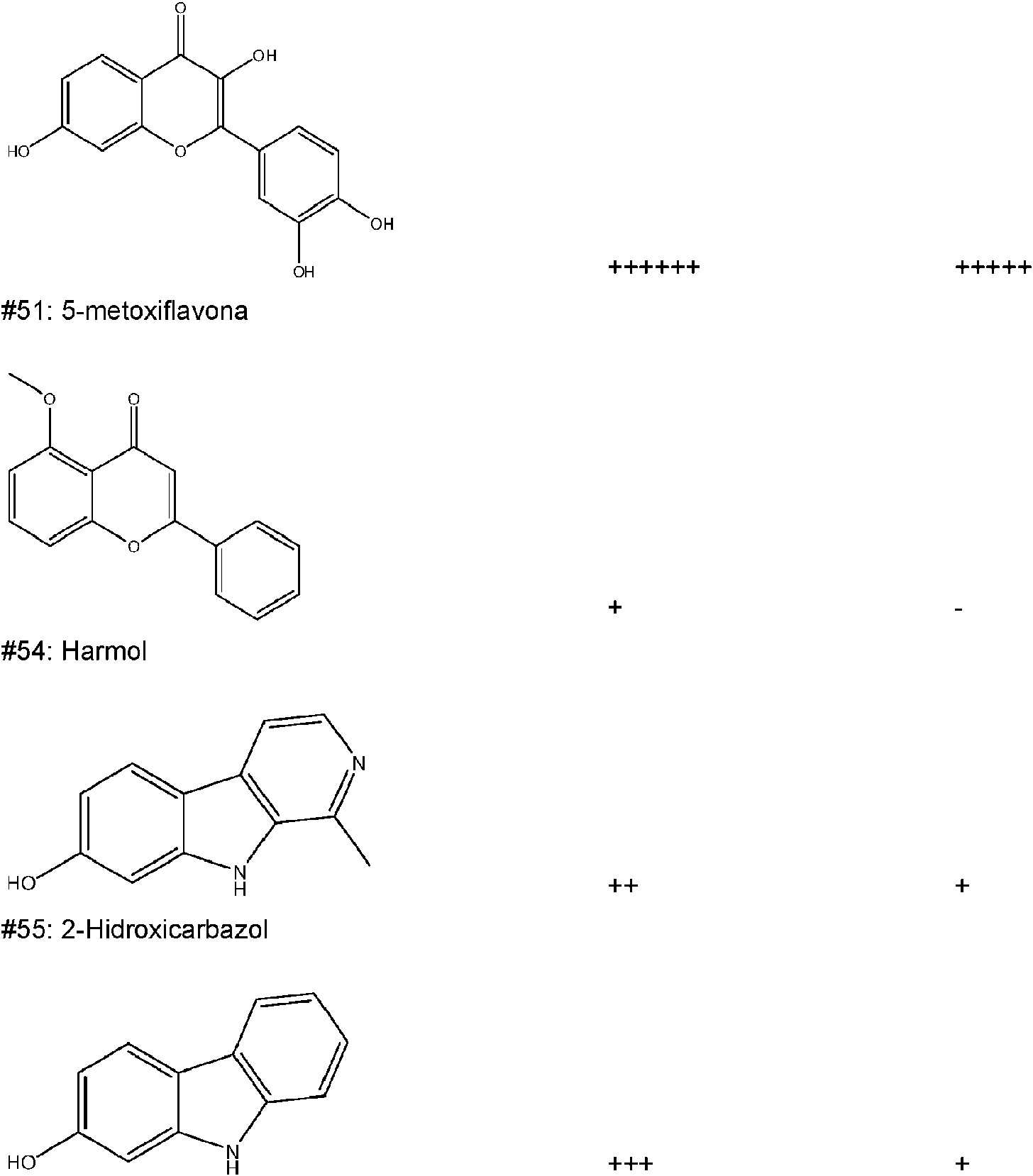
#73: 7,8-Dihidroxi-4-fenilcumarina#73: 7,8-Dihydroxy-4-phenylcoumarin

#84: 1 -Cloro-4-hidroxisoquinolina #84: 1-Chloro-4-hydroxysoquinoline
NIVELES DE UNIÓN AL #25: 5-Amino-2-(trifluorometil)benzimidazolLEVELS OF BONDING TO #25: 5-Amino-2-(trifluoromethyl)benzimidazole

#89: 2-(5-Isoxazolil)-4-metilfenol#89: 2-(5-Isoxazolyl)-4-methylphenol

1-metil-6,7-dihidroxi-1,2,3,4-tetrahidroisoquinol1-methyl-6,7-dihydroxy-1,2,3,4-tetrahydroisoquinol


NIVELES DE UNIÓN AL #25: 5-Amino-2-(trifluorometil)benzimidazolLEVELS OF BONDING TO #25: 5-Amino-2-(trifluoromethyl)benzimidazole

#200: 6-Etil-3-(4-fluorofenil)-7-hidroxi-2-metil-4H-c#200: 6-Ethyl-3-(4-fluorophenyl)-7-hydroxy-2-methyl-4H-c

#201: 7,8-Dimetoxi-2-metil-3-fenil-4H-cromo-4-ona#201: 7,8-Dimethoxy-2-methyl-3-phenyl-4H-chromo-4-one

#202: 7-Hidroxi-2,8-dimetil-3-(4-fenil-4H-1,2,4-triazo#202: 7-Hydroxy-2,8-dimethyl-3-(4-phenyl-4H-1,2,4-triazo
++
na-4(1H)-onana-4(1H)-one


#205: 2-(3,4-Dimetoxifenil)-3,6-dimetoxi-4H-cromo-4#205: 2-(3,4-Dimethoxyphenyl)-3,6-dimethoxy-4H-chromium-4


#207: 3,6-Dihidroxi-2-(3-hidroxifeml)-4H-cromo-4-ona#207: 3,6-Dihydroxy-2-(3-hydroxyfeml)-4H-chromo-4-one


#216: 2-(Furan-2-yl)-3-hidroxi-6,8-dimetil-4H-cromo-4#216: 2-(Furan-2-yl)-3-hydroxy-6,8-dimethyl-4H-chromo-4

NIVELES DE UNIÓN AL #25: 5-Amino-2-(trifluorometil)benzimidazol #217: 3-hidroxi-6,8-dimetil-2-(tiofen-2-il)-4H-cromoBONDING LEVELS TO #25: 5-Amino-2-(trifluoromethyl)benzimidazole #217: 3-hydroxy-6,8-dimethyl-2-(thiophen-2-yl)-4H-chromium
++++++

NIVELES DE UNIÓN AL #25: 5-Amino-2-(trifluorometil)benzimidazolLEVELS OF BONDING TO #25: 5-Amino-2-(trifluoromethyl)benzimidazole

imidazolimidazole
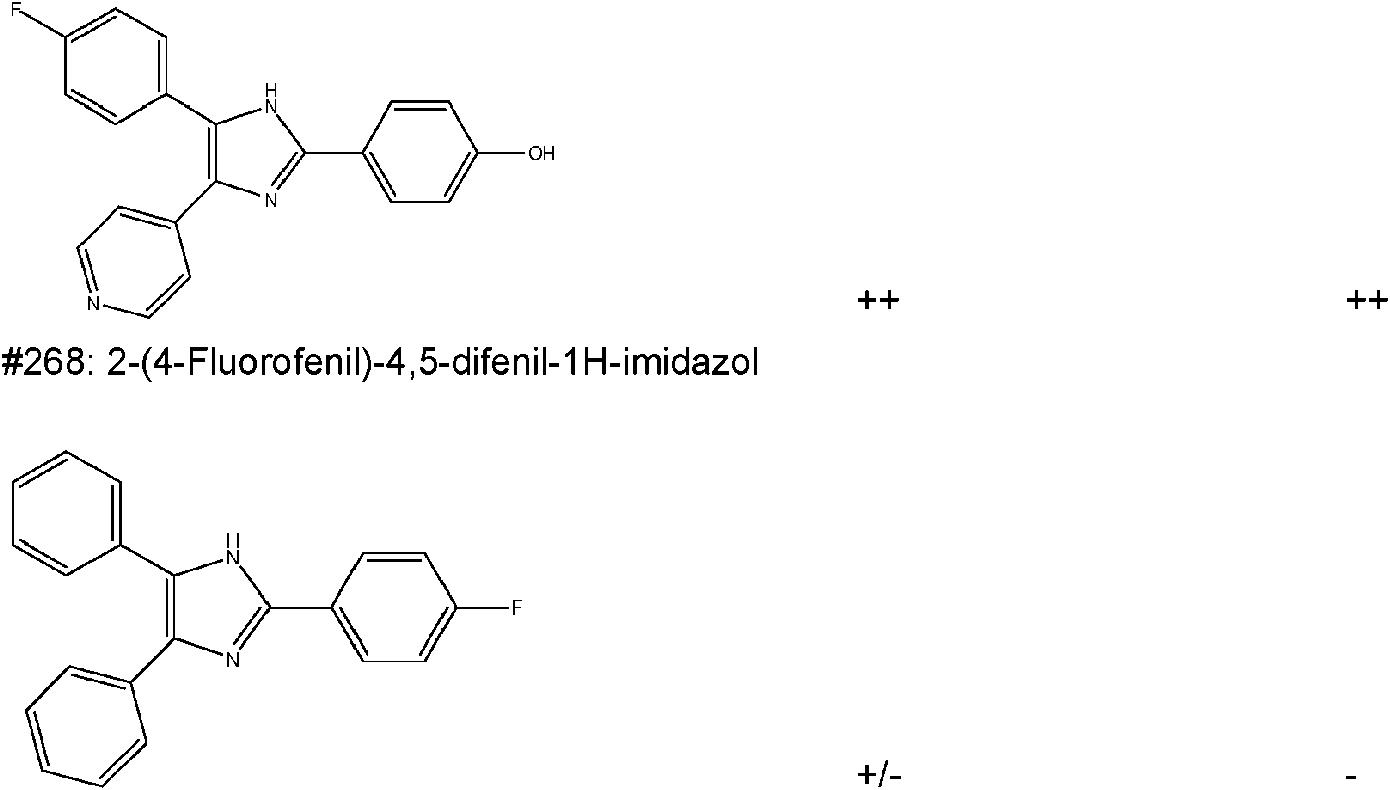
La Tabla 3 proporciona ejemplos de agentes de obtención de imágenes derivados de los andamiajes golpeados. Los fluoruros se muestran en las estructuras como equivalentes al fluoruro 18F y los grupos metílicos son equivalentes a los grupos metílicos de carbono 11C.Table 3 provides examples of imaging agents derived from struck scaffolds. The fluorides are shown in the structures as equivalent to the 18F fluoride and the methyl groups are equivalent to the 11C carbon methyl groups.
Tabla 3: Ejemplos de análogos radiomarcados útiles para la detección de biomarcadores de la AD in vivo. Estos m n l r f r n i n f rm n r l inv ni n. Table 3: Examples of radiolabeled analogs useful for the detection of biomarkers of AD in vivo. These mnlrfrninf rm nrl inv ni n.

(continuación)(continuation)

(continuación)(continuation)
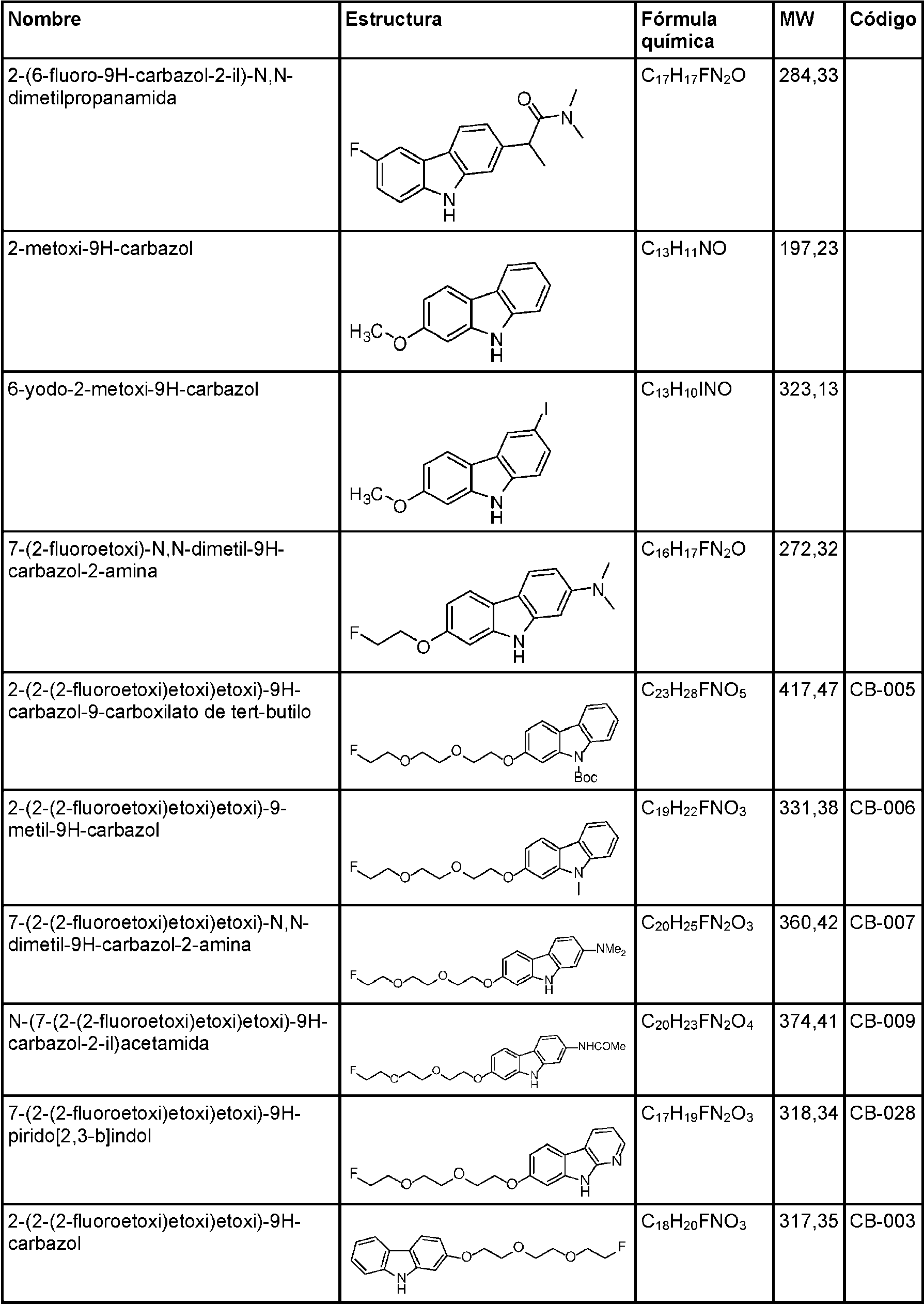
(continuación)(continuation)

(continuación)(continuation)
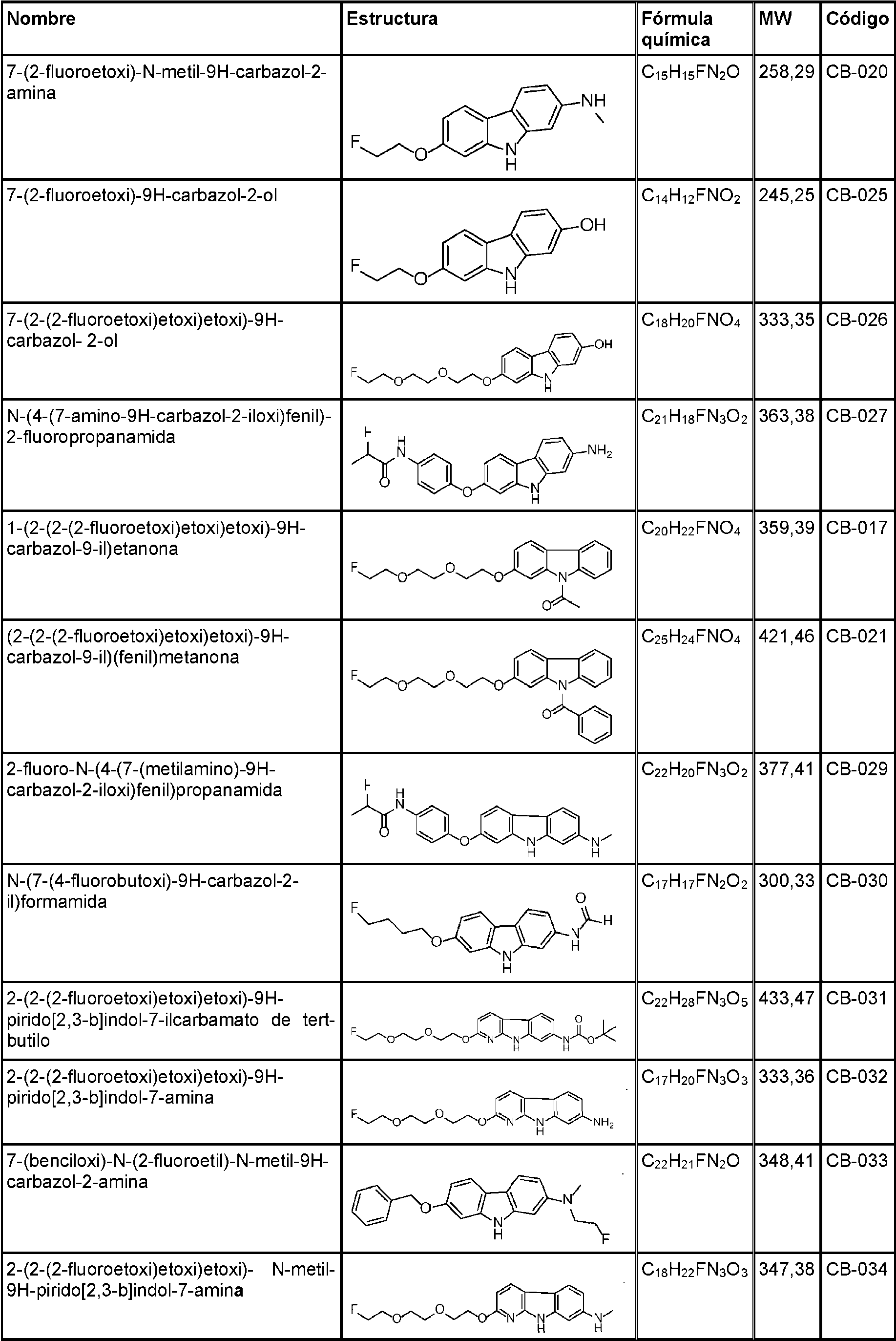
(continuación)(continuation)

(continuación)(continuation)

(continuación)(continuation)

Síntesis de ligandos y sus precursores de etiquetado:Synthesis of ligands and their labeling precursors:
Halogenación y radiohalogenación:Halogenation and radiohalogenation:
Como se divulga en el presente documento, para un número de diferentes ligandos AD, tales como flavonas, cumarinas, carbazoles, quinolinonas, cromoonas, imidazoles trisustituidos y sus derivados como se divulga en el presente documento, el átomo radiomarcado, tal como un átomo de halógeno, por ejemplo, puede ser fácilmente introducido en el ligando utilizando un número de diferentes procedimientos bien conocidos la técnica. En consecuencia, los compuestos radiomarcados de la Fórmula I de la presente solicitud pueden prepararse utilizando procedimientos estándar conocidos en la técnica para preparar dichos compuestos radiomarcados que tienen un sustituyente particular, en los que el compuesto puede incorporarse con un radionúclido particular seleccionado del grupo que consiste en 11C, 13N, 15O, 18F, 1231,1241,1251,131I y 77Br.As disclosed herein, for a number of different AD ligands, such as flavones, coumarins, carbazoles, quinolinones, chromoones, trisubstituted imidazoles, and their derivatives as disclosed herein, the radiolabelled atom, such as an atom of Halogen, for example, can be readily introduced into the ligand using a number of different procedures well known in the art. Accordingly, the radiolabeled compounds of Formula I of the present application can be prepared using standard procedures known in the art for preparing such radiolabeled compounds having a particular substituent, wherein the compound can be incorporated with a particular radionuclide selected from the group consisting at 11 C, 13 N, 15 O, 18 F, 123 1, 124 1, 125 1,131 I, and 77 Br.
En un ejemplo particular, el halógeno puede ser introducido por un procedimiento que utiliza un procedimiento de intercambio de estaño por halógeno. Por ejemplo, un halógeno no radiactivo, tal como el yodo, puede ser sustituido por un compuesto de organoestaño a través de un metal, tal como una composición de paladio, para formar el precursor de estaño radiomarcado, como se representa a continuación. Este precursor se somete entonces a la halogenación radiactiva mediante el desplazamiento con la fuente Na125I , por ejemplo, para obtener el ligando radiactivo.In a particular example, the halogen can be introduced by a process using a tin-for-halogen exchange process. For example, a nonradioactive halogen, such as iodine, can be substituted for an organotin compound via a metal, such as a palladium composition, to form the radiolabeled tin precursor, as depicted below. This precursor is then subjected to radioactive halogenation by displacement with the Na125I source, for example, to obtain the ligand radioactive.

Alternativamente, el halógeno radioetiquetado puede introducirse fácilmente mediante halogenación directa. Por ejemplo, para un ligando que comprende un anillo aromático como parte del andamio, o un sustituyente aromático de un ligando, el anillo aromático puede ser yodado directamente utilizando un procedimiento de radoiodinación bien establecido. Uno de estos ejemplos se representa a continuación utilizando un ligando de carbazolAlternatively, the radiolabelled halogen can be easily introduced by direct halogenation. For example, for a ligand comprising an aromatic ring as part of the scaffold, or an aromatic substituent on a ligand, the aromatic ring can be directly iodinated using a well-established r-iodination procedure. One such example is depicted below using a carbazole ligand

Para los compuestos marcados con 11C, el compuesto marcado puede prepararse mediante la alquilación o metilación de un grupo hidroxilo, como por ejemplo con [11C]CH3I para proporcionar el correspondiente derivado metoxi marcado con C-11. Por ejemplo, dicho proceso está representado por la reacción del derivado de la flavona que se muestra a continuación.For 11C-labeled compounds, the labeled compound can be prepared by alkylation or methylation of a hydroxyl group, such as with [11C]CH3I to provide the corresponding C-11-labeled methoxy derivative. For example, such a process is represented by the flavone derivative reaction shown below.

Otros procedimientos de preparación de ligandos radiomarcados son bien conocidos en la técnica. Ejemplos de tales procedimientos se divulgan en, por ejemplo: 1)Jewett, D.M. (1992) A Simple Synthesis of [11C]Metil Triflate Appl. Radiat. Isot. 43, 1383-1385; 2) Crouzel, C. Langstrom, B., Pike, V.W., y Coenen, H.H. (1987) Recommendations for a practical production of [11C]methyl iodide Appl. Radiat. Isot. Int. J. Appl. Instrum. Part A 38, 601-603; Dannals, R.F., Ravert, H.T.; 3) Wilson, A.A. (1990) Radiochemistry of Tracers for Neurotransmitter Receptor Studies. In: Quantitative Imaging: Neuroreceptors, Neurotransmitters, and Enzymes. (Editado por Frost, J.J. Wagner Jr., H.N. pp. 19-35, Raven Press, Nueva York; 4) Jewett, D.M., Manger, T.J., y Watkins, G.L. (1991) Captive Solvent Methods for Fast Simple Carbon-11 Radioalkylations. In: New Trends in Radiopharmaceutical Synthesis, Quality Assurance and Regulatory Control (Editado por Emran, A.M.) pp. 387-391. Plenum Press, Nueva York; 5) Marazano, C., Maziere, M., Berger, G., y Comar, D. (1977) Synthesis of metil iodide-11C and formaldehyde-11C Appl. Radiat. Isot. 28, 49-52; 6) Watkins, G., Jewett, D., Mulholland, G., Kitbourn, M., y Toorongian, S. (1988) A Captive Solvent Method for Rapid N-[11C]Metilation of Secondary Amides: Application to the Benzodiazepine, 4'-Chlorodiazepam (RO5-4864) Appl. Radiat. Isot. 39, 441 444y 7) Wilson, A. A., DaSilva, J.N., y Houle, S. (1996) In vivo evaluation of [11C] and [15F]-labelled cocaine analogues as potential dopamine transporter ligands for positron emission tomography Nucl. Med. Biol. 23, 141-146. Other methods of preparing radiolabeled ligands are well known in the art. Examples of such procedures are disclosed in, for example: 1) Jewett, DM (1992) A Simple Synthesis of [11C]Methyl Triflate Appl. Radiat. isot. 43, 1383-1385; 2) Crouzel, C. Langstrom, B., Pike, VW, and Coenen, HH (1987) Recommendations for a practical production of [11C]methyl iodide Appl. Radiat. isot. Int. J. Appl. Instrument. Part A 38, 601-603; Dannals, R.F., Ravert, H.T.; 3) Wilson, AA (1990) Radiochemistry of Tracers for Neurotransmitter Receptor Studies. In: Quantitative Imaging: Neuroreceptors, Neurotransmitters, and Enzymes. (Edited by Frost, JJ Wagner Jr., HN pp. 19-35, Raven Press, New York; 4) Jewett, DM, Manger, TJ, and Watkins, GL (1991) Captive Solvent Methods for Fast Simple Carbon-11 Radioalkylations . In: New Trends in Radiopharmaceutical Synthesis, Quality Assurance and Regulatory Control (Edited by Emran, AM) pp. 387-391. Plenum Press, New York; 5) Marazano, C., Maziere, M., Berger, G., and Comar, D. (1977) Synthesis of methyl iodide-11C and formaldehyde-11C Appl. Radiat. isot. 28, 49-52; 6) Watkins, G., Jewett, D., Mulholland, G., Kitbourn, M., and Toorongian, S. (1988) A Captive Solvent Method for Rapid N-[11C]Methylation of Secondary Amides: Application to the Benzodiazepine , 4'-Chlorodiazepam (RO5-4864) Appl. Radiat. isot. 39, 441 444y 7) Wilson, AA, DaSilva, JN, and Houle, S. (1996) In vivo evaluation of [11C] and [15F]-labelled cocaine analogues as potential dopamine transporter ligands for positron emission tomography Nucl. Med. Biol. 23, 141-146.
Síntesis de AD-CB-WZ01013Synthesis of AD-CB-WZ01013

Al hidroxicarbazol (73 mg, 0,4 mmol) en 1 m de NMP se añadió CS2CO3(130 mg, 0,4 mmol) y bromofluoroetano (51 mg, 0,4 mmol). La mezcla se agitó ata durante 15 h y se diluyó con Et2O (50 ml). Se lavó con HCl 1 M (30 ml) y agua (2x40 ml), se secó sobre MgSO4 y se concentró. El producto crudo se purificó con cromatografía de sílice (4% EtOAc en hexano al 25 %) para obtener el producto deseado (36 mg) como un sólido blanquecino.To the hydroxycarbazole (73 mg, 0.4 mmol) in 1 m NMP was added CS2CO3 (130 mg, 0.4 mmol) and bromofluoroethane (51 mg, 0.4 mmol). The mixture was stirred at ta for 15 h and diluted with Et 2 O (50 mL). Washed with 1M HCl (30 mL) and water (2x40 mL), dried over MgSO 4 and concentrated. The crude product was purified with silica chromatography (4% EtOAc in 25% hexane) to obtain the desired product (36 mg) as an off-white solid.
1H RMN (400 MHz, CDCk/acetona-da) 89,98 (s, 1 H), 7,95 (t, J = 8,8 Hz, 2 H), 7,40 (d, J = 8,0 Hz, 1 H), 7,28 (t, J = 8 Hz, 1 H), 7,13 (t, J = 8,0 Hz, 1 H), 7.00 (d, J = 2 Hz, 1 H), 6,83 (dd, J = 8,8, 2,0 Hz, 1 H), 4,85 (t, J = 4 Hz, 1 H), 4,73 (t, J = 4 Hz, 1 H), 4,35 (t, J = 4 Hz, 1 H), 4,28 (t, J = 4 Hz, 1 H); MS(ESI) m/z 230 (M+H+).1H NMR (400 MHz, CDCk/acetone-da) 89.98 (s, 1H), 7.95 (t, J = 8.8 Hz, 2H), 7.40 (d, J = 8.0 Hz, 1H), 7.28 (t, J = 8Hz, 1H), 7.13 (t, J = 8.0Hz, 1H), 7.00 (d, J = 2Hz, 1H) , 6.83 (dd, J = 8.8, 2.0 Hz, 1 H), 4.85 (t, J = 4 Hz, 1 H), 4.73 (t, J = 4 Hz, 1 H ), 4.35 (t, J = 4 Hz, 1 H), 4.28 (t, J = 4 Hz, 1 H); MS(ESI) m/z 230 (M+H+).
Síntesis de AD-C-WZ01011Synthesis of AD-C-WZ01011

Al hidroxicarbazol (183 mg, 1 mmol) en 4 ml de NMP se añadió Cs2CO3 (326 mg, 1 mmol) y etilendi-tosilato (370 mg, 1 mmol). La mezcla se agitó ata durante 15 h y se diluyó con Et2O (80 ml). Se lavó con HCl 1 M (50 ml) y agua (2x50 ml), se secó sobre MgSO4 y se concentró. El producto crudo se purificó con cromatografía de sílice (50% DCM en hexano a 100% DCM) para obtener el producto deseado (75 mg) como un sólido blanquecino.To the hydroxycarbazole (183 mg, 1 mmol) in 4 mL NMP was added Cs 2 CO 3 (326 mg, 1 mmol) and ethylene di-tosylate (370 mg, 1 mmol). The mixture was stirred at ta for 15 h and diluted with Et 2 O (80 mL). Washed with 1M HCl (50 mL) and water (2*50 mL), dried over MgSO 4 and concentrated. The crude product was purified with silica chromatography (50% DCM in hexane to 100% DCM) to obtain the desired product (75 mg) as an off-white solid.
1H RMN (400 MHz, acetona-da) 810,21 (s, 1 H), 8,00 (d, J = 8,0 Hz, 1 H), 7,95 (d, J = 8,4 Hz, 1 H), 7,84 (d, J = 8,4 Hz, 2 H), 7,45 (m, 3 H), 7,30 (t, J = 8,0 Hz, 1 H), 7.13 (t, J = 8,0 Hz, 1 H), ); 6,98 (s, 1 H), 6,73 (d, J = 8,4 Hz, 1 H), 4,44 (t, J = 4,0 Hz, 2 H), 4,30 (t, J = 4,0 Hz, 2 H), 2,42 (s, 3 H); MS(ESI) m/z 382 (M+H+), 404 (M+Na+).1H NMR (400 MHz, acetone-da) 810.21 (s, 1H), 8.00 (d, J = 8.0 Hz, 1H), 7.95 (d, J = 8.4 Hz, 1H), 7.84 (d, J = 8.4 Hz, 2H), 7.45 (m, 3H), 7.30 (t, J = 8.0 Hz, 1H), 7.13 ( t, J = 8.0 Hz, 1 H), ); 6.98 (s, 1H), 6.73 (d, J=8.4Hz, 1H), 4.44 (t, J=4.0Hz, 2H), 4.30 (t, J = 4.0 Hz, 2H), 2.42 (s, 3H); MS(ESI) m/z 382 (M+H+), 404 (M+Na+).
Síntesis de AD-CB-001P-WZ-01019 marcado con 18F ([18F]2-(2-Fluoro-etoxi)-9H-carbazol)Synthesis of AD-CB-001P-WZ-01019 labeled with 18F ([18F]2-(2-Fluoro-ethoxy)-9H-carbazole)
k 18f Kryptof k18f Kryptof
eCN.'DMSQ 
Semi-prep HPLCSemi-prep HPLC


El [18F]Fluoruro (600 - 900 mCi) como solución enriquecida en H218O fue entregado al módulo de síntesis. El [18F]fluoruro se atrapó en una columna de intercambio iónico y se eludió en el recipiente de reacción utilizando carbonato potásico acuoso (3,0 mg en 0,4 ml de H2O). Se añadió el reactivo de transferencia de fase Kryptofix-2.2.2 (20,0 mg en 1,0 ml de MeCN) y el azeótropo agua-acetonitrilo se evaporó hasta sequedad. Se añadió al reactor el precursor del éster 2-(9H-carbazol-2-iloxi)-etilo del ácido tolueno-4-sulfónico (4 mg en 0,9 ml de MeCN / 0,1 ml de DMSO) y luego se calentó la reacción de fluoración a 115 °C durante 10 min. La mezcla de reacción cruda se purificó por HPLC semipreparativa (Columna: Phenomenex Luna C-18, 250 mm x 10 mm; Gradiente de la fase móvil 95:5 H20 (+0,05 % TFA) : MeCN (+0,05 % TFA) a 100 % MeCN (+0,05 % TFA); Caudal: 5 ml/min).The [18F]Fluoride (600 - 900 mCi) as a solution enriched in H 2 18O was delivered to the synthesis module. The [18F]fluoride was trapped on an ion exchange column and eluted from the reaction vessel using aqueous potassium carbonate (3.0 mg in 0.4 mL H 2 O). Kryptofix-2.2.2 phase transfer reagent (20.0 mg in 1.0 mL MeCN) was added and the water-acetonitrile azeotrope evaporated to dryness. was added to the reactor Toluene-4-sulfonic acid 2-(9H-carbazol-2-yloxy)-ethyl ester precursor (4 mg in 0.9 mL MeCN/0.1 mL DMSO) and then heated the fluorination reaction to 115 °C for 10 min. The crude reaction mixture was purified by semi-preparative HPLC (Column: Phenomenex Luna C-18, 250 mm x 10 mm; Mobile phase gradient 95:5 H 20 (+0.05% TFA): MeCN (+0.05 % TFA) to 100% MeCN (+0.05% TFA); Flow rate: 5 mL/min).
El pico correspondiente al [18F]2-(2-fluoro-etoxi)-9H-carbazol se recogió y se diluyó simultáneamente con agua estéril (10 ml). La mezcla resultante se pasó por un C-18 Sep-Pak para que el producto quedara atrapado y el acetonitrilo residual se lavó con más agua (10 ml). el [18F]2-(2-Fluoro-etoxi)-9H-carbazol se eludió entonces en el vial del producto con etanol de grado USP (0,5 ml) y se diluyó con agua estéril (9,5 ml) para proporcionar una formulación final (19 - 34 mCi en 10 ml) adecuada para la inyección (rendimiento corregido por decaimiento del 7,5 %, pureza radioquímica del 100 %).The peak corresponding to [18F]2-(2-fluoro-ethoxy)-9H-carbazole was collected and simultaneously diluted with sterile water (10 mL). The resulting mixture was passed through a C-18 Sep-Pak to trap the product and residual acetonitrile washed with more water (10 mL). [18F]2-(2-Fluoro-ethoxy)-9H-carbazole was then eluted from the product vial with USP grade ethanol (0.5 mL) and diluted with sterile water (9.5 mL) to give a final formulation (19-34 mCi in 10 mL) suitable for injection (7.5% decay-corrected yield, 100% radiochemical purity).
La pureza se determinó por HPLC analítica equipada con un detector de radiactividad y la identidad se confirmó por comparación con los datos de HPLC para el correspondiente estándar de referencia no marcado.Purity was determined by analytical HPLC equipped with a radioactivity detector and identity was confirmed by comparison with HPLC data for the corresponding unlabeled reference standard.
Figura 3: Análisis por UV y HPLC gamma de AD-CB-001P-WZ-01019Figure 3: UV and HPLC gamma analysis of AD-CB-001P-WZ-01019
Síntesis de AD-CB-002P-WZ01031.Synthesis of AD-CB-002P-WZ01031.

Al hidroxicarbazol (92 mg, 0,5 mmol) en 2 ml de NMP se añadió Cs2CO3 (163 mg, 0,5 mmol) y etiltosilato de azida (121 mg, 0,5 mmol). La mezcla se agitó ata durante 15 h y se diluyó con Et2O (50 ml). Se lavó con HCl 0,5 M (50 ml) y agua (2x50 ml), se secó sobre MgSO4 y se concentró. El producto crudo se purificó con cromatografía de sílice (80 % DCM en hexano a 100 % DCM) para obtener el producto deseado (76 mg) como sólido blanco.To the hydroxycarbazole (92 mg, 0.5 mmol) in 2 mL NMP was added Cs 2 CO 3 (163 mg, 0.5 mmol) and azide ethyltosylate (121 mg, 0.5 mmol). The mixture was stirred at ta for 15 h and diluted with Et 2 O (50 mL). It was washed with 0.5M HCl (50 mL) and water (2x50 mL), dried over MgSO 4 and concentrated. The crude product was purified with silica chromatography (80% DCM in hexane to 100% DCM) to obtain the desired product (76 mg) as a white solid.
1H RMN (400 MHz, CDCh/acetona-da) 59,98 (s, 1 H), 7,95 (m, 2 H), 7,41 (d, J = 8,4 Hz, 1 H), 7,29 (t, J = 8,0 Hz, 1 H), 7,14 (t, J = 8.0 Hz, 1 H); 7,01 (s, 1 H), 6,84 (d, J = 8,4 Hz, 1 H), 4,28 (t, J = 4,8 Hz, 2 H), 3,67 (t, J = 4,8 Hz, 2 H); MS(ESI) m/z 253 (M+H+).1H NMR (400 MHz, CDCh/acetone-da) 59.98 (s, 1H), 7.95 (m, 2H), 7.41 (d, J = 8.4 Hz, 1H), 7 .29 (t, J = 8.0 Hz, 1 H), 7.14 (t, J = 8.0 Hz, 1 H); 7.01 (s, 1H), 6.84 (d, J=8.4Hz, 1H), 4.28 (t, J=4.8Hz, 2H), 3.67 (t, J=4.8Hz, 2H); MS(ESI) m/z 253 (M+H+).
Síntesis de AD-CB-002S-WZ01033Synthesis of AD-CB-002S-WZ01033

Al azido carbazol (32 mg, 0,127 mmol) en 0,5 ml de DMF se añadió Cul (7,6 mg, 0,04 mmol), DIPEA (16,4 mg, 0,127 mmol) y fluoropentina (16,4 mg, 0,19 mmol). La mezcla de reacción se agitó enérgicamente durante 1 h y se diluyó con EtOAc (30 ml). Se lavó con agua (50 ml), HCl 0,5 M (30 ml), agua (2x50 ml), se secó sobre MgSO4 y se concentró. El producto crudo se preabsorbió en sílice (3 g) y se cargó en una columna de sílice de 4 g y se eludiócon EtOAc al 30 % en hexano al 50 % para obtener el compuesto deseado (20 mg).To the carbazole azido (32 mg, 0.127 mmol) in 0.5 mL DMF was added Cul (7.6 mg, 0.04 mmol), DIPEA (16.4 mg, 0.127 mmol), and fluoropentin (16.4 mg, 0.19mmol). The reaction mixture was stirred vigorously for 1 h and diluted with EtOAc (30 mL). Washed with water (50 mL), 0.5M HCl (30 mL), water (2x50 mL), dried over MgSO4, and concentrated. The crude product was pre-absorbed onto silica (3 g) and loaded onto a 4 g silica column and eluted with 30% EtOAc in 50% hexane to give the desired compound (20 mg).
1H RMN (400 MHz, CDCls/CDsOD) 57,95 (d, J = 7,6 Hz, 1 H), 7,91 (d, J = 8,4 Hz, 1 H), 7,76 (s, 1 H), 7,40 (d, J = 8,0 Hz, 1 H), 7,31 (t, J = 7,6 Hz, 1 H), 7,14 (t, J = 7,6 Hz, 1 H), 6.94 (d, J = 2,4 Hz, 1 H), 6,78 (dd, J = 8,8, 2,4 Hz, 1 H), 4,83-4,78 (m, 2 H), 4,53-4,48 (m, 3 H), 4,40 (t, J = 6,0 Hz, 1 H), 2,85 (t, J = 7,6 Hz, 2 H), 2,10-1,99 (m, 2 H); MS(ESI) m/z 339 (M+H+). 1H NMR (400 MHz, CDCls/CDsOD) 57.95 (d, J=7.6 Hz, 1H), 7.91 (d, J=8.4 Hz, 1H), 7.76 (s, 1H), 7.40 (d, J = 8.0 Hz, 1H), 7.31 (t, J = 7.6 Hz, 1H), 7.14 (t, J = 7.6 Hz , 1H), 6.94 (d, J = 2.4 Hz, 1H), 6.78 (dd, J = 8.8, 2.4 Hz, 1H), 4.83-4.78 (m , 2H), 4.53-4.48 (m, 3H), 4.40 (t, J=6.0Hz, 1H), 2.85 (t, J=7.6Hz, 2 H), 2.10-1.99 (m, 2H); MS(ESI) m/z 339 (M+H+).
Síntesis de AD-CB-002S-WZ01033 marcado con 18F:Synthesis of AD-CB-002S-WZ01033 marked with 18F:
Preparación de [18F] 5-Fluoro-pent-l-inaPreparation of [18F] 5-Fluoro-pent-l-ine
i) K 18F, Kryptofix-2.2.2i) K18F, Kryptofix-2.2.2

El [18F] fluoruro (600 - 900 mCi) como solución enriquecida en H218O se entrega al módulo de síntesis. El [18F]fluoruro se atrapa en una columna de intercambio iónico y se elude en el recipiente de reacción utilizando carbonato potásico acuoso (3,0 mg en 0,4 ml de H2O). Se añade el reactivo de transferencia de fase Kryptofix-2.2.2 (20,0 mg en 1,0 ml de MeCN) y el azeótropo agua-acetonitrilo se evapora hasta sequedad.The [18F]fluoride (600 - 900 mCi) as an enriched solution in H 2 18O is delivered to the synthesis module. The [18F]fluoride is trapped on an ion exchange column and eluted from the reaction vessel using aqueous potassium carbonate (3.0 mg in 0.4 mL H 2 O). Kryptofix-2.2.2 phase transfer reagent (20.0 mg in 1.0 mL MeCN) is added and the water-acetonitrile azeotrope evaporated to dryness.
Se añade al reactor el éster de pent-4-inilo del ácido tolueno-4-sulfónico (20 mg en 0,8 ml de MeCN) y se calienta la reacción de fluoración a 110 °C durante 5 min. Tras la fluoración, la mezcla cruda de reacción se purifica por destilación y se obtiene [18F] 5-fluoro-pent-1-ino como solución en acetonitrilo (atrapada a -78 °C debido a la volatilidad del producto).Toluene-4-sulfonic acid pent-4-ynyl ester (20 mg in 0.8 mL MeCN) is added to the reactor and the fluorination reaction is heated at 110 °C for 5 min. After fluorination, the crude reaction mixture is purified by distillation and [18F] 5-fluoro-pent-1-yne is obtained as a solution in acetonitrile (trapped at -78 °C due to product volatility).
Preparación del triazol:Preparation of the triazole:
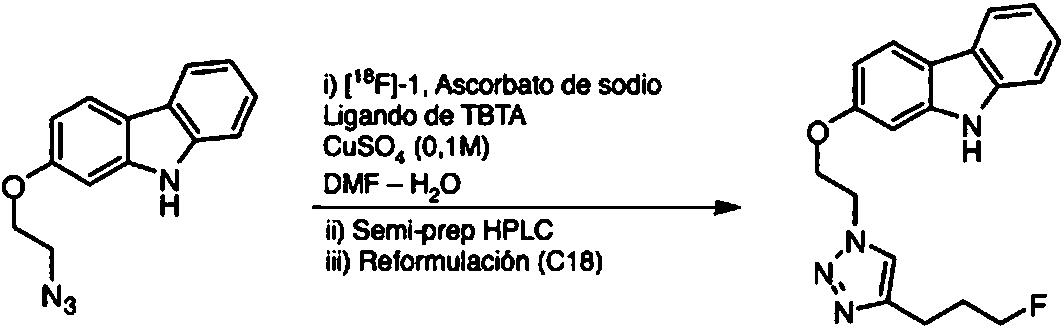
Se añade una mezcla de precursor de azida (5 mg), ascorbato de sodio (40 mg), fr/s-(benciltriazolilmetil) amina (TBTA, 25 mg) y solución acuosa de sulfato de cobre (0,1 M, 0,25 ml) en DMF (0,4 ml) y agua (0,1 ml) a la solución de pentina enfriada descrita anteriormente. La mezcla de reacción se calienta hastata y se agita durante 30 minutos. Transcurrido este tiempo, la reacción se purifica por HPLC semipreparativa. Se recoge el pico correspondiente al producto y se diluye simultáneamente con agua estéril (10 ml). La mezcla resultante se pasa por un C-18 Sep-Pak y el acetonitrilo residual se lava con agua adicional (10 ml). El producto se elude en el vial del producto con etanol de grado USP (0,5 ml) y se diluye con agua estéril (9,5 ml) proporcionando una formulación final adecuada para la inyección.Add a mixture of azide precursor (5 mg), sodium ascorbate (40 mg), fr/s-(benzyltriazolylmethyl)amine (TBTA, 25 mg), and aqueous copper sulfate solution (0.1 M, 0. 25 mL) in DMF (0.4 mL) and water (0.1 mL) to the chilled pentin solution described above. The reaction mixture is heated up to and stirred for 30 minutes. After this time, the reaction is purified by semi-preparative HPLC. The peak corresponding to the product is collected and simultaneously diluted with sterile water (10 ml). The resulting mixture is passed through a C-18 Sep-Pak and residual acetonitrile is washed with additional water (10 mL). The product is eluted in the product vial with USP grade ethanol (0.5 mL) and diluted with sterile water (9.5 mL) to provide a final formulation suitable for injection.
La pureza se determina por HPLC analítica equipada con un detector de radiactividad y la identidad se confirma por comparación con los datos de HPLC para el correspondiente estándar de referencia no etiquetado.Purity is determined by analytical HPLC equipped with a radioactivity detector and identity is confirmed by comparison with HPLC data for the corresponding unlabeled reference standard.
Síntesis de CB-003 marcado con 18FSynthesis of 18F-labeled CB-003

El [18F] fluoruro (600 - 900 mCi) como solución enriquecida en H218O se entrega al módulo de síntesis. El [18F]fluoruro se atrapa en una columna de intercambio iónico y se elude en el recipiente de reacción utilizando carbonato potásico acuoso (3,0 mg en 0,4 ml de H2O). Se añade el reactivo de transferencia de fase Kryptofix-2.2.2 (20,0 mg en 1,0 ml de MeCN) y el azeótropo agua-acetonitrilo se evapora hasta sequedad. Se añade el precursor (4 mg en 0,9 ml de MeCN / 0,1 ml de DMSO) al reactor y se calienta la reacción de fluoración a 115 °C durante 10 min. La mezcla se enfrió a 55 °C y la mayor parte del acetonitrilo se evaporó al vacío y con una corriente de argón como antes. Al producto bruto protegido con Boc se le añadió ácido clorhídrico acuoso (1,0 M, 1,0 ml), y la mezcla se calentó a 105 °C durante 3 minutos. Tras enfriar a 35 °C, se añadió acetato de sodio acuoso (2,0 M, 0,5 ml) con agitación. A continuación, la mezcla de reacción cruda se purifica mediante HPLC semipreparativa (Columna: Phenomenex Luna C-18, 250 mm x 10 mm; Gradiente de la fase móvil 95:5 H2O (+0,05% TFA) : MeCN (+0,05 % TFA) a 100 % MeCN (+0,05 % TFA); Caudal: 5 ml/min; tiempo = 25 min). Se recoge el pico correspondiente al producto final y se diluye simultáneamente con agua estéril (10 ml). La mezcla resultante se pasa por un C-18 Sep-Pak para que el producto quede atrapado y el acetonitrilo residual se lava con más agua (10 ml). A continuación, el producto se elude en el vial del producto con etanol de grado USP (0,5 ml) y se diluye con agua estéril (9,5 ml) proporcionando una formulación final apta para la inyección (31 % de rendimiento de decadencia no corregido, 100% de pureza radioquímica). La pureza se determinó mediante HPLC analítica equipada con un detector de radiactividad y la identidad se confirmó por comparación con los datos de HPLC del correspondiente estándar de referencia no marcado.The [18F]fluoride (600 - 900 mCi) as an enriched solution in H 2 18O is delivered to the synthesis module. The [18F]fluoride is trapped on an ion exchange column and eluted from the reaction vessel using aqueous potassium carbonate (3.0 mg in 0.4 mL H 2 O). Kryptofix-2.2.2 phase transfer reagent (20.0 mg in 1.0 mL MeCN) is added and the water-acetonitrile azeotrope evaporated to dryness. The precursor (4 mg in 0.9 mL MeCN/0.1 mL DMSO) is added to the reactor and the fluorination reaction is heated at 115 °C for 10 min. The mixture was cooled to 55°C and most of the acetonitrile was evaporated in vacuo and under a stream of argon as before. Aqueous hydrochloric acid (1.0 M, 1.0 mL) was added to the crude Boc-protected product, and the mixture was heated at 105 °C for 3 minutes. After cooling to 35°C, aqueous sodium acetate (2.0M , 0.5ml) was added with stirring. The crude reaction mixture is then purified by semi-preparative HPLC (Column: Phenomenex Luna C-18, 250 mm x 10 mm; Mobile phase gradient 95:5 H 2 O (+0.05% TFA): MeCN ( +0.05% TFA) to 100% MeCN (+0.05% TFA); Flow rate: 5 mL/min; time = 25 min). The peak corresponding to the final product is collected and simultaneously diluted with sterile water (10 ml). The resulting mixture is passed through a C-18 Sep-Pak to trap the product and residual acetonitrile is washed with more water (10 mL). The product is then eluted into the product vial with USP grade ethanol (0.5 mL) and diluted with sterile water (9.5 mL) to provide a final formulation suitable for injection (31% decay yield). uncorrected, 100% radiochemical purity). Purity was determined by analytical HPLC equipped with a radioactivity detector and identity was confirmed by comparison with HPLC data of the corresponding unlabeled reference standard.
Síntesis de CB-004 marcado con 18FSynthesis of 18F-labelled CB-004

El [18F] fluoruro (600 - 900 mCi) como solución enriquecida en H218O se entrega al módulo de síntesis. El [18F]fluoruro se atrapa en una columna de intercambio iónico y se elude en el recipiente de reacción utilizando carbonato potásico acuoso (3,0 mg en 0,4 ml de H2O). Se añade el reactivo de transferencia de fase Kryptofix-2.2.2 (20,0 mg en 1,0 ml de MeCN) y el azeótropo agua-acetonitrilo se evapora hasta sequedad. Se añade el precursor (4 mg en 0,9 ml de MeCN / 0,1 ml de DMSO) al reactor y se calienta la reacción de fluoración a 115 °C durante 10 min. La mezcla se enfrió a 55 °C y la mayor parte del acetonitrilo se evaporó al vacío y con una corriente de argón como antes. Al producto bruto protegido con Boc se le añadió ácido clorhídrico acuoso (1,0 M, 1,0 ml), y la mezcla se calentó a 105 °C durante 3 minutos. Tras enfriar a 35 °C, se añadió acetato de sodio acuoso (2,0 M, 0,5 ml) con agitación. A continuación, la mezcla de reacción cruda se purifica mediante HPLC semipreparativa (Columna: Phenomenex Luna C-18, 250 mm x 10 mm; Gradiente de la fase móvil 95:5 H20 (+0,05 % TFA) : MeCN (+0,05 % TFA) a 100 % MeCN (+0,05 % TFA); Caudal: 5 ml/min; tiempo = 25 min). Se recoge el pico correspondiente al producto final y se diluye simultáneamente con agua estéril (10 ml). La mezcla resultante se pasa por un C-18 Sep-Pak para que el producto quede atrapado y el acetonitrilo residual se lava con más agua (10 ml). A continuación, el producto se elude en el vial del producto con etanol de grado USP (0,5 ml) y se diluye con agua estéril (9,5 ml) proporcionando una formulación final apta para la inyección (3% de rendimiento de decadencia no corregido, 100% de pureza radioquímica). La pureza se determinó mediante HPLC analítica equipada con un detector de radiactividad y la identidad se confirmó por comparación con los datos de HPLC del correspondiente estándar de referencia no marcado.The [18F]fluoride (600 - 900 mCi) as an enriched solution in H 2 18O is delivered to the synthesis module. The [18F]fluoride is trapped on an ion exchange column and eluted from the reaction vessel using aqueous potassium carbonate (3.0 mg in 0.4 mL H 2 O). Kryptofix-2.2.2 phase transfer reagent (20.0 mg in 1.0 mL MeCN) is added and the water-acetonitrile azeotrope evaporated to dryness. The precursor (4 mg in 0.9 mL MeCN/0.1 mL DMSO) is added to the reactor and the fluorination reaction is heated at 115 °C for 10 min. The mixture was cooled to 55°C and most of the acetonitrile was evaporated in vacuo and under a stream of argon as before. Aqueous hydrochloric acid (1.0M , 1.0 mL) was added to the Boc-protected crude product, and the mixture was heated at 105°C for 3 minutes. After cooling to 35°C, aqueous sodium acetate (2.0M , 0.5ml) was added with stirring. The crude reaction mixture is then purified by semi-preparative HPLC (Column: Phenomenex Luna C-18, 250 mm x 10 mm; Mobile phase gradient 95:5 H 20 (+0.05% TFA): MeCN (+ 0.05% TFA) to 100% MeCN (+0.05% TFA); Flow rate: 5 mL/min; time = 25 min). The peak corresponding to the final product is collected and simultaneously diluted with sterile water (10 ml). The resulting mixture is passed through a C-18 Sep-Pak to trap the product and residual acetonitrile is washed with more water (10 mL). The product is then eluted into the product vial with USP grade ethanol (0.5 mL) and diluted with sterile water (9.5 mL) to provide a final formulation suitable for injection (3% yield of decay). uncorrected, 100% radiochemical purity). Purity was determined by analytical HPLC equipped with a radioactivity detector and identity was confirmed by comparison with HPLC data of the corresponding unlabeled reference standard.
Síntesis de CB-007 marcado con 18FSynthesis of 18F-labeled CB-007

El [18F] fluoruro (600 - 900 mCi) como solución enriquecida en H218O se entrega al módulo de síntesis. El [18F]fluoruro se atrapa en una columna de intercambio iónico y se elude en el recipiente de reacción utilizando carbonato potásico acuoso (3,0 mg en 0,4 ml de H2O). Se añade el reactivo de transferencia de fase Kryptofix-2.2.2 (20,0 mg en 1,0 ml de MeCN) y el azeótropo agua-acetonitrilo se evapora hasta sequedad. Se añade el precursor (4 mg en 0,9 ml de MeCN / 0,1 ml de DMSO) al reactor y se calienta la reacción de fluoración a 115 °C durante 10 min. La mezcla se enfrió a 55 °C y la mayor parte del acetonitrilo se evaporó al vacío y con una corriente de argón como antes. Al producto bruto protegido con Boc se le añadió ácido clorhídrico acuoso (1,0 M, 1,0 ml), y la mezcla se calentó a 105 °C durante 3 minutos. Tras enfriar a 35 °C, se añadió acetato de sodio acuoso (2,0 M, 0,5 ml) con agitación. A continuación, la mezcla de reacción cruda se purifica mediante HPLC semipreparativa (Columna: Phenomenex Luna C-18, 250 mm x 10 mm; Gradiente de la fase móvil 95:5 H20 (+0,05 % TFA) : MeCN (+0,05 % TFA) a 100 % MeCN (+0,05 % TFA); Caudal: 5 ml/min; tiempo = 25 min). Se recoge el pico correspondiente al producto final y se diluye simultáneamente con agua estéril (10 ml). La mezcla resultante se pasa por un C-18 Sep-Pak para que el producto quede atrapado y el acetonitrilo residual se lava con más agua (10 ml). A continuación, el producto se elude en el vial del producto con etanol de grado USP (0,5 ml) y se diluye con agua estéril (9,5 ml) proporcionando una formulación final apta para la inyección (1,2% de rendimiento de decadencia no corregido, 100% de pureza radioquímica). La pureza se determinó mediante HPLC analítica equipada con un detector de radiactividad y la identidad se confirmó por comparación con los datos de HPLC del correspondiente estándar de referencia no marcado.The [18F]fluoride (600 - 900 mCi) as an enriched solution in H 2 18O is delivered to the synthesis module. The [18F]fluoride is trapped on an ion exchange column and eluted from the reaction vessel using aqueous potassium carbonate (3.0 mg in 0.4 mL H 2 O). Kryptofix-2.2.2 phase transfer reagent (20.0 mg in 1.0 mL MeCN) is added and the water-acetonitrile azeotrope evaporated to dryness. The precursor (4 mg in 0.9 mL MeCN/0.1 mL DMSO) is added to the reactor and the fluorination reaction is heated at 115 °C for 10 min. The mixture was cooled to 55°C and most of the acetonitrile was evaporated in vacuo and under a stream of argon as before. Aqueous hydrochloric acid (1.0M , 1.0 mL) was added to the Boc-protected crude product, and the mixture was heated at 105°C for 3 minutes. After cooling to 35°C, aqueous sodium acetate (2.0M , 0.5ml) was added with stirring. The crude reaction mixture is then purified by semi-preparative HPLC (Column: Phenomenex Luna C-18, 250 mm x 10 mm; Mobile phase gradient 95:5 H 20 (+0.05% TFA): MeCN (+ 0.05% TFA) to 100% MeCN (+0.05% TFA); Flow rate: 5ml/min; time = 25 min). The peak corresponding to the final product is collected and simultaneously diluted with sterile water (10 ml). The resulting mixture is passed through a C-18 Sep-Pak to trap the product and residual acetonitrile is washed with more water (10 mL). The product is then eluted into the product vial with USP grade ethanol (0.5 mL) and diluted with sterile water (9.5 mL) to provide a final formulation suitable for injection (1.2% yield). uncorrected decay, 100% radiochemical purity). Purity was determined by analytical HPLC equipped with a radioactivity detector and identity was confirmed by comparison with HPLC data of the corresponding unlabeled reference standard.
Síntesis de CB-012 marcado con 18FSynthesis of 18F-labeled CB-012

El [18F]Fluoruro (600 - 900 mCi) como solución enriquecida en H218O fue entregado al módulo de síntesis. El [18F]fluoruro se atrapó en una columna de intercambio iónico y se eludió en el recipiente de reacción utilizando carbonato potásico acuoso (3,0 mg en 0,4 ml de H2O). Se añadió el reactivo de transferencia de fase Kryptofix-2.2.2 (20,0 mg en 1,0 ml de MeCN) y el azeótropo agua-acetonitrilo se evaporó hasta sequedad. Se añadió al reactor el precursor del éster 2-(9H-carbazol-2-iloxi)-etilo del ácido tolueno-4-sulfónico (4 mg en 0,9 ml de MeCN / 0,1 ml de DMSO) y luego se calentó la reacción de fluoración a 115 °C durante 10 min. La mezcla de reacción cruda se purificó por HPLC semipreparativa (Columna: Phenomenex Luna C-18, 250 mm x 10 mm; Gradiente de la fase móvil 95:5 H20 (+0,05 % TFA) : MeCN (+0,05 % TFA) a 100 % MeCN (+0,05 % TFA); Caudal: 5 ml/min). Se recogió el pico correspondiente al producto y se diluyó simultáneamente con agua estéril (10 ml). La mezcla resultante se pasó por un C-18 Sep-Pak para que el producto quedara atrapado y el acetonitrilo residual se lavó con más agua (10 ml). El [18F]2-(2-Fluoro-etoxi)-9H-carbazol se eludió entonces en el vial del producto con etanol de grado USP (0,5 ml) y se diluyó con agua estéril (9,5 ml) para obtener una formulación final (19 - 34 mCi en 10 ml) apta para la inyección (2 % de rendimiento sin corregir, 100 % de pureza radioquímica). La pureza se determinó mediante HPLC analítica equipada con un detector de radiactividad y la identidad se confirmó por comparación con los datos de HPLC del correspondiente estándar de referencia no marcado.The [18F]Fluoride (600 - 900 mCi) as a solution enriched in H 2 18O was delivered to the synthesis module. The [18F]fluoride was trapped on an ion exchange column and eluted from the reaction vessel using aqueous potassium carbonate (3.0 mg in 0.4 mL H 2 O). Kryptofix-2.2.2 phase transfer reagent (20.0 mg in 1.0 mL MeCN) was added and the water-acetonitrile azeotrope evaporated to dryness. Toluene-4-sulfonic acid 2-(9H-carbazol-2-yloxy)-ethyl ester precursor (4 mg in 0.9 mL MeCN/0.1 mL DMSO) was added to the reactor and then heated. fluorination reaction at 115 °C for 10 min. The crude reaction mixture was purified by semi-preparative HPLC (Column: Phenomenex Luna C-18, 250 mm x 10 mm; Mobile phase gradient 95:5 H 20 (+0.05% TFA): MeCN (+0.05 % TFA) to 100% MeCN (+0.05% TFA); Flow rate: 5 mL/min). The peak corresponding to the product was collected and simultaneously diluted with sterile water (10 ml). The resulting mixture was passed through a C-18 Sep-Pak to trap the product and residual acetonitrile washed with more water (10 mL). [18F]2-(2-Fluoro-ethoxy)-9H-carbazole was then eluted from the product vial with USP grade ethanol (0.5 mL) and diluted with sterile water (9.5 mL) to obtain a final formulation (19-34 mCi in 10 mL) suitable for injection (2% uncorrected yield, 100% radiochemical purity). Purity was determined by analytical HPLC equipped with a radioactivity detector and identity was confirmed by comparison with HPLC data of the corresponding unlabeled reference standard.
Ensayos de Derivados de Carbazol:Carbazole Derivatives Assays:
A partir del ensayo Biacore, dos derivados de carbazol mostraron afinidades de unión prometedoras a oligómeros/polímeros y fibrillas (Tabla 4). La beta-carbolina Harmol, un miembro de los alcaloides harmala, es el metabolito urinario de la harmina. Los alcaloides de la harmala son inhibidores de la MAO y se encuentran comúnmente en la ruda siria, Peganum harmala, y en la enredadera sudamericana Banisteriopsis caapi, ambas supuestamente con fuertes efectos alucinógenos. Los beta-carbolenos tienen un efecto variado sobre el sistema nervioso central que incluye la unión a los receptores 5-HT2, 5-HT1a, glutamato NMDA e imidazolina; la inhibición de la enzima MAO-A y la interferencia en la transmisión dopaminérgica. Y aunque se cree que las beta-carbolinas son citotóxicas, también mantienen propiedades neuroprotectoras ofreciendo supuestamente neuroprotección contra la dopamina y el glutamato y, además, eliminando las especies reactivas del oxígeno. Un informe reciente demostró que los alcaloides beta-carbolina inducen una facilitación de la memoria a corto y largo plazo en tareas de reconocimiento de objetos en ratones, aunque no está claro el medio por el que los alcaloides ejercen su efecto. Moura, D.J., et al., Effects of b-carboline alkaloids in the object recognition task in mice. Life Sciences, 2006, 79: p. 2099-2104.From the Biacore assay, two carbazole derivatives showed promising binding affinities to oligomers/polymers and fibrils (Table 4). Harmol beta-carboline, a member of the harmala alkaloids, is the urinary metabolite of harmine. Harmala alkaloids are MAO inhibitors and are commonly found in the Syrian rue, Peganum harmala, and the South American vine Banisteriopsis caapi, both of which are believed to have strong hallucinogenic effects. Beta-carbolenes have a varied effect on the central nervous system including binding to 5-HT2, 5-HT1a, NMDA glutamate, and imidazoline receptors; inhibition of the enzyme MAO-A and interference in dopaminergic transmission. And while beta-carbolines are thought to be cytotoxic, they also maintain neuroprotective properties, supposedly offering neuroprotection against dopamine and glutamate and, in addition, scavenging reactive oxygen species. A recent report showed that beta-carboline alkaloids induce short- and long-term memory facilitation in object recognition tasks in mice, although the means by which the alkaloids exert their effect is unclear. Moura, DJ, et al., Effects of b-carboline alkaloids in the object recognition task in mice. Life Sciences, 2006, 79: p. 2099-2104.
El segundo carbazol activo descubierto en el ensayo es el 2-hidroxicarbazol. recientemente se ha demostrado que el 2-hidroxicarbazol libera iones de Ca2+ del músculo esquelético y cardíaco a través de una vía farmacológica distinta. El andamio genérico del carbazol existe en varias terapias, incluyendo el antiinflamatorio no esteroideo carprofeno, el carazolol (un betabloqueante) y el YM-53601 (un inhibidor de la escualeno sintasa). Trabajos recientes han demostrado que los derivados del carbazol pueden actuar como moduladores de la y-secretasa. [Narlawar, R., et al., N-Substituted carbazolyloxyacetic acids modulate Alzheimer associated g-secretas. Bioorganic & Medicinal Chemistry Letters, 2007, 17: p. 176-182] En otro proyecto relacionado con la EA, Howlett descubrió que los carbazoles altamente elaborados, tal como carvedilol, inhiben la formación de fibrillas, aunque no se determinaron las afinidades de unión a las mismas. [Howlett, D.R., et al., Common Structural Features Determine the Effectiveness of Carvedilol, Daunomycin and Rotiletracycline as Inhibitors of Alzheimer b-Amyloid Fibril Formation. Biochemical Journal, 1999, 343: p. 419-423] Curiosamente, un artículo que pretende determinar la viabilidad del uso de carbazoles como inhibidores de fibrillas con base en la permeabilidad celular sugiere que es poco probable que los carbazoles crucen la barrera hematoencefálica, ya que son sustratos de la PGP, lo que impide su uso como terapéutica para la inhibición de fibrillas.The second active carbazole discovered in the trial is 2-hydroxycarbazole. 2-hydroxycarbazole has recently been shown to release Ca2+ ions from skeletal and cardiac muscle through a different pharmacological pathway. The generic carbazole scaffold exists in several therapies, including the nonsteroidal anti-inflammatory drug carprofen, carazolol (a beta-blocker), and YM-53601 (a squalene synthase inhibitor). Recent work has shown that carbazole derivatives can act as y-secretase modulators. [Narlawar, R., et al., N-Substituted carbazolyloxyacetic acids modulate Alzheimer associated g-secretas. Bioorganic & Medicinal Chemistry Letters, 2007, 17: p. 176-182] In another project related to AD, Howlett found that highly processed carbazoles, such as carvedilol, inhibit fibril formation, although their binding affinities were not determined. [Howlett, D.R., et al., Common Structural Features Determine the Effectiveness of Carvedilol, Daunomycin and Rotiletracycline as Inhibitors of Alzheimer b-Amyloid Fibril Formation. Biochemical Journal, 1999, 343: p. 419-423] Interestingly, an article purporting to determine the feasibility of using carbazoles as fibril inhibitors based on cell permeability suggests that carbazoles are unlikely to cross the blood-brain barrier, as they are substrates of PGP, which prevents its use as a therapeutic for the inhibition of fibrils.
[Saengkhae, C., et al., Ability of Carbazole Salts, Inhibitors of Alzheimer b-Amyloid Fibril Formation, to Cross Cellular Membranes. European Journal of Pharmacology, 2007, 559: p. 124-131] [Saengkhae, C., et al., Ability of Carbazole Salts, Inhibitors of Alzheimer b-Amyloid Fibril Formation, to Cross Cellular Membranes. European Journal of Pharmacology, 2007, 559: p. 124-131]
Utilizando una modalidad de obtención de imágenes apropiada, el patrón de biodistribución de un trazador se vuelve instantáneamente visible y accesible. Por ejemplo, mediante el uso de trazadores marcados con 18F se puede cuantificar fácilmente la captación de un trazador en el cerebro y su eliminación mediante la tomografía por emisión de positrones (PET). Los trazadores con alta captación y lenta eliminación en cerebros normales generan una baja relación señal a ruido. Los trazadores con alta captación y rápido lavado en cerebros normales tienen una alta relación señal/ruido y se consideran ideales. los carbazoles marcados con 18F poseen propiedades ideales para la obtención de imágenes cerebrales. Por ejemplo, se preparó un carbazol marcado con 18Fy se administró a una rata blanca normal Sprague-Dawley (Figura 6). En pocos minutos, el trazador entró en el cerebro y se eliminó durante varios minutos. El carbazol no radiactivo también compite con éxito tanto con la tioflavina T como con el FDDNP en secciones de tejido cerebral, lo que sugiere que el trazador se une a sitios de unión similares (Figuras 4 y 5).Using an appropriate imaging modality, the biodistribution pattern of a tracer becomes instantly visible and accessible. For example, by using 18F-labeled tracers, uptake of a tracer in the brain and its clearance can be readily quantified by positron emission tomography (PET). Tracers with high uptake and slow clearance in normal brains generate a low signal-to-noise ratio. Tracers with high uptake and rapid washout in normal brains have a high signal-to-noise ratio and are considered ideal. 18F-labeled carbazoles have ideal properties for brain imaging. For example, a 18F-labeled carbazole was prepared and administered to a normal white Sprague-Dawley rat (FIG. 6). Within a few minutes, the tracer entered the brain and was cleared for several minutes. The non-radioactive carbazole also successfully competes with both Thioflavin T and FDDNP in brain tissue sections, suggesting that the tracer binds to similar binding sites (Figures 4 and 5).
Tabla 4: Resultados del ensayo Biacore con base en carbazoles. Un signo "+" representa un acierto y el aumento de los signos "+" se relaciona con el aumento de la afinidad de unión. El signo "-" representa que no hay vinculación. Table 4: Results of the Biacore test based on carbazoles. A "+" sign represents a hit and increasing "+" signs is related to increasing binding affinity. The "-" sign represents that there is no binding.
Unión a oligómeros/polímeros (Ap1- Unión a fibrillas (Ap1-42) 42)Binding to oligomers/polymers (Ap1- Binding to fibrils (Ap1-42) 42)
#54: Harmol#54: Harmol
+ +

En la Tabla 5 se muestra una lista de ejemplos de agentes de obtención de imágenes con base en el carbazol. Muchos de los compuestos están marcados con 18F o 11C. Estos compuestos son sólo de referencia y no forman parte de la invención.A list of examples of carbazole-based imaging agents is shown in Table 5. Many of the compounds are labeled with 18F or 11C. These compounds are for reference only and do not form part of the invention.
T l : E m l n n i n im n n n r z l T l : E mlnnin im nnnrzl

(continuación)(continuation)

(continuación)(continuation)

Protocolo detallado del ensayo Biacore:Detailed protocol of the Biacore assay:
Agregados solubles de p-Amiloide (Ap42) (oligómeros/polímeros solubles). La biotina-LC-Ap42 se mezcló con AP42 en una relación de 3:2. Tras disolverla en NH4OH al 1% y dH2O, la mezcla (concentración de 40 uM) se incubó en tampón PBS 1X (pH 7,4) a ta durante 6 horas para formar oligómeros/polímeros solubles. El monómero libre de Ap42 en la muestra se eliminó utilizando un tubo de filtro centrífugo Microcon con un corte de 10 KDa de MW. Los oligómeros/polímeros Biotin-LC-Ap42 se inmovilizaron en el chip SA mediante la captura de estreptavidina-biotina. Soluble aggregates of p-Amyloid (Ap42) (soluble oligomers/polymers) . Biotin-LC-Ap42 was mixed with AP42 in a ratio of 3:2. After dissolving in 1% NH4OH and dH2O, the mixture (40 uM concentration) was incubated in 1X PBS buffer (pH 7.4) at rt for 6 hours to form soluble oligomers/polymers. Free Ap42 monomer in the sample was removed using a Microcon centrifugal filter tube with a cutoff of 10 KDa MW. Biotin-LC-Ap42 oligomers/polymers were immobilized on the SA chip by streptavidin-biotin capture.
Agregados insolubles (fibrillas) de p-Amiloide (Ap42). Las fibrillas se prepararon de acuerdo con los procedimientos publicados anteriormente (Agdeppa e D et al. 2001). Brevemente, se disolvieron 0,5 mg de Ap42 (Biotin-LC-Ap42:Ap42 = 1:1) en 1 ml de PBS, pH 7,4, y se mezclaron con una barra de agitación magnética durante 3 d a 37 °C, dando lugar a una solución visiblemente turbia. Las pellas de fibrillas se recogieron por centrifugación. Las fibrillas Biotin-LC-Ap42 se inmovilizaron en el chip SA mediante la captura de estreptavidina-biotina. Insoluble aggregates (fibrils) of p-Amyloid (Ap42). Fibrils were prepared according to previously published procedures (Agdeppa and D et al. 2001). Briefly, 0.5 mg Ap42 (Biotin-LC-Ap42:Ap42 = 1:1) was dissolved in 1 mL PBS, pH 7.4, and mixed with a magnetic stir bar for 3 d at 37 °C, resulting in a visibly cloudy solution. The fibril pellets were collected by centrifugation. Biotin-LC-Ap42 fibrils were immobilized on the SA chip by streptavidin-biotin capture.
Cribado de compuestos de unión a amiloide con Biacore (Análisis de Resonancia de Plasmón de Superficie). Los oligómeros/solubles de Ap42 o las fibrillas se inmovilizaron en la celda de flujo 2 (Fc2) o en la celda de flujo 3 (Fc3) del chip sensor, mientras que Fc1 sirvió de control. Los compuestos de cribado a una concentración de 10 uM fueron volados a través de Fcl, Fc2 y Fc3 durante 2 minutos a un flujo de 30 ul/minuto. A continuación, las células de flujo se lavaron con tampón de funcionamiento (1X PBS) durante 2 minutos y se regeneraron con 50 mM de NaOH durante 30 segundos. La interacción en tiempo real entre el compuesto de cribado y los agregados amiloides inmovilizados en la superficie del chip se registró en el sensorgrama. Screening for amyloid-binding compounds with Biacore (Surface Plasmon Resonance Analysis). Ap42 oligomers/solubles or fibrils were immobilized in flow cell 2 (Fc2) or flow cell 3 (Fc3) of the sensor chip, while Fc1 served as a control. Screen compounds at a concentration of 10 uM were flown through Fcl, Fc2 and Fc3 for 2 min at a flow rate of 30 ul/min. Flow cells were then washed with running buffer (1X PBS) for 2 minutes and regenerated with 50 mM NaOH for 30 seconds. The real-time interaction between the screening compound and amyloid aggregates immobilized on the chip surface was recorded on the sensorgram.
Inmunotinción de secciones cerebrales con tioflavina T . Las muestras cerebrales de donantes con enfermedad de Alzheimer fueron infiltradas en cera de parafina después de la fijación. Los bloques de parafina con muestras cerebrales incrustadas se montaron en un microtomo y se seccionaron. A continuación, las secciones se desparafinaron e hidrataron, y se incubaron con o sin AD-CB-001S-WZ01013. La tinción se realizó con 1 uM de tioflavina T. Las imágenes se obtuvieron con un microscopio de fluorescencia. Immunostaining of brain sections with Thioflavin T. Brain samples from donors with Alzheimer's disease were embedded in paraffin wax after fixation. Paraffin blocks with embedded brain samples were mounted on a microtome and sectioned. Sections were then deparaffinized and hydrated and incubated with or without AD-CB-001S-WZ01013. Staining was performed with 1 uM Thioflavin T. Images were obtained with a fluorescence microscope.
Figura 4: Inmunotinción de secciones de cerebro con tioflavina T, tioflavina T con trazador y sin tioflavina T. Figure 4: Immunostaining of brain sections with Thioflavin T, Thioflavin T with tracer, and without Thioflavin T.
Inmunotinción de secciones cerebrales con FDDNP. Las muestras de cerebro de donantes con enfermedad de Alzheimer se infiltraron en cera de parafina tras su fijación. Los bloques de parafina con muestras cerebrales incrustadas se montaron en un microtomo y se seccionaron. A continuación, las secciones se desparafinaron e hidrataron, y se incubaron con o sin AD-CB-001S-WZ01013. La tinción se realizó con 1 uM de FDDNP. Las imágenes se obtuvieron con un microscopio de fluorescencia. Immunostaining of brain sections with FDDNP. Brain samples from donors with Alzheimer's disease were embedded in paraffin wax after fixation. Paraffin blocks with embedded brain samples were mounted on a microtome and sectioned. Sections were then deparaffinized and hydrated and incubated with or without AD-CB-001S-WZ01013. Staining was done with 1 uM FDDNP. Images were obtained with a fluorescence microscope.
Figura 5: Inmunotinción de secciones cerebrales con FDDNP, FDDNP con trazador y sin FDDNP. Figure 5: Immunostaining of brain sections with FDDNP, FDDNP with tracer and without FDDNP.
Resultados de la obtención de imágenes de AD-CB-001AD-CB-001 Imaging Results
Una rata blanca Sprague-Dawley fue inyectada por la vena de la cola con -850 uCi AD-CB-001, formulada en 10 % EtOH: agua. Se realizó una exploración dinámica durante 30 minutos en un escáner R4 microPET. Los datos se reconstruyeron utilizando un encuadre de 1 minuto. En pocos minutos, el trazador entró en el cerebro de la rata y se eliminó rápidamente.A white Sprague-Dawley rat was injected via the tail vein with -850 uCi AD-CB-001, formulated in 10% EtOH:water. Dynamic scanning was performed for 30 minutes in an R4 microPET scanner. The data was reconstructed using a 1 minute frame. Within a few minutes, the tracer entered the rat brain and was rapidly cleared.
Figura 6: Cortes coronales de un cerebro de rata blanca utilizando un encuadre de 1 minuto. Después de 2 minutos, la concentración del trazador alcanza un nivel máximo en el cerebro y se elimina por completo después de 7 minutos. Figure 6: Coronal slices of a white rat brain using a 1 minute frame. After 2 minutes, the concentration of the tracer reaches a maximum level in the brain and is completely eliminated after 7 minutes.
Preparación de derivados de la cumarina:Preparation of coumarin derivatives:

A la cumarina (120 mg, 0,5 mmol) en 2 ml de NMP se añadió CS2CO3 (163 mg, 0,5 mmol) y etilendi-tosilato (185 mg, 0,5 mmol). La mezcla se agitó a ta durante 15 h y se diluyó con Et2O (50 ml). Se lavó con HCl 1 M (50 ml) y agua (2x50 ml), se secó sobre MgSO4 y se concentró. El producto crudo se purificó con cromatografía de sílice (d Cm 100 % y luego 0,3 % de MeOH en DCM) para obtener el producto deseado (51 mg) como un aceite claro.To coumarin (120 mg, 0.5 mmol) in 2 mL NMP was added CS 2 CO 3 (163 mg, 0.5 mmol) and ethylene di-tosylate (185 mg, 0.5 mmol). The mixture was stirred at rt for 15 h and diluted with Et 2 O (50 mL). Washed with 1M HCl (50 mL) and water (2*50 mL), dried over MgSO 4 and concentrated. The crude product was purified with silica chromatography ( 100 % dCm then 0.3% MeOH in DCM) to give the desired product (51 mg) as a clear oil.
1H RMN(400 MHz, CDCk) 8 7,82 (d, J = 8,4 Hz, 2 H), 7,52 (m, 3 H), 7,43 (m, 2 H), 7,37 (m, 3 H), 6,75 (s, 1 H), 671 (d, J = 9,2 Hz, 1 H), 6,23 (s, 1 H), 4,41 (t, J = 4,4 Hz, 2 H), 4,22 (t, J = 4,4 Hz, 2 H), 2,46 (s, 3 H); MS(ESI) m/z 437 (M+H+).1H NMR(400 MHz, CDCk) 8 7.82 (d, J = 8.4 Hz, 2H), 7.52 (m, 3H), 7.43 (m, 2H), 7.37 ( m, 3 H), 6.75 (s, 1 H), 671 (d, J = 9.2 Hz, 1 H), 6.23 (s, 1 H), 4.41 (t, J = 4 0.4 Hz, 2 H), 4.22 (t, J = 4.4 Hz, 2 H), 2.46 (s, 3 H); MS(ESI) m/z 437 (M+H+).
Síntesis de AD-C-003S-WZ01041Synthesis of AD-C-003S-WZ01041

A la cumarina (238 mg, 1 mmol) en 4 ml de NMP se añadió Cs2CO3 (326 mg, 1 mmol) y bromofluoroetano (152 mg, 1,2 mmol). La mezcla se agitó a ta durante 15 h y se diluyó con Et2O (50 ml). Se lavó con HCl 1 M (50 ml) y agua (2x50 ml), se secó sobre MgSO4 y se concentró. El producto crudo se purificó con cromatografía de sílice (DCM 80 % en hexano al 100 %) para obtener el producto deseado (160 mg) como sólido blanco.To coumarin (238 mg, 1 mmol) in 4 mL NMP was added Cs 2 CO 3 (326 mg, 1 mmol) and bromofluoroethane (152 mg, 1.2 mmol). The mixture was stirred at rt for 15 h and diluted with Et 2 O (50 mL). Washed with 1M HCl (50 mL) and water (2*50 mL), dried over MgSO 4 and concentrated. The crude product was purified with silica chromatography (80% DCM in 100 % hexane) to obtain the desired product (160 mg) as a white solid.
1H RMN (400 MHz, ace tona^) 8 7,60-7,56 (m, 5 H), 7,43 (d, J = 8 , 8 Hz, 1 H), 7,03 (d, J = 2,4 Hz, 1 H), 6,96 (dd, J = 8 ,8 , 2.4 Hz, 1 H), 6,18 (s, 1 H), 4,91-4,89 (m, 1 H), 4,79-4,77 (m, 1 H), 4,49-4,47 (m, 1 H), 4,42-4,40 (m, 1 H); MS(ESI) m/z 285 (M+H+).1H NMR (400 MHz, acetone^) 8 7.60-7.56 (m, 5 H), 7.43 (d, J = 8.8 Hz, 1 H), 7.03 (d, J = 2.4 Hz, 1 H), 6.96 (dd, J = 8.8 , 2.4 Hz, 1 H), 6.18 (s, 1 H), 4.91-4.89 (m, 1 H ), 4.79-4.77 (m, 1H), 4.49-4.47 (m, 1H), 4.42-4.40 (m, 1H); MS(ESI) m/z 285 (M+H+).
Síntesis de AD-C-003S-WZ01041 marcado con 18FSynthesis of AD-C-003S-WZ01041 labeled with 18F

El [18F] fluoruro (600 - 900 mCi) como solución enriquecida en H218O se entrega al módulo de síntesis. El [18F]fluoruro se atrapa en una columna de intercambio iónico y se elude en el recipiente de reacción utilizando carbonato potásico acuoso (3,0 mg en 0,4 ml de H2O). Se añade el reactivo de transferencia de fase Kryptofix-2.2.2 (20,0 mg en 1,0 ml de MeCN) y el azeótropo agua-acetonitrilo se evapora hasta sequedad. El precursor (4 mg en 0,9 ml de MeCN / 0,1 ml de DMSO) se añade al reactor y la reacción de fluoración se calienta a 115 °C durante 10 min. La mezcla de reacción cruda se purifica por HPLC semipreparativa (Columna: Phenomenex Luna C-18, 250 mm x 10 mm; Gradiente de la fase móvil 95:5 H20 (+0,05 % TFA) : MeCN (+0,05 % TFA) a 100 % MeCN (+0,05 % TFA); Caudal: 5 ml/min; tiempo = 25 min). The [18F]fluoride (600 - 900 mCi) as an enriched solution in H 2 18O is delivered to the synthesis module. The [18F]fluoride is trapped on an ion exchange column and eluted from the reaction vessel using aqueous potassium carbonate (3.0 mg in 0.4 mL H 2 O). Kryptofix-2.2.2 phase transfer reagent (20.0 mg in 1.0 mL MeCN) is added and the water-acetonitrile azeotrope evaporated to dryness. The precursor (4 mg in 0.9 ml MeCN / 0.1 ml DMSO) is added to the reactor and the fluorination reaction is heated at 115 °C for 10 min. The crude reaction mixture is purified by semi-preparative HPLC (Column: Phenomenex Luna C-18, 250 mm x 10 mm; Mobile phase gradient 95:5 H 20 (+0.05% TFA): MeCN (+0.05 % TFA) to 100% MeCN (+0.05% TFA); Flow rate: 5 mL/min; time = 25 min).
Se recoge el pico correspondiente al producto y se diluye simultáneamente con agua estéril (10 ml). La mezcla resultante se pasa por un C-18 Sep-Pak para que el producto quede atrapado y el acetonitrilo residual se lava con más agua (10 ml). A continuación, el producto se elude en el vial del producto con etanol de grado USP (0,5 ml) y se diluye con agua estéril (9,5 ml) proporcionando una formulación final adecuada para la inyección.The peak corresponding to the product is collected and simultaneously diluted with sterile water (10 ml). The resulting mixture is passed through a C-18 Sep-Pak to trap the product and residual acetonitrile is washed with more water (10 mL). The product is then eluted into the product vial with USP grade ethanol (0.5 mL) and diluted with sterile water (9.5 mL) to provide a final formulation suitable for injection.
La pureza se determina por HPLC analítica equipada con un detector de radiactividad y la identidad se confirma por comparación con los datos de HPLC para el correspondiente estándar de referencia no etiquetado.Purity is determined by analytical HPLC equipped with a radioactivity detector and identity is confirmed by comparison with HPLC data for the corresponding unlabeled reference standard.
Síntesis de AD-C-002P-WZ01029Synthesis of AD-C-002P-WZ01029

A la dihidroxicumarina (254 mg, 1 mmol) en 4 ml de NMP se añadió Cs2CO3 (326 mg, 1 mmol) y tosilato de etilo (241 mg, 1 mmol). La mezcla se agitó ata durante 15 h y se diluyó con Et2O (50 ml). Se lavó con HCl 1 M (50 ml) y agua (2x50 ml), se secó sobre MgSO4 y se concentró. El producto crudo se purificó con cromatografía de sílice (DCM en hexano del 80 % al 100 %) para obtener el producto monoalquilado deseado (72 mg) como un sólido blanquecino.To dihydroxycoumarin (254 mg, 1 mmol) in 4 mL NMP was added Cs 2 CO 3 (326 mg, 1 mmol) and ethyl tosylate (241 mg, 1 mmol). The mixture was stirred at ta for 15 h and diluted with Et 2 O (50 mL). Washed with 1M HCl (50 mL) and water (2*50 mL), dried over MgSO 4 and concentrated. The crude product was purified with silica chromatography (80% to 100% DCM in hexane) to obtain the desired monoalkylated product (72 mg) as an off-white solid.
1H RMN (400 MHz, CDCfe) 87,53-7,50 (m, 3 H), 7,45-7,43 (m, 2 H), 7,00 (d, J = 8,8 Hz, 1 H), 6,82 (d, J = 8.8 Hz, 1 H), 6,26 (s, 1 H), 5,92 (s, 1 H), 4,31 (t, J = 5,0 Hz, 2 H), 3,72 (t, J = 5,0 Hz, 2 H); MS(ESI) m/z 324 (M+H+).1H NMR (400 MHz, CDCfe) 87.53-7.50 (m, 3H), 7.45-7.43 (m, 2H), 7.00 (d, J = 8.8 Hz, 1 H), 6.82 (d, J = 8.8 Hz, 1 H), 6.26 (s, 1 H), 5.92 (s, 1 H), 4.31 (t, J = 5.0 Hz , 2H), 3.72 (t, J = 5.0 Hz, 2H); MS(ESI) m/z 324 (M+H+).
Síntesis de AD-C-002S-WZ01035Synthesis of AD-C-002S-WZ01035

A la azidoetil cumarina (42 mg, 0,13 mmol) en 1 ml de metanol se añadió CuSO4 (21 mg, 0,13 mmol), ascorbato de sodio (28 mg, 0,13 mmol) y fluoropentina (16,3 mg, 0,19 mmol). La mezcla de reacción se agitó enérgicamente durante 1 h y se diluyó con EtOAc (30 ml). Se lavó con agua (2x50 ml), se secó sobre MgSO4 y se concentró. El producto crudo se purificó con cromatografía de sílice (eludido con EtOAc al 5 % en hexano al 60 %) para obtener el compuesto deseado (42 mg).To azidoethyl coumarin (42 mg, 0.13 mmol) in 1 mL methanol was added CuSO 4 (21 mg, 0.13 mmol), sodium ascorbate (28 mg, 0.13 mmol), and fluoropentin (16.3 mg, 0.19mmol). The reaction mixture was stirred vigorously for 1 h and diluted with EtOAc (30 mL). It was washed with water (2x50 mL), dried over MgSO 4 and concentrated. The crude product was purified with silica chromatography (eluted with 5% EtOAc in 60% hexane) to obtain the desired compound (42 mg).
1H RMN (400 MHz, CDCfe/CDaOD) 87,95 (s, 1H), 7,54-7,52 (m, 3 H), 7,48-7,44 (m, 2 H), 6,94 (d, J = 8,8 Hz, 1 H), 6,86 (d, J = 8,8 Hz, 1 H), 4,86 (t, J = 4,8 Hz, 2 H), 4,55-4,51 (m, 3 H), 4,41 (t, J = 6,0 Hz, 1 H), 2,83 (t, J = 7,2 Hz, 2 H), 2,14- 2,02 (m, 2 H); MS(ESI) m/z 410 (M+H+). 1H NMR (400 MHz, CDCfe/CDaOD) 87.95 (s, 1H), 7.54-7.52 (m, 3H), 7.48-7.44 (m, 2H), 6.94 (d, J = 8.8 Hz, 1H), 6.86 (d, J = 8.8 Hz, 1H), 4.86 (t, J = 4.8 Hz, 2H), 4, 55-4.51 (m, 3H), 4.41 (t, J=6.0Hz, 1H), 2.83 (t, J=7.2Hz, 2H), 2.14- 2.02 (m, 2H); MS(ESI) m/z 410 (M+H+).
n es s e - - - - marca o conn is s e - - - - mark or with
Preparación de [18F] 5-Fluoro-pent-1-inaPreparation of [18F] 5-Fluoro-pent-1-ine
i) K ,8F, Kryptofix-2.2.2i) K ,8F, Kryptofix-2.2.2

El [18F]Fluoruro (600 - 900 mCi) como solución enriquecida en H218O fue entregado al módulo de síntesis. El [18F]Fluoruro se atrapó en una columna de intercambio iónico y se eludió en el recipiente de reacción utilizando carbonato potásico acuoso (3,0 mg en 0,4 ml de H2O). Se añadió el reactivo de transferencia de fase Kryptofix-2.2.2 (20,0 mg en 1,0 ml de MeCN) y el azeótropo agua-acetonitrilo se evaporó hasta sequedad. Se añadió al reactor el éster pent-4-quinilo del ácido tolueno (20 mg en 0,8 ml de MeCN) y luego se calentó la reacción de fluoración a 110 °C durante 5 min. Tras la fluoración, la mezcla de reacción cruda se purificó por destilación para obtener[18F]55-fluoropent-1-ino como solución en acetonitrilo (atrapada a -78 °C debido a la volatilidad del producto).The [18F]Fluoride (600 - 900 mCi) as a solution enriched in H 2 18O was delivered to the synthesis module. The [18F]Fluoride was trapped on an ion exchange column and eluted from the reaction vessel using aqueous potassium carbonate (3.0 mg in 0.4 mL H 2 O). Kryptofix-2.2.2 phase transfer reagent (20.0 mg in 1.0 mL MeCN) was added and the water-acetonitrile azeotrope evaporated to dryness. Toluene acid pent-4-quinyl ester (20 mg in 0.8 mL MeCN) was added to the reactor and then the fluorination reaction was heated at 110 °C for 5 min. After fluorination, the crude reaction mixture was purified by distillation to obtain [18F]55-fluoropent-1-yne as a solution in acetonitrile (trapped at -78 °C due to product volatility).
Preparación del triazol:Preparation of the triazole:

Se añadió una mezcla de precursor de azida (5 mg), ascorbato de sodio (40 mg), fr/s-(benciltriazolilmetil) amina (TBTA, 25 mg) y solución acuosa de sulfato de cobre (0,1 M, 0,25 ml) en DMF (0,4 ml) y agua (0,1 ml) a la solución de pentina enfriada descrita anteriormente. La mezcla de reacción se calentó hastata y se agitó durante 30 minutos. Transcurrido este tiempo, la reacción se purificó por HPLC semipreparativa. Se recogió el pico correspondiente al producto y se diluyó simultáneamente con agua estéril (10 ml). La mezcla resultante se pasó por un C-18 Sep-Pak para que el producto quedara atrapado y el acetonitrilo residual se lavó con más agua (10 ml). A continuación, el producto se eludió en el vial del producto con etanol de grado USP (0,5 ml) y se diluyó con agua estéril (9,5 ml) para obtener una formulación final (19 mCi en 10 ml) apta para la inyección (rendimiento corregido por decaimiento del 10 %, pureza radioquímica del 100%).A mixture of azide precursor (5 mg), sodium ascorbate (40 mg), fr/s-(benzyltriazolylmethyl)amine (TBTA, 25 mg), and aqueous copper sulfate solution (0.1 M, 0. 25 mL) in DMF (0.4 mL) and water (0.1 mL) to the chilled pentin solution described above. The reaction mixture was warmed up and stirred for 30 minutes. At the end of this time, the reaction was purified by semi-preparative HPLC. The peak corresponding to the product was collected and simultaneously diluted with sterile water (10 ml). The resulting mixture was passed through a C-18 Sep-Pak to trap the product and residual acetonitrile washed with more water (10 mL). The product was then eluted from the product vial with USP grade ethanol (0.5 mL) and diluted with sterile water (9.5 mL) to obtain a final formulation (19 mCi in 10 mL) suitable for injection. injection (10% decay-corrected yield, 100% radiochemical purity).
La pureza se determinó por HPLC analítica equipada con un detector de radiactividad y la identidad se confirmó por comparación con los datos de HPLC para el correspondiente estándar de referencia no marcado.Purity was determined by analytical HPLC equipped with a radioactivity detector and identity was confirmed by comparison with HPLC data for the corresponding unlabelled reference standard.
Síntesis de AD-CB-002P-WZ01031Synthesis of AD-CB-002P-WZ01031

Al hidroxicarbazol (92 mg, 0,5 mmol) en 2 ml de NMP se añadió Cs2CO (163 mg, 0,5 mmol) y tosilato de etilo (121 mg, 0,5 mmol). La mezcla se agitó a ta durante 15 h y se diluyó con Et2O (50 ml). Se lavó con HCl 0,5 M (50 ml) y agua (2x50 ml), se secó sobre MgSO4 y se concentró. El producto crudo se purificó con cromatografía de sílice (80 % DCM en hexano a 100 % DCM) para obtener el producto deseado (76 mg) como sólido blanco.To the hydroxycarbazole (92 mg, 0.5 mmol) in 2 mL NMP was added Cs 2 CO (163 mg, 0.5 mmol) and ethyl tosylate (121 mg, 0.5 mmol). The mixture was stirred at rt for 15 h and diluted with Et 2 O (50 mL). It was washed with 0.5M HCl (50 mL) and water (2x50 mL), dried over MgSO 4 and concentrated. The crude product was purified with silica chromatography (80% DCM in hexane to 100% DCM) to obtain the desired product (76 mg) as a white solid.
1H RMN (400 MHz, CDCl3/acetona-da) ó 9,98 (s, 1 H), 7,95 (m, 2 H), 7,41 (d, J = 8,4 Hz, 1 H), 7,29 (t, J = 8,0 Hz, 1 H), 7,14 (t, J = 8.0 Hz, 1 H); 7,01 (s, 1 H), 6,84 (d, J = 8,4 Hz, 1 H), 4,28 (t, J = 4,8 Hz, 2 H), 3,67 (t, J = 4,8 Hz, 2 H) MS(ESI) m/z 253 (M+H+).1H NMR (400 MHz, CDCl3/acetone-da) or 9.98 (s, 1H), 7.95 (m, 2H), 7.41 (d, J = 8.4 Hz, 1H), 7.29 (t, J=8.0 Hz, 1H), 7.14 (t, J=8.0 Hz, 1H); 7.01 (s, 1H), 6.84 (d, J=8.4Hz, 1H), 4.28 (t, J=4.8Hz, 2H), 3.67 (t, J = 4.8Hz, 2H) MS(ESI) m/z 253 (M+H+).
Síntesis de AD-CB-002S-WZ01033Synthesis of AD-CB-002S-WZ01033

Al etilazido carbazol (32 mg, 0,127 mmol) en 0,5 ml de DMF se añadió CuI (7,6 mg, 0,04 mmol), DIPEA (16,4 mg, 0,127 mmol) y fluoropentina (16,4 mg, 0,19 mmol). La mezcla de reacción se agitó enérgicamente durante 1 h y se diluyó con EtÜAc (30 ml). Se lavó con agua (50 ml), HCl 0,5 M (30 ml), agua (2x50 ml), se secó sobre MgSÜ4 y se concentró. El producto crudo se preabsorbió en sílice (3 g) y se cargó en una columna de sílice de 4 g y se eludió con EtOAc al 30 % en hexano al 50 % para obtener el compuesto deseado (20 mg).To ethylazido carbazole (32 mg, 0.127 mmol) in 0.5 mL DMF was added CuI (7.6 mg, 0.04 mmol), DIPEA (16.4 mg, 0.127 mmol), and fluoropentin (16.4 mg, 0.19mmol). The reaction mixture was stirred vigorously for 1 h and diluted with EtÜAc (30 mL). Washed with water (50 mL), 0.5M HCl (30 mL), water (2x50 mL), dried over MgSÜ 4 and concentrated. The crude product was pre-absorbed onto silica (3 g) and loaded onto a 4 g silica column and eluted with 30% EtOAc in 50% hexane to give the desired compound (20 mg).
1H RMN (400 MHz, CDCb/CDsOD) 57,95 (d, J = 7,6 Hz, 1 H), 7,91 (d, J = 8,4 Hz, 1 H), 7,76 (s, 1 H), 7,40 (d, J = 8,0 Hz, 1 H), 7,31 (t, J = 7,6 Hz, 1 H), 7,14 (t, J = 7,6 Hz, 1 H); 6.94 (d, J = 2,4 Hz, 1 H), 6,78 (dd, J = 8,8, 2,4 Hz, 1 H), 4,83-4,78 (m, 2 H), 4,53-4,48 (m, 3 H), 4,40 (t, J = 6,0 Hz, 1 H), 2,85 (t, J = 7,6 Hz, 2 H), 2,10-1,99 (m, 2 H); MS(ESI) m/z 339 (M+H+).1H NMR (400 MHz, CDCb/CDsOD) 57.95 (d, J=7.6 Hz, 1H), 7.91 (d, J=8.4 Hz, 1H), 7.76 (s, 1H), 7.40 (d, J = 8.0 Hz, 1H), 7.31 (t, J = 7.6 Hz, 1H), 7.14 (t, J = 7.6 Hz , 1 HOUR); 6.94 (d, J = 2.4 Hz, 1H), 6.78 (dd, J = 8.8, 2.4 Hz, 1H), 4.83-4.78 (m, 2H), 4.53-4.48 (m, 3H), 4.40 (t, J=6.0Hz, 1H), 2.85 (t, J=7.6Hz, 2H), 2, 10-1.99 (m, 2H); MS(ESI) m/z 339 (M+H+).
Síntesis de AD-CB-002S-WZ01033 marcado con 18FSynthesis of AD-CB-002S-WZ01033 labeled with 18F
Preparación del triazolTriazole preparation

Se añade una mezcla de precursor de azida (5 mg), ascorbato de sodio (40 mg), f/7s-(benciltriazolilmetil) amina (TBTA, 25 mg) y solución acuosa de sulfato de cobre (0,1 M, 0,25 ml) en DMF (0,4 ml) y agua (0,1 ml) a la solución de pentina enfriada descrita anteriormente. La mezcla de reacción se calienta hasta ta y se agita durante 30 min. Transcurrido este tiempo, la reacción se purifica por HPLC semipreparativa. Se recoge el pico correspondiente al producto y se diluye simultáneamente con agua estéril (10 ml). La mezcla resultante se pasa por un C-18 Sep-Pak y el acetonitrilo residual se lava con agua adicional (10 ml). El producto se elude en el vial del producto con etanol de grado USP (0,5 ml) y se diluye con agua estéril (9,5 ml) proporcionando una formulación final adecuada para la inyección.Add a mixture of azide precursor (5 mg), sodium ascorbate (40 mg), f/7s-(benzyltriazolylmethyl)amine (TBTA, 25 mg), and aqueous copper sulfate solution (0.1 M, 0. 25 mL) in DMF (0.4 mL) and water (0.1 mL) to the chilled pentin solution described above. The reaction mixture is warmed to rt and stirred for 30 min. After this time, the reaction is purified by semi-preparative HPLC. The peak corresponding to the product is collected and simultaneously diluted with sterile water (10 ml). The resulting mixture is passed through a C-18 Sep-Pak and residual acetonitrile is washed with additional water (10 mL). The product is eluted in the product vial with USP grade ethanol (0.5 mL) and diluted with sterile water (9.5 mL) to provide a final formulation suitable for injection.
La pureza se determina por HPLC analítica equipada con un detector de radiactividad y la identidad se confirma por comparación con los datos de HPLC para el correspondiente estándar de referencia no etiquetado. Purity is determined by analytical HPLC equipped with a radioactivity detector and identity is confirmed by comparison with HPLC data for the corresponding unlabeled reference standard.
Síntesis de AD-C-WZ01011Synthesis of AD-C-WZ01011

A la dihidroxicumarina (100 mg, 0,4 mmol) en 2,5 ml de NMP se añadió CS2CO3 (130 mg, 0,4 mmol) y bromofluoroetano (46 mg, 0,36 mmol). La mezcla se agitó ata durante 18 h y se diluyó con Et2O (50 ml). Se lavó con HCl 1 M (50 ml) y agua (2x50 ml) y se secó sobre MgSO4 y se concentró. El producto crudo se purificó con cromatografía de sílice (MeOH en DCM de 0% a 1%) para obtener el producto monoalquilado deseado (25 mg) como sólido blanco.To dihydroxycoumarin (100 mg, 0.4 mmol) in 2.5 mL NMP was added CS 2 CO 3 (130 mg, 0.4 mmol) and bromofluoroethane (46 mg, 0.36 mmol). The mixture was stirred at ta for 18 h and diluted with Et 2 O (50 mL). Washed with 1M HCl (50 mL) and water (2x50 mL) and dried over MgSO 4 and concentrated. The crude product was purified with silica chromatography (0% to 1% MeOH in DCM) to obtain the desired monoalkylated product (25 mg) as a white solid.
1H RMN (400 MHz, CDCl3/CD3OD) 87,55-7,48 (m, 5 H), 6,96 (q, J = 7,6 Hz, 2 H), 6,19 (s, 1 H), 4,86 (m, 1 H), 4,75 (m, 1 H), 4,43 (m, 1 H), 4,37 (m, 1 H); MS(ESI) m/z 301 (M+H+).1H NMR (400 MHz, CDCl3/CD3OD) 87.55-7.48 (m, 5H), 6.96 (q, J = 7.6 Hz, 2H), 6.19 (s, 1H) , 4.86 (m, 1H), 4.75 (m, 1H), 4.43 (m, 1H), 4.37 (m, 1H); MS(ESI) m/z 301 (M+H+).
Procedimiento general para la protección del carbazol N-Boc:General procedure for the protection of the N-Boc carbazole:
En un matraz de fondo redondo equipado con una barra de agitación magnética, un septo de goma y una entrada de argón que contenía THF (40 vol) se colocó carbazol (1,0 equiv). A esta solución se añadió NaH (60 % de dispersión en aceite, 3 equiv) a 0 °C y la reacción se dejó agitar a 0 °C durante 30 min. A esta reacción se añadió (Boc)2O (1,2 equiv) a 0 °C y la reacción se dejó agitar durante 1 h. Una vez completada la reacción por LCMS, se vertió en agua (25 vol) y se extrajo en EtOAc (3 * 20 vol). Los extractos orgánicos combinados se lavaron con agua (2 * 25 vol), se secaron (Na2SO4) y se concentraron in vacuo. El residuo se purificó sobre gel de sílice utilizando Hexanos: EtOAc como eluyente para obtener el producto final.Carbazole (1.0 equiv) was placed in a round bottom flask equipped with a magnetic stir bar, rubber septum and argon inlet containing THF (40 vol). NaH (60% dispersion in oil, 3 equiv) was added to this solution at 0 °C and the reaction was allowed to stir at 0 °C for 30 min. To this reaction (Boc) 2 O (1.2 equiv) was added at 0 °C and the reaction was allowed to stir for 1 h. After completion of the reaction by LCMS, it was poured into water (25 vol) and extracted into EtOAc (3*20 vol). The combined organic extracts were washed with water (2*25 vol), dried (Na 2 SO 4 ) and concentrated in vacuo. The residue was purified on silica gel using Hexanes:EtOAc as eluent to obtain the final product.
Procedimiento general para la N-metilación de carbazoles:General procedure for the N-methylation of carbazoles:
En un matraz de fondo redondo equipado con una barra de agitación magnética, un septo de goma y una entrada de argón que contenía THF (50 vol) se colocó carbazol (1,0 equiv). A esta solución se añadió NaH (60 % de dispersión en aceite, 3 equiv) a 0 °C y la reacción se dejó agitar a 0 °C durante 30 min. A esta reacción se añadió MeOTf (1,0 equiv) a 0 °C y la reacción se dejó agitar durante 1 h. Una vez completada la reacción por LCMS, se vertió en agua (25 vol) y se extrajo en EtOAc (3 * 20 vol). Los extractos orgánicos combinados se lavaron con agua (2 * 25 vol), se secaron (Na2SO4) y se concentraron in vacuo. El residuo se purificó sobre gel de sílice utilizando Hexanos: EtOAc como eluyente para obtener el producto final.Carbazole (1.0 equiv) was placed in a round bottom flask equipped with a magnetic stir bar, rubber septum and argon inlet containing THF (50 vol). NaH (60% dispersion in oil, 3 equiv) was added to this solution at 0 °C and the reaction was allowed to stir at 0 °C for 30 min. To this reaction MeOTf (1.0 equiv) was added at 0 °C and the reaction was allowed to stir for 1 h. After completion of the reaction by LCMS, it was poured into water (25 vol) and extracted into EtOAc (3*20 vol). The combined organic extracts were washed with water (2*25 vol), dried (Na 2 SO 4 ) and concentrated in vacuo. The residue was purified on silica gel using Hexanes:EtOAc as eluent to obtain the final product.
Procedimiento experimental general para la alquilación fenólica:General experimental procedure for phenolic alkylation:
En un matraz de fondo redondo equipado con una barra de agitación magnética que contenía DMF (20 vol) se colocó fenol (1 equiv). A esta solución se añadió el agente alquilante (1,0 equiv), Cs2CO3 (1,2 equiv) y se dejó que la reacción se agitara a 60 °C durante 16 h. A continuación, la reacción se vertió en agua (25 vol) y se extrajo en EtOAc (3 * 20 vol). Los extractos orgánicos combinados se lavaron con agua (2 * 25 vol), se secaron (Na?SO4) y se concentraron in vacuo. El residuo se purificó sobre gel de sílice utilizando Hexanos: EtOAc como eluyente para obtener el producto final. Phenol (1 equiv) was placed in a round bottom flask equipped with a magnetic stir bar containing DMF (20 vol). To this solution was added the alkylating agent (1.0 equiv), Cs 2 CO 3 (1.2 equiv), and the reaction was allowed to stir at 60 °C for 16 h. The reaction was then poured into water (25 vol) and extracted into EtOAc (3*20 vol). The combined organic extracts were washed with water (2*25 vol), dried (Na?SO 4 ) and concentrated in vacuo. The residue was purified on silica gel using Hexanes:EtOAc as eluent to obtain the final product.
Procedimiento experimental general para la reacción de acoplamiento de Suzuki:General experimental procedure for the Suzuki coupling reaction:
En un matraz de fondo redondo equipado con una barra de agitación magnética y con una entrada de argón que contenía tolueno:H2O (1:1, 40 vol) se colocó el compuesto de cloro (1 equiv). A esta solución se añadió ácido borónico (1,5 equiv), Pd(PPh3)4 (0,02 equiv), K2CO3 y se dejó agitar la reacción a 110 °C durante 16 h. A continuación, se vertió en agua (25 vol) y se extrajo en EtOAc (3 * 20 vol). Los extractos orgánicos combinados se lavaron con agua (2 * 25 vol), se secaron (Na2SO4) y se concentraron in vacuo. El residuo se purificó sobre gel de sílice utilizando Hexanos: EtOAc como eluyente para obtener el producto final.Into a round bottom flask equipped with a magnetic stir bar and an argon inlet containing toluene:H 2 O (1:1, 40 vol) was placed the chlorine compound (1 equiv). Boronic acid (1.5 equiv), Pd(PPh3)4 (0.02 equiv), K 2 CO 3 was added to this solution, and the reaction was allowed to stir at 110 °C for 16 h. It was then poured into water (25 vol) and extracted into EtOAc (3*20 vol). The combined organic extracts were washed with water (2*25 vol), dried (Na 2 SO 4 ) and concentrated in vacuo. The residue was purified on silica gel using Hexanes:EtOAc as eluent to obtain the final product.
Procedimiento experimental general para la formación de carbazoles utilizando P(OEt)3:General experimental procedure for the formation of carbazoles using P(OEt)3:
En un matraz de fondo redondo equipado con una barra de agitación magnética que contenía P(OEt¡3 (25 vol) se colocó biarilo (1 equiv). La reacción se dejó agitar a 150 °C durante 16 h. Una vez completada la reacción, el P(OEt)3 se eliminó in vacuo. El residuo se purificó sobre gel de sílice utilizando Hexanos: EtOAc como eluyente para obtener el compuesto final. Biaryl (1 equiv) was placed in a round-bottom flask equipped with a magnetic stir bar containing P(OEt¡3 (25 vol). The reaction was allowed to stir at 150 °C for 16 h. Once the reaction was complete , the P(OEt)3 was removed in vacuo. The residue was purified on silica gel using Hexanes:EtOAc as eluent to obtain the final compound.
Síntesis del precursor del CBI-nosilato:CBI-nosylate precursor synthesis:

En un matraz de fondo redondo de 50 ml equipado con una barra de agitación magnética que contenía DCM (10 ml) se colocó 1,2-etanodiol (0,25 g, 4,0 mmol). A esta solución se añadió cloruro de nosilo (1,9 g, 8,5 mmol) y Et3N (0,90 g, 8,9 mmol) a 0 °C y se dejó que la reacción se agitara a temperatura ambiente durante 16 h. Una vez completada la reacción, el sólido blanco se filtró, se lavó con DCM (100 ml) y se secó in vacuo para obtener DHK-4-14 (1,3 g, 75 %) como sólido incoloro. MS: [M+Na]+: 455,0Into a 50 mL round bottom flask equipped with a magnetic stir bar containing DCM (10 mL) was placed 1,2-ethanediol (0.25 g, 4.0 mmol). To this solution was added nosyl chloride (1.9 g, 8.5 mmol) and Et3N (0.90 g, 8.9 mmol) at 0 °C and the reaction was allowed to stir at room temperature for 16 h. . After the reaction was complete, the white solid was filtered, washed with DCM (100 mL) and dried in vacuo to obtain DHK-4-14 (1.3 g, 75%) as a colorless solid. MS: [M+Na]+: 455.0
Preparación del 2-(9H-carbazol-2-iloxi)etil 2-nitrobencenosulfonato (DHK-4-15):Preparation of 2-(9H-carbazol-2-yloxy)ethyl 2-nitrobenzenesulfonate (DHK-4-15):
En un matraz de fondo redondo de 25 ml equipado con una barra de agitación magnética que contenía DMF (5 vol) se colocó carbazol (0,2 g, 1,1 mmol). A esta solución se añadió el DHK-4-14 (0,52 g, 1,2 mmol), Cs2CO3 (0,43 g, 1,3 mmol) y se dejó que la reacción se agitara a temperatura ambiente durante 16 h. A continuación, la reacción se vertió en agua (25 ml) y se extrajo con EtOAc (4 * 50 ml). Los extractos orgánicos combinados se secaron (Na2SO4) y se concentraron in vacuo. El residuo crudo se purificó por cromatografía flash utilizando Hexanos: EtOAc (50:50) en un sistema de purificación Combiflash para obtener DHK-4-15 como un sólido blanco (0,28 g, 62 %). MS: [M+Nâ : 435,0 Síntesis de CB-5: Carbazole (0.2 g, 1.1 mmol) was placed in a 25 mL round bottom flask equipped with a magnetic stir bar containing DMF (5 vol). To this solution was added DHK-4-14 (0.52 g, 1.2 mmol), Cs2CO3 (0.43 g, 1.3 mmol), and the reaction was allowed to stir at room temperature for 16 h. The reaction was then poured into water (25 mL) and extracted with EtOAc (4*50 mL). The combined organic extracts were dried (Na2SO4) and concentrated in vacuo. The crude residue was purified by flash chromatography using Hexanes: EtOAc (50:50) on a Combiflash purification system to obtain DHK-4-15 as a white solid (0.28 g, 62%). MS: [M+Nâ : 435.0 CB-5 synthesis:

Preparación de 2-(2-(2-fluoroetoxi)etoxi)etoxi)-9H-carbazol-9-carboxilato de tert-butilo : CB-5: DHK-4-27 Se siguió el procedimiento experimental general para la protección N-Boc del carbazol. La reacción se realizó en una escala de 0,03 g. El producto se eludió en una mezcla de 30-35 % de EtOAc: Hexanos en una elución en gradiente en un sistema de purificación Combiflash. Se aislaron 0,03 g (74 %) de CB-5 como un aceite incoloro. MS: [M+H]+: 418,0Preparation of tert-butyl 2-(2-(2-fluoroethoxy)ethoxy)ethoxy)-9H-carbazole-9-carboxylate : CB-5: DHK-4-27 The general experimental procedure for N-Boc protection was followed of the carbazole. The reaction was performed on a 0.03 g scale. The product was eluted in a 30-35% EtOAc:Hexanes mixture in gradient elution on a Combiflash purification system. 0.03 g (74%) of CB-5 was isolated as a colorless oil. MS: [M+H]+: 418.0
Síntesis de CB-6: DHK-4-28CB-6 synthesis: DHK-4-28

Preparación de 2-(2-(2-fluoroetoxi)etoxi)etoxi)-9-metil-9H-carbazol: CB-6Preparation of 2-(2-(2-fluoroethoxy)ethoxy)ethoxy)-9-methyl-9H-carbazole: CB-6
Se siguió el procedimiento experimental general para la N-metilación de carbazoles. La reacción se realizó en una escala de 0,05 g. El producto se eludió en una mezcla de 40-45 % de EtOAc: Hexanos en una elución en gradiente en un sistema de purificación Combiflash. Se aislaron 0,04 g (78 %) de CB-6 como un sólido blanco. MS: [M+H]+: 332,1.The general experimental procedure for the N-methylation of carbazoles was followed. The reaction was performed on a 0.05 g scale. The product was eluted in a 40-45% EtOAc:Hexanes mixture in gradient elution on a Combiflash purification system. 0.04 g (78%) of CB-6 was isolated as a white solid. MS: [M+H]+: 332.1.
Síntesis del precursor CB-3 protegido por N-Boc:Synthesis of N-Boc protected CB-3 precursor:

Preparación del 2-(2-(2-(tosiloxi)etoxi)etoxi)etoxi)-9H-carbazol-9-carboxilato de tert-butilo: DHK-4-32Preparation of tert-butyl 2-(2-(2-(tosyloxy)ethoxy)ethoxy)ethoxy)-9H-carbazole-9-carboxylate: DHK-4-32
Se siguió el procedimiento experimental general para la protección N-Boc del carbazol. La reacción se realizó en una escala de 0,07 g. El producto se eludió en una mezcla de 40 % EtOAc: Hexanos en una elución de gradiente en un sistema de purificación Combiflash. Se aislaron 0,07 g (82 %) de DHK-4-32 como sólido blanco. MS: [M+Na]+: 592.The general experimental procedure for N-Boc protection of carbazole was followed. The reaction was performed on a 0.07 g scale. The product was eluted in a 40% EtOAc:Hexanes mixture in a gradient elution on a Combiflash purification system. 0.07 g (82%) of DHK-4-32 was isolated as a white solid. MS: [M+Na]+: 592.
Síntesis del precursor N-metil CB-3:Synthesis of the precursor N-methyl CB-3:

Preparación de 2-(2-(9-metil-9H-carbazol-2-iloxi)etoxi)etoxi)etil 4-metilbencenosulfonato: DHK-4-30Preparation of 2-(2-(9-methyl-9H-carbazol-2-yloxy)ethoxy)ethoxy)ethyl 4-methylbenzenesulfonate: DHK-4-30
Se siguió el procedimiento experimental general para la N-metilación de carbazoles. La reacción se realizó en una escala de 0,075 g. El producto se eludió en una mezcla de 40 % EtOAc:Hexanos en una elución de gradiente en un sistema de purificación Combiflash. Se aislaron 0,07 g (91 % )de DHK-4-30 como un sólido blanco. MS: [M+H]+: 484,2 Síntesis de CB-7 Std: The general experimental procedure for the N-methylation of carbazoles was followed. The reaction was performed on a 0.075 g scale. The product was eluted in a 40% EtOAc:Hexanes mixture in gradient elution on a Combiflash purification system. 0.07 g (91%) of DHK-4-30 was isolated as a white solid. MS: [M+H]+: 484.2 Synthesis of CB-7 Std:

Preparación de 1-cloro-4-(2-(2-fluoroetoxi)etoxi)etoxi)-2-mtrobenceno: DHK-4-51Preparation of 1-chloro-4-(2-(2-fluoroethoxy)ethoxy)ethoxy)-2-mtrobenzene: DHK-4-51
Se siguió el procedimiento experimental general para la alquilación fenólica. La reacción se realizó en una escala de 0,25 g. El producto se eludió en una mezcla de 20-30 % de EtOAc:Hexanos en una elución en gradiente en un sistema de purificación Combiflash. Se aislaron 0,44 g (99 %) de DHK-4-51 como aceite amarillo. MS: [M+H]+: 308,0.The general experimental procedure for phenolic alkylation was followed. The reaction was performed on a 0.25 g scale. The product was eluted in a 20-30% EtOAc:Hexanes mixture in gradient elution on a Combiflash purification system. 0.44 g (99%) of DHK-4-51 was isolated as a yellow oil. MS: [M+H]+: 308.0.
Preparación de 4'-(2-(2-fluoroetoxi)etoxi)etoxi)-N,N-dimetil-2'-nitrobifenil-4-amina: DHK-4-26Preparation of 4'-(2-(2-fluoroethoxy)ethoxy)ethoxy)-N,N-dimethyl-2'-nitrobiphenyl-4-amine: DHK-4-26
Se siguió el procedimiento experimental general para la reacción de acoplamiento de Suzuki. La reacción se realizó en una escala de 0,11 g. El producto se eludió en una mezcla de EtOAc:Hexanos al 50-60 % en una elución en gradiente en un sistema de purificación Combiflash. Se aislaron 0,06 g (43 %) de DHK-4-26 como aceite amarillo. MS:The general experimental procedure for the Suzuki coupling reaction was followed. The reaction was performed on a 0.11 g scale. The product was eluted in a 50-60% EtOAc:Hexanes mixture in gradient elution on a Combiflash purification system. 0.06 g (43%) of DHK-4-26 was isolated as a yellow oil. MS:
[M+H]+: 393,1 [M+H]+: 393.1
Preparación de 7-(2-(2-fluoroetoxi)etoxi)ethoxy)-N,N-dimetil-9H-carbazol-2-amina: DHK-4-29: CB-7Preparation of 7-(2-(2-fluoroethoxy)ethoxy)ethoxy)-N,N-dimethyl-9H-carbazole-2-amine: DHK-4-29: CB-7
Se siguió el procedimiento experimental general para la formación de carbazoles utilizando P(OEt)3. La reacción se realizó en una escala de 0,06 g. El producto se eludió en una mezcla de EtOAc:Hexanos al 70-80% en una elución en gradiente en un sistema de purificación Combiflash. Se aislaron 0,03 g (49 %) de DHK-4-29 CB-7 como sólido blanco. MS: [M+H]+: 361,1.The general experimental procedure for the formation of carbazoles using P(OEt)3 was followed. The reaction was performed on a 0.06 g scale. The product was eluted in a 70-80% EtOAc:Hexanes mixture in gradient elution on a Combiflash purification system. 0.03 g (49%) of DHK-4-29 CB-7 was isolated as a white solid. MS: [M+H]+: 361.1.
Síntesis de CB-9 Std:Synthesis of CB-9 Std:

Preparación de 1-cloro-4-(2-(2-fluoroetoxi)etoxi)etoxi)-2-nitrobenceno: DHK-4-51Preparation of 1-chloro-4-(2-(2-fluoroethoxy)ethoxy)ethoxy)-2-nitrobenzene: DHK-4-51
Se siguió el procedimiento experimental general para la alquilación fenólica. La reacción se realizó en una escala de 0,25 g. El producto se eludió en una mezcla de EtOAc:Hexanos al 20-30% en una elución en gradiente en un sistema de purificación Combiflash. Se aislaron 0,44 g (99 %) de DHK-4-51 como aceite amarillo. MS: [M+H]+: 308,0.The general experimental procedure for phenolic alkylation was followed. The reaction was performed on a 0.25 g scale. The product was eluted in a 20-30% EtOAc:Hexanes mixture in gradient elution on a Combiflash purification system. 0.44 g (99%) of DHK-4-51 was isolated as a yellow oil. MS: [M+H]+: 308.0.
Preparación de N-(4'-(2-(2-(2-fluoroetoxi)etoxi)etoxi)-2'-nitrobifenM-4-N)acetamida: DHK-4-31Preparation of N-(4'-(2-(2-(2-fluoroethoxy)ethoxy)ethoxy)-2'-nitrobifenM-4-N)acetamide: DHK-4-31
Se siguió el procedimiento experimental general para la reacción de acoplamiento de Suzuki. La reacción se realizó en una escala de 0,11 g. El producto se eludió en una mezcla de EtOAc:Hexanos al 80-90% en una elución en gradiente en un sistema de purificación Combiflash. Se aislaron 0,14 g (100 %) de DHK-4-31 como aceite amarillo. MS: [M+H]+: 407,0.The general experimental procedure for the Suzuki coupling reaction was followed. The reaction was performed on a 0.11 g scale. The product was eluted in a 80-90% EtOAc:Hexanes mixture in a gradient elution on a Combiflash purification system. 0.14 g (100%) of DHK-4-31 was isolated as a yellow oil. MS: [M+H]+: 407.0.
Preparación de N-(7-(2-(2-fluoroetoxi)etoxi)etoxi)-9H-carbazol-2-il)acetamida: DHK-4-33: CB-9Preparation of N-(7-(2-(2-fluoroethoxy)ethoxy)ethoxy)-9H-carbazol-2-yl)acetamide: DHK-4-33: CB-9
Se siguió el procedimiento experimental general para la formación de carbazoles utilizando P(OEt)3. La reacción se realizó en una escala de 0,15 g. El producto se eludió en una mezcla de EtOAc:Hexanos al 90% en una elución en gradiente en un sistema de purificación Combiflash. Se aislaron 0,03 g (49 %) de CB-9 como sólido blanco. MS:The general experimental procedure for the formation of carbazoles using P(OEt)3 was followed. The reaction was performed on a 0.15 g scale. The product was eluted in a 90% EtOAc:Hexanes mixture in a gradient elution on a Combiflash purification system. 0.03 g (49%) of CB-9 was isolated as a white solid. MS:
[M+H]+: 375,1.[M+H]+: 375.1.
Síntesis de CB-28 Std:Synthesis of CB-28 Std:

Se siguió el procedimiento experimental general para la alquilación fenólica. La reacción se realizó en una escala de 0,25 g. El producto se eludió en una mezcla de EtOAc:Hexanos al 20-30% en una elución en gradiente en un sistema de purificación Combiflash. Se aislaron 0,44 g (99 %) de DHK-4-51 como aceite amarillo. MS: [M+H]+: 308,0. The general experimental procedure for phenolic alkylation was followed. The reaction was performed on a 0.25 g scale. The product was eluted in a 20-30% EtOAc:Hexanes mixture in gradient elution on a Combiflash purification system. 0.44 g (99%) of DHK-4-51 was isolated as a yellow oil. MS: [M+H]+: 308.0.
Preparación de 3-(4-(2-(2-fluoroetoxi)etoxi)etoxi)-2-nitrofenil)piridina: DHK-4-56Preparation of 3-(4-(2-(2-fluoroethoxy)ethoxy)ethoxy)-2-nitrophenyl)pyridine: DHK-4-56
Se siguió el procedimiento experimental general para la reacción de acoplamiento de Suzuki. La reacción se realizó en una escala de 0,095 g. El producto se eludió en una mezcla de EtOAc:Hexanos al 40-50% en una elución en gradiente en un sistema de purificación Combiflash. Se aislaron 0,01 g (9%) de DHK-4-56 como aceite amarillo. MS:The general experimental procedure for the Suzuki coupling reaction was followed. The reaction was performed on a 0.095 g scale. The product was eluted in a 40-50% EtOAc:Hexanes mixture in gradient elution on a Combiflash purification system. 0.01 g (9%) of DHK-4-56 was isolated as a yellow oil. MS:
[M+H]+: 351,1.[M+H]+: 351.1.
Preparación de 7-(2-(2-fluoroetoxi)etoxi)etoxi)-9H-pirido[2,3-b]indol DHK-4-58: CB-28Preparation of 7-(2-(2-fluoroethoxy)ethoxy)ethoxy)-9H-pyrido[2,3-b]indole DHK-4-58: CB-28
Se siguió el procedimiento experimental general para la formación de carbazoles utilizando P(OEt)3. La reacción se realizó en una escala de 0,01 g. El producto se eludió en una mezcla de EtOAc:Hexanos al 50 % en una elución en gradiente en un sistema de purificación Combiflash. Se aislaron 0,002 g (22 %) de CB-28 como sólido blanco. MS:The general experimental procedure for the formation of carbazoles using P(OEt)3 was followed. The reaction was performed on a 0.01 g scale. The product was eluted in a 50% EtOAc:Hexanes mixture in gradient elution on a Combiflash purification system. 0.002 g (22%) of CB-28 was isolated as a white solid. MS:
[M+H]+: 319[M+H]+: 319
Síntesis del precursor CB-7CB-7 precursor synthesis

DHK-4-71DHK-4-71
Preparación de 4-(benciloxi)-1-cloro-2-nitrobenceno: DHK-4-63Preparation of 4-(benzyloxy)-1-chloro-2-nitrobenzene: DHK-4-63
Se siguió el procedimiento experimental general para la alquilación fenólica. La reacción se realizó en una escala de 1 g. Se utilizó K2CO3 como base y acetona como disolvente. El tiempo de reacción fue de 4 h. El producto se eludió en una mezcla de EtOAc:Hexanos al 20-30 % en una elución en gradiente en un sistema de purificación Combiflash. Se aislaron 1,45 g (95 %) de DHK-4-63 como sólido cristalino blanco. MS: [M+H]+: 264,0The general experimental procedure for phenolic alkylation was followed. The reaction was performed on a 1g scale. K 2 CO 3 was used as base and acetone as solvent. The reaction time was 4 h. The product was eluted in a 20-30% EtOAc:Hexanes mixture in gradient elution on a Combiflash purification system. 1.45 g (95%) of DHK-4-63 was isolated as a white crystalline solid. MS: [M+H]+: 264.0
Preparación de 34'-(benciloxi)-N,N-dimetil-2'-nitrobifenil-4-amina: DHK-4-66Preparation of 34'-(benzyloxy)-N,N-dimethyl-2'-nitrobiphenyl-4-amine: DHK-4-66
Se siguió el procedimiento experimental general para la reacción de acoplamiento de Suzuki. La reacción se realizó en una escala de 0,47 g. El producto se eludió en una mezcla de EtOAc:Hexanos al 20-30% en una elución en gradiente en un sistema de purificación Combiflash. Se aislaron 0,21 g (34 %) de DHK-4-66 como sólido naranja. MS:The general experimental procedure for the Suzuki coupling reaction was followed. The reaction was performed on a 0.47 g scale. The product was eluted in a 20-30% EtOAc:Hexanes mixture in gradient elution on a Combiflash purification system. 0.21 g (34%) of DHK-4-66 was isolated as an orange solid. MS:
[M+H]+: 349,1[M+H]+: 349.1
Preparación de la 7-(benciloxi)-N,N-dimetil-9H-carbazol-2-amina DHK-4-68:Preparation of 7-(benzyloxy)-N,N-dimethyl-9H-carbazole-2-amine DHK-4-68:
Se siguió el procedimiento experimental general para la formación de carbazoles utilizando P(OEt)3. La reacción se realizó en una escala de 0,21 g. El producto se eludió en una mezcla de EtOAc:Hexanos al 20-30% en una elución en gradiente en un sistema de purificación Combiflash. Se aislaron 0,13 g ( 6 8 %) de DHK-4-68 como sólido blanco. MS:The general experimental procedure for the formation of carbazoles using P(OEt)3 was followed. The reaction was performed on a 0.21 g scale. The product was eluted in a 20-30% EtOAc:Hexanes mixture in gradient elution on a Combiflash purification system. 0.13 g (6-8 %) of DHK-4-68 was isolated as a white solid. MS:
[M+H]+: 317,1[M+H]+: 317.1
Preparación de 2-(benciloxi)-7-(dimetilamino)-9H-carbazol-9-carboxilato de tert-butilo: DHK-4-69Preparation of tert-butyl 2-(benzyloxy)-7-(dimethylamino)-9H-carbazole-9-carboxylate: DHK-4-69
Se siguió el procedimiento experimental general para la protección N-Boc del carbazol. La reacción se realizó en una escala de 0,13 g. La reacción se llevó a cabo a temperatura ambiente durante 16 h. El producto se eludió en una mezcla de EtOAc:Hexanos al 10 % en una elución en gradiente en un sistema de purificación Combiflash. Se aislaron 0,12 g (70 %) de DHK-4-69 como sólido blanco. MS: [M+H]+: 417,2 The general experimental procedure for N-Boc protection of carbazole was followed. The reaction was performed on a 0.13 g scale. The reaction was carried out at room temperature for 16 h. The product was eluted in a 10% EtOAc:Hexanes mixture in a gradient elution on a Combiflash purification system. 0.12 g (70%) of DHK-4-69 was isolated as a white solid. MS: [M+H]+: 417.2
Preparación del 2-(dimetilamino)-7-hidroxi-9H-carbazol-9-carboxilato de tert-butilo: DHK-4-71 En un matraz de fondo redondo de 50 ml equipado con una barra de agitación magnética que contenía EtOAc (50 ml) se colocó DHK-4-69 (0,11 g, 0,19 mmol). A esta solución se añadió Pd/C (10 %, 20 mg) y la reacción se dejó agitar bajo H2 (1 atm) a ta durante 16 h. Una vez completada la reacción, la mezcla de reacción se filtró a través de celita y los volátiles se eliminaron in vacuo para obtener DHK-4-71 (0,09 g, 100 %) como sólido blanco. Preparation of tert-butyl 2-(dimethylamino)-7-hydroxy-9H-carbazole-9-carboxylate: DHK-4-71 In a 50 mL round bottom flask equipped with a magnetic stir bar containing EtOAc (50 mL) DHK-4-69 (0.11 g, 0.19 mmol) was placed. To this solution Pd/C (10%, 20 mg) was added and the reaction was allowed to stir under H2 (1 atm) at rt for 16 h. After completion of the reaction, the reaction mixture was filtered through celite and the volatiles were removed in vacuo to obtain DHK-4-71 (0.09 g, 100%) as a white solid.
Preparación de 2-(dimetilamino)-7-(2-(2-(tosiloxi)etoxi)etoxi)etoxi)-9H-carbazol-9-carboxilato de tert-butilo: DHK-4-72: Precursor del CB-7:Preparation of tert-butyl 2-(dimethylamino)-7-(2-(2-(tosyloxy)ethoxy)ethoxy)ethoxy)-9H-carbazole-9-carboxylate: DHK-4-72: CB-7 precursor:
Se siguió el procedimiento experimental general para la alquilación fenólica. La reacción se realizó en una escala de 0,09 g. El producto se eludió en una mezcla de EtOAc:Hexanos al 45 % en una elución en gradiente en un sistema de purificación Combiflash. Se aislaron 0,07 g (41 %) del precursor CB-7 como sólido blanco. MS: [M+H]+: 613,2. Síntesis de AD-CB-003S-WZ0129 The general experimental procedure for phenolic alkylation was followed. The reaction was performed on a 0.09 g scale. The product was eluted in a 45% EtOAc:Hexanes mixture in a gradient elution on a Combiflash purification system. 0.07 g (41%) of the precursor CB-7 was isolated as a white solid. MS: [M+H]+: 613.2. Synthesis of AD-CB-003S-WZ0129

Al 2,2'-(etano-1,2-diilbis(oxi))bis(etano-2,1 -diil) bis(4-metilbencenosulfonato) (8,7 g, 19 mmol) se añadió TBAF (22,8 ml, solución 1,0 M de t Hf , 22,8 mmol). La mezcla se calentó a reflujo durante 1 h bajo atmósfera de Ar y se enfrió a ta y se concentró a presión reducida. El material crudo se purificó con cromatografía de sílice (5 % a 40 % de THF en hexano) para obtener 2-(2-(2-fluoroetoxi)etoxi)etil 4-metilbencenosulfonato como un aceite claro (2,5 g, 43 % ).1H RMN(400 MHz, CDCls) 57,80 (d, J = 8,4 Hz, 2 H), 7,34 (d, J = 8,4 Hz, 2 H), 4,61 (m, 1 H), 4,49 (m, 1 H), 4,16 (m, 2 H), 3,75 (m, 1 H), 3,71-3,67 (m, 3 H), 3,62 (m, 4 H); MS(ESI) m/z 307 (M+H+).TBAF (22.8 mL, 1.0 M t Hf solution, 22.8 mmol). The mixture was refluxed for 1 h under Ar atmosphere and cooled to rt and concentrated under reduced pressure. The crude material was purified by silica chromatography (5% to 40% THF in hexane) to obtain 2-(2-(2-fluoroethoxy)ethoxy)ethyl 4-methylbenzenesulfonate as a clear oil (2.5 g, 43% ).1H NMR(400 MHz, CDCls) 57.80 (d, J=8.4 Hz, 2H), 7.34 (d, J=8.4 Hz, 2H), 4.61 (m, 1 M), 4.49 (m, 1 M), 4.16 (m, 2 M), 3.75 (m, 1 M), 3.71-3.67 (m, 3 M), 3, 62 (m, 4H); MS(ESI) m/z 307 (M+H+).
Al 2-hidroxicarbazol (45 mg, 0,25 mmol) y 2-(2-(2-fluoroetoxi)etoxi)etil 4-metilbencenosulfonato (82 mg, 0,27 mmol) en 0,5 ml de NMP se añadió Cs2CO33 (82 mg, 0,25 mmol). La mezcla se agitó a ta durante 15 h bajo atmósfera de Ar y se diluyó con Et2O (50 ml). Se lavó con agua (3x 50 ml) y se secó sobre MgSO4. El disolvente se eliminó a presión reducida y el producto bruto se purificó con cromatografía de sílice (5 % a 50 % de EtOAc en hexano) para obtener el producto deseado como sólido blanco (37 mg, 47 %). 1H RMN (400 MHz, CDCls) 58,02 (s, 1H), 7,96 (d, J = 7,2 Hz, 1H), 7,91 (d, J = 8,4 Hz, 1H), 7,38-7,33 (m, 2 H), 7,20 (m, 1 H), 6,91 (d, J = 2,4 Hz, 1 H), 6.86 (dd, J = 8,8, 2,4 Hz, 1 H), 4,63 (m, 1 H), 4,51 (m, 1 H), 4,21 (m, 2 H), 3,90 (m, 2 H), 3,80-3,76 (m, 3 H), 3,74-3,71 (m, 3 H); MS(ESI) m/z 318 (M+H+).Cs2CO33 ( 82mg, 0.25mmol). The mixture was stirred at rt for 15 h under Ar and diluted with Et 2 O (50 mL). It was washed with water (3x 50 ml) and dried over MgSO 4 . The solvent was removed under reduced pressure and the crude product was purified with silica chromatography (5% to 50% EtOAc in hexane) to obtain the desired product as a white solid (37 mg, 47%). 1H NMR (400 MHz, CDCls) 58.02 (s, 1H), 7.96 (d, J=7.2 Hz, 1H), 7.91 (d, J=8.4 Hz, 1H), 7 .38-7.33 (m, 2H), 7.20 (m, 1H), 6.91 (d, J = 2.4 Hz, 1H), 6.86 (dd, J = 8.8, 2.4Hz, 1H), 4.63 (m, 1H), 4.51 (m, 1H), 4.21 (m, 2H), 3.90 (m, 2H), 3 0.80-3.76 (m, 3H), 3.74-3.71 (m, 3H); MS(ESI) m/z 318 (M+H+).
Síntesis de AD-CB-003P-WZ0141Synthesis of AD-CB-003P-WZ0141

Al 2-hidroxicarbazol (183 mg, 1 mmol) y 2-(2-(2-fluoroetoxi)etoxi)etil 4-metilbencenosulfonato (687 mg, 1,5 mmol) en 5 ml de NMP se añadió Cs2CO3(326 mg, 1 mmol). La mezcla se agitó a ta durante 15 h bajo atmósfera de Ar y se diluyó con Et2O (100 ml). Se lavó con agua (3x 100 ml) y se secó sobre MgSO4. El disolvente se eliminó a presión reducida y el producto bruto se purificó con cromatografía de sílice (5 % a 60 % de EtOAc en hexano) para obtener el producto deseado como sólido blanco (165mg, 35 %). 1H RMN (400 MHz, CDCh) 58,21 (s, 1H), 7,95 (d, J = 7,2 Hz, 1H), 7,91 (d, J = 8,4 Hz, 1H), 7,77-7,75 (m, 2 H), 7,37-7,30 (m, 2 H), 7,28 (s, 1 H), 7,25 (m, 1 H), (td, J = 7,6, 1,2 Hz, 1 H), 6,92 (d, J = 2,4 Hz, 1 H), 6,83 (dd, J = 8,8, 2,4 Hz, 1 H), 4,15 (m, 4 H), 3,84 (m, 2 H), 3,69-3,65 (m, 4 H), 3,62-3,59 (m, 2 H), 2,38 (s, 3 H); MS(ESI) m/z 470 (M+H+), 492 (M+Na+). To 2-hydroxycarbazole (183 mg, 1 mmol) and 2-(2-(2-fluoroethoxy)ethoxy)ethyl 4-methylbenzenesulfonate (687 mg, 1.5 mmol) in 5 mL NMP was added Cs2CO3(326 mg, 1 mmol). The mixture was stirred at rt for 15 h under Ar and diluted with Et 2 O (100 mL). It was washed with water (3x 100 ml) and dried over MgSO 4 . The solvent was removed under reduced pressure and the crude product was purified with silica chromatography (5% to 60% EtOAc in hexane) to obtain the desired product as a white solid (165mg, 35%). 1H NMR (400 MHz, CDCh) 58.21 (s, 1H), 7.95 (d, J = 7.2 Hz, 1H), 7.91 (d, J = 8.4 Hz, 1H), 7 .77-7.75 (m, 2H), 7.37-7.30 (m, 2H), 7.28 (s, 1H), 7.25 (m, 1H), (td, J=7.6, 1.2Hz, 1H), 6.92 (d, J=2.4Hz, 1H), 6.83 (dd, J=8.8, 2.4Hz, 1 H), 4.15 (m, 4 H), 3.84 (m, 2 H), 3.69-3.65 (m, 4 H), 3.62-3.59 (m, 2 H) , 2.38 (s, 3H); MS(ESI) m/z 470 (M+H+), 492 (M+Na+).
AD-CB-004S-WZ01165AD-CB-004S-WZ01165

Al 4-cloro-3-nitrofenol (1,74 g, 10 mmol) y al bromuro de bencilo (2,05 g, 12 mmol) en 25 ml de acetona se añadió K2CO3 (2,76 g, 20 mmol). La mezcla se calentó a 60 °C durante 4 h bajo atmósfera de Ar y se enfrió ta. Se filtró y el sólido se lavó con éter (80 ml) y el filtrado combinado se concentró y se cromatografió (EtOAc en hexano, gradiente del 3% al 30%) para obtener 4-(benciloxi)-1-cloro-2-nitrobenceno como un sólido amarillo claro (2,5 g, 95 %).1H RMN (400 MHz, CDCk) 8 7,46 (d, J = 2,8 Hz, 1H), 7,42-7,34 (m, 5 H), 7,11 (dd, J = 8 ,8 , 2,8 Hz, 1 H), 5,08 (s, 2 H); MS(ESI) m/z 264 (M+H+).To 4-chloro-3-nitrophenol (1.74 g, 10 mmol) and benzyl bromide (2.05 g, 12 mmol) in 25 mL of acetone was added K 2 CO 3 (2.76 g, 20 mmol ). The mixture was heated at 60 °C for 4 h under Ar atmosphere and cooled to rt. Filtered and the solid washed with ether (80 mL) and the combined filtrate concentrated and chromatographed (EtOAc in hexane, 3% to 30% gradient) to give 4-(benzyloxy)-1-chloro-2-nitrobenzene as a light yellow solid (2.5 g, 95%). 1H NMR (400 MHz, CDCk) 8 7.46 (d, J = 2.8 Hz, 1H), 7.42-7.34 (m, 5H), 7.11 (dd, J = 8.8 , 2.8Hz , 1H), 5.08 (s, 2H); MS(ESI) m/z 264 (M+H+).
Al 4-(benciloxi)-1-cloro-2-nitrobenceno (526 mg, 2 mmol) y al 4-(4,4,5,5-tetrametil-1,3,2-dioxaborolan-2-il)fenilcarbamato de tert-butilo(670 mg, 2.1 mmol) en 12 ml de dioxano se añadieron 4 ml de una solución de Na2CO3 (aq) 1 M y Tetrakis(trifenilfosfina)paladio (69 mg, 0,06 mmol). La suspensión se calentó a reflujo durante 15 horas bajo atmósfera de Ar y se enfrió a ta. Se añadió EtOAc (100 ml) y se lavó con salmuera (80 ml), agua (80 ml) y se secó sobre MgSO4. Tras eliminar el disolvente, el residuo se cromatografió (hexano/EtOAc) para obtener 4-(benciloxi)-2'-nitrobifenil-4-ilcarbamato de tert-butilo como un sólido amarillo (740 mg, 8 8 %). 1H RMN(400 MHz, CDCk) 8 7,44-7,34 (m, 8 H), (d, J = 8,4 Hz, 1 H), 7,20-7,16 (m, 3 H), 6,50 (s, 1 H), 5,12 (s, 2 H), 1,51 (s, 9 H); MS(ESI) m/z 443 (M+Na+). Al 4-(benzyloxy)-1-chloro-2-nitrobenzene (526 mg, 2 mmol) and Al 4-(4,4,5,5-tetramethyl-1,3,2-dioxaborolan-2-yl)phenylcarbamate tert-butyl ( 670 mg, 2.1 mmol) in 12 mL dioxane was added 4 mL of a solution of 1 M Na 2 CO 3 (aq) and Tetrakis(triphenylphosphine)palladium (69 mg, 0.06 mmol). The suspension was refluxed for 15 hours under Ar atmosphere and cooled to rt. EtOAc (100 mL) was added and washed with brine (80 mL), water (80 mL) and dried over MgSO 4 . After removing the solvent, the residue was chromatographed (hexane/EtOAc) to obtain tert-butyl 4-(benzyloxy)-2'-nitrobiphenyl-4-ylcarbamate as a yellow solid (740 mg, 8 %). 1H NMR (400 MHz, CDCk) 8 7.44-7.34 (m, 8H), (d, J = 8.4 Hz, 1H), 7.20-7.16 (m, 3H) , 6.50 (s, 1H), 5.12 (s, 2H), 1.51 (s, 9H); MS(ESI) m/z 443 (M+Na+).
Una suspensión de 4'-(benciloxi)-2'-nitrobifenil-4-ilcarbamato de tert-butilo (740 mg, 1,67 mmol) en 2 ml de fosfito de tritilo se calentó a 145 °C durante 15 h bajo atmósfera de Ar y se enfrió ata. Se añadió 10 ml de hexano y se dejó reposar durante 10 min. El sólido se recogió por filtración y se lavó con éter/hexano (v:v 1/1, 10 ml) y se secó bajo alto vacío para obtener 7-(benciloxi)-9H-carbazol-2-ilcarbamato de tert-butilo como un sólido blanquecino (480 mg, 74 %). 1H RMN (400 MHz, CDQ3) 8 7,89 (s, 1H), 7,83-7,78 (m, 3 H), 7,46 (d, J = 7,2 Hz, 2 H), 7,38 (m, 2 H), 7,32 (d, J = 7,2 Hz, 1 H), 6 , 94 (d, J = 2,0 Hz, 1 H), 6 , 8 8 (dd, J = 8 ,8 , 2,4 Hz, 1 H), 6,83 (dd, J = 8,4, 2,0 Hz, 1 H), 6,60 (s, 1 H), 5,15 (s, 2 H), 1,52 (s, 9 H); MS(ESI) m/z 389 (M+H+).A suspension of tert-butyl 4'-(benzyloxy)-2'-nitrobiphenyl-4-ylcarbamate (740 mg, 1.67 mmol) in 2 mL trityl phosphite was heated at 145 °C for 15 h under an atmosphere of Ar and cooled ata. 10 mL of hexane was added and allowed to stand for 10 min. The solid was collected by filtration and washed with ether/hexane (v:v 1/1, 10 mL) and dried under high vacuum to obtain tert-butyl 7-(benzyloxy)-9H-carbazol-2-ylcarbamate as an off-white solid (480 mg, 74%). 1H NMR (400 MHz, CDQ 3 ) 8 7.89 (s, 1H), 7.83-7.78 (m, 3H), 7.46 (d, J = 7.2 Hz, 2H), 7.38 (m, 2H), 7.32 (d, J = 7.2 Hz, 1H), 6.94 (d, J = 2.0 Hz, 1H), 6.8 8 (dd , J = 8 , 8 , 2.4 Hz, 1 H), 6.83 (dd, J = 8.4, 2.0 Hz, 1 H), 6.60 (s, 1 H), 5.15 (s, 2H), 1.52 (s, 9H); MS(ESI) m/z 389 (M+H+).
Al 7-(benciloxi)-9H-carbazol-2-ilcarbamato de tert-butilo (220 mg, 0,56 mmol) en 50 ml de MeOH se añadió paladio sobre carbón activado (80 mg). La mezcla se agitó ata bajo atmósfera de H2 durante 3h. El sólido se filtró y el filtrado se concentró para obtener 7-hidroxi-9H-carbazol-2-ilcarbamato de tert-butilo como sólido marrón (165 mg, 100 %). Este material se utilizó directamente para la siguiente reacción sin purificación. MS(ESI) m/z 619 (2M+Na+).To tert-butyl 7-(benzyloxy)-9H-carbazol-2-ylcarbamate (220 mg, 0.56 mmol) in 50 mL MeOH was added palladium on activated charcoal (80 mg). The mixture was stirred at rt under H2 atmosphere for 3h. The solid was filtered and the filtrate was concentrated to obtain tert-butyl 7-hydroxy-9H-carbazol-2-ylcarbamate as a brown solid (165 mg, 100%). This material was used directly for the next reaction without purification. MS(ESI) m/z 619 (2M+Na+).
Al 7-hidroxi-9H-carbazol-2-ilcarbamato de tert-butilo (165 mg, 0,55 mmol) y 2-(2-(2-fluoroetoxi)etoxi)etil 4-metilbencenosulfonato (202 mg, 0,66 mmol) en 2 ml de NMP se añadió Cs2CO3 (179 mg, 0,55 mmol). La mezcla se agitó a ta durante 15 h bajo atmósfera de Ar y se diluyó con EtOAc (50 ml). Se lavó con agua (3x50 ml) y se secó sobre MgSO4. Tras eliminar el disolvente, el residuo se cromatografió (hexano/EtOAc) para obtener 7-(2-(2-fluoroetoxi)etoxi)etoxi)-9H-carbazol-2-ilcarbamato de tert-butilo como sólido blanco (130 mg, 55 %). 1H RMN (400 MHz, CDCl3) 8 7,94 (s, 1H), 7,83-7,79 (m, 3 H), 6,91 (d, J = 2,0 Hz, 1 H), 6 , 8 6 (dd, J = 8,4, 2,0 Hz, 1 H), 6,83 (dd, J = 8,8, 2.4 Hz, 1 H), 6,63 (s, 1 H), 4,64 (m, 1 H), 4,51 (m, 1 H), 4,21 (m, 2 H), 3,91 (m, 2 H), 3,81-3,71 (m, 6 H), 1,55 (s, 9 H); MS(ESI) m/z 433 (M+H+).Al tert-butyl 7-hydroxy-9H-carbazol-2-ylcarbamate (165 mg, 0.55 mmol) and 2-(2-(2-fluoroethoxy)ethoxy)ethyl 4-methylbenzenesulfonate (202 mg, 0.66 mmol ) in 2 mL NMP was added Cs 2 CO 3 (179 mg, 0.55 mmol). The mixture was stirred at rt for 15 h under Ar and diluted with EtOAc (50 mL). It was washed with water (3x50 ml) and dried over MgSO 4 . After removal of the solvent, the residue was chromatographed (hexane/EtOAc) to obtain tert-butyl 7-(2-(2-fluoroethoxy)ethoxy)ethoxy)-9H-carbazol-2-ylcarbamate as a white solid (130 mg, 55 %). 1H NMR (400 MHz, CDCl 3 ) 8 7.94 (s, 1H), 7.83-7.79 (m, 3H), 6.91 (d, J = 2.0 Hz, 1H), 6 .8 6 (dd, J = 8.4, 2.0 Hz, 1H), 6.83 (dd, J = 8.8, 2.4Hz, 1H), 6.63 (s, 1H), 4.64 (m, 1H), 4.51 (m, 1H), 4.21 (m, 2H) , 3.91 (m, 2H), 3.81-3.71 (m, 6H), 1.55 (s, 9H); MS(ESI) m/z 433 (M+H+).
Al 7-(2-(2-(fluoroetoxi)etoxi)etoxi)etoxi)-9H-carbazol-2-ilcarbamato de tert-butilo (130 mg, 0,3 mmol) se añadieron 10 ml de una solución de HCl 4 M en dioxano. La mezcla se agitó ata durante 5 h y se concentró a presión reducida. El residuo se lavó con éter (15 ml) y se suspendió en EtOAc (50 ml). A esta suspensión se añadieron 10 ll de NaHCO3 (sat.) y la mezcla se agitó durante 5 min. La capa orgánica se secó sobre MgSO4 y se concentró para obtener 7-(2-(2-fluoroetoxi)etoxi)etoxi)-9H-carbazol-2-amina como un sólido marrón (95 mg, 95 %). MS(ESI) m/z 333 (M+H+).To tert-butyl 7-(2-(2-(fluoroethoxy)ethoxy)ethoxy)ethoxy)-9H-carbazol-2-ylcarbamate (130 mg, 0.3 mmol) was added 10 mL of 4 M HCl solution in dioxane. The mixture was stirred at rt for 5 h and concentrated under reduced pressure. The residue was washed with ether (15 mL) and suspended in EtOAc (50 mL). To this suspension 10 μl of NaHCO 3 (sat.) was added and the mixture was stirred for 5 min. The organic layer was dried over MgSO 4 and concentrated to give 7-(2-(2-fluoroethoxy)ethoxy)ethoxy)-9H-carbazole-2-amine as a brown solid (95 mg, 95%). MS(ESI) m/z 333 (M+H+).
Una mezcla de 7-(2-(2-(fluoroetoxi)etoxi)etoxi)-9H-carbazol-2-amina (95 mg, 0,28 mmol), paraformaldehído (43 mg, 1,43 mmol) y NaOMe (492 mg, solución de MeOH al 25 %, 2,3 mmol) en 8 ml de MeOH se calentó a reflujo durante 1,5 h bajo atmósfera de Ar y se enfrió ata. A esta mezcla se añadió NaBH4 (54 mg, 1,43 mmol) y la mezcla se calentó a reflujo durante 2 h. Tras enfriar a ta, la mezcla se apagó en hielo. Se extrajo con éter (3x30 ml) y la fase orgánica combinada se secó sobre MgSO4 y se concentró. El producto bruto se purificó con cromatografía (hexano/EtOAc) para obtener 7-(2-(2-(2-fluoroetoxi)etoxi)etoxi)-N-metil-9H-carbazol-2-amina (AD-CB-003P-WZ0141) como un sólido marrón claro (55 mg, 56 %). 1H RMN (400 MHz, CDCh) 87,76 (s, 1 H), 7,77 (t, J = 8,8 Hz, 2 H), 6,78 (dd, J = 8,0, 2,0 Hz, 1 H), 6,77 (s, 1 H), 6,53 (dd, J = 8,4, 2,0 Hz, 1 H), 6,46 (s, 1 H), 4,62 (9m, 1 H), 4,50 (m, 1 H), 4,13 (t, J = 5,2 Hz, 2 H), 3,85 (t, J = 5,2 Hz, 2 H), 3,83 (s, 1 H), 3,79-3,67 (m, 6 H), 2,87 (s, 3 H); MS(ESI) m/z 347 (M+H+).A mixture of 7-(2-(2-(fluoroethoxy)ethoxy)ethoxy)-9H-carbazole-2-amine (95 mg, 0.28 mmol), paraformaldehyde (43 mg, 1.43 mmol), and NaOMe (492 mg, 25% MeOH solution, 2.3 mmol) in 8 mL MeOH was refluxed for 1.5 h under Ar and cooled at rt. NaBH 4 (54 mg, 1.43 mmol) was added to this mixture and the mixture was refluxed for 2 h. After cooling to rt, the mixture was quenched on ice. It was extracted with ether (3x30 mL) and the combined organic layer was dried over MgSO 4 and concentrated. The crude product was purified with chromatography (hexane/EtOAc) to obtain 7-(2-(2-(2-fluoroethoxy)ethoxy)ethoxy)-N-methyl-9H-carbazole-2-amine (AD-CB-003P- WZ0141) as a light brown solid (55 mg, 56%). 1H NMR (400 MHz, CDCh) 87.76 (s, 1H), 7.77 (t, J=8.8 Hz, 2H), 6.78 (dd, J=8.0, 2.0 Hz, 1H), 6.77 (s, 1H), 6.53 (dd, J = 8.4, 2.0Hz, 1H), 6.46 (s, 1H), 4.62 (9m, 1H), 4.50 (m, 1H), 4.13 (t, J = 5.2Hz, 2H), 3.85 (t, J = 5.2Hz, 2H) , 3.83 (s, 1H), 3.79-3.67 (m, 6H), 2.87 (s, 3H); MS(ESI) m/z 347 (M+H+).
AD-CB-004Pa-WZ01179AD-CB-004Pa-WZ01179

Al 7-(benciloxi)-9H-carbazol-2-ilcarbamato de tert-butilo (200 mg, 0,51 mmol) se añadieron 10 ml de una solución de HCl 4 M en dioxano. La mezcla se agitó ata durante 4 h y se concentró a presión reducida. El residuo se lavó con éter (15 ml) y se suspendió en EtOAc (50 ml). A esta suspensión se añadieron 10 ml de NaHCO3 (sat.) y la mezcla se agitó durante 5 min. La capa orgánica se secó sobre MgSO4 y se concentró para obtener la 7-(benciloxi)-9H-carbazol-2-amina como un sólido marrón (150 mg, 100 %). 1H RMN (400 MHz, DMSO-d6) 811,33 (s, 1 H), 7,99 (d, J = 8,4 Hz, 1 H), 7,92 (d, J = 8,8 Hz, 1 H), 7,42 (d, J = 6,8 Hz, 2 H), 7,34-7,21 (m, 3 H), 7,27-7,23 (m, 1 H), 7,00-6,97 (m, 2 H), 6,81 (dd, J = 8,8, 2m4 Hz, 1 H), 5,12 (s, 2 H); MS(ESI) m/z 289 (M+H+).To tert-butyl 7-(benzyloxy)-9H-carbazol-2-ylcarbamate (200 mg, 0.51 mmol) was added 10 mL of a 4M HCl solution in dioxane. The mixture was stirred at rt for 4 h and concentrated under reduced pressure. The residue was washed with ether (15 mL) and suspended in EtOAc (50 mL). To this suspension 10 mL of NaHCO 3 (sat.) was added and the mixture was stirred for 5 min. The organic layer was dried over MgSO 4 and concentrated to give 7-(benzyloxy)-9H-carbazole-2-amine as a brown solid (150 mg, 100%). 1H NMR (400 MHz, DMSO-d6) 811.33 (s, 1H), 7.99 (d, J=8.4 Hz, 1H), 7.92 (d, J=8.8 Hz, 1H), 7.42 (d, J = 6.8 Hz, 2H), 7.34-7.21 (m, 3H), 7.27-7.23 (m, 1H), 7 0.00-6.97 (m, 2H), 6.81 (dd, J=8.8, 2m4 Hz, 1H), 5.12 (s, 2H); MS(ESI) m/z 289 (M+H+).
Una mezcla de 7-(benciloxi)-9H-carbazol-2-amina (150 mg, 0,52 mmol), paraformaldehído (78 mg, 2,6 mmol) y NaOMe (900 mg, solución de MeOH al 25 %, 4,16 mmol) en 15 ml de MeOH se calentó a reflujo durante 2 h bajo atmósfera de Ar y se enfrió a ta. A esta mezcla se añadió NaBH4 (98 mg, 2,6 mmol) y la mezcla se calentó a reflujo durante 2 h. Tras enfriar a ta, la mezcla se apagó en hielo (30 g). Se extrajo con EtOAc (3x50 ml) y la fase orgánica combinada se secó sobre MgSO4 y se concentró. El producto bruto se purificó con cromatografía (hexano/EtOAc) para obtener 7-(benciloxi)-N-metil-9H-carbazol-2-amina como un sólido marrón claro (130 mg, 82 %). 1H RMN (400 MHz, acetona-d6) 8 9,78 (s, 1 H), 7,72 (d, J = 8,4 Hz, 1 H), 7,66 (d, J = 8,8 Hz, 1 H), 7,49 (d, J = 7,2 Hz, 2 H), 7,37 (m, 2 H), 7,32-7,28 (m, 1 H), 6,98 (d, J = 2.4 Hz, 1 H), 6,78 (dd, J = 8,4, 2,4 Hz, 1 H), 6,56 (d, J = 2,0 Hz, 1 H), 6,49 (dd, J = 8,4, 2,4 Hz, 1 H), 5,13 (s, 2 H), 4,96 (s, 1 H), 2,82 (s, 3 H); MS(ESI) m/z 303 (M+H+).A mixture of 7-(benzyloxy)-9H-carbazole-2-amine (150 mg, 0.52 mmol), paraformaldehyde (78 mg, 2.6 mmol), and NaOMe (900 mg, 25% MeOH solution, 4 0.16 mmol) in 15 mL MeOH was refluxed for 2 h under Ar and cooled to rt. NaBH4 (98 mg, 2.6 mmol) was added to this mixture and the mixture was refluxed for 2 h. After cooling to rt, the mixture was quenched on ice (30 g). It was extracted with EtOAc (3x50 mL) and the combined organic layer was dried over MgSO 4 and concentrated. The crude product was purified with chromatography (hexane/EtOAc) to obtain 7-(benzyloxy)-N-methyl-9H-carbazole-2-amine as a light brown solid (130 mg, 82%). 1H NMR (400 MHz, d6-acetone) 8 9.78 (s, 1H), 7.72 (d, J = 8.4 Hz, 1H), 7.66 (d, J = 8.8 Hz , 1H), 7.49 (d, J = 7.2 Hz, 2H), 7.37 (m, 2H), 7.32-7.28 (m, 1H), 6.98 ( d, J = 2.4 Hz, 1H), 6.78 (dd, J = 8.4, 2.4 Hz, 1H), 6.56 (d, J = 2.0 Hz, 1H), 6 0.49 (dd, J = 8.4, 2.4 Hz, 1H), 5.13 (s, 2H), 4.96 (s, 1H), 2.82 (s, 3H); MS(ESI) m/z 303 (M+H+).
A la 7-(benciloxi)-N-metil-9H-carbazol-2-amina (120 mg, 0,4 mmol), el ácido fórmico (55 mg, 1,2 mmol) y DMAP (5 mg, 0,04 mmol) en 3 ml de piridina se añadió porciones de EDC (230 mg, 1,2 mmol). La mezcla se agitó ata durante 3 h bajo atmósfera de Ar y se concentró a presión reducida. El residuo se diluyó con EtOAc (50 ml) y se lavó con agua (2x50 ml), HCl 0,5 M (2x50 ml) y salmuera (50 ml), y se secó sobre MgSO4. Tras eliminar el disolvente, el producto bruto se purificó con cromatografía (hexano/EtOAc) para obtener N-(7-(benciloxi)-9H-carbazol-2-il)-N-metilformamida como sólido blanco (110 mg, 83 %). 1H RMN (400 MHz, acetona-d6) 5 10,34 (s, 1 H), 8,49 (s, 1 H), 8,02 (d, J = 8,4 Hz, 1 H), 7,98 (d, J = 8,8 Hz, 1 H), 7,51 (d, J = 7,2 Hz, 2 H), 7,39 (m, 2 H), 7.34-7,28 (m, 1 H), 7,13 (d, J = 2,4 Hz, 1 H), 7,08 (dd, J = 8,4, 2,4 Hz, 1 H), 6,91 (dd, J = 8,4, 2,4 Hz, 1 H), 5,19 (s, 2 H), 3,31 (s, 3 H); MS(ESI) m/z 331 (M+H+). To 7-(benzyloxy)-N-methyl-9H-carbazole-2-amine (120 mg, 0.4 mmol), formic acid (55 mg, 1.2 mmol), and DMAP (5 mg, 0.04 mmol) in 3 mL of pyridine was added in portions of EDC (230 mg, 1.2 mmol). The mixture was stirred at ta for 3 h under Ar atmosphere and concentrated under reduced pressure. The residue was diluted with EtOAc (50 mL) and washed with water (2x50 mL), 0.5M HCl (2x50 mL), brine (50 mL), and dried over MgSO 4 . After removing the solvent, the crude product was purified with chromatography (hexane/EtOAc) to obtain N-(7-(benzyloxy)-9H-carbazol-2-yl)-N-methylformamide as a white solid (110 mg, 83%). 1H NMR (400 MHz, acetone-d6) 5 10.34 (s, 1H), 8.49 (s, 1H), 8.02 (d, J = 8.4 Hz, 1H), 7, 98 (d, J = 8.8 Hz, 1H), 7.51 (d, J = 7.2 Hz, 2H), 7.39 (m, 2H), 7.34-7.28 (m, 1H), 7.13 (d, J=2.4Hz, 1H), 7.08 (dd, J=8.4, 2.4Hz, 1H), 6.91 (dd, J= 8.4, 2.4 Hz, 1H), 5.19 (s, 2H), 3.31 (s, 3H); MS(ESI) m/z 331 (M+H+).
A la N-(7-(benciloxi)-9H-carbazol-2-il)-N-metilformamida (110 mg, 0,33 mmol) en 50 ml de MeOH se añadió paladio sobre carbón activado (50 mg). La mezcla se agitó a ta bajo atmósfera de H2 durante 15h. El sólido se filtró y el filtrado se concentró para obtener N-(7-hidroxi-9H-carbazol-2-il)-N-metilformamida como sólido marrón (75 mg, 94 %). Este material se utilizó directamente para la siguiente reacción sin purificación. MS(ESI) m/z 241 (M+H+).To N-(7-(benzyloxy)-9H-carbazol-2-yl)-N-methylformamide (110 mg, 0.33 mmol) in 50 mL MeOH was added palladium on activated carbon (50 mg). The mixture was stirred at rt under H2 atmosphere for 15h. The solid was filtered off and the filtrate was concentrated to obtain N-(7-hydroxy-9H-carbazol-2-yl)-N-methylformamide as a brown solid (75 mg, 94%). This material was used directly for the next reaction without purification. MS(ESI) m/z 241 (M+H+).
A la N-(7-hidroxi-9H-carbazol-2-il)-N-metilformamida (45 mg, 0,187 mmol) y 2-(2-(2-fluoroetoxi)etoxi)etil 4-metilbencenosulfonato (172 mg, 0,38 mmol) en 0,5 ml de NMP se añadió Cs2cO 3 (65 mg, 0,2 mmol). La mezcla se agitó a ta durante 15 h bajo atmósfera de Ar y se diluyó con EtOAc (50 ml). Se lavó con agua (2x 50 ml), HCl 0,5 M (50 ml) y salmuera (50 ml), y se secó sobre MgSO4. El disolvente se eliminó bajo presión reducida y el producto bruto se purificó con cromatografía de sílice (hexano/EtOAc) para obtener 2-(2-(2-(7-(N-metilformamido)-9H-carbazol-2-iloxi)etoxi)etoxi)etil 4-metilbencenosulfonato (AD-CB-004Pa-WZ01179) como un aceite marrón claro (48 mg, 48 %). 1H RMN (400 MHz, CDCls) 58,52 (s, 1H), 8,45 (s, 1 H), 7,95 (d, J = 8,4 Hz, 1 H), 7,90 (d, J = 8,8 Hz, 1 H), 7.80-7,77 (m, 2 H), 7,30 (d, J = 8,0 Hz, 2 H), 7,17 (d, J = 2,4 Hz, 1 H), 7,02 (d, J = 2,0 Hz, 1 H), 7.01 (dd, J = 8,0, 2,0 Hz, 1 H), 6,89 (dd, J = 8,8, 2,4 Hz, 1 H), 4,23 (m, 1 H), 4,17 (m, 2 H), 3.88 (m, 2 H), 3,72-3,68 (m, 4 H), 3,66-3,61 (m, 2 H), 3,39 (s, 3 H), 2,41 (s, 3 H); MS(ESI) m/z 527 (M+H+).To N-(7-hydroxy-9H-carbazol-2-yl)-N-methylformamide (45 mg, 0.187 mmol) and 2-(2-(2-fluoroethoxy)ethoxy)ethyl 4-methylbenzenesulfonate (172 mg, 0 0.38 mmol) in 0.5 mL NMP was added Cs2cO 3 (65 mg, 0.2 mmol). The mixture was stirred at rt for 15 h under Ar and diluted with EtOAc (50 mL). Washed with water (2x 50 mL), 0.5M HCl (50 mL) and brine (50 mL) and dried over MgSO4. The solvent was removed under reduced pressure and the crude product was purified with silica chromatography (hexane/EtOAc) to obtain 2-(2-(2-(7-(N-methylformamido)-9H-carbazol-2-yloxy)ethoxy )ethoxy)ethyl 4-methylbenzenesulfonate (AD-CB-004Pa-WZ01179 ) as a light brown oil (48 mg, 48%). 1H NMR (400 MHz, CDCls) 58.52 (s, 1H), 8.45 (s, 1H), 7.95 (d, J = 8.4 Hz, 1H), 7.90 (d, J = 8.8 Hz, 1 H), 7.80-7.77 (m, 2 H), 7.30 (d, J = 8.0 Hz, 2 H), 7.17 (d, J = 2, 4 Hz, 1 H), 7.02 (d, J = 2.0 Hz, 1 H), 7.01 (dd, J = 8.0, 2.0 Hz, 1 H), 6.89 (dd, J = 8.8, 2.4 Hz, 1H), 4.23 (m, 1H), 4.17 (m, 2H), 3.88 (m, 2H), 3.72-3.68 ( m, 4H), 3.66-3.61 (m, 2H), 3.39 (s, 3H), 2.41 (s, 3H); MS(ESI) m/z 527 (M+H+).
AD-CB-004Pb-WZ01191AD-CB-004Pb-WZ01191

A la N-(7-(benciloxi)-9H-carbazol-2-il)-N-metilformamida (140 mg, 0,42 mmol) en 5 ml de THF seco a 0 °C bajo atmósfera de Ar se añadió NaH (50 mg, 60 % en aceite, 1,26 mmol) en 4 porciones. A continuación, la mezcla se agitó a ta durante 20 min. y se añadió carbonato de tert-butilfenilo (244 mg, 1,26 mmol) con una jeringa. La reacción se dejó agitar a ta durante 3 h y se apagó en hielo (30 g). La mezcla se extrajo con EtOAc (2x40 ml) y la fase orgánica combinada se secó sobre MgSO4. Tras la eliminación del disolvente, el residuo se cromatografió para obtener 2-(benciloxi)-7-(N-metilformamido)-9H-carbazol-9-carboxilato de tert-butilo como sólido blanco (120 mg, 66%). 1H RMN(400 MHz, CDCls) 58,56 (s, 1 H), 8,15 (s, 1 H), 7,98 (s, 1 H), 7,86 (d, J = 8,4 Hz, 1 H), 7,83 (d, J = 8,4 Hz, 1 H), 7,50-7,49 (m, 2 H), 7,43-7,39 (m, 2 H), 7,37-7,32 (m, 1 H), 7,13 (dd, J = 8,4, 2,0 Hz, 1 H), 7,05 (dd, J = 8,8, 2,4 Hz, 1 H), 5,18 (s, 2 H), 3,41 (s, 3 H), 1,75 (s, 9 H); MS(ESI) m/z 431 (M+H+).NaH ( 50 mg, 60% in oil, 1.26 mmol) in 4 portions. The mixture was then stirred at rt for 20 min. and tert-butylphenyl carbonate (244 mg, 1.26 mmol) was added via syringe. The reaction was allowed to stir at rt for 3 h and was quenched on ice (30 g). The mixture was extracted with EtOAc (2x40 mL) and the combined organic layer was dried over MgSO 4 . After removal of the solvent, the residue was chromatographed to obtain tert-butyl 2-(benzyloxy)-7-(N-methylformamido)-9H-carbazole-9-carboxylate as a white solid (120 mg, 66%). 1H NMR (400 MHz, CDCls) 58.56 (s, 1H), 8.15 (s, 1H), 7.98 (s, 1H), 7.86 (d, J = 8.4 Hz , 1H), 7.83 (d, J = 8.4 Hz, 1H), 7.50-7.49 (m, 2H), 7.43-7.39 (m, 2H), 7.37-7.32 (m, 1H), 7.13 (dd, J=8.4, 2.0Hz, 1H), 7.05 (dd, J=8.8, 2.4 Hz, 1H), 5.18 (s, 2H), 3.41 (s, 3H), 1.75 (s, 9H); MS(ESI) m/z 431 (M+H+).
Al 2-(benciloxi)-7-(N-metilformamido)-9H-carbazol-9-carboxilato de tert-butilo (120 mg, 0,28 mmol) en 50 ml de MeOH se añadió paladio sobre carbón activado (50 mg). La mezcla se agitó a ta bajo atmósfera de H2 durante 3h. El sólido se filtró y el filtrado se concentró para obtener 2-hidroxi-7-(N-metilformamido)-9H-carbazol-9-carboxilato de tert-butilo como sólido marrón (95 mg, 100 %). Este material se utilizó directamente para la siguiente reacción sin purificación. MS(ESI) m/z 341 (M+H+).To tert-butyl 2-(benzyloxy)-7-(N-methylformamido)-9H-carbazole-9-carboxylate (120 mg, 0.28 mmol) in 50 mL MeOH was added palladium on activated charcoal (50 mg). . The mixture was stirred at rt under H2 atmosphere for 3h. The solid was filtered and the filtrate was concentrated to obtain tert-butyl 2-hydroxy-7-(N-methylformamido)-9H-carbazole-9-carboxylate as a brown solid (95 mg, 100%). This material was used directly for the next reaction without purification. MS(ESI) m/z 341 (M+H+).
Al 2-hidroxi-7-(N-metilformamido)-9H-carbazol-9-carboxilato de tert-butilo (65 mg, 0,19 mmol) y 2-(2-(2-fluoroetoxi)etoxi)etil 4-metilbencenosulfonato (174 mg, 0,38 mmol) en 0,5 ml de NMP se añadió Cs2CO3 (68 mg, 0,21 mmol). La mezcla se agitó a ta durante 15 h bajo atmósfera de Ar y se diluyó con EtOAc (80 ml). Se lavó con agua (3x 50 ml) y se secó sobre MgSO4. El disolvente se eliminó bajo presión reducida y el producto bruto se purificó con cromatografía de sílice (hexano/EtOAc) para obtener 2-(N-metilformamido)-7-(2-(2-(tosiloxi)etoxi)etoxi)etoxi)-9H-carbazol-9-carboxilato de tert-butilo (AD-cB-004Pb-WZ01191) como aceite claro (75 mg, 63 %). 1H RMN (400 MHz, CDCh) 58,56 (s, 1 H), 8,14 (s, 1 H), 7,89 (s, 1 H), 7,87 (d, J = 8,0 Hz, 1 H), 7,83 (d, J = 8,8 Hz, 1 H), 7,79 (m, 2 H), 7,32 (d, J = 8,4 Hz, 2 H), 7,15 (dd, J = 8,4, 2.0 Hz, 1 H), 7,00 (dd, J = 8,8, 2,4 Hz, 1 H), 4,23 (m, 1 H), 3,89 (m, 2 H), 3,88 (m, 2 H), 3,73-3,68 (m, 4 H), 3,66-3,63 (m, 2 H), 3,41 (s, 3 H), 2,42 (s, 3 H), 1,76 (s, 9 H); MS(ESI) m/z 527 (M+H+). Al tert-butyl 2-hydroxy-7-(N-methylformamido)-9H-carbazole-9-carboxylate (65 mg, 0.19 mmol) and 2-(2-(2-fluoroethoxy)ethoxy)ethyl 4-methylbenzenesulfonate (174 mg, 0.38 mmol) in 0.5 mL NMP was added Cs2CO3 (68 mg, 0.21 mmol). The mixture was stirred at rt for 15 h under Ar and diluted with EtOAc (80 mL). It was washed with water (3x 50 ml) and dried over MgSO 4 . The solvent was removed under reduced pressure and the crude product was purified with silica chromatography (hexane/EtOAc) to obtain 2-(N-methylformamido)-7-(2-(2-(tosyloxy)ethoxy)ethoxy)ethoxy)- tert-Butyl 9H-carbazole-9-carboxylate (AD-cB-004Pb-WZ01191 ) as a clear oil (75 mg, 63%). 1H NMR (400 MHz, CDCh) 58.56 (s, 1H), 8.14 (s, 1H), 7.89 (s, 1H), 7.87 (d, J = 8.0 Hz , 1H), 7.83 (d, J = 8.8 Hz, 1H), 7.79 (m, 2H), 7.32 (d, J = 8.4 Hz, 2H), 7 .15 (dd, J = 8.4, 2.0 Hz, 1H), 7.00 (dd, J = 8.8, 2.4 Hz, 1H), 4.23 (m, 1H), 3 .89 (m, 2 M), 3.88 (m, 2 M), 3.73-3.68 (m, 4 M), 3.66-3.63 (m, 2 M), 3.41 (s, 3H), 2.42 (s, 3H), 1.76 (s, 9H); MS(ESI) m/z 527 (M+H+).
AD-CB-010S-WZ01183AD-CB-010S-WZ01183

A la 4-(bencNoxi)-1-doro-2-nitrobenceno (394 mg, 1,5 mmol) N-(4-(4,4,5,5-tetrametil-1,3,2-dioxaborolan-2-il)fenil)formamida (370 mg, 1,5 mmol) en 6 ml de dioxano se añadieron 3 ml de una solución de Na2CO3 (aq) 1 M y Tetrakis(trifenilfosfina)paladio (52 mg, 0,045 mmol). La suspensión se calentó a reflujo durante 15 horas bajo atmósfera de Ar y se enfrió ata. Se añadió EtOAc (80 ml) y se lavó con salmuera (50 ml), agua (2x80 ml) y se secó sobre MgSO4. Tras eliminar el disolvente, el residuo se cromatografió (hexano/EtOAc) para obtener N-(4'-(bencioloxi)-2'-nitrobifenil-4-il)formamida como sólido amarillo (395 mg, 75 %). MS(ESI) m/z 349 (M+Hf).A la 4-(benzNoxy)-1-doro-2-nitrobenzene (394 mg, 1.5 mmol) N-(4-(4,4,5,5-tetramethyl-1,3,2-dioxaborolan-2- yl)phenyl)formamide (370 mg, 1.5 mmol) in 6 mL dioxane was added 3 mL of a solution of 1 M Na2CO3 (aq) and Tetrakis(triphenylphosphine)palladium (52 mg, 0.045 mmol). The suspension was refluxed for 15 hours under Ar atmosphere and cooled to rt. EtOAc (80 mL) was added and washed with brine (50 mL), water (2x80 mL) and dried over MgSO4. After removing the solvent, the residue was chromatographed (hexane/EtOAc) to obtain N-(4'-(benzyloxy)-2'-nitrobiphenyl-4-yl)formamide as a yellow solid (395 mg, 75%). MS(ESI) m/z 349 (M+Hf).
Una suspensión de N-(4'-(benciloxi)-2'-nitrobifenil-4-il)formamida (350 mg, 1 mmol) en 2 ml de fosfito de tritilo se calentó a 145 C durante 15 h bajo atmósfera de Ar y se enfrió a ta. Se añadió 10 ml de hexano y se dejó reposar durante 10 min. El sólido se recogió por filtración y se lavó con éter/hexano (v:v 1/1, 10 ml) y se secó bajo alto vacío para obtener N-(7-(benciloxi)-9H-carbazol-2-il)formamida como un sólido marrón claro (280 mg, 88 %). Ms (ESI) m/z 317 (M+H+).A suspension of N-(4'-(benzyloxy)-2'-nitrobiphenyl-4-yl)formamide (350 mg, 1 mmol) in 2 mL of trityl phosphite was heated at 145 C for 15 h under Ar atmosphere and cooled down to rt 10 mL of hexane was added and allowed to stand for 10 min. The solid was collected by filtration and washed with ether/hexane (v:v 1/1, 10 mL) and dried under high vacuum to obtain N-(7-(benzyloxy)-9H-carbazol-2-yl)formamide. as a light brown solid (280 mg, 88%). Ms (ESI) m/z 317 (M+H+).
A la N-(7-(benciloxi)-9H-carbazol-2-il)formamida (250 mg, 0,79 mmol) en 50 ml de MeOH se añadió paladio sobre carbón activado (60 mg). La mezcla se agitó a ta bajo atmósfera de H2 durante 15h. La mezcla se concentró bajo presión reducida y se secó a alto vacío para obtener N-(7-hidroxi-9H-carbazol-2-il)formamida mezclada con el catalizador como un sólido negro (240 mg). Este material se utilizó directamente para la siguiente reacción sin purificación. MS(ESI) m/z 227 (M+H+).To N-(7-(benzyloxy)-9H-carbazol-2-yl)formamide (250 mg, 0.79 mmol) in 50 mL MeOH was added palladium on activated charcoal (60 mg). The mixture was stirred at rt under H2 atmosphere for 15h. The mixture was concentrated under reduced pressure and dried under high vacuum to obtain N-(7-hydroxy-9H-carbazol-2-yl)formamide mixed with the catalyst as a black solid (240 mg). This material was used directly for the next reaction without purification. MS(ESI) m/z 227 (M+H+).
A la N-(7-hidroxi-9H-carbazol-2-il)formamida (30 mg) y 2-(2-(2-fluoroetoxi)etoxi)etil) 4-metilbencenosulfonato de etilo (48 mg, 0,156 mmol) en 0,3 ml de NMP se añadió Cs2CO3 (42 mg, 0,13 mmol). La mezcla se agitó a ta durante 15 h bajo atmósfera de Ar y se diluyó con EtOAc (30 ml). Se lavó con agua (3x30 ml) y se secó sobre MgSO4. Tras eliminar el disolvente, el residuo se cromatografió (hexano/EtOAc) hasta obtener N-(7-(2-fluoroetoxi)-9H-carbazol-2-il)formamida (AD-CB-010S-WZ01183)como sólido blanco (17 mg, 36 %). Para el rotómero mayor: 1H RMN (400 MHz, acetona-d6) 510,10 (s, 1 H), 9,28 (s, 1 H), 8,39 (d, J = 1,6 Hz, 1 H), 8,11 (d, J = 2,0 Hz, 1 H), 7,91 (s, 1 H), 7,87 (d, J = 8,4, Hz, 2 H), 7,17 (dd, J = 8,4, 2.0 Hz, 1 H), 7,01 (d, J = 2,0 Hz, 1 H), 6,80 (dd, J = 8,4, 2,0 Hz, 1 H), 4,58 (m, 1 H), 4,46 (m, 1 H), 4,21 (m, 2 H), 3,88 (m, 2 H), 3,77 (m, 1 H), 3,73-3,66 (m, 5 H); MS(ESI) m/z 361 (M+H+).To N-(7-hydroxy-9H-carbazol-2-yl)formamide (30 mg) and ethyl 2-(2-(2-fluoroethoxy)ethoxy)ethyl) 4-methylbenzenesulfonate (48 mg, 0.156 mmol) in 0.3 mL of NMP Cs2CO3 (42 mg, 0.13 mmol) was added. The mixture was stirred at rt for 15 h under Ar and diluted with EtOAc (30 mL). It was washed with water (3x30 ml) and dried over MgSO4. After removing the solvent, the residue was chromatographed (hexane/EtOAc) until N-(7-(2-fluoroethoxy)-9H-carbazol-2-yl)formamide (AD-CB-010S-WZ01183 ) was obtained as a white solid (17 mg, 36%). For the larger rotomer: 1H NMR (400 MHz, d6-acetone) 510.10 (s, 1H), 9.28 (s, 1H), 8.39 (d, J = 1.6 Hz, 1H ), 8.11 (d, J = 2.0 Hz, 1H), 7.91 (s, 1H), 7.87 (d, J = 8.4, Hz, 2H), 7.17 (dd, J = 8.4, 2.0 Hz, 1H), 7.01 (d, J = 2.0 Hz, 1H), 6.80 (dd, J = 8.4, 2.0 Hz, 1 M), 4.58 (m, 1 M), 4.46 (m, 1 M), 4.21 (m, 2 M), 3.88 (m, 2 M), 3.77 (m, 1H), 3.73-3.66 (m, 5H); MS(ESI) m/z 361 (M+H+).
AD-CB-012S-WZ01185AD-CB-012S-WZ01185

El compuesto AD-CB-012S-WZ01185 se preparó utilizando el mismo procedimiento para la preparación de AD-CB-010S-WZ01183. Para el rotómero mayor: 1H RMN (400 MHz, acetona-d6) 510,08 (s, 1 H), 9,19 (s, 1 H), 8,26(d, J = 1,6 Hz, 1 H), 8,00 (d, J = 2,0 Hz, 1 H), 7,84-7,77 (m, 3 H), 7,07 (dd, J = 8,4, 2.0 Hz, 1 H), 6,93 (d, J = 2,0 Hz, 1 H), 6,69 (dd, J = 8,4, 2,0 Hz, 1 H), 4,73 (m, 1 H), 4,61 (m, 1 H), 4,24 (m, 1 H), 4,17 (m, 1 H); MS(ESI) m/z 273 (M+Hf). Compound AD-CB-012S-WZ01185 was prepared using the same procedure for the preparation of AD-CB-010S-WZ01183 . For the larger rotomer: 1H NMR (400 MHz, d6-acetone) 510.08 (s, 1H), 9.19 (s, 1H), 8.26(d, J = 1.6 Hz, 1H ), 8.00 (d, J = 2.0 Hz, 1 H), 7.84-7.77 (m, 3 H), 7.07 (dd, J = 8.4, 2.0 Hz, 1 H ), 6.93 (d, J = 2.0 Hz, 1H), 6.69 (dd, J = 8.4, 2.0 Hz, 1H), 4.73 (m, 1H), 4.61 (m, 1H), 4.24 (m, 1H), 4.17 (m, 1H); MS(ESI) m/z 273 (M+Hf).
AD-CB-024S-WZ02033AD-CB-024S-WZ02033

El compuesto AD-CB-024S-WZ02033se preparó utilizando el mismo procedimiento para la preparación de AD-CB-010S-WZ01183. Para el rotómero mayor: 1H RMN (400 MHz, acetona-d6) 510,19 (s, 1 H), 9,31 (s, 1 H), 8,38(d, J = 1,6 Hz, 1 H), 8,11 (d, J = 2,0 Hz, 1 H), 7,88 (d, J = 8,2 Hz, 2 H), 7,19 (dd, J = 8,4, 2,0 Hz, 1 H), 7,03 (d, J = 2,0 Hz, 1 H), 6,79 (dd, J = 8,4, 2,0 Hz, 1 H), 4,62 (m, 1 H), 4,50 (m, 1 H), 4,20 (m, 2 H), 3,88 (m, 2 H), 3,83 (m, 1 H), 3,75 (m, 1 H); MS(ESI) m/z 317 (M+H+).Compound AD-CB-024S-WZ02033 was prepared using the same procedure for the preparation of AD-CB-010S-WZ01183 . For the larger rotomer: 1H NMR (400 MHz, d6-acetone) 510.19 (s, 1H), 9.31 (s, 1H), 8.38(d, J = 1.6 Hz, 1H ), 8.11 (d, J = 2.0 Hz, 1 H), 7.88 (d, J = 8.2 Hz, 2 H), 7.19 (dd, J = 8.4, 2, 0 Hz, 1 H), 7.03 (d, J = 2.0 Hz, 1 H), 6.79 (dd, J = 8.4, 2.0 Hz, 1 H), 4.62 (m , 1 M), 4.50 (m, 1 M), 4.20 (m, 2 M), 3.88 (m, 2 M), 3.83 (m, 1 M), 3.75 (m , 1 HOUR); MS(ESI) m/z 317 (M+H+).
AD-CB-013S-WZ-02001AD-CB-013S-WZ-02001

Una mezcla de acetato de paladio (37 mg, 0,165 mmol) y BINAP (154 mg, 0,248 mmol) en 5 ml de dioxano se agitó durante 10 min bajo atmósfera de Ar. A esta mezcla se añadió 1-bromo-4-nitrobenceno (1,11 g, 5,5 mmol), 4-metoxianilina (745 mg, 6,07 mmol), CsCO3 (2,5 g, 7,73 mmol) y 10 ml de dioxano. La mezcla se calentó a reflujo durante 15 h, se enfrió y se diluyó con éter (80 ml). El sólido se eliminó por filtración y el filtrado se concentró. El residuo se cromatografió (hexano/EtOAc) para obtener 4-metoxi-N-(4-nitrofenil)anilina como un sólido amarillo (786 mg, 58 %). MS(ESI) m/z 245 (M+H+).A mixture of palladium acetate (37 mg, 0.165 mmol) and BINAP (154 mg, 0.248 mmol) in 5 mL dioxane was stirred for 10 min under Ar atmosphere. To this mixture was added 1-bromo-4-nitrobenzene (1.11 g, 5.5 mmol), 4-methoxyaniline (745 mg, 6.07 mmol), CsCO3 (2.5 g, 7.73 mmol), and 10 ml of dioxane. The mixture was refluxed for 15h, cooled and diluted with ether (80ml). The solid was filtered off and the filtrate was concentrated. The residue was chromatographed (hexane/EtOAc) to give 4-methoxy-N-(4-nitrophenyl)aniline as a yellow solid (786 mg, 58%). MS(ESI) m/z 245 (M+H+).
A la 4-metoxi-N-(4-nitrofenil)anilina (785 mg, 3,2 mmol) en 5 ml de AcOH se añadió Pd(OAc)2 (1,43 g, 6,4 mmol). La mezcla se calentó a 100 °C durante 15 h bajo atmósfera de aire, se enfrió a ta y se concentró a presión reducida. El residuo se tomó en EtOAc (100 ml) y se lavó con NaHCO3 (2x100 ml) y agua (100 ml). Tras eliminar el disolvente, el crudo se purificó con cromatografía (hexano/EtOAc) para obtener 3-metoxi-6-nitro-9H-carbazol como un sólido naranja (495 mg, 64 %). 1H RMN (400 MHz, acetona-d6) 510,90 (s, 1 H), 9,09 (d, J = 2,4 Hz, 1 H), 8,27 (dd, J = 9,2, 2,4 Hz, 1 H), 7,96 (d, J = 2,4 Hz, 1 H), 7,62 (d, J = 9,2 Hz, 1 H), 7,53 (d, J = 8,8 Hz, 1 H), 7,14 (dd, J = 8,8, 2,8 Hz, 1 H), 3,92 (s, 3 H); MS(ESI) m/z 243 (M+H+).To 4-methoxy-N-(4-nitrophenyl)aniline (785 mg, 3.2 mmol) in 5 mL AcOH was added Pd(OAc) 2 (1.43 g, 6.4 mmol). The mixture was heated at 100 °C for 15 h under air atmosphere, cooled to rt and concentrated under reduced pressure. The residue was taken up in EtOAc (100 mL) and washed with NaHCO3 (2x100 mL) and water (100 mL). After removing the solvent, the crude was purified with chromatography (hexane/EtOAc) to obtain 3-methoxy-6-nitro-9H-carbazole as an orange solid (495 mg, 64%). 1H NMR (400 MHz, d6-acetone) 510.90 (s, 1H), 9.09 (d, J = 2.4 Hz, 1H), 8.27 (dd, J = 9.2, 2 0.4 Hz, 1 H), 7.96 (d, J = 2.4 Hz, 1 H), 7.62 (d, J = 9.2 Hz, 1 H), 7.53 (d, J = 8.8 Hz, 1 H), 7.14 (dd, J = 8.8, 2.8 Hz, 1 H), 3.92 (s, 3 H); MS(ESI) m/z 243 (M+H+).
Al 3-metoxi-6-nitro-9H-carbazol (100 mg, 0,41 mmol) en 40 ml de MeOH se añadió paladio sobre carbón activado (50 mg). La mezcla se agitó a ta bajo atmósfera de H2 durante 5 h. El sólido se filtró y el filtrado se concentró para obtener 6-metoxi-9H-carbazol-3-amina como sólido marrón (80 mg, 92 %). Este material se utilizó directamente para la siguiente reacción sin purificación. MS(ESI) m/z 213 (M+H+).To 3-methoxy-6-nitro-9H-carbazole (100 mg, 0.41 mmol) in 40 mL MeOH was added palladium on activated charcoal (50 mg). The mixture was stirred at rt under H2 for 5 h. The solid was filtered off and the filtrate was concentrated to give 6-methoxy-9H-carbazole-3-amine as a brown solid (80 mg, 92%). This material was used directly for the next reaction without purification. MS(ESI) m/z 213 (M+H+).
A la 6-metoxi-9H-carbazol-3-amina (16 mg, 0,075 mmol) y al 1-bromo-2-fluoroetano (48 mg, 0,375 mmol) en 0,3 ml de NMP se añadió Cs2CO3 (30 mg, 0,09 mmol). La mezcla se agitó a ta durante 72 h bajo atmósfera de Ar y se diluyó con EtOAc (30 ml). Se lavó con agua (3x30 ml) y se secó sobre MgSO4. Tras eliminar el disolvente, el residuo se purificó mediante HPLC en fase inversa (tampón A: 0,05 % TFA acuoso; tampón B: 0,05,% TFA en MeCN) para obtener una cera de color marrón claro (5 mg, 26 %). 1H RMN (400 MHz, acetona-d6) 57,75 (s, 1 H), 7,67 (s, 1 H), 7,52 (d, J = 2,4 Hz, 1 H), 7,35 (t, J = 9,6 Hz, 2 H), 7,14 (d, J = 8,0 Hz, 1 H), 7,00 (dd, J = 8,8, 2,4 Hz, 1 H), 4,81 (t, J = 5,2 Hz, 1 H), 4,69 (t, J = 4,8 Hz, 1 H), 3,89 (s, 3 H); MS(ESI) m/z 259 (M+H+). Cs 2 CO 3 (30 mg, 0.09mmol). The mixture was stirred at rt for 72 h under Ar and diluted with EtOAc (30 mL). It was washed with water (3x30 ml) and dried over MgSO 4 . After removing the solvent, the residue was purified by reverse phase HPLC (buffer A: 0.05% TFA aqueous; buffer B: 0.05% TFA in MeCN) to obtain a light brown wax (5 mg, 26 %). 1H NMR (400 MHz, d6-acetone) 57.75 (s, 1H), 7.67 (s, 1H), 7.52 (d, J = 2.4 Hz, 1H), 7.35 (t, J = 9.6 Hz, 2 H), 7.14 (d, J = 8.0 Hz, 1 H), 7.00 (dd, J = 8.8, 2.4 Hz, 1 H ), 4.81 (t, J = 5.2 Hz, 1 H), 4.69 (t, J = 4.8 Hz, 1 H), 3.89 (s, 3 H); MS(ESI) m/z 259 (M+H+).

A la 7,8-dihidroxi-4-fenil-2H-cromo-2-ona (500 mg, 2 mmol) y al 3,4-dihidro-2H-pirano en 4 ml de THF y 4 ml de DCM se añadió paratoluenosulfonato de piridinio (PPTS, 8 mg). La mezcla se agitó a ta durante 15 h bajo atmósfera de Ar y se diluyó con EtOAc (50 ml). Se lavó con NaHCO3 (sat. 30 ml) y agua (50 ml) y se secó sobre MgSO4 y se concentró a presión reducida. El residuo se cromatografió (hexano/EtOAc) para obtener 8-hidroxi-4-fenil-7-(tetrahidro-2H-pirano-2-iloxi)-2H-cromo-2-ona como sólido hueco (180 mg, 26 %). m S(ESI) m/z 339 (M+H+).To 7,8-dihydroxy-4-phenyl-2H-chromo-2-one (500 mg, 2 mmol) and 3,4-dihydro-2H-pyran in 4 mL THF and 4 mL DCM was added paratoluenesulfonate of pyridinium (PPTS, 8 mg). The mixture was stirred at rt for 15 h under Ar and diluted with EtOAc (50 mL). It was washed with NaHCO3 (sat. 30 mL) and water (50 mL) and dried over MgSO4 and concentrated under reduced pressure. The residue was chromatographed (hexane/EtOAc) to give 8-hydroxy-4-phenyl-7-(tetrahydro-2H-pyrano-2-yloxy)-2H-chromo-2-one as a hollow solid (180 mg, 26%) . m S(ESI) m/z 339 (M+H+).
A la 8-hidroxi-4-fenil-7-(tetrahidro-2H-pirano-2-iloxi)-2H-cromo-2-ona (40 mg, 0,12 mmol) y al 1-bromo-2-fluoroetano (22 mg, 0,17 mmol) en 0,4 ml de NMP se añadió Cs2CO3 (46 mg, 0,14 mmol). La mezcla se agitó a ta durante 5 h bajo atmósfera de Ar y se diluyó con éter (40 ml). Se lavó con agua (3x30 ml) y se secó sobre MgSO4 y se concentró. El producto bruto se purificó con cromatografía (hexano/EtOAc) para obtener 8-(2-fluoroetoxi)-4-fenil-7-(tetrahidro-2H-pirano-2-iloxi)-2H-cromo-2-ona como sólido blanco (34 mg, 73 %). MS(ESI) m/z 385 (M+H+).To 8-hydroxy-4-phenyl-7-(tetrahydro-2H-pyrano-2-yloxy)-2H-chromo-2-one (40 mg, 0.12 mmol) and 1-bromo-2-fluoroethane ( 22 mg, 0.17 mmol) in 0.4 mL NMP was added Cs2CO3 (46 mg, 0.14 mmol). The mixture was stirred at rt for 5 h under Ar and diluted with ether (40 mL). It was washed with water (3x30 mL) and dried over MgSO4 and concentrated. The crude product was purified with chromatography (hexane/EtOAc) to obtain 8-(2-fluoroethoxy)-4-phenyl-7-(tetrahydro-2H-pyran-2-yloxy)-2H-chromo-2-one as a white solid. (34mg, 73%). MS(ESI) m/z 385 (M+H+).
A la 8-(2-fluoroetoxi)-4-fenil-7-(tetrahidro-2H-pirano-2-iloxi)-2H-cromo-2-ona se añadieron 1,5 ml de una solución de HCl 4 M en dioxano. La mezcla se agitó a ta durante 30 min bajo atmósfera de Ar y se concentró. El producto bruto se purificó con cromatografía (hexano/EtOAc) para obtener 8-(2-fluoroetoxi)-7-hidroxi-4-fenil-2H-cromo-2-ona (AD-C-004S-WZ01055) como sólido blanco (24 mg, 90 %). 1H RMN (400 MHz, CDC13) 58,96 (s, 1 H), 7,57-7,54 (m, 3 H), 7,52-7,49 (m, 2 H), 7,08 (dd, J = 8,8, 1,2 Hz, 1 H), 6,87 (dd, J = 8,8, 1.2 Hz, 1 H), 6,11 (dd, J = 1,2 Hz, 1 H), 4,86 (m, 1 H), 4,74 (m, 1 H), 4,50 (m, 1 H), 4,43 (m, 1 H); MS(ESI) m/z 301 (M+H+), 323 (M+ H+).To the 8-(2-fluoroethoxy)-4-phenyl-7-(tetrahydro-2H-pyrano-2-yloxy)-2H-chromo-2-one was added 1.5 ml of a solution of 4 M HCl in dioxane . The mixture was stirred at rt for 30 min under Ar atmosphere and concentrated. The crude product was purified with chromatography (hexane/EtOAc) to obtain 8-(2-fluoroethoxy)-7-hydroxy-4-phenyl-2H-chromo-2-one (AD-C-004S-WZ01055) as a white solid ( 24mg, 90%). 1H NMR (400 MHz, CDC13) 58.96 (s, 1H), 7.57-7.54 (m, 3H), 7.52-7.49 (m, 2H), 7.08 ( dd, J = 8.8, 1.2 Hz, 1 H), 6.87 (dd, J = 8.8, 1.2 Hz, 1 H), 6.11 (dd, J = 1.2 Hz, 1 H), 4.86 (m, 1H), 4.74 (m, 1H), 4.50 (m, 1H), 4.43 (m, 1H); MS(ESI) m/z 301 (M+H+), 323 (M+ H+).
AD-C-004P-WZ01051AD-C-004P-WZ01051

A la 8-hidroxi-4-fenil-7-(tetrahidro-2H-pirano-2-iloxi)-2H-cromo-2-ona (115 mg, 0,34 mmol) y al bis(4-metilbencenosulfonato) de etano-1,2-diilo (188 mg, 0,51 mmol) en 1 ml de NMP se añadió Cs2cO 3 (133 mg, 0,41 mmol). La mezcla se agitó a ta durante 15 h bajo atmósfera de Ar y se diluyó con éter (50 ml). Se lavó con agua (3x50 ml) y se secó sobre MgSO4 y se concentró. El producto bruto se purificó con cromatografía (hexano/EtOAc) para obtener 2-(2-oxo-4-fenil-7-(tetrahidro-2H-pirano-2-iloxi)-2H-cromo-8-iloxi)etil 4-metilbencenosulfonato como una cera blanca (97 mg, 53 %). 1H RMN (400 MHz, CDCl3) 57,83 (d, J = 8,4 Hz, 1 H), 7,53-7,50 (m, 3 H), 7,43-7,41 (m, 2 h), 7,36 (d, J = 8,0 Hz, 1 H), 7,16 (d, J = 8,8 Hz, 1 H), 7,06 (d, J = 9,2 Hz, 1 H), 622 (s, 1 H), 5,56 (t, J = 2,8 Hz, 1 H), 4,41 (m, 4 H), 3,86 (td, J = 10,8, 2,8 Hz, 1 H), 3,61 (m, 1 H), 2,08-1,86 (m, 3 H), 1,76-1,63 (m, 3 H); MS(ESI) m/z 537 (M+H+). To 8-hydroxy-4-phenyl-7-(tetrahydro-2H-pyrano-2-yloxy)-2H-chromo-2-one (115 mg, 0.34 mmol) and ethane bis(4-methylbenzenesulfonate) -1,2-diyl (188 mg, 0.51 mmol) in 1 mL NMP was added Cs2cO 3 (133 mg, 0.41 mmol). The mixture was stirred at rt for 15 h under Ar and diluted with ether (50 mL). It was washed with water (3x50 mL) and dried over MgSO4 and concentrated. The crude product was purified with chromatography (hexane/EtOAc) to obtain 2-(2-oxo-4-phenyl-7-(tetrahydro-2H-pyran-2-yloxy)-2H-chromo-8-yloxy)ethyl 4- methylbenzenesulfonate as a white wax (97 mg, 53%). 1H NMR (400 MHz, CDCl3) 57.83 (d, J = 8.4 Hz, 1H), 7.53-7.50 (m, 3H), 7.43-7.41 (m, 2 h), 7.36 (d, J = 8.0 Hz, 1 H), 7.16 (d, J = 8.8 Hz, 1 H), 7.06 (d, J = 9.2 Hz, 1H), 622 (s, 1H), 5.56 (t, J=2.8Hz, 1H), 4.41 (m, 4H), 3.86 (td, J=10.8 , 2.8 Hz, 1H), 3.61 (m, 1H), 2.08-1.86 (m, 3H), 1.76-1.63 (m, 3H); MS(ESI) m/z 537 (M+H+).
AD-F-001S-WZ01067AD-F-001S-WZ01067

A la 1-(2,4-dihidroxifenil)etanona (1,52 g, 10 mmol) en 12 ml de acetona se añadió K2CO3 (1,38 g, 10 mmol) seguido de la adición lenta de cloro(metoxi)metano (885 mg, 11 mmol) con agitación bajo atmósfera de Ar ata. La mezcla de reacción se agitó a ta durante 4 h y se filtró. El sólido se lavó con EtOAc (80 ml) y el filtrado combinado se lavó con NaH2PO4 (sat. 50 ml) y agua (80 ml) y se secó sobre MgSO4 y se concentró. El producto crudo se purificó con cromatografía de sílice (hexano/EtOAc) para obtener 1-(2-hidroxi-4-(metoximetoxi)fenil)etanona como un sólido blanquecino (1,2 g, 61%). MS(ESI) m/z 197 (M+H+).To 1-(2,4-dihydroxyphenyl)ethanone (1.52 g, 10 mmol) in 12 mL of acetone was added K2CO3 (1.38 g, 10 mmol) followed by slow addition of chloro(methoxy)methane ( 885 mg, 11 mmol) with stirring under att Ar atmosphere. The reaction mixture was stirred at rt for 4 h and filtered. The solid was washed with EtOAc (80 mL), and the combined filtrate was washed with NaH 2 PO 4 (sat. 50 mL), water (80 mL), dried over MgSO 4 and concentrated. The crude product was purified with silica chromatography (hexane/EtOAc) to obtain 1-(2-hydroxy-4-(methoxymethoxy)phenyl)ethanone as an off-white solid (1.2 g, 61%). MS(ESI) m/z 197 (M+H+).
Una mezcla de 3,4-dihidroxibenzaldehído (1,38 g, 10 mmol), bromuro de bencilo (1,71 g, 10 mmol) y K2CO3 (1,24 g, 9 mmol) en 20 ml de acetona se agitó a ta durante 15 h bajo atmósfera de Ar. El sólido se filtró y el filtrado se diluyó con EtOAc (100 ml) y se lavó con NaH2PO4 (sat. 100 ml), y se secó sobre MgSO4 y se concentró. El residuo se cromatografió (hexano/EtOAc) para obtener 4-(benciloxi)-3-hidroxibenzaldehído como un sólido blanco (1,15 g, 50 %). 1H RMN(400 MHz, CDC13) 89,84 (s, 1 H), 7,46 (d, J = 2,0 Hz, 1 H), 7,44-7,40 (m, 6 H), 7,04 (d, J = 8,0 Hz, 1 H), 5,80 (s, 1 H), 5,21 (s, 2 H); MS(ESI) m/z 229 (M+H+).A mixture of 3,4-dihydroxybenzaldehyde (1.38 g, 10 mmol), benzyl bromide (1.71 g, 10 mmol), and K 2 CO 3 (1.24 g, 9 mmol) in 20 mL of acetone was stirred at rt for 15 h under Ar atmosphere. The solid was filtered off and the filtrate was diluted with EtOAc (100 mL) and washed with NaH 2 PO 4 (sat. 100 mL), dried over MgSO 4 and concentrated. The residue is chromatographed (hexane/EtOAc) to obtain 4-(benzyloxy)-3-hydroxybenzaldehyde as a white solid (1.15 g, 50 %). 1H NMR (400 MHz, CDC13) 89.84 (s, 1H), 7.46 (d, J = 2.0 Hz, 1H), 7.44-7.40 (m, 6H), 7 0.04 (d, J = 8.0 Hz, 1H), 5.80 (s, 1H), 5.21 (s, 2H); MS(ESI) m/z 229 (M+H+).
Una mezcla de 4-(benciloxi)-3-hidroxibenzaldehído (912 mg, 4 mmol), cloro(metoxi)metano (480 mg, 6 mmol) y DIPEA (1.03 g, 8 mmol) en 20 ml de DCM se agitó a ta bajo atmósfera de Ar durante 15 h. Se diluyó con éter (100 ml) y se lavó con HCl 0,5 M (2x50 ml) y agua (2x80 ml), se secó sobre MgSo4 y se concentró. El producto bruto se purificó con cromatografía de sílice (hexano/EtOAc) para obtener 4-(benciloxi)-3-(metoximetoxi)benzaldehído como un aceite claro (960 mg, 88%). MS(ESI) m/z 273 (M+H+).A mixture of 4-(benzyloxy)-3-hydroxybenzaldehyde (912 mg, 4 mmol), chloro(methoxy)methane (480 mg, 6 mmol), and DIPEA (1.03 g, 8 mmol) in 20 mL DCM was stirred at rt under Ar atmosphere for 15 h. It was diluted with ether (100 mL) and washed with 0.5M HCl (2*50 mL), water (2*80 mL), dried over MgSo 4 and concentrated. The crude product was purified with silica chromatography (hexane/EtOAc) to obtain 4-(benzyloxy)-3-(methoxymethoxy)benzaldehyde as a clear oil (960 mg, 88%). MS(ESI) m/z 273 (M+H+).
A la 1-(2-hidroxi-4-(metoximetoxi)fenil)etanona (618 mg, 3,15 mmol) y al 4-(benciloxi)-3-(metoximetoxi)benzaldehído (816 mg, 3 mmol) en un matraz de fondo redondo de 25 ml bajo atmósfera de Ar se añadieron 2,5 ml de una solución de KOH en EtOH al 5 % recién hecha. La mezcla se agitó enérgicamente a ta hasta que se solidificó y se mantuvo a ta durante 6 días. Se tomó en éter (100 ml) y se añadió HCl 0,5 M a pH=5, y se agitó durante 3 min. La mezcla se lavó con agua (2*100 ml) y se secó sobre MgSo4 y se concentró. El residuo se cromatografió (hexano/EtOAc) para obtener (E)-3-(4-(benciloxi)-3-(metoximetoxi)fenil)-1-(2-hidroxi-4-(metoximetoxi)fenil)prop-2-en-1-ona como un aceite claro (780 mg, 58 %). MS(ESI) m/z 451 (M+H+).To 1-(2-hydroxy-4-(methoxymethoxy)phenyl)ethanone (618 mg, 3.15 mmol) and 4-(benzyloxy)-3-(methoxymethoxy)benzaldehyde (816 mg, 3 mmol) in a flask 25 ml round-bottom flask under Ar atmosphere 2.5 ml of freshly made 5% KOH solution in EtOH were added. The mixture was stirred vigorously at rt until solid and kept at rt for 6 days. It was taken up in ether (100 mL) and 0.5M HCl was added to pH=5, and stirred for 3 min. The mixture was washed with water (2*100 mL) and dried over MgSo 4 and concentrated. The residue was chromatographed (hexane/EtOAc) to obtain (E)-3-(4-(benzyloxy)-3-(methoxymethoxy)phenyl)-1-(2-hydroxy-4-(methoxymethoxy)phenyl)prop-2- en-1-one as a clear oil (780 mg, 58%). MS(ESI) m/z 451 (M+H+).
A la (E)-3-(4-(benicloxi)-3-(metoximetoxi)fenil)-1-(2-hidroxi-4-(metoximetoxi)fenil)prop-2-en-1-ona (450 mg, 1 mmol) en 1,5 ml de MeOH se añadieron 4 ml de una solución de NaOH al 15 %, seguida de peróxido de hidrógeno (113 mg, solución al 30%). La mezcla se agitó a ta durante 2 h y se añadieron 226 mg adicionales de peróxido de hidrógeno. La reacción se agitó durante 15 y se apagó en NaH2PO4 (sat. 50 ml). Se extrajo con EtOAc (3x50 ml) y la fase orgánica combinada se secó sobre MgSO4 y se concentró. El residuo se cromatografió (hexano/EtOAc) para obtener 2-(4-(benciloxi)-3-(metoxietoxi)fenil)-3-hidroxi-7-(metoximetoxi)-4H-cromo-4-ona como un sólido blanquecino (55 mg, 12 %). MS(ESI) m/z 465 (M+H+).To (E)-3-(4-(benicloxy)-3-(methoxymethoxy)phenyl)-1-(2-hydroxy-4-(methoxymethoxy)phenyl)prop-2-en-1-one (450 mg, 1 mmol) in 1.5 mL MeOH was added 4 mL of 15% NaOH solution, followed by hydrogen peroxide (113 mg, 30% solution). The mixture was stirred at rt for 2 h and an additional 226 mg of hydrogen peroxide was added. The reaction was stirred for 15 and quenched into NaH 2 PO 4 (sat. 50 mL). It was extracted with EtOAc (3x50 mL) and the combined organic layer was dried over MgSO 4 and concentrated. The residue was chromatographed (hexane/EtOAc) to give 2-(4-(benzyloxy)-3-(methoxyethoxy)phenyl)-3-hydroxy-7-(methoxymethoxy)-4H-chromo-4-one as an off-white solid ( 55mg, 12%). MS(ESI) m/z 465 (M+H+).
A la 2-(4-(benciloxi)-3-(metoximetoxi)fenil)-3-hidroxi-7-(metoximetoxi)-4H-cromo-4-ona (55 mg, 0,12 mmol) en 2 ml de DCM se añadió DIPEA (31 mg, 0,24 mmol), seguido de la adición lenta de cloro(metoxi)metano (15 mg, 0,18 mmol). La mezcla de reacción se agitó a ta bajo atmósfera de Ar durante 3 h y se diluyó con éter (30 ml). Se lavó con agua (3x30 ml) y se secó sobre MgSO4 y se concentró. El producto bruto se purificó con cromatografía de sílice (hexano/EtOAc) para obtener 2-(4-(benciloxi)-3-(metoximetoxi)fenil)-3,7-bis(metoximetoxi)-4H-cromo-4-ona como sólido blanco (55 mg, 90 %). 1H RMN (400 MHz, CDC13) 88,14 (d, J = 8,8 hz, 1 H), 7,91 (d, J = 2,0 Hz, 1 H), 7,71 (dd, J = 8,4 Hz, 2,0 Hz, 1 H), 7,46-7,44 (m, 2 H), 7,39 (m, 2 H), 7,34-7,31 (m, 1 H), 7,12 (d, J = 2.4 Hz, 1 H), 7,05 (dd, J = 8,8, 2,4 Hz, 1 H), 7,03 (d, J = 8,4 Hz, 1 H), 5,30 (s, 2 H), 5,28 (s, 2 H), 5.24 (s, 2 H), 5,21 (s, 2 H), 3,55 (s, 3 H), 3,51 (s, 3 H), 3,18 (s, 3 H); MS(ESI) m/z 509 (M+H+).A la 2-(4-(benzyloxy)-3-(methoxymethoxy)phenyl)-3-hydroxy-7-(methoxymethoxy)-4H-chromo-4-one (55 mg, 0.12 mmol) in 2 mL DCM DIPEA (31 mg, 0.24 mmol) was added, followed by the slow addition of chloro(methoxy)methane (15 mg, 0.18 mmol). The reaction mixture was stirred at rt under Ar for 3 h and diluted with ether (30 mL). It was washed with water (3x30 mL) and dried over MgSO 4 and concentrated. The crude product was purified with silica chromatography (hexane/EtOAc) to obtain 2-(4-(benzyloxy)-3-(methoxymethoxy)phenyl)-3,7-bis(methoxymethoxy)-4H-chromo-4-one as white solid (55mg, 90%). 1H NMR (400 MHz, CDC13) 88.14 (d, J = 8.8 hz, 1 H), 7.91 (d, J = 2.0 Hz, 1 H), 7.71 (dd, J = 8.4Hz, 2.0Hz, 1H), 7.46-7.44 (m, 2H), 7.39 (m, 2H), 7.34-7.31 (m, 1H ), 7.12 (d, J = 2.4 Hz, 1 H), 7.05 (dd, J = 8.8, 2.4 Hz, 1 H), 7.03 (d, J = 8.4 Hz , 1H), 5.30 (s, 2H), 5.28 (s, 2H), 5.24 (s, 2H), 5.21 (s, 2H), 3.55 (s, 3 H), 3.51 (s, 3H), 3.18 (s, 3H); MS(ESI) m/z 509 (M+H+).
A la 2-(4-(benciloxi)-3-(metoximetoxi)fenil)-3,7-bis(metoximetoxi)-4H-cromo-4-ona (55 mg, 0,108 mmol) en 10 ml de MeOH se añadió paladio sobre carbón activado (20 mg). La mezcla se agitó a ta bajo atmósfera de H2 durante 2h. El sólido se filtró y el filtrado se concentró para obtener 2-(4-hidroxi-3-(metoximetoxi)fenil)-3,7-bis(metoximetoxi)-4H-cromo-4-ona como sólido amarillo (45 mg, 99 %). Este material se utilizó directamente para la siguiente reacción sin purificación. MS(ESI) m/z 419 (M+H+).To 2-(4-(benzyloxy)-3-(methoxymethoxy)phenyl)-3,7-bis(methoxymethoxy)-4H-chromo-4-one (55 mg, 0.108 mmol) in 10 mL MeOH was added palladium on activated carbon (20 mg). The mixture was stirred at rt under H2 atmosphere for 2h. The solid was filtered off and the filtrate was concentrated to give 2-(4-hydroxy-3-(methoxymethoxy)phenyl)-3,7-bis(methoxymethoxy)-4H-chromo-4-one as a yellow solid (45 mg, 99 %). This material was used directly for the next reaction without purification. MS(ESI) m/z 419 (M+H+).
A la 2-(4-hidroxi-3-(metoximetoxi)fenil)-3,7-bis(metoximetoxi)-4H-cromo-4-ona (20 mg, 0,048 mmol) y al 1-bromo-2-fluoroetano (18 mg, 0,14 mmol) en 0,3 ml de NMP se añadió Cs2CO3 (39 mg, 0,12 mmol). La mezcla se agitó a ta durante 15 h bajo atmósfera de Ar y se diluyó con éter (30 ml). Se lavó con NaH2PO4 (sat. 30 ml) y agua (2*30 ml) y se secó sobre MgSO4 y se concentró. El producto bruto se purificó con cromatografía (hexano/EtOAc) para obtener 2-(4-(2-fluoroetoxi)-3-(metoximeetoxi)fenil)-3,7-bis(metoximetoxi)-4H-cromo-4-ona como sólido blanco (19 mg, 85 %). 1H RMN (400 MHz, CDCla) 88,15 (d, J = 8,8 Hz, 1 H), 7,91 (d, J = 2,0 Hz, 1 H), 7,76 (dd, J = 8,4 Hz, 2,0 Hz, 1 H), 7,13 (d, J = 2,4 Hz, 1 H), 7,05 (dd, J = 8,8, 2,4 Hz, 1 H), 7.03 (d, J = 8,4 Hz, 1 H), 5,29 (s, 4 H), 5,22 (s, 2 H), 4,89 (m, 1 H), 4,78 (m, 1 H), 4,40 (m, 1 H), 4,32 (m, 1 H), 3,56 (s, 3 H), 3,51 (s, 3 H) 3,20 (s, 3 H); MS(ESI) m/z 465 (M+H+).To 2-(4-hydroxy-3-(methoxymethoxy)phenyl)-3,7-bis(methoxymethoxy)-4H-chromo-4-one (20 mg, 0.048 mmol) and 1-bromo-2-fluoroethane ( 18 mg, 0.14 mmol) in 0.3 mL NMP was added Cs 2 CO 3 (39 mg, 0.12 mmol). The mixture was stirred at rt for 15 h under Ar and diluted with ether (30 mL). Washed with NaH 2 PO 4 (sat. 30 mL) and water (2*30 mL) and dried over MgSO 4 and concentrated. The crude product was purified with chromatography (hexane/EtOAc) to obtain 2-(4-(2-fluoroethoxy)-3-(methoxymethoxy)phenyl)-3,7-bis(methoxymethoxy)-4H-chromo-4-one as white solid (19mg, 85%). 1H NMR (400 MHz, CDCla) 88.15 (d, J = 8.8 Hz, 1H), 7.91 (d, J = 2.0 Hz, 1H), 7.76 (dd, J = 8.4Hz, 2.0Hz, 1H), 7.13 (d, J=2.4Hz, 1H), 7.05 (dd, J=8.8, 2.4Hz, 1H ), 7.03 (d, J = 8.4 Hz, 1H), 5.29 (s, 4H), 5.22 (s, 2H), 4.89 (m, 1H), 4.78 (m, 1H), 4.40 (m, 1H), 4.32 (m, 1H), 3.56 (s, 3H), 3.51 (s, 3H) 3.20 ( s, 3H); MS(ESI) m/z 465 (M+H+).
A la 2-(4-(2-fluoroetoxi)-3-(metoximetoxi)fenil)-3,7-bis(metoximetoxi)-4H-cromo-4-ona (19 mg, 0,041 mmol) se añadió 1 ml de solución de HCl 4 M en dioxano. La mezcla se agitó a ta durante 3 h. Los volátiles se eliminaron a presión reducida y el residuo se lavó con éter (2*1 ml) y se secó a alto vacío para obtener 2-(4-(2-fluoroetoxi)-3-hidroxifenil)-3,7-dihidroxi-4H-cromo-4-ona (AD-F-001S-WZ01067) como un sólido amarillo (11 mg, 81 %). 1H RMN (400 MHz, DMSO-d6) 810,73 (s, 1 H), 9,39 (s, 1 H), 9,17 (s, 1 H), 7,89 (d, J = 9,6 Hz, 1 H), 7,69 (d, J = 2,0 Hz, 1 H), 7,59 (dd, J = 8,4 Hz, 2.0 Hz, 1 H), 7,06 (d, J = 8,8 Hz, 1 H), 6,87 (m, 2 H), 4,80 (m, 1 H), 4,68 (m, 1 H), 4,30 (m, 1 H), 4,23 (m, 1 H); MS(ESI) m/z 333 (M+H+), 355 (M+Na+). To 2-(4-(2-fluoroethoxy)-3-(methoxymethoxy)phenyl)-3,7-bis(methoxymethoxy)-4H-chromo-4-one (19 mg, 0.041 mmol) was added 1 mL of solution of 4M HCl in dioxane. The mixture was stirred at rt for 3h. The volatiles were removed under reduced pressure and the residue was washed with ether (2*1 mL) and dried under high vacuum to obtain 2-(4-(2-fluoroethoxy)-3-hydroxyphenyl)-3,7-dihydroxy- 4H-chromo-4-one (AD-F-001S-WZ01067 ) as a yellow solid (11 mg, 81%). 1H NMR (400 MHz, DMSO-d6) 810.73 (s, 1H), 9.39 (s, 1H), 9.17 (s, 1H), 7.89 (d, J=9, 6 Hz, 1 H), 7.69 (d, J = 2.0 Hz, 1 H), 7.59 (dd, J = 8.4 Hz, 2.0 Hz, 1 H), 7.06 (d, J = 8.8 Hz, 1H), 6.87 (m, 2H), 4.80 (m, 1H), 4.68 (m, 1H), 4.30 (m, 1H) , 4.23 (m, 1H); MS(ESI) m/z 333 (M+H+), 355 (M+Na+).
AD-C-001P-WZ01079AD-C-001P-WZ01079

A la 2-(4-hidroxi-3-(metoximetoxi)fenil)-3,7-bis(metoximetoxi)-4H-cromo-4-ona (19 mg, 0,045 mmol) y al 2-bromoetanol (44 mg, 0,36 mmol) en 0,2 ml de NMP se añadió Cs2CO3 (29 mg, 0,09 mmol). La mezcla se agitó a ta durante 15 h bajo atmósfera de Ar y se diluyó con éter (30 ml). Se lavó con NaH2PO4 (sat. 30 ml) y agua (2x30 ml) y se secó sobre MgSO4 y se concentró. El producto bruto se purificó con cromatografía (hexano/EtOAc) hasta obtener 2-(4-(2-hidroxietoxi)-3-(metoximetoxi)fenil)-3,7-bis(metoximetoxi)-4H-cromo-4-ona (18 mg, 86 %). m S(ESI) m/z 463 (M+H+). To 2-(4-hydroxy-3-(methoxymethoxy)phenyl)-3,7-bis(methoxymethoxy)-4H-chromo-4-one (19 mg, 0.045 mmol) and to 2-bromoethanol (44 mg, 0 0.36 mmol) in 0.2 mL NMP was added Cs2CO3 ( 29 mg, 0.09 mmol). The mixture was stirred at rt for 15 h under Ar and diluted with ether (30 mL). Washed with NaH2PO4 (sat. 30 mL) and water (2x30 mL) and dried over MgSO4 and concentrated. The crude product was purified with chromatography (hexane/EtOAc) until 2-(4-(2-hydroxyethoxy)-3-(methoxymethoxy)phenyl)-3,7-bis(methoxymethoxy)-4H-chromo-4-one ( 18mg, 86%). m S(ESI) m/z 463 (M+H+).
A la 2-(4-(2-hidroxietoxi)-3-(metoximetoxi)fenil)-3,7-bis(metoximetoxi)-4H-cromo-4-ona (18 mg, 0,039 mmol) y DIPEA (15 mg, 0,11 mmol) se añadió cloruro de 4-metilbenceno-1-sulfonilo (11 mg, 0,058 mmol). La mezcla se agitó ata durante 15 h bajo atmósfera de Ar y se diluyó con éter (30 ml). Se lavó con HCl 0,5 M (2x30 ml) y agua (50 ml), se secó sobre MgSO4 y se concentró. El producto bruto se cromatografió para obtener 2-(4-(3,7-bis(metoximetoxi)-4-oxo-4H-cromo-2-il)-2-(metoximetoxi)fenoxi)etil 4-metilbencenosulfonato(AD-C-001P-WZ01079) como una cera amarilla (20 mg, 83 %). 1H RMN(400 MHz, CDC13) 58,15 (dd, J = 8,8, 2,0 Hz, 1 H), 7,89 (d, J = 2,0 Hz, 1 H), 7,76 (dd, J = 8,4 Hz, 2,0 Hz, 2 H), 7,73 (dd, J = 8.4, 2,0 Hz, 1 H), 7,36 (dd, J = 6,8 Hz, 2 H), 7,27 (d, J = 2,0 Hz, 1 H), 7,14 (d, J = 2,4 Hz, 1 H), 7,05 (dd, J = 8,8, 2,0 Hz, 1 H), 6,94 (dd, J = 8,8, 2,0 Hz, 1 H), 5,29 (d, J = 1,6 Hz, 2 H), 5,22 (d, J = 2,0 Hz, 4 H), 4,42 (t, J = 3,0 Hz, 2 H), 4,32 (t, J = 3,0 Hz, 2 H), 3,53 (d, J = 2,4 Hz, 3 H), 3,52 (d, J = 2,0 Hz, 3 H), 3,20 (d, J = 2,4 Hz, 3 H), 2,46 (s, 3 H); MS(ESI) m/z 617 (M+H+)2-(4-(2-hydroxyethoxy)-3-(methoxymethoxy)phenyl)-3,7-bis(methoxymethoxy)-4H-chromo-4-one (18 mg, 0.039 mmol) and DIPEA (15 mg, 0.11 mmol) 4-methylbenzene-1-sulfonyl chloride (11 mg, 0.058 mmol) was added. The mixture was stirred at ta for 15 h under Ar and diluted with ether (30 mL). Washed with 0.5M HCl (2x30 mL), water (50 mL), dried over MgSO 4 and concentrated. The crude product was chromatographed to obtain 2-(4-(3,7-bis(methoxymethoxy)-4-oxo-4H-chromo-2-yl)-2-(methoxymethoxy)phenoxy)ethyl 4-methylbenzenesulfonate (AD-C -001P-WZ01079) as a yellow wax (20 mg, 83%). 1H NMR (400 MHz, CDC13) 58.15 (dd, J=8.8, 2.0 Hz, 1H), 7.89 (d, J=2.0 Hz, 1H), 7.76 ( dd, J = 8.4 Hz, 2.0 Hz, 2H), 7.73 (dd, J = 8.4, 2.0 Hz, 1H), 7.36 (dd, J = 6.8 Hz, 2H), 7.27 (d, J=2.0Hz, 1H), 7.14 (d, J=2.4Hz, 1H), 7.05 (dd, J=8.8, 2.0Hz, 1H), 6.94 (dd, J=8.8, 2.0Hz, 1H), 5.29 (d, J=1.6Hz, 2H), 5.22 (d, J = 2.0 Hz, 4H), 4.42 (t, J = 3.0 Hz, 2H), 4.32 (t, J = 3.0 Hz, 2H), 3, 53 (d, J=2.4Hz, 3H), 3.52 (d, J=2.0Hz, 3H), 3.20 (d, J=2.4Hz, 3H), 2 .46 (s, 3H); MS(ESI) m/z 617 (M+H+)

-((4-fluorobutil)(metil)amino)-9H-carbazol-2-ol (CB-14)-((4-fluorobutyl)(methyl)amino)-9H-carbazol-2-ol (CB-14)

A un matraz de fondo redondo que contenía el compuesto 6 (21 mg, 0,073 mmol) en DMF (1 ml), se añadió carbonato de cesio (28,5 mg, 0,087 mmol) y 1-bromo-4-fluorobutano (56,4 mg, 0,364 mmol). La reacción se agitó a ta durante 30 min. La reacción se trabajó con EtOAc (15 ml x 3) y agua (10 ml). Las capas orgánicas se lavaron con salmuera (10 ml), se secaron y se concentraron in vacuo. El residuo se disolvió en MeOH (10 ml). A la mezcla de reacción se añadió Pd/C (22 mg). La mezcla se agitó a ta durante la noche bajo hidrógeno (1 atm). La reacción se filtró a través de un tapón de celita, se concentró in vacuo y se purificó por HPLC para obtener CB-14 (11 mg, 0,029 mmol, rendimiento del 40,3 %). 1H-RMN (400 MHz, CD3OD) 5: 8,74 (d, J = 8,4 Hz, 1H), 7,85 (d, J = 8,4 Hz, 1H), 7,53 (s, 1H), 7,25 (d, J = 8,0 Hz, 1H), 6,85 (s, 1H), 6,73 (d, J = 8.4 Hz, 1H), 4,44 (m, 1H), 4,32 (m, 1H), 3,70 (m, 2H), 3,35 (s, 3H), 1,74-1,67 (m, 4H); LRMS para C19H19F4N2O2+H+, calc'd: 384,1, encontrado: 287,2 (M+H+-TFA).To a round-bottom flask containing compound 6 (21 mg, 0.073 mmol) in DMF (1 mL), cesium carbonate (28.5 mg, 0.087 mmol) and 1-bromo-4-fluorobutane (56, 4mg, 0.364mmol). The reaction was stirred at rt for 30 min. The reaction was worked up with EtOAc (15 mL x 3) and water (10 mL). The organic layers were washed with brine (10 mL), dried and concentrated in vacuo. The residue was dissolved in MeOH (10 mL). Pd/C (22 mg) was added to the reaction mixture. The mixture was stirred at rt overnight under hydrogen (1 atm). The reaction was filtered through a pad of celite, concentrated in vacuo and purified by HPLC to obtain CB-14 (11 mg, 0.029 mmol, 40.3% yield). 1H-NMR (400 MHz, CD 3 OD) 5: 8.74 (d, J =8.4 Hz, 1H), 7.85 (d, J =8.4 Hz, 1H), 7.53 (s , 1H), 7.25 (d, J = 8.0 Hz, 1H), 6.85 (s, 1H), 6.73 (d, J = 8.4 Hz, 1H), 4.44 (m, 1H ), 4.32 (m, 1H), 3.70 (m, 2H), 3.35 (s, 3H), 1.74-1.67 (m, 4H); LRMS for C 19 H 19 F 4 N 2 O 2 +H+, calc'd: 384.1, found: 287.2 (M+H+-TFA).
7-((2-fluoroetil)(metil)amino)-9H-carbazol-2-ol (CB-15)7-((2-fluoroethyl)(methyl)amino)-9H-carbazol-2-ol (CB-15)

A un matraz de fondo redondo que contenía el compuesto 6 (37 mg, 0,122 mmol) en DMF (0,5 ml), se añadió carbonato de cesio (47,8 mg, 0,147 mmol) y 1-bromo-2-fluoroetano (78 mg, 0,612 mmol). La reacción se agitó a ta durante 30 min. La reacción se trabajó con EtOAc (15 ml x 3 ) y agua (10 ml). Las capas orgánicas se lavaron con salmuera (10 ml), se secaron y se concentraron in vacuo. El residuo se disolvió en MeOH (10 ml). A la mezcla de reacción se añadió Pd/C (22 mg). La mezcla se agitó a ta durante la noche bajo hidrógeno (1 atm). La reacción se filtró a través de un tapón de celita, se concentró in vacuo y se purificó por HPLC para obtener CB-15 (5 mg, 0,019 mmol, rendimiento del 7,3 %). 1H-RMN (400 MHz, CD3CN) 5: 7,96 (d, J = 8,0 Hz, 1H), 7,87 (d, J = 8,4 Hz, 1H), 7,31 (d, J = 2,0 Hz, 1H), 7,05 (dd, J = 8,0 Hz, 2,0 Hz, 1H), 6,90 (d, J = 2,0 Hz, 1H), 6,76 (dd, J = 8,0 Hz, 2,0 Hz, 1H), 4,86 (m, 1H), 4,74 (m, 1H), 4,60-4,52 (m, 2H), 3,28 (br, 1H), 3,03 (s, 3H); LRMS para C17H15F4N2O2+H+, calc'd: 356,1, encontrado: 259,2 (M+H+-TFA).To a round-bottom flask containing compound 6 (37 mg, 0.122 mmol) in DMF (0.5 mL), cesium carbonate (47.8 mg, 0.147 mmol) and 1-bromo-2-fluoroethane ( 78mg, 0.612mmol). The reaction was stirred at rt for 30 min. The reaction was worked up with EtOAc (15 mL x 3 ) and water (10 mL). The organic layers were washed with brine (10 mL), dried and concentrated in vacuo. The residue was dissolved in MeOH (10 mL). Pd/C (22 mg) was added to the reaction mixture. The mixture was stirred at rt overnight under hydrogen (1 atm). The reaction was filtered through a pad of celite, concentrated in vacuo and purified by HPLC to obtain CB-15 (5 mg, 0.019 mmol, 7.3% yield). 1H-NMR (400 MHz, CD 3 CN) 5: 7.96 (d, J = 8.0 Hz, 1H), 7.87 (d, J = 8.4 Hz, 1H), 7.31 (d , J = 2.0 Hz, 1H), 7.05 (dd, J = 8.0 Hz, 2.0 Hz, 1H), 6.90 (d, J = 2.0 Hz, 1H), 6, 76 (dd, J = 8.0 Hz, 2.0 Hz, 1H), 4.86 (m, 1H), 4.74 (m, 1H), 4.60-4.52 (m, 2H), 3.28 (br, 1H), 3.03 (s, 3H); LRMS for C 17 H 15 F 4 N 2 O 2 +H+, calc'd: 356.1, found: 259.2 (M+H+-TFA).
7-(2-fluoroetilamino)-9H-carbazol-2-ol (CB-16)7-(2-fluoroethylamino)-9H-carbazol-2-ol (CB-16)

A un matraz de fondo redondo que contenía el compuesto 5 (21 mg, 0,073 mmol) en DMF (1 ml), se añadió carbonato de cesio (28,5 mg, 0,087 mmol) y 1-bromo-2-fluoroetano (46 mg, 0,36 mmol). La reacción se agitó a ta durante 72 horas. La reacción se trabajó con EtOAc (15 ml x 3 ) y agua (10 ml). Las capas orgánicas se lavaron con salmuera (10 ml), se secaron y se concentraron in vacuo. El residuo se disolvió en MeOH (10 ml). A la mezcla de reacción se añadió Pd/C (20 mg). La mezcla se agitó a ta durante la noche bajo hidrógeno (1 atm). La reacción se filtró a través de un tapón de celita, se concentró in vacuo y se purificó por HPLC para obtener CB-16 (5 mg, 0,015 mmol, rendimiento del 20 %). 1H-RMN (400 MHz, CD3CN) 5: 9,00 (br, 1H), 7,77-7,73 (m, 2H), 6,82 (s, 1H), 6,81 (s, 1H), 6,72-6,65 (m, 2H), 4,71 (m, 1H), 4,60 (m, 1H), 3,60-3,50 (m, 2H); LRMS para C16H13F4N2O2+H+, calc'd: 342,3, encontrado: 245,1 (M+H+-TFA).To a round bottom flask containing compound 5 (21 mg, 0.073 mmol) in DMF (1 mL), cesium carbonate (28.5 mg, 0.087 mmol) and 1-bromo-2-fluoroethane (46 mg , 0.36mmol). The reaction was stirred at rt for 72 hours. The reaction was worked up with EtOAc (15 mL x 3 ) and water (10 mL). The organic layers were washed with brine (10 mL), dried and concentrated in vacuo. The residue was dissolved in MeOH (10 mL). Pd/C (20 mg) was added to the reaction mixture. The mixture was stirred at rt overnight under hydrogen (1 atm). The reaction was filtered through a pad of celite, concentrated in vacuo and purified by HPLC to obtain CB-16 (5 mg, 0.015 mmol, 20% yield). 1H-NMR (400 MHz, CD 3 CN) 5: 9.00 (br, 1H), 7.77-7.73 (m, 2H), 6.82 (s, 1H), 6.81 (s, 1H), 6.72-6.65 (m, 2H), 4.71 (m, 1H), 4.60 (m, 1H), 3.60-3.50 (m, 2H); LRMS for C 16 H 13 F 4 N 2 O 2 +H+, calc'd: 342.3, found: 245.1 (M+H+-TFA).
7-((2-(2-fluoroetoxi)etoxi)etil)(metil)amino)-9H-carbazol-2-ol (CB-19)7-((2-(2-fluoroethoxy)ethoxy)ethyl)(methyl)amino)-9H-carbazol-2-ol (CB-19)

A un matraz de fondo redondo que contenía el compuesto 6 (41 mg, 0,14 mmol) en DMF (0,5 ml), se añadieron carbonato de cesio (53 mg, 0,16 mmol) y 2-(2-(2-fluoroetoxi)etoxi)etil 4-metilbencenosulfonato (125 mg, 0,407 mmol). La reacción se agitó a ta durante 4 semanas. La reacción se trabajó con EtOAc (15 ml x 3 ) y agua (10 ml). Las capas orgánicas se lavaron con salmuera (10 ml), se secaron y se concentraron in vacuo. El residuo se disolvió en MeOH (10 ml). A la mezcla de reacción se añadió Pd/C (20 mg). La mezcla se agitó a ta durante la noche bajo atmósfera de hidrógeno (1 atm). La reacción se filtró a través de un tapón de celita, se concentró in vacuo y se purificó por HPLC para obtener CB-19 (7 mg, 0,020 mmol, 14 % de rendimiento.1H-RMN(400 MHz, CD3CN) 5: 9,43 (br, 1H), 8,07 ((d, J = 8,4 Hz, 1H), 7,91 (d, J = 8,4 Hz, 1H), 7,58 (d, J = 2,4 Hz, 1H), 7,24 (dd, J = 8,0 Hz, 2,0 Hz, 1H), 6,93 (d, J = 2,0 Hz, 1H), 6,77 (dd, J = 8,0 Hz, 2,0 Hz, 1H), 4,59 (m, 1H), 4,52 (m, 1H), 3,74-3,50 (m, 10H), 3,28 (s, 3H); LRMS para C21H2sF4 N2O4+Na+, calc'd: 444,2, encontrado: 347,2 (M+H+-TFA).To a round bottom flask containing compound 6 (41 mg, 0.14 mmol) in DMF (0.5 mL), cesium carbonate (53 mg, 0.16 mmol) and 2-(2-( 2-fluoroethoxy)ethoxy)ethyl 4-methylbenzenesulfonate (125 mg, 0.407 mmol). The reaction was stirred at rt for 4 weeks. The reaction was worked up with EtOAc (15 mL x 3 ) and water (10 mL). The organic layers were washed with brine (10 mL), dried and concentrated in vacuo. The residue was dissolved in MeOH (10ml). Pd/C (20 mg) was added to the reaction mixture. The mixture was stirred at rt overnight under an atmosphere of hydrogen (1 atm). The reaction was filtered through a pad of celite, concentrated in vacuo and purified by HPLC to obtain CB-19 (7 mg, 0.020 mmol, 14% yield. 1H-NMR (400 MHz, CD3CN) 5:9 .43 (br, 1H), 8.07 ((d, J = 8.4 Hz, 1H), 7.91 (d, J = 8.4 Hz, 1H), 7.58 (d, J = 2 0.4 Hz, 1H), 7.24 (dd, J = 8.0 Hz, 2.0 Hz, 1H), 6.93 (d, J = 2.0 Hz, 1H), 6.77 (dd, J = 8.0 Hz, 2.0 Hz, 1H), 4.59 (m, 1H), 4.52 (m, 1H), 3.74-3.50 (m, 10H), 3.28 ( s, 3H);LRMS for C 21 H 2 sF 4 N 2 O 4 +Na+, calc'd: 444.2, found: 347.2 (M+H+-TFA).
7-(2-fluoroetoxi)-N-metil-9H-carbazol-2-amina (CB-20)7-(2-fluoroethoxy)-N-methyl-9H-carbazole-2-amine (CB-20)

A un matraz de fondo redondo que contenía el compuesto 6 (90 mg, 0,29 mmol) en MeOH (10 ml), se añadió Pd/C (20 mg). La reacción se purgó con hidrógeno y se agitó a ta durante 2 h bajo atmósfera de hidrógeno (1 atm). La reacción se filtró a través de un tapón de celita y se concentró in vacuo para obtener un sólido oscuro (60 mg, 0,28 mmol, rendimiento del 95 %). A un matraz de fondo redondo que contenía el sólido oscuro anterior (15 mg, 0,071 mmol) en DMF (0,5 ml), se añadió carbonato de cesio (21 mg, 0,65 mmol) y 2-bromo-1-fluoroetano (8,1 mg, 0,065 mmol). La reacción se agitó a ta durante la noche. La reacción se concentró in vacuo mediante coevacuación de MecN. El residuo se purificó por HPLC para obtener CB-20 (7,0 mg, 0,027 mmol, 38 % de rendimiento). 1H RMN (400 MHz, CD3CN) 5: 9,52 (br, 1H), 7,91-7,86 (m, 2H), 7,13 (s, 1H), 7,02 (s, 1H), 6 , 8 8 (d, J = 7,6 Hz, 1H), 6,82 (dd, J = 7,6 Hz, J = 2,4 Hz 1H), 4,85 (m, 1H), 4,72 (m, 1H), 4,34-4,25 (m, 2H), 2,96 (s, 3H); LRMS para C17H15N2O2+H+, calc'd: 356,1, encontrado: 259,1 (M+H+-TFA)To a round bottom flask containing compound 6 (90 mg, 0.29 mmol) in MeOH (10 mL), Pd/C (20 mg) was added. The reaction was purged with hydrogen and stirred at rt for 2 h under an atmosphere of hydrogen (1 atm). The reaction was filtered through a plug of celite and concentrated in vacuo to give a dark solid (60 mg, 0.28 mmol, 95% yield). To a round bottom flask containing the above dark solid (15mg, 0.071mmol) in DMF (0.5mL) was added cesium carbonate (21mg, 0.65mmol) and 2-bromo-1-fluoroethane (8.1mg, 0.065mmol). The reaction was stirred at rt overnight. The reaction was concentrated in vacuo by coevacuation of MecN. The residue was purified by HPLC to obtain CB-20 (7.0 mg, 0.027 mmol, 38% yield). 1H NMR (400 MHz, CD3CN) 5: 9.52 (br, 1H), 7.91-7.86 (m, 2H), 7.13 (s, 1H), 7.02 (s, 1H), 6 , 8 8 (d, J = 7.6 Hz, 1H), 6.82 (dd, J = 7.6 Hz, J = 2.4 Hz 1H), 4.85 (m, 1H), 4, 72 (m, 1H), 4.34-4.25 (m, 2H), 2.96 (s, 3H); LRMS for C 17 H 15 N 2 O 2 +H+, calc'd: 356.1, found: 259.1 (M+H+-TFA)

4'-(benciloxi)-2'-nitrobifenil-4-ol (Compuesto 7)4'-(benzyloxy)-2'-nitrobiphenyl-4-ol (Compound 7)

Un matraz de fondo redondo cargado con el compuesto 2 (1,96 g, 7,44 mmol), éster de pinacol del ácido 4 hidroxifenilborónico (1,56 g, 7,09 mmol), terakis(trifenilfosfina) paladio (0,410 g, 0,354 mmol), se purgó con argón. A la mezcla se añadió DME (10 ml) y carbonato potásico (1,96 g, 14,2 mmol) en agua (2 ml). La mezcla se calentó durante 60 horas. La reacción se diluyó con HCl (1N, 10 ml) y salmuera (40 ml), y se extrajo con EtOAc (50 ml * 3). La capa orgánica combinada se lavó con salmuera (50 ml), se secó (MgSo4) y se concentró in vacuo. El residuo se purificó en una columna de gel de sílice (EtOAc : Hexanos = 1 : 4) para obtener el Compuesto 7 como un sólido amarillo (2 g, 6,22 mmol, 88 % de rendimiento). 1H-RMN (400 MHz, CDQs) 5: 7,45-7,33 (m, 7H), 7,37-7,15 (m, 3H), 6,88-6,85 (m, 2H), 5,14 (s, 2H), 5,03 (s, 1H); LRMS para C19H15NO4+H+, calc'd: 322,1, encontrado: 322,1 (M+H+). One round bottom flask charged with compound 2 (1.96 g, 7.44 mmol), 4-hydroxyphenylboronic acid pinacol ester (1.56 g, 7.09 mmol), terakis(triphenylphosphine)palladium (0.410 g, 0.354 mmol), purged with argon. DME (10 mL) and potassium carbonate (1.96 g, 14.2 mmol) in water (2 mL) were added to the mixture. The mixture was heated for 60 hours. The reaction was diluted with HCl (1N, 10 mL) and brine (40 mL) and extracted with EtOAc (50 mL * 3). The combined organic layer was washed with brine (50 mL), dried (MgSo4) and concentrated in vacuo. The residue was purified on a silica gel column (EtOAc : Hexanes = 1 : 4) to obtain Compound 7 as a yellow solid (2 g, 6.22 mmol, 88 % yield). 1H-NMR (400 MHz, CDQs) 5: 7.45-7.33 (m, 7H), 7.37-7.15 (m, 3H), 6.88-6.85 (m, 2H), 5.14 (s, 2H), 5.03 (s, 1H); LRMS for C 19 H 15 NO 4 +H+, calc'd: 322.1, found: 322.1 (M+H+).
7-(benciloxi)-9H-carbazol-2-ol (Compuesto 8)7-(benzyloxy)-9H-carbazol-2-ol (Compound 8)

En un vial resistente a la presión, se añadió el compuesto 7 (2,00 g, 6,22 mmol y fosfito de tritilo (6,53 ml, 37,3 mmol). La mezcla se calentó a 160 °C durante la noche. La mezcla de reacción se concentró in vacuo. El residuo se suspendió en cloroformo ( 2 0 ml), se formó un precipitado sólido que se filtró y se lavó con éter ( 10 ml x 2 ) para obtener el Compuesto 8 (900 mg, 3,11 mmol, rendimiento del 50,0 %). 1H-RMN (400 MHz, DMSO) 5: 10,81 (br, 1H), 9,25 (br, 1H), 7,80 (d, J = 8,4 Hz, 1H), 7,72 (d, J = 8,4 Hz , 1H), 7,50-7,33 (m, 5H), 6,95 (s, 1H), 6-78-6,76 (m, 2H), 6,56 (dd, J = 8,4, 2,0 Hz 1H), 5,16 (s, 2H); LRMS para C19H15NO2+H+, calc'd: 290,1, encontrado: 290,1 (M+H+).In a pressure-resistant vial , compound 7 (2.00 g, 6.22 mmol and trityl phosphite (6.53 mL, 37.3 mmol) was added. The mixture was heated at 160 °C overnight. The reaction mixture was concentrated in vacuo The residue was suspended in chloroform (20 mL), a solid precipitate formed which was filtered and washed with ether (10 mL x 2 ) to obtain Compound 8 (900 mg, 3.11 mmol, 50.0% yield).1H-NMR (400 MHz, DMSO) 5: 10.81 (br, 1H), 9.25 (br, 1H), 7.80 (d, J = 8.4 Hz, 1H), 7.72 (d, J = 8.4 Hz, 1H), 7.50-7.33 (m, 5H), 6.95 (s, 1H), 6-78- 6.76 (m, 2H), 6.56 (dd, J = 8.4, 2.0 Hz 1H), 5.16 (s, 2H), LRMS for C 19 H 15 NO 2 +H+, calc' d: 290.1, found: 290.1 (M+H+).
7-(2-fluoroetoxi)-9H-carbazol-2-ol (CB-25)7-(2-fluoroethoxy)-9H-carbazol-2-ol (CB-25)

A un matraz de fondo redondo que contenía el Compuesto 8 (50 mg, 0,17 mmol) en DMF (1 ml), se añadió carbonato de cesio (62 mg, 0,19 mmol) y 1-bromo-2-fluoroetano (33 mg, 0,26 mmol). La reacción se agitó a ta durante 15 h y luego se diluyó con agua (15 ml). El precipitado blanco (50 mg) se recogió por filtración y se secó in vacuo. El sólido se disolvió en MeOH (10 ml). A la reacción se añadió Pd/C (30 mg) y ácido acético (5 gotas). La mezcla se agitó bajo atmósfera de hidrógeno (1 atm) durante 2 0 h y luego se filtró a través de un tapón de celita, concentrándose in vacuo. El residuo se purificó por HPLC para obtener CB-25 (18 mg, 0,053 mmol, 31 % de rendimiento). 1H RMN (400 MHz, CD3CN) 5: 8,99 (br, 1H), 7,72 (d, J = 8,4 Hz, 1H), 7,67 (d, J = 8,4 Hz, 1H), 6 , 8 8 (d, J = 2,0 Hz, 1H), 6,76 (d, J = 2,0 Hz, 1H), 6,67 (dd, J = 8.0 Hz, 2,0 Hz, 1H), 6,58 (dd, J = 8,0 Hz, 2,0 Hz, 1H), 4,75-4,74 (m, 1H), 4,63-4,61 (m, 1H), 4,23-4,13 (m, 2H); LRMS para C16H12F4NO3+H+, calc'd: 343,1, encontrado: 246,0 (M+H+-TFA).To a round bottom flask containing Compound 8 (50 mg, 0.17 mmol) in DMF (1 mL), cesium carbonate (62 mg, 0.19 mmol) and 1-bromo-2-fluoroethane ( 33mg, 0.26mmol). The reaction was stirred at rt for 15h and then diluted with water (15ml). The white precipitate (50 mg) was collected by filtration and dried in vacuo. The solid was dissolved in MeOH (10 mL). Pd/C (30 mg) and acetic acid (5 drops) were added to the reaction. The mixture was stirred under an atmosphere of hydrogen (1 atm) for 20 h, then filtered through a plug of celite and concentrated in vacuo. The residue was purified by HPLC to obtain CB-25 (18 mg, 0.053 mmol, 31% yield). 1H NMR (400 MHz, CD3CN) 5: 8.99 (br, 1H), 7.72 (d, J =8.4 Hz, 1H), 7.67 (d, J =8.4 Hz, 1H) , 6 , 8 8 (d, J = 2.0 Hz, 1H), 6.76 (d, J = 2.0 Hz, 1H), 6.67 (dd, J = 8.0 Hz, 2.0 Hz, 1H), 6.58 (dd, J =8.0Hz, 2.0Hz, 1H), 4.75-4.74 (m, 1H), 4.63-4.61 (m, 1H), 4.23-4.13 (m, 2H); LRMS for C 16 H 12 F 4 NO 3 +H+, calc'd: 343.1, found: 246.0 (M+H+-TFA).
7-(2-(2-fluoroetoxi)etoxi)etoxi)-9H-carbazol-2-ol (CB-26)7-(2-(2-fluoroethoxy)ethoxy)ethoxy)-9H-carbazol-2-ol (CB-26)

A un matraz de fondo redondo que contenía el Compuesto 8 (50 mg, 0,17 mmol) en DMF (1 ml), se añadió carbonato de cesio (56 mg, 0,17 mmol) y 2-(2-(2-fluoroetoxi)etoxi)etil 4-metilbencenosulfonato (53 mg, 0,17 mmol). La reacción se agitó a ta durante 15 h y luego se diluyó con agua (15 ml). El precipitado blanco (72 mg) se recogió por filtración y se secó in vacuo. El sólido se disolvió en MeOH (10 ml). A la reacción se añadió Pd/C (20 mg) y ácido acético (5 gotas). La mezcla se agitó bajo atmósfera de hidrógeno (1 atm) durante 20 h y, a continuación, se filtró a través de un tapón de celita y se concentró in vacuo. El residuo se purificó por HPLC para obtener CB-26 (20 mg, 0,046 mmol, 27 % de rendimiento). 1H RMN (400 MHz, CD3CN) 5: 9,03 (br, 1H), 7,81-7,75 (m, 2H), 6,96 (d, J = 2,4 Hz, 1H), 6,84 (d, J = 2,4 Hz, 1H), 6,76 (dd, J = 7,6 Hz, 2,0 Hz, 1H), 6,67(dd, J = 7,6 Hz, 2,0 Hz, 1H), 4,59-4,57 (m, 1H), 4,47-4,45 (m, 1H), 4,17-4,15 (m, 2H), 3,83-3,63 (m, 8 H);LRMS para C20H20NO5+H+, calc'd: 431,1, encontrado: 334,1 (M+H+-TFA) Esquema sintético de CB 27: To a round bottom flask containing Compound 8 (50 mg, 0.17 mmol) in DMF (1 mL), cesium carbonate (56 mg, 0.17 mmol) and 2-(2-(2- fluoroethoxy)ethoxy)ethyl 4-methylbenzenesulfonate (53 mg, 0.17 mmol). The reaction was stirred at rt for 15h and then diluted with water (15ml). The white precipitate (72 mg) was collected by filtration and dried in vacuo. The solid was dissolved in MeOH (10 mL). Pd/C (20 mg) and acetic acid (5 drops) were added to the reaction. The mixture was stirred under an atmosphere of hydrogen (1 atm) for 20 h, then filtered through a plug of celite and concentrated in vacuo. The residue was purified by HPLC to obtain CB-26 (20 mg, 0.046 mmol, 27% yield). 1H NMR (400 MHz, CD 3 CN) 5: 9.03 (br, 1H), 7.81-7.75 (m, 2H), 6.96 (d, J = 2.4 Hz, 1H), 6.84 (d, J = 2.4 Hz, 1H), 6.76 (dd, J = 7.6 Hz, 2.0 Hz, 1H), 6.67 (dd, J = 7.6 Hz, 2.0Hz, 1H), 4.59-4.57 (m, 1H), 4.47-4.45 (m, 1H), 4.17-4.15 (m, 2H), 3.83 -3.63 (m, 8 H); LRMS for C 20 H 20 NO 5 +H+, calc'd: 431.1, found: 334.1 (M+H+-TFA) Synthetic scheme of CB 27:

CB-27CB-27
7-hidroxi-9H-carbazol-2-ilcarbamato de tert-butilo (Compuesto 9)tert-butyl 7-hydroxy-9H-carbazol-2-ylcarbamate (Compound 9)

A un matraz de fondo redondo que contenía el compuesto 4 (1,0 g, 2,6 mmol) en MeOH (150 ml), se añadió paladio sobre carbón (400 mg). El matraz se purgó con gas hidrógeno y se agitó bajo atmósfera de hidrógeno durante la noche. La mezcla de reacción se filtró a través de un tapón de celita y se concentró para obtener el Compuesto 9 como un sólido gris (700 mg, 2,34 mmol, rendimiento del 90 %). 1H RMN (400 MHz, (CÜ3)2CO) 5: 9,99 (br, iH), 8,41 (br, 1H), 8,24 (s, 1H), 7,86 (s, 1H), 7,81-7,78 (m, 2H), 7,18 (dd, J = 8,4 Hz, 2,0 Hz, 1H), 6,90 (d, J = 2,0 Hz, 1H), 6,70 (dd, J = 8,4 Hz, 2,0 Hz, 1H), 1,51 (s, 9H).To a round bottom flask containing compound 4 (1.0 g, 2.6 mmol) in MeOH (150 mL), palladium on carbon (400 mg) was added. The flask was purged with hydrogen gas and stirred under hydrogen atmosphere overnight. The reaction mixture was filtered through a plug of celite and concentrated to obtain Compound 9 as a gray solid (700 mg, 2.34 mmol, 90% yield). 1H NMR (400 MHz, (CÜ 3 ) 2 CO) 5: 9.99 (br, iH), 8.41 (br, 1H), 8.24 (s, 1H), 7.86 (s, 1H) , 7.81-7.78 (m, 2H), 7.18 (dd, J = 8.4 Hz, 2.0 Hz, 1H), 6.90 (d, J = 2.0 Hz, 1H) , 6.70 (dd, J = 8.4 Hz, 2.0 Hz, 1H), 1.51 (s, 9H).
7-(4-nitrofenoxi)-9H-carbazol-2-ilcarbamato de tert-butilo (Compuesto 10)tert-Butyl 7-(4-nitrophenoxy)-9H-carbazol-2-ylcarbamate (Compound 10)

A un matraz de fondo redondo que contenía el compuesto 9 (80 mg, 0,268 mmol) en DMF (2 ml) se añadió carbonato potásico (74,1 mg, 0,536 mmol) y 4-fluoro-nitrobenceno (41,6 mg, 0,295 mmol). La mezcla de reacción se calentó durante 20 min a 140 °C. Tras enfriar hasta ta, la mezcla se diluyó con agua (20 ml) y se extrajo con EtOAc (20 ml x 3). Las capas orgánicas se secaron y se concentraron. El residuo se purificó en una columna de gel de sílice (EtOAc : Hexanos = 3: 7) para obtener el Compuesto 10 como un sólido amarillo (50 mg, 0,12 mmol, 44 % de rendimiento). 1H RMN (400 MHz, CDCb) 5: 8,22 (d, J = 9,2 Hz, 2H), 8,10 (br, 1H), 8,00-7,90 (m, 3H), 7,12 (s, 1H), 7,06-6,90 (m, 4H), 6,70 (br, 1H), 1,56 (s, 9H).;LRMS para C23H21N3O5+H+, calc'd: 420,2, encontrado: 420,2 (M+H+).To a round bottom flask containing compound 9 (80 mg, 0.268 mmol) in DMF (2 mL) was added potassium carbonate (74.1 mg, 0.536 mmol) and 4-fluoro-nitrobenzene (41.6 mg, 0.295 mmol). The reaction mixture was heated for 20 min at 140 °C. After cooling to rt, the mixture was diluted with water (20 mL) and extracted with EtOAc (20 mL x 3). The organic layers were dried and concentrated. The residue was purified on a silica gel column (EtOAc : Hexanes = 3:7) to obtain Compound 10 as a yellow solid (50 mg, 0.12 mmol, 44% yield). 1H NMR (400 MHz, CDCb) 5: 8.22 (d, J = 9.2 Hz, 2H), 8.10 (br, 1H), 8.00-7.90 (m, 3H), 7, 12 (s, 1H), 7.06-6.90 (m, 4H), 6.70 (br, 1H), 1.56 (s, 9H).;LRMS for C 23 H 21 N 3 O 5 + H+, calc'd: 420.2, found: 420.2 (M+H+).
7-(4-nitrofenoxi)-9H-carbazol-2-ilcarbamato de tert-butilo (CB-27) tert-Butyl 7-(4-nitrophenoxy)-9H-carbazol-2-ylcarbamate (CB-27)
A un matraz de fondo redondo que contenía el compuesto 10 (35 mg, 0,083 mmol) en MeOH (5 ml), se añadió paladio sobre carbón (10 mg). El matraz se purgó con gas hidrógeno y se agitó bajo atmósfera de hidrógeno durante la noche. La mezcla de reacción se filtró a través de un tapón de gel de sílice y se concentró para obtener el intermedio de amina (23 mg). A un vial que contenía ácido 2-fluoropropanoico (10,87 mg, 0,118 mmol) en DCM (1 ml), se añadió EDC (22,64 mg, 0,118 mmol) y DMAP (1 mg ). La mezcla se agitó a ta durante 5 min. La amina intermedia anterior se disolvió en DCM (1 ml) y se añadió al vial de reacción gota a gota. La mezcla de reacción se agitó a ta durante 3 horas. A continuación, la mezcla de reacción se lavó con agua (3 ml) y se concentró. El residuo se redisolvió en HCl (4,0 M en dioxano, 5 ml) y se agitó durante la noche. La mezcla se concentró y se purificó por HPLC para obtener CB-27 (12 mg, 0,026 mmol, 31 % de rendimiento). 1H RMN (400 MHz, CD3CN) 5: 9,42 (br, 1H), 8,69 (br, 1H), 7,92 (d, J = 8,4 Hz, 1H), 7,87 (d, J = 8,4 Hz, 1H), 7,60 (m, 2H), 7,04-7,01 (m, 4H), 6,86 (d, J = 8,0 Hz, 1H), 6,84 (d, J = 8,0 Hz, 1H), 5,11 (dt, J = 49,2, 6,8 Hz, 1H), 1,58 (dd, J = 24,8, 6,8 Hz, 3H); LRMS para C23H18F4 N3O3+H+, calc'd: 460,1, encontrado: 364,1 (M+H+-TFA).To a round bottom flask containing compound 10 (35 mg, 0.083 mmol) in MeOH (5 mL), palladium on carbon (10 mg) was added. The flask was purged with hydrogen gas and stirred under hydrogen atmosphere overnight. The reaction mixture was filtered through a plug of silica gel and concentrated to obtain the amine intermediate (23 mg). To a vial containing 2-fluoropropanoic acid (10.87 mg, 0.118 mmol) in DCM (1 mL), EDC (22.64 mg, 0.118 mmol) and DMAP (1 mg) were added. The mixture was stirred at rt for 5 min. The amine intermediate above was dissolved in DCM (1 mL) and added to the reaction vial dropwise. The reaction mixture was stirred at rt for 3 hours. The reaction mixture was then washed with water (3 mL) and concentrated. The residue was redissolved in HCl (4.0M in dioxane, 5 mL) and stirred overnight. The mixture was concentrated and purified by HPLC to obtain CB-27 (12 mg, 0.026 mmol, 31% yield). 1H NMR (400 MHz, CD 3 CN) 5: 9.42 (br, 1H), 8.69 (br, 1H), 7.92 (d, J = 8.4 Hz, 1H), 7.87 ( d, J = 8.4 Hz, 1H), 7.60 (m, 2H), 7.04-7.01 (m, 4H), 6.86 (d, J = 8.0 Hz, 1H), 6.84 (d, J = 8.0 Hz, 1H), 5.11 (dt, J = 49.2, 6.8 Hz, 1H), 1.58 (dd, J = 24.8, 6, 8Hz, 3H); LRMS for C 23 H 18 F 4 N 3 O 3 +H+, calc'd: 460.1, found: 364.1 (M+H+-TFA).
Sección experimental para la preparación de derivados de carbazolExperimental section for the preparation of carbazole derivatives

4- (benciloxi)-N-(4-nitrofenil)anilina 1: A un matraz secado al horno se cargó Pd(OAc)2 (81 mg, 0,36 mmol) y (S)-(-)-BINAP (336 mg, 0,54 mmol), seguido de tolueno (10 ml). La mezcla se agitó bajo Ar a temperatura ambiente durante 5 min. A esta mezcla se añadió 4-nitroyodobenceno (3,0 g, 12 mmol), clorhidrato de 4-benciloxianilina (3,39 g, 14,4 mmol), Cs2CO3 (9,8 g, 30 mmol) y tolueno (40 ml). La mezcla resultante se calentó bajo Ar a 100 °C durante 16 horas, y luego se enfrió a temperatura ambiente y se vertió en H2O (100 ml). Las capas fueron separadas. La capa acuosa se extrajo con EtOAc (3 x 20 ml). Las capas orgánicas combinadas se lavaron con salmuera (2 x 20 ml), se secaron (MgSO4) y se filtraron. El filtrado se concentró. El residuo se purificó mediante cromatografía en columna (gel de sílice, 5- 40 % EtOAc/hexano) para dar el producto deseado como un sólido naranja (1,2 g, 31 %). 1H RMN (CDCl3, 400 MHz) 5: 8,09 (d, J = 9,2 Hz, 2H), 7,30-7,49 (m, 5H), 7,15 (d, J = 9,2 Hz, 2H), 7,01 (d, J = 9,2 Hz, 2H), 6,77 (d, J = 8,8 Hz, 2H), 6,10 (br s, 1H), 5,09 (s, 2H). MS: m/z = 321 (M+H+)+. 4-(benzyloxy)-N-(4-nitrophenyl)aniline 1 : To an oven dried flask was charged Pd(OAc)2 (81 mg, 0.36 mmol) and (S)-(-)-BINAP (336 mg, 0.54 mmol), followed by toluene (10 mL). The mixture was stirred under Ar at room temperature for 5 min. To this mixture was added 4-nitroiodobenzene (3.0 g, 12 mmol), 4-benzyloxyaniline hydrochloride (3.39 g, 14.4 mmol), Cs2CO3 (9.8 g, 30 mmol), and toluene (40 mL ). The resulting mixture was heated under Ar at 100 °C for 16 hours, then cooled to room temperature and poured into H2O (100 mL). The layers were separated. The aqueous layer was extracted with EtOAc (3 x 20 mL). The combined organic layers were washed with brine (2 x 20 mL), dried (MgSO4) and filtered. The filtrate was concentrated. The residue was purified by column chromatography (silica gel, 5-40 % EtOAc/hexane) to give the desired product as an orange solid (1.2 g, 31%). 1H NMR (CDCl3, 400 MHz) 5: 8.09 (d, J = 9.2 Hz, 2H), 7.30-7.49 (m, 5H), 7.15 (d, J = 9.2 Hz, 2H), 7.01 (d, J = 9.2 Hz, 2H), 6.77 (d, J = 8.8 Hz, 2H), 6.10 (br s, 1H), 5.09 (s, 2H). MS: m/z = 321 (M+H+)+.
3-(benciloxi)-9-nitro-9H-carbazol 2: Una mezcla de 4-(benciloxi)-N-(4-nitrofenil)anilina 1 (0,5 g, 1,56 mmol) y Pd(OAc)2 (0,8 g, 3,56 mmol) en ácido acético (20 ml) se sometió a reflujo y se monitorizó por TLC. Tras refluir durante 2 horas, TLC mostró que no había material de partida. Se concentró al vacío para eliminar el ácido acético. El residuo se diluyó con EtOAc (30 ml), se lavó con H2O (20 ml), sat. Solución de NaHCO3 (2 x 20 ml), salmuera (20 ml), y después se secó (MgSo4) y se filtró. El filtrado se concentró al vacío. El residuo se purificó mediante cromatografía en columna (gel de sílice, 5-40 % EtOAc/hexano) para dar el producto deseado 2 como un sólido amarillo oscuro (100 mg, 20%). 1H RMN(acetona-d6, 400 MHz) 5: 10,92 (br s, 1H), 9,08 (d, J = 2,0 Hz, 1H), 8,28 (dd, J = 8,8, 2,4 Hz, 1H), 8,07 (d, J = 2,4 Hz, 1H), 7,63 (d, J = 9,2 Hz, 1H), 7.55 (d, J = 8,8 Hz, 3H), 7,40 (t, J = 7,2 Hz, 2H), 7,33 (t, J = 7,2 Hz, 1H), 7,24 (dd, J = 8,8, 2,4 Hz, 1H), 5,26 (s, 2H). MS: m/z = 321 (M+H+)+. 3-(benzyloxy)-9-nitro-9H-carbazole 2 : A mixture of 4-(benzyloxy)-N-(4-nitrophenyl)aniline 1 (0.5 g, 1.56 mmol) and Pd(OAc)2 (0.8 g, 3.56 mmol) in acetic acid (20 mL) was refluxed and monitored by TLC. After refluxing for 2 hours, TLC showed no starting material. It was concentrated in vacuo to remove acetic acid. The residue was diluted with EtOAc (30 mL), washed with H2O (20 mL), sat. NaHCO3 solution (2 x 20 mL), brine (20 mL), then dried (MgSo4) and filtered. The filtrate was concentrated in vacuo. The residue was purified by column chromatography (silica gel, 5-40% EtOAc/hexane) to give the desired product 2 as a dark yellow solid (100 mg, 20%). 1H NMR(acetone-d6, 400 MHz) 5: 10.92 (br s, 1H), 9.08 (d, J=2.0 Hz, 1H), 8.28 (dd, J=8.8, 2.4Hz, 1H), 8.07 (d, J = 2.4Hz, 1H), 7.63 (d, J = 9.2Hz, 1H), 7.55 (d, J = 8.8Hz , 3H), 7.40 (t, J = 7.2 Hz, 2H), 7.33 (t, J = 7.2 Hz, 1H), 7.24 (dd, J = 8.8, 2, 4Hz, 1H), 5.26 (s, 2H). MS: m/z = 321 (M+H+)+.
3-Amino-6-(benciloxi)-9H-carbazol 3: A una suspensión de 3-(benciloxi)-9-nitro-9H-carbazol 2 (100 mg, 0,31 mmol) y Cu(OAc)2 (57 mg, 0,31 mmol) en EtOH (20 ml) se añadió NaBH4 (240 mg, 6,3 mmol). La mezcla resultante se agitó a temperatura ambiente durante 3 horas y luego se concentró al vacío. El residuo se disolvió en H2O (30 ml), se extrajo con EtOAc (2 x 30 ml). Las capas orgánicas combinadas se secaron (MgSO4), se filtraron y se concentraron al vacío para dar un sólido (90 mg). Se utilizó directamente en el siguiente paso sin ninguna otra purificación. 1H RMN(acetonad6, 400 MHz) 5: 9,67 (br s, 1H), 7,57 (d, J = 2,4 Hz, 1H), 7,52 (d, J = 6,8 Hz, 2H), 7,39 (t, J = 6,8 Hz, 2H), 7,26-7,33 (m, 3H), 7,19 (d, J = 8,8 Hz, 1H), 7,03 (dd, J = 8,8, 2,4 Hz, 1H), 6,81 (dd, J = 8,8, 2,4 Hz, 1H), 5,17 (s, 2H), 4,24 (br s, 2H). MS: m/z = 289 (M+H+)+. 3-Amino-6-(benzyloxy)-9H-carbazole 3 : To a suspension of 3-(benzyloxy)-9-nitro-9H-carbazole 2 (100 mg, 0.31 mmol) and Cu(OAc)2 (57 mg, 0.31 mmol) in EtOH (20 mL) NaBH 4 (240 mg, 6.3 mmol) was added. The resulting mixture was stirred at room temperature for 3 hours and then concentrated in vacuo. The residue was dissolved in H 2 O (30 mL), extracted with EtOAc (2 x 30 mL). The combined organic layers were dried (MgSO4), filtered and concentrated in vacuo to give a solid (90mg). It was used directly in the next step without further purification. 1H NMR(acetone d6, 400 MHz) 5: 9.67 (br s, 1H), 7.57 (d, J=2.4 Hz, 1H), 7.52 (d, J=6.8 Hz, 2H ), 7.39 (t, J = 6.8 Hz, 2H), 7.26-7.33 (m, 3H), 7.19 (d, J = 8.8 Hz, 1H), 7.03 (dd, J = 8.8, 2.4 Hz, 1H), 6.81 (dd, J = 8.8, 2.4 Hz, 1H), 5.17 (s, 2H), 4.24 (br s, 2H). MS: m/z = 289 (M+H+)+.
6-(benciloxi)-N-metil-9H-carbazol-3-amina 4 : A una suspensión de 3-amino-6-(benciloxi)-9H-carbazol 3 (90 mg, 0,31 mmol) y paraformaldehído (47 mg, 1,57 mmol) en MeOH (20 ml) se añadió una solución de NaOMe en MeOH (0,32 ml, 1,56 mmol). La mezcla resultante se calentó a 80 °C durante 1 h y luego se añadió NaBH4 (59 mg, 1,55 mmol). La mezcla resultante se calentó a 80 °C durante 2 h y luego se enfrió a temperatura ambiente. A esta solución se añadió NaOH (1 N, 30 ml). La mezcla se extrajo entonces con CH2Cl2 (3 * 20 ml). Las capas orgánicas combinadas se secaron (MgSO4) y se filtraron. El filtrado se concentró al vacío para dar un sólido marrón (93 mg, 100 %). Se utilizó directamente en el siguiente paso sin ninguna otra purificación. 1H RMN(acetona-d6, 400 m Hz) 5: 9,68 (br s, 1H), 7,67 (d, J = 2,4 Hz, 1H), 7,53 (d, J = 7,6 Hz, 2H), 7,20-7,42 (m, 6H), 7,03 (dd, J = 8,8, 2,4 Hz, 1H), 6,79 (dd, J = 8,4, 2,4 Hz, 1H), 5,17 (s, 2H), 2,85 (s, 3H). MS: m/z = 303 (M+H+)+. 6-(benzyloxy)-N-methyl-9H-carbazole-3-amine 4 : To a suspension of 3-amino-6-(benzyloxy)-9H-carbazole 3 (90 mg, 0.31 mmol) and paraformaldehyde (47 mg, 1.57 mmol) in MeOH (20 mL) was added a solution of NaOMe in MeOH (0.32 mL, 1.56 mmol). The resulting mixture was heated at 80 °C for 1 h, then NaBH4 (59 mg, 1.55 mmol) was added. The resulting mixture was heated at 80°C for 2h and then cooled to room temperature. NaOH (1N, 30 mL) was added to this solution. The mixture was then extracted with CH2Cl2 (3*20 mL). The combined organic layers were dried (MgSO4) and filtered. The filtrate was concentrated in vacuo to give a brown solid (93 mg, 100%). It was used directly in the next step without further purification. 1H NMR(acetone-d6, 400 m Hz) 5: 9.68 (br s, 1H), 7.67 (d, J=2.4 Hz, 1H), 7.53 (d, J=7.6 Hz, 2H), 7.20-7.42 (m, 6H), 7.03 (dd, J=8.8, 2.4 Hz, 1H), 6.79 (dd, J=8.4, 2.4 Hz, 1H), 5.17 (s, 2H), 2.85 (s, 3H). MS: m/z = 303 (M+H+)+.
6-(Metilamino)-9H-carbazol-3-ol 5 : Una mezcla de 6-(benciloxi)-N-metil-9H-carbazol-3-amina 4 (93 mg, 0,31 mmol), Pd/C (10 mg) y ácido acético (10 gotas) en MeOH (10 ml) se hidrogenó a temperatura ambiente durante 1,5 h. Se pasó por una almohadilla corta de Celita. El filtrado se concentró al vacío para dar el producto deseado 5 (66 mg). Se utilizó directamente en el siguiente paso sin ninguna otra purificación. MS: m/z = 213 (M+H+)+. 6-(Methylamino)-9H-carbazol-3-ol 5 : A mixture of 6-(benzyloxy)-N-methyl-9H-carbazole-3-amine 4 (93 mg, 0.31 mmol), Pd/C ( 10 mg) and acetic acid (10 drops) in MeOH (10 mL) was hydrogenated at room temperature for 1.5 h. He went through a short pad of Celita. The filtrate was concentrated in vacuo to give the desired product 5 (66 mg). It was used directly in the next step without further purification. MS: m/z = 213 (M+H+)+.
[3-(Benciloxi)-6-(dimetilamino)-9H-carbazol-9-yl]metanol 7 : A una solución de 6-(benciloxi)-N-metil-9H-carbazol-3-amina 4 (110 mg, 0,38 mmol) y una solución acuosa de formaldehído (37%, 1,0 ml) en acetonitrilo (30 ml) se añadió NaB(OAc)3 (323 mg, 1,52 mmol). La mezcla resultante se agitó a temperatura ambiente durante 6 h y luego se concentró. El residuo se disolvió en H2O (30 ml), se extrajo con CH2Cl2 (2 * 30 ml). Las capas orgánicas combinadas se secaron (MgSO4) y se filtraron. El filtrado se concentró al vacío para dar el producto deseado (0,12 g). Se utilizó directamente en el siguiente paso sin ninguna otra purificación. MS: m/z = 321 (M+H+)+. [3-(Benzyloxy)-6-(dimethylamino)-9H-carbazol-9-yl]methanol 7 : To a solution of 6-(benzyloxy)-N-methyl-9H-carbazol-3-amine 4 (110 mg, 0.38 mmol) and an aqueous solution of formaldehyde (37%, 1.0 mL) in acetonitrile (30 mL) NaB(OAc) 3 (323 mg, 1.52 mmol) was added. The resulting mixture was stirred at room temperature for 6 h and then concentrated. The residue was dissolved in H 2 O (30 mL), extracted with CH 2 Cl 2 (2*30 mL). The combined organic layers were dried (MgSO 4 ) and filtered. The filtrate was concentrated in vacuo to give the desired product (0.12 g). It was used directly in the next step without further purification. MS: m/z = 321 (M+H+)+.
6-(Dimetilamino)-9-(metoximetil)-9H-carbazol-3-01 8: Una mezcla de [3-(benciloxi)-6-(dimetilamino)-9H-carbazol-9-il]metanol 7 (120 mg,), Pd/C (100 mg) y ácido acético (cantidad cat.) en MeOH (15 ml) se hidrogenó a temperatura ambiente durante 4 h. Se filtró a través de una almohadilla corta de Celita. El filtrado se concentró al vacío para dar el producto deseado (94 mg, 100 %). 1H RMN(acetona-d6, 400 MHz) 5: 7,38-7,50 (m, 4H), 7,05 (dd, J = 8,8, 2,4 Hz, 1H), 6,97 (dd, J = 8,4, 2,4 Hz, 1H), 5,62 (s, 2H), 3,20 (s, 3H), 2,94 (s, 6H). MS: m/z = 271 (M+H+)+. 6-(Dimethylamino)-9-(methoxymethyl)-9H-carbazol-3-01 8: A mixture of [3-(benzyloxy)-6-(dimethylamino)-9H-carbazol-9-yl]methanol 7 (120 mg ,), Pd/C (100 mg) and acetic acid (cat. amount) in MeOH (15 mL) was hydrogenated at room temperature for 4 h. Filtered through a short pad of Celite. The filtrate was concentrated in vacuo to give the desired product (94 mg, 100%). 1H NMR(acetone-d6, 400 MHz) 5: 7.38-7.50 (m, 4H), 7.05 (dd, J=8.8, 2.4 Hz, 1H), 6.97 (dd , J = 8.4, 2.4 Hz, 1H), 5.62 (s, 2H), 3.20 (s, 3H), 2.94 (s, 6H). MS: m/z = 271 (M+H+)+.

Procedimientos generales para la preparación de derivados de carbazol O-alquilados: A una solución de derivados de carbazol-3-ol (1 eq.) y Cs2CO3 (1,5 eq.) en DMF (10 ml) se añadió una solución de 2-(2-(2-fluoroetoxi)etoxi)etoxi)etil-4-metilbencenosulfonato (1,2 eq.) en DMF (1,0 ml). La mezcla resultante se agitó a temperatura ambiente durante una noche y luego se concentró al vacío. El residuo se purificó mediante cromatografía en columna (gel de sílice, 5-50 % EtOAc/hexano) para obtener los productos deseados. General procedures for the preparation of O-alkylated carbazole derivatives: To a solution of carbazole-3-ol derivatives (1 eq.) and Cs2CO3 (1.5 eq.) in DMF (10 mL) was added a solution of 2 -(2-(2-fluoroethoxy)ethoxy)ethoxy)ethyl-4-methylbenzenesulfonate (1.2 eq.) in DMF (1.0 mL). The resulting mixture was stirred at room temperature overnight, then concentrated in vacuo. The residue was purified by column chromatography (silica gel, 5-50% EtOAc/hexane) to obtain the desired products.
6-(2-(2-(2-Fluoroetoxi)etoxi)etoxi)-N-mef//-9H-carbazo/-3-am/ne 6: (3 mg, 5 %). 1H RMN(acetona-d6, 400 MHz) 5: 7,59 (d, J = 2,4 Hz, 1H), 7,28-7,33 (m, 2H), 7,26 (d, J = 8,4 Hz, 1H), 6,97 (dd, J = 8,8, 2,4 Hz, 1H), 6.85 (dd, J = 8,8, 2,0 Hz, 1H), 4,51 (dt, J = 48, 4,0 Hz, 2H), 4,19 (t, J = 4,4 Hz, 2H), 3,61-3,88 (m, 8H), 3,87 (s, 3H). MS: m/z = 347 (M+H+)+. 6-(2-(2-(2-Fluoroethoxy)ethoxy)ethoxy)-N-mef//-9H-carbazo/-3-am/ne 6: (3 mg, 5%). 1H NMR(acetone-d6, 400 MHz) 5: 7.59 (d, J=2.4 Hz, 1H), 7.28-7.33 (m, 2H), 7.26 (d, J=8 0.4 Hz, 1H), 6.97 (dd, J = 8.8, 2.4 Hz, 1H), 6.85 (dd, J = 8.8, 2.0 Hz, 1H), 4.51 (dt , J = 48, 4.0 Hz, 2H), 4.19 (t, J = 4.4 Hz, 2H), 3.61-3.88 (m, 8H), 3.87 (s, 3H) . MS: m/z = 347 (M+H+)+.
6-(2-(2-Fluoroetoxi)etoxi)etoxi)-9-(metoximetil)-N,N-dimetil-9H-carbazol-3-amina 9: (50 mg, 36 %). 1H RMN(acetona-d6, 400 MHz) 5: 7,68 (d, J = 2,4 Hz, 1H), 7,46-7,52 (m, 3H), 7,04-7,08 (m, 2H), 5,66 (s, 2H), 4,52 (dt, J = 48,4, 4,4 Hz, 2H), 4,21 (t, J = 4,8 Hz, 2H), 3,63-3,87 (m, 8H). MS: m/z = 405 (M+H+)+. 6-(2-(2-Fluoroethoxy)ethoxy)ethoxy)-9-(methoxymethyl)-N,N-dimethyl-9H-carbazole-3-amine 9 : (50 mg, 36%). 1H NMR(acetone-d6, 400 MHz) 5: 7.68 (d, J = 2.4 Hz, 1H), 7.46-7.52 (m, 3H), 7.04-7.08 (m , 2H), 5.66 (s, 2H), 4.52 (dt, J = 48.4, 4.4 Hz, 2H), 4.21 (t, J = 4.8 Hz, 2H), 3 0.63-3.87 (m, 8H). MS: m/z = 405 (M+H+)+.

Procedimientos generales para la preparación de derivados de carbazol acilados: A una solución de 2-(2-(2-fluoroetoxi)etoxi)etoxi)-9H-carbazol (1,0 eq.) en DMF (3,0 ml) se añadió NaH (en exceso). Tras agitar a temperatura ambiente durante 5 minutos, se añadió un haluro de acilo (en exceso). La mezcla resultante se agitó a temperatura ambiente durante una noche y luego se concentró al vacío. El residuo se purificó mediante cromatografía en columna (gel de sílice, 0-40 % EtOAc/hexano) para dar el producto deseado General procedures for the preparation of acylated carbazole derivatives: To a solution of 2-(2-(2-fluoroethoxy)ethoxy)ethoxy)-9H-carbazole (1.0 eq.) in DMF (3.0 mL) was added NaH (in excess). After stirring at room temperature for 5 minutes, an acyl halide (in excess) was added. The resulting mixture was stirred at room temperature room overnight and then concentrated in vacuo. The residue was purified by column chromatography (silica gel, 0-40% EtOAc/hexane) to give the desired product.

1-(2-(2-(2-(2-Fluoroetoxi)etoxi)etoxi)-9H-carbazol-9-yl)etanona: (4 mg, 36 %). 1H RMN (CDCls, 400 MHz) 5: 8,21 (d, J = 8,0 Hz, 1H), 7,99-8,25 (m, 2H), 7,94 (d, J = 2,4 Hz, 1H), 7,36-7,46 (m, 2H), 7,06 (dd, J = 8,4, 2,4 Hz, 1H), 4,52 (dt, J = 48, 4,4 Hz, 2H), 4,27 (t, J = 4,4 Hz, 2H), 3,89 (t, J = 8,8 Hz, 2H), 3,64-3,78 (m, 6H), 2,91 (s, 3H). MS: m/z= 360 (M+H+)+. 1-(2-(2-(2-(2-Fluoroethoxy)ethoxy)ethoxy)-9H-carbazol-9-yl)ethanone : (4mg, 36%). 1H NMR (CDCls, 400 MHz) 5: 8.21 (d, J = 8.0 Hz, 1H), 7.99-8.25 (m, 2H), 7.94 (d, J = 2.4 Hz, 1H), 7.36-7.46 (m, 2H), 7.06 (dd, J = 8.4, 2.4 Hz, 1H), 4.52 (dt, J = 48, 4, 4 Hz, 2H), 4.27 (t, J = 4.4 Hz, 2H), 3.89 (t, J = 8.8 Hz, 2H), 3.64-3.78 (m, 6H) , 2.91 (s, 3H). MS: m/z= 360 (M+H+)+.

1-(2-(2-(2-Fluoroetoxi)etoxi)etoxi)-9H-carbazol-9-il)fenilmetanona: (51 mg, 78 %). 1H RMN (CDCl3, 400 MHz) 5: 7,84-7,92 (m, 2H), 7,62-7,74 (m, 3H), 7,53 (t, J = 8,0 Hz, 2H), 7,27-7,33 (m, 2H), 7,17-7,23 (m, 1H), 6.99 (dd, J = 8,4, 2,4 Hz, 1H), 4,57 (dt, J = 47,6, 4,4 Hz, 2H), 4,06 (t, J = 4,8 Hz, 2H), 3,70-3,87 (m, 8H). MS: m/z = 321 (M+H+)+. 1-(2-(2-(2-Fluoroethoxy)ethoxy)ethoxy)-9H-carbazol-9-yl)phenylmethanone : (51 mg, 78%). 1H NMR (CDCl3, 400 MHz) 5: 7.84-7.92 (m, 2H), 7.62-7.74 (m, 3H), 7.53 (t, J=8.0 Hz, 2H ), 7.27-7.33 (m, 2H), 7.17-7.23 (m, 1H), 6.99 (dd, J = 8.4, 2.4 Hz, 1H), 4.57 ( dt, J=47.6, 4.4 Hz, 2H), 4.06 (t, J=4.8 Hz, 2H), 3.70-3.87 (m, 8H). MS: m/z = 321 (M+H+)+.
Preparación de 2-(7-formamido-9H-carbazol-2-iloxi)etil 4-metilbencenosulfonato: AD-CB-012P-WZ02039Preparation of 2-(7-formamido-9H-carbazol-2-yloxy)ethyl 4-methylbenzenesulfonate: AD-CB-012P-WZ02039

El Compuesto 2-(7-formamido-9H-carbazol-2-iloxi)etil 4-metilbencenosulfonato(AD-CB-012P-WZ02039) se preparó utilizando el mismo procedimiento para la preparación de AD-CB-012S-WZ01185) a partir de N-(7-hidroxi-9H-carbazol-2-il)formamida (100 mg) y etano-1,2-diil bis(4-metilbencenosulfonato) (325 mg). (sólido blanco, 22 mg, 12 %). Para el rotómero mayor: 1H RMN (400 MHz, acetona-d6) 510,19 (s, 1 H), 9,31 (s, 1 H), 8,38(d, J = 1,6 Hz, 1 H), 8,11 (d, J = 2,0 Hz, 1 H), 7,90-7,81 (m, 4 H), 7,45 (d, J = 8,4 Hz, 2 H), 7.19 (dd, J = 8,4, 2,0 Hz, 1 H), 6,95 (d, J = 2,0 Hz, 1 H), 6,69 (dd, J = 8,4, 2,0 Hz, 1 H), 4,43-4,41 (m, 2 H), 4,29-4,27 (m, 2 H); MS(ESI) m/z 425 (M+H+).Compound 2-(7-formamido-9H-carbazol-2-yloxy)ethyl 4-methylbenzenesulfonate (AD-CB-012P-WZ02039 ) was prepared using the same procedure for the preparation of AD-CB-012S-WZ01185 ) from of N-(7-hydroxy-9H-carbazol-2-yl)formamide (100 mg) and ethane-1,2-diyl bis(4-methylbenzenesulfonate) (325 mg). (white solid, 22mg, 12%). For the larger rotomer: 1H NMR (400 MHz, d6-acetone) 510.19 (s, 1H), 9.31 (s, 1H), 8.38(d, J = 1.6 Hz, 1H ), 8.11 (d, J = 2.0 Hz, 1 H), 7.90-7.81 (m, 4 H), 7.45 (d, J = 8.4 Hz, 2 H), 7.19 (dd, J = 8.4, 2.0 Hz, 1 H), 6.95 (d, J = 2.0 Hz, 1 H), 6.69 (dd, J = 8.4, 2, 0 Hz, 1H), 4.43-4.41 (m, 2H), 4.29-4.27 (m, 2H); MS(ESI) m/z 425 (M+H+).
Preparación de N-(7-(4-fluorobutoxi)-9H-carbazol-2-il)formamida: AD-CB-30S-WZ02055Preparation of N-(7-(4-fluorobutoxy)-9H-carbazol-2-yl)formamide: AD-CB-30S-WZ02055

El compuesto N-(7-(4-fluorobutoxi)-9H-carbazol-2-il)formamida(AD-CB-30S-WZ02055) se preparó utilizando el mismo procedimiento para la preparación de AD-CB-012S-WZ01185) a partir de N-(7-hidroxi-9H-carbazol-2-il)formamida (20 mg) y 1-bromo-4-fluorobutano (27 mg). (sólido blanco, 11 mg, 42 %). 1H Rm N (400 MHz, acetona-d6) 510,18 (s, 1 H), 9,31 (s, 1 H), 8,39 (d, J = 2,0 Hz, 1 H), 8,11 (d, J = 2,0 Hz, 1 H), 7,95 (d, J = 1,6 Hz, 2 H), 7,88 (d, J = 2,0 Hz, 1 H), 720 (dd, J = 8,4, 2,0 Hz, 1 H), 7,03 (d, J = 2,4 Hz, 1 H), 6,79 (dd, J = 8,4, 2,4 Hz, 1 H), 4,61 (m, 1 H), 4,49 (m, 1 H), 4,11 (m, 2 H), 1,97-1,88 (m, 4 H); MS(ESI) m/z 301 (M+H+). The compound N-(7-(4-fluorobutoxy)-9H-carbazol-2-yl)formamide (AD-CB-30S-WZ02055 ) was prepared using the same procedure for the preparation of AD-CB-012S-WZ01185 ) at from N-(7-hydroxy-9H-carbazol-2-yl)formamide (20 mg) and 1-bromo-4-fluorobutane (27 mg). (white solid, 11mg, 42%). 1H Rm N (400 MHz, acetone-d6) 510.18 (s, 1H), 9.31 (s, 1H), 8.39 (d, J = 2.0 Hz, 1H), 8, 11 (d, J=2.0Hz, 1H), 7.95 (d, J=1.6Hz, 2H), 7.88 (d, J=2.0Hz, 1H), 720 (dd, J = 8.4, 2.0 Hz, 1H), 7.03 (d, J = 2.4 Hz, 1H), 6.79 (dd, J = 8.4, 2.4 Hz, 1H), 4.61 (m, 1H), 4.49 (m, 1H), 4.11 (m, 2H), 1.97-1.88 (m, 4H); MS(ESI) m/z 301 (M+H+).
Preparación del clorhidrato de 2-(2-(2-fluoroetoxi)etoxi)-9H-pirido[2,3-b]indol-7-amina:Preparation of 2-(2-(2-fluoroethoxy)ethoxy)-9H-pyrido[2,3-b]indol-7-amine hydrochloride:

Preparación de WZ02045:Preparation of WZ02045:
A la 4-cloro-3-nitroanilina (2,5 g, 14,5 mmol) en 40 ml de DCM se añadió TEA (2,9 g, 29 mmol), DMAP (177 mg, 1,45 mmol) y dicarbonato de d-tert-butilo (4,7 g, 21,7 mmol). La mezcla se agitó ata durante 24 h y se concentró. El residuo se diluyó con Et2O (100 ml), se lavó con salmuera (100 ml), agua (100 ml), HCl 0,5 M (2x100 ml) y salmuera (100 ml), se secó sobre MgSO4 y se concentró. El producto crudo se purificó por cromatografía de sílice (EtOAc/hexano) para obtener el 4-cloro-3-nitrofenilcarbamato de tert-butilo (WZ02045) como un sólido amarillo (1,5 g, 38%). MS(ESI) m/z 295 (M+Na+).To 4-chloro-3-nitroaniline (2.5 g, 14.5 mmol) in 40 mL DCM was added TEA (2.9 g, 29 mmol), DMAP (177 mg, 1.45 mmol), and dicarbonate of d-tert-butyl (4.7 g, 21.7 mmol). The mixture was stirred at rt for 24 h and concentrated. The residue was diluted with Et2O (100 mL), washed with brine (100 mL), water (100 mL), 0.5M HCl (2x100 mL), and brine (100 mL), dried over MgSO 4 and concentrated. . The crude product was purified by silica chromatography (EtOAc/hexane) to obtain tert-butyl 4-chloro-3-nitrophenylcarbamate (WZ02045) as a yellow solid (1.5 g, 38%). MS(ESI) m/z 295 (M+Na+).
Preparación de WZ02049:Preparation of WZ02049:
Una mezcla de 4-cloro-3-nitrofenilcarbamato de tert-butilo (818 mg, 3 mmol), 2-(benciloxi)-5-(4,4,5,5-tetrametil-1,3,2-dioxaborolan-2-il)piridina (933 mg, 3 mmol), tetrakis(trifenilfosfina)paladio (104 mg, 0,09 mmol), 10 ml de dioxano y 6 ml de Na2CO3 1 M se calentó a reflujo durante 15 h. Se diluyó con 50 ml de Et2O y se lavó con salmuera (2x50 ml) y se secó sobre MgSO4 y se concentró. El producto bruto se purificó mediante cromatografía de sílice (EtOAc/hexano) para obtener 4-(6-(benciloxi)piridin-3-il)-3-nitrofenilcarbamato de tert-butilo (WZ02049) como una cera amarilla (1,2 g, 95 %). MS(ESI) m/z 444 (M+Na+).A mixture of tert-butyl 4-chloro-3-nitrophenylcarbamate (818 mg, 3 mmol), 2-(benzyloxy)-5-(4,4,5,5-tetramethyl-1,3,2-dioxaborolan-2 -yl)pyridine (933 mg, 3 mmol), tetrakis(triphenylphosphine)palladium (104 mg, 0.09 mmol), dioxane 10 mL and 1M Na 2 CO 3 6 mL was refluxed for 15 h. It was diluted with 50 mL Et 2 O and washed with brine (2x50 mL), dried over MgSO 4 and concentrated. The crude product was purified by silica chromatography (EtOAc/hexane) to obtain tert-butyl 4-(6-(benzyloxy)pyridin-3-yl)-3-nitrophenylcarbamate (WZ02049) as a yellow wax (1.2 g , 95%). MS(ESI) m/z 444 (M+Na+).
Preparación de WZ02057:Preparation of WZ02057:
Una suspensión del compuesto anterior (800 mg, 1,9 mmol) en 2 ml de fosfito de tritilo se calentó a 148 °C durante 15 h. Después de enfriar, se concentró a presión reducida para eliminar los volátiles. El producto bruto se purificó mediante cromatografía de sílice (EtOAc/hexano) para obtener 2-(benciloxi)-9H-pirido[2,3-b]indol-7-ilcarbamato de tert-butilo (WZ02057) como un sólido blanquecino (400 mg, 54 %). Ms (ESI) m/z 390 (M+HT).A suspension of the above compound (800 mg, 1.9 mmol) in 2 mL of trityl phosphite was heated at 148 °C for 15 h. After cooling, it was concentrated under reduced pressure to remove volatiles. The crude product was purified by silica chromatography (EtOAc/hexane) to obtain tert-butyl 2-(benzyloxy)-9H-pyrido[2,3-b]indol-7-ylcarbamate (WZ02057) as an off-white solid (400 mg, 54%). Ms(ESI) m/z 390 (M+HT).
Preparación de WZ02061:Preparation of WZ02061:
Al compuesto anterior (220 mg, 0,56 mmol) disuelto en 80 ml de MeOH se añadió paladio sobre carbón activado (80 mg). La mezcla se agitó ata bajo atmósfera de H2 durante 15 h. El sólido se filtró y el filtrado se concentró para obtener 2-hidroxi-9H-pirido[2,3-b]indol-7-ilcarbamato de tert-butilo (WZ02061) como un sólido blanco (105 mg, 100 %). Este material se utilizó directamente para la siguiente reacción sin purificación. MS(ESI) m/z 300 (M+H+). Palladium on activated charcoal (80 mg) was added to the above compound (220 mg, 0.56 mmol) dissolved in 80 mL of MeOH. The mixture was stirred at rt under H2 atmosphere for 15 h. The solid was filtered and the filtrate was concentrated to obtain tert-butyl 2-hydroxy-9H-pyrido[2,3-b]indol-7-ylcarbamate (WZ02061) as a white solid (105 mg, 100%). This material was used directly for the next reaction without purification. MS(ESI) m/z 300 (M+H+).
Preparación de WZ02063:Preparation of WZ02063:
Al compuesto anterior (50 mg, 0,167 mmol) en 1 nl de NMP se añadió 2-(2-(2-fluoroetoxi)etoxi)etil 4-metilbencenosulfonato (76 mg, 0,25 mmol), y Cs2CÜ3 (65 mg, 0,2 mmol). La mezcla se agitó a ta durante 15 h y se diluyó con Et2O (40 ml), se lavó con agua (3x30 ml), se secó sobre MgSO4 y se concentró. El producto bruto se purificó mediante cromatografía de sílice (EtOAc/hexano) para obtener 2-(2-(2-fluoroetoxi)etoxi)etoxi)-9H-pirido[2,3-b]indol-7-ilcarbamato de tert-butilo (WZ02063) como una cera clara (45 mg, 62 %). MS(ESl) m/z 434 (M+H+).To the above compound (50 mg, 0.167 mmol) in 1 nl NMP was added 2-(2-(2-fluoroethoxy)ethoxy)ethyl 4-methylbenzenesulfonate (76 mg, 0.25 mmol), and Cs 2 CÜ 3 (65 mg, 0.2mmol). The mixture was stirred at rt for 15 h and diluted with Et2O (40 mL), washed with water (3x30 mL), dried over MgSO4 and concentrated. The crude product was purified by silica chromatography (EtOAc/hexane) to obtain tert-butyl 2-(2-(2-fluoroethoxy)ethoxy)ethoxy)-9H-pyrido[2,3-b]indol-7-ylcarbamate (WZ02063) as a clear wax (45 mg, 62%). MS(ESI) m/z 434 (M+H+).
Preparación de AD-CB-032S-WZ02067:Preparation of AD-CB-032S-WZ02067:
El compuesto anterior (45 mg, 0,1 mmol) se trató con 2 ml de una solución de HCl 4 M en dioxano a ta durante 5 h y se concentró a presión reducida. El residuo se lavó con éter (5 ml) y se secó a alto vacío para obtener clorhidrato de 2-(2-(2-fluoroetoxi)etoxi)etoxi)-9H-pirido[2,3-b]indol-7-amina (Ad -c B-032S-WZ02067) como un sólido amarillo claro (23 mg, 62 %). 1H RMN (400 MHz, metanol-d4) 58,42 (d, J = 8,4 Hz, 1 H), 8,12 (d, J = 8,4 Hz, 1 H), 7,53 (d, J = 2,0Hz, 1 H), 7,21 (dd, J = 8,4, 2,0 Hz, 1 H), 6.77 (d, J = 8,4 Hz, 1 H), 4,58-4,54 (m 3 H), 4,43 (m, 1 H), 3,91 (m, 2 H), 3,76 3,72 (m, 3 H), 3,70-3,66 (m, 3 H); MS(ESI) m/z 334 (M+H+).The above compound (45 mg, 0.1 mmol) was treated with 2 mL of a 4M HCl solution in dioxane at rt for 5 h and concentrated under reduced pressure. The residue was washed with ether (5 mL) and dried under high vacuum to obtain 2-(2-(2-fluoroethoxy)ethoxy)ethoxy)-9H-pyrido[2,3-b]indol-7-amine hydrochloride. (Ad -c B-032S-WZ02067) as a pale yellow solid (23 mg, 62%). 1H NMR (400 MHz, methanol-d4) 58.42 (d, J = 8.4 Hz, 1H), 8.12 (d, J = 8.4 Hz, 1H), 7.53 (d, J = 2.0Hz, 1H), 7.21 (dd, J = 8.4, 2.0Hz, 1H), 6.77 (d, J = 8.4Hz, 1H), 4.58- 4.54 (m 3 H), 4.43 (m, 1 H), 3.91 (m, 2 H), 3.76 3.72 (m, 3 H), 3.70-3.66 ( m, 3H); MS(ESI) m/z 334 (M+H+).
Preparación de 2-(2-(2-fluoroetoxi)etoxi)etoxi)-N-metil-9H-pirido[2,3-b]indol-7-amina: AD-CB-034S-WZ02069 El compuesto AD-CB-034S-WZ02069 se preparó utilizando el mismo procedimiento para la preparación de AD-CB-004S a partir de clorhidrato de 2-(2-(2-fluoroetoxi)etoxi)etoxi)-9H-pirido[2,3-b]indol-7-amina (AD-CB-032S-WZ02067, 20 mg) (10 mg, 53 %). 1H RMN (400 MHz, metanol-d4) 58,06 (d, J = 8,0 Hz, 1 H), 7,66 (d, J = 8,4 Hz, 1 H), 6,65 (d, J = 2,0 Hz, 1 H), 6,58 (dd, J = 8,4, 2,0 Hz, 1 H), 6.53 (d, J = 8,0 Hz, 1 H), 4,58 (m 1 H), 4,53-4,45 (m, 3 H), 3,88 (m, 2 H), 3,76 (m, 1 H), 3,73-3,67 (m, 5 H), 3,03 (s, 3 H); MS(ESI) m/z 348 (M+H+). Preparation of 2-(2-(2-fluoroethoxy)ethoxy)ethoxy)-N-methyl-9H-pyrido[2,3-b]indol-7-amine: AD-CB-034S-WZ02069 The compound AD-CB- 034S-WZ02069 was prepared using the same procedure for the preparation of AD-CB-004S from 2-(2-(2-fluoroethoxy)ethoxy)ethoxy)-9H-pyrido[2,3-b]indole-hydrochloride. 7-amine (AD-CB-032S-WZ02067 , 20mg) (10mg, 53%). 1H NMR (400 MHz, methanol-d4) 58.06 (d, J=8.0 Hz, 1H), 7.66 (d, J=8.4 Hz, 1H), 6.65 (d, J = 2.0 Hz, 1H), 6.58 (dd, J = 8.4, 2.0 Hz, 1H), 6.53 (d, J = 8.0 Hz, 1H), 4.58 (m 1 M), 4.53-4.45 (m, 3 M), 3.88 (m, 2 M), 3.76 (m, 1 M), 3.73-3.67 (m, 5H), 3.03 (s, 3H); MS(ESI) m/z 348 (M+H+).
Preparación del 6-bromo-9H-carbazol-2-ol: W138Preparation of 6-bromo-9H-carbazol-2-ol: W138

Preparación de WZ02013:Preparation of WZ02013:
A 9H-carbazol-2-ol (915 mg, 5 mmol) en 10 ml de DMF y 20 ml de DCM se añadió TEA (1,0 g, 10 mmol), seguido de cloruro de acetilo (589 mg, 7,5 mmol) a 0 °C. La mezcla de reacción se agitó a ta durante 1 h y se vertió en hielo (50 g). La mezcla se extrajo con EtOAc (2x60 ml) y la fase orgánica combinada se secó sobre MgSO4 y se concentró. El producto crudo se purificó por cromatografía de sílice para obtener acetato de 9H-carbazol-2-il (WZ02013) como un sólido blanquecino (800 mg, 71 %). MS(ESI) m/z 348 (M+H+).To 9H-carbazol-2-ol (915 mg, 5 mmol) in 10 mL DMF and 20 mL DCM was added TEA (1.0 g, 10 mmol), followed by acetyl chloride (589 mg, 7.5 mmol) at 0 °C. The reaction mixture was stirred at rt for 1h and poured onto ice (50g). The mixture was extracted with EtOAc (2x60 mL) and the combined organic layer was dried over MgSO4 and concentrated. The crude product was purified by silica chromatography to obtain 9H-carbazol-2-yl acetate (WZ02013) as an off-white solid (800 mg, 71%). MS(ESI) m/z 348 (M+H+).
Preparación de WZ02025:Preparation of WZ02025:
A una solución de acetato de 9H-carbazol-2-ilo (500 mg, 2,2 mmol) en DCM (40 ml) se añadió una solución de NBS en 25 ml de DCM gota a gota a ta. La mezcla de reacción se agitó en la oscuridad durante 5 h. Se lavó con agua (3x50 ml), se secó sobre MgSO4 y se concentró. El producto bruto se purificó mediante cromatografía de sílice (EtOAc/hexano) para obtener acetato de 6-bromo-9H-carbazol-2-ilo (WZ02025) como un sólido blanquecino (250 mg, que contenía 17 % de producto dibromado). MS(ESI) m/z 305 (M+H+).To a solution of 9H-carbazol-2-yl acetate (500 mg, 2.2 mmol) in DCM (40 mL) was added a solution of NBS in 25 mL DCM dropwise at rt. The reaction mixture was stirred in the dark for 5h. It was washed with water (3x50 mL), dried over MgSO 4 and concentrated. The crude product was purified by silica chromatography (EtOAc/hexane) to obtain 6-bromo-9H-carbazol-2-yl acetate (WZ02025) as an off-white solid (250 mg, containing 17% dibromo product). MS(ESI) m/z 305 (M+H+).
Preparación de W138:Preparation of W138:
Una suspensión de acetato de 6-bromo-9H-carbazol-2-ilo (200 mg, 0,65 mmol) en 30 ml de MeOH y 4 ml de LiOH acuoso 1,0 M se agitó durante 5 h. Se neutralizó con HCl 1 M y se concentró. El producto bruto se purificó mediante cromatografía de sílice (EtOAc/hexano) para obtener 6-bromo-9H-carbazol-2-ol(W138) como un sólido blanquecino (125 mg, que contenía 15 % de producto dibromado). 1H RMN (400 MHz, acetona-d6) 58,58 (s, 1 H), 8,10 (d, J = 2,0 Hz, 1 H), 7,92 (d, J = 8,8 Hz, 1 H), 7,42 (dd, J = 8,4, 2,0 Hz, 1 H), 7,35 (s, 1 H), 7,13 (d, J = 8,4 Hz, 1 H), 6,92 (d, J = 2,0 Hz, 1 H), 6,76 (dd, J = 8,8, 2,0 Hz, 1 H); MS(ESI) m/z 263 (M+H+).A suspension of 6-bromo-9H-carbazol-2-yl acetate (200 mg, 0.65 mmol) in 30 mL MeOH and 4 mL 1.0 M aqueous LiOH was stirred for 5 h. It was neutralized with 1M HCl and concentrated. The crude product was purified by silica chromatography (EtOAc/hexane) to obtain 6-bromo-9H-carbazol-2-ol (W138 ) as an off-white solid (125 mg, containing 15% dibromo product). 1H NMR (400 MHz, d6-acetone) 58.58 (s, 1H), 8.10 (d, J = 2.0 Hz, 1H), 7.92 (d, J = 8.8 Hz, 1H), 7.42 (dd, J=8.4, 2.0Hz, 1H), 7.35 (s, 1H), 7.13 (d, J=8.4Hz, 1H ), 6.92 (d, J = 2.0 Hz, 1 H), 6.76 (dd, J = 8.8, 2.0 Hz, 1 H); MS(ESI) m/z 263 (M+H+).
Figura 7: Ensayo de competencia ex vivo con tinción autorradiográfica de amiloide (corte de cerebro de paciente con EA). Figure 7: Ex vivo competition assay with amyloid autoradiographic staining (brain slice from AD patient).
Tinción de autorradiografía de amiloide (ex vivo) del cerebro de un paciente con AD con [18F]-CB-001 muestra una buena unión del amiloide y poca/ninguna unión de la materia blanca Amyloid autoradiography staining ( ex vivo) of the brain of an AD patient with [18F]-CB-001 shows good amyloid binding and little/no white matter binding
Figura 8: Los estudios de competencia de [18F]-CB001 en rebanadas del cerebro de la AD demuestran la unión reversible de la placa y la competencia con PiB, y poca/ninguna unión de la materia blanca. Figure 8: Competition studies of [18F]-CB001 in AD brain slices demonstrate reversible plaque binding and competition with PiB, and little/no white matter binding.
La serie de carbazoles de los agentes de obtención de imágenes de la AD muestran cualidades sorprendentes cuando se comparan con los resultados previamente establecidos por otros. Los datos del estado de la técnica sugieren que los compuestos con valores LogP más altos tienen afinidades amiloides más altas, pero estos mismos compuestos también pueden sufrir una unión no específica alta, es decir, un lavado cerebral deficiente (J. Molecular Neuroscience 2003,20, 255-260). Para los estudios divulgados en esta solicitud, se utilizaron los valores cLogP en lugar de los valores LogP.The carbazole series of AD imaging agents show surprising qualities when compared to results previously established by others. Prior art data suggests that compounds with higher LogP values have higher amyloid affinities, but these same compounds may also suffer from high nonspecific binding, i.e., poor brainwashing (J. Molecular Neuroscience 2003,20 , 255-260). For the studies disclosed in this application, cLogP values were used instead of LogP values.
Se realizó un estudio para examinar las relaciones de unión entre la materia gris y la materia blanca para 4 trazadores diferentes: CB-001, CB-003, FDDNP y F-PiB. En este estudio no se examinó un agente de obtención de imágenes conocido que contiene carbazol, el 18F-fluorocarazolol, debido a su valor cLogP relativamente bajo (2,77) en comparación con el FDDNP y el PiB, y a su captación específica competitiva en los beta-adrenoceptores. Además, no hay datos del estado de la técnica que sugieran que el 18F-fluorocarazolol se une a las placas de la EA. Después de incubar los cortes de cerebro humano de pacientes con AD con un trazador determinado durante 30 minutos, los cortes se lavaron con varias soluciones de EtOH: agua en un intento de optimizar las proporciones de materia gris y blanca. Los resultados fueron sorprendentes e inesperados a la vista de los trabajos anteriores realizados por otros investigadores. El CB-001 tiene un PCLc ligeramente más alto que el FDDNP (3,8 frente a 3,4) y se esperaría que tuviera un peor lavado que el FDDNP con base en estos valores. Sin embargo, a pesar de la diferencia en los valores de cLogP, el CB-001 tiene una menor propensión de unión no específica y muestra una relación mucho mejor entre la materia gris y la materia blanca en comparación con el FDDNP (véase la sección anterior, "lavado original"). Más concretamente, la unión a la materia blanca de FDDNP es varios tonos más oscura que la unión a la materia blanca de CB-001, lo que indica una baja unión no específica de CB-001. Por el contrario, el F-PiB, que tiene un valor de cLogP de 3,99, también muestra unos proporciones de unión razonables, similares a los del CB-001, aunque mostrando una señal global muy débil. Los datos de lavado sugieren que los carbazoles son un objetivo viable y novedoso para la obtención de imágenes de objetivos relacionados con la AD debido a sus propiedades únicas de unión y lavado.A study was conducted to examine the binding relationships between gray matter and white matter for 4 different tracers: CB-001, CB-003, FDDNP, and F-PiB. A known carbazole-containing imaging agent, 18F-fluorocarazolol, was not examined in this study due to its relatively low cLogP value (2.77) compared to FDDNP and PiB, and its competitive specific uptake in beta-adrenoceptors. Furthermore, there is no prior art data to suggest that 18F-fluorocarazolol binds to AD plaques. After incubating human brain sections from AD patients with a given tracer for 30 min, sections were washed with various EtOH:water solutions in an attempt to optimize gray and white matter ratios. The results were surprising and unexpected in light of previous work by other researchers. CB-001 has a slightly higher PCLc than FDDNP (3.8 vs. 3.4) and would be expected to have worse washout than FDDNP based on these values. However, despite the difference in cLogP values, CB-001 has a lower non-specific binding propensity and shows a much better gray to white matter ratio compared to FDDNP (see previous section). , "original wash"). More specifically, the white matter binding of FDDNP is several shades darker than the white matter binding of CB-001, indicating low non-specific binding of CB-001. In contrast, F-PiB, which has a cLogP value of 3.99, also shows reasonable binding ratios, similar to CB-001, albeit showing a very weak overall signal. The washout data suggest that carbazoles are a viable and novel target for imaging AD-related targets due to their unique binding and washout properties.
Para ampliar estos resultados, se preparó y probó el CB-003, un trazador con un valor cLogP similar al FDDNP. Utilizando unas condiciones de lavado mucho más suaves que las duras, el CB-003 mostró unas excelentes proporciones de unión entre la materia gris y la blanca que son muy superiores a los resultados obtenidos con el FDDNP, el PiB y el CB-001. Estos resultados favorables y únicos sugieren que el CB-003 tendría un lavado cerebral más favorable en sistemas vivos, lo que llevaría a una captación más específica y a una menor unión no específica, lo que supondría una clara ventaja sobre el FDDNP y la imagen PiB.To extend these results, CB-003, a tracer with a cLogP value similar to FDDNP, was prepared and tested. Using much milder than harsh wash conditions, CB-003 showed excellent gray to white matter binding ratios that are far superior to results obtained with FDDNP, PiB and CB-001. These favorable and unique results suggest that CB-003 would have more favorable brainwashing in living systems, leading to more specific uptake and less non-specific binding, which would be a clear advantage over FDDNP and PiB imaging.
Resumen de los resultados del lavado:Summary of wash results:

(continuación) (continuation)
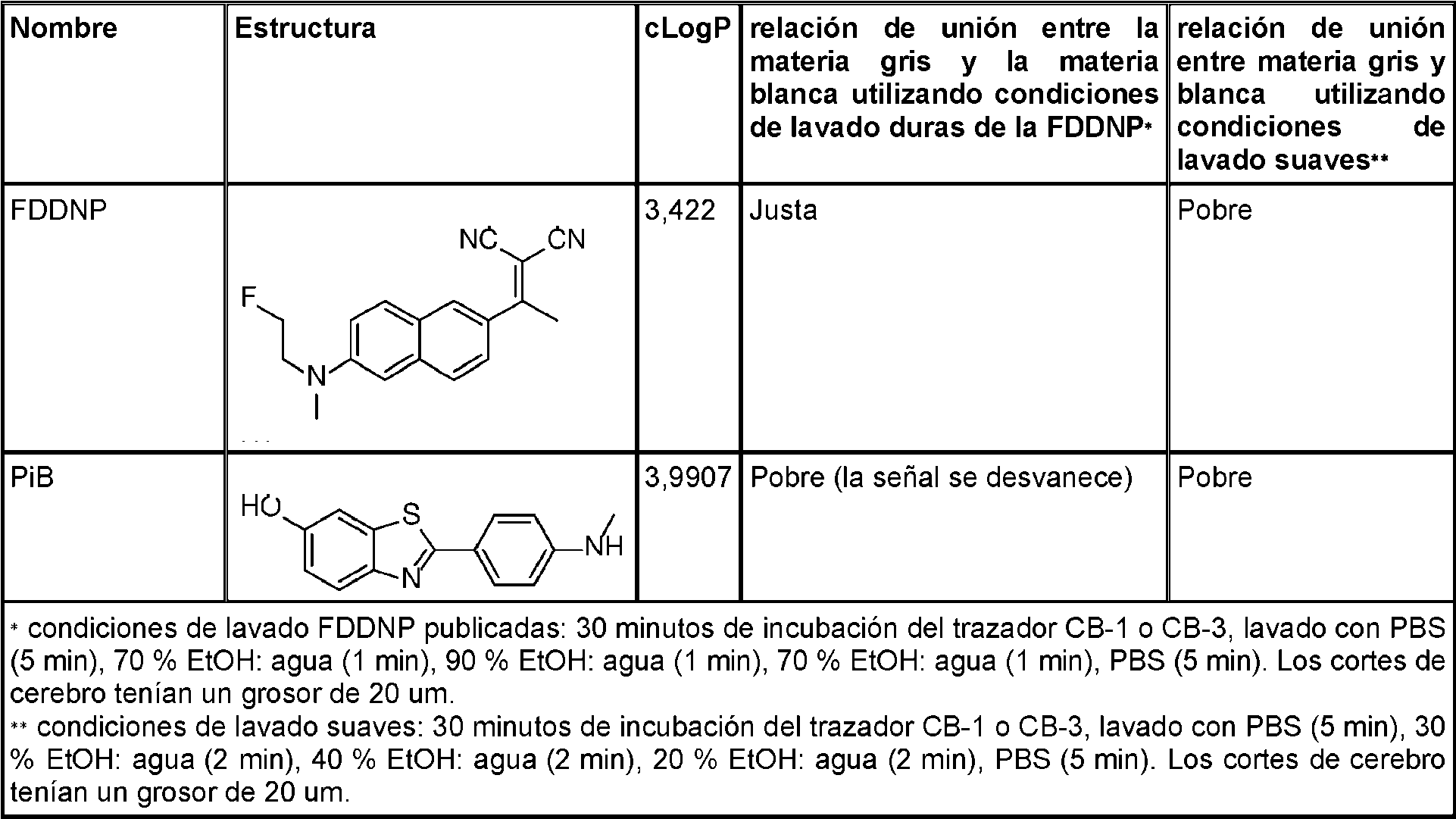
Los resultados demuestran que 1) PiB bloquea la tinción con [18F]-CB001 con concentraciones crecientes, sugiriendo que los dos compuestos compiten por los mismos bolsillos de unión del amiloide; 2) PiB parece bloquear la unión del trazador con la misma fuerza que el CB001 frío, sugiriendo que ambos tienen afinidades de unión similares; 3) FDDNP es mucho menos capaz de bloquear la tinción con [18F]-CB001, debido a su menor afinidad de unión al amiloide. Figura 9: El protocolo óptimo de tinción y lavado que indica el trazador específico.The results demonstrate that 1) PiB blocks [18F]-CB001 staining with increasing concentrations, suggesting that the two compounds compete for the same amyloid-binding pockets; 2) PiB appears to block tracer binding with the same strength as cold CB001, suggesting that both have similar binding affinities; 3) FDDNP is much less able to block [18F]-CB001 staining, due to its lower amyloid-binding affinity. Figure 9: The optimal staining and washing protocol indicating the specific tracer.
Estos datos sugieren el siguiente orden de unión (no específica) de la materia blanca:These data suggest the following (non-specific) binding order of white matter:
FDDNP > CB001 > [18F]-PiB > CB003FDDNP > CB001 > [18F]-PiB > CB003
Figura 10: el [18F]-CB003 distingue claramente entre los cerebros con Alzheimer y los normales. Figure 10: [18F]-CB003 clearly distinguishes between Alzheimer's and normal brains.
Figura 11A: Bloqueo dependiente de la concentración de la unión tisular de [18F]-PiB con PiB y CB003. Figure 11A: Concentration-dependent blockade of tissue binding of [18F]-PiB with PiB and CB003.
Figura 11B: Determinación del IC50 con [18F]-PiB mediante ensayo de competencia ex vivo utilizando tinción de autorradiografía. Figure 11B: IC50 determination with [18F]-PiB by ex vivo competition assay using autoradiography staining.

Para demostrar aún más la eficacia del empleo de estos trazadores relacionados con el CB como agentes de obtención de imágenes de la EA, se utilizó el CB-003 para diferenciar claramente entre un cerebro sano y un cerebro con EA. Más concretamente, al utilizar el protocolo de lavado suave, los depósitos de amiloide eran claramente visibles en la materia gris con poca captación de materia blanca. Los resultados fueron corroborados tanto por la IHC de anticuerpos como por la tinción de amiloide T, confirmando la especificidad de la captación. Estos sorprendentes resultados demuestran que este trazador posee la cualidad única de un rápido lavado de la materia blanca y una alta y significativa captación en la materia gris que es específica para las placas de la EA.To further demonstrate the efficacy of employing these CB-related tracers as AD imaging agents, CB-003 was used to clearly differentiate between a healthy brain and an AD brain. More specifically, using the gentle wash protocol, amyloid deposits were clearly visible in gray matter with little white matter uptake. The results were corroborated by both antibody IHC and amyloid T staining, confirming the specificity of the uptake. These amazing results demonstrate that this tracer possesses the unique quality of rapid white matter washout and significant high gray matter uptake that is specific for AD plaques.
Los carbazoles compiten directamente contra el 18F-PiB por los mismos sitios de unión en los cerebros humanos de la EA. Este sorprendente resultado no podría haberse predicho dadas sus diferentes estructuras y la falta de CB-003 de un grupo fenólico OH y NH-Me terminal, que se consideran esenciales para la unión a las placas de EA. A pesar de que el CB-003 carece de estos dos grupos funcionales, sigue compitiendo con el 18F-PiB por los sitios de unión en los cerebros humanos de la EA. Debido a la simplicidad de su estructura, los rendimientos de marcaje de CB-001 y CB-003 son excepcionalmente altos y mejores que los rendimientos de marcaje de 18F-PiB.Carbazoles compete directly against 18F-PiB for the same binding sites in human AD brains. This surprising result could not have been predicted given their different structures and CB-003's lack of a terminal phenolic OH and NH-Me group, which are considered essential for binding to EA plates. Although CB-003 lacks these two functional groups, it continues to compete with 18F-PiB for binding sites in human AD brains. Due to the simplicity of their structure, the marking performances of CB-001 and CB-003 are exceptionally high and better than the marking performances of 18F-PiB.
Ensayo de Resonancia Plasmónica Superficial (SPR)Surface Plasmonic Resonance Assay (SPR)
Se desarrolló un ensayo utilizando un instrumento Biacore que introdujo los ligandos sobre proteínas objetivo inmovilizadas en la superficie de oro y midió las tasas resultantes de asociación y disociación para probar varios diversos que se unen a oligómeros, polímeros y fibrillas solubles de EA.An assay was developed using a Biacore instrument that introduced the ligands onto target proteins immobilized on the gold surface and measured the resulting rates of association and dissociation to test for several different binding agents to soluble EA oligomers, polymers, and fibrils.
[Figuras 12 a 17][Figures 12 to 17]
La serie de carbazoles también demostró una capacidad única y sorprendente de unirse favorable y preferentemente a agregados insolubles (9 nM) sobre agregados solubles (262 nM). PiB también se une bien a los agregados insolubles (16 nM) pero también se une esencialmente igual de bien a los agregados solubles (48 nM). Para las aplicaciones de obtención de imágenes en las que es favorable distinguir entre la unión de un trazador a agregados insolubles frente a los solubles, el CB-003 proporciona una mayor relación de unión de 29:1, mientras que el PiB sólo proporciona una relación de 3:1. Por lo tanto, CB-003 puede proporcionar una información de unión más selectiva en relación con PiB. Los resultados indican que 1) para la unión de agregados solubles, PIB > CB3 > CB4; y 2) para la unión de agregados insolubles, PIB = CB3 > CB4.The carbazole series also demonstrated a unique and surprising ability to favorably and preferentially bind insoluble aggregates (9 nM) over soluble aggregates (262 nM). PiB also binds well to insoluble aggregates (16 nM) but also binds essentially equally well to soluble aggregates (48 nM). For imaging applications where it is favorable to distinguish between binding of a tracer to insoluble versus soluble aggregates, CB-003 provides a higher binding ratio of 29:1, while PiB only provides a higher binding ratio of 29:1. of 3:1. Therefore, CB-003 may provide more selective binding information relative to PiB. The results indicate that 1) for the binding of soluble aggregates, GDP > CB3 > CB4; and 2) for the binding of insoluble aggregates, GDP = CB3 > CB4.
Figura 18: La obtención de imágenes de microPET con [18F]-CB-001 en ratones App y WT demuestran una muy buena captación cerebral. Figure 18: MicroPET imaging with [18F]-CB-001 in App and WT mice demonstrates very good brain uptake.
Figura 19: La obtención de imágenes de MicroPET con [18F]-CB-003 en ratones WT y App. Figure 19: MicroPET imaging with [18F]-CB-003 in WT and App mice.
[Figuras 20 y 21][Figures 20 and 21]
Los resultados demuestran que 1) los ratones WT y App muestran diferencias estadísticamente significativas en la retención del trazador en el cerebro; 2) los ratones App muestran una relación cerebro / músculo hasta 25 % mayor en comparación con los ratones WT. Los carbazoles muestran tanto una sorprendente alta captación en los cerebros de los ratones (tanto WT como APP) como un lavado lo suficientemente lento como para poder distinguir los ratones WT de los APP. Sin estar atados a ninguna teoría propuesta en el presente documento, se especula que la razón detrás de estos resultados puede ser que el CB-003 posee una tasa de lavado más rápida que el 18F-PiB, lo cual es consistente con los datos de tinción: el 18F-PiB requiere unas condiciones de lavado más duras para dar una relación razonable de materia gris y blanca. El rápido lavado del CB-003 es presumiblemente un factor importante para su baja unión no específica, aunque el lavado es lo suficientemente lento como para distinguir el WT del APP. Esto sugiere que los carbazoles muestran una combinación única de excelentes propiedades de lavado y retención en los cerebros humanos de la AD que no son evidentes a partir de los datos de la técnica anterior. El CB-003, al ser un compuesto neutro, también poseería potencialmente mayores valores de captación frente a los agentes de obtención de imágenes con base en zwitteriónica, como tal el azul de metileno. La comparación de [18F]PiB y [18F]-CB003 en el cerebro de ratones WT y App indica que el aclaramiento cerebral de [18F]-CB-003 es mucho más rápido que con [18F]PiB. The results demonstrate that 1) WT and App mice show statistically significant differences in tracer retention in the brain; 2) App mice show up to 25% higher brain/muscle ratio compared to WT mice. Carbazoles show both surprisingly high uptake in the brains of mice (both WT and APP) and sufficiently slow washout that WT and APP mice can be distinguished. Without being bound by any theory proposed here, it is speculated that the reason behind these results may be that CB-003 has a faster washout rate than 18F-PiB, which is consistent with the staining data. : 18F-PiB requires harsher wash conditions to give a reasonable ratio of gray to white matter. The rapid washout of CB-003 is presumably an important factor for its low non-specific binding, although the washout is slow enough to distinguish WT from APP. This suggests that carbazoles exhibit a unique combination of excellent washout and retention properties in human AD brains that are not apparent from prior art data. CB-003, being a neutral compound, would also potentially possess higher uptake values versus zwitterionic-based imaging agents, such as methylene blue. Comparison of [18F]PiB and [18F]-CB003 in the brain of WT and App mice indicates that brain clearance of [18F]-CB-003 is much faster than with [18F]PiB.
Figura 22: Figure 22: [18F]PiB.[18F]PiB.
Figura 23: Figure 23: [18F]-CB003. [18F]-CB003.
Claims (10)

Applications Claiming Priority (2)
| Application Number | Priority Date | Filing Date | Title |
|---|---|---|---|
| US6610108P | 2008-02-14 | 2008-02-14 | |
| PCT/US2009/000961 WO2009102498A1 (en) | 2008-02-14 | 2009-02-17 | Novel imaging agents for detecting neurological dysfunction |
Publications (2)
| Publication Number | Publication Date |
|---|---|
| ES2907992T3 true ES2907992T3 (en) | 2022-04-27 |
| ES2907992T5 ES2907992T5 (en) | 2025-03-19 |
Family
ID=40627498
Family Applications (1)
| Application Number | Title | Priority Date | Filing Date |
|---|---|---|---|
| ES09711194T Active ES2907992T5 (en) | 2008-02-14 | 2009-02-17 | Novel imaging agents for detecting neurological dysfunction |
Country Status (16)
| Country | Link |
|---|---|
| US (2) | US8318132B2 (en) |
| EP (2) | EP2247558B2 (en) |
| JP (1) | JP2011512354A (en) |
| KR (1) | KR20100135235A (en) |
| CA (1) | CA2715390A1 (en) |
| CY (1) | CY1125258T1 (en) |
| DK (1) | DK2247558T4 (en) |
| ES (1) | ES2907992T5 (en) |
| FI (1) | FI2247558T4 (en) |
| HR (1) | HRP20220401T4 (en) |
| HU (1) | HUE058352T2 (en) |
| LT (1) | LT2247558T (en) |
| PL (1) | PL2247558T5 (en) |
| PT (1) | PT2247558T (en) |
| SI (1) | SI2247558T2 (en) |
| WO (1) | WO2009102498A1 (en) |
Families Citing this family (52)
| Publication number | Priority date | Publication date | Assignee | Title |
|---|---|---|---|---|
| LT2247558T (en) | 2008-02-14 | 2022-04-11 | Eli Lilly And Company | Novel imaging agents for detecting neurological dysfunction |
| US8932557B2 (en) * | 2008-02-14 | 2015-01-13 | Eli Lilly And Company | Imaging agents for detecting neurological dysfunction |
| US20110201656A1 (en) * | 2008-08-08 | 2011-08-18 | Neurosearch A/S | Novel diphenyl 1,2,3-triazole derivatives useful as modulators of nicotinic acetylcholine receptors |
| EP2323696B1 (en) * | 2008-09-18 | 2018-09-05 | Cedars-Sinai Medical Center | Optical method for the detection of alzheimer's disease |
| US8691187B2 (en) * | 2009-03-23 | 2014-04-08 | Eli Lilly And Company | Imaging agents for detecting neurological disorders |
| GB201016038D0 (en) | 2010-09-24 | 2010-11-10 | Ge Healthcare Ltd | In vivo imaging method |
| CA2815960C (en) * | 2010-10-29 | 2019-01-22 | Clino Ltd. | Tau imaging probe |
| US20140275156A1 (en) * | 2011-08-11 | 2014-09-18 | Neuprotect Pty Ltd | Flavonoid compounds, and methods of use thereof |
| US20130315825A1 (en) * | 2012-05-03 | 2013-11-28 | Washington University | Tricyclic heteroaromatic compounds as alpha-synuclein ligands |
| KR101609504B1 (en) * | 2012-05-22 | 2016-04-05 | 일라이 릴리 앤드 캄파니 | Carboline and carbazole based imaging agents for detecting neurological dysfunction |
| KR20190136125A (en) | 2012-12-21 | 2019-12-09 | 국립연구개발법인 양자과학기술연구개발기구 | Novel compound for imaging tau protein accumulated in the brain |
| WO2014194169A1 (en) * | 2013-05-31 | 2014-12-04 | The General Hospital Corporation | Radiosynthesis of tau radiopharmaceuticals |
| MX2015016771A (en) | 2013-06-25 | 2016-03-31 | Squibb Bristol Myers Co | Carbazole carboxamide compounds useful as kinase inhibitors. |
| TWI648272B (en) | 2013-06-25 | 2019-01-21 | 美商必治妥美雅史谷比公司 | Substituted tetrahydrocarbazole and carbazole carbamide compounds |
| NO3055308T3 (en) * | 2013-10-08 | 2018-04-21 | ||
| TWI667233B (en) | 2013-12-19 | 2019-08-01 | 德商拜耳製藥公司 | Novel indazolecarboxamides, processes for their preparation, pharmaceutical preparations comprising them and their use for producing medicaments |
| US10662193B2 (en) | 2014-01-21 | 2020-05-26 | Ac Immune Sa | Carbazole and carboline compounds for use in the diagnosis, treatment, alleviation or prevention of disorders associated with amyloid or amyloid-like proteins |
| SI3143011T1 (en) | 2014-05-13 | 2021-08-31 | F. Hoffmann-La Roche Ag | Deuterated heterocyclic compounds and their use as imaging agents |
| JP6487534B2 (en) | 2014-09-05 | 2019-03-20 | シンビオミックス セラピューティクス、エルエルシー | Sexidazole for use in the treatment of bacterial vaginitis |
| AU2015311730A1 (en) * | 2014-09-05 | 2017-04-20 | Allosteros Therapeutics, Inc | Camkii inhibitors and uses thereof |
| AR102426A1 (en) | 2014-10-24 | 2017-03-01 | Bristol Myers Squibb Co | INDOLCARBOXAMIDE COMPOUNDS AS BTK INHIBITORS |
| EA031614B1 (en) | 2014-10-24 | 2019-01-31 | Бристол-Майерс Сквибб Компани | Tricyclic atropisomer compounds |
| PE20171239A1 (en) | 2014-10-24 | 2017-08-24 | Bristol Myers Squibb Co | DERIVATIVES OF CARBAZOLE |
| CA2973648C (en) | 2015-02-02 | 2023-09-26 | Ucb Biopharma Sprl | 9h-pyrrolo-dipyridine derivatives |
| CN105524034B (en) * | 2015-03-27 | 2018-08-17 | 北京大学 | Preparation, pharmacological action and the application for treating cerebral ischemia of coumarin derivative |
| CN105566269B (en) * | 2015-03-27 | 2018-07-10 | 北京大学 | Preparation, pharmacological action and the application for treating itch of coumarin derivative |
| US11253501B2 (en) | 2015-06-01 | 2022-02-22 | Lupin Inc. | Secnidazole formulations and use in treating bacterial vaginosis |
| EP3118202A1 (en) | 2015-07-15 | 2017-01-18 | AC Immune S.A. | Dihydropyridopyrrole derivatives as tau-pet-ligands |
| EP3322707A1 (en) | 2015-07-15 | 2018-05-23 | AC Immune SA | Novel imaging compounds |
| US10301308B2 (en) | 2015-11-13 | 2019-05-28 | Eli Lilly And Company | Azetidine derivatives for tau imaging |
| EP3411083A1 (en) * | 2016-02-03 | 2018-12-12 | Janssen Pharmaceutica NV | Tau pet imaging ligands |
| JP7059270B2 (en) | 2016-07-22 | 2022-04-25 | エーシー・イミューン・エス・アー | Compounds for imaging tau protein aggregates |
| IL264239B (en) * | 2016-07-22 | 2022-08-01 | Ac Immune Sa | Compounds for imaging tau protein aggregates |
| WO2018024643A1 (en) | 2016-08-02 | 2018-02-08 | Ucb Biopharma Sprl | 9h-pyrrolo-dipyridine derivatives |
| WO2018024642A1 (en) | 2016-08-02 | 2018-02-08 | Ucb Biopharma Sprl | 9h-pyrrolo-dipyridine derivatives |
| CN109689653B (en) | 2016-09-09 | 2022-04-12 | 豪夫迈·罗氏有限公司 | Process for the preparation of 2-(6-nitropyridin-3-yl)-9H-dipyrido[2,3-b;3',4'-d]pyrrole |
| TW201906818A (en) * | 2017-05-31 | 2019-02-16 | 美商511製藥公司 | Novel erbium-substituted positron emission tomography (PET) developer and its pharmacological application |
| EP3743423A1 (en) | 2018-01-24 | 2020-12-02 | AC Immune SA | Gamma-carboline compounds for the detection of tau aggregates |
| EP3743426A1 (en) | 2018-01-24 | 2020-12-02 | AC Immune SA | Azacarboline compounds for the detection of tau aggregates |
| JPWO2019168170A1 (en) * | 2018-03-02 | 2021-03-04 | 国立大学法人 長崎大学 | Composition for diagnosing chromone derivatives and amyloid-related diseases |
| JP7293343B2 (en) | 2018-05-09 | 2023-06-19 | アプリノイア セラピューティクス リミテッド | Heteroaryl compound and use thereof |
| WO2021055670A1 (en) | 2019-09-20 | 2021-03-25 | Avx Corporation | Somatic cell-based electrical biosensor |
| CA3161455A1 (en) | 2019-11-13 | 2021-05-20 | Aprinoia Therapeutics Limited | Compounds for degrading tau protein aggregates and uses thereof |
| US12280037B2 (en) | 2020-09-22 | 2025-04-22 | Evofem Biosciences, Inc. | Method and pharmaceutical composition for treating or preventing trichomoniasis and uses thereof |
| US20240368106A1 (en) * | 2021-08-30 | 2024-11-07 | Pretzel Therapeutics, Inc. | Hydroxy and alkoxy coumarins as modulators of polrmt |
| WO2023034346A1 (en) * | 2021-08-30 | 2023-03-09 | Pretzel Therapeutics, Inc. | Chromen-2-one modulators of polrmt |
| US11938127B2 (en) | 2021-09-28 | 2024-03-26 | Wayne State University | Methods and compositions relating to steroid hormone receptor-dependent proliferative disorders |
| DK4426434T3 (en) | 2021-11-02 | 2025-11-10 | Flare Therapeutics Inc | PPARG INVERSE AGONISTS AND USES THEREOF |
| WO2023204967A1 (en) * | 2022-04-21 | 2023-10-26 | Virginia Commonwealth University | Nlrp3 inflammasome inhibitors and compositions and uses thereof |
| JP2025513455A (en) | 2022-04-22 | 2025-04-24 | バーテックス ファーマシューティカルズ インコーポレイテッド | Heteroaryl compounds for the treatment of pain - Patents.com |
| EP4658651A1 (en) | 2023-02-02 | 2025-12-10 | Eli Lilly and Company | Novel compounds for tau imaging |
| WO2025155625A1 (en) | 2024-01-16 | 2025-07-24 | Eli Lilly And Company | Novel compounds for tau imaging |
Family Cites Families (49)
| Publication number | Priority date | Publication date | Assignee | Title |
|---|---|---|---|---|
| AU5871894A (en) | 1992-12-21 | 1994-07-19 | Mallinckrodt Medical, Inc. | Polyhydric phenol compounds |
| AU686669B2 (en) | 1993-09-17 | 1998-02-12 | Smithkline Beecham Corporation | Drug binding protein |
| US6417178B1 (en) † | 1994-07-19 | 2002-07-09 | University Of Pittsburgh | Amyloid binding nitrogen-linked compounds for the antemortem diagnosis of alzheimer's disease, in vivo imaging and prevention of amyloid deposits |
| KR19990064310A (en) * | 1995-10-17 | 1999-07-26 | 윌리암스 로저 에이 | Detection method of cyclooxygenase-2 |
| JPH09165378A (en) * | 1995-12-15 | 1997-06-24 | Seitai Kinou Kenkyusho:Kk | N1-(8f)fluorobenzyl heterocyclic compound and its production |
| ZA989365B (en) † | 1997-10-15 | 1999-04-15 | Boehringer Mannheim Pharm Corp | Preparation for treating alzheimer's disease |
| JP2001048786A (en) | 1999-08-05 | 2001-02-20 | Yamanouchi Pharmaceut Co Ltd | Tricyclic heteroaryl derivative |
| US20020115717A1 (en) † | 2000-07-25 | 2002-08-22 | Francine Gervais | Amyloid targeting imaging agents and uses thereof |
| ES2274973T3 (en) | 2001-04-23 | 2007-06-01 | The Trustees Of The University Of Pennsylvania | INHIBITORS OF THE AGGREGATION OF AMYLOID PLATES AND AGENTS FOR OBTAINING DIAGNOSTIC IMAGES. |
| CN101003526B (en) | 2001-08-27 | 2012-02-22 | 宾夕法尼亚州大学理事会 | Stilbene derivatives and their use for binding and imaging amyloid plaques |
| MXPA04001153A (en) † | 2001-08-31 | 2005-02-17 | Neurochem Int Ltd | Amidine derivatives for treating amyloidosis. |
| CA2464934A1 (en) † | 2001-10-31 | 2003-05-08 | Bayer Healthcare Ag | Pyrimido [4,5-b] indole derivatives |
| AU2003251418A1 (en) * | 2002-06-07 | 2003-12-22 | Robert J. Chalifour | Amidine derivatives for treating amyloidosis |
| EP1556142A4 (en) | 2002-10-24 | 2006-11-08 | Merck & Co Inc | ALKYNE DERIVATIVES AS MARKERS FOR METABOTROPIC GLUTAMATE RECEPTOR BINDING |
| AU2003285963A1 (en) * | 2002-11-11 | 2004-06-03 | Austria Wirtschaftsservice Gesellschaft M.B.H. | Fluorquinolines labelled with fluorine-18 |
| GB0229686D0 (en) | 2002-12-20 | 2003-01-29 | Amersham Plc | Solid-phase fluorination of benzothiazoles |
| WO2004058764A1 (en) † | 2002-12-27 | 2004-07-15 | Bayer Healthcare Ag | 4-phenyl-pyrimido [4,5-b] indole derivatives |
| EP1658264A2 (en) † | 2003-06-23 | 2006-05-24 | Neurochem (International) Limited | Methods and compositions for treating amyloid-related diseases |
| EP1655287A1 (en) | 2003-08-13 | 2006-05-10 | BF Research Institute, Inc. | Probe for diseases with amyloid accumulation, amyloid-staining agent, remedy and preventive for diseases with amyloid accumulation and diagnostic probe and staining agent for neurofibrillary change |
| JP2006100537A (en) | 2004-09-29 | 2006-04-13 | Konica Minolta Holdings Inc | Organic electroluminescence element, lighting device and display device |
| US20060110787A1 (en) * | 2004-11-19 | 2006-05-25 | The Board Trustees Of The University Of Arkansas | Use of fluorine-18-labeled fluoroquinolone antibiotics for diagnosing and monitoring bacterial infection |
| JP2007084526A (en) * | 2004-11-26 | 2007-04-05 | Nagasaki Univ | Composition for diagnosing amyloid-related diseases |
| EP1815872A4 (en) * | 2004-11-26 | 2011-06-15 | Univ Nagasaki | COMPOSITION FOR THE DIAGNOSIS OF DISEASES ASSOCIATED WITH AMYLOIDS |
| NZ555942A (en) * | 2004-12-17 | 2011-01-28 | Univ Pennsylvania | Radiolabelled tilbene derivatives and their use for binding and imaging amyloid plaques |
| FR2885905A1 (en) † | 2005-05-23 | 2006-11-24 | Trophos Sa | NOVEL CHEMICAL COMPOUNDS AND THEIR USES AS A MEDICINAL PRODUCT |
| US20070031328A1 (en) * | 2005-06-24 | 2007-02-08 | Kung Hank F | Radiolabeled-pegylation of ligands for use as imaging agents |
| US8597614B2 (en) * | 2005-08-03 | 2013-12-03 | Centre For Addiction And Mental Health | Diagnosis and treatment of mood disorders |
| GB0523506D0 (en) | 2005-11-18 | 2005-12-28 | Hammersmith Imanet Ltd | Novel in vivo imaging compounds |
| ES2390135T3 (en) † | 2005-11-22 | 2012-11-06 | Merck Sharp & Dohme Corp. | Tricyclic compounds useful as kinase inhibitors |
| EP1956013B1 (en) | 2005-11-30 | 2016-04-13 | Fujifilm RI Pharma Co., Ltd. | Diagnostic and remedy for disease caused by amyloid aggregation and/or deposition |
| AR059356A1 (en) | 2006-02-14 | 2008-03-26 | Astrazeneca Ab | NEW RADIOLIGANDS |
| JP2007223952A (en) | 2006-02-23 | 2007-09-06 | Tohoku Univ | Imaging probe for diseases in which amyloid β protein accumulates |
| US7700616B2 (en) | 2006-05-08 | 2010-04-20 | Molecular Neuroimaging, Llc. | Compounds and amyloid probes thereof for therapeutic and imaging uses |
| US7678819B2 (en) | 2006-12-07 | 2010-03-16 | The Trustees Of The University Of Pennsylvania | Acetylene derivatives and their use for binding and imaging amyloid plaques |
| ES2415863T3 (en) † | 2006-12-22 | 2013-07-29 | Incyte Corporation | Substituted heterocycles as Janus Kinase inhibitors |
| EP1944281A1 (en) | 2007-01-09 | 2008-07-16 | Technische Universität München | 18F-labeled compounds, method for the preparation and use thereof |
| BRPI0702640A (en) * | 2007-01-10 | 2008-08-26 | Comissao Nac Energia Nuclear | flavonoid radiolabelling process and its application in in vivo diagnosis of brain dysfunctions related to benzodiazepine receptor sites |
| EP2144916A4 (en) | 2007-04-10 | 2012-01-04 | Univ Pennsylvania | PHENYLNAPHTHALENE DERIVATIVES AND PHENYLQUINOLINES AND THEIR USE FOR THE BINDING AND FORMATION OF AMYLOID PLATE IMAGES |
| WO2008131148A1 (en) * | 2007-04-19 | 2008-10-30 | The Trustees Of The University Of Pennsylvania | Diphenyl-heteroaryl derivatives and their use for binding and imaging amyloid plaques |
| WO2008132454A1 (en) * | 2007-04-26 | 2008-11-06 | Ge Healthcare Limited | Carbolines and their use as imaging agents |
| US8942164B2 (en) | 2007-10-22 | 2015-01-27 | Texas Instruments Incorporated | Differential CQI for OFDMA systems |
| EP2172444A4 (en) | 2007-07-04 | 2010-12-22 | Univ Tohoku | PET SENSOR HAVING ALCOXY GROUP SUBSTITUTED BY FLUORIN ATOM AND HYDROXY GROUP |
| WO2009045535A2 (en) | 2007-10-04 | 2009-04-09 | Sloan-Kettering Institute For Cancer Research | Fluorine-18 derivative of dasatinib and uses thereof |
| LT2247558T (en) | 2008-02-14 | 2022-04-11 | Eli Lilly And Company | Novel imaging agents for detecting neurological dysfunction |
| EP2323697A2 (en) | 2008-07-24 | 2011-05-25 | Siemens Medical Solutions USA, Inc. | Imaging agents useful for identifying ad pathology |
| JP2012051804A (en) | 2008-12-26 | 2012-03-15 | Kyoto Univ | Eg5 inhibitor |
| EP2218464A1 (en) | 2009-02-11 | 2010-08-18 | Technische Universität München | Compounds for non-invasive measurement of aggregates of amyloid peptides |
| NO3055308T3 (en) | 2013-10-08 | 2018-04-21 | ||
| CA2973648C (en) | 2015-02-02 | 2023-09-26 | Ucb Biopharma Sprl | 9h-pyrrolo-dipyridine derivatives |
-
2009
- 2009-02-17 LT LTEPPCT/US2009/000961T patent/LT2247558T/en unknown
- 2009-02-17 US US12/372,717 patent/US8318132B2/en active Active
- 2009-02-17 US US12/867,502 patent/US20110046378A1/en not_active Abandoned
- 2009-02-17 SI SI200932157T patent/SI2247558T2/en unknown
- 2009-02-17 HR HRP20220401TT patent/HRP20220401T4/en unknown
- 2009-02-17 FI FIEP09711194.2T patent/FI2247558T4/en active
- 2009-02-17 WO PCT/US2009/000961 patent/WO2009102498A1/en not_active Ceased
- 2009-02-17 DK DK09711194.2T patent/DK2247558T4/en active
- 2009-02-17 HU HUE09711194A patent/HUE058352T2/en unknown
- 2009-02-17 EP EP09711194.2A patent/EP2247558B2/en active Active
- 2009-02-17 PT PT97111942T patent/PT2247558T/en unknown
- 2009-02-17 PL PL09711194.2T patent/PL2247558T5/en unknown
- 2009-02-17 EP EP20130157487 patent/EP2599763A1/en not_active Withdrawn
- 2009-02-17 KR KR1020107020589A patent/KR20100135235A/en not_active Ceased
- 2009-02-17 ES ES09711194T patent/ES2907992T5/en active Active
- 2009-02-17 JP JP2010546795A patent/JP2011512354A/en active Pending
- 2009-02-17 CA CA2715390A patent/CA2715390A1/en not_active Abandoned
-
2022
- 2022-03-30 CY CY20221100245T patent/CY1125258T1/en unknown
Also Published As
| Publication number | Publication date |
|---|---|
| WO2009102498A1 (en) | 2009-08-20 |
| PT2247558T (en) | 2022-03-21 |
| FI2247558T4 (en) | 2024-09-19 |
| ES2907992T5 (en) | 2025-03-19 |
| KR20100135235A (en) | 2010-12-24 |
| US20110046378A1 (en) | 2011-02-24 |
| US20110091382A1 (en) | 2011-04-21 |
| PL2247558T5 (en) | 2024-10-14 |
| EP2247558B1 (en) | 2022-02-02 |
| HUE058352T2 (en) | 2022-07-28 |
| LT2247558T (en) | 2022-04-11 |
| SI2247558T2 (en) | 2024-10-30 |
| CY1125258T1 (en) | 2024-02-16 |
| DK2247558T3 (en) | 2022-02-21 |
| CA2715390A1 (en) | 2009-08-20 |
| SI2247558T1 (en) | 2022-07-29 |
| EP2599763A1 (en) | 2013-06-05 |
| EP2247558A1 (en) | 2010-11-10 |
| HRP20220401T3 (en) | 2022-05-27 |
| JP2011512354A (en) | 2011-04-21 |
| EP2247558B2 (en) | 2024-07-03 |
| DK2247558T4 (en) | 2024-07-29 |
| US8318132B2 (en) | 2012-11-27 |
| PL2247558T3 (en) | 2022-05-02 |
| HRP20220401T4 (en) | 2024-09-27 |
Similar Documents
| Publication | Publication Date | Title |
|---|---|---|
| ES2907992T5 (en) | Novel imaging agents for detecting neurological dysfunction | |
| KR101609504B1 (en) | Carboline and carbazole based imaging agents for detecting neurological dysfunction | |
| US8932557B2 (en) | Imaging agents for detecting neurological dysfunction | |
| ES2578228T3 (en) | Imaging agents to detect neurological disorders | |
| EP2411057B1 (en) | Imaging agents for detecting neurological disorders | |
| CN110678465A (en) | Novel deuterium-substituted positron emission tomography (PET) imaging agents and their pharmacological applications | |
| CN102448933A (en) | Indole Derivatives as PBR Ligands | |
| JP2002525325A (en) | Radiolabeled neurokinin-1 receptor antagonist | |
| JP2026053514A (en) | Heterocyclic compounds and imaging agents for imaging huntingtin protein | |
| CN102574859A (en) | [18 F] - labelled analogues of flumazenil as in vivo imaging agents | |
| EP2512525B1 (en) | Novel aryloxyanilide imaging agents | |
| TWI917391B (en) | Heterocyclic compounds and imaging agents for imaging huntingtin protein | |
| KR20210126146A (en) | [ 18 F]-labeled benzothiazole derivatives as PET radiotracer | |
| ES2354151T3 (en) | ANTIGONISTS OF THE RADIOMARCED NEUROQUININE-1 RECEIVER. | |
| JP6273251B2 (en) | Aromatic amino acid derivative and PET probe using the same | |
| KR102150377B1 (en) | Preparation method of [18F]-substituted pyrazole derivatives Radiopharmaceuticals | |
| WO2025188917A1 (en) | Construction and use of reagents for conjugation to bioligands for imaging and radiopharmaceutical applications | |
| CN117586270A (en) | Radioactive 2,7,9a-triazabenzo[cd]azurin-6(7H)one derivative and its preparation method and application | |
| ITMC20080089A1 (en) | CHEMICAL SYNTHESIS OF I-124 [6-OH-BTA-1-3'-I] IODINE-124 [2- (3'-IODO-4'-METHYLAMINOPHENYL) -6-HYDROXY-BENZOTHIALZOLE] FOR PET AND RADIOTHERAPY INVESTIGATIONS. |