ES2909302T3 - Process for the preparation of Raltegravir - Google Patents
Process for the preparation of Raltegravir Download PDFInfo
- Publication number
- ES2909302T3 ES2909302T3 ES18807004T ES18807004T ES2909302T3 ES 2909302 T3 ES2909302 T3 ES 2909302T3 ES 18807004 T ES18807004 T ES 18807004T ES 18807004 T ES18807004 T ES 18807004T ES 2909302 T3 ES2909302 T3 ES 2909302T3
- Authority
- ES
- Spain
- Prior art keywords
- formula
- compound
- process according
- raltegravir
- iii
- Prior art date
- Legal status (The legal status is an assumption and is not a legal conclusion. Google has not performed a legal analysis and makes no representation as to the accuracy of the status listed.)
- Active
Links
- 238000000034 method Methods 0.000 title claims abstract description 49
- CZFFBEXEKNGXKS-UHFFFAOYSA-N raltegravir Chemical compound O1C(C)=NN=C1C(=O)NC(C)(C)C1=NC(C(=O)NCC=2C=CC(F)=CC=2)=C(O)C(=O)N1C CZFFBEXEKNGXKS-UHFFFAOYSA-N 0.000 title claims abstract description 43
- 229960004742 raltegravir Drugs 0.000 title claims abstract description 41
- 238000002360 preparation method Methods 0.000 title claims abstract description 24
- 150000001875 compounds Chemical class 0.000 claims abstract description 92
- 150000003839 salts Chemical class 0.000 claims abstract description 29
- 238000006243 chemical reaction Methods 0.000 claims abstract description 25
- 239000007810 chemical reaction solvent Substances 0.000 claims abstract description 7
- 238000011065 in-situ storage Methods 0.000 claims abstract description 7
- 125000001997 phenyl group Chemical group [H]C1=C([H])C([H])=C(*)C([H])=C1[H] 0.000 claims abstract description 6
- 125000004093 cyano group Chemical group *C#N 0.000 claims abstract description 5
- 125000000449 nitro group Chemical group [O-][N+](*)=O 0.000 claims abstract description 5
- 125000001424 substituent group Chemical group 0.000 claims abstract description 5
- 229910052794 bromium Inorganic materials 0.000 claims abstract description 4
- 229910052801 chlorine Inorganic materials 0.000 claims abstract description 4
- 229910052731 fluorine Inorganic materials 0.000 claims abstract description 4
- 229910052740 iodine Inorganic materials 0.000 claims abstract description 4
- 229910052736 halogen Inorganic materials 0.000 claims abstract description 3
- 150000002367 halogens Chemical class 0.000 claims abstract description 3
- WEVYAHXRMPXWCK-UHFFFAOYSA-N Acetonitrile Chemical group CC#N WEVYAHXRMPXWCK-UHFFFAOYSA-N 0.000 claims description 45
- YXFVVABEGXRONW-UHFFFAOYSA-N Toluene Chemical compound CC1=CC=CC=C1 YXFVVABEGXRONW-UHFFFAOYSA-N 0.000 claims description 33
- ZMANZCXQSJIPKH-UHFFFAOYSA-N Triethylamine Chemical compound CCN(CC)CC ZMANZCXQSJIPKH-UHFFFAOYSA-N 0.000 claims description 27
- 239000000203 mixture Substances 0.000 claims description 26
- AFVFQIVMOAPDHO-UHFFFAOYSA-N Methanesulfonic acid Chemical compound CS(O)(=O)=O AFVFQIVMOAPDHO-UHFFFAOYSA-N 0.000 claims description 14
- XAEFZNCEHLXOMS-UHFFFAOYSA-M potassium benzoate Chemical compound [K+].[O-]C(=O)C1=CC=CC=C1 XAEFZNCEHLXOMS-UHFFFAOYSA-M 0.000 claims description 9
- JOXIMZWYDAKGHI-UHFFFAOYSA-N toluene-4-sulfonic acid Chemical class CC1=CC=C(S(O)(=O)=O)C=C1 JOXIMZWYDAKGHI-UHFFFAOYSA-N 0.000 claims description 9
- BTJIUGUIPKRLHP-UHFFFAOYSA-N 4-nitrophenol Chemical compound OC1=CC=C([N+]([O-])=O)C=C1 BTJIUGUIPKRLHP-UHFFFAOYSA-N 0.000 claims description 6
- -1 carboxylic acid 4-nitrophenoxy ester Chemical class 0.000 claims description 6
- VHYFNPMBLIVWCW-UHFFFAOYSA-N 4-Dimethylaminopyridine Chemical compound CN(C)C1=CC=NC=C1 VHYFNPMBLIVWCW-UHFFFAOYSA-N 0.000 claims description 4
- JGFZNNIVVJXRND-UHFFFAOYSA-N N,N-Diisopropylethylamine (DIPEA) Chemical compound CCN(C(C)C)C(C)C JGFZNNIVVJXRND-UHFFFAOYSA-N 0.000 claims description 4
- 125000006615 aromatic heterocyclic group Chemical group 0.000 claims description 4
- 239000002904 solvent Substances 0.000 claims description 3
- XBNGYFFABRKICK-UHFFFAOYSA-N 2,3,4,5,6-pentafluorophenol Chemical compound OC1=C(F)C(F)=C(F)C(F)=C1F XBNGYFFABRKICK-UHFFFAOYSA-N 0.000 claims description 2
- HORNXRXVQWOLPJ-UHFFFAOYSA-N 3-chlorophenol Chemical compound OC1=CC=CC(Cl)=C1 HORNXRXVQWOLPJ-UHFFFAOYSA-N 0.000 claims description 2
- RTZZCYNQPHTPPL-UHFFFAOYSA-N 3-nitrophenol Chemical compound OC1=CC=CC([N+]([O-])=O)=C1 RTZZCYNQPHTPPL-UHFFFAOYSA-N 0.000 claims description 2
- GZFGOTFRPZRKDS-UHFFFAOYSA-N 4-bromophenol Chemical compound OC1=CC=C(Br)C=C1 GZFGOTFRPZRKDS-UHFFFAOYSA-N 0.000 claims description 2
- CVNOWLNNPYYEOH-UHFFFAOYSA-N 4-cyanophenol Chemical compound OC1=CC=C(C#N)C=C1 CVNOWLNNPYYEOH-UHFFFAOYSA-N 0.000 claims description 2
- BOFRXDMCQRTGII-UHFFFAOYSA-N 619-08-9 Chemical group OC1=CC=C([N+]([O-])=O)C=C1Cl BOFRXDMCQRTGII-UHFFFAOYSA-N 0.000 claims description 2
- KWYHDKDOAIKMQN-UHFFFAOYSA-N N,N,N',N'-tetramethylethylenediamine Chemical compound CN(C)CCN(C)C KWYHDKDOAIKMQN-UHFFFAOYSA-N 0.000 claims description 2
- 125000003545 alkoxy group Chemical group 0.000 claims description 2
- 125000004663 dialkyl amino group Chemical group 0.000 claims description 2
- 125000004433 nitrogen atom Chemical group N* 0.000 claims description 2
- JOXIMZWYDAKGHI-UHFFFAOYSA-M toluene-4-sulfonate Chemical compound CC1=CC=C(S([O-])(=O)=O)C=C1 JOXIMZWYDAKGHI-UHFFFAOYSA-M 0.000 claims description 2
- 125000000217 alkyl group Chemical group 0.000 claims 1
- LFQSCWFLJHTTHZ-UHFFFAOYSA-N Ethanol Chemical compound CCO LFQSCWFLJHTTHZ-UHFFFAOYSA-N 0.000 description 32
- 239000000047 product Substances 0.000 description 20
- 239000000725 suspension Substances 0.000 description 19
- IAZDPXIOMUYVGZ-UHFFFAOYSA-N Dimethylsulphoxide Chemical compound CS(C)=O IAZDPXIOMUYVGZ-UHFFFAOYSA-N 0.000 description 18
- XLYOFNOQVPJJNP-UHFFFAOYSA-N water Substances O XLYOFNOQVPJJNP-UHFFFAOYSA-N 0.000 description 17
- XEKOWRVHYACXOJ-UHFFFAOYSA-N Ethyl acetate Chemical compound CCOC(C)=O XEKOWRVHYACXOJ-UHFFFAOYSA-N 0.000 description 15
- 239000002585 base Substances 0.000 description 13
- QTBSBXVTEAMEQO-UHFFFAOYSA-N Acetic acid Chemical compound CC(O)=O QTBSBXVTEAMEQO-UHFFFAOYSA-N 0.000 description 12
- CTSLXHKWHWQRSH-UHFFFAOYSA-N oxalyl chloride Chemical compound ClC(=O)C(Cl)=O CTSLXHKWHWQRSH-UHFFFAOYSA-N 0.000 description 10
- OKKJLVBELUTLKV-UHFFFAOYSA-N Methanol Chemical compound OC OKKJLVBELUTLKV-UHFFFAOYSA-N 0.000 description 9
- KFZMGEQAYNKOFK-UHFFFAOYSA-N Isopropanol Chemical compound CC(C)O KFZMGEQAYNKOFK-UHFFFAOYSA-N 0.000 description 8
- 238000003756 stirring Methods 0.000 description 8
- 238000005481 NMR spectroscopy Methods 0.000 description 7
- YKGMKSIHIVVYKY-UHFFFAOYSA-N dabrafenib mesylate Chemical compound CS(O)(=O)=O.S1C(C(C)(C)C)=NC(C=2C(=C(NS(=O)(=O)C=3C(=CC=CC=3F)F)C=CC=2)F)=C1C1=CC=NC(N)=N1 YKGMKSIHIVVYKY-UHFFFAOYSA-N 0.000 description 7
- 238000000113 differential scanning calorimetry Methods 0.000 description 7
- 239000012074 organic phase Substances 0.000 description 7
- 238000004128 high performance liquid chromatography Methods 0.000 description 6
- 239000007787 solid Substances 0.000 description 6
- 238000004458 analytical method Methods 0.000 description 5
- 238000001914 filtration Methods 0.000 description 5
- 125000006239 protecting group Chemical group 0.000 description 5
- 239000000126 substance Substances 0.000 description 5
- IJGRMHOSHXDMSA-UHFFFAOYSA-N Atomic nitrogen Chemical compound N#N IJGRMHOSHXDMSA-UHFFFAOYSA-N 0.000 description 4
- KDLHZDBZIXYQEI-UHFFFAOYSA-N Palladium Chemical compound [Pd] KDLHZDBZIXYQEI-UHFFFAOYSA-N 0.000 description 4
- 229960000583 acetic acid Drugs 0.000 description 4
- 150000001732 carboxylic acid derivatives Chemical class 0.000 description 4
- 239000003054 catalyst Substances 0.000 description 4
- 239000012458 free base Substances 0.000 description 4
- 238000002329 infrared spectrum Methods 0.000 description 4
- 239000012299 nitrogen atmosphere Substances 0.000 description 4
- 238000001228 spectrum Methods 0.000 description 4
- GETQZCLCWQTVFV-UHFFFAOYSA-N trimethylamine Chemical compound CN(C)C GETQZCLCWQTVFV-UHFFFAOYSA-N 0.000 description 4
- HEMHJVSKTPXQMS-UHFFFAOYSA-M Sodium hydroxide Chemical compound [OH-].[Na+] HEMHJVSKTPXQMS-UHFFFAOYSA-M 0.000 description 3
- 125000001584 benzyloxycarbonyl group Chemical group C(=O)(OCC1=CC=CC=C1)* 0.000 description 3
- 239000003795 chemical substances by application Substances 0.000 description 3
- 238000001938 differential scanning calorimetry curve Methods 0.000 description 3
- 229910052757 nitrogen Inorganic materials 0.000 description 3
- 239000011541 reaction mixture Substances 0.000 description 3
- 238000005160 1H NMR spectroscopy Methods 0.000 description 2
- 208000031886 HIV Infections Diseases 0.000 description 2
- 208000037357 HIV infectious disease Diseases 0.000 description 2
- 239000002253 acid Substances 0.000 description 2
- 230000010933 acylation Effects 0.000 description 2
- 238000005917 acylation reaction Methods 0.000 description 2
- 230000003197 catalytic effect Effects 0.000 description 2
- 239000003153 chemical reaction reagent Substances 0.000 description 2
- 238000010908 decantation Methods 0.000 description 2
- 238000001035 drying Methods 0.000 description 2
- 150000002148 esters Chemical class 0.000 description 2
- 239000012362 glacial acetic acid Substances 0.000 description 2
- 238000000227 grinding Methods 0.000 description 2
- 125000005843 halogen group Chemical group 0.000 description 2
- 208000033519 human immunodeficiency virus infectious disease Diseases 0.000 description 2
- 229910052739 hydrogen Inorganic materials 0.000 description 2
- 239000001257 hydrogen Substances 0.000 description 2
- VLKZOEOYAKHREP-UHFFFAOYSA-N n-Hexane Chemical compound CCCCCC VLKZOEOYAKHREP-UHFFFAOYSA-N 0.000 description 2
- KJIFKLIQANRMOU-UHFFFAOYSA-N oxidanium;4-methylbenzenesulfonate Chemical compound O.CC1=CC=C(S(O)(=O)=O)C=C1 KJIFKLIQANRMOU-UHFFFAOYSA-N 0.000 description 2
- 239000012071 phase Substances 0.000 description 2
- 239000000843 powder Substances 0.000 description 2
- 238000001556 precipitation Methods 0.000 description 2
- 125000004209 (C1-C8) alkyl group Chemical group 0.000 description 1
- 238000001644 13C nuclear magnetic resonance spectroscopy Methods 0.000 description 1
- YQTCQNIPQMJNTI-UHFFFAOYSA-N 2,2-dimethylpropan-1-one Chemical group CC(C)(C)[C]=O YQTCQNIPQMJNTI-UHFFFAOYSA-N 0.000 description 1
- 125000001255 4-fluorophenyl group Chemical group [H]C1=C([H])C(*)=C([H])C([H])=C1F 0.000 description 1
- GRASQZGKZFJLDB-UHFFFAOYSA-N 5-methyl-1,3,4-oxadiazole-2-carbonyl chloride Chemical class CC1=NN=C(C(Cl)=O)O1 GRASQZGKZFJLDB-UHFFFAOYSA-N 0.000 description 1
- FMEBIWNKYZUWFV-UHFFFAOYSA-N 6-chloropyridine-3-carbonyl chloride Chemical compound ClC(=O)C1=CC=C(Cl)N=C1 FMEBIWNKYZUWFV-UHFFFAOYSA-N 0.000 description 1
- 229910002483 Cu Ka Inorganic materials 0.000 description 1
- 102000004190 Enzymes Human genes 0.000 description 1
- 108090000790 Enzymes Proteins 0.000 description 1
- 238000005033 Fourier transform infrared spectroscopy Methods 0.000 description 1
- UFHFLCQGNIYNRP-UHFFFAOYSA-N Hydrogen Chemical compound [H][H] UFHFLCQGNIYNRP-UHFFFAOYSA-N 0.000 description 1
- 238000004566 IR spectroscopy Methods 0.000 description 1
- 102100034343 Integrase Human genes 0.000 description 1
- 108010061833 Integrases Proteins 0.000 description 1
- SJRJJKPEHAURKC-UHFFFAOYSA-N N-Methylmorpholine Chemical compound CN1CCOCC1 SJRJJKPEHAURKC-UHFFFAOYSA-N 0.000 description 1
- VYPSYNLAJGMNEJ-UHFFFAOYSA-N Silicium dioxide Chemical compound O=[Si]=O VYPSYNLAJGMNEJ-UHFFFAOYSA-N 0.000 description 1
- 241000700605 Viruses Species 0.000 description 1
- 238000002441 X-ray diffraction Methods 0.000 description 1
- 150000001263 acyl chlorides Chemical class 0.000 description 1
- XAGFODPZIPBFFR-UHFFFAOYSA-N aluminium Chemical compound [Al] XAGFODPZIPBFFR-UHFFFAOYSA-N 0.000 description 1
- 229910052782 aluminium Inorganic materials 0.000 description 1
- 230000000798 anti-retroviral effect Effects 0.000 description 1
- 239000012298 atmosphere Substances 0.000 description 1
- VHUUQVKOLVNVRT-UHFFFAOYSA-O azanium;hydron;hydroxide Chemical compound [NH4+].O VHUUQVKOLVNVRT-UHFFFAOYSA-O 0.000 description 1
- 239000006227 byproduct Substances 0.000 description 1
- 238000002425 crystallisation Methods 0.000 description 1
- 230000008025 crystallization Effects 0.000 description 1
- 238000011161 development Methods 0.000 description 1
- 230000008034 disappearance Effects 0.000 description 1
- 238000004821 distillation Methods 0.000 description 1
- 229940079593 drug Drugs 0.000 description 1
- 239000003814 drug Substances 0.000 description 1
- 238000002474 experimental method Methods 0.000 description 1
- 239000000706 filtrate Substances 0.000 description 1
- 239000012467 final product Substances 0.000 description 1
- 229910002804 graphite Inorganic materials 0.000 description 1
- 239000010439 graphite Substances 0.000 description 1
- 229940093915 gynecological organic acid Drugs 0.000 description 1
- 238000010438 heat treatment Methods 0.000 description 1
- 210000003917 human chromosome Anatomy 0.000 description 1
- 238000005984 hydrogenation reaction Methods 0.000 description 1
- 230000007062 hydrolysis Effects 0.000 description 1
- 238000006460 hydrolysis reaction Methods 0.000 description 1
- 125000002887 hydroxy group Chemical group [H]O* 0.000 description 1
- 239000012535 impurity Substances 0.000 description 1
- JMMWKPVZQRWMSS-UHFFFAOYSA-N isopropanol acetate Natural products CC(C)OC(C)=O JMMWKPVZQRWMSS-UHFFFAOYSA-N 0.000 description 1
- 229940011051 isopropyl acetate Drugs 0.000 description 1
- GWYFCOCPABKNJV-UHFFFAOYSA-N isovaleric acid Chemical compound CC(C)CC(O)=O GWYFCOCPABKNJV-UHFFFAOYSA-N 0.000 description 1
- 238000011031 large-scale manufacturing process Methods 0.000 description 1
- 238000004519 manufacturing process Methods 0.000 description 1
- 229940098779 methanesulfonic acid Drugs 0.000 description 1
- 239000004570 mortar (masonry) Substances 0.000 description 1
- 150000007524 organic acids Chemical class 0.000 description 1
- 235000005985 organic acids Nutrition 0.000 description 1
- 150000007530 organic bases Chemical class 0.000 description 1
- 125000001181 organosilyl group Chemical group [SiH3]* 0.000 description 1
- 150000004866 oxadiazoles Chemical class 0.000 description 1
- 230000020477 pH reduction Effects 0.000 description 1
- 229910052763 palladium Inorganic materials 0.000 description 1
- 230000008506 pathogenesis Effects 0.000 description 1
- 150000002989 phenols Chemical group 0.000 description 1
- 238000012545 processing Methods 0.000 description 1
- 102000004169 proteins and genes Human genes 0.000 description 1
- 108090000623 proteins and genes Proteins 0.000 description 1
- 230000005855 radiation Effects 0.000 description 1
- 238000011160 research Methods 0.000 description 1
- 238000004007 reversed phase HPLC Methods 0.000 description 1
- 238000000926 separation method Methods 0.000 description 1
- 239000002002 slurry Substances 0.000 description 1
- 239000011877 solvent mixture Substances 0.000 description 1
- 238000001665 trituration Methods 0.000 description 1
- 238000005292 vacuum distillation Methods 0.000 description 1
- 239000002351 wastewater Substances 0.000 description 1
Classifications
-
- A—HUMAN NECESSITIES
- A61—MEDICAL OR VETERINARY SCIENCE; HYGIENE
- A61K—PREPARATIONS FOR MEDICAL, DENTAL OR TOILETRY PURPOSES
- A61K31/00—Medicinal preparations containing organic active ingredients
- A61K31/33—Heterocyclic compounds
- A61K31/395—Heterocyclic compounds having nitrogen as a ring hetero atom, e.g. guanethidine or rifamycins
- A61K31/495—Heterocyclic compounds having nitrogen as a ring hetero atom, e.g. guanethidine or rifamycins having six-membered rings with two or more nitrogen atoms as the only ring heteroatoms, e.g. piperazine or tetrazines
- A61K31/505—Pyrimidines; Hydrogenated pyrimidines, e.g. trimethoprim
- A61K31/513—Pyrimidines; Hydrogenated pyrimidines, e.g. trimethoprim having oxo groups directly attached to the heterocyclic ring, e.g. cytosine
-
- C—CHEMISTRY; METALLURGY
- C07—ORGANIC CHEMISTRY
- C07D—HETEROCYCLIC COMPOUNDS
- C07D413/00—Heterocyclic compounds containing two or more hetero rings, at least one ring having nitrogen and oxygen atoms as the only ring hetero atoms
- C07D413/02—Heterocyclic compounds containing two or more hetero rings, at least one ring having nitrogen and oxygen atoms as the only ring hetero atoms containing two hetero rings
- C07D413/12—Heterocyclic compounds containing two or more hetero rings, at least one ring having nitrogen and oxygen atoms as the only ring hetero atoms containing two hetero rings linked by a chain containing hetero atoms as chain links
Landscapes
- Chemical & Material Sciences (AREA)
- Organic Chemistry (AREA)
- Health & Medical Sciences (AREA)
- Medicinal Chemistry (AREA)
- Pharmacology & Pharmacy (AREA)
- Epidemiology (AREA)
- Life Sciences & Earth Sciences (AREA)
- Animal Behavior & Ethology (AREA)
- General Health & Medical Sciences (AREA)
- Public Health (AREA)
- Veterinary Medicine (AREA)
- Pharmaceuticals Containing Other Organic And Inorganic Compounds (AREA)
- Nitrogen Condensed Heterocyclic Rings (AREA)
- Medicines That Contain Protein Lipid Enzymes And Other Medicines (AREA)
Abstract
Un proceso para la preparación de Raltegravir de fórmula (I), o sales farmacéuticamente aceptables del mismo, **(Ver fórmula)** que comprende la reacción de un compuesto no protegido de fórmula (II) en forma anhidra, o una sal anhidra del mismo, **(Ver fórmula)** con un compuesto de fórmula (III), **(Ver fórmula)** en donde X = Cl; o X = OAr en donde Ar es un grupo fenilo sustituido con uno o más grupos, iguales o diferentes entre sí, seleccionados entre halógeno (F, Cl, Br o I), un grupo ciano o un grupo nitro; o X es un sustituyente de fórmula (IV): **(Ver fórmula)** en dond e Z = H (X = IVa) o Z = **(Ver fórmula)** en donde el compuesto de fórmula (III) se usa en cantidades de 1,1 a 1,3 equivalentes molares en comparación con el compuesto de fórmula (II); (X = IVb) en donde el compuesto de fórmula (III) se usa en cantidades de 1,1 a 1,3 equivalentes molares en comparación con el compuesto de fórmula (II); en un disolvente de reacción y en presencia de una o más bases, en donde al menos una base tiene un valor de pKa >= 7,4, en una cantidad total que varía de 1,5 a 2,9 equivalentes molares en comparación con el compuesto de fórmula (II) o en una cantidad total que varía de 2,5 a 3,9 equivalentes molares en comparación con la sal anhidra del compuesto de fórmula (II) que se produce in situ; y a una temperatura de reacción que varía de 45 a 75 °C.A process for the preparation of Raltegravir of formula (I), or pharmaceutically acceptable salts thereof, **(See formula)** comprising the reaction of an unprotected compound of formula (II) in anhydrous form, or an anhydrous salt thereof, **(See formula)** with a compound of formula (III), **(See formula)** wherein X = Cl; or X = OAr where Ar is a phenyl group substituted with one or more groups, the same or different from each other, selected from halogen (F, Cl, Br or I), a cyano group or a nitro group; or X is a substituent of formula (IV): **(See formula)** where Z = H (X = IVa) or Z = **(See formula)** where the compound of formula (III) it is used in amounts of 1.1 to 1.3 molar equivalents compared to the compound of formula (II); (X = IVb) wherein the compound of formula (III) is used in amounts of 1.1 to 1.3 molar equivalents compared to the compound of formula (II); in a reaction solvent and in the presence of one or more bases, wherein at least one base has a pKa value >= 7.4, in a total amount ranging from 1.5 to 2.9 molar equivalents compared to the compound of formula (II) or in a total amount ranging from 2.5 to 3.9 molar equivalents compared to the anhydrous salt of the compound of formula (II) which is produced in situ; and at a reaction temperature ranging from 45 to 75 °C.
Description
DESCRIPCIÓNDESCRIPTION
Proceso para la preparación de RaltegravirProcess for the preparation of Raltegravir
Campo técnico de la invenciónTechnical field of the invention
La presente invención se refiere a un proceso para la preparación de Raltegravir altamente puro y sales farmacéuticamente aceptables del mismo.The present invention relates to a process for the preparation of highly pure Raltegravir and pharmaceutically acceptable salts thereof.
Antecedentes de la invenciónBackground of the invention
Raltegravir es un compuesto de fórmula (I), conocido químicamente como W-[2-[4-[(4-fluorofenil)metilcarbamoil]-5-hidroxi-l-metil-6-oxopirimidin-2-il]propan-2-il]-5-metil-1,3,4-oxadiazol-2-carboxamida, y es un fármaco antirretroviral usado para tratar infección por VIH. Raltegravir bloquea la integrasa, una enzima del VIH, que es responsable de la introducción del material genético del virus en los cromosomas humanos; esta es una etapa crítica en la patogénesis de la infección por VIH. Raltegravir se comercializa habitualmente en forma de una sal potásica con el nombre comercial Isentress™.Raltegravir is a compound of formula (I), known chemically as W-[2-[4-[(4-fluorophenyl)methylcarbamoyl]-5-hydroxy-l-methyl-6-oxopyrimidin-2-yl]propan-2- il]-5-methyl-1,3,4-oxadiazole-2-carboxamide, and is an antiretroviral drug used to treat HIV infection. Raltegravir blocks integrase, an HIV enzyme, which is responsible for the introduction of the virus's genetic material into human chromosomes; this is a critical stage in the pathogenesis of HIV infection. Raltegravir is commonly marketed as a potassium salt under the trade name Isentress™.

Raltegravir se describe en el documento de Patente US 7.169.780 que también desvela en términos generales un método para preparar Raltegravir que comprende la reacción de 2-(1-amino-1-metiletil)-W-(4-fluorobencil-5-hidroxi-1-metil-6-oxo-1,6-dihidropirimidina-4-carboxamida (II) con ácido 2-[5-metil-1,3,4-oxadiazolil]carboxílico, en presencia de cloruro de oxalilo y trimetilamina en DMF anhidra (Esquema 1). En realidad, en el Ejemplo 19 de la patente mencionada anteriormente, una solución de ácido 2-[5-metil-1,3,4-oxadiazolil]carboxílico, que es un compuesto escasamente estable, se trata con 1,9 equivalentes de cloruro de oxalilo en presencia de unas gotas de DMF anhidra; después de reaccionar durante 1 h, la mezcla se concentra y el residuo se tritura con n-hexano, a continuación se añade a una solución equimolar del compuesto (II) en acetonitrilo, posteriormente se trata con 3 equivalentes de trietilamina y se mantiene en agitación a temperatura ambiente durante una noche. El rendimiento y la pureza del producto no se indican, y el producto se aísla a continuación mediante RP HPLC preparativa. Claramente, este procedimiento no es adecuado para fines comerciales.Raltegravir is disclosed in US Patent 7,169,780 which also generally discloses a method of preparing Raltegravir comprising the reaction of 2-(1-amino-1-methylethyl)-W-(4-fluorobenzyl-5-hydroxy -1-methyl-6-oxo-1,6-dihydropyrimidine-4-carboxamide (II) with 2-[5-methyl-1,3,4-oxadiazolyl]carboxylic acid, in the presence of oxalyl chloride and trimethylamine in DMF anhydrous (Scheme 1).Actually, in Example 19 of the aforementioned patent, a solution of 2-[5-methyl-1,3,4-oxadiazolyl]carboxylic acid, which is a poorly stable compound, is treated with 1.9 equivalents of oxalyl chloride in the presence of a few drops of anhydrous DMF; after reacting for 1 h, the mixture is concentrated and the residue is triturated with n-hexane, then added to an equimolar solution of compound (II ) in acetonitrile, subsequently treated with 3 equivalents of triethylamine and kept under stirring at room temperature overnight. The product and the purity of the product are not indicated, and the product is then isolated by preparative RP HPLC. Clearly, this procedure is not suitable for commercial purposes.

En el documento de Patente US 7.754.731, Ejemplo 1, parte B, se trata sal potásica de ácido 2-[5-metil-1,3,4-oxadiazolil]carboxílico en acetonitrilo en presencia de una cantidad catalítica de DMF a baja temperatura con cloruro de oxalilo y el producto resultante (III, X = Cl), en forma de suspensión, se añade lentamente a una mezcla del producto anhidro (II) en W-metilmorfolina (NMM) y THF, manteniendo la temperatura < 5 °C (proporción molar III/II > 2) hasta que se observa la desaparición del producto (II) (Esquema 2). In US Patent 7,754,731, Example 1, part B, 2-[5-methyl-1,3,4-oxadiazolyl]carboxylic acid potassium salt is treated in acetonitrile in the presence of a catalytic amount of DMF at low temperature with oxalyl chloride and the resulting product (III, X = Cl), as a suspension, is slowly added to a mixture of the anhydrous product (II) in W-methylmorpholine (NMM) and THF, maintaining the temperature < 5 ° C (mole ratio III/II > 2) until the disappearance of the product (II) is observed (Scheme 2).

La mezcla de reacción se trata a continuación con una solución de hidrato de amonio a baja temperatura. La cristalización del producto (I) se produce después de acidificación de la mezcla a pH 2-3, tratamiento con alcohol isopropílico y concentración parcial a presión reducida. La precipitación se completa por adición de agua; finalmente, después de la maduración de la mezcla, el producto se filtra, se lava en secuencia con agua, con metanol y nuevamente con agua, y finalmente se seca al vacío en una corriente de nitrógeno para dar Raltegravir (91 % de rendimiento); sin embargo, la pureza química del producto no se indica.The reaction mixture is then treated with ammonium hydrate solution at low temperature. Crystallization of product (I) occurs after acidification of the mixture to pH 2-3, treatment with isopropyl alcohol and partial concentration under reduced pressure. Precipitation is completed by addition of water; finally, after maturing of the mixture, the product is filtered, washed sequentially with water, with methanol and again with water, and finally dried under vacuum in a stream of nitrogen to give Raltegravir (91% yield); however, the chemical purity of the product is not indicated.
La principal desventaja de este proceso es que requiere más de 2 equivalentes de agente de acilación, que es un reactivo caro, para la compleción de la etapa de acilación; a continuación se forma un producto bisacilado en la mezcla, en el grupo -NH2 así como en el grupo -OH, que por tanto requiere una hidrólisis selectiva posterior a baja temperatura del grupo -acilo en medio básico para liberar el grupo OH después de tratamiento ácido. De ese modo, este proceso es caro y produce grandes cantidades de agua residual; por tanto, no es adecuado para una producción a gran escala. The main disadvantage of this process is that it requires more than 2 equivalents of acylating agent, which is an expensive reagent, for the completion of the acylation step; then a bisacylated product is formed in the mixture, in the -NH2 group as well as in the -OH group, which therefore requires a subsequent selective hydrolysis at low temperature of the -acyl group in a basic medium to release the OH group after treatment acid. Thus, this process is expensive and produces large amounts of waste water; therefore, it is not suitable for large-scale production.
Posteriormente, en el documento de Patente US 8.686.141 y en la publicación correspondiente [Organic Process Research & Development 2011, 15, 73-83], para superar el problema de la acilación no selectiva y reducir el uso de al menos 2,2 equivalentes del derivado de oxadiazol caro, después de estudios en profundidad, se propuso el uso de un derivado del compuesto de fórmula (II) que tiene el grupo -OH protegido en forma del correspondiente éster de pivaloílo con objeto de usar aproximadamente 1,1 equivalentes de (III) (donde X = Cl), como se informa en el Esquema 3, trabajando a baja temperatura tanto durante la reacción como en la fase posterior de retirada del grupo protector. Una ventaja adicional del uso de un derivado de pivaloílo del compuesto (II) es que este puede obtenerse fácilmente en forma anhidra, evitando de ese modo la necesidad de un proceso de anhidrificación caro (II).Subsequently, in US Patent 8,686,141 and in the corresponding publication [Organic Process Research & Development 2011, 15, 73-83], to overcome the problem of non-selective acylation and reduce the use of at least 2.2 equivalents of the expensive oxadiazole derivative, after in-depth studies, the use of a derivative of the compound of formula (II) having the -OH group protected in the form of the corresponding pivaloyl ester was proposed in order to use approximately 1.1 equivalents of (III) (where X = Cl), as reported in Scheme 3, working at low temperature both during the reaction and in the subsequent phase of removal of the protecting group. A further advantage of using a pivaloyl derivative of compound (II) is that it can be easily obtained in anhydrous form, thereby avoiding the need for an expensive anhydrous process (II).

Aunque este nuevo proceso es más ventajoso que el anterior, aún produce una gran cantidad de agua residual y aún es necesaria la introducción de un grupo protector que se ha de retirar posteriormente, reduciendo de ese modo la sostenibilidad del proceso.Although this new process is more advantageous than the previous one, it still produces a large amount of residual water and still requires the introduction of a protecting group that has to be removed later, thereby reducing the sustainability of the process.
Lo mismo se aplica al documento de solicitud de Patente WO 2016/075605 más reciente donde se usa un proceso similar y donde el grupo protector de OH es un derivado de sililo.The same applies to the most recent patent application WO 2016/075605 where a similar process is used and where the OH protecting group is a silyl derivative.
Por tanto, sigue existiendo la necesidad de proporcionar un proceso incluso más sostenible adecuado para escala industrial, con menos agua residual, que evite la necesidad de usar grupos protectores y, al mismo tiempo, permita obtener el compuesto de fórmula (I) con un rendimiento y una pureza química elevados. Therefore, there is still a need to provide an even more sustainable process suitable for industrial scale, with less residual water, which avoids the need to use protecting groups and, at the same time, allows to obtain the compound of formula (I) with a yield and high chemical purity.
Breve descripción de los dibujosBrief description of the drawings
La Figura 1 muestra el espectro de XRPD de la sal de metanosulfonato del compuesto (II).Figure 1 shows the XRPD spectrum of the methanesulfonate salt of compound (II).
La Figura 2 muestra el espectro de IR de la sal de metanosulfonato del compuesto (II).Figure 2 shows the IR spectrum of the methanesulfonate salt of compound (II).
La Figura 3 muestra la curva de DSC de la sal de metanosulfonato del compuesto (II).Figure 3 shows the DSC curve of the methanesulfonate salt of compound (II).
La Figura 4 muestra el espectro de XRPD de la sal de p-toluenosulfonato del compuesto (II).Figure 4 shows the XRPD spectrum of the p-toluenesulfonate salt of compound (II).
La Figura 5 muestra el espectro de IR de la sal de p-toluenosulfonato del compuesto (II).Figure 5 shows the IR spectrum of the p-toluenesulfonate salt of compound (II).
La Figura 6 muestra la curva de DSC de la sal de p-toluenosulfonato del compuesto (II).Figure 6 shows the DSC curve of the p-toluenesulfonate salt of compound (II).
La Figura 7 muestra el espectro de IR del compuesto (IIIb).Figure 7 shows the IR spectrum of compound (IIIb).
La Figura 8 muestra la curva de DSC del compuesto (IIIb).Figure 8 shows the DSC curve of compound (IIIb).
Sumario de la invenciónSummary of the invention
La presente invención se refiere a un proceso para la preparación de Raltegravir de fórmula (I) o sales farmacéuticamente aceptables del mismo,The present invention relates to a process for the preparation of Raltegravir of formula (I) or pharmaceutically acceptable salts thereof,

que comprende la reacción del compuesto (II), que no esta protegido y esta en forma anhidra, o de una sal anhidra del mismo,comprising the reaction of compound (II), which is not protected and is in anhydrous form, or an anhydrous salt thereof,
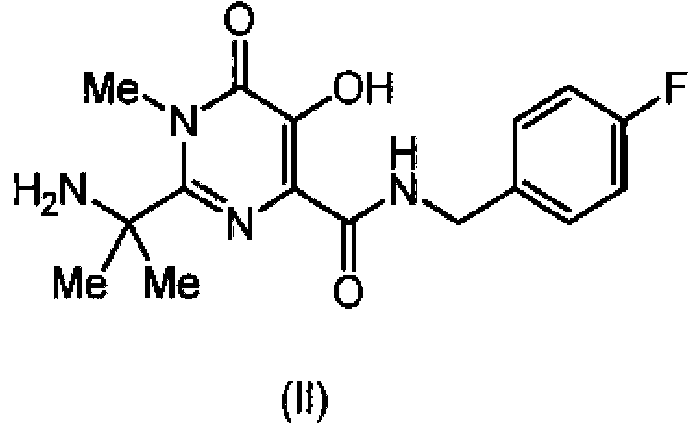
con un compuesto de fórmula (III),with a compound of formula (III),

en dondewhere
X = Cl; oX = Cl; either
X = OAr en donde Ar es un grupo fenilo sustituido con uno o más grupos, que son iguales o diferentes entre sí, seleccionados entre grupo halógeno (F, Cl, Br o I), ciano o nitro; oX = OAr where Ar is a phenyl group substituted with one or more groups, which are the same or different from each other, selected from halogen group (F, Cl, Br or I), cyano or nitro; either
X es un sustituyente de fórmula (IV): X is a substituent of formula (IV):

en donde Z = H (X = IVa) o Z =where Z = H (X = IVa) or Z =

(X = IVb) en donde el compuesto (III) se usa en una cantidad de 1,1 a 1,3 equivalentes molares con respecto al compuesto (II);(X=IVb) wherein compound (III) is used in an amount of 1.1 to 1.3 molar equivalents relative to compound (II);
en un disolvente de reacción y en presencia de una o más bases, en donde al menos una de dichas bases tiene un valor de pKa > 7,4, en una cantidad total de 1,5 a 2,9 equivalentes molares con respecto al compuesto de fórmula (II) o en una cantidad total de 2,5 a 3,9 equivalentes molares con respecto a la sal anhidra del compuesto de fórmula (II) que se produce in situ; yin a reaction solvent and in the presence of one or more bases, where at least one of said bases has a pKa value > 7.4, in a total amount of 1.5 to 2.9 molar equivalents with respect to the compound of formula (II) or in a total amount of 2.5 to 3.9 molar equivalents with respect to the anhydrous salt of the compound of formula (II) which is produced in situ; Y
a una temperatura de reacción que varía de 45 a 75 °C.at a reaction temperature ranging from 45 to 75 °C.
La invención también se refiere a los compuestos de fórmula (IIa), (IIb) o (IIIb),The invention also relates to the compounds of formula (IIa), (IIb) or (IIIb),

Descripción detallada de la invenciónDetailed description of the invention
La presente invención proporciona un método alternativo, mejorado y sostenible para producir Raltegravir de fórmula (I) y sus sales farmacéuticamente aceptables, y en particular su sal potásica, con alta pureza química y excelente rendimiento, sorprendentemente sin requerir el uso de grupos protectores o un exceso de reactivos como en los procesos descritos anteriormente en el estado de la técnica.The present invention provides an alternative, improved and sustainable method for producing Raltegravir of formula (I) and its pharmaceutically acceptable salts, and in particular its potassium salt, with high chemical purity and excellent yield, surprisingly without requiring the use of protecting groups or a excess reagents as in the processes described above in the state of the art.
El proceso de la presente invención permite obtener menos cantidad de agua residual y controlar el contenido de productos secundarios no deseados operando en las condiciones adecuadas descubiertas por los inventores para la reacción del compuesto (II) con el compuesto (III).The process of the present invention makes it possible to obtain less residual water and to control the content of undesired secondary products by operating under the suitable conditions discovered by the inventors for the reaction of compound (II) with compound (III).
El objeto de la presente invención es un proceso para la preparación de Raltegravir de fórmula (I), o sales farmacéuticamente aceptables del mismo,The object of the present invention is a process for the preparation of Raltegravir of formula (I), or pharmaceutically acceptable salts thereof,

que comprende la reacción de un compuesto de fórmula (II), que no está protegido y está en forma anhidra, o de una sal anhidra no protegida del mismo,comprising the reaction of a compound of formula (II), which is unprotected and in anhydrous form, or an unprotected anhydrous salt thereof,

con un compuesto de fórmula (III),with a compound of formula (III),

en donde X = Cl; owhere X = Cl; either
X = OAr en donde Ar es un fenilo sustituido con uno o más grupos, que son iguales o diferentes entre sí, seleccionados entre grupo halógeno (F, Cl, Br o I), ciano o nitro, seleccionados preferentemente entre 2-cloro-4-nitrofenol, 2,3,4,5,6-pentafluorofenol, 4-nitrofenol, 4-cianofenol, 3-nitrofenol, 3-clorofenol, 4-bromofenol; o X es un sustituyente de fórmula (IV): X = OAr where Ar is a phenyl substituted with one or more groups, which are the same or different from each other, selected from a halogen group (F, Cl, Br or I), cyano or nitro, preferably selected from 2-chloro-4 -nitrophenol, 2,3,4,5,6-pentafluorophenol, 4-nitrophenol, 4-cyanophenol, 3-nitrophenol, 3-chlorophenol, 4-bromophenol; or X is a substituent of formula (IV):

en donde Z = H (X = IVa) o Z =where Z = H (X = IVa) or Z =

(X = IVb) preferentemente X = Cl o 4-nitrofenol;(X=IVb) preferably X=Cl or 4-nitrophenol;
en donde el compuesto de fórmula (III) se usa en cantidades de 1,1 a 1,3 equivalentes molares con respecto al compuesto de fórmula (II);wherein the compound of formula (III) is used in amounts of 1.1 to 1.3 molar equivalents relative to the compound of formula (II);
en un disolvente de reacción y en presencia de una o más bases, en donde al menos una base tiene un valor de pKa > 7,4, preferentemente entre 7,4 y 12, más preferentemente entre 8,5 y 11,5, en una cantidad total entre 1,5 y 2,9 equivalentes molares con respecto al compuesto de fórmula (II) o en una cantidad total entre 2,5 y 3,9 equivalentes molares con respecto a la sal anhidra del compuesto de fórmula (II) que se libera in situ; y a una temperatura de reacción entre 45 °C y 75 °C, preferentemente entre 55 °C y 65 °C, o más preferentemente entre 50 °C y 60 °C.in a reaction solvent and in the presence of one or more bases, where at least one base has a pKa value > 7.4, preferably between 7.4 and 12, more preferably between 8.5 and 11.5, in a total amount between 1.5 and 2.9 molar equivalents with respect to the compound of formula (II) or in a total amount between 2.5 and 3.9 molar equivalents with respect to the anhydrous salt of the compound of formula (II) that is released in situ; and at a reaction temperature between 45 °C and 75 °C, preferably between 55 °C and 65 °C, or more preferably between 50 °C and 60 °C.
La sal de Raltegravir de fórmula (I) es preferentemente la sal potásica.The Raltegravir salt of formula (I) is preferably the potassium salt.
Preferentemente, la sal anhidra de un compuesto de fórmula (II) es la sal de metanosulfonato de fórmula (IIa)Preferably, the anhydrous salt of a compound of formula (II) is the methanesulfonate salt of formula (IIa)

En el compuesto del estado de la técnica (III), cuando Xes el sustituyente de fórmula (IVb), se consideraba un producto secundario indeseable de la reacción y tenía que hidrolizarse adicionalmente para proporcionar el producto final deseado Raltegravir de fórmula (I).In the prior art compound (III), when X is the substituent of formula (IVb), it was considered an undesirable by-product of the reaction and had to be further hydrolyzed to provide the desired final product Raltegravir of formula (I).
Sorprendentemente, se ha descubierto que, en las condiciones particulares de la presente invención, dicho intermedio puede usarse directamente como agente de acilación para dar el producto deseado y permite reducir el exceso de agente de acilación de fórmula (III) donde X = Cl, necesario de otro modo en el estado de la técnica para obtener Raltegravir de fórmula (I). Surprisingly, it has been discovered that, under the particular conditions of the present invention, said intermediate can be used directly as an acylating agent to give the desired product and allows reducing the excess of acylating agent of formula (III) where X = Cl, necessary otherwise in the state of the art to obtain Raltegravir of formula (I).
De acuerdo con la presente invención, la expresión "base que tiene un valor de pKa > 7,4" significa una base que tiene al menos un valor de pKa > 7,4. El Solicitante se refiere a los valores de pKa informados en el texto: D.R. Lide, Handbook of Chemistry and Physics, 83a ed. 2002-2003, sección 8-46/56; enlace de Internet: https://labs.chem.ucsb.edu/zhang/liming/pdf/pKas of Organic Acids and Bases.pdf.According to the present invention, the term "base having a pKa value > 7.4" means a base having at least one pKa value > 7.4. The Applicant refers to the pKa values reported in the text: D.R. Lide, Handbook of Chemistry and Physics, 83rd ed. 2002-2003, section 8-46/56; Internet link: https://labs.chem.ucsb.edu/zhang/liming/pdf/pKas of Organic Acids and Bases.pdf.
La base que tiene un valor de pKa > 7,4 puede tener la fórmula generalThe base that has a pKa value > 7.4 can have the general formula
NR1R2R3 (VI),NR1R2R3 (VI),
en donde R1, R2 y R3, que son iguales o diferentes entre sí, pueden ser un grupo alquilo C1-C8 lineal o ramificado, opcionalmente sustituido con grupos alcoxi, dialquilamino o fenilo; o uno de Ri, R2 y R3 puede ser un anillo heterocíclico aromático; Ri y R2 tomados conjuntamente pueden formar un anillo heterocíclico no aromático con el átomo de nitrógeno. La base se selecciona preferentemente, por ejemplo, entre tetrametiletilendiamina, trietilamina, diisopropiletilamina, 4-dimetilaminopiridina.wherein R1, R2 and R3, which are the same or different from each other, may be a linear or branched C1-C8 alkyl group, optionally substituted with alkoxy, dialkylamino or phenyl groups; or one of Ri, R2 and R3 may be an aromatic heterocyclic ring; Ri and R2 taken together can form a non-aromatic heterocyclic ring with the nitrogen atom. The base is preferably selected, for example, from tetramethylethylenediamine, triethylamine, diisopropylethylamine, 4-dimethylaminopyridine.
El disolvente de reacción se selecciona preferentemente entre acetonitrilo, tolueno o mezclas de los mismos.The reaction solvent is preferably selected from acetonitrile, toluene, or mixtures thereof.
El compuesto no protegido de fórmula (II), en forma anhidra, puede obtenerse de acuerdo con métodos conocidos en la técnica o, preferentemente, puede generarse in situ mediante un tratamiento básico de una sal anhidra apropiada del mismo.The unprotected compound of formula (II), in anhydrous form, may be obtained according to methods known in the art or, preferably, may be generated in situ by basic treatment of an appropriate anhydrous salt thereof.
Puede obtenerse una sal anhidra del compuesto (II), que es preferentemente metanosulfonato o p-toluenosulfonato, por ejemplo, de acuerdo con el procedimiento informado en el Esquema 4, partiendo de un compuesto de fórmula (V), en el que Cbz es un grupo carbobenciloxi, obtenido mediante técnicas conocidas, por hidrogenación en presencia de un catalizador de paladio heterogéneo y un equivalente de ácido RSO3H en metanol acuoso; y la precipitación posterior, después de la retirada del catalizador de la mezcla de reacción, por tratamiento con i-PrOH:An anhydrous salt of compound (II), which is preferably methanesulfonate or p-toluenesulfonate, can be obtained, for example, according to the procedure reported in Scheme 4, starting from a compound of formula (V), in which Cbz is a carbobenzyloxy group, obtained by known techniques, by hydrogenation in the presence of a heterogeneous palladium catalyst and one equivalent of RSO3H acid in aqueous methanol; and the subsequent precipitation, after removal of the catalyst from the reaction mixture, by treatment with i-PrOH:

La sal anhidra del compuesto (II), después de secado, puede usarse como tal en el proceso para la preparación de Raltegravir de fórmula (I), proporcionando in situ el compuesto de fórmula (II) por tratamiento con una base en la reacción posterior.The anhydrous salt of compound (II), after drying, can be used as such in the process for the preparation of Raltegravir of formula (I), providing in situ the compound of formula (II) by treatment with a base in the subsequent reaction .
En una realización preferente de la presente invención, el proceso para la preparación de Raltegravir de fórmula (I), o sales farmacéuticamente aceptables del mismo, In a preferred embodiment of the present invention, the process for the preparation of Raltegravir of formula (I), or pharmaceutically acceptable salts thereof,
comprende la reacción de un compuesto de fórmula (Ila) o (Ilb)comprises the reaction of a compound of formula (Ila) or (Ilb)

con un compuesto de fórmula (III),with a compound of formula (III),

donde X es como se ha definido anteriormente.where X is as defined above.
De acuerdo con una realización preferente adicional de la presente invención, el proceso para la preparación de Raltegravir de fórmula (I), o sales farmacéuticamente aceptables del mismo, According to a further preferred embodiment of the present invention, the process for the preparation of Raltegravir of formula (I), or pharmaceutically acceptable salts thereof,

De acuerdo con una realización preferente adicional de la invención, el proceso para la preparación de Raltegravir que tiene la fórmula (I), o sales farmacéuticamente aceptables del mismo,According to a further preferred embodiment of the invention, the process for the preparation of Raltegravir having the formula (I), or pharmaceutically acceptable salts thereof,

con un com puesto de fórmula (IlIb),with a compound of formula (IlIb),

Son objetos adicionales de la presente invención la sal anhidra de metanosulfonato del compuesto de fórmula (IIa) y la sal anhidra de p-toluenosulfonato del compuesto de fórmula (IIb), así como el éster de 4-nitrofenoxi del ácido 2-[5-metil-1,3,4-oxadiazolil]carboxílico de fórmula (IIIb)Additional objects of the present invention are the anhydrous methanesulfonate salt of the compound of formula (IIa) and the anhydrous p-toluenesulfonate salt of the compound of formula (IIb), as well as the 4-nitrophenoxy ester of 2-[5- methyl-1,3,4-oxadiazolyl]carboxylic of formula (IIIb)

De acuerdo con un aspecto adicional de la presente invención, el compuesto (III, X = Cl) puede prepararse por tratamiento de la sal potásica de ácido 2-[5-metil-1,3,4-oxadiazolil]carboxílico en un disolvente o mezcla de disolventes tal como, por ejemplo, acetonitrilo o tolueno, a baja temperatura con cloruro de oxalilo en presencia de una cantidad catalítica de DMF y posteriormente concentración parcial de la mezcla a presión reducida. Por tanto, la mezcla obtenida de ese modo puede usarse como tal en el proceso para la preparación de Raltegravir de fórmula (I).According to a further aspect of the present invention, compound (III, X = Cl) can be prepared by treating 2-[5-methyl-1,3,4-oxadiazolyl]carboxylic acid potassium salt in a solvent or solvent mixture such as, for example, acetonitrile or toluene, at low temperature with oxalyl chloride in the presence of a catalytic amount of DMF and subsequently partial concentration of the mixture under reduced pressure. Therefore, the thus obtained mixture can be used as such in the process for the preparation of Raltegravir of formula (I).
Alternativamente, el compuesto (III, X = Cl) se transforma en el nuevo derivado correspondiente (III, X = OAr), de acuerdo con la presente invención como se describe posteriormente en el presente documento en los Ejemplos, antes de usarse en el proceso para la preparación de Raltegravir de fórmula (I).Alternatively, the compound (III, X = Cl) is transformed into the new corresponding derivative (III, X = OAr), according to the present invention as described hereinafter in the Examples, before being used in the process for the preparation of Raltegravir of formula (I).
De acuerdo con una realización preferente, el compuesto de fórmula (II) en forma no protegida, anhidra o, preferentemente, en forma de una sal anhidra del mismo, más preferentemente en forma de la correspondiente sal anhidra de metanosulfonato, se suspende en un disolvente, preferentemente acetonitrilo, y se trata con una o más bases, en donde al menos una de las cuales tiene un valor de pKa > 7,4, preferentemente un valor de pKa entre 7,4 y 12, más preferentemente entre 8,5 y 11,5, en una cantidad total entre 1,5 y 2,9 equivalentes molares con respecto al compuesto de fórmula (II) o en una cantidad total entre 2,5 y 3,9 equivalentes molares con respecto a la sal anhidra del compuesto de fórmula (II) que se forma in situ. A esta mezcla, se añade lentamente el compuesto de fórmula (III), como se ha definido anteriormente, diluido en un disolvente de reacción tal como, por ejemplo, acetonitrilo o tolueno, a una temperatura entre 45 °C y 75 °C, preferentemente entre 55 °C y 65 °C o, más preferentemente, a una temperatura entre 50 °C y 60 °C; finalmente, la mezcla de reacción se mantiene en agitación a una temperatura entre 45 °C y 75 °C, preferentemente entre 55 °C y 65 °C, más preferentemente a una temperatura entre 50 °C y 60 °C, hasta el consumo completo del compuesto de fórmula (II). A continuación, la mezcla se trata con agua y ácido acético hasta un pH de 4,0-4,5 a temperatura ambiente y posteriormente con acetato de etilo; la fase orgánica separada se concentra y el residuo se cristaliza en etanol o en una mezcla de etanol/acetonitrilo 98/2 para proporcionar Raltegravir de fórmula (I) con una pureza por HPLC mayor de un 99,5 %, preferentemente > 99,8 % y con un contenido de cada impureza individual < 0,06 %.According to a preferred embodiment, the compound of formula (II) in unprotected, anhydrous form or, preferably, in the form of an anhydrous salt thereof, more preferably in the form of the corresponding anhydrous methanesulfonate salt, is suspended in a solvent , preferably acetonitrile, and is treated with one or more bases, at least one of which has a pKa value > 7.4, preferably a pKa value between 7.4 and 12, more preferably between 8.5 and 11.5, in a total amount between 1.5 and 2.9 molar equivalents with respect to the compound of formula (II) or in a total amount between 2.5 and 3.9 molar equivalents with respect to the anhydrous salt of the compound of formula (II) which is formed in situ. To this mixture, slowly add the compound of formula (III), as defined above, diluted in a reaction solvent such as, for example, acetonitrile or toluene, at a temperature between 45 °C and 75 °C, preferably between 55°C and 65°C or, more preferably, at a temperature between 50°C and 60°C; Finally, the reaction mixture is kept under stirring at a temperature between 45 °C and 75 °C, preferably between 55 °C and 65 °C, more preferably at a temperature between 50 °C and 60 °C, until complete consumption. of the compound of formula (II). The mixture is then treated with water and acetic acid up to pH 4.0-4.5 at room temperature and subsequently with ethyl acetate; the separated organic phase is concentrated and the residue is crystallized from ethanol or from an ethanol/acetonitrile 98/2 mixture to provide Raltegravir of formula (I) with a purity by HPLC greater than 99.5%, preferably >99.8 % and with a content of each individual impurity < 0.06%.
De acuerdo con un aspecto particularmente preferente de la invención, el proceso para la preparación de Raltegravir de fórmula (I) se realiza como se muestra en el Esquema 5, en donde la sal anhidra del compuesto de fórmula (II) es el correspondiente metanosulfonato, que se hace reaccionar con 1,1-1,3 equivalentes del compuesto (III, X = Cl), en presencia de 2,5-3,9 equivalentes de trietilamina en un disolvente de reacción (que es acetonitrilo o tolueno o una mezcla de los mismos) a una temperatura entre 50 °C y 60 °C. Cuando se completa la reacción, y después del procesamiento posterior de acuerdo con métodos conocidos, el producto se aísla en etanol. According to a particularly preferred aspect of the invention, the process for the preparation of Raltegravir of formula (I) is carried out as shown in Scheme 5, where the anhydrous salt of the compound of formula (II) is the corresponding methanesulfonate, which is reacted with 1.1-1.3 equivalents of the compound (III, X = Cl), in the presence of 2.5-3.9 equivalents of triethylamine in a reaction solvent (which is acetonitrile or toluene or a mixture thereof) at a temperature between 50 °C and 60 °C. When the reaction is complete, and after further processing according to known methods, the product is isolated in ethanol.

El Raltegravir de fórmula (I), obtenido con el proceso de la presente invención, puede convertirse a continuación en sus sales farmacológicamente aceptables y, en particular, en su sal potásica, mediante métodos conocidos en la técnica.The Raltegravir of formula (I), obtained with the process of the present invention, can then be converted into its pharmacologically acceptable salts and, in particular, into its potassium salt, by methods known in the art.
El Raltegravir de fórmula (I) puede obtenerse de ese modo con alto rendimiento (88-95 %) y alta pureza química (> 99,5 %), como se demuestra mediante análisis por HPLC.Raltegravir of formula (I) can thus be obtained in high yield (88-95%) and high chemical purity (>99.5%), as demonstrated by HPLC analysis.
Un aspecto final de la presente invención es el uso de nuevas sales anhidras del compuesto de fórmula (II) y de los compuestos de fórmula (III).A final aspect of the present invention is the use of new anhydrous salts of the compound of formula (II) and of the compounds of formula (III).
Los siguientes ejemplos ilustran adicionalmente la invención.The following examples further illustrate the invention.
Métodos analíticosAnalytical methods
Análisis difractométrico de rayos X - método de polvo (XRPD)X-ray diffractometric analysis - powder method (XRPD)
Las muestras, antes de analizarse, se sometieron a molienda ligera en un mortero de ágata y a continuación se analizaron mediante difractometría de rayos X (método de polvo - XRPD), teniendo las siguientes características instrumentales:The samples, before being analyzed, were subjected to light grinding in an agate mortar and then analyzed by X-ray diffractometry (powder method - XRPD), having the following instrumental characteristics:
- difractómetro Philips PW1800/10- Philips PW1800/10 diffractometer
- software de procesamiento de datos X'Pert High Score - v. 2.0a (PANalytical)- X'Pert High Score data processing software - v. 2.0a (PANalytical)
- radiación Cu Ka (Kai = 1,54060 A Ka2= 1,54439 A)- Cu Ka radiation (Kai = 1.54060 A Ka2= 1.54439 A)
- monocromador de grafito- graphite monochromator
- portamuestras automático divergente- divergent automatic sample holder
- potencia del generador: 45 Kv, 35 mA- generator power: 45 Kv, 35 mA
- intervalo de barrido: 2°- 65° 20- sweep interval: 2°- 65° 20
- velocidad de barrido (etapa): 0,02° 20/s- sweep speed (step): 0.02° 20/s
- tiempo de recuento por etapa: 1,0 s- count time per step: 1.0 s
Las muestras se analizaron en el intervalo de barrido: 2°- 65° 20.The samples were analyzed in the scan interval: 2°- 65° 20.
Análisis por DSC (calorimetría diferencial de barrido)Analysis by DSC (Differential Scanning Calorimetry)
Los análisis por DSC se realizaron usando un instrumento METTLER TOLEDO DSC 822e. Los experimentos se realizaron con una rampa de calentamiento de 10,0 °C/min en el intervalo de 30-350 °C y con un flujo de nitrógeno de 40 ml/min. Se usaron crisoles de aluminio de 40 |jl con tapa perforada.DSC analyzes were performed using a METTLER TOLEDO DSC 822e instrument. The experiments were performed with a heating ramp of 10.0 °C/min in the range of 30-350 °C and with a nitrogen flow of 40 ml/min. 40 μl aluminum crucibles with perforated lids were used.
Análisis por IR (espectroscopía infrarroja)IR analysis (infrared spectroscopy)
Los espectros IR se registraron usando un espectrofotómetro JASCO FT-IR 460 Plus. Las muestras se prepararon moliendo aproximadamente 5 mg de muestra con aproximadamente 500 mg de KBr y se analizaron en el intervalo de 4.000-400 cirr1 con una resolución de 4 cirr1.IR spectra were recorded using a JASCO FT-IR 460 Plus spectrophotometer. Samples were prepared by grinding approximately 5 mg of sample with approximately 500 mg KBr and analyzed over the range of 4,000-400 cirr1 with 4 cirr1 resolution.
Análisis por RMN (resonancia magnética nuclear)NMR (nuclear magnetic resonance) analysis
Los análisis por RMN se realizaron usando un instrumento Bruker Avance 300 MHz. NMR analyzes were performed using a Bruker Avance 300 MHz instrument.
Ejemplo 1 - Preparación de sal de metanosulfonato del compuesto de fórmula (II)Example 1 - Preparation of methanesulfonate salt of the compound of formula (II)
Se cargaron 40 g (85,4 mmol) de (2-(4-((4-fluorobencil)carbamoil)-5-hidroxi-1-metil-6-oxo-1,6-dihidropirimidin-2-il)propan-2-il)-carbamato de bencilo, 83,7 g (87,1 mmol) de ácido metanosulfónico, 0,8 g de Pd al 5 %/C (50% de humedad) en una autoclave de 1 l con 180 ml de metanol acuoso (8:1). Después de 3 ciclos de vacío-hidrógeno, la autoclave se presurizó con 1 bar de hidrógeno y la mezcla se calentó a 40 °C hasta que se retiró completamente el grupo carbobenciloxi. Después de la filtración del catalizador, la mezcla se redujo a un volumen bajo y se recuperó con 120 ml de isopropanol y se concentró nuevamente. La operación se repitió hasta que KF < 1. Finalmente, la mezcla de isopropanol se enfrió y se mantuvo en agitación a 0-5 °C durante 1 h. El sólido se filtró, y se secó al vacío a 60 °C para dar 34,9 g del compuesto de fórmula (II) en forma de metanosulfonato con un 94,9 % de rendimiento. El producto se caracterizó por rayos X (Figura 1).40 g (85.4 mmol) of (2-(4-((4-fluorobenzyl)carbamoyl)-5-hydroxy-1-methyl-6-oxo-1,6-dihydropyrimidin-2-yl)propan- Benzyl 2-yl)-carbamate, 83.7 g (87.1 mmol) methanesulfonic acid, 0.8 g 5% Pd/C (50% humidity) in a 1 L autoclave with 180 mL of aqueous methanol (8:1). After 3 cycles of vacuum-hydrogen, the autoclave was pressurized with 1 bar of hydrogen and the mixture was heated at 40 °C until the carbobenzyloxy group was completely removed. After filtration of the catalyst, the mixture was reduced to a low volume and taken up with 120 ml of isopropanol and concentrated again. The operation was repeated until KF < 1. Finally, the isopropanol mixture was cooled and kept stirring at 0-5 °C for 1 h. The solid was filtered, and dried in vacuo at 60°C to give 34.9 g of the compound of formula (II) as methanesulfonate in 94.9% yield. The product was characterized by X-rays (Figure 1).
IR (Figura 2), DSC (Figura 3) y RMN como se informa a continuación.IR (Figure 2), DSC (Figure 3), and NMR as reported below.
RMN 1H (DMSO da, 300 MHz) (8 en ppm con respecto a TMS): 1,74 (6H, s, -CH3-E); 2,41 (3H, s, CH3SO3H); 3,55 (3H, s, -NCH3); 4,55 (2H, d, J = 5,5 Hz, H-C); 7,18 (2H, t, J = 9 Hz, H-^); 7,43 (2H, dd, J = 9,6 Hz, H-B); 8,54 (3H, ancho, NH3+); 9,64 (1H, t, J = 5,5 Hz, NH-D); 12,25 (1H, ancho, OH). 1H NMR (DMSO da, 300 MHz) (8 ppm relative to TMS): 1.74 (6H, s, -CH3-E); 2.41 (3H, s, CH3SO3H); 3.55 (3H, s, -NCH3); 4.55 (2H, d, J=5.5 Hz, HC); 7.18 (2H, t, J=9Hz, H-^); 7.43 (2H, dd, J=9.6 Hz, HB); 8.54 (3H, broad, NH3+); 9.64 (1H, t, J=5.5 Hz, NH-D); 12.25 (1H, broad, OH).
RMN 13C (DMSO d6, 300 MHz) (8 en ppm con respecto a TMS, la multiplicidad se obtuvo del espectro DEPT-135): 23,9 (CH3 -E); 33,3 (-NCH3); 39,7 (CH3SO3H); 41,3 (CH2-C); 57,3; 115,1 (d, Jc-f = 22 Hz, CH-^); 123,7; 129,6 (d, Jc-f = 8 Hz, CH-S); 134,5 (d, Jc-f = 3 Hz); 146,6; 149,4; 158,4; 159,7 e 162,9 (d, Jc-f = 240 Hz); 168,0. 13C NMR (DMSO d6, 300 MHz) (8 ppm relative to TMS, multiplicity was obtained from DEPT-135 spectrum): 23.9 (CH3 -E); 33.3 (-NCH3); 39.7 (CH3SO3H); 41.3 (CH2-C); 57.3; 115.1 ( d, J c - f = 22 Hz, CH-^); 123.7; 129.6 ( d, Jc-f = 8Hz, CH-S); 134.5 ( d, J c - f = 3 Hz); 146.6; 149.4; 158.4; 159.7 e 162.9 ( d, J c - f = 240 Hz); 168.0.

(continuación)(continuation)

Ejemplo 2 - Preparación de p-toluenosulfonato de 2-(2-ammoprop-2-M)-W-(4-fluorobencM)-5-hidroxM-metN-6-oxo-1,6-dihidropirimidina-4-carboxamida (II)Example 2 - Preparation of 2-(2-ammoprop-2-M)-W-(4-fluorobenzM)-5-hydroxM-metN-6-oxo-1,6-dihydropyrimidine-4-carboxamide p-toluenesulfonate (II )
Operando como se ha descrito en el Ejemplo 1, pero usando 16,5 g (87,1 mmol) de monohidrato de ácido p-toluenosulfónico, se obtuvo el compuesto de fórmula (II) en forma de para-toluenosulfonato (95,1 % de rendimiento). El producto se caracterizó por rayos X (Figura 4), IR (Figura 5), DSC (Figura 6) y RMN como se informa a continuación. Operating as described in Example 1, but using 16.5 g (87.1 mmol) of p -toluenesulfonic acid monohydrate, the compound of formula (II) was obtained in the form of para-toluenesulfonate (95.1% performance). The product was characterized by X-ray (Figure 4), IR (Figure 5), DSC (Figure 6), and NMR as reported below.
RMN 1H (DMSO da, 300 MHz) (8 en ppm con respecto a TMS): 1,73 (6H, s, -CH3-E); 2,30 (3H, s, CH3 TsOH); 3,55 (3H, s, -NCH3); 4,52 (2H, d, J = 5,5 Hz, H-C); 7,14 e 7,51 (4H, sistema AA'XX', J = 8 Hz, TsOH); 7,18 (2H, t, J = 9 Hz, H-A); 7,40 (2H, dd, J = 9, 6 Hz, H-S); 8,50 (3H, ancho, NH3+); 9,53 (1H, t, J = 5,5 Hz, NH-D); 12,25 (1H, ancho, OH). 1H NMR (DMSO da, 300 MHz) (8 ppm relative to TMS): 1.73 (6H, s, -CH3-E); 2.30 (3H, s, CH3TsOH); 3.55 (3H, s, -NCH3); 4.52 (2H, d, J=5.5 Hz, HC); 7.14 and 7.51 (4H, AA'XX' system, J = 8 Hz, TsOH); 7.18 (2H, t, J=9Hz, HA); 7.40 (2H, dd, J=9.6Hz, HS); 8.50 (3H, broad, NH3+); 9.53 (1H, t, J=5.5 Hz, NH-D); 12.25 (1H, broad, OH).
RMN 13C (DMSO da, 300 MHz) (5 en ppm con respecto a TMS, la multiplicidad se obtuvo del espectro DEPT-135): 20,8 (CH3 TsOH); 23,9 (CH3 -E); 33,3 (-NCH3); 41,3 (CH2-C); 57,3; 115,1 (d, Jc-f = 22 Hz, CH-A); 123,6; 125,4 (CH TsOH); 128,2 (CH TsOH); 129,5 (d, Jc-f = 8 Hz, CH-S); 134,4 (d, Jc-f = 3 Hz); 138,1; 145,0; 146,6; 149,4; 158,4; 159,7 e 162,9 (d, Jc-f = 240 Hz); 168,0. 13 C NMR (DMSO da, 300 MHz) (5 ppm relative to TMS, multiplicity was obtained from DEPT-135 spectrum): 20.8 (CH3 TsOH); 23.9 (CH3 -E); 33.3 (-NCH3); 41.3 (CH2-C); 57.3; 115.1 ( d, Jc-f = 22Hz, CH-A); 123.6; 125.4 (CHTsOH); 128.2 (CHTsOH); 129.5 ( d, Jc-f = 8Hz, CH-S); 134.4 ( d, J c - f = 3 Hz); 138.1; 145.0; 146.6; 149.4; 158.4; 159.7 and 162.9 (d, Jc-f = 240 Hz); 168.0.

(continuación)(continuation)

Ejemplo 3 - Preparación de RaltegravirExample 3 - Preparation of Raltegravir
En atmósfera inerte, se cargaron 31 g (187 mmol) de sal potásica de ácido 5-metil-1,3,4-oxadiazol-2-carboxílico, 248 ml de tolueno y 0,46 ml de DMF en un matraz de 1 l. A dicha mezcla, a una temperatura de 0-5 °C, se añadieron lentamente 16,1 ml (190 mmol) de cloruro de oxalilo y, después de 1,5 h, al vacío, el tolueno se concentró parcialmente hasta aproximadamente la mitad del volumen inicial, sin exceder la temperatura de 60 °C. Se añadió tolueno reciente y la operación se repitió. La suspensión que contenía sal de cloruro de ácido 5-metil-1,3,4-oxadiazol-2-carboxílico (aproximadamente 185 mmol) se enfrió a 20 °C, y se añadió lentamente por goteo a una mezcla de 69 ml (497 mmol) de trimetilamina, 401 ml de acetonitrilo y 67 g (155 moles) de metanosulfonato del compuesto (II), obtenido como se informa en el Ejemplo 1. La mezcla se mantuvo en agitación en un matraz de 2 l a una temperatura de 50-55 °C hasta la compleción de la reacción y posteriormente se enfrió a temperatura ambiente. El proceso se realizó añadiendo 120 ml de agua, 40 ml de ácido acético y 400 ml de acetato de etilo a la mezcla obtenida; después de la separación de la fase inferior, la fase orgánica se lavó con agua, que se desechó, y a continuación se concentró a un volumen bajo. El residuo se diluyó con 480 ml de etanol y se concentró al vacío y se cristalizó en etanol. Se recuperaron 60 g (87 % de rendimiento) de Raltegravir, que tenía una pureza química > 99,5 % por HPLC, después de filtración a 5 10 °C y secado.Under an inert atmosphere, 31 g (187 mmol) of 5-methyl-1,3,4-oxadiazole-2-carboxylic acid potassium salt, 248 mL of toluene and 0.46 mL of DMF were charged to a 1-L flask. . To said mixture, at a temperature of 0-5 °C, 16.1 ml (190 mmol) of oxalyl chloride were slowly added and, after 1.5 h, under vacuum, the toluene was partially concentrated to approximately half of the initial volume, without exceeding the temperature of 60 °C. Fresh toluene was added and the operation was repeated. The suspension containing 5-methyl-1,3,4-oxadiazole-2-carboxylic acid chloride salt (about 185 mmol) was cooled to 20 °C, and slowly added dropwise to a mixture of 69 mL (497 mmol) of trimethylamine, 401 ml of acetonitrile and 67 g (155 moles) of methanesulfonate of compound (II), obtained as reported in Example 1. The mixture was kept stirring in a 2 l flask at a temperature of 50- 55 °C until the completion of the reaction and subsequently cooled to room temperature. The process was carried out by adding 120 ml of water, 40 ml of acetic acid and 400 ml of ethyl acetate to the mixture obtained; after separation of the lower phase, the organic phase was washed with water, which was discarded, and then concentrated to low volume. The residue was diluted with 480 ml of ethanol and concentrated in vacuo and crystallized from ethanol. 60 g (87% yield) of Raltegravir, which had chemical purity >99.5% by HPLC, was recovered after filtration at 5-10°C and drying.
Ejemplo 4 - Preparación de RaltegravirExample 4 - Preparation of Raltegravir
Operando como se ha descrito en el Ejemplo 3, pero usando 2,6 equivalentes molares con respecto al compuesto de fórmula (II) de diferentes bases y 1,15 equivalentes molares de cloruro de acilo, se obtuvieron los resultados informados en la Tabla 1 después de llevar a cabo la reacción durante 3 horas.Operating as described in Example 3, but using 2.6 molar equivalents with respect to the compound of formula (II) of different bases and 1.15 molar equivalents of acyl chloride, the results reported in Table 1 after to carry out the reaction for 3 hours.
Tabla 1Table 1

Ejemplo 5 - Preparación de Raltegravir partiendo de la base libre del compuesto de fórmula (II) en forma hidratadaExample 5 - Preparation of Raltegravir starting from the free base of the compound of formula (II) in hydrated form
Operando como se ha descrito en el Ejemplo 1, pero después de filtrar el catalizador, se hizo gotear lentamente NaOH 2 M hasta alcanzar pH ~ 8 manteniendo una temperatura inferior a 20 °C, en la solución enfriada a aproximadamente 20 °C. Tras completar la adición, el producto de fórmula (II) precipitó en forma de la base libre, la suspensión se mantuvo a 0-5 °C durante 1 hora, se filtró y el sólido se lavó con agua fría (2 x 45 ml), se secó al vacío a 60 °C durante al menos 6 horas para dar la base libre del compuesto de fórmula (II) en forma hidratada (26,6 g, KF 4,74 %) con un 93,4 % de rendimiento respecto a la base anhidra.Operating as described in Example 1, but after filtering off the catalyst, 2M NaOH was slowly dripped until reaching pH ~8 while maintaining a temperature below 20°C, into the solution cooled to about 20°C. After complete addition, the product of formula (II) precipitated as the free base, the suspension was kept at 0-5 °C for 1 hour, filtered and the solid washed with cold water (2 x 45 ml). , dried under vacuum at 60 °C for at least 6 hours to give the free base of the compound of formula (II) in hydrated form (26.6 g, KF 4.74%) in 93.4% yield relative to to the anhydrous base.
Una forma hidratada en suspensión de la base libre del compuesto de fórmula (II) (21,3 g, 60,7 mmol) en tolueno (100 ml) se secó por destilación completa hasta que KF < 0,1 %. A continuación, la suspensión se destiló hasta un residuo al vacío y se suspendió nuevamente en acetonitrilo (100 ml). Se añadió trietilamina (15,4 g, 152 mmol) a la suspensión, la mezcla se calentó a 50-60 °C y se hizo gotear una suspensión del compuesto (III, X = Cl) (50 ml, 72,7 mmol) en atmósfera de nitrógeno. La mezcla se mantuvo a 50-60 °C hasta la compleción de la reacción y posteriormente se enfrió a temperatura ambiente. Se añadieron a la suspensión agua (45 ml), acetato de etilo (150 ml) y ácido acético glacial hasta pH 4-4,5. La fase orgánica se recuperó por decantación, se lavó nuevamente con agua (45 ml) y posteriormente se concentró. La suspensión se diluyó a continuación con EtOH (130 ml), se calentó a 60 70 °C durante 1 h, se enfrió a 0-5 °C y, después de 1 h, se filtró y se lavó con EtOH frío. El sólido se secó al vacío a 60 °C durante al menos 6 h para dar Raltegravir (24,3 g, 54,6 mmol) con un 90 % de rendimiento y un 99,8 % de pureza por HPLC.A suspended hydrated form of the free base of the compound of formula (II) (21.3 g, 60.7 mmol) in toluene (100 mL) was dried by complete distillation until KF < 0.1%. The suspension was then distilled to a residue in vacuo and resuspended in acetonitrile (100 mL). Triethylamine (15.4 g, 152 mmol) was added to the suspension, the mixture was heated to 50-60 °C, and a suspension of compound (III, X = Cl) (50 mL, 72.7 mmol) was dropped in nitrogen atmosphere. The mixture was kept at 50-60 °C until the completion of the reaction and was subsequently cooled to room temperature. Water (45 ml), ethyl acetate (150 ml) and glacial acetic acid were added to the suspension until pH 4-4.5. The organic phase was recovered by decantation, washed again with water (45 ml) and subsequently concentrated. The suspension was then diluted with EtOH (130 mL), heated at 60-70 °C for 1 h, cooled to 0-5 °C and after 1 h filtered and washed with cold EtOH. The solid was dried in vacuo at 60 °C for at least 6 h to give Raltegravir (24.3 g, 54.6 mmol) in 90 % yield and 99.8 % purity by HPLC.
Ejemplo 6 - Preparación de Raltegravir partiendo del compuesto de fórmula (IVb)Example 6 - Preparation of Raltegravir starting from the compound of formula (IVb)
En atmósfera de nitrógeno, una solución del compuesto (III, X = Cl) (60 g, 48 mmol) en tolueno, preparada previamente de acuerdo con los Ejemplos informados anteriormente, se hizo gotear lentamente (en aproximadamente 15min) manteniendo una temperatura de 0-5 °C en una solución de metanosulfonato del compuesto de fórmula (II) (8,6 g, 20 mmol) en acetonitrilo (45 ml) y trietilamina (4,05 g, 40 mmol) enfriada a 0-5 °C. Después de 1 h, la suspensión que contenía el producto de bis-acilato de Raltegravir (IVb) se hizo gotear lentamente en una solución de metanosulfonato del compuesto de fórmula (II) (8,6 g, 20 mmol) en acetonitrilo (45 ml) y trietilamina (4,05 g, 40 mmol) calentada previamente a 50-60 °C. Tras completar la adición, la suspensión se mantuvo en agitación a 50-60 °C hasta que se completa la reacción. Se añadieron agua (25 ml) seguida de ácido acético glacial hasta pH 4-4,5 a la suspensión enfriada a 20-25 °C. Se añadió acetato de etilo (200 ml) a la solución obtenida y la mezcla se mantuvo en agitación durante 15 min a 20-25 °C. La fase orgánica se decantó y se lavó nuevamente con agua (20 ml). Después de la decantación posterior, la fase orgánica se destiló completamente al vacío. El residuo sólido se suspendió en etanol (120 ml) y la suspensión se calentó a 60-70 °C durante al menos 1 h, y a continuación se enfrió a 0-5 °C. Después de 1 h, el sólido se filtró y se lavó con etanol frío (2 x 20 ml), y se secó al vacío a 60 °C durante al menos 6 h para dar Raltegravir (16 g, 36 mmol) con un 90 % de rendimiento y una pureza por HPLC de un 99,7 %.Under a nitrogen atmosphere, a solution of compound (III, X = Cl) (60 g, 48 mmol) in toluene, previously prepared according to the Examples reported above, was slowly (in about 15 min) dropwise maintaining a temperature of 0 -5 °C in a solution of methanesulfonate of the compound of formula (II) (8.6 g, 20 mmol) in acetonitrile (45 ml) and triethylamine (4.05 g, 40 mmol) cooled to 0-5 °C. After 1 h, the suspension containing the Raltegravir bis-acylate product (IVb) was slowly dropped into a solution of the compound of formula (II) methanesulfonate (8.6 g, 20 mmol) in acetonitrile (45 mL ) and triethylamine (4.05 g, 40 mmol) previously heated to 50-60 °C. After completing the addition, the suspension was kept under stirring at 50-60 °C until the reaction was complete. Water (25 ml) followed by glacial acetic acid were added to pH 4-4.5 to the suspension cooled to 20-25°C. Ethyl acetate (200 ml) was added to the obtained solution and the mixture was kept stirring for 15 min at 20-25 °C. The organic phase was decanted and washed again with water (20 mL). After further settling, the organic phase was completely distilled under vacuum. The solid residue was suspended in ethanol (120 mL) and the suspension heated at 60-70 °C for at least 1 h, then cooled to 0-5 °C. After 1 h, the solid was filtered and washed with cold ethanol (2 x 20 mL), and dried in vacuo at 60 °C for at least 6 h to give Raltegravir (16 g, 36 mmol) at 90%. yield and a HPLC purity of 99.7%.
Ejemplo 7 - Preparación de Raltegravir partiendo del compuesto de fórmula (III) (donde X = 4-nitrofenoxi) (IIIb) Example 7 - Preparation of Raltegravir starting from the compound of formula (III) (where X = 4-nitrophenoxy) (IIIb)
En atmósfera de nitrógeno, manteniendo una temperatura de 0-5 °C, una solución de la mezcla (III, X = Cl) en tolueno (160 ml, 240,7 mmol), preparada previamente de acuerdo con el Ejemplo 3, se añadió a una solución de 4-nitrofenol (36,8 g, 264,8 mmol) en acetonitrilo (180 ml) y trietilamina (53,6 g, 529,5 mmol) y se enfrió a 0-5 °C. Tras completar la adición, la suspensión amarilla se mantuvo en agitación durante al menos 1 ha 5-10 °C. Una muestra del compuesto (IIIb) se aisló después de filtración salina, concentración a bajo volumen y trituración en acetato de isopropilo. El producto se caracterizó mediante IR (Figura 7), DSC (Figura 8) y RMN como se informa a continuación.In a nitrogen atmosphere, maintaining a temperature of 0-5 °C, a solution of the mixture (III, X = Cl) in toluene (160 ml, 240.7 mmol), previously prepared according to Example 3, was added to a solution of 4-nitrophenol (36.8 g, 264.8 mmol) in acetonitrile (180 mL) and triethylamine (53.6 g, 529.5 mmol) and cooled to 0-5 °C. After complete addition, the yellow suspension was kept stirring for at least 1 h at 5-10 °C. A sample of compound (IIIb) was isolated after salt filtration, low volume concentration and trituration in isopropyl acetate. The product was characterized by IR (Figure 7), DSC (Figure 8), and NMR as reported below.
RM N1H (DMSO d6, 300 MHz) (8 en ppm con respecto a TMS): 2,69 (3H, s, -CH3); 7,50 (H-A) e 8,36 (H-B) (4H, sistema AA'XX', J = 9 Hz). N1H RM (DMSO d6, 300 MHz) (8 ppm relative to TMS): 2.69 (3H, s, -CH3); 7.50 (HA) and 8.36 (HB) (4H, AA'XX' system, J=9 Hz).
RMN 13C (DMSO d6, 300 MHz)(8 en ppm con respecto a TMS): 11,2 (CH3); 122,1 (CH-A); 125,4 (CH-S); 146,0; 151,6; 153,8; 156,0; 167,0. 13 C NMR (DMSO d6, 300 MHz)(8 ppm relative to TMS): 11.2 (CH3); 122.1 (CH-A); 125.4 (CH-S); 146.0; 151.6; 153.8; 156.0; 167.0.
Mientras tanto, se hizo gotear la suspensión del éster del compuesto (IIIb) obtenida anteriormente en metanosulfonato del compuesto de fórmula (II) (87 g, 202,9 mmol) previamente suspendido en una mezcla de acetonitrilo (435 ml) y trietilamina (22,6 g, 223 mmol) en atmósfera de nitrógeno a 65 °C. Durante la adición (aproximadamente 30 min) y durante toda la reacción, la temperatura se mantuvo a una temperatura de 60-70 °C. Tras la compleción de la reacción, la suspensión se destiló hasta 600 ml. Se añadieron en secuencia acetato de etilo (500 ml), agua (200 ml) y HCl al 32 % (14 g) a la suspensión densa, para alcanzar un pH de aproximadamente 4-4,5. La fase orgánica superior obtenida por decantación se lavó dos veces con agua (2 x 110 ml). La fase orgánica resultante se sometió a continuación a destilación al vacío hasta 200 ml. Se añadió etanol (250 ml) a la suspensión y se destiló nuevamente hasta un volumen de 200 ml. El tratamiento informado anteriormente se repitió, a continuación se añadió etanol (250 ml) y se destiló hasta 200 ml. La suspensión se diluyó con etanol (500 ml), la temperatura se elevó a 60-70 °C durante al menos 1 h, se enfrió a 0-5 °C y se mantuvo a esta temperatura durante al menos 1 h. El sólido se aisló por filtración, se lavó con etanol y se secó al vacío a 60 °C para obtener 75,4 g de Raltegravir (169,6 mmol, 83,6 % de rendimiento) y una pureza por HPLC de un 99,6 %.Meanwhile, the suspension of the ester of compound (IIIb) obtained above in methanesulfonate of the compound of formula (II) (87 g, 202.9 mmol) previously suspended in a mixture of acetonitrile (435 ml) and triethylamine (22 0.6 g, 223 mmol) under nitrogen atmosphere at 65 °C. During the addition (approximately 30 min) and throughout the reaction, the temperature was maintained at 60-70 °C. After the completion of the reaction, the suspension was distilled to 600 ml. Ethyl acetate (500 mL), water (200 mL), and 32% HCl (14 g) were added to the slurry in sequence to reach a pH of about 4-4.5. The upper organic phase obtained by decantation was washed twice with water (2 x 110 ml). The resulting organic phase was then subjected to vacuum distillation to 200 ml. Ethanol (250 ml) was added to the suspension and distilled again to a volume of 200 ml. The treatment reported above was repeated, then ethanol (250 ml) was added and distilled to 200 ml. The suspension was diluted with ethanol (500 ml), the temperature was raised to 60-70 °C for at least 1 h, cooled to 0-5 °C and kept at this temperature for at least 1 h. The solid was isolated by filtration, washed with ethanol and dried in vacuo at 60 °C to obtain 75.4 g of Raltegravir (169.6 mmol, 83.6% yield) and an HPLC purity of 99. 6%.
- Ejemplo 8 - Preparación de Raltegravir a partir del compuesto de fórmula (III) (en donde X = OAr)- Example 8 - Preparation of Raltegravir from the compound of formula (III) (where X = OAr)
Operando como en el Ejemplo 7, pero usando una cantidad molar equivalente de fenoles sustituidos con uno o más grupos, iguales o diferentes entre sí y seleccionados entre halógeno, ciano o nitro, en lugar de 4-nitrofenol, se prepararon los correspondientes ésteres del compuesto (III, X = OAr) por reacción con metanosulfonato de fórmula (II), de acuerdo con el método descrito en el Ejemplo 7.Operating as in Example 7, but using an equivalent molar amount of phenols substituted with one or more groups, the same or different from each other and selected from halogen, cyano or nitro, instead of 4-nitrophenol, the corresponding esters of the compound (III, X = OAr) by reaction with methanesulfonate of formula (II), according to the method described in Example 7.
Después de reaccionar durante 4 horas, se obtuvieron los productos informados en la Tabla 2.After reacting for 4 hours, the products reported in Table 2 were obtained.
Tabla 2Table 2

(continuación)(continuation)

Ejemplo 9 - Preparación de sal potásica de RaltegravirExample 9 - Preparation of potassium salt of Raltegravir
Una solución al 48 % de KOH (1,76 ml, 22,05 mmol) se hizo gotear en aproximadamente 10 min, en una suspensión de Raltegravir (10 g, 22,5 mmol) en una mezcla 1:1 de etanol/agua (30 ml), enfriada a 15-20 °C. La solución se filtró y se añadió etanol (160 ml) en aproximadamente 60 min al filtrado transparente a una temperatura de 15-20 °C. La suspensión se mantuvo en agitación durante 1 h enfriada a 5 °C. Después de 1 h, el producto obtenido se filtró, se lavó con etanol frío y se secó al vacío a 60 °C, para obtener 9,9 g de sal potásica de Raltegravir (20,5 mmol, 91,1 % de rendimiento). A 48 % KOH solution (1.76 mL, 22.05 mmol) was dropped in ca. 10 min into a suspension of Raltegravir (10 g, 22.5 mmol) in a 1:1 ethanol/water mixture. (30 ml), cooled to 15-20 °C. The solution was filtered and ethanol (160 mL) was added over about 60 min to the clear filtrate at 15-20°C. The suspension was kept under stirring for 1 h cooled to 5 °C. After 1 h, the product obtained was filtered, washed with cold ethanol and dried under vacuum at 60 °C, to obtain 9.9 g of potassium salt of Raltegravir (20.5 mmol, 91.1% yield) .
Claims (19)


Applications Claiming Priority (2)
| Application Number | Priority Date | Filing Date | Title |
|---|---|---|---|
| IT201700130030 | 2017-11-14 | ||
| PCT/EP2018/081042 WO2019096773A1 (en) | 2017-11-14 | 2018-11-13 | Process for the preparation of raltegravir |
Publications (1)
| Publication Number | Publication Date |
|---|---|
| ES2909302T3 true ES2909302T3 (en) | 2022-05-06 |
Family
ID=61527266
Family Applications (1)
| Application Number | Title | Priority Date | Filing Date |
|---|---|---|---|
| ES18807004T Active ES2909302T3 (en) | 2017-11-14 | 2018-11-13 | Process for the preparation of Raltegravir |
Country Status (9)
| Country | Link |
|---|---|
| US (1) | US11246869B2 (en) |
| EP (1) | EP3710445B1 (en) |
| CA (1) | CA3080012A1 (en) |
| ES (1) | ES2909302T3 (en) |
| HR (1) | HRP20220613T1 (en) |
| IL (1) | IL274560A (en) |
| PL (1) | PL3710445T3 (en) |
| SI (1) | SI3710445T1 (en) |
| WO (1) | WO2019096773A1 (en) |
Family Cites Families (4)
| Publication number | Priority date | Publication date | Assignee | Title |
|---|---|---|---|---|
| IL161337A0 (en) | 2001-10-26 | 2004-09-27 | Angeletti P Ist Richerche Bio | N-substituted hydroxypyrimidinone carboxamide inhibitors of hiv integrase |
| UA87884C2 (en) | 2004-12-03 | 2009-08-25 | Мерк Энд Ко., Инк. | Potassium salt of an hiv integrase inhibitor |
| AU2008346833B2 (en) | 2008-01-08 | 2014-07-17 | Merck Sharp & Dohme Corp. | Process for preparing N-substituted hydroxypyrimidinone carboxamides |
| WO2016075605A1 (en) | 2014-11-10 | 2016-05-19 | Aurobindo Pharma Ltd | An improved process for the preparation of raltegravir |
-
2018
- 2018-11-13 PL PL18807004T patent/PL3710445T3/en unknown
- 2018-11-13 HR HRP20220613TT patent/HRP20220613T1/en unknown
- 2018-11-13 CA CA3080012A patent/CA3080012A1/en active Pending
- 2018-11-13 US US16/764,026 patent/US11246869B2/en not_active Expired - Fee Related
- 2018-11-13 WO PCT/EP2018/081042 patent/WO2019096773A1/en not_active Ceased
- 2018-11-13 ES ES18807004T patent/ES2909302T3/en active Active
- 2018-11-13 EP EP18807004.9A patent/EP3710445B1/en active Active
- 2018-11-13 SI SI201830640T patent/SI3710445T1/en unknown
-
2020
- 2020-05-10 IL IL274560A patent/IL274560A/en unknown
Also Published As
| Publication number | Publication date |
|---|---|
| CA3080012A1 (en) | 2019-05-23 |
| WO2019096773A1 (en) | 2019-05-23 |
| EP3710445A1 (en) | 2020-09-23 |
| HRP20220613T1 (en) | 2022-06-24 |
| US11246869B2 (en) | 2022-02-15 |
| EP3710445B1 (en) | 2022-03-16 |
| PL3710445T3 (en) | 2022-06-20 |
| IL274560A (en) | 2020-06-30 |
| SI3710445T1 (en) | 2022-05-31 |
| US20200330466A1 (en) | 2020-10-22 |
Similar Documents
| Publication | Publication Date | Title |
|---|---|---|
| EP2346850B1 (en) | Method for the preparation of dabigatran and its intermediates | |
| EP2545048B1 (en) | Raltegravir salts and crystalline forms thereof | |
| JP6787998B2 (en) | Method for preparing a substituted 3- (3-anilino-1-cyclohexyl-1H-benzimidazol-5-yl) propanoic acid derivative | |
| WO2010048477A2 (en) | Improved process for preparation of coupled products from 4-amino-3-cyanoquinolines using stabilized intermediates | |
| JP6832946B2 (en) | How to prepare kinase inhibitors and their intermediates | |
| TW201609694A (en) | Process for the preparation of 3-(3-chloro-1H-pyrazol-1-yl)pyridine | |
| US20170204065A1 (en) | Process for the preparation of kinase inhibitors and intermediates thereof | |
| US20160326171A1 (en) | Key intermediates and impurities of the synthesis of apixaban: apixaban glycol esters | |
| JP2008526728A (en) | Novel process for the preparation of pramipexole and its optical isomer mixture by reduction with sodium triacetoxyborohydride | |
| ES2909302T3 (en) | Process for the preparation of Raltegravir | |
| KR20140013232A (en) | Process for the preparation of n-(2-hydroxyethyl)nicotinamide and nicorandil | |
| EP2718268B1 (en) | Novel process for the synthesis of 7-chloro-4-(piperazin-1-yl)-quinoline | |
| EP2243780A2 (en) | Process for the purification of paliperidone | |
| US9567308B1 (en) | Process for the synthesis of chlorzoxazone | |
| EP2573084A1 (en) | Novel crystalline forms of rivaroxaban and processes for their preparation | |
| US20080058523A1 (en) | Processes for synthesizing piperazine-piperidine compounds | |
| JP4152353B2 (en) | Bactericidal pyridine compound | |
| CN107840823B (en) | Scalable Process for the Preparation of Sorafenib Tosylate Ethanol Solvate and Sorafenib Tosylate Form III | |
| JP6325139B2 (en) | Safe and efficient production of carmustine | |
| JP7279134B2 (en) | Method for producing prolinamide compound | |
| ES2326800T3 (en) | PROCESS FOR THE PRODUCTION OF N- (2,6-DIMETHYL-PHENYL) -2-PIPERAZIN-1-IL-ACETAMIDE. | |
| US8765976B2 (en) | Polymorphic forms of Warfarin potassium and preparations thereof | |
| JP2023100917A (en) | Method for producing prolinamide compound | |
| KR101691353B1 (en) | Manufacturing method for Bortezomib and new intermediate thereof | |
| KR20120110682A (en) | Production method of (3s)-3-(tert-butoxycarbonyl)amino-1-chloro-4-phenyl-2-butanol using by sodiumborohydride |