ES2909885T3 - Plasma kallikrein inhibitors - Google Patents
Plasma kallikrein inhibitors Download PDFInfo
- Publication number
- ES2909885T3 ES2909885T3 ES17166782T ES17166782T ES2909885T3 ES 2909885 T3 ES2909885 T3 ES 2909885T3 ES 17166782 T ES17166782 T ES 17166782T ES 17166782 T ES17166782 T ES 17166782T ES 2909885 T3 ES2909885 T3 ES 2909885T3
- Authority
- ES
- Spain
- Prior art keywords
- mmol
- optionally substituted
- alkyl
- ylmethyl
- methyl
- Prior art date
- Legal status (The legal status is an assumption and is not a legal conclusion. Google has not performed a legal analysis and makes no representation as to the accuracy of the status listed.)
- Active
Links
- 108090000113 Plasma Kallikrein Proteins 0.000 title claims description 47
- 102000003827 Plasma Kallikrein Human genes 0.000 title claims description 45
- 229940127379 Kallikrein Inhibitors Drugs 0.000 title description 7
- 150000001875 compounds Chemical class 0.000 claims abstract description 122
- 239000000203 mixture Substances 0.000 claims abstract description 104
- 125000000217 alkyl group Chemical group 0.000 claims abstract description 103
- 125000003545 alkoxy group Chemical group 0.000 claims abstract description 65
- 125000001424 substituent group Chemical group 0.000 claims abstract description 57
- 125000003118 aryl group Chemical group 0.000 claims abstract description 43
- 150000003839 salts Chemical class 0.000 claims abstract description 29
- 229910052757 nitrogen Inorganic materials 0.000 claims abstract description 28
- 125000004432 carbon atom Chemical group C* 0.000 claims abstract description 27
- 125000001072 heteroaryl group Chemical group 0.000 claims abstract description 26
- MVXVYAKCVDQRLW-UHFFFAOYSA-N azain Natural products C1=CN=C2NC=CC2=C1 MVXVYAKCVDQRLW-UHFFFAOYSA-N 0.000 claims abstract description 24
- 125000005843 halogen group Chemical group 0.000 claims abstract description 16
- 125000002757 morpholinyl group Chemical group 0.000 claims abstract description 15
- 125000003386 piperidinyl group Chemical group 0.000 claims abstract description 15
- ZUOUZKKEUPVFJK-UHFFFAOYSA-N diphenyl Chemical group C1=CC=CC=C1C1=CC=CC=C1 ZUOUZKKEUPVFJK-UHFFFAOYSA-N 0.000 claims abstract description 14
- 239000012453 solvate Substances 0.000 claims abstract description 14
- 229910052799 carbon Inorganic materials 0.000 claims abstract description 13
- 125000001997 phenyl group Chemical group [H]C1=C([H])C([H])=C(*)C([H])=C1[H] 0.000 claims abstract description 13
- 229910052760 oxygen Inorganic materials 0.000 claims abstract description 12
- 229910052717 sulfur Inorganic materials 0.000 claims abstract description 12
- HBAQYPYDRFILMT-UHFFFAOYSA-N 8-[3-(1-cyclopropylpyrazol-4-yl)-1H-pyrazolo[4,3-d]pyrimidin-5-yl]-3-methyl-3,8-diazabicyclo[3.2.1]octan-2-one Chemical class C1(CC1)N1N=CC(=C1)C1=NNC2=C1N=C(N=C2)N1C2C(N(CC1CC2)C)=O HBAQYPYDRFILMT-UHFFFAOYSA-N 0.000 claims abstract description 11
- 150000002430 hydrocarbons Chemical class 0.000 claims abstract description 10
- 125000002950 monocyclic group Chemical group 0.000 claims abstract description 9
- XSCHRSMBECNVNS-UHFFFAOYSA-N benzopyrazine Natural products N1=CC=NC2=CC=CC=C21 XSCHRSMBECNVNS-UHFFFAOYSA-N 0.000 claims abstract description 8
- 235000010290 biphenyl Nutrition 0.000 claims abstract description 8
- 125000002183 isoquinolinyl group Chemical class C1(=NC=CC2=CC=CC=C12)* 0.000 claims abstract description 8
- 125000001624 naphthyl group Chemical group 0.000 claims abstract description 8
- 229930195734 saturated hydrocarbon Natural products 0.000 claims abstract description 8
- 239000004215 Carbon black (E152) Substances 0.000 claims abstract description 7
- 125000002619 bicyclic group Chemical group 0.000 claims abstract description 7
- 229930195733 hydrocarbon Natural products 0.000 claims abstract description 7
- 239000004305 biphenyl Chemical group 0.000 claims abstract description 6
- 125000001153 fluoro group Chemical group F* 0.000 claims abstract description 6
- 125000002023 trifluoromethyl group Chemical group FC(F)(F)* 0.000 claims abstract description 5
- OWQPOVKKUWUEKE-UHFFFAOYSA-N 1,2,3-benzotriazine Chemical class N1=NN=CC2=CC=CC=C21 OWQPOVKKUWUEKE-UHFFFAOYSA-N 0.000 claims abstract description 4
- 150000005058 1,8-naphthyridines Chemical class 0.000 claims abstract description 4
- SMWDFEZZVXVKRB-UHFFFAOYSA-N anhydrous quinoline Natural products N1=CC=CC2=CC=CC=C21 SMWDFEZZVXVKRB-UHFFFAOYSA-N 0.000 claims abstract description 4
- AWJUIBRHMBBTKR-UHFFFAOYSA-N iso-quinoline Natural products C1=NC=CC2=CC=CC=C21 AWJUIBRHMBBTKR-UHFFFAOYSA-N 0.000 claims abstract description 4
- LFSXCDWNBUNEEM-UHFFFAOYSA-N phthalazine Chemical class C1=NN=CC2=CC=CC=C21 LFSXCDWNBUNEEM-UHFFFAOYSA-N 0.000 claims abstract description 4
- 150000003248 quinolines Chemical class 0.000 claims abstract description 4
- 125000004191 (C1-C6) alkoxy group Chemical group 0.000 claims abstract description 3
- 125000002294 quinazolinyl group Chemical class N1=C(N=CC2=CC=CC=C12)* 0.000 claims abstract 3
- 150000003252 quinoxalines Chemical class 0.000 claims abstract 3
- 150000005057 1,7-naphthyridines Chemical class 0.000 claims abstract 2
- 125000000876 trifluoromethoxy group Chemical group FC(F)(F)O* 0.000 claims abstract 2
- 238000000034 method Methods 0.000 claims description 24
- 230000000694 effects Effects 0.000 claims description 17
- 206010012688 Diabetic retinal oedema Diseases 0.000 claims description 13
- 201000011190 diabetic macular edema Diseases 0.000 claims description 13
- 239000003814 drug Substances 0.000 claims description 12
- 208000037265 diseases, disorders, signs and symptoms Diseases 0.000 claims description 11
- 239000008194 pharmaceutical composition Substances 0.000 claims description 10
- 206010012689 Diabetic retinopathy Diseases 0.000 claims description 9
- 201000010099 disease Diseases 0.000 claims description 9
- 230000008728 vascular permeability Effects 0.000 claims description 9
- 206010019860 Hereditary angioedema Diseases 0.000 claims description 8
- 206010012601 diabetes mellitus Diseases 0.000 claims description 8
- 230000002207 retinal effect Effects 0.000 claims description 8
- 239000000546 pharmaceutical excipient Substances 0.000 claims description 7
- 208000031229 Cardiomyopathies Diseases 0.000 claims description 4
- 206010008111 Cerebral haemorrhage Diseases 0.000 claims description 4
- 206010033645 Pancreatitis Diseases 0.000 claims description 4
- 208000017169 kidney disease Diseases 0.000 claims description 4
- 201000001119 neuropathy Diseases 0.000 claims description 4
- 230000007823 neuropathy Effects 0.000 claims description 4
- 208000033808 peripheral neuropathy Diseases 0.000 claims description 4
- GDAXJBDYNVDMDF-UHFFFAOYSA-N 1,2,4-benzotriazine Chemical class N1=NC=NC2=CC=CC=C21 GDAXJBDYNVDMDF-UHFFFAOYSA-N 0.000 claims description 3
- 208000001953 Hypotension Diseases 0.000 claims description 3
- 206010061218 Inflammation Diseases 0.000 claims description 3
- 208000022559 Inflammatory bowel disease Diseases 0.000 claims description 3
- 206010028980 Neoplasm Diseases 0.000 claims description 3
- 206010051077 Post procedural haemorrhage Diseases 0.000 claims description 3
- 206010040070 Septic Shock Diseases 0.000 claims description 3
- 201000011510 cancer Diseases 0.000 claims description 3
- 230000002612 cardiopulmonary effect Effects 0.000 claims description 3
- 239000003085 diluting agent Substances 0.000 claims description 3
- 208000009190 disseminated intravascular coagulation Diseases 0.000 claims description 3
- 230000036543 hypotension Effects 0.000 claims description 3
- 230000001771 impaired effect Effects 0.000 claims description 3
- 230000004054 inflammatory process Effects 0.000 claims description 3
- 230000036303 septic shock Effects 0.000 claims description 3
- 238000001356 surgical procedure Methods 0.000 claims description 3
- 230000004304 visual acuity Effects 0.000 claims description 3
- 206010003246 arthritis Diseases 0.000 claims description 2
- 239000003937 drug carrier Substances 0.000 claims description 2
- 206010038687 Respiratory distress Diseases 0.000 claims 1
- 208000011580 syndromic disease Diseases 0.000 claims 1
- 150000005258 1H-pyrrolo(2,3-b)pyridines Chemical class 0.000 abstract description 8
- XEKOWRVHYACXOJ-UHFFFAOYSA-N Ethyl acetate Chemical compound CCOC(C)=O XEKOWRVHYACXOJ-UHFFFAOYSA-N 0.000 description 274
- OKKJLVBELUTLKV-UHFFFAOYSA-N Methanol Chemical compound OC OKKJLVBELUTLKV-UHFFFAOYSA-N 0.000 description 231
- YMWUJEATGCHHMB-UHFFFAOYSA-N Dichloromethane Chemical compound ClCCl YMWUJEATGCHHMB-UHFFFAOYSA-N 0.000 description 179
- XLYOFNOQVPJJNP-UHFFFAOYSA-N water Substances O XLYOFNOQVPJJNP-UHFFFAOYSA-N 0.000 description 134
- VYPSYNLAJGMNEJ-UHFFFAOYSA-N Silicium dioxide Chemical compound O=[Si]=O VYPSYNLAJGMNEJ-UHFFFAOYSA-N 0.000 description 130
- 235000019439 ethyl acetate Nutrition 0.000 description 126
- 239000007787 solid Substances 0.000 description 99
- 239000000243 solution Substances 0.000 description 95
- 239000011541 reaction mixture Substances 0.000 description 86
- HPALAKNZSZLMCH-UHFFFAOYSA-M sodium;chloride;hydrate Chemical compound O.[Na+].[Cl-] HPALAKNZSZLMCH-UHFFFAOYSA-M 0.000 description 77
- 239000012267 brine Substances 0.000 description 75
- 239000000377 silicon dioxide Substances 0.000 description 64
- HEMHJVSKTPXQMS-UHFFFAOYSA-M Sodium hydroxide Chemical compound [OH-].[Na+] HEMHJVSKTPXQMS-UHFFFAOYSA-M 0.000 description 63
- WYURNTSHIVDZCO-UHFFFAOYSA-N Tetrahydrofuran Chemical compound C1CCOC1 WYURNTSHIVDZCO-UHFFFAOYSA-N 0.000 description 58
- -1 indole amides Chemical class 0.000 description 56
- VEXZGXHMUGYJMC-UHFFFAOYSA-N Hydrochloric acid Chemical compound Cl VEXZGXHMUGYJMC-UHFFFAOYSA-N 0.000 description 54
- ZMANZCXQSJIPKH-UHFFFAOYSA-N Triethylamine Chemical compound CCN(CC)CC ZMANZCXQSJIPKH-UHFFFAOYSA-N 0.000 description 54
- CSNNHWWHGAXBCP-UHFFFAOYSA-L Magnesium sulfate Chemical compound [Mg+2].[O-][S+2]([O-])([O-])[O-] CSNNHWWHGAXBCP-UHFFFAOYSA-L 0.000 description 52
- 238000006243 chemical reaction Methods 0.000 description 50
- WMFOQBRAJBCJND-UHFFFAOYSA-M lithium hydroxide Inorganic materials [Li+].[OH-] WMFOQBRAJBCJND-UHFFFAOYSA-M 0.000 description 49
- IXCSERBJSXMMFS-UHFFFAOYSA-N hydrogen chloride Substances Cl.Cl IXCSERBJSXMMFS-UHFFFAOYSA-N 0.000 description 48
- 229910000041 hydrogen chloride Inorganic materials 0.000 description 48
- RTZKZFJDLAIYFH-UHFFFAOYSA-N Diethyl ether Chemical compound CCOCC RTZKZFJDLAIYFH-UHFFFAOYSA-N 0.000 description 47
- LFQSCWFLJHTTHZ-UHFFFAOYSA-N Ethanol Chemical compound CCO LFQSCWFLJHTTHZ-UHFFFAOYSA-N 0.000 description 47
- 239000007832 Na2SO4 Substances 0.000 description 45
- PMZURENOXWZQFD-UHFFFAOYSA-L Sodium Sulfate Chemical compound [Na+].[Na+].[O-]S([O-])(=O)=O PMZURENOXWZQFD-UHFFFAOYSA-L 0.000 description 45
- 229910052938 sodium sulfate Inorganic materials 0.000 description 45
- 235000011152 sodium sulphate Nutrition 0.000 description 45
- 239000002904 solvent Substances 0.000 description 42
- 238000003818 flash chromatography Methods 0.000 description 40
- HEDRZPFGACZZDS-UHFFFAOYSA-N Chloroform Chemical compound ClC(Cl)Cl HEDRZPFGACZZDS-UHFFFAOYSA-N 0.000 description 38
- 238000005160 1H NMR spectroscopy Methods 0.000 description 36
- JGFZNNIVVJXRND-UHFFFAOYSA-N N,N-Diisopropylethylamine (DIPEA) Chemical compound CCN(C(C)C)C(C)C JGFZNNIVVJXRND-UHFFFAOYSA-N 0.000 description 36
- 238000004587 chromatography analysis Methods 0.000 description 36
- 239000010410 layer Substances 0.000 description 36
- WEVYAHXRMPXWCK-UHFFFAOYSA-N Acetonitrile Chemical compound CC#N WEVYAHXRMPXWCK-UHFFFAOYSA-N 0.000 description 34
- 238000003756 stirring Methods 0.000 description 34
- IAZDPXIOMUYVGZ-WFGJKAKNSA-N Dimethyl sulfoxide Chemical compound [2H]C([2H])([2H])S(=O)C([2H])([2H])[2H] IAZDPXIOMUYVGZ-WFGJKAKNSA-N 0.000 description 33
- 239000002253 acid Substances 0.000 description 32
- 239000000047 product Substances 0.000 description 29
- 239000012044 organic layer Substances 0.000 description 28
- UIIMBOGNXHQVGW-UHFFFAOYSA-M Sodium bicarbonate Chemical compound [Na+].OC([O-])=O UIIMBOGNXHQVGW-UHFFFAOYSA-M 0.000 description 26
- 229910052943 magnesium sulfate Inorganic materials 0.000 description 26
- 235000019341 magnesium sulphate Nutrition 0.000 description 26
- BWHMMNNQKKPAPP-UHFFFAOYSA-L potassium carbonate Chemical compound [K+].[K+].[O-]C([O-])=O BWHMMNNQKKPAPP-UHFFFAOYSA-L 0.000 description 26
- RYHBNJHYFVUHQT-UHFFFAOYSA-N 1,4-Dioxane Chemical compound C1COCCO1 RYHBNJHYFVUHQT-UHFFFAOYSA-N 0.000 description 22
- 239000012043 crude product Substances 0.000 description 22
- 230000002829 reductive effect Effects 0.000 description 22
- YUHZIUAREWNXJT-UHFFFAOYSA-N (2-fluoropyridin-3-yl)boronic acid Chemical class OB(O)C1=CC=CN=C1F YUHZIUAREWNXJT-UHFFFAOYSA-N 0.000 description 21
- CSCPPACGZOOCGX-UHFFFAOYSA-N Acetone Chemical compound CC(C)=O CSCPPACGZOOCGX-UHFFFAOYSA-N 0.000 description 21
- 239000003112 inhibitor Substances 0.000 description 20
- 239000003921 oil Substances 0.000 description 19
- 235000019198 oils Nutrition 0.000 description 19
- LWDVTRXNUGVQES-UHFFFAOYSA-N 6-(aminomethyl)isoquinolin-1-amine Chemical compound NC1=NC=CC2=CC(CN)=CC=C21 LWDVTRXNUGVQES-UHFFFAOYSA-N 0.000 description 18
- 125000006239 protecting group Chemical group 0.000 description 16
- 239000000725 suspension Substances 0.000 description 16
- 238000011282 treatment Methods 0.000 description 16
- YXFVVABEGXRONW-UHFFFAOYSA-N Toluene Chemical compound CC1=CC=CC=C1 YXFVVABEGXRONW-UHFFFAOYSA-N 0.000 description 15
- RAXXELZNTBOGNW-UHFFFAOYSA-N imidazole Natural products C1=CNC=N1 RAXXELZNTBOGNW-UHFFFAOYSA-N 0.000 description 15
- 239000000463 material Substances 0.000 description 15
- 239000000843 powder Substances 0.000 description 15
- QTBSBXVTEAMEQO-UHFFFAOYSA-N Acetic acid Chemical compound CC(O)=O QTBSBXVTEAMEQO-UHFFFAOYSA-N 0.000 description 14
- 239000007821 HATU Substances 0.000 description 14
- 150000001412 amines Chemical class 0.000 description 13
- IJGRMHOSHXDMSA-UHFFFAOYSA-N nitrogen Substances N#N IJGRMHOSHXDMSA-UHFFFAOYSA-N 0.000 description 13
- 229910000027 potassium carbonate Inorganic materials 0.000 description 13
- 238000012360 testing method Methods 0.000 description 12
- RIOQSEWOXXDEQQ-UHFFFAOYSA-N triphenylphosphine Chemical compound C1=CC=CC=C1P(C=1C=CC=CC=1)C1=CC=CC=C1 RIOQSEWOXXDEQQ-UHFFFAOYSA-N 0.000 description 12
- 238000009472 formulation Methods 0.000 description 11
- 239000012299 nitrogen atmosphere Substances 0.000 description 11
- 239000002244 precipitate Substances 0.000 description 11
- 235000017557 sodium bicarbonate Nutrition 0.000 description 11
- 229910000030 sodium bicarbonate Inorganic materials 0.000 description 11
- 238000005406 washing Methods 0.000 description 11
- KAESVJOAVNADME-UHFFFAOYSA-N Pyrrole Chemical compound C=1C=CNC=1 KAESVJOAVNADME-UHFFFAOYSA-N 0.000 description 10
- 239000012230 colorless oil Substances 0.000 description 10
- 125000000623 heterocyclic group Chemical group 0.000 description 10
- NPZTUJOABDZTLV-UHFFFAOYSA-N hydroxybenzotriazole Substances O=C1C=CC=C2NNN=C12 NPZTUJOABDZTLV-UHFFFAOYSA-N 0.000 description 10
- 238000004895 liquid chromatography mass spectrometry Methods 0.000 description 10
- 238000010992 reflux Methods 0.000 description 10
- FPQQSJJWHUJYPU-UHFFFAOYSA-N 3-(dimethylamino)propyliminomethylidene-ethylazanium;chloride Chemical compound Cl.CCN=C=NCCCN(C)C FPQQSJJWHUJYPU-UHFFFAOYSA-N 0.000 description 9
- 239000012223 aqueous fraction Substances 0.000 description 9
- 238000007796 conventional method Methods 0.000 description 9
- 239000013058 crude material Substances 0.000 description 9
- 239000012458 free base Substances 0.000 description 9
- 125000002496 methyl group Chemical group [H]C([H])([H])* 0.000 description 9
- 229920006395 saturated elastomer Polymers 0.000 description 9
- AFABGHUZZDYHJO-UHFFFAOYSA-N 2-Methylpentane Chemical compound CCCC(C)C AFABGHUZZDYHJO-UHFFFAOYSA-N 0.000 description 8
- NLXLAEXVIDQMFP-UHFFFAOYSA-N Ammonia chloride Chemical compound [NH4+].[Cl-] NLXLAEXVIDQMFP-UHFFFAOYSA-N 0.000 description 8
- DTQVDTLACAAQTR-UHFFFAOYSA-N Trifluoroacetic acid Chemical compound OC(=O)C(F)(F)F DTQVDTLACAAQTR-UHFFFAOYSA-N 0.000 description 8
- 238000010168 coupling process Methods 0.000 description 8
- 239000000284 extract Substances 0.000 description 8
- 239000000706 filtrate Substances 0.000 description 8
- 238000000746 purification Methods 0.000 description 8
- 239000011734 sodium Substances 0.000 description 8
- 229910052721 tungsten Inorganic materials 0.000 description 8
- 102100038297 Kallikrein-1 Human genes 0.000 description 7
- 239000002585 base Substances 0.000 description 7
- 238000002360 preparation method Methods 0.000 description 7
- AKICKQUUHMJAPD-UHFFFAOYSA-N 1-[[4-(chloromethyl)phenyl]methyl]-4-methylpyrazole Chemical compound Cc1cnn(Cc2ccc(CCl)cc2)c1 AKICKQUUHMJAPD-UHFFFAOYSA-N 0.000 description 6
- UVUGVZJMKMGPPT-UHFFFAOYSA-N 1-[[4-[(2-oxopyridin-1-yl)methyl]phenyl]methyl]-3-(trifluoromethyl)pyrazole-4-carboxylic acid Chemical compound OC(=O)c1cn(Cc2ccc(Cn3ccccc3=O)cc2)nc1C(F)(F)F UVUGVZJMKMGPPT-UHFFFAOYSA-N 0.000 description 6
- 102000004190 Enzymes Human genes 0.000 description 6
- 108090000790 Enzymes Proteins 0.000 description 6
- 101000605522 Homo sapiens Kallikrein-1 Proteins 0.000 description 6
- 102100035792 Kininogen-1 Human genes 0.000 description 6
- KDLHZDBZIXYQEI-UHFFFAOYSA-N Palladium Chemical compound [Pd] KDLHZDBZIXYQEI-UHFFFAOYSA-N 0.000 description 6
- WTKZEGDFNFYCGP-UHFFFAOYSA-N Pyrazole Chemical compound C=1C=NNC=1 WTKZEGDFNFYCGP-UHFFFAOYSA-N 0.000 description 6
- JUJWROOIHBZHMG-UHFFFAOYSA-N Pyridine Chemical compound C1=CC=NC=C1 JUJWROOIHBZHMG-UHFFFAOYSA-N 0.000 description 6
- RWRDLPDLKQPQOW-UHFFFAOYSA-N Pyrrolidine Chemical compound C1CCNC1 RWRDLPDLKQPQOW-UHFFFAOYSA-N 0.000 description 6
- 125000003277 amino group Chemical group 0.000 description 6
- 235000019270 ammonium chloride Nutrition 0.000 description 6
- 125000001584 benzyloxycarbonyl group Chemical group C(=O)(OCC1=CC=CC=C1)* 0.000 description 6
- 239000003795 chemical substances by application Substances 0.000 description 6
- 229940079593 drug Drugs 0.000 description 6
- 238000001035 drying Methods 0.000 description 6
- 229940088598 enzyme Drugs 0.000 description 6
- 238000004128 high performance liquid chromatography Methods 0.000 description 6
- 229910052739 hydrogen Inorganic materials 0.000 description 6
- 229940126155 plasma kallikrein inhibitor Drugs 0.000 description 6
- 229940002612 prodrug Drugs 0.000 description 6
- 239000000651 prodrug Substances 0.000 description 6
- DYHSDKLCOJIUFX-UHFFFAOYSA-N tert-butoxycarbonyl anhydride Chemical compound CC(C)(C)OC(=O)OC(=O)OC(C)(C)C DYHSDKLCOJIUFX-UHFFFAOYSA-N 0.000 description 6
- 125000005931 tert-butyloxycarbonyl group Chemical group [H]C([H])([H])C(OC(*)=O)(C([H])([H])[H])C([H])([H])[H] 0.000 description 6
- HJUGFYREWKUQJT-UHFFFAOYSA-N tetrabromomethane Chemical compound BrC(Br)(Br)Br HJUGFYREWKUQJT-UHFFFAOYSA-N 0.000 description 6
- 125000003088 (fluoren-9-ylmethoxy)carbonyl group Chemical group 0.000 description 5
- 108010093008 Kinins Proteins 0.000 description 5
- 102000002397 Kinins Human genes 0.000 description 5
- 238000005481 NMR spectroscopy Methods 0.000 description 5
- 241000700159 Rattus Species 0.000 description 5
- HSHMTRLVTQNRRC-UHFFFAOYSA-N [4-[(4-methylpyrazol-1-yl)methyl]phenyl]methanol Chemical compound C1=C(C)C=NN1CC1=CC=C(CO)C=C1 HSHMTRLVTQNRRC-UHFFFAOYSA-N 0.000 description 5
- SIKJAQJRHWYJAI-UHFFFAOYSA-N benzopyrrole Natural products C1=CC=C2NC=CC2=C1 SIKJAQJRHWYJAI-UHFFFAOYSA-N 0.000 description 5
- 125000001797 benzyl group Chemical group [H]C1=C([H])C([H])=C(C([H])=C1[H])C([H])([H])* 0.000 description 5
- FJDQFPXHSGXQBY-UHFFFAOYSA-L caesium carbonate Chemical compound [Cs+].[Cs+].[O-]C([O-])=O FJDQFPXHSGXQBY-UHFFFAOYSA-L 0.000 description 5
- 229910000024 caesium carbonate Inorganic materials 0.000 description 5
- 239000001257 hydrogen Substances 0.000 description 5
- 230000002401 inhibitory effect Effects 0.000 description 5
- 239000007788 liquid Substances 0.000 description 5
- UYWQUFXKFGHYNT-UHFFFAOYSA-N phenylmethyl ester of formic acid Natural products O=COCC1=CC=CC=C1 UYWQUFXKFGHYNT-UHFFFAOYSA-N 0.000 description 5
- UBQKCCHYAOITMY-UHFFFAOYSA-N pyridin-2-ol Chemical compound OC1=CC=CC=N1 UBQKCCHYAOITMY-UHFFFAOYSA-N 0.000 description 5
- 239000012279 sodium borohydride Substances 0.000 description 5
- 229910000033 sodium borohydride Inorganic materials 0.000 description 5
- 238000012437 strong cation exchange chromatography Methods 0.000 description 5
- 238000002305 strong-anion-exchange chromatography Methods 0.000 description 5
- 230000002459 sustained effect Effects 0.000 description 5
- OINHGEBQNPOQFY-UHFFFAOYSA-N 1-[[4-(hydroxymethyl)phenyl]methyl]pyridin-2-one Chemical compound C1=CC(CO)=CC=C1CN1C(=O)C=CC=C1 OINHGEBQNPOQFY-UHFFFAOYSA-N 0.000 description 4
- RLSJQNBYFSVJQO-UHFFFAOYSA-N 1-[[4-[(2-oxopyridin-1-yl)methyl]phenyl]methyl]pyrazole-4-carboxylic acid Chemical compound C1=C(C(=O)O)C=NN1CC(C=C1)=CC=C1CN1C(=O)C=CC=C1 RLSJQNBYFSVJQO-UHFFFAOYSA-N 0.000 description 4
- GRVARXIAOACIRT-UHFFFAOYSA-N 1-[[4-[(4-methylpyrazol-1-yl)methyl]phenyl]methyl]-3-morpholin-4-ylpyrazole-4-carboxylic acid Chemical compound Cc1cnn(Cc2ccc(Cn3cc(C(O)=O)c(n3)N3CCOCC3)cc2)c1 GRVARXIAOACIRT-UHFFFAOYSA-N 0.000 description 4
- QWENRTYMTSOGBR-UHFFFAOYSA-N 1H-1,2,3-Triazole Chemical compound C=1C=NNN=1 QWENRTYMTSOGBR-UHFFFAOYSA-N 0.000 description 4
- OZAIFHULBGXAKX-UHFFFAOYSA-N 2-(2-cyanopropan-2-yldiazenyl)-2-methylpropanenitrile Chemical compound N#CC(C)(C)N=NC(C)(C)C#N OZAIFHULBGXAKX-UHFFFAOYSA-N 0.000 description 4
- OIVHKYLWRHFIMZ-UHFFFAOYSA-N 3-(3,5-dimethyl-1,2-oxazol-4-yl)-1-[[4-[(4-methylpyrazol-1-yl)methyl]phenyl]methyl]pyrazole-4-carboxylic acid Chemical compound Cc1cnn(Cc2ccc(Cn3cc(C(O)=O)c(n3)-c3c(C)noc3C)cc2)c1 OIVHKYLWRHFIMZ-UHFFFAOYSA-N 0.000 description 4
- AKPRXDPKAOMICH-UHFFFAOYSA-N 3-cyano-1-[[4-[(4-methylpyrazol-1-yl)methyl]phenyl]methyl]pyrazole-4-carboxylic acid Chemical compound Cc1cnn(Cc2ccc(Cn3cc(C(O)=O)c(n3)C#N)cc2)c1 AKPRXDPKAOMICH-UHFFFAOYSA-N 0.000 description 4
- NSPMIYGKQJPBQR-UHFFFAOYSA-N 4H-1,2,4-triazole Chemical compound C=1N=CNN=1 NSPMIYGKQJPBQR-UHFFFAOYSA-N 0.000 description 4
- QRXZNFSVRLDKPE-UHFFFAOYSA-N 5-(chloromethyl)-2-fluoropyridine Chemical compound FC1=CC=C(CCl)C=N1 QRXZNFSVRLDKPE-UHFFFAOYSA-N 0.000 description 4
- LAXWAYHNIVBBPC-UHFFFAOYSA-N 6-(aminomethyl)isoquinolin-1-amine;dihydrochloride Chemical compound Cl.Cl.NC1=NC=CC2=CC(CN)=CC=C21 LAXWAYHNIVBBPC-UHFFFAOYSA-N 0.000 description 4
- ZQLGDZJSXZXKLU-UHFFFAOYSA-N 6-(aminomethyl)isoquinolin-1-amine;hydrochloride Chemical compound Cl.NC1=NC=CC2=CC(CN)=CC=C21 ZQLGDZJSXZXKLU-UHFFFAOYSA-N 0.000 description 4
- 108010088842 Fibrinolysin Proteins 0.000 description 4
- ZRALSGWEFCBTJO-UHFFFAOYSA-N Guanidine Chemical compound NC(N)=N ZRALSGWEFCBTJO-UHFFFAOYSA-N 0.000 description 4
- OAKJQQAXSVQMHS-UHFFFAOYSA-N Hydrazine Chemical compound NN OAKJQQAXSVQMHS-UHFFFAOYSA-N 0.000 description 4
- YNAVUWVOSKDBBP-UHFFFAOYSA-N Morpholine Chemical compound C1COCCN1 YNAVUWVOSKDBBP-UHFFFAOYSA-N 0.000 description 4
- OGALXJIOJZXBBP-UHFFFAOYSA-N [4-(chloromethyl)phenyl]methanol Chemical compound OCC1=CC=C(CCl)C=C1 OGALXJIOJZXBBP-UHFFFAOYSA-N 0.000 description 4
- 238000004458 analytical method Methods 0.000 description 4
- 239000008280 blood Substances 0.000 description 4
- 210000004369 blood Anatomy 0.000 description 4
- 239000003054 catalyst Substances 0.000 description 4
- 125000000753 cycloalkyl group Chemical group 0.000 description 4
- 239000002552 dosage form Substances 0.000 description 4
- 150000002148 esters Chemical class 0.000 description 4
- 125000001495 ethyl group Chemical group [H]C([H])([H])C([H])([H])* 0.000 description 4
- 150000007530 organic bases Chemical class 0.000 description 4
- 229920000642 polymer Polymers 0.000 description 4
- 230000003389 potentiating effect Effects 0.000 description 4
- 108090000765 processed proteins & peptides Proteins 0.000 description 4
- 150000003384 small molecules Chemical class 0.000 description 4
- 229910000104 sodium hydride Inorganic materials 0.000 description 4
- 239000007858 starting material Substances 0.000 description 4
- 125000000999 tert-butyl group Chemical group [H]C([H])([H])C(*)(C([H])([H])[H])C([H])([H])[H] 0.000 description 4
- 230000001225 therapeutic effect Effects 0.000 description 4
- RZQRRUODDCZJOA-UHFFFAOYSA-N (6-chloro-5-methoxypyridin-3-yl)methanol Chemical compound COC1=CC(CO)=CN=C1Cl RZQRRUODDCZJOA-UHFFFAOYSA-N 0.000 description 3
- NOBSMYQUCFGMEL-UHFFFAOYSA-N 1-[(6-ethoxypyridin-3-yl)methyl]-3-[(2-methoxyacetyl)amino]pyrazole-4-carboxylic acid Chemical compound CCOc1ccc(Cn2cc(C(O)=O)c(NC(=O)COC)n2)cn1 NOBSMYQUCFGMEL-UHFFFAOYSA-N 0.000 description 3
- HOSLEXNHTFJVDZ-UHFFFAOYSA-N 1-[(6-ethoxypyridin-3-yl)methyl]-3-phenylpyrazole-4-carboxylic acid Chemical compound CCOc1ccc(Cn2cc(C(O)=O)c(n2)-c2ccccc2)cn1 HOSLEXNHTFJVDZ-UHFFFAOYSA-N 0.000 description 3
- YVHILFHKFQUXGU-UHFFFAOYSA-N 1-[(6-fluoropyridin-3-yl)methyl]-3-(trifluoromethyl)pyrazole-4-carboxylic acid Chemical compound OC(=O)c1cn(Cc2ccc(F)nc2)nc1C(F)(F)F YVHILFHKFQUXGU-UHFFFAOYSA-N 0.000 description 3
- VETNGRMKXQEHTJ-UHFFFAOYSA-N 1-[(6-pyrrolidin-1-ylpyridin-3-yl)methyl]-3-(trifluoromethyl)pyrazole-4-carboxylic acid Chemical compound OC(=O)c1cn(Cc2ccc(nc2)N2CCCC2)nc1C(F)(F)F VETNGRMKXQEHTJ-UHFFFAOYSA-N 0.000 description 3
- XIBBOSJKLUSJNI-UHFFFAOYSA-N 1-[[4-(azidomethyl)phenyl]methyl]pyridin-2-one Chemical compound C1=CC(CN=[N+]=[N-])=CC=C1CN1C(=O)C=CC=C1 XIBBOSJKLUSJNI-UHFFFAOYSA-N 0.000 description 3
- GNQFFRYCCDZFJK-UHFFFAOYSA-N 1-[[4-(bromomethyl)phenyl]methyl]pyrazole Chemical compound BrCc1ccc(Cn2cccn2)cc1 GNQFFRYCCDZFJK-UHFFFAOYSA-N 0.000 description 3
- CAKMJEWKVRFHFN-UHFFFAOYSA-N 1-[[4-(bromomethyl)phenyl]methyl]pyridin-2-one Chemical compound BrCC1=CC=C(CN2C=CC=CC2=O)C=C1 CAKMJEWKVRFHFN-UHFFFAOYSA-N 0.000 description 3
- DJAXWXIPSFWTIZ-UHFFFAOYSA-N 1-[[4-[(4-methylpyrazol-1-yl)methyl]phenyl]methyl]-3-propan-2-ylpyrazole-4-carboxylic acid Chemical compound CC(C)c1nn(Cc2ccc(Cn3cc(C)cn3)cc2)cc1C(O)=O DJAXWXIPSFWTIZ-UHFFFAOYSA-N 0.000 description 3
- QYGFAYBSRULXIS-UHFFFAOYSA-N 1-[[4-[(4-methylpyrazol-1-yl)methyl]phenyl]methyl]imidazole-4-carboxylic acid Chemical compound Cc1cnn(Cc2ccc(Cn3cnc(c3)C(O)=O)cc2)c1 QYGFAYBSRULXIS-UHFFFAOYSA-N 0.000 description 3
- SMRYRITUCGAKLV-UHFFFAOYSA-N 1-[[4-[(4-methylpyrazol-1-yl)methyl]phenyl]methyl]pyrazole-4-carboxylic acid Chemical compound Cc1cnn(Cc2ccc(Cn3cc(cn3)C(O)=O)cc2)c1 SMRYRITUCGAKLV-UHFFFAOYSA-N 0.000 description 3
- NEXODGJSUADZBM-UHFFFAOYSA-N 1-amino-2-[(2,4-dimethoxyphenyl)methyl]-1H-isoquinoline-6-carbonitrile Chemical compound COc1ccc(CN2C=Cc3cc(ccc3C2N)C#N)c(OC)c1 NEXODGJSUADZBM-UHFFFAOYSA-N 0.000 description 3
- XTRZAMHRBLYOLB-UHFFFAOYSA-N 1-aminoisoquinoline-6-carbonitrile Chemical compound Nc1nccc2cc(ccc12)C#N XTRZAMHRBLYOLB-UHFFFAOYSA-N 0.000 description 3
- HDIHRESJULZUPH-UHFFFAOYSA-N 1-ethyl-4-methyl-5-[[4-[(2-oxopyridin-1-yl)methyl]phenyl]methyl]pyrrole-2-carboxylic acid Chemical compound CCn1c(Cc2ccc(Cn3ccccc3=O)cc2)c(C)cc1C(O)=O HDIHRESJULZUPH-UHFFFAOYSA-N 0.000 description 3
- SYNJVRVUCJMRNN-UHFFFAOYSA-N 1-tert-butyl-4,6-dimethylpyrrolo[2,3-b]pyridine-3-carbonitrile Chemical compound CC1=CC(C)=C2C(C#N)=CN(C(C)(C)C)C2=N1 SYNJVRVUCJMRNN-UHFFFAOYSA-N 0.000 description 3
- MJCHTYLRKNLUNO-UHFFFAOYSA-N 2,5-dimethyl-1-[(2-phenyl-1,3-thiazol-4-yl)methyl]pyrrole-3-carboxylic acid Chemical compound CC1=CC(C(O)=O)=C(C)N1CC1=CSC(C=2C=CC=CC=2)=N1 MJCHTYLRKNLUNO-UHFFFAOYSA-N 0.000 description 3
- BIMDRPVEBSIHLL-UHFFFAOYSA-N 2,5-dimethyl-1-[[4-[(4-methylpyrazol-1-yl)methyl]phenyl]methyl]pyrrole-3-carboxylic acid Chemical compound Cc1cnn(Cc2ccc(Cn3c(C)cc(C(O)=O)c3C)cc2)c1 BIMDRPVEBSIHLL-UHFFFAOYSA-N 0.000 description 3
- FPOTZUITYWJRDL-UHFFFAOYSA-N 2-[[4-[(4-methylpyrazol-1-yl)methyl]phenyl]methyl]-5-oxo-1H-pyrazole-4-carboxylic acid Chemical compound Cc1cnn(Cc2ccc(Cn3cc(C(O)=O)c(=O)[nH]3)cc2)c1 FPOTZUITYWJRDL-UHFFFAOYSA-N 0.000 description 3
- TUWMKPVJGGWGNL-UHFFFAOYSA-N 3-[2-[(4-carbamimidoylphenyl)carbamoyl]-4-ethenyl-5-methoxyphenyl]-6-(cyclopropylmethylcarbamoyl)pyridine-2-carboxylic acid Chemical compound C1=C(C=C)C(OC)=CC(C=2C(=NC(=CC=2)C(=O)NCC2CC2)C(O)=O)=C1C(=O)NC1=CC=C(C(N)=N)C=C1 TUWMKPVJGGWGNL-UHFFFAOYSA-N 0.000 description 3
- GZNSMMLOJXTLDF-UHFFFAOYSA-N 3-amino-1-[(6-ethoxypyridin-3-yl)methyl]pyrazole-4-carboxylic acid Chemical compound CCOc1ccc(Cn2cc(C(O)=O)c(N)n2)cn1 GZNSMMLOJXTLDF-UHFFFAOYSA-N 0.000 description 3
- SJNHTTIVILXPDP-UHFFFAOYSA-N 3-amino-1-[[4-(pyrazol-1-ylmethyl)phenyl]methyl]pyrazole-4-carboxylic acid Chemical compound Nc1nn(Cc2ccc(Cn3cccn3)cc2)cc1C(O)=O SJNHTTIVILXPDP-UHFFFAOYSA-N 0.000 description 3
- JILBCGKLQFTDKO-UHFFFAOYSA-N 3-cyclopropyl-1-[(5-methoxy-6-pyrrolidin-1-ylpyridin-3-yl)methyl]pyrazole-4-carboxylic acid Chemical compound COc1cc(Cn2cc(C(O)=O)c(n2)C2CC2)cnc1N1CCCC1 JILBCGKLQFTDKO-UHFFFAOYSA-N 0.000 description 3
- ZKNNHRNGQMSJBD-UHFFFAOYSA-N 4,6-dimethyl-1H-pyrrolo[2,3-b]pyridine-5-carbonitrile Chemical compound Cc1nc2[nH]ccc2c(C)c1C#N ZKNNHRNGQMSJBD-UHFFFAOYSA-N 0.000 description 3
- LQZVUKMCMFSWDH-UHFFFAOYSA-N 5-(bromomethyl)-2-chloro-3-methoxypyridine Chemical compound COc1cc(CBr)cnc1Cl LQZVUKMCMFSWDH-UHFFFAOYSA-N 0.000 description 3
- IUJPAAPIEURDEZ-UHFFFAOYSA-N 5-(bromomethyl)-2-fluoropyridine Chemical compound FC1=CC=C(CBr)C=N1 IUJPAAPIEURDEZ-UHFFFAOYSA-N 0.000 description 3
- RGQRWLOSJJOTBH-UHFFFAOYSA-N 5-bromo-1-tert-butyl-4,6-dimethylpyrrolo[2,3-b]pyridine-3-carbonitrile Chemical compound Cc1nc2n(cc(C#N)c2c(C)c1Br)C(C)(C)C RGQRWLOSJJOTBH-UHFFFAOYSA-N 0.000 description 3
- MJDCLAWSVBUKNW-UHFFFAOYSA-N 5-bromo-4,6-dimethyl-1H-pyrrolo[2,3-b]pyridine Chemical compound Cc1nc2[nH]ccc2c(C)c1Br MJDCLAWSVBUKNW-UHFFFAOYSA-N 0.000 description 3
- GPDSXWIXMALBNU-UHFFFAOYSA-N 5-bromo-4,6-dimethyl-1H-pyrrolo[2,3-b]pyridine-3-carbonitrile Chemical compound Cc1nc2[nH]cc(C#N)c2c(C)c1Br GPDSXWIXMALBNU-UHFFFAOYSA-N 0.000 description 3
- PMZKIGBJJTZXKW-UHFFFAOYSA-N 6-methyl-1h-pyrrolo[2,3-b]pyridine-5-carbonitrile Chemical compound C1=C(C#N)C(C)=NC2=C1C=CN2 PMZKIGBJJTZXKW-UHFFFAOYSA-N 0.000 description 3
- 101800004538 Bradykinin Proteins 0.000 description 3
- QXZGBUJJYSLZLT-UHFFFAOYSA-N H-Arg-Pro-Pro-Gly-Phe-Ser-Pro-Phe-Arg-OH Natural products NC(N)=NCCCC(N)C(=O)N1CCCC1C(=O)N1C(C(=O)NCC(=O)NC(CC=2C=CC=CC=2)C(=O)NC(CO)C(=O)N2C(CCC2)C(=O)NC(CC=2C=CC=CC=2)C(=O)NC(CCCN=C(N)N)C(O)=O)CCC1 QXZGBUJJYSLZLT-UHFFFAOYSA-N 0.000 description 3
- 102000001399 Kallikrein Human genes 0.000 description 3
- 108060005987 Kallikrein Proteins 0.000 description 3
- SJRJJKPEHAURKC-UHFFFAOYSA-N N-Methylmorpholine Chemical compound CN1CCOCC1 SJRJJKPEHAURKC-UHFFFAOYSA-N 0.000 description 3
- ZLMJMSJWJFRBEC-UHFFFAOYSA-N Potassium Chemical compound [K] ZLMJMSJWJFRBEC-UHFFFAOYSA-N 0.000 description 3
- DNIAPMSPPWPWGF-UHFFFAOYSA-N Propylene glycol Chemical compound CC(O)CO DNIAPMSPPWPWGF-UHFFFAOYSA-N 0.000 description 3
- KEAYESYHFKHZAL-UHFFFAOYSA-N Sodium Chemical compound [Na] KEAYESYHFKHZAL-UHFFFAOYSA-N 0.000 description 3
- 108090000190 Thrombin Proteins 0.000 description 3
- ADLULGOPZPFWPA-UHFFFAOYSA-N [4-(pyrazol-1-ylmethyl)phenyl]methanol Chemical compound C1=CC(CO)=CC=C1CN1N=CC=C1 ADLULGOPZPFWPA-UHFFFAOYSA-N 0.000 description 3
- 239000008346 aqueous phase Substances 0.000 description 3
- 239000012298 atmosphere Substances 0.000 description 3
- QXZGBUJJYSLZLT-FDISYFBBSA-N bradykinin Chemical compound NC(=N)NCCC[C@H](N)C(=O)N1CCC[C@H]1C(=O)N1[C@H](C(=O)NCC(=O)N[C@@H](CC=2C=CC=CC=2)C(=O)N[C@@H](CO)C(=O)N2[C@@H](CCC2)C(=O)N[C@@H](CC=2C=CC=CC=2)C(=O)N[C@@H](CCCNC(N)=N)C(O)=O)CCC1 QXZGBUJJYSLZLT-FDISYFBBSA-N 0.000 description 3
- 125000003178 carboxy group Chemical group [H]OC(*)=O 0.000 description 3
- 238000002648 combination therapy Methods 0.000 description 3
- 238000011161 development Methods 0.000 description 3
- 108010011867 ecallantide Proteins 0.000 description 3
- DDMPAJQJZCYVIJ-UHFFFAOYSA-N ethyl 1-[[4-[(2-oxopyridin-1-yl)methyl]phenyl]methyl]triazole-4-carboxylate Chemical compound N1=NC(C(=O)OCC)=CN1CC(C=C1)=CC=C1CN1C(=O)C=CC=C1 DDMPAJQJZCYVIJ-UHFFFAOYSA-N 0.000 description 3
- IKGNTOGSYXYGAF-UHFFFAOYSA-N ethyl 1-[[4-[(4-methylpyrazol-1-yl)methyl]phenyl]methyl]imidazole-4-carboxylate Chemical compound CCOC(=O)C1=CN(CC2=CC=C(CN3C=C(C)C=N3)C=C2)C=N1 IKGNTOGSYXYGAF-UHFFFAOYSA-N 0.000 description 3
- BQGBEOGBLKODPL-UHFFFAOYSA-N ethyl 1-[[4-[(4-methylpyrazol-1-yl)methyl]phenyl]methyl]pyrazole-4-carboxylate Chemical compound CCOC(=O)c1cnn(Cc2ccc(Cn3cc(C)cn3)cc2)c1 BQGBEOGBLKODPL-UHFFFAOYSA-N 0.000 description 3
- DFNRXSUQAZFNCA-UHFFFAOYSA-N ethyl 1-ethyl-4-methyl-5-[[4-[(2-oxopyridin-1-yl)methyl]phenyl]methyl]pyrrole-2-carboxylate Chemical compound C(C)N1C(=CC(=C1CC1=CC=C(C=C1)CN1C(C=CC=C1)=O)C)C(=O)OCC DFNRXSUQAZFNCA-UHFFFAOYSA-N 0.000 description 3
- OWTSZPQRTHJAML-UHFFFAOYSA-N ethyl 1-ethyl-4-methylpyrrole-2-carboxylate Chemical compound CCOC(=O)C1=CC(C)=CN1CC OWTSZPQRTHJAML-UHFFFAOYSA-N 0.000 description 3
- WTWAMTDTWAHLRC-UHFFFAOYSA-N ethyl 2-[(4-bromophenyl)methyl]-4-methyl-1,3-thiazole-5-carboxylate Chemical compound CC1=C(C(=O)OCC)SC(CC=2C=CC(Br)=CC=2)=N1 WTWAMTDTWAHLRC-UHFFFAOYSA-N 0.000 description 3
- WANUOLLLVOSMFL-UHFFFAOYSA-N ethyl 2-acetyl-4-oxopentanoate Chemical compound CCOC(=O)C(C(C)=O)CC(C)=O WANUOLLLVOSMFL-UHFFFAOYSA-N 0.000 description 3
- CCDGWCWOZVZGLG-UHFFFAOYSA-N ethyl 3-amino-1-[(6-fluoropyridin-3-yl)methyl]pyrazole-4-carboxylate Chemical compound CCOC(=O)c1cn(Cc2ccc(F)nc2)nc1N CCDGWCWOZVZGLG-UHFFFAOYSA-N 0.000 description 3
- JIYYVVUPXBPSFC-UHFFFAOYSA-N ethyl 3-amino-1-[[4-(pyrazol-1-ylmethyl)phenyl]methyl]pyrazole-4-carboxylate Chemical compound CCOC(=O)c1cn(Cc2ccc(Cn3cccn3)cc2)nc1N JIYYVVUPXBPSFC-UHFFFAOYSA-N 0.000 description 3
- DHHHYQHBNBNLMP-UHFFFAOYSA-N ethyl 3-bromo-1-[[4-[(4-methylpyrazol-1-yl)methyl]phenyl]methyl]pyrazole-4-carboxylate Chemical compound CCOC(=O)c1cn(Cc2ccc(Cn3cc(C)cn3)cc2)nc1Br DHHHYQHBNBNLMP-UHFFFAOYSA-N 0.000 description 3
- ZLRQUYCCMANPED-UHFFFAOYSA-N ethyl 3-cyclopropyl-1-[(5-methoxy-6-pyrrolidin-1-ylpyridin-3-yl)methyl]pyrazole-4-carboxylate Chemical compound CCOC(=O)c1cn(Cc2cnc(N3CCCC3)c(OC)c2)nc1C1CC1 ZLRQUYCCMANPED-UHFFFAOYSA-N 0.000 description 3
- 125000004494 ethyl ester group Chemical group 0.000 description 3
- 238000001914 filtration Methods 0.000 description 3
- 239000007850 fluorescent dye Substances 0.000 description 3
- 239000006260 foam Substances 0.000 description 3
- 238000005984 hydrogenation reaction Methods 0.000 description 3
- 230000007062 hydrolysis Effects 0.000 description 3
- 238000006460 hydrolysis reaction Methods 0.000 description 3
- 239000005457 ice water Substances 0.000 description 3
- PZOUSPYUWWUPPK-UHFFFAOYSA-N indole Natural products CC1=CC=CC2=C1C=CN2 PZOUSPYUWWUPPK-UHFFFAOYSA-N 0.000 description 3
- RKJUIXBNRJVNHR-UHFFFAOYSA-N indolenine Natural products C1=CC=C2CC=NC2=C1 RKJUIXBNRJVNHR-UHFFFAOYSA-N 0.000 description 3
- 239000007924 injection Substances 0.000 description 3
- 238000002347 injection Methods 0.000 description 3
- VBGWSQKGUZHFPS-VGMMZINCSA-N kalbitor Chemical compound C([C@H]1C(=O)N[C@@H](CC(N)=O)C(=O)N[C@H](C(N[C@@H](CC=2C=CC=CC=2)C(=O)N[C@H](C(=O)N[C@@H](CCCNC(N)=N)C(=O)N[C@@H](CCC(N)=O)C(=O)N[C@@H]2C(=O)N[C@@H](CCC(O)=O)C(=O)N[C@@H](CCC(O)=O)C(=O)N[C@@H](CC=3C=CC=CC=3)C(=O)N[C@H](C(=O)N[C@@H](CC=3C=CC(O)=CC=3)C(=O)NCC(=O)NCC(=O)N[C@H]3CSSC[C@H](NC(=O)[C@@H]4CCCN4C(=O)CNC(=O)[C@H](CC(O)=O)NC(=O)[C@H](CC(O)=O)NC(=O)[C@H](C)NC(=O)[C@H](CCCCN)NC(=O)[C@H](CC=4C=CC=CC=4)NC(=O)[C@H](C)NC(=O)[C@@H](NC(=O)[C@H](CC=4C=CC=CC=4)NC(=O)[C@H](CO)NC(=O)[C@H](CC=4NC=NC=4)NC(=O)[C@H](CCSC)NC(=O)[C@H](C)NC(=O)[C@@H](N)CCC(O)=O)CSSC[C@H](NC(=O)[C@H](CCSC)NC(=O)[C@H](CCCCN)NC(=O)[C@H](CCCCN)NC(=O)[C@@H](NC(=O)[C@H](CCC(O)=O)NC(=O)[C@H](CCC(O)=O)NC(=O)[C@H](CC(C)C)NC(=O)[C@H](CO)NC(=O)[C@H](CCC(O)=O)NC(=O)[C@H](CC=4C=CC=CC=4)NC(=O)[C@H](CCCNC(N)=N)NC(=O)[C@H](CC(N)=O)NC(=O)[C@H](CCC(N)=O)NC(=O)[C@H](CC(N)=O)NC(=O)CNC(=O)[C@H](CCC(O)=O)NC3=O)CSSC2)C(=O)N[C@@H]([C@H](C)O)C(=O)N[C@@H](CCCNC(N)=N)C(=O)N[C@@H](CC(O)=O)C(O)=O)C(=O)N[C@@H](CCCNC(N)=N)C(=O)N[C@@H](C)C(=O)N[C@@H](C)C(=O)N[C@@H](CC=2NC=NC=2)C(=O)N2CCC[C@H]2C(=O)N[C@@H](CCCNC(N)=N)C(=O)N[C@@H](CC=2C3=CC=CC=C3NC=2)C(=O)N[C@@H](CC=2C=CC=CC=2)C(=O)N1)[C@@H](C)CC)[C@H](C)O)=O)[C@@H](C)CC)C1=CC=CC=C1 VBGWSQKGUZHFPS-VGMMZINCSA-N 0.000 description 3
- VLKZOEOYAKHREP-UHFFFAOYSA-N n-Hexane Chemical compound CCCCCC VLKZOEOYAKHREP-UHFFFAOYSA-N 0.000 description 3
- URCKKASOEPCAIT-UHFFFAOYSA-N n-[(1-aminoisoquinolin-6-yl)methyl]-1-[[4-[(4-methylpyrazol-1-yl)methyl]phenyl]methyl]-3-propan-2-ylpyrazole-4-carboxamide Chemical compound C1=C(C(=O)NCC=2C=C3C=CN=C(N)C3=CC=2)C(C(C)C)=NN1CC(C=C1)=CC=C1CN1C=C(C)C=N1 URCKKASOEPCAIT-UHFFFAOYSA-N 0.000 description 3
- UPSFMJHZUCSEHU-JYGUBCOQSA-N n-[(2s,3r,4r,5s,6r)-2-[(2r,3s,4r,5r,6s)-5-acetamido-4-hydroxy-2-(hydroxymethyl)-6-(4-methyl-2-oxochromen-7-yl)oxyoxan-3-yl]oxy-4,5-dihydroxy-6-(hydroxymethyl)oxan-3-yl]acetamide Chemical compound CC(=O)N[C@@H]1[C@@H](O)[C@H](O)[C@@H](CO)O[C@H]1O[C@H]1[C@H](O)[C@@H](NC(C)=O)[C@H](OC=2C=C3OC(=O)C=C(C)C3=CC=2)O[C@@H]1CO UPSFMJHZUCSEHU-JYGUBCOQSA-N 0.000 description 3
- 125000004433 nitrogen atom Chemical group N* 0.000 description 3
- 230000003287 optical effect Effects 0.000 description 3
- 239000003960 organic solvent Substances 0.000 description 3
- 125000004043 oxo group Chemical group O=* 0.000 description 3
- 229910052763 palladium Inorganic materials 0.000 description 3
- 239000012071 phase Substances 0.000 description 3
- 229940012957 plasmin Drugs 0.000 description 3
- 239000011591 potassium Substances 0.000 description 3
- 229910052700 potassium Inorganic materials 0.000 description 3
- NLKNQRATVPKPDG-UHFFFAOYSA-M potassium iodide Chemical compound [K+].[I-] NLKNQRATVPKPDG-UHFFFAOYSA-M 0.000 description 3
- 230000002265 prevention Effects 0.000 description 3
- UMJSCPRVCHMLSP-UHFFFAOYSA-N pyridine Natural products COC1=CC=CN=C1 UMJSCPRVCHMLSP-UHFFFAOYSA-N 0.000 description 3
- 239000003001 serine protease inhibitor Substances 0.000 description 3
- QDRKDTQENPPHOJ-UHFFFAOYSA-N sodium ethoxide Chemical compound [Na+].CC[O-] QDRKDTQENPPHOJ-UHFFFAOYSA-N 0.000 description 3
- 239000012312 sodium hydride Substances 0.000 description 3
- 239000012258 stirred mixture Substances 0.000 description 3
- 239000000758 substrate Substances 0.000 description 3
- 239000003826 tablet Substances 0.000 description 3
- JNOTXUNJEYLUMC-UHFFFAOYSA-N tert-butyl N-[(1-aminoisoquinolin-6-yl)methyl]carbamate Chemical compound CC(C)(C)OC(=O)NCc1ccc2c(N)nccc2c1 JNOTXUNJEYLUMC-UHFFFAOYSA-N 0.000 description 3
- JASJYPPOZLVJRG-UHFFFAOYSA-N tert-butyl N-[(4,6-dimethyl-1H-pyrrolo[2,3-b]pyridin-5-yl)methyl]carbamate Chemical compound Cc1nc2[nH]ccc2c(C)c1CNC(=O)OC(C)(C)C JASJYPPOZLVJRG-UHFFFAOYSA-N 0.000 description 3
- DKACXUFSLUYRFU-UHFFFAOYSA-N tert-butyl n-aminocarbamate Chemical compound CC(C)(C)OC(=O)NN DKACXUFSLUYRFU-UHFFFAOYSA-N 0.000 description 3
- 229940124597 therapeutic agent Drugs 0.000 description 3
- 229960004072 thrombin Drugs 0.000 description 3
- 239000003039 volatile agent Substances 0.000 description 3
- CYPYTURSJDMMMP-WVCUSYJESA-N (1e,4e)-1,5-diphenylpenta-1,4-dien-3-one;palladium Chemical compound [Pd].[Pd].C=1C=CC=CC=1\C=C\C(=O)\C=C\C1=CC=CC=C1.C=1C=CC=CC=1\C=C\C(=O)\C=C\C1=CC=CC=C1.C=1C=CC=CC=1\C=C\C(=O)\C=C\C1=CC=CC=C1 CYPYTURSJDMMMP-WVCUSYJESA-N 0.000 description 2
- LNAZSHAWQACDHT-XIYTZBAFSA-N (2r,3r,4s,5r,6s)-4,5-dimethoxy-2-(methoxymethyl)-3-[(2s,3r,4s,5r,6r)-3,4,5-trimethoxy-6-(methoxymethyl)oxan-2-yl]oxy-6-[(2r,3r,4s,5r,6r)-4,5,6-trimethoxy-2-(methoxymethyl)oxan-3-yl]oxyoxane Chemical compound CO[C@@H]1[C@@H](OC)[C@H](OC)[C@@H](COC)O[C@H]1O[C@H]1[C@H](OC)[C@@H](OC)[C@H](O[C@H]2[C@@H]([C@@H](OC)[C@H](OC)O[C@@H]2COC)OC)O[C@@H]1COC LNAZSHAWQACDHT-XIYTZBAFSA-N 0.000 description 2
- SCYULBFZEHDVBN-UHFFFAOYSA-N 1,1-Dichloroethane Chemical compound CC(Cl)Cl SCYULBFZEHDVBN-UHFFFAOYSA-N 0.000 description 2
- WECDIFWKJQFNDV-UHFFFAOYSA-N 1-[[4-(bromomethyl)phenyl]methyl]-4-methylpyrazole Chemical compound Cc1cnn(Cc2ccc(CBr)cc2)c1 WECDIFWKJQFNDV-UHFFFAOYSA-N 0.000 description 2
- HUANEBPXWCSZDB-UHFFFAOYSA-N 1-[[4-[(2-oxopyridin-1-yl)methyl]phenyl]methyl]triazole-4-carboxylic acid Chemical compound N1=NC(C(=O)O)=CN1CC(C=C1)=CC=C1CN1C(=O)C=CC=C1 HUANEBPXWCSZDB-UHFFFAOYSA-N 0.000 description 2
- LMDZBCPBFSXMTL-UHFFFAOYSA-N 1-ethyl-3-(3-dimethylaminopropyl)carbodiimide Chemical compound CCN=C=NCCCN(C)C LMDZBCPBFSXMTL-UHFFFAOYSA-N 0.000 description 2
- GQHTUMJGOHRCHB-UHFFFAOYSA-N 2,3,4,6,7,8,9,10-octahydropyrimido[1,2-a]azepine Chemical compound C1CCCCN2CCCN=C21 GQHTUMJGOHRCHB-UHFFFAOYSA-N 0.000 description 2
- AOSOZARHUJMBLZ-UHFFFAOYSA-N 2-fluoro-5-methylpyridine Chemical compound CC1=CC=C(F)N=C1 AOSOZARHUJMBLZ-UHFFFAOYSA-N 0.000 description 2
- MJOIQWOIQBRZFK-UHFFFAOYSA-N 3-cyclopropyl-1-[[4-[(4-methylpyrazol-1-yl)methyl]phenyl]methyl]pyrazole-4-carboxylic acid Chemical compound Cc1cnn(Cc2ccc(Cn3cc(C(O)=O)c(n3)C3CC3)cc2)c1 MJOIQWOIQBRZFK-UHFFFAOYSA-N 0.000 description 2
- VDDUJAHUJNRYQR-UHFFFAOYSA-N 3-methyl-1-[[4-[(4-methylpyrazol-1-yl)methyl]phenyl]methyl]pyrazole-4-carboxylic acid Chemical compound Cc1cnn(Cc2ccc(Cn3cc(C(O)=O)c(C)n3)cc2)c1 VDDUJAHUJNRYQR-UHFFFAOYSA-N 0.000 description 2
- TZNIAXGPXNSFQW-UHFFFAOYSA-N 4-methyl-2-[[4-[(4-methylpyrazol-1-yl)methyl]phenyl]methyl]-1,3-thiazole-5-carboxylic acid Chemical compound Cc1cnn(Cc2ccc(Cc3nc(C)c(s3)C(O)=O)cc2)c1 TZNIAXGPXNSFQW-UHFFFAOYSA-N 0.000 description 2
- 125000004070 6 membered heterocyclic group Chemical group 0.000 description 2
- GCFGVEJJDJWWBE-UHFFFAOYSA-N 6-amino-2-methyl-5-(2-trimethylsilylethynyl)pyridine-3-carbonitrile Chemical compound Cc1nc(N)c(cc1C#N)C#C[Si](C)(C)C GCFGVEJJDJWWBE-UHFFFAOYSA-N 0.000 description 2
- SSXLCWOFGMREEF-UHFFFAOYSA-N 6-amino-5-iodo-2-methylpyridine-3-carbonitrile Chemical compound CC1=NC(N)=C(I)C=C1C#N SSXLCWOFGMREEF-UHFFFAOYSA-N 0.000 description 2
- DLFVBJFMPXGRIB-UHFFFAOYSA-N Acetamide Chemical compound CC(N)=O DLFVBJFMPXGRIB-UHFFFAOYSA-N 0.000 description 2
- 206010001052 Acute respiratory distress syndrome Diseases 0.000 description 2
- XKRFYHLGVUSROY-UHFFFAOYSA-N Argon Chemical compound [Ar] XKRFYHLGVUSROY-UHFFFAOYSA-N 0.000 description 2
- BTBUEUYNUDRHOZ-UHFFFAOYSA-N Borate Chemical compound [O-]B([O-])[O-] BTBUEUYNUDRHOZ-UHFFFAOYSA-N 0.000 description 2
- OKTJSMMVPCPJKN-UHFFFAOYSA-N Carbon Chemical compound [C] OKTJSMMVPCPJKN-UHFFFAOYSA-N 0.000 description 2
- CPPSSZRDGQAONC-UHFFFAOYSA-N Cc1nc2[nH]ccc2cc1CNC(=O)OC(C)(C)C Chemical compound Cc1nc2[nH]ccc2cc1CNC(=O)OC(C)(C)C CPPSSZRDGQAONC-UHFFFAOYSA-N 0.000 description 2
- 108010071241 Factor XIIa Proteins 0.000 description 2
- 108010074860 Factor Xa Proteins 0.000 description 2
- 108010000487 High-Molecular-Weight Kininogen Proteins 0.000 description 2
- 101000975003 Homo sapiens Kallistatin Proteins 0.000 description 2
- 101001077723 Homo sapiens Serine protease inhibitor Kazal-type 6 Proteins 0.000 description 2
- UFHFLCQGNIYNRP-UHFFFAOYSA-N Hydrogen Chemical compound [H][H] UFHFLCQGNIYNRP-UHFFFAOYSA-N 0.000 description 2
- CPELXLSAUQHCOX-UHFFFAOYSA-N Hydrogen bromide Chemical class Br CPELXLSAUQHCOX-UHFFFAOYSA-N 0.000 description 2
- 206010020751 Hypersensitivity Diseases 0.000 description 2
- KFZMGEQAYNKOFK-UHFFFAOYSA-N Isopropanol Chemical compound CC(C)O KFZMGEQAYNKOFK-UHFFFAOYSA-N 0.000 description 2
- 229940122920 Kallikrein inhibitor Drugs 0.000 description 2
- 102100023012 Kallistatin Human genes 0.000 description 2
- 108010077861 Kininogens Proteins 0.000 description 2
- BAVYZALUXZFZLV-UHFFFAOYSA-N Methylamine Chemical compound NC BAVYZALUXZFZLV-UHFFFAOYSA-N 0.000 description 2
- HSHXDCVZWHOWCS-UHFFFAOYSA-N N'-hexadecylthiophene-2-carbohydrazide Chemical compound CCCCCCCCCCCCCCCCNNC(=O)c1cccs1 HSHXDCVZWHOWCS-UHFFFAOYSA-N 0.000 description 2
- PFBRPHMNEWQQDW-UHFFFAOYSA-N N-acetyl-N-[5-cyano-6-methyl-3-(2-trimethylsilylethynyl)pyridin-2-yl]acetamide Chemical compound CC(=O)N(C(C)=O)c1nc(C)c(cc1C#C[Si](C)(C)C)C#N PFBRPHMNEWQQDW-UHFFFAOYSA-N 0.000 description 2
- PCLIMKBDDGJMGD-UHFFFAOYSA-N N-bromosuccinimide Chemical compound BrN1C(=O)CCC1=O PCLIMKBDDGJMGD-UHFFFAOYSA-N 0.000 description 2
- JRNVZBWKYDBUCA-UHFFFAOYSA-N N-chlorosuccinimide Chemical compound ClN1C(=O)CCC1=O JRNVZBWKYDBUCA-UHFFFAOYSA-N 0.000 description 2
- CHJJGSNFBQVOTG-UHFFFAOYSA-N N-methyl-guanidine Natural products CNC(N)=N CHJJGSNFBQVOTG-UHFFFAOYSA-N 0.000 description 2
- 229910019142 PO4 Inorganic materials 0.000 description 2
- NQRYJNQNLNOLGT-UHFFFAOYSA-N Piperidine Chemical compound C1CCNCC1 NQRYJNQNLNOLGT-UHFFFAOYSA-N 0.000 description 2
- 102100034869 Plasma kallikrein Human genes 0.000 description 2
- 108010038512 Platelet-Derived Growth Factor Proteins 0.000 description 2
- 102000010780 Platelet-Derived Growth Factor Human genes 0.000 description 2
- 239000002202 Polyethylene glycol Substances 0.000 description 2
- 208000037486 Postoperative Hemorrhage Diseases 0.000 description 2
- KYQCOXFCLRTKLS-UHFFFAOYSA-N Pyrazine Chemical class C1=CN=CC=N1 KYQCOXFCLRTKLS-UHFFFAOYSA-N 0.000 description 2
- 208000013616 Respiratory Distress Syndrome Diseases 0.000 description 2
- 102000012479 Serine Proteases Human genes 0.000 description 2
- 108010022999 Serine Proteases Proteins 0.000 description 2
- CDBYLPFSWZWCQE-UHFFFAOYSA-L Sodium Carbonate Chemical compound [Na+].[Na+].[O-]C([O-])=O CDBYLPFSWZWCQE-UHFFFAOYSA-L 0.000 description 2
- FAPWRFPIFSIZLT-UHFFFAOYSA-M Sodium chloride Chemical compound [Na+].[Cl-] FAPWRFPIFSIZLT-UHFFFAOYSA-M 0.000 description 2
- DKGAVHZHDRPRBM-UHFFFAOYSA-N Tert-Butanol Chemical compound CC(C)(C)O DKGAVHZHDRPRBM-UHFFFAOYSA-N 0.000 description 2
- 108090000631 Trypsin Proteins 0.000 description 2
- 102000004142 Trypsin Human genes 0.000 description 2
- 108010073929 Vascular Endothelial Growth Factor A Proteins 0.000 description 2
- 102000005789 Vascular Endothelial Growth Factors Human genes 0.000 description 2
- 108010019530 Vascular Endothelial Growth Factors Proteins 0.000 description 2
- HCHKCACWOHOZIP-UHFFFAOYSA-N Zinc Chemical compound [Zn] HCHKCACWOHOZIP-UHFFFAOYSA-N 0.000 description 2
- MTQSLOCRJVMHDI-UHFFFAOYSA-N [4-[(4-methylpyrazol-1-yl)methyl]phenyl]methylhydrazine Chemical compound Cc1cnn(Cc2ccc(CNN)cc2)c1 MTQSLOCRJVMHDI-UHFFFAOYSA-N 0.000 description 2
- 238000002835 absorbance Methods 0.000 description 2
- WETWJCDKMRHUPV-UHFFFAOYSA-N acetyl chloride Chemical compound CC(Cl)=O WETWJCDKMRHUPV-UHFFFAOYSA-N 0.000 description 2
- 239000012346 acetyl chloride Substances 0.000 description 2
- YRKCREAYFQTBPV-UHFFFAOYSA-N acetylacetone Chemical compound CC(=O)CC(C)=O YRKCREAYFQTBPV-UHFFFAOYSA-N 0.000 description 2
- 150000007513 acids Chemical class 0.000 description 2
- 208000011341 adult acute respiratory distress syndrome Diseases 0.000 description 2
- 201000000028 adult respiratory distress syndrome Diseases 0.000 description 2
- 230000029936 alkylation Effects 0.000 description 2
- 238000005804 alkylation reaction Methods 0.000 description 2
- 208000026935 allergic disease Diseases 0.000 description 2
- 230000007815 allergy Effects 0.000 description 2
- 150000001409 amidines Chemical group 0.000 description 2
- 208000003455 anaphylaxis Diseases 0.000 description 2
- RDOXTESZEPMUJZ-UHFFFAOYSA-N anisole Chemical compound COC1=CC=CC=C1 RDOXTESZEPMUJZ-UHFFFAOYSA-N 0.000 description 2
- 150000001540 azides Chemical class 0.000 description 2
- IOJUPLGTWVMSFF-UHFFFAOYSA-N benzothiazole Chemical compound C1=CC=C2SC=NC2=C1 IOJUPLGTWVMSFF-UHFFFAOYSA-N 0.000 description 2
- 125000001743 benzylic group Chemical group 0.000 description 2
- 230000015572 biosynthetic process Effects 0.000 description 2
- UORVGPXVDQYIDP-UHFFFAOYSA-N borane Chemical compound B UORVGPXVDQYIDP-UHFFFAOYSA-N 0.000 description 2
- 244000309464 bull Species 0.000 description 2
- 229940009550 c1 esterase inhibitor Drugs 0.000 description 2
- 230000008859 change Effects 0.000 description 2
- MVPPADPHJFYWMZ-UHFFFAOYSA-N chlorobenzene Chemical compound ClC1=CC=CC=C1 MVPPADPHJFYWMZ-UHFFFAOYSA-N 0.000 description 2
- NVVXJVMOIGXUGC-UHFFFAOYSA-M chloropalladium(1+);dicyclohexyl-[2-[2,6-di(propan-2-yloxy)phenyl]phenyl]phosphane;2-phenylaniline Chemical compound [Pd+]Cl.NC1=CC=CC=C1C1=CC=CC=[C-]1.CC(C)OC1=CC=CC(OC(C)C)=C1C1=CC=CC=C1P(C1CCCCC1)C1CCCCC1 NVVXJVMOIGXUGC-UHFFFAOYSA-M 0.000 description 2
- 238000003776 cleavage reaction Methods 0.000 description 2
- 238000004440 column chromatography Methods 0.000 description 2
- 229940126214 compound 3 Drugs 0.000 description 2
- 238000001816 cooling Methods 0.000 description 2
- QTMDXZNDVAMKGV-UHFFFAOYSA-L copper(ii) bromide Chemical compound [Cu+2].[Br-].[Br-] QTMDXZNDVAMKGV-UHFFFAOYSA-L 0.000 description 2
- 230000008878 coupling Effects 0.000 description 2
- 238000005859 coupling reaction Methods 0.000 description 2
- VRLDVERQJMEPIF-UHFFFAOYSA-N dbdmh Chemical compound CC1(C)N(Br)C(=O)N(Br)C1=O VRLDVERQJMEPIF-UHFFFAOYSA-N 0.000 description 2
- 229920006237 degradable polymer Polymers 0.000 description 2
- 230000003111 delayed effect Effects 0.000 description 2
- 238000010511 deprotection reaction Methods 0.000 description 2
- HPNMFZURTQLUMO-UHFFFAOYSA-N diethylamine Chemical compound CCNCC HPNMFZURTQLUMO-UHFFFAOYSA-N 0.000 description 2
- 238000009792 diffusion process Methods 0.000 description 2
- SWSQBOPZIKWTGO-UHFFFAOYSA-N dimethylaminoamidine Natural products CN(C)C(N)=N SWSQBOPZIKWTGO-UHFFFAOYSA-N 0.000 description 2
- 208000035475 disorder Diseases 0.000 description 2
- 229960001174 ecallantide Drugs 0.000 description 2
- 239000003480 eluent Substances 0.000 description 2
- 239000000839 emulsion Substances 0.000 description 2
- 230000002255 enzymatic effect Effects 0.000 description 2
- ARLXJAMIFBLELR-CSKARUKUSA-N ethyl (E)-2-(cyclobutanecarbonyl)-3-(dimethylamino)prop-2-enoate Chemical compound CCOC(=O)C(=C\N(C)C)\C(=O)C1CCC1 ARLXJAMIFBLELR-CSKARUKUSA-N 0.000 description 2
- JKBZYJVZIBWAKC-UHFFFAOYSA-N ethyl 1-[(6-chloro-5-methoxypyridin-3-yl)methyl]-3-cyclopropylpyrazole-4-carboxylate Chemical compound CCOC(=O)c1cn(Cc2cnc(Cl)c(OC)c2)nc1C1CC1 JKBZYJVZIBWAKC-UHFFFAOYSA-N 0.000 description 2
- HFNZNWKTYCYXTB-UHFFFAOYSA-N ethyl 1-[(6-fluoropyridin-3-yl)methyl]-3-(trifluoromethyl)pyrazole-4-carboxylate Chemical compound CCOC(=O)c1cn(Cc2ccc(F)nc2)nc1C(F)(F)F HFNZNWKTYCYXTB-UHFFFAOYSA-N 0.000 description 2
- LSCSOCOVTDUBRW-UHFFFAOYSA-N ethyl 1-[(6-fluoropyridin-3-yl)methyl]-3-phenylpyrazole-4-carboxylate Chemical compound CCOC(=O)c1cn(Cc2ccc(F)nc2)nc1-c1ccccc1 LSCSOCOVTDUBRW-UHFFFAOYSA-N 0.000 description 2
- MUINCVGSXOAIBG-UHFFFAOYSA-N ethyl 1-[[4-(chloromethyl)phenyl]methyl]-3-(trifluoromethyl)pyrazole-4-carboxylate Chemical compound CCOC(=O)c1cn(Cc2ccc(CCl)cc2)nc1C(F)(F)F MUINCVGSXOAIBG-UHFFFAOYSA-N 0.000 description 2
- VYUCUPFRSYMFSI-UHFFFAOYSA-N ethyl 1-[[4-[(2-oxopyridin-1-yl)methyl]phenyl]methyl]-3-(trifluoromethyl)pyrazole-4-carboxylate Chemical compound CCOC(=O)c1cn(Cc2ccc(Cn3ccccc3=O)cc2)nc1C(F)(F)F VYUCUPFRSYMFSI-UHFFFAOYSA-N 0.000 description 2
- IZQRPPNQGXVUCC-UHFFFAOYSA-N ethyl 1-[[4-[(2-oxopyridin-1-yl)methyl]phenyl]methyl]pyrazole-4-carboxylate Chemical compound C1=C(C(=O)OCC)C=NN1CC(C=C1)=CC=C1CN1C(=O)C=CC=C1 IZQRPPNQGXVUCC-UHFFFAOYSA-N 0.000 description 2
- QVHWIHGLGPQRRA-UHFFFAOYSA-N ethyl 1-[[4-[(4-methylpyrazol-1-yl)methyl]phenyl]methyl]-3-morpholin-4-ylpyrazole-4-carboxylate Chemical compound CCOC(=O)c1cn(Cc2ccc(Cn3cc(C)cn3)cc2)nc1N1CCOCC1 QVHWIHGLGPQRRA-UHFFFAOYSA-N 0.000 description 2
- YSIUGBWGAQSQDP-UHFFFAOYSA-N ethyl 1-[[4-[(4-methylpyrazol-1-yl)methyl]phenyl]methyl]-3-propan-2-ylpyrazole-4-carboxylate Chemical compound CCOC(=O)c1cn(Cc2ccc(Cn3cc(C)cn3)cc2)nc1C(C)C YSIUGBWGAQSQDP-UHFFFAOYSA-N 0.000 description 2
- KACZQOKEFKFNDB-UHFFFAOYSA-N ethyl 1h-pyrazole-4-carboxylate Chemical compound CCOC(=O)C=1C=NNC=1 KACZQOKEFKFNDB-UHFFFAOYSA-N 0.000 description 2
- MVGVFJMXPXJRCC-UHFFFAOYSA-N ethyl 2-[[4-[(4-methylpyrazol-1-yl)methyl]phenyl]methyl]-5-oxo-1H-pyrazole-4-carboxylate Chemical compound CCOC(=O)c1cn(Cc2ccc(Cn3cc(C)cn3)cc2)[nH]c1=O MVGVFJMXPXJRCC-UHFFFAOYSA-N 0.000 description 2
- HPWCNBLQTVWLOH-UHFFFAOYSA-N ethyl 3-methyl-1-[[4-[(4-methylpyrazol-1-yl)methyl]phenyl]methyl]pyrazole-4-carboxylate Chemical compound CCOC(=O)c1cn(Cc2ccc(Cn3cc(C)cn3)cc2)nc1C HPWCNBLQTVWLOH-UHFFFAOYSA-N 0.000 description 2
- NDQKLXCRFMJBIM-UHFFFAOYSA-N ethyl 4-methyl-2-[[4-[(4-methylpyrazol-1-yl)methyl]phenyl]methyl]-1,3-thiazole-5-carboxylate Chemical compound CCOC(=O)c1sc(Cc2ccc(Cn3cc(C)cn3)cc2)nc1C NDQKLXCRFMJBIM-UHFFFAOYSA-N 0.000 description 2
- VYXIHSAEOXPAEY-UHFFFAOYSA-N ethyl 5-(trifluoromethyl)-1h-pyrazole-4-carboxylate Chemical compound CCOC(=O)C=1C=NNC=1C(F)(F)F VYXIHSAEOXPAEY-UHFFFAOYSA-N 0.000 description 2
- VHGJLAJXZOCWKH-UHFFFAOYSA-N ethyl 5-[4-(chloromethyl)benzoyl]-1-ethyl-4-methylpyrrole-2-carboxylate Chemical compound CCOC(=O)c1cc(C)c(C(=O)c2ccc(CCl)cc2)n1CC VHGJLAJXZOCWKH-UHFFFAOYSA-N 0.000 description 2
- SYSGNTNOGOLUBN-UHFFFAOYSA-N ethyl 5-[[4-(chloromethyl)phenyl]methyl]-1-ethyl-4-methylpyrrole-2-carboxylate Chemical compound CCOC(=O)c1cc(C)c(Cc2ccc(CCl)cc2)n1CC SYSGNTNOGOLUBN-UHFFFAOYSA-N 0.000 description 2
- YPXGHKWOJXQLQU-UHFFFAOYSA-N ethyl 5-amino-1h-pyrazole-4-carboxylate Chemical compound CCOC(=O)C=1C=NNC=1N YPXGHKWOJXQLQU-UHFFFAOYSA-N 0.000 description 2
- HMONTLMXUZERMC-UHFFFAOYSA-N ethyl 5-bromo-1h-pyrazole-4-carboxylate Chemical compound CCOC(=O)C1=CNN=C1Br HMONTLMXUZERMC-UHFFFAOYSA-N 0.000 description 2
- HGCJVGPZFAUPOM-UHFFFAOYSA-N ethyl 5-cyclopropyl-1h-pyrazole-4-carboxylate Chemical compound C1=NNC(C2CC2)=C1C(=O)OCC HGCJVGPZFAUPOM-UHFFFAOYSA-N 0.000 description 2
- 238000001704 evaporation Methods 0.000 description 2
- 230000008020 evaporation Effects 0.000 description 2
- RIKMMFOAQPJVMX-UHFFFAOYSA-N fomepizole Chemical compound CC=1C=NNC=1 RIKMMFOAQPJVMX-UHFFFAOYSA-N 0.000 description 2
- 125000002541 furyl group Chemical group 0.000 description 2
- 210000001035 gastrointestinal tract Anatomy 0.000 description 2
- 239000007902 hard capsule Substances 0.000 description 2
- 238000010438 heat treatment Methods 0.000 description 2
- 125000000592 heterocycloalkyl group Chemical group 0.000 description 2
- 125000002887 hydroxy group Chemical group [H]O* 0.000 description 2
- 239000001866 hydroxypropyl methyl cellulose Substances 0.000 description 2
- 229920003088 hydroxypropyl methyl cellulose Polymers 0.000 description 2
- 235000010979 hydroxypropyl methyl cellulose Nutrition 0.000 description 2
- 238000000338 in vitro Methods 0.000 description 2
- 238000001727 in vivo Methods 0.000 description 2
- 230000005764 inhibitory process Effects 0.000 description 2
- 230000003993 interaction Effects 0.000 description 2
- 239000000543 intermediate Substances 0.000 description 2
- 238000013532 laser treatment Methods 0.000 description 2
- 230000000670 limiting effect Effects 0.000 description 2
- 239000012669 liquid formulation Substances 0.000 description 2
- QTCSPPWTUGKKFF-UHFFFAOYSA-N methyl 2,5-dimethyl-1-[[4-[(4-methylpyrazol-1-yl)methyl]phenyl]methyl]pyrrole-3-carboxylate Chemical compound COC(=O)c1cc(C)n(Cc2ccc(Cn3cc(C)cn3)cc2)c1C QTCSPPWTUGKKFF-UHFFFAOYSA-N 0.000 description 2
- 229920000609 methyl cellulose Polymers 0.000 description 2
- 239000001923 methylcellulose Substances 0.000 description 2
- 235000010981 methylcellulose Nutrition 0.000 description 2
- 210000003205 muscle Anatomy 0.000 description 2
- SLRCFYCDNOSNHM-UHFFFAOYSA-N n-[(1-aminoisoquinolin-6-yl)methyl]-1-[(6-pyrrolidin-1-ylpyridin-3-yl)methyl]-3-(trifluoromethyl)pyrazole-4-carboxamide Chemical compound C=1C=C2C(N)=NC=CC2=CC=1CNC(=O)C(C(=N1)C(F)(F)F)=CN1CC(C=N1)=CC=C1N1CCCC1 SLRCFYCDNOSNHM-UHFFFAOYSA-N 0.000 description 2
- MCLBVPPTLFLLSH-UHFFFAOYSA-N n-[(1-aminoisoquinolin-6-yl)methyl]-1-[[4-[(4-methylpyrazol-1-yl)methyl]phenyl]methyl]imidazole-4-carboxamide Chemical compound C1=C(C)C=NN1CC(C=C1)=CC=C1CN1C=C(C(=O)NCC=2C=C3C=CN=C(N)C3=CC=2)N=C1 MCLBVPPTLFLLSH-UHFFFAOYSA-N 0.000 description 2
- CUQLASPMTDPMRH-UHFFFAOYSA-N n-[(1-aminoisoquinolin-6-yl)methyl]-3-cyclopropyl-1-[(5-methoxy-6-pyrrolidin-1-ylpyridin-3-yl)methyl]pyrazole-4-carboxamide Chemical compound C=1N=C(N2CCCC2)C(OC)=CC=1CN(N=1)C=C(C(=O)NCC=2C=C3C=CN=C(N)C3=CC=2)C=1C1CC1 CUQLASPMTDPMRH-UHFFFAOYSA-N 0.000 description 2
- PXZBRJHSOLRAIJ-UHFFFAOYSA-N n-[(1-aminoisoquinolin-6-yl)methyl]-3-methyl-1-[[4-[(4-methylpyrazol-1-yl)methyl]phenyl]methyl]pyrazole-4-carboxamide Chemical compound C1=C(C)C=NN1CC(C=C1)=CC=C1CN1N=C(C)C(C(=O)NCC=2C=C3C=CN=C(N)C3=CC=2)=C1 PXZBRJHSOLRAIJ-UHFFFAOYSA-N 0.000 description 2
- LAIZPRYFQUWUBN-UHFFFAOYSA-L nickel chloride hexahydrate Chemical compound O.O.O.O.O.O.[Cl-].[Cl-].[Ni+2] LAIZPRYFQUWUBN-UHFFFAOYSA-L 0.000 description 2
- 231100000822 oral exposure Toxicity 0.000 description 2
- CTSLXHKWHWQRSH-UHFFFAOYSA-N oxalyl chloride Chemical compound ClC(=O)C(Cl)=O CTSLXHKWHWQRSH-UHFFFAOYSA-N 0.000 description 2
- NFHFRUOZVGFOOS-UHFFFAOYSA-N palladium;triphenylphosphane Chemical compound [Pd].C1=CC=CC=C1P(C=1C=CC=CC=1)C1=CC=CC=C1.C1=CC=CC=C1P(C=1C=CC=CC=1)C1=CC=CC=C1.C1=CC=CC=C1P(C=1C=CC=CC=1)C1=CC=CC=C1.C1=CC=CC=C1P(C=1C=CC=CC=1)C1=CC=CC=C1 NFHFRUOZVGFOOS-UHFFFAOYSA-N 0.000 description 2
- 206010033675 panniculitis Diseases 0.000 description 2
- 238000007911 parenteral administration Methods 0.000 description 2
- 235000021317 phosphate Nutrition 0.000 description 2
- 150000003013 phosphoric acid derivatives Chemical class 0.000 description 2
- 229920000747 poly(lactic acid) Polymers 0.000 description 2
- 229920000728 polyester Polymers 0.000 description 2
- 229920001223 polyethylene glycol Polymers 0.000 description 2
- LJCNRYVRMXRIQR-OLXYHTOASA-L potassium sodium L-tartrate Chemical compound [Na+].[K+].[O-]C(=O)[C@H](O)[C@@H](O)C([O-])=O LJCNRYVRMXRIQR-OLXYHTOASA-L 0.000 description 2
- 238000002953 preparative HPLC Methods 0.000 description 2
- 125000002924 primary amino group Chemical group [H]N([H])* 0.000 description 2
- 108090000623 proteins and genes Proteins 0.000 description 2
- 125000003226 pyrazolyl group Chemical group 0.000 description 2
- 125000004076 pyridyl group Chemical group 0.000 description 2
- DOYOPBSXEIZLRE-UHFFFAOYSA-N pyrrole-3-carboxylic acid Chemical compound OC(=O)C=1C=CNC=1 DOYOPBSXEIZLRE-UHFFFAOYSA-N 0.000 description 2
- 210000001525 retina Anatomy 0.000 description 2
- 230000004291 retinal vascular dysfunctions Effects 0.000 description 2
- 230000007017 scission Effects 0.000 description 2
- 235000011006 sodium potassium tartrate Nutrition 0.000 description 2
- 239000007901 soft capsule Substances 0.000 description 2
- 210000004304 subcutaneous tissue Anatomy 0.000 description 2
- 239000000126 substance Substances 0.000 description 2
- 229950008188 sulfamidochrysoidine Drugs 0.000 description 2
- 239000013589 supplement Substances 0.000 description 2
- FPGGTKZVZWFYPV-UHFFFAOYSA-M tetrabutylammonium fluoride Chemical compound [F-].CCCC[N+](CCCC)(CCCC)CCCC FPGGTKZVZWFYPV-UHFFFAOYSA-M 0.000 description 2
- YLQBMQCUIZJEEH-UHFFFAOYSA-N tetrahydrofuran Natural products C=1C=COC=1 YLQBMQCUIZJEEH-UHFFFAOYSA-N 0.000 description 2
- 125000000335 thiazolyl group Chemical group 0.000 description 2
- 125000001544 thienyl group Chemical group 0.000 description 2
- FYSNRJHAOHDILO-UHFFFAOYSA-N thionyl chloride Chemical compound ClS(Cl)=O FYSNRJHAOHDILO-UHFFFAOYSA-N 0.000 description 2
- JOXIMZWYDAKGHI-UHFFFAOYSA-N toluene-4-sulfonic acid Chemical compound CC1=CC=C(S(O)(=O)=O)C=C1 JOXIMZWYDAKGHI-UHFFFAOYSA-N 0.000 description 2
- AQRLNPVMDITEJU-UHFFFAOYSA-N triethylsilane Chemical compound CC[SiH](CC)CC AQRLNPVMDITEJU-UHFFFAOYSA-N 0.000 description 2
- 238000001665 trituration Methods 0.000 description 2
- 239000012588 trypsin Substances 0.000 description 2
- 229960001322 trypsin Drugs 0.000 description 2
- 108010036927 trypsin-like serine protease Proteins 0.000 description 2
- 238000002096 two-dimensional nuclear Overhauser enhancement spectroscopy Methods 0.000 description 2
- 239000003643 water by type Substances 0.000 description 2
- 229910052727 yttrium Inorganic materials 0.000 description 2
- 239000011701 zinc Substances 0.000 description 2
- JIAARYAFYJHUJI-UHFFFAOYSA-L zinc dichloride Chemical compound [Cl-].[Cl-].[Zn+2] JIAARYAFYJHUJI-UHFFFAOYSA-L 0.000 description 2
- LSPHULWDVZXLIL-UHFFFAOYSA-N (+/-)-Camphoric acid Chemical class CC1(C)C(C(O)=O)CCC1(C)C(O)=O LSPHULWDVZXLIL-UHFFFAOYSA-N 0.000 description 1
- UAOUIVVJBYDFKD-XKCDOFEDSA-N (1R,9R,10S,11R,12R,15S,18S,21R)-10,11,21-trihydroxy-8,8-dimethyl-14-methylidene-4-(prop-2-enylamino)-20-oxa-5-thia-3-azahexacyclo[9.7.2.112,15.01,9.02,6.012,18]henicosa-2(6),3-dien-13-one Chemical compound C([C@@H]1[C@@H](O)[C@@]23C(C1=C)=O)C[C@H]2[C@]12C(N=C(NCC=C)S4)=C4CC(C)(C)[C@H]1[C@H](O)[C@]3(O)OC2 UAOUIVVJBYDFKD-XKCDOFEDSA-N 0.000 description 1
- AOSZTAHDEDLTLQ-AZKQZHLXSA-N (1S,2S,4R,8S,9S,11S,12R,13S,19S)-6-[(3-chlorophenyl)methyl]-12,19-difluoro-11-hydroxy-8-(2-hydroxyacetyl)-9,13-dimethyl-6-azapentacyclo[10.8.0.02,9.04,8.013,18]icosa-14,17-dien-16-one Chemical compound C([C@@H]1C[C@H]2[C@H]3[C@]([C@]4(C=CC(=O)C=C4[C@@H](F)C3)C)(F)[C@@H](O)C[C@@]2([C@@]1(C1)C(=O)CO)C)N1CC1=CC=CC(Cl)=C1 AOSZTAHDEDLTLQ-AZKQZHLXSA-N 0.000 description 1
- GLGNXYJARSMNGJ-VKTIVEEGSA-N (1s,2s,3r,4r)-3-[[5-chloro-2-[(1-ethyl-6-methoxy-2-oxo-4,5-dihydro-3h-1-benzazepin-7-yl)amino]pyrimidin-4-yl]amino]bicyclo[2.2.1]hept-5-ene-2-carboxamide Chemical compound CCN1C(=O)CCCC2=C(OC)C(NC=3N=C(C(=CN=3)Cl)N[C@H]3[C@H]([C@@]4([H])C[C@@]3(C=C4)[H])C(N)=O)=CC=C21 GLGNXYJARSMNGJ-VKTIVEEGSA-N 0.000 description 1
- QOWBXWFYRXSBAS-UHFFFAOYSA-N (2,4-dimethoxyphenyl)methanamine Chemical compound COC1=CC=C(CN)C(OC)=C1 QOWBXWFYRXSBAS-UHFFFAOYSA-N 0.000 description 1
- CECNSHCELGISPL-UHFFFAOYSA-N (6-methyl-1H-pyrrolo[2,3-b]pyridin-5-yl)methanamine Chemical compound Cc1nc2[nH]ccc2cc1CN CECNSHCELGISPL-UHFFFAOYSA-N 0.000 description 1
- KZPYGQFFRCFCPP-UHFFFAOYSA-N 1,1'-bis(diphenylphosphino)ferrocene Chemical compound [Fe+2].C1=CC=C[C-]1P(C=1C=CC=CC=1)C1=CC=CC=C1.C1=CC=C[C-]1P(C=1C=CC=CC=1)C1=CC=CC=C1 KZPYGQFFRCFCPP-UHFFFAOYSA-N 0.000 description 1
- WSLDOOZREJYCGB-UHFFFAOYSA-N 1,2-Dichloroethane Chemical compound ClCCCl WSLDOOZREJYCGB-UHFFFAOYSA-N 0.000 description 1
- DCVWMMMKFZVEDP-UHFFFAOYSA-N 1-(cyclobutylmethyl)triazole-4-carboxylic acid Chemical compound N1=NC(C(=O)O)=CN1CC1CCC1 DCVWMMMKFZVEDP-UHFFFAOYSA-N 0.000 description 1
- UNILWMWFPHPYOR-KXEYIPSPSA-M 1-[6-[2-[3-[3-[3-[2-[2-[3-[[2-[2-[[(2r)-1-[[2-[[(2r)-1-[3-[2-[2-[3-[[2-(2-amino-2-oxoethoxy)acetyl]amino]propoxy]ethoxy]ethoxy]propylamino]-3-hydroxy-1-oxopropan-2-yl]amino]-2-oxoethyl]amino]-3-[(2r)-2,3-di(hexadecanoyloxy)propyl]sulfanyl-1-oxopropan-2-yl Chemical compound O=C1C(SCCC(=O)NCCCOCCOCCOCCCNC(=O)COCC(=O)N[C@@H](CSC[C@@H](COC(=O)CCCCCCCCCCCCCCC)OC(=O)CCCCCCCCCCCCCCC)C(=O)NCC(=O)N[C@H](CO)C(=O)NCCCOCCOCCOCCCNC(=O)COCC(N)=O)CC(=O)N1CCNC(=O)CCCCCN\1C2=CC=C(S([O-])(=O)=O)C=C2CC/1=C/C=C/C=C/C1=[N+](CC)C2=CC=C(S([O-])(=O)=O)C=C2C1 UNILWMWFPHPYOR-KXEYIPSPSA-M 0.000 description 1
- GPNYPUQQTWUKHB-UHFFFAOYSA-N 1-[[4-[(1-ethyl-3-methylpyrrol-2-yl)methyl]phenyl]methyl]pyridin-2-one Chemical compound CCN1C=CC(=C1CC2=CC=C(C=C2)CN3C=CC=CC3=O)C GPNYPUQQTWUKHB-UHFFFAOYSA-N 0.000 description 1
- ZXQPZWDTXIOSTO-UHFFFAOYSA-N 1-[[4-[(4-cyanopyrazol-1-yl)methyl]phenyl]methyl]-3-(trifluoromethyl)pyrazole-4-carboxylic acid Chemical compound OC(=O)c1cn(Cc2ccc(Cn3cc(cn3)C#N)cc2)nc1C(F)(F)F ZXQPZWDTXIOSTO-UHFFFAOYSA-N 0.000 description 1
- BLRHMMGNCXNXJL-UHFFFAOYSA-N 1-methylindole Chemical compound C1=CC=C2N(C)C=CC2=C1 BLRHMMGNCXNXJL-UHFFFAOYSA-N 0.000 description 1
- ABEXEQSGABRUHS-UHFFFAOYSA-N 16-methylheptadecyl 16-methylheptadecanoate Chemical compound CC(C)CCCCCCCCCCCCCCCOC(=O)CCCCCCCCCCCCCCC(C)C ABEXEQSGABRUHS-UHFFFAOYSA-N 0.000 description 1
- BAXOFTOLAUCFNW-UHFFFAOYSA-N 1H-indazole Chemical compound C1=CC=C2C=NNC2=C1 BAXOFTOLAUCFNW-UHFFFAOYSA-N 0.000 description 1
- VFHUJFBEFDVZPJ-UHFFFAOYSA-N 1h-indole-2-carboxamide Chemical class C1=CC=C2NC(C(=O)N)=CC2=C1 VFHUJFBEFDVZPJ-UHFFFAOYSA-N 0.000 description 1
- QIPKJJHSPMUFFY-UHFFFAOYSA-N 1h-pyrrolo[2,3-b]pyridin-5-ylmethanamine Chemical compound NCC1=CN=C2NC=CC2=C1 QIPKJJHSPMUFFY-UHFFFAOYSA-N 0.000 description 1
- IQHBSWJOZDDAIR-UHFFFAOYSA-N 1h-pyrrolo[2,3-b]pyridin-5-ylmethanamine;hydrochloride Chemical compound Cl.NCC1=CN=C2NC=CC2=C1 IQHBSWJOZDDAIR-UHFFFAOYSA-N 0.000 description 1
- GLDQAMYCGOIJDV-UHFFFAOYSA-N 2,3-dihydroxybenzoic acid Chemical class OC(=O)C1=CC=CC(O)=C1O GLDQAMYCGOIJDV-UHFFFAOYSA-N 0.000 description 1
- YAXPTWNWOBQNPG-UHFFFAOYSA-N 2-(4-bromophenyl)ethanethioamide Chemical compound NC(=S)CC1=CC=C(Br)C=C1 YAXPTWNWOBQNPG-UHFFFAOYSA-N 0.000 description 1
- NGNBDVOYPDDBFK-UHFFFAOYSA-N 2-[2,4-di(pentan-2-yl)phenoxy]acetyl chloride Chemical compound CCCC(C)C1=CC=C(OCC(Cl)=O)C(C(C)CCC)=C1 NGNBDVOYPDDBFK-UHFFFAOYSA-N 0.000 description 1
- NOIXNOMHHWGUTG-UHFFFAOYSA-N 2-[[4-[4-pyridin-4-yl-1-(2,2,2-trifluoroethyl)pyrazol-3-yl]phenoxy]methyl]quinoline Chemical class C=1C=C(OCC=2N=C3C=CC=CC3=CC=2)C=CC=1C1=NN(CC(F)(F)F)C=C1C1=CC=NC=C1 NOIXNOMHHWGUTG-UHFFFAOYSA-N 0.000 description 1
- TVTJUIAKQFIXCE-HUKYDQBMSA-N 2-amino-9-[(2R,3S,4S,5R)-4-fluoro-3-hydroxy-5-(hydroxymethyl)oxolan-2-yl]-7-prop-2-ynyl-1H-purine-6,8-dione Chemical compound NC=1NC(C=2N(C(N(C=2N=1)[C@@H]1O[C@@H]([C@H]([C@H]1O)F)CO)=O)CC#C)=O TVTJUIAKQFIXCE-HUKYDQBMSA-N 0.000 description 1
- ICSNLGPSRYBMBD-UHFFFAOYSA-N 2-aminopyridine Chemical group NC1=CC=CC=N1 ICSNLGPSRYBMBD-UHFFFAOYSA-N 0.000 description 1
- UPHOPMSGKZNELG-UHFFFAOYSA-N 2-hydroxynaphthalene-1-carboxylic acid Chemical class C1=CC=C2C(C(=O)O)=C(O)C=CC2=C1 UPHOPMSGKZNELG-UHFFFAOYSA-N 0.000 description 1
- JJKWHOSQTYYFAE-UHFFFAOYSA-N 2-methoxyacetyl chloride Chemical compound COCC(Cl)=O JJKWHOSQTYYFAE-UHFFFAOYSA-N 0.000 description 1
- UJXAVMZSVIODSH-UHFFFAOYSA-N 2-methylbenzene-1,4-dicarbonitrile Chemical compound CC1=CC(C#N)=CC=C1C#N UJXAVMZSVIODSH-UHFFFAOYSA-N 0.000 description 1
- 125000003903 2-propenyl group Chemical group [H]C([*])([H])C([H])=C([H])[H] 0.000 description 1
- JMTMSDXUXJISAY-UHFFFAOYSA-N 2H-benzotriazol-4-ol Chemical compound OC1=CC=CC2=C1N=NN2 JMTMSDXUXJISAY-UHFFFAOYSA-N 0.000 description 1
- CVLHETBAROWASE-UHFFFAOYSA-N 3,5-dimethyl-4-(4,4,5,5-tetramethyl-1,3,2-dioxaborolan-2-yl)-1,2-oxazole Chemical compound CC1=NOC(C)=C1B1OC(C)(C)C(C)(C)O1 CVLHETBAROWASE-UHFFFAOYSA-N 0.000 description 1
- QBWKPGNFQQJGFY-QLFBSQMISA-N 3-[(1r)-1-[(2r,6s)-2,6-dimethylmorpholin-4-yl]ethyl]-n-[6-methyl-3-(1h-pyrazol-4-yl)imidazo[1,2-a]pyrazin-8-yl]-1,2-thiazol-5-amine Chemical compound N1([C@H](C)C2=NSC(NC=3C4=NC=C(N4C=C(C)N=3)C3=CNN=C3)=C2)C[C@H](C)O[C@H](C)C1 QBWKPGNFQQJGFY-QLFBSQMISA-N 0.000 description 1
- LQGSKDNLLJIRAI-UHFFFAOYSA-N 3-[3-(2-carboxyethyl)-4,4-dimethyl-2,5-dioxoimidazolidin-1-yl]propanoic acid Chemical compound CC1(C)N(CCC(O)=O)C(=O)N(CCC(O)=O)C1=O LQGSKDNLLJIRAI-UHFFFAOYSA-N 0.000 description 1
- RSQQMIMNYCNIAI-UHFFFAOYSA-N 3-bromo-1-[[4-[(4-methylpyrazol-1-yl)methyl]phenyl]methyl]pyrazole-4-carboxylic acid Chemical compound BrC1=NN(C=C1C(=O)O)CC1=CC=C(C=C1)CN1N=CC(=C1)C RSQQMIMNYCNIAI-UHFFFAOYSA-N 0.000 description 1
- 125000001963 4 membered heterocyclic group Chemical group 0.000 description 1
- OITNBJHJJGMFBN-UHFFFAOYSA-N 4-(chloromethyl)benzoic acid Chemical compound OC(=O)C1=CC=C(CCl)C=C1 OITNBJHJJGMFBN-UHFFFAOYSA-N 0.000 description 1
- RCOVTJVRTZGSBP-UHFFFAOYSA-N 4-(chloromethyl)benzoyl chloride Chemical compound ClCC1=CC=C(C(Cl)=O)C=C1 RCOVTJVRTZGSBP-UHFFFAOYSA-N 0.000 description 1
- RGTBACCSTBZIEJ-UHFFFAOYSA-N 4-[(1-aminoisoquinolin-6-yl)methylcarbamoyl]-1-[[4-[(4-methylpyrazol-1-yl)methyl]phenyl]methyl]pyrazole-3-carboxylic acid Chemical compound NC1=NC=CC2=CC(=CC=C12)CNC(=O)C=1C(=NN(C=1)CC1=CC=C(C=C1)CN1N=CC(=C1)C)C(=O)O RGTBACCSTBZIEJ-UHFFFAOYSA-N 0.000 description 1
- OTOLXPJFSYYBLG-UHFFFAOYSA-N 4-[(1-aminoisoquinolin-6-yl)methylcarbamoyl]-1-[[4-[(4-methylpyrazol-1-yl)methyl]phenyl]methyl]pyrazole-3-carboxylic acid hydrochloride Chemical compound Cl.Cc1cnn(Cc2ccc(Cn3cc(C(=O)NCc4ccc5c(N)nccc5c4)c(n3)C(O)=O)cc2)c1 OTOLXPJFSYYBLG-UHFFFAOYSA-N 0.000 description 1
- QCXJEYYXVJIFCE-UHFFFAOYSA-N 4-acetamidobenzoic acid Chemical class CC(=O)NC1=CC=C(C(O)=O)C=C1 QCXJEYYXVJIFCE-UHFFFAOYSA-N 0.000 description 1
- CCTTXWPBHKJBBL-UHFFFAOYSA-N 4-methyl-1-[[4-(pyrazol-1-ylmethyl)phenyl]methyl]pyrazole Chemical compound C1=C(C)C=NN1CC(C=C1)=CC=C1CN1N=CC=C1 CCTTXWPBHKJBBL-UHFFFAOYSA-N 0.000 description 1
- 125000002373 5 membered heterocyclic group Chemical group 0.000 description 1
- YNYDWEIQSDFDLK-UHFFFAOYSA-N 5-acetyl-1h-pyrimidine-2,4-dione Chemical compound CC(=O)C1=CNC(=O)NC1=O YNYDWEIQSDFDLK-UHFFFAOYSA-N 0.000 description 1
- BCGCNZLBQKNUSR-UHFFFAOYSA-N 5-amino-1-[[4-(pyrazol-1-ylmethyl)phenyl]methyl]pyrazole-4-carboxylic acid Chemical compound Nc1c(cnn1Cc1ccc(Cn2cccn2)cc1)C(O)=O BCGCNZLBQKNUSR-UHFFFAOYSA-N 0.000 description 1
- HPWLCRFUNOGQMD-UHFFFAOYSA-N 5-amino-1-tert-butylpyrrole-3-carbonitrile Chemical compound CC(C)(C)N1C=C(C#N)C=C1N HPWLCRFUNOGQMD-UHFFFAOYSA-N 0.000 description 1
- 125000004938 5-pyridyl group Chemical group N1=CC=CC(=C1)* 0.000 description 1
- OZAIJUZOQOBQDW-UHFFFAOYSA-N 6-amino-2-methylpyridine-3-carbonitrile Chemical compound CC1=NC(N)=CC=C1C#N OZAIJUZOQOBQDW-UHFFFAOYSA-N 0.000 description 1
- 125000003341 7 membered heterocyclic group Chemical group 0.000 description 1
- NCEWNEQTXXIKEB-UHFFFAOYSA-N 7-(aminomethyl)isoquinolin-1-amine hydrochloride Chemical compound Cl.NCc1ccc2ccnc(N)c2c1 NCEWNEQTXXIKEB-UHFFFAOYSA-N 0.000 description 1
- 230000035495 ADMET Effects 0.000 description 1
- 206010002198 Anaphylactic reaction Diseases 0.000 description 1
- 102000004411 Antithrombin III Human genes 0.000 description 1
- 108090000935 Antithrombin III Proteins 0.000 description 1
- OMPJBNCRMGITSC-UHFFFAOYSA-N Benzoylperoxide Chemical compound C=1C=CC=CC=1C(=O)OOC(=O)C1=CC=CC=C1 OMPJBNCRMGITSC-UHFFFAOYSA-N 0.000 description 1
- 238000006418 Brown reaction Methods 0.000 description 1
- GOFXPGJOAREUPS-UHFFFAOYSA-N CC=1C=NN(C1)CC1=CC=C(CN2NC(C=C2)=O)C=C1 Chemical compound CC=1C=NN(C1)CC1=CC=C(CN2NC(C=C2)=O)C=C1 GOFXPGJOAREUPS-UHFFFAOYSA-N 0.000 description 1
- OYPRJOBELJOOCE-UHFFFAOYSA-N Calcium Chemical compound [Ca] OYPRJOBELJOOCE-UHFFFAOYSA-N 0.000 description 1
- KXDHJXZQYSOELW-UHFFFAOYSA-M Carbamate Chemical compound NC([O-])=O KXDHJXZQYSOELW-UHFFFAOYSA-M 0.000 description 1
- VEXZGXHMUGYJMC-UHFFFAOYSA-M Chloride anion Chemical compound [Cl-] VEXZGXHMUGYJMC-UHFFFAOYSA-M 0.000 description 1
- DDEOCKUTAUESIZ-UHFFFAOYSA-N Cl.COc1cc(Cn2cc(C(=O)NCc3ccc4c(N)nccc4c3)c(n2)C2CC2)cnc1N1CCCC1 Chemical compound Cl.COc1cc(Cn2cc(C(=O)NCc3ccc4c(N)nccc4c3)c(n2)C2CC2)cnc1N1CCCC1 DDEOCKUTAUESIZ-UHFFFAOYSA-N 0.000 description 1
- TWWUEZZVWZIDPN-UHFFFAOYSA-N Cl.Cc1cnn(Cc2ccc(Cc3nc(C)c(s3)C(=O)NCc3ccc4c(N)nccc4c3)cc2)c1 Chemical compound Cl.Cc1cnn(Cc2ccc(Cc3nc(C)c(s3)C(=O)NCc3ccc4c(N)nccc4c3)cc2)c1 TWWUEZZVWZIDPN-UHFFFAOYSA-N 0.000 description 1
- KFBHUTZNERAMAF-UHFFFAOYSA-N Cl.Cc1cnn(Cc2ccc(Cn3cc(C(=O)NCc4ccc5c(N)nccc5c4)c(C)n3)cc2)c1 Chemical compound Cl.Cc1cnn(Cc2ccc(Cn3cc(C(=O)NCc4ccc5c(N)nccc5c4)c(C)n3)cc2)c1 KFBHUTZNERAMAF-UHFFFAOYSA-N 0.000 description 1
- RJQFJOOIYULTRV-UHFFFAOYSA-N Cl.Cc1cnn(Cc2ccc(Cn3cc(C(=O)NCc4ccc5c(N)nccc5c4)c(n3)C#N)cc2)c1 Chemical compound Cl.Cc1cnn(Cc2ccc(Cn3cc(C(=O)NCc4ccc5c(N)nccc5c4)c(n3)C#N)cc2)c1 RJQFJOOIYULTRV-UHFFFAOYSA-N 0.000 description 1
- HVYMZCAFBAAOBU-UHFFFAOYSA-N Cl.Cc1cnn(Cc2ccc(Cn3cc(C(=O)NCc4ccc5c(N)nccc5c4)c(n3)C3CCC3)cc2)c1 Chemical compound Cl.Cc1cnn(Cc2ccc(Cn3cc(C(=O)NCc4ccc5c(N)nccc5c4)c(n3)C3CCC3)cc2)c1 HVYMZCAFBAAOBU-UHFFFAOYSA-N 0.000 description 1
- 229940126657 Compound 17 Drugs 0.000 description 1
- 229910021595 Copper(I) iodide Inorganic materials 0.000 description 1
- 229910021590 Copper(II) bromide Inorganic materials 0.000 description 1
- 229920000858 Cyclodextrin Polymers 0.000 description 1
- FBPFZTCFMRRESA-FSIIMWSLSA-N D-Glucitol Natural products OC[C@H](O)[C@H](O)[C@@H](O)[C@H](O)CO FBPFZTCFMRRESA-FSIIMWSLSA-N 0.000 description 1
- FBPFZTCFMRRESA-KVTDHHQDSA-N D-Mannitol Chemical compound OC[C@@H](O)[C@@H](O)[C@H](O)[C@H](O)CO FBPFZTCFMRRESA-KVTDHHQDSA-N 0.000 description 1
- FBPFZTCFMRRESA-JGWLITMVSA-N D-glucitol Chemical compound OC[C@H](O)[C@@H](O)[C@H](O)[C@H](O)CO FBPFZTCFMRRESA-JGWLITMVSA-N 0.000 description 1
- MQJKPEGWNLWLTK-UHFFFAOYSA-N Dapsone Chemical compound C1=CC(N)=CC=C1S(=O)(=O)C1=CC=C(N)C=C1 MQJKPEGWNLWLTK-UHFFFAOYSA-N 0.000 description 1
- YZCKVEUIGOORGS-OUBTZVSYSA-N Deuterium Chemical compound [2H] YZCKVEUIGOORGS-OUBTZVSYSA-N 0.000 description 1
- LCGLNKUTAGEVQW-UHFFFAOYSA-N Dimethyl ether Chemical compound COC LCGLNKUTAGEVQW-UHFFFAOYSA-N 0.000 description 1
- 108010016626 Dipeptides Proteins 0.000 description 1
- 239000001856 Ethyl cellulose Substances 0.000 description 1
- ZZSNKZQZMQGXPY-UHFFFAOYSA-N Ethyl cellulose Chemical compound CCOCC1OC(OC)C(OCC)C(OCC)C1OC1C(O)C(O)C(OC)C(CO)O1 ZZSNKZQZMQGXPY-UHFFFAOYSA-N 0.000 description 1
- 235000004694 Eucalyptus leucoxylon Nutrition 0.000 description 1
- 244000166102 Eucalyptus leucoxylon Species 0.000 description 1
- 102000003688 G-Protein-Coupled Receptors Human genes 0.000 description 1
- 108090000045 G-Protein-Coupled Receptors Proteins 0.000 description 1
- 108010010803 Gelatin Proteins 0.000 description 1
- WQZGKKKJIJFFOK-GASJEMHNSA-N Glucose Natural products OC[C@H]1OC(O)[C@H](O)[C@@H](O)[C@@H]1O WQZGKKKJIJFFOK-GASJEMHNSA-N 0.000 description 1
- 101100453988 Homo sapiens KLK1 gene Proteins 0.000 description 1
- 101001091365 Homo sapiens Plasma kallikrein Proteins 0.000 description 1
- 238000006736 Huisgen cycloaddition reaction Methods 0.000 description 1
- 229920002153 Hydroxypropyl cellulose Polymers 0.000 description 1
- DGAQECJNVWCQMB-PUAWFVPOSA-M Ilexoside XXIX Chemical compound C[C@@H]1CC[C@@]2(CC[C@@]3(C(=CC[C@H]4[C@]3(CC[C@@H]5[C@@]4(CC[C@@H](C5(C)C)OS(=O)(=O)[O-])C)C)[C@@H]2[C@]1(C)O)C)C(=O)O[C@H]6[C@@H]([C@H]([C@@H]([C@H](O6)CO)O)O)O.[Na+] DGAQECJNVWCQMB-PUAWFVPOSA-M 0.000 description 1
- 108010042918 Integrin alpha5beta1 Proteins 0.000 description 1
- 241000764238 Isis Species 0.000 description 1
- 101710176219 Kallikrein-1 Proteins 0.000 description 1
- 229930194542 Keto Natural products 0.000 description 1
- 102000010631 Kininogens Human genes 0.000 description 1
- 238000000023 Kugelrohr distillation Methods 0.000 description 1
- 150000000994 L-ascorbates Chemical class 0.000 description 1
- 229910010082 LiAlH Inorganic materials 0.000 description 1
- WHXSMMKQMYFTQS-UHFFFAOYSA-N Lithium Chemical compound [Li] WHXSMMKQMYFTQS-UHFFFAOYSA-N 0.000 description 1
- KDXKERNSBIXSRK-UHFFFAOYSA-N Lysine Natural products NCCCCC(N)C(O)=O KDXKERNSBIXSRK-UHFFFAOYSA-N 0.000 description 1
- 239000004472 Lysine Substances 0.000 description 1
- 208000001344 Macular Edema Diseases 0.000 description 1
- 206010025415 Macular oedema Diseases 0.000 description 1
- FYYHWMGAXLPEAU-UHFFFAOYSA-N Magnesium Chemical compound [Mg] FYYHWMGAXLPEAU-UHFFFAOYSA-N 0.000 description 1
- 229930195725 Mannitol Natural products 0.000 description 1
- AFVFQIVMOAPDHO-UHFFFAOYSA-N Methanesulfonic acid Chemical class CS(O)(=O)=O AFVFQIVMOAPDHO-UHFFFAOYSA-N 0.000 description 1
- 239000012359 Methanesulfonyl chloride Substances 0.000 description 1
- FXHOOIRPVKKKFG-UHFFFAOYSA-N N,N-Dimethylacetamide Chemical compound CN(C)C(C)=O FXHOOIRPVKKKFG-UHFFFAOYSA-N 0.000 description 1
- ZSXGLVDWWRXATF-UHFFFAOYSA-N N,N-dimethylformamide dimethyl acetal Chemical compound COC(OC)N(C)C ZSXGLVDWWRXATF-UHFFFAOYSA-N 0.000 description 1
- GGJJJNKCDQLJFW-UHFFFAOYSA-N N-(5-cyano-3-ethynyl-6-methylpyridin-2-yl)acetamide Chemical compound CC(=O)Nc1nc(C)c(cc1C#C)C#N GGJJJNKCDQLJFW-UHFFFAOYSA-N 0.000 description 1
- ABALYHLDXMBKMN-UHFFFAOYSA-N N-[(1-aminoisoquinolin-6-yl)methyl]-1-[(6-ethoxypyridin-3-yl)methyl]-3-[(2-methoxyacetyl)amino]pyrazole-4-carboxamide hydrochloride Chemical compound Cl.CCOc1ccc(Cn2cc(C(=O)NCc3ccc4c(N)nccc4c3)c(NC(=O)COC)n2)cn1 ABALYHLDXMBKMN-UHFFFAOYSA-N 0.000 description 1
- JZAMENORGXQFAK-UHFFFAOYSA-N N-[(1-aminoisoquinolin-6-yl)methyl]-1-[(6-ethoxypyridin-3-yl)methyl]-3-phenylpyrazole-4-carboxamide Chemical compound NC1=NC=CC2=CC(=CC=C12)CNC(=O)C=1C(=NN(C=1)CC=1C=NC(=CC=1)OCC)C1=CC=CC=C1 JZAMENORGXQFAK-UHFFFAOYSA-N 0.000 description 1
- DTVZAFXUAGZJML-UHFFFAOYSA-N N-[(1-aminoisoquinolin-6-yl)methyl]-1-[[4-[(2-oxopyridin-1-yl)methyl]phenyl]methyl]pyrazole-4-carboxamide Chemical compound Nc1nccc2cc(CNC(=O)c3cnn(Cc4ccc(Cn5ccccc5=O)cc4)c3)ccc12 DTVZAFXUAGZJML-UHFFFAOYSA-N 0.000 description 1
- SNYCRJVRBNYPTH-UHFFFAOYSA-N N-[(1-aminoisoquinolin-6-yl)methyl]-1-[[4-[(4-methylpyrazol-1-yl)methyl]phenyl]methyl]-3-propan-2-ylpyrazole-4-carboxamide hydrochloride Chemical compound Cl.CC(C)c1nn(Cc2ccc(Cn3cc(C)cn3)cc2)cc1C(=O)NCc1ccc2c(N)nccc2c1 SNYCRJVRBNYPTH-UHFFFAOYSA-N 0.000 description 1
- HVZHPVJRHJPAMD-UHFFFAOYSA-N N-[(1-aminoisoquinolin-6-yl)methyl]-3-(hydroxymethyl)-1-[[4-[(4-methylpyrazol-1-yl)methyl]phenyl]methyl]pyrazole-4-carboxamide hydrochloride Chemical compound Cl.Cc1cnn(Cc2ccc(Cn3cc(C(=O)NCc4ccc5c(N)nccc5c4)c(CO)n3)cc2)c1 HVZHPVJRHJPAMD-UHFFFAOYSA-N 0.000 description 1
- PHSPJQZRQAJPPF-UHFFFAOYSA-N N-alpha-Methylhistamine Chemical compound CNCCC1=CN=CN1 PHSPJQZRQAJPPF-UHFFFAOYSA-N 0.000 description 1
- LQZMLBORDGWNPD-UHFFFAOYSA-N N-iodosuccinimide Chemical compound IN1C(=O)CCC1=O LQZMLBORDGWNPD-UHFFFAOYSA-N 0.000 description 1
- MBBZMMPHUWSWHV-BDVNFPICSA-N N-methylglucamine Chemical compound CNC[C@H](O)[C@@H](O)[C@H](O)[C@H](O)CO MBBZMMPHUWSWHV-BDVNFPICSA-N 0.000 description 1
- 150000001204 N-oxides Chemical class 0.000 description 1
- OPFJDXRVMFKJJO-ZHHKINOHSA-N N-{[3-(2-benzamido-4-methyl-1,3-thiazol-5-yl)-pyrazol-5-yl]carbonyl}-G-dR-G-dD-dD-dD-NH2 Chemical compound S1C(C=2NN=C(C=2)C(=O)NCC(=O)N[C@H](CCCN=C(N)N)C(=O)NCC(=O)N[C@H](CC(O)=O)C(=O)N[C@H](CC(O)=O)C(=O)N[C@H](CC(O)=O)C(N)=O)=C(C)N=C1NC(=O)C1=CC=CC=C1 OPFJDXRVMFKJJO-ZHHKINOHSA-N 0.000 description 1
- 229910021586 Nickel(II) chloride Inorganic materials 0.000 description 1
- 239000006057 Non-nutritive feed additive Substances 0.000 description 1
- 235000019502 Orange oil Nutrition 0.000 description 1
- 206010033647 Pancreatitis acute Diseases 0.000 description 1
- 101150003085 Pdcl gene Proteins 0.000 description 1
- 102000035195 Peptidases Human genes 0.000 description 1
- 108091005804 Peptidases Proteins 0.000 description 1
- PCNDJXKNXGMECE-UHFFFAOYSA-N Phenazine Chemical class C1=CC=CC2=NC3=CC=CC=C3N=C21 PCNDJXKNXGMECE-UHFFFAOYSA-N 0.000 description 1
- YGYAWVDWMABLBF-UHFFFAOYSA-N Phosgene Chemical compound ClC(Cl)=O YGYAWVDWMABLBF-UHFFFAOYSA-N 0.000 description 1
- 229920003171 Poly (ethylene oxide) Polymers 0.000 description 1
- 229920002732 Polyanhydride Polymers 0.000 description 1
- 229920000331 Polyhydroxybutyrate Polymers 0.000 description 1
- 229920001710 Polyorthoester Polymers 0.000 description 1
- 239000004372 Polyvinyl alcohol Substances 0.000 description 1
- 239000004365 Protease Substances 0.000 description 1
- 206010037211 Psychomotor hyperactivity Diseases 0.000 description 1
- 229940124639 Selective inhibitor Drugs 0.000 description 1
- 208000002847 Surgical Wound Diseases 0.000 description 1
- FZWLAAWBMGSTSO-UHFFFAOYSA-N Thiazole Chemical compound C1=CSC=N1 FZWLAAWBMGSTSO-UHFFFAOYSA-N 0.000 description 1
- YJYAYQDDSDXXNM-UHFFFAOYSA-N [4-[(4-methylpyrazol-1-yl)methyl]phenyl]methylhydrazine dihydrochloride Chemical compound Cl.Cl.Cc1cnn(Cc2ccc(CNN)cc2)c1 YJYAYQDDSDXXNM-UHFFFAOYSA-N 0.000 description 1
- 230000005856 abnormality Effects 0.000 description 1
- 238000010521 absorption reaction Methods 0.000 description 1
- GPWHDDKQSYOYBF-UHFFFAOYSA-N ac1l2u0q Chemical compound Br[Br-]Br GPWHDDKQSYOYBF-UHFFFAOYSA-N 0.000 description 1
- 238000009825 accumulation Methods 0.000 description 1
- 150000001242 acetic acid derivatives Chemical class 0.000 description 1
- DPXJVFZANSGRMM-UHFFFAOYSA-N acetic acid;2,3,4,5,6-pentahydroxyhexanal;sodium Chemical compound [Na].CC(O)=O.OCC(O)C(O)C(O)C(O)C=O DPXJVFZANSGRMM-UHFFFAOYSA-N 0.000 description 1
- ZOIORXHNWRGPMV-UHFFFAOYSA-N acetic acid;zinc Chemical compound [Zn].CC(O)=O.CC(O)=O ZOIORXHNWRGPMV-UHFFFAOYSA-N 0.000 description 1
- XLUXHEZIGIDTCC-UHFFFAOYSA-N acetonitrile;ethyl acetate Chemical compound CC#N.CCOC(C)=O XLUXHEZIGIDTCC-UHFFFAOYSA-N 0.000 description 1
- 150000001252 acrylic acid derivatives Chemical class 0.000 description 1
- 230000001154 acute effect Effects 0.000 description 1
- 201000003229 acute pancreatitis Diseases 0.000 description 1
- 230000010933 acylation Effects 0.000 description 1
- 238000005917 acylation reaction Methods 0.000 description 1
- WNLRTRBMVRJNCN-UHFFFAOYSA-N adipic acid Chemical class OC(=O)CCCCC(O)=O WNLRTRBMVRJNCN-UHFFFAOYSA-N 0.000 description 1
- 239000000443 aerosol Substances 0.000 description 1
- 150000001299 aldehydes Chemical class 0.000 description 1
- 150000001345 alkine derivatives Chemical class 0.000 description 1
- VSCWAEJMTAWNJL-UHFFFAOYSA-K aluminium trichloride Chemical compound Cl[Al](Cl)Cl VSCWAEJMTAWNJL-UHFFFAOYSA-K 0.000 description 1
- 238000010640 amide synthesis reaction Methods 0.000 description 1
- 150000001408 amides Chemical class 0.000 description 1
- 150000001413 amino acids Chemical class 0.000 description 1
- 150000003927 aminopyridines Chemical class 0.000 description 1
- 150000003863 ammonium salts Chemical class 0.000 description 1
- 230000036783 anaphylactic response Effects 0.000 description 1
- 239000005557 antagonist Substances 0.000 description 1
- 239000007864 aqueous solution Substances 0.000 description 1
- 239000008135 aqueous vehicle Substances 0.000 description 1
- 229910052786 argon Inorganic materials 0.000 description 1
- 235000010323 ascorbic acid Nutrition 0.000 description 1
- 125000003289 ascorbyl group Chemical class [H]O[C@@]([H])(C([H])([H])O*)[C@@]1([H])OC(=O)C(O*)=C1O* 0.000 description 1
- 238000003556 assay Methods 0.000 description 1
- 238000011914 asymmetric synthesis Methods 0.000 description 1
- PXXJHWLDUBFPOL-UHFFFAOYSA-N benzamidine Chemical compound NC(=N)C1=CC=CC=C1 PXXJHWLDUBFPOL-UHFFFAOYSA-N 0.000 description 1
- SRSXLGNVWSONIS-UHFFFAOYSA-N benzenesulfonic acid Chemical class OS(=O)(=O)C1=CC=CC=C1 SRSXLGNVWSONIS-UHFFFAOYSA-N 0.000 description 1
- 125000003785 benzimidazolyl group Chemical group N1=C(NC2=C1C=CC=C2)* 0.000 description 1
- 125000003354 benzotriazolyl group Chemical group N1N=NC2=C1C=CC=C2* 0.000 description 1
- WQZGKKKJIJFFOK-VFUOTHLCSA-N beta-D-glucose Chemical compound OC[C@H]1O[C@@H](O)[C@H](O)[C@@H](O)[C@@H]1O WQZGKKKJIJFFOK-VFUOTHLCSA-N 0.000 description 1
- 238000010170 biological method Methods 0.000 description 1
- 229960000074 biopharmaceutical Drugs 0.000 description 1
- 239000012455 biphasic mixture Substances 0.000 description 1
- YNHIGQDRGKUECZ-UHFFFAOYSA-L bis(triphenylphosphine)palladium(ii) dichloride Chemical compound [Cl-].[Cl-].[Pd+2].C1=CC=CC=C1P(C=1C=CC=CC=1)C1=CC=CC=C1.C1=CC=CC=C1P(C=1C=CC=CC=1)C1=CC=CC=C1 YNHIGQDRGKUECZ-UHFFFAOYSA-L 0.000 description 1
- QAOWNCQODCNURD-UHFFFAOYSA-M bisulphate group Chemical group S([O-])(O)(=O)=O QAOWNCQODCNURD-UHFFFAOYSA-M 0.000 description 1
- 230000017531 blood circulation Effects 0.000 description 1
- 230000023555 blood coagulation Effects 0.000 description 1
- 229910000085 borane Inorganic materials 0.000 description 1
- ILAHWRKJUDSMFH-UHFFFAOYSA-N boron tribromide Chemical compound BrB(Br)Br ILAHWRKJUDSMFH-UHFFFAOYSA-N 0.000 description 1
- 239000003152 bradykinin antagonist Substances 0.000 description 1
- 239000000872 buffer Substances 0.000 description 1
- 239000011575 calcium Substances 0.000 description 1
- 229910052791 calcium Inorganic materials 0.000 description 1
- 239000007894 caplet Substances 0.000 description 1
- 239000002775 capsule Substances 0.000 description 1
- 150000001718 carbodiimides Chemical class 0.000 description 1
- 150000001720 carbohydrates Chemical class 0.000 description 1
- 235000014633 carbohydrates Nutrition 0.000 description 1
- 239000001768 carboxy methyl cellulose Substances 0.000 description 1
- 238000013132 cardiothoracic surgery Methods 0.000 description 1
- 230000001364 causal effect Effects 0.000 description 1
- 238000012512 characterization method Methods 0.000 description 1
- 150000001793 charged compounds Chemical class 0.000 description 1
- 239000003153 chemical reaction reagent Substances 0.000 description 1
- 150000001805 chlorine compounds Chemical class 0.000 description 1
- BULLHNJGPPOUOX-UHFFFAOYSA-N chloroacetone Chemical compound CC(=O)CCl BULLHNJGPPOUOX-UHFFFAOYSA-N 0.000 description 1
- FINPLSBBDVRBPA-UHFFFAOYSA-M chloropalladium(1+);dicyclohexyl-[2-[2,6-di(propan-2-yloxy)phenyl]phenyl]phosphane;2-methoxy-2-methylpropane;2-phenylethanamine Chemical compound [Pd+]Cl.COC(C)(C)C.NCCC1=CC=CC=[C-]1.CC(C)OC1=CC=CC(OC(C)C)=C1C1=CC=CC=C1P(C1CCCCC1)C1CCCCC1 FINPLSBBDVRBPA-UHFFFAOYSA-M 0.000 description 1
- 150000001860 citric acid derivatives Chemical class 0.000 description 1
- 229940125773 compound 10 Drugs 0.000 description 1
- 229940125758 compound 15 Drugs 0.000 description 1
- 229940126086 compound 21 Drugs 0.000 description 1
- 229940125846 compound 25 Drugs 0.000 description 1
- 229940125851 compound 27 Drugs 0.000 description 1
- 229940125898 compound 5 Drugs 0.000 description 1
- 150000001879 copper Chemical class 0.000 description 1
- JZCCFEFSEZPSOG-UHFFFAOYSA-L copper(II) sulfate pentahydrate Chemical compound O.O.O.O.O.[Cu+2].[O-]S([O-])(=O)=O JZCCFEFSEZPSOG-UHFFFAOYSA-L 0.000 description 1
- LSXDOTMGLUJQCM-UHFFFAOYSA-M copper(i) iodide Chemical compound I[Cu] LSXDOTMGLUJQCM-UHFFFAOYSA-M 0.000 description 1
- 238000009109 curative therapy Methods 0.000 description 1
- 125000001995 cyclobutyl group Chemical group [H]C1([H])C([H])([H])C([H])(*)C1([H])[H] 0.000 description 1
- 229940097362 cyclodextrins Drugs 0.000 description 1
- 125000000582 cycloheptyl group Chemical group [H]C1([H])C([H])([H])C([H])([H])C([H])([H])C([H])(*)C([H])([H])C1([H])[H] 0.000 description 1
- 125000000113 cyclohexyl group Chemical group [H]C1([H])C([H])([H])C([H])([H])C([H])(*)C([H])([H])C1([H])[H] 0.000 description 1
- 125000001511 cyclopentyl group Chemical group [H]C1([H])C([H])([H])C([H])([H])C([H])(*)C1([H])[H] 0.000 description 1
- 125000001559 cyclopropyl group Chemical group [H]C1([H])C([H])([H])C1([H])* 0.000 description 1
- 238000007256 debromination reaction Methods 0.000 description 1
- 230000007812 deficiency Effects 0.000 description 1
- 238000001514 detection method Methods 0.000 description 1
- 229910052805 deuterium Inorganic materials 0.000 description 1
- MHDVGSVTJDSBDK-UHFFFAOYSA-N dibenzyl ether Chemical compound C=1C=CC=CC=1COCC1=CC=CC=C1 MHDVGSVTJDSBDK-UHFFFAOYSA-N 0.000 description 1
- 239000002027 dichloromethane extract Substances 0.000 description 1
- MXFYYFVVIIWKFE-UHFFFAOYSA-N dicyclohexyl-[2-[2,6-di(propan-2-yloxy)phenyl]phenyl]phosphane Chemical compound CC(C)OC1=CC=CC(OC(C)C)=C1C1=CC=CC=C1P(C1CCCCC1)C1CCCCC1 MXFYYFVVIIWKFE-UHFFFAOYSA-N 0.000 description 1
- ZBCBWPMODOFKDW-UHFFFAOYSA-N diethanolamine Chemical compound OCCNCCO ZBCBWPMODOFKDW-UHFFFAOYSA-N 0.000 description 1
- LTMHNWPUDSTBKD-UHFFFAOYSA-N diethyl 2-(ethoxymethylidene)propanedioate Chemical compound CCOC=C(C(=O)OCC)C(=O)OCC LTMHNWPUDSTBKD-UHFFFAOYSA-N 0.000 description 1
- IJKVHSBPTUYDLN-UHFFFAOYSA-N dihydroxy(oxo)silane Chemical compound O[Si](O)=O IJKVHSBPTUYDLN-UHFFFAOYSA-N 0.000 description 1
- MKRTXPORKIRPDG-UHFFFAOYSA-N diphenylphosphoryl azide Chemical compound C=1C=CC=CC=1P(=O)(N=[N+]=[N-])C1=CC=CC=C1 MKRTXPORKIRPDG-UHFFFAOYSA-N 0.000 description 1
- LOKCTEFSRHRXRJ-UHFFFAOYSA-I dipotassium trisodium dihydrogen phosphate hydrogen phosphate dichloride Chemical compound P(=O)(O)(O)[O-].[K+].P(=O)(O)([O-])[O-].[Na+].[Na+].[Cl-].[K+].[Cl-].[Na+] LOKCTEFSRHRXRJ-UHFFFAOYSA-I 0.000 description 1
- GUVUOGQBMYCBQP-UHFFFAOYSA-N dmpu Chemical compound CN1CCCN(C)C1=O GUVUOGQBMYCBQP-UHFFFAOYSA-N 0.000 description 1
- 239000008298 dragée Substances 0.000 description 1
- 238000007876 drug discovery Methods 0.000 description 1
- 230000002526 effect on cardiovascular system Effects 0.000 description 1
- 238000000132 electrospray ionisation Methods 0.000 description 1
- 230000008030 elimination Effects 0.000 description 1
- 238000003379 elimination reaction Methods 0.000 description 1
- 238000010828 elution Methods 0.000 description 1
- 238000004945 emulsification Methods 0.000 description 1
- 239000003995 emulsifying agent Substances 0.000 description 1
- 230000001804 emulsifying effect Effects 0.000 description 1
- 150000002085 enols Chemical class 0.000 description 1
- 230000003628 erosive effect Effects 0.000 description 1
- IDGUHHHQCWSQLU-UHFFFAOYSA-N ethanol;hydrate Chemical compound O.CCO IDGUHHHQCWSQLU-UHFFFAOYSA-N 0.000 description 1
- GODHNXFEWMTMTC-UHFFFAOYSA-N ethyl 1-[[4-(chloromethyl)phenyl]methyl]-5-(trifluoromethyl)pyrazole-4-carboxylate Chemical compound CCOC(=O)c1cnn(Cc2ccc(CCl)cc2)c1C(F)(F)F GODHNXFEWMTMTC-UHFFFAOYSA-N 0.000 description 1
- KLWYPRNPRNPORS-UHFFFAOYSA-N ethyl 1h-imidazole-5-carboxylate Chemical compound CCOC(=O)C1=CN=CN1 KLWYPRNPRNPORS-UHFFFAOYSA-N 0.000 description 1
- RDULEYWUGKOCMR-UHFFFAOYSA-N ethyl 2-chloro-3-oxobutanoate Chemical compound CCOC(=O)C(Cl)C(C)=O RDULEYWUGKOCMR-UHFFFAOYSA-N 0.000 description 1
- JCTFXFTXAYKTAV-UHFFFAOYSA-N ethyl 3-(3,5-dimethyl-1,2-oxazol-4-yl)-1-[[4-[(4-methylpyrazol-1-yl)methyl]phenyl]methyl]pyrazole-4-carboxylate Chemical compound CCOC(=O)c1cn(Cc2ccc(Cn3cc(C)cn3)cc2)nc1-c1c(C)noc1C JCTFXFTXAYKTAV-UHFFFAOYSA-N 0.000 description 1
- ANSORWIOTJMVHC-UHFFFAOYSA-N ethyl 3-[[4-[(4-methylpyrazol-1-yl)methyl]phenyl]methyl]imidazole-4-carboxylate Chemical compound CCOC(=O)c1cncn1Cc1ccc(Cn2cc(C)cn2)cc1 ANSORWIOTJMVHC-UHFFFAOYSA-N 0.000 description 1
- DUGJTWQYWLKUBN-UHFFFAOYSA-N ethyl 3-cyano-1-[[4-[(4-methylpyrazol-1-yl)methyl]phenyl]methyl]pyrazole-4-carboxylate Chemical compound CCOC(=O)c1cn(Cc2ccc(Cn3cc(C)cn3)cc2)nc1C#N DUGJTWQYWLKUBN-UHFFFAOYSA-N 0.000 description 1
- HYHZQZSNOAJEPU-UHFFFAOYSA-N ethyl 3-cyclobutyl-3-oxopropanoate Chemical compound CCOC(=O)CC(=O)C1CCC1 HYHZQZSNOAJEPU-UHFFFAOYSA-N 0.000 description 1
- ASXKVRAVGLGAGY-UHFFFAOYSA-N ethyl 3-cyclopropyl-1-[[4-[(4-methylpyrazol-1-yl)methyl]phenyl]methyl]pyrazole-4-carboxylate Chemical compound CCOC(=O)c1cn(Cc2ccc(Cn3cc(C)cn3)cc2)nc1C1CC1 ASXKVRAVGLGAGY-UHFFFAOYSA-N 0.000 description 1
- JDPRRECMRPCSIF-UHFFFAOYSA-N ethyl 3-oxobutanoate;sodium Chemical compound [Na].CCOC(=O)CC(C)=O JDPRRECMRPCSIF-UHFFFAOYSA-N 0.000 description 1
- FDOKNRFUGXEHEE-UHFFFAOYSA-N ethyl 5-[[4-(chloromethyl)phenyl]-hydroxymethyl]-1-ethyl-4-methylpyrrole-2-carboxylate Chemical compound CCOC(=O)c1cc(C)c(C(O)c2ccc(CCl)cc2)n1CC FDOKNRFUGXEHEE-UHFFFAOYSA-N 0.000 description 1
- IUPWWPTWMVQQAQ-UHFFFAOYSA-N ethyl 5-amino-1-[(6-fluoropyridin-3-yl)methyl]pyrazole-4-carboxylate Chemical compound CCOC(=O)c1cnn(Cc2ccc(F)nc2)c1N IUPWWPTWMVQQAQ-UHFFFAOYSA-N 0.000 description 1
- UFEWLZNLFJRADQ-UHFFFAOYSA-N ethyl 5-bromo-1-[[4-[(4-methylpyrazol-1-yl)methyl]phenyl]methyl]pyrazole-4-carboxylate Chemical compound CCOC(=O)c1cnn(Cc2ccc(Cn3cc(C)cn3)cc2)c1Br UFEWLZNLFJRADQ-UHFFFAOYSA-N 0.000 description 1
- YIDCXWARXKWUME-UHFFFAOYSA-N ethyl 5-cyclobutyl-1H-pyrazole-4-carboxylate Chemical compound CCOC(=O)c1c[nH]nc1C1CCC1 YIDCXWARXKWUME-UHFFFAOYSA-N 0.000 description 1
- LQIYWOVORITWEA-UHFFFAOYSA-N ethyl 5-phenyl-1h-pyrazole-4-carboxylate Chemical compound C1=NNC(C=2C=CC=CC=2)=C1C(=O)OCC LQIYWOVORITWEA-UHFFFAOYSA-N 0.000 description 1
- CBQOEYAQFVRTNV-UHFFFAOYSA-N ethyl 5-propan-2-yl-1h-pyrazole-4-carboxylate Chemical compound CCOC(=O)C1=CNN=C1C(C)C CBQOEYAQFVRTNV-UHFFFAOYSA-N 0.000 description 1
- FDLDWKIEWAWOSL-UHFFFAOYSA-N ethyl acetate;2-methylpentane Chemical compound CCCC(C)C.CCOC(C)=O FDLDWKIEWAWOSL-UHFFFAOYSA-N 0.000 description 1
- 229920001249 ethyl cellulose Polymers 0.000 description 1
- 235000019325 ethyl cellulose Nutrition 0.000 description 1
- FMVJYQGSRWVMQV-UHFFFAOYSA-N ethyl propiolate Chemical compound CCOC(=O)C#C FMVJYQGSRWVMQV-UHFFFAOYSA-N 0.000 description 1
- 238000000605 extraction Methods 0.000 description 1
- 239000000945 filler Substances 0.000 description 1
- 238000007478 fluorogenic assay Methods 0.000 description 1
- 229960004285 fomepizole Drugs 0.000 description 1
- 238000004108 freeze drying Methods 0.000 description 1
- VZCYOOQTPOCHFL-OWOJBTEDSA-L fumarate(2-) Chemical class [O-]C(=O)\C=C\C([O-])=O VZCYOOQTPOCHFL-OWOJBTEDSA-L 0.000 description 1
- 125000000524 functional group Chemical group 0.000 description 1
- 239000000499 gel Substances 0.000 description 1
- 239000008273 gelatin Substances 0.000 description 1
- 229920000159 gelatin Polymers 0.000 description 1
- 235000019322 gelatine Nutrition 0.000 description 1
- 235000011852 gelatine desserts Nutrition 0.000 description 1
- 238000007429 general method Methods 0.000 description 1
- 230000002068 genetic effect Effects 0.000 description 1
- 210000004392 genitalia Anatomy 0.000 description 1
- 239000008103 glucose Substances 0.000 description 1
- 150000004820 halides Chemical class 0.000 description 1
- 210000004247 hand Anatomy 0.000 description 1
- 230000002489 hematologic effect Effects 0.000 description 1
- 210000003494 hepatocyte Anatomy 0.000 description 1
- 150000003840 hydrochlorides Chemical class 0.000 description 1
- 150000002431 hydrogen Chemical class 0.000 description 1
- XLYOFNOQVPJJNP-UHFFFAOYSA-M hydroxide Chemical compound [OH-] XLYOFNOQVPJJNP-UHFFFAOYSA-M 0.000 description 1
- 239000001863 hydroxypropyl cellulose Substances 0.000 description 1
- 235000010977 hydroxypropyl cellulose Nutrition 0.000 description 1
- 238000005417 image-selected in vivo spectroscopy Methods 0.000 description 1
- 125000002883 imidazolyl group Chemical group 0.000 description 1
- 150000002466 imines Chemical class 0.000 description 1
- 239000012729 immediate-release (IR) formulation Substances 0.000 description 1
- 239000007943 implant Substances 0.000 description 1
- 239000012535 impurity Substances 0.000 description 1
- 238000010348 incorporation Methods 0.000 description 1
- 125000001041 indolyl group Chemical group 0.000 description 1
- 208000027866 inflammatory disease Diseases 0.000 description 1
- 230000002757 inflammatory effect Effects 0.000 description 1
- 238000001802 infusion Methods 0.000 description 1
- 239000004615 ingredient Substances 0.000 description 1
- 239000002198 insoluble material Substances 0.000 description 1
- 238000012739 integrated shape imaging system Methods 0.000 description 1
- 230000003870 intestinal permeability Effects 0.000 description 1
- 238000001361 intraarterial administration Methods 0.000 description 1
- 238000007917 intracranial administration Methods 0.000 description 1
- 238000007918 intramuscular administration Methods 0.000 description 1
- 238000007912 intraperitoneal administration Methods 0.000 description 1
- 238000007919 intrasynovial administration Methods 0.000 description 1
- 238000007913 intrathecal administration Methods 0.000 description 1
- 238000007915 intraurethral administration Methods 0.000 description 1
- 238000001990 intravenous administration Methods 0.000 description 1
- 238000007914 intraventricular administration Methods 0.000 description 1
- HVTICUPFWKNHNG-UHFFFAOYSA-N iodoethane Chemical compound CCI HVTICUPFWKNHNG-UHFFFAOYSA-N 0.000 description 1
- 125000001449 isopropyl group Chemical group [H]C([H])([H])C([H])(*)C([H])([H])[H] 0.000 description 1
- 150000002537 isoquinolines Chemical class 0.000 description 1
- 125000001786 isothiazolyl group Chemical group 0.000 description 1
- 125000000842 isoxazolyl group Chemical group 0.000 description 1
- ZLVXBBHTMQJRSX-VMGNSXQWSA-N jdtic Chemical compound C1([C@]2(C)CCN(C[C@@H]2C)C[C@H](C(C)C)NC(=O)[C@@H]2NCC3=CC(O)=CC=C3C2)=CC=CC(O)=C1 ZLVXBBHTMQJRSX-VMGNSXQWSA-N 0.000 description 1
- 125000000468 ketone group Chemical group 0.000 description 1
- 229940039088 kininogenase Drugs 0.000 description 1
- 150000003893 lactate salts Chemical class 0.000 description 1
- 210000004185 liver Anatomy 0.000 description 1
- 238000011068 loading method Methods 0.000 description 1
- 201000010230 macular retinal edema Diseases 0.000 description 1
- 239000011777 magnesium Substances 0.000 description 1
- 229910052749 magnesium Inorganic materials 0.000 description 1
- 150000002688 maleic acid derivatives Chemical class 0.000 description 1
- 239000000594 mannitol Substances 0.000 description 1
- 235000010355 mannitol Nutrition 0.000 description 1
- 238000004519 manufacturing process Methods 0.000 description 1
- 238000005259 measurement Methods 0.000 description 1
- 230000001404 mediated effect Effects 0.000 description 1
- 230000002503 metabolic effect Effects 0.000 description 1
- 239000002207 metabolite Substances 0.000 description 1
- QARBMVPHQWIHKH-UHFFFAOYSA-N methanesulfonyl chloride Chemical compound CS(Cl)(=O)=O QARBMVPHQWIHKH-UHFFFAOYSA-N 0.000 description 1
- UZKWTJUDCOPSNM-UHFFFAOYSA-N methoxybenzene Substances CCCCOC=C UZKWTJUDCOPSNM-UHFFFAOYSA-N 0.000 description 1
- OQWZEJIISPYZPW-UHFFFAOYSA-N methyl 2,5-dimethyl-1H-pyrrole-3-carboxylate Chemical compound COC(=O)C=1C=C(C)NC=1C OQWZEJIISPYZPW-UHFFFAOYSA-N 0.000 description 1
- XPHMEWSKODAWPT-UHFFFAOYSA-N methyl 6-chloro-5-methoxypyridine-3-carboxylate Chemical compound COC(=O)C1=CN=C(Cl)C(OC)=C1 XPHMEWSKODAWPT-UHFFFAOYSA-N 0.000 description 1
- 150000004702 methyl esters Chemical class 0.000 description 1
- 239000011859 microparticle Substances 0.000 description 1
- XONPDZSGENTBNJ-UHFFFAOYSA-N molecular hydrogen;sodium Chemical compound [Na].[H][H] XONPDZSGENTBNJ-UHFFFAOYSA-N 0.000 description 1
- 238000012544 monitoring process Methods 0.000 description 1
- 230000003232 mucoadhesive effect Effects 0.000 description 1
- HXRAMSFGUAOAJR-UHFFFAOYSA-N n,n,n',n'-tetramethyl-1-[(2-methylpropan-2-yl)oxy]methanediamine Chemical compound CN(C)C(N(C)C)OC(C)(C)C HXRAMSFGUAOAJR-UHFFFAOYSA-N 0.000 description 1
- GGVYRGRBULRJBJ-UHFFFAOYSA-N n-[(1-aminoisoquinolin-6-yl)methyl]-1-[(6-ethoxy-5-fluoropyridin-3-yl)methyl]-3-(trifluoromethyl)pyrazole-4-carboxamide Chemical compound C1=C(F)C(OCC)=NC=C1CN1N=C(C(F)(F)F)C(C(=O)NCC=2C=C3C=CN=C(N)C3=CC=2)=C1 GGVYRGRBULRJBJ-UHFFFAOYSA-N 0.000 description 1
- GKPBRBZRCXWGEQ-UHFFFAOYSA-N n-[(1-aminoisoquinolin-6-yl)methyl]-1-[(6-ethoxypyridin-3-yl)methyl]-3-(trifluoromethyl)pyrazole-4-carboxamide Chemical compound C1=NC(OCC)=CC=C1CN1N=C(C(F)(F)F)C(C(=O)NCC=2C=C3C=CN=C(N)C3=CC=2)=C1 GKPBRBZRCXWGEQ-UHFFFAOYSA-N 0.000 description 1
- DWFRBDIXHQEHJF-UHFFFAOYSA-N n-[(1-aminoisoquinolin-6-yl)methyl]-1-[(6-propoxypyridin-3-yl)methyl]-3-(trifluoromethyl)pyrazole-4-carboxamide Chemical compound C1=NC(OCCC)=CC=C1CN1N=C(C(F)(F)F)C(C(=O)NCC=2C=C3C=CN=C(N)C3=CC=2)=C1 DWFRBDIXHQEHJF-UHFFFAOYSA-N 0.000 description 1
- VRYHLJFFMXJWLQ-UHFFFAOYSA-N n-[(1-aminoisoquinolin-6-yl)methyl]-1-[[4-(pyrazol-1-ylmethyl)phenyl]methyl]-3-(trifluoromethyl)pyrazole-4-carboxamide Chemical compound C=1C=C2C(N)=NC=CC2=CC=1CNC(=O)C(C(=N1)C(F)(F)F)=CN1CC(C=C1)=CC=C1CN1C=CC=N1 VRYHLJFFMXJWLQ-UHFFFAOYSA-N 0.000 description 1
- NWLUWTWQKQUQDZ-UHFFFAOYSA-N n-[(1-aminoisoquinolin-6-yl)methyl]-1-[[4-[(4-carbamoylpyrazol-1-yl)methyl]phenyl]methyl]-3-(trifluoromethyl)pyrazole-4-carboxamide Chemical compound C1=C(C(=O)N)C=NN1CC(C=C1)=CC=C1CN1N=C(C(F)(F)F)C(C(=O)NCC=2C=C3C=CN=C(N)C3=CC=2)=C1 NWLUWTWQKQUQDZ-UHFFFAOYSA-N 0.000 description 1
- HXLUIKPALDGUQR-UHFFFAOYSA-N n-[(1-aminoisoquinolin-6-yl)methyl]-1-[[4-[(4-methylpyrazol-1-yl)methyl]phenyl]methyl]-3-(trifluoromethyl)pyrazole-4-carboxamide Chemical compound C1=C(C)C=NN1CC(C=C1)=CC=C1CN1N=C(C(F)(F)F)C(C(=O)NCC=2C=C3C=CN=C(N)C3=CC=2)=C1 HXLUIKPALDGUQR-UHFFFAOYSA-N 0.000 description 1
- DWHBFTOTOHZYPK-UHFFFAOYSA-N n-[(1-aminoisoquinolin-6-yl)methyl]-1-[[4-[(4-methylpyrazol-1-yl)methyl]phenyl]methyl]-3-morpholin-4-ylpyrazole-4-carboxamide Chemical compound C1=C(C)C=NN1CC(C=C1)=CC=C1CN1N=C(N2CCOCC2)C(C(=O)NCC=2C=C3C=CN=C(N)C3=CC=2)=C1 DWHBFTOTOHZYPK-UHFFFAOYSA-N 0.000 description 1
- OUIUBQFLHJFGIC-UHFFFAOYSA-N n-[(1-aminoisoquinolin-6-yl)methyl]-2,5-dimethyl-1-[[4-[(4-methylpyrazol-1-yl)methyl]phenyl]methyl]pyrrole-3-carboxamide Chemical compound C1=C(C)C=NN1CC(C=C1)=CC=C1CN1C(C)=C(C(=O)NCC=2C=C3C=CN=C(N)C3=CC=2)C=C1C OUIUBQFLHJFGIC-UHFFFAOYSA-N 0.000 description 1
- VMIWCYSSHRTVOL-UHFFFAOYSA-N n-[(1-aminoisoquinolin-6-yl)methyl]-3-(hydroxymethyl)-1-[[4-[(4-methylpyrazol-1-yl)methyl]phenyl]methyl]pyrazole-4-carboxamide Chemical compound C1=C(C)C=NN1CC(C=C1)=CC=C1CN1N=C(CO)C(C(=O)NCC=2C=C3C=CN=C(N)C3=CC=2)=C1 VMIWCYSSHRTVOL-UHFFFAOYSA-N 0.000 description 1
- XRSMOUUDULMQKD-UHFFFAOYSA-N n-[(1-aminoisoquinolin-6-yl)methyl]-3-(methoxymethyl)-1-[[4-[(4-methylpyrazol-1-yl)methyl]phenyl]methyl]pyrazole-4-carboxamide Chemical compound C1=C(C(=O)NCC=2C=C3C=CN=C(N)C3=CC=2)C(COC)=NN1CC(C=C1)=CC=C1CN1C=C(C)C=N1 XRSMOUUDULMQKD-UHFFFAOYSA-N 0.000 description 1
- VUTOLLLOTRHDTA-UHFFFAOYSA-N n-[(1-aminoisoquinolin-6-yl)methyl]-3-cyclobutyl-1-[[4-[(4-methylpyrazol-1-yl)methyl]phenyl]methyl]pyrazole-4-carboxamide Chemical compound C1=C(C)C=NN1CC(C=C1)=CC=C1CN1N=C(C2CCC2)C(C(=O)NCC=2C=C3C=CN=C(N)C3=CC=2)=C1 VUTOLLLOTRHDTA-UHFFFAOYSA-N 0.000 description 1
- UAXGFNOVXFRLLA-UHFFFAOYSA-N n-[(1-aminoisoquinolin-6-yl)methyl]-4-methyl-2-[[4-[(4-methylpyrazol-1-yl)methyl]phenyl]methyl]-1,3-thiazole-5-carboxamide Chemical compound C1=C(C)C=NN1CC(C=C1)=CC=C1CC1=NC(C)=C(C(=O)NCC=2C=C3C=CN=C(N)C3=CC=2)S1 UAXGFNOVXFRLLA-UHFFFAOYSA-N 0.000 description 1
- OWIUPIRUAQMTTK-UHFFFAOYSA-M n-aminocarbamate Chemical compound NNC([O-])=O OWIUPIRUAQMTTK-UHFFFAOYSA-M 0.000 description 1
- 125000004123 n-propyl group Chemical group [H]C([H])([H])C([H])([H])C([H])([H])* 0.000 description 1
- 239000002105 nanoparticle Substances 0.000 description 1
- YZMHQCWXYHARLS-UHFFFAOYSA-N naphthalene-1,2-disulfonic acid Chemical class C1=CC=CC2=C(S(O)(=O)=O)C(S(=O)(=O)O)=CC=C21 YZMHQCWXYHARLS-UHFFFAOYSA-N 0.000 description 1
- 230000004770 neurodegeneration Effects 0.000 description 1
- 208000015122 neurodegenerative disease Diseases 0.000 description 1
- QMMRZOWCJAIUJA-UHFFFAOYSA-L nickel dichloride Chemical compound Cl[Ni]Cl QMMRZOWCJAIUJA-UHFFFAOYSA-L 0.000 description 1
- QJGQUHMNIGDVPM-UHFFFAOYSA-N nitrogen group Chemical group [N] QJGQUHMNIGDVPM-UHFFFAOYSA-N 0.000 description 1
- 229940126701 oral medication Drugs 0.000 description 1
- 239000010502 orange oil Substances 0.000 description 1
- 210000000056 organ Anatomy 0.000 description 1
- 150000002894 organic compounds Chemical class 0.000 description 1
- 239000012074 organic phase Substances 0.000 description 1
- 125000001715 oxadiazolyl group Chemical group 0.000 description 1
- 150000003891 oxalate salts Chemical class 0.000 description 1
- 125000002971 oxazolyl group Chemical group 0.000 description 1
- KJIFKLIQANRMOU-UHFFFAOYSA-N oxidanium;4-methylbenzenesulfonate Chemical compound O.CC1=CC=C(S(O)(=O)=O)C=C1 KJIFKLIQANRMOU-UHFFFAOYSA-N 0.000 description 1
- 230000003647 oxidation Effects 0.000 description 1
- 238000007254 oxidation reaction Methods 0.000 description 1
- 125000004430 oxygen atom Chemical group O* 0.000 description 1
- 238000002638 palliative care Methods 0.000 description 1
- 239000003182 parenteral nutrition solution Substances 0.000 description 1
- 230000007170 pathology Effects 0.000 description 1
- 230000035699 permeability Effects 0.000 description 1
- 230000000144 pharmacologic effect Effects 0.000 description 1
- 210000003800 pharynx Anatomy 0.000 description 1
- 238000005191 phase separation Methods 0.000 description 1
- 239000002953 phosphate buffered saline Substances 0.000 description 1
- 239000006187 pill Substances 0.000 description 1
- 239000005015 poly(hydroxybutyrate) Substances 0.000 description 1
- 229920001610 polycaprolactone Polymers 0.000 description 1
- 239000004632 polycaprolactone Substances 0.000 description 1
- 239000008389 polyethoxylated castor oil Substances 0.000 description 1
- 239000004626 polylactic acid Substances 0.000 description 1
- 229920000193 polymethacrylate Polymers 0.000 description 1
- 229920002451 polyvinyl alcohol Polymers 0.000 description 1
- 235000019422 polyvinyl alcohol Nutrition 0.000 description 1
- 239000001267 polyvinylpyrrolidone Substances 0.000 description 1
- 229920000036 polyvinylpyrrolidone Polymers 0.000 description 1
- 235000013855 polyvinylpyrrolidone Nutrition 0.000 description 1
- 231100000683 possible toxicity Toxicity 0.000 description 1
- IUBQJLUDMLPAGT-UHFFFAOYSA-N potassium bis(trimethylsilyl)amide Chemical compound C[Si](C)(C)N([K])[Si](C)(C)C IUBQJLUDMLPAGT-UHFFFAOYSA-N 0.000 description 1
- 229940074439 potassium sodium tartrate Drugs 0.000 description 1
- 229940124606 potential therapeutic agent Drugs 0.000 description 1
- 239000012041 precatalyst Substances 0.000 description 1
- 230000008569 process Effects 0.000 description 1
- VVWRJUBEIPHGQF-UHFFFAOYSA-N propan-2-yl n-propan-2-yloxycarbonyliminocarbamate Chemical compound CC(C)OC(=O)N=NC(=O)OC(C)C VVWRJUBEIPHGQF-UHFFFAOYSA-N 0.000 description 1
- 238000011321 prophylaxis Methods 0.000 description 1
- 102000004169 proteins and genes Human genes 0.000 description 1
- 238000000425 proton nuclear magnetic resonance spectrum Methods 0.000 description 1
- 230000000541 pulsatile effect Effects 0.000 description 1
- 238000005086 pumping Methods 0.000 description 1
- 125000003373 pyrazinyl group Chemical group 0.000 description 1
- 150000003217 pyrazoles Chemical class 0.000 description 1
- 125000002098 pyridazinyl group Chemical group 0.000 description 1
- 125000000714 pyrimidinyl group Chemical group 0.000 description 1
- 125000000168 pyrrolyl group Chemical group 0.000 description 1
- 150000003246 quinazolines Chemical class 0.000 description 1
- 125000002943 quinolinyl group Chemical group N1=C(C=CC2=CC=CC=C12)* 0.000 description 1
- 125000001567 quinoxalinyl group Chemical class N1=C(C=NC2=CC=CC=C12)* 0.000 description 1
- 229960003876 ranibizumab Drugs 0.000 description 1
- 238000011552 rat model Methods 0.000 description 1
- 238000001953 recrystallisation Methods 0.000 description 1
- 230000009467 reduction Effects 0.000 description 1
- 238000006722 reduction reaction Methods 0.000 description 1
- 238000011160 research Methods 0.000 description 1
- 239000011347 resin Substances 0.000 description 1
- 229920005989 resin Polymers 0.000 description 1
- 230000000241 respiratory effect Effects 0.000 description 1
- 230000004268 retinal thickening Effects 0.000 description 1
- 238000012552 review Methods 0.000 description 1
- 238000005070 sampling Methods 0.000 description 1
- 239000000741 silica gel Substances 0.000 description 1
- 229910002027 silica gel Inorganic materials 0.000 description 1
- 229910052708 sodium Inorganic materials 0.000 description 1
- 235000010378 sodium ascorbate Nutrition 0.000 description 1
- PPASLZSBLFJQEF-RKJRWTFHSA-M sodium ascorbate Substances [Na+].OC[C@@H](O)[C@H]1OC(=O)C(O)=C1[O-] PPASLZSBLFJQEF-RKJRWTFHSA-M 0.000 description 1
- 229960005055 sodium ascorbate Drugs 0.000 description 1
- 229910000029 sodium carbonate Inorganic materials 0.000 description 1
- 235000019812 sodium carboxymethyl cellulose Nutrition 0.000 description 1
- 229920001027 sodium carboxymethylcellulose Polymers 0.000 description 1
- 239000011780 sodium chloride Substances 0.000 description 1
- 159000000000 sodium salts Chemical class 0.000 description 1
- GEHJYWRUCIMESM-UHFFFAOYSA-L sodium sulfite Chemical compound [Na+].[Na+].[O-]S([O-])=O GEHJYWRUCIMESM-UHFFFAOYSA-L 0.000 description 1
- 235000010265 sodium sulphite Nutrition 0.000 description 1
- PPASLZSBLFJQEF-RXSVEWSESA-M sodium-L-ascorbate Chemical compound [Na+].OC[C@H](O)[C@H]1OC(=O)C(O)=C1[O-] PPASLZSBLFJQEF-RXSVEWSESA-M 0.000 description 1
- YKLJDMCXKMIXBD-UHFFFAOYSA-M sodium;3-(2-dicyclohexylphosphanylphenyl)-2,4-dimethoxybenzenesulfonate Chemical compound [Na+].COC1=CC=C(S([O-])(=O)=O)C(OC)=C1C1=CC=CC=C1P(C1CCCCC1)C1CCCCC1 YKLJDMCXKMIXBD-UHFFFAOYSA-M 0.000 description 1
- 239000011343 solid material Substances 0.000 description 1
- 238000000527 sonication Methods 0.000 description 1
- 239000000600 sorbitol Substances 0.000 description 1
- 238000013222 sprague-dawley male rat Methods 0.000 description 1
- 239000007921 spray Substances 0.000 description 1
- 239000008174 sterile solution Substances 0.000 description 1
- 150000003431 steroids Chemical class 0.000 description 1
- 238000005556 structure-activity relationship Methods 0.000 description 1
- 238000007920 subcutaneous administration Methods 0.000 description 1
- 150000003890 succinate salts Chemical class 0.000 description 1
- 235000000346 sugar Nutrition 0.000 description 1
- 150000008163 sugars Chemical class 0.000 description 1
- BDHFUVZGWQCTTF-UHFFFAOYSA-M sulfonate Chemical compound [O-]S(=O)=O BDHFUVZGWQCTTF-UHFFFAOYSA-M 0.000 description 1
- 150000003458 sulfonic acid derivatives Chemical class 0.000 description 1
- 150000003467 sulfuric acid derivatives Chemical class 0.000 description 1
- YBBRCQOCSYXUOC-UHFFFAOYSA-N sulfuryl dichloride Chemical compound ClS(Cl)(=O)=O YBBRCQOCSYXUOC-UHFFFAOYSA-N 0.000 description 1
- 239000004094 surface-active agent Substances 0.000 description 1
- 239000000375 suspending agent Substances 0.000 description 1
- 230000009747 swallowing Effects 0.000 description 1
- 230000008961 swelling Effects 0.000 description 1
- 208000024891 symptom Diseases 0.000 description 1
- 238000001308 synthesis method Methods 0.000 description 1
- 238000010189 synthetic method Methods 0.000 description 1
- 239000006188 syrup Substances 0.000 description 1
- 235000020357 syrup Nutrition 0.000 description 1
- 239000007916 tablet composition Substances 0.000 description 1
- 150000003892 tartrate salts Chemical class 0.000 description 1
- 125000004213 tert-butoxy group Chemical group [H]C([H])([H])C(O*)(C([H])([H])[H])C([H])([H])[H] 0.000 description 1
- ZAWXZPIICPRCHA-UHFFFAOYSA-N tert-butyl N-[[4-[(4-methylpyrazol-1-yl)methyl]phenyl]methylamino]carbamate Chemical compound Cc1cnn(Cc2ccc(CNNC(=O)OC(C)(C)C)cc2)c1 ZAWXZPIICPRCHA-UHFFFAOYSA-N 0.000 description 1
- IOGXOCVLYRDXLW-UHFFFAOYSA-N tert-butyl nitrite Chemical compound CC(C)(C)ON=O IOGXOCVLYRDXLW-UHFFFAOYSA-N 0.000 description 1
- 239000012414 tert-butyl nitrite Substances 0.000 description 1
- 125000003831 tetrazolyl group Chemical group 0.000 description 1
- 125000001113 thiadiazolyl group Chemical group 0.000 description 1
- 150000003557 thiazoles Chemical class 0.000 description 1
- 125000005490 tosylate group Chemical group 0.000 description 1
- 230000009466 transformation Effects 0.000 description 1
- GFNANZIMVAIWHM-OBYCQNJPSA-N triamcinolone Chemical compound O=C1C=C[C@]2(C)[C@@]3(F)[C@@H](O)C[C@](C)([C@@]([C@H](O)C4)(O)C(=O)CO)[C@@H]4[C@@H]3CCC2=C1 GFNANZIMVAIWHM-OBYCQNJPSA-N 0.000 description 1
- 229960005294 triamcinolone Drugs 0.000 description 1
- 150000003852 triazoles Chemical class 0.000 description 1
- 125000001425 triazolyl group Chemical group 0.000 description 1
- 125000006000 trichloroethyl group Chemical group 0.000 description 1
- CWMFRHBXRUITQE-UHFFFAOYSA-N trimethylsilylacetylene Chemical compound C[Si](C)(C)C#C CWMFRHBXRUITQE-UHFFFAOYSA-N 0.000 description 1
- 239000002525 vasculotropin inhibitor Substances 0.000 description 1
- 229920002554 vinyl polymer Polymers 0.000 description 1
- 210000001835 viscera Anatomy 0.000 description 1
- 239000007966 viscous suspension Substances 0.000 description 1
- 238000010792 warming Methods 0.000 description 1
- 238000005303 weighing Methods 0.000 description 1
- 239000000230 xanthan gum Substances 0.000 description 1
- 229920001285 xanthan gum Polymers 0.000 description 1
- 235000010493 xanthan gum Nutrition 0.000 description 1
- 229940082509 xanthan gum Drugs 0.000 description 1
- 229910052725 zinc Inorganic materials 0.000 description 1
- 239000004246 zinc acetate Substances 0.000 description 1
- 239000011592 zinc chloride Substances 0.000 description 1
- 235000005074 zinc chloride Nutrition 0.000 description 1
Classifications
-
- C—CHEMISTRY; METALLURGY
- C07—ORGANIC CHEMISTRY
- C07D—HETEROCYCLIC COMPOUNDS
- C07D471/00—Heterocyclic compounds containing nitrogen atoms as the only ring hetero atoms in the condensed system, at least one ring being a six-membered ring with one nitrogen atom, not provided for by groups C07D451/00 - C07D463/00
- C07D471/02—Heterocyclic compounds containing nitrogen atoms as the only ring hetero atoms in the condensed system, at least one ring being a six-membered ring with one nitrogen atom, not provided for by groups C07D451/00 - C07D463/00 in which the condensed system contains two hetero rings
- C07D471/04—Ortho-condensed systems
-
- A—HUMAN NECESSITIES
- A61—MEDICAL OR VETERINARY SCIENCE; HYGIENE
- A61K—PREPARATIONS FOR MEDICAL, DENTAL OR TOILETRY PURPOSES
- A61K31/00—Medicinal preparations containing organic active ingredients
- A61K31/33—Heterocyclic compounds
- A61K31/395—Heterocyclic compounds having nitrogen as a ring hetero atom, e.g. guanethidine or rifamycins
- A61K31/435—Heterocyclic compounds having nitrogen as a ring hetero atom, e.g. guanethidine or rifamycins having six-membered rings with one nitrogen as the only ring hetero atom
- A61K31/4353—Heterocyclic compounds having nitrogen as a ring hetero atom, e.g. guanethidine or rifamycins having six-membered rings with one nitrogen as the only ring hetero atom ortho- or peri-condensed with heterocyclic ring systems
- A61K31/437—Heterocyclic compounds having nitrogen as a ring hetero atom, e.g. guanethidine or rifamycins having six-membered rings with one nitrogen as the only ring hetero atom ortho- or peri-condensed with heterocyclic ring systems the heterocyclic ring system containing a five-membered ring having nitrogen as a ring hetero atom, e.g. indolizine, beta-carboline
-
- A—HUMAN NECESSITIES
- A61—MEDICAL OR VETERINARY SCIENCE; HYGIENE
- A61K—PREPARATIONS FOR MEDICAL, DENTAL OR TOILETRY PURPOSES
- A61K31/00—Medicinal preparations containing organic active ingredients
- A61K31/33—Heterocyclic compounds
- A61K31/395—Heterocyclic compounds having nitrogen as a ring hetero atom, e.g. guanethidine or rifamycins
- A61K31/435—Heterocyclic compounds having nitrogen as a ring hetero atom, e.g. guanethidine or rifamycins having six-membered rings with one nitrogen as the only ring hetero atom
- A61K31/47—Quinolines; Isoquinolines
- A61K31/472—Non-condensed isoquinolines, e.g. papaverine
- A61K31/4725—Non-condensed isoquinolines, e.g. papaverine containing further heterocyclic rings
-
- A—HUMAN NECESSITIES
- A61—MEDICAL OR VETERINARY SCIENCE; HYGIENE
- A61P—SPECIFIC THERAPEUTIC ACTIVITY OF CHEMICAL COMPOUNDS OR MEDICINAL PREPARATIONS
- A61P1/00—Drugs for disorders of the alimentary tract or the digestive system
-
- A—HUMAN NECESSITIES
- A61—MEDICAL OR VETERINARY SCIENCE; HYGIENE
- A61P—SPECIFIC THERAPEUTIC ACTIVITY OF CHEMICAL COMPOUNDS OR MEDICINAL PREPARATIONS
- A61P1/00—Drugs for disorders of the alimentary tract or the digestive system
- A61P1/04—Drugs for disorders of the alimentary tract or the digestive system for ulcers, gastritis or reflux esophagitis, e.g. antacids, inhibitors of acid secretion, mucosal protectants
-
- A—HUMAN NECESSITIES
- A61—MEDICAL OR VETERINARY SCIENCE; HYGIENE
- A61P—SPECIFIC THERAPEUTIC ACTIVITY OF CHEMICAL COMPOUNDS OR MEDICINAL PREPARATIONS
- A61P1/00—Drugs for disorders of the alimentary tract or the digestive system
- A61P1/18—Drugs for disorders of the alimentary tract or the digestive system for pancreatic disorders, e.g. pancreatic enzymes
-
- A—HUMAN NECESSITIES
- A61—MEDICAL OR VETERINARY SCIENCE; HYGIENE
- A61P—SPECIFIC THERAPEUTIC ACTIVITY OF CHEMICAL COMPOUNDS OR MEDICINAL PREPARATIONS
- A61P11/00—Drugs for disorders of the respiratory system
-
- A—HUMAN NECESSITIES
- A61—MEDICAL OR VETERINARY SCIENCE; HYGIENE
- A61P—SPECIFIC THERAPEUTIC ACTIVITY OF CHEMICAL COMPOUNDS OR MEDICINAL PREPARATIONS
- A61P13/00—Drugs for disorders of the urinary system
- A61P13/12—Drugs for disorders of the urinary system of the kidneys
-
- A—HUMAN NECESSITIES
- A61—MEDICAL OR VETERINARY SCIENCE; HYGIENE
- A61P—SPECIFIC THERAPEUTIC ACTIVITY OF CHEMICAL COMPOUNDS OR MEDICINAL PREPARATIONS
- A61P19/00—Drugs for skeletal disorders
- A61P19/02—Drugs for skeletal disorders for joint disorders, e.g. arthritis, arthrosis
-
- A—HUMAN NECESSITIES
- A61—MEDICAL OR VETERINARY SCIENCE; HYGIENE
- A61P—SPECIFIC THERAPEUTIC ACTIVITY OF CHEMICAL COMPOUNDS OR MEDICINAL PREPARATIONS
- A61P25/00—Drugs for disorders of the nervous system
- A61P25/02—Drugs for disorders of the nervous system for peripheral neuropathies
-
- A—HUMAN NECESSITIES
- A61—MEDICAL OR VETERINARY SCIENCE; HYGIENE
- A61P—SPECIFIC THERAPEUTIC ACTIVITY OF CHEMICAL COMPOUNDS OR MEDICINAL PREPARATIONS
- A61P27/00—Drugs for disorders of the senses
-
- A—HUMAN NECESSITIES
- A61—MEDICAL OR VETERINARY SCIENCE; HYGIENE
- A61P—SPECIFIC THERAPEUTIC ACTIVITY OF CHEMICAL COMPOUNDS OR MEDICINAL PREPARATIONS
- A61P27/00—Drugs for disorders of the senses
- A61P27/02—Ophthalmic agents
-
- A—HUMAN NECESSITIES
- A61—MEDICAL OR VETERINARY SCIENCE; HYGIENE
- A61P—SPECIFIC THERAPEUTIC ACTIVITY OF CHEMICAL COMPOUNDS OR MEDICINAL PREPARATIONS
- A61P29/00—Non-central analgesic, antipyretic or antiinflammatory agents, e.g. antirheumatic agents; Non-steroidal antiinflammatory drugs [NSAID]
-
- A—HUMAN NECESSITIES
- A61—MEDICAL OR VETERINARY SCIENCE; HYGIENE
- A61P—SPECIFIC THERAPEUTIC ACTIVITY OF CHEMICAL COMPOUNDS OR MEDICINAL PREPARATIONS
- A61P3/00—Drugs for disorders of the metabolism
- A61P3/08—Drugs for disorders of the metabolism for glucose homeostasis
- A61P3/10—Drugs for disorders of the metabolism for glucose homeostasis for hyperglycaemia, e.g. antidiabetics
-
- A—HUMAN NECESSITIES
- A61—MEDICAL OR VETERINARY SCIENCE; HYGIENE
- A61P—SPECIFIC THERAPEUTIC ACTIVITY OF CHEMICAL COMPOUNDS OR MEDICINAL PREPARATIONS
- A61P31/00—Antiinfectives, i.e. antibiotics, antiseptics, chemotherapeutics
- A61P31/04—Antibacterial agents
-
- A—HUMAN NECESSITIES
- A61—MEDICAL OR VETERINARY SCIENCE; HYGIENE
- A61P—SPECIFIC THERAPEUTIC ACTIVITY OF CHEMICAL COMPOUNDS OR MEDICINAL PREPARATIONS
- A61P35/00—Antineoplastic agents
-
- A—HUMAN NECESSITIES
- A61—MEDICAL OR VETERINARY SCIENCE; HYGIENE
- A61P—SPECIFIC THERAPEUTIC ACTIVITY OF CHEMICAL COMPOUNDS OR MEDICINAL PREPARATIONS
- A61P43/00—Drugs for specific purposes, not provided for in groups A61P1/00-A61P41/00
-
- A—HUMAN NECESSITIES
- A61—MEDICAL OR VETERINARY SCIENCE; HYGIENE
- A61P—SPECIFIC THERAPEUTIC ACTIVITY OF CHEMICAL COMPOUNDS OR MEDICINAL PREPARATIONS
- A61P7/00—Drugs for disorders of the blood or the extracellular fluid
- A61P7/02—Antithrombotic agents; Anticoagulants; Platelet aggregation inhibitors
-
- A—HUMAN NECESSITIES
- A61—MEDICAL OR VETERINARY SCIENCE; HYGIENE
- A61P—SPECIFIC THERAPEUTIC ACTIVITY OF CHEMICAL COMPOUNDS OR MEDICINAL PREPARATIONS
- A61P7/00—Drugs for disorders of the blood or the extracellular fluid
- A61P7/04—Antihaemorrhagics; Procoagulants; Haemostatic agents; Antifibrinolytic agents
-
- A—HUMAN NECESSITIES
- A61—MEDICAL OR VETERINARY SCIENCE; HYGIENE
- A61P—SPECIFIC THERAPEUTIC ACTIVITY OF CHEMICAL COMPOUNDS OR MEDICINAL PREPARATIONS
- A61P9/00—Drugs for disorders of the cardiovascular system
-
- A—HUMAN NECESSITIES
- A61—MEDICAL OR VETERINARY SCIENCE; HYGIENE
- A61P—SPECIFIC THERAPEUTIC ACTIVITY OF CHEMICAL COMPOUNDS OR MEDICINAL PREPARATIONS
- A61P9/00—Drugs for disorders of the cardiovascular system
- A61P9/10—Drugs for disorders of the cardiovascular system for treating ischaemic or atherosclerotic diseases, e.g. antianginal drugs, coronary vasodilators, drugs for myocardial infarction, retinopathy, cerebrovascula insufficiency, renal arteriosclerosis
-
- C—CHEMISTRY; METALLURGY
- C07—ORGANIC CHEMISTRY
- C07D—HETEROCYCLIC COMPOUNDS
- C07D401/00—Heterocyclic compounds containing two or more hetero rings, having nitrogen atoms as the only ring hetero atoms, at least one ring being a six-membered ring with only one nitrogen atom
- C07D401/14—Heterocyclic compounds containing two or more hetero rings, having nitrogen atoms as the only ring hetero atoms, at least one ring being a six-membered ring with only one nitrogen atom containing three or more hetero rings
-
- C—CHEMISTRY; METALLURGY
- C07—ORGANIC CHEMISTRY
- C07D—HETEROCYCLIC COMPOUNDS
- C07D403/00—Heterocyclic compounds containing two or more hetero rings, having nitrogen atoms as the only ring hetero atoms, not provided for by group C07D401/00
- C07D403/14—Heterocyclic compounds containing two or more hetero rings, having nitrogen atoms as the only ring hetero atoms, not provided for by group C07D401/00 containing three or more hetero rings
-
- C—CHEMISTRY; METALLURGY
- C07—ORGANIC CHEMISTRY
- C07D—HETEROCYCLIC COMPOUNDS
- C07D413/00—Heterocyclic compounds containing two or more hetero rings, at least one ring having nitrogen and oxygen atoms as the only ring hetero atoms
- C07D413/14—Heterocyclic compounds containing two or more hetero rings, at least one ring having nitrogen and oxygen atoms as the only ring hetero atoms containing three or more hetero rings
-
- C—CHEMISTRY; METALLURGY
- C07—ORGANIC CHEMISTRY
- C07D—HETEROCYCLIC COMPOUNDS
- C07D417/00—Heterocyclic compounds containing two or more hetero rings, at least one ring having nitrogen and sulfur atoms as the only ring hetero atoms, not provided for by group C07D415/00
- C07D417/02—Heterocyclic compounds containing two or more hetero rings, at least one ring having nitrogen and sulfur atoms as the only ring hetero atoms, not provided for by group C07D415/00 containing two hetero rings
- C07D417/06—Heterocyclic compounds containing two or more hetero rings, at least one ring having nitrogen and sulfur atoms as the only ring hetero atoms, not provided for by group C07D415/00 containing two hetero rings linked by a carbon chain containing only aliphatic carbon atoms
-
- C—CHEMISTRY; METALLURGY
- C07—ORGANIC CHEMISTRY
- C07D—HETEROCYCLIC COMPOUNDS
- C07D417/00—Heterocyclic compounds containing two or more hetero rings, at least one ring having nitrogen and sulfur atoms as the only ring hetero atoms, not provided for by group C07D415/00
- C07D417/14—Heterocyclic compounds containing two or more hetero rings, at least one ring having nitrogen and sulfur atoms as the only ring hetero atoms, not provided for by group C07D415/00 containing three or more hetero rings
Landscapes
- Chemical & Material Sciences (AREA)
- Organic Chemistry (AREA)
- Health & Medical Sciences (AREA)
- Medicinal Chemistry (AREA)
- Public Health (AREA)
- General Health & Medical Sciences (AREA)
- Veterinary Medicine (AREA)
- Animal Behavior & Ethology (AREA)
- Life Sciences & Earth Sciences (AREA)
- Pharmacology & Pharmacy (AREA)
- General Chemical & Material Sciences (AREA)
- Nuclear Medicine, Radiotherapy & Molecular Imaging (AREA)
- Chemical Kinetics & Catalysis (AREA)
- Engineering & Computer Science (AREA)
- Bioinformatics & Cheminformatics (AREA)
- Diabetes (AREA)
- Hematology (AREA)
- Emergency Medicine (AREA)
- Rheumatology (AREA)
- Cardiology (AREA)
- Epidemiology (AREA)
- Endocrinology (AREA)
- Urology & Nephrology (AREA)
- Obesity (AREA)
- Heart & Thoracic Surgery (AREA)
- Ophthalmology & Optometry (AREA)
- Pulmonology (AREA)
- Oncology (AREA)
- Pain & Pain Management (AREA)
- Biomedical Technology (AREA)
- Neurology (AREA)
- Neurosurgery (AREA)
- Communicable Diseases (AREA)
- Immunology (AREA)
- Orthopedic Medicine & Surgery (AREA)
- Physical Education & Sports Medicine (AREA)
- Vascular Medicine (AREA)
- Pharmaceuticals Containing Other Organic And Inorganic Compounds (AREA)
- Plural Heterocyclic Compounds (AREA)
- Nitrogen Condensed Heterocyclic Rings (AREA)
Abstract
Un compuesto de fórmula (I), **(Ver fórmula)** en donde B se selecciona de quinolina opcionalmente sustituida, isoquinolina opcionalmente sustituida, quinoxalina opcionalmente sustituida, cinolina opcionalmente sustituida, ftalazina opcionalmente sustituida, quinazolina opcionalmente sustituida, 1,2,4-benzotriazina opcionalmente sustituida, 1,2,3-benzotriazina opcionalmente sustituida, 1,7-naftiridina opcionalmente sustituida y 1,8-naftiridina opcionalmente sustituida; en donde dichos sustituyentes opcionales se seleccionan de alquilo, alcoxi, OH, F, Cl, CN, COOR8, CONR8R9, CF3 y NR8R9; o seleccionado de 1H-pirrolo[2,3-b]piridina opcionalmente mono-, di- o trisustituida, en donde dichos sustituyentes opcionales se seleccionan de alquilo, alcoxi, OH, F, Cl, CN, COOR8, CONR8R9, CF3 y NR8R9; W, X, Y y Z se seleccionan independientemente de C, N, O y S, de tal manera que el anillo que contiene W, X, Y y Z es un heterociclo aromático de cinco miembros; en donde, R5 se selecciona de alquilo, arilo y CF3; R6 y R7 están independientemente ausentes o se seleccionan independientemente de H, alquilo, arilo y CF3; A se selecciona de arilo y heteroarilo; R8 y R9 se seleccionan independientemente de H y alquilo; alquilo es un hidrocarburo saturado lineal que tiene hasta 10 átomos de carbono (C1-C10) o un hidrocarburo saturado ramificado de entre 3 y 10 átomos de carbono (C3-C10); el alquilo puede estar opcionalmente sustituido con 1 o 2 sustituyentes seleccionados independientemente de alcoxi (C1-C6), OH, CN, CF3, COOR10, CONR10R11, fluoro y NR10R11; alcoxi es un hidrocarburo O-enlazado lineal de entre 1 y 6 átomos de carbono (C1-C6) o un hidrocarburo O- enlazado ramificado de entre 3 y 6 átomos de carbono (C3-C6); el alcoxi puede estar opcionalmente sustituido con 1 o 2 sustituyentes seleccionados independientemente de OH, CN, CF3, COOR10, CONR10R11, fluoro y NR10R11; arilo es fenilo, bifenilo o naftilo; el arilo puede estar opcionalmente sustituido con 1, 2 o 3 sustituyentes seleccionados independientemente de alquilo, alcoxi, OH, halo, CN, morfolinilo, piperidinilo, heteroarilo, arilob , - O-arilob , -(CH2)1-3-arilob , -(CH2)1-3-heteroarilo, -COOR10, -CONR10R11, CF3 y -NR10R11; arilob es fenilo, bifenilo o naftilo, que puede estar opcionalmente sustituido con 1, 2 o 3 sustituyentes seleccionados independientemente de alquilo, alcoxi, OH, halo, CN, morfolinilo, piperidinilo, -COOR10, - CONR10R11, CF3 y NR10R11; heteroarilo es un anillo aromático monocíclico o bicíclico de 5, 6, 9 o 10 miembros, que contiene, cuando es posible, 1, 2 o 3 miembros del anillo seleccionados independientemente de N, NR8, S y O; el heteroarilo puede estar opcionalmente sustituido con 1, 2 o 3 sustituyentes seleccionados independientemente de alquilo, alcoxi, OH, OCF3 , halo, CN, arilo, morfolinilo, piperidinilo, -(CH2)1-3-arilo, heteroarilob, -COOR10, -CONR10R11, CF3 y - NR10R11; heteroarilob es un anillo aromático mono- o bicíclico de 5, 6, 9 o 10 miembros, que contiene, cuando es posible, 1, 2 o 3 miembros del anillo seleccionados independientemente de N, NR8, S y O; en donde el heteroarilob puede estar opcionalmente sustituido con 1, 2 o 3 sustituyentes seleccionados independientemente de alquilo, alcoxi, OH, halo, CN, morfolinilo, piperidinilo, arilo, -(CH2)1-3 -arilo, -COOR10, -CONR10R11, CF3 y NR10R11; R10 y R11 se seleccionan independientemente de H y alquilo; y tautómeros, estereoisómeros (incluyendo enantiómeros, diastereoisómeros y mezclas racémicas y escalemáticas de los mismos), sales farmacéuticamente aceptables y solvatos de los mismos.A compound of formula (I), **(See formula)** wherein B is selected from optionally substituted quinoline, optionally substituted isoquinoline, optionally substituted quinoxaline, optionally substituted cinoline, optionally substituted phthalazine, optionally substituted quinazoline, 1,2, optionally substituted 4-benzotriazine, optionally substituted 1,2,3-benzotriazine, optionally substituted 1,7-naphthyridine and optionally substituted 1,8-naphthyridine; wherein said optional substituents are selected from alkyl, alkoxy, OH, F, Cl, CN, COOR8, CONR8R9, CF3 and NR8R9; or selected from optionally mono-, di- or trisubstituted 1H-pyrrolo[2,3-b]pyridine, wherein said optional substituents are selected from alkyl, alkoxy, OH, F, Cl, CN, COOR8, CONR8R9, CF3 and NR8R9 ; W, X, Y, and Z are independently selected from C, N, O, and S such that the ring containing W, X, Y, and Z is a five-membered aromatic heterocycle; where R5 is selected from alkyl, aryl and CF3; R6 and R7 are independently absent or independently selected from H, alkyl, aryl, and CF3; A is selected from aryl and heteroaryl; R8 and R9 are independently selected from H and alkyl; alkyl is a linear saturated hydrocarbon having up to 10 carbon atoms (C1-C10) or a branched saturated hydrocarbon having 3-10 carbon atoms (C3-C10); alkyl may be optionally substituted with 1 or 2 substituents independently selected from (C1-C6)alkoxy, OH, CN, CF3, COOR10, CONR10R11, fluoro and NR10R11; alkoxy is a linear O-bonded hydrocarbon of 1 to 6 carbon atoms (C1-C6) or a branched O-bonded hydrocarbon of 3 to 6 carbon atoms (C3-C6); alkoxy may be optionally substituted with 1 or 2 substituents independently selected from OH, CN, CF3, COOR10, CONR10R11, fluoro, and NR10R11; aryl is phenyl, biphenyl, or naphthyl; aryl may be optionally substituted with 1, 2 or 3 substituents independently selected from alkyl, alkoxy, OH, halo, CN, morpholinyl, piperidinyl, heteroaryl, arylob, -O-arylob, -(CH2)1-3-arylob, - (CH2)1-3-heteroaryl, -COOR10, -CONR10R11, CF3 and -NR10R11; arylob is phenyl, biphenyl or naphthyl, which may be optionally substituted with 1, 2 or 3 substituents independently selected from alkyl, alkoxy, OH, halo, CN, morpholinyl, piperidinyl, -COOR10, -CONR10R11, CF3 and NR10R11; heteroaryl is a 5-, 6-, 9-, or 10-membered monocyclic or bicyclic aromatic ring, containing, where possible, 1, 2, or 3 ring members independently selected from N, NR8, S, and O; heteroaryl may be optionally substituted with 1, 2 or 3 substituents independently selected from alkyl, alkoxy, OH, OCF3, halo, CN, aryl, morpholinyl, piperidinyl, -(CH2)1-3-aryl, heteroarylb, -COOR10, - CONR10R11, CF3 and -NR10R11; heteroarylb is a 5, 6, 9 or 10 membered mono- or bicyclic aromatic ring, containing, where possible, 1, 2 or 3 ring members independently selected from N, NR8, S and O; wherein heteroarylb may be optionally substituted with 1, 2 or 3 substituents independently selected from alkyl, alkoxy, OH, halo, CN, morpholinyl, piperidinyl, aryl, -(CH2)1-3 -aryl, -COOR10, -CONR10R11, CF3 and NR10R11; R10 and R11 are independently selected from H and alkyl; and tautomers, stereoisomers (including enantiomers, diastereoisomers, and racemic and scalematic mixtures thereof), pharmaceutically acceptable salts and solvates thereof.
Description
DESCRIPCIÓNDESCRIPTION
Inhibidores de la calicreína plasmáticaPlasma kallikrein inhibitors
La presente invención se refiere a derivados heterocíclicos que son inhibidores de la calicreína plasmática y a composiciones farmacéuticas que contienen, y a los usos de, tales derivados.The present invention relates to heterocyclic derivatives that are inhibitors of plasma kallikrein and to pharmaceutical compositions containing, and uses of, such derivatives.
Antecedentes de la invenciónBackground of the invention
Los derivados heterocíclicos de la presente invención son inhibidores de la calicreína plasmática y tienen varias aplicaciones terapéuticas, particularmente en el tratamiento de la permeabilidad vascular retiniana asociada con la retinopatía diabética y el edema macular diabético.The heterocyclic derivatives of the present invention are inhibitors of plasma kallikrein and have various therapeutic applications, particularly in the treatment of retinal vascular permeability associated with diabetic retinopathy and diabetic macular edema.
La calicreína plasmática es una serín-proteasa de tipo tripsina que puede liberar cininas a partir de los cininógenos (véase K.D. Bhoola et al., "Kallikrein-Kinin Cascade", Encyclopedia of Respiratory Medicine, p. 483-493, J.W. Bryant et al., “Human plasma kallikrein-kinin system: physiological and biochemical parameters", Cardiovascular and haematological agents in medicinal chemistry, 7, p. 234-250, 2009; K. D. Bhoola et al., Pharmacological Rev., 1992, 44, 1; y D. J. Campbell, "Towards understanding the kallikrein-kinin system: insights from the measurement of kinin peptides", Brazilian Journal of Medical and Biological Research 2000, 33, 665-677). Es un miembro esencial de la cascada de la coagulación sanguínea intrínseca, aunque su papel en esta cascada no implica la liberación de bradicinina ni escisión enzimática. La precalicreína plasmática es codificada por un solo gen y sintetizada en el hígado. Es secretada por los hepatocitos como una precalicreína plasmática inactiva que circula en el plasma como un complejo heterodímero unido a un cininógeno de alto peso molecular que se activa para dar la calicreína plasmática activa. Las cininas son potentes mediadores de la inflamación que actúan a través de los receptores acoplados a proteína G, y se han investigado anteriormente antagonistas de cininas (tales como los antagonistas de bradicinina) como posibles agentes terapéuticos para el tratamiento de varios trastornos (F. Marceau y D. Regoli, Nature Rev., Drug Discovery, 2004, 3, 845 - 852).Plasma kallikrein is a trypsin-like serine protease that can release kinins from kininogens (see KD Bhoola et al., "Kallikrein-Kinin Cascade," Encyclopedia of Respiratory Medicine, p. 483-493, JW Bryant et al . ., “Human plasma kallikrein-kinin system: physiological and biochemical parameters", Cardiovascular and haematological agents in medicinal chemistry, 7, p. 234-250, 2009; KD Bhoola et al., Pharmacological Rev., 1992, 44, 1; and DJ Campbell, "Towards understanding the kallikrein-kinin system: insights from the measurement of kinin peptides", Brazilian Journal of Medical and Biological Research 2000, 33, 665-677) It is an essential member of the intrinsic blood coagulation cascade , although its role in this cascade does not involve bradykinin release or enzymatic cleavage Plasma prekallikrein is encoded by a single gene and synthesized in the liver It is secreted by hepatocytes as an inactive plasma prekallikrein that circulates in plasma as a heterodimeric complex bound to a high molecular weight kininogen that is activated to give active plasma kallikrein. Kinins are potent inflammatory mediators acting through G protein-coupled receptors, and kinin antagonists (such as bradykinin antagonists) have been previously investigated as potential therapeutic agents for the treatment of various disorders (F. Marceau and D. Regoli, Nature Rev., Drug Discovery, 2004, 3, 845-852).
Se cree que la calicreína plasmática desempeña un papel en varios trastornos inflamatorios. El principal inhibidor de la calicreína plasmática es el inhibidor de la C1 esterasa serpina. Los pacientes que presentan una deficiencia genética en el inhibidor de la C1 esterasa padecen angioedema hereditario (HAE) que deriva en la hinchazón intermitente de la cara, las manos, la garganta, el tracto gastrointestinal y los genitales. Las ampollas formadas durante los episodios agudos contienen altos niveles de calicreína plasmática que escinde el cininógeno de alto peso molecular liberando bradicinina, que da lugar a un aumento de la permeabilidad vascular. Se ha demostrado que el tratamiento con un inhibidor de la calicreína plasmática de proteína grande trata la HAE de manera eficaz al impedir la liberación de bradicinina que ocasiona el aumento de la permeabilidad vascular (A. Lehmann "Ecallantide (DX-88), a plasma kallikrein inhibitor for the treatment of hereditary angioedema and the prevention of blood loss in on-pump cardiothoracic surgery", Expert Opin. Biol. Ther. 8, p. 1187-99).Plasma kallikrein is believed to play a role in several inflammatory disorders. The major inhibitor of plasma kallikrein is serpin C1 esterase inhibitor. Patients with a genetic deficiency in the C1 esterase inhibitor suffer from hereditary angioedema (HAE), which results in intermittent swelling of the face, hands, throat, gastrointestinal tract, and genitalia. The blisters formed during acute episodes contain high levels of plasma kallikrein which cleaves high molecular weight kininogen releasing bradykinin, leading to increased vascular permeability. Treatment with a large protein plasma kallikrein inhibitor has been shown to treat HAE effectively by preventing the release of bradykinin that causes increased vascular permeability (A. Lehmann "Ecallantide (DX-88), a plasma kallikrein inhibitor for the treatment of hereditary angioedema and the prevention of blood loss in on-pump cardiothoracic surgery", Expert Opin. Biol. Ther. 8, p. 1187-99).
El sistema calicreína plasmática-cinina es anormalmente abundante en pacientes con edema macular diabético avanzado. Se ha publicado recientemente que la calicreína plasmática contribuye a la aparición de disfunciones vasculares retinianas en ratas diabéticas (A. Clermont et al. "Plasma kallikrein mediates retinal vascular dysfunction and induces retinal thickening in diabetic rats", Diabetes, 2011, 60, p. 1590-98). Además, la administración del inhibidor de la calicreína plasmática ASP-440 mejoraba tanto la permeabilidad vascular retiniana como las anomalías del flujo sanguíneo retiniano en ratas diabéticas. Por tanto, un inhibidor de la calicreína plasmática debería tener utilidad como tratamiento para reducir la permeabilidad vascular retiniana asociada con la retinopatía diabética y el edema macular diabético.The plasma kallikrein-kinin system is abnormally abundant in patients with advanced diabetic macular edema. Plasma kallikrein has recently been reported to contribute to the development of retinal vascular dysfunction in diabetic rats (A. Clermont et al. "Plasma kallikrein mediates retinal vascular dysfunction and induces retinal thickening in diabetic rats", Diabetes, 2011, 60, p. 1590-98). Furthermore, administration of the plasma kallikrein inhibitor ASP-440 improved both retinal vascular permeability and retinal blood flow abnormalities in diabetic rats. Therefore, an inhibitor of plasma kallikrein should have utility as a treatment to reduce retinal vascular permeability associated with diabetic retinopathy and diabetic macular edema.
Otras complicaciones de la diabetes tales como la hemorragia cerebral, la nefropatía, la miocardiopatía y la neuropatía, todas las cuales tienen asociaciones con la calicreína plasmática, también pueden considerarse dianas para un inhibidor de la calicreína plasmática.Other complications of diabetes such as cerebral hemorrhage, kidney disease, cardiomyopathy, and neuropathy, all of which have associations with plasma kallikrein, may also be considered targets for a plasma kallikrein inhibitor.
Se han descrito anteriormente inhibidores de la calicreína plasmática sintéticos y de molécula pequeña, por ejemplo por Garrett et al. ("Peptide aldehyde....", J. Peptide Res. 52, p. 62-71 (1998)), T. Griesbacher et al. ("Involvement of tissue kallikrein but not plasma kallikrein in the development of symptoms mediated by endogenous kinins in acute pancreatitis in rats", British Journal of Pharmacology 137, p. 692-700 (2002)), Evans ("Selective dipeptide inhibitors of kallikrein", WO03/076458), Szelke et al. ("Kininogenase inhibitors", WO92/04371), D. M. Evans et al. (Immunolphormacology, 32, p. 115-116 (1996)), Szelke et al. ("Kininogen inhibitors", WO95/07921), Antonsson et al. ("New peptides derivatives", WO94/29335), J. Corte et al. ("Six membered heterocycles useful as serine protease inhibitors", WO2005/123680), J. Stürzbecher et al. (Brazilian J. Med. Biol. Res. 27, p. 1929-34 (1994)), Kettner et al. (US 5.187.157), N. Teno et al. (Chem. Pharm. Bull. 41, p. 1079-1090 (1993)), W. B. Young et al. ("Small molecule inhibitors of plasma kallikrein", Bioorg. Med. Chem. Letts. 16, p. 2034-2036 (2006)), Okada et al. ("Development of potent and selective plasmin and plasma kallikrein inhibitors and studies on the structure-activity relationship", Chem. Pharm. Bull. 48, p. 1964-72 (2000)), Steinmetzer et al. ("Trypsin-like serine protease inhibitors and their preparation and use", WO08/049595), Zhang et al. ("Discovery of highly potent small molecule kallikrein inhibitors", Medicinal Chemistry 2, p. 545-553 (2006)), Sinha et al. ("Inhibitors of plasma kallikrein", WO08/016883), Shigenaga et al. ("Plasma Kallikrein Inhibitors", WO2011/118672), y Kolte et al. ("Biochemical characterization of a novel high-affinity and specific kallikrein inhibitor", British Journal of Pharmacology (2011), 162(7), 1639-1649). Además, Steinmetzer et al. ("Serine protease inhibitors", WO2012/004678) describen análogos de péptidos ciclados que son inhibidores de la calicreína plasmática y la plasmina humana.Synthetic and small molecule inhibitors of plasma kallikrein have been previously described, for example by Garrett et al. ("Peptide aldehyde....", J. Peptide Res. 52, p. 62-71 (1998)), T. Griesbacher et al. ("Involvement of tissue kallikrein but not plasma kallikrein in the development of symptoms mediated by endogenous kinins in acute pancreatitis in rats", British Journal of Pharmacology 137, p. 692-700 (2002)), Evans ("Selective dipeptide inhibitors of kallikrein ", WO03/076458), Szelke et al. ("Kininogenase inhibitors", WO92/04371), DM Evans et al. (Immunolphormacology, 32, p. 115-116 (1996)), Szelke et al. ("Kininogen inhibitors", WO95/07921), Antonsson et al. ("New peptide derivatives", WO94/29335), J. Corte et al. ("Six membered heterocycles useful as serine protease inhibitors", WO2005/123680), J. Stürzbecher et al. (Brazilian J. Med. Biol. Res. 27, p. 1929-34 (1994)), Kettner et al. (US 5,187,157), N. Teno et al. (Chem. Pharm. Bull. 41, p. 1079-1090 (1993)), WB Young et al. ("Small molecule inhibitors of plasma kallikrein", Bioorg. Med. Chem. Letts. 16, p. 2034-2036 (2006)), Okada et al. ("Development of potent and selective plasmin and plasma kallikrein inhibitors and studies on the structure-activity relationship", Chem. Pharm. Bull. 48, p. 1964-72 (2000)), Steinmetzer et al. ("Trypsin-like serine protease inhibitors and their preparation and use", WO08/049595), Zhang et al. ("Discovery of highly potent small molecule kallikrein inhibitors", Medicinal Chemistry 2, p. 545-553 (2006)), Sinha et al. ("Inhibitors of plasma kallikrein", WO08/016883), Shigenaga et al. ("Plasma Kallikrein Inhibitors", WO2011/118672), and Kolte et al. ("Biochemical characterization of a novel high-affinity and specific kallikrein inhibitor", British Journal of Pharmacology (2011), 162(7), 1639-1649).Also, Steinmetzer et al. ("Serine protease inhibitors ", WO2012/004678) describe cyclized peptide analogs that are inhibitors of plasma kallikrein and human plasmin.
Hasta la fecha, no se ha aprobado para uso médico ningún inhibidor de la calicreína plasmática sintético de molécula pequeña. Las moléculas descritas en la técnica conocida tienen limitaciones tales como una escasa selectividad frente a enzimas relacionadas tales como KLK1, trombina y otras serín-proteasas, y una escasa disponibilidad oral. Los inhibidores de la calicreína plasmática de proteína grande presentan riesgos de producir reacciones anafilácticas, como se ha informado para Ecallantide. Por lo tanto, sigue existiendo la necesidad de compuestos que inhiban selectivamente la calicreína plasmática, que no induzcan anafilaxis y que estén disponibles por vía oral. Además, la gran mayoría de las moléculas de la técnica conocida presentan una funcionalidad guanidina o amidina altamente polar e ionizable. Es bien sabido que tales funcionalidades pueden ser limitativas para la permeabilidad intestinal y, por tanto, para la disponibilidad oral. Por ejemplo, Tomie J. Chilcote y Sukanto Sinha han informado ("ASP-634: An Oral Drug Candidate for Diabetic Macular Edema", ARVO 6 de mayo de 2012 -9 de mayo de 2012, Fort Lauderdale, Florida, presentación 2240) que ASP-440, una benzamidina, tiene escasa disponibilidad oral. Se ha informado adicionalmente que puede mejorase la absorción creando un profármaco tal como ASP-634. Sin embargo, es bien sabido que los profármacos pueden tener varios inconvenientes, por ejemplo, escasa estabilidad química y posible toxicidad por parte del vehículo inerte o de metabolitos inesperados. En otro informe, se reivindican amidas de indol como compuestos que pueden superar los problemas asociados a fármacos con un ADME-tox y unas propiedades fisicoquímicas escasos o inadecuados aunque no se presenta ni se reivindica inhibición contra la calicreína plasmática (Griffioen et al., "Indole amide derivatives and related compounds for use in the treatment of neurodegenerative diseases", WO2010/142801).To date, no synthetic small molecule plasma kallikrein inhibitor has been approved for medical use. Molecules described in the prior art have limitations such as poor selectivity against related enzymes such as KLK1, thrombin and other serine proteases, and poor oral availability. Inhibitors of large protein plasma kallikrein have risks of producing anaphylactic reactions, as has been reported for Ecallantide. Therefore, there remains a need for compounds that selectively inhibit plasma kallikrein, do not induce anaphylaxis, and are orally available. Furthermore, the vast majority of prior art molecules have a highly polar and ionizable guanidine or amidine functionality. It is well known that such functionalities can be limiting for intestinal permeability and thus oral availability. For example, Tomie J. Chilcote and Sukanto Sinha have reported ("ASP-634: An Oral Drug Candidate for Diabetic Macular Edema," ARVO May 6, 2012-May 9, 2012, Fort Lauderdale, Florida, submission 2240) that ASP-440, a benzamidine, has poor oral availability. It has been further reported that absorption can be enhanced by creating a prodrug such as ASP-634. However, it is well known that prodrugs can have several drawbacks, eg, poor chemical stability and possible toxicity from the inert carrier or from unexpected metabolites. In another report, indole amides are claimed as compounds that can overcome the problems associated with drugs with poor or inadequate ADME-tox and physicochemical properties although no inhibition against plasma kallikrein is present or claimed (Griffioen et al., " Indole amide derivatives and related compounds for use in the treatment of neurodegenerative diseases", WO2010/142801).
BioCryst Pharmaceuticals Inc. ha informado del descubrimiento del inhibidor de la calicreína plasmática disponible por vía oral BCX4161 ("BCX4161, An Oral Kallikrein Inhibitor: Safety and Pharmacokinetic Results Of a Phase 1 Study In Healthy Volunteers", Journal of Allergy and Clinical Immunology, volumen 133, número 2, suplemento, febrero de 2014, página AB39 y "A Simple, Sensitive and Selective Fluorogenic Assay to Monitor Plasma Kallikrein Inhibitory Activity of BCX4161 in Activated Plasma", Journal of Allergy and Clinical Immunology, volumen 133, número 2, suplemento de febrero de 2014, página AB40). Sin embargo, las dosis humanas son relativamente grandes, encontrándose actualmente en ensayo en estudios preliminares de eficacia a dosis de 400 mg tres veces al día.BioCryst Pharmaceuticals Inc. has reported the discovery of the orally available plasma kallikrein inhibitor BCX4161 ("BCX4161, An Oral Kallikrein Inhibitor: Safety and Pharmacokinetic Results Of a Phase 1 Study In Healthy Volunteers," Journal of Allergy and Clinical Immunology, Vol. 133, issue 2, supplement, February 2014, page AB39 and "A Simple, Sensitive and Selective Fluorogenic Assay to Monitor Plasma Kallikrein Inhibitory Activity of BCX4161 in Activated Plasma", Journal of Allergy and Clinical Immunology, volume 133, issue 2, supplement February 2014, page AB40). However, human doses are relatively large, with 400 mg three times a day currently being tested in preliminary efficacy studies.
Existen pocos informes sobre inhibidores de la calicreína plasmática que no presentan funcionalidades guanidina o amidina. Un ejemplo es Brandl et al. ("N-((6-amino-piridin-3-yl)methyl)-heteroaryl-carboxamides as inhibitors of plasma kallikrein", WO2012/017020), que describe compuestos que presentan una funcionalidad aminopiridina. La eficacia oral en un modelo de rata se demuestra a dosis relativamente altas de 30 mg/kg y 100 mg/kg, pero no se informa acerca del perfil farmacocinético. Por tanto, todavía no se sabe si tales compuestos proporcionarán suficiente eficacia o disponibilidad oral para progresar hasta los estudios clínicos. Otros ejemplos son Brandl et al. ("Aminopyridine derivatives as plasma kallikrein inhibitors", WO2013/111107) y Flohr et al. ("5-membered heteroarylcarboxamide derivatives as plasma kallikrein inhibitors”, WO2013/111108). Sin embargo, ninguno de estos documentos informa acerca de ningún dato in vivo y por lo tanto no se sabe todavía si tales compuestos proporcionarán suficiente eficacia o disponibilidad oral para progresar hasta los estudios clínicos.There are few reports on inhibitors of plasma kallikrein that do not have guanidine or amidine functionalities. An example is Brandl et al. ("N-((6-amino-pyridin-3-yl)methyl)-heteroaryl-carboxamides as inhibitors of plasma kallikrein", WO2012/017020), which describes compounds that have an aminopyridine functionality. Oral efficacy in a rat model is demonstrated at relatively high doses of 30 mg/kg and 100 mg/kg, but the pharmacokinetic profile is not reported. Therefore, it is not yet known whether such compounds will provide sufficient efficacy or oral availability to progress to clinical studies. Other examples are Brandl et al. ("Aminopyridine derivatives as plasma kallikrein inhibitors", WO2013/111107) and Flohr et al. ("5-membered heteroarylcarboxamide derivatives as plasma kallikrein inhibitors", WO2013/111108). However, none of these documents report any in vivo data and therefore it is not yet known whether such compounds will provide sufficient efficacy or oral availability for progress to clinical studies.
Por lo tanto, sigue existiendo la necesidad de desarrollar nuevos inhibidores de la calicreína plasmática que tengan utilidad para tratar una gran variedad de trastornos, en particular para reducir la permeabilidad vascular retiniana asociada con la retinopatía diabética y el edema macular diabético. Los compuestos preferentes tendrán un buen perfil farmacocinético y, en particular, resultarán adecuados como fármacos de administración oral.Therefore, there remains a need to develop new inhibitors of plasma kallikrein that have utility in treating a wide variety of disorders, in particular in reducing retinal vascular permeability associated with diabetic retinopathy and diabetic macular edema. Preferred compounds will have a good pharmacokinetic profile and, in particular, will be suitable as drugs for oral administration.
Resumen de la invenciónSummary of the invention
El alcance de la invención está definido por las reivindicaciones adjuntas.The scope of the invention is defined by the appended claims.
La presente invención se refiere a una serie de derivados heterocíclicos que son inhibidores de la calicreína plasmática. Estos compuestos presentan una buena selectividad para la calicreína plasmática y son potencialmente útiles en el tratamiento del deterioro de la agudeza visual, la retinopatía diabética, el edema macular, el angioedema hereditario, la diabetes, la pancreatitis, la hemorragia cerebral, la nefropatía, la miocardiopatía, la neuropatía, la enfermedad inflamatoria intestinal, el choque séptico, la hipotensión, el cáncer, el síndrome de dificultad respiratoria del adulto, la coagulación intravascular diseminada, la cirugía de derivación cardiopulmonar y la hemorragia postoperatoria. La invención se refiere adicionalmente a composiciones farmacéuticas de los inhibidores, al uso de las composiciones como agentes terapéuticos, y a métodos de tratamiento que usan estas composiciones.The present invention relates to a series of heterocyclic derivatives that are inhibitors of plasma kallikrein. These compounds exhibit good selectivity for plasma kallikrein and are potentially useful in the treatment of impaired visual acuity, diabetic retinopathy, macular edema, hereditary angioedema, diabetes, pancreatitis, cerebral hemorrhage, nephropathy, cardiomyopathy, neuropathy, inflammatory bowel disease, septic shock, hypotension, cancer, adult respiratory distress syndrome, disseminated intravascular coagulation, cardiopulmonary bypass surgery, and postoperative hemorrhage. The invention further relates to pharmaceutical compositions of the inhibitors, the use of the compositions as therapeutic agents, and methods of treatment using these compositions.
En un primer aspecto, la presente invención proporciona compuestos de fórmula I In a first aspect, the present invention provides compounds of formula I

en los quein which
B se selecciona de quinolina opcionalmente sustituida, isoquinolina opcionalmente sustituida, quinoxalina opcionalmente sustituida, cinolina opcionalmente sustituida, ftalazina opcionalmente sustituida, quinazolina opcionalmente sustituida, 1,2,4-benzotriazina opcionalmente sustituida, 1,2,3-benzotriazina opcionalmente sustituida, 1,7-naftiridina opcionalmente sustituida y 1,8-naftiridina opcionalmente sustituida; en donde dichos sustituyentes opcionales se seleccionan de alquilo, alcoxi, OH, F, Cl, CN, COOR8, CONR8R9, CF3 y NR8R9; o se seleccionan de 1 H-pirrolo[2,3-b]piridina opcionalmente mono-, di- o trisustituido, en donde dichos sustituyentes opcionales se seleccionan de alquilo, alcoxi, OH, F, Cl, CN, COOR8, CONR8R9, CF3 y NR8R9; W, X, Y y Z se seleccionan independientemente de C, N, O y S, de manera que el anillo que contiene W, X, Y y Z es un heterociclo aromático de cinco miembros;B is selected from optionally substituted quinoline, optionally substituted isoquinoline, optionally substituted quinoxaline, optionally substituted cinoline, optionally substituted phthalazine, optionally substituted quinazoline, optionally substituted 1,2,4-benzotriazine, optionally substituted 1,2,3-benzotriazine, 1, optionally substituted 7-naphthyridine and optionally substituted 1,8-naphthyridine; wherein said optional substituents are selected from alkyl, alkoxy, OH, F, Cl, CN, COOR8, CONR8R9, CF3 and NR8R9; or are selected from optionally mono-, di-, or trisubstituted 1 H-pyrrolo[2,3-b]pyridine, wherein said optional substituents are selected from alkyl, alkoxy, OH, F, Cl, CN, COOR8, CONR8R9, CF 3 and NR8R9; W, X, Y, and Z are independently selected from C, N, O, and S such that the ring containing W, X, Y, and Z is a five-membered aromatic heterocycle;
en los que,in which,
R5 se selecciona de alquilo, arilo y CF3 ;R5 is selected from alkyl, aryl, and CF3 ;
R6 y R7 están independientemente ausentes o se seleccionan independientemente de H, alquilo, arilo y CF3 ; A se selecciona de arilo y heteroarilo;R6 and R7 are independently absent or independently selected from H, alkyl, aryl and CF 3 ; A is selected from aryl and heteroaryl;
R8 y R9 se seleccionan independientemente de H y alquilo;R8 and R9 are independently selected from H and alkyl;
el alquilo es un hidrocarburo saturado lineal que tiene hasta 10 átomos de carbono (C1-C10) o un hidrocarburo saturado ramificado de entre 3 y 10 átomos de carbono (C3-C10); el alquilo puede estar opcionalmente sustituido con 1 o 2 sustituyentes seleccionados independientemente de alcoxi(C1-C6), OH, CN, CF3 , COOR10, CONR10R11, fluoro y NR10R11;alkyl is a linear saturated hydrocarbon having up to 10 carbon atoms (C 1 -C 10 ) or a branched saturated hydrocarbon having between 3 and 10 carbon atoms (C 3 -C 10 ); alkyl may be optionally substituted with 1 or 2 substituents independently selected from (C 1 -C 6 )alkoxy, OH, CN, CF 3 , COOR10, CONR10R11, fluoro and NR10R11;
el alcoxi es un hidrocarburo lineal unido a través del O de entre 1 y 6 átomos de carbono (C1-C6) o un hidrocarburo ramificado unido a través del O de entre 3 y 6 átomos de carbono (C3-C6); el alcoxi puede estar opcionalmente sustituido con 1 o 2 sustituyentes seleccionados independientemente de OH, CN, CF3 , COOR10, CONR10R11, fluoro y NR10R11;alkoxy is a linear O-bonded hydrocarbon of 1 to 6 carbon atoms (C 1 -C 6 ) or a branched O-bonded hydrocarbon of 3 to 6 carbon atoms (C 3 -C 6 ) ; alkoxy may be optionally substituted with 1 or 2 substituents independently selected from OH, CN, CF 3 , COOR10, CONR10R11, fluoro and NR10R11;
el arilo es fenilo, bifenilo o naftilo; el arilo puede estar opcionalmente sustituido con 1, 2 o 3 sustituyentes seleccionados independientemente de alquilo, alcoxi, OH, halo, CN, morfolinilo, piperidinilo, heteroarilo, arilob, -O-arilob, -(CH2)1-3-arilob, -(CH2)1-3-heteroarilo, -COOR10, -CONR10R11, CF3 y -NR10R11;aryl is phenyl, biphenyl, or naphthyl; aryl may be optionally substituted with 1, 2 or 3 substituents independently selected from alkyl, alkoxy, OH, halo, CN, morpholinyl, piperidinyl, heteroaryl, arylob, -O-arylob, -(CH2)1-3-arylob, - (CH2)1-3-heteroaryl, -COOR10, -CONR10R11, CF 3 and -NR10R11;
el arilob es fenilo, bifenilo o naftilo, que puede estar opcionalmente sustituido con 1, 2 o 3 sustituyentes seleccionados independientemente de alquilo, alcoxi, OH, halo, CN, morfolinilo, piperidinilo, -COOR10, -CONR10R11, CF3 y NR10R11;arylob is phenyl, biphenyl or naphthyl, which may be optionally substituted with 1, 2 or 3 substituents independently selected from alkyl, alkoxy, OH, halo, CN, morpholinyl, piperidinyl, -COOR10, -CONR10R11, CF 3 and NR10R11;
el heteroarilo es un anillo aromático mono- o bicíclico de 5, 6, 9 o 10 miembros, que contiene, cuando es posible, 1, 2 o 3 miembros del anillo seleccionados independientemente de N, NR8, S y O; el heteroarilo puede estar opcionalmente sustituido con 1, 2 o 3 sustituyentes seleccionados independientemente de alquilo, alcoxi, OH, OCF3 , halo, CN, arilo, morfolinilo, piperidinilo, -(CH2)1-3-arilo, -COOR10, -CONR10R11, CF3 y -NR10R11; el heteroarilob es un anillo aromático mono- o bicíclico de 5, 6, 9 o 10 miembros, que contiene, cuando es posible, 1, 2 o 3 miembros del anillo seleccionados independientemente de N, NR8, S y O; en donde el heteroarilob puede estar opcionalmente sustituido con 1, 2 o 3 sustituyentes seleccionados independientemente de alquilo, alcoxi, OH, halo, CN, morfolinilo, piperidinilo, arilo, -(CH2)1-3-arilo, -COOR10, -CONR10R11, CF3 y NR10R11;heteroaryl is a 5, 6, 9 or 10 membered mono- or bicyclic aromatic ring, containing, where possible, 1, 2 or 3 ring members independently selected from N, NR8, S and O; heteroaryl may be optionally substituted with 1, 2 or 3 substituents independently selected from alkyl, alkoxy, OH, OCF 3 , halo, CN, aryl, morpholinyl, piperidinyl, -(CH2)1-3-aryl, -COOR10, -CONR10R11 , CF 3 and -NR10R11; heteroarylb is a 5, 6, 9 or 10 membered mono- or bicyclic aromatic ring, containing, where possible, 1, 2 or 3 ring members independently selected from N, NR8, S and O; wherein heteroarylb may be optionally substituted with 1, 2 or 3 substituents independently selected from alkyl, alkoxy, OH, halo, CN, morpholinyl, piperidinyl, aryl, -(CH2)1-3-aryl, -COOR10, -CONR10R11, CF 3 and NR10R11;
R10 y R11 se seleccionados independientemente de H y alquilo;R10 and R11 are independently selected from H and alkyl;
y tautómeros, estereoisómeros (incluyendo enantiómeros, diastereoisómeros y mezclas racémicas y escalémicas de los mismos), solvatos y sales farmacéuticamente aceptables de los mismosand tautomers, stereoisomers (including enantiomers, diastereoisomers, and racemic and scalemic mixtures thereof), solvates, and pharmaceutically acceptable salts thereof
También se divulga un profármaco de un compuesto de fórmula (I) como se define en la presente, o una sal farmacéuticamente aceptable del mismo.Also disclosed is a prodrug of a compound of formula (I) as defined herein, or a pharmaceutically acceptable salt thereof.
También se divulga un N-óxido de un compuesto de fórmula (I) como se define en la present, o un profármaco o una sal farmacéuticamente aceptable del mismo.Also disclosed is an N-oxide of a compound of formula (I) as defined herein, or a prodrug or pharmaceutically acceptable salt thereof.
Se entenderá que ciertos compuestos de la presente invención pueden existir en formas solvatadas, por ejemplo hidratadas, así como en formas no solvatadas. Debe entenderse que la presente invención abarca todas estas formas solvatadas.It will be understood that certain compounds of the present invention may exist in solvated forms, eg hydrated, as well as unsolvated forms. It is to be understood that the present invention encompasses all of these solvated forms.
En un segundo aspecto, la invención comprende un subconjunto de los compuestos de fórmula I,In a second aspect, the invention comprises a subset of the compounds of formula I,

en los que:in which:
A, B, W, X, Y y Z son como se definen en el primer aspecto anterior;A, B, W, X, Y and Z are as defined in the first aspect above;
heteroarilo es un anillo aromático mono- o bicíclico de 5, 6, 9 o 10 miembros, que contiene, cuando es posible, 1, 2 o 3 miembros seleccionados independientemente de N, NR8, S y O; el heteroarilo puede estar opcionalmente sustituido con 1, 2 o 3 sustituyentes seleccionados independientemente de alquilo, alcoxi, OH, halo, CN, arilo, morfolinilo, piperidinilo, -(CH2)1-3-arilo, heteroarilob, -COOR10, -CONR10R11, CF3 y -NR10R11;heteroaryl is a 5, 6, 9 or 10 membered mono- or bicyclic aromatic ring, containing, where possible, 1, 2 or 3 members independently selected from N, NR8, S and O; heteroaryl may be optionally substituted with 1, 2 or 3 substituents independently selected from alkyl, alkoxy, OH, halo, CN, aryl, morpholinyl, piperidinyl, -(CH2)1-3-aryl, heteroarylb, -COOR10, -CONR10R11, CF 3 and -NR10R11;
alquilo, alcoxi, arilo, heteroarilob, R5, R6, R7, R8, R9, R10 y R11 son como se definen en el primer aspecto anterior;alkyl, alkoxy, aryl, heteroarylb, R5, R6, R7, R8, R9, R10 and R11 are as defined in the first aspect above;
y tautómeros, estereoisómeros (incluyendo enantiómeros, diastereoisómeros y mezclas racémicas y escalemáticas de los mismos), sales farmacéuticamente aceptables y solvatos de los mismos.and tautomers, stereoisomers (including enantiomers, diastereomers, and racemic and scalematic mixtures thereof), pharmaceutically acceptable salts and solvates thereof.
En otro aspecto, la invención comprende un subconjunto de los compuestos de fórmula (I), tal como se define mediante la fórmula (II),In another aspect, the invention comprises a subset of the compounds of formula (I), as defined by formula (II),
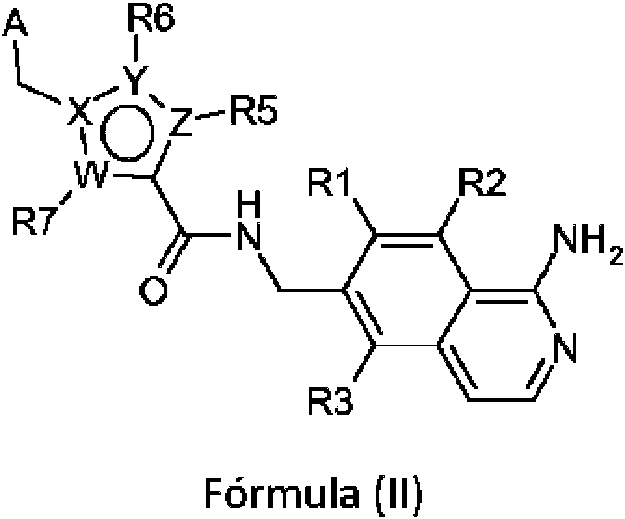
en los que R1, R2 y R3 se seleccionan independientemente de H, alquilo, COOR8, CONR8R9, OH, alcoxi, NR8R9, F y Cl; y en donde A, W, X, Y, Z, R5, R6, R7, alquilo, alcoxi, R8 y R9 son como se definen en el primer o segundo aspecto anteriores; y tautómeros, estereoisómeros (incluyendo enantiómeros, diastereoisómeros y mezclas racémicas y escalémicas de los mismos), solvatos y sales farmacéuticamente aceptables de los mismos.wherein R1, R2 and R3 are independently selected from H, alkyl, COOR8, CONR8R9, OH, alkoxy, NR8R9, F and Cl; and wherein A, W, X, Y, Z, R5, R6, R7, alkyl, alkoxy, R8 and R9 are as defined in the first or second aspect above; and tautomers, stereoisomers (including enantiomers, diastereoisomers, and racemic and scalemic mixtures thereof), solvates, and pharmaceutically acceptable salts thereof.
En otro aspecto, la invención comprende un subconjunto de los compuestos de fórmula (I), tal como se define mediante la fórmula (II),In another aspect, the invention comprises a subset of the compounds of formula (I), as defined by formula (II),

en los quein which
W, X, Y y Z se seleccionan independientemente de C y N, de manera que el anillo que contiene W, X, Y y Z es un heterociclo de cinco miembros seleccionado de pirrol, pirazol, imidazol, 1,2,3-triazol y 1,2,4-triazol;W, X, Y, and Z are independently selected from C and N such that the ring containing W, X, Y, and Z is a five-membered heterocycle selected from pyrrole, pyrazole, imidazole, 1,2,3-triazole and 1,2,4-triazole;
R1, R2 y R3 se seleccionan independientemente de H, alquilo, COOR8, CONR8R9, OH, alcoxi, NR8R9, F y Cl; y en los que A, R5, R6, R7, R8, R9, alquilo, alcoxi, arilo y heteroarilo son como se definen en el primer aspecto anterior;R1, R2 and R3 are independently selected from H, alkyl, COOR8, CONR8R9, OH, alkoxy, NR8R9, F and Cl; and wherein A, R5, R6, R7, R8, R9, alkyl, alkoxy, aryl, and heteroaryl are as defined in the first aspect above;
y tautómeros, estereoisómeros (incluyendo enantiómeros, diastereoisómeros y mezclas racémicas y escalémicas de los mismos), solvatos y sales farmacéuticamente aceptables de los mismos.and tautomers, stereoisomers (including enantiomers, diastereoisomers, and racemic and scalemic mixtures thereof), solvates, and pharmaceutically acceptable salts thereof.
En otro aspecto, la invención comprende un subconjunto de los compuestos de fórmula (I), tal como se define mediante la fórmula (IIa),In another aspect, the invention comprises a subset of the compounds of formula (I), as defined by formula (IIa),

en los que R1, R2 y R3 se seleccionan independientemente de H, alquilo, COOR8, CONR8R9, OH, alcoxi, NR8R9, F y Cl; y en los que A, W, X, Y, R5, r6, R7, alquilo, alcoxi, R8 y R9 son como se definen en el primer o segundo aspecto anteriores;wherein R1, R2, and R3 are independently selected from H, alkyl, COOR8, CONR8R9, OH, alkoxy, NR8R9, F, and Cl; and wherein A, W, X, Y, R5, r6 , R7, alkyl, alkoxy, R8 and R9 are as defined in the first or second aspect above;
y tautómeros, estereoisómeros (incluidos enantiómeros, diastereoisómeros y mezclas racémicas y escalémicas de los mismos), solvatos y sales farmacéuticamente aceptables de los mismos.and tautomers, stereoisomers (including enantiomers, diastereoisomers, and racemic and scalemic mixtures thereof), solvates, and pharmaceutically acceptable salts thereof.
En otro aspecto, la invención comprende un subconjunto de los compuestos de fórmula (I), tal como se define mediante la fórmula (IIa), In another aspect, the invention comprises a subset of the compounds of formula (I), as defined by formula (IIa),

en los que R1, R2 y R3 se seleccionan independientemente de H, alquilo, COOR8, CONR8R9, OH, alcoxi, NR8R9, F y Cl;wherein R1, R2, and R3 are independently selected from H, alkyl, COOR8, CONR8R9, OH, alkoxy, NR8R9, F, and Cl;
W, X e Y se seleccionan independientemente de C, N, O y S, de tal manera que el anillo que contiene W, X e Y es un heterociclo aromático de cinco miembros;W, X, and Y are independently selected from C, N, O, and S such that the ring containing W, X, and Y is a five-membered aromatic heterocycle;
y en los que A, R5, R6, R7, alquilo, alcoxi, R8 y R9 son como se definen en el primer o segundo aspecto anteriores;and wherein A, R5, R6, R7, alkyl, alkoxy, R8 and R9 are as defined in the first or second aspect above;
y tautómeros, estereoisómeros (incluyendo enantiómeros, diastereoisómeros y mezclas racémicas y escalémicas de los mismos), solvatos y sales farmacéuticamente aceptables de los mismos.and tautomers, stereoisomers (including enantiomers, diastereoisomers, and racemic and scalemic mixtures thereof), solvates, and pharmaceutically acceptable salts thereof.
En otro aspecto, la invención comprende un compuesto de acuerdo con el primer aspecto anterior, en donde B es 1 H-pirrolo[2,3-b]piridina opcionalmente sustituida; en donde dichos sustituyentes opcionales se seleccionan de alquilo, alcoxi, OH, F, Cl, CN, COOR8, CONR8R9, CF3 y NR8R9; y en donde alquilo, alcoxi, R8 y R9 son como se definen en el primer aspecto anterior.In another aspect, the invention comprises a compound according to the first aspect above, wherein B is optionally substituted 1 H-pyrrolo[2,3-b]pyridine; wherein said optional substituents are selected from alkyl, alkoxy, OH, F, Cl, CN, COOR8, CONR8R9, CF3 and NR8R9; and wherein alkyl, alkoxy, R8 and R9 are as defined in the first aspect above.
En otro aspecto, la invención comprende un compuesto de acuerdo con el segundo aspecto anterior, en donde B es 1H-pirrolo[2,3-b]piridina opcionalmente sustituida; en donde dichos sustituyentes opcionales se seleccionan de alquilo, alcoxi, OH, F, Cl, CN, COOR8, CONR8R9, CF3 y NR8R9; en donde dicho anillo de 1H-pirrolo[2,3-b]piridina está enlazado a -CONH-CH2- a través de su componente de anillo de 6 miembros; y en donde alquilo, alcoxi, R8 y R9 son como se definen en el primer aspecto anterior.In another aspect, the invention comprises a compound according to the second aspect above, wherein B is optionally substituted 1H-pyrrolo[2,3-b]pyridine; wherein said optional substituents are selected from alkyl, alkoxy, OH, F, Cl, CN, COOR8, CONR8R9, CF3 and NR8R9; wherein said 1H-pyrrolo[2,3-b]pyridine ring is linked to -CONH-CH 2 - through its 6-membered ring component; and wherein alkyl, alkoxy, R8 and R9 are as defined in the first aspect above.
En otro aspecto, la invención comprende un compuesto de acuerdo con el primer o segundo aspecto anteriores, en donde B es 1H-pirrolo[2,3-b]piridina opcionalmente sustituida; en donde dichos sustituyentes opcionales se seleccionan de alquilo, F, Cl y -CN; y en donde alquilo es como se define en el primer aspecto anterior.In another aspect, the invention comprises a compound according to the first or second aspect above, wherein B is optionally substituted 1H-pyrrolo[2,3-b]pyridine; wherein said optional substituents are selected from alkyl, F, Cl and -CN; and wherein alkyl is as defined in the first aspect above.
En otro aspecto, la invención comprende un compuesto según el primer aspecto anteriormente indicado, en el que B se selecciona de 1H-pirrolo[2,3-b]piridina opcionalmente mono, di o trisustituida, en el que dicho(s) sustituyente(s) opcional(es) está(n) seleccionado(s) de entre alquilo, alcoxi, OH, F, Cl, CN, COOR8, CONR8, CF3 y NR8R9; y en el que el alquilo, alcoxi, R8 y R9 son como se definen en el primer aspecto anteriormente indicado.In another aspect, the invention comprises a compound according to the first aspect indicated above, wherein B is selected from 1H-pyrrolo[2,3-b]pyridine optionally mono, di or trisubstituted, wherein said substituent(s) ( s) optional is/are selected from alkyl, alkoxy, OH, F, Cl, CN, COOR8, CONR8, CF3 and NR8R9; and wherein alkyl, alkoxy, R8 and R9 are as defined in the first aspect above.
En otro aspecto, la invención comprende un compuesto según el segundo aspecto anteriormente indicado, en el que B se selecciona de 1H-pirrolo[2,3-b]piridina opcionalmente mono, di o trisustituida, en el que dicho(s) sustituyente(s) opcional(es) está(n) seleccionado(s) de entre alquilo, alcoxi, OH, F, Cl, CN, COOR8, CONR8, CF3 y NR8R9; en el que dicho anillo 1H-pirrolo[2,3-b]piridina está unido a -CONH-CH2- a través de su componente anillo de 6 miembros; y en el que el alquilo, alcoxi, R8 y R9 son como se definen en el primer aspecto anteriormente indicado.In another aspect, the invention comprises a compound according to the second aspect indicated above, wherein B is selected from 1H-pyrrolo[2,3-b]pyridine optionally mono, di or trisubstituted, wherein said substituent(s) ( s) optional is/are selected from alkyl, alkoxy, OH, F, Cl, CN, COOR8, CONR8, CF3 and NR8R9; wherein said 1H-pyrrolo[2,3-b]pyridine ring is attached to -CONH-CH 2 - through its 6-membered ring component; and wherein alkyl, alkoxy, R8 and R9 are as defined in the first aspect above.
En otro aspecto, la invención comprende un compuesto según el primer o segundo aspecto anteriormente indicados, en el que B se selecciona de 1H-pirrolo[2,3-b]piridina opcionalmente mono, di o trisustituida; en el que dichos sustituyentes opcionales se seleccionan de entre alquilo, F, Cl y -CN; y en el que el alquilo es como se define en el primer aspecto anteriormente indicado.In another aspect, the invention comprises a compound according to the first or second aspect above, wherein B is selected from 1H-pyrrolo[2,3-b]pyridine optionally mono, di or trisubstituted; wherein said optional substituents are selected from alkyl, F, Cl and -CN; and wherein alkyl is as defined in the first aspect above.
En otro aspecto, la invención comprende un subconjunto de los compuestos de fórmula (I), tal como se define mediante la fórmula (III), In another aspect, the invention comprises a subset of the compounds of formula (I), as defined by formula (III),

en los que R1 y R3 se seleccionan independientemente de H, alquilo, COOR8, CONR8R9, OH, alcoxi, NR8R9, F y Cl; y en los que A, W, X, Y, Z, R5, r6, R7, alquilo, alcoxi, R8 y R9 son como se definen en el primer aspecto anterior;where R1 and R3 are independently selected from H, alkyl, COOR8, CONR8R9, OH, alkoxy, NR8R9, F, and Cl; and wherein A, W, X, Y, Z, R5, r6 , R7, alkyl, alkoxy, R8 and R9 are as defined in the first aspect above;
y tautómeros, estereoisómeros (incluidos enantiómeros, diastereoisómeros y mezclas racémicas y escalémicas de los mismos), solvatos y sales farmacéuticamente aceptables de los mismos.and tautomers, stereoisomers (including enantiomers, diastereoisomers, and racemic and scalemic mixtures thereof), solvates, and pharmaceutically acceptable salts thereof.
En otro aspecto, la invención comprende un subconjunto de los compuestos de fórmula (I), tal como se define mediante la fórmula (III),In another aspect, the invention comprises a subset of the compounds of formula (I), as defined by formula (III),

en los quein which
W, X, Y y Z se seleccionan independientemente de C y N, de tal manera que el anillo que contiene W, X, Y y Z es un heterociclo de cinco miembros seleccionado de pirrol, pirazol, imidazol, 1,2,3-triazol y 1,2,4-triazol;W, X, Y, and Z are independently selected from C and N such that the ring containing W, X, Y, and Z is a five-membered heterocycle selected from pyrrole, pyrazole, imidazole, 1,2,3- triazole and 1,2,4-triazole;
R1 y R3 se seleccionan independientemente de H, alquilo, COOR8, CONR8R9, OH, alcoxi, NR8R9, F y Cl; y en los que A, R5, R6, R7, R8, R9, alquilo, alcoxi, arilo y heteroarilo son como se definen en el primer aspecto anterior;R1 and R3 are independently selected from H, alkyl, COOR8, CONR8R9, OH, alkoxy, NR8R9, F, and Cl; and wherein A, R5, R6, R7, R8, R9, alkyl, alkoxy, aryl, and heteroaryl are as defined in the first aspect above;
y tautómeros, estereoisómeros (incluyendo enantiómeros, diastereoisómeros y mezclas racémicas y escalémicas de los mismos), solvatos y sales farmacéuticamente aceptables de los mismos.and tautomers, stereoisomers (including enantiomers, diastereoisomers, and racemic and scalemic mixtures thereof), solvates, and pharmaceutically acceptable salts thereof.
En otro aspecto, la invención comprende un subconjunto de los compuestos de fórmula (I), tal como se define mediante la fórmula (III), In another aspect, the invention comprises a subset of the compounds of formula (I), as defined by formula (III),
en los quein which
W, X, Y y Z se seleccionan independientemente de C y N, de tal manera que el anillo que contiene W, X, Y y Z es un heterociclo de cinco miembros seleccionado de pirrol, pirazol, imidazol, 1,2,3-triazol y 1,2,4-triazol;W, X, Y, and Z are independently selected from C and N such that the ring containing W, X, Y, and Z is a five-membered heterocycle selected from pyrrole, pyrazole, imidazole, 1,2,3- triazole and 1,2,4-triazole;
R1 y R3 se seleccionan independientemente de H y alquilo;R1 and R3 are independently selected from H and alkyl;
y en los que A, R5, R6, R7, alquilo, arilo, heteroarilo son como se definen en el primer aspecto anterior; y tautómeros, estereoisómeros (incluyendo enantiómeros, diastereoisómeros y mezclas racémicas y escalémicas de los mismos), solvatos y sales farmacéuticamente aceptables de los mismos.and wherein A, R5, R6, R7, alkyl, aryl, heteroaryl are as defined in the first aspect above; and tautomers, stereoisomers (including enantiomers, diastereoisomers, and racemic and scalemic mixtures thereof), solvates, and pharmaceutically acceptable salts thereof.
La presente invención también comprende las siguientes limitaciones, que pueden aplicarse a cualquiera de los aspectos de la invención descritos anteriormente:The present invention also encompasses the following limitations, which may apply to any of the aspects of the invention described above:
• B es 1H-pirrolo[2,3-b]piridina opcionalmente sustituida; en donde dichos sustituyentes opcionales se seleccionan de alquilo, F, Cl y -CN.• B is optionally substituted 1H-pyrrolo[2,3-b]pyridine; wherein said optional substituents are selected from alkyl, F, Cl and -CN.
• B es 1H-pirrolo[2,3-b]piridina opcionalmente sustituida; en donde dichos sustituyentes opcionales se seleccionan de alquilo, F, Cl y -CN; y en donde dicho anillo de indol, indazol o 1 H-pirrolo[2,3-b]piridina está enlazado a -CONH-CH2- a través de su componente de anillo de 6 miembros• B is optionally substituted 1H-pyrrolo[2,3-b]pyridine; wherein said optional substituents are selected from alkyl, F, Cl and -CN; and wherein said indole, indazole or 1 H-pyrrolo[2,3-b]pyridine ring is linked to -CONH-CH 2 - through its 6-membered ring component
• B es isoquinolinilo opcionalmente mono, di o trisustituido, en el que dicho(s) sustituyente(s) opcional(es) está(n) seleccionado(s) de entre alquilo, alcoxi, OH, F, Cl, CN, COOR8, CONR8R9, CF3 y NR8R9; en el que R8 y R9 están independientemente seleccionados de entre H y alquilo.• B is optionally mono, di or trisubstituted isoquinolinyl, wherein said optional substituent(s) is(are) selected from alkyl, alkoxy, OH, F, Cl, CN, COOR8, CONR8R9, CF 3 and NR8R9; wherein R8 and R9 are independently selected from H and alkyl.
• B es isoquinolinilo opcionalmente monosustituido; en el que dicho sustituyente opcional se selecciona de alquilo, alcoxi, OH y NR8R9; en el que R8 y R9 se seleccionan independientemente de H y alquilo.• B is optionally monosubstituted isoquinolinyl; wherein said optional substituent is selected from alkyl, alkoxy, OH, and NR8R9; wherein R8 and R9 are independently selected from H and alkyl.
• B es 1H-pirrolo[2,3-b]piridina opcionalmente sustituida en el que dicho(s) sustituyente(s) opcional(es) está(n) seleccionado(s) de entre alquilo, alcoxi, OH, F, Cl, CN, COOR8, CONR8R9, CF3 y NR8R9 y en el que R8 y R9 se seleccionan independientemente de H y alquilo.• B is optionally substituted 1H-pyrrolo[2,3-b]pyridine wherein said optional substituent(s) is(are) selected from alkyl, alkoxy, OH, F, Cl , CN, COOR8, CONR8R9, CF3 and NR8R9 and wherein R8 and R9 are independently selected from H and alkyl.
• B se selecciona de 1H-pirrolo[2,3-b]piridina opcionalmente mono, di o trisustituida; en el que dichos sustituyentes opcionales se seleccionan de entre alquilo, F, Cl y -CN; y en el que dicho anillo 1H-pirrolo[2,3-b]piridina está unido a -CONH-CH2- a través de su componente anillo de 6 miembros.• B is selected from 1H-pyrrolo[2,3-b]pyridine optionally mono, di or trisubstituted; wherein said optional substituents are selected from alkyl, F, Cl and -CN; and wherein said 1H-pyrrolo[2,3-b]pyridine ring is attached to -CONH-CH 2 - through its 6-membered ring component.
• Preferentemente, B es isoquinolinilo opcionalmente monosustituido, en el que dicho sustituyente opcional es NR8R9; en el que R8 y R9 se seleccionan independientemente de H y alquilo.• Preferably, B is optionally monosubstituted isoquinolinyl, wherein said optional substituent is NR8R9; wherein R8 and R9 are independently selected from H and alkyl.
• Preferentemente, B es isoquinolinilo opcionalmente di o trisustituido, en el que uno de dichos sustituyentes opcionales es NR8R9 y los demás de dichos sustituyentes opcionales son alquilo; en el que R8 y R9 se seleccionan independientemente de H y alquilo.• Preferably, B is optionally di- or trisubstituted isoquinolinyl, wherein one of said optional substituents is NR8R9 and the other of said optional substituents are alkyl; wherein R8 and R9 are independently selected from H and alkyl.
• Más preferentemente, B es isoquinolinilo opcionalmente di o trisustituido, en el que uno de dichos sustituyentes opcionales es NR8R9 y los demás de dichos sustituyentes opcionales son alquilo; en el que R8 y R9 son H.• More preferably, B is optionally di- or trisubstituted isoquinolinyl, wherein one of said optional substituents is NR8R9 and the other of said optional substituents are alkyl; where R8 and R9 are H.
• Más preferentemente, B es isoquinolinilo opcionalmente monosustituido, en el que dicho sustituyente opcional es NR8R9; y en el que R8 y R9 son H.• More preferably, B is optionally monosubstituted isoquinolinyl, wherein said optional substituent is NR8R9; and where R8 and R9 are H.
• Más preferentemente, B es isoquinolinilo opcionalmente di o trisustituido, en el que uno de dichos sustituyentes opcionales es NR8R9 y el otro uno o dos de dichos sustituyentes opcionales son alquilo; en el que R8 y R9 son H.• More preferably, B is optionally di- or trisubstituted isoquinolinyl, wherein one of said optional substituents is NR8R9 and the other one or two of said optional substituents are alkyl; where R8 and R9 are H.
• R1, R2, R3 y R4 se seleccionan independientemente de H, alquilo, COOR8, CONR8R9, OH, alcoxi, NR8R9, F y Cl.• R1, R2, R3 and R4 are independently selected from H, alkyl, COOR8, CONR8R9, OH, alkoxy, NR8R9, F and Cl.
• Preferentemente, R1, R2, R3 y R4 se seleccionan independientemente de H, alquilo, Cl y F.• Preferably, R1, R2, R3 and R4 are independently selected from H, alkyl, Cl and F.
• Preferentemente, R1, R2, R3 y R4 se seleccionan independientemente de H, alquilo y Cl.• Preferably, R1, R2, R3 and R4 are independently selected from H, alkyl and Cl.
• Más preferentemente, R1, R2 y R3 se seleccionan independientemente de H y alquilo.• Most preferably, R1, R2 and R3 are independently selected from H and alkyl.
• Más preferentemente, R1, R2 y R3 se seleccionan independientemente de H y metilo.• Most preferably, R1, R2 and R3 are independently selected from H and methyl.
• Más preferentemente R4 se selecciona de H y Cl. • More preferably R4 is selected from H and Cl.
W, X, Y y Z se seleccionan independientemente de C, N, O y S, de manera que el anillo que contiene W, X, Y y Z es un heterociclo aromático de cinco miembros.W, X, Y and Z are independently selected from C, N, O and S such that the ring containing W, X, Y and Z is a five membered aromatic heterocycle.
W, X, Y y Z se seleccionan independientemente de C y N, de manera que el anillo que contiene W, X, Y y Z es un heterociclo aromático de cinco miembros.W, X, Y and Z are independently selected from C and N such that the ring containing W, X, Y and Z is a five membered aromatic heterocycle.
W, X, Y y Z se seleccionan independientemente de C y N, de manera que el anillo que contiene W, X, Y y Z se selecciona de pirrol, pirazol, imidazol, 1,2,3-triazol y 1,2,4-triazol.W, X, Y, and Z are independently selected from C and N such that the ring containing W, X, Y, and Z is selected from pyrrole, pyrazole, imidazole, 1,2,3-triazole, and 1,2, 4-triazole.
Preferiblemente, X es N.Preferably X is N.
W es C, X e Y son N y Z es C o N.W is C, X and Y are N, and Z is C or N.
X e Y son N y W y Z son C.X and Y are N and W and Z are C.
X, Y y Z son N y W es C.X, Y and Z are N and W is C.
X y Z son N y W e Y son C.X and Z are N and W and Y are C.
W es N y X, Y y Z son C.W is N and X, Y and Z are C.
X es N y W, Y y Z son C.X is N and W, Y and Z are C.
R5 está ausente o se selecciona de alquilo, CF3 y arilo.R5 is absent or selected from alkyl, CF 3 and aryl.
R5 está ausente o se selecciona de H, metilo, CF3 y fenilo.R5 is absent or selected from H, methyl, CF 3 and phenyl.
R6 y R7 están ausentes independientemente, o se seleccionan independientemente de H, alquilo, arilo y CF3.R6 and R7 are independently absent, or independently selected from H, alkyl, aryl and CF 3 .
R6 y R7 están ausentes independientemente, o se seleccionan independientemente de H, metilo, etilo, n-propilo, fenilo y CF3.R6 and R7 are independently absent, or independently selected from H, methyl, ethyl, n-propyl, phenyl, and CF 3 .
Preferentemente, R5 es H y R6 y R7 son metilo.Preferably R5 is H and R6 and R7 are methyl.
X, Y y Z son N, W es C, y R7 es H.X, Y, and Z are N, W is C, and R7 is H.
X e Y son N, W y Z son C, y R5 se selecciona de alquilo, arilo y CF3, y R7 es H.X and Y are N, W and Z are C, and R5 is selected from alkyl, aryl, and CF3 , and R7 is H.
X e Y son N, W y Z son C, y R5 se selecciona de metilo, y CF3 y R7 es H.X and Y are N, W and Z are C, and R5 is selected from methyl, and CF 3 and R7 is H.
A se selecciona de arilo y heteroarilo, cada uno opcionalmente sustituido como se especifica en el primer aspecto anteriormente indicado.A is selected from aryl and heteroaryl, each optionally substituted as specified in the first aspect above.
A es heteroarilo opcionalmente sustituido con 1, 2 o 3 sustituyentes seleccionados independientemente de alquilo, alcoxi, OH, halo, CN, arilo, morfolinilo, piperidinilo, -COOR10, -CONR10R11, CF3 y -NR10R11; en el que R10 y R11 se seleccionan de entre H y alquilo o R10 y R11 junto con el átomo de nitrógeno al que están fijados forman un anillo heterocíclico de 4, 5, 6 o 7 miembros que contiene carbono que puede estar saturado o insaturado con 1 o 2 dobles enlaces y que puede estar opcionalmente mono o disustituido con sustituyentes seleccionados de entre oxo, alquilo, alcoxi, OH, F y CF3.A is heteroaryl optionally substituted with 1, 2 or 3 substituents independently selected from alkyl, alkoxy, OH, halo, CN, aryl, morpholinyl, piperidinyl, -COOR10, -CONR10R11, CF 3 and -NR10R11; wherein R10 and R11 are selected from H and alkyl or R10 and R11 together with the nitrogen atom to which they are attached form a 4-, 5-, 6- or 7-membered carbon-containing heterocyclic ring that may be saturated or unsaturated with 1 or 2 double bonds and which may be optionally mono or disubstituted with substituents selected from oxo, alkyl, alkoxy, OH, F and CF 3 .
A es heteroarilo opcionalmente sustituido con un sustituyente seleccionado de entre alquilo, alcoxi, OH, halo, CN, arilo, morfolinilo y piperidinilo.A is heteroaryl optionally substituted with a substituent selected from alkyl, alkoxy, OH, halo, CN, aryl, morpholinyl, and piperidinyl.
Preferentemente, A es heteroarilo sustituido con fenilo.Preferably, A is phenyl-substituted heteroaryl.
Preferentemente, A es heteroarilo sustituido con NR10R11; en el que R10 y R11 se seleccionan de entre H y alquilo o R10 y R11 junto con el átomo de nitrógeno al que están fijados forman un anillo heterocíclico de 4, 5, 6 o 7 miembros que contiene carbono que puede estar saturado o insaturado con 1 o 2 dobles enlaces y que puede estar opcionalmente mono o disustituido con sustituyentes seleccionados de entre oxo, alquilo, alcoxi, OH, F y CF3. Preferably, A is heteroaryl substituted with NR10R11; wherein R10 and R11 are selected from H and alkyl or R10 and R11 together with the nitrogen atom to which they are attached form a 4-, 5-, 6- or 7-membered carbon-containing heterocyclic ring that may be saturated or unsaturated with 1 or 2 double bonds and which may be optionally mono or disubstituted with substituents selected from oxo, alkyl, alkoxy, OH, F and CF 3 .
Preferentemente, A es tiazolilo sustituido por fenilo.Preferably A is phenyl substituted thiazolyl.
Preferentemente, A es fenilo sustituido por heteroarilo, -(CH2)1-3-heteroarilo y -(CH2)1-3-NR14R15. Preferentemente, A se selecciona de:Preferably, A is phenyl substituted by heteroaryl, -(CH2)1-3-heteroaryl and -(CH2)1-3-NR14R15. Preferably, A is selected from:

Preferentemente, A se selecciona de: Preferably, A is selected from:

• Preferentemente, A se selecciona de:• Preferably, A is selected from:

y R10 y R11 son como se definen en el primer aspecto anteriormente indicado.and R10 and R11 are as defined in the first aspect above.
La presente invención también abarca, pero no se limita a, los compuestos enumerados en los siguientes aspectos.The present invention also encompasses, but is not limited to, the compounds listed in the following aspects.
En un aspecto, la invención comprende un compuesto seleccionado de:In one aspect, the invention comprises a compound selected from:
(1-amino-isoquinolin-6-ilmetil)-amida del ácido 3-metil-1 -[4-(4-metil-pirazol-1 -ilmetil)-bencil]-1H-pirazol-4-carboxílico;3-Methyl-1-[4-(4-methyl-pyrazol-1-ylmethyl)-benzyl]-1H-pyrazole-4-carboxylic acid (1-amino-isoquinolin-6-ylmethyl)-amide;
(1-amino-isoquinolin-6-ilmetil)-amida del ácido 3-isopropil-1-[4-(4-metil-pirazol-1-ilmetil)-bencil]-1H-pirazol-4-carboxílico;3-Isopropyl-1-[4-(4-methyl-pyrazol-1-ylmethyl)-benzyl]-1H-pyrazole-4-carboxylic acid (1-amino-isoquinolin-6-ylmethyl)-amide;
(1-amino-isoquinolin-6-ilmetil)-amida del ácido 3-hidroximetil-1-[4-(4-metil-pirazol-1-ilmetil)-bencil]-1H-pirazol-4-carboxílico;3-Hydroxymethyl-1-[4-(4-methyl-pyrazol-1-ylmethyl)-benzyl]-1H-pyrazole-4-carboxylic acid (1-amino-isoquinolin-6-ylmethyl)-amide;
(1-amino-isoquinolin-6-ilmetil)-amida del ácido 4-metil-2-[4-(4-metil-pirazol-1-ilmetil)-bencil]-tiazol-5-carboxílico; (1-amino-isoquinolin-6-ilmetil)-amida del ácido 1-[4-(4-metil-pirazol-1-ilmetil)-bencil|-3-fenil-1H-pirazol-4-carboxílico;4-Methyl-2-[4-(4-methyl-pyrazol-1-ylmethyl)-benzyl]-thiazole-5-carboxylic acid (1-amino-isoquinolin-6-ylmethyl)-amide; 1-[4-(4-Methyl-pyrazol-1-ylmethyl)-benzyl|-3-phenyl-1H-pyrazole-4-carboxylic acid (1-amino-isoquinolin-6-ylmethyl)-amide;
(1-amino-isoquinolin-6-ilmetil)-amida del ácido 1-[4-(4-metil-pirazol-1-ilmetil)-bencil]-3-trifluorometil-1H-pirazol-4-carboxílico;1-[4-(4-Methyl-pyrazol-1-ylmethyl)-benzyl]-3-trifluoromethyl-1H-pyrazole-4-carboxylic acid (1-amino-isoquinolin-6-ylmethyl)-amide;
(1-amino-isoquinolin-6-ilmetil)-amida del ácido 3-metoximetil-1-[4-(4-metil-pirazol-1-ilmetil)-bencil]-1H-pirazol-4-carboxílico;3-Methoxymethyl-1-[4-(4-methyl-pyrazol-1-ylmethyl)-benzyl]-1H-pyrazole-4-carboxylic acid (1-amino-isoquinolin-6-ylmethyl)-amide;
(1-amino-isoquinolin-6-ilmetil)-amida del ácido 3-difluorometil-1-|4-(4-metil-pirazol-1-ilmetil)-bencil|-1H-pirazol-4-carboxílico;3-Difluoromethyl-1-|4-(4-methyl-pyrazol-1-ylmethyl)-benzyl|-1H-pyrazole-4-carboxylic acid (1-amino-isoquinolin-6-ylmethyl)-amide;
(1-amino-isoquinolin-6-ilmetil)-amida del ácido 1-(6-etoxi-piridin-3-ilmetil)-3-trifluorometil-1H-pirazol-4-carboxílico; (1-amino-isoquinolin-6-ilmetil)-amida del ácido 1-(6-propoxi-piridin-3-ilmetil)-3-trifluorometil-1H-pirazol-4-carboxílico;1-(6-Ethoxy-pyridin-3-ylmethyl)-3-trifluoromethyl-1H-pyrazole-4-carboxylic acid (1-amino-isoquinolin-6-ylmethyl)-amide; 1-(6-Propoxy-pyridin-3-ylmethyl)-3-trifluoromethyl-1H-pyrazole-4-carboxylic acid (1-amino-isoquinolin-6-ylmethyl)-amide;
(1-amino-isoquinolin-6-ilmetil)-amida del ácido 1-(6-etoxi-5-fluoro-piridin-3-ilmetil)-3-trifluorometil-1H-pirazol-4-carboxílico;1-(6-Ethoxy-5-fluoro-pyridin-3-ylmethyl)-3-trifluoromethyl-1H-pyrazole-4-carboxylic acid (1-amino-isoquinolin-6-ylmethyl)-amide;
(1-amino-isoquinolin-6-ilmetil)-amida del ácido 1-(4-pirazol-1-ilmetil-bencil)-3-trifluorometil-1H-pirazol-4-carboxílico;1-(4-Pyrazol-1-ylmethyl-benzyl)-3-trifluoromethyl-1H-pyrazole-4-carboxylic acid (1-amino-isoquinolin-6-ylmethyl)-amide;
ácido 1-[4-(4-ciano-pirazol-1-ilmetil)-bencil]-3-trifluorometil-1H-pirazol-4-carboxílico (1-amino-isoquinol en-6-ilmetil)-amida;1-[4-(4-cyano-pyrazol-1-ylmethyl)-benzyl]-3-trifluoromethyl-1H-pyrazole-4-carboxylic acid (1-amino-isoquinol en-6-ylmethyl)-amide;
1-[4-(4-Carbamoil-pirazol-1-ilmetil)-bencil]-3-trifluorometil-1H-pirazol-4-carboxílico (1-amino-isoquinolin-6-ilmetil)-amida;1-[4-(4-Carbamoyl-pyrazol-1-ylmethyl)-benzyl]-3-trifluoromethyl-1H-pyrazole-4-carboxylic (1-amino-isoquinolin-6-ylmethyl)-amide;
y sales y solvatos farmacéuticamente aceptables de los mismos.and pharmaceutically acceptable salts and solvates thereof.
En un aspecto, la invención comprende un compuesto seleccionado de:In one aspect, the invention comprises a compound selected from:
(4,6-dimetil-1H-pirrolo[2,3-b]piridina -5-ilmetil)-amida del ácido 1-[4-(4-metil-pi razol-1 -ilmetil)-bencil]-3 trifluorometil-IH-pirazol-4-carboxílico;1-[4-(4-Methyl-pyrazol-1-(4,6-dimethyl-1H-pyrrolo[2,3-b]pyridine-5-ylmethyl)-acid amide -ylmethyl)-benzyl]-3-trifluoromethyl-IH-pyrazole-4-carboxylic acid;
(1H-pirrolo[2,3-b]piridin-5-ilmetilo)- amida del ácido 1-[4-(4-metil-pirazol-1-ilmetil)-bencil]-3-trifluorometil-1H-pirazol-4-carboxílico;1-[4-(4-methyl-pyrazol-1-ylmethyl)-benzyl]-3-trifluoromethyl-1H-pyrazole-4 (1H-pyrrolo[2,3-b]pyridin-5-ylmethyl)- acid amide -carboxylic;
y solvatos y sales farmacéuticamente aceptables de los mismos.and solvates and pharmaceutically acceptable salts thereof.
Aplicaciones terapéuticastherapeutic applications
Como se ha mencionado anteriormente, los compuestos de la presente invención, el alcance de la cual se define en las reivindicaciones adjuntas, son inhibidores potentes y selectivos de la calicreína plasmática. Por lo tanto, son útiles en el tratamiento de patologías para las que la sobreactividad de la calicreína plasmática es un factor causal.As mentioned above, the compounds of the present invention, the scope of which is defined in the appended claims, are potent and selective inhibitors of plasma kallikrein. Therefore, they are useful in the treatment of pathologies for which the overactivity of plasmatic kallikrein is a causal factor.
Por consiguiente, la presente invención proporciona un compuesto de fórmula (I) para usos médicos.Accordingly, the present invention provides a compound of formula (I) for medical uses.
La presente invención también proporciona el uso de un compuesto de fórmula (I) en la fabricación de un medicamento para el tratamiento o la prevención de una enfermedad o afección en la que está implicada la actividad de la calicreína plasmática.The present invention also provides the use of a compound of formula (I) in the manufacture of a medicament for the treatment or prevention of a disease or condition in which plasma kallikrein activity is implicated.
La presente invención también proporciona un compuesto de fórmula (I) para utilizarse en el tratamiento o la prevención de una enfermedad o afección en la que está implicada la actividad de la calicreína plasmática.The present invention also provides a compound of formula (I) for use in the treatment or prevention of a disease or condition in which plasma kallikrein activity is implicated.
Se divulga un método de tratamiento de una enfermedad o afección en la que está implicada la actividad de la calicreína plasmática, que comprende administrar a un sujeto que lo necesite una cantidad terapéuticamente eficaz de un compuesto de fórmula (I).A method of treating a disease or condition in which plasma kallikrein activity is implicated is disclosed, comprising administering to a subject in need thereof a therapeutically effective amount of a compound of formula (I).
En un aspecto, la enfermedad o afección en la que está implicada la actividad de la calicreína plasmática está seleccionada de agudeza visual deteriorada, retinopatía diabética, edema macular diabético, angioedema hereditario, diabetes, pancreatitis, hemorragia cerebral, nefropatía, cardiomiopatía, neuropatía, enfermedad inflamatoria intestinal, artritis, inflamación, choque séptico, hipotensión, cáncer, síndrome de dificultad respiratoria del adulto, coagulación intravascular diseminada, cirugía de derivación cardiopulmonar y hemorragia postoperatoria.In one aspect, the disease or condition in which plasma kallikrein activity is implicated is selected from impaired visual acuity, diabetic retinopathy, diabetic macular edema, hereditary angioedema, diabetes, pancreatitis, cerebral hemorrhage, nephropathy, cardiomyopathy, neuropathy, inflammatory bowel disease, arthritis, inflammation, septic shock, hypotension, cancer, adult respiratory distress syndrome, disseminated intravascular coagulation, cardiopulmonary bypass surgery, and postoperative hemorrhage.
En un aspecto preferente, la enfermedad o afección en la que está implicada la actividad de la calicreína plasmática es la permeabilidad vascular retiniana asociada con la retinopatía diabética y el edema macular diabético. Terapia de combinaciónIn a preferred aspect, the disease or condition in which plasma kallikrein activity is implicated is retinal vascular permeability associated with diabetic retinopathy and diabetic macular edema. combination therapy
Los compuestos de la presente invención pueden administrarse en combinación con otros agentes terapéuticos. Las terapias de combinación adecuadas incluyen un compuesto de fórmula (I) en combinación con uno o más agentes seleccionados de entre agentes que inhiben el factor de crecimiento derivado de plaquetas (PDGF), el factor de crecimiento del endotelio vascular (VEGF), la integrina alfa5beta1, los esteroides, otros agentes que inhiben la calicreína plasmática y otros inhibidores de la inflamación. Los ejemplos específicos de agentes terapéuticos que pueden combinarse con los compuestos de la presente invención incluyen los divulgados en el documento EP2281885A y por S. Patel en Retina, 2009, junio; 29(6 supl.):S45-8.The compounds of the present invention can be administered in combination with other therapeutic agents. Suitable combination therapies include a compound of formula (I) in combination with one or more agents selected from agents that inhibit platelet-derived growth factor (PDGF), vascular endothelial growth factor (VEGF), integrin alpha5beta1, steroids, other agents that inhibit plasma kallikrein, and other inhibitors of inflammation. Specific examples of therapeutic agents that can be combined with the compounds of the present invention include those disclosed in EP2281885A and by S. Patel in Retina, 2009, June; 29(6 suppl.):S45-8.
Cuando se emplea la terapia de combinación, los compuestos de la presente invención y dichos agentes de combinación pueden existir en las mismas o en diferentes composiciones farmacéuticas, y pueden administrarse por separado, secuencialmente o simultáneamente.When combination therapy is employed, the compounds of the present invention and said combination agents may exist in the same or different pharmaceutical compositions, and may be administered separately, sequentially, or simultaneously.
En otro aspecto, los compuestos de la presente invención pueden administrarse en combinación con el tratamiento láser de la retina. Se conoce la combinación del tratamiento láser con la inyección intravítrea de un inhibidor de VEGF para el tratamiento del edema macular diabético (Elman M, Aiello L, Beck R, et al. "Randomized trial evaluating ranibizumab plus prompt or deferred laser or triamcinolone plus prompt laser for diabetic macular edema". Ophthalmology, 27 de abril de 2010).In another aspect, the compounds of the present invention can be administered in combination with laser treatment of the retina. The combination of laser treatment with intravitreal injection of a VEGF inhibitor for the treatment of diabetic macular edema is known (Elman M, Aiello L, Beck R, et al. "Randomized trial evaluating ranibizumab plus prompt or deferred laser or triamcinolone plus prompt laser for diabetic macular edema." Ophthalmology, April 27, 2010).
DefinicionesDefinitions
El término "alquilo" incluye residuos de hidrocarburo saturado incluidos:The term "alkyl" includes saturated hydrocarbon residues including:
- grupos lineales de hasta 10 átomos de carbono (C1-C10), o de hasta 6 átomos de carbono (C1-C6), o de hasta 4 átomos de carbono (C1-C4). Los ejemplos de tales grupos alquilo incluyen, pero no se limitan a, C1 -metilo, C2 - etilo, C3 - propilo y C4 - n-butilo.- linear groups of up to 10 carbon atoms (C 1 -C 10 ), or up to 6 carbon atoms (C 1 -C 6 ), or up to 4 carbon atoms (C 1 -C 4 ). Examples of such alkyl groups include, but are not limited to, C 1 -methyl, C 2 -ethyl, C 3 -propyl, and C 4 -n-butyl.
- grupos ramificados de entre 3 y 10 átomos de carbono (C3-C10), o de hasta 7 átomos de carbono (C3-C7), o de hasta 4 átomos de carbono (C3-C4). Los ejemplos de tales grupos alquilo incluyen, pero no se limitan a, C3 - iso-propilo, C4 - sec-butilo, C4 - iso-butilo, C4 - terc-butilo y C5 - neo-pentilo, - branched groups of between 3 and 10 carbon atoms (C 3 -C 10 ), or up to 7 carbon atoms (C 3 -C 7 ), or up to 4 carbon atoms (C 3 -C 4 ). Examples of such alkyl groups include, but are not limited to, C3 -iso-propyl, C4 -sec-butyl, C4 -iso-butyl, C4 -tert-butyl, and C5 -neo-pentyl,
cada uno opcionalmente sustituido como se ha indicado anteriormente.each optionally substituted as indicated above.
El cicloalquilo es un hidrocarburo saturado monocíclico de entre 3 y 7 átomos de carbono; en el que el cicloalquilo puede estar opcionalmente sustituido con un sustituyente seleccionado de entre alquilo, alcoxi y NR10R11; en el que R10 y R11 se seleccionan independientemente de H y alquilo o R10 y R11 junto con el nitrógeno al que están fijados forman un anillo heterocíclico de 4, 5, 6 o 7 miembros de que puede estar saturado o insaturado con 1 o 2 dobles enlaces y que puede estar opcionalmente mono o disustituido con sustituyentes seleccionados de entre oxo, alquilo, alcoxi, OH, F y CF3. Los grupos cicloalquilo pueden contener de 3 a 7 átomos de carbono, o de 3 a 6 átomos de carbono, o de 3 a 5 átomos de carbono, o de 3 a 4 átomos de carbono. Los ejemplos de grupos cicloalquilo monocíclicos adecuados incluyen ciclopropilo, ciclobutilo, ciclopentilo, ciclohexilo y cicloheptilo.Cycloalkyl is a monocyclic saturated hydrocarbon of between 3 and 7 carbon atoms; wherein cycloalkyl may be optionally substituted with a substituent selected from alkyl, alkoxy, and NR10R11; wherein R10 and R11 are independently selected from H and alkyl or R10 and R11 together with the nitrogen to which they are attached form a 4, 5, 6 or 7 membered heterocyclic ring that may be saturated or unsaturated with 1 or 2 doubles bonds and which may be optionally mono- or di-substituted with substituents selected from oxo, alkyl, alkoxy, OH, F and CF 3 . Cycloalkyl groups may contain from 3 to 7 carbon atoms, or from 3 to 6 carbon atoms, or from 3 to 5 carbon atoms, or from 3 to 4 carbon atoms. Examples of suitable monocyclic cycloalkyl groups include cyclopropyl, cyclobutyl, cyclopentyl, cyclohexyl, and cycloheptyl.
El término "alcoxi" incluye residuos de hidrocarburo unidos a través del O incluidos:The term "alkoxy" includes O-linked hydrocarbon residues including:
- grupos lineales de entre 1 y 6 átomos de carbono (C1-C6), o de entre 1 y 4 átomos de carbono (C1-C4). Los ejemplos de tales grupos alcoxi incluyen, pero no se limitan a, C1 - metoxi, C2 - etoxi, C3 - n-propoxi y C4 -n-butoxi.- linear groups of between 1 and 6 carbon atoms (C 1 -C 6 ), or between 1 and 4 carbon atoms (C 1 -C 4 ). Examples of such alkoxy groups include, but are not limited to, C 1 -methoxy, C 2 -ethoxy, C 3 -n-propoxy, and C 4 -n-butoxy.
- grupos ramificados de entre 3 y 6 átomos de carbono (C3-C6) o de entre 3 y 4 átomos de carbono (C3-C4).- branched groups of between 3 and 6 carbon atoms (C 3 -C 6 ) or between 3 and 4 carbon atoms (C 3 -C 4 ).
Los ejemplos de tales grupos alcoxi incluyen, pero no se limitan a, C3 - iso-propoxi, y C4 - sec-butoxi y tercbutoxi,Examples of such alkoxy groups include, but are not limited to, C 3 -iso-propoxy, and C 4 - sec-butoxy and tert-butoxy,
cada uno opcionalmente sustituido como se ha indicado anteriormente.each optionally substituted as indicated above.
A menos que se indique lo contrario, halo se selecciona de Cl, F, Br e I.Unless otherwise indicated, halo is selected from Cl, F, Br, and I.
El arilo es como se ha definido anteriormente. Por lo general, el arilo estará opcionalmente sustituido con 1, 2 o 3 sustituyentes. Los sustituyentes opcionales se seleccionan de entre los indicados anteriormente. Los ejemplos de grupos arilo adecuados incluyen fenilo y naftilo (cada uno opcionalmente sustituido como se ha indicado anteriormente). Preferentemente, el arilo se selecciona de fenilo, fenilo sustituido (sustituido como se ha indicado anteriormente) y naftilo.Aryl is as defined above. Aryl will generally be optionally substituted with 1, 2 or 3 substituents. Optional substituents are selected from those listed above. Examples of suitable aryl groups include phenyl and naphthyl (each optionally substituted as noted above). Preferably, aryl is selected from phenyl, substituted phenyl (substituted as above), and naphthyl.
El heteroarilo es como se ha definido anteriormente. Los ejemplos de grupos heteroarilo adecuados incluyen tienilo, furanilo, pirrolilo, pirazolilo, imidazolilo, oxazolilo, isoxazolilo, tiazolilo, isotiazolilo, triazolilo, oxadiazolilo, tiadiazolilo, tetrazolilo, piridinilo, piridazinilo, pirimidinilo, pirazinilo, indolilo, bencimidazolilo, benzotriazolilo, quinolinilo e isoquinolinilo (opcionalmente sustituidos como se ha indicado anteriormente). Preferentemente, el heteroarilo se selecciona de piridilo, benzotiazol, indol, N-metilindol, tiazol, tiazol sustituido, tiofenilo, furilo, pirazina, pirazol y pirazol sustituido; en el que los sustituyentes son como se ha indicado anteriormente.Heteroaryl is as defined above. Examples of suitable heteroaryl groups include thienyl, furanyl, pyrrolyl, pyrazolyl, imidazolyl, oxazolyl, isoxazolyl, thiazolyl, isothiazolyl, triazolyl, oxadiazolyl, thiadiazolyl, tetrazolyl, pyridinyl, pyridazinyl, pyrimidinyl, pyrazinyl, indolyl, benzimidazolyl, benzotriazolyl, quinolinyl, and isoquinolinyl (optionally substituted as indicated above). Preferably, heteroaryl is selected from pyridyl, benzothiazole, indole, N-methylindole, thiazole, substituted thiazole, thiophenyl, furyl, pyrazine, pyrazole, and substituted pyrazole; wherein the substituents are as indicated above.
La expresión "unido a través del N", tal como en "heterocicloalquilo unido a través del N", se refiere a que el grupo heterocicloalquilo está unido al remanente de la molécula a través de un átomo de nitrógeno del anillo.The term "N-linked", as in "N-linked heterocycloalkyl", means that the heterocycloalkyl group is linked to the remainder of the molecule through a ring nitrogen atom.
La expresión "unido a través del O", tal como en "residuo de hidrocarburo unido a través del O", se refiere a que el residuo de hidrocarburo está unido al remanente de la molécula a través de un átomo de oxígeno.The term "O-bonded", as in "O-bonded hydrocarbon residue", means that the hydrocarbon residue is bonded to the remainder of the molecule through an oxygen atom.
En los grupos tales como -COOR* y -(CH2)1-3-arilo, "-" indica el punto de fijación del grupo sustituyente al remanente de la molécula.In groups such as -COOR* and -(CH2)1-3-aryl, "-" indicates the point of attachment of the substituent group to the remainder of the molecule.
"Sal farmacéuticamente aceptable" se refiere a una sal fisiológicamente o toxicológicamente tolerable e incluye, cuando resulte apropiado, sales de adición de base farmacéuticamente aceptables y sales de adición de ácido farmacéuticamente aceptables. Por ejemplo (i) cuando un compuesto de la invención contiene uno o más grupos ácidos, por ejemplo grupos carboxi, las sales de adición de base farmacéuticamente aceptables que pueden formarse incluyen sales de sodio, potasio, calcio, magnesio y amonio, o sales con aminas orgánicas, tales como dietilamina, N-metil-glucamina, dietanolamina o aminoácidos (por ejemplo, lisina) y similares; (ii) cuando un compuesto de la invención contiene un grupo básico, tal como un grupo amino, las sales de adición de ácido farmacéuticamente aceptables que pueden formarse incluyen clorhidratos, bromhidratos, sulfatos, fosfatos, acetatos, citratos, lactatos, tartratos, mesilatos, succinatos, oxalatos, fosfatos, esilatos, tosilatos, bencenosulfonatos, naftalendisulfonatos, maleatos, adipatos, fumaratos, hipuratos, canforatos, xinafoatos, p-acetamidobenzoatos, dihidroxibenzoatos, hidroxinaftoatos, ascorbatos, oleatos, bisulfatos y similares."Pharmaceutically acceptable salt" refers to a physiologically or toxicologically tolerable salt and includes, where appropriate, pharmaceutically acceptable base addition salts and pharmaceutically acceptable acid addition salts. For example (i) when a compound of the invention contains one or more acid groups, for example carboxy groups, pharmaceutically acceptable base addition salts which may be formed include sodium, potassium, calcium, magnesium and ammonium salts, or salts with organic amines, such as diethylamine, N-methyl-glucamine, diethanolamine, or amino acids (eg, lysine), and the like; (ii) when a compound of the invention contains a basic group, such as an amino group, pharmaceutically acceptable acid addition salts that may be formed include hydrochlorides, hydrobromides, sulfates, phosphates, acetates, citrates, lactates, tartrates, mesylates, succinates, oxalates, phosphates, esylates, tosylates, benzenesulfonates, naphthalene disulfonates, maleates, adipates, fumarates, hippurates, camphorates, xinafoates, p-acetamidobenzoates, dihydroxybenzoates, hydroxynaphthoates, ascorbates, oleates, bisulfates and the like.
También pueden formarse hemisales de ácidos y bases, por ejemplo, sales hemisulfato y hemicalcio. Para una revisión de las sales adecuadas, véase "Handbook of Pharmaceutical Salts: Properties, Selection and Use" de Stahl y Wermuth (Wiley-VCH, Weinheim, Alemania, 2002). Hemisalts of acids and bases can also be formed, for example, hemisulfate and hemicalcium salts. For a review of suitable salts, see "Handbook of Pharmaceutical Salts: Properties, Selection and Use" by Stahl and Wermuth (Wiley-VCH, Weinheim, Germany, 2002).
"Profármaco" se refiere a un compuesto que puede convertirse in vivo mediante medios metabólicos (por ejemplo, mediante hidrólisis, reducción u oxidación) en un compuesto de la invención. Los grupos adecuados para formar profármacos se describen en “The Practice of Medicinal Chemistry”, 2a ed. págs. 561-585 (2003) y en F.J. Leinweber, Drug Metab. Res., 1987, 18, 379."Prodrug" refers to a compound that can be converted in vivo by metabolic means (eg, by hydrolysis, reduction, or oxidation) to a compound of the invention. Suitable groups to form prodrugs are described in "The Practice of Medicinal Chemistry", 2nd ed. p. 561-585 (2003) and in FJ Leinweber, Drug Metab. Res., 1987, 18, 379.
Los compuestos de la invención pueden existir en formas no solvatadas y solvatadas. El término “solvato” se utiliza en el presente documento para describir un complejo molecular que comprende el compuesto de la invención y una cantidad estequiométrica de una o más moléculas de disolvente farmacéuticamente aceptable, por ejemplo, etanol. El término “hidrato” se emplea cuando el disolvente es agua.The compounds of the invention can exist in unsolvated and solvated forms. The term "solvate" is used herein to describe a molecular complex comprising the compound of the invention and a stoichiometric amount of one or more molecules of pharmaceutically acceptable solvent, eg, ethanol. The term "hydrate" is used when the solvent is water.
Donde los compuestos de la invención existen en una o más formas geométricas, ópticas, enantioméricas, diastereoméricas y tautoméricas, incluidas, pero no limitadas a las formas cis y trans, las formas E y Z, las formas R, S y meso, las formas ceto y enol. A menos que se indique lo contrario, una referencia a un compuesto particular incluye todas estas formas isoméricas, incluidas las mezclas racémicas y otras mezclas de las mismas. Cuando resulte apropiado, tales isómeros pueden separarse de sus mezclas aplicando o adaptando métodos conocidos (por ejemplo, técnicas cromatográficas y técnicas de recristalización). Cuando resulte apropiado, tales isómeros pueden prepararse aplicando o adaptando métodos conocidos (por ejemplo, la síntesis asimétrica).Where the compounds of the invention exist in one or more geometric, optical, enantiomeric, diastereomeric and tautomeric forms, including but not limited to cis and trans forms, E and Z forms , R, S and meso forms, keto and enol. Unless otherwise indicated, a reference to a particular compound includes all such isomeric forms, including racemic mixtures and other mixtures thereof. Where appropriate, such isomers can be separated from their mixtures by applying or adapting known methods (eg, chromatographic techniques and recrystallization techniques). Where appropriate, such isomers can be prepared by applying or adapting known methods (eg, asymmetric synthesis).
En el contexto de la presente invención, las referencias en el presente documento a "tratamiento" incluyen referencias al tratamiento curativo, paliativo y profiláctico.In the context of the present invention, references herein to "treatment" include references to curative, palliative and prophylactic treatment.
Métodos generalesGeneral methods
Los compuestos de fórmula (I) deben evaluarse para determinar sus propiedades biofarmacéuticas, tales como la solubilidad y la estabilidad en solución (a través del pH), la permeabilidad, etc., con el fin de seleccionar la forma farmacéutica y la vía de administración más apropiadas para el tratamiento de la indicación propuesta. Pueden administrarse en solitario o en combinación con uno o más de otros compuestos de la invención o en combinación con uno o más de otros fármacos (o como cualquier combinación de los mismos). Generalmente, se administrarán como formulación en asociación con uno o más excipientes farmacéuticamente aceptables. El término “excipiente” se utiliza en el presente documento para describir cualquier ingrediente distinto del compuesto o compuestos de la invención que puede conferir a las formulaciones una característica funcional (es decir, de control de la velocidad de liberación del fármaco) y/o no funcional (es decir, diluyente o adyuvante de procesamiento). La elección del excipiente dependerá en gran medida de factores tales como el modo concreto de administración, el efecto del excipiente sobre la solubilidad y la estabilidad, y la naturaleza de la forma farmacéutica.The compounds of formula (I) must be evaluated to determine their biopharmaceutical properties, such as solubility and stability in solution (through pH), permeability, etc., in order to select the pharmaceutical form and the route of administration. most appropriate for the treatment of the proposed indication. They can be administered alone or in combination with one or more other compounds of the invention or in combination with one or more other drugs (or as any combination thereof). Generally, they will be administered as a formulation in association with one or more pharmaceutically acceptable excipients. The term "excipient" is used herein to describe any ingredient other than the compound(s) of the invention that may confer to the formulations a functional characteristic (i.e. control of drug release rate) and/or not. functional (ie, diluent or processing aid). The choice of excipient will largely depend on factors such as the particular mode of administration, the effect of the excipient on solubility and stability, and the nature of the dosage form.
Los compuestos de la invención destinados a uso farmacéutico pueden administrarse como sólido o líquido, tal como un comprimido, una cápsula o una solución. Las composiciones farmacéuticas adecuadas para la administración de los compuestos de la presente invención y los métodos para su preparación resultarán evidentes para los expertos en la materia. Tales composiciones y métodos para su preparación pueden encontrarse, por ejemplo, en Remington's Pharmaceutical Sciences, 19a edición (Mack Publishing Company, 1995).Compounds of the invention intended for pharmaceutical use may be administered as a solid or liquid, such as a tablet, capsule, or solution. Pharmaceutical compositions suitable for the administration of the compounds of the present invention and methods for their preparation will be apparent to those skilled in the art. Such compositions and methods for their preparation can be found, for example, in Remington's Pharmaceutical Sciences, 19th Edition (Mack Publishing Company, 1995).
Por consiguiente, la presente invención proporciona una composición farmacéutica que comprende un compuesto de fórmula (I) y un vehículo, diluyente o excipiente farmacéuticamente aceptable.Accordingly, the present invention provides a pharmaceutical composition comprising a compound of formula (I) and a pharmaceutically acceptable carrier, diluent or excipient.
Para el tratamiento de afecciones tales como la permeabilidad vascular retiniana asociada con la retinopatía diabética y el edema macular diabético, los compuestos de la invención pueden administrarse en una forma adecuada para la inyección en la región ocular de un paciente, en particular, en una forma adecuada para la inyección intravítrea. Se prevé que las formulaciones adecuadas para tal uso adoptarán la forma de soluciones estériles de un compuesto de la invención en un vehículo acuoso adecuado. Las composiciones pueden administrarse al paciente bajo la supervisión del médico a cargo.For the treatment of conditions such as retinal vascular permeability associated with diabetic retinopathy and diabetic macular edema, the compounds of the invention may be administered in a form suitable for injection into the ocular region of a patient, in particular in a form suitable for intravitreal injection. It is envisioned that formulations suitable for such use will take the form of sterile solutions of a compound of the invention in a suitable aqueous vehicle. The compositions may be administered to the patient under the supervision of the attending physician.
Los compuestos de la invención también pueden administrarse directamente en el torrente sanguíneo, en el tejido subcutáneo, en el músculo o en un órgano interno. Los medios adecuados para la administración parenteral incluyen la intravenosa, intraarterial, intraperitoneal, intratecal, intraventricular, intrauretral, intraesternal, intracraneal, intramuscular, intrasinovial y subcutánea. Los dispositivos adecuados para la administración parenteral incluyen inyectores con aguja (incluidos inyectores con microaguja), inyectores sin aguja y técnicas de infusión.The compounds of the invention can also be administered directly into the blood stream, subcutaneous tissue, muscle, or an internal organ. Suitable means of parenteral administration include intravenous, intraarterial, intraperitoneal, intrathecal, intraventricular, intraurethral, intrasternal, intracranial, intramuscular, intrasynovial, and subcutaneous. Devices suitable for parenteral administration include needle injectors (including microneedle injectors), needle-free injectors, and infusion techniques.
Las formulaciones parenterales son por lo general soluciones acuosas u oleosas. Cuando la solución es acuosa, que pueden contener excipientes tales como azúcares (incluidos, pero no restringidos a glucosa, manitol, sorbitol, etc.), sales, hidratos de carbono y tampones (preferentemente a un pH de 3 a 9), pero, para algunas aplicaciones, pueden formularse más adecuadamente en forma de solución no acuosa estéril o como una forma seca para utilizarse junto con un vehículo adecuado tal como agua estéril apirógena.Parenteral formulations are generally aqueous or oily solutions. When the solution is aqueous, it may contain excipients such as sugars (including but not restricted to glucose, mannitol, sorbitol, etc.), salts, carbohydrates, and buffers (preferably at pH 3 to 9), but, for some applications they may be more suitably formulated as a sterile non-aqueous solution or as a dry form for use in conjunction with a suitable carrier such as sterile pyrogen-free water.
Las formulaciones parenterales pueden incluir implantes derivados de polímeros degradables tales como poliésteres (es decir, ácido poliláctico, polilactida, poliláctido-co-glicólido, policaprolactona, polihidroxibutirato), poliortoésteres y polianhídridos. Estas formulaciones pueden administrarse mediante incisión quirúrgica en el tejido subcutáneo, tejido muscular o directamente en órganos específicos.Parenteral formulations may include implants derived from degradable polymers such as polyesters (ie, polylactic acid, polylactide, polylactide-co-glycolide, polycaprolactone, polyhydroxybutyrate), polyorthoesters, and polyanhydrides. These formulations can be administered by surgical incision in the subcutaneous tissue, muscle tissue, or directly into specific organs.
La preparación de formulaciones parenterales en condiciones estériles, por ejemplo, mediante liofilización, puede llevarse a cabo fácilmente mediante técnicas farmacéuticas convencionales bien conocidas por los expertos en la materia.The preparation of parenteral formulations under sterile conditions, for example by lyophilization, can be readily accomplished by conventional pharmaceutical techniques well known to those skilled in the art.
La solubilidad de los compuestos de fórmula (I) utilizados en la preparación de soluciones parenterales puede aumentarse mediante el uso de técnicas de formulación apropiadas, tales como la incorporación de codisolventes y/o agentes que mejoran la solubilidad tales como tensioactivos, estructuras micelares y ciclodextrinas.The solubility of the compounds of formula (I) used in the preparation of parenteral solutions can be increased by the use of appropriate formulation techniques, such as the incorporation of co-solvents and/or agents that improve solubility such as surfactants, micellar structures and cyclodextrins. .
En una forma de realización, los compuestos de la invención pueden administrarse por vía oral. La administración oral puede implicar la deglución, de manera que el compuesto entra en el tracto gastrointestinal, y/o la administración bucal, lingual o sublingual mediante la cual el compuesto entra en el torrente sanguíneo directamente desde la boca.In one embodiment, the compounds of the invention can be administered orally. Oral administration may involve swallowing, such that the compound enters the gastrointestinal tract, and/or buccal, lingual, or sublingual administration whereby the compound enters the bloodstream directly from the mouth.
Las formulaciones adecuadas para la administración oral incluyen tabletas sólidas, micropartículas sólidas, semisólidos y líquidos (incluidos los sistemas dispersos o de múltiples fases) tales como los comprimidos; cápsulas blandas o duras que contienen multipartículas o nanopartículas, líquidos, emulsiones o polvos; grageas (incluidas las rellenas de líquido); comprimidos masticables; geles; formas farmacéuticas de dispersión rápida; películas; óvulos; aerosoles; y parches bucales/mucoadhesivos.Formulations suitable for oral administration include solid tablets, solid microparticles, semisolids, and liquids (including dispersed or multiphase systems) such as caplets; soft or hard capsules containing multiparticles or nanoparticles, liquids, emulsions or powders; dragées (including those filled with liquid); Chewable pills; gels; fast-dispersing dosage forms; films; ovules; aerosol sprays; and buccal/mucoadhesive patches.
Las formulaciones adecuadas para la administración oral también pueden diseñarse para suministrar los compuestos de la invención a modo de liberación inmediata o a modo de velocidad sostenida, en las que el perfil de liberación puede retardarse, hacerse pulsátil, controlarse, sostenerse, o retardarse y sostenerse o modificarse de tal manera que optimice la eficacia terapéutica de dichos compuestos. Los medios para suministrar compuestos a modo de velocidad sostenida son conocidos en la técnica e incluyen polímeros de liberación lenta que pueden formularse con dichos compuestos para controlar su liberación.Formulations suitable for oral administration may also be designed to deliver the compounds of the invention in an immediate-release or sustained-rate manner, wherein the release profile may be delayed, pulsatile, controlled, sustained, or delayed and sustained or modified in such a way as to optimize the therapeutic efficacy of said compounds. Means for delivering compounds in a sustained rate manner are known in the art and include slow release polymers that can be formulated with said compounds to control their release.
Los ejemplos de polímeros de velocidad sostenida incluyen polímeros degradables y no degradables que pueden utilizarse para liberar dichos compuestos mediante difusión o una combinación de difusión y erosión del polímero. Los ejemplos de polímeros de velocidad sostenida incluyen hidroxipropilmetilcelulosa, hidroxipropilcelulosa, metilcelulosa, etilcelulosa, carboximetilcelulosa sódica, alcohol polivinílico, polivinilpirrolidona, goma de xantano, polimetacrilatos, óxido de polietileno y polietilenglicol.Examples of sustained rate polymers include degradable and non-degradable polymers which can be used to release said compounds by diffusion or a combination of diffusion and erosion of the polymer. Examples of sustained rate polymers include hydroxypropylmethylcellulose, hydroxypropylcellulose, methylcellulose, ethylcellulose, sodium carboxymethylcellulose, polyvinyl alcohol, polyvinylpyrrolidone, xanthan gum, polymethacrylates, polyethylene oxide, and polyethylene glycol.
Las formulaciones líquidas (incluidos los sistemas dispersos y de múltiples fases) incluyen emulsiones, soluciones, jarabes y elixires. Tales formulaciones pueden presentarse como cargas en cápsulas blandas o duras (hechas, por ejemplo, de gelatina o hidroxipropilmetilcelulosa) y, por lo general, comprenden un vehículo, por ejemplo, agua, etanol, polietilenglicol, propilenglicol, metilcelulosa, o un aceite adecuado, y uno o más emulsionantes y/o agentes de suspensión. Las formulaciones líquidas también pueden prepararse mediante la reconstitución de un sólido, por ejemplo, de un sobrecito.Liquid formulations (including dispersed and multiphase systems) include emulsions, solutions, syrups, and elixirs. Such formulations may be presented as fillers in soft or hard capsules (made, for example, from gelatin or hydroxypropylmethylcellulose) and generally comprise a carrier, for example, water, ethanol, polyethylene glycol, propylene glycol, methylcellulose, or a suitable oil, and one or more emulsifying and/or suspending agents. Liquid formulations can also be prepared by reconstitution from a solid, eg from a sachet.
Los compuestos de la invención también pueden utilizarse en formas farmacéuticas de disolución rápida, de disgregación rápida, tales como los descritos en Liang y Chen, Expert Opinion in Therapeutic Patents, 2001, 11 (6), 981-986.The compounds of the invention can also be used in fast dissolving, fast disintegrating dosage forms, such as those described in Liang and Chen, Expert Opinion in Therapeutic Patents, 2001, 11(6), 981-986.
La formulación de comprimidos se analiza en Pharmaceutical Dosage Forms: Tablets, vol. 1, de H. Lieberman y L. Lachman (Marcel Dekker, Nueva York, 1980).The tablet formulation is discussed in Pharmaceutical Dosage Forms: Tablets, vol. 1, by H. Lieberman and L. Lachman (Marcel Dekker, New York, 1980).
Para la administración a pacientes humanos, la dosis diaria total de los compuestos de la invención está por lo general en el intervalo comprendido entre 0,01 mg y 1.000 mg, o entre 0,1 mg y 250 mg, o entre 1 mg y 50 mg dependiendo, por supuesto, del modo de administración.For administration to human patients, the total daily dose of the compounds of the invention is generally in the range of 0.01 mg to 1,000 mg, or 0.1 mg to 250 mg, or 1 mg to 50 mg. mg depending, of course, on the mode of administration.
La dosis total puede administrarse en dosis únicas o divididas y puede, a discreción del médico, quedar fuera del intervalo típico proporcionado en el presente documento. Estas dosificaciones se basan en un sujeto humano medio con un peso de aproximadamente 60 kg a 70 kg. El médico podrá determinar fácilmente las dosis para sujetos cuyo peso quede fuera de este intervalo, tales como niños y ancianos.The total dose may be administered in single or divided doses and may, at the discretion of the physician, fall outside the typical range provided herein. These dosages are based on an average human subject weighing about 60 kg to 70 kg. The physician will readily be able to determine doses for subjects whose weight falls outside this range, such as children and the elderly.
Métodos de síntesisSynthesis methods
El alcance de la invención está definido por las reivindicaciones adjuntas. Cualquiera de los ejemplos siguientes que no entren dentro del alcance de las reivindicaciones adjuntas se describe con propósitos de referencia. Los ejemplos de la invención son los ejemplos 11, 13, 15, 18, 26, 34-36, 38-40, 55, 66, 71, 72, 74-78, 80, 83, 119, 121 y 125.The scope of the invention is defined by the appended claims. Any of the following examples that do not fall within the scope of the appended claims are disclosed for reference purposes. Examples of the invention are examples 11, 13, 15, 18, 26, 34-36, 38-40, 55, 66, 71, 72, 74-78, 80, 83, 119, 121 and 125.
Los compuestos de la presente invención pueden prepararse según los procedimientos de los siguientes esquemas y ejemplos, utilizando materiales apropiados, y se ejemplifican adicionalmente mediante los ejemplos específicos proporcionados más adelante en el presente documento. Por otra parte, mediante los procedimientos descritos en el presente documento, un experto en la materia puede preparar fácilmente compuestos adicionales que pertenezcan al alcance de la presente invención reivindicada en el presente documento. Sin embargo, no debe interpretarse que los compuestos ilustrados en los ejemplos forman el único género que se considera como la invención. Los ejemplos ilustran adicionalmente detalles para la preparación de los compuestos de la presente invención. Los expertos en la materia entenderán fácilmente que pueden utilizarse variaciones conocidas de las condiciones y los procesos de los siguientes procedimientos de preparación para preparar estos compuestos.The compounds of the present invention can be prepared according to the procedures of the following schemes and examples, using appropriate materials, and are further exemplified by the specific examples provided hereinafter. Furthermore, by the methods described herein, one skilled in the art can easily prepare additional compounds that fall within the scope of the present invention claimed herein. However, the compounds illustrated in the examples should not be construed as forming the only genus that is considered to be the invention. The examples further illustrate details for the preparation of the compounds of the present invention. Those skilled in the art will readily understand that known variations of the conditions and processes of the following preparative procedures can be used to prepare these compounds.
Los compuestos de la invención pueden aislarse en forma de sus sales farmacéuticamente aceptables, tales como las descritas anteriormente en el presente documento.The compounds of the invention can be isolated in the form of their pharmaceutically acceptable salts, such as those described hereinabove.
Puede ser necesario proteger los grupos funcionales reactivos (por ejemplo, hidroxi, amino, tio o carboxi) en los productos intermedios utilizados en la preparación de los compuestos de la invención para evitar su participación no deseada en una reacción que da lugar a la formación de los compuestos. Pueden utilizarse grupos protectores convencionales, por ejemplo, los descritos por T.W. Greene y P.G.M. Wuts en "Protective Groups in Organic Chemistry", John Wiley and Sons, 4a edición, 2006. Por ejemplo, un grupo protector de amino común adecuado para utilizarse en la presente invención es terc-butoxicarbonilo (Boc), que se elimina fácilmente mediante tratamiento con un ácido tal como ácido trifluoroacético o cloruro de hidrógeno en un disolvente orgánico tal como diclorometano. Como alternativa, el grupo protector de amino puede ser un grupo benciloxicarbonilo (Z) que puede eliminarse mediante hidrogenación con un catalizador de paladio en atmósfera de hidrógeno o un grupo 9-fluorenilmetiloxicarbonilo (Fmoc) que puede eliminarse mediante soluciones de aminas orgánicas secundarias tales como dietilamina o piperidina en disolventes orgánicos. Los grupos carboxilo se protegen por lo general en forma de ésteres, tales como metilo, etilo, bencilo o terc-butilo, todos los cuales pueden eliminarse mediante hidrólisis en presencia de bases tales como hidróxido sódico o de litio. Los grupos protectores de bencilo también pueden eliminarse mediante hidrogenación con un catalizador de paladio en atmósfera de hidrógeno, mientras que los grupos terc-butilo también pueden eliminarse mediante ácido trifluoroacético. Como alternativa, un grupo protector de éster tricloroetílico se elimina con zinc en ácido acético. Un grupo protector de hidroxi común adecuado para utilizarse en la presente invención es un éter metílico, las condiciones de desprotección comprenden reflujo en HBr acuoso al 48% durante 1-24 horas, o agitación con tribromuro de borano en diclorometano durante 1-24 horas. Como alternativa, cuando un grupo hidroxi está protegido como un éter bencílico, las condiciones de desprotección comprenden hidrogenación con un catalizador de paladio en atmósfera de hidrógeno.It may be necessary to protect reactive functional groups (for example, hydroxy, amino, thio, or carboxy) in the intermediates used in the preparation of the compounds of the invention to prevent their undesired participation in a reaction that results in the formation of the compounds. Conventional protecting groups may be used, for example, those described by T.W. Greene and P.G.M. Wuts in "Protective Groups in Organic Chemistry", John Wiley and Sons, 4th edition, 2006. For example, a suitable common amino protecting group for use in the present invention is tert-butoxycarbonyl (Boc), which is readily removed by treatment. with an acid such as trifluoroacetic acid or hydrogen chloride in an organic solvent such as dichloromethane. Alternatively, the amino protecting group can be a benzyloxycarbonyl group (Z) which can be removed by hydrogenation with a palladium catalyst under an atmosphere of hydrogen or a 9-fluorenylmethyloxycarbonyl (Fmoc) group which can be removed by solutions of secondary organic amines such as diethylamine or piperidine in organic solvents. Carboxyl groups are generally protected in the form of esters, such as methyl, ethyl, benzyl, or tert-butyl, all of which can be removed by hydrolysis in the presence of bases such as lithium or sodium hydroxide. Benzyl protecting groups can also be removed by hydrogenation with a palladium catalyst under an atmosphere of hydrogen, while tert-butyl groups can also be removed by trifluoroacetic acid. Alternatively, a trichloroethyl ester protecting group is removed with zinc in acetic acid. A common hydroxy protecting group suitable for use in the present invention is a methyl ether, deprotection conditions comprise refluxing in 48% aqueous HBr for 1-24 hours, or stirring with borane tribromide in dichloromethane for 1-24 hours. Alternatively, when a hydroxy group is protected as a benzyl ether, deprotection conditions comprise hydrogenation with a palladium catalyst under an atmosphere of hydrogen.
Los compuestos según la fórmula general I pueden prepararse mediante métodos de síntesis convencionales, por ejemplo, pero sin limitarse a, la ruta que se esboza en el Esquema 1. La amina 2 se acopla a un ácido 1 para dar el compuesto 3. Este acoplamiento se lleva a cabo por lo general utilizando condiciones de acoplamiento convencionales tales como hidroxibenzotriazol y carbodiimida, tal como carbodiimida hidrosoluble, en presencia de una base orgánica. Otros métodos de acoplamiento convencionales incluyen la reacción de ácidos con aminas en presencia de hexafluorofosfato de 2-(1H-benzotriazol-1-il)-1,1,3,3-tetrametilamonio o hexafluorofosfato de benzotriazol-1-il-oxi-trispirrolidino-fosfonio o hexafluorofosfato de bromo-trispirrolidino-fosfonio en presencia de bases orgánicas tales como trietilamina, diisopropiletilamina o N-metilmorfolina. Como alternativa, la formación de amida puede tener lugar a través de un cloruro de ácido en presencia de una base orgánica. Tales cloruros de ácido pueden formarse mediante métodos bien conocidos en la bibliografía, por ejemplo, la reacción del ácido con cloruro de oxalilo o cloruro de tionilo.Compounds according to general formula I can be prepared by conventional synthetic methods, for example, but not limited to, the route outlined in Scheme 1. Amine 2 is coupled to an acid 1 to give compound 3. This coupling is generally carried out using conventional coupling conditions such as hydroxybenzotriazole and carbodiimide, such as water-soluble carbodiimide, in the presence of an organic base. Other conventional coupling methods include reaction of acids with amines in the presence of 2-(1H-benzotriazol-1-yl)-1,1,3,3-tetramethylammonium hexafluorophosphate or benzotriazol-1-yl-oxy-trispyrrolidino hexafluorophosphate -phosphonium or bromo-trispirolidino-phosphonium hexafluorophosphate in the presence of organic bases such as triethylamine, diisopropylethylamine or N-methylmorpholine. Alternatively, the amide formation can take place via an acid chloride in the presence of an organic base. Such acid chlorides can be formed by methods well known in the literature, for example, reaction of the acid with oxalyl chloride or thionyl chloride.

Como alternativa, los compuestos según la fórmula general I pueden prepararse mediante la ruta que se ejemplifica en el Esquema 2. El ácido 1 puede acoplarse a una amina 4 mediante métodos de acoplamiento adecuados como se ha descrito anteriormente para dar el compuesto 5 en el que el segundo grupo amino se protege con un grupo protector convencional tal como terc-butiloxicarbonilo (Boc), benciloxicarbonilo (Z) o 9-fluorenilmetiloxicarbonilo (Fmoc). En una segunda etapa típica el grupo protector se elimina para dar el compuesto 3 utilizando métodos convencionales como se ha descrito anteriormente.Alternatively, compounds according to general formula I can be prepared by the route exemplified in Scheme 2. Acid 1 can be coupled to an amine 4 by suitable coupling methods as described above to give compound 5 in which the second amino group is protects with a conventional protecting group such as tert-butyloxycarbonyl (Boc), benzyloxycarbonyl (Z), or 9-fluorenylmethyloxycarbonyl (Fmoc). In a typical second step the protecting group is removed to give compound 3 using conventional methods as described above.

Como alternativa, los compuestos según la fórmula general I pueden prepararse mediante la ruta que se esboza en el Esquema 3. El ácido 6 puede acoplarse a una amina 4 mediante métodos de acoplamiento adecuados como se ha descrito anteriormente para dar el compuesto 7 en el que el segundo grupo amino se protege con un grupo protector convencional tal como terc-butiloxicarbonilo (Boc), benciloxicarbonilo (Z) o 9-fluorenilmetiloxicarbonilo (Fmoc). En una segunda etapa típica el nitrógeno del anillo heterocíclico se alquila con el compuesto 8 para dar el compuesto 9. La alquilación puede llevarse a cabo en presencia de una base tal como carbonato potásico, carbonato de cesio, carbonato sódico o hidruro sódico, en cuyo caso el grupo saliente es un haluro o sulfonato. Como alternativa, la alquilación puede llevarse a cabo utilizando un alcohol en condiciones de Mitsunobu en presencia de trifenilfosfina. En una tercera etapa se elimina el grupo protector para dar el compuesto 10 utilizando métodos convencionales como se ha descrito anteriormente.Alternatively, compounds according to general formula I can be prepared by the route outlined in Scheme 3. Acid 6 can be coupled to an amine 4 by suitable coupling methods as described above to give compound 7 in which the second amino group is protected with a conventional protecting group such as tert-butyloxycarbonyl (Boc), benzyloxycarbonyl (Z), or 9-fluorenylmethyloxycarbonyl (Fmoc). In a typical second step the heterocyclic ring nitrogen is alkylated with compound 8 to give compound 9. The alkylation can be carried out in the presence of a base such as potassium carbonate, cesium carbonate, sodium carbonate or sodium hydride, in which case the leaving group is a halide or sulfonate. Alternatively, the alkylation can be carried out using an alcohol under Mitsunobu conditions in the presence of triphenylphosphine. In a third step the protecting group is removed to give compound 10 using conventional methods as described above.

Como alternativa, los compuestos según la fórmula general I pueden prepararse mediante la ruta que se esboza en el Esquema 4. El pirrol 15 puede formarse en dos etapas, la primera de las cuales implica la reacción de la sal sódica de un cetoacetato de alquilo 11 con una clorocetona 12 en presencia de una base tal como carbonato potásico para dar el compuesto 13, que en una segunda etapa típica se hace reaccionar con la amina 14 en presencia de un ácido tal como, pero no limitado a, derivados de ácido sulfónico, por ejemplo ácido ptoluenosulfónico, para producir el compuesto 15 que en una tercera etapa típica se hidroliza posteriormente al correspondiente ácido 16 utilizando métodos convencionales como se ha descrito anteriormente. En una cuarta etapa típica el ácido 16 puede acoplarse a una amina 2 mediante métodos de acoplamiento adecuados como se ha descrito anteriormente para dar el compuesto 17. El segundo grupo amino puede protegerse con un grupo protector convencional tal como terc-butiloxicarbonilo (Boc), benciloxicarbonilo (Z) o 9-fluorenilmetiloxicarbonilo (Fmoc). Si se utiliza tal protección la etapa final implicará la eliminación del grupo protector mediante métodos convencionales como se ha descrito anteriormente.Alternatively, the compounds according to general formula I can be prepared by the route given outlined in Scheme 4. Pyrrole 15 can be formed in two steps, the first of which involves the reaction of the sodium salt of an alkyl ketoacetate 11 with a chloroketone 12 in the presence of a base such as potassium carbonate to give the compound 13, which in a typical second step is reacted with amine 14 in the presence of an acid such as, but not limited to, sulfonic acid derivatives, for example ptoluenesulfonic acid, to produce compound 15 which in a typical third step is further hydrolyzes to the corresponding acid 16 using conventional methods as described above. In a typical fourth step acid 16 can be coupled to an amine 2 by suitable coupling methods as described above to give compound 17. The second amino group can be protected with a conventional protecting group such as tert-butyloxycarbonyl (Boc), benzyloxycarbonyl (Z) or 9-fluorenylmethyloxycarbonyl (Fmoc). If such protection is used the final step will involve removal of the protecting group by conventional methods as described above.

Como alternativa, los compuestos según la fórmula general I pueden prepararse mediante la ruta que se esboza en el Esquema 5. El triazol 19 puede formarse mediante reacción de un propiolato de alquilo con la azida 18 en condiciones de cicloadición de Huisgen de azidas y alquinos empleando un catalizador tal como sales de cobre con derivados de ácido ascórbico. En una segunda etapa típica el éster se hidroliza al correspondiente ácido 20 utilizando métodos convencionales como se ha descrito anteriormente. En una tercera etapa típica el ácido 20 puede acoplarse a una amina 2 mediante métodos de acoplamiento adecuados como se ha descrito anteriormente para dar el compuesto 21. El segundo grupo amino puede protegerse con un grupo protector convencional tal como tercbutiloxicarbonilo (Boc), benciloxicarbonilo (Z) o 9-fluorenilmetiloxicarbonilo (Fmoc). Si se utiliza tal protección la etapa final implicará la eliminación del grupo protector mediante métodos convencionales como se ha descrito anteriormente. Alternatively, compounds according to general formula I can be prepared by the route outlined in Scheme 5. Triazole 19 can be formed by reaction of an alkyl propiolate with azide 18 under Huisgen cycloaddition conditions of azides and alkynes using a catalyst such as copper salts with ascorbic acid derivatives. In a typical second step the ester is hydrolyzed to the corresponding acid 20 using conventional methods as described above. In a typical third step acid 20 may be coupled to an amine 2 by suitable coupling methods as described above to give compound 21. The second amino group may be protected with a conventional protecting group such as tert-butyloxycarbonyl (Boc), benzyloxycarbonyl ( Z) or 9-fluorenylmethyloxycarbonyl (Fmoc). If such protection is used the final step will involve removal of the protecting group by conventional methods as described above.
Como alternativa, los compuestos según la fórmula general I pueden prepararse mediante la ruta que se esboza en el Esquema 6. El imidazol 23 puede formarse mediante reacción del derivado de acrilato 22 con la amina 14 en presencia de bases orgánicas tales como diisopropiletilamina o trietilamina. En una segunda etapa típica el éster se hidroliza al correspondiente ácido 24 utilizando métodos convencionales como se ha descrito anteriormente. En una tercera etapa típica el ácido 24 puede acoplarse a una amina 2 mediante métodos de acoplamiento adecuados como se ha descrito anteriormente para dar el compuesto 25. El segundo grupo amino puede protegerse con un grupo protector convencional tal como terc-butiloxicarbonilo (Boc), benciloxicarbonilo (Z) o 9-fluorenilmetiloxicarbonilo (Fmoc). Si se utiliza tal protección la etapa final implicará la eliminación del grupo protector mediante métodos convencionales como se ha descrito anteriormente.Alternatively, compounds according to general formula I can be prepared by the route outlined in Scheme 6. Imidazole 23 can be formed by reaction of acrylate derivative 22 with amine 14 in the presence of organic bases such as diisopropylethylamine or triethylamine. In a typical second step the ester is hydrolyzed to the corresponding acid 24 using conventional methods as described above. In a typical third step acid 24 can be coupled to an amine 2 by suitable coupling methods as described above to give compound 25. The second amino group can be protected with a conventional protecting group such as tert-butyloxycarbonyl (Boc), benzyloxycarbonyl (Z) or 9-fluorenylmethyloxycarbonyl (Fmoc). If such protection is used the final step will involve removal of the protecting group by conventional methods as described above.

Como alternativa, los compuestos según la fórmula general I pueden prepararse mediante la ruta que se esboza en el Esquema 7. En una primera etapa típica el nitrógeno del anillo heterocíclico se derivatiza mediante reacción del compuesto 7 con el cloruro de sulfonilo 26 en presencia de bases orgánicas tales como diisopropiletilamina o trietilamina para dar el compuesto 27. En una etapa final típica el grupo protector se elimina para dar el compuesto 28 utilizando métodos convencionales como se ha descrito anteriormente. Alternatively, compounds according to general formula I can be prepared by the route outlined in Scheme 7. In a typical first step, the heterocyclic ring nitrogen is derivatized by reacting compound 7 with sulfonyl chloride 26 in the presence of bases. organic compounds such as diisopropylethylamine or triethylamine to give compound 27. In a typical final step the protecting group is removed to give compound 28 using conventional methods as described above.
Ejemplosexamples
La invención se ilustra mediante los siguientes ejemplos no limitativos en los que se utilizan las siguientes abreviaturas y definiciones:The invention is illustrated by the following non-limiting examples in which the following abbreviations and definitions are used:

Todas las reacciones se llevaron a cabo en atmósfera de nitrógeno a menos que se especifique lo contrario.All reactions were carried out under a nitrogen atmosphere unless otherwise specified.
Los espectros de 1H RMN se registraron en un espectrómetro Bruker (400 MHz) con respecto al disolvente de deuterio y a ta.1 H NMR spectra were recorded on a Bruker spectrometer (400 MHz) relative to deuterium solvent and at rt.
Los iones moleculares se obtuvieron mediante LCMS que se llevó a cabo con una columna Chromolith Speedrod RP-18e, 50 mm x 4,6 mm, con un gradiente lineal del 10% al 90% de HCO2H al 0,1%/MeCN a HCO2H al 0,1%/H2O durante 13 min, caudal 1,5 ml/min, o mediante Agilent, X-Select, ácido, 5%-95% de MeCN/agua durante 4 min. Los datos se recogieron mediante un espectrómetro de masas Thermofinnigan Surveyor MSQ con ionización por electronebulización junto con un sistema Thermofinnigan Surveyor LC.Molecular ions were obtained by LCMS run on a Chromolith Speedrod RP-18e column, 50 mm x 4.6 mm, with a linear gradient from 10% to 90% 0.1% HCO 2 H/MeCN to 0.1% HCO 2 H/H 2 O for 13 min, flow rate 1.5 mL/min, or by Agilent, X-Select, acid, 5%-95% MeCN/water for 4 min. Data was collected using a Thermofinnigan Surveyor MSQ mass spectrometer with electrospray ionization in conjunction with a Thermofinnigan Surveyor LC system.
Los nombres químicos se generaron mediante el software Autonom proporcionado como parte del paquete ISIS/Draw de MDL Information Systems.Chemical names were generated using the Autonom software provided as part of the ISIS/Draw package from MDL Information Systems.
En los casos en los que los productos se purificaron mediante cromatografía ultrarrápida, “sílice” se refiere a gel de sílice para cromatografía, 0,035 mm a 0,070 mm (malla 220 a 440) (por ejemplo, gel de sílice 60 de Merck), y una elución en columna acelerada a presión de nitrógeno aplicada de hasta 10 p.s.i. Las purificaciones mediante HPLC preparativa de fase inversa se llevaron a cabo con un sistema de bombeo de gradiente binario Waters 2525 a caudales de, por lo general, 20 ml/min utilizando un detector de matriz de fotodiodos Waters 2996.Where the products were purified by flash chromatography, "silica" refers to silica gel for chromatography, 0.035 mm to 0.070 mm (220 to 440 mesh) (for example, silica gel 60 from Merck), and an accelerated column elution at applied nitrogen pressure up to 10 p.s.i. Reversed-phase preparative HPLC purifications were performed with a Waters 2525 binary gradient pumping system at flow rates typically 20 mL/min using a Waters 2996 photodiode array detector.
Todos los disolventes y reactivos comerciales se utilizaron tal como se recibieron. All commercial solvents and reagents were used as received.
EJEMPLO 1EXAMPLE 1
(1-amino-isoquinolin-6-ilmetil)-amida del ácido 2.5-dimetil-1-(2-fenil-tiazol-4-ilmetil)-1H-pirrol-3-carboxílico2.5-Dimethyl-1-(2-phenyl-thiazol-4-ylmethyl)-1H-pyrrole-3-carboxylic acid (1-amino-isoquinolin-6-ylmethyl)-amide

A. Éster etílico del ácido 2-acetil-4-oxo-pentanoicoA. 2-Acetyl-4-oxo-pentanoic acid ethyl ester
Se suspendió sal sódica de etilacetoacetato (17,10 g, 112 mmol) en acetona (500 ml). Se añadieron carbonato potásico (15,54 g, 112 mmol) y yoduro potásico (3,73 g, 22,48 mmol) y la solución resultante se sometió a reflujo. Se añadió por goteo cloroacetona (11,41 g, 124 mmol) durante un período de 5 min. Una vez finalizada la adición la mezcla se calentó a reflujo durante 2 hrs. La mezcla de reacción se dejó enfriar a ta y el material sólido se separó por filtración y se lavó con acetona. El filtrado resultante se evaporó y se purificó mediante cromatografía ultrarrápida (sílice), eluyente éter pet. al 75%, EtOAc al 25%, las fracciones se combinaron y se evaporaron a vacío para dar un aceite amarillo identificado como éster etílico del ácido 2-acetil-4-oxo-pentanoico (10,1 g, 54,2 mmol, rendimiento del 48%).Ethylacetoacetate sodium salt (17.10 g, 112 mmol) was suspended in acetone (500 mL). Potassium carbonate (15.54 g, 112 mmol) and potassium iodide (3.73 g, 22.48 mmol) were added and the resulting solution refluxed. Chloroacetone (11.41 g, 124 mmol) was added dropwise over a period of 5 min. Once the addition was complete, the mixture was heated at reflux for 2 hrs. The reaction mixture was allowed to cool to rt and the solid material was filtered off and washed with acetone. The resulting filtrate was evaporated and purified by flash chromatography (silica), eluant pet. 75%, 25% EtOAc, the fractions were combined and evaporated in vacuo to give a yellow oil identified as 2-acetyl-4-oxo-pentanoic acid ethyl ester (10.1 g, 54.2 mmol, yield of 48%).
B. Éster etílico del ácido 1-[2-fenil)-tiazol-4-ilmetil]-2,5-dimetil-1H-pirrol-3-carboxílicoB. 1-[2-phenyl)-thiazol-4-ylmethyl]-2,5-dimethyl-1H-pyrrole-3-carboxylic acid ethyl ester
Se disolvió éster etílico del ácido 2-acetil-4-oxo-pentanoico (1,8 g, 9,66 mmol) en tolueno (35 ml), se añadieron 2-fenil-tiazolil-4-metilamina (2,02 g, 10,62 mmol) y ácido p-toluenosulfónico (183 mg, 0,97 mmol). La mezcla de reacción se calentó a reflujo durante 4 hrs, después de lo cual se diluyó con acetato de etilo y se lavó con NaHCO3 (1x30 ml), agua (1x30 ml), salmuera (1x30 ml), se secó (Na2SO4) y se evaporó a vacío. El residuo se purificó mediante cromatografía ultrarrápida (sílice), eluyente éter pet. al 85%, EtOAc al 15%, las fracciones se combinaron y se evaporaron a vacío para dar un aceite incoloro identificado como éster etílico del ácido 1 -[2-fenil)-tiazol-4-ilmetil]-2,5-dimetil-1H-pirrol-3-carboxílico (1,26 g, 3,69 mmol, rendimiento del 38%).2-Acetyl-4-oxo-pentanoic acid ethyl ester (1.8 g, 9.66 mmol) was dissolved in toluene (35 mL), 2-phenyl-thiazolyl-4-methylamine (2.02 g, 10.62 mmol) and p-toluenesulfonic acid (183 mg, 0.97 mmol). The reaction mixture was refluxed for 4 hrs, after which it was diluted with ethyl acetate and washed with NaHCO3 (1x30 mL), water (1x30 mL), brine (1x30 mL), dried (Na2SO4) and evaporated in vacuo. The residue was purified by flash chromatography (silica), pet. 85%, 15% EtOAc, the fractions were combined and evaporated in vacuo to give a colorless oil identified as 1-[2-phenyl)-thiazol-4-ylmethyl]-2,5-dimethyl-ethyl ester. 1H-pyrrole-3-carboxylic acid (1.26 g, 3.69 mmol, 38% yield).
[M+H]+ = 341.[M+H]+ = 341.
C. Ácido 2,5-dimetil-1-(2-fenil-tiazol-4-ilmetil)-1H-pirrol-3-carboxílicoC. 2,5-dimethyl-1-(2-phenyl-thiazol-4-ylmethyl)-1H-pyrrole-3-carboxylic acid
Se disolvió éster etílico del ácido 1-[2-fenil)-tiazol-4-ilmetil]-2,5-dimetil-1H-pirrol-3-carboxílico (1,07 g, 3,14 mmol) en etanol (50 ml). Se añadió hidróxido sódico (629 mg, 15,72 mmol) en agua (5 ml). La mezcla de reacción se calentó a 90°C durante 3 días, después de lo cual se eliminó el disolvente a vacío. El residuo se diluyó con agua y se acidificó a pH 1 con HCl 1M y se extrajo con acetato de etilo (3x 50 ml). Los extractos combinados se lavaron con agua (1x30 ml), salmuera (1x30 ml), se secaron (Na2SO4) y se evaporaron a vacío para dar un sólido blanco identificado como ácido 2,5-dimetil-1-(2-fenil-tiazol-4-ilmetil)-1H-pirrol-3-carboxílico (980 mg, 3,14 mmol, rendimiento del 100%).1-[2-Phenyl)-thiazol-4-ylmethyl]-2,5-dimethyl-1H-pyrrole-3-carboxylic acid ethyl ester (1.07 g, 3.14 mmol) was dissolved in ethanol (50 mL ). Sodium hydroxide (629mg, 15.72mmol) in water (5ml) was added. The reaction mixture was heated at 90°C for 3 days, after which the solvent was removed in vacuo. The residue was diluted with water and acidified to pH 1 with 1M HCl and extracted with ethyl acetate (3x 50 mL). The combined extracts were washed with water (1x30 mL), brine (1x30 mL), dried (Na2SO4) and evaporated in vacuo to give a white solid identified as 2,5-dimethyl-1-(2-phenyl-thiazole acid -4-ylmethyl)-1H-pyrrole-3-carboxylic acid (980 mg, 3.14 mmol, 100% yield).
[M+H]+ = 313.[M+H]+ = 313.
D. Éster de 2-((£)-2-dimetilamino-vinil)-tereftalonitriloD. 2-((£)-2-dimethylamino-vinyl)-terephthalonitrile ester
Se disolvieron metiltereftalonitrilo (1,42 g, 9,99 mmol) y reactivo de Bredereck (3,48 g, 19,98 mmol) en DMF (15 ml). La mezcla de reacción se calentó a 75°C en atmósfera de nitrógeno durante 72 hrs, después de lo cual se eliminó el disolvente a vacío. La trituración con éter pet. dio un sólido amarillo brillante identificado como éster de 2-((E)-2-dimetilamino-vinil)-tereftalonitrilo (1,88 g, 0,95 mmol, rendimiento del 95%).Methylterephthalonitrile (1.42 g, 9.99 mmol) and Bredereck's reagent (3.48 g, 19.98 mmol) were dissolved in DMF (15 mL). The reaction mixture was heated at 75°C under nitrogen for 72 hrs, after which the solvent was removed in vacuo. The trituration with ether pet. gave a bright yellow solid identified as 2-((E)-2-dimethylamino-vinyl)-terephthalonitrile ester (1.88 g, 0.95 mmol, 95% yield).
1H RMN (CDaOD) ó: 3,20 (6H, s), 5,34 (1H, d, J = 13,4Hz), 7,21 (1H, dd, J = 8,0Hz, 1,4Hz), 7,9 (1H, d, 13,4Hz), 7,61 (1H, d, J = 8,0Hz), 7,94 (1H, d, J =1,2Hz).1H NMR (CDaOD) or: 3.20 (6H, s), 5.34 (1H, d, J = 13.4Hz), 7.21 (1H, dd, J = 8.0Hz, 1.4Hz), 7.9 (1H, d, 13.4Hz), 7.61 (1H, d, J = 8.0Hz), 7.94 (1H, d, J = 1.2Hz).
E. 1-amino-2-(2,4-dimetoxi-bencil)-1,2-dihidro-isoquinolina-6-carbonitriloE. 1-amino-2-(2,4-dimethoxy-benzyl)-1,2-dihydro-isoquinoline-6-carbonitrile
Se disolvió éster de 2-((E)-2-dimetilamino-vinil)-tereftalonitrilo (1,85 g, 9,38 mmol) en 1,3-dimetil-3,4,5,6 tetrahidro-2(1H)-pirimidinona (5 ml) y se añadió 2,4-dimetoxibencilamina (2,35 g, 14,07 mmol). La mezcla de reacción se calentó a 75°C en atmósfera de nitrógeno. Después de 3 hrs, la mezcla de reacción se enfrió y se añadió éter dietílico/éter pet. (15:85). El sólido amarillo se separó por filtración, se secó a vacío, y se identificó como 1-amino-2-(2,4-dimetoxi-bencil)-1,2-dihidro-isoquinolina-6-carbonitrilo (2,65 g, 8,38 mmol, rendimiento del 89%). [M+H]+ = 320.2-((E)-2-dimethylamino-vinyl)-terephthalonitrile ester (1.85 g, 9.38 mmol) was dissolved in 1,3-dimethyl-3,4,5,6-tetrahydro-2(1H)-pyrimidinone (5 mL) and 2,4-dimethoxybenzylamine (2.35 g, 14.07 mmol) was added. The reaction mixture was heated to 75°C under a nitrogen atmosphere. After 3 hrs the reaction mixture was cooled and diethyl ether/pet. ether was added. (15:85). The yellow solid was filtered off, dried in vacuo, and identified as 1-amino-2-(2,4-dimethoxy-benzyl)-1,2-dihydro-isoquinoline-6-carbonitrile (2.65 g, 8.38 mmol, 89% yield. [M+H]+ = 320.
1H RMN (CDaOD) ó: 3,85 (3H, s), 3,92 (3H, s), 5,02 (2H, s), 6,39 (1H, d, J = 7,4Hz), 6,57 (1H, dd, J = 8,4Hz, 2,4Hz), 6,66 (1H, d, J = 2,4Hz), 7,18 (1H, d, J = 8,4Hz), 7,24 (1H, d, J = 7,4Hz), 7,72 (1H, dd, J = 8,5Hz, 1,4Hz), 7,93 (1H,s), 8,45 (1H, d, J = 8,5 Hz).1H NMR (CDaOD) or: 3.85 (3H, s), 3.92 (3H, s), 5.02 (2H, s), 6.39 (1H, d, J = 7.4Hz), 6 .57 (1H, dd, J = 8.4Hz, 2.4Hz), 6.66 (1H, d, J = 2.4Hz), 7.18 (1H, d, J = 8.4Hz), 7, 24 (1H, d, J = 7.4Hz), 7.72 (1H, dd, J = 8.5Hz, 1.4Hz), 7.93 (1H, s), 8.45 (1H, d, J = 8.5Hz).
F. 1-amino-isoquinolina-6-carbonitriloF. 1-amino-isoquinoline-6-carbonitrile
Se disolvió 1-amino-2-(2,4-dimetoxi-bencil)-1,2-dihidro-isoquinolina-6-carbonitrilo (1,6 g, 5,0 mmol) en anisol (17 ml) y ácido trifluoroacético (20 ml). La mezcla de reacción se calentó a 105°C en atmósfera de nitrógeno durante 12 hrs, después de lo cual se enfrió la mezcla de reacción, se añadió éter dietílico/éter pet. (3:7). El sólido resultante se separó por filtración, se secó a vacío y se identificó como 1-amino-isoquinolina-6-carbonitrilo (770 mg, 4,54 mmol, rendimiento del 91%).1-Amino-2-(2,4-dimethoxy-benzyl)-1,2-dihydro-isoquinoline-6-carbonitrile (1.6 g, 5.0 mmol) was dissolved in anisole (17 mL) and trifluoroacetic acid ( 20ml). The reaction mixture was heated at 105°C under nitrogen for 12 hrs, after which the reaction mixture was cooled, diethyl ether/pet. (3:7). The resulting solid was filtered off, dried in vacuo and identified as 1-amino-isoquinoline-6-carbonitrile (770 mg, 4.54 mmol, 91% yield).
[M+H]+ = 170.[M+H]+ = 170.
1H RMN (CDaOD) ó: 7,23 - 7,25 (1H, d, J = 6,9Hz), 7,65 (1H, d, J = 6,8Hz), 8,11 (1H, dd, J = 8,7Hz, 1,6Hz), 8,33 (1H, s), 8,45 (1H, d, J = 8,7Hz).1H NMR (CDaOD) or: 7.23 - 7.25 (1H, d, J = 6.9Hz), 7.65 (1H, d, J = 6.8Hz), 8.11 (1H, dd, J = 8.7Hz, 1.6Hz), 8.33 (1H, s), 8.45 (1H, d, J = 8.7Hz).
G. Éster terc-butílico del ácido (1-amino-isoquinolin-6-ilmetil)-carbámicoG. (1-Amino-isoquinolin-6-ylmethyl)-carbamic acid tert-butyl ester
Se disolvió 1-amino-isoquinolina-6-carbonitrilo (200 mg, 1,18 mmol) en metanol (20 ml). Esta solución se enfrió a 0°C. Se añadieron cloruro de níquel (II) hexahidratado (28 mg, 0,12 mmol) y dicarbonato de di-terc-butilo (516 g, 2,36 mmol) seguido de borohidruro sódico (313 g, 8,22 mmol) en porciones. La mezcla de reacción se agitó a una temperatura de 0°C hasta temperatura ambiente durante 3 días. El MeOH se eliminó por evaporación. El residuo se disolvió en CHCb (70 ml), se lavó con solución saturada de NaHCO3 (1x30 ml), agua (1x30 ml), salmuera (1x30 ml), se secó (Na2SO4) y se evaporó a vacío para dar un aceite amarillo identificado como éster terc-butílico del ácido (1-amino-isoquinolin-6-ilmetil)-carbámico (110 mg, 0,4 mmol, rendimiento del 34%).1-Amino-isoquinoline-6-carbonitrile (200mg, 1.18mmol) was dissolved in methanol (20ml). This solution was cooled to 0°C. Nickel(II) chloride hexahydrate (28 mg, 0.12 mmol) and di-tert-butyl dicarbonate (516 g, 2.36 mmol) followed by sodium borohydride (313 g, 8.22 mmol) were added portionwise. . The reaction mixture was stirred at 0°C to room temperature for 3 days. The MeOH was removed by evaporation. The residue was dissolved in CHCb (70 mL), washed with saturated NaHCO3 solution (1x30 mL), water (1x30 mL), brine (1x30 mL), dried (Na2SO4) and evaporated in vacuo to give a yellow oil. identified as (1-amino-isoquinolin-6-ylmethyl)-carbamic acid tert-butyl ester (110 mg, 0.4 mmol, 34% yield).
[M+H]+ = 274.[M+H]+ = 274.
H. Clorhidrato de 6-aminometil-isoquinolin-1-ilaminaH. 6-aminomethyl-isoquinolin-1-ylamine hydrochloride
Se disolvió éster terc-butílico del ácido (1-amino-isoquinolin-6-ilmetil)-carbámico (110 mg, 0,40 mmol) en HCl 4M en dioxano (40 ml). Después de 18 hrs a ta, el disolvente se eliminó a vacío para dar un sólido marrón claro identificado como clorhidrato de 6-aminometil-isoquinolin-1-ilamina (67 mg, 0,39 mmol, rendimiento del 96%).(1-Amino-isoquinolin-6-ylmethyl)-carbamic acid tert-butyl ester (110 mg, 0.40 mmol) was dissolved in 4M HCl in dioxane (40 mL). After 18 hrs at rt, the solvent was removed in vacuo to give a light brown solid identified as 6-aminomethyl-isoquinolin-1-ylamine hydrochloride (67 mg, 0.39 mmol, 96% yield).
[M+H]+ = 174.[M+H]+ = 174.
I. (1-amino-isoquinolin-6-ilmetil)-amida del ácido 2,5-dimetil-1-(2-fenil-tiazol-4-ilmetil)-1H-pirol-3-carboxílico Se disolvió ácido 2,5-dimetil-1-(2-fenil-tiazol-4-ilmetil)-1H-pirrol-3-carboxílico (87 mg, 0,28 mmol) en CH2Cl2 (15 ml). Esta solución se enfrió a 0°C. Se añadió clorhidrato de 6-aminometil-isoquinolin-1-ilamina (48 mg, 0,28 mmol) seguido de HOBt (45 mg, 0,31 mmol) y trietilamina (147 mg, 1,4 mmol). A continuación, se añadió carbodiimida hidrosoluble (75 mg, 0,39 mmol). Después de 18 hrs a una temperatura de 0°C hasta ta, la mezcla de reacción se diluyó con cloroformo (200 ml) y se lavó con NaHCO3 (1x50 ml), agua (1x50 ml), salmuera (1x50 ml), se secó (Na2SO4) y se evaporó a vacío. El residuo se purificó mediante cromatografía ultrarrápida (sílice), eluyente diclorometano:MeOH:NH3 (100:10:1), las fracciones se combinaron y se evaporaron a vacío para dar un sólido blanco identificado como (1-amino-isoquinolin-6-ilmetil)-amida del ácido 2,5-dimetil-1-(2-fenil-tiazol-4-ilmetil)-1H-pirrol-3-carboxílico (68 mg, 0,14 mmol, rendimiento del 52%).I. 2,5-Dimethyl-1-(2-phenyl-thiazol-4-ylmethyl)-1H-pyrol-3-carboxylic acid (1-amino-isoquinolin-6-ylmethyl)-amide 2,5 acid dissolved -dimethyl-1-(2-phenyl-thiazol-4-ylmethyl)-1H-pyrrole-3-carboxylic acid (87 mg, 0.28 mmol) in CH 2 Cl 2 (15 mL). This solution was cooled to 0°C. 6-Aminomethyl-isoquinolin-1-ylamine hydrochloride (48 mg, 0.28 mmol) was added followed by HOBt (45 mg, 0.31 mmol) and triethylamine (147 mg, 1.4 mmol). Water-soluble carbodiimide (75 mg, 0.39 mmol) was then added. After 18 hrs at 0°C to rt, the reaction mixture was diluted with chloroform (200 ml) and washed with NaHCO3 (1x50 ml), water (1x50 ml), brine (1x50 ml), dried (Na2SO4) and evaporated in vacuo. The residue was purified by flash chromatography (silica), eluant dichloromethane:MeOH:NH3 (100:10:1), fractions combined and evaporated in vacuo to give a white solid identified as (1-amino-isoquinolin-6- 2,5-Dimethyl-1-(2-phenyl-thiazol-4-ylmethyl)-1H-pyrrole-3-carboxylic acid-ylmethyl)-amide (68 mg, 0.14 mmol, 52% yield).
[M+H]+ = 468.[M+H]+ = 468.
1H RMN :(d6-DMSO), ó: 2,28 (3H, s), 2,56 (3H, s), 4,52 (2H, d, J= 5,9Hz), 5,18 (2H, s), 6,33 (1H, s), 7,05 (1H, d, J= 6,4Hz), 7,31 (1H, s), 7,48 - 7,52 (3H, m), 7,55 (1H, d, J= 9,9Hz), 7,65 (1H, s), 7,68 (1H, d, J= 6,5Hz), 7,81 - 8,00 (2H, s, br.), 7,89 - 7,91 (2H, m), 8,25 (1H, t, J= 5,9Hz), 8,32 (1H, d, J= 8,6Hz). 1H NMR :(d6-DMSO), or: 2.28 (3H, s), 2.56 (3H, s), 4.52 (2H, d, J= 5.9Hz), 5.18 (2H, s), 6.33 (1H, s), 7.05 (1H, d, J= 6.4Hz), 7.31 (1H, s), 7.48-7.52 (3H, m), 7 .55 (1H, d, J= 9.9Hz), 7.65 (1H, s), 7.68 (1H, d, J= 6.5Hz), 7.81 - 8.00 (2H, s, br.), 7.89-7.91 (2H, m), 8.25 (1H, t, J= 5.9Hz), 8.32 (1H, d, J= 8.6Hz).
EJEMPL 2EXAMPLE 2
(1-am¡no-¡soau¡nol¡n-7-¡lmet¡l)-am¡da del ácido 2.5-d¡met¡l-1-(2-fen¡l-t¡azol-4-¡lmet¡l)-1H-p¡rrol-3-carboxíl¡co(1-am¡no-¡soau¡nol¡n-7-¡lmet¡l)-2.5-d¡methyl-1-(2-phenyl-t¡azol-4-¡lmet ¡l)-1H-p¡rrole-3-carboxylic

A. (1-am¡no-¡soqu¡nol¡n-7-¡lmet¡l)-am¡da del ác¡do 2,5-d¡met¡l-1-(2-fen¡l-t¡azol-4-¡lmet¡l)-1H-p¡rrol-3-carboxíl¡co Se disolvió ácido 2,5-dimetil-1-(2-fenil-tiazol-4-ilmetil)-1H-pirrol-3-carboxílico (93 mg, 0,30 mmol) en CH2CI2 (15 ml). Esta solución se enfrió a 0°C. Se añadió clorhidrato de 7-aminometil-isoquinolin-1-ilamina (C.A.A. van Boeckel et al., WO 98/47876) (56 mg, 0,33 mmol) seguido de HOBt (48 mg, 0,32 mmol) y trietilamina (211 mg, 2,1 mmol). A continuación, se añadió carbodiimida hidrosoluble (80 mg, 0,42 mmol). Después de 18 hrs a una temperatura de 0°C hasta ta, la mezcla de reacción se diluyó con cloroformo (200 ml) y se lavó con NaHCO3 (1x50 ml), agua (1x50 ml), salmuera (1x50 ml), se secó (Na2SO4) y se evaporó a vacío. El residuo se purificó mediante cromatografía ultrarrápida (sílice), eluyente diclorometano:MeOH:NH3 (100:10:1), las fracciones se combinaron y se evaporaron a vacío para dar un sólido blanco identificado como (1-amino-isoquinolin-7-ilmetil)-amida del ácido 2,5-dimetil-1-(2-fenil-tiazol-4-ilmetil)-1H-pirrol-3-carboxílico (30 mg, 0,06 mmol, rendimiento del 21%).A. 2,5-dimethyl-1-(2-phenilt¡ acid (1-am¡no-¡soquinol¡n-7-¡lmet¡l)-amide azol-4-ylmethyl)-1H-pyrrole-3-carboxylic acid 2,5-dimethyl-1-(2-phenyl-thiazol-4-ylmethyl)-1H-pyrrole-3- carboxylic acid (93 mg, 0.30 mmol) in CH 2 CI 2 (15 mL). This solution was cooled to 0°C. 7-Aminomethyl-isoquinolin-1-ylamine hydrochloride (CAA van Boeckel et al., WO 98/47876) (56 mg, 0.33 mmol) was added followed by HOBt (48 mg, 0.32 mmol) and triethylamine ( 211mg, 2.1mmol). Water-soluble carbodiimide (80 mg, 0.42 mmol) was then added. After 18 hrs at 0°C to rt, the reaction mixture was diluted with chloroform (200 ml) and washed with NaHCO 3 (1x50 ml), water (1x50 ml), brine (1x50 ml), dried (Na2SO4) and evaporated in vacuo. The residue was purified by flash chromatography (silica), eluant dichloromethane:MeOH:NH3 (100:10:1), fractions combined and evaporated in vacuo to give a white solid identified as (1-amino-isoquinolin-7- 2,5-Dimethyl-1-(2-phenyl-thiazol-4-ylmethyl)-1H-pyrrole-3-carboxylic acid-ylmethyl)-amide (30 mg, 0.06 mmol, 21% yield).
[M+H]+ = 468.[M+H]+ = 468.
1H RMN :(d6-DMSO), ó: 2,26 (3H, s), 2,57 (3H, s), 4,49 (2H, d, J = 5,9Hz), 5,17 (2H, s), 6,32 (1H, s), 6,85 (2H, s, br), 6,88 (1H, d, J = 5,9Hz), 7,28 (1H, s), 7,46 - 7,52 (3H, m), 7,58 (1H, dd, J = 8,1, 0,9Hz), 7,65 (1H, d, J = 8,4Hz), 7,73 (1H, d, J = 5,9Hz), 7,89 - 7,92 (2H, m), 8,10 (1H, s, br), 8,17 (1H, t, J = 5,9Hz).1H NMR :(d6-DMSO), or: 2.26 (3H, s), 2.57 (3H, s), 4.49 (2H, d, J = 5.9Hz), 5.17 (2H, s), 6.32 (1H, s), 6.85 (2H, s, br), 6.88 (1H, d, J = 5.9Hz), 7.28 (1H, s), 7.46 - 7.52 (3H, m), 7.58 (1H, dd, J = 8.1, 0.9Hz), 7.65 (1H, d, J = 8.4Hz), 7.73 (1H, d, J = 5.9Hz), 7.89-7.92 (2H, m), 8.10 (1H, s, br), 8.17 (1H, t, J = 5.9Hz).
EJEMPLO 3EXAMPLE 3
(1H-p¡rrolor2.3-b1p¡r¡d¡n-5-¡lmet¡l)-am¡da del ác¡do 2.5-d¡met¡l-1-(2-fen¡l-t¡azol-4-¡lmet¡l)-1H-p¡rrol-3-carboxíl¡co2.5-dimethyl-1-(2-phenyl-thiazole -4-¡lmet¡l)-1H-p¡rrol-3-carboxyl¡co

A. (1H-p¡rrolo[2,3-b]p¡r¡d¡n-5-¡lmet¡l)-am¡da del ác¡do 2,5-d¡met¡l-1-(2-fen¡l-t¡azol-4-¡lmet¡l)-1H-p¡rrol-3-carboxíl¡coA. 2,5-dimethyl-1-acid (1H-pyrrolo[2,3-b]pyridin-5-immethyl)-amide (2-phenyl-t¡azol-4-¡lmet¡l)-1H-p¡rrole-3-carboxyl¡co
Se disolvió ácido 2,5-dimetil-1-(2-fenil-tiazol-4-ilmetil)-1H-pirrol-3-carboxílico (120 mg, 0,38 mmol) en CH2Cl2 (20 ml) y DMF (2 ml). Esta solución se enfrió a 0°C. A continuación, se añadieron clorhidrato de 5-aminometil-7 azaindol (57 mg, 0,38 mmol), HOBt (62 mg, 0,41 mmol) y trietilamina (192 mg, 1,92 mmol) y carbodiimida hidrosoluble (104 mg, 0,54 mmol). Después de 18 hrs a una temperatura de 0°C hasta ta, la mezcla de reacción se diluyó con cloroformo (100 ml) y se lavó con NaHCO3 (1x30 ml), agua (1x50 ml), salmuera (1x30 ml), se secó (Na2SO4) y se evaporó a vacío. El residuo se purificó mediante cromatografía ultrarrápida (sílice), eluyente MeOH al 4%, diclorometano al 96%, las fracciones se combinaron y se evaporaron a vacío para dar un sólido blanco identificado como (1H-pirrolo[2,3-b]piridin-5-ilmetil)-amida del ácido 2,5-dimetil-1-(2-fenil-tiazol-4-ilmetil)-1H-pirrol-3-carboxílico (62 mg, 0,14 mmol, rendimiento del 37%).2,5-Dimethyl-1-(2-phenyl-thiazol-4-ylmethyl)-1H-pyrrole-3-carboxylic acid (120 mg, 0.38 mmol) was dissolved in CH 2 Cl 2 (20 mL) and DMF (2ml). This solution was cooled to 0°C. Hydrochloride was then added 5-aminomethyl-7-azaindole (57 mg, 0.38 mmol), HOBt (62 mg, 0.41 mmol), and triethylamine (192 mg, 1.92 mmol), and water-soluble carbodiimide (104 mg, 0.54 mmol). After 18 hrs at 0°C to rt, the reaction mixture was diluted with chloroform (100 ml) and washed with NaHCO3 (1x30 ml), water (1x50 ml), brine (1x30 ml), dried (Na2SO4) and evaporated in vacuo. The residue was purified by flash chromatography (silica), eluent 4% MeOH, 96% dichloromethane, fractions combined and evaporated in vacuo to give a white solid identified as (1H-pyrrolo[2,3-b]pyridin 2,5-Dimethyl-1-(2-phenyl-thiazol-4-ylmethyl)-1H-pyrrole-3-carboxylic acid -5-ylmethyl)-amide (62 mg, 0.14 mmol, 37% yield) .
[M+H]+ = 442.[M+H]+ = 442.
1H RMN: (d6-DMSO), 6: 2,24 (3H, s), 2,55 (3H, s), 4,43 (2H, d, J= 6,0Hz), 5,15 (2H, s), 6,27 (1H, s), 6,38-6,39 (1H, m), 7,22 (1H, s), 7,41 (1H, t, J= 2,9Hz), 7,46-7,51 (3H, m), 7,83 (1H, d, J= 1,6Hz), 7,85-7,90 (2H, m), 8,09 (1H, t, J= 6,0Hz), 8,17 (1H, d, J= 1,9Hz), 11,51 (1H, s).1H NMR: (d6-DMSO), 6: 2.24 (3H, s), 2.55 (3H, s), 4.43 (2H, d, J=6.0Hz), 5.15 (2H, s), 6.27 (1H, s), 6.38-6.39 (1H, m), 7.22 (1H, s), 7.41 (1H, t, J= 2.9Hz), 7 .46-7.51 (3H, m), 7.83 (1H, d, J= 1.6Hz), 7.85-7.90 (2H, m), 8.09 (1H, t, J= 6.0Hz), 8.17 (1H, d, J= 1.9Hz), 11.51 (1H, s).
EJEMPLO DE REFERENCIA 4REFERENCE EXAMPLE 4
(1-am¡no-¡soqu¡nolin-6-¡lmet¡l)-am¡da del ácido 1-[4-(2-oxo-2H-p¡r¡d¡n-1-¡lmet¡l)-bencil1-1H-p¡razol-4-carboxílico1-[4-(2-oxo-2H-p¡rd¡n-1-¡lmet¡ (1-am¡no-¡soqu¡nolin-6-¡lmet¡l)-acid amide l)-benzyl1-1H-p¡razole-4-carboxylic acid

A. 1-(4-hidroximetil-bencil)-1H-piridin-2-onaA. 1-(4-hydroxymethyl-benzyl)-1H-pyridin-2-one
Se disolvió alcohol 4-(clorometil)bencílico (5,0 g, 31,93 mmol) en acetona (150 ml), se añadieron 2-hidroxipiridina (3,64 g, 38,3 mmol) y carbonato potásico (13,24 g, 95,78 mmol) y la mezcla de reacción se agitó a 50°C durante 3 hrs, después de lo cual se eliminó el disolvente a vacío y el residuo se recogió en cloroformo (100 ml). Esta solución se lavó con agua (1x30 ml), salmuera (1x30 ml), se secó (Na2SO4) y se evaporó a vacío. El residuo se purificó mediante cromatografía ultrarrápida (sílice), eluyente MeOH al 3%, CHCb al 97%, las fracciones se combinaron y se evaporaron a vacío para dar un sólido blanco identificado como 1-(4-hidroximetil-bencil)-1H-piridin-2-ona (5,30 g, 24,62 mmol, rendimiento del 77%).4-(Chloromethyl)benzyl alcohol (5.0 g, 31.93 mmol) was dissolved in acetone (150 mL), 2-hydroxypyridine (3.64 g, 38.3 mmol) and potassium carbonate (13.24 g, 95.78 mmol) and the reaction mixture was stirred at 50°C for 3hrs, after which the solvent was removed in vacuo and the residue was taken up in chloroform (100ml). This solution was washed with water (1x30 ml), brine (1x30 ml), dried (Na2SO4) and evaporated in vacuo. The residue was purified by flash chromatography (silica), eluant 3% MeOH, 97% CHCb, fractions combined and evaporated in vacuo to give a white solid identified as 1-(4-hydroxymethyl-benzyl)-1H- Pyridin-2-one (5.30 g, 24.62 mmol, 77% yield).
[M+Na]+ = 238.[M+Na]+ = 238.
B. 1-(4-bromometil-bencil)-1H-piridin-2-onaB. 1-(4-bromomethyl-benzyl)-1H-pyridin-2-one
Se disolvió 1-(4-hidroximetil-bencil)-1H-piridin-2-ona (2,30 g, 6,97 mmol) en diclorometano (250 ml). A esta solución se le añadió tribromuro de fósforo (5,78 g, 21,37 mmol). La mezcla de reacción se agitó a ta durante 18 hrs y se diluyó con CHCb (250 ml). El filtrado se lavó con solución saturada de NaHCO3 (1x30 ml), agua (1x30 ml), salmuera (1x30 ml), se secó (Na2SO4) y se evaporó a vacío para dar un sólido blanco que se identificó como 1-(4-bromometil-bencil)-1H-piridin-2-ona (2,90 g, 10,43 mmol, rendimiento del 98%).1-(4-Hydroxymethyl-benzyl)-1H-pyridin-2-one (2.30 g, 6.97 mmol) was dissolved in dichloromethane (250 mL). To this solution phosphorus tribromide (5.78 g, 21.37 mmol) was added. The reaction mixture was stirred at rt for 18hrs and diluted with CHCb (250 mL). The filtrate was washed with saturated NaHCO3 solution (1x30 mL), water (1x30 mL), brine (1x30 mL), dried (Na2SO4) and evaporated in vacuo to give a white solid which was identified as 1-(4- bromomethyl-benzyl)-1H-pyridin-2-one (2.90 g, 10.43 mmol, 98% yield).
[M+H]+ = 278.[M+H]+ = 278.
C. Éster etílico del ácido 1-[4-(2-oxo-2H-piridin-1-ilmetil)-bencil]-1H-pirazol-4-carboxílicoC. 1-[4-(2-oxo-2H-pyridin-1-ylmethyl)-benzyl]-1H-pyrazole-4-carboxylic acid ethyl ester
Se disolvió 1-(4-bromometil-bencil)-1H-piridin-2-ona (2,80 g, 10,07 mmol) en DMF (50 ml), se añadieron 1H-pirazol-4-carboxilato de etilo (1,69 g, 12,08 mmol) y carbonato de cesio (9,84 g, 30,2 mmol) y la mezcla de reacción se agitó a 50°C durante 18 hrs, después de lo cual la mezcla de reacción se diluyó con EtOAc (100 ml). Esta solución se lavó con agua (1x30 ml), salmuera (1x30 ml), se secó (Na2SO4) y se evaporó a vacío. El residuo se purificó mediante cromatografía ultrarrápida (sílice), eluyente MeOH al 3%, CHCl3 al 97%, las fracciones se combinaron y se evaporaron a vacío para dar un sólido espumoso blanco identificado como éster etílico del ácido 1-[4-(2-oxo-2H-piridin-1-ilmetil)-bencil]-1H-pirazol-4-carboxílico (3,20 g, 9,49 mmol, rendimiento del 94%).1-(4-Bromomethyl-benzyl)-1H-pyridin-2-one (2.80 g, 10.07 mmol) was dissolved in DMF (50 mL), ethyl 1H-pyrazole-4-carboxylate (1 0.69 g, 12.08 mmol) and cesium carbonate (9.84 g, 30.2 mmol), and the reaction mixture was stirred at 50°C for 18 hrs, after which the reaction mixture was diluted with EtOAc (100 mL). This solution was washed with water (1x30 ml), brine (1x30 ml), dried (Na2SO4) and evaporated in vacuo. The residue was purified by flash chromatography (silica), eluant 3% MeOH, 97% CHCl3, fractions were combined and evaporated in vacuo to give a white foamy solid identified as 1-[4-(2 -oxo-2H-pyridin-1-ylmethyl)-benzyl]-1H-pyrazole-4-carboxylic acid (3.20 g, 9.49 mmol, 94% yield).
[M+H]+ = 338. [M+H]+ = 338.
D. Ácido 1-[4-(2-oxo-2H-piridin-1-ilmetil)-bencil]-1H-pirazol-4-carboxílicoD. 1-[4-(2-oxo-2H-pyridin-1-ylmethyl)-benzyl]-1H-pyrazole-4-carboxylic acid
Se disolvió éster etílico del ácido 1-[4-(2-oxo-2H-piridin-1-ilmetil)-bencil]-1H-pirazol-4-carboxílico (3,20 g, 9,49 mmol) en THF (50 ml) y se añadió agua (5 ml), hidróxido de litio (1,13 g, 47,43 mmol). La mezcla de reacción se agitó a 50°C durante 48 hrs, después de lo cual el disolvente se concentró a vacío y el residuo se recogió en CHCb (150 ml), se extrajo la capa acuosa y se acidificó con HCl 1M a pH 2 y se extrajo con CHCb (3x50 ml), los extractos combinados se lavaron con agua (1x30 ml), salmuera (1x30 ml), se secaron (Na2SO4) y se evaporaron a vacío, el residuo se trituró con EtOAc y éter pet. para dar un sólido blanco identificado como ácido 1-[4-(2-oxo-2H-piridin-1-ilmetil)-bencil]-1H-pirazol-4-carboxílico (3,20 g, 6,14 mmol, rendimiento del 65%).1-[4-(2-oxo-2H-pyridin-1-ylmethyl)-benzyl]-1H-pyrazole-4-carboxylic acid ethyl ester (3.20 g, 9.49 mmol) was dissolved in THF (50 ml) and added water (5 ml), lithium hydroxide (1.13 g, 47.43 mmol). The reaction mixture was stirred at 50°C for 48 hrs, after which the solvent was concentrated in vacuo and the residue taken up in CHCb (150 mL), the aqueous layer extracted and acidified with 1M HCl to pH 2. and extracted with CHCb (3x50 ml), the combined extracts washed with water (1x30 ml), brine (1x30 ml), dried (Na2SO4) and evaporated in vacuo, the residue was triturated with EtOAc and pet. to give a white solid identified as 1-[4-(2-oxo-2H-pyridin-1-ylmethyl)-benzyl]-1H-pyrazole-4-carboxylic acid (3.20 g, 6.14 mmol, yield of 65%).
[M+H]+ = 310, 332 (M+Na).[M+H]+ = 310, 332 (M+Na).
E. (1-amino-isoquinolin-6-ilmetil)-amida del ácido 1-[4-(2-oxo-2H-piridin-1-ilmetil)-bencil]-1H-pirazol-4-carboxílicoE. 1-[4-(2-oxo-2H-pyridin-1-ylmethyl)-benzyl]-1H-pyrazole-4-carboxylic acid (1-amino-isoquinolin-6-ylmethyl)-amide
Se disolvió ácido 1-[4-(2-oxo-2H-piridin-1-ilmetil)-bencil]-1H-pirazol-4-carboxílico (80 mg, 0,26 mmol) en CH2Cl2 (2,5 ml). Se añadió HATU (108 mg, 0,28 mmol) seguido de 6-(aminometil)isoquinolin-1-amina (49 mg, 0,28 mmol) y N,N-diisopropiletilamina (67 mg, 0,52 mmol). Después de 18 hrs a ta, la mezcla de reacción se diluyó con cloroformo (400 ml), se lavó con NH4Cl (1x30 ml), agua (1x30 ml), salmuera (1x30 ml), se secó (Na2SO4) y se evaporó a vacío, lo que dio un aceite amarillo. El residuo se purificó mediante cromatografía ultrarrápida (sílice), eluyente diclorometano:MeOH:NH3 (100:10:1). Las fracciones se combinaron y se evaporaron a vacío para dar un sólido blanco identificado como (1-amino-isoquinolin-6-ilmetil)-amida del ácido 1 -[4-(2-oxo-2H-piridin-1 -ilmetil)-bencil]-1H-pirazol-4-carboxílico (22 mg, 0,046 mmol, rendimiento del 18%).1-[4-(2-oxo-2H-pyridin-1-ylmethyl)-benzyl]-1H-pyrazole-4-carboxylic acid (80 mg, 0.26 mmol) was dissolved in CH 2 Cl 2 (2.5 ml). HATU (108mg, 0.28mmol) was added followed by 6-(aminomethyl)isoquinolin-1-amine (49mg, 0.28mmol) and N,N-diisopropylethylamine (67mg, 0.52mmol). After 18 hrs at rt, the reaction mixture was diluted with chloroform (400 ml), washed with NH4Cl (1x30 ml), water (1x30 ml), brine (1x30 ml), dried (Na2SO4) and evaporated to vacuum, which gave a yellow oil. The residue was purified by flash chromatography (silica), eluant dichloromethane:MeOH:NH3 (100:10:1). The fractions were combined and evaporated in vacuo to give a white solid identified as 1-[4-(2-oxo-2H-pyridin-1-ylmethyl)-(1-amino-isoquinolin-6-ylmethyl)-acid amide. benzyl]-1H-pyrazole-4-carboxylic acid (22 mg, 0.046 mmol, 18% yield).
[M+H]+ = 465.[M+H]+ = 465.
1H RMN: (d6-DMSO), ó: 4,55 (2H, d, J = 6,0Hz), 5,08 (2H, s), 5,33 (2H, s), 6,23 (1H, td, J = 1,4, 6,7Hz), 6,40 (1H, dd, J = 1,3, 9,5Hz), 6,94 (1H, d, J = 6,1Hz), 7,10-7,32 (5H, m), 7,38-7,47 (2H, m), 7,59 (1H, s, br), 7,71-7,81 (2H, m), 7,92 (1H, s), 8,21 (1H, d, J = 8,6Hz), 8,28 (1H, s), 8,72 (1H, t, J = 5,9Hz).1H NMR: (d6-DMSO), or: 4.55 (2H, d, J = 6.0Hz), 5.08 (2H, s), 5.33 (2H, s), 6.23 (1H, td, J=1.4, 6.7Hz), 6.40 (1H, dd, J=1.3, 9.5Hz), 6.94 (1H, d, J=6.1Hz), 7.10 -7.32 (5H, m), 7.38-7.47 (2H, m), 7.59 (1H, s, br), 7.71-7.81 (2H, m), 7.92 (1H, s), 8.21 (1H, d, J = 8.6Hz), 8.28 (1H, s), 8.72 (1H, t, J = 5.9Hz).
EJEMPLO DE REFERENCIA 5REFERENCE EXAMPLE 5
(1-am¡no-¡soqu¡nolin-6-¡lmet¡l)-am¡da del ácido 1-[4-(2-oxo-2H-piridin-1-ilmetil)-bencil]-1H-[1.2.3]triazol-4-carboxílico1-[4-(2-oxo-2H-pyridin-1-ylmethyl)-benzyl]-1H-[ 1.2.3]triazole-4-carboxylic acid

A. 1-(4-azidometil-bencil)-1H-piridin-2-onaA. 1-(4-azidomethyl-benzyl)-1H-pyridin-2-one
Se disolvieron 1-(4-hidroximetil-bencil)-1H-piridin-2-ona (570 mg, 2,65 mmol) y 1,8-diazabiciclo[5.4.0]undec-7-eno (806 mg, 5,30 mmol) en DMF (20 ml). Se añadió azida de difenilfosforilo (1,09 g, 3,97 mmol) y la mezcla de reacción se agitó a ta durante 3 hrs, después de lo cual la mezcla de reacción se diluyó con EtOAc (100 ml). Esta solución se lavó con agua (1x30 ml), salmuera (1x30 ml), se secó (Na2SÜ4) y se evaporó a vacío. El residuo se purificó mediante cromatografía ultrarrápida (sílice), eluyente MeOH al 3%, CHCb al 97%, las fracciones se combinaron y se evaporaron a vacío para dar un sólido espumoso blanco identificado como 1-(4-azidometil-bencil)-1H-piridin-2-ona (430 mg, 1,79 mmol, rendimiento del 68%).1-(4-Hydroxymethyl-benzyl)-1H-pyridin-2-one (570 mg, 2.65 mmol) and 1,8-diazabicyclo[5.4.0]undec-7-ene (806 mg, 5, 30mmol) in DMF (20ml). Diphenylphosphoryl azide (1.09 g, 3.97 mmol) was added and the reaction mixture was stirred at rt for 3 hrs, after which the reaction mixture was diluted with EtOAc (100 mL). Is solution was washed with water (1x30 ml), brine (1x30 ml), dried (Na2S04) and evaporated in vacuo. The residue was purified by flash chromatography (silica), eluant 3% MeOH, 97% CHCb, fractions combined and evaporated in vacuo to give a white foamy solid identified as 1-(4-azidomethyl-benzyl)-1H -pyridin-2-one (430 mg, 1.79 mmol, 68% yield).
[M+Na]+ = 361.[M+Na]+ = 361.
B. Éster etílico del ácido 1-[4-(2-oxo-2H-piridin-1-ilmetil)-bencil]-1H-[1,2,3]triazol-4-carboxílicoB. 1-[4-(2-oxo-2H-pyridin-1-ylmethyl)-benzyl]-1H-[1,2,3]triazole-4-carboxylic acid ethyl ester
Se disolvieron 1-(4-azidometil-bencil)-1H-piridin-2-ona (340 mg, 1,41 mmol), propiolato de etilo (139 mg, 1,41 mmol), ascorbato sódico forma L(+) (280 mg, 1,41 mmol) y sulfato de cobre (II) pentahidratado (71 mg, 0,28 mmol) en terc-butanol (20 ml) y agua (5 ml). La mezcla de reacción se agitó a ta durante 18 hrs, después de lo cual la mezcla de reacción se diluyó con cloroformo (100 ml). Esta solución se lavó con agua (1x30 ml), salmuera (1x30 ml), se secó (Na2SO4) y se evaporó a vacío. El residuo se trituró con acetato de etilo y éter pet. para dar un sólido blanco identificado como éster etílico del ácido 1-[4-(2-oxo-2H-piridin-1-ilmetil)-bencil]-1H-[1,2,3]triazol-4-carboxílico (430 mg, 1,27 mmol, rendimiento del 90%).1-(4-azidomethyl-benzyl)-1H-pyridin-2-one (340 mg, 1.41 mmol), ethyl propiolate (139 mg, 1.41 mmol), sodium ascorbate L(+) form ( 280 mg, 1.41 mmol) and copper(II) sulfate pentahydrate (71 mg, 0.28 mmol) in tert-butanol (20 mL) and water (5 mL). The reaction mixture was stirred at rt for 18hrs after which the reaction mixture was diluted with chloroform (100ml). This solution was washed with water (1x30 ml), brine (1x30 ml), dried (Na2SO4) and evaporated in vacuo. The residue was triturated with ethyl acetate and pet. ether. to give a white solid identified as 1-[4-(2-oxo-2H-pyridin-1-ylmethyl)-benzyl]-1H-[1,2,3]triazole-4-carboxylic acid ethyl ester (430 mg , 1.27 mmol, 90% yield).
[M+H]+ = 486.[M+H]+ = 486.
C. Ácido 1-[4-(2-oxo-2H-piridin-1-ilmetil)-bencil]-1H-[1,2,3]triazol-4-carboxílicoC. 1-[4-(2-oxo-2H-pyridin-1-ylmethyl)-benzyl]-1H-[1,2,3]triazole-4-carboxylic acid
Se disolvió éster etílico del ácido 1-[4-(2-oxo-2H-piridin-1-ilmetil)-bencil]-1H-[1,2,3]triazol-4-carboxílico (110 mg, 0,32 mmol) en THF (50 ml) y se añadió agua (5 ml), hidróxido de litio (39 mg, 1,62 mmol). La mezcla de reacción se agitó a 50°C durante 18 hrs, después de lo cual el disolvente se concentró a vacío y se recogió el residuo en EtOAc (50 ml), la capa acuosa se separó, se acidificó con HCl 1M a pH 2 y se extrajo con CHCb (3x50 ml). Los extractos combinados se lavaron con agua (1x30 ml), salmuera (1x30 ml), se secaron (Na2SO4) y se evaporaron a vacío. El residuo se purificó mediante cromatografía ultrarrápida (sílice), eluyente MeOH al 3%, CHCl3 al 97%, las fracciones se combinaron y se evaporaron a vacío para dar un aceite incoloro identificado como ácido 1-[4-(2-oxo-2H-piridin-1-ilmetil)-bencil]-1H-[1,2,3]triazol-4-carboxílico (140 mg, 0,45 mmol, rendimiento del 49%).1-[4-(2-oxo-2H-pyridin-1-ylmethyl)-benzyl]-1H-[1,2,3]triazole-4-carboxylic acid ethyl ester (110 mg, 0.32 mmol ) in THF (50 mL) and added water (5 mL), lithium hydroxide (39 mg, 1.62 mmol). The reaction mixture was stirred at 50°C for 18 hrs, after which the solvent was concentrated in vacuo and the residue taken up in EtOAc (50 mL), the aqueous layer separated, acidified with 1M HCl to pH 2 and extracted with CHCb (3x50 mL). The combined extracts were washed with water (1x30 ml), brine (1x30 ml), dried (Na2SO4) and evaporated in vacuo. The residue was purified by flash chromatography (silica), eluant 3% MeOH, 97% CHCl 3 , fractions combined and evaporated in vacuo to give a colorless oil identified as 1-[4-(2-oxo-) acid. 2H-pyridin-1-ylmethyl)-benzyl]-1H-[1,2,3]triazole-4-carboxylic acid (140 mg, 0.45 mmol, 49% yield).
D. (1-amino-isoquinolin-6-ilmetil)-amida del ácido 1-[4-(2-oxo-2H-piridin-1-ilmetil)-bencil]-1H-[1,2,3]triazol-4-carboxílicoD. 1-[4-(2-oxo-2H-pyridin-1-ylmethyl)-benzyl]-1H-[1,2,3]triazole-(1-amino-isoquinolin-6-ylmethyl)-acid amide 4-carboxylic
Se disolvió ácido 1-[4-(2-oxo-2H-piridin-1-ilmetil)-bencil]-1H-[1,2,3]triazol-4-carboxílico (100 mg, 0,26 mmol) en CH2Cl2 (3,5 ml). Se añadieron HATU (147 mg, 0,39 mmol) y 6-(aminometil)isoquinolin-1-amina (61,4 mg, 0,35 mmol), seguido de N,N-diisopropiletilamina (67 mg, 0,52 mmol). Después de 1 hr a ta, la mezcla de reacción se diluyó con cloroformo (400 ml), se lavó con NH4Cl (1x30 ml), agua (1x30 ml), salmuera (1x30 ml), se secó (Na2SO4) y se evaporó a vacío, lo que dio un aceite amarillo. La trituración con metanol/éter dietílico (3:7, 10 ml) dio un sólido amarillo identificado como (1-amino-isoquinolin-6-ilmetil)-amida del ácido 1-[4-(2-oxo-2H-piridin-1-ilmetil)-bencil]-1H-[1,2,3]triazol-4-carboxílico (107 mg, 0,22 mmol, rendimiento del 85%).1-[4-(2-oxo-2H-pyridin-1-ylmethyl)-benzyl]-1H-[1,2,3]triazole-4-carboxylic acid (100 mg, 0.26 mmol) was dissolved in CH 2Cl2 ( 3.5ml ). HATU (147 mg, 0.39 mmol) and 6-(aminomethyl)isoquinolin-1-amine (61.4 mg, 0.35 mmol) were added, followed by N,N-diisopropylethylamine (67 mg, 0.52 mmol ). After 1 hr at rt, the reaction mixture was diluted with chloroform (400 mL), washed with NH4Cl (1x30 mL), water (1x30 mL), brine (1x30 mL), dried (Na2SO4) and evaporated to vacuum, which gave a yellow oil. Trituration with methanol/diethyl ether (3:7, 10 mL) gave a yellow solid identified as 1-[4-(2-oxo-2H-pyridin-)-(1-amino-isoquinolin-6-ylmethyl)-hydrogen-amide. 1-ylmethyl)-benzyl]-1H-[1,2,3]triazole-4-carboxylic acid (107 mg, 0.22 mmol, 85% yield).
[M+H]+ = 466.[M+H]+ = 466.
1H RMN: (d6-DMSO), ó: 4,61 (2H, d, J = 6,2 Hz), 5,08 (2H, s), 5,63 (2H, s), 6,22 (1H, td, J = 1,4, 6,7 Hz), 6,34-6,48 (1H, m), 7,12 (1H, d, J = 6,7 Hz), 7,29 (2H, d, J = 8,3 Hz), 7,34 (2H, d, J = 8,3 Hz), 7,41 (1H, ddd, J = 2,1, 6,6, 8,9 Hz), 7,63 (1H, dd, J = 1,5, 8,7 Hz), 7,67 (1H, d, J = 6,7 Hz), 7,72 (1H, s); 7,74-7,81 (1H, m), 8,42 (3H, d, J = 8,7 Hz), 8,67 (1H, s), 9,26 (1H, t, J = 6,2 Hz).1H NMR: (d6-DMSO), or: 4.61 (2H, d, J = 6.2 Hz), 5.08 (2H, s), 5.63 (2H, s), 6.22 (1H , td, J = 1.4, 6.7 Hz), 6.34-6.48 (1H, m), 7.12 (1H, d, J = 6.7 Hz), 7.29 (2H, d, J = 8.3 Hz), 7.34 (2H, d, J = 8.3 Hz), 7.41 (1H, ddd, J = 2.1, 6.6, 8.9 Hz), 7.63 (1H, dd, J=1.5, 8.7 Hz), 7.67 (1H, d, J=6.7 Hz), 7.72 (1H, s); 7.74-7.81 (1H, m), 8.42 (3H, d, J = 8.7 Hz), 8.67 (1H, s), 9.26 (1H, t, J = 6, 2Hz).
EJEMPLO 6EXAMPLE 6
(1-am¡no-¡soqu¡nolin-6-¡lmet¡l)-am¡da del ácido 1-etil-4-metil-5-[4-(2-oxo-2H-piridin-1-ilmetil)-bencil]-1H-pirrol-2-carboxílico 1-Ethyl-4-methyl-5-[4-(2-oxo-2H-pyridin-1-ylmethyl)-(1-amino-isoquinolin-6-ylmethyl)-amide )-benzyl]-1H-pyrrole-2-carboxylic
A. 1-etil-4-metil-1H-pirrol-2-carboxilato de etiloA. Ethyl 1-ethyl-4-methyl-1H-pyrrole-2-carboxylate
A una solución incolora de 4-metil-1H-pirrol-2-carboxilato de etilo (0,5 g, 3,26 mmol) en DMF (5 ml) a 0°C se le añadió hidruro sódico (0,137 g, 3,43 mmol) (en efervescencia). Después de agitar durante 30 min, se añadió a la suspensión yoduro de etilo (0,317 ml, 3,92 mmol). La suspensión espesa blanca resultante se agitó a TA durante el fin de semana. La mezcla de reacción se diluyó con agua (10 ml) y se añadió EtOAc (50 ml). Las capas se separaron y la fase orgánica se lavó con agua (4 x 10 ml) y salmuera saturada (20 ml). La capa orgánica se secó sobre Na2SO4, se filtró y se concentró a vacío para proporcionar un aceite amarillo claro (0,6456 g) que se secó adicionalmente para proporcionar 1-etil-4-metil-1H-pirrol-2-carboxilato de etilo (0,5657 g, 3,06 mmol, rendimiento del 94%).To a colorless solution of ethyl 4-methyl-1H-pyrrole-2-carboxylate (0.5 g, 3.26 mmol) in DMF (5 mL) at 0°C was added sodium hydride (0.137 g, 3, 43 mmol) (effervescent). After stirring for 30 min, ethyl iodide (0.317 mL, 3.92 mmol) was added to the suspension. The resulting thick white suspension was stirred at RT over the weekend. The reaction mixture was diluted with water (10 mL) and EtOAc (50 mL) was added. The layers were separated and the organic phase was washed with water (4 x 10 ml) and saturated brine (20 ml). The organic layer was dried over Na2SO4, filtered and concentrated in vacuo to give a pale yellow oil (0.6456 g) which was dried further to give ethyl 1-ethyl-4-methyl-1H-pyrrole-2-carboxylate. (0.5657g, 3.06mmol, 94% yield).
[M+H]+ = 182.[M+H]+ = 182.
B. 5-(4-(clorometil)benzoil)-1-etil-4-metil-1H-pirrol-2-carboxilato de etiloB. Ethyl 5-(4-(chloromethyl)benzoyl)-1-ethyl-4-methyl-1H-pyrrole-2-carboxylate
El cloruro de zinc (II) (3,35 g, 24,61 mmol) se pesó en un matraz de 100 ml y se secó a vacío a 120°C durante 2 hrs para eliminar el agua. Se sometió el matraz a atmósfera de nitrógeno y se añadió una solución de cloruro de 4-(clorometil)benzoilo (4,0 g, 21,16 mmol) en dicloroetano anhidro (25 ml). La mezcla se enfrió en un baño de hielo y se añadió por goteo una solución de 1-etil-4-metil-1H-pirrol-2-carboxilato de etilo (2,23 g, 12,30 mmol) en dicloroetano anhidro (8 ml). Después de 10 min, se retiró el baño de hielo y la reacción se dejó en agitación a 40°C durante 1 h y 30 min. La mezcla se dejó calentar de nuevo durante 30 min, a continuación, se vertió en agua helada (200 ml) y se extrajo con DCM (3 x 125 ml). Las fracciones orgánicas combinadas se lavaron con agua (100 ml), HCl 1M (100 ml) y salmuera (100 ml), a continuación, se secaron (Na2SO4), se filtraron y se concentraron. La mezcla bruta se purificó mediante cromatografía (sílice) eluyendo con un gradiente del 0% al 15% de EtOAc/isohexanos, manteniéndolo al 0% y 10% de EtOAc para proporcionar el producto deseado 5-(4-(clorometil)benzoil)-1-etil-4-metil-1H-pirrol-2-carboxilato de etilo (2,12 g, 6,16 mmol, rendimiento del 50,1%) como un sólido amarillo claro y el isómero no deseado 3-(4-(clorometil)benzoil)-1-etil-4-metil-1H-pirrol-2-carboxilato de etilo (1,00 g, 2,097 mmol, rendimiento del 17,04%) como un sólido gomoso, contaminado con ácido 4-clorometilbenzoico.Zinc(II) chloride (3.35 g, 24.61 mmol) was weighed into a 100 mL flask and vacuum dried at 120°C for 2 hrs to remove water. The flask was placed under a nitrogen atmosphere and a solution of 4-(chloromethyl)benzoyl chloride (4.0 g, 21.16 mmol) in anhydrous dichloroethane (25 mL) was added. The mixture was cooled in an ice bath and a solution of ethyl 1-ethyl-4-methyl-1H-pyrrole-2-carboxylate (2.23 g, 12.30 mmol) in anhydrous dichloroethane (8 ml). After 10 min, the ice bath was removed and the reaction was allowed to stir at 40°C for 1 h 30 min. The mixture was allowed to warm again for 30 min, then poured into ice water (200 mL) and extracted with DCM (3 x 125 mL). The combined organic fractions were washed with water (100 mL), 1M HCl (100 mL), and brine (100 mL), then dried (Na2SO4), filtered, and concentrated. The crude mixture was purified by chromatography (silica) eluting with a gradient of 0% to 15% EtOAc/isohexanes, holding at 0% and 10% EtOAc to give the desired product 5-(4-(chloromethyl)benzoyl)- Ethyl 1-ethyl-4-methyl-1H-pyrrole-2-carboxylate (2.12 g, 6.16 mmol, 50.1% yield) as a pale yellow solid and the undesired 3-(4- Ethyl (chloromethyl)benzoyl)-1-ethyl-4-methyl-1H-pyrrole-2-carboxylate (1.00 g, 2.097 mmol, 17.04% yield) as a gummy solid, contaminated with 4-chloromethylbenzoic acid .
[M+H]+ = 334/336.[M+H]+ = 334/336.
C.5-((4-(clorometil)fenil)(hidroxi)metil)-1-etil-4-metil-1H-pirrol-2-carboxilato de etiloEthyl C.5-((4-(chloromethyl)phenyl)(hydroxy)methyl)-1-ethyl-4-methyl-1H-pyrrole-2-carboxylate
Se trató una solución de 5-(4-(clorometil)benzoil)-1-etil-4-metil-1H-pirrol-2-carboxilato de etilo (2,26 g, 6,77 mmol) en THF anhidro (20 ml) y MeOH anhidro (3 ml) con borohidruro sódico (0,512 g, 13,54 mmol) en porciones (se añadió un baño de hielo después de 5 min para controlar la exotermia) y la mezcla se agitó a temperatura ambiente durante 1 hora. La HPLC (XSelect, 4 min) indicó una conversión > 95% al compuesto deseado. Se añadieron otros 100 mg de borohidruro sódico y la mezcla se agitó durante otros 30 min. La mezcla de reacción se vertió en solución acuosa saturada de NH4Cl (120 ml) y se agitó durante 5 min. La capa acuosa se extrajo con DCM (3 x 50 ml) y las fracciones orgánicas combinadas se lavaron con salmuera (50 ml), se secaron (Na2SO4), se filtraron y se concentraron para proporcionar 5-((4-(clorometil)fenil)(hidroxi)metil)-1-etil-4-metil-1H-pirrol-2-carboxilato de etilo (2,30 g, 6,84 mmol) como una espuma oleosa transparente.A solution of ethyl 5-(4-(chloromethyl)benzoyl)-1-ethyl-4-methyl-1H-pyrrole-2-carboxylate (2.26 g, 6.77 mmol) in anhydrous THF (20 mL) was treated ) and anhydrous MeOH (3 mL) with sodium borohydride (0.512 g, 13.54 mmol) portionwise (ice bath added after 5 min to control exotherm) and the mixture stirred at room temperature for 1 hour. HPLC (XSelect, 4 min) indicated >95% conversion to the desired compound. Another 100 mg of sodium borohydride was added and the mixture was stirred for another 30 min. The reaction mixture was poured into saturated aqueous NH4Cl solution (120 mL) and stirred for 5 min. The aqueous layer was extracted with DCM (3 x 50 mL) and the combined organic fractions washed with brine (50 mL), dried (Na2SO4), filtered and concentrated to give 5-((4-(chloromethyl)phenyl Ethyl)(hydroxy)methyl)-1-ethyl-4-methyl-1H-pyrrole-2-carboxylate (2.30 g, 6.84 mmol) as a clear oily foam.
[M-H2O+H]+ = 318/320.[M-H2O+H]+ = 318/320.
D.5-(4-(clorometil)bencil)-1-etil-4-metil-1H-pirrol-2-carboxilato de etiloD.ethyl 5-(4-(chloromethyl)benzyl)-1-ethyl-4-methyl-1H-pyrrole-2-carboxylate
Se enfrió en un baño de hielo una solución de 5-((4-(clorometil)fenil)(hidroxi)metil)-1-etil-4-metil-1H-pirrol-2-carboxilato de etilo (2,16 g, 6,43 mmol) en DCM anhidro (22 ml) y se trató con ácido 2,2,2-trifluoroacético (9,85 ml, 129 mmol), a continuación, trietilsilano (1,233 ml, 7,72 mmol). La mezcla se dejó en agitación a temperatura ambiente durante 45 min. La mezcla se vertió cuidadosamente en solución acuosa saturada de NaHCO3 (250 ml, enfriada en un baño de hielo) y la mezcla bifásica se agitó durante 15 min antes de la extracción con DCM (3 x 75 ml). Las fracciones orgánicas combinadas se lavaron con agua (100 ml), salmuera (100 ml), se secaron (Na2SO4), se filtraron y se concentraron. La mezcla bruta se purificó mediante cromatografía (sílice) eluyendo con un gradiente del 0% al 10% de EtOAc/isohexanos para proporcionar 5-(4-(clorometil)bencil)-1-etil-4-metil-1H-pirrol-2-carboxilato de etilo (1,46 g, 4,34 mmol, rendimiento del 64,4%) como un aceite gomoso transparente.A solution of ethyl 5-((4-(chloromethyl)phenyl)(hydroxy)methyl)-1-ethyl-4-methyl-1H-pyrrole-2-carboxylate (2.16 g, 6.43 mmol) in anhydrous DCM (22 mL) and treated with 2,2,2-trifluoroacetic acid (9.85 mL, 129 mmol), then triethylsilane (1.233 mL, 7.72 mmol). The mixture was allowed to stir at room temperature for 45 min. The mixture was carefully poured into saturated aqueous NaHCO 3 solution (250 mL, cooled in an ice bath) and the biphasic mixture stirred for 15 min before extraction with DCM (3 x 75 mL). The combined organic fractions were washed with water (100 mL), brine (100 mL), dried (Na2SO4), filtered, and concentrated. The crude mixture was purified by chromatography (silica) eluting with a 0% to 10% EtOAc/isohexanes gradient to give 5-(4-(chloromethyl)benzyl)-1-ethyl-4-methyl-1H-pyrrole-2 -ethyl carboxylate (1.46 g, 4.34 mmol, 64.4% yield) as a clear gummy oil.
[M+H]+ = 320/322.[M+H]+ = 320/322.
E. 1-etil-4-metil-5-(4-((2-oxopiridin-1(2H)-il)metil)bencil)-1H-pirrol-2-carboxilato de etiloE. Ethyl 1-ethyl-4-methyl-5-(4-((2-oxopyridin-1(2H)-yl)methyl)benzyl)-1H-pyrrole-2-carboxylate
Se disolvieron 5-(4-(clorometil)bencil)-1-etil-4-metil-1H-pirrol-2-carboxilato de etilo (715 mg, 2,236 mmol) y piridin-2(1H)-ona (425 mg, 4,47 mmol) en MeCN anhidro (8 ml) y se añadió carbonato potásico (618 mg, 4,47 mmol). La mezcla se agitó a 67°C (temperatura del baño DrySyn) durante la noche. La mezcla se repartió entre EtOAc (30 ml) y agua (30 ml). El pH se ajustó a ~ 7 con HCl 1M y se recogió la capa orgánica. La fase acuosa se extrajo con EtOAc adicional (2 x 30 ml) y las fracciones orgánicas combinadas se lavaron con salmuera (30 ml), se secaron (MgSO4), se filtraron y se concentraron. El producto bruto se purificó mediante cromatografía (sílice) eluyendo con un gradiente del 10% al 90% de EtOAc/isohexanos, manteniéndolo a ~ 65% para eluir el producto. Las fracciones que contenían el producto se combinaron para proporcionar 1-etil-4-metil-5-(4-((2-oxopiridin-1(2H)-il)metil)bencil)-1H-pirrol-2-carboxilato de etilo (715 mg, 1,851 mmol, rendimiento del 83%) como una goma de color amarillo claro después de secarse durante la noche a vacío.Ethyl 5-(4-(chloromethyl)benzyl)-1-ethyl-4-methyl-1H-pyrrol-2-carboxylate (715 mg, 2.236 mmol) and pyridin-2(1H)-one (425 mg, 4.47 mmol) in anhydrous MeCN (8 mL) and potassium carbonate (618 mg, 4.47 mmol) was added. The mixture was stirred at 67°C (DrySyn bath temperature) overnight. The mixture was partitioned between EtOAc (30 mL) and water (30 mL). The pH was adjusted to ~7 with 1M HCl and the organic layer was collected. The aqueous phase was extracted with additional EtOAc (2 x 30 mL) and the combined organic fractions washed with brine (30 mL), dried (MgSO4), filtered and concentrated. The crude product was purified by chromatography (silica) eluting with a 10% to 90% EtOAc/isohexanes gradient, holding at ~65% to elute product. The fractions containing the product were combined to give ethyl 1-ethyl-4-methyl-5-(4-((2-oxopyridin-1(2H)-yl)methyl)benzyl)-1H-pyrrole-2-carboxylate. (715 mg, 1.851 mmol, 83% yield) as a pale yellow gum after drying overnight in vacuo.
[M+H]+ = 379.[M+H]+ = 379.
F. Ácido 1-etil-4-metil-5-(4-((2-oxopiridin-1(2H)-il)metil)bencil)-1H-pirrol-2-carboxílicoF. 1-Ethyl-4-methyl-5-(4-((2-oxopyridin-1(2H)-yl)methyl)benzyl)-1H-pyrrole-2-carboxylic acid
Se trató una solución de 1 -etil-4-metil-5-(4-((2-oxopiridin-1 (2H)-il)metil)bencil)-1H-pirrol-2-carboxilato de etilo (621 mg, 1,641 mmol) en THF (11 ml), MeOH (7 ml) y agua (10 ml) con hidróxido de litio (295 mg, 12,31 mmol) y la mezcla se calentó a 65°C con agitación durante la noche. La mayoría de los disolventes se eliminaron a vacío. La mezcla turbia resultante se repartió entre EtOAc (20 ml) y agua (20 ml) que contenía NaOH 1M (1 ml). La capa orgánica se desechó y la capa acuosa se acidificó a ~ pH 6 con HCl 1M, lo que formó un precipitado. Este se dejó reposar durante 20 min antes de la filtración, lavándolo con agua (10 ml). El sólido se secó a vacío en presencia de CaCl2 durante 3 hrs para proporcionar ácido 1 -etil-4-metil-5-(4-((2-oxopiridin-1 (2H)-il)metil)bencil)-1H-pirrol-2-carboxílico (543 mg, 1,534 mmol, rendimiento del 93%).A solution of ethyl 1-ethyl-4-methyl-5-(4-((2-oxopyridin-1(2H)-yl)methyl)benzyl)-1H-pyrrole-2-carboxylate (621 mg, 1.641 mmol) in THF (11 mL), MeOH (7 mL) and water (10 mL) with lithium hydroxide (295 mg, 12.31 mmol) and the mixture heated at 65°C with stirring overnight. Most of the solvents were removed in vacuo. The resulting cloudy mixture was partitioned between EtOAc (20 mL) and water (20 mL) containing 1M NaOH (1 mL). The organic layer was discarded and the aqueous layer was acidified to ~pH6 with 1M HCl, which formed a precipitate. This was left to stand for 20 min before filtration, washing with water (10 mL). The solid was dried in vacuo in the presence of CaCl 2 for 3 hrs to give 1-ethyl-4-methyl-5-(4-((2-oxopyridin-1(2H)-yl)methyl)benzyl)-1H- pyrrole-2-carboxylic acid (543 mg, 1.534 mmol, 93% yield).
[M+H]+ = 351.[M+H]+ = 351.
G. (1-amino-isoquinolin-6-ilmetil)-amida del ácido 1-etil-4-metil-5-[4-(2-oxo-2H-piridin-1-ilmetil)-bencil]-1H-pirrol-2-carboxílicoG. 1-Ethyl-4-methyl-5-[4-(2-oxo-2H-pyridin-1-ylmethyl)-benzyl]-1H-pyrrole (1-amino-isoquinolin-6-ylmethyl)-acid amide -2-carboxylic
Se cargó un vial de centelleo con ácido 1-etil-4-metil-5-(4-((2-oxopiridin-1(2H)-il)metil)bencil)-1H-pirrol-2-carboxílico (75 mg, 0,214 mmol), 6-(aminometil)isoquinolin-1-amina (40,8 mg, 0,235 mmol), HATU (90 mg, 0,235 mmol) y DCM (3,5 ml). Se añadió N,N-diisopropiletilamina (74,6 pl, 0,428 mmol) y la mezcla se dejó en agitación durante un fin de semana.A scintillation vial was charged with 1-ethyl-4-methyl-5-(4-((2-oxopyridin-1(2H)-yl)methyl)benzyl)-1H-pyrrole-2-carboxylic acid (75 mg, 0.214 mmol), 6-(aminomethyl)isoquinolin-1-amine (40.8 mg, 0.235 mmol), HATU (90 mg, 0.235 mmol), and DCM (3.5 mL). N,N-diisopropylethylamine (74.6 mL, 0.428 mmol) was added and the mixture was allowed to stir over a weekend.
La mezcla se diluyó con DCM (que contenía trazas de MeOH por razones de solubilidad) (3 ml) y solución acuosa saturada de NH4Cl (4 ml) y se agitó, a continuación, se dejó reposar hasta que se separaron las capas. La mezcla se hizo pasar por una columna de separación de fases (15 ml), se recogió la capa orgánica y, a continuación, se concentró a vacío. El material bruto se purificó mediante cromatografía (sílice) eluyendo con un gradiente del 0,5% al 6,5% de MeOH (NH3 al 1%)/DCM, para proporcionar (1-amino-isoquinolin-6-ilmetil)-amida del ácido 1 -etil-4-metil-5-[4-(2-oxo-2H-piridin-1-ilmetil)-bencil]-1H-pirrol-2-carboxílico (97 mg, 0,188 mmol, rendimiento del 88%) como una espuma blanca.The mixture was diluted with DCM (containing trace MeOH for solubility reasons) (3 mL) and saturated aqueous NH4Cl (4 mL) and stirred, then allowed to stand until the layers separated. The mixture was passed through a phase separation column (15 mL), the organic layer was collected, and then concentrated in vacuo. The crude material was purified by chromatography (silica) eluting with a gradient of 0.5% to 6.5% MeOH (1% NH 3 )/DCM, to give (1-amino-isoquinolin-6-ylmethyl)- 1-Ethyl-4-methyl-5-[4-(2-oxo-2H-pyridin-1-ylmethyl)-benzyl]-1H-pyrrole-2-carboxylic acid amide (97 mg, 0.188 mmol, 88% yield %) as a white foam.
1H RMN :(d6-DMSO), ó: 0,94 (3H, t, J = 7,0Hz), 2,00 (3H, s), 3,93 (2H, s), 4,15 (2H, q, J = 6,9Hz), 4,49 (2H, d, J = 6,0Hz), 5,04 (2H, s), 6,21 (1H, td, J = 6,7,1,4Hz), 6,39 (1H, d, J = 9,1Hz), 6,70-6,74 (3H, m), 6,84 (1H, d, J = 5,6Hz), 7,04 (2H, d, J = 8,2Hz), 7,20 (2H, d, J = 8,2Hz), 7,33-7,44 (2H, m), 7,51 (1H, s), 7,68-7,81 (2H, m), 8,12 (1H, d, J = 8,6Hz), 8,48 (1H, t, J = 6,1Hz).1H NMR :(d6-DMSO), or: 0.94 (3H, t, J = 7.0Hz), 2.00 (3H, s), 3.93 (2H, s), 4.15 (2H, q, J = 6.9Hz), 4.49 (2H, d, J = 6.0Hz), 5.04 (2H, s), 6.21 (1H, td, J = 6.7,1.4Hz ), 6.39 (1H, d, J = 9.1Hz), 6.70-6.74 (3H, m), 6.84 (1H, d, J = 5.6Hz), 7.04 (2H , d, J = 8.2Hz), 7.20 (2H, d, J = 8.2Hz), 7.33-7.44 (2H, m), 7.51 (1H, s), 7.68 -7.81 (2H, m), 8.12 (1H, d, J = 8.6Hz), 8.48 (1H, t, J = 6.1Hz).
[M+H]+ = 506.[M+H]+ = 506.
EJEMPLO 7EXAMPLE 7
(1H-p¡rrolo[2.3-b]p¡r¡d¡n-5-ilmet¡l)-am¡da del ácido 1-[4-(2-oxo-2H-p¡r¡d¡n-1-¡lmet¡l)-benc¡l]-3-tr¡fluoromet¡l-1H-pirazol-4-carboxílico1-[4-(2-oxo-2H-p¡r¡d¡n)-(1H-pyrrolo[2.3-b]p¡r¡d¡n-5-ylmethyl)-amide -1-(methyl)-benzyl]-3-trifluoromethyl-1H-pyrazole-4-carboxylic acid

A. Éster etílico del ácido 1-(4-clorometil-bencil)-3-trifluorometil-1H-pirazol-4-carboxílicoA. 1-(4-Chloromethyl-benzyl)-3-trifluoromethyl-1H-pyrazole-4-carboxylic acid ethyl ester
Se hinchó trifenilfosfina soportada en polímero (3,0 mmol/g, 3 equiv., 1,0 g) en THF/diclorometano (1:1, 100 ml). Se añadieron, en atmósfera de nitrógeno, 3-trifluorometil-1H-pirazol-4-carboxilato de etilo (1,0 g, 4,80 mmol) y alcohol 4-(clorometil)bencílico (903 mg, 5,76 mmol), seguido de una solución de azodicarboxilato de diisopropilo (1,46 g, 7,21 mmol) en THF/diclorometano (1:1, 10 ml) durante un período de 30 min. La mezcla de reacción se agitó a ta durante 18 hrs, la mezcla se filtró y la resina se lavó con 3 ciclos de diclorometano/metanol (15 ml). Los filtrados combinados se evaporaron a vacío. Se identificaron dos productos principales que se separaron mediante cromatografía ultrarrápida (sílice), eluyente EtOAc al 20%, éter pet. al 80%, las fracciones se combinaron y se evaporaron a vacío para dar unos sólidos blancos identificados como éster etílico del ácido 1-(4-clorometil-bencil)-5-trifluorometil-1H-pirazol-4-carboxílico (450 mg, 1,3 mmol, rendimiento del 27%) y éster etílico del ácido 1-(4-clorometil-bencil)-3-trifluorometil-1H-pirazol-4-carboxílico (1,12 g, 3,23 mmol, rendimiento del 67%).Polymer-supported triphenylphosphine (3.0 mmol/g, 3 equiv, 1.0 g) was swollen in THF/dichloromethane (1:1, 100 mL). Ethyl 3-trifluoromethyl-1H-pyrazole-4-carboxylate (1.0 g, 4.80 mmol) and 4-(chloromethyl)benzyl alcohol (903 mg, 5.76 mmol) were added under nitrogen atmosphere, followed by a solution of diisopropyl azodicarboxylate (1.46 g, 7.21 mmol) in THF/dichloromethane (1:1, 10 mL) over a period of 30 min. The reaction mixture was stirred at rt for 18 hrs, the mixture was filtered and the resin washed with 3 cycles of dichloromethane/methanol (15 mL). The combined filtrates were evaporated in vacuo. Two main products were identified and separated by flash chromatography (silica), eluant 20% EtOAc, pet. 80%, the fractions were combined and evaporated in vacuo to give white solids identified as 1-(4-chloromethyl-benzyl)-5-trifluoromethyl-1H-pyrazole-4-carboxylic acid ethyl ester (450 mg, 1 0.3 mmol, 27% yield) and 1-(4-chloromethyl-benzyl)-3-trifluoromethyl-1H-pyrazole-4-carboxylic acid ethyl ester (1.12 g, 3.23 mmol, 67% yield ).
[M+H]+ = 347.[M+H]+ = 347.
B. Éster etílico del ácido 1-[4-(2-oxo-2H-piridin-1-ilmetil)-bencil]-3-trifluorometil-1H-pirazol-4-carboxílico Se disolvió éster etílico del ácido 1-(4-clorometil-bencil)-3-trifluorometil-1H-pirazol-4-carboxílico (980 mg, 2,84 mmol) en acetona (50 ml). Se añadieron 2-hidroxipiridina (323 mg, 3,39 mmol) y carbonato potásico (1,17 g, 8,48 mmol) y la mezcla de reacción se agitó a 50°C durante 3 hrs, después de lo cual se eliminó el disolvente a vacío y se recogió el residuo en EtOAc (100 ml). Esta solución se lavó con agua (1x30 ml) y salmuera (1x30 ml), se secó (Na2SO4 ) y se evaporó a vacío. El residuo se purificó mediante cromatografía ultrarrápida (sílice), eluyente MeOH al 3%, CHCl3 al 97%, las fracciones se combinaron y se evaporaron a vacío para dar un aceite incoloro identificado como éster etílico del ácido 1-[4-(2-oxo-2H-piridin-1-ilmetil)-bencil]-3-trifluorometil-1H-pirazol-4-carboxílico (1,10 g, 2,71 mmol, rendimiento del 96%).B. 1-[4-(2-oxo-2H-pyridin-1-ylmethyl)-benzyl]-3-trifluoromethyl-1H-pyrazole-4-carboxylic acid ethyl ester 1-(4-(4-) Acid ethyl ester was dissolved chloromethyl-benzyl)-3-trifluoromethyl-1H-pyrazole-4-carboxylic acid (980 mg, 2.84 mmol) in acetone (50 mL). 2-Hydroxypyridine (323 mg, 3.39 mmol) and potassium carbonate (1.17 g, 8.48 mmol) were added and the reaction mixture was stirred at 50°C for 3 hrs, after which the solvent in vacuo and the residue was taken up in EtOAc (100 mL). This solution was washed with water (1x30 ml), brine (1x30 ml), dried (Na 2 SO 4 ) and evaporated in vacuo. The residue was purified by flash chromatography (silica), eluant 3% MeOH, 97% CHCl 3 , fractions combined and evaporated in vacuo to give a colorless oil identified as 1-[4-(2 -oxo-2H-pyridin-1-ylmethyl)-benzyl]-3-trifluoromethyl-1H-pyrazole-4-carboxylic acid (1.10 g, 2.71 mmol, 96% yield).
[M+H]+ = 406.[M+H]+ = 406.
C. Ácido 1-[4-(2-oxo-2H-piridin-1-ilmetil)-bencil]-3-trifluorometil-1H-pirazol-4-carboxílicoC. 1-[4-(2-oxo-2H-pyridin-1-ylmethyl)-benzyl]-3-trifluoromethyl-1H-pyrazole-4-carboxylic acid
Se disolvió éster etílico del ácido 1-[4-(2-oxo-2H-piridin-1-ilmetil)-bencil]-3-trifluorometil-1H-pirazol-4-carboxílico (1,10 g, 2,71 mmol) en THF (50 ml) y agua (5 ml), y se añadió hidróxido de litio (325 mg, 13,57 mmol). La mezcla de reacción se agitó a 50°C durante 18 hrs, después de lo cual el disolvente se concentró a vacío y se recogió el residuo en EtOAc (50 ml), se extrajo la capa acuosa y se acidificó con HCl 1M a pH 2 y se extrajo con CHCl3 (3x50 ml). Los extractos combinados se lavaron con agua (1x30 ml) y salmuera (1x30 ml), se secaron (Na2SO4) y se evaporaron a vacío para dar un sólido blanco identificado como ácido 1 -[4-(2-oxo-2H-piridin-1 -ilmetil)-bencil]-3-trifluorometil-1H-pirazol-4-carboxílico (980 mg, 2,60 mmol, rendimiento del 96%).Dissolved 1-[4-(2-oxo-2H-pyridin-1-ylmethyl)-benzyl]-3-trifluoromethyl-1H-pyrazole-4-carboxylic acid ethyl ester (1.10 g, 2.71 mmol) in THF (50 mL) and water (5 mL), and lithium hydroxide (325 mg, 13.57 mmol) was added. The reaction mixture was stirred at 50°C for 18 hrs, after which the solvent was concentrated in vacuo and the residue taken up in EtOAc (50 mL), the aqueous layer extracted and acidified with 1M HCl to pH 2. and extracted with CHCl3 (3x50 mL). The combined extracts were washed with water (1x30 mL) and brine (1x30 mL), dried (Na2SO4) and evaporated in vacuo to give a white solid identified as 1-[4-(2-oxo-2H-pyridine- 1-ylmethyl)-benzyl]-3-trifluoromethyl-1H-pyrazole-4-carboxylic acid (980 mg, 2.60 mmol, 96% yield).
[M+H]+ = 379.[M+H]+ = 379.
D. (1H-pirrolo[2,3-b]piridin-5-ilmetil)-amida del ácido 1-[4-(2-oxo-2H-piridin-1-ilmetil)-bencil]-3-trifluorometil-1H-pirazol-4-carboxílicoD. 1-[4-(2-oxo-2H-pyridin-1-ylmethyl)-benzyl]-3-trifluoromethyl-1H (1H-pyrrolo[2,3-b]pyridin-5-ylmethyl)-acid amide -pyrazole-4-carboxylic acid
Se disolvió ácido 1-[4-(2-oxo-2H-piridin-1-ilmetil)-bencil]-3-trifluorometil-1H-pirazol-4-carboxílico (80 mg, 0,21 mmol) en CH2Cl2 (50 ml) y DMF (2,5 ml). Esta solución se enfrió a 0°C. Se añadió clorhidrato de 5-aminometil-7-azaindol (37 mg, 0,25 mmol) seguido de HOBt (32 mg, 0,23 mmol) y trietilamina (64 mg, 0,64 mmol). A continuación, se añadió carbodiimida hidrosoluble (49 mg, 0,25 mmol). Después de 18 hrs a una temperatura de 0°C hasta ta, la mezcla de reacción se diluyó con cloroformo (200 ml), NaHCO3 (1x30 ml), agua (1x30 ml), salmuera (1x30 ml),), se secó (Na2SO4) y se evaporó a vacío. El residuo se purificó mediante cromatografía ultrarrápida (sílice), eluyente MeOH al 8%, CHCl3 al 92%, las fracciones se combinaron y se evaporaron a vacío. El residuo se liofilizó a partir de agua/acetonitrilo para dar un sólido blanco identificado como (1 H-pirrolo[2,3-b]piridin-5-ilmetil)-amida del ácido 1-[4-(2-oxo-2H-piridin-1-ilmetil)-bencil]-3-trifluorometil-1H-pirazol-4-carboxílico (55 mg, 0,11 mmol, rendimiento del 51%).1-[4-(2-oxo-2H-pyridin-1-ylmethyl)-benzyl]-3-trifluoromethyl-1H-pyrazole-4-carboxylic acid (80 mg, 0.21 mmol) was dissolved in CH 2 Cl 2 (50ml) and DMF (2.5ml). This solution was cooled to 0°C. 5-Aminomethyl-7-azaindole hydrochloride (37mg, 0.25mmol) was added followed by HOBt (32mg, 0.23mmol) and triethylamine (64mg, 0.64mmol). Water-soluble carbodiimide (49 mg, 0.25 mmol) was then added. After 18 hrs at 0°C to rt, the reaction mixture was diluted with chloroform (200 ml), NaHCO3 (1x30 ml), water (1x30 ml), brine (1x30 ml), dried ( Na2SO4) and evaporated in vacuo. The residue was purified by flash chromatography (silica), eluant 8% MeOH, 92% CHCl3, fractions combined and evaporated in vacuo. The residue was lyophilized from water/acetonitrile to give a white solid identified as 1-[4-(2-oxo-2H -pyridin-1-ylmethyl)-benzyl]-3-trifluoromethyl-1H-pyrazole-4-carboxylic acid (55 mg, 0.11 mmol, 51% yield).
[M+H]+ = 507.[M+H]+ = 507.
1H RMN: (d6-DMSO), ó: 4,45 (2H, d, J = 5,7Hz), 5,07 (2H, s), 5,39 (2H, s), 6,20 (1H, q, J = 7,6Hz), 6,38-6,41 (2H, m), 7,28 (4H, s), 7,41-7,46 (2H, m), 7,76 (1H, q, J = 6,8Hz), 7,85 (1H, d, J = 1,7Hz), 8,17 (1H, d, J = 2,0Hz), 8,41 (1H, s), 8,75-8,77 (1H, m), 11,59 (1H, s).1H NMR: (d6-DMSO), or: 4.45 (2H, d, J = 5.7Hz), 5.07 (2H, s), 5.39 (2H, s), 6.20 (1H, q, J = 7.6Hz), 6.38-6.41 (2H, m), 7.28 (4H, s), 7.41-7.46 (2H, m), 7.76 (1H, q, J = 6.8Hz), 7.85 (1H, d, J = 1.7Hz), 8.17 (1H, d, J = 2.0Hz), 8.41 (1H, s), 8, 75-8.77 (1H, m), 11.59 (1H, s).
EJEMPLO 8EXAMPLE 8
(4.6-d¡met¡l-1H-p¡rrolo[2.3-b1p¡r¡d¡n-5-ilmet¡l)-am¡da del ácido 1-[4-(2-oxo-2H-p¡r¡d¡n-1-¡lmetil)-benc¡l1-3-trifluorometil-1H-pirazol-4-carboxílico 1-[4-(2-oxo-2H-p ¡r¡d¡n-1-¡lmethyl)-benzyl1-3-trifluoromethyl-1H-pyrazole-4-carboxylic acid
A. 1-terc-butil-4,6-dimetil-1H-pirrolo[2,3-b]piridina-3-carbonitriloA. 1-tert-Butyl-4,6-dimethyl-1H-pyrrolo[2,3-b]pyridine-3-carbonitrile
Se disolvió en etanol (80 ml) una mezcla de 5-amino-1-terc-butil-1H-pirrol-3-carbonitrilo (2,6 g, 15,93 mmol) y pentano-2,4-diona (1,595 g, 15,93 mmol,) y se añadió HCl concentrado (0,2 ml). La mezcla de reacción se calentó a reflujo durante 18 hrs. La mezcla se concentró a vacío y el producto bruto se purificó mediante cromatografía ultrarrápida (sílice) eluyendo en gradientes escalonados 95:5 a 9:1 de éter pet./acetato de etilo para dar un aceite amarillo identificado como 1-terc-butil-4,6-dimetil-1H-pirrolo[2,3-b]piridina-3-carbonitrilo (3,05 g, 13 mmol, rendimiento del 84%).A mixture of 5-amino-1-tert-butyl-1H-pyrrole-3-carbonitrile (2.6 g, 15.93 mmol) and pentane-2,4-dione (1.595 g , 15.93 mmol,) and concentrated HCl (0.2 mL) was added. The reaction mixture was heated at reflux for 18hrs. The mixture was concentrated in vacuo and the crude product was purified by flash chromatography (silica) eluting in step gradients 95:5 to 9:1 pet. ether/ethyl acetate to give a yellow oil identified as 1-tert-butyl- 4,6-dimethyl-1H-pyrrolo[2,3-b]pyridine-3-carbonitrile (3.05 g, 13 mmol, 84% yield).
[M+H]+ = 228,4.[M+H] + = 228.4.
1H RMN: (CDCla), 5:1,81 (9H, s), 2,58 (3H, s), 2,70 (3H, s), 6,84 (1H, s), 7,75 (1H, s).1H NMR: (CDCla), 5:1.81 (9H, s), 2.58 (3H, s), 2.70 (3H, s), 6.84 (1H, s), 7.75 (1H , yes).
B. 5-bromo-1-terc-butil-4,6-dimetil-1H-pirrolo[2,3-b]piridina-3-carbonitriloB. 5-bromo-1-tert-butyl-4,6-dimethyl-1H-pyrrolo[2,3-b]pyridine-3-carbonitrile
Una solución de 1-terc-butil-4,6-dimetil-1H-pirrolo[2,3-b]piridina-3-carbonitrilo (2,820 g, 12,4 mmol) en diclorometano (50 ml) en atmósfera de N2 se enfrió hasta al menos -5°C (hielo/NaCl, 3:1). A continuación, se añadió 1,3-dibromo-5,5-dimetilhidantoína (1,774 g, 6,203 mmol) y la reacción se agitó a -5°C o menos. Después de agitación a -5°C se añadió 1,3-dibromo-5,5-dimetilhidantoína adicional (88 mg, 0,31 mmol) y se siguió agitando a -5°C durante otras 3 hrs. La mezcla de reacción se inactivó con Na2SO3 (ac.) antes de calentar la reacción a ta. Se añadió NaOH 1M y se separaron las capas. La fase acuosa se extrajo con diclorometano (2x10 ml), los extractos orgánicos combinados se lavaron con salmuera (2x10 ml) y se concentraron a vacío. El producto bruto se purificó mediante cromatografía en columna ultrarrápida sobre sílice eluyendo con éter pet./acetato de etilo 95:5. Se concentraron las fracciones que contenían el producto y el residuo se recristalizó en acetato de etilo/éter pet. para dar un sólido blanco identificado como 5-bromo-1-terc-butil-4,6-dimetil-1H-pirrolo[2,3-b]piridina-3-carbonitrilo (3,19 g, 10,42 mmol, rendimiento del 84%).A solution of 1-tert-butyl-4,6-dimethyl-1H-pyrrolo[2,3-b]pyridine-3-carbonitrile (2.820 g, 12.4 mmol) in dichloromethane (50 mL) under N 2 atmosphere cooled to at least -5°C (ice/NaCl, 3:1). 1,3-Dibromo-5,5-dimethylhydantoin (1.774 g, 6.203 mmol) was then added and the reaction stirred at -5°C or below. After stirring at -5°C additional 1,3-dibromo-5,5-dimethylhydantoin (88 mg, 0.31 mmol) was added and stirring continued at -5°C for a further 3 hrs. The reaction mixture was quenched with Na2SO3 (aq) before warming the reaction to rt. 1M NaOH was added and the layers were separated. The aqueous phase was extracted with dichloromethane (2x10ml), the combined organic extracts washed with brine (2x10ml) and concentrated in vacuo. The crude product was purified by flash column chromatography on silica eluting with pet. ether/ethyl acetate 95:5. Fractions containing the product were concentrated and the residue was recrystallized from ethyl acetate/pet. ether. to give a white solid identified as 5-bromo-1-tert-butyl-4,6-dimethyl-1H-pyrrolo[2,3-b]pyridine-3-carbonitrile (3.19 g, 10.42 mmol, yield of 84%).
[M+H]+ = 305,7.[M+H]+ = 305.7.
1H RMN: (CDCla), 5:1,81 (9H, s), 2,78 (3H, s), 2,82 (3H, s), 7,78 (1H, s).1H NMR: (CDCla), 5:1.81 (9H, s), 2.78 (3H, s), 2.82 (3H, s), 7.78 (1H, s).
C.5-bromo-4,6-dimetil-1H-pirrolo[2,3-b]piridina-3-carbonitriloC.5-bromo-4,6-dimethyl-1H-pyrrolo[2,3-b]pyridine-3-carbonitrile
Se añadió, en porciones, 5-bromo-1-(terc-butil)-4,6-dimetil-1H-pirrolo[2,3-b]piridina-3-carbonitrilo (2,1 g, 6,87 mmol) a una suspensión en agitación de tricloruro de aluminio (2,75 g, 20,6 mmol) en clorobenceno (160 ml). Después de la adición, la mezcla se calentó a 100°C durante la noche, lo que formó una solución gomosa negra. Después de 24 hrs, se dejó enfriar la reacción y, a continuación, se vertió en agua (300 ml) y diclorometano (300 ml). La mezcla se trató cuidadosamente con HCl concentrado (135 ml) y la mezcla se agitó durante 10 min y, a continuación, se filtró, lavándola con agua y diclorometano. El sólido resultante se secó a vacío en presencia de CaCl2 durante un fin de semana para dar un sólido gris claro identificado como 5-bromo-4,6-dimetil-1H-pirrolo[2,3-b]piridina-3-carbonitrilo (1,56 mg, 6,16 mmol, rendimiento del 90%).5-Bromo-1-(tert-butyl)-4,6-dimethyl-1H-pyrrolo[2,3-b]pyridine-3-carbonitrile (2.1 g, 6.87 mmol) was added in portions. to a stirred suspension of aluminum trichloride (2.75 g, 20.6 mmol) in chlorobenzene (160 mL). After the addition, the mixture was heated at 100°C overnight, which formed a black gummy solution. After 24hrs the reaction was allowed to cool then poured into water (300ml) and dichloromethane (300ml). The mixture was carefully treated with concentrated HCl (135 mL), and the mixture was stirred for 10 min, then filtered, washing with water and dichloromethane. The resulting solid was dried in vacuo in the presence of CaCl 2 over a weekend to give a light gray solid identified as 5-bromo-4,6-dimethyl-1H-pyrrolo[2,3-b]pyridine-3-carbonitrile (1.56mg, 6.16mmol, 90% yield).
D.5-bromo-4,6-dimetil-1H-pirrolo[2,3-b]piridinaD.5-bromo-4,6-dimethyl-1H-pyrrolo[2,3-b]pyridine
Se calentó a reflujo, durante la noche, una suspensión de 5-bromo-4,6-dimetil-1H-pirrolo[2,3-b]piridina-3-carbonitrilo (1,56 g, 6,16 mmol) en ácido clorhídrico concentrado, 37% (235 ml). Se añadió HCl concentrado adicional (100 ml) y la reacción se calentó a reflujo durante otras 20 hrs. La mezcla se enfrió y se vertió en agua helada (1 l) y se neutralizó con NaOH 2N hasta pH 9, lo que formó un precipitado. Este se filtró, se lavó con agua y, a continuación, se secó a vacío en presencia de CaCl2 para dar un sólido gris identificado como 5-bromo-4,6-dimetil-1H-pirrolo[2,3-b]piridina (1,3 g, 5,72 mmol, rendimiento del 92%).A suspension of 5-bromo-4,6-dimethyl-1H-pyrrolo[2,3-b]pyridine-3-carbonitrile (1.56 g, 6.16 mmol) in acid concentrated hydrochloric acid, 37% (235 ml). Additional concentrated HCl (100 mL) was added and the reaction heated at reflux for a further 20 hrs. The mixture was cooled and poured into ice water (1 L) and neutralized with 2N NaOH to pH 9 which formed a precipitate. This was filtered, washed with water, then dried in vacuo in the presence of CaCl 2 to give a gray solid identified as 5-bromo-4,6-dimethyl-1H-pyrrolo[2,3-b]pyridine (1.3g, 5.72mmol, 92% yield).
[M+H]+ = 225,1.[M+H] + = 225.1.
1H RMN: (CDCls), 5:2,66 (3H, s), 2,82 (3H, s), 6,49 (1H, dd, J = 3,5, 2,1 Hz), 7,29 (1H, dd, J = 3,4, 2,7 Hz), 11,14 (1H, br.s).1H NMR: (CDCls), 5:2.66 (3H, s), 2.82 (3H, s), 6.49 (1H, dd, J = 3.5, 2.1 Hz), 7.29 (1H, dd, J=3.4, 2.7 Hz), 11.14 (1H, br.s).
E.4,6-dimetil-1H-pirrolo[2,3-b]piridina-5-carbonitriloE.4,6-dimethyl-1H-pyrrolo[2,3-b]pyridine-5-carbonitrile
Se disolvió 5-bromo-4,6-dimetil-1H-pirrolo[2,3-b]piridina (1,3 g, 5,72 mmol) en N,N-dimetilacetamida (20 ml). La solución se desgasificó con N2 antes de la adición de polvo de zinc (45 mg, 0,693 mmol), acetato de zinc (127 mg, 0,693 mmol), 1,1'-bis(difenilfosfino)ferroceno (128 mg, 0,23 mmol), Zn(CN)2 (339 mg, 2,888 mmol) y tris(dibencilidenacetona)dipaladio(0) (106 mg, 0,116 mmol). La reacción se calentó a 120°C durante 48 hrs. Después de enfriar a ta, la reacción se diluyó con acetato de etilo y se lavó con NH4OH 2M y salmuera. La capa orgánica se secó sobre MgSO4 y se filtró. Después de la concentración a vacío el producto bruto se purificó mediante cromatografía en columna ultrarrápida sobre sílice eluyendo con 9:1, 8:2, 7:3, 1:1. (éter pet./acetato de etilo). Las fracciones se recogieron y se concentraron a vacío. El sólido amarillo se trituró en éter dietílico para dar un sólido blanco identificado como 4,6-dimetil-1H-pirrolo[2,3-b]piridina-5-carbonitrilo (660 mg, 3,83 mmol, rendimiento del 67%). 5-Bromo-4,6-dimethyl-1H-pyrrolo[2,3-b]pyridine (1.3 g, 5.72 mmol) was dissolved in N,N-dimethylacetamide (20 mL). The solution was degassed with N 2 before the addition of zinc powder (45 mg, 0.693 mmol), zinc acetate (127 mg, 0.693 mmol), 1,1'-bis(diphenylphosphino)ferrocene (128 mg, 0.693 mmol), 23 mmol), Zn(CN) 2 (339 mg, 2.888 mmol), and tris(dibenzylideneacetone)dipalladium(0) (106 mg, 0.116 mmol). The reaction was heated at 120°C for 48 hrs. After cooling to rt, the reaction was diluted with ethyl acetate and washed with 2M NH 4 OH and brine. The organic layer was dried over MgSO 4 and filtered. After concentration in vacuo the crude product was purified by flash column chromatography on silica eluting with 9:1, 8:2, 7:3, 1:1. (pet. ether/ethyl acetate). Fractions were collected and concentrated in vacuo. The yellow solid was triturated from diethyl ether to give a white solid identified as 4,6-dimethyl-1H-pyrrolo[2,3-b]pyridine-5-carbonitrile (660 mg, 3.83 mmol, 67% yield). .
[M+H]+ = 172,1.[M+H] + = 172.1.
1H RMN: (CDCI3), 8:2,76 (3H, s), 2,86 (3H, s), 6,59 (1H, dd, J = 3,5, 2,0 Hz), 7,36 (1H, dd, J = 3,5, 2,4 Hz), 10,86 (1H, br.s).1H NMR: (CDCI 3 ), 8:2.76 (3H, s), 2.86 (3H, s), 6.59 (1H, dd, J = 3.5, 2.0 Hz), 7, 36 (1H, dd, J=3.5, 2.4 Hz), 10.86 (1H, br.s).
F. Éster terc-butílico del ácido (4,6-dimetil-1H-pirrolo[2,3-b]piridin-5-ilmetil)-carbámicoF. (4,6-Dimethyl-1H-pyrrolo[2,3-b]pyridin-5-ylmethyl)-carbamic acid tert-butyl ester
Se disolvió 4,6-dimetil-1H-pirrolo[2,3-b]piridina-5-carbonitrilo (610 mg, 3,56 mmol) en metanol (75 ml). Esta solución se enfrió a 0°C. Se añadieron cloruro de níquel (II) hexahidratado (85 mg, 0,36 mmol) y dicarbonato de diterc-butilo (1,56 g, 7,13 mmol), seguido de borohidruro sódico (943 mg, 24,94 mmol) en porciones. La mezcla de reacción se agitó a una temperatura de 0°C hasta temperatura ambiente durante 18 hrs. El MeOH se eliminó por evaporación. El residuo se disolvió en CHCb (70 ml), se lavó con solución saturada de NaHCO3 (1x30 ml), agua (1x30 ml) y salmuera (1x30 ml), se secó (Na2SO4) y se evaporó a vacío para dar un aceite amarillo. Se purificó mediante cromatografía ultrarrápida, (sílice), eluyente éter pet. al 40%, EtOAc al 60%, para dar un sólido blanco identificado como éster terc-butílico del ácido (4,6-dimetil-1H-pirrolo[2,3-b]piridin-5-ilmetil)-carbámico (710 mg, 2.56 mmol, rendimiento del 72%).4,6-Dimethyl-1H-pyrrolo[2,3-b]pyridine-5-carbonitrile (610mg, 3.56mmol) was dissolved in methanol (75ml). This solution was cooled to 0°C. Nickel(II) chloride hexahydrate (85 mg, 0.36 mmol) and di-tert-butyl dicarbonate (1.56 g, 7.13 mmol) were added, followed by sodium borohydride (943 mg, 24.94 mmol) in portions. The reaction mixture was stirred at 0°C to room temperature for 18 hrs. The MeOH was removed by evaporation. The residue was dissolved in CHCb (70 mL), washed with saturated NaHCO3 solution (1x30 mL), water (1x30 mL), brine (1x30 mL), dried (Na2SO4) and evaporated in vacuo to give a yellow oil. . Purified by flash chromatography, (silica), eluant pet. 40%, EtOAc 60%, to give a white solid identified as (4,6-dimethyl-1H-pyrrolo[2,3-b]pyridin-5-ylmethyl)-carbamic acid tert-butyl ester (710 mg , 2.56 mmol, 72% yield.
[M+H]+ = 276,1.[M+H] + = 276.1.
1H RMN: (CDCla), 1,49 (9H, s), 2,61 (3H, s), 2,71 (3H, s), 4,46 (1H, br.s), 4,51 (2H, d, J = 4,4 Hz), 6,50 (1H, dd, J = 3,5, 2,0 Hz), 7,25 (1H, dd, J = 3,4, 2,5 Hz), 9,64 (1H, br.s).1H NMR: (CDCla), 1.49 (9H, s), 2.61 (3H, s), 2.71 (3H, s), 4.46 (1H, br.s), 4.51 (2H , d, J = 4.4 Hz), 6.50 (1H, dd, J = 3.5, 2.0 Hz), 7.25 (1H, dd, J = 3.4, 2.5 Hz) , 9.64 (1H, br.s).
G. Clorhidrato de C-(4,6-dimetil-1H-pirrolo[2,3-b]piridin-5-il)-metilaminaG. C-(4,6-dimethyl-1H-pyrrolo[2,3-b]pyridin-5-yl)-methylamine hydrochloride
Se disolvió éster terc-butílico del ácido (4,6-dimetil-1H-pirrolo[2,3-b]piridin-5-ilmetil)-carbámico (710 mg, 2.56 mmol) en HCl 4M en dioxano (10 ml). Después de 2 hrs a ta, el disolvente se eliminó a vacío para dar un sólido amarillo identificado como clorhidrato de C-(4,6-dimetil-1H-pirrolo[2,3-b]piridin-5-il)-metilamina (360 mg, 2,00 mmol, rendimiento del 80%).(4,6-Dimethyl-1H-pyrrolo[2,3-b]pyridin-5-ylmethyl)-carbamic acid tert-butyl ester (710 mg, 2.56 mmol) was dissolved in 4M HCl in dioxane (10 mL). After 2 hrs at rt, the solvent was removed in vacuo to give a yellow solid identified as C-(4,6-dimethyl-1H-pyrrolo[2,3-b]pyridin-5-yl)-methylamine hydrochloride ( 360 mg, 2.00 mmol, 80% yield).
[M+H]+ = 176,4.[M+H] + = 176.4.
1H RMN: (d6-DMSO), 2,53 (3H, s), 2,60 (3H, s), 3,94 (2H, s), 4,76 (2H, br.s), 6,43 (1H, d, J = 2,3 Hz), 7,28 (1H, dd, J = 3,2, 1,9 Hz), 11,32 (1H, br.s).1H NMR: (d6-DMSO), 2.53 (3H, s), 2.60 (3H, s), 3.94 (2H, s), 4.76 (2H, br.s), 6.43 (1H, d, J = 2.3 Hz), 7.28 (1H, dd, J = 3.2, 1.9 Hz), 11.32 (1H, br.s).
H. (4,6-dimetil-1H-pirrolo[2,3-b]piridin-5-ilmetil)-amida del ácido 1-[4-(2-oxo-2H-piridin-1-ilmetil)-bencil]-3-trifluorometil-1H-pirazol-4-carboxílicoH. 1-[4-(2-oxo-2H-pyridin-1-ylmethyl)-benzyl] (4,6-dimethyl-1H-pyrrolo[2,3-b]pyridin-5-ylmethyl)-amide -3-trifluoromethyl-1H-pyrazole-4-carboxylic acid
Se disolvió ácido 1-[4-(2-oxo-2H-piridin-1-ilmetil)-bencil]-3-trifluorometil-1H-pirazol-4-carboxílico (80 mg, 0,21 mmol) en CH2Cl2 (50 ml) y DMF (2,5 ml). Esta solución se enfrió a 0°C. Se añadió clorhidrato de C-(4,6-dimetil-1H-pirrolo[2,3-b]piridin-5-il)-metilamina (44 mg, 0,25 mmol) seguido de HOBt (32 mg, 0,23 mmol) y trietilamina (64 mg, 0,64 mmol). A continuación, se añadió carbodiimida hidrosoluble (49 mg, 0,25 mmol). Después de 18 hrs a una temperatura de 0°C hasta ta, la mezcla de reacción se diluyó con cloroformo (200 ml) y se lavó con NaHCO3 (1x30 ml), agua (1x30 ml) y salmuera (1x30 ml), se secó (Na2SO4) y se evaporó a vacío. El residuo se purificó mediante cromatografía ultrarrápida (sílice), eluyente MeOH al 8%, CHCl3 al 92%, las fracciones se combinaron y se evaporaron a vacío. El residuo se liofilizó a partir de agua/acetonitrilo para dar un sólido blanco identificado como (4,6-dimetil-1H-pirrolo[2,3-b]piridin-5-ilmetil)-amida del ácido 1-[4-(2-oxo-2H-piridin-1-ilmetil)-bencil]-3-trifluorometil-1H-pirazol-4-carboxílico (55 mg, 0,11 mmol, rendimiento del 51%).1-[4-(2-oxo-2H-pyridin-1-ylmethyl)-benzyl]-3-trifluoromethyl-1H-pyrazole-4-carboxylic acid (80 mg, 0.21 mmol) was dissolved in CH 2 Cl 2 (50ml) and DMF (2.5ml). This solution was cooled to 0°C. C-(4,6-dimethyl-1H-pyrrolo[2,3-b]pyridin-5-yl)-methylamine hydrochloride (44 mg, 0.25 mmol) was added followed by HOBt (32 mg, 0.23 mmol) and triethylamine (64 mg, 0.64 mmol). Water-soluble carbodiimide (49 mg, 0.25 mmol) was then added. After 18 hrs at 0°C to rt, the reaction mixture was diluted with chloroform (200 ml) and washed with NaHCO3 (1x30 ml), water (1x30 ml) and brine (1x30 ml), dried. (Na2SO4) and evaporated in vacuo. The residue was purified by flash chromatography (silica), eluant 8% MeOH, 92% CHCl3, fractions combined and evaporated in vacuo. The residue was lyophilized from water/acetonitrile to give a white solid identified as (4,6-dimethyl-1H-pyrrolo[2,3-b]pyridin-5-ylmethyl)-1-[4-( 2-oxo-2H-pyridin-1-ylmethyl)-benzyl]-3-trifluoromethyl-1H-pyrazole-4-carboxylic acid (55 mg, 0.11 mmol, 51% yield).
[M+H]+ = 535.[M+H]+ = 535.
1H RMN: (d6-DMSO), 8: 4,69 (2H, d, J = 5,8Hz), 5,07 (2H, s), 5,40 (2H, s), 6,21-6,24 (1H, m), 6,39 (1H, d, J = 9,0Hz), 7,00 (1H, d, J = 6,9Hz), 7,26-7,30 (5H, m), 7,39-7,44 (2H, m), 7,77 (1H, q, J = 6,6Hz), 8,14 (1H, s), 8,43 (1H, s), 8,89 (1H, t, J = 5,8Hz), 13,11 (1H, s).1H NMR: (d6-DMSO), 8: 4.69 (2H, d, J = 5.8Hz), 5.07 (2H, s), 5.40 (2H, s), 6.21-6, 24 (1H, m), 6.39 (1H, d, J = 9.0Hz), 7.00 (1H, d, J = 6.9Hz), 7.26-7.30 (5H, m), 7.39-7.44 (2H, m), 7.77 (1H, q, J = 6.6Hz), 8.14 (1H, s), 8.43 (1H, s), 8.89 ( 1H, t, J = 5.8Hz), 13.11 (1H, s).
EJEMPLO 9EXAMPLE 9
(1-am¡no-¡soqu¡nolin-6-¡lmet¡l)-am¡da del ácido 2.5-dimetil-1-[4-(4-metil-pirazol-1-ilmetil)-bencil]-1H-pirrol-3-carboxílico 2.5-Dimethyl-1-[4-(4-methyl-pyrazol-1-ylmethyl)-benzyl]-1H (1-amino-isoquinolin-6-ylmethyl)-amide -pyrrole-3-carboxylic acid
A. [4-(4-metil-pirazol-1-ilmetil)-fenil]-metanolA. [4-(4-methyl-pyrazol-1-ylmethyl)-phenyl]-methanol
Se disolvió alcohol 4-(clorometil)bencílico (5,47 g, 34,9 mmol) en acetona (50 ml), se añadieron 4-metilpirazol (2,86 g, 34,9 mmol) y carbonato potásico (5,07 g, 36,7 mmol) y la mezcla de reacción se agitó a ta durante 18 hrs y a 60°C durante 30 hrs, después de lo cual se eliminó el disolvente a vacío y se recogió el residuo en EtOAc (100 ml). Esta solución se lavó con agua (1x30 ml), salmuera (1x30 ml), se secó (MgSO4) y se evaporó a vacío. El residuo se purificó mediante cromatografía ultrarrápida (sílice), gradiente de eluyente del 10% al 80% de EtOAc en isohexano, las fracciones se combinaron y se evaporaron a vacío para dar un sólido blanco identificado como [4-(4-metil-pirazol-1-ilmetil)-fenil]-metanol (3,94 g, 18,90 mmol, rendimiento del 54%).4-(Chloromethyl)benzyl alcohol (5.47 g, 34.9 mmol) was dissolved in acetone (50 mL), 4-methylpyrazole (2.86 g, 34.9 mmol) and potassium carbonate (5.07 g, 36.7 mmol) and the reaction mixture was stirred at rt for 18 hrs and at 60°C for 30 hrs, after which the solvent was removed in vacuo and the residue was taken up in EtOAc (100 mL). This solution was washed with water (1x30 ml), brine (1x30 ml), dried (MgSO4) and evaporated in vacuo. The residue was purified by flash chromatography (silica), eluant gradient 10% to 80% EtOAc in isohexane, fractions combined and evaporated in vacuo to give a white solid identified as [4-(4-methyl-pyrazole -1-ylmethyl)-phenyl]-methanol (3.94 g, 18.90 mmol, 54% yield).
[M+H]+ = 203.[M+H]+ = 203.
B. 1-(4-clorometil-bencil)-4-metil-1H-pirazolB. 1-(4-chloromethyl-benzyl)-4-methyl-1H-pyrazole
Se disolvió [4-(4-metil-pirazol-1-ilmetil)-fenil]-metanol (2,03 g, 10,04 mmol) y trietilamina (1,13 g, 11,54 mmol) en diclorometano (40 ml). A esta solución se le añadió por goteo cloruro de metanosulfonilo (1,26 g, 11,04 mmol). La mezcla de reacción se agitó a ta durante 18 hrs y se diluyó con CHCb (250 ml). El filtrado se lavó con solución saturada de NH4Cl (1x30 ml), agua (1x30 ml), salmuera (1x30 ml), se secó (Na2SO4) y se evaporó a vacío. El residuo se purificó mediante cromatografía ultrarrápida (sílice), gradiente de eluyente del 0% al 60% de EtOAc en isohexano, las fracciones se combinaron y se evaporaron a vacío para dar un sólido blanco identificado como 1-(4-clorometil-bencil)-4-metil-1H-pirazol (1,49 g, 6,62 mmol, rendimiento del 60%).[4-(4-Methyl-pyrazol-1-ylmethyl)-phenyl]-methanol (2.03 g, 10.04 mmol) and triethylamine (1.13 g, 11.54 mmol) were dissolved in dichloromethane (40 mL ). To this solution, methanesulfonyl chloride (1.26 g, 11.04 mmol) was added dropwise. The reaction mixture was stirred at rt for 18hrs and diluted with CHCb (250 mL). The filtrate was washed with saturated NH4Cl solution (1x30 ml), water (1x30 ml), brine (1x30 ml), dried (Na2SO4) and evaporated in vacuo. The residue was purified by flash chromatography (silica), eluant gradient 0% to 60% EtOAc in isohexane, fractions combined and evaporated in vacuo to give a white solid identified as 1-(4-chloromethyl-benzyl) -4-methyl-1H-pyrazole (1.49 g, 6.62 mmol, 60% yield).
[M+H]+ = 221, 223.[M+H]+ = 221, 223.
C: Éster metílico del ácido 2,5-dimetil-1-[4-(4-metil-pirazol-1-ilmetil)-bencil]-1H-pirrol-3-carboxílicoC: 2,5-Dimethyl-1-[4-(4-methyl-pyrazol-1-ylmethyl)-benzyl]-1H-pyrrole-3-carboxylic acid methyl ester
Una solución de 2,5-dimetil-1H-pirrol-3-carboxilato de metilo (0,382 g, 2,492 mmol) en DMF anhidra (8 ml) se enfrió en un baño de hielo, a continuación, se trató secuencialmente en porciones con hidruro sódico (0,071 g, 2,95 mmol), a continuación 1-(4-(clorometil)bencil)-4-metil-1H-pirazol (0,50 g, 2,266 mmol) y la mezcla se dejó en agitación a ~ 5°C durante 1 hora. Se retiró el baño de hielo y la mezcla se agitó durante otros 45 min. Se añadió hidruro sódico adicional (~ 0,5 eq) y la mezcla se dejó en agitación durante la noche. La reacción se interrumpió con agua (40 ml) y se intentó extraer en DCM (3 x 40 ml), pero la presencia de DMF provocó la emulsión. Las capas de DCM combinadas se lavaron con salmuera, se secaron (Na2SO4), se filtraron y se concentraron. Se añadió salmuera (40 ml) a la capa acuosa inicial y esta se extrajo con EtOAc (3 x 40 ml). Las capas de EtOAc combinadas se lavaron con agua (3 x 20 ml), salmuera (30 ml), se secaron (MgSO4), y se concentraron con el residuo del extracto de DCM (4 mbar a 55°C) para eliminar el DMF residual. El compuesto se purificó mediante cromatografía (sílice) eluyendo con un gradiente del 0% al 70% de EtOAc/isohexanos para proporcionar éster metílico del ácido 2,5-dimetil-1-[4-(4-metil-pirazol-1 -ilmetil)-bencil]-1H-pirrol-3-carboxílico (602 mg, 1,748 mmol, rendimiento del 77%) como un aceite amarillo claro que cristalizó lentamente después de reposar.A solution of methyl 2,5-dimethyl-1H-pyrrole-3-carboxylate (0.382 g, 2.492 mmol) in anhydrous DMF (8 mL) was cooled in an ice bath, then treated sequentially portionwise with hydride sodium (0.071 g, 2.95 mmol), then 1-(4-(chloromethyl)benzyl)-4-methyl-1H-pyrazole (0.50 g, 2.266 mmol) and the mixture allowed to stir at ~5 °C for 1 hour. The ice bath was removed and the mixture was stirred for a further 45 min. Additional sodium hydride (~0.5 eq) was added and the mixture was allowed to stir overnight. The reaction was quenched with water (40 mL) and an attempt was made to extract into DCM (3 x 40 mL), but the presence of DMF caused emulsification. The combined DCM layers were washed with brine, dried (Na2SO4), filtered, and concentrated. Brine (40 mL) was added to the initial aqueous layer and this was extracted with EtOAc (3 x 40 mL). The combined EtOAc layers were washed with water (3 x 20 mL), brine (30 mL), dried (MgSO4), and concentrated with the DCM extract residue (4 mbar at 55°C) to remove DMF. residual. The compound was purified by chromatography (silica) eluting with a 0% to 70% EtOAc/isohexanes gradient to give 2,5-dimethyl-1-[4-(4-methyl-pyrazol-1-ylmethyl) methyl ester. )-benzyl]-1H-pyrrole-3-carboxylic acid (602 mg, 1.748 mmol, 77% yield) as a pale yellow oil which slowly crystallized after standing.
[M+H]+ = 338.[M+H]+ = 338.
D: Ácido 2,5-dimetil-1-[4-(4-metil-pirazol-1-ilmetil)-bencil]-1H-pirrol-3-carboxílicoD: 2,5-dimethyl-1-[4-(4-methyl-pyrazol-1-ylmethyl)-benzyl]-1H-pyrrole-3-carboxylic acid
Se trató una solución de 2,5-dimetil-1-(4-((4-metil-1H-pirazol-1-il)metil)bencil)-1H-pirrol-3-carboxilato de metilo (459 mg, 1,360 mmol) en tetrahidrofurano (8 ml), metanol (5 ml) y agua (7 ml) con hidróxido de litio (163 mg, 6,80 mmol) y la mezcla se calentó a 65°C con agitación durante 48 hrs hasta su finalización. La mayoría de los disolventes se eliminaron a vacío. La mezcla turbia resultante se repartió entre EtOAc (50 ml) y agua (50 ml) que contenía NaOH 1M (2 ml). La capa orgánica se desechó y la capa acuosa se acidificó a ~ pH 3 con HCl 1M (se volvió turbia). La capa acuosa se extrajo con EtOAc (3 x 50 ml) y las fracciones orgánicas combinadas se secaron (MgSO4), se filtraron y se concentraron a vacío para proporcionar ácido 2,5-dimetil-1-(4-((4-metil-1H-pirazol-1-il)metil)bencil)-1H-pirrol-3-carboxílico (448 mg, 1,358 mmol, rendimiento del 90%) como un sólido amarillo claro.A solution of methyl 2,5-dimethyl-1-(4-((4-methyl-1H-pyrazol-1-yl)methyl)benzyl)-1H-pyrrole-3-carboxylate (459 mg, 1.360 mmol) was treated ) in tetrahydrofuran (8 mL), methanol (5 mL), and water (7 mL) with lithium hydroxide (163 mg, 6.80 mmol) and the mixture heated at 65°C with stirring for 48 hrs to completion. Most of the solvents were removed in vacuo. The resulting cloudy mixture was partitioned between EtOAc (50 mL) and water (50 mL) containing 1M NaOH (2 mL). The organic layer was discarded and the aqueous layer was acidified to ~pH 3 with 1M HCl (turned cloudy). The aqueous layer was extracted with EtOAc (3 x 50 mL) and the combined organic fractions were dried (MgSO4), filtered and concentrated in vacuo to give 2,5-dimethyl-1-(4-((4-methyl -1H-pyrazol-1-yl)methyl)benzyl)-1H-pyrrole-3-carboxylic acid (448 mg, 1.358 mmol, 90% yield) as a pale yellow solid.
[M+H]+ = 324.[M+H]+ = 324.
E: (1-amino-isoquinolin-6-ilmetil)-amida del ácido 2,5-dimetil-1-[4-(4-metil-pirazol-1-ilmetil)-bencil]-1H-pirrol-3-carboxílicoE: 2,5-dimethyl-1-[4-(4-methyl-pyrazol-1-ylmethyl)-benzyl]-1H-pyrrole-3-carboxylic acid (1-amino-isoquinolin-6-ylmethyl)-amide
Se cargó un vial de centelleo con ácido 2,5-dimetil-1-(4-((4-metil-1H-pirazol-1-il)metil)bencil)-1H-pirrol-3-carboxílico (93 mg, 0,289 mmol), 6-(aminometil)isoquinolin-1-amina (80 mg, 0,462 mmol), HATU (121 mg, 0,318 mmol) y DMF al 25%/DCM (3,5 ml). A continuación, se añadió N,N-diisopropiletilamina (101 pl, 0,577 mmol) y la mezcla se dejó en agitación durante la noche. La mezcla de reacción se diluyó con MeOH (10 ml) para formar una solución. Esta se hizo pasar por una columna de cromatografía de intercambio catiónico fuerte (3 g), lavando con MeOH, eluyendo con NH3 al 1%/MeOH. El material bruto se purificó mediante cromatografía (sílice) eluyendo con un gradiente del 0% al 8% de MeOH/DCM (NH3 al 1%) para proporcionar (1-amino-isoquinolin-6-ilmetil)-amida del ácido 2,5-dimetil-1-[4-(4-metil-pirazol-1-ilmetil)-bencil]-1H-pirrol-3-carboxílico (66 mg, 0,134 mmol, rendimiento del 46,3%) como un polvo amarillo claro.A scintillation vial was charged with 2,5-dimethyl-1-(4-((4-methyl-1H-pyrazol-1-yl)methyl)benzyl)-1H-pyrrole-3-carboxylic acid (93 mg, 0.289 mmol), 6-(aminomethyl)isoquinolin-1-amine (80 mg, 0.462 mmol), HATU (121 mg, 0.318 mmol), and 25% DMF/DCM (3.5 mL). N,N-Diisopropylethylamine (101 µl, 0.577 mmol) was then added and the mixture was allowed to stir overnight. The reaction mixture was diluted with MeOH (10 mL) to form a solution. This was passed through a strong cation exchange chromatography column (3 g), washing with MeOH, eluting with 1% NH 3 /MeOH. The crude material was purified by chromatography (silica) eluting with a gradient of 0% to 8% MeOH/DCM (1% NH 3 ) to give acid (1-amino-isoquinolin-6-ylmethyl)-amide 2, 5-Dimethyl-1-[4-(4-methyl-pyrazol-1-ylmethyl)-benzyl]-1H-pyrrole-3-carboxylic acid (66 mg, 0.134 mmol, 46.3% yield) as pale yellow powder .
[M+H]+ = 479.[M+H]+ = 479.
1H RMN: (d6-DMSO), 6: 1,99 (3H, d, J = 0,7Hz), 2,07 (3H, s), 2,37 (3H, s), 4,50 (2H, d, J = 6,0Hz), 5,07 (2H, s), 5,20 (2H, s), 6,37 (1H, d, J = 1,1Hz), 6,70 (2H, s), 6,83-6,92 (3H, m), 7,16 (2H, d, J = 8,2Hz), 7,22 (1H, s), 7,39 (1H, dd, J = 1,7, 8,6Hz), 7,52 (2H, s, br), 7,76 (1H, d, J = 5,8Hz), 8,13 (1H, d, J = 8,6Hz), 8,21 (1H, t, J = 6,1Hz).1H NMR: (d6-DMSO), 6: 1.99 (3H, d, J = 0.7Hz), 2.07 (3H, s), 2.37 (3H, s), 4.50 (2H, d, J = 6.0Hz), 5.07 (2H, s), 5.20 (2H, s), 6.37 (1H, d, J = 1.1Hz), 6.70 (2H, s), 6.83-6.92 (3H, m), 7.16 (2H, d , J = 8.2Hz), 7.22 (1H, s), 7.39 (1H, dd, J = 1.7, 8.6Hz), 7.52 (2H, s, br), 7.76 (1H, d, J = 5.8Hz), 8.13 (1H, d, J = 8.6Hz), 8.21 (1H, t, J = 6.1Hz).
EJEMPLO DE REFERENCIA 10REFERENCE EXAMPLE 10
(1-amino-isoquinolin-6-ilmetil)-amida del ácido 1-[4-(4-metil-pirazol-1-ilmetil)-bencil]-1H-imidazol-4-carboxílico1-[4-(4-methyl-pyrazol-1-ylmethyl)-benzyl]-1H-imidazole-4-carboxylic acid (1-amino-isoquinolin-6-ylmethyl)-amide

A. Éster etílico del ácido 1-[4-(4-metil-pirazol-1-ilmetil)-bencil]-1H-imidazol-4-carboxílicoA. 1-[4-(4-Methyl-pyrazol-1-ylmethyl)-benzyl]-1H-imidazole-4-carboxylic acid ethyl ester
Se disolvió 1-(4-dorometil-bencil)-4-metil-1H-pirazol (986 mg, 4,47 mmol) en DMF (28 ml), se añadieron 1H-imidazol-4-carboxilato de etilo (626 mg, 4,47 mmol) y carbonato potásico (1,42 g, 10,28 mmol) y la mezcla de reacción se agitó a ta durante 3 días, después de lo cual la mezcla de reacción se diluyó con EtOAc (100 ml). Esta solución se lavó con agua (1x30 ml), salmuera (1x30 ml), se secó (Na2SO4) y se evaporó a vacío. El residuo se purificó mediante cromatografía ultrarrápida (sílice), gradiente de eluyente del 50% al 100% de EtOAc en isohexano; eluyeron 2 productos, el primero a ~ 90% de EtOAc/isohexano, eluyendo el segundo a EtOAc al 100%. Las fracciones se combinaron y se evaporaron a vacío.1-(4-doromethyl-benzyl)-4-methyl-1H-pyrazole (986 mg, 4.47 mmol) was dissolved in DMF (28 mL), ethyl 1H-imidazole-4-carboxylate (626 mg, 4.47 mmol) and potassium carbonate (1.42 g, 10.28 mmol), and the reaction mixture was stirred at rt for 3 days, after which the reaction mixture was diluted with EtOAc (100 mL). This solution was washed with water (1x30 ml), brine (1x30 ml), dried (Na2SO4) and evaporated in vacuo. The residue was purified by flash chromatography (silica), eluent gradient 50% to 100% EtOAc in isohexane; eluted 2 products, the first at ~90% EtOAc/isohexane, the second eluting at 100% EtOAc. The fractions were combined and evaporated in vacuo.
El primer producto eluido se aisló como un sólido blanco identificado como éster etílico del ácido 3-[4-(4-metil-pirazol-1-ilmetil)-bencil]-3H-imidazol-4-carboxílico (675 mg, 2,06 mmol, rendimiento del 46%).The first eluate was isolated as a white solid identified as 3-[4-(4-methyl-pyrazol-1-ylmethyl)-benzyl]-3H-imidazole-4-carboxylic acid ethyl ester (675 mg, 2.06 mmol, 46% yield).
[M+H]+ = 325.[M+H]+ = 325.
El segundo producto eluido se aisló como una goma transparente identificada como éster etílico del ácido 1-[4-(4-metil-pirazol-1-ilmetil)-bencil]-1H-imidazol-4-carboxílico (540 mg, 1,652 mmol, rendimiento del 37%).The second eluate was isolated as a clear gum identified as 1-[4-(4-methyl-pyrazol-1-ylmethyl)-benzyl]-1H-imidazole-4-carboxylic acid ethyl ester (540 mg, 1.652 mmol, yield of 37%).
[M+H]+ = 325.[M+H]+ = 325.
B. Ácido 1-[4-(4-metil-pirazol-1-ilmetil)-bencil]-1H-imidazol-4-carboxílicoB. 1-[4-(4-methyl-pyrazol-1-ylmethyl)-benzyl]-1H-imidazole-4-carboxylic acid
Se disolvió éster etílico del ácido 1-[4-(4-metil-pirazol-1-ilmetil)-bencil]-1H-imidazol-4-carboxílico (471 mg, 1,45 mmol) en THF (7 ml), etanol (4,5 ml) y se añadió agua (6,3 ml), hidróxido de litio (174 mg, 7,26 mmol). La mezcla de reacción se agitó a 65°C durante 2 hrs, después de lo cual el disolvente se concentró a vacío y el residuo se recogió en CHCb (150 ml), se extrajo la capa acuosa y se acidificó con HCl 1M a pH 2 y se extrajo con CHCb (3x50 ml). Los extractos combinados se lavaron con agua (1x30 ml), salmuera (1x30 ml), se secaron (Na2SO4) y se evaporaron a vacío. El residuo se purificó mediante cromatografía ultrarrápida (sílice), eluyente diclorometano:MeOH:NH3 (100:10:1). Las fracciones se combinaron y se evaporaron a vacío para dar un sólido blanco identificado como ácido 1-[4-(4-metil-pirazol-1-ilmetil)-bencil]-1H-imidazol-4-carboxílico (245 mg, 0,82 mmol, rendimiento del 51%).1-[4-(4-Methyl-pyrazol-1-ylmethyl)-benzyl]-1H-imidazole-4-carboxylic acid ethyl ester (471 mg, 1.45 mmol) was dissolved in THF (7 mL), ethanol hydroxide (4.5 mL) and water (6.3 mL), lithium hydroxide (174 mg, 7.26 mmol) added. The reaction mixture was stirred at 65°C for 2 hrs, after which the solvent was concentrated in vacuo and the residue taken up in CHCb (150 mL), the aqueous layer extracted and acidified with 1M HCl to pH 2. and extracted with CHCb (3x50 mL). The combined extracts were washed with water (1x30 ml), brine (1x30 ml), dried (Na2SO4) and evaporated in vacuo. The residue was purified by flash chromatography (silica), eluant dichloromethane:MeOH:NH3 (100:10:1). Fractions were combined and evaporated in vacuo to give a white solid identified as 1-[4-(4-methyl-pyrazol-1-ylmethyl)-benzyl]-1H-imidazole-4-carboxylic acid (245 mg, 0. 82 mmol, 51% yield).
[M+H]+ = 295. [M+H]+ = 295.
C. (1-amino-isoquinolin-6-ilmetil)-amida del ácido 1-[4-(4-metil-pirazol-1-ilmetil)-bencil]-1H-imidazol-4-carboxílicoC. 1-[4-(4-methyl-pyrazol-1-ylmethyl)-benzyl]-1H-imidazole-4-carboxylic acid (1-amino-isoquinolin-6-ylmethyl)-amide
Se disolvió ácido 1-[4-(4-metil-pirazol-1-ilmetil)-bencil]-1H-imidazol-4-carboxílico (50 mg, 0,169 mmol) en DMF/CH2CI2 (1:3, 3 ml). Se añadió hAt U (71 mg, 0,186 mmol) seguido de 6-(aminometil)isoquinolin-1-amina (80 mg, 0,464 mmol) y N,N-diisopropiletilamina (44 mg, 0,337 mmol). Después de 18 hrs a ta, la mezcla de reacción se diluyó con cloroformo (400 ml), se lavó con NH4Cl (1x30 ml), agua (1x30 ml), salmuera (1x30 ml), se secó (Na2SO4 ) y se evaporó a vacío, lo que dio un aceite amarillo. El residuo se purificó mediante cromatografía ultrarrápida (sílice), eluyente diclorometano:MeOH:NH3 (100:10:1). Las fracciones se combinaron y se evaporaron a vacío para dar un sólido blanco identificado como (1-amino-isoquinolin-6-ilmetil)-amida del ácido 1-[4-(4-metil-pirazol-1-ilmetil)-bencil]-1H-imidazol-4-carboxílico (47 mg, 0,102 mmol, rendimiento del 60%).1-[4-(4-Methyl-pyrazol-1-ylmethyl)-benzyl]-1H-imidazole-4-carboxylic acid (50 mg, 0.169 mmol) was dissolved in DMF/CH 2 CI 2 (1:3.3 ml). hAt U (71 mg, 0.186 mmol) was added followed by 6-(aminomethyl)isoquinolin-1-amine (80 mg, 0.464 mmol) and N,N-diisopropylethylamine (44 mg, 0.337 mmol). After 18 hrs at rt, the reaction mixture was diluted with chloroform (400 mL), washed with NH4Cl (1x30 mL), water (1x30 mL), brine (1x30 mL), dried (Na 2 SO 4 ) and evaporated in vacuo to give a yellow oil. The residue was purified by flash chromatography (silica), eluant dichloromethane:MeOH:NH3 (100:10:1). The fractions were combined and evaporated in vacuo to give a white solid identified as 1-[4-(4-methyl-pyrazol-1-ylmethyl)-benzyl] (1-amino-isoquinolin-6-ylmethyl)-acid amide. -1H-imidazole-4-carboxylic acid (47 mg, 0.102 mmol, 60% yield).
[M+H]+ = 452.[M+H]+ = 452.
1H RMN: (d6-DMSO), ó: 1,99 (3H, s), 4,52 (2H, d, J = 6,3Hz), 5,20 (1H, s), 5,22 (1H, s), 6,70 (2H, s), 6,83 (1H, d, J = 5,8Hz), 7,16-7,25 (3H, m), 7,26-7,32 (2H, m), 7,38 (1H, dd, J = 1,7, 8,6Hz), 7,46-7,56 (2H, m), 7,69-7,78 (2H, m), 7,85 (1H, d, J = 1,3Hz), 8,11 (1H, d, J = 8,6Hz), 8,58 (1H, t, J = 6,3Hz).1H NMR: (d6-DMSO), or: 1.99 (3H, s), 4.52 (2H, d, J = 6.3Hz), 5.20 (1H, s), 5.22 (1H, s), 6.70 (2H, s), 6.83 (1H, d, J = 5.8Hz), 7.16-7.25 (3H, m), 7.26-7.32 (2H, m), 7.38 (1H, dd, J = 1.7, 8.6Hz), 7.46-7.56 (2H, m), 7.69-7.78 (2H, m), 7, 85 (1H, d, J = 1.3Hz), 8.11 (1H, d, J = 8.6Hz), 8.58 (1H, t, J = 6.3Hz).
EJEMPLO 11EXAMPLE 11
(1-amino-isoquinolin-6-ilmetil)-amida del ácido 3-metil-1-[4-(4-metil-pirazol-1-ilmetil)-bencil]-1H-pirazol-4-carboxílico3-Methyl-1-[4-(4-methyl-pyrazol-1-ylmethyl)-benzyl]-1H-pyrazole-4-carboxylic acid (1-amino-isoquinolin-6-ylmethyl)-amide

A. Éster terc-butílico del ácido N'-[4-(4-metil-pirazol-1-ilmetil)-bencil]-hidrazinacarboxílicoA. N'-[4-(4-methyl-pyrazol-1-ylmethyl)-benzyl]-hydrazinecarboxylic acid tert-butyl ester
Se trató una solución de 1-(4-(clorometil)bencil)-4-metil-1H-pirazol (3,5 g, 15,86 mmol) y carbazato de tercbutilo (8,38 g, 63,4 mmol) en EtOH absoluto (21 ml) con N,N-diisopropiletilamina (2,76 ml, 15,86 mmol) y la mezcla se agitó a 60°C durante 24 hrs. La LCMS indicó el producto deseado y la reacción del producto con un segundo equivalente de cloruro de partida [445]+ en una relación 3:1. Los disolventes se eliminaron a vacío y el residuo se repartió entre EtOAc (150 ml) y solución acuosa saturada de NH4Cl (se volvió turbia, se añadió un poco de agua). La capa orgánica se separó y se lavó con agua (75 ml) y salmuera (75 ml), se secó (MgSO4), se filtró y se concentró. El residuo se purificó mediante cromatografía (sílice) eluyendo con un gradiente del 0% al 50% de EtOAc/isohexanos. Adviértase que el cromóforo es débil; el producto se rayó en muchas fracciones. Cada quinta fracción se examinó mediante HPLC y se combinó el conjunto de fracciones más limpio para proporcionar > 7 g de material. La 1H RMN (DMSO-d6, 1119-13-1) presentó una pureza de ~ 85%, aparte de la presencia de carbazato de terc-butilo sobrante. El producto se purificó mediante destilación de Kugelrohr (3 ciclos hasta que no se evidenció más material en la ampolla de recogida) a 2,9 mbar/110°C-115°C (aconsejable). La 1H RMN (DMSO-d6) mostró la eliminación del carbazato de terc-butilo. La mezcla se purificó adicionalmente mediante cromatografía (sílice) eluyendo con un gradiente del 0% al 60% de THF/DCM. El compuesto eluyó más rápidamente de lo esperado (en ~ 15% de THF). Se obtuvieron algunas fracciones de producto limpias en la cola del pico para proporcionar 1,77 g del compuesto deseado a una pureza > 95% mediante 1H RMN. También se obtuvieron fracciones mezcladas y fueron coherentes con el compuesto deseado con una pureza del 78% mediante 1H RMN.A solution of 1-(4-(chloromethyl)benzyl)-4-methyl-1H-pyrazole (3.5 g, 15.86 mmol) and tert-butyl carbazate (8.38 g, 63.4 mmol) was treated in absolute EtOH (21 mL) with N,N-diisopropylethylamine (2.76 mL, 15.86 mmol) and the mixture stirred at 60°C for 24 hrs. LCMS indicated the desired product and reaction of the product with a second equivalent of starting chloride [445]+ in a 3:1 ratio. Solvents were removed in vacuo and the residue was partitioned between EtOAc (150 mL) and saturated aqueous NH4Cl (turned cloudy, added a little water). The organic layer was separated and washed with water (75 mL), brine (75 mL), dried (MgSO4), filtered and concentrated. The residue was purified by chromatography (silica) eluting with a 0% to 50% EtOAc/isohexanes gradient. Note that the chromophore is weak; the product was scratched into many fractions. Every fifth fraction was examined by HPLC and the cleanest pool of fractions was combined to give >7 g of material. 1H NMR (DMSO-d6, 1119-13-1) was ~85% pure apart from the presence of excess tert-butyl carbazate. The product was purified by Kugelrohr distillation (3 cycles until no more material was evident in the collection funnel) at 2.9 mbar/110°C-115°C (recommended). 1H NMR (DMSO-d6) showed elimination of the tert-butyl carbazate. The mixture was further purified by chromatography (silica) eluting with a 0% to 60% THF/DCM gradient. The compound eluted faster than expected (in ~15% THF). Some clean product fractions were obtained in the tail of the peak to give 1.77 g of the desired compound in >95% purity by 1H NMR. Mixed fractions were also obtained and were consistent with the desired compound in 78% purity by 1H NMR.
[M+H]+ = 317.[M+H]+ = 317.
B. [4-(4-metil-pirazol-1-ilmetil)-bencil]-hidrazinaB. [4-(4-methyl-pyrazol-1-ylmethyl)-benzyl]-hydrazine
A una solución en agitación de 2-(4-((4-metil-1H-pirazol-1-iI)metil)bencil)hidrazinacarboxilato de 4-terc-butilo (369 mg, 1,166 mmol) en dioxano (5 ml) se le añadió por goteo HCl 4M en dioxano (1 ml, 32,9 mmol); se formó un precipitado espeso y se siguió agitando durante 2 hrs. La mezcla de reacción se diluyó con éter dietílico (20 ml). El precipitado espeso no se deshizo al someterse a ultrasonidos. Las tentativas para filtrar el material resultaron difíciles. El secado durante ~ 30 min sobre papel de filtro no dio un sólido seco. El material era ligeramente higroscópico. La mayor parte se transfirió a un matraz y se utilizó directamente en la siguiente etapa sin purificación adicional. To a stirred solution of 4-tert-butyl 2-(4-((4-methyl-1H-pyrazol-1-iI)methyl)benzyl)hydrazinecarboxylate (369 mg, 1.166 mmol) in dioxane (5 mL) was added dropwise 4M HCl in dioxane (1 mL, 32.9 mmol); a thick precipitate formed and stirring was continued for 2 hrs. The reaction mixture was diluted with diethyl ether (20 ml). The thick precipitate did not break up on sonication. Attempts to filter the material proved difficult. Drying for ~30 min on filter paper did not give a dry solid. The material was slightly hygroscopic. Most of it was transferred to a flask and used directly in the next step without further purification.
[M+H]+ = 217.[M+H]+ = 217.
C. Éster etílico del ácido 3-metil-1-[4-(4-metil-pirazol-1-ilmetil)-bencil]-1H-pirazol-4-carboxílicoC. 3-Methyl-1-[4-(4-methyl-pyrazol-1-ylmethyl)-benzyl]-1H-pyrazole-4-carboxylic acid ethyl ester
A una suspensión en agitación de 5-acetil-uracilo (150 mg, 0,971 mmol) y diclorhidrato de [4-(4-metilpirazol-1-ilmetil)-bencil]-hidrazina (337 mg, 1,165 mmol) en EtOH (10 ml) se le añadió HCl concentrado (0,5 ml) y la reacción se calentó a reflujo (80°C) durante 24 hrs. Se observó una suspensión blanca fina. El análisis mediante LCMS mostró el pico principal [M+H]+ = 353 correspondiente al producto intermedio imina. Después de otras 3 hrs, no se había producido ninguna reacción adicional. La mezcla de reacción se cargó con H2SO4 (concentrado) (0,5 ml) y se calentó a 120°C durante 50 min en un microondas. La mezcla de reacción se evaporó a sequedad y el residuo se recogió en EtOAc (100 ml). La fracción orgánica se lavó con NaOH (2M, 50 ml), salmuera (50 ml), se secó sobre sulfato magnésico, se filtró y se evaporó a sequedad. El producto bruto se purificó mediante cromatografía (columna de 12 g, 0%-50% de EtOAc en isohexanos) para proporcionar éster etílico del ácido 3-metil-1-[4-(4-metil-pirazol-1-ilmetil)-bencil]-1H-pirazol-4-carboxílico (144 mg, 0,417 mmol, rendimiento del 42,9%) como un aceite incoloro. El análisis mediante HPLC, (columna PFP, metanol al 40%, ácido, detección a 225 nm) mostró el 3-regioisómero limpio.To a stirred suspension of 5-acetyl-uracil (150 mg, 0.971 mmol) and [4-(4-methylpyrazol-1-ylmethyl)-benzyl]-hydrazine dihydrochloride (337 mg, 1.165 mmol) in EtOH (10 mL ) was added concentrated HCl (0.5 mL) and the reaction was heated at reflux (80°C) for 24 hrs. A fine white suspension was observed. LCMS analysis showed the main peak [M+H]+ = 353 corresponding to the imine intermediate. After another 3 hrs no further reaction had occurred. The reaction mixture was charged with H 2 SO 4 (conc.) (0.5 mL) and heated at 120°C for 50 min in a microwave. The reaction mixture was evaporated to dryness and the residue was taken up in EtOAc (100 mL). The organic fraction was washed with NaOH (2M, 50ml), brine (50ml), dried over magnesium sulfate, filtered and evaporated to dryness. The crude product was purified by chromatography (12 g column, 0%-50% EtOAc in isohexanes) to give 3-methyl-1-[4-(4-methyl-pyrazol-1-ylmethyl)-ethyl ester. benzyl]-1H-pyrazole-4-carboxylic acid (144 mg, 0.417 mmol, 42.9% yield) as a colorless oil. Analysis by HPLC, (PFP column, 40% methanol, acid, detection at 225 nm) showed the clean 3-regioisomer.
[M+H]+ = 339.[M+H]+ = 339.
D. Ácido 3-metil-1-[4-(4-metil-pirazol-1-ilmetil)-bencil]-1H-pirazol-4-carboxílicoD. 3-methyl-1-[4-(4-methyl-pyrazol-1-ylmethyl)-benzyl]-1H-pyrazole-4-carboxylic acid
A una solución en agitación de éster etílico del ácido 3-metil-1-[4-(4-metil-pirazol-1-ilmetil)-bencil]-1H-pirazol-4-carboxílico (144 mg, 0,426 mmol) en THF (3 ml) y MeOH (2 ml) se le añadió NaOH 2M (638 pl, 1,277 mmol) y se dejó a TA durante la noche. El análisis mostró una conversión limpia al ácido deseado. La mezcla de reacción se acidificó a pH 5 con HCl 1M. El producto se extrajo en EtOAc (20 ml) y la fracción orgánica se lavó con salmuera (2 x 20 ml), se secó sobre sulfato magnésico, se filtró, y el disolvente se eliminó para dar un sólido blanco identificado como ácido 3-metil-1-(4-((4-metil-1H-pirazol-1-il)metil)bencil)-1H-pirazol-4-carboxílico (83 mg, 0,254 mmol, rendimiento del 59,7%).To a stirred solution of 3-methyl-1-[4-(4-methyl-pyrazol-1-ylmethyl)-benzyl]-1H-pyrazole-4-carboxylic acid ethyl ester (144 mg, 0.426 mmol) in THF NaOH (3 mL) and MeOH (2 mL) was added to 2M NaOH (638 mL, 1.277 mmol) and left at RT overnight. Analysis showed a clean conversion to the desired acid. The reaction mixture was acidified to pH 5 with 1M HCl. The product was extracted into EtOAc (20 mL) and the organic fraction was washed with brine (2 x 20 mL), dried over magnesium sulfate, filtered, and the solvent removed to give a white solid identified as 3-methyl acid. -1-(4-((4-methyl-1H-pyrazol-1-yl)methyl)benzyl)-1H-pyrazole-4-carboxylic acid (83 mg, 0.254 mmol, 59.7% yield).
[M+H]+ = 311.[M+H]+ = 311.
E. Clorhidrato de (1-amino-isoquinolin-6-ilmetil)-amida del ácido 3-metil-1-[4-(4-metil-pirazol-1-ilmetil)-bencil]-1H-pirazol-4-carboxílicoE. 3-Methyl-1-[4-(4-methyl-pyrazol-1-ylmethyl)-benzyl]-1H-pyrazole-4-carboxylic acid (1-amino-isoquinolin-6-ylmethyl)-amide hydrochloride
A una solución en agitación de ácido 3-metil-1-(4-((4-metil-1H-pirazol-1-il)metil)bencil)-1H-pirazol-4-carboxílico (75 mg, 0,242 mmol) y 6-(aminometil)isoquinolin-1-amina, 2HCl (59,5 mg, 0,242 mmol) en DMF (3 ml) se le añadió N,N-diisopropiletilamina (169 pl, 0,967 mmol) y HATU (96 mg, 0,254 mmol). La reacción se agitó a ta durante 2 hrs. El análisis mostró la conversión completa al producto deseado. La mezcla de reacción se diluyó con EtOAc (30 ml) y se lavó con NaOH (2M, 20 ml), salmuera (50 ml), se secó sobre sulfato magnésico, se filtró, y el disolvente se evaporó a presión reducida. El sólido bruto se preabsorbió sobre sílice antes de la purificación mediante cromatografía (columna de 12 g, 0%-10% de MeOH (NH3 al 1%) en DCM, haciendo una pausa en el 5% para dar clorhidrato de (1-amino-isoquinolin-6-ilmetil)-amida del ácido 3-metil-1-[4-(4-metil-pirazol-1-ilmetil)-bencil]-1H-pirazol-4-carboxílico (65,2 mg, 0,140 mmol, rendimiento del 58,0%) como un polvo blanco. La base libre se recogió en MeOH (1 ml) y se añadió HCl 4M en dioxano (35,0 pl, 0,140 mmol, 1 eq). Precipitó un sólido y el MeOH se eliminó en flujo de aire. El dioxano se eliminó a vacío. El residuo se trituró con éter dietílico (5 ml) para proporcionar clorhidrato de (1-amino-isoquinolin-6-ilmetil)-amida del ácido 3-metil-1-[4-(4-metil-pirazol-1-ilmetil)-bencil]-1H-pirazol-4-carboxílico (62 mg, 00,117 mmol, rendimiento del 48,6%) como un sólido blanco.To a stirred solution of 3-methyl-1-(4-((4-methyl-1H-pyrazol-1-yl)methyl)benzyl)-1H-pyrazole-4-carboxylic acid (75 mg, 0.242 mmol) and 6-(aminomethyl)isoquinolin-1-amine, 2HCl (59.5 mg, 0.242 mmol) in DMF (3 mL) was added with N,N-diisopropylethylamine (169 mL, 0.967 mmol) and HATU (96 mg, 0.254 mmol ). The reaction was stirred at rt for 2hrs. Analysis showed complete conversion to the desired product. The reaction mixture was diluted with EtOAc (30 mL) and washed with NaOH (2M, 20 mL), brine (50 mL), dried over magnesium sulfate, filtered, and the solvent evaporated under reduced pressure. The crude solid was pre-absorbed onto silica before purification by chromatography (12 g column, 0%-10% MeOH (1% NH 3 ) in DCM, pausing at 5% to give (1- 3-Methyl-1-[4-(4-methyl-pyrazol-1-ylmethyl)-benzyl]-1H-pyrazole-4-carboxylic acid amino-isoquinolin-6-ylmethyl)-amide (65.2 mg, 0.140 mmol, 58.0% yield) as a white powder. The free base was taken up in MeOH (1 mL) and 4M HCl in dioxane (35.0 mL, 0.140 mmol, 1 eq) was added. A solid precipitated and the MeOH was removed under air flow.The dioxane was removed in vacuo.The residue was triturated with diethyl ether (5 mL) to give 3-methyl-1-(1-amino-isoquinolin-6-ylmethyl)-amide hydrochloride. -[4-(4-methyl-pyrazol-1-ylmethyl)-benzyl]-1H-pyrazole-4-carboxylic acid (62 mg, 00.117 mmol, 48.6% yield) as a white solid.
[M+H]+ = 466.[M+H]+ = 466.
RMN (d6-DMSO) ó: 1,99 (3H, J= 0,7 Hz), 2,31 (3H, s), 4,57 (2H, d, J = 5,9 Hz), 5,23 (4H, d, J= 7,4 Hz), 7,16-7,28 (6H, m), 7,54 (1H, t, J= 0,9 Hz), 7,64-7,73 (2H, m), 7,79 (1H, d, J= 1,6 Hz), 8,24 (1H, s), 8,54 (1H, d, J= 8,7 Hz), 8,61 (1H, t, J= 6,0 Hz), 9,05 (2H, br s), 13,14 (1H, s). NMR (d6-DMSO) or: 1.99 (3H, J=0.7 Hz), 2.31 (3H, s), 4.57 (2H, d, J=5.9 Hz), 5.23 (4H, d, J= 7.4 Hz), 7.16-7.28 (6H, m), 7.54 (1H, t, J= 0.9 Hz), 7.64-7.73 ( 2H, m), 7.79 (1H, d, J= 1.6 Hz), 8.24 (1H, s), 8.54 (1H, d, J= 8.7 Hz), 8.61 ( 1H, t, J= 6.0 Hz), 9.05 (2H, br s), 13.14 (1H, s).
EJEMPLO 12EXAMPLE 12
(1-am¡no-¡soau¡nol¡n-6-¡lmet¡l)-am¡da del ácido 3-c¡cloprop¡l-1-[4-(4-met¡l-p¡razol-1-¡lmet¡l)-bencM1-1H-p¡razol-4-carboxílico3-Cyclopropyl-1-[4-(4-methyl-prazol-1 -¡lmethyl)-benzM1-1H-p¡razole-4-carboxylic acid

A. 1-(4-bromomet¡l-benc¡l)-4-met¡l-1H-p¡razolA. 1-(4-bromomethyl-benzyl)-4-methyl-1H-parazol
Se disolvió [4-(4-metil-pirazol-1-ilmetil)-fenil]-metanol (2,05 g, 10,1 mmol) en diclorometano (50 ml). A esta solución se le añadió trifenilfosfina (3,05 g, 11,6 mmol). La solución resultante se enfrió en un baño de hielo antes de añadir en porciones tetrabromuro de carbono (3,69 g, 11,1 mmol). La mezcla de reacción se agitó a ta durante 18 hrs y se diluyó con CHCb (100 ml). El filtrado se lavó con solución saturada de NaHCO3 (1x30 ml), agua (1x30 ml) y salmuera (1x30 ml), se secó (Na2SO4) y se evaporó a vacío. El residuo se purificó mediante cromatografía ultrarrápida (sílice), eluyente éter pet. al 95%, EtOAc al 5%, las fracciones se combinaron y se evaporaron a vacío para dar un sólido blanco que se identificó como 1-(4-bromometil-bencil)-4-metil-1H-pirazol (1,64 g, 6,19 mmol, rendimiento del 61%).[4-(4-methyl-pyrazol-1-ylmethyl)-phenyl]-methanol (2.05 g, 10.1 mmol) was dissolved in dichloromethane (50 mL). To this solution triphenylphosphine (3.05 g, 11.6 mmol) was added. The resulting solution was cooled in an ice bath before carbon tetrabromide (3.69 g, 11.1 mmol) was added portionwise. The reaction mixture was stirred at rt for 18hrs and diluted with CHCb (100 mL). The filtrate was washed with saturated NaHCO3 solution (1x30 ml), water (1x30 ml), brine (1x30 ml), dried (Na2SO4) and evaporated in vacuo. The residue was purified by flash chromatography (silica), pet. 95%, 5% EtOAc, the fractions were combined and evaporated in vacuo to give a white solid which was identified as 1-(4-bromomethyl-benzyl)-4-methyl-1H-pyrazole (1.64 g, 6.19 mmol, 61% yield.
[M+H]+ = 265.[M+H]+ = 265.
B. Éster etíl¡co del ác¡do 3-c¡cloprop¡l-1-[4-(4-met¡l-p¡razol-1-¡lmet¡l)-benc¡l]-1H-p¡razol-4-carboxíl¡coB. 3-Cyclopropyl-1-[4-(4-methyl-parazol-1-ylmethyl)-benzyl]-1H-parazol acid ethyl ester -4-carboxylic
Se disolvió 3-ciclopropil-1H-pirazol-4-carboxilato de etilo (100 mg, 0,56 mmol) en DMF (20 ml). Se añadieron 1-(4-bromometil-bencil)-4-metil-1H-pirazol (155 mg, 0,58 mmol) y carbonato potásico (153 mg, 1,1 mmol) y la mezcla de reacción se agitó a ta durante 2 días, después de lo cual la mezcla de reacción se diluyó con EtOAc (100 ml). Esta solución se lavó con agua (1x30 ml) y salmuera (1x30 ml), se secó (Na2SO4) y se evaporó a vacío. El residuo se purificó mediante cromatografía ultrarrápida (sílice), eluyente diclorometano al 98%, metanol al 2%, las fracciones se combinaron y se evaporaron a vacío para dar un sólido blanco identificado como éster etílico del ácido 3-ciclopropil-1-[4-(4-metil-pirazol-1-ilmetil)-bencil]-1H-pirazol-4-carboxílico (190 mg, 0,52 mmol, rendimiento del 94%).Ethyl 3-cyclopropyl-1H-pyrazole-4-carboxylate (100mg, 0.56mmol) was dissolved in DMF (20ml). 1-(4-Bromomethyl-benzyl)-4-methyl-1H-pyrazole (155 mg, 0.58 mmol) and potassium carbonate (153 mg, 1.1 mmol) were added and the reaction mixture was stirred at rt for 2 days, after which the reaction mixture was diluted with EtOAc (100 mL). This solution was washed with water (1x30 ml) and brine (1x30 ml), dried (Na2SO4) and evaporated in vacuo. The residue was purified by flash chromatography (silica), eluant 98% dichloromethane, 2% methanol, fractions were combined and evaporated in vacuo to give a white solid identified as 3-cyclopropyl-1-[4]-ethyl ester. -(4-methyl-pyrazol-1-ylmethyl)-benzyl]-1H-pyrazole-4-carboxylic acid (190 mg, 0.52 mmol, 94% yield).
[M+H]+ = 365.[M+H]+ = 365.
C. Ác¡do 3-c¡cloprop¡l-1-[4-(4-met¡l-p¡razol-1-¡lmet¡l)-benc¡l]-1H-p¡razol-4-carboxíl¡coC. 3-Cyclopropyl-1-[4-(4-methyl-parazol-1-ylmethyl)-benzyl]-1H-parazol-4-carboxylic acid co
Se disolvió éster etílico del ácido 3-ciclopropil-1-[4-(4-metil-pirazol-1-ilmetil)-bencil]-1H-pirazol-4-carboxílico (190 mg, 0,52 mmol) en etanol (10 ml) y se añadió hidróxido sódico (208 mg, 5,2 mmol).3-Cyclopropyl-1-[4-(4-methyl-pyrazol-1-ylmethyl)-benzyl]-1H-pyrazole-4-carboxylic acid ethyl ester (190 mg, 0.52 mmol) was dissolved in ethanol (10 ml) and sodium hydroxide (208 mg, 5.2 mmol) was added.
La mezcla de reacción se agitó a reflujo durante 18 hrs, después de lo cual el disolvente se concentró a vacío y el residuo se recogió en CHCb (150 ml), la capa acuosa se extrajo y se acidificó con HCl 1M a pH 2 y se extrajo con CHCb (3x50 ml). Los extractos combinados se lavaron con agua (1x30 ml) y salmuera (1x30 ml), se secaron (Na2SO4) y se evaporaron a vacío. El residuo se purificó mediante cromatografía ultrarrápida (sílice), eluyente diclorometano:MeOH:NH3 (100:10:1), las fracciones se combinaron y se evaporaron a vacío para dar un sólido blanco identificado como ácido 3-ciclopropil-1-[4-(4-metil-pirazol-1-ilmetil)-bencil]-1H-pirazol-4-carboxílico (150 mg, 0,45 mmol, rendimiento del 86%).The reaction mixture was stirred at reflux for 18 hrs, after which the solvent was concentrated in vacuo and the residue taken up in CHCb (150 mL), the aqueous layer extracted and acidified with 1M HCl to pH 2 and extracted with CHCb (3x50 mL). The combined extracts were washed with water (1x30 ml) and brine (1x30 ml), dried (Na2SO4) and evaporated in vacuo. The residue was purified by flash chromatography (silica), eluant dichloromethane:MeOH:NH3 (100:10:1), fractions combined and evaporated in vacuo to give a white solid identified as 3-cyclopropyl-1-[4 -(4-methyl-pyrazol-1-ylmethyl)-benzyl]-1H-pyrazole-4-carboxylic acid (150 mg, 0.45 mmol, 86% yield).
[M+H]+ = 337.[M+H]+ = 337.
D. (1-am¡no-¡soqu¡nol¡n-6-¡lmet¡l)-am¡da del ác¡do 3-c¡cloprop¡l-1-[4-(4-met¡l-p¡razol-1-¡lmet¡l)-benc¡l]-1H-p¡razol-4-carboxíl¡coD. 3-cyclopropyl-1-[4-(4-methyl-p ¡razol-1-¡lmethyl)-benzil]-1H-p¡razol-4-carboxylic
Se disolvió ácido 3-ciclopropil-1-[4-(4-metil-pirazol-1-ilmetil)-bencil]-1H-pirazol-4-carboxílico (65 mg, 0,19 mmol) en CH2Cl2 (50 ml) y DMF (2,5 ml). Esta solución se enfrió a 0°C. Se añadió 6-aminometil-isoquinolin-1-ilamina (34 mg, 0,19 mmol) seguido de HOBt (31 mg, 0,23 mmol) y trietilamina (98 mg, 0,97 mmol). A continuación, se añadió carbodiimida hidrosoluble (52 mg, 0,27 mmol). Después de 18 hrs a una temperatura de 0°C hasta ta, la mezcla de reacción se diluyó con cloroformo (100 ml) e IPA (10 ml), se lavó con NaHCO3 (1x30 ml), agua (1x30 ml) y salmuera (1x30 ml), se secó (Na2SO4) y se evaporó a vacío, lo que dio un aceite amarillo. El residuo se purificó mediante cromatografía ultrarrápida (sílice), eluyente diclorometano:MeOH:NH3 (100:10:1), las fracciones se combinaron y se evaporaron a vacío para dar un sólido blanco identificado como (1-amino-isoquinolin-6-ilmetil)-amida del ácido 3-ciclopropil-1-[4-(4-metil-pirazol-1-ilmetil)-bencil]-1H-pirazol-4-carboxílico (46 mg, 0,09 mmol, rendimiento del 48%).3-Cyclopropyl-1-[4-(4-methyl-pyrazol-1-ylmethyl)-benzyl]-1H-pyrazole-4-carboxylic acid (65 mg, 0.19 mmol) was dissolved in CH 2 Cl 2 (50 ml) and DMF (2.5 ml). This solution was cooled to 0°C. 6-Aminomethyl-isoquinolin-1-ylamine (34 mg, 0.19 mmol) was added followed by HOBt (31 mg, 0.23 mmol) and triethylamine (98 mg, 0.97 mmol). Next, water-soluble carbodiimide (52 mg, 0.27 mmol) was added. After 18 hrs at 0°C to rt, the reaction mixture was diluted with chloroform (100 mL) and IPA (10 mL), washed with NaHCO3 (1x30 mL), water (1x30 mL), and brine ( 1x30 mL), dried (Na2SO4) and evaporated in vacuo to give a yellow oil. The residue was purified by flash chromatography (silica), eluant dichloromethane:MeOH:NH3 (100:10:1), fractions combined and evaporated in vacuo to give a white solid identified as (1-amino-isoquinolin-6- 3-Cyclopropyl-1-[4-(4-methyl-pyrazol-1-ylmethyl)-benzyl]-1H-pyrazole-4-carboxylic acid-ylmethyl)-amide (46 mg, 0.09 mmol, 48% yield ).
[M+H]+ = 496.[M+H]+ = 496.
1H RMN: (d6-DMSO), ó: 0,73-0,76 (2H, m), 0,79-0,84 (2H, m), 1,98 (3H, s), 2,55-2,67 (1H, m), 4,50 (2H, d, J= 5,9Hz), 5,19 (2H, s), 5,21 (2H, s), 6,71 (2H, s), 6,85 (1H, d, J= 5,8Hz), 7,18 (4H,s), 7,23 (1H, s), 7,36-7,39 (1H, m), 7,52 (2H, s), 7,76 (1H, d, J= 5,8Hz), 8,12 (2H, d, J= 8,4Hz), 8,46 (1H, t, J= 5,9Hz).1H NMR: (d6-DMSO), or: 0.73-0.76 (2H, m), 0.79-0.84 (2H, m), 1.98 (3H, s), 2.55- 2.67 (1H, m), 4.50 (2H, d, J= 5.9Hz), 5.19 (2H, s), 5.21 (2H, s), 6.71 (2H, s) , 6.85 (1H, d, J= 5.8Hz), 7.18 (4H, s), 7.23 (1H, s), 7.36-7.39 (1H, m), 7.52 (2H, s), 7.76 (1H, d, J= 5.8Hz), 8.12 (2H, d, J= 8.4Hz), 8.46 (1H, t, J= 5.9Hz) .
EJEMPLO 13EXAMPLE 13
(1-amino-isoquinolin-6-ilmetil)-amida del ácido 3-isopropil-1-[4-(4-metil-pirazol-1-ilmetil)-bencil]-1H-pirazol-4-carboxílico3-Isopropyl-1-[4-(4-methyl-pyrazol-1-ylmethyl)-benzyl]-1H-pyrazole-4-carboxylic acid (1-amino-isoquinolin-6-ylmethyl)-amide

A. 3-isopropil-1-(4-((4-metil-1H-pirazol-1-il)metil)bencil)-1H-pirazol-4-carboxilato de etiloA. Ethyl 3-isopropyl-1-(4-((4-methyl-1H-pyrazol-1-yl)methyl)benzyl)-1H-pyrazole-4-carboxylate
A una solución en agitación de 3-isopropil-1H-pirazol-4-carboxilato de etilo (446 mg, 2,447 mmol) y 1-(4-(clorometil)bencil)-4-metil-1H-pirazol (540 mg, 2,447 mmol) en DMF (8 ml) se le añadió K2CO3 (676 mg, 4,89 mmol) y se agitó a ta durante la noche. La reacción se diluyó con salmuera (10 ml) y EtOAc (10 ml) y se separaron las capas. La fracción acuosa se extrajo con EtOAc (2 x 10 ml). Las capas orgánicas combinadas se secaron (Na2SO4), se filtraron y se evaporaron a presión reducida. El producto bruto se purificó mediante cromatografía (columna de 24 g, 0%-50% de EtOAc en isohexanos) para proporcionar 3-isopropil-1-(4-((4-metil-1H-pirazol-1-il)metil)bencil)-1H-pirazol-4-carboxilato de etilo (702 mg, 1,762 mmol, rendimiento del 72,0%) como un aceite espeso de color amarillo claro.To a stirred solution of ethyl 3-isopropyl-1H-pyrazole-4-carboxylate (446 mg, 2.447 mmol) and 1-(4-(chloromethyl)benzyl)-4-methyl-1H-pyrazole (540 mg, 2.447 mmol) in DMF (8 mL) was added K 2 CO 3 (676 mg, 4.89 mmol) and stirred at rt overnight. The reaction was diluted with brine (10 mL) and EtOAc (10 mL) and the layers separated. The aqueous fraction was extracted with EtOAc (2 x 10 mL). The combined organic layers were dried (Na2SO4), filtered and evaporated under reduced pressure. The crude product was purified by chromatography (24 g column, 0%-50% EtOAc in isohexanes) to give 3-isopropyl-1-(4-((4-methyl-1H-pyrazol-1-yl)methyl) ethyl benzyl)-1H-pyrazole-4-carboxylate (702 mg, 1.762 mmol, 72.0% yield) as thick light yellow oil.
[M+H]+ = 367.[M+H]+ = 367.
B. Ácido 3-isopropil-1-(4-((4-metil-1H-pirazol-1-il)metil)bencil)-1H-pirazol-4-carboxílicoB. 3-Isopropyl-1-(4-((4-methyl-1H-pyrazol-1-yl)methyl)benzyl)-1H-pyrazole-4-carboxylic acid
A una mezcla en agitación de 3-isopropil-1-(4-((4-metil-1H-pirazol-1-il)metil)bencil)-1H-pirazol-4-carboxilato de etilo (690 mg, 1,883 mmol) e hidróxido de litio (135 mg, 5,65 mmol) en THF (8 ml) y agua (4 ml) a ta, se le añadió hidróxido de litio (135 mg, 5,65 mmol). Se añadió MeOH (1 ml) para aumentar la solubilidad. La reacción se agitó y se calentó a 50°C durante 5 hrs. La reacción se dejó enfriar a ta, se acidificó a pH ~ 3 con HCl 1M y se extrajo con EtOAc (3 x 5 ml). La fracción orgánica se secó (Mg2SO4), se filtró y se evaporó a presión reducida para dar) como un sólido amarillo claro. Esta muestra bruta se purificó mediante cromatografía (columna de 12 g, 0%-50% de (EtOAc-MeCN 2:1) en DCM) para proporcionar ácido 3-isopropil-1-(4-((4-metil-1H-pirazol-1-il)metil)bencil)-1H-pirazol-4-carboxílico (256 mg, 0,749 mmol, rendimiento del 40%). No se observó el 5-regioisómero no deseado.To a stirred mixture of ethyl 3-isopropyl-1-(4-((4-methyl-1H-pyrazol-1-yl)methyl)benzyl)-1H-pyrazole-4-carboxylate (690 mg, 1.883 mmol) and lithium hydroxide (135 mg, 5.65 mmol) in THF (8 mL) and water (4 mL) at rt, lithium hydroxide (135 mg, 5.65 mmol) was added. MeOH (1 mL) was added to increase solubility. The reaction was stirred and heated at 50°C for 5hrs. The reaction was allowed to cool to rt, acidified to pH ~3 with 1M HCl, and extracted with EtOAc (3 x 5 mL). The organic fraction was dried (Mg2SO4), filtered and evaporated under reduced pressure to give) as a pale yellow solid. This crude sample was purified by chromatography (12 g column, 0%-50% (2:1 EtOAc-MeCN) in DCM) to give 3-isopropyl-1-(4-((4-methyl-1H- pyrazol-1-yl)methyl)benzyl)-1H-pyrazole-4-carboxylic acid (256 mg, 0.749 mmol, 40% yield). The unwanted 5-regioisomer was not observed.
[M+H]+ = 339.[M+H]+ = 339.
C. Clorhidrato de (1-amino-isoquinolin-6-ilmetil)-amida del ácido 3-isopropil-1-[4-(4-metil-pirazol-1-ilmetil)-bencil]-1H-pirazol-4-carboxílicoC. 3-Isopropyl-1-[4-(4-methyl-pyrazol-1-ylmethyl)-benzyl]-1H-pyrazole-4-carboxylic acid (1-amino-isoquinolin-6-ylmethyl)-amide hydrochloride
A una solución en agitación de ácido 3-isopropil-1-(4-((4-metil-1H-pirazol-1-il)metil)bencil)-1H-pirazol-4-carboxílico (129 mg, 0,381 mmol), diclorhidrato de 6-(aminometil)isoquinolin-1-amina (100 mg, 0,406 mmol) y HATU (174 mg, 0,457 mmol) en DMF (2 ml) se le añadió N,N-diisopropiletilamina (266 pl, 1,525 mmol). La mezcla resultante se agitó a ta durante la noche. La reacción se diluyó con EtOAc (15 ml) y se lavó con NaOH 2M (2 x 20 ml). La fracción orgánica se secó (Na2SO4), se filtró y se evaporó a presión reducida. El producto bruto se purificó mediante cromatografía (columna de 4 g, 0%-5% de MeOH en DCM y Et3N al 1%) para proporcionar el compuesto deseado en forma de base libre. La 1H RMN en DMSO-d6 fue coherente con la estructura de la amina libre. El producto se disolvió en DCM (1 ml), se añadió HCl 4M en dioxano (124 pl, 0,496 mmol) y la mezcla floculenta resultante se agitó a ta durante 15 min. A continuación, el disolvente se evaporó a presión reducida para dar N-((1-amino-isoquinolin-6-il)metil)-3-isopropil-1-(4-((4-metil-1H-pirazol-1-il)metil)bencil)-1H-pirazol-4-carboxamida, HCl (170 mg, 0,319 mmol, rendimiento del 84%) como un sólido blanco.To a stirred solution of 3-isopropyl-1-(4-((4-methyl-1H-pyrazol-1-yl)methyl)benzyl)-1H-pyrazole-4-carboxylic acid (129 mg, 0.381 mmol), 6-(aminomethyl)isoquinolin-1-amine dihydrochloride (100mg, 0.406mmol) and HATU (174mg, 0.457mmol) in DMF (2ml) was added with N,N-diisopropylethylamine (266pl, 1.525mmol). The resulting mixture was stirred at rt overnight. The reaction was diluted with EtOAc (15 mL) and washed with 2M NaOH (2 x 20 mL). The organic fraction was dried (Na2SO4), filtered and evaporated under reduced pressure. The crude product was purified by chromatography (4 g column, 0%-5% MeOH in DCM and 1% Et3N) to give the desired compound in free base form. 1H NMR in DMSO-d6 was consistent with the structure of the free amine. The product was dissolved in DCM (1 mL), 4M HCl in dioxane (124 mL, 0.496 mmol) was added and the resulting flocculent mixture was stirred at rt for 15 min. The solvent was then evaporated under reduced pressure to give N-((1-amino-isoquinolin-6-yl)methyl)-3-isopropyl-1-(4-((4-methyl-1H-pyrazol-1- yl)methyl)benzyl)-1H-pyrazole-4-carboxamide, HCl (170 mg, 0.319 mmol, 84% yield) as a white solid.
[M+H]+ = 494.[M+H]+ = 494.
1H RMN: (d6-DMSO), 6: 1,17 (6H, d, J = 6,9 Hz); 1,99 (3H, t, J = 0,7 Hz); 3,57 (1H, hept, J = 6,2 Hz); 4,56 (2H, d, J = 5,8 Hz); 5,25 (4H, d, J = 15,4 Hz); 7,16 - 7,27 (6H, m); 7,55 (1H, q, J = 0,8 Hz); 7,63 - 7,72 (2H, m); 7,79 (1H, d, J = 1,6 Hz); 8,19 (1H, s); 8,54 (1H, d, J = 8,6 Hz); 8,64 (1H, t, J = 5,9 Hz); 9,08 (2H, s); 13,22 (1H, s).1H NMR: (d6-DMSO), 6: 1.17 (6H, d, J = 6.9 Hz); 1.99 (3H, t, J=0.7 Hz); 3.57 (1H, hept, J=6.2 Hz); 4.56 (2H,d,J=5.8Hz); 5.25 (4H, d, J=15.4 Hz); 7.16-7.27 (6H, m); 7.55 (1H, q, J=0.8 Hz); 7.63-7.72 (2H, m); 7.79 (1H,d,J=1.6Hz); 8.19 (1H, s); 8.54 (1H,d,J=8.6Hz); 8.64 (1H, t, J=5.9 Hz); 9.08 (2H, s); 13.22 (1H, s).
EJEMPLO 14EXAMPLE 14
(1-amino-isoquinolin-6-ilmetil)-amida del ácido 3-ciclobutil-1-[4-(4-metil-pirazol-1-ilmetil)-bencil]-1H-pirazol-4-carboxílico3-Cyclobutyl-1-[4-(4-methyl-pyrazol-1-ylmethyl)-benzyl]-1H-pyrazole-4-carboxylic acid (1-amino-isoquinolin-6-ylmethyl)-amide

A. 2-(ciclobutanocarbonilo)-3-(dimetilamino)acrilato de (E)-etiloA. (E)-ethyl 2-(cyclobutanecarbonyl)-3-(dimethylamino)acrylate
A un matraz cargado con 3-ciclobutil-3-oxopropanoato de etilo (0,935 g, 5,49 mmol) se añadió 1,1-dimetoxi-N,N-dimetilmetanamina (0,876 ml, 6,59 mmol) y dioxano (30 ml). Se calentó a 70°C durante 7 hrs. La mezcla de reacción se destiló azeotrópicamente con tolueno (2 x 30 ml) para eliminar la 1,1-dimetoxi-W,W-dimetilmetanamina residual. Se supuso el rendimiento cuantitativo y el material se utilizó directamente en la siguiente etapa.To a flask charged with ethyl 3-cyclobutyl-3-oxopropanoate (0.935 g, 5.49 mmol) was added 1,1-dimethoxy-N,N-dimethylmethanamine (0.876 mL, 6.59 mmol) and dioxane (30 mL ). It was heated at 70°C for 7 hrs. The reaction mixture was azeotroped with toluene (2 x 30 mL) to remove residual 1,1-dimethoxy-W,W-dimethylmethanamine. Quantitative yield was assumed and the material was used directly in the next step.
[M+H]+ = 216.[M+H]+ = 216.
B. 3-ciclobutil-1H-pirazol-4-carboxilato de etiloB. Ethyl 3-cyclobutyl-1H-pyrazole-4-carboxylate
A una solución en agitación de 2-(ciclobutanocarbonilo)-3-(dimetilamino)acrilato de (E)-etilo 1132-12 (1,24 g, 5,50 mmol) (bruto) en EtOH (30 ml) se le añadió hidrazina, H2O (0,803 ml, 8,26 mmol) y se calentó a reflujo durante la noche. La mezcla de reacción se evaporó para eliminar la hidrazina sobrante. El material bruto se recogió en EtOAc (150 ml) y se lavó con NaHCO3 (ac., 100 ml), a continuación con salmuera (100 ml), se secó sobre sulfato magnésico, y el disolvente se eliminó para proporcionar 3-ciclobutil-1H-pirazol-4-carboxilato de etilo (709 mg, 3,54 mmol, rendimiento del 64,3%) como un sólido ceroso después de reposar.To a stirring solution of (E)-ethyl 2-(cyclobutanecarbonyl)-3-(dimethylamino)acrylate 1132-12 (1.24 g, 5.50 mmol) (crude) in EtOH (30 mL) was added hydrazine, H 2 O (0.803 mL, 8.26 mmol) and refluxed overnight. The reaction mixture was evaporated to remove excess hydrazine. The crude material was taken up in EtOAc (150 mL) and washed with NaHCO3 (aq., 100 mL), then brine (100 mL), dried over magnesium sulfate, and the solvent removed to give 3-cyclobutyl- Ethyl 1H-pyrazole-4-carboxylate (709 mg, 3.54 mmol, 64.3% yield) as a waxy solid after standing.
[M+H]+ = 195.[M+H]+ = 195.
C. Clorhidrato de (1-amino-isoquinolin-6-ilmetil)-amida del ácido 3-ciclobutil-1-[4-(4-metil-pirazol-1-ilmetil)-bencil]-1H-pirazol-4-carboxílicoC. 3-Cyclobutyl-1-[4-(4-methyl-pyrazol-1-ylmethyl)-benzyl]-1H-pyrazole-4-carboxylic acid (1-amino-isoquinolin-6-ylmethyl)-amide hydrochloride
Procedimiento como para el Ejemplo 13, métodos A-C.Procedure as for Example 13, methods A-C.
[M+H]+ = 506.[M+H]+ = 506.
1H RMN: (d6-DMSO), 6: 1,70 - 1,83 (1H, m); 1,81 - 1,98 (1H, m); 1,99 (3H, d, J = 0,8 Hz); 2,12 - 2,25 (4H, m); 4,55 (2H, d, J = 5,8 Hz); 5,23 (2H, s); 5,29 (2H, s); 7,15 - 7,29 (6H, m); 7,55 (1H, t, J = 0,9 Hz); 7,63 - 7,72 (2H, m); 7,78 (1H, d, J = 1,5 Hz); 8,20 (1H, s); 8,49 - 8,61 (2H, m); 9,03 (2H, s); 13,11 (1H, s). 1H NMR: (d6-DMSO), 6: 1.70-1.83 (1H, m); 1.81-1.98 (1H, m); 1.99 (3H,d,J=0.8Hz); 2.12-2.25 (4H, m); 4.55 (2H,d,J=5.8Hz); 5.23 (2H, s); 5.29 (2H, s); 7.15-7.29 (6H, m); 7.55 (1H, t, J=0.9 Hz); 7.63-7.72 (2H, m); 7.78 (1H,d,J=1.5Hz); 8.20 (1H, s); 8.49-8.61 (2H, m); 9.03 (2H, s); 13.11 (1H, s).
EJE MPLO 15AXLE 15
(1-am¡no-¡soau¡nolin-6-¡lmet¡l)-am¡da del ácido 3-h¡drox¡met¡l-1-[4-(4-met¡l-p¡razol-1-¡lmet¡l)-bencil1-1H-pirazol-4-carboxílico3-H¡drox¡methyl-1-[4-(4-methyl-prazol-1 -¡lmethyl)-benzyl1-1H-pyrazole-4-carboxylic acid

A. Clorhidrato de (1-amino-isoquinolin-6-ilmetil)-amida del ácido 3-hidroximetil-1-[4-(4-metil-pirazol-1-ilmetil)-bencil]-1H-pirazol-4-carboxílicoA. 3-Hydroxymethyl-1-[4-(4-methyl-pyrazol-1-ylmethyl)-benzyl]-1H-pyrazole-4-carboxylic acid (1-amino-isoquinolin-6-ylmethyl)-amide hydrochloride
Se añadió tribromoborano (118 pl, 0,118 mmol) a una solución en agitación de (1-amino-isoquinolin-6-ilmetil)-amida del ácido 3-metoximetil-1-[4-(4-metil-pirazol-1-ilmetil)-bencil]-1H-pirazol-4-carboxílico (45 mg, 0,091 mmol) en DCM (0,3 ml). La mezcla resultante se agitó a ta durante 3 hrs. El disolvente se evaporó a presión reducida y el residuo se absorbió sobre sílice antes de la purificación mediante cromatografía (columna de 4 g, 0%-10% de MeOH en DCM, Et3N al 1%) para proporcionar la base libre del compuesto deseado como un sólido blanco. Este sólido se disolvió en DCM (1 ml) y MeOH (0,5 ml). Se añadió HCl 4M en dioxano (29,5 pl, 0,118 mmol) y la mezcla resultante se agitó a ta durante 15 min. Los disolventes se evaporaron a presión reducida para dar clorhidrato de (1-amino-isoquinolin-6-ilmetil)amida del ácido 3-hidroximetil-1-[4-(4-metil-pirazol-1-ilmetil)-bencil]-1H-pirazol-4-carboxílico (39 mg, 0,075 mmol, rendimiento del 82%) como un sólido blanco.Tribromoborane (118 pl, 0.118 mmol) was added to a stirring solution of 3-methoxymethyl-1-[4-(4-methyl-pyrazol-1-ylmethyl) (1-amino-isoquinolin-6-ylmethyl)-hydrogen amide. )-benzyl]-1H-pyrazole-4-carboxylic acid (45 mg, 0.091 mmol) in DCM (0.3 mL). The resulting mixture was stirred at rt for 3hrs. The solvent was evaporated under reduced pressure and the residue adsorbed onto silica before purification by chromatography (4 g column, 0%-10% MeOH in DCM, 1% Et3N) to give the free base of the desired compound as a white solid. This solid was dissolved in DCM (1 mL) and MeOH (0.5 mL). 4M HCl in dioxane (29.5 mL, 0.118 mmol) was added and the resulting mixture was stirred at rt for 15 min. The solvents were evaporated under reduced pressure to give 3-Hydroxymethyl-1-[4-(4-methyl-pyrazol-1-ylmethyl)-benzyl]-1H (1-amino-isoquinolin-6-ylmethyl)amide hydrochloride. -pyrazole-4-carboxylic acid (39 mg, 0.075 mmol, 82% yield) as a white solid.
[M+H]+ = 482,3.[M+H] + = 482.3.
1H RMN: (d6-DMSO), ó: 1,99 (3H, s), 4,56 (2H, s), 4,64 (2H, d, J = 5,8 Hz), 5,22 (2H, s), 5,28 (2H, s), 7,16 - 7,31 (6H, m), 7,55 (1H, t, J = 0,9 Hz), 7,63 - 7,74 (2H, m), 7,82 (1H, d, J = 1,6 Hz), 8,34 (1H, s), 8,55 (1H, d, J = 8,7 Hz), 8,90 -9,05 (3H, m), 13,17 (1H, s).1H NMR: (d6-DMSO), or: 1.99 (3H, s), 4.56 (2H, s), 4.64 (2H, d, J = 5.8 Hz), 5.22 (2H , s), 5.28 (2H, s), 7.16 - 7.31 (6H, m), 7.55 (1H, t, J = 0.9 Hz), 7.63 - 7.74 ( 2H, m), 7.82 (1H, d, J = 1.6 Hz), 8.34 (1H, s), 8.55 (1H, d, J = 8.7 Hz), 8.90 - 9.05 (3H, m), 13.17 (1H, s).
EJEMPLO 16EXAMPLE 16
(1-am¡no-¡soqu¡nolin-6-¡lmet¡l)-am¡da del ácido 3-c¡ano-1-[4-(4-met¡l-p¡razol-1-¡lmet¡l)-bencil1-1H-p¡razol-4-carboxílico(1-am¡no-¡soqu¡nolin-6-¡lmethyl)-3-c¡ano-1-[4-(4-methyl-p¡razol-1-¡lmet¡ acid amide l)-benzyl1-1H-p¡razole-4-carboxylic acid

A. 3-c¡ano-1-[4-(4-met¡l-p¡razol-1-¡lmetil)-benc¡l]-1H-p¡razol-4-carbox¡lato de etiloA. Ethyl 3-cyano-1-[4-(4-methyl-parazol-1-ylmethyl)-benzyl]-1H-parazol-4-carboxylate
Procedimiento como en el Ejemplo 13, Método A.Procedure as in Example 13, Method A.
[M+H]+ = 350.[M+H]+ = 350.
B. Ácido 3-ciano-1-[4-(4-metil-pirazol-1-ilmetil)-bencil]-1H-pirazol-4-carboxílicoB. 3-cyano-1-[4-(4-methyl-pyrazol-1-ylmethyl)-benzyl]-1H-pyrazole-4-carboxylic acid
Una solución en agitación de 3-ciano-1-(4-((4-metil-1H-pirazol-1-il)metil)bencil)-1H-pirazol-4-carboxilato de etilo (100 mg, 0,286 mmol) en THF (0,3 ml) y MeOH (0,3 ml) se trató con una solución de hidróxido de litio (10,28 mg, 0,429 mmol) en agua (0,3 ml). La mezcla se dejó en agitación a temperatura ambiente durante 18 hrs. Los disolventes se eliminaron a vacío y el residuo se repartió entre EtOAc (1 ml) y agua (1 ml). La capa orgánica se eliminó y la capa acuosa se ajustó a pH 4 con HCl 1M, lo que formó un precipitado. Este se sometió a ultrasonidos brevemente y, a continuación, se filtró, lavándose con abundante agua. Al secar a vacío, se recuperó ácido 3-ciano-1-(4-((4-metil-1H-pirazol-1-il)metil)bencil)-1H-pirazol-4-carboxílico (70 mg, 0,196 mmol, rendimiento del 68,5%) como un sólido blanco.A stirred solution of ethyl 3-cyano-1-(4-((4-methyl-1H-pyrazol-1-yl)methyl)benzyl)-1H-pyrazole-4-carboxylate (100 mg, 0.286 mmol) in THF (0.3 mL) and MeOH (0.3 mL) was treated with a solution of lithium hydroxide (10.28 mg, 0.429 mmol) in water (0.3 mL). The mixture was allowed to stir at room temperature for 18 hours. Solvents were removed in vacuo and the residue was partitioned between EtOAc (1 mL) and water (1 mL). The organic layer is This was removed and the aqueous layer was adjusted to pH 4 with 1M HCl, which formed a precipitate. This was briefly sonicated and then filtered, washing with copious amounts of water. Drying in vacuo recovered 3-cyano-1-(4-((4-methyl-1H-pyrazol-1-yl)methyl)benzyl)-1H-pyrazole-4-carboxylic acid (70 mg, 0.196 mmol, 68.5% yield) as a white solid.
[M+H]+ = 322.[M+H]+ = 322.
C. Clorhidrato de (1-amino-isoquinolin-6-ilmetil)-amida del ácido 3-ciano-1-[4-(4-metil-pirazol-1-ilmetil)-bencil]-1H-pirazol-4-carboxílicoC. 3-Cyano-1-[4-(4-methyl-pyrazol-1-ylmethyl)-benzyl]-1H-pyrazole-4-carboxylic acid (1-amino-isoquinolin-6-ylmethyl)-amide hydrochloride
Se cargó un vial con ácido 3-ciano-1-(4-((4-metil-1H-pirazol-1-il)metil)bencil)-1H-pirazol-4-carboxílico (232 mg, 0,722 mmol), diclorhidrato de 6-(aminometil)isoquinolin-1-amina (195 mg, 0,794 mmol), HATU (302 mg, 0,794 mmol), DCM anhidro (4,5 ml) y DMF anhidra (1,5 ml). Se añadió N,N-diisopropiletilamina (503 pl, 2,89 mmol) y la mezcla se dejó en agitación a temperatura ambiente. Se formó un precipitado. Los disolventes se eliminaron a vacío, se suspendieron en metanol y se filtraron para dar 293 mg de sólido. Este se purificó mediante cromatografía de intercambio catiónico fuerte (8 g), cargándolo en una gran cantidad de MeOH/DCM (3:1, ~ 150 ml), lavando con MeOH, eluyendo con NH3 al 1%/MeOH para proporcionar 243 mg de material. Este se purificó mediante cromatografía (sílice) eluyendo con un gradiente del 0% al 10% de MeOH (NH3 al 1%/DCM) para proporcionar clorhidrato de (1-amino-isoquinolin-6-ilmetil)-amida del ácido 3-ciano-1-[4-(4-metil-pirazol-1-ilmetil)-bencil]-1H-pirazol-4-carboxílico (193 mg, rendimiento del 56%) como un polvo blanco.One vial was filled with 3-cyano-1-(4-((4-methyl-1H-pyrazol-1-yl)methyl)benzyl)-1H-pyrazole-4-carboxylic acid (232 mg, 0.722 mmol), dihydrochloride of 6-(aminomethyl)isoquinolin-1-amine (195 mg, 0.794 mmol), HATU (302 mg, 0.794 mmol), anhydrous DCM (4.5 mL), and anhydrous DMF (1.5 mL). N,N-diisopropylethylamine (503 µl, 2.89 mmol) was added and the mixture was allowed to stir at room temperature. A precipitate formed. Solvents were removed in vacuo, suspended in methanol and filtered to give 293 mg of solid. This was purified by strong cation exchange chromatography (8 g), loading into copious amounts of MeOH/DCM (3:1, ~150 mL), washing with MeOH, eluting with 1% NH 3 /MeOH to give 243 mg. of material. This was purified by chromatography (silica) eluting with a gradient of 0% to 10% MeOH (1% NH 3 /DCM) to give 3-(1-amino-isoquinolin-6-ylmethyl)-amide hydrochloride. Cyano-1-[4-(4-methyl-pyrazol-1-ylmethyl)-benzyl]-1H-pyrazole-4-carboxylic acid (193 mg, 56% yield) as a white powder.
Se disolvió una muestra del producto (60 mg) en DCM (1 ml) y MeOH (0,5 ml), a continuación, se trató con HCl 4M en dioxano (~ 100 pl), lo que formó un precipitado. Este se dejó reposar durante 1 minuto, a continuación, se concentró a vacío para proporcionar 63 mg de la monosal de HCl.A sample of the product (60 mg) was dissolved in DCM (1 mL) and MeOH (0.5 mL), then treated with 4M HCl in dioxane (~100 mL) which formed a precipitate. This was allowed to stand for 1 minute, then concentrated in vacuo to give 63 mg of the HCl monosalt.
[M+H]+ = 477.[M+H]+ = 477.
1H RMN: (d6-DMSO), ó: 1,98 (3H, s), 4,60 (2H, d, J = 5,8Hz), 5,24 (2H, s), 5,47 (2H, s), 7,17-7,28 (4H, m), 7,32 (2H, d, J = 8,1Hz), 7,55 (1H, s), 7,63-7,74 (2H, m), 7,82 (1H, s), 8,56 (1H, d, J = 8,6Hz), 8,61 (1H, s), 9,12 (2H, brs), 9,23 (1H, t, J = 5,9Hz), 13,29 (1H, s).1H NMR: (d6-DMSO), or: 1.98 (3H, s), 4.60 (2H, d, J = 5.8Hz), 5.24 (2H, s), 5.47 (2H, s), 7.17-7.28 (4H, m), 7.32 (2H, d, J = 8.1Hz), 7.55 (1H, s), 7.63-7.74 (2H, m), 7.82 (1H, s), 8.56 (1H, d, J = 8.6Hz), 8.61 (1H, s), 9.12 (2H, brs), 9.23 (1H , t, J = 5.9Hz), 13.29 (1H, s).
EJEMPLO 17EXAMPLE 17
Ácido_______ 4-[(1-am¡no-¡soqu¡nol¡n-6-¡lmet¡l)-carbamo¡l1-1-[4-(4-met¡l-p¡razol-1-¡lmet¡l)-benc¡l1-1H-p¡razol-3-carboxílicoAcid_______ 4-[(1-am¡no-¡soquinol¡n-6-¡lmet¡l)-carbamo¡l1-1-[4-(4-methyl-prazol-1-¡lmet¡l )-benz¡l1-1H-p¡razole-3-carboxylic acid

A. Clorhidrato del ácido 4-[(1-amino-isoquinolin-6-ilmetil)-carbamoil]-1-[4-(4-metil-pirazol-1-ilmetil)-bencil]-1H-pirazol-3-carboxílicoA. 4-[(1-Amino-isoquinolin-6-ylmethyl)-carbamoyl]-1-[4-(4-methyl-pyrazol-1-ylmethyl)-benzyl]-1H-pyrazole-3-carboxylic acid hydrochloride
Una suspensión en agitación de (1-amino-isoquinolin-6-ilmetil)-amida del ácido 3-ciano-1-[4-(4-metil-pirazol-1-ilmetil)-bencil]-1H-pirazol-4-carboxílico (25 mg, 0,052 mmol) en MeOH (0,25 ml) se trató con una solución de hidróxido de litio (12,56 mg, 0,525 mmol) en agua (0,25 ml). La mezcla se dejó en agitación a 60°C (temperatura del baño DrySyn) durante la noche. La reacción se dejó enfriar, a continuación, se ajustó a pH 3 con HCl 1M. El precipitado se filtró, se lavó con agua y se secó a vacío para proporcionar un polvo blanco. La mezcla se recogió en DCM (0,5 ml) y MeOH (0,5 ml) y se trató con HCl 4M en dioxano (29,5 pl, 0,118 mmol). La mezcla se dejó en reposo durante 1 minuto, a continuación, se concentró a vacío para proporcionar clorhidrato del ácido 4-[(1-aminoisoquinolin-6-ilmetil)-carbamoil]-1-[4-(4-metil-pirazol-1-ilmetil)-bencil]-1H-pirazol-3-carboxílico (20 mg, 0,036 mmol, rendimiento del 68,1%) como un polvo blanco.A stirred suspension of 3-cyano-1-[4-(4-methyl-pyrazol-1-ylmethyl)-benzyl]-1H-pyrazol-4-(1-amino-isoquinolin-6-ylmethyl)-amide carboxylic acid (25 mg, 0.052 mmol) in MeOH (0.25 mL) was treated with a solution of lithium hydroxide (12.56 mg, 0.525 mmol) in water (0.25 mL). The mixture was allowed to stir at 60°C (DrySyn bath temperature) overnight. The reaction was allowed to cool, then adjusted to pH 3 with 1M HCl. The precipitate was filtered off, washed with water and dried in vacuo to give a white powder. The mixture was taken up in DCM (0.5 mL) and MeOH (0.5 mL) and treated with 4M HCl in dioxane (29.5 mL, 0.118 mmol). The mixture was allowed to stand for 1 minute, then concentrated in vacuo to give 4-[(1-aminoisoquinolin-6-ylmethyl)-carbamoyl]-1-[4-(4-methyl-pyrazol- 1-ylmethyl)-benzyl]-1H-pyrazole-3-carboxylic acid (20 mg, 0.036 mmol, 68.1% yield) as a white powder.
[M+H]+ = 496.[M+H]+ = 496.
1H RMN: (d6-DMSO), ó: 1,98 (3H, s), 4,69 (2H, d, J = 5,8Hz), 5,23 (2H, s), 5,43 (2H, s), 7,18-7,26 (4H, m), 7,31 (2H, d, J = 8,1Hz), 7,54 (1H, s), 7,63-7,77 (2H, m), 7,85 (1H, s), 8,57 (1H, d, J = 8,6Hz), 8,64 (1H, s), 9,13 (2H, brs), 10,04 (1H, t, J = 5,8Hz), 13,31 (1H, s), 14,85 (1H, brs). 1H NMR: (d6-DMSO), or: 1.98 (3H, s), 4.69 (2H, d, J = 5.8Hz), 5.23 (2H, s), 5.43 (2H, s), 7.18-7.26 (4H, m), 7.31 (2H, d, J = 8.1Hz), 7.54 (1H, s), 7.63-7.77 (2H, m), 7.85 (1H, s), 8.57 (1H, d, J = 8.6Hz), 8.64 (1H, s), 9.13 (2H, brs), 10.04 (1H , t, J = 5.8Hz), 13.31 (1H, s), 14.85 (1H, brs).
EJEMPLO 18EXAMPLE 18
(1-am¡no-¡soqu¡nolin-6-¡lmet¡l)-am¡da del ácido 4-met¡l-2-[4-(4-met¡l-p¡razol-1-¡lmet¡l)-bencil1-t¡azol-5-carboxílico4-Methyl-2-[4-(4-methyl-prazol-1-!methyl)-(1-am¡no-¡soquinolin-6-¡lmethyl)-acid amide l)-benzyl1-t¡azole-5-carboxylic acid

A. Éster etílico del ácido 2-(4-bromo-bencil)-4-metil-tiazol-5-carboxílicoA. 2-(4-Bromo-benzyl)-4-methyl-thiazole-5-carboxylic acid ethyl ester
Se agitó una solución de 2-(4-bromofenil)etanotioamida (1,98 g, 8,60 mmol) y 2-cloro-3-oxobutanoato de etilo (1,428 ml, 10,32 mmol) en piridina (30 ml) y etanol (30 ml) a 90°C durante 18 hrs. A continuación, la mezcla de reacción se enfrió a ta y se concentró a presión reducida. El residuo se diluyó con acetato de etilo (100 ml) y se añadió ácido clorhídrico 2N (100 ml). La capa orgánica se separó, se lavó con salmuera saturada (50 ml), se secó (Na2SO4), se filtró y se evaporó a presión reducida. El producto bruto se purificó mediante cromatografía (columna de 40 g, 0%-50% de EtOAc en hexano) para proporcionar éster etílico del ácido 2-(4-bromo-bencil)-4-metil-tiazol-5-carboxílico (1,33 g, 5,00 mmol, rendimiento del 52,1%) como un sólido cristalino blanco.A solution of 2-(4-bromophenyl)ethanethioamide (1.98 g, 8.60 mmol) and ethyl 2-chloro-3-oxobutanoate (1.428 mL, 10.32 mmol) in pyridine (30 mL) was stirred and ethanol (30 ml) at 90°C for 18 hrs. The reaction mixture was then cooled to rt and concentrated under reduced pressure. The residue was diluted with ethyl acetate (100 ml) and 2N hydrochloric acid (100 ml) was added. The organic layer was separated, washed with saturated brine (50 mL), dried (Na2SO4), filtered and evaporated under reduced pressure. The crude product was purified by chromatography (40 g column, 0%-50% EtOAc in hexane) to give 2-(4-bromo-benzyl)-4-methyl-thiazole-5-carboxylic acid ethyl ester (1 0.33 g, 5.00 mmol, 52.1% yield) as a white crystalline solid.
[M+H]+ = 340, 342.[M+H]+ = 340, 342.
B. Trifluoro(N-metilfomepizol)borato potásicoB. Potassium trifluoro(N-methylfomepizole)borate
Se añadió por goteo hexametildisilazida potásica (2,992 g, 15,00 mmol) a una mezcla en agitación de 4-metil-1H-pirazol (1,067 g, 13,00 mmol) y bromometiltrifluoroborato potásico (2,008 g, 10 mmol) en dioxano (10 ml). La mezcla resultante se agitó a 85°C durante la noche y, a continuación, a ta durante el fin de semana. La mezcla de reacción se inactivó con agua (2 ml) y se secó a presión reducida (baño de agua a 50°C). El sólido bruto se disolvió en una solución de acetona calidad HPLC caliente, a continuación, se filtró para eliminar el KCI. El filtrado se concentró a presión reducida, se disolvió en acetona (14 ml) y se precipitó añadiendo Et2O (30 ml) para proporcionar el producto deseado (660 mg, 2,91 mmol, rendimiento del 29,1%) como un sólido blanco.Potassium hexamethyldisilazide (2.992 g, 15.00 mmol) was added dropwise to a stirred mixture of 4-methyl-1H-pyrazole (1.067 g, 13.00 mmol) and potassium bromomethyltrifluoroborate (2.008 g, 10 mmol) in dioxane ( 10ml). The resulting mixture was stirred at 85°C overnight, then at rt over the weekend. The reaction mixture was quenched with water (2 mL) and dried under reduced pressure (50°C water bath). The crude solid was dissolved in hot HPLC grade acetone solution, then filtered to remove KCl. The filtrate was concentrated under reduced pressure, dissolved in acetone (14 mL) and precipitated by adding Et 2 O (30 mL) to give the desired product (660 mg, 2.91 mmol, 29.1% yield) as a white solid.
C. Éster etílico del ácido 4-metil-2-[4-(4-metil-pirazol-1-ilmetil)-bencil]-tiazol-5-carboxílicoC. 4-Methyl-2-[4-(4-methyl-pyrazol-1-ylmethyl)-benzyl]-thiazole-5-carboxylic acid ethyl ester
Se agitó una mezcla de trifluoro(N-metilfomepizol)borato potásico (386 mg, 1,911 mmol) y éster etílico del ácido 2-(4-bromo-bencil)-4-metil-tiazol-5-carboxílico (591 mg, 1,737 mmol), en dioxano (4 ml) y agua (1 ml), y se calentó a reflujo durante 1 hora. Se desgasificó con argón, durante 15 min, 2'-(diciclohexilfosfino)-2,6-dimetoxi-[1,1'-bifenil]-3-sulfonato sódico (89 mg, 0,174 mmol), [PdCl(alilo)]2 (31,8 mg, 0,087 mmol) y carbonato de cesio (1.698 mg, 5,21 mmol) en dioxano (8 ml) y agua (2 ml). A continuación, la mezcla se calentó y se agitó a 100°C durante la noche. La mezcla de reacción se diluyó, se absorbió sobre sílice y se purificó mediante cromatografía (columna de 12 g, 0%-50% de EtOAc en isohexanos) para proporcionar éster etílico del ácido 4-metil-2-[4-(4-metil-pirazol-1-ilmetil)-bencil]-tiazol-5-carboxílico (278 mg, 0,547 mmol, rendimiento del 31,5%) como un aceite espeso de color amarillo.A mixture of potassium trifluoro(N-methylfomepizole) borate (386 mg, 1.911 mmol) and 2-(4-bromo-benzyl)-4-methyl-thiazole-5-carboxylic acid ethyl ester (591 mg, 1.737 mmol) was stirred. ), in dioxane (4 mL) and water (1 mL), and refluxed for 1 hour. Degassed with argon for 15 min, Sodium 2'-(dicyclohexylphosphino)-2,6-dimethoxy-[1,1'-biphenyl]-3-sulfonate (89 mg, 0.174 mmol), [PdCl(allyl)] 2 (31.8 mg, 0.087 mmol) and cesium carbonate (1698 mg, 5.21 mmol) in dioxane (8 mL) and water (2 mL). The mixture was then heated and stirred at 100°C overnight. The reaction mixture was diluted, absorbed onto silica and purified by chromatography (12 g column, 0%-50% EtOAc in isohexanes) to give 4-methyl-2-[4-(4-)-methyl-2-[4-(4-)-methyl-ethyl ester. methyl-pyrazol-1-ylmethyl)-benzyl]-thiazole-5-carboxylic acid (278 mg, 0.547 mmol, 31.5% yield) as thick yellow oil.
[M+H]+ = 356.[M+H]+ = 356.
D. Ácido 4-metil-2-[4-(4-metil-pirazol-1-ilmetil)-bencil]-tiazol-5-carboxílicoD. 4-methyl-2-[4-(4-methyl-pyrazol-1-ylmethyl)-benzyl]-thiazole-5-carboxylic acid
A una mezcla en agitación de éster etílico del ácido 4-metil-2-[4-(4-metil-pirazol-1-ilmetil)-bencil]-tiazol-5-carboxílico (278 mg, 0,782 mmol) en THF (1 ml) y agua (0,5 ml) a ta, se le añadió hidróxido sódico (130 mg, 3,25 mmol). La solución resultante se agitó a ta durante la noche y se evaporó a presión reducida. El residuo se volvió a disolver en NaOH 2M (5 ml) y se extrajo con EtOAc (3 x 5 ml). A continuación, la fracción acuosa se acidificó a pH ~ 3 y se extrajo con EtOAc (3 x 5 ml). Las fracciones orgánicas combinadas se secaron (MgSO4), se filtraron y se evaporaron a presión reducida para dar ácido 4-metil-2-[4-(4-metil-pirazol-1-ilmetil)-bencil]-tiazol-5-carboxílico (232 mg, 0,602 mmol, rendimiento del 77%) como un sólido amarillo claro.To a stirred mixture of 4-methyl-2-[4-(4-methyl-pyrazol-1-ylmethyl)-benzyl]-thiazole-5-carboxylic acid ethyl ester (278 mg, 0.782 mmol) in THF (1 ml) and water (0.5 ml) at rt, sodium hydroxide (130 mg, 3.25 mmol) was added. The resulting solution was stirred at rt overnight and evaporated under reduced pressure. The residue was redissolved in 2M NaOH (5 mL) and extracted with EtOAc (3 x 5 mL). The aqueous fraction was then acidified to pH ~3 and extracted with EtOAc (3 x 5 mL). The combined organic fractions were dried (MgSO4), filtered and evaporated under reduced pressure to give 4-methyl-2-[4-(4-methyl-pyrazol-1-ylmethyl)-benzyl]-thiazole-5-carboxylic acid (232 mg, 0.602 mmol, 77% yield) as a pale yellow solid.
[M+H]+ = 328. [M+H]+ = 328.
E. Clorhidrato de (1-amino-isoquinolin-6-ilmetil)-amida del ácido 4-metil-2-[4-(4-metil-pirazol-1-ilmetil)-bencil]-tiazol-5-carboxílicoE. 4-Methyl-2-[4-(4-methyl-pyrazol-1-ylmethyl)-benzyl]-thiazole-5-carboxylic acid (1-amino-isoquinolin-6-ylmethyl)-amide hydrochloride
Procedimiento como para el Ejemplo 13, método C.Procedure as for Example 13, method C.
[M+H]+ = 483.[M+H]+ = 483.
1H RMN: (d6-DMSO), 6: 2,00 (3H, s); 2,55 (3H, s); 4,28 (2H, s); 4,56 (2H, d, J = 5,8 Hz); 5,23 (2H, s); 7,15 - 7,36 (6H, m); 7,56 (1H, t, J = 0,9 Hz); 7,62 - 7,71 (2H, m); 7,78 (1H, d, J = 1,6 Hz); 8,52 (1H, d, J = 8,7 Hz); 8,80 (1H, t, J = 5,9 Hz); 9,00 (2H, s); 13,04 (1H, s).1H NMR: (d6-DMSO), 6: 2.00 (3H, s); 2.55 (3H, s); 4.28 (2H, s); 4.56 (2H,d,J=5.8Hz); 5.23 (2H, s); 7.15-7.36 (6H, m); 7.56 (1H, t, J=0.9 Hz); 7.62-7.71 (2H, m); 7.78 (1H,d,J=1.6Hz); 8.52 (1H,d,J=8.7Hz); 8.80 (1H, t, J=5.9 Hz); 9.00 (2H, s); 13.04 (1H, s).
EJEMPLO 19EXAMPLE 19
(1-am¡no-¡soqu¡nolin-6-¡lmet¡l)-am¡da del ácido 1-[4-(4-metil-pirazol-1-ilmetil)-bencM]-3-oxo-2.3-dihidro-1H-pirazol-4-carboxílico1-[4-(4-methyl-pyrazol-1-ylmethyl)-benzM]-3-oxo-2.3 (1-amino-isoquinolin-6-ylmethyl)-acid amide -dihydro-1H-pyrazole-4-carboxylic acid

A. 1-[4-(4-metil-pirazol-1-ilmetil)-bencil]-3-oxo-2,3-dihidro-1H-pirazol-4-carboxilato de etiloA. Ethyl 1-[4-(4-methyl-pyrazol-1-ylmethyl)-benzyl]-3-oxo-2,3-dihydro-1H-pyrazole-4-carboxylate
A una solución de etanolato sódico (1.418 mg, 20,83 mmol) y 2-(etoximetilen)malonato de dietilo (842 pl, 4,17 mmol) en EtOH (10 ml) se le añadió por goteo una solución de 1-(4-(hidrazinilmetil)bencil)-4-metil-1H-pirazol, 2HCl (1.446 mg, 5 mmol) en EtOH (20 ml) con enfriamiento en un baño de agua helada. La mezcla resultante se agitó, se dejó calentar a ta durante la noche. La mezcla de reacción se concentró a vacío, a continuación, se repartió entre DCM (50 ml) y agua (50 ml, ajustada a pH 5 con HCl 1N). La capa acuosa se extrajo con DCM (2 x 50 ml) y las fracciones orgánicas combinadas se lavaron con salmuera (50 ml), se secaron (Na2SO4), se filtraron y se concentraron hasta dar un aceite amarillo. Este se purificó mediante cromatografía (sílice) eluyendo con un gradiente del 0% al 40% de MeCN/DCM para proporcionar 210 mg de 1-[4-(4-metil-pirazol-1-ilmetil)-bencil]-3-oxo-2,3-dihidro-1H-pirazol-4-carboxilato de etilo.To a solution of sodium ethanolate (1418 mg, 20.83 mmol) and diethyl 2-(ethoxymethylene)malonate (842 pl, 4.17 mmol) in EtOH (10 mL) was added dropwise a solution of 1-( 4-(hydrazinylmethyl)benzyl)-4-methyl-1H-pyrazole, 2HCl (1.446 mg, 5 mmol) in EtOH (20 mL) with cooling in an ice-water bath. The resulting mixture was stirred, allowed to warm to rt overnight. The reaction mixture was concentrated in vacuo, then partitioned between DCM (50 mL) and water (50 mL, adjusted to pH 5 with 1N HCl). The aqueous layer was extracted with DCM (2 x 50 mL) and the combined organic fractions washed with brine (50 mL), dried (Na2SO4), filtered and concentrated to a yellow oil. This was purified by chromatography (silica) eluting with a 0% to 40% MeCN/DCM gradient to give 210 mg of 1-[4-(4-methyl-pyrazol-1-ylmethyl)-benzyl]-3-oxo Ethyl -2,3-dihydro-1H-pyrazole-4-carboxylate.
[M+H]+ = 341.[M+H]+ = 341.
B. Ácido 1-[4-(4-metil-pirazol-1-ilmetil)-bencil]-3-oxo-2,3-dihidro-1H-pirazol-4-carboxílicoB. 1-[4-(4-methyl-pyrazol-1-ylmethyl)-benzyl]-3-oxo-2,3-dihydro-1H-pyrazole-4-carboxylic acid
Se trató una solución de 1-[4-(4-metil-pirazol-1-ilmetil)-bencil]-3-oxo-2,3-dihidro-1H-pirazol-4-carboxilato de etilo (200 mg, 0,588 mmol) en una mezcla de THF (2 ml) y MeOH (0,5 ml), con hidróxido de litio (70,4 mg, 2,94 mmol) y agua (0,75 ml). La mezcla se dejó en agitación a temperatura ambiente durante 1 hora. Se añadió agua adicional (0,5 ml) para aclarar, y la mezcla se calentó a 50°C durante la noche. La fracción orgánica se eliminó a vacío y la fracción acuosa se transfirió a un embudo de decantación con agua (7 ml). La fracción acuosa (a pH 10) se extrajo con EtOAc (10 ml). Se recogió la capa acuosa y se ajustó a pH 4 con HCl 1M, lo que formó un precipitado. Este se dejó en reposo durante 5 min, a continuación, se sometió a ultrasonidos hasta dar un polvo fino antes de recogerse por filtración, lavando con una pequeña cantidad de agua. Al secar a vacío en presencia de CaCl2, se aisló ácido 1-[4-(4-metil-pirazol-1-ilmetil)-bencil]-3-oxo-2,3-dihidro-1H-pirazol-4-carboxílico (147 mg, 0,466 mmol, rendimiento del 79%) como un polvo blanquecino.A solution of ethyl 1-[4-(4-methyl-pyrazol-1-ylmethyl)-benzyl]-3-oxo-2,3-dihydro-1H-pyrazole-4-carboxylate (200 mg, 0.588 mmol) was treated ) in a mixture of THF (2 mL) and MeOH (0.5 mL), with lithium hydroxide (70.4 mg, 2.94 mmol) and water (0.75 mL). The mixture was allowed to stir at room temperature for 1 hour. Additional water (0.5 mL) was added to clarify, and the mixture was heated at 50°C overnight. The organic fraction was removed in vacuo and the aqueous fraction transferred to a separatory funnel with water (7 mL). The aqueous fraction (at pH 10) was extracted with EtOAc (10 mL). The aqueous layer was collected and adjusted to pH 4 with 1M HCl, which formed a precipitate. This was allowed to stand for 5 min, then sonicated to a fine powder before being collected by filtration, washing with a small amount of water. Drying in vacuo in the presence of CaCl 2 isolated 1-[4-(4-methyl-pyrazol-1-ylmethyl)-benzyl]-3-oxo-2,3-dihydro-1H-pyrazole-4-carboxylic acid (147 mg, 0.466 mmol, 79% yield) as an off-white powder.
[M+H]+ = 313.[M+H]+ = 313.
C. (1-amino-isoquinolin-6-ilmetil)-amida del ácido 1-[4-(4-metil-pirazol-1-ilmetil)-bencil]-3-oxo-2,3-dihidro-1H-pirazol-4-carboxílicoC. 1-[4-(4-Methyl-pyrazol-1-ylmethyl)-benzyl]-3-oxo-2,3-dihydro-1H-pyrazole (1-amino-isoquinolin-6-ylmethyl)-acid amide -4-carboxylic
Se cargó un vial de centelleo con ácido 1-(4-((4-metil-1H-pirazol-1-il)metil)bencil)-3-oxo-2,3-dihidro-1H-pirazol-4-carboxílico (75 mg, 0,240 mmol), diclorhidrato de 6-(aminometil)isoquinolin-1-amina (65,0 mg, 0,264 mmol), HATU (100 mg, 0 , 2 64 mmol) y DCM anhidro (2 ml) y Dm F anhidra (0,3 ml). Se añadió N,N-diisopropiletilamina (167 pl, 0,961 mmol) y la mezcla se dejó en agitación a temperatura ambiente durante 2 hrs. Se añadieron HATU (30 mg), N,N-diisopropiletilamina (80 pl) y amina (20 mg) adicionales, junto con DMF (1 ml). La mezcla se calentó a 40°C durante 2,5 hrs. La reacción se repartió entre EtOAc (25 ml) y NaOH 2N (15 ml). La capa acuosa se extrajo con EtOAc adicional (2 x 25 ml) y las fracciones orgánicas combinadas se secaron (MgSO4), se filtraron y se concentraron. La HPLC de la fracción acuosa y de la fracción orgánica aislada indicó que todo el producto se encontraba en la capa acuosa. Esta se ajustó a pH 7 con HCl concentrado (lo que formó algo de material relativamente insoluble) y se extrajo con EtOAc (que contenía trazas de MeOH, 2 x 30 ml) y DCM (que contenía trazas de MeOH, 30 ml). Las fracciones orgánicas combinadas se secaron (Na2SO4), se filtraron y se concentraron. El residuo se trituró con DCM y, a continuación, MeOH para proporcionar ~ 15 mg de un sólido amarillo. La cromatografía (sílice) eluyendo con THF proporcionó (1-amino-isoquinolin-6-ilmetil)-amida del ácido 1-[4-(4-metilpirazol-1-ilmetil)-bencil]-3-oxo-2,3-dihidro-1H-pirazol-4-carboxílico (9 mg, 0,012 mmol, rendimiento del 4,81%, pureza del 70%) como un polvo blanco.A scintillation vial was charged with 1-(4-((4-methyl-1H-pyrazol-1-yl)methyl)benzyl)-3-oxo-2,3-dihydro-1H-pyrazole-4-carboxylic acid ( 75 mg, 0.240 mmol), 6-(aminomethyl)isoquinolin-1-amine dihydrochloride (65.0 mg, 0.264 mmol), HATU (100 mg, 0.2 64 mmol), and anhydrous DCM (2 mL) and D m anhydrous F (0.3 mL). N,N-diisopropylethylamine (167 µl, 0.961 mmol) was added and the mixture was allowed to stir at room temperature for 2 hrs. Additional HATU (30 mg), N,N-diisopropylethylamine (80 µL), and amine (20 mg) were added, along with DMF (1 mL). The mixture was heated at 40°C for 2.5hrs. The reaction was partitioned between EtOAc (25 mL) and 2N NaOH (15 mL). The aqueous layer was extracted with Additional EtOAc (2 x 25 mL) and the combined organic fractions were dried (MgSO4), filtered and concentrated. HPLC of the aqueous fraction and the isolated organic fraction indicated that all of the product was in the aqueous layer. This was adjusted to pH 7 with concentrated HCl (which formed some relatively insoluble material) and extracted with EtOAc (containing trace MeOH, 2 x 30 mL) and DCM (containing trace MeOH, 30 mL). The combined organic fractions were dried (Na2SO4), filtered and concentrated. The residue was triturated with DCM then MeOH to give ~15 mg of a yellow solid. Chromatography (silica) eluting with THF provided 1-[4-(4-methylpyrazol-1-ylmethyl)-benzyl]-3-oxo-2,3-(1-amino-isoquinolin-6-ylmethyl)-hydrogen amide. dihydro-1H-pyrazole-4-carboxylic acid (9 mg, 0.012 mmol, 4.81% yield, 70% purity) as a white powder.
[M+H]+ = 468.[M+H]+ = 468.
RMN (d6-DMSO) 6: 1,98 (3H, s), 4,55 (2H, d, J= 6,0Hz), 5,09 (2H, s), 5,21 (2H, s), 6,82 (2H, br.s), 6,87 (1H, d, J= 6,2Hz), 7,16-7,26 (5H, m), 7,38 (1H, dd, J= 8,6, 1,8Hz), 7,52 (2H, m), 7,74 (1H, d, J= 5,8Hz), 7,93 (1H, t, J= 6,1Hz), 8,04 (1H, s), 8,14 (1H, d, J= 8,6Hz), 11,10 (1H, br.s).NMR (d6-DMSO) 6: 1.98 (3H, s), 4.55 (2H, d, J=6.0Hz), 5.09 (2H, s), 5.21 (2H, s), 6.82 (2H, br.s), 6.87 (1H, d, J= 6.2Hz), 7.16-7.26 (5H, m), 7.38 (1H, dd, J= 8 .6, 1.8Hz), 7.52 (2H, m), 7.74 (1H, d, J= 5.8Hz), 7.93 (1H, t, J= 6.1Hz), 8.04 (1H, s), 8.14 (1H, d, J= 8.6Hz), 11.10 (1H, br.s).
EJEMPLO 20EXAMPLE 20
(1-am¡no-¡soau¡nolin-6-¡lmet¡l)-am¡da del ácido 3-(3.5-d¡met¡l-¡soxazol-4-¡l)-1-[4-(4-met¡l-p¡razol-1-¡lmetil)-bencil1-1H-pirazol-4-carboxílico(1-am¡no-¡soau¡nolin-6-¡lmethyl)-acid amide 3-(3.5-d¡methyl-¡soxazol-4-¡l)-1-[4- (4-methyl-prazol-1-ylmethyl)-benzyl1-1H-pyrazole-4-carboxylic acid

A: 3-bromo-1H-pirazol-4-carboxilato de etiloA: Ethyl 3-bromo-1H-pyrazole-4-carboxylate
A una solución de nitrito de terc-butilo (3,04 ml, 25,6 mmol) en MeCN anhidro (80 ml) se le añadió bromuro de cobre (II) (5,71 g, 25,6 mmol). La mezcla se agitó a temperatura ambiente durante 1 hora en atmósfera de N2 , a continuación, se añadió en porciones 3-amino-1H-pirazol-4-carboxilato de etilo (3,39 g, 21,85 mmol) durante 15 min. La mezcla se agitó a temperatura ambiente durante 30 min, a continuación, se calentó a 70°C durante 2 hrs. La reacción se dejó enfriar y el acetonitrilo se eliminó a vacío. El residuo se disolvió en EtOAc (250 ml) y se lavó con salmuera (3 x 100 ml), se secó (MgSO4), se filtró y se concentró hasta dar un sólido verde oscuro (5,64 g, 18,02 mmol, rendimiento del 82%, pureza del 70%). El producto se utilizó directamente en la siguiente etapa sin purificación.To a solution of tert-butyl nitrite (3.04 mL, 25.6 mmol) in anhydrous MeCN (80 mL) was added copper (II) bromide (5.71 g, 25.6 mmol). The mixture was stirred at room temperature for 1 hour under N 2 atmosphere, then ethyl 3-amino-1H-pyrazole-4-carboxylate (3.39 g, 21.85 mmol) was added portionwise over 15 min. . The mixture was stirred at room temperature for 30 min, then heated at 70°C for 2 hrs. The reaction was allowed to cool and the acetonitrile was removed in vacuo. The residue was dissolved in EtOAc (250 mL) and washed with brine (3 x 100 mL), dried (MgSO4), filtered and concentrated to a dark green solid (5.64 g, 18.02 mmol, 82% yield, 70% purity). The product was used directly in the next step without purification.
[M+H]+ = 219/221.[M+H]+ = 219/221.
B: Éster etílico del ácido 3-bromo-1-[4-(4-metil-pirazol-1-ilmetil)-bencil]-1H-pirazol-4-carboxílicoB: 3-Bromo-1-[4-(4-methyl-pyrazol-1-ylmethyl)-benzyl]-1H-pyrazole-4-carboxylic acid ethyl ester
A una suspensión en agitación de 3-bromo-1H-pirazol-4-carboxilato de etilo (500 mg, 2,283 mmol) y 1-(4-(clorometil)bencil)-4-metil-1H-pirazol (504 mg, 2,283 mmol) en DMF (2,5 ml) se le añadió carbonato potásico (631 mg, 4,57 mmol) y la mezcla se agitó a temperatura ambiente durante 1,5 hrs. Se aumentó el calentamiento a 50°C durante 24 hrs, a continuación, se diluyó la reacción con EtOAc (50 ml) y agua (30 ml) que contenía salmuera (30 ml). La capa acuosa se extrajo con EtOAc adicional (2 x 40 ml) y las fracciones orgánicas combinadas se secaron (MgSO4), se filtraron y se concentraron. El material bruto se purificó mediante cromatografía (sílice) eluyendo con un gradiente del 0% al 45% de EtOAc/isohexanos manteniéndolo al 40% para eluir los dos regioisómeros.To a stirred suspension of ethyl 3-bromo-1H-pyrazole-4-carboxylate (500 mg, 2.283 mmol) and 1-(4-(chloromethyl)benzyl)-4-methyl-1H-pyrazole (504 mg, 2.283 mmol) in DMF (2.5 mL) potassium carbonate (631 mg, 4.57 mmol) was added and the mixture was stirred at room temperature for 1.5 hrs. Heating was increased to 50°C for 24hrs, then the reaction was diluted with EtOAc (50ml) and water (30ml) containing brine (30ml). The aqueous layer was extracted with additional EtOAc (2 x 40 mL), and the combined organic fractions were dried (MgSO4), filtered, and concentrated. The crude material was purified by chromatography (silica) eluting with a 0% to 45% EtOAc/isohexanes gradient holding at 40% to elute the two regioisomers.
Se aisló éster etílico del ácido 5-bromo-1-(4-((4-metil-1H-pirazol-1-il)metil)bencil)-1H-pirazol-4-carboxílico (54 mg, 0,100 mmol, rendimiento del 4,40%) como una goma transparente que cristalizó después de reposar, el 2D NOESY no mostró ninguna interacción entre los protones bencílicos y el protón del anillo del núcleo de pirazol (a 8,03 ppm).5-Bromo-1-(4-((4-methyl-1H-pyrazol-1-yl)methyl)benzyl)-1H-pyrazole-4-carboxylic acid ethyl ester was isolated (54 mg, 0.100 mmol, yield of 4.40%) as a clear gum that crystallized upon standing, 2D NOESY showed no interaction between the benzylic protons and the pyrazole core ring proton (at 8.03 ppm).
[M+H]+ = 403/405.[M+H]+ = 403/405.
El isómero deseado ácido 3-bromo-1-(4-((4-metil-1H-pirazol-1-il)metil)bencil)-1H-pirazol-4-carboxílico (217 mg, 0,527 mmol, rendimiento del 23%) se aisló como una goma transparente que cristalizó después de reposar. The desired isomer 3-bromo-1-(4-((4-methyl-1H-pyrazol-1-yl)methyl)benzyl)-1H-pyrazole-4-carboxylic acid (217 mg, 0.527 mmol, 23% yield ) was isolated as a clear gum that crystallized upon standing.
El 2D NOESY mostró una interacción entre uno de los pares de los protones bencílicos y el protón del anillo del núcleo de pirazol (a 8,52 ppm) que confirmaba el isómero deseado.2D NOESY showed an interaction between one of the benzylic proton pairs and the ring proton of the pyrazole nucleus (at 8.52 ppm) confirming the desired isomer.
[M+H]+ = 403/405.[M+H]+ = 403/405.
C: Éster etílico del ácido 3-(3,5-dimetil-isoxazol-4-il)-1-[4-(4-metil-pirazol-1-ilmetil)-bencil]-1H-pirazol-4-carboxílicoC: 3-(3,5-Dimethyl-isoxazol-4-yl)-1-[4-(4-methyl-pyrazol-1-ylmethyl)-benzyl]-1H-pyrazole-4-carboxylic acid ethyl ester
Se combinó una mezcla de éster etílico del ácido 3-bromo-1-[4-(4-metil-pirazol-1-ilmetil)-bencil]-1H-pirazol-4-carboxílico (85 mg, 0,211 mmol), 3,5-dimetil-4-(4,4,5,5-tetrametil-1,3,2-dioxaborolan-2-il)isoxazol (58,8 mg, 0,263 mmol), carbonato potásico (65,5 mg, 0,474 mmol) y tetraquis(trifenilfosfina) paladio(0) (24,36 mg, 0,021 mmol) en un vial de microondas y se añadieron dioxano (0,6 ml) y agua (0,2 ml). La mezcla se desgasificó con N2 durante 5 min, a continuación, se calentó a 100°C durante 5,5 hrs, a continuación, a temperatura ambiente durante la noche. La mezcla de reacción se repartió entre EtOAc (40 ml) y agua (30 ml). La capa acuosa se extrajo con EtOAc adicional (2 x 15 ml) y las fracciones orgánicas combinadas se lavaron con salmuera (20 ml), se secaron (MgSO4), se filtraron y se concentraron. El residuo bruto se purificó mediante cromatografía (sílice) eluyendo con un gradiente del 0% al 60% de EtOAc/isohexanos para proporcionar éster etílico del ácido 3-(3,5-dimetil-isoxazol-4-il)-1-[4-(4-metil-pirazol-1-ilmetil)bencil]-1H-pirazol-4-carboxílico (37 mg, 0,086 mmol, rendimiento del 41,0%) como un polvo blanco.A mixture of 3-bromo-1-[4-(4-methyl-pyrazol-1-ylmethyl)-benzyl]-1H-pyrazole-4-carboxylic acid ethyl ester (85 mg, 0.211 mmol), 3, 5-dimethyl-4-(4,4,5,5-tetramethyl-1,3,2-dioxaborolan-2-yl)isoxazole (58.8 mg, 0.263 mmol), potassium carbonate (65.5 mg, 0.474 mmol ) and tetrakis(triphenylphosphine)palladium(0) (24.36 mg, 0.021 mmol) in a microwave vial and dioxane (0.6 mL) and water (0.2 mL) were added. The mixture was degassed with N 2 for 5 min, then heated at 100°C for 5.5 hrs, then at room temperature overnight. The reaction mixture was partitioned between EtOAc (40 mL) and water (30 mL). The aqueous layer was extracted with additional EtOAc (2 x 15 mL) and the combined organic fractions washed with brine (20 mL), dried (MgSO4), filtered and concentrated. The crude residue was purified by chromatography (silica) eluting with a gradient of 0% to 60% EtOAc/isohexanes to give 3-(3,5-dimethyl-isoxazol-4-yl)-1-[4 -(4-Methyl-pyrazol-1-ylmethyl)benzyl]-1H-pyrazole-4-carboxylic acid (37 mg, 0.086 mmol, 41.0% yield) as a white powder.
[M+H]+ = 420.[M+H]+ = 420.
D: Ácido 3-(3,5-dimetil-isoxazol-4-il)-1-[4-(4-metil-pirazol-1-ilmetil)-bencil]-1H-pirazol-4-carboxílicoD: 3-(3,5-dimethyl-isoxazol-4-yl)-1-[4-(4-methyl-pyrazol-1-ylmethyl)-benzyl]-1H-pyrazole-4-carboxylic acid
Una solución en agitación de éster etílico del ácido 3-(3,5-dimetil-isoxazol-4-il)-1-[4-(4-metil-pirazol-1-ilmetil)-bencil]-1H-pirazol-4-carboxílico (32,3 mg, 0,077 mmol) en Th F (0,25 ml) y MeOH (0,25 ml) se trató con una solución de hidróxido de litio (4,61 mg, 0,193 mmol) en agua (0,25 ml). Se formó rápidamente un precipitado. Se añadió MeOH adicional (0,5 ml) y la mezcla se dejó en agitación a temperatura ambiente durante 3 hrs. La LCMS indicó una hidrólisis de sólo ~ 15%. Se añadió THF adicional hasta que se formó una solución (volumen total ~ 2,5 ml). Se añadió LiOH adicional (5 mg) y la mezcla se calentó a 50°C durante 3 hrs, a continuación, a temperatura ambiente durante la noche. Los disolventes se eliminaron a vacío y el residuo se repartió entre EtOAc (5 ml) y agua (4 ml). La capa acuosa se ajustó a ~ pH 4 con HCl 1M, lo que formó un precipitado. Este se filtró, lavándolo con agua, a continuación se secó a vacío para proporcionar ácido 3-(3,5-dimetilisoxazol-4-il)-1-(4-((4-metil-1H-pirazol-1-il)metil)bencil)-1H-pirazol-4-carboxílico (21 mg, 0,053 mmol, rendimiento del 69,0%) como un sólido blanco.A stirred solution of 3-(3,5-dimethyl-isoxazol-4-yl)-1-[4-(4-methyl-pyrazol-1-ylmethyl)-benzyl]-1H-pyrazol-4-ethyl ester -carboxylic acid (32.3 mg, 0.077 mmol) in ThF (0.25 mL) and MeOH (0.25 mL) was treated with a solution of lithium hydroxide (4.61 mg, 0.193 mmol) in water (0 .25ml). A precipitate quickly formed. Additional MeOH (0.5 mL) was added and the mixture was allowed to stir at room temperature for 3 hrs. LCMS indicated only ~15% hydrolysis. Additional THF was added until a solution formed (total volume ~2.5 mL). Additional LiOH (5mg) was added and the mixture was heated at 50°C for 3hrs, then at room temperature overnight. Solvents were removed in vacuo and the residue was partitioned between EtOAc (5 mL) and water (4 mL). The aqueous layer was adjusted to ~pH4 with 1M HCl, which formed a precipitate. This was filtered, washing with water, then dried in vacuo to give 3-(3,5-dimethylisoxazol-4-yl)-1-(4-((4-methyl-1H-pyrazol-1-yl) acid methyl)benzyl)-1H-pyrazole-4-carboxylic acid (21 mg, 0.053 mmol, 69.0% yield) as a white solid.
[M+H]+ = 392.[M+H]+ = 392.
E: (1-amino-isoquinolin-6-ilmetil)-amida del ácido 3-(3,5-dimetil-isoxazol-4-il)-1-[4-(4-metil-pirazol-1-ilmetil)-bencil]-1H-pirazol-4-carboxílicoE: 3-(3,5-dimethyl-isoxazol-4-yl)-1-[4-(4-methyl-pyrazol-1-ylmethyl)-(1-amino-isoquinolin-6-ylmethyl)-acid amide benzyl]-1H-pyrazole-4-carboxylic
Se cargó un vial de centelleo con ácido 3-(3,5-dimetil-isoxazol-4-il)-1-(4-((4-metil-1H-pirazol-1-il)metil)bencil)-1H-pirazol-4-carboxílico (18,7 mg, 0,048 mmol), diclorhidrato de 6-(aminometil)isoquinolin-1-amina (18,81 mg, 0,076 mmol), HATU (19,98 mg, 0,053 mmol), DCM anhidro (0,5 ml) y DMF anhidra (0,15 ml). Se añadió N,N-disopropiletilamina (33,3 pl, 0,191 mmol) y la mezcla se dejó en agitación a temperatura ambiente durante la noche. Los disolventes se eliminaron a vacío. El residuo se volvió a disolver en MeOH (2 ml) y se purificó mediante cromatografía de intercambio catiónico fuerte (1,5 g), lavando con MeOH, eluyendo con NH3 al 1%/MeOH. El material resultante se purificó mediante cromatografía (sílice) eluyendo con un gradiente del 0% al 10% de MeOH (NH3 al 0,3%)/DCM para proporcionar la base libre como un polvo blanco. La base libre se disolvió en DCM (0,75 ml), a continuación, se trató con HCl 4M en dioxano (26,3 pl, 0,105 mmol). Esto se dejó reposar durante 10 min antes de concentrarse. Al secar, se aisló (1-amino-isoquinolin-6-ilmetil)-amida del ácido 3-(3,5-dimetil-isoxazol-4-il)-1-[4-(4-metil-pirazol-1-ilmetil)-bencil]-1H-pirazol-4-carboxílico (19 mg, 0,030 mmol, rendimiento del 63,4%) como un polvo amarillo claro.A scintillation vial was charged with 3-(3,5-dimethyl-isoxazol-4-yl)-1-(4-((4-methyl-1H-pyrazol-1-yl)methyl)benzyl)-1H- Pyrazole-4-carboxylic acid (18.7 mg, 0.048 mmol), 6-(aminomethyl)isoquinolin-1-amine dihydrochloride (18.81 mg, 0.076 mmol), HATU (19.98 mg, 0.053 mmol), DCM anhydrous (0.5 ml) and anhydrous DMF (0.15 ml). N,N-Disopropylethylamine (33.3 µL, 0.191 mmol) was added and the mixture was allowed to stir at room temperature overnight. Solvents were removed in vacuo. The residue was redissolved in MeOH (2 mL) and purified by strong cation exchange chromatography (1.5 g), washing with MeOH, eluting with 1% NH 3 /MeOH. The resulting material was purified by chromatography (silica) eluting with a gradient of 0% to 10% MeOH (0.3% NH3%)/DCM to give the free base as a white powder. The free base was dissolved in DCM (0.75 mL), then treated with 4M HCl in dioxane (26.3 mL, 0.105 mmol). This was allowed to stand for 10 min before concentrating. On drying, 3-(3,5-dimethyl-isoxazol-4-yl)-1-[4-(4-methyl-pyrazol-1- ylmethyl)-benzyl]-1H-pyrazole-4-carboxylic acid (19 mg, 0.030 mmol, 63.4% yield) as a pale yellow powder.
[M+H]+ = 547.[M+H]+ = 547.
RMN (d6-DMSO): 1,98 (3H, s), 2,04 (3H, s), 2,21 (3H, s), 4,53 (2H, d, J= 5,9Hz), 5,23 (2H, s), 5,38 (2H, s), 7,15-7,26 (4H, m), 7,30 (2H, d, J= 8,2Hz), 7,54 (1H, s), 7,63-7,71 (2H, m), 7,76 (1H, s), 8,44 (1H, s), 8,53 (1H, d, J= 8,6Hz), 8,80 (1H, t, J= 6,0Hz), 9,09 (2H, brs), 13,26 (1H, brs). NMR (d6-DMSO): 1.98 (3H, s), 2.04 (3H, s), 2.21 (3H, s), 4.53 (2H, d, J= 5.9Hz), 5 .23 (2H, s), 5.38 (2H, s), 7.15-7.26 (4H, m), 7.30 (2H, d, J= 8.2Hz), 7.54 (1H , s), 7.63-7.71 (2H, m), 7.76 (1H, s), 8.44 (1H, s), 8.53 (1H, d, J= 8.6Hz), 8.80 (1H, t, J= 6.0Hz), 9.09 (2H, brs), 13.26 (1H, brs).
EJEMPLO 21EXAMPLE 21
(1-amino-isoquinolin-6-ilmetil)-amida del ácido 1-[4-(4-metil-pirazol-1-ilmetil)-bencil]-3-morfolin-4-il-1H-pirazol-4-carboxílico1-[4-(4-methyl-pyrazol-1-ylmethyl)-benzyl]-3-morpholin-4-yl-1H-pyrazole-4-carboxylic acid (1-amino-isoquinolin-6-ylmethyl)-amide

A: Éster etílico del ácido 1-[4-(4-metil-pirazol-1-ilmetil)-bencil]-3-morfolin-4-il-1H-pirazol-4-carboxílicoA: 1-[4-(4-Methyl-pyrazol-1-ylmethyl)-benzyl]-3-morpholin-4-yl-1H-pyrazole-4-carboxylic acid ethyl ester
Se cargó un vial de microondas con éster etílico del ácido 3-bromo-1-[4-(4-metil-pirazol-1-ilmetil)bencil]-1H-pirazol-4-carboxílico (300 mg, 0,744 mmol), precatalizador RuPhos, cloro(2-diciclohexilfosfino-2',6'-diisopropoxi-1,1'-bifenil)[2-(2'-amino-1,1'-bifenil)]paladio(II) (34,7 mg, 0,045 mmol), diddohexN(2',6'-diisopropoxi-[1,1'-bifenil]-2-il)fosfina - RuPhos (20,83 mg, 0,045 mmol), morfolina (386 pl, 4,46 mmol), carbonato de cesio (630 mg, 1,934 mmol) y THF anhidro (5 ml). La mezcla se desgasificó brevemente con N2, y se agitó a temperatura ambiente durante 10 min, antes de calentar a 85°C (temperatura del baño DrySyn) durante la noche. La LCMS indicó una mezcla ~ 1:1:1 de material de partida:desbromación:producto. Se añadieron precatalizador RuPhos, cloro(2-diciclohexilfosfino-2',6'-diisopropoxi-1,1'-bifenil)[2-(2'-amino-1,1'-bifenil)]paladio(II) (34,7 mg, 0,045 mmol), diddohexN(2',6'-diisopropoxi-[1,1'-bifenil]-2-il)fosfina - RuPhos (20,83 mg, 0,045 mmol) y morfolina (150 pl) adicionales, y la mezcla se agitó a 85°C (temperatura del baño DrySyn) durante la noche. Los disolventes se eliminaron a vacío y el residuo se repartió entre EtOAc (10 ml) y agua (10 ml). La fracción acuosa se extrajo con EtOAc (10 ml) y las fracciones orgánicas combinadas se lavaron con salmuera (5 ml), se secaron (MgSO4), se filtraron y se concentraron. El producto bruto se purificó mediante cromatografía (sílice) eluyendo con un gradiente del 0% al 80% de EtOAc/isohexanos para proporcionar éster etílico del ácido 1-[4-(4-metil-pirazol-1-ilmetil)-bencil]-3-morfolin-4-il-1H-pirazol-4-carboxílico (128 mg, 0,309 mmol, rendimiento del 41,6%) como una goma transparente.A microwave vial was charged with 3-bromo-1-[4-(4-methyl-pyrazol-1-ylmethyl)benzyl]-1H-pyrazole-4-carboxylic acid ethyl ester (300 mg, 0.744 mmol), precatalyst RuPhos, Chloro(2-dicyclohexylphosphino-2',6'-diisopropoxy-1,1'-biphenyl)[2-(2'-amino-1,1'-biphenyl)]palladium(II) (34.7 mg, 0.045mmol), diddohexN(2',6'-diisopropoxy-[1,1'-biphenyl]-2-yl)phosphine-RuPhos (20.83mg, 0.045mmol), morpholine (386pl, 4.46mmol) , cesium carbonate (630 mg, 1.934 mmol) and anhydrous THF (5 mL). The mixture was briefly degassed with N 2 and stirred at room temperature for 10 min, before heating to 85°C (DrySyn bath temperature) overnight. LCMS indicated a ~1:1:1 mixture of starting material:debromination:product. RuPhos precatalyst, chloro(2-dicyclohexylphosphino-2',6'-diisopropoxy-1,1'-biphenyl)[2-(2'-amino-1,1'-biphenyl)]palladium(II) (34, additional 7 mg, 0.045 mmol), diddohexN(2',6'-diisopropoxy-[1,1'-biphenyl]-2-yl)phosphine-RuPhos (20.83 mg, 0.045 mmol), and morpholine (150 pl), and the mixture was stirred at 85°C (DrySyn bath temperature) overnight. Solvents were removed in vacuo and the residue was partitioned between EtOAc (10 mL) and water (10 mL). The aqueous fraction was extracted with EtOAc (10 mL), and the combined organic fractions were washed with brine (5 mL), dried (MgSO4), filtered, and concentrated. The crude product was purified by chromatography (silica) eluting with a gradient of 0% to 80% EtOAc/isohexanes to give 1-[4-(4-methyl-pyrazol-1-ylmethyl)-benzyl]-ethyl ester. 3-morpholin-4-yl-1H-pyrazole-4-carboxylic acid (128 mg, 0.309 mmol, 41.6% yield) as a clear gum.
[M+H]+ = 410.[M+H]+ = 410.
B: Ácido 1-[4-(4-metil-pirazol-1-ilmetil)-bencil]-3-morfolin-4-il-1H-pirazol-4-carboxílicoB: 1-[4-(4-methyl-pyrazol-1-ylmethyl)-benzyl]-3-morpholin-4-yl-1H-pyrazole-4-carboxylic acid
Una solución en agitación de éster etílico del ácido 1-[4-(4-metil-pirazol-1-ilmetil)-bencil]-3-morfolin-4-il-1H-pirazol-4-carboxílico (125 mg, 0,305 mmol) en THF (1 ml) y MeOH (1 ml) se trató con una solución de hidróxido de litio (18,28 mg, 0,763 mmol) en agua (1 ml) y la mezcla se calentó a 40°C durante un fin de semana. Se eliminó a vacío el disolvente orgánico residual y el residuo se repartió entre EtOAc (10 ml) y agua (7 ml). La capa acuosa se ajustó a ~ pH 4 con HCl 1M. La capa acuosa se extrajo con EtOAc (3 x 10 ml) y las fracciones orgánicas combinadas se secaron (MgSO4), se filtraron y se concentraron para proporcionar ácido 1-(4-((4-metil-1H-pirazol-1-il)metil)bencil)-3-morfolino-1H-pirazol-4-carboxílico (109 mg, 0,271 mmol, rendimiento del 89%) como un sólido gomoso de color amarillo.A stirring solution of 1-[4-(4-methyl-pyrazol-1-ylmethyl)-benzyl]-3-morpholin-4-yl-1H-pyrazole-4-carboxylic acid ethyl ester (125 mg, 0.305 mmol ) in THF (1 mL) and MeOH (1 mL) was treated with a solution of lithium hydroxide (18.28 mg, 0.763 mmol) in water (1 mL) and the mixture was heated at 40 °C for an end of week. Residual organic solvent was removed in vacuo and the residue was partitioned between EtOAc (10 mL) and water (7 mL). The aqueous layer was adjusted to ~pH4 with 1M HCl. The aqueous layer was extracted with EtOAc (3 x 10 mL) and the combined organic fractions were dried (MgSO4), filtered and concentrated to give 1-(4-((4-methyl-1H-pyrazol-1-yl )methyl)benzyl)-3-morpholino-1H-pyrazole-4-carboxylic acid (109 mg, 0.271 mmol, 89% yield) as a yellow gummy solid.
[M+H]+ = 382.[M+H]+ = 382.
C: (1-amino-isoquinolin-6-ilmetil)-amida del ácido 1-[4-(4-metil-pirazol-1-ilmetil)-bencil]-3-morfolin-4-il-1H-pirazol-4-carboxílicoC: 1-[4-(4-methyl-pyrazol-1-ylmethyl)-benzyl]-3-morpholin-4-yl-1H-pyrazol-4 (1-amino-isoquinolin-6-ylmethyl)-acid amide -carboxylic
Se cargó un vial de centelleo con ácido 1-(4-((4-metil-1H-pirazol-1-il)metil)bencil)-3-morfolino-1H-pirazol-4-carboxílico (106 mg, 0,278 mmol), diclorhidrato de 6-(aminometil)isoquinolin-1-amina (82 mg, 0,333 mmol), HATU (116 mg, 0,306 mmol), DCM anhidro (1 ml) y DMF anhidra (0,3 ml). Se añadió W,W-diisopropiletilamina (194 pl, 1,112 mmol) y la mezcla se dejó en agitación a temperatura ambiente durante la noche. Los disolventes se eliminaron a vacío. El residuo se volvió a disolver en MeOH (2 ml) y se purificó mediante cromatografía de intercambio catiónico fuerte (2,5 g), lavando con MeOH, eluyendo con NH3 al 1%/MeOH. El material resultante se purificó mediante cromatografía (sílice) eluyendo con un gradiente del 0% al 10% de MeOH (NH3 al 0,3%)/DCM, para proporcionar la base libre como una espuma blanca. La base libre se disolvió en DCM (0,75 ml) y MeOH (0,15 ml), a continuación, se trató con HCl 4M en dioxano (153 pl, 0,611 mmol). Esta se dejó reposar durante 10 min antes de concentrarse. Al secar, se aisló (1-amino-isoquinolin-6-ilmetil)-amida del ácido 1-[4-(4-metil-pirazol-1-ilmetil)-bencil]-3-morfolin-4-il-1H-pirazol-4-carboxílico (125 mg, 0,212 mmol, rendimiento del 76%) en forma de monosal de HCl, como un polvo amarillo claro.A scintillation vial was charged with 1-(4-((4-methyl-1H-pyrazol-1-yl)methyl)benzyl)-3-morpholino-1H-pyrazole-4-carboxylic acid (106 mg, 0.278 mmol). , 6-(aminomethyl)isoquinolin-1-amine dihydrochloride (82 mg, 0.333 mmol), HATU (116 mg, 0.306 mmol), anhydrous DCM (1 mL), and anhydrous DMF (0.3 mL). W,W-diisopropylethylamine (194 pl, 1.112 mmol) was added and the mixture was allowed to stir at room temperature overnight. Solvents were removed in vacuo. The residue was redissolved in MeOH (2 mL) and purified by strong cation exchange chromatography (2.5 g), washing with MeOH, eluting with 1% NH 3 /MeOH. The resulting material was purified by chromatography (silica) eluting with a gradient of 0% to 10% MeOH (0.3% NH 3 )/DCM, to give the free base as a white foam. The free base was dissolved in DCM (0.75 mL) and MeOH (0.15 mL), then treated with 4M HCl in dioxane (153 mL, 0.611 mmol). This was allowed to stand for 10 min before concentrating. On drying, 1-[4-(4-methyl-pyrazol-1-ylmethyl)-benzyl]-3-morpholin-4-yl-1H- pyrazole-4-carboxylic acid (125 mg, 0.212 mmol, 76% yield) as HCl monosalt, as a pale yellow powder.
[M+H]+ = 537.[M+H]+ = 537.
RMN (d6-DMSO): 1,98 (3H, s), 3,03-3,10 (4H, m), 3,58-3,64 (4H, m), 4,58 (2H, d, J= 5,8Hz), 5,18 (2H, s), 5,23 (2H, s), 7,16-7,28 (6H, m), 7,55 (1H, s), 7,65-7,72 (2H, m), 7,79 (1H, s), 8,20 (1H, s), 8,48-8,60 (2H, m), 9,16 (2H, br.s), 13,39 (1H, br.s).NMR (d6-DMSO): 1.98 (3H, s), 3.03-3.10 (4H, m), 3.58-3.64 (4H, m), 4.58 (2H, d, J= 5.8Hz), 5.18 (2H, s), 5.23 (2H, s), 7.16-7.28 (6H, m), 7.55 (1H, s), 7.65 -7.72 (2H, m), 7.79 (1H, s), 8.20 (1H, s), 8.48-8.60 (2H, m), 9.16 (2H, br.s ), 13.39 (1H, br.s).
EJEMPLO DE REFERENCIA 22REFERENCE EXAMPLE 22
(6-met¡l-1H-p¡rrolor2.3-b1p¡r¡d¡n-5-¡lmet¡l)-am¡da del ácido 1-r4-(4-met¡l-p¡razol-1-¡lmet¡l)-benc¡l1-1H-p¡razol-4-carboxílico(6-methyl-1H-p¡rrolor2.3-b1p¡r¡d¡n-5-¡lmethyl)-1-r4-(4-methyl-p¡razol-1 -Imethyl)-benzyl1-1H-parazole-4-carboxylic acid

A. 6-am¡no-5-yodo-2-met¡ln¡cot¡non¡tr¡loA. 6-am¡no-5-iodo-2-met¡ln¡cot¡non¡trilo
Se disolvieron 6-amino-2-metilnicotinonitrilo (3,0 g, 22,53 mmol) y 1-yodopirrolidina-2,5-diona (8,62 g, 38,3 mmol) en DMF seca (35 ml). La solución marrón se calentó a 80°C durante 24 hrs, después de lo cual la mezcla de reacción se diluyó con agua (50 ml). Se extrajo con EtOAc (4 x 75 ml). Las capas orgánicas combinadas se lavaron con agua (5 x 30 ml), salmuera (50 ml), a continuación, se secaron (Na2SO4 ), se filtraron y se concentraron a vacío. El producto bruto se purificó mediante cromatografía en RediSep (columna de 80 g, 0%-30% de EtOAc en isohexanos) para dar un sólido de color marrón identificado como 6-amino-5-yodo-2-metilnicotinonitrilo (3,0 g, 9,84 mmol, rendimiento del 43,7%).6-Amino-2-methylnicotinonitrile (3.0 g, 22.53 mmol) and 1-iodopyrrolidine-2,5-dione (8.62 g, 38.3 mmol) were dissolved in dry DMF (35 mL). The brown solution was heated at 80°C for 24hrs after which the reaction mixture was diluted with water (50ml). It was extracted with EtOAc (4 x 75 mL). The combined organic layers were washed with water (5 x 30 mL), brine (50 mL), then dried (Na 2 SO 4 ), filtered, and concentrated in vacuo. The crude product was purified by RediSep chromatography (80 g column, 0%-30% EtOAc in isohexanes) to give a brown solid identified as 6-amino-5-iodo-2-methylnicotinonitrile (3.0 g , 9.84 mmol, 43.7% yield.
[M+H]+ = 260.[M+H]+ = 260.
B. 6-am¡no-2-met¡l-5-((tr¡met¡ls¡l¡l)et¡n¡l)n¡cot¡non¡tr¡loB. 6-am¡no-2-met¡l-5-((tr¡met¡ls¡l¡l)et¡n¡l)n¡cot¡non¡tr¡lo
A un matraz seco en atmósfera de N2 se añadieron 6-amino-5-yodo-2-metilnicotinonitrilo (4 g, 13,13 mmol), trietilamina (2,74 ml, 19,69 mmol), THF seco (30 ml) y DCM seco (10 ml) para dar una solución de color naranja. Se desgasificó con N2 durante 5 min antes de añadir cloruro de bis(trifenilfosfina)paladio(II) (0,276 g, 0,394 mmol) y yoduro de cobre(I) (0,125 g, 0,656 mmol) para dar una suspensión de color negro. A continuación, se añadió por goteo etiniltrimetilsilano (2,040 ml, 14,44 mmol) durante 5 min, lo que dio como resultado una solución de color rojo/marrón que se agitó a ta durante 1 hora. La mezcla de reacción se repartió entre EtOAc (100 ml) y agua (100 ml). La capa acuosa se extrajo con EtOAc (2 x 50 ml) y las capas orgánicas combinadas se lavaron con agua (2 x 50 ml) y salmuera (50 ml), a continuación, se secaron (Na2SO4 ), se filtraron y se concentraron a vacío. El producto bruto se purificó mediante cromatografía en RediSep (columna de 80 g, 0%-25% de EtOAc en isohexanos) para dar un sólido de color naranja claro identificado como 6-amino-2-metil-5-((trimetilsilil)etinil)nicotinonitrilo (2,2 g, 9,40 mmol, rendimiento del 72%).To a dry flask under N 2 atmosphere were added 6-amino-5-iodo-2-methylnicotinonitrile (4 g, 13.13 mmol), triethylamine (2.74 mL, 19.69 mmol), dry THF (30 mL ) and dry DCM (10 mL) to give an orange solution. It was degassed with N 2 for 5 min before adding bis(triphenylphosphine)palladium(II) chloride (0.276 g, 0.394 mmol) and copper(I) iodide (0.125 g, 0.656 mmol) to give a black suspension. Ethynyltrimethylsilane (2.040 mL, 14.44 mmol) was then added dropwise over 5 min, resulting in a red/brown solution which was stirred at rt for 1 hour. The reaction mixture was partitioned between EtOAc (100 mL) and water (100 mL). The aqueous layer was extracted with EtOAc (2 x 50 mL) and the combined organic layers were washed with water (2 x 50 mL) and brine (50 mL), then dried (Na 2 SO 4 ), filtered and they were concentrated in vacuo. The crude product was purified by RediSep chromatography (80 g column, 0%-25% EtOAc in isohexanes) to give a light orange solid identified as 6-amino-2-methyl-5-((trimethylsilyl)ethynyl )nicotinonitrile (2.2 g, 9.40 mmol, 72% yield).
[M+H]+ = 230.[M+H]+ = 230.
C. N-acet¡l-N-(5-c¡ano-6-met¡l-3-((tr¡met¡ls¡l¡l)et¡n¡l) p¡r¡d¡n-2-¡l)acetam¡daC. N-acetyl-N-(5-cyano-6-methyl-3-((tr¡methyls¡l)eth¡n¡l) p¡r¡d¡n-2 -¡l)acetamide
A un matraz en atmósfera de N2 se añadió 6-amino-2-metil-5-((trimetilsilil)etinil)nicotinonitrilo (2,2 g, 9,59 mmol) y piridina (15 ml, 9,59 mmol). La mezcla se enfrió en un baño de hielo antes de añadir por goteo cloruro de acetilo (1,569 ml, 22,06 mmol) para dar una suspensión de color tostado claro. Se agitó durante 10 min, se dejó calentar a ta, a continuación, se calentó a 40°C durante 1 hora. Se añadió THF seco (10 ml) y la reacción se agitó durante otras 2 hrs. Se añadió DCM seco (10 ml) y se agitó a ta durante 3 días. Se calentó a 60°C durante 2 hrs. Se agitó a ta durante otras 18 hrs. Los volátiles se eliminaron a vacío y el residuo se destiló azeotrópicamente con tolueno (30 ml). La LCMS mostró principalmente material de partida y algunos indicios de mono y diacilación. Se resuspendió en DCM (20 ml) y se trató con piridina (1,940 ml, 23,98 mmol) y, a continuación, cloruro de acetilo (1,569 ml, 22,06 mmol). La suspensión resultante se agitó a ta durante 18 hrs. La LCMS mostró una conversión a mono y bisacilación con evidencia de material de partida presente en la traza m/z. La reacción se calentó a 40°C durante 1 hora. La LCMS mostró una conversión al material bisacilado (pureza de ~ 60%). Se diluyó con EtOAc (200 ml) y se lavó con HCl 1N (60 ml). La capa acuosa se extrajo con EtOAc (50 ml) y las capas orgánicas combinadas se lavaron con solución acuosa saturada de NaHCO3 (30 ml), agua (30 ml) y salmuera (30 ml), a continuación, se secaron (Na2SO4), se filtraron y se concentraron a vacío hasta dar un residuo de color marrón (4,0 g). El producto bruto se purificó mediante cromatografía en RediSep (columna de 40 g, 0%-20% de EtOAc en isohexanos). El material se aisló (4,0 g) como un aceite marrón. El análisis mediante LCMS confirmó la N-acetil-N-(5-ciano-6-metil-3-((trimetilsilil)etinil)piridin-2-il)acetamida (pureza del 60% mediante UV) junto con 3 impurezas (10%-15% de cada una). El material se utilizó en la reacción subsiguiente sin purificación/análisis adicional.To a flask under N 2 was added 6-amino-2-methyl-5-((trimethylsilyl)ethynyl)nicotinonitrile (2.2 g, 9.59 mmol) and pyridine (15 mL, 9.59 mmol). The mixture was cooled in an ice bath before acetyl chloride (1.569 mL, 22.06 mmol) was added dropwise to give a light tan suspension. Stirred for 10 min, allowed to warm to rt, then heated at 40°C for 1 hour. Dry THF (10 mL) was added and the reaction stirred for a further 2 hrs. Dry DCM (10 mL) was added and stirred at rt for 3 days. It was heated at 60°C for 2 hrs. It was stirred at rt for another 18 hrs. The volatiles were removed in vacuo and the residue azeotroped with toluene (30 mL). LCMS showed mainly starting material and some traces of mono and diacylation. It was taken up in DCM (20 mL) and treated with pyridine (1.940 mL, 23.98 mmol) then acetyl chloride (1.569 mL, 22.06 mmol). The resulting suspension was stirred at rt for 18hrs. LCMS showed a conversion to mono and bis acylation with evidence of starting material present in the m/z trace. The reaction was heated at 40°C for 1 hour. LCMS showed a conversion to the bisacylated material (~60% purity). It was diluted with EtOAc (200 mL) and washed with 1N HCl (60 mL). The aqueous layer was extracted with EtOAc (50 mL) and the organic layers The combined mixtures were washed with saturated aqueous NaHCO3 (30 mL), water (30 mL), and brine (30 mL), then dried (Na2SO4), filtered, and concentrated in vacuo to a brown residue ( 4.0g). The crude product was purified by RediSep chromatography (40 g column, 0%-20% EtOAc in isohexanes). The material was isolated (4.0 g) as a brown oil. LCMS analysis confirmed N-acetyl-N-(5-cyano-6-methyl-3-((trimethylsilyl)ethynyl)pyridin-2-yl)acetamide (60% purity by UV) along with 3 impurities (10 %-15% of each). The material was used in the subsequent reaction without further purification/analysis.
D.6-metil-1H-pirrolo[2,3-b]piridina-5-carbonitriloD.6-methyl-1H-pyrrolo[2,3-b]pyridine-5-carbonitrile
A un matraz en atmósfera de N2 se añadieron N-acetil-N-(5-ciano-6-metil-3-((trimetilsilil)etinil)piridin-2-il)acetamida (4,3 g, 6,86 mmol), THF seco (20,0 ml) seguido de fluoruro de tetrabutilamonio (1,0 M en THF) (10,29 ml, 10,29 mmol). La mezcla de reacción de color marrón oscuro se calentó a 70°C antes de diluirse con EtOAc (100 ml), se lavó con agua (50 ml) y salmuera (50 ml), a continuación, se secó (Na2SO4), se filtró y se concentró a vacío. El producto bruto se purificó mediante cromatografía en RediSep (columna de 40 g, 0%-35% de EtOAc en isohexanos) y eluyeron dos picos principales. A un matraz en atmósfera de N2 se añadieron N-(5-ciano-3-etinil-6-metilpiridin-2-il)acetamida (1,03 g, 3,21 mmol), THF seco (2,0 ml) para dar una solución de color amarillo claro. A continuación, se añadió fluoruro de tetrabutilamonio (1,0 M en THF) (15 ml, 15,00 mmol) y se calentó a 72°C durante 1 h para dar una solución de color naranja oscuro. La HPLC mostró el consumo completo del material de partida. Se dejó enfriar a ta. Se diluyó con EtOAc (150 ml) y se lavó con agua (100 ml). La capa acuosa se extrajo con EtOAc (2 x 50 ml) antes de lavar las capas orgánicas combinadas con agua (2 x 50 ml), salmuera (50 ml), y secarlas (Na2SO4), filtrarlas y concentrarlas a vacío para dar un sólido de color naranja que se suspendió en Et2O:MeOH (9:1, 15 ml), se recogió por filtración y se lavó con Et2O (15 ml). Se secó por succión durante 10 min, a continuación, en estufa de vacío durante 1 h, para dar un sólido de color tostado identificado como 6-metil-1H-pirrolo[2,3-b]piridina-5-carbonitrilo (0,69 g, 4,26 mmol, rendimiento del 74,7%).To a flask under N 2 atmosphere was added N-acetyl-N-(5-cyano-6-methyl-3-((trimethylsilyl)ethynyl)pyridin-2-yl)acetamide (4.3 g, 6.86 mmol ), dry THF (20.0 mL) followed by tetrabutylammonium fluoride (1.0 M in THF) (10.29 mL, 10.29 mmol). The dark brown reaction mixture was heated to 70°C before being diluted with EtOAc (100 mL), washed with water (50 mL) and brine (50 mL), then dried (Na2SO4), filtered and concentrated in vacuo. The crude product was purified by RediSep chromatography (40 g column, 0%-35% EtOAc in isohexanes) and two major peaks eluted. To a flask under N 2 atmosphere was added N-(5-cyano-3-ethynyl-6-methylpyridin-2-yl)acetamide (1.03 g, 3.21 mmol), dry THF (2.0 mL) to give a light yellow solution. Tetrabutylammonium fluoride (1.0M in THF) (15 mL, 15.00 mmol) was then added and heated at 72°C for 1 h to give a deep orange solution. HPLC showed complete consumption of starting material. It was allowed to cool to rt. It was diluted with EtOAc (150 mL) and washed with water (100 mL). The aqueous layer was extracted with EtOAc (2 x 50 mL) before the combined organic layers were washed with water (2 x 50 mL), brine (50 mL), dried (Na2SO4), filtered, and concentrated in vacuo to give a solid. orange color which was suspended in Et 2 O:MeOH (9:1, 15 mL), collected by filtration and washed with Et 2 O (15 mL). It was dried under suction for 10 min, then in a vacuum oven for 1 h, to give a tan solid identified as 6-methyl-1H-pyrrolo[2,3-b]pyridine-5-carbonitrile (0. 69g, 4.26mmol, 74.7% yield.
[M+H]+ = 158.[M+H]+ = 158.
E. ((6-metil-1H-pirrolo[2,3-b]piridin-5-il)metil)carbamato de tere-butiloE. Tert-butyl ((6-methyl-1H-pyrrolo[2,3-b]pyridin-5-yl)methyl)carbamate
A un matraz en atmósfera de N2 se añadieron: 6-metil-1H-pirrolo[2,3-b]piridina-5-carbonitrilo (0,64 g, 4,07 mmol), dicarbonato de di-terc-butilo (1,777 g, 8,14 mmol), cloruro de níquel(II) (0,053 g, 0,407 mmol) y MeOH (50 ml) para dar una suspensión de color tostado claro. Se enfrió en un baño de hielo antes de añadir en porciones borohidruro sódico (1,078 g, 28,5 mmol) durante 1 hr. Se dejó calentar a ta en un baño de hielo durante 18 hrs. Los volátiles se eliminaron a vacío y el residuo marrón se repartió entre DCM (100 ml) y solución saturada de NaHCO3 (50 ml). La capa acuosa se extrajo con DCM (2 x 30 ml) antes de lavar las capas orgánicas combinadas con salmuera (50 ml), secarlas (Na2SO4), filtrarlas y concentrarlas a vacío. Se purificó mediante cromatografía en columna (RediSep 40 g, cargada en seco, 0%-100% de EtOAc en isohexanos). Se secó en estufa de vacío (40°C) durante la noche, lo que dio un sólido blanco identificado como ((6-metil-1H-pirrolo[2,3-b]piridin-5-il)metil)carbamato de tere-butilo (0,74 g, 2,78 mmol, rendimiento del 68,2%).To a flask under N 2 atmosphere were added: 6-methyl-1H-pyrrolo[2,3-b]pyridine-5-carbonitrile (0.64 g, 4.07 mmol), di-tert-butyl dicarbonate ( 1.777 g, 8.14 mmol), nickel(II) chloride (0.053 g, 0.407 mmol), and MeOH (50 mL) to give a light tan suspension. It was cooled in an ice bath before sodium borohydride (1.078 g, 28.5 mmol) was added portionwise over 1 hr. It was allowed to warm to rt in an ice bath for 18 hrs. The volatiles were removed in vacuo and the brown residue partitioned between DCM (100 mL) and sat. NaHCO3 solution (50 mL). The aqueous layer was extracted with DCM (2 x 30 mL) before the combined organic layers were washed with brine (50 mL), dried (Na2SO4), filtered and concentrated in vacuo. It was purified by column chromatography (RediSep 40 g, dry loaded, 0%-100% EtOAc in isohexanes). It was dried in a vacuum oven (40°C) overnight, which gave a white solid identified as tere ((6-methyl-1H-pyrrolo[2,3-b]pyridin-5-yl)methyl)carbamate. -butyl (0.74 g, 2.78 mmol, 68.2% yield).
[M+H]+ = 262.[M+H]+ = 262.
F.6-metil-1H-pirrolo[2,3-b]piridin-5-il)metanaminaF.6-methyl-1H-pyrrolo[2,3-b]pyridin-5-yl)methanamine
Se suspendió ((6-metil-1H-pirrolo[2,3-b]piridin-5-il)metil)carbamato de terc-butilo (0,74 g, 2,83 mmol) en DCM (7,0 ml). Se añadió TFA (5 ml, 64,9 mmol) y la solución resultante de color amarillo claro se agitó a ta durante 1 h. El material se aisló mediante captura y liberación utilizando cromatografía de intercambio catiónico fuerte, lavando con MeOH (50 ml) y eluyendo con NH3 al 1% en MeOH (100 ml). Se concentró a vacío y se secó en estufa de vacío (40°C durante 2 h) para dar un sólido blanquecino identificado como 6-metil-1H-pirrolo[2,3-b]piridin-5-il)metanamina (0,47 g, 2,62 mmol, rendimiento del 93%).tert-Butyl ((6-methyl-1H-pyrrolo[2,3-b]pyridin-5-yl)methyl)carbamate (0.74 g, 2.83 mmol) was suspended in DCM (7.0 mL) . TFA (5 mL, 64.9 mmol) was added and the resulting pale yellow solution was stirred at rt for 1 h. The material was isolated by capture release using strong cation exchange chromatography, washing with MeOH (50 mL) and eluting with 1% NH 3 in MeOH (100 mL). It was concentrated in vacuo and dried in a vacuum oven (40°C for 2 h) to give an off-white solid identified as 6-methyl-1H-pyrrolo[2,3-b]pyridin-5-yl)methanamine (0. 47g, 2.62mmol, 93% yield.
[M+H]+ = 162.[M+H]+ = 162.
G. 1-(4-((4-metil-1H-pirazol-1-il)metil)bencil)-1H-pirazol-4-carboxilato de etiloG. Ethyl 1-(4-((4-methyl-1H-pyrazol-1-yl)methyl)benzyl)-1H-pyrazole-4-carboxylate
Se trató por goteo una solución de (4-((4-metil-1H-pirazol-1-il)metil)fenil)metanol (500 mg, 2,472 mmol), 1H-pirazol-4-carboxilato de etilo (364 mg, 2,60 mmol) y trifenilfosfina (713 mg, 2,72 mmol) en THF anhidro (8 ml), con diaceno-1,2-dicarboxilato de (E)-diisopropilo (560 pl, 2,84 mmol). Después de 4 hrs a ta, la mezcla de reacción se concentró sobre sílice y se purificó mediante cromatografía ultrarrápida (sílice) eluyendo con un gradiente del 10% al 100% de EtOAc/isohexanos (el producto eluyó a ~ 70% de EtOAc). Las fracciones se evaporaron para dar un sólido blanco identificado como 1-(4-((4-metil-1H-pirazol-1-il)metil)bencil)-1H-pirazol-4-carboxilato de etilo (610 mg, 1,862 mmol, rendimiento del 75%).A solution of (4-((4-methyl-1H-pyrazol-1-yl)methyl)phenyl)methanol (500 mg, 2.472 mmol), ethyl 1H-pyrazole-4-carboxylate (364 mg, 2.60 mmol) and triphenylphosphine (713 mg, 2.72 mmol) in anhydrous THF (8 mL), with (E)-diisopropyl diacene-1,2-dicarboxylate (560 mL, 2.84 mmol). After 4 hrs at rt, the reaction mixture was concentrated onto silica and purified by flash chromatography (silica) eluting with a 10% to 100% EtOAc/isohexanes gradient (product eluted at ~70% EtOAc). Fractions were evaporated to give a white solid identified as ethyl 1-(4-((4-methyl-1H-pyrazol-1-yl)methyl)benzyl)-1H-pyrazole-4-carboxylate (610 mg, 1.862 mmol , 75% yield).
[M+H]+ = 325.[M+H]+ = 325.
H. Ácido 1-(4-((4-metil-1H-pirazol-1-il)metil)bencil)-1H-pirazon-4-carboxílicoH. 1-(4-((4-methyl-1H-pyrazol-1-yl)methyl)benzyl)-1H-pyrazon-4-carboxylic acid
Se trató una solución de 1-(4-((4-metil-1H-pirazol-1-il)metil)bencil)-1H-pirazol-4-carboxilato de etilo (610 mg, I . 881 mmol) en tetrahidrofurano (20 ml) y agua (10 ml) con hidróxido de litio (225 mg, 9,40 mmol) y la mezcla se calentó a 50°C con agitación durante la noche. Los disolventes se eliminaron a vacío y el residuo se suspendió entre EtOAc (50 ml) y agua (50 ml). La fase acuosa se ajustó a pH 1 con HCl 1M y se recogió la capa orgánica. La fracción acuosa se extrajo con EtOAc (2 x 50 ml) y las fracciones orgánicas combinadas se lavaron con salmuera (50 ml), se secaron (MgSO4), se filtraron y se concentraron para dar un sólido blanco identificado como ácido 1-(4-((4-metil-1H-pirazol-1-il)metil)bencil)-1H-pirazol-4-carboxílico (518 mg, 1,713 mmol, rendimiento del 91%).A solution of ethyl 1-(4-((4-methyl-1H-pyrazol-1-yl)methyl)benzyl)-1H-pyrazole-4-carboxylate (610 mg, 1.881 mmol) in tetrahydrofuran ( 20 mL) and water (10 mL) with lithium hydroxide (225 mg, 9.40 mmol) and the mixture was heated at 50°C with stirring overnight. Solvents were removed in vacuo and the residue was suspended between EtOAc (50 mL) and water (50 mL). The aqueous phase was adjusted to pH 1 with 1M HCl and the organic layer was collected. The aqueous fraction was extracted with EtOAc (2 x 50 mL) and the combined organic fractions were washed with brine (50 mL), dried (MgSO4), filtered and concentrated to give a white solid identified as 1-(4 -((4-methyl-1H-pyrazol-1-yl)methyl)benzyl)-1H-pyrazole-4-carboxylic acid (518 mg, 1.713 mmol, 91% yield).
[M+H]+ = 297.[M+H]+ = 297.
I. (6-metil-1H-pirrolo[2,3-b]piridin-5-ilmetil)-amida del ácido 1-[4-(4-metil-pirazol-1-ilmetil)-bencil]-1H-pirazol-4-carboxílicoI. 1-[4-(4-Methyl-pyrazol-1-ylmethyl)-benzyl]-1H-pyrazole (6-methyl-1H-pyrrolo[2,3-b]pyridin-5-ylmethyl)-acid amide -4-carboxylic
Se cargó un vial de centelleo con ácido 1-(4-((4-metil-1H-pirazol-1-il)metil)bencil)-1H-pirazol-4-carboxílico (0,092 g, 0,310 mmol) y se suspendió en DCM seco (3 ml) al que se añadió (6-metil-1H-pirrolo[2,3-b]piridin-5-il)metanamina (0,050 g, 0,310 mmol), HATU (0,130 g, 0,341 mmol) y, a continuación, W,W-diisopropiletilamina (0,108 ml, 0,620 mmol). La suspensión se dejó en agitación a ta. La mezcla de reacción se evaporó y el residuo resultante se inactivó con solución saturada de cloruro de amonio (5 ml) y se dejó en agitación a ta durante la noche. El sólido se filtró a presión reducida y se colocó en la estufa de vacío a 40°C durante 2 días. El sólido se trituró con acetato de etilo (5 ml), se dopó con metanol (0,1 ml), se sometió a ultrasonidos y, a continuación, se filtró a presión reducida para dar un sólido marrón claro que se colocó en la estufa de vacío a 40°C para dar un sólido blanco identificado como (6-metil-1H-pirrolo[2,3-b]piridin-5-ilmetil)-amida del ácido 1-[4-(4-metil-pirazol-1-ilmetil)-bencil]-1H-pirazol-4-carboxílico (62 mg, 0,14 mmol, rendimiento del 37%).A scintillation vial was charged with 1-(4-((4-methyl-1H-pyrazol-1-yl)methyl)benzyl)-1H-pyrazole-4-carboxylic acid (0.092 g, 0.310 mmol) and suspended in Dry DCM (3 mL) to which was added (6-methyl-1H-pyrrolo[2,3-b]pyridin-5-yl)methanamine (0.050 g, 0.310 mmol), HATU (0.130 g, 0.341 mmol) and, then W,W-diisopropylethylamine (0.108 mL, 0.620 mmol). The suspension was allowed to stir at rt. The reaction mixture was evaporated and the resulting residue was quenched with saturated ammonium chloride solution (5 mL) and allowed to stir at rt overnight. The solid was filtered under reduced pressure and placed in the vacuum oven at 40°C for 2 days. The solid was triturated with ethyl acetate (5 mL), doped with methanol (0.1 mL), sonicated, then filtered under reduced pressure to give a light brown solid which was placed in the oven. in vacuo at 40°C to give a white solid identified as 1-[4-(4-methyl-pyrazol- 1-ylmethyl)-benzyl]-1H-pyrazole-4-carboxylic acid (62 mg, 0.14 mmol, 37% yield).
[M+H]+ = 440.[M+H]+ = 440.
1H RMN: (d6-DMSO), ó: 1,98 (3H, t, J = 0,7Hz), 2,51 (3H, s), 4,45 (2H, d, J = 5,5Hz), 5,20 (2H, s), 5,30 (2H, s), 6,34 (1H, dd, J = 1,9, 3,4Hz), 7,15-7,19 (2H, m), 7,20-7,25 (3H, m), 7,32 (1H, dd, J = 2,4, 3,4Hz), 7,51 (1H, t, J = 0,9Hz), 7,74 (1H, s), 7,90 (1H, d, J = 0,7Hz), 8,25 (1H, d, J = 0,7Hz), 8,41 (1H, t, J = 5,5Hz), 11,37 (1H, s).1H NMR: (d6-DMSO), or: 1.98 (3H, t, J = 0.7Hz), 2.51 (3H, s), 4.45 (2H, d, J = 5.5Hz), 5.20 (2H, s), 5.30 (2H, s), 6.34 (1H, dd, J = 1.9, 3.4Hz), 7.15-7.19 (2H, m), 7.20-7.25 (3H, m), 7.32 (1H, dd, J = 2.4, 3.4Hz), 7.51 (1H, t, J = 0.9Hz), 7.74 (1H, s), 7.90 (1H, d, J = 0.7Hz), 8.25 (1H, d, J = 0.7Hz), 8.41 (1H, t, J = 5.5Hz) , 11.37 (1H, s).
EJEMPLO 23EXAMPLE 23
(1-am¡no-¡soqu¡nolin-6-¡lmet¡l)-am¡da del ácido 5-am¡no-1-(4-p¡razol-1-¡lmet¡l-bencil)-1H-p¡razol-4-carboxíl¡co(1-am¡no-¡soquinolin-6-¡lmethyl)-5-am¡no-1-(4-prazol-1-¡lmethyl-benzyl)-acid amide 1H-parazole-4-carboxyl
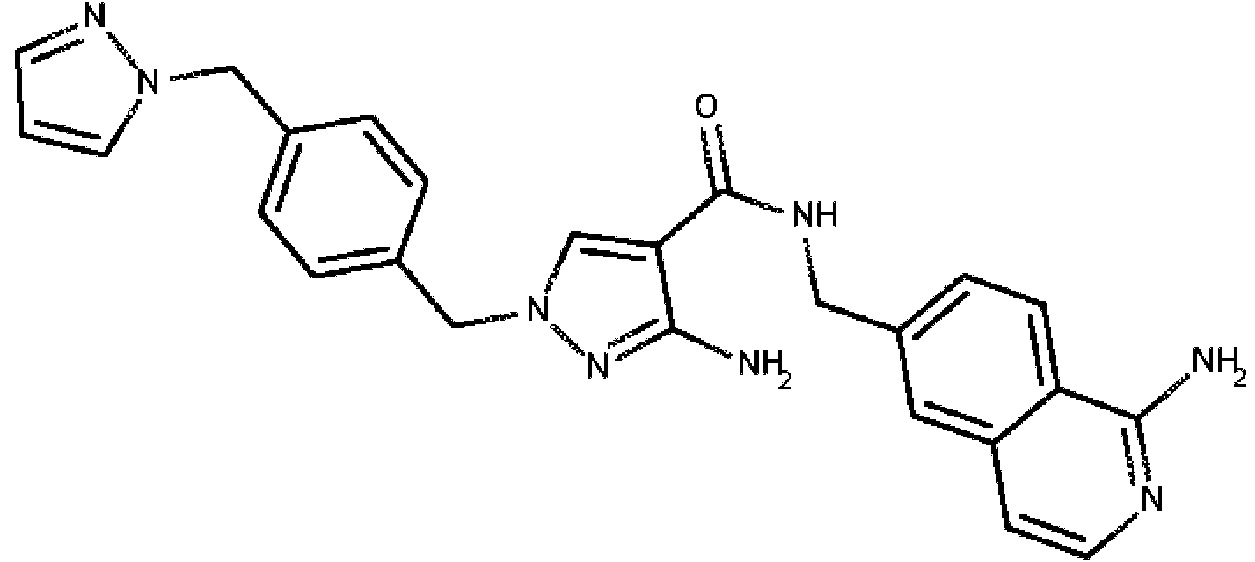
A. 1-(4-hidroximetil-bencil)-1H-pirazolA. 1-(4-hydroxymethyl-benzyl)-1H-pyrazole
Se recogieron en MeCN (30 ml) alcohol 4-(clorometil)bencílico (650 mg, 4,15 mmol) y pirazol (311 mg, 4,57 mmol). Se añadió K2CO3 (860,5 mg, 6,23 mmol) y la reacción se calentó a 50°C durante 48 hrs. Los volátiles se eliminaron a vacío. Se añadieron acetato de etilo (60 ml) y agua (20 ml). La capa orgánica se filtró y se evaporó a vacío. Se purificó mediante cromatografía ultrarrápida (sílice) eluyendo con EtOAc al 40% en éter pet. para proporcionar un aceite incoloro identificado como 1-(4-hidroximetil-bencil)-1H-pirazol (480 mg, rendimiento del 61%).4-(Chloromethyl)benzyl alcohol (650 mg, 4.15 mmol) and pyrazole (311 mg, 4.57 mmol) were taken up in MeCN (30 mL). K 2 CO 3 (860.5 mg, 6.23 mmol) was added and the reaction heated at 50°C for 48 hrs. The volatiles were removed in vacuo. Ethyl acetate (60 ml) and water (20 ml) were added. The organic layer was filtered and evaporated in vacuo. Purified by flash chromatography (silica) eluting with 40% EtOAc in pet. ether. to give a colorless oil identified as 1-(4-hydroxymethyl-benzyl)-1H-pyrazole (480 mg, 61% yield).
B. 1-(4-bromometil-bencil)-1H-pirazolB. 1-(4-bromomethyl-benzyl)-1H-pyrazole
Se recogieron en DCM (15 ml) 1-(4-hidroximetil-bencil)-1H-pirazol (480 mg, 2,55 mmol) y trifenilfosfina (769 mg, 2,93 mmol). La solución resultante se enfrió en un baño de hielo antes de añadir en porciones tetrabromuro de carbono (930 mg, 2,81 mmol). La mezcla se agitó a TA durante 18 hrs. La mezcla se diluyó con DCM, se lavó con agua (2 x 50 ml) y salmuera (30 ml) y se concentró a vacío. El material bruto se purificó mediante cromatografía ultrarrápida (sílice) (20%-40% de EtOAc/éter pet.). El compuesto que contenía las fracciones se concentró a vacío para proporcionar un sólido blanquecino identificado como 1-(4-bromometil-bencil)-1H-pirazol (410 mg, rendimiento del 64%). 1-(4-Hydroxymethyl-benzyl)-1H-pyrazole (480 mg, 2.55 mmol) and triphenylphosphine (769 mg, 2.93 mmol) were taken up in DCM (15 mL). The resulting solution was cooled in an ice bath before carbon tetrabromide (930 mg, 2.81 mmol) was added portionwise. The mixture was stirred at RT for 18hrs. The mixture was diluted with DCM, washed with water (2 x 50 mL), brine (30 mL), and concentrated in vacuo. The crude material was purified by flash chromatography (silica) (20%-40% EtOAc/pet. ether). The compound containing fractions were concentrated in vacuo to give an off-white solid identified as 1-(4-bromomethyl-benzyl)-1H-pyrazole (410 mg, 64% yield).
C. Éster etílico del ácido 3-amino-1-(4-pirazol-1-ilmetil-bencil)-1H-pirazol-4-carboxiílico y éster etílico del ácido 5-amino-1-(4-pirazol-1-ilmetil-bencil)-1H pirazol-4-carboxílico.C. 3-Amino-1-(4-pyrazol-1-ylmethyl-benzyl)-1H-pyrazole-4-carboxylic acid ethyl ester and 5-Amino-1-(4-pyrazol-1-ylmethyl) ethyl ester -benzyl)-1H pyrazole-4-carboxylic acid.
A éster etílico del ácido 5-amino-1H-p¡razol-4-carboxílico (200 mg, 1,29 mmol) en acetonitrilo (7 ml) se le añadió carbonato potásico (356 mg, 2,58 mmol) y 1-(4-bromometil-bencil)-1H-pirazol (324 mg, 1,29 mmol) y la reacción se agitó a ta durante 18 hrs. La mezcla de reacción se concentró y el residuo se purificó mediante cromatografía en columna (sílice) eluyendo con acetonitrilo:acetato de etilo:éter pet. 6:6:7 para proporcionar éster etílico del ácido 3-amino-1-(4-pirazol-1-ilmetil-bencil)-1H-pirazol-4-carboxílico (129 mg, rendimiento del 31%) y éster etílico de ácido 5-amino-1-(4-pirazol-1-ilmetil-bencil)-1H-pirazol-4-carboxílico (119 mg, rendimiento del 28%).To 5-amino-1H-parazole-4-carboxylic acid ethyl ester (200 mg, 1.29 mmol) in acetonitrile (7 mL) was added potassium carbonate (356 mg, 2.58 mmol) and 1- (4-bromomethyl-benzyl)-1H-pyrazole (324mg, 1.29mmol) and the reaction stirred at rt for 18hrs. The reaction mixture was concentrated and the residue was purified by column chromatography (silica) eluting with acetonitrile:ethyl acetate:pet. 6:6:7 to give 3-amino-1-(4-pyrazol-1-ylmethyl-benzyl)-1H-pyrazole-4-carboxylic acid ethyl ester (129 mg, 31% yield) and 5-amino-1-(4-pyrazol-1-ylmethyl-benzyl)-1H-pyrazole-4-carboxylic acid (119 mg, 28% yield).
D. Ácido 3-amino-1-(4-pirazol-1-ilmetil-bencil)-1H-pirazol-4-carboxílicoD. 3-amino-1-(4-pyrazol-1-ylmethyl-benzyl)-1H-pyrazole-4-carboxylic acid
A éster etílico del ácido 3-amino-1-(4-pirazol-1-ilmetil-bencil)-1H-pirazol-4-carboxílico (119 mg, 0,37 mmol) en etanol (20 ml) se le añadió hidróxido sódico (102 mg, 2,56 mmol) y la reacción se calentó a reflujo durante 48 hrs. La mezcla de reacción se enfrió y se concentró a vacío. El residuo bruto se disolvió en agua (2 ml) y el pH se ajustó a pH ~ 5 con HCl 2M (hasta que la mezcla de reacción se volvió opaca). Se añadió EtOAc y el sólido entró en la capa orgánica, pero no se disolvió. Se eliminó la capa acuosa y se filtró la capa orgánica para proporcionar un sólido blanquecino que se lavó con éter dietílico para proporcionar ácido 3-amino-1-(4-pirazol-1-ilmetil-bencil)-1H-pirazol-4-carboxílico que se utilizó en la siguiente etapa sin purificación adicional.To 3-amino-1-(4-pyrazol-1-ylmethyl-benzyl)-1H-pyrazole-4-carboxylic acid ethyl ester (119 mg, 0.37 mmol) in ethanol (20 mL) was added sodium hydroxide (102 mg, 2.56 mmol) and the reaction heated at reflux for 48 hrs. The reaction mixture was cooled and concentrated in vacuo. The crude residue was dissolved in water (2 mL) and the pH was adjusted to pH ~5 with 2M HCl (until the reaction mixture turned opaque). EtOAc was added and the solid entered the organic layer, but did not dissolve. The aqueous layer was removed and the organic layer was filtered to give an off-white solid which was washed with diethyl ether to give 3-amino-1-(4-pyrazol-1-ylmethyl-benzyl)-1H-pyrazole-4-carboxylic acid. which was used in the next step without further purification.
E. Sal de TFA de (1-amino-isoquinolin-6-ilmetil)-amida del ácido 3-amino-1-(4-pirazol-1-ilmetil-bencil)-1H-pirazol-4-carboxílicoE. 3-Amino-1-(4-pyrazol-1-ylmethyl-benzyl)-1H-pyrazole-4-carboxylic acid (1-amino-isoquinolin-6-ylmethyl)-amide TFA salt
A ácido 3-amino-1-(4-pirazol-1-ilmetil-bencil)-1H-pirazol-4-carboxílico (49,1 mg, 0,17 mmol) en diclorometano (15 ml) y DMF (2 ml) a 0°C se le añadió HOBt (26,8 mg, 0,20 mmol) y carbodiimida hidrosoluble (44,3 mg, 0,23 mmol). Después de agitar durante 15 min, se añadieron trietilamina (115 pl, 0,83 mmol) y 6-aminometil-isoquinolin-1-ilamina (28,6 mg, 0,17 mmol) y la reacción se dejó calentar a ta y se agitó durante 18 hrs. La mezcla de reacción se repartió entre EtOAc (30 ml) y agua (10 ml). La capa orgánica se lavó con salmuera (30 ml). La capa orgánica se secó (MgSO4), se filtró y se concentró. La purificación mediante HPLC preparativa proporcionó sal de TFA de (1-amino-isoquinolin-6-ilmetil)-amida del ácido 3-amino-1-(4-pirazol-1-ilmetil-bencil)-1H-pirazol-4-carboxílico como un sólido blanco.A 3-amino-1-(4-pyrazol-1-ylmethyl-benzyl)-1H-pyrazole-4-carboxylic acid (49.1 mg, 0.17 mmol) in dichloromethane (15 mL) and DMF (2 mL) at 0°C HOBt (26.8 mg, 0.20 mmol) and water-soluble carbodiimide (44.3 mg, 0.23 mmol) were added. After stirring for 15 min, triethylamine (115 µL, 0.83 mmol) and 6-aminomethyl-isoquinolin-1-ylamine (28.6 mg, 0.17 mmol) were added and the reaction allowed to warm to rt and evaporated. stirred for 18 hrs. The reaction mixture was partitioned between EtOAc (30 mL) and water (10 mL). The organic layer was washed with brine (30 ml). The organic layer was dried (MgSO4), filtered and concentrated. Purification by preparative HPLC provided 3-amino-1-(4-pyrazol-1-ylmethyl-benzyl)-1H-pyrazole-4-carboxylic acid (1-amino-isoquinolin-6-ylmethyl)-amide TFA salt. as a white solid.
[M+H]+ = 453.[M+H]+ = 453.
1H RMN: (d6-DMSO), ó: 2,98 (1H, br s), 4,02 (2H, br s), 4,55 (2H, d, J= 5,8Hz), 5,07 (2H, s), 5,31 (2H, s), 6,26 (1H, t, J= 2,0), 7,19-7,25 (5H, m), 7,44 (1H, d, 1,8Hz), 7,64 (1H, d, J= 7,0Hz), 7,68 (1H, dd, J= 8,7, 1,3 Hz), 7,79 (2H, dd, J= 9,0, 2,0Hz), 8,02 (1H, s), 8,49 (1H, d, J= 8,6Hz), 8,51 (1H, t, J= 5,7Hz), 8,93 (2H, br s), 12,84 (1H, br s).1H NMR: (d6-DMSO), or: 2.98 (1H, br s), 4.02 (2H, br s), 4.55 (2H, d, J= 5.8Hz), 5.07 ( 2H, s), 5.31 (2H, s), 6.26 (1H, t, J= 2.0), 7.19-7.25 (5H, m), 7.44 (1H, d, 1.8Hz), 7.64 (1H, d, J= 7.0Hz), 7.68 (1H, dd, J= 8.7, 1.3 Hz), 7.79 (2H, dd, J= 9.0, 2.0Hz), 8.02 (1H, s), 8.49 (1H, d, J= 8.6Hz), 8.51 (1H, t, J= 5.7Hz), 8, 93 (2H, br s), 12.84 (1H, br s).
EJEMPLO 24EXAMPLE 24
(1-amino-isoquinolin-6-ilmetil)-amida del ácido 1-(6-pirrolidin-1-il-piridin-3-ilmetil)-3-trifluorometil-1H-pirazol-4-carboxílico1-(6-Pyrrolidin-1-yl-pyridin-3-ylmethyl)-3-trifluoromethyl-1H-pyrazole-4-carboxylic acid (1-amino-isoquinolin-6-ylmethyl)-amide

A. 5-bromometil-2-fluoro-piridinaA. 5-bromomethyl-2-fluoro-pyridine
Se disolvió 2-fluoro-5-metilpiridina (5,0 g, 45 mmol) en 1,2-dicloroetano (120 ml). A esta solución se le añadió N-bromosuccinimida (9,61 g, 54 mmol) y azobisisobutironitrilo (AIBN) (739 mg, 4,5 mmol). La reacción se agitó a reflujo. Después de 18 hrs, la mezcla de reacción se diluyó con cloroformo (100 ml) y se lavó con agua (1x50 ml) y salmuera (1x30 ml), se secó (Na2SO4) y se evaporó a vacío. El residuo se purificó mediante cromatografía ultrarrápida (sílice), eluyente éter pet. al 95%, EtOAc al 5%, las fracciones se combinaron y se evaporaron a vacío para dar un aceite amarillo identificado como 5-bromometil-2-fluoro-piridina (6,89 g, 36,25 mmol, rendimiento del 81%).2-Fluoro-5-methylpyridine (5.0 g, 45 mmol) was dissolved in 1,2-dichloroethane (120 mL). To this solution was added N-bromosuccinimide (9.61 g, 54 mmol) and azobisisobutyronitrile (AIBN) (739 mg, 4.5 mmol). The reaction was stirred at reflux. After 18hrs the reaction mixture was diluted with chloroform (100ml) and washed with water (1x50ml), brine (1x30ml), dried (Na2SO4) and evaporated in vacuo. The residue was purified by flash chromatography (silica), pet. 95%, 5% EtOAc, the fractions were combined and evaporated in vacuo to give a yellow oil identified as 5-bromomethyl-2-fluoro-pyridine (6.89 g, 36.25 mmol, yield of 81%).
[M+H]+ = 192.[M+H]+ = 192.
B. Éster etílico del ácido 1-(6-fluoro-piridin-3-ilmetil)-3-trifluorometil-1H-pirazol-4-carboxílicoB. 1-(6-Fluoro-pyridin-3-ylmethyl)-3-trifluoromethyl-1H-pyrazole-4-carboxylic acid ethyl ester
Se disolvió 3-trifluorometil-1H-pirazol-4-carboxilato de etilo (1,57 g, 7,53 mmol) en DMF (20 ml), se añadieron 5-bromometil-2-fluoro-piridina (1,3 g, 6,84 mmol) y carbonato de cesio (6,69 g, 20,53 mmol) y la mezcla de reacción se agitó a 50°C. Después de 18 hrs, la mezcla de reacción se diluyó con EtOAc (100 ml). Esta solución se lavó con agua (1x30 ml) y salmuera (1x30 ml), se secó (Na2SO4) y se evaporó a vacío. El residuo se purificó mediante cromatografía ultrarrápida (sílice), eluyente éter pet. al 85%, EtOAc al 15%, las fracciones se combinaron y se evaporaron a vacío para dar un sólido blanco identificado como éster etílico del ácido 1-(6-fluoro-piridin-3-ilmetil)-3-trifluorometil-1H-pirazol-4-carboxílico (1,26 g, 3,97 mmol, rendimiento del 58%).Ethyl 3-trifluoromethyl-1H-pyrazole-4-carboxylate (1.57 g, 7.53 mmol) was dissolved in DMF (20 mL), 5-bromomethyl-2-fluoro-pyridine (1.3 g, 6.84 mmol) and cesium carbonate (6.69 g, 20.53 mmol), and the reaction mixture was stirred at 50°C. After 18 hrs the reaction mixture was diluted with EtOAc (100 mL). This solution was washed with water (1x30 ml) and brine (1x30 ml), dried (Na2SO4) and evaporated in vacuo. The residue was purified by flash chromatography (silica), pet. 85%, 15% EtOAc, fractions were combined and evaporated in vacuo to give a white solid identified as 1-(6-fluoro-pyridin-3-ylmethyl)-3-trifluoromethyl-1H-pyrazole ethyl ester. -4-carboxylic acid (1.26 g, 3.97 mmol, 58% yield).
C. Ácido 1-(6-fluoro-piridin-3-ilmetil)-3-trifluorometil-1H-pirazol-4-carboxílicoC. 1-(6-fluoro-pyridin-3-ylmethyl)-3-trifluoromethyl-1H-pyrazole-4-carboxylic acid
Se disolvió éster etílico del ácido 1-(6-fluoro-piridin-3-ilmetil)-3-trifluorometil-1H-pirazol-4-carboxílico (1,26 g, 3,97 mmol) en THF (50 ml) y agua (5 ml) y se añadió hidróxido de litio (476 mg, 19,86 mmol). La mezcla de reacción se agitó a 50°C. Después de 18 hrs, el disolvente se concentró a vacío y el residuo se recogió en EtOAc (50 ml), la capa acuosa se separó y se acidificó con HCl 1M a pH 2 y se extrajo con CHCb (3x50 ml). Los extractos combinados se lavaron con agua (1x30 ml) y salmuera (1x30 ml), se secaron (Na2SO4) y se evaporaron a vacío para dar un aceite incoloro identificado como ácido 1-(6-fluoro-piridin-3-ilmetil)-3-trifluorometil-1H-pirazol-4-carboxílico (980 mg, 3,39 mmol, rendimiento del 85%).1-(6-Fluoro-pyridin-3-ylmethyl)-3-trifluoromethyl-1H-pyrazole-4-carboxylic acid ethyl ester (1.26 g, 3.97 mmol) was dissolved in THF (50 mL) and water hydroxide (5 mL) and lithium hydroxide (476 mg, 19.86 mmol) was added. The reaction mixture was stirred at 50°C. After 18 hrs the solvent was concentrated in vacuo and the residue taken up in EtOAc (50 mL), the aqueous layer separated and acidified with 1M HCl to pH 2 and extracted with CHCb (3x50 mL). The combined extracts were washed with water (1x30 mL), brine (1x30 mL), dried (Na2SO4) and evaporated in vacuo to give a colorless oil identified as 1-(6-fluoro-pyridin-3-ylmethyl)- 3-trifluoromethyl-1H-pyrazole-4-carboxylic acid (980 mg, 3.39 mmol, 85% yield).
[M+H]+ = 290.[M+H]+ = 290.
D. Ácido 1-(6-pirrolidin-1-il-piridin-3-ilmetil)-3-trifluorometil-1H-pirazol-4-carboxílicoD. 1-(6-Pyrrolidin-1-yl-pyridin-3-ylmethyl)-3-trifluoromethyl-1H-pyrazole-4-carboxylic acid
Se disolvió ácido 1-(6-fluoro-piridin-3-ilmetil)-3-trifluorometil-1H-pirazol-4-carboxílico (300 mg, 1,04 mmol) en dioxano (25 ml) y pirrolidina (2 ml) y la mezcla de reacción se agitó a 80°C. Después de 18 hrs, la mezcla de reacción se diluyó con EtOAc (100 ml). Esta solución se lavó con agua (1x30 ml) y salmuera (1x30 ml), se secó (Na2SO4) y se evaporó a vacío. El residuo se purificó mediante cromatografía ultrarrápida (sílice), eluyente AcOH al 1%, MeOH al 9%, CHCb al 90%, las fracciones se combinaron y se evaporaron a vacío para dar un sólido espumoso blanco identificado como ácido 1-(6-pirrolidin-1-il-piridin-3-ilmetil)-3-trifluorometil-1H-pirazol-4-carboxílico (267 mg, 0,785 mmol, rendimiento del 76%).1-(6-Fluoro-pyridin-3-ylmethyl)-3-trifluoromethyl-1H-pyrazole-4-carboxylic acid (300 mg, 1.04 mmol) was dissolved in dioxane (25 mL) and pyrrolidine (2 mL) and the reaction mixture was stirred at 80°C. After 18 hrs the reaction mixture was diluted with EtOAc (100 mL). This solution was washed with water (1x30 ml) and brine (1x30 ml), dried (Na2SO4) and evaporated in vacuo. The residue was purified by flash chromatography (silica), eluant 1% AcOH, 9% MeOH, 90% CHCb, fractions combined and evaporated in vacuo to give a white foamy solid identified as 1-(6- Pyrrolidin-1-yl-pyridin-3-ylmethyl)-3-trifluoromethyl-1H-pyrazole-4-carboxylic acid (267 mg, 0.785 mmol, 76% yield).
[M+H]+ = 341.[M+H]+ = 341.
E. (1-amino-isoquinolin-6-ilmetil)-amida del ácido 1-(6-pirrolidin-1-il-piridin-3-ilmetil)-3-trifluorometil-1H-pirazol-4-carboxílicoE. 1-(6-Pyrrolidin-1-yl-pyridin-3-ylmethyl)-3-trifluoromethyl-1H-pyrazole-4-carboxylic acid (1-amino-isoquinolin-6-ylmethyl)-amide
Se disolvió ácido 1-(6-pirrolidin-1-il-piridin-3-ilmetil)-3-trifluorometil-1H-pirazol-4-carboxílico (180 mg, 0,53 mmol) en CH2Cl2 (50 ml) y DMF (2,5 ml). Esta solución se enfrió a 0°C. Se añadió 6-aminometil-isoquinolin-1-ilamina.HCl (122 mg, 0,58 mmol) seguido de HOBt (77 mg, 0,58 mmol) y trietilamina (161 mg, 1,58 mmol). A continuación, se añadió carbodiimida hidrosoluble (122 mg, 0,63 mmol). Después de 18 hrs a una temperatura de 0°C hasta ta, la mezcla de reacción se diluyó con cloroformo (100 ml) e isopropanol (10 ml) y se lavó con NaHCO3 (1x30 ml), agua (1x30 ml) y salmuera (1x30 ml), se secó (Na2SO4) y se evaporó a vacío, lo que dio un aceite amarillo. El residuo se purificó mediante cromatografía ultrarrápida (sílice), eluyente MeOH al 15%, CHCb al 85%, las fracciones se combinaron y se evaporaron a vacío para dar un sólido blanco. El residuo se trató con HCl en metanol (4 ml), el disolvente se evaporó a vacío y el residuo se liofilizó a partir de agua/acetonitrilo para dar un sólido blanco identificado como (1-amino-isoquinolin-6-ilmetil)-amida del ácido 1-(6-pirrolidin-1-il-piridin-3-ilmetil)-3-trifluorometil-1H-pirazol-4-carboxílico (135 mg, 0,254 mmol, rendimiento del 48%).1-(6-Pyrrolidin-1-yl-pyridin-3-ylmethyl)-3-trifluoromethyl-1H-pyrazole-4-carboxylic acid (180 mg, 0.53 mmol) was dissolved in CH 2 Cl 2 (50 mL). and DMF (2.5 ml). This solution was cooled to 0°C. 6-Aminomethyl-isoquinolin-1-ylamine.HCl (122 mg, 0.58 mmol) was added followed by HOBt (77 mg, 0.58 mmol) and triethylamine (161 mg, 1.58 mmol). Water-soluble carbodiimide (122 mg, 0.63 mmol) was then added. After 18 hrs at 0°C to rt, the reaction mixture was diluted with chloroform (100 ml) and isopropanol (10 ml) and washed with NaHCO3 (1x30 ml), water (1x30 ml) and brine ( 1x30 mL), dried (Na2SO4) and evaporated in vacuo to give a yellow oil. The residue was purified by flash chromatography (silica), eluant 15% MeOH, 85% CHCb, fractions combined and evaporated in vacuo to give a white solid. The residue was treated with HCl in methanol (4 mL), the solvent evaporated in vacuo and the residue lyophilized from water/acetonitrile to give a white solid identified as (1-amino-isoquinolin-6-ylmethyl)-amide 1-(6-pyrrolidin-1-yl-pyridin-3-ylmethyl)-3-trifluoromethyl-1H-pyrazole-4-carboxylic acid (135 mg, 0.254 mmol, 48% yield).
[M+H]+ = 496.[M+H]+ = 496.
1H RMN: (d6-DMSO 6: 2,01 (4H, t, J= 6,0Hz), 3,47 (4H, t, J= 6,3Hz), 4,59 (2H, d, J= 5,8Hz), 5,45 (2H, s), 7,10 (1H, d,, J= 9,0Hz), 7,20 (1H, d, J= 7,1Hz), 7,70 (2H, dd, J= 1,2 and 8,3Hz), 7,81 (1H, s), 7,94 (1H, d, J= 8,8Hz), 8,15 (1H, s), 8,58 (1H, d, J= 8,7Hz), 8,64 (1H, s), 9,17-9,20 (2H, m), 13,30 (1H, s). 1H NMR: (d6-DMSO 6: 2.01 (4H, t, J= 6.0Hz), 3.47 (4H, t, J= 6.3Hz), 4.59 (2H, d, J= 5 .8Hz), 5.45 (2H, s), 7.10 (1H, d,, J= 9.0Hz), 7.20 (1H, d, J= 7.1Hz), 7.70 (2H, dd, J= 1.2 and 8.3Hz), 7.81 (1H, s), 7.94 (1H, d, J= 8.8Hz), 8.15 (1H, s), 8.58 ( 1H, d, J= 8.7Hz), 8.64 (1H, s), 9.17-9.20 (2H, m), 13.30 (1H, s).
EJEMPLO 25EXAMPLE 25
( 1-amino-isoquinolin-6-ilmetil)-amida del ácido 3-ciclopropil-1-(5-metoxi-6-pirrolidin-1-il-piridin-3-ilmetil)-1H-pirazol-4-carboxílico3-Cyclopropyl-1-(5-methoxy-6-pyrrolidin-1-yl-pyridin-3-ylmethyl)-1H-pyrazole-4-carboxylic acid (1-amino-isoquinolin-6-ylmethyl)-amide

A: (6-cloro-5-metoxi-piridin-3-il)-metanolA: (6-chloro-5-methoxy-pyridin-3-yl)-methanol
A una solución en agitación de éster metílico del ácido 6-cloro-5-metoxi-nicotínico (0,5 g, 2,48 mmol) en THF anhidro (20 ml) enfriado a 0°C en atmósfera de nitrógeno, se le añadió LiAlH (104 mg, 2,728 mmol). La reacción se dejó calentar a ta durante 2 hrs. La reacción se enfrió a 0°C y se interrumpió con agua (5 ml). Se añadió tartrato de sodio y potasio (sal de Rochelle) para ayudar a romper la suspensión. La mezcla se filtró a través de Celite, lavándola bien con agua (20 ml) y acetato de etilo (100 ml). El filtrado se recogió y se separaron las capas. La fracción acuosa se extrajo con acetato de etilo (3 x 20 ml). Las capas orgánicas combinadas se lavaron con salmuera (50 ml), se secaron sobre MgSO4 y el disolvente se eliminó a vacío. El producto bruto se purificó mediante cromatografía ultrarrápida (sílice) eluyendo en gradientes escalonados hasta un 40% de éter pet., 60% de acetato de etilo. Las fracciones puras se concentraron, lo que proporcionó el compuesto del título (6-cloro-5-metoxi-piridin-3-il)-metanol como un sólido blanco (360 mg, 2,074 mmol, rendimiento del 84%).To a stirring solution of 6-chloro-5-methoxy-nicotinic acid methyl ester (0.5 g, 2.48 mmol) in anhydrous THF (20 mL) cooled to 0°C under nitrogen, was added LiAlH (104mg, 2.728mmol). The reaction was allowed to warm to rt for 2hrs. The reaction was cooled to 0°C and quenched with water (5 mL). Potassium sodium tartrate (Rochelle salt) was added to help break the suspension. The mixture was filtered through Celite, washing well with water (20 ml) and ethyl acetate (100 ml). The filtrate was collected and the layers were separated. The aqueous fraction was extracted with ethyl acetate (3 x 20 ml). The combined organic layers were washed with brine (50 mL), dried over MgSO4 and the solvent removed in vacuo. The crude product was purified by flash chromatography (silica) eluting in step gradients to 40% pet. ether, 60% ethyl acetate. Pure fractions were concentrated to give the title compound (6-chloro-5-methoxy-pyridin-3-yl)-methanol as a white solid (360 mg, 2.074 mmol, 84% yield).
[M+H]+ = 174.[M+H]+ = 174.
B. 5-bromometil-2-cloro-3-metoxi-piridinaB. 5-bromomethyl-2-chloro-3-methoxy-pyridine
En atmósfera de N2 , se disolvieron en DCM seco (5 ml) (6-cloro-5-metoxi-piridin-3-il)-metanol (360 mg, 2,074 mmol) y trifenilfosfina (626 mg, 2,385 mmol). La solución resultante se enfrió en un baño de hielo antes de añadir en porciones tetrabromuro de carbono (756 mg, 2,281 mmol). La mezcla se agitó a ta durante 18 hrs. La mezcla se diluyó con diclorometano (30 ml), se lavó con agua (2 x 50 ml) y salmuera (30 ml), se secó (MgSO4) y se concentró a vacío. El material bruto se purificó mediante cromatografía ultrarrápida (sílice) eluyendo en gradientes escalonados hasta un 85% de éter pet., 15% de acetato de etilo. El compuesto que contenía las fracciones se concentró a vacío para proporcionar un aceite incoloro identificado como 5-bromometil-2-cloro-3-metoxi-piridina (220 mg, 0,93 mmol, rendimiento del 45%).Under N 2 atmosphere, (6-chloro-5-methoxy-pyridin-3-yl)-methanol (360 mg, 2.074 mmol) and triphenylphosphine (626 mg, 2.385 mmol) were dissolved in dry DCM (5 mL). The resulting solution was cooled in an ice bath before carbon tetrabromide (756 mg, 2.281 mmol) was added portionwise. The mixture was stirred at rt for 18hrs. The mixture was diluted with dichloromethane (30 mL), washed with water (2 x 50 mL), brine (30 mL), dried (MgSO4) and concentrated in vacuo. The crude material was purified by flash chromatography (silica) eluting in step gradients to 85% pet. ether, 15% ethyl acetate. The compound containing fractions were concentrated in vacuo to give a colorless oil identified as 5-bromomethyl-2-chloro-3-methoxy-pyridine (220 mg, 0.93 mmol, 45% yield).
[M+H]+ = 238.[M+H]+ = 238.
1H RMN (400 MHz, CDCla) ó: 3,97 (3H, s), 4,47 (2H, s), 7,25 (1H, d, J = 2,0 Hz), 8,01 (1H, d, J = 2,0 Hz).1H NMR (400 MHz, CDCla) or: 3.97 (3H, s), 4.47 (2H, s), 7.25 (1H, d, J = 2.0 Hz), 8.01 (1H, d, J = 2.0 Hz).
C. Éster etílico del ácido 1-(6-cloro-5-metoxi-piridin-ilmetil-3)-3-ciclopropil-1H-pirazol-4-carboxílicoC. 1-(6-Chloro-5-methoxy-pyridin-ylmethyl-3)-3-cyclopropyl-1H-pyrazole-4-carboxylic acid ethyl ester
Se recogió éster etílico del ácido 3-ciclopropil-1H-pirazol-4-carboxílico (60 mg, 0,333 mmol) en DMF (2 ml) y se trató con carbonato potásico (91 mg, 0,660 mmol). Se añadió 5-bromometil-2-cloro-3-metoxi-piridina (78 mg, 0,330 mmol) y la reacción se agitó a ta durante el fin de semana. Se añadieron acetato de etilo (60 ml) y agua (20 ml) y las capas se separaron. La capa orgánica se lavó con agua (3 x 15 ml), salmuera (10 ml), se filtró y se evaporó. El producto bruto se purificó mediante cromatografía ultrarrápida (sílice) eluyendo en gradientes escalonados hasta un 60% de éter pet., 40% de acetato de etilo. Se aisló éster etílico del ácido 1-(6-cloro-5-metoxipiridin-3-ilmetil)-3-ciclopropil-1H-pirazol-4-carboxílico como un aceite incoloro que solidificó después de reposar hasta dar un sólido blanco (78 mg, 0,232 mmol, rendimiento del 70%).3-Cyclopropyl-1H-pyrazole-4-carboxylic acid ethyl ester (60 mg, 0.333 mmol) was taken up in DMF (2 mL) and treated with potassium carbonate (91 mg, 0.660 mmol). 5-Bromomethyl-2-chloro-3-methoxy-pyridine (78 mg, 0.330 mmol) was added and the reaction was stirred at rt over the weekend. Ethyl acetate (60 ml) and water (20 ml) were added and the layers separated. The organic layer was washed with water (3 x 15 ml), brine (10 ml), filtered and evaporated. The crude product was purified by flash chromatography (silica) eluting in step gradients to 60% pet. ether, 40% ethyl acetate. 1-(6-Chloro-5-methoxypyridin-3-ylmethyl)-3-cyclopropyl-1H-pyrazole-4-carboxylic acid ethyl ester was isolated as a colorless oil which solidified on standing to a white solid (78 mg , 0.232 mmol, 70% yield.
[M+H]+ = 336.[M+H]+ = 336.
D. Éster etílico del ácido 3-ciclopropil-1-(5-metoxi-6-pirrolidin-1-il-piridin-3-ilmetil)-1H-pirazol-4-carboxílico Se calentó una suspensión de éster etílico del ácido 1-(6-cloro-5-metoxi-piridin-3-ilmetil)-3-ciclopropil-1H-pirazol-4-carboxílico (78 mg, 0,232 mmol) en pirrolidina (763 pl, 9,282 mmol) y 1,4-d¡oxano (300 pl) a 90°C durante la noche. A continuación, la reacción se enfrió y se recogió en acetato de etilo (20 ml), se añadió NaHCÜ3 (10 ml) y la capa orgánica se separó, se lavó con salmuera, se secó (MgSÜ4) y se concentró. El producto bruto se purificó mediante cromatografía ultrarrápida (sílice) eluyendo en gradientes escalonados hasta un 60% de éter pet., 40% de acetato de etilo. Se aisló éster etílico del ácido 3-ciclopropil-1-(5-metoxi-6-pirrolidin-1-il-piridin-3-ilmetil)-1H-pirazol-4-carboxílico como un aceite incoloro (85 mg, 0,229 mmol, rendimiento del 98%).D. 3-Cyclopropyl-1-(5-methoxy-6-pyrrolidin-1-yl-pyridin-3-ylmethyl)-1H-pyrazole-4-carboxylic acid ethyl ester A suspension of 1-(6-chloro-5-methoxy-pyridin-3-ylmethyl)-3-cyclopropyl-1H-pyrazole-4-carboxylic acid ethyl ester (78 mg, 0.232 mmol) in pyrrolidine (763 pl , 9.282 mmol) and 1,4-dioxane (300 µl) at 90°C overnight. The reaction was then cooled and taken up in ethyl acetate (20 mL), NaHCÜ3 (10 mL) was added and the organic layer separated, washed with brine, dried (MgSÜ4) and concentrated. The crude product was purified by flash chromatography (silica) eluting in step gradients to 60% pet. ether, 40% ethyl acetate. 3-Cyclopropyl-1-(5-methoxy-6-pyrrolidin-1-yl-pyridin-3-ylmethyl)-1H-pyrazole-4-carboxylic acid ethyl ester was isolated as a colorless oil (85 mg, 0.229 mmol, 98% yield).
[M+H]+ = 371.[M+H]+ = 371.
E. Ácido 3-ciclopropil-1-(5-metoxi-6-pirrolidin-1-il-piridin-3-ilmetil)-1H-pirazol-4-carboxílicoE. 3-Cyclopropyl-1-(5-methoxy-6-pyrrolidin-1-yl-pyridin-3-ylmethyl)-1H-pyrazole-4-carboxylic acid
A éster etílico del ácido 3-ciclopropil-1-(5-metoxi-6-pirrolidin-1-il-piridin-3-ilmetil)-1H-pirazol-4-carboxílico (85 mg, 0,229 mmol) en etanol (20 ml) se le añadió hidróxido sódico (92 mg, 2,295 mmol). La mezcla de reacción se calentó a reflujo durante la noche. A continuación, la reacción se enfrió y se concentró a presión reducida. El residuo bruto se disolvió en agua (2 ml) y el pH se ajustó a pH ~ 4,7 con HCl 2M. La capa acuosa se lavó con cloroformo (3 x 10 ml). Las fracciones orgánicas combinadas se concentraron para proporcionar el producto deseado ácido 3-ciclopropil-1-(5-metoxi-6-pirrolidin-1-il-piridin-3-ilmetil)-1H-pirazol-4-carboxílico como un sólido blanco (60 mg, 0,175 mmol, rendimiento del 76%).A 3-Cyclopropyl-1-(5-methoxy-6-pyrrolidin-1-yl-pyridin-3-ylmethyl)-1H-pyrazole-4-carboxylic acid ethyl ester (85 mg, 0.229 mmol) in ethanol (20 mL ) sodium hydroxide (92 mg, 2.295 mmol) was added. The reaction mixture was heated at reflux overnight. The reaction was then cooled and concentrated under reduced pressure. The crude residue was dissolved in water (2 mL) and the pH was adjusted to pH ~4.7 with 2M HCl. The aqueous layer was washed with chloroform (3 x 10 ml). The combined organic fractions were concentrated to provide the desired product 3-Cyclopropyl-1-(5-methoxy-6-pyrrolidin-1-yl-pyridin-3-ylmethyl)-1H-pyrazole-4-carboxylic acid as a white solid ( 60mg, 0.175mmol, 76% yield.
[M+H]+ = 343.[M+H]+ = 343.
F. Clorhidrato de (1-amino-isoquinolin-6-ilmetil)-amida del ácido 3-ciclopropil-1-(5-metoxi-6-pirrolidin-1-ilpiridin-3-ilmetil)-1H-pirazol-4-carboxílicoF. 3-Cyclopropyl-1-(5-methoxy-6-pyrrolidin-1-ylpyridin-3-ylmethyl)-1H-pyrazole-4-carboxylic acid (1-amino-isoquinolin-6-ylmethyl)-amide hydrochloride
A ácido 3-ciclopropil-1-(5-metoxi-6-pirrolidin-1-il-piridin-3-ilmetil)-1H-pirazol-4-carboxílico (60 mg, 0,175 mmol) en diclorometano (5 ml) a 0°C se le añadió HOBt (28 mg, 0,210 mmol) y 1-etil-3-(3-dimetilaminopropil)carbodiimida (47 mg, 0,245 mmol). Después de 10-15 min, se añadió trietilamina (122 pl, 0,876 mmol) y 6-(aminometil)isoquinolin-1-amina (30 mg, 0,175 mmol). Se añadió DMF (3 ml) para facilitar la solubilidad y la reacción se dejó calentar a ta y se agitó durante 3 días. La mezcla de reacción se diluyó con cloroformo (50 ml) y se añadió solución acuosa saturada de NaHCO3 (15 ml). Las capas se separaron y la capa orgánica se lavó con agua (5 x 20 ml), seguido de salmuera (15 ml). Las capas orgánicas combinadas se secaron sobre MgSO4, se filtraron y se concentraron a presión reducida. El producto bruto se purificó mediante cromatografía ultrarrápida (sílice) eluyendo en gradientes escalonados hasta un 3,5% de metanol, 95,5% de diclorometano, 1% de NH4OH. El producto se trató con HCl/dioxano durante 30 min, se concentró a vacío y se liofilizó en acetonitrilo/agua. Se aisló (1-amino-isoquinolin-6-ilmetil)-amida del ácido 3-ciclopropil-1-(5-metoxi-6-pirrolidin-1-il-piridin-3-ilmetil)-1H-pirazol-4-carboxílico en forma de sal de diclorhidrato como un sólido blanco (50 mg, 0,088 mmol, rendimiento del 99%).A 3-Cyclopropyl-1-(5-methoxy-6-pyrrolidin-1-yl-pyridin-3-ylmethyl)-1H-pyrazole-4-carboxylic acid (60 mg, 0.175 mmol) in dichloromethane (5 mL) at 0 °C HOBt (28 mg, 0.210 mmol) and 1-ethyl-3-(3-dimethylaminopropyl)carbodiimide (47 mg, 0.245 mmol) were added. After 10-15 min, triethylamine (122 mL, 0.876 mmol) and 6-(aminomethyl)isoquinolin-1-amine (30 mg, 0.175 mmol) were added. DMF (3 mL) was added to aid solubility and the reaction was allowed to warm to rt and stir for 3 days. The reaction mixture was diluted with chloroform (50 ml) and saturated aqueous NaHCO3 solution (15 ml) was added. The layers were separated and the organic layer was washed with water (5 x 20 ml) followed by brine (15 ml). The combined organic layers were dried over MgSO4, filtered, and concentrated under reduced pressure. The crude product was purified by flash chromatography (silica) eluting in step gradients to 3.5% methanol, 95.5% dichloromethane, 1% NH 4 OH. The product was treated with HCl/dioxane for 30 min, concentrated in vacuo and lyophilized from acetonitrile/water. 3-Cyclopropyl-1-(5-methoxy-6-pyrrolidin-1-yl-pyridin-3-ylmethyl)-1H-pyrazole-4-carboxylic acid (1-amino-isoquinolin-6-ylmethyl)-amide was isolated as the dihydrochloride salt as a white solid (50 mg, 0.088 mmol, 99% yield).
[M+H]+ = 498.[M+H]+ = 498.
1H RMN (d6-DMSO): 0,75-0,79 (2H, m), 0,81-0,87 (2H, m), 1,11-1,95 (4H, m), 2,57-2,63 (1H, m), 3,77 (4H, br.s), 3,86 (3H, s), 4,58 (2H, d, J= 5,8Hz), 5,19 (2H, s), 7,21 (1H, d, J= 7,0Hz), 7,41 (1H, d, J= 1,3Hz), 7,54 (1H, d, J= 1,0Hz), 7,67-7,69 (1H, m), 7,69-7,72 (1H, m), 7,80 (1H, s), 8,31 (1H, s), 8,59 (1H, d, J= 8,6Hz), 8,79 (1H, t, J= 5,8Hz), 9,17 (2H, br.s), 13,39 (1H, s).1H NMR (d6-DMSO): 0.75-0.79 (2H, m), 0.81-0.87 (2H, m), 1.11-1.95 (4H, m), 2.57 -2.63 (1H, m), 3.77 (4H, br.s), 3.86 (3H, s), 4.58 (2H, d, J= 5.8Hz), 5.19 (2H , s), 7.21 (1H, d, J= 7.0Hz), 7.41 (1H, d, J= 1.3Hz), 7.54 (1H, d, J= 1.0Hz), 7 0.67-7.69 (1H, m), 7.69-7.72 (1H, m), 7.80 (1H, s), 8.31 (1H, s), 8.59 (1H, d , J= 8.6Hz), 8.79 (1H, t, J= 5.8Hz), 9.17 (2H, br.s), 13.39 (1H, s).
EJEMPLO 26EXAMPLE 26
(1-am¡no-¡soqu¡nolin-6-¡lmet¡l)-am¡da del ácido 1-(6-etox¡-p¡r¡d¡n-3-¡lmet¡l)-3-fen¡l-1H-p¡razol-4-carboxíl¡co(1-am¡no-¡soqu¡nolin-6-¡lmet¡l)-acid amide 1-(6-ethoxy¡-p¡rd¡n-3-¡lmet¡l)-3 -phenyl-1H-parazole-4-carboxyl
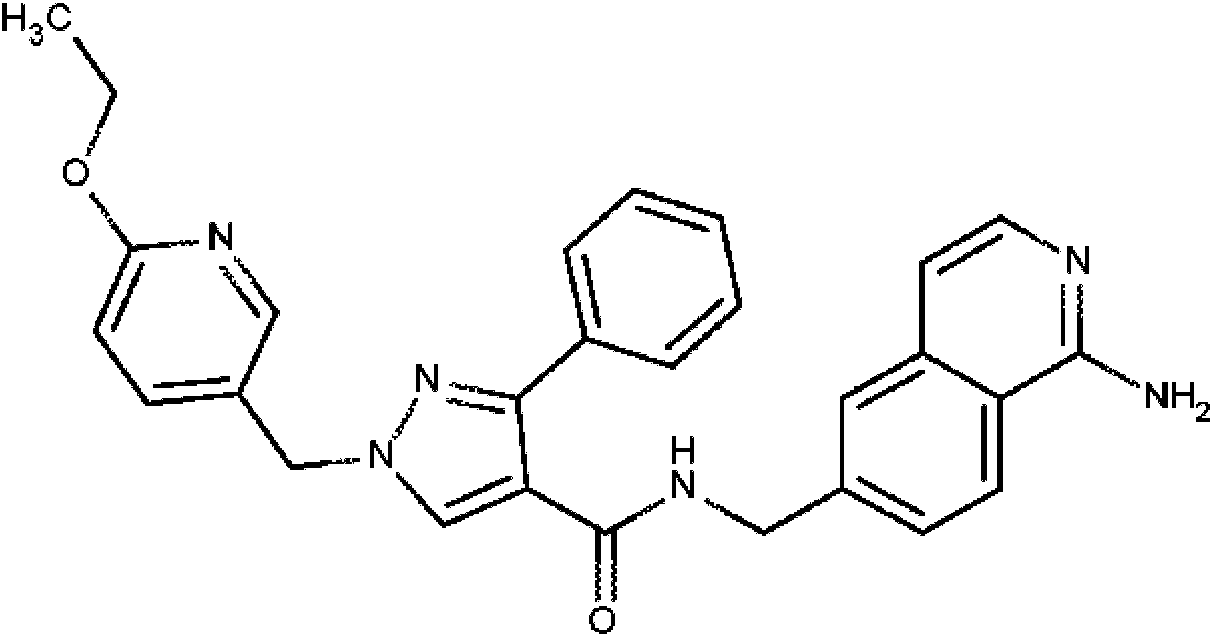
A: 5-clorometil-2-fluoro-piridinaA: 5-chloromethyl-2-fluoro-pyridine
Se cargó un matraz de 500 ml con 2-fluoro-5-metilpiridina (23,42 g, 211 mmol), 1-cloropirrolidina-2,5-diona (42,2 g, 316 mmol), peroxianhídrido benzoico (1,361 g, 4,22 mmol), ácido acético (1 ml, 17,47 mmol) y acetonitrilo (132 ml, 2.527 mmol). La mezcla de reacción se calentó a reflujo, lo que dio una solución amarillo claro que se dejó a reflujo durante 5 hrs. La mezcla de reacción se enfrió y se inactivó con agua (20 ml), seguido de acetato de etilo (30 ml) y salmuera (30 ml). Las dos fases se separaron y la fracción acuosa se volvió a extraer con acetato de etilo (30 ml). Las fracciones orgánicas combinadas se lavaron con salmuera (30 ml), se secaron sobre sulfato magnésico, se filtraron y se evaporaron para dar una suspensión viscosa de color naranja. El producto se trituró con DCM (100 ml) y el sólido resultante se eliminó por filtración. El filtrado se evaporó a presión reducida para dar un aceite de color naranja claro. El producto bruto se dividió en dos lotes de 19 g y se purificó en una columna de sílice de 330 g, el líquido se cargó en DCM y se eluyó en gradiente con acetato de etilo-isohexano (5:95). El producto que contenía las fracciones se combinó y se evaporó a vacío para dar un aceite claro casi incoloro identificado como 5-(clorometil)-2-fluoropiridina (14,6 g, 99 mmol, rendimiento del 46,9%).A 500 mL flask was charged with 2-fluoro-5-methylpyridine (23.42 g, 211 mmol), 1-chloropyrrolidine-2,5-dione (42.2 g, 316 mmol), benzoic peroxy anhydride (1.361 g, 4.22 mmol), acetic acid (1 mL, 17.47 mmol), and acetonitrile (132 mL, 2527 mmol). The reaction mixture was heated to reflux which gave a light yellow solution which was refluxed for 5hrs. The reaction mixture was cooled and quenched with water (20 mL) followed by ethyl acetate (30 mL) and brine (30 mL). The two phases were separated and the aqueous fraction was re-extracted with ethyl acetate (30 ml). The combined organic fractions were washed with brine (30 ml), dried over magnesium sulfate, filtered and evaporated to give an orange viscous suspension. The product was triturated with DCM (100 mL) and the resulting solid filtered off. The filtrate was evaporated under reduced pressure to give a light orange oil. The crude product was divided into two 19 g batches and purified on a 330 g silica column, the liquid loaded into DCM and gradient eluted with ethyl acetate-isohexane (5:95). The product containing fractions were combined and evaporated in vacuo to give a clear almost colorless oil identified as 5-(chloromethyl)-2-fluoropyridine (14.6 g, 99 mmol, 46.9% yield).
[M+H]+ = 146.[M+H]+ = 146.
B. Éster etílico del ácido 1-(6-fluoro-piridin-3-ilmetil)-3-fenil-1H-pirazol-4-carboxílicoB. 1-(6-Fluoro-pyridin-3-ylmethyl)-3-phenyl-1H-pyrazole-4-carboxylic acid ethyl ester
A una solución en agitación de 5-(clorometil)-2-fluoropiridina (750 mg, 5,15 mmol) y 3-fenil-1H-pirazol-4-carboxilato de etilo (1.114 mg, 5,15 mmol) en DMF (15 ml) se añadió K2CO3 (1.424 mg, 10,30 mmol) y se agitó a TA durante el fin de semana. La mezcla de reacción se diluyó con EtOAc (150 ml) y se lavó con agua (100 ml) y salmuera ( 2 x 100 ml), se secó sobre sulfato magnésico, se filtró y el material bruto se evaporó directamente sobre sílice. El producto bruto se purificó mediante cromatografía (columna de 40 g, 0%-60% de (EtOAc:MeCN 3:1) en isohexanos). Se aisló éster etílico del ácido 1-(6-fluoro-piridin-3-ilmetil)-3-fenil-1H-pirazol-4-carboxílico (1,69 g, 4,16 mmol, rendimiento del 81%) en forma de sólido ceroso después de reposar, como una mezcla de regioisómeros. El material se utilizó directamente en la siguiente etapa.To a stirred solution of 5-(chloromethyl)-2-fluoropyridine (750 mg, 5.15 mmol) and ethyl 3-phenyl-1H-pyrazole-4-carboxylate (1,114 mg, 5.15 mmol) in DMF ( 15 mL) K 2 CO 3 (1424 mg, 10.30 mmol) was added and stirred at RT over the weekend. The reaction mixture was diluted with EtOAc (150 mL) and washed with water (100 mL), brine (2 x 100 mL), dried over magnesium sulfate, filtered, and the crude material evaporated directly onto silica. The crude product was purified by chromatography (40 g column, 0%-60% (3:1 EtOAc:MeCN) in isohexanes). 1-(6-Fluoro-pyridin-3-ylmethyl)-3-phenyl-1H-pyrazole-4-carboxylic acid ethyl ester (1.69 g, 4.16 mmol, 81% yield) was isolated as waxy solid on standing, as a mixture of regioisomers. The material was used directly in the next stage.
[M+H]+ = 326.[M+H]+ = 326.
C: Ácido 1-(6-etoxi-piridin-3-ilmetil)-3-fenil-1H-pirazol-4-carboxílicoC: 1-(6-ethoxy-pyridin-3-ylmethyl)-3-phenyl-1H-pyrazole-4-carboxylic acid
A un vial de microondas en agitación que contenía etanol (3 ml) se le añadió etóxido sódico (586 mg, 8,61 mmol) y éster etílico del ácido 1-(6-fluoro-piridin-3-ilmetil)-3-fenil-1H-pirazol-4-carboxílico (700 mg, 2,152 mmol). El recipiente de reacción se cerró herméticamente y se calentó a 90°C durante la noche. La mezcla de reacción se dejó enfriar a ta y se diluyó con EtOAc (100 ml), NH4Cl (sat., 10 ml) y agua (100 ml). La fracción orgánica se lavó con salmuera (100 ml), y se eliminó el disolvente. El material bruto se recogió en THF (10 ml) y MeOH (3 ml) y, a continuación, se añadió NaOH 2M (2.152 pl, 4,30 mmol) y se dejó a TA durante 2 hrs. La mezcla de reacción se acidificó a ~ pH 5 con HCl 1M y el producto se extrajo en EtOAc (2 x 30 ml). La fracción orgánica se lavó con salmuera (30 ml), se secó sobre sulfato magnésico, se filtró, y se eliminó el disolvente. El producto bruto se purificó mediante cromatografía (columna de 40 g, 0%-70% de (EtOAc:MeCN 3:1, ácido acético al 1%) en isohexanos) para proporcionar ácido 1-((6-etoxipiridin-3-il)metil)-3-fenil-1H-pirazol-4-carboxílico (65 mg, 0,191 mmol, rendimiento del 9%) como un sólido blanco.To a stirred microwave vial containing ethanol (3 mL) was added sodium ethoxide (586 mg, 8.61 mmol) and 1-(6-fluoro-pyridin-3-ylmethyl)-3-phenyl acid ethyl ester. -1H-pyrazole-4-carboxylic acid (700 mg, 2.152 mmol). The reaction vessel was sealed and heated at 90°C overnight. The reaction mixture was allowed to cool to rt and was diluted with EtOAc (100 mL), NH 4 Cl (sat., 10 mL), and water (100 mL). The organic fraction was washed with brine (100 ml), and the solvent was removed. The crude material was taken up in THF (10 mL) and MeOH (3 mL), then 2M NaOH (2152 mL, 4.30 mmol) was added and left at RT for 2 hrs. The reaction mixture was acidified to ~pH 5 with 1M HCl and the product was extracted into EtOAc (2 x 30 mL). The organic fraction was washed with brine (30 ml), dried over magnesium sulfate, filtered, and the solvent was removed. The crude product was purified by chromatography (40 g column, 0%-70% (3:1 EtOAc:MeCN, 1% acetic acid) in isohexanes) to give 1-((6-ethoxypyridin-3-yl )methyl)-3-phenyl-1H-pyrazole-4-carboxylic acid (65 mg, 0.191 mmol, 9% yield) as a white solid.
[M+H]+ = 324.[M+H]+ = 324.
D: (1-amino-isoquinolin-6-ilmetil)-amida del ácido 1-(6-etoxi-piridin-3-ilmetil)-3-fenil-1H-pirazol-4-carboxílico D: 1-(6-Ethoxy-pyridin-3-ylmethyl)-3-phenyl-1H-pyrazole-4-carboxylic acid (1-amino-isoquinolin-6-ylmethyl)-amide
A una solución en agitación de ácido 1-((6-etoxipiridin-3-il)metil)-3-fenil-1H-pirazol-4-carboxílico (65 mg, 0 , 201 mmol) y 6 -(aminometil)isoquinolin-1 -amina.2 Hcl (49,5 mg, 0 , 201 mmol) en DMF ( 2 ml) se le añadió N,N-diisopropiletilamina (140 pl, 0,804 mmol) y HATU (84 mg, 0,221 mmol) y se dejó a TA durante 2 hrs. La mezcla de reacción se diluyó con EtOAc (30 ml) y se lavó con NaOH (2M, 20 ml) y, a continuación, con salmuera (2 x 40 ml). La fracción orgánica se preabsorbió directamente sobre sílice y se purificó mediante cromatografía (columna de 12 g, 0%-7% de MeOH (NH3 al 1%) en DCM) para proporcionar la base libre del compuesto del título (54,2 mg, 0,100 mmol, rendimiento del 49,7%) como un polvo blanco. El sólido se destiló azeotrópicamente con tolueno (3 x 5 ml) a alto vacío para eliminar la N,N-diisopropiletilamina residual antes de la formación de la sal. El material se suspendió en DCM (3 ml) y se añadió HCl 4M en dioxano (27,1 pl, 0,109 mmol, 1 eq). El disolvente se eliminó a vacío. El residuo se suspendió en agua (3 ml) y, a continuación, se liofilizó durante la noche para dar (1-aminoisoquinolin-6 -ilmetil)-amida del ácido 1-(6-etoxi-piridin-3-ilmetil)-3-fenil-1H-pirazol-4-carboxílico en forma de sa1HCl, como un sólido blanco (54,2 mg, 0,100 mmol, rendimiento del 49,7%).To a stirred solution of 1-((6-ethoxypyridin-3-yl)methyl)-3-phenyl-1H-pyrazole-4-carboxylic acid (65 mg, 0.201 mmol) and 6- (aminomethyl)isoquinolin- 1 -amine. 2 Hcl (49.5 mg, 0.201 mmol) in DMF (2 mL) was added with N,N-diisopropylethylamine (140 pl, 0.804 mmol) and HATU (84 mg, 0.221 mmol) and left at RT for 2 hours The reaction mixture was diluted with EtOAc (30 mL) and washed with NaOH (2M, 20 mL), then brine (2 x 40 mL). The organic fraction was directly pre-absorbed onto silica and purified by chromatography ( 12 g column, 0%-7% MeOH (1% NH 3 ) in DCM) to give the free base of the title compound (54.2 mg , 0.100 mmol, 49.7% yield) as a white powder. The solid was azeotroped with toluene (3 x 5 mL) under high vacuum to remove residual N,N-diisopropylethylamine prior to salt formation. The material was suspended in DCM (3 mL) and 4M HCl in dioxane (27.1 mL, 0.109 mmol, 1 eq) was added. The solvent was removed in vacuo. The residue was suspended in water (3 mL) and then lyophilized overnight to give 1-(6-ethoxy-pyridin-3-ylmethyl)-3-(1-aminoisoquinolin- 6 -ylmethyl)-acid amide. -phenyl-1H-pyrazole-4-carboxylic acid as sa1HCl, as a white solid (54.2 mg, 0.100 mmol, 49.7% yield).
[M+H]+ = 479,3. [M+H] + = 479.3.
EJEMPLO 27EXAMPLE 27
(1-amino-isoquinolin-6-ilmetil)-amida del ácido 1-(6-etoxi-piridin-3-ilmetil)-3-12-metoxi-acetilamino)-1H-pirazol-4-carboxílico1-(6-Ethoxy-pyridin-3-ylmethyl)-3-12-methoxy-acetylamino)-1H-pyrazole-4-carboxylic acid (1-amino-isoquinolin-6-ylmethyl)-amide

A. Éster etílico del ácido 3-amino-1-(6-fluoro-piridin-3-ilmetil)-1H-pirazol-4-carboxílico 1132-1135A. 3-Amino-1-(6-fluoro-pyridin-3-ylmethyl)-1H-pyrazole-4-carboxylic acid ethyl ester 1132-1135
A una solución en agitación de éster etílico del ácido 3-amino-1H-pirazol-4-carboxílico (1,785 g, 11,51 mmol) en etanol (10 ml) se le añadió etóxido sódico (1,566 g, 23,01 mmol). Después de 5 min, se añadió una solución de 5-(clorometil)-2-fluoropiridina (1,675 g, 11,51 mmol) en EtOH (3 ml) y la reacción se calentó a 80°C. Después de 90 min, la mezcla de reacción se redujo de volumen a vacío y, a continuación, se diluyó con EtOAc (200 ml) y agua (100 ml). La fracción orgánica se aisló y se lavó con salmuera (100 ml), se secó sobre sulfato magnésico, se filtró, y se eliminó el disolvente. El producto bruto se purificó mediante cromatografía (columna de 80 g, lentamente 0%-40% de (EtOAc:MeCN 3:1) en isohexanos). Se aisló el regioisómero no deseado éster etílico del ácido 5-amino-1-(6-fluoro-piridin-3-ilmetil)-1H-pirazol-4-carboxílico a partir del primer conjunto de fracciones (768 mg, 2,76 mmol, rendimiento del 24%) como un aceite que solidificó hasta dar un sólido ceroso después de reposar. Se aisló el isómero deseado éster etílico del ácido 3-amino-1-(6-fluoro-piridin-3-ilmetil)-1H-pirazol-4-carboxílico (712 mg, 2,61 mmol, rendimiento del 22,7%) como un sólido ceroso a partir del segundo conjunto de fracciones.To a stirring solution of 3-amino-1H-pyrazole-4-carboxylic acid ethyl ester (1.785 g, 11.51 mmol) in ethanol (10 mL) was added sodium ethoxide (1.566 g, 23.01 mmol) . After 5 min, a solution of 5-(chloromethyl)-2-fluoropyridine (1.675 g, 11.51 mmol) in EtOH (3 mL) was added and the reaction heated to 80 °C. After 90 min, the reaction mixture was reduced in volume in vacuo, then diluted with EtOAc (200 mL) and water (100 mL). The organic fraction was isolated and washed with brine (100 mL), dried over magnesium sulfate, filtered, and the solvent removed. The crude product was purified by chromatography (80 g column, slowly 0%-40% (3:1 EtOAc:MeCN) in isohexanes). The undesired regioisomer 5-amino-1-(6-fluoro-pyridin-3-ylmethyl)-1H-pyrazole-4-carboxylic acid ethyl ester was isolated from the first set of fractions (768 mg, 2.76 mmol , 24% yield) as an oil which solidified to a waxy solid on standing. The desired isomer 3-amino-1-(6-fluoro-pyridin-3-ylmethyl)-1H-pyrazole-4-carboxylic acid ethyl ester (712 mg, 2.61 mmol, 22.7% yield) was isolated. as a waxy solid from the second set of fractions.
[M+H]+ = 265.[M+H]+ = 265.
B. Ácido 3-amino-1-(6-etoxi-piridin-3-ilmetil)-1H-pirazol-4-carboxílicoB. 3-amino-1-(6-ethoxy-pyridin-3-ylmethyl)-1H-pyrazole-4-carboxylic acid
A un vial de microondas que contenía EtOH (5 ml) se le añadió NaH (260 mg, 6,51 mmol) y se dejó en agitación durante 10 min. A esto se le añadió una suspensión de 3-amino-1-((6-fluoropiridin-3-il)metil)-1H-pirazol-4-carboxilato de etilo (430 mg, 1,627 mmol) en EtOH (4 ml). La mezcla se cerró herméticamente y se calentó a 90°C durante la noche. Se añadió NaOH (2M, 2 ml) y se calentó a 50°C durante 1 hora. La mezcla de reacción se evaporó a sequedad y el residuo se disolvió en agua (10 ml) y el pH se ajustó a pH 5, a continuación, se extrajo con EtOAc (10 x 20 ml). Las fracciones orgánicas combinadas se evaporaron. El material bruto se purificó mediante cromatografía (columna de 12 g, 0%-70% de (EtOAc:MeCN 3:1, ácido acético al 1% en isohexanos) para proporcionar ácido 3-amino-1-((6-etoxipiridin-3-il)metil)-1H-pirazol-4-carboxílico (195 mg, 0,736 mmol, rendimiento del 45,2%) como un polvo blanco después de destilar azeotrópicamente con tolueno (2 x 20 ml).NaH (260 mg, 6.51 mmol) was added to a microwave vial containing EtOH (5 mL) and allowed to stir for 10 min. To this was added a suspension of ethyl 3-amino-1-((6-fluoropyridin-3-yl)methyl)-1H-pyrazole-4-carboxylate (430 mg, 1.627 mmol) in EtOH (4 mL). The mixture was sealed and heated at 90°C overnight. NaOH (2M, 2 mL) was added and heated at 50°C for 1 hour. The reaction mixture was evaporated to dryness and the residue dissolved in water (10 mL) and pH adjusted to pH 5, then extracted with EtOAc (10 x 20 mL). The combined organic fractions were evaporated. The crude material was purified by chromatography (12 g column, 0%-70% (3:1 EtOAc:MeCN, 1% acetic acid in isohexanes) to give 3-amino-1-((6-ethoxypyridin- 3-yl)methyl)-1H-pyrazole-4-carboxylic acid (195 mg, 0.736 mmol, 45.2% yield) as a white powder after azeotroping with toluene (2 x 20 mL).
[M+H]+ = 263.[M+H]+ = 263.
C. Ácido 1-((6-etoxipiridin-3-il)metil)-3-(2-metoxiacetamido)-1H-pirazol-4-carboxílicoC. 1-((6-ethoxypyridin-3-yl)methyl)-3-(2-methoxyacetamido)-1H-pyrazole-4-carboxylic acid
A una solución en agitación de ácido 3-amino-1-((6-etoxipiridin-3-il)metil)-1H-pirazol-4-carboxílico (142 mg, 0,541 mmol) en DCM (3 ml) se le añadió N,N-diisopropiletilamina (142 pl, 0,812 mmol) y cloruro de 2-metoxiacetilo (54,5 pl, 0,596 mmol) y se agitó a ta durante 1 hora. La mezcla de reacción se evaporó para eliminar el DCM. El residuo bruto se sometió a ultrasonidos en agua (10 ml). Se añadió ácido clorhídrico (2M, 1 ml) y el producto se extrajo en EtOAc (30 ml). La capa orgánica se secó sobre sulfato magnésico y el disolvente se evaporó a presión reducida para proporcionar ácido 1-((6-etoxipiridin-3-il)metil)-3-(2-metoxiacetamido)-1H-pirazol-4-carboxílico como un sólido amarillo (160 mg, 0,469 mmol, rendimiento del 87%).To a stirring solution of 3-amino-1-((6-ethoxypyridin-3-yl)methyl)-1H-pyrazole-4-carboxylic acid (142 mg, 0.541 mmol) in DCM (3 mL) was added N ,N-diisopropylethylamine (142 pl, 0.812 mmol) and 2-methoxyacetyl chloride (54.5 pl, 0.596 mmol) and stirred at rt for 1 hour. The reaction mixture was evaporated to remove DCM. The crude residue was sonicated in water (10 ml). Hydrochloric acid (2M, 1 mL) was added and the product was extracted into EtOAc (30 mL). The organic layer was dried over magnesium sulfate and the solvent was evaporated under reduced pressure to give 1-((6-ethoxypyridin-3-yl)methyl)-3-(2-methoxyacetamido)-1H-pyrazole-4-carboxylic acid as a yellow solid (160 mg, 0.469 mmol, 87% yield).
[M+H]+ = 335. [M+H]+ = 335.
D. Clorhidrato de (1-amino-isoquinolin-6-ilmetil)-amida del ácido 1-(6-etoxi-piridin-3-ilmetil)-3-(2-metoxiacetilamino)-1H-pirazol-4-carboxílicoD. 1-(6-Ethoxy-pyridin-3-ylmethyl)-3-(2-methoxyacetylamino)-1H-pyrazole-4-carboxylic acid (1-amino-isoquinolin-6-ylmethyl)-amide hydrochloride
A una solución en agitación de ácido 1-((6-etoxipiridin-3-il)metil)-3-(2-metoxiacetamido)-1H-pirazol-4-carboxílico (81,0 mg, 0,242 mmol), diclorhidrato de 6-(aminometil)isoquinolin-1-amina (65,6 mg, 0,267 mmol) y HATU (111 mg, 0,291 mmol) en DMF (2 ml) se le añadió trietilamina (135 pl, 0,969 mmol). La mezcla resultante se agitó a ta durante la noche. A continuación, la mezcla de reacción se diluyó con EtOAc (15 ml) y se lavó con NaOH 2M (2 x 20 ml). La capa orgánica se secó (Na2SO4), se filtró y se evaporó a presión reducida. El producto bruto se purificó mediante cromatografía (columna de 4 g, 0%-5% de MeOH en DCM y Et3N al 1%) para proporcionar el producto deseado en forma de base libre. El producto se disolvió en DCM (1 ml), se añadió HCl 4M en dioxano (79 pl, 0,315 mmol) y la mezcla resultante se agitó a ta durante 15 min. A continuación, el disolvente se evaporó a presión reducida para dar clorhidrato de (1-amino-isoquinolin-6-ilmetil)-amida del ácido 1-(6-etoxi-piridin-3-ilmetil)-3-(2-metoxi-acetilamino)-1H-pirazol-4-carboxílico (47,5 mg, 0,089 mmol, rendimiento del 36,5%) como un sólido blanco.To a stirring solution of 1-((6-ethoxypyridin-3-yl)methyl)-3-(2-methoxyacetamido)-1H-pyrazole-4-carboxylic acid (81.0 mg, 0.242 mmol), 6 -(aminomethyl)isoquinolin-1-amine (65.6 mg, 0.267 mmol) and HATU (111 mg, 0.291 mmol) in DMF (2 mL) triethylamine (135 pl, 0.969 mmol) was added. The resulting mixture was stirred at rt overnight. The reaction mixture was then diluted with EtOAc (15 mL) and washed with 2M NaOH (2 x 20 mL). The organic layer was dried (Na2SO4), filtered and evaporated under reduced pressure. The crude product was purified by chromatography (4 g column, 0%-5% MeOH in DCM and 1% Et3N) to give the desired product as the free base. The product was dissolved in DCM (1 mL), 4M HCl in dioxane (79 mL, 0.315 mmol) was added and the resulting mixture was stirred at rt for 15 min. Then, the solvent was evaporated under reduced pressure to give 1-(6-ethoxy-pyridin-3-ylmethyl)-3-(2-methoxy-pyridin-3-ylmethyl)-(1-amino-isoquinolin-6-ylmethyl)-hydrochloride. acetylamino)-1H-pyrazole-4-carboxylic acid (47.5 mg, 0.089 mmol, 36.5% yield) as a white solid.
[M+H] = 490.[M+H] = 490.
RMN (d6-DMSO): 1,31 (3H, t, J= 7,0Hz), 3,36 (3H, s), 3,96 (2H, s), 4,30 (2H, q, J= 7,0Hz), 4,60 (2H, d, J= 5,9Hz), 5,27 (2H, s), 6,83 (1H, dd, J= 0,7, 8,5Hz), 7,17 (1H, d, J= 6,8Hz), 7,60-7,72 (3H, m), 7,73-7,78 (1H, m), 8,17-8,27 (2H, m), 8,40-8,50 (3H, m), 8,83 (1H, t, J= 6,0Hz), 10,51 (1H, s), 12,74 (1H, s).NMR (d6-DMSO): 1.31 (3H, t, J= 7.0Hz), 3.36 (3H, s), 3.96 (2H, s), 4.30 (2H, q, J= 7.0Hz), 4.60 (2H, d, J= 5.9Hz), 5.27 (2H, s), 6.83 (1H, dd, J= 0.7, 8.5Hz), 7, 17 (1H, d, J= 6.8Hz), 7.60-7.72 (3H, m), 7.73-7.78 (1H, m), 8.17-8.27 (2H, m ), 8.40-8.50 (3H, m), 8.83 (1H, t, J= 6.0Hz), 10.51 (1H, s), 12.74 (1H, s).
Los compuestos de las siguientes tablas se sintetizaron como se describe para los Ejemplos 1-3 y 6-27 y los Ejemplos de Referencia 4 y 5.The compounds in the following tables were synthesized as described for Examples 1-3 and 6-27 and Reference Examples 4 and 5.
Tabla 1Table 1

(continúa)(keep going)

Tabla 2Table 2

Tabla 3Table 3

(continúa)(keep going)

Tabla 4 Table 4

(continúa)(keep going)

(continúa)(keep going)

(continúa)(keep going)


(continúa)(keep going)

Tabla 6Table 6

(continúa)(keep going)


Tabla 9Table 9

(continúa)(keep going)

Tabla 10Table 10

Tabla 11Table 11

(continúa)(keep going)

(continúa)(keep going)

(continúa)(keep going)

Tabla 12Table 12

(continúa)(keep going)
, , 9, , 9
5 45 4

(continúa)(keep going)

(continúa)(keep going)
, m), 7,80 = 5,7Hz),, m), 7.80 = 5.7Hz),
= 6,0Hz), 
(continúa)(keep going)

(continúa)(keep going)

Métodos biológicosbiological methods
La capacidad de los compuestos de fórmula (I) para inhibir la calicreína plasmática puede determinarse mediante los siguientes ensayos biológicos:The ability of the compounds of formula (I) to inhibit plasma kallikrein can be determined by the following biological tests:
Determinación de la CI50 para la calicreína plasmáticaIC 50 determination for plasma kallikrein
Se determinó la actividad inhibidora de la calicreína plasmática in vitro mediante métodos convencionales publicados (véase, por ejemplo, Johansen et al., Int. J. Tiss. Reac. 1986, 8, 185; Shori et al., Biochem. Pharmacol., 1992, 43, 1209; Sturzebecher et al., Biol. Chem. Hoppe-Seyler, 1992, 373, 1025). Se incubó calicreína plasmática humana (Protogen) a 37°C con el sustrato fluorogénico H-DPro-Phe-Arg-AFC y diversas concentraciones del compuesto de ensayo. La actividad enzimática residual (velocidad de reacción inicial) se determinó midiendo el cambio de la absorbancia óptica a 410 nm y se determinó el valor de CI50 para el compuesto de ensayo. In vitro plasma kallikrein inhibitory activity was determined by standard published methods (see, eg, Johansen et al., Int. J. Tiss. Reac. 1986, 8, 185; Shori et al., Biochem. Pharmacol., 1992, 43, 1209; Sturzebecher et al., Biol. Chem. Hoppe-Seyler, 1992, 373, 1025). Human plasma kallikrein (Protogen) was incubated at 37°C with the fluorogenic substrate H-DPro-Phe-Arg-AFC and various concentrations of test compound. Residual enzyme activity (initial reaction rate) was determined by measuring the change in optical absorbance at 410 nm, and the IC 50 value for the test compound was determined.
Los datos obtenidos a partir de estos ensayos se muestran en la siguiente Tabla 13:The data obtained from these tests are shown in the following Table 13:
Tabla 13Table 13

(continúa)(keep going)

(continúa)(keep going)

Los compuestos seleccionados se cribaron adicionalmente para determinar la actividad inhibidora contra la enzima relacionada KLK1. La capacidad de los compuestos de fórmula (I) para inhibir la KLK1 puede determinarse mediante los siguientes ensayos biológicos:Selected compounds were further screened for inhibitory activity against the related enzyme KLK1. The ability of the compounds of formula (I) to inhibit KLK1 can be determined by the following biological tests:
Determinación de la CI50 para KLK1Determination of IC 50 for KLK1
Se determinó la actividad inhibidora de KLK1 in vitro mediante métodos convencionales publicados (véase, por ejemplo, Johansen et al., Int. J. Tiss. Reac. 1986, 8, 185; Shori et al., Biochem. Pharmacol., 1992, 43, 1209; Sturzebecher et al., Biol. Chem. Hoppe-Seyler, 1992, 373, 1025). Se incubó KLK1 humana (Callbiochem) a 37°C con el sustrato fluorogénico H-DVal-Leu-Arg-AFC y diversas concentraciones del compuesto de ensayo. La actividad enzimática residual (velocidad de reacción inicial) se determinó midiendo el cambio de la absorbancia óptica a 410 nm y se determinó el valor de CI50 para el compuesto de ensayo. In vitro KLK1 inhibitory activity was determined by standard published methods (see, eg, Johansen et al., Int. J. Tiss. Reac. 1986, 8, 185; Shori et al., Biochem. Pharmacol., 1992, 43, 1209; Sturzebecher et al., Biol. Chem. Hoppe-Seyler, 1992, 373, 1025). Human KLK1 (Callbiochem) was incubated at 37°C with the fluorogenic substrate H-DVal-Leu-Arg-AFC and various concentrations of test compound. Residual enzyme activity (initial reaction rate) was determined by measuring the change in optical absorbance at 410 nm, and the IC 50 value for the test compound was determined.
Los datos obtenidos a partir de este ensayo se muestran en la siguiente Tabla 14:The data obtained from this test is shown in the following Table 14:
Tabla 14 (actividad de KLK1)Table 14 (KLK1 activity)

(continúa)(keep going)

continúakeep going

Los compuestos seleccionados se cribaron adicionalmente para determinar la actividad inhibidora contra las enzimas relacionadas plasmina, trombina, tripsina, Factor Xa y Factor XIIa. La capacidad de los compuestos de fórmula (I) contra estas enzimas puede determinarse mediante los siguientes ensayos biológicos:Selected compounds were further screened for inhibitory activity against the related enzymes plasmin, thrombin, trypsin, Factor Xa, and Factor XIIa. The ability of the compounds of formula (I) against these enzymes can be determined by the following biological tests:
Determinación de la selectividad de la enzimaDetermination of enzyme selectivity
Se ensayaron las enzimas serín-proteasa humanas plasmina, trombina, tripsina, Factor Xa y Factor XIIa para determinar su actividad enzimática utilizando un sustrato fluorogénico adecuado. La actividad proteasa se midió monitorizando la acumulación de fluorescencia liberada a partir del sustrato durante 5 minutos. La velocidad lineal del aumento de la fluorescencia por minuto se expresó como porcentaje de actividad (%). La Km para la escisión de cada sustrato se determinó mediante transformación habitual de la ecuación de Michaelis-Menten. Los ensayos del compuesto inhibidor se realizaron a la concentración Km del sustrato y las actividades se calcularon como la concentración de inhibidor que daba el 50% de inhibición (CI50) de la actividad enzimática no inhibida (100%).The human serine protease enzymes plasmin, thrombin, trypsin, Factor Xa and Factor XIIa were tested for enzymatic activity using a suitable fluorogenic substrate. Protease activity was measured by monitoring the accumulation of fluorescence released from the substrate over 5 minutes. The linear rate of increase in fluorescence per minute was expressed as percent activity (%). The Km for cleavage of each substrate was determined by standard transformation of the Michaelis-Menten equation. Inhibitor compound assays were performed at substrate Km concentration and activities were calculated as the inhibitor concentration giving 50% inhibition (IC 50 ) of uninhibited (100%) enzyme activity.
Los datos obtenidos a partir de estos ensayos se muestran en la siguiente Tabla 15:The data obtained from these tests are shown in the following Table 15:
Tabla 15 (Datos de selectividad)Table 15 (Selectivity data)
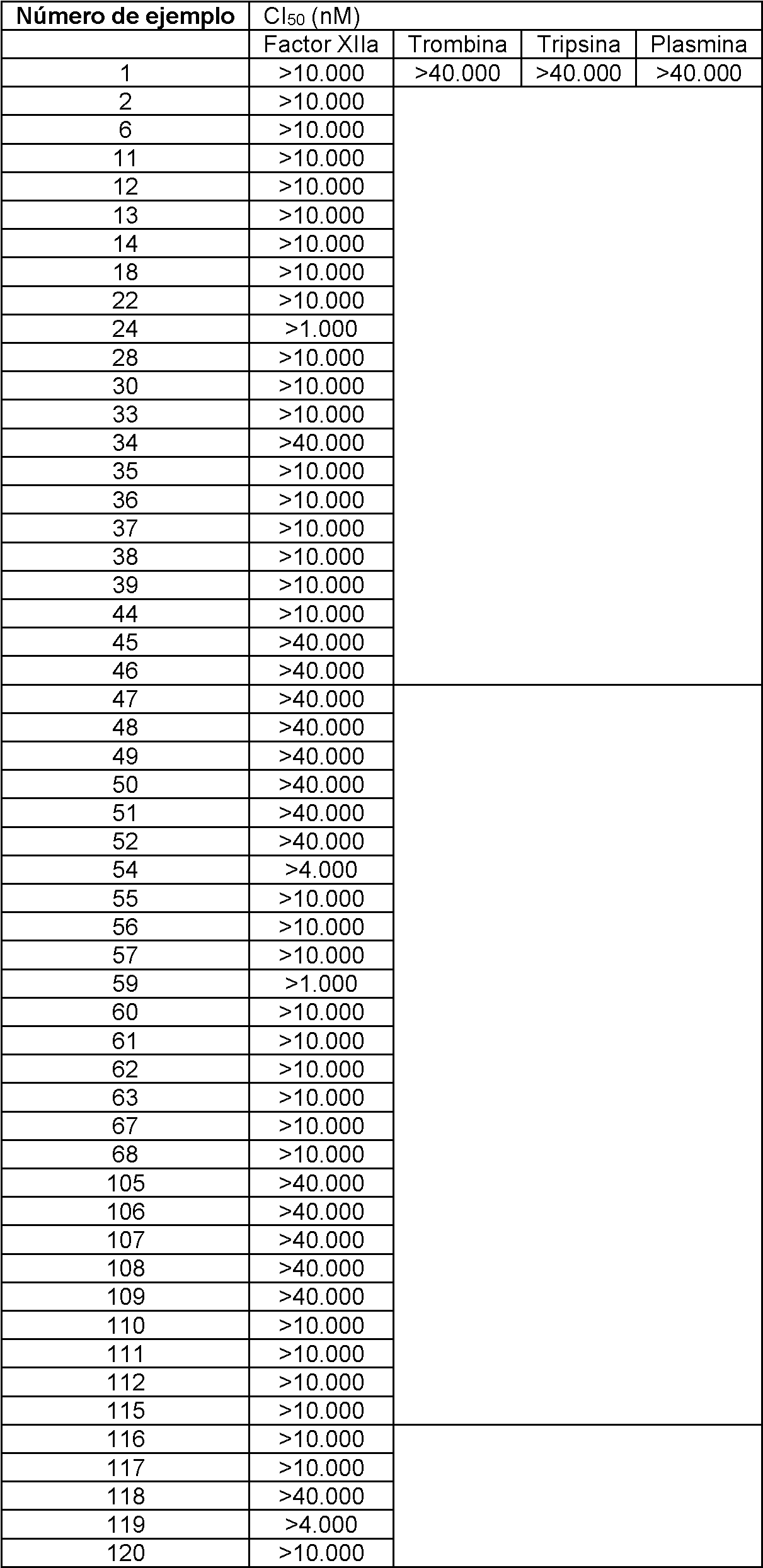
(continúa)(keep going)

FarmacocinéticaPharmacokinetics
Se realizaron los estudios farmacocinéticos de los compuestos de la Tabla 16 para evaluar la farmacocinética después de una sola dosis oral en ratas Sprague-Dawley macho. Se dio a dos ratas una sola dosis p.o. de 5 ml/kg de una composición nominal de 2 mg/ml (10 mg/kg) del compuesto de ensayo en Cremophor al 5%:etanol al 5%:solución salina tamponada con fosfato al 90%. Después de la dosificación, se recogieron muestras de sangre durante un período de 24 horas. Los tiempos de muestreo fueron 5, 15 y 30 minutos y, a continuación, 1, 2, 4, 6, 8, 12 y 24 horas. Después de la recogida, las muestras de sangre se centrifugaron y se analizó la fracción plasmática para determinar la concentración del compuesto de ensayo mediante LCMS. A continuación, se muestran los datos de exposición oral obtenidos a partir de estos estudios:Pharmacokinetic studies of the compounds in Table 16 were performed to evaluate pharmacokinetics after a single oral dose in male Sprague-Dawley rats. Two rats were given a single dose p.o. of 5 ml/kg of a nominal composition of 2 mg/ml (10 mg/kg) of the test compound in 5% Cremophor:5% ethanol:90% phosphate buffered saline. After dosing, blood samples were collected over a 24 hour period. Sampling times were 5, 15, and 30 minutes, followed by 1, 2, 4, 6, 8, 12, and 24 hours. After collection, the blood samples were centrifuged and the plasma fraction was analyzed for the concentration of the test compound by LCMS. Oral exposure data obtained from these studies are shown below:
Tabla 16 (Datos de exposición oral)Table 16 (Oral Exposure Data)

Claims (10)


Applications Claiming Priority (2)
| Application Number | Priority Date | Filing Date | Title |
|---|---|---|---|
| US201361826596P | 2013-05-23 | 2013-05-23 | |
| US201361865756P | 2013-08-14 | 2013-08-14 |
Publications (1)
| Publication Number | Publication Date |
|---|---|
| ES2909885T3 true ES2909885T3 (en) | 2022-05-10 |
Family
ID=50841878
Family Applications (2)
| Application Number | Title | Priority Date | Filing Date |
|---|---|---|---|
| ES17166782T Active ES2909885T3 (en) | 2013-05-23 | 2014-05-23 | Plasma kallikrein inhibitors |
| ES14727034.2T Active ES2626968T3 (en) | 2013-05-23 | 2014-05-23 | Heterocyclic derivatives |
Family Applications After (1)
| Application Number | Title | Priority Date | Filing Date |
|---|---|---|---|
| ES14727034.2T Active ES2626968T3 (en) | 2013-05-23 | 2014-05-23 | Heterocyclic derivatives |
Country Status (21)
| Country | Link |
|---|---|
| US (1) | US9533987B2 (en) |
| EP (2) | EP2999697B1 (en) |
| JP (1) | JP6538028B2 (en) |
| KR (1) | KR102276700B1 (en) |
| CN (1) | CN105452240B (en) |
| AU (1) | AU2014270152B9 (en) |
| BR (1) | BR112015028879B1 (en) |
| CA (1) | CA2912285C (en) |
| CL (1) | CL2015003442A1 (en) |
| ES (2) | ES2909885T3 (en) |
| HU (2) | HUE057851T2 (en) |
| IL (1) | IL242513A0 (en) |
| MX (1) | MX363689B (en) |
| MY (1) | MY174018A (en) |
| PH (1) | PH12015502549B1 (en) |
| PL (2) | PL2999697T3 (en) |
| PT (1) | PT3305778T (en) |
| RU (1) | RU2712621C2 (en) |
| SG (1) | SG11201509303WA (en) |
| SI (1) | SI3305778T1 (en) |
| WO (1) | WO2014188211A1 (en) |
Families Citing this family (42)
| Publication number | Priority date | Publication date | Assignee | Title |
|---|---|---|---|---|
| TWI636047B (en) | 2013-08-14 | 2018-09-21 | 英商卡爾維斯塔製藥有限公司 | Heterocyclic derivatives |
| CA2920815C (en) * | 2013-08-14 | 2021-09-21 | Kalvista Pharmaceuticals Limited | Inhibitors of plasma kallikrein |
| CN106061480B (en) | 2013-12-30 | 2020-02-28 | 莱福斯希医药公司 | Therapeutic inhibitory compounds |
| US9611252B2 (en) | 2013-12-30 | 2017-04-04 | Lifesci Pharmaceuticals, Inc. | Therapeutic inhibitory compounds |
| GB201421083D0 (en) * | 2014-11-27 | 2015-01-14 | Kalvista Pharmaceuticals Ltd | Enzyme inhibitors |
| GB201421085D0 (en) | 2014-11-27 | 2015-01-14 | Kalvista Pharmaceuticals Ltd | New enzyme inhibitors |
| GB201421088D0 (en) * | 2014-11-27 | 2015-01-14 | Kalvista Pharmaceuticals Ltd | New enzyme inhibitors |
| CN104530013B (en) * | 2014-12-04 | 2016-06-29 | 中国农业大学 | Pyrazol acid amide compounds based on indole ring as disinfectant use in agriculture purposes |
| CN104761491B (en) * | 2015-03-31 | 2018-08-21 | 山东友帮生化科技有限公司 | The synthetic method of the iodo- 5- bromopyridines of 2- amino -3- |
| KR20180030545A (en) * | 2015-06-22 | 2018-03-23 | 다이닛본 스미토모 세이야꾸 가부시끼가이샤 | Bicyclic heterocyclic amide derivatives |
| WO2017072020A1 (en) | 2015-10-27 | 2017-05-04 | Boehringer Ingelheim International Gmbh | Heteroarylcarboxamide derivatives as plasma kallikrein inhibitors |
| WO2017072021A1 (en) * | 2015-10-27 | 2017-05-04 | Boehringer Ingelheim International Gmbh | Heteroarylcarboxamide derivatives as plasma kallikrein inhibitors |
| GB201609519D0 (en) * | 2016-05-31 | 2016-07-13 | Kalvista Pharmaceuticals Ltd | Polymorphs of n-[(2,6-difluoro-3-methoxyphenyl)methyl]-3-(methoxymethyl)-1-({4-[(2-oxopyr idin-1-yl)methyl]phenyl}methyl)pyrazole-4-carboxamide |
| WO2017207983A1 (en) | 2016-05-31 | 2017-12-07 | Kalvista Pharmaceuticals Limited | Pyrazole derivatives as plasma kallikrein inhibitors |
| GB201609607D0 (en) * | 2016-06-01 | 2016-07-13 | Kalvista Pharmaceuticals Ltd | Polymorphs of N-(3-Fluoro-4-methoxypyridin-2-yl)methyl)-3-(methoxymethyl)-1-({4-((2-oxopy ridin-1-yl)methyl)phenyl}methyl)pyrazole-4-carboxamide and salts |
| GB201609603D0 (en) * | 2016-06-01 | 2016-07-13 | Kalvista Pharmaceuticals Ltd | Polymorphs of N-[(6-cyano-2-fluoro-3-methoxyphenyl)Methyl]-3-(methoxymethyl)-1-({4-[(2-ox opyridin-1-YL)Methyl]phenyl}methyl)pyrazole-4-carboxamide |
| EP3481391A4 (en) | 2016-07-11 | 2020-03-11 | Lifesci Pharmaceuticals, Inc. | Therapeutic inhibitory compounds |
| EP3612523B1 (en) | 2017-04-21 | 2021-06-09 | Boehringer Ingelheim International GmbH | Heteroarylcarboxamide derivatives as plasma kallikrein inhibitors |
| GB201719881D0 (en) | 2017-11-29 | 2018-01-10 | Kalvista Pharmaceuticals Ltd | Solid forms of plasma kallikrein inhibitor and salts thereof |
| JP7078722B2 (en) | 2017-11-29 | 2022-05-31 | カルビスタ・ファーマシューティカルズ・リミテッド | Dosage form containing plasma kallikrein inhibitor |
| EP3837252B1 (en) | 2018-08-16 | 2025-12-10 | Boehringer Ingelheim International GmbH | Heteroaromatic carboxamide derivatives as plasma kallikrein inhibitors |
| US12091399B2 (en) | 2018-10-10 | 2024-09-17 | Boehringer Ingelheim International Gmbh | Phenyltetrazole derivatives as plasma kallikrein inhibitors |
| EP3886854A4 (en) | 2018-11-30 | 2022-07-06 | Nuvation Bio Inc. | PYRROLE AND PYRAZOLE COMPOUNDS AND METHODS OF USE THEREOF |
| GB201910116D0 (en) | 2019-07-15 | 2019-08-28 | Kalvista Pharmaceuticals Ltd | Treatments of hereditary angioedema |
| GB201910125D0 (en) | 2019-07-15 | 2019-08-28 | Kalvista Pharmaceuticals Ltd | Treatments of angioedema |
| WO2021028645A1 (en) | 2019-08-09 | 2021-02-18 | Kalvista Pharmaceuticals Limited | Plasma kallikrein inhibitors |
| WO2021032935A1 (en) | 2019-08-21 | 2021-02-25 | Kalvista Pharmaceuticals Limited | Enzyme inhibitors |
| GB201918994D0 (en) | 2019-12-20 | 2020-02-05 | Kalvista Pharmaceuticals Ltd | Treatments of diabetic macular edema and impaired visual acuity |
| TWI873290B (en) | 2020-02-13 | 2025-02-21 | 德商百靈佳殷格翰國際股份有限公司 | Heteroaromatic carboxamide derivatives as plasma kallikrein inhibitors |
| TW202144331A (en) | 2020-02-13 | 2021-12-01 | 德商百靈佳殷格翰國際股份有限公司 | Heteroaromatic carboxamide derivatives as plasma kallikrein inhibitors |
| EP4116299A4 (en) * | 2020-03-04 | 2024-03-27 | Medshine Discovery Inc. | HETEROCYCLIC COMPOUND |
| US12528786B2 (en) | 2020-07-10 | 2026-01-20 | Merck Sharp & Dohme Llc | Plasma kallikrein inhibitors |
| WO2022079446A1 (en) | 2020-10-15 | 2022-04-21 | Kalvista Pharmaceuticals Limited | Treatments of angioedema |
| EP4232031A1 (en) | 2020-10-23 | 2023-08-30 | Kalvista Pharmaceuticals Limited | Treatments of angioedema |
| US20240122909A1 (en) | 2021-02-09 | 2024-04-18 | Kalvista Pharmaceuticals Limited | Treatments of hereditary angioedema |
| WO2023002219A1 (en) | 2021-07-23 | 2023-01-26 | Kalvista Pharmaceuticals Limited | Treatments of hereditary angioedema |
| WO2023185634A1 (en) * | 2022-03-30 | 2023-10-05 | 南京明德新药研发有限公司 | Heterocyclic compound as plasma kallikrein inhibitor |
| CA3255900A1 (en) | 2022-04-27 | 2023-11-02 | Kalvista Pharmaceuticals Limited | Formulations of a plasma kallikrein inhibitor |
| EP4673437A1 (en) | 2023-02-27 | 2026-01-07 | Kalvista Pharmaceuticals Limited | New solid form of a plasma kallikrein inhibitor |
| WO2025153806A1 (en) | 2024-01-15 | 2025-07-24 | Kalvista Pharmaceuticals Limited | Methods for determining amidolytic activity |
| WO2025172692A1 (en) | 2024-02-13 | 2025-08-21 | Kalvista Pharmaceuticals Limited | Oral sebetralstat for the treatment of an attack of hereditary angioedema |
| WO2025172693A1 (en) | 2024-02-13 | 2025-08-21 | Kalvista Pharmaceuticals Limited | Oral sebetralstat for the treatment of an attack of hereditary angioedema |
Family Cites Families (21)
| Publication number | Priority date | Publication date | Assignee | Title |
|---|---|---|---|---|
| US5187157A (en) | 1987-06-05 | 1993-02-16 | Du Pont Merck Pharmaceutical Company | Peptide boronic acid inhibitors of trypsin-like proteases |
| GB9019558D0 (en) | 1990-09-07 | 1990-10-24 | Szelke Michael | Enzyme inhibitors |
| SE9301911D0 (en) | 1993-06-03 | 1993-06-03 | Ab Astra | NEW PEPTIDE DERIVATIVES |
| US5589467A (en) | 1993-09-17 | 1996-12-31 | Novo Nordisk A/S | 2,5',N6-trisubstituted adenosine derivatives |
| IL123986A (en) | 1997-04-24 | 2011-10-31 | Organon Nv | Serine protease inhibiting antithrombotic agents and pharmaceutical compositions comprising them |
| NZ513639A (en) * | 1999-04-15 | 2004-02-27 | Bristol Myers Squibb Co | Cyclic protein tyrosine kinase inhibitors |
| GB0205527D0 (en) | 2002-03-08 | 2002-04-24 | Ferring Bv | Inhibitors |
| NZ592039A (en) | 2003-08-27 | 2013-03-28 | Ophthotech Corp | Combination therapy for the treatment of ocular neovascular disorders |
| US7429604B2 (en) * | 2004-06-15 | 2008-09-30 | Bristol Myers Squibb Company | Six-membered heterocycles useful as serine protease inhibitors |
| JP5322935B2 (en) * | 2006-07-31 | 2013-10-23 | アクティベサイト ファーマシューティカルズ インコーポレイティッド | Inhibitors of plasma kallikrein |
| CN101495468A (en) * | 2006-07-31 | 2009-07-29 | 艾克提弗赛特制药股份有限公司 | Inhibitors of plasma kallikrein |
| DE102006050672A1 (en) | 2006-10-24 | 2008-04-30 | Curacyte Discovery Gmbh | New glycylglycine derivatives with a benzylsulfonylamido group and an amidino-organylamido group at the opposite chain ends, used in drugs for reducing loss of blood, e.g. in operations |
| GB0910003D0 (en) | 2009-06-11 | 2009-07-22 | Univ Leuven Kath | Novel compounds for the treatment of neurodegenerative diseases |
| CA2783801A1 (en) * | 2009-12-18 | 2011-06-23 | Activesite Pharmaceuticals, Inc. | Prodrugs of inhibitors of plasma kallikrein |
| JP2013121919A (en) | 2010-03-25 | 2013-06-20 | Astellas Pharma Inc | Plasma kallikrein inhibitor |
| WO2012004678A2 (en) | 2010-07-07 | 2012-01-12 | The Medicines Company (Leipzig) Gmbh | Serine protease inhibitors |
| US9290485B2 (en) | 2010-08-04 | 2016-03-22 | Novartis Ag | N-((6-amino-pyridin-3-yl)methyl)-heteroaryl-carboxamides |
| WO2012142308A1 (en) * | 2011-04-13 | 2012-10-18 | Activesite Pharmaceuticals, Inc. | Prodrugs of inhibitors of plasma kallikrein |
| WO2013111108A1 (en) | 2012-01-27 | 2013-08-01 | Novartis Ag | 5-membered heteroarylcarboxamide derivatives as plasma kallikrein inhibitors |
| WO2013111107A1 (en) | 2012-01-27 | 2013-08-01 | Novartis Ag | Aminopyridine derivatives as plasma kallikrein inhibitors |
| US9846160B2 (en) | 2012-02-27 | 2017-12-19 | Board Of Regents, The University Of Texas Systems | Ganglioside GD2 as a marker and target on cancer stem cells |
-
2014
- 2014-05-23 BR BR112015028879-0A patent/BR112015028879B1/en not_active IP Right Cessation
- 2014-05-23 PT PT171667827T patent/PT3305778T/en unknown
- 2014-05-23 AU AU2014270152A patent/AU2014270152B9/en not_active Ceased
- 2014-05-23 CN CN201480037390.8A patent/CN105452240B/en not_active Expired - Fee Related
- 2014-05-23 EP EP14727034.2A patent/EP2999697B1/en active Active
- 2014-05-23 US US14/892,055 patent/US9533987B2/en not_active Expired - Fee Related
- 2014-05-23 ES ES17166782T patent/ES2909885T3/en active Active
- 2014-05-23 RU RU2015154987A patent/RU2712621C2/en active
- 2014-05-23 KR KR1020157036257A patent/KR102276700B1/en not_active Expired - Fee Related
- 2014-05-23 MX MX2015016085A patent/MX363689B/en unknown
- 2014-05-23 HU HUE17166782A patent/HUE057851T2/en unknown
- 2014-05-23 MY MYPI2015704237A patent/MY174018A/en unknown
- 2014-05-23 PL PL14727034T patent/PL2999697T3/en unknown
- 2014-05-23 HU HUE14727034A patent/HUE034829T2/en unknown
- 2014-05-23 SI SI201431947T patent/SI3305778T1/en unknown
- 2014-05-23 CA CA2912285A patent/CA2912285C/en active Active
- 2014-05-23 WO PCT/GB2014/051592 patent/WO2014188211A1/en not_active Ceased
- 2014-05-23 ES ES14727034.2T patent/ES2626968T3/en active Active
- 2014-05-23 PL PL17166782T patent/PL3305778T3/en unknown
- 2014-05-23 SG SG11201509303WA patent/SG11201509303WA/en unknown
- 2014-05-23 JP JP2016514486A patent/JP6538028B2/en not_active Expired - Fee Related
- 2014-05-23 EP EP17166782.7A patent/EP3305778B1/en active Active
-
2015
- 2015-11-06 PH PH12015502549A patent/PH12015502549B1/en unknown
- 2015-11-09 IL IL242513A patent/IL242513A0/en active IP Right Grant
- 2015-11-23 CL CL2015003442A patent/CL2015003442A1/en unknown
Also Published As
Similar Documents
| Publication | Publication Date | Title |
|---|---|---|
| EP3305778B1 (en) | Inhibitors of plasma kallikrein | |
| US11001578B2 (en) | N-((HET)arylmethyl)-heteroaryl-carboxamides compounds as plasma kallikrein inhibitors | |
| ES2908585T3 (en) | N-((het)arylmethyl)-heteroaryl-carboxamide compounds as inhibitors of plasma kallikrein | |
| ES2691084T3 (en) | Bicyclic Calicrein Plasma Inhibitors | |
| BR112015016293B1 (en) | BENZYLAMINE DERIVATIVES, THEIR USES, AND PHARMACEUTICAL COMPOSITION | |
| TWI636047B (en) | Heterocyclic derivatives | |
| HK1253870B (en) | Inhibitors of plasma kallikrein | |
| HK1253870A1 (en) | Inhibitors of plasma kallikrein | |
| HK1221218B (en) | Heterocyclic derivates | |
| HK40016863B (en) | N-((het)arylmethyl)-heteroaryl-carboxamides compounds as plasma kallikrein inhibitors | |
| HK40016863A (en) | N-((het)arylmethyl)-heteroaryl-carboxamides compounds as plasma kallikrein inhibitors | |
| BR122020026459B1 (en) | N-((HET)-ARYLMETYL)-HETEROARYL-CARBOXAMIDE COMPOUNDS AS PLASMA KALIKREIN INHIBITORS, THEIR USES, AND PHARMACEUTICAL COMPOSITION | |
| NZ714027B2 (en) | Heterocyclic derivates |