ES2920132T3 - 4-oxo-alkylated tetramic acid compound and preparation method thereof - Google Patents
4-oxo-alkylated tetramic acid compound and preparation method thereof Download PDFInfo
- Publication number
- ES2920132T3 ES2920132T3 ES18843726T ES18843726T ES2920132T3 ES 2920132 T3 ES2920132 T3 ES 2920132T3 ES 18843726 T ES18843726 T ES 18843726T ES 18843726 T ES18843726 T ES 18843726T ES 2920132 T3 ES2920132 T3 ES 2920132T3
- Authority
- ES
- Spain
- Prior art keywords
- nmr
- mhz
- compound
- preparation
- formula
- Prior art date
- Legal status (The legal status is an assumption and is not a legal conclusion. Google has not performed a legal analysis and makes no representation as to the accuracy of the status listed.)
- Active
Links
- 238000002360 preparation method Methods 0.000 title description 119
- -1 4-oxo-alkylated tetramic acid compound Chemical class 0.000 title description 13
- 150000001875 compounds Chemical class 0.000 claims abstract description 151
- 238000000034 method Methods 0.000 claims abstract description 18
- YMWUJEATGCHHMB-UHFFFAOYSA-N Dichloromethane Chemical compound ClCCl YMWUJEATGCHHMB-UHFFFAOYSA-N 0.000 claims description 51
- 238000006243 chemical reaction Methods 0.000 claims description 48
- WEVYAHXRMPXWCK-UHFFFAOYSA-N Acetonitrile Chemical compound CC#N WEVYAHXRMPXWCK-UHFFFAOYSA-N 0.000 claims description 36
- DTQVDTLACAAQTR-UHFFFAOYSA-N Trifluoroacetic acid Chemical compound OC(=O)C(F)(F)F DTQVDTLACAAQTR-UHFFFAOYSA-N 0.000 claims description 10
- 239000003960 organic solvent Substances 0.000 claims description 5
- 125000003545 alkoxy group Chemical group 0.000 claims description 4
- 230000035484 reaction time Effects 0.000 claims description 4
- 150000003839 salts Chemical class 0.000 claims description 4
- 125000004191 (C1-C6) alkoxy group Chemical group 0.000 claims description 2
- 125000004169 (C1-C6) alkyl group Chemical group 0.000 claims description 2
- 230000009471 action Effects 0.000 claims description 2
- 125000004185 ester group Chemical group 0.000 claims description 2
- 229910052736 halogen Inorganic materials 0.000 claims description 2
- 150000002367 halogens Chemical class 0.000 claims description 2
- 125000005931 tert-butyloxycarbonyl group Chemical group [H]C([H])([H])C(OC(*)=O)(C([H])([H])[H])C([H])([H])[H] 0.000 claims description 2
- 238000002474 experimental method Methods 0.000 abstract description 18
- 239000003814 drug Substances 0.000 abstract description 16
- 241001465754 Metazoa Species 0.000 abstract description 15
- 230000000694 effects Effects 0.000 abstract description 15
- 210000004369 blood Anatomy 0.000 abstract description 13
- 239000008280 blood Substances 0.000 abstract description 13
- 208000024827 Alzheimer disease Diseases 0.000 abstract description 12
- 210000004556 brain Anatomy 0.000 abstract description 10
- 238000010253 intravenous injection Methods 0.000 abstract description 6
- 238000010171 animal model Methods 0.000 abstract description 5
- 230000007886 mutagenicity Effects 0.000 abstract 1
- 231100000299 mutagenicity Toxicity 0.000 abstract 1
- 238000001644 13C nuclear magnetic resonance spectroscopy Methods 0.000 description 67
- 238000005160 1H NMR spectroscopy Methods 0.000 description 67
- 238000001308 synthesis method Methods 0.000 description 59
- 239000007787 solid Substances 0.000 description 44
- 241000699670 Mus sp. Species 0.000 description 38
- 239000000126 substance Substances 0.000 description 34
- 238000000746 purification Methods 0.000 description 27
- NVNPLEPBDPJYRZ-UHFFFAOYSA-N 1-(bromomethyl)-4-fluorobenzene Chemical compound FC1=CC=C(CBr)C=C1 NVNPLEPBDPJYRZ-UHFFFAOYSA-N 0.000 description 25
- BWHMMNNQKKPAPP-UHFFFAOYSA-L potassium carbonate Chemical compound [K+].[K+].[O-]C([O-])=O BWHMMNNQKKPAPP-UHFFFAOYSA-L 0.000 description 24
- 238000001914 filtration Methods 0.000 description 23
- 239000002994 raw material Substances 0.000 description 23
- 238000012360 testing method Methods 0.000 description 23
- IAZDPXIOMUYVGZ-UHFFFAOYSA-N Dimethylsulphoxide Chemical compound CS(C)=O IAZDPXIOMUYVGZ-UHFFFAOYSA-N 0.000 description 22
- 238000003756 stirring Methods 0.000 description 22
- XLYOFNOQVPJJNP-UHFFFAOYSA-N water Substances O XLYOFNOQVPJJNP-UHFFFAOYSA-N 0.000 description 22
- XEKOWRVHYACXOJ-UHFFFAOYSA-N Ethyl acetate Chemical compound CCOC(C)=O XEKOWRVHYACXOJ-UHFFFAOYSA-N 0.000 description 18
- 238000004440 column chromatography Methods 0.000 description 18
- 241000255581 Drosophila <fruit fly, genus> Species 0.000 description 17
- 238000001704 evaporation Methods 0.000 description 17
- 230000008020 evaporation Effects 0.000 description 17
- 239000000047 product Substances 0.000 description 16
- 239000002904 solvent Substances 0.000 description 16
- 239000000243 solution Substances 0.000 description 14
- 238000004293 19F NMR spectroscopy Methods 0.000 description 12
- 208000037265 diseases, disorders, signs and symptoms Diseases 0.000 description 12
- 230000015654 memory Effects 0.000 description 12
- 229910000027 potassium carbonate Inorganic materials 0.000 description 12
- PMZURENOXWZQFD-UHFFFAOYSA-L Sodium Sulfate Chemical compound [Na+].[Na+].[O-]S([O-])(=O)=O PMZURENOXWZQFD-UHFFFAOYSA-L 0.000 description 11
- 238000001816 cooling Methods 0.000 description 11
- 229940079593 drug Drugs 0.000 description 11
- 239000000706 filtrate Substances 0.000 description 11
- 238000010992 reflux Methods 0.000 description 11
- WYURNTSHIVDZCO-UHFFFAOYSA-N Tetrahydrofuran Chemical compound C1CCOC1 WYURNTSHIVDZCO-UHFFFAOYSA-N 0.000 description 10
- 201000010099 disease Diseases 0.000 description 10
- 235000015320 potassium carbonate Nutrition 0.000 description 10
- HPALAKNZSZLMCH-UHFFFAOYSA-M sodium;chloride;hydrate Chemical class O.[Na+].[Cl-] HPALAKNZSZLMCH-UHFFFAOYSA-M 0.000 description 10
- 238000012549 training Methods 0.000 description 10
- 210000004027 cell Anatomy 0.000 description 9
- 239000012043 crude product Substances 0.000 description 9
- 239000007858 starting material Substances 0.000 description 9
- 238000005406 washing Methods 0.000 description 9
- 230000013016 learning Effects 0.000 description 8
- 108090000623 proteins and genes Proteins 0.000 description 8
- 230000005764 inhibitory process Effects 0.000 description 7
- 238000002703 mutagenesis Methods 0.000 description 7
- 231100000350 mutagenesis Toxicity 0.000 description 7
- 230000006886 spatial memory Effects 0.000 description 7
- VEXZGXHMUGYJMC-UHFFFAOYSA-N Hydrochloric acid Chemical compound Cl VEXZGXHMUGYJMC-UHFFFAOYSA-N 0.000 description 6
- HEMHJVSKTPXQMS-UHFFFAOYSA-M Sodium hydroxide Chemical compound [OH-].[Na+] HEMHJVSKTPXQMS-UHFFFAOYSA-M 0.000 description 6
- 210000005013 brain tissue Anatomy 0.000 description 6
- 238000001035 drying Methods 0.000 description 6
- 239000012044 organic layer Substances 0.000 description 6
- 238000009826 distribution Methods 0.000 description 5
- 238000011156 evaluation Methods 0.000 description 5
- 230000002503 metabolic effect Effects 0.000 description 5
- 125000000956 methoxy group Chemical group [H]C([H])([H])O* 0.000 description 5
- 235000019645 odor Nutrition 0.000 description 5
- 239000000523 sample Substances 0.000 description 5
- YLQBMQCUIZJEEH-UHFFFAOYSA-N tetrahydrofuran Natural products C=1C=COC=1 YLQBMQCUIZJEEH-UHFFFAOYSA-N 0.000 description 5
- RZJGKPNCYQZFGR-UHFFFAOYSA-N 1-(bromomethyl)naphthalene Chemical compound C1=CC=C2C(CBr)=CC=CC2=C1 RZJGKPNCYQZFGR-UHFFFAOYSA-N 0.000 description 4
- SEVSMVUOKAMPDO-UHFFFAOYSA-N 4-acetoxy benzaldehyde Chemical compound CC(=O)OC1=CC=C(C=O)C=C1 SEVSMVUOKAMPDO-UHFFFAOYSA-N 0.000 description 4
- NLXLAEXVIDQMFP-UHFFFAOYSA-N Ammonia chloride Chemical compound [NH4+].[Cl-] NLXLAEXVIDQMFP-UHFFFAOYSA-N 0.000 description 4
- PHSPJQZRQAJPPF-UHFFFAOYSA-N N-alpha-Methylhistamine Chemical compound CNCCC1=CN=CN1 PHSPJQZRQAJPPF-UHFFFAOYSA-N 0.000 description 4
- HEDRZPFGACZZDS-MICDWDOJSA-N Trichloro(2H)methane Chemical compound [2H]C(Cl)(Cl)Cl HEDRZPFGACZZDS-MICDWDOJSA-N 0.000 description 4
- 201000004810 Vascular dementia Diseases 0.000 description 4
- MEUWUBXEOFFOOX-UHFFFAOYSA-N [4-(bromomethyl)phenyl] acetate Chemical compound CC(=O)OC1=CC=C(CBr)C=C1 MEUWUBXEOFFOOX-UHFFFAOYSA-N 0.000 description 4
- 238000004458 analytical method Methods 0.000 description 4
- 210000003722 extracellular fluid Anatomy 0.000 description 4
- 238000000605 extraction Methods 0.000 description 4
- 230000006993 memory improvement Effects 0.000 description 4
- 102000004169 proteins and genes Human genes 0.000 description 4
- 238000000926 separation method Methods 0.000 description 4
- 208000024891 symptom Diseases 0.000 description 4
- DYHSDKLCOJIUFX-UHFFFAOYSA-N tert-butoxycarbonyl anhydride Chemical compound CC(C)(C)OC(=O)OC(=O)OC(C)(C)C DYHSDKLCOJIUFX-UHFFFAOYSA-N 0.000 description 4
- 231100000419 toxicity Toxicity 0.000 description 4
- 230000001988 toxicity Effects 0.000 description 4
- 230000031836 visual learning Effects 0.000 description 4
- 206010003805 Autism Diseases 0.000 description 3
- 208000020706 Autistic disease Diseases 0.000 description 3
- LKOHWSSIXHXBHN-UHFFFAOYSA-N C(C)(=O)OC=1C=C(CBr)C=CC=1OC Chemical compound C(C)(=O)OC=1C=C(CBr)C=CC=1OC LKOHWSSIXHXBHN-UHFFFAOYSA-N 0.000 description 3
- 206010012289 Dementia Diseases 0.000 description 3
- 208000023105 Huntington disease Diseases 0.000 description 3
- OKKJLVBELUTLKV-UHFFFAOYSA-N Methanol Chemical compound OC OKKJLVBELUTLKV-UHFFFAOYSA-N 0.000 description 3
- 241000699666 Mus <mouse, genus> Species 0.000 description 3
- 208000018737 Parkinson disease Diseases 0.000 description 3
- 102000004257 Potassium Channel Human genes 0.000 description 3
- ZMANZCXQSJIPKH-UHFFFAOYSA-N Triethylamine Chemical compound CCN(CC)CC ZMANZCXQSJIPKH-UHFFFAOYSA-N 0.000 description 3
- 230000005856 abnormality Effects 0.000 description 3
- 230000004913 activation Effects 0.000 description 3
- 230000001580 bacterial effect Effects 0.000 description 3
- 230000000903 blocking effect Effects 0.000 description 3
- 239000012295 chemical reaction liquid Substances 0.000 description 3
- 238000011161 development Methods 0.000 description 3
- HNDVDQJCIGZPNO-UHFFFAOYSA-N histidine Natural products OC(=O)C(N)CC1=CN=CN1 HNDVDQJCIGZPNO-UHFFFAOYSA-N 0.000 description 3
- UEXQBEVWFZKHNB-UHFFFAOYSA-N intermediate 29 Natural products C1=CC(N)=CC=C1NC1=NC=CC=N1 UEXQBEVWFZKHNB-UHFFFAOYSA-N 0.000 description 3
- 238000001990 intravenous administration Methods 0.000 description 3
- 230000035772 mutation Effects 0.000 description 3
- 230000010412 perfusion Effects 0.000 description 3
- 239000013641 positive control Substances 0.000 description 3
- 108020001213 potassium channel Proteins 0.000 description 3
- 238000010791 quenching Methods 0.000 description 3
- 229920006395 saturated elastomer Polymers 0.000 description 3
- 201000000980 schizophrenia Diseases 0.000 description 3
- 239000011550 stock solution Substances 0.000 description 3
- 230000009182 swimming Effects 0.000 description 3
- 230000001225 therapeutic effect Effects 0.000 description 3
- 210000001519 tissue Anatomy 0.000 description 3
- RYHBNJHYFVUHQT-UHFFFAOYSA-N 1,4-Dioxane Chemical compound C1COCCO1 RYHBNJHYFVUHQT-UHFFFAOYSA-N 0.000 description 2
- MKQQWYFVXVSJTH-UHFFFAOYSA-N 1-(bromomethyl)-2,3-dimethoxybenzene Chemical compound COC1=CC=CC(CBr)=C1OC MKQQWYFVXVSJTH-UHFFFAOYSA-N 0.000 description 2
- JIVGSHFYXPRRSZ-UHFFFAOYSA-N 2,3-dimethoxybenzaldehyde Chemical compound COC1=CC=CC(C=O)=C1OC JIVGSHFYXPRRSZ-UHFFFAOYSA-N 0.000 description 2
- CZDKYDOSKNCXSM-UHFFFAOYSA-N 2-(bromomethyl)-1,4-dimethoxybenzene Chemical compound COC1=CC=C(OC)C(CBr)=C1 CZDKYDOSKNCXSM-UHFFFAOYSA-N 0.000 description 2
- VHYFNPMBLIVWCW-UHFFFAOYSA-N 4-Dimethylaminopyridine Chemical compound CN(C)C1=CC=NC=C1 VHYFNPMBLIVWCW-UHFFFAOYSA-N 0.000 description 2
- MQWCXKGKQLNYQG-UHFFFAOYSA-N 4-methylcyclohexan-1-ol Chemical compound CC1CCC(O)CC1 MQWCXKGKQLNYQG-UHFFFAOYSA-N 0.000 description 2
- QGZKDVFQNNGYKY-UHFFFAOYSA-N Ammonia Chemical compound N QGZKDVFQNNGYKY-UHFFFAOYSA-N 0.000 description 2
- RTZKZFJDLAIYFH-UHFFFAOYSA-N Diethyl ether Chemical compound CCOCC RTZKZFJDLAIYFH-UHFFFAOYSA-N 0.000 description 2
- 102000004190 Enzymes Human genes 0.000 description 2
- 108090000790 Enzymes Proteins 0.000 description 2
- ROHFNLRQFUQHCH-YFKPBYRVSA-N L-leucine Chemical compound CC(C)C[C@H](N)C(O)=O ROHFNLRQFUQHCH-YFKPBYRVSA-N 0.000 description 2
- COLNVLDHVKWLRT-QMMMGPOBSA-N L-phenylalanine Chemical compound OC(=O)[C@@H](N)CC1=CC=CC=C1 COLNVLDHVKWLRT-QMMMGPOBSA-N 0.000 description 2
- OUYCCCASQSFEME-QMMMGPOBSA-N L-tyrosine Chemical compound OC(=O)[C@@H](N)CC1=CC=C(O)C=C1 OUYCCCASQSFEME-QMMMGPOBSA-N 0.000 description 2
- 241000699660 Mus musculus Species 0.000 description 2
- UIIMBOGNXHQVGW-UHFFFAOYSA-M Sodium bicarbonate Chemical compound [Na+].OC([O-])=O UIIMBOGNXHQVGW-UHFFFAOYSA-M 0.000 description 2
- 210000001015 abdomen Anatomy 0.000 description 2
- 235000019270 ammonium chloride Nutrition 0.000 description 2
- 239000007864 aqueous solution Substances 0.000 description 2
- 238000005119 centrifugation Methods 0.000 description 2
- 230000002354 daily effect Effects 0.000 description 2
- 229940088598 enzyme Drugs 0.000 description 2
- 230000003203 everyday effect Effects 0.000 description 2
- 230000002496 gastric effect Effects 0.000 description 2
- 239000011521 glass Substances 0.000 description 2
- 238000001802 infusion Methods 0.000 description 2
- 239000010410 layer Substances 0.000 description 2
- 239000007788 liquid Substances 0.000 description 2
- 229960000967 memantine hydrochloride Drugs 0.000 description 2
- 206010027175 memory impairment Diseases 0.000 description 2
- 239000011259 mixed solution Substances 0.000 description 2
- NMRPBPVERJPACX-UHFFFAOYSA-N octan-3-ol Chemical compound CCCCCC(O)CC NMRPBPVERJPACX-UHFFFAOYSA-N 0.000 description 2
- 238000012402 patch clamp technique Methods 0.000 description 2
- 235000011181 potassium carbonates Nutrition 0.000 description 2
- 238000001556 precipitation Methods 0.000 description 2
- 230000008569 process Effects 0.000 description 2
- 230000002336 repolarization Effects 0.000 description 2
- 229940126585 therapeutic drug Drugs 0.000 description 2
- 238000011830 transgenic mouse model Methods 0.000 description 2
- CRLBBOBKCLYCJK-UHFFFAOYSA-N (2,3-dimethoxyphenyl)methanol Chemical compound COC1=CC=CC(CO)=C1OC CRLBBOBKCLYCJK-UHFFFAOYSA-N 0.000 description 1
- WGQMUABRZGUAOS-UHFFFAOYSA-N (2,5-dimethoxyphenyl)methanol Chemical compound COC1=CC=C(OC)C(CO)=C1 WGQMUABRZGUAOS-UHFFFAOYSA-N 0.000 description 1
- ZVPGTXJXZIXWGR-UHFFFAOYSA-N (5-formyl-2-methoxyphenyl) acetate Chemical compound COC1=CC=C(C=O)C=C1OC(C)=O ZVPGTXJXZIXWGR-UHFFFAOYSA-N 0.000 description 1
- FFWQLZFIMNTUCZ-UHFFFAOYSA-N 1-(bromomethyl)-2-fluorobenzene Chemical compound FC1=CC=CC=C1CBr FFWQLZFIMNTUCZ-UHFFFAOYSA-N 0.000 description 1
- WGVYCXYGPNNUQA-UHFFFAOYSA-N 1-(bromomethyl)-2-methylbenzene Chemical compound CC1=CC=CC=C1CBr WGVYCXYGPNNUQA-UHFFFAOYSA-N 0.000 description 1
- SCBZBMXPJYMXRC-UHFFFAOYSA-N 1-(bromomethyl)-3-fluorobenzene Chemical compound FC1=CC=CC(CBr)=C1 SCBZBMXPJYMXRC-UHFFFAOYSA-N 0.000 description 1
- GIGRWGTZFONRKA-UHFFFAOYSA-N 1-(bromomethyl)-4-methoxybenzene Chemical compound COC1=CC=C(CBr)C=C1 GIGRWGTZFONRKA-UHFFFAOYSA-N 0.000 description 1
- WZRKSPFYXUXINF-UHFFFAOYSA-N 1-(bromomethyl)-4-methylbenzene Chemical compound CC1=CC=C(CBr)C=C1 WZRKSPFYXUXINF-UHFFFAOYSA-N 0.000 description 1
- URFPRAHGGBYNPW-UHFFFAOYSA-N 1-bromo-4-ethylbenzene Chemical compound CCC1=CC=C(Br)C=C1 URFPRAHGGBYNPW-UHFFFAOYSA-N 0.000 description 1
- YZWKKMVJZFACSU-UHFFFAOYSA-N 1-bromopentane Chemical compound CCCCCBr YZWKKMVJZFACSU-UHFFFAOYSA-N 0.000 description 1
- VZWCPLGFXOCGLM-UHFFFAOYSA-N 2-(2-bromoethyl)pyridine Chemical compound BrCCC1=CC=CC=N1 VZWCPLGFXOCGLM-UHFFFAOYSA-N 0.000 description 1
- RUHJZSZTSCSTCC-UHFFFAOYSA-N 2-(bromomethyl)naphthalene Chemical compound C1=CC=CC2=CC(CBr)=CC=C21 RUHJZSZTSCSTCC-UHFFFAOYSA-N 0.000 description 1
- QZOBOLDDGXPTBP-UHFFFAOYSA-N 2-(bromomethyl)thiophene Chemical compound BrCC1=CC=CS1 QZOBOLDDGXPTBP-UHFFFAOYSA-N 0.000 description 1
- JJFOBACUIRKUPN-UHFFFAOYSA-N 2-bromoethoxybenzene Chemical compound BrCCOC1=CC=CC=C1 JJFOBACUIRKUPN-UHFFFAOYSA-N 0.000 description 1
- JRQAAYVLPPGEHT-UHFFFAOYSA-N 2-bromoethylcyclohexane Chemical compound BrCCC1CCCCC1 JRQAAYVLPPGEHT-UHFFFAOYSA-N 0.000 description 1
- JTNCEQNHURODLX-UHFFFAOYSA-N 2-phenylethanimidamide Chemical compound NC(=N)CC1=CC=CC=C1 JTNCEQNHURODLX-UHFFFAOYSA-N 0.000 description 1
- NMRPBPVERJPACX-QMMMGPOBSA-N 3-Octanol Natural products CCCCC[C@@H](O)CC NMRPBPVERJPACX-QMMMGPOBSA-N 0.000 description 1
- RUROFEVDCUGKHD-UHFFFAOYSA-N 3-bromoprop-1-enylbenzene Chemical compound BrCC=CC1=CC=CC=C1 RUROFEVDCUGKHD-UHFFFAOYSA-N 0.000 description 1
- RUXHWBMJNBBYNL-UHFFFAOYSA-N 3-hydroxy-1,2-dihydropyrrol-5-one Chemical class OC1=CC(=O)NC1 RUXHWBMJNBBYNL-UHFFFAOYSA-N 0.000 description 1
- UMLFTCYAQPPZER-UHFFFAOYSA-N 4-(bromomethyl)benzonitrile Chemical compound BrCC1=CC=C(C#N)C=C1 UMLFTCYAQPPZER-UHFFFAOYSA-N 0.000 description 1
- VOLRSQPSJGXRNJ-UHFFFAOYSA-N 4-nitrobenzyl bromide Chemical compound [O-][N+](=O)C1=CC=C(CBr)C=C1 VOLRSQPSJGXRNJ-UHFFFAOYSA-N 0.000 description 1
- 206010000117 Abnormal behaviour Diseases 0.000 description 1
- 208000000044 Amnesia Diseases 0.000 description 1
- 208000037259 Amyloid Plaque Diseases 0.000 description 1
- 244000025254 Cannabis sativa Species 0.000 description 1
- 208000005623 Carcinogenesis Diseases 0.000 description 1
- VEXZGXHMUGYJMC-UHFFFAOYSA-M Chloride anion Chemical compound [Cl-] VEXZGXHMUGYJMC-UHFFFAOYSA-M 0.000 description 1
- 206010010904 Convulsion Diseases 0.000 description 1
- 206010011906 Death Diseases 0.000 description 1
- QOSSAOTZNIDXMA-UHFFFAOYSA-N Dicylcohexylcarbodiimide Chemical compound C1CCCCC1N=C=NC1CCCCC1 QOSSAOTZNIDXMA-UHFFFAOYSA-N 0.000 description 1
- 241000255925 Diptera Species 0.000 description 1
- 206010014405 Electrocution Diseases 0.000 description 1
- YCKRFDGAMUMZLT-UHFFFAOYSA-N Fluorine atom Chemical compound [F] YCKRFDGAMUMZLT-UHFFFAOYSA-N 0.000 description 1
- 102000004310 Ion Channels Human genes 0.000 description 1
- 108090000862 Ion Channels Proteins 0.000 description 1
- FFEARJCKVFRZRR-UHFFFAOYSA-N L-Methionine Natural products CSCCC(N)C(O)=O FFEARJCKVFRZRR-UHFFFAOYSA-N 0.000 description 1
- 235000019454 L-leucine Nutrition 0.000 description 1
- 239000004395 L-leucine Substances 0.000 description 1
- FFEARJCKVFRZRR-BYPYZUCNSA-N L-methionine Chemical compound CSCC[C@H](N)C(O)=O FFEARJCKVFRZRR-BYPYZUCNSA-N 0.000 description 1
- 229930195722 L-methionine Natural products 0.000 description 1
- FYYHWMGAXLPEAU-UHFFFAOYSA-N Magnesium Chemical compound [Mg] FYYHWMGAXLPEAU-UHFFFAOYSA-N 0.000 description 1
- CSNNHWWHGAXBCP-UHFFFAOYSA-L Magnesium sulfate Chemical compound [Mg+2].[O-][S+2]([O-])([O-])[O-] CSNNHWWHGAXBCP-UHFFFAOYSA-L 0.000 description 1
- 208000026139 Memory disease Diseases 0.000 description 1
- 229940127523 NMDA Receptor Antagonists Drugs 0.000 description 1
- ZLMJMSJWJFRBEC-UHFFFAOYSA-N Potassium Chemical compound [K] ZLMJMSJWJFRBEC-UHFFFAOYSA-N 0.000 description 1
- 241000283984 Rodentia Species 0.000 description 1
- 206010039424 Salivary hypersecretion Diseases 0.000 description 1
- 241000293869 Salmonella enterica subsp. enterica serovar Typhimurium Species 0.000 description 1
- FAPWRFPIFSIZLT-UHFFFAOYSA-M Sodium chloride Chemical compound [Na+].[Cl-] FAPWRFPIFSIZLT-UHFFFAOYSA-M 0.000 description 1
- 206010042434 Sudden death Diseases 0.000 description 1
- QAOWNCQODCNURD-UHFFFAOYSA-L Sulfate Chemical compound [O-]S([O-])(=O)=O QAOWNCQODCNURD-UHFFFAOYSA-L 0.000 description 1
- 206010044565 Tremor Diseases 0.000 description 1
- OKJPEAGHQZHRQV-UHFFFAOYSA-N Triiodomethane Natural products IC(I)I OKJPEAGHQZHRQV-UHFFFAOYSA-N 0.000 description 1
- 210000000683 abdominal cavity Anatomy 0.000 description 1
- 230000001154 acute effect Effects 0.000 description 1
- 239000003513 alkali Substances 0.000 description 1
- 229910021529 ammonia Inorganic materials 0.000 description 1
- 230000010100 anticoagulation Effects 0.000 description 1
- 230000006793 arrhythmia Effects 0.000 description 1
- 206010003119 arrhythmia Diseases 0.000 description 1
- 230000002567 autonomic effect Effects 0.000 description 1
- 238000011888 autopsy Methods 0.000 description 1
- 230000006399 behavior Effects 0.000 description 1
- 239000012472 biological sample Substances 0.000 description 1
- 230000008499 blood brain barrier function Effects 0.000 description 1
- 210000001218 blood-brain barrier Anatomy 0.000 description 1
- 230000037396 body weight Effects 0.000 description 1
- 238000004364 calculation method Methods 0.000 description 1
- 230000036952 cancer formation Effects 0.000 description 1
- 231100000357 carcinogen Toxicity 0.000 description 1
- 231100000504 carcinogenesis Toxicity 0.000 description 1
- 239000003183 carcinogenic agent Substances 0.000 description 1
- 210000004413 cardiac myocyte Anatomy 0.000 description 1
- 239000006285 cell suspension Substances 0.000 description 1
- 208000015114 central nervous system disease Diseases 0.000 description 1
- 230000008859 change Effects 0.000 description 1
- 210000000038 chest Anatomy 0.000 description 1
- 239000000544 cholinesterase inhibitor Substances 0.000 description 1
- 230000003920 cognitive function Effects 0.000 description 1
- 238000007796 conventional method Methods 0.000 description 1
- 230000006378 damage Effects 0.000 description 1
- 238000007405 data analysis Methods 0.000 description 1
- 230000003111 delayed effect Effects 0.000 description 1
- 238000001514 detection method Methods 0.000 description 1
- 230000006866 deterioration Effects 0.000 description 1
- ZMXDDKWLCZADIW-UHFFFAOYSA-N dimethylformamide Substances CN(C)C=O ZMXDDKWLCZADIW-UHFFFAOYSA-N 0.000 description 1
- 210000005069 ears Anatomy 0.000 description 1
- 238000005516 engineering process Methods 0.000 description 1
- 238000011049 filling Methods 0.000 description 1
- 239000000834 fixative Substances 0.000 description 1
- 229910052731 fluorine Inorganic materials 0.000 description 1
- 239000011737 fluorine Substances 0.000 description 1
- 238000003304 gavage Methods 0.000 description 1
- 210000004392 genitalia Anatomy 0.000 description 1
- 229920000669 heparin Polymers 0.000 description 1
- ZFGMDIBRIDKWMY-PASTXAENSA-N heparin Chemical compound CC(O)=N[C@@H]1[C@@H](O)[C@H](O)[C@@H](COS(O)(=O)=O)O[C@@H]1O[C@@H]1[C@@H](C(O)=O)O[C@@H](O[C@H]2[C@@H]([C@@H](OS(O)(=O)=O)[C@@H](O[C@@H]3[C@@H](OC(O)[C@H](OS(O)(=O)=O)[C@H]3O)C(O)=O)O[C@@H]2O)CS(O)(=O)=O)[C@H](O)[C@H]1O ZFGMDIBRIDKWMY-PASTXAENSA-N 0.000 description 1
- 239000003112 inhibitor Substances 0.000 description 1
- 230000002401 inhibitory effect Effects 0.000 description 1
- 239000013067 intermediate product Substances 0.000 description 1
- INQOMBQAUSQDDS-UHFFFAOYSA-N iodomethane Chemical compound IC INQOMBQAUSQDDS-UHFFFAOYSA-N 0.000 description 1
- 229960003136 leucine Drugs 0.000 description 1
- 208000004731 long QT syndrome Diseases 0.000 description 1
- 239000011777 magnesium Substances 0.000 description 1
- 229910052749 magnesium Inorganic materials 0.000 description 1
- 230000007246 mechanism Effects 0.000 description 1
- 230000001404 mediated effect Effects 0.000 description 1
- GXHFUVWIGNLZSC-UHFFFAOYSA-N meldrum's acid Chemical compound CC1(C)OC(=O)CC(=O)O1 GXHFUVWIGNLZSC-UHFFFAOYSA-N 0.000 description 1
- LDDHMLJTFXJGPI-UHFFFAOYSA-N memantine hydrochloride Chemical compound Cl.C1C(C2)CC3(C)CC1(C)CC2(N)C3 LDDHMLJTFXJGPI-UHFFFAOYSA-N 0.000 description 1
- 230000028161 membrane depolarization Effects 0.000 description 1
- 230000006984 memory degeneration Effects 0.000 description 1
- 208000023060 memory loss Diseases 0.000 description 1
- 229960004452 methionine Drugs 0.000 description 1
- NLWBJPPMPLPZIE-UHFFFAOYSA-N methyl 4-(bromomethyl)benzoate Chemical compound COC(=O)C1=CC=C(CBr)C=C1 NLWBJPPMPLPZIE-UHFFFAOYSA-N 0.000 description 1
- 230000003228 microsomal effect Effects 0.000 description 1
- 239000000203 mixture Substances 0.000 description 1
- 238000012544 monitoring process Methods 0.000 description 1
- 210000004126 nerve fiber Anatomy 0.000 description 1
- 210000000653 nervous system Anatomy 0.000 description 1
- 230000004770 neurodegeneration Effects 0.000 description 1
- 208000015122 neurodegenerative disease Diseases 0.000 description 1
- 230000016273 neuron death Effects 0.000 description 1
- 230000007121 neuropathological change Effects 0.000 description 1
- 235000016709 nutrition Nutrition 0.000 description 1
- 230000035764 nutrition Effects 0.000 description 1
- 210000000056 organ Anatomy 0.000 description 1
- 230000001717 pathogenic effect Effects 0.000 description 1
- 230000035699 permeability Effects 0.000 description 1
- 239000003208 petroleum Substances 0.000 description 1
- 230000003285 pharmacodynamic effect Effects 0.000 description 1
- 230000000144 pharmacologic effect Effects 0.000 description 1
- 229960005190 phenylalanine Drugs 0.000 description 1
- 230000026731 phosphorylation Effects 0.000 description 1
- 238000006366 phosphorylation reaction Methods 0.000 description 1
- 239000011591 potassium Substances 0.000 description 1
- 229910052700 potassium Inorganic materials 0.000 description 1
- 229910000343 potassium bisulfate Inorganic materials 0.000 description 1
- 238000012545 processing Methods 0.000 description 1
- 238000003908 quality control method Methods 0.000 description 1
- 230000000171 quenching effect Effects 0.000 description 1
- 230000000241 respiratory effect Effects 0.000 description 1
- 230000003938 response to stress Effects 0.000 description 1
- 230000002441 reversible effect Effects 0.000 description 1
- 208000026451 salivation Diseases 0.000 description 1
- 238000012284 sample analysis method Methods 0.000 description 1
- 230000008786 sensory perception of smell Effects 0.000 description 1
- 235000020183 skimmed milk Nutrition 0.000 description 1
- 235000017557 sodium bicarbonate Nutrition 0.000 description 1
- 229910000030 sodium bicarbonate Inorganic materials 0.000 description 1
- 230000006641 stabilisation Effects 0.000 description 1
- 238000011105 stabilization Methods 0.000 description 1
- 238000003860 storage Methods 0.000 description 1
- 238000007920 subcutaneous administration Methods 0.000 description 1
- 230000002194 synthesizing effect Effects 0.000 description 1
- 230000008685 targeting Effects 0.000 description 1
- 210000000115 thoracic cavity Anatomy 0.000 description 1
- 238000012301 transgenic model Methods 0.000 description 1
- 230000014616 translation Effects 0.000 description 1
- 229960004441 tyrosine Drugs 0.000 description 1
- 229960005486 vaccine Drugs 0.000 description 1
Classifications
-
- C—CHEMISTRY; METALLURGY
- C07—ORGANIC CHEMISTRY
- C07D—HETEROCYCLIC COMPOUNDS
- C07D207/00—Heterocyclic compounds containing five-membered rings not condensed with other rings, with one nitrogen atom as the only ring hetero atom
- C07D207/02—Heterocyclic compounds containing five-membered rings not condensed with other rings, with one nitrogen atom as the only ring hetero atom with only hydrogen or carbon atoms directly attached to the ring nitrogen atom
- C07D207/30—Heterocyclic compounds containing five-membered rings not condensed with other rings, with one nitrogen atom as the only ring hetero atom with only hydrogen or carbon atoms directly attached to the ring nitrogen atom having two double bonds between ring members or between ring members and non-ring members
- C07D207/34—Heterocyclic compounds containing five-membered rings not condensed with other rings, with one nitrogen atom as the only ring hetero atom with only hydrogen or carbon atoms directly attached to the ring nitrogen atom having two double bonds between ring members or between ring members and non-ring members with hetero atoms or with carbon atoms having three bonds to hetero atoms with at the most one bond to halogen, e.g. ester or nitrile radicals, directly attached to ring carbon atoms
- C07D207/36—Oxygen or sulfur atoms
- C07D207/38—2-Pyrrolones
-
- A—HUMAN NECESSITIES
- A61—MEDICAL OR VETERINARY SCIENCE; HYGIENE
- A61P—SPECIFIC THERAPEUTIC ACTIVITY OF CHEMICAL COMPOUNDS OR MEDICINAL PREPARATIONS
- A61P25/00—Drugs for disorders of the nervous system
- A61P25/28—Drugs for disorders of the nervous system for treating neurodegenerative disorders of the central nervous system, e.g. nootropic agents, cognition enhancers, drugs for treating Alzheimer's disease or other forms of dementia
-
- A—HUMAN NECESSITIES
- A61—MEDICAL OR VETERINARY SCIENCE; HYGIENE
- A61P—SPECIFIC THERAPEUTIC ACTIVITY OF CHEMICAL COMPOUNDS OR MEDICINAL PREPARATIONS
- A61P25/00—Drugs for disorders of the nervous system
-
- A—HUMAN NECESSITIES
- A61—MEDICAL OR VETERINARY SCIENCE; HYGIENE
- A61P—SPECIFIC THERAPEUTIC ACTIVITY OF CHEMICAL COMPOUNDS OR MEDICINAL PREPARATIONS
- A61P25/00—Drugs for disorders of the nervous system
- A61P25/18—Antipsychotics, i.e. neuroleptics; Drugs for mania or schizophrenia
-
- C—CHEMISTRY; METALLURGY
- C07—ORGANIC CHEMISTRY
- C07D—HETEROCYCLIC COMPOUNDS
- C07D401/00—Heterocyclic compounds containing two or more hetero rings, having nitrogen atoms as the only ring hetero atoms, at least one ring being a six-membered ring with only one nitrogen atom
- C07D401/02—Heterocyclic compounds containing two or more hetero rings, having nitrogen atoms as the only ring hetero atoms, at least one ring being a six-membered ring with only one nitrogen atom containing two hetero rings
- C07D401/12—Heterocyclic compounds containing two or more hetero rings, having nitrogen atoms as the only ring hetero atoms, at least one ring being a six-membered ring with only one nitrogen atom containing two hetero rings linked by a chain containing hetero atoms as chain links
-
- C—CHEMISTRY; METALLURGY
- C07—ORGANIC CHEMISTRY
- C07D—HETEROCYCLIC COMPOUNDS
- C07D409/00—Heterocyclic compounds containing two or more hetero rings, at least one ring having sulfur atoms as the only ring hetero atoms
- C07D409/02—Heterocyclic compounds containing two or more hetero rings, at least one ring having sulfur atoms as the only ring hetero atoms containing two hetero rings
- C07D409/12—Heterocyclic compounds containing two or more hetero rings, at least one ring having sulfur atoms as the only ring hetero atoms containing two hetero rings linked by a chain containing hetero atoms as chain links
Landscapes
- Chemical & Material Sciences (AREA)
- Organic Chemistry (AREA)
- Health & Medical Sciences (AREA)
- Engineering & Computer Science (AREA)
- Bioinformatics & Cheminformatics (AREA)
- Biomedical Technology (AREA)
- Neurology (AREA)
- Neurosurgery (AREA)
- General Chemical & Material Sciences (AREA)
- Life Sciences & Earth Sciences (AREA)
- Veterinary Medicine (AREA)
- Medicinal Chemistry (AREA)
- Nuclear Medicine, Radiotherapy & Molecular Imaging (AREA)
- Public Health (AREA)
- Pharmacology & Pharmacy (AREA)
- Chemical Kinetics & Catalysis (AREA)
- Animal Behavior & Ethology (AREA)
- General Health & Medical Sciences (AREA)
- Psychiatry (AREA)
- Hospice & Palliative Care (AREA)
- Organic Low-Molecular-Weight Compounds And Preparation Thereof (AREA)
- Pharmaceuticals Containing Other Organic And Inorganic Compounds (AREA)
Abstract
La presente invención se relaciona con un nuevo compuesto y un método de preparación del mismo. La fórmula estructural general del compuesto se muestra en la Fórmula I. Los experimentos con animales muestran que el compuesto tiene el efecto de salvar la memoria de los modelos animales. Es de alta seguridad, no tiene mutagenicidad, puede permanecer en la sangre durante varias horas después de la inyección oral o intravenosa, y puede ingresar al cerebro. El compuesto se puede utilizar para preparar un medicamento para tratar la enfermedad de Alzheimer. (Traducción automática con Google Translate, sin valor legal)The present invention relates to a new compound and a method of preparing it. The general structural formula of the compound is shown in Formula I. Animal experiments show that the compound has the memory-sparing effect of animal models. It is highly safe, has no mutagenicity, can remain in the blood for several hours after oral or intravenous injection, and can enter the brain. The compound can be used to prepare a medicament for treating Alzheimer's disease. (Automatic translation with Google Translate, without legal value)
Description
DESCRIPCIÓNDESCRIPTION
Compuesto de ácido tetrámico 4-oxo-alquilado y método de preparación del mismo4-oxo-alkylated tetramic acid compound and preparation method thereof
Campo de la invenciónfield of invention
La presente invención se refiere al campo de los productos farmacéuticos y, en particular, a los compuestos de ácido tetrámico 4-oxo-alquilado y a métodos de preparación.The present invention relates to the field of pharmaceuticals and, in particular, to 4-oxo-alkylated tetramic acid compounds and methods of their preparation.
Antecedentes de la invenciónBackground of the invention
Las habilidades de aprendizaje y memoria son muy importantes en la vida diaria, y el deterioro de las habilidades de aprendizaje y memoria provocado por diferentes enfermedades ha provocado un gran daño a los pacientes. Las enfermedades comunes que provocan problemas de aprendizaje y memoria incluyen la enfermedad de Parkinson, enfermedad de Huntington, diferentes tipos de demencia, esquizofrenia y autismo, entre otras. La enfermedad de Alzheimer es una enfermedad neurodegenerativa común, acompañada de pérdida de memoria, muerte neuronal y otros síntomas, con las placas seniles y las marañas de fibras nerviosas como signos clínicos principales. En la actualidad, los medios terapéuticos son relativamente insuficientes para la enfermedad. Hace más de una década, la FDA (Food and Drug Administraron, Administración de Alimentos y Medicamentos de EE.UU.) aprobó un total de cinco compuestos terapéuticos de dos tipos, incluidos los inhibidores de la colinesterasa y los antagonistas del receptor NMDA, que, sin embargo, solo pueden aliviar temporalmente los síntomas de la enfermedad, en lugar de impedir el curso de la misma. Por lo tanto, tanto la comunidad científica como la comunidad empresarial participan activamente en la comprensión del mecanismo de la enfermedad y en el desarrollo de medicamentos relacionados. Para comprender la enfermedad y desarrollar medicamentos, se han desarrollado y utilizado muchos modelos animales con genes patógenos humanos en el desarrollo de medicamentos terapéuticos. Actualmente, la hipótesis más popular es la hipótesis amiloide, es decir, la proteína Ap es la principal causa de los cambios neuropatológicos y, por consiguiente, se han construido varios modelos transgénicos. Basándose en esta hipótesis, las compañías farmacéuticas han desarrollado muchas vacunas dirigidas a la proteína Ap y los inhibidores de la fosforilación de diferentes enzimas en el proceso de formación de la proteína. Sin embargo, estos esfuerzos no han sido eficaces hasta el momento.Learning and memory skills are very important in daily life, and the deterioration of learning and memory skills caused by different diseases has caused great harm to patients. Common illnesses that cause learning and memory problems include Parkinson's disease, Huntington's disease, different types of dementia, schizophrenia, and autism, among others. Alzheimer's disease is a common neurodegenerative disease, accompanied by memory loss, neuronal death and other symptoms, with senile plaques and nerve fiber tangles as the main clinical signs. Currently, therapeutic means are relatively insufficient for the disease. More than a decade ago, the Food and Drug Administration (FDA) approved a total of five therapeutic compounds of two types, including cholinesterase inhibitors and NMDA receptor antagonists, which However, they can only temporarily alleviate the symptoms of the disease, rather than impede its course. Therefore, both the scientific community and the business community are actively involved in understanding the mechanism of the disease and in the development of related medicines. To understand disease and develop drugs, many animal models with human pathogenic genes have been developed and used in the development of therapeutic drugs. Currently, the most popular hypothesis is the amyloid hypothesis, that is, the Ap protein is the main cause of neuropathological changes, and therefore several transgenic models have been constructed. Based on this hypothesis, pharmaceutical companies have developed many vaccines targeting the Ap protein and inhibitors of phosphorylation of different enzymes in the process of protein formation. However, these efforts have not been effective so far.
Los presentes inventores creen que es demasiado tarde para reducir la cantidad de proteína una vez iniciada la enfermedad en los pacientes. El desarrollo de medicamentos terapéuticos debe empezar por reducir la toxicidad de la proteína. Por lo tanto, empezando por mejorar la función cognitiva de modelos animales, la presente invención busca medicamentos para el tratamiento de la enfermedad de Alzheimer, y descubre una serie de nuevos compuestos que tienen las características de buenos efectos terapéuticos, buenas características farmacológicas, alta seguridad, etc. Estos compuestos no solo tienen el potencial de tratar la enfermedad de Alzheimer, sino también la enfermedad de Parkinson, enfermedad de Huntington, demencia vascular, esquizofrenia, autismo y otras enfermedades.The present inventors believe that it is too late to reduce the amount of protein after the onset of disease in patients. The development of therapeutic drugs must begin by reducing the toxicity of the protein. Therefore, starting by improving the cognitive function of animal models, the present invention searches for drugs for the treatment of Alzheimer's disease, and discovers a series of new compounds that have the characteristics of good therapeutic effects, good pharmacological characteristics, high safety , etc. These compounds not only have the potential to treat Alzheimer's disease, but also Parkinson's disease, Huntington's disease, vascular dementia, schizophrenia, autism, and other diseases.
Sumario de la invenciónSummary of the invention
El objetivo de la presente invención es proporcionar un compuesto de ácido tetrámico 4-oxo-alquilado y un método para prepararlo.The object of the present invention is to provide a 4-oxo-alkylated tetramic acid compound and a method for preparing it.
El compuesto de ácido tetrámico 4-oxo-alquilado proporcionado por la presente invención tiene la fórmula estructural mostrada en la Fórmula I:The 4-oxo-alkylated tetramic acid compound provided by the present invention has the structural formula shown in Formula I:

En la Fórmula I, Ri se puede seleccionar entreIn Formula I, Ri can be selected from

en donde R3 puede ser un grupo alcoxi C1-C6, particularmente un grupo metoxi; wherein R3 may be a C1-C6 alkoxy group, particularly a methoxy group;

que representa un extremo conector.which represents a connecting end.
R2 se puede seleccionar entreR2 can be selected between

, en donde R4 puede ser un halógeno monosustituido en la posición 2, 3 o 4, particularmente flúor monosustituido en la posición 2, 3 o 4, grupo alquilo o alcoxi C1-C6 monosustituido en la posición 2, 3 o 4, particularmente grupo metoxi sustituido en la posición 2 o 4, o grupo metoxi sustituido en la posición 4, grupo éster, particularmente -OAc sustituido en la posición 4,, where R4 can be a halogen monosubstituted in position 2, 3 or 4, particularly fluorine monosubstituted in position 2, 3 or 4, C1-C6 alkyl or alkoxy group monosubstituted in position 2, 3 or 4, particularly methoxy group substituted at position 2 or 4, or methoxy group substituted at position 4, ester group, particularly -OAc substituted at position 4,
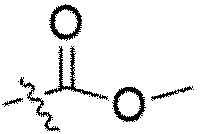
sustituido en la posición 4, -CN sustituido en la posición 4, -NO2 sustituido en la posición 4, grupo alcoxi disustituido, particularmente grupo metoxi disustituido en la posición 2 o 3 o grupo metoxi disustituido en la posición 2 o 5;substituted at 4-position, -CN substituted at 4-position, -NO2 substituted at 4-position, disubstituted alkoxy group, particularly disubstituted methoxy group at 2 or 3 position or disubstituted methoxy group at 2 or 5 position;

que representa un extremo conector.which represents a connecting end.
Las sales de los compuestos mostrados en la Fórmula I también pertenecen al alcance de protección de la presente invención.Salts of the compounds shown in Formula I also belong to the scope of protection of the present invention.
Particularmente, el compuesto de ácido tetrámico 4-oxo-alquilado mostrado en la Fórmula I de la presente invención es uno de los siguientes compuestos:Particularly, the 4-oxo-alkylated tetramic acid compound shown in Formula I of the present invention is one of the following compounds:


El compuesto de ácido tetrámico 4-oxo-alquilado como se muestra en la Fórmula I anterior se prepara mediante un método que comprende las siguientes etapas:The 4-oxo-alkylated tetramic acid compound as shown in Formula I above is prepared by a method comprising the following steps:
1) hacer reaccionar un compuesto mostrado en la Fórmula II con un compuesto mostrado en la Fórmula III, obteniéndose un compuesto mostrado en la Fórmula IV, 1) reacting a compound shown in Formula II with a compound shown in Formula III, obtaining a compound shown in Formula IV,

en donde, en la Fórmula II y la Fórmula IV anteriores, Ri tiene la misma definición que en la Fórmula I, y Boc representa un grupo ferc-butoxicarbonilo; ywherein, in Formula II and Formula IV above, Ri has the same definition as in Formula I, and Boc represents a tert-butoxycarbonyl group; Y
en la Fórmula III y la Fórmula IV anteriores, R2 tiene la misma definición que en la Fórmula I; y 2) eliminar del compuesto mostrado en la Fórmula IV la protección de Boc, obteniéndose el compuesto mostrado en la Fórmula I.in Formula III and Formula IV above, R2 has the same definition as in Formula I; and 2) removing Boc protection from the compound shown in Formula IV, yielding the compound shown in Formula I.
En la etapa 1) del método anterior, la proporción molar del compuesto mostrado en la Fórmula II con respecto al compuesto mostrado en la Fórmula III puede ser de 1:1-10.In step 1) of the above method, the molar ratio of the compound shown in Formula II to the compound shown in Formula III may be 1:1-10.
La reacción puede llevarse a cabo en condiciones alcalinas, y el álcali puede ser carbonato de potasio.The reaction can be carried out under alkaline conditions, and the alkali can be potassium carbonate.
La temperatura de reacción puede ser de 0 a 100 grados Celsius, y el tiempo de reacción puede ser de 0,1 a 24 horas. La reacción puede realizarse en un disolvente orgánico, que, en particular, puede ser acetonitrilo.The reaction temperature may be 0 to 100 degrees Celsius, and the reaction time may be 0.1 to 24 hours. The reaction can be carried out in an organic solvent, which, in particular, can be acetonitrile.
En la etapa 2) del método anterior, la eliminación de la protección de Boc puede llevarse a cabo bajo la acción del ácido trifluoroacético.In step 2) of the above method, removal of Boc protection can be carried out under the action of trifluoroacetic acid.
La proporción molar del compuesto mostrado en la Fórmula IV con respecto al ácido trifluoroacético puede ser de 1:1-20, particularmente puede ser de 1:3.The molar ratio of the compound shown in Formula IV to trifluoroacetic acid may be 1:1-20, particularly it may be 1:3.
La temperatura de reacción para la eliminación de la protección de Boc puede ser de -10 a 30 grados Celsius, en particular a temperatura ambiente, y el tiempo de reacción de la misma puede ser de 0,5-24 horas, en particular, puede ser de 5 horas.The reaction temperature for Boc protection removal may be -10 to 30 degrees Celsius, in particular at room temperature, and the reaction time thereof may be 0.5-24 hours, in particular, it may be 5 hours.
La eliminación de la protección de Boc se lleva a cabo en un disolvente orgánico y, en particular, puede ser diclorometano.The removal of the Boc protection is carried out in an organic solvent and, in particular, can be dichloromethane.
El uso del compuesto de ácido tetrámico 4-oxo-alquilado mostrado en la Fórmula I anterior o la sal del mismo en la preparación de un medicamento para tratar la enfermedad de Alzheimer, la demencia vascular y otras enfermedades de demencia con deterioro de la memoria también se encuentra dentro del alcance de protección de la presente invención.The use of the 4-oxo-alkylated tetramic acid compound shown in Formula I above or the salt thereof in the preparation of a medicament for treating Alzheimer's disease, vascular dementia and other memory-impaired dementia diseases also is within the scope of protection of the present invention.
La presente invención también proporciona un medicamento para el tratamiento de la enfermedad de Alzheimer, la demencia vascular y otras enfermedades de demencia con deterioro de la memoria, que comprende el compuesto de ácido tetrámico 4-oxo-alquilado mostrado en la Fórmula I o la sal del mismo.The present invention also provides a medicament for the treatment of Alzheimer's disease, vascular dementia and other memory impaired dementia diseases, comprising the 4-oxo-alkylated tetramic acid compound shown in Formula I or the salt of the same.
Los experimentos con animales muestran que el compuesto de la presente invención tiene el efecto de salvar la memoria de modelos animales y es de alta seguridad, no tiene mutagénesis, es capaz de permanecer en la sangre durante varias horas después de la inyección oral o intravenosa y puede entrar en el cerebro.Animal experiments show that the compound of the present invention has the effect of saving the memory of animal models and is of high safety, has no mutagenesis, is able to remain in the blood for several hours after oral or intravenous injection and can enter the brain.
Breve descripción de los dibujosBrief description of the drawings
La Fig. 1 muestra el efecto de los compuestos 51311, 50561, 51351, 51151, 51121, 51332, 51081, 51091, 51221, 51101, 51071,51131, 51321, 51341,51111 y 51301 en la mejora de la memoria de Drosophilae con la enfermedad de Alzheimer.Fig. 1 shows the effect of compounds 51311, 50561, 51351, 51151, 51121, 51332, 51081, 51091, 51221, 51101, 51071, 51131, 51321, 51341, 51111 and 51301 on memory enhancement of Drosoe with Alzheimer's disease.
La Fig. 2 muestra el efecto de los compuestos 60111,60241,60201, 51471, 51541, 60221, 60131, 51551, 51571, 60251, 51731, 51561, 60121, 60231 y 60211 en la mejora de la memoria de Drosophilae con la enfermedad de Alzheimer.Fig. 2 shows the effect of compounds 60111, 60241, 60201, 51471, 51541, 60221, 60131, 51551, 51571, 60251, 51731, 51561, 60121, 60231 and 60211 on Drosophilae memory enhancement with disease. Alzheimer's.
La Fig. 3 muestra la relación dosis-efecto de los compuestos 50561, 51311, 51351, 51151 y 51121 para mejorar la memoria de Drosophilae con enfermedad de Alzheimer.Fig. 3 shows the dose-effect relationship of compounds 50561, 51311, 51351, 51151 and 51121 in improving memory of Drosophilae with Alzheimer's disease.
La Fig. 4 muestra que el compuesto 50561 (10 mg/kg) mejora el aprendizaje espacial y la memoria de ratones con EA. Fig. 4 shows that compound 50561 (10 mg/kg) improves spatial learning and memory in AD mice.
La Fig. 5 muestra que el compuesto 50561 (1,0,1 mg/kg) no mejora el aprendizaje espacial ni la memoria de los ratones con EA, en donde A muestra esquemáticamente las operaciones de administración a ratones; B muestra períodos de latencia en pruebas de laberinto de agua en ratones; C-D muestra los porcentajes de tiempo de residencia en un cuadrante diana de los ratones antes y después del entrenamiento; E muestra el número de cruces de una plataforma de los ratones antes y después del entrenamiento; y F muestra los cambios en la velocidad de natación de los ratones antes y después del entrenamiento.Fig. 5 shows that compound 50561 (1.0.1 mg/kg) does not improve spatial learning and memory of AD mice, where A schematically shows administration operations to mice; B shows latency periods in water maze tests in mice; C-D shows the percentages of residence time in a target quadrant of the mice before and after training; E shows the number of crossings of a platform by the mice before and after training; and F shows the changes in the swimming speed of the mice before and after training.
La Fig. 6 muestra una curva de concentración-efecto del compuesto 50561 a los canales de potasio hERG (human Ether-á-gogo Related Gene, homólogo humano del gen éter a gogó) registrados en una estirpe celular estable hERG de HEK-293 utilizando la técnica de pinzamiento zonal.Fig. 6 shows a concentration-effect curve of compound 50561 on hERG ( human Ether-á-gogo Related Gene ) potassium channels recorded in a stable hERG HEK-293 cell line using zonal clamping technique.
La Fig. 7 muestra las curvas de concentración-tiempo del medicamento en plasma y cerebro después de la inyección intravenosa del compuesto 50561.Fig. 7 shows drug concentration-time curves in plasma and brain after intravenous injection of compound 50561.
La Fig. 8 muestra las curvas de concentración-tiempo del medicamento en plasma y cerebro después de la administración oral del compuesto 50561.Fig. 8 shows plasma and brain drug concentration-time curves after oral administration of compound 50561.
Descripción detallada de ejemplosDetailed description of examples
Los métodos experimentales en los siguientes ejemplos, a menos que se indique otra cosa, son métodos convencionales.The experimental methods in the following examples, unless otherwise indicated, are conventional methods.
Ejemplo 1 Preparación del compuestoExample 1 Preparation of the compound

(50561)(50561)
1.1 Preparación de1.1 Preparation of

(producto intermedio 1(intermediate product 1
Se disolvió L-fenilalanina (20 g, 121,07 mmol) en 500 ml de una solución mixta de tetrahidrofurano y agua (v/v 1:1), seguido de la agitación durante 10 minutos en un baño de hielo. Se añadieron hidróxido de sodio (10,7 g, 266,4 mmol) y dicarbonato de di-terc-butilo (29,1 g, 133,2 mmol) por lotes, seguido de 10 horas de agitación a temperatura ambiente. El seguimiento por CCF mostró que la reacción se había completado. Se eliminó el tetrahidrofurano por evaporación a presión reducida y se añadieron 500 ml de diclorometano. Se añadió gota a gota una solución de ácido clorhídrico 2 N con agitación hasta que la capa de agua tuvo un valor de pH de aproximadamente 5. Se separó una capa orgánica, se lavó una vez con 200 ml de salmuera saturada y se desecó con sulfato de magnesio anhidro. Se realizó la filtración y se eliminó el disolvente por evaporación a presión reducida, obteniéndose un producto en bruto, con un rendimiento del 99 %. Podría llevarse a cabo una siguiente reacción sin purificación adicional.L-phenylalanine (20 g, 121.07 mmol) was dissolved in 500 ml of a mixed solution of tetrahydrofuran and water (v/v 1:1), followed by stirring for 10 minutes in an ice bath. Sodium hydroxide (10.7 g, 266.4 mmol) and di-tert-butyl dicarbonate (29.1 g, 133.2 mmol) were added in batches, followed by 10 hours of stirring at room temperature. TLC monitoring showed the reaction to be complete. Tetrahydrofuran was removed by evaporation under reduced pressure and 500 ml of dichloromethane was added. 2N hydrochloric acid solution was added dropwise with stirring until the water layer had a pH value of about 5. An organic layer was separated, washed once with 200 mL of saturated brine and dried over sulfate. of anhydrous magnesium. Filtration was performed and the solvent was removed by evaporation under reduced pressure, obtaining a crude product, with a yield of 99%. A following reaction could be carried out without further purification.
1.2 Preparación de1.2 Preparation of

(producto intermedio 2)(intermediate 2)
Se disolvió el producto intermedio 1 (25 g, 94,2 mmol) en 500 ml de diclorometano anhidro. Se añadieron sucesivamente ácido de Meldrum (14,9 g, 103,7 mmol) y 4-dimetilaminopiridina (17,3 g, 141,3 mmol), seguidos de agitación en baño de hielo durante 10 minutos. Se añadió gota a gota una solución de diciclohexilcarbodiimida (21,4 g, 103,7 mmol) en diclorometano (100 ml). Después de esto, se siguió agitando el líquido de reacción durante 10 horas en un baño de hielo y la reacción se completó de acuerdo con el control realizado mediante CCF. Se realizó la filtración. Intermediate 1 (25 g, 94.2 mmol) was dissolved in 500 mL of anhydrous dichloromethane. Meldrum's acid (14.9 g, 103.7 mmol) and 4-dimethylaminopyridine (17.3 g, 141.3 mmol) were added successively, followed by stirring in an ice bath for 10 minutes. A solution of dicyclohexylcarbodiimide (21.4 g, 103.7 mmol) in dichloromethane (100 mL) was added dropwise. After this, the reaction liquid was further stirred for 10 hours in an ice bath, and the reaction was completed according to the control by TLC. Filtration was done.
El filtrado se lavó seis veces con soluciones acuosas de bisulfato de potasio al 5 %, 200 ml cada vez, se lavó una vez con salmuera saturada y se desecó con sulfato de sodio anhidro. Y el disolvente se eliminó por evaporación a presión reducida, obteniéndose un sólido amarillento. Se añadieron 500 ml de éter de petróleo, seguidos de la agitación y filtración, obteniéndose un producto diana, es decir, un sólido blanco (30 g, rendimiento: 77 %). Podría llevarse a cabo una siguiente reacción sin purificación adicional.The filtrate was washed six times with 5% potassium bisulfate aqueous solutions, 200 ml each time, washed once with saturated brine and dried over anhydrous sodium sulfate. And the solvent was removed by evaporation under reduced pressure, obtaining a yellowish solid. 500 ml of petroleum ether was added, followed by stirring and filtration, to obtain a target product, ie white solid (30 g, yield: 77%). A following reaction could be carried out without further purification.
1.3 Preparación de1.3 Preparation of

(producto intermedio 3)(intermediate 3)
Se disolvió el producto intermedio 2 (25 g, 63,9 mmol) en 400 ml de acetato de etilo, seguido de reacción de reflujo durante 5 horas. Después de enfriar hasta la temperatura ambiente, el acetato de etilo se evaporó a presión reducida, obteniéndose un sólido blanco, es decir, el producto diana (17,6 g, 95%). El producto no necesitó purificación adicional.Intermediate 2 (25 g, 63.9 mmol) was dissolved in 400 ml of ethyl acetate, followed by reflux reaction for 5 hours. After cooling to room temperature, the ethyl acetate was evaporated under reduced pressure to obtain a white solid, ie the target product (17.6 g, 95%). The product did not need further purification.
1.4 Preparación de1.4 Preparation of

(01311, producto intermedio 15)(01311, Intermediate 15)
Se disolvió el producto intermedio 3 (289 mg, 1,0 mmol) en 5 ml de acetonitrilo. Se añadieron K2CO3 (207 mg, 1.5 mmol) y bromuro de 4-fluorobencilo (227 mg, 1.2 mmol) sucesivamente a temperatura ambiente, seguido de reacción de reflujo durante 5 horas. Después de enfriar hasta la temperatura ambiente, se realizó una filtración para eliminar los sólidos. El filtrado se desecó por evaporación. Se realizó la purificación mediante cromatografía en columna, obteniéndose el producto intermedio 15, es decir, en forma de una sustancia oleosa incolora (158 mg, rendimiento: 40 %). Peso molecular: 397,45. RMN de 1H (400 MHz, CDCh) 87,34 (dd, J = 8,2, 5,4 Hz, 2H), 7,19 (m, 3H), 7,10 (t, J = 8,5 Hz, 2H), 6,98 (m, 2H), 4,91 (s, 1H), 4,84 (m, 2H), 4,71 (dd, J = 5,3, 3,0 Hz, 1H), 3,43 (dd, J = 14,0, 5,2 Hz, 1H), 3,14 (dd, J = 14,0, 2,8 Hz, 1H), 1,59 (s, 9H). RMN de 13C (100 MHz, CDCh) 8174,79, 168,75, 163,06 (d, J = 248,3 Hz), 149,47, 134,24, 130,21 (d, J = 8,4 Hz), 130,05 (d, J = 3,3 Hz), 129,59, 128,35, 127,11, 115,93 (d, J = 21,7 Hz), 96,18, 82,78, 72,65, 60,38, 35,55, 28,30. RMN de 19F (376 MHz, CDCla) 8 -112,20.Intermediate 3 (289 mg, 1.0 mmol) was dissolved in 5 mL of acetonitrile. K2CO3 (207 mg, 1.5 mmol) and 4-fluorobenzyl bromide (227 mg, 1.2 mmol) were added successively at room temperature, followed by reflux reaction for 5 hours. After cooling to room temperature, filtration was performed to remove solids. The filtrate was dried by evaporation. Purification was performed by column chromatography to obtain intermediate 15, ie, as a colorless oily substance (158 mg, yield: 40%). Molecular weight: 397.45. 1H NMR (400 MHz, CDCh) 87.34 (dd, J = 8.2, 5.4 Hz, 2H), 7.19 (m, 3H), 7.10 (t, J = 8.5 Hz , 2H), 6.98 (m, 2H), 4.91 (s, 1H), 4.84 (m, 2H), 4.71 (dd, J = 5.3, 3.0 Hz, 1H) , 3.43 (dd, J = 14.0, 5.2 Hz, 1H), 3.14 (dd, J = 14.0, 2.8 Hz, 1H), 1.59 (s, 9H). 13C NMR (100 MHz, CDCh) 8174.79, 168.75, 163.06 (d, J = 248.3 Hz), 149.47, 134.24, 130.21 (d, J = 8.4 Hz), 130.05 (d, J = 3.3 Hz), 129.59, 128.35, 127.11, 115.93 (d, J = 21.7 Hz), 96.18, 82.78 , 72.65, 60.38, 35.55, 28.30. 19F NMR (376 MHz, CDCla) 8 -112.20.
1.5 Preparación del compuesto1.5 Preparation of the compound

(50561)(50561)
Se disolvió el producto intermedio 15 (397 mg, 1,0 mmol) en 10 ml de diclorometano. Se añadió ácido trifluoroacético (223 |jl, 3,0 mmol) en un baño de hielo. El líquido de reacción se hizo reaccionar durante 5 horas con agitación a temperatura ambiente. Una vez completada la reacción, se añadieron 90 ml de diclorometano para diluir la solución de reacción. Se realizó el lavado una vez con una solución de NaHCO3 al 10 % y, a continuación, una vez con salmuera saturada. Se realizaron el desecado con sulfato de sodio anhidro y la filtración. El disolvente se eliminó por evaporación. Se realizó una cromatografía en columna para la separación y purificación, obteniéndose 360 mg del sólido blanco del Ejemplo 1 con un rendimiento del 82 %. Peso molecular: 297,33. RMN de 1H (400 MHz, CDCh) 8 7,37 (dd, J = 8,4, 5,3 Hz, 2H), 7,27 (m, 3H), 7,18 (m, 2H), 7,11 (t, J = 8,5 Hz, 2H), 5,77 (s, 1H), 5,06 (s, 1H), 4,95 (m, 2H), 4,27 (dd, J = 9,2, 3,6 Hz, 1H), 3,21 (dd, J = 13,7, 3,7 Hz, 1H), 2,67 (dd, J = 13,7, 9,0 Hz, 1H). RMN de 13C (100 MHz, CDCh) 8175,94, 173,55, 163,04 (d, J = 247,8 Hz), 136,55, 130,64 (d, J = 3,5 Hz), 130,06 (d, J = 8,4 Hz), 129,27, 128,79, 127,17, 115,91 (d, J = 21,7 Hz), 95,23, 72,60, 58,86, 38,77. RMN de 19F (376 MHz, CDCh) 8 -112,58. Intermediate 15 (397 mg, 1.0 mmol) was dissolved in 10 mL of dichloromethane. Trifluoroacetic acid (223 µl, 3.0 mmol) was added in an ice bath. The reaction liquid was reacted for 5 hours with stirring at room temperature. After the completion of the reaction, 90 ml of dichloromethane was added to dilute the reaction solution. Washing was done once with 10% NaHCO3 solution and then once with saturated brine. Drying with anhydrous sodium sulfate and filtration were performed. The solvent was removed by evaporation. Column chromatography was performed for separation and purification, obtaining 360 mg of the white solid of Example 1 with a yield of 82%. Molecular weight: 297.33. 1H NMR (400 MHz, CDCh) 8 7.37 (dd, J = 8.4, 5.3 Hz, 2H), 7.27 (m, 3H), 7.18 (m, 2H), 7, 11 (t, J = 8.5 Hz, 2H), 5.77 (s, 1H), 5.06 (s, 1H), 4.95 (m, 2H), 4.27 (dd, J = 9 0.2, 3.6 Hz, 1H), 3.21 (dd, J = 13.7, 3.7 Hz, 1H), 2.67 (dd, J = 13.7, 9.0 Hz, 1H) . 13C NMR (100 MHz, CDCh) 8175.94, 173.55, 163.04 (d, J = 247.8 Hz), 136.55, 130.64 (d, J = 3.5 Hz), 130 .06 (d, J = 8.4 Hz), 129.27, 128.79, 127.17, 115.91 (d, J = 21.7 Hz), 95.23, 72.60, 58.86 , 38.77. 19F NMR (376 MHz, CDCh) 8 -112.58.
Ejemplo 2 Preparación del compuestoExample 2 Preparation of the compound

(51121)(51121)
2.1 Preparación de2.1 Preparation of

(50951, producto intermedio 16)(50951, Intermediate 16)
Se utilizó el mismo método de síntesis que para el producto intermedio 15, pero se utilizó bromuro de 2-fluorobencilo como reemplazo del bromuro de 4-fluorobencilo para preparar el producto intermedio 16, en forma de una sustancia oleosa incolora (259 mg, rendimiento: 65 %). Peso molecular: 397,45. RMN de 1H (400 MHz, CDCh) 87,38 (m, 2H), 7,18 (m, 5H), 6,99 (m, 2H), 4,95 (m, 3H), 4,70 (s, 1H), 3,43 (dd, J = 13,9, 4,7 Hz, 1H), 3,13 (d, J = 13,9 Hz, 1H), 1,59 (s, 9H). RMN de 13C (100 MHz, CDCh) 8 174,67, 168,62, 160,93 (d, J = 249,0 Hz), 149,46, 134,13, 131,27 (d, J = 8,3 Hz), 130,75 (d, J = 3,2 Hz), 129,62, 129,62, 127,03, 124,54 (d, J = 3,7 Hz), 121,43 (d, J = 14,4 Hz), 115,83 (d, J = 21,1 Hz), 96,09, 82,65, 67,12 (d, J = 4,2 Hz), 60,34, 35,44, 28,27. RMN de 19F (376 MHz, CDCla) 8 -117,44.The same synthesis method as for intermediate 15 was used, but 2-fluorobenzyl bromide was used as a replacement for 4-fluorobenzyl bromide to prepare intermediate 16, as a colorless oily substance (259 mg, yield: 65%). Molecular weight: 397.45. 1H NMR (400 MHz, CDCh) 87.38 (m, 2H), 7.18 (m, 5H), 6.99 (m, 2H), 4.95 (m, 3H), 4.70 (s , 1H), 3.43 (dd, J = 13.9, 4.7 Hz, 1H), 3.13 (d, J = 13.9 Hz, 1H), 1.59 (s, 9H). 13C NMR (100 MHz, CDCh) 8 174.67, 168.62, 160.93 (d, J = 249.0 Hz), 149.46, 134.13, 131.27 (d, J = 8, 3 Hz), 130.75 (d, J = 3.2 Hz), 129.62, 129.62, 127.03, 124.54 (d, J = 3.7 Hz), 121.43 (d, J = 14.4 Hz), 115.83 (d, J = 21.1 Hz), 96.09, 82.65, 67.12 (d, J = 4.2 Hz), 60.34, 35, 44, 28,27. 19F NMR (376 MHz, CDCla) 8 -117.44.
2.2 Preparación del compuesto2.2 Preparation of the compound

(51121)(51121)
Se utilizó el producto intermedio 16 (402 mg, 1,01 mmol) como materia prima y se adoptó el mismo método de síntesis que en el Ejemplo 1 para preparar 258 mg del sólido blanco del Ejemplo 2 con un rendimiento del 86 %. Peso molecular: 297,33. RMN de 1H (400 MHz, CDCh) 87,39 (m, 1H), 7,19 (m, 7H), 6,39 (s a, 1H), 5,08 (s, 1H), 5,02 (m, 2H), 4,28 (dd, J = 8,4, 3,8 Hz, 1H), 3,16 (dd, J = 13,7, 4,1 Hz, 1H), 2,72 (dd, J = 13,6, 8,1 Hz, 1H). RMN de 13C (100 MHz, CDCh) 8175,72, 173,78, 160,85 (d, J = 248,7 Hz), 136,26, 130,91 (d, J = 8,3 Hz), 130,42 (d, J = 3,5 Hz), 129,34, 128,54, 126,95, 124,45 (d, J = 3,7 Hz), 122,00 (d, J = 14,4 Hz), 115,74 (d, J = 21,2 Hz), 95,20, 66,95 (d, J = 4,1 Hz), 58,68, 38,35. RMN de 19F (376 MHz, CDCh) 8 -117,70.Intermediate 16 (402 mg, 1.01 mmol) was used as raw material, and the same synthesis method as in Example 1 was adopted to prepare 258 mg of the white solid of Example 2 in 86% yield. Molecular weight: 297.33. 1H NMR (400 MHz, CDCh) 87.39 (m, 1H), 7.19 (m, 7H), 6.39 (s, 1H), 5.08 (s, 1H), 5.02 (m , 2H), 4.28 (dd, J = 8.4, 3.8 Hz, 1H), 3.16 (dd, J = 13.7, 4.1 Hz, 1H), 2.72 (dd, J=13.6, 8.1Hz, 1H). 13C NMR (100 MHz, CDCh) 8175.72, 173.78, 160.85 (d, J = 248.7 Hz), 136.26, 130.91 (d, J = 8.3 Hz), 130 .42 (d, J = 3.5 Hz), 129.34, 128.54, 126.95, 124.45 (d, J = 3.7 Hz), 122.00 (d, J = 14.4 Hz), 115.74 (d, J = 21.2 Hz), 95.20, 66.95 (d, J = 4.1 Hz), 58.68, 38.35. 19F NMR (376 MHz, CDCh) 8 -117.70.
Ejemplo 3 Preparación del compuestoExample 3 Preparation of the compound

Ejemplo 3 Preparación del compuesto (51131)Example 3 Preparation of compound (51131)
3.1 Preparación de3.1 Preparation of

(50941, producto intermedio 17)(50941, Intermediate 17)
Se adoptó el mismo método de síntesis que para el producto intermedio 15, pero se utilizó bromuro de 3-fluorobencilo en lugar del bromuro de 4-fluorobencilo para preparar el producto intermedio 17, una sustancia oleosa incolora (158 mg, rendimiento: 40 %). Peso molecular: 397,45. RMN de 1H (400 MHz, CDCI3) 57,37 (m, 1H), 7,21 (m, 3H), 7,04 (m, 5H), 4,91 (s, 1H), 4,88 (m, 2H), 4,74 (m, 1H), 3,43 (dd, J = 14,0, 5,4 Hz, 1H), 3,18 (dd, J = 14,1, 3,0 Hz, 1H), 1,60 (s, 9H). RMN de 13C (100 MHz, CDCI3) 5174,76, 168,59, 163,00 (d, J = 247,3 Hz), 149,50, 136,62 (d, J = 7,5 Hz), 134,31, 130,58 (d, J = 8,3 Hz), 129,61, 128,41, 127,17, 123,40 (d, J = 3,0 Hz), 115,97 (d, J = 21,0 Hz), 114,84 (d, J = 22,2 Hz), 96,40, 82,83, 72,42 (d, J = 2,0 Hz), 60,42, 35,69, 28,33. RMN de 19F (376 MHz, CDCI3) 5 -111,95.The same synthesis method as for intermediate 15 was adopted, but 3-fluorobenzyl bromide was used instead of 4-fluorobenzyl bromide to prepare intermediate 17, a colorless oily substance. (158mg, yield: 40%). Molecular weight: 397.45. 1H NMR (400 MHz, CDCl3) 5 7.37 (m, 1H), 7.21 (m, 3H), 7.04 (m, 5H), 4.91 (s, 1H), 4.88 ( m, 2H), 4.74 (m, 1H), 3.43 (dd, J = 14.0, 5.4 Hz, 1H), 3.18 (dd, J = 14.1, 3.0 Hz , 1H), 1.60 (s, 9H). 13C NMR (100 MHz, CDCI3) 5174.76, 168.59, 163.00 (d, J = 247.3 Hz), 149.50, 136.62 (d, J = 7.5 Hz), 134 .31, 130.58 (d, J = 8.3 Hz), 129.61, 128.41, 127.17, 123.40 (d, J = 3.0 Hz), 115.97 (d, J = 21.0 Hz), 114.84 (d, J = 22.2 Hz), 96.40, 82.83, 72.42 (d, J = 2.0 Hz), 60.42, 35.69 , 28.33. 19F NMR (376 MHz, CDCI3) 5 -111.95.
3.2 Preparación del compuesto3.2 Preparation of the compound

(51131)(51131)
Se utilizó el producto intermedio 17 (308 mg, 0,77 mmol) como materia prima y se adoptó el mismo método de síntesis que en el Ejemplo 1 para preparar 229 mg del sólido blanco del Ejemplo 3 con un rendimiento del 100 %. Peso molecular: 297,33. RMN de 1H (400 MHz, CDCh) 57,20 (m, 9H), 5,76 (s, 1H), 5,05 (s, 1H), 4,98 (m, 2H), 4,30 (dd, J = 9,2, 3,7 Hz, 1H), 3,23 (dd, J = 13,7, 3,7 Hz, 1H), 2,69 (dd, J = 13,6, 9,0 Hz, 1H). RMN de 13C (100 MHz, CDCh) 5 175,82, 173,41, 163,06 (d, J = 246,9 Hz), 137,24 (d, J = 7,5 Hz), 136,52, 130,54 (d, J = 8,2 Hz), 129,28, 128,83, 127,22, 123,31 (d, J = 3,0 Hz), 115,83 (d, J = 21,1 Hz), 114,74 (d, J = 22,2 Hz), 95,45, 72,36 (d, J = 2,0 Hz), 58,84, 38,80. RMN de 19F (376 MHz, CDCh) 5 -112,12.Intermediate 17 (308 mg, 0.77 mmol) was used as raw material, and the same synthesis method as in Example 1 was adopted to prepare 229 mg of the white solid of Example 3 in 100% yield. Molecular weight: 297.33. 1H NMR (400 MHz, CDCh) 57.20 (m, 9H), 5.76 (s, 1H), 5.05 (s, 1H), 4.98 (m, 2H), 4.30 (dd , J = 9.2, 3.7 Hz, 1H), 3.23 (dd, J = 13.7, 3.7 Hz, 1H), 2.69 (dd, J = 13.6, 9.0 Hz, 1H). 13C NMR (100 MHz, CDCh) 5 175.82, 173.41, 163.06 (d, J = 246.9 Hz), 137.24 (d, J = 7.5 Hz), 136.52, 130.54 (d, J = 8.2 Hz), 129.28, 128.83, 127.22, 123.31 (d, J = 3.0 Hz), 115.83 (d, J = 21, 1 Hz), 114.74 (d, J = 22.2 Hz), 95.45, 72.36 (d, J = 2.0 Hz), 58.84, 38.80. 19F NMR (376 MHz, CDCh) 5 -112.12.
Ejemplo 4 Preparación del compuestoExample 4 Preparation of the compound

(51091)(51091)
4.1 Preparación de4.1 Preparation of

(51031, producto intermedio 18)(51031, Intermediate 18)
Se adoptó el mismo método de síntesis que para el producto intermedio 15, pero se utilizó bromuro de 4-metil-bencilo en lugar del bromuro de 4-fluorobencilo para preparar el producto intermedio 18, en forma de una sustancia oleosa incolora (176 mg, rendimiento: 45 %). Peso molecular: 393,48. RMN de 1H (400 MHz, CDCh) 57,22 (m, 7H), 6,98 (m, 2H), 4,91 (s, 1H), 4,86 (m, 2H), 4,70 (dd, J = 5,2, 3,1 Hz, 1H), 3,44 (dd, J = 14,0, 5,2 Hz, 1H), 3,13 (dd, J = 14,0, 3,0 Hz, 1H), 2,39 (s, 3H), 1,59 (s, 9H). RMN 13C (100 MHz, CDCh) 5175,00, 168,91, 149,61, 139,15, 134,33, 131,24, 129,72, 129,64, 128,44, 128,36, 127,12, 96,15, 82,72, 73,46, 60,47, 35,52, 28,37, 21,38.The same synthesis method as for intermediate 15 was adopted, but 4-methyl-benzyl bromide was used instead of 4-fluorobenzyl bromide to prepare intermediate 18, as a colorless oily substance (176 mg, yield: 45%). Molecular weight: 393.48. 1H NMR (400 MHz, CDCh) 57.22 (m, 7H), 6.98 (m, 2H), 4.91 (s, 1H), 4.86 (m, 2H), 4.70 (dd , J = 5.2, 3.1 Hz, 1H), 3.44 (dd, J = 14.0, 5.2 Hz, 1H), 3.13 (dd, J = 14.0, 3.0 Hz, 1H), 2.39 (s, 3H), 1.59 (s, 9H). 13C NMR (100 MHz, CDCh) 5175.00, 168.91, 149.61, 139.15, 134.33, 131.24, 129.72, 129.64, 128.44, 128.36, 127, 12, 96.15, 82.72, 73.46, 60.47, 35.52, 28.37, 21.38.
4.2 Preparación del compuesto4.2 Compound preparation

(51091)(51091)
Se utilizó el producto intermedio 18 (176 mg, 0,45 mmol) como materia prima y se utilizó el mismo método de síntesis que en el Ejemplo 1 para preparar 96 mg del sólido blanco del Ejemplo 4 con un rendimiento del 73 %. Peso molecular: 293,37. RMN de 1H (400 MHz, CDCh) 57,24 (m, 9H), 5,50 (s, 1H), 5,06 (s, 1H), 4,95 (m, 2H), 4,25 (dd, J = 9,5, 3,4 Hz, 1H), 3,23 (dd, J = 13,6, 3,5 Hz, 1H), 2,63 (dd, J = 13,6, 9,4 Hz, 1H), 2,39 (s, 3H). RMN de 13C (100 MHz, CDCh) 5 176,20, 173,64, 138,95, 136,76, 131,79, 129,60, 129,27, 128,84, 128,29, 127,17, 95,03, 73,37, 58,95, 38,88, 21,39. Intermediate 18 (176 mg, 0.45 mmol) was used as starting material and the same synthesis method as in Example 1 was used to prepare 96 mg of the white solid of Example 4 in 73% yield. Molecular weight: 293.37. 1H NMR (400 MHz, CDCh) 57.24 (m, 9H), 5.50 (s, 1H), 5.06 (s, 1H), 4.95 (m, 2H), 4.25 (dd , J = 9.5, 3.4 Hz, 1H), 3.23 (dd, J = 13.6, 3.5 Hz, 1H), 2.63 (dd, J = 13.6, 9.4 Hz, 1H), 2.39 (s, 3H). 13C NMR (100 MHz, CDCh) 5 176.20, 173.64, 138.95, 136.76, 131.79, 129.60, 129.27, 128.84, 128.29, 127.17, 95.03, 73.37, 58.95, 38.88, 21.39.
Ejemplo 5 Preparación del compuestoExample 5 Preparation of the compound

(51101)(51101)
5.1 Preparación de5.1 Preparation of

(51041, producto intermedio 19)(51041, Intermediate 19)
Se utilizó el mismo método de síntesis que para el producto intermedio 15, pero se utilizó bromuro de 2-metil-bencilo en lugar del bromuro de 4-fluorobencilo para preparar el producto intermedio 19, una sustancia oleosa incolora (205 mg, rendimiento: 52 %). Peso molecular: 393,48. RMN de 1H (400 MHz, CDCh) 87,23 (m, 7H), 6,97 (m, 2H), 4,97 (s, 1H), 4,92 (m, 2H), 4,72 (m, 1H), 3,45 (dd, J = 14,0, 5,1 Hz, 1H), 3,13 (dd, J = 14,0, 2,5 Hz, 1H), 2,38 (s, 3H), 1,60 (s, 9H). RMN de 13C (100 MHz, CDCla) 8175,02; 168,84; 149,61; 137,07; 134,29; 132,32; 130,82; 129,70; 129,45; 128,37; 127,13; 126,41; 96,09; 82,75; 71,88; 60,45; 35,54; 28,37; 19,05.The same synthesis method as for intermediate 15 was used, but 2-methyl-benzyl bromide was used instead of 4-fluorobenzyl bromide to prepare intermediate 19, a colorless oily substance (205 mg, yield: 52 %). Molecular weight: 393.48. 1H NMR (400 MHz, CDCh) 87.23 (m, 7H), 6.97 (m, 2H), 4.97 (s, 1H), 4.92 (m, 2H), 4.72 (m , 1H), 3.45 (dd, J = 14.0, 5.1 Hz, 1H), 3.13 (dd, J = 14.0, 2.5 Hz, 1H), 2.38 (s, 3H), 1.60 (s, 9H). 13C NMR (100 MHz, CDCla) 8175.02; 168.84; 149.61; 137.07; 134.29; 132.32; 130.82; 129.70; 129.45; 128.37; 127.13; 126.41; 96.09; 82.75; 71.88; 60.45; 35.54; 28.37; 19.05.
5.2 Preparación del compuesto5.2 Compound preparation

(51101)(51101)
Se utilizó el producto intermedio 19 (205 mg, 0,52 mmol) como materia prima y se adoptó el mismo método de síntesis que en el Ejemplo 1 para preparar 114 mg del sólido blanco del Ejemplo 5, con un rendimiento del 75%. Peso molecular: 293,37. RMN de 1H (400 MHz, CDCla) 87,27 (m, 9H), 5,78 (s, 1H), 5,11 (s, 1H), 4,99 (m, 2H), 4,26 (dd, J = 9,4, 3,4 Hz, 1H), 3,21 (dd, J = 13,6, 3,5 Hz, 1H), 2,64 (dd, J = 13,6, 9,3 Hz, 1H), 2,38 (s, 3H). RMN de 13C (100 MHz, CDCh) 8 176,17, 173,67, 137,19, 136,66, 132,75, 130,76, 129,40, 129,31, 129,26, 128,77, 127,12, 126,31, 94,91, 71,92, 58,93, 38,80, 19,00.Intermediate 19 (205 mg, 0.52 mmol) was used as raw material, and the same synthesis method as in Example 1 was adopted to prepare 114 mg of the white solid of Example 5, in 75% yield. Molecular weight: 293.37. 1H NMR (400 MHz, CDCla) 87.27 (m, 9H), 5.78 (s, 1H), 5.11 (s, 1H), 4.99 (m, 2H), 4.26 (dd , J = 9.4, 3.4 Hz, 1H), 3.21 (dd, J = 13.6, 3.5 Hz, 1H), 2.64 (dd, J = 13.6, 9.3 Hz, 1H), 2.38 (s, 3H). 13C NMR (100 MHz, CDCh) 8 176.17, 173.67, 137.19, 136.66, 132.75, 130.76, 129.40, 129.31, 129.26, 128.77, 127.12, 126.31, 94.91, 71.92, 58.93, 38.80, 19.00.
Ejemplo 6 Preparación del compuestoExample 6 Preparation of the compound

(51071)(51071)
6.1 Preparación de6.1 Preparation of

Se disolvió 2,3-dimetoxibenzaldehído (1,66 g, 10 mmol) en 50 ml de tetrahidrofurano anhidro, seguido de agitación en baño de hielo durante 10 minutos. Se añadió tetrahidruro de litio-aluminio (0,19 g, 5 mmol) en lotes, seguido de reacción con agitación en baño de hielo durante 30 minutos. Se añadió una solución acuosa saturada de cloruro de amonio para inactivar la reacción. La extracción se realizó tres veces con acetato de etilo (100 ml x 3). Las capas orgánicas se combinaron y se desecaron con sulfato de sodio anhidro. Después de la filtración, el disolvente se eliminó por evaporación a presión reducida, obteniéndose un producto diana (1,6 g, rendimiento: 95%). Se podría realizar una reacción en la siguiente etapa sin purificación adicional.2,3-Dimethoxybenzaldehyde (1.66 g, 10 mmol) was dissolved in 50 ml of anhydrous tetrahydrofuran, followed by stirring in an ice bath for 10 minutes. Lithium aluminum tetrahydride (0.19 g, 5 mmol) was added in batches, followed by reaction with stirring in an ice bath for 30 minutes. A saturated aqueous solution of chloride was added. ammonia to quench the reaction. Extraction was performed three times with ethyl acetate (100 ml x 3). The organic layers were combined and dried over anhydrous sodium sulfate. After filtration, the solvent was removed by evaporation under reduced pressure, obtaining a target product (1.6 g, yield: 95%). A reaction could be carried out in the next step without further purification.
6.2 Preparación de6.2 Preparation of

Se disolvió alcohol 2,3-dimetoxibencílico (1,6 g, 9,5 mmol) en 50 ml de diclorometano anhidro, seguido de agitación en baño de hielo durante 10 minutos. Se añadió gota a gota lentamente tribromuro de fósforo (0,87 g, 3,2 mmol). Después de eso, la reacción continuó bajo un baño de hielo durante 1 hora. Después de añadir 200 ml de diclorometano para diluir la solución de reacción, se realizó el lavado con agua (50 ml x 3), lavado con salmuera saturada (100 ml x 1), desecado con sulfato de sodio anhidro y filtración. Y el disolvente se eliminó por evaporación a presión reducida, produciendo un producto en bruto, que se purificó mediante cromatografía en columna, obteniéndose bromuro de 2,3-dimetoxibencilo (2,1 g, rendimiento: 96 %). RMN de 1H (400 MHz, CDCh) 67,03 (m, 1H), 6,96 (dd, J = 7,8, 1,7 Hz, 1H), 6,88 (dd, J = 8,0, 1,6 Hz, 1H), 4,57 (s, 2H), 3,97 (s, 3H), 3,87 (s, 3,87 (s, 3H). RMN de 13C (100 MHz, CDCla) 6152,89, 147,55, 131,95, 124,22, 122,61, 113,13, 60,90, 55,91, 28,24.2,3-Dimethoxybenzyl alcohol (1.6 g, 9.5 mmol) was dissolved in 50 ml of anhydrous dichloromethane, followed by stirring in an ice bath for 10 minutes. Phosphorus tribromide (0.87 g, 3.2 mmol) was slowly added dropwise. After that, the reaction was continued under an ice bath for 1 hour. After adding 200 ml of dichloromethane to dilute the reaction solution, washing with water (50 ml x 3), washing with saturated brine (100 ml x 1), drying with anhydrous sodium sulfate and filtration were performed. And the solvent was removed by evaporation under reduced pressure, yielding a crude product, which was purified by column chromatography, to obtain 2,3-dimethoxybenzyl bromide (2.1 g, yield: 96%). 1H NMR (400 MHz, CDCh) 67.03 (m, 1H), 6.96 (dd, J=7.8, 1.7 Hz, 1H), 6.88 (dd, J=8.0, 1.6 Hz, 1H), 4.57 (s, 2H), 3.97 (s, 3H), 3.87 (s, 3.87 (s, 3H). 13C NMR (100 MHz, CDCla) 6152.89, 147.55, 131.95, 124.22, 122.61, 113.13, 60.90, 55.91, 28.24.
6.3 Preparación de6.3 Preparation of

(51011, producto intermedio 20)(51011, Intermediate 20)
Se adoptó el mismo método de síntesis que para el producto intermedio 15, pero se utilizó bromuro de 2,3-dimetoxibencilo en lugar de bromuro de 4-fluorobencilo para preparar el producto intermedio 20, una sustancia oleosa incolora (191 mg, rendimiento: 43 %). Peso molecular: 439,51. RMN de 1H (400 MHz, CDCh) 67,05 (m, 8H), 4,97 (s, 1H), 4,94 (m, 2H), 4,69 (dd, J = 4,6, 2,8 Hz, 1H), 3,88 (s, 6H), 3,43 (dd, J = 13,9, 5,2 Hz, 1H), 3,13 (dd, J = 13,9, 2,5 Hz, 1H), 1,59 (s, 9H). RMN de 13C (100 MHz, CDCh) 6174,97, 168,82, 152,75, 149,54, 147,56, 134,19, 129,71, 128,24, 127,87, 126,98, 124,24, 121,65, 113,56, 95,94, 82,53, 68,68, 61,15, 60,36, 55,88, 35,41, 28,27.The same synthesis method as for intermediate 15 was adopted, but 2,3-dimethoxybenzyl bromide was used instead of 4-fluorobenzyl bromide to prepare intermediate 20, a colorless oily substance (191 mg, yield: 43 %). Molecular weight: 439.51. 1H NMR (400 MHz, CDCh) 67.05 (m, 8H), 4.97 (s, 1H), 4.94 (m, 2H), 4.69 (dd, J = 4.6, 2, 8Hz, 1H), 3.88 (s, 6H), 3.43 (dd, J=13.9, 5.2Hz, 1H), 3.13 (dd, J=13.9, 2.5 Hz, 1H), 1.59 (s, 9H). 13C NMR (100 MHz, CDCh) 6174.97, 168.82, 152.75, 149.54, 147.56, 134.19, 129.71, 128.24, 127.87, 126.98, 124 .24, 121.65, 113.56, 95.94, 82.53, 68.68, 61.15, 60.36, 55.88, 35.41, 28.27.
6.4 Preparación del compuesto6.4 Compound preparation

(51071)(51071)
Se utilizó el producto intermedio 20 (191 mg, 0,43 mmol) como materia prima y se adoptó el mismo método de síntesis que en el Ejemplo 1 para preparar 114 mg del sólido blanco del Ejemplo 6 con un rendimiento del 78%. Peso molecular: 339,39. RMN de 1H (400 MHz, CDCh) 67,23 (m, 5H), 7,11 (m, 1H), 6,97 (m, 2H), 5,70 (s a, 1H), 5,12 (s, 1H), 5,03 (m, 2H), 4,25 (dd, J = 9,3, 3,5 Hz, 1H), 3,90 (s, 6H), 3,21 (dd, J = 13,6, 3,6 Hz, 1H), 2,66 (dd, J = 13,7, 9,3 Hz, 1H). RMN 13C (100 MHz, CDCh) 6176,23, 173,77, 152,84, 147,57, 136,69, 129,30, 128,76, 128,59, 127,10, 124,31, 121,49, 113,36, 94,92, 68,62, 61,29, 58,89, 55,95, 38,81. Intermediate 20 (191 mg, 0.43 mmol) was used as raw material, and the same synthesis method as in Example 1 was adopted to prepare 114 mg of the white solid of Example 6 in 78% yield. Molecular weight: 339.39. 1H NMR (400 MHz, CDCh) 67.23 (m, 5H), 7.11 (m, 1H), 6.97 (m, 2H), 5.70 (brs, 1H), 5.12 (s , 1H), 5.03 (m, 2H), 4.25 (dd, J = 9.3, 3.5 Hz, 1H), 3.90 (s, 6H), 3.21 (dd, J = 13.6, 3.6 Hz, 1H), 2.66 (dd, J = 13.7, 9.3 Hz, 1H). 13C NMR (100 MHz, CDCh) 6176.23, 173.77, 152.84, 147.57, 136.69, 129.30, 128.76, 128.59, 127.10, 124.31, 121, 49, 113.36, 94.92, 68.62, 61.29, 58.89, 55.95, 38.81.
Ejemplo 7 Preparación del compuestoExample 7 Preparation of the compound

(51341)(51341)
7.1 Preparación de7.1 Preparation of
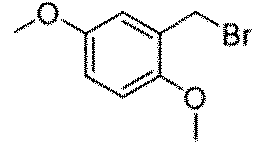
Se disolvió alcohol 2,5-dimetoxibencílico (1,68 g, 10 mmol) en 50 ml de diclorometano anhidro, seguido de agitación en baño de hielo durante 10 minutos. Se añadió lentamente gota a gota tribromuro de fósforo (1,0 g, 3,7 mmol). A continuación, la reacción continuó bajo un baño de hielo durante 1 hora. Después de añadir 200 ml de diclorometano con el fin de diluir la solución de reacción, se realizó el lavado con agua (50 ml x 3), lavado con salmuera saturada (100 ml x 1), desecado con sulfato de sodio anhidro y filtración. Y el disolvente se eliminó por evaporación a presión reducida, produciendo un producto en bruto, que se purificó mediante cromatografía en columna, obteniéndose bromuro de 2,5-dimetoxibencilo (2,2 g, rendimiento: 96 %). RMN de 1H (400 MHz, CDCh) 86,91 (m, 1H), 6,82 (m, 2H), 4,54 (s, 2H), 3,85 (s, 3H), 3,77 (s, 3H). RMN de 13C (100 MHz, CDCla) 8 153,43, 151,69, 126,93, 116,41, 115,07, 112,20, 56,24, 55,81, 29,07.2,5-Dimethoxybenzyl alcohol (1.68 g, 10 mmol) was dissolved in 50 ml of anhydrous dichloromethane, followed by stirring in an ice bath for 10 minutes. Phosphorus tribromide (1.0 g, 3.7 mmol) was slowly added dropwise. The reaction was then continued under an ice bath for 1 hour. After adding 200 ml of dichloromethane in order to dilute the reaction solution, washing with water (50 ml x 3), washing with saturated brine (100 ml x 1), drying with anhydrous sodium sulfate and filtration were performed. And the solvent was removed by evaporation under reduced pressure, yielding a crude product, which was purified by column chromatography, to obtain 2,5-dimethoxybenzyl bromide (2.2 g, yield: 96%). 1H NMR (400 MHz, CDCh) 86.91 (m, 1H), 6.82 (m, 2H), 4.54 (s, 2H), 3.85 (s, 3H), 3.77 (s , 3H). 13C NMR (100 MHz, CDCla) 8 153.43, 151.69, 126.93, 116.41, 115.07, 112.20, 56.24, 55.81, 29.07.
7.2 Preparación de7.2 Preparation of

(51201, producto intermedio 21)(51201, Intermediate 21)
Se adoptó el mismo método de síntesis que para el producto intermedio 15, pero se utilizó bromuro de 2,5-dimetoxibencilo en lugar de bromuro de 4-fluorobencilo para preparar el producto intermedio 21, una sustancia oleosa incolora (247 mg, rendimiento: 56 %). Peso molecular: 439,51. RMN de 1H (400 MHz, CDCh) 87,19 (m, 3H), 7,02 (m, 2H), 6,88 (m, 3H), 4,95 (s, 1H), 4,93 (s, 2H), 4,70 (dd, J = 5,4, 2,8 Hz, 1H), 3,82 (s, 3H), 3,78 (s, 3H), 3,44 (dd, J = 13,9, 5,2 Hz, 1H), 3,14 (dd, J = 13,9, 2,8 Hz, 1H), 1,59 (s, 9H). RMN de 13C (100 MHz, CDCh) 8175,01, 168,92, 153,59, 151,54, 149,56, 134,21, 129,73, 128,22, 127,00, 123,41, 116,14, 114,59, 111,60, 95,99, 82,52, 68,53, 60,37, 55,92, 55,85, 35,41, 28,29.The same synthesis method as for intermediate 15 was adopted, but 2,5-dimethoxybenzyl bromide was used instead of 4-fluorobenzyl bromide to prepare intermediate 21, a colorless oily substance (247 mg, yield: 56 %). Molecular weight: 439.51. 1H NMR (400 MHz, CDCh) 87.19 (m, 3H), 7.02 (m, 2H), 6.88 (m, 3H), 4.95 (s, 1H), 4.93 (s , 2H), 4.70 (dd, J = 5.4, 2.8 Hz, 1H), 3.82 (s, 3H), 3.78 (s, 3H), 3.44 (dd, J = 13.9, 5.2 Hz, 1H), 3.14 (dd, J = 13.9, 2.8 Hz, 1H), 1.59 (s, 9H). 13C NMR (100 MHz, CDCh) 8175.01, 168.92, 153.59, 151.54, 149.56, 134.21, 129.73, 128.22, 127.00, 123.41, 116 .14, 114.59, 111.60, 95.99, 82.52, 68.53, 60.37, 55.92, 55.85, 35.41, 28.29.
7.3 Preparación del compuesto7.3 Compound preparation

(51341)(51341)
Se utilizó el producto intermedio 21 (247 mg, 0,56 mmol) como materia prima y se adoptó el mismo método de síntesis que en el Ejemplo 1 para preparar 130 mg del sólido blanco del Ejemplo 7 con un rendimiento del 68%. Peso molecular: 339,39. RMN de 1H (400 MHz, CDCh) 87,24 (m, 5H), 6,96 (d, J = 2,5 Hz, 1H), 6,88 (m, 2H), 5,67 (s, 1H), 5,08 (s, 1H), 5,02 (m, 2H), 4,26 (dd, J = 9,1, 3,6 Hz, 1H), 3,83 (s, 3H), 3,79 (s, 3H), 3,22 (dd, J = 13,7, 3,6 Hz, 1H), 2,67 (dd, J = 13,6, 9,1 Hz, 1H). RMN 13C (100 MHz, CDCh) 8176,24, 173,87, 153,67, 151,47, 136,68, 129,33, 128,74, 127,09, 124,15, 115,67, 114,23, 111,63, 94,96, 68,30, 58,85, 56,05, 55,90, 38,78. Intermediate 21 (247 mg, 0.56 mmol) was used as raw material, and the same synthesis method as in Example 1 was adopted to prepare 130 mg of the white solid of Example 7 in 68% yield. Molecular weight: 339.39. 1H NMR (400 MHz, CDCh) 87.24 (m, 5H), 6.96 (d, J = 2.5 Hz, 1H), 6.88 (m, 2H), 5.67 (s, 1H ), 5.08 (s, 1H), 5.02 (m, 2H), 4.26 (dd, J = 9.1, 3.6 Hz, 1H), 3.83 (s, 3H), 3 0.79 (s, 3H), 3.22 (dd, J=13.7, 3.6 Hz, 1H), 2.67 (dd, J=13.6, 9.1 Hz, 1H). 13C NMR (100 MHz, CDCh) 8176.24, 173.87, 153.67, 151.47, 136.68, 129.33, 128.74, 127.09, 124.15, 115.67, 114, 23, 111.63, 94.96, 68.30, 58.85, 56.05, 55.90, 38.78.
Ejemplo 8 Preparación del compuestoExample 8 Preparation of the compound

(51221)(51221)
8.1 Preparación de8.1 Preparation of

(50971, producto intermedio 22)(50971, Intermediate 22)
Se adoptó el mismo método de síntesis que para el producto intermedio 15, pero se utilizó bromuro de 4-metoxibencilo en lugar de 4-fluorobencilo bromuro para preparar el producto intermedio 22, una sustancia oleosa incolora (143 mg, rendimiento: 35 %). Peso molecular: 409,48. RMN de 1H (400 MHz, CDCh) 87,30 (m, 2H), 7,20 (m, 3H), 6,97 (m, 4H), 4,91 (s, 1H), 4,83 (m, 2H), 4,69 (dd, J = 5,1, 3,1 Hz, 1H), 3,84 (s, 3H), 3,43 (dd, J = 14,0, 5,2 Hz, 1H), 3,12 (dd, J = 14,1, 3,0 Hz, 1H), 1,59 (s, 9H). RMN 13C (100 MHz, CDCh) 8174,97, 168,94, 160,32, 149,60, 134,32, 130,20, 129,71, 128,34, 127,10, 126,28, 114,34, 96,04, 82,70, 73,35, 60,46, 55,47, 35,49, 28,35.The same synthesis method as for intermediate 15 was adopted, but 4-methoxybenzyl bromide was used instead of 4-fluorobenzyl bromide to prepare intermediate 22, a colorless oily substance (143 mg, yield: 35%). Molecular weight: 409.48. 1H NMR (400 MHz, CDCh) 87.30 (m, 2H), 7.20 (m, 3H), 6.97 (m, 4H), 4.91 (s, 1H), 4.83 (m , 2H), 4.69 (dd, J = 5.1, 3.1 Hz, 1H), 3.84 (s, 3H), 3.43 (dd, J = 14.0, 5.2 Hz, 1H), 3.12 (dd, J=14.1, 3.0 Hz, 1H), 1.59 (s, 9H). 13C NMR (100 MHz, CDCh) 8174.97, 168.94, 160.32, 149.60, 134.32, 130.20, 129.71, 128.34, 127.10, 126.28, 114, 34, 96.04, 82.70, 73.35, 60.46, 55.47, 35.49, 28.35.
8.2 Preparación del compuesto8.2 Compound preparation

(51221)(51221)
Se utilizó el producto intermedio 22 (167 mg, 0,41 mmol) como materia prima y se adoptó el mismo método de síntesis que en el Ejemplo 1 para preparar 77 mg del sólido blanco del Ejemplo 8 con un rendimiento del 61 %. Peso molecular: 309,37. RMN de 1H (400 MHz, CDCla) 87,29 (m, 5H), 7,18 (d, J = 7,2 Hz, 2H), 6,94 (d, J = 8,7 Hz, 2H), 5,66 (s, 1H), 5,06 (s, 1H), 4,92 (m, 2H), 4,24 (dd, J = 9,3, 3,5 Hz, 1H), 3,83 (s, 3H), 3,21 (dd, J = 13,6, 3,6 Hz, 1H), 2,64 (dd, J = 13,6, 9,2 Hz, 1H). RMN de 13C (100 MHz, CDCh) 8176,16, 173,75, 160,18, 136,69, 130,00, 129,29, 128,77, 127,12, 126,85, 114,29, 94,96, 73,22, 58,92, 55,46, 38,78.Intermediate 22 (167 mg, 0.41 mmol) was used as raw material, and the same synthesis method as in Example 1 was adopted to prepare 77 mg of the white solid of Example 8 in 61% yield. Molecular weight: 309.37. 1H NMR (400 MHz, CDCla) 87.29 (m, 5H), 7.18 (d, J=7.2 Hz, 2H), 6.94 (d, J=8.7 Hz, 2H), 5.66 (s, 1H), 5.06 (s, 1H), 4.92 (m, 2H), 4.24 (dd, J = 9.3, 3.5 Hz, 1H), 3.83 (s, 3H), 3.21 (dd, J=13.6, 3.6 Hz, 1H), 2.64 (dd, J=13.6, 9.2 Hz, 1H). 13C NMR (100 MHz, CDCh) 8176.16, 173.75, 160.18, 136.69, 130.00, 129.29, 128.77, 127.12, 126.85, 114.29, 94 .96, 73.22, 58.92, 55.46, 38.78.
Ejemplo 9 Preparación del compuestoExample 9 Preparation of the compound

(51471)(51471)
9.1 Preparación de9.1 Preparation of

Se disolvió 3-acetoxi-4-metoxibenzaldehído (1,94 g, 10 mmol) en 50 ml de tetrahidrofurano anhidro, seguido de agitación en baño de hielo durante 10 minutos. Se añadió tetrahidruro de litio-aluminio (0,19 g, 5 mmol) en lotes seguido de agitación en un baño de hielo durante 30 minutos. Se utilizó una solución acuosa saturada de cloruro de amonio para inactivar la reacción, seguida de la extracción con acetato de etilo tres veces (100 ml x 3). Se combinaron las capas orgánicas y se desecaron con sulfato de sodio anhidro. Después de la filtración, el disolvente se eliminó por evaporación a presión reducida, obteniéndose un producto diana (1,9 g, rendimiento: 97 %). Podría llevarse a cabo una reacción en la siguiente etapa sin purificación adicional.3-Acetoxy-4-methoxybenzaldehyde (1.94 g, 10 mmol) was dissolved in 50 ml of anhydrous tetrahydrofuran, followed by stirring in an ice bath for 10 minutes. Lithium aluminum tetrahydride (0.19 g, 5 mmol) was added in batches followed by stirring in an ice bath for 30 minutes. A saturated aqueous ammonium chloride solution was used to quench the reaction, followed by extraction with ethyl acetate three times (100 mL x 3). The organic layers were combined and dried over anhydrous sodium sulfate. After filtration, the solvent was removed by evaporation under reduced pressure, obtaining a target product (1.9 g, yield: 97%). could take place a reaction in the next step without further purification.
9.2 Preparación de9.2 Preparation of

Se disolvió alcohol 3-acetoxi-4-metoxibencílico (1,9 g, 9,7 mmol) en 50 ml de diclorometano anhidro, seguido de agitación en baño de hielo durante 10 minutos. Se añadió lentamente gota a gota tribromuro de fósforo (1,0 g, 3,7 mmol). Después de esto, la reacción siguió bajo un baño de hielo durante 1 hora. Después de añadir 200 ml de diclorometano para diluir la solución de reacción, se realizó el lavado con agua (50 ml x 3), lavado con salmuera saturada (100 ml x 1), desecado con sulfato de sodio anhidro y filtración. Y el disolvente se eliminó por evaporación a presión reducida, produciendo un producto en bruto, que se purificó mediante cromatografía en columna, obteniéndose bromuro de 3-acetoxi-4-metoxibencilo (2,4 g, rendimiento: 96 %). RMN de 1H (400 MHz, CDCh) 87,23 (dd, J = 8,4, 2.2 Hz, 1H), 7,10 (d, J = 2,2 Hz, 1H), 6,91 (d, J = 8,4 Hz, 1H), 4,46 (s, 2H), 3,82 (s, 3H), 2,31 (s, 3H). RMN 13C (100 MHz, CDCla) 8168,90, 151,29, 139,72, 130,35, 127,68, 123,79, 112,44, 56,05, 33,14, 20,71.3-Acetoxy-4-methoxybenzyl alcohol (1.9 g, 9.7 mmol) was dissolved in 50 ml of anhydrous dichloromethane, followed by stirring in an ice bath for 10 minutes. Phosphorus tribromide (1.0 g, 3.7 mmol) was slowly added dropwise. After this, the reaction continued under an ice bath for 1 hour. After adding 200 ml of dichloromethane to dilute the reaction solution, washing with water (50 ml x 3), washing with saturated brine (100 ml x 1), drying with anhydrous sodium sulfate and filtration were performed. And the solvent was removed by evaporation under reduced pressure, yielding a crude product, which was purified by column chromatography, to obtain 3-acetoxy-4-methoxybenzyl bromide (2.4 g, yield: 96%). 1H NMR (400 MHz, CDCh) 87.23 (dd, J = 8.4, 2.2 Hz, 1H), 7.10 (d, J = 2.2 Hz, 1H), 6.91 (d, J = 8.4 Hz, 1H), 4.46 (s, 2H), 3.82 (s, 3H), 2.31 (s, 3H). 13C NMR (100 MHz, CDCla) 8168.90, 151.29, 139.72, 130.35, 127.68, 123.79, 112.44, 56.05, 33.14, 20.71.
9.3 Preparación de9.3 Preparation of

(51371, producto intermedio 23)(51371, Intermediate 23)
Se adoptó el mismo método de síntesis que para el producto intermedio 15, pero se utilizó bromuro de 3-acetoxi-4-metoxibencilo en lugar de bromuro de 4-fluorobencilo para preparar el producto intermedio 23, una sustancia oleosa incolora (176 mg, rendimiento: 38 %). Peso molecular: 467,52. RMN de 1H (400 MHz, CDCla) 87,20 (m, 4H), 7,06 (s, 1H), 6,98 (m, 3H), 4,91 (s, 1H), 4,81 (m, 2H), 4,70 (dd, J = 5,3, 3,0 Hz, 1H), 3,86 (s, 3H), 3,42 (dd, J = 14,0, 5,3 Hz, 1H), 3,14 (dd, J = 14,1, 3,0 Hz, 1H), 2,34 (s, 3H), 1,59 (s, 9H). RMN de 13C (100 MHz, CDCh) 8174,87, 168,92, 168,78, 151,82, 149,55, 140,00, 134,31, 129,68, 128,36, 127,11, 126,68, 123,13, 112,52, 96,12, 82,74, 72,70, 60,44, 56,12, 35,57, 28,34, 20,75.The same synthesis method as for intermediate 15 was adopted, but 3-acetoxy-4-methoxybenzyl bromide was used instead of 4-fluorobenzyl bromide to prepare intermediate 23, a colorless oily substance (176 mg, yield : 38%). Molecular weight: 467.52. 1H NMR (400 MHz, CDCla) 87.20 (m, 4H), 7.06 (s, 1H), 6.98 (m, 3H), 4.91 (s, 1H), 4.81 (m , 2H), 4.70 (dd, J = 5.3, 3.0 Hz, 1H), 3.86 (s, 3H), 3.42 (dd, J = 14.0, 5.3 Hz, 1H), 3.14 (dd, J=14.1, 3.0 Hz, 1H), 2.34 (s, 3H), 1.59 (s, 9H). 13C NMR (100 MHz, CDCh) 8174.87, 168.92, 168.78, 151.82, 149.55, 140.00, 134.31, 129.68, 128.36, 127.11, 126 .68, 123.13, 112.52, 96.12, 82.74, 72.70, 60.44, 56.12, 35.57, 28.34, 20.75.
9.4 Preparación del compuesto9.4 Compound preparation

(51471)(51471)
Se utilizó el producto intermedio 23 (176 mg, 0,38 mmol) como materia prima y se adoptó el mismo método de síntesis que en el Ejemplo 1 para preparar 77 mg del sólido blanco del Ejemplo 9 con un rendimiento del 56 %. Peso molecular: 367,40. RMN de 1H (400 MHz, CDCh) 87,24 (m, 6H), 7,10 (d, J = 2,1 Hz, 1H), 7,00 (d, J = 8,4 Hz, 1H), 5,38 (s, 1H), 5,07 (s, 1H), 4,89 (m, 2H), 4,24 (dd, J = 9,7, 3,5 Hz, 1H), 3,87 (s, 3H), 3,22 (dd, J = 13,6, 3,6 Hz, 1H), 2,62 (dd, J = 13,6, 9,5 Hz, 1H), 2,34 (s, 3H). RMN de 13C (100 MHz, CDCh) 8 176,07; 173,46; 169,03; 151,74; 140,02; 136,76; 129,26; 128,88; 127,27; 127,22; 127,06; 123,09; 112,53; 95,04; 72,67; 58,95; 56,16; 38,94; 20,80.Intermediate 23 (176 mg, 0.38 mmol) was used as raw material, and the same synthesis method as in Example 1 was adopted to prepare 77 mg of the white solid of Example 9 in 56% yield. Molecular weight: 367.40. 1H NMR (400 MHz, CDCh) 87.24 (m, 6H), 7.10 (d, J=2.1 Hz, 1H), 7.00 (d, J=8.4 Hz, 1H), 5.38 (s, 1H), 5.07 (s, 1H), 4.89 (m, 2H), 4.24 (dd, J = 9.7, 3.5 Hz, 1H), 3.87 (s, 3H), 3.22 (dd, J = 13.6, 3.6 Hz, 1H), 2.62 (dd, J = 13.6, 9.5 Hz, 1H), 2.34 ( yes, 3H). 13C NMR (100 MHz, CDCh) 8,176.07; 173.46; 169.03; 151.74; 140.02; 136.76; 129.26; 128.88; 127.27; 127.22; 127.06; 123.09; 112.53; 95.04; 72.67; 58.95; 56.16; 38.94; 20.80.
Ejemplo 10 Preparación del compuestoExample 10 Preparation of the compound

(51351)(51351)
10.1 Preparación de 10.1 Preparation of
Se disolvió 4-acetoxibenzaldehído (1,64 g, 10 mmol) en 50 ml de tetrahidrofurano anhidro, seguido de agitación en baño de hielo durante 10 minutos. Se añadió tetrahidruro de litio-aluminio (0,19 g, 5 mmol) en lotes. La reacción continuó durante 30 minutos con agitación en un baño de hielo antes de inactivarse con una solución acuosa saturada de cloruro de amonio, seguida de la extracción con acetato de etilo tres veces (100 ml x 3). Las capas orgánicas se combinaron y se desecaron con sulfato de sodio anhidro. Después de la filtración, el disolvente se eliminó por evaporación a presión reducida, obteniéndose el producto diana (1,5 g, rendimiento: 90%). Podría llevarse a cabo una reacción en la siguiente etapa sin purificación adicional.4-Acetoxybenzaldehyde (1.64 g, 10 mmol) was dissolved in 50 ml of anhydrous tetrahydrofuran, followed by stirring in an ice bath for 10 minutes. Lithium aluminum tetrahydride (0.19 g, 5 mmol) was added in batches. The reaction continued for 30 minutes with stirring in an ice bath before quenching with a saturated aqueous ammonium chloride solution, followed by extraction with ethyl acetate three times (100 ml x 3). The organic layers were combined and dried over anhydrous sodium sulfate. After filtration, the solvent was removed by evaporation under reduced pressure, obtaining the target product (1.5 g, yield: 90%). A reaction could be carried out in the next step without further purification.
10.2 Preparación de10.2 Preparation of
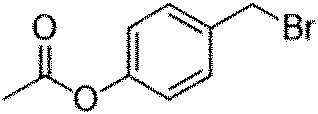
Se disolvió 4-acetoxibenzaldehído (1,5 g, 9,0 mmol) en 50 ml de diclorometano anhidro, seguido de agitación en baño de hielo durante 10 minutos. Se añadió lentamente gota a gota tribromuro de fósforo (0,9 g, 3,3 mmol). Después de eso, la reacción continuó bajo un baño de hielo durante 1 hora. Después de añadir 200 ml de diclorometano para diluir la solución de reacción, se realizó el lavado con agua (50 ml x 3), lavado con salmuera saturada (100 ml x 1), desecado con sulfato de sodio anhidro y filtración. Y el disolvente se eliminó por evaporación a presión reducida, obteniéndose un producto en bruto, que se purificó mediante cromatografía en columna, obteniéndose bromuro de 3-acetoxi-4-metoxibencilo (1,8 g, rendimiento: 87 %). RMN de 1H (400 MHz, CDCh) 87,40 (d, J = 8,2 Hz, 2H), 7,07 (d, J = 8,2 Hz, 2H), 4,48 (s, 2H), 2,30 (s, 3H). RMN de 13C (100 MHz, CDCla) 8169,36, 150,57, 135,38, 130,28, 122,01, 32,80, 21,21.4-Acetoxybenzaldehyde (1.5 g, 9.0 mmol) was dissolved in 50 ml of anhydrous dichloromethane, followed by stirring in an ice bath for 10 minutes. Phosphorus tribromide (0.9 g, 3.3 mmol) was slowly added dropwise. After that, the reaction was continued under an ice bath for 1 hour. After adding 200 ml of dichloromethane to dilute the reaction solution, washing with water (50 ml x 3), washing with saturated brine (100 ml x 1), drying with anhydrous sodium sulfate and filtration were performed. And the solvent was removed by evaporation under reduced pressure, to obtain a crude product, which was purified by column chromatography, to obtain 3-acetoxy-4-methoxybenzyl bromide (1.8 g, yield: 87%). 1H NMR (400 MHz, CDCh) 87.40 (d, J=8.2 Hz, 2H), 7.07 (d, J=8.2 Hz, 2H), 4.48 (s, 2H), 2.30 (s, 3H). 13C NMR (100 MHz, CDCla) 8169.36, 150.57, 135.38, 130.28, 122.01, 32.80, 21.21.
10.3 Preparación de10.3 Preparation of

(51211, producto intermedio 24)(51211, Intermediate 24)
Se adoptó el mismo método de síntesis que para el producto intermedio 15, pero se utilizó bromuro de 4-acetoxibencilo en lugar de bromuro de 4-fluorobencilo para preparar 203 mg del producto intermedio 24, en forma de una sustancia oleosa incolora, con un rendimiento del 46 %. Peso molecular: 437,49. RMN de 1H (400 MHz, CDCh) 87,37 (d, J = 8,1 Hz, 2H), 7,20 (m, 3H), 7,15 (d, J = 8,1 Hz, 2H), 6,98 (m, 2H), 4,92 (s, 1H), 4,86 (m, 2H), 4,72 (t, J = 4,1 Hz, 1H), 3,43 (dd, J = 14,0, 5,3 Hz, 1H), 3,15 (dd, J = 14,1, 3,0 Hz, 1H), 2,32 (s, 3H), 1,59 (s, 9H). RMN de 13C (100 MHz, CDCh) 8 174,85; 169,36; 168,71; 151,17; 149,53; 134,29; 131,77; 129,64; 129,38; 128,38; 127,13; 122,17; 96,22; 82,77; 72,71; 60,42; 35,58; 28,33; 21,21.The same synthesis method as for intermediate 15 was adopted, but 4-acetoxybenzyl bromide was used instead of 4-fluorobenzyl bromide to prepare 203 mg of intermediate 24, as a colorless oily substance, in yield 46%. Molecular weight: 437.49. 1H NMR (400 MHz, CDCh) 87.37 (d, J=8.1 Hz, 2H), 7.20 (m, 3H), 7.15 (d, J=8.1 Hz, 2H), 6.98 (m, 2H), 4.92 (s, 1H), 4.86 (m, 2H), 4.72 (t, J = 4.1 Hz, 1H), 3.43 (dd, J = 14.0, 5.3 Hz, 1H), 3.15 (dd, J = 14.1, 3.0 Hz, 1H), 2.32 (s, 3H), 1.59 (s, 9H) . 13C NMR (100 MHz, CDCh) 8,174.85; 169.36; 168.71; 151.17; 149.53; 134.29; 131.77; 129.64; 129.38; 128.38; 127.13; 122.17; 96.22; 82.77; 72.71; 60.42; 35.58; 28.33; 21,21.
10.4 Preparación del compuesto10.4 Compound Preparation
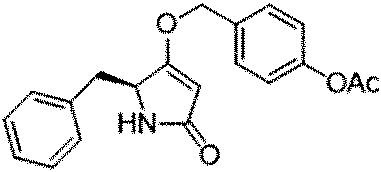
(51351)(51351)
Se utilizó el producto intermedio 24 (203 mg, 0,46 mmol) como materia prima y se adoptó el mismo método de síntesis que en el Ejemplo 1 para preparar 113 mg del sólido blanco del Ejemplo 10 con un rendimiento del 72%. Peso molecular: 337,38. RMN de 1H (400 MHz, CDCh) 87,40 (d, J = 8,5 Hz, 2H), 7,27 (m, 3H), 7,17 (m, 4H), 5,81 (s, 1H), 5,06 (s, 1H), 4,94 (m, 2H), 4,27 (dd, J = 9,1, 3,7 Hz, 1H), 3,21 (dd, J = 13,7, 3,7 Hz, 1H), 2,68 (dd, J = 13,6, 9,0 Hz, 1H), 2,32 (s, 3H). RMN 13C (100 MHz, CDCh) 8 175,95, 173,56, 169,41, 151,04, 136,54, 132,35, 129,28, 129,27, 128,76, 127,12, 122,10, 95,19, 72,62, 58,84, 38,72, 21,22.Intermediate 24 (203 mg, 0.46 mmol) was used as raw material, and the same synthesis method as in Example 1 was adopted to prepare 113 mg of the white solid of Example 10 in 72% yield. Molecular weight: 337.38. 1H NMR (400 MHz, CDCh) 87.40 (d, J = 8.5 Hz, 2H), 7.27 (m, 3H), 7.17 (m, 4H), 5.81 (s, 1H ), 5.06 (s, 1H), 4.94 (m, 2H), 4.27 (dd, J = 9.1, 3.7 Hz, 1H), 3.21 (dd, J = 13, 7, 3.7 Hz, 1H), 2.68 (dd, J=13.6, 9.0 Hz, 1H), 2.32 (s, 3H). 13C NMR (100 MHz, CDCh) 8 175.95, 173.56, 169.41, 151.04, 136.54, 132.35, 129.28, 129.27, 128.76, 127.12, 122 .10, 95.19, 72.62, 58.84, 38.72, 21.22.
Ejemplo 11 Preparación del compuestoExample 11 Preparation of the compound

(51321) (51321)
(51321)(51321)
11.1 Preparación de11.1 Preparation of

(51181, producto intermedio 25)(51181, Intermediate 25)
Se adoptó el mismo método de síntesis que para el producto intermedio 15, pero se utilizó benzoato de metil-4-bromometilo en lugar de bromuro de 4-fluorobencilo para preparar el producto intermedio 25, en forma de una sustancia oleosa incolora (169 mg, rendimiento: 39 %). Peso molecular: 437,49. RMN de 1H (400 MHz, CDCh) 88,08 (d, J = 7,7 Hz, 2H), 7,40 (d, J = 7,8 Hz, 2H), 7,21 (m, 3H), 7,00 (m, 2H), 4,94 (m, 2H), 4,92 (s, 1H), 4,75 (dd, J = 5,6, 3,1 Hz, 1H), 3,93 (s, 3H), 3,42 (dd, J = 14,0, 5,4 Hz, 1H), 3,19 (dd, J = 13,9, 3,1 Hz, 1H), 1,59 (s, 9H). RMN de 13C (100 MHz, CDCla) 8174,83; 168,56; 166,58; 149,50; 139,07; 134,36; 130,73; 130,18; 129,61; 128,44; 127,57; 127,18; 96,43; 82,88; 72,54; 60,44; 52,39; 35,77; 28,34.The same synthesis method as for intermediate 15 was adopted, but methyl-4-bromomethyl benzoate was used instead of 4-fluorobenzyl bromide to prepare intermediate 25, as a colorless oily substance (169 mg, yield: 39%). Molecular weight: 437.49. 1H NMR (400 MHz, CDCh) 88.08 (d, J=7.7 Hz, 2H), 7.40 (d, J=7.8 Hz, 2H), 7.21 (m, 3H), 7.00 (m, 2H), 4.94 (m, 2H), 4.92 (s, 1H), 4.75 (dd, J=5.6, 3.1Hz, 1H), 3.93 (s, 3H), 3.42 (dd, J = 14.0, 5.4 Hz, 1H), 3.19 (dd, J = 13.9, 3.1 Hz, 1H), 1.59 ( s, 9H). 13C NMR (100 MHz, CDCla) 8174.83; 168.56; 166.58; 149.50; 139.07; 134.36; 130.73; 130.18; 129.61; 128.44; 127.57; 127.18; 96.43; 82.88; 72.54; 60.44; 52.39; 35.77; 28.34.
11.2 Preparación del compuesto11.2 Compound Preparation

(51321)(51321)
Se utilizó el producto intermedio 25 (169 mg, 0,39 mmol) como materia prima y se adoptó el mismo método de síntesis que en el Ejemplo 1 para preparar 93 mg del sólido blanco del Ejemplo 11 con un rendimiento del 72%. Peso molecular: 337,38. RMN de 1H (400 MHz, CDCla) 88,09 (d, J = 8,0 Hz, 2H), 7,45 (d, J = 8,0 Hz, 2H), 7,25 (m, 5H), 5,72 (s, 1H), 5,04 (m, 3H), 4,31 (dd, J = 9,2, 3,7 Hz, 1H), 3,94 (s, 3H), 3,24 (dd, J = 13,6, 3,8 Hz, 1H), 2,70 (dd, J = 13,6, 9,1 Hz, 1H). RMN 13C (100 MHz, CDCh) 8 175,85, 173,33, 166,65, 139,68, 136,52, 130,59, 130,16, 129,26, 128,84, 127,49, 127,22, 95,48, 72,48, 58,84, 52,39, 38,85.Intermediate 25 (169 mg, 0.39 mmol) was used as raw material, and the same synthesis method as in Example 1 was adopted to prepare 93 mg of the white solid of Example 11 in 72% yield. Molecular weight: 337.38. 1H NMR (400 MHz, CDCla) 88.09 (d, J = 8.0 Hz, 2H), 7.45 (d, J = 8.0 Hz, 2H), 7.25 (m, 5H), 5.72 (s, 1H), 5.04 (m, 3H), 4.31 (dd, J = 9.2, 3.7 Hz, 1H), 3.94 (s, 3H), 3.24 (dd, J=13.6, 3.8 Hz, 1H), 2.70 (dd, J=13.6, 9.1 Hz, 1H). 13C NMR (100 MHz, CDCh) 8 175.85, 173.33, 166.65, 139.68, 136.52, 130.59, 130.16, 129.26, 128.84, 127.49, 127 .22, 95.48, 72.48, 58.84, 52.39, 38.85.
Ejemplo 12 Preparación del compuestoExample 12 Preparation of the compound

(51332)(51332)
12.1 Preparación de12.1 Preparation of

(51191, producto intermedio 26)(51191, Intermediate 26)
Se adoptó el mismo método de síntesis que para el producto intermedio 15, pero se utilizó bromuro de 4-cianobencilo en lugar de bromuro de 4-fluorobencilo para preparar el producto intermedio 26, en forma de una sustancia oleosa incolora (236 mg, rendimiento: 58 %). Peso molecular: 404,47. RMN de 1H (400 MHz, CDCh) 87,69 (d, J = 8,0 Hz, 2H), 7,41 (d, J = 8,0 Hz, 2H), 7,20 (m, 3H), 6,99 (m, 2H), 4,35 (m, 2H), 4,91 (s, 1H), 4,76 (dd, J = 5,7, 3,1 Hz, 1H), 3,40 (dd, J = 14,0, 5,6 Hz, 1H), 3,21 (dd, J = 14,1, 3,1 Hz, 1H), 1,59 (s, 9H). RMN 13C (100 MHz, CDCh) 8174,63, 168,34, 149,40, 139,35, 134,36, 132,67, 129,51, 128,45, 128,01, 127,18, 118,33, 112,79, 96,59, 82,98, 71,95, 60,38, 35,86, 28,31. The same synthesis method as for intermediate 15 was adopted, but 4-cyanobenzyl bromide was used instead of 4-fluorobenzyl bromide to prepare intermediate 26 as a colorless oily substance (236 mg, yield: 58%). Molecular weight: 404.47. 1H NMR (400 MHz, CDCh) 87.69 (d, J=8.0 Hz, 2H), 7.41 (d, J=8.0 Hz, 2H), 7.20 (m, 3H), 6.99 (m, 2H), 4.35 (m, 2H), 4.91 (s, 1H), 4.76 (dd, J = 5.7, 3.1 Hz, 1H), 3.40 (dd, J = 14.0, 5.6 Hz, 1H), 3.21 (dd, J = 14.1, 3.1 Hz, 1H), 1.59 (s, 9H). 13C NMR (100 MHz, CDCh) 8174.63, 168.34, 149.40, 139.35, 134.36, 132.67, 129.51, 128.45, 128.01, 127.18, 118, 33, 112.79, 96.59, 82.98, 71.95, 60.38, 35.86, 28.31.

(51332)(51332)
Se utilizó el producto intermedio 26 (236 mg, 0,58 mmol) como materia prima y se adoptó el mismo método de síntesis que en el Ejemplo 1 para preparar 88 mg del sólido blanco del Ejemplo 12 con un rendimiento del 49 %. Peso molecular: 304,35. RMN de 1H (400 MHz, CDCla) 87,72 (d, J = 7,9 Hz, 2H), 7,48 (d, J = 7,9 Hz, 2H), 7,30 (m, 3H), 7,20 (d, J = 7,2 Hz, 2H), 5,54 (s, 1H), 5,04 (m, 3H), 4,32 (dd, J = 9,5, 3,7 Hz, 1H), 3,24 (dd, J = 13,7, 3,8 Hz, 1H), 2,69 (dd, J = 13,6, 9,3 Hz, 1H). RMN de 13C (100 MHz, CDCla) 8175,58, 172,96, 139,94, 136,47, 132,74, 129,21, 128,95, 128,03, 127,35, 118,44, 112,82, 95,73, 71,99, 58,82, 38,96.Intermediate 26 (236 mg, 0.58 mmol) was used as raw material, and the same synthesis method as in Example 1 was adopted to prepare 88 mg of the white solid of Example 12 in 49% yield. Molecular weight: 304.35. 1H NMR (400 MHz, CDCla) 87.72 (d, J=7.9 Hz, 2H), 7.48 (d, J=7.9 Hz, 2H), 7.30 (m, 3H), 7.20 (d, J=7.2Hz, 2H), 5.54 (s, 1H), 5.04 (m, 3H), 4.32 (dd, J=9.5, 3.7Hz , 1H), 3.24 (dd, J=13.7, 3.8 Hz, 1H), 2.69 (dd, J=13.6, 9.3 Hz, 1H). 13C NMR (100 MHz, CDCla) 8175.58, 172.96, 139.94, 136.47, 132.74, 129.21, 128.95, 128.03, 127.35, 118.44, 112 .82, 95.73, 71.99, 58.82, 38.96.
Ejemplo 13 Preparación del compuestoExample 13 Preparation of the compound

(51081)(51081)
13.1 Preparación de13.1 Preparation of

(51021, producto intermedio 27)(51021, Intermediate 27)
Se adoptó el mismo método de síntesis que para el producto intermedio 15, pero se utilizó bromuro de 4-nitrobencilo en lugar de bromuro de 4-fluorobencilo para preparar el producto intermedio 27, en forma de una sustancia oleosa incolora (211 mg, rendimiento: 50%). Peso molecular: 424,45. RMN de 1H (400 MHz, CDCla) 88,26 (d, J = 8,5 Hz, 2H), 7,46 (d, J = 8,4 Hz, 2H), 7,22 (m, 3H), 7,02 (m, 2H), 5,00 (m, 2H), 4,95 (s, 1H), 4,79 (dd, J = 5,4, 3,2 Hz, 1H), 3,41 (dd, J = 14,0, 5,7 Hz, 1H), 3,24 (dd, J = 14,0, 3,0 Hz, 1H), 1,60 (s, 9H). RMN de 13C (100 MHz, CDCh) 8 174,66, 168,29, 149,50, 148,24, 141,24, 134,48, 129,57, 128,56, 128,12, 127,29, 124,17, 96,73, 83,11, 71,69, 60,47, 36,02, 28,38.The same synthesis method as for intermediate 15 was adopted, but 4-nitrobenzyl bromide was used instead of 4-fluorobenzyl bromide to prepare intermediate 27 as a colorless oily substance (211 mg, yield: fifty%). Molecular weight: 424.45. 1H NMR (400 MHz, CDCla) 88.26 (d, J=8.5 Hz, 2H), 7.46 (d, J=8.4 Hz, 2H), 7.22 (m, 3H), 7.02 (m, 2H), 5.00 (m, 2H), 4.95 (s, 1H), 4.79 (dd, J=5.4, 3.2Hz, 1H), 3.41 (dd, J = 14.0, 5.7 Hz, 1H), 3.24 (dd, J = 14.0, 3.0 Hz, 1H), 1.60 (s, 9H). 13C NMR (100 MHz, CDCh) 8 174.66, 168.29, 149.50, 148.24, 141.24, 134.48, 129.57, 128.56, 128.12, 127.29, 124.17, 96.73, 83.11, 71.69, 60.47, 36.02, 28.38.
13.2 Preparación del compuesto13.2 Compound Preparation

(51081)(51081)
Se utilizó el producto intermedio 27 (211 mg, 0,50 mmol) como materia prima y se adoptó el mismo método de síntesis que en el Ejemplo 1 para preparar 110 mg del sólido blanco del Ejemplo 13 con un rendimiento del 68%. Peso molecular: 324,34. RMN de 1H (400 MHz, CDCh) 88,28 (d, J = 8,4 Hz, 2H), 7,54 (d, J = 8,4 Hz, 2H), 7,26 (m, 5H), 5,84 (s, 1H), 5,09 (m, 2H), 5,08 (s, 1H), 4,35 (dd, J = 9,0, 3,9 Hz, 1H), 3,24 (dd, J = 13,7, 4,0 Hz, 1H), 2,74 (dd, J = 13,7, 8,9 Hz, 1H). RMN 13C (100 MHz, CDCh) 8 175,53, 173,05, 148,14, 141,85, 136,37, 129,24, 128,88, 128,10, 127,29, 124,12, 95,82, 71,66, 58,78, 38,85.Intermediate 27 (211 mg, 0.50 mmol) was used as raw material, and the same synthesis method as in Example 1 was adopted to prepare 110 mg of the white solid of Example 13 in 68% yield. Molecular weight: 324.34. 1H NMR (400 MHz, CDCh) 88.28 (d, J=8.4 Hz, 2H), 7.54 (d, J=8.4 Hz, 2H), 7.26 (m, 5H), 5.84 (s, 1H), 5.09 (m, 2H), 5.08 (s, 1H), 4.35 (dd, J = 9.0, 3.9 Hz, 1H), 3.24 (dd, J=13.7, 4.0 Hz, 1H), 2.74 (dd, J=13.7, 8.9 Hz, 1H). 13C NMR (100 MHz, CDCh) 8 175.53, 173.05, 148.14, 141.85, 136.37, 129.24, 128.88, 128.10, 127.29, 124.12, 95 .82, 71.66, 58.78, 38.85.
Ejemplo 14 Preparación del compuestoExample 14 Preparation of the compound

Ejemplo 14 Preparación del compuesto (51111)Example 14 Preparation of compound (51111)
14.1 Preparación de14.1 Preparation of

(51051, producto intermedio 28)(51051, Intermediate 28)
Se adoptó el mismo método de síntesis que para el producto intermedio 15, pero se utilizó 2-bromometilnaftaleno en lugar de bromuro de 4-fluorobencilo para preparar el producto intermedio 28, en forma de una sustancia oleosa incolora (70 mg, rendimiento: 16 %). Peso molecular: 429,52. RMN de 1H (400 MHz, CDCh) 87,89 (m, 3H), 7,81 (s, 1H), 7,55 (m, 2H), 7,46 (d, J = 8,4 Hz, 1H), 7,19 (s, 3H), 7,02 (d, J = 4,3 Hz, 2H), 5,06 (m, 2H), 4,99 (s, 1H), 4,76 (s, 1H), 3,45 (dd, J = 13,9, 5,2 Hz, 1H), 3,19 (dd, J = 13,7, 2,2 Hz, 1H), 1,61 (s, 9H). RMN 13C (100 MHz, CDCla) 8175,03, 168,81, 149,56, 134,35, 133,47, 133,18, 131,58, 129,69, 128,89, 128,36, 128,14, 127,90, 127,57, 127,12, 126,85, 126,76, 125,41, 96,26, 82,75, 73,59, 60,48, 35,65, 28,34.The same synthesis method as for intermediate 15 was adopted, but 2-bromomethylnaphthalene was used instead of 4-fluorobenzyl bromide to prepare intermediate 28, as a colorless oily substance (70 mg, yield: 16% ). Molecular weight: 429.52. 1H NMR (400 MHz, CDCh) 87.89 (m, 3H), 7.81 (s, 1H), 7.55 (m, 2H), 7.46 (d, J = 8.4 Hz, 1H ), 7.19 (s, 3H), 7.02 (d, J = 4.3 Hz, 2H), 5.06 (m, 2H), 4.99 (s, 1H), 4.76 (s , 1H), 3.45 (dd, J = 13.9, 5.2 Hz, 1H), 3.19 (dd, J = 13.7, 2.2 Hz, 1H), 1.61 (s, 9H). 13C NMR (100 MHz, CDCla) 8175.03, 168.81, 149.56, 134.35, 133.47, 133.18, 131.58, 129.69, 128.89, 128.36, 128, 14, 127.90, 127.57, 127.12, 126.85, 126.76, 125.41, 96.26, 82.75, 73.59, 60.48, 35.65, 28.34.
14.2 Preparación del compuesto14.2 Compound Preparation

(51111)(51111)
Se utilizó el producto intermedio 28 (140 mg, 0,33 mmol) como materia prima y se utilizó el mismo método de síntesis del Ejemplo 1 para preparar 94 mg del sólido blanco del Ejemplo 14 con un rendimiento del 88 %. Peso molecular: 329,40. RMN de 1H (400 MHz, CDCla) 87,87 (m, 4H), 7,53 (m, 3H), 7,25 (m, 5H), 5,55 (s, 1H), 5,14 (m, 2H), 5,13 (s, 1H), 4,30 (dd, J = 9,4, 3,5 Hz, 1H), 3,25 (dd, J = 13,6, 3,6 Hz, 1H), 2,67 (dd, J = 13,6, 9,3 Hz, 1H). RMN de 13C (100 MHz, CDCh) 8176,17, 173,55, 136,70, 133,47, 133,24, 132,15, 129,29, 128,88, 128,85, 128,15, 127,93, 127,47, 127,20, 126,78, 126,74, 125,43, 95,24, 73,55, 58,95, 38,93.Intermediate 28 (140 mg, 0.33 mmol) was used as starting material and the same synthesis method of Example 1 was used to prepare 94 mg of the white solid of Example 14 in 88% yield. Molecular weight: 329.40. 1H NMR (400 MHz, CDCla) 87.87 (m, 4H), 7.53 (m, 3H), 7.25 (m, 5H), 5.55 (s, 1H), 5.14 (m , 2H), 5.13 (s, 1H), 4.30 (dd, J = 9.4, 3.5 Hz, 1H), 3.25 (dd, J = 13.6, 3.6 Hz, 1H), 2.67 (dd, J=13.6, 9.3 Hz, 1H). 13C NMR (100 MHz, CDCh) 8176.17, 173.55, 136.70, 133.47, 133.24, 132.15, 129.29, 128.88, 128.85, 128.15, 127 .93, 127.47, 127.20, 126.78, 126.74, 125.43, 95.24, 73.55, 58.95, 38.93.
Ejemplo 15 Preparación del compuestoExample 15 Preparation of the compound

(51311)(51311)
15.1 Preparación de15.1 Preparation of

(51171, producto intermedio 29)(51171, Intermediate 29)
Se adoptó el mismo método de síntesis que para el producto intermedio 15, pero se utilizó 1-bromometilnaftaleno en lugar de bromuro de 4-fluorobencilo para preparar el producto intermedio 29, en forma de una sustancia oleosa incolora (206 mg, rendimiento: 48 %). Peso molecular: 429,52. RMN de 1H (400 MHz, CDCh) 87,96 (m, 3H), 7,61 (m, 2H), 7,50 (m, 2H), 7,17 (m, 3H), 6,94 (m, 2H), 5,33 (m, 2H), 5,08 (s, 1H), 4,73 (dd, J = 5,1, 3,0 Hz, 1H), 3,43 (dd, J = 14,0, 5,2 Hz, 1H), 3,08 (dd, J = 14,0, 3,0 Hz, 1H). 1,60 (s, 9H). RMN 13C (100 MHz, CDCh) 8174,91, 168,79, 149,47, 134,17, 133,84, 131,45, 130,16, 129,73, 129,65, 128,98, 128,24, 127,88, 127,01, 126,97, 126,34, 125,28, 123,31,96,21, 82,64, 71,79, 60,41, 35,38, 28,28. The same synthesis method as for intermediate 15 was adopted, but 1-bromomethylnaphthalene was used instead of 4-fluorobenzyl bromide to prepare intermediate 29, as a colorless oily substance (206 mg, yield: 48% ). Molecular weight: 429.52. 1H NMR (400 MHz, CDCh) 87.96 (m, 3H), 7.61 (m, 2H), 7.50 (m, 2H), 7.17 (m, 3H), 6.94 (m , 2H), 5.33 (m, 2H), 5.08 (s, 1H), 4.73 (dd, J = 5.1, 3.0 Hz, 1H), 3.43 (dd, J = 14.0, 5.2 Hz, 1H), 3.08 (dd, J = 14.0, 3.0 Hz, 1H). 1.60 (s, 9H). 13C NMR (100 MHz, CDCh) 8174.91, 168.79, 149.47, 134.17, 133.84, 131.45, 130.16, 129.73, 129.65, 128.98, 128, 24, 127.88, 127.01, 126.97, 126.34, 125.28, 123.31,96.21, 82.64, 71.79, 60.41, 35.38, 28.28.
..

(51311)(51311)
Se utilizó el producto intermedio 29 (206 mg, 0,48 mmol) como materia prima y se adoptó el mismo método de síntesis que en el Ejemplo 1 para preparar 122 mg del sólido blanco del Ejemplo 15 con un rendimiento del 77%. Peso molecular: 329,40. RMN de 1H (400 MHz, CDCla) 87,95 (m, 3H), 7,53 (m, 4H), 7,20 (m, 5H), 5,71 (s, 1H), 5,41 (m, 2H), 5,23 (s, 1H), 4,26 (dd, J = 9,2, 3,5 Hz, 1H), 3,18 (dd, J = 13,6, 3,5 Hz, 1H), 2,62 (dd, J = 13,6, 9,3 Hz, 1H). RMN de 13C (100 MHz, CDCla) 8176,14, 173,63, 136,63, 133,92, 131,64, 130,26, 130,12, 129,28, 129,01, 128,75, 127,83, 127,12, 126,96, 126,33, 125,33, 123,47, 95,16, 71,94, 58,96, 38,75.Intermediate 29 (206 mg, 0.48 mmol) was used as raw material, and the same synthesis method as in Example 1 was adopted to prepare 122 mg of the white solid of Example 15 in 77% yield. Molecular weight: 329.40. 1H NMR (400 MHz, CDCla) 87.95 (m, 3H), 7.53 (m, 4H), 7.20 (m, 5H), 5.71 (s, 1H), 5.41 (m , 2H), 5.23 (s, 1H), 4.26 (dd, J = 9.2, 3.5 Hz, 1H), 3.18 (dd, J = 13.6, 3.5 Hz, 1H), 2.62 (dd, J=13.6, 9.3Hz, 1H). 13C NMR (100 MHz, CDCla) 8176.14, 173.63, 136.63, 133.92, 131.64, 130.26, 130.12, 129.28, 129.01, 128.75, 127 .83, 127.12, 126.96, 126.33, 125.33, 123.47, 95.16, 71.94, 58.96, 38.75.
Ejemplo 16 Preparación del compuestoExample 16 Preparation of the compound

(51301)(51301)
16.1 Preparación de16.1 Preparation of

(51161, producto intermedio 30)(51161, Intermediate 30)
Se adoptó el mismo método de síntesis que para el producto intermedio 15, pero se utilizó bromuro de cinamilo en lugar de bromuro de 4-fluorobencilo para preparar el producto intermedio 30, en forma de una sustancia oleosa incolora (124 mg, rendimiento: 31 %). Peso molecular: 405,49. RMN de 1H (400 MHz, CDCla) 87,38 (m, 5H), 7,20 (m, 3H), 7,04 (m, 2H), 6,70 (d, J = 15,9 Hz, 1H), 6,31 (dt, J = 15,9, 6,3 Hz, 1H), 4,89 (s, 1H), 4,71 (dd, J = 5,2, 3,1 Hz, 1H), 4,57 (m, 2H), 3,46 (dd, J = 14,0, 5,2 Hz, 1H), 3,17 (dd, J = 14,0, 3,1 Hz, 1H). 1,61 (s, 9H). RMN de 13C (100 MHz, CDCh) 8 174,85; 168,79; 149,51; 135,58; 135,53; 134,23; 129,66; 128,75; 128,60; 128,26; 127,04; 126,76; 121,26; 95,89; 82,65; 72,00; 60,36; 35,51; 28,28.The same synthesis method as for intermediate 15 was adopted, but cinnamyl bromide was used instead of 4-fluorobenzyl bromide to prepare intermediate 30, as a colorless oily substance (124 mg, yield: 31% ). Molecular weight: 405.49. 1H NMR (400 MHz, CDCla) 87.38 (m, 5H), 7.20 (m, 3H), 7.04 (m, 2H), 6.70 (d, J = 15.9 Hz, 1H ), 6.31 (dt, J = 15.9, 6.3 Hz, 1H), 4.89 (s, 1H), 4.71 (dd, J = 5.2, 3.1 Hz, 1H) , 4.57 (m, 2H), 3.46 (dd, J=14.0, 5.2 Hz, 1H), 3.17 (dd, J=14.0, 3.1 Hz, 1H). 1.61 (s, 9H). 13C NMR (100 MHz, CDCh) 8,174.85; 168.79; 149.51; 135.58; 135.53; 134.23; 129.66; 128.75; 128.60; 128.26; 127.04; 126.76; 121.26; 95.89; 82.65; 72.00; 60.36; 35.51; 28,28.
16.2 Preparación del compuesto16.2 Compound Preparation

(51301)(51301)
Se utilizó el producto intermedio 30 (124 mg, 0,3 mmol) como materia prima y se adoptó el mismo método de síntesis que en el Ejemplo 1 para preparar 70 mg del sólido blanco del Ejemplo 16 con un rendimiento del 75 %. Peso molecular: 305,38. RMN de 1H (400 MHz, CDCh) 87,31 (m, 10H), 6,72 (d, J = 16,0 Hz, 1H), 6,34 (dd, J = 15,4, 7,0 Hz, 1H), 5,79 (s, 1H), 5,04 (s, 1H), 4,62 (m, 2H), 4,26 (d, J = 8,9 Hz, 1H), 3,22 (d, J = 13,7 Hz, 1H), 2,68 (dd, J = 13,6, 8,9 Hz, 1H). RMN de 13C (100 MHz, CDCh) 8176,05, 173,76, 136,60, 135,84, 135,26, 129,32, 128,81, 128,75, 128,56, 127,12, 126,82, 121,91,94,88, 72,02, 58,88, 38,76.Intermediate 30 (124 mg, 0.3 mmol) was used as raw material, and the same synthesis method as in Example 1 was adopted to prepare 70 mg of the white solid of Example 16 in 75% yield. Molecular weight: 305.38. 1H NMR (400 MHz, CDCh) 87.31 (m, 10H), 6.72 (d, J = 16.0 Hz, 1H), 6.34 (dd, J = 15.4, 7.0 Hz , 1H), 5.79 (s, 1H), 5.04 (s, 1H), 4.62 (m, 2H), 4.26 (d, J = 8.9 Hz, 1H), 3.22 (d, J=13.7 Hz, 1H), 2.68 (dd, J=13.6, 8.9 Hz, 1H). 13C NMR (100 MHz, CDCh) 8176.05, 173.76, 136.60, 135.84, 135.26, 129.32, 128.81, 128.75, 128.56, 127.12, 126 .82, 121.91,94.88, 72.02, 58.88, 38.76.
Ejemplo 17 Preparación del compuestoExample 17 Preparation of the compound

(51151)(51151)
17.1 Preparación de17.1 Preparation of

(51061, producto intermedio 31)(51061, Intermediate 31)
Se adoptó el mismo método de síntesis que para el producto intermedio 15, pero se utilizó 2-bromometiltiofeno en lugar de bromuro de 4-fluorobencilo para preparar el producto intermedio 31, en forma de una sustancia oleosa incolora (124 mg, rendimiento: 32 %). Peso molecular: 386,48. RMN de 1H (400 MHz, CDCh) 87,43 (d, J = 4,9 Hz, 1H), 7,17 (m, 4H), 7,06 (m, 1H), 6,99 (m, 2H), 5,05 (m, 2H), 4,94 (s, 1H), 4,70 (m, 1H), 3,45 (dd, J = 14,0, 4,9 Hz, 1H), 3,11 (dd, J = 14,0, 2,5 Hz, 1H), 1,60 (s, 9H). RMN de 13C (100 MHz, CDCla) 8174,36, 168,69, 149,54, 135,87, 134,18, 129,72, 129,02, 128,36, 127,84, 127,26, 127,11, 96,24, 82,78, 67,64, 60,42, 35,39, 28,35.The same synthesis method as for intermediate 15 was adopted, but 2-bromomethylthiophene was used instead of 4-fluorobenzyl bromide to prepare intermediate 31, as a colorless oily substance (124 mg, yield: 32% ). Molecular weight: 386.48. 1H NMR (400 MHz, CDCh) 87.43 (d, J = 4.9 Hz, 1H), 7.17 (m, 4H), 7.06 (m, 1H), 6.99 (m, 2H ), 5.05 (m, 2H), 4.94 (s, 1H), 4.70 (m, 1H), 3.45 (dd, J = 14.0, 4.9 Hz, 1H), 3 0.11 (dd, J = 14.0, 2.5 Hz, 1H), 1.60 (s, 9H). 13C NMR (100 MHz, CDCla) 8174.36, 168.69, 149.54, 135.87, 134.18, 129.72, 129.02, 128.36, 127.84, 127.26, 127 .11, 96.24, 82.78, 67.64, 60.42, 35.39, 28.35.
17.2 Preparación del compuesto17.2 Compound Preparation

(51151)(51151)
Se utilizó el producto intermedio 31 (124 mg, 0,32 mmol) como materia prima y se adoptó el mismo método de síntesis que en el Ejemplo 1 para preparar 71 mg del sólido blanco del Ejemplo 17 con un rendimiento del 77%. Peso molecular: 285,36. RMN de 1H (400 MHz, CDCla) 87,40 (d, J = 5,0 Hz, 1H), 7,26 (m, 3H), 7,17 (m, 3H), 7,05 (t, J = 3,9 Hz, 1H), 5,71 (s, 1H), 5,14 (m, 2H), 5,09 (s, 1H), 4,25 (d, J = 6,5 Hz, 1H), 3,20 (dd, J = 13,6, 2,6 Hz, 1H), 2,65 (dd, J = 13,5, 9,2 Hz, 1H). RMN 13C (100 MHz, CDCh) 8175,53, 173,48, 136,60, 136,55, 129,32, 128,78, 128,61, 127,53, 127,17, 127,15, 95,24, 67,71, 58,86, 38,67.Intermediate 31 (124 mg, 0.32 mmol) was used as raw material, and the same synthesis method as in Example 1 was adopted to prepare 71 mg of the white solid of Example 17 in 77% yield. Molecular weight: 285.36. 1H NMR (400 MHz, CDCla) 87.40 (d, J = 5.0 Hz, 1H), 7.26 (m, 3H), 7.17 (m, 3H), 7.05 (t, J = 3.9 Hz, 1H), 5.71 (s, 1H), 5.14 (m, 2H), 5.09 (s, 1H), 4.25 (d, J = 6.5 Hz, 1H ), 3.20 (dd, J = 13.6, 2.6 Hz, 1H), 2.65 (dd, J = 13.5, 9.2 Hz, 1H). 13C NMR (100 MHz, CDCh) 8175.53, 173.48, 136.60, 136.55, 129.32, 128.78, 128.61, 127.53, 127.17, 127.15, 95, 24, 67.71, 58.86, 38.67.
Ejemplo 18 Preparación del compuestoExample 18 Preparation of the compound

(51571)(51571)
18.1 Preparación de18.1 Preparation of

(51521, producto intermedio 32)(51521, Intermediate 32)
Se adoptó el mismo método de síntesis que para el producto intermedio 15, pero se utilizó p-bromofeniletano en lugar de bromuro de 4-fluorobencilo para preparar el producto intermedio 32, en forma de una sustancia oleosa incolora (339 mg, rendimiento: 86 %). Peso molecular: 393,48. RMN de 1H (400 MHz, CDCh) 87,36 (m, 2H), 7,26 (m, 3H), 7,10 (m, 3H), 6,68 (m, 2H), 4,76 (s, 1H), 4,64 (dd, J = 5,2, 3,0 Hz, 1H), 4,13 (m, 1H), 3,95 (m, 1H), 3,38 (dd, J = 13,9, 5,2 Hz, 1H), 3,07 (t, J = 6,5 Hz, 2H), 3,00 (dd, J = 13,9, 3,0 Hz, 1H), 1,59 (s, 9H). RMN 13C (100 MHz, CDCh) 8175,03, 168,83, 149,50, 137,26, 134,08, 129,54, 129,07, 128,76, 128,20, 127,09, 126,90, 95,44, 82,59, 72,06, 60,27, 35,38, 35,15, 28,30. The same synthesis method as for intermediate 15 was adopted, but p-bromophenylethane was used instead of 4-fluorobenzyl bromide to prepare intermediate 32, as a colorless oily substance (339 mg, yield: 86% ). Molecular weight: 393.48. 1H NMR (400 MHz, CDCh) 87.36 (m, 2H), 7.26 (m, 3H), 7.10 (m, 3H), 6.68 (m, 2H), 4.76 (s , 1H), 4.64 (dd, J = 5.2, 3.0 Hz, 1H), 4.13 (m, 1H), 3.95 (m, 1H), 3.38 (dd, J = 13.9, 5.2Hz, 1H), 3.07 (t, J=6.5Hz, 2H), 3.00 (dd, J=13.9, 3.0Hz, 1H), 1, 59 (s, 9H). 13C NMR (100 MHz, CDCh) 8175.03, 168.83, 149.50, 137.26, 134.08, 129.54, 129.07, 128.76, 128.20, 127.09, 126, 90, 95.44, 82.59, 72.06, 60.27, 35.38, 35.15, 28.30.
8.2 Preparación del compuesto8.2 Compound preparation

(51571)(51571)
Se utilizó el producto intermedio 32 (339 mg, 0,86 mmol) como materia prima y se adoptó el mismo método de síntesis que en el Ejemplo 1 para preparar 207 mg del sólido blanco del Ejemplo 18 con un rendimiento del 82%. Peso molecular: 293,37. RMN de 1H (400 MHz, CDCla) 87,33 (m, 2H), 7,21 (m, 6H), 7,03 (d, J = 6,9 Hz, 2H), 6,42 (s, 1H), 4,88 (s, 1H), 4,19 (dd, J = 8,2, 3,8 Hz, 1H), 4,08 (m, 2H), 3,06 (m, 3H), 2,62 (dd, J = 13,7, 8,1 Hz, 1H). RMN 13C (100 MHz, CDCla) 8 176,39, 137,32, 136,21, 129,33, 129,02, 128,73, 128,53, 126,96, 126,91, 94,40, 71,89, 58,79, 38,18, 35,10.Intermediate 32 (339 mg, 0.86 mmol) was used as raw material, and the same synthesis method as in Example 1 was adopted to prepare 207 mg of the white solid of Example 18 in 82% yield. Molecular weight: 293.37. 1H NMR (400 MHz, CDCla) 87.33 (m, 2H), 7.21 (m, 6H), 7.03 (d, J = 6.9 Hz, 2H), 6.42 (s, 1H ), 4.88 (s, 1H), 4.19 (dd, J = 8.2, 3.8 Hz, 1H), 4.08 (m, 2H), 3.06 (m, 3H), 2 .62 (dd, J=13.7, 8.1 Hz, 1H). 13C NMR (100 MHz, CDCla) 8 176.39, 137.32, 136.21, 129.33, 129.02, 128.73, 128.53, 126.96, 126.91, 94.40, 71 .89, 58.79, 38.18, 35.10.
Ejemplo 19 Preparación del compuestoExample 19 Preparation of the compound

(51731) 19.1 Preparación de(51731) 19.1 Preparation of

(51711, producto intermedio 33)(51711, Intermediate 33)
Se adoptó el mismo método de síntesis que para el producto intermedio 15, pero 2-(2-bromoetil)piridina en lugar de bromuro de 4-fluorobencilo para preparar el producto intermedio 33, en forma de una sustancia oleosa incolora (201 mg, rendimiento: 51 %). Peso molecular: 394,47. RMN de 1H (400 MHz, CDCla) 88,60 (d, J = 4,0 Hz, 1H), 7,65 (td, J = 7,6, 1,9 Hz, 1H), 7,15 (m, 5H), 6,72 (dd, J = 6,9, 2,6 Hz, 2H), 4,82 (s, 1H), 4,60 (dd, J = 5,4, 2,9 Hz, 1H), 4,29 (m, 2H), 3,34 (dd, J = 13,8, 5,3 Hz, 1H), 3,23 (m, 2H), 2,96 (dd, J = 13,9, 2,9 Hz, 1H), 1,57 (s, 9H). RMN de 13C (100 MHz, CDCh) 8175,02; 168,88; 157,27; 149,74; 149,54; 136,68; 134,07; 129,53; 128,25; 126,98; 123,92; 122,15; 95,63; 82,61; 70,52; 60,23; 37,26; 35,38; 28,31.The same synthesis method as for intermediate 15, but 2-(2-bromoethyl)pyridine instead of 4-fluorobenzyl bromide, was adopted to prepare intermediate 33, as a colorless oily substance (201 mg, yield : 51%). Molecular weight: 394.47. 1H NMR (400 MHz, CDCla) 88.60 (d, J=4.0 Hz, 1H), 7.65 (td, J=7.6, 1.9 Hz, 1H), 7.15 (m , 5H), 6.72 (dd, J = 6.9, 2.6 Hz, 2H), 4.82 (s, 1H), 4.60 (dd, J = 5.4, 2.9 Hz, 1H), 4.29 (m, 2H), 3.34 (dd, J = 13.8, 5.3 Hz, 1H), 3.23 (m, 2H), 2.96 (dd, J = 13 0.9, 2.9Hz, 1H), 1.57 (s, 9H). 13C NMR (100 MHz, CDCh) 8175.02; 168.88; 157.27; 149.74; 149.54; 136.68; 134.07; 129.53; 128.25; 126.98; 123.92; 122.15; 95.63; 82.61; 70.52; 60.23; 37.26; 35.38; 28.31.
19.2 Preparación del compuesto19.2 Compound Preparation

(51731)(51731)
Se utilizó el producto intermedio 33 (200 mg, 0,51 mmol) como materia prima y se adoptó el mismo método de síntesis que en el Ejemplo 1 para preparar 86 mg del sólido blanco del Ejemplo 19 con un rendimiento del 58%. Peso molecular: 294,35. RMN de 1H (400 MHz, CDCh) 88,59 (d, J = 4,3 Hz, 1H), 7,65 (td, J = 7,7, 1,9 Hz, 1H), 7,22 (m, 5H), 7,06 (m, 2H), 5,95 (s, 1H), 4,96 (s, 1H), 4,34 (m, 2H), 4,18 (dd, J = 8,8, 3,8 Hz, 1H), 3,26 (t, J = 6,6 Hz, 2H), 3,05 (dd, J = 13,7, 3,8 Hz, 1H), 2,56 (dd, J = 13,7, 8,6 Hz, 1H). RMN 13C (100 MHz, CDCh) 8 176,32, 174,13, 157,43, 149,69, 136,70, 136,39, 129,27, 128,66, 127,03, 123,78, 122,06, 94,49, 70,46, 58,73, 38,45, 37,29. Intermediate 33 (200 mg, 0.51 mmol) was used as raw material, and the same synthesis method as in Example 1 was adopted to prepare 86 mg of the white solid of Example 19 in 58% yield. Molecular weight: 294.35. 1H NMR (400 MHz, CDCh) 88.59 (d, J = 4.3 Hz, 1H), 7.65 (td, J = 7.7, 1.9 Hz, 1H), 7.22 (m , 5H), 7.06 (m, 2H), 5.95 (s, 1H), 4.96 (s, 1H), 4.34 (m, 2H), 4.18 (dd, J = 8, 8, 3.8 Hz, 1H), 3.26 (t, J = 6.6 Hz, 2H), 3.05 (dd, J = 13.7, 3.8 Hz, 1H), 2.56 ( dd, J=13.7, 8.6 Hz, 1H). 13C NMR (100 MHz, CDCh) 8 176.32, 174.13, 157.43, 149.69, 136.70, 136.39, 129.27, 128.66, 127.03, 123.78, 122 .06, 94.49, 70.46, 58.73, 38.45, 37.29.
Ejemplo 20 Preparación del compuestoExample 20 Preparation of the compound

(51551)(51551)
20.1 Preparación de20.1 Preparation of

(51501, producto intermedio 34)(51501, Intermediate 34)
Se adoptó el mismo método de síntesis que para el producto intermedio 15, pero bromuro de 2-ciclohexil-etilo en lugar de bromuro de 4-fluorobencilo para preparar el producto intermedio 34, en forma de una sustancia oleosa incolora, (341 mg, rendimiento: 85 %). Peso molecular: 399,53. RMN de 1H (400 MHz, CDCh) 87,20 (m, 3H), 7,00 (m, 2H), 4,78 (s, 1H), 4,66 (dd, J = 5,4, 3,0 Hz, 1H), 3,89 (m, 2H), 3,43 (dd, J = 14,0, 5,3 Hz, 1H), 3,13 (dd, J = 14,0, 3,0 Hz, 1H), 1,68 (m, 7H), 1,59 (s, 9H), 1,45 (m, 1H), 1,25 (m, 3H), 0,96 (m, 2H). RMN de 13C (100 MHz, CDCla) 8 175,51,The same synthesis method as for intermediate 15, but 2-cyclohexyl-ethyl bromide instead of 4-fluorobenzyl bromide, was adopted to prepare intermediate 34, as a colorless oily substance, (341 mg, yield : 85%). Molecular weight: 399.53. 1H NMR (400 MHz, CDCh) 87.20 (m, 3H), 7.00 (m, 2H), 4.78 (s, 1H), 4.66 (dd, J = 5.4, 3, 0Hz, 1H), 3.89 (m, 2H), 3.43 (dd, J = 14.0, 5.3Hz, 1H), 3.13 (dd, J = 14.0, 3.0 Hz, 1H), 1.68 (m, 7H), 1.59 (s, 9H), 1.45 (m, 1H), 1.25 (m, 3H), 0.96 (m, 2H). 13C NMR (100 MHz, CDCla) 8 175.51,
169,09, 149,65, 134,42, 129,65, 128,31, 127,08, 95,28, 82,63, 69,68, 60,38, 35,99, 35,59, 34,34, 33,36, 33,06, 28,37,169.09, 149.65, 134.42, 129.65, 128.31, 127.08, 95.28, 82.63, 69.68, 60.38, 35.99, 35.59, 34, 34, 33.36, 33.06, 28.37,
26,49, 26,25, 26,20.26.49, 26.25, 26.20.
20.2 Preparación del compuesto20.2 Compound Preparation

(51551)(51551)
Se utilizó el producto intermedio 34 (341 mg, 0,85 mmol) como materia prima y se adoptó el mismo método de síntesis que en el Ejemplo 1 para preparar 216 mg del sólido blanco del Ejemplo 20 con un rendimiento que fue del 84 %. Peso molecular: 299,41. RMN de 1H (400 MHz, CDCla) 87,24 (m, 5H), 5,75 (s, 1H), 4,93 (s, 1H), 4,21 (dd, J = 9,0, 3,6 Hz, 1H), 3,96 (m, 2H), 3,18 (dd, J = 13,7, 3,7 Hz, 1H), 2,65 (dd, J = 13,6, 9,0 Hz, 1H), 1,71 (m, 7H), 1,46 (m, 1H), 1,25 (m, 3H), 0,97 (m, 2H). RMN 13C (100 MHz, CDCh) 8176,65, 174,03, 136,69, 129,30, 128,71, 127,08, 94,07, 69,70, 58,79, 38,75, 35,97, 34,51, 33,34, 33,18, 26,52, 26,26.Intermediate 34 (341 mg, 0.85 mmol) was used as a raw material, and the same synthesis method as in Example 1 was adopted to prepare 216 mg of the white solid of Example 20 in a yield of 84%. Molecular weight: 299.41. 1H NMR (400 MHz, CDCla) 87.24 (m, 5H), 5.75 (s, 1H), 4.93 (s, 1H), 4.21 (dd, J = 9.0, 3, 6Hz, 1H), 3.96 (m, 2H), 3.18 (dd, J = 13.7, 3.7Hz, 1H), 2.65 (dd, J = 13.6, 9.0 Hz, 1H), 1.71 (m, 7H), 1.46 (m, 1H), 1.25 (m, 3H), 0.97 (m, 2H). 13C NMR (100 MHz, CDCh) 8176.65, 174.03, 136.69, 129.30, 128.71, 127.08, 94.07, 69.70, 58.79, 38.75, 35, 97, 34.51, 33.34, 33.18, 26.52, 26.26.
Ejemplo 21 Preparación del compuestoExample 21 Preparation of the compound

(51541)(51541)
21.1 Preparación de21.1 Preparation of

(51491, producto intermedio 35)(51491, Intermediate 35)
Se adoptó el mismo método de síntesis que para el producto intermedio 15, pero se utilizó bromuro de 2-fenoxietilo en lugar de bromuro de 4-fluorobencilo para preparar el producto intermedio 35, en forma de una sustancia oleosa incolora (309 mg, rendimiento: 75 %). Peso molecular: 409,48. RMN de 1H (400 MHz, CDCI3) 5 7,33 (t, J = 7,7 Hz, 2H), 7,15 (m, 3H), 7,05 (m, 3H), 6,95 (d, J = 8,1 Hz, 2H), 4,86 (s, 1H), 4,71 (dd, J = 5,1, 3,0 Hz, 1H), 4,30 (m, 3H), 4,17 (m, 1H), 3,46 (dd, J = 13,9, 5,1 Hz, 1H), 3,16 (dd, J = 13,9, 2,9 Hz, 1H), 1,61 (s, 9H). RMN de 13C (100 MHz, CDCI3) 5 174,93, 168,70, 158,22, 149,57, 134,15, 129,79, 128,34, 127,11, 121,61, 114,57, 95,93, 82,78, 69,94, 65,32, 60,39, 35,41, 28,37.The same synthesis method as for intermediate 15 was adopted, but 2-phenoxyethyl bromide was used instead of 4-fluorobenzyl bromide to prepare intermediate 35, in the form of an oily substance. colorless (309 mg, yield: 75%). Molecular weight: 409.48. 1H NMR (400 MHz, CDCl3) 5 7.33 (t, J = 7.7 Hz, 2H), 7.15 (m, 3H), 7.05 (m, 3H), 6.95 (d, J = 8.1 Hz, 2H), 4.86 (s, 1H), 4.71 (dd, J = 5.1, 3.0 Hz, 1H), 4.30 (m, 3H), 4, 17 (m, 1H), 3.46 (dd, J = 13.9, 5.1 Hz, 1H), 3.16 (dd, J = 13.9, 2.9 Hz, 1H), 1.61 (s, 9H). 13C NMR (100 MHz, CDCI3) 5 174.93, 168.70, 158.22, 149.57, 134.15, 129.79, 128.34, 127.11, 121.61, 114.57, 95.93, 82.78, 69.94, 65.32, 60.39, 35.41, 28.37.
21.2 Preparación del compuesto21.2 Compound Preparation

(51541)(51541)
Se utilizó el producto intermedio 35 (309 mg, 0,76 mmol) como materia prima y se adoptó el mismo método de síntesis que en el Ejemplo 1 para preparar 215 mg del sólido blanco del Ejemplo 21 con un rendimiento del 92 %. Peso molecular: 309,37. RMN de 1H (400 MHz, CDCh) 57,32 (t, J = 7,8 Hz, 2H), 7,21 (m, 5H), 6,97 (m, 3H), 6,25 (s, 1H), 4,99 (s, 1H), 4,27 (m, 5H), 3,15 (dd, J = 13,7, 3,8 Hz, 1H), 2,73 (dd, J = 13,7, 8,0 Hz, 1H). RMN de 13C (100 MHz, CDCh) 5175,97, 173,75, 158,32, 136,17, 129,69, 129,44, 128,53, 126,98, 121,48, 114,64, 94,90, 69,79, 65,52, 58,59, 38,27.Intermediate 35 (309 mg, 0.76 mmol) was used as raw material, and the same synthesis method as in Example 1 was adopted to prepare 215 mg of the white solid of Example 21 in 92% yield. Molecular weight: 309.37. 1H NMR (400 MHz, CDCh) 57.32 (t, J = 7.8 Hz, 2H), 7.21 (m, 5H), 6.97 (m, 3H), 6.25 (s, 1H ), 4.99 (s, 1H), 4.27 (m, 5H), 3.15 (dd, J = 13.7, 3.8 Hz, 1H), 2.73 (dd, J = 13, 7, 8.0Hz, 1H). 13C NMR (100 MHz, CDCh) 5175.97, 173.75, 158.32, 136.17, 129.69, 129.44, 128.53, 126.98, 121.48, 114.64, 94 .90, 69.79, 65.52, 58.59, 38.27.
Ejemplo 22 Preparación del compuestoExample 22 Preparation of the compound

(51561)(51561)
22.1 Preparación de22.1 Preparation of

(51511, producto intermedio 36)(51511, Intermediate 36)
Se adoptó el mismo método de síntesis que para el producto intermedio 15, pero se utilizó 1-bromopentano en lugar de bromuro de 4-fluorobencilo para preparar el producto intermedio 36, en forma de una sustancia oleosa incolora (299 mg, rendimiento: 83 %). Peso molecular: 359,47. RMN de 1H (400 MHz, CDCh) 57,19 (m, 3H), 6,99 (m, 2H), 4,78 (s, 1H), 4,66 (dd, J = 5,4, 3,0 Hz, 1H), 3,85 (m, 2H), 3,42 (dd, J = 14,0, 5,3 Hz, 1H), 3,14 (dd, J = 14,0, 3,0 Hz, 1H), 1,78 (m, 2H), 1,59 (s, 9H), 1,40 (m, 4H), 0,94 (t, J = 6,9 Hz, 3H). RMN de 13C (100 MHz, CDCh) 5175,50, 169,06, 149,62, 134,40, 129,64, 128,30, 127,07, 95,26, 82,60, 71,68, 60,36, 35,61, 28,35, 28,33, 28,07, 22,36, 14,01.The same synthesis method as for intermediate 15 was adopted, but 1-bromopentane was used instead of 4-fluorobenzyl bromide to prepare intermediate 36, as a colorless oily substance (299 mg, yield: 83% ). Molecular weight: 359.47. 1H NMR (400 MHz, CDCh) 57.19 (m, 3H), 6.99 (m, 2H), 4.78 (s, 1H), 4.66 (dd, J = 5.4, 3, 0Hz, 1H), 3.85 (m, 2H), 3.42 (dd, J=14.0, 5.3Hz, 1H), 3.14 (dd, J=14.0, 3.0 Hz, 1H), 1.78 (m, 2H), 1.59 (s, 9H), 1.40 (m, 4H), 0.94 (t, J = 6.9 Hz, 3H). 13C NMR (100 MHz, CDCh) 5175.50, 169.06, 149.62, 134.40, 129.64, 128.30, 127.07, 95.26, 82.60, 71.68, 60 .36, 35.61, 28.35, 28.33, 28.07, 22.36, 14.01.
22.2 Preparación del compuesto22.2 Compound Preparation

(51561)(51561)
Se utilizó el producto intermedio 36 (299 mg, 0,83 mmol) como materia prima y se adoptó el mismo método de síntesis que en el Ejemplo 1 para preparar 210 mg del sólido blanco del Ejemplo 22 con un rendimiento del 97 %. Peso molecular: 259,35. RMN de 1H (400 MHz, CDCh) 57,24 (m, 5H), 5,74 (s, 1H), 4,93 (s, 1H), 4,22 (dd, J = 9,2, 3,6 Hz, 1H), 3,93 (m, 2H), 3,19 (dd, J = 13,7, 3,6 Hz, 1H), 2,65 (dd, J = 13,6, 9,0 Hz, 1H), 1,78 (m, 2H), 1,41 (m, 4H), 0,95 (t, J = 6,8 Hz, 3H). RMN 13C (100 MHz, CDCh) 5 176,67, 174,04, 136,72, 129,29, 128,72, 127,07, 94,05, 71,63, 58,81, 38,79, 28,35, 28,10, 22,42, 14,06. Intermediate 36 (299 mg, 0.83 mmol) was used as starting material, and the same synthesis method as in Example 1 was adopted to prepare 210 mg of the white solid of Example 22 in 97% yield. Molecular weight: 259.35. 1H NMR (400 MHz, CDCh) 57.24 (m, 5H), 5.74 (s, 1H), 4.93 (s, 1H), 4.22 (dd, J = 9.2, 3, 6Hz, 1H), 3.93 (m, 2H), 3.19 (dd, J=13.7, 3.6Hz, 1H), 2.65 (dd, J=13.6, 9.0 Hz, 1H), 1.78 (m, 2H), 1.41 (m, 4H), 0.95 (t, J = 6.8 Hz, 3H). 13C NMR (100 MHz, CDCh) 5 176.67, 174.04, 136.72, 129.29, 128.72, 127.07, 94.05, 71.63, 58.81, 38.79, 28 .35, 28.10, 22.42, 14.06.
Ejemplo 23 Preparación del compuestoExample 23 Preparation of the compound

(60231)(60231)
23.1 Preparación de23.1 Preparation of

(producto intermedio 10)(intermediate 10)
Se disolvió L-tirosina (10 g, 55,2 mmol) en 300 ml de una solución mixta de 1,4-dioxano y agua (v/v 1:1). Se añadieron sucesivamente trietilamina (11,2 g, 110,7 mmol) y dicarbonato de di-ferc-butilo (13,3 g, 60,9 mmol) a temperatura ambiente, seguidos de agitación durante 10 horas a temperatura ambiente. Una vez completada la reacción según lo controlado mediante CCF, se eliminó el 1,4-dioxano por evaporación a presión reducida y se añadieron 500 ml de diclorometano. Se añadió gota a gota una solución de ácido clorhídrico 2 N con agitación hasta que el valor de pH de la capa de agua fue de aproximadamente 5. Se separó la capa orgánica, se lavó una vez con 200 ml de salmuera saturada y se desecó con sulfato de magnesio anhidro. Después de la filtración, el disolvente se eliminó por evaporación a presión reducida, obteniéndose un producto en bruto con un rendimiento del 99 %. Podría llevarse a cabo una siguiente reacción sin purificación adicional.L-tyrosine (10 g, 55.2 mmol) was dissolved in 300 ml of a mixed solution of 1,4-dioxane and water (v/v 1:1). Triethylamine (11.2 g, 110.7 mmol) and di-tert-butyl dicarbonate (13.3 g, 60.9 mmol) were added successively at room temperature, followed by stirring for 10 hours at room temperature. After completion of the reaction as monitored by TLC, 1,4-dioxane was removed by evaporation under reduced pressure, and 500 ml of dichloromethane was added. 2N hydrochloric acid solution was added dropwise with stirring until the pH value of the water layer was about 5. The organic layer was separated, washed once with 200 ml of saturated brine and dried with anhydrous magnesium sulfate. After filtration, the solvent was removed by evaporation under reduced pressure, obtaining crude product in 99% yield. A following reaction could be carried out without further purification.
23.2 Preparación de23.2 Preparation of

(producto intermedio 11)(intermediate 11)
Se disolvió el producto intermedio 10 (7,7 g, 27,4 mmol) en 100 ml de W,W-dimetilformamida, seguido de agitación en baño de hielo durante 10 minutos. Se añadieron sucesivamente carbonato potásico (8,3 g, 60,1 mmol) y yodometano (7,8 g, 55,0 mmol), seguido de agitación en baño de hielo durante 30 minutos y agitación durante la noche a temperatura ambiente. Se vertió el líquido de reacción en 300 ml de acetato de etilo, se lavó dos veces con agua (300 ml x 2), se lavó una vez con salmuera saturada (100 ml x 1) y se desecó con sulfato de sodio anhidro. Después de la filtración, el disolvente se retiró por evaporación, obteniéndose un producto en bruto, que se pasó por cromatografía en columna para su separación y purificación, obteniéndose el producto diana con un rendimiento del 89 %. RMN de 1H (400 MHz, CDCh) 87,03 (d, J = 8,6 Hz, 2H), 6,82 (d, J = 8,7 Hz, 2H), 6,82 (d, J = 8,7 Hz, 2H), 4,96 (d, J = 8,3 Hz, 1H), 4,54 (m, 1H), 3,78 (s, 3H), 3,71 (s, 3H), 3,02 (m, 2H), 1,42 (m, 9H). RMN 13C (100 MHz, CDCla) 8 172,56, 158,75, 155,22, 130,40, 128,03, 114,08, 80,02, 55,35, 54,65, 52,33, 37,58, 28,43.Intermediate 10 (7.7 g, 27.4 mmol) was dissolved in 100 ml of W,W-dimethylformamide, followed by stirring in an ice bath for 10 minutes. Potassium carbonate (8.3 g, 60.1 mmol) and iodomethane (7.8 g, 55.0 mmol) were added successively, followed by stirring in an ice bath for 30 minutes and stirring overnight at room temperature. The reaction liquid was poured into 300 ml of ethyl acetate, washed twice with water (300 ml x 2), washed once with saturated brine (100 ml x 1), and dried over anhydrous sodium sulfate. After filtration, the solvent was removed by evaporation, obtaining a crude product, which was passed through column chromatography for separation and purification, obtaining the target product in 89% yield. 1H NMR (400 MHz, CDCh) 87.03 (d, J = 8.6 Hz, 2H), 6.82 (d, J = 8.7 Hz, 2H), 6.82 (d, J = 8 0.7 Hz, 2H), 4.96 (d, J = 8.3 Hz, 1H), 4.54 (m, 1H), 3.78 (s, 3H), 3.71 (s, 3H), 3.02 (m, 2H), 1.42 (m, 9H). 13C NMR (100 MHz, CDCla) 8 172.56, 158.75, 155.22, 130.40, 128.03, 114.08, 80.02, 55.35, 54.65, 52.33, 37 .58, 28.43.
23.3 Preparación de23.3 Preparation of

(producto intermedio 12)(intermediate 12)
Se disolvió el producto intermedio 11 (8,5 g, 27,5 mmol) en una mezcla de 200 ml de metanol y agua (v/v 1:1). Se añadió hidróxido de sodio (4,4 g, 110 mmol) en lotes a temperatura ambiente, seguido de agitación durante la noche a temperatura ambiente. Se añadió una solución de ácido clorhídrico al 10% para ajustar el valor de pH a aproximadamente 5, seguido de la extracción con 500 ml de diclorometano. La capa orgánica se lavó con 100 ml de salmuera saturada una vez, que precedió al desecado con sulfato de sodio anhidro. Después de la filtración, se eliminó el disolvente por evaporación a presión reducida, obteniéndose el producto diana con un rendimiento del 95 %. Podría llevarse a cabo una reacción en la siguiente etapa sin purificación adicional. Intermediate 11 (8.5 g, 27.5 mmol) was dissolved in a mixture of 200 mL of methanol and water (v/v 1:1). Sodium hydroxide (4.4 g, 110 mmol) was added in batches at room temperature, followed by stirring overnight at room temperature. 10% hydrochloric acid solution was added to adjust the pH value to about 5, followed by extraction with 500 ml of dichloromethane. The organic layer was washed with 100 ml of saturated brine once, which was preceded by drying over anhydrous sodium sulfate. After filtration, the solvent was removed by evaporation under reduced pressure, obtaining the target product in 95% yield. A reaction could be carried out in the next step without further purification.
23.4 Preparación de23.4 Preparation of

(producto intermedio 13)(intermediate 13)
Se utilizó el mismo método de síntesis que para el producto intermedio 2, siendo el rendimiento del 85 %. Podría llevarse a cabo una siguiente etapa de reacción sin la purificación adicional del producto.The same synthesis method was used as for intermediate 2, the yield being 85%. A next reaction step could be carried out without further purification of the product.
23.5 Preparación de23.5 Preparation of

(producto intermedio 14)(intermediate 14)
Se adoptó el mismo método de síntesis que para el producto intermedio 3, con un rendimiento del 90 %.The same synthesis method as for intermediate 3 was adopted, with a yield of 90%.
23.6 Preparación de23.6 Preparation of

(60171, producto intermedio 37)(60171, Intermediate 37)
Se disolvió el producto intermedio 14 (1,97 g, 6,2 mmol) en 30 ml de acetonitrilo. Se añadieron K2CO3 (937 mg, 6,78 mmol) y 1-bromometil-naftaleno (1,5 g, 6,78 mmol) sucesivamente a temperatura ambiente, seguido de reacción de reflujo durante 5 horas. Después de enfriar hasta la temperatura ambiente, los sólidos se retiraron por filtración. El filtrado se desecó por evaporación y se sometió a cromatografía en columna de purificación, obteniéndose el producto intermedio 37, en forma de una sustancia oleosa incolora (522 mg, rendimiento: 18 %). Peso molecular: 459,54. RMN de 1H (400 MHz, CDCh) 87,99 (d, J = 8,2 Hz, 1H), 7,94 (d, J = 7,7 Hz, 2H), 7,53 (m, 4H), 6,82 (d, J = 8,5 Hz, 2H), 6,69 (d, J = 8,5 Hz, 2H), 5,36 (dd, J = 66,5, 11,5 Hz, 2H), 5,08 (s, 1H), 4,69 (dd, J = 5,1, 2,9 Hz, 1H), 3,75 (s, 3H), 3,37 (dd, J = 14,2, 5,1 Hz, 1H), 3,02 (dd, J = 14,2, 3,0 Hz, 1H), 1,60 (s, 9H). RMN 13C (100 MHz, CDCla) 8 175,02, 168,95, 158,59, 149,50, 133,89, 131,50, 130,65, 130,21, 129,79, 129,02, 127,94, 127,01, 126,39, 126,04, 125,32, 123,36, 113,69, 96,30, 82,65, 71,82, 60,60, 55,19, 34,49, 28,33.Intermediate 14 (1.97 g, 6.2 mmol) was dissolved in 30 mL of acetonitrile. K2CO3 (937 mg, 6.78 mmol) and 1-bromomethyl-naphthalene (1.5 g, 6.78 mmol) were added successively at room temperature, followed by reflux reaction for 5 hours. After cooling to room temperature, the solids were filtered off. The filtrate was dried by evaporation and subjected to purification column chromatography to obtain intermediate 37 as a colorless oily substance (522 mg, yield: 18%). Molecular weight: 459.54. 1H NMR (400 MHz, CDCh) 87.99 (d, J=8.2 Hz, 1H), 7.94 (d, J=7.7 Hz, 2H), 7.53 (m, 4H), 6.82 (d, J = 8.5 Hz, 2H), 6.69 (d, J = 8.5 Hz, 2H), 5.36 (dd, J = 66.5, 11.5 Hz, 2H ), 5.08 (s, 1H), 4.69 (dd, J = 5.1, 2.9 Hz, 1H), 3.75 (s, 3H), 3.37 (dd, J = 14, 2, 5.1 Hz, 1H), 3.02 (dd, J=14.2, 3.0 Hz, 1H), 1.60 (s, 9H). 13C NMR (100 MHz, CDCla) 8 175.02, 168.95, 158.59, 149.50, 133.89, 131.50, 130.65, 130.21, 129.79, 129.02, 127 .94, 127.01, 126.39, 126.04, 125.32, 123.36, 113.69, 96.30, 82.65, 71.82, 60.60, 55.19, 34.49 , 28.33.
23.7 Preparación del compuesto23.7 Compound Preparation

(60231)(60231)
Se utilizó el producto intermedio 37 (522 mg, 1,34 mmol) como materia prima y se adoptó el mismo método de síntesis que en el Ejemplo 1 para preparar 268 mg del sólido blanco del Ejemplo 23 con un rendimiento del 66 %. Peso molecular: 359,43. RMN de 1H (400 MHz, CDCla) 87,99 (d, J = 8,2 Hz, 1H), 7,93 (d, J = 7,5 Hz, 2H), 7,55 (m, 4H), 7,06 (d, J = 8,5 Hz, 2H), 6,80 (d, J = 8,6 Hz, 2H), 5,65 (d, J = 9,5 Hz, 1H), 5,42 (m, 2H), 5,22 (s, 1H), 4,23 (dd, J = 9,1, 3,5 Hz, 1H), 3,77 (s, 3H), 3,12 (dd, J = 13,8, 3,6 Hz, 1H), 2,59 (dd, J = 13,8, 9,1 Hz, 1H). RMN de 13C (100 MHz, CDCh) 8 176,22, 173,66, 158,75, 133,94, 131,66, 130,31, 130,28, 130,12, 129,01, 128,52, 127,82, 126,97, 126,34, 125,34, 123,49, 114,17, 95,15, 71,91, 59,14, 55,36, 37,88. Intermediate 37 (522 mg, 1.34 mmol) was used as starting material, and the same synthesis method as in Example 1 was adopted to prepare 268 mg of the white solid of Example 23 in 66% yield. Molecular weight: 359.43. 1H NMR (400 MHz, CDCla) 87.99 (d, J=8.2 Hz, 1H), 7.93 (d, J=7.5 Hz, 2H), 7.55 (m, 4H), 7.06 (d, J=8.5Hz, 2H), 6.80 (d, J=8.6Hz, 2H), 5.65 (d, J=9.5Hz, 1H), 5, 42 (m, 2H), 5.22 (s, 1H), 4.23 (dd, J = 9.1, 3.5 Hz, 1H), 3.77 (s, 3H), 3.12 (dd , J = 13.8, 3.6 Hz, 1H), 2.59 (dd, J = 13.8, 9.1 Hz, 1H). 13C NMR (100 MHz, CDCh) 8 176.22, 173.66, 158.75, 133.94, 131.66, 130.31, 130.28, 130.12, 129.01, 128.52, 127.82, 126.97, 126.34, 125.34, 123.49, 114.17, 95.15, 71.91, 59.14, 55.36, 37.88.
Ejemplo 24 Preparación del compuestoExample 24 Preparation of the compound

Ejemplo 24 Preparación del compuesto (60201)Example 24 Preparation of compound (60201)
24.1 Preparación de24.1 Preparation of

(60141, producto intermedio 38)(60141, Intermediate 38)
Se disolvió el producto intermedio 14 (1,16 g, 3,6 mmol) en 20 ml de acetonitrilo. Se añadieron sucesivamente K2CO3 (552 mg, 4,0 mmol) y bromuro de 4-fluorobencilo (755 mg, 4,0 mmol) a temperatura ambiente, seguido de reacción de reflujo durante 5 horas. Después de enfriar hasta la temperatura ambiente, se eliminaron los sólidos mediante filtración, y el filtrado se desecó por evaporación y se sometió a cromatografía en columna de purificación, obteniéndose el producto intermedio 38, en forma de una sustancia oleosa incolora (324 mg, rendimiento: 21 %). Peso molecular: 427,47. RMN de 1H (400 MHz, CDCh) 87,34 (m, 2H), 7,11 (t, J = 8,6 Hz, 2H), 6,88 (d, J = 8,6 Hz, 2H), 6,72 (d, J = 8,6 Hz, 2H), 4,91 (s, 1H), 4,85 (m, 2H), 4,66 (dd, J = 5,1,2,9 Hz, 1H), 3,74 (s, 3H), 3,38 (dd, J = 14,2, 5,2 Hz, 1H), 3,07 (dd, J = 14,2, 3,0 Hz, 1H), 1,59 (s, 9H). RMN de 13C (100 MHz, CDCh) 8 174,84, 168,86, 163,07 (d, J = 248,3 Hz), 158,61, 149,46, 130,56, 130,24 (d, J = 8,4 Hz), 130,08 (d, J = 3,4 Hz), 126,05, 115,94 (d, J = 21,8 Hz), 113,74, 96,25, 82,73, 72,63, 60,51, 55,18, 34,58, 28,31. RMN de 19F (376 MHz, CDCla) 8 -112,18.Intermediate 14 (1.16 g, 3.6 mmol) was dissolved in 20 mL of acetonitrile. K2CO3 (552 mg, 4.0 mmol) and 4-fluorobenzyl bromide (755 mg, 4.0 mmol) were added successively at room temperature, followed by reflux reaction for 5 hours. After cooling to room temperature, the solids were removed by filtration, and the filtrate was evaporated and subjected to purification column chromatography, yielding intermediate 38, as a colorless oily substance (324 mg, yield : twenty-one %). Molecular weight: 427.47. 1H NMR (400 MHz, CDCh) 87.34 (m, 2H), 7.11 (t, J=8.6 Hz, 2H), 6.88 (d, J=8.6 Hz, 2H), 6.72 (d, J = 8.6 Hz, 2H), 4.91 (s, 1H), 4.85 (m, 2H), 4.66 (dd, J = 5.1,2.9 Hz , 1H), 3.74 (s, 3H), 3.38 (dd, J = 14.2, 5.2 Hz, 1H), 3.07 (dd, J = 14.2, 3.0 Hz, 1H), 1.59 (s, 9H). 13C NMR (100 MHz, CDCh) 8 174.84, 168.86, 163.07 (d, J = 248.3 Hz), 158.61, 149.46, 130.56, 130.24 (d, J = 8.4 Hz), 130.08 (d, J = 3.4 Hz), 126.05, 115.94 (d, J = 21.8 Hz), 113.74, 96.25, 82, 73, 72.63, 60.51, 55.18, 34.58, 28.31. 19F NMR (376 MHz, CDCla) 8 -112.18.
24.2 Preparación del compuesto24.2 Compound Preparation

(60201)(60201)
Se utilizó el producto intermedio 38 (324 mg, 0,76 mmol) como materia prima y se adoptó el mismo método de síntesis que en el Ejemplo 1 para preparar 140 mg del sólido blanco del Ejemplo 24 con un rendimiento del 56 %. Peso molecular: 327,36. RMN de 1H (400 MHz, CDCh) 87,37 (m, 2H), 7,11 (m, 4H), 6,83 (d, J = 8,2 Hz, 2H), 5,44 (s, 1H), 5,06 (s, 1H), 4,93 (m, 1H), 4,22 (dd, J = 9,4, 3,5 Hz, 1H), 3,79 (s, 3H), 3,15 (dd, J = 13,8, 3,7 Hz, 1H), 2,59 (dd, J = 13,8, 9,2 Hz, 1H). RMN de 13C (100 MHz, CDCh) 8 175,97, 173,78, 162,98 (d, J = 247,9 Hz), 158,67, 130,62 (d, J = 33 Hz, 130,29, 130,06 (d, J = 8,3 Hz), 128,29, 115,86 (d, J = 21,7 Hz), 114,07, 95,20, 72,53, 58,99, 55,31, 37,68. RMN de 19F (376 MHz, CDCh) 8 -112,59.Intermediate 38 (324 mg, 0.76 mmol) was used as starting material, and the same synthesis method as in Example 1 was adopted to prepare 140 mg of the white solid of Example 24 in 56% yield. Molecular weight: 327.36. 1H NMR (400 MHz, CDCh) 87.37 (m, 2H), 7.11 (m, 4H), 6.83 (d, J = 8.2 Hz, 2H), 5.44 (s, 1H ), 5.06 (s, 1H), 4.93 (m, 1H), 4.22 (dd, J = 9.4, 3.5 Hz, 1H), 3.79 (s, 3H), 3 0.15 (dd, J=13.8, 3.7 Hz, 1H), 2.59 (dd, J=13.8, 9.2 Hz, 1H). 13C NMR (100 MHz, CDCh) 8 175.97, 173.78, 162.98 (d, J = 247.9 Hz), 158.67, 130.62 (d, J = 33 Hz, 130.29 , 130.06 (d, J = 8.3 Hz), 128.29, 115.86 (d, J = 21.7 Hz), 114.07, 95.20, 72.53, 58.99, 55 0.31, 37.68 19F NMR (376 MHz, CDCh) 8 -112.59.
Ejemplo 25 Preparación del compuestoExample 25 Preparation of the compound

(60111)(60111)
25.1 Preparación de25.1 Preparation of

(60051, producto intermedio 39)(60051, Intermediate 39)
Se disolvió el producto intermedio 14 (638 mg, 2,0 mmol) en 10 ml de acetonitrilo. Se añadieron sucesivamente K2CO3 (304 mg, 2,2 mmol) y bromuro de 4-acetoxibencilo (504 mg, 2,2 mmol) a temperatura ambiente, seguido de reacción de reflujo durante 5 horas. Después de enfriar hasta la temperatura ambiente, se eliminaron los sólidos mediante filtración, y el filtrado se evaporó por evaporación y se sometió a cromatografía en columna de purificación, obteniéndose el producto intermedio 39, en forma de una sustancia oleosa incolora (307 mg, rendimiento: 33 %). Peso molecular: 467,52. RMN de 1H (400 MHz, CDCla) 8 7,38 (d, J = 8,4 Hz, 2H), 7,15 (d, J = 8,5 Hz, 2H), 6,88 (d, J = 8,6 Hz, 2H), 6,73 (d, J = 8,6 Hz, 2H), 4,92 (s, 1H), 4,88 (m, 2H), 4,67 (dd, J = 5,1, 2,9 Hz, 1H), 3,75 (s, 3H), 3,39 (dd, J = 14,2, 5,1 Hz, 1H), 3,08 (dd, J = 14,2, 3,0 Hz, 1H), 2,32 (s, 3H), 1,59 (s, 9H). RMN de 13C (100 MHz, CDCla) 8 174,90, 169,37, 168,85, 158,68, 151,19, 149,53, 131,80, 130,61, 129,41, 126,09, 122,19, 113,81, 96,30, 82,74, 72,70, 60,57, 55,23, 34,62, 28,35, 21,22.Intermediate 14 (638 mg, 2.0 mmol) was dissolved in 10 mL of acetonitrile. K2CO3 (304 mg, 2.2 mmol) and 4-acetoxybenzyl bromide (504 mg, 2.2 mmol) were added successively at room temperature, followed by reaction reflux for 5 hours. After cooling to room temperature, the solids were removed by filtration, and the filtrate was evaporated and subjected to purification column chromatography, to obtain intermediate 39, as a colorless oily substance (307 mg, yield : 33%). Molecular weight: 467.52. 1H NMR (400 MHz, CDCla) 8 7.38 (d, J = 8.4 Hz, 2H), 7.15 (d, J = 8.5 Hz, 2H), 6.88 (d, J = 8.6 Hz, 2H), 6.73 (d, J = 8.6 Hz, 2H), 4.92 (s, 1H), 4.88 (m, 2H), 4.67 (dd, J = 5.1, 2.9 Hz, 1H), 3.75 (s, 3H), 3.39 (dd, J = 14.2, 5.1 Hz, 1H), 3.08 (dd, J = 14 0.2, 3.0 Hz, 1H), 2.32 (s, 3H), 1.59 (s, 9H). 13C NMR (100 MHz, CDCla) 8 174.90, 169.37, 168.85, 158.68, 151.19, 149.53, 131.80, 130.61, 129.41, 126.09, 122.19, 113.81, 96.30, 82.74, 72.70, 60.57, 55.23, 34.62, 28.35, 21.22.
25.2 Preparación del compuesto25.2 Compound Preparation

(60111)(60111)
Se utilizó el producto intermedio 39 (307 mg, 0,66 mmol) como materia prima y se adoptó el mismo método de síntesis que en el Ejemplo 1 para preparar 160 mg del sólido blanco del Ejemplo 25 con un rendimiento del 66 %. Peso molecular: 367,40. RMN de 1H (400 MHz, CDCh) 8 7,40 (d, J = 8,4 Hz, 2H), 7,14 (d, J = 8,4 Hz, 2H), 7,09 (d, J = 8,5 Hz, 1H), 6,82 (d, J = 8,5 Hz, 1H), 5,64 (s, 1H), 5,05 (s, 1H), 4,96 (m, 2H), 4,22 (dd, J = 9,0, 3,6 Hz, 1H), 3,78 (s, 3H), 3,14 (dd, J = 13,8, 3,6 Hz, 1H), 2,62 (dd, J = 13,8, 9,0 Hz, 1H), 2,32 (s, 3H). RMN de 13C (100 MHz, CDCh) 8 176,03, 173,56, 169,43, 158,77, 151,06, 132,38, 130,28, 129,29, 128,45, 122,12, 114,20, 95,19, 72,63, 59,04, 55,37, 37,87, 21,25.Intermediate 39 (307 mg, 0.66 mmol) was used as starting material, and the same synthesis method as in Example 1 was adopted to prepare 160 mg of the white solid of Example 25 in 66% yield. Molecular weight: 367.40. 1H NMR (400 MHz, CDCh) 8 7.40 (d, J = 8.4 Hz, 2H), 7.14 (d, J = 8.4 Hz, 2H), 7.09 (d, J = 8.5 Hz, 1H), 6.82 (d, J = 8.5 Hz, 1H), 5.64 (s, 1H), 5.05 (s, 1H), 4.96 (m, 2H) , 4.22 (dd, J = 9.0, 3.6 Hz, 1H), 3.78 (s, 3H), 3.14 (dd, J = 13.8, 3.6 Hz, 1H), 2.62 (dd, J=13.8, 9.0 Hz, 1H), 2.32 (s, 3H). 13C NMR (100 MHz, CDCh) 8 176.03, 173.56, 169.43, 158.77, 151.06, 132.38, 130.28, 129.29, 128.45, 122.12, 114.20, 95.19, 72.63, 59.04, 55.37, 37.87, 21.25.
Ejemplo 26 Preparación del compuestoExample 26 Preparation of the compound

(60241)(60241)
26.1 Preparación de26.1 Preparation of

(producto intermedio 4)(intermediate 4)
Se adoptó el método de síntesis para el producto intermedio 1 y se utilizó L-leucina como materia prima, siendo el rendimiento del 99 %. Podría llevarse a cabo una siguiente etapa de reacción sin la purificación adicional del producto.The synthesis method for intermediate 1 was adopted, and L-leucine was used as raw material, yielding 99%. A next reaction step could be carried out without further purification of the product.
26.2 Preparación de26.2 Preparation of

(producto intermedio 5)(intermediate 5)
Se adoptó el mismo método de síntesis que para el producto intermedio 2, siendo el rendimiento del 82 %. Podría llevarse a cabo una siguiente etapa de reacción sin la purificación adicional del producto. The same synthesis method as for intermediate 2 was adopted, the yield being 82%. A next reaction step could be carried out without further purification of the product.
26.3 Preparación de 
(producto intermedio 6)(intermediate 6)
Se adoptó el mismo método de síntesis que para el producto intermedio 3, y se hizo pasar un producto en bruto por cromatografía en columna para su separación y purificación, obteniéndose el producto diana con un rendimiento del 77 %.The same synthesis method was adopted as for intermediate 3, and a crude product was passed through column chromatography for separation and purification, to obtain the target product in 77% yield.
26.4 Preparación de26.4 Preparation of

(60181, producto intermedio 40)(60181, Intermediate 40)
Se disolvió el producto intermedio 6 (400 mg, 1,57 mmol) en 5 ml de acetonitrilo. Se añadieron K2CO3 (238 mg, 1,72 mmol) y 1-bromometilnaftaleno (381 mg, 1,72 mmol) sucesivamente a temperatura ambiente, seguido de reacción de reflujo durante 5 horas. Después de enfriar hasta la temperatura ambiente, se eliminaron los sólidos mediante filtración, y el filtrado se desecó por evaporación y se sometió a cromatografía en columna de purificación, obteniéndose el producto intermedio 40, en forma de una sustancia oleosa incolora (138 mg, rendimiento: 22 %). Peso molecular: 395,5. RMN de 1H (400 MHz, CDCh) 87,90 (m, 3H), 7,51 (m, 4H), 5,40 (s, 2H), 5,27 (s, 1H), 4,48 (dd, J = 6,8, 3,0 Hz, 1H), 1,76 (m, 3H), 1,53 (s, 9H), 0,82 (t, J = 6,4 Hz, 6H). RMN 13C (100 MHz, CDCla) 8177,24, 169,38, 149,27, 133,82, 131,46, 130,17, 129,73, 128,92, 127,82, 126,87, 126,28, 125,19, 123,32, 95,07, 82,50, 72,12, 59,35, 39,34, 28,23, 23,91,23,79, 23,02.Intermediate 6 (400 mg, 1.57 mmol) was dissolved in 5 mL of acetonitrile. K2CO3 (238 mg, 1.72 mmol) and 1-bromomethylnaphthalene (381 mg, 1.72 mmol) were added successively at room temperature, followed by reflux reaction for 5 hours. After cooling to room temperature, the solids were removed by filtration, and the filtrate was evaporated-dried and subjected to purification column chromatography, yielding intermediate 40, as a colorless oily substance (138 mg, yield : 22%). Molecular weight: 395.5. 1H NMR (400 MHz, CDCh) 87.90 (m, 3H), 7.51 (m, 4H), 5.40 (s, 2H), 5.27 (s, 1H), 4.48 (dd , J = 6.8, 3.0 Hz, 1H), 1.76 (m, 3H), 1.53 (s, 9H), 0.82 (t, J = 6.4 Hz, 6H). 13C NMR (100 MHz, CDCla) 8177.24, 169.38, 149.27, 133.82, 131.46, 130.17, 129.73, 128.92, 127.82, 126.87, 126, 28, 125.19, 123.32, 95.07, 82.50, 72.12, 59.35, 39.34, 28.23, 23.91,23.79, 23.02.
26.5 Preparación del compuesto26.5 Compound Preparation

(60241)(60241)
Se utilizó el producto intermedio 40 (138 mg, 0,35 mmol) como materia prima y se adoptó el mismo método de síntesis que en el Ejemplo 1 para preparar 65 mg del sólido blanco del Ejemplo 26 con un rendimiento del 63 %. Peso molecular: 295,38. RMN de 1H (400 MHz, CDCla) 87,92 (m, 3H), 7,52 (m, 4H), 6,63 (s, 1H), 5,40 (s, 2H), 5,23 (s, 1H), 4,12 (dd, J = 9,8, 3,5 Hz, 1H), 1,76 (m, 1H), 1,64 (m, 1H), 1,40 (m, 1H), 0,91 (d, J = 6,3 Hz, 6H). RMN de 13C (100 MHz, CDCh) 8 177,80; 174,53; 133,91; 131,63; 130,42; 130,00; 128,95; 127,62; 126,86; 126,28; 125,30; 123,51; 94,42; 71,88; 56,53; 41,57; 25,61; 23,61; 21,88.Intermediate 40 (138 mg, 0.35 mmol) was used as starting material, and the same synthesis method as in Example 1 was adopted to prepare 65 mg of the white solid of Example 26 in 63% yield. Molecular weight: 295.38. 1H NMR (400 MHz, CDCla) 87.92 (m, 3H), 7.52 (m, 4H), 6.63 (s, 1H), 5.40 (s, 2H), 5.23 (s , 1H), 4.12 (dd, J = 9.8, 3.5 Hz, 1H), 1.76 (m, 1H), 1.64 (m, 1H), 1.40 (m, 1H) , 0.91 (d, J=6.3Hz, 6H). 13C NMR (100 MHz, CDCh) 8,177.80; 174.53; 133.91; 131.63; 130.42; 130.00; 128.95; 127.62; 126.86; 126.28; 125.30; 123.51; 94.42; 71.88; 56.53; 41.57; 25.61; 23.61; 21.88.
Ejemplo 27 Preparación del compuestoExample 27 Preparation of the compound

(60211)(60211)
27.1 Preparación de27.1 Preparation of

(60151, producto intermedio 41)(60151, Intermediate 41)
Se disolvió el producto intermedio 6 (1,0 g, 3,92 mmol) en 20 ml de acetonitrilo. Se añadieron K2CO3 (595 mg, 4.31 mmol) y bromuro de 4-fluorobencilo (815 mg, 4.31 mmol) sucesivamente a temperatura ambiente, seguido de reacción de reflujo durante 5 horas. Después de enfriar hasta la temperatura ambiente, se eliminaron los sólidos mediante filtración, y el filtrado se desecó por evaporación y se sometió a cromatografía en columna de purificación, obteniéndose el producto intermedio 41, en forma de una sustancia oleosa incolora (304 mg, rendimiento: 21 %). Peso molecular: 363,43. RMN de 1H (400 MHz, CDCh) 87,32 (m, 2H), 7,07 (m, 2H), 5,10 (s, 1H), 4,95 (m, 2H), 4,48 (dd, J = 6,8, 3,1 Hz, 1H), 1,78 (m, 3H), 1,51 (s, 9H), 0,87 (d, J = 6,3 Hz, 6H). RMN de 13C (100 MHz, CDCh) 8177,09, 169,27, 163,00 (d, J = 248,1 Hz), 149,28, 130,19 (d, J = 3,4 Hz), 129,92 (d, J = 8,4 Hz), 115,90 (d, J = 21,7 Hz). 95,14, 82,60, 72,73, 59,28, 39,46, 28,24, 24,02, 23,82, 23,08. RMN de 19F (376 MHz, CDCla) 8 -112,38.Intermediate 6 (1.0 g, 3.92 mmol) was dissolved in 20 mL of acetonitrile. K2CO3 (595 mg, 4.31 mmol) and 4-fluorobenzyl bromide (815 mg, 4.31 mmol) were added successively at room temperature, followed by reflux reaction for 5 hours. After cooling to room temperature, the solids were removed by filtration, and the filtrate was evaporated-dried and subjected to purification column chromatography, yielding intermediate 41, as a colorless oily substance (304 mg, yield : twenty-one %). Molecular weight: 363.43. 1H NMR (400 MHz, CDCh) 87.32 (m, 2H), 7.07 (m, 2H), 5.10 (s, 1H), 4.95 (m, 2H), 4.48 (dd , J = 6.8, 3.1 Hz, 1H), 1.78 (m, 3H), 1.51 (s, 9H), 0.87 (d, J = 6.3 Hz, 6H). 13C NMR (100 MHz, CDCh) 8177.09, 169.27, 163.00 (d, J = 248.1 Hz), 149.28, 130.19 (d, J = 3.4 Hz), 129 .92 (d, J = 8.4 Hz), 115.90 (d, J = 21.7 Hz). 95.14, 82.60, 72.73, 59.28, 39.46, 28.24, 24.02, 23.82, 23.08. 19F NMR (376 MHz, CDCla) 8 -112.38.
27.2 Preparación del compuesto27.2 Compound Preparation

(60211)(60211)
Se utilizó el producto intermedio 41 (304 mg, 0,84 mmol) como materia prima y se adoptó el mismo método de síntesis que en el Ejemplo 1 para preparar 156 mg del sólido blanco del Ejemplo 27 con un rendimiento del 71 %. Peso molecular: 263,31. RMN de 1H (400 MHz, CDCh) 87,33 (m, 2H), 7,08 (t, J = 8,4 Hz, 2H), 6,70 (s, 1H), 5,06 (s, 1H), 4,93 (m, 2H), 4,10 (dd, J = 9,9, 3,4 Hz, 1H), 2,00 (s, 1H), 1,76 (m, 1H), 1,65 (m, 1H), 1,39 (m, 1H), 0,94 (d, J = 6,6 Hz, 6H). RMN de 13C (100 MHz, CDCh) 8177,60, 174,52, 162,97 (d, J = 247,8 Hz), 130,78 (d, J = 3,2 Hz), 129,89 (d, J = 8,3 Hz, 115,85 (d, J = 21,8 Hz), 94,43, 72,49, 56,44, 41,56, 25,59, 23,65, 21,87. RMN de 19F (376 MHz, CDCh) 8 -112,84.Intermediate 41 (304 mg, 0.84 mmol) was used as raw material, and the same synthesis method as in Example 1 was adopted to prepare 156 mg of the white solid of Example 27 in 71% yield. Molecular weight: 263.31. 1H NMR (400 MHz, CDCh) 87.33 (m, 2H), 7.08 (t, J = 8.4 Hz, 2H), 6.70 (s, 1H), 5.06 (s, 1H ), 4.93 (m, 2H), 4.10 (dd, J = 9.9, 3.4 Hz, 1H), 2.00 (s, 1H), 1.76 (m, 1H), 1 0.65 (m, 1H), 1.39 (m, 1H), 0.94 (d, J = 6.6 Hz, 6H). 13C NMR (100 MHz, CDCh) 8177.60, 174.52, 162.97 (d, J = 247.8 Hz), 130.78 (d, J = 3.2 Hz), 129.89 (d , J = 8.3 Hz, 115.85 (d, J = 21.8 Hz), 94.43, 72.49, 56.44, 41.56, 25.59, 23.65, 21.87. 19F NMR (376 MHz, CDCh) 8 -112.84.
Ejemplo 28 Preparación del compuestoExample 28 Preparation of the compound

(60121)(60121)
28.1 Preparación de28.1 Preparation of

(60081, producto intermedio 42)(60081, Intermediate 42)
Se disolvió el producto intermedio 6 (1,0 g, 3,92 mmol) en 20 ml de acetonitrilo. Se añadieron K2CO3 (595 mg, 4,31 mmol) y bromuro de 4-acetoxibencilo (988 mg, 4,31 mmol) sucesivamente a temperatura ambiente, seguido de reacción de reflujo durante 5 horas. Después de enfriar hasta la temperatura ambiente, se eliminaron los sólidos mediante filtración, y el filtrado se desecó por evaporación y se sometió a cromatografía en columna de purificación, obteniéndose el producto intermedio 42, en forma de una sustancia oleosa incolora (406 mg, rendimiento: 26 %). Peso molecular: 403,48. RMN de 1H (400 MHz, CDCh) 87,35 (d, J = 8,5 Hz, 2H), 7,12 (d, J = 8,5 Hz, 2H), 5,12 (s, 1H), 4,95 (m, 2H), 4,49 (dd, J = 6,8, 3,0 Hz, 1H), 2,30 (s, 3H), 1,80 (m, 3H), 1,53 (s, 9H), 0,89 (d, J = 6,3 Hz, 6H). RMN 13C (100 MHz, CDCh) 8177,19, 169,42, 169,37, 151,05, 149,30, 131,89, 129,13, 122,15, 95,16, 82,65, 72,81,59,30, 39,48, 28,27, 24,07, 23,83, 23,10, 21,23. Intermediate 6 (1.0 g, 3.92 mmol) was dissolved in 20 mL of acetonitrile. K2CO3 (595 mg, 4.31 mmol) and 4-acetoxybenzyl bromide (988 mg, 4.31 mmol) were added successively at room temperature, followed by reflux reaction for 5 hours. After cooling to room temperature, the solids were removed by filtration, and the filtrate was evaporated-dried and subjected to purification column chromatography, yielding intermediate 42, as a colorless oily substance (406 mg, yield : 26%). Molecular weight: 403.48. 1H NMR (400 MHz, CDCh) 87.35 (d, J=8.5 Hz, 2H), 7.12 (d, J=8.5 Hz, 2H), 5.12 (s, 1H), 4.95 (m, 2H), 4.49 (dd, J = 6.8, 3.0 Hz, 1H), 2.30 (s, 3H), 1.80 (m, 3H), 1.53 (s, 9H), 0.89 (d, J = 6.3 Hz, 6H). 13C NMR (100 MHz, CDCh) 8177.19, 169.42, 169.37, 151.05, 149.30, 131.89, 129.13, 122.15, 95.16, 82.65, 72, 81.59.30, 39.48, 28.27, 24.07, 23.83, 23.10, 21.23.
.2 Preparación del compuesto.2 Preparation of the compound

(60121)(60121)
Se utilizó el producto intermedio 42 (406 mg, 1,01 mmol) como materia prima y se adoptó el mismo método de síntesis que en el Ejemplo 1 para preparar 164 mg del sólido blanco del Ejemplo 28 con un rendimiento del 54 %. Peso molecular: 303,6. RMN de 1H (400 MHz, CDCla) 87,37 (d, J = 8,3 Hz, 2H), 7,11 (d, J = 8,3 Hz, 2H), 6,74 (s, 1H), 5,06 (s, 1H), 4,94 (m, 2H), 4,10 (dd, J = 9,9, 3,5 Hz, 2H), 2,30 (s, 3H), 1,78 (m, 1H), 1,65 (m, 1H), 1,39 (m, 1H), 0,95 (d, J = 6,4 Hz, 6H). RMN de 13C (100 MHz, CDCla) 8177,61, 174,47, 169,42, 150,95, 132,51, 129,12, 122,04, 94,39, 72,52, 56,41, 41,57, 25,58, 23,65, 21,87, 21,22.Intermediate 42 (406 mg, 1.01 mmol) was used as raw material, and the same synthesis method as in Example 1 was adopted to prepare 164 mg of the white solid of Example 28 in 54% yield. Molecular weight: 303.6. 1H NMR (400 MHz, CDCla) 87.37 (d, J = 8.3 Hz, 2H), 7.11 (d, J = 8.3 Hz, 2H), 6.74 (s, 1H), 5.06 (s, 1H), 4.94 (m, 2H), 4.10 (dd, J = 9.9, 3.5 Hz, 2H), 2.30 (s, 3H), 1.78 (m, 1H), 1.65 (m, 1H), 1.39 (m, 1H), 0.95 (d, J = 6.4 Hz, 6H). 13C NMR (100 MHz, CDCla) 8177.61, 174.47, 169.42, 150.95, 132.51, 129.12, 122.04, 94.39, 72.52, 56.41, 41 .57, 25.58, 23.65, 21.87, 21.22.
Ejemplo 29 Preparación del compuesto deExample 29 Preparation of the compound of

(60251)(60251)
29.1 Preparación de29.1 Preparation of

(producto intermedio 7)(intermediate 7)
Se adoptó el mismo método de síntesis que para el producto intermedio 1 y se utilizó L-metionina como materia prima, siendo el rendimiento del 99 %. Podría llevarse a cabo una siguiente etapa de reacción sin la purificación adicional del producto.The same synthesis method as for intermediate 1 was adopted, and L-methionine was used as raw material, yielding 99%. A next reaction step could be carried out without further purification of the product.
29.2 Preparación de29.2 Preparation of

(producto intermedio 8)(intermediate 8)
Se adoptó el mismo método de síntesis que para el producto intermedio 2, siendo el rendimiento del 80 %. Podría llevarse a cabo una siguiente etapa de reacción sin la purificación adicional del producto.The same synthesis method as for intermediate 2 was adopted, the yield being 80%. A next reaction step could be carried out without further purification of the product.
29.3 Preparación de29.3 Preparation of

(producto intermedio 9)(intermediate 9)
Se adoptó el mismo método de síntesis que para el producto intermedio 3, y se hizo pasar el producto en bruto por cromatografía en columna para su separación y purificación, obteniéndose el producto diana, con un rendimiento del 86 %. The same synthesis method was adopted as for intermediate 3, and the crude product was passed through column chromatography for separation and purification, to obtain the target product in 86% yield.
29.4 Preparación de29.4 Preparation of
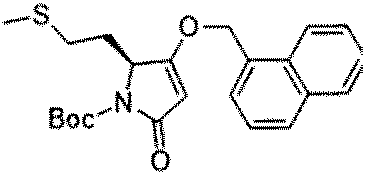
(60191, producto intermedio 43)(60191, Intermediate 43)
Se disolvió el producto intermedio 9 (1,16 g, 4,24 mmol) en 20 ml de acetonitrilo. Se añadieron sucesivamente K2CO3 (645 mg, 4,67 mmol) y 1-bromometi naftaleno (1,03 mg, 4,67 mmol) a temperatura ambiente, seguido de reacción de reflujo durante 5 horas. Después de enfriar hasta la temperatura ambiente, se eliminaron los sólidos mediante filtración, y el filtrado se desecó por evaporación y se sometió a cromatografía en columna de purificación, obteniéndose el producto intermedio 43, en forma de una sustancia oleosa incolora (469 mg, rendimiento: 27 %). Peso molecular: 413,53. RMN de 1H (400 MHz, CDCh) 87,89 (m, 3H), 7,50 (m, 4H), 5,42 (m, 2H), 5,29 (s, 1H), 4,55 (dd, J = 5,4, 2,7 Hz, 1H), 2,29 (m, 2H), 2,13 (m, 2H), 1,91 (s, 3H), 1,51 (s, 9H). RMN de 13C (100 MHz, CDCh) 8175,38, 169,09, 149,14, 133,75, 131,36, 130,24, 129,48, 128,92, 127,99, 126,99, 126,29, 125,11, 123,16, 95,70, 82,75, 72,21, 59,30, 29,34, 28,13, 27,29, 15,54.Intermediate 9 (1.16 g, 4.24 mmol) was dissolved in 20 mL of acetonitrile. K2CO3 (645 mg, 4.67 mmol) and 1-bromomethyl naphthalene (1.03 mg, 4.67 mmol) were added successively at room temperature, followed by reflux reaction for 5 hours. After cooling to room temperature, the solids were removed by filtration, and the filtrate was evaporated and subjected to purification column chromatography, yielding intermediate 43, as a colorless oily substance (469 mg, yield : 27%). Molecular weight: 413.53. 1H NMR (400 MHz, CDCh) 87.89 (m, 3H), 7.50 (m, 4H), 5.42 (m, 2H), 5.29 (s, 1H), 4.55 (dd , J = 5.4, 2.7 Hz, 1H), 2.29 (m, 2H), 2.13 (m, 2H), 1.91 (s, 3H), 1.51 (s, 9H) . 13C NMR (100 MHz, CDCh) 8175.38, 169.09, 149.14, 133.75, 131.36, 130.24, 129.48, 128.92, 127.99, 126.99, 126 .29, 125.11, 123.16, 95.70, 82.75, 72.21, 59.30, 29.34, 28.13, 27.29, 15.54.
29.5 Preparación del compuesto29.5 Compound Preparation

(60251)(60251)
Se utilizó el producto intermedio 43 (469 mg, 1,13 mmol) como materia prima y se adoptó el mismo método de síntesis que en el Ejemplo 1 para preparar 215 mg del sólido blanco del Ejemplo 29 con un rendimiento del 61 %. Peso molecular: 313,42. RMN de 1H (400 MHz, CDCla) 87,91 (m, 3H), 7,52 (m, 4H), 7,05 (s, 1H), 5,40 (m, 2H), 5,26 (s, 1H), 4,22 (dd, J = 8,0, 3,8 Hz, 1H), 2,50 (m, 2H), 2,08 (m, 1H), 2,00 (s, 3H), 1,81 (m, 1H). RMN 13C (100 MHz, CDCh) 8 176,47, 174,59, 133,85, 131,56, 130,18, 130,07, 128,96, 127,79, 126,92, 126,29, 125,25, 123,40, 94,97, 71,98, 57,15, 31,39, 29,96, 15,50.Intermediate 43 (469 mg, 1.13 mmol) was used as starting material, and the same synthesis method as in Example 1 was adopted to prepare 215 mg of the white solid of Example 29 in 61% yield. Molecular weight: 313.42. 1H NMR (400 MHz, CDCla) 87.91 (m, 3H), 7.52 (m, 4H), 7.05 (s, 1H), 5.40 (m, 2H), 5.26 (s , 1H), 4.22 (dd, J = 8.0, 3.8 Hz, 1H), 2.50 (m, 2H), 2.08 (m, 1H), 2.00 (s, 3H) , 1.81 (m, 1H). 13C NMR (100 MHz, CDCh) 8 176.47, 174.59, 133.85, 131.56, 130.18, 130.07, 128.96, 127.79, 126.92, 126.29, 125 .25, 123.40, 94.97, 71.98, 57.15, 31.39, 29.96, 15.50.
Ejemplo 30 Preparación del compuestoExample 30 Preparation of the compound

(60221)(60221)
30.1 Preparación de30.1 Preparation of

(60161, producto intermedio 44)(60161, Intermediate 44)
Se disolvió el producto intermedio 9 (920 mg, 3,37 mmol) en 15 ml de acetonitrilo. Se añadieron sucesivamente K2CO3 (512 mg, 3,71 mmol) y bromuro de 4-fluorobencilo (700 mg, 3,70 mmol) a temperatura ambiente, seguido de reacción de reflujo durante 5 horas. Después de enfriar hasta la temperatura ambiente, se eliminaron los sólidos mediante filtración, y el filtrado se desecó por evaporación y se sometió a cromatografía en columna de purificación, obteniéndose el producto intermedio 44, en forma de una sustancia oleosa incolora (307 mg, rendimiento: 24 %). Peso molecular: 381,46. RMN de 1H (400 MHz, CDCh) 87,32 (m, 2H), 7,07 (m, 2H), 5,13 (s, 1H), 4,97 (m, 2H), 4,56 (dd, J = 5,4, 2,9 Hz, 1H), 2,27 (m, 4H), 2,02 (s, 3H), 1,51 (s, 9H). RMN de 13C (100 MHz, CDCh) 8175,38, 168,99, 163,05 (d, J = 248,3 Hz), 149,24, 130,06 (d, J = 8,6 Hz), 130,04 (d, J = 3,2 Hz), 115,93 (d, J = 21,8 Hz), 95,78, 82,91, 72,88, 59,28, 29,37, 28,20, 27,51, 15,74. RMN de 19F (376 MHz, CDCh) 8 -112,10. Intermediate 9 (920 mg, 3.37 mmol) was dissolved in 15 mL of acetonitrile. K2CO3 (512 mg, 3.71 mmol) and 4-fluorobenzyl bromide (700 mg, 3.70 mmol) were added successively at room temperature, followed by reflux reaction for 5 hours. After cooling to room temperature, the solids were removed by filtration, and the filtrate was evaporated and subjected to purification column chromatography, yielding intermediate 44, as a colorless oily substance (307 mg, yield : 24%). Molecular weight: 381.46. 1H NMR (400 MHz, CDCh) 87.32 (m, 2H), 7.07 (m, 2H), 5.13 (s, 1H), 4.97 (m, 2H), 4.56 (dd , J = 5.4, 2.9 Hz, 1H), 2.27 (m, 4H), 2.02 (s, 3H), 1.51 (s, 9H). 13C NMR (100 MHz, CDCh) 8175.38, 168.99, 163.05 (d, J = 248.3 Hz), 149.24, 130.06 (d, J = 8.6 Hz), 130 .04 (d, J = 3.2 Hz), 115.93 (d, J = 21.8 Hz), 95.78, 82.91, 72.88, 59.28, 29.37, 28.20 , 27.51, 15.74. 19F NMR (376 MHz, CDCh) 8 -112.10.
0.2 Preparación del compuesto0.2 Preparation of the compound

(60221)(60221)
Se utilizó el producto intermedio 44 (307 mg, 0,80 mmol) como materia prima y se adoptó el mismo método de síntesis que en el Ejemplo 1 para preparar 138 mg del sólido blanco del Ejemplo 30 con un rendimiento del 61 %. Peso molecular: 281,35. RMN de 1H (400 MHz, CDCh) 87,33 (dd, J = 8,3, 5,2 Hz, 2H), 7,07 (t, J = 8,5 Hz, 2H), 5,08 (s, 1H), 4,94 (m, 2H), 4,21 (dd, J = 8,0, 3,8 Hz, 1H), 2,54 (m, 2H), 2,12 (m, 1H), 2,07 (s, 3H), 1,81 (m, 1H). RMN de 13C (100 MHz, CDCla) 8176,34, 174,48, 162,99 (d, J = 247,7 Hz), 130,64 (d, J = 3,3 Hz), 129,95 (d, J = 8,4 Hz), 115,87 (d, J = 21,7 Hz, 95,04, 72,61, 57,06, 31,45, 30,10, 15,61. RMN de 19F (376 MHz, CDCla) 8 -112,64.Intermediate 44 (307 mg, 0.80 mmol) was used as raw material, and the same synthesis method as in Example 1 was adopted to prepare 138 mg of the white solid of Example 30 in 61% yield. Molecular weight: 281.35. 1H NMR (400 MHz, CDCh) 87.33 (dd, J = 8.3, 5.2 Hz, 2H), 7.07 (t, J = 8.5 Hz, 2H), 5.08 (s , 1H), 4.94 (m, 2H), 4.21 (dd, J = 8.0, 3.8 Hz, 1H), 2.54 (m, 2H), 2.12 (m, 1H) , 2.07 (s, 3H), 1.81 (m, 1H). 13C NMR (100 MHz, CDCla) 8176.34, 174.48, 162.99 (d, J = 247.7 Hz), 130.64 (d, J = 3.3 Hz), 129.95 (d , J = 8.4 Hz), 115.87 (d, J = 21.7 Hz, 95.04, 72.61, 57.06, 31.45, 30.10, 15.61. 19F NMR ( 376 MHz, CDCla) 8 -112.64.
Ejemplo 31 Preparación del compuestoExample 31 Preparation of the compound

(60131)(60131)
31.1 Preparación de31.1 Preparation of

(60091, producto intermedio 45)(60091, Intermediate 45)
Se disolvió el producto intermedio 9 (400 mg, 1,47 mmol) en 5 ml de acetonitrilo. Se añadieron sucesivamente K2CO3 (223 mg, 1,62 mmol) y bromuro de 4-acetoxibencilo (369 mg, 1,62 mmol) a temperatura ambiente, seguido de reacción de reflujo durante 5 horas. Después de enfriar hasta la temperatura ambiente, se eliminaron los sólidos mediante filtración, y el filtrado se desecó por evaporación y se sometió a cromatografía en columna de purificación, obteniéndose el producto intermedio 45, en forma de una sustancia oleosa incolora (160 mg, rendimiento: 26 %). Peso molecular: 421,5. RMN de 1H (400 MHz, CDCh) 87,35 (d, J = 8,5 Hz, 2H), 7,11 (d, J = 8,5 Hz, 2H), 5,14 (s, 1H), 4,98 (m, 2H), 4,57 (dd, J = 5,3, 2,9 Hz, 1H), 2,37 (m, 2H), 2,29 (s, 3H), 2,25 (m, 1H), 2,16 (m, 1H), 2,02 (s, 3H), 1,52 (s, 9H). RMN de 13C (100 MHz, CDCh) 8175,42, 169,33, 169,09, 151,11, 149,23, 131,68, 129,25, 122,15, 95,79, 82,92, 72,94, 59,29, 29,33, 28,21,27,48, 21,19, 15,76.Intermediate 9 (400 mg, 1.47 mmol) was dissolved in 5 mL of acetonitrile. K2CO3 (223 mg, 1.62 mmol) and 4-acetoxybenzyl bromide (369 mg, 1.62 mmol) were added successively at room temperature, followed by reflux reaction for 5 hours. After cooling to room temperature, the solids were removed by filtration, and the filtrate was evaporated-dried and subjected to purification column chromatography, yielding intermediate 45, as a colorless oily substance (160 mg, yield : 26%). Molecular weight: 421.5. 1H NMR (400 MHz, CDCh) 87.35 (d, J=8.5 Hz, 2H), 7.11 (d, J=8.5 Hz, 2H), 5.14 (s, 1H), 4.98 (m, 2H), 4.57 (dd, J = 5.3, 2.9 Hz, 1H), 2.37 (m, 2H), 2.29 (s, 3H), 2.25 (m, 1H), 2.16 (m, 1H), 2.02 (s, 3H), 1.52 (s, 9H). 13C NMR (100 MHz, CDCh) 8175.42, 169.33, 169.09, 151.11, 149.23, 131.68, 129.25, 122.15, 95.79, 82.92, 72 .94, 59.29, 29.33, 28.21,27.48, 21.19, 15.76.
31.2 Preparación del compuesto31.2 Compound Preparation
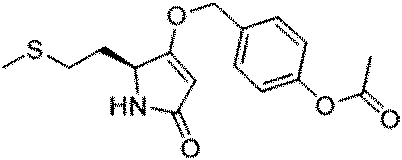
(60131)(60131)
Se utilizó el producto intermedio 45 (160 mg, 0,38 mmol) como materia prima y se adoptó el mismo método de síntesis que en el Ejemplo 1 para preparar 68 mg del sólido blanco del Ejemplo 31 con un rendimiento del 56 %. Peso molecular: 321,39. RMN de 1H (400 MHz, CDCh) 87,37 (d, J = 8,2 Hz, 2H), 7,12 (d, J = 8,4 Hz, 2H), 6,77 (s, 1H), 5,09 (s, 1H), 4,96 (m, 2H), 4,21 (dd, J = 8,1, 3,7 Hz, 1H), 2,55 (m, 2H), 2,30 (s, 3H), 2,12 (m, 1H), 2,08 (s, 3H), 1,82 (m, 1H). RMN 13C (100 MHz, CDCh) 8 176,36, 174,33, 169,40, 151,02, 132,35, 129,17, 122,09, 95,02, 72,67, 57,04, 31,40, 30,15, 21,23, 15,60.Intermediate 45 (160 mg, 0.38 mmol) was used as starting material, and the same synthesis method as in Example 1 was adopted to prepare 68 mg of the white solid of Example 31 in 56% yield. Molecular weight: 321.39. 1H NMR (400 MHz, CDCh) 87.37 (d, J=8.2 Hz, 2H), 7.12 (d, J=8.4 Hz, 2H), 6.77 (s, 1H), 5.09 (s, 1H), 4.96 (m, 2H), 4.21 (dd, J = 8.1, 3.7 Hz, 1H), 2.55 (m, 2H), 2.30 (s, 3H), 2.12 (m, 1H), 2.08 (s, 3H), 1.82 (m, 1H). 13C NMR (100 MHz, CDCh) 8 176.36, 174.33, 169.40, 151.02, 132.35, 129.17, 122.09, 95.02, 72.67, 57.04, 31 .40, 30.15, 21.23, 15.60.
Ejemplos de determinación de la bioactividadExamples of bioactivity determination
La actividad del compuesto de la presente invención se determinó mediante un método conocido en el campo. Se utilizó un control positivo de clorhidrato de memantina (adquirido en Sigma, n.° de producto M9292) aprobado por la FDA para el tratamiento de la enfermedad de Alzheimer. Otros compuestos utilizados se prepararon de acuerdo con los métodos divulgados en los ejemplos anteriores. The activity of the compound of the present invention was determined by a method known in the field. A positive control of memantine hydrochloride (purchased from Sigma, product #M9292) approved by the FDA for the treatment of Alzheimer's disease was used. Other compounds used were prepared according to the methods disclosed in the previous examples.
Ejemplo 32 Determinación de la actividad en D rosophila Example 32 Determination of activity in D rosophila
La mosca del género Drosophila tiene un paradigma clásico de aprendizaje y memoria, conocido como memoria instantánea relacionada con el olfato de Pavlov. Durante el programa de entrenamiento, se expuso un grupo de aproximadamente 100 moscas Drosophila secuencialmente a dos olores, es decir, 3-octanol y 4-metilciclohexanol, cada olor durante 60 segundos y al aire libre durante 45 segundos entre los mismos. Durante la exposición al primer olor, se electrocutaron las moscas Drosophila sobre sus patas (pulsos de 1,5 segundos a intervalos de 3,5 segundos, 60 V), mientras que no se produjo ninguna electrocución durante la exposición al segundo olor. Para detectar la "memoria instantánea" (también conocida como "aprendizaje"), se transfirieron las moscas Drosophila al área de selección en el laberinto T inmediatamente después del entrenamiento y se forzaron a elegir entre los dos olores. Luego se capturaron las moscas Drosophila en cada brazo del laberinto en T, se anestesiaron y se contaron. Se calculó el índice de comportamiento a partir de la distribución de las moscas Drosophila en el laberinto en T. La distribución de 50:50 mostró que las moscas Drosophila no aprendieron (PI = 0), mientras que la distribución de 0:100 indicó que las moscas del género Drosophila tuvieron un "aprendizaje perfecto" (PI = 100). En cada experimento, se emparejó la edad del grupo de control con la del grupo experimental.The fly of the genus Drosophila has a classical learning and memory paradigm, known as Pavlov's olfaction-related flash memory. During the training program, a group of approximately 100 Drosophila flies were sequentially exposed to two odors, ie, 3-octanol and 4-methylcyclohexanol, each odor for 60 seconds and to the open air for 45 seconds in between. During exposure to the first odor, Drosophila flies were electrocuted on their legs (1.5-second pulses at 3.5-second intervals, 60 V), while no electrocution occurred during exposure to the second odor. To detect "instant memory" (also known as "learning"), Drosophila flies were transferred to the selection area in the T-maze immediately after training and forced to choose between the two odors. Drosophila flies were then captured in each arm of the T-maze, anesthetized, and counted. The behavior index was calculated from the distribution of Drosophila flies in the T-maze. The 50:50 distribution showed that the Drosophila flies did not learn (PI = 0), while the 0:100 distribution indicated that flies of the genus Drosophila had "perfect learning" (PI = 100). In each experiment, the age of the control group was matched with that of the experimental group.
Evaluación farmacodinámica de los compuestos candidatos: se seleccionaron moscas Drosophila que contenían y expresaban el gen Ap42 humano como control enfermo, y moscas Drosophila que contenían pero no expresaban el gen Ap42 humano se seleccionaron como control sano. El día después de la aparición de las moscas Drosophila, se seleccionaron y alimentaron moscas Drosophila macho. A partir del tercer día, las moscas Drosophila se alimentaron con un medicamento de prueba (100 pM, 50 pl por 100 moscas Drosophila) durante 7 días consecutivos, 4 horas cada día. La prueba de memoria anterior se realizó en las moscas Drosophila el décimo día.Pharmacodynamic evaluation of candidate compounds: Drosophila flies containing and expressing the human Ap42 gene were selected as diseased control, and Drosophila flies containing but not expressing the human Ap42 gene were selected as healthy control. The day after the appearance of the Drosophila flies, male Drosophila flies were selected and fed. Starting from the third day, Drosophila flies were fed with a test drug (100 pM, 50 pl per 100 Drosophila flies) for 7 consecutive days, 4 hours each day. The above memory test was performed on the Drosophila flies on the tenth day.
La Fig. 1 muestra el efecto de los compuestos 51311, 50561, 51351, 51151, 51121, 51332, 51081, 51091, 51221, 51101, 51071, 51131, 51321, 51341, 51111 y 51301 en la mejora de la memoria de Drosophilae con la enfermedad de Alzheimer. La línea de error de la figura muestra un error típico, ***, p < 0,001; **, p < 0,01, *, p < 0,05; n.s., sin diferencia estadísticamente significativa.Fig. 1 shows the effect of compounds 51311, 50561, 51351, 51151, 51121, 51332, 51081, 51091, 51221, 51101, 51071, 51131, 51321, 51341, 51111 and 51301 on memory enhancement of Drosophilae with Alzheimer's disease. The error line in the figure shows a typical error, ***, p <0.001; **, p < 0.01, *, p <0.05; ns, without statistically significant difference.
En la Fig. 1, se puede observar que los compuestos 51311, 50561, 51351, 51151 y 51121 tienen la mejor capacidad para mejorar el aprendizaje y la memoria de las moscas Drosophila.In Fig. 1, it can be seen that compounds 51311, 50561, 51351, 51151 and 51121 have the best ability to improve learning and memory in Drosophila flies.
La Fig. 2 muestra el efecto de los compuestos 60111, 60241, 60201, 51471, 51541, 60221, 60131, 51551, 51571, 60251, 51731, 51561, 60121, 60231 y 60211 en la mejora de la memoria de Drosophilae con la enfermedad de Alzheimer. La línea de error de la figura muestra un error típico, ***, p <0,001; **, p <0,01, *, p <0,05; n.s., sin diferencia estadísticamente significativa.Fig. 2 shows the effect of compounds 60111, 60241, 60201, 51471, 51541, 60221, 60131, 51551, 51571, 60251, 51731, 51561, 60121, 60231 and 60211 on Drosophila disease memory enhancement. Alzheimer's. The error line in the figure shows a typical error, ***, p <0.001; **, p < 0.01, *, p <0.05; ns, without statistically significant difference.
En la Fig. 2, se puede observar que el compuesto 60111 tiene una capacidad bastante buena para mejorar el aprendizaje y la memoria de las Drosophilae.From Fig. 2, it can be seen that compound 60111 has a fairly good ability to improve learning and memory in Drosophilae .
La Fig. 3 muestra las relaciones dosis-efecto de los compuestos 50561, 51311, 51351, 51151 y 51121 para mejorar la memoria de las Drosophilae con enfermedad de Alzheimer.Fig. 3 shows the dose-effect relationships of compounds 50561, 51311, 51351, 51151 and 51121 in improving memory of Drosophilae with Alzheimer's disease.
En la Fig. 3, se puede observar que la actividad de cada uno de estos cinco compuestos (50561, 51311, 51351, 51151 y 51121) aumenta hasta cierto punto con el aumento de la dosis de los mismos, y finalmente alcanza o supera el nivel de la actividad del compuesto positivo clorhidrato de memantina.In Fig. 3, it can be seen that the activity of each of these five compounds (50561, 51311, 51351, 51151 and 51121) increases to a certain extent with increasing dose thereof, and finally reaches or exceeds the activity level of the positive compound memantine hydrochloride.
Ejemplo 33 Determinación de la actividad en ratonesExample 33 Determination of activity in mice
La actividad en ratones se determinó con el compuesto 50561 como ejemplo.Activity in mice was determined using compound 50561 as an example.
Cepa de ratonesmice strain
Se adquirieron ratones transgénicos que contenían APP/PS 1 en el Laboratorio Jackson de EE.UU. Los ratones transgénicos se cruzaron con ratones con fondo B6/C3. Su descendencia se reprodujo por sí misma, se genotipó, y cada individuo se alimentó en una jaula separada durante aproximadamente 8 meses. Una semana antes de la prueba, se administró una dosis prescrita de medicamento a los ratones por sonda gástrica todos los días, y luego se midió la memoria espacial de los ratones mediante la prueba del laberinto de agua. Se llenó un tanque de agua con un diámetro de 1,5 metros con agua a una temperatura constante de 25 grados y se añadió leche desnatada para volver opaca la superficie del agua. Se colocó una plataforma transparente en un cuadrante específico del tanque de agua. Se proporcionaron pistas distantes como referencia espacial. Se colocaron los ratones en el agua y se les dejó nadar hasta que encontraron la plataforma debajo de la superficie del agua. Todo el proceso fue rastreado por software, y el tiempo desde que se soltaron hasta encontrar la plataforma, denominado período de latencia, se grabó de ese modo. Si un ratón no pudo encontrar la plataforma en 60 segundos, se guio manualmente a la plataforma y se registró su período de latencia de 60 segundos. Se realizaron cuatro rondas de las pruebas anteriores en cada ratón todos los días, con un intervalo de una hora entre cada dos rondas de pruebas para que los ratones descansaran. El período de latencia de cada ratón en un día fue el promedio de las cuatro rondas de pruebas en el mismo día.Transgenic mice containing APP/PS 1 were purchased from the Jackson Laboratory in the USA. The transgenic mice were crossed with mice of B6/C3 background. Their offspring bred on their own, were genotyped, and each individual was fed in a separate cage for approximately 8 months. One week before the test, a prescribed dose of medicine was administered to the mice by gastric tube every day, and then the spatial memory of the mice was measured by the water maze test. A water tank with a diameter of 1.5 meters was filled with water at a constant temperature of 25 degrees and skimmed milk was added to make the surface of the water opaque. A transparent platform was placed in a specific quadrant of the water tank. Distant tracks were provided for spatial reference. Mice were placed in the water and allowed to swim until they found the platform below the water surface. The entire process was tracked by software, and the time from when they were released to finding the platform, called the latency period, was thus recorded. If a mouse was unable to find the platform within 60 seconds, it was manually guided to the platform and its 60-second latency period was recorded. Four rounds of the above tests were performed on each mouse every day, with an interval of one hour between each two rounds of tests for the mice to rest. The term of latency for each mouse in one day was the average of the four rounds of testing on the same day.
La Fig. 4 muestra que el compuesto 50561 (10 mg/kg) mejoró el aprendizaje espacial y la memoria de los ratones con EA. A muestra esquemáticamente las operaciones de administración en los ratones; B muestra los períodos de latencia de los ratones en las pruebas del laberinto de agua; C-D muestran los porcentajes de tiempo de residencia de los ratones en el cuadrante diana antes y después del entrenamiento; E muestra el número de cruces de la plataforma de los ratones antes y después del entrenamiento; F muestra los cambios en la velocidad de natación de los ratones antes y después del entrenamiento. La línea de error de la figura es un error típico, ***, p <0,001; **p <0,01, *, p < 0,05; n.s., no hay diferencia estadísticamente significativa.Fig. 4 shows that compound 50561 (10 mg/kg) improved spatial learning and memory in AD mice. A schematically shows administration operations in mice; B shows the latency periods of the mice in the water maze tests; CD show the percentages of residence time of the mice in the target quadrant before and after training; E shows the number of platform crossings of the mice before and after training; F shows the changes in the swimming speed of the mice before and after training. The error line in the figure is a standard error, ***, p <0.001; **p < 0.01, *, p <0.05; ns, there is no statistically significant difference.
En la Fig. 4, se puede observar que a la dosis de 10 mg/kg, el compuesto 50561 tiene una buena capacidad para rescatar la memoria espacial de los ratones.In Fig. 4, it can be seen that at the dose of 10 mg/kg, compound 50561 has a good ability to rescue the spatial memory of mice.
La Fig. 5 muestra que el compuesto 50561 (1, 0,1 mg/kg) no mejora el aprendizaje espacial ni la memoria en ratones con EA. A muestra esquemáticamente las operaciones de administración en los ratones; B muestra los períodos de latencia de los ratones en las pruebas del laberinto de agua; C-D muestran los porcentajes de tiempo de residencia de los ratones en el cuadrante diana antes y después del entrenamiento; E muestra el número de cruces de la plataforma de los ratones antes y después del entrenamiento; F muestra los cambios en la velocidad de natación de los ratones antes y después del entrenamiento.Fig. 5 shows that compound 50561 (1, 0.1 mg/kg) does not improve spatial learning and memory in AD mice. A schematically shows administration operations in mice; B shows the latency periods of the mice in the water maze tests; C-D show the percentages of residence time of the mice in the target quadrant before and after training; E shows the number of platform crossings of the mice before and after training; F shows the changes in the swimming speed of the mice before and after training.
En la Fig. 5, se puede observar que el compuesto 50561 no tiene capacidad para rescatar la memoria espacial de los ratones a una dosis de 1 mg/kg o 0,1 mg/kg.From Fig. 5, it can be seen that compound 50561 has no ability to rescue spatial memory in mice at a dose of 1 mg/kg or 0.1 mg/kg.
Ejemplo 34Example 34
La seguridad se evaluó con el compuesto 50561 como ejemplo.Safety was evaluated with compound 50561 as an example.
Evaluación de la seguridad 1 del Compuesto 50561: bloqueo de los canales de potasioCompound 50561 Safety Assessment 1: Potassium Channel Blockade
La corriente de salida de potasio (IKr) del rectificador retardado humano rápidamente activado está mediada principalmente por los canales iónicos hERG y participa en la repolarización de los cardiomiocitos humanos. El bloqueo farmacéutico de esta corriente es la principal causa del síndrome de QT prolongado, incluso de la arritmia aguda y la muerte súbita clínicamente.The rapidly activated human delayed rectifier potassium outflow (IKr) is primarily mediated by hERG ion channels and is involved in the repolarization of human cardiomyocytes. Pharmaceutical blockade of this current is the main cause of long QT syndrome, including acute arrhythmia and sudden death clinically.
En este experimento, se seleccionó una estirpe celular estable HEK-hERG (de la Academia de Ciencias Médicas Militares de EE.UU.) y se utilizó la técnica de pinzamiento zonal de células enteras para registrar la corriente de hERG. Se recogió suspensión celular y se añadió a una placa de cultivo de 35 mm, que se colocó sobre un portamicroscopio invertido. Después de la unión celular, se realizó la perfusión con un líquido extracelular a un caudal de 1-2 ml/min. Se extrajo un microelectrodo de vidrio en dos etapas con un extractor de micropipetas y, después de llenarlo con líquido interno del electrodo, la resistencia al agua del microelectrodo de vidrio resultó ser de 2-5 Mü. Tras establecer el modo de grabación en toda la celda, el potencial de sujeción se mantuvo a -80 mV. Se ejerció una tensión de despolarización a 60 mV durante 850 ms, seguida de la repolarización a -50 mV durante 1275 ms para inducir una corriente de cola hERG. Tras la estabilización de la corriente, se adoptó la administración de perfusión extracelular continua desde una concentración baja hasta una concentración alta. A partir de la baja concentración, se realizó perfusión continua hasta que la eficacia fue estable, seguida de la perfusión de la siguiente concentración. Cuando la tasa de inhibición de un compuesto o control positivo a la corriente hERG fue inferior al 50 %, el CV de cada uno de los cinco valores actuales consecutivos resultó ser inferior al 10 %. Cuando la tasa de inhibición de un compuesto o control positivo a la corriente hERG fue superior al 50 %, pero inferior al 70 %, el CV de cada uno de los cinco valores actuales consecutivos resultó ser inferior al 20 %. Si la amplitud de una corriente se redujo en menos de 200 pA, o si la tasa de inhibición fue superior al 70 %, el CV de cada uno de los cinco valores actuales consecutivos resultó ser inferior al 30 %.In this experiment, a stable HEK-hERG cell line (from the US Academy of Military Medical Sciences) was selected and the whole cell patch-clamp technique was used to record the hERG current. Cell suspension was collected and added to a 35 mm culture dish, which was placed on an inverted microscope slide. After cell attachment, perfusion with extracellular fluid was performed at a flow rate of 1-2 ml/min. A glass microelectrode was extracted in two stages with a micropipette extractor, and after filling it with electrode internal liquid, the water resistance of the glass microelectrode was found to be 2-5 Mü. After setting the recording mode to the whole cell, the clamping potential was kept at -80 mV. A depolarization voltage at 60 mV for 850 ms was exerted, followed by repolarization at -50 mV for 1275 ms to induce an hERG tail current. After the stabilization of the current, continuous extracellular perfusion administration was adopted from a low concentration to a high concentration. Starting from the low concentration, continuous infusion was performed until the efficacy was stable, followed by infusion of the next concentration. When the inhibition rate of a positive control or compound to the hERG current was less than 50%, the CV of each of the five consecutive current values was found to be less than 10%. When the inhibition rate of a positive control or compound to the hERG current was greater than 50% but less than 70%, the CV of each of the five consecutive current values was found to be less than 20%. If the amplitude of a current was reduced by less than 200 pA, or if the inhibition rate was greater than 70%, the CV of each of the five consecutive current values was found to be less than 30%.
Se pesó una determinada cantidad de una muestra de prueba y se disolvió en DMSO para preparar una solución madre de 30 mM. Antes del experimento, se diluyó la solución madre anterior con DMSo 10 veces y 3 veces por etapas, y luego se diluyó la solución con líquido extracelular hasta la concentración requerida. La solución a la concentración de trabajo debe verificarse mediante precipitación antes de su uso. Si existiera precipitación, la solución madre se diluiría para aumentar la concentración final de DMSO en el fluido extracelular. Sin embargo, la concentración final de DMSO en el líquido extracelular no superaría el 0,5 %. Durante el experimento se realizó una perfusión continua desde concentraciones bajas a altas. La concentración inhibidora media (CI50) de la muestra de prueba se obtuvo mediante el mejor ajuste de la ecuación logística. El efecto de bloqueo de la muestra de prueba en hERG se muestra en la Tabla 1.A certain amount of a test sample was weighed out and dissolved in DMSO to prepare a 30 mM stock solution. Before the experiment, the above stock solution was diluted with DMSo 10-fold and 3-fold stepwise, and then the solution was diluted with extracellular fluid to the required concentration. The working strength solution should be verified by precipitation prior to use. If there was precipitation, the stock solution would be diluted to increase the final concentration of DMSO in the extracellular fluid. However, the final concentration of DMSO in the extracellular fluid would not exceed 0.5%. Continuous perfusion from low to high concentrations was performed during the experiment. The mean inhibitory concentration (IC50) of the test sample was obtained by the best fit of the logistic equation. The blocking effect of the test sample on hERG is shown in Table 1.
Cuando se procesaron los datos, se realizaron la liberación del estímulo y la adquisición de la señal con el software patchmaster; y un amplificador de pinzamiento zonal amplificó la señal y la filtró a 10 KHz. Se utilizaron Fitmaster, excel, spass 21.0 y similares para el análisis de datos adicionales y los ajuste de curvas. Los datos se mostraron como los valores medios ± desviación típica. En el procesamiento de datos, cuando se determinó el efecto de bloqueo sobre hERG, se corrigieron el valor máximo de una corriente de cola y valor inicial. Se utilizaron las tasas de inhibición de la corriente de cola para mostrar los efectos de diferentes compuestos a diferentes concentraciones. La tasa de inhibición = 100 x (el valor máximo de la corriente de cola antes de la administración - el valor máximo de la corriente de cola después de la administración)/% del valor máximo de la corriente de cola antes de la administración. Los valores de CI50 se ajustaron mediante la ecuación de Hill:When data was processed, stimulus release and signal acquisition were performed with patchmaster software ; and a zone clamp amplifier amplified the signal and filtered it at 10 KHz. Fitmaster, excel, spass 21.0 and the like were used for additional data analysis and curve fitting. Data were shown as mean values ± standard deviation. In data processing, when the blocking effect on hERG was determined, the maximum value of a tail current and initial value were corrected. Inhibition rates were used tail stream to show the effects of different compounds at different concentrations. The inhibition rate = 100 x (the maximum tail current value before administration - the maximum tail current value after administration)/% of the maximum tail current value before administration. IC50 values were fitted using the Hill equation:

en donde, y: I/icontroli máx: 100 %; mín: 0 %; [fármaco]: concentración de la muestra de prueba; nH: pendiente de Hill; CI50: concentración máxima de inhibición media de la sustancia de prueba.where, y: I/icontroli max: 100%; min: 0%; [drug]: concentration of the test sample; nH: Hill slope; IC50: mean maximum inhibition concentration of the test substance.
Tabla 1 Efecto de blo ueo del com uesto 50561 sobre hERGTable 1 Blocking effect of compound 50561 on hERG

Tabla 1. *Cuando la célula 3 recibió un tratamiento de 10 M, el indicador numérico de corrientes de fuga fue superior a 200 pA, por lo que se complementó la célula 4. También se incluyó en el análisis final debido al efecto emparejado del mismo.Table 1. *When cell 3 received a 10 M treatment, the numerical indicator of leakage currents was greater than 200 pA, therefore cell 4 was complemented. It was also included in the final analysis due to the paired effect of it. .
La Fig. 6 es una curva de concentración-efecto del compuesto 50561 frente a los canales de potasio de hERG registrada en una estirpe celular estable de hERG de HEK-293 mediante la técnica de pinzamiento zonal.Fig. 6 is a concentration-effect curve of compound 50561 against hERG potassium channels recorded on a stable HEK-293 hERG cell line by patch clamp technique.
Para inducir una corriente máxima de corriente de cola de hERG, el potencial de pinzamiento se mantuvo a -80 mV, se despolarizó a 60 mV durante 0,85 s y luego se repolarizó a -50 mV durante 1,275 s. De acuerdo con la ecuación de Hill, se ajustaron las curvas de la tasa de inhibición de la corriente de hERG y su concentración correspondiente. Cada punto del gráfico se representó mediante el valor medio ± desviación típica (N = 4). El análisis de ajuste de datos indicó que el valor de CI50 del compuesto 50561 frente a la corriente hERG fue de 26,68 M y el coeficiente de Hill fue de 1,01.To induce a peak current of hERG tail current, the clamp potential was held at -80 mV, depolarized to 60 mV for 0.85 s, and then repolarized to -50 mV for 1.275 s. According to Hill's equation, the curves of hERG current inhibition rate and its corresponding concentration were fitted. Each point on the graph was represented by the mean value ± standard deviation (N = 4). Data fit analysis indicated that the IC50 value of compound 50561 against the hERG current was 26.68 M and the Hill coefficient was 1.01.
Ejemplo 35Example 35
La seguridad se evaluó tomando el compuesto 50561 como ejemplo.Safety was evaluated by taking compound 50561 as an example.
Evaluación de la seguridad 2 del Compuesto 50561: experimento Mini AmesSafety Evaluation 2 of Compound 50561: Mini Ames Experiment
Se cultivaron cepas auxótrofas de histidina de Salmonella typhimurium en un medio especial con un contenido bastante bajo de histidina. Las cepas fueron difíciles de dividir debido a la falta de nutrición. Si un compuesto de prueba tiene mutagénesis, un gran número de células sufrirá una mutación inversa, sintetizando histidina por sí mismas y convirtiéndose en colonias visibles a simple vista. En vista de la estrecha relación entre la mutagénesis y la carcinogénesis de los productos químicos, este método ha sido ampliamente utilizado en la detección de carcinógenos. Algunas sustancias químicas necesitan activación metabólica para inducir la mutagénesis. Se puede añadir la enzima microsomal de mamíferos S9 al sistema de prueba para eliminar la influencia de la activación metabólica en la generación de mutagénesis.Histidine auxotrophic strains of Salmonella typhimurium were grown on a special medium with a rather low content of histidine. The strains were difficult to divide due to lack of nutrition. If a test compound undergoes mutagenesis, a large number of cells will undergo a reverse mutation, synthesizing histidine on their own and becoming colonies visible to the naked eye. In view of the close relationship between mutagenesis and carcinogenesis of chemicals, this method has been widely used in the detection of carcinogens. Some chemicals require metabolic activation to induce mutagenesis. The mammalian microsomal enzyme S9 can be added to the test system to eliminate the influence of metabolic activation on the generation of mutagenesis.
Después de la prueba, en dos cepas de TA98/100, independientemente de la presencia o ausencia de S9, el compuesto 50561 no provocó un cambio mayor del doble en el número de colonias. Por lo tanto, se consideró que no tenía mutagénesis evidente. Prueba de ratones Mini Ames con el compuesto 50561After testing, in two TA98/100 strains, regardless of the presence or absence of S9, compound 50561 did not cause a more than two-fold change in colony numbers. Therefore, it was considered to have no obvious mutagenesis. Test of Mini Ames mice with compound 50561
Tabla 2 En ausencia de S9, el compuesto 50561 no provoca mutación ______________________________________Sin activación metabólica______________________________________ Cepa Artículo de Nivel de Revertientes Desviación Proporción de Números individuales de prueba/control dosis por medios por típica tratadas/disolvente colonias revertidas [césped _____________________ pocillo_____ pocillo__________________________________ bacteriano]__________________ Table 2 In the absence of S9, compound 50561 does not cause mutation ______________________________________No metabolic activation______________________________________ Strain Item Revertant Level Deviation Proportion of Individual Numbers of test/control dose per media per typical treated/solvent revertant colonies [grass ________________________________ well_____ well__________________________________ bacterial]__________________
TA98 DMSO 0,02 ml 6,83 3,60 - 5 [1], 11 [1], 7 [1], 10 [1], 1 [1], 7TA98 DMSO 0.02 mL 6.83 3.60 - 5 [1], 11 [1], 7 [1], 10 [1], 1 [1], 7
[1][1]
50561 1,5 pg 9,00 2,65 1,32 10 [1], 11 [1], 6 [1] 50561 1.5 ing 9.00 2.65 1.32 10[1], 11[1], 1[6]
(continuación)(continuation)
Sin activación metabólicaNo metabolic activation
Cepa Artículo de Nivel de Revertientes Desviación Proporción de Números individuales de prueba/control dosis por medios por típica tratadas/disolvente colonias revertidas [césped pocillo pocillo bacteriano] 4 pg 8,00 2,65 1,17 7 [1], 11 [1], 6 [1]Strain Item Revertant Level Deviation Proportion of Individual Numbers of test/control dose per media per typical treated/solvent revertant colonies [lawn well bacterial well] 4 pg 8.00 2.65 1.17 7 [1], 11 [1 ], 6 [1]
10 pg 8,00 3,61 1,17 5 [1], 7 [1],12 [1]10 hp 8.00 3.61 1.17 5[1], 7[1],12[1]
25 pg 8,33 1,53 1,22 10 [1], 8 [1], 7 [1]25 hp 8.33 1.53 1.22 1[1], 1[8], 1[7]
64 pg 7,33 3,51 1,07 11 [1],4 [1], 7 [1]64 hp 7.33 3.51 1.07 1[1],1[4],1[7]
160 pg 7,33 3,51 1,07 7 [3], 4 [3], 11 [3]160 hp 7.33 3.51 1.07 7[3], 4[3], 11[3]
400 pg 0,00 0,00 0,00 0 [7], 0 [7], 0 [7]400 hp 0.00 0.00 0.00 0[7], 0[7], 0[7]
1000 pg 0,00 0,00 0,001 0 [5 SP], 0 [5 SP]. 0 [5 SP] 2-NF 2,0 pg___ 421,00 37,04 61,61 407 [1], 393 [1],463 [1] 1000 hp 0.00 0.00 0.001 0 [5 SP], 0 [5 SP]. 0 [5 SP] 2-NF 2.0 pg___ 421.00 37.04 61.61 407[1], 393[1],463[1]
TA100 DMSO 0,02 ml 24,67 3,50 - 21 [1],31 [1],24 [1], 26 [1], 23 [1],TA100 DMSO 0.02 mL 24.67 3.50 - 21[1],31[1],24[1], 26[1], 23[1],
23 [1]23 [1]
50561 1,5 pg 25,67 1,53 1,04 24 [1], 27 [1], 26 [1]50561 1.5 pg 25.67 1.53 1.04 24 [1], 27 [1], 26 [1]
4 pg 25,33 1,15 1,03 24 [1], 26 [1], 26 [1]4 hp 25.33 1.15 1.03 1[24], 1[26], 1[26]
10 pg 28,67 3,51 1,16 25 [1], 32 [1], 29 [1]10 hp 28.67 3.51 1.16 1[25], 1[32], 1[29]
25 pg 19,00 5,57 0,77 20 [1], 24 [1], 13 [1]25 hp 19.00 5.57 0.77 1[20], 1[24], 1[13]
64 pg 23,33 4,62 0,95 26 [1], 26 [1], 18 [1]64 hp 23.33 4.62 0.95 1[26], 1[26], 1[18]
160 pg 17,33 2,08 0,70 15 [4], 19 [4], 18 [4]160 hp 17.33 2.08 0.70 4[15], 4[19], 4[18]
400 pg 0,00 0,00 0,00 0 [7], 0 [7], 0 [7]400 hp 0.00 0.00 0.00 0[7], 0[7], 0[7]
1000 pg 0,00 0,00 0,00 0 [5 SP], 0 [5 SP], 0 [5 SP] SA 0,2 pg___ 195,33 16,50 7,92 179 [1], 212 [1], 195 [1]1000 hp 0.00 0.00 0.00 0 [5 SP], 0 [5 SP], 0 [5 SP] SA 0.2 hp___ 195.33 16.50 7.92 179 [1], 212 [1 ], 195 [1]
Tabla 3 En presencia de S9, el compuesto 50561 no provoca mutación ______________________________Con activación metabólica_____________________________________ Cepa Artículo de Nivel de Revertientes Desviación Proporción de Números individuales de colonias prueba/control dosis por medios por típica tratadas/disolvente revertidas [césped bacteriano] _____________ pocillo_____pocillo______________________________________________________________ Table 3 In the presence of S9, compound 50561 does not cause mutation ______________________________With metabolic activation_____________________________________ Strain Item Revertant Level Deviation Proportion of Individual Numbers of test/control colonies dose by means per typical treated/solvent reverted [bacterial lawn] _____________ well_____well______________________________________________________________
TA98 DMSO 0,02 ml 8,33 2,16 - 11 [1], 7 [1], 11 [1], 8 [1], 7 [1], 6TA98 DMSO 0.02 mL 8.33 2.16 - 11[1], 7[1], 11[1], 8[1], 7[1], 6
[1][1]
50561 1,5 pg 8,67 3,79 1,04 6 [1], 13 [1], 7 [1]50561 1.5 pg 8.67 3.79 1.04 6 [1], 13 [1], 7 [1]
4 pg 13,33 3,51 1,60 10 [1], 13 [1], 17 [1]4 hp 13.33 3.51 1.60 1[10], 1[13], 1[17]
10 pg 9,33 3,06 1,12 12 [1], 6 [1], 10 [1]10 hp 9.33 3.06 1.12 12[1], 1[6], 1[10]
25 pg 12,67 7,09 1,52 19 [1], 14 [1], 5 [1]25 hp 12.67 7.09 1.52 1[1]9, 1[14], 1[5]
64 pg 12,33 2,52 1,48 15 [1], 12 [1], 10 [1]64 hp 12.33 2.52 1.48 1[1]5, 1[12], 1[10]
160 pg 7,00 3,00 0,84 10 [1], 7 [1],4 [1]160 hp 7.00 3.00 0.84 1[1], 1[7], 1[4]
400 pg 0,00 0,00 0,00 0 [7], 0 [7], 0 [7]400 hp 0.00 0.00 0.00 0[7], 0[7], 0[7]
1000 pg 0,00 0,00 0,00 0 [5 SP], 0 [5 SP], 0 [5 SP] 2-AA 0,4 pg 297,67 21,03 35,72 318 [1], 276 [1], 299 [1] 1000 hp 0.00 0.00 0.00 0 [5 SP], 0 [5 SP], 0 [5 SP] 2-AA 0.4 hp 297.67 21.03 35.72 1 [318], 276 [1], 299 [1]
TA100 DMSO 0,02 ml 32,67 2,80 - 36 [1],30 [1],30 [1], 31 [1], 33 [1],TA100 DMSO 0.02 mL 32.67 2.80 - 36[1],30[1],30[1], 31[1], 33[1],
36 [1]36 [1]
50561 1,5 pg 25,33 5,69 0,78 30 [1], 19 [1], 27 [1]50561 1.5 pg 25.33 5.69 0.78 30 [1], 19 [1], 27 [1]
4 pg 30,33 2,89 0,93 27 [1], 32 [1], 32 [1]4 hp 30.33 2.89 0.93 1[27], 1[32], 1[32]
10 pg 32,33 4,04 0,99 37 [1], 30 [1], 30 [1]10 hp 32.33 4.04 0.99 37[1], 30[1], 30[1]
25 pg 28,67 5,69 0,88 35 [1], 27 [1], 24 [1]25 hp 28.67 5.69 0.88 35[1], 27[1], 24[1]
64 pg 31,00 5,57 0,95 36 [1], 32 [1], 25 [1]64 hp 31.00 5.57 0.95 1[36], 1[32], 1[25]
160 pg 28,33 2,08 0,87 26 [3], 29 [3], 30 [3]160 hp 28.33 2.08 0.87 26 [3], 29 [3], 30 [3]
400 pg 0,00 0,00 0,00 0 [7], 0 [7], 0 [7]400 hp 0.00 0.00 0.00 0[7], 0[7], 0[7]
1000 pg 0,00 0,00 0,00 0 [5 SP], 0 [5 SP], 0 [5 SP] 2-AA 0,4 pg 317,67 9,07 9,72 319 [1], 326 [1], 308 [1] 1000 hp 0.00 0.00 0.00 0 [5 SP], 0 [5 SP], 0 [5 SP] 2-AA 0.4 hp 317.67 9.07 9.72 319 [1], 326 [1], 308 [1]
Ejemplo 36Example 36
La seguridad se evaluó tomando el compuesto 50561 como ejemplo.Safety was evaluated by taking compound 50561 as an example.
Evaluación de la seguridad 3 del Compuesto 50561: Experimento de DMTCompound 50561 Safety Assessment 3: DMT Experiment
Los ratones son roedores comúnmente utilizados para evaluar la toxicidad de una muestra de prueba y también son una parte importante de la evaluación de seguridad preclínica precoz. En este experimento, se probó la toxicidad del compuesto 50561 administrando un gradiente de dosis del mismo a los ratones por sonda gástrica y observando su toxicidad.Mice are rodents commonly used to assess the toxicity of a test sample and are also an important part of early preclinical safety evaluation. In this experiment, the toxicity of compound 50561 was tested by administering a dose gradient of it to mice by gastric tube and observing its toxicity.
Este experimento se diseñó de tal manera que, para cada concentración de dosis, se probaron 10 ratones, de los cuales una mitad eran machos y la otra mitad eran hembras. Cada macho pesaba aproximadamente 18-23 gramos, y cada hembra pesaba aproximadamente 17-21 gramos. Se agruparon aleatoriamente mediante un procedimiento de aleatorización simple. Todos los animales utilizados en el experimento pesaban entre ±20% del peso corporal promedio de sus respectivos sexos. De no haber suficientes animales en el estudio para cumplir con el intervalo de peso requerido, se ha de notificarlo a la persona responsable del proyecto para que tome las medidas oportunas. Los animales se deben adaptar al laboratorio durante al menos tres días. Durante este período, se realizó la observación diaria de la jaula una vez al día, y fue necesaria una observación clínica detallada antes del experimento. Se informaría sobre cualquier animal con síntomas o anomalías físicas al veterinario tratante y responsable del proyecto, y se excluiría en la medida de lo posible. Los animales adecuados para la experimentación se asignarán a los respectivos grupos experimentales de acuerdo con el método de agrupación aleatoria descrito anteriormente.This experiment was designed such that, for each dose concentration, 10 mice were tested, half of which were male and half were female. Each male weighed approximately 18-23 grams, and each female weighed approximately 17-21 grams. They were randomly pooled using a simple randomization procedure. All animals used in the experiment weighed within ±20% of the average body weight of their respective sexes. If there are not enough animals in the study to meet the required weight range, the person responsible for the project must be notified so that appropriate measures can be taken. The animals must be adapted to the laboratory for at least three days. During this period, daily observation of the cage was performed once a day, and detailed clinical observation was necessary before the experiment. Any animal with symptoms or physical abnormalities would be reported to the treating veterinarian and project manager, and excluded as far as possible. Animals suitable for experimentation will be assigned to the respective experimental groups according to the random grouping method described above.
Durante el experimento, después de la administración, todos los animales se observaron de manera continua durante 4 horas; desde el final de la administración hasta 3 días después, las observaciones se realizaron dos veces al día, una por la mañana y otra por la tarde; y luego se llevó a cabo la observación una vez al día. Las observaciones incluían, pero sin limitación: piel, cabello, ojos, orejas, nariz, boca, pecho, abdomen, genitales externos, extremidades y patas. Los sistemas respiratorio y circulatorio, los efectos autónomos (tales como la salivación) y el sistema nervioso (tal como los temblores, las convulsiones, las respuestas de estrés y los comportamientos anormales) deben ser el foco. Se realizarían exámenes anatómicos completos a todos los animales que hubieran muerto, se estuvieran muriendo o a los que se planeaba sacrificar. Los animales encontrados muertos fuera de las horas de trabajo establecidas se podían colocar en el refrigerador durante la noche y diseccionarse al siguiente día hábil. Al final del experimento (14.° día después de la administración), todos los animales que requirieran autopsia serían sacrificados y sometidos a autopsia.During the experiment, after administration, all animals were continuously observed for 4 hours; from the end of the administration until 3 days later, observations were made twice a day, once in the morning and once in the afternoon; and then observation was carried out once a day. Observations included, but were not limited to: skin, hair, eyes, ears, nose, mouth, chest, abdomen, external genitalia, limbs, and paws. The respiratory and circulatory systems, autonomic effects (such as salivation), and the nervous system (such as tremors, seizures, stress responses, and abnormal behaviors) should be the focus. Full anatomical examinations would be performed on all animals that had died, were dying, or were planned to be euthanized. Animals found dead outside of established business hours could be placed in the refrigerator overnight and dissected the next business day. At the end of the experiment (14th day after administration), all animals requiring autopsy would be sacrificed and autopsied.
Se deben examinar en detalle las anomalías externas de los animales tales como masas palpables. La piel se cortaría a lo largo de la línea media del abdomen y se confirmaría cualquier masa subcutánea junto con los hallazgos en las observaciones de los síntomas de los animales. Se observaron la cavidad abdominal, la cavidad torácica y la cavidad craneal en busca de cualquier anomalía. Se extirparon los órganos enfermos, se pesaron, se registraron y se mantuvieron en un líquido fijador.External animal abnormalities such as palpable masses should be examined in detail. The skin would be cut along the midline of the abdomen and any subcutaneous masses would be confirmed along with the findings in the animal's symptom observations. The abdominal cavity, thoracic cavity, and cranial cavity were observed for any abnormalities. Diseased organs were removed, weighed, recorded and kept in a fixative liquid.
Los resultados se mostraron en la Tabla 4. La tolerancia máxima de los ratones CR al compuesto 50561 fue de 500 mg/kg > DMT > 250 mg/kg.The results are shown in Table 4. The maximum tolerance of CR mice to compound 50561 was 500 mg/kg > DMT > 250 mg/kg.
Tabla 4Table 4

Ejemplo 37Example 37
La evaluación farmacocinética se realizó con el compuesto 50561 como ejemplo.Pharmacokinetic evaluation was performed with compound 50561 as an example.
La distribución de un medicamento en el organismo es uno de los indicadores importantes para determinar la dosis y la eficacia del medicamento. Por tanto, los compuestos candidatos excelentes deben tener buenas características farmacocinéticas. Además, dado que el compuesto de la presente invención está destinado a ser utilizado para el tratamiento de la enfermedad de Alzheimer, que es una enfermedad del sistema nervioso central, el patrón de distribución del compuesto en el cerebro y la sangre también es uno de los temas que se debe investigar. En este experimento, se administró el compuesto 50561 a ratones por vía oral o por sonda gástrica, y se midieron las concentraciones del compuesto en sangre y cerebro en puntos de tiempo específicos para determinar los parámetros farmacocinéticos.The distribution of a drug in the body is one of the important indicators to determine the dosage and effectiveness of the drug. Therefore, excellent candidate compounds should have good pharmacokinetic characteristics. Furthermore, since the compound of the present invention is intended to be used for the treatment of Alzheimer's disease, which is a disease of the central nervous system, the distribution pattern of the compound in the brain and blood is also one of the topics to be investigated. In this experiment, compound 50561 was administered to mice orally or by gavage, and blood and brain concentrations of the compound were measured at specific time points to determine pharmacokinetic parameters.
Se utilizaron cuarenta y ocho ratones ICR machos adquiridos en Shanghai Sippr-BK Lab. Animal Co. Ltd en este experimento. El grupo oral estuvo en ayunas durante 10-14 horas antes de la administración y se restableció la alimentación 4 horas después de la administración. Se extrajeron muestras del grupo de administración intravenosa 0,083 h, 0,25 h, 0,5 h, 1 h, 2 h, 4 h, 8 h y 24 h después de la administración, respectivamente; mientras que, para el grupo de administración oral, se extrajeron aproximadamente 0,5 ml de sangre del corazón 0,25 h, 0,5 h, 1 h, 2 h, 4 h, 6 h, 8 h y 24 h después de la administración, respectivamente. Se utilizó heparina sódica para la anticoagulación. Se extrajeron muestras de sangre y se colocaron sobre hielo, y se separó el plasma por centrifugación (condiciones de centrifugación: 8.000 rpm, 6 minutos, 4 °C). El plasma extraído se almacenó a -80 °C antes del análisis. Después de extraer las muestras de plasma, se extrajeron tejidos cerebrales, se lavaron con solución salina normal, se absorbió el agua con papel de filtro, se pesó inmediatamente y, a continuación, se colocaron en tubos etiquetados (un tubo para un tejido cerebral). Las muestras que se iban a probar se colocaron temporalmente sobre hielo antes de su almacenamiento en un refrigerador a -80 °C.Forty-eight male ICR mice purchased from Shanghai Sippr-BK Lab. Animal Co. Ltd were used in this experiment. The oral group was fasted for 10-14 hours before administration and feeding was resumed 4 hours after administration. Samples were drawn from the intravenous administration group at 0.083h, 0.25h, 0.5h, 1h, 2h, 4h, 8h and 24h after administration, respectively; whereas, for the oral administration group, approximately 0.5 ml of blood was drawn from the heart at 0.25 h, 0.5 h, 1 h, 2 h, 4 h, 6 h, 8 h and 24 h after administration. administration, respectively. Sodium heparin was used for anticoagulation. Blood samples were drawn and placed on ice, and the plasma was separated by centrifugation (conditions of centrifugation: 8,000 rpm, 6 minutes, 4 °C). The extracted plasma was stored at -80°C prior to analysis. After plasma samples were drawn, brain tissues were removed, washed with normal saline, water blotted with filter paper, weighed immediately, and then placed in labeled tubes (one tube for one brain tissue). . Samples to be tested were temporarily placed on ice prior to storage in a -80°C refrigerator.
Los métodos de análisis de muestras biológicas y el análisis de todas las muestras fueron realizados por Medicilon Pharmaceutical Technology (Shanghai) Co., Ltd. Se llevó a cabo la evaluación de la precisión intradía de las muestras de control de calidad mientras se analizaban las muestras, y era necesario que la precisión de más del 66,7 % de las muestras de control de calidad estuviera entre el 80 y el 120 %.Biological sample analysis methods and analysis of all samples were performed by Medicilon Pharmaceutical Technology (Shanghai) Co., Ltd. Intra-day precision evaluation of QC samples was carried out while samples were being analyzed. , and the precision of more than 66.7% of the quality control samples needed to be between 80 and 120%.
Al calcular los parámetros farmacocinéticos, el BLQ (Below Quantitation Limit, por debajo del valor del límite inferior de cuantificación) antes de la Cmáx (incluyendo "Sin máximo") se calculó como 0; El BLQ que se produce después de la Cmáx (incluyendo "Sin máximo") no participó en el cálculo. Se adoptó WinNonlin Professional V 5.2 (Pharsight, EE. UU.) para calcular los siguientes parámetros farmacocinéticos: ABC(0-t), ABC (ü-~), T1/2, TMR(0.-), Cmáx y Tmáx. La proporción de tejido/plasma debía calcularse mediante la siguiente fórmula basada en los datos de concentración en sangre en diferentes momentos:When calculating the pharmacokinetic parameters, the BLQ ( Below Quantitation Limit, below the lower limit of quantitation value) before Cmax (including "No maximum") was calculated as 0; BLQ occurring after Cmax (including "No peak") did not participate in the calculation. WinNonlin Professional V 5.2 (Pharsight, USA) was adopted to calculate the following pharmacokinetic parameters: AUC(0-t), AUC ( ü -~), T1/2, TMR(0.-), Cmax and Tmax. The tissue/plasma ratio was to be calculated by the following formula based on blood concentration data at different time points:
La proporción de tejido/plasma (ml/g) = concentración en sangre de tejido/concentración en sangre de plasma. The tissue/plasma ratio (ml/g) = blood concentration of tissue/blood concentration of plasma.
La Fig. 7 y la Fig. 8 muestran las curvas de concentración-tiempo en plasma y tejido cerebral en ratones ICR después de la administración intravenosa y oral del compuesto 50561, respectivamente. Las proporciones del tejido cerebral con respecto al plasma en los animales se muestran en la Tabla 5.Fig. 7 and Fig. 8 show the concentration-time curves in plasma and brain tissue in ICR mice after intravenous and oral administration of compound 50561, respectively. The ratios of brain tissue to plasma in the animals are shown in Table 5.
La Fig. 7 muestra las curvas de concentración-tiempo en plasma y cerebro después de la inyección intravenosa de Fig. 7 shows the concentration-time curves in plasma and brain after intravenous injection of
compuesto 50561.compound 50561.
La Fig. 8 muestra las curvas de concentración-tiempo en plasma y cerebro después de la administración oral del compuesto 50561.Fig. 8 shows the concentration-time curves in plasma and brain after oral administration of compound 50561.
Tabla 5 Concentración en sangre de ratones ICR después de la administración intravenosa u oral de Compuesto 50561Table 5 Blood concentration of ICR mice after intravenous or oral administration of Compound 50561
50561-i.v.-1 m /k50561-i.v.-1m/k
Tiempo (h) 
0,083 327,86 145,16 434,45 302,49 146,300.083 327.86 145.16 434.45 302.49 146.30
0,25 188,41 180,29 215,73 194,81 18,570.25 188.41 180.29 215.73 194.81 18.57
0,5 58,15 98,13 89,73 82,00 21,080.5 58.15 98.13 89.73 82.00 21.08
1 18,27 8,99 18,70 15,32 5,491 18.27 8.99 18.70 15.32 5.49
2 BLQ BLQ BLQ NP NP2 BLQ BLQ BLQ NP NP
4 BLQ BLQ BLQ NP NP4 BLQ BLQ BLQ NP NP
8 BLQ BLQ BLQ NP NP8 BLQ BLQ BLQ NP NP
24 BLQ BLQ BLQ NP NP24 BLQ BLQ BLQ NP NP
50561-i.v.-1 mg/kg50561-i.v.-1mg/kg
Tiempo (h) Concentración en tejido cerebral (ng/G)Time (h) Concentration in brain tissue (ng/G)
G1-1 G1-2 G1-3 Media DTG1-1 G1-2 G1-3 Mean SD
0,083 853,63 383,96 977,10 738,23 312,960.083 853.63 383.96 977.10 738.23 312.96
0,25 461,84 435,34 465,70 454,29 16,530.25 461.84 435.34 465.70 454.29 16.53
0,5 147,71 251,60 211,84 203,72 52,420.5 147.71 251.60 211.84 203.72 52.42
1 42,57 35,43 51,45 43,15 8,021 42.57 35.43 51.45 43.15 8.02
2 BLQ BLQ BLQ NP NP2 BLQ BLQ BLQ NP NP
4 BLQ BLQ BLQ NP NP4 BLQ BLQ BLQ NP NP
8 BLQ BLQ BLQ NP NP8 BLQ BLQ BLQ NP NP
24 BLQ BLQ BLQ NP NP24 BLQ BLQ BLQ NP NP
50561-i.v.-1 mg/kg50561-i.v.-1mg/kg
Tiempo (h) Proporción cerebro/plasma (ml/G)Time (h) Brain/plasma ratio (ml/G)
G1-1 G1-2 G1-3 Media DTG1-1 G1-2 G1-3 Mean SD
0,083 2,604 2,645 2,249 2,499 0,2180.083 2.604 2.645 2.249 2.499 0.218
0,25 2,451 2,415 2,159 2,342 0,1590.25 2.451 2.415 2.159 2.342 0.159
0,5 2,540 2,564 2,361 2,488 0,1110.5 2.540 2.564 2.361 2.488 0.111
1 2,330 3,941 2,751 3,007 0,8351 2.330 3.941 2.751 3.007 0.835
2 NP NP NP NP NP2 NP NP NP NP NP
4 NP NP NP NP NP4 NP NP NP NP NP
8 NP NP NP NP NP8 NP NP NP NP NP
24 NP NP NP NP NP 24 NP NP NP NP NP
(continuación)(continuation)
50561-v.o.-10 mg/kg50561-v.o.-10 mg/kg
Tiempo (h) Concentración en sangre (ng/ml)Time (h) Concentration in blood (ng/ml)
G2-1 G2-2 G2-3 Media DTG2-1 G2-2 G2-3 Mean SD
0,25 754,39 655,31 548,11 652,60 103,170.25 754.39 655.31 548.11 652.60 103.17
0,5 1020,50 631,98 529,57 727,35 258,990.5 1020.50 631.98 529.57 727.35 258.99
1 364,54 599,81 532,80 499,05 121,211 364.54 599.81 532.80 499.05 121.21
2 128,34 83,99 219,54 143,95 69,112 128.34 83.99 219.54 143.95 69.11
4 27,74 18,40 10,71 18,95 8,534 27.74 18.40 10.71 18.95 8.53
6 6,37 6,30 8,82 7,16 1,436 6.37 6.30 8.82 7.16 1.43
8 4,77 3,88 1,63 3,43 1,628 4.77 3.88 1.63 3.43 1.62

G2-1 G2-2 G2-3 Media DTG2-1 G2-2 G2-3 Mean SD
0,25 1,948 1,590 2,093 1,877 0,2590.25 1.948 1.590 2.093 1.877 0.259
0,5 2,435 2,027 1,980 2,147 0,2500.5 2.435 2.027 1.980 2.147 0.250
1 2,485 2,152 2,158 2,265 0,1911 2.485 2.152 2.158 2.265 0.191
2 2,163 2,454 2,372 2,329 0,1502 2.163 2.454 2.372 2.329 0.150
4 2,373 2,428 1,355 2,052 0,6044 2.373 2.428 1.355 2.052 0.604
6 1,839 2,764 2,929 2,511 0,5876 1.839 2.764 2.929 2.511 0.587
8 1,575 2,443 NP 2,009 0,6148 1.575 2.443 NP 2.009 0.614
24 NP NP NP NP NP24 NP NP NP NP NP
Se puede concluir que el contenido del compuesto 50561 en el tejido cerebral fue mayor que en la sangre después de la inyección intravenosa y la administración oral, lo que indicó que el compuesto tiene una buena permeabilidad de la barrera hematoencefálica.It can be concluded that the content of compound 50561 in brain tissue was higher than that in blood after intravenous injection and oral administration, indicating that the compound has good permeability of the blood-brain barrier.
Aplicabilidad industrialindustrial applicability
La presente invención proporciona nuevos compuestos y métodos de preparación y uso de los mismos. La fórmula estructural general de los compuestos se muestra en la Fórmula I. Los experimentos con animales muestran que los compuestos de la presente invención tienen el efecto de salvar la memoria de los modelos animales. Los compuestos son muy seguros, no tienen mutagénesis, pueden permanecer en la sangre durante varias horas después de la administración oral o inyección intravenosa, y pueden entrar en el cerebro y, por lo tanto, se pueden utilizar para preparar un medicamento para tratar la enfermedad de Alzheimer, enfermedad de Parkinson, enfermedad de Huntington, demencia vascular, esquizofrenia y autismo, entre otras.The present invention provides new compounds and methods of making and using them. The general structural formula of the compounds is shown in Formula I. Animal experiments show that the compounds of the present invention have the memory-sparing effect of animal models. The compounds are very safe, have no mutagenesis, can remain in the blood for several hours after oral administration or intravenous injection, and can enter the brain, and thus can be used to prepare a drug to treat disease. Alzheimer's, Parkinson's disease, Huntington's disease, vascular dementia, schizophrenia and autism, among others.

Fórmula I Formula I
Claims (5)


Applications Claiming Priority (2)
| Application Number | Priority Date | Filing Date | Title |
|---|---|---|---|
| CN201710684334.9A CN107353239B (en) | 2017-08-11 | 2017-08-11 | 4-Oxygenated tetrametic acid compound and preparation method thereof |
| PCT/CN2018/091962 WO2019029274A1 (en) | 2017-08-11 | 2018-06-20 | 4-oxo-alkylated tetramic acid compound and preparation method therefor |
Publications (1)
| Publication Number | Publication Date |
|---|---|
| ES2920132T3 true ES2920132T3 (en) | 2022-08-01 |
Family
ID=60287057
Family Applications (1)
| Application Number | Title | Priority Date | Filing Date |
|---|---|---|---|
| ES18843726T Active ES2920132T3 (en) | 2017-08-11 | 2018-06-20 | 4-oxo-alkylated tetramic acid compound and preparation method thereof |
Country Status (9)
| Country | Link |
|---|---|
| US (1) | US11332440B2 (en) |
| EP (1) | EP3647306B1 (en) |
| CN (1) | CN107353239B (en) |
| AU (1) | AU2018314472B9 (en) |
| DK (1) | DK3647306T3 (en) |
| ES (1) | ES2920132T3 (en) |
| HU (1) | HUE059136T2 (en) |
| PT (1) | PT3647306T (en) |
| WO (1) | WO2019029274A1 (en) |
Families Citing this family (4)
| Publication number | Priority date | Publication date | Assignee | Title |
|---|---|---|---|---|
| CN107468690B (en) | 2017-08-11 | 2020-01-31 | 北京卓凯生物技术有限公司 | 4-Oxy-alkylated tetrametic acid compounds, preparation method and application thereof |
| CN107353239B (en) * | 2017-08-11 | 2019-06-18 | 北京卓凯生物技术有限公司 | 4-Oxygenated tetrametic acid compound and preparation method thereof |
| CN112409234A (en) * | 2020-11-30 | 2021-02-26 | 北京卓凯生物技术有限公司 | Crystal form A of levo-fluoropyrrolidone and preparation method thereof |
| KR20250123229A (en) * | 2023-01-03 | 2025-08-14 | 티와이케이 메디슨즈, 인코포레이티드 | Compounds for preventing and/or treating neurodegenerative diseases |
Family Cites Families (14)
| Publication number | Priority date | Publication date | Assignee | Title |
|---|---|---|---|---|
| DE59205454D1 (en) | 1991-08-22 | 1996-04-04 | Lonza Ag | Process for the preparation of optically active 4-amino-3-hydroxycarboxylic acids |
| GB9210393D0 (en) * | 1992-05-15 | 1992-07-01 | Merck Sharp & Dohme | Therapeutic agents |
| DE10354629A1 (en) | 2003-11-22 | 2005-06-30 | Bayer Cropscience Ag | 2-ethyl-4,6-dimethyl-phenyl substituted spirocyclic tetramic acid derivatives |
| CN1886391A (en) * | 2003-11-28 | 2006-12-27 | 弗·哈夫曼-拉罗切有限公司 | Trenic acid and terenine as beta-secretase inhibitors |
| EP1992614A1 (en) | 2007-05-16 | 2008-11-19 | Bayer CropScience Aktiengesellschaft | 3-(2-Alkoxy-phenyl)-substituted tetramates |
| CN102131775B (en) | 2008-08-22 | 2015-12-16 | 不列颠哥伦比亚癌症局分支机构 | The micromolecular inhibitor that androgen receptor N-is terminal activating |
| US8389443B2 (en) | 2008-12-02 | 2013-03-05 | Bayer Cropscience Ag | Geminal alkoxy/alkylspirocyclic substituted tetramate derivatives |
| CN101838260B (en) * | 2010-03-31 | 2013-08-14 | 华南理工大学 | Dihydropyrrolones derivative as Caspase-3 inhibitor |
| JP5951642B2 (en) * | 2011-01-25 | 2016-07-13 | バイエル・インテレクチュアル・プロパティ・ゲゼルシャフト・ミット・ベシュレンクテル・ハフツングBayer Intellectual Property GmbH | Method for producing 1-H-pyrrolidine-2,4-dione derivative |
| JP6162799B2 (en) | 2012-07-02 | 2017-07-12 | ピーエヌビー ヴェスパー ライフ サイエンス ピーヴィティー リミテッドPnb Vesper Life Science Pvt Limited | Novel cholecystokinin receptor ligands |
| CA2899938C (en) * | 2013-02-12 | 2021-10-19 | Buck Institute For Research On Aging | Hydantoins that modulate bace-mediated app processing |
| CN107056672A (en) * | 2017-05-22 | 2017-08-18 | 北京卓凯生物技术有限公司 | Cyclohexadione compounds of pyrrolidines 2,4 and preparation method thereof |
| CN107468690B (en) * | 2017-08-11 | 2020-01-31 | 北京卓凯生物技术有限公司 | 4-Oxy-alkylated tetrametic acid compounds, preparation method and application thereof |
| CN107353239B (en) | 2017-08-11 | 2019-06-18 | 北京卓凯生物技术有限公司 | 4-Oxygenated tetrametic acid compound and preparation method thereof |
-
2017
- 2017-08-11 CN CN201710684334.9A patent/CN107353239B/en active Active
-
2018
- 2018-06-20 WO PCT/CN2018/091962 patent/WO2019029274A1/en not_active Ceased
- 2018-06-20 PT PT188437263T patent/PT3647306T/en unknown
- 2018-06-20 US US16/637,609 patent/US11332440B2/en active Active
- 2018-06-20 EP EP18843726.3A patent/EP3647306B1/en active Active
- 2018-06-20 HU HUE18843726A patent/HUE059136T2/en unknown
- 2018-06-20 ES ES18843726T patent/ES2920132T3/en active Active
- 2018-06-20 DK DK18843726.3T patent/DK3647306T3/en active
- 2018-06-20 AU AU2018314472A patent/AU2018314472B9/en active Active
Also Published As
| Publication number | Publication date |
|---|---|
| AU2018314472B2 (en) | 2020-08-27 |
| US20200181081A1 (en) | 2020-06-11 |
| DK3647306T3 (en) | 2022-06-27 |
| EP3647306A4 (en) | 2021-04-07 |
| EP3647306A1 (en) | 2020-05-06 |
| AU2018314472B9 (en) | 2020-09-17 |
| EP3647306B1 (en) | 2022-04-06 |
| PT3647306T (en) | 2022-07-01 |
| US11332440B2 (en) | 2022-05-17 |
| CN107353239B (en) | 2019-06-18 |
| WO2019029274A1 (en) | 2019-02-14 |
| CN107353239A (en) | 2017-11-17 |
| HUE059136T2 (en) | 2022-10-28 |
| AU2018314472A1 (en) | 2020-02-13 |
Similar Documents
| Publication | Publication Date | Title |
|---|---|---|
| ES2920132T3 (en) | 4-oxo-alkylated tetramic acid compound and preparation method thereof | |
| Tokuyama et al. | Neural control of goblet cell secretion in guinea pig airways | |
| US5556856A (en) | Phthalazinone derivatives that modulate multi-drug resistance | |
| EP3643311B1 (en) | 4-oxo-alkylated tetramic acid compound, preparation method therefor and use thereof | |
| ES2891306T3 (en) | Combination of ibudilast and riluzole and methods of using them | |
| US20210161886A1 (en) | Methods of treating depressive disorders | |
| WO2018205935A1 (en) | Method for treating depression, and pharmaceutical composition | |
| CN107056672A (en) | Cyclohexadione compounds of pyrrolidines 2,4 and preparation method thereof | |
| CN108853510A (en) | Combination of NMDAR inhibitors and T-type calcium ion channel inhibitors for the treatment and drugs of depression | |
| CN107595875B (en) | Composition containing butylphthalide and application thereof in drugs for treating cerebrovascular diseases | |
| CN118892485A (en) | Use of vandetanib and its pharmaceutically acceptable salts in combination with nifedipine and its pharmaceutically acceptable salts in the preparation of drugs for treating cancer and long QT syndrome | |
| EP2667863B1 (en) | Local anaesthetic | |
| CN107595874B (en) | Pharmaceutical composition containing butylphthalide and application thereof in preparation of drugs treating cerebrovascular diseases | |
| CN109666013A (en) | The isoflavone compounds and application thereof that bipiperidine replaces | |
| EP2332530B1 (en) | The use of potassium 2-(hydroxypentyl) benzoate in the manufacture of medicaments for preventing and/or treating senile dementia | |
| ES2329039T3 (en) | USE OF ETAZOL FOR THE TREATMENT OF OCULAR NEURODEGENERATIVE PATHOLOGIES. | |
| US20180104251A1 (en) | Compositions and methods for the treatment of glioblastoma | |
| WO2024218690A1 (en) | Combination of metformin and rapamycin for treating neurological, muscular, and proliferative disorders | |
| US10870633B2 (en) | Types of C-3 substituted kynurenic acid derivatives with improved neuroprotective activity | |
| CN121081450A (en) | New application of azalea essence and derivative thereof | |
| CN115192555A (en) | Application of methyl isoeugenol in the preparation of antiepileptic drugs | |
| CN105267990B (en) | A kind of pharmaceutical composition containing miRNA-873 and use thereof | |
| CN102048718A (en) | Medical application of enamine ketone compound | |
| Mallory | Sustained Attention and Associated Acetylcholine Release in |