ES2924193T3 - Processes and intermediates to prepare a medicine - Google Patents
Processes and intermediates to prepare a medicine Download PDFInfo
- Publication number
- ES2924193T3 ES2924193T3 ES14708885T ES14708885T ES2924193T3 ES 2924193 T3 ES2924193 T3 ES 2924193T3 ES 14708885 T ES14708885 T ES 14708885T ES 14708885 T ES14708885 T ES 14708885T ES 2924193 T3 ES2924193 T3 ES 2924193T3
- Authority
- ES
- Spain
- Prior art keywords
- compound
- formula
- preparing
- ibrutinib
- reaction
- Prior art date
- Legal status (The legal status is an assumption and is not a legal conclusion. Google has not performed a legal analysis and makes no representation as to the accuracy of the status listed.)
- Active
Links
- 238000000034 method Methods 0.000 title claims abstract description 79
- 230000008569 process Effects 0.000 title claims abstract description 62
- 239000000543 intermediate Substances 0.000 title abstract description 7
- 239000003814 drug Substances 0.000 title abstract description 5
- 150000001875 compounds Chemical class 0.000 claims abstract description 132
- XYFPWWZEPKGCCK-GOSISDBHSA-N ibrutinib Chemical compound C1=2C(N)=NC=NC=2N([C@H]2CN(CCC2)C(=O)C=C)N=C1C(C=C1)=CC=C1OC1=CC=CC=C1 XYFPWWZEPKGCCK-GOSISDBHSA-N 0.000 claims abstract description 28
- 239000002177 L01XE27 - Ibrutinib Substances 0.000 claims abstract description 27
- 229960001507 ibrutinib Drugs 0.000 claims abstract description 27
- 238000004519 manufacturing process Methods 0.000 claims abstract description 23
- 238000006243 chemical reaction Methods 0.000 claims description 67
- 150000003839 salts Chemical class 0.000 claims description 20
- ZHNUHDYFZUAESO-UHFFFAOYSA-N Formamide Chemical compound NC=O ZHNUHDYFZUAESO-UHFFFAOYSA-N 0.000 claims description 17
- 125000000217 alkyl group Chemical group 0.000 claims description 14
- -1 carboxybenzyl Chemical group 0.000 claims description 11
- PNKUSGQVOMIXLU-UHFFFAOYSA-N Formamidine Chemical compound NC=N PNKUSGQVOMIXLU-UHFFFAOYSA-N 0.000 claims description 10
- QJGQUHMNIGDVPM-UHFFFAOYSA-N nitrogen group Chemical group [N] QJGQUHMNIGDVPM-UHFFFAOYSA-N 0.000 claims description 9
- XPOLVIIHTDKJRY-UHFFFAOYSA-N acetic acid;methanimidamide Chemical compound NC=N.CC(O)=O XPOLVIIHTDKJRY-UHFFFAOYSA-N 0.000 claims description 6
- 239000008194 pharmaceutical composition Substances 0.000 claims description 6
- 238000010511 deprotection reaction Methods 0.000 claims description 5
- 239000002671 adjuvant Substances 0.000 claims description 4
- 239000003085 diluting agent Substances 0.000 claims description 4
- 150000004820 halides Chemical class 0.000 claims description 4
- 239000000546 pharmaceutical excipient Substances 0.000 claims description 4
- 239000012453 solvate Substances 0.000 claims description 4
- HFBMWMNUJJDEQZ-UHFFFAOYSA-N acryloyl chloride Chemical compound ClC(=O)C=C HFBMWMNUJJDEQZ-UHFFFAOYSA-N 0.000 claims description 3
- 230000010933 acylation Effects 0.000 claims description 3
- 238000005917 acylation reaction Methods 0.000 claims description 3
- QVGXLLKOCUKJST-UHFFFAOYSA-N atomic oxygen Chemical group [O] QVGXLLKOCUKJST-UHFFFAOYSA-N 0.000 claims description 3
- 239000000969 carrier Substances 0.000 claims description 3
- 229910052760 oxygen Inorganic materials 0.000 claims description 3
- 239000001301 oxygen Substances 0.000 claims description 3
- USFZMSVCRYTOJT-UHFFFAOYSA-N Ammonium acetate Chemical compound N.CC(O)=O USFZMSVCRYTOJT-UHFFFAOYSA-N 0.000 claims description 2
- 239000005695 Ammonium acetate Substances 0.000 claims description 2
- NMVVJCLUYUWBSZ-UHFFFAOYSA-N aminomethylideneazanium;chloride Chemical compound Cl.NC=N NMVVJCLUYUWBSZ-UHFFFAOYSA-N 0.000 claims description 2
- 229940043376 ammonium acetate Drugs 0.000 claims description 2
- 235000019257 ammonium acetate Nutrition 0.000 claims description 2
- 125000001495 ethyl group Chemical group [H]C([H])([H])C([H])([H])* 0.000 claims description 2
- JPUTTYRVDANTBN-UHFFFAOYSA-N ethyl methanimidate;hydrochloride Chemical compound Cl.CCOC=N JPUTTYRVDANTBN-UHFFFAOYSA-N 0.000 claims description 2
- WBJINCZRORDGAQ-UHFFFAOYSA-N formic acid ethyl ester Natural products CCOC=O WBJINCZRORDGAQ-UHFFFAOYSA-N 0.000 claims description 2
- 125000002496 methyl group Chemical group [H]C([H])([H])* 0.000 claims description 2
- LMBFAGIMSUYTBN-MPZNNTNKSA-N teixobactin Chemical compound C([C@H](C(=O)N[C@@H]([C@@H](C)CC)C(=O)N[C@@H](CO)C(=O)N[C@H](CCC(N)=O)C(=O)N[C@H]([C@@H](C)CC)C(=O)N[C@@H]([C@@H](C)CC)C(=O)N[C@@H](CO)C(=O)N[C@H]1C(N[C@@H](C)C(=O)N[C@@H](C[C@@H]2NC(=N)NC2)C(=O)N[C@H](C(=O)O[C@H]1C)[C@@H](C)CC)=O)NC)C1=CC=CC=C1 LMBFAGIMSUYTBN-MPZNNTNKSA-N 0.000 claims description 2
- GKASDNZWUGIAMG-UHFFFAOYSA-N triethyl orthoformate Chemical compound CCOC(OCC)OCC GKASDNZWUGIAMG-UHFFFAOYSA-N 0.000 claims description 2
- 150000001450 anions Chemical class 0.000 claims 1
- 239000000047 product Substances 0.000 abstract description 17
- 238000002360 preparation method Methods 0.000 abstract description 6
- 102000001714 Agammaglobulinaemia Tyrosine Kinase Human genes 0.000 abstract description 2
- 108010029445 Agammaglobulinaemia Tyrosine Kinase Proteins 0.000 abstract description 2
- 239000003112 inhibitor Substances 0.000 abstract description 2
- 239000013067 intermediate product Substances 0.000 abstract 1
- 230000002194 synthesizing effect Effects 0.000 abstract 1
- OKKJLVBELUTLKV-UHFFFAOYSA-N Methanol Chemical compound OC OKKJLVBELUTLKV-UHFFFAOYSA-N 0.000 description 90
- 239000000203 mixture Substances 0.000 description 45
- 239000011541 reaction mixture Substances 0.000 description 34
- 239000002904 solvent Substances 0.000 description 31
- XLYOFNOQVPJJNP-UHFFFAOYSA-N water Substances O XLYOFNOQVPJJNP-UHFFFAOYSA-N 0.000 description 30
- 125000006239 protecting group Chemical group 0.000 description 22
- 238000003756 stirring Methods 0.000 description 21
- LFQSCWFLJHTTHZ-UHFFFAOYSA-N Ethanol Chemical compound CCO LFQSCWFLJHTTHZ-UHFFFAOYSA-N 0.000 description 18
- KDLHZDBZIXYQEI-UHFFFAOYSA-N palladium Substances [Pd] KDLHZDBZIXYQEI-UHFFFAOYSA-N 0.000 description 17
- 239000007787 solid Substances 0.000 description 16
- XEKOWRVHYACXOJ-UHFFFAOYSA-N Ethyl acetate Chemical compound CCOC(C)=O XEKOWRVHYACXOJ-UHFFFAOYSA-N 0.000 description 15
- 239000001257 hydrogen Substances 0.000 description 14
- 229910052739 hydrogen Inorganic materials 0.000 description 14
- OAKJQQAXSVQMHS-UHFFFAOYSA-N Hydrazine Chemical compound NN OAKJQQAXSVQMHS-UHFFFAOYSA-N 0.000 description 13
- NQRYJNQNLNOLGT-UHFFFAOYSA-N Piperidine Chemical compound C1CCNCC1 NQRYJNQNLNOLGT-UHFFFAOYSA-N 0.000 description 13
- 239000002585 base Substances 0.000 description 12
- 230000000717 retained effect Effects 0.000 description 12
- 125000001997 phenyl group Chemical group [H]C1=C([H])C([H])=C(*)C([H])=C1[H] 0.000 description 11
- IJGRMHOSHXDMSA-UHFFFAOYSA-N Atomic nitrogen Chemical group N#N IJGRMHOSHXDMSA-UHFFFAOYSA-N 0.000 description 10
- VEXZGXHMUGYJMC-UHFFFAOYSA-N Hydrochloric acid Chemical compound Cl VEXZGXHMUGYJMC-UHFFFAOYSA-N 0.000 description 10
- 125000003118 aryl group Chemical group 0.000 description 9
- 125000001475 halogen functional group Chemical group 0.000 description 9
- 229910052757 nitrogen Inorganic materials 0.000 description 9
- 230000008901 benefit Effects 0.000 description 8
- 239000012074 organic phase Substances 0.000 description 8
- 125000004169 (C1-C6) alkyl group Chemical group 0.000 description 7
- 239000008346 aqueous phase Substances 0.000 description 7
- 230000015572 biosynthetic process Effects 0.000 description 7
- 238000004128 high performance liquid chromatography Methods 0.000 description 7
- 238000006467 substitution reaction Methods 0.000 description 7
- WTKZEGDFNFYCGP-UHFFFAOYSA-N Pyrazole Chemical group C=1C=NNC=1 WTKZEGDFNFYCGP-UHFFFAOYSA-N 0.000 description 6
- YXFVVABEGXRONW-UHFFFAOYSA-N Toluene Chemical compound CC1=CC=CC=C1 YXFVVABEGXRONW-UHFFFAOYSA-N 0.000 description 6
- 239000003054 catalyst Substances 0.000 description 6
- 239000003153 chemical reaction reagent Substances 0.000 description 6
- 239000000460 chlorine Substances 0.000 description 6
- 235000019439 ethyl acetate Nutrition 0.000 description 6
- 125000004433 nitrogen atom Chemical group N* 0.000 description 6
- 125000001424 substituent group Chemical group 0.000 description 6
- 125000003107 substituted aryl group Chemical group 0.000 description 6
- BGGXRVPCJUKHTQ-AHCAJXDVSA-L carumonam sodium Chemical compound [Na+].[Na+].O=C1N(S([O-])(=O)=O)[C@H](COC(=O)N)[C@@H]1NC(=O)C(=N/OCC([O-])=O)\C1=CSC(N)=N1 BGGXRVPCJUKHTQ-AHCAJXDVSA-L 0.000 description 5
- 125000004122 cyclic group Chemical group 0.000 description 5
- 125000001072 heteroaryl group Chemical group 0.000 description 5
- 150000002431 hydrogen Chemical group 0.000 description 5
- 125000004435 hydrogen atom Chemical group [H]* 0.000 description 5
- 238000003786 synthesis reaction Methods 0.000 description 5
- QTBSBXVTEAMEQO-UHFFFAOYSA-N Acetic acid Chemical compound CC(O)=O QTBSBXVTEAMEQO-UHFFFAOYSA-N 0.000 description 4
- UFHFLCQGNIYNRP-UHFFFAOYSA-N Hydrogen Chemical compound [H][H] UFHFLCQGNIYNRP-UHFFFAOYSA-N 0.000 description 4
- 238000006751 Mitsunobu reaction Methods 0.000 description 4
- 125000004432 carbon atom Chemical group C* 0.000 description 4
- 238000005859 coupling reaction Methods 0.000 description 4
- 239000012458 free base Substances 0.000 description 4
- YIWAFIFPYLLRKS-UHFFFAOYSA-N hydrazine;piperidine Chemical compound NN.C1CCNCC1 YIWAFIFPYLLRKS-UHFFFAOYSA-N 0.000 description 4
- 238000004895 liquid chromatography mass spectrometry Methods 0.000 description 4
- ZAMOUSCENKQFHK-UHFFFAOYSA-N Chlorine atom Chemical compound [Cl] ZAMOUSCENKQFHK-UHFFFAOYSA-N 0.000 description 3
- HEMHJVSKTPXQMS-UHFFFAOYSA-M Sodium hydroxide Chemical compound [OH-].[Na+] HEMHJVSKTPXQMS-UHFFFAOYSA-M 0.000 description 3
- ZMANZCXQSJIPKH-UHFFFAOYSA-N Triethylamine Chemical compound CCN(CC)CC ZMANZCXQSJIPKH-UHFFFAOYSA-N 0.000 description 3
- 125000001797 benzyl group Chemical group [H]C1=C([H])C([H])=C(C([H])=C1[H])C([H])([H])* 0.000 description 3
- 125000001584 benzyloxycarbonyl group Chemical group C(=O)(OCC1=CC=CC=C1)* 0.000 description 3
- 230000005754 cellular signaling Effects 0.000 description 3
- 229910052801 chlorine Inorganic materials 0.000 description 3
- 239000012141 concentrate Substances 0.000 description 3
- 230000007613 environmental effect Effects 0.000 description 3
- 239000006260 foam Substances 0.000 description 3
- 230000014759 maintenance of location Effects 0.000 description 3
- 239000000463 material Substances 0.000 description 3
- 125000000956 methoxy group Chemical group [H]C([H])([H])O* 0.000 description 3
- NXJCBFBQEVOTOW-UHFFFAOYSA-L palladium(2+);dihydroxide Chemical compound O[Pd]O NXJCBFBQEVOTOW-UHFFFAOYSA-L 0.000 description 3
- 230000037361 pathway Effects 0.000 description 3
- 230000002829 reductive effect Effects 0.000 description 3
- 229920006395 saturated elastomer Polymers 0.000 description 3
- 125000000547 substituted alkyl group Chemical group 0.000 description 3
- YYVUOZULIDAKRN-UHFFFAOYSA-N 3-(4-phenoxyphenyl)-2h-pyrazolo[3,4-d]pyrimidin-4-amine Chemical compound C=12C(N)=NC=NC2=NNC=1C(C=C1)=CC=C1OC1=CC=CC=C1 YYVUOZULIDAKRN-UHFFFAOYSA-N 0.000 description 2
- NLXLAEXVIDQMFP-UHFFFAOYSA-N Ammonia chloride Chemical compound [NH4+].[Cl-] NLXLAEXVIDQMFP-UHFFFAOYSA-N 0.000 description 2
- WKBOTKDWSSQWDR-UHFFFAOYSA-N Bromine atom Chemical compound [Br] WKBOTKDWSSQWDR-UHFFFAOYSA-N 0.000 description 2
- BVKZGUZCCUSVTD-UHFFFAOYSA-L Carbonate Chemical compound [O-]C([O-])=O BVKZGUZCCUSVTD-UHFFFAOYSA-L 0.000 description 2
- HEDRZPFGACZZDS-UHFFFAOYSA-N Chloroform Chemical compound ClC(Cl)Cl HEDRZPFGACZZDS-UHFFFAOYSA-N 0.000 description 2
- VMQMZMRVKUZKQL-UHFFFAOYSA-N Cu+ Chemical compound [Cu+] VMQMZMRVKUZKQL-UHFFFAOYSA-N 0.000 description 2
- PCLIMKBDDGJMGD-UHFFFAOYSA-N N-bromosuccinimide Chemical compound BrN1C(=O)CCC1=O PCLIMKBDDGJMGD-UHFFFAOYSA-N 0.000 description 2
- JRNVZBWKYDBUCA-UHFFFAOYSA-N N-chlorosuccinimide Chemical compound ClN1C(=O)CCC1=O JRNVZBWKYDBUCA-UHFFFAOYSA-N 0.000 description 2
- LQZMLBORDGWNPD-UHFFFAOYSA-N N-iodosuccinimide Chemical compound IN1C(=O)CCC1=O LQZMLBORDGWNPD-UHFFFAOYSA-N 0.000 description 2
- WQDUMFSSJAZKTM-UHFFFAOYSA-N Sodium methoxide Chemical compound [Na+].[O-]C WQDUMFSSJAZKTM-UHFFFAOYSA-N 0.000 description 2
- 102000002689 Toll-like receptor Human genes 0.000 description 2
- 108020000411 Toll-like receptor Proteins 0.000 description 2
- 235000019270 ammonium chloride Nutrition 0.000 description 2
- 239000003849 aromatic solvent Substances 0.000 description 2
- 210000003719 b-lymphocyte Anatomy 0.000 description 2
- 125000002619 bicyclic group Chemical group 0.000 description 2
- ZADPBFCGQRWHPN-UHFFFAOYSA-N boronic acid Chemical compound OBO ZADPBFCGQRWHPN-UHFFFAOYSA-N 0.000 description 2
- GDTBXPJZTBHREO-UHFFFAOYSA-N bromine Substances BrBr GDTBXPJZTBHREO-UHFFFAOYSA-N 0.000 description 2
- 229910052794 bromium Inorganic materials 0.000 description 2
- 229910052799 carbon Inorganic materials 0.000 description 2
- SNRCKKQHDUIRIY-UHFFFAOYSA-L cyclopenta-1,4-dien-1-yl(diphenyl)phosphane;dichloromethane;dichloropalladium;iron(2+) Chemical compound [Fe+2].ClCCl.Cl[Pd]Cl.C1=C[CH-]C(P(C=2C=CC=CC=2)C=2C=CC=CC=2)=C1.C1=C[CH-]C(P(C=2C=CC=CC=2)C=2C=CC=CC=2)=C1 SNRCKKQHDUIRIY-UHFFFAOYSA-L 0.000 description 2
- 150000002429 hydrazines Chemical class 0.000 description 2
- 238000005984 hydrogenation reaction Methods 0.000 description 2
- XLYOFNOQVPJJNP-UHFFFAOYSA-M hydroxide Chemical compound [OH-] XLYOFNOQVPJJNP-UHFFFAOYSA-M 0.000 description 2
- PNDPGZBMCMUPRI-UHFFFAOYSA-N iodine Chemical compound II PNDPGZBMCMUPRI-UHFFFAOYSA-N 0.000 description 2
- 229910052740 iodine Inorganic materials 0.000 description 2
- 150000002500 ions Chemical class 0.000 description 2
- 125000000959 isobutyl group Chemical group [H]C([H])([H])C([H])(C([H])([H])[H])C([H])([H])* 0.000 description 2
- 239000003446 ligand Substances 0.000 description 2
- 230000000670 limiting effect Effects 0.000 description 2
- 239000002184 metal Substances 0.000 description 2
- 229910052751 metal Inorganic materials 0.000 description 2
- 229910052763 palladium Inorganic materials 0.000 description 2
- YJVFFLUZDVXJQI-UHFFFAOYSA-L palladium(ii) acetate Chemical compound [Pd+2].CC([O-])=O.CC([O-])=O YJVFFLUZDVXJQI-UHFFFAOYSA-L 0.000 description 2
- 239000012071 phase Substances 0.000 description 2
- 238000007363 ring formation reaction Methods 0.000 description 2
- 230000011664 signaling Effects 0.000 description 2
- 230000000707 stereoselective effect Effects 0.000 description 2
- FYSNRJHAOHDILO-UHFFFAOYSA-N thionyl chloride Chemical compound ClS(Cl)=O FYSNRJHAOHDILO-UHFFFAOYSA-N 0.000 description 2
- ONDSBJMLAHVLMI-UHFFFAOYSA-N trimethylsilyldiazomethane Chemical compound C[Si](C)(C)[CH-][N+]#N ONDSBJMLAHVLMI-UHFFFAOYSA-N 0.000 description 2
- 239000002699 waste material Substances 0.000 description 2
- NWZSZGALRFJKBT-KNIFDHDWSA-N (2s)-2,6-diaminohexanoic acid;(2s)-2-hydroxybutanedioic acid Chemical compound OC(=O)[C@@H](O)CC(O)=O.NCCCC[C@H](N)C(O)=O NWZSZGALRFJKBT-KNIFDHDWSA-N 0.000 description 1
- JNVXRQOSRUDXDY-UHFFFAOYSA-N 1,1-diiodoethane Chemical compound CC(I)I JNVXRQOSRUDXDY-UHFFFAOYSA-N 0.000 description 1
- UKFTXWKNVSVVCJ-UHFFFAOYSA-N 2-[(6-hydrazinylpyridazin-3-yl)-(2-hydroxyethyl)amino]ethanol;hydron;dichloride Chemical class Cl.Cl.NNC1=CC=C(N(CCO)CCO)N=N1 UKFTXWKNVSVVCJ-UHFFFAOYSA-N 0.000 description 1
- MWTPPIZIKZHMSK-UHFFFAOYSA-N 2-[hydroxy-(4-phenoxyphenyl)methylidene]propanedinitrile Chemical compound C1=CC(C(=C(C#N)C#N)O)=CC=C1OC1=CC=CC=C1 MWTPPIZIKZHMSK-UHFFFAOYSA-N 0.000 description 1
- ZNQVEEAIQZEUHB-UHFFFAOYSA-N 2-ethoxyethanol Chemical compound CCOCCO ZNQVEEAIQZEUHB-UHFFFAOYSA-N 0.000 description 1
- HNIMEQCLCNSCGH-UHFFFAOYSA-N 3-amino-5-(4-phenoxyphenyl)-1h-pyrazole-4-carbonitrile Chemical compound NC1=NNC(C=2C=CC(OC=3C=CC=CC=3)=CC=2)=C1C#N HNIMEQCLCNSCGH-UHFFFAOYSA-N 0.000 description 1
- ZCYVEMRRCGMTRW-UHFFFAOYSA-N 7553-56-2 Chemical compound [I] ZCYVEMRRCGMTRW-UHFFFAOYSA-N 0.000 description 1
- 108091008875 B cell receptors Proteins 0.000 description 1
- 208000010839 B-cell chronic lymphocytic leukemia Diseases 0.000 description 1
- CPELXLSAUQHCOX-UHFFFAOYSA-M Bromide Chemical compound [Br-] CPELXLSAUQHCOX-UHFFFAOYSA-M 0.000 description 1
- 125000000041 C6-C10 aryl group Chemical group 0.000 description 1
- JGLMVXWAHNTPRF-CMDGGOBGSA-N CCN1N=C(C)C=C1C(=O)NC1=NC2=CC(=CC(OC)=C2N1C\C=C\CN1C(NC(=O)C2=CC(C)=NN2CC)=NC2=CC(=CC(OCCCN3CCOCC3)=C12)C(N)=O)C(N)=O Chemical compound CCN1N=C(C)C=C1C(=O)NC1=NC2=CC(=CC(OC)=C2N1C\C=C\CN1C(NC(=O)C2=CC(C)=NN2CC)=NC2=CC(=CC(OCCCN3CCOCC3)=C12)C(N)=O)C(N)=O JGLMVXWAHNTPRF-CMDGGOBGSA-N 0.000 description 1
- KXDHJXZQYSOELW-UHFFFAOYSA-M Carbamate Chemical compound NC([O-])=O KXDHJXZQYSOELW-UHFFFAOYSA-M 0.000 description 1
- VEXZGXHMUGYJMC-UHFFFAOYSA-M Chloride anion Chemical compound [Cl-] VEXZGXHMUGYJMC-UHFFFAOYSA-M 0.000 description 1
- 102000008186 Collagen Human genes 0.000 description 1
- 108010035532 Collagen Proteins 0.000 description 1
- 208000002250 Hematologic Neoplasms Diseases 0.000 description 1
- 101000611023 Homo sapiens Tumor necrosis factor receptor superfamily member 6 Proteins 0.000 description 1
- 150000004925 Ibrutinib derivatives Chemical class 0.000 description 1
- 102000009438 IgE Receptors Human genes 0.000 description 1
- 108010073816 IgE Receptors Proteins 0.000 description 1
- 208000031671 Large B-Cell Diffuse Lymphoma Diseases 0.000 description 1
- 208000031422 Lymphocytic Chronic B-Cell Leukemia Diseases 0.000 description 1
- 208000025205 Mantle-Cell Lymphoma Diseases 0.000 description 1
- BZLVMXJERCGZMT-UHFFFAOYSA-N Methyl tert-butyl ether Chemical compound COC(C)(C)C BZLVMXJERCGZMT-UHFFFAOYSA-N 0.000 description 1
- 208000034578 Multiple myelomas Diseases 0.000 description 1
- 206010035226 Plasma cell myeloma Diseases 0.000 description 1
- CZPWVGJYEJSRLH-UHFFFAOYSA-N Pyrimidine Chemical compound C1=CN=CN=C1 CZPWVGJYEJSRLH-UHFFFAOYSA-N 0.000 description 1
- NINIDFKCEFEMDL-UHFFFAOYSA-N Sulfur Chemical group [S] NINIDFKCEFEMDL-UHFFFAOYSA-N 0.000 description 1
- 102100040403 Tumor necrosis factor receptor superfamily member 6 Human genes 0.000 description 1
- XSQUKJJJFZCRTK-UHFFFAOYSA-N Urea Chemical compound NC(N)=O XSQUKJJJFZCRTK-UHFFFAOYSA-N 0.000 description 1
- DDSZWBCJXDRQDU-UHFFFAOYSA-N [N].C1CCNCC1 Chemical group [N].C1CCNCC1 DDSZWBCJXDRQDU-UHFFFAOYSA-N 0.000 description 1
- 239000002253 acid Substances 0.000 description 1
- 239000004480 active ingredient Substances 0.000 description 1
- 125000002015 acyclic group Chemical group 0.000 description 1
- 150000001263 acyl chlorides Chemical class 0.000 description 1
- 230000002776 aggregation Effects 0.000 description 1
- 238000004220 aggregation Methods 0.000 description 1
- 230000001476 alcoholic effect Effects 0.000 description 1
- 150000001298 alcohols Chemical class 0.000 description 1
- 125000003545 alkoxy group Chemical group 0.000 description 1
- 230000029936 alkylation Effects 0.000 description 1
- 238000005804 alkylation reaction Methods 0.000 description 1
- 150000001408 amides Chemical class 0.000 description 1
- 230000001640 apoptogenic effect Effects 0.000 description 1
- 125000002618 bicyclic heterocycle group Chemical group 0.000 description 1
- 210000001772 blood platelet Anatomy 0.000 description 1
- 238000009835 boiling Methods 0.000 description 1
- 239000006227 byproduct Substances 0.000 description 1
- 150000004657 carbamic acid derivatives Chemical class 0.000 description 1
- 239000004202 carbamide Substances 0.000 description 1
- 230000003197 catalytic effect Effects 0.000 description 1
- 210000004027 cell Anatomy 0.000 description 1
- 230000020411 cell activation Effects 0.000 description 1
- 230000011712 cell development Effects 0.000 description 1
- 208000032852 chronic lymphocytic leukemia Diseases 0.000 description 1
- 229920001436 collagen Polymers 0.000 description 1
- 238000004440 column chromatography Methods 0.000 description 1
- 238000002425 crystallisation Methods 0.000 description 1
- 230000008025 crystallization Effects 0.000 description 1
- 125000004093 cyano group Chemical group *C#N 0.000 description 1
- 108010057085 cytokine receptors Proteins 0.000 description 1
- 102000003675 cytokine receptors Human genes 0.000 description 1
- 238000000354 decomposition reaction Methods 0.000 description 1
- 238000006297 dehydration reaction Methods 0.000 description 1
- 206010012818 diffuse large B-cell lymphoma Diseases 0.000 description 1
- 125000005982 diphenylmethyl group Chemical group [H]C1=C([H])C([H])=C(C([H])=C1[H])C([H])(*)C1=C([H])C([H])=C([H])C([H])=C1[H] 0.000 description 1
- 229940079593 drug Drugs 0.000 description 1
- 239000012039 electrophile Substances 0.000 description 1
- 238000003379 elimination reaction Methods 0.000 description 1
- 238000003821 enantio-separation Methods 0.000 description 1
- 150000002170 ethers Chemical class 0.000 description 1
- LYCAIKOWRPUZTN-UHFFFAOYSA-N ethylene glycol Natural products OCCO LYCAIKOWRPUZTN-UHFFFAOYSA-N 0.000 description 1
- 238000001914 filtration Methods 0.000 description 1
- 239000012467 final product Substances 0.000 description 1
- 238000009472 formulation Methods 0.000 description 1
- 125000000524 functional group Chemical group 0.000 description 1
- 210000003958 hematopoietic stem cell Anatomy 0.000 description 1
- 125000005842 heteroatom Chemical group 0.000 description 1
- 210000003630 histaminocyte Anatomy 0.000 description 1
- IKDUDTNKRLTJSI-UHFFFAOYSA-N hydrazine monohydrate Substances O.NN IKDUDTNKRLTJSI-UHFFFAOYSA-N 0.000 description 1
- XMBWDFGMSWQBCA-UHFFFAOYSA-N hydrogen iodide Chemical compound I XMBWDFGMSWQBCA-UHFFFAOYSA-N 0.000 description 1
- 125000004356 hydroxy functional group Chemical group O* 0.000 description 1
- WGCNASOHLSPBMP-UHFFFAOYSA-N hydroxyacetaldehyde Natural products OCC=O WGCNASOHLSPBMP-UHFFFAOYSA-N 0.000 description 1
- 238000011065 in-situ storage Methods 0.000 description 1
- 230000005764 inhibitory process Effects 0.000 description 1
- 230000003834 intracellular effect Effects 0.000 description 1
- 239000011630 iodine Substances 0.000 description 1
- 239000013038 irreversible inhibitor Substances 0.000 description 1
- 210000004698 lymphocyte Anatomy 0.000 description 1
- 210000002540 macrophage Anatomy 0.000 description 1
- CUONGYYJJVDODC-UHFFFAOYSA-N malononitrile Chemical compound N#CCC#N CUONGYYJJVDODC-UHFFFAOYSA-N 0.000 description 1
- 230000001404 mediated effect Effects 0.000 description 1
- 230000011987 methylation Effects 0.000 description 1
- 238000007069 methylation reaction Methods 0.000 description 1
- 125000004170 methylsulfonyl group Chemical group [H]C([H])([H])S(*)(=O)=O 0.000 description 1
- 125000002950 monocyclic group Chemical group 0.000 description 1
- 239000012452 mother liquor Substances 0.000 description 1
- LKPFBGKZCCBZDK-UHFFFAOYSA-N n-hydroxypiperidine Chemical compound ON1CCCCC1 LKPFBGKZCCBZDK-UHFFFAOYSA-N 0.000 description 1
- 125000001624 naphthyl group Chemical group 0.000 description 1
- 150000007530 organic bases Chemical class 0.000 description 1
- BIWOSRSKDCZIFM-UHFFFAOYSA-N piperidin-3-ol Chemical compound OC1CCCNC1 BIWOSRSKDCZIFM-UHFFFAOYSA-N 0.000 description 1
- 125000003386 piperidinyl group Chemical group 0.000 description 1
- 239000003880 polar aprotic solvent Substances 0.000 description 1
- 239000002798 polar solvent Substances 0.000 description 1
- 125000003367 polycyclic group Chemical group 0.000 description 1
- 239000002243 precursor Substances 0.000 description 1
- 125000002924 primary amino group Chemical group [H]N([H])* 0.000 description 1
- 238000000746 purification Methods 0.000 description 1
- 150000003217 pyrazoles Chemical class 0.000 description 1
- 125000000714 pyrimidinyl group Chemical group 0.000 description 1
- 230000004044 response Effects 0.000 description 1
- 238000006798 ring closing metathesis reaction Methods 0.000 description 1
- 239000012279 sodium borohydride Substances 0.000 description 1
- 229910000033 sodium borohydride Inorganic materials 0.000 description 1
- 238000010561 standard procedure Methods 0.000 description 1
- 230000000638 stimulation Effects 0.000 description 1
- BDHFUVZGWQCTTF-UHFFFAOYSA-M sulfonate Chemical compound [O-]S(=O)=O BDHFUVZGWQCTTF-UHFFFAOYSA-M 0.000 description 1
- 125000001273 sulfonato group Chemical group [O-]S(*)(=O)=O 0.000 description 1
- 230000006103 sulfonylation Effects 0.000 description 1
- 238000005694 sulfonylation reaction Methods 0.000 description 1
- 229910052717 sulfur Chemical group 0.000 description 1
- 239000011593 sulfur Chemical group 0.000 description 1
- 238000004808 supercritical fluid chromatography Methods 0.000 description 1
- 230000004083 survival effect Effects 0.000 description 1
- 238000010189 synthetic method Methods 0.000 description 1
- 238000003419 tautomerization reaction Methods 0.000 description 1
- 125000000999 tert-butyl group Chemical group [H]C([H])([H])C(*)(C([H])([H])[H])C([H])([H])[H] 0.000 description 1
- 125000002088 tosyl group Chemical group [H]C1=C([H])C(=C([H])C([H])=C1C([H])([H])[H])S(*)(=O)=O 0.000 description 1
- 125000002221 trityl group Chemical group [H]C1=C([H])C([H])=C([H])C([H])=C1C([*])(C1=C(C(=C(C(=C1[H])[H])[H])[H])[H])C1=C([H])C([H])=C([H])C([H])=C1[H] 0.000 description 1
- 230000006433 tumor necrosis factor production Effects 0.000 description 1
- 239000011592 zinc chloride Substances 0.000 description 1
- 235000005074 zinc chloride Nutrition 0.000 description 1
- JIAARYAFYJHUJI-UHFFFAOYSA-L zinc dichloride Chemical compound [Cl-].[Cl-].[Zn+2] JIAARYAFYJHUJI-UHFFFAOYSA-L 0.000 description 1
Classifications
-
- C—CHEMISTRY; METALLURGY
- C07—ORGANIC CHEMISTRY
- C07D—HETEROCYCLIC COMPOUNDS
- C07D487/00—Heterocyclic compounds containing nitrogen atoms as the only ring hetero atoms in the condensed system, not provided for by groups C07D451/00 - C07D477/00
- C07D487/02—Heterocyclic compounds containing nitrogen atoms as the only ring hetero atoms in the condensed system, not provided for by groups C07D451/00 - C07D477/00 in which the condensed system contains two hetero rings
- C07D487/04—Ortho-condensed systems
-
- A—HUMAN NECESSITIES
- A61—MEDICAL OR VETERINARY SCIENCE; HYGIENE
- A61K—PREPARATIONS FOR MEDICAL, DENTAL OR TOILETRY PURPOSES
- A61K31/00—Medicinal preparations containing organic active ingredients
- A61K31/33—Heterocyclic compounds
- A61K31/395—Heterocyclic compounds having nitrogen as a ring hetero atom, e.g. guanethidine or rifamycins
- A61K31/435—Heterocyclic compounds having nitrogen as a ring hetero atom, e.g. guanethidine or rifamycins having six-membered rings with one nitrogen as the only ring hetero atom
- A61K31/44—Non condensed pyridines; Hydrogenated derivatives thereof
- A61K31/4427—Non condensed pyridines; Hydrogenated derivatives thereof containing further heterocyclic ring systems
- A61K31/4439—Non condensed pyridines; Hydrogenated derivatives thereof containing further heterocyclic ring systems containing a five-membered ring with nitrogen as a ring hetero atom, e.g. omeprazole
-
- A—HUMAN NECESSITIES
- A61—MEDICAL OR VETERINARY SCIENCE; HYGIENE
- A61K—PREPARATIONS FOR MEDICAL, DENTAL OR TOILETRY PURPOSES
- A61K31/00—Medicinal preparations containing organic active ingredients
- A61K31/33—Heterocyclic compounds
- A61K31/395—Heterocyclic compounds having nitrogen as a ring hetero atom, e.g. guanethidine or rifamycins
- A61K31/495—Heterocyclic compounds having nitrogen as a ring hetero atom, e.g. guanethidine or rifamycins having six-membered rings with two or more nitrogen atoms as the only ring heteroatoms, e.g. piperazine or tetrazines
- A61K31/505—Pyrimidines; Hydrogenated pyrimidines, e.g. trimethoprim
- A61K31/519—Pyrimidines; Hydrogenated pyrimidines, e.g. trimethoprim ortho- or peri-condensed with heterocyclic rings
-
- A—HUMAN NECESSITIES
- A61—MEDICAL OR VETERINARY SCIENCE; HYGIENE
- A61P—SPECIFIC THERAPEUTIC ACTIVITY OF CHEMICAL COMPOUNDS OR MEDICINAL PREPARATIONS
- A61P29/00—Non-central analgesic, antipyretic or antiinflammatory agents, e.g. antirheumatic agents; Non-steroidal antiinflammatory drugs [NSAID]
-
- A—HUMAN NECESSITIES
- A61—MEDICAL OR VETERINARY SCIENCE; HYGIENE
- A61P—SPECIFIC THERAPEUTIC ACTIVITY OF CHEMICAL COMPOUNDS OR MEDICINAL PREPARATIONS
- A61P35/00—Antineoplastic agents
-
- C—CHEMISTRY; METALLURGY
- C07—ORGANIC CHEMISTRY
- C07D—HETEROCYCLIC COMPOUNDS
- C07D401/00—Heterocyclic compounds containing two or more hetero rings, having nitrogen atoms as the only ring hetero atoms, at least one ring being a six-membered ring with only one nitrogen atom
- C07D401/02—Heterocyclic compounds containing two or more hetero rings, having nitrogen atoms as the only ring hetero atoms, at least one ring being a six-membered ring with only one nitrogen atom containing two hetero rings
- C07D401/04—Heterocyclic compounds containing two or more hetero rings, having nitrogen atoms as the only ring hetero atoms, at least one ring being a six-membered ring with only one nitrogen atom containing two hetero rings directly linked by a ring-member-to-ring-member bond
Landscapes
- Chemical & Material Sciences (AREA)
- Organic Chemistry (AREA)
- Health & Medical Sciences (AREA)
- General Health & Medical Sciences (AREA)
- Veterinary Medicine (AREA)
- Medicinal Chemistry (AREA)
- Public Health (AREA)
- Pharmacology & Pharmacy (AREA)
- Life Sciences & Earth Sciences (AREA)
- Animal Behavior & Ethology (AREA)
- Epidemiology (AREA)
- Nuclear Medicine, Radiotherapy & Molecular Imaging (AREA)
- General Chemical & Material Sciences (AREA)
- Chemical Kinetics & Catalysis (AREA)
- Pain & Pain Management (AREA)
- Rheumatology (AREA)
- Pharmaceuticals Containing Other Organic And Inorganic Compounds (AREA)
- Nitrogen Condensed Heterocyclic Rings (AREA)
- Plural Heterocyclic Compounds (AREA)
- Steroid Compounds (AREA)
- Nitrogen And Oxygen Or Sulfur-Condensed Heterocyclic Ring Systems (AREA)
- Organic Low-Molecular-Weight Compounds And Preparation Thereof (AREA)
Abstract
Se divulga un proceso para la preparación de los siguientes compuestos: (I), (II) donde R1, R1a y R2a tienen las definiciones en la descripción, así como un proceso para preparar otros intermedios que pueden ser útiles para sintetizar productos aguas abajo. especialmente compuestos que son útiles como medicamentos, por ejemplo, inhibidores de la tirosina quinasa (Btk) de Bruton tales como ibrutinib. También se describen otros procesos, otros productos intermedios y compuestos per se. (Traducción automática con Google Translate, sin valor legal)A process for the preparation of the following compounds is disclosed: (I), (II) where R1, R1a and R2a have the definitions in the description, as well as a process for preparing other intermediates that may be useful for synthesizing downstream products. especially compounds that are useful as medicaments, for example Bruton's tyrosine kinase (Btk) inhibitors such as ibrutinib. Other processes, other intermediate products and compounds per se are also described. (Automatic translation with Google Translate, without legal value)
Description
DESCRIPCIÓNDESCRIPTION
Procesos e intermedios para preparar un medicamentoProcesses and intermediates to prepare a medicine
Campo de la invenciónfield of invention
La presente invención se refiere a procedimientos sintéticos e intermedios de síntesis de compuestos bicíclicos sustituidos, especialmente compuestos que son útiles como medicamentos, por ejemplo, inhibidores de la tirosinacinasa de Bruton (Btk), tales como ibrutinib.The present invention relates to synthetic methods and intermediates for the synthesis of substituted bicyclic compounds, especially compounds that are useful as medicaments, for example, Bruton's tyrosine kinase (Btk) inhibitors, such as ibrutinib.
Antecedentes de la invenciónBackground of the invention
Ibrutinib es una molécula orgánica con bajo peso molecular cuyo nombre IUPAC es 1-[(3R)-3-[4-amino-3-(4-fenoxifenil)pirazolo[3,4-d]pirimidin-1-il]piperidin-1-il]prop-2-en-1-ona. Se ha descrito en varios documentos publicados, incluida la solicitud de patente internacional WO2008/039218 (Ejemplo 1b) y se ha descrito que es un inhibidor irreversible de la Btk.Ibrutinib is a low molecular weight organic molecule whose IUPAC name is 1-[(3R)-3-[4-amino-3-(4-phenoxyphenyl)pyrazolo[3,4-d]pyrimidin-1-yl]piperidin- 1-yl]prop-2-en-1-one. It has been described in several published documents, including international patent application WO2008/039218 (Example 1b) and has been described as an irreversible inhibitor of Btk.
Btk desempeña una función crucial en la ruta de señalización de los linfocitos B que relaciona la estimulación del receptor de los linfocitos B de la superficie celular con las respuestas intracelulares posteriores. Btk es un regulador clave en el desarrollo, activación, señalización y supervivencia de los linfocitos B (Kurosaki, Curr Op Imm, 2000, 276 281; Schaeffer and Schwartzberg, Curr Op Imm 2000, 282-288). Además, Btk desempeña una función en una serie de otras rutas de señalización de células hematopoyéticas, p. ej., el receptor de tipo Toll (TLR) y la producción de TNF-a mediada por el receptor de citocinas en macrófagos, señalización del receptor de IgE (FcépsilonRI) en mastocitos, inhibición de la señalización apoptótica Fas/APO-1 en el linaje B de células linfoides y agregación de trombocitos estimulada por colágeno. Remítase a, p. ej., C. A. Jeffries, et al., (2003), Journal of Biological Chemistry 278:26258-26264; N. J. Horwood, et al., (2003), The Journal of Experimental Medicine 197:1603-1611; Iwaki et al. (2005), Journal of Biological Chemistry 280(48):40261-40270; Vassilev et al. (1999), Journal of Biological Chemistry 274(3):1646-1656 y Quek et al. (1998), Current Biology 8(20):1137-1140.Btk plays a crucial role in the B cell signaling pathway that links cell surface B cell receptor stimulation with subsequent intracellular responses. Btk is a key regulator in B cell development, activation, signaling, and survival (Kurosaki, Curr Op Imm, 2000, 276-281; Schaeffer and Schwartzberg, Curr Op Imm 2000, 282-288). In addition, Btk plays a role in a number of other hematopoietic cell signaling pathways, e.g. g., Toll-like receptor (TLR) and cytokine receptor-mediated TNF-α production in macrophages, IgE receptor (FcepsilonRI) signaling in mast cells, inhibition of apoptotic Fas/APO-1 signaling in the B-lineage lymphoid cells and collagen-stimulated thrombocyte aggregation. See p. eg, CA Jeffries, et al., (2003), Journal of Biological Chemistry 278:26258-26264; NJ Horwood, et al., (2003), The Journal of Experimental Medicine 197:1603-1611; Iwaki et al. (2005), Journal of Biological Chemistry 280(48):40261-40270; Vassilev et al. (1999), Journal of Biological Chemistry 274(3):1646-1656 and Quek et al. (1998), Current Biology 8(20):1137-1140.
Por lo tanto, ibrutinib se está estudiando en ensayos clínicos de Fase II y III para varias neoplasias malignas hematológicas tales como la leucemia linfocítica crónica, linfoma de las células de manto, linfoma difuso de linfocitos B grandes y mieloma múltiple.Therefore, ibrutinib is being studied in Phase II and III clinical trials for several hematologic malignancies such as chronic lymphocytic leukemia, mantle cell lymphoma, diffuse large B-cell lymphoma, and multiple myeloma.
Existen varios procesos para preparar heterociclos bicíclicos funcionalizados, por ejemplo, tal y como se describe en el documento de tipo patente de los EE. UU. US 2011/0082137, que incluye síntesis para obtener biciclos condensados a partir de pirazoles e hidrazinas sustituidas.Various processes exist for preparing functionalized bicyclic heterocycles, for example, as described in US Patent No. 2011/0082137, including synthesis to obtain fused bicycles from substituted pyrazoles and hydrazines.
En el documento WO2008/039218 (Ejemplo 1b) se puede preparar ibrutinib de acuerdo con el siguiente esquema:In WO2008/039218 (Example 1b) ibrutinib can be prepared according to the following scheme:

En primer lugar, se puede preparar 4-amino-3-(4-fenoxifenil)-1 H-pirazol[3,4-d]pirimidina de acuerdo con los procedimientos descritos en el documento WO2008/039218, por ejemplo, convirtiendo el ácido 4-fenoxibenzoico en el cloruro de acilo correspondiente (utilizando cloruro de tionilo), cuyo producto final se puede hacer reaccionar con malononitrilo para preparar 1,1-diciano-2-hidroxi-2-(4-fenoxifenil)eteno. El resto metoxi se metila a continuación utilizando trimetilsilildiazometano y el producto metilado se trata con hidrazina hidratada para proporcionar 3-amino-4-ciano-5-(4-fenoxifenil)pirazol, que se hace reaccionar con formamida para proporcionar 4-amino-3-(4-fenoxifenil)-1 H-pirazol[3,4-d]-pirimidina, tal y como se ejemplifica en el siguiente esquema: First, 4-amino-3-(4-phenoxyphenyl)-1H-pyrazolo[3,4-d]pyrimidine can be prepared according to the procedures described in WO2008/039218, for example, by converting the acid 4-phenoxybenzoic into the corresponding acyl chloride (using thionyl chloride), the final product of which can be reacted with malononitrile to prepare 1,1-dicyano-2-hydroxy-2-(4-phenoxyphenyl)ethene. The methoxy moiety is then methylated using trimethylsilyldiazomethane and the methylated product is treated with hydrazine hydrate to give 3-amino-4-cyano-5-(4-phenoxyphenyl)pyrazole, which is reacted with formamide to give 4-amino-3 -(4-phenoxyphenyl)-1 H-pyrazolo[3,4-d]-pyrimidine, as exemplified in the following scheme:

Posteriormente, se puede introducir el resto piperidinilo requerido en la 4-amino-3-(4-fenoxifenil)-1 H-pirazol[3,4-djpirimidina en la posición 1H (es decir, en el -NH del resto pirazol). Tal como se ha indicado en el esquema anterior, esto se lleva a cabo por medio de una reacción de Mitsunobu, más concretamente convirtiendo el resto hidroxi del 3 hidroxipiperidino-1-carboxilato protegido con Boc en un grupo saliente mejor, para permitir de esta manera una reacción de sustitución con el resto -NH del pirazol (con inversión). Así pues, la quiralidad de la hidroxipiperidina se transfiere al producto, que se convierte a continuación en un único enantiómero de ibrutinib mediante la desprotección del Boc y la acilación con cloruro de acrilo. Se han divulgado varios procesos diferentes para preparar los intermedios y productos finales en los documentos WO2009/121923, WO2012/003544, WO2013/010136, WO2008/121742 y el artículo de revista Takayoma et al., Bioorg. Med. Chem Letters, vol. 20, n.° 1, 1 de enero de 2010, págs. 108-111.Subsequently, the required piperidinyl moiety can be introduced into the 4-amino-3-(4-phenoxyphenyl)-1H-pyrazolo[3,4-djpyrimidine at the 1H position (i.e., at the -NH of the pyrazole moiety) . As indicated in the scheme above, this is carried out by means of a Mitsunobu reaction, more specifically converting the hydroxy moiety of the Boc-protected 3-hydroxypiperidino-1-carboxylate into a better leaving group, thus allowing a substitution reaction with the -NH moiety of the pyrazole (with inversion). Thus, the chirality of the hydroxypiperidine is transferred to the product, which is then converted to a single ibrutinib enantiomer by Boc deprotection and acryl chloride acylation. Several different processes for preparing the intermediates and final products have been disclosed in WO2009/121923, WO2012/003544, WO2013/010136, WO2008/121742 and the journal article Takayoma et al., Bioorg. Med. Chem Letters, vol. 20, no. 1, January 1, 2010, pgs. 108-111.
Este proceso tiene varias desventajas, tales como las asociadas con el costo, eficacia y desventajas medioambientales. Por ejemplo, el paso de Mitsunobu puede ser costoso, poco económico y complicado. Por lo tanto, se desea encontrar un nuevo proceso que supere estas desventajas.This process has several disadvantages, such as those associated with cost, efficiency, and environmental disadvantages. For example, the Mitsunobu Pass can be expensive, wasteful, and complicated. Therefore, it is desired to find a new process that overcomes these disadvantages.
La invención es como se describe en las reivindicaciones. Se divulga un proceso para preparar un compuesto de fórmula I,The invention is as described in the claims. A process for preparing a compound of formula I,

R1 representa hidrógeno o, más preferentemente, un grupo protector de nitrógeno;R1 represents hydrogen or, more preferably, a nitrogen protecting group;
R1a representa -CN, -C(O)OR1b o -C(O)N(R1c)(R1d);R1a represents -CN, -C(O)OR1b or -C(O)N(R1c)(R1d);
R1b, R1c y R1d representan cada uno independientemente alquilo C1-6, arilo o heteroarilo;R1b, R1c and R1d each independently represent C1-6 alkyl, aryl or heteroaryl;
R2a representa:R2a represents:
(i) fenilo sustituido en la posición 4 con halo o -O-R2b; o(i) phenyl substituted at the 4-position with halo or -O-R2b; either
(ii) hidrógeno;(ii) hydrogen;
R2b representa hidrógeno o fenilo;R2b represents hydrogen or phenyl;
donde el proceso comprende la reacción de un compuesto de fórmula II, where the process comprises the reaction of a compound of formula II,

R1a y R2a son tal como se han definido anteriormente;R1a and R2a are as defined above;
X1 representa un grupo saliente adecuado;X1 represents a suitable leaving group;
con un compuesto de fórmula III,with a compound of formula III,

o un derivado de este, donde R1 es tal como se ha definido anteriormente,or a derivative thereof, where R1 is as defined above,
donde el proceso se puede denominar en la presente "el proceso", y las reivindicaciones describen el proceso que se reivindica.where the process may be referred to herein as "the process", and the claims describe the process claimed.
En la realización divulgada anteriormente, se indica que R1 puede representar hidrógeno o un grupo protector de nitrógeno. La invención en sí representa el proceso como se reivindica, es decir, la formación del pirazol tal como se ha especificado anteriormente. Sin embargo, este concepto divulgado se puede además dividir en dos: es decir, pueden existir dos subrealizaciones en las cuales:In the embodiment disclosed above, it is indicated that R1 may represent hydrogen or a nitrogen protecting group. The invention itself represents the process as claimed, ie the formation of the pyrazole as specified above. However, this disclosed concept can also be divided into two: that is, there can be two sub-realizations in which:
(i) R1 representa hidrógeno; y(i) R1 represents hydrogen; Y
(ii) R1 representa un grupo protector de nitrógeno,(ii) R1 represents a nitrogen protecting group,
y puede estar relacionada con cualquiera de estos dos aspectos (o subrealizaciones). Por ejemplo, en el aspecto (ii), R1 es un grupo protector de nitrógeno y el proceso se puede realizar con un compuesto de fórmula (III) en el que R1 sea un grupo protector para proporcionar un compuesto de fórmula (I) que también contenga el grupo protector R1. Este grupo protector R1 se puede eliminar en cualquier etapa conveniente (p. ej., en pasos posteriores) tal como se describe en la presente. Este aspecto (ii) se discute en la presente y también se describe en los ejemplos (remítase al Ejemplo 1). En el otro aspecto (i), R1 es hidrógeno y, así pues, el compuesto de fórmula (III) representa una piperidina no sustituida en el átomo de nitrógeno, esto tiene la ventaja de que el compuesto de fórmula (III) no necesita estar protegido, es decir, en el cual R1 es hidrógeno, y así forma un compuesto de fórmula (I) que está igualmente no protegido en el átomo de nitrógeno de la piperidina.and may be related to either of these two aspects (or sub-realizations). For example, in aspect (ii), R1 is a nitrogen protecting group and the process may be carried out with a compound of formula (III) wherein R1 is a protecting group to provide a compound of formula (I) which also contain the protecting group R1. This protecting group R1 can be removed at any convenient stage (eg, in subsequent steps) as described herein. This aspect (ii) is discussed herein and is also described in the examples (refer to Example 1). In the other aspect (i), R1 is hydrogen and thus the compound of formula (III) represents a piperidine unsubstituted on the nitrogen atom, this has the advantage that the compound of formula (III) need not be protected, ie in which R1 is hydrogen, and thus forms a compound of formula (I) which is likewise unprotected at the piperidine nitrogen atom.
Por lo tanto, esto puede tener la ventaja de que este aspecto no necesita los pasos adicionales de protección y desprotección. Este aspecto (i) también se discute en la presente y también se describe en los ejemplos (remítase al Ejemplo 2).Therefore, this can have the advantage that this aspect does not need the extra check-in and check-out steps. This aspect (i) is also discussed herein and is also described in the examples (refer to Example 2).
En los procesos descritos en la presente, se indica qué “derivados” se pueden utilizar los cuales incluyen sales y solvatos. Así pues, por lo tanto, el compuesto de fórmula (III), es decir, la hidrazina, puede estar en forma de base libre o en forma de una sal (p. ej., una sal diclorhídrica, aunque la hidrazina puede estar en otra forma salina). Cuando sea apropiado, el término "derivado" también puede englobar un grupo protector relevante (que se podrá eliminar más tarde en el esquema sintético). Cabe señalar también que los compuestos mencionados en la presente pueden presentar isomerismo, p. ej., tautomerismo.In the processes described herein, it is indicated which "derivatives" can be used which include salts and solvates. Thus, therefore, the compound of formula (III), i.e. the hydrazine, may be in the form of the free base or in the form of a salt (e.g. a dihydrochloric salt, although the hydrazine may be in another salt form). Where appropriate, the term "derivative" may also encompass a relevant protecting group (which may be removed later in the synthetic scheme). It should also be noted that the compounds mentioned herein may exhibit isomerism, e.g. eg, tautomerism.
Además, se ha indicado anteriormente que R1 es un grupo protector de nitrógeno. Tales grupos incluyen aquellos que dan como resultado la formación de:Furthermore, it has been noted above that R1 is a nitrogen protecting group. Such groups include those that result in the formation of:
- una amida (p. ej., W-acetilo)- an amide (eg W-acetyl)
- W-alquilo sustituido opcionalmente (p. ej., W-alilo o W-bencilo sustituido opcionalmente)- optionally substituted W-alkyl (eg, optionally substituted W-allyl or W-benzyl)
- W-sulfonilo (p. ej., W-bencenosulfonilo sustituido opcionalmente)- W-sulfonyl (eg, optionally substituted W-benzenesulfonyl)
- un carbamato- a carbamate
- una urea- a urea
- tritilo (trifenilmetilo), difenilmetilo o similares - trityl (triphenylmethyl), diphenylmethyl or the like
Así pues, R1 puede representar, entre otros grupos:Thus, R 1 can represent, among other groups:
-C(O)Rt1 (en el que Rt1 puede representar hidrógeno, y formar -C(O)H, pero representa preferentemente alquilo C1-6 o arilo sustituido opcionalmente);-C(O)R t1 (wherein R t1 may represent hydrogen, and form -C(O)H, but preferably represents C1-6 alkyl or optionally substituted aryl);
alquilo C1-6, donde el grupo alquilo está sustituido opcionalmente con uno o más sustituyentes seleccionados entre arilo sustituido opcionalmente (p. ej., que forma preferentemente un resto bencilo);C1-6 alkyl, where the alkyl group is optionally substituted with one or more substituents selected from optionally substituted aryl (eg, preferably forming a benzyl moiety);
-S(O)2Rt2 (en el que Rt2 representa preferentemente arilo sustituido opcionalmente); o, preferentemente, -C(O)ORt3 (en el que Rt3 representa preferentemente arilo sustituido opcionalmente o, más preferentemente alquilo C1-6 (p. ej., C1-4) sustituido opcionalmente, p. ej., tert-butilo (y así forma, por ejemplo, un grupo protector de tipo tert-butoxicarbonilo, es decir, cuando se contempla junto con el resto amino, un grupo de tipo terf-butilcarbamato) o un grupo -CH2fenilo (y así forma un grupo protector de tipo carboxibencilo);-S(O)2R t2 (wherein R t2 preferably represents optionally substituted aryl); or, preferably, -C(O)OR t3 (wherein R t3 preferably represents optionally substituted aryl or, more preferably, optionally substituted C1-6 (eg, C1-4) alkyl, eg, tert- butyl (and thus forms, for example, a tert-butoxycarbonyl-type protecting group, that is, when considered together with the amino moiety, a terf -butylcarbamate-type group) or a -CH2phenyl group (and thus forms a tert-butylcarbamate-type protecting group). carboxybenzyl type);
-C(O)N(Rt4)Rt5 (en el que, preferentemente, Rt4 y Rt5 representan independientemente hidrógeno, alquilo C1-6, arilo sustituido opcionalmente o -C(O)Rt6, y Rt6 representa alquilo C1-6 o arilo sustituido opcionalmente).-C(O)N(R t4 )R t5 (wherein, preferably, R t4 and R t5 independently represent hydrogen, C1-6 alkyl, optionally substituted aryl, or -C(O)R t6 , and R t6 represents alkyl C1-6 or optionally substituted aryl).
A menos que se especifique de otro modo, los grupos alquilo tal como se definen en la presente pueden ser de cadena lineal o, cuando haya un número suficiente (es decir, un mínimo de tres) de átomos de carbono, pueden ser de cadena ramificada y/o cíclicos. Asimismo, cuando haya un número suficiente (es decir, un mínimo de cuatro) de átomos de carbono, tales grupos alquilo también pueden ser en parte cíclicos/acíclicos. Tales grupos alquilo también pueden ser saturados o, cuando haya un número suficiente (es decir, un mínimo de dos) de átomos de carbono, pueden ser insaturados.Unless otherwise specified, alkyl groups as defined herein may be straight chain or, where there are a sufficient number (i.e., a minimum of three) of carbon atoms, may be branched chain. and/or cyclic. Likewise, where there are a sufficient number (ie a minimum of four) of carbon atoms, such alkyl groups may also be in part cyclic/acyclic. Such alkyl groups may also be saturated or, where there are a sufficient number (ie, a minimum of two) of carbon atoms, may be unsaturated.
El término "arilo", cuando se utiliza en la presente, incluye grupos C6-10. Tales grupos pueden ser monocíclicos, bicíclicos o tricíclicos y, cuando sean policíclicos, serán total o parcialmente aromáticos. Los grupos arilo C6-10 que se pueden mencionar incluyen fenilo, naftilo y similares. Para despejar cualquier duda, el punto de unión de los sustituyentes en los grupos arilo puede ser mediante cualquier átomo de carbono del sistema anular.The term "aryl" when used herein includes C6-10 groups. Such groups may be monocyclic, bicyclic or tricyclic and, when polycyclic, will be wholly or partially aromatic. C6-10 aryl groups which may be mentioned include phenyl, naphthyl and the like. For the avoidance of doubt, the point of attachment of the substituents on the aryl groups may be via any carbon atom in the ring system.
El término "heteroarilo", cuando se utiliza en la presente, incluye grupos heteroarilo de 5 a 14 miembros que contienen uno o más heteroátomos seleccionados entre oxígeno, nitrógeno y/o azufre. Tal grupo heteroarilo puede comprender uno, dos o tres anillos, de los cuales al menos uno es aromático. Preferentemente, tales grupos tienen de 5 a 12 miembros, p. ej., de 5 a 10 miembros.The term "heteroaryl", when used herein, includes 5 to 14 membered heteroaryl groups containing one or more heteroatoms selected from oxygen, nitrogen and/or sulfur. Such a heteroaryl group may comprise one, two or three rings, at least one of which is aromatic. Preferably such groups have from 5 to 12 members, e.g. eg, 5 to 10 members.
Cuando se mencionan en la presente, alquilo C1-6, arilo y heteroarilo pueden estar sustituidos opcionalmente. Tal sustitución es posible si no afecta al concepto de la invención, es decir, el proceso o los procesos definidos en la presente (que se pueden realizar en ciertos compuestos sin que importe el patrón de sustitución que estos tengan). Tales sustituyentes incluyen arilo (p. ej., fenilo, él mismo sustituido opcionalmente con sustituyentes seleccionados entre halo, alquilo y similares), alquilo, halo, -CN y similares.When mentioned herein, C1-6 alkyl, aryl, and heteroaryl may be optionally substituted. Such substitution is possible if it does not affect the concept of the invention, that is, the process or processes defined herein (which can be carried out on certain compounds regardless of the substitution pattern they have). Such substituents include aryl (eg, phenyl, itself optionally substituted with substituents selected from halo, alkyl, and the like), alkyl, halo, -CN, and the like.
Se indica que X1 representa un grupo saliente adecuado y, en particular, puede representar cloro, bromo, yodo, -OR3a (en el que R3a representa alquilo sustituido opcionalmente, p. ej., en el que el sustituyente o los sustituyentes opcionales incluyen arilo, tal como fenilo, y así forma, p. ej., -OCH3, -OCH2-fenilo o similares) o un grupo sulfonato (p. ej., -O-S(O)2R4a, en el que R4a representa arilo o alquilo sustituido opcionalmente, y así forma, p. ej., -OS(O)2CF3, -OS(O)2CH3 o -S(O)2PhMe o similares, es decir, tosilo, mesilo o similares).X 1 is indicated to represent a suitable leaving group, and in particular may represent chlorine, bromine, iodine, -OR3a (wherein R3a represents optionally substituted alkyl, eg, where optional substituent(s) include aryl, such as phenyl, and thus forms, eg, -OCH3, -OCH2-phenyl, or the like) or a sulfonate group (eg, -OS(O)2R4a, where R4a represents aryl or alkyl optionally substituted, and so forms, eg, -OS(O) 2 CF 3 , -OS(O) 2 CH 3 , or -S(O) 2PhMe or the like, ie, tosyl, mesyl, or the like).
Los compuestos preferidos de fórmula (I) que se pueden preparar mediante un proceso descrito en la presente incluyen aquellos en los que:Preferred compounds of formula (I) that can be prepared by a process described herein include those in which:
R1a representa -CN;R1a represents -CN;
R2a representa fenilo sustituido en la posición 4 con -O-R2b; y/oR2a represents phenyl substituted at position 4 with -O-R2b; me
R2b representa fenilo;R2b represents phenyl;
así pues, el compuesto de fórmula (I) es, preferentemente:thus, the compound of formula (I) is preferably:

el compuesto de fórmula (II) es, preferentemente:the compound of formula (II) is preferably:

donde, preferentemente, X1 representa -OR3a, en el que R3a es preferentemente alquilo, más preferentemente alquilo no sustituido y, más preferentemente, metilo, y así forma un grupo -OCH3;where preferably X 1 represents -OR3a, where R3a is preferably alkyl, more preferably unsubstituted alkyl, and most preferably methyl, and thus forms an -OCH3 group;
y así pues, más preferentemente, el compuesto de fórmula (II) representa:and thus, more preferably, the compound of formula (II) represents:

Para disipar cualquier duda, el compuesto de fórmula (III) es un único enantiómero que contiene un centro quiral que tiene una configuración (R). Con la expresión “único enantiómero” los autores quieren dar a entender que el compuesto está presente con un cierto exceso enantiomérico (en este caso, que está presente más enantiómero (R) que enantiómero (S)), por ejemplo, con un ee superior a un 50%, p. ej., un ee superior a un 60%. La quiralidad se retiene en el proceso de la reacción, es decir, la reacción es estereoespecífica, y el compuesto de fórmula (I) producido de esta manera es también un único enantiómero con la misma configuración en el centro quiral relevante. Los pasos sintéticos posteriores también procederán con retención de la estereoquímica (a menos que se especifique lo contrario).For the avoidance of doubt, the compound of formula (III) is a single enantiomer containing a chiral center having an (R)-configuration. By "single enantiomer" the authors mean that the compound is present in some enantiomeric excess (in this case, that more (R)-enantiomer than (S)-enantiomer is present), for example, with a higher ee to 50%, e.g. g., an ee greater than 60%. Chirality is retained in the reaction process, ie the reaction is stereospecific, and the compound of formula (I) produced in this way is also a single enantiomer with the same configuration at the relevant chiral center. Subsequent synthetic steps will also proceed with retention of stereochemistry (unless otherwise specified).
Los grupos protectores particularmente preferidos que R1 puede representar incluyen aquellos que forman carbamatos (especialmente el grupo fe/t-butoxicarbonilo o f-Boc y el grupo carboxibencilo o Cbz) y restos alquilo sustituidos (especialmente el grupo bencilo). Tales grupos protectores se pueden introducir más fácilmente en el compuesto de fórmula (III) y/o finalmente eliminar más fácilmente del átomo de nitrógeno relevante en un paso posterior.Particularly preferred protecting groups that R1 may represent include those that form carbamates (especially the fe/t-butoxycarbonyl or f-Boc group and the carboxybenzyl or Cbz group) and substituted alkyl moieties (especially the benzyl group). Such protecting groups can be more easily introduced into the compound of formula (III) and/or ultimately more easily removed from the relevant nitrogen atom in a later step.
Un proceso de la invención de este tipo se puede llevar a cabo utilizando la base libre de un compuesto de fórmula (III) o una sal de este, p. ej., una sal diclorhídrica del compuesto de fórmula (III). Además, el grupo protector R1 es, preferentemente, un grupo protector no lábil en medio ácido (p. ej., un grupo lábil en medio básico o que se puede eliminar mediante hidrogenación o similares) tal como un carboxibencilo (grupo Cbz) y restos alquilo sustituidos (especialmente el grupo bencilo). Tales grupos protectores se pueden introducir más fácilmente en el compuesto de fórmula (III) y/o finalmente eliminar más fácilmente del átomo de nitrógeno relevante en un paso posterior.Such an inventive process may be carried out using the free base of a compound of formula (III) or a salt thereof, e.g. g., a dihydrochloric salt of the compound of formula (III). Further, the protecting group R1 is preferably a non-acid-labile protecting group (eg, a base-labile group or a group that can be removed by hydrogenation or the like) such as a carboxybenzyl (Cbz group) and moieties. substituted alkyl (especially the benzyl group). Such protecting groups can be more easily introduced into the compound of formula (III) and/or ultimately more easily removed from the relevant nitrogen atom in a later step.
Un proceso de este tipo se puede llevar a cabo utilizando la base libre de un compuesto de fórmula (III) o una sal de este, p. ej., una sal diclorhídrica del compuesto de fórmula (III). Además, el grupo protector R1 es, preferentemente, un grupo protector no lábil en medio ácido (p. ej., un grupo lábil en medio básico o que se puede eliminar mediante hidrogenación o similares) tal como un grupo protector de tipo carboxibencilo (Cbz). Sin embargo, la elección de este grupo protector está influenciada por la elección del grupo protector R2 (p. ej., los dos son de manera preferente compatibles mutuamente) tal como se indica en la presente posteriormente.Such a process can be carried out using the free base of a compound of formula (III) or a salt thereof, e.g. g., a dihydrochloric salt of the compound of formula (III). Furthermore, the protecting group R1 is preferably a non-acid-labile protecting group (e.g., a base-labile group or one that can be removed by hydrogenation or the like) such as a carboxybenzyl-type protecting group (Cbz ). However, the choice of this protecting group is influenced by the choice of protecting group R2 (eg, the two are preferably mutually compatible) as noted hereinafter.
En este aspecto del proceso de la invención, se puede añadir el compuesto de fórmula (III) (o un derivado de este, p. ej., la sal di-HCl) a los compuestos de fórmula (II). Preferentemente, se emplean menos de dos equivalentes del compuesto de fórmula (III) en comparación con el compuesto de fórmula (II), más preferentemente, menos de 1.5 equivalentes. Sin embargo, la proporción de equivalentes de un compuesto de fórmula (III) respecto a un compuesto de fórmula (II) puede estar comprendida desde 1.5 : 1 hasta 1: 1.5, preferentemente desde 1.2 : 1 hasta 1: 1.2 y, en particular, la proporción es aproximadamente 1 : 1.In this aspect of the process of the invention, the compound of formula (III) (or a derivative thereof, eg the di-HCl salt) may be added to the compounds of formula (II). Preferably, less than two equivalents of the compound of formula (III) are used compared to the compound of formula (II), more preferably, less than 1.5 equivalents. However, the ratio of equivalents of a compound of formula (III) with respect to a compound of formula (II) may range from 1.5:1 to 1:1.5, preferably from 1.2:1 to 1:1.2 and, in particular, the ratio is approximately 1 : 1.
Preferentemente, este aspecto del proceso se puede realizar en un disolvente adecuado, tal como en presencia de un disolvente polar, tal como un disolvente alcohólico (p. ej., etanol) y/o agua o mezclas de estos. Se prefiere que se emplee una mezcla de un alcohol (p. ej., etanol) y agua. En comparación con el peso del compuesto de fórmula (II) empleado, se emplean al menos uno (p. ej., al menos cinco, pero preferentemente menos de 20) equivalente(s) en volumen del disolvente/alcohol y al menos uno (p. ej., al menos cinco, pero preferentemente menos de 20) equivalentes en volumen de agua. Preferentemente, se emplean aproximadamente 13 equivalentes en volumen del alcohol y aproximadamente 10 equivalentes en volumen de agua. Preferably, this aspect of the process can be carried out in a suitable solvent, such as in the presence of a polar solvent, such as an alcoholic solvent (eg, ethanol) and/or water or mixtures of these. It is preferred that a mixture of an alcohol (eg, ethanol) and water be used. Compared to the weight of the compound of formula (II) used, at least one (e.g., at least five, but preferably less than 20) volume equivalent(s) of solvent/alcohol and at least one ( eg, at least five, but preferably less than 20) volume equivalents of water. Preferably, about 13 volume equivalents of the alcohol and about 10 volume equivalents of water are used.
Preferentemente, se enfría el compuesto de fórmula (II) en presencia de un disolvente adecuado (tal como se ha descrito anteriormente) hasta por debajo de la temperatura ambiente, por ejemplo, hasta por debajo de 10 °C, p. ej., hasta aproximadamente 5 °C. El compuesto de fórmula (III) (o un derivado de este) se añade a continuación a la mezcla del compuesto de fórmula (II) y disolvente. Preferentemente, esto se realiza de modo que se mantenga la temperatura de la mezcla de reacción por debajo de la temperatura ambiente (p. ej., por debajo de aproximadamente 10 °C, preferentemente entre 5 y 10 °C). Por ejemplo, esta adición puede ser gota a gota.Preferably, the compound of formula (II) is cooled in the presence of a suitable solvent (as described above) to below room temperature, eg to below 10°C, eg to below 10°C, eg to below 10°C. up to approx. 5 °C. The compound of formula (III) (or a derivative thereof) is then added to the mixture of the compound of formula (II) and solvent. Preferably, this is done so as to maintain the temperature of the reaction mixture below room temperature (eg, below about 10°C, preferably between 5 and 10°C). For example, this addition can be dropwise.
Este aspecto del proceso se lleva a cabo preferentemente en presencia de una base, tal como una base orgánica, preferentemente una base de tipo amina tal como una base de tipo amina terciaria (p. ej., trietilamina). Preferentemente, se emplean entre uno y cuatro equivalentes molares de base en el proceso (en comparación con los equivalentes molares del compuesto de fórmula (II) o (III)) y, más preferentemente, se emplean entre 1.5 y 2.5 equivalentes (p. ej., aproximadamente dos equivalentes). Preferentemente, la base se añade gota a gota y, preferentemente, la temperatura se mantiene por debajo de la temperatura ambiente (p. ej., por debajo de aproximadamente 10 °C, preferentemente, entre 5 y 10 °C).This aspect of the process is preferably carried out in the presence of a base, such as an organic base, preferably an amine-type base such as a tertiary amine-type base (eg, triethylamine). Preferably, between one and four molar equivalents of base are used in the process (compared to the molar equivalents of the compound of formula (II) or (III)), and more preferably between 1.5 and 2.5 equivalents are used (e.g. ., approximately two equivalents). Preferably, the base is added dropwise, and the temperature is preferably kept below room temperature (eg, below about 10°C, preferably between 5 and 10°C).
Después de añadir la base, preferentemente, se permite que la mezcla de reacción se caliente hasta aproximadamente temperatura ambiente, tras lo cual se permite que se agite a esta temperatura durante un periodo de tiempo (durante el cual se puede monitorizar la conversión en el producto en forma de compuesto (I) deseado), que podrá depender de la velocidad de conversión en el producto. Normalmente, se permite que la mezcla de reacción se agite durante al menos 20 minutos, por ejemplo, durante aproximadamente una hora, tras lo cual se puede añadir más agua (p. ej., entre aproximadamente 10 y 20 equivalentes en volumen), la mezcla de reacción se puede enfriar (de nuevo) hasta por debajo de la temperatura ambiente (p. ej., hasta por debajo de aproximadamente 10 °C, preferentemente, aproximadamente 5 °C o por debajo, p. ej., aproximadamente 0 °C). El producto deseado puede solidificar a continuación y, por lo tanto, se puede separar/aislar por filtración. Se puede purificar adicionalmente si es necesario.After adding the base, the reaction mixture is preferably allowed to warm to about room temperature, after which it is allowed to stir at this temperature for a period of time (during which the conversion to the product can be monitored). in the form of the desired compound (I), which may depend on the rate of conversion to the product. Typically, the reaction mixture is allowed to stir for at least 20 minutes, eg, about an hour, after which more water (eg, about 10-20 volume equivalents) may be added, the reaction mixture can be cooled (again) to below room temperature (eg, to below about 10°C, preferably about 5°C or below, eg, about 0°C). C). The desired product may then solidify and thus can be separated/isolated by filtration. It can be further purified if necessary.
Un aspecto del proceso de este tipo tiene varias ventajas. Por ejemplo, el hecho de que se emplee en la reacción la hidrazina sustituida de fórmula (III) (que se puede emplear, p. ej., en forma de base libre o en la forma salina que se puede formar in situ) tiene al menos las siguientes ventajas:Such a process aspect has several advantages. For example, the fact that the substituted hydrazine of formula (III) (which can be used, eg, in free base form or in the salt form which can be formed in situ) is used in the reaction has at minus the following benefits:
(i) se evita el uso de la hidrazina hidratada, que es un reactivo peligroso de manejar, especialmente a temperaturas elevadas (por ejemplo, la hidrazina es combustible incluso en ausencia de oxígeno);(i) the use of hydrated hydrazine, which is a dangerous reagent to handle, especially at elevated temperatures (eg, hydrazine is combustible even in the absence of oxygen), is avoided;
(ii) la reacción da lugar a un pirazol sustituido en 1N y, por lo tanto, se evita la sustitución posterior en la posición 1N (cuando se requiere la sustitución en esa posición), por ejemplo, se evita una reacción de Mitsunobu posterior para introducir un sustituyente, donde la última reacción genera cantidades ingentes de desechos (p. ej., la reacción de Mitsunobu puede requerir dos equivalentes de la 3-hidroxi-W-Boc-piperidina, debido a la competencia de una reacción de eliminación);(ii) the reaction gives rise to a 1N-substituted pyrazole and thus further substitution at the 1N position is avoided (when substitution at that position is required), e.g. a further Mitsunobu reaction is avoided for introduce a substituent, where the latter reaction generates massive amounts of waste (eg, the Mitsunobu reaction may require two equivalents of 3-hydroxy-W-Boc-piperidine, due to competition from an elimination reaction);
(iii) se evita el uso de la 3-hidroxi-W-Boc-piperidina quiral cara;(iii) the use of the expensive chiral 3-hydroxy-W-Boc-piperidine is avoided;
(iv) se puede esperar la reacción del compuesto (II) con una hidrazina no simétrica de como resultado varios productos (a diferencia de la reacción con la propia hidrazina simétrica) pero, sin embargo, de manera conveniente e inesperada, la reacción procede de manera regioselectiva. Es decir, el proceso conlleva predominantemente la formación de un pirazol con un patrón de sustitución como el representado por el compuesto de fórmula (I), es decir, en la posición 1(N) la piperidina, el grupo R2a (p. ej., 4-fenoxifenilo) en la posición 3, etc., a diferencia de un pirazol con la piperidina en la posición 2 adyacente al grupo R2a. De manera conveniente, el regioisómero deseado está presente en una cantidad mayor que el regioisómero no deseado y, por ejemplo, está presente con una proporción superior a 75:25 en comparación con el regioisómero no deseado, más particularmente, esta proporción es superior a 90:10 y, más convenientemente, puede que haya una cantidad despreciable o no detectable del regioisómero no deseado.(iv) the reaction of compound (II) with an unsymmetrical hydrazine may be expected to result in several products (unlike the reaction with the symmetrical hydrazine itself) but, however, conveniently and unexpectedly, the reaction proceeds from regioselective way. That is, the process predominantly involves the formation of a pyrazole with a substitution pattern as represented by the compound of formula (I), i.e. at the 1(N) position the piperidine, the R2a group (eg. , 4-phenoxyphenyl) at the 3-position, etc., as opposed to a pyrazole with the piperidine at the 2-position adjacent to the R2a group. Conveniently, the desired regioisomer is present in a greater amount than the undesired regioisomer and, for example, is present in a ratio greater than 75:25 compared to the undesired regioisomer, more particularly this ratio is greater than 90 :10 and, more conveniently, there may be negligible or undetectable amount of the unwanted regioisomer.
Así pues, este aspecto del proceso puede ser conveniente en lo que se refiere al ahorro (p. ej., costo de los materiales), eficacia y consideraciones medioambientales (por ej., menos desechos).Thus, this aspect of the process can be desirable in terms of savings (eg, cost of materials), efficiency, and environmental considerations (eg, less waste).
Después del primer proceso de la invención, el compuesto de fórmula (I) que se prepara se puede convertir en un compuesto de fórmula (IV), After the first process of the invention, the compound of formula (I) that is prepared can be converted into a compound of formula (IV),

o un derivado de este (incluido un isómero), donde R1 es tal como se define en la presente posteriormente. En particular, las rutas de preparación son especialmente adecuadas para los compuestos correspondientes en los que R1 representa un grupo protector (tal como se ha definido en la presente) o también pueden ser adecuadas para los compuestos correspondientes en los que R1 representa hidrógeno (posteriormente puede que se haga referencia específicamente a tales realizaciones).or a derivative thereof (including an isomer), where R1 is as defined hereinafter. In particular, the routes of preparation are especially suitable for corresponding compounds in which R1 represents a protecting group (as defined herein) or may also be suitable for corresponding compounds in which R1 represents hydrogen (hereinafter may be used). reference is made specifically to such embodiments).
En la conversión en el compuesto de fórmula (IV), el compuesto de fórmula (I) se puede convertir primero en un compuesto de fórmula (IVA),In the conversion to the compound of formula (IV), the compound of formula (I) may first be converted to a compound of formula (IVA),

o un derivado (incluido un isómero), donde X2 representa -OH o -NH2, y R1 y R2a son tal como se han definido en la presente anteriormente.or a derivative (including an isomer), where X 2 represents -OH or -NH 2 , and R 1 and R 2a are as hereinbefore defined.
Por ejemplo, para los compuestos de fórmula (I) en los que R1a representa -CN, se puede producir un producto correspondiente de fórmula (IVA) en el que X2 representa -NH2 mediante reacción con cualquiera de los siguientes: (i) formamida (HCONH2);For example, for compounds of formula (I) in which R1a represents -CN, a corresponding product of formula (IVA) in which X 2 represents -NH2 can be produced by reaction with any of the following: (i) formamide (HCONH2);
(ii) formamidina o una sal de formamidina H-C(=NH)-NH3+X-, donde X- representa un contraión adecuado, tal como un haluro (p. ej., Cl-) o un oxianión (p. ej., acil-O-), y forma así, por ejemplo, formamidina-HCl o acetato de formamidina o similares;(ii) formamidine or a formamidine salt HC(=NH)-NH 3 +X-, where X- represents a suitable counterion, such as a halide (eg Cl-) or an oxyanion (eg Cl-). , acyl-O-), and thus forms, for example, formamidine-HCl or formamidine acetate or the like;
(iii) formimidato de alquilo (p. ej., de etilo) o una sal de este, tal como formimidato de etiloHCl;(iii) alkyl (eg ethyl) formimidate or a salt thereof, such as ethylformimidateHCl;
(iv) ortoformiato de etilo seguido por acetato de amonio.(iv) ethyl orthoformate followed by ammonium acetate.
Para el aspecto que concierne a los compuestos de fórmula (I) en los que R1 representa hidrógeno, los compuestos de este tipo también se pueden convertir en un compuesto de fórmula (IV) o un compuesto de fórmula (IVA) y, en este caso, tal reacción podrá dar lugar al reemplazo del hidrógeno en R1, por ejemplo, mediante la reacción con formamida (HCONH2), esto puede conllevar la sustitución simultánea (junto con la ciclación deseada) en la posición R1 para obtener un compuesto de fórmula (IV) o (IVA) en el que R1 representa -C(O)H. En tal caso, puede ser necesario un paso adicional de desprotección (o eliminación del resto -C(O)H) en la etapa apropiada en la secuencia (por ejemplo, tal como se describe posteriormente en la presente en el Ejemplo 2). También se puede utilizar un intermedio de este tipo para preparar finalmente ibrutinib tal como se define posteriormente en la presente.For the aspect that concerns the compounds of formula (I) in which R 1 represents hydrogen, compounds of this type can also be converted into a compound of formula (IV) or a compound of formula (IVA) and, in this In such a case, such a reaction may result in replacement of the hydrogen at R 1 , for example by reaction with formamide (HCONH2), this may involve simultaneous substitution (along with the desired cyclization) at the R 1 position to obtain a compound of formula (IV) or (IVA) in which R 1 represents -C(O)H. In such a case, an additional deprotection step (or removal of the -C(O)H moiety) may be necessary at the appropriate stage in the sequence (eg, as described hereinafter in Example 2). Such an intermediate can also be used to finally prepare ibrutinib as defined hereinafter.
Para los compuestos de fórmula (I) en los que R1a representa -C(O)OR1b o -C(O)N(R1c)(R1d), se puede producir un producto correspondiente de fórmula (IVA) en el que X2 representa -OH (o un tautómero de este, tal como el representado en la fórmula (IVB) a continuación) mediante la reacción, por ejemplo, con CH(OEt)3 opcionalmente en presencia de un catalizador (p. ej., ZnCl2, 0.1 eq), seguido por la adición de, p. ej., NH4OAc, donde la reacción se puede realizar en presencia de un disolvente adecuado (p. ej., un disolvente aromático tal como tolueno):For compounds of formula (I) in which R1a represents -C(O)OR1b or -C(O)N(R1c)(R1d), a corresponding product of formula (IVA) may be produced in which X2 represents -OH (or a tautomer thereof, such as represented in formula (IVB) below) by reaction with, for example, CH(OEt) 3 optionally in the presence of a catalyst (eg, ZnCl2, 0.1 eq), followed by the addition of, e.g. eg, NH 4 OAc, where the reaction may be carried out in the presence of a suitable solvent (eg, an aromatic solvent such as toluene):
Para los compuestos de fórmula (IVA) en los que R2a representa hidrógeno, se puede convertir un compuesto de este tipo en un compuesto de fórmula (IVC): For compounds of formula (IVA) in which R2a represents hydrogen, such a compound can be converted to a compound of formula (IVC):

donde X2 es tal como se ha definido anteriormente en la presente y X3 es un grupo adecuado, tal como halo (p. ej., bromo, cloro o, preferentemente, yodo), donde la reacción puede tener lugar en presencia de una fuente de haluro, por ejemplo, un electrófilo que proporciona una fuente de yoduro incluye yodo, diyodoetano o, preferentemente N-yodosuccinimida, y las fuentes de bromuro y cloruro incluyen N-bromosuccinimida y N-clorosuccinimida y donde la reacción se puede realizar en presencia de un disolvente adecuado tal como un alcohol (p. ej., metanol) o, preferentemente, un disolvente halogenado (p. ej., cloroformo) o un disolvente aprótico polar (tal como DMF).where X 2 is as defined hereinabove and X 3 is a suitable group, such as halo (eg bromine, chlorine, or preferably iodine), where the reaction may take place in the presence of a halide source, for example, an electrophile providing an iodide source includes iodine, diiodoethane or, preferably, N-iodosuccinimide, and bromide and chloride sources include N-bromosuccinimide and N-chlorosuccinimide and where the reaction may be carried out in the presence of a suitable solvent such as an alcohol (eg, methanol) or, preferably, a halogenated solvent (eg, chloroform) or a polar aprotic solvent (such as DMF).
Los compuestos de fórmula (IVC), en particular aquellos en los que X2 representa -NH2, se pueden convertir en los compuestos de fórmula (IVA) en los que R2a representa fenilo sustituido en la posición 4 con halo u -OR2b, mediante la reacción del compuesto de fórmula (IVC) con un compuesto de fórmula (IVD):Compounds of formula (IVC), in particular those in which X 2 represents -NH2, can be converted to compounds of formula (IVA) in which R2a represents phenyl substituted at the 4-position with halo or -OR2b, by the reaction of the compound of formula (IVC) with a compound of formula (IVD):
X4-R2aa (IVD)X4- R2aa (DVI)
donde R2aa representa fenilo sustituido en la posición 4 con halo u -OR2b (con R2b tal y como se ha definido anteriormente en la presente) y donde X4 representa un grupo adecuado tal como -B(OH)2, -B(ORw)2 o -Sn(Rw)3 , en donde cada Rw representa independientemente un grupo alquilo C1-6 o, en el caso de -B(Or w)2, los grupos Rw respectivos pueden estar enlazados entre sí para formar un grupo cíclico de 4 a 6 miembros (tal como un grupo 4.4.5.5- tetrametil-1,3,2-dioxaborolan-2-ilo, para formar de esta manera, p. ej., un grupo pinacolato de boronato) y donde la reacción de acoplamiento se puede realizar en presencia de un sistema catalizador adecuado, p. ej., un metal (o una sal o complejo de este) tal como Pd, CuI, Pd/C, Pd(OAc)2, Pd(Ph3P)2Cl2, Pd(Ph3P)4 , Pd2(dba)3 y/o NiCl2 (los catalizadores preferidos incluyen paladio) y un ligando tal como PdCl2(dppf).DCM, í-Bu3P o similares, opcionalmente en presencia de una base adecuada (p. ej., una base de tipo carbonato, una base de tipo hidróxido, etc.) y un disolvente adecuado.where R2aa represents phenyl substituted at the 4 -position with halo or -OR2b (with R2b as defined hereinbefore) and where X4 represents a suitable group such as -B(OH)2, -B(ORw) 2 or -Sn(Rw) 3 , where each Rw independently represents a C1-6 alkyl group or, in the case of -B(O rw )2, the respective Rw groups may be linked together to form a cyclic group of 4 to 6 membered (such as a 4,4,5,5-tetramethyl-1,3,2-dioxaborolan-2-yl group, thereby to form, e.g., a boronate pinacolate group) and wherein the coupling reaction can be carried out in the presence of a suitable catalyst system, e.g. g., a metal (or a salt or complex thereof) such as Pd, CuI, Pd/C, Pd(OAc)2, Pd(Ph 3 P) 2 Cl 2 , Pd(Ph 3 P) 4 , Pd 2 (dba) 3 and/or NiCl 2 (preferred catalysts include palladium) and a ligand such as PdCl 2 (dppf).DCM, i-Bu 3 P, or the like, optionally in the presence of a suitable base (eg, a base carbonate type, a hydroxide type base, etc.) and a suitable solvent.
X4-R2aa (IVD)X4- R2aa (DVI)
donde R2aa representa fenilo sustituido en la posición 4 con halo u -OR2b (con R2b tal y como se ha definido anteriormente en la presente) y donde X4 representa un grupo adecuado tal como -B(OH)2, -B(ORw)2 o -Sn(Rw)3 , en donde cada Rw representa independientemente un grupo alquilo C1-6 o, en el caso de -B(Or w)2, los grupos Rw respectivos pueden estar enlazados entre sí para formar un grupo cíclico de 4 a 6 miembros (tal como un grupo 4.4.5.5- tetrametil-1,3,2-dioxaborolan-2-ilo, para formar de esta manera, p. ej., un grupo pinacolato de boronato) y donde la reacción de acoplamiento se puede realizar en presencia de un sistema catalizador adecuado, p. ej., un metal (o una sal o complejo de este) tal como Pd, CuI, Pd/C, Pd(OAc)2, Pd(Ph3P)2Cl2, Pd(Ph3P)4 , Pd2(dba)3 y/o NiCl2 (los catalizadores preferidos incluyen paladio) y un ligando tal como PdCl2(dppf).DCM, í-Bu3P o similares, opcionalmente en presencia de una base adecuada (p. ej., una base de tipo carbonato, una base de tipo hidróxido, etc.) y un disolvente adecuado.where R2aa represents phenyl substituted at the 4 -position with halo or -OR2b (with R2b as defined hereinbefore) and where X4 represents a suitable group such as -B(OH)2, -B(ORw) 2 or -Sn(Rw) 3 , where each Rw independently represents a C1-6 alkyl group or, in the case of -B(O rw )2, the respective Rw groups may be linked together to form a cyclic group of 4 to 6 membered (such as a 4,4,5,5-tetramethyl-1,3,2-dioxaborolan-2-yl group, thereby to form, e.g., a boronate pinacolate group) and wherein the coupling reaction can be carried out in the presence of a suitable catalyst system, e.g. g., a metal (or a salt or complex thereof) such as Pd, CuI, Pd/C, Pd(OAc)2, Pd(Ph 3 P) 2 Cl 2 , Pd(Ph 3 P) 4 , Pd 2 (dba) 3 and/or NiCl 2 (preferred catalysts include palladium) and a ligand such as PdCl 2 (dppf).DCM, i-Bu 3 P, or the like, optionally in the presence of a suitable base (eg, a base carbonate type, a hydroxide type base, etc.) and a suitable solvent.
Donde, p. ej., para los compuestos de fórmula (IVA) como los definidos anteriormente en los que X2 representa -NH2 (o un derivado protegido de este) y R2a representa fenilo sustituido en la posición 4 con halo u -OH, y a continuación la conversión en el compuesto de fórmula (IV) puede ser posible mediante una reacción de acoplamiento con X4-fenil-O-fenilo o X4-fenilo, por ejemplo, utilizando reacciones de acoplamiento catalíticas similares a las mencionadas anteriormente.where, p. g., for compounds of formula (IVA) as defined above where X 2 represents -NH2 (or a protected derivative thereof) and R 2a represents phenyl substituted at the 4-position with halo or -OH, and then conversion in the compound of formula (IV) may be possible by a coupling reaction with X 4 -phenyl-O-phenyl or X 4 -phenyl, for example, using catalytic coupling reactions similar to those mentioned above.
Así pues, en última instancia, los compuestos de fórmula (IV) se pueden preparar de acuerdo con los procesos mencionados anteriormente.Thus, ultimately, the compounds of formula (IV) can be prepared according to the processes mentioned above.
Los procesos discutidos anteriormente (incluidos aquellos para preparar los compuestos de fórmula (IV) e (IVA)) también están englobados en el concepto de la invención y también son procesos que se pueden denominar en la presente "procesos de la invención".The processes discussed above (including those for preparing the compounds of formula (IV) and (IVA)) are also encompassed in the concept of the invention and are also processes that may be referred to herein as "processes of the invention".
Por lo tanto, se proporciona un proceso para preparar un compuesto de fórmula (IV), donde el proceso comprende un proceso para preparar un compuesto de fórmula (I) tal como se ha definido anteriormente en la presente seguido por un proceso para la conversión de (I) en (IV) tal como se ha descrito anteriormente en la presente.Thus, a process for preparing a compound of formula (IV) is provided, wherein the process comprises a process for preparing a compound of formula (I) as hereinbefore defined followed by a process for the conversion of (I) in (IV) as described hereinabove.
También se proporciona un proceso para preparar un compuesto (IV) o (IVA), donde el proceso comprende la reacción de un compuesto de fórmula (I) (tal como se ha definido anteriormente en la presente) con una sal de formamidina tal como se ha definido anteriormente en (ii). Un proceso de este tipo tiene ventajas asociadas en comparación con la reacción con formamida. Por ejemplo, el uso de la sal de formamidina puede ser conveniente ya que evita el uso de formamida, utilizándose esta última en los procesos anteriores a temperaturas elevadas (p. ej., a aproximadamente 165 °C, lo que representa un peligro térmico), mientras que el uso de la sal de formamidina permite que se empleen temperaturas más bajas.Also provided is a process for preparing a compound (IV) or (IVA), wherein the process comprises reacting a compound of formula (I) (as defined hereinbefore) with a formamidine salt as previously defined in (ii). Such a process has associated advantages compared to the reaction with formamide. For example, the use of the formamidine salt may be convenient as it avoids the use of formamide, the latter being used in the above processes at elevated temperatures (eg, at approximately 165 °C, which represents a thermal hazard), while the use of the formamidine salt allows lower temperatures to be employed.
Este aspecto (conversión del compuesto (I) en el compuesto (IV) o (IVA)) se realiza preferentemente mediante la reacción del compuesto (I) con una sal de formamidina (tal como se ha definido anteriormente en la presente). La sal de formamidina es preferentemente un sal de tipo acetato y, preferentemente, se emplea en exceso en comparación con los equivalentes molares del compuesto de fórmula (I) empleado (p. ej., en más de dos equivalentes en comparación con el compuesto de fórmula (I), p. ej., más de cinco equivalentes, tal como más de 10 equivalentes y, preferentemente, aproximadamente quince equivalentes).This aspect (conversion of compound (I) to compound (IV) or (IVA)) is preferably performed by reacting compound (I) with a formamidine salt (as defined hereinabove). The formamidine salt is preferably an acetate-type salt and is preferably used in excess compared to the molar equivalents of the compound of formula (I) used (eg, by more than two equivalents compared to the compound of formula (I). formula (I), eg, more than five equivalents, such as more than 10 equivalents, and preferably about fifteen equivalents).
Este aspecto del proceso se puede realizar en presencia de un disolvente adecuado, que se puede seleccionar entre disolventes aromáticos (p. ej., tolueno), alcoholes, éteres y W-metil-2-pirrolidona o similares. Los éteres glicólicos pueden ser particularmente preferidos (p. ej., debido a puntos de ebullición elevados) y un disolvente particularmente preferido es, por lo tanto, el éter monoetil etilenglicólico. Preferentemente, el disolvente se desgasifica y la reacción se lleva a cabo preferentemente en una atmósfera inerte. Se emplean más de cinco equivalentes en volumen de disolvente (p. ej., más de diez y, preferentemente, aproximadamente 13).This aspect of the process can be carried out in the presence of a suitable solvent, which can be selected from aromatic solvents (eg, toluene), alcohols, ethers, and W-methyl-2-pyrrolidone, or the like. Glycol ethers may be particularly preferred (eg, due to high boiling points) and a particularly preferred solvent is therefore ethylene glycol monoethyl ether. Preferably, the solvent is degassed and the reaction is preferably carried out in an inert atmosphere. More than five volume equivalents of solvent are used (eg, more than ten, and preferably about 13).
A continuación, la mezcla de reacción resultante se calienta preferentemente por encima de la temperatura ambiente, p. ej., hasta por encima de 40 °C, p. ej., por encima de 60 °C tal como por encima de 80 °C. Más preferentemente, se calienta por encima de 100 °C. Sin embargo, la temperatura de la mezcla de reacción está, preferentemente, por debajo de 160 °C, por ejemplo, el intervalo de temperatura preferido está comprendido entre 100 °C y 140 °C, más preferentemente entre aproximadamente 110 °C y 130 °C (p. ej., aproximadamente 120 °C). Se puede monitorizar el progreso de la mezcla de reacción lo que, en consecuencia, afectará a la duración de la reacción. Tras la finalización adecuada de la reacción, se puede permitir que la mezcla enfríe y se somete la mezcla de reacción al tratamiento posterior para proporcionar el compuesto deseado.The resulting reaction mixture is then preferably warmed to above room temperature, e.g. up to above 40 °C, e.g. eg, above 60 °C such as above 80 °C. More preferably, it is heated above 100°C. However, the temperature of the reaction mixture is preferably below 160°C, for example, the preferred temperature range is between 100°C and 140°C, more preferably between about 110°C and 130°C. C (eg, about 120 °C). The progress of the reaction mixture can be monitored which will consequently affect the duration of the reaction. Upon adequate completion of the reaction, the mixture may be allowed to cool and the reaction mixture subjected to post-treatment to provide the desired compound.
Además, se proporciona un proceso para preparar un compuesto de fórmula (III) tal y como se ha definido anteriormente en la presente, donde el proceso comprende resolver la mezcla racémica correspondiente (o derivado, p. ej., derivado protegido, de esta), que se puede realizar por medio de cromatografía quiral (p. ej., utilizando SFC quiral), para obtener de esta manera convenientemente un compuesto de fórmula (III) con un ee superior a un 50%, por ejemplo, un ee superior a un 60%. Dado que el proceso es esteroselectivo, es posible una purificación posterior para proporcionar un compuesto posterior enantioméricamente puro.Furthermore, a process for preparing a compound of formula (III) as defined hereinabove is provided, wherein the process comprises resolving the corresponding racemic mixture (or derivative, eg protected derivative, thereof) , which can be carried out by means of chiral chromatography (eg using chiral SFC), thereby conveniently obtaining a compound of formula (III) with an ee greater than 50%, for example an ee greater than 60%. Since the process is stereoselective, further purification is possible to provide a subsequent enantiomerically pure compound.
Convenientemente, esto puede producir un producto (compuesto (III)) con un ee superior a un 50%, por ejemplo, un ee superior a un 60%. La introducción de la quiralidad en esta etapa permite efectuar los procesos descritos anteriormente en la presente, se evitan de esta manera otros métodos para introducir la quiralidad (p. ej., utilizando 3-hidroxipiperidina quiral) y se evita la indeseable reacción de Mitsunobu descrita anteriormente en un proceso para preparar ibrutinib.Conveniently, this can produce a product (compound (III)) with an ee greater than 50%, eg an ee greater than 60%. The introduction of chirality at this stage allows the processes described hereinbefore to be effected, thus avoiding other methods of introducing chirality (eg, using chiral 3-hydroxypiperidine) and avoiding the undesirable Mitsunobu reaction described previously in a process to prepare ibrutinib.
Los compuestos de fórmula (III), o productos derivados de este, se pueden preparar mediante la reacción de un compuesto de fórmula (VI),Compounds of formula (III), or products derived from it, may be prepared by the reaction of a compound of formula (VI),

o un derivado de este, donde R1 es tal como se ha definido anteriormente en la presente, con un compuesto de fórmula (VII),or a derivative thereof, where R1 is as defined hereinabove, with a compound of formula (VII),
R2-N(H)-NH2 (VII)R 2 -N(H)-NH 2 (VII)
donde R2 es hidrógeno o un grupo protector de nitrógeno adecuado (que se puede eliminar posteriormente), al que también se puede denominar un aspecto de la invención. Este aspecto se puede realizar en condiciones habituales de la reacción de deshidratación, opcionalmente, en presencia de un disolvente adecuado.where R 2 is hydrogen or a suitable nitrogen protecting group (which may be subsequently removed), which may also be referred to as an aspect of the invention. This aspect can be carried out under usual conditions of the dehydration reaction, optionally, in the presence of a suitable solvent.
En general, la protección y desprotección de los grupos funcionales se puede llevar a cabo antes o después de cualquiera de los pasos de reacción descritos anteriormente en la presente.In general, protection and deprotection of functional groups can be carried out before or after any of the reaction steps described hereinabove.
Los grupos protectores se pueden eliminar de acuerdo con técnicas con las cuales estarán familiarizados los expertos en la técnica y según se describe posteriormente en la presente.The protecting groups can be removed according to techniques with which those skilled in the art will be familiar and as described hereinafter.
El uso de grupos protectores se describe en “Protective Groups in Organic Chemistry”, editado por J.W.F. McOmie, Plenum Press (1973) y “Protective Groups in Organic Synthesis”, 3 a edición, T.W. Greene y P.G.M. Wutz, Wiley-Interscience (1999). The use of protecting groups is described in "Protective Groups in Organic Chemistry", edited by JWF McOmie, Plenum Press (1973) and "Protective Groups in Organic Synthesis", 3rd edition, TW Greene and PGM Wutz, Wiley-Interscience (1999 ).
El siguiente esquema (que puede tener su numeración individual, al igual que la sección experimental) proporciona un ejemplo no limitante de varios procesos de la invención:The following schematic (which may be individually numbered as well as the experimental section) provides a non-limiting example of various processes of the invention:

Por ejemplo, para los compuestos de fórmula (II) en los que X1 representa un grupo saliente de tipo alcoxi -OR3a (o sulfonato), entonces un compuesto de este tipo se puede preparar mediante alquilación (p. ej., metilación) (o la sulfonilación apropiada) de un compuesto correspondiente a un compuesto de fórmula (II) pero en el que -OR3a representa -OH. También se puede efectuar la conversión del -OH en otros grupos salientes adecuados (p. ej., halo). Los compuestos correspondientes a la fórmula (II) pero en los que -OR3a representa -OH se pueden preparar mediante la reacción de un compuesto de fórmula (VIII),For example, for compounds of formula (II) in which X1 represents an alkoxy -OR3a (or sulfonate) type leaving group, then such a compound may be prepared by alkylation (eg methylation) (or the appropriate sulfonylation) of a compound corresponding to a compound of formula (II) but in which -OR3a represents -OH. Conversion of -OH to other suitable leaving groups (eg, halo) can also be effected. Compounds corresponding to formula (II) but in which -OR3a represents -OH can be prepared by the reaction of a compound of formula (VIII),
R2a-C(O)X1a (VIII)R2a-C(O)X1a (VIII)
cuando X1a representa un grupo saliente adecuado (p. ej., cloro) y R2a es tal como se ha definido anteriormente en la presente, con un compuesto de fórmula (IX), when X1a represents a suitable leaving group (eg chlorine) and R2a is as hereinbefore defined with a compound of formula (IX),
NC-CH2-R1a (IX)NC-CH 2 -R1a (IX)
donde R1a es tal como se ha definido anteriormente en la presente, con condiciones de reacción adecuadas.where R1a is as defined hereinabove, with suitable reaction conditions.
Algunos compuestos descritos en la presente pueden ser ellos mismos novedosos y, así pues, en un aspecto adicional de la invención, se proporciona:Some compounds described herein may themselves be novel and thus, in a further aspect of the invention, there is provided:
- un compuesto de fórmula (I) o un derivado de este,- a compound of formula (I) or a derivative thereof,
- un compuesto de fórmula (III) o un derivado de este, por ejemplo, con un ee al menos superior a un 50% - un compuesto de fórmula (II), (IV) o (IVA) o un derivado de este- a compound of formula (III) or a derivative thereof, for example, with an ee of at least greater than 50% - a compound of formula (II), (IV) or (IVA) or a derivative thereof
En una realización de la invención, se proporciona un proceso para preparar ibrutinib:In one embodiment of the invention, a process for preparing ibrutinib is provided:

donde el proceso comprende un proceso tal como se define en la presente, seguido por la conversión en ibrutinib, por ejemplo:where the process comprises a process as defined herein, followed by conversion to ibrutinib, for example:
- un proceso para preparar un compuesto de fórmula (I) tal como se describe en la presente, seguido por la conversión en ibrutinib- a process for preparing a compound of formula (I) as described herein, followed by conversion to ibrutinib
- un proceso para preparar un compuesto de fórmula (IV) o (IVA) tal como se ha descrito en la presente, seguido por la conversión en ibrutinib, por ejemplo, mediante la desprotección (es decir, la eliminación del grupo R1) y a continuación la acilación con cloruro de acrilo- a process for preparing a compound of formula (IV) or (IVA) as described herein, followed by conversion to ibrutinib, for example, by deprotection (i.e. removal of the R1 group) and then acylation with acryl chloride
- un proceso para preparar un compuesto de fórmula (III) tal como se ha descrito anteriormente en la presente, seguido por la conversión en ibrutinib, por ejemplo, de acuerdo con los procedimientos descritos en la presente- a process for preparing a compound of formula (III) as described hereinabove, followed by conversion to ibrutinib, for example, according to the procedures described herein
Así pues, también se proporciona el uso de ciertos compuestos (p. ej., el uso de un compuesto de fórmula (I), (IV), (IVA) y/o (III)) como intermedios en la preparación de ibrutinib.Thus, the use of certain compounds (eg, the use of a compound of formula (I), (IV), (IVA) and/or (III)) as intermediates in the preparation of ibrutinib is also provided.
Además, se proporciona a continuación un proceso para preparar una formulación farmacéutica que comprende ibrutinib, donde el proceso comprende asociar ibrutinib (o una sal farmacéuticamente aceptable de este), que se prepara de acuerdo con los procesos descritos anteriormente en la presente, con uno o más excipientes, adyuvantes, diluyentes y/o portadores farmacéuticamente aceptables.In addition, a process for preparing a pharmaceutical formulation comprising ibrutinib is provided below, wherein the process comprises associating ibrutinib (or a pharmaceutically acceptable salt thereof), which is prepared according to the processes described hereinabove, with one or plus pharmaceutically acceptable excipients, adjuvants, diluents and/or carriers.
En general, los procesos descritos en la presente pueden tener la ventaja de que los compuestos preparados se pueden producir de manera que se utilicen menos reactivos y/o disolventes, y/o requiere menos pasos de reacción (p. ej., pasos de reacción diferentes/separados) en comparación con los procesos divulgados en la técnica anterior. El proceso también puede tener la ventaja de que el compuesto o los compuestos preparados se producen con un rendimiento mayor, una pureza mayor, una selectividad mayor (p. ej., regioselectividad mayor), en menos tiempo, de forma más conveniente (es decir, facilidad de manejo), a partir de precursores más convenientes (es decir, facilidad de manejo), con un costo menor y/o utilizando y/o derrochando menos materiales (incluidos reactivos y disolventes) en comparación con los procedimientos divulgados en la técnica anterior. Además, pueden existir varios beneficios medioambientales del proceso de la invención.In general, the processes described herein may have the advantage that the compounds prepared can be produced in a manner that uses fewer reagents and/or solvents, and/or requires fewer reaction steps (e.g., reaction steps different/separate) compared to the processes disclosed in the prior art. The process may also have the advantage that the compound(s) prepared are produced in higher yield, higher purity, higher selectivity (e.g. higher regioselectivity), in less time, more conveniently (i.e. , ease of handling), from more convenient (i.e., ease of handling) precursors, at lower cost and/or using and/or wasting fewer materials (including reagents and solvents) compared to methods disclosed in the art previous. In addition, there may be various environmental benefits of the process of the invention.
Ejemplosexamples
Se pretende que los siguientes ejemplos ilustren la presente invención y no se deben interpretar como una limitación del alcance de la presente invención. The following examples are intended to illustrate the present invention and should not be construed as limiting the scope of the present invention.
Sección experimentalexperimental section
Ejemplo 1Example 1
Preparación de I a partir de XI con el grupo protector CbzPreparation of I from XI with the protecting group Cbz
Se ha realizado la ruta sintética desde XIC-Cbz hasta I en el laboratorio con un rendimiento global de ~50%. Se ha confirmado la estructura de I procedente de esta ruta comparando el HPLC, HRMN y CRMN con el patrón de referencia I.The synthetic route from XIC-Cbz to I has been carried out in the laboratory with an overall yield of ~50%. The structure of I from this pathway has been confirmed by comparing HPLC, HRMN and CRMN with reference standard I.

Se disolvieron 100 g (1.0 eq) de XIV-Cbz y 56.66 g (1.0 eq) de Boc-NHNH2 en 500 mL de disolvente (metanol, 5.0 V), se añadió Na2SÜ4 y se agitó la mezcla durante 4 h a 28 °C. Se evaporó el disolvente a presión reducida para obtener 148 g de XV-Cbz como un aceite amarillo. MS (ESI):m/z =370 (M+23(Na))100 g (1.0 eq) of XIV-Cbz and 56.66 g (1.0 eq) of Boc-NHNH2 were dissolved in 500 mL of solvent (methanol, 5.0 V), Na2SÜ4 was added, and the mixture was stirred for 4 h at 28 °C. The solvent was evaporated under reduced pressure to obtain 148 g of XV-Cbz as a yellow oil. MS (ESI):m/z =370 (M+23(Na))

Se disolvieron 45.8 g (1.0 eq) de XIV-Boc y 38.2 g (1.0 eq) de Cbz-NHNH2 en 230 mL de disolvente (metanol, 5.0 V) y se agitó la mezcla durante 2 h a 28 °C. Se evaporó el disolvente a presión reducida para obtener 78 g de XV-Boc como un aceite amarillo. MS (ESI):m/z = 370 (M+23(Na)) 45.8 g (1.0 eq) of XIV-Boc and 38.2 g (1.0 eq) of Cbz-NHNH2 were dissolved in 230 mL of solvent (methanol, 5.0 V) and the mixture was stirred for 2 h at 28 °C. The solvent was evaporated under reduced pressure to obtain 78 g of XV-Boc as a yellow oil. MS (ESI): m/z = 370 (M+23(Na))

Se disolvieron 100 g (1.0 eq) de XIV-Bn-HCl-hbO/Bn y 54.22 g (1.0 eq) de B0C-NHNH2 en 500 mL de disolvente (metanol, 5.0 V), se añadió Na2SO4 y se agitó la mezcla durante 2 h a 25 °C. Se evaporó el disolvente a presión reducida para obtener 122 g de XV-Bn como una espuma naranja. MS (ESI):m/z =304 (M+1)100 g (1.0 eq) of XIV-Bn-HCl-hbO/Bn and 54.22 g (1.0 eq) of B0C-NHNH2 were dissolved in 500 mL of solvent (methanol, 5.0 V), Na 2 SO 4 was added and stirred. the mixture for 2 h at 25 °C. The solvent was evaporated under reduced pressure to obtain 122 g of XV-Bn as an orange foam. MS (ESI):m/z =304 (M+1)

Se disolvieron 33.11 g (1.0 eq) de XV-Cbz en 160 mL de MeOH, se enfrió a 5 °C y se agitó en nitrógeno. A continuación se añadieron 2.0 eq de NaBHaCN a la mezcla de reacción. A continuación, se añadió gota a gota 1.0 eq de AcOH y se agitó a 5 °C con nitrógeno durante 3 h. Se agitó la mezcla de reacción durante otras 3.5 h a 25 °C, se enfrió hasta 10 °C y a continuación se añadió NH4Cl ac. saturado gota a gota hasta un pH~6. (Se separó una gran cantidad de sólido blanco). La mezcla se filtró y el sólido se lavó con H2O. La masa retenida en el filtro se secó al vacío a 45-50 °C durante 16 h y se aisló con un rendimiento de un 81.1%. MS (ESI):m/z =372 (M+23(Na)) 33.11 g (1.0 eq) of XV-Cbz were dissolved in 160 mL of MeOH, cooled to 5 °C and stirred under nitrogen. 2.0 eq of NaBHaCN was then added to the reaction mixture. Next, 1.0 eq of AcOH was added dropwise and stirred at 5 °C under nitrogen for 3 h. The reaction mixture was stirred for another 3.5 h at 25 °C, cooled to 10 °C, then aq NH4Cl was added. saturated dropwise to pH~6. (A large amount of white solid separated). The mixture was filtered and the solid was washed with H2O. The mass retained on the filter was vacuum dried at 45-50 °C for 16 h and isolated in 81.1% yield. MS (ESI):m/z =372 (M+23(Na))
CbzHNCbzHN
NHNH
k r^S,N B ock r^S,N B oc
XVI-60cXVI-60c
Masa Exacta: 349.20Exact Mass: 349.20
Se disolvieron 28.4 g (1.0 eq) of XV-Boc en 145 mL de THF y 30 mL de MeOH, se enfrió a 5 °C y se agitó en nitrógeno. A continuación se añadieron 6.18 g (2.0 eq) de NaBH4 a la mezcla de reacción y se agitó a 5 °C en nitrógeno durante 3 h. Se permitió que se agitara durante otras 15 h a 20 °C. Se añadió NH4Cl ac. al 15% gota a gota hasta un pH~6-7. A continuación se adicionaron/añadieron 10 V de acetato de etilo a la mezcla. Se separó la fase y se extrajo la fase acuosa dos veces con 8 V de acetato de etilo. Se combinaron las fases orgánicas y se lavaron dos veces con 10 V de agua. Se concentró la solución orgánica hasta 3-4 V y a continuación se enfrió hasta 0-5 °C. Se añadió PE gota a gota para cristalizar XVI-Boc como un sólido blanco. Se filtró la mezcla y la masa retenida en el filtro se secó al vacío a 40-45 °C. Se obtuvieron 25 g de XVI-Boc con una pureza de un 97.54% por HPLC y un rendimiento de un 87.7%.28.4 g (1.0 eq) of XV-Boc was dissolved in 145 mL of THF and 30 mL of MeOH, cooled to 5 °C and stirred under nitrogen. 6.18 g (2.0 eq) of NaBH4 were then added to the reaction mixture and stirred at 5 °C under nitrogen for 3 h. It was allowed to stir for another 15 h at 20 °C. NH4Cl aq. 15% dropwise to pH~6-7. Then 10 V of ethyl acetate was/added to the mixture. The phase was separated and the aqueous phase was extracted twice with 8 V of ethyl acetate. The organic phases were combined and washed twice with 10 V water. The organic solution was concentrated to 3-4 V and then cooled to 0-5 °C. PE was added dropwise to crystallize XVI-Boc as a white solid. The mixture was filtered and the mass retained on the filter was vacuum dried at 40-45°C. 25 g of XVI-Boc with a purity of 97.54% by HPLC and a yield of 87.7% were obtained.

Se enfrió una solución en MeOH de XV-Bn (37.6 g en 130 mL de MeOH) hasta 5 °C en N2. Se añadieron 2.0 eq de NaBHaCN en N2 manteniendo la temperatura a 5-10 °C. Se añadió 1.0 eq de AcOH gota a gota a 5-10 °C. Se calentó la mezcla hasta 25 °C y se agitó en N2 durante 16 h. Se enfrió la mezcla de reacción hasta 10 °C. Se añadió NH4Cl ac. saturado gota a gota a R1 hasta un pH~6. Se concentró la mezcla al vacío y a continuación la fase acuosa se extrajo con AE (100 mL*3). La fase orgánica se concentró. La mezcla se filtró y la masa retenida en el filtro se lavó MTBE. La masa retenida en el filtro se secó al vacío a 45-50 °C durante 16 h para obtener 23 g de XVI-Bn como un sólido blanco y una pureza de un 97.9%. MS (ESI):m/z =306 (M+1)A MeOH solution of XV-Bn (37.6 g in 130 mL MeOH) was cooled to 5 °C under N2. 2.0 eq of NaBHaCN in N2 were added maintaining the temperature at 5-10 °C. 1.0 eq of AcOH was added dropwise at 5-10 °C. The mixture was warmed to 25 °C and stirred under N2 for 16 h. The reaction mixture was cooled to 10°C. NH 4 Cl aq. saturated dropwise to R1 to pH~6. The mixture was concentrated in vacuo, and then the aqueous phase was extracted with EA (100 mL*3). The organic phase was concentrated. The mixture was filtered and the mass retained on the filter was washed MTBE. The mass retained on the filter was vacuum dried at 45-50 °C for 16 h to obtain 23 g of XVI-Bn as a white solid and a purity of 97.9%. MS (ESI):m/z =306 (M+1)

Se añadieron 80 mL de metanol a 16.12 g (1.0 eq.) de XVI-Cbz. Se añadieron 92.2 mL de una solución de HCl (4 M) en MeOH y se agitó durante 3 h a 28 °C. Se reemplazó el MeOH por EtOAc (se separó una gran cantidad de sólido blanco). Se filtró el sólido con una protección de N2. La masa retenida en el filtro se secó al vacío a 35-40 °C durante 16 h para obtener 11.9 g (80.2% de rendimiento) con una pureza de un 94.97%. (ESI):m/z =249.9 (M+1)80 mL of methanol was added to 16.12 g (1.0 eq.) of XVI-Cbz. 92.2 mL of a solution of HCl (4 M) in MeOH was added and stirred for 3 h at 28 °C. MeOH was replaced by EtOAc (a large amount of white solid separated). The solid was filtered under N2 protection. The mass retained on the filter was vacuum dried at 35-40 °C for 16 h to obtain 11.9 g (80.2% yield) with a purity of 94.97%. (ESI):m/z =249.9 (M+1)

Se utilizó Pd(OH)2/C como catalizador y se añadieron 2.0 eq de HCl (solución en MeOH 2 M) para inhibir la generación de un producto secundario dimérico. A partir de LCMS, se pudo detectar una marcada señal de MS correspondiente a X-Boc. Después del tratamiento posterior, se obtuvieron 3.9 g de X-Boc como una espuma con un rendimiento de un 79.6%. Procedimiento: Añadir 6.0 g (1.0 eq.) de XVI-Boc con 90 mL (15.0 V.) de metanol, a continuación añadir 3.61 g (0.30 eq) de Pd(OH)2/c con 34.36 mL (2.0 eq) de una solución en MeOH de HCl (1 M), agitar durante 1 h a 28 °C en N2. Reemplazar el disolvente con EtOAc para separar el producto. Retirar las aguas madre y secar el residuo al vacío para obtener 3.9 g de X-Boc como una espuma blanca (79.6% de rendimiento). (ESI):m/z =216.0 (M+1)Pd(OH)2/C was used as a catalyst and 2.0 eq of HCl (2M MeOH solution) was added to inhibit the generation of a dimeric side product. From LCMS, a strong MS signal corresponding to X-Boc could be detected. After further treatment, 3.9 g of X-Boc was obtained as a foam in 79.6% yield. Procedure: Add 6.0 g (1.0 eq.) of XVI-Boc with 90 mL (15.0 V.) of methanol, then add 3.61 g (0.30 eq) of Pd(OH)2/c with 34.36 mL (2.0 eq) of a MeOH solution of HCl (1 M), stir for 1 h at 28 °C under N2. Replace solvent with EtOAc to separate product. Remove the mother liquor and dry the residue in vacuo to obtain 3.9 g of X-Boc as a white foam (79.6% yield). (ESI):m/z =216.0 (M+1)

Añadir 20 g (1.0 eq) de XVI-Bn en N2 y añadir 11 eq de HCl en una solución en MeOH (4 M) a R1 en N2 a 20-25 °C y agitar a 50 °C durante 2 h. Reemplazar el disolvente por EtOAc y a continuación se separa una gran cantidad de sólido blanco. Filtrar la mezcla con protección de N2. A continuación el sólido se secó al vacío a 45-50 °C para obtener 14 g de X-Bn (76.9% de rendimiento).Add 20 g (1.0 eq) of XVI-Bn in N2 and add 11 eq of HCl in a solution in MeOH (4 M) to R1 in N2 at 20-25 °C and stir at 50 °C for 2 h. Replace the solvent with EtOAc and then a large amount of white solid separates. Filter the mixture with N2 protection. The solid was then vacuum dried at 45-50 °C to obtain 14 g of X-Bn (76.9% yield).
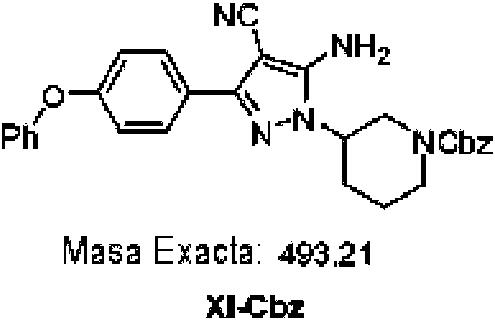
Añadir 4.29 g (1.0 eq) de VI en N2 con 60 mL (13 V) de etanol y 43 mL (10 V)de agua. Enfriar la mezcla hasta 5 °C. Añadir X-Cbz en tres porciones a 5-10 °C en N2. Añadir gota a gota 3.15 g (2.0 eq) de NEt3 a 5-10 oC. Calentar hasta 25 °C en N2 y agitar durante 1 h a 25 °C (se separa sólido). Añadir gota a gota 17 V de H2O a la mezcla de reacción a 25 °C. Enfriar la mezcla de reacción a 0-5 °C y agitar durante 1 h. Filtrar la mezcla. La masa retenida en el filtro se secó al vacío a 40-45 °C para obtener 7.79 g (100% de rendimiento) con una pureza de un 99.81% (ESI):m/z =494.1 (M+1)Add 4.29 g (1.0 eq) of VI in N2 with 60 mL (13 V) of ethanol and 43 mL (10 V) of water. Cool the mixture to 5 °C. Add X-Cbz in three portions at 5-10 °C under N2. Add 3.15 g (2.0 eq) of NEt 3 dropwise at 5-10 °C. heat up 25 °C under N2 and stir for 1 h at 25 °C (solid separates). Add 17 V H2O dropwise to the reaction mixture at 25 °C. Cool the reaction mixture to 0-5 °C and stir for 1 h. Filter the mixture. The mass retained on the filter was vacuum dried at 40-45 °C to obtain 7.79 g (100% yield) with a purity of 99.81% (ESI): m/z =494.1 (M+1)
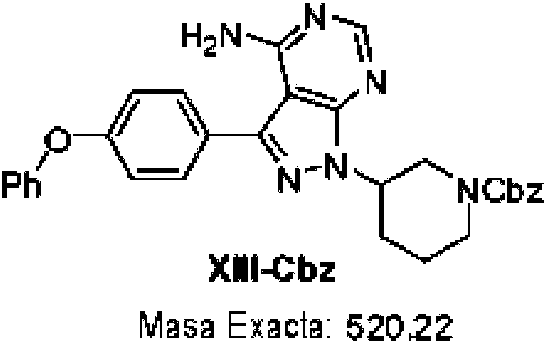
Se mezclaron 3 g (1.0 eq) de XI-Cbz con 9.5 g (15.0 eq) de acetato de formamidina y 40 mL (13 V) de C2H5OC2H4OH (desgasificado), se agitó la mezcla de reacción a 120 °C durante 6 h y se enfrió la mezcla de reacción hasta t. amb. Añadir gota a gota H2O (13 V) y AE (15 V). Separar la mezcla y extraer la fase acuosa con AE dos veces. Combinar las fases orgánicas y lavarlas dos veces con H2O. Evaporar el disolvente al vacío para obtener XIII-Cbz crudo como un aceite amarillo con una pureza de un 97.9%. (ESI):m/z = 521.4 (M+1)3 g (1.0 eq) of XI-Cbz were mixed with 9.5 g (15.0 eq) of formamidine acetate and 40 mL (13 V) of C2H5OC2H4OH (degassed), the reaction mixture was stirred at 120 °C for 6 h and cooled the reaction mixture to t. both. Add H2O (13 V) and EA (15 V) dropwise. Separate the mixture and extract the aqueous phase with EA twice. Combine the organic phases and wash twice with H2O. Evaporate the solvent in vacuo to obtain crude XIII-Cbz as a yellow oil with a purity of 97.9%. (ESI):m/z = 521.4 (M+1)
PASO-4STEP 4

--
Se llevó a cabo una preparación telescópica de I a partir de VI. En el paso 4, la conversión de VI fue de un 100% y se generó XI-Cbz con un área porcentual de un 99.8%. En el paso 5, la conversión de XI-Cbz fue de un 97.7% y se generó XIII-Cbz con un área porcentual de un 94.2%. En el paso 6, la conversión de XIII-Cbz fue de un 100% y se obtuvo I con un área porcentual de HPLC de un 92.5%.A telescopic preparation of I from VI was carried out. In step 4, the conversion of VI was 100% and XI-Cbz with an area percentage of 99.8% was generated. In step 5, the conversion of XI-Cbz was 97.7% and XIII-Cbz with an area percentage of 94.2% was generated. In step 6, the conversion of XIII-Cbz was 100% and I was obtained with an HPLC area percent of 92.5%.
Procedimiento: Añadir 4.29 g (1.0 eq) de VI en N2 con 10 mL (16.6 V) de etanol y 6 mL (10 V) Enfriar R1 hasta 5-10 °C. Añadir 0.7 g (1.0 eq) de solución de X-Cbz en agua que se añadió gota a gota a lo largo de 15 min a 5-10 °C. Añadir 0.45 g (2.0 eq) de NEt3 gota a gota a lo largo de 5 min a 5-10 oC. Calentar hasta 20~30 °C en N2 y agitar R1 durante 1 h a 20~30 °C. Añadir 10 V de AE y a continuación 10 V de H2O a la mezcla de reacción. Separar la mezcla y extraer la fase acuosa con 10 V de AE dos veces. Combinar las fases orgánicas y lavarlas con 10 V de H2O. Reemplazar el disolvente por 13 V de EtOEtOH. Añadir 15 eq de acetato de formamidina a la mezcla. Calentar hasta 120 °C y agitar durante 5 h a 120 °C. Enfriar la mezcla hasta t. amb. y añadir 15 V de AE y 15 V de H2O a la mezcla. Separar la mezcla y extraer la fase acuosa con 10 V de AE dos veces. Combinar las fases orgánicas y lavarlas con 10 V de H2O dos veces. Reemplazar el disolvente por 10 V de MeOH. Añadir Pd(OH)2/C (0.3 eq) y agitar la mezcla a 55-60 °C con una presión de 3 bar de H2. Filtrar la mezcla de reacción y lavar la masa retenida en el filtro con MeOH. Combinar la solución de MeOH de I crudo y concentrarla hasta 2-3 V. Añadir gota a gota H2O (5-6 V) a la solución de MeOH (se separa gran cantidad de sólido blanquecino). Filtrar la mezcla y lavar la masa retenida en el filtro con MeOH/H2O (1V/1V). Se secó el sólido al vacío a 40-45 °C para obtener I con un rendimiento de un 80% (en 3 pasos) con una pureza de un 92.5%.Procedure: Add 4.29 g (1.0 eq) of VI in N2 with 10 mL (16.6 V) of ethanol and 6 mL (10 V) Cool R1 to 5-10 °C. Add 0.7 g (1.0 eq) of X-Cbz solution in water which was added dropwise over 15 min at 5-10 °C. Add 0.45 g (2.0 eq) of NEt 3 dropwise over 5 min at 5-10 °C. Heat to 20~30°C under N2 and stir R1 for 1h at 20~30°C. Add 10 V of EA and then 10 V of H2O to the reaction mixture. Separate the mixture and extract the aqueous phase with 10 V EA twice. Combine the organic phases and wash with 10 V H2O. Replace the solvent with 13 V EtOEtOH. Add 15 eq of formamidine acetate to the mixture. Heat to 120 °C and stir for 5 h at 120 °C. Cool the mixture to t. both. and add 15 V EA and 15 V H2O to the mixture. Separate the mixture and extract the aqueous phase with 10 V EA twice. Combine the organic phases and wash with 10 V H2O twice. Replace the solvent with 10 V MeOH. Add Pd(OH)2/C (0.3 eq) and stir the mixture at 55-60 °C with 3 bar H2 pressure. Filter the reaction mixture and wash the mass retained on the filter with MeOH. Combine the MeOH solution of crude I and concentrate to 2-3 V. Add H2O (5-6 V) dropwise to the MeOH solution (large amount of off-white solid separates). Filter the mixture and wash the mass retained on the filter with MeOH/H2O (1V/1V). The solid was dried under vacuum at 40-45 °C to obtain I in 80% yield (in 3 steps) with 92.5% purity.
Comparando el HPLC, HRMN y CRMN de I con una referencia de tal compuesto, p. ej., conocida en la técnica (o derivatizada a partir de esta), se pudo concluir que el I preparado mediante esta síntesis tenía el mismo tiempo de retención de HPLC, el mismo HRMN y CRMN. Por lo tanto, esta ruta sintética a partir de SM-Cbz para obtener I es una ruta experimental de la que se puede disponer.Comparing HPLC, HRMN and CRMN of I with a reference of such a compound, e.g. known in the art (or derivatized from it), it could be concluded that the I prepared by this synthesis had the same HPLC retention, the same HRMN and CRMN. Therefore, this synthetic route from SM-Cbz to obtain I is an experimental route that may be available.

Añadir 0.41 g (1.0 eq) de VI (en solución de THF). Disolver 0.32 g (1.0 eq) de X-Boc en EtOH (2 V)/H2O (0.5 mL, 1.5 V)/Et3N (3.0 eq). Añadir gota a gota X-Boc a R1 a 5-10 °C. Calentar hasta 25 °C con N2 y agitar R1 durante 1 h a 25 °C. Añadir agua (10 V) gota a gota a 5-10 °C. Concentrar la mezcla al vacío y extraerla con acetato de etilo (20 mL*3). Lavar la fase orgánica con H2O. Evaporar el disolvente al vacío para obtener XI-Boc crudo como un aceite amarillo. Se generó el compuesto de-Boc, Imp-A, como el producto principal. Se obtuvo XI-Boc con un rendimiento de un 29% con una pureza de un 96% mediante cromatografía en columna.Add 0.41 g (1.0 eq) of VI (in THF solution). Dissolve 0.32 g (1.0 eq) of X-Boc in EtOH (2 V)/H2O (0.5 mL, 1.5 V)/Et 3 N (3.0 eq). Add X-Boc dropwise to R1 at 5-10 °C. Heat to 25 °C with N2 and stir R1 for 1 h at 25 °C. Add water (10 V) dropwise at 5-10 °C. Concentrate the mixture in vacuo and extract it with ethyl acetate (20 mL*3). Wash the organic phase with H2O. Evaporate the solvent in vacuo to obtain crude XI-Boc as a yellow oil. The de-Boc compound, Imp-A, was generated as the main product. XI-Boc was obtained in 29% yield with 96% purity by column chromatography.

Se añadió XI-Boc (0.3 g, 1.0 eq) a t. amb. en N2. Se añadió acetato de formamidina (15 eq) a R1 en N2. Se añadió C2H5OC2H4OH (13 V) a R1 en N2. Se calentó hasta 120 °C (temp. inter.) y se agitó la mezcla a 120 °C durante 8 h. En esta mezcla de reacción también se pudo observar un 4.3% de Imp-B. Enfriar la mezcla de reacción hasta t. amb. Añadir gota a gota H2O (40 mL, 13 V) y AE (15 V). Separar la mezcla y extraer la fase acuosa con AE dos veces. Combinar las fases orgánicas y reemplazar el disolvente por MeOH. Añadir HCl (10 eq, solución en MeOH) a la mezcla. Calentar hasta 50 °C y agitar durante 3 h. Enfriar hasta t. amb. y concentrar la mezcla de reacción hasta 2-3 mL. Añadir 3 mL de H2O y a continuación añadir gota a gota NaOH ac. al 30% para ajustar el pH a 10. Filtrar la mezcla y secar la masa retenida en el filtro al vacío a 45 °C. Se pudo aislar I mediante cristalización en MeOH/H2O con una pureza de un 95.6% con un rendimiento total de un 87.3%.XI-Boc (0.3 g, 1.0 eq) was added at t. both. in N2. Formamidine acetate (15 eq) was added to R1 on N2. C2H5OC2H4OH (13V) was added to R1 under N2. It was heated up to 120 °C (inter temp.) and the mixture was stirred at 120 °C for 8 h. In this reaction mixture, 4.3% of Imp-B could also be observed. Cool the reaction mixture to t. both. Add dropwise H2O (40 mL, 13 V) and EA (15 V). Separate the mixture and extract the aqueous phase with EA twice. Combine the organic phases and replace the solvent with MeOH. Add HCl (10 eq, solution in MeOH) to the mixture. Heat to 50 °C and stir for 3 h. Chill until t. both. and concentrate the reaction mixture to 2-3 mL. Add 3 mL of H2O and then add NaOH aq. dropwise. 30% to adjust the pH to 10. Filter the mixture and dry the mass retained on the filter under vacuum at 45 °C. I could be isolated by crystallization from MeOH/H2O with a purity of 95.6% with a total yield of 87.3%.
Comparando el HPLC, HRMN y CRMN de I con una referencia de tal compuesto, p. ej., conocida en la técnica (o derivatizada a partir de esta), se pudo concluir que el I preparado mediante esta síntesis tenía el mismo tiempo de retención de HPLC, el mismo HRMN y CRMN. Por lo tanto, esta ruta sintética a partir de SM-Boc para obtener I es una ruta experimental de la que se puede disponer.Comparing HPLC, HRMN and CRMN of I with a reference of such a compound, e.g. known in the art (or derivatized from it), it could be concluded that the I prepared by this synthesis had the same HPLC retention time, the same HRMN and CRMN. Therefore, this synthetic route from SM-Boc to obtain I is an experimental route that may be available.

Añadir 0.496 g (1.0 eq) de VI en N2 con 4mL (8V) de etanol. Enfriar la mezcla hasta 5 °C. Añadir X-Bn (disolver en 5V de EtOH y 10 V de H2O) en tres porciones a 5-10 °C en N2. Añadir gota a gota 0.51 g (2.0 eq) de NEt3 a 5-10 oC. Calentar hasta 25-30 °C en N2 y agitar durante 1 h a 25-30 °C (se separa sólido). Añadir gota a gota 17 V de H2O a la mezcla de reacción a 25 °C. Enfriar la mezcla de reacción a 0-5 °C y agitar durante 1 h. Filtrar la mezcla. Se secó la masa retenida en el filtro al vacío a 40-45 °C para obtener 0.65 g de XI-Bn (80% de rendimiento) con una pureza de un 94.03%. (ESI):m/z =450 (M+1)Add 0.496 g (1.0 eq) of VI in N2 with 4 mL (8V) of ethanol. Cool the mixture to 5 °C. Add X-Bn (dissolve in 5V EtOH and 10V H2O) in three portions at 5-10°C under N2. Add 0.51 g (2.0 eq) of NEt 3 dropwise at 5-10 °C. Heat to 25-30°C under N2 and stir for 1 h at 25-30°C (solid separates). Add 17 V H2O dropwise to the reaction mixture at 25 °C. Cool the reaction mixture to 0-5 °C and stir for 1 h. Filter the mixture. The mass retained in the filter was dried under vacuum at 40-45 °C to obtain 0.65 g of XI-Bn (80% yield) with a purity of 94.03%. (ESI):m/z =450 (M+1)

Se preparó XIII-Bn en un único paso a partir de 1.72 g de XI-Bn. En el primer paso de cierre del anillo, la conversión de XI-Bn fue de un 100% y se generó XIII-Bn con un 99.12% de pureza según LCMS. Incluso después de haber sido agitado durante 21 h a 120 °C, no se pudo observar descomposición. En el segundo paso, los autores probaron dos condiciones. En una se añadieron 2 eq de HCl (solución 4 M en MeOH) y la otra careció de HCl. El lote en el que se añadió HCl fue más rápido que el otro. Sin embargo, la conversión de XIII-Bn fue de solo un 20%. Procedimiento: Añadir XI-Bn a t. amb. con acetato de formamidina (15 eq) y C2H5OC2H4OH (13 V) en N2. Calentar hasta 120 °C y agitar la mezcla a 120 °C durante 8 h. Enfriar la mezcla de reacción hasta t. amb. Añadir gota a gota H2O (13 V) y AE (10 V). Separar la mezcla y extraer la fase acuosa con 10 V de AE dos veces. Combinar las fases orgánicas y lavarlas tres veces con H2O. Reemplazar el disolvente, AE, por MeOH. Añadir 0.1 eq de Pd(OH)2/C y 2 eq de HCl(solución 4M en MeOH). Calentar hasta 45-50 °C. Agitar la mezcla en R2 a 40-50 °C. Se obtuvo el producto deseado a partir de este procedimiento. (ESI):m/z =387.0 (M+1)XIII-Bn was prepared in a single step from 1.72 g of XI-Bn. In the first ring closure step, the conversion of XI-Bn was 100% and XIII-Bn was generated with 99.12% purity according to LCMS. Even after being stirred for 21 h at 120 °C, no decomposition could be observed. In the second step, the authors tested two conditions. In one, 2 eq of HCl (4 M solution in MeOH) was added and the other lacked HCl. The batch where HCl was added was faster than the other. However, the conversion of XIII-Bn was only 20%. Procedure: Add XI-Bn to t. both. with formamidine acetate (15 eq) and C2H5OC2H4OH (13 V) under N2. Heat up to 120 °C and stir the mixture at 120 °C for 8 h. Cool the reaction mixture to t. both. Add dropwise H2O (13 V) and EA (10 V). Separate the mixture and extract the aqueous phase with 10 V EA twice. Combine the organic phases and wash three times with H2O. Replace the solvent, AE, with MeOH. Add 0.1 eq of Pd(OH)2/C and 2 eq of HCl (4M solution in MeOH). Heat up to 45-50 °C. Stir the mixture in R2 at 40-50 °C. The desired product was obtained from this procedure. (ESI):m/z =387.0 (M+1)
Ejemplo 2Example 2
Preparación del compuesto Y6 (también denominado anteriormente compuesto I) a partir de piperidina-hidrazina no protegida (denominada posteriormente Y20)Preparation of compound Y6 (also previously referred to as compound I) from unprotected piperidine-hydrazine (later referred to as Y20)

Este ejemplo representa una realización adicional de la invención. El compuesto Y20 (la piperidina-hidrazina; también denominada en la presente compuesto de fórmula (III)), que corresponde al compuesto general X en el Ejemplo 1 anterior (pero donde en ese caso, el átomo de N de la piperidina está protegido con -Boc, -Bn o -CBz), no está sustituido en el átomo de N de la piperidina, y se mezcla directamente con el compuesto Y3 (también denominado compuesto VI en el Ejemplo 1, que es también un compuesto de fórmula (II) tal como se ha definido en la presente). La reacción es similar al Paso 4 en el Ejemplo 1 pero, a diferencia del Ejemplo 1, este ejemplo muestra que la piperidina-hidrazina no necesita estar protegida para que la reacción con Y3 proceda (remítase a Procedimiento S-1 posteriormente). Ciertamente, el producto resultante Y4 (también denominado en la presente compuesto de fórmula (I) tal como se ha descrito previamente en la presente) se produce de manera conveniente sin que sea necesario proteger (y posteriormente desproteger) la piperidina-hidrazina. El compuesto Y4 (que sigue estando no sustituido en el átomo de N piperidínico) se puede utilizar directamente a continuación en el siguiente paso de reacción (es decir, sin que sea necesario añadir un grupo protector), donde se permite que reaccionen una mezcla que contiene Y4 y formamida (u otro reactivo adecuado que logre el mismo resultado, tal como se describe en la presente) (remítase al Procedimiento S-2 posteriormente) para formar de esta manera un compuesto Y16 (que es una versión protegida de un compuesto de fórmula (IV) tal como se ha descrito en la presente (o una versión protegida de un compuesto I tal como se especifica en el Ejemplo 1, es decir, XIII pero en el que R1 representa -C(O)H). Es algo fortuito que el átomo de N de la piperidina esté acilado (con un grupo -C(O)H) durante la reacción de ciclación para producir el resto pirimidínico del biciclo (pirazol[3,4-d]pirimidina) y este grupo se podrá eliminar mediante la desprotección (por ejemplo, tal como se muestra en el Procedimiento S-3 posteriormente).This example represents a further embodiment of the invention. Compound Y20 (the piperidine-hydrazine; also referred to herein as the compound of formula (III)), which corresponds to the general compound X in Example 1 above (but where in that case, the N-atom of the piperidine is protected with -Boc, -Bn or -CBz), is not substituted on the N atom of the piperidine, and is mixed directly with compound Y3 (also called compound VI in Example 1, which is also a compound of formula (II) as defined herein). The reaction is similar to Step 4 in Example 1 but, unlike Example 1, this example shows that the piperidine-hydrazine does not need to be protected for the reaction with Y3 to proceed (see Procedure S-1 below). Indeed, the resulting product Y4 (also referred to herein as compound of formula (I) as previously described herein) is conveniently produced without that it is necessary to protect (and subsequently deprotect) the piperidine-hydrazine. Compound Y4 (still unsubstituted on the piperidine N atom) can then be used directly in the next reaction step (i.e. without the need to add a protecting group), where a mixture is allowed to react contains Y4 and formamide (or another suitable reagent that achieves the same result, as described herein) (see Procedure S-2 below) to thereby form a compound Y16 (which is a protected version of a compound of formula (IV) as described herein (or a protected version of a compound I as specified in Example 1, i.e. XIII but where R1 represents -C(O)H). It is fortuitous that the N atom of the piperidine is acylated (with a -C(O)H group) during the cyclization reaction to produce the pyrimidine moiety of the bicycle (pyrazol[3,4-d]pyrimidine) and this group can be remove by checking out (for example, as shown in Procedure S-3 below).
Procedimiento S-1:Procedure S-1:
El procedimiento de reacción se llevó a cabo de acuerdo con los siguientes pasos:The reaction procedure was carried out according to the following steps:
1. Disolver Y20 (0.058 g, 1.5 eq) en 0.5 mL de MeOH en un primer recipiente de reacción.1. Dissolve Y20 (0.058 g, 1.5 eq) in 0.5 mL MeOH in a first reaction vessel.
2. Añadir gota a gota una solución de NaOMe en MeOH a Y20 para ajustar el valor de pH a ~9.2. Add a solution of NaOMe in MeOH dropwise at Y20 to adjust the pH value to ~9.
3. Añadir Y3 (1.0 eq) y 0.45 mL de MeOH a un segundo recipiente de reacción.3. Add Y3 (1.0 eq) and 0.45 mL MeOH to a second reaction vessel.
4. Enfriar la mezcla de reacción en el segundo recipiente de reacción hasta 0-10 °C.4. Cool the reaction mixture in the second reaction vessel to 0-10°C.
5. Añadir gota a gota la solución de Y20 en MeOH del primer recipiente de reacción a la mezcla de reacción del segundo recipiente de reacción a 0-10 °C.5. Add the Y20 in MeOH solution from the first reaction vessel dropwise to the reaction mixture in the second reaction vessel at 0-10°C.
6. Agitar la mezcla de reacción subsiguiente a 20-25 °C durante 2 h.6. Stir subsequent reaction mixture at 20-25°C for 2h.
7. Enfriar la mezcla de reacción hasta 0-10 °C.7. Cool the reaction mixture to 0-10°C.
8. Añadir gota a gota 2 mL de H2O a la mezcla de reacción (se separa un sólido blanquecino).8. Add 2 mL H2O dropwise to the reaction mixture (an off-white solid separates).
9. Filtrar la mezcla y secar el producto al vacío.9. Filter the mixture and dry the product under vacuum.
Procedimiento S-2:Procedure S-2:
1. Añadir Y4 a un primer recipiente de reacción en N2.1. Add Y4 to a first reaction vessel under N2.
2. Añadir formamida 9.6X en dicho recipiente de reacción.2. Add 9.6X formamide into said reaction vessel.
3. Calentar la mezcla hasta 165-175 °C.3. Heat the mixture to 165-175 °C.
4. Agitar la mezcla de reacción durante 2 h a 165-175 oC.4. Stir the reaction mixture for 2 h at 165-175 °C.
5. Calcular el Impacto de los Reactivos de Pares Iónicos (IPC, por sus siglas en inglés) en el análisis de LCMS.5. Calculate the Impact of Ion Pair Reagents (IPC) on LCMS analysis.
6. Enfriar la mezcla de reacción a 40 °C (se separa un sólido).6. Cool the reaction mixture to 40°C (a solid separates).
7. Añadir gota a gota 6V de agua en el recipiente de reacción.7. Add 6V water dropwise to the reaction vessel.
8. Agitar la mezcla de reacción durante 0.5 h a 40 oC.8. Stir the reaction mixture for 0.5 h at 40 °C.
9. Enfriar la mezcla de reacción a 20 °C (o a aproximadamente temperatura ambiente).9. Cool the reaction mixture to 20°C (or about room temperature).
10. Filtrar la mezcla.10. Filter the mixture.
11. Secar la masa retenida en el filtro al vacío a 40-45 °C durante 16 h.11. Dry the mass retained on the filter under vacuum at 40-45 °C for 16 h.
12. Rendimiento del crudo: 92%12. Crude Yield: 92%
Procedimiento S-3:Procedure S-3:
1. Añadir 0.5 g de Y16 (del material obtenido directamente a partir de S-2 anteriormente) en un primer recipiente de reacción en N2.1. Add 0.5 g of Y16 (from the material obtained directly from S-2 above) to a first reaction vessel under N2.
2. Añadir 0.5 mL de HCl al 35% (5.0 eq) en dicho primer recipiente de reacción.2. Add 0.5 mL of 35% HCl (5.0 eq) in said first reaction vessel.
3. Calentar la mezcla hasta 55-65 °C.3. Heat the mixture to 55-65 °C.
4. Agitar la mezcla en el recipiente de reacción a 55-65 °C (remítase a la tabla posteriormente). 4. Stir the mixture in the reaction vessel at 55-65°C (see table below).
5. Calcular el Impacto de los Reactivos de Pares Iónicos (IPC) en el análisis de LCMS (remítase a la tabla posteriormente).5. Calculate the Impact of Ion Pair Reagents (IPC) on the LCMS analysis (refer to table below).
6. Enfriar la mezcla de reacción hasta 20 °C (o a aproximadamente temperatura ambiente).6. Cool the reaction mixture to 20°C (or about room temperature).
7. Añadir, gota a gota, KOH al recipiente de reacción para ajustar el pH hasta 11-13 (se separa un sólido). 8. Agitar la mezcla en el recipiente de reacción durante 0.5 h a 20 oC.7. Add KOH dropwise to the reaction vessel to adjust the pH to 11-13 (a solid separates). 8. Stir the mixture in the reaction vessel for 0.5 h at 20 °C.
9. Filtrar la mezcla.9. Filter the mixture.
10. Secar el sólido al vacío a 40-45 °C durante 16 h.10. Dry the solid under vacuum at 40-45 °C for 16 h.
11. Rendimiento del crudo: 63%11. Crude Yield: 63%

Ejemplo - Formulación FarmacéuticaExample - Pharmaceutical Formulation
Se puede formular ibrutinib en una formulación farmacéuticamente aceptable utilizando procedimientos habituales. Por ejemplo, se proporciona un proceso para preparar una formulación farmacéutica que comprende ibrutinib, o un derivado de este, donde el proceso se caracteriza por que incluye un paso de proceso tal como se ha definido anteriormente en la presente. El experto sabrá que tales formulaciones farmacéuticas comprenderán/estarán constituidas por, p. ej., una mezcla del principio activo (es decir ibrutinib o un derivado de este) y un excipiente, adyuvante, diluyente y/o portador farmacéuticamente aceptables.Ibrutinib can be formulated into a pharmaceutically acceptable formulation using standard procedures. For example, a process for preparing a pharmaceutical formulation comprising ibrutinib, or a derivative thereof, is provided, wherein the process is characterized by including a process step as defined hereinabove. The skilled person will know that such pharmaceutical formulations will comprise/consist of e.g. g., a mixture of the active ingredient (ie ibrutinib or a derivative thereof) and a pharmaceutically acceptable excipient, adjuvant, diluent and/or carrier.
Además, se proporciona un proceso para preparar una formulación farmacéutica que comprende ibrutinib (o un derivado de este), donde el proceso comprende asociar ibrutinib, o una sal farmacéuticamente aceptable de este, (que se puede preparar mediante un proceso como los descritos anteriormente en la presente), con uno o más excipientes, adyuvantes, diluyentes y/o portadores farmacéuticamente aceptables. Furthermore, a process for preparing a pharmaceutical formulation comprising ibrutinib (or a derivative thereof) is provided, wherein the process comprises associating ibrutinib, or a pharmaceutically acceptable salt thereof, (which may be prepared by a process such as those described above in herein), with one or more pharmaceutically acceptable excipients, adjuvants, diluents and/or carriers.
Claims (10)


Applications Claiming Priority (4)
| Application Number | Priority Date | Filing Date | Title |
|---|---|---|---|
| US201361786842P | 2013-03-15 | 2013-03-15 | |
| EP13159470 | 2013-03-15 | ||
| EP13197813 | 2013-12-17 | ||
| PCT/EP2014/054621 WO2014139970A1 (en) | 2013-03-15 | 2014-03-11 | Processes and intermediates for preparing a medicament |
Publications (1)
| Publication Number | Publication Date |
|---|---|
| ES2924193T3 true ES2924193T3 (en) | 2022-10-05 |
Family
ID=51535892
Family Applications (1)
| Application Number | Title | Priority Date | Filing Date |
|---|---|---|---|
| ES14708885T Active ES2924193T3 (en) | 2013-03-15 | 2014-03-11 | Processes and intermediates to prepare a medicine |
Country Status (19)
| Country | Link |
|---|---|
| EP (1) | EP2970291B1 (en) |
| JP (1) | JP6777398B2 (en) |
| KR (2) | KR102377688B1 (en) |
| CN (2) | CN105026400A (en) |
| AU (2) | AU2014230935A1 (en) |
| BR (1) | BR112015021856A2 (en) |
| CA (1) | CA2901510C (en) |
| DK (1) | DK2970291T3 (en) |
| EA (1) | EA201591685A1 (en) |
| ES (1) | ES2924193T3 (en) |
| HR (1) | HRP20220628T1 (en) |
| HU (1) | HUE058914T2 (en) |
| LT (1) | LT2970291T (en) |
| MX (2) | MX380171B (en) |
| MY (1) | MY194905A (en) |
| PE (1) | PE20151652A1 (en) |
| SG (2) | SG11201507595XA (en) |
| SI (1) | SI2970291T1 (en) |
| WO (1) | WO2014139970A1 (en) |
Families Citing this family (19)
| Publication number | Priority date | Publication date | Assignee | Title |
|---|---|---|---|---|
| UA121539C2 (en) | 2011-09-02 | 2020-06-25 | Інсайт Холдинґс Корпорейшн | HETEROCYCLYLAMINE AS RI3K INHIBITORS |
| US10077277B2 (en) | 2014-06-11 | 2018-09-18 | Incyte Corporation | Bicyclic heteroarylaminoalkyl phenyl derivatives as PI3K inhibitors |
| CN105884747B (en) * | 2014-08-28 | 2021-01-05 | 首药控股(北京)有限公司 | Preparation method for preparing Bruton's Tyrosine Kinase (BTK) kinase inhibitor |
| CN104447761A (en) * | 2014-11-27 | 2015-03-25 | 广东东阳光药业有限公司 | A kind of preparation method of pyrazole derivative |
| US10266535B2 (en) * | 2015-01-21 | 2019-04-23 | Hefei Institutes Of Physical Science, Chinese Academy Of Sciences | Inhibitor of FLT3 kinase and use thereof |
| UA122332C2 (en) * | 2015-02-27 | 2020-10-26 | Інсайт Корпорейшн | Salts of pi3k inhibitor and processes for their preparation |
| LV15201B (en) | 2015-08-31 | 2017-07-20 | Latvijas Organiskās Sintēzes Institūts | The method for the preparation of ibrutinib intermediate |
| CN106608877B (en) * | 2015-10-21 | 2018-11-13 | 新发药业有限公司 | One kind replacing Buddhist nun's intermediate 4- amino -3- according to Shandong(4- phenoxy groups)The preparation method of phenyl -1H- pyrazolos [3,4-d] pyrimidine |
| JO3794B1 (en) | 2015-12-10 | 2021-01-31 | Janssen Pharmaceutica Nv | Polycyclic compounds as inhibitors of bruton's tyrosine kinase |
| JO3793B1 (en) | 2015-12-10 | 2021-01-31 | Janssen Pharmaceutica Nv | Proton tyrosine kinase inhibitors and how to use them |
| WO2018103058A1 (en) * | 2016-12-09 | 2018-06-14 | Janssen Pharmaceutica Nv | Inhibitors of bruton's tyrosine kinase and methods of their use |
| CN109311883B (en) * | 2017-02-09 | 2021-03-19 | 合肥合源药业有限公司 | Crystal form of FLT3 kinase inhibitor or salt thereof and preparation method thereof |
| CN107383017B (en) * | 2017-07-20 | 2020-01-14 | 河南师范大学 | Efficient preparation method of ibrutinib |
| JP7166331B2 (en) | 2017-08-01 | 2022-11-07 | ベーリンガー インゲルハイム インターナショナル ゲゼルシャフト ミット ベシュレンクテル ハフツング | Intermediate compounds and methods |
| CA3135240A1 (en) | 2019-05-21 | 2020-11-26 | Philip James Pye | Processes and intermediates for preparing a btk inhibitor |
| MX2021014245A (en) * | 2019-05-21 | 2022-01-06 | Janssen Pharmaceutica Nv | PROCEDURES AND INTERMEDIATES FOR PREPARING A BTK INHIBITOR. |
| CN113200987A (en) * | 2021-04-29 | 2021-08-03 | 湖南华腾制药有限公司 | Preparation method of ibrutinib |
| BR112023025459A2 (en) | 2021-06-04 | 2024-02-27 | Janssen Pharmaceutica Nv | BRUTON'S TYROSINE KINASE INHIBITORS AND METHODS OF USE THEREOF |
| CN115322226B (en) * | 2022-08-17 | 2023-08-11 | 厦门大学 | Covalent targeting arsenic inhibitor and preparation method and application thereof |
Family Cites Families (14)
| Publication number | Priority date | Publication date | Assignee | Title |
|---|---|---|---|---|
| KR20020088406A (en) * | 1999-09-17 | 2002-11-27 | 애보트 게엠베하 운트 콤파니 카게 | Pyrazolopyrimidines as therapeutic agents |
| PL2526933T3 (en) * | 2006-09-22 | 2015-08-31 | Pharmacyclics Llc | Inhibitors of Bruton's tyrosine kinase |
| ES2403546T3 (en) | 2006-11-03 | 2013-05-20 | Pharmacyclics, Inc. | Bruton tyrosine kinase activity probe and method of use |
| SG10201508035TA (en) * | 2007-03-28 | 2015-10-29 | Pharmacyclics Inc | Inhibitors of bruton's tyrosine kinase |
| UA105362C2 (en) * | 2008-04-02 | 2014-05-12 | Бьорингер Ингельхайм Интернациональ Гмбх | 1-heterocyclyl-1, 5-dihydro-pyrazolo [3, 4-d] pyrimidin-4-one derivatives and their use as pde9a modulators |
| PT2414363E (en) | 2009-03-31 | 2014-02-26 | Boehringer Ingelheim Int | 1-heterocyclyl-1,5-dihydro-pyrazolo[3,4-d]pyrimidin-4-one derivatives and their use as pde9a modulators |
| US7741330B1 (en) * | 2009-10-12 | 2010-06-22 | Pharmacyclics, Inc. | Pyrazolo-pyrimidine inhibitors of Bruton's tyrosine kinase |
| JP5810157B2 (en) * | 2010-07-09 | 2015-11-11 | ザ・ウォルター・アンド・エリザ・ホール・インスティテュート・オブ・メディカル・リサーチ | Protein kinase inhibitors and methods of treatment |
| WO2012058645A1 (en) * | 2010-10-29 | 2012-05-03 | Biogen Idec Ma Inc. | Heterocyclic tyrosine kinase inhibitors |
| WO2012158795A1 (en) * | 2011-05-17 | 2012-11-22 | Principia Biopharma Inc. | Pyrazolopyrimidine derivatives as tyrosine kinase inhibitors |
| EA201490265A1 (en) * | 2011-07-13 | 2014-12-30 | Фармасайкликс, Инк. | BLUTON TYROSINKINASE INHIBITORS |
| MA37830B1 (en) * | 2012-08-10 | 2018-09-28 | Boehringer Ingelheim Int | Heteroromatic compounds as inhibitors of crude tyrosine kinase (btk) |
| CN105008344B (en) * | 2012-11-02 | 2017-07-25 | 辉瑞公司 | Bruton's tyrosine kinase inhibitor |
| CN103848810A (en) * | 2012-11-30 | 2014-06-11 | 北京赛林泰医药技术有限公司 | Bruton's tyrosine kinases inhibitor |
-
2014
- 2014-03-11 ES ES14708885T patent/ES2924193T3/en active Active
- 2014-03-11 KR KR1020217031854A patent/KR102377688B1/en active Active
- 2014-03-11 LT LTEPPCT/EP2014/054621T patent/LT2970291T/en unknown
- 2014-03-11 CN CN201480015131.5A patent/CN105026400A/en active Pending
- 2014-03-11 EP EP14708885.0A patent/EP2970291B1/en active Active
- 2014-03-11 HR HRP20220628TT patent/HRP20220628T1/en unknown
- 2014-03-11 SI SI201431956T patent/SI2970291T1/en unknown
- 2014-03-11 CN CN202011305518.8A patent/CN112608298A/en active Pending
- 2014-03-11 SG SG11201507595XA patent/SG11201507595XA/en unknown
- 2014-03-11 EA EA201591685A patent/EA201591685A1/en unknown
- 2014-03-11 WO PCT/EP2014/054621 patent/WO2014139970A1/en not_active Ceased
- 2014-03-11 SG SG10201809696UA patent/SG10201809696UA/en unknown
- 2014-03-11 PE PE2015001956A patent/PE20151652A1/en unknown
- 2014-03-11 BR BR112015021856A patent/BR112015021856A2/en not_active Application Discontinuation
- 2014-03-11 AU AU2014230935A patent/AU2014230935A1/en not_active Abandoned
- 2014-03-11 DK DK14708885.0T patent/DK2970291T3/en active
- 2014-03-11 MX MX2015012731A patent/MX380171B/en unknown
- 2014-03-11 JP JP2015562078A patent/JP6777398B2/en active Active
- 2014-03-11 MY MYPI2015002280A patent/MY194905A/en unknown
- 2014-03-11 CA CA2901510A patent/CA2901510C/en active Active
- 2014-03-11 HU HUE14708885A patent/HUE058914T2/en unknown
- 2014-03-11 KR KR1020157025525A patent/KR102311329B1/en active Active
-
2015
- 2015-09-14 MX MX2020012596A patent/MX2020012596A/en unknown
-
2018
- 2018-06-08 AU AU2018204086A patent/AU2018204086B2/en active Active
Also Published As
| Publication number | Publication date |
|---|---|
| SG11201507595XA (en) | 2015-10-29 |
| EA201591685A1 (en) | 2016-01-29 |
| EP2970291A1 (en) | 2016-01-20 |
| SI2970291T1 (en) | 2022-07-29 |
| JP6777398B2 (en) | 2020-10-28 |
| CN112608298A (en) | 2021-04-06 |
| AU2018204086B2 (en) | 2020-03-12 |
| KR20150132172A (en) | 2015-11-25 |
| MX2015012731A (en) | 2016-02-18 |
| HRP20220628T1 (en) | 2022-06-24 |
| CA2901510A1 (en) | 2014-09-18 |
| BR112015021856A2 (en) | 2017-07-18 |
| AU2018204086A1 (en) | 2018-06-28 |
| MX380171B (en) | 2025-03-12 |
| CN105026400A (en) | 2015-11-04 |
| CA2901510C (en) | 2022-11-29 |
| KR102311329B1 (en) | 2021-10-14 |
| JP2016510779A (en) | 2016-04-11 |
| KR20210123429A (en) | 2021-10-13 |
| LT2970291T (en) | 2022-06-10 |
| KR102377688B1 (en) | 2022-03-22 |
| EP2970291B1 (en) | 2022-05-11 |
| HUE058914T2 (en) | 2022-09-28 |
| SG10201809696UA (en) | 2018-11-29 |
| PE20151652A1 (en) | 2015-11-12 |
| WO2014139970A1 (en) | 2014-09-18 |
| MX2020012596A (en) | 2021-02-09 |
| MY194905A (en) | 2022-12-22 |
| DK2970291T3 (en) | 2022-08-01 |
| AU2014230935A1 (en) | 2015-09-03 |
Similar Documents
| Publication | Publication Date | Title |
|---|---|---|
| KR102377688B1 (en) | Methods and intermediates for the manufacture of pharmaceuticals | |
| US9156847B2 (en) | Processes and intermediates for preparing a medicament | |
| ES2959007T3 (en) | Procedures for preparing ask1 inhibitors | |
| ES2819504T3 (en) | Process for the manufacture of pyrimidine sulfamide derivatives | |
| ES3062921T3 (en) | Preparation method for novel rho-related protein kinase inhibitor and intermediate in preparation method | |
| ES2616784T3 (en) | Quinoxalinones and dihydroquinoxalinones as antiviral agents against respiratory syncytial virus | |
| ES2754430T3 (en) | Fused imidazolyl derivatives, their preparation and use as medicinal products | |
| KR102325454B1 (en) | Methods and reagents for radiolabeling | |
| ES2837361T3 (en) | Process for preparing indole-carboxamide compounds | |
| KR20160118359A (en) | Preparation of 3,4-dihydro-1,4-benzoxazepin-5(2h)-one derivatives by cyclisation of 2-(amino ethyloxy) benzoic acid derivatives | |
| ES2697898T3 (en) | Tricyclic tricyclic compounds | |
| WO2006129626A1 (en) | Method for producing [1,2,4]triazolo[1,5-c]pyrimidine derivative | |
| US12215110B2 (en) | Processes and intermediates for preparing a Btk inhibitor | |
| HK40048820A (en) | Processes and intermediates for preparing a medicament | |
| US12459948B2 (en) | Processes and intermediates for preparing a Btk inhibitor | |
| NZ711026B2 (en) | Processes and intermediates for preparing a medicament | |
| ES2685837T3 (en) | Process and intermediate products for the synthesis of (3-alkyl-5-piperidin-1-yl-3,3a-dihydropyrazolo [1,5-a] pyrimidin-7-yl) -amino derivatives | |
| HK1216178A1 (en) | Processes and intermediates for preparing a medicament | |
| Zhai et al. | Synthetic strategies for piperazine derivatives | |
| AR062421A1 (en) | PROCESS TO RESOLVE PIPERIDIN CHIRAL ALCOHOL AND PROCESS FOR THE SYNTHESIS OF DERIVATIVES OF 'PIRAZOLO [1,5-A] PYRIMIDINE USING THE SAME | |
| BR112017015828B1 (en) | Compounds derived from pyrazolo [3,4-d] pyrimidine, pharmaceutical composition and combination comprising said compounds and their use for the treatment of leishmaniasis |