ES2938007T3 - Thermally Expandable Cellulose-Based Microspheres - Google Patents
Thermally Expandable Cellulose-Based Microspheres Download PDFInfo
- Publication number
- ES2938007T3 ES2938007T3 ES19798332T ES19798332T ES2938007T3 ES 2938007 T3 ES2938007 T3 ES 2938007T3 ES 19798332 T ES19798332 T ES 19798332T ES 19798332 T ES19798332 T ES 19798332T ES 2938007 T3 ES2938007 T3 ES 2938007T3
- Authority
- ES
- Spain
- Prior art keywords
- carboxylate
- groups
- microspheres
- thermally expandable
- expandable microspheres
- Prior art date
- Legal status (The legal status is an assumption and is not a legal conclusion. Google has not performed a legal analysis and makes no representation as to the accuracy of the status listed.)
- Active
Links
- 239000004005 microsphere Substances 0.000 title claims abstract description 66
- 229920002678 cellulose Polymers 0.000 claims abstract description 69
- 239000001913 cellulose Substances 0.000 claims abstract description 62
- 239000004604 Blowing Agent Substances 0.000 claims abstract description 44
- 229920000103 Expandable microsphere Polymers 0.000 claims abstract description 28
- 239000003995 emulsifying agent Substances 0.000 claims abstract description 20
- 239000012074 organic phase Substances 0.000 claims abstract description 17
- 239000008346 aqueous phase Substances 0.000 claims abstract description 16
- 239000003960 organic solvent Substances 0.000 claims abstract description 11
- 238000000034 method Methods 0.000 claims abstract description 10
- 238000002156 mixing Methods 0.000 claims abstract description 9
- 230000009477 glass transition Effects 0.000 claims abstract description 6
- 239000006185 dispersion Substances 0.000 claims abstract description 3
- 150000007942 carboxylates Chemical group 0.000 claims description 40
- 239000000203 mixture Substances 0.000 claims description 22
- VYPSYNLAJGMNEJ-UHFFFAOYSA-N Silicium dioxide Chemical group O=[Si]=O VYPSYNLAJGMNEJ-UHFFFAOYSA-N 0.000 claims description 21
- 125000000217 alkyl group Chemical group 0.000 claims description 20
- 150000004820 halides Chemical class 0.000 claims description 16
- XBDQKXXYIPTUBI-UHFFFAOYSA-M Propionate Chemical compound CCC([O-])=O XBDQKXXYIPTUBI-UHFFFAOYSA-M 0.000 claims description 13
- 125000003545 alkoxy group Chemical group 0.000 claims description 13
- 125000001931 aliphatic group Chemical group 0.000 claims description 12
- 125000004432 carbon atom Chemical group C* 0.000 claims description 12
- 238000009835 boiling Methods 0.000 claims description 10
- 238000010438 heat treatment Methods 0.000 claims description 10
- 150000001335 aliphatic alkanes Chemical class 0.000 claims description 7
- 150000001350 alkyl halides Chemical class 0.000 claims description 7
- 125000003118 aryl group Chemical group 0.000 claims description 7
- 239000002904 solvent Substances 0.000 claims description 7
- 125000001424 substituent group Chemical group 0.000 claims description 7
- 239000003795 chemical substances by application Substances 0.000 claims description 6
- 125000004122 cyclic group Chemical group 0.000 claims description 5
- FERIUCNNQQJTOY-UHFFFAOYSA-M Butyrate Chemical compound CCCC([O-])=O FERIUCNNQQJTOY-UHFFFAOYSA-M 0.000 claims description 4
- FERIUCNNQQJTOY-UHFFFAOYSA-N Butyric acid Natural products CCCC(O)=O FERIUCNNQQJTOY-UHFFFAOYSA-N 0.000 claims description 4
- 150000001983 dialkylethers Chemical class 0.000 claims description 4
- 238000004519 manufacturing process Methods 0.000 claims description 4
- 229920006395 saturated elastomer Polymers 0.000 claims description 4
- 239000002002 slurry Substances 0.000 claims description 4
- QTBSBXVTEAMEQO-UHFFFAOYSA-M Acetate Chemical group CC([O-])=O QTBSBXVTEAMEQO-UHFFFAOYSA-M 0.000 claims description 3
- 150000001298 alcohols Chemical class 0.000 claims description 3
- 150000002148 esters Chemical group 0.000 claims description 3
- 150000002170 ethers Chemical class 0.000 claims description 3
- FUZZWVXGSFPDMH-UHFFFAOYSA-N hexanoic acid Chemical compound CCCCCC(O)=O FUZZWVXGSFPDMH-UHFFFAOYSA-N 0.000 claims description 3
- 229910052739 hydrogen Inorganic materials 0.000 claims description 3
- 150000002576 ketones Chemical class 0.000 claims description 3
- 229920002451 polyvinyl alcohol Polymers 0.000 claims description 3
- 235000019422 polyvinyl alcohol Nutrition 0.000 claims description 3
- 150000001408 amides Chemical class 0.000 claims description 2
- 239000002280 amphoteric surfactant Substances 0.000 claims description 2
- 239000003945 anionic surfactant Substances 0.000 claims description 2
- 239000003093 cationic surfactant Substances 0.000 claims description 2
- MNWFXJYAOYHMED-UHFFFAOYSA-N heptanoic acid Chemical compound CCCCCCC(O)=O MNWFXJYAOYHMED-UHFFFAOYSA-N 0.000 claims description 2
- 239000002736 nonionic surfactant Substances 0.000 claims description 2
- WWZKQHOCKIZLMA-UHFFFAOYSA-M octanoate Chemical compound CCCCCCCC([O-])=O WWZKQHOCKIZLMA-UHFFFAOYSA-M 0.000 claims description 2
- XNGIFLGASWRNHJ-UHFFFAOYSA-L phthalate(2-) Chemical compound [O-]C(=O)C1=CC=CC=C1C([O-])=O XNGIFLGASWRNHJ-UHFFFAOYSA-L 0.000 claims description 2
- NQPDZGIKBAWPEJ-UHFFFAOYSA-N valeric acid Chemical compound CCCCC(O)=O NQPDZGIKBAWPEJ-UHFFFAOYSA-N 0.000 claims description 2
- 239000002888 zwitterionic surfactant Substances 0.000 claims description 2
- 125000003178 carboxy group Chemical group [H]OC(*)=O 0.000 claims 1
- 235000010980 cellulose Nutrition 0.000 description 57
- XEKOWRVHYACXOJ-UHFFFAOYSA-N Ethyl acetate Chemical compound CCOC(C)=O XEKOWRVHYACXOJ-UHFFFAOYSA-N 0.000 description 20
- 229920000642 polymer Polymers 0.000 description 20
- XLYOFNOQVPJJNP-UHFFFAOYSA-N water Substances O XLYOFNOQVPJJNP-UHFFFAOYSA-N 0.000 description 15
- -1 poly(aminoamide) Polymers 0.000 description 12
- CSCPPACGZOOCGX-UHFFFAOYSA-N Acetone Chemical compound CC(C)=O CSCPPACGZOOCGX-UHFFFAOYSA-N 0.000 description 9
- LYCAIKOWRPUZTN-UHFFFAOYSA-N Ethylene glycol Chemical compound OCCO LYCAIKOWRPUZTN-UHFFFAOYSA-N 0.000 description 8
- 125000000524 functional group Chemical group 0.000 description 8
- 239000000243 solution Substances 0.000 description 8
- KFZMGEQAYNKOFK-UHFFFAOYSA-N Isopropanol Chemical compound CC(C)O KFZMGEQAYNKOFK-UHFFFAOYSA-N 0.000 description 7
- DNIAPMSPPWPWGF-UHFFFAOYSA-N Propylene glycol Chemical compound CC(O)CO DNIAPMSPPWPWGF-UHFFFAOYSA-N 0.000 description 7
- 238000000576 coating method Methods 0.000 description 7
- 235000019439 ethyl acetate Nutrition 0.000 description 7
- 239000000463 material Substances 0.000 description 7
- 239000007787 solid Substances 0.000 description 7
- 239000002245 particle Substances 0.000 description 6
- 238000003756 stirring Methods 0.000 description 6
- 239000000126 substance Substances 0.000 description 6
- 229920001169 thermoplastic Polymers 0.000 description 6
- KXKVLQRXCPHEJC-UHFFFAOYSA-N acetic acid trimethyl ester Natural products COC(C)=O KXKVLQRXCPHEJC-UHFFFAOYSA-N 0.000 description 5
- 239000011324 bead Substances 0.000 description 5
- 229910052799 carbon Inorganic materials 0.000 description 5
- 239000008119 colloidal silica Substances 0.000 description 5
- WBJINCZRORDGAQ-UHFFFAOYSA-N formic acid ethyl ester Natural products CCOC=O WBJINCZRORDGAQ-UHFFFAOYSA-N 0.000 description 5
- 239000011572 manganese Substances 0.000 description 5
- 238000002844 melting Methods 0.000 description 5
- 230000008018 melting Effects 0.000 description 5
- 239000000377 silicon dioxide Substances 0.000 description 5
- SGVYKUFIHHTIFL-UHFFFAOYSA-N 2-methylnonane Chemical compound CCCCCCCC(C)C SGVYKUFIHHTIFL-UHFFFAOYSA-N 0.000 description 4
- 230000015572 biosynthetic process Effects 0.000 description 4
- 229920006217 cellulose acetate butyrate Polymers 0.000 description 4
- 239000000945 filler Substances 0.000 description 4
- 238000010191 image analysis Methods 0.000 description 4
- YKYONYBAUNKHLG-UHFFFAOYSA-N propyl acetate Chemical compound CCCOC(C)=O YKYONYBAUNKHLG-UHFFFAOYSA-N 0.000 description 4
- 150000003839 salts Chemical class 0.000 description 4
- 150000004756 silanes Chemical class 0.000 description 4
- 239000004094 surface-active agent Substances 0.000 description 4
- 239000004416 thermosoftening plastic Substances 0.000 description 4
- ZWEHNKRNPOVVGH-UHFFFAOYSA-N 2-Butanone Chemical compound CCC(C)=O ZWEHNKRNPOVVGH-UHFFFAOYSA-N 0.000 description 3
- 239000004593 Epoxy Substances 0.000 description 3
- ZMXDDKWLCZADIW-UHFFFAOYSA-N N,N-Dimethylformamide Chemical compound CN(C)C=O ZMXDDKWLCZADIW-UHFFFAOYSA-N 0.000 description 3
- YXFVVABEGXRONW-UHFFFAOYSA-N Toluene Chemical compound CC1=CC=CC=C1 YXFVVABEGXRONW-UHFFFAOYSA-N 0.000 description 3
- 239000002253 acid Substances 0.000 description 3
- 230000002776 aggregation Effects 0.000 description 3
- 125000003282 alkyl amino group Chemical group 0.000 description 3
- 238000000149 argon plasma sintering Methods 0.000 description 3
- 229920002301 cellulose acetate Polymers 0.000 description 3
- 238000006243 chemical reaction Methods 0.000 description 3
- 239000000460 chlorine Substances 0.000 description 3
- 229910052801 chlorine Inorganic materials 0.000 description 3
- 238000000113 differential scanning calorimetry Methods 0.000 description 3
- AFABGHUZZDYHJO-UHFFFAOYSA-N dimethyl butane Natural products CCCC(C)C AFABGHUZZDYHJO-UHFFFAOYSA-N 0.000 description 3
- 239000012153 distilled water Substances 0.000 description 3
- 239000000839 emulsion Substances 0.000 description 3
- 229910052731 fluorine Inorganic materials 0.000 description 3
- 239000006260 foam Substances 0.000 description 3
- 239000003517 fume Substances 0.000 description 3
- XEEYBQQBJWHFJM-UHFFFAOYSA-N iron Substances [Fe] XEEYBQQBJWHFJM-UHFFFAOYSA-N 0.000 description 3
- 239000007788 liquid Substances 0.000 description 3
- PXHVJJICTQNCMI-UHFFFAOYSA-N nickel Substances [Ni] PXHVJJICTQNCMI-UHFFFAOYSA-N 0.000 description 3
- 125000002924 primary amino group Chemical group [H]N([H])* 0.000 description 3
- 238000006467 substitution reaction Methods 0.000 description 3
- JNYAEWCLZODPBN-JGWLITMVSA-N (2r,3r,4s)-2-[(1r)-1,2-dihydroxyethyl]oxolane-3,4-diol Chemical class OC[C@@H](O)[C@H]1OC[C@H](O)[C@H]1O JNYAEWCLZODPBN-JGWLITMVSA-N 0.000 description 2
- 125000004178 (C1-C4) alkyl group Chemical group 0.000 description 2
- ZORQXIQZAOLNGE-UHFFFAOYSA-N 1,1-difluorocyclohexane Chemical compound FC1(F)CCCCC1 ZORQXIQZAOLNGE-UHFFFAOYSA-N 0.000 description 2
- RWNUSVWFHDHRCJ-UHFFFAOYSA-N 1-butoxypropan-2-ol Chemical compound CCCCOCC(C)O RWNUSVWFHDHRCJ-UHFFFAOYSA-N 0.000 description 2
- HNRMPXKDFBEGFZ-UHFFFAOYSA-N 2,2-dimethylbutane Chemical compound CCC(C)(C)C HNRMPXKDFBEGFZ-UHFFFAOYSA-N 0.000 description 2
- RXGUIWHIADMCFC-UHFFFAOYSA-N 2-Methylpropyl 2-methylpropionate Chemical compound CC(C)COC(=O)C(C)C RXGUIWHIADMCFC-UHFFFAOYSA-N 0.000 description 2
- GXDHCNNESPLIKD-UHFFFAOYSA-N 2-methylhexane Natural products CCCCC(C)C GXDHCNNESPLIKD-UHFFFAOYSA-N 0.000 description 2
- GTJOHISYCKPIMT-UHFFFAOYSA-N 2-methylundecane Chemical compound CCCCCCCCCC(C)C GTJOHISYCKPIMT-UHFFFAOYSA-N 0.000 description 2
- YEJRWHAVMIAJKC-UHFFFAOYSA-N 4-Butyrolactone Chemical compound O=C1CCCO1 YEJRWHAVMIAJKC-UHFFFAOYSA-N 0.000 description 2
- FFWSICBKRCICMR-UHFFFAOYSA-N 5-methyl-2-hexanone Chemical compound CC(C)CCC(C)=O FFWSICBKRCICMR-UHFFFAOYSA-N 0.000 description 2
- XZIIFPSPUDAGJM-UHFFFAOYSA-N 6-chloro-2-n,2-n-diethylpyrimidine-2,4-diamine Chemical compound CCN(CC)C1=NC(N)=CC(Cl)=N1 XZIIFPSPUDAGJM-UHFFFAOYSA-N 0.000 description 2
- KWOLFJPFCHCOCG-UHFFFAOYSA-N Acetophenone Chemical compound CC(=O)C1=CC=CC=C1 KWOLFJPFCHCOCG-UHFFFAOYSA-N 0.000 description 2
- IJGRMHOSHXDMSA-UHFFFAOYSA-N Atomic nitrogen Chemical compound N#N IJGRMHOSHXDMSA-UHFFFAOYSA-N 0.000 description 2
- VTYYLEPIZMXCLO-UHFFFAOYSA-L Calcium carbonate Chemical compound [Ca+2].[O-]C([O-])=O VTYYLEPIZMXCLO-UHFFFAOYSA-L 0.000 description 2
- 229920008347 Cellulose acetate propionate Polymers 0.000 description 2
- HEDRZPFGACZZDS-UHFFFAOYSA-N Chloroform Chemical compound ClC(Cl)Cl HEDRZPFGACZZDS-UHFFFAOYSA-N 0.000 description 2
- RGSFGYAAUTVSQA-UHFFFAOYSA-N Cyclopentane Chemical compound C1CCCC1 RGSFGYAAUTVSQA-UHFFFAOYSA-N 0.000 description 2
- IAZDPXIOMUYVGZ-UHFFFAOYSA-N Dimethylsulphoxide Chemical compound CS(C)=O IAZDPXIOMUYVGZ-UHFFFAOYSA-N 0.000 description 2
- DGAQECJNVWCQMB-PUAWFVPOSA-M Ilexoside XXIX Chemical compound C[C@@H]1CC[C@@]2(CC[C@@]3(C(=CC[C@H]4[C@]3(CC[C@@H]5[C@@]4(CC[C@@H](C5(C)C)OS(=O)(=O)[O-])C)C)[C@@H]2[C@]1(C)O)C)C(=O)O[C@H]6[C@@H]([C@H]([C@@H]([C@H](O6)CO)O)O)O.[Na+] DGAQECJNVWCQMB-PUAWFVPOSA-M 0.000 description 2
- NHTMVDHEPJAVLT-UHFFFAOYSA-N Isooctane Chemical compound CC(C)CC(C)(C)C NHTMVDHEPJAVLT-UHFFFAOYSA-N 0.000 description 2
- LRHPLDYGYMQRHN-UHFFFAOYSA-N N-Butanol Chemical compound CCCCO LRHPLDYGYMQRHN-UHFFFAOYSA-N 0.000 description 2
- IMNFDUFMRHMDMM-UHFFFAOYSA-N N-Heptane Chemical compound CCCCCCC IMNFDUFMRHMDMM-UHFFFAOYSA-N 0.000 description 2
- SECXISVLQFMRJM-UHFFFAOYSA-N N-Methylpyrrolidone Chemical compound CN1CCCC1=O SECXISVLQFMRJM-UHFFFAOYSA-N 0.000 description 2
- OFBQJSOFQDEBGM-UHFFFAOYSA-N Pentane Chemical compound CCCCC OFBQJSOFQDEBGM-UHFFFAOYSA-N 0.000 description 2
- 239000002202 Polyethylene glycol Substances 0.000 description 2
- DBMJMQXJHONAFJ-UHFFFAOYSA-M Sodium laurylsulphate Chemical compound [Na+].CCCCCCCCCCCCOS([O-])(=O)=O DBMJMQXJHONAFJ-UHFFFAOYSA-M 0.000 description 2
- QAOWNCQODCNURD-UHFFFAOYSA-N Sulfuric acid Chemical compound OS(O)(=O)=O QAOWNCQODCNURD-UHFFFAOYSA-N 0.000 description 2
- WYURNTSHIVDZCO-UHFFFAOYSA-N Tetrahydrofuran Chemical compound C1CCOC1 WYURNTSHIVDZCO-UHFFFAOYSA-N 0.000 description 2
- GWEVSGVZZGPLCZ-UHFFFAOYSA-N Titan oxide Chemical compound O=[Ti]=O GWEVSGVZZGPLCZ-UHFFFAOYSA-N 0.000 description 2
- GTDPSWPPOUPBNX-UHFFFAOYSA-N ac1mqpva Chemical compound CC12C(=O)OC(=O)C1(C)C1(C)C2(C)C(=O)OC1=O GTDPSWPPOUPBNX-UHFFFAOYSA-N 0.000 description 2
- 229940022663 acetate Drugs 0.000 description 2
- YRKCREAYFQTBPV-UHFFFAOYSA-N acetylacetone Chemical compound CC(=O)CC(C)=O YRKCREAYFQTBPV-UHFFFAOYSA-N 0.000 description 2
- 238000004220 aggregation Methods 0.000 description 2
- 125000003342 alkenyl group Chemical group 0.000 description 2
- 229910052782 aluminium Inorganic materials 0.000 description 2
- 238000004458 analytical method Methods 0.000 description 2
- RDOXTESZEPMUJZ-UHFFFAOYSA-N anisole Chemical compound COC1=CC=CC=C1 RDOXTESZEPMUJZ-UHFFFAOYSA-N 0.000 description 2
- TZCXTZWJZNENPQ-UHFFFAOYSA-L barium sulfate Chemical compound [Ba+2].[O-]S([O-])(=O)=O TZCXTZWJZNENPQ-UHFFFAOYSA-L 0.000 description 2
- 230000004888 barrier function Effects 0.000 description 2
- 239000000440 bentonite Substances 0.000 description 2
- 229910000278 bentonite Inorganic materials 0.000 description 2
- SVPXDRXYRYOSEX-UHFFFAOYSA-N bentoquatam Chemical compound O.O=[Si]=O.O=[Al]O[Al]=O SVPXDRXYRYOSEX-UHFFFAOYSA-N 0.000 description 2
- HUMNYLRZRPPJDN-UHFFFAOYSA-N benzaldehyde Chemical compound O=CC1=CC=CC=C1 HUMNYLRZRPPJDN-UHFFFAOYSA-N 0.000 description 2
- QUKGYYKBILRGFE-UHFFFAOYSA-N benzyl acetate Chemical compound CC(=O)OCC1=CC=CC=C1 QUKGYYKBILRGFE-UHFFFAOYSA-N 0.000 description 2
- GZUXJHMPEANEGY-UHFFFAOYSA-N bromomethane Chemical compound BrC GZUXJHMPEANEGY-UHFFFAOYSA-N 0.000 description 2
- BTANRVKWQNVYAZ-UHFFFAOYSA-N butan-2-ol Chemical compound CCC(C)O BTANRVKWQNVYAZ-UHFFFAOYSA-N 0.000 description 2
- DKPFZGUDAPQIHT-UHFFFAOYSA-N butyl acetate Chemical compound CCCCOC(C)=O DKPFZGUDAPQIHT-UHFFFAOYSA-N 0.000 description 2
- 239000004568 cement Substances 0.000 description 2
- 238000004581 coalescence Methods 0.000 description 2
- 239000011248 coating agent Substances 0.000 description 2
- 230000000052 comparative effect Effects 0.000 description 2
- JHIVVAPYMSGYDF-UHFFFAOYSA-N cyclohexanone Chemical compound O=C1CCCCC1 JHIVVAPYMSGYDF-UHFFFAOYSA-N 0.000 description 2
- SWXVUIWOUIDPGS-UHFFFAOYSA-N diacetone alcohol Chemical compound CC(=O)CC(C)(C)O SWXVUIWOUIDPGS-UHFFFAOYSA-N 0.000 description 2
- FLKPEMZONWLCSK-UHFFFAOYSA-N diethyl phthalate Chemical compound CCOC(=O)C1=CC=CC=C1C(=O)OCC FLKPEMZONWLCSK-UHFFFAOYSA-N 0.000 description 2
- JVSWJIKNEAIKJW-UHFFFAOYSA-N dimethyl-hexane Natural products CCCCCC(C)C JVSWJIKNEAIKJW-UHFFFAOYSA-N 0.000 description 2
- SYELZBGXAIXKHU-UHFFFAOYSA-N dodecyldimethylamine N-oxide Chemical compound CCCCCCCCCCCC[N+](C)(C)[O-] SYELZBGXAIXKHU-UHFFFAOYSA-N 0.000 description 2
- 238000001035 drying Methods 0.000 description 2
- FWDBOZPQNFPOLF-UHFFFAOYSA-N ethenyl(triethoxy)silane Chemical compound CCO[Si](OCC)(OCC)C=C FWDBOZPQNFPOLF-UHFFFAOYSA-N 0.000 description 2
- LZCLXQDLBQLTDK-UHFFFAOYSA-N ethyl 2-hydroxypropanoate Chemical compound CCOC(=O)C(C)O LZCLXQDLBQLTDK-UHFFFAOYSA-N 0.000 description 2
- FKRCODPIKNYEAC-UHFFFAOYSA-N ethyl propionate Chemical compound CCOC(=O)CC FKRCODPIKNYEAC-UHFFFAOYSA-N 0.000 description 2
- XLLIQLLCWZCATF-UHFFFAOYSA-N ethylene glycol monomethyl ether acetate Natural products COCCOC(C)=O XLLIQLLCWZCATF-UHFFFAOYSA-N 0.000 description 2
- 238000001704 evaporation Methods 0.000 description 2
- 230000008020 evaporation Effects 0.000 description 2
- 229910021485 fumed silica Inorganic materials 0.000 description 2
- 239000007789 gas Substances 0.000 description 2
- 150000002334 glycols Chemical class 0.000 description 2
- LEQAOMBKQFMDFZ-UHFFFAOYSA-N glyoxal Chemical compound O=CC=O LEQAOMBKQFMDFZ-UHFFFAOYSA-N 0.000 description 2
- 150000008282 halocarbons Chemical class 0.000 description 2
- CATSNJVOTSVZJV-UHFFFAOYSA-N heptan-2-one Chemical compound CCCCCC(C)=O CATSNJVOTSVZJV-UHFFFAOYSA-N 0.000 description 2
- BXWNKGSJHAJOGX-UHFFFAOYSA-N hexadecan-1-ol Chemical compound CCCCCCCCCCCCCCCCO BXWNKGSJHAJOGX-UHFFFAOYSA-N 0.000 description 2
- 150000004679 hydroxides Chemical class 0.000 description 2
- 125000004356 hydroxy functional group Chemical group O* 0.000 description 2
- 239000000976 ink Substances 0.000 description 2
- 229910052742 iron Inorganic materials 0.000 description 2
- MLFHJEHSLIIPHL-UHFFFAOYSA-N isoamyl acetate Chemical compound CC(C)CCOC(C)=O MLFHJEHSLIIPHL-UHFFFAOYSA-N 0.000 description 2
- NNPPMTNAJDCUHE-UHFFFAOYSA-N isobutane Chemical compound CC(C)C NNPPMTNAJDCUHE-UHFFFAOYSA-N 0.000 description 2
- ZXEKIIBDNHEJCQ-UHFFFAOYSA-N isobutanol Chemical compound CC(C)CO ZXEKIIBDNHEJCQ-UHFFFAOYSA-N 0.000 description 2
- VKPSKYDESGTTFR-UHFFFAOYSA-N isododecane Natural products CC(C)(C)CC(C)CC(C)(C)C VKPSKYDESGTTFR-UHFFFAOYSA-N 0.000 description 2
- QWTDNUCVQCZILF-UHFFFAOYSA-N isopentane Chemical compound CCC(C)C QWTDNUCVQCZILF-UHFFFAOYSA-N 0.000 description 2
- 229940048866 lauramine oxide Drugs 0.000 description 2
- 229910052748 manganese Inorganic materials 0.000 description 2
- CRSOQBOWXPBRES-UHFFFAOYSA-N neopentane Chemical compound CC(C)(C)C CRSOQBOWXPBRES-UHFFFAOYSA-N 0.000 description 2
- 229910052759 nickel Inorganic materials 0.000 description 2
- 229910052757 nitrogen Inorganic materials 0.000 description 2
- 239000012299 nitrogen atmosphere Substances 0.000 description 2
- GLDOVTGHNKAZLK-UHFFFAOYSA-N octadecan-1-ol Chemical compound CCCCCCCCCCCCCCCCCCO GLDOVTGHNKAZLK-UHFFFAOYSA-N 0.000 description 2
- 125000000962 organic group Chemical group 0.000 description 2
- 239000003791 organic solvent mixture Substances 0.000 description 2
- 150000001282 organosilanes Chemical class 0.000 description 2
- FDPIMTJIUBPUKL-UHFFFAOYSA-N pentan-3-one Chemical compound CCC(=O)CC FDPIMTJIUBPUKL-UHFFFAOYSA-N 0.000 description 2
- PGMYKACGEOXYJE-UHFFFAOYSA-N pentyl acetate Chemical compound CCCCCOC(C)=O PGMYKACGEOXYJE-UHFFFAOYSA-N 0.000 description 2
- 229920000371 poly(diallyldimethylammonium chloride) polymer Polymers 0.000 description 2
- 229920001610 polycaprolactone Polymers 0.000 description 2
- 229920001223 polyethylene glycol Polymers 0.000 description 2
- 229920000379 polypropylene carbonate Polymers 0.000 description 2
- 239000000843 powder Substances 0.000 description 2
- BDERNNFJNOPAEC-UHFFFAOYSA-N propan-1-ol Chemical compound CCCO BDERNNFJNOPAEC-UHFFFAOYSA-N 0.000 description 2
- 238000001374 small-angle light scattering Methods 0.000 description 2
- 239000011734 sodium Substances 0.000 description 2
- 229910052708 sodium Inorganic materials 0.000 description 2
- 235000019333 sodium laurylsulphate Nutrition 0.000 description 2
- 238000000935 solvent evaporation Methods 0.000 description 2
- 238000000638 solvent extraction Methods 0.000 description 2
- 229940035044 sorbitan monolaurate Drugs 0.000 description 2
- 239000001593 sorbitan monooleate Substances 0.000 description 2
- 235000011069 sorbitan monooleate Nutrition 0.000 description 2
- 229940035049 sorbitan monooleate Drugs 0.000 description 2
- 230000006641 stabilisation Effects 0.000 description 2
- 238000011105 stabilization Methods 0.000 description 2
- 238000001308 synthesis method Methods 0.000 description 2
- VZGDMQKNWNREIO-UHFFFAOYSA-N tetrachloromethane Chemical compound ClC(Cl)(Cl)Cl VZGDMQKNWNREIO-UHFFFAOYSA-N 0.000 description 2
- 230000000930 thermomechanical effect Effects 0.000 description 2
- BPSIOYPQMFLKFR-UHFFFAOYSA-N trimethoxy-[3-(oxiran-2-ylmethoxy)propyl]silane Chemical compound CO[Si](OC)(OC)CCCOCC1CO1 BPSIOYPQMFLKFR-UHFFFAOYSA-N 0.000 description 2
- 239000011701 zinc Substances 0.000 description 2
- 229910052725 zinc Inorganic materials 0.000 description 2
- 125000004191 (C1-C6) alkoxy group Chemical group 0.000 description 1
- LGXVIGDEPROXKC-UHFFFAOYSA-N 1,1-dichloroethene Chemical compound ClC(Cl)=C LGXVIGDEPROXKC-UHFFFAOYSA-N 0.000 description 1
- OZXIZRZFGJZWBF-UHFFFAOYSA-N 1,3,5-trimethyl-2-(2,4,6-trimethylphenoxy)benzene Chemical compound CC1=CC(C)=CC(C)=C1OC1=C(C)C=C(C)C=C1C OZXIZRZFGJZWBF-UHFFFAOYSA-N 0.000 description 1
- WNXJIVFYUVYPPR-UHFFFAOYSA-N 1,3-dioxolane Chemical compound C1COCO1 WNXJIVFYUVYPPR-UHFFFAOYSA-N 0.000 description 1
- RYHBNJHYFVUHQT-UHFFFAOYSA-N 1,4-Dioxane Chemical compound C1COCCO1 RYHBNJHYFVUHQT-UHFFFAOYSA-N 0.000 description 1
- AJDONJVWDSZZQF-UHFFFAOYSA-N 1-(2,4,4-trimethylpentan-2-yl)-4-[4-(2,4,4-trimethylpentan-2-yl)phenoxy]benzene Chemical compound C1=CC(C(C)(C)CC(C)(C)C)=CC=C1OC1=CC=C(C(C)(C)CC(C)(C)C)C=C1 AJDONJVWDSZZQF-UHFFFAOYSA-N 0.000 description 1
- ARXJGSRGQADJSQ-UHFFFAOYSA-N 1-methoxypropan-2-ol Chemical compound COCC(C)O ARXJGSRGQADJSQ-UHFFFAOYSA-N 0.000 description 1
- JNYAEWCLZODPBN-UHFFFAOYSA-N 2-(1,2-dihydroxyethyl)oxolane-3,4-diol Polymers OCC(O)C1OCC(O)C1O JNYAEWCLZODPBN-UHFFFAOYSA-N 0.000 description 1
- XNWFRZJHXBZDAG-UHFFFAOYSA-N 2-METHOXYETHANOL Chemical compound COCCO XNWFRZJHXBZDAG-UHFFFAOYSA-N 0.000 description 1
- PTTPXKJBFFKCEK-UHFFFAOYSA-N 2-Methyl-4-heptanone Chemical compound CC(C)CC(=O)CC(C)C PTTPXKJBFFKCEK-UHFFFAOYSA-N 0.000 description 1
- JTXMVXSTHSMVQF-UHFFFAOYSA-N 2-acetyloxyethyl acetate Chemical compound CC(=O)OCCOC(C)=O JTXMVXSTHSMVQF-UHFFFAOYSA-N 0.000 description 1
- POAOYUHQDCAZBD-UHFFFAOYSA-N 2-butoxyethanol Chemical compound CCCCOCCO POAOYUHQDCAZBD-UHFFFAOYSA-N 0.000 description 1
- NQBXSWAWVZHKBZ-UHFFFAOYSA-N 2-butoxyethyl acetate Chemical compound CCCCOCCOC(C)=O NQBXSWAWVZHKBZ-UHFFFAOYSA-N 0.000 description 1
- ZNQVEEAIQZEUHB-UHFFFAOYSA-N 2-ethoxyethanol Chemical compound CCOCCO ZNQVEEAIQZEUHB-UHFFFAOYSA-N 0.000 description 1
- SVONRAPFKPVNKG-UHFFFAOYSA-N 2-ethoxyethyl acetate Chemical compound CCOCCOC(C)=O SVONRAPFKPVNKG-UHFFFAOYSA-N 0.000 description 1
- WOYWLLHHWAMFCB-UHFFFAOYSA-N 2-ethylhexyl acetate Chemical compound CCCCC(CC)COC(C)=O WOYWLLHHWAMFCB-UHFFFAOYSA-N 0.000 description 1
- LDMRLRNXHLPZJN-UHFFFAOYSA-N 3-propoxypropan-1-ol Chemical compound CCCOCCCO LDMRLRNXHLPZJN-UHFFFAOYSA-N 0.000 description 1
- DCQBZYNUSLHVJC-UHFFFAOYSA-N 3-triethoxysilylpropane-1-thiol Chemical compound CCO[Si](OCC)(OCC)CCCS DCQBZYNUSLHVJC-UHFFFAOYSA-N 0.000 description 1
- UUEWCQRISZBELL-UHFFFAOYSA-N 3-trimethoxysilylpropane-1-thiol Chemical compound CO[Si](OC)(OC)CCCS UUEWCQRISZBELL-UHFFFAOYSA-N 0.000 description 1
- XDLMVUHYZWKMMD-UHFFFAOYSA-N 3-trimethoxysilylpropyl 2-methylprop-2-enoate Chemical compound CO[Si](OC)(OC)CCCOC(=O)C(C)=C XDLMVUHYZWKMMD-UHFFFAOYSA-N 0.000 description 1
- VGVHNLRUAMRIEW-UHFFFAOYSA-N 4-methylcyclohexan-1-one Chemical compound CC1CCC(=O)CC1 VGVHNLRUAMRIEW-UHFFFAOYSA-N 0.000 description 1
- NIXOWILDQLNWCW-UHFFFAOYSA-M Acrylate Chemical compound [O-]C(=O)C=C NIXOWILDQLNWCW-UHFFFAOYSA-M 0.000 description 1
- 101150092509 Actn gene Proteins 0.000 description 1
- JRLGLLUTWCMTIT-UHFFFAOYSA-N CCCCCC[Si](OC)(OC)OCCCCOCC1CO1 Chemical compound CCCCCC[Si](OC)(OC)OCCCCOCC1CO1 JRLGLLUTWCMTIT-UHFFFAOYSA-N 0.000 description 1
- ZAMOUSCENKQFHK-UHFFFAOYSA-N Chlorine atom Chemical compound [Cl] ZAMOUSCENKQFHK-UHFFFAOYSA-N 0.000 description 1
- 239000004971 Cross linker Substances 0.000 description 1
- XDTMQSROBMDMFD-UHFFFAOYSA-N Cyclohexane Chemical compound C1CCCCC1 XDTMQSROBMDMFD-UHFFFAOYSA-N 0.000 description 1
- ZAFNJMIOTHYJRJ-UHFFFAOYSA-N Diisopropyl ether Chemical compound CC(C)OC(C)C ZAFNJMIOTHYJRJ-UHFFFAOYSA-N 0.000 description 1
- XTHFKEDIFFGKHM-UHFFFAOYSA-N Dimethoxyethane Chemical compound COCCOC XTHFKEDIFFGKHM-UHFFFAOYSA-N 0.000 description 1
- BRLQWZUYTZBJKN-UHFFFAOYSA-N Epichlorohydrin Chemical compound ClCC1CO1 BRLQWZUYTZBJKN-UHFFFAOYSA-N 0.000 description 1
- PXGOKWXKJXAPGV-UHFFFAOYSA-N Fluorine Chemical compound FF PXGOKWXKJXAPGV-UHFFFAOYSA-N 0.000 description 1
- RMOUBSOVHSONPZ-UHFFFAOYSA-N Isopropyl formate Chemical compound CC(C)OC=O RMOUBSOVHSONPZ-UHFFFAOYSA-N 0.000 description 1
- PWHULOQIROXLJO-UHFFFAOYSA-N Manganese Chemical compound [Mn] PWHULOQIROXLJO-UHFFFAOYSA-N 0.000 description 1
- 229920000877 Melamine resin Polymers 0.000 description 1
- CERQOIWHTDAKMF-UHFFFAOYSA-N Methacrylic acid Chemical compound CC(=C)C(O)=O CERQOIWHTDAKMF-UHFFFAOYSA-N 0.000 description 1
- NTIZESTWPVYFNL-UHFFFAOYSA-N Methyl isobutyl ketone Chemical compound CC(C)CC(C)=O NTIZESTWPVYFNL-UHFFFAOYSA-N 0.000 description 1
- UIHCLUNTQKBZGK-UHFFFAOYSA-N Methyl isobutyl ketone Natural products CCC(C)C(C)=O UIHCLUNTQKBZGK-UHFFFAOYSA-N 0.000 description 1
- 229920001046 Nanocellulose Polymers 0.000 description 1
- CTQNGGLPUBDAKN-UHFFFAOYSA-N O-Xylene Chemical compound CC1=CC=CC=C1C CTQNGGLPUBDAKN-UHFFFAOYSA-N 0.000 description 1
- CBENFWSGALASAD-UHFFFAOYSA-N Ozone Chemical compound [O-][O+]=O CBENFWSGALASAD-UHFFFAOYSA-N 0.000 description 1
- CYTYCFOTNPOANT-UHFFFAOYSA-N Perchloroethylene Chemical group ClC(Cl)=C(Cl)Cl CYTYCFOTNPOANT-UHFFFAOYSA-N 0.000 description 1
- 229920001214 Polysorbate 60 Polymers 0.000 description 1
- 239000004372 Polyvinyl alcohol Substances 0.000 description 1
- KFNNIILCVOLYIR-UHFFFAOYSA-N Propyl formate Chemical compound CCCOC=O KFNNIILCVOLYIR-UHFFFAOYSA-N 0.000 description 1
- BLRPTPMANUNPDV-UHFFFAOYSA-N Silane Chemical compound [SiH4] BLRPTPMANUNPDV-UHFFFAOYSA-N 0.000 description 1
- PMZURENOXWZQFD-UHFFFAOYSA-L Sodium Sulfate Chemical compound [Na+].[Na+].[O-]S([O-])(=O)=O PMZURENOXWZQFD-UHFFFAOYSA-L 0.000 description 1
- BCKXLBQYZLBQEK-KVVVOXFISA-M Sodium oleate Chemical compound [Na+].CCCCCCCC\C=C/CCCCCCCC([O-])=O BCKXLBQYZLBQEK-KVVVOXFISA-M 0.000 description 1
- 239000004147 Sorbitan trioleate Substances 0.000 description 1
- PRXRUNOAOLTIEF-ADSICKODSA-N Sorbitan trioleate Chemical compound CCCCCCCC\C=C/CCCCCCCC(=O)OC[C@@H](OC(=O)CCCCCCC\C=C/CCCCCCCC)[C@H]1OC[C@H](O)[C@H]1OC(=O)CCCCCCC\C=C/CCCCCCCC PRXRUNOAOLTIEF-ADSICKODSA-N 0.000 description 1
- QAOWNCQODCNURD-UHFFFAOYSA-L Sulfate Chemical compound [O-]S([O-])(=O)=O QAOWNCQODCNURD-UHFFFAOYSA-L 0.000 description 1
- XSTXAVWGXDQKEL-UHFFFAOYSA-N Trichloroethylene Chemical group ClC=C(Cl)Cl XSTXAVWGXDQKEL-UHFFFAOYSA-N 0.000 description 1
- 229920001807 Urea-formaldehyde Polymers 0.000 description 1
- XTXRWKRVRITETP-UHFFFAOYSA-N Vinyl acetate Chemical compound CC(=O)OC=C XTXRWKRVRITETP-UHFFFAOYSA-N 0.000 description 1
- HCHKCACWOHOZIP-UHFFFAOYSA-N Zinc Chemical compound [Zn] HCHKCACWOHOZIP-UHFFFAOYSA-N 0.000 description 1
- 150000003926 acrylamides Chemical class 0.000 description 1
- 150000001252 acrylic acid derivatives Chemical class 0.000 description 1
- 150000008360 acrylonitriles Chemical class 0.000 description 1
- 150000001263 acyl chlorides Chemical class 0.000 description 1
- 239000000853 adhesive Substances 0.000 description 1
- 230000001070 adhesive effect Effects 0.000 description 1
- 238000005054 agglomeration Methods 0.000 description 1
- 150000001299 aldehydes Chemical class 0.000 description 1
- 125000005250 alkyl acrylate group Chemical group 0.000 description 1
- 150000003973 alkyl amines Chemical class 0.000 description 1
- 150000005215 alkyl ethers Chemical class 0.000 description 1
- 150000008051 alkyl sulfates Chemical class 0.000 description 1
- 125000005233 alkylalcohol group Chemical group 0.000 description 1
- 125000002947 alkylene group Chemical group 0.000 description 1
- XAGFODPZIPBFFR-UHFFFAOYSA-N aluminium Chemical compound [Al] XAGFODPZIPBFFR-UHFFFAOYSA-N 0.000 description 1
- 125000003368 amide group Chemical group 0.000 description 1
- 150000001413 amino acids Chemical group 0.000 description 1
- 125000000129 anionic group Chemical group 0.000 description 1
- 150000001450 anions Chemical class 0.000 description 1
- 239000007864 aqueous solution Substances 0.000 description 1
- 229910052788 barium Inorganic materials 0.000 description 1
- UWCPYKQBIPYOLX-UHFFFAOYSA-N benzene-1,3,5-tricarbonyl chloride Chemical compound ClC(=O)C1=CC(C(Cl)=O)=CC(C(Cl)=O)=C1 UWCPYKQBIPYOLX-UHFFFAOYSA-N 0.000 description 1
- 229940007550 benzyl acetate Drugs 0.000 description 1
- 229920001222 biopolymer Polymers 0.000 description 1
- 125000001246 bromo group Chemical group Br* 0.000 description 1
- 125000000484 butyl group Chemical group [H]C([*])([H])C([H])([H])C([H])([H])C([H])([H])[H] 0.000 description 1
- BTMVHUNTONAYDX-UHFFFAOYSA-N butyl propionate Chemical compound CCCCOC(=O)CC BTMVHUNTONAYDX-UHFFFAOYSA-N 0.000 description 1
- 229930188620 butyrolactone Natural products 0.000 description 1
- 239000011575 calcium Substances 0.000 description 1
- 229910052791 calcium Inorganic materials 0.000 description 1
- 229910000019 calcium carbonate Inorganic materials 0.000 description 1
- QXDMQSPYEZFLGF-UHFFFAOYSA-L calcium oxalate Chemical compound [Ca+2].[O-]C(=O)C([O-])=O QXDMQSPYEZFLGF-UHFFFAOYSA-L 0.000 description 1
- 239000001506 calcium phosphate Substances 0.000 description 1
- 229910000389 calcium phosphate Inorganic materials 0.000 description 1
- 235000011010 calcium phosphates Nutrition 0.000 description 1
- 238000004364 calculation method Methods 0.000 description 1
- 125000001951 carbamoylamino group Chemical group C(N)(=O)N* 0.000 description 1
- 229950005499 carbon tetrachloride Drugs 0.000 description 1
- 150000001732 carboxylic acid derivatives Chemical class 0.000 description 1
- 125000002091 cationic group Chemical group 0.000 description 1
- HKQOBOMRSSHSTC-UHFFFAOYSA-N cellulose acetate Chemical compound OC1C(O)C(O)C(CO)OC1OC1C(CO)OC(O)C(O)C1O.CC(=O)OCC1OC(OC(C)=O)C(OC(C)=O)C(OC(C)=O)C1OC1C(OC(C)=O)C(OC(C)=O)C(OC(C)=O)C(COC(C)=O)O1.CCC(=O)OCC1OC(OC(=O)CC)C(OC(=O)CC)C(OC(=O)CC)C1OC1C(OC(=O)CC)C(OC(=O)CC)C(OC(=O)CC)C(COC(=O)CC)O1 HKQOBOMRSSHSTC-UHFFFAOYSA-N 0.000 description 1
- 239000000919 ceramic Substances 0.000 description 1
- 229960000541 cetyl alcohol Drugs 0.000 description 1
- 150000008280 chlorinated hydrocarbons Chemical class 0.000 description 1
- 125000001309 chloro group Chemical group Cl* 0.000 description 1
- NEHMKBQYUWJMIP-NJFSPNSNSA-N chloro(114C)methane Chemical compound [14CH3]Cl NEHMKBQYUWJMIP-NJFSPNSNSA-N 0.000 description 1
- 229960001701 chloroform Drugs 0.000 description 1
- IJOOHPMOJXWVHK-UHFFFAOYSA-N chlorotrimethylsilane Chemical compound C[Si](C)(C)Cl IJOOHPMOJXWVHK-UHFFFAOYSA-N 0.000 description 1
- 239000004927 clay Substances 0.000 description 1
- 239000002131 composite material Substances 0.000 description 1
- 238000007796 conventional method Methods 0.000 description 1
- 238000001816 cooling Methods 0.000 description 1
- ATGKAFZFOALBOF-UHFFFAOYSA-N cyclohexyl(triethoxy)silane Chemical compound CCO[Si](OCC)(OCC)C1CCCCC1 ATGKAFZFOALBOF-UHFFFAOYSA-N 0.000 description 1
- MEWFSXFFGFDHGV-UHFFFAOYSA-N cyclohexyl(trimethoxy)silane Chemical compound CO[Si](OC)(OC)C1CCCCC1 MEWFSXFFGFDHGV-UHFFFAOYSA-N 0.000 description 1
- 238000010908 decantation Methods 0.000 description 1
- 230000000779 depleting effect Effects 0.000 description 1
- GUJOJGAPFQRJSV-UHFFFAOYSA-N dialuminum;dioxosilane;oxygen(2-);hydrate Chemical compound O.[O-2].[O-2].[O-2].[Al+3].[Al+3].O=[Si]=O.O=[Si]=O.O=[Si]=O.O=[Si]=O GUJOJGAPFQRJSV-UHFFFAOYSA-N 0.000 description 1
- 235000014113 dietary fatty acids Nutrition 0.000 description 1
- OTARVPUIYXHRRB-UHFFFAOYSA-N diethoxy-methyl-[3-(oxiran-2-ylmethoxy)propyl]silane Chemical compound CCO[Si](C)(OCC)CCCOCC1CO1 OTARVPUIYXHRRB-UHFFFAOYSA-N 0.000 description 1
- MTHSVFCYNBDYFN-UHFFFAOYSA-N diethylene glycol Chemical class OCCOCCO MTHSVFCYNBDYFN-UHFFFAOYSA-N 0.000 description 1
- NKDDWNXOKDWJAK-UHFFFAOYSA-N dimethoxymethane Chemical compound COCOC NKDDWNXOKDWJAK-UHFFFAOYSA-N 0.000 description 1
- 238000004851 dishwashing Methods 0.000 description 1
- PXEDJBXQKAGXNJ-QTNFYWBSSA-L disodium L-glutamate Chemical compound [Na+].[Na+].[O-]C(=O)[C@@H](N)CCC([O-])=O PXEDJBXQKAGXNJ-QTNFYWBSSA-L 0.000 description 1
- 229940079779 disodium cocoyl glutamate Drugs 0.000 description 1
- SMVRDGHCVNAOIN-UHFFFAOYSA-L disodium;1-dodecoxydodecane;sulfate Chemical compound [Na+].[Na+].[O-]S([O-])(=O)=O.CCCCCCCCCCCCOCCCCCCCCCCCC SMVRDGHCVNAOIN-UHFFFAOYSA-L 0.000 description 1
- 230000000694 effects Effects 0.000 description 1
- 229920001971 elastomer Polymers 0.000 description 1
- 238000000635 electron micrograph Methods 0.000 description 1
- 230000007613 environmental effect Effects 0.000 description 1
- NKSJNEHGWDZZQF-UHFFFAOYSA-N ethenyl(trimethoxy)silane Chemical compound CO[Si](OC)(OC)C=C NKSJNEHGWDZZQF-UHFFFAOYSA-N 0.000 description 1
- ZLNAFSPCNATQPQ-UHFFFAOYSA-N ethenyl-dimethoxy-methylsilane Chemical compound CO[Si](C)(OC)C=C ZLNAFSPCNATQPQ-UHFFFAOYSA-N 0.000 description 1
- MABAWBWRUSBLKQ-UHFFFAOYSA-N ethenyl-tri(propan-2-yloxy)silane Chemical compound CC(C)O[Si](OC(C)C)(OC(C)C)C=C MABAWBWRUSBLKQ-UHFFFAOYSA-N 0.000 description 1
- WOXXJEVNDJOOLV-UHFFFAOYSA-N ethenyl-tris(2-methoxyethoxy)silane Chemical compound COCCO[Si](OCCOC)(OCCOC)C=C WOXXJEVNDJOOLV-UHFFFAOYSA-N 0.000 description 1
- RTZKZFJDLAIYFH-UHFFFAOYSA-N ether Substances CCOCC RTZKZFJDLAIYFH-UHFFFAOYSA-N 0.000 description 1
- RSIHJDGMBDPTIM-UHFFFAOYSA-N ethoxy(trimethyl)silane Chemical compound CCO[Si](C)(C)C RSIHJDGMBDPTIM-UHFFFAOYSA-N 0.000 description 1
- FIHCECZPYHVEJO-UHFFFAOYSA-N ethoxy-dimethyl-phenylsilane Chemical compound CCO[Si](C)(C)C1=CC=CC=C1 FIHCECZPYHVEJO-UHFFFAOYSA-N 0.000 description 1
- 229940116333 ethyl lactate Drugs 0.000 description 1
- SBRXLTRZCJVAPH-UHFFFAOYSA-N ethyl(trimethoxy)silane Chemical compound CC[Si](OC)(OC)OC SBRXLTRZCJVAPH-UHFFFAOYSA-N 0.000 description 1
- 239000005038 ethylene vinyl acetate Substances 0.000 description 1
- 238000001125 extrusion Methods 0.000 description 1
- 229930195729 fatty acid Natural products 0.000 description 1
- 239000000194 fatty acid Substances 0.000 description 1
- 150000004665 fatty acids Chemical class 0.000 description 1
- 238000001914 filtration Methods 0.000 description 1
- 239000011737 fluorine Substances 0.000 description 1
- 125000001153 fluoro group Chemical group F* 0.000 description 1
- 235000013305 food Nutrition 0.000 description 1
- IVJISJACKSSFGE-UHFFFAOYSA-N formaldehyde;1,3,5-triazine-2,4,6-triamine Chemical compound O=C.NC1=NC(N)=NC(N)=N1 IVJISJACKSSFGE-UHFFFAOYSA-N 0.000 description 1
- 125000003976 glyceryl group Chemical group [H]C([*])([H])C(O[H])([H])C(O[H])([H])[H] 0.000 description 1
- 125000003827 glycol group Chemical group 0.000 description 1
- 229930182470 glycoside Natural products 0.000 description 1
- 229940015043 glyoxal Drugs 0.000 description 1
- 239000008187 granular material Substances 0.000 description 1
- 238000005469 granulation Methods 0.000 description 1
- 230000003179 granulation Effects 0.000 description 1
- 125000001188 haloalkyl group Chemical group 0.000 description 1
- 150000003977 halocarboxylic acids Chemical class 0.000 description 1
- 229910052736 halogen Inorganic materials 0.000 description 1
- 125000005843 halogen group Chemical group 0.000 description 1
- 150000002367 halogens Chemical class 0.000 description 1
- DMEGYFMYUHOHGS-UHFFFAOYSA-N heptamethylene Natural products C1CCCCCC1 DMEGYFMYUHOHGS-UHFFFAOYSA-N 0.000 description 1
- 125000001072 heteroaryl group Chemical group 0.000 description 1
- 125000005842 heteroatom Chemical group 0.000 description 1
- NEXSMEBSBIABKL-UHFFFAOYSA-N hexamethyldisilane Chemical compound C[Si](C)(C)[Si](C)(C)C NEXSMEBSBIABKL-UHFFFAOYSA-N 0.000 description 1
- UQEAIHBTYFGYIE-UHFFFAOYSA-N hexamethyldisiloxane Chemical compound C[Si](C)(C)O[Si](C)(C)C UQEAIHBTYFGYIE-UHFFFAOYSA-N 0.000 description 1
- 229930195733 hydrocarbon Natural products 0.000 description 1
- 150000002430 hydrocarbons Chemical class 0.000 description 1
- 230000007062 hydrolysis Effects 0.000 description 1
- 238000006460 hydrolysis reaction Methods 0.000 description 1
- 230000002209 hydrophobic effect Effects 0.000 description 1
- 125000002887 hydroxy group Chemical group [H]O* 0.000 description 1
- WGCNASOHLSPBMP-UHFFFAOYSA-N hydroxyacetaldehyde Natural products OCC=O WGCNASOHLSPBMP-UHFFFAOYSA-N 0.000 description 1
- 125000002349 hydroxyamino group Chemical group [H]ON([H])[*] 0.000 description 1
- 229910010272 inorganic material Inorganic materials 0.000 description 1
- 239000011147 inorganic material Substances 0.000 description 1
- 239000010954 inorganic particle Substances 0.000 description 1
- 238000009413 insulation Methods 0.000 description 1
- 125000002346 iodo group Chemical group I* 0.000 description 1
- INQOMBQAUSQDDS-UHFFFAOYSA-N iodomethane Chemical compound IC INQOMBQAUSQDDS-UHFFFAOYSA-N 0.000 description 1
- 230000002427 irreversible effect Effects 0.000 description 1
- 239000001282 iso-butane Substances 0.000 description 1
- GJRQTCIYDGXPES-UHFFFAOYSA-N iso-butyl acetate Natural products CC(C)COC(C)=O GJRQTCIYDGXPES-UHFFFAOYSA-N 0.000 description 1
- XKYICAQFSCFURC-UHFFFAOYSA-N isoamyl formate Chemical compound CC(C)CCOC=O XKYICAQFSCFURC-UHFFFAOYSA-N 0.000 description 1
- FGKJLKRYENPLQH-UHFFFAOYSA-M isocaproate Chemical compound CC(C)CCC([O-])=O FGKJLKRYENPLQH-UHFFFAOYSA-M 0.000 description 1
- JMMWKPVZQRWMSS-UHFFFAOYSA-N isopropanol acetate Natural products CC(C)OC(C)=O JMMWKPVZQRWMSS-UHFFFAOYSA-N 0.000 description 1
- 229940011051 isopropyl acetate Drugs 0.000 description 1
- GWYFCOCPABKNJV-UHFFFAOYSA-N isovaleric acid Chemical compound CC(C)CC(O)=O GWYFCOCPABKNJV-UHFFFAOYSA-N 0.000 description 1
- OQAGVSWESNCJJT-UHFFFAOYSA-N isovaleric acid methyl ester Natural products COC(=O)CC(C)C OQAGVSWESNCJJT-UHFFFAOYSA-N 0.000 description 1
- PYIDGJJWBIBVIA-UYTYNIKBSA-N lauryl glucoside Chemical compound CCCCCCCCCCCCO[C@@H]1O[C@H](CO)[C@@H](O)[C@H](O)[C@H]1O PYIDGJJWBIBVIA-UYTYNIKBSA-N 0.000 description 1
- 229940048848 lauryl glucoside Drugs 0.000 description 1
- 239000002649 leather substitute Substances 0.000 description 1
- 239000011777 magnesium Substances 0.000 description 1
- 229910052749 magnesium Inorganic materials 0.000 description 1
- VTHJTEIRLNZDEV-UHFFFAOYSA-L magnesium dihydroxide Chemical compound [OH-].[OH-].[Mg+2] VTHJTEIRLNZDEV-UHFFFAOYSA-L 0.000 description 1
- 239000000347 magnesium hydroxide Substances 0.000 description 1
- 229910001862 magnesium hydroxide Inorganic materials 0.000 description 1
- 238000005259 measurement Methods 0.000 description 1
- SHOJXDKTYKFBRD-UHFFFAOYSA-N mesityl oxide Natural products CC(C)=CC(C)=O SHOJXDKTYKFBRD-UHFFFAOYSA-N 0.000 description 1
- UZKWTJUDCOPSNM-UHFFFAOYSA-N methoxybenzene Substances CCCCOC=C UZKWTJUDCOPSNM-UHFFFAOYSA-N 0.000 description 1
- 229940102396 methyl bromide Drugs 0.000 description 1
- BFXIKLCIZHOAAZ-UHFFFAOYSA-N methyltrimethoxysilane Chemical compound CO[Si](C)(OC)OC BFXIKLCIZHOAAZ-UHFFFAOYSA-N 0.000 description 1
- 238000000386 microscopy Methods 0.000 description 1
- 239000000178 monomer Substances 0.000 description 1
- 229910052901 montmorillonite Inorganic materials 0.000 description 1
- IJDNQMDRQITEOD-UHFFFAOYSA-N n-butane Chemical compound CCCC IJDNQMDRQITEOD-UHFFFAOYSA-N 0.000 description 1
- GOQYKNQRPGWPLP-UHFFFAOYSA-N n-heptadecyl alcohol Natural products CCCCCCCCCCCCCCCCCO GOQYKNQRPGWPLP-UHFFFAOYSA-N 0.000 description 1
- OGUKJRCPWCNIQL-QFHJOOASSA-N n-methyl-n-[(2s,3r,4r,5r)-2,3,4,5,6-pentahydroxyhexyl]dodecanamide Chemical compound CCCCCCCCCCCC(=O)N(C)C[C@H](O)[C@@H](O)[C@H](O)[C@H](O)CO OGUKJRCPWCNIQL-QFHJOOASSA-N 0.000 description 1
- 239000007764 o/w emulsion Substances 0.000 description 1
- TVMXDCGIABBOFY-UHFFFAOYSA-N octane Chemical compound CCCCCCCC TVMXDCGIABBOFY-UHFFFAOYSA-N 0.000 description 1
- MSRJTTSHWYDFIU-UHFFFAOYSA-N octyltriethoxysilane Chemical compound CCCCCCCC[Si](OCC)(OCC)OCC MSRJTTSHWYDFIU-UHFFFAOYSA-N 0.000 description 1
- 229960003493 octyltriethoxysilane Drugs 0.000 description 1
- 230000003287 optical effect Effects 0.000 description 1
- 229910052760 oxygen Inorganic materials 0.000 description 1
- 238000004806 packaging method and process Methods 0.000 description 1
- 239000003973 paint Substances 0.000 description 1
- QNGNSVIICDLXHT-UHFFFAOYSA-N para-ethylbenzaldehyde Natural products CCC1=CC=C(C=O)C=C1 QNGNSVIICDLXHT-UHFFFAOYSA-N 0.000 description 1
- 239000012071 phase Substances 0.000 description 1
- DLRJIFUOBPOJNS-UHFFFAOYSA-N phenetole Chemical compound CCOC1=CC=CC=C1 DLRJIFUOBPOJNS-UHFFFAOYSA-N 0.000 description 1
- 150000002989 phenols Chemical class 0.000 description 1
- WVDDGKGOMKODPV-ZQBYOMGUSA-N phenyl(114C)methanol Chemical compound O[14CH2]C1=CC=CC=C1 WVDDGKGOMKODPV-ZQBYOMGUSA-N 0.000 description 1
- 229920001200 poly(ethylene-vinyl acetate) Polymers 0.000 description 1
- 229940074982 poly(vinylpyrrolidone-co-vinyl-acetate) Drugs 0.000 description 1
- 239000004632 polycaprolactone Substances 0.000 description 1
- 229920002959 polymer blend Polymers 0.000 description 1
- ODGAOXROABLFNM-UHFFFAOYSA-N polynoxylin Chemical compound O=C.NC(N)=O ODGAOXROABLFNM-UHFFFAOYSA-N 0.000 description 1
- 229940096992 potassium oleate Drugs 0.000 description 1
- MLICVSDCCDDWMD-KVVVOXFISA-M potassium;(z)-octadec-9-enoate Chemical compound [K+].CCCCCCCC\C=C/CCCCCCCC([O-])=O MLICVSDCCDDWMD-KVVVOXFISA-M 0.000 description 1
- 238000002360 preparation method Methods 0.000 description 1
- 230000001681 protective effect Effects 0.000 description 1
- 230000005855 radiation Effects 0.000 description 1
- 229920005989 resin Polymers 0.000 description 1
- 239000011347 resin Substances 0.000 description 1
- 108700004121 sarkosyl Proteins 0.000 description 1
- 238000004626 scanning electron microscopy Methods 0.000 description 1
- 239000000565 sealant Substances 0.000 description 1
- 229910000077 silane Inorganic materials 0.000 description 1
- 238000004513 sizing Methods 0.000 description 1
- 229940079781 sodium cocoyl glutamate Drugs 0.000 description 1
- KSAVQLQVUXSOCR-UHFFFAOYSA-M sodium lauroyl sarcosinate Chemical compound [Na+].CCCCCCCCCCCC(=O)N(C)CC([O-])=O KSAVQLQVUXSOCR-UHFFFAOYSA-M 0.000 description 1
- 229940045885 sodium lauroyl sarcosinate Drugs 0.000 description 1
- JNYAEWCLZODPBN-CTQIIAAMSA-N sorbitan Polymers OCC(O)C1OCC(O)[C@@H]1O JNYAEWCLZODPBN-CTQIIAAMSA-N 0.000 description 1
- 235000019337 sorbitan trioleate Nutrition 0.000 description 1
- 229960000391 sorbitan trioleate Drugs 0.000 description 1
- 150000003440 styrenes Chemical class 0.000 description 1
- 229910052717 sulfur Inorganic materials 0.000 description 1
- 150000003467 sulfuric acid derivatives Chemical class 0.000 description 1
- 229910021653 sulphate ion Inorganic materials 0.000 description 1
- 239000000725 suspension Substances 0.000 description 1
- 238000003786 synthesis reaction Methods 0.000 description 1
- 239000000454 talc Substances 0.000 description 1
- 229910052623 talc Inorganic materials 0.000 description 1
- 229950011008 tetrachloroethylene Drugs 0.000 description 1
- YLQBMQCUIZJEEH-UHFFFAOYSA-N tetrahydrofuran Natural products C=1C=COC=1 YLQBMQCUIZJEEH-UHFFFAOYSA-N 0.000 description 1
- 229920001187 thermosetting polymer Polymers 0.000 description 1
- 125000003396 thiol group Chemical class [H]S* 0.000 description 1
- 150000003573 thiols Chemical class 0.000 description 1
- 239000010936 titanium Substances 0.000 description 1
- 229910052719 titanium Inorganic materials 0.000 description 1
- 239000004408 titanium dioxide Substances 0.000 description 1
- QORWJWZARLRLPR-UHFFFAOYSA-H tricalcium bis(phosphate) Chemical compound [Ca+2].[Ca+2].[Ca+2].[O-]P([O-])([O-])=O.[O-]P([O-])([O-])=O QORWJWZARLRLPR-UHFFFAOYSA-H 0.000 description 1
- YNJBWRMUSHSURL-UHFFFAOYSA-N trichloroacetic acid Chemical compound OC(=O)C(Cl)(Cl)Cl YNJBWRMUSHSURL-UHFFFAOYSA-N 0.000 description 1
- 229960004319 trichloroacetic acid Drugs 0.000 description 1
- UBOXGVDOUJQMTN-UHFFFAOYSA-N trichloroethylene Natural products ClCC(Cl)Cl UBOXGVDOUJQMTN-UHFFFAOYSA-N 0.000 description 1
- CPUDPFPXCZDNGI-UHFFFAOYSA-N triethoxy(methyl)silane Chemical compound CCO[Si](C)(OCC)OCC CPUDPFPXCZDNGI-UHFFFAOYSA-N 0.000 description 1
- NBXZNTLFQLUFES-UHFFFAOYSA-N triethoxy(propyl)silane Chemical compound CCC[Si](OCC)(OCC)OCC NBXZNTLFQLUFES-UHFFFAOYSA-N 0.000 description 1
- UDUKMRHNZZLJRB-UHFFFAOYSA-N triethoxy-[2-(7-oxabicyclo[4.1.0]heptan-4-yl)ethyl]silane Chemical compound C1C(CC[Si](OCC)(OCC)OCC)CCC2OC21 UDUKMRHNZZLJRB-UHFFFAOYSA-N 0.000 description 1
- ZNOCGWVLWPVKAO-UHFFFAOYSA-N trimethoxy(phenyl)silane Chemical compound CO[Si](OC)(OC)C1=CC=CC=C1 ZNOCGWVLWPVKAO-UHFFFAOYSA-N 0.000 description 1
- DQZNLOXENNXVAD-UHFFFAOYSA-N trimethoxy-[2-(7-oxabicyclo[4.1.0]heptan-4-yl)ethyl]silane Chemical compound C1C(CC[Si](OC)(OC)OC)CCC2OC21 DQZNLOXENNXVAD-UHFFFAOYSA-N 0.000 description 1
- 229940117958 vinyl acetate Drugs 0.000 description 1
- 125000000391 vinyl group Chemical group [H]C([*])=C([H])[H] 0.000 description 1
- 230000000007 visual effect Effects 0.000 description 1
- 238000010792 warming Methods 0.000 description 1
- 239000008096 xylene Substances 0.000 description 1
Classifications
-
- C—CHEMISTRY; METALLURGY
- C08—ORGANIC MACROMOLECULAR COMPOUNDS; THEIR PREPARATION OR CHEMICAL WORKING-UP; COMPOSITIONS BASED THEREON
- C08J—WORKING-UP; GENERAL PROCESSES OF COMPOUNDING; AFTER-TREATMENT NOT COVERED BY SUBCLASSES C08B, C08C, C08F, C08G or C08H
- C08J9/00—Working-up of macromolecular substances to porous or cellular articles or materials; After-treatment thereof
- C08J9/16—Making expandable particles
-
- B—PERFORMING OPERATIONS; TRANSPORTING
- B01—PHYSICAL OR CHEMICAL PROCESSES OR APPARATUS IN GENERAL
- B01J—CHEMICAL OR PHYSICAL PROCESSES, e.g. CATALYSIS OR COLLOID CHEMISTRY; THEIR RELEVANT APPARATUS
- B01J13/00—Colloid chemistry, e.g. the production of colloidal materials or their solutions, not otherwise provided for; Making microcapsules or microballoons
- B01J13/02—Making microcapsules or microballoons
- B01J13/06—Making microcapsules or microballoons by phase separation
- B01J13/12—Making microcapsules or microballoons by phase separation removing solvent from the wall-forming material solution
- B01J13/125—Making microcapsules or microballoons by phase separation removing solvent from the wall-forming material solution by evaporation of the solvent
-
- C—CHEMISTRY; METALLURGY
- C08—ORGANIC MACROMOLECULAR COMPOUNDS; THEIR PREPARATION OR CHEMICAL WORKING-UP; COMPOSITIONS BASED THEREON
- C08J—WORKING-UP; GENERAL PROCESSES OF COMPOUNDING; AFTER-TREATMENT NOT COVERED BY SUBCLASSES C08B, C08C, C08F, C08G or C08H
- C08J9/00—Working-up of macromolecular substances to porous or cellular articles or materials; After-treatment thereof
- C08J9/04—Working-up of macromolecular substances to porous or cellular articles or materials; After-treatment thereof using blowing gases generated by a previously added blowing agent
- C08J9/12—Working-up of macromolecular substances to porous or cellular articles or materials; After-treatment thereof using blowing gases generated by a previously added blowing agent by a physical blowing agent
- C08J9/14—Working-up of macromolecular substances to porous or cellular articles or materials; After-treatment thereof using blowing gases generated by a previously added blowing agent by a physical blowing agent organic
- C08J9/141—Hydrocarbons
-
- C—CHEMISTRY; METALLURGY
- C08—ORGANIC MACROMOLECULAR COMPOUNDS; THEIR PREPARATION OR CHEMICAL WORKING-UP; COMPOSITIONS BASED THEREON
- C08J—WORKING-UP; GENERAL PROCESSES OF COMPOUNDING; AFTER-TREATMENT NOT COVERED BY SUBCLASSES C08B, C08C, C08F, C08G or C08H
- C08J9/00—Working-up of macromolecular substances to porous or cellular articles or materials; After-treatment thereof
- C08J9/28—Working-up of macromolecular substances to porous or cellular articles or materials; After-treatment thereof by elimination of a liquid phase from a macromolecular composition or article, e.g. drying of coagulum
-
- C—CHEMISTRY; METALLURGY
- C08—ORGANIC MACROMOLECULAR COMPOUNDS; THEIR PREPARATION OR CHEMICAL WORKING-UP; COMPOSITIONS BASED THEREON
- C08J—WORKING-UP; GENERAL PROCESSES OF COMPOUNDING; AFTER-TREATMENT NOT COVERED BY SUBCLASSES C08B, C08C, C08F, C08G or C08H
- C08J2201/00—Foams characterised by the foaming process
- C08J2201/04—Foams characterised by the foaming process characterised by the elimination of a liquid or solid component, e.g. precipitation, leaching out, evaporation
- C08J2201/05—Elimination by evaporation or heat degradation of a liquid phase
-
- C—CHEMISTRY; METALLURGY
- C08—ORGANIC MACROMOLECULAR COMPOUNDS; THEIR PREPARATION OR CHEMICAL WORKING-UP; COMPOSITIONS BASED THEREON
- C08J—WORKING-UP; GENERAL PROCESSES OF COMPOUNDING; AFTER-TREATMENT NOT COVERED BY SUBCLASSES C08B, C08C, C08F, C08G or C08H
- C08J2203/00—Foams characterized by the expanding agent
- C08J2203/14—Saturated hydrocarbons, e.g. butane; Unspecified hydrocarbons
- C08J2203/142—Halogenated saturated hydrocarbons, e.g. H3C-CF3
-
- C—CHEMISTRY; METALLURGY
- C08—ORGANIC MACROMOLECULAR COMPOUNDS; THEIR PREPARATION OR CHEMICAL WORKING-UP; COMPOSITIONS BASED THEREON
- C08J—WORKING-UP; GENERAL PROCESSES OF COMPOUNDING; AFTER-TREATMENT NOT COVERED BY SUBCLASSES C08B, C08C, C08F, C08G or C08H
- C08J2203/00—Foams characterized by the expanding agent
- C08J2203/22—Expandable microspheres, e.g. Expancel®
-
- C—CHEMISTRY; METALLURGY
- C08—ORGANIC MACROMOLECULAR COMPOUNDS; THEIR PREPARATION OR CHEMICAL WORKING-UP; COMPOSITIONS BASED THEREON
- C08J—WORKING-UP; GENERAL PROCESSES OF COMPOUNDING; AFTER-TREATMENT NOT COVERED BY SUBCLASSES C08B, C08C, C08F, C08G or C08H
- C08J2301/00—Characterised by the use of cellulose, modified cellulose or cellulose derivatives
- C08J2301/08—Cellulose derivatives
-
- C—CHEMISTRY; METALLURGY
- C08—ORGANIC MACROMOLECULAR COMPOUNDS; THEIR PREPARATION OR CHEMICAL WORKING-UP; COMPOSITIONS BASED THEREON
- C08J—WORKING-UP; GENERAL PROCESSES OF COMPOUNDING; AFTER-TREATMENT NOT COVERED BY SUBCLASSES C08B, C08C, C08F, C08G or C08H
- C08J2301/00—Characterised by the use of cellulose, modified cellulose or cellulose derivatives
- C08J2301/08—Cellulose derivatives
- C08J2301/10—Esters of organic acids
Landscapes
- Chemical & Material Sciences (AREA)
- Organic Chemistry (AREA)
- Chemical Kinetics & Catalysis (AREA)
- Polymers & Plastics (AREA)
- Health & Medical Sciences (AREA)
- Medicinal Chemistry (AREA)
- Materials Engineering (AREA)
- Engineering & Computer Science (AREA)
- Dispersion Chemistry (AREA)
- Manufacturing Of Micro-Capsules (AREA)
- Manufacture Of Porous Articles, And Recovery And Treatment Of Waste Products (AREA)
- Polysaccharides And Polysaccharide Derivatives (AREA)
- Jellies, Jams, And Syrups (AREA)
- Compositions Of Macromolecular Compounds (AREA)
Abstract
La invención se refiere a microesferas expandibles térmicamente que comprenden una cubierta polimérica que rodea un núcleo hueco que contiene un agente de soplado, comprendiendo la cubierta polimérica una celulosa funcionalizada con carboxilato que tiene una temperatura de transición vítrea (Tg) de al menos 125 °C. La invención también se refiere a un método para preparar tales microesferas térmicamente expandibles, que comprende mezclar una fase acuosa que comprende opcionalmente un emulsionante con una fase orgánica que comprende un solvente orgánico, un agente de expansión y una celulosa funcionalizada con carboxilato que tiene una Tg de al menos 125 °C, para formar una dispersión de microesferas. (Traducción automática con Google Translate, sin valor legal)The invention relates to thermally expandable microspheres comprising a polymeric shell surrounding a hollow core containing a blowing agent, the polymeric shell comprising a carboxylate-functionalized cellulose having a glass transition temperature (Tg) of at least 125°C. . The invention also relates to a method for preparing such thermally expandable microspheres, comprising mixing an aqueous phase optionally comprising an emulsifier with an organic phase comprising an organic solvent, a blowing agent and a carboxylate-functionalized cellulose having a Tg at least 125 °C, to form a dispersion of microspheres. (Automatic translation with Google Translate, without legal value)
Description
DESCRIPCIÓNDESCRIPTION
Microesferas a base de celulosa térmicamente expandiblesThermally Expandable Cellulose-Based Microspheres
Campo técnicotechnical field
La invención se refiere a microesferas térmicamente expandibles hechas de biopolímeros a base de celulosa, así como a un proceso para su producción.The invention relates to thermally expandable microspheres made of cellulose-based biopolymers, as well as a process for their production.
Antecedentes de la técnicaBackground art
Las microesferas expandibles térmicamente son conocidas en la técnica y se describen, por ejemplo, en los documentos US3615972, WO 00/37547, US2003008932 y WO2007/091960. Varios ejemplos se venden con el nombre comercial Expancel®. Se pueden expandir para formar rellenos de peso extremadamente bajo y baja densidad, y encuentran uso en aplicaciones tales como resinas espumadas o de baja densidad, pinturas y revestimientos, cementos, tintas y rellenos de grietas. Los productos de consumo que a menudo contienen microesferas expandibles incluyen suelas de zapatos livianas (por ejemplo, para zapatillas para correr), revestimientos texturizados tales como papel tapiz, revestimientos aislantes y reflectantes solares, selladores de envases para alimentos, corchos de vino, cuero artificial, espumas para revestimientos de cascos protectores y burletes para automoción.Thermally expandable microspheres are known in the art and are described, for example, in US3615972, WO 00/37547, US2003008932 and WO2007/091960. Several examples are sold under the tradename Expancel®. They can be expanded to form extremely low-weight, low-density fillers, and find use in applications such as low-density or foamed resins, paints and coatings, cements, inks, and crack fillers. Consumer products that often contain expandable microspheres include lightweight shoe soles (for example, for running shoes), textured coatings such as wallpaper, solar reflective and insulating coatings, food packaging sealants, wine corks, artificial leather , foams for protective helmet linings and automotive weather stripping.
Las microesferas poliméricas térmicamente expandibles normalmente comprenden una cubierta polimérica termoplástica, con un núcleo hueco que comprende un agente de expansión que se expande al calentarse. Los ejemplos de agentes de expansión incluyen hidrocarburos de bajo punto de ebullición o hidrocarburos halogenados, que son líquidos a temperatura ambiente, pero que se vaporizan al calentarse. Para producir microesferas expandidas, las microesferas expandibles se calientan, de modo que la cubierta polimérica termoplástica se ablanda y el agente de expansión se vaporiza y expande, expandiendo así la microesfera. Típicamente, el diámetro de la microesfera puede aumentar entre 1,5 y 8 veces durante la expansión.Thermally expandable polymeric microspheres typically comprise a thermoplastic polymeric shell, with a hollow core comprising a blowing agent that expands on heating. Examples of blowing agents include low boiling hydrocarbons or halogenated hydrocarbons, which are liquid at room temperature, but vaporize on heating. To produce expanded microspheres, the expandable microspheres are heated so that the thermoplastic polymer shell softens and the blowing agent vaporizes and expands, thereby expanding the microsphere. Typically, the diameter of the microsphere can increase between 1.5 and 8 times during expansion.
Un problema asociado con los polímeros termoplásticos usados típicamente en las microesferas es que no se derivan de fuentes sostenibles. Los monómeros típicos incluyen los basados en acrilatos, acrilonitrilos, acrilamidas, dicloruro de vinilideno y estirenos, que se derivan principalmente de fuentes petroquímicas. Además, muchos polímeros no son biodegradables, o al menos se biodegradan tan lentamente que corren el riesgo de acumularse en el medio ambiente.One problem associated with the thermoplastic polymers typically used in microspheres is that they are not derived from sustainable sources. Typical monomers include those based on acrylates, acrylonitriles, acrylamides, vinylidene dichloride, and styrenes, which are derived primarily from petrochemical sources. Also, many polymers are not biodegradable, or at least biodegrade so slowly that they risk accumulating in the environment.
El documento US2013040125 divulga granulados de polímero expandible, que pueden ser esencialmente esféricos, que contienen al menos un agente de expansión y están hechos de butirato de acetato de celulosa (CAB) que tienen una temperatura de transición vítrea Tg en el intervalo de 90 °C a 140 °C obtenidos por extrusión y granulación bajo el agua.US2013040125 discloses expandable polymer granulates, which may be essentially spherical, containing at least one blowing agent and made of cellulose acetate butyrate (CAB) having a glass transition temperature Tg in the range of 90 °C. at 140 °C obtained by extrusion and granulation under water.
Por lo tanto, la presente invención se refiere a encontrar microesferas poliméricas térmicamente expandibles usando polímeros bioderivados.Therefore, the present invention relates to finding thermally expandable polymeric microspheres using bioderived polymers.
Resumen de la invenciónSummary of the invention
La presente invención es una microesfera expandible térmicamente que comprende una cubierta polimérica que rodea un núcleo hueco, en la que el núcleo hueco comprende el agente de expansión, y la cubierta polimérica comprende una celulosa funcionalizada con carboxilato que tiene una temperatura de transición vítrea (Tg) de al menos 125 °C, como se mide más adelante.The present invention is a thermally expandable microsphere comprising a polymeric shell surrounding a hollow core, wherein the hollow core comprises the blowing agent, and the polymeric shell comprises a carboxylate-functionalized cellulose having a glass transition temperature (Tg ) of at least 125 °C, as measured below.
La invención también se refiere a un proceso para preparar dichas microesferas expandibles, que comprende mezclar una fase acuosa que comprende opcionalmente un emulsionante con una fase orgánica que comprende un disolvente orgánico, un agente de expansión y una celulosa funcionalizada con carboxilato que tiene una Tg de al menos 125 °C, para formar una dispersión de microesferas.The invention also relates to a process for preparing said expandable microspheres, comprising mixing an aqueous phase optionally comprising an emulsifier with an organic phase comprising an organic solvent, a blowing agent and a carboxylate-functionalized cellulose having a Tg of at least 125 °C, to form a dispersion of microspheres.
Breve descripción de los dibujosBrief description of the drawings
La figura 1 ilustra la diferencia entre una microesfera de un solo núcleo de acuerdo con la presente invención (figura 1A) y una multinúcleo (figura 1B), no de acuerdo con la presente invención.Figure 1 illustrates the difference between a single-core microsphere according to the present invention (Figure 1A) and a multi-core one (Figure 1B), not according to the present invention.
La figura 2 muestra microfotografías de las microesferas del ejemplo 40, antes (figura 2A) y después (figura 2B) de la expansión térmica. La figura 2A se tomó a 149,5 °C y la figura 2B a 203,4 °C, con una rampa de temperatura de 20 °C/minuto.Figure 2 shows photomicrographs of the Example 40 microspheres, before (Figure 2A) and after (Figure 2B) thermal expansion. Figure 2A was taken at 149.5 °C and Figure 2B at 203.4 °C, with a temperature ramp of 20 °C/minute.
La figura 3 muestra microfotografías de las microesferas del ejemplo 12, antes (figura 3A) y después (figura 3B) de la expansión térmica. La figura 3A se tomó a 130,0 °C y la figura 3B a 172,4 °C, con una rampa de temperatura de 20 °C/minuto.Figure 3 shows photomicrographs of the microspheres of Example 12, before (Figure 3A) and after (Figure 3B). of thermal expansion. Figure 3A was taken at 130.0 °C and Figure 3B at 172.4 °C, with a temperature ramp of 20 °C/minute.
La figura 4 muestra microfotografías de las microesferas del ejemplo 4, antes (figura 4A) y después (figura 4B) de la expansión térmica. La figura 4A se tomó a 170,5 °C y la figura 4B a 217,9 °C, con una rampa de temperatura de 20 °C/minuto.Figure 4 shows photomicrographs of the microspheres of Example 4, before (Figure 4A) and after (Figure 4B) thermal expansion. Figure 4A was taken at 170.5 °C and Figure 4B at 217.9 °C, with a temperature ramp of 20 °C/minute.
La figura 5 muestra microfotografías de las microesferas del ejemplo 47, antes (figura 5A) y después (figura 5B) del tratamiento térmico. La figura 5A se tomó a 102,7 °C y la figura 5B a 144,6 °C, con una rampa de temperatura de 20 °C/minuto.Figure 5 shows photomicrographs of the microspheres of Example 47, before (Figure 5A) and after (Figure 5B) heat treatment. Figure 5A was taken at 102.7 °C and Figure 5B at 144.6 °C, with a temperature ramp of 20 °C/minute.
La figura 6 muestra microfotografías de las microesferas del ejemplo 32, antes (figura 6A) y después (figura 6B) del tratamiento térmico. La figura 6A se tomó a 107,0 °C y la figura 6B a 151,5 °C, con una rampa de temperatura de 20 °C/minuto.Figure 6 shows photomicrographs of the microspheres of Example 32, before (Figure 6A) and after (Figure 6B) heat treatment. Figure 6A was taken at 107.0 °C and Figure 6B at 151.5 °C, with a temperature ramp of 20 °C/minute.
En todas las fotografías de las figuras 2 a 6, las barras de escala son de 400 |im.In all the photographs in figures 2 to 6, the scale bars are 400 |im.
Descripción de realizacionesDescription of embodiments
Las microesferas expandibles se basan en una cubierta polimérica que comprende una celulosa funcionalizada con carboxilato. El grupo funcional es un grupo carboxilato, o más de un grupo carboxilato, que típicamente se seleccionan de carboxilatos C1 a C12. El resto carboxilato forma parte del enlace entre el grupo funcional carboxilato y la celulosa, es decir, la celulosa está unida al grupo funcional carboxilato a través de un enlace éster.The expandable microspheres are based on a polymeric shell comprising a carboxylate-functionalized cellulose. The functional group is a carboxylate group, or more than one carboxylate group, typically selected from C 1 to C 12 carboxylates. The carboxylate moiety forms part of the bond between the carboxylate functional group and cellulose, ie cellulose is attached to the carboxylate functional group through an ester bond.
La cubierta polimérica puede comprender o consistir en uno o más componentes poliméricos, en los que al menos un componente, más de un componente o todos los componentes poliméricos se seleccionan de dichas celulosas funcionalizadas con carboxilato. Cuando la cubierta comprenda polímeros distintos de los descritos en el presente documento (es decir, no son celulosa funcionalizada con carboxilato que tiene una temperatura de transición vítrea (Tg) de al menos 125 °C), su contenido suele ser inferior al 50 % en peso, por ejemplo, inferior al 30 % en peso, o inferior al 10 % en peso, tal como el 9 % en peso o menos. Estos porcentajes se basan en el contenido total de polímero de la cubierta.The polymeric shell may comprise or consist of one or more polymeric components, wherein at least one component, more than one component or all of the polymeric components are selected from said carboxylate-functionalized celluloses. When the coating comprises polymers other than those described herein (i.e., they are not carboxylate-functionalized cellulose having a glass transition temperature (Tg) of at least 125 °C), their content is typically less than 50% in weight, for example, less than 30% by weight, or less than 10% by weight, such as 9% by weight or less. These percentages are based on the total polymer content of the cover.
En realizaciones, el grupo funcional carboxilato en la celulosa funcionalizada con carboxilato se puede representar mediante la fórmula (1).In embodiments, the carboxylate functional group on the carboxylate functionalized cellulose can be represented by formula (1).

En la fórmula (1), A se selecciona de -H, -OH, -ORb, -C(O)OH y -C(O)ORb. En realizaciones, A se selecciona de -H y -C(O)OH.In the formula (1), A is selected from -H, -OH, -ORb, -C(O)OH and -C(O)ORb. In embodiments, A is selected from -H and -C(O)OH.
Ra se selecciona de grupos alifáticos saturados o insaturados que tienen de 1 a 11 átomos de carbono, y que pueden ser lineales, ramificados o cíclicos.Ra is selected from saturated or unsaturated aliphatic groups having from 1 to 11 carbon atoms, and which may be linear, branched or cyclic.
Ra también se puede seleccionar de anillos aromáticos de 5 y 6 miembros.Ra can also be selected from 5- and 6-membered aromatic rings.
Ra puede comprender opcionalmente uno o más sustituyentes seleccionados de -OH, haluro, alquilo C1-4 y alcoxi C1-4, donde los grupos alquilo C1-4 y alcoxi C1-4 están opcionalmente sustituidos con uno o más grupos seleccionados de haluro y -Oh.Ra may optionally comprise one or more substituents selected from -OH, halide, C 1-4 alkyl and C 1-4 alkoxy, where the C 1-4 alkyl and C 1-4 alkoxy groups are optionally substituted with one or more selected groups halide and -O h .
Ra en realizaciones comprende de 1 a 7 átomos de carbono, por ejemplo de 1 a 5, o de 1 a 3 átomos de carbono.Ra in embodiments comprises 1 to 7 carbon atoms, for example 1 to 5, or 1 to 3 carbon atoms.
Rb en cada aparición se selecciona independientemente de un grupo alquilo C1-4, por ejemplo, un grupo alquilo C1-2, opcionalmente con uno o más sustituyentes seleccionados de grupos haluro y -Oh. En realizaciones, el grupo alquilo C1-4 o los grupos alquilo C1-2 no están sustituidos.Rb at each occurrence is independently selected from a C 1-4 alkyl group, eg, a C 1-2 alkyl group, optionally with one or more substituents selected from halide and -O h groups. In embodiments, the C 1-4 alkyl group or C 1-2 alkyl groups are unsubstituted.
En realizaciones, Ra puede ser un grupo CvR5v alifático lineal o ramificado saturado o un grupo CwR5w-2 alifático cíclico. v es un número entero en el intervalo de 1 a 11, por ejemplo en el intervalo de 1 a 8, tal como de 1 a 6 o de 1 a 4. w es un número entero en el intervalo de 3 a 11, por ejemplo de 4 a 6In embodiments, Ra can be a saturated linear or branched aliphatic CvR5v group or a cyclic aliphatic CwR5w-2 group. v is an integer in the range 1 to 11, for example in the range 1 to 8, such as 1 to 6 or 1 to 4. w is an integer in the range 3 to 11, for example from 4 to 6
Rc en cada aparición se selecciona independientemente de H, -OH, haluro, alquilo C1-4 y alcoxi C1-4, donde los grupos alquilo C1-4 y alcoxi C1-4 están opcionalmente sustituidos con uno o más grupos seleccionado de haluro y -OH. Rc at each occurrence is independently selected from H, -OH, halide, C 1-4 alkyl, and C 1-4 alkoxy, where the C 1-4 alkyl and C 1-4 alkoxy groups are optionally substituted with one or more selected groups. halide and -OH.
En otras realizaciones, Ra puede ser un grupo C xRc 2x_2y alifático lineal o ramificado insaturado que comprende "y" dobles enlaces. x es un número entero en el intervalo de 2 a 11, por ejemplo de 2 a 6 o de 2 a 4. y representa el número de dobles enlaces, y normalmente es 1 o 2.In other embodiments, Ra may be an unsaturated linear or branched aliphatic C x Rc 2x_2y group comprising "y" double bonds. x is an integer in the range 2 to 11, for example 2 to 6 or 2 to 4. y represents the number of double bonds, and is usually 1 or 2.
En realizaciones adicionales, Ra puede ser un grupo C wRc 2w-2y -2 alifático cíclico insaturado que comprende "y" dobles enlaces, donde y es típicamente 1 o 2.In further embodiments, Ra may be an unsaturated cyclic aliphatic C w Rc 2w-2y -2 group comprising "y" double bonds, where y is typically 1 or 2.
En aún otras realizaciones, Ra puede ser un grupo aromático C,RS- 2. z es un número entero seleccionado de 5 y 6. En aún otras realizaciones, Ra puede ser un grupo alifático lineal o ramificado que comprende un anillo aromático o alifático cíclico. Por tanto, Ra puede ser un grupo CnpRf^'p-Zq ' E-CrR? que no tiene más de 11 átomos de carbono, donde E es r wr ^cw -z . r '-wr^zcw-zy-z 0 r zrc z~2 como se definió anteriormente, p y r son, cada uno independientemente, un número entero de 0 a 8, donde p r es al menos 1. q y s son, cada uno, el número de dobles enlaces en el respectivo componente alifático no cíclico. En realizaciones, cada uno de q y s se selecciona independientemente de 0, 1 y 2.In still other embodiments, Ra can be a C,RS - 2 aromatic group. z is an integer selected from 5 and 6. In yet other embodiments, Ra can be a linear or branched aliphatic group comprising a cyclic aliphatic or aromatic ring. Therefore, Ra can be a group CnpRf^'p-Zq ' E-CrR? having no more than 11 carbon atoms , where E is r w r ^ c w -z . r '-w r ^z c w-zy-z 0 r z rc z~2 As defined above, pyr are each independently an integer from 0 to 8, where pr is at least 1. q and s are, each, the number of double bonds in the respective non-cyclic aliphatic component. In embodiments, each of q and s is independently selected from 0, 1 and 2.
Los haluros se seleccionan típicamente de F y Cl. En realizaciones, sin embargo, el grupo funcional está libre de haluros, de modo que no hay haluros en los grupos A, Ra, Rb y Rc.The halides are typically selected from F and Cl. In embodiments, however, the functional group is free of halides, such that there are no halides in the A, Ra, Rb, and Rc groups.
En realizaciones, al menos un grupo Rc es H. En otras realizaciones, no más de dos grupos Rc son distintos de H, y en realizaciones adicionales, no más de un grupo Rc es distinto de H. En aún otras realizaciones, todos los grupos Rc son H.In embodiments, at least one Rc group is H. In other embodiments, no more than two Rc groups are other than H, and in further embodiments, no more than one Rc group is other than H. In still other embodiments, all groups Rc are H.
En las definiciones anteriores de Ra, Rb y Rc, donde hay más de un sustituyente -OH, típicamente no hay más de un sustituyente -OH por átomo de carbono.In the above definitions of Ra, Rb and Rc, where there is more than one -OH substituent, there is typically no more than one -OH substituent per carbon atom.
En determinadas realizaciones, Ra es un grupo (alquileno) alifático C1-C8 opcionalmente sustituido. En otras realizaciones, Ra es un anillo aromático C6 opcionalmente sustituido. En realizaciones adicionales, Ra no está sustituido.In certain embodiments, Ra is an optionally substituted C 1 -C 8 aliphatic (alkylene) group. In other embodiments, Ra is an optionally substituted C6 aromatic ring. In further embodiments, Ra is not substituted.
En realizaciones, el grupo funcional en el sustituyente de celulosa se selecciona de acetato, propionato, butirato, pentanoato, hexanoato, heptanoato, octanoato y ftalato. En realizaciones adicionales, se selecciona de acetato, propionato y butirato.In embodiments, the functional group on the cellulose substituent is selected from acetate, propionate, butyrate, pentanoate, hexanoate, heptanoate, octanoate, and phthalate. In additional embodiments, it is selected from acetate, propionate, and butyrate.
El grado de sustitución (DS) de los grupos hidroxilo de la celulosa por los uno o más grupos carboxilato puede estar en el intervalo de 0,9 a 3,5, y en realizaciones está en el intervalo de 1,5 a 3,5, por ejemplo en el intervalo de 2,5 a 3,3.The degree of substitution (DS) of the cellulose hydroxyl groups by the one or more carboxylate groups may be in the range of 0.9 to 3.5, and in embodiments is in the range of 1.5 to 3.5 , for example in the range from 2.5 to 3.3.
Opcionalmente, otros grupos funcionales pueden estar presentes en la celulosa funcionalizada. Por ejemplo, los grupos -OH en la molécula de celulosa que no están ya sustituidos con funcionalidad carboxilato pueden reemplazarse por un grupo alcoxi, o más de un grupo alcoxi, por ejemplo, seleccionado de grupos alcoxi C1 a C6. En otras realizaciones, aunque menos preferidas, el grupo -OH se puede reemplazar con un grupo haluro, por ejemplo, F o Cl. Cuando dichos otros grupos funcionales están presentes, están en cantidades molares más bajas que uno o más grupos carboxilato. En realizaciones, el grado de sustitución de la celulosa por otros grupos funcionales no es superior a 1, por ejemplo, no superior a 0,5 o no superior a 0,2. En realizaciones adicionales, el grado de sustitución por grupos distintos de los grupos carboxilato no es superior a 0,1.Optionally, other functional groups may be present on the functionalized cellulose. For example, -OH groups on the cellulose molecule that are not already substituted with carboxylate functionality can be replaced by an alkoxy group, or more than one alkoxy group, eg, selected from C 1 to C 6 alkoxy groups. In other, though less preferred, embodiments, the -OH group can be replaced with a halide group, eg, F or Cl. When such other functional groups are present, they are in lower molar amounts than one or more carboxylate groups. In embodiments, the degree of substitution of the cellulose by other functional groups is no more than 1, eg, no more than 0.5, or no more than 0.2. In further embodiments, the degree of substitution by groups other than carboxylate groups is not greater than 0.1.
En realizaciones, la celulosa funcionalizada con carboxilato es acetato de celulosa. En realizaciones, la celulosa se puede funcionalizar adicionalmente con dos o más grupos carboxilato diferentes. En realizaciones, en estos grupos carboxilato adicionales, Ra es un grupo C2 o C3 alifático y no sustituido, y A es H (es decir, el grupo carboxilato se selecciona de propionato y butirato).In embodiments, the carboxylate functionalized cellulose is cellulose acetate. In embodiments, the cellulose can be further functionalized with two or more different carboxylate groups. In embodiments, in these additional carboxylate groups, Ra is an unsubstituted aliphatic C2 or C3 group, and A is H (ie, the carboxylate group is selected from propionate and butyrate).
La temperatura de transición vítrea (Tg) de la celulosa funcionalizada que forma la cubierta de las microesferas es de al menos 125 °C. La Tg se mide usando calorimetría diferencial de barrido (DSC), por ejemplo usando el método descrito por Nishio et al; Cellulose, 2006 (13), 245-259, en el que se calienta una muestra de 5 mg por primera vez a una velocidad de 20 °C/min en una atmósfera de nitrógeno desde temperatura ambiente (25 °C) hasta 240 °C, y a continuación se enfría rápidamente inmediatamente a -50 °C, antes de ser calentada por segunda vez de -50 °C a 240 °C a 20°C/min bajo atmósfera de nitrógeno, estando el cálculo de Tg basado en el segundo ciclo de calentamiento. El uso de materiales de celulosa funcionalizada con Tg más baja da como resultado características de expansión menos consistentes.The glass transition temperature (Tg) of the functionalized cellulose that forms the shell of the microspheres is at least 125 °C. Tg is measured using Differential Scanning Calorimetry (DSC), for example using the method described by Nishio et al; Cellulose, 2006 (13), 245-259, in which a 5 mg sample is heated for the first time at a rate of 20 °C/min in a nitrogen atmosphere from room temperature (25 °C) to 240 °C , and then immediately quenched to -50 °C, before being heated a second time from -50 °C to 240 °C at 20 °C/min under a nitrogen atmosphere, the Tg calculation being based on the second cycle heating. The use of lower Tg functionalized cellulose materials results in less consistent expansion characteristics.
En realizaciones, la Tg de la celulosa funcionalizada con carboxilato es de al menos 130 °C, por ejemplo, al menos 135 °C, o al menos 141 °C. En realizaciones, la Tg de la celulosa funcionalizada con carboxilato no es superior a 215 °C, por ejemplo, no superior a 200 °C o no superior a 190 °C. En realizaciones, la Tg está en el intervalo de 125 a 215 °C, por ejemplo en el intervalo de 125 a 200 °C, o de 125 a 190 °C. En realizaciones adicionales, la Tg está en el intervalo de 130 a 215 °C, por ejemplo de 130 a 200 °C o de 130 a 190 °C. En otras realizaciones, la Tg está en el intervalo de 135 a 215 °C, por ejemplo de 135 a 200 °C o de 135 a 190 °C. En aún otras realizaciones, la Tg está en el intervalo de 141 a 215 °C, por ejemplo de 141 a 200 °C o de 141 a 190 °C.In embodiments, the Tg of the carboxylate functionalized cellulose is at least 130°C, eg, at least 135°C, or at least 141°C. In embodiments, the Tg of the carboxylate functionalized cellulose is no greater than 215°C, eg, no greater than 200°C, or no greater than 190°C. In embodiments, the Tg is in the range of 125 to 215°C, for example in the range of 125 to 200°C, or 125 to 190°C. In further embodiments, the Tg is in the range from 130 to 215 °C, for example from 130 to 200 °C or from 130 to 190 °C. In other embodiments, the Tg is in the range of 135 to 215°C, for example 135 to 200°C or 135 to 190°C. In still other embodiments, the Tg is in the range of 141 to 215°C, for example 141 to 200°C or 141 to 190°C.
El punto de fusión de la celulosa funcionalizada típicamente está por encima del valor de Tg, y en realizaciones está por encima de 130 °C. En realizaciones, el punto de fusión está por encima de 150 °C. El punto de fusión típicamente no es superior a 270 °C, por ejemplo, no superior a 250 °C.The melting point of functionalized cellulose is typically above the Tg value, and in embodiments is above 130°C. In embodiments, the melting point is above 150°C. The melting point is typically no higher than 270°C, eg no higher than 250°C.
La Tg y el punto de fusión de la celulosa funcionalizada con carboxilato pueden modificarse o controlarse variando los grupos funcionales de la celulosa funcionalizada o variando el peso molecular.The Tg and melting point of the carboxylate functionalized cellulose can be modified or controlled by varying the functional groups of the functionalized cellulose or by varying the molecular weight.
Las microesferas expandibles térmicamente son huecas, en las que la cubierta comprende la celulosa funcionalizada con carboxilato, y el centro o núcleo hueco comprende uno o más agentes de expansión. Las celulosas funcionalizadas con carboxilato usadas para preparar las microesferas típicamente tienen una densidad de 1,1 - 1,35 g/cm3. En las microesferas expandidas, la densidad es típicamente inferior a 1 g/cm3 y está adecuadamente en el intervalo de 0,005 a 0,8 g/cm3, o de 0,01 a 0,6 g/cm3. En realizaciones adicionales, la densidad de las microesferas expandidas está en el intervalo de 0,01 a 0,4 g/cm3. Las densidades más altas, particularmente las densidades de 1 g/cm3 o más, generalmente significan que las muestras de microesferas no son adecuadas para su uso.Thermally expandable microspheres are hollow, wherein the shell comprises the carboxylate-functionalized cellulose, and the hollow center or core comprises one or more blowing agents. The carboxylate functionalized celluloses used to prepare the microspheres typically have a density of 1.1-1.35 g/cm3. In expanded microspheres, the density is typically less than 1 g/cm3 and is suitably in the range 0.005 to 0.8 g/cm3, or 0.01 to 0.6 g/cm3. In further embodiments, the density of the expanded microspheres is in the range of 0.01 to 0.4 g/cm3. Higher densities, particularly densities of 1 g/cm3 or greater, generally mean that the microsphere samples are not suitable for use.
En realizaciones, el peso molecular promedio en número (Mn) de la celulosa funcionalizada usada para formar las microesferas está en el intervalo de 1.000 a 700.000, por ejemplo en el intervalo de 2.000 a 500.000. En realizaciones, está en el intervalo de 10.000 a 100.000, por ejemplo de 10.000 a 80.000.In embodiments, the number average molecular weight (Mn) of the functionalized cellulose used to form the microspheres is in the range of 1,000 to 700,000, for example in the range of 2,000 to 500,000. In embodiments, it is in the range of 10,000 to 100,000, for example 10,000 to 80,000.
En realizaciones, para mejorar aún más las propiedades de la cubierta polimérica, la cubierta polimérica puede comprender sustancias que reaccionan con grupos en las celulosas funcionalizadas con carboxilato o que forman una red polimérica interpenetrante alrededor de las celulosas funcionalizadas con carboxilato. De esta forma, es posible mejorar aún más las propiedades de barrera de la cubierta polimérica y posiblemente mejorar las propiedades mecánicas de la cubierta polimérica.In embodiments, to further enhance the properties of the polymeric shell, the polymeric shell may comprise substances that react with groups on the carboxylate-functionalized celluloses or that form an interpenetrating polymeric network around the carboxylate-functionalized celluloses. In this way, it is possible to further improve the barrier properties of the polymeric shell and possibly improve the mechanical properties of the polymeric shell.
Ejemplos de sustancias que pueden mejorar las propiedades de las microesferas al reaccionar con grupos en la celulosa funcionalizada con carboxilato son reticuladores, tales como: dianhídrido del ácido 1,2,4,5-bencenotetracarboxílico, también denominado dianhídrido piromelético, cloruro de trimesoilo y glioxal.Examples of substances that can improve the properties of microspheres by reacting with groups on carboxylate-functionalized cellulose are crosslinkers, such as: 1,2,4,5-benzenotetracarboxylic acid dianhydride, also called pyromeletic dianhydride, trimesoyl chloride, and glyoxal .
Las sustancias que forman una red polimérica interpenetrante alrededor de las celulosas funcionalizadas con carboxilato mediante reacciones con grupos en las celulosas funcionalizadas con carboxilato y/o reacciones consigo mismas se conocen, por ejemplo, como agentes de resistencia en húmedo en la industria papelera. Ejemplos de dichas sustancias son poli(aminoamida)epiclorhidrina, urea formaldehído y melamina formaldehído.Substances which form an interpenetrating polymer network around carboxylate-functionalized celluloses by reactions with groups on the carboxylate-functionalized celluloses and/or reactions with themselves are known, for example, as wet strength agents in the paper industry. Examples of such substances are poly(aminoamide)epichlorohydrin, urea formaldehyde and melamine formaldehyde.
En realizaciones adicionales, la cubierta polimérica puede comprender partículas para mejorar las propiedades mecánicas y la barrera a los gases de la cubierta polimérica. Ejemplos de dichas partículas son talco, montmorillonita, celulosa nanocristalina y diversos tipos de arcilla, tales como bentonita.In further embodiments, the polymeric shell may comprise particles to improve the mechanical properties and gas barrier of the polymeric shell. Examples of such particles are talc, montmorillonite, nanocrystalline cellulose, and various types of clay, such as bentonite.
Una serie de factores pueden dar como resultado altas densidades. Por ejemplo, una alta densidad puede resultar de un bajo rendimiento de microesferas, es decir, el porcentaje de microesferas en el material polimérico es demasiado bajo para reducir la densidad total a un nivel aceptable. Otro problema son las malas características de expansión, que pueden surgir cuando demasiadas microesferas contienen agente de expansión insuficiente para permitir una expansión adecuada. Esto puede deberse a que la cubierta polimérica es demasiado permeable al agente de expansión, o debido a la formación de las llamadas microesferas de "núcleo múltiple" donde, en lugar de un único núcleo que contiene el agente de expansión, hay múltiples núcleos que contienen el agente de expansión dentro la cubierta (por ejemplo, como una espuma o esponja microesférica). En dicho microesferas multinúcleo que no están de acuerdo con la presente invención, la concentración de agente de expansión es típicamente demasiado baja para reducir la densidad adecuadamente. Otra causa es la agregación o aglomeración del polímero, lo que da como resultado una producción deficiente de microesferas y un material más denso. Una proporción demasiado alta de material agregado o microesferas que se expanden mal también puede conducir a una gran falta de homogeneidad en las características de expansión del producto de microesferas resultante. Esto es particularmente desfavorable para aplicaciones sensibles en superficie, tales como revestimientos, donde un acabado liso es deseable.A number of factors can result in high densities. For example, a high density can result from a low yield of microspheres, ie, the percentage of microspheres in the polymeric material is too low to reduce the overall density to an acceptable level. Another problem is poor expansion characteristics, which can arise when too many microspheres contain insufficient expansion agent to allow adequate expansion. This may be due to the polymer shell being too permeable to the blowing agent, or due to the formation of so-called "multi-core" microspheres where, instead of a single core containing the blowing agent, there are multiple nuclei containing the blowing agent. the blowing agent within the shell (for example, as a microspherical foam or sponge). In such multi-core microspheres not in accordance with the present invention, the blowing agent concentration is typically too low to adequately reduce density. Another cause is aggregation or agglomeration of the polymer, which results in poor microsphere production and a denser material. Too high a proportion of aggregate material or poorly expanding microspheres can also lead to a large inhomogeneity in the expansion characteristics of the resulting microsphere product. This is particularly unfavorable for surface sensitive applications, such as coatings, where a smooth finish is desirable.
Se proporcionan secciones transversales ilustrativas de microesferas de un solo núcleo y de múltiples núcleos en las figuras 1A y 1B respectivamente, donde las regiones de polímero, 1, están representadas por áreas rayadas, y las regiones que contienen agente de expansión, 2, están representadas por áreas en blanco.Illustrative cross-sections of single-core and multi-core microspheres are provided in Figures 1A and 1B respectively, where polymer regions, 1, are represented by hatched areas, and blowing agent-containing regions, 2, are represented. by blank areas.
Los uno o más agentes de expansión generalmente tienen un punto de ebullición superior a 25 °C a una presión de 5,0 bara o superior a 25 °C a una presión de 3,0 bara, donde "bara" significa bar-absoluto. En realizaciones, tienen un punto de ebullición superior a 25 °C a presión atmosférica (1,013 bara). Típicamente, tienen un punto de ebullición de 250 °C o menos a presión atmosférica, por ejemplo 220 °C o menos, o 200 °C o menos. Son preferentemente inertes y no reaccionan con la cubierta de celulosa funcionalizada. Los puntos de ebullición a presiones elevadas se pueden calcular utilizando la ecuación de Clausius Clapeyron.The one or more blowing agents generally have a boiling point above 25°C at 5.0 bara pressure or above 25°C at 3.0 bara pressure, where "bara" means bar-absolute. In embodiments, they have a boiling point greater than 25°C at atmospheric pressure (1.013 bara). Typically, they have a boiling point of 250°C or less at atmospheric pressure, for example 220°C or less, or 200°C or less. Are preferably inert and do not react with the functionalized cellulose coating. Boiling points at elevated pressures can be calculated using the Clausius Clapeyron equation.
Los ejemplos de agentes de expansión incluyen éteres dialquílicos, alcanos y halocarbonos, por ejemplo clorocarbonos, fluorocarbonos o clorofluorocarbonos. En realizaciones, el éter dialquílico comprende dos grupos alquilo, cada uno seleccionado de grupos alquilo C2 a C5. En realizaciones, el alcano es un alcano C4 a C12. En realizaciones, el haloalcano se selecciona de haloalcanos C2 a C10. Los haloalcanos pueden comprender uno o más átomos de halógeno seleccionados de cloro y flúor. Los grupos alquilo o haloalquilo en los éteres dialquílicos, alcanos y haloalcanos pueden ser lineales, ramificados o cíclicos. Puede usarse uno o una mezcla de uno o más agentes de expansión.Examples of blowing agents include dialkyl ethers, alkanes and halocarbons, for example chlorocarbons, fluorocarbons or chlorofluorocarbons. In embodiments, the dialkyl ether comprises two alkyl groups, each selected from C 2 to C 5 alkyl groups. In embodiments, the alkane is a C 4 to C 12 alkane. In embodiments, the haloalkane is selected from C 2 to C 10 haloalkanes. Haloalkanes can comprise one or more halogen atoms selected from chlorine and fluorine. Alkyl or haloalkyl groups in dialkyl ethers, alkanes, and haloalkanes may be linear, branched, or cyclic. One or a mixture of one or more blowing agents may be used.
En realizaciones, por razones medioambientales, los uno o más agentes de expansión se seleccionan de éteres de alquilo y alcanos, y en realizaciones adicionales, los uno o más agentes de expansión se seleccionan de alcanos. Preferentemente, se evitan los haloalcanos, debido a sus propiedades potenciales de agotamiento del ozono, y también debido a su potencial de calentamiento global generalmente más alto.In embodiments, for environmental reasons, the one or more blowing agents are selected from alkyl ethers and alkanes, and in further embodiments, the one or more blowing agents are selected from alkanes. Haloalkanes are preferably avoided, due to their potential ozone depleting properties, and also due to their generally higher global warming potential.
Los ejemplos de agentes de expansión adecuados que se pueden usar incluyen n-pentano, isopentano, neopentano, ciclopentano, ciclohexano, n-butano, isobutano, isohexano, neohexano, heptano, isoheptano, octano, isooctano, isodecano e isododecano. En realizaciones, el agente de expansión se selecciona de isoalcanos C8 a C12.Examples of suitable blowing agents that can be used include n-pentane, isopentane, neopentane, cyclopentane, cyclohexane, n-butane, isobutane, isohexane, neohexane, heptane, isoheptane, octane, isooctane, isodecane and isododecane. In embodiments, the blowing agent is selected from the C 8 to C 12 isoalkanes.
En las microesferas expandibles, los uno o más agentes de expansión están típicamente presentes en una cantidad del 5 al 50 % en peso, basándose en el peso total de celulosa funcionalizada y el o los agentes de expansión, por ejemplo en el intervalo del 5 al 45 % en peso, o del 10 al 40 % en peso.In the expandable microspheres, the one or more blowing agents are typically present in an amount of 5 to 50% by weight, based on the total weight of functionalized cellulose and the blowing agent(s), for example in the range of 5 to 45% by weight, or from 10 to 40% by weight.
Los materiales de celulosa funcionalizada con carboxilato se pueden comprar en el mercado, o se pueden preparar mediante medios conocidos, por ejemplo, mezclando celulosa con un ácido carboxílico adecuado en presencia de un ácido fuerte tal como el ácido sulfúrico, o por reacción catalizada por una base de celulosa con cloruro de acilo, por ejemplo como se describe en Nishio et al; Celullose, 2006 (13), 245-259.Carboxylate-functionalized cellulose materials can be purchased commercially, or can be prepared by known means, for example, by mixing cellulose with a suitable carboxylic acid in the presence of a strong acid such as sulfuric acid, or by reaction catalyzed by a cellulose base with acyl chloride, for example as described in Nishio et al; Cellulose, 2006 (13), 245-259.
Se pueden formar en microesferas disolviéndolos en un disolvente orgánico o mezcla de disolventes adecuada, añadiendo uno o más agentes de expansión y mezclándolos con una fase acuosa que comprende opcionalmente uno o más emulsionantes. Después de un período de tiempo (por ejemplo, de 1 minuto a 20 horas, tal como en el intervalo de 5 minutos a 10 horas), opcionalmente bajo mezcla activa, por ejemplo, con agitación, se forman las microesferas no expandidas, y se pueden separar como un sólido, por ejemplo, usando técnicas convencionales tales como decantación o filtración.They can be formed into microspheres by dissolving them in a suitable organic solvent or solvent mixture, adding one or more blowing agents and mixing them with an aqueous phase optionally comprising one or more emulsifiers. After a period of time (eg 1 minute to 20 hours, such as in the range 5 minutes to 10 hours), optionally under active mixing, eg with stirring, the unexpanded microspheres are formed, and they can be separated as a solid, for example, using conventional techniques such as decantation or filtration.
La mezcla se puede llevar a cabo a temperatura ambiente, aunque se pueden usar temperaturas en el intervalo de 5 a 75 °C.Mixing can be carried out at room temperature, although temperatures in the range of 5 to 75°C may be used.
En realizaciones, la fase acuosa se puede presaturar con uno o más disolventes orgánicos en los que la celulosa funcionalizada con carboxilato es soluble, antes de mezclarse con la fase orgánica que contiene celulosa funcionalizada con carboxilato. En realizaciones adicionales, la mezcla se puede dejar o agitar durante un período de tiempo, por ejemplo de 1 a 100 horas, o de 2 a 50 horas, para permitir la evaporación de al menos parte de la mezcla de disolvente/agua. Esto puede ser a temperaturas en el intervalo de 10 a 95 °C, por ejemplo a una temperatura de 20 a 90 °C.In embodiments, the aqueous phase may be presaturated with one or more organic solvents in which the carboxylate-functionalized cellulose is soluble, prior to mixing with the organic phase containing carboxylate-functionalized cellulose. In further embodiments, the mixture may be left or stirred for a period of time, for example 1 to 100 hours, or 2 to 50 hours, to allow evaporation of at least part of the solvent/water mixture. This may be at temperatures in the range 10 to 95°C, for example at a temperature of 20 to 90°C.
El emulsionante ayuda a estabilizar las gotitas de la fase orgánica que contiene celulosa funcionalizada con carboxilato en la fase acuosa, y en realizaciones ayuda a la formación de una emulsión de la fase orgánica en la fase acuosa (es decir, una emulsión de tipo aceite en agua).The emulsifier helps stabilize droplets of the carboxylate-functionalized cellulose-containing organic phase in the aqueous phase, and in embodiments aids in the formation of an emulsion of the organic phase in the aqueous phase (i.e., an oil-in-water emulsion). water).
Se prefiere la estabilización de las gotitas o de las gotitas de emulsión por varias razones. Sin estabilización, puede producirse la coalescencia de las gotitas que contienen la celulosa modificada con carboxilato y los agentes de expansión. La coalescencia puede tener efectos negativos; tales como tamaño de gotita no uniforme, bajos rendimientos de microesferas y también puede aumentar la agregación de las microesferas.Stabilization of droplets or emulsion droplets is preferred for several reasons. Without stabilization, coalescence of the droplets containing the carboxylate-modified cellulose and blowing agents can occur. Coalescence can have negative effects; such as non-uniform droplet size, low bead yields, and may also increase bead aggregation.
El emulsionante típicamente está presente en una cantidad del 0 al 20 % en peso, por ejemplo del 0,01 al 20 % en peso, del 0,05 al 1 0 % en peso, del 0 ,1 al 5% en peso en la fase acuosa. En realizaciones adicionales, el emulsionante está presente en una cantidad del 0 ,1 al 1 % en peso en la fase acuosa.The emulsifier is typically present in an amount of 0 to 20% by weight, for example 0.01 to 20% by weight, 0.05 to 10 % by weight, 0.1 to 5% by weight in the aqueous phase. In further embodiments, the emulsifier is present in an amount of 0.1 to 1 % by weight in the aqueous phase.
La elección del emulsionante no está particularmente limitada y puede elegirse de emulsionantes inorgánicos u orgánicos.The choice of emulsifier is not particularly limited and can be chosen from inorganic or organic emulsifiers.
Los ejemplos de materiales inorgánicos que pueden actuar como emulsionantes incluyen sílice, en particular sílice coloidal, que puede usarse en una forma "desnuda" sin modificar, u opcionalmente puede modificarse superficialmente para adaptar sus características hidrófobas/hidrófilas, por ejemplo, usando sílice modificada con organosilano o sílice coloidal.Examples of inorganic materials that can act as emulsifiers include silica, in particular colloidal silica, which can be used in an unmodified "naked" form, or can optionally be surface modified to tailor its hydrophobic/hydrophilic characteristics, for example using modified silica with organosilane or colloidal silica.
En realizaciones, un grupo "organo" en el organosilano se puede seleccionar de alquilo C1-20, alquenilo C1-20, arilo C56 y heteroarilo C5-6 con uno o más (por ejemplo, 1 a 3) heteroátomos seleccionados de O, S y N. Cada uno de estos grupos puede estar opcionalmente sustituido con uno o más grupos seleccionados de haluro, hidroxi, epoxi, tiol, amino, alquilamino C1-20, di-alquilamino C1-20, hidroxiamino, hidroxi-alquilamino C1-20, (hidroxi-alquil C1-20)(alquil C1-20)amino, di(hidroxi-alquil C1-20)amino alcoxi C1-20, amido C1.20, ureido C1.20, mercapto C1.20, epoxialcoxi C3.20, acrilato de alquilo C1-20, etilenglicol u oligómeros del mismo con 1 a 20 grupos etilenglicol, y propilenglicol u oligómeros del mismo con 1 a 20 grupos propilenglicol. Cualquier grupo alifático puede ser lineal, ramificado o cíclico.In embodiments, an "organo" group on the organosilane can be selected from C 1-20 alkyl, C 1-20 alkenyl, aryl C 5 6 and C 5-6 heteroaryl with one or more (eg, 1 to 3) heteroatoms selected from O, S, and N. Each of these groups may be optionally substituted with one or more groups selected from halide, hydroxy, epoxy, thiol, amino, C 1-20 alkylamino, di-C 1-20 alkylamino, hydroxyamino, hydroxy-C 1-20 alkylamino, (hydroxy-C 1-20 alkyl )(C 1-20 alkyl )amino, di( hydroxy-C 1-20 alkyl)amino C 1-20 alkoxy, C 1.20 amido, C 1.20 ureido, C 1.20 mercapto, epoxy C 3.20 alkoxy, C 1-20 alkyl acrylate, ethylene glycol or oligomers thereof with 1 to 20 ethylene glycol groups , and propylene glycol or oligomers thereof with 1 to 20 propylene glycol groups. Any aliphatic group can be linear, branched, or cyclic.
La sílice modificada con organosilano o sílice coloidal se puede producir haciendo reaccionar sílice (o sílice coloidal) con un compuesto de organosilano, que típicamente tiene la fórmula RnSiX4-n, donde R es uno de los grupos orgánicos identificados anteriormente, X es un haluro, hidroxi o alcoxi C1-6, y n es un número entero en el intervalo de 1 a 3, típicamente 1 o 2.Organosilane-modified silica or colloidal silica can be produced by reacting silica (or colloidal silica) with an organosilane compound, which typically has the formula RnSiX 4 -n, where R is one of the organic groups identified above, X is a halide , hydroxy or C 1-6 alkoxy, and n is an integer in the range 1 to 3, typically 1 or 2.
Los compuestos de silano adecuados incluyen tris-(trimetoxi)silano, octiltrietoxisilano, metiltrietoxisilano, metiltrimetoxisilano; gamma-mercaptopropiltrimetoxisilano, beta-(3,4-epoxiciclohexil)-etiltrimetoxisilano; silanos que contienen un grupo epoxi (epoxisilano), glicidoxi y/o un grupo glicidoxipropilo tales como gammaglicidoxipropiltrimetoxisilano, gamma-glicidoxipropilmetildietoxisilano, (3-glicidoxipropil)trimetoxisilano, (3-glicidoxipropil)hexiltrimetoxisilano, beta-(3,4-epoxiciclohexil)-etiltrietoxisilano; silanos que contienen un grupo vinilo tales como viniltrietoxisilano, viniltrimetoxisilano, viniltris-(2-metoxietoxi)silano, vinilmetildimetoxisilano, viniltriisopropoxisilano; gamma-metacriloxipropiltrimetoxisilano, gamma-metacriloxipropiltriisopropoxisilano, gammametacriloxipropiltrietoxisilano, octiltrimetiloxisilano, etiltrimetoxisilano, propiltrietoxisilano, feniltrimetoxisilano, 3-mercaptopropiltrietoxisilano, ciclohexiltrimetoxisilano, ciclohexiltrietoxisilano, dimetildietiloxisilano, 3-cloropropiltrietoxisilano, 3-metacriloxipropiltrimetoxisilano, i-butiltrietoxisilano, trimetiletoxisilano, fenildimetiletoxisilano, hexametildisiloxano, cloruro de trimetilsililo, viniltrietoxisilano, hexametildisilizano y mezclas de los mismos. El documento US4927749 divulga otros silanos adecuados que pueden usarse.Suitable silane compounds include tris-(trimethoxy)silane, octyltriethoxysilane, methyltriethoxysilane, methyltrimethoxysilane; gamma-mercaptopropyltrimethoxysilane, beta-(3,4-epoxycyclohexyl)-ethyltrimethoxysilane; silanes containing an epoxy (epoxysilane), glycidoxy and/or a glycidoxypropyl group such as gamma-glycidoxypropyltrimethoxysilane, gamma-glycidoxypropylmethyldiethoxysilane, (3-glycidoxypropyl)trimethoxysilane, (3-glycidoxypropyl)hexyltrimethoxysilane, beta-(3,4-epoxycyclohexyl)-ethyltriethoxysilane ; vinyl group-containing silanes such as vinyltriethoxysilane, vinyltrimethoxysilane, vinyltris-(2-methoxyethoxy)silane, vinylmethyldimethoxysilane, vinyltriisopropoxysilane; gamma-methacryloxypropyltrimethoxysilane, gamma-methacryloxypropyltriisopropoxysilane, gammamethacryloxypropyltriethoxysilane, octyltrimethyloxysilane, ethyltrimethoxysilane, propyltriethoxysilane, phenyltrimethoxysilane, 3-mercaptopropyltriethoxysilane, cyclohexyltrimethoxysilane, cyclohexyltriethoxysilane, dimethyldiethyloxypropyltrimethoxypropyltrimethoxy3-chloropropyltrimethoxysilane methoxysilane, i-butyltriethoxysilane, trimethylethoxysilane, phenyldimethylethoxysilane, hexamethyldisiloxane, trimethylsilyl chloride, vinyltriethoxysilane, hexamethyldisilane, and mixtures thereof. US4927749 discloses other suitable silanes that can be used.
Los ejemplos de sílice que se pueden usar incluyen los vendidos con los nombres comerciales Levasil™, Bindzil™ y Ludox™, que están asociados con sílice coloidal. Las formas sólidas de sílice incluyen sílice pirógena y también se puede usar sílice precipitada, que se puede dispersar en agua para formar una suspensión fina. Las fuentes de sílice pirógena incluyen las que se venden con los nombres comerciales Cab-o-Sil™ y Aerosil™.Examples of silica that can be used include those sold under the trade names Levasil™, Bindzil™ and Ludox™, which are associated with colloidal silica. Solid forms of silica include fumed silica, and precipitated silica can also be used, which can be dispersed in water to form a fine slurry. Sources of fumed silica include those sold under the trade names Cab-o-Sil™ and Aerosil™.
Otros emulsionantes inorgánicos incluyen arcillas coloidales (por ejemplo, creta y bentonita) y sales, óxidos e hidróxidos de Al, Ca, Mg, Ba, Fe, Zn, Ti, Ni y Mn (por ejemplo, fosfato de calcio, carbonato de calcio, hidróxido de magnesio, sulfato de bario, oxalato de calcio, dióxido de titanio e hidróxidos de aluminio, hierro, zinc, níquel o manganeso).Other inorganic emulsifiers include colloidal clays (for example, chalk and bentonite) and salts, oxides, and hydroxides of Al, Ca, Mg, Ba, Fe, Zn, Ti, Ni, and Mn (for example, calcium phosphate, calcium carbonate, magnesium hydroxide, barium sulfate, calcium oxalate, titanium dioxide, and hydroxides of aluminum, iron, zinc, nickel, or manganese).
Cuando se usan emulsionantes inorgánicos sólidos, pueden producir las denominadas emulsiones "Pickering", donde las partículas inorgánicas sólidas se encuentran en la interfaz entre las fases acuosa y orgánica.When solid inorganic emulsifiers are used, they can produce so-called "Pickering" emulsions, where the solid inorganic particles lie at the interface between the aqueous and organic phases.
Los emulsionantes orgánicos incluyen tensioactivos aniónicos, catiónicos, anfóteros, zwitteriónicos y no iónicos, que son generalmente conocidos y están disponibles en el mercado.Organic emulsifiers include anionic, cationic, amphoteric, zwitterionic and nonionic surfactants, which are generally known and commercially available.
Los ejemplos incluyen ésteres de sorbitán (tales como los que se venden con el nombre comercial Span™), por ejemplo monolaurato de sorbitán (por ejemplo, Span™ 20) y monooleato de sorbitán (por ejemplo, Span™ 80). Otros ejemplos incluyen ésteres de sorbitán polietoxilados (por ejemplo, los vendidos con el nombre comercial Tween™), tales como monolaurato de sorbitán PEG-20 (Tween™ 20), monooleato de sorbitán PEG-20 (Tween™ 80) y trioleato de polioxietilensorbitán (Tween™ 85). Otros ejemplos incluyen sulfatos de alquilo C6-C22, tales como dodecilsulfato de sodio; sulfatos con aniones de fórmula CnH2 n+1(OCmH2m)p-OSO3- donde n es de 6 a 22, m es de 2 a 3 y p es de 2 a 4, tales como lauril éter sulfato de sodio y sulfato de sodio C12-14 pareth-3; glicósidos de alquilo C6-22, tales como lauril glucósido; glucamidas de fórmula CnH2n+1C(O)N(X)CH2(C4H4[OH]4)CH2OH, donde n es de 6 a 22, y X es H o alquilo C1-4, por ejemplo, caprilmetilglucamida, laurilmetilglucamida y dodecil glucamida; aminoácidos sustituidos con grupos carboxilato C2-16 y sus sales, por ejemplo cocoil glutamato sódico o disódico y lauroil sarcosinato sódico; ácidos grasos C6-22 y sus sales, tales como oleato de sodio y oleato de potasio; fenoles sustituidos con polietilenglicol con de 5 a 25 unidades de glicol, por ejemplo p-(1,1,3,3-tetrametilbutil)-fenil éter de polietilenglicol (que está disponible como Triton™ X-100); óxidos de amina de alquilo C6-22, tales como óxido de lauramina y alcoholes de alquilo C6-22, tales como alcohol cetílico y alcohol estearílico. Otros ejemplos incluyen emulsionantes poliméricos, tales como polímeros de (met)acrilato y ácido (met)acrílico (por ejemplo, ácido polimetilmetacrílico) y polímeros basados en sales de organoamonio que tienen al menos un grupo alquenilo C3-10 y al menos un grupo alquilo C1-4, por ejemplo cloruro de polidialildimetilamonio (poliDADMAC).Examples include sorbitan esters (such as those sold under the tradename Span™), for example sorbitan monolaurate (eg Span™ 20) and sorbitan monooleate (eg Span™ 80). Other examples include polyethoxylated sorbitan esters (for example, those sold under the tradename Tween™), such as PEG-20 sorbitan monolaurate (Tween™ 20), PEG-20 sorbitan monooleate (Tween™ 80), and polyoxyethylene sorbitan trioleate. (Tween™ 85). Other examples include C 6 -C 22 alkyl sulfates, such as sodium dodecyl sulfate; sulfates with anions of the formula CnH 2 n +1 (OCmH 2 m)p-OSO 3 - where n is from 6 to 22, m is from 2 to 3, and p is from 2 to 4, such as sodium lauryl ether sulfate and sulfate sodium C 12-14 pareth-3; C6-22 alkyl glycosides, such as lauryl glucoside; glucamides of the formula CnH 2 n +1 C(O)N(X)CH 2 (C 4 H 4 [OH] 4 )CH 2 OH, where n is from 6 to 22, and X is H or C 1-4 alkyl eg caprylmethylglucamide, laurylmethylglucamide and dodecylglucamide; amino acids substituted with C 2-16 carboxylate groups and their salts, for example sodium or disodium cocoyl glutamate and sodium lauroyl sarcosinate; C 6-22 fatty acids and their salts, such as sodium oleate and potassium oleate; polyethylene glycol substituted phenols with 5 to 25 glycol units, for example polyethylene glycol p-(1,1,3,3-tetramethylbutyl)-phenyl ether (which is available as Triton™ X-100); C 6-22 alkyl amine oxides, such as lauramine oxide, and C 6-22 alkyl alcohols, such as cetyl alcohol and stearyl alcohol. Other examples include polymeric emulsifiers, such as polymers of (meth)acrylate and (meth)acrylic acid (for example, polymethylmethacrylic acid) and polymers based on organoammonium salts having at least one C 3-10 alkenyl group and at least one C 1-4 alkyl, for example polydiallyldimethylammonium chloride (polyDADMAC).
Pueden usarse líquidos lavavajillas de consumo como fuente del emulsionante, por ejemplo, los vendidos con los nombres comerciales Yes® y Fairy®, que comprenden dodecilsulfato de sodio, sulfato de sodio C12-14 pareth-3 y óxido de lauramina.Consumer dishwashing liquids can be used as the source of the emulsifier, for example those sold under the trade names Yes® and Fairy®, which comprise sodium dodecyl sulphate, sodium C 12-14 sulphate pareth-3 and lauramine oxide.
Otros ejemplos de emulsionantes incluyen alcoholes polivinílicos, opcionalmente saponificados parcial o totalmente. En realizaciones, el alcohol polivinílico tiene un grado de hidrólisis en el intervalo del 70 al 100 % molar, por ejemplo en el intervalo del 80 al 100% molar, o del 80 al 98% molar. La viscosidad Hoppler en solución acuosa al 4% puede ser de 1 a 70 mPas, o en otras realizaciones en el intervalo de 3 a 40 mPas (medida a 20 °C, de acuerdo con la norma DIN 53015).Other examples of emulsifiers include polyvinyl alcohols, optionally partially or fully saponified. In embodiments, the polyvinyl alcohol has a degree of hydrolysis in the range of 70 to 100 mol%, for example in the range of 80 to 100 mol%, or 80 to 98 mol%. The Hoppler viscosity in 4% aqueous solution can be from 1 to 70 mPas, or in other embodiments in the range of 3 to 40 mPas (measured at 20 °C, according to DIN 53015).
Se pueden usar uno o más emulsionantes. También se pueden usar mezclas de emulsionantes orgánicos e inorgánicos.One or more emulsifiers may be used. Mixtures of organic and inorganic emulsifiers can also be used.
El disolvente orgánico puede seleccionarse de aquellos que tienen uno o más grupos funcionales seleccionados de ésteres, amidas, aldehídos, cetonas, alcoholes (incluyendo glicoles) y éteres, por ejemplo, aquellos que tienen de 3 a 12 átomos de carbono. Los ésteres, cetonas y éteres pueden, en realizaciones, ser parte de una estructura cíclica. Otros ejemplos incluyen haloalcanos que tienen de 1a 6 átomos de carbono y ácidos halocarboxílicos que tienen de 1 a 6 átomos de carbono, donde el halógeno se selecciona de flúor, cloro, bromo y yodo. En realizaciones, los alcoholes usados son glicoles.The organic solvent may be selected from those having one or more functional groups selected from esters, amides, aldehydes, ketones, alcohols (including glycols) and ethers, for example those having 3 to 12 carbon atoms. Esters, ketones, and ethers can, in embodiments, be part of a cyclic structure. Other examples include haloalkanes having 1 to 6 carbon atoms and halocarboxylic acids having 1 to 6 carbon atoms, where the halogen is selected from fluoro, chloro, bromo and iodo. In embodiments, the alcohols used are glycols.
Los ejemplos de disolventes orgánicos que se pueden usar incluyen acetato de etilo, formiato de etilo, acetato de metilo, formiato de n-propilo, formiato de isopropilo, acetato de n-propilo, acetato de isopropilo, acetato de isobutilo, acetato de n-butilo, acetato de n-butilo, formiato de pentilo, formiato de iso-pentilo, acetato de n-pentilo, acetato de iso-pentilo, propionato de etilo, isobutirato de iso-butilo, propionato de n-butilo, 3-etoxipropionato de etilo, acetato de 2-etilhexilo, acetona, metiletilcetona, dietilcetona, metilisobutilcetona, metilisoamilcetona, metil n-amilcetona, óxido de mesitilo, acetofenona, ciclohexanona, ftalato de dietilo, lactato de etilo, acetato de bencilo, butirolactona, acetilacetona, metilciclohexanona, benzaldehído, diisobutilcetona, diacetona alcohol, etilenglicol, gliceril-amonoclorhidrina, propilenglicol, éteres de glicol (por ejemplo, éter monometílico de propilenglicol, éter monometílico de etilenglicol, éter monoetílico de etilenglicol, éter mono-n-butílico de etilenglicol, éter mono-terc-butílico de propilenglicol, éter monopropílico de propilenglicol, éter monobutílico de propilenglicol), ésteres de éter de glicol (por ejemplo, acetato de éter monometílico de etilenglicol, acetato de éter monoetílico de etilenglicol, acetato de éter monobutílico de etilenglicol, diacetato de etilenglicol), alcohol n-propílico, alcohol isopropílico, n-butanol, sec-butanol, isobutanol, alcohol bencílico, éter diisopropílico, dimetoximetano, dimetoxietano, 1,4-dioxano, 1,3-dioxolano, tetrahidrofurano, anisol, fenetol y dimetilformamida. Otros ejemplos de disolventes incluyen sulfóxido de dimetilo, tolueno, xileno, n-metil-2-pirrolidona, cloruro de metilo, cloroformo, tetracloruro de carbono, ácido tricloroacético, bromuro de metilo, yoduro de metilo, tricloroetileno y tetracloroetileno. El disolvente orgánico puede ser una mezcla de dos o más disolventes. El disolvente orgánico puede comprender agua, aunque típicamente el contenido de agua del o de los disolventes orgánicos antes de mezclar con la fase acuosa es inferior al 5 % en peso, es decir, del 0 al 5 % en peso de agua, por ejemplo del 0 al 1 % en peso de agua.Examples of organic solvents that can be used include ethyl acetate, ethyl formate, methyl acetate, n-propyl formate, isopropyl formate, n-propyl acetate, isopropyl acetate, isobutyl acetate, n-propyl acetate, butyl, n-butyl acetate, pentyl formate, iso-pentyl formate, n-pentyl acetate, iso-pentyl acetate, ethyl propionate, iso-butyl isobutyrate, n-butyl propionate, 3-ethoxypropionate ethyl, 2-ethylhexyl acetate, acetone, methyl ethyl ketone, diethyl ketone, methyl isobutyl ketone, methyl isoamyl ketone, methyl n-amyl ketone, mesityl oxide, acetophenone, cyclohexanone, diethyl phthalate, ethyl lactate, benzyl acetate, butyrolactone, acetylacetone, methylcyclohexanone, benzaldehyde , diisobutylketone, diacetone alcohol, ethylene glycol, glyceryl ammonochlorohydrin, propylene glycol, glycol ethers (for example, propylene glycol monomethyl ether, ethylene glycol monomethyl ether, ethylene glycol monoethyl ether, ethylene glycol mono-n-butyl ether, tert-mono-ether propylene glycol butyl ether, propylene glycol monopropyl ether, propylene glycol monobutyl ether), glycol ether esters (for example, ethylene glycol monomethyl ether acetate, ethylene glycol monoethyl ether acetate, ethylene glycol monobutyl ether acetate, ethylene glycol diacetate), n-propyl alcohol, isopropyl alcohol, n-butanol, sec-butanol, isobutanol, benzyl alcohol, diisopropyl ether, dimethoxymethane, dimethoxyethane, 1,4-dioxane, 1,3-dioxolane, tetrahydrofuran, anisole, phenetol, and dimethylformamide. Other examples of solvents include dimethyl sulfoxide, toluene, xylene, n-methyl-2-pyrrolidone, methyl chloride, chloroform, carbon tetrachloride, trichloroacetic acid, methyl bromide, methyl iodide, trichloroethylene, and tetrachloroethylene. The organic solvent can be a mixture of two or more solvents. The organic solvent may comprise water, although typically the water content of the organic solvent(s) before mixing with the aqueous phase is less than 5% by weight, that is, from 0 to 5% by weight of water, for example from 0 to 1% by weight of water.
En realizaciones, el disolvente se selecciona de uno o más de acetato de etilo, acetato de metilo, formiato de etilo y acetona.In embodiments, the solvent is selected from one or more of ethyl acetate, methyl acetate, ethyl formate, and acetone.
Típicamente, el contenido de celulosa funcionalizada con carboxilato de la fase orgánica está en el intervalo del 0,1 al 50 % en peso. En realizaciones, puede estar en el intervalo del 0,5 al 25 % en peso, por ejemplo en el intervalo del 1 al 15 % en peso.Typically, the carboxylate-functionalized cellulose content of the organic phase is in the range of 0.1 to 50% by weight. In embodiments, it may be in the range of 0.5 to 25% by weight, for example in the range of 1 to 15% by weight.
La cantidad de agente o agentes de expansión en la fase orgánica está típicamente en el intervalo del 0,5 al 20 % en peso, por ejemplo en el intervalo del 1 al 15 % en peso. En realizaciones, el peso del agente de expansión en la fase orgánica es igual o menor que el peso de la celulosa funcionalizada con carboxilato, por ejemplo, la relación en peso del agente de expansión respecto a la celulosa funcionalizada con carboxilato puede ser 1,0 o menos, por ejemplo, 0,8 o menos. En realizaciones, la relación de peso mínima es 0,1, o en otras realizaciones, 0,2. En realizaciones, la relación en peso del agente de expansión respecto a la celulosa funcionalizada con carboxilato en la fase orgánica está en el intervalo de 0,1 a 1,0, tal como en el intervalo de 0,2 a 0,8.The amount of blowing agent(s) in the organic phase is typically in the range from 0.5 to 20% by weight, for example in the range from 1 to 15% by weight. In embodiments, the weight of blowing agent in the organic phase is equal to or less than the weight of carboxylate functionalized cellulose, for example, the weight ratio of blowing agent to carboxylate functionalized cellulose may be 1.0 or less, for example, 0.8 or less. In embodiments, the minimum weight ratio is 0.1, or in other embodiments, 0.2. In embodiments, the weight ratio of blowing agent to carboxylate functionalized cellulose in the organic phase is in the range of 0.1 to 1.0, such as in the range of 0.2 to 0.8.
La relación en peso de fase orgánica respecto a fase acuosa puede estar en el intervalo del 0,1 al 45 % en peso, por ejemplo en el intervalo del 1 al 30 % en peso o del 3 al 25 % en peso o del 4 al 15 % en peso.The weight ratio of organic phase to aqueous phase can be in the range from 0.1 to 45% by weight, for example in the range from 1 to 30% by weight or from 3 to 25% by weight or from 4 to 15% by weight.
Si se añaden sustancias que reaccionan con grupos en las celulosas funcionalizadas con carboxilato y/o partículas para mejorar aún más las propiedades de la cubierta polimérica, típicamente, estas sustancias y/o partículas se añaden a la fase orgánica (es decir, la fase que contiene celulosa funcionalizada con carboxilato, disolvente y agente de expansión).If substances that react with groups on the carboxylate-functionalized celluloses and/or particles are added to further enhance the properties of the polymeric shell, typically, these substances and/or particles are added to the organic phase (i.e., the phase that contains cellulose functionalized with carboxylate, solvent and blowing agent).
Las microesferas no expandidas típicamente tienen tamaños de partícula medios en volumen (diámetros), es decir, valores de D(0,5), en el intervalo de 1 a 1000 |im, tal como de 5 a 500 |im o, en realizaciones, de 10 a 400 |im. Las microesferas expandidas tienen típicamente un diámetro de 1,5 a 8 veces mayor que el de las microesferas no expandidas, por ejemplo, de 2 a 7 veces o de 3 a 6 veces su diámetro original.Unexpanded microspheres typically have volume median particle sizes (diameters), ie, D(0.5) values, in the range of 1 to 1000 |im, such as 5 to 500 |im or, in embodiments , from 10 to 400 |im. Expanded microspheres are typically 1.5 to 8 times larger in diameter than unexpanded microspheres, eg, 2 to 7 times or 3 to 6 times their original diameter.
Los tamaños de partícula se miden adecuadamente usando técnicas de dispersión de luz, por ejemplo difracción láser, tal como dispersión de luz láser de bajo ángulo (LALLS). También se pueden medir mediante análisis de imágenes a partir de una fotografía o imagen de micrografía electrónica de las microesferas antes o después de la expansión.Particle sizes are suitably measured using light scattering techniques, for example laser diffraction, such as low angle laser light scattering (LALLS). They can also be measured by image analysis from a photograph or electron micrograph image of the microspheres before or after expansion.
Para expandir las microesferas expandibles, se pueden calentar a una temperatura por encima de la mayor del punto de ebullición del agente de expansión y la Tg de la celulosa funcionalizada y también a una temperatura por debajo del punto de fusión de las microesferas. Para detener la expansión, las microesferas se pueden volver a enfriar por debajo de la Tg de la celulosa funcionalizada y/o el punto de ebullición del agente de expansión.To expand the expandable microspheres, they can be heated to a temperature above the highest of the boiling point of the blowing agent and the Tg of the functionalized cellulose and also at a temperature below the melting point of the microspheres. To stop the expansion, the microspheres can be re-cooled below the Tg of the functionalized cellulose and/or the boiling point of the expanding agent.
Las formas de calentar las microesferas expandibles incluyen el contacto directo o indirecto con un medio de transferencia de calor tal como vapor o vapor presurizado, como se describe, por ejemplo, en los documentos WO2004/056549, WO2014/198532 y WO2016/091847. En realizaciones adicionales, se puede usar el contacto directo o indirecto con otros gases calientes (por ejemplo, aire o nitrógeno) opcionalmente mezclados con vapor. En aún realizaciones adicionales, donde se usa calentamiento indirecto, se puede usar un medio de transferencia de calor líquido, por ejemplo aceite calentado. En otra realización, se puede usar radiación IR para calentar las microesferas.Ways of heating the expandable microspheres include direct or indirect contact with a heat transfer medium such as steam or pressurized steam, as described, for example, in WO2004/056549, WO2014/198532 and WO2016/091847. In further embodiments, direct or indirect contact with other hot gases (eg air or nitrogen) optionally mixed with steam may be used. In still further embodiments, where indirect heating is used, a liquid heat transfer medium may be used, for example heated oil. In another embodiment, IR radiation can be used to heat the microspheres.
Las propiedades de expansión de las microesferas termoplásticas expandibles térmicamente pueden evaluarse usando un analizador termomecánico (por ejemplo, un Mettler TMA 841) y los datos cuantitativos pueden obtenerse a partir de imágenes usando el software adecuado, por ejemplo, el software STARe. Tinicio es la temperatura a la que se inicia la expansión y Tmáx es la temperatura a la que se obtiene la máxima expansión.The expansion properties of the thermally expandable thermoplastic microspheres can be assessed using a thermomechanical analyzer (eg, a Mettler TMA 841) and quantitative data can be obtained from images using suitable software, eg, STARe software. Tstart is the temperature at which expansion starts and Tmax is the temperature at which maximum expansion is obtained.
Las microesferas termoplásticas expandibles o expandidas se pueden proporcionar en forma húmeda (por ejemplo, como una suspensión acuosa o una torta húmeda) o como un polvo seco. Se pueden proporcionar en forma no expandida, por ejemplo, para expansión local a su punto de uso, o pueden expandirse previamente antes del envío al punto de uso final.The expandable or expanded thermoplastic microspheres can be provided in wet form (eg, as a slurry or wet cake) or as a dry powder. They can be provided in unexpanded form, for example, for local expansion at their point of use, or they can be pre-expanded prior to shipment to the end-use point.
Las microesferas pueden encontrar uso en muchas aplicaciones, por ejemplo, en la fabricación de papel (por ejemplo, papel gofrado, un relleno de papel, un agente de encolado), tintas, corchos, composiciones a base de cemento, adhesivos, espumas, materiales aislantes, revestimientos, productos a base de caucho, termoplásticos, termoestables, cerámica, materiales compuestos no tejidos, rellenos, etc., para proporcionar, por ejemplo, un relleno liviano en dichas aplicaciones.Microspheres may find use in many applications, for example, in papermaking (eg, embossed paper, a paper filler, a sizing agent), inks, corks, cement-based compositions, adhesives, foams, materials insulation, coatings, rubber-based products, thermoplastics, thermosets, ceramics, nonwoven composites, fillers, etc., to provide, for example, lightweight fill in such applications.
Las microesferas expandibles térmicamente descritas en el presente documento pueden expandirse térmicamente cuando están secas, cuando están húmedas o cuando están en una suspensión. También pueden retener el agente de expansión durante largos períodos de tiempo (ya sea húmedo, seco o en suspensión), por ejemplo al menos 1 semana, tal como al menos un mes o al menos 4 meses. Además, su expansión típicamente es irreversible, es decir, el enfriamiento de las microesferas después de la expansión térmica no da como resultado que se contraigan de nuevo a su tamaño anterior a la expansión.The thermally expandable microspheres described herein can be thermally expanded when dry, when wet, or when in a slurry. They can also retain the blowing agent for long periods of time (either wet, dry or in suspension), for example at least 1 week, such as at least a month or at least 4 months. Furthermore, their expansion is typically irreversible, ie, cooling of the microspheres after thermal expansion does not result in them shrinking back to their pre-expansion size.
Ejemplosexamples
Los siguientes ejemplos pretenden ilustrar la invención. Se usaron dos rutas sintéticas para preparar las microesferas, como se detalla a continuación. Generalmente se las denomina método de "extracción con disolvente" y método de "evaporación con disolvente".The following examples are intended to illustrate the invention. Two synthetic routes were used to prepare the microspheres, as detailed below. They are generally referred to as the "solvent extraction" method and the "solvent evaporation" method.
Las características de expansión se evaluaron usando un analizador termomecánico Mettler TMA 841, interconectado con un PC que ejecuta el software STARe. La velocidad de calentamiento fue de 20 °C/min, usando una carga (neta) de 0,06 N.Expansion characteristics were evaluated using a Mettler TMA 841 thermomechanical analyzer, interfaced with a PC running STARe software. The heating rate was 20 °C/min, using a (net) load of 0.06 N.
El análisis visual de las microesferas antes y después de la expansión usó un microscopio LED Leica™ DM1000, con un análisis de imágenes proporcionado por un PC con el software Leica™ Application Suite, versión 4.8.0. Las fotografías de las figuras 2 a 6 se recopilaron usando el mismo tipo de microscopio, equipado con una platina de calentamiento Linkam™ LTS420.Visual analysis of the beads before and after expansion used a Leica™ DM1000 LED microscope, with image analysis provided by a PC running Leica™ Application Suite software, version 4.8.0. The photographs in Figures 2 to 6 were collected using the same type of microscope, equipped with a Linkam™ LTS420 heating stage.
Las mediciones de calorimetría diferencial de barrido (DSC) se obtuvieron usando un dispositivo Mettler Toledo DSC 822e.Differential scanning calorimetry (DSC) measurements were obtained using a Mettler Toledo DSC 822e device.
Método de síntesis 1 - Extracción con disolventeSynthesis method 1 - Solvent extraction
Se preparó una solución de polímero de celulosa funcionalizada con carboxilato en un disolvente orgánico adecuado disolviendo el polímero durante la noche con el uso de un agitador magnético.A solution of carboxylate functionalized cellulose polymer in a suitable organic solvent was prepared by dissolving the polymer overnight with the use of a magnetic stirrer.
Se añadió agente de expansión a la solución y la mezcla se agitó durante dos minutos para volver a disolver cualquier polímero precipitado.Blowing agent was added to the solution and the mixture was stirred for two minutes to re-dissolve any precipitated polymer.
Esta solución se añadió durante un período de 20 a 30 segundos a una mezcla de un tensioactivo en agua destilada, en agitación constante usando un agitador de turbina que funciona a 1500 rpm (ejemplos 1, 7-12, 16-17, 19, 21-28, 30-32), 2000 rpm (ejemplos 33-38, 40-41), 900 rpm (ejemplos 44-46) o 1000 rpm (ejemplo 47). Después de la adición completa de la solución orgánica, la mezcla se agitó durante 10 minutos más a la misma velocidad de agitación.This solution was added over a period of 20 to 30 seconds to a mixture of a surfactant in distilled water, under constant stirring using a turbine stirrer operating at 1500 rpm (examples 1, 7-12, 16-17, 19, 21). -28, 30-32), 2000 rpm (examples 33-38, 40-41), 900 rpm (examples 44-46) or 1000 rpm (example 47). After the complete addition of the organic solution, the mixture was stirred for a further 10 minutes at the same stirring speed.
A continuación, la mezcla se filtró a través de papel de filtro de grado 00R. Los sólidos filtrados se lavaron dos veces con agua y se secaron durante la noche a temperatura ambiente en una campana extractora antes del análisis. Método de síntesis 2 - Evaporación con disolventeThe mixture was then filtered through 00R grade filter paper. The filtered solids were washed twice. with water and dried overnight at room temperature in a fume hood prior to analysis. Synthesis method 2 - Solvent evaporation
Se preparó una solución de polímero de celulosa funcionalizada con carboxilato en acetato de etilo o formiato de etilo disolviendo el polímero durante la noche con el uso de un agitador magnético.A solution of carboxylate functionalized cellulose polymer in ethyl acetate or ethyl formate was prepared by dissolving the polymer overnight with the use of a magnetic stirrer.
Se añadió un agente de expansión y la mezcla se agitó durante dos minutos para volver a disolver cualquier polímero precipitado.A blowing agent was added and the mixture was stirred for two minutes to re-dissolve any precipitated polymer.
Esta solución orgánica se añadió durante un período de aproximadamente 10 segundos a una mezcla de un tensioactivo en agua destilada saturada con acetato de etilo o formiato de etilo, mientras se agitaba constantemente la fase acuosa con un agitador de turbina a 1500 rpm (ejemplos 2-6, 13- 15, 18, 20, 29), 2000 rpm (ejemplo 39) o 6000 rpm (ejemplos 42-43). Después de la adición completa de la solución orgánica, la mezcla se agitó durante dos minutos más a la misma velocidad de agitación. La mezcla resultante se vertió en 300 ml de agua destilada durante un período de aproximadamente 10 segundos, mientras se agitaba rápidamente con un agitador magnético. Se redujo la velocidad de agitación y la mezcla se agitó durante 14-18 horas en la parte trasera de una campana extractora. Después de aproximadamente 4-5 horas, se añadió algo más de agua destilada para compensar la evaporación.This organic solution was added over a period of approximately 10 seconds to a mixture of a surfactant in saturated distilled water with ethyl acetate or ethyl formate, while the aqueous phase was constantly agitated with a turbine agitator at 1500 rpm (Examples 2- 6, 13-15, 18, 20, 29), 2000 rpm (example 39) or 6000 rpm (examples 42-43). After the complete addition of the organic solution, the mixture was stirred for two more minutes at the same stirring speed. The resulting mixture was poured into 300 ml of distilled water over a period of approximately 10 seconds, while stirring rapidly with a magnetic stirrer. The stirring speed was reduced and the mixture was stirred for 14-18 hours in the back of a fume hood. After about 4-5 hours, some more distilled water was added to make up for evaporation.
A continuación, la mezcla se filtró a través de papel de filtro de grado 00R y los sólidos restantes se lavaron dos veces con agua. Después de secar durante la noche a temperatura ambiente en una campana extractora, los sólidos se recogieron y se analizaron.The mixture was then filtered through 00R grade filter paper and the remaining solids washed twice with water. After drying overnight at room temperature in a fume hood, the solids were collected and analyzed.
La tabla 1 enumera los polímeros de celulosa funcionalizada con carboxilato que se usaron para preparar las microesferas. Estos fueron acetato de celulosa (CA), propionato de acetato de celulosa (CAP) o butirato de acetato de celulosa (CAB).Table 1 lists the carboxylate functionalized cellulose polymers that were used to prepare the microspheres. These were cellulose acetate (CA), cellulose acetate propionate (CAP) or cellulose acetate butyrate (CAB).
Tabla 1 - Detalles de celulosa funcionalizada con carboxilatoTable 1 - Details of carboxylate functionalized cellulose


La tabla 2 enumera los tensioactivos usados. En algunos casos, antes de su uso, se diluyeron con agua en las relaciones especificadas.Table 2 lists the surfactants used. In some cases, before use, they were diluted with water in the specified ratios.
Tabla 2 - Detalles del tensioactivoTable 2 - Surfactant details

Los detalles de las muestras que se prepararon se muestran en la tabla 3, y los datos sobre las microesferas resultantes se muestran en la tabla 4. Con respecto a los valores no comparativos, las observaciones ópticas mediante microscopía electrónica de barrido confirmaron la presencia de microesferas. Details of the samples that were prepared are shown in Table 3, and data on the resulting microspheres are shown in Table 4. Regarding non-comparative values, optical observations by scanning electron microscopy confirmed the presence of microspheres. .
Tabla 3 - Detalles de la síntesisTable 3 - Details of the synthesis


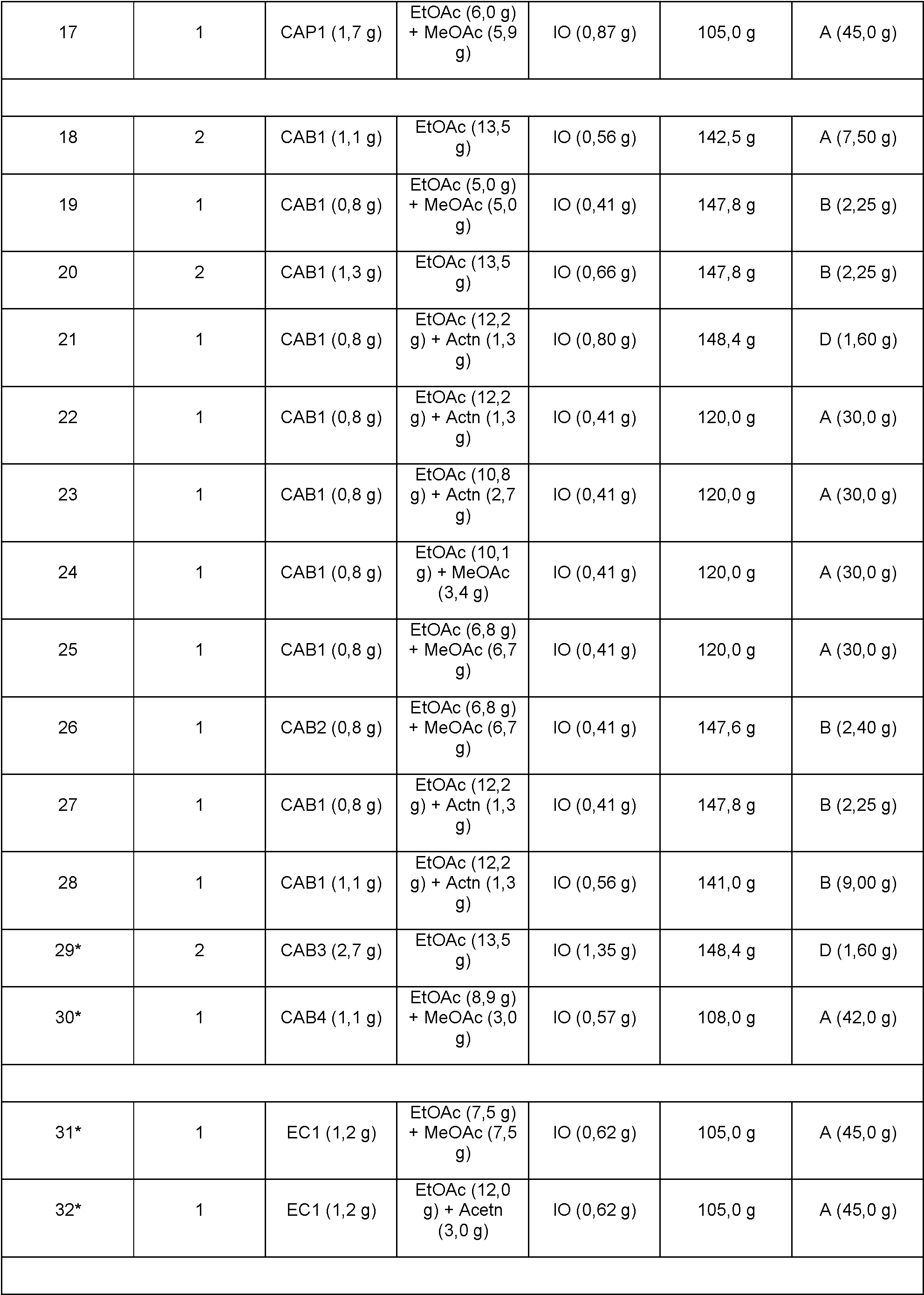


(1) EtOAc = acetato de etilo; MeOAc = acetato de metilo; EtOFm = formiato de etilo; Actn = Acetona (2) IO = isooctano; IDD = isododecano(1) EtOAc = ethyl acetate; MeOAc = methyl acetate; EtOFm = ethyl formate; Actn = Acetone (2) IO = isooctane; IDD = isododecane
* Ejemplo comparativo* Comparative example
Tabla 4 - Propiedades de las microesferasTable 4 - Properties of the microspheres


Estos datos revelan que las composiciones de celulosa funcionalizada con carboxilato con valores de Tg más altos, es decir, de 125 °C o más, pueden usarse para fabricar microesferas de base biológica. Los materiales de celulosa funcionalizada con carboxilato de Tg más baja tienden a producir rendimientos más bajos de microesferas, o microesferas de peor calidad. Además, con respecto a los ejemplos 31 y 32, el uso de una celulosa no funcionalizada con carboxilato también dio como resultado microesferas con malas características de expansión. En los dibujos se muestran microfotografías de algunas muestras representativas. Las figuras 2 a 4 muestran ejemplos de muestras que mostraron buenas características de expansión de microesferas (ejemplos 40, 12 y 4 respectivamente). Las figuras 5 y 6 muestran muestras donde era evidente la formación de microesferas, pero las características de expansión o la calidad de la muestra eran malas (ejemplos 47 y 32 respectivamente).These data reveal that carboxylate-functionalized cellulose compositions with higher Tg values, ie, 125°C or higher, can be used to fabricate biobased microspheres. Lower Tg carboxylate functionalized cellulose materials tend to produce lower yields of microspheres, or poorer quality microspheres. Furthermore, with respect to Examples 31 and 32, the use of a non-carboxylate functionalized cellulose also resulted in microspheres with poor expansion characteristics. Photomicrographs of some representative samples are shown in the drawings. Figures 2 to 4 show examples of samples that showed good microsphere expansion characteristics (examples 40, 12 and 4 respectively). Figures 5 and 6 show samples where microsphere formation was evident, but the expansion characteristics or sample quality were poor (Examples 47 and 32 respectively).
En las figuras 5 y 6, por ejemplo, está claro que la expansión de la microesfera es inconsistente, donde solo las microesferas más grandes parecen expandirse.In Figures 5 and 6, for example, it is clear that bead expansion is inconsistent, with only the largest beads appearing to expand.
Las propiedades de expansión de los ejemplos 22 a 25 se evaluaron inmediatamente después de su preparación, y también 1 mes y 4 meses después. Los resultados se muestran en la tabla 5, que destacan que las microesferas se pueden almacenar durante varios meses sin una pérdida sustancial del rendimiento de expansión.The expansion properties of examples 22 to 25 were evaluated immediately after their preparation, and also 1 month and 4 months later. The results are shown in Table 5, which highlight that the microspheres can be stored for several months without substantial loss in expansion performance.
Tabla 5 - Rendimiento de expansión con el tiempoTable 5 - Expansion performance over time


La tabla 6 muestra datos de dispersión de luz para microesferas preexpandidas que se recopilaron usando un dispositivo Malvern Mastersizer 2000.Table 6 shows light scattering data for pre-expanded microspheres that were collected using a Malvern Mastersizer 2000 device.
Tabla 6 - Datos de dispersión de luzTable 6 - Light scattering data

La tabla 7 muestra datos de características de microesferas expandidas basados en microscopía y análisis de imágenes.Table 7 shows expanded microsphere characteristic data based on microscopy and image analysis.
Tabla 7 - Datos del análisis de imágenesTable 7 - Image analysis data


Las tablas 8-9 muestran datos para microesferas preparadas a partir de mezclas de polímeros (ejemplos 48 a 55). En todos los casos, el disolvente utilizado fue una mezcla de 5,0 g de cada uno de acetato de etilo y acetato de metilo. Se obtuvieron con éxito microesferas expandibles.Tables 8-9 show data for microspheres prepared from polymer blends (Examples 48 to 55). In all cases, the solvent used was a mixture of 5.0 g each of ethyl acetate and methyl acetate. Expandable microspheres were successfully obtained.
Tabla 8 - Datos de composición para microesferas con cubiertas de polímeros mixtosTable 8 - Composition data for microspheres with mixed polymer shells

Levamelt™ 900 es de Arlanxeo Deutschland GmbH y es un copolímero de etileno y acetato de vinilo con un contenido de acetato de vinilo del 90 % en peso. La Tg es de 21 °C.Levamelt™ 900 is from Arlanxeo Deutschland GmbH and is an ethylene vinyl acetate copolymer with a vinyl acetate content of 90% by weight. The Tg is 21 °C.
PVPVA es poli(vinilpirrolidona-co-vinilacetato) obtenido de Aldrich, como una solución en isopropanol. El peso molecular, Mw, es de aproximadamente 13000. El valor de Tg medido fue de 73 °C. Antes de su uso, el isopropanol se eliminó mediante secado para formar un polvo.PVPVA is poly(vinylpyrrolidone-co-vinylacetate) obtained from Aldrich, as a solution in isopropanol. The molecular weight, Mw, is approximately 13000. The measured Tg value was 73°C. Before use, the isopropanol was removed by drying to form a powder.
PPC es carbonato de polipropileno obtenido de Sigma Aldrich, con un peso molecular promedio, Mn, de 50000. PCL es policaprolactona obtenida de Sigma Aldrich, con un peso molecular promedio Mn de 80000.PPC is polypropylene carbonate obtained from Sigma Aldrich, with an average molecular weight, Mn, of 50,000. PCL is polycaprolactone obtained from Sigma Aldrich, with an average molecular weight, Mn of 80,000.
Tabla 9 - Propiedades de microesferas con cubiertas de polímeros mixtosTable 9 - Properties of microspheres with mixed polymer shells


Claims (15)

Applications Claiming Priority (2)
| Application Number | Priority Date | Filing Date | Title |
|---|---|---|---|
| EP18205826 | 2018-11-13 | ||
| PCT/EP2019/081076 WO2020099440A1 (en) | 2018-11-13 | 2019-11-12 | Thermally expandable cellulose-based microspheres |
Publications (1)
| Publication Number | Publication Date |
|---|---|
| ES2938007T3 true ES2938007T3 (en) | 2023-04-03 |
Family
ID=64308569
Family Applications (1)
| Application Number | Title | Priority Date | Filing Date |
|---|---|---|---|
| ES19798332T Active ES2938007T3 (en) | 2018-11-13 | 2019-11-12 | Thermally Expandable Cellulose-Based Microspheres |
Country Status (9)
| Country | Link |
|---|---|
| US (1) | US12338336B2 (en) |
| EP (1) | EP3880744B1 (en) |
| JP (1) | JP7227370B2 (en) |
| KR (1) | KR102571919B1 (en) |
| CN (1) | CN113056512B (en) |
| DK (1) | DK3880744T3 (en) |
| ES (1) | ES2938007T3 (en) |
| FI (1) | FI3880744T3 (en) |
| WO (1) | WO2020099440A1 (en) |
Families Citing this family (17)
| Publication number | Priority date | Publication date | Assignee | Title |
|---|---|---|---|---|
| KR102860849B1 (en) | 2020-05-20 | 2025-09-16 | 누리온 케미칼즈 인터내셔널 비.브이. | Thermally expandable cellulose microspheres with low expansion temperature |
| CN111653716B (en) * | 2020-06-19 | 2022-11-29 | 江苏卓高新材料科技有限公司 | Diaphragm with reversible thermal shutdown performance and preparation method and application thereof |
| CN112121760B (en) * | 2020-08-21 | 2023-02-10 | 浙江农林大学 | Preparation method of indoor landscape model building material |
| US12570454B2 (en) * | 2020-10-29 | 2026-03-10 | Pregis Llc | Protective article with cellulose-based expandable composite |
| CN116867566B (en) * | 2021-02-22 | 2026-01-09 | 诺力昂化学品国际有限公司 | Cellulose-based thermally expandable microspheres |
| JP2026513106A (en) * | 2022-10-26 | 2026-04-23 | ヌーリオン ケミカルズ インターナショナル ベスローテン フェノーツハップ | Post-heat treatment of cellulose-based expandable microspheres |
| US20250325951A1 (en) | 2024-04-18 | 2025-10-23 | Nouryon Chemicals International B.V. | Expanded microspheres |
| EP4635618A1 (en) | 2024-04-18 | 2025-10-22 | Nouryon Chemicals International B.V. | Lignin-based expandable microspheres |
| EP4736999A1 (en) | 2024-10-31 | 2026-05-06 | Nouryon Chemicals International B.V. | Device for preparation of expanded microspheres |
| USD1119877S1 (en) | 2024-12-20 | 2026-03-24 | Avery Dennison Retail Information Services Llc | Antenna |
| USD1119876S1 (en) | 2024-12-20 | 2026-03-24 | Avery Dennison Retail Information Services Llc | Antenna |
| USD1131455S1 (en) | 2024-12-20 | 2026-06-23 | Avery Dennison Retail Information Services Llc | Antenna |
| USD1119875S1 (en) | 2024-12-20 | 2026-03-24 | Avery Dennison Retail Information Services Llc | Antenna |
| USD1119874S1 (en) | 2024-12-20 | 2026-03-24 | Avery Dennison Retail Information Services Llc | Antenna |
| JP2026110520A (en) | 2024-12-20 | 2026-07-02 | ヌーリオン ケミカルズ インターナショナル ベスローテン フェノーツハップ | Tannin-based expanding microspheres |
| USD1122235S1 (en) | 2024-12-20 | 2026-04-14 | Avery Dennison Retail Information Services Llc | Antenna |
| USD1130376S1 (en) | 2024-12-20 | 2026-06-16 | Avery Dennison Retail Information Services Llc | Antenna |
Family Cites Families (18)
| Publication number | Priority date | Publication date | Assignee | Title |
|---|---|---|---|---|
| US3615972A (en) | 1967-04-28 | 1971-10-26 | Dow Chemical Co | Expansible thermoplastic polymer particles containing volatile fluid foaming agent and method of foaming the same |
| US4927749A (en) | 1986-04-09 | 1990-05-22 | Jeanette Simpson | Reagent for cell separation |
| US20010044477A1 (en) * | 1998-12-10 | 2001-11-22 | Soane David S. | Expandable polymeric microspheres, their method of production, and uses and products thereof |
| AU3996800A (en) | 1998-12-10 | 2000-07-12 | Zms, Llc | Expandable polymeric microspheres, their method of production, and uses and products thereof |
| US6423376B1 (en) * | 2000-04-06 | 2002-07-23 | Air Products And Chemicals, Inc. | Tartaric acid diesters as biodegradable surfactants |
| PL202648B1 (en) | 2002-10-14 | 2009-07-31 | Akzo Nobel Nv | Aqueous silica dispersion |
| ES2347143T3 (en) | 2002-12-20 | 2010-10-26 | Akzo Nobel N.V. | METHOD AND DEVICE FOR PRE-EXPANDING THERMOPLASTIC MICROSPHERAS. |
| JP5448459B2 (en) | 2006-02-10 | 2014-03-19 | アクゾ ノーベル ナムローゼ フェンノートシャップ | Microsphere |
| JP2010513604A (en) | 2006-12-14 | 2010-04-30 | パクティヴ・コーポレーション | Biodegradable and low discharge expanded and extruded foams obtained with methyl formate-based blowing agents |
| US8247465B2 (en) * | 2007-10-16 | 2012-08-21 | Matsumoto Yushi-Seiyaku Co., Ltd. | Heat-expandable microspheres, process for producing the same, and application thereof |
| KR20110058095A (en) * | 2009-11-25 | 2011-06-01 | 제일모직주식회사 | Thermally expandable fine particles having excellent foaming properties and uniform particle diameters and a method of manufacturing the same |
| AT509268A1 (en) * | 2009-12-30 | 2011-07-15 | Sunpor Kunststoff Gmbh | EXPANDABLE POLYMERISES FROM CELLULOSE ACETATE BUTYRATE |
| AT511509A1 (en) | 2011-04-18 | 2012-12-15 | Sunpor Kunststoff Gmbh | EXPANDABLE POLYMERISES FROM CELLULOSE ACETATE BUTYRATE AND STYRENE POLYMERISATE |
| JP5509163B2 (en) * | 2011-08-11 | 2014-06-04 | 京セラドキュメントソリューションズ株式会社 | Positively chargeable toner |
| DK3008029T3 (en) | 2013-06-12 | 2017-07-24 | Akzo Nobel Chemicals Int Bv | METHOD AND APPARATUS FOR MANUFACTURING EXPANDED MICROSphere |
| CN103992487A (en) | 2013-08-05 | 2014-08-20 | 广西弘耀祥科技有限公司 | Cellulose acetate propionate microspheres and preparation method thereof |
| JP6082848B2 (en) * | 2014-05-23 | 2017-02-15 | 松本油脂製薬株式会社 | Thermally expansible microspheres, production method and use thereof |
| WO2016091847A1 (en) | 2014-12-11 | 2016-06-16 | Akzo Nobel Chemicals International B.V. | Apparatus and method for expanding thermally expandable thermoplastic microspheres to expanded thermoplastic microspheres |
-
2019
- 2019-11-12 ES ES19798332T patent/ES2938007T3/en active Active
- 2019-11-12 EP EP19798332.3A patent/EP3880744B1/en active Active
- 2019-11-12 WO PCT/EP2019/081076 patent/WO2020099440A1/en not_active Ceased
- 2019-11-12 KR KR1020217017201A patent/KR102571919B1/en active Active
- 2019-11-12 US US17/302,767 patent/US12338336B2/en active Active
- 2019-11-12 JP JP2021525560A patent/JP7227370B2/en active Active
- 2019-11-12 CN CN201980072087.4A patent/CN113056512B/en active Active
- 2019-11-12 DK DK19798332.3T patent/DK3880744T3/en active
- 2019-11-12 FI FIEP19798332.3T patent/FI3880744T3/en active
Also Published As
| Publication number | Publication date |
|---|---|
| FI3880744T3 (en) | 2023-05-22 |
| CN113056512B (en) | 2023-06-06 |
| KR102571919B1 (en) | 2023-08-29 |
| DK3880744T3 (en) | 2023-02-13 |
| JP2022507140A (en) | 2022-01-18 |
| US12338336B2 (en) | 2025-06-24 |
| KR20210087519A (en) | 2021-07-12 |
| WO2020099440A1 (en) | 2020-05-22 |
| JP7227370B2 (en) | 2023-02-21 |
| BR112021009095A2 (en) | 2021-08-10 |
| CN113056512A (en) | 2021-06-29 |
| US20220363859A1 (en) | 2022-11-17 |
| FI3880744T1 (en) | 2023-02-28 |
| EP3880744A1 (en) | 2021-09-22 |
| EP3880744B1 (en) | 2023-01-18 |
Similar Documents
| Publication | Publication Date | Title |
|---|---|---|
| CN113056512B (en) | Cellulose-based heat-expandable microspheres | |
| US11365294B2 (en) | Method to synthesize graphene-based amphiphilic janus nanosheets | |
| JP7689985B2 (en) | Thermally expandable cellulose-based microspheres with low expansion temperature | |
| CN101378831A (en) | Microspheres | |
| TW201223868A (en) | Aerogel and method for manufacture thereof | |
| CN114555678B (en) | Cellulose particles and method for producing cellulose particles | |
| JP2024509388A (en) | Thermally expandable cellulose microspheres | |
| KR20250069666A (en) | Post-heating of cellulose-based expandable microspheres | |
| BR112021009095B1 (en) | THERMALLY EXPANDABLE MICROSPHERES COMPRISING A POLYMER CASING SURROUNDING A HOLLOW CORE AND PROCESS FOR PREPARING THERMALLY EXPANDABLE MICROSPHERES | |
| KR101933208B1 (en) | Aqueous Aerogel Dispersions And Method Of Preparing The Same | |
| JP5826679B2 (en) | Method for producing nano-composite particles containing perfluorocarbon sulfonic acid polymer | |
| JP7671691B2 (en) | Dialcohol cellulose spherical capsules | |
| KR20250153713A (en) | Expanded microspheres | |
| JP2014223609A (en) | Microcapsule manufacturing method and microcapsule | |
| JP7850198B2 (en) | Expandable microspheres with excellent barrier properties | |
| JP2017095587A (en) | Polyvinyl chloride resin particle coated with inorganic fine particle and manufacturing method therefor | |
| JP4956111B2 (en) | Production method of polysaccharide derivatives | |
| BR102024008101A2 (en) | THERMALLY EXPANDABLE THERMOPLASTIC MICROSPHERES, PROCESS FOR PREPARING THERMALLY EXPANDABLE THERMOPLASTIC MICROSPHERES, AND, AQUEOUS PASTE | |
| BR112022021299B1 (en) | THERMALLY EXPANDABLE SINGLE-CORE MICROSPHERES AND PROCESS FOR PREPARING THERMALLY EXPANDABLE SINGLE-CORE MICROSPHERES | |
| JP3882777B2 (en) | Method for producing spherical silica | |
| JP2010235882A (en) | Vibration damping coating composition | |
| BR102014026737A2 (en) | coating process of lamellar materials to prevent active interspersed species leaching |