ES2951064T3 - Preparation procedure of 2-amino-5-hydroxypropiophenone - Google Patents
Preparation procedure of 2-amino-5-hydroxypropiophenone Download PDFInfo
- Publication number
- ES2951064T3 ES2951064T3 ES20741510T ES20741510T ES2951064T3 ES 2951064 T3 ES2951064 T3 ES 2951064T3 ES 20741510 T ES20741510 T ES 20741510T ES 20741510 T ES20741510 T ES 20741510T ES 2951064 T3 ES2951064 T3 ES 2951064T3
- Authority
- ES
- Spain
- Prior art keywords
- formula
- compound
- acid
- chloride
- sodium
- Prior art date
- Legal status (The legal status is an assumption and is not a legal conclusion. Google has not performed a legal analysis and makes no representation as to the accuracy of the status listed.)
- Active
Links
Classifications
-
- C—CHEMISTRY; METALLURGY
- C07—ORGANIC CHEMISTRY
- C07C—ACYCLIC OR CARBOCYCLIC COMPOUNDS
- C07C221/00—Preparation of compounds containing amino groups and doubly-bound oxygen atoms bound to the same carbon skeleton
-
- C—CHEMISTRY; METALLURGY
- C07—ORGANIC CHEMISTRY
- C07C—ACYCLIC OR CARBOCYCLIC COMPOUNDS
- C07C225/00—Compounds containing amino groups and doubly—bound oxygen atoms bound to the same carbon skeleton, at least one of the doubly—bound oxygen atoms not being part of a —CHO group, e.g. amino ketones
- C07C225/22—Compounds containing amino groups and doubly—bound oxygen atoms bound to the same carbon skeleton, at least one of the doubly—bound oxygen atoms not being part of a —CHO group, e.g. amino ketones having amino groups bound to carbon atoms of six-membered aromatic rings of the carbon skeleton
-
- C—CHEMISTRY; METALLURGY
- C07—ORGANIC CHEMISTRY
- C07C—ACYCLIC OR CARBOCYCLIC COMPOUNDS
- C07C201/00—Preparation of esters of nitric or nitrous acid or of compounds containing nitro or nitroso groups bound to a carbon skeleton
- C07C201/06—Preparation of nitro compounds
- C07C201/08—Preparation of nitro compounds by substitution of hydrogen atoms by nitro groups
-
- C—CHEMISTRY; METALLURGY
- C07—ORGANIC CHEMISTRY
- C07C—ACYCLIC OR CARBOCYCLIC COMPOUNDS
- C07C201/00—Preparation of esters of nitric or nitrous acid or of compounds containing nitro or nitroso groups bound to a carbon skeleton
- C07C201/06—Preparation of nitro compounds
- C07C201/12—Preparation of nitro compounds by reactions not involving the formation of nitro groups
-
- C—CHEMISTRY; METALLURGY
- C07—ORGANIC CHEMISTRY
- C07C—ACYCLIC OR CARBOCYCLIC COMPOUNDS
- C07C205/00—Compounds containing nitro groups bound to a carbon skeleton
- C07C205/45—Compounds containing nitro groups bound to a carbon skeleton the carbon skeleton being further substituted by at least one doubly—bound oxygen atom, not being part of a —CHO group
-
- C—CHEMISTRY; METALLURGY
- C07—ORGANIC CHEMISTRY
- C07C—ACYCLIC OR CARBOCYCLIC COMPOUNDS
- C07C68/00—Preparation of esters of carbonic or haloformic acids
- C07C68/02—Preparation of esters of carbonic or haloformic acids from phosgene or haloformates
-
- C—CHEMISTRY; METALLURGY
- C07—ORGANIC CHEMISTRY
- C07C—ACYCLIC OR CARBOCYCLIC COMPOUNDS
- C07C69/00—Esters of carboxylic acids; Esters of carbonic or haloformic acids
- C07C69/96—Esters of carbonic or haloformic acids
-
- C—CHEMISTRY; METALLURGY
- C07—ORGANIC CHEMISTRY
- C07D—HETEROCYCLIC COMPOUNDS
- C07D491/00—Heterocyclic compounds containing in the condensed ring system both one or more rings having oxygen atoms as the only ring hetero atoms and one or more rings having nitrogen atoms as the only ring hetero atoms, not provided for by groups C07D451/00 - C07D459/00, C07D463/00, C07D477/00 or C07D489/00
- C07D491/12—Heterocyclic compounds containing in the condensed ring system both one or more rings having oxygen atoms as the only ring hetero atoms and one or more rings having nitrogen atoms as the only ring hetero atoms, not provided for by groups C07D451/00 - C07D459/00, C07D463/00, C07D477/00 or C07D489/00 in which the condensed system contains three hetero rings
- C07D491/14—Ortho-condensed systems
- C07D491/147—Ortho-condensed systems the condensed system containing one ring with oxygen as ring hetero atom and two rings with nitrogen as ring hetero atom
Landscapes
- Chemical & Material Sciences (AREA)
- Organic Chemistry (AREA)
- Chemical Kinetics & Catalysis (AREA)
- Organic Low-Molecular-Weight Compounds And Preparation Thereof (AREA)
Abstract
La presente invención se refiere a un proceso para la preparación de 2-amino-5-hidroxipropiofenona, un intermedio clave para la síntesis de análogos de camptotecina, incluida la 7-etil-10-hidroxicamptotecina (SN-38). (Traducción automática con Google Translate, sin valor legal)The present invention relates to a process for the preparation of 2-amino-5-hydroxypropiophenone, a key intermediate for the synthesis of camptothecin analogs, including 7-ethyl-10-hydroxycamptothecin (SN-38). (Automatic translation with Google Translate, without legal value)
Description
DESCRIPCIÓNDESCRIPTION
Procedimiento de preparación de 2-amino-5-hidroxipropiofenonaPreparation procedure of 2-amino-5-hydroxypropiophenone
Campo de la invenciónfield of invention
La presente invención se refiere en general a un procedimiento para la preparación de 2-amino-5-hidroxipropiofenona, un intermedio clave en la síntesis de análogos de camptotecina que incluyen 7-etil-10-hidroxicamptotecina (SN-38).The present invention relates generally to a process for the preparation of 2-amino-5-hydroxypropiophenone, a key intermediate in the synthesis of camptothecin analogs including 7-ethyl-10-hydroxycamptothecin (SN-38).
Antecedentes de la invenciónBackground of the invention
La 2-amino-5-hidroxipropiofenona es un intermedio importante útil en la preparación de 7-etil-10-hidroxicamptotecina (SN-38), que es un intermedio crucial en la preparación de una clase de agente antineoplásico irinotecán {(4S)-4,11-dietil-4-hidroxi-9-[(4-piperidinopiperidino)carboniloxi]-1 H-pirano[3',4':6,7]indolizino[1,2-b]quinolina-3,14(4H,12H)diona}.2-Amino-5-hydroxypropiophenone is an important intermediate useful in the preparation of 7-ethyl-10-hydroxycamptothecin (SN-38), which is a crucial intermediate in the preparation of a class of antineoplastic agent irinotecan {(4S)- 4,11-diethyl-4-hydroxy-9-[(4-piperidinopiperidino)carbonyloxy]-1 H-pyrano[3',4':6,7]indolizino[1,2-b]quinoline-3,14( 4H,12H)dione}.
El irinotecán se usa más comúnmente para tratar el carcinoma metastásico. Cuando se administra a un paciente, el irinotecán se metaboliza a un metabolito más activo, 7-etil-10-hidroxicamptotecina (SN-38). La fórmula estructural de estos compuestos se representa de la siguiente manera:Irinotecan is most commonly used to treat metastatic carcinoma. When administered to a patient, irinotecan is metabolized to a more active metabolite, 7-ethyl-10-hydroxycamptothecin (SN-38). The structural formula of these compounds is represented as follows:
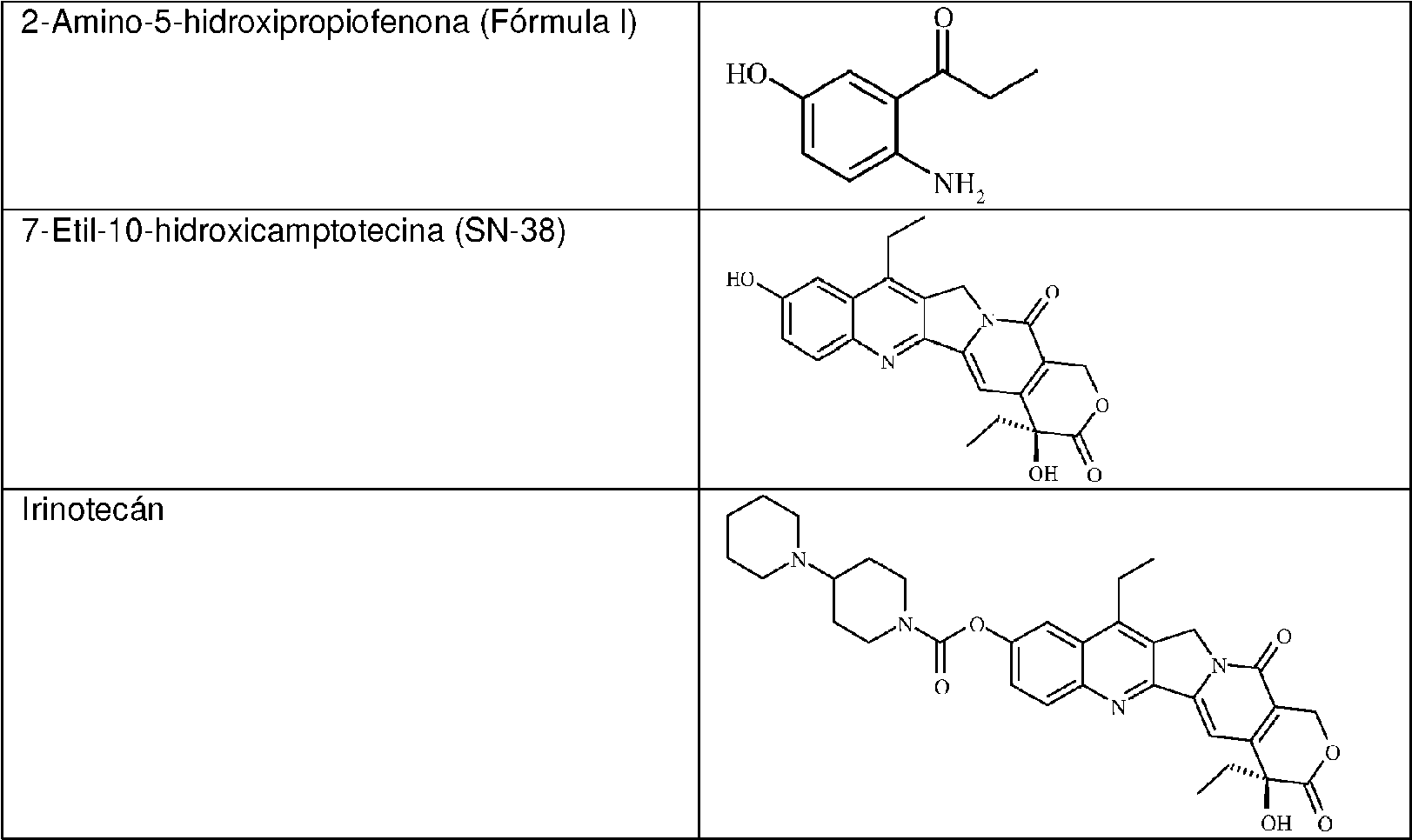
En la técnica se conocen varios métodos para la síntesis de 7-etil-10-hidroxicamptotecina (SN-38) y su posterior conversión en irinotecán. Uno de los mejores métodos conocidos hasta ahora es sintetizar los dos intermedios clave, que son 2-amino-5-hidroxipropiofenona de fórmula I y cetonas tricíclicas intermedias y la posterior condensación de estos dos compuestos mediante la reacción de Friedlander para dar 7-etil-10-hidroxicamptotecina (SN-38) y luego convertir SN-38 en irinotecán (Referencia: Patente de EE. UU. No. 6.121.451) y el procedimiento representado esquemáticamente de la siguiente manera:Several methods are known in the art for the synthesis of 7-ethyl-10-hydroxycamptothecin (SN-38) and its subsequent conversion to irinotecan. One of the best methods known so far is to synthesize the two key intermediates, which are 2-amino-5-hydroxypropiophenone of formula I and tricyclic ketone intermediates and the subsequent condensation of these two compounds by the Friedlander reaction to give 7-ethyl- 10-hydroxycamptothecin (SN-38) and then convert SN-38 to irinotecan (Reference: US Patent No. 6,121,451) and the procedure schematically represented as follows:

La 2-amino-5-hidroxipropiofenona de Fórmula I es uno de los intermedios clave en la preparación de 7-etil-10-hidroxicamptotecina (SN-38). Hasta la fecha, muchas publicaciones han descrito la preparación de 2-amino-5-hidroxipropiofenona de Fórmula I y todas estas referencias tienen varios inconvenientes, que incluyen una baja selectividad de reacción, implican reacciones peligrosas y obtienen menos rendimientos con baja pureza. La literatura reportada sobre la preparación del compuesto de Fórmula I se describe a continuación: Patente de EE. UU. No.2-Amino-5-hydroxypropiophenone of Formula I is one of the key intermediates in the preparation of 7-ethyl-10-hydroxycamptothecin (SN-38). To date, many publications have described the preparation of 2-amino-5-hydroxypropiophenone of Formula I and all these references have several drawbacks, including low reaction selectivity, involving hazardous reactions and obtaining lower yields with low purity. The literature reported on the preparation of the compound of Formula I is described below: US Patent No.
7.126.000 ("la patente '000") describe un procedimiento para la preparación de 2-amino-5-hidroxipropiofenona de Fórmula I a partir de 5-hidroxi-2-nitrobenzaldehído o de 5-benciloxi-2-nitrobenzaldehído. El procedimiento descrito en la patente '000 se representa esquemáticamente de la siguiente manera:7,126,000 ("the '000 patent") describes a process for the preparation of 2-amino-5-hydroxypropiophenone of Formula I from 5-hydroxy-2-nitrobenzaldehyde or 5-benzyloxy-2-nitrobenzaldehyde. The procedure described in the '000 patent is represented schematically as follows:

El procedimiento descrito bajo la patente '000 implica el uso de 5-hidroxi-2-nitrobenzaldehído o su derivado protegido como material de partida y la posterior conversión de este intermedio en el compuesto de Fórmula I implica muchas etapas de reacción tediosos, por ejemplo, el uso de reacciones de Grignard altamente sensibles y la reducción de la cadena de alqueno. El uso del compuesto aldehido como material de partida es considerablemente costoso y la formación de impurezas durante la etapa de la reacción de Grignard y la reducción final hace que el procedimiento sea tedioso y antieconómico.The process described under the '000 patent involves the use of 5-hydroxy-2-nitrobenzaldehyde or its protected derivative as a starting material and the subsequent conversion of this intermediate to the compound of Formula I involves many tedious reaction steps, e.g. the use of highly sensitive Grignard reactions and the reduction of the alkene chain. The use of the aldehyde compound as a starting material is considerably expensive and the formation of impurities during the Grignard reaction step and final reduction makes the procedure tedious and uneconomical.
La Patente de EE. UU. No. 7.608.740 ("la patente '740") describe un procedimiento para la preparación de 2-amino-5-hidroxipropiofenona de Fórmula I a partir de 3-fluoropropiofenona. El procedimiento descrito en la patente '740 se representa esquemáticamente como sigue:U.S. Patent No. 7,608,740 ("the '740 patent") describes a process for the preparation of 2-amino-5-hydroxypropiophenone of Formula I from 3-fluoropropiophenone. The procedure described in the '740 patent is represented schematically as follows:

El procedimiento descrito bajo la patente '740 implica principalmente la nitración de 5-fluoropropiofenona utilizando ácido nítrico. Mientras se realiza la reacción de nitración, siempre existe la posibilidad de sustitución del grupo nitro en las posiciones orto y/o para del anillo en lugar de un solo grupo para según sea necesario y esto conduce a la contaminación del producto con compuestos sustituidos en para y, por lo tanto, se requieren purificaciones cromatográficas engorrosas para purificar el producto.The process described under the '740 patent primarily involves the nitration of 5-fluoropropiophenone using nitric acid. While carrying out the nitration reaction, there is always a possibility of substitution of the nitro group at the ortho and/or para positions of the ring instead of a single para group as required and this leads to contamination of the product with para-substituted compounds. and therefore, cumbersome chromatographic purifications are required to purify the product.
La Patente China número CN101723841B ("la patente '841") describe un procedimiento para la preparación de 2-amino-5-hidroxipropiofenona de Fórmula I a partir de 3-cloropropiofenona. El procedimiento descrito en la patente '841 se representa esquemáticamente como sigue:Chinese Patent Number CN101723841B ("the '841 Patent") describes a process for the preparation of 2-amino-5-hydroxypropiophenone of Formula I from 3-chloropropiophenone. The procedure described in the '841 patent is represented schematically as follows:

De nuevo, el procedimiento descrito en la publicación '841 adolece de la formación de regioisómeros/isómeros posicionales durante la reacción de nitración.Again, the procedure described in the '841 publication suffers from the formation of regioisomers/positional isomers during the nitration reaction.
Xiao-Dong Xiong et. al. en Organic Preparations and Procedures International, 41, 423-427, 2009 describe un procedimiento para la preparación de 2-amino-5-hidroxipropiofenona de Fórmula I mediante la conversión del grupo aldehído en propiofenona. Este procedimiento tiene desventajas como que el aldehído intermedio en sí mismo es más costoso e implica varias etapas para convertirlo en un grupo propionilo. El procedimiento descrito por Xiao-Dong Xiong et. al. se representa esquemáticamente como sigue:Xiao-Dong Xiong et. to the. in Organic Preparations and Procedures International, 41, 423-427, 2009 describes a procedure for the preparation of 2-amino-5-hydroxypropiophenone of Formula I by converting the aldehyde group to propiophenone. This procedure has disadvantages such as the intermediate aldehyde itself is more expensive and involves several steps to convert it to a propionyl group. The procedure described by Xiao-Dong Xiong et. to the. It is represented schematically as follows:

Aurore et al. en Bioorganic & Medicinal Chemistry Letters Volumen 14, Número 9, páginas 2363-2365, 2004 (la referencia 'Aurore) describe un procedimiento para la preparación de 2-Amino-5-hidroxipropiofenona de Fórmula I por nitración de 3'-hidroxipropiofenona. El procedimiento descrito por Aurore et al. se representa esquemáticamente como sigue:Aurora et al. in Bioorganic & Medicinal Chemistry Letters Volume 14, Number 9, pages 2363-2365, 2004 (the 'Aurore reference) describes a procedure for the preparation of 2-Amino-5-hydroxypropiophenone of Formula I by nitration of 3'-hydroxypropiophenone. The procedure described by Aurore et al. It is represented schematically as follows:

El procedimiento descrito bajo Aurore et. al. implica la nitración de 5-hidroxipropiofenona utilizando ácido nítrico. Este procedimiento tiene la desventaja de que implica la formación de regioisómeros/isómeros posicionales no deseados en la reacción de nitración por sustitución del grupo nitro en las posiciones orto y para en lugar de la misma reacción solo en la posición para. La eliminación de isómeros posicionales mediante el uso de purificaciones normales siempre es una tarea desafiante, ya que están estrechamente asociados entre sí por su factor de retención. Por lo tanto, requiere múltiples purificaciones en columna e incluso entonces no hay garantía de obtener el compuesto de alta pureza requerido para el uso farmacéutico.The procedure described under Aurore et. to the. involves the nitration of 5-hydroxypropiophenone using nitric acid. This procedure has the disadvantage that it involves the formation of unwanted regioisomers/positional isomers in the nitration reaction by substitution of the nitro group at the ortho and para positions instead of the same reaction only at the para position. Removal of positional isomers by using normal purifications is always a challenging task as they are closely associated with each other by their retention factor. Therefore, it requires multiple column purifications and even then there is no guarantee of obtaining the high purity compound required for pharmaceutical use.
En base a los inconvenientes mencionados anteriormente, existe una necesidad vital de desarrollar un procedimiento para la preparación de 2-amino-5-hidroxipropiofenona de Fórmula I, que sea fácilmente susceptible de producción a gran escala.Based on the above mentioned drawbacks, there is a vital need to develop a process for the preparation of 2-amino-5-hydroxypropiophenone of Formula I, which is easily amenable to large scale production.
Por lo tanto, los presentes inventores se centraron en investigar cómo simplificar el procedimiento para la preparación de 2-amino-5-hidroxipropiofenona de Fórmula I que evite los inconvenientes antes mencionados, procedimiento que implica principalmente la nitración regioselectiva para evitar/reducir la formación de regioisómeros/isómeros posicionales, evitando así las engorrosas purificaciones en columna y hace que el procedimiento sea viable para la fabricación a gran escala.Therefore, the present inventors focused on investigating how to simplify the procedure for the preparation of 2-amino-5-hydroxypropiophenone of Formula I that avoids the aforementioned drawbacks, a procedure that mainly involves regioselective nitration to avoid/reduce the formation of regioisomers/positional isomers, thus avoiding cumbersome column purifications and making the procedure viable for large-scale manufacturing.
Sumario de la invenciónSummary of the invention
Por consiguiente, la presente invención proporciona un procedimiento mejorado para la preparación de 2-amino-5-hidroxipropiofenona de Fórmula I, un compuesto intermedio útil en la preparación de 7-etil-10-hidroxicamptotecina (SN-38).Accordingly, the present invention provides an improved process for the preparation of 2-amino-5-hydroxypropiophenone of Formula I, an intermediate useful in the preparation of 7-ethyl-10-hydroxycamptothecin (SN-38).
De acuerdo con una realización, la presente invención proporciona un procedimiento para la preparación de 2-amino-5-hidroxipropiofenona de Fórmula I:According to one embodiment, the present invention provides a process for the preparation of 2-amino-5-hydroxypropiophenone of Formula I:

que comprende: which includes:
a) Hacer reaccionar un compuesto de Fórmula III con un reactivo de nitración adecuado para obtener un compuesto de Fórmula IV, ya) React a compound of Formula III with a suitable nitration reagent to obtain a compound of Formula IV, and

en donde el grupo “PG” representa un grupo protector de hidroxilo adecuado;wherein the “PG” group represents a suitable hydroxyl protecting group;
b) Convertir el compuesto de Fórmula IV en 2-amino-5-hidroxipropiofenona de Fórmula I.b) Convert the compound of Formula IV into 2-amino-5-hydroxypropiophenone of Formula I.
De acuerdo con otra realización, la presente invención proporciona un procedimiento para la preparación de 2-amino-5-hidroxipropiofenona de Fórmula I, que comprende:According to another embodiment, the present invention provides a process for the preparation of 2-amino-5-hydroxypropiophenone of Formula I, comprising:
a) Hacer reaccionar un compuesto de Fórmula III con un reactivo de nitración adecuado para obtener un compuesto de Fórmula IV, en donde "PG" representa un grupo protector de hidroxilo adecuado; ya) Reacting a compound of Formula III with a suitable nitration reagent to obtain a compound of Formula IV, wherein "PG" represents a suitable hydroxyl protecting group; and
b) Convertir el compuesto de Fórmula IV en 2-amino-5-hidroxipropiofenona de Fórmula I; en donde el grupo “PG” se selecciona del grupo que comprende formiato de tricloroetilo, formiato de metilo, formiato de etilo, formiato de hexilo, formiato de isobutilo, formiato de bencilo, metoximetilo, metoxietoximetilo, tetrahidropiranilo, tetrahidrofurano, alilo, metoxitritilo, metiltiometilo, bencilo, benzoilo, p- metoxibencilo, t-butildimetilsililo, tbutildifenilsililo, triisopropilsililo, di-terc-butilsilileno, tetraisopropildisiloxanilideno, pivaloílo y benzoílo.b) Convert the compound of Formula IV into 2-amino-5-hydroxypropiophenone of Formula I; wherein the group "PG" is selected from the group comprising trichloroethyl formate, methyl formate, ethyl formate, hexyl formate, isobutyl formate, benzyl formate, methoxymethyl, methoxyethoxymethyl, tetrahydropyranyl, tetrahydrofuran, allyl, methoxytrityl, methylthiomethyl , benzyl, benzoyl, p-methoxybenzyl, t-butyldimethylsilyl, tbutyldiphenylsilyl, triisopropylsilyl, di-tert-butylsilylene, tetraisopropyldisiloxanylidene, pivaloyl and benzoyl.
De acuerdo con otra realización, la presente invención proporciona un procedimiento para la preparación de 2-amino-5-hidroxipropiofenona de Fórmula I:According to another embodiment, the present invention provides a process for the preparation of 2-amino-5-hydroxypropiophenone of Formula I:

que comprende:which includes:
a) Hacer reaccionar un compuesto de Fórmula II con un agente protector de hidroxilo adecuado para obtener un compuesto de Fórmula III; en donde "PG" representa un grupo protector de hidroxilo adecuado,a) Reacting a compound of Formula II with a suitable hydroxyl protecting agent to obtain a compound of Formula III; wherein "PG" represents a suitable hydroxyl protecting group,

b) Hacer reaccionar el compuesto de Fórmula III con un reactivo de nitración adecuado para obtener un compuesto de Fórmula IV, yb) React the compound of Formula III with a suitable nitration reagent to obtain a compound of Formula IV, and

c) Convertir el compuesto de Fórmula IV en 2-amino-5-hidroxipropiofenona de Fórmula I. c) Convert the compound of Formula IV into 2-amino-5-hydroxypropiophenone of Formula I.
De acuerdo con otra realización, la presente invención proporciona un procedimiento para la preparación de 2-amino-5-hidroxipropiofenona de Fórmula I, que comprende:According to another embodiment, the present invention provides a process for the preparation of 2-amino-5-hydroxypropiophenone of Formula I, comprising:
a) Hacer reaccionar un compuesto de Fórmula II con un agente protector de hidroxilo adecuado para obtener un compuesto de Fórmula III; en donde "PG" representa un grupo protector de hidroxilo adecuado,a) Reacting a compound of Formula II with a suitable hydroxyl protecting agent to obtain a compound of Formula III; wherein "PG" represents a suitable hydroxyl protecting group,
b) Hacer reaccionar el compuesto de Fórmula III con un reactivo de nitración adecuado para obtener un compuesto de Fórmula IV, yb) React the compound of Formula III with a suitable nitration reagent to obtain a compound of Formula IV, and
c) Convertir el compuesto de Fórmula IV en 2-amino-5-hidroxipropiofenona de Fórmula I; en donde el grupo “PG” se selecciona del grupo que comprende formiato de tricloroetilo, formiato de metilo, formiato de etilo, formiato de hexilo, formiato de isobutilo, formiato de bencilo, metoximetilo, metoxietoximetilo, tetrahidropiranilo, tetrahidrofurano, alilo, metoxitritilo, metiltiometilo, bencilo, benzoílo, p-metoxibencilo, t-butildimetilsililo, tbutildifenilsililo, triisopropilsililo, di-terc-butilsilileno, tetraisopropildisiloxanilideno, pivaloílo y benzoílo.c) Convert the compound of Formula IV into 2-amino-5-hydroxypropiophenone of Formula I; wherein the group "PG" is selected from the group comprising trichloroethyl formate, methyl formate, ethyl formate, hexyl formate, isobutyl formate, benzyl formate, methoxymethyl, methoxyethoxymethyl, tetrahydropyranyl, tetrahydrofuran, allyl, methoxytrityl, methylthiomethyl , benzyl, benzoyl, p-methoxybenzyl, t-butyldimethylsilyl, tbutyldiphenylsilyl, triisopropylsilyl, di-tert-butylsilylene, tetraisopropyldisiloxanylidene, pivaloyl and benzoyl.
De acuerdo con otra realización, la presente invención proporciona un procedimiento para la preparación de 2-amino-5-hidroxipropiofenona de Fórmula I:According to another embodiment, the present invention provides a process for the preparation of 2-amino-5-hydroxypropiophenone of Formula I:

que comprende:which includes:
a) Hacer reaccionar un compuesto de Fórmula II con un agente protector de hidroxilo adecuado para obtener un compuesto de Fórmula III; en donde "PG" representa un grupo protector de hidroxilo adecuado,a) Reacting a compound of Formula II with a suitable hydroxyl protecting agent to obtain a compound of Formula III; wherein "PG" represents a suitable hydroxyl protecting group,

b) Hacer reaccionar el compuesto de Fórmula III con un reactivo de nitración adecuado para obtener un compuesto de Fórmula IV,b) React the compound of Formula III with a suitable nitration reagent to obtain a compound of Formula IV,

c) Desproteger el compuesto de Fórmula IV con un agente desprotector adecuado para obtener un compuesto de Fórmula V, yc) Deprotect the compound of Formula IV with a suitable deprotecting agent to obtain a compound of Formula V, and

d) Reducir el compuesto de Fórmula V con un agente reductor adecuado para obtener 2-amino-5-hldroxlpropiofenona de Fórmula I; (o)d) Reduce the compound of Formula V with a suitable reducing agent to obtain 2-amino-5-hldroxlpropiophenone of Formula I; (either)
e) Reducir el compuesto de Fórmula IV con un agente reductor adecuado para obtener un compuesto de Fórmula VI ye) Reduce the compound of Formula IV with a suitable reducing agent to obtain a compound of Formula VI and

f) Desproteger el compuesto de Fórmula VI con un agente desprotector adecuado para obtener 2-amino-5-hidroxipropiofenona de Fórmula I.f) Deprotect the compound of Formula VI with a suitable deprotecting agent to obtain 2-amino-5-hydroxypropiophenone of Formula I.
De acuerdo con otra realización, la presente invención proporciona un procedimiento para la preparación de 2-amino-5-hidroxipropiofenona de Fórmula I, que comprende:According to another embodiment, the present invention provides a process for the preparation of 2-amino-5-hydroxypropiophenone of Formula I, comprising:
a) Hacer reaccionar un compuesto de Fórmula II con un agente protector de hidroxilo adecuado para obtener un compuesto de Fórmula III; en donde "PG" representa un grupo protector de hidroxilo adecuado,a) Reacting a compound of Formula II with a suitable hydroxyl protecting agent to obtain a compound of Formula III; wherein "PG" represents a suitable hydroxyl protecting group,
b) Hacer reaccionar el compuesto de Fórmula III con un reactivo de nitración adecuado para obtener un compuesto de Fórmula IV,b) React the compound of Formula III with a suitable nitration reagent to obtain a compound of Formula IV,
c) Desproteger el compuesto de Fórmula IV con un agente desprotector adecuado para obtener un compuesto de Fórmula V, yc) Deprotect the compound of Formula IV with a suitable deprotecting agent to obtain a compound of Formula V, and
d) Reducir el compuesto de Fórmula V con un agente reductor adecuado para obtener 2-amino-5-hidroxipropiofenona de Fórmula I; (o)d) Reduce the compound of Formula V with a suitable reducing agent to obtain 2-amino-5-hydroxypropiophenone of Formula I; (either)
e) Reducir el compuesto de Fórmula IV con un agente reductor adecuado para obtener un compuesto de Fórmula VI ye) Reduce the compound of Formula IV with a suitable reducing agent to obtain a compound of Formula VI and
f) Desproteger el compuesto de Fórmula VI con un agente desprotector adecuado para obtener 2-amino-5-hidroxipropiofenona de Fórmula I; en donde el grupo “PG” se selecciona del grupo que comprende formiato de tricloroetilo, formiato de metilo, formiato de etilo, formiato de hexilo, formiato de isobutilo, formiato de bencilo, metoximetilo, metoxietoximetilo, tetrahidropiranilo, tetrahidrofurano, alilo, metoxitritilo, metiltiometilo, bencilo, benzoílo, p-metoxibencilo, t-butildimetilsililo, t-butildifenilsililo, triisopropilsililo, di-terc-butilsilileno, tetraisopropildisiloxanilideno, pivaloílo y benzoílo.f) Deprotect the compound of Formula VI with a suitable deprotecting agent to obtain 2-amino-5-hydroxypropiophenone of Formula I; wherein the group "PG" is selected from the group comprising trichloroethyl formate, methyl formate, ethyl formate, hexyl formate, isobutyl formate, benzyl formate, methoxymethyl, methoxyethoxymethyl, tetrahydropyranyl, tetrahydrofuran, allyl, methoxytrityl, methylthiomethyl , benzyl, benzoyl, p-methoxybenzyl, t-butyldimethylsilyl, t-butyldiphenylsilyl, triisopropylsilyl, di-tert-butylsilylene, tetraisopropyldisiloxanylidene, pivaloyl and benzoyl.
De acuerdo con otra realización, la presente invención proporciona un procedimiento para la preparación de 2-amino-5-hidroxipropiofenona de Fórmula I, que comprende:According to another embodiment, the present invention provides a process for the preparation of 2-amino-5-hydroxypropiophenone of Formula I, comprising:
a) Hacer reaccionar un compuesto de Fórmula III con un reactivo de nitración adecuado para obtener un compuesto de Fórmula IV, en donde "PG" representa un grupo protector de hidroxilo adecuado,a) Reacting a compound of Formula III with a suitable nitration reagent to obtain a compound of Formula IV, where "PG" represents a suitable hydroxyl protecting group,
b) Desproteger el compuesto de Fórmula IV con un agente desprotector adecuado para obtener un compuesto de Fórmula V, yb) Deprotect the compound of Formula IV with a suitable deprotecting agent to obtain a compound of Formula V, and
c) Reducir el compuesto de Fórmula V con un agente reductor adecuado para obtener 2-amino-5-hidroxipropiofenona de Fórmula I; (o)c) Reduce the compound of Formula V with a suitable reducing agent to obtain 2-amino-5-hydroxypropiophenone of Formula I; (either)
d) Reducir el compuesto de Fórmula IV con un agente reductor adecuado para obtener un compuesto de Fórmula VI yd) Reduce the compound of Formula IV with a suitable reducing agent to obtain a compound of Formula VI and
e) Desproteger el compuesto de Fórmula VI con un agente desprotector adecuado para obtener 2-amino-5-hidroxipropiofenona de Fórmula I; en donde el grupo “PG” se selecciona del grupo que comprende formiato de tricloroetilo, formiato de metilo, formiato de etilo, formiato de hexilo, formiato de isobutilo, formiato de bencilo, metoximetilo, metoxietoximetilo, tetrahidropiranilo, tetrahidrofurano, alilo, metoxitritilo, metiltiometilo, bencilo, benzoílo, p-metoxibencilo, t-butildimetilsililo, t-butildifenilsililo, triisopropilsililo, di-terc-butilsilileno, tetraisopropildisiloxanilideno, pivaloílo y benzoílo. e) Deprotect the compound of Formula VI with a suitable deprotecting agent to obtain 2-amino-5-hydroxypropiophenone of Formula I; wherein the group "PG" is selected from the group comprising trichloroethyl formate, methyl formate, ethyl formate, hexyl formate, isobutyl formate, benzyl formate, methoxymethyl, methoxyethoxymethyl, tetrahydropyranyl, tetrahydrofuran, allyl, methoxytrityl, methylthiomethyl , benzyl, benzoyl, p-methoxybenzyl, t-butyldimethylsilyl, t-butyldiphenylsilyl, triisopropylsilyl, di-tert-butylsilylene, tetraisopropyldisiloxanylidene, pivaloyl and benzoyl.
De acuerdo con otra realización, la presente invención proporciona un compuesto de Fórmula III,According to another embodiment, the present invention provides a compound of Formula III,

en donde el grupo “PG” representa un grupo protector de hidroxilo adecuado.wherein the “PG” group represents a suitable hydroxyl protecting group.
De acuerdo con otra realización, la presente invención proporciona un compuesto de Fórmula III, en donde el grupo “PG” se selecciona del grupo que comprende formiato de tricloroetilo, formiato de metilo, formiato de etilo, formiato de hexilo, formiato de isobutilo, formiato de bencilo, metoximetilo, metoxietoximetilo, tetrahidropiranilo, tetrahidrofurano, alilo, metoxitritilo, metiltiometilo, bencilo, benzoílo, p-metoxibencilo, t-butildimetilsililo, t-butildifenilsililo, triisopropilsililo, di-terc-butilsilileno, tetraisopropildisiloxanilideno, pivaloílo y benzoílo.According to another embodiment, the present invention provides a compound of Formula III, wherein the group "PG" is selected from the group comprising trichloroethyl formate, methyl formate, ethyl formate, hexyl formate, isobutyl formate, formate benzyl, methoxymethyl, methoxyethoxymethyl, tetrahydropyranyl, tetrahydrofuran, allyl, methoxytrityl, methylthiomethyl, benzyl, benzoyl, p-methoxybenzyl, t-butyldimethylsilyl, t-butyldiphenylsilyl, triisopropylsilyl, di-tert-butylsilylene, tetraisopropyldisiloxanylidene, pivaloyl and benzoyl it.
De acuerdo con otra realización, la presente invención proporciona un compuesto de Fórmula III, en donde el grupo “PG” se selecciona de formiato de tricloroetilo, formiato de etilo o formiato de hexilo.According to another embodiment, the present invention provides a compound of Formula III, wherein the "PG" group is selected from trichloroethyl formate, ethyl formate or hexyl formate.
De acuerdo con otra realización, la presente invención proporciona un compuesto de Fórmula IIIa.According to another embodiment, the present invention provides a compound of Formula IIIa.

De acuerdo con otra realización, la presente invención proporciona un compuesto de Fórmula IIIb.According to another embodiment, the present invention provides a compound of Formula IIIb.

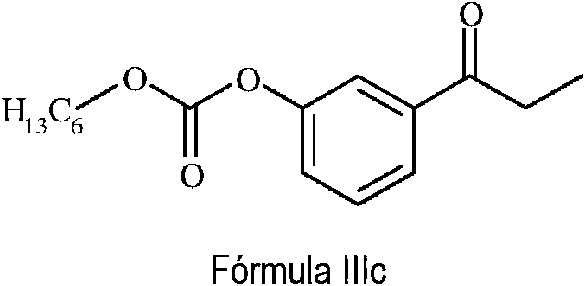
De acuerdo con otra realización, la presente invención proporciona un compuesto de Fórmula IIIc.According to another embodiment, the present invention provides a compound of Formula IIIc.
De acuerdo con otra realización, la presente invención proporciona un compuesto de Fórmula IV:According to another embodiment, the present invention provides a compound of Formula IV:

en donde el grupo “PG” representa un grupo protector de hidroxilo adecuado.wherein the “PG” group represents a suitable hydroxyl protecting group.
De acuerdo con otra realización, la presente invención proporciona un compuesto de Fórmula IV; en donde el grupo “PG” se selecciona del grupo que comprende formiato de tricloroetilo, formiato de metilo, formiato de etilo, formiato de hexilo, formiato de isobutilo, formiato de bencilo, metoximetilo, metoxietoximetilo, tetrahidropiranilo, tetrahidrofurano, alilo, metoxitritilo, metiltiometilo, bencilo, benzoílo, p-metoxibencilo, t-butildimetilsililo, t-butildifenilsililo, triisopropilsililo, di-terc-butiisilileno, tetraisopropildisiloxanilideno, pivaloílo y benzoílo.According to another embodiment, the present invention provides a compound of Formula IV; wherein the group "PG" is selected from the group comprising trichloroethyl formate, methyl formate, ethyl formate, hexyl formate, isobutyl formate, benzyl formate, methoxymethyl, methoxyethoxymethyl, tetrahydropyranyl, tetrahydrofuran, allyl, methoxytrityl, methylthiomethyl, benzyl, benzoyl, p-methoxybenzyl, t-butyldimethylsilyl, t-butyldiphenylsilyl, triisopropylsilyl, di-tert-butysilylene, tetraisopropyldisiloxanylidene, pivaloyl and benzoyl.
De acuerdo con otra realización, la presente invención proporciona un compuesto de Fórmula IV, en donde el grupo “PG” se selecciona de formiato de tricloroetilo, formiato de etilo o formiato de hexilo.According to another embodiment, the present invention provides a compound of Formula IV, wherein the "PG" group is selected from trichloroethyl formate, ethyl formate or hexyl formate.
De acuerdo con otra realización, la presente invención proporciona un procedimiento para la preparación del compuesto de Fórmula IV, que comprende hacer reaccionar un compuesto de Fórmula III con un reactivo de nitración adecuado para obtener un compuesto de Fórmula IV;According to another embodiment, the present invention provides a process for the preparation of the compound of Formula IV, comprising reacting a compound of Formula III with a suitable nitration reagent to obtain a compound of Formula IV;

en donde el grupo “PG” se selecciona del grupo que comprende formiato de tricloroetilo, formiato de metilo, formiato de etilo, formiato de hexilo, formiato de isobutilo, formiato de bencilo, metoximetilo, metoxietoximetilo, tetrahidropiranilo, tetrahidrofurano, alilo, metoxitritilo, metiltiometilo, bencilo, benzoílo, p-metoxibencilo, tbutildimetilsililo, t-butildifenilsililo, triisopropilsililo, di-terc-butilsilileno, tetraisopropildisiloxanilideno, pivaloílo y benzoílo. De acuerdo con otra realización, la presente invención proporciona un compuesto de Fórmula IVa.wherein the group "PG" is selected from the group comprising trichloroethyl formate, methyl formate, ethyl formate, hexyl formate, isobutyl formate, benzyl formate, methoxymethyl, methoxyethoxymethyl, tetrahydropyranyl, tetrahydrofuran, allyl, methoxytrityl, methylthiomethyl , benzyl, benzoyl, p-methoxybenzyl, t-butyldimethylsilyl, t-butyldiphenylsilyl, triisopropylsilyl, di-tert-butylsilylene, tetraisopropyldisiloxanylidene, pivaloyl and benzoyl. According to another embodiment, the present invention provides a compound of Formula IVa.

De acuerdo con otra realización, la presente invención proporciona un compuesto de Fórmula IVb.According to another embodiment, the present invention provides a compound of Formula IVb.

De acuerdo con otra realización, la presente invención proporciona un compuesto de Fórmula IVc.According to another embodiment, the present invention provides a compound of Formula IVc.

De acuerdo con otra realización, la presente invención proporciona un compuesto de Fórmula VI.According to another embodiment, the present invention provides a compound of Formula VI.

en donde el grupo “PG” representa un grupo protector de hidroxilo adecuado.wherein the “PG” group represents a suitable hydroxyl protecting group.
De acuerdo con otra realización, la presente invención proporciona un compuesto de Fórmula VI; en donde el grupo “PG” se selecciona del grupo que comprende formiato de tricloroetilo, formiato de metilo, formiato de etilo, formiato de hexilo, formiato de isobutilo, formiato de bencilo, metoximetilo, metoxietoximetilo, tetrahidropiranilo, tetrahidrofurano, alilo, metoxitritilo, metiltiometilo, bencilo, benzoílo, p-metoxibencilo, t-butildimetilsililo, t-butildifenilsililo, triisopropilsililo, di-terc-butilsilileno, tetraisopropildisiloxanilideno, pivaloílo y benzoílo.According to another embodiment, the present invention provides a compound of Formula VI; where the group “PG” is selected from the group comprising trichloroethyl formate, methyl formate, ethyl formate, hexyl formate, isobutyl formate, benzyl formate, methoxymethyl, methoxyethoxymethyl, tetrahydropyranyl, tetrahydrofuran, allyl, methoxytrityl, methylthiomethyl, benzyl, benzoyl , p-methoxybenzyl, t-butyldimethylsilyl, t-butyldiphenylsilyl, triisopropylsilyl, di-tert-butylsilylene, tetraisopropyldisiloxanylidene, pivaloyl and benzoyl.
De acuerdo con otra realización, la presente invención proporciona un compuesto de Fórmula VI, en donde el grupo “PG” se selecciona de formiato de tricloroetilo, formiato de etilo o formiato de hexilo.According to another embodiment, the present invention provides a compound of Formula VI, wherein the "PG" group is selected from trichloroethyl formate, ethyl formate or hexyl formate.
De acuerdo con otra realización, la presente invención proporciona un procedimiento para la preparación de un compuesto de Fórmula VI, que comprende reducir un compuesto de Fórmula IV con un agente reductor adecuado para obtener un compuesto de Fórmula VI; en donde el grupo “PG” se selecciona del grupo que comprende formiato de tricloroetilo, formiato de metilo, formiato de etilo, formiato de hexilo, formiato de isobutilo, formiato de bencilo, metoximetilo, metoxietoximetilo, tetrahidropiranilo, tetrahidrofurano, alilo, metoxitritilo, metiltiometilo, bencilo, benzoílo, p-metoxibencilo, t-butildimetilsililo, t-butildifenilsililo, triisopropilsililo, di-terc-butilsilileno, tetraisopropildisiloxanilideno, pivaloílo y benzoílo.According to another embodiment, the present invention provides a process for the preparation of a compound of Formula VI, comprising reducing a compound of Formula IV with a suitable reducing agent to obtain a compound of Formula VI; wherein the group "PG" is selected from the group comprising trichloroethyl formate, methyl formate, ethyl formate, hexyl formate, isobutyl formate, benzyl formate, methoxymethyl, methoxyethoxymethyl, tetrahydropyranyl, tetrahydrofuran, allyl, methoxytrityl, methylthiomethyl , benzyl, benzoyl, p-methoxybenzyl, t-butyldimethylsilyl, t-butyldiphenylsilyl, triisopropylsilyl, di-tert-butylsilylene, tetraisopropyldisiloxanylidene, pivaloyl and benzoyl.
De acuerdo con otra realización, la presente invención proporciona un procedimiento para la preparación de irinotecán, que comprende: preparar un compuesto de Fórmula I de acuerdo con los procedimientos descritos anteriormente y convertir el compuesto de Fórmula I en 7-etil-10-hidroxicamptotecina (SN-38) y posteriormente en irinotecán.According to another embodiment, the present invention provides a process for the preparation of irinotecan, comprising: preparing a compound of Formula I according to the procedures described above and converting the compound of Formula I to 7-ethyl-10-hydroxycamptothecin ( SN-38) and later in irinotecan.
Descripción detallada de la invenciónDetailed description of the invention
La presente invención proporciona un procedimiento para la preparación de 2-amino-5-hidroxipropiofenona de Fórmula I, un compuesto intermedio útil en la preparación de 7-etil-10-hidroxicamptotecina (SN-38).The present invention provides a process for the preparation of 2-amino-5-hydroxypropiophenone of Formula I, an intermediate useful in the preparation of 7-ethyl-10-hydroxycamptothecin (SN-38).
De acuerdo con una realización, la presente invención proporciona un procedimiento para la preparación de 2-amino-5-hidroxipropiofenona de Fórmula I:According to one embodiment, the present invention provides a process for the preparation of 2-amino-5-hydroxypropiophenone of Formula I:

que comprende:which includes:
a) Hacer reaccionar un compuesto de Fórmula III, en donde "PG" es un grupo protector de hidroxilo adecuado, con un reactivo de nitración adecuado para obtener un compuesto de Fórmula IV, ya) React a compound of Formula III, where "PG" is a suitable hydroxyl protecting group, with a suitable nitration reagent to obtain a compound of Formula IV, and

b) Convertir el compuesto de Fórmula IV en 2-amino-5-hidroxipropiofenona de Fórmula I.b) Convert the compound of Formula IV into 2-amino-5-hydroxypropiophenone of Formula I.
De acuerdo con otra realización, la presente invención proporciona un procedimiento para la preparación de 2-amino-5-hidroxipropiofenona de Fórmula I:According to another embodiment, the present invention provides a process for the preparation of 2-amino-5-hydroxypropiophenone of Formula I:

que comprende:which includes:
a) Hacer reaccionar un compuesto de Fórmula II con un agente protector de hidroxilo adecuado para obtener un compuesto de Fórmula III; en donde “PG” representa un grupo protector de hidroxilo adecuado, a) Reacting a compound of Formula II with a suitable hydroxyl protecting agent to obtain a compound of Formula III; wherein “PG” represents a suitable hydroxyl protecting group,

b) Hacer reaccionar el compuesto de Fórmula III con un reactivo de nitración adecuado para obtener un compuesto de Fórmula IV, yb) React the compound of Formula III with a suitable nitration reagent to obtain a compound of Formula IV, and

d) Convertir el compuesto de Fórmula IV en 2-amino-5-hidroxipropiofenona de Fórmula I.d) Convert the compound of Formula IV into 2-amino-5-hydroxypropiophenone of Formula I.
En otra realización, la presente invención proporciona un procedimiento para la preparación de 2-amino-5-hidroxipropiofenona de Fórmula I:In another embodiment, the present invention provides a process for the preparation of 2-amino-5-hydroxypropiophenone of Formula I:

que comprende:which includes:
a) Hacer reaccionar un compuesto de Fórmula II con un agente protector de hidroxilo adecuado para obtener un compuesto de Fórmula III; en donde “PG” representa un grupo protector de hidroxilo adecuado,a) Reacting a compound of Formula II with a suitable hydroxyl protecting agent to obtain a compound of Formula III; wherein “PG” represents a suitable hydroxyl protecting group,

b) Hacer reaccionar el compuesto de Fórmula III con un reactivo de nitración adecuado para obtener un compuesto de Fórmula IV,b) React the compound of Formula III with a suitable nitration reagent to obtain a compound of Formula IV,

c) Desproteger el compuesto de Fórmula IV con un agente desprotector adecuado para obtener un compuesto de Fórmula V, y c) Deprotect the compound of Formula IV with a suitable deprotecting agent to obtain a compound of Formula V, and

d) Reducir el compuesto de Fórmula V con un agente reductor adecuado para obtener 2-amino-5-hidroxipropiofenona de Fórmula I; (o)d) Reduce the compound of Formula V with a suitable reducing agent to obtain 2-amino-5-hydroxypropiophenone of Formula I; (either)
e) Reducir el compuesto de Fórmula IV con un agente reductor adecuado para obtener un compuesto de Fórmula VI, ye) Reduce the compound of Formula IV with a suitable reducing agent to obtain a compound of Formula VI, and

f) Desproteger el compuesto de Fórmula VI con un agente desprotector adecuado para obtener 2-amino-5-hidroxipropiofenona de Fórmula I.f) Deprotect the compound of Formula VI with a suitable deprotecting agent to obtain 2-amino-5-hydroxypropiophenone of Formula I.
Los materiales de partida, un compuesto de Fórmula II es bien conocido en la técnica y se puede producir mediante métodos conocidos en la técnica reconocidos por el químico orgánico con experiencia ordinaria en la técnica.Starting materials, a compound of Formula II is well known in the art and can be produced by methods known in the art recognized by the organic chemist of ordinary skill in the art.
La presente invención se refiere a un procedimiento para la preparación de 2-amino-5-hidroxipropiofenona de Fórmula I, que involucra principalmente la nitración regioselectiva al crear un impedimento estérico en la 3'-hidroxipropiofenona mediante la protección del grupo hidroxilo, lo que ventajosamente evita la formación de regioisómeros/isómeros posicionales, haciendo así que el procedimiento esté libre de tediosas etapas de purificación y/o cristalización en columna, etapas de procedimiento que se consideran en la técnica anterior para separar regioisómeros/isómeros posicionales no deseados. El procedimiento regioselectivo de la presente invención es más adecuado para aplicaciones comerciales con mayor regioselectividad y evita los problemas asociados con los procedimientos reportados.The present invention relates to a process for the preparation of 2-amino-5-hydroxypropiophenone of Formula I, which mainly involves regioselective nitration by creating a steric hindrance in the 3'-hydroxypropiophenone by protecting the hydroxyl group, which advantageously prevents the formation of regioisomers/positional isomers, thus making the process free of tedious purification and/or column crystallization steps, procedural steps that are considered in the prior art to separate unwanted regioisomers/positional isomers. The regioselective procedure of the present invention is more suitable for commercial applications with higher regioselectivity and avoids the problems associated with the reported procedures.
Protección del grupo hidroxiProtection of the hydroxy group
La etapa a) del procedimiento anterior implica la protección del grupo hidroxi de un compuesto de Fórmula II con un agente formador de grupos protectores adecuado en presencia de una base y en un disolvente para obtener un compuesto de Fórmula III; en donde "PG" es un grupo protector adecuado.Step a) of the above procedure involves the protection of the hydroxy group of a compound of Formula II with a suitable protecting group-forming agent in the presence of a base and in a solvent to obtain a compound of Formula III; where "PG" is a suitable protecting group.
El grupo protector de hidroxilo adecuado incluye, pero no se limita a, formiato de tricloroetilo, formiato de metilo, formiato de etilo, formiato de hexilo, formiato de isobutilo, formiato de bencilo, metoximetilo, metoxietoximetilo, tetrahidropiranilo, tetrahidrofurano, alilo, metoxitritilo, metiltiometilo, bencilo, benzoílo, p-metoxibencilo, tbutildimetilsililo, t-butildifenilsililo, triisopropilsililo, di-terc-butilsilileno, tetraisopropildisiloxanilideno, pivaloílo y benzoílo. Otros grupos protectores de hidroxilo que son bien conocidos en la técnica también pueden considerarse como grupos protectores de hidroxilo de la invención, descritos específicamente en detalle en Protecting Groups in Organic Synthesis, Theodora W. Greene y Peter G. M. Wuts, 3a edición, 1999, publicado por John Wiley and Son, Inc.; preferiblemente el grupo protector es formiato de tricloroetilo, formiato de etilo y formiato de hexilo.Suitable hydroxyl protecting group includes, but is not limited to, trichloroethyl formate, methyl formate, ethyl formate, hexyl formate, isobutyl formate, benzyl formate, methoxymethyl, methoxyethoxymethyl, tetrahydropyranyl, tetrahydrofuran, allyl, methoxytrityl, methylthiomethyl, benzyl, benzoyl, p-methoxybenzyl, t-butyldimethylsilyl, t-butyldiphenylsilyl, triisopropylsilyl, di-tert-butylsilylene, tetraisopropyldisiloxanylidene, pivaloyl and benzoyl. Other hydroxyl protecting groups that are well known in the art may also be considered hydroxyl protecting groups of the invention, specifically described in detail in Protecting Groups in Organic Synthesis, Theodora W. Greene and Peter G. M. Wuts, 3rd edition, 1999, published by John Wiley and Son, Inc.; preferably the protecting group is trichloroethyl formate, ethyl formate and hexyl formate.
El agente formador de grupos protectores de hidroxilo adecuado incluye, pero no se limita a, cloroformiato de tricloroetilo, cloroformiato de metilo, cloroformiato de etilo, cloroformiato de hexilo, cloroformiato de isobutilo, cloroformiato de bencilo, cloruro de metoximetilo, cloruro de metoxietoximetilo, tetrahidropiranil éter, bromuro de alilo, cloruro de metoxitritilo, cloruro de metiltiometilo, bromuro de bencilo, bromuro de benzoílo, cloruro de p-metoxibencilo, cloruro de t-butildimetilsililo, cloruro de t-butildifenilsililo, cloruro de triisopropilsililo, cloruro de di-terc-butilsilileno, cloruro de tetraisopropildisiloxanilideno, cloruro de pivaloílo y cloruro de benzoílo; preferiblemente cloroformiato de tricloroetilo, cloroformiato de etilo o cloroformiato de hexilo.Suitable hydroxyl protecting group-forming agent includes, but is not limited to, trichloroethyl chloroformate, methyl chloroformate, ethyl chloroformate, hexyl chloroformate, isobutyl chloroformate, benzyl chloroformate, methoxymethyl chloride, methoxyethoxymethyl chloride, tetrahydropyranyl ether, allyl bromide, methoxytrityl chloride, methylthiomethyl chloride, benzyl bromide, benzoyl bromide, p-methoxybenzyl chloride, t-butyldimethylsilyl chloride, t-butyldiphenylsilyl chloride, triisopropylsilyl chloride, di-tert-chloride butylsilylene, tetraisopropyldisiloxanylidene chloride, pivaloyl chloride and benzoyl chloride; preferably trichloroethyl chloroformate, ethyl chloroformate or hexyl chloroformate.
La base adecuada usada en este documento en la etapa a) se selecciona de una base inorgánica o una orgánica; además, la base inorgánica adecuada se selecciona, pero no se limita a, de hidróxidos de metales alcalinos tales como hidróxido de sodio, hidróxido de potasio y similares; hidruros de metales alcalinos tales como hidruro de sodio, hidruro de potasio y similares; amidas de metales alcalinos tales como amida de sodio, amida de potasio, amida de litio y similares; alcóxidos de metales alcalinos tales como metóxido de sodio, etóxido de sodio, t-butóxido de sodio, t-butóxido de potasio y similares; carbonatos de metales alcalinos tales como carbonato de sodio, carbonato de potasio, carbonato de cesio y similares; bicarbonatos de metales alcalinos tales como bicarbonato de sodio, bicarbonato de potasio y similares; fosfatos tales como fosfato sódico, fosfato trisódico, fosfato potásico, fosfato tripotásico y similares; carbonato de amonio; y la base orgánica se selecciona de, pero no se limita a, trietilamina, tri-n-propilamina, tri-n-butilamina, metildibutilamina, diisopropilamina, diisopropiletilamina, diciclohexilamina, metildiciclohexilamina, etildiisopropilamina, N,N-dietildiciclohexilamina, piridina, dimetilamino-4-piridina, N-metilpiperidina, N-etilpiperidina, N-etilpiperidina, N-butilpiperidina, 1,2-dimetilpiperidina y similares; o mezclas de los mismos; preferiblemente hidróxido de sodio, hidruro de sodio, amida de sodio, t-butóxido de potasio o carbonato de cesio; más preferiblemente hidróxido de sodio.The suitable base used herein in step a) is selected from an inorganic base or an organic base; furthermore, the suitable inorganic base is selected from, but not limited to, alkali metal hydroxides such as sodium hydroxide, potassium hydroxide and the like; alkali metal hydrides such as sodium hydride, potassium hydride and the like; alkali metal amides such as sodium amide, potassium amide, lithium amide and the like; alkali metal alkoxides such as sodium methoxide, sodium ethoxide, sodium t-butoxide, potassium t-butoxide and the like; alkali metal carbonates such as sodium carbonate, potassium carbonate, cesium carbonate and the like; alkali metal bicarbonates such as sodium bicarbonate, potassium bicarbonate and the like; phosphates such as sodium phosphate, trisodium phosphate, potassium phosphate, tripotassium phosphate and the like; ammonium carbonate; and the organic base is selected from, but is not limited to, triethylamine, tri-n-propylamine, tri-n-butylamine, methyldibutylamine, diisopropylamine, diisopropylethylamine, dicyclohexylamine, methyldicyclohexylamine, ethyldiisopropylamine, N,N-diethyldicyclohexylamine, pyridine, dimethylamino- 4-pyridine, N-methylpiperidine, N-ethylpiperidine, N-ethylpiperidine, N-butylpiperidine, 1,2-dimethylpiperidine and the like; or mixtures thereof; preferably sodium hydroxide, sodium hydride, sodium amide, potassium t-butoxide or cesium carbonate; more preferably sodium hydroxide.
El disolvente adecuado usado en este documento en la etapa a) se selecciona, pero no se limita a, de cetonas que incluyen, pero no se limitan a, acetona, metil etil cetona, metil isobutil cetona, dietil cetona y similares; los nitrilos incluyen, pero no se limitan a, acetonitrilo, propionitrilo y similares; los éteres incluyen, pero no se limitan a, éter dietílico, tetrahidrofurano, metiltetrahidrofurano, 1,4-dioxano y similares; los disolventes apróticos polares incluyen, pero no se limitan a, dimetilacetamida, dimetilformamida, dimetilsulfóxido, N-metilpirrolidona y similares; los disolventes halogenados incluyen, pero no se limitan a, cloruro de metileno, cloruro de etileno, cloroformo y similares; los hidrocarburos aromáticos incluyen, pero no se limitan a, tolueno, xileno y similares; agua o mezclas de los mismos; preferiblemente, el disolvente adecuado es acetonitrilo, tetrahidrofurano, dimetilformamida, cloruro de metileno, agua o mezclas de los mismos; más preferiblemente cloruro de metileno, agua o mezclas de los mismos.The suitable solvent used herein in step a) is selected from, but not limited to, ketones including, but not limited to, acetone, methyl ethyl ketone, methyl isobutyl ketone, diethyl ketone and the like; nitriles include, but are not limited to, acetonitrile, propionitrile and the like; ethers include, but are not limited to, diethyl ether, tetrahydrofuran, methyltetrahydrofuran, 1,4-dioxane and the like; polar aprotic solvents include, but are not limited to, dimethylacetamide, dimethylformamide, dimethyl sulfoxide, N-methylpyrrolidone and the like; halogenated solvents include, but are not limited to, methylene chloride, ethylene chloride, chloroform and the like; aromatic hydrocarbons include, but are not limited to, toluene, xylene and the like; water or mixtures thereof; preferably, the suitable solvent is acetonitrile, tetrahydrofuran, dimethylformamide, methylene chloride, water or mixtures thereof; more preferably methylene chloride, water or mixtures thereof.
La reacción de un compuesto de Fórmula II con un grupo protector de hidroxilo adecuado se lleva a cabo a una temperatura de aproximadamente -10 °C a la temperatura de reflujo; preferiblemente a una temperatura de aproximadamente 0 °C a aproximadamente 80 °C.The reaction of a compound of Formula II with a suitable hydroxyl protecting group is carried out at a temperature of approximately -10 ° C at the reflux temperature; preferably at a temperature of about 0°C to about 80°C.
Una vez finalizada la reacción de protección, el compuesto resultante de Fórmula III se puede aislar como una forma sólida para la conversión en las etapas posteriores o se puede continuar sin aislar el mismo. Si implica aislamiento, el aislamiento puede llevarse a cabo por filtración directa del sólido precipitado o por extracción de la masa de reacción con un disolvente orgánico inmiscible en agua adecuado; preferiblemente acetato de etilo, cloruro de metileno y similares; más preferiblemente cloruro de metileno. Luego, la capa orgánica que contiene el producto se puede separar y el compuesto de Fórmula III se puede aislar mediante precipitación, evaporación y, opcionalmente, el producto resultante se puede secar adicionalmente.Once the protection reaction is complete, the resulting compound of Formula III can be isolated as a solid form for conversion in subsequent steps or can be continued without isolating the same. If isolation is involved, isolation can be carried out by direct filtration of the precipitated solid or by extraction of the reaction mass with a suitable water-immiscible organic solvent; preferably ethyl acetate, methylene chloride and the like; more preferably methylene chloride. Then, the organic layer containing the product can be separated and the compound of Formula III can be isolated by precipitation, evaporation and, optionally, the resulting product can be further dried.
En otra realización, el compuesto de Fórmula III se representa específicamente como un compuesto de Fórmula IIIa, Fórmula IIIb o Fórmula IIIc.In another embodiment, the compound of Formula III is specifically represented as a compound of Formula IIIa, Formula IIIb or Formula IIIc.

Reacción de nitraciónNitration reaction
Hasta la fecha, todos los procedimientos de nitración reportados en la técnica implican la formación de regioisómeros/isómeros posicionales no deseados en la reacción de nitración por sustitución del grupo nitro en las posiciones orto y para en lugar de la misma reacción solo en la posición para. Esto se debe a la presencia de un grupo hidroxilo libre y, como resultado, de la falta de impedimento estérico en las posiciones orto y para, la posibilidad de nitración en ambas posiciones es muy favorable. La nitración en múltiples posiciones en lugar de solo en la requerida posición para crea una carga innecesaria para el procedimiento a escala comercial, ya que las impurezas regioisómeras formadas son difíciles de eliminar del producto requerido mediante las técnicas de purificación normales debido a la baja diferencia de polaridad de los regioisómeros. Por lo tanto, requiere múltiples purificaciones en columna e incluso entonces no hay garantía de obtener el compuesto de alta pureza requerido para el uso farmacéutico. To date, all nitration procedures reported in the art involve the formation of unwanted regioisomers/positional isomers in the nitration reaction by substitution of the nitro group at the ortho and para positions instead of the same reaction only at the para position. . This is due to the presence of a free hydroxyl group and, as a result, the lack of steric hindrance in the ortho and para positions, the possibility of nitration in both positions is very favorable. Nitration at multiple positions instead of just at the required position creates an unnecessary burden for the commercial scale process, since the regioisomeric impurities formed are difficult to remove from the required product by normal purification techniques due to the low difference in polarity of the regioisomers. Therefore, it requires multiple column purifications and even then there is no guarantee of obtaining the high purity compound required for pharmaceutical use.
Para superar las dificultades asociadas con la técnica, los inventores de la presente invención han encontrado sorprendentemente que crear impedimento estérico protegiendo el grupo hidroxilo libre vecino en el anillo arilo con un grupo protector adecuado que evite la nitración en la posición orto no deseada y favorece la solo requerida posición para y, por lo tanto, como resultado la formación de regioisómeros no deseados se reduce en gran medida, lo que hace que el procedimiento actual esté libre de la tediosa purificación en columna y/o las múltiples etapas de cristalización para separar los isómeros no deseados y hacer que el procedimiento tenga un rendimiento más alto y el producto sea más puro.To overcome the difficulties associated with the art, the inventors of the present invention have surprisingly found that creating steric hindrance by protecting the neighboring free hydroxyl group on the aryl ring with a suitable protecting group that prevents nitration at the unwanted ortho position and promotes only required position for and therefore as a result the formation of unwanted regioisomers is greatly reduced, making the current procedure free from tedious column purification and/or multiple crystallization steps to separate the unwanted isomers and make the procedure have a higher yield and the product more pure.
La etapa de nitración b) del procedimiento anterior implica la reacción del compuesto de Fórmula III con un reactivo de nitración adecuado para obtener un compuesto de Fórmula IV; en donde "PG" es un grupo protector adecuado. Nitration step b) of the previous procedure involves the reaction of the compound of Formula III with a suitable nitration reagent to obtain a compound of Formula IV; where "PG" is a suitable protecting group.
El reactivo de nitración adecuado puede seleccionarse del grupo que comprende mezcla de nitración (una mezcla de ácido nítrico y ácido sulfúrico), nitrato de sodio, nitrato de potasio, nitrato de calcio, nitrato cúprico y similares y mezclas de los mismos; preferiblemente mezcla de nitración o nitrato de potasio. The suitable nitration reagent may be selected from the group comprising nitration mixture (a mixture of nitric acid and sulfuric acid), sodium nitrate, potassium nitrate, calcium nitrate, cupric nitrate and the like and mixtures thereof; preferably nitration mixture or potassium nitrate.
La reacción de Fórmula III con un reactivo de nitración adecuado se puede realizar ventajosamente en un disolvente adecuado. El disolvente adecuado incluye, pero no se limita a, hidrocarburos halogenados, hidrocarburos aromáticos, amidas, nitrilos, ácidos y mezclas de los mismos. Los hidrocarburos halogenados incluyen, pero no se limitan a, cloruro de metileno, cloruro de etileno, cloroformo y similares; los hidrocarburos aromáticos incluyen, pero no se limitan a, tolueno, xileno y similares; las amidas incluyen, pero no se limitan a, dimetilformamida, dimetilacetamida, dimetilsulfóxido, N-metilpirrolidinona y similares; los nitrilos incluyen, pero no se limitan a, acetonitrilo, propionitrilo y similares; preferiblemente cloruro de metileno.The reaction of Formula III with a suitable nitration reagent can advantageously be carried out in a suitable solvent. Suitable solvent includes, but is not limited to, halogenated hydrocarbons, aromatic hydrocarbons, amides, nitriles, acids and mixtures thereof. Halogenated hydrocarbons include, but are not limited to, methylene chloride, ethylene chloride, chloroform and the like; aromatic hydrocarbons include, but are not limited to, toluene, xylene and the like; amides include, but are not limited to, dimethylformamide, dimethylacetamide, dimethyl sulfoxide, N-methylpyrrolidinone and the like; nitriles include, but are not limited to, acetonitrile, propionitrile and the like; preferably methylene chloride.
La etapa de nitración puede llevarse a cabo opcionalmente en presencia de un ácido seleccionado del grupo que comprende ácido clorhídrico, ácido bromhídrico, ácido sulfúrico, ácido perclórico, ácido fosfórico, ácido acético, anhídrido acético, ácido trifluoroacético, ácido tricloroacético, ácido metanosulfónico y similares y mezclas de los mismos; preferiblemente ácido sulfúrico.The nitration step may optionally be carried out in the presence of an acid selected from the group consisting of hydrochloric acid, hydrobromic acid, sulfuric acid, perchloric acid, phosphoric acid, acetic acid, acetic anhydride, trifluoroacetic acid, trichloroacetic acid, methanesulfonic acid and the like. and mixtures thereof; preferably sulfuric acid.
La reacción del compuesto de Fórmula III con un reactivo de nitración adecuado se lleva a cabo a una temperatura de aproximadamente -25 °C a aproximadamente la temperatura de reflujo; Preferiblemente, la reacción se lleva a cabo entre aproximadamente -15 °C y aproximadamente 15 °C.The reaction of the compound of Formula III with a suitable nitration reagent is carried out at a temperature of about -25°C to about reflux temperature; Preferably, the reaction is carried out between about -15°C and about 15°C.
El compuesto resultante de Fórmula IV se puede aislar como una forma sólida para su conversión en las etapas posteriores o se puede continuar sin aislarlo. Si implica aislamiento, el aislamiento puede llevarse a cabo por filtración directa del sólido precipitado o por extracción de la masa de reacción con un disolvente orgánico inmiscible en agua adecuado; preferiblemente acetato de etilo, cloruro de metileno y similares; más preferiblemente cloruro de metileno. Luego, la capa orgánica que contiene el producto se puede separar y el compuesto de Fórmula IV se puede aislar mediante precipitación, evaporación y, opcionalmente, el producto resultante se puede secar adicionalmente.The resulting compound of Formula IV can be isolated as a solid form for conversion in subsequent steps or can be continued without isolation. If isolation is involved, isolation can be carried out by direct filtration of the precipitated solid or by extraction of the reaction mass with a suitable water-immiscible organic solvent; preferably ethyl acetate, methylene chloride and the like; more preferably methylene chloride. Then, the organic layer containing the product can be separated and the compound of Formula IV can be isolated by precipitation, evaporation and, optionally, the resulting product can be further dried.
En otra realización, el compuesto de Fórmula IV se representa específicamente como un compuesto de Fórmula IVa, Fórmula IVb o Fórmula IVc.In another embodiment, the compound of Formula IV is specifically represented as a compound of Formula IVa, Formula IVb or Formula IVc.

De acuerdo con otra realización, la presente invención proporciona un procedimiento para la preparación de 2-amino-5-hidroxipropiofenona de Fórmula I, que comprende: convertir el compuesto de Fórmula IV obtenido anteriormente en 2-amino-5-hidroxipropiofenona de Fórmula I implicando desproteger el compuesto de Fórmula IV con un agente desprotector adecuado para obtener un compuesto de Fórmula V y reducir luego el compuesto de Fórmula V con un agente reductor adecuado para obtener 2-amino-5-hidroxipropiofenona de Fórmula I, (o) reducir primero el compuesto de Fórmula IV con un agente reductor adecuado para obtener un compuesto de Fórmula VI y desproteger luego el compuesto de Fórmula VI con un agente desprotector adecuado para obtener 2-amino-5-hidroxipropiofenona de Fórmula I.According to another embodiment, the present invention provides a process for the preparation of 2-amino-5-hydroxypropiophenone of Formula I, comprising: converting the compound of Formula IV obtained above into 2-amino-5-hydroxypropiophenone of Formula I involving deprotecting the compound of Formula IV with a suitable deprotecting agent to obtain a compound of Formula V and then reducing the compound of Formula V with a suitable reducing agent to obtain 2-amino-5-hydroxypropiophenone of Formula I, (or) first reducing the compound of Formula IV with a suitable reducing agent to obtain a compound of Formula VI and then deprotect the compound of Formula VI with a suitable deprotecting agent to obtain 2-amino-5-hydroxypropiophenone of Formula I.
Reacción de desprotecciónDeprotection reaction
El procedimiento precedente de la etapa de desprotección implica la desprotección del grupo protector hidroxi del compuesto de Fórmula IV o de Fórmula VI en presencia de un agente desprotector adecuado a una temperatura de aproximadamente 0 °C a aproximadamente la temperatura de reflujo; preferiblemente, la reacción se lleva a cabo entre aproximadamente 25 °C y aproximadamente 50 °C.The preceding deprotection step procedure involves deprotection of the hydroxy protecting group of the compound of Formula IV or Formula VI in the presence of a suitable deprotecting agent at a temperature of about 0°C to about the reflux temperature; preferably, the reaction is carried out between about 25°C and about 50°C.
El agente desprotector adecuado usado en este documento para desproteger el compuesto de Fórmula IV o el de Fórmula VI se puede seleccionar de una base adecuada o un ácido adecuado. La base adecuada incluye, pero no se limita a, bases inorgánicas seleccionadas de hidróxidos de metales alcalinos tales como hidróxido de litio, hidróxido de sodio, hidróxido de potasio y similares; alcóxidos de metales alcalinos tales como metóxido de sodio, etóxido de sodio, terc-butóxido de sodio, terc-butóxido de potasio y similares; carbonatos de metales alcalinos tales como carbonato de sodio, carbonato de potasio, carbonato de cesio y similares; bicarbonatos de metales alcalinos tales como bicarbonato de sodio, bicarbonato de potasio y similares; y bases orgánicas seleccionadas del grupo que consiste en trietilamina, isopropiletilamina, diisopropilamina, diisopropiletilamina, N-metilmorfolina, piperidina, piridina y similares y mezclas de los mismos. El ácido adecuado incluye, pero no se limita a, ácido clorhídrico, ácido bromhídrico, tribromuro de boro, yoduro de trimetilsililo, bromuro de zinc, cloruro de titanio (IV), 2,3-dicloro-5,6-dicianobenzoquinona y similares y mezclas de estos; preferiblemente hidróxido de sodio, carbonato de potasio, ácido clorhídrico y mezclas de los mismos; más preferiblemente carbonato de potasio.The suitable deprotecting agent used herein to deprotect the compound of Formula IV or that of Formula VI may be selected from a suitable base or a suitable acid. Suitable base includes, but is not limited to, inorganic bases selected from alkali metal hydroxides such as lithium hydroxide, sodium hydroxide, potassium hydroxide and the like; alkali metal alkoxides such as sodium methoxide, sodium ethoxide, sodium tert-butoxide, potassium tert-butoxide and the like; alkali metal carbonates such as sodium carbonate, potassium carbonate, cesium carbonate and the like; alkali metal bicarbonates such as sodium bicarbonate, potassium bicarbonate and the like; and organic bases selected from the group consisting of triethylamine, isopropylethylamine, diisopropylamine, diisopropylethylamine, N-methylmorpholine, piperidine, pyridine and the like and mixtures thereof. Suitable acid includes, but is not limited to, hydrochloric acid, hydrobromic acid, boron tribromide, trimethylsilyl iodide, zinc bromide, titanium (IV) chloride, 2,3-dichloro-5,6-dicyanobenzoquinone and the like and mixtures of these; preferably sodium hydroxide, potassium carbonate, hydrochloric acid and mixtures thereof; more preferably potassium carbonate.
La reacción de desprotección se lleva a cabo ventajosamente en un disolvente adecuado. El disolvente adecuado incluye, pero no se limita a, alcoholes, hidrocarburos halogenados, amidas, nitrilos, ácidos y mezclas de estos. Los alcoholes incluyen, pero no se limitan a, metanol, etanol, isopropanol, n-butanol y similares; los hidrocarburos halogenados incluyen, pero no se limitan a, cloruro de metileno, cloruro de etileno, cloroformo y similares; las amidas incluyen, pero no se limitan a, dimetilformamida, dimetilacetamida, dimetilsulfóxido, N-metilpirrolidinona y similares; los nitrilos incluyen, pero no se limitan a, acetonitrilo, propionitrilo y similares; los ácidos incluyen, pero no se limitan a, ácido fórmico, ácido acético y similares y mezclas de los mismos; preferiblemente metanol, etanol, dimetilformamida y mezclas de los mismos; más preferiblemente metanol.The deprotection reaction is advantageously carried out in a suitable solvent. Suitable solvent includes, but is not limited to, alcohols, halogenated hydrocarbons, amides, nitriles, acids and mixtures thereof. The alcohols include, but are not limited to, methanol, ethanol, isopropanol, n-butanol and the like; halogenated hydrocarbons include, but are not limited to, methylene chloride, ethylene chloride, chloroform and the like; amides include, but are not limited to, dimethylformamide, dimethylacetamide, dimethyl sulfoxide, N-methylpyrrolidinone and the like; nitriles include, but are not limited to, acetonitrile, propionitrile and the like; acids include, but are not limited to, formic acid, acetic acid and the like and mixtures thereof; preferably methanol, ethanol, dimethylformamide and mixtures thereof; more preferably methanol.
Una vez completada la reacción de desprotección, el compuesto resultante de Fórmula V o Fórmula VI se puede aislar como una forma sólida para su conversión en las etapas posteriores o se puede continuar sin aislar el mismo. Si implica aislamiento, el aislamiento puede llevarse a cabo por filtración directa del sólido precipitado o por extracción de la masa de reacción con un disolvente orgánico inmiscible en agua adecuado; preferiblemente acetato de etilo, cloruro de metileno y similares; preferiblemente cloruro de metileno. Luego, la capa orgánica que contiene el producto puede separarse y el compuesto de Fórmula V o Fórmula VI puede aislarse mediante precipitación, evaporación y, opcionalmente, el producto resultante puede secarse adicionalmente.Once the deprotection reaction is completed, the resulting compound of Formula V or Formula VI can be isolated as a solid form for conversion in subsequent steps or can continue without isolating the same. If isolation is involved, isolation can be carried out by direct filtration of the precipitated solid or by extraction of the reaction mass with a suitable water-immiscible organic solvent; preferably ethyl acetate, methylene chloride and the like; preferably methylene chloride. Then, the organic layer containing the product can be separated and the compound of Formula V or Formula VI can be isolated by precipitation, evaporation and, optionally, the resulting product can be further dried.
Reducción del grupo nitroNitro group reduction
El procedimiento anterior de la etapa de reducción del grupo nitro implica la reducción del compuesto de Fórmula IV o del de Fórmula V en presencia de un agente reductor adecuado a una temperatura de aproximadamente 25 °C a aproximadamente la temperatura de reflujo; preferiblemente, la reacción se lleva a cabo entre aproximadamente 25 °C y aproximadamente 80° C.The above procedure of the nitro group reduction step involves the reduction of the compound of Formula IV or of Formula V in the presence of a suitable reducing agent at a temperature of about 25 ° C to about the reflux temperature; Preferably, the reaction is carried out between about 25°C and about 80°C.
El agente reductor adecuado para la reducción del grupo nitro se selecciona del grupo que comprende hierro en HCl, hierro/NH4Cl, SnCl2 , ditionito de sodio, hidrosulfito de sodio, cloruro de estaño (11), cloruro de titanio (111), zinc/NH4Cl, Zn/hidracina hidrato, hierro/hidracina hidrato, níquel Raney y similares y mezclas de los mismos. La etapa de reducción se puede llevar a cabo en combinación con hidrógeno gaseoso; preferiblemente ditionito de sodio, hierro/NH4Cl o níquel Raney/ hidrógeno gaseoso; más preferiblemente ditionito de sodio.The suitable reducing agent for reduction of the nitro group is selected from the group comprising iron in HCl, iron/NH4Cl, SnCl 2 , sodium dithionite, sodium hydrosulfite, tin (11) chloride, titanium (111) chloride, zinc /NH4Cl, Zn/hydrazine hydrate, iron/hydrazine hydrate, Raney nickel and the like and mixtures thereof. The reduction step can be carried out in combination with hydrogen gas; preferably sodium dithionite, iron/NH4Cl or Raney nickel/hydrogen gas; more preferably sodium dithionite.
La reacción de reducción se lleva a cabo ventajosamente en un disolvente adecuado. El disolvente adecuado incluye, pero no se limita a, alcoholes, hidrocarburos halogenados, nitrilos, agua y mezclas de los mismos. Los alcoholes incluyen, pero no se limitan a, metanol, etanol, isopropanol, n-butanol y similares; los hidrocarburos halogenados incluyen, pero no se limitan a, cloruro de metileno, cloruro de etileno y similares; los nitrilos incluyen, pero no se limitan a, acetonitrilo, propionitrilo y similares; agua y sus mezclas; preferiblemente metanol, etanol, agua y mezclas de los mismos; más preferiblemente agua.The reduction reaction is advantageously carried out in a suitable solvent. Suitable solvent includes, but is not limited to, alcohols, halogenated hydrocarbons, nitriles, water and mixtures thereof. Alcohols include, but are not limited to, methanol, ethanol, isopropanol, n-butanol and the like; halogenated hydrocarbons include, but are not limited to, methylene chloride, ethylene chloride and the like; nitriles include, but are not limited to, acetonitrile, propionitrile and the like; water and its mixtures; preferably methanol, ethanol, water and mixtures thereof; more preferably water.
Una vez completada la reacción de reducción, el compuesto resultante de Fórmula I puede aislarse como un sólido mediante filtración directa de la masa de reacción o puede aislarse extrayendo la masa de reacción con un disolvente orgánico inmiscible en agua adecuado; preferiblemente acetato de etilo, cloruro de metileno y similares. Luego, la capa orgánica que contiene el producto se puede separar y el compuesto de Fórmula I se puede aislar mediante precipitación, evaporación y el producto resultante se puede secar adicionalmente opcionalmente.Upon completion of the reduction reaction, the resulting compound of Formula I can be isolated as a solid by direct filtration of the reaction mass or can be isolated by extracting the reaction mass with a suitable water-immiscible organic solvent; preferably ethyl acetate, methylene chloride and the like. Then, the organic layer containing the product can be separated and the compound of Formula I can be isolated by precipitation, evaporation and the resulting product can be optionally further dried.
La presente invención proporciona 2-amino-5-hidroxipropiofenona de Fórmula I, obtenida mediante el procedimiento descrito en el presente documento, que tiene una pureza de al menos aproximadamente 95 %, medida por HPLC, preferiblemente al menos aproximadamente 97 % medida por HPLC, y más preferiblemente al menos aproximadamente 99%, medida por HPLC; y menos que 5% de otro regioisómero de Fórmula I' y/o Fórmula I", preferiblemente menos que 2% medido por HPLC.The present invention provides 2-amino-5-hydroxypropiophenone of Formula I, obtained by the procedure described herein, having a purity of at least about 95%, as measured by HPLC, preferably at least about 97% as measured by HPLC, and more preferably at least about 99%, as measured by HPLC; and less than 5% of another regioisomer of Formula I' and/or Formula I", preferably less than 2% measured by HPLC.

La referencia de Aurore describe la reacción de nitración en un compuesto con el grupo hidroxi no protegido da como resultado un compuesto de Fórmula IV que contiene aproximadamente 60% de impurezas regioisómeras de Fórmula I' y I". Por el contrario, el procedimiento descrito en el presente documento llega a un compuesto de Fórmula IV, que puede estar involucrada en la protección del grupo hidroxilo para mejorar la selectividad de la reacción; en consecuencia, el compuesto de Fórmula IV se obtiene con una pureza de más que 95% y limita considerablemente la formación de impurezas regioisómeras no deseadas de Fórmula I' y I" a menos que aproximadamente 5%, por lo que se evitan engorrosas purificaciones en columna y/o cristalizaciones múltiples.The Aurore reference describes the nitration reaction in a compound with the unprotected hydroxy group resulting in a compound of Formula IV containing approximately 60% regioisomeric impurities of Formula I' and I". In contrast, the procedure described in The present document reaches a compound of Formula IV, which may be involved in the protection of the hydroxyl group to improve the selectivity of the reaction; consequently, the compound of Formula IV is obtained with a purity of more than 95% and considerably limits the formation of unwanted regioisomeric impurities of Formula I' and I" to less than about 5%, thereby avoiding cumbersome column purifications and/or multiple crystallizations.
La preparación comparativa del compuesto de Fórmula IV usando el procedimiento de Aurore produjo el compuesto de Fórmula IV que tenía un nivel sustancialmente mayor de impurezas regioisómeras de Fórmula I' y I" que el presente procedimiento. Los resultados obtenidos a partir del procedimiento de Aurore y el presente procedimiento se resumen en la Tabla I, como se muestra a continuación en la sección de Ejemplos, donde los valores se expresan como porcentaje en peso (% p/p) determinado por HPLC.Comparative preparation of the compound of Formula IV using the Aurore procedure produced the compound of Formula IV that had a substantially higher level of regioisomeric impurities of Formula I' and I" than the present procedure. The results obtained from the Aurore procedure and This procedure is summarized in Table I, as shown below in the Examples section, where the values are expressed as weight percentage (% w/w) determined by HPLC.
En otra realización, la presente invención proporciona un compuesto de Fórmula III,In another embodiment, the present invention provides a compound of Formula III,
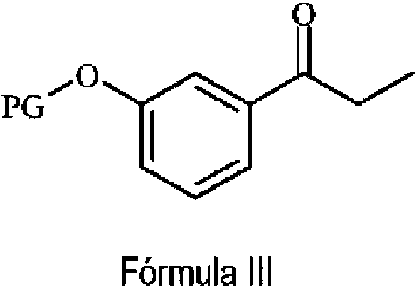
en donde el grupo “PG” representa un grupo protector de hidroxilo adecuado.wherein the “PG” group represents a suitable hydroxyl protecting group.
En otra realización, la presente invención proporciona un compuesto de Fórmula III,In another embodiment, the present invention provides a compound of Formula III,

en donde el grupo “PG” se selecciona del grupo que comprende formiato de tricloroetilo, formiato de metilo, formiato de etilo, formiato de hexilo, formiato de isobutilo, formiato de bencilo, metoximetilo, metoxietoximetilo, tetrahidropiranilo, tetrahidrofurano, alilo, metoxitritilo, metiltiometilo, bencilo, benzoílo, p-metoxibencilo, tbutildimetilsililo, t-butildifenilsililo, triisopropilsililo, di-terc-butilsilileno, tetraisopropildisiloxanilideno, pivaloílo y benzoílo. De acuerdo con otra realización, la presente invención proporciona un compuesto de Fórmula III, en donde el grupo “PG” se selecciona de formiato de tricloroetilo, formiato de etilo o formiato de hexilo.wherein the group "PG" is selected from the group comprising trichloroethyl formate, methyl formate, ethyl formate, hexyl formate, isobutyl formate, benzyl formate, methoxymethyl, methoxyethoxymethyl, tetrahydropyranyl, tetrahydrofuran, allyl, methoxytrityl, methylthiomethyl , benzyl, benzoyl, p-methoxybenzyl, t-butyldimethylsilyl, t-butyldiphenylsilyl, triisopropylsilyl, di-tert-butylsilylene, tetraisopropyldisiloxanylidene, pivaloyl and benzoyl. According to another embodiment, the present invention provides a compound of Formula III, wherein the "PG" group is selected from trichloroethyl formate, ethyl formate or hexyl formate.
En otra realización, la presente invención proporciona un compuesto de Fórmula IIIa.In another embodiment, the present invention provides a compound of Formula IIIa.

En otra realización, la presente invención proporciona un compuesto de Fórmula IIIb.In another embodiment, the present invention provides a compound of Formula IIIb.

En otra realización, la presente invención proporciona un compuesto de Fórmula IIIc.In another embodiment, the present invention provides a compound of Formula IIIc.

En otra realización, la presente invención proporciona un compuesto de Fórmula IV: In another embodiment, the present invention provides a compound of Formula IV:

en donde el grupo “PG” representa un grupo protector de hidroxilo adecuado.wherein the “PG” group represents a suitable hydroxyl protecting group.
En otra realización, la presente invención proporciona un compuesto de Fórmula IV.In another embodiment, the present invention provides a compound of Formula IV.

en donde el grupo “PG” se selecciona del grupo que comprende formiato de tricloroetilo, formiato de metilo, formiato de etilo, formiato de hexilo, formiato de isobutilo, formiato de bencilo, metoximetilo, metoxietoximetilo, tetrahidropiranilo, tetrahidrofurano, alilo, metoxitritilo, metiltiometilo, bencilo, benzoílo, p-metoxibencilo, tbutildimetilsililo, t-butildifenilsililo, triisopropilsililo, di-terc-butilsilileno, tetraisopropildisiloxanilideno, pivaloílo y benzoílo. En otra realización, la presente invención proporciona un compuesto de Fórmula IV, en donde el grupo “PG” se selecciona de formiato de tricloroetilo, formiato de etilo o formiato de hexilo.wherein the group "PG" is selected from the group comprising trichloroethyl formate, methyl formate, ethyl formate, hexyl formate, isobutyl formate, benzyl formate, methoxymethyl, methoxyethoxymethyl, tetrahydropyranyl, tetrahydrofuran, allyl, methoxytrityl, methylthiomethyl , benzyl, benzoyl, p-methoxybenzyl, t-butyldimethylsilyl, t-butyldiphenylsilyl, triisopropylsilyl, di-tert-butylsilylene, tetraisopropyldisiloxanylidene, pivaloyl and benzoyl. In another embodiment, the present invention provides a compound of Formula IV, wherein the "PG" group is selected from trichloroethyl formate, ethyl formate or hexyl formate.
En otra realización, la presente invención proporciona un compuesto de Fórmula IVa.In another embodiment, the present invention provides a compound of Formula IVa.

En otra realización, la presente invención proporciona un compuesto de Fórmula IVb.In another embodiment, the present invention provides a compound of Formula IVb.

En otra realización, la presente invención proporciona un compuesto de Fórmula IVc.In another embodiment, the present invention provides a compound of Formula IVc.

En otra realización, la presente invención proporciona un compuesto de Fórmula VI. In another embodiment, the present invention provides a compound of Formula VI.

en donde el grupo “PG” representa un grupo protector de hidroxilo adecuado.wherein the “PG” group represents a suitable hydroxyl protecting group.
En otra realización, la presente invención proporciona un compuesto de Fórmula VI.In another embodiment, the present invention provides a compound of Formula VI.

en donde el grupo “PG” se selecciona del grupo que comprende formiato de tricloroetilo, formiato de metilo, formiato de etilo, formiato de hexilo, formiato de isobutilo, formiato de bencilo, metoximetilo, metoxietoximetilo, tetrahidropiranilo, tetrahidrofurano, alilo, metoxitritilo, metiltiometilo, bencilo, benzoílo, p-metoxibencilo, tbutildimetilsililo, t-butildifenilsililo, triisopropilsililo, di-terc-butilsilileno, tetraisopropildisiloxanilideno, pivaloílo y benzoílo. En otra realización, la presente invención proporciona un compuesto de Fórmula VI, en donde el grupo “PG” se selecciona de formiato de tricloroetilo, formiato de etilo o formiato de hexilo.wherein the group "PG" is selected from the group comprising trichloroethyl formate, methyl formate, ethyl formate, hexyl formate, isobutyl formate, benzyl formate, methoxymethyl, methoxyethoxymethyl, tetrahydropyranyl, tetrahydrofuran, allyl, methoxytrityl, methylthiomethyl , benzyl, benzoyl, p-methoxybenzyl, t-butyldimethylsilyl, t-butyldiphenylsilyl, triisopropylsilyl, di-tert-butylsilylene, tetraisopropyldisiloxanylidene, pivaloyl and benzoyl. In another embodiment, the present invention provides a compound of Formula VI, wherein the "PG" group is selected from trichloroethyl formate, ethyl formate or hexyl formate.
De acuerdo con otra realización, la presente invención proporciona un procedimiento para la preparación de irinotecán, que comprende: preparar un compuesto de Fórmula I de acuerdo con los procedimientos descritos anteriormente y convertir el compuesto de Fórmula I en 7-etil-10-hidroxicamptotecina (SN-38) y posteriormente en irinotecán.According to another embodiment, the present invention provides a process for the preparation of irinotecan, comprising: preparing a compound of Formula I according to the procedures described above and converting the compound of Formula I to 7-ethyl-10-hydroxycamptothecin ( SN-38) and later in irinotecan.
El compuesto de Fórmula I preparado por el procedimiento de la presente invención se puede utilizar como intermedio en la preparación de 7-etil-10-hidroxicamptotecina (SN-38) y posteriormente convertirlo en irinotecán, por los métodos conocidos en la técnica reconocidos por un químico orgánico con conocimientos ordinarios en la técnica.The compound of Formula I prepared by the process of the present invention can be used as an intermediate in the preparation of 7-ethyl-10-hydroxycamptothecin (SN-38) and subsequently converted to irinotecan, by methods known in the art recognized by a organic chemist with ordinary skill in the art.
La presente invención proporciona 2-amino-5-hidroxipropiofenona de Fórmula I y sus intermedios, obtenidos mediante el procedimiento anterior, analizados utilizando cromatografía de líquidos de alta resolución ("HPLC") con las condiciones que se describen a continuación:The present invention provides 2-amino-5-hydroxypropiophenone of Formula I and its intermediates, obtained by the above procedure, analyzed using high performance liquid chromatography ("HPLC") with the conditions described below:
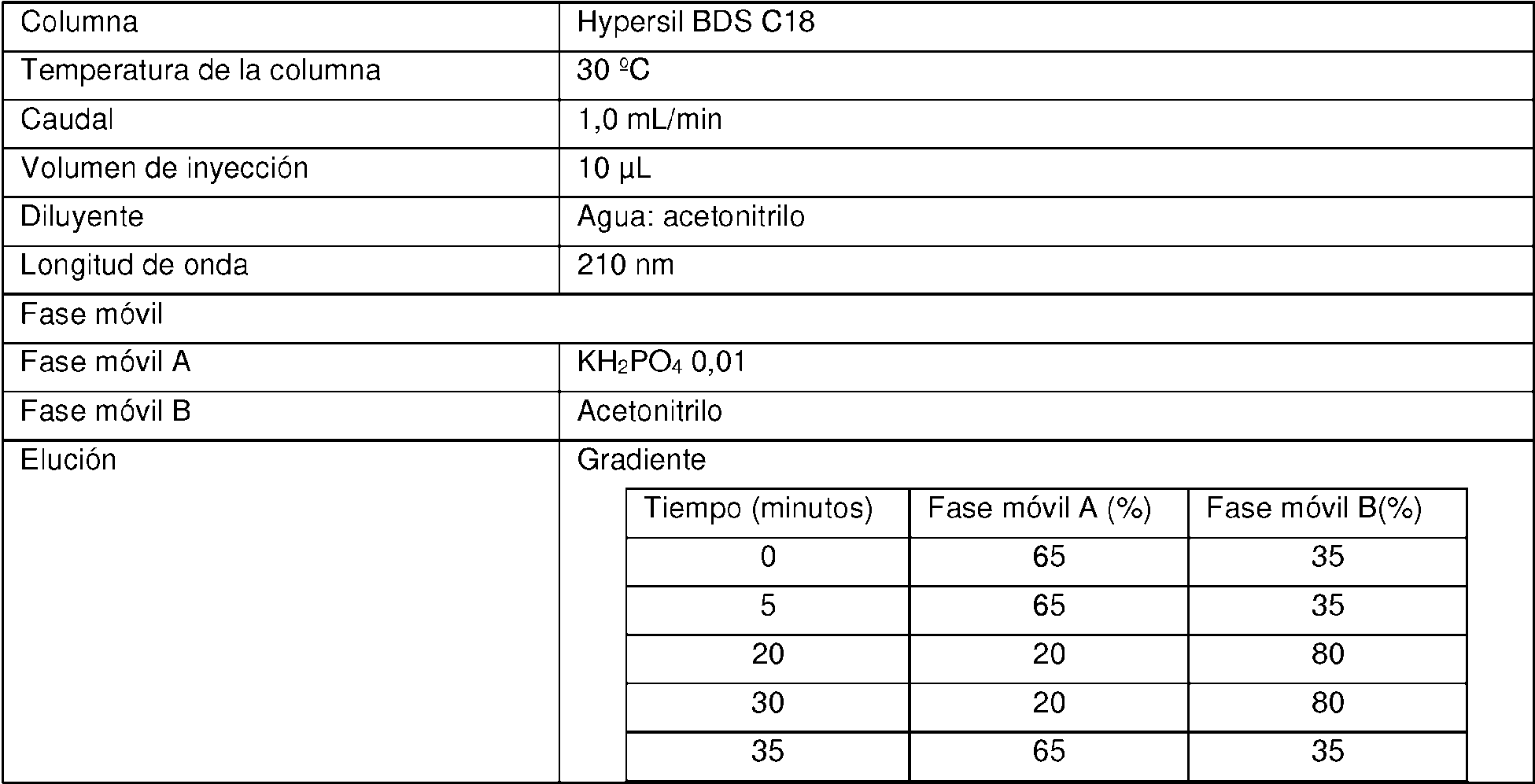
EjemplosExamples
Ejemplo 1Example 1
Preparación de un compuesto de Fórmula IlIa (PG: cloroformiato de 2,2,2-tricloroetilo)Preparation of a compound of Formula IlIa (PG: 2,2,2-trichloroethyl chloroformate)
En un matraz de fondo redondo de 2 litros equipado con un agitador mecánico y un termómetro se cargaron agua (700 mL) y 3-hidroxipropiofenona (140 g) a una temperatura de 25 °C a 30 °C. La masa de reacción se enfrió a una temperatura de 0 °C a 10 °C y se añadió una solución de NaOH (39,1 g de NaOH disueltos en 140 mL de agua). Se agitó la masa de reacción durante 10 min a la misma temperatura y se añadió cloroformiato de 2,2,2-tricloroetilo (237,3 g) a la masa de reacción mientras se mantenía la temperatura por debajo de 10 °C. La masa de reacción se agitó durante 2 horas a una temperatura a una temperatura de 0 °C a 10 °C. Una vez completada la reacción, se filtró el sólido y se lavó la torta con hexano (300 mL) y se secó el material húmedo al vacío para obtener 224 g de Fórmula III. 1H-RMN (DMSO): 5 = 1,09 (t, 3H), 3,07 (q, 2H), 5,08 (s, 2H) 7,57-7,96 (m, 4H); Pureza por HPLC: 99,5%.Water (700 mL) and 3-hydroxypropiophenone (140 g) were charged to a 2-liter round-bottom flask equipped with a mechanical stirrer and a thermometer at a temperature of 25 °C to 30 °C. The reaction mass was cooled to a temperature of 0 °C to 10 °C and a NaOH solution (39.1 g of NaOH dissolved in 140 mL of water) was added. The reaction mass was stirred for 10 min at the same temperature, and 2,2,2-trichloroethyl chloroformate (237.3 g) was added to the reaction mass while maintaining the temperature below 10 °C. The reaction mass was stirred for 2 hours at a temperature of 0°C to 10°C. Once the reaction was complete, the solid was filtered and the cake was washed with hexane (300 mL) and the wet material was dried under vacuum to obtain 224 g of Formula III. 1H-NMR (DMSO): 5 = 1.09 (t, 3H), 3.07 (q, 2H), 5.08 (s, 2H) 7.57-7.96 (m, 4H); Purity by HPLC: 99.5%.
Ejemplo 2Example 2
Preparación de un compuesto de Fórmula IVa (PG: cloroformiato de 2,2,2-tricloroetilo)Preparation of a compound of Formula IVa (PG: 2,2,2-trichloroethyl chloroformate)
En un matraz de fondo redondo de 1 litro equipado con un agitador mecánico y un termómetro se cargaron el compuesto de Fórmula IIIa del Ejemplo-1 (50 g) y cloruro de metileno (500 mL) a una temperatura de 25°C a 30°C. A la masa de reacción se añadió sulfato sódico anhidro (25 g) a la misma temperatura. La masa de reacción se enfrió a una temperatura de 5 °C a 10 °C y se añadió ácido sulfúrico (125 mL). La masa de reacción se enfrió a -1 °C y se añadió nitrato potásico (38,7 g) en porciones a la misma temperatura. La masa de reacción se agitó durante 60 min a 5-10°C. Una vez finalizada la reacción, la masa de reacción se vertió en agua (1000 mL) previamente enfriada. Se separó la capa orgánica y la capa acuosa se extrajo con cloruro de metileno (400 mL). Luego, la capa orgánica combinada se lavó con una solución de NaOH 2 M (500 mL) y una solución de cloruro de sodio al 10% (500 mL). La capa orgánica combinada se destiló completamente al vacío para proporcionar 47,3 g de Fórmula IV. 1H-RMN (DMSO): 5 = 1,12 (t, 3H), 2,91 (q, 2H), 5,10 (s, 2H), 7,72 (d, J=2,4 Hz, 1H), 7,77 (dd, 1H), 8,29 (d, J = 9Hz, 1H); Pureza por HPLC: 98%.In a 1 liter round bottom flask equipped with a mechanical stirrer and a thermometer, the compound of Formula IIIa of Example-1 (50 g) and methylene chloride (500 mL) were charged at a temperature of 25°C to 30°C. c. Anhydrous sodium sulfate (25 g) was added to the reaction mass at the same temperature. The reaction mass was cooled to a temperature of 5 °C to 10 °C and sulfuric acid (125 mL) was added. The reaction mass was cooled to -1 °C and potassium nitrate (38.7 g) was added in portions at the same temperature. The reaction mass was stirred for 60 min at 5-10°C. Once the reaction was completed, the reaction mass was poured into previously cooled water (1000 mL). The organic layer was separated and the aqueous layer was extracted with methylene chloride (400 mL). Then, the combined organic layer was washed with 2 M NaOH solution (500 mL) and 10% sodium chloride solution (500 mL). The combined organic layer was distilled completely under vacuum to provide 47.3 g of Formula IV. 1H-NMR (DMSO): 5 = 1.12 (t, 3H), 2.91 (q, 2H), 5.10 (s, 2H), 7.72 (d, J=2.4 Hz, 1H ), 7.77 (dd, 1H), 8.29 (d, J = 9Hz, 1H); Purity by HPLC: 98%.
Ejemplo 3Example 3
Preparación del compuesto de Fórmula VPreparation of the compound of Formula V
En un matraz de fondo redondo de 1 litro equipado con un agitador mecánico y un termómetro se cargaron el compuesto de Fórmula IVa (46 g) del Ejemplo 2, carbonato de potasio (25 g) y metanol (500 mL) a una temperatura de 25 °C a 30 °C y se agitó la masa de reacción durante 60 min a la misma temperatura. Una vez finalizada la reacción, se filtraron las sales y se cargó el filtrado con agua (500 mL). La capa acuosa se lavó con cloruro de metileno (250 mL). El pH de la masa se ajustó a 3,5 usando una solución de ácido clorhídrico. Luego, la masa de reacción se extrajo con cloruro de metileno (1 x 500 mL y 1 x 250 mL). La capa orgánica combinada se lavó con agua (250 mL). La capa orgánica se destiló completamente al vacío y el residuo se eliminó con hexano (100 mL). Se cargó tolueno (50 mL) al material bruto y se agitó durante 30 min a una temperatura de 25 °C a 30 °C. El sólido se filtró para dar 20 g del compuesto de Fórmula V.1H-RMN (DMSO): 5 = 1,10 (t, 3H), 2,77 (q, 2H), 6,81 (d, J=2,4 Hz, 1H), 6,99 (dd, 1H), 8,10 (d, J = 9 Hz, 1H) 11,37 (brs, 1H); Pureza por HPLC: 97,5%.The compound of Formula IVa (46 g) of Example 2, potassium carbonate (25 g) and methanol (500 mL) were charged to a 1 liter round bottom flask equipped with a mechanical stirrer and a thermometer at a temperature of 25 °C to 30 °C and the reaction mass was stirred for 60 min at the same temperature. Once the reaction was completed, the salts were filtered and the filtrate was charged with water (500 mL). The aqueous layer was washed with methylene chloride (250 mL). The pH of the dough was adjusted to 3.5 using a hydrochloric acid solution. Then, the reaction mass was extracted with methylene chloride (1 x 500 mL and 1 x 250 mL). The combined organic layer was washed with water (250 mL). The organic layer was completely distilled under vacuum and the residue was removed with hexane (100 mL). Toluene (50 mL) was charged to the crude material and stirred for 30 min at a temperature of 25 °C to 30 °C. The solid was filtered to give 20 g of the compound of Formula V.1H-NMR (DMSO): 5 = 1.10 (t, 3H), 2.77 (q, 2H), 6.81 (d, J=2 .4 Hz, 1H), 6.99 (dd, 1H), 8.10 (d, J = 9 Hz, 1H) 11.37 (brs, 1H); Purity by HPLC: 97.5%.
Ejemplo 4Example 4
Preparación del compuesto de Fórmula IPreparation of the compound of Formula I
En un matraz de fondo redondo de 500 mL equipado con un agitador mecánico y un termómetro se cargaron agua (125 mL), ditionito de sodio (17,8 g) y carbonato de sodio (8,7 g) a una temperatura de 25 °C a 30 °C y se agitó durante 10 min a la misma temperatura. La masa de reacción se enfrió a una temperatura de 0 °C a 5 °C y se añadió una solución del compuesto de Fórmula V (5 g disueltos en 10 mL de metanol) a la misma temperatura. La masa de reacción se dejó entre 25 °C y 30 °C y se agitó durante 1 hora. El sólido se filtró y se lavó con agua para dar 3,6 g de 2-amino 5-hidroxipropiofenona de Fórmula I. 1H-RMN (DMSO): 5 = 1,05 (t, 3H), 2,87 (q, 2H), 6,16 (s, 2H), 6,45 (d, 1H), 6,81 (dd, 1H), 7,11 (d, J=9 Hz, 1H), 8,65 (s, 1H); Pureza por HPLC: 97,5%.Water (125 mL), sodium dithionite (17.8 g), and sodium carbonate (8.7 g) were charged to a 500 mL round-bottom flask equipped with a mechanical stirrer and a thermometer at a temperature of 25°. C to 30 °C and stirred for 10 min at the same temperature. The reaction mass was cooled to a temperature of 0 °C to 5 °C and a solution of the compound of Formula V (5 g dissolved in 10 mL of methanol) was added at the same temperature. The reaction mass was left at 25 °C to 30 °C and stirred for 1 hour. The solid was filtered and washed with water to give 3.6 g of 2-amino 5-hydroxypropiophenone of Formula I. 1H-NMR (DMSO): 5 = 1.05 (t, 3H), 2.87 (q, 2H), 6.16 (s, 2H), 6.45 (d, 1H), 6.81 (dd, 1H), 7.11 (d, J=9 Hz, 1H), 8.65 (s, 1 HOUR); Purity by HPLC: 97.5%.
Ejemplo 5Example 5
Preparación de un compuesto de Fórmula IIIb (PG: cloroformiato de etilo)Preparation of a compound of Formula IIIb (PG: ethyl chloroformate)
En un matraz de fondo redondo de 500 mL equipado con un agitador mecánico y un termómetro se cargaron agua (100 mL) y 3-hidroxipropiofenona (20 g) a una temperatura de 25 °C a 30 °C. La masa de reacción se enfrió a una temperatura de 0 °C a 10 °C y se añadió una solución de NaOH (9,6 g de NaOH disueltos en 20 mL de agua). Se agitó la masa de reacción durante 10 min a la misma temperatura y se añadió cloroformiato de etilo (17,4 g) a la masa de reacción manteniendo la temperatura por debajo de 10 °C. Una vez finalizada la reacción, la masa de reacción se extrajo con cloruro de metileno (150 mL) y la fase orgánica se lavó con NaOH al 10% (100 mL). La capa orgánica resultante se destiló completamente al vacío por debajo de 50 °C. Se cargaron 500 mL de hexano, se mantuvo la masa durante la noche a 2-8 °C. El sólido se filtró y se lavó la torta con hexano frío (50 mL) y se secó el material húmedo al vacío para obtener 15,5 g de carbonato de etilo de 3-hidroxipropiofenona.Water (100 mL) and 3-hydroxypropiophenone (20 g) were charged to a 500 mL round-bottom flask equipped with a mechanical stirrer and a thermometer at a temperature of 25 °C to 30 °C. The reaction mass was cooled to a temperature of 0 °C to 10 °C and a NaOH solution (9.6 g of NaOH dissolved in 20 mL of water) was added. The reaction mass was stirred for 10 min at the same temperature and ethyl chloroformate (17.4 g) was added to the reaction mass keeping the temperature below 10 °C. Once the reaction was completed, the reaction mass was extracted with methylene chloride (150 mL) and the organic phase was washed with 10% NaOH (100 mL). The resulting organic layer was completely distilled under vacuum below 50 °C. 500 mL of hexane were loaded, the dough overnight at 2-8°C. The solid was filtered and the cake was washed with cold hexane (50 mL) and the wet material was dried in vacuo to obtain 15.5 g of 3-hydroxypropiophenone ethyl carbonate.
Ejemplo 6Example 6
Preparación de un compuesto de Fórmula IVb (PG: cloroformiato de etilo)Preparation of a compound of Formula IVb (PG: ethyl chloroformate)
En un matraz de fondo redondo de 250 mL equipado con un agitador mecánico y un termómetro se cargaron el compuesto de Fórmula IIIb del Ejemplo-5 (5 g) y cloruro de metileno (50 mL) a una temperatura de 25 °C a 30 °C bajo atmósfera de nitrógeno. A la masa de reacción se añadió sulfato sódico anhidro (2,5 g) a la misma temperatura. La masa de reacción se enfrió a una temperatura de 5 °C a 10 °C y se añadió ácido sulfúrico (18,3 mL) y nitrato de potasio (5,7 g) en porciones por debajo de 10 °C. La masa de reacción se agitó durante 60 min a 0-10 °C. Una vez finalizada la reacción se vertió la masa de reacción en agua (200 mL) previamente enfriada. Se separó la capa orgánica y la capa acuosa se extrajo con cloruro de metileno (50 mL). Luego, la capa orgánica combinada se lavó con una solución de NaOH 2 M (100 mL) y una solución de cloruro de sodio al 10% (100 mL). La capa orgánica combinada se destiló completamente al vacío para proporcionar 2,4 g de compuesto de Fórmula IVb.In a 250 mL round bottom flask equipped with a mechanical stirrer and a thermometer, the compound of Formula IIIb of Example-5 (5 g) and methylene chloride (50 mL) were charged at a temperature of 25 °C to 30 °C. C under nitrogen atmosphere. Anhydrous sodium sulfate (2.5 g) was added to the reaction mass at the same temperature. The reaction mass was cooled to a temperature of 5 °C to 10 °C and sulfuric acid (18.3 mL) and potassium nitrate (5.7 g) were added in portions below 10 °C. The reaction mass was stirred for 60 min at 0-10 °C. Once the reaction was completed, the reaction mass was poured into previously cooled water (200 mL). The organic layer was separated and the aqueous layer was extracted with methylene chloride (50 mL). Then, the combined organic layer was washed with 2 M NaOH solution (100 mL) and 10% sodium chloride solution (100 mL). The combined organic layer was distilled completely under vacuum to provide 2.4 g of compound of Formula IVb.
Ejemplo 7Example 7
Preparación del compuesto de Fórmula VPreparation of the compound of Formula V
En un matraz de fondo redondo de 100 mL equipado con un agitador mecánico y un termómetro se cargaron el compuesto de Fórmula IVb (2 g) del Ejemplo 6, carbonato de potasio (1 g) y metanol (10 mL) a una temperatura de 25 °C a 30 °C y la masa de reacción se agitó durante 60 min a la misma temperatura. Una vez finalizada la reacción se filtraron las sales y se cargó el filtrado con agua (50 mL). La capa acuosa se lavó con cloruro de metileno (50 mL). El pH de la masa se ajustó a 1,2 usando una solución de ácido clorhídrico. Luego, la masa de reacción se extrajo con cloruro de metileno (3 x 50 mL). La capa orgánica se destiló completamente al vacío para proporcionar 1,4 g de compuesto de Fórmula V.In a 100 mL round bottom flask equipped with a mechanical stirrer and a thermometer, the compound of Formula IVb (2 g) of Example 6, potassium carbonate (1 g) and methanol (10 mL) were charged at a temperature of 25 °C to 30 °C and the reaction mass was stirred for 60 min at the same temperature. Once the reaction was completed, the salts were filtered and the filtrate was charged with water (50 mL). The aqueous layer was washed with methylene chloride (50 mL). The pH of the dough was adjusted to 1.2 using a hydrochloric acid solution. Then, the reaction mass was extracted with methylene chloride (3 x 50 mL). The organic layer was completely distilled under vacuum to provide 1.4 g of compound of Formula V.
Ejemplo 8Example 8
Preparación de un compuesto de Fórmula IIIc (PG: cloroformiato de hexilo)Preparation of a compound of Formula IIIc (PG: hexyl chloroformate)
En un matraz de fondo redondo de 500 mL equipado con un agitador mecánico y un termómetro se cargaron agua (120 mL) y 3-hidroxipropiofenona (20 g) a una temperatura de 25 °C a 30 °C. La masa de reacción se enfrió a una temperatura de 0 °C a 10 °C y se añadió una solución de NaOH (9,6 g de NaOH disueltos en 20 mL de agua). Se agitó la masa de reacción durante 10 min a la misma temperatura y se añadió cloroformiato de hexilo (26,3 g) a la masa de reacción manteniendo la temperatura por debajo de 10 °C. Una vez finalizada la reacción, la masa de reacción se extrajo con cloruro de metileno (150 mL) y la fase orgánica se lavó con NaOH al 10% (100 mL). La capa orgánica resultante se destiló completamente al vacío por debajo de 50 °C para obtener 34,8 g de carbonato de hexilo de 3-hidroxipropiofenona.Water (120 mL) and 3-hydroxypropiophenone (20 g) were charged to a 500 mL round-bottom flask equipped with a mechanical stirrer and a thermometer at a temperature of 25 °C to 30 °C. The reaction mass was cooled to a temperature of 0 °C to 10 °C and a NaOH solution (9.6 g of NaOH dissolved in 20 mL of water) was added. The reaction mass was stirred for 10 min at the same temperature and hexyl chloroformate (26.3 g) was added to the reaction mass keeping the temperature below 10 °C. Once the reaction was completed, the reaction mass was extracted with methylene chloride (150 mL) and the organic phase was washed with 10% NaOH (100 mL). The resulting organic layer was completely distilled under vacuum below 50 °C to obtain 34.8 g of 3-hydroxypropiophenone hexyl carbonate.
Ejemplo 9Example 9
Preparación del compuesto de Fórmula IVc (PG: cloroformiato de hexilo)Preparation of the compound of Formula IVc (PG: hexyl chloroformate)
En un matraz de fondo redondo de 250 mL equipado con un agitador mecánico y un termómetro se cargaron el compuesto de Fórmula IIIc del Ejemplo-8 (5 g) y cloruro de metileno (50 mL) a una temperatura de 25 °C a 30 °C bajo atmósfera de nitrógeno. A la masa de reacción se añadió sulfato sódico anhidro (5 g) a la misma temperatura. La masa de reacción se enfrió una temperatura de 5°C a 10°C y se añadió ácido sulfúrico (15 mL) y nitrato de potasio (4,6 g) en porciones por debajo de 10 °C. La masa de reacción se agitó durante 2 horas a 5-10 °C. Una vez finalizada la reacción, se vertió la masa de reacción en agua (200 mL) previamente enfriada. Se separó la capa orgánica y la capa acuosa se extrajo con cloruro de metileno (100 mL). Luego, la capa orgánica combinada se lavó con una solución de NaOH 2 M (100 mL) y una solución de cloruro de sodio al 10% (100 mL). La capa orgánica combinada se destiló completamente al vacío para proporcionar 5,3 g del compuesto de Fórmula IV.In a 250 mL round bottom flask equipped with a mechanical stirrer and a thermometer, the compound of Formula IIIc of Example-8 (5 g) and methylene chloride (50 mL) were charged at a temperature of 25 °C to 30 °C. C under nitrogen atmosphere. Anhydrous sodium sulfate (5 g) was added to the reaction mass at the same temperature. The reaction mass was cooled to a temperature of 5°C to 10°C and sulfuric acid (15 mL) and potassium nitrate (4.6 g) were added in portions below 10°C. The reaction mass was stirred for 2 hours at 5-10 °C. Once the reaction was completed, the reaction mass was poured into previously cooled water (200 mL). The organic layer was separated and the aqueous layer was extracted with methylene chloride (100 mL). Then, the combined organic layer was washed with 2 M NaOH solution (100 mL) and 10% sodium chloride solution (100 mL). The combined organic layer was distilled completely under vacuum to provide 5.3 g of the compound of Formula IV.
Ejemplo 10Example 10
Preparación del compuesto de Fórmula VPreparation of the compound of Formula V
En un matraz de fondo redondo de 100 mL equipado con un agitador mecánico y un termómetro se cargaron el compuesto de Fórmula IVc (5 g) del Ejemplo 9, carbonato de potasio (3 g) y metanol (50 mL) a una temperatura de 25 °C a 30 °C y se agitó la masa de reacción durante 60 min a la misma temperatura. Una vez finalizada la reacción, se filtraron las sales y se cargó el filtrado con agua (50 mL). La capa acuosa se lavó con cloruro de metileno (50 mL). El pH de la masa se ajustó a 1,5 usando una solución de ácido clorhídrico. Luego, la masa de reacción se extrajo con cloruro de metileno (3 x 50 mL). La capa orgánica se destiló completamente al vacío para proporcionar 1,2 g de Fórmula V. In a 100 mL round bottom flask equipped with a mechanical stirrer and a thermometer, the compound of Formula IVc (5 g) of Example 9, potassium carbonate (3 g) and methanol (50 mL) were charged at a temperature of 25 °C to 30 °C and the reaction mass was stirred for 60 min at the same temperature. Once the reaction was completed, the salts were filtered and the filtrate was charged with water (50 mL). The aqueous layer was washed with methylene chloride (50 mL). The pH of the dough was adjusted to 1.5 using a hydrochloric acid solution. Then, the reaction mass was extracted with methylene chloride (3 x 50 mL). The organic layer was completely distilled under vacuum to provide 1.2 g of Formula V.
Ejemplo 11Example 11
Preparación del compuesto de Fórmula I (PG: cloroformiato de 2,2,2-tricloroetilo)Preparation of the compound of Formula I (PG: 2,2,2-trichloroethyl chloroformate)
En un matraz de fondo redondo de 2 litros equipado con un agitador mecánico y un termómetro se cargaron hidróxido de sodio (41,5 g), agua (600 mL) y 3-hidroxipropiofenona (120 g) a una temperatura de 25 °C a 30 °C y se dejó agitar durante 10-15 min a la misma temperatura. La masa de reacción se cargó con dicloruro de metileno (480 mL) y se dejó enfriar a una temperatura de 5-15 °C, se cargaron bromuro de tetrabutilamonio (0,6 g) y cloroformiato de 2,2,2-tricloroetilo (203 g) a 5-15 °C y se dejó en agitación durante 30-40 min a la misma temperatura. Una vez finalizada la reacción, se separaron las capas orgánica y acuosa y la capa orgánica se lavó con agua (2 x 240 mL) y con una solución de cloruro de sodio (24 g disueltos en 240 mL de agua). La capa orgánica se separó y se concentró al vacío por debajo de 40 °C y se aisló el compuesto de Fórmula Illa sólido mediante filtraciones de suspensiones en heptano. Sodium hydroxide (41.5 g), water (600 mL) and 3-hydroxypropiophenone (120 g) were charged to a 2-liter round-bottom flask equipped with a mechanical stirrer and a thermometer at a temperature of 25 °C at 30 °C and allowed to stir for 10-15 min at the same temperature. The reaction mass was charged with methylene dichloride (480 mL) and allowed to cool to a temperature of 5-15 °C, tetrabutylammonium bromide (0.6 g) and 2,2,2-trichloroethyl chloroformate ( 203 g) at 5-15 °C and left stirring for 30-40 min at the same temperature. Once the reaction was completed, the organic and aqueous layers were separated and the organic layer was washed with water (2 x 240 mL) and with a sodium chloride solution (24 g dissolved in 240 mL of water). The organic layer was separated and concentrated in vacuo below 40°C and the solid Formula Illa compound was isolated by filtration of suspensions in heptane.
En un matraz de fondo redondo de 2 litros equipado con un agitador mecánico y un termómetro se cargaron el sólido húmedo obtenido anteriormente (Fórmula Illa) y dicloruro de metileno (672 mL) a 25-30°C y la masa de reacción se dejó enfriar a una temperatura de -20 a -25 °C. A la masa de reacción se añadió ácido sulfúrico (389,8 mL) y ácido nítrico fumante (130 g) a una temperatura de -20 a -25 °C durante 30 min. Una vez finalizada la reacción, se separó la capa de ácido sulfúrico y la masa de reacción se dejó a 25-30°C. La masa de reacción se lavó con agua (672 mL) y la capa orgánica se concentró al vacío por debajo de 45 °C para obtener el compuesto de Fórmula IVa.In a 2 liter round bottom flask equipped with a mechanical stirrer and a thermometer, the wet solid obtained above (Formula Illa) and methylene dichloride (672 mL) were charged at 25-30°C and the reaction mass was allowed to cool. at a temperature of -20 to -25 °C. Sulfuric acid (389.8 mL) and fuming nitric acid (130 g) were added to the reaction mass at a temperature of −20 to −25 °C for 30 min. Once the reaction was completed, the sulfuric acid layer was separated and the reaction mass was left at 25-30°C. The reaction mass was washed with water (672 mL) and the organic layer was concentrated in vacuo below 45 °C to obtain the compound of Formula IVa.
En un matraz de fondo redondo de 2 litros equipado con un agitador mecánico y un termómetro se cargaron el sólido húmedo obtenido anteriormente (Fórmula IVa) y metanol (448 mL) a 25-30 °C y se agitó durante 15-30 min a la misma temperatura. A la masa de reacción se añadió carbonato potásico (47,5 g) y se agitó durante 1 hora a 25-30 °C. La masa de reacción se añadió a una solución preparada por separado de carbonato de sodio (182,3 g) y ditionato de sodio (357 g) en agua (5,6 litros) a 5 °C y se dejó agitar durante 1 hora a 25-30 °C. Los sólidos precipitados se filtraron y lavaron con agua (224 mL). El sólido húmedo se disolvió en acetato de etilo (2,6 litros) a 25-30 °C y se lavó con agua (2 x 560 mL). La capa orgánica se separó y se concentró completamente al vacío por debajo de 45 °C para obtener el compuesto del título y se secó al vacío a 75 °C durante 7-8 h para proporcionar 57,6 g del compuesto del título. Pureza HPLC: 99,9%.In a 2 liter round bottom flask equipped with a mechanical stirrer and a thermometer, the wet solid obtained above (Formula IVa) and methanol (448 mL) were charged at 25-30 °C and stirred for 15-30 min at the same temperature. Potassium carbonate (47.5 g) was added to the reaction mass and stirred for 1 hour at 25-30 °C. The reaction mass was added to a separately prepared solution of sodium carbonate (182.3 g) and sodium dithionate (357 g) in water (5.6 liters) at 5 °C and allowed to stir for 1 hour at 25-30°C. The precipitated solids were filtered and washed with water (224 mL). The wet solid was dissolved in ethyl acetate (2.6 liters) at 25-30 °C and washed with water (2 x 560 mL). The organic layer was separated and completely concentrated in vacuo below 45 °C to obtain the title compound and dried in vacuo at 75 °C for 7-8 h to provide 57.6 g of the title compound. HPLC purity: 99.9%.
Los siguientes ejemplos comparativos se llevaron a cabo siguiendo la enseñanza de Aurore et al. en Bioorganic & Medicinal Chemistry Letters Volumen 14, Número 9, páginas 2363-2365, 2004.The following comparative examples were carried out following the teaching of Aurore et al. in Bioorganic & Medicinal Chemistry Letters Volume 14, Number 9, pages 2363-2365, 2004.
Ejemplo comparativoComparative example
Preparación del compuesto de Fórmula V a partir de 3'-hidroxipropiofenonaPreparation of the compound of Formula V from 3'-hydroxypropiophenone
En un matraz de fondo redondo de 500 mL equipado con un agitador mecánico y un termómetro se cargó ácido acético (400 mL) a 25-35 °C y la masa de reacción se calentó a 65-70 °C. La masa de reacción se cargó con ácido nítrico al 65-75% (50 mL) a la misma temperatura. Una vez finalizada la reacción, la masa de reacción se enfrió a 25-35°C. La masa de reacción se añadió lentamente a agua enfriada y se extrajo con acetato de etilo (2 x 800 mL). La capa orgánica combinada se destiló al vacío por debajo de 50 °C para obtener el compuesto bruto. El compuesto bruto obtenido se purificó por purificación en columna de gel de sílice utilizando como eluyente acetato de etilo/hexeno. Las fracciones puras se concentraron al vacío por debajo de 50 °C para obtener 41 g del compuesto del título.Acetic acid (400 mL) was charged to a 500 mL round bottom flask equipped with a mechanical stirrer and a thermometer at 25-35 °C and the reaction mass was heated to 65-70 °C. The reaction mass was charged with 65-75% nitric acid (50 mL) at the same temperature. Once the reaction was completed, the reaction mass was cooled to 25-35°C. The reaction mass was slowly added to chilled water and extracted with ethyl acetate (2 x 800 mL). The combined organic layer was distilled under vacuum below 50 °C to obtain the crude compound. The crude compound obtained was purified by silica gel column purification using ethyl acetate/hexene as eluent. The pure fractions were concentrated in vacuo below 50 °C to obtain 41 g of the title compound.
Tabla 1Table 1

Claims (15)


Applications Claiming Priority (2)
| Application Number | Priority Date | Filing Date | Title |
|---|---|---|---|
| IN201941001793 | 2019-01-15 | ||
| PCT/IB2020/050256 WO2020148641A1 (en) | 2019-01-15 | 2020-01-14 | Process for preparation of 2-amino-5-hydroxy propiophenone |
Publications (1)
| Publication Number | Publication Date |
|---|---|
| ES2951064T3 true ES2951064T3 (en) | 2023-10-17 |
Family
ID=71613360
Family Applications (1)
| Application Number | Title | Priority Date | Filing Date |
|---|---|---|---|
| ES20741510T Active ES2951064T3 (en) | 2019-01-15 | 2020-01-14 | Preparation procedure of 2-amino-5-hydroxypropiophenone |
Country Status (4)
| Country | Link |
|---|---|
| US (1) | US11434196B2 (en) |
| EP (1) | EP3911660B1 (en) |
| ES (1) | ES2951064T3 (en) |
| WO (1) | WO2020148641A1 (en) |
Families Citing this family (2)
| Publication number | Priority date | Publication date | Assignee | Title |
|---|---|---|---|---|
| CN115387113A (en) * | 2022-07-28 | 2022-11-25 | 郑喜才 | Far infrared deodorization fabric and preparation method thereof |
| CN117924092B (en) * | 2023-12-28 | 2025-03-04 | 棓诺(苏州)新材料有限公司 | Preparation method of 2-allyl-4-nitrophenol |
Family Cites Families (9)
| Publication number | Priority date | Publication date | Assignee | Title |
|---|---|---|---|---|
| GB711905A (en) * | 1950-05-12 | 1954-07-14 | Erwin Bunm | 1-(úÝ-hydroxyphenyl)-1-hydroxy-2-aralkylaminopropanes |
| TW438775B (en) | 1995-04-07 | 2001-06-07 | Pharmacia & Upjohn Co Llc | Novel intermediates and process for the manufacture of camptothecin derivatives (CPT-11) and related compounds |
| FR2785284B1 (en) * | 1998-11-02 | 2000-12-01 | Galderma Res & Dev | VITAMIN D ANALOGS |
| TWI245768B (en) * | 2001-02-21 | 2005-12-21 | Yakult Honsha Kk | Process for synthesizing camptothecin related compound(s) |
| US7608740B2 (en) * | 2005-08-03 | 2009-10-27 | Avra Laboratories Pvt. Ltd | Method of synthesizing key intermediates for the production of camptothecin derivatives |
| CN101362701A (en) * | 2008-09-12 | 2009-02-11 | 复旦大学 | The preparation method of 2-amino-5-hydroxypropiophenone |
| CN101723841B (en) * | 2009-12-04 | 2012-03-07 | 华东师范大学 | Preparation method of 2-amino-5-alkoxy propiophenone |
| CN104803861B (en) * | 2014-01-27 | 2017-05-24 | 上海博邦医药科技有限公司 | Method for synthesizing tapentadol hydrochloride |
| CN108794737B (en) * | 2018-06-26 | 2019-07-02 | 中国科学院长春应用化学研究所 | End-capped modified polyethylene glycol cross-linking agent with ultraviolet light response function and preparation method and hydrogel dressing containing the cross-linking agent and preparation method |
-
2020
- 2020-01-14 US US17/419,378 patent/US11434196B2/en active Active
- 2020-01-14 EP EP20741510.0A patent/EP3911660B1/en active Active
- 2020-01-14 WO PCT/IB2020/050256 patent/WO2020148641A1/en not_active Ceased
- 2020-01-14 ES ES20741510T patent/ES2951064T3/en active Active
Also Published As
| Publication number | Publication date |
|---|---|
| EP3911660B1 (en) | 2023-05-10 |
| US20220081388A1 (en) | 2022-03-17 |
| US11434196B2 (en) | 2022-09-06 |
| WO2020148641A1 (en) | 2020-07-23 |
| EP3911660A4 (en) | 2022-03-30 |
| EP3911660A1 (en) | 2021-11-24 |
Similar Documents
| Publication | Publication Date | Title |
|---|---|---|
| EP3867231B1 (en) | Novel processes | |
| US20140058107A1 (en) | Apixaban preparation process | |
| JPS59130288A (en) | Substituted 5h-pyrimido(5,4-b)indole, manufacture and psychotic medicine | |
| KR102266680B1 (en) | Polymorphic Forms of Belinostet and Methods of Making It | |
| JP2021119142A (en) | Method for preparation of xanthine-based compound | |
| TWI808068B (en) | Process for the preparation of 3-substituted 5-amino-6h-thiazolo[4,5-d]pyrimidine-2,7-dione compounds | |
| WO2009083258A2 (en) | Solid and crystalline dutasteride and processes for preparation thereof | |
| ES2795227T3 (en) | Procedure for producing an aminopyrrolidine derivative | |
| EP3911660B1 (en) | Process for preparation of 2-amino-5-hydroxy propiophenone | |
| CN114031623B (en) | C 14 Amino-substituted tetrandrine derivative and preparation and application thereof | |
| WO2022022613A1 (en) | Method for preparing triazolo[1,5-a]pyrazine and use thereof | |
| ES2741505T3 (en) | Procedure for the preparation of abiraterone acetate and its intermediates | |
| EP1791539A1 (en) | Process to prepare camptothecin derivatives | |
| JP5133704B2 (en) | Production method | |
| CN101880285B (en) | Method for synthetizing allyl-substituted camptothecin compound | |
| US20080275241A1 (en) | Polymorphic Forms of Dolasetron Base and Processes of Preparing Dolasetron Base, Its Polymorphic Forms and Salt Thereof | |
| JP7416842B2 (en) | Method for preparing fused polycyclic compounds | |
| WO2020020190A1 (en) | Method for synthesizing quinoline derivative | |
| ES2232309A1 (en) | Process for preparing gatifloxacin | |
| TWI844822B (en) | The method of the preparation of fused multicyclic compounds | |
| CN113429333B (en) | A kind of synthetic method of garaxacin intermediate | |
| ES2432553T3 (en) | Synthesis procedure of key intermediates for the production of camptothecin derivatives | |
| JP2021523187A (en) | Intermediates and processes for the production of linagliptin and its salts | |
| WO2023013757A1 (en) | Method for producing alkylsilyloxy substituted benzyl compound | |
| KR20230160303A (en) | 5-{5-chloro-2-[(3S)-3-[(morpholine-4-yl)methyl]-3, 4-dihydroisoquinoline-2(1H)-carbonyl]phenyl}-1, Novel method for synthesis of 2-dimethyl-1H-pyrrole-3-carboxylic acid derivatives and their use for production of pharmaceutical compounds |