ES2952428T3 - Biosynthetic heparin - Google Patents
Biosynthetic heparin Download PDFInfo
- Publication number
- ES2952428T3 ES2952428T3 ES17849497T ES17849497T ES2952428T3 ES 2952428 T3 ES2952428 T3 ES 2952428T3 ES 17849497 T ES17849497 T ES 17849497T ES 17849497 T ES17849497 T ES 17849497T ES 2952428 T3 ES2952428 T3 ES 2952428T3
- Authority
- ES
- Spain
- Prior art keywords
- heparin
- disaccharide
- group
- glycosaminoglycan
- sulfated
- Prior art date
- Legal status (The legal status is an assumption and is not a legal conclusion. Google has not performed a legal analysis and makes no representation as to the accuracy of the status listed.)
- Active
Links
- 229920000669 heparin Polymers 0.000 title claims abstract description 304
- 229960002897 heparin Drugs 0.000 title claims abstract description 296
- HTTJABKRGRZYRN-UHFFFAOYSA-N Heparin Chemical compound OC1C(NC(=O)C)C(O)OC(COS(O)(=O)=O)C1OC1C(OS(O)(=O)=O)C(O)C(OC2C(C(OS(O)(=O)=O)C(OC3C(C(O)C(O)C(O3)C(O)=O)OS(O)(=O)=O)C(CO)O2)NS(O)(=O)=O)C(C(O)=O)O1 HTTJABKRGRZYRN-UHFFFAOYSA-N 0.000 title claims abstract description 288
- 230000001851 biosynthetic effect Effects 0.000 title claims description 80
- 125000000600 disaccharide group Chemical group 0.000 claims description 246
- 238000000034 method Methods 0.000 claims description 108
- 229920002683 Glycosaminoglycan Polymers 0.000 claims description 89
- 102000004190 Enzymes Human genes 0.000 claims description 71
- 108090000790 Enzymes Proteins 0.000 claims description 71
- 230000000694 effects Effects 0.000 claims description 60
- 238000011282 treatment Methods 0.000 claims description 59
- 102100029001 Heparan sulfate 2-O-sulfotransferase 1 Human genes 0.000 claims description 58
- 101710096984 Heparan sulfate 2-O-sulfotransferase 1 Proteins 0.000 claims description 58
- 238000006243 chemical reaction Methods 0.000 claims description 58
- OVRNDRQMDRJTHS-FMDGEEDCSA-N N-acetyl-beta-D-glucosamine Chemical group CC(=O)N[C@H]1[C@H](O)O[C@H](CO)[C@@H](O)[C@@H]1O OVRNDRQMDRJTHS-FMDGEEDCSA-N 0.000 claims description 55
- 238000004519 manufacturing process Methods 0.000 claims description 48
- QAOWNCQODCNURD-UHFFFAOYSA-L Sulfate Chemical compound [O-]S([O-])(=O)=O QAOWNCQODCNURD-UHFFFAOYSA-L 0.000 claims description 42
- MSWZFWKMSRAUBD-IVMDWMLBSA-N glucosamine group Chemical group OC1[C@H](N)[C@@H](O)[C@H](O)[C@H](O1)CO MSWZFWKMSRAUBD-IVMDWMLBSA-N 0.000 claims description 32
- 230000001858 anti-Xa Effects 0.000 claims description 29
- GACDQMDRPRGCTN-KQYNXXCUSA-N 3'-phospho-5'-adenylyl sulfate Chemical compound C1=NC=2C(N)=NC=NC=2N1[C@@H]1O[C@H](COP(O)(=O)OS(O)(=O)=O)[C@@H](OP(O)(O)=O)[C@H]1O GACDQMDRPRGCTN-KQYNXXCUSA-N 0.000 claims description 22
- 239000003153 chemical reaction reagent Substances 0.000 claims description 18
- 238000004064 recycling Methods 0.000 claims description 17
- 108010090271 Tyrosine-ester sulfotransferase Proteins 0.000 claims description 14
- 238000006277 sulfonation reaction Methods 0.000 claims description 14
- 108010029485 Protein Isoforms Proteins 0.000 claims description 12
- 102000001708 Protein Isoforms Human genes 0.000 claims description 12
- UZUBNIPDAIVWIE-IVMDWMLBSA-N [(3r,4r,5r,6r)-3-amino-2,5-dihydroxy-6-(hydroxymethyl)oxan-4-yl] hydrogen sulfate Chemical group N[C@H]1C(O)O[C@H](CO)[C@@H](O)[C@@H]1OS(O)(=O)=O UZUBNIPDAIVWIE-IVMDWMLBSA-N 0.000 claims description 7
- 239000003054 catalyst Substances 0.000 claims description 7
- 230000000813 microbial effect Effects 0.000 claims description 3
- 108090000623 proteins and genes Proteins 0.000 claims description 2
- 239000000543 intermediate Substances 0.000 abstract description 284
- 229940069363 porcine heparin sodium Drugs 0.000 abstract description 14
- 230000015572 biosynthetic process Effects 0.000 abstract description 11
- 238000003786 synthesis reaction Methods 0.000 abstract description 11
- 150000002016 disaccharides Chemical class 0.000 description 102
- 239000013067 intermediate product Substances 0.000 description 90
- 239000000203 mixture Substances 0.000 description 42
- 229940045627 porcine heparin Drugs 0.000 description 40
- HEMHJVSKTPXQMS-UHFFFAOYSA-M Sodium hydroxide Chemical compound [OH-].[Na+] HEMHJVSKTPXQMS-UHFFFAOYSA-M 0.000 description 34
- 238000004458 analytical method Methods 0.000 description 34
- FAPWRFPIFSIZLT-UHFFFAOYSA-M Sodium chloride Chemical compound [Na+].[Cl-] FAPWRFPIFSIZLT-UHFFFAOYSA-M 0.000 description 28
- 239000000243 solution Substances 0.000 description 28
- MSWZFWKMSRAUBD-UHFFFAOYSA-N beta-D-galactosamine Natural products NC1C(O)OC(CO)C(O)C1O MSWZFWKMSRAUBD-UHFFFAOYSA-N 0.000 description 24
- GVQFAOPYVTURQA-UHFFFAOYSA-N bis(4-nitrophenyl) sulfate Chemical compound C1=CC([N+](=O)[O-])=CC=C1OS(=O)(=O)OC1=CC=C([N+]([O-])=O)C=C1 GVQFAOPYVTURQA-UHFFFAOYSA-N 0.000 description 24
- 229960002442 glucosamine Drugs 0.000 description 24
- 239000000872 buffer Substances 0.000 description 21
- 230000014508 negative regulation of coagulation Effects 0.000 description 19
- ZMANZCXQSJIPKH-UHFFFAOYSA-N Triethylamine Chemical compound CCN(CC)CC ZMANZCXQSJIPKH-UHFFFAOYSA-N 0.000 description 18
- 150000004676 glycans Chemical class 0.000 description 17
- 229920001282 polysaccharide Polymers 0.000 description 17
- 239000000047 product Substances 0.000 description 17
- -1 that is Chemical compound 0.000 description 17
- 239000005017 polysaccharide Substances 0.000 description 16
- 238000003556 assay Methods 0.000 description 14
- 238000005670 sulfation reaction Methods 0.000 description 14
- 108010022901 Heparin Lyase Proteins 0.000 description 13
- 239000011780 sodium chloride Substances 0.000 description 13
- 239000007987 MES buffer Substances 0.000 description 12
- 230000000968 intestinal effect Effects 0.000 description 12
- 241000283690 Bos taurus Species 0.000 description 11
- 238000009826 distribution Methods 0.000 description 11
- 239000000126 substance Substances 0.000 description 11
- KZWHEHSUEBTKJM-SLPGGIOYSA-N [(2r,3r,4s,5r)-3,4,5,6-tetrahydroxy-1-oxohexan-2-yl]sulfamic acid Chemical group OC[C@@H](O)[C@@H](O)[C@H](O)[C@H](C=O)NS(O)(=O)=O KZWHEHSUEBTKJM-SLPGGIOYSA-N 0.000 description 10
- 241000588724 Escherichia coli Species 0.000 description 9
- KWYUFKZDYYNOTN-UHFFFAOYSA-M Potassium hydroxide Chemical compound [OH-].[K+] KWYUFKZDYYNOTN-UHFFFAOYSA-M 0.000 description 9
- 230000002255 enzymatic effect Effects 0.000 description 9
- RAXXELZNTBOGNW-UHFFFAOYSA-N imidazole Natural products C1=CNC=N1 RAXXELZNTBOGNW-UHFFFAOYSA-N 0.000 description 9
- 238000000746 purification Methods 0.000 description 9
- XLYOFNOQVPJJNP-UHFFFAOYSA-N water Substances O XLYOFNOQVPJJNP-UHFFFAOYSA-N 0.000 description 9
- 239000011324 bead Substances 0.000 description 8
- 210000004027 cell Anatomy 0.000 description 8
- 150000001875 compounds Chemical class 0.000 description 8
- ZFGMDIBRIDKWMY-PASTXAENSA-N heparin Chemical compound CC(O)=N[C@@H]1[C@@H](O)[C@H](O)[C@@H](COS(O)(=O)=O)O[C@@H]1O[C@@H]1[C@@H](C(O)=O)O[C@@H](O[C@H]2[C@@H]([C@@H](OS(O)(=O)=O)[C@@H](O[C@@H]3[C@@H](OC(O)[C@H](OS(O)(=O)=O)[C@H]3O)C(O)=O)O[C@@H]2O)CS(O)(=O)=O)[C@H](O)[C@H]1O ZFGMDIBRIDKWMY-PASTXAENSA-N 0.000 description 8
- 229910052717 sulfur Inorganic materials 0.000 description 8
- 239000011593 sulfur Substances 0.000 description 8
- 238000005160 1H NMR spectroscopy Methods 0.000 description 7
- 238000000338 in vitro Methods 0.000 description 7
- WEVYAHXRMPXWCK-UHFFFAOYSA-N Acetonitrile Chemical compound CC#N WEVYAHXRMPXWCK-UHFFFAOYSA-N 0.000 description 6
- 241001465754 Metazoa Species 0.000 description 6
- 239000012528 membrane Substances 0.000 description 6
- 239000011347 resin Substances 0.000 description 6
- 229920005989 resin Polymers 0.000 description 6
- 230000019635 sulfation Effects 0.000 description 6
- QKNYBSVHEMOAJP-UHFFFAOYSA-N 2-amino-2-(hydroxymethyl)propane-1,3-diol;hydron;chloride Chemical compound Cl.OCC(N)(CO)CO QKNYBSVHEMOAJP-UHFFFAOYSA-N 0.000 description 5
- 229920002684 Sepharose Polymers 0.000 description 5
- 239000002253 acid Substances 0.000 description 5
- 230000008033 biological extinction Effects 0.000 description 5
- 238000000855 fermentation Methods 0.000 description 5
- 230000004151 fermentation Effects 0.000 description 5
- 238000004811 liquid chromatography Methods 0.000 description 5
- 229940127215 low-molecular weight heparin Drugs 0.000 description 5
- 239000000463 material Substances 0.000 description 5
- 239000011535 reaction buffer Substances 0.000 description 5
- 150000003839 salts Chemical class 0.000 description 5
- 108010029144 Factor IIa Proteins 0.000 description 4
- 108010074860 Factor Xa Proteins 0.000 description 4
- WQZGKKKJIJFFOK-GASJEMHNSA-N Glucose Natural products OC[C@H]1OC(O)[C@H](O)[C@@H](O)[C@@H]1O WQZGKKKJIJFFOK-GASJEMHNSA-N 0.000 description 4
- 229920002971 Heparan sulfate Polymers 0.000 description 4
- OVRNDRQMDRJTHS-UHFFFAOYSA-N N-acelyl-D-glucosamine Natural products CC(=O)NC1C(O)OC(CO)C(O)C1O OVRNDRQMDRJTHS-UHFFFAOYSA-N 0.000 description 4
- MBLBDJOUHNCFQT-LXGUWJNJSA-N N-acetylglucosamine Natural products CC(=O)N[C@@H](C=O)[C@@H](O)[C@H](O)[C@H](O)CO MBLBDJOUHNCFQT-LXGUWJNJSA-N 0.000 description 4
- 238000005481 NMR spectroscopy Methods 0.000 description 4
- PXIPVTKHYLBLMZ-UHFFFAOYSA-N Sodium azide Chemical compound [Na+].[N-]=[N+]=[N-] PXIPVTKHYLBLMZ-UHFFFAOYSA-N 0.000 description 4
- 229940064551 bovine heparin Drugs 0.000 description 4
- 238000005119 centrifugation Methods 0.000 description 4
- 239000012141 concentrate Substances 0.000 description 4
- 230000008878 coupling Effects 0.000 description 4
- 238000010168 coupling process Methods 0.000 description 4
- 238000005859 coupling reaction Methods 0.000 description 4
- 230000029087 digestion Effects 0.000 description 4
- 201000010099 disease Diseases 0.000 description 4
- 208000037265 diseases, disorders, signs and symptoms Diseases 0.000 description 4
- 238000005227 gel permeation chromatography Methods 0.000 description 4
- 239000008103 glucose Substances 0.000 description 4
- 238000004128 high performance liquid chromatography Methods 0.000 description 4
- 239000003055 low molecular weight heparin Substances 0.000 description 4
- 239000012465 retentate Substances 0.000 description 4
- 238000002305 strong-anion-exchange chromatography Methods 0.000 description 4
- AKEJUJNQAAGONA-UHFFFAOYSA-N sulfur trioxide Chemical compound O=S(=O)=O AKEJUJNQAAGONA-UHFFFAOYSA-N 0.000 description 4
- 239000011534 wash buffer Substances 0.000 description 4
- SXGZJKUKBWWHRA-UHFFFAOYSA-N 2-(N-morpholiniumyl)ethanesulfonate Chemical compound [O-]S(=O)(=O)CC[NH+]1CCOCC1 SXGZJKUKBWWHRA-UHFFFAOYSA-N 0.000 description 3
- QTBSBXVTEAMEQO-UHFFFAOYSA-N Acetic acid Chemical compound CC(O)=O QTBSBXVTEAMEQO-UHFFFAOYSA-N 0.000 description 3
- USFZMSVCRYTOJT-UHFFFAOYSA-N Ammonium acetate Chemical compound N.CC(O)=O USFZMSVCRYTOJT-UHFFFAOYSA-N 0.000 description 3
- WVDDGKGOMKODPV-UHFFFAOYSA-N Benzyl alcohol Chemical compound OCC1=CC=CC=C1 WVDDGKGOMKODPV-UHFFFAOYSA-N 0.000 description 3
- 108091003079 Bovine Serum Albumin Proteins 0.000 description 3
- PEDCQBHIVMGVHV-UHFFFAOYSA-N Glycerine Chemical compound OCC(O)CO PEDCQBHIVMGVHV-UHFFFAOYSA-N 0.000 description 3
- 125000003047 N-acetyl group Chemical group 0.000 description 3
- 229910019142 PO4 Inorganic materials 0.000 description 3
- 241000282898 Sus scrofa Species 0.000 description 3
- 239000007983 Tris buffer Substances 0.000 description 3
- 239000000538 analytical sample Substances 0.000 description 3
- QVGXLLKOCUKJST-UHFFFAOYSA-N atomic oxygen Chemical compound [O] QVGXLLKOCUKJST-UHFFFAOYSA-N 0.000 description 3
- 230000004071 biological effect Effects 0.000 description 3
- 210000004369 blood Anatomy 0.000 description 3
- 239000008280 blood Substances 0.000 description 3
- 229940098773 bovine serum albumin Drugs 0.000 description 3
- 238000011088 calibration curve Methods 0.000 description 3
- KRKNYBCHXYNGOX-UHFFFAOYSA-N citric acid Chemical compound OC(=O)CC(O)(C(O)=O)CC(O)=O KRKNYBCHXYNGOX-UHFFFAOYSA-N 0.000 description 3
- 239000003480 eluent Substances 0.000 description 3
- 229960001008 heparin sodium Drugs 0.000 description 3
- 238000011534 incubation Methods 0.000 description 3
- 230000004048 modification Effects 0.000 description 3
- 238000012986 modification Methods 0.000 description 3
- 229920001542 oligosaccharide Polymers 0.000 description 3
- 150000002482 oligosaccharides Chemical class 0.000 description 3
- 229910052760 oxygen Inorganic materials 0.000 description 3
- 239000001301 oxygen Substances 0.000 description 3
- XAEFZNCEHLXOMS-UHFFFAOYSA-M potassium benzoate Chemical compound [K+].[O-]C(=O)C1=CC=CC=C1 XAEFZNCEHLXOMS-UHFFFAOYSA-M 0.000 description 3
- 238000002360 preparation method Methods 0.000 description 3
- 239000003755 preservative agent Substances 0.000 description 3
- 230000008569 process Effects 0.000 description 3
- 238000011002 quantification Methods 0.000 description 3
- 239000011541 reaction mixture Substances 0.000 description 3
- 159000000000 sodium salts Chemical class 0.000 description 3
- 239000002904 solvent Substances 0.000 description 3
- 241000894007 species Species 0.000 description 3
- 239000000758 substrate Substances 0.000 description 3
- 229910021654 trace metal Inorganic materials 0.000 description 3
- LENZDBCJOHFCAS-UHFFFAOYSA-N tris Chemical compound OCC(N)(CO)CO LENZDBCJOHFCAS-UHFFFAOYSA-N 0.000 description 3
- 239000005695 Ammonium acetate Substances 0.000 description 2
- 229920000856 Amylose Polymers 0.000 description 2
- 241000894006 Bacteria Species 0.000 description 2
- 229920001287 Chondroitin sulfate Polymers 0.000 description 2
- AEMOLEFTQBMNLQ-AQKNRBDQSA-N D-glucopyranuronic acid Chemical compound OC1O[C@H](C(O)=O)[C@@H](O)[C@H](O)[C@H]1O AEMOLEFTQBMNLQ-AQKNRBDQSA-N 0.000 description 2
- 108010008532 Deoxyribonuclease I Proteins 0.000 description 2
- 102000007260 Deoxyribonuclease I Human genes 0.000 description 2
- KCXVZYZYPLLWCC-UHFFFAOYSA-N EDTA Chemical compound OC(=O)CN(CC(O)=O)CCN(CC(O)=O)CC(O)=O KCXVZYZYPLLWCC-UHFFFAOYSA-N 0.000 description 2
- 241001302654 Escherichia coli Nissle 1917 Species 0.000 description 2
- 101000757319 Homo sapiens Antithrombin-III Proteins 0.000 description 2
- DGAQECJNVWCQMB-PUAWFVPOSA-M Ilexoside XXIX Chemical compound C[C@@H]1CC[C@@]2(CC[C@@]3(C(=CC[C@H]4[C@]3(CC[C@@H]5[C@@]4(CC[C@@H](C5(C)C)OS(=O)(=O)[O-])C)C)[C@@H]2[C@]1(C)O)C)C(=O)O[C@H]6[C@@H]([C@H]([C@@H]([C@H](O6)CO)O)O)O.[Na+] DGAQECJNVWCQMB-PUAWFVPOSA-M 0.000 description 2
- OVRNDRQMDRJTHS-RTRLPJTCSA-N N-acetyl-D-glucosamine Chemical compound CC(=O)N[C@H]1C(O)O[C@H](CO)[C@@H](O)[C@@H]1O OVRNDRQMDRJTHS-RTRLPJTCSA-N 0.000 description 2
- 241000605114 Pedobacter heparinus Species 0.000 description 2
- NBIIXXVUZAFLBC-UHFFFAOYSA-N Phosphoric acid Chemical compound OP(O)(O)=O NBIIXXVUZAFLBC-UHFFFAOYSA-N 0.000 description 2
- ZLMJMSJWJFRBEC-UHFFFAOYSA-N Potassium Chemical compound [K] ZLMJMSJWJFRBEC-UHFFFAOYSA-N 0.000 description 2
- 229940124158 Protease/peptidase inhibitor Drugs 0.000 description 2
- 241000282887 Suidae Species 0.000 description 2
- 238000002835 absorbance Methods 0.000 description 2
- 125000003277 amino group Chemical group 0.000 description 2
- 229940043376 ammonium acetate Drugs 0.000 description 2
- 235000019257 ammonium acetate Nutrition 0.000 description 2
- 238000005349 anion exchange Methods 0.000 description 2
- 239000003146 anticoagulant agent Substances 0.000 description 2
- 229940127219 anticoagulant drug Drugs 0.000 description 2
- 239000004019 antithrombin Substances 0.000 description 2
- AEMOLEFTQBMNLQ-UHFFFAOYSA-N beta-D-galactopyranuronic acid Natural products OC1OC(C(O)=O)C(O)C(O)C1O AEMOLEFTQBMNLQ-UHFFFAOYSA-N 0.000 description 2
- 238000004364 calculation method Methods 0.000 description 2
- 230000006037 cell lysis Effects 0.000 description 2
- 238000012512 characterization method Methods 0.000 description 2
- 238000004587 chromatography analysis Methods 0.000 description 2
- 238000003381 deacetylation reaction Methods 0.000 description 2
- 238000000502 dialysis Methods 0.000 description 2
- 239000003814 drug Substances 0.000 description 2
- 229940079593 drug Drugs 0.000 description 2
- 230000007613 environmental effect Effects 0.000 description 2
- 239000012467 final product Substances 0.000 description 2
- 229940097043 glucuronic acid Drugs 0.000 description 2
- 239000002628 heparin derivative Substances 0.000 description 2
- 239000007788 liquid Substances 0.000 description 2
- 238000004895 liquid chromatography mass spectrometry Methods 0.000 description 2
- WRUGWIBCXHJTDG-UHFFFAOYSA-L magnesium sulfate heptahydrate Chemical compound O.O.O.O.O.O.O.[Mg+2].[O-]S([O-])(=O)=O WRUGWIBCXHJTDG-UHFFFAOYSA-L 0.000 description 2
- 229940061634 magnesium sulfate heptahydrate Drugs 0.000 description 2
- 238000004949 mass spectrometry Methods 0.000 description 2
- 230000001404 mediated effect Effects 0.000 description 2
- 238000013365 molecular weight analysis method Methods 0.000 description 2
- YYHPEVZFVMVUNJ-UHFFFAOYSA-N n,n-diethylethanamine;sulfur trioxide Chemical compound O=S(=O)=O.CCN(CC)CC YYHPEVZFVMVUNJ-UHFFFAOYSA-N 0.000 description 2
- 229950006780 n-acetylglucosamine Drugs 0.000 description 2
- 238000010899 nucleation Methods 0.000 description 2
- 239000008188 pellet Substances 0.000 description 2
- 239000000137 peptide hydrolase inhibitor Substances 0.000 description 2
- 239000008194 pharmaceutical composition Substances 0.000 description 2
- 239000011591 potassium Substances 0.000 description 2
- 229910052700 potassium Inorganic materials 0.000 description 2
- 239000002243 precursor Substances 0.000 description 2
- 230000002335 preservative effect Effects 0.000 description 2
- 230000002685 pulmonary effect Effects 0.000 description 2
- 238000010791 quenching Methods 0.000 description 2
- 238000011160 research Methods 0.000 description 2
- 239000000523 sample Substances 0.000 description 2
- 239000011734 sodium Substances 0.000 description 2
- 229910052708 sodium Inorganic materials 0.000 description 2
- 238000002415 sodium dodecyl sulfate polyacrylamide gel electrophoresis Methods 0.000 description 2
- 239000006228 supernatant Substances 0.000 description 2
- 238000012360 testing method Methods 0.000 description 2
- 238000000108 ultra-filtration Methods 0.000 description 2
- 238000000870 ultraviolet spectroscopy Methods 0.000 description 2
- PGOHTUIFYSHAQG-LJSDBVFPSA-N (2S)-6-amino-2-[[(2S)-5-amino-2-[[(2S)-2-[[(2S)-2-[[(2S)-2-[[(2S)-4-amino-2-[[(2S)-2-[[(2S)-2-[[(2S)-2-[[(2S)-2-[[(2S)-5-amino-2-[[(2S)-5-amino-2-[[(2S)-2-[[(2S)-2-[[(2S)-2-[[(2S,3R)-2-[[(2S)-5-amino-2-[[(2S)-2-[[(2S)-2-[[(2S,3R)-2-[[(2S)-2-[[(2S)-2-[[(2S)-2-[[(2S)-2-[[(2S)-5-amino-2-[[(2S)-1-[(2S,3R)-2-[[(2S)-2-[[(2S)-2-[[(2R)-2-[[(2S)-2-[[(2S)-2-[[2-[[(2S)-2-[[(2S)-2-[[(2S)-2-[[(2S)-1-[(2S)-2-[[(2S)-2-[[(2S)-2-[[(2S)-2-amino-4-methylsulfanylbutanoyl]amino]-3-(1H-indol-3-yl)propanoyl]amino]-5-carbamimidamidopentanoyl]amino]propanoyl]pyrrolidine-2-carbonyl]amino]-3-methylbutanoyl]amino]-4-methylpentanoyl]amino]-4-methylpentanoyl]amino]acetyl]amino]-3-hydroxypropanoyl]amino]-4-methylpentanoyl]amino]-3-sulfanylpropanoyl]amino]-4-methylsulfanylbutanoyl]amino]-5-carbamimidamidopentanoyl]amino]-3-hydroxybutanoyl]pyrrolidine-2-carbonyl]amino]-5-oxopentanoyl]amino]-3-hydroxypropanoyl]amino]-3-hydroxypropanoyl]amino]-3-(1H-imidazol-5-yl)propanoyl]amino]-4-methylpentanoyl]amino]-3-hydroxybutanoyl]amino]-3-(1H-indol-3-yl)propanoyl]amino]-5-carbamimidamidopentanoyl]amino]-5-oxopentanoyl]amino]-3-hydroxybutanoyl]amino]-3-hydroxypropanoyl]amino]-3-carboxypropanoyl]amino]-3-hydroxypropanoyl]amino]-5-oxopentanoyl]amino]-5-oxopentanoyl]amino]-3-phenylpropanoyl]amino]-5-carbamimidamidopentanoyl]amino]-3-methylbutanoyl]amino]-4-methylpentanoyl]amino]-4-oxobutanoyl]amino]-5-carbamimidamidopentanoyl]amino]-3-(1H-indol-3-yl)propanoyl]amino]-4-carboxybutanoyl]amino]-5-oxopentanoyl]amino]hexanoic acid Chemical compound CSCC[C@H](N)C(=O)N[C@@H](Cc1c[nH]c2ccccc12)C(=O)N[C@@H](CCCNC(N)=N)C(=O)N[C@@H](C)C(=O)N1CCC[C@H]1C(=O)N[C@@H](C(C)C)C(=O)N[C@@H](CC(C)C)C(=O)N[C@@H](CC(C)C)C(=O)NCC(=O)N[C@@H](CO)C(=O)N[C@@H](CC(C)C)C(=O)N[C@@H](CS)C(=O)N[C@@H](CCSC)C(=O)N[C@@H](CCCNC(N)=N)C(=O)N[C@@H]([C@@H](C)O)C(=O)N1CCC[C@H]1C(=O)N[C@@H](CCC(N)=O)C(=O)N[C@@H](CO)C(=O)N[C@@H](CO)C(=O)N[C@@H](Cc1cnc[nH]1)C(=O)N[C@@H](CC(C)C)C(=O)N[C@@H]([C@@H](C)O)C(=O)N[C@@H](Cc1c[nH]c2ccccc12)C(=O)N[C@@H](CCCNC(N)=N)C(=O)N[C@@H](CCC(N)=O)C(=O)N[C@@H]([C@@H](C)O)C(=O)N[C@@H](CO)C(=O)N[C@@H](CC(O)=O)C(=O)N[C@@H](CO)C(=O)N[C@@H](CCC(N)=O)C(=O)N[C@@H](CCC(N)=O)C(=O)N[C@@H](Cc1ccccc1)C(=O)N[C@@H](CCCNC(N)=N)C(=O)N[C@@H](C(C)C)C(=O)N[C@@H](CC(C)C)C(=O)N[C@@H](CC(N)=O)C(=O)N[C@@H](CCCNC(N)=N)C(=O)N[C@@H](Cc1c[nH]c2ccccc12)C(=O)N[C@@H](CCC(O)=O)C(=O)N[C@@H](CCC(N)=O)C(=O)N[C@@H](CCCCN)C(O)=O PGOHTUIFYSHAQG-LJSDBVFPSA-N 0.000 description 1
- OWEGMIWEEQEYGQ-UHFFFAOYSA-N 100676-05-9 Natural products OC1C(O)C(O)C(CO)OC1OCC1C(O)C(O)C(O)C(OC2C(OC(O)C(O)C2O)CO)O1 OWEGMIWEEQEYGQ-UHFFFAOYSA-N 0.000 description 1
- IEJPPSMHUUQABK-UHFFFAOYSA-N 2,4-diphenyl-4h-1,3-oxazol-5-one Chemical compound O=C1OC(C=2C=CC=CC=2)=NC1C1=CC=CC=C1 IEJPPSMHUUQABK-UHFFFAOYSA-N 0.000 description 1
- SQDAZGGFXASXDW-UHFFFAOYSA-N 5-bromo-2-(trifluoromethoxy)pyridine Chemical class FC(F)(F)OC1=CC=C(Br)C=N1 SQDAZGGFXASXDW-UHFFFAOYSA-N 0.000 description 1
- 229920000936 Agarose Polymers 0.000 description 1
- QGZKDVFQNNGYKY-UHFFFAOYSA-N Ammonia Chemical compound N QGZKDVFQNNGYKY-UHFFFAOYSA-N 0.000 description 1
- QGZKDVFQNNGYKY-UHFFFAOYSA-O Ammonium Chemical compound [NH4+] QGZKDVFQNNGYKY-UHFFFAOYSA-O 0.000 description 1
- VHUUQVKOLVNVRT-UHFFFAOYSA-N Ammonium hydroxide Chemical compound [NH4+].[OH-] VHUUQVKOLVNVRT-UHFFFAOYSA-N 0.000 description 1
- 239000004254 Ammonium phosphate Substances 0.000 description 1
- 241000746129 Aniara Species 0.000 description 1
- LSNNMFCWUKXFEE-UHFFFAOYSA-M Bisulfite Chemical compound OS([O-])=O LSNNMFCWUKXFEE-UHFFFAOYSA-M 0.000 description 1
- HWIORUWZYURWDR-UHFFFAOYSA-N CN(CC)C.S(=O)(=O)=O Chemical compound CN(CC)C.S(=O)(=O)=O HWIORUWZYURWDR-UHFFFAOYSA-N 0.000 description 1
- 108091033409 CRISPR Proteins 0.000 description 1
- 238000010354 CRISPR gene editing Methods 0.000 description 1
- OYPRJOBELJOOCE-UHFFFAOYSA-N Calcium Chemical compound [Ca] OYPRJOBELJOOCE-UHFFFAOYSA-N 0.000 description 1
- 241000207199 Citrus Species 0.000 description 1
- 208000035473 Communicable disease Diseases 0.000 description 1
- 208000020406 Creutzfeldt Jacob disease Diseases 0.000 description 1
- 208000003407 Creutzfeldt-Jakob Syndrome Diseases 0.000 description 1
- 208000010859 Creutzfeldt-Jakob disease Diseases 0.000 description 1
- 206010051055 Deep vein thrombosis Diseases 0.000 description 1
- 206010014513 Embolism arterial Diseases 0.000 description 1
- 229920002444 Exopolysaccharide Polymers 0.000 description 1
- 108010076282 Factor IX Proteins 0.000 description 1
- FZHXIRIBWMQPQF-UHFFFAOYSA-N Glc-NH2 Natural products O=CC(N)C(O)C(O)C(O)CO FZHXIRIBWMQPQF-UHFFFAOYSA-N 0.000 description 1
- 108030004669 Heparin-sulfate lyases Proteins 0.000 description 1
- 241000282412 Homo Species 0.000 description 1
- 101000777206 Homo sapiens Ubiquitin carboxyl-terminal hydrolase 40 Proteins 0.000 description 1
- 108010093096 Immobilized Enzymes Proteins 0.000 description 1
- WHXSMMKQMYFTQS-UHFFFAOYSA-N Lithium Chemical compound [Li] WHXSMMKQMYFTQS-UHFFFAOYSA-N 0.000 description 1
- FYYHWMGAXLPEAU-UHFFFAOYSA-N Magnesium Chemical compound [Mg] FYYHWMGAXLPEAU-UHFFFAOYSA-N 0.000 description 1
- GUBGYTABKSRVRQ-PICCSMPSSA-N Maltose Natural products O[C@@H]1[C@@H](O)[C@H](O)[C@@H](CO)O[C@@H]1O[C@@H]1[C@@H](CO)OC(O)[C@H](O)[C@H]1O GUBGYTABKSRVRQ-PICCSMPSSA-N 0.000 description 1
- UWGRUQPTRIWHPJ-UHFFFAOYSA-N N-ethyl-N-methylethanamine sulfur trioxide Chemical compound O=S(=O)=O.CCN(C)CC UWGRUQPTRIWHPJ-UHFFFAOYSA-N 0.000 description 1
- 229910004844 Na2B4O7.10H2O Inorganic materials 0.000 description 1
- 240000007594 Oryza sativa Species 0.000 description 1
- 235000007164 Oryza sativa Nutrition 0.000 description 1
- 241000606860 Pasteurella Species 0.000 description 1
- 241000606856 Pasteurella multocida Species 0.000 description 1
- 241001494479 Pecora Species 0.000 description 1
- 239000002202 Polyethylene glycol Substances 0.000 description 1
- 102000029797 Prion Human genes 0.000 description 1
- 108091000054 Prion Proteins 0.000 description 1
- 208000024777 Prion disease Diseases 0.000 description 1
- 208000010378 Pulmonary Embolism Diseases 0.000 description 1
- 208000001647 Renal Insufficiency Diseases 0.000 description 1
- 239000005708 Sodium hypochlorite Substances 0.000 description 1
- 102000004896 Sulfotransferases Human genes 0.000 description 1
- 108090001033 Sulfotransferases Proteins 0.000 description 1
- NINIDFKCEFEMDL-UHFFFAOYSA-N Sulfur Chemical compound [S] NINIDFKCEFEMDL-UHFFFAOYSA-N 0.000 description 1
- JZRWCGZRTZMZEH-UHFFFAOYSA-N Thiamine Natural products CC1=C(CCO)SC=[N+]1CC1=CN=C(C)N=C1N JZRWCGZRTZMZEH-UHFFFAOYSA-N 0.000 description 1
- 108010000499 Thromboplastin Proteins 0.000 description 1
- 102000002262 Thromboplastin Human genes 0.000 description 1
- 102100031284 Ubiquitin carboxyl-terminal hydrolase 40 Human genes 0.000 description 1
- 208000018756 Variant Creutzfeldt-Jakob disease Diseases 0.000 description 1
- 206010047249 Venous thrombosis Diseases 0.000 description 1
- GVFLAEFIIMXUPC-UHFFFAOYSA-N [S].CN(C)C Chemical compound [S].CN(C)C GVFLAEFIIMXUPC-UHFFFAOYSA-N 0.000 description 1
- 125000002777 acetyl group Chemical group [H]C([H])([H])C(*)=O 0.000 description 1
- 239000008186 active pharmaceutical agent Substances 0.000 description 1
- 229910000147 aluminium phosphate Inorganic materials 0.000 description 1
- 235000011114 ammonium hydroxide Nutrition 0.000 description 1
- 229910000148 ammonium phosphate Inorganic materials 0.000 description 1
- 235000019289 ammonium phosphates Nutrition 0.000 description 1
- BFNBIHQBYMNNAN-UHFFFAOYSA-N ammonium sulfate Chemical compound N.N.OS(O)(=O)=O BFNBIHQBYMNNAN-UHFFFAOYSA-N 0.000 description 1
- 229910052921 ammonium sulfate Inorganic materials 0.000 description 1
- 235000011130 ammonium sulphate Nutrition 0.000 description 1
- 239000003957 anion exchange resin Substances 0.000 description 1
- 125000000129 anionic group Chemical group 0.000 description 1
- 230000002429 anti-coagulating effect Effects 0.000 description 1
- 230000000845 anti-microbial effect Effects 0.000 description 1
- 239000004599 antimicrobial Substances 0.000 description 1
- 239000007864 aqueous solution Substances 0.000 description 1
- 238000003491 array Methods 0.000 description 1
- 125000003118 aryl group Chemical group 0.000 description 1
- 150000001540 azides Chemical class 0.000 description 1
- 230000001580 bacterial effect Effects 0.000 description 1
- 229910052788 barium Inorganic materials 0.000 description 1
- DSAJWYNOEDNPEQ-UHFFFAOYSA-N barium atom Chemical compound [Ba] DSAJWYNOEDNPEQ-UHFFFAOYSA-N 0.000 description 1
- 235000019445 benzyl alcohol Nutrition 0.000 description 1
- MSWZFWKMSRAUBD-QZABAPFNSA-N beta-D-glucosamine Chemical compound N[C@H]1[C@H](O)O[C@H](CO)[C@@H](O)[C@@H]1O MSWZFWKMSRAUBD-QZABAPFNSA-N 0.000 description 1
- WQZGKKKJIJFFOK-VFUOTHLCSA-N beta-D-glucose Chemical compound OC[C@H]1O[C@@H](O)[C@H](O)[C@@H](O)[C@@H]1O WQZGKKKJIJFFOK-VFUOTHLCSA-N 0.000 description 1
- 238000004166 bioassay Methods 0.000 description 1
- 230000033228 biological regulation Effects 0.000 description 1
- 238000004061 bleaching Methods 0.000 description 1
- 208000005881 bovine spongiform encephalopathy Diseases 0.000 description 1
- 239000011575 calcium Substances 0.000 description 1
- 229910052791 calcium Inorganic materials 0.000 description 1
- 239000002775 capsule Substances 0.000 description 1
- 230000002612 cardiopulmonary effect Effects 0.000 description 1
- 238000004113 cell culture Methods 0.000 description 1
- 230000010261 cell growth Effects 0.000 description 1
- 239000006285 cell suspension Substances 0.000 description 1
- 238000007705 chemical test Methods 0.000 description 1
- 235000020971 citrus fruits Nutrition 0.000 description 1
- 230000001427 coherent effect Effects 0.000 description 1
- 238000012504 compendial method Methods 0.000 description 1
- 239000000470 constituent Substances 0.000 description 1
- 230000001276 controlling effect Effects 0.000 description 1
- 238000007796 conventional method Methods 0.000 description 1
- 239000012228 culture supernatant Substances 0.000 description 1
- 238000011018 current good manufacturing practice Methods 0.000 description 1
- ATDGTVJJHBUTRL-UHFFFAOYSA-N cyanogen bromide Chemical compound BrC#N ATDGTVJJHBUTRL-UHFFFAOYSA-N 0.000 description 1
- 230000034994 death Effects 0.000 description 1
- 231100000517 death Toxicity 0.000 description 1
- 230000001419 dependent effect Effects 0.000 description 1
- 238000011033 desalting Methods 0.000 description 1
- 238000001514 detection method Methods 0.000 description 1
- MNNHAPBLZZVQHP-UHFFFAOYSA-N diammonium hydrogen phosphate Chemical compound [NH4+].[NH4+].OP([O-])([O-])=O MNNHAPBLZZVQHP-UHFFFAOYSA-N 0.000 description 1
- 238000007865 diluting Methods 0.000 description 1
- 238000010790 dilution Methods 0.000 description 1
- 239000012895 dilution Substances 0.000 description 1
- 239000003937 drug carrier Substances 0.000 description 1
- 238000000132 electrospray ionisation Methods 0.000 description 1
- 238000005516 engineering process Methods 0.000 description 1
- 229960000610 enoxaparin Drugs 0.000 description 1
- 229960005153 enoxaparin sodium Drugs 0.000 description 1
- 238000006911 enzymatic reaction Methods 0.000 description 1
- 238000012869 ethanol precipitation Methods 0.000 description 1
- 238000002474 experimental method Methods 0.000 description 1
- 238000001914 filtration Methods 0.000 description 1
- 230000006870 function Effects 0.000 description 1
- 125000000524 functional group Chemical group 0.000 description 1
- 238000007306 functionalization reaction Methods 0.000 description 1
- 238000010353 genetic engineering Methods 0.000 description 1
- 238000011194 good manufacturing practice Methods 0.000 description 1
- 108010083213 heparitinsulfate lyase Proteins 0.000 description 1
- IAJILQKETJEXLJ-LECHCGJUSA-N iduronic acid Chemical group O=C[C@@H](O)[C@H](O)[C@@H](O)[C@H](O)C(O)=O IAJILQKETJEXLJ-LECHCGJUSA-N 0.000 description 1
- 230000006872 improvement Effects 0.000 description 1
- 238000001727 in vivo Methods 0.000 description 1
- 238000002347 injection Methods 0.000 description 1
- 239000007924 injection Substances 0.000 description 1
- 210000000936 intestine Anatomy 0.000 description 1
- 238000005040 ion trap Methods 0.000 description 1
- 201000006370 kidney failure Diseases 0.000 description 1
- 229910052744 lithium Inorganic materials 0.000 description 1
- 239000011777 magnesium Substances 0.000 description 1
- 229910052749 magnesium Inorganic materials 0.000 description 1
- 210000004962 mammalian cell Anatomy 0.000 description 1
- SQQMAOCOWKFBNP-UHFFFAOYSA-L manganese(II) sulfate Chemical compound [Mn+2].[O-]S([O-])(=O)=O SQQMAOCOWKFBNP-UHFFFAOYSA-L 0.000 description 1
- 229910000357 manganese(II) sulfate Inorganic materials 0.000 description 1
- 238000005259 measurement Methods 0.000 description 1
- 239000011325 microbead Substances 0.000 description 1
- 238000002156 mixing Methods 0.000 description 1
- 229940111688 monobasic potassium phosphate Drugs 0.000 description 1
- 235000019796 monopotassium phosphate Nutrition 0.000 description 1
- DXASQZJWWGZNSF-UHFFFAOYSA-N n,n-dimethylmethanamine;sulfur trioxide Chemical compound CN(C)C.O=S(=O)=O DXASQZJWWGZNSF-UHFFFAOYSA-N 0.000 description 1
- 229930014626 natural product Natural products 0.000 description 1
- 230000003287 optical effect Effects 0.000 description 1
- 238000005457 optimization Methods 0.000 description 1
- 238000006213 oxygenation reaction Methods 0.000 description 1
- 229940051027 pasteurella multocida Drugs 0.000 description 1
- 239000000546 pharmaceutical excipient Substances 0.000 description 1
- NBIIXXVUZAFLBC-UHFFFAOYSA-K phosphate Chemical compound [O-]P([O-])([O-])=O NBIIXXVUZAFLBC-UHFFFAOYSA-K 0.000 description 1
- 239000010452 phosphate Substances 0.000 description 1
- 239000008363 phosphate buffer Substances 0.000 description 1
- 229920001223 polyethylene glycol Polymers 0.000 description 1
- 150000004804 polysaccharides Polymers 0.000 description 1
- GNSKLFRGEWLPPA-UHFFFAOYSA-M potassium dihydrogen phosphate Chemical compound [K+].OP(O)([O-])=O GNSKLFRGEWLPPA-UHFFFAOYSA-M 0.000 description 1
- 239000002244 precipitate Substances 0.000 description 1
- 238000001556 precipitation Methods 0.000 description 1
- 238000000425 proton nuclear magnetic resonance spectrum Methods 0.000 description 1
- 238000003908 quality control method Methods 0.000 description 1
- 230000000171 quenching effect Effects 0.000 description 1
- 230000035484 reaction time Effects 0.000 description 1
- 230000009467 reduction Effects 0.000 description 1
- 230000008929 regeneration Effects 0.000 description 1
- 238000011069 regeneration method Methods 0.000 description 1
- 230000001105 regulatory effect Effects 0.000 description 1
- 230000004044 response Effects 0.000 description 1
- 235000009566 rice Nutrition 0.000 description 1
- 208000008864 scrapie Diseases 0.000 description 1
- 238000001542 size-exclusion chromatography Methods 0.000 description 1
- SUKJFIGYRHOWBL-UHFFFAOYSA-N sodium hypochlorite Chemical compound [Na+].Cl[O-] SUKJFIGYRHOWBL-UHFFFAOYSA-N 0.000 description 1
- BAZAXWOYCMUHIX-UHFFFAOYSA-M sodium perchlorate Chemical compound [Na+].[O-]Cl(=O)(=O)=O BAZAXWOYCMUHIX-UHFFFAOYSA-M 0.000 description 1
- 229910001488 sodium perchlorate Inorganic materials 0.000 description 1
- 239000012064 sodium phosphate buffer Substances 0.000 description 1
- 238000001228 spectrum Methods 0.000 description 1
- 239000007858 starting material Substances 0.000 description 1
- 239000011550 stock solution Substances 0.000 description 1
- 125000000020 sulfo group Chemical group O=S(=O)([*])O[H] 0.000 description 1
- UDYFLDICVHJSOY-UHFFFAOYSA-N sulfur trioxide-pyridine complex Substances O=S(=O)=O.C1=CC=NC=C1 UDYFLDICVHJSOY-UHFFFAOYSA-N 0.000 description 1
- 238000001356 surgical procedure Methods 0.000 description 1
- CIJQTPFWFXOSEO-NDMITSJXSA-J tetrasodium;(2r,3r,4s)-2-[(2r,3s,4r,5r,6s)-5-acetamido-6-[(1r,2r,3r,4r)-4-[(2r,3s,4r,5r,6r)-5-acetamido-6-[(4r,5r,6r)-2-carboxylato-4,5-dihydroxy-6-[[(1r,3r,4r,5r)-3-hydroxy-4-(sulfonatoamino)-6,8-dioxabicyclo[3.2.1]octan-2-yl]oxy]oxan-3-yl]oxy-2-(hydroxy Chemical compound [Na+].[Na+].[Na+].[Na+].O([C@@H]1[C@@H](COS(O)(=O)=O)O[C@@H]([C@@H]([C@H]1O)NC(C)=O)O[C@@H]1C(C[C@H]([C@@H]([C@H]1O)O)O[C@@H]1[C@@H](CO)O[C@H](OC2C(O[C@@H](OC3[C@@H]([C@@H](NS([O-])(=O)=O)[C@@H]4OC[C@H]3O4)O)[C@H](O)[C@H]2O)C([O-])=O)[C@H](NC(C)=O)[C@H]1C)C([O-])=O)[C@@H]1OC(C([O-])=O)=C[C@H](O)[C@H]1O CIJQTPFWFXOSEO-NDMITSJXSA-J 0.000 description 1
- 238000002560 therapeutic procedure Methods 0.000 description 1
- KYMBYSLLVAOCFI-UHFFFAOYSA-N thiamine Chemical compound CC1=C(CCO)SCN1CC1=CN=C(C)N=C1N KYMBYSLLVAOCFI-UHFFFAOYSA-N 0.000 description 1
- 235000019157 thiamine Nutrition 0.000 description 1
- 229960003495 thiamine Drugs 0.000 description 1
- 239000011721 thiamine Substances 0.000 description 1
- 229960005062 tinzaparin Drugs 0.000 description 1
- 230000037426 transcriptional repression Effects 0.000 description 1
- IMFACGCPASFAPR-UHFFFAOYSA-N tributylamine Chemical compound CCCCN(CCCC)CCCC IMFACGCPASFAPR-UHFFFAOYSA-N 0.000 description 1
- 238000000825 ultraviolet detection Methods 0.000 description 1
- 238000005406 washing Methods 0.000 description 1
- 239000003643 water by type Substances 0.000 description 1
Classifications
-
- C—CHEMISTRY; METALLURGY
- C08—ORGANIC MACROMOLECULAR COMPOUNDS; THEIR PREPARATION OR CHEMICAL WORKING-UP; COMPOSITIONS BASED THEREON
- C08B—POLYSACCHARIDES; DERIVATIVES THEREOF
- C08B37/00—Preparation of polysaccharides not provided for in groups C08B1/00 - C08B35/00; Derivatives thereof
- C08B37/0006—Homoglycans, i.e. polysaccharides having a main chain consisting of one single sugar, e.g. colominic acid
- C08B37/0024—Homoglycans, i.e. polysaccharides having a main chain consisting of one single sugar, e.g. colominic acid beta-D-Glucans; (beta-1,3)-D-Glucans, e.g. paramylon, coriolan, sclerotan, pachyman, callose, scleroglucan, schizophyllan, laminaran, lentinan or curdlan; (beta-1,6)-D-Glucans, e.g. pustulan; (beta-1,4)-D-Glucans; (beta-1,3)(beta-1,4)-D-Glucans, e.g. lichenan; Derivatives thereof
- C08B37/0027—2-Acetamido-2-deoxy-beta-glucans; Derivatives thereof
- C08B37/003—Chitin, i.e. 2-acetamido-2-deoxy-(beta-1,4)-D-glucan or N-acetyl-beta-1,4-D-glucosamine; Chitosan, i.e. deacetylated product of chitin or (beta-1,4)-D-glucosamine; Derivatives thereof
-
- C—CHEMISTRY; METALLURGY
- C08—ORGANIC MACROMOLECULAR COMPOUNDS; THEIR PREPARATION OR CHEMICAL WORKING-UP; COMPOSITIONS BASED THEREON
- C08B—POLYSACCHARIDES; DERIVATIVES THEREOF
- C08B37/00—Preparation of polysaccharides not provided for in groups C08B1/00 - C08B35/00; Derivatives thereof
- C08B37/006—Heteroglycans, i.e. polysaccharides having more than one sugar residue in the main chain in either alternating or less regular sequence; Gellans; Succinoglycans; Arabinogalactans; Tragacanth or gum tragacanth or traganth from Astragalus; Gum Karaya from Sterculia urens; Gum Ghatti from Anogeissus latifolia; Derivatives thereof
- C08B37/0063—Glycosaminoglycans or mucopolysaccharides, e.g. keratan sulfate; Derivatives thereof, e.g. fucoidan
- C08B37/0069—Chondroitin-4-sulfate, i.e. chondroitin sulfate A; Dermatan sulfate, i.e. chondroitin sulfate B or beta-heparin; Chondroitin-6-sulfate, i.e. chondroitin sulfate C; Derivatives thereof
-
- C—CHEMISTRY; METALLURGY
- C12—BIOCHEMISTRY; BEER; SPIRITS; WINE; VINEGAR; MICROBIOLOGY; ENZYMOLOGY; MUTATION OR GENETIC ENGINEERING
- C12P—FERMENTATION OR ENZYME-USING PROCESSES TO SYNTHESISE A DESIRED CHEMICAL COMPOUND OR COMPOSITION OR TO SEPARATE OPTICAL ISOMERS FROM A RACEMIC MIXTURE
- C12P19/00—Preparation of compounds containing saccharide radicals
- C12P19/26—Preparation of nitrogen-containing carbohydrates
-
- C—CHEMISTRY; METALLURGY
- C08—ORGANIC MACROMOLECULAR COMPOUNDS; THEIR PREPARATION OR CHEMICAL WORKING-UP; COMPOSITIONS BASED THEREON
- C08B—POLYSACCHARIDES; DERIVATIVES THEREOF
- C08B37/00—Preparation of polysaccharides not provided for in groups C08B1/00 - C08B35/00; Derivatives thereof
- C08B37/006—Heteroglycans, i.e. polysaccharides having more than one sugar residue in the main chain in either alternating or less regular sequence; Gellans; Succinoglycans; Arabinogalactans; Tragacanth or gum tragacanth or traganth from Astragalus; Gum Karaya from Sterculia urens; Gum Ghatti from Anogeissus latifolia; Derivatives thereof
- C08B37/0063—Glycosaminoglycans or mucopolysaccharides, e.g. keratan sulfate; Derivatives thereof, e.g. fucoidan
- C08B37/0075—Heparin; Heparan sulfate; Derivatives thereof, e.g. heparosan; Purification or extraction methods thereof
-
- C—CHEMISTRY; METALLURGY
- C08—ORGANIC MACROMOLECULAR COMPOUNDS; THEIR PREPARATION OR CHEMICAL WORKING-UP; COMPOSITIONS BASED THEREON
- C08L—COMPOSITIONS OF MACROMOLECULAR COMPOUNDS
- C08L5/00—Compositions of polysaccharides or of their derivatives not provided for in groups C08L1/00 or C08L3/00
- C08L5/10—Heparin; Derivatives thereof
-
- C—CHEMISTRY; METALLURGY
- C12—BIOCHEMISTRY; BEER; SPIRITS; WINE; VINEGAR; MICROBIOLOGY; ENZYMOLOGY; MUTATION OR GENETIC ENGINEERING
- C12N—MICROORGANISMS OR ENZYMES; COMPOSITIONS THEREOF; PROPAGATING, PRESERVING, OR MAINTAINING MICROORGANISMS; MUTATION OR GENETIC ENGINEERING; CULTURE MEDIA
- C12N9/00—Enzymes; Proenzymes; Compositions thereof; Processes for preparing, activating, inhibiting, separating or purifying enzymes
- C12N9/10—Transferases (2.)
-
- C—CHEMISTRY; METALLURGY
- C12—BIOCHEMISTRY; BEER; SPIRITS; WINE; VINEGAR; MICROBIOLOGY; ENZYMOLOGY; MUTATION OR GENETIC ENGINEERING
- C12N—MICROORGANISMS OR ENZYMES; COMPOSITIONS THEREOF; PROPAGATING, PRESERVING, OR MAINTAINING MICROORGANISMS; MUTATION OR GENETIC ENGINEERING; CULTURE MEDIA
- C12N9/00—Enzymes; Proenzymes; Compositions thereof; Processes for preparing, activating, inhibiting, separating or purifying enzymes
- C12N9/10—Transferases (2.)
- C12N9/13—Transferases (2.) transferring sulfur containing groups (2.8)
-
- C—CHEMISTRY; METALLURGY
- C12—BIOCHEMISTRY; BEER; SPIRITS; WINE; VINEGAR; MICROBIOLOGY; ENZYMOLOGY; MUTATION OR GENETIC ENGINEERING
- C12P—FERMENTATION OR ENZYME-USING PROCESSES TO SYNTHESISE A DESIRED CHEMICAL COMPOUND OR COMPOSITION OR TO SEPARATE OPTICAL ISOMERS FROM A RACEMIC MIXTURE
- C12P19/00—Preparation of compounds containing saccharide radicals
- C12P19/04—Polysaccharides, i.e. compounds containing more than five saccharide radicals attached to each other by glycosidic bonds
-
- C—CHEMISTRY; METALLURGY
- C12—BIOCHEMISTRY; BEER; SPIRITS; WINE; VINEGAR; MICROBIOLOGY; ENZYMOLOGY; MUTATION OR GENETIC ENGINEERING
- C12Y—ENZYMES
- C12Y208/00—Transferases transferring sulfur-containing groups (2.8)
- C12Y208/02—Sulfotransferases (2.8.2)
-
- C—CHEMISTRY; METALLURGY
- C12—BIOCHEMISTRY; BEER; SPIRITS; WINE; VINEGAR; MICROBIOLOGY; ENZYMOLOGY; MUTATION OR GENETIC ENGINEERING
- C12Y—ENZYMES
- C12Y208/00—Transferases transferring sulfur-containing groups (2.8)
- C12Y208/02—Sulfotransferases (2.8.2)
- C12Y208/02001—Aryl sulfotransferase (2.8.2.1)
Landscapes
- Chemical & Material Sciences (AREA)
- Life Sciences & Earth Sciences (AREA)
- Health & Medical Sciences (AREA)
- Organic Chemistry (AREA)
- Engineering & Computer Science (AREA)
- Zoology (AREA)
- Wood Science & Technology (AREA)
- General Health & Medical Sciences (AREA)
- Biochemistry (AREA)
- Bioinformatics & Cheminformatics (AREA)
- Genetics & Genomics (AREA)
- General Engineering & Computer Science (AREA)
- Molecular Biology (AREA)
- Chemical Kinetics & Catalysis (AREA)
- Medicinal Chemistry (AREA)
- Biotechnology (AREA)
- Microbiology (AREA)
- Polymers & Plastics (AREA)
- Materials Engineering (AREA)
- General Chemical & Material Sciences (AREA)
- Biomedical Technology (AREA)
- Dermatology (AREA)
- Polysaccharides And Polysaccharide Derivatives (AREA)
- Pharmaceuticals Containing Other Organic And Inorganic Compounds (AREA)
- Preparation Of Compounds By Using Micro-Organisms (AREA)
- Farming Of Fish And Shellfish (AREA)
- Information Retrieval, Db Structures And Fs Structures Therefor (AREA)
Abstract
La presente divulgación se refiere a la síntesis de heparina, que puede ser bioequivalente a la heparina sódica USP porcina. La síntesis puede implicar tres intermediarios a partir del heparosano. (Traducción automática con Google Translate, sin valor legal)The present disclosure relates to the synthesis of heparin, which may be bioequivalent to USP porcine heparin sodium. The synthesis may involve three intermediates starting from heparosan. (Automatic translation with Google Translate, without legal value)
Description
DESCRIPCIÓNDESCRIPTION
Heparina biosintéticaBiosynthetic heparin
Solicitudes relacionadasRelated requests
La presente solicitud reivindica prioridad sobre la solicitud provisional estadounidense n.° 62/384.341 presentada el 7 de septiembre de 2016.The present application claims priority over US Provisional Application No. 62/384,341 filed on September 7, 2016.
CampoField
La presente divulgación se refiere en general a un campo de la química de polisacáridos y, más particularmente, a la heparina biosintética, que puede ser bioequivalente a la heparina USP porcina; a métodos para elaborar la heparina biosintética; a productos intermedios, que pueden usarse en los métodos de elaboración; y a métodos de uso de la heparina biosintética.The present disclosure relates generally to a field of polysaccharide chemistry and, more particularly, to biosynthetic heparin, which may be bioequivalent to porcine USP heparin; to methods for making biosynthetic heparin; to intermediate products, which can be used in production methods; and methods of using biosynthetic heparin.
SumarioSummary
Una realización es un glicosaminoglicano que comprende una cantidad de grupo disacárido N-sulfatado (NS), cantidad que es eficaz para producir una heparina biosintética. La cantidad del grupo disacárido del grupo NS puede ser del 78-99 % o del 81-97 % o del 83-95 % o del 85-93 %.One embodiment is a glycosaminoglycan comprising an amount of N-sulfated (NS) disaccharide group, which amount is effective to produce a biosynthetic heparin. The amount of disaccharide group of NS group can be 78-99% or 81-97% or 83-95% or 85-93%.
Otra realización es un glicosaminoglicano que comprende una cantidad de grupo disacárido N-sulfatado, 2-sulfatado (NS2S), cantidad que es eficaz para producir una heparina biosintética. La cantidad del grupo disacárido NS2S puede ser del 44-80 % o del 50-78 % o del 55-77 % o del 60-76 %.Another embodiment is a glycosaminoglycan comprising an amount of N-sulfated, 2-sulfated (NS2S) disaccharide group, which amount is effective to produce a biosynthetic heparin. The amount of NS2S disaccharide group can be 44-80% or 50-78% or 55-77% or 60-76%.
Aún otra realización es un glicosaminoglicano que comprende cantidades de grupo disacárido N-sulfatado, 2-sulfatado, 6-sulfatado (NS2S6S) y grupo disacárido N-sulfatado, 6-sulfatado (NS6S), en el que las cantidades son eficaces para producir una heparina biosintética. Las cantidades respectivas del grupo NS6S y los grupos disacáridos Ns2s6S pueden ser del 6-40 % de grupo NS6S y del 31-73 % de grupo NS2S6S; del 6-32 % de grupo NS6S y del 36-70 % de grupo NS2S6S; del 6-26 % de grupo NS6S y del 40-67 % de grupo NS2S6S; o del 6-22 % de grupo NS6S y del 43-64 % de grupo NS2S6S.Still another embodiment is a glycosaminoglycan comprising amounts of N-sulfated, 2-sulfated, 6-sulfated disaccharide group (NS2S6S) and N-sulfated, 6-sulfated (NS6S) disaccharide group, wherein the amounts are effective to produce a biosynthetic heparin. The respective amounts of NS6S group and Ns2s6S disaccharide groups may be 6-40% NS6S group and 31-73% NS2S6S group; 6-32% of NS6S group and 36-70% of NS2S6S group; 6-26% of NS6S group and 40-67% of NS2S6S group; or 6-22% of the NS6S group and 43-64% of the NS2S6S group.
Aún otra realización es un método para producir una heparina biosintética, que comprende: a. obtener un glicosaminoglicano que comprende el 31-73 % de grupo disacárido NS2S6S, el 6-40 % de grupo disacárido NS6S, el 0-27 % de grupo NS2S y el 1-22 % de grupo NS; y b. tratar el glicosaminoglicano con una enzima, que es la isoforma 1 de 3-O-sulfotransferasa (3OST-1), en presencia de un donante de sulfato para producir un lote de heparina biosintética.Still another embodiment is a method for producing a biosynthetic heparin, comprising: a. obtaining a glycosaminoglycan comprising 31-73% NS2S6S disaccharide group, 6-40% NS6S disaccharide group, 0-27% NS2S group and 1-22% NS group; and b. Treat the glycosaminoglycan with an enzyme, which is 3-O-sulfotransferase isoform 1 (3OST-1), in the presence of a sulfate donor to produce a batch of biosynthetic heparin.
Aún otra realización es un método para elaborar un segundo producto intermedio de glicosaminoglicano que comprende el 44-80 % de grupo NS2S y el 13-39 % de grupo NS. El método puede comprender a. convertir una cantidad de residuos de N-acetil glucosamina en heparosano para producir un primer glicosaminoglicano que comprende el 78-99 % de grupo disacárido N-sulfatado (NS), en el que la cantidad de residuos de N-acetil glucosamina convertidos corresponde a la cantidad del grupo NS en el primer producto intermedio de glicosaminoglicano; y b. tratar el primer producto intermedio de glicosaminoglicano con dos enzimas, que son C5-epimerasa (C5-epi) y 2-O-sulfotransferasa (2OST), en presencia de un donante de sulfato para producir el segundo producto intermedio de glicosaminoglicano.Still another embodiment is a method of making a second glycosaminoglycan intermediate comprising 44-80% NS2S group and 13-39% NS group. The method may comprise a. convert an amount of N-acetyl glucosamine residues to heparosan to produce a first glycosaminoglycan comprising 78-99% N-sulfated (NS) disaccharide group, in which the amount of N-acetyl glucosamine residues converted corresponds to the amount of NS group in the first glycosaminoglycan intermediate; and b. treating the first glycosaminoglycan intermediate with two enzymes, which are C5-epimerase (C5-epi) and 2-O-sulfotransferase (2OST), in the presence of a sulfate donor to produce the second glycosaminoglycan intermediate.
Y aún otra realización es un método para elaborar un tercer producto intermedio de glicosaminoglicano que comprende el 31-73 % de grupo disacárido NS2S6S, el 6-40 % de grupo disacárido NS6S, el 0-27 % de grupo NS2S y el 1-22 % de grupo NS. El método puede comprender el tratamiento de un segundo producto intermedio de glicosaminoglicano que comprende el 44-80 % de grupo NS2S y el 13-39 % de grupo NS con una enzima, que son las isoformas 1 y/o 3 de la 6-O-sulfotransferasa (6OST-1/3), en presencia de un donante de sulfato para convertir el segundo producto intermedio de glicosaminoglicano en el tercer producto intermedio de glicosaminoglicano.And yet another embodiment is a method for making a third glycosaminoglycan intermediate comprising 31-73% NS2S6S disaccharide group, 6-40% NS6S disaccharide group, 0-27% NS2S group and 1-22 % NS group. The method may comprise treating a second glycosaminoglycan intermediate comprising 44-80% NS2S group and 13-39% NS group with an enzyme, which are isoforms 1 and/or 3 of 6-O. -sulfotransferase (6OST-1/3), in the presence of a sulfate donor to convert the second glycosaminoglycan intermediate to the third glycosaminoglycan intermediate.
FigurasFigures
La figura 1 muestra esquemáticamente la ruta desde heparosano hasta heparina biosintética (BSH), que puede ser bioequivalente a heparina USP porcina.Figure 1 schematically shows the route from heparosan to biosynthetic heparin (BSH), which may be bioequivalent to porcine USP heparin.
La figura 2 ilustra esquemáticamente métodos para el análisis de productos intermedios y heparina biosintética, que puede ser bioequivalente a heparina USP porcina.Figure 2 schematically illustrates methods for the analysis of intermediates and biosynthetic heparin, which may be bioequivalent to USP porcine heparin.
La figura 3 muestra espectros de 1D 1H-RMN para heparosano, productos intermedios de NS, NS2S, NS6S, NS2S6S, heparina biosintética, que puede ser bioequivalente a heparina USP porcina y heparina USP porcina. Figure 3 shows 1D 1H-NMR spectra for heparosan, NS intermediates, NS2S, NS6S, NS2S6S, biosynthetic heparin, which may be bioequivalent to USP porcine heparin and USP porcine heparin.
La figura 4 muestra intervalos de composición a modo de ejemplo de estructuras intermedias de heparina biosintética, que pueden proporcionar propiedades equivalentes a las de la heparina USP porcina.Figure 4 shows exemplary composition ranges of biosynthetic heparin intermediate structures, which can provide properties equivalent to those of porcine USP heparin.
Descripción detalladaDetailed description
La heparina se usa ampliamente como anticoagulante, tanto en disolución como en dispositivos implantados. Generalmente, la síntesis química de heparina se considera inviable, por lo que la heparina de calidad farmacéutica se ha derivado de una variedad de tejidos animales a lo largo de la historia de producción de heparina. Pero la dependencia de fuentes animales plantea problemas para el control de calidad y el suministro.Heparin is widely used as an anticoagulant, both in solution and in implanted devices. Chemical synthesis of heparin is generally considered infeasible, so pharmaceutical grade heparin has been derived from a variety of animal tissues throughout the history of heparin production. But reliance on animal sources poses problems for quality control and supply.
La principal fuente de heparina es el intestino porcino, pero también están disponibles la heparina pulmonar e intestinal bovina y la heparina intestinal ovina. La calidad del producto puede variar según los factores ambientales y las subespecies animales, lo que da lugar a dificultades adicionales para la regulación de medicamentos. Las serias preocupaciones sobre las enfermedades priónicas tales como encefalopatía espongiforme bovina (EEB, “enfermedad de las vacas locas”), que provoca la enfermedad de Creutzfeldt-Jakob en los humanos, y el prión de la tembladera en las ovejas, han llevado a una disminución en el uso de tejidos bovinos y ovinos como fuente de heparina.The main source of heparin is porcine intestine, but bovine pulmonary and intestinal heparin and ovine intestinal heparin are also available. Product quality can vary depending on environmental factors and animal subspecies, leading to additional difficulties for drug regulation. Serious concerns about prion diseases such as bovine spongiform encephalopathy (BSE, “mad cow disease”), which causes Creutzfeldt-Jakob disease in humans, and scrapie prion in sheep, have led to a decrease in the use of bovine and ovine tissues as a source of heparin.
En 2008, se introdujo un sulfato de condroitina sobresulfatado (OSCS) en la heparina producida a partir de cerdos en China, lo que provocó la muerte de casi 100 estadounidenses y una marcada reducción del suministro de heparina. Esta adulteración deliberada fue muy difícil de detectar ya que la cadena de suministro de tejidos para la heparina en los mataderos carece de supervisión de buenas prácticas de fabricación actuales (BPFa).In 2008, an oversulfated chondroitin sulfate (OSCS) was introduced into heparin produced from pigs in China, resulting in the deaths of nearly 100 Americans and a marked reduction in heparin supply. This deliberate adulteration was very difficult to detect as the tissue supply chain for heparin in slaughterhouses lacks current good manufacturing practice (GMP) oversight.
Más recientemente, se ha sospechado de la mezcla de heparina obtenida de diferentes especies animales. La heparina pulmonar bovina, la heparina intestinal bovina, la heparina intestinal ovina y la heparina intestinal porcina pueden distinguirse entre sí por su diferente distribución de variantes estructurales del sitio de unión del pentasacárido de antitrombina, así como por diferencias en sus composiciones de disacáridos. Sin embargo, es muy difícil detectar la presencia de pequeñas cantidades de heparina intestinal bovina o heparina intestinal ovina en un producto de heparina intestinal porcina, incluso usando los métodos analíticos actuales más avanzados.More recently, the mixture of heparin obtained from different animal species has been suspected. Bovine pulmonary heparin, bovine intestinal heparin, ovine intestinal heparin and porcine intestinal heparin can be distinguished from each other by their different distribution of structural variants of the antithrombin pentasaccharide binding site, as well as by differences in their disaccharide compositions. However, it is very difficult to detect the presence of small amounts of bovine intestinal heparin or ovine intestinal heparin in a porcine intestinal heparin product, even using the most advanced current analytical methods.
El suministro también es un problema grave. A pesar de los 1200 millones o más de cerdos que se sacrifican cada año en todo el mundo, lo que genera 100 toneladas/año de heparina, es posible que los proveedores comerciales no puedan seguir el ritmo de la creciente demanda mundial, especialmente en los países en desarrollo. Un análisis reciente de participación de mercado mostró que la mayoría de la heparina en bruto proviene de China, que suministra aproximadamente el 57 % del mercado mundial. La susceptibilidad de las poblaciones animales a las enfermedades infecciosas, tales como las epidemias porcinas en China, la sobreexplotación o las preocupaciones ambientales pueden reducir drásticamente el suministro de animales a partir de los cuales puede prepararse la heparina. La escasez puntual de heparina ha llevado a considerar seriamente la reintroducción de la heparina bovina en el mercado estadounidense. Sin embargo, la heparina intestinal bovina no cumple con las especificaciones de heparina USP y esto limita su uso comercial. La aceptación de la heparina intestinal bovina también aumenta el riesgo de mezclar heparinas porcinas y bovinas, lo que es difícil de detectar y altera las propiedades del producto final.Supply is also a serious problem. Despite the 1.2 billion or more pigs slaughtered each year worldwide, generating 100 tons/year of heparin, commercial suppliers may not be able to keep pace with growing global demand, especially in the developing countries. A recent market share analysis showed that the majority of raw heparin comes from China, which supplies approximately 57% of the global market. The susceptibility of animal populations to infectious diseases, such as the swine epidemics in China, overexploitation or environmental concerns can dramatically reduce the supply of animals from which heparin can be prepared. The occasional shortage of heparin has led to serious consideration of the reintroduction of bovine heparin into the US market. However, bovine intestinal heparin does not meet USP heparin specifications and this limits its commercial use. Acceptance of bovine intestinal heparin also increases the risk of mixing porcine and bovine heparins, which is difficult to detect and alters the properties of the final product.
En vista de la necesidad de fuentes alternativas y fiables de heparina bioequivalente, los investigadores han intentado sintetizar heparina a partir de heparosano. Una combinación de etapas químicas y enzimáticas dio un producto que se aproximaba a la heparina pero, hasta donde saben los inventores, la heparina biosintética sintetizada quimioenzimáticamente aún no ha cumplido con el criterio de la USP. Después de una investigación diligente en múltiples ejemplos de prueba, los presentes inventores han sintetizado heparina, que puede cumplir con todos los requisitos de la USP. Los inventores han dilucidado tres productos intermedios con características específicas que pueden ser necesarios para obtener tal heparina bioequivalente.In view of the need for alternative and reliable sources of bioequivalent heparin, researchers have attempted to synthesize heparin from heparosan. A combination of chemical and enzymatic steps gave a product that approximated heparin but, to the inventors' knowledge, chemoenzymatically synthesized biosynthetic heparin has not yet met the USP criteria. After diligent research on multiple test examples, the present inventors have synthesized heparin, which can meet all USP requirements. The inventors have elucidated three intermediates with specific characteristics that may be necessary to obtain such bioequivalent heparin.
DefinicionesDefinitions
Para los efectos de la presente solicitud, los siguientes términos tienen las siguientes definiciones:For the purposes of this application, the following terms have the following definitions:
Tal como se usa en el presente documento, “un” o “uno/una” significa uno o más, a menos que se indique específicamente que significa solo uno.As used herein, “a” or “an” means one or more, unless specifically stated to mean only one.
“Aproximadamente” abarca expresamente la variación típica que el experto entiende que es equivalente a un valor establecido. Cuando se usa un valor numérico, “aproximadamente” abarca ± 20 % o ± 15 % o ± 10 % o ± 8 % o ± 7 % o ± 6 % o ± 5 % o ± 3 % o ± 2 % o ± 1 % del valor indicado.“Approximately” expressly encompasses the typical variation that the expert understands to be equivalent to an established value. When a numerical value is used, “approximately” encompasses ± 20% or ± 15% or ± 10% or ± 8% or ± 7% or ± 6% or ± 5% or ± 3% or ± 2% or ± 1% of the indicated value.
Cuando se proporciona un % con respecto al contenido de disacáridos, generalmente se refiere al porcentaje mol/mol, a menos que se indique lo contrario.When a % is given with respect to disaccharide content, it generally refers to the mol/mol percentage, unless otherwise indicated.
Tal como se usa en el presente documento, BSH se refiere a heparina biosintética, es decir, heparina elaborada a través de uno o más procedimientos químicos; un procedimiento enzimático; un procedimiento químico y enzimático combinado; procedimiento de cultivo de células microbianas y de mamíferos. En algunas realizaciones, la heparina biosintética puede comprender heparina que es bioequivalente a la heparina USP porcina, es decir, heparina sódica porcina, por ejemplo, “heparina bioequivalente”.As used herein, BSH refers to biosynthetic heparin, that is, heparin made by through one or more chemical procedures; an enzymatic process; a combined chemical and enzymatic procedure; microbial and mammalian cell culture procedure. In some embodiments, the biosynthetic heparin may comprise heparin that is bioequivalent to porcine USP heparin, i.e., porcine sodium heparin, e.g., “bioequivalent heparin.”
Tal como se usa en el presente documento, “heparina bioequivalente” (BEqH) es equivalente a la heparina sódica USP porcina en cuanto a niveles de actividad y distribución de peso molecular. En algunas realizaciones, la heparina bioequivalente puede contener grupos disacáridos NS, NS2S, NS6S y NS6S2S en cantidades equivalentes a la heparina USP porcina tal como se da a conocer en la tabla 2 a continuación.As used herein, “bioequivalent heparin” (BEqH) is equivalent to USP porcine heparin sodium in activity levels and molecular weight distribution. In some embodiments, the bioequivalent heparin may contain NS, NS2S, NS6S and NS6S2S disaccharide groups in amounts equivalent to porcine USP heparin as disclosed in Table 2 below.
Tal como se usa en el presente documento, el término “lote” puede referirse a una cantidad específica de un fármaco u otro material, tal como la heparina, que se pretende que tenga un carácter y una calidad uniformes, dentro de los límites especificados, y se produce según una única orden de fabricación durante el mismo ciclo de fabricación.As used herein, the term “batch” may refer to a specific quantity of a drug or other material, such as heparin, that is intended to have a uniform character and quality, within specified limits, and is produced according to a single manufacturing order during the same manufacturing cycle.
Heparina y heparosanoHeparin and heparosan
El heparosano es un grupo de polisacáridos de cadena lineal de longitud heterogénea con la unidad de disacárido de repetición [^4 ) ácido p-D-glucurónico (GlcA) (1^4) N-acetil-a-D-glucosamina (GlcNAc) (1^]n.Heparosan is a group of linear chain polysaccharides of heterogeneous length with the repeating disaccharide unit [^4 ) pD-glucuronic acid (GlcA) (1^4) N -acetyl-aD-glucosamine (GlcNAc) (1^] n.
La heparina es un grupo heterogéneo de glicosaminoglicanos aniónicos de cadena lineal que tienen propiedades anticoagulantes. La heparina puede digerirse para dar grupos disacáridos distintivos (Yang, B., Chang, Y., Weyers, A. M., Sterner, E. y Linhardt, R. J. (2012) y el análisis se realiza mediante el método de cromatografía de líquidosespectrometría ultravioleta (CL-UV). (P. Mourier et al. Analytical Chemistry Research 3 (2015) 46-53). Los datos obtenidos del método de CL-UV son altamente comparables con el método de cromatografía de líquidosespectrometría de masas (CL-EM) usado convencionalmente. Después de la digestión con una mezcla de tres liasas de heparina, la heparina produce los siguientes disacáridos:Heparin is a heterogeneous group of straight-chain anionic glycosaminoglycans that have anticoagulant properties. Heparin can be digested to give distinctive disaccharide groups (Yang, B., Chang, Y., Weyers, AM, Sterner, E., and Linhardt, RJ (2012) and analysis is performed by the liquid chromatography-ultraviolet spectrometry (LC) method. (P. Mourier et al. Analytical Chemistry Research 3 (2015) 46-53). conventionally.After digestion with a mixture of three heparin lyases, heparin produces the following disaccharides:
0S [AUA-GlcNAc]0S [AUA-GlcNAc]
NS: [AUA-GlcNS]NS: [AUA-GlcNS]
6S [AUA-GlcNAc6S]6S [AUA-GlcNAc6S]
2S [AUA2S-GlcNAc]2S [AUA2S-GlcNAc]
NS2S [AUA2S-GlcNS]NS2S [AUA2S-GlcNS]
NS6S [AUA-GlcNS6S]NS6S [AUA-GlcNS6S]
2S6S [AUA2S-GlcNAc6S]2S6S [AUA2S-GlcNAc6S]
TriS (NS2S6S) [AUA2S-GlcNS6S]TriS (NS2S6S) [AUA2S-GlcNS6S]
Donde AUA corresponde a ácido 4-desoxi-a-L-treo-hex-4-enopiranosil urónico. GlcN corresponde a D-glucosamina, Ac corresponde a acetilo y S corresponde a sulfo. En esta memoria descriptiva, el contenido de un disacárido puede calcularse basándose en el contenido total de los ocho disacáridos anteriores.Where AUA corresponds to 4-deoxy-a-L-threo-hex-4-enopyranosyl uronic acid. GlcN corresponds to D-glucosamine, Ac corresponds to acetyl and S corresponds to sulfo. In this specification, the content of a disaccharide can be calculated based on the total content of the above eight disaccharides.
Debido a que la heparina y el heparosano y los derivados relacionados son moléculas complejas, también pueden caracterizarse según su peso molecular promedio en peso (Mw) y su distribución de peso molecular. La heparina puede caracterizarse además por su actividad anticoagulante.Because heparin and heparosan and related derivatives are complex molecules, they can also be characterized according to their weight average molecular weight (Mw) and molecular weight distribution. Heparin can further be characterized by its anticoagulant activity.
La norma de la versión 39 (USP39) de la Farmacopea de Estados Unidos, “heparina sódica, USP”, requiere que la heparina tenga niveles específicos de actividad y distribuciones de peso molecular. Según la USP, la heparina tiene un peso promedio de 15.000-19.000 Da; el porcentaje de cadenas de heparina con peso molecular superior a 24.000 Da no es de más del 20 % del total; y la razón de cadenas con pesos moleculares de entre 8.000 y 16.000 Da con respecto a cadenas con pesos moleculares de entre 16.000 y 24.000 Da es de no menos de 1,0.The United States Pharmacopeia version 39 (USP39) standard, “heparin sodium, USP,” requires that heparin have specific activity levels and molecular weight distributions. According to USP, heparin has an average weight of 15,000-19,000 Da; the percentage of heparin chains with a molecular weight greater than 24,000 Da is not more than 20% of the total; and the ratio of chains with molecular weights between 8,000 and 16,000 Da to chains with molecular weights between 16,000 and 24,000 Da is not less than 1.0.
En la presente invención, la razón de cadenas con pesos moleculares de entre 8.000 y 16.000 Da con respecto a cadenas con pesos moleculares de entre 16.000 y 24.000 Da es de no menos de 1,0, preferiblemente entre 1,0 y 2,5, de 1,0 a 2,0, de 1,2 a 1,8, de 1,4-1,7, de 1,5 o 1,6. La potencia se determina mediante un ensayo biológico usando un patrón de referencia de la USP basándose en unidades de actividad de heparina por miligramo. Estas especificaciones requieren que la actividad anticoagulante de la heparina sobre el factor lia (es decir, anti-IIa) no sea de menos de 180 U/mg, y que la razón de actividad de factor Xa con respecto a factor lia (es decir, anti-Xa/anti-iia) esté entre 0,9 y 1.1.In the present invention, the ratio of chains with molecular weights between 8,000 and 16,000 Da to chains with molecular weights between 16,000 and 24,000 Da is not less than 1.0, preferably between 1.0 and 2.5, from 1.0 to 2.0, from 1.2 to 1.8, from 1.4-1.7, from 1.5 or 1.6. Potency is determined by a biological assay using a USP reference standard based on units of heparin activity per milligram. These specifications require that the anticoagulant activity of heparin on factor lia (i.e., anti-IIa) be not less than 180 U/mg, and that the ratio of factor Xa activity to factor lia (i.e. anti-Xa/anti-iia) is between 0.9 and 1.1.
La monografía USP actual (USP 39) para la heparina sódica porcina no tiene requisitos relacionados con la composición de disacáridos. Sin embargo, es lógico que las propiedades de la heparina se deriven de la estructura. Por tanto, los presentes inventores dilucidaron determinadas características estructurales de la heparina USP porcina. La tabla 1 muestra el intervalo estadístico de los grupos de disacáridos derivados de la heparina USP porcina después del tratamiento con tres liasas de heparina. Se midieron un total de 15 lotes de heparina USP porcina. Se calcularon la media aritmética (media) y la desviación estándar (DE) de las muestras. La desviación estándar del error analítico se obtuvo basándose en los datos acumulados del presente inventor. Se aplicó la siguiente ecuación en la columna más a la izquierda de la tabla 1 para calcular el intervalo de cada disacárido. Tabla 1. Análisis de composición de lotes de heparina USP porcina y determinación de un intervalo objetivo para una heparina biosintética, que puede ser bioequivalente para heparina USP porcina.The current USP monograph (USP 39) for porcine heparin sodium has no requirements related to disaccharide composition. However, it is logical that the properties of heparin are derived from the structure. Therefore, the present inventors elucidated certain structural characteristics of heparin USP swine. Table 1 shows the statistical range of disaccharide groups derived from porcine USP heparin after treatment with three heparin lyases. A total of 15 lots of USP porcine heparin were measured. The arithmetic mean (mean) and standard deviation (SD) of the samples were calculated. The standard deviation of the analytical error was obtained based on the present inventor's accumulated data. The following equation was applied in the leftmost column of Table 1 to calculate the range of each disaccharide. Table 1. Compositional analysis of batches of USP porcine heparin and determination of a target range for a biosynthetic heparin, which may be bioequivalent to USP porcine heparin.

Suponiendo que las 15 muestras de heparina sean representativas, 3 desviaciones estándar abarcan el 99,7 % de la variación esperada.Assuming all 15 heparin samples are representative, 3 standard deviations encompass 99.7% of the expected variation.
En algunas realizaciones, el contenido de cada disacárido en la heparina biosintética, que es bioequivalente a la heparina sódica USP porcina, está dentro de 3 desviaciones estándar de la media estimada derivada de la heparina USP, tal como se muestra en la tabla 1 anterior y se proporciona en la tabla 2.In some embodiments, the content of each disaccharide in the biosynthetic heparin, which is bioequivalent to porcine heparin sodium USP, is within 3 standard deviations of the estimated mean derived from the USP heparin, as shown in Table 1 above and is provided in table 2.
Tabla 2. Composición de las heparinas USP porcinas dentro de la variabilidad de 3 desviaciones estándar.Table 2. Composition of porcine USP heparins within the variability of 3 standard deviations.

En algunas realizaciones, el contenido de cada disacárido en la heparina biosintética está dentro de 2,5, 2,0, 1,5 ó 1,0 desviaciones estándar de la media estimada derivada de la heparina USP. En algunas realizaciones, el contenido de cada uno de los principales disacáridos, NS, NS6S, NS2S y TriS, está dentro de 3,0, 2,5, 2,0, 1,5 ó 1,0 desviaciones estándar de la media estimada respectiva derivada de la heparina USP.In some embodiments, the content of each disaccharide in the biosynthetic heparin is within 2.5, 2.0, 1.5, or 1.0 standard deviations of the estimated mean derived from USP heparin. In some embodiments, the content of each of the major disaccharides, NS, NS6S, NS2S and TriS, is within 3.0, 2.5, 2.0, 1.5 or 1.0 standard deviations of the estimated mean. respective derivative of heparin USP.
Mulloy et al. “USP compendial methods for analysis of heparin: chromatographic determination of molecular weight distributions for heparin sodium” Anal Bioanal Chem (2014) 406:4815-4823, revisaron las distribuciones de tamaño de la heparina sódica USP porcina. Según la figura 3, las especies de 8-16 kDa eran como máximo del 55 %, y las especies de 16-24 kDa no eran de menos del 25 %. Por tanto, la razón 18-16/16-24 fue de 2,2 (es decir, 55/25) en este estudio.Mulloy et al. “USP compendial methods for analysis of heparin: chromatographic determination of molecular weight distributions for heparin sodium” Anal Bioanal Chem (2014) 406:4815-4823, reviewed the size distributions of USP porcine heparin sodium. According to Figure 3, the 8–16 kDa species were at most 55%, and the 16–24 kDa species were no less than 25%. Therefore, the ratio 18-16/16-24 was 2.2 (i.e., 55/25) in this study.
Síntesis de heparina a partir de heparosanoSynthesis of heparin from heparosan
El heparosano es un polisacárido con la unidad de disacárido de repetición [^4 ) ácido p-D-glucurónico (GlcA) (1^4) N-acetil-a-D-glucosamina (GlcNAc) (1^-]n. El heparosano se biosintetiza como una cápsula de polisacárido en bacterias que incluyen Escherichia coli y Pasteurella multicida. Lindahl U et al. (1998) “Regulated diversity of heparan sulfate” J Biol Chem 273(39):24979-24982. Los estudios a escala de laboratorio han demostrado que el heparosano con un peso molecular promedio en peso (Mw) > 10.000, obtenido de la cepa K5 de E. coli puede convertirse quimioenzimáticamente en un polisacárido anticoagulante denominado neoheparina, que no es bioequivalente a la heparina sódica USP porcina. Lindahl et al. (2005) J Med Chem 48 (2): 349-352; Zhang et al. Heparosan is a polysaccharide with the repeating disaccharide unit [^4 ) pD-glucuronic acid (GlcA) (1^4) N-acetyl-aD-glucosamine (GlcNAc) (1^-]n. Heparosan is biosynthesized as a polysaccharide capsule in bacteria including Escherichia coli and Pasteurella multicida. Lindahl U et al. (1998) “Regulated diversity of heparan sulfate” J Biol Chem 273(39):24979-24982. Laboratory-scale studies have shown that Heparosan with a weight average molecular weight (Mw) > 10,000, obtained from the K5 strain of E. coli can be chemoenzymatically converted to an anticoagulant polysaccharide called neoheparin, which is not bioequivalent to porcine heparin sodium USP. Lindahl et al. ( 2005) J Med Chem 48 (2): 349-352; Zhang et al.
(2008) Journal of the American Chemical Society 130 (39): 12998-13007; patente estadounidense n.° 6.162.797; documento US 2014/0349962.(2008) Journal of the American Chemical Society 130 (39): 12998-13007; U.S. Patent No. 6,162,797; document US 2014/0349962.
Las siguientes referencias describen heparinas biosintéticas, que no son bioequivalentes a la heparina sódica USP porcina. Ninguna describe la producción de los productos intermedios que tienen las propiedades descritas en el presente documento, ni la heparina producida es bioequivalente a la heparina USP porcina. Cuando se informa, el contenido de disacáridos de tales heparinas no está dentro de 1, 2 ó 3 desviaciones estándar de la media estimada derivada de la heparina USP porcina, ni ningún producto intermedio es coherente con los productos intermedios requeridos para la heparina bioequivalente.The following references describe biosynthetic heparins, which are not bioequivalent to porcine heparin sodium USP. None describe the production of intermediates having the properties described herein, nor is the heparin produced bioequivalent to USP porcine heparin. When reported, the disaccharide content of such heparins is not within 1, 2, or 3 standard deviations of the estimated mean derived from porcine USP heparin, nor is any intermediate product consistent with the intermediate products required for bioequivalent heparin.
Otras diferencias entre la presente invención y la técnica anterior incluyen, entre otras, el tercer producto intermedio NS2S6S, también denominado TriS. Determinados métodos anteriores que usan métodos químicos de sulfatación no pueden producir un producto intermedio NS2S6S que carezca del disacárido 3S. Determinados métodos quimioenzimáticos no controlaron el contenido del grupo disacárido principal en cada etapa quimioenzimática de manera suficiente para obtener el producto intermedio NS2S6S.Other differences between the present invention and the prior art include, among others, the third intermediate NS2S6S, also called TriS. Certain previous methods using chemical sulfation methods cannot produce an NS2S6S intermediate that lacks the 3S disaccharide. Certain chemoenzymatic methods did not control the content of the main disaccharide group in each chemoenzymatic step sufficiently to obtain the intermediate product NS2S6S.
En Bhaskar, U. et al. (2015). Carbohydrate Polymers, 122, 399-407, las principales composiciones de disacáridos tales como NS6S, NS2S, NS2S6S del producto intermedio pre-3OST son del 7,8, del 15,7 y del 67,9 % (p/p), respectivamente. La “heparina” resultante no es bioequivalente a la heparina USP porcina, y la composición de disacáridos del producto intermedio pre-3OST en esta referencia es diferente del tercer producto intermedio NS2S6S/TriS requerido para la heparina bioequivalente. La actividad anti-IIa más alta notificada para la “heparina” preparada en esta referencia fue de 151 U/mg, que es de menos de las 180 U/mg requeridas, por lo que no es equivalente a la heparina USP porcina. Además, el peso molecular del producto preparado por Bhaskar et al. fue >25.000 Dal.In Bhaskar, U. et al. (2015). Carbohydrate Polymers, 122, 399-407, the main compositions of disaccharides such as NS6S, NS2S, NS2S6S of the pre-3OST intermediate are 7.8, 15.7 and 67.9% (w/w), respectively . The resulting “heparin” is not bioequivalent to porcine USP heparin, and the disaccharide composition of the pre-3OST intermediate in this reference is different from the third NS2S6S/TriS intermediate required for bioequivalent heparin. The highest anti-IIa activity reported for “heparin” prepared in this reference was 151 U/mg, which is less than the required 180 U/mg and is therefore not equivalent to porcine USP heparin. Furthermore, the molecular weight of the product prepared by Bhaskar et al. was >25,000 Dal.
En Zhang, Z., et al (2008) Journal of the American Chemical Society, 130(39), 12998-13007, la “heparina”, un homólogo del tercer producto intermedio NS2S6S, no contiene el grupo N-acetilo que representa 0S, 2S, 6S y 2S6S. La “heparina” resultante no es bioequivalente a la heparina USP porcina, y los disacáridos del producto intermedio pre-3OST en esta referencia no pueden cumplir con los requisitos del tercer producto intermedio NS2S6S requerido para la heparina bioequivalente. Se determinó que la actividad de esta heparina era de 180 U/mg mediante el ensayo de tiempo de tromboplastina parcial activada (TTPA) basado en coágulos. Este ensayo no es equivalente a la actividad anti-IIa descrita en la USP actual, por lo que no está claro si cumpliría con las especificaciones de actividad para la heparina USP porcina. Además, en este estudio no se realizó ningún ensayo anti-Xa, por lo que no se define una razón anti-Xa/anti-IIa de esta “heparina”. En resumen, en ausencia de un grupo N-acetilo y sin actividades anti-IIa y anti-Xa definidas, esta heparina no es bioequivalente a la heparina USP porcina.In Zhang, Z., et al (2008) Journal of the American Chemical Society, 130(39), 12998-13007, “heparin”, a homolog of the third intermediate NS2S6S, does not contain the N-acetyl group representing 0S , 2S, 6S and 2S6S. The resulting “heparin” is not bioequivalent to porcine USP heparin, and the disaccharides of the pre-3OST intermediate in this reference cannot meet the requirements of the third NS2S6S intermediate required for bioequivalent heparin. The activity of this heparin was determined to be 180 U/mg by the clot-based activated partial thromboplastin time (APTT) assay. This assay is not equivalent to the anti-IIa activity described in the current USP, so it is unclear whether it would meet the activity specifications for USP porcine heparin. Furthermore, no anti-Xa assay was performed in this study, so an anti-Xa/anti-IIa ratio for this “heparin” is not defined. In summary, in the absence of an N-acetyl group and without defined anti-IIa and anti-Xa activities, this heparin is not bioequivalent to USP porcine heparin.
J Med Chem 48 (2): 349-352 (2005), muestra una molécula de “neoheparina” con un peso molecular de aproximadamente 8.000; anti-Xa 162; anti-IIa 62; anti-Xa/anti IIa 2.6, es decir, no bioequivalente. Teniendo en cuenta la diferencia de peso molecular y actividad anticoagulante de la reacción posterior a 3OST en el procedimiento quimioenzimático entre la neoheparina y la heparina bioequivalente, el producto intermedio pre-3OST de neoheparina es diferente al tercer producto intermedio NS2S6S requerido para la heparina bioequivalente.J Med Chem 48 (2): 349-352 (2005), shows a “neoheparin” molecule with a molecular weight of approximately 8,000; anti-Xa 162; anti-IIa 62; anti-Xa/anti IIa 2.6, i.e. not bioequivalent. Considering the difference in molecular weight and anticoagulant activity of the post-3OST reaction in the chemoenzymatic procedure between neoheparin and bioequivalent heparin, the pre-3OST intermediate product of neoheparin is different from the third NS2S6S intermediate product required for bioequivalent heparin.
La patente estadounidense n.° 6.162.797 proporciona un derivado de heparina obtenido por sulfatación química por etapas de heparosano N-desacetilado y N-sulfatado epimerizado. Sin embargo, este derivado tiene anti-Xa 500-600, anti-IIa 250-320 (aunque en la memoria descriptiva se usó “APTT” en lugar de anti-IIa, y es muy probable que “APTT” debería haber sido anti-IIa), es decir, no bioequivalente. De ello se deduce que este documento no enseña ni sugiere un producto intermedio equivalente al tercer producto intermedio NS2S6S requerido para la heparina bioequivalente. Esta patente tampoco enseña el primer producto intermedio (NS) o el segundo producto intermedio divulgado a continuación.US Patent No. 6,162,797 provides a heparin derivative obtained by stepwise chemical sulfation of epimerized N-deacetylated and N-sulfated heparosan. However, this derivative has anti-Xa 500-600, anti-IIa 250-320 (although “APTT” was used instead of anti-IIa in the specification, and it is very likely that “APTT” should have been anti- IIa), that is, not bioequivalent. It follows that this document does not teach or suggest an intermediate equivalent to the third NS2S6S intermediate required for bioequivalent heparin. This patent also does not teach the first intermediate product (NS) or the second intermediate product disclosed below.
El documento US 2014/0349962 A1 muestra un derivado de heparina, “mitrina”, obtenido por funcionalización quimioenzimática de heparosano. La “mitrina” es un hexasacárido libre del grupo ácido idurónico sulfatado en 2-O con mayor actividad anti-Xa que la heparina estadounidense. Por tanto, este documento no enseña ni sugiere el segundo producto intermedio (NS2S) o un producto intermedio equivalente al tercer producto intermedio (NS2S6S). Por tanto, mientras que las “heparinas biosintéticas” descritas en las referencias anteriores comparten algunas propiedades con la heparina USP porcina, no son químicamente equivalentes o bioequivalentes a la heparina USP porcina. Las referencias anteriores tampoco enseñan ni sugieren qué factores faltan, qué etapas modificar o cómo modificarlas, para elaborar heparina biosintética. Los productos intermedios biosintéticos de heparina descritos en el presente documento no se encuentran en los productos intermedios de producción de heparina in vivo. En particular, los productos intermedios de heparina natural se unen a un ligador de proteoglicano, (Sugahara K, Kitagawa H. (2002) Heparin and heparan sulfate biosynthesis. IUBMB Life, 54(4): 163-75), y por tanto, no existen en forma libre con las especificaciones dadas en la presente invención. Por tanto, la heparina biosintética no es un producto natural.Document US 2014/0349962 A1 shows a heparin derivative, “mitrin”, obtained by chemoenzymatic functionalization of heparosan. “Mitrin” is a free hexasaccharide of the 2-O sulfated iduronic acid group with greater anti-Xa activity than US heparin. Therefore, this document does not teach or suggest the second intermediate product (NS2S) or an intermediate product equivalent to the third intermediate product (NS2S6S). Therefore, while the “biosynthetic heparins” described in the references above share some properties with porcine heparin USP, they are not chemically equivalent or bioequivalent to porcine heparin USP. The above references also do not teach or suggest what factors are missing, what steps to modify or how to modify them, to make biosynthetic heparin. The heparin biosynthetic intermediates described herein are not found in in vivo heparin production intermediates. In particular, natural heparin intermediates bind to a proteoglycan linker, (Sugahara K, Kitagawa H. (2002) Heparin and heparan sulfate biosynthesis. IUBMB Life, 54(4): 163-75), and therefore, They do not exist in free form with the specifications given in the present invention. Therefore, biosynthetic heparin is not a natural product.
Los presentes inventores han generado heparina biosintética, que puede ser bioequivalente a la heparina USP porcina. Los inventores han elucidado tres productos intermedios, que pueden ser esenciales para la síntesis de heparina, que es bioequivalente a la heparina USP porcina, a través de procedimientos quimioenzimáticos a partir de heparosano. Estos productos intermedios, que se marcan a continuación según sus grupos disacáridos dominantes como un producto intermedio NS, un producto intermedio NS2S y un producto intermedio NS2S6S (o un producto intermedio TriS), se caracterizan por intervalos específicos de especies de azúcar modificadas, tales como grupos disacáridos. Pueden caracterizarse además por sus propiedades y distribuciones de pesos moleculares. Estos productos intermedios pueden no tener actividades anticoagulantes mediadas por antitrombina.The present inventors have generated biosynthetic heparin, which may be bioequivalent to USP heparin. swine. The inventors have elucidated three intermediates, which may be essential for the synthesis of heparin, which is bioequivalent to porcine USP heparin, through chemoenzymatic procedures from heparosan. These intermediates, which are labeled below according to their dominant disaccharide groups as an NS intermediate, an NS2S intermediate, and an NS2S6S intermediate (or a TriS intermediate), are characterized by specific ranges of modified sugar species, such as disaccharide groups. They can be further characterized by their properties and molecular weight distributions. These intermediates may not have antithrombin-mediated anticoagulant activities.
La presente divulgación se refiere a la síntesis de heparina biosintética a partir de heparosano, tal como la derivada del heparosano exopolisacárido bacteriano, y la dilucidación de las propiedades de los productos intermedios clave, que pueden ser necesarios para obtener heparina bioequivalente. En algunas realizaciones, la heparina biosintética puede cumplir con los requisitos de actividad de la Farmacopea de EE.UU. (USP), específicamente la actividad anticoagulante de la heparina sobre el factor IIa (es decir, anti-IIa) de no menos o más de 180 U/mg, y la razón de actividad de factor Xa con respecto a factor IIa (es decir, anti-Xa/anti-IIa) está entre 0,85-1,15 ó 0,9 y 1,1 o de aproximadamente 1,0. La heparina biosintética también puede cumplir con los requisitos de la distribución del peso molecular de la USP: un peso promedio de 15.000-19.000 Da; el porcentaje de cadenas de heparina con un peso molecular superior a 24.000 Da no es de más del 20 % del total (incluyendo en el presente documento del 0-15 %, del 0-10 % y del 5-10 %); y la razón de cadenas con pesos moleculares de entre 8.000 y 16.000 Da con respecto a cadenas con pesos moleculares de entre 16.000 y 24.000 Da es de no menos de 1,0 (incluyendo en el presente documento entre 1,0 y 2,5; de 1,0 a 2,0, de 1,2 a 1,8, de 1,4-1,7, de 1,5 o 1,6). Por tanto, la heparina biosintética puede ser bioequivalente a la heparina USP porcina.The present disclosure relates to the synthesis of biosynthetic heparin from heparosan, such as that derived from the bacterial exopolysaccharide heparosan, and the elucidation of the properties of key intermediates, which may be necessary to obtain bioequivalent heparin. In some embodiments, the biosynthetic heparin may meet the activity requirements of the US Pharmacopeia (USP), specifically the anticoagulant activity of heparin on factor IIa (i.e., anti-IIa) of no less or more of 180 U/mg, and the activity ratio of factor about 1.0. Biosynthetic heparin can also meet the requirements of USP molecular weight distribution: an average weight of 15,000-19,000 Da; the percentage of heparin chains with a molecular weight greater than 24,000 Da is not more than 20% of the total (herein including 0-15%, 0-10% and 5-10%); and the ratio of chains with molecular weights between 8,000 and 16,000 Da to chains with molecular weights between 16,000 and 24,000 Da is not less than 1.0 (including herein between 1.0 and 2.5; from 1.0 to 2.0, from 1.2 to 1.8, from 1.4-1.7, from 1.5 or 1.6). Therefore, biosynthetic heparin may be bioequivalent to porcine USP heparin.
En una realización, el primer producto intermedio NS puede ser un material glicosaminoglicano que comprende una cantidad eficaz de grupos disacáridos N-sulfatados (NS). Por ejemplo, los grupos disacáridos N-sulfatados (NS) pueden constituir del 78-99,5 % o del 78-99 % o del 81-97 % o del 83-95 % o del 84-94 % o del 85-93 % o del 84-87 % o del 85-86 % o del 87,5-94 % o del 90-93,5 % o del 90,5-93 % o del 90,3-91,3 % o del 92,2-93,2 % o cualquier valor o subintervalo dentro de estos intervalos del primer producto intermedio NS. En algunas realizaciones relacionadas, el resto del primer producto intermedio NS puede ser un grupo disacárido de glucosamina N-acetilada (NAc) (0S) menor sin modificar. En todos los casos, el NS debe contener algunos grupos NAc medibles.In one embodiment, the first NS intermediate may be a glycosaminoglycan material comprising an effective amount of N-sulfated (NS) disaccharide groups. For example, N-sulfated (NS) disaccharide groups may constitute 78-99.5% or 78-99% or 81-97% or 83-95% or 84-94% or 85-93 % or 84-87% or 85-86% or 87.5-94% or 90-93.5% or 90.5-93% or 90.3-91.3% or 92 .2-93.2% or any value or subrange within these ranges of the first intermediate product NS. In some related embodiments, the remainder of the first NS intermediate may be a minor unmodified N-acetylated glucosamine (NAc) (0S) disaccharide group. In all cases, the NS must contain some measurable NAc groups.
Las propiedades de peso molecular del primer producto intermedio pueden ser apropiadas para formar una heparina biosintética que pueda cumplir con las especificaciones de peso molecular para la heparina sódica USP porcina usando, por ejemplo, uno de los métodos divulgados a continuación.The molecular weight properties of the first intermediate may be appropriate to form a biosynthetic heparin that can meet the molecular weight specifications for USP porcine heparin sodium using, for example, one of the methods disclosed below.
En algunas realizaciones, el primer producto intermedio NS es un material glucosaminoglicano que comprende el 84.7- 93,8 % en peso de grupos disacáridos N-sulfatados (NS). En realizaciones relacionadas, el resto es un grupo disacárido de glucosamina N-acetilada (NAc) (0S) menor sin modificar.In some embodiments, the first NS intermediate is a glycosaminoglycan material comprising 84.7-93.8% by weight of N-sulfated (NS) disaccharide groups. In related embodiments, the remainder is a minor unmodified N-acetylated glucosamine (NAc) (0S) disaccharide group.
En algunas realizaciones, el primer producto intermedio NS puede incluir del 83,4-87,4 % o del 83,9-86,9 t % o del 84,4-86,4 % o del 84,9-85,9 % o cualquier valor o subintervalo dentro de estos intervalos de grupos disacáridos NS. El resto de tal primer producto intermedio NS puede ser un grupo disacárido de glucosamina N-acetilada (NAc) (0S) menor sin modificar.In some embodiments, the first NS intermediate may include 83.4-87.4% or 83.9-86.9 t% or 84.4-86.4% or 84.9-85.9 % or any value or subrange within these ranges of NS disaccharide groups. The remainder of such first NS intermediate may be a minor unmodified N-acetylated glucosamine (NAc) (0S) disaccharide group.
En algunas realizaciones, el primer producto intermedio NS puede incluir del 87,9 % al 92,9 % o del 88,4 % al 92,4 % o del 88,9 % al 91,9 % o del 89,4 % al 91,4 % o del 89,9 % al 90,9 % o cualquier valor o subintervalo dentro de estos intervalos de grupos disacáridos NS. El resto de tal primer producto intermedio NS puede ser un grupo disacárido de glucosamina N-acetilada (NAc) (0S) menor sin modificar.In some embodiments, the first NS intermediate may include 87.9% to 92.9% or 88.4% to 92.4% or 88.9% to 91.9% or 89.4% to 91.4% or 89.9% to 90.9% or any value or subrange within these NS disaccharide group ranges. The remainder of such first NS intermediate may be a minor unmodified N-acetylated glucosamine (NAc) (0S) disaccharide group.
En algunas realizaciones, el primer producto intermedio NS puede incluir del 88,8-94,7 % o del 89,3 %-94,2 % o del 89.8- 93,7 % o del 90,3 %-93,2 % o cualquier valor o subintervalo dentro de estos intervalos de grupos disacáridos NS. El resto de tal primer producto intermedio NS puede ser un grupo disacárido de glucosamina N-acetilada (NAc) (0S) menor sin modificar.In some embodiments, the first NS intermediate may include 88.8-94.7% or 89.3%-94.2% or 89.8-93.7% or 90.3%-93.2% or any value or subrange within these ranges of NS disaccharide groups. The remainder of such first NS intermediate may be a minor unmodified N-acetylated glucosamine (NAc) (0S) disaccharide group.
En algunas realizaciones, el primer producto intermedio NS puede incluir del 88,8-92,8 % o del 89,3-92,3 % o del 89.8- 91,8 % o del 90,3-91,3 % o cualquier valor o subintervalo dentro de estos intervalos de grupos disacáridos NS. El resto de tal primer producto intermedio NS puede ser un grupo disacárido de glucosamina N-acetilada (NAc) (0S) menor sin modificar.In some embodiments, the first NS intermediate may include 88.8-92.8% or 89.3-92.3% or 89.8-91.8% or 90.3-91.3% or any value or subrange within these ranges of NS disaccharide groups. The remainder of such first NS intermediate may be a minor unmodified N-acetylated glucosamine (NAc) (0S) disaccharide group.
En algunas realizaciones, el primer producto intermedio puede incluir del 90,1-94,7 % o del 90,6-94,2 % o del 91,1 %-93,7 % o del 91,6 %-93,2 % o cualquier valor o subintervalo dentro de estos intervalos de grupos disacáridos NS. El resto de tal primer producto intermedio NS puede ser un grupo disacárido de glucosamina N-acetilada (NAc) (0S) menor sin modificar.In some embodiments, the first intermediate may include 90.1-94.7% or 90.6-94.2% or 91.1%-93.7% or 91.6%-93.2 % or any value or subrange within these ranges of NS disaccharide groups. The remainder of such first NS intermediate may be a minor unmodified N-acetylated glucosamine (NAc) (0S) disaccharide group.
Otra realización puede ser un segundo producto intermedio NS2S de glicosaminoglicano, que puede ser un material de glicosaminoglicano que comprende una cantidad eficaz de grupo disacárido N-sulfatado, 2-O-sulfatado (NS2S). Por ejemplo, en algunas realizaciones, el grupo disacárido N-sulfatado, 2-O-sulfatado (NS2S) puede constituir el 4480 % o el 45-79 % o el 50-78 % o el 50-77 % o el 55-78 % o el 55-76 % o el 58-77 % o el 59-76 % o el 60-75 % o el 58-62 % o el 59-61 % o el 65-77 % cualquier valor o subintervalo dentro de estos intervalos del segundo producto intermedio NS2S de glicosaminoglicano.Another embodiment may be a second glycosaminoglycan intermediate NS2S, which may be a glycosaminoglycan material comprising an effective amount of N-sulfated, 2-O-sulfated (NS2S) disaccharide group. For example, in some embodiments, the N-sulfated, 2-O-sulfated (NS2S) disaccharide group may constitute the 4480 % or 45-79 % or 50-78 % or 50-77 % or 55-78 % or 55-76% or 58-77 % or 59-76 % or 60-75 % or 58-62% or 59-61% or 65-77% any value or subrange within these ranges of the second glycosaminoglycan intermediate NS2S.
El segundo producto intermedio NS2S de glicosaminoglicano también puede comprender un grupo disacárido NS además del grupo disacárido N-sulfatado, 2-O-sulfatado (NS2S). Por ejemplo, el grupo disacárido NS puede constituir el 12-40 % o el 13-39 % o el 15-34 % o el 15-29 % o el 16-29 % o el 16-26 % o el 17-25 % o el 16-18 % o el 19-26 % o cualquier valor o subintervalo dentro de estos intervalos del segundo producto intermedio NS2S de glicosaminoglicano. Cada uno de los intervalos para el grupo disacárido NS puede usarse con cada uno de los intervalos anteriores para el grupo disacárido N-sulfatado, 2-O-sulfatado (NS2S).The second glycosaminoglycan intermediate NS2S may also comprise an NS disaccharide group in addition to the N-sulfated, 2-O-sulfated (NS2S) disaccharide group. For example, the NS disaccharide group may constitute 12-40% or 13-39% or 15-34% or 15-29% or 16-29% or 16-26% or 17-25% or 16-18% or 19-26% or any value or subrange within these ranges of the second glycosaminoglycan intermediate NS2S. Each of the ranges for the NS disaccharide group can be used with each of the above ranges for the N-sulfated, 2-O-sulfated (NS2S) disaccharide group.
Además del grupo disacárido N-sulfatado, 2-O-sulfatado (NS2S) y el grupo disacárido NS, el segundo producto intermedio NS2S de glicosaminoglicano también puede incluir uno o más grupos disacáridos de glucosamina N-acetilada (NAc) (0S) menores sin modificar y grupo disacárido NAc (2S) 2-O-sulfatado. En determinadas realizaciones, los únicos componentes del segundo producto intermedio NS2S de glicosaminoglicano distintos del grupo disacárido N-sulfatado, 2-O-sulfatado (NS2S) y el grupo disacárido N-sulfatado, 2-O-sulfatado (NS2S) pueden ser un grupo disacárido de glucosamina N-acetilada (NAc) (0S) menor sin modificar y/o grupo disacárido (2S) NAc 2-O-sulfatado. En algunas realizaciones, la cantidad combinada de grupos disacáridos 0S y 2S puede ser del 0,4-25 % o del 4-24 % o del 5-24 % o del 6-20 % o del 6-18 % o del 6-16 % o del 7-23 % o del 7-20 % o del 7-17 % o del 7-15 % del segundo producto intermedio NS2S.In addition to the N-sulfated, 2-O-sulfated (NS2S) disaccharide group and the NS disaccharide group, the second glycosaminoglycan intermediate NS2S may also include one or more minor N-acetylated glucosamine (NAc) (0S) disaccharide groups. modify and disaccharide group NAc (2S) 2-O-sulfated. In certain embodiments, the only components of the second glycosaminoglycan intermediate NS2S other than the N-sulfated, 2-O-sulfated (NS2S) disaccharide group and the N-sulfated, 2-O-sulfated (NS2S) disaccharide group may be a group minor unmodified N-acetylated glucosamine (NAc) (0S) disaccharide and/or 2-O-sulfated NAc (2S) disaccharide group. In some embodiments, the combined amount of 0S and 2S disaccharide groups may be 0.4-25% or 4-24% or 5-24% or 6-20% or 6-18% or 6-18%. 16% or 7-23% or 7-20% or 7-17% or 7-15% of the second intermediate product NS2S.
Las propiedades de peso molecular del segundo producto intermedio pueden ser apropiadas para formar una heparina biosintética que pueda cumplir con las especificaciones de peso molecular para la heparina sódica USP porcina usando, por ejemplo, uno de los métodos divulgados a continuación.The molecular weight properties of the second intermediate may be appropriate to form a biosynthetic heparin that can meet the molecular weight specifications for USP porcine heparin sodium using, for example, one of the methods disclosed below.
En algunas realizaciones, el segundo producto intermedio NS2S de glicosaminoglicano puede comprender del 73,8 75,3 % en peso de grupo disacárido N-sulfatado, 2-O-sulfatado (NS2S) y del 18,5-20,2 % en peso de grupo disacárido NS. El resto del segundo producto intermedio NS2S de glicosaminoglicano puede comprender, o consistir en un grupo disacárido de glucosamina N-acetilada (NAc) (0S) menor sin modificar y un grupo disacárido NAc (2S) 2-O-sulfatado.In some embodiments, the second glycosaminoglycan intermediate NS2S may comprise 73.8-75.3% by weight of N-sulfated, 2-O-sulfated (NS2S) disaccharide group and 18.5-20.2% by weight disaccharide group NS. The remainder of the second glycosaminoglycan intermediate NS2S may comprise or consist of a minor unmodified N-acetylated glucosamine (NAc) (0S) disaccharide group and a 2-O-sulfated NAc (2S) disaccharide group.
En algunas realizaciones, el segundo producto intermedio NS2S de glicosaminoglicano puede comprender del 57,5 62,5 % o del 58-62 % o del 58,5-61,5 % o del 59-61 % o del 59,5-60,5 % o un valor o subintervalo dentro de estos intervalos de grupos disacáridos NS2S. Además, el segundo producto intermedio NS2S de glicosaminoglicano puede comprender del 23,2-27,2 % o del 23,7-26,7 % o del 24,2-26,2 % o del 24,7-25,7 % o cualquier valor o subintervalo dentro de estos intervalos de grupos disacáridos NS. El resto del segundo producto intermedio NS2S de glicosaminoglicano puede comprender, o consistir en un grupo disacárido de glucosamina N-acetilada (NAc) (0S) menor sin modificar y/o un grupo disacárido NAc (2S) 2-O-sulfatado. La cantidad combinada de grupos 0S y 2S puede constituir desde el 13,3-16,3 % o del 13,8-15,8 % o del 14,3-15,3 % del segundo producto intermedio.In some embodiments, the second glycosaminoglycan intermediate NS2S may comprise 57.5-62.5% or 58-62% or 58.5-61.5% or 59-61% or 59.5-60 .5% or a value or subrange within these NS2S disaccharide group ranges. Furthermore, the second glycosaminoglycan intermediate NS2S may comprise 23.2-27.2% or 23.7-26.7% or 24.2-26.2% or 24.7-25.7% or any value or subrange within these ranges of NS disaccharide groups. The remainder of the second glycosaminoglycan intermediate NS2S may comprise or consist of a minor unmodified N-acetylated glucosamine (NAc) (0S) disaccharide group and/or a 2-O-sulfated NAc (2S) disaccharide group. The combined amount of 0S and 2S groups may constitute from 13.3-16.3% or 13.8-15.8% or 14.3-15.3% of the second intermediate product.
En algunas realizaciones, el segundo producto intermedio NS2S de glicosaminoglicano puede comprender del 65,8 77,4 % o del 66,3-76,9 % o del 66,8-76,4 % o del 67,3-75,9 % o un valor o subintervalo dentro de estos intervalos de grupos disacáridos NS2S. Además, el segundo producto intermedio NS2S de glicosaminoglicano puede comprender del 14,8-26 % o del 15,3-25,5 % o del 15,8-25 % o del 16,3-24,5 % o cualquier valor o subintervalo dentro de estos intervalos de grupos disacáridos NS. El resto del segundo producto intermedio NS2S de glicosaminoglicano puede comprender, o consistir en un grupo disacárido de glucosamina N-acetilada (NAc) (0S) menor sin modificar y/o un grupo disacárido NAc (2S) 2-O-sulfatado. La cantidad combinada de grupos 0S y 2S puede constituir desde el 5,6 10,8 % o del 6,1-10,3 % o del 6,6-9,8 % del segundo producto intermedio.In some embodiments, the second glycosaminoglycan NS2S intermediate may comprise 65.8-77.4% or 66.3-76.9% or 66.8-76.4% or 67.3-75.9%. % or a value or subrange within these ranges of NS2S disaccharide groups. Furthermore, the second glycosaminoglycan intermediate NS2S may comprise 14.8-26% or 15.3-25.5% or 15.8-25% or 16.3-24.5% or any value or subinterval within these ranges of NS disaccharide groups. The remainder of the second glycosaminoglycan intermediate NS2S may comprise or consist of a minor unmodified N-acetylated glucosamine (NAc) (0S) disaccharide group and/or a 2-O-sulfated NAc (2S) disaccharide group. The combined amount of 0S and 2S groups may constitute from 5.6 to 10.8% or 6.1-10.3% or 6.6-9.8% of the second intermediate product.
En algunas realizaciones, el segundo producto intermedio NS2S de glicosaminoglicano puede comprender del 65,8 74,4 % o del 66,3-73,9 % o del 66,8-73,4 % o del 67,3-72,9 % o un valor o subintervalo dentro de estos intervalos de grupos disacáridos NS2S. Además, el segundo producto intermedio NS2S de glicosaminoglicano puede comprender del 17,9-26 % o del 18,4-25,5 % o del 18,9-25 % o del 19,4-24,5 % o cualquier valor o subintervalo dentro de estos intervalos de grupos disacáridos NS. El resto del segundo producto intermedio NS2S de glicosaminoglicano puede comprender, o consistir en un grupo disacárido de glucosamina N-acetilada (NAc) (0S) menor sin modificar y/o un grupo disacárido NAc (2S) 2-O-sulfatado. La cantidad combinada de grupos 0S y 2S puede constituir desde el 5,6 10,8 % o del 6,1-10,3 % o del 6,6-9,8 % del segundo producto intermedio.In some embodiments, the second glycosaminoglycan NS2S intermediate may comprise 65.8-74.4% or 66.3-73.9% or 66.8-73.4% or 67.3-72.9%. % or a value or subrange within these ranges of NS2S disaccharide groups. Furthermore, the second glycosaminoglycan intermediate NS2S may comprise 17.9-26% or 18.4-25.5% or 18.9-25% or 19.4-24.5% or any value or subinterval within these ranges of NS disaccharide groups. The remainder of the second glycosaminoglycan intermediate NS2S may comprise or consist of a minor unmodified N-acetylated glucosamine (NAc) (0S) disaccharide group and/or a 2-O-sulfated NAc (2S) disaccharide group. The combined amount of 0S and 2S groups may constitute from 5.6 to 10.8% or 6.1-10.3% or 6.6-9.8% of the second intermediate product.
En algunas realizaciones, el segundo producto intermedio NS2S de glicosaminoglicano puede comprender del 73,4 77,4 % o del 73,9-76,9 % o del 74,4-76,4 % o del 74,9-75,9 % o un valor o subintervalo dentro de estos intervalos de grupos disacáridos NS2S. Además, el segundo producto intermedio NS2S de glicosaminoglicano puede comprender del 14,8-18,8 % o del 15,3-18,3 % o del 15,8-17,8 % o del 16,3-17,3 % o cualquier valor o subintervalo dentro de estos intervalos de grupos disacáridos NS. El resto del segundo producto intermedio NS2S de glicosaminoglicano puede comprender, o consistir en un grupo disacárido de glucosamina N-acetilada (NAc) (0S) menor sin modificar y/o un grupo disacárido NAc (2S) 2-O-sulfatado. La cantidad combinada de grupos 0S y 2S puede constituir desde el 5,8-9,8 % o del 6,3-9,3 % o del 6,8-8,8 % del segundo producto intermedio. In some embodiments, the second glycosaminoglycan NS2S intermediate may comprise 73.4-77.4% or 73.9-76.9% or 74.4-76.4% or 74.9-75.9%. % or a value or subrange within these ranges of NS2S disaccharide groups. Furthermore, the second glycosaminoglycan intermediate NS2S may comprise 14.8-18.8% or 15.3-18.3% or 15.8-17.8% or 16.3-17.3% or any value or subrange within these ranges of NS disaccharide groups. The remainder of the second glycosaminoglycan intermediate NS2S may comprise or consist of a minor unmodified N-acetylated glucosamine (NAc) (0S) disaccharide group and/or a 2-O-sulfated NAc (2S) disaccharide group. The combined amount of 0S and 2S groups may constitute from 5.8-9.8% or 6.3-9.3% or 6.8-8.8% of the second intermediate product.
El segundo producto intermedio puede ser apropiado para formar heparina con requisitos de tamaño y actividad coherentes con la heparina USP porcina. En otras palabras, el segundo producto intermedio puede ser tal que puede formarse heparina con requisitos de tamaño y actividad coherentes con la heparina sódica USP porcina usando, por ejemplo, uno de los métodos divulgados a continuación. Por ejemplo, el segundo producto intermedio puede tener un peso molecular promedio en peso apropiado para formar un producto final de heparina con requisitos de tamaño y actividad coherentes con la heparina sódica USP porcina. La cantidad eficaz de grupos disacáridos N-sulfatados, 2-O-sulfatados (NS2S) en el segundo producto intermedio puede ser tal que puede formarse heparina con requisitos de tamaño y actividad coherentes con la heparina sódica USP porcina usando, por ejemplo, uno de los métodos divulgados a continuación.The second intermediate may be suitable to form heparin with size and activity requirements consistent with porcine USP heparin. In other words, the second intermediate may be such that heparin with size and activity requirements consistent with USP porcine heparin sodium can be formed using, for example, one of the methods disclosed below. For example, the second intermediate may have a weight average molecular weight appropriate to form a final heparin product with size and activity requirements consistent with USP porcine heparin sodium. The effective amount of N-sulfated, 2-O-sulfated (NS2S) disaccharide groups in the second intermediate may be such that heparin with size and activity requirements consistent with USP porcine heparin sodium can be formed using, for example, one of the methods disclosed below.
Otra realización es un tercer producto intermedio NS2S6S de glicosaminoglicano que puede ser un material de glicosaminoglicano que comprende cantidades eficaces de grupo disacárido N-sulfatado, 2-O-sulfatado, 6-O-sulfatado (NS2S6S o también conocido como TriS) y grupo disacárido N-sulfatado, 6-O-sulfatado (NS6S). Por ejemplo, el grupo disacárido NS2S6S puede constituir el 30-74 % o el 31-73 % o el 36-70 % o el 40-67 % o el 40 66 % o el 42-65 % o el 44-64 % o el 42-45 % o el 48-65 % o cualquier valor o subintervalo dentro de estos intervalos del tercer producto intermedio NS2S6S de glicosaminoglicano. El grupo disacárido NS6S puede constituir el 5-40 % o el 5-32 % o el 5-26 % o el 5-23 % o el 5-7 % o el 8-16 % o el 18-23 % o el 6-69 % o el 6-32 % o el 6-26 % o 6-21 % o cualquier valor o subintervalo dentro de estos intervalos del tercer producto intermedio NS2S6S de glicosaminoglicano. Cada uno de los intervalos para el grupo disacárido NS6S puede usarse con cada uno de los intervalos anteriores para el grupo disacárido NS2S6S.Another embodiment is a third glycosaminoglycan intermediate NS2S6S which may be a glycosaminoglycan material comprising effective amounts of N-sulfated, 2-O-sulfated, 6-O-sulfated (NS2S6S or also known as TriS) disaccharide group and disaccharide group. N-sulfated, 6-O-sulfated (NS6S). For example, the NS2S6S disaccharide group may constitute 30-74% or 31-73% or 36-70% or 40-67% or 40-66% or 42-65% or 44-64% or 42-45% or 48-65% or any value or subrange within these ranges of the third glycosaminoglycan intermediate NS2S6S. The NS6S disaccharide group may constitute 5-40% or 5-32% or 5-26% or 5-23% or 5-7% or 8-16% or 18-23% or 6 -69% or 6-32% or 6-26% or 6-21% or any value or subrange within these ranges of the third glycosaminoglycan intermediate NS2S6S. Each of the ranges for the NS6S disaccharide group can be used with each of the above ranges for the NS2S6S disaccharide group.
Preferiblemente, el tercer producto intermedio NS2S6S de glicosaminoglicano no contiene grupos disacáridos 3S. Además de los grupos disacáridos NS2S6S y NS6S, el tercer producto intermedio NS2S6S de glicosaminoglicano también puede comprender un grupo disacárido N-sulfatado, 2-O-sulfatado (NS2S) y/o un grupo disacárido NS. El grupo disacárido NS2S puede constituir el 1-28 % o el 1-27 % o el 4-28 % o el 8-28 % o el 10-28 % o el 11-28 % o el 12-27 % o el 11-22 % o el 19-27 % o el 3-23 % o el 5-19 % o el 7-16 % o cualquier valor o subintervalo dentro de estos intervalos del tercer producto intermedio NS2S6S de glicosaminoglicano. El grupo disacárido NS puede constituir el 0,5-23 % o el 0,5-20 % o el 0,5-19 % o el 0,5-18 % o el 0,5-17 % o el 1-21% o el 1-19 % o el 1-18 % o el 1-17 % o el 1-15 % o cualquier valor o subintervalo dentro de estos intervalos del tercer producto intermedio NS2S6S de glicosaminoglicano.Preferably, the third glycosaminoglycan intermediate NS2S6S does not contain 3S disaccharide groups. In addition to the NS2S6S and NS6S disaccharide groups, the third glycosaminoglycan intermediate NS2S6S may also comprise an N-sulfated, 2-O-sulfated (NS2S) disaccharide group and/or an NS disaccharide group. The NS2S disaccharide group may constitute 1-28% or 1-27% or 4-28% or 8-28% or 10-28% or 11-28% or 12-27% or 11 -22% or 19-27% or 3-23% or 5-19% or 7-16% or any value or subrange within these ranges of the third glycosaminoglycan intermediate NS2S6S. The NS disaccharide group may constitute 0.5-23% or 0.5-20% or 0.5-19% or 0.5-18% or 0.5-17% or 1-21 % or 1-19% or 1-18% or 1-17% or 1-15% or any value or subrange within these ranges of the third glycosaminoglycan intermediate NS2S6S.
Además de los grupos disacáridos NS2S6S, NS6S, NS2S y NS, el tercer producto intermedio NS2S6S de glicosaminoglicano puede comprender uno o más de grupos disacáridos 0S, 2S, 6-O-sulfatados, NAc (6S) y 2-O-sulfatados, 6-O-sulfatados, NAc (2S6S). En determinadas realizaciones, los únicos componentes del tercer producto intermedio NS2S6S de glicosaminoglicano pueden ser (a) 0S; (b) 6S; (c) 2S; y/o (d) 2S6S. La cantidad total de (a) 0S; (b) 6S; (c) 2S; y/o (d) 2S6S en el tercer producto intermedio NS2S6S de glicosaminoglicano puede ser, por ejemplo, del 28 % o menos o del 27 % o menos o del 23 % o del 19 % o del 16 %. En algunas realizaciones, la cantidad combinada de (a) 0S; (b) 6S; (c) 2S; y (d) 2S6S en el tercer producto intermedio NS2S6S de glicosaminoglicano puede ser del 0,5-28 % o del 1-27 % o del 2-24 % o del 3-23 % o del 4-20 % o del 5-19 % o del 8-17 % o del 7-16 % o cualquier valor o subintervalos dentro de estos intervalos.In addition to the NS2S6S, NS6S, NS2S and NS disaccharide groups, the third glycosaminoglycan intermediate NS2S6S may comprise one or more of 0S, 2S, 6-O-sulfated, NAc (6S) and 2-O-sulfated disaccharide groups, 6 -O-sulfated, NAc (2S6S). In certain embodiments, the only components of the third glycosaminoglycan intermediate NS2S6S may be (a) 0S; (b) 6S; (c) 2S; and/or (d) 2S6S. The total amount of (a) 0S; (b) 6S; (c) 2S; and/or (d) 2S6S in the third glycosaminoglycan intermediate NS2S6S may be, for example, 28% or less or 27% or less or 23% or 19% or 16%. In some embodiments, the combined amount of (a) 0S; (b) 6S; (c) 2S; and (d) 2S6S in the third glycosaminoglycan intermediate NS2S6S may be 0.5-28% or 1-27% or 2-24% or 3-23% or 4-20% or 5- 19% or 8-17% or 7-16% or any value or subranges within these ranges.
En algunas realizaciones, el tercer producto intermedio puede comprender el 57,4-62,0 % en peso (el 53,3-59,4 % en moles) de grupo disacárido N-sulfatado, 2-O-sulfatado, 6-O-sulfatado (NS2S6S o también conocido como TriS), el 17,7-22,2 % en peso (10,6-15,1 % en mol) de grupo disacárido N-sulfatado, 6-O-sulfatado (NS6S), el 8,4-10,9 % en peso (12,0-13,8 % en mol) de grupo disacárido N-sulfatado, 2-O-sulfatado (NS2S) y el 3,1-8,1 % en peso (5,0 12,2 % en mol) de grupo disacárido NS. En realizaciones relacionadas, el resto puede comprender o consistir en grupos disacáridos 0S, 2S, 6-O-sulfatados, NAc (6S) y 2-O-sulfatados, 6-O-sulfatados, NAc (2S6S). En una realización adicional, el tercer producto intermedio (NS2S6S) comprende no más del 10 % en peso del total de secuencias de disacáridos menores seleccionadas de (a) 0S; (b) 6S; (c) 2S; y/o (d) 2S6S. Preferiblemente, tal tercer producto intermedio no contiene grupos disacáridos 3S.In some embodiments, the third intermediate may comprise 57.4-62.0% by weight (53.3-59.4% by mol) of N-sulfated, 2-O-sulfated, 6-O disaccharide group -sulfated (NS2S6S or also known as TriS), 17.7-22.2% by weight (10.6-15.1% by mol) of N-sulfated disaccharide group, 6-O-sulfated (NS6S), 8.4-10.9% by weight (12.0-13.8% by mol) of N-sulfated, 2-O-sulfated (NS2S) disaccharide group and 3.1-8.1% by weight (5.0 12.2 mol %) of NS disaccharide group. In related embodiments, the moiety may comprise or consist of 0S, 2S, 6-O-sulfated, NAc (6S) and 2-O-sulfated, 6-O-sulfated, NAc (2S6S) disaccharide groups. In a further embodiment, the third intermediate (NS2S6S) comprises no more than 10% by weight of the total minor disaccharide sequences selected from (a) 0S; (b) 6S; (c) 2S; and/or (d) 2S6S. Preferably, such third intermediate does not contain 3S disaccharide groups.
En algunas realizaciones, el tercer producto intermedio puede comprender el 41,5-45,5 % o el 42-45 % o el 42,5 44,5 % o el 43-44 % de grupo disacárido NS2S6S, el 8,5-12,5 % o el 9-12 % o el 9,5-11,5 % el 10-11 % de grupo disacárido NS6S, el 12-15 % o el 12,5-14,5 % o el 13-14 % de grupo disacárido NS2S y el 14,6-18,6 % o el 15,1 18,1 % o el 15,6-17,6 % o el 16,1-17,1 % de grupo disacárido NS. El resto puede comprender o consistir en uno o más de 0S; (b) 6S; (c) 2S; y (d) 2S6S. La cantidad combinada de los grupos 0S, 6S, 2S y/o 2S6S en el tercer producto intermedio puede constituir el 14,4-17,4 % o el 14,9-16,9 % o el 15,4-16,4 % del tercer producto intermedio. Preferiblemente, tal tercer producto intermedio no contiene grupos disacáridos 3S.In some embodiments, the third intermediate may comprise 41.5-45.5% or 42-45% or 42.5-44.5% or 43-44% NS2S6S disaccharide group, 8.5- 12.5% or 9-12% or 9.5-11.5% 10-11% NS6S disaccharide group, 12-15% or 12.5-14.5% or 13-14 % NS2S disaccharide group and 14.6-18.6% or 15.1 18.1% or 15.6-17.6% or 16.1-17.1% NS disaccharide group. The remainder may comprise or consist of one or more 0S; (b) 6S; (c) 2S; and (d) 2S6S. The combined amount of the 0S, 6S, 2S and/or 2S6S groups in the third intermediate product may constitute 14.4-17.4% or 14.9-16.9% or 15.4-16.4 % of the third intermediate product. Preferably, such third intermediate does not contain 3S disaccharide groups.
En algunas realizaciones, el tercer producto intermedio puede comprender el 51,3-60,3 % o el 51,8-59,8 % o el 52,3 59,3 % o el 52,8-58,8 % de grupo disacárido NS2S6S, el 8,6-13,5 % o el 9,1-13 % o el 9,6-12,5 % o el 10,1-12 % de grupo disacárido NS6S, el 10-15,8 % o el 10,5-15,3 % o el 11-14,8 % o el 11,5-14,3 % de grupo disacárido NS2S y el 7,4-15,2 % o el 7,9-14,7 % o el 8,4-14,2 % o el 8,9-13,7 % o el 8,9-9,9 % o el 11,7-13,7 % de grupo disacárido NS. El resto puede comprender o consistir en uno o más de 0S; (b) 6S; (c) 2S; y (d) 2S6S. En algunas realizaciones, los grupos 2S6S pueden no estar presentes en el tercer producto intermedio. La cantidad combinada de los grupos 0S, 6S, 2S y/o 2S6S en el tercer producto intermedio puede constituir del 7,3-11,6 % o del 7,8-11,1 % o del 8,3-10,6 % del tercer producto intermedio. Preferiblemente, tal tercer producto intermedio no contiene grupos disacáridos 3S. En algunas realizaciones, el tercer producto intermedio puede comprender el 41,5-65,7 % o el 42-65,2 % o el 42,5 %-64,7 % o el 43-64,2 % de grupo disacárido NS2S6S, el 4,1-23,3 % o el 4,6-22,8 % o el 5,1 %-22,3 % o el 5,6-21,8 % de grupo disacárido NS6S, el 10-28,6 %, el 10,5-28,1 % o el 11-27,6 % o el 11,5-27,1 % o el 11,1-17,8 % o el 19-27,6 % de grupo disacárido NS2S y 0,4-15,9 % o 0,7-15,4 % o 1-14,9 % o 1-14,4 % o 0,4-5,5 % o 10,2 14,9 % de grupo disacárido NS. El resto puede comprender o consistir en uno o más de 0S; (b) 6S; (c) 2S; y (d) 2S6S. En algunas realizaciones, los grupos 2S6S pueden no estar presentes en el tercer producto intermedio. La cantidad combinada de los grupos 0S, 6s , 2S y/o 2S6S en el tercer producto intermedio puede constituir del 5,3 9,7 % o del 5,8-9,2 % o del 6,3-8,7 % del tercer producto intermedio. Preferiblemente, tal tercer producto intermedio no contiene grupos disacáridos 3S.In some embodiments, the third intermediate may comprise 51.3-60.3% or 51.8-59.8% or 52.3-59.3% or 52.8-58.8% group NS2S6S disaccharide, 8.6-13.5% or 9.1-13% or 9.6-12.5% or 10.1-12% NS6S disaccharide group, 10-15.8% o 10.5-15.3% o 11-14.8% o 11.5-14.3% NS2S disaccharide group and 7.4-15.2% o 7.9-14, 7% or 8.4-14.2% or 8.9-13.7% or 8.9-9.9% or 11.7-13.7% NS disaccharide group. The remainder may comprise or consist of one or more 0S; (b) 6S; (c) 2S; and (d) 2S6S. In some embodiments, the 2S6S groups may not be present in the third intermediate product. The combined amount of the 0S, 6S, 2S and/or 2S6S groups in the third intermediate product may constitute 7.3-11.6% or 7.8-11.1% or 8.3-10.6 % of the third intermediate product. Preferably, such third intermediate does not contain 3S disaccharide groups. In some embodiments, the third intermediate may comprise 41.5-65.7% or 42-65.2% or 42.5%-64.7% or 43-64.2% NS2S6S disaccharide group , 4.1-23.3% or 4.6-22.8% or 5.1%-22.3% or 5.6-21.8% NS6S disaccharide group, 10-28 .6%, 10.5-28.1% or 11-27.6% or 11.5-27.1% or 11.1-17.8% or 19-27.6% NS2S disaccharide group and 0.4-15.9% or 0.7-15.4% or 1-14.9% or 1-14.4% or 0.4-5.5% or 10.2 14, 9% NS disaccharide group. The remainder may comprise or consist of one or more 0S; (b) 6S; (c) 2S; and (d) 2S6S. In some embodiments, the 2S6S groups may not be present in the third intermediate product. The combined amount of the 0S, 6s, 2S and/or 2S6S groups in the third intermediate product may constitute 5.3-9.7% or 5.8-9.2% or 6.3-8.7% of the third intermediate product. Preferably, such third intermediate does not contain 3S disaccharide groups.
Las propiedades de peso molecular del tercer producto intermedio pueden ser apropiadas para formar una heparina biosintética que pueda cumplir con las especificaciones de peso molecular para la heparina USP porcina usando, por ejemplo, uno de los métodos divulgados a continuación.The molecular weight properties of the third intermediate may be appropriate to form a biosynthetic heparin that can meet the molecular weight specifications for USP porcine heparin using, for example, one of the methods disclosed below.
El tercer producto intermedio puede ser apropiado para formar heparina con requisitos de tamaño y actividad coherentes con la heparina USP porcina. En otras palabras, el tercer producto intermedio puede ser tal que puede formarse heparina con requisitos de tamaño y actividad coherentes con la heparina USP porcina. Por ejemplo, el tercer producto intermedio puede tener un peso molecular promedio en peso apropiado para formar un producto de heparina final con requisitos de tamaño y actividad coherentes con la heparina USP porcina. En otras palabras, el tercer producto intermedio puede ser tal que puede formarse heparina con requisitos de tamaño y actividad coherentes con la heparina USP porcina. Las cantidades eficaces de los grupos disacáridos NS2S6S y NS6S en el tercer producto intermedio pueden ser tales que puede formarse heparina con requisitos de tamaño y actividad coherentes con la heparina USP.The third intermediate may be suitable to form heparin with size and activity requirements consistent with porcine USP heparin. In other words, the third intermediate may be such that heparin can be formed with size and activity requirements consistent with porcine USP heparin. For example, the third intermediate product may have a weight average molecular weight appropriate to form a final heparin product with size and activity requirements consistent with porcine USP heparin. In other words, the third intermediate may be such that heparin can be formed with size and activity requirements consistent with porcine USP heparin. The effective amounts of the NS2S6S and NS6S disaccharide groups in the third intermediate may be such that heparin can be formed with size and activity requirements consistent with USP heparin.
Puede ser posible que ninguno de los productos intermedios primero, segundo y tercero posea actividad anticoagulante. Ninguno de estos productos intermedios puede encontrarse en la naturaleza. Los presentes solicitantes han podido obtener heparina, que puede ser heparina USP bioequivalente con requisitos de tamaño y actividad coherentes con la heparina USP porcina usando los tres productos intermedios descritos anteriormente. También se proporcionan métodos para producir heparina, que puede ser bioequivalente a la heparina USP porcina. Una realización puede ser un método para producir heparina, que puede ser bioequivalente a la heparina USP porcina, a partir del tercer producto intermedio NS2S6S. En determinadas realizaciones, el método puede comprender:It may be possible that none of the first, second and third intermediates possess anticoagulant activity. None of these intermediate products can be found in nature. The present applicants have been able to obtain heparin, which may be bioequivalent USP heparin with size and activity requirements consistent with porcine USP heparin using the three intermediates described above. Methods for producing heparin, which may be bioequivalent to USP porcine heparin, are also provided. One embodiment may be a method of producing heparin, which may be bioequivalent to porcine USP heparin, from the third intermediate NS2S6S. In certain embodiments, the method may comprise:
(a) obtener un tercer producto intermedio NS2S6S de glicosaminoglicano tal como se divulgó anteriormente; y (b) tratar el tercer producto intermedio NS2S6S con la isoforma 1 de 3-O-sulfotransferasa (3OST-1) en presencia de un donante de sulfato, tal como 3'-fosfoadenosina 5'-fosfosulfato (PAPS) para producir heparina, que puede ser bioequivalente a la heparina sódica USP porcina.(a) obtaining a third glycosaminoglycan intermediate NS2S6S as disclosed above; and (b) treating the third intermediate NS2S6S with 3-O-sulfotransferase isoform 1 (3OST-1) in the presence of a sulfate donor, such as 3'-phosphoadenosine 5'-phosphosulfate (PAPS) to produce heparin, which may be bioequivalent to porcine heparin sodium USP.
En algunas realizaciones, el tratamiento del tercer producto intermedio NS2S6S puede realizarse en presencia de un sistema de reciclaje de PAPS, que puede comprender p-nitrofenilsulfato (PNPS) y PAPS. El sistema de reciclaje de PAPS puede comprender además un catalizador, tal como aril sulfotransferasa IV (AST-IV), que puede usarse para catalizar la conversión de PAP en PAPS usando p-nitrofenilsulfato (PNPS) como donante de sulfato con suficiente PNPS en la reacción basándose en la conversión molar del tercer producto intermedio NS2S6S por la enzima 3OST-1. En algunas realizaciones, el tratamiento puede realizarse sin un sistema de reciclaje de PAPS con suficiente PAPS en la reacción basándose en la conversión molar del tercer producto intermedio NS2S6S por la enzima 3OST-1. En algunas realizaciones, el tratamiento puede realizarse en un tampón de reacción de ácido 2-(N-morfolino)etanosulfónico (MES) en presencia de la enzima 3OST-1. Pueden usarse otros tampones y concentraciones de tampones adecuados conocidos por los expertos en la técnica, tal como tampón de fosfato. Puede estar presente un donante de sulfato, como PAPS o PAP más PNPS. El tampón puede tener un pH de 7,0 7,4, tal como de aproximadamente 7,2. El tratamiento puede realizarse a una temperatura elevada, tal como de 30 45 °C o de 33-42 °C o de 35-40 °C. Preferiblemente, para el tratamiento se usan enzimas recién preparadas, tales como 3OST-1. Las enzimas pueden estar inmovilizadas o en disolución. Después del tratamiento, el producto del tratamiento que contiene la heparina biosintética puede purificarse para retirar los compuestos posteriores a la reacción, tales como PAP, PAPS, PNPS y/o PNP. En algunas realizaciones, la heparina biosintética producida puede purificarse usando un método cromatográfico tal como cromatografía de intercambio aniónico fuerte, que puede contener una resina de intercambio aniónico, tal como por ejemplo, la resina Q Sepharose. La heparina biosintética producida puede unirse a dicha resina en una solución salina, que puede ser, por ejemplo, una disolución de NaCl. A continuación, la heparina biosintética purificada puede desalinizarse y concentrarse. In some embodiments, treatment of the third intermediate NS2S6S may be performed in the presence of a PAPS recycling system, which may comprise p-nitrophenyl sulfate (PNPS) and PAPS. The PAPS recycling system may further comprise a catalyst, such as aryl sulfotransferase IV (AST-IV), which can be used to catalyze the conversion of PAP to PAPS using p-nitrophenyl sulfate (PNPS) as a sulfate donor with sufficient PNPS in the reaction based on the molar conversion of the third intermediate product NS2S6S by the enzyme 3OST-1. In some embodiments, the treatment can be performed without a PAPS recycling system with sufficient PAPS in the reaction based on the molar conversion of the third intermediate NS2S6S by the 3OST-1 enzyme. In some embodiments, the treatment may be performed in a 2-(N-morpholino)ethanesulfonic acid (MES) reaction buffer in the presence of the 3OST-1 enzyme. Other suitable buffers and buffer concentrations known to those skilled in the art, such as phosphate buffer, may be used. A sulfate donor may be present, such as PAPS or PAP plus PNPS. The buffer may have a pH of 7.0 or 7.4, such as about 7.2. The treatment can be carried out at an elevated temperature, such as 30-45°C or 33-42°C or 35-40°C. Preferably, freshly prepared enzymes, such as 3OST-1, are used for treatment. The enzymes can be immobilized or in solution. After treatment, the treatment product containing the biosynthetic heparin can be purified to remove post-reaction compounds, such as PAP, PAPS, PNPS and/or PNP. In some embodiments, the biosynthetic heparin produced can be purified using a chromatographic method such as strong anion exchange chromatography, which may contain an anion exchange resin, such as, for example, Q Sepharose resin. The biosynthetic heparin produced can be attached to said resin in a saline solution, which can be, for example, a NaCl solution. The purified biosynthetic heparin can then be desalted and concentrated.
En algunas realizaciones, si la actividad deseada, una actividad anticoagulante y/o actividad anti-IIa, no se logra en la heparina producida, el tratamiento puede repetirse para producir heparina con la actividad deseada. Por ejemplo, la heparina producida inicialmente puede tener una razón de actividad de factor Xa con respecto a factor IIa (es decir, anti-Xa/anti-IIa) inferior a 0,9, tal como un valor de 0,6-0,9 ó 0,7-0,9, o superior a 1,1, tal como un valor en intervalos de 1,1-1,5 ó 1,1-1,4 ó 1,1-1,3 ó 1,1-1,2, el tratamiento con 3OST-1 puede repetirse para producir heparina con una razón de actividad de factor Xa con respecto a factor IIa (es decir, anti-Xa/anti-IIa) de 0,9-1,1 o de aproximadamente 1,0.In some embodiments, if the desired activity, an anticoagulant activity and/or anti-IIa activity, is not achieved in the heparin produced, the treatment can be repeated to produce heparin with the desired activity. For example, the initially produced heparin may have an activity ratio of factor 9 or 0.7-0.9, or greater than 1.1, such as a value in ranges of 1.1-1.5 or 1.1-1.4 or 1.1-1.3 or 1, 1-1.2, 3OST-1 treatment can be repeated to produce heparin with a factor Xa to factor IIa activity ratio (i.e. anti-Xa/anti-IIa) of 0.9-1.1 or about 1.0.
Por ejemplo, en algunas realizaciones, el método puede comprender:For example, in some embodiments, the method may comprise:
(a) obtener un glicosaminoglicano, que preferiblemente no contiene grupos disacáridos 3S, mientras comprende: (i) el 57,4-62,0 % en peso de grupo disacárido N-sulfatado, 2-sulfatado, 6-sulfatado (TriS);(a) obtaining a glycosaminoglycan, which preferably does not contain 3S disaccharide groups, while comprising: (i) 57.4-62.0% by weight of N-sulfated, 2-sulfated, 6-sulfated (TriS) disaccharide group;
(ii) el 17,7-22,2 % en peso de grupo disacárido N-sulfatado, 6-sulfatado (NS6S);(ii) 17.7-22.2% by weight of N-sulfated, 6-sulfated disaccharide group (NS6S);
(iii) el 8,4-10,9 % en peso de grupo disacárido N-sulfatado, 2-sulfatado (NS2S); y(iii) 8.4-10.9% by weight of N-sulfated, 2-sulfated (NS2S) disaccharide group; and
(iv) el 3,1 -8,1 % en peso de grupo disacárido N-sulfatado (NS); y(iv) 3.1 -8.1% by weight of N-sulfated (NS) disaccharide group; and
(v) opcionalmente, la combinación de residuo de glucosamina N-acetilada que contiene grupos disacáridos menores 0S, 2S, 6S y 2S6S que comprenden el resto;(v) optionally, the combination of N-acetylated glucosamine residue containing 0S, 2S, 6S and 2S6S minor disaccharide groups comprising the remainder;
(b) tratar el glicosaminoglicano con la isoforma 1 de 3-O-sulfotransferasa (3OST-1) en presencia de un donante de sulfato, tal como 3'-fosfoadenosina 5'-fosfosulfato (PAPS) para generar heparina biosintética, que puede ser bioequivalente a la heparina USP. En la etapa (b), pueden convertirse suficientes residuos de glucosamina en residuos de 3-O-sulfoglucosamina para obtener una heparina, que puede tener actividades anti-IIa de no menos o más de 180 unidades/mg y una razón anti-Xa/anti-IIa de 0,85-1,15 ó 0,9-1,1 o de aproximadamente 1,0.(b) treating the glycosaminoglycan with 3-O-sulfotransferase isoform 1 (3OST-1) in the presence of a sulfate donor, such as 3'-phosphoadenosine 5'-phosphosulfate (PAPS) to generate biosynthetic heparin, which can be bioequivalent to heparin USP. In step (b), sufficient glucosamine residues can be converted to 3-O-sulfoglucosamine residues to obtain a heparin, which can have anti-IIa activities of not less or more than 180 units/mg and an anti-Xa/ratio. anti-IIa of 0.85-1.15 or 0.9-1.1 or approximately 1.0.
En algunas realizaciones, el método puede comprender:In some embodiments, the method may comprise:
(a) obtener un glicosaminoglicano, que preferiblemente no contiene grupos disacáridos 3S, mientras comprende: (i) el 30-74 % o el 31-73 % o el 36-70 % o el 40-67 % o el 40-66 % o el 42-65 % o el 44-64 % o el 42-45 % o el 48 65 % de grupo disacárido NS2S6S,(a) obtain a glycosaminoglycan, which preferably does not contain 3S disaccharide groups, while comprising: (i) 30-74% or 31-73% or 36-70% or 40-67% or 40-66% o 42-65% o 44-64% o 42-45% o 48 65% NS2S6S disaccharide group,
(ii) el 5-40 % o el 5-32 % o el 5-26 % o el 5-23 % o el 5-7 % o el 8-16 % o el 18-23 % o el 6-39 % o el 6-32 % o el 6-26 % o el 6-21% de grupo disacárido NS6S,(ii) 5-40% or 5-32% or 5-26% or 5-23% or 5-7% or 8-16% or 18-23% or 6-39% o 6-32% o 6-26% o 6-21% NS6S disaccharide group,
(iii) el 1-28 % o el 1-27 % o el 4-28 % o el 4-27 % o el 8-28 % o el 8-27 % o el 10-28 % o el 11-28 % o el 12-27 % o el 11-22 % o el 19-27 % de grupo disacárido NS2S,(iii) 1-28% or 1-27% or 4-28% or 4-27% or 8-28% or 8-27% or 10-28% or 11-28% o 12-27% o 11-22% o 19-27% NS2S disaccharide group,
(iv) el 0,5-23 % o el 0,5-20 % o el 0,5-19 % o el 0,5-18 % o el 0,5-17 % o el 1-21 % o el 1-19 % o el 1-18 % o el 1 17 % o el 1-15 % de grupo disacárido NS, y(iv) 0.5-23% or 0.5-20% or 0.5-19% or 0.5-18% or 0.5-17% or 1-21% or 1-19% or 1-18% or 1 17% or 1-15% NS disaccharide group, and
(v) opcionalmente, uno o más grupos disacáridos 0S, 2S, 6S y 2S6S que comprenden el resto del glicosaminoglicano;(v) optionally, one or more 0S, 2S, 6S and 2S6S disaccharide groups comprising the remainder of the glycosaminoglycan;
(b) tratar el glicosaminoglicano con la isoforma 1 de 3-O-sulfotransferasa (3OST-1) en presencia de un donante de sulfato, tal como 3'-fosfoadenosina 5'-fosfosulfato (PAPS) para generar heparina biosintética, que puede ser bioequivalente a la heparina USP. En la etapa (b), pueden convertirse suficientes residuos de glucosamina en residuos de 3-O-sulfoglucosamina para obtener una heparina, que puede tener actividades anti-IIa de no menos o más de 180 unidades/mg y una razón anti-Xa/anti-IIa de 0,85-1,15 ó 0,9-1,1 o de aproximadamente 1,0.(b) treating the glycosaminoglycan with 3-O-sulfotransferase isoform 1 (3OST-1) in the presence of a sulfate donor, such as 3'-phosphoadenosine 5'-phosphosulfate (PAPS) to generate biosynthetic heparin, which can be bioequivalent to heparin USP. In step (b), sufficient glucosamine residues can be converted to 3-O-sulfoglucosamine residues to obtain a heparin, which can have anti-IIa activities of not less or more than 180 units/mg and an anti-Xa/ratio. anti-IIa of 0.85-1.15 or 0.9-1.1 or approximately 1.0.
En algunas realizaciones, el método puede comprender:In some embodiments, the method may comprise:
(a) obtener un glicosaminoglicano, que preferiblemente no contiene grupos disacáridos 3S, mientras comprende: (i) el 41,5-45,5 % o el 42-45 % o el 42,5-44,5 % o el 43-44 % de grupo disacárido NS2S6S,(a) obtain a glycosaminoglycan, which preferably does not contain 3S disaccharide groups, while comprising: (i) 41.5-45.5% or 42-45% or 42.5-44.5% or 43- 44% NS2S6S disaccharide group,
(ii) el 8,5-12,5 % o el 9-12 % o el 9,5-11,5 %, el 10-11 % de grupo disacárido NS6S,(ii) 8.5-12.5% or 9-12% or 9.5-11.5%, 10-11% NS6S disaccharide group,
(iii) el 12-15 % o el 12,5-14,5 % o el 13-14 % de grupo disacárido NS2S,(iii) 12-15% or 12.5-14.5% or 13-14% NS2S disaccharide group,
(iv) el 14,6-18,6 % o el 15,1-18,1 % o el 15,6-17,6 % o el 16,1-17,1 % de grupo disacárido NS y (iv) 14.6-18.6% or 15.1-18.1% or 15.6-17.6% or 16.1-17.1% of NS disaccharide group and
(v) opcionalmente, uno o más grupos 0S, 2S, 6S y 2S6S que comprenden el resto del glicosaminoglicano;(v) optionally, one or more 0S, 2S, 6S and 2S6S groups comprising the remainder of the glycosaminoglycan;
(b) tratar el glicosaminoglicano con la isoterma 1 de 3-O-sulfotransferasa (3OST-1) en presencia de un donante de sulfato, tal como 3'-fosfoadenosina 5'-fosfosulfato (PAPS) para generar heparina biosintética, que puede ser bioequivalente a la heparina USP. En la etapa (b), pueden convertirse suficientes residuos de glucosamina en residuos de 3-O-sulfoglucosamina para obtener una heparina, que puede tener actividades anti-IIa de no menos o más de 180 unidades/mg y una razón anti-Xa/anti-IIa de 0,85-1,15 ó 0,9-1,1 o de aproximadamente 1,0.(b) treating the glycosaminoglycan with 3-O-sulfotransferase isotherm 1 (3OST-1) in the presence of a sulfate donor, such as 3'-phosphoadenosine 5'-phosphosulfate (PAPS) to generate biosynthetic heparin, which can be bioequivalent to heparin USP. In step (b), sufficient glucosamine residues can be converted to 3-O-sulfoglucosamine residues to obtain a heparin, which can have anti-IIa activities of not less or more than 180 units/mg and an anti-Xa/ratio. anti-IIa of 0.85-1.15 or 0.9-1.1 or approximately 1.0.
En algunas realizaciones, el método puede comprender:In some embodiments, the method may comprise:
(a) obtener un glicosaminoglicano, que preferiblemente no contiene grupos disacáridos 3S, mientras comprende: (i) el 51,3-60,3 % o el 51,8-59,8 % o el 52,3-59,3 % o el 52,8-58,8 % de grupo disacárido NS2S6S,(a) obtain a glycosaminoglycan, which preferably does not contain 3S disaccharide groups, while comprising: (i) 51.3-60.3% or 51.8-59.8% or 52.3-59.3% or 52.8-58.8% of NS2S6S disaccharide group,
(ii) el 8,6-13,5 % o el 9,1-13 % o el 9,6-12,5 % o el 10,1-12 % de grupo disacárido NS6S,(ii) 8.6-13.5% or 9.1-13% or 9.6-12.5% or 10.1-12% NS6S disaccharide group,
(iii) el 10-15,8 % o el 10,5-15,3 % o el 11-14,8 % o el 11,5-14,3 % de grupo disacárido NS2S,(iii) 10-15.8% or 10.5-15.3% or 11-14.8% or 11.5-14.3% NS2S disaccharide group,
(iv) el 7,4-15,2 % o el 7,9-14,7 % o el 8,4-14,2 % o el 8,9-13,7 % o el 8,9-9,9 % o el 11,7-13,7 % de grupo disacárido NS y(iv) 7.4-15.2% or 7.9-14.7% or 8.4-14.2% or 8.9-13.7% or 8.9-9, 9% or 11.7-13.7% of NS disaccharide group and
(v) opcionalmente, uno o más grupos disacáridos 0S, 2S, 6S y 2S6S que comprenden el resto del glicosaminoglicano;(v) optionally, one or more 0S, 2S, 6S and 2S6S disaccharide groups comprising the remainder of the glycosaminoglycan;
(b) tratar el tercer producto intermedio NS2S6S con la isoforma 1 de 3-O-sulfotransferasa (3OST-1) en presencia de un donante de sulfato, tal como 3'-fosfoadenosina 5'-fosfosulfato (PAPS) para generar heparina biosintética, que puede ser bioequivalente a la heparina USP. En la etapa (b), pueden convertirse suficientes residuos de glucosamina en residuos de 3-O-sulfoglucosamina para obtener una heparina, que puede tener actividades anti-IIa de no menos o más de 180 unidades/mg y una razón anti-Xa/anti-IIa de 0,85-1,15 ó 0,9-1,1 o de aproximadamente 1,0.(b) treating the third intermediate product NS2S6S with 3-O-sulfotransferase isoform 1 (3OST-1) in the presence of a sulfate donor, such as 3'-phosphoadenosine 5'-phosphosulfate (PAPS) to generate biosynthetic heparin, which may be bioequivalent to heparin USP. In step (b), sufficient glucosamine residues can be converted to 3-O-sulfoglucosamine residues to obtain a heparin, which can have anti-IIa activities of not less or more than 180 units/mg and an anti-Xa/ratio. anti-IIa of 0.85-1.15 or 0.9-1.1 or approximately 1.0.
En algunas realizaciones, el método puede comprender:In some embodiments, the method may comprise:
(a) obtener un glicosaminoglicano que preferiblemente no contiene grupos disacáridos 3S, mientras comprende: (i) el 41,5-65,7 % o el 42-65,2 % o el 42,5 %-64,7 % o el 43-64,2 % de grupo disacárido NS2S6S,(a) obtain a glycosaminoglycan that preferably does not contain 3S disaccharide groups, while comprising: (i) 41.5-65.7% or 42-65.2% or 42.5%-64.7% or 43-64.2% NS2S6S disaccharide group,
(ii) el 4,1-23,3 % o el 4,6-22,8 % o el 5,1 %-22,3 % o el 5,6-21,8 % de grupo disacárido NS6S,(ii) 4.1-23.3% or 4.6-22.8% or 5.1%-22.3% or 5.6-21.8% NS6S disaccharide group,
(iii) el 10-28,6 %, el 10,5-28,1 % o el 11-27,6 % o el 11,5-27,1 % o el 11,1-17,8 % o el 19-27,6 % de grupo disacárido NS2S,(iii) 10-28.6%, 10.5-28.1% or 11-27.6% or 11.5-27.1% or 11.1-17.8% or 19-27.6% NS2S disaccharide group,
(iv) el 0,4-15,9 % o el 0,7-15,4 % o el 1-14,9 % o el 1-14,4 % o el 0,4-5,5 % o el 10,2-14,9 % de grupo disacárido NS y(iv) 0.4-15.9% or 0.7-15.4% or 1-14.9% or 1-14.4% or 0.4-5.5% or 10.2-14.9% of NS disaccharide group and
(v) opcionalmente, uno o más grupos disacáridos 0S, 2S, 6S y 2S6S que comprenden el resto del glicosaminoglicano;(v) optionally, one or more 0S, 2S, 6S and 2S6S disaccharide groups comprising the remainder of the glycosaminoglycan;
(b) tratar el glicosaminoglicano con la isoforma 1 de 3-O-sulfotransferasa (3OST-1) en presencia de un donante de sulfato, tal como 3'-fosfoadenosina 5'-fosfosulfato (PAPS) para generar heparina biosintética, que puede ser bioequivalente a la heparina USP. En la etapa (b), pueden convertirse suficientes residuos de glucosamina en residuos de 3-O-sulfoglucosamina para obtener una heparina, que puede tener actividades anti-IIa de no menos o más de 180 unidades/mg y una razón anti-Xa/anti-IIa de 0,85-1,15 ó 0,9-1,1 o de aproximadamente 1,0.(b) treating the glycosaminoglycan with 3-O-sulfotransferase isoform 1 (3OST-1) in the presence of a sulfate donor, such as 3'-phosphoadenosine 5'-phosphosulfate (PAPS) to generate biosynthetic heparin, which can be bioequivalent to heparin USP. In step (b), sufficient glucosamine residues can be converted to 3-O-sulfoglucosamine residues to obtain a heparin, which can have anti-IIa activities of not less or more than 180 units/mg and an anti-Xa/ratio. anti-IIa of 0.85-1.15 or 0.9-1.1 or approximately 1.0.
Otra realización puede ser un método para elaborar un primer producto intermedio NS tal como se divulgó anteriormente. El método puede comprender obtener heparosano y luego convertir una cantidad de residuos de N-acetil glucosamina en el heparosano en residuos de N-sulfo glucosamina para producir el primer producto intermedio NS. La cantidad convertida de residuos de N-acetil glucosamina puede corresponder a una cantidad de grupo disacárido N-sulfatado (NS) en el primer producto intermedio NS. En realizaciones relacionadas, el primer producto intermedio NS puede elaborarse a partir de heparosano haciendo reaccionar heparosano con reactivos químicos, hidróxido de sodio acuoso y un reactivo de sulfonación, tal como un complejo de trióxido de trietilamina-azufre, en las condiciones apropiadas para convertir los residuos de N-acetil glucosamina en el heparosano en residuos de N-sulfo glucosamina para proporcionar el primer producto intermedio NS. En otra realización, el primer producto intermedio NS puede elaborarse a partir de heparosano haciendo reaccionar heparosano con una disolución de base acuosa, tal como hidróxido de sodio acuoso o hidróxido de potasio acuoso, y N-sulfonatando con fosfoadenosil fosfosulfato (PAPS) usando un catalizador de N-sulfotransferasa. La cantidad convertida de residuos de N-acetil glucosamina puede corresponder a una cantidad de grupo disacárido N-sulfatado (NS) en el primer producto intermedio NS. En otra realización, el heparosano puede hacerse reaccionar con N-desacetilasa, N-sulfotransferasa (NDST) a los residuos de N-acetilglucosamina en heparosano para producir el primer producto intermedio NS. La cantidad convertida de residuos de N-acetil glucosamina puede corresponder a una cantidad de grupo disacárido N-sulfatado (NS) en el primer producto intermedio NS. En cada uno de los métodos, puede preferirse que el número de grupos amino no sustituidos que queden después de la N-sulfonación química o enzimática no sea mayor que el número de grupos amino no sustituidos que se encuentran en la heparina sódica USP porcina, uno o menos por cadena (T. Toida, H. Yoshida, H. Toyoda, I. Koshiishi, T. Imanari, R.E. Hileman, J.R. Fromm, R.J. Linhardt, Biochemical Journal, 322, 499-506, 1997). La cantidad de grupos NS del primer producto intermedio producido puede controlarse controlando los procedimientos químicos o enzimáticos. (Z. Wang, et al. (2011), Journal of Biotechnology, 156, 188-196; A. Onishi (2015), Detailed physicochemical and biological analyses of heparins from various sources, tesis doctoral, Instituto Politécnico Rensselaer, Troy, NY, EE. UU.).Another embodiment may be a method of making a first NS intermediate as disclosed above. The method may comprise obtaining heparosan and then converting a quantity of N-acetyl glucosamine residues in the heparosan to N-sulfo glucosamine residues to produce the first NS intermediate. The converted amount of N-acetyl glucosamine residues may correspond to an amount of N-sulfated (NS) disaccharide group in the first NS intermediate. In related embodiments, the first NS intermediate can be made from heparosan by reacting heparosan with chemical reagents, aqueous sodium hydroxide and a sulfonation reagent, such as a triethylamine trioxide-sulfur complex, under appropriate conditions to convert the N-acetyl glucosamine residues in heparosan into N-sulfo glucosamine residues to provide the first NS intermediate. In another embodiment, the first NS intermediate can be made from heparosan by reacting heparosan with an aqueous base solution, such as aqueous sodium hydroxide or aqueous potassium hydroxide, and N-sulfonating with phosphoadenosyl phosphosulfate (PAPS) using a catalyst. of N-sulfotransferase. The converted amount of N-acetyl residues Glucosamine may correspond to an amount of N-sulfated (NS) disaccharide group in the first NS intermediate. In another embodiment, heparosan can be reacted with N-deacetylase, N-sulfotransferase (NDST) to N-acetylglucosamine residues in heparosan to produce the first NS intermediate. The converted amount of N-acetyl glucosamine residues may correspond to an amount of N-sulfated (NS) disaccharide group in the first NS intermediate. In each of the methods, it may be preferred that the number of unsubstituted amino groups remaining after chemical or enzymatic N-sulfonation is not greater than the number of unsubstituted amino groups found in porcine heparin sodium USP, one or less per chain (T. Toida, H. Yoshida, H. Toyoda, I. Koshiishi, T. Imanari, RE Hileman, JR Fromm, RJ Linhardt, Biochemical Journal, 322, 499-506, 1997). The amount of NS groups of the first intermediate produced can be controlled by controlling the chemical or enzymatic procedures. (Z. Wang, et al. (2011), Journal of Biotechnology, 156, 188-196; A. Onishi (2015), Detailed physicochemical and biological analyzes of heparins from various sources, PhD thesis, Rensselaer Polytechnic Institute, Troy, NY , USA).
Las propiedades de peso molecular del primer producto intermedio producido pueden ser tales que sean apropiadas para formar una heparina biosintética que pueda cumplir con las especificaciones de peso molecular para la heparina USP porcina usando, por ejemplo, uno de los métodos divulgados a continuación.The molecular weight properties of the first intermediate produced may be such that they are suitable for forming a biosynthetic heparin that can meet the molecular weight specifications for USP porcine heparin using, for example, one of the methods disclosed below.
El heparosano usado en los métodos de la presente divulgación puede ser, por ejemplo, heparosano producido usando bacterias, tales como Escherichia coli (E. coli) o Pasteurella multocida. Por ejemplo, el heparosano puede producirse a partir de E. coli K5 o E. coli Nissle 1917. Antes de la producción del primer producto intermedio, el heparosano puede someterse a N-desacetilación y despolimerización tal como se describe, por ejemplo, en Z. Wang et al (2011), Journal of Biotechnology, 156, 188-196.The heparosan used in the methods of the present disclosure may be, for example, heparosan produced using bacteria, such as Escherichia coli ( E. coli) or Pasteurella multocida. For example, heparosan can be produced from E. coli K5 or E. coli Nissle 1917. Prior to production of the first intermediate, heparosan can undergo N-deacetylation and depolymerization as described, for example, in Z Wang et al (2011), Journal of Biotechnology, 156, 188-196.
En algunas realizaciones, el método puede ser un método para elaborar un primer producto intermedio NS que comprende el 84,7-93,8 % en peso de un grupo disacárido N-sulfatado (NS). El resto del primer producto intermedio NS puede ser un grupo disacárido de glucosamina N-acetilada (NAc) (0S) menor sin modificar. El método puede comprender convertir el 84,7-93,8 % en peso de los residuos de N-acetil glucosamina en heparosano para producir un heparosano N-sulfatado, N-desacetilado. En realizaciones relacionadas, el primer producto intermedio NS puede elaborarse a partir de heparosano haciendo reaccionar el heparosano con reactivos químicos, hidróxido de sodio acuoso y un reactivo de sulfonación tal como el complejo de trióxido de trietilamina-azufre en las condiciones apropiadas para convertir el 84,7-93,8 % en peso de los residuos de N-acetil glucosamina en heparosano en residuos de N-sulfo glucosamina para producir el primer producto intermedio NS. Alternativamente, el heparosano puede hacerse reaccionar con N-desacetilasa, N-sulfotransferasa (NDST) para convertir el 84,7-93,8 % en peso de los residuos de N-acetil glucosamina en heparosano para producir el primer producto intermedio NS.In some embodiments, the method may be a method of making a first NS intermediate comprising 84.7-93.8% by weight of an N-sulfated (NS) disaccharide group. The remainder of the first NS intermediate may be a minor unmodified N-acetylated glucosamine (NAc) (0S) disaccharide group. The method may comprise converting 84.7-93.8% by weight of the N-acetyl glucosamine residues to heparosan to produce an N-sulfated, N-deacetylated heparosan. In related embodiments, the first NS intermediate may be made from heparosan by reacting the heparosan with chemical reagents, aqueous sodium hydroxide, and a sulfonation reagent such as triethylamine-sulfur trioxide complex under appropriate conditions to convert the 84 .7-93.8 wt % of N-acetyl glucosamine residues in heparosan to N-sulfo glucosamine residues to produce the first NS intermediate. Alternatively, heparosan can be reacted with N-deacetylase, N-sulfotransferase (NDST) to convert 84.7-93.8 wt% of N-acetyl glucosamine residues to heparosan to produce the first NS intermediate.
En algunas realizaciones, el método puede ser un método para elaborar un primer producto intermedio NS que comprende el 78-99,5 % o el 78-99 % o el 81-97 % o el 83-95 % o el 84-94 % o el 85-93 % o el 84-87 % o el 85 86 % o el 87,5-94 % o el 90-93,5 % o el 90,5-93 % o el 90,3-91,3 % o el 92,2-93,2 % de grupo disacárido N-sulfatado (NS). El resto del primer producto intermedio NS puede ser un grupo disacárido de glucosamina N-acetilada (NAc) (0S) menor sin modificar. El método puede comprender convertir una cantidad de residuos de N-acetil glucosamina en heparosano, cantidad que corresponde a la cantidad de grupos NS en el primer producto intermedio, para producir un heparosano N-desacetilado, N-sulfatado. En realizaciones relacionadas, el primer producto intermedio NS puede elaborarse a partir de heparosano haciendo reaccionar heparosano con reactivos químicos, hidróxido de sodio acuoso y un reactivo de sulfonación tal como el complejo de trióxido de trietilaminaazufre en las condiciones apropiadas para convertir una cantidad de residuos de N-acetil glucosamina en heparosano, cantidad que corresponde a la cantidad de grupos NS en el primer producto intermedio, en residuos de N-sulfo glucosamina para producir el primer producto intermedio NS. Alternativamente, el heparosano puede hacerse reaccionar con N-desacetilasa, N-sulfotransferasa (NDST) para convertir una cantidad de residuos de N-acetil glucosamina en heparosano, cantidad que corresponde a la cantidad de grupos NS en el primer producto intermedio, para producir el primer producto intermedio NS.In some embodiments, the method may be a method of making a first NS intermediate comprising 78-99.5% or 78-99% or 81-97% or 83-95% or 84-94% o 85-93% o 84-87% o 85 86% o 87.5-94% o 90-93.5% o 90.5-93% o 90.3-91.3 % or 92.2-93.2% of N-sulfated (NS) disaccharide group. The remainder of the first NS intermediate may be a minor unmodified N-acetylated glucosamine (NAc) (0S) disaccharide group. The method may comprise converting an amount of N-acetyl glucosamine residues to heparosan, which amount corresponds to the amount of NS groups in the first intermediate, to produce an N-deacetylated, N-sulfated heparosan. In related embodiments, the first NS intermediate can be made from heparosan by reacting heparosan with chemical reagents, aqueous sodium hydroxide and a sulfonation reagent such as triethylamine sulfur trioxide complex under appropriate conditions to convert a quantity of residues of N-acetyl glucosamine in heparosan, an amount corresponding to the number of NS groups in the first intermediate, in N-sulfo glucosamine residues to produce the first NS intermediate. Alternatively, heparosan can be reacted with N-deacetylase, N-sulfotransferase (NDST) to convert an amount of N-acetyl glucosamine residues to heparosan, an amount corresponding to the amount of NS groups in the first intermediate, to produce the first intermediate product NS.
En algunas realizaciones, el método puede ser un método para elaborar un primer producto intermedio NS que comprende el 83,4-87,4 % o el 83,9-86,9 % o el 84,4-86,4 % o el 84,9-85,9 % de grupo disacárido N-sulfatado (NS). El resto del primer producto intermedio NS puede ser un grupo disacárido de glucosamina N-acetilada (NAc) (0S) menor sin modificar. El método puede comprender convertir una cantidad de residuos de N-acetil glucosamina en heparosano, cantidad que corresponde a la cantidad de grupos NS en el primer producto intermedio, para producir un heparosano N-desacetilado, N-sulfatado. En realizaciones relacionadas, el primer producto intermedio NS puede elaborarse a partir de heparosano haciendo reaccionar heparosano con reactivos químicos, hidróxido de sodio acuoso y un reactivo de sulfonación tal como el complejo de trióxido de trietilamina-azufre en las condiciones apropiadas para convertir una cantidad de residuos de N-acetil glucosamina en heparosano, cantidad que corresponde a la cantidad de grupos NS en el primer producto intermedio, en residuos de N-sulfo glucosamina para producir el primer producto intermedio NS. Alternativamente, el heparosano puede hacerse reaccionar con N-desacetilasa, N-sulfotransferasa (NDST) para convertir una cantidad de residuos de N-acetil glucosamina en heparosano, cantidad que corresponde a la cantidad de grupos NS en el primer producto intermedio, para producir el primer producto intermedio NS. El primer producto intermedio NS producido puede tener un peso molecular promedio en peso que sea suficiente para convertirse a través del procedimiento para dar BSH con las propiedades de peso molecular apropiadas.In some embodiments, the method may be a method of making a first NS intermediate comprising 83.4-87.4% or 83.9-86.9% or 84.4-86.4% or the 84.9-85.9% N-sulfated (NS) disaccharide group. The remainder of the first NS intermediate may be a minor unmodified N-acetylated glucosamine (NAc) (0S) disaccharide group. The method may comprise converting an amount of N-acetyl glucosamine residues to heparosan, which amount corresponds to the amount of NS groups in the first intermediate, to produce an N-deacetylated, N-sulfated heparosan. In related embodiments, the first NS intermediate can be made from heparosan by reacting heparosan with chemical reagents, aqueous sodium hydroxide and a sulfonation reagent such as triethylamine trioxide-sulfur complex under appropriate conditions to convert a quantity of N-acetyl glucosamine residues in heparosan, an amount corresponding to the number of NS groups in the first intermediate, into N-sulfo glucosamine residues to produce the first NS intermediate. Alternatively, heparosan can be reacted with N-deacetylase, N-sulfotransferase (NDST) to convert an amount of N-acetyl glucosamine residues to heparosan, an amount corresponding to the amount of NS groups in the first intermediate, to produce the first intermediate product NS. The first NS intermediate produced may have a weight average molecular weight that is sufficient to be converted through the process to give BSH with the properties of appropriate molecular weight.
En algunas realizaciones, el método puede ser un método para elaborar un primer producto intermedio NS que comprende del 87,9 % al 92,9 % o del 88,4 % al 92,4 % o del 88,9 % al 91,9 % o del 89,4 % al 91,4 % o del 89,9 % al 90,9 % de grupo disacárido N-sulfatado (NS). El resto del primer producto intermedio NS puede ser un grupo disacárido de glucosamina N-acetilada (NAc) (0S) menor sin modificar. El método puede comprender convertir una cantidad de residuos de N-acetil glucosamina en heparosano, cantidad que corresponde a la cantidad de grupos NS en el primer producto intermedio, para producir un heparosano N-desacetilado, N-sulfatado. En realizaciones relacionadas, el primer producto intermedio NS puede elaborarse a partir de heparosano haciendo reaccionar heparosano con reactivos químicos, hidróxido de sodio acuoso y un reactivo de sulfonación tal como el complejo de trióxido de trietilamina-azufre en las condiciones apropiadas para convertir una cantidad de residuos de N-acetil glucosamina en heparosano, cantidad que corresponde a la cantidad de grupos NS en el primer producto intermedio, en residuos de N-sulfo glucosamina para producir el primer producto intermedio NS. Alternativamente, el heparosano puede hacerse reaccionar con N-desacetilasa, N-sulfotransferasa (NDST) para convertir una cantidad de residuos de N-acetil glucosamina en heparosano, cantidad que corresponde a la cantidad de grupos NS en el primer producto intermedio, para producir el primer producto intermedio NS. El primer producto intermedio NS producido puede tener un peso molecular promedio en peso que sea suficiente para convertirse a través del procedimiento para dar BSH con las propiedades de peso molecular apropiadas.In some embodiments, the method may be a method of making a first NS intermediate comprising 87.9% to 92.9% or 88.4% to 92.4% or 88.9% to 91.9 % or 89.4% to 91.4% or 89.9% to 90.9% N-sulfated (NS) disaccharide group. The remainder of the first NS intermediate may be a minor unmodified N-acetylated glucosamine (NAc) (0S) disaccharide group. The method may comprise converting an amount of N-acetyl glucosamine residues to heparosan, which amount corresponds to the amount of NS groups in the first intermediate, to produce an N-deacetylated, N-sulfated heparosan. In related embodiments, the first NS intermediate can be made from heparosan by reacting heparosan with chemical reagents, aqueous sodium hydroxide and a sulfonation reagent such as triethylamine trioxide-sulfur complex under appropriate conditions to convert a quantity of N-acetyl glucosamine residues in heparosan, an amount corresponding to the number of NS groups in the first intermediate, into N-sulfo glucosamine residues to produce the first NS intermediate. Alternatively, heparosan can be reacted with N-deacetylase, N-sulfotransferase (NDST) to convert an amount of N-acetyl glucosamine residues to heparosan, an amount corresponding to the amount of NS groups in the first intermediate, to produce the first intermediate product NS. The first NS intermediate produced may have a weight average molecular weight that is sufficient to be converted through the process to give BSH with the appropriate molecular weight properties.
En algunas realizaciones, el método puede ser un método para elaborar un primer producto intermedio NS que comprende el 88,8-94,7 % o el 89,3 %-94,2 % o el 89,8-93,7 % o el 90,3 %-93,2 % de grupo disacárido N-sulfatado (NS). El resto del primer producto intermedio NS puede ser un grupo disacárido de glucosamina N-acetilada (NAc) (0S) menor sin modificar. El método puede comprender convertir una cantidad de residuos de N-acetil glucosamina en heparosano, cantidad que corresponde a la cantidad de grupos NS en el primer producto intermedio, para producir un heparosano N-desacetilado, N-sulfatado. En realizaciones relacionadas, el primer producto intermedio NS puede elaborarse a partir de heparosano haciendo reaccionar heparosano con reactivos químicos, hidróxido de sodio acuoso y un reactivo de sulfonación tal como el complejo de trióxido de trietilamina-azufre en las condiciones apropiadas para convertir una cantidad de residuos de N-acetil glucosamina en heparosano, cantidad que corresponde a la cantidad de grupos NS en el primer producto intermedio, en residuos de N-sulfo glucosamina para producir el primer producto intermedio NS. Alternativamente, el heparosano puede hacerse reaccionar con N-desacetilasa, N-sulfotransferasa (NDST) para convertir una cantidad de residuos de N-acetil glucosamina en heparosano, cantidad que corresponde a la cantidad de grupos NS en el primer producto intermedio, para producir el primer producto intermedio NS.In some embodiments, the method may be a method of making a first NS intermediate comprising 88.8-94.7% or 89.3%-94.2% or 89.8-93.7% or 90.3%-93.2% N-sulfated (NS) disaccharide group. The remainder of the first NS intermediate may be a minor unmodified N-acetylated glucosamine (NAc) (0S) disaccharide group. The method may comprise converting an amount of N-acetyl glucosamine residues to heparosan, which amount corresponds to the amount of NS groups in the first intermediate, to produce an N-deacetylated, N-sulfated heparosan. In related embodiments, the first NS intermediate can be made from heparosan by reacting heparosan with chemical reagents, aqueous sodium hydroxide and a sulfonation reagent such as triethylamine trioxide-sulfur complex under appropriate conditions to convert a quantity of N-acetyl glucosamine residues in heparosan, an amount corresponding to the number of NS groups in the first intermediate, into N-sulfo glucosamine residues to produce the first NS intermediate. Alternatively, heparosan can be reacted with N-deacetylase, N-sulfotransferase (NDST) to convert an amount of N-acetyl glucosamine residues to heparosan, an amount corresponding to the amount of NS groups in the first intermediate, to produce the first intermediate product NS.
En algunas realizaciones, el método puede ser un método para elaborar un primer producto intermedio NS que comprende el 88,8-92,8 % o el 89,3-92,3 % o el 89,8-91,8 % o el 90,3-91,3 % de grupo disacárido N-sulfatado (NS). El resto del primer producto intermedio NS puede ser un grupo disacárido de glucosamina N-acetilada (NAc) (0S) menor sin modificar. El método puede comprender convertir una cantidad de residuos de N-acetil glucosamina en heparosano, cantidad que corresponde a la cantidad de grupos NS en el primer producto intermedio, para producir un heparosano N-desacetilado, N-sulfatado. En realizaciones relacionadas, el primer producto intermedio NS puede elaborarse a partir de heparosano haciendo reaccionar heparosano con reactivos químicos, hidróxido de sodio acuoso y un reactivo de sulfonación tal como el complejo de trióxido de trietilamina-azufre en las condiciones apropiadas para convertir una cantidad de residuos de N-acetil glucosamina en heparosano, cantidad que corresponde a la cantidad de grupos NS en el primer producto intermedio, en residuos de N-sulfo glucosamina para producir el primer producto intermedio NS. Alternativamente, el heparosano puede hacerse reaccionar con N-desacetilasa, N-sulfotransferasa (NDST) para convertir una cantidad de residuos de N-acetil glucosamina en heparosano, cantidad que corresponde a la cantidad de grupos NS en el primer producto intermedio, para producir el primer producto intermedio NS.In some embodiments, the method may be a method of making a first NS intermediate comprising 88.8-92.8% or 89.3-92.3% or 89.8-91.8% or the 90.3-91.3% N-sulfated (NS) disaccharide group. The remainder of the first NS intermediate may be a minor unmodified N-acetylated glucosamine (NAc) (0S) disaccharide group. The method may comprise converting an amount of N-acetyl glucosamine residues to heparosan, which amount corresponds to the amount of NS groups in the first intermediate, to produce an N-deacetylated, N-sulfated heparosan. In related embodiments, the first NS intermediate can be made from heparosan by reacting heparosan with chemical reagents, aqueous sodium hydroxide and a sulfonation reagent such as triethylamine trioxide-sulfur complex under appropriate conditions to convert a quantity of N-acetyl glucosamine residues in heparosan, an amount corresponding to the number of NS groups in the first intermediate, into N-sulfo glucosamine residues to produce the first NS intermediate. Alternatively, heparosan can be reacted with N-deacetylase, N-sulfotransferase (NDST) to convert an amount of N-acetyl glucosamine residues to heparosan, an amount corresponding to the amount of NS groups in the first intermediate, to produce the first intermediate product NS.
En algunas realizaciones, la conversión de heparosano en el primer producto intermedio puede implicar la obtención o preparación de una disolución de heparosano. La disolución puede tener una concentración del 0,05-12 % o del 0,1-10 % o del 0,1-5 % o del 0,1-3 % o del 0,5-2 % de heparosano. El disolvente puede ser, por ejemplo, agua o un disolvente basado en agua. Por tanto, la disolución puede ser una disolución acuosa. La disolución puede hacerse reaccionar con una base, tal como hidróxido de sodio o hidróxido de potasio. La reacción puede realizarse a temperatura elevada tal como, por ejemplo, de 30-70 °C o de 40-65 °C o de 50-55 °C. Luego, puede añadirse un ácido, tal como, por ejemplo, HCl, a la mezcla de reacción para ajustar el pH a aproximadamente 7. El producto puede exponerse a la reacción de N-sulfonación, que puede realizarse, por ejemplo, usando uno o más reactivos de N-sulfonación, que pueden ser, por ejemplo, trióxido de azufre o un complejo de trióxido de azufre de azufre, tal como complejo de amina de azufre. Los ejemplos no limitativos de complejos de azufre-amina incluyen un complejo de sulfuro-trialquilamina, tal como, por ejemplo, complejo de azufre-trimetilamina, complejo de trióxido de azufredimetiletilamina, y complejo de trióxido de azufre-metildietilamina, así como complejo de arilo que contiene trióxido de azufre-amina, tal como complejo de trióxido de azufre-piridina. Luego, el producto de la N-sulfonación puede fraccionarse para producir las propiedades de peso molecular deseadas.In some embodiments, the conversion of heparosan to the first intermediate may involve obtaining or preparing a solution of heparosan. The solution may have a concentration of 0.05-12% or 0.1-10% or 0.1-5% or 0.1-3% or 0.5-2% heparosan. The solvent may be, for example, water or a water-based solvent. Therefore, the solution may be an aqueous solution. The solution may be reacted with a base, such as sodium hydroxide or potassium hydroxide. The reaction may be carried out at elevated temperature such as, for example, 30-70°C or 40-65°C or 50-55°C. Then, an acid, such as, for example, HCl, can be added to the reaction mixture to adjust the pH to about 7. The product can be exposed to the N-sulfonation reaction, which can be carried out, for example, using one or plus N-sulfonation reagents, which may be, for example, sulfur trioxide or a sulfur trioxide complex, such as sulfur amine complex. Non-limiting examples of sulfur-amine complexes include a sulfur-trialkylamine complex, such as, for example, sulfur-trimethylamine complex, sulfur trioxide dimethylethylamine complex, and sulfur trioxide-methyldiethylamine complex, as well as aryl complex containing sulfur trioxide-amine, such as sulfur trioxide-pyridine complex. The N-sulfonation product can then be fractionated to produce the desired molecular weight properties.
En algunas realizaciones, el método puede ser un método para elaborar un primer producto intermedio NS que comprende el 90,1-94,7 % o el 90,6-94,2 % o el 91,1 %-93,7 % o el 91,6 %-93,2 % de grupo disacárido N-sulfatado (NS). El resto del primer producto intermedio NS puede ser un grupo disacárido de glucosamina N-acetilada (NAc) (0S) menor sin modificar. El método puede comprender convertir una cantidad de residuos de N-acetil glucosamina en heparosano, cantidad que corresponde a la cantidad de grupos NS en el primer producto intermedio, para producir un heparosano N-desacetilado, N-sulfatado. En realizaciones relacionadas, el primer producto intermedio NS puede elaborarse a partir de heparosano haciendo reaccionar heparosano con reactivos químicos, hidróxido de sodio acuoso y un reactivo de sulfonación tal como el complejo de trióxido de trietilamina-azufre en las condiciones apropiadas para convertir una cantidad de residuos de N-acetil glucosamina en heparosano, cantidad que corresponde a la cantidad de grupos NS en el primer producto intermedio, en residuos de N-sulfo glucosamina para producir el primer producto intermedio NS. Alternativamente, el heparosano puede hacerse reaccionar con N-desacetilasa, N-sulfotransferasa (NDST) para convertir una cantidad de residuos de N-acetil glucosamina en heparosano, cantidad que corresponde a la cantidad de grupos NS en el primer producto intermedio, para producir el primer producto intermedio NS.In some embodiments, the method may be a method of making a first NS intermediate comprising 90.1-94.7% or 90.6-94.2% or 91.1%-93.7% or 91.6%-93.2% N-sulfated disaccharide group (NS). The remainder of the first NS intermediate may be a minor unmodified N-acetylated glucosamine (NAc) (0S) disaccharide group. The method may comprise converting an amount of N-acetyl glucosamine residues to heparosan, which amount corresponds to the amount of NS groups in the first intermediate, to produce an N-deacetylated, N-sulfated heparosan. In related embodiments, the first NS intermediate can be made from heparosan by reacting heparosan with chemical reagents, aqueous sodium hydroxide and a sulfonation reagent such as triethylamine trioxide-sulfur complex under appropriate conditions to convert a quantity of N-acetyl glucosamine residues in heparosan, an amount corresponding to the number of NS groups in the first intermediate, into N-sulfo glucosamine residues to produce the first NS intermediate. Alternatively, heparosan can be reacted with N-deacetylase, N-sulfotransferase (NDST) to convert an amount of N-acetyl glucosamine residues to heparosan, an amount corresponding to the amount of NS groups in the first intermediate, to produce the first intermediate product NS.
Otra realización puede ser un método para elaborar un segundo producto intermedio NS2S tal como se divulgó anteriormente. El método puede comprender (a) convertir una cantidad de residuos de N-acetil glucosamina en heparosano para producir un primer producto intermedio NS (la cantidad convertida de residuos de N-acetil glucosamina puede corresponder a una cantidad de grupo disacárido N-sulfatado (NS) en el primer producto intermedio NS) y luego (b) tratar el primer producto intermedio NS con una enzima, tal como C5-epimerasa (C5-epi) y/o 2-O-sulfotransferasa (2OST), para producir el segundo producto intermedio NS2S. En algunas realizaciones, las longitudes de cadena o el segundo producto intermedio pueden no ser apreciablemente diferentes de las longitudes de cadena del primer producto intermedio. Preferiblemente, el tratamiento implica las enzimas C5-epi y 2OST.Another embodiment may be a method of making a second NS2S intermediate as disclosed above. The method may comprise (a) converting an amount of N-acetyl glucosamine residues to heparosan to produce a first intermediate product NS (the converted amount of N-acetyl glucosamine residues may correspond to an amount of N-sulfated disaccharide group (NS ) into the first NS intermediate) and then (b) treating the first NS intermediate with an enzyme, such as C5-epimerase (C5-epi) and/or 2-O-sulfotransferase (2OST), to produce the second product intermediate NS2S. In some embodiments, the chain lengths of the second intermediate may not be appreciably different from the chain lengths of the first intermediate. Preferably, the treatment involves the enzymes C5-epi and 2OST.
La conversión de heparosano en el primer producto intermedio puede realizarse tal como se comentó anteriormente. The conversion of heparosan to the first intermediate product can be carried out as discussed above.
En algunas realizaciones, el tratamiento puede realizarse en presencia de un sistema de reciclaje de PAPS, que puede comprender p-nitrofenilsulfato (PNPS) y PAPS. El sistema de reciclaje de PAPS puede comprender además un catalizador, tal como aril sulfotransferasa IV (AST-IV), que puede usarse para catalizar la conversión de PAP en PAPS usando PNPS como donante de sulfato en la reacción basada en la conversión molar del primer producto intermedio por las enzimas C5-epi y 2OST. En algunas realizaciones, el tratamiento puede realizarse sin un sistema de reciclado de PAPS pero con una cantidad suficiente de PAPS en la reacción basada en la conversión molar del primer producto intermedio NS2S6S. En algunas realizaciones, el tratamiento puede realizarse, por ejemplo, en un tampón, tal como el tampón de reacción del ácido 2-(N-morfolino)etanosulfónico (MES). En presencia de las enzimas C5 epi y 2OST, pueden usarse otros tampones y concentraciones de tampones adecuados, tal como conocen los expertos en la técnica. Puede estar presente un donante de sulfato, tal como PAPS o PAP más PNPS. El tampón puede tener un pH de 7,0-7,4, tal como de aproximadamente 7,2. El tratamiento puede realizarse a una temperatura elevada, tal como de 30-45 °C o 33-42 °C o 35-40 °C. Preferiblemente, para el tratamiento se usan enzimas recién preparadas, tales como C5 epi y/o 2OST Las enzimas pueden estar inmovilizadas o en disolución. Después del tratamiento, el producto del tratamiento que contiene el segundo producto intermedio puede purificarse para retirar los compuestos posteriores a la reacción, tales como PAP, PAPS, PNPS y/o PNP. El segundo producto intermedio purificado puede recogerse y concentrarse para su uso posterior, tal como el análisis y/o la producción de un tercer producto intermedio.In some embodiments, the treatment may be performed in the presence of a PAPS recycling system, which may comprise p-nitrophenyl sulfate (PNPS) and PAPS. The PAPS recycling system may further comprise a catalyst, such as aryl sulfotransferase IV (AST-IV), which can be used to catalyze the conversion of PAP to PAPS using PNPS as a sulfate donor in the reaction based on the molar conversion of the first intermediate product by the enzymes C5-epi and 2OST. In some embodiments, the treatment can be performed without a PAPS recycling system but with a sufficient amount of PAPS in the reaction based on the molar conversion of the first intermediate product NS2S6S. In some embodiments, the treatment may be performed, for example, in a buffer, such as 2-(N-morpholino)ethanesulfonic acid (MES) reaction buffer. In the presence of the C5 epi and 2OST enzymes, other suitable buffers and buffer concentrations may be used, as are known to those skilled in the art. A sulfate donor may be present, such as PAPS or PAP plus PNPS. The buffer may have a pH of 7.0-7.4, such as about 7.2. The treatment can be carried out at an elevated temperature, such as 30-45°C or 33-42°C or 35-40°C. Preferably, freshly prepared enzymes, such as C5 epi and/or 2OST, are used for treatment. The enzymes may be immobilized or in solution. After treatment, the treatment product containing the second intermediate can be purified to remove post-reaction compounds, such as PAP, PAPS, PNPS and/or PNP. The purified second intermediate product can be collected and concentrated for further use, such as the analysis and/or production of a third intermediate product.
En algunas realizaciones, si no se logran las características de disacárido deseadas, tal como un porcentaje de NS2S, en el glicosaminoglicano producido como resultado del tratamiento, el tratamiento puede repetirse para producir un glicosaminoglicano con características de disacárido, tal como un porcentaje de NS2S deseado para el segundo producto intermedio.In some embodiments, if desired disaccharide characteristics, such as a percentage of NS2S, are not achieved in the glycosaminoglycan produced as a result of the treatment, the treatment can be repeated to produce a glycosaminoglycan with disaccharide characteristics, such as a desired percentage of NS2S. for the second intermediate product.
Por ejemplo, en algunas realizaciones, el método puede ser un método para elaborar un segundo producto intermedio NS2S que comprende el 73,8-75,3 % en peso de grupo disacárido N-sulfatado, 2-O-sulfatado (NS2S) y el 18,5-20,2 % en peso de grupo disacárido NS. El resto en el segundo producto intermedio NS2S puede comprender, o consistir en un grupo disacárido NAc (0S) menor no modificado y/o un grupo disacárido NAc (2S) 2-O-sulfatado. Este método puede comprender: (a) convertir el 84,7-93,8 % en peso de los residuos de N-acetil glucosamina en heparosano para producir el primer producto intermedio NS; y (b) tratar el primer producto intermedio NS con una enzima, tal como C5-epimerasa (C5-epi) y 2-O-sulfotransferasa (2OST), en presencia de un donante de sulfato, tal como 3'-fosfoadenosina-5'-fosfosulfato (PAPS) para producir el segundo producto intermedio NS2S. Preferiblemente, el tratamiento implica las enzimas C5-epi y 2OST.For example, in some embodiments, the method may be a method of making a second NS2S intermediate comprising 73.8-75.3% by weight of N-sulfated, 2-O-sulfated (NS2S) disaccharide group and the 18.5-20.2% by weight of NS disaccharide group. The moiety in the second NS2S intermediate may comprise or consist of an unmodified minor NAc(0S) disaccharide group and/or a 2-O-sulfated NAc(2S) disaccharide group. This method may comprise: (a) converting 84.7-93.8% by weight of the N-acetyl glucosamine residues to heparosan to produce the first NS intermediate; and (b) treating the first NS intermediate with an enzyme, such as C5-epimerase (C5-epi) and 2-O-sulfotransferase (2OST), in the presence of a sulfate donor, such as 3'-phosphoadenosine-5 '-phosphosulfate (PAPS) to produce the second intermediate product NS2S. Preferably, the treatment involves the enzymes C5-epi and 2OST.
En algunas realizaciones, el método puede ser un método para elaborar un segundo producto intermedio NS2S que comprende el 44-80 % o el 45-79 % o el 50-78 % o el 50-77 % o el 55-78 % o el 55-76 % o el 58-77 % o el 59-76 % o el 60-75 % o el 58-62 % o el 59-61% o el 65-77 % grupos disacáridos NS2S y el 12-40 % o el 13-39 % o el 15 34 % o el 15-29 % o el 16-29 % o el 17-25 % o el 16-26 % o el 16-18 % o el 19-26 % de grupos disacáridos NS. El resto en el segundo producto intermedio NS2S puede comprender, o consistir en un grupo disacárido NAc (0S) menor no modificado y/o un grupo disacárido NAc (2S) 2-O-sulfatado. Este método puede comprender: (a) convertir una cantidad de residuos de N-acetil glucosamina en heparosano para producir el primer producto intermedio NS que comprende el 78-99,5 % o el 78-99 % o el 81-97 % o el 83-95 % o el 84-94 % o el 85-93 % o el 84-87 % o el 85 86 % o el 87,5-94 % o el 90-93,5 % o el 90,5-93 % o el 90,3-91,3 % o el 92,2-93,2 % de grupo disacárido Nsulfatado (NS) (la cantidad convertida de residuos de N-acetil glucosamina puede corresponder a la cantidad de grupos NS en el primer producto intermedio); y (b) tratar el primer producto intermedio NS con una enzima, tal como C5-epimerasa (C5-epi) y 2-O-sulfotransferasa (2OST), en presencia de un donante de sulfato, tal como 3'-fosfoadenosina-5'-fosfosulfato (PAPS), para producir el segundo producto intermedio NS2S. Preferiblemente, el tratamiento implica las enzimas C5-epi y 2OST.In some embodiments, the method may be a method of making a second NS2S intermediate comprising 44-80% or 45-79% or 50-78% or 50-77% or 55-78% or 55-76% or 58-77% or 59-76% or 60-75% or 58-62% or 59-61% or 65-77% NS2S disaccharide groups and 12-40% or 13-39% or 15 34% or 15-29% or 16-29% or 17-25% or 16-26% or 16-18% or 19-26% disaccharide groups NS . The moiety in the second NS2S intermediate may comprise or consist of an unmodified minor NAc(0S) disaccharide group and/or a 2-O-sulfated NAc(2S) disaccharide group. This method may comprise: (a) converting a quantity of N-acetyl glucosamine residues to heparosan to produce the first NS intermediate comprising 78-99.5% or 78-99% or 81-97% or 83-95% or 84-94% or 85-93% or 84-87% or 85 86% or 87.5-94% or 90-93.5% or 90.5-93 % or 90.3-91.3% or 92.2-93.2% of disaccharide group Nsulfated (NS) (the converted amount of N-acetyl glucosamine residues may correspond to the number of NS groups in the first intermediate); and (b) treating the first NS intermediate with an enzyme, such as C5-epimerase (C5-epi) and 2-O-sulfotransferase (2OST), in the presence of a sulfate donor, such as 3'-phosphoadenosine-5 '-phosphosulfate (PAPS), to produce the second intermediate product NS2S. Preferably, the treatment involves the enzymes C5-epi and 2OST.
En algunas realizaciones, el método puede ser un método para elaborar un segundo producto intermedio NS2S que comprende el 57,5-62,5 % o el 58-62 % o el 58,5-61,5 % o el 59-61 % o el 59,5-60,5 % de grupos disacáridos NS2S y el 23,2-27,2 % o el 23,7-26,7 % o el 24,2-26,2 % o el 24,7-25,7 % de grupos disacáridos NS. El resto en el segundo producto intermedio NS2S puede comprender, o consistir en un grupo disacárido NAc (0S) menor no modificado y/o un grupo disacárido NAc (2S) 2-O-sulfatado. Este método puede comprender: (a) convertir una cantidad de residuos de N-acetil glucosamina en heparosano para producir el primer producto intermedio NS que comprende el 83,4-87,4 % o el 83,9-86,9 % o el 84,4-86,4 % o el 84,9-85,9 % de N-sulfatado grupo disacárido (Ns ) (la cantidad convertida de residuos de N-acetil glucosamina puede corresponder a la cantidad de grupos NS en el primer producto intermedio); y (b) tratar el primer producto intermedio NS con una enzima, tal como C5-epimerasa (C5-epi) y 2-O-sulfotransferasa (2OST), en presencia de un donante de sulfato, tal como 3'-fosfoadenosina-5'-fosfosulfato (PAPS) para producir el segundo producto intermedio NS2S. Preferiblemente, el tratamiento implica las enzimas C5-epi y 2OST.In some embodiments, the method may be a method of making a second NS2S intermediate comprising 57.5-62.5% or 58-62% or 58.5-61.5% or 59-61% o 59.5-60.5% NS2S disaccharide groups and 23.2-27.2% o 23.7-26.7% o 24.2-26.2% o 24.7- 25.7% NS disaccharide groups. The moiety in the second NS2S intermediate may comprise or consist of an unmodified minor NAc(0S) disaccharide group and/or a 2-O-sulfated NAc(2S) disaccharide group. This method may comprise: (a) converting a quantity of N-acetyl glucosamine residues to heparosan to produce the first NS intermediate comprising 83.4-87.4% or 83.9-86.9% or the 84.4-86.4% or 84.9-85.9% of N-sulfated disaccharide group (Ns) (the converted amount of N-acetyl glucosamine residues may correspond to the amount of NS groups in the first product intermediate); and (b) treating the first NS intermediate with an enzyme, such as C5-epimerase (C5-epi) and 2-O-sulfotransferase (2OST), in the presence of a sulfate donor, such as 3'-phosphoadenosine-5 '-phosphosulfate (PAPS) to produce the second intermediate product NS2S. Preferably, the treatment involves the enzymes C5-epi and 2OST.
En algunas realizaciones, el método puede ser un método para elaborar un segundo producto intermedio NS2S que comprende el 65,8-77,4 % o el 66,3-76,9 % o el 66,8-76,4 % o el 67,3-75,9 % de grupos disacáridos NS2S y el 14,8 26 % o el 15,3-25,5 % o el 15,8-25 % o el 16,3-24,5 % de grupos disacáridos NS. El resto en el segundo producto intermedio NS2S puede comprender, o consistir en un grupo disacárido NAc (0S) menor no modificado y/o un grupo disacárido NAc (2S) 2-O-sulfatado. Este método puede comprender: (a) convertir una cantidad de residuos de N-acetil glucosamina en heparosano para producir el primer producto intermedio NS que comprende desde el 88,8 94,7 % o del 89,3 %-94,2 % o del 89,8-93,7 % o del 90,3 %-93,2 % de grupo disacárido N-sulfatado (NS) (la cantidad convertida de residuos de N-acetil glucosamina puede corresponder a la cantidad de grupos NS en el primer producto intermedio); y (b) tratar el primer producto intermedio NS con una enzima, tal como C5-epimerasa (C5-epi) y 2-O-sulfotransferasa (2OST), en presencia de un donante de sulfato, tal como 3'-fosfoadenosina-5'-fosfosulfato (PAPS), para producir el segundo producto intermedio NS2S. Preferiblemente, el tratamiento implica las enzimas C5-epi y 2OST.In some embodiments, the method may be a method of making a second NS2S intermediate comprising 65.8-77.4% or 66.3-76.9% or 66.8-76.4% or 67.3-75.9% NS2S disaccharide groups and 14.8 26% or 15.3-25.5% or 15.8-25% or 16.3-24.5% disaccharide groups NS. The moiety in the second NS2S intermediate may comprise or consist of an unmodified minor NAc(0S) disaccharide group and/or a 2-O-sulfated NAc(2S) disaccharide group. This method may comprise: (a) converting an amount of N-acetyl glucosamine residues to heparosan to produce the first NS intermediate comprising from 88.8-94.7% or 89.3%-94.2% or 89.8-93.7% or 90.3%-93.2% N-sulfated (NS) disaccharide group (the converted amount of N-acetyl glucosamine residues may correspond to the amount of NS groups in the first intermediate product); and (b) treating the first NS intermediate with an enzyme, such as C5-epimerase (C5-epi) and 2-O-sulfotransferase (2OST), in the presence of a sulfate donor, such as 3'-phosphoadenosine-5 '-phosphosulfate (PAPS), to produce the second intermediate product NS2S. Preferably, the treatment involves the enzymes C5-epi and 2OST.
En algunas realizaciones, el método puede ser un método para elaborar un segundo producto intermedio NS2S que comprende el 65,8-74,4 % o el 66,3-73,9 % o el 66,8-73,4 % o el 67,3-72,9 % de grupos disacáridos NS2S y el 17,9 26 % o el 18,4-25,5 % o el 18,9-25 % o el 19,4-24,5 % de grupos disacáridos NS. El resto en el segundo producto intermedio NS2S puede comprender, o consistir en un grupo disacárido NAc (0S) menor no modificado y/o un grupo disacárido NAc (2S) 2-O-sulfatado. Este método puede comprender: (a) convertir una cantidad de residuos de N-acetil glucosamina en heparosano para producir el primer producto intermedio NS que comprende desde el 88,8 92,8 % o el 89,3-92,3 % o el 89,8-91,8 % o el 90,3-91,3 % de grupo disacárido N-sulfatado (NS) (la cantidad convertida de residuos de N-acetil glucosamina puede corresponder a la cantidad de grupos NS en el primer producto intermedio); y (b) tratar el primer producto intermedio NS con una enzima, tal como C5-epimerasa (C5-epi) y 2-O-sulfotransferasa (2OST), en presencia de un donante de sulfato, tal como 3'-fosfoadenosina-5'-fosfosulfato (PAPS), para producir el segundo producto intermedio NS2S. Preferiblemente, el tratamiento implica las enzimas C5-epi y 2OST.In some embodiments, the method may be a method of making a second NS2S intermediate comprising 65.8-74.4% or 66.3-73.9% or 66.8-73.4% or 67.3-72.9% NS2S disaccharide groups and 17.9 26% or 18.4-25.5% or 18.9-25% or 19.4-24.5% disaccharide groups NS. The moiety in the second NS2S intermediate may comprise or consist of an unmodified minor NAc(0S) disaccharide group and/or a 2-O-sulfated NAc(2S) disaccharide group. This method may comprise: (a) converting an amount of N-acetyl glucosamine residues to heparosan to produce the first NS intermediate comprising from 88.8-92.8% or 89.3-92.3% or 89.8-91.8% or 90.3-91.3% N-sulfated (NS) disaccharide group (the converted amount of N-acetyl glucosamine residues may correspond to the amount of NS groups in the first product intermediate); and (b) treating the first NS intermediate with an enzyme, such as C5-epimerase (C5-epi) and 2-O-sulfotransferase (2OST), in the presence of a sulfate donor, such as 3'-phosphoadenosine-5 '-phosphosulfate (PAPS), to produce the second intermediate product NS2S. Preferably, the treatment involves the enzymes C5-epi and 2OST.
En algunas realizaciones, el método puede ser un método para elaborar un segundo producto intermedio NS2S que comprende el 73,4-77,4 % o el 73,9-76,9 % o el 74,4-76,4 % o el 74,9-75,9 % de grupos disacáridos NS2S y el 14,8 18,8 % o el 15,3-18,3 % o el 15,8-17,8 % o el 16,3-17,3 % de grupos disacáridos NS. El resto en el segundo producto intermedio NS2S puede comprender, o consistir en un grupo disacárido NAc (0S) menor no modificado y/o un grupo disacárido NAc (2S) 2-O-sulfatado. Este método puede comprender: (a) convertir una cantidad de residuos de N-acetil glucosamina en heparosano para producir el primer producto intermedio NS que comprende desde el 90,1-94,7 % o el 90,6-94,2 % o el 91,1 %-93,7 % o el 91,6 %-93,2 % de grupo disacárido N-sulfatado (NS) (la cantidad convertida de residuos de N-acetil glucosamina puede corresponder a la cantidad de grupos NS en el primer producto intermedio); y (b) tratar el primer producto intermedio NS con una enzima, tal como C5-epimerasa (C5-epi) y 2-O-sulfotransferasa (2OST), en presencia de un donante de sulfato, tal como 3'-fosfoadenosina-5'-fosfosulfato (PAPS), para producir el segundo producto intermedio NS2S. Preferiblemente, el tratamiento implica las enzimas C5-epi y 2OST.In some embodiments, the method may be a method of making a second NS2S intermediate comprising 73.4-77.4% or 73.9-76.9% or 74.4-76.4% or the 74.9-75.9% NS2S disaccharide groups and 14.8 18.8% or 15.3-18.3% or 15.8-17.8% or 16.3-17.3 % of NS disaccharide groups. The moiety in the second NS2S intermediate may comprise or consist of an unmodified minor NAc(0S) disaccharide group and/or a 2-O-sulfated NAc(2S) disaccharide group. This method may comprise: (a) converting an amount of N-acetyl glucosamine residues to heparosan to produce the first NS intermediate comprising from 90.1-94.7% or 90.6-94.2% or 91.1%-93.7% or 91.6%-93.2% N-sulfated (NS) disaccharide group (the converted amount of N-acetyl glucosamine residues may correspond to the amount of NS groups in the first intermediate product); and (b) treating the first NS intermediate with an enzyme, such as C5-epimerase (C5-epi) and 2-O-sulfotransferase (2OST), in the presence of a sulfate donor, such as 3'-phosphoadenosine-5 '-phosphosulfate (PAPS), to produce the second intermediate product NS2S. Preferably, the treatment involves the enzymes C5-epi and 2OST.
Otra realización puede ser un método para elaborar un tercer producto intermedio NS2S6S tal como se divulgó anteriormente. El método puede comprender (a) convertir una cantidad de residuos de N-acetil glucosamina en heparosano para producir un primer producto intermedio NS (la cantidad convertida de residuos de N-acetil glucosamina puede corresponder a una cantidad de grupo disacárido N-sulfatado (NS) en el primer producto intermedio NS); (b) tratar el primer producto intermedio NS con una enzima, tal como C5-epimerasa (C5-epi) y/o 2-O-sulfotransferasa (2OST), en presencia de un donante de sulfato, tal como 3'-fosfoadenosina-5'-fosfosulfato (PAPS), para producir el segundo producto intermedio NS2S y (c) tratar el segundo producto intermedio NS2S con una enzima, tal como 6-O-sulfotransferasas 1 y 3 (6OST-1,3), en presencia de un sulfato donante, tal como fosfosulfato de fosfoadenosilo (PAPS), para producir el tercer producto intermedio NS2S6S.Another embodiment may be a method of making a third NS2S6S intermediate as disclosed above. The method may comprise (a) converting an amount of N-acetyl glucosamine residues to heparosan to produce a first intermediate product NS (the converted amount of N-acetyl glucosamine residues may correspond to an amount of N-sulfated disaccharide group (NS ) in the first intermediate product NS); (b) treating the first NS intermediate with an enzyme, such as C5-epimerase (C5-epi) and/or 2-O-sulfotransferase (2OST), in the presence of a sulfate donor, such as 3'-phosphoadenosine- 5'-phosphosulfate (PAPS), to produce the second NS2S intermediate and (c) treat the second NS2S intermediate with an enzyme, such as 6-O-sulfotransferases 1 and 3 (6OST-1,3), in the presence of a sulfate donor, such as phosphoadenosyl phosphosulfate (PAPS), to produce the third intermediate product NS2S6S.
La conversión del heparosano para producir el primer producto intermedio y el tratamiento del primer producto intermedio pueden realizarse tal como se divulgó anteriormente.The conversion of the heparosan to produce the first intermediate product and the treatment of the first intermediate product can be carried out as disclosed above.
En algunas realizaciones, el tratamiento puede realizarse en presencia de un sistema de reciclaje de PAPS, que puede comprender p-nitrofenilsulfato (PNPS) y PAPS. El sistema de reciclaje de PAPS puede comprender además un catalizador, tal como aril sulfotransferasa IV (AST-IV), que puede usarse para catalizar la conversión de PAP en PAPS usando PNPS como donante de sulfato con una cantidad suficiente de PNPS en la reacción basada en la conversión molar del segundo producto intermedio por una enzima, tal como 6-O-sulfotransferasas 1 y 3 (6OST-1,3). En algunas realizaciones, el tratamiento puede realizarse sin un sistema de reciclaje de PAPS pero con una cantidad suficiente de PAPS en la reacción basada en la conversión molecular del segundo producto intermedio por una enzima, tal como 6-O-sulfotransferasas 1 y 3 (6OST-1,3). En algunas realizaciones, el tratamiento puede realizarse en un tampón, tal como un tampón de reacción de ácido 2-(N-morfolino)etanosulfónico (MES) en presencia de las enzimas 6OST-1 y 6OST-3. Puede estar presente un donante de sulfato, tal como PAPS o PAP más PNPS. El tampón puede tener un pH de 7,0-7,4, tal como de aproximadamente 7,2. El tratamiento puede realizarse a una temperatura elevada, tal como de 30-45 °C o de 33-42 °C o de 35-40 °C. Preferiblemente, para el tratamiento se usan enzimas recién preparadas, tales como 6OST-1 y/o 6-OST-3. Las enzimas pueden estar inmovilizadas o en disolución. Después del tratamiento, el producto del tratamiento que contiene el tercer producto intermedio puede purificarse para retirar los compuestos posteriores a la reacción, tales como PAP, PAPS, PNPS y/o PNP. El tercer producto intermedio purificado puede concentrarse y recogerse para su uso posterior, tal como el análisis y/o la producción de una heparina biosintética.In some embodiments, the treatment may be performed in the presence of a PAPS recycling system, which may comprise p-nitrophenyl sulfate (PNPS) and PAPS. The PAPS recycling system may further comprise a catalyst, such as aryl sulfotransferase IV (AST-IV), which can be used to catalyze the conversion of PAP to PAPS using PNPS as a sulfate donor with a sufficient amount of PNPS in the reaction based in the molar conversion of the second intermediate product by an enzyme, such as 6-O-sulfotransferases 1 and 3 (6OST-1,3). In some embodiments, the treatment can be performed without a PAPS recycling system but with a sufficient amount of PAPS in the reaction based on the molecular conversion of the second intermediate by an enzyme, such as 6-O-sulfotransferases 1 and 3 (6OST -1,3). In some embodiments, the treatment may be performed in a buffer, such as a 2-(N-morpholino)ethanesulfonic acid (MES) reaction buffer in the presence of the enzymes 6OST-1 and 6OST-3. A sulfate donor may be present, such as PAPS or PAP plus PNPS. The buffer may have a pH of 7.0-7.4, such as about 7.2. The treatment can be carried out at an elevated temperature, such as 30-45°C or 33-42°C or 35-40°C. Preferably, freshly prepared enzymes, such as 6OST-1 and/or 6-OST-3, are used for treatment. The enzymes can be immobilized or in solution. After treatment, the treatment product containing the third intermediate can be purified to remove post-reaction compounds, such as PAP, PAPS, PNPS and/or PNP. The purified third intermediate can be concentrated and collected for further use, such as analysis and/or production of a biosynthetic heparin.
En algunas realizaciones, si no se logran las características de disacárido deseadas, tales como los porcentajes de NS2S6S y NS6S, en el glicosaminoglicano producido como resultado del tratamiento del segundo producto intermedio NS, el tratamiento puede repetirse para producir un glicosaminoglicano con características de disacárido, tales como porcentajes de NS2S6S y NS6S deseados para el tercer producto intermedio.In some embodiments, if the desired disaccharide characteristics, such as the percentages of NS2S6S and NS6S, are not achieved in the glycosaminoglycan produced as a result of the treatment of the second NS intermediate, the treatment can be repeated to produce a glycosaminoglycan with disaccharide characteristics, such as percentages of NS2S6S and desired NS6S for the third intermediate product.
Por ejemplo, en algunas realizaciones, el método puede ser un método para elaborar un tercer producto intermedio NS2S6S que comprende el 57,4-62,0 % en peso de grupo disacárido N-sulfatado, 2-O-sulfatado, 6-O-sulfatado (NS2S6S), el 17,7-22,2 % en peso de grupo disacárido N-sulfatado, 6-O-sulfatado (NS6S), el 8,4-10,9 % en peso de grupo disacárido N-sulfatado, 2-O-sulfatado (NS2S) y el 3,1 -8,1 % en peso de grupo disacárido NS. El resto del tercer producto intermedio NS2S6S puede comprender, o consistir en uno o más de grupos disacáridos 0S, 2S, 6-O-sulfatados, NAc (6S), 2-O-sulfatados, 6-O-sulfatados, NAc (2S6S). El tercer producto intermedio preferiblemente no contiene grupos disacáridos 3S. Este método puede comprender: (a) convertir el 84,7-93,8 % en peso de los residuos de N-acetil glucosamina en heparosano para producir el primer producto intermedio NS; (b) tratar el primer producto intermedio NS con una enzima, tal como C5-epimerasa (C5-epi) y 2-O-sulfotransferasa (2OST), en presencia de un donante de sulfato, tal como 3'-fosfoadenosina-5'-fosfosulfato (PAPS), para producir el segundo producto intermedio NS2S; y (c) tratar el segundo producto intermedio NS2S con una enzima, tal como las 6-O-sulfotransferasas 1 y 3 (6OST-1,3), en presencia de un donante de sulfato, tal como fosfosulfato de fosfoadenosilo (PAPS), para producir el tercer producto intermedio NS2S6S.For example, in some embodiments, the method may be a method of making a third NS2S6S intermediate comprising 57.4-62.0% by weight of N-sulfated, 2-O-sulfated, 6-O-disaccharide group. sulfated (NS2S6S), 17.7-22.2% by weight of N-sulfated disaccharide group, 6-O-sulfated (NS6S), 8.4-10.9% by weight of N-sulfated disaccharide group, 2-O-sulfated (NS2S) and 3.1 -8.1% by weight of NS disaccharide group. The remainder of the third intermediate NS2S6S may comprise or consist of one or more of 0S, 2S, 6-O-sulfated, NAc (6S), 2-O-sulfated, 6-O-sulfated, NAc (2S6S) disaccharide groups. . The third intermediate product preferably does not contain 3S disaccharide groups. This method may comprise: (a) converting 84.7-93.8% by weight of the N-acetyl glucosamine residues to heparosan to produce the first NS intermediate; (b) treating the first NS intermediate with an enzyme, such as C5-epimerase (C5-epi) and 2-O-sulfotransferase (2OST), in the presence of a sulfate donor, such as 3'-phosphoadenosine-5' -phosphosulfate (PAPS), to produce the second intermediate product NS2S; and (c) treating the second NS2S intermediate with an enzyme, such as 6-O-sulfotransferases 1 and 3 (6OST-1,3), in the presence of a sulfate donor, such as phosphoadenosyl phosphosulfate (PAPS), to produce the third intermediate product NS2S6S.
En algunas realizaciones, el método puede ser un método para elaborar un tercer producto intermedio NS2S6S que comprende el 30-74 % o el 31-73 % o el 36-70 % o el 40-67 % o el 40-66 % o el 42-65 % o el 44-64 % o el 42-45 % o el 48-65 % de grupo disacárido NS2S6S, el 5-40 % o el 5-32 % o el 5-26 % o el 5-23 % o el 5-7 % o el 8-16 % o el 8-23 % o el 6-39 % o el 6-32 % o el 6-26 % o el 6-21 % de grupo disacárido NS6S, el 1-28 % o el 1-27 % o el 4-28 % o el 4-27 % o el 8-28 % o el 8-27 % o el 10-28 % o el 11-28 % o el 12-27 % o el 11-22 % o el 19-27 % de grupo disacárido NS2S; y el 0,5-23 % o el 0,5-20 % o el 0,5-19 % o el 0,5-18 % o el 0,5-17 % o el 1-21 % o el 1-19 % o el 1-18 % o el 1-17 % o el 1-15 % de grupo disacárido NS. El resto del tercer producto intermedio NS2S6S puede comprender, o consistir en uno o más de grupos disacáridos 0S, 2S, 6-O-sulfatados, NAc (6S), 2-O-sulfatados, 6-O-sulfatados, NAc (2S6S). El tercer producto intermedio preferiblemente no contiene grupos disacáridos 3S. Este método puede comprender: (a) convertir una cantidad de residuos de N-acetil glucosamina en heparosano para producir un producto intermedio NS que comprende el 78-99,5 % o el 78-99 % o el 81-97 % o el 83-95 % o el 84-94 % o el 85-93 % o el 84-87 % o el 85-86 % o el 87,5-94 % o el 90-93,5 % o el 90,5-93 % o el 90,3-91,3 % o el 92,2 93,2 % de grupo disacárido N-sulfatado (NS) (la cantidad convertida de residuos de N-acetil glucosamina puede corresponder a la cantidad de grupos NS en el primer producto intermedio); (b) tratar el primer producto intermedio NS con una enzima, tal como C5-epimerasa (C5-epi) y 2-O-sulfotransferasa (2OST), en presencia de un donante de sulfato, tal como 3'-fosfoadenosina-5'-fosfosulfato (PAPS), para producir un segundo producto intermedio NS2S que comprende el 44-80 % o el 45-79 % o el 50-78 % o el 50-77 % o el 55-78 % o el 55-76 % o el 58-77 % o el 59-76 % o el 60-75 % o el 58-62 % o el 59-61 % o el 65-77 % de grupos disacáridos NS2S y el 12-40 % o el 13-39 % o el 15 34 % o el 15-29 % o el 16-29 % o el 16-26 % o el 17-25 % o el 16-18 % o el 19-26 % de grupos disacáridos NS; y (c) tratar el segundo producto intermedio NS2S con una enzima, tal como 6-O-sulfotransferasas 1 y 3 (6OST-1,3), en presencia de un donante de sulfato, tal como fosfosulfato de fosfoadenosilo (PAPS), para producir el tercer producto intermedio NS2S6S.In some embodiments, the method may be a method of making a third NS2S6S intermediate comprising 30-74% or 31-73% or 36-70% or 40-67% or 40-66% or 42-65% or 44-64% or 42-45% or 48-65% NS2S6S disaccharide group, 5-40% or 5-32% or 5-26% or 5-23% o 5-7% o 8-16% o 8-23% o 6-39% o 6-32% o 6-26% o 6-21% NS6S disaccharide group, 1- 28% or 1-27% or 4-28% or 4-27% or 8-28% or 8-27% or 10-28% or 11-28% or 12-27% or 11-22% or 19-27% NS2S disaccharide group; and 0.5-23% or 0.5-20% or 0.5-19% or 0.5-18% or 0.5-17% or 1-21% or 1- 19% or 1-18% or 1-17% or 1-15% NS disaccharide group. The remainder of the third intermediate NS2S6S may comprise or consist of one or more of 0S, 2S, 6-O-sulfated, NAc (6S), 2-O-sulfated, 6-O-sulfated, NAc (2S6S) disaccharide groups. . The third intermediate product preferably does not contain 3S disaccharide groups. This method may comprise: (a) converting a quantity of N-acetyl glucosamine residues to heparosan to produce an NS intermediate comprising 78-99.5% or 78-99% or 81-97% or 83 -95% or 84-94% or 85-93% or 84-87% or 85-86% or 87.5-94% or 90-93.5% or 90.5-93 % or 90.3-91.3% or 92.2-93.2% N-sulfated (NS) disaccharide group (the converted amount of N-acetyl glucosamine residues may correspond to the amount of NS groups in the first intermediate product); (b) treating the first NS intermediate with an enzyme, such as C5-epimerase (C5-epi) and 2-O-sulfotransferase (2OST), in the presence of a sulfate donor, such as 3'-phosphoadenosine-5' -phosphosulfate (PAPS), to produce a second NS2S intermediate comprising 44-80% or 45-79% or 50-78% or 50-77% or 55-78% or 55-76% o 58-77% o 59-76% o 60-75% o 58-62% o 59-61% o 65-77% NS2S disaccharide groups and 12-40% o 13- 39% or 15 34% or 15-29% or 16-29% or 16-26% or 17-25% or 16-18% or 19-26% NS disaccharide groups; and (c) treating the second NS2S intermediate with an enzyme, such as 6-O-sulfotransferases 1 and 3 (6OST-1,3), in the presence of a sulfate donor, such as phosphoadenosyl phosphosulfate (PAPS), to produce the third intermediate product NS2S6S.
En algunas realizaciones, el método puede ser un método para elaborar un tercer producto intermedio NS2S6S que comprende el 41,5-45,5 % o el 42-45 % o el 42,5-44,5 % o el 43-44 % de grupo disacárido NS2S6S, el 8,5-12,5 % o el 9-12 % o el 9,5-11,5 %, el 10-11% de grupo disacárido NS6S, el 12-15 % o el 12,5-14,5 % o el 13-14 % de grupo disacárido NS2S y el 14,6-18,6 % o el 15,1-18,1% o el 15,6-17,6 % o el 16,1-17,1 % de grupo disacárido NS. El resto del tercer producto intermedio NS2S6S puede comprender, o consistir en uno o más de grupos disacáridos 0S, 2S, 6-O-sulfatados, NAc (6S), 2-O-sulfatados, 6-O-sulfatados, NAc (2S6S). El tercer producto intermedio preferiblemente no contiene grupos disacáridos 3S. Este método puede comprender: (a) convertir una cantidad de residuos de N-acetil glucosamina en heparosano para producir un primer producto intermedio NS que comprende el 83,4-87,4 % o el 83,9-86,9 % o el 84,4-86,4 % o el 84,9-85,9 % de N-sulfatado grupo disacárido (NS) (la cantidad convertida de residuos de N-acetil glucosamina puede corresponder a la cantidad de grupos NS en el primer producto intermedio); (b) tratar el primer producto intermedio NS con una enzima, tal como C5-epimerasa (C5-epi) y 2-O-sulfotransferasa (2OST) en presencia de un donante de sulfato, tal como 3'-fosfoadenosina-5'-fosfosulfato (PAPS), para producir un segundo producto intermedio NS2S que comprende el 57,5-62,5 % o el 58-62 % o el 58,5 61,5 % o el 59-61 % o el 59,5-60,5 % de grupos disacáridos NS2S y el 23,2-27,2 % o el 23,7-26,7 % o el 24,2-26,2 % o el 24,7-25,7 % de grupos disacáridos NS; y (c) tratar el segundo producto intermedio NS2S con una enzima, tal como 6-O-sulfotransferasas 1 y 3 (6OST-1,3), en presencia de un donante de sulfato, tal como fosfosulfato de fosfoadenosilo (PAPS), para producir el tercer producto intermedio NS2S6S.In some embodiments, the method may be a method of making a third NS2S6S intermediate that comprises 41.5-45.5 % or 42-45 % or 42.5-44.5 % or 43-44 % NS2S6S disaccharide group, 8.5-12.5 % or 9- 12% or 9.5-11.5%, 10-11% NS6S disaccharide group, 12-15% or 12.5-14.5% or 13-14% NS2S disaccharide group and 14.6-18.6% or 15.1-18.1% or 15.6-17.6% or 16.1-17.1% NS disaccharide group. The remainder of the third intermediate NS2S6S may comprise or consist of one or more of 0S, 2S, 6-O-sulfated, NAc (6S), 2-O-sulfated, 6-O-sulfated, NAc (2S6S) disaccharide groups. . The third intermediate product preferably does not contain 3S disaccharide groups. This method may comprise: (a) converting a quantity of N-acetyl glucosamine residues to heparosan to produce a first NS intermediate comprising 83.4-87.4% or 83.9-86.9% or the 84.4-86.4% or 84.9-85.9% of N-sulfated disaccharide (NS) group (the converted amount of N-acetyl glucosamine residues may correspond to the amount of NS groups in the first product intermediate); (b) treating the first NS intermediate with an enzyme, such as C5-epimerase (C5-epi) and 2-O-sulfotransferase (2OST) in the presence of a sulfate donor, such as 3'-phosphoadenosine-5'- phosphosulfate (PAPS), to produce a second NS2S intermediate comprising 57.5-62.5% or 58-62% or 58.5 61.5% or 59-61% or 59.5- 60.5% of NS2S disaccharide groups and 23.2-27.2% or 23.7-26.7% or 24.2-26.2% or 24.7-25.7% of disaccharide groups disaccharides NS; and (c) treating the second NS2S intermediate with an enzyme, such as 6-O-sulfotransferases 1 and 3 (6OST-1,3), in the presence of a sulfate donor, such as phosphoadenosyl phosphosulfate (PAPS), to produce the third intermediate product NS2S6S.
En algunas realizaciones, el método puede ser un método para elaborar un tercer producto intermedio NS2S6S que comprende el 51,3-60,3 % o el 51,8-59,8 % o el 52,3-59,3 % o el 52,8-58,8 % de grupo disacárido NS2S6S, el 8,6 13,5 % o el 9,1-13 % o el 9,6-12,5 % o el 10,1-12 % de grupo disacárido NS6S, el 10-15,8 % o el 10,5-15,3 % o el 11-14,8 % o el 11,5-14,3 % de grupo disacárido NS2S y el 7,4-15,2 % o el 7,9-14,7 % o el 8,4-14,2 % o el 8,9-13,7% o el 8,9-9,9 % o el 11,7-13,7 % de grupo disacárido NS. El resto del tercer producto intermedio NS2S6S puede comprender, o consistir en uno o más de grupos disacáridos 0S, 2S, 6-O-sulfatados, NAc (6S), 2-O-sulfatados, 6-O-sulfatados, NAc (2S6S). El tercer producto intermedio preferiblemente no contiene grupos disacáridos 3S. Este método puede comprender: (a) convertir una cantidad de residuos de N-acetil glucosamina en heparosano para producir el primer producto intermedio NS que comprende el 88,8-94,7 % o el 89,3 %-94,2 % o el 89,8-93,7 % o el 90,3 %-93,2 % de grupo disacárido N-sulfatado (NS) (la cantidad convertida de residuos de N-acetil glucosamina puede corresponder a la cantidad de grupos NS en el primer producto intermedio); (b) tratar el primer producto intermedio NS con una enzima, tal como C5-epimerasa (C5-epi) y 2-O-sulfotransferasa (2OST) en presencia de un donante de sulfato, tal como 3'-fosfoadenosina-5'-fosfosulfato (PAPS), para producir un segundo producto intermedio NS2S que comprende el 65,8-74,4 % o el 66,3-73,9 % o el 66,8-73,4 % o el 67,3-72,9 % de grupos disacáridos NS2S y el 17,9-26 % o el 18,4-25,5 % o el 18,9-25 % o el 19,4-24,5 % de grupos disacáridos NS; y (c) tratar el segundo producto intermedio NS2S con una enzima, tal como 6-O-sulfotransferasas 1 y 3 (6OST-1,3), en presencia de un donante de sulfato, tal como fosfosulfato de fosfoadenosilo (PAPS), para producir el tercer producto intermedio NS2S6S.In some embodiments, the method may be a method of making a third NS2S6S intermediate comprising 51.3-60.3% or 51.8-59.8% or 52.3-59.3% or 52.8-58.8% NS2S6S disaccharide group, 8.6 13.5% or 9.1-13% or 9.6-12.5% or 10.1-12% disaccharide group NS6S, 10-15.8% or 10.5-15.3% or 11-14.8% or 11.5-14.3% disaccharide group NS2S and 7.4-15.2 % or 7.9-14.7% or 8.4-14.2% or 8.9-13.7% or 8.9-9.9% or 11.7-13.7 % NS disaccharide group. The remainder of the third intermediate NS2S6S may comprise or consist of one or more of 0S, 2S, 6-O-sulfated, NAc (6S), 2-O-sulfated, 6-O-sulfated, NAc (2S6S) disaccharide groups. . The third intermediate product preferably does not contain 3S disaccharide groups. This method may comprise: (a) converting a quantity of N-acetyl glucosamine residues to heparosan to produce the first NS intermediate comprising 88.8-94.7% or 89.3%-94.2% or 89.8-93.7% or 90.3%-93.2% N-sulfated (NS) disaccharide group (the converted amount of N-acetyl glucosamine residues may correspond to the amount of NS groups in the first intermediate product); (b) treating the first NS intermediate with an enzyme, such as C5-epimerase (C5-epi) and 2-O-sulfotransferase (2OST) in the presence of a sulfate donor, such as 3'-phosphoadenosine-5'- phosphosulfate (PAPS), to produce a second NS2S intermediate comprising 65.8-74.4% or 66.3-73.9% or 66.8-73.4% or 67.3-72 .9% NS2S disaccharide groups and 17.9-26% or 18.4-25.5% or 18.9-25% or 19.4-24.5% NS disaccharide groups; and (c) treating the second NS2S intermediate with an enzyme, such as 6-O-sulfotransferases 1 and 3 (6OST-1,3), in the presence of a sulfate donor, such as phosphoadenosyl phosphosulfate (PAPS), to produce the third intermediate product NS2S6S.
En algunas realizaciones, el método puede ser un método para elaborar un tercer producto intermedio NS2S6S que comprende el 41,5-65,7 % o el 42-65,2 % o el 42,5 %-64,7 % o el 43-64,2 % de grupo disacárido NS2S6S, el 4,1 23,3 % o el 4,6-22,8 % o el 5,1%-22,3 % o el 5,6-21,8 % de grupo disacárido NS6S, el 10-28,6 %, el 10,5-28,1% o el 11-27,6 % o el 11,5-27,1% o el 11,1-17,8 % o el 19-27,6 % de grupo disacárido NS2S y el 0,4-15,9 % o el 0,7-15,4% o el 1-14,9 % o el 1-14,4 % o el 0,4-5,5 % o el 10,2-14,9 % de grupo disacárido NS. El resto del tercer producto intermedio NS2S6S puede comprender, o consistir en uno o más de grupos disacáridos 0S, 2S, 6-O-sulfatados, NAc (6S), 2-O-sulfatados, 6-O-sulfatados, NAc (2S6S). El tercer producto intermedio preferiblemente no contiene grupos disacáridos 3S. Este método puede comprender: (a) convertir una cantidad de residuos de N-acetil glucosamina en heparosano para producir el primer producto intermedio NS que comprende el 90,1-94,7 % o el 90,6-94,2 % o el 91,1%-93,7 % o el 91,6 %-93,2 % de grupo disacárido N-sulfatado (NS) (la cantidad convertida de residuos de N-acetil glucosamina puede corresponder a la cantidad de grupos NS en el primer producto intermedio); (b) tratar el primer producto intermedio NS con una enzima, tal como C5-epimerasa (c5-epi) y 2-O-sulfotransferasa (2OST), en presencia de un donante de sulfato, 3'-fosfoadenosina-5'-fosfosulfato (PAPS), para producir un segundo producto intermedio NS2S que comprende el 65,8-77,4 % o el 66,3-76,9 % o el 66,8-76,4 % o el 67,3-75,9 % de grupos disacáridos NS2S y el 14,8-26 % o el 15,3-25,5 % o el 15,8-25 % o el 16,3-24,5 % de grupos disacáridos NS; y (c) tratar el segundo producto intermedio NS2S con 6-O-sulfotransferasas 1 y 3 (6OST-1,3) en presencia de fosfosulfato de fosfoadenosilo (PAPS) para producir el tercer producto intermedio NS2S6S.In some embodiments, the method may be a method of making a third NS2S6S intermediate comprising 41.5-65.7% or 42-65.2% or 42.5%-64.7% or 43 -64.2% NS2S6S disaccharide group, 4.1 23.3% or 4.6-22.8% or 5.1%-22.3% or 5.6-21.8% NS6S disaccharide group, 10-28.6%, 10.5-28.1% or 11-27.6% or 11.5-27.1% or 11.1-17.8% or 19-27.6% NS2S disaccharide group and 0.4-15.9% or 0.7-15.4% or 1-14.9% or 1-14.4% or 0 .4-5.5% or 10.2-14.9% of NS disaccharide group. The remainder of the third intermediate NS2S6S may comprise or consist of one or more of 0S, 2S, 6-O-sulfated, NAc (6S), 2-O-sulfated, 6-O-sulfated, NAc (2S6S) disaccharide groups. . The third intermediate product preferably does not contain 3S disaccharide groups. This method may comprise: (a) converting a quantity of N-acetyl glucosamine residues to heparosan to produce the first NS intermediate comprising 90.1-94.7% or 90.6-94.2% or the 91.1%-93.7% or 91.6%-93.2% N-sulfated (NS) disaccharide group (the converted amount of N-acetyl glucosamine residues may correspond to the amount of NS groups in the first intermediate product); (b) treating the first NS intermediate with an enzyme, such as C5-epimerase (c5-epi) and 2-O-sulfotransferase (2OST), in the presence of a sulfate donor, 3'-phosphoadenosine-5'-phosphosulfate (PAPS), to produce a second NS2S intermediate product comprising 65.8-77.4% or 66.3-76.9% or 66.8-76.4% or 67.3-75, 9% NS2S disaccharide groups and 14.8-26% or 15.3-25.5% or 15.8-25% or 16.3-24.5% NS disaccharide groups; and (c) treating the second NS2S intermediate with 6-O-sulfotransferases 1 and 3 (6OST-1,3) in the presence of phosphoadenosyl phosphosulfate (PAPS) to produce the third NS2S6S intermediate.
Otra realización puede ser un método para elaborar heparina, que puede ser bioequivalente a la heparina UPS, que comprende tratar el tercer producto intermedio NS2S6S tal como se divulgó anteriormente con una enzima, tal como la isoforma 1 de 3-O-sulfotransferasa (3OST-1), en presencia de un donante de sulfato, tal como PAPS, para convertir los grupos 3-hidroxilo de los residuos de glucosamina en residuos de 3-O-sulfoglucosamina produciendo así heparina, que puede ser bioequivalente a la heparina sódica UPS porcina.Another embodiment may be a method of making heparin, which may be bioequivalent to UPS heparin, comprising treating the third NS2S6S intermediate as disclosed above with an enzyme, such as 3-O-sulfotransferase isoform 1 (3OST- 1), in the presence of a sulfate donor, such as PAPS, to convert the 3-hydroxyl groups of glucosamine residues to 3-O-sulfoglucosamine residues thereby producing heparin, which may be bioequivalent to porcine UPS sodium heparin.
En las reacciones de sulfotransferasa mencionadas anteriormente con 2OST, 3OST-1, una o ambas de 6OST-1 o 6OST-3, las enzimas pueden requerir un donante de sulfato, que normalmente es PAPS, y un sistema de regeneración. Una o más enzimas, tal como 2OST, 3OST-1, una o ambas de 6OST-1 o 6OST-3, y un donante de sulfato, tal como PAPS, pueden estar en disolución. Las enzimas pueden estar inmovilizadas. En algunas realizaciones, las reacciones se realizan in vitro. En otras realizaciones, una o más etapas pueden producirse dentro de un huésped microbiano que codifica para genes para uno o más de NDST, C5-Epi, 2OST, 3OST-1, uno de 6OST-1 o 6OST-3 y una fuente de PAPS.In the sulfotransferase reactions mentioned above with 2OST, 3OST-1, one or both of 6OST-1 or 6OST-3, the enzymes may require a sulfate donor, which is usually PAPS, and a regeneration system. One or more enzymes, such as 2OST, 3OST-1, one or both of 6OST-1 or 6OST-3, and a sulfate donor, such as PAPS, may be in solution. The enzymes may be immobilized. In some embodiments, the reactions are performed in vitro. In other embodiments, one or more steps may occur within a microbial host that encodes genes for one or more of NDST, C5-Epi, 2OST, 3OST-1, one of 6OST-1 or 6OST-3 and a source of PAPS.
Aunque los métodos divulgados anteriormente pueden producir heparina, que es bioequivalente a la heparina USP porcina, en algunas realizaciones, la heparina producida puede ser tal que no satisfaga uno o más requisitos de bioequivalencia con la heparina USP porcina.Although the methods disclosed above can produce heparin, which is bioequivalent to porcine heparin USP, in some embodiments, the heparin produced may be such that it does not satisfy one or more bioequivalence requirements with porcine heparin USP.
En algunas realizaciones, el lote de heparina producido puede cumplir con los requisitos de la heparina USP porcina en cuanto al peso molecular y las actividades anticoagulantes, mientras que no cumple con los requisitos de la heparina USP porcina en cuanto a las actividades anti-IIa. Por ejemplo, el lote de heparina producido puede cumplir con los requisitos de la heparina USP porcina en cuanto a peso molecular y actividades anticoagulantes, al mismo tiempo que tiene una razón de actividad de factor Xa con respecto factor IIa (es decir, anti-Xa/anti-IIa) por debajo de 0,9, tal como un valor en intervalos de 0,5-0,9 o de 0,6-0,9 o de 0,7-0,9, o superior a 1,1, tal como un valor en intervalos de 1,1-1,5 o de 1,1-1,4 o de 1,1-1,3 o de 1,1-1,2. Tal lote puede convertirse en un lote de heparina, que puede ser bioequivalente a la heparina USP porcina, con un tratamiento enzimático adicional, tal como el tratamiento con la isoforma 1 de 3-O-sulfotransferasa (3OST-1), que puede realizarse en presencia de un donante de sulfato, tal como PAPS.In some embodiments, the batch of heparin produced may meet the requirements of USP porcine heparin for molecular weight and anticoagulant activities, while not meeting the requirements for USP porcine heparin for anti-IIa activities. For example, the batch of heparin produced may meet the requirements of USP porcine heparin for molecular weight and anticoagulant activities, while having a ratio of factor Xa to factor IIa activity (i.e., anti-Xa /anti-IIa) below 0.9, such as a value in ranges of 0.5-0.9 or 0.6-0.9 or 0.7-0.9, or greater than 1, 1, such as a value in ranges of 1.1-1.5 or 1.1-1.4 or 1.1-1.3 or 1.1-1.2. Such a batch can be converted into a batch of heparin, which can be bioequivalent to porcine USP heparin, with additional enzymatic treatment, such as treatment with 3-O-sulfotransferase isoform 1 (3OST-1), which can be carried out in presence of a sulfate donor, such as PAPS.
En algunas realizaciones, el lote de heparina producido puede cumplir con los requisitos de heparina USP porcina en cuanto a actividades anticoagulantes, mientras que no cumple con los requisitos de heparina USP porcina en cuanto a actividades anti-IIa y peso molecular. Por ejemplo, el lote producido puede tener una razón de actividad de factor Xa con respecto a factor IIa (es decir, anti-Xa/anti-IIa) inferior a 0,9, tal como un valor de 0,5-0,9 o de 0,6-0,9 o de 0,7-0,9, o superior a 1,1, tal como un valor en intervalos de 1,1-1,5 o 1,1-1,4 o 1,1-1,3 o 1,1-1,2 y usando un tratamiento enzimático adicional, tal como el tratamiento con la isoforma 1 de 3-O-sulfotransferasa (3OST-1), que puede realizarse en presencia de un donante de sulfato, tal como PAPS, para proporcionar una razón de actividad de factor Xa con respecto a factor IIa que cumple con los requisitos de heparina USP porcina en cuanto a actividades anti-IIa.In some embodiments, the batch of heparin produced may meet the requirements for USP porcine heparin for anticoagulant activities, while not meeting the requirements for USP porcine heparin for anti-IIa activities and molecular weight. For example, the batch produced may have an activity ratio of factor or 0.6-0.9 or 0.7-0.9, or greater than 1.1, such as a value in ranges of 1.1-1.5 or 1.1-1.4 or 1 ,1-1,3 or 1,1-1,2 and using additional enzymatic treatment, such as treatment with 3-O-sulfotransferase isoform 1 (3OST-1), which can be performed in the presence of a donor of sulfate, such as PAPS, to provide a ratio of factor Xa to factor IIa activity that meets the USP porcine heparin requirements for anti-IIa activities.
Aunque la heparina producida puede ser bioequivalente a la heparina USP porcina, en algunas realizaciones, la heparina producida puede ser físicamente diferente de la heparina producida naturalmente, tal como la heparina bovina o porcina, que sigue siendo bioequivalente a la heparina USP porcina. Por ejemplo, los presentes métodos pueden permitir producir lotes de heparina, que puede ser bioequivalente a la heparina USP porcina, de modo que los lotes producidos sean más coherentes o uniformes entre sí en cuanto a uno o más de a) composición química, b) peso molecular, tal como peso molecular promedio en peso, y c) distribución de peso molecular en comparación con lotes de heparina producida naturalmente, tales como lotes de heparina intestinal bovina.Although the heparin produced may be bioequivalent to porcine USP heparin, in some embodiments, the heparin produced may be physically different from naturally produced heparin, such as bovine or porcine heparin, which is still bioequivalent to porcine USP heparin. For example, the present methods may allow batches of heparin to be produced, which may be bioequivalent to porcine USP heparin, such that the batches produced are more consistent or uniform with each other in terms of one or more of a) chemical composition, b) molecular weight, such as weight average molecular weight, and c) molecular weight distribution in comparison to batches of naturally produced heparin, such as batches of bovine intestinal heparin.
Los presentes métodos pueden producir lotes de heparina de al menos 50 mg o al menos 80 mg o al menos 100 mg o al menos 200 mg o al menos 1 g o al menos 2 g.The present methods can produce batches of heparin of at least 50 mg or at least 80 mg or at least 100 mg or at least 200 mg or at least 1 g or at least 2 g.
Los lotes producidos pueden ser coherentes entre ellos en cuanto a peso molecular, composición de disacáridos y actividad biológica. Los lotes producidos de la escala identificada anteriormente pueden cumplir todos los requisitos de la heparina USP porcina, tales como el peso molecular, la composición de disacáridos y los requisitos de actividad biológica. La cantidad de lotes coherentes puede ser de al menos 2 o de al menos 3 o de al menos 5 o de al menos 7 o de al menos 10 o de al menos 12 o de al menos 15 o de al menos 20.The batches produced can be consistent with each other in terms of molecular weight, disaccharide composition and biological activity. Batches produced from the scale identified above can meet all USP porcine heparin requirements, such as molecular weight, disaccharide composition, and biological activity requirements. The number of coherent batches may be at least 2 or at least 3 or at least 5 or at least 7 or at least 10 or at least 12 or at least 15 or at least 20.
La presente divulgación también proporciona una composición farmacéutica que comprende una heparina bioequivalente producida usando los métodos divulgados anteriormente. La composición farmacéutica también puede incluir uno o más portadores o excipientes farmacéuticamente aceptables. En algunas realizaciones, la heparina puede formularse, por ejemplo, en agua o en solución salina isotónica o glucosa. En algunas realizaciones, la composición de heparina puede incluir uno o más conservantes, tal como bisulfito o un antimicrobiano, tal como alcohol bencílico.The present disclosure also provides a pharmaceutical composition comprising a bioequivalent heparin produced using the methods disclosed above. The pharmaceutical composition may also include one or more pharmaceutically acceptable carriers or excipients. In some embodiments, heparin can be formulated, for example, in water or in isotonic saline or glucose. In some embodiments, the heparin composition may include one or more preservatives, such as bisulfite, or an antimicrobial, such as benzyl alcohol.
En algunas realizaciones, la heparina bioequivalente producida según esta divulgación puede usarse en forma de una sal farmacéuticamente aceptable, que puede ser, por ejemplo, sal de sodio o sal de potasio. Los ejemplos no limitativos de sales farmacéuticamente aceptables incluyen litio, sodio, calcio, bario, potasio, magnesio y amonio. En algunas realizaciones, la heparina bioequivalente producida según esta divulgación anterior puede usarse como material de partida para la preparación de una heparina de bajo peso molecular. Esto puede hacerse, por ejemplo, reemplazando simplemente la heparina intestinal porcina con heparina bioequivalente producida según esta divulgación y luego usando uno de los métodos conocidos para la síntesis de una heparina de bajo peso molecular. En una realización, una sal, tal como por ejemplo, una sal de sodio o una sal de potasio, de heparina bioequivalente producida según la presente divulgación puede convertirse en la sal de benztonio que luego puede bencilarse y tratarse con una base, tal como la sal de hidróxido de sodio o hidróxido de potasio, para despolimerizar parcialmente. El producto de heparina de bajo peso molecular resultante se convertiría en una sal, tal como una sal de sodio o una sal de potasio, y se purificaría. Este procedimiento puede producir una heparina de bajo peso molecular, la enoxaparina. Pueden usarse otros procedimientos para convertir la heparina bioequivalente producida según la presente descripción en otras heparinas de bajo peso molecular, tal como, por ejemplo, daltaparina o tinzaparina.In some embodiments, the bioequivalent heparin produced according to this disclosure may be used in the form of a pharmaceutically acceptable salt, which may be, for example, sodium salt or potassium salt. Non-limiting examples of pharmaceutically acceptable salts include lithium, sodium, calcium, barium, potassium, magnesium and ammonium. In some embodiments, bioequivalent heparin produced according to this previous disclosure can be used as a starting material for the preparation of a low molecular weight heparin. This can be done, for example, by simply replacing porcine intestinal heparin with bioequivalent heparin produced according to this disclosure and then using one of the known methods for the synthesis of a low molecular weight heparin. In one embodiment, a salt, such as, for example, a sodium salt or a potassium salt, of bioequivalent heparin produced according to the present disclosure can be converted to the benzthonium salt which can then be benzylated and treated with a base, such as sodium hydroxide salt or potassium hydroxide, to partially depolymerize. The resulting low molecular weight heparin product would be converted to a salt, such as a sodium salt or a potassium salt, and purified. This procedure can produce a low molecular weight heparin, enoxaparin. Other procedures can be used to convert the bioequivalent heparin produced according to the present description into other low molecular weight heparins, such as, for example, daltaparin or tinzaparin.
La presente divulgación también incluye un método para diluir la sangre en un sujeto, tal como un ser humano, que comprende producir heparina bioequivalente usando uno de los métodos divulgados anteriormente y administrar al sujeto una cantidad eficaz de la heparina bioequivalente producida.The present disclosure also includes a method for diluting blood in a subject, such as a human, comprising producing bioequivalent heparin using one of the methods disclosed above and administering to the subject an effective amount of the produced bioequivalent heparin.
La presente divulgación también incluye un método para tratar y/o prevenir una enfermedad o afección, que es susceptible a la heparina, que comprende producir heparina bioequivalente usando uno de los métodos divulgados anteriormente y administrar una cantidad eficaz de la heparina bioequivalente producida a un sujeto, tal como un ser humano. Los ejemplos no limitativos de tal enfermedad o afección incluyen vena profunda, trombosis, embolia pulmonar y tromboembolia arterial.The present disclosure also includes a method of treating and/or preventing a disease or condition, which is susceptible to heparin, comprising producing bioequivalent heparin using one of the methods disclosed above and administering an effective amount of the produced bioequivalent heparin to a subject. , just like a human being. Non-limiting examples of such a disease or condition include deep vein thrombosis, pulmonary embolism, and arterial thromboembolism.
La heparina bioequivalente también puede usarse en terapia extracorpórea, incluyendo la diálisis renal para pacientes con insuficiencia renal o en la oxigenación de la sangre para pacientes sometidos a derivación cardiopulmonar en cirugía a corazón abierto.Bioequivalent heparin can also be used in extracorporeal therapy, including renal dialysis for patients with renal failure or in blood oxygenation for patients undergoing cardiopulmonary bypass in open heart surgery.
La cantidad eficaz de la heparina bioequivalente puede significar una cantidad que puede ser suficiente para producir un efecto deseado, tal como sangre fluida o tratar una enfermedad o afección, que es susceptible a la heparina.The effective amount of the bioequivalent heparin may mean an amount that may be sufficient to produce a desired effect, such as thinning blood or treating a disease or condition, which is susceptible to heparin.
Las dosis de heparina bioequivalente pueden ser las mismas que las usadas para la heparina USP, que se produce naturalmente, tal como la heparina porcina o bovina.Doses of bioequivalent heparin may be the same as those used for USP heparin, which occurs naturally, such as porcine or bovine heparin.
La heparina bioequivalente puede administrarse usando diversos modos de administración. En algunas realizaciones, la heparina bioequivalente puede administrarse por vía parenteral. Por ejemplo, la heparina bioequivalente puede inyectarse por vía intravenosa, subcutánea o intramuscular.Bioequivalent heparin can be administered using various modes of administration. In some embodiments, the bioequivalent heparin can be administered parenterally. For example, bioequivalent heparin can be injected intravenously, subcutaneously, or intramuscularly.
La presente divulgación también proporciona una composición que comprende el primer producto intermedio NS tal como se divulgó anteriormente. Tal composición puede comprender al menos el 50 % o al menos el 60 % o al menos el 70 % o al menos el 80 % o al menos el 90 % o al menos el 95 % o al menos el 96 % o al menos el 97 % o al menos el 98 % o al menos el 99 % o al menos el 99,5 % del primer producto intermedio NS. La composición puede ser tal que esté libre o sustancialmente libre de cualquier polisacárido distinto del primer producto intermedio NS. El término “sustancialmente libre” puede significar que ningún otro polisacárido puede detectarse en cantidades medibles. Los métodos de detección pueden incluir espectroscopía de resonancia magnética nuclear (RMN) o tratamiento con tres heparinas liasas que descomponen la heparina o el producto intermedio de heparina en disacáridos que pueden eliminarse mediante diálisis o cromatografía de exclusión molecular. Otros productos distintos de la heparina o productos intermedios distintos de la heparina serían resistentes al tratamiento con heparina liasa y podrían recuperarse y detectarse usando métodos convencionales, tales como la espectroscopia de RMN.The present disclosure also provides a composition comprising the first NS intermediate as disclosed above. Such a composition may comprise at least 50% or at least 60% or at least 70% or at least 80% or at least 90% or at least 95% or at least 96% or at least 97 % or at least 98% or at least 99% or at least 99.5% of the first intermediate product NS. The composition may be such that it is free or substantially free of any polysaccharide other than the first NS intermediate. The term "substantially free" can mean that no other polysaccharides can be detected in measurable amounts. Detection methods may include nuclear magnetic resonance (NMR) spectroscopy or treatment with three heparin lyases that break down heparin or the heparin intermediate into disaccharides that can be removed by dialysis or size exclusion chromatography. Other non-heparin products or non-heparin intermediates would be resistant to heparin lyase treatment and could be recovered and detected using conventional methods, such as NMR spectroscopy.
La presente divulgación también proporciona una composición que comprende el segundo producto intermedio NS2S tal como se divulgó anteriormente. Tal composición puede comprender al menos el 50 % o al menos el 60 % o al menos el 70 % o al menos el 80 % o al menos el 90 % o al menos el 95 % o al menos el 96 % o al menos el 97 % o al menos el 98 % o al menos el 99 % o al menos el 99,5 % del segundo producto intermedio NS2S. El kit o la composición pueden estar libres o sustancialmente libres de cualquier polisacárido distinto del segundo producto intermedio NS2S.The present disclosure also provides a composition comprising the second NS2S intermediate as disclosed above. Such a composition may comprise at least 50% or at least 60% or at least 70% or at least 80% or at least 90% or at least 95% or at least 96% or at least 97 % or at least 98% or at least 99% or at least 99.5% of the second intermediate product NS2S. The kit or composition may be free or substantially free of any polysaccharide other than the second NS2S intermediate.
La presente divulgación también proporciona una composición que comprende el tercer producto intermedio NS2S6S tal como se divulgó anteriormente. Tal kit o composición puede comprender al menos el 50 % o al menos el 60 % o al menos el 70 % o al menos el 80 % o al menos el 90 % o al menos el 95 % o al menos el 96 % o al menos el 97 % o al menos 98 % o al menos 99 % o al menos 99,5 % del tercer producto intermedio NS2S6S. El kit o la composición pueden estar libres o sustancialmente libres de cualquier polisacárido distinto del tercer producto intermedio NS2S6S. Por ejemplo, en algunas realizaciones, el kit o la composición pueden estar libres o sustancialmente libres de heparina.The present disclosure also provides a composition comprising the third intermediate product NS2S6S as disclosed above. Such a kit or composition may comprise at least 50% or at least 60% or at least 70% or at least 80% or at least 90% or at least 95% or at least 96% or at least 97% or at least 98% or at least 99% or at least 99.5% of the third intermediate product NS2S6S. The kit or composition may be free or substantially free of any polysaccharide other than the third intermediate product NS2S6S. For example, in some embodiments, the kit or composition may be free or substantially free of heparin.
Las realizaciones descritas en el presente documento se ilustran adicionalmente, aunque de ningún modo se limitan a, los siguientes ejemplos de trabajo.The embodiments described herein are further illustrated, but in no way limited to, the following working examples.
EjemplosExamples
Ejemplo 1: Producción de heparosano.Example 1: Production of heparosan.
Se usó Escherichia coli K5 (Serovar O10:K5:H4; n.° de ATCC 23506) o Escherichia coli Nissle 1917 (Serovar O6:K5:H1) para la producción de heparosano (Cress, B. F., Toparlak, O. D., Guleria, S., Lebovich, M., Stieglitz, J. T., Englaender, J. A., Jones, J. A., Linhardt, R. J. y Koffas, M. A. G. (2015) CRISPathBrick: Modular Combinatorial Assembly of Type II-A CRISPR Arrays for dCas9-Mediated Multiplex Transcriptional Repression in E. coli. ACS Synthetic Biology. 4, 987-1000; Wang, Z., Ly, M., Zhang, F., Zhong, W., Suen, A., Hickey, A. M., Dordick, J. S. y Linhardt, R. J. (2010) E. coli K5 fermentation and the preparation of heparosan, a bioengineered heparin precursor. Biotechnology and Bioengineering. 107, 964-973; Wang, Z., Dordick, J. S. y Linhardt, R. J. (2011) Escherichia coli K5 heparosan fermentation and improvement by genetic engineering. Bioengineered bugs. 2, 63-67). Se realizaron fermentaciones semicontinuas de alta densidad celular a 5 lo 45-90 l usando un fermentador Eppendorf BioFlo 320 0 Biostat, respectivamente. Las células se cultivaron en un medio definido con glucosa (pH 6,8 ± 0,01), que contenía glucosa (normalmente 20 g/l), fosfato monobásico de potasio (normalmente 13,5 g/l), fosfato de amonio (normalmente 4,0 g/l), sulfato de magnesio heptahidratado (normalmente 1,4 g/l), ácido cítrico (normalmente 1,7 g/l) y disolución de metales traza (normalmente 10,0 ml/l). La disolución de metales traza en HCl 5 M (1,5 l) se componía de FeSO47H2O (15 g), CaCh (3.0 g), ZnSO4.7H2O (3,3 g), MnSO4.H2O (568 mg), CuSO4.5H2O (1,5 g), (NH4)6MoyO24.4H2O (0,15 g) y Na2B4O7.10H2O (0,03 g). Se inocularon matraces de siembra (semilla I), que contenían medios definidos con glucosa (pH 6,8 ± 0,01) con disoluciones madre de glicerol y se incubaron durante 8-16 h a 37 °C en un agitador rotatorio a 200-250 rpm. A continuación, los matraces de siembra (semilla II), que contenían medios definidos con glucosa (pH 6,8 ± 0,01) se inocularon a una densidad de siembra del 10 % de la semilla I y se incubaron durante 8-16 h a 37 °C en un agitador rotatorio a 200-250 rpm. A continuación, se inocularon células de la semilla II a una densidad de siembra del 5-10 % en un fermentador que contenía medio definido con glucosa esterilizado (pH 6,8 ± 0,01). Las células se cultivaron con oxígeno disuelto al 30 %, 37 °C y el pH se mantuvo a 6,8 ± 0,01 usando HCl 2 N/NH4OH 5 M. Se monitorizaron los niveles de oxígeno disuelto, el pH y el crecimiento celular (medido con densidad óptica, DO600nm) a lo largo de la fermentación. Las células se alimentaron exponencialmente y la tasa de alimentación se controló para mantener la concentración de glucosa y el nivel de oxígeno disuelto en el cultivo, con un alimento esterilizado concentrado que contenía glucosa (700 g/l), suplementado con fosfato de potasio monobásico (47 g/l), sulfato de magnesio heptahidrato (20 g/l), tiamina (0,4 g/l) y disolución de metales traza (20 ml/l). Las fermentaciones se detuvieron cuando la DO600 alcanzó 135-200 (normalmente 140). El sobrenadante (que contenía heparosano) se recogió a 4 °C mediante centrifugación. El procedimiento de purificación del heparosano del sobrenadante del cultivo incluyó el blanqueo con hipoclorito de sodio al 1,2 (%, p/p) y la precipitación con sulfato de amonio normalmente al 60 % de saturación. El precipitado se disolvió en agua y se dializó para obtener heparosano (Bhaskar, U. Chemoenzymatic Synthesis of Heparin for a Safer Bioengineered Alternative. Tesis doctoral, Instituto Politécnico Rensselaer, Troy, NY, EE. UU. (2014)). Escherichia coli K5 (Serovar O10:K5:H4; ATCC #23506) or Escherichia coli Nissle 1917 (Serovar O6:K5:H1) was used for heparosan production (Cress, BF, Toparlak, OD, Guleria, S ., Lebovich, M., Stieglitz, JT, Englaender, JA, Jones, JA, Linhardt, RJ and Koffas, MAG (2015) CRISPathBrick: Modular Combinatorial Assembly of Type II-A CRISPR Arrays for dCas9-Mediated Multiplex Transcriptional Repression in E .coli.ACS Synthetic Biology. 4, 987-1000; Wang, Z., Ly, M., Zhang, F., Zhong, W., Suen, A., Hickey, AM, Dordick, JS and Linhardt, RJ (2010) E. coli K5 fermentation and the preparation of heparosan, a bioengineered heparin precursor. Biotechnology and Bioengineering. 107, 964-973; Wang, Z., Dordick, JS and Linhardt, RJ (2011) Escherichia coli K5 heparosan fermentation and improvement by genetic engineering. Bioengineered bugs. 2, 63-67). High cell density semi-continuous fermentations were performed at 5 l or 45-90 l using an Eppendorf BioFlo 320 0 Biostat fermenter, respectively. Cells were cultured in glucose-defined medium (pH 6.8 ± 0.01), containing glucose (typically 20 g/L), potassium monobasic phosphate (typically 13.5 g/L), ammonium phosphate ( typically 4.0 g/l), magnesium sulfate heptahydrate (typically 1.4 g/l), citric acid (typically 1.7 g/l) and trace metal solution (typically 10.0 ml/l). The trace metal solution in 5 M HCl (1.5 L) was composed of FeSO47H 2 O (15 g), CaCh (3.0 g), ZnSO4.7H 2 O (3.3 g), MnSO4.H 2 O ( 568 mg), CuSO4.5H 2 O (1.5 g), (NH4)6MoyO 2 4.4H 2 O (0.15 g) and Na2B4O7.10H 2 O (0.03 g). Seed flasks (seed I), containing glucose-defined media (pH 6.8 ± 0.01), were inoculated with glycerol stock solutions and incubated for 8-16 h at 37 °C on a rotary shaker at 200-250 rpm. Next, seed flasks (seed II), containing glucose-defined media (pH 6.8 ± 0.01), were inoculated at a seeding density of 10% of seed I and incubated for 8–16 h. 37 °C on a rotary shaker at 200-250 rpm. Seed II cells were then inoculated at a seeding density of 5–10% in a fermenter containing sterilized glucose-defined medium (pH 6.8 ± 0.01). Cells were cultured at 30% dissolved oxygen, 37°C, and pH was maintained at 6.8 ± 0.01 using 2 N HCl/5 M NH4OH. Dissolved oxygen levels, pH, and cell growth were monitored. (measured with optical density, OD600nm) throughout the fermentation. The cells were fed exponentially and the feeding rate was controlled to maintain the glucose concentration and dissolved oxygen level in the culture, with a concentrated sterilized feed containing glucose (700 g/l), supplemented with monobasic potassium phosphate ( 47 g/l), magnesium sulfate heptahydrate (20 g/l), thiamine (0.4 g/l) and trace metal solution (20 ml/l). Fermentations were stopped when the OD600 reached 135-200 (normally 140). The supernatant (containing heparosan) was collected at 4°C by centrifugation. The purification procedure of heparosan from the culture supernatant included bleaching with 1.2 (%, w/w) sodium hypochlorite and precipitation with ammonium sulfate usually at 60% saturation. The precipitate was dissolved in water and dialyzed to obtain heparosan (Bhaskar, U. Chemoenzymatic Synthesis of Heparin for a Safer Bioengineered Alternative. PhD thesis, Rensselaer Polytechnic Institute, Troy, NY, USA (2014)).
Ejemplo 2: Producción del producto intermedio n.° 1 (NS).Example 2: Production of intermediate product #1 (NS).
Se N-desacetiló químicamente el heparosano obtenido del ejemplo 1 y se despolimerizó tal como se informó anteriormente (Z. Wang, J. Li, S. Cheong, U. Bhaskar, A. Onishi, F. Zhang, J. S. Dordick, R. J. Linhardt (2011), Response surface optimization of the heparosan N-deacetylation in producing bioengineered heparin, Journal of Biotechnology, 156, 188-196). Se hizo reaccionar una concentración al 1 % de heparosano con hidróxido de sodio 1 M a una temperatura de 50 a 55 °C durante de 18 a 28 h. Luego, la mezcla de reacción se ajustó a pH 7 con HCl, seguido de 48 h de N-sulfonación química por una cantidad en exceso de complejo de trióxido de trimetilaminaazufre. Luego, se usó la precipitación con etanol para fraccionar el primer producto intermedio NS con las propiedades de peso molecular deseadas (A. Onishi (2015), Detailed physicochemical and biological analyses of heparins from various sources, tesis doctoral, Instituto Politécnico Rensselaer, Troy, NY, EE. UU.). El contenido de grupos disacáridos NS del primer producto intermedio NS fue del 78,3 al 99,3 % en mol. El peso molecular fue de 15.100 a 18.100 Da, el porcentaje de cadenas de polisacáridos de heparina con peso molecular superior a 24.000 fue de 7,0 a 17,4; el porcentaje de cadenas con pesos moleculares que oscilan desde 16.000 hasta 24.000 Da fue de 1,1 a 2,3.Heparosan obtained from Example 1 was chemically N-deacetylated and depolymerized as previously reported (Z. Wang, J. Li, S. Cheong, U. Bhaskar, A. Onishi, F. Zhang, J. S. Dordick, R. J. Linhardt ( 2011), Response surface optimization of the heparosan N-deacetylation in producing bioengineered heparin, Journal of Biotechnology, 156, 188-196). A 1% concentration of heparosan was reacted with 1 M sodium hydroxide at a temperature of 50 to 55 °C for 18 to 28 h. The reaction mixture was then adjusted to pH 7 with HCl, followed by 48 h of chemical N-sulfonation by an excess amount of trimethylaminesulfur trioxide complex. Ethanol precipitation was then used to fractionate the first NS intermediate with the desired molecular weight properties (A. Onishi (2015), Detailed physicochemical and biological analyzes of heparins from various sources, PhD thesis, Rensselaer Polytechnic Institute, Troy, NY, USA). The content of NS disaccharide groups of the first NS intermediate was 78.3–99.3 mol %. The molecular weight was 15,100 to 18,100 Da, the percentage of heparin polysaccharide chains with a molecular weight greater than 24,000 was 7.0 to 17.4; the percentage of chains with molecular weights ranging from 16,000 to 24,000 Da was 1.1 to 2.3.
Ejemplo 3: Análisis de disacáridos, análisis de peso molecular y análisis de actividad.Example 3: Disaccharide analysis, molecular weight analysis and activity analysis.
Análisis de disacáridos globalGlobal disaccharide analysis
El análisis de disacáridos se usó para medir la composición de disacáridos de heparina USP porcina o productos intermedios de heparina modificada por bioingeniería. Una muestra se digiere en ocho disacáridos constituyentes mediante tratamiento con heparinasas I, II y III. A continuación, los disacáridos generados se separan y miden mediante cromatografía de líquidos de alta presión-espectrometría ultravioleta (HPCL-UV). Para NS (primer producto intermedio), también puede usarse espectroscopia de resonancia magnética nuclear 1H (RMN) para cuantificar los dos disacáridos constitucionales (es decir, 0S y NS). Si bien las composiciones de disacáridos de la invención se describen como % en moles, es bien sabido en la técnica que también pueden describirse como % del área bajo la curva (AUC), como % en peso o mediante otra terminología conocida dentro del alcance de la invención.Disaccharide analysis was used to measure the disaccharide composition of porcine USP heparin or bioengineered heparin intermediates. A sample is digested into eight constituent disaccharides by treatment with heparinases I, II and III. The generated disaccharides are then separated and measured by high-pressure liquid chromatography-ultraviolet spectrometry (HPCL-UV). For NS (first intermediate), 1H nuclear magnetic resonance (NMR) spectroscopy can also be used to quantify the two constitutional disaccharides (i.e., 0S and NS). While the disaccharide compositions of the invention are described as % by mole, it is well known in the art that they can also be described as % of the area under the curve (AUC), as % by weight or by other terminology known within the scope of the invention.
Cabe señalar que en la invención, el % de AUC del disacárido es igual al % en mol del disacárido con la suposición de que los ocho disacáridos tienen el mismo coeficiente de extinción molar a 232 nm, lo que se cree que es una suposición adecuada por varias razones. En primer lugar, es bien sabido que cada uno de los ocho disacáridos tiene exactamente un ácido urónico insaturado A-4-5 (AUA) en la estructura. En segundo lugar, un artículo reciente sobre el análisis de disacáridos de heparina indicó que la cuantificación de disacáridos se basa en la suposición de consenso basada en datos de que el coeficiente de extinción molar a 232 nm para los oligosacáridos insaturados A-4-5 es constante” (P. Mourier et al. Quantitative compositional analysis of heparin using exhaustive heparinase digestion and strong anion exchange chromatography. Anal. Chem. Res. 3, 46-53 (2015)). En tercer lugar, hay coherencia del coeficiente de extinción molar a 232 nm entre cinco oligosacáridos derivados de heparina diferentes (5063 /- 10 %, 5331 /-0,6 %, 5066 /-3,7 %, 5657 /-1,4 % y 5275 /-%, M 'W ) (KG. Rice y R. J. Linhardt. Study of structurally defined oligosaccharide substrates of heparin and heparan monosulfate lyases. Carbohydr. Res. 190, 219-233 (1989)). Por último, en la realidad se usa una suposición casi idéntica en la actual heparina uSp porcina; un método analítico en la heparina USP porcina asume que todos estos ocho disacáridos tienen el mismo coeficiente de extinción molar en la longitud de onda muy cercana a 234 nm (USP40 Chemical Tests, <207> Test for 1,6-Anhydro Derivative for Enoxaparin Sodium, pp 261 -266 (Convención de la Farmacopea de los Estados Unidos, Rockville, MD, EE. UU., 2017)). En 1H-RMN, el % de AU relativo es equivalente al % en mol.It should be noted that in the invention, the AUC % of the disaccharide is equal to the mol % of the disaccharide with the assumption that all eight disaccharides have the same molar extinction coefficient at 232 nm, which is believed to be an appropriate assumption by several reasons. First, it is well known that each of the eight disaccharides has exactly one A-4-5 unsaturated uronic acid (AUA) in the structure. Second, a recent article on the analysis of heparin disaccharides indicated that disaccharide quantification is based on the data-driven consensus assumption that the molar extinction coefficient at 232 nm for the unsaturated oligosaccharides A-4-5 is constant” (P. Mourier et al. Quantitative compositional analysis of heparin using exhaustive heparinase digestion and strong anion exchange chromatography. Anal. Chem. Res. 3, 46-53 (2015)). Thirdly, there are consistency of the molar extinction coefficient at 232 nm between five different heparin-derived oligosaccharides (5063 /- 10%, 5331 /-0.6%, 5066 /-3.7%, 5657 /-1.4% and 5275 /- %, M 'W ) (KG. Rice and RJ Linhardt. Study of structurally defined oligosaccharide substrates of heparin and heparan monosulfate lyases. Carbohydr. Res. 190, 219-233 (1989)). Finally, an almost identical assumption is actually used in the current porcine uSp heparin; An analytical method on USP porcine heparin assumes that all of these eight disaccharides have the same molar extinction coefficient at the wavelength very close to 234 nm (USP40 Chemical Tests, <207> Test for 1,6-Anhydro Derivative for Enoxaparin Sodium , pp 261 -266 (United States Pharmacopeial Convention, Rockville, MD, USA, 2017)). In 1H-NMR, relative AU% is equivalent to mol%.
Análisis de productos intermedios por 1H-RMNAnalysis of intermediate products by 1H-NMR
Se realizó 1D 1 H-RMN en las siguientes condiciones: temperatura de 298 K, tiempo de retardo de reciclaje de al menos 2 s, tiempo de adquisición de al menos 0,75 s, número de exploraciones de al menos 16, el disolvente era D2O. Los espectros de 1D1 H-RMN del heparosano purificado, cada producto intermedio, heparina biosintética y heparina porcina USP se muestran en la figura 3. Con cuatro etapas de modificaciones quimioenzimáticas desde el heparosano precursor hasta el producto final, la heparina biosintética resultante tenía una estructura química muy similar en comparación con la heparina porcina USP.1D 1 H-NMR was performed under the following conditions: temperature of 298 K, recycling delay time of at least 2 s, acquisition time of at least 0.75 s, number of scans of at least 16, solvent was D2O. The 1D1 H-NMR spectra of the purified heparosan, each intermediate, biosynthetic heparin and USP porcine heparin are shown in Figure 3. With four steps of chemoenzymatic modifications from the precursor heparosan to the final product, the resulting biosynthetic heparin had a structure very similar chemistry compared to porcine heparin USP.
Con respecto al análisis de disacáridos del primer producto intermedio por 1H-RMN, se usó el área del pico del protón H-1 de un residuo de glucosamina para la cuantificación. El protón H-1 de N-acetil glucosamina (disacárido 0S) apareció a aproximadamente 5,31 ppm mientras que el protón H-1 de N-sulfo glucosamina (disacárido NS) apareció a aproximadamente 5,55 ppm. La composición de disacáridos se expresa como % en mol; el % de AUC es equivalente al % en mol.Regarding the disaccharide analysis of the first intermediate by 1H-NMR, the peak area of the H-1 proton of a glucosamine residue was used for quantification. The H-1 proton of N-acetyl glucosamine (0S disaccharide) appeared at approximately 5.31 ppm while the H-1 proton of N-sulfo glucosamine (NS disaccharide) appeared at approximately 5.55 ppm. The disaccharide composition is expressed as mol%; AUC% is equivalent to mol%.
Análisis de disacáridos por HPCL-UVAnalysis of disaccharides by HPCL-UV
Brevemente, las heparinasas digieren una muestra analítica y luego los disacáridos generados se separan y miden mediante intercambio aniónico fuerte (SAX)-HPCL-UV.Briefly, heparinases digest an analytical sample and then the generated disaccharides are separated and measured by strong anion exchange (SAX)-HPCL-UV.
Las condiciones analíticas típicas son las siguientes; se debe tener en cuenta que pueden aplicarse las modificaciones menores no esenciales que no afectan las composiciones de disacáridos, tal como una reducción/aumento de escala lineal de la reacción de digestión con heparinasas, el cambio de temperatura de la columna SAX hasta 50 °C.Typical analytical conditions are as follows; It should be noted that minor non-essential modifications that do not affect the disaccharide compositions may be applied, such as a linear downscaling/up-scaling of the heparinase digestion reaction, changing the temperature of the SAX column up to 50 °C .
Se mezcló una muestra analítica (100 |ig) con el tampón de digestión concentrado (la concentración final es NH4OAc 50 mM, CaClz 2 mM), heparinasas I, II y III de Flavobacterium heparinum (> 100 mUI de cada heparinasa, preparado por el laboratorio de presentes inventores tal como se describe en (Zhang, F., et al. Structural characterization of heparins from different commercial sources. Anal. Bioanal. Chem. 401, 2793-2803 (2011)., Zhang Z, XJ, Liu H, Liu J, Linhardt RJ. Quantification of Heparan Sulfate Disaccharides Using Ion-Pairing Reversed-Phase Microflow High-Performance Liquid Chromatography with Electrospray Ionization Trap Mass Spectrometry. Anal. Chem. 81, 4349 4355 (2009)), y agua de manera que el volumen total fue de 200 |il. La mezcla se incubó a 35 °C durante 2 h. Después de la incubación, los disacáridos generados se separaron de las heparinasas mediante el uso de (a) ultrafiltración con una columna de centrifugación con corte de peso molecular de 3 kDa (unidad de filtro centrífuga Amicon Ultra-0.5 con membrana Ultracel-3, EMD Millipore, Billerica, MA, EE. UU.) o bien, b) incubación a 95 °C durante al menos 5 min seguida de centrifugación. El estudio de comparación directa usando el segundo producto intermedio NS2S, el tercer producto intermedio NS2S6S y la heparina USP mostró que la diferencia entre (a) y (b) era como máximo del 2,6 % p/p. Se inyectaron 20 |il del disacárido generado en una columna de cromatografía SAX (columna de cromatografía Spherisorb-SAX, 4,0 * 250 mm, 5 μm, Waters, Francia). La temperatura de la columna fue de 40 °C. La fase móvil A fue NaH2PO4 1,8 mM ajustada a pH 3,0 con ácido fosfórico y la fase móvil B fue NaH2PO4 1,8 mM ajustada a pH 3,0 con NaClO4 1 M. Se aplicó un gradiente lineal de la fase móvil B (0 min, 3 % de B; 20 min, 35 % de B; 50 min, 100 % de B; 60 min, 3 % B, 80 min, 3 % B) con una velocidad de flujo de 0,45 ml/min. La detección UV se realizó a 232 nm porque el ácido urónico insaturado (AUA) de cada disacárido tiene absorbancia UV a esta longitud de onda. Los patrones de disacáridos se adquirieron de Iduron (Mánchester, RU) para identificar los picos pertenecientes a cada disacárido a 232 nm. Para garantizar la exactitud y precisión del análisis, también se digirió y analizó en cada análisis el principio farmacéutico activo de heparina sódica comercial (Celsus, Cincinnati, OH, EE. UU.). Para asegurar la linealidad del área del pico de HPLC, se analizaron una serie de diluciones de patrones de disacáridos en cada análisis. La composición de disacáridos se expresó en % p/p y/o % en mol. Los valores de % p/p se calcularon basándose en las curvas de calibración mediante una serie de patrones comerciales. Los valores de % en mol se calcularon mediante la siguiente fórmula:An analytical sample (100 μg) was mixed with the concentrated digestion buffer (final concentration is 50 mM NH4OAc, 2 mM CaClz), Flavobacterium heparinum heparinases I, II and III (> 100 mIU of each heparinase, prepared by the laboratory of the present inventors as described in (Zhang, F., et al. Structural characterization of heparins from different commercial sources. Anal. Bioanal. Chem. 401, 2793-2803 (2011)., Zhang Z, XJ, Liu H , Liu J, Linhardt RJ. Quantification of Heparan Sulfate Disaccharides Using Ion-Pairing Reversed-Phase Microflow High-Performance Liquid Chromatography with Electrospray Ionization Trap Mass Spectrometry. Anal. Chem. 81, 4349 4355 (2009)), and water so that the total volume was 200 |il. The mixture was incubated at 35 ° C for 2 h. After incubation, the generated disaccharides were separated from heparinases by using (a) ultrafiltration with a centrifugation column with cut-off molecular weight 3 kDa (Amicon Ultra-0.5 centrifugal filter unit with Ultracel-3 membrane, EMD Millipore, Billerica, MA, USA) or b) incubation at 95 °C for at least 5 min followed by centrifugation . The direct comparison study using the second intermediate NS2S, the third intermediate NS2S6S and heparin USP showed that the difference between (a) and (b) was at most 2.6% w/w. 20 μl of the generated disaccharide was injected onto a SAX chromatography column (Spherisorb-SAX chromatography column, 4.0 * 250 mm, 5 μm, Waters, France). The column temperature was 40 °C. Mobile phase A was 1.8 mM NaH 2 PO4 adjusted to pH 3.0 with phosphoric acid and mobile phase B was 1.8 mM NaH 2 PO4 adjusted to pH 3.0 with 1 M NaClO4. A linear gradient was applied of mobile phase B (0 min, 3% B; 20 min, 35% B; 50 min, 100% B; 60 min, 3% B, 80 min, 3% B) with a flow rate of 0.45 ml/min. UV detection was performed at 232 nm because the unsaturated uronic acid (AUA) of each disaccharide has UV absorbance at this wavelength. Disaccharide standards were purchased from Iduron (Manchester, UK) to identify peaks belonging to each disaccharide at 232 nm. To ensure the accuracy and precision of the assay, the active pharmaceutical ingredient commercial heparin sodium (Celsus, Cincinnati, OH, USA) was also digested and analyzed in each assay. To ensure linearity of the HPLC peak area, a dilution series of disaccharide standards were analyzed in each analysis. The disaccharide composition was expressed in w/p and/or mol%. % w/w values were calculated based on calibration curves using a series of commercial standards. Mol% values were calculated using the following formula:
% en mol de disacárido i = (100 x Ai) / (IxAx),mol% of disaccharide i = (100 x Ai) / (IxAx),
donde Ai es el área del pico a 232 nm del disacárido i. Ax es el área del pico; estando relacionada la suma con los ocho disacáridos que aparecían en las definiciones de la memoria descriptiva. Nuevamente, en la invención, el % de AUC de disacárido es igual al % en mol de disacárido con la suposición de que todos los 8 disacáridos tienen el mismo coeficiente de extinción molar a 232 nm.where Ai is the area of the peak at 232 nm of disaccharide i. Ax is the peak area; the sum being related to the eight disaccharides that appeared in the definitions of the descriptive memory. Again, in the invention, the AUC % of disaccharide is equal to the mol % of disaccharide with the assumption that all 8 disaccharides have the same molar extinction coefficient at 232 nm.
Análisis de disacáridos por HPCL-EMAnalysis of disaccharides by HPCL-MS
El análisis se realizó tal como se describe en un artículo (Bhaskar, U. Chemoenzymatic Synthesis of Heparin for a Safer Bioengineered Alternative. Tesis doctoral, Instituto Politécnico Rensselaer, Troy, NY (2014).The analysis was performed as described in an article (Bhaskar, U. Chemoenzymatic Synthesis of Heparin for a Safer Bioengineered Alternative. Doctoral dissertation, Rensselaer Polytechnic Institute, Troy, NY (2014).
En detalle, se mezclaron 10 μg de muestra analítica en 25 μl de agua con heparinasas I, II y III de Flavobacterium heparinum (> 10 mUI de cada heparinasa) en 5 μl de tampón concentrado (Tris 25 mM, NaCl 500 mM, imidazol 300 mM, pH 7,4). La mezcla se incubó a 35 °C durante 10 h. Después de la incubación, los disacáridos generados se recuperaron mediante filtración centrífuga con una columna giratoria de corte de peso molecular de 10 kDa (microconcentrador YM-10, EMD Millipore, Billerica, MA, EE. UU.). El flujo continuo se disolvió en agua a una concentración de 50-100 ng/2 μl para análisis de cromatografía de líquidos (CL)-espectrometría de masas (EM). In detail, 10 μg of analytical sample in 25 μl of water was mixed with Flavobacterium heparinum heparinases I, II and III (> 10 mIU of each heparinase) in 5 μl of concentrated buffer (25 mM Tris, 500 mM NaCl, 300 mM imidazole mM, pH 7.4). The mixture was incubated at 35 °C for 10 h. After incubation, the generated disaccharides were recovered by centrifugal filtration with a 10 kDa molecular weight cutoff spin column (YM-10 microconcentrator, EMD Millipore, Billerica, MA, USA). The flow-through was dissolved in water at a concentration of 50-100 ng/2 μl for liquid chromatography (LC)-mass spectrometry (MS) analysis.
El análisis CL-EM se realizó en un instrumento Agilent 1200 LC/MSD (Agilent Technologies, Inc. Wilmington, DE, EE. UU.) equipado con una trampa de iones 6300 y una bomba binaria seguida de un detector UV. La columna usada fue una columna Poroshell 120 C18 (2,1 * 100 mm, 2,7 μm, Agilent, EE. UU.). El eluyente A fue agua/acetonitrilo (85:15) v/v, y el eluyente B fue agua/acetonitrilo (35:65) v/v. Ambos eluyentes contenían tributilamina 12 mM y acetato de amonio 38 mM con pH ajustado a 6,5 con ácido acético. Se usó un gradiente de disolución A durante 5 min seguido de un gradiente lineal de 5 a 15 min (disolución B al 0-40 %) a una velocidad de flujo de 150 μl/min.LC-MS analysis was performed on an Agilent 1200 LC/MSD instrument (Agilent Technologies, Inc. Wilmington, DE, USA) equipped with a 6300 ion trap and a binary pump followed by a UV detector. The column used was a Poroshell 120 C18 column (2.1 * 100 mm, 2.7 μm, Agilent, USA). Eluent A was water/acetonitrile (85:15) v/v, and eluent B was water/acetonitrile (35:65) v/v. Both eluents contained 12 mM tributylamine and 38 mM ammonium acetate with pH adjusted to 6.5 with acetic acid. A gradient of solution A was used for 5 min followed by a linear gradient from 5 to 15 min (0–40% solution B) at a flow rate of 150 μl/min.
Determinaciones de concentración y peso molecularConcentration and molecular weight determinations
Los pesos moleculares se determinaron mediante cromatografía de permeación en gel (GPC), según el método monográfico de heparina USP 37, con modificaciones menores no esenciales. Se usó una precolumna TSK SWXI, 6 mm * 4 cm, 7 μm de diámetro en serie con dos columnas analíticas: TSK G4000 SWXI, 7,8 mm * 30 cm, 8 μm en serie con TSK G3000 SWXI, 7,8- mm * 30 cm, 5 μm (Tosoh Corporation, Minato-Ku, Tokio, Japón). Estas columnas se conectaron a un sistema de HPLC que consistía en una bomba Shimadzu LC-20AD, un controlador Shimadzu CBM-20A, un inyector automático Shimadzu SIL-20AHT, un horno de columna Shimadzu CTO-20AC y un detector de índice de refracción Shimadzu RID-20A (Shimadzu, Kioto, Japón). Las columnas y el detector RID se mantuvieron a 30 °C. La fase móvil fue acetato de amonio 0,1 M con azida de sodio al 0,02 % en peso y la velocidad de flujo fue de 0,6 ml/min. Un volumen de inyección de muestra fue de 20 μl. Los cromatogramas de GPC se registraron con el software LC solution versión 5.73 (Shimadzu, Kioto, Japón) y se analizaron con su función “GPC Postrun”. Para la determinación del peso molecular, se usó PR (patrón de referencia) de calibrador de peso molecular de heparina sódica USP como calibrador y PR de identificación de heparina sódica USP (USP, MD, EE. UU.) para confirmar la idoneidad del sistema. Además, se inyectaron PR de identificación de heparina sódica USP preparados en varias concentraciones para obtener una curva de calibración para calcular la concentración de las muestras de reacción usando el área bajo la curva (AUC). Todos los datos pasaron los requisitos de idoneidad del sistema como se indica en la monografía de USP. Para el cálculo se usó una ecuación polinómica de tercer orden. Las definiciones de los parámetros de peso molecular se encuentran a continuación.Molecular weights were determined by gel permeation chromatography (GPC) according to the heparin monograph method USP 37, with minor non-essential modifications. A TSK SWXI guard column, 6 mm * 4 cm, 7 μm diameter was used in series with two analytical columns: TSK G4000 SWXI, 7.8 mm * 30 cm, 8 μm in series with TSK G3000 SWXI, 7.8- mm * 30 cm, 5 μm (Tosoh Corporation, Minato-Ku, Tokyo, Japan). These columns were connected to an HPLC system consisting of a Shimadzu LC-20AD pump, a Shimadzu CBM-20A controller, a Shimadzu SIL-20AHT autosampler, a Shimadzu CTO-20AC column oven, and a Shimadzu refractive index detector. RID-20A (Shimadzu, Kyoto, Japan). The columns and RID detector were maintained at 30 °C. The mobile phase was 0.1 M ammonium acetate with 0.02 wt % sodium azide and the flow rate was 0.6 mL/min. A sample injection volume was 20 μl. GPC chromatograms were recorded with LC solution software version 5.73 (Shimadzu, Kyoto, Japan) and analyzed with its “GPC Postrun” function. For molecular weight determination, USP Sodium Heparin Molecular Weight Calibrator PR (Reference Standard) was used as the calibrator and USP Sodium Heparin Identification PR (USP, MD, USA) was used to confirm the suitability of the system. . Additionally, USP sodium heparin identification PRs prepared at various concentrations were injected to obtain a calibration curve to calculate the concentration of the reaction samples using the area under the curve (AUC). All data passed system suitability requirements as outlined in the USP monograph. A third-order polynomial equation was used for the calculation. Definitions of molecular weight parameters are found below.
El peso molecular promedio en peso (MW) se calcula conThe weight average molecular weight (MW) is calculated with

donde Ni es el número de moléculas de peso molecular Mi. M24000 es un porcentaje de cadenas de heparina con peso molecular superior a 24.000 Da. M8000-16000/ M16000-24000 es una razón del porcentaje de heparina con un peso molecular en el intervalo de 8.000 a 16.000 Da, con respecto al porcentaje de heparina con un peso molecular en el intervalo de 16.000 a 24.000 Da.where Ni is the number of molecules of molecular weight Mi. M24000 is a percentage of heparin chains with a molecular weight greater than 24,000 Da. M8000-16000/M16000-24000 is a ratio of the percentage of heparin with a molecular weight in the range of 8,000 to 16,000 Da, to the percentage of heparin with a molecular weight in the range of 16,000 to 24,000 Da.
Medición de actividad anticoagulante in vitro Measurement of anticoagulant activity in vitro
Las actividades anti-Xa y anti-IIa de las heparinas se determinaron usando kits Anti-Xa (dos etapas) y Anti-IIa (dos etapas) de heparina BIOPHEN (Aniara, West Chester, Ohio). Se usaron 40 mU de ATIII humana en 80 μl de tampón R1 (Tris 0,05 M, NaCl 0,175 M, EDTA 0,0075 M, a pH 8,40 que contenía polietilenglicol al 0,1 % en peso y azida de sodio al 0,02 % en peso como conservante) para el ensayo anti-Xa. Se incubaron 10 mU de ATIII humana en 80 μl de tampón R2 (Tris 0,05 M, NaCl 0,175 M, EDTA 0,0075 M, a pH 8,40 que contiene albúmina de suero bovino al 0,2 % en peso y azida de sodio al 0,02 % en peso como conservante) mezclada con diferentes masas de heparina (intervalo de 0, 5, 10, 15 y 20 ng) durante 2 min a 37 °C. Luego, se añadió factor Xa bovino purificado (320 ng en 40 μl de tampón R1) o trombina humana purificada (960 mU en 40 μl en tampón R2) preincubados a 37 °C y se incubaron durante 2 min antes de añadir el sustrato cromogénico específico para el factor Xa (CS-01(65), 1,2 mM, 40 μl) o el sustrato cromogénico específico para trombina (CS-01(38), 1,25 mM, 40 μl). La mezcla de reacción se incubó a 37 °C durante 2 min para el ensayo anti-Xa y 1 min para el ensayo anti-IIa y luego se detuvo con ácido cítrico (20 mg/ml, 80 |il). La absorbancia se midió a 405 nm. Las actividades anti-Xa y anti-IIa se calcularon usando una curva de calibración de diferentes concentraciones de heparina (0-1 U/ml).Anti-Xa and anti-IIa activities of heparins were determined using BIOPHEN Heparin Anti-Xa (two-stage) and Anti-IIa (two-stage) kits (Aniara, West Chester, Ohio). 40 mU of human ATIII was used in 80 μl of buffer R1 (0.05 M Tris, 0.175 M NaCl, 0.0075 M EDTA, pH 8.40 containing 0.1 wt % polyethylene glycol and sodium azide at 0.02 wt% as preservative) for the anti-Xa assay. 10 mU of human ATIII was incubated in 80 μl of R2 buffer (0.05 M Tris, 0.175 M NaCl, 0.0075 M EDTA, at pH 8.40 containing 0.2 wt % bovine serum albumin and azide 0.02 wt % sodium as preservative) mixed with different masses of heparin (range 0, 5, 10, 15 and 20 ng) for 2 min at 37 °C. Then, purified bovine factor for factor The reaction mixture was incubated at 37 °C for 2 min for the anti-Xa assay and 1 min for the anti-IIa assay and then stopped with acid citrus (20 mg/ml, 80 |il). The absorbance was measured at 405 nm. Anti-Xa and anti-IIa activities were calculated using a calibration curve of different heparin concentrations (0-1 U/ml).
Ejemplo 4: Producción de enzimas (C5-epimerasa, 2OST, 6OST-1, 6OST-3, 3OST-1, AST-IV).Example 4: Production of enzymes (C5-epimerase, 2OST, 6OST-1, 6OST-3, 3OST-1, AST-IV).
El sedimento celular (10 g de peso húmedo) de enzimas marcadas con MBP (C5 epi, 2OST, 6OST-1 y 6OST-3) se dispersó en 50 ml de tampón de purificación (Tris-HCl 25 mM (BioRad, EE. UU.), NaCl 500 nM (Sigma, EE. UU.), pH 7,5) que contiene inhibidor de proteasa (Sigma, EE. UU.) y 8000 kU/l de ADNasa I (Sigma, EE. UU.). La suspensión celular resultante se pasó a través de un microfuidizador (Microfluidics LM20, EE. UU.) a 15000 psi para la lisis celular. El desecho celular se eliminó por centrifugación a 13000 g durante 30 min a 4 °C. La enzima soluble se purificó usando 10 mL de resina de amilosa (NEB, EE. UU.) según las instrucciones del fabricante.The cell pellet (10 g wet weight) of MBP-labeled enzymes (C5 epi, 2OST, 6OST-1 and 6OST-3) was dispersed in 50 ml of purification buffer (25 mM Tris-HCl (BioRad, USA .), 500 nM NaCl (Sigma, USA), pH 7.5) containing protease inhibitor (Sigma, USA) and 8000 kU/l DNase I (Sigma, USA). The resulting cell suspension was passed through a microfluidizer (Microfluidics LM20, USA) at 15000 psi for cell lysis. Cell debris was removed by centrifugation at 13,000 g for 30 min at 4 °C. The soluble enzyme was purified using 10 mL of amylose resin (NEB, USA) according to the manufacturer's instructions.
El sedimento celular (10 g de peso húmedo) de enzimas marcadas con His6 (3OST-1 y AST-IV) se dispersó en 50 ml de tampón de purificación (Tris-HCl 25 mM, NaCl 500 mM, imidazol 30 mM, pH 7,5) que contenía inhibidor de proteasa y 8000 kU/l de ADNasa I. La lisis celular se realizó tal como se describió anteriormente y la enzima soluble se purificó usando 10 ml de Ni-NTA sepharose (GE Healthcare, Suecia) según el protocolo del fabricante. Las enzimas purificadas se analizaron mediante análisis en gel SDS-PAGE (BioRad, EE. u U.).The cell pellet (10 g wet weight) of His6-tagged enzymes (3OST-1 and AST-IV) was dispersed in 50 ml of purification buffer (25 mM Tris-HCl, 500 mM NaCl, 30 mM imidazole, pH 7 ,5) containing protease inhibitor and 8000 kU/l DNase I. Cell lysis was performed as described above and the soluble enzyme was purified using 10 ml Ni-NTA sepharose (GE Healthcare, Sweden) according to the protocol manufacturer. The purified enzymes were analyzed by SDS-PAGE gel analysis (BioRad, USA).
Ejemplo 5: Preparación y caracterización de la actividad de catalizadores enzimáticos inmovilizados.Example 5: Preparation and characterization of the activity of immobilized enzyme catalysts.
Las enzimas marcadas con His6 (3OST-1 y AST-IV) se eluyeron con tampón Tris-HCl 25 mM (pH 7,5) que contenía NaCl 500 mM e imidazol 500 mM de perlas de Ni-NTA sepharose y las enzimas marcadas con MBP (C5 epi, 2OST, 6OST-1 y 6OST-3) se eluyeron de resina de amilosa con tampón Tris-HCl 25 mM (pH 7,5) que contenía NaCl 500 mM y maltosa 40 mM. El tampón de enzimas eluidas se reemplazó con tampón de acoplamiento (tampón de fosfato de sodio (Alfa Aesar, EE. UU.), 100 mM; NaCl, 150 mM; pH 7,5) usando un filtro centrífugo de 10 kDa (Millipore, EE. UU.). Para la inmovilización covalente de enzimas, se incubaron 30-40 mg de microperlas comerciales, por ejemplo, CNBr Sepharose (GE Healthcare, Suecia), Ultralink Biosupport basado en azlactona (ThermoFisher, EE. UU.) y NHS-agarosa (Thermo Fisher, EE. UU.) con 1-2 mg de enzimas individualmente durante 1 h a temperatura ambiente con volteo suave (según las instrucciones del fabricante). Después de la inmovilización covalente, las perlas respectivas se lavaron con tampón de acoplamiento y los grupos funcionales sobrantes en las perlas se extinguieron usando un tampón de extinción (Tris-HCl 100 mM y NaCl 1 M a pH 8,0) (según las instrucciones del fabricante). La eficacia de acoplamiento de las enzimas en las perlas respectivas se calculó midiendo la enzima añadida inicialmente y la enzima no unida en el sobrenadante, los lavados y la disolución de extinción. La cantidad de enzima se calculó usando el análisis de gel SDS-Page mediante el software ImageLab (BioRad, EE. UU.) y el ensayo BCA (Thermo Fisher, EE. UU.). Se usó albúmina de suero bovino (BSA) (ThermoFisher, EE. UU.) como patrón para los cálculos de eficiencia de acoplamiento.His6-tagged enzymes (3OST-1 and AST-IV) were eluted with 25 mM Tris-HCl buffer (pH 7.5) containing 500 mM NaCl and 500 mM imidazole from Ni-NTA sepharose beads and the enzymes tagged with MBP (C5 epi, 2OST, 6OST-1, and 6OST-3) were eluted from amylose resin with 25 mM Tris-HCl buffer (pH 7.5) containing 500 mM NaCl and 40 mM maltose. The eluted enzyme buffer was replaced with coupling buffer (sodium phosphate buffer (Alfa Aesar, USA), 100 mM; NaCl, 150 mM; pH 7.5) using a 10 kDa centrifugal filter (Millipore, USA). For covalent immobilization of enzymes, 30-40 mg of commercial microbeads were incubated, e.g., CNBr Sepharose (GE Healthcare, Sweden), azlactone-based Ultralink Biosupport (ThermoFisher, USA) and NHS-agarose (Thermo Fisher, USA) with 1-2 mg of enzymes individually for 1 h at room temperature with gentle turning (according to manufacturer's instructions). After covalent immobilization, the respective beads were washed with coupling buffer and the excess functional groups on the beads were quenched using a quenching buffer (100 mM Tris-HCl and 1 M NaCl at pH 8.0) (according to the instructions manufacturer). The coupling efficiency of the enzymes on the respective beads was calculated by measuring the initially added enzyme and the unbound enzyme in the supernatant, washes, and quench solution. The amount of enzyme was calculated using SDS-Page gel analysis by ImageLab software (BioRad, USA) and BCA assay (Thermo Fisher, USA). Bovine serum albumin (BSA) (ThermoFisher, USA) was used as a standard for coupling efficiency calculations.
Ejemplo 6: Producción del producto intermedio n.° 2 (NS2S).Example 6: Production of intermediate product #2 (NS2S).
Esta etapa de sulfatación puede realizarse con o sin un sistema de reciclaje de PAPS que comprenda PNPS, PAPS y AST-IV inmovilizado. El primer producto intermedio NS se trató con 2OST inmovilizado y C5-epi. Las condiciones detalladas de la reacción enzimática fueron las siguientes en tampón de reacción MES (50 mM, pH 7,2): 1 mg/ml de NS, 0,25 mg/ml de C5 epi, 0,5 mg/ml de 2OST, p-nitrofenilsulfato (PNPS) 10 mM y PAP1 mM (sólo si se aplicó sistema de reciclaje), temperatura de reacción a 37 °C y tiempo de reacción de 24 h. Para las reacciones sin reciclaje, se usaron las mismas condiciones que antes, excepto que en ausencia de PAP, PNPS y AST-IV, el exceso de 1,2 mM de la concentración de PAPS dependía de la tasa de conversión de NS2S objetivo. Se prepararon e inmovilizaron enzimas recién preparadas antes de la reacción tal como se describe en los ejemplos 4 y 5. Para la purificación, se usó una ultrafiltración con membrana MWCO de 5 kDa para retirar compuestos posteriores a la reacción tales como PAP y PAPS (más PNP y PNPS si se aplicó reciclaje). Los retenidos se concentraron y recogieron para el análisis de disacáridos. Esta etapa podría repetirse si el % de NS2S no alcanza el objetivo.This sulfation step can be performed with or without a PAPS recycling system comprising PNPS, PAPS and immobilized AST-IV. The first NS intermediate was treated with immobilized 2OST and C5-epi. The detailed conditions of the enzymatic reaction were as follows in MES reaction buffer (50 mM, pH 7.2): 1 mg/ml NS, 0.25 mg/ml C5 epi, 0.5 mg/ml 2OST , 10 mM p-nitrophenyl sulfate (PNPS) and 1 mM PAP (only if recycling system was applied), reaction temperature at 37 °C and reaction time of 24 h. For reactions without recycling, the same conditions were used as before, except that in the absence of PAP, PNPS, and AST-IV, the 1.2 mM excess of PAPS concentration was dependent on the target NS2S conversion rate. Freshly prepared enzymes were prepared and immobilized before the reaction as described in Examples 4 and 5. For purification, ultrafiltration with a 5 kDa MWCO membrane was used to remove post-reaction compounds such as PAP and PAPS (more PNP and PNPS if recycling was applied). The retentates were concentrated and collected for disaccharide analysis. This stage could be repeated if the NS2S % does not reach the target.
Ejemplo 7: Producción del producto intermedio n.° 3 (NS2S6S y NS6S).Example 7: Production of intermediate product #3 (NS2S6S and NS6S).
La etapa de reacción para la producción del producto intermedio n.° 3 sigue el método usado para el producto intermedio n.° 2, excepto que NS2S reemplaza a NS y 6OST-1 y 6OST-3 inmovilizadas (ambos a 0,5 mg/ml) reemplazan a C5-epi y 2OST. Esta reacción podría repetirse si el % de NS2S6S (TriS) no alcanza el objetivo.The reaction step for the production of intermediate #3 follows the method used for intermediate #2, except that NS2S replaces NS and immobilized 6OST-1 and 6OST-3 (both at 0.5 mg/ ml) replace C5-epi and 2OST. This reaction could be repeated if the % NS2S6S (TriS) does not reach the target.
Ejemplo 8: Producción de heparina biosintética.Example 8: Production of biosynthetic heparin.
La enzima recombinante inmovilizada 3OST-1 se preparó de la misma manera que se menciona en el ejemplo 5. Las reacciones se realizaron en las mismas condiciones que se usaron para el segundo y tercer producto intermedio excepto que las enzimas se reemplazaron con 3OST-1 inmovilizada. La heparina biosintética final se purificó usando cromatografía de intercambio aniónico fuerte (SAX) con resina Q Sepharose. Brevemente, la heparina biosintética se unió a la resina en disolución de NaCl 40 mM seguido de un lavado con disolución de NaCl 400 mM. La heparina biosintética purificada se eluyó usando una disolución de NaCl 4 M seguido de desalinización y concentración. La heparina biosintética purificada se recogió para análisis de composición de disacáridos, análisis de peso molecular y ensayos de actividad anticoagulante in vitro tal como se indica en el ejemplo 3. Esta etapa podría repetirse si la actividad anticoagulante no alcanzaba la especificación USP.The immobilized recombinant enzyme 3OST-1 was prepared in the same manner as mentioned in Example 5. The reactions were performed under the same conditions as used for the second and third intermediate except that the enzymes were replaced with immobilized 3OST-1. . The final biosynthetic heparin was purified using strong anion exchange (SAX) chromatography with Q Sepharose resin. Briefly, biosynthetic heparin was bound to the resin in 40 mM NaCl solution followed by washing with 400 mM NaCl solution. Purified biosynthetic heparin was eluted using a 4 M NaCl solution followed by desalting and concentration. The purified biosynthetic heparin was collected for disaccharide composition analysis, molecular weight analysis and In vitro anticoagulant activity assays as indicated in Example 3. This step could be repeated if the anticoagulant activity did not reach the USP specification.
Ejemplo 9: Métodos precisos para la síntesis de dos heparinas biosintéticas (BSH) con propiedades de actividad y peso molecular que cumplen con las especificaciones de la heparina USP porcina y dos heparinas biosintéticas (BSH) que no cumplen con las especificaciones de actividad y peso molecular de la heparina USP porcina.Example 9: Precise Methods for the Synthesis of Two Biosynthetic Heparins (BSH) With Activity and Molecular Weight Properties That Meet USP Porcine Heparin Specifications and Two Biosynthetic Heparins (BSH) That Do Not Meet the Activity and Molecular Weight Specifications of porcine heparin USP.
Producción de lote h de heparina biosintéticaProduction of batch h of biosynthetic heparin
Se trató un total de 40 mg de NS (contenido de NS del 85,4 %) con 2OST y C5-epi en las condiciones descritas en el ejemplo 6. Las condiciones de reacción fueron las siguientes en tampón de reacción MES (50 mM, pH 7,2): 1 mg/ml NS, 0,25 mg/ml de C5 epi, 0,5 mg/ml de 2OST y PAPS 1,45 mM. La reacción se incubó en un rodillo a 37 °C durante 24 h. Las perlas de enzima se retiraron de la solución y se lavaron con 3 volúmenes de columna (CV) de tampón MES 50 mM (pH 7,2) para recuperar el polisacárido. La solución de reacción y el tampón de lavado de 3 CV se combinaron y se cargaron en una columna giratoria de membrana MWCO de 5 kDa para concentrar y eliminar los compuestos posteriores a la reacción. El retenido se recogió y se tomaron muestras para el análisis de disacáridos tal como se menciona en el ejemplo 3. La composición de disacáridos del producto intermedio NS2S resultante se muestra en la tabla 3.A total of 40 mg of NS (85.4% NS content) was treated with 2OST and C5-epi under the conditions described in Example 6. The reaction conditions were as follows in MES reaction buffer (50 mM, pH 7.2): 1 mg/ml NS, 0.25 mg/ml C5 epi, 0.5 mg/ml 2OST and 1.45 mM PAPS. The reaction was incubated on a roller at 37 °C for 24 h. The enzyme beads were removed from the solution and washed with 3 column volumes (CV) of 50 mM MES buffer (pH 7.2) to recover the polysaccharide. The reaction solution and 3 CV wash buffer were combined and loaded onto a 5 kDa MWCO membrane spin column to concentrate and remove post-reaction compounds. The retentate was collected and samples were taken for disaccharide analysis as mentioned in Example 3. The disaccharide composition of the resulting NS2S intermediate is shown in Table 3.
Tabla 3. Resumen del historial de composición de disacáridos y actividad anticoagulante para el lote h de heparina biosintética.Table 3. Summary of disaccharide composition history and anticoagulant activity for batch h of biosynthetic heparin.

En la segunda etapa enzimática, se trataron 3 mg del producto intermedio NS2S resultante con un contenido de NS2S del 60 % con 6OST-1 y 6OST-3 inmovilizadas para generar el producto intermedio NS2S6S. El método de inmovilización fue tal como se menciona en el ejemplo 5. Las condiciones de la reacción de sulfatación fueron las mismas que las mencionadas en el ejemplo 7. Una vez completada la reacción, el polisacárido se recuperó, purificó y analizó tal como se mencionó anteriormente para la producción de NS2S. La composición de disacáridos de este producto intermedio NS2S6S después del 1er tratamiento con 6OST fue tal como se muestra en la tabla 3. Para aumentar el % de TriS hasta más del 40 %, el tratamiento con 6OST se repitió de nuevo usando el mismo método. El producto intermedio NS2S6S resultante tras el 2° tratamiento obtuvo el 43,5 % del disacárido NS2S6S y el 10,5 % del disacárido NS6S.In the second enzymatic step, 3 mg of the resulting NS2S intermediate with 60% NS2S content was treated with immobilized 6OST-1 and 6OST-3 to generate the NS2S6S intermediate. The immobilization method was as mentioned in example 5. The conditions of the sulfation reaction were the same as those mentioned in example 7. Once the reaction was completed, the polysaccharide was recovered, purified and analyzed as mentioned previously for NS2S production. The disaccharide composition of this NS2S6S intermediate after the 1st 6OST treatment was as shown in Table 3. To increase the % TriS to more than 40%, the 6OST treatment was repeated again using the same method. The resulting NS2S6S intermediate product after the 2nd treatment obtained 43.5% of the NS2S6S disaccharide and 10.5% of the NS6S disaccharide.
Este producto intermedio NS2S6S después del 2° tratamiento con 6OST (85,4-60,0-43,5) se trató adicionalmente con 3OST-1 inmovilizada para generar el lote h de heparina biosintética. La inmovilización de 3OST-1 se realizó tal como se describe en el ejemplo 5. Las condiciones de reacción de sulfatación y los métodos de purificación del lote h de heparina biosintética fueron los mismos que los descritos en el ejemplo 8, y seguidos de peso molecular, la determinación de disacáridos y ensayos de actividad in vitro tal como se menciona en el ejemplo 3. Lote h de heparina biosintética, después del 1er tratamiento con 3OST-1 sólo alcanzó una actividad anti-IIa de 160 U/mg, que es inferior a la especificación de 180 U/mg de heparina USP porcina (tabla 3). Por tanto, el producto intermedio se trató de nuevo con 3OST-1 seguido del uso de la misma purificación y análisis descritos anteriormente. Lote h de heparina biosintética después del 2° tratamiento con 3OST-1 tuvo anti-IIa de 396 U/mg, anti-Xa de 365 U/mg y anti-Xa/anti-IIa de 0,92 con un peso molecular promedio en peso de 17.500 Da, porcentaje de fracciones con Mw superior a 24.000 de 16,8, y la razón entre fracciones con Mw de 8.000 a 16.000 y Mw de 16.000 a 24.000 de 1,3 cada una. Tanto la actividad anticoagulante como las propiedades de peso molecular del lote h de heparina biosintética estaban dentro de las especificaciones de heparina USP porcina.This intermediate product NS2S6S after the 2nd treatment with 6OST (85.4-60.0-43.5) was further treated with immobilized 3OST-1 to generate batch h of biosynthetic heparin. The immobilization of 3OST-1 was carried out as described in Example 5. The sulfation reaction conditions and purification methods of batch h of biosynthetic heparin were the same as those described in Example 8, and followed by molecular weight , the determination of disaccharides and in vitro activity assays as mentioned in example 3. Batch h of biosynthetic heparin, after the 1st treatment with 3OST-1 only achieved an anti-IIa activity of 160 U/mg, which is lower to the specification of 180 U/mg of porcine USP heparin (Table 3). Therefore, the intermediate was treated again with 3OST-1 followed by using the same purification and analysis described above. Batch h of biosynthetic heparin after the 2nd treatment with 3OST-1 had anti-IIa of 396 U/mg, anti-Xa of 365 U/mg and anti-Xa/anti-IIa of 0.92 with an average molecular weight in weight of 17,500 Da, percentage of fractions with Mw greater than 24,000 of 16.8, and the ratio between fractions with Mw of 8,000 to 16,000 and Mw of 16,000 to 24,000 of 1.3 each. Both the anticoagulant activity and molecular weight properties of batch h of biosynthetic heparin were within USP porcine heparin specifications.
Producción de lote w de heparina biosintéticaProduction of batch w of biosynthetic heparin
Se trató un total de 25 mg de NS (92,7 % de contenido de NS) con 2OST y C5 epi en las condiciones descritas en el ejemplo 6. Brevemente, las condiciones de reacción fueron las siguientes: 1 mg/ml (2,23 mM) de NS, 0,25 mg/ml C5-epi, 2OST 0,5 mg/ml, AST-IV 0,5 mg/ml, PNPS 10 mM y PAPS 1,61 mM en tampón MES 50 mM (pH 7,2). La reacción se incubó en un rodillo a 37 °C durante 24 h. Las perlas de enzima se retiraron de la disolución y se lavaron con 3 volúmenes de columna (VC) usando tampón MES 50 mM (pH 7,2) para recuperar todos los polisacáridos. La disolución de reacción y el tampón de lavado de 3 VC se combinaron y se cargaron en una columna giratoria de membrana MWCO de 5 kDa para concentrar y retirar los compuestos posteriores a la reacción. El retenido se recogió y se tomaron muestras para el análisis de disacáridos tal como se menciona en el ejemplo 3. La composición de disacáridos del producto intermedio NS2S resultante es tal como se muestra en la tabla 4. Este sustrato después del 1er tratamiento con 2OST/C5-epi sólo alcanzó un % de NS2S del 68,9 %. Por tanto, la reacción de 2OST-1/C5 se repitió dos veces para aumentar el % de NS2S hasta el 75 % usando el mismo método (tabla 4). Un total de 3 mg del producto intermedio NS2S resultante con un grupo disacárido NS2S al 75,4 % se trató adicionalmente con 6OST-1 y 6OST-3 inmovilizadas para generar el producto intermedio NS2S6S. El método de inmovilización fue tal como se menciona en el ejemplo 5. Las condiciones de reacción de sulfatación fueron las mismas que las mencionadas en el ejemplo 7 con el sistema de reciclaje de PAPS. Una vez completada la reacción, el polisacárido se recuperó, purificó y analizó tal como se mencionó anteriormente para la etapa de producción de NS2S. La composición de disacáridos de este producto intermedio NS2S6S después del tratamiento con 6OST-1 y 3 se muestra en la tabla 4, y contenía un 54,5 % de disacárido NS2S6S (TriS) y un 14,3 % de disacárido NS6S.A total of 25 mg of NS (92.7% NS content) was treated with 2OST and C5 epi under the conditions described in Example 6. Briefly, the reaction conditions were as follows: 1 mg/ml (2, 23 mM) NS, 0.25 mg/ml C5-epi, 0.5 mg/ml 2OST, 0.5 mg/ml AST-IV, 10 mM PNPS, and 1.61 mM PAPS in 50 mM MES buffer (pH 7.2). The reaction was incubated on a roller at 37 °C for 24 h. The enzyme beads were removed from the solution and washed with 3 column volumes (CV) using 50 mM MES buffer (pH 7.2) to recover all polysaccharides. The reaction solution and 3 CV wash buffer were combined and loaded onto a 5 kDa MWCO membrane spin column to concentrate and remove post-reaction compounds. The retentate was collected and samples were taken for disaccharide analysis as mentioned in Example 3. The disaccharide composition of the resulting NS2S intermediate is as shown in Table 4. This substrate after the 1st treatment with 2OST/ C5-epi only achieved a %NS2S of 68.9%. Therefore, the 2OST-1/C5 reaction was repeated twice to increase the %NS2S to 75% using the same method (Table 4). A total of 3 mg of the resulting NS2S intermediate with 75.4% NS2S disaccharide group was further treated with immobilized 6OST-1 and 6OST-3 to generate the NS2S6S intermediate. The immobilization method was as mentioned in example 5. The sulfation reaction conditions were the same as those mentioned in example 7 with the PAPS recycling system. Once the reaction was completed, the polysaccharide was recovered, purified, and analyzed as mentioned above for the NS2S production step. The disaccharide composition of this NS2S6S intermediate after treatment with 6OST-1 and 3 is shown in Table 4, and it contained 54.5% NS2S6S disaccharide (TriS) and 14.3% NS6S disaccharide.
Este producto intermedio NS2S6S se trató adicionalmente con 3OST-1 inmovilizada para generar el lote w de heparina biosintética. La inmovilización de 3OST-1 fue tal como se menciona en el ejemplo 5. Las condiciones de reacción de sulfatación y los métodos de purificación del lote w de heparina biosintética fueron los mismos que en el ejemplo 8 con reciclaje de PAPS, y seguidos de peso molecular, determinación de disacáridos y ensayos de actividad in vitro tal como se menciona en el ejemplo 3. El lote w de heparina biosintética tras el tratamiento con 3OST-1 alcanzó una actividad anti-IIa de 343 U/mg, anti-Xa de 393 U/mg y anti-Xa/anti-IIa de 1,10, con un peso molecular promedio en peso de 15.500 Da, el porcentaje de fracciones con peso molecular superior a 24.000 de 6,6, y la razón entre fracciones con Mw de 8.000 a 16.000 y Mw de 16.000 a 24.000 de 1,7. Tanto la actividad anticoagulante como el Mw del lote w de heparina biosintética estaban dentro de las especificaciones de heparina USP porcina.This NS2S6S intermediate was further treated with immobilized 3OST-1 to generate batch w of biosynthetic heparin. The immobilization of 3OST-1 was as mentioned in example 5. The sulfation reaction conditions and purification methods of batch w of biosynthetic heparin were the same as in example 8 with recycling of PAPS, and followed by weight molecular, determination of disaccharides and in vitro activity assays as mentioned in example 3. Batch w of biosynthetic heparin after treatment with 3OST-1 achieved an anti-IIa activity of 343 U/mg, anti-Xa of 393 U/mg and anti-Xa/anti-IIa of 1.10, with a weight average molecular weight of 15,500 Da, the percentage of fractions with a molecular weight greater than 24,000 of 6.6, and the ratio between fractions with Mw of 8,000 to 16,000 and Mw from 16,000 to 24,000 of 1.7. Both the anticoagulant activity and Mw of batch w of biosynthetic heparin were within USP porcine heparin specifications.
Tabla 4. Resumen del historial de composición de disacáridos y actividad anticoagulante para el lote w de heparina biosintética.Table 4. Summary of disaccharide composition history and anticoagulant activity for batch w of biosynthetic heparin.

En algunos casos de lotes de heparina biosintética, los tratamientos enzimáticos individuales para el segundo y tercer producto intermedio, respectivamente, cumplen con las especificaciones de heparina USP porcina.In some batches of biosynthetic heparin, the individual enzymatic treatments for the second and third intermediates, respectively, meet USP porcine heparin specifications.
Producción del lote 1 de heparina biosintética que no cumple con las especificaciones de actividad y peso molecular de la heparina USP porcinaProduction of batch 1 of biosynthetic heparin that does not meet the activity and molecular weight specifications of USP porcine heparin
Se trató un total de 140 mg de NS (92,7 % de contenido de NS) con 2OST-1 y C5-epi en las condiciones mencionadas en el ejemplo 6. Brevemente, las condiciones de reacción fueron las siguientes: 1 mg/ml (2,23 mM) de NS, 0,25 mg/ml de C5 epi, 0,5 mg/ml de 2OST y PAPS 2 mM en tampón MES 50 mM (pH 7,2). La reacción se incubó en un rodillo a 37 °C durante 24 h. Las perlas de enzima se retiraron de la disolución y se lavaron con 3 volúmenes de columna (VC) usando tampón MES 50 mM (pH 7,2) para recuperar todo el sustrato. La disolución de reacción y el tampón de lavado de 3 VC se combinaron y se cargaron en una columna giratoria de membrana MWCO de 5k Da para concentrar y retirar los compuestos posteriores a la reacción. El retenido se recogió y se tomaron muestras para el análisis de disacáridos tal como se menciona en el ejemplo 3. El segundo producto intermedio NS2S alcanzó un 72,4 % de disacáridos NS2S según el análisis de disacáridos (tabla 5). A total of 140 mg of NS (92.7% NS content) was treated with 2OST-1 and C5-epi under the conditions mentioned in Example 6. Briefly, the reaction conditions were as follows: 1 mg/ml (2.23 mM) NS, 0.25 mg/ml C5 epi, 0.5 mg/ml 2OST, and 2 mM PAPS in 50 mM MES buffer (pH 7.2). The reaction was incubated on a roller at 37 °C for 24 h. The enzyme beads were removed from solution and washed with 3 column volumes (CV) using 50 mM MES buffer (pH 7.2) to recover all substrate. The reaction solution and 3 CV wash buffer were combined and loaded onto a 5k Da MWCO membrane spin column to concentrate and remove post-reaction compounds. The retentate was collected and samples were taken for disaccharide analysis as mentioned in Example 3. The second NS2S intermediate product reached 72.4% NS2S disaccharides according to disaccharide analysis (Table 5).
Un total de 10 mg del producto intermedio NS2S resultante con un contenido de disacárido NS2S del 72,4 % se trató adicionalmente con 6OST-1 y 6OST-3 inmovilizadas para generar el producto intermedio NS2S6S. El método de inmovilización fue tal como se menciona en el ejemplo 5. Las condiciones de la reacción de sulfatación fueron las mismas que las mencionadas en el ejemplo 7. Una vez completada la reacción, el polisacárido se recuperó, purificó y analizó tal como se mencionó anteriormente en la etapa de sulfatación de NS2S. La composición de disacáridos de este producto intermedio NS2S6S después del tratamiento con 6OST-1 y 3 se muestra en la tabla 5 y consistió en el 41,0 % del disacárido NS2S6S (TriS) y el 3,7 % del disacárido NS6S.A total of 10 mg of the resulting NS2S intermediate with an NS2S disaccharide content of 72.4 % was further treated with immobilized 6OST-1 and 6OST-3 to generate the NS2S6S intermediate. The immobilization method was as mentioned in example 5. The conditions of the sulfation reaction were the same as those mentioned in example 7. Once the reaction was completed, the polysaccharide was recovered, purified and analyzed as mentioned previously in the NS2S sulfation stage. The disaccharide composition of this NS2S6S intermediate after treatment with 6OST-1 and 3 is shown in Table 5 and consisted of 41.0% NS2S6S disaccharide (TriS) and 3.7% NS6S disaccharide.
Este producto intermedio NS2S6S se trató adicionalmente con 3OST-1 inmovilizada. La inmovilización de 3OST-1 fue tal como se menciona en el ejemplo 5. Las condiciones de reacción de sulfatación y el método de purificación fueron los mismos que en el ejemplo 8, seguidos del peso molecular promedio en peso, la composición del disacárido y ensayos de actividad in vitro tal como se menciona en el ejemplo 3. Este lote posterior al tratamiento con 3OST-1 sólo alcanzó una actividad anti-IIa de 112 U/mg, anti-Xa de 93 U/mg y anti-Xa/anti-IIa de 0,80. Con el fin de aumentar la actividad anti-IIa para cumplir con la especificación de la USP, este lote 1 no equivalente se trató nuevamente con 3OST-1 inmovilizada usando el mismo método que se menciona en el ejemplo 8. Sin embargo, la actividad anti-IIa aún se mantuvo baja (114 U /mg) que no alcanza las 180 U/mg requeridas según las especificaciones de heparina USP porcina.This NS2S6S intermediate was further treated with immobilized 3OST-1. The immobilization of 3OST-1 was as mentioned in Example 5. The sulfation reaction conditions and purification method were the same as in Example 8, followed by weight average molecular weight, disaccharide composition and assays. of in vitro activity as mentioned in example 3. This batch after treatment with 3OST-1 only achieved an anti-IIa activity of 112 U/mg, anti-Xa of 93 U/mg and anti-Xa/anti- IIa of 0.80. In order to increase the anti-IIa activity to meet the USP specification, this non-equivalent batch 1 was again treated with immobilized 3OST-1 using the same method as mentioned in Example 8. However, the anti-IIa activity -IIa still remained low (114 U/mg) which does not reach the 180 U/mg required according to USP porcine heparin specifications.
Tabla 5. Resumen del historial de composición de disacáridos y actividad anticoagulante para el lote 1 de heparina biosintética.Table 5. Summary of disaccharide composition history and anticoagulant activity for batch 1 of biosynthetic heparin.

Producción del lote 2 de heparina biosintética que no cumple con las especificaciones de actividad y peso molecular de la heparina USP porcinaProduction of batch 2 of biosynthetic heparin that does not meet the activity and molecular weight specifications of USP porcine heparin
Se trató un total de 40 mg de NS (92,7 % de contenido de NS) con 2OST y C5-epi en las condiciones mencionadas en el ejemplo 6. Brevemente, las condiciones de reacción fueron las siguientes: 1 mg/ml (2,23 mM) de NS, 0,25 mg/ml C5 epi, 0,5 mg/ml 2OST y PAPS 2 mM en tampón MES 50 mM (pH 7,2). La reacción se incubó en un rodillo a 37 °C durante 24 h. Las perlas de enzima se retiraron de la disolución y se lavaron con 3 volúmenes de columna (VC) usando tampón MES 50 mM (pH 7,2) para recuperar todos los polisacáridos. La disolución de reacción y el tampón de lavado de 3 VC se combinaron y se cargaron en una columna giratoria de membrana MWCO de 5 kDa para concentrar y retirar los compuestos posteriores a la reacción. El retenido se recogió y se tomó una muestra para el análisis de disacáridos tal como se menciona en el ejemplo 3. El segundo producto intermedio NS2S alcanzó un 81,4 % de disacáridos NS2S según el análisis de disacáridos (tabla 6).A total of 40 mg of NS (92.7% NS content) was treated with 2OST and C5-epi under the conditions mentioned in Example 6. Briefly, the reaction conditions were as follows: 1 mg/ml (2 .23 mM) NS, 0.25 mg/ml C5 epi, 0.5 mg/ml 2OST and 2 mM PAPS in 50 mM MES buffer (pH 7.2). The reaction was incubated on a roller at 37 °C for 24 h. The enzyme beads were removed from the solution and washed with 3 column volumes (CV) using 50 mM MES buffer (pH 7.2) to recover all polysaccharides. The reaction solution and 3 CV wash buffer were combined and loaded onto a 5 kDa MWCO membrane spin column to concentrate and remove post-reaction compounds. The retentate was collected and sampled for disaccharide analysis as mentioned in Example 3. The second intermediate product NS2S reached 81.4% NS2S disaccharides according to disaccharide analysis (Table 6).
Un total de 3 mg del producto intermedio NS2S resultante con un contenido de disacárido NS2S del 81,4 % se trató adicionalmente con 6OST-1 y 6OST-3 inmovilizadas para generar el producto intermedio NS2S6S. El método de inmovilización fue tal como se menciona en el ejemplo 5. Las condiciones de la reacción de sulfatación fueron las mismas que las mencionadas en el ejemplo 7. Una vez completada la reacción, el polisacárido se recuperó, purificó y analizó como se mencionó anteriormente en la etapa de sulfatación de NS2S. La composición de disacáridos de este producto intermedio NS2S6S después del tratamiento con 6OST-1 y 3 se muestra en la tabla 6 y consistió en el 61,0 % del disacárido NS2S6S (TriS) y el 2,5 % del disacárido NS6S.A total of 3 mg of the resulting NS2S intermediate with an NS2S disaccharide content of 81.4% was further treated with immobilized 6OST-1 and 6OST-3 to generate the NS2S6S intermediate. The immobilization method was as mentioned in example 5. The conditions of the sulfation reaction were the same as those mentioned in example 7. Once the reaction was completed, the polysaccharide was recovered, purified and analyzed as mentioned above. in the sulfation stage of NS2S. The disaccharide composition of this NS2S6S intermediate after treatment with 6OST-1 and 3 is shown in Table 6 and consisted of 61.0% NS2S6S disaccharide (TriS) and 2.5% NS6S disaccharide.
Este producto intermedio NS2S6S se trató adicionalmente con 3OST-1 inmovilizada. La inmovilización de 3OST-1 fue tal como se menciona en el ejemplo 5. Las condiciones de reacción de sulfatación y el método de purificación fueron los mismos que en el ejemplo 8, seguidos de peso molecular promedio en peso, el contenido de disacáridos y ensayos de actividad in vitro tal como se menciona en el ejemplo 3. Este lote posterior al tratamiento con 3OST-1 sólo alcanzó una actividad anti-IIa de 49 U/mg, que estaba muy lejos de la especificación de USP de 180 U/mg. Este lote 2 no equivalente demostró no ser equivalente a la heparina USP porcina. This NS2S6S intermediate was further treated with immobilized 3OST-1. The immobilization of 3OST-1 was as mentioned in Example 5. The sulfation reaction conditions and purification method were the same as in Example 8, followed by weight average molecular weight, disaccharide content and assays. of in vitro activity as mentioned in example 3. This batch after treatment with 3OST-1 only achieved an anti-IIa activity of 49 U/mg, which was very far from the USP specification of 180 U/mg. This non-equivalent lot 2 was shown to be non-equivalent to USP porcine heparin.
Tabla 6. Resumen del historial de composición de disacáridos y actividad anticoagulante para el lote 2 de heparina biosintética.Table 6. Summary of disaccharide composition history and anticoagulant activity for batch 2 of biosynthetic heparin.

GENERACION DE HEPARINA BIOSINTETICA A TRAVES DE TRES PRODUCTOS INTERMEDIOSGENERATION OF BIOSYNTHETIC HEPARIN THROUGH THREE INTERMEDIATE PRODUCTS
Descripción generalGeneral description
A continuación se describen múltiples lotes de heparina biosintética que cumplieron con los requisitos de la USP en cuanto a la actividad biológica y, cuando se midió, en cuanto al peso molecular. La heparina biosintética también exhibió un contenido de disacáridos equivalente a la heparina USP porcina. Estos experimentos se realizaron junto con cromatografía de líquidos de alta resolución y espectroscopia de resonancia magnética nuclear para determinar cuantitativamente el alcance y la naturaleza de la sulfatación.Described below are multiple lots of biosynthetic heparin that met USP requirements for biological activity and, where measured, molecular weight. Biosynthetic heparin also exhibited disaccharide content equivalent to porcine USP heparin. These experiments were performed in conjunction with high-performance liquid chromatography and nuclear magnetic resonance spectroscopy to quantitatively determine the extent and nature of sulfation.
La generación de heparina biosintética requiere que los productos intermedios generados en cada etapa del procedimiento tengan contenidos de disacáridos específicos. A continuación se describe información específica sobre: (a) el contenido del grupo disacárido NS (todos los contenidos en cuanto a % de la composición total de disacáridos) del primer producto intermedio NS; (b) el contenido del grupo disacárido NS2S y NS del segundo producto intermedio NS2S; y (c) el contenido de grupos disacáridos NS2S6S, NS6S, NS2S y NS del tercer producto intermedio NS2S6S/TriS en la síntesis de heparina bioequivalente. El primer producto intermedio NS tenía el peso molecular promedio en peso (Mw) y la distribución de peso molecular apropiados para proporcionar un segundo y tercer producto intermedio del peso molecular apropiado para proporcionar una heparina biosintética dentro de las especificaciones de la USP.The generation of biosynthetic heparin requires that the intermediate products generated in each step of the procedure have specific disaccharide contents. Specific information on: (a) the NS disaccharide group content (all contents in terms of % of the total disaccharide composition) of the first NS intermediate is described below; (b) the content of the NS2S and NS disaccharide group of the second NS2S intermediate; and (c) the content of NS2S6S, NS6S, NS2S and NS disaccharide groups of the third intermediate product NS2S6S/TriS in the synthesis of bioequivalent heparin. The first NS intermediate had the appropriate weight average molecular weight (Mw) and molecular weight distribution to provide a second and third intermediate of the appropriate molecular weight to provide a biosynthetic heparin within USP specifications.
RESUMEN DE LOTES QUE CUMPLEN CON LAS ESPECIFICACIONES DE HEPARINA USP PORCINASUMMARY OF LOTS THAT MEET USP PORCINE HEPARIN SPECIFICATIONS
Los lotes de a, b, c y d se divulgaron en la solicitud provisional de EE. UU. 62/384.341. Los datos de disacáridos en la tabla de esta sección son % en mol. El valor de % en mol que se muestra puede representarse como % p/p tal como aparece en la solicitud provisional de EE. UU. 62/384.341.Lots a, b, c and d were disclosed in US provisional application 62/384,341. Disaccharide data in the table in this section is mol %. The mol % value shown may be represented as % w/w as it appears in US Provisional Application 62/384,341.


g pg p


Información de resumen:Summary information:
Tabla 7. Resumen de % de NS en primer producto intermedio NSTable 7. Summary of % NS in first intermediate product NS

Tabla 8. Resumen de % de NS2S, NS en el segundo producto intermedio NS2STable 8. Summary of % NS2S, NS in the second intermediate product NS2S

Tabla 9. Resumen de % de TriS, NS, NS2S, NS6S en el tercer producto intermedio NS2S6STable 9. Summary of % of TriS, NS, NS2S, NS6S in the third intermediate product NS2S6S


Tabla 10. Resumen de escalas y volúmenes de reacción para heparinas biosintéticasTable 10. Summary of scales and reaction volumes for biosynthetic heparins.


En resumen, puede ser importante usar el primer producto intermedio NS con un contenido de grupo NS específico, Mw y distribución de peso molecular que se muestra anteriormente para obtener con éxito un segundo y un tercer producto intermedio específicos y, finalmente, producir BSH que pueda cumplir con los criterios de heparina USP. Tabla 11. Datos de disacáridos en % p/p de los lotes a, b, c y d de BSH. Estos lotes se divulgaron en la solicitud provisional estadounidense n.° 62/384.341 y también son BEqH.In summary, it may be important to use the first NS intermediate with a specific NS group content, Mw and molecular weight distribution shown above to successfully obtain a second and third specific intermediate and finally produce BSH that can meet USP heparin criteria. Table 11. Disaccharide data in % w/w of batches a, b, c and d of BSH. These lots were disclosed in US Provisional Application No. 62/384,341 and are also BEqH.
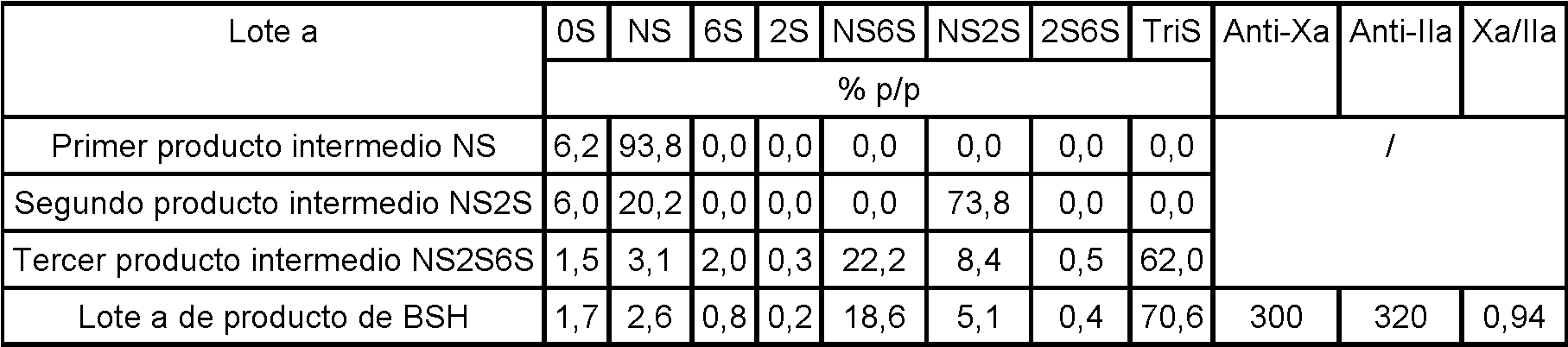


El experto en la técnica entenderá que los datos de disacáridos pueden expresarse en % en mol (tal como se usa en el presente documento) o en % en peso (tal como se usa en la solicitud provisional).One skilled in the art will understand that disaccharide data may be expressed in mol % (as used in herein) or in % by weight (as used in the provisional application).
Lotes de heparina biosintética que aparecieron en la solicitud provisional estadounidense n.° 62/384.341 y que no cumplen con las especificaciones de peso molecular y actividad de heparina USP porcinaLots of biosynthetic heparin that appeared in US Provisional Application No. 62/384,341 and do not meet the molecular weight and activity specifications for USP porcine heparin
La solicitud provisional incluía dos lotes que no cumplen con las especificaciones de actividad y peso molecular de la heparina USP porcina. Las tablas 12 y 13 a continuación resumen los datos. Los valores de disacáridos se expresan tanto en % p/p como en % mol.The provisional application included two lots that do not meet the activity and molecular weight specifications for USP porcine heparin. Tables 12 and 13 below summarize the data. Disaccharide values are expressed in both w/w% and mol%.
Tabla 12.Table 12.

# medido mediante 1H-RMN, * medido mediante CL-EM# measured by 1H-NMR, * measured by LC-MS

# medido mediante 1H-RMN# measured by 1H-NMR
Tabla 13. Resumen de pesos molecularesTable 13. Summary of molecular weights

Claims (11)
Applications Claiming Priority (2)
| Application Number | Priority Date | Filing Date | Title |
|---|---|---|---|
| US201662384341P | 2016-09-07 | 2016-09-07 | |
| PCT/US2017/050385 WO2018048973A1 (en) | 2016-09-07 | 2017-09-07 | Biosynthetic heparin |
Publications (1)
| Publication Number | Publication Date |
|---|---|
| ES2952428T3 true ES2952428T3 (en) | 2023-10-31 |
Family
ID=61561551
Family Applications (1)
| Application Number | Title | Priority Date | Filing Date |
|---|---|---|---|
| ES17849497T Active ES2952428T3 (en) | 2016-09-07 | 2017-09-07 | Biosynthetic heparin |
Country Status (16)
| Country | Link |
|---|---|
| US (2) | US11591628B2 (en) |
| EP (1) | EP3510147B1 (en) |
| JP (1) | JP7033330B2 (en) |
| KR (1) | KR102560632B1 (en) |
| CN (1) | CN109923208B (en) |
| AU (1) | AU2017324960B2 (en) |
| BR (1) | BR112019004449B1 (en) |
| CA (1) | CA3035912A1 (en) |
| ES (1) | ES2952428T3 (en) |
| HU (1) | HUE062448T2 (en) |
| MY (1) | MY193343A (en) |
| PH (1) | PH12019500459A1 (en) |
| PL (1) | PL3510147T3 (en) |
| SG (2) | SG10202101954TA (en) |
| TW (1) | TWI769176B (en) |
| WO (1) | WO2018048973A1 (en) |
Families Citing this family (9)
| Publication number | Priority date | Publication date | Assignee | Title |
|---|---|---|---|---|
| JP2022523638A (en) | 2019-01-15 | 2022-04-26 | オプティムヴィア、エルエルシー | Modified aryl sulphate-dependent enzyme |
| JP2022540849A (en) | 2019-07-09 | 2022-09-20 | オプティムヴィア、エルエルシー | Method for synthesizing anticoagulant polysaccharide |
| CN110982864A (en) * | 2019-12-30 | 2020-04-10 | 孙军亭 | Enzymatic synthesis method and application of 3 ', 5' -adenosine diphosphate (PAP) |
| CN111154819B (en) * | 2020-01-15 | 2022-08-30 | 山东大学 | Non-animal source low molecular weight heparin and preparation method and application thereof |
| JP7420377B2 (en) | 2020-01-31 | 2024-01-23 | 真一 原 | How to create a tennis technique improvement support database and a tennis technique improvement support system |
| JP6684976B1 (en) | 2020-01-31 | 2020-04-22 | 三井E&S環境エンジニアリング株式会社 | Contaminant image analysis system used for pretreatment facility of organic waste treatment and operation system of pretreatment facility using contaminant image analysis system |
| WO2021199445A1 (en) | 2020-04-03 | 2021-10-07 | Rensselaer Polytechnic Institute | Method for producing sulfated polysaccharide and method for producing paps |
| CN114763570B (en) * | 2021-09-10 | 2024-02-27 | 江南大学 | Construction and application of sulfonated modification system for preparing heparin with different molecular weights |
| WO2023081336A2 (en) * | 2021-11-05 | 2023-05-11 | Rensselaer Polytechnic Institute | Methods for the chemoenzymatic synthesis of low molecular weight heparin from low molecular weight heparosan |
Family Cites Families (6)
| Publication number | Priority date | Publication date | Assignee | Title |
|---|---|---|---|---|
| WO2006098332A1 (en) * | 2005-03-14 | 2006-09-21 | Seikagaku Corporation | Promoter for hard tissue formation |
| EP1885865A4 (en) | 2005-05-12 | 2010-12-22 | Univ North Carolina | ENZYMATIC SYNTHESIS OF SULFATE POLYSACCHARIDES |
| CN101724086B (en) | 2009-11-25 | 2012-09-26 | 深圳海王药业有限公司 | Oligomerization pineapple ginseng glycosaminoglycan and preparation method thereof |
| WO2012116048A1 (en) * | 2011-02-22 | 2012-08-30 | Rensselaer Polytechnic Institute | Single step heparosan n-deacetylation and depolymerization for making bioengineered heparin |
| US20140349962A1 (en) * | 2013-05-24 | 2014-11-27 | Massachusetts Institute Of Technology | Rapid two-step synthesis of anti-coagulants |
| JP6670235B2 (en) | 2013-06-17 | 2020-03-18 | ザ ユニバーシティ オブ ノース カロライナ アット チャペル ヒルThe University Of North Carolina At Chapel Hill | Reversible heparin molecules, methods of making and using the same |
-
2017
- 2017-09-06 TW TW106130506A patent/TWI769176B/en active
- 2017-09-07 MY MYPI2019001050A patent/MY193343A/en unknown
- 2017-09-07 KR KR1020197009477A patent/KR102560632B1/en active Active
- 2017-09-07 EP EP17849497.7A patent/EP3510147B1/en active Active
- 2017-09-07 HU HUE17849497A patent/HUE062448T2/en unknown
- 2017-09-07 PL PL17849497.7T patent/PL3510147T3/en unknown
- 2017-09-07 JP JP2019512252A patent/JP7033330B2/en active Active
- 2017-09-07 SG SG10202101954TA patent/SG10202101954TA/en unknown
- 2017-09-07 AU AU2017324960A patent/AU2017324960B2/en active Active
- 2017-09-07 CA CA3035912A patent/CA3035912A1/en active Pending
- 2017-09-07 CN CN201780067118.8A patent/CN109923208B/en active Active
- 2017-09-07 WO PCT/US2017/050385 patent/WO2018048973A1/en not_active Ceased
- 2017-09-07 SG SG11201901795QA patent/SG11201901795QA/en unknown
- 2017-09-07 US US16/331,127 patent/US11591628B2/en active Active
- 2017-09-07 ES ES17849497T patent/ES2952428T3/en active Active
- 2017-09-07 BR BR112019004449-3A patent/BR112019004449B1/en active IP Right Grant
-
2019
- 2019-03-01 PH PH12019500459A patent/PH12019500459A1/en unknown
-
2023
- 2023-01-20 US US18/099,749 patent/US20230151400A1/en active Pending
Also Published As
| Publication number | Publication date |
|---|---|
| MY193343A (en) | 2022-10-06 |
| CA3035912A1 (en) | 2018-03-15 |
| CN109923208A (en) | 2019-06-21 |
| SG11201901795QA (en) | 2019-03-28 |
| AU2017324960B2 (en) | 2022-11-10 |
| US20190225998A1 (en) | 2019-07-25 |
| HUE062448T2 (en) | 2023-11-28 |
| CN109923208B (en) | 2023-06-23 |
| KR20190052025A (en) | 2019-05-15 |
| RU2760706C2 (en) | 2021-11-29 |
| AU2017324960A1 (en) | 2019-03-21 |
| SG10202101954TA (en) | 2021-04-29 |
| JP7033330B2 (en) | 2022-03-10 |
| WO2018048973A1 (en) | 2018-03-15 |
| BR112019004449B1 (en) | 2023-04-04 |
| BR112019004449A2 (en) | 2019-05-28 |
| RU2019105262A (en) | 2020-10-08 |
| EP3510147A4 (en) | 2020-05-27 |
| EP3510147A1 (en) | 2019-07-17 |
| RU2019105262A3 (en) | 2021-04-29 |
| EP3510147B1 (en) | 2023-05-17 |
| TW201812012A (en) | 2018-04-01 |
| PH12019500459A1 (en) | 2019-12-16 |
| US11591628B2 (en) | 2023-02-28 |
| PL3510147T3 (en) | 2023-11-27 |
| JP2019531067A (en) | 2019-10-31 |
| TWI769176B (en) | 2022-07-01 |
| KR102560632B1 (en) | 2023-07-27 |
| US20230151400A1 (en) | 2023-05-18 |
Similar Documents
| Publication | Publication Date | Title |
|---|---|---|
| ES2952428T3 (en) | Biosynthetic heparin | |
| US5280016A (en) | Non-anticoagulant heparin derivatives | |
| JP6670235B2 (en) | Reversible heparin molecules, methods of making and using the same | |
| JP7702454B2 (en) | Short-acting heparin-based anticoagulant compounds and methods | |
| US11203772B2 (en) | Chemoenzymatic synthesis of structurally homogeneous ultra-low molecular weight heparins | |
| DK2707396T3 (en) | Biotechnological sulfated chondroitin sulfate at position 4 or 6 on the same polysaccharide chain and process for its preparation | |
| KR20090109104A (en) | Low molecular weight heparin comprising one or more covalent bonds with biotin or biotin derivatives, methods for their preparation and uses thereof | |
| Ramachandra et al. | Brittlestars contain highly sulfated chondroitin sulfates/dermatan sulfates that promote fibroblast growth factor 2-induced cell signaling | |
| Yu et al. | Chemobiocatalytic synthesis of a low-molecular-weight heparin | |
| Wijnhoven et al. | Anti-proteinuric effects of glycosaminoglycan-based drugs | |
| RU2848219C1 (en) | Biosynthetic heparin | |
| RU2760706C9 (en) | Biosynthetic heparin | |
| HK40004137B (en) | Biosynthetic heparin | |
| HK40004137A (en) | Biosynthetic heparin | |
| US20050233453A1 (en) | 6-O-sulfated N-acetylheparosan and hematopoietic stem cell growth auxiliary agent | |
| RU2333222C2 (en) | Epimerised k5 polysaccharide derivatives with high sulfation degree | |
| Suflita | Chemoenzymatic synthesis of heparan sulfates, and investigations of their role in cell signaling, human health and disease | |
| O'Leary | Chemical and Enzymatic Methods for the Analysis and Synthesis of Heparin and Heparan Sulfate | |
| Ramachandra et al. | Brittlestars Contain Highly Sulfated Chondroitin Sulfates/Dermatan Sulfates that Promote FGF2 Induced Cell Signaling | |
| Huang | Chemical derivatization coupled with liquid chromatography and tandem mass spectrometry for structural sequencing of sulfated glycosaminoglycans |