ES2954622T3 - pour point depressor - Google Patents
pour point depressor Download PDFInfo
- Publication number
- ES2954622T3 ES2954622T3 ES20737002T ES20737002T ES2954622T3 ES 2954622 T3 ES2954622 T3 ES 2954622T3 ES 20737002 T ES20737002 T ES 20737002T ES 20737002 T ES20737002 T ES 20737002T ES 2954622 T3 ES2954622 T3 ES 2954622T3
- Authority
- ES
- Spain
- Prior art keywords
- polymer
- group
- oligomer
- groups
- carbon atoms
- Prior art date
- Legal status (The legal status is an assumption and is not a legal conclusion. Google has not performed a legal analysis and makes no representation as to the accuracy of the status listed.)
- Active
Links
Classifications
-
- C—CHEMISTRY; METALLURGY
- C08—ORGANIC MACROMOLECULAR COMPOUNDS; THEIR PREPARATION OR CHEMICAL WORKING-UP; COMPOSITIONS BASED THEREON
- C08G—MACROMOLECULAR COMPOUNDS OBTAINED OTHERWISE THAN BY REACTIONS ONLY INVOLVING UNSATURATED CARBON-TO-CARBON BONDS
- C08G73/00—Macromolecular compounds obtained by reactions forming a linkage containing nitrogen with or without oxygen or carbon in the main chain of the macromolecule, not provided for in groups C08G12/00 - C08G71/00
- C08G73/02—Polyamines
- C08G73/024—Polyamines containing oxygen in the form of ether bonds in the main chain
-
- C—CHEMISTRY; METALLURGY
- C08—ORGANIC MACROMOLECULAR COMPOUNDS; THEIR PREPARATION OR CHEMICAL WORKING-UP; COMPOSITIONS BASED THEREON
- C08G—MACROMOLECULAR COMPOUNDS OBTAINED OTHERWISE THAN BY REACTIONS ONLY INVOLVING UNSATURATED CARBON-TO-CARBON BONDS
- C08G18/00—Polymeric products of isocyanates or isothiocyanates
- C08G18/06—Polymeric products of isocyanates or isothiocyanates with compounds having active hydrogen
- C08G18/28—Polymeric products of isocyanates or isothiocyanates with compounds having active hydrogen characterised by the compounds used containing active hydrogen
- C08G18/2805—Compounds having only one group containing active hydrogen
- C08G18/2815—Monohydroxy compounds
- C08G18/282—Alkanols, cycloalkanols or arylalkanols including terpenealcohols
- C08G18/2825—Alkanols, cycloalkanols or arylalkanols including terpenealcohols having at least 6 carbon atoms
-
- C—CHEMISTRY; METALLURGY
- C08—ORGANIC MACROMOLECULAR COMPOUNDS; THEIR PREPARATION OR CHEMICAL WORKING-UP; COMPOSITIONS BASED THEREON
- C08G—MACROMOLECULAR COMPOUNDS OBTAINED OTHERWISE THAN BY REACTIONS ONLY INVOLVING UNSATURATED CARBON-TO-CARBON BONDS
- C08G18/00—Polymeric products of isocyanates or isothiocyanates
- C08G18/06—Polymeric products of isocyanates or isothiocyanates with compounds having active hydrogen
- C08G18/70—Polymeric products of isocyanates or isothiocyanates with compounds having active hydrogen characterised by the isocyanates or isothiocyanates used
- C08G18/72—Polyisocyanates or polyisothiocyanates
- C08G18/74—Polyisocyanates or polyisothiocyanates cyclic
- C08G18/76—Polyisocyanates or polyisothiocyanates cyclic aromatic
- C08G18/7614—Polyisocyanates or polyisothiocyanates cyclic aromatic containing only one aromatic ring
-
- C—CHEMISTRY; METALLURGY
- C08—ORGANIC MACROMOLECULAR COMPOUNDS; THEIR PREPARATION OR CHEMICAL WORKING-UP; COMPOSITIONS BASED THEREON
- C08G—MACROMOLECULAR COMPOUNDS OBTAINED OTHERWISE THAN BY REACTIONS ONLY INVOLVING UNSATURATED CARBON-TO-CARBON BONDS
- C08G18/00—Polymeric products of isocyanates or isothiocyanates
- C08G18/06—Polymeric products of isocyanates or isothiocyanates with compounds having active hydrogen
- C08G18/28—Polymeric products of isocyanates or isothiocyanates with compounds having active hydrogen characterised by the compounds used containing active hydrogen
- C08G18/30—Low-molecular-weight compounds
- C08G18/32—Polyhydroxy compounds; Polyamines; Hydroxyamines
- C08G18/3271—Hydroxyamines
- C08G18/3278—Hydroxyamines containing at least three hydroxy groups
- C08G18/3281—Hydroxyamines containing at least three hydroxy groups containing three hydroxy groups
-
- C—CHEMISTRY; METALLURGY
- C08—ORGANIC MACROMOLECULAR COMPOUNDS; THEIR PREPARATION OR CHEMICAL WORKING-UP; COMPOSITIONS BASED THEREON
- C08G—MACROMOLECULAR COMPOUNDS OBTAINED OTHERWISE THAN BY REACTIONS ONLY INVOLVING UNSATURATED CARBON-TO-CARBON BONDS
- C08G18/00—Polymeric products of isocyanates or isothiocyanates
- C08G18/06—Polymeric products of isocyanates or isothiocyanates with compounds having active hydrogen
- C08G18/28—Polymeric products of isocyanates or isothiocyanates with compounds having active hydrogen characterised by the compounds used containing active hydrogen
- C08G18/40—High-molecular-weight compounds
- C08G18/60—Polyamides or polyester-amides
-
- C—CHEMISTRY; METALLURGY
- C08—ORGANIC MACROMOLECULAR COMPOUNDS; THEIR PREPARATION OR CHEMICAL WORKING-UP; COMPOSITIONS BASED THEREON
- C08G—MACROMOLECULAR COMPOUNDS OBTAINED OTHERWISE THAN BY REACTIONS ONLY INVOLVING UNSATURATED CARBON-TO-CARBON BONDS
- C08G18/00—Polymeric products of isocyanates or isothiocyanates
- C08G18/06—Polymeric products of isocyanates or isothiocyanates with compounds having active hydrogen
- C08G18/28—Polymeric products of isocyanates or isothiocyanates with compounds having active hydrogen characterised by the compounds used containing active hydrogen
- C08G18/40—High-molecular-weight compounds
- C08G18/60—Polyamides or polyester-amides
- C08G18/603—Polyamides
-
- C—CHEMISTRY; METALLURGY
- C08—ORGANIC MACROMOLECULAR COMPOUNDS; THEIR PREPARATION OR CHEMICAL WORKING-UP; COMPOSITIONS BASED THEREON
- C08G—MACROMOLECULAR COMPOUNDS OBTAINED OTHERWISE THAN BY REACTIONS ONLY INVOLVING UNSATURATED CARBON-TO-CARBON BONDS
- C08G18/00—Polymeric products of isocyanates or isothiocyanates
- C08G18/06—Polymeric products of isocyanates or isothiocyanates with compounds having active hydrogen
- C08G18/28—Polymeric products of isocyanates or isothiocyanates with compounds having active hydrogen characterised by the compounds used containing active hydrogen
- C08G18/40—High-molecular-weight compounds
- C08G18/64—Macromolecular compounds not provided for by groups C08G18/42 - C08G18/63
- C08G18/6415—Macromolecular compounds not provided for by groups C08G18/42 - C08G18/63 having nitrogen
- C08G18/6423—Polyalkylene polyamines; polyethylenimines; Derivatives thereof
-
- C—CHEMISTRY; METALLURGY
- C08—ORGANIC MACROMOLECULAR COMPOUNDS; THEIR PREPARATION OR CHEMICAL WORKING-UP; COMPOSITIONS BASED THEREON
- C08G—MACROMOLECULAR COMPOUNDS OBTAINED OTHERWISE THAN BY REACTIONS ONLY INVOLVING UNSATURATED CARBON-TO-CARBON BONDS
- C08G18/00—Polymeric products of isocyanates or isothiocyanates
- C08G18/06—Polymeric products of isocyanates or isothiocyanates with compounds having active hydrogen
- C08G18/70—Polymeric products of isocyanates or isothiocyanates with compounds having active hydrogen characterised by the isocyanates or isothiocyanates used
- C08G18/72—Polyisocyanates or polyisothiocyanates
- C08G18/74—Polyisocyanates or polyisothiocyanates cyclic
- C08G18/76—Polyisocyanates or polyisothiocyanates cyclic aromatic
- C08G18/7614—Polyisocyanates or polyisothiocyanates cyclic aromatic containing only one aromatic ring
- C08G18/7621—Polyisocyanates or polyisothiocyanates cyclic aromatic containing only one aromatic ring being toluene diisocyanate including isomer mixtures
-
- C—CHEMISTRY; METALLURGY
- C08—ORGANIC MACROMOLECULAR COMPOUNDS; THEIR PREPARATION OR CHEMICAL WORKING-UP; COMPOSITIONS BASED THEREON
- C08G—MACROMOLECULAR COMPOUNDS OBTAINED OTHERWISE THAN BY REACTIONS ONLY INVOLVING UNSATURATED CARBON-TO-CARBON BONDS
- C08G18/00—Polymeric products of isocyanates or isothiocyanates
- C08G18/06—Polymeric products of isocyanates or isothiocyanates with compounds having active hydrogen
- C08G18/70—Polymeric products of isocyanates or isothiocyanates with compounds having active hydrogen characterised by the isocyanates or isothiocyanates used
- C08G18/72—Polyisocyanates or polyisothiocyanates
- C08G18/77—Polyisocyanates or polyisothiocyanates having heteroatoms in addition to the isocyanate or isothiocyanate nitrogen and oxygen or sulfur
- C08G18/78—Nitrogen
- C08G18/79—Nitrogen characterised by the polyisocyanates used, these having groups formed by oligomerisation of isocyanates or isothiocyanates
- C08G18/798—Nitrogen characterised by the polyisocyanates used, these having groups formed by oligomerisation of isocyanates or isothiocyanates containing urethdione groups
-
- C—CHEMISTRY; METALLURGY
- C08—ORGANIC MACROMOLECULAR COMPOUNDS; THEIR PREPARATION OR CHEMICAL WORKING-UP; COMPOSITIONS BASED THEREON
- C08G—MACROMOLECULAR COMPOUNDS OBTAINED OTHERWISE THAN BY REACTIONS ONLY INVOLVING UNSATURATED CARBON-TO-CARBON BONDS
- C08G18/00—Polymeric products of isocyanates or isothiocyanates
- C08G18/06—Polymeric products of isocyanates or isothiocyanates with compounds having active hydrogen
- C08G18/70—Polymeric products of isocyanates or isothiocyanates with compounds having active hydrogen characterised by the isocyanates or isothiocyanates used
- C08G18/72—Polyisocyanates or polyisothiocyanates
- C08G18/80—Masked polyisocyanates
- C08G18/8061—Masked polyisocyanates masked with compounds having only one group containing active hydrogen
- C08G18/8064—Masked polyisocyanates masked with compounds having only one group containing active hydrogen with monohydroxy compounds
-
- C—CHEMISTRY; METALLURGY
- C08—ORGANIC MACROMOLECULAR COMPOUNDS; THEIR PREPARATION OR CHEMICAL WORKING-UP; COMPOSITIONS BASED THEREON
- C08G—MACROMOLECULAR COMPOUNDS OBTAINED OTHERWISE THAN BY REACTIONS ONLY INVOLVING UNSATURATED CARBON-TO-CARBON BONDS
- C08G69/00—Macromolecular compounds obtained by reactions forming a carboxylic amide link in the main chain of the macromolecule
- C08G69/48—Polymers modified by chemical after-treatment
-
- C—CHEMISTRY; METALLURGY
- C08—ORGANIC MACROMOLECULAR COMPOUNDS; THEIR PREPARATION OR CHEMICAL WORKING-UP; COMPOSITIONS BASED THEREON
- C08G—MACROMOLECULAR COMPOUNDS OBTAINED OTHERWISE THAN BY REACTIONS ONLY INVOLVING UNSATURATED CARBON-TO-CARBON BONDS
- C08G73/00—Macromolecular compounds obtained by reactions forming a linkage containing nitrogen with or without oxygen or carbon in the main chain of the macromolecule, not provided for in groups C08G12/00 - C08G71/00
- C08G73/02—Polyamines
- C08G73/0206—Polyalkylene(poly)amines
-
- C—CHEMISTRY; METALLURGY
- C09—DYES; PAINTS; POLISHES; NATURAL RESINS; ADHESIVES; COMPOSITIONS NOT OTHERWISE PROVIDED FOR; APPLICATIONS OF MATERIALS NOT OTHERWISE PROVIDED FOR
- C09K—MATERIALS FOR MISCELLANEOUS APPLICATIONS, NOT PROVIDED FOR ELSEWHERE
- C09K8/00—Compositions for drilling of boreholes or wells; Compositions for treating boreholes or wells, e.g. for completion or for remedial operations
- C09K8/52—Compositions for preventing, limiting or eliminating depositions, e.g. for cleaning
- C09K8/524—Compositions for preventing, limiting or eliminating depositions, e.g. for cleaning organic depositions, e.g. paraffins or asphaltenes
-
- C—CHEMISTRY; METALLURGY
- C10—PETROLEUM, GAS OR COKE INDUSTRIES; TECHNICAL GASES CONTAINING CARBON MONOXIDE; FUELS; LUBRICANTS; PEAT
- C10L—FUELS NOT OTHERWISE PROVIDED FOR; NATURAL GAS; SYNTHETIC NATURAL GAS OBTAINED BY PROCESSES NOT COVERED BY SUBCLASSES C10G OR C10K; LIQUIFIED PETROLEUM GAS; USE OF ADDITIVES TO FUELS OR FIRES; FIRE-LIGHTERS
- C10L1/00—Liquid carbonaceous fuels
- C10L1/10—Liquid carbonaceous fuels containing additives
- C10L1/14—Organic compounds
- C10L1/22—Organic compounds containing nitrogen
- C10L1/234—Macromolecular compounds
- C10L1/238—Macromolecular compounds obtained otherwise than by reactions involving only carbon-to-carbon unsaturated bonds
-
- C—CHEMISTRY; METALLURGY
- C10—PETROLEUM, GAS OR COKE INDUSTRIES; TECHNICAL GASES CONTAINING CARBON MONOXIDE; FUELS; LUBRICANTS; PEAT
- C10L—FUELS NOT OTHERWISE PROVIDED FOR; NATURAL GAS; SYNTHETIC NATURAL GAS OBTAINED BY PROCESSES NOT COVERED BY SUBCLASSES C10G OR C10K; LIQUIFIED PETROLEUM GAS; USE OF ADDITIVES TO FUELS OR FIRES; FIRE-LIGHTERS
- C10L1/00—Liquid carbonaceous fuels
- C10L1/10—Liquid carbonaceous fuels containing additives
- C10L1/14—Organic compounds
- C10L1/22—Organic compounds containing nitrogen
- C10L1/234—Macromolecular compounds
- C10L1/238—Macromolecular compounds obtained otherwise than by reactions involving only carbon-to-carbon unsaturated bonds
- C10L1/2381—Macromolecular compounds obtained otherwise than by reactions involving only carbon-to-carbon unsaturated bonds polyamides; polyamide-esters; polyurethane, polyureas
-
- C—CHEMISTRY; METALLURGY
- C10—PETROLEUM, GAS OR COKE INDUSTRIES; TECHNICAL GASES CONTAINING CARBON MONOXIDE; FUELS; LUBRICANTS; PEAT
- C10L—FUELS NOT OTHERWISE PROVIDED FOR; NATURAL GAS; SYNTHETIC NATURAL GAS OBTAINED BY PROCESSES NOT COVERED BY SUBCLASSES C10G OR C10K; LIQUIFIED PETROLEUM GAS; USE OF ADDITIVES TO FUELS OR FIRES; FIRE-LIGHTERS
- C10L10/00—Use of additives to fuels or fires for particular purposes
- C10L10/14—Use of additives to fuels or fires for particular purposes for improving low temperature properties
- C10L10/16—Pour-point depressants
-
- C—CHEMISTRY; METALLURGY
- C10—PETROLEUM, GAS OR COKE INDUSTRIES; TECHNICAL GASES CONTAINING CARBON MONOXIDE; FUELS; LUBRICANTS; PEAT
- C10M—LUBRICATING COMPOSITIONS; USE OF CHEMICAL SUBSTANCES EITHER ALONE OR AS LUBRICATING INGREDIENTS IN A LUBRICATING COMPOSITION
- C10M149/00—Lubricating compositions characterised by the additive being a macromolecular compound containing nitrogen
- C10M149/12—Macromolecular compounds obtained otherwise than by reactions only involving carbon-to-carbon unsaturated bonds
- C10M149/14—Macromolecular compounds obtained otherwise than by reactions only involving carbon-to-carbon unsaturated bonds a condensation reaction being involved
- C10M149/20—Polyureas
-
- C—CHEMISTRY; METALLURGY
- C10—PETROLEUM, GAS OR COKE INDUSTRIES; TECHNICAL GASES CONTAINING CARBON MONOXIDE; FUELS; LUBRICANTS; PEAT
- C10L—FUELS NOT OTHERWISE PROVIDED FOR; NATURAL GAS; SYNTHETIC NATURAL GAS OBTAINED BY PROCESSES NOT COVERED BY SUBCLASSES C10G OR C10K; LIQUIFIED PETROLEUM GAS; USE OF ADDITIVES TO FUELS OR FIRES; FIRE-LIGHTERS
- C10L2200/00—Components of fuel compositions
- C10L2200/04—Organic compounds
- C10L2200/0407—Specifically defined hydrocarbon fractions as obtained from, e.g. a distillation column
- C10L2200/0438—Middle or heavy distillates, heating oil, gasoil, marine fuels, residua
- C10L2200/0446—Diesel
-
- C—CHEMISTRY; METALLURGY
- C10—PETROLEUM, GAS OR COKE INDUSTRIES; TECHNICAL GASES CONTAINING CARBON MONOXIDE; FUELS; LUBRICANTS; PEAT
- C10L—FUELS NOT OTHERWISE PROVIDED FOR; NATURAL GAS; SYNTHETIC NATURAL GAS OBTAINED BY PROCESSES NOT COVERED BY SUBCLASSES C10G OR C10K; LIQUIFIED PETROLEUM GAS; USE OF ADDITIVES TO FUELS OR FIRES; FIRE-LIGHTERS
- C10L2230/00—Function and purpose of a components of a fuel or the composition as a whole
- C10L2230/14—Function and purpose of a components of a fuel or the composition as a whole for improving storage or transport of the fuel
-
- C—CHEMISTRY; METALLURGY
- C10—PETROLEUM, GAS OR COKE INDUSTRIES; TECHNICAL GASES CONTAINING CARBON MONOXIDE; FUELS; LUBRICANTS; PEAT
- C10M—LUBRICATING COMPOSITIONS; USE OF CHEMICAL SUBSTANCES EITHER ALONE OR AS LUBRICATING INGREDIENTS IN A LUBRICATING COMPOSITION
- C10M2217/00—Organic macromolecular compounds containing nitrogen as ingredients in lubricant compositions
- C10M2217/04—Macromolecular compounds from nitrogen-containing monomers obtained otherwise than by reactions only involving carbon-to-carbon unsaturated bonds
- C10M2217/045—Polyureas; Polyurethanes
-
- C—CHEMISTRY; METALLURGY
- C10—PETROLEUM, GAS OR COKE INDUSTRIES; TECHNICAL GASES CONTAINING CARBON MONOXIDE; FUELS; LUBRICANTS; PEAT
- C10N—INDEXING SCHEME ASSOCIATED WITH SUBCLASS C10M RELATING TO LUBRICATING COMPOSITIONS
- C10N2030/00—Specified physical or chemical properties which is improved by the additive characterising the lubricating composition, e.g. multifunctional additives
- C10N2030/02—Pour-point; Viscosity index
Landscapes
- Chemical & Material Sciences (AREA)
- Organic Chemistry (AREA)
- Chemical Kinetics & Catalysis (AREA)
- Polymers & Plastics (AREA)
- Health & Medical Sciences (AREA)
- Medicinal Chemistry (AREA)
- Oil, Petroleum & Natural Gas (AREA)
- Engineering & Computer Science (AREA)
- General Chemical & Material Sciences (AREA)
- Combustion & Propulsion (AREA)
- Life Sciences & Earth Sciences (AREA)
- Materials Engineering (AREA)
- General Life Sciences & Earth Sciences (AREA)
- Polyurethanes Or Polyureas (AREA)
- Organic Low-Molecular-Weight Compounds And Preparation Thereof (AREA)
- Addition Polymer Or Copolymer, Post-Treatments, Or Chemical Modifications (AREA)
- Lubricants (AREA)
- Polyesters Or Polycarbonates (AREA)
Abstract
La invención se refiere a un polímero u oligómero que comprende a) un núcleo oligomérico o polimérico que comprende átomos de carbono y al menos uno de los átomos de oxígeno y átomos de nitrógeno, y b) al menos tres grupos hidrocarbilo terminales y/o pendientes que tienen de 12 a 100 átomos de carbono, en el que los grupos hidrocarbilo están unidos al núcleo mediante c) un resto de enlace que comprende i) un grupo uretano y ii) un grupo seleccionado entre grupo uretano, grupo urea y grupo biuret. (Traducción automática con Google Translate, sin valor legal)The invention relates to a polymer or oligomer comprising a) an oligomeric or polymeric core comprising carbon atoms and at least one of the oxygen atoms and nitrogen atoms, and b) at least three terminal and/or pendant hydrocarbyl groups that They have from 12 to 100 carbon atoms, in which the hydrocarbyl groups are linked to the nucleus by c) a linking moiety comprising i) a urethane group and ii) a group selected from urethane group, urea group and biuret group. (Automatic translation with Google Translate, without legal value)
Description
DESCRIPCIÓNDESCRIPTION
Depresor de punto de fluidezpour point depressor
La invención se refiere a un polímero u oligómero que comprende un núcleo oligomérico o polimérico y al menos tres grupos hidrocarbilo que tienen de 12 a 100 átomos de carbono unidos al núcleo. La invención se refiere además al uso del polímero u oligómero para mejorar las propiedades de flujo en frío de fluidos basados en hidrocarburos, a un método para disminuir la cantidad de precipitado sólido en un fluido basado en hidrocarburos, a una composición que comprende el polímero u oligómero y un fluido basado en hidrocarburo, y a un proceso de preparación del polímero u oligómero. Los fluidos basados en hidrocarburos a veces sufren la precipitación de materiales sólidos, en particular parafinas, a baja temperatura. La temperatura a la que el primer precipitado se hace visible como turbidez se denomina punto de enturbiamiento. Al enfriarse más, se forma más precipitado hasta alcanzar el punto de fluidez. En algunas situaciones, los cambios de presión también pueden inducir la precipitación de materiales sólidos en fluidos basados en hidrocarburos.The invention relates to a polymer or oligomer comprising an oligomeric or polymeric core and at least three hydrocarbyl groups having 12 to 100 carbon atoms attached to the core. The invention further relates to the use of the polymer or oligomer to improve the cold flow properties of hydrocarbon-based fluids, to a method of decreasing the amount of solid precipitate in a hydrocarbon-based fluid, to a composition comprising the polymer or oligomer and a hydrocarbon-based fluid, and to a process for preparing the polymer or oligomer. Hydrocarbon-based fluids sometimes suffer from precipitation of solid materials, particularly paraffins, at low temperatures. The temperature at which the first precipitate becomes visible as turbidity is called the cloud point. As it cools further, more precipitate forms until the pour point is reached. In some situations, pressure changes can also induce precipitation of solid materials in hydrocarbon-based fluids.
El documento EP 1557441 describe agentes de nucleación basados en polímeros hiper-ramificados que tienen una pluralidad de grupos terminales de hidrocarbilo. Los agentes de nucleación se preparan típicamente mediante reacción de condensación de un poliéster hiper-ramificado con funcionalidad hidroxilo con ácidos grasos. Los agentes se describen como depresores del punto de fluidez.EP 1557441 describes nucleating agents based on hyper-branched polymers having a plurality of hydrocarbyl end groups. Nucleating agents are typically prepared by condensation reaction of a hydroxyl-functional hyperbranched polyester with fatty acids. The agents are described as pour point depressants.
El documento WO 2018/162403 se refiere al uso de polialcanolaminas hidrofóbicamente modificadas como inhibidores de cera, depresores de punto de fluidez y aditivos para lubricantes. Las polialcanolaminas hidrofóbicamente modificadas se preparan mediante un proceso de dos etapas. En una primera reacción, las trialcanolaminas se hacen reaccionar entre sí en una reacción de policondensación para proporcionar una polialcanolamina ramificada que comprende grupos OH terminales. En una segunda etapa, la polialcanolamina resultante se modifica haciendo reaccionar los grupos OH terminales con un reaccionante adecuado que comprende grupos hidrocarbilo. Normalmente, los ácidos grasos se utilizan como reaccionantes en la segunda etapa.Document WO 2018/162403 refers to the use of hydrophobically modified polyalkanolamines as wax inhibitors, pour point depressants and additives for lubricants. Hydrophobically modified polyalkanolamines are prepared by a two-step process. In a first reaction, the trialkanolamines are reacted with each other in a polycondensation reaction to provide a branched polyalkanolamine comprising terminal OH groups. In a second step, the resulting polyalkanolamine is modified by reacting the terminal OH groups with a suitable reactant comprising hydrocarbyl groups. Typically, fatty acids are used as reactants in the second stage.
El documento US 2013/0232858 se refiere al uso de ureas o uretanos sustituidos particulares para mejorar aún más las propiedades de fluidez en frío de los aceites minerales y crudos. En realizaciones típicas, las ureas sustituidas se preparan por medio de reacción de diisocianatos con aminas grasas, mientras que los uretanos sustituidos se preparan por medio de reacción de diisocianatos con alcoholes grasos.US 2013/0232858 relates to the use of particular ureas or substituted urethanes to further improve the cold flow properties of mineral and crude oils. In typical embodiments, substituted ureas are prepared by reaction of diisocyanates with fatty amines, while substituted urethanes are prepared by reaction of diisocyanates with fatty alcohols.
Hay una demanda constante de materiales adicionales que resulten adecuados para mejorar las propiedades de fluidez en frío de los fluidos basados en hidrocarburos. Preferentemente, los materiales deberían ser efectivos a bajos niveles de uso.There is a constant demand for additional materials suitable for improving the cold flow properties of hydrocarbon-based fluids. Preferably, the materials should be effective at low levels of use.
La invención proporciona un polímero u oligómero que comprendeThe invention provides a polymer or oligomer comprising
a) un núcleo oligomérico o polimérico que comprende átomos de carbono y al menos uno de átomos de oxígeno y átomos de nitrógeno, ya) an oligomeric or polymeric core comprising carbon atoms and at least one of oxygen atoms and nitrogen atoms, and
b) al menos tres grupos hidrocarbilo terminales y/o colgantes que tienen de 12 a 100 átomos de carbono, en el que los grupos de hidrocarbilo están unidos al núcleo a través deb) at least three terminal and/or pendant hydrocarbyl groups having from 12 to 100 carbon atoms, wherein the hydrocarbyl groups are attached to the nucleus through
c) un resto de enlace que comprende i) un grupo uretano y ii) un grupo seleccionado entre grupo uretano, grupo urea y grupo biuret.c) a linking moiety comprising i) a urethane group and ii) a group selected from urethane group, urea group and biuret group.
Un oligómero significa una molécula de masa molecular relativa intermedia, cuya estructura comprende esencialmente una pequeña pluralidad de unidades derivadas, de manera real o conceptual, de moléculas de masa molecular relativa más baja. El oligómero o polímero generalmente comprende al menos tres unidades repetidas en promedio y tiene una distribución de peso molecular, es decir, el cociente de peso molecular promedio expresado en peso y peso molecular promedio expresado en número es mayor que 1,0.An oligomer means a molecule of intermediate relative molecular mass, the structure of which essentially comprises a small plurality of units derived, actually or conceptually, from molecules of lower relative molecular mass. The oligomer or polymer generally comprises at least three repeating units on average and has a molecular weight distribution, that is, the ratio of weight average molecular weight expressed in number average molecular weight is greater than 1.0.
El polímero u oligómero de la invención tiene al menos tres grupos hidrocarbilo. Los grupos hidrocarbilo pueden estar presentes como grupos terminales o como grupos colgantes unidos al núcleo oligomérico o polimérico. Cuando el núcleo oligomérico o polimérico es una estructura ramificada o hiper-ramificada, los grupos hidrocarbilo están típicamente presentes como grupos colgantes del núcleo. Cuando el núcleo polimérico u oligomérico es lineal o esencialmente lineal, los grupos hidrocarbilo pueden estar presentes como grupos terminales así como en forma de grupos colgantes.The polymer or oligomer of the invention has at least three hydrocarbyl groups. Hydrocarbyl groups may be present as terminal groups or as pendant groups attached to the oligomeric or polymeric core. When the oligomeric or polymeric core is a branched or hyper-branched structure, the hydrocarbyl groups are typically present as pendant groups of the core. When the polymeric or oligomeric core is linear or essentially linear, the hydrocarbyl groups may be present as terminal groups as well as in the form of pendant groups.
Preferentemente, los grupos hidrocarbilo son grupos alifáticos lineales o ramificados. En algunas realizaciones, se prefieren grupos hidrocarbilo que tienen de 12 a 50 átomos de carbono. Los grupos hidrocarbilo pueden ser iguales o diferentes. En algunas realizaciones, se prefiere que los grupos hidrocarbilo difieran en el número de átomos de carbono o el grado o posición de la ramificación. Preferably, the hydrocarbyl groups are linear or branched aliphatic groups. In some embodiments, hydrocarbyl groups having 12 to 50 carbon atoms are preferred. The hydrocarbyl groups can be the same or different. In some embodiments, it is preferred that the hydrocarbyl groups differ in the number of carbon atoms or the degree or position of branching.
Generalmente, el polímero u oligómero de la invención comprende de 3 a 600, preferentemente de 3 a 300, más preferentemente de 3 a 100 grupos hidrocarbilo y lo más preferentemente de 3 a 60 grupos hidrocarbilo b). En algunas realizaciones, el polímero u oligómero comprende de 6 a 60 grupos hidrocarbilo b).Generally, the polymer or oligomer of the invention comprises from 3 to 600, preferably from 3 to 300, more preferably from 3 to 100 hydrocarbyl groups and most preferably from 3 to 60 hydrocarbyl groups b). In some embodiments, the polymer or oligomer comprises from 6 to 60 hydrocarbyl groups b).
Los grupos hidrocarbilo se unen al núcleo oligomérico o polimérico a través de un resto de enlace que comprende i) un grupo uretano y ii) un grupo seleccionado entre el grupo uretano, urea y biuret. En realizaciones preferidas, el resto de enlace está basado en un diisocianato orgánico. En algunas realizaciones preferidas, el grupo ii) seleccionado entre el grupo uretano, urea y biuret está ubicado entre el núcleo oligomérico o polimérico y el grupo uretano i).The hydrocarbyl groups are attached to the oligomeric or polymeric core through a linking moiety comprising i) a urethane group and ii) a group selected from the urethane, urea and biuret group. In preferred embodiments, the linking moiety is based on an organic diisocyanate. In some preferred embodiments, group ii) selected from the group urethane, urea and biuret is located between the oligomeric or polymeric core and the urethane group i).
En realizaciones preferidas del polímero u oligómero de la invención, el resto de enlace comprende un grupo cicloalifático o aromático ubicado entre el grupo uretano i) y el grupo ii) seleccionado entre el grupo uretano, urea y biuret. El grupo cicloalifático es preferentemente el grupo hidrocarbilo de diisocianato de isoforona. El grupo aromático es preferentemente el grupo hidrocarbilo de diisocianato de 2,4- o 2,6 tolueno. De manera apropiada, el grupo uretano i) está ubicado entre el grupo de hidrocarbilo que tiene de 12 a 100 átomos de carbono y el grupo ii) seleccionado entre el grupo uretano, urea y biuret.In preferred embodiments of the polymer or oligomer of the invention, the linking moiety comprises a cycloaliphatic or aromatic group located between the urethane group i) and the group ii) selected from the urethane, urea and biuret group. The cycloaliphatic group is preferably the hydrocarbyl group of isophorone diisocyanate. The aromatic group is preferably the hydrocarbyl group of 2,4- or 2,6-toluene diisocyanate. Suitably, the urethane group i) is located between the hydrocarbyl group having 12 to 100 carbon atoms and the group ii) selected from the urethane, urea and biuret group.
De manera apropiada, el núcleo oligomérico o polimérico es una estructura ramificada o hiper-ramificada basada en monómeros que tienen una funcionalidad promedio superior a 2,0. Una funcionalidad promedio superior a 2,0 significa que los monómeros pueden formar más de 2 enlaces con otros monómeros. Alternativamente, el núcleo oligomérico o polimérico puede ser una estructura lineal o esencialmente lineal.Appropriately, the oligomeric or polymeric core is a branched or hyper-branched structure based on monomers having an average functionality greater than 2.0. An average functionality greater than 2.0 means that the monomers can form more than 2 bonds with other monomers. Alternatively, the oligomeric or polymeric core may be a linear or essentially linear structure.
En algunas realizaciones, el núcleo es un polímero u oligómero de etilenimina. Preferentemente, el núcleo es una polietilenimina ramificada. El peso molecular promedio expresado en peso de la polietilenimina está, de manera apropiada, dentro del intervalo de 250 a 70.000 g/mol, preferentemente de 280 a 60.000 g/mol. Las polietileniminas adecuadas se encuentran disponibles comercialmente, por ejemplo, bajo las designaciones comerciales Lupasol® de BASF o Epomin de Nippon Shokubai. Los pesos moleculares hacen referencia a los datos proporcionados por los proveedores de polietileniminas.In some embodiments, the core is an ethyleneimine polymer or oligomer. Preferably, the core is a branched polyethyleneimine. The weight average molecular weight of the polyethyleneimine is, appropriately, within the range of 250 to 70,000 g/mol, preferably 280 to 60,000 g/mol. Suitable polyethyleneimines are commercially available, for example, under the trade names Lupasol® from BASF or Epomin from Nippon Shokubai. Molecular weights refer to data provided by polyethyleneimine suppliers.
Opcionalmente, el núcleo oligomérico o polimérico, en particular un núcleo de polietilenimina, se puede modificar por reacción con grupos reactivos de amina. Ejemplos de agentes de modificación son epóxidos, tales como glicidiléteres, lactonas, ácidos carboxílicos y compuestos con funcionalidad de acrilαlo.Optionally, the oligomeric or polymeric core, in particular a polyethyleneimine core, can be modified by reaction with reactive amine groups. Examples of modifying agents are epoxides, such as glycidyl ethers, lactones, carboxylic acids and acrylate-functional compounds.
En algunas realizaciones, el núcleo es un oligómero o polímero de una alcanolamina, denominada polialcanolamina. Los oligómeros o polímeros de alcanolaminas se obtienen por condensación de alcanolamina, que conduce a enlaces de éter. Si se desea, se pueden emplear mezclas de alcanolaminas. Típicamente, se emplean aminas de trialcanol, por ejemplo, amina de trietanol.In some embodiments, the core is an oligomer or polymer of an alkanolamine, called a polyalkanolamine. Oligomers or polymers of alkanolamines are obtained by condensation of alkanolamine, which leads to ether linkages. If desired, mixtures of alkanolamines can be used. Typically, trialkanol amines are used, for example, triethanol amine.
Las polialcanolaminas se obtienen mediante la etapa de reacción de aminas de trialcanol de fórmula general N(R1-OH)3 (la) entre sí en una reacción de policondensación para proporcionar una polialcanolamina ramificada que tiene grupos OH terminales. Opcionalmente, se pueden usar otros monómeros para la policondensación. El término "policondensación" en la forma habitual hace referencia a la formación de un polímero haciendo reaccionar monómeros mediante eliminación de moléculas pequeñas. En el presente caso, los grupos OH reaccionan entre sí liberando agua y formando enlaces de éter. Debido a que cada amina de trialcanol (la) comprende tres grupos OH, se forman polialcanolaminas ramificadas. La preparación de polialcanolaminas se conoce de manera general. El documento US 8540885 describe la preparación de polialcanolaminas de col. 3, I. 1 a col. 5, I. 40.Polyalkanolamines are obtained by reacting trialkanol amines of general formula N(R1-OH) 3 (la) with each other in a polycondensation reaction to provide a branched polyalkanolamine having terminal OH groups. Optionally, other monomers can be used for polycondensation. The term "polycondensation" in the usual way refers to the formation of a polymer by reacting monomers through elimination of small molecules. In the present case, the OH groups react with each other releasing water and forming ether bonds. Because each trialkanol amine (la) comprises three OH groups, branched polyalkanolamines are formed. The preparation of polyalkanolamines is generally known. US 8540885 describes the preparation of cabbage polyalkanolamines. 3, I. 1 a col. 5, I. 40.
En algunas realizaciones, el núcleo es una poliamida. De manera apropiada, las poliamidas se preparan por reacción de poliaminas con ácidos carboxílicos o derivados de los mismos. Los ácidos carboxílicos adecuados tienen uno, dos o más grupos de ácido carboxílico. También es posible utilizar mezclas de ácidos carboxílicos. También se pueden usar anhídridos carboxílicos. Ejemplos de compuestos de poliamina apropiados son poliaminas lineales alifáticas, tales como 1,6-hexametilendiamina, dietilentriamina (DETA), trietilentetramina (TETA), tetraetilenpentamina (TEPA), pentaetilenhexamina, hexaetilenheptamina y homólogos de peso molecular superior, productos de condensación lineal según la fórmula NH2-(C2H4NH)n-C2H4-NH2 con n > 5, dipropilentriamina, (3-(2-aminoetil)aminopropilamina, N,N-bis(3-aminopropil)metilamina, N,N-dimetildipropilentriamina y N,N'-bis(3-aminopropil)-etilendiamina, Tris(3-aminopropil)amina, Tris(2-aminoetil)amina; Otros ejemplos son Isoforondiamina, 4,4'-Diamino-difenilmetano, 1,3- y 1,4-Xililendiamina, 4,4'-Diaminodiciclohexilmetano, 14-Bis(aminometil)ciclohexano, 1-piperazinetanoamina, N,N'-bis-(2-aminoetil) piperazina, N-[(2-aminoetil) 2-aminoetil]piperazina, di y/o poliaminas basadas en poli(óxidos de alquileno). En la preparación de núcleos de poliamida adecuados es obligatorio garantizar que la poliamida resultante tenga al menos tres grupos reactivos seleccionados entre hidroxilo, amina primaria y amina secundaria. Esto se puede lograr mediante selección de la relación molar de grupos amina con respecto a grupos de ácido carboxílico, o controlando el grado de conversión de grupos amina y grupos de ácido carboxílico.In some embodiments, the core is a polyamide. Suitably, polyamides are prepared by reacting polyamines with carboxylic acids or derivatives thereof. Suitable carboxylic acids have one, two or more carboxylic acid groups. It is also possible to use mixtures of carboxylic acids. Carboxylic anhydrides can also be used. Examples of suitable polyamine compounds are linear aliphatic polyamines, such as 1,6-hexaethylenediamine, diethylenetriamine (DETA), triethylenetetramine (TETA), tetraethylenepentamine (TEPA), pentaethylenehexamine, hexaethyleneheptamine and higher molecular weight homologs, linear condensation products according to formula NH 2 -(C2H4NH)n-C2H4-NH 2 with n > 5, dipropylenetriamine, (3-(2-aminoethyl)aminopropylamine, N,N-bis(3-aminopropyl)methylamine, N,N-dimethyldipropylenetriamine and N, N'-bis(3-aminopropyl)-ethylenediamine, Tris(3-aminopropyl)amine, Tris(2-aminoethyl)amine; Other examples are Isophoronediamine, 4,4'-Diamino-diphenylmethane, 1,3- and 1,4 -Xylylenediamine, 4,4'-Diaminodicyclohexylmethane, 14-Bis(aminomethyl)cyclohexane, 1-piperazinethanamine, N,N'-bis-(2-aminoethyl)piperazine, N-[(2-aminoethyl)2-aminoethyl]piperazine, di and/or polyamines based on poly(alkylene oxides).In the preparation of suitable polyamide cores it is mandatory to ensure that the resulting polyamide has at least three reactive groups selected from hydroxyl, primary amine and secondary amine. This can be achieved by selecting the molar ratio of amine groups to carboxylic acid groups, or by controlling the degree of conversion of amine groups and carboxylic acid groups.
En algunas realizaciones, el núcleo es un poliéster ramificado. De manera apropiada, los poliésteres ramificados que tienen grupos terminales de hidroxilo se preparan por reacción de condensación de polioles que tienen de 2 a 6 grupos hidroxilo y ácidos carboxílicos. Los poliésteres ramificados adecuados se pueden obtener mediante reacciones de condensación de polioles con ácido dimetilolpropiónico. La preparación de dichos poliésteres ramificados se describe en el documento US 5418301. Los poliésteres ramificados adecuados se encuentran disponibles comercialmente bajo la denominación comercial Bottom de Perstorp. Los poliésteres ramificados se pueden modificar opcionalmente por medio de co-condensación de ácidos monocarboxílicos, por ejemplo ácidos grasos saturados o insaturados.In some embodiments, the core is a branched polyester. Suitably, branched polyesters having terminal hydroxyl groups are prepared by condensation reaction of polyols having 2 to 6 hydroxyl groups and carboxylic acids. Suitable branched polyesters can be obtained by condensation reactions of polyols with dimethylolpropionic acid. The preparation of such branched polyesters is described in US 5418301. Suitable branched polyesters are commercially available under the brand name Bottom of Perstorp. The branched polyesters can optionally be modified by means of co-condensation of monocarboxylic acids, for example saturated or unsaturated fatty acids.
En algunas realizaciones preferidas, el polímero u oligómero comprende grupos amina neutralizados por un ácido carboxílico que tiene de 6 a 24 átomos de carbono. Se ha encontrado que se mejora la eficacia de los polímeros u oligómeros como depresores de punto de fluidez o inhibidores de precipitación cuando comprenden grupos amino neutralizados por dichos ácidos carboxílicos.In some preferred embodiments, the polymer or oligomer comprises amine groups neutralized by a carboxylic acid having 6 to 24 carbon atoms. It has been found that the effectiveness of polymers or oligomers as pour point depressants or precipitation inhibitors is improved when they comprise amino groups neutralized by said carboxylic acids.
Se ha encontrado que los polímeros u oligómeros de la invención modifican y/o reducen la precipitación de parafina y/o cera en fluidos basados en hidrocarburos a baja temperatura. Esto mejora las propiedades de fluidez en frío de los fluidos basados en hidrocarburos. Por tanto, la invención se refiere además al uso del polímero u oligómero para mejorar las propiedades de fluidez en frío de los fluidos basados en hidrocarburos. El polímero de la invención también resulta muy apropiado como depresor de punto de fluidez en fluidos basados en hidrocarburos.It has been found that the polymers or oligomers of the invention modify and/or reduce the precipitation of paraffin and/or wax in hydrocarbon-based fluids at low temperature. This improves the cold flow properties of hydrocarbon-based fluids. Therefore, the invention further relates to the use of the polymer or oligomer to improve the cold flow properties of hydrocarbon-based fluids. The polymer of the invention is also very suitable as a pour point depressant in hydrocarbon-based fluids.
La invención también se refiere a un método para disminuir la cantidad de precipitado sólido en un fluido basado en hidrocarburo al disminuir la temperatura o modificar la presión, que comprende añadir al fluido basado en hidrocarburo un polímero u oligómero de la invención.The invention also relates to a method for decreasing the amount of solid precipitate in a hydrocarbon-based fluid by decreasing the temperature or modifying the pressure, which comprises adding to the hydrocarbon-based fluid a polymer or oligomer of the invention.
En otro aspecto, la invención se refiere a una composición que comprendeIn another aspect, the invention relates to a composition comprising
i) el polímero u oligómero de la invención yi) the polymer or oligomer of the invention and
ii) un fluido basado en hidrocarburo.ii) a hydrocarbon-based fluid.
Los ejemplos de fluidos basados en hidrocarburo incluyen petróleo crudo, fracciones de petróleo crudo, combustible diésel, fluido para trabajar metales, combustible para calefacción, aceite de base lubricante y lubricante.Examples of hydrocarbon-based fluids include crude oil, crude oil fractions, diesel fuel, metalworking fluid, heating fuel, lubricating base oil, and lubricant.
Los aceites de base lubricante se clasifican en cinco grupos por parte de American Petroleum Institute (API). Los aceites de base del Grupo I están compuestos por petróleo procedente de destilación fraccionada que se refina de forma adicional con procesos de extracción con disolvente para mejorar determinadas propiedades, tales como resistencia a la oxidación y eliminación de cera. Los aceites de base del Grupo II están compuestos por petróleo procedente de destilación fraccionada sometido a hidrocraqueo para lograr un refinado adicional y purificación. Los aceites de base del Grupo III tienen características similares a los aceites de base del Grupo II, excepto que los aceites base del Grupo III tienen índices de viscosidad más elevados. Los aceites de base del Grupo IV son polialfaolefinas (PAO). El Grupo V es un grupo general para cualquier aceite de base no descrito en los Grupos I a IV.Lubricating base oils are classified into five groups by the American Petroleum Institute (API). Group I base oils are composed of fractional distillation petroleum that is further refined with solvent extraction processes to improve certain properties, such as oxidation resistance and dewaxing. Group II base oils are composed of fractional distillation petroleum subjected to hydrocracking for additional refining and purification. Group III base oils have similar characteristics to Group II base oils, except Group III base oils have higher viscosity indices. Group IV base oils are polyalphaolefins (PAO). Group V is a general group for any base oil not described in Groups I through IV.
El polímero u oligómero resulta eficaz para mejorar las propiedades de fluidez en frío, reducir el punto de fluidez y reducir la cantidad de precipitado sólido cuando se emplea en cantidades relativamente bajas con respecto al fluido basado en hidrocarburo. De manera apropiada, la cantidad de oligómero o polímero de la invención i) en la composición está dentro del intervalo de 0,001 a 1,000, preferentemente de 0,010 a 0,800, más preferentemente de un 0,010 a un 0,400 % en peso, calculado sobre el peso total de la composición.The polymer or oligomer is effective in improving cold flow properties, lowering the pour point, and reducing the amount of solid precipitate when used in relatively low amounts relative to the hydrocarbon-based fluid. Appropriately, the amount of oligomer or polymer of the invention i) in the composition is within the range of 0.001 to 1.000, preferably 0.010 to 0.800, more preferably 0.010 to 0.400% by weight, calculated on the total weight of the composition.
La composición según la presente invención puede comprender al menos un aditivo adicional, tal como un antioxidante, inhibidor de oxidación, inhibidor de corrosión, modificador de fricción, agente de pasivación de metales, inhibidor de óxido, agente antiespumante, potenciador de índice de viscosidad, dispersante, detergente, agente de presión extrema o depresor adicional del punto de fluidez.The composition according to the present invention may comprise at least one additional additive, such as an antioxidant, oxidation inhibitor, corrosion inhibitor, friction modifier, metal passivation agent, rust inhibitor, antifoam agent, viscosity index enhancer, dispersant, detergent, extreme pressure agent or additional pour point depressant.
La invención se refiere además a un proceso de preparación del polímero u oligómero de la invención. El proceso comprende las etapas deThe invention further relates to a process for preparing the polymer or oligomer of the invention. The process includes the stages of
i) hacer reaccionar un monoalcohol que tiene un grupo hidrocarbilo que tiene de 12 a 100 átomos de carbono con un diisocianato para proporcionar un intermedio que tiene un grupo isocianato, uretano y un grupo hidrocarbilo que tiene de 12 a 100 átomos de carbono,i) reacting a monoalcohol having a hydrocarbyl group having 12 to 100 carbon atoms with a diisocyanate to provide an intermediate having an isocyanate group, urethane and a hydrocarbyl group having 12 to 100 carbon atoms,
ii) proporcionar un núcleo oligomérico o polimérico que comprende átomos de carbono y al menos uno de átomos de oxígeno y átomos de nitrógeno, y que tiene al menos tres grupos reactivos seleccionados entre hidroxilo, amina primaria, amina secundaria y mezclas de los mismos,ii) providing an oligomeric or polymeric core comprising carbon atoms and at least one of oxygen atoms and nitrogen atoms, and having at least three reactive groups selected from hydroxyl, primary amine, secondary amine and mixtures thereof,
iii) hacer reaccionar el intermedio preparado en la etapa i) con el núcleo oligomérico o polimérico proporcionado en la etapa ii).iii) reacting the intermediate prepared in step i) with the oligomeric or polymeric core provided in step ii).
En la primera etapa, se hace reaccionar un mono-alcohol que tiene un grupo hidrocarbilo que tiene de 12 a 100 átomos de carbono con un diisocianato para proporcionar un intermedio que tiene un grupo isocianato, uretano y un grupo hidrocarbilo que tiene de 12 a 100 átomos de carbono. Para obtener el intermedio de forma selectiva, se prefiere la utilización de diisocianatos que tengan dos grupos isocianato con diferente reactividad. Ejemplos de tales diisocianatos son diisocianato de isoforona y diisocianato de 2,4-tolueno, así como mezclas de los mismos. De manera alternativa o adicional, es posible utilizar un exceso molar de diisocianato con respecto a mono alcohol en la primera etapa de reacción. Si se desea, es posible eliminar el diisocianato que no ha reaccionado después de la primera etapa, por ejemplo, mediante destilación. En algunas realizaciones, se usa una mezcla de diferentes monoalcoholes en la primera etapa de reacción. El mono alcohol de la mezcla puede variar en cuanto a número de átomos de carbono del grupo hidrocarbilo, así como en cuanto a grado o posición de ramificación del grupo hidrocarbilo.In the first step, a mono-alcohol having a hydrocarbyl group having 12 to 100 carbon atoms is reacted with a diisocyanate to provide an intermediate having an isocyanate group, urethane and a hydrocarbyl group having 12 to 100 carbon atoms. To obtain the intermediate selectively, the use of diisocyanates that have two isocyanate groups with different reactivity is preferred. Examples of such diisocyanates are isophorone diisocyanate and 2,4-toluene diisocyanate, as well as mixtures thereof. Alternatively or additionally, it is possible to use a molar excess of diisocyanate with respect to mono alcohol in the first reaction step. If desired, it is possible to remove unreacted diisocyanate after the first step, for example by distillation. In some embodiments, a mixture of different monoalcohols is used in the first reaction stage. The mono alcohol of the mixture can vary in terms of the number of carbon atoms of the hydrocarbyl group, as well as the degree or position of branching of the hydrocarbyl group.
En la segunda etapa, se proporciona un núcleo oligomérico o polimérico como se ha descrito con anterioridad. Los grupos funcionales del núcleo oligomérico o polimérico seleccionados entre grupos hidroxilo, grupos de amina primaria, grupos de amina secundaria, o una combinación de los mismos, que son capaces de reaccionar con grupos isocianato. El núcleo oligomérico o polimérico tiene al menos tres de dichos grupos. Generalmente, de 3 a 600 de dichos grupos están presentes en el núcleo oligomérico o polimérico.In the second step, an oligomeric or polymeric core is provided as described above. The functional groups of the oligomeric or polymeric core selected from hydroxyl groups, primary amine groups, secondary amine groups, or a combination thereof, which are capable of reacting with isocyanate groups. The oligomeric or polymeric core has at least three such groups. Generally, from 3 to 600 such groups are present in the oligomeric or polymeric core.
En la tercera etapa, el intermedio preparado en la etapa i) se hace reaccionar con el núcleo oligomérico o polimérico. En esta etapa, los grupos isocianato del intermedio reaccionan con los grupos hidroxilo y/o grupos de amina primaria o secundaria para formar grupos uretano o urea, respectivamente. La relación molar de núcleo intermedio y oligomérico está seleccionada para garantizar que al menos 3 moléculas intermedias estén unidas a cada núcleo oligomérico o polimérico. Generalmente, se unen de 3 a 600 moléculas intermedias a cada núcleo oligomérico o polimérico. En la tercera etapa, la totalidad o únicamente una parte de los grupos hidroxilo o grupos amino reactivos con isocianato del núcleo oligomérico o polimérico se hacen reaccionar con el intermedio con funcionalidad de isocianato, siempre que al menos al menos 3 moléculas intermedias estén unidas a cada núcleo oligomérico o polimérico.In the third step, the intermediate prepared in step i) is reacted with the oligomeric or polymeric core. In this step, the isocyanate groups of the intermediate react with the hydroxyl groups and/or primary or secondary amine groups to form urethane or urea groups, respectively. The molar ratio of intermediate and oligomeric core is selected to ensure that at least 3 intermediate molecules are attached to each oligomeric or polymeric core. Typically, 3 to 600 intermediate molecules are attached to each oligomeric or polymeric core. In the third step, all or only a part of the hydroxyl groups or isocyanate-reactive amino groups of the oligomeric or polymeric core are reacted with the isocyanate-functional intermediate, provided that at least at least 3 intermediate molecules are attached to each oligomeric or polymeric core.
Los polímeros u oligómeros según la invención en los que el resto de enlace c) comprende i) un grupo uretano y ii) un grupo biuret se pueden obtener mediante un proceso que comprende las etapas deThe polymers or oligomers according to the invention in which the linking moiety c) comprises i) a urethane group and ii) a biuret group can be obtained by a process comprising the steps of
i) hacer reaccionar un mono-alcohol que tiene un grupo hidrocarbilo que tiene de 12 a 100 átomos de carbono con un mono- o diisocianato que tiene un grupo uretdion para proporcionar un intermedio que tiene un grupo uretdion, uno o dos grupos uretano y uno o dos grupos hidrocarbilo que tienen 12 a 100 átomos de carbono,i) reacting a mono-alcohol having a hydrocarbyl group having 12 to 100 carbon atoms with a mono- or diisocyanate having a uretdion group to provide an intermediate having one uretdion group, one or two urethane groups and one or two hydrocarbyl groups having 12 to 100 carbon atoms,
ii) proporcionar un núcleo oligomérico o polimérico que comprende átomos de carbono y al menos uno de átomos de oxígeno y átomos de nitrógeno, y que tiene al menos tres grupos reactivos seleccionados entre amina primaria, amina secundaria y combinaciones de los mismos,ii) providing an oligomeric or polymeric core comprising carbon atoms and at least one of oxygen atoms and nitrogen atoms, and having at least three reactive groups selected from primary amine, secondary amine and combinations thereof,
iii) hacer reaccionar el intermedio preparado en la etapa i) con el núcleo oligomérico o polimérico proporcionado en la etapa ii).iii) reacting the intermediate prepared in step i) with the oligomeric or polymeric core provided in step ii).
EjemplosExamples
Métodos generalesGeneral methods
Peso molecularMolecular weight
En el caso de sustancias sin uniformidad molecular, los pesos moleculares indicados a continuación, como ya en la descripción anterior, representan valores promedio de la media numérica. Los pesos moleculares o pesos moleculares promedio expresados en número Mn, se determinan mediante cromatografía de permeabilidad de gel frente a un patrón normalizado de poliestireno.In the case of substances without molecular uniformity, the molecular weights indicated below, as already in the previous description, represent average values of the numerical mean. The molecular weights or average molecular weights expressed in number Mn, are determined by gel permeability chromatography against a normalized polystyrene standard.
Índice de hidroxiloHydroxyl value
Se hicieron reaccionar los grupos hidroxilo alcohólicos por medio de acetilación con un exceso de anhídrido acético. El exceso de anhídrido acético se hidrolizó en ácido acético mediante adición de agua y se sometió a valoración de nuevo utilizando KOH etanólico. El índice de hidroxilo es la cantidad de KOH en mg, que equivale al número de grupos hidroxilo presentes en 1 g de sustancia (según DIN ISO 4629).The alcoholic hydroxyl groups were reacted via acetylation with an excess of acetic anhydride. The excess acetic anhydride was hydrolyzed into acetic acid by addition of water and titrated again using ethanolic KOH. The hydroxyl number is the amount of KOH in mg, which is equivalent to the number of hydroxyl groups present in 1 g of substance (according to DIN ISO 4629).
Índice de aminaAmine index
Se ha demostrado que ácido perclórico (HClO4) en ácido acético es un agente de valoración adecuado para bases orgánicas que contienen nitrógeno, así como grupos de amina primaria, secundaria y terciaria. Los disolventes ácidos tales como el ácido acético han resistido el ensayo en la determinación de bases orgánicas débiles (buenas propiedades de disolución, disolvente ácido donador de protones). Las adiciones de disolventes inertes tales como ciclohexano, dioxano, clorobenceno, acetona y metiletilcetona pueden mejorar la valoración de bases muy débiles (según DIN 16945).Perchloric acid (HClO 4 ) in acetic acid has been shown to be a suitable titration agent for nitrogen-containing organic bases as well as primary, secondary and tertiary amine groups. Acidic solvents such as acetic acid have stood the test in the determination of weak organic bases (good dissolution properties, proton-donating acidic solvent). Additions of inert solvents such as cyclohexane, dioxane, chlorobenzene, acetone and methyl ethyl ketone can improve the titration of very weak bases (according to DIN 16945).
Valores de NCONCO values
El contenido de NCO libre de los poliisocianatos empleados, así como el curso de las reacciones de adición de NCO, se determinan según EN ISO 9369 mediante reacción con dibutilamina y posterior valoración del exceso de amina. The free NCO content of the polyisocyanates used, as well as the course of the NCO addition reactions, are determined according to EN ISO 9369 by reaction with dibutylamine and subsequent titration of the excess amine.
RMNNMR
Las mediciones de RMN se llevaron a cabo en un Bruker DPX 300 a 300 MHz (1H) o 75 MHz (13C). Los disolventes utilizados fueron cloroformo deuterado (CDCh) y sulfóxido de dimetilo deuterado (DMSO-d6). NMR measurements were carried out on a Bruker DPX 300 at 300 MHz (1H) or 75 MHz (13C). The solvents used were deuterated chloroform (CDCh) and deuterated dimethyl sulfoxide (DMSO-d6).
Preparación de los productos intermediosPreparation of intermediate products
Preparación de productos intermedios APreparation of intermediate products A
Se introdujo un componente de isocianato en un matraz limpio y seco de cuatro bocas (500 ml) equipado con condensador, agitador, sensor de temperatura y línea de nitrógeno y se calentó hasta 80 °C. Se añadió una disolución del alcohol en xileno para que la temperatura no excediera 85 °C. La relación molar de grupos NCO con respecto a grupos OH fue 2:1. Después de completar la adición, la mezcla de reacción se agitó a esta temperatura. Se midió el valor de NCO como control de reacción (DIN EN ISO 9369).An isocyanate component was introduced into a clean, dry four-necked flask (500 mL) equipped with a condenser, stirrer, temperature sensor, and nitrogen line and heated to 80 °C. A solution of the alcohol in xylene was added so that the temperature did not exceed 85 °C. The molar ratio of NCO groups to OH groups was 2:1. After completion of the addition, the reaction mixture was stirred at this temperature. The NCO value was measured as a reaction control (DIN EN ISO 9369).
Tabla 1: Preparación de productos intermedios ATable 1: Preparation of intermediate products A

Preparación de productos intermedios B (núcleos poliméricos u oligoméricos basado en polietilenimina)Preparation of intermediate products B (polymeric or oligomeric nuclei based on polyethyleneimine)
Se introdujo poliamina (con diferente peso molecular presentada en la tabla) en un matraz limpio y seco de cuatro bocas (500 ml) equipado con condensador, agitador KPG, sensor de temperatura y línea de nitrógeno y se calentó a 100 °C. El componente de modificación (caprolactona, epóxido, acrilato o ácido láurico) se añadió de manera que la temperatura no excediera 120 °C. Después de la adición completa, la mezcla de reacción se agitó a esa temperatura hasta que el componente de modificación reaccionó por completo (controlado por medio de RMN).Polyamine (with different molecular weight presented in the table) was introduced into a clean and dry four-necked flask (500 ml) equipped with condenser, KPG stirrer, temperature sensor and nitrogen line and heated to 100 °C. The modification component (caprolactone, epoxide, acrylate, or lauric acid) was added so that the temperature did not exceed 120 °C. After complete addition, the reaction mixture was stirred at that temperature until the modification component reacted completely (monitored by NMR).
Tabla 2: Preparación de productos intermedios B (núcleos poliméricos u oligoméricos basados en polietilenimina)Table 2: Preparation of intermediates B (polymeric or oligomeric cores based on polyethyleneimine)


Preparación de producto intermedio C (núcleos poliméricos u oligoméricos basados en politrietanolamina)Preparation of intermediate product C (polymeric or oligomeric nuclei based on polytriethanolamine)
Se introdujeron trietanolamina y ácido fosfínico (50 % en H2O) en un matraz limpio y seco de cuatro bocas (500 ml) equipado con condensador, agitador KPG, sensor de temperatura y línea de nitrógeno. La mezcla se calentó a 230 °C y el agua de reacción se eliminó a presión reducida. Después de 4 h de tiempo de reacción, el agua restante se eliminó a presión reducida (500 mbar). Después de 3 h, la mezcla de reacción se enfrió a 140 °C a 100 mbar y después de 30 min se enfrió a temperatura ambiente. Se midieron los índices de amina (según DIN 16945) y los índices de hidroxilo (según DIN ISO 4629) como control de reacción.Triethanolamine and phosphinic acid (50% in H 2 O) were introduced into a clean, dry four-necked flask (500 mL) equipped with a condenser, KPG stirrer, temperature sensor, and nitrogen line. The mixture was heated to 230 °C and the reaction water was removed under reduced pressure. After 4 h of reaction time, the remaining water was removed under reduced pressure (500 mbar). After 3 h, the reaction mixture was cooled to 140 °C at 100 mbar and after 30 min it was cooled to room temperature. Amine values (according to DIN 16945) and hydroxyl values (according to DIN ISO 4629) were measured as a reaction control.
Tabla 3: Preparación de productos intermedios C (núcleos poliméricos u oligoméricos basados en politrietanolamina)Table 3: Preparation of intermediates C (polymeric or oligomeric cores based on polytriethanolamine)

Preparación del producto intermedio D (núcleo de poliamida polimérica u oligomérica basado en poliamina y ácido carboxílico)Preparation of intermediate product D (polymeric or oligomeric polyamide core based on polyamine and carboxylic acid)
Se introdujeron ácido adípico y ácido graso de aceite de sebo en un matraz limpio y seco de cuatro bocas (500 ml) equipado con condensador con separador de agua, agitador KPG, sensor de temperatura y línea de nitrógeno y se calentó a 80 °C. Se añadió tetraetilenpentamina a esta mezcla. Después de completar la adición, se calentó a 180 °C y el agua de reacción se eliminó a presión reducida. La reacción se controló midiendo los valores de ácido y amina. Adipic acid and tallow oil fatty acid were introduced into a clean and dry four-necked flask (500 mL) equipped with condenser with water separator, KPG stirrer, temperature sensor and nitrogen line and heated to 80 °C. Tetraethylenepentamine was added to this mixture. After completion of the addition, it was heated to 180 °C and the reaction water was removed under reduced pressure. The reaction was monitored by measuring acid and amine values.
Tabla 4: Preparación del producto intermedio DTable 4: Preparation of intermediate product D

Preparación de los productos según la invenciónPreparation of the products according to the invention
Preparación de productos finales AB, AC y ADPreparation of final products AB, AC and AD
Se introdujeron Intermedio B, C o D y xileno (la sustancia activa se ajustó a un 40 %) en un matraz limpio y seco de cuatro bocas (500 ml) equipado con condensador, agitador KPG, sensor de temperatura y línea de nitrógeno y se calentó a 80 °C. Adicionalmente se añadió el intermedio A, de manera que la temperatura no superó 85 °C. Después de la adición completa, la mezcla de reacción se agitó a esa temperatura hasta que no se pudieron detectar más grupos isocianato.Intermediate B, C or D and xylene (active substance was adjusted to 40%) were introduced into a clean, dry four-necked flask (500 ml) equipped with condenser, KPG stirrer, temperature sensor and nitrogen line and heated to 80 °C. Additionally, intermediate A was added, so that the temperature did not exceed 85 °C. After complete addition, the reaction mixture was stirred at that temperature until no more isocyanate groups could be detected.
Tabla 5: Preparación de productos ABTable 5: Preparation of AB products

Tabla 6: Preparación de productos ACTable 6: Preparation of AC products

Tabla 7: Preparación del producto ADTable 7: Preparation of the AD product

Los productos según la invención se proporcionaron en forma de disoluciones en xileno, con un contenido de no volátiles de un 40 % en peso.The products according to the invention were provided in the form of solutions in xylene, with a non-volatile content of 40% by weight.
Ensayos de aplicaciónApplication tests
Materias primasRaw Materials
Exxsol D 100: hidrocarburos, C13-C16, isoalcanos, cíclicos, ≤2 % de compuestos aromáticos adquiridos en Shell Chemicals EuropeExxsol D 100: Hydrocarbons, C13-C16, Isoalkanes, Cyclic, ≤2% aromatics purchased from Shell Chemicals Europe
Sasolwax 5203: hidrocarburos parafínicos adquiridos en SasolSasolwax 5203: paraffinic hydrocarbons purchased from Sasol
Sasolwax 5803: hidrocarburos parafínicos adquiridos en SasolSasolwax 5803: paraffinic hydrocarbons purchased from Sasol
Sasolwax C80: cera sintética, hidrocarburos parafínicos adquiridos en SasolSasolwax C80: synthetic wax, paraffinic hydrocarbons purchased from Sasol
Tabla 8: Preparación de formulaciones de petróleo crudo sintéticoTable 8: Preparation of synthetic crude oil formulations


Para la preparación del petróleo crudo sintético 1 se mezclaron todas las materias primas y se colocaron en el horno durante 2 horas a 60 °C (140 °F).For the preparation of synthetic crude oil 1, all raw materials were mixed and placed in the oven for 2 hours at 60 °C (140 °F).
Para la preparación del petróleo crudo sintético 2 y 3 se mezclaron todas las materias primas y se colocaron en el horno durante 4 horas a 80 °C (176 °F).For the preparation of synthetic crude oil 2 and 3, all raw materials were mixed and placed in the oven for 4 hours at 80 °C (176 °F).
Se rellenaron vasos de precipitados con petróleo crudo sintético tibio para llevar a cabo más ensayos de aplicación. Método de trabajo: Ensayo de dedo fríoBeakers were filled with warm synthetic crude oil for further application testing. Working method: Cold finger test
Aparato: equipo PSL Systemtechnik Cold Finger CF15Device: PSL Systemtechnik Cold Finger CF15 equipment
Se usó el ensayo del dedo frío para determinar las propiedades de inhibición de cera de los aditivos preparados. Se determinaron las inhibiciones de cera exponiendo el petróleo crudo a una superficie de dedo metálico frío en presencia/ausencia de inhibidor de cera. Al comienzo del ensayo se determinó el peso inicial del dedo metálico. Los depósitos sobre la superficie del dedo metálico frío en ausencia de inhibidor de cera se fijaron en un 100 %. La inhibición se calculó utilizando la fórmula 1The cold finger test was used to determine the wax inhibition properties of the prepared additives. Wax inhibitions were determined by exposing crude oil to a cold metal finger surface in the presence/absence of wax inhibitor. At the beginning of the test, the initial weight of the metal finger was determined. The deposits on the surface of the cold metal finger in the absence of wax inhibitor were fixed at 100%. Inhibition was calculated using formula 1

Wa: peso de depósitos de cera en la superficie de un dedo metálico frío en ausencia de inhibidor de cera (en g) Wp: peso de depósitos de cera en la superficie de un dedo metálico frío en presencia de inhibidor de cera (en g) Se introdujeron 63,2 g de petróleo crudo en un vaso de precipitados y se calentó a 80 °C durante 1 h. A continuación se añadieron 40/20/16 μl de un aditivo con una pipeta Eppendorf a los 63,2 g de petróleo crudo. La mezcla de petróleo crudo con aditivo se calentó a 80 °C durante 30 min. Se añadió una barra de agitación magnética a cada vaso de precipitados. Los vasos de precipitados con las muestras preparadas se colocaron en la gradilla y se insertó el dedo metálico en las muestras preparadas. A continuación se encendió el agitador magnético (750 rpm). Se pesó el dedo frío con los depósitos.Wa: weight of wax deposits on the surface of a cold metal finger in the absence of wax inhibitor (in g) Wp: weight of wax deposits on the surface of a cold metal finger in the presence of wax inhibitor (in g) 63.2 g of crude oil was placed in a beaker and heated at 80 °C for 1 h. 40/20/16 μl of an additive was then added with an Eppendorf pipette to the 63.2 g of crude oil. The crude oil mixture with additive was heated at 80 °C for 30 min. A magnetic stir bar was added to each beaker. The beakers with the prepared samples were placed on the rack and the metal finger was inserted into the prepared samples. The magnetic stirrer was then turned on (750 rpm). He weighed his cold finger with the deposits.
Parámetros para diferentes petróleos crudos sintéticos:Parameters for different synthetic crude oils:
Configuración de dedo frío petróleo crudo sintético 2Synthetic Crude Oil Cold Finger Configuration 2
- Temperatura de rejilla 57 °C- Grid temperature 57 °C
- Temperatura de dedo 45 °C- Finger temperature 45 °C
- Tiempo de procedimiento de ensayo: 2 horas- Test procedure time: 2 hours
- Velocidad de agitación: 750 rpm- Stirring speed: 750 rpm
Configuración de dedo frío petróleo crudo sintético 3Synthetic Crude Oil Cold Finger Configuration 3
- Temperatura de rejilla 44 °C- Grid temperature 44 °C
- Temperatura de dedo 24 °C- Finger temperature 24 °C
- Tiempo de procedimiento de ensayo: 2 horas- Test procedure time: 2 hours
- Velocidad de agitación: 750 rpm- Stirring speed: 750 rpm
Resultados de la aplicación: ensayo de dedo fríoApplication results: cold finger test
Se llevaron a cabo los ensayos de aplicación en el petróleo crudo sintético 2 (con un 15 % en peso de cera) y en el petróleo crudo sintético 3 (con un 5 % en peso de cera). Se lograron excelentes propiedades de inhibición de cera en ambos sistemas de petróleo crudo usando muestras preparadas según la invención. Application tests were carried out on synthetic crude oil 2 (with 15% by weight of wax) and on synthetic crude oil 3 (with 5% by weight of wax). Excellent wax inhibition properties were achieved in both crude oil systems using samples prepared according to the invention.
Tabla 9: Ensayo de dedo frío en petróleo crudo sintético 2Table 9: Cold finger test on synthetic crude oil 2

Tabla 10: Ensayo de dedo frío en petróleo crudo sintético 3Table 10: Cold finger test on synthetic crude oil 3
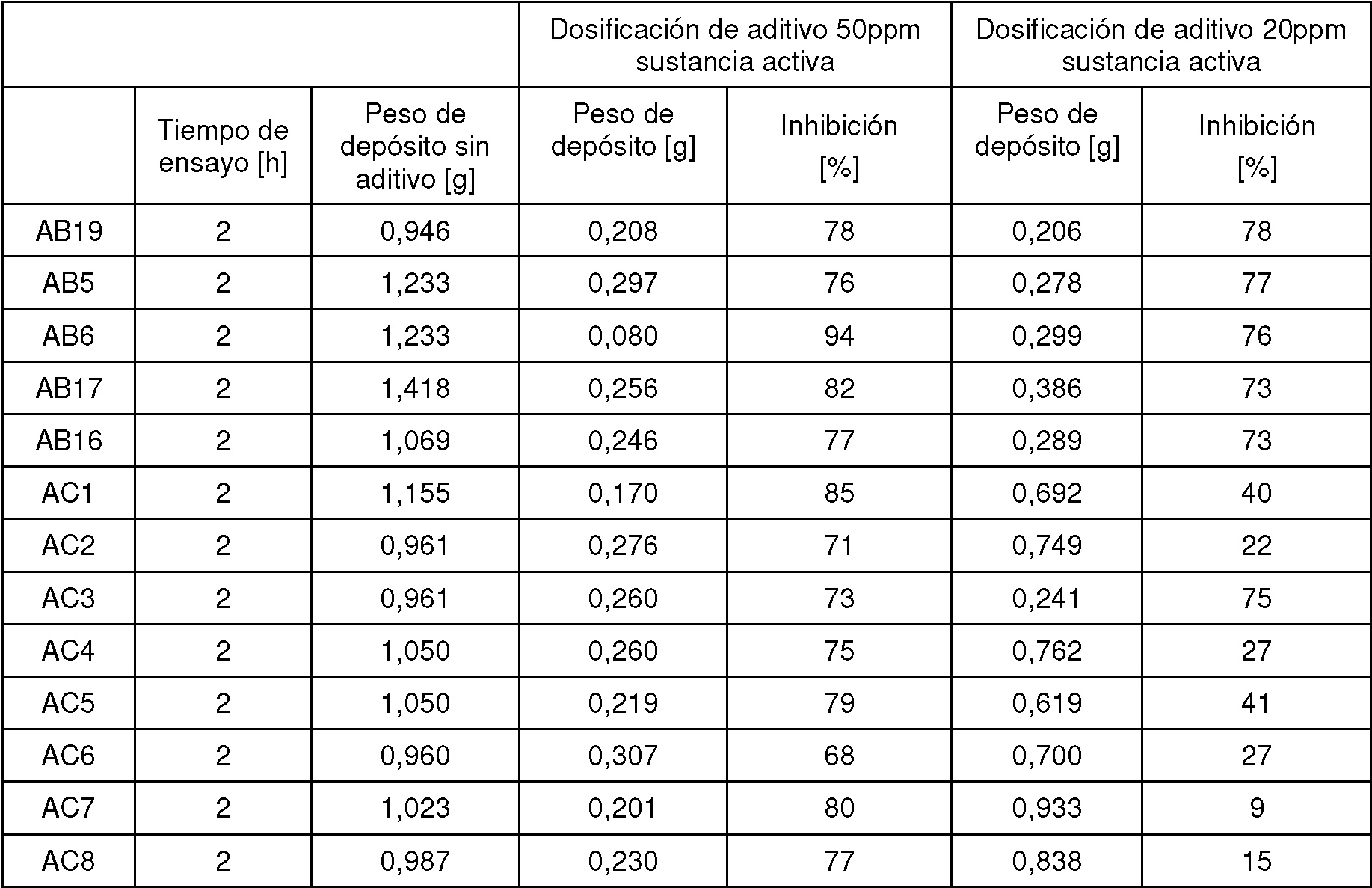

A partir de los resultados de las Tablas 9 y 10 se puede concluir que los oligómeros y polímeros de la invención provocan reducciones significativas de la precipitación de cera en una diversidad de formulaciones.From the results of Tables 9 and 10 it can be concluded that the oligomers and polymers of the invention cause significant reductions in wax precipitation in a variety of formulations.
Método de trabajo 2: Ensayo de punto de fluidezWorking method 2: Pour point test
Aparato: Baño de aguaApparatus: Water bath
Se determinó la temperatura de reducción del punto de fluidez [°C] como diferencia entre la temperatura de inicio y la última temperatura a la que el petróleo crudo aún es fluido.The pour point reduction temperature [°C] was determined as the difference between the start temperature and the last temperature at which the crude oil is still fluid.
Procedimiento de ensayo Petróleo crudo sintético 1Test Procedure Synthetic Crude Oil 1
Se calentó petróleo crudo sintético durante 1 hora a 60 °C (140 °F). Se colocaron 50 ml de petróleo crudo en un frasco de ensayo según la Norma ASTM D 5853 a temperatura ambiente. El aditivo se añadió a la muestra de petróleo crudo con una pipeta Eppendorf. La muestra se almacenó 30 minutos a 60 °C (140 °F). Después de eso, el frasco de ensayo se colocó en un baño frío (15 °C (59 °F)). Después de 30 minutos en el baño frío, el frasco de ensayo se retiró lentamente del baño de agua y se mantuvo en posición horizontal durante 5 segundos. Cuando se observó movimiento, el frasco de ensayo se volvió a colocar inmediatamente en el baño de agua a 60 °C (140 °F) durante 30 min. Después de eso, la muestra se colocó nuevamente en el baño frío a 3 °C (5 °F) menos que antes. Este procedimiento se repite hasta que no haya movimiento visible del petróleo crudo en la horizontal durante 5 segundos. La última temperatura a la que se aprecia movimiento se toma como punto de fluidez.Synthetic crude oil was heated for 1 hour at 60°C (140°F). 50 ml of crude oil was placed in a test flask according to ASTM D 5853 at room temperature. The additive was added to the crude oil sample with an Eppendorf pipette. The sample was stored for 30 minutes at 60 °C (140 °F). After that, the test flask was placed in a cold bath (15 °C (59 °F)). After 30 minutes in the cold bath, the test flask was slowly removed from the water bath and held horizontally for 5 seconds. When movement was observed, the test flask was immediately placed back in the 60 °C (140 °F) water bath for 30 min. After that, the sample was placed back into the cold bath at 3°C (5°F) lower than before. This procedure is repeated until there is no visible movement of the crude oil horizontally for 5 seconds. The last temperature at which movement is appreciated is taken as the pour point.
Procedimiento de ensayo Petróleo crudo sintético 2 y 3Test procedure Synthetic crude oil 2 and 3
Se calentó petróleo crudo sintético durante 1 hora a 80 °C (176 °F). Se colocaron 50 ml del petróleo crudo en el frasco de ensayo (Norma ASTM D 5853) a temperatura ambiente. El aditivo se añadió a la muestra de petróleo crudo con una pipeta Eppendorf. La muestra se almacenó 30 minutos a 80 °C (176 °F). Después de eso, se colocó el frasco de ensayo en un baño frío (baño frío a 45 °C (113 °F) para petróleo crudo sintético 2 o en un baño a 12 °C (54 °F) para petróleo crudo sintético 3. Después de 30 minutos en el baño frío, la muestra se retiró lentamente del baño de agua y se mantuvo horizontal durante 5 segundos. Cuando se observó movimiento, el frasco de ensayo se volvió a colocar inmediatamente en el baño de agua a 60 °C (140 °F) durante 30 minutos. Después de eso, la muestra se colocó nuevamente en el baño frío a 3 °C (5 °F) menos que antes. Este procedimiento se repite hasta que no haya movimiento visible de petróleo crudo en la horizontal durante 5 segundos. La última temperatura a la que se aprecia movimiento se toma como punto de fluidez.Synthetic crude oil was heated for 1 hour at 80°C (176°F). 50 ml of crude oil was placed in the test flask (ASTM D 5853) at room temperature. The additive was added to the crude oil sample with an Eppendorf pipette. The sample was stored for 30 minutes at 80 °C (176 °F). After that, the test flask was placed in a cold bath (45 °C (113 °F) cold bath for synthetic crude oil 2 or in a 12 °C (54 °F) bath for synthetic crude oil 3. After 30 minutes in the cold bath, the sample was slowly removed from the water bath and held horizontal for 5 seconds. When movement was observed, the test flask was immediately placed back into the 60 °C water bath ( 140 °F) for 30 minutes. After that, the sample was placed back into the cold bath at 3 °C (5 °F) less than before. This procedure is repeated until there is no visible movement of crude oil in the horizontal for 5 seconds. The last temperature at which movement is appreciated is taken as the pour point.
Resultados de la aplicación: ensayo de punto de fluidezApplication Results: Pour Point Test
Se llevaron a cabo ensayos de aplicación en el petróleo crudo sintético 1 (con un 4 % en peso de cera), en el petróleo crudo sintético 2 (con un 15 % en peso de cera) y en el petróleo crudo sintético 3 (con un 5 % en peso de cera). Se observó una reducción significativa de punto de fluidez en los 3 sistemas utilizando muestras preparadas según la invención basadas en polietileniminas modificadas.Application tests were carried out on synthetic crude oil 1 (with 4% by weight of wax), on synthetic crude oil 2 (with 15% by weight of wax) and on synthetic crude oil 3 (with 5% by weight of wax). A significant reduction in pour point was observed in the 3 systems using samples prepared according to the invention based on modified polyethyleneimines.
Tabla 11: Ensayo de punto de fluidez en petróleo crudo sintético 1Table 11: Pour point test on synthetic crude oil 1


Tabla 12: Ensayo de punto de fluidez en petróleo crudo sintético 3Table 12: Pour point test on synthetic crude oil 3

Tabla 13: Ensayo de punto de fluidez en petróleo crudo sintético 2Table 13: Pour point test on synthetic crude oil 2

A partir de los resultados de las Tablas 11, 12 y 13 se puede concluir que los oligómeros y polímeros de la invención provocan reducciones significativas del punto de fluidez a dosificaciones bajas y en una diversidad de formulaciones. From the results of Tables 11, 12 and 13 it can be concluded that the oligomers and polymers of the invention cause significant reductions in the pour point at low dosages and in a variety of formulations.
Claims (13)
Applications Claiming Priority (2)
| Application Number | Priority Date | Filing Date | Title |
|---|---|---|---|
| EP19185035 | 2019-07-08 | ||
| PCT/EP2020/068953 WO2021004991A1 (en) | 2019-07-08 | 2020-07-06 | Pour point depressant |
Publications (1)
| Publication Number | Publication Date |
|---|---|
| ES2954622T3 true ES2954622T3 (en) | 2023-11-23 |
Family
ID=67211631
Family Applications (1)
| Application Number | Title | Priority Date | Filing Date |
|---|---|---|---|
| ES20737002T Active ES2954622T3 (en) | 2019-07-08 | 2020-07-06 | pour point depressor |
Country Status (6)
| Country | Link |
|---|---|
| US (1) | US12054584B2 (en) |
| EP (1) | EP3997154B1 (en) |
| CN (1) | CN114096582B (en) |
| CA (1) | CA3145615C (en) |
| ES (1) | ES2954622T3 (en) |
| WO (1) | WO2021004991A1 (en) |
Families Citing this family (3)
| Publication number | Priority date | Publication date | Assignee | Title |
|---|---|---|---|---|
| CN116333712B (en) * | 2023-05-30 | 2023-08-11 | 新疆科力新技术发展股份有限公司 | Crude oil pour point depressant and preparation method thereof |
| CN116333711B (en) * | 2023-05-30 | 2023-08-11 | 新疆科力新技术发展股份有限公司 | Pour point depressant and preparation method thereof |
| WO2025219264A1 (en) * | 2024-04-18 | 2025-10-23 | Byk-Chemie Gmbh | Pour point depressant |
Family Cites Families (27)
| Publication number | Priority date | Publication date | Assignee | Title |
|---|---|---|---|---|
| CA1108792A (en) | 1977-05-11 | 1981-09-08 | Thomas E. Kiovsky | Star-shaped dispersant viscosity index improver |
| US4840748A (en) | 1981-05-18 | 1989-06-20 | Petrolite Corporation | Polyalkanolamines |
| EP0162890B1 (en) | 1983-10-31 | 1989-08-23 | Chevron Research And Technology Company | Deposit control additives - hydroxy polyether polyamines |
| US4803003A (en) | 1987-06-16 | 1989-02-07 | Exxon Chemical Patents Inc. | Ethylene copolymer viscosity index improver dispersant additive useful in oil compositions |
| US5229020A (en) | 1989-05-30 | 1993-07-20 | Exxon Chemical Patents Inc. | Branched amido-amine dispersant additives |
| US5310490A (en) | 1991-03-13 | 1994-05-10 | Exxon Chemical Products Inc. | Viscosity modifer polymers |
| SE9200564L (en) | 1992-02-26 | 1993-03-15 | Perstorp Ab | DENDRITIC MACROMOLECYLE OF POLYESTER TYPE, PROCEDURES FOR PRODUCING THEREOF AND USING THEREOF |
| US5387617A (en) | 1993-01-22 | 1995-02-07 | The Dow Chemical Company | Small cell foams and blends and a process for their preparation |
| GB9421282D0 (en) | 1994-10-21 | 1994-12-07 | Exxon Chemical Patents Inc | Additives and oleaginous compositions |
| US6127481A (en) | 1995-08-04 | 2000-10-03 | Dsm Copolymer, Inc. | Branched polyolefin polymers as additives in fuel and lubricating oil compositions |
| EP1557441A3 (en) | 2003-12-08 | 2006-06-28 | Peter Dr. Wilharm | Nucleating agent based on hyperbranched polymers |
| DE102005006030A1 (en) | 2005-02-09 | 2006-08-10 | Basf Ag | Hyperbranched polymers as demulsifiers for cracking crude oil emulsions |
| WO2009112379A1 (en) | 2008-03-04 | 2009-09-17 | Basf Se | Use of alkoxylated polyalkanolamines for breaking oil-water emulsions |
| EP2291436A4 (en) | 2008-06-10 | 2013-01-23 | Croda Inc | Water-in-oil polymer emulsions |
| DE102009060371A1 (en) * | 2009-12-24 | 2011-06-30 | Clariant International Ltd. | Multifunctional additives with improved flowability |
| TWI520977B (en) * | 2010-04-21 | 2016-02-11 | 首威索勒希斯股份有限公司 | Fluorinated polyurethane composition |
| JP2011231192A (en) * | 2010-04-27 | 2011-11-17 | Adeka Corp | Aqueous polyurethane resin composition and coating composition using the same |
| US20120059088A1 (en) | 2010-09-02 | 2012-03-08 | Baker Hughes Incorporated | Novel Copolymers for Use as Oilfield Demulsifiers |
| US9796917B2 (en) | 2011-07-29 | 2017-10-24 | M-I L.L.C. | Hydrocarbon fluid flow improver |
| CN104160000A (en) | 2012-03-07 | 2014-11-19 | 巴斯夫欧洲公司 | Use of substituted ureas or carbamates for further improving the cold flow properties of mineral oils and crude oils |
| US20130232858A1 (en) | 2012-03-07 | 2013-09-12 | Basf Se | Use of substituted ureas or urethanes for further improvement of the cold flow properties of mineral oils and crude oils |
| KR20140141630A (en) * | 2012-03-07 | 2014-12-10 | 바스프 에스이 | Use of substituted ureas or urethanes in order to improve the use properties of mineral and synthetic nonaqueous industrial liquids, in particular fuels or lubricants |
| US10087382B2 (en) | 2013-11-11 | 2018-10-02 | Schlumberger Norge As | Fluid additive and method of making and using the same |
| AR100387A1 (en) * | 2014-02-18 | 2016-10-05 | Basf Se | COPOLYMERS UNDERSTANDING ETHYLENE, VINYL ESTERS AND ACRYLIC ACID (MET) ESTERS, THEIR FORMULATIONS AND USES AS A FLUIDITY POINT DEPRESSOR, WAX INHIBITOR AND FLOW OIL POTENTIATOR |
| KR102227766B1 (en) | 2017-01-30 | 2021-03-15 | 비와이케이-케미 게엠베하 | Urea-group- and/or urethane-group-containing amides as rheology control agents and therein, methods for their preparation and use thereof |
| EP3592798A1 (en) | 2017-03-09 | 2020-01-15 | Basf Se | Use of hydrophobically modified polyalkanolamines as wax inhibitors, pour point depressant and additive for lubricants |
| NO347582B1 (en) * | 2017-12-07 | 2024-01-22 | Mi Llc | A flow improver composition and method |
-
2020
- 2020-07-06 ES ES20737002T patent/ES2954622T3/en active Active
- 2020-07-06 EP EP20737002.4A patent/EP3997154B1/en active Active
- 2020-07-06 US US17/624,620 patent/US12054584B2/en active Active
- 2020-07-06 CN CN202080049893.2A patent/CN114096582B/en active Active
- 2020-07-06 WO PCT/EP2020/068953 patent/WO2021004991A1/en not_active Ceased
- 2020-07-06 CA CA3145615A patent/CA3145615C/en active Active
Also Published As
| Publication number | Publication date |
|---|---|
| CN114096582A (en) | 2022-02-25 |
| US12054584B2 (en) | 2024-08-06 |
| EP3997154A1 (en) | 2022-05-18 |
| US20220267523A1 (en) | 2022-08-25 |
| CN114096582B (en) | 2024-02-13 |
| BR112022000234A2 (en) | 2022-02-22 |
| EP3997154B1 (en) | 2023-06-07 |
| CA3145615C (en) | 2024-02-13 |
| CA3145615A1 (en) | 2021-01-14 |
| WO2021004991A1 (en) | 2021-01-14 |
Similar Documents
| Publication | Publication Date | Title |
|---|---|---|
| ES2954622T3 (en) | pour point depressor | |
| RU2458108C2 (en) | Lubricating oil composition | |
| JP2013500237A (en) | Poly (hydroxycarboxylic acid) amide salt derivative and lubricating composition containing the same | |
| JP6007318B2 (en) | Water-soluble lubricant | |
| EP2449153A1 (en) | Polymeric corrosion inhibitors | |
| CA2823623A1 (en) | Continuously variable transmission fluid with extended anti-shudder durability | |
| KR20170032346A (en) | A composition to reduce the amount of aldehydes emitted from polyurethane foams | |
| KR910006131B1 (en) | Stabilized fuel oil containing a dispersant | |
| US20110190181A1 (en) | Lubricating composition comprising poly(hydroxycarboxylic acid) amide and detergent | |
| Gogoi et al. | Waterborne hyperbranched poly (ester amide urethane) thermoset: Mechanical, thermal and biodegradation behaviors | |
| US4235730A (en) | Polyurethanes and use thereof in lubricants and fuels | |
| JP6806401B2 (en) | A powdery shaking denaturing agent for non-aqueous paints, and a non-aqueous paint composition containing the same. | |
| BR112022000234B1 (en) | Pour Point Depressant | |
| AU2004267410A1 (en) | Complex polyol esters with improved performance | |
| RU2406752C2 (en) | Method of improving fluidity of mixture containing wax and other hydrocarbons | |
| RU2224587C2 (en) | Emulsifying composition for preparing explosive emulsion and a method for preparation thereof | |
| WO2025219264A1 (en) | Pour point depressant | |
| BR112013001610A2 (en) | method of preparing greases. | |
| WO2021076100A1 (en) | Flexible coating composition | |
| JP2016536402A5 (en) | ||
| WO2021127622A1 (en) | Lubricant composition comprising an antioxidant composition | |
| JP6962935B6 (en) | Crosslinked polymers, their manufacturing methods, and their use | |
| CN108698977B (en) | Dialkyl polyalkylamine compositions, method for the production thereof and use thereof | |
| CA3241460A1 (en) | Polyetheramide synergist | |
| JP5748219B2 (en) | Amine-based curing agent and water-based coating composition containing the same |