ES2955961T3 - Anti-ntb-a antibodies and related compositions and methods - Google Patents
Anti-ntb-a antibodies and related compositions and methods Download PDFInfo
- Publication number
- ES2955961T3 ES2955961T3 ES16818762T ES16818762T ES2955961T3 ES 2955961 T3 ES2955961 T3 ES 2955961T3 ES 16818762 T ES16818762 T ES 16818762T ES 16818762 T ES16818762 T ES 16818762T ES 2955961 T3 ES2955961 T3 ES 2955961T3
- Authority
- ES
- Spain
- Prior art keywords
- antibody
- occupied
- sec
- drug conjugate
- ntb
- Prior art date
- Legal status (The legal status is an assumption and is not a legal conclusion. Google has not performed a legal analysis and makes no representation as to the accuracy of the status listed.)
- Active
Links
Classifications
-
- C—CHEMISTRY; METALLURGY
- C07—ORGANIC CHEMISTRY
- C07K—PEPTIDES
- C07K16/00—Immunoglobulins [IG], e.g. monoclonal or polyclonal antibodies
- C07K16/18—Immunoglobulins [IG], e.g. monoclonal or polyclonal antibodies against material from animals or humans
- C07K16/28—Immunoglobulins [IG], e.g. monoclonal or polyclonal antibodies against material from animals or humans against receptors, cell surface antigens or cell surface determinants
- C07K16/2803—Immunoglobulins [IG], e.g. monoclonal or polyclonal antibodies against material from animals or humans against receptors, cell surface antigens or cell surface determinants against the immunoglobulin superfamily
-
- A—HUMAN NECESSITIES
- A61—MEDICAL OR VETERINARY SCIENCE; HYGIENE
- A61K—PREPARATIONS FOR MEDICAL, DENTAL OR TOILETRY PURPOSES
- A61K47/00—Medicinal preparations characterised by the non-active ingredients used, e.g. carriers or inert additives; Targeting or modifying agents chemically bound to the active ingredient
- A61K47/50—Medicinal preparations characterised by the non-active ingredients used, e.g. carriers or inert additives; Targeting or modifying agents chemically bound to the active ingredient the non-active ingredient being chemically bound to the active ingredient, e.g. polymer-drug conjugates
- A61K47/51—Medicinal preparations characterised by the non-active ingredients used, e.g. carriers or inert additives; Targeting or modifying agents chemically bound to the active ingredient the non-active ingredient being chemically bound to the active ingredient, e.g. polymer-drug conjugates the non-active ingredient being a modifying agent
- A61K47/68—Medicinal preparations characterised by the non-active ingredients used, e.g. carriers or inert additives; Targeting or modifying agents chemically bound to the active ingredient the non-active ingredient being chemically bound to the active ingredient, e.g. polymer-drug conjugates the non-active ingredient being a modifying agent the modifying agent being an antibody, an immunoglobulin or a fragment thereof, e.g. an Fc-fragment
- A61K47/6801—Drug-antibody or immunoglobulin conjugates defined by the pharmacologically or therapeutically active agent
- A61K47/6803—Drugs conjugated to an antibody or immunoglobulin, e.g. cisplatin-antibody conjugates
- A61K47/6811—Drugs conjugated to an antibody or immunoglobulin, e.g. cisplatin-antibody conjugates the drug being a protein or peptide, e.g. transferrin or bleomycin
-
- A—HUMAN NECESSITIES
- A61—MEDICAL OR VETERINARY SCIENCE; HYGIENE
- A61K—PREPARATIONS FOR MEDICAL, DENTAL OR TOILETRY PURPOSES
- A61K47/00—Medicinal preparations characterised by the non-active ingredients used, e.g. carriers or inert additives; Targeting or modifying agents chemically bound to the active ingredient
- A61K47/50—Medicinal preparations characterised by the non-active ingredients used, e.g. carriers or inert additives; Targeting or modifying agents chemically bound to the active ingredient the non-active ingredient being chemically bound to the active ingredient, e.g. polymer-drug conjugates
- A61K47/51—Medicinal preparations characterised by the non-active ingredients used, e.g. carriers or inert additives; Targeting or modifying agents chemically bound to the active ingredient the non-active ingredient being chemically bound to the active ingredient, e.g. polymer-drug conjugates the non-active ingredient being a modifying agent
- A61K47/62—Medicinal preparations characterised by the non-active ingredients used, e.g. carriers or inert additives; Targeting or modifying agents chemically bound to the active ingredient the non-active ingredient being chemically bound to the active ingredient, e.g. polymer-drug conjugates the non-active ingredient being a modifying agent the modifying agent being a protein, peptide or polyamino acid
- A61K47/65—Peptidic linkers, binders or spacers, e.g. peptidic enzyme-labile linkers
-
- A—HUMAN NECESSITIES
- A61—MEDICAL OR VETERINARY SCIENCE; HYGIENE
- A61K—PREPARATIONS FOR MEDICAL, DENTAL OR TOILETRY PURPOSES
- A61K47/00—Medicinal preparations characterised by the non-active ingredients used, e.g. carriers or inert additives; Targeting or modifying agents chemically bound to the active ingredient
- A61K47/50—Medicinal preparations characterised by the non-active ingredients used, e.g. carriers or inert additives; Targeting or modifying agents chemically bound to the active ingredient the non-active ingredient being chemically bound to the active ingredient, e.g. polymer-drug conjugates
- A61K47/51—Medicinal preparations characterised by the non-active ingredients used, e.g. carriers or inert additives; Targeting or modifying agents chemically bound to the active ingredient the non-active ingredient being chemically bound to the active ingredient, e.g. polymer-drug conjugates the non-active ingredient being a modifying agent
- A61K47/68—Medicinal preparations characterised by the non-active ingredients used, e.g. carriers or inert additives; Targeting or modifying agents chemically bound to the active ingredient the non-active ingredient being chemically bound to the active ingredient, e.g. polymer-drug conjugates the non-active ingredient being a modifying agent the modifying agent being an antibody, an immunoglobulin or a fragment thereof, e.g. an Fc-fragment
- A61K47/6801—Drug-antibody or immunoglobulin conjugates defined by the pharmacologically or therapeutically active agent
- A61K47/6803—Drugs conjugated to an antibody or immunoglobulin, e.g. cisplatin-antibody conjugates
- A61K47/68031—Drugs conjugated to an antibody or immunoglobulin, e.g. cisplatin-antibody conjugates the drug being an auristatin
-
- A—HUMAN NECESSITIES
- A61—MEDICAL OR VETERINARY SCIENCE; HYGIENE
- A61K—PREPARATIONS FOR MEDICAL, DENTAL OR TOILETRY PURPOSES
- A61K47/00—Medicinal preparations characterised by the non-active ingredients used, e.g. carriers or inert additives; Targeting or modifying agents chemically bound to the active ingredient
- A61K47/50—Medicinal preparations characterised by the non-active ingredients used, e.g. carriers or inert additives; Targeting or modifying agents chemically bound to the active ingredient the non-active ingredient being chemically bound to the active ingredient, e.g. polymer-drug conjugates
- A61K47/51—Medicinal preparations characterised by the non-active ingredients used, e.g. carriers or inert additives; Targeting or modifying agents chemically bound to the active ingredient the non-active ingredient being chemically bound to the active ingredient, e.g. polymer-drug conjugates the non-active ingredient being a modifying agent
- A61K47/68—Medicinal preparations characterised by the non-active ingredients used, e.g. carriers or inert additives; Targeting or modifying agents chemically bound to the active ingredient the non-active ingredient being chemically bound to the active ingredient, e.g. polymer-drug conjugates the non-active ingredient being a modifying agent the modifying agent being an antibody, an immunoglobulin or a fragment thereof, e.g. an Fc-fragment
- A61K47/6801—Drug-antibody or immunoglobulin conjugates defined by the pharmacologically or therapeutically active agent
- A61K47/6803—Drugs conjugated to an antibody or immunoglobulin, e.g. cisplatin-antibody conjugates
- A61K47/68035—Drugs conjugated to an antibody or immunoglobulin, e.g. cisplatin-antibody conjugates the drug being a pyrrolobenzodiazepine
-
- A—HUMAN NECESSITIES
- A61—MEDICAL OR VETERINARY SCIENCE; HYGIENE
- A61K—PREPARATIONS FOR MEDICAL, DENTAL OR TOILETRY PURPOSES
- A61K47/00—Medicinal preparations characterised by the non-active ingredients used, e.g. carriers or inert additives; Targeting or modifying agents chemically bound to the active ingredient
- A61K47/50—Medicinal preparations characterised by the non-active ingredients used, e.g. carriers or inert additives; Targeting or modifying agents chemically bound to the active ingredient the non-active ingredient being chemically bound to the active ingredient, e.g. polymer-drug conjugates
- A61K47/51—Medicinal preparations characterised by the non-active ingredients used, e.g. carriers or inert additives; Targeting or modifying agents chemically bound to the active ingredient the non-active ingredient being chemically bound to the active ingredient, e.g. polymer-drug conjugates the non-active ingredient being a modifying agent
- A61K47/68—Medicinal preparations characterised by the non-active ingredients used, e.g. carriers or inert additives; Targeting or modifying agents chemically bound to the active ingredient the non-active ingredient being chemically bound to the active ingredient, e.g. polymer-drug conjugates the non-active ingredient being a modifying agent the modifying agent being an antibody, an immunoglobulin or a fragment thereof, e.g. an Fc-fragment
- A61K47/6835—Medicinal preparations characterised by the non-active ingredients used, e.g. carriers or inert additives; Targeting or modifying agents chemically bound to the active ingredient the non-active ingredient being chemically bound to the active ingredient, e.g. polymer-drug conjugates the non-active ingredient being a modifying agent the modifying agent being an antibody, an immunoglobulin or a fragment thereof, e.g. an Fc-fragment the modifying agent being an antibody or an immunoglobulin bearing at least one antigen-binding site
- A61K47/6851—Medicinal preparations characterised by the non-active ingredients used, e.g. carriers or inert additives; Targeting or modifying agents chemically bound to the active ingredient the non-active ingredient being chemically bound to the active ingredient, e.g. polymer-drug conjugates the non-active ingredient being a modifying agent the modifying agent being an antibody, an immunoglobulin or a fragment thereof, e.g. an Fc-fragment the modifying agent being an antibody or an immunoglobulin bearing at least one antigen-binding site the antibody targeting a determinant of a tumour cell
-
- A—HUMAN NECESSITIES
- A61—MEDICAL OR VETERINARY SCIENCE; HYGIENE
- A61P—SPECIFIC THERAPEUTIC ACTIVITY OF CHEMICAL COMPOUNDS OR MEDICINAL PREPARATIONS
- A61P35/00—Antineoplastic agents
-
- A—HUMAN NECESSITIES
- A61—MEDICAL OR VETERINARY SCIENCE; HYGIENE
- A61K—PREPARATIONS FOR MEDICAL, DENTAL OR TOILETRY PURPOSES
- A61K39/00—Medicinal preparations containing antigens or antibodies
- A61K2039/505—Medicinal preparations containing antigens or antibodies comprising antibodies
-
- A—HUMAN NECESSITIES
- A61—MEDICAL OR VETERINARY SCIENCE; HYGIENE
- A61K—PREPARATIONS FOR MEDICAL, DENTAL OR TOILETRY PURPOSES
- A61K39/00—Medicinal preparations containing antigens or antibodies
- A61K2039/57—Medicinal preparations containing antigens or antibodies characterised by the type of response, e.g. Th1, Th2
- A61K2039/572—Medicinal preparations containing antigens or antibodies characterised by the type of response, e.g. Th1, Th2 cytotoxic response
-
- A—HUMAN NECESSITIES
- A61—MEDICAL OR VETERINARY SCIENCE; HYGIENE
- A61K—PREPARATIONS FOR MEDICAL, DENTAL OR TOILETRY PURPOSES
- A61K2121/00—Preparations for use in therapy
-
- C—CHEMISTRY; METALLURGY
- C07—ORGANIC CHEMISTRY
- C07K—PEPTIDES
- C07K2317/00—Immunoglobulins specific features
- C07K2317/20—Immunoglobulins specific features characterized by taxonomic origin
- C07K2317/24—Immunoglobulins specific features characterized by taxonomic origin containing regions, domains or residues from different species, e.g. chimeric, humanized or veneered
-
- C—CHEMISTRY; METALLURGY
- C07—ORGANIC CHEMISTRY
- C07K—PEPTIDES
- C07K2317/00—Immunoglobulins specific features
- C07K2317/30—Immunoglobulins specific features characterized by aspects of specificity or valency
- C07K2317/33—Crossreactivity, e.g. for species or epitope, or lack of said crossreactivity
-
- C—CHEMISTRY; METALLURGY
- C07—ORGANIC CHEMISTRY
- C07K—PEPTIDES
- C07K2317/00—Immunoglobulins specific features
- C07K2317/50—Immunoglobulins specific features characterized by immunoglobulin fragments
- C07K2317/56—Immunoglobulins specific features characterized by immunoglobulin fragments variable (Fv) region, i.e. VH and/or VL
- C07K2317/567—Framework region [FR]
-
- C—CHEMISTRY; METALLURGY
- C07—ORGANIC CHEMISTRY
- C07K—PEPTIDES
- C07K2317/00—Immunoglobulins specific features
- C07K2317/70—Immunoglobulins specific features characterized by effect upon binding to a cell or to an antigen
- C07K2317/73—Inducing cell death, e.g. apoptosis, necrosis or inhibition of cell proliferation
-
- C—CHEMISTRY; METALLURGY
- C07—ORGANIC CHEMISTRY
- C07K—PEPTIDES
- C07K2317/00—Immunoglobulins specific features
- C07K2317/70—Immunoglobulins specific features characterized by effect upon binding to a cell or to an antigen
- C07K2317/73—Inducing cell death, e.g. apoptosis, necrosis or inhibition of cell proliferation
- C07K2317/732—Antibody-dependent cellular cytotoxicity [ADCC]
-
- C—CHEMISTRY; METALLURGY
- C07—ORGANIC CHEMISTRY
- C07K—PEPTIDES
- C07K2317/00—Immunoglobulins specific features
- C07K2317/90—Immunoglobulins specific features characterized by (pharmaco)kinetic aspects or by stability of the immunoglobulin
- C07K2317/92—Affinity (KD), association rate (Ka), dissociation rate (Kd) or EC50 value
Landscapes
- Health & Medical Sciences (AREA)
- Bioinformatics & Cheminformatics (AREA)
- Engineering & Computer Science (AREA)
- Life Sciences & Earth Sciences (AREA)
- Chemical & Material Sciences (AREA)
- Immunology (AREA)
- Medicinal Chemistry (AREA)
- General Health & Medical Sciences (AREA)
- Pharmacology & Pharmacy (AREA)
- Animal Behavior & Ethology (AREA)
- Public Health (AREA)
- Veterinary Medicine (AREA)
- Epidemiology (AREA)
- Organic Chemistry (AREA)
- Molecular Biology (AREA)
- Proteomics, Peptides & Aminoacids (AREA)
- Cell Biology (AREA)
- Biochemistry (AREA)
- Genetics & Genomics (AREA)
- Biophysics (AREA)
- Chemical Kinetics & Catalysis (AREA)
- General Chemical & Material Sciences (AREA)
- Nuclear Medicine, Radiotherapy & Molecular Imaging (AREA)
- Medicines Containing Antibodies Or Antigens For Use As Internal Diagnostic Agents (AREA)
- Peptides Or Proteins (AREA)
- Medicines That Contain Protein Lipid Enzymes And Other Medicines (AREA)
- Medicinal Preparation (AREA)
- Pharmaceuticals Containing Other Organic And Inorganic Compounds (AREA)
- Preparation Of Compounds By Using Micro-Organisms (AREA)
Abstract
Se describen anticuerpos, incluidos conjugados de fármaco-anticuerpo, que se unen específicamente a NTB-A. También se describen métodos para usar los anticuerpos anti-NTB-A para detectar o modular la actividad de (por ejemplo, inhibir la proliferación de) una célula que expresa NTB-A, así como para diagnóstico o tratamiento de enfermedades o trastornos (por ejemplo, cáncer). asociado con células que expresan NTB-A, como el mieloma múltiple, el linfoma no Hodgkin y la leucemia mieloide aguda. (Traducción automática con Google Translate, sin valor legal)Antibodies, including drug-antibody conjugates, that specifically bind to NTB-A are described. Also described are methods for using anti-NTB-A antibodies to detect or modulate the activity of (e.g., inhibit the proliferation of) a cell expressing NTB-A, as well as for diagnosis or treatment of diseases or disorders (e.g. , cancer). associated with cells that express NTB-A, such as multiple myeloma, non-Hodgkin lymphoma, and acute myeloid leukemia. (Automatic translation with Google Translate, without legal value)
Description
DESCRIPCIÓNDESCRIPTION
Anticuerpos anti-ntb-a y composiciones y métodos relacionadosAnti-ntb-a antibodies and related compositions and methods
DescripciónDescription
AntecedentesBackground
La NTB-A, una glicoproteína de membrana de tipo I de un único paso también denominada SLAMF6, es un miembro de la superfamilia de inmunoglobulinas (Ig-SF, por sus siglas en inglés) que pertenece a la subfamilia CD2/SLAM. Ver, p. ej., Bottino y col., J. Exp. Med. 194:235-246, 2001. La NTB-A se caracteriza, en su porción extracelular, por un dominio tipo V del N-terminal seguido de un dominio tipo C2, mientras que la porción intracitoplasmática contiene tres motivos basados en tirosina: dos motivos de mechón del inmunorreceptor basados en tirosina (ITSM, por sus siglas en inglés; TxYxxV/I) y un motivo de inhibición del inmunorreceptor basado en tirosina clásico (ITIM, por sus siglas en inglés; I/V/L/SxYxxL). Ver id. A través de sus motivos ITSM, la NTB-A se asocia con el dominio SH2 de la proteína SH2D1A asociada a SLAM y el transcrito activado de sarcoma de Ewing (EAT, por sus siglas en inglés) 2 relacionado. Ver Bottino y col., indicado anteriormente; Wang y col., Eur. J. Immunol. 34:1663-1672, 2004; Ver Flaig y col., J. Immunol. 172:6524-6527, 2004.NTB-A, a single-pass type I membrane glycoprotein also called SLAMF6, is a member of the immunoglobulin superfamily (Ig-SF) that belongs to the CD2/SLAM subfamily. See, p. e.g., Bottino et al., J. Exp. Med. 194:235-246, 2001. NTB-A is characterized, in its extracellular portion, by an N-terminal type V domain followed by a C2 type domain, while the intracytoplasmic portion contains three tyrosine-based motifs: two immunoreceptor tyrosine-based tuft motifs (ITSM; TxYxxV/I) and a classical tyrosine-based immunoreceptor inhibition motif (ITIM). acronym in English; I /V /L/SxYxxL). See ID Through its ITSM motifs, NTB-A associates with the SH2 domain of the SLAM-associated protein SH2D1A and the related Ewing sarcoma activated transcript (EAT) 2. See Bottino et al., noted above; Wang et al., Eur. J. Immunol. 34:1663-1672, 2004; See Flaig et al., J. Immunol. 172:6524-6527, 2004.
La NTB-A se expresa en células citolíticas naturales (NK, por sus siglas en inglés), células T similares a NK, células T, monocitos, células dendríticas, células B y eosinófilos. Ver Salar JD. y col., Immunology Letters 129-136, 2011; Matesanz-Isabel y col., Immunology Letters 104-112, 2011; Munitz y col., Journal of Immunology 174:110-118, 2005; Bottino y col., Journal of Experimental Medicine 194(3):235-246; 2001. La NTB-A puede funcionar a través de interacciones homotípicas (es decir, como un autoligando), y se ha demostrado que actúa como un regulador positivo de las funciones de las células NK a través de la señalización, lo que induce la citotoxicidad de las células NK. Ver, p. ej., ver Bottino y col., indicado anteriormente; Falco y col., indicado anteriormente; Flaig et al., indicado anteriormente. También se ha demostrado que la NTB-A se expresa en células B de pacientes con leucemia linfocítica crónica (CLL, por sus siglas en inglés) y linfoma de células B. Ver Korver y col., British Journal of Haematology 137:307-318, 2007. WO/2014 100740 describe anticuerpos dirigidos a la NTB-A humana.NTB-A is expressed in natural killer (NK) cells, NK-like T cells, T cells, monocytes, dendritic cells, B cells, and eosinophils. See Salar JD. et al., Immunology Letters 129-136, 2011; Matesanz-Isabel et al., Immunology Letters 104-112, 2011; Munitz et al., Journal of Immunology 174:110-118, 2005; Bottino et al., Journal of Experimental Medicine 194(3):235-246; 2001. NTB-A can function through homotypic interactions ( i.e., as a self-ligand), and has been shown to act as a positive regulator of NK cell functions through signaling, inducing cytotoxicity. of NK cells. See, p. e.g., see Bottino et al., indicated above; Falco et al., indicated above; Flaig et al., indicated above. NTB-A has also been shown to be expressed on B cells from patients with chronic lymphocytic leukemia (CLL) and B-cell lymphoma. See Korver et al., British Journal of Haematology 137:307-318 , 2007. WO/2014 100740 describes antibodies directed to human NTB-A.
La invención se define en las reivindicaciones. Cualquier referencia en la descripción a los métodos de tratamiento se refiere a los compuestos, composiciones farmacéuticas y medicamentos de la presente invención para usar en un método para el tratamiento del cuerpo humano (o animal) mediante terapia (o para el diagnóstico).The invention is defined in the claims. Any reference in the description to treatment methods refers to the compounds, pharmaceutical compositions and medicaments of the present invention for use in a method for the treatment of the human (or animal) body by therapy (or for diagnosis).
Breve descripción de las figurasBrief description of the figures
La Figura 1 muestra una alineación de secuencia de la región variable de cadena pesada de 20F3 de ratón, la secuencia humanizada con CDR de ratón (en el recuadro) en un aceptor humano sin retromutaciones y variantes humanizadas, HA-HE. Las CDR son según lo definido por Kabat.Figure 1 shows a sequence alignment of the mouse 20F3 heavy chain variable region, the humanized sequence with mouse CDR (inset) into a human acceptor without backmutations and humanized variants, HA-HE. The CDRs are as defined by Kabat.
La Figura 2 muestra una alineación de secuencia de la región variable de cadena ligera de 20F3 de ratón, la secuencia humanizada con CDR de ratón (en el recuadro) en un aceptor humano sin retromutaciones y variantes humanizadas, LA-LD. Las CDR son según lo definido por Kabat.Figure 2 shows a sequence alignment of the mouse 20F3 light chain variable region, the humanized sequence with mouse CDR (inset) into a human acceptor without backmutations and humanized variants, LA-LD. The CDRs are as defined by Kabat.
La Figura 3 muestra los resultados de un estudio de xenoinjerto diseminado de mieloma múltiple en la línea celular MM.1R en ratones NSG. La dosis se indica en la figura. La ADC es un conjugado de anticuerpo-fármaco de 20F3 humanizado y PBDFigure 3 shows the results of a multiple myeloma disseminated xenograft study on the MM.1R cell line in NSG mice. The dosage is indicated in the figure. ADC is an antibody-drug conjugate of humanized 20F3 and PBD
La Figura 4 muestra los resultados de un estudio de xenoinjerto diseminado de mieloma múltiple en la línea celular U-266 en ratones NSG. La dosis se indica en la figura. La ADC es un conjugado de anticuerpo-fármaco de 20F3 humanizado y PBDFigure 4 shows the results of a multiple myeloma disseminated xenograft study on the U-266 cell line in NSG mice. The dosage is indicated in the figure. ADC is an antibody-drug conjugate of humanized 20F3 and PBD
La Figura 5 muestra los resultados de un estudio de xenoinjerto diseminado de mieloma múltiple en la línea celular EJM en ratones NSG. La dosis se indica en la figura. La ADC es un conjugado de anticuerpo-fármaco de 20F3 humanizado y PBD Figure 5 shows the results of a disseminated xenograft study of multiple myeloma in the EJM cell line in NSG mice. The dosage is indicated in the figure. ADC is an antibody-drug conjugate of humanized 20F3 and PBD
La Figura 6 muestra los resultados de un estudio de xenoinjerto subcutáneo de AML en la línea celular HNT-34 en ratones SKID. La dosis se indica en la figura. La ADC es un conjugado de anticuerpo-fármaco de 20F3 humanizado y PBD Figure 6 shows the results of a subcutaneous AML xenograft study on the HNT-34 cell line in SKID mice. The dosage is indicated in the figure. ADC is an antibody-drug conjugate of humanized 20F3 and PBD
La Figura 7 muestra los resultados de un estudio de xenoinjerto diseminado de mieloma múltiple en la línea celular MM.1R en ratones NSG. La dosis se indica en la figura. La ADC es un conjugado de anticuerpo-fármaco de 20F3 humanizado y auristatina.Figure 7 shows the results of a multiple myeloma disseminated xenograft study on the MM.1R cell line in NSG mice. The dosage is indicated in the figure. ADC is an antibody-drug conjugate of humanized 20F3 and auristatin.
La Figura 8 muestra los resultados de un estudio de xenoinjerto diseminado de mieloma múltiple en la línea celular U-266 en ratones NSG. La dosis se indica en la figura. Las ADC son ambos conjugados de anticuerpofármaco de 20F3 humanizado y auristatina. Figure 8 shows the results of a multiple myeloma disseminated xenograft study on the U-266 cell line in NSG mice. The dosage is indicated in the figure. The ADCs are both antibody-drug conjugates of humanized 20F3 and auristatin.
La Figura 9 muestra los resultados de un estudio de xenoinjerto diseminado por mieloma múltiple en la línea celular EJM en ratones NSG. La dosis se indica en la figura. Las ADC son ambos conjugados de anticuerpofármaco de 20F3 humanizado y auristatina.Figure 9 shows the results of a multiple myeloma disseminated xenograft study on the EJM cell line in NSG mice. The dosage is indicated in the figure. The ADCs are both antibody-drug conjugates of humanized 20F3 and auristatin.
La Figura 10 muestra los resultados de un estudio de xenoinjerto subcutáneo de AML en la línea celular HNT-34 en ratones SKID. La dosis se indica en la figura. Las ADC son ambos conjugados de anticuerpo-fármaco de 20F3 humanizado y auristatina.Figure 10 shows the results of a subcutaneous AML xenograft study on the HNT-34 cell line in SKID mice. The dosage is indicated in the figure. The ADCs are both antibody-drug conjugates of humanized 20F3 and auristatin.
La Figura 11 muestra los resultados de un estudio de xenoinjerto subcutáneo de linfoma no hodkiniano en la línea celular Raji en ratones SCID. La dosis se indica en la figura. Las ADC son ambos conjugados de anticuerpofármaco de 20F3 humanizado y auristatina.Figure 11 shows the results of a subcutaneous xenograft study of non-Hodkin's lymphoma in the Raji cell line in SCID mice. The dosage is indicated in the figure. The ADCs are both antibody-drug conjugates of humanized 20F3 and auristatin.
La Figura 12 muestra los resultados de un estudio de xenoinjerto subcutáneo de linfoma no hodkiniano en la línea celular WSU-DLCL2 en ratones SCID. La dosis se indica en la figura. Las ADC son ambos conjugados de anticuerpo-fármaco de 20F3 humanizado y auristatina.Figure 12 shows the results of a subcutaneous non-Hodkin's lymphoma xenograft study on the WSU-DLCL2 cell line in SCID mice. The dosage is indicated in the figure. The ADCs are both antibody-drug conjugates of humanized 20F3 and auristatin.
DefinicionesDefinitions
Un “ conjugado de anticuerpo-fármaco” se refiere a un anticuerpo conjugado de con un agente citotóxico o un agente citostático. Típicamente, los conjugados de anticuerpo-fármaco se unen a un antígeno diana (p. ej., NTB-A) en una superficie celular seguido de la internalización del conjugado de anticuerpo-fármaco en la célula y la liberación del fármaco.An “antibody-drug conjugate” refers to an antibody conjugated to a cytotoxic agent or a cytostatic agent. Typically, antibody-drug conjugates bind to a target antigen (e.g., NTB-A) on a cell surface followed by internalization of the antibody-drug conjugate into the cell and release of the drug.
[0005] Un “ polipéptido” o “ cadena polipeptídica” es un polímero de residuos de aminoácidos unidos por enlaces peptídicos, ya sean producidos naturalmente o sintéticamente. Los polipéptidos de menos de aproximadamente 10 residuos de aminoácidos se denominan comúnmente “ péptidos” . [0005] A “polypeptide” or “polypeptide chain” is a polymer of amino acid residues linked by peptide bonds, whether produced naturally or synthetically. Polypeptides of less than about 10 amino acid residues are commonly called "peptides."
Una “ proteína” es una macromolécula que comprende una o más cadenas polipeptídicas. Una proteína también puede comprender componentes no peptídicos, tales como grupos carbohidrato. Pueden añadirse carbohidratos y otros sustituyentes no peptídicos a una proteína por la célula en la que se produce la proteína, y variarán según el tipo de célula. Las proteínas se definen en la presente memoria en términos de sus estructuras de cadena principal de aminoácidos; Los sustituyentes tales como grupos carbohidrato generalmente no se especifican, pero aun así pueden estar presentes. A “protein” is a macromolecule comprising one or more polypeptide chains. A protein may also comprise non-peptide components, such as carbohydrate groups. Carbohydrates and other non-peptide substituents can be added to a protein by the cell in which the protein is produced, and will vary depending on the type of cell. Proteins are defined herein in terms of their amino acid backbone structures; Substituents such as carbohydrate groups are generally not specified, but may still be present.
Los términos “ amino-terminal” y “ carboxilo-terminal” denotan posiciones dentro de polipéptidos. Cuando el contexto lo permite, estos términos se usan con referencia a una secuencia o porción particular de un polipéptido para indicar proximidad o posición relativa. Por ejemplo, un carboxilo-terminal colocado en una determinada secuencia a una secuencia de referencia dentro de un polipéptido se ubica proximal al extremo carboxilo de la secuencia de referencia, pero no está necesariamente en el terminal carboxilo del polipéptido completo.The terms “amino-terminal” and “carboxy-terminal” denote positions within polypeptides. When the context permits, these terms are used with reference to a particular sequence or portion of a polypeptide to indicate proximity or relative position. For example, a carboxyl-terminus placed in a certain sequence to a reference sequence within a polypeptide is located proximal to the carboxyl terminus of the reference sequence, but is not necessarily at the carboxyl terminus of the entire polypeptide.
El término “ anticuerpo” indica proteínas de inmunoglobulina producidas por el cuerpo en respuesta a la presencia de un antígeno y que se une al antígeno, así como a fragmentos de unión a antígeno y variantes modificadas de los mismos. Por lo tanto, el término “ anticuerpo” incluye, por ejemplo, anticuerpos monoclonales intactos (p. ej., anticuerpos producidos usando la tecnología de hibridoma) y fragmentos de anticuerpo de unión a antígeno, tales como F (ab')2 y fragmentos Fab. Los anticuerpos y fragmentos intactos modificados genéticamente, tales como anticuerpos quiméricos, anticuerpos humanizados, fragmentos Fv monocatenarios, anticuerpos monocatenario, diacuerpos, minicuerpos, anticuerpos lineales, multivalentes o multiespecíficos (p. ej., anticuerpos biespecíficos), y similares también se incluyen. Por lo tanto, el término “ anticuerpo” se usa de manera expandible para incluir cualquier proteína que comprende un sitio de unión a antígeno de un anticuerpo y es capaz de unirse específicamente a su antígeno. El término “ anticuerpo” también incluye un anticuerpo por sí mismo (“ anticuerpo desnudo” ) o un anticuerpo conjugado de con un fármaco citostático o citotóxico.The term "antibody" indicates immunoglobulin proteins produced by the body in response to the presence of an antigen and that bind to the antigen, as well as to antigen-binding fragments and modified variants thereof. Therefore, the term "antibody" includes, for example, intact monoclonal antibodies ( e.g., antibodies produced using hybridoma technology) and antigen-binding antibody fragments, such as F(ab')2 and F(ab')2 fragments. Fab. Genetically modified intact antibodies and fragments, such as chimeric antibodies, humanized antibodies, single-chain Fv fragments, single-chain antibodies, diabodies, minibodies, linear, multivalent or multispecific antibodies ( e.g., bispecific antibodies), and the like are also included. Therefore, the term "antibody" is used expandably to include any protein that comprises an antigen-binding site of an antibody and is capable of specifically binding to its antigen. The term "antibody" also includes an antibody by itself ("naked antibody") or an antibody conjugated to a cytostatic or cytotoxic drug.
El término “ anticuerpos genéticamente modificados” significa anticuerpos en los que la secuencia de aminoácidos se ha variado de la de un anticuerpo nativo. Debido a la relevancia de las técnicas de ADN recombinante en la generación de anticuerpos, no es necesario limitar las secuencias de aminoácidos que se encuentran en los anticuerpos naturales; los anticuerpos pueden rediseñarse para obtener las características deseadas. Las posibles variaciones son muchas y varían desde el cambio de solo uno o unos pocos aminoácidos al rediseño completo de, por ejemplo, la región variable o constante. Los cambios en la región constante se hacen, en general, para mejorar o alterar las características tales como, p. ej., fijación del complemento, interacción con las células y otras funciones efectoras. Típicamente, los cambios en la región variable se hacen para mejorar las características de unión al antígeno, mejorar la estabilidad de la región variable o reducir el riesgo de inmunogenicidad.The term “genetically modified antibodies” means antibodies in which the amino acid sequence has been varied from that of a native antibody. Due to the relevance of recombinant DNA techniques in the generation of antibodies, it is not necessary to limit the amino acid sequences found in natural antibodies; Antibodies can be redesigned to obtain desired characteristics. The possible variations are many and range from changing just one or a few amino acids to completely redesigning, for example, the variable or constant region. Changes to the constant region are generally made to improve or alter characteristics such as, e.g. e.g., complement fixation, interaction with cells and other effector functions. Typically, changes to the variable region are made to improve antigen binding characteristics, improve the stability of the variable region, or reduce the risk of immunogenicity.
Un “ sitio de unión a antígeno de un anticuerpo” es esa porción de un anticuerpo que es suficiente para unirse a su antígeno. La región mínima tal es típicamente un dominio variable o una variante modificada genéticamente del mismo. Los sitios de unión de dominio único pueden generarse a partir de anticuerpos de camélido (ver Muyldermans y Lauwereys, J. Mol. Recog. 12:131-140, 1999; Nguyen y col., Em BO J. 19:921-930, 2000) o de dominios VH de otras especies para producir anticuerpos de dominio único (“ dAb” ; ver Ward y col., Nature 341:544-546, 1989; patente US-6.248.516 de Winter y col.). Comúnmente, un sitio de unión a antígeno de un anticuerpo comprende tanto un dominio variable de cadena pesada (VH) como un dominio variable de cadena ligera (VL) que se une a un epítopo común. Dentro del contexto de la presente invención, un anticuerpo puede incluir uno o más componentes además de un sitio de unión a antígeno, tal como, por ejemplo, un segundo sitio de unión a antígeno de un anticuerpo (que puede unirse al mismo epítopo o uno diferente o al mismo antígeno o uno diferente), un enlazador peptídico, una región constante de inmunoglobulina, una bisagra de inmunoglobulina, una hélice anfipática (ver Pack y Pluckthun, Biochem. 31:1579-1584, 1992), un enlazador no peptídico, un oligonucleótido (ver Chauri y col., FEBS Letters 450:23-26, 1999), un fármaco citostático o citotóxico y similares, y puede ser una proteína monomérica o multimérica. Los ejemplos de moléculas que comprenden un sitio de unión a antígeno de un anticuerpo son conocidos en la técnica e incluyen, por ejemplo, Fv, Fv monocatenario (scFv), Fab, Fab', F(ab')2, F(ab)c, diacuerpos, minicuerpos, nanocuerpos, fusiones de Fab-scFv, (scFv)4-IgG biespecífico y (scFv)2-Fab biespecífico. (Ver, p. ej., Hu y col., Cancer Res. 56:3055-3061, 1996; Atwell y col., Molecular Immunology 33:1301-1312, 1996; Carter y Merchant, Curr. Opin. Biotechnol. 8:449-454, 1997; Zuo y col., Protein Engineering 13:361-367, 2000; y Lu y col., J. Immunol. Methods 267:213-226, 2002.)An “antibody antigen-binding site” is that portion of an antibody that is sufficient to bind its antigen. Such a minimal region is typically a variable domain or a genetically modified variant thereof. Single domain binding sites can be generated from camelid antibodies ( see Muyldermans and Lauwereys, J. Mol. Recog. 12:131-140, 1999; Nguyen et al., Em BO J. 19:921-930, 2000) or from VH domains of other species to produce single domain antibodies ("dAb"; see Ward et al., Nature 341:544-546, 1989; US Patent 6,248,516 to Winter et al.). Commonly, an antigen binding site of an antibody comprises both a domain variable heavy chain (VH) as a variable light chain (VL) domain that binds to a common epitope. Within the context of the present invention, an antibody may include one or more components in addition to an antigen-binding site, such as, for example, a second antigen-binding site of an antibody (which may bind to the same epitope or one different or to the same or a different antigen), a peptide linker, an immunoglobulin constant region, an immunoglobulin hinge, an amphipathic helix (see Pack and Pluckthun, Biochem. 31:1579-1584, 1992), a non-peptide linker, an oligonucleotide (see Chauri et al., FEBS Letters 450:23-26, 1999), a cytostatic or cytotoxic drug and the like, and may be a monomeric or multimeric protein. Examples of molecules comprising an antigen binding site of an antibody are known in the art and include, for example, Fv, single chain Fv (scFv), Fab, Fab', F(ab')2, F(ab) c, diabodies, minibodies, nanobodies, Fab-scFv fusions, (scFv)4-bispecific IgG and (scFv)2-bispecific Fab. (See, e.g., Hu et al., Cancer Res. 56:3055-3061, 1996; Atwell et al., Molecular Immunology 33:1301-1312, 1996; Carter and Merchant, Curr. Opin. Biotechnol. 8 :449-454, 1997; Zuo et al., Protein Engineering 13:361-367, 2000; and Lu et al., J. Immunol. Methods 267:213-226, 2002.)
El término “ inmunoglobulina” se refiere a una proteína que consiste en uno o más polipéptidos sustancialmente codificados por gen(es) de inmunoglobulina. Una forma de inmunoglobulina constituye la unidad estructural básica de anticuerpos nativos (es decir, anticuerpos naturales) en vertebrados. Esta forma es un tetrámero y consiste en dos pares idénticos de cadenas de inmunoglobulina, teniendo cada par una cadena ligera y una cadena pesada. En cada par, las regiones variables de cadena ligera y pesada (VL y VH) en conjunto son principalmente responsables de la unión a un antígeno, y las regiones constantes son principalmente responsables de las funciones efectoras del anticuerpo. Se han identificado cinco clases de proteína inmunoglobulina (IgG, IgA, IgM, IgD e IgE) en vertebrados superiores. La IgG comprende la clase principal; normalmente existe como la segunda proteína más abundante encontrada en el plasma. En seres humanos, la IgG consiste en cuatro subclases, designadas IgG1, IgG2, IgG3 e IgG4. Cada cadena pesada de inmunoglobulina posee una región constante que consiste en dominios de proteína de región constante (CH1, bisagra, CH2 y CH3; IgG3 también contiene un dominio CH4) que son esencialmente invariables para una subclase dada en una especie. Las secuencias de ADN que codifican cadenas de inmunoglobulina humana y no humana son conocidas en la técnica. (Ver, p. ej., Ellison y col., DNA 1:11-18, 1981; Ellison y col., Nucleic Acids Res. 10:4071-4079, 1982; Kenten y col., Proc. Natl. Acad. Sci. USA 79:6661-6665, 1982; Seno et al., Nuc. Acids Res. 11:719-726, 1983; Riechmann y col., Nature 332:32 3-327, 1988; Amster y col., Nuc. Acids Res. 8:2055-2065, 1980; Rusconi y Kohler, Nature 314:330-334, 1985; Boss y col., Nuc. Acids Res.The term "immunoglobulin" refers to a protein consisting of one or more polypeptides substantially encoded by immunoglobulin gene(s). A form of immunoglobulin constitutes the basic structural unit of native antibodies ( i.e., natural antibodies) in vertebrates. This form is a tetramer and consists of two identical pairs of immunoglobulin chains, each pair having a light chain and a heavy chain. In each pair, the light and heavy chain variable regions (VL and VH) together are primarily responsible for binding to an antigen, and the constant regions are primarily responsible for the effector functions of the antibody. Five classes of immunoglobulin protein (IgG, IgA, IgM, IgD and IgE) have been identified in higher vertebrates. IgG comprises the main class; It normally exists as the second most abundant protein found in plasma. In humans, IgG consists of four subclasses, designated IgG1, IgG2, IgG3, and IgG4. Each immunoglobulin heavy chain possesses a constant region consisting of constant region protein domains (CH1, hinge, CH2, and CH 3 ; IgG3 also contains a CH4 domain) that are essentially invariant for a given subclass in a species. DNA sequences encoding human and non-human immunoglobulin chains are known in the art. (See, e.g., Ellison et al., DNA 1:11-18, 1981; Ellison et al., Nucleic Acids Res. 10:4071-4079, 1982; Kenten et al., Proc. Natl. Acad. Sci. USA 79:6661-6665, 1982; Seno et al., Nuc. Acids Res. 11:719-726, 1983; Riechmann et al., Nature 332:32 3-327, 1988; Amster et al., Nuc Acids Res. 8:2055-2065, 1980; Rusconi and Kohler, Nature 314:330-334, 1985; Boss et al., Nuc. Acids Res.
12:3791-3806, 1984; Bothwell y col., Nature 298:380-382, 1982; van der Loo y col., Immunogenetics 42:333-341, 1995; Karlin y col., J. Mol. Evol. 22:195-208, 1985; Kindsvogel y col., DNA 1:335-343, 1982; Breiner y col., Gene 18:165-174, 1982; Wang y col., Eur. J. Immunol. 23:245-249, 1993; y núm. de acceso a GenBank J00228.) Para una revisión de la estructura y función de la inmunoglobulina, ver Putnam, The Plasma Proteins, Vol V, Academic Press, Inc., 49-140, 1987; y Padlan, Mol. Immunol. 31:169-217, 1994. El término “ inmunoglobulina” se usa en la presente memoria para su significado común, que indica un anticuerpo intacto, sus cadenas componentes o fragmentos de cadenas, dependiendo del contexto.12:3791-3806, 1984; Bothwell et al., Nature 298:380-382, 1982; van der Loo et al., Immunogenetics 42:333-341, 1995; Karlin et al., J. Mol. Evol. 22:195-208, 1985; Kindsvogel et al., DNA 1:335-343, 1982; Breiner et al., Gene 18:165-174, 1982; Wang et al., Eur. J. Immunol. 23:245-249, 1993; and no. GenBank accession J00228.) For a review of immunoglobulin structure and function, see Putnam, The Plasma Proteins, Vol V, Academic Press, Inc., 49-140, 1987; and Padlan, Mol. Immunol. 31:169-217, 1994. The term “immunoglobulin” is used herein for its common meaning, which indicates an intact antibody, its component chains or chain fragments, depending on the context.
Las “ cadenas ligeras” de inmunoglobulina de longitud completa (aproximadamente 25 kDa o 214 aminoácidos) se codifican por un gen de región variable en el amino-terminal (que codifica aproximadamente 110 aminoácidos) y por un gen de región constante kappa o lambda en el carboxilo-terminal. Las “ cadenas pesadas” de inmunoglobulina de longitud completa (aproximadamente 50 kDa o 446 aminoácidos) se codifican por un gen de región variable (que codifica aproximadamente 116 aminoácidos) y un gen de región constante gamma, mu, alfa, delta o épsilon (que codifica aproximadamente 330 aminoácidos), definiendo este último el isotipo del anticuerpo como IgG, IgM, IgA, IgD o IgE, respectivamente. Dentro de las cadenas ligeras y pesadas, las regiones variables o constantes están unidas por una región “ J” de aproximadamente 12 o más aminoácidos, y la cadena pesada también incluye una región “ D” de aproximadamente 10 aminoácidos más. (Ver generalmente, Fundamental Immunology (Paul, ed., Raven Press, N.Y., 2da ed. 1989), cap. 7).Full-length immunoglobulin “light chains” (approximately 25 kDa or 214 amino acids) are encoded by a variable region gene at the amino-terminus (encoding approximately 110 amino acids) and by a kappa or lambda constant region gene at the carboxyl-terminal. Full-length immunoglobulin “heavy chains” (approximately 50 kDa or 446 amino acids) are encoded by a variable region gene (encoding approximately 116 amino acids) and a gamma, mu, alpha, delta, or epsilon constant region gene (encoding encodes approximately 330 amino acids), the latter defining the isotype of the antibody as IgG, IgM, IgA, IgD or IgE, respectively. Within the light and heavy chains, the variable or constant regions are linked by a “J” region of approximately 12 or more amino acids, and the heavy chain also includes a “D” region of approximately 10 more amino acids. (See generally, Fundamental Immunology (Paul, ed., Raven Press, N.Y., 2nd ed. 1989), chap. 7).
Una región variable de cadena ligera o pesada de inmunoglobulina (también denominada en la presente memoria “ dominio variable de cadena ligera” (“ dominio VL” ) o “ dominio variable de cadena pesada” (“ dominio VH” ), respectivamente) consiste en una región “ marco” interrumpida por tres “ regiones determinantes de complementariedad” o “ CDR” Las regiones marco sirven para alinear las c Dr para la unión específica a un epítopo de un antígeno. Por lo tanto, el término “ CDR” se refiere a los residuos de aminoácidos de un anticuerpo que son principalmente responsables de la unión a antígeno. Desde el amino-terminal hasta el carboxilo-terminal, ambos dominios VL y VH comprenden las siguientes regiones marco (FR) y CDR FR1, CDR1, FR2, CDR2, FR3, CDR3, FR4. La asignación de aminoácidos a cada dominio de región variable es según las definiciones de Kabat, Sequences of Proteins of Immunological Interest (National Institutes of Health, Bethesda, MD, 1987 and 1991). Kabat también proporciona una convención de numeración ampliamente usada (numeración Kabat) en la que a los residuos correspondientes entre diferentes cadenas pesadas o entre diferentes cadenas ligeras se les asigna el mismo número. Las CDR 1, 2 y 3 de un dominio VL también se denominan en la presente memoria, respectivamente, CDR-L1, CDR-L2 y CDR-L3; Las CDR 1, 2 y 3 de un dominio VH también se denominan en la presente memoria, respectivamente, CDR-H1, CDR-H2 y CDR-H3. Si se observa de esta manera, la asignación de CDR puede ser según IMGT® (Lefranc y col., Developmental & Comparative Immunology 27:55-77; 2003) en lugar de Kabat.An immunoglobulin light or heavy chain variable region (also referred to herein as “light chain variable domain” (“VL domain”) or “heavy chain variable domain” (“VH domain”), respectively) consists of a “framework” region interrupted by three “complementarity determining regions” or “CDRs” The framework regions serve to align the c D r for specific binding to an epitope of an antigen. Therefore, the term “CDR” refers to the amino acid residues of an antibody that are primarily responsible for antigen binding. From the amino-terminus to the carboxyl-terminus, both VL and VH domains comprise the following framework regions (FR) and CDR FR1, CDR1, FR2, CDR2, FR3, CDR3, FR4. The assignment of amino acids to each variable region domain is according to the definitions of Kabat, Sequences of Proteins of Immunological Interest (National Institutes of Health, Bethesda, MD, 1987 and 1991). Kabat also provides a widely used numbering convention (Kabat numbering) in which corresponding residues between different heavy chains or between different light chains are assigned the same number. CDRs 1, 2 and 3 of a VL domain are also referred to herein, respectively, as CDR-L1, CDR-L2 and CDR-L3; CDRs 1, 2 and 3 of a VH domain are also referred to herein, respectively, as CDR-H1, CDR-H2 and CDR-H3. If viewed this way, CDR assignment may be according to IMGT® (Lefranc et al., Developmental & Comparative Immunology 27:55-77; 2003) rather than Kabat.
A menos que el contexto indique lo contrario, el término “ anticuerpo monoclonal” no se limita a los anticuerpos producidos a través de la tecnología de hibridoma. El término “ anticuerpo monoclonal” se refiere a un anticuerpo que se deriva de un único clon, que incluye cualquier clon eucariota, procariota o de fago, y no el método por el cual se produce. Los anticuerpos descritos en la presente descripción son anticuerpos monoclonales.Unless the context indicates otherwise, the term “monoclonal antibody” is not limited to antibodies produced through hybridoma technology. The term “monoclonal antibody” refers to an antibody that it is derived from a single clone, which includes any eukaryotic, prokaryotic or phage clone, and not the method by which it is produced. The antibodies described herein are monoclonal antibodies.
El término “ dominio VH humanizado” o “ dominio VL humanizado” se refiere a un dominio VH o VL de inmunoglobulina que comprende algunas o todas las CDR completamente o sustancialmente de una inmunoglobulina donante no humana (p. ej., un ratón o una rata) y secuencias marco del dominio variable completamente o sustancialmente de secuencias de inmunoglobulina humana. La inmunoglobulina no humana que proporciona las CDR se llama la “ donante” , y la inmunoglobulina humana que proporciona el marco se llama la “ aceptora” . En algunos casos, los anticuerpos humanizados retendrán algunos residuos no humanos dentro de las regiones marco de dominio variable humano para mejorar las características de unión adecuadas (p. ej., pueden requerirse mutaciones en los marcos para preservar la afinidad de unión cuando un anticuerpo se humaniza).The term “humanized VH domain” or “humanized VL domain” refers to an immunoglobulin VH or VL domain that comprises some or all of the CDRs completely or substantially from a non-human donor immunoglobulin ( e.g., a mouse or a rat). ) and variable domain framework sequences completely or substantially from human immunoglobulin sequences. The non-human immunoglobulin that provides the CDRs is called the “donor,” and the human immunoglobulin that provides the framework is called the “acceptor.” In some cases, humanized antibodies will retain some non-human residues within the human variable domain framework regions to improve proper binding characteristics ( e.g., mutations in the frameworks may be required to preserve binding affinity when an antibody is humanizes).
Un “ anticuerpo humanizado” es un anticuerpo que comprende uno o ambos de un dominio VH humanizado y un dominio VL humanizado. No es necesario que las regiones constantes de inmunoglobulina estén presentes, pero si lo están, las mismas serán completa o sustancialmente de regiones constantes de inmunoglobulina humana.A “humanized antibody” is an antibody that comprises one or both of a humanized VH domain and a humanized VL domain. Immunoglobulin constant regions need not be present, but if they are, they will be completely or substantially human immunoglobulin constant regions.
Una CDR de un anticuerpo humanizado es “ sustancialmente de” una CDR correspondiente de un anticuerpo no humano cuando al menos el 60 %, al menos el 85 %, al menos el 90 %, al menos el 95 % o el 100 % de los residuos correspondientes (según la definición de Kabat [o IMGT]) son idénticos entre las CDR respectivas. En particular variaciones de un dominio VH o VL humanizado en el que las CDR son sustancialmente de una inmunoglobulina no humana, las CDR del dominio VH o VL humanizado no tienen más de seis (p. ej., no más de cinco, no más de cuatro, no más de tres, no más de dos o más de una) sustituciones de aminoácidos (preferentemente sustituciones conservadoras) en las tres CDR con respecto a las CDR VH o VL no humanas correspondientes. Las secuencias marco de región variable de un dominio VH o VL de anticuerpo o, si está presente, una secuencia de una región constante de inmunoglobulina, son “ sustancialmente de” una secuencia marco de VH o VL humana o una región constante humana, respectivamente, cuando al menos aproximadamente el 80 %, al menos el 85 %, al menos el 90 %, al menos el 95 % o el 100 % de los residuos correspondientes definidos por Kabat son idénticos. Por lo tanto, todas las partes de un anticuerpo humanizado, excepto las CDR, proceden completamente o sustancialmente de partes correspondientes de secuencias de inmunoglobulina humana natural.A CDR of a humanized antibody is “substantially of” a corresponding CDR of a non-human antibody when at least 60%, at least 85%, at least 90%, at least 95%, or 100% of the residues corresponding (as defined by Kabat [or IMGT]) are identical between the respective CDRs. In particular variations of a humanized VH or VL domain in which the CDRs are substantially from a non-human immunoglobulin, the CDRs of the humanized VH or VL domain have no more than six ( e.g., no more than five, no more than four, no more than three, no more than two or more than one) amino acid substitutions (preferably conservative substitutions) in the three CDRs with respect to the corresponding non-human VH or VL CDRs. The variable region framework sequences of an antibody VH or VL domain or, if present, an immunoglobulin constant region sequence, are “substantially from” a human VH or VL framework sequence or a human constant region, respectively, when at least about 80%, at least 85%, at least 90%, at least 95% or 100% of the corresponding residues defined by Kabat are identical. Therefore, all parts of a humanized antibody, except the CDRs, are derived entirely or substantially from corresponding parts of natural human immunoglobulin sequences.
Los anticuerpos se proporcionan típicamente en forma aislada. Esto significa que un anticuerpo es típicamente al menos 50 % p/p puro de proteínas interferentes y otros contaminantes que surgen de su producción o purificación, pero no excluye la posibilidad de que el anticuerpo se combine con un exceso de portador(es) farmacéuticamente aceptable(s) u otro vehículo destinado a facilitar su uso. A veces, los anticuerpos son al menos 60 %, 70 %, 80 %, 90 %, 95 o 99 % p/p puro de proteínas y contaminantes interferentes de la producción o purificación. Los anticuerpos, incluyendo los anticuerpos aislados, pueden conjugarse con agentes citotóxicos y proporcionarse como conjugados de fármaco y anticuerpos.The antibodies are typically provided in isolated form. This means that an antibody is typically at least 50% w/w pure from interfering proteins and other contaminants arising from its production or purification, but does not exclude the possibility that the antibody is combined with an excess of pharmaceutically acceptable carrier(s). (s) or other vehicle intended to facilitate its use. Sometimes antibodies are at least 60%, 70%, 80%, 90%, 95, or 99% w/w pure proteins and interfering contaminants from production or purification. Antibodies, including isolated antibodies, can be conjugated to cytotoxic agents and provided as antibody-drug conjugates.
La unión específica de un anticuerpo monoclonal a su antígeno diana significa una afinidad de al menos 106, 107, 108, 109, o 1010 M-1. La unión específica es detectablemente mayor en magnitud y puede distinguirse de la unión no específica que se produce al menos a un objetivo no relacionado. La unión específica puede ser el resultado de la formación de enlaces entre los grupos funcionales particulares o ajustes espaciales particulares (p. ej., tipo llave y cerradura), mientras que la unión no específica es generalmente el resultado de las fuerzas de van der Waals.Specific binding of a monoclonal antibody to its target antigen means an affinity of at least 106, 107, 108, 109, or 1010 M-1. Specific binding is detectably larger in magnitude and can be distinguished from nonspecific binding that occurs to at least one unrelated target. Specific binding can be the result of bond formation between particular functional groups or particular spatial adjustments (e.g., key and lock type), while nonspecific binding is generally the result of van der Waals forces. .
El término “ epítopo” se refiere a un sitio en un antígeno al que se une un anticuerpo. Un epítopo puede formarse con aminoácidos contiguos o no contiguos yuxtapuestos por plegamiento terciario de una o más proteínas. Los epítopos formados a partir de aminoácidos contiguos se retienen típicamente tras la exposición a solventes desnaturalizantes mientras que los epítopos formados por plegamiento terciario se pierden típicamente en el tratamiento con solventes desnaturalizantes. Un epítopo incluye típicamente al menos 3, y más usualmente, al menos 5 o 8-10 aminoácidos en una conformación espacial única. Los métodos para determinar la conformación espacial de los epítopos incluyen, por ejemplo, cristalografía de rayos x y resonancia magnética nuclear bidimensional. Ver, p. ej., Epitope Mapping Protocols, en Methods in Molecular Biology, Vol. 66, Glenn E. Morris, Ed. (1996).The term “epitope” refers to a site on an antigen to which an antibody binds. An epitope can be formed with contiguous or non-contiguous amino acids juxtaposed by tertiary folding of one or more proteins. Epitopes formed from contiguous amino acids are typically retained upon exposure to denaturing solvents while epitopes formed by tertiary folding are typically lost upon treatment with denaturing solvents. An epitope typically includes at least 3, and more usually, at least 5 or 8-10 amino acids in a unique spatial conformation. Methods for determining the spatial conformation of epitopes include, for example, x-ray crystallography and two-dimensional nuclear magnetic resonance. See, p. e.g., Epitope Mapping Protocols, in Methods in Molecular Biology, Vol. 66, Glenn E. Morris, Ed. (1996).
Los anticuerpos que reconocen epítopos iguales o superpuestos pueden identificarse en un inmunoensayo simple que muestra la capacidad de un anticuerpo para competir con la unión de otro anticuerpo a un antígeno diana. El epítopo de un anticuerpo también puede definirse mediante cristalografía de rayos X del anticuerpo unido a su antígeno para identificar los residuos de contacto. Alternativamente, dos anticuerpos tienen el mismo epítopo si todas las mutaciones de aminoácidos en el antígeno que reducen o eliminan la unión de un anticuerpo reducen o eliminan la unión del otro (siempre que tales mutaciones no produzcan una alteración global en la estructura de antígeno). Dos anticuerpos tienen epítopos superpuestos si algunas mutaciones de aminoácidos que reducen o eliminan la unión de un anticuerpo reducen o eliminan la unión del otro.Antibodies that recognize the same or overlapping epitopes can be identified in a simple immunoassay that shows the ability of one antibody to compete with the binding of another antibody to a target antigen. The epitope of an antibody can also be defined by X-ray crystallography of the antibody bound to its antigen to identify contact residues. Alternatively, two antibodies have the same epitope if all amino acid mutations in the antigen that reduce or eliminate binding of one antibody reduce or eliminate binding of the other (as long as such mutations do not result in a global alteration in antigen structure). Two antibodies have overlapping epitopes if some amino acid mutations that reduce or eliminate the binding of one antibody reduce or eliminate the binding of the other.
La competencia entre anticuerpos se determina mediante un ensayo en el que un anticuerpo bajo prueba inhibe la unión específica de un anticuerpo de referencia a un antígeno común (ver, p. ej., Jungans y col., Cancer Res. 50:1495, 1990). Un anticuerpo de prueba compite con un anticuerpo de referencia si un exceso de un anticuerpo de prueba inhibe la unión del anticuerpo de referencia. La competencia se evalúa según el formato proporcionado en los ejemplos. Antibody competition is determined by an assay in which an antibody under test inhibits the specific binding of a reference antibody to a common antigen (see, e.g., Jungans et al., Cancer Res. 50:1495, 1990 ). A test antibody competes with a reference antibody if an excess of a test antibody inhibits binding of the reference antibody. The competency is evaluated according to the format provided in the examples.
Los anticuerpos identificados por el ensayo de competencia (anticuerpos competidores) incluyen anticuerpos que se unen al mismo epítopo que el anticuerpo de referencia y anticuerpos que se unen a un epítopo adyacente suficientemente próximo al epítopo unido por el anticuerpo de referencia para que ocurra un impedimento estérico. Los anticuerpos identificados por el ensayo de competencia también incluyen aquellos que compiten indirectamente con un anticuerpo de referencia provocando un cambio conformacional en la proteína diana, evitando de esta manera la unión del anticuerpo de referencia a un epítopo diferente al unido por el anticuerpo de prueba.Antibodies identified by the competition assay (competitor antibodies) include antibodies that bind to the same epitope as the reference antibody and antibodies that bind to an adjacent epitope sufficiently close to the epitope bound by the reference antibody for steric hindrance to occur. . Antibodies identified by the competition assay also include those that indirectly compete with a reference antibody by causing a conformational change in the target protein, thereby preventing binding of the reference antibody to an epitope different from that bound by the test antibody.
Los términos “ unidad de expresión” y “ casete de expresión” se usan indistintamente en la presente memoria e indican un segmento de ácido nucleico que codifica un polipéptido de interés y es capaz de proporcionar la expresión del segmento de ácido nucleico en una célula huésped. Una unidad de expresión típicamente comprende un promotor de la transcripción, un marco de lectura abierto que codifica el polipéptido de interés y un terminador de la transcripción, todo en la configuración operable. Además de un promotor y terminador transcripcionales, una unidad de expresión puede incluir adicionalmente otros segmentos de ácido nucleico tales como, p. ej., un potenciador o una señal de poliadenilación. The terms “expression unit” and “expression cassette” are used interchangeably herein and indicate a nucleic acid segment that encodes a polypeptide of interest and is capable of providing expression of the nucleic acid segment in a host cell. An expression unit typically comprises a transcription promoter, an open reading frame encoding the polypeptide of interest, and a transcription terminator, all in the operable configuration. In addition to a transcriptional promoter and terminator, an expression unit may additionally include other nucleic acid segments such as, e.g. e.g., an enhancer or a polyadenylation signal.
El término “vector de expresión” , como se usa en la presente memoria, se refiere a una molécula de ácido nucleico, lineal o circular, que comprende una o más unidades de expresión. Además de una o más unidades de expresión, un vector de expresión también puede incluir segmentos de ácido nucleico adicionales tales como, por ejemplo, uno o más orígenes de replicación o uno o más marcadores seleccionables. Los vectores de expresión se derivan generalmente del plásmido o ADN viral, o pueden contener elementos de ambos.The term "expression vector", as used herein, refers to a nucleic acid molecule, linear or circular, comprising one or more expression units. In addition to one or more expression units, an expression vector may also include additional nucleic acid segments such as, for example, one or more origins of replication or one or more selectable markers. Expression vectors are generally derived from plasmid or viral DNA, or may contain elements of both.
En los anticuerpos u otras proteínas descritas en la presente memoria, la referencia a los residuos de aminoácidos correspondientes a los especificados por la sec. con núm. de ident. incluye modificaciones postraduccionales de tales residuos.In antibodies or other proteins described herein, reference to amino acid residues corresponding to those specified by sec. with number of id. includes post-translational modifications of such residues.
El término “ paciente” incluye sujetos humanos y otros mamíferos que reciben tratamiento ya sea profiláctico o terapéutico.The term “patient” includes human subjects and other mammals receiving either prophylactic or therapeutic treatment.
El término “ cantidad efectiva” , en el contexto del tratamiento de un trastorno que expresa NTB-A mediante la administración de un anticuerpo anti-NTB-A como se describe en la presente memoria, se refiere a una cantidad de tal anticuerpo que es suficiente para inhibir la aparición o mejorar uno o más síntomas del trastorno que expresa NTB-A. Una cantidad efectiva de un anticuerpo se administra en un “ régimen efectivo” El término “ régimen efectivo” se refiere a una combinación de la cantidad de anticuerpo que se administra y la frecuencia de dosificación adecuada para lograr el tratamiento profiláctico o terapéutico del trastorno.The term "effective amount", in the context of the treatment of an NTB-A expressing disorder by administration of an anti-NTB-A antibody as described herein, refers to an amount of such antibody that is sufficient to inhibit the appearance or improve one or more symptoms of the disorder that expresses NTB-A. An effective amount of an antibody is administered in an "effective regimen." The term "effective regimen" refers to a combination of the amount of antibody that is administered and the dosing frequency appropriate to achieve prophylactic or therapeutic treatment of the disorder.
Para los fines de clasificar las sustituciones de aminoácidos como conservadoras o no conservadoras, las siguientes sustituciones de aminoácidos se consideran sustituciones conservadoras: serina sustituida por treonina, alanina o asparagina; treonina sustituida por prolina o serina; asparagina sustituida por ácido aspártico, histidina o serina; ácido aspártico sustituido por ácido glutámico o asparagina; ácido glutámico sustituido por glutamina, lisina o ácido aspártico; glutamina sustituida por arginina, lisina o ácido glutámico; histidina sustituida por tirosina o asparagina; arginina sustituida por lisina o glutamina; metionina sustituida por isoleucina, leucina o valina; isoleucina sustituida por leucina, valina, o metionina; leucina sustituida por valina, isoleucina, o metionina; fenilalanina sustituida por tirosina o triptófano; tirosina sustituida por triptófano, histidina o fenilalanina; prolina sustituida por treonina; alanina sustituida por serina; lisina sustituida por ácido glutámico, glutamina o arginina; valina sustituida por metionina, isoleucina, o leucina; y triptófano sustituido por fenilalanina o tirosina. Las sustituciones conservadoras pueden significar también sustituciones entre aminoácidos en la misma clase. Las clases son las siguientes: Grupo I (cadenas laterales hidrófobas): met, ala, val, leu, ile; Grupo II (cadenas laterales hidrófilas neutras): cys, ser, thr; Grupo III (cadenas laterales ácidas): asp, glu; Grupo IV (cadenas laterales básicas): asn, gln, his, lys, arg; Grupo V (residuos que influyen en la orientación de la cadena): gly, pro; y Grupo VI (cadenas laterales aromáticas): trp, tyr, phe.For the purposes of classifying amino acid substitutions as conservative or non-conservative, the following amino acid substitutions are considered conservative substitutions: serine substituted by threonine, alanine, or asparagine; threonine substituted by proline or serine; asparagine substituted by aspartic acid, histidine or serine; aspartic acid replaced by glutamic acid or asparagine; glutamic acid substituted by glutamine, lysine or aspartic acid; glutamine substituted by arginine, lysine or glutamic acid; histidine substituted by tyrosine or asparagine; arginine replaced by lysine or glutamine; methionine replaced by isoleucine, leucine or valine; isoleucine substituted by leucine, valine, or methionine; leucine substituted by valine, isoleucine, or methionine; phenylalanine replaced by tyrosine or tryptophan; tyrosine substituted by tryptophan, histidine or phenylalanine; proline replaced by threonine; alanine replaced by serine; lysine replaced by glutamic acid, glutamine or arginine; valine replaced by methionine, isoleucine, or leucine; and tryptophan substituted by phenylalanine or tyrosine. Conservative substitutions can also mean substitutions between amino acids in the same class. The classes are as follows: Group I (hydrophobic side chains): met, ala, val, leu, ile; Group II (neutral hydrophilic side chains): cys, ser, thr; Group III (acidic side chains): asp, glu; Group IV (basic sidechains): asn, gln, his, lys, arg; Group V (residues that influence chain orientation): gly, pro; and Group VI (aromatic side chains): trp, tyr, phe.
Dos secuencias de aminoácidos tienen “ 100 % de identidad de secuencia de aminoácidos” si los residuos de aminoácidos de las dos secuencias de aminoácidos son iguales cuando se alinean para una correspondencia máxima. Las comparaciones de secuencias se pueden realizar usando programas de software estándar tales como los incluidos en el conjunto informático de bioinformática LASERGENE, producido por DNASTAR (Madison, Wisconsin). Otros métodos para comparar dos secuencias de nucleótidos o aminoácidos mediante la determinación de una alineación óptima son bien conocidos por los expertos en la técnica. (Ver, p. ej., Peruski and Peruski, The Internet and the New Biology: Tools for Genomic and Molecular Research (ASM Press, Inc. 1997); Wu y col. (eds.), “ Information Superhighway and Computer Databases of Nucleic Acids and Proteins,” en Methods in Gene Biotechnology 123-151 (CRC Press, Inc. 1997); Bishop (ed.), Guide to Human Genome Computing [2.° ed., Academic Press, Inc. 1998].) Se considera que dos secuencias de aminoácidos tienen “ identidad de secuencia sustancial” si las dos secuencias tienen al menos 80 %, al menos 85 %, al menos 90 % o al menos 95 % de identidad de secuencia entre sí.Two amino acid sequences have “100% amino acid sequence identity” if the amino acid residues of the two amino acid sequences are the same when aligned for maximum correspondence. Sequence comparisons can be performed using standard software programs such as those included in the LASERGENE bioinformatics software suite, produced by DNASTAR (Madison, Wisconsin). Other methods for comparing two nucleotide or amino acid sequences by determining an optimal alignment are well known to those skilled in the art. (See, e.g., Peruski and Peruski, The Internet and the New Biology: Tools for Genomic and Molecular Research (ASM Press, Inc. 1997); Wu et al. (eds.), “ Information Superhighway and Computer Databases of Nucleic Acids and Proteins," in Methods in Gene Biotechnology 123-151 (CRC Press, Inc. 1997); Bishop (ed.), Guide to Human Genome Computing [2nd ed., Academic Press, Inc. 1998].) Two amino acid sequences are considered to have “substantial sequence identity” if the two sequences have at least 80%, at least 85%, at least 90%, or at least 95% sequence identity with each other.
El porcentaje de identidades de secuencia se determina con secuencias de anticuerpos alineadas al máximo por la convención de numeración de Kabat. Después de la alineación, si un dominio de anticuerpo sujeto (p. ej., el dominio variable completo de una cadena pesada o ligera) se compara con la misma región de un anticuerpo de referencia, el porcentaje de identidad de secuencia entre el sujeto y las regiones de anticuerpo de referencia es el número de posiciones ocupadas por el mismo aminoácido tanto en el sujeto como en la región de anticuerpo de referencia dividido por el número total de posiciones alineadas de las dos regiones, con espacios sin contar, multiplicados por 100 para convertir a porcentaje.Percent sequence identities are determined with maximally aligned antibody sequences by the Kabat numbering convention. After alignment, if a subject antibody domain ( e.g., the entire variable domain of a heavy or light chain) is compared to the same region of a reference antibody, the percent sequence identity between the subject and The reference antibody regions is the number of positions occupied by the same amino acid in both the subject and the reference antibody region. reference divided by the total number of aligned positions of the two regions, with spaces not counted, multiplied by 100 to convert to a percentage.
Las composiciones o métodos que “ comprenden” uno o más elementos enumerados pueden incluir otros elementos no específicamente enumerados. Por ejemplo, una composición que comprende anticuerpos puede contener el anticuerpo solo o en combinación con otros ingredientes.Compositions or methods that “comprise” one or more listed elements may include other elements not specifically listed. For example, a composition comprising antibodies may contain the antibody alone or in combination with other ingredients.
La designación de un rango de valores incluye todos los números enteros dentro o definiendo el rango.The designation of a range of values includes all integers within or defining the range.
Una función efectora del anticuerpo se refiere a una función aportada por una región Fc de una Ig. Tales funciones pueden ser, por ejemplo, citotoxicidad celular dependiente de anticuerpos, fagocitosis celular dependiente de anticuerpos o citotoxicidad dependiente del complemento. Tal función puede efectuarse, por ejemplo, mediante la unión de una región Fc a un receptor Fc en una célula inmunitaria con actividad fagocítica o lítica o mediante la unión de una región Fc a componentes del sistema del complemento. Típicamente, el efecto(s) mediado(s) por las células de unión a Fc o los componentes del complemento resultan en la inhibición y/o el agotamiento de la célula dirigida a NTB-A. Las regiones Fc de los anticuerpos pueden reclutar células que expresan el receptor Fc (FcR) y yuxtaponerlas con células diana recubiertas con anticuerpos. Las células que expresan FcR de superficie para IgG, que incluyen FcyRIII (CD16), FcyRRII (CD32) y FcyRIII (CD64) pueden actuar como células efectoras para la destrucción de células recubiertas con IgG. Tales células efectoras incluyen monocitos, macrófagos, células citolíticas naturales (NK), neutrófilos y eosinófilos. El acoplamiento de FcyR por IgG activa la citotoxicidad celular dependiente de anticuerpos (ADCC, por sus siglas en inglés) o la fagocitosis celular dependiente de anticuerpos (ADCP, por sus siglas en inglés). La ADCC está mediada por células efectoras CD16+ a través de la secreción de proteínas y proteasas formadoras de poros de membrana, mientras que la fagocitosis está mediada por células efectoras CD32+ y CD64+ (ver Fundamental Immunology, 4a ed., Paul ed., Lippincott-Raven, NY, 1997, Capítulos 3, 17 y 30; Uchida y col., J. Exp. Med. 199:1659-69, 2004; Akewanlop y col., Cancer Res.An antibody effector function refers to a function provided by an Fc region of an Ig. Such functions may be, for example, antibody-dependent cellular cytotoxicity, antibody-dependent cellular phagocytosis or complement-dependent cytotoxicity. Such a function may be accomplished, for example, by binding of an Fc region to an Fc receptor on an immune cell with phagocytic or lytic activity or by binding of an Fc region to components of the complement system. Typically, the effect(s) mediated by Fc-binding cells or complement components results in inhibition and/or depletion of cell targeting of NTB-A. The Fc regions of antibodies can recruit cells expressing the Fc receptor (FcR) and juxtapose them with antibody-coated target cells. Cells expressing surface FcR for IgG, including FcyRIII (CD16), FcyRRII (CD32), and FcyRIII (CD64), can act as effector cells for the destruction of IgG-coated cells. Such effector cells include monocytes, macrophages, natural killer (NK) cells, neutrophils and eosinophils. Engagement of FcyR by IgG activates antibody-dependent cellular cytotoxicity (ADCC) or antibody-dependent cellular phagocytosis (ADCP). ADCC is mediated by CD16+ effector cells through the secretion of membrane pore-forming proteins and proteases, while phagocytosis is mediated by CD32+ and CD64+ effector cells (see Fundamental Immunology, 4th ed., Paul ed., Lippincott- Raven, NY, 1997, Chapters 3, 17 and 30; Uchida et al., J. Exp. Med. 199:1659-69, 2004; Akewanlop et al., Cancer Res.
61:4061-65, 2001; Watanabe y col., Breast Cancer Res. Treat. 53:199-207, 1999). Además de ADCC y ADCP, las regiones Fc de los anticuerpos unidos a células también pueden activar la trayectoria clásica del complemento para provocar citotoxicidad dependiente del complemento (CDC, por sus siglas en inglés). C1q del sistema del complemento se une a las regiones Fc de los anticuerpos cuando se complejan con antígenos. La unión de C1q a los anticuerpos unidos a células puede iniciar una cascada de eventos que implican la activación proteolítica de C4 y C2 para generar la convertasa C3. La escisión de C3 a C3b por la C3 convertasa permite la activación de componentes del complemento terminal que incluyen C5b, C6, C7, C8 y C9. En conjunto, estas proteínas forman poros complejos de ataque a membrana en las células recubiertas con anticuerpo. Estos poros alteran la integridad de la membrana celular, destruyen la célula diana (ver Immunobiology, 6.a ed., Janeway y col., Garland Science, N. Y., 2005, Capítulo 2).61:4061-65, 2001; Watanabe et al., Breast Cancer Res. Treat. 53:199-207, 1999). In addition to ADCC and ADCP, Fc regions of cell-bound antibodies can also activate the classical complement pathway to cause complement-dependent cytotoxicity (CDC). C1q of the complement system binds to the Fc regions of antibodies when complexed with antigens. Binding of C1q to cell-bound antibodies can initiate a cascade of events involving proteolytic activation of C4 and C2 to generate the C3 convertase. Cleavage of C3 to C3b by C3 convertase allows activation of terminal complement components including C5b, C6, C7, C8, and C9. Together, these proteins form complex membrane attack pores in antibody-coated cells. These pores disrupt the integrity of the cell membrane, destroying the target cell (see Immunobiology, 6th ed., Janeway et al., Garland Science, N.Y., 2005, Chapter 2).
[0034] El término “ citotoxicidad celular dependiente de anticuerpos” , o “ADCC” , es un mecanismo para inducir la muerte celular que depende la interacción de células diana recubiertas de anticuerpos con células inmunitarias que poseen actividad lítica (también denominadas células efectoras). Tales células efectoras incluyen células citolíticas naturales, monocitos/macrófagos y neutrófilos. Las células efectoras se unen a una región Fc de Ig unida a las células diana a través de sus sitios de combinación de antígenos. La muerte de la célula diana recubierta con anticuerpo se produce como resultado de la actividad de la célula efectora. [0034] The term “antibody-dependent cellular cytotoxicity”, or “ADCC”, is a mechanism for inducing cell death that depends on the interaction of antibody-coated target cells with immune cells that possess lytic activity (also called effector cells). Such effector cells include natural killer cells, monocytes/macrophages and neutrophils. Effector cells bind to an Fc region of Ig bound to target cells through their antigen combining sites. Death of the antibody-coated target cell occurs as a result of the activity of the effector cell.
El término “ fagocitosis celular dependiente de anticuerpos” , o “ ADCP” , se refiere al proceso mediante el cual las células recubiertas con anticuerpo se internalizan, ya sea en su totalidad o parcialmente, por las células fagocíticas inmunitarias (p. ej., macrófagos, neutrófilos y células dendríticas) que se unen a una región Fc de la Ig.The term “antibody-dependent cellular phagocytosis,” or “ADCP,” refers to the process by which antibody-coated cells are internalized, either in whole or in part, by immune phagocytic cells ( e.g., macrophages). , neutrophils and dendritic cells) that bind to an Fc region of Ig.
El término “ citotoxicidad dependiente del complemento” o “ CDC” se refiere a un mecanismo para inducir la muerte celular en el que una región Fc de un anticuerpo unido a diana activa una serie de reacciones enzimáticas que culminan en la formación de agujeros en la membrana celular diana. Típicamente, los complejos de antígeno-anticuerpo tales como los de células diana recubiertas de anticuerpos se unen y activan el componente del complemento C1q que a su vez activa la cascada del complemento que conduce a la muerte de la célula diana. La activación del complemento también puede resultar en la deposición de componentes del complemento en la superficie de la célula diana que facilitan la ADCC mediante la unión de los receptores del complemento (p. ej., CR3) en leucocitos.The term “complement-dependent cytotoxicity” or “CDC” refers to a mechanism for inducing cell death in which an Fc region of a target-bound antibody activates a series of enzymatic reactions that culminate in the formation of holes in the membrane. target cell phone. Typically, antigen-antibody complexes such as those from antibody-coated target cells bind and activate the complement component C1q which in turn activates the complement cascade leading to the death of the target cell. Complement activation may also result in the deposition of complement components on the target cell surface that facilitate ADCC by binding to complement receptors (e.g., CR3) on leukocytes.
Un “ efecto citotóxico” se refiere al agotamiento, eliminación y/o destrucción de una célula diana. Un “ agente citotóxico” se refiere a un agente que tiene un efecto citotóxico en una célula. Los agentes citotóxicos pueden conjugarse con un anticuerpo o administrarse en combinación con un anticuerpo.A “cytotoxic effect” refers to the depletion, elimination and/or destruction of a target cell. A “cytotoxic agent” refers to an agent that has a cytotoxic effect on a cell. Cytotoxic agents can be conjugated to an antibody or administered in combination with an antibody.
Un “ efecto citostático” se refiere a la inhibición de la proliferación celular. Un “ agente citostático” se refiere a un agente que tiene un efecto citostático en una célula, lo que inhibe de esta manera el crecimiento y/o expansión de un subconjunto específico de células. Los agentes citostáticos pueden conjugarse con un anticuerpo o administrarse en combinación con un anticuerpo.A “cytostatic effect” refers to the inhibition of cell proliferation. A “cytostatic agent” refers to an agent that has a cytostatic effect on a cell, thereby inhibiting the growth and/or expansion of a specific subset of cells. Cytostatic agents can be conjugated to an antibody or administered in combination with an antibody.
El término “ farmacéuticamente aceptable” significa aprobado o aceptado por una agencia reguladora del gobierno federal o estatal o que figura en la farmacopea de los EE. UU. u otra farmacopea generalmente reconocida para usar en animales, y más particularmente en humanos. El término “ ingrediente farmacéuticamente compatible” se refiere a un diluyente, adyuvante, excipiente o vehículo farmacéuticamente aceptable con el que se formula un anticuerpo anti-NTB-A.The term “pharmaceutically acceptable” means approved or accepted by a federal or state government regulatory agency or listed in the U.S. Pharmacopeia or other pharmacopeia generally recognized for use in animals, and more particularly in humans. The term “pharmaceutically compatible ingredient” is refers to a pharmaceutically acceptable diluent, adjuvant, excipient or vehicle with which an anti-NTB-A antibody is formulated.
La frase “ sal farmacéuticamente aceptable” se refiere a sales orgánicas o inorgánicas farmacéuticamente aceptables. Las sales ilustrativas incluyen sales de sulfato, citrato, acetato, oxalato, cloruro, bromuro, yoduro, nitrato, bisulfato, fosfato, fosfato ácido, isonicotinato, lactato, salicilato, citrato ácido, tartrato, oleato, tanato, pantotenato, bitartrato, ascorbato, succinato, maleato, gentisinato, fumarato, gluconato, glucuronato, sacarato, formiato, benzoato, glutamato, metanosulfonato, etanosulfonato, bencenosulfonato, p toluenosulfonato y pamoato (es decir, 1,1' bis -(2 hidroxi 3 naftoato) de metileno). Una sal farmacéuticamente aceptable puede involucrar la inclusión de otra molécula, como un ion acetato, un ion succinato u otro contraión. El contraión puede ser cualquier resto orgánico o inorgánico que estabiliza la carga en el compuesto original. Además, una sal farmacéuticamente aceptable puede tener más de un átomo cargado en su estructura. Los casos en los que múltiples átomos cargados son parte de la sal farmacéuticamente aceptable pueden tener múltiples contraiones. Por lo tanto, una sal farmacéuticamente aceptable puede tener uno o más átomos cargados y/o uno o más contraiones.The phrase “pharmaceutically acceptable salt” refers to pharmaceutically acceptable organic or inorganic salts. Illustrative salts include salts of sulfate, citrate, acetate, oxalate, chloride, bromide, iodide, nitrate, bisulfate, phosphate, acid phosphate, isonicotinate, lactate, salicylate, acid citrate, tartrate, oleate, tannate, pantothenate, bitartrate, ascorbate, succinate, maleate, gentisinate, fumarate, gluconate, glucuronate, saccharate, formate, benzoate, glutamate, methanesulfonate, ethanesulfonate, benzenesulfonate, p-toluenesulfonate and pamoate ( i.e., methylene 1,1' bis-(2-hydroxy-3-naphthoate). A pharmaceutically acceptable salt may involve the inclusion of another molecule, such as an acetate ion, a succinate ion, or another counterion. The counterion can be any organic or inorganic moiety that stabilizes the charge in the parent compound. Furthermore, a pharmaceutically acceptable salt may have more than one charged atom in its structure. Cases where multiple charged atoms are part of the pharmaceutically acceptable salt may have multiple counterions. Therefore, a pharmaceutically acceptable salt may have one or more charged atoms and/or one or more counterions.
A menos que sea evidente por el contexto, cuando un valor se expresa como “ alrededor de” X o “ aproximadamente” X, se entenderá que el valor indicado de X es preciso a ±10 %.Unless evident from the context, when a value is expressed as “about” X or “approximately” X, the stated value of
La glicosilación depende de la célula huésped usada para expresar el anticuerpo. Debido a que el tipo de célula usado para la expresión de anticuerpos recombinantes como agentes terapéuticos potenciales rara vez es la célula nativa, se pueden producir variaciones significativas en el patrón de glicosilación de los anticuerpos entre anticuerpos expresados de forma recombinante en células no nativas y anticuerpos de las mismas secuencias primarias de cadena pesada y ligera expresadas en sus células nativas. Las líneas celulares de mamífero de origen roedor (tales como SP2/0, CHO o BHK) son capaces de conferir una glicosilación que tiene cierta similitud con una glicosilación humana. Sin embargo, pueden faltar algunos componentes humanos (tales como la sialilación enlazada a 2,6) y una cantidad de otros componentes que no se encuentran normalmente en seres humanos pueden estar presentes, tales como terminales ácidos siálicos que normalmente no existen en células humanas (NeuGc, por ejemplo) o galactosa terminal unida a otra galactosa de una manera que generalmente está ausente en las células humanas (estructuras Gal-Gal). Las IgG recombinantes expresadas en células CHO generalmente están menos galactosiladas en comparación con las inmunoglobulinas recombinantes expresadas en células de mieloma de ratón. Por consiguiente, las IgG recombinantes producidas en células CHO pueden contener niveles más altos de glucanos G0 en comparación con las rIgG producidas en líneas celulares de mieloma de ratón.Glycosylation depends on the host cell used to express the antibody. Because the cell type used for the expression of recombinant antibodies as potential therapeutic agents is rarely the native cell, significant variations in the glycosylation pattern of antibodies can occur between antibodies expressed recombinantly in non-native cells and antibodies. of the same primary heavy and light chain sequences expressed in their native cells. Mammalian cell lines of rodent origin (such as SP2/0, CHO or BHK) are capable of conferring a glycosylation that has some similarity to a human glycosylation. However, some human components may be missing (such as 2,6-linked sialylation) and a number of other components not normally found in humans may be present, such as sialic acid terminals that do not normally exist in human cells ( NeuGc, for example) or terminal galactose linked to another galactose in a way that is generally absent in human cells (Gal-Gal structures). Recombinant IgGs expressed in CHO cells are generally less galactosylated compared to recombinant immunoglobulins expressed in mouse myeloma cells. Consequently, recombinant IgGs produced in CHO cells may contain higher levels of G0 glycans compared to rIgG produced in mouse myeloma cell lines.
La estructura de glicosilación de los anticuerpos se puede analizar mediante técnicas convencionales de análisis de carbohidratos, que incluyen cromatografía de lectina, RMN, espectrometría de masas, HPLC, cromatografía de permeación en gel, análisis de composición de monosacárido, digestión enzimática secuencial y cromatografía de intercambio aniónico de alto rendimiento con detección amperométrica pulsada, que usa cromatografía de intercambio aniónico de alto pH para separar oligosacáridos basados en carga. Los métodos para liberar oligosacáridos para fines analíticos incluyen el tratamiento enzimático (comúnmente realizado usando péptido-N-glucosidasa Hendo-betagalactosidasa), la eliminación usando el entorno alcalino severo para liberar las estructuras principalmente unidas a O, y los métodos químicos que usan hidrazina anhidra para liberar los oligosacáridos enlazados a N y O.The glycosylation structure of antibodies can be analyzed by conventional carbohydrate analysis techniques, including lectin chromatography, NMR, mass spectrometry, HPLC, gel permeation chromatography, monosaccharide composition analysis, sequential enzymatic digestion, and High-performance anion exchange with pulsed amperometric detection, which uses high pH anion exchange chromatography to separate oligosaccharides based on charge. Methods to release oligosaccharides for analytical purposes include enzymatic treatment (commonly performed using peptide-N-glucosidase Hendo-betagalactosidase), removal using the harsh alkaline environment to release the primarily O-bound structures, and chemical methods using anhydrous hydrazine. to release the N- and O-linked oligosaccharides.
Por lo tanto, el patrón de glicosilación de un anticuerpo expresado de forma recombinante puede ser característico del tipo de célula en la que se realiza la expresión (p. ej., CHO) y distinguiblemente diferente por cualquiera de las técnicas anteriores de otros tipos de células particularmente células de otras especies, tales como ratón y humano.Therefore, the glycosylation pattern of a recombinantly expressed antibody may be characteristic of the type of cell in which the expression is performed (e.g., CHO) and distinguishably different by any of the above techniques from other types of cells particularly cells from other species, such as mouse and human.
Los solvatos en el contexto de la invención son aquellas formas de los compuestos de la invención que forman un complejo en estado sólido o líquido a través de la coordinación con moléculas solventes. Los hidratos son una forma específica de solvatos, en la que la coordinación se lleva a cabo con agua. Los solvatos preferidos en el contexto de la presente invención son hidratos.Solvates in the context of the invention are those forms of the compounds of the invention that form a complex in a solid or liquid state through coordination with solvent molecules. Hydrates are a specific form of solvates, in which the coordination takes place with water. Preferred solvates in the context of the present invention are hydrates.
Descripción detalladaDetailed description
I. GeneralI. General
La invención proporciona, entre otros, anticuerpos 20F3 que se unen específicamente a NTB-A, así como formas quiméricas, enchapadas y humanizadas de los mismos. También se proporcionan anticuerpos que compiten por la unión con los anticuerpos 20F3 o se unen al mismo epítopo que el anticuerpo 20F3. Los anticuerpos son útiles, p. ej., para el tratamiento y diagnóstico de diversos cánceres que expresan NTB-A, así como para detectar NTB-A (p. ej., detección de expresión de NTB-A en células). También se proporcionan métodos para tales tratamientos, diagnósticos y detección de NTB-A usando anticuerpos de la invención, que incluyen anticuerpos desnudos y anticuerpos conjugados.The invention provides, among others, 20F3 antibodies that specifically bind to NTB-A, as well as chimeric, plated and humanized forms thereof. Also provided are antibodies that compete for binding with the 20F3 antibodies or bind to the same epitope as the 20F3 antibody. Antibodies are useful e.g. e.g., for the treatment and diagnosis of various cancers that express NTB-A, as well as to detect NTB-A (e.g., detection of NTB-A expression in cells). Also provided are methods for such treatments, diagnoses and detection of NTB-A using antibodies of the invention, including naked antibodies and conjugated antibodies.
II. Moléculas dianaII. Target molecules
A menos que se indique lo contrario, NTB-A significa una NTB-A humana. Se asigna una secuencia humana a manera de ejemplo, sec. con núm. de ident.:1 (Swiss Prot Q96DU3). Se conocen cuatro isoformas variantes de empalme. La región extracelular madura está unida por los residuos 22-226 de Q96DU3. Un dominio extracelular más corto en la isoterma 4 tiene el dominio C2 y dos motivos ITSM, y carece de los residuos 18-121, que incluyen el dominio de inmunoglobulina.Unless otherwise indicated, NTB-A means a human NTB-A. A human sequence is assigned as an example, sec. with number ID:1 (Swiss Prot Q96DU3). There are four variant isoforms of splice. The mature extracellular region is bound by residues 22-226 of Q96DU3. A shorter extracellular domain in isotherm 4 has the C2 domain and two ITSM motifs, and lacks residues 18-121, which include the immunoglobulin domain.
A menos que sea evidente por el contexto, la referencia a NTB-A significa al menos un dominio extracelular de la proteína según la proteína completa distinta de un péptido señal escindible (aminoácidos 1-21 de Q96DU3).Unless evident from the context, reference to NTB-A means at least one extracellular domain of the protein based on the complete protein other than a cleavable signal peptide (amino acids 1-21 of Q96DU3).
La NTB-A de cynomolgus (sec. con núm. de ident.: 2) (cyno-NTB-A) tiene una identidad de aminoácido 84,6 % y una similitud de aminoácido 93,3 % con NTB-A humana (sec. con núm. de ident.: 1).Cynomolgus NTB-A (SEQ ID NO: 2) (cyno-NTB-A) has 84.6% amino acid identity and 93.3% amino acid similarity to human NTB-A (SEQ ID NO: 2) .with identification number: 1).
III. AnticuerposIII. Antibodies
A. Especificidad de unión y propiedades funcionalesA. Binding specificity and functional properties
La memoria descriptiva se refiere, entre otros, al anticuerpo de ratón designado como las formas 20F3, y quiméricas, recubiertas y humanizadas del anticuerpo 20F3, así como anticuerpos que compiten con el anticuerpo 20F3 para unirse a NTB-A y anticuerpos que se unen al mismo epítopo que el anticuerpo 20F3. El anticuerpo 20F3 se une a la forma canónica de NTB-A humana (sec. con núm. de ident.: 1), isoforma 4 humana y a NTB-A de mono cynomolgus. Estas características de unión sugieren que su epítopo se encuentra fuera del segmento de NTB-A ausente en la isoforma 4 (dentro de los residuos 128-226) y en un epítopo que se conserva total o sustancialmente entre formas humanas y de cynomolgus de NTB-A.The specification relates, among others, to the mouse antibody designated as the 20F3, and chimeric, coated and humanized forms of the 20F3 antibody, as well as antibodies that compete with the 20F3 antibody for binding to NTB-A and antibodies that bind to same epitope as the 20F3 antibody. Antibody 20F3 binds to the canonical form of human NTB-A (SEQ ID NO: 1), human isoform 4, and to cynomolgus monkey NTB-A. These binding features suggest that its epitope lies outside the NTB-A segment absent in isoform 4 (within residues 128-226) and in an epitope that is wholly or substantially conserved between human and cynomolgus forms of NTB-A. TO.
El anticuerpo humanizado HDLD 20F3 tiene una Kd para la isoforma-1 de NTB-A humana en células Ramos de aproximadamente 2 nM. Otras formas humanizadas del anticuerpo 20F3 tienen preferentemente una Kd sustancialmente igual o dentro de un factor de 2, 3 o 5 veces que del anticuerpo 20F3 HDLD. El anticuerpo HDLD humanizado tiene una EC50 para NTB-A humana en células de Ramos de aproximadamente 12 nM en un ensayo de competición de unión a antígeno. Algunos anticuerpos humanizados tienen una EC50 dentro de un factor de 2, 3, 5 o 6 de la del anticuerpo 20F3 humanizado HDLD. Los anticuerpos 20F3 humanizados preferidos se unen al mismo epítopo y/o compiten con 20F3 murino para la unión a NTB-A humano. Aquí, como en otra parte en esta solicitud, las CE50 y las Kd pueden medirse según los métodos de los Ejemplos.The humanized antibody HDLD 20F3 has a Kd for human NTB-A isoform-1 in Ramos cells of approximately 2 nM. Other humanized forms of the 20F3 antibody preferably have a Kd substantially equal to or within a factor of 2, 3 or 5 times that of the 20F3 HDLD antibody. The humanized HDLD antibody has an EC50 for human NTB-A in Ramos cells of approximately 12 nM in an antigen binding competition assay. Some humanized antibodies have an EC50 within a factor of 2, 3, 5, or 6 of that of the HDLD humanized 20F3 antibody. Preferred humanized 20F3 antibodies bind to the same epitope and/or compete with murine 20F3 for binding to human NTB-A. Here, as elsewhere in this application, EC50 and Kd can be measured according to the methods of the Examples.
B Anticuerpos humanizadosB Humanized antibodies
Un anticuerpo humanizado es un anticuerpo genéticamente modificado en el que las CDR de un anticuerpo “ donador” no humano se injertan en las secuencias de anticuerpos “ aceptores” humanos (ver, p. ej., Queen, US-5.530.101 y 5.585.089; Winter, US-5.225.539; Carter, US-6.407.213; Adair, US-5.859.205; y Foote, US-6.881.557). Las secuencias de anticuerpos aceptores pueden ser, por ejemplo, una secuencia de anticuerpos humanos maduros, un compuesto de tales secuencias, una secuencia de consenso de las secuencias de anticuerpos humanos o una secuencia de la región de línea germinal. Las secuencias aceptoras humanas se pueden seleccionar para un alto grado de identidad de secuencia en los marcos de la región variable con secuencias donantes para igualar formas canónicas entre las CDR aceptoras y donantes entre otros criterios. La secuencia aceptora adecuada para las cadenas pesadas de 20F3 incluye IGHV7-4-1-IGHJ6. Por lo tanto, un anticuerpo humanizado es un anticuerpo que tiene las CDR completa o esencialmente de un anticuerpo donador y secuencias marco de la región variable y las regiones constantes, si están presentes, completa o esencialmente de las secuencias de anticuerpos humanos. De manera similar, una cadena pesada humanizada tiene usualmente las tres CDR completa o sustancialmente de una cadena pesada del anticuerpo donador, y una secuencia marco de la región variable de la cadena pesada y la región constante de la cadena pesada, si está presente, sustancialmente de las secuencias marco de la región variable de la cadena pesada humana y de región constante. De manera similar, una cadena ligera humanizada tiene usualmente las tres CDR completa o sustancialmente de una cadena ligera del anticuerpo donador, y una secuencia marco de la región variable de la cadena ligera y la región constante de la cadena ligera, si está presente, sustancialmente de las secuencias marco de la región variable de la cadena ligera humana y de región constante. Una CDR en un anticuerpo humanizado es sustancialmente de una CDR correspondiente en un anticuerpo no humano cuando al menos 80 %, 85 %, 90 %, 95 % o 100 % de los residuos correspondientes (según lo definido por Kabat) son idénticos entre las respectivas CDR. Las secuencias marco de la región variable de una cadena de anticuerpos o la región constante de una cadena de anticuerpos son sustancialmente de una secuencia marco de la región variable humana o región constante humana, respectivamente, cuando al menos 80 %, 85 %, 90 %, 95 % o 100 % de los residuos correspondientes definidos por Kabat son idénticos.A humanized antibody is a genetically modified antibody in which the CDRs of a non-human “donor” antibody are grafted onto the sequences of human “acceptor” antibodies (see, e.g., Queen, US-5,530,101 and 5,585. 089; Winter, US-5,225,539; Carter, US-6,407,213; Adair, US-5,859,205; and Foote, US-6,881,557). Acceptor antibody sequences may be, for example, a mature human antibody sequence, a composite of such sequences, a consensus sequence of human antibody sequences, or a germline region sequence. Human acceptor sequences can be selected for a high degree of sequence identity in the variable region frames with donor sequences to match canonical forms between acceptor and donor CDRs among other criteria. The suitable acceptor sequence for 20F3 heavy chains includes IGHV7-4-1-IGHJ6. Therefore, a humanized antibody is an antibody that has the CDRs completely or essentially of a donor antibody and framework sequences of the variable region and constant regions, if present, completely or essentially of the human antibody sequences. Similarly, a humanized heavy chain usually has all or substantially all three CDRs of a donor antibody heavy chain, and a framework sequence of the heavy chain variable region and the heavy chain constant region, if present, substantially of the human heavy chain variable region and constant region framework sequences. Similarly, a humanized light chain usually has all or substantially all three CDRs of a donor antibody light chain, and a framework sequence of the light chain variable region and the light chain constant region, if present, substantially of the framework sequences of the human light chain variable region and constant region. A CDR in a humanized antibody is substantially the same as a corresponding CDR in a non-human antibody when at least 80%, 85%, 90%, 95%, or 100% of the corresponding residues (as defined by Kabat) are identical between the respective residues. CDR. The framework sequences of the variable region of an antibody chain or the constant region of an antibody chain are substantially of a framework sequence of the human variable region or human constant region, respectively, when at least 80%, 85%, 90% , 95% or 100% of the corresponding residues defined by Kabat are identical.
Aunque los anticuerpos humanizados frecuentemente incorporan las seis CDR (preferentemente según lo definido por Kabat o IMGT®) de un anticuerpo de ratón, también pueden hacerse con menos de la totalidad de las CDR (p. ej., al menos 3, 4 o 5) CDR de un anticuerpo de ratón (p. ej., Pascalis y col., J. Immunol. 169:3076, 2002; Vajdos y col., Journal of Molecular Biology, 320: 415-428, 2002; Iwahashi y col., Mol. Immunol. 36:1079-1091, 1999; Tamura y col, Journal of Immunology, 164:1432-1441, 2000).Although humanized antibodies frequently incorporate all six CDRs (preferably as defined by Kabat or IMGT®) of a mouse antibody, they can also be made with less than all of the CDRs (e.g., at least 3, 4, or 5 ) CDR of a mouse antibody (e.g., Pascalis et al., J. Immunol. 169:3076, 2002; Vajdos et al., Journal of Molecular Biology, 320: 415-428, 2002; Iwahashi et al. , Mol. Immunol. 36:1079-1091, 1999; Tamura et al, Journal of Immunology, 164:1432-1441, 2000).
Ciertos aminoácidos de los residuos del marco de la región variable humana pueden seleccionarse para la sustitución en función de su posible influencia en la conformación de la CDR y/o unión al antígeno. La investigación de tales posibles influencias es mediante el modelado, el examen de las características de los aminoácidos en ubicaciones particulares, o la observación empírica de los efectos de la sustitución o mutagénesis de aminoácidos particulares.Certain amino acids of the human variable region framework residues can be selected for substitution based on their possible influence on CDR conformation and/or antigen binding. The investigation of such possible influences is through modeling, examining the characteristics of amino acids at particular locations, or empirically observing the effects of substitution or mutagenesis of particular amino acids.
Por ejemplo, cuando un aminoácido difiere entre un residuo estructural de la región variable murina y un residuo estructural de la región variable humana seleccionado, el aminoácido estructural humano puede sustituirse por el aminoácido estructural equivalente del anticuerpo de ratón cuando se espera razonablemente que el aminoácido: For example, when an amino acid differs between a murine variable region structural residue and a selected human variable region structural residue, the human structural amino acid may be substituted for the equivalent structural amino acid of the mouse antibody when the amino acid is reasonably expected to:
(1) no se une covalentemente al antígeno directamente,(1) does not covalently bind to the antigen directly,
(2) es adyacente a una región CDR,(2) is adjacent to a CDR region,
(3) interactúa de otra cualquier manera con una región CDR (p. ej., está dentro de aproximadamente 6 A de una región CDR);(3) otherwise interacts with a CDR region in any way (e.g., is within approximately 6 A of a CDR region);
(4) media la interacción entre las cadenas pesada y ligera, o(4) mediates the interaction between the heavy and light chains, or
(5) es el resultado de la mutación somática en la cadena de ratón.(5) is the result of somatic mutation in the mouse chain.
(6) es un sitio de glicosilación.(6) is a glycosylation site.
Los residuos marco de las clases (1)-(3) a veces se denominan alternativamente residuos canónicos y vernier. Los residuos marco que definen la clase canónica de los bucles de CDR del donante que determinan la conformación de un bucle CDR a veces se denominan residuos canónicos (Chothia y Lesk, J. Mol. Biol. 196, 901-917 (1987), Thornton y Martin J. Mol. Biol., 263, 800-815, 1996). Una capa de residuos marco que soportan conformaciones de bucle de unión a antígeno desempeñan un papel en el ajuste fino del ajuste de un anticuerpo contra el antígeno a veces se denominan residuos vernier (Foote y Winter, 1992, J Mol Bio. 224, 487-499).Framework residuals of classes (1)-(3) are sometimes alternatively called canonical and vernier residuals. The framework residues that define the canonical class of donor CDR loops that determine the conformation of a CDR loop are sometimes called canonical residues (Chothia and Lesk, J. Mol. Biol. 196, 901-917 (1987), Thornton and Martin J. Mol. Biol., 263, 800-815, 1996). A layer of framework residues that support antigen-binding loop conformations play a role in fine-tuning the fit of an antibody against the antigen are sometimes called vernier residues (Foote and Winter, 1992, J Mol Bio. 224, 487- 499).
La invención proporciona el anticuerpo 20F3 y las formas humanizadas, quiméricas y recubiertas de la misma. La invención proporciona formas humanizadas del anticuerpo 20F3 de ratón que incluye cinco regiones variables maduras de cadena pesada humanizadas ilustradas (HA, HB, HC, HD y HE) (sec. con núm. de ident.: 5-9) y cuatro cadenas ligeras humanizadas ilustradas (LA, LB, LC y LD) (sec. con núm. de ident.: 15-18) que pueden combinarse en diferentes permutaciones con unión adecuada. De estas permutaciones, se prefiere HDLD porque tiene la mejor combinación de propiedades de unión y un número aceptable de retromutaciones. HDLD también retuvo la unión al cyno-NTB-A. HDLD también tiene un buen rendimiento en el cultivo celular y demuestra poca agregación. Otras combinaciones con CE50 dentro de un factor de la del 20F3 de ratón y menos retromutaciones que HDLD incluyen HCL, HCL, HDLB y HELB. The invention provides the 20F3 antibody and humanized, chimeric and coated forms thereof. The invention provides humanized forms of the mouse 20F3 antibody that includes five illustrated humanized heavy chain mature variable regions (HA, HB, HC, HD and HE) (SEQ ID NO: 5-9) and four light chains. illustrated humanized (LA, LB, LC and LD) (Section ID No.: 15-18) that can be combined in different permutations with suitable union. Of these permutations, HDLD is preferred because it has the best combination of binding properties and an acceptable number of backmutations. HDLD also retained binding to cyno-NTB-A. HDLD also performs well in cell culture and demonstrates little aggregation. Other combinations with EC50 within a factor of that of mouse 20F3 and fewer backmutations than HDLD include HCL, HCL, HDLB, and HELB.
La invención proporciona formas humanizadas del anticuerpo 20F3 murino en donde el anticuerpo comprende las 3 CDR de cadena pesada de la sec. con núm. de ident.: 3 y las 3 CDR de cadena ligera de la sec. con núm. de ident.: 13 en donde las CDR son como se definen por Kabat. La invención también proporciona formas humanizadas del anticuerpo 20F3 murino en donde el anticuerpo comprende las 3 CDR de cadena pesada de la sec. con núm. de ident.: 3 y las 3 CDR de cadena ligera de la sec. con núm. de ident.: 13 en donde las CDR son como se definen por IMGT. Las CDR de cadena pesada de Kabat son como se establecen en las sec. con núms. de ident.: 10-12 y las CDR de cadena ligera de Kabat son como se establecen en las sec. con núms. de ident.: 19-21. Las CDR de cadena pesada de IMGT® son como se establecen en la sec. con núms. de ident.: 22-24 y las CDR de cadena ligera de IMGT® son como se establecen en las sec. con núms. de ident.: 25-27.The invention provides humanized forms of the murine 20F3 antibody wherein the antibody comprises the 3 heavy chain CDRs of sec. with number of ident.: 3 and the 3 light chain CDRs of sec. with number ID: 13 where the CDRs are as defined by Kabat. The invention also provides humanized forms of the murine 20F3 antibody wherein the antibody comprises the 3 heavy chain CDRs of sec. with number of ident.: 3 and the 3 light chain CDRs of sec. with number ID: 13 where the CDRs are as defined by IMGT. The Kabat heavy chain CDRs are as set out in secs. with numbers ID: 10-12 and the Kabat light chain CDRs are as set forth in secs. with numbers ID: 19-21. The IMGT® heavy chain RDAs are as set forth in sec. with numbers ID: 22-24 and the IMGT® light chain CDRs are as set forth in secs. with numbers ID: 25-27.
La invención proporciona formas humanizadas del anticuerpo 20F3 murino en donde la región estructural de la cadena ligera se deriva de la secuencia donante de la línea germinal humana vhIGKV3-11 y exón hIGKJ4 y la cadena pesada se deriva de la secuencia donante de la línea germinal humana hIGHV7-4-1 y exón hIGHJ6. Por consiguiente, los anticuerpos humanizados descritos en la presente memoria pueden humanizarse usando la secuencia donante de la línea germinal humana hIGKV3-11 y exón hIGKJ4 para la región variable de la cadena ligera y la secuencia donante de la línea germinal humana IGHV7-4-1 y exón hIGHJ6 para la región variable de la cadena pesada. Las CDR pueden ser según lo definido por Kabat o IMGT.The invention provides humanized forms of the murine 20F3 antibody wherein the light chain structural region is derived from the human germline donor sequence vhIGKV3-11 and exon hIGKJ4 and the heavy chain is derived from the human germline donor sequence. hIGHV7-4-1 and hIGHJ6 exon. Accordingly, the humanized antibodies described herein can be humanized using the human germline donor sequence hIGKV3-11 and exon hIGKJ4 for the light chain variable region and the human germline donor sequence IGHV7-4-1 and hIGHJ6 exon for the heavy chain variable region. CDRs can be as defined by Kabat or IMGT.
La invención proporciona variantes del anticuerpo humanizado HDLD en el que la región variable madura de la cadena pesada humanizada muestra al menos 80 %, 85 %, 90 %, 95 %, 96 %, 97 %, 98 % o 99 % de identidad con la sec. con núm. de ident.:8 y la región variable madura de la cadena ligera humanizada muestra al menos 80 %, 85 %, 90 %, 95 %, 96 %, 97 %, 98 % o 99 % de identidad de secuencia con la sec. con núm. de ident.:18. Preferentemente, en tales anticuerpos se conservan algunas o todas las retromutaciones en HDLD. En algunos anticuerpos, al menos 1, 2, 3, 4, 5, 6, 7, 8, 9, 10, 11 o todas las 12 de las siguientes posiciones de marcos de la región variable están ocupadas según lo especificado: H2 ocupado por I, H44 ocupado por D, H46 ocupado por K, H73 ocupado por K, H76 ocupado por N, L1 ocupado por Q, L5 ocupado por S, L21 ocupado por M, L46 ocupado por P, L47 ocupado por W, L58 ocupado por V, L71 ocupado por Y; la numeración se realiza a través del sistema de numeración de Kabat. Las regiones CDR de tales anticuerpos humanizados son preferentemente sustancialmente idénticas a las regiones CDR de HDLD según se define por Kabat, las cuales son las mismas que las del anticuerpo donante de ratón. En una realización, el anticuerpo humanizado comprende una cadena pesada que comprende las 3 CDR de la sec. con núm. de ident.:8 y los marcos de región variable con al menos un 95 % de identidad con las regiones estructurales de la región variable de la sec. con núm. de ident.:8. En otra realización, el anticuerpo humanizado comprende una cadena ligera que comprende las 3 CDR de la sec. con núm. de ident.: 18 y los marcos de región variable con al menos un 95 % de identidad con las regiones estructurales de la región variable de la sec. con núm. de ident.: 18.The invention provides variants of the humanized HDLD antibody in which the mature variable region of the humanized heavy chain shows at least 80%, 85%, 90%, 95%, 96%, 97%, 98% or 99% identity with the sec. with number of ident.:8 and the mature variable region of the humanized light chain shows at least 80%, 85%, 90%, 95%, 96%, 97%, 98% or 99% sequence identity with sec. with number ID:18. Preferably, some or all of the retromutations in HDLD are retained in such antibodies. In some antibodies, at least 1, 2, 3, 4, 5, 6, 7, 8, 9, 10, 11, or all 12 of the following variable region frame positions are occupied as specified: H2 occupied by I, H44 occupied by D, H46 occupied by K, H73 occupied by K, H76 occupied by N, L1 occupied by Q, L5 occupied by S, L21 occupied by M, L46 occupied by P, L47 occupied by W, L58 occupied by V, L71 occupied by Y; Numbering is done through the Kabat numbering system. The CDR regions of such humanized antibodies are preferably substantially identical to the CDR regions of HDLD as defined by Kabat, which are the same as those of the mouse donor antibody. In one embodiment, the humanized antibody comprises a heavy chain comprising the 3 CDRs of sec. with number ID:8 and frames variable region with at least 95 % identity with the structural regions of the variable region of sec. with number ID:8. In another embodiment, the humanized antibody comprises a light chain comprising the 3 CDRs of sec. with number of ident.: 18 and the variable region frames with at least 95% identity with the structural regions of the variable region of sec. with number ID: 18.
La invención proporciona variantes del anticuerpo humanizado HDLD en el que la región variable madura de la cadena pesada humanizada muestra al menos 80 %, 85 %, 90 %, 95 %, 96 %, 97 %, 98 % o 99 % de identidad con la sec. con núm. de ident.:8 y la región variable madura de la cadena ligera humanizada muestra al menos 80 %, 85 %, 90 %, 95 %, 96 %, 97 %, 98 % o 99 % de identidad de secuencia con la sec. con núm. de ident.:18. En algunos anticuerpos, las siguientes posiciones de marcos de la región variable están ocupadas según lo especificado: H2 ocupado por I, H38 ocupado por R o K, H44 ocupado por D o G, H46 ocupado por K o E, H68 ocupado por V o A, H73 ocupado por K, H76 ocupado por N o S, H91 ocupado por Y o F, L1 ocupado por Q o E, L5 ocupado por S o T, L21 ocupado por M o L, L46 ocupado por P, L47 ocupado por W, L58 ocupado por V o I, Y L71 ocupado por Y; la numeración se realiza a través del sistema de numeración de Kabat. Las regiones CDR de tales anticuerpos humanizados son preferentemente sustancialmente idénticas a las regiones CDR de HDLD según se define por Kabat, las cuales son las mismas que las del anticuerpo donante de ratón. En una realización, el anticuerpo humanizado comprende una cadena pesada que comprende las 3 CDR de la sec. con núm. de ident.:8 y los marcos de región variable con al menos un 95 % de identidad con las regiones estructurales de la región variable de la sec. con núm. de ident.:8. En otra realización, el anticuerpo humanizado comprende una cadena ligera que comprende las 3 CDR de la sec. con núm. de ident.:18 y los marcos de región variable con al menos un 95 % de identidad con las regiones estructurales de la región variable de la sec. con núm. de ident.:18.The invention provides variants of the humanized HDLD antibody in which the mature variable region of the humanized heavy chain shows at least 80%, 85%, 90%, 95%, 96%, 97%, 98% or 99% identity with the sec. with number of ident.:8 and the mature variable region of the humanized light chain shows at least 80%, 85%, 90%, 95%, 96%, 97%, 98% or 99% sequence identity with sec. with number ID:18. In some antibodies, the following variable region frame positions are occupied as specified: H2 occupied by I, H38 occupied by R or K, H44 occupied by D or G, H46 occupied by K or E, H68 occupied by V or A, H73 occupied by K, H76 occupied by N or S, H91 occupied by Y or F, L1 occupied by Q or E, L5 occupied by S or T, L21 occupied by M or L, L46 occupied by P, L47 occupied by W, L58 occupied by V or I, Y L71 occupied by Y; Numbering is done through the Kabat numbering system. The CDR regions of such humanized antibodies are preferably substantially identical to the CDR regions of HDLD as defined by Kabat, which are the same as those of the mouse donor antibody. In one embodiment, the humanized antibody comprises a heavy chain comprising the 3 CDRs of sec. with number of ident.:8 and the variable region frames with at least 95% identity with the structural regions of the variable region of sec. with number ID:8. In another embodiment, the humanized antibody comprises a light chain comprising the 3 CDRs of sec. with number of ident.:18 and the variable region frames with at least 95% identity with the structural regions of the variable region of sec. with number ID:18.
En la medida en que los anticuerpos 20F3 humanizados muestran cualquier variación del anticuerpo humanizado HDLD ilustrado, una posibilidad para tal variación adicional son las retromutaciones adicionales en los marcos de la región variable. Cualquiera o todas las posiciones retromutadas en otras regiones variables maduras de cadena pesada o ligera humanizadas ilustradas pueden prepararse (es decir, 1, 2 o la totalidad de 3 de H38 ocupado por K, H68 ocupado por A, H91 ocupado por F) Sin embargo, tales retromutaciones adicionales no se prefieren porque en general no mejoran la afinidad e introducen más residuos de ratón pueden dar un mayor riesgo de inmunogenicidad. Las variantes incluyen HALA, HALB, HALC, HALD, HBLA, HBLB, HBLC, HBLD, HCLA, HCLB, HCLC, HCLD, HDLA, HDLB, HDLC, HELA, HELB, HELC, y HELD.To the extent that the humanized 20F3 antibodies show any variation from the humanized HDLD antibody illustrated, one possibility for such additional variation is additional backmutations in the variable region frameworks. Any or all of the backmutated positions in other illustrated humanized heavy or light chain mature variable regions can be prepared (i.e., 1, 2, or all 3 of H38 occupied by K, H68 occupied by A, H91 occupied by F). , such additional backmutations are not preferred because they generally do not improve affinity and introducing more mouse residues may give a greater risk of immunogenicity. Variants include HALA, HALB, HALC, HALD, HBLA, HBLB, HBLC, HBLD, HCLA, HCLB, HCLC, HCLD, HDLA, HDLB, HDLC, HELA, HELB, HELC, and HELD.
Otra posible variación es sustituir ciertos residuos en las CDR del anticuerpo de ratón con los residuos correspondientes de las secuencias de CDR humanas, típicamente de las CDR de las secuencias aceptoras humanas usadas en el diseño de los anticuerpos humanizados ilustrados. En algunos anticuerpos, solo parte de las CDR, a saber, el subconjunto de residuos de CDR requeridos para la unión, denominados SDR, se necesitan para retener la unión en un anticuerpo humanizado. Los residuos CDR que no están en contacto con el antígeno y que no se encuentran en las SDR pueden identificarse basados en estudios previos, mediante modelado molecular y/o empíricamente. En tales anticuerpos humanizados en las posiciones en las que uno o más residuos de CDR del donante están ausentes, el aminoácido que ocupa la posición puede ser un aminoácido que ocupa la posición correspondiente en la secuencia del anticuerpo aceptor. El número de tales sustituciones de aminoácidos aceptores por donantes en las CDR que se incluirán refleja un equilibrio de consideraciones competitivas. Dichas sustituciones son potencialmente ventajosas para disminuir el número de aminoácidos de ratón en un anticuerpo humanizado y, en consecuencia, disminuir la inmunogenicidad potencial. Sin embargo, las sustituciones también pueden causar cambios de afinidad, y preferentemente se evitan reducciones significativas en la afinidad.Another possible variation is to replace certain residues in the CDRs of the mouse antibody with corresponding residues from the human CDR sequences, typically from the CDRs of the human acceptor sequences used in the design of the humanized antibodies illustrated. In some antibodies, only part of the CDRs, namely the subset of CDR residues required for binding, termed SDRs, are needed to retain binding in a humanized antibody. CDR residues that are not in contact with the antigen and are not found in the SDRs can be identified based on previous studies, by molecular modeling and/or empirically. In such antibodies humanized at positions where one or more donor CDR residues are absent, the amino acid occupying the position may be an amino acid occupying the corresponding position in the sequence of the acceptor antibody. The number of such acceptor-donor amino acid substitutions in the CDRs to be included reflects a balance of competing considerations. Such substitutions are potentially advantageous to decrease the number of mouse amino acids in a humanized antibody and, consequently, decrease potential immunogenicity. However, substitutions can also cause changes in affinity, and significant reductions in affinity are preferably avoided.
Aunque no se prefieren, pueden realizarse otras sustituciones de aminoácidos, por ejemplo, en residuos de marco que no están en contacto con las CDR, o incluso algunos aminoácidos de residuos potenciales en contacto con las CDR dentro de las CDR. A menudo, los reemplazos realizados en las secuencias humanizadas variantes son conservadores con respecto a los aminoácidos de HDLD reemplazados. Preferentemente, los reemplazos en relación con HDLD (sean o no conservadores) no tienen un efecto sustancial sobre la afinidad de unión o potencia del mAb humanizado, es decir, su capacidad para unirse a NTB-A humano e inhibir el crecimiento de células cancerosas.Although not preferred, other amino acid substitutions can be made, for example, in framework residues that are not in contact with the CDRs, or even some amino acids from potential residues in contact with the CDRs within the CDRs. Often, replacements made in the variant humanized sequences are conservative with respect to the replaced HDLD amino acids. Preferably, replacements relative to HDLD (whether conservative or not) do not have a substantial effect on the binding affinity or potency of the humanized mAb, that is, its ability to bind human NTB-A and inhibit cancer cell growth.
Las variantes típicamente difieren de las secuencias de la región variable madura de cadena pesada y ligera de HLD por un pequeño número (p. ej., típicamente no más de 1, 2, 3, 5 o 10 en la región variable madura de la cadena ligera o cadena pesada, o ambas) de reemplazos, deleciones o inserciones.Variants typically differ from the HLD heavy and light chain mature variable region sequences by a small number (e.g., typically no more than 1, 2, 3, 5, or 10 in the mature variable region of the HLD chain). light or heavy chain, or both) of replacements, deletions or insertions.
Los anticuerpos pueden analizarse para determinar la unión específica mediante métodos convencionales, que incluyen inmunoensayos, que incluyen sistemas de ensayo que usan técnicas tales como eletrotransferencias, radioinmunoensayos, ELISA, inmunoensayos tipo “ sándwich” , ensayos de inmunoprecipitación, ensayos de precipitina, ensayos de precipitación de difusión en gel, ensayos inmunorradiométricos, inmunoensayos fluorescentes, inmunoensayos de proteína A y ensayos de fijación del complemento. Tales ensayos son rutinarios y bien conocidos en la técnica (ver, p. ej., Ausubel y col., eds, 1994, Current Protocols in Molecular Biology, Vol. 1, John Wiley & sons, Inc., Nueva York). El protocolo de unión por saturación en los ejemplos puede usarse para determinar la unión específica. Antibodies can be analyzed for specific binding by conventional methods, including immunoassays, including assay systems using techniques such as electroblotting, radioimmunoassays, ELISA, sandwich immunoassays, immunoprecipitation assays, precipitin assays, precipitation assays. gel diffusion assays, immunoradiometric assays, fluorescent immunoassays, protein A immunoassays and complement fixation assays. Such assays are routine and well known in the art (see, e.g., Ausubel et al., eds, 1994, Current Protocols in Molecular Biology, Vol. 1, John Wiley & sons, Inc., New York). The saturation binding protocol in the examples can be used to determine specific binding.
Cualquiera de los anticuerpos puede seleccionarse para tener la misma especificidad de epítopo o una especificidad superpuesta a la de un anticuerpo ilustrativo, tal como el anticuerpo 20F3 de ratón, mediante un ensayo de unión competitiva o de cualquier otra manera. La competencia entre anticuerpos se evalúa a partir de la capacidad de un anticuerpo de prueba para competir con un anticuerpo de referencia, aquí el 20F3 de ratón, para la unión específica a NTB-A humano. Un anticuerpo de referencia 20F3 de ratón tiene regiones variables maduras de cadena pesada y ligera de las sec. con núms. de ident.: 3 y 13 y es de isotipo IgG1 kappa. Los anticuerpos preferidos tienen la misma especificidad de epítopo que el anticuerpo 20F3. Los expertos pueden identificar un epítopo unido por un anticuerpo usando una variedad de métodos. Por ejemplo, el barrido de oligopéptidos basado en matriz o el análisis de pepscan usa una genoteca de secuencias oligopéptido a partir de segmentos superpuestos y no superpuestos de un antígeno diana y pruebas de su capacidad para unirse al anticuerpo de interés. Ver, p. ej., Geysen y col., PNAS 81:3998-4002 (1984). Los epítopos no lineales pueden identificarse usando, p. ej., tecnología CLIPS™, una variación de barrido de oligopéptido basado en la matriz. Ver, p. ej., Timmerman y col., Open Vaccine J. 2:56-67 (2009). La proteína de antígeno también puede mutagenizarse y a continuación usarse para evaluar la unión por el anticuerpo de interés. La proteína sistemática dirigida al sitio se puede usar o se puede preparar una genoteca de mutaciones y se puede usar para cribar la unión de anticuerpos. Las genotecas de mutación se pueden adquirir de, p. ej., Integral Molecular. Se puede usar MS de intercambio de hidrógeno/deuterio amida para identificar epítopos. Los antígenos de interés se colocan en agua deuterada y se marcan con deuterones. Después, la proteína se digiere con una proteasa y los fragmentos peptídicos resultantes se someten a análisis de espectrometría de masas. El antígeno también se evalúa en presencia de un anticuerpo y las diferencias en el etiquetado de los fragmentos peptídicos indican áreas de unión del anticuerpo.Any of the antibodies can be selected to have the same or overlapping epitope specificity as an illustrative antibody, such as the mouse 20F3 antibody, by a binding assay. competitively or otherwise. Antibody competition is assessed by the ability of a test antibody to compete with a reference antibody, here mouse 20F3, for specific binding to human NTB-A. A mouse 20F3 reference antibody has mature heavy and light chain variable regions of sec. with numbers ID: 3 and 13 and is of IgG1 kappa isotype. Preferred antibodies have the same epitope specificity as the 20F3 antibody. Experts can identify an epitope bound by an antibody using a variety of methods. For example, array-based oligopeptide scanning or pepscan analysis uses a library of oligopeptide sequences from overlapping and non-overlapping segments of a target antigen and testing their ability to bind the antibody of interest. See, p. e.g., Geysen et al., PNAS 81:3998-4002 (1984). Non-linear epitopes can be identified using e.g. e.g., CLIPS™ technology, a variation of array-based oligopeptide scanning. See, p. e.g., Timmerman et al., Open Vaccine J. 2:56-67 (2009). The antigen protein can also be mutagenized and then used to assess binding by the antibody of interest. Systematic site-directed protein can be used or a mutation library can be prepared and used to screen for antibody binding. Mutation libraries can be purchased from e.g. e.g., Molecular Integral. Hydrogen/deuterium amide exchange MS can be used to identify epitopes. Antigens of interest are placed in deuterated water and labeled with deuterons. The protein is then digested with a protease and the resulting peptide fragments are subjected to mass spectrometry analysis. The antigen is also evaluated in the presence of an antibody and differences in labeling of the peptide fragments indicate areas of antibody binding.
IV. Selección de la región constanteIV. Constant region selection
Los anticuerpos anti-NTBA que comprenden un dominio VH y/o VL pueden unirse a al menos una porción de una región constante de inmunoglobulina (p. ej., una región constante de inmunoglobulina humana). Por ejemplo, algunos anticuerpos anti-NTB-A comprenden una primera y segunda cadenas polipeptídicas, donde la primera cadena polipeptídica comprende un dominio VH como se describe en la presente memoria unido a al menos una porción de una región constante de cadena pesada de inmunoglobulina y la segunda cadena polipeptídica comprende un dominio VL como se describe en la presente memoria unido a al menos una porción de una región constante de cadena ligera de inmunoglobulina. Típicamente, el dominio VH o VL se une por el amino-terminal a una región constante de inmunoglobulina o porción de la misma. En particular variaciones de un anticuerpo que comprende una primera y una segunda cadenas polipeptídicas, la primera y segunda cadenas polipeptídicas tienen una estructura de dominio correspondiente a las cadenas pesadas y ligeras de un anticuerpo nativo intacto, p. ej., una primera cadena polipeptídica (pesada) que tiene el amino-terminal a la estructura de dominio carboxilo-terminal de VH-CH1-bisagra-CH2-CH3 y una segunda cadena polipeptídica (ligera) que tiene el amino-terminal a la estructura de dominio carboxilo-terminal de VL-CL. Anti-NTBA antibodies comprising a VH and/or VL domain may bind to at least a portion of an immunoglobulin constant region ( e.g., a human immunoglobulin constant region). For example, some anti-NTB-A antibodies comprise a first and second polypeptide chain, where the first polypeptide chain comprises a VH domain as described herein linked to at least a portion of an immunoglobulin heavy chain constant region and The second polypeptide chain comprises a VL domain as described herein linked to at least a portion of an immunoglobulin light chain constant region. Typically, the VH or VL domain is linked at the amino terminus to an immunoglobulin constant region or portion thereof. In particular variations of an antibody comprising a first and a second polypeptide chains, the first and second polypeptide chains have a domain structure corresponding to the heavy and light chains of an intact native antibody, e.g. e.g., a first polypeptide chain (heavy) having the amino-terminal to the carboxyl-terminal domain structure of VH-CH1-hinge-CH2-CH 3 and a second polypeptide chain (light) having the amino-terminal to the carboxyl-terminal domain structure of VL-CL.
Algunos anticuerpos anti-NTB-A son anticuerpos monocatenarios que comprenden un dominio VH, un dominio VL y al menos una porción de una región constante de inmunoglobulina (p. ej., una región constante de cadena pesada que carece de un dominio CH1) unida dentro de una cadena polipeptídica única. Por ejemplo, los dominios VH y VL pueden construirse como un Fv monocatenario (scFv) en una orientación VH/VL o VL/VH (amino-terminal/carboxilo-terminal), con el scFv unido (típicamente amino-terminal) a una región constante de la cadena pesada, tal como, p. ej., una región constante que comprende los dominios CH2 y CH3 pero que carecen del dominio CH1. El scFv se une típicamente a la región constante a través de un enlazador tal como, por ejemplo, un enlazador derivado de una región bisagra de inmunoglobulina.Some anti-NTB-A antibodies are single-chain antibodies that comprise a VH domain, a VL domain, and at least a portion of an immunoglobulin constant region ( e.g., a heavy chain constant region lacking a CH1 domain) attached. within a single polypeptide chain. For example, the VH and VL domains can be constructed as a single-chain Fv (scFv) in a VH /V L or VL /V H (amino-terminal/carboxy-terminal) orientation, with the scFv linked (typically amino-terminal) to a constant region of the heavy chain, such as, e.g. e.g., a constant region comprising the CH2 and CH 3 domains but lacking the CH1 domain. The scFv is typically linked to the constant region through a linker such as, for example, a linker derived from an immunoglobulin hinge region.
La elección de la región constante puede depender, en parte, de si se desea la citotoxicidad celular dependiente de anticuerpos, la fagocitosis celular dependiente de anticuerpos y/o la citotoxicidad dependiente del complemento. Por ejemplo, los isótopos humanos IgG1 e IgG3 tienen una fuerte citotoxicidad dependiente del complemento, el isotipo humano IgG2 tiene una citotoxicidad débil dependiente del complemento y la IgG4 humana carece de citotoxicidad dependiente del complemento. Las IgG1 e IgG3 humanas también inducen funciones efectoras mediadas por células más fuertes que las IgG2 e IgG4 humanas. Las regiones constantes de la cadena ligera pueden ser lambda o kappa. Las regiones constantes de la cadena pesada y ligera ilustrativas son proporcionadas por las sec. con núms. de ident.: 27, 28 y 29. Los anticuerpos pueden expresarse, p. ej., como tetrámeros que contienen dos cadenas ligeras y dos pesadas, como cadenas pesadas separadas, cadenas ligeras, como Fab, Fab', F(ab')2, y Fv, o como anticuerpos monocatenario en los que los dominios variables de cadena pesada y ligera se unen a través de un espaciador. Además, las regiones constantes pueden mutarse, si se desea. En algunos aspectos, una forma mutante de una región constante humana natural tendrá una unión reducida a un receptor Fcy con respecto a la región constante humana natural.The choice of constant region may depend, in part, on whether antibody-dependent cellular cytotoxicity, antibody-dependent cellular phagocytosis, and/or complement-dependent cytotoxicity is desired. For example, the human IgG1 and IgG3 isotopes have strong complement-dependent cytotoxicity, the human IgG2 isotype has weak complement-dependent cytotoxicity, and human IgG4 lacks complement-dependent cytotoxicity. Human IgG1 and IgG3 also induce stronger cell-mediated effector functions than human IgG2 and IgG4. The constant regions of the light chain can be lambda or kappa. Illustrative heavy and light chain constant regions are provided by secs. with numbers ID: 27, 28 and 29. Antibodies can be expressed, e.g. e.g., as tetramers containing two light and two heavy chains, as separate heavy chains, light chains, such as Fab, Fab', F(ab')2, and Fv, or as single-chain antibodies in which the chain variable domains heavy and light are joined through a spacer. Additionally, the constant regions can be mutated, if desired. In some aspects, a mutant form of a natural human constant region will have reduced binding to an Fcy receptor relative to the natural human constant region.
[0071] Las regiones constantes humanas muestran variación alotípica y variación isoalotípica entre los diferentes individuos, es decir, las regiones constantes pueden variar en los diferentes individuos en una o más posiciones polimórficas. Los isoalotipos difieren de los alotipos en que los sueros que reconocen un isoalotipo se unen a una región no polimórfica de uno o más isotipos diferentes. [0071] Human constant regions show allotypic variation and isoalotypic variation between different individuals, that is, the constant regions can vary in different individuals at one or more polymorphic positions. Isoalotypes differ from allotypes in that sera that recognize one isoalotype bind to a nonpolymorphic region of one or more different isotypes.
Uno o varios aminoácidos en el extremo amino o carboxilo de la cadena ligera y/o pesada, tal como la lisina C-terminal de la cadena pesada, pueden faltar o derivatizarse en una proporción o en todas las moléculas. Las sustituciones pueden realizarse en las regiones constantes para reducir o aumentar la función efectora, tal como la citotoxicidad mediada por el complemento o la ADCC (ver, p. ej., Winter y col., patente US-5.624.821; Taso y col., patente US-5.834.597; y Lazar y col., Proc. Natl. Acad. Sci. Us a 103:4005, 2006), o para prolongar la vida media en seres humanos (ver, p. ej., Hinton y col., J. Biol. Chem. 279:6213, 2004). One or more amino acids at the amino or carboxyl terminus of the light and/or heavy chain, such as the C-terminal lysine of the heavy chain, may be missing or derivatized in a proportion or in all molecules. Substitutions can be made in constant regions to reduce or increase effector function, such as complement-mediated cytotoxicity or ADCC (see, e.g., Winter et al., US Pat. No. 5,624,821; Taso et al. ., patent US-5,834,597; and Lazar et al., Proc. Natl. Acad. Sci. U sa 103:4005, 2006), or to prolong half-life in humans (see, e.g., Hinton et al., J. Biol. Chem. 279:6213, 2004).
La sustitución ilustrativa incluye la sustitución del aminoácido nativo por un residuo de cisteína que se introduce en la posición 234, 235, 237, 239, 267, 298, 299, 326, 330 o 332 del aminoácido, preferiblemente una mutación S239C en un isotipo IgG1 humano (US-20100158909; la numeración de la región Fc es según el índice EU). En algunos aspectos, la presencia de un residuo de cisteína adicional permite la formación de enlaces disulfuro intercatenarios. Tal formación de enlace disulfuro intercatenario puede causar impedimento estérico, reduciendo de esta manera la afinidad de la interacción de la región Fc-FcyR. El residuo o residuos de cisteína introducidos en o cerca de la región Fc de una región constante de IgG también pueden servir como sitios para la conjugación con agentes terapéuticos (es decir, acoplar fármacos citotóxicos usando reactivos específicos de tiol tales como derivados maleimídicos de fármacos. La presencia de un agente terapéutico provoca un impedimento estérico, reduciendo de esta manera aún más la afinidad de la interacción de la región Fc-FcyR. Otras sustituciones en cualquiera de las posiciones 234, 235, 236 y/o 237 reducen la afinidad por los receptores Fcy, particularmente el receptor FcyRRI (ver, p. ej., US-6.624.821, US-5.624.821.)Illustrative substitution includes substitution of the native amino acid with a cysteine residue that is introduced at position 234, 235, 237, 239, 267, 298, 299, 326, 330 or 332 of the amino acid, preferably an S239C mutation in an IgG1 isotype. human (US-20100158909; Fc region numbering is according to the EU index). In some aspects, the presence of an additional cysteine residue allows the formation of interchain disulfide bonds. Such interchain disulfide bond formation can cause steric hindrance, thereby reducing the affinity of the Fc-FcyR region interaction. The cysteine residue(s) introduced in or near the Fc region of an IgG constant region can also serve as sites for conjugation with therapeutic agents ( i.e., coupling cytotoxic drugs using thiol-specific reagents such as maleimidic derivatives of drugs. The presence of a therapeutic agent causes a steric hindrance, thus further reducing the affinity of the interaction of the Fc-FcyR region. Other substitutions at any of positions 234, 235, 236 and/or 237 reduce the affinity for the Fcy receptors, particularly the FcyRRI receptor (see, e.g., US-6,624,821, US-5,624,821.)
La semivida in vivo de un anticuerpo también puede afectar a sus funciones efectoras. La semivida de un anticuerpo puede aumentarse o disminuirse para modificar sus actividades terapéuticas. El FcRn es un receptor que es estructuralmente similar al antígeno MHC clase I que se asocia no covalentemente con p2-microglobulina. El FcRn regula el catabolismo de las IgG y su transcitosis a través de los tejidos (Ghetie y Ward, Annu. Rev. Immunol.The in vivo half-life of an antibody can also affect its effector functions. The half-life of an antibody can be increased or decreased to modify its therapeutic activities. FcRn is a receptor that is structurally similar to the MHC class I antigen that associates non-covalently with p2-microglobulin. FcRn regulates the catabolism of IgG and its transcytosis through tissues (Ghetie and Ward, Annu. Rev. Immunol.
18:739-766, 2000; Ghetie y Ward, Immunol. Res. 25:97-113, 2002). La interacción IgG-FcRn tiene lugar a pH 6,0 (pH de vesículas intracelulares) pero no a pH 7,4 (pH de la sangre); esta interacción permite que las IgG se reciclen de nuevo a la circulación (Ghetie y Ward, 2000, indicado anteriormente; Ghetie y Ward, 2002, indicado anteriormente). Se ha mapeado la región de la IgG1 humana implicada en la unión del FcRn (Shields y col., J. Biol. Chem. 276:6591-604, 2001). Las sustituciones de alanina en las posiciones Pro238, Thr256, Thr307, Gln311, Asp312, Glu380, Glu382, o Asn434 de IgG1 humana mejoran la unión a FcRn (Shields y col., indicado anteriormente). Las moléculas de IgG1 que albergan estas sustituciones tienen semividas en suero más largas. En consecuencia, estas moléculas de IgG1 modificadas pueden llevar a cabo sus funciones efectoras y, por lo tanto, ejercen sus eficacias terapéuticas, durante un período de tiempo más largo en comparación con la IgG1 no modificada. Otras sustituciones ilustrativas para aumentar la unión a FcRn incluyen una Gln en la posición 250 y/o una Leu en la posición 428. La numeración EU se usa para toda la posición en la región constante.18:739-766, 2000; Ghetie and Ward, Immunol. Res. 25:97-113, 2002). The IgG-FcRn interaction takes place at pH 6.0 (pH of intracellular vesicles) but not at pH 7.4 (pH of blood); this interaction allows IgG to be recycled back into the circulation (Ghetie and Ward, 2000, above; Ghetie and Ward, 2002, above). The region of human IgG1 involved in FcRn binding has been mapped (Shields et al., J. Biol. Chem. 276:6591-604, 2001). Alanine substitutions at positions Pro238, Thr256, Thr307, Gln311, Asp312, Glu380, Glu382, or Asn434 of human IgG1 improve binding to FcRn (Shields et al., supra). IgG1 molecules harboring these substitutions have longer serum half-lives. Consequently, these modified IgG1 molecules can carry out their effector functions, and therefore exert their therapeutic efficacies, for a longer period of time compared to unmodified IgG1. Other illustrative substitutions to increase FcRn binding include a Gln at position 250 and/or a Leu at position 428. EU numbering is used for the entire position in the constant region.
Los oligosacáridos unidos covalentemente a Asn297 conservado están implicados en la capacidad de la región Fc de una IgG para unirse a FcyR (Lund y col., J. Immunol. 157:4963-69, 1996; Wright y Morrison, Trends Biotechnol. 15:26-31, 1997). La modificación de esta glicoforma en IgG puede mejorar significativamente la ADCC mediada por IgG. Adición de modificaciones de N-acetilglucosamina bisecantes (Umana y col., Nat. Biotechnol.Oligosaccharides covalently linked to the conserved Asn297 are involved in the ability of the Fc region of an IgG to bind FcyR (Lund et al., J. Immunol. 157:4963-69, 1996; Wright and Morrison, Trends Biotechnol. 15: 26-31, 1997). Modification of this glycoform into IgG can significantly improve IgG-mediated ADCC. Addition of bisecting N-acetylglucosamine modifications (Umana et al., Nat. Biotechnol.
17:176-180, 1999; Davis y col., Clin. Bioeng. 74:288-94, 2001) a esta glicoforma o eliminación de fucosa (Shields y col., J. Biol. Chem. 277:26733-40, 2002; U. Galili y col., J. Biol. Chem. 278:6591-604, 2003; Niwa y col., Cancer Res. 64:2127-33, 2004) de esta glicoforma son dos ejemplos de modificación de Fc de IgG que mejoran la unión entre Fc de IgG y FcyRR, mejorando de este modo la actividad de ADCC mediada por Ig.17:176-180, 1999; Davis et al., Clin. Bioeng. 74:288-94, 2001) to this glycoform or elimination of fucose (Shields et al., J. Biol. Chem. 277:26733-40, 2002; U. Galili et al., J. Biol. Chem. 278: 6591-604, 2003; Niwa et al., Cancer Res. 64:2127-33, 2004) of this glycoform are two examples of IgG Fc modification that improve the binding between IgG Fc and FcyRR, thus improving the Ig-mediated ADCC activity.
Una sustitución sistémica de los aminoácidos expuestos a solvente de la región Fc de IgG1 humana ha generado variantes de IgG con afinidades de unión a FcyR alteradas (Shields y col., J. Biol. Chem. 276:6591-604, 2001). En comparación con la IgG1 parental, un subconjunto de estas variantes que implica sustituciones en Thr256/Ser298, Ser298/Glu333, Ser298/Lys334, o Ser298/Glu333/Lys334 a Ala demuestra un aumento en la afinidad de unión hacia FcyRr y actividad ADCC (Shields y col., 2001, indicado anteriormente; Okazaki y col., J. Mol. Biol. 336:1239-49, 2004). A systemic substitution of the solvent-exposed amino acids of the Fc region of human IgG1 has generated IgG variants with altered FcyR binding affinities (Shields et al., J. Biol. Chem. 276:6591-604, 2001). Compared to parental IgG1, a subset of these variants involving substitutions at Thr256/Ser298, Ser298/Glu333, Ser298/Lys334, or Ser298/Glu333/Lys334 to Ala demonstrate an increase in binding affinity toward FcyRr and ADCC activity ( Shields et al., 2001, noted above; Okazaki et al., J. Mol. Biol. 336:1239-49, 2004).
La actividad de fijación del complemento de los anticuerpos (tanto la unión a C1q como la actividad de CDC) puede mejorarse mediante sustituciones en Lys326 y Glu333 (Idusogie y col., J. Immunol. 166:2571-2575, 2001). Las mismas sustituciones en una cadena principal de IgG2 humana pueden convertir un isotipo de anticuerpo que se une incorrectamente a C1q y es muy deficiente en la actividad de activación del complemento a uno que puede unirse a C1q y mediar CDC (Idusogie y col., supra). También se han aplicado varios otros métodos para mejorar la actividad de fijación del complemento de los anticuerpos. Por ejemplo, el injerto de una pieza de cola carboxilo-terminal de 18 aminoácidos de IgM en los carboxilo-terminales de la IgG mejora en gran medida su actividad CDC. Esto se observa incluso con IgG4, que normalmente no tiene actividad CDC detectable (Smith y col., J. Immunol. 154:2226-36, 1995). Además, sustituir Ser444 ubicada cerca del carboxilo-terminal de la cadena pesada de IgG1 con Cys indujo la dimerización de cola a cola de IgG1 con un aumento de 200 veces de la actividad de CDC sobre la IgG1 monomérica (Shopes y col., J. Immunol. 148:2918-22, 1992). Además, una construcción de diacuerpo biespecífico con especificidad para C1q también confiere actividad de CDC (Kontermann y col., Nat. Biotech. 15:629-31, 1997).The complement fixation activity of antibodies (both C1q binding and CDC activity) can be improved by substitutions at Lys326 and Glu333 (Idusogie et al., J. Immunol. 166:2571-2575, 2001). The same substitutions in a human IgG2 backbone can convert an antibody isotype that binds incorrectly to C1q and is very deficient in complement activation activity to one that can bind C1q and mediate CDC (Idusogie et al., supra ). Various other methods have also been applied to improve the complement fixation activity of antibodies. For example, grafting an 18-amino acid carboxyl-terminal tail piece of IgM onto the carboxyl-termini of IgG greatly enhances its CDC activity. This is seen even with IgG4, which typically has no detectable CDC activity (Smith et al., J. Immunol. 154:2226-36, 1995). Furthermore, replacing Ser444 located near the carboxyl-terminus of the IgG1 heavy chain with Cys induced tail-to-tail dimerization of IgG1 with a 200-fold increase in CDC activity over monomeric IgG1 (Shopes et al., J. Immunol. 148:2918-22, 1992). Furthermore, a bispecific diabody construct with specificity for C1q also confers CDC activity (Kontermann et al., Nat. Biotech. 15:629-31, 1997).
La actividad del complemento se puede reducir mutando al menos uno de los residuos de aminoácidos 318, 320 y 322 de la cadena pesada a un residuo que tiene una cadena lateral diferente, tal como Ala. Otros residuos no iónicos sustituidos con alquilo, tales como Gly, Ile, Leu o Val, o tales residuos no polares aromáticos como Phe, Tyr, Trp y Pro en lugar de uno cualquiera de los tres residuos también reducen o anulan la unión a C1q. Ser, Thr, Cys y Met pueden usarse en los residuos 320 y 322, pero no en 318, para reducir o anular la actividad de unión a C1q. El reemplazo del residuo 318 (Glu) por un residuo polar puede modificar pero no anular la actividad de unión a C1q. Reemplazar el residuo 297 (Asn) con Ala resulta en la eliminación de la actividad lítica pero solo se reduce ligeramente (aproximadamente tres veces más débil) la afinidad por C1q. Esta alteración destruye el sitio de glicosilación y la presencia de carbohidratos que se requieren para la activación del complemento. Cualquier otra sustitución en este sitio también destruye el sitio de glicosilación. Las siguientes mutaciones y cualquier combinación de las mismas también reducen la unión a C1q: D270A, K322A, P329A, y P311S (ver WO 06/036291).Complement activity can be reduced by mutating at least one of the amino acid residues 318, 320 and 322 of the heavy chain to a residue that has a different side chain, such as Ala. Other alkyl-substituted nonionic residues, such as Gly, Ile, Leu or Val, or such non-polar aromatic residues as Phe, Tyr, Trp and Pro in place of any one of the three residues also reduce or abolish C1q binding. Ser, Thr, Cys, and Met can be used at residues 320 and 322, but not 318, to reduce or abrogate C1q binding activity. Replacement of residue 318 (Glu) with a polar residue can modify but not abrogate C1q binding activity. Replacing residue 297 (Asn) with Ala results in elimination of lytic activity but only slightly reduced (approximately three-fold weaker) affinity for C1q. This alteration destroys the glycosylation site and the presence of carbohydrates that are required for complement activation. Any other Substitution at this site also destroys the glycosylation site. The following mutations and any combination thereof also reduce C1q binding: D270A, K322A, P329A, and P311S (see WO 06/036291).
La referencia a una región constante humana incluye una región constante con cualquier alotipo natural o cualquier permutación de residuos que ocupan posiciones polimórficas en alotipos naturales. Además, hasta 1, 2, 5 o 10 mutaciones pueden estar presentes en relación con una región constante humana natural, tal como las indicadas anteriormente para reducir la unión del receptor Fcgamma o aumentar la unión a FcRn.Reference to a human constant region includes a constant region with any natural allotype or any permutation of residues that occupy polymorphic positions in natural allotypes. Furthermore, up to 1, 2, 5 or 10 mutations may be present relative to a natural human constant region, such as those indicated above to reduce Fcgamma receptor binding or increase FcRn binding.
V. Ácidos nucleicos y métodos de producciónV. Nucleic acids and production methods
La invención proporciona además ácidos nucleicos que codifican cualquiera de los dominios VH y/o VL descritos anteriormente, que incluyen polipéptidos que comprenden los dominios VH y/o VL unidos a segmentos polipeptídicos adicionales tales como, por ejemplo, segmentos polipeptídicos correspondientes a una región constante de inmunoglobulina. Típicamente, los ácidos nucleicos también codifican un péptido señal fusionado con un grupo amino al polipéptido maduro que comprende los dominios VH y/o VL. Las secuencias codificantes en ácidos nucleicos pueden estar en enlace operable con las secuencias reguladoras para asegurar la expresión de las secuencias codificantes, tales como un promotor, potenciador, sitio de unión al ribosoma, señal de terminación de la transcripción y similares. Los ácidos nucleicos pueden aparecer en forma aislada o pueden clonarse en uno o más vectores. Los ácidos nucleicos pueden sintetizarse, por ejemplo, mediante síntesis en estado sólido o PCR de oligonucleótidos superpuestos. Los ácidos nucleicos que codifican tanto un dominio VH como un dominio VL (p. ej., en el contexto de anticuerpos que comprenden cadenas pesadas y ligeras separadas) pueden unirse como un ácido nucleico contiguo, p. ej., dentro de un vector de expresión, o puede separarse, p. ej., cada uno clonado en su propio vector de expresión. The invention further provides nucleic acids encoding any of the VH and/or VL domains described above, including polypeptides comprising the VH and/or VL domains linked to additional polypeptide segments such as, for example, polypeptide segments corresponding to a constant region. of immunoglobulin. Typically, nucleic acids also encode a signal peptide fused with an amino group to the mature polypeptide comprising the VH and/or VL domains. Coding sequences in nucleic acids may be in operable linkage with regulatory sequences to ensure expression of the coding sequences, such as a promoter, enhancer, ribosome binding site, transcription termination signal and the like. Nucleic acids may occur in isolation or may be cloned into one or more vectors. Nucleic acids can be synthesized, for example, by solid state synthesis or PCR of overlapping oligonucleotides. Nucleic acids encoding both a VH domain and a VL domain (e.g., in the context of antibodies comprising separate heavy and light chains) can be joined as a contiguous nucleic acid, e.g. e.g., within an expression vector, or can be separated, e.g. e.g., each cloned into its own expression vector.
Los anticuerpos anti-NTB-A se producen típicamente mediante la expresión recombinante de uno o más ácidos nucleicos que codifican una o más cadenas de anticuerpos. Los constructos polinucleotídicos recombinantes incluyen típicamente una secuencia de control de expresión unida de forma operable a las secuencias codificantes de una o más cadenas polipeptídicas que comprenden dominios VH y/o VL, que incluyen regiones promotoras asociadas naturalmente o heterólogas. Preferentemente, las secuencias de control de expresión son sistemas promotores eucariotas en vectores capaces de transformar o transfectar las células huésped eucariotas. Una vez que el vector se ha incorporado al huésped apropiado, el huésped se mantiene en condiciones adecuadas para la expresión de alto nivel de las secuencias de nucleótidos y la recolección y purificación de los anticuerpos de reacción cruzada.Anti-NTB-A antibodies are typically produced by recombinant expression of one or more nucleic acids encoding one or more antibody chains. Recombinant polynucleotide constructs typically include an expression control sequence operably linked to the coding sequences of one or more polypeptide chains comprising VH and/or VL domains, which include naturally associated or heterologous promoter regions. Preferably, the expression control sequences are eukaryotic promoter systems in vectors capable of transforming or transfecting eukaryotic host cells. Once the vector has been incorporated into the appropriate host, the host is maintained under conditions suitable for high-level expression of the nucleotide sequences and collection and purification of cross-reactive antibodies.
Para la expresión de anticuerpos que comprenden la primera y segunda cadenas polipeptídicas (p. ej., cadenas pesadas y ligeras), las dos cadenas polipeptídicas pueden coexpresarse a partir de vectores separados en la célula huésped para la expresión de la molécula de anticuerpo completa. Alternativamente, dos cadenas polipeptídicas pueden coexpresarse a partir de unidades de expresión separadas en el mismo vector en la célula huésped para la expresión de la molécula de anticuerpo completa.For the expression of antibodies comprising the first and second polypeptide chains (e.g., heavy and light chains), the two polypeptide chains can be coexpressed from separate vectors in the host cell for expression of the complete antibody molecule. Alternatively, two polypeptide chains can be coexpressed from separate expression units on the same vector in the host cell for expression of the complete antibody molecule.
Las células de mamífero son un huésped preferido para expresar segmentos de nucleótidos que codifican inmunoglobulinas o fragmentos de las mismas. Ver Winnacker, From Genes to Clones, (VCH Publisher, Ny, 1987). Se han desarrollado en la materia varias líneas celulares huésped adecuadas capaces de secretar proteínas heterólogas intactas, e incluyen líneas celulares CHO (por ejemplo, DG44), varias líneas celulares COS, células Hela, células HEK293, células L y mielomas que no producen anticuerpos, incluyendo Sp2/0 y NS0. Preferentemente, las células son no humanas. Los vectores de expresión para estas células pueden incluir secuencias de control de la expresión, tales como un origen de replicación, un promotor, un potenciador (Queen y otros, Immunol. Rev. 89:49, 1986), y los sitios de procesamiento de la información necesarios, tales como sitios de unión a ribosomas, sitios de corte y empalme de ARN, sitios de poliadenilación y secuencias terminadoras transcripcionales. Las secuencias de control de expresión preferidas son promotores derivados de genes endógenos, citomegalovirus, SV40, adenovirus, virus del papiloma bovino, y similares. Ver Co y col., J. Immunol. 148:1149, 1992.Mammalian cells are a preferred host for expressing nucleotide segments encoding immunoglobulins or fragments thereof. See Winnacker, From Genes to Clones, (VCH Publisher, N y , 1987). Several suitable host cell lines capable of secreting intact heterologous proteins have been developed in the art, and include CHO cell lines (e.g. DG44), various COS cell lines, Hela cells, HEK293 cells, L cells and myelomas that do not produce antibodies, including Sp2/0 and NS0. Preferably, the cells are non-human. Expression vectors for these cells may include expression control sequences, such as an origin of replication, a promoter, an enhancer (Queen et al., Immunol. Rev. 89:49, 1986), and processing sites. necessary information, such as ribosome binding sites, RNA splicing sites, polyadenylation sites, and transcriptional terminator sequences. Preferred expression control sequences are promoters derived from endogenous genes, cytomegalovirus, SV40, adenovirus, bovine papillomavirus, and the like. See Co et al., J. Immunol. 148:1149, 1992.
Una vez expresados, los anticuerpos pueden purificarse según los procedimientos estándar de la técnica, incluida la purificación por HPLC, la cromatografía en columna, la electroforesis en gel y similares (ver en general, Sopes, Protein Purification [Springer-Verlag, NY, 1982]).Once expressed, the antibodies can be purified according to standard procedures in the art, including HPLC purification, column chromatography, gel electrophoresis and the like (see generally, Sopes, Protein Purification [Springer-Verlag, NY, 1982 ]).
VI. Conjugados de anticuerpo-fármacoSAW. Antibody-drug conjugates
Los anticuerpos anti-NTB-A pueden conjugarse a entidades citotóxicas o porciones citostáticas para formar conjugados de anticuerpo-fármaco (ADC). Las entidades particularmente adecuadas para la conjugación con anticuerpos son los agentes citotóxicos (p. ej., agentes quimioterapéuticos), enzimas convertidoras de profármacos, isótopos o compuestos radiactivos, o toxinas (estas porciones se denominan colectivamente como un agente terapéutico). Por ejemplo, un anticuerpo anti-NTB-A puede conjugarse con un agente citotóxico tal como un agente quimioterapéutico o una toxina (p. ej., un agente citostático o conocida tal como, por ejemplo, abrina, ricina A, exotoxina de pseudomonas o toxina de la difteria). Los ejemplos de clases útiles de agentes citotóxicos incluyen, por ejemplo, ligandos del surco menor de ADN, agentes alquilantes de ADN e inhibidores de tubulina. Los ejemplos de agentes citotóxicos incluyen, por ejemplo, auristatinas, camptotecinas, calicheamicinas, duocarmicinas, etopósidos, maitansinoides (p. ej., DM1, DM2, DM3, DM4), taxanos, benzodiacepinas (p. ej., pirrolo[1,4]benzodiacepinas, indolinobenzodiacepinas, y, oxazolidinobenzodiacepinas que incluyen dímeros de pirrolo[1,4]benzodiacepina, dímeros de indolinobenzodiacepina y dímeros de oxazolidinobenzodiacepina) y alcaloides vinca.Anti-NTB-A antibodies can be conjugated to cytotoxic entities or cytostatic moieties to form antibody-drug conjugates (ADCs). Entities particularly suitable for conjugation with antibodies are cytotoxic agents ( e.g., chemotherapeutic agents), prodrug-converting enzymes, isotopes or radioactive compounds, or toxins (these portions are collectively referred to as a therapeutic agent). For example, an anti-NTB-A antibody can be conjugated to a cytotoxic agent such as a chemotherapeutic agent or a toxin ( e.g., a known cytostatic agent such as, for example, abrin, ricin A, pseudomonas exotoxin or diphtheria toxin). Examples of useful classes of cytotoxic agents include, for example, DNA minor groove ligands, DNA alkylating agents, and tubulin inhibitors. Examples of cytotoxic agents include, for example, auristatins, camptothecins, calicheamicins, duocarmycins, etoposides, maytansinoids (e.g., DM1, DM2, DM3, DM4), taxanes, benzodiazepines (e.g., pyrrolo[1,4 ]benzodiazepines, indolinobenzodiazepines, and, oxazolidinobenzodiazepines including pyrrolo[1,4]benzodiazepine dimers, indolinobenzodiazepine dimers and oxazolidinobenzodiazepine dimers) and vinca alkaloids.
Un anticuerpo anti-NTB-A puede conjugarse con una enzima convertidora de profármaco. La enzima convertidora de profármaco puede fusionarse de manera recombinante al anticuerpo o conjugarse químicamente con el mismo usando métodos conocidos. Las enzimas convertidoras de profármacos ilustrativas son carboxipeptidasa G2, beta-glucuronidasa, penicilina-V-amidasa, penicilina-G-amidasa, p-lactamasa, p-glucosidasa, nitrorreductasa y carboxipeptidasa A.An anti-NTB-A antibody can be conjugated to a prodrug-converting enzyme. The prodrug converting enzyme can be recombinantly fused to the antibody or chemically conjugated thereto using known methods. Illustrative prodrug-converting enzymes are carboxypeptidase G2, beta-glucuronidase, penicillin-V-amidase, penicillin-G-amidase, p-lactamase, p-glucosidase, nitroreductase, and carboxypeptidase A.
Las técnicas para conjugar agentes terapéuticos con proteínas, y en particular con anticuerpos, son bien conocidas. (Ver, p. ej., Alley y col., Current Opinion in Chemical Biology 2010 14:1-9; Senter, Cancer J., 2008, 14(3):154-169.) El agente terapéutico puede conjugarse de una manera que reduce su actividad a menos que se escinda del anticuerpo (por ejemplo, por hidrólisis, por degradación proteolítica o mediante un agente de escisión). En algunos aspectos, el agente terapéutico se une al anticuerpo con un enlazador escindible que es sensible a la escisión en el entorno intracelular de la célula cancerosa que expresa NTB-A pero no es sustancialmente sensible al entorno extracelular, de manera que el conjugado se escinde del anticuerpo cuando se internaliza por la célula cancerosa que expresa NTB-A (p. ej., en el entorno endosomal o, por ejemplo, en virtud de la sensibilidad al pH o la sensibilidad a proteasas, en el entorno lisosomal o en el entorno caveolar). En algunos aspectos, el agente terapéutico, además, puede unirse al anticuerpo con un enlazador no escindible. Techniques for conjugating therapeutic agents with proteins, and in particular with antibodies, are well known. (See, e.g., Alley et al., Current Opinion in Chemical Biology 2010 14:1-9; Senter, Cancer J., 2008, 14(3):154-169.) The therapeutic agent can be conjugated in a manner that reduces its activity unless it is cleaved from the antibody (for example, by hydrolysis, by proteolytic degradation or by a cleavage agent). In some aspects, the therapeutic agent is linked to the antibody with a cleavable linker that is sensitive to cleavage in the intracellular environment of the cancer cell expressing NTB-A but is not substantially sensitive to the extracellular environment, such that the conjugate is cleaved. of the antibody when internalized by the cancer cell expressing NTB-A (e.g., in the endosomal environment or, for example, by virtue of pH sensitivity or protease sensitivity, in the lysosomal environment or in the caveolar). In some aspects, the therapeutic agent may further be attached to the antibody with a non-cleavable linker.
Típicamente, la ADC comprenderá una región enlazadora entre el agente citotóxico o citostático y el anticuerpo anti-NTB-A. Como se indicó anteriormente, típicamente, el enlazador puede ser escindible en condiciones intracelulares, de modo que la escisión del enlazador libera el agente terapéutico del anticuerpo en el entorno intracelular (p. ej., dentro de un lisosoma o endosoma o caveola). El enlazador puede ser, p. ej., un enlazador peptidílico que se escinde mediante una peptidasa intracelular o enzima proteasa, que incluye una proteasa lisosómica o endosómica. Los agentes de escisión pueden incluir catepsinas B y D y plasmina (ver, p. ej., Dubowchik y Walker, Pharm. Therapeutics 83:67-123, 1999). Los más típicos son los enlazadores peptidílicos que pueden escindirse mediante enzimas que están presentes en las células que expresan NTB-A. Por ejemplo, puede usarse un enlazador peptidílico que es escindible por la proteasa catepsina B dependiente de tiol, que se expresa altamente en tejido canceroso (p. ej., un enlazador que comprende un péptido Phe-Leu o Val-Cit).Typically, the ADC will comprise a linker region between the cytotoxic or cytostatic agent and the anti-NTB-A antibody. As noted above, typically, the linker may be cleavable under intracellular conditions, such that cleavage of the linker releases the therapeutic agent from the antibody into the intracellular environment ( e.g., within a lysosome or endosome or caveolae). The linker can be e.g. e.g., a peptidyl linker that is cleaved by an intracellular peptidase or protease enzyme, including a lysosomal or endosomal protease. Cleavage agents may include cathepsins B and D and plasmin (see, e.g., Dubowchik and Walker, Pharm. Therapeutics 83:67-123, 1999). The most typical are peptidyl linkers that can be cleaved by enzymes that are present in cells expressing NTB-A. For example, a peptidyl linker that is cleavable by the thiol-dependent protease cathepsin B, which is highly expressed in cancer tissue, can be used (e.g., a linker comprising a Phe-Leu or Val-Cit peptide).
El enlazador escindible puede ser sensible al pH, es decir, sensible a la hidrólisis a ciertos valores de pH. Típicamente, el enlazador sensible al pH es hidrolizable en condiciones ácidas. Por ejemplo, un enlazador lábil a ácidos que es hidrolizable en el lisosoma (p. ej., una hidrazona, semicarbazona, tiosemicarbazona, amida cisaconítica, ortoéster, acetal, cetal o similares). (Ver, p. ej., las Patentes US-5.122.368; 5.824.805; 5.622.929; Dubowchik y Walker, Pharm. Therapeutics 83:67-123, 1999; Neville y col., Biol. Chem. 264:14653-14661, 1989.) Dichos enlazadores son relativamente estables en condiciones de pH neutro, tales como las de la sangre, pero son inestables por debajo de pH 5,5 o 5,0, el pH aproximado del lisosoma. The cleavable linker may be pH sensitive, that is, sensitive to hydrolysis at certain pH values. Typically, the pH-sensitive linker is hydrolyzable under acidic conditions. For example, an acid-labile linker that is hydrolyzable in the lysosome ( e.g., a hydrazone, semicarbazone, thiosemicarbazone, cisaconitic amide, orthoester, acetal, ketal or the like). (See, e.g., US Patents 5,122,368; 5,824,805; 5,622,929; Dubowchik and Walker, Pharm. Therapeutics 83:67-123, 1999; Neville et al., Biol. Chem. 264: 14653-14661, 1989.) Such linkers are relatively stable under neutral pH conditions, such as those of blood, but are unstable below pH 5.5 or 5.0, the approximate pH of the lysosome.
Otros enlazadores son escindibles en condiciones reductoras (p. ej., un enlazador de disulfuro). Los enlazadores de disulfuro incluyen aquellos que pueden formarse usando SATA (N-succinimidil-S-acetiltioacetato), SPDP (N-succinimidil-3-(2-piridilditio)propionato), SPDB (N-succinimidil-3-(2-piridilditio)butirato) y SMPT (N-succinimidiloxicarbonil-alfametil-alfa-(2-piridilditio)tolueno), SPDB y SMPT. (Ver, p. ej., Thorpe y col., Cancer Res. 47:5924-5931, 1987; Wawrzynczak y col., In Immunoconjugates: Antibody Conjugates in Radioimagery and Therapy of Cancer (C. W. Vogel ed., Oxford U. Press, 1987. Ver también la Patente US-4.880.935).Other linkers are cleavable under reducing conditions ( e.g., a disulfide linker). Disulfide linkers include those that can be formed using SATA (N-succinimidyl-S-acetylthioacetate), SPDP (N-succinimidyl-3-(2-pyridyldithio)propionate), SPDB (N-succinimidyl-3-(2-pyridyldithio) butyrate) and SMPT (N-succinimidyloxycarbonyl-alphamethyl-alpha-(2-pyridyldithio)toluene), SPDB and SMPT. (See, e.g., Thorpe et al., Cancer Res. 47:5924-5931, 1987; Wawrzynczak et al., In Immunoconjugates: Antibody Conjugates in Radioimaging and Therapy of Cancer (CW Vogel ed., Oxford U. Press , 1987. See also Patent US-4,880,935).
El enlazador también puede ser un enlazador de malonato (Johnson y col., Anticancer Res. 15:1387-93, 1995), un enlazador maleimidobenzoílo (Lau y col., Bioorg Med Chem. 3:1299-1304, 1995), o un análogo de 3'-N-amida (Lau y col., Bioorg Med Chem. 3:1305-12, 1995).The linker may also be a malonate linker (Johnson et al., Anticancer Res. 15:1387-93, 1995), a maleimidobenzoyl linker (Lau et al., Bioorg Med Chem. 3:1299-1304, 1995), or a 3'-N-amide analog (Lau et al., Bioorg Med Chem. 3:1305-12, 1995).
El enlazador también puede ser un enlazador no escindible, tal como un enlazador maleimido-alquileno o maleimida-arilo que se une directamente al agente terapéutico y se libera por degradación proteolítica del anticuerpo.The linker may also be a non-cleavable linker, such as a maleimido-alkylene or maleimide-aryl linker that binds directly to the therapeutic agent and is released by proteolytic degradation of the antibody.
Típicamente, el enlazador no es sustancialmente sensible al entorno extracelular, lo que significa que no más de aproximadamente el 20 %, típicamente no más de aproximadamente el 15 %, de forma más típica no más de aproximadamente el 10 %, e incluso más típicamente no más de aproximadamente el 5 %, no más de aproximadamente el 3 % o no más de aproximadamente el 1 % de los conectores en una muestra de la ADC se escinde cuando la ADC está presente en un entorno extracelular (p. ej., en plasma). Si un enlazador no es sustancialmente sensible al entorno extracelular puede determinarse, por ejemplo, incubando independientemente con el plasma tanto (a) la ADC (la “ muestra de ADC” ) como (b) una cantidad molar igual del anticuerpo no conjugado de o agente terapéutico (la “ muestra de control” ) durante un período de tiempo predeterminado (p. ej., 2, 4, 8, 16 o 24 horas) y a continuación comparando la cantidad de anticuerpo no conjugado de o agente terapéutico presente en la muestra de ADC con la presente en la muestra de control, medida, por ejemplo, mediante cromatografía líquida de alta resolución.Typically, the linker is not substantially sensitive to the extracellular environment, meaning no more than about 20%, typically no more than about 15%, more typically no more than about 10%, and even more typically no more than about 5%, no more than about 3%, or no more than about 1% of the linkers in an ADC sample are cleaved when the ADC is present in an extracellular environment ( e.g., in plasma ). Whether a linker is not substantially sensitive to the extracellular environment can be determined, for example, by independently incubating with the plasma both (a) the ADC (the “ADC sample”) and (b) an equal molar amount of the unconjugated antibody or agent. therapeutic agent (the “control sample”) for a predetermined period of time ( e.g., 2, 4, 8, 16, or 24 hours) and then comparing the amount of unconjugated antibody or therapeutic agent present in the sample. ADC with that present in the control sample, measured, for example, by high-performance liquid chromatography.
El enlazador también puede promover la internalización celular. El enlazador puede promover la internalización celular cuando se conjuga con el agente terapéutico (es decir, en el medio de la entidad enlazador-agente terapéutico de la ADC o derivado de ADC como se describe en la presente memoria). Alternativamente, el enlazador puede promover la intemalización celular cuando se conjuga tanto con el agente terapéutico como con el anticuerpo anti-NTB-A (es decir, en el medio de la ADC como se describe en la presente memoria).The linker may also promote cellular internalization. The linker can promote cellular internalization when conjugated with the therapeutic agent ( i.e., in the middle of the linker-agent entity ADC therapeutic or ADC derivative as described herein). Alternatively, the linker may promote cellular internalization when conjugated to both the therapeutic agent and the anti-NTB-A antibody (i.e. , in the medium of the ADC as described herein).
El anticuerpo anti-NTB-A puede conjugarse con el enlazador a través de un heteroátomo del anticuerpo. Estos heteroátomos pueden estar presentes en el anticuerpo en su estado natural o pueden introducirse en el anticuerpo. En algunos aspectos, el anticuerpo NTB-A se conjugará con el enlazador a través de un átomo de nitrógeno de un residuo de lisina. En otros aspectos, el anticuerpo NTB-A se conjugará con el enlazador a través de un átomo de azufre de un residuo de cisteína. Los métodos de conjugación de enlazadores y enlazadores de fármacos con anticuerpos se conocen en la materia.The anti-NTB-A antibody can be conjugated to the linker through a heteroatom of the antibody. These heteroatoms may be present in the antibody in their natural state or may be introduced into the antibody. In some aspects, the NTB-A antibody will be conjugated to the linker through a nitrogen atom of a lysine residue. In other aspects, the NTB-A antibody will conjugate to the linker through a sulfur atom of a cysteine residue. Methods of conjugating linkers and drug linkers with antibodies are known in the art.
Los ejemplos de conjugados de anticuerpo-fármaco incluyen conjugados de anticuerpo-fármaco basados en auristatina, es decir, el componente farmacológico es un fármaco auristatina. Las auristatinas que se unen a la tubulina, se ha demostrado que interfieren con la dinámica de los microtúbulos y la división nuclear y celular, y tienen actividad anticancerígena. Típicamente, el conjugado de anticuerpo-fármaco basado en auristatina comprende un enlazador entre el fármaco auristatina y el anticuerpo anti-NTB-A. El enlazador puede ser, por ejemplo, un enlazador escindible (p. ej., un enlazador peptidílico) o un enlazador no escindible (p. ej., enlazador liberado por degradación del anticuerpo). Las auristatinas incluyen MMAF, y MMAE. La síntesis y estructura de auristatinas ilustrativas se describen en las publicaciones US-7.659.241,7.498.298, 2009-0111756, 2009-0018086 y 7.968.687.Examples of antibody-drug conjugates include auristatin-based antibody-drug conjugates, i.e., the pharmacological component is an auristatin drug. Auristatins, which bind to tubulin, have been shown to interfere with microtubule dynamics and nuclear and cell division, and have anticancer activity. Typically, the auristatin-based antibody-drug conjugate comprises a linker between the auristatin drug and the anti-NTB-A antibody. The linker may be, for example, a cleavable linker (e.g., a peptidyl linker) or a non-cleavable linker (e.g., linker released by degradation of the antibody). Auristatins include MMAF, and MMAE. The synthesis and structure of illustrative auristatins are described in publications US-7,659,241, 7,498,298, 2009-0111756, 2009-0018086 and 7,968,687.
Otros ejemplos de conjugados de anticuerpo-fármaco incluyen conjugados de anticuerpo-fármaco maitansinoide, es decir, el componente del fármaco es un fármaco maitansinoide, y conjugados de fármaco anticuerpo de la benzodiacepina, es decir, el componente del fármaco es una benzodiacepina (p. ej., dímeros de pirrolo[1,4]benzodiacepina, dímeros de indolinobenzodiacepinas y dímeros de oxazolidinobenzodiacepinas).Other examples of antibody-drug conjugates include maytansinoid antibody-drug conjugates, i.e., the drug component is a maytansinoid drug, and benzodiazepine antibody drug conjugates, i.e., the drug component is a benzodiazepine (e.g. e.g., pyrrolo[1,4]benzodiazepine dimers, indolinobenzodiazepine dimers, and oxazolidinobenzodiazepine dimers).
Los presentes inventores han descubierto que un ADC dirigido a NTB-A humanizado que comprende un conector de fármaco PBD es particularmente efectivo.The present inventors have discovered that a humanized NTB-A targeting ADC comprising a PBD drug linker is particularly effective.
Un PBD preferido para usar en la presente invención se representa mediante la fórmula I. La estereoquímica preferida del componente farmacológico PBD es la que se muestra en la fórmula Ia:A preferred PBD for use in the present invention is represented by formula I. The preferred stereochemistry of the PBD pharmacological component is as shown in formula Ia:

o una sal, solvato, o solvato de la sal farmacéuticamente; en donde el subíndice n es 1 o 3.or a salt, solvate, or pharmaceutical salt solvate; where the subscript n is 1 or 3.
El dímero PBD de fórmula I (o una sal, solvato o solvato de la sal farmacéuticamente del mismo) está típicamente unido al anticuerpo a través de una unidad de enlace, LU. La unidad de enlace actúa para liberar el dímero PBD de fórmula I (o una sal, solvato o solvato farmacéuticamente de la sal del mismo) en el sitio objetivo (p. ej., dentro de la célula cancerosa). Un compuesto enlazador de fármacos PBD para usar en la presente invención se representa a continuación mediante la fórmula II (estereoquímica preferida como se muestra en IIa) en la que LU es una unidad de enlace. La unidad de enlace puede ser, por ejemplo, una unidad de enlace de péptido escindible (por ejemplo, un enlazador que comprende el péptido valina-alanina) o una unidad de enlace disulfuro escindible:The PBD dimer of formula I (or a salt, solvate or pharmaceutical salt thereof) is typically linked to the antibody through a binding unit, LU. The binding unit acts to release the PBD dimer of formula I (or a pharmaceutical salt, solvate or solvate of the salt thereof) at the target site (e.g., within the cancer cell). A PBD drug linker compound for use in the present invention is represented below by formula II (preferred stereochemistry as shown in IIa) in which LU is a linker unit. The linker unit may be, for example, a cleavable peptide linker unit (e.g., a linker comprising the peptide valine-alanine) or a cleavable disulfide linker unit:


o una sal, solvato, o solvato de la sal farmacéuticamente; en donde el subíndice n es 1 o 3.or a salt, solvate, or pharmaceutical salt solvate; where the subscript n is 1 or 3.
Un compuesto enlazador de fármaco PBD preferido para usar en la presente invención está representado por la Fórmula III a continuación:A preferred PBD drug linker compound for use in the present invention is represented by Formula III below:

o una sal, solvato, o solvato de la sal farmacéuticamente; en donde el subíndice n es 1 o 3 y el subíndice m es un número entero de 2 a 5.or a salt, solvate, or pharmaceutical salt solvate; where the subscript n is 1 or 3 and the subscript m is an integer from 2 to 5.
La estereoquímica preferida del componente de fármaco PBD del enlazador de fármaco es como se muestra en la Fórmula IIIa a continuación:The preferred stereochemistry of the PBD drug component of the drug linker is as shown in Formula IIIa below:

La estereoquímica preferida de los componentes de fármaco PBD y enlazador del enlazador de fármaco PBD SGD-1910 es como se muestra en la Fórmula IIIb a continuación:The preferred stereochemistry of the PBD drug and linker components of the SGD-1910 PBD drug linker is as shown in Formula IIIb below:

El enlazador de fármaco PBD se conjuga con un anticuerpo 20F3, que incluye formas recubiertas, quiméricas y humanizadas de los mismos para producir un conjugado de anticuerpo-fármaco dirigido a NTB-A. Por ejemplo, el anticuerpo puede conjugarse con un enlazador de fármacos de fórmula II o fórmula III. A continuación, se muestra un ejemplo de conjugado de anticuerpo-fármaco dirigido a NTB-A en las fórmulas IV, IVa y IVb:The PBD drug linker is conjugated to a 20F3 antibody, including coated, chimeric and humanized forms thereof to produce an antibody-drug conjugate targeting NTB-A. For example, the antibody may be conjugated to a drug linker of formula II or formula III. An example of an antibody-drug conjugate targeting NTB-A in formulas IV, IVa and IVb is shown below:


o una sal, solvato, o solvato de la sal farmacéuticamente; en donde el subíndice n es 1 o 3; el subíndice m es un número entero desde 2 hasta 5; y el subíndice p es un número entero desde 1 hasta 4.or a salt, solvate, or pharmaceutical salt solvate; where the subscript n is 1 or 3; the subscript m is an integer from 2 to 5; and the subscript p is an integer from 1 to 4.
La presente invención proporciona composiciones, que incluyen composiciones farmacéuticas que comprenden conjugados de anticuerpo-fármaco anti-NTBA, que incluyen los ilustrados particularmente en la presente memoria. Las composiciones incluyen típicamente una población de moléculas de conjugado de anticuerpo-fármaco.The present invention provides compositions, including pharmaceutical compositions comprising anti-NTBA antibody-drug conjugates, including those particularly illustrated herein. The compositions typically include a population of antibody-drug conjugate molecules.
Carga de fármacos - “ p”Drug loading - “p”
En referencia a los conjugados de anticuerpo-fármaco dirigidos a NTB-A de las fórmulas IV, IVa y IVb, el subíndice p representa la carga de fármaco para una molécula de anticuerpo (número de moléculas de fármaco unidas a una molécula de anticuerpo) y es un valor entero. En una composición que comprende una población de moléculas de conjugado anticuerpo-fármaco, la carga de fármaco promedio (por ejemplo, el número promedio de moléculas de enlazador de fármaco por anticuerpo en la población) es un atributo de calidad importante ya que determina la cantidad de fármaco que puede suministrarse a una célula objetivo. La carga de fármaco promedio puede ser un valor entero o no entero, pero típicamente es un valor no entero.Referring to the NTB-A-targeting antibody-drug conjugates of formulas IV, IVa and IVb, the subscript p represents the drug loading for an antibody molecule (number of drug molecules bound to an antibody molecule) and is an integer value. In a composition comprising a population of antibody-drug conjugate molecules, the average drug loading (e.g., the average number of drug linker molecules per antibody in the population) is an important quality attribute as it determines the amount of drug that can be delivered to a target cell. The average drug load can be an integer or non-integer value, but is typically a non-integer value.
La heterogeneidad de una composición de conjugado anticuerpo- fármaco dependerá, en algunos aspectos, de la tecnología de conjugación usada para conjugar moléculas de enlazador de fármaco a moléculas de anticuerpo. Por ejemplo, en algunos aspectos, la tecnología de conjugación usada para conjugar las moléculas de enlazador de fármaco a las moléculas de anticuerpo dará como resultado una composición de conjugado anticuerpofármaco que es heterogénea con respecto a la distribución de moléculas de enlazador de fármaco en el anticuerpo y/o con respecto al número de enlazadores de fármacos en las moléculas de anticuerpos (por ejemplo, cuando se conjuga a través de disulfuros intercadena mediante el uso de tecnología que no es sitio específica). En otros aspectos, la tecnología de conjugación usada para conjugar las moléculas de enlazador de fármaco dará como resultado una composición de conjugado anticuerpo-fármaco que es esencialmente homogénea con respecto a la distribución de moléculas de enlazador de fármaco en las moléculas de ligando y/o con respecto al número de moléculas de enlazador de fármaco en las moléculas de anticuerpos (por ejemplo, cuando se usa tecnología de conjugación sitio específica). Con los métodos sitio específicos y no sitio específicos, típicamente puede ser también un pequeño porcentaje de moléculas de anticuerpos no conjugadas. El porcentaje de moléculas de anticuerpo no conjugadas se incluye en el valor de carga de fármaco promedio.The heterogeneity of an antibody-drug conjugate composition will depend, in some aspects, on the conjugation technology used to conjugate drug linker molecules to antibody molecules. For example, in some aspects, the conjugation technology used to conjugate the drug linker molecules to the antibody molecules will result in an antibody-drug conjugate composition that is heterogeneous with respect to the distribution of drug linker molecules on the antibody. and/or with respect to the number of drug linkers in the antibody molecules (for example, when conjugated via interchain disulfides using non-site-specific technology). In other aspects, the conjugation technology used to conjugate the drug linker molecules will result in an antibody-drug conjugate composition that is essentially homogeneous with respect to the distribution of drug linker molecules on the ligand molecules and/or with respect to the number of drug linker molecules in the antibody molecules (for example, when site-specific conjugation technology is used). With the site-specific and non-site-specific methods, typically it may also be a small percentage of unconjugated antibody molecules. The percentage of unconjugated antibody molecules is included in the average drug loading value.
En aspectos preferidos de la presente invención, la carga de fármaco promedio cuando se refiere a una composición que comprende una población de compuestos de conjugado anticuerpo-fármaco es de aproximadamente 2 a aproximadamente 14, preferentemente de aproximadamente 2 a aproximadamente 10. Para los conjugados de anticuerpo-fármaco de PBD, tales como los ilustrados en la presente memoria, una carga de fármaco promedio particularmente preferida es aproximadamente 2. En algunos aspectos, la carga real de fármaco para las moléculas de anticuerpos individuales en la población de compuestos de conjugado de anticuerpo-fármaco es desde 1 hasta 4, desde 1 hasta 3 o desde 1 hasta 2 con una carga de fármaco predominante de 2. En aspectos preferidos, la carga promedio de fármaco de 2 se logra mediante técnicas de conjugación sitio específicas (por ejemplo, cisteínas modificadas por ingeniería genética introducidas en el anticuerpo, incluida la posición 239, de acuerdo con el sistema de numeración del índice de UE).In preferred aspects of the present invention, the average drug loading when referring to a composition comprising a population of antibody-drug conjugate compounds is from about 2 to about 14, preferably from about 2 to about 10. For the antibody-drug PBD, such as those illustrated herein, a particularly preferred average drug loading is about 2. In some aspects, the actual drug loading for the individual antibody molecules in the population of antibody conjugate compounds -drug is from 1 to 4, from 1 to 3 or from 1 to 2 with a predominant drug charge of 2. In preferred aspects, the average drug charge of 2 is achieved by site-specific conjugation techniques (e.g., cysteines (engineered modifications introduced into the antibody, including position 239, according to the EU index numbering system).
En otros aspectos de la presente invención, la carga de fármaco promedio cuando se refiere a una composición que comprende una población de compuestos de conjugados de anticuerpo-fármaco es aproximadamente 3 o aproximadamente 4 y la carga real de fármaco para moléculas de anticuerpo individuales en la población de compuestos conjugados de anticuerpo-fármaco es desde 1 hasta 6, 1 hasta 51 hasta 4 o 1 hasta 3.In other aspects of the present invention, the average drug loading when referring to a composition comprising a population of antibody-drug conjugate compounds is approximately 3 or about 4 and the actual drug loading for individual antibody molecules in the population of antibody-drug conjugates is from 1 to 6, 1 to 51 to 4 or 1 to 3.
El número promedio de unidades fármaco-enlazador por unidad de ligando en una preparación a partir de una reacción de conjugación puede caracterizarse por medios convencionales tales como espectroscopía de masas, ensayo ELISA, HIC y HPLC. También se puede determinar la distribución cuantitativa de los conjugados ligandoenlazador-fármaco en términos de p. En algunos casos, la separación, la purificación y la caracterización de los conjugados de ligando-fármaco homogéneos, en donde p es un cierto valor del conjugado de ligando-fármaco con otras cargas de fármaco, puede lograrse por medios como HPLC de fase inversa o electroforesis.The average number of drug-linker units per ligand unit in a preparation from a conjugation reaction can be characterized by conventional means such as mass spectroscopy, ELISA assay, HIC and HPLC. The quantitative distribution of ligand-linker-drug conjugates can also be determined in terms of p. In some cases, the separation, purification and characterization of homogeneous ligand-drug conjugates, where p is a certain value of the ligand-drug conjugate with other drug loadings, can be achieved by means such as reverse phase HPLC or electrophoresis.
VII. AplicacionesVII. Applications
Los anticuerpos anti-NTBA-descritos en la presente memoria, como anticuerpos desnudos, o como conjugados de anticuerpo-fármaco, pueden usarse en métodos para el tratamiento de una enfermedad o trastorno asociado con una célula que expresa NTB.The anti-NTBA antibodies described herein, as naked antibodies, or as antibody-drug conjugates, can be used in methods for the treatment of a disease or disorder associated with a cell that expresses NTB.
Por ejemplo, los anticuerpos anti-NTBA descritos en la presente memoria, como anticuerpos desnudos, o como conjugados de anticuerpo-fármaco, pueden usarse para tratar un cáncer que expresa NTB-A. Algunos de estos cánceres muestran niveles detectables de NTB-A medidos en la proteína (p. ej., mediante inmunoensayo usando uno de los anticuerpos ilustrados) o el nivel de ARNm. Algunos de dichos cánceres muestran niveles elevados de NTB-A con respecto al tejido no canceroso del mismo tipo, preferentemente del mismo paciente. Un nivel ilustrativo de NTB-A en células cancerosas susceptibles de tratamiento es 5000-150000 moléculas NTB-A por célula, aunque pueden tratarse niveles más altos o más bajos. Opcionalmente, se mide un nivel de NTB-A en un cáncer antes de realizar el tratamiento. For example, the anti-NTBA antibodies described herein, as naked antibodies, or as antibody-drug conjugates, can be used to treat a cancer that expresses NTB-A. Some of these cancers show detectable levels of NTB-A measured at the protein (e.g., by immunoassay using one of the illustrated antibodies) or mRNA level. Some of these cancers show elevated levels of NTB-A relative to non-cancerous tissue of the same type, preferably from the same patient. An illustrative level of NTB-A in treatable cancer cells is 5000-150000 NTB-A molecules per cell, although higher or lower levels can be treated. Optionally, a level of NTB-A is measured in a cancer before treatment is performed.
Los ejemplos de cánceres asociados con la expresión de NTB-A y susceptibles al tratamiento con anticuerpos desnudos o conjugados de anticuerpo-fármaco descritos en la presente memoria incluyen neoplasias hematológicas, que incluyen células B, células T, y neoplasias malignas de células NK. En una realización, los anticuerpos desnudos o los conjugados de anticuerpo-fármaco descritos en la presente memoria se unen a receptores en células NK, lo que desencadena la actividad citolítica y la proliferación, que estimula la actividad antitumoral del sistema inmunitario del paciente. En algunos métodos de tratamiento, el paciente tiene un cáncer, que es un mieloma múltiple, una leucemia mieloide aguda (AML, por sus siglas en inglés), una leucemia linfocítica crónica (CLL, por sus siglas en inglés), una leucemia de células T, un linfoma de células T o células B tal como, p. ej., un linfoma no hodkiniano (NHL, por sus siglas en inglés) o neoplasias relacionadas con el mieloma tales como amiloidosis primaria, macroglobulinemia de Waldenstrom o MGUs de alto riesgo (gammapatía monoclonal de importancia no determinada). El tratamiento se puede aplicar a pacientes que tienen tumores primarios o metastásicos de estos tipos. El tratamiento también se puede aplicar a pacientes que son resistentes a los tratamientos convencionales, o que han recidivado después de una respuesta a dichos tratamientos.Examples of cancers associated with NTB-A expression and susceptible to treatment with naked antibodies or antibody-drug conjugates described herein include hematological malignancies, including B cells, T cells, and NK cell malignancies. In one embodiment, the naked antibodies or antibody-drug conjugates described herein bind to receptors on NK cells, triggering cytolytic activity and proliferation, which stimulates the antitumor activity of the patient's immune system. In some treatment methods, the patient has a cancer, which is multiple myeloma, acute myeloid leukemia (AML), chronic lymphocytic leukemia (CLL), single cell leukemia, T, a T-cell or B-cell lymphoma such as, e.g. e.g., non-Hodkin's lymphoma (NHL) or myeloma-related neoplasms such as primary amyloidosis, Waldenstrom's macroglobulinemia, or high-risk MGUs (monoclonal gammopathy of undetermined significance). The treatment can be applied to patients who have primary or metastatic tumors of these types. The treatment can also be applied to patients who are resistant to conventional treatments, or who have relapsed after a response to such treatments.
Los anticuerpos anti-NTBA descritos en la presente memoria, como anticuerpos desnudos, o como conjugados de anticuerpo-fármaco, pueden usarse para tratar enfermedades autoinmunitarias y enfermedad inflamatoria. Las enfermedades y trastornos tratables por los presentes métodos incluyen los asociados con las células B, p. ej., aquellas enfermedades caracterizadas por un número excesivo de células B, células B sobreactivas o células B disfuncionales. Estas enfermedades incluyen enfermedades inflamatorias y enfermedades autoinmunitarias. Las enfermedades ilustrativas tratables por los presentes métodos incluyen artritis reumatoide, lupus eritematoso sistémico, esclerosis múltiple, enfermedad inflamatoria intestinal, asma, alergia, enfermedad celíaca, enfermedad de injerto contra huésped y rechazo de trasplante.The anti-NTBA antibodies described herein, as naked antibodies, or as antibody-drug conjugates, can be used to treat autoimmune diseases and inflammatory disease. Diseases and disorders treatable by the present methods include those associated with B cells, e.g. e.g., those diseases characterized by an excessive number of B cells, overactive B cells or dysfunctional B cells. These diseases include inflammatory diseases and autoimmune diseases. Illustrative diseases treatable by the present methods include rheumatoid arthritis, systemic lupus erythematosus, multiple sclerosis, inflammatory bowel disease, asthma, allergy, celiac disease, graft-versus-host disease and transplant rejection.
Los presentes anticuerpos contra NTB-A, como anticuerpos desnudos o como conjugados de anticuerpo-fármaco, pueden usarse como una monoterapia o en terapia combinada con, por ejemplo, un estándar de atención para el tratamiento de tales enfermedades y/o trastornos. En consecuencia, los métodos para el tratamiento del cáncer incluyen administrar a un paciente que lo necesita una cantidad efectiva de un anticuerpo desnudo o un conjugado de anticuerpo-fármaco según se describe en la presente memoria como monoterapia o en combinación con un agente anticancerígeno adicional u otro agente para aliviar los síntomas del cáncer. Los métodos para el tratamiento de enfermedades autoinmunitarias incluyen administrar a un paciente que lo necesita una cantidad efectiva de un anticuerpo desnudo o un conjugado de anticuerpofármaco como se describe en la presente memoria como una monoterapia o en combinación con un agente terapéutico adicional para el tratamiento de la enfermedad autoinmunitaria. Los métodos para el tratamiento de la enfermedad inflamatoria incluyen administrar a un paciente que lo necesita una cantidad efectiva de un anticuerpo desnudo o conjugado de anticuerpo-fármaco como se describe en la presente memoria como una monoterapia o en combinación con un agente terapéutico adicional para el tratamiento de la enfermedad inflamatoria.The present antibodies against NTB-A, as naked antibodies or as antibody-drug conjugates, can be used as a monotherapy or in combination therapy with, for example, a standard of care for the treatment of such diseases and/or disorders. Accordingly, methods for treating cancer include administering to a patient in need thereof an effective amount of a naked antibody or an antibody-drug conjugate as described herein as monotherapy or in combination with an additional anticancer agent or another agent to relieve cancer symptoms. Methods for the treatment of autoimmune diseases include administering to a patient in need thereof an effective amount of a naked antibody or an antibody-drug conjugate as described herein as a monotherapy or in combination with an additional therapeutic agent for the treatment of autoimmune diseases. autoimmune disease. Methods for treating inflammatory disease include administering to a patient in need thereof an effective amount of a naked antibody or antibody-drug conjugate as described herein as a monotherapy or in combination with an additional therapeutic agent for the treatment of inflammatory disease.
Un agente ilustrativo para la terapia combinada es el carfilzomib (p. ej., KYPROLIS®), un inhibidor de proteasoma usado para tratar mieloma múltiple (ver Siegel DS y col. A phase 2 study of single-agent carfilzomib (PX-171-003-A1) in patients with relapsed and refractory multiple myeloma. Blood 2012; 120:2817-2825). El carfilzomib puede administrarse como una infusión intravenosa/IV. En una realización, el carfilzomib se administra en una terapia combinada con un conjugado de anticuerpo-fármaco dirigido a NTB-A de la presente invención. En una realización adicional, el carfilzomib se administra en una terapia combinada con un conjugado de anticuerpofármaco de 20F3 humanizado de la presente invención. En una realización adicional, el carfilzomib se administra en una terapia combinada con un h20F3ec-1910(2) de la presente invención.An illustrative agent for combination therapy is carfilzomib (e.g., KYPROLIS®), a proteasome inhibitor used to treat multiple myeloma (see Siegel DS et al. A phase 2 study of single-agent carfilzomib (PX-171- 003-A1) in patients with relapsed and refractory multiple myeloma. Blood 2012; 120:2817-2825). Carfilzomib may be administered as an intravenous/IV infusion. In one embodiment, carfilzomib is administered in combination therapy with an NTB-A-targeting antibody-drug conjugate of the present invention. In a further embodiment, carfilzomib is administered in combination therapy with a conjugate of Humanized 20F3 antibody-drug of the present invention. In a further embodiment, carfilzomib is administered in combination therapy with an h20F3ec-1910(2) of the present invention.
El carfilzomib también puede administrarse en una terapia combinada con un conjugado de anticuerpo-fármaco dirigido a NTB-A de la presente invención y un agente adicional. El carfilzomib se ha combinado con varios agentes adicionales para tratar el mieloma múltiple. Por ejemplo, el carfilzomib se ha combinado con la lenalidomida y la dexametasona (ver Stewart KA y col. Carfilzomib, lenalidomide, and dexamethasone for relapsed multiple myeloma. N Engl J Med. 2015; 372:142-152). En una realización, el carfilzomib se administra en una terapia combinada con la lenalidomida, la dexametasona y un conjugado de anticuerpo-fármaco dirigido a NTB-A de la presente invención. En una realización adicional, el carfilzomib se administra en una terapia combinada con la lenalidomida, la dexametasona y un conjugado de anticuerpo-fármaco 20F3 de la presente invención. En una realización adicional, el carfilzomib se administra en una terapia combinada con la lenalidomida, la dexametasona y un h20F3ec-1910(2) de la presente invención.Carfilzomib may also be administered in combination therapy with an NTB-A-targeting antibody-drug conjugate of the present invention and an additional agent. Carfilzomib has been combined with several additional agents to treat multiple myeloma. For example, carfilzomib has been combined with lenalidomide and dexamethasone (see Stewart KA et al. Carfilzomib, lenalidomide, and dexamethasone for relapsed multiple myeloma. N Engl J Med. 2015; 372:142-152). In one embodiment, carfilzomib is administered in combination therapy with lenalidomide, dexamethasone, and an antibody-drug conjugate targeting NTB-A of the present invention. In a further embodiment, carfilzomib is administered in combination therapy with lenalidomide, dexamethasone and a 20F3 antibody-drug conjugate of the present invention. In a further embodiment, carfilzomib is administered in combination therapy with lenalidomide, dexamethasone and an h20F3ec-1910(2) of the present invention.
El carfilzomib también se ha combinado con dexametasona (ver Dimopoulos MD y col. Carfilzomib and dexamethasone versus bortezomib and dexamethasone for patients with relapsed or refractory multiple myeloma (ENDEAVOR): a randomised, phase 3, open-label, multicentre study. Lancet Oncology 2016; 17:27-38). En una realización, el carfilzomib se administra en una terapia combinada con la dexametasona y un conjugado de anticuerpo-fármaco dirigido a NTB-A de la presente invención. En una realización adicional, el carfilzomib se administra en una terapia combinada con la dexametasona y un conjugado de anticuerpo-fármaco de 20F3 de la presente invención. En una realización adicional, el carfilzomib se administra en una terapia combinada con dexametasona y un h20F3ec-1910(2) de la presente invención.Carfilzomib has also been combined with dexamethasone (see Dimopoulos MD et al. Carfilzomib and dexamethasone versus bortezomib and dexamethasone for patients with relapsed or refractory multiple myeloma (ENDEAVOR): a randomized, phase 3, open-label, multicenter study. Lancet Oncology 2016 ; 17:27-38). In one embodiment, carfilzomib is administered in combination therapy with dexamethasone and an antibody-drug conjugate targeting NTB-A of the present invention. In a further embodiment, carfilzomib is administered in combination therapy with dexamethasone and a 20F3 antibody-drug conjugate of the present invention. In a further embodiment, carfilzomib is administered in combination therapy with dexamethasone and an h20F3ec-1910(2) of the present invention.
El carfilzomib también se ha combinado con panobinostat (ver Berdeja JG y col. Phase I/II study of the combination of panobinostat and carfilzomib in patients with relapsed/refractory multiple myeloma. Haematologica 2015; 100:670-676). En una realización, el carfilzomib se administra en una terapia combinada con panobinostat y un conjugado de anticuerpo-fármaco dirigido a NTB-A de la presente invención. En una realización adicional, el carfilzomib se administra en una terapia combinada con el panobinostat y un conjugado de anticuerpo-fármaco de 20F3 humanizado de la presente invención. En una realización adicional, el carfilzomib se administra en una terapia combinada con panobinostat y un h20F3ec-1910(2) de la presente invención.Carfilzomib has also been combined with panobinostat (see Berdeja JG et al. Phase I/II study of the combination of panobinostat and carfilzomib in patients with relapsed/refractory multiple myeloma. Haematologica 2015; 100:670-676). In one embodiment, carfilzomib is administered in combination therapy with panobinostat and an antibody-drug conjugate targeting NTB-A of the present invention. In a further embodiment, carfilzomib is administered in combination therapy with panobinostat and a humanized 20F3 antibody-drug conjugate of the present invention. In a further embodiment, carfilzomib is administered in combination therapy with panobinostat and an h20F3ec-1910(2) of the present invention.
carfilzomib también se ha combinado con pomalidomida y dexametasona (ver Shah J y col. Carfilzomib, pomalidomide, and dexamethasone (CPD) in patients with relapsed and/or refractory multiple myeloma. Blood 2015; 126: 2284-2290). En una realización, el carfilzomib se administra en una terapia combinada con la pomalidomida, la dexametasona y un conjugado de anticuerpo-fármaco dirigido a NTB-A de la presente invención. En una realización adicional, el carfilzomib se administra en una terapia combinada con la pomalidomida, la dexametasona y un conjugado de anticuerpo-fármaco 20F3 de la presente invención. En una realización adicional, el carfilzomib se administra en una terapia combinada con la pomalidomida, la dexametasona y un h20F3ec-1910(2) de la presente invención.Carfilzomib has also been combined with pomalidomide and dexamethasone (see Shah J et al. Carfilzomib, pomalidomide, and dexamethasone (CPD) in patients with relapsed and/or refractory multiple myeloma. Blood 2015; 126: 2284-2290). In one embodiment, carfilzomib is administered in combination therapy with pomalidomide, dexamethasone, and an antibody-drug conjugate targeting NTB-A of the present invention. In a further embodiment, carfilzomib is administered in combination therapy with pomalidomide, dexamethasone and a 20F3 antibody-drug conjugate of the present invention. In a further embodiment, carfilzomib is administered in combination therapy with pomalidomide, dexamethasone and an h20F3ec-1910(2) of the present invention.
Otro agente ilustrativo para la terapia combinada es el daratumumab (p. ej., DARZALEX™), un anticuerpo monoclonal humano que se une a CD38 (una glicoproteína altamente expresada en células de mieloma múltiple). El daratumumab puede administrarse a pacientes mediante infusión intravenosa para tratar el mieloma múltiple (ver Lokhorst HM y col. Targeting CD38 with daratumumab monotherapy in multiple myeloma. N Engl J Med 2015; 373:1207-1219). En una realización, el daratumumab se administra en una terapia combinada con un conjugado de anticuerpo-fármaco dirigido a NTB-A de la presente invención. En una realización adicional, el daratumumab se administra en una terapia combinada con un conjugado de anticuerpo-fármaco de 20F3 humanizado de la presente invención. En una realización adicional, el daratumumab se administra en una terapia combinada con un h20F3ec-1910(2) de la presente invención.Another illustrative agent for combination therapy is daratumumab (e.g., DARZALEX™), a human monoclonal antibody that binds to CD38 (a glycoprotein highly expressed on multiple myeloma cells). Daratumumab can be administered to patients by intravenous infusion to treat multiple myeloma (see Lokhorst HM et al. Targeting CD38 with daratumumab monotherapy in multiple myeloma. N Engl J Med 2015; 373:1207-1219). In one embodiment, daratumumab is administered in combination therapy with an NTB-A-targeting antibody-drug conjugate of the present invention. In a further embodiment, daratumumab is administered in combination therapy with a humanized 20F3 antibody-drug conjugate of the present invention. In a further embodiment, daratumumab is administered in combination therapy with an h20F3ec-1910(2) of the present invention.
El daratumumab también puede administrarse en una terapia combinada con un conjugado de anticuerpo-fármaco dirigido a NTB-A de la presente invención y un agente adicional. Daratumumab se ha combinado con varios agentes adicionales para tratar el mieloma múltiple. Por ejemplo, el daratumumab se ha combinado con el bortezomib y la lenalidomida (ver Phipps C y col. Daratumumab and its potential in the treatment of multiple myeloma: overview of the preclinical and clinical development. Ther Adv Hematol 2015; 6:120-127). En una realización, el daratumumab se administra en una terapia combinada con el bortezomib, la lenalidomida y un conjugado de anticuerpo-fármaco dirigido a NTB-A de la presente invención. En una realización adicional, el daratumumab se administra en una terapia combinada con el bortezomib, la lenalidomida y un conjugado de anticuerpo-fármaco de 20F3 humanizado de la presente invención. En una realización adicional, el daratumumab se administra en una terapia combinada con el bortezomib, la lenalidomida y un h20F3ec-1910(2) de la presente invención.Daratumumab can also be administered in combination therapy with an NTB-A-targeting antibody-drug conjugate of the present invention and an additional agent. Daratumumab has been combined with several additional agents to treat multiple myeloma. For example, daratumumab has been combined with bortezomib and lenalidomide (see Phipps C et al. Daratumumab and its potential in the treatment of multiple myeloma: overview of the preclinical and clinical development. Ther Adv Hematol 2015; 6:120-127 ). In one embodiment, daratumumab is administered in combination therapy with bortezomib, lenalidomide, and an antibody-drug conjugate targeting NTB-A of the present invention. In a further embodiment, daratumumab is administered in combination therapy with bortezomib, lenalidomide, and a humanized 20F3 antibody-drug conjugate of the present invention. In a further embodiment, daratumumab is administered in combination therapy with bortezomib, lenalidomide and an h20F3ec-1910(2) of the present invention.
El daratumumab también se ha combinado con el bortezomib y la dexametasona (ver Phipps C y col.). En una realización, el daratumumab se administra en una terapia combinada con el bortezomib, la dexametasona y un conjugado de anticuerpo-fármaco dirigido a NTB-A de la presente invención. En una realización adicional, el daratumumab se administra en una terapia combinada con el bortezomib, la dexametasona y un conjugado de anticuerpo-fármaco de 20F3 humanizado de la presente invención. En una realización adicional, el daratumumab se administra en una terapia combinada con el bortezomib, la dexametasona y un h20F3ec-1910(2) de la presente invención. Daratumumab has also been combined with bortezomib and dexamethasone (see Phipps C et al.). In one embodiment, daratumumab is administered in combination therapy with bortezomib, dexamethasone, and an antibody-drug conjugate targeting NTB-A of the present invention. In a further embodiment, daratumumab is administered in combination therapy with bortezomib, dexamethasone, and a humanized 20F3 antibody-drug conjugate of the present invention. In a further embodiment, daratumumab is administered in combination therapy with bortezomib, dexamethasone and an h20F3ec-1910(2) of the present invention.
Otro agente ilustrativo para la terapia combinada es el elotuzumab (p. ej., EMPLICITI™), un anticuerpo monoclonal que se une a CD319, o a la molécula de señalización de la activación linfocítica F7 (SLAMF7), un marcador de células malignas de mieloma múltiple. El elotuzumab puede administrarse a pacientes mediante infusión intravenosa para tratar el mieloma múltiple (ver Zonder JA y col. A phase 1, multicenter, open-label, dose escalation study of elotuzumab in patients with advanced multiple myeloma. Blood 2012; 120: 552-559).). En una realización, el elotuzumab se administra en una terapia combinada con un conjugado de anticuerpo-fármaco dirigido a NTB-A de la presente invención. En una realización adicional, el elotuzumab se administra en una terapia combinada con un conjugado de anticuerpo-fármaco de 20F3 humanizado de la presente invención. En una realización adicional, el elotuzumab se administra en una terapia combinada con un h20F3ec-1910(2) de la presente invención.Another illustrative agent for combination therapy is elotuzumab (e.g., EMPLICITI™), a monoclonal antibody that binds to CD319, or signaling lymphocyte activation molecule F7 (SLAMF7), a marker of malignant myeloma cells. multiple. Elotuzumab can be administered to patients by intravenous infusion to treat multiple myeloma ( see Zonder JA et al. A phase 1, multicenter, open-label, dose escalation study of elotuzumab in patients with advanced multiple myeloma. Blood 2012; 120: 552- 559).). In one embodiment, elotuzumab is administered in combination therapy with an NTB-A-targeting antibody-drug conjugate of the present invention. In a further embodiment, elotuzumab is administered in combination therapy with a humanized 20F3 antibody-drug conjugate of the present invention. In a further embodiment, elotuzumab is administered in combination therapy with an h20F3ec-1910(2) of the present invention.
El elotuzumab también puede administrarse en una terapia combinada con un conjugado de anticuerpo-fármaco dirigido a NTB-A de la presente invención y un agente adicional. El elotuzumab se ha combinado con varios agentes adicionales para tratar el mieloma múltiple. Por ejemplo, el elotuzumab se ha combinado con la lenalidomida y la dexametasona (ver Lonial S y col. Elotuzumab therapy for relapsed or refractory multiple myeloma. N Engl J Med 2015; 373:621-631;). En una realización, el elotuzumab se administra en una terapia combinada con la lenalidomida, la dexametasona y un conjugado de anticuerpo-fármaco dirigido a NTB-A de la presente invención. En una realización adicional, el elotuzumab se administra en una terapia combinada con la lenalidomida, la dexametasona y un conjugado de anticuerpo-fármaco 20F3 de la presente invención. En una realización adicional, el elotuzumab se administra en una terapia combinada con la lenalidomida, la dexametasona y un h20F3ec-1910(2) de la presente invención.Elotuzumab can also be administered in combination therapy with an NTB-A-targeting antibody-drug conjugate of the present invention and an additional agent. Elotuzumab has been combined with several additional agents to treat multiple myeloma. For example, elotuzumab has been combined with lenalidomide and dexamethasone (see Lonial S et al. Elotuzumab therapy for relapsed or refractory multiple myeloma. N Engl J Med 2015; 373:621-631;). In one embodiment, elotuzumab is administered in combination therapy with lenalidomide, dexamethasone, and an antibody-drug conjugate targeting NTB-A of the present invention. In a further embodiment, elotuzumab is administered in combination therapy with lenalidomide, dexamethasone and a 20F3 antibody-drug conjugate of the present invention. In a further embodiment, elotuzumab is administered in combination therapy with lenalidomide, dexamethasone and an h20F3ec-1910(2) of the present invention.
Otro agente ilustrativo para la terapia combinada es la lenalidomida (p. ej., REVLIMID®), un agente inmunomodulador administrado a pacientes para tratar el mieloma múltiple (ver Richardson PG, A randomized phase 2 study of lenalidomide therapy for patients with relapsed or relapsed and refractory multiple myeloma. Blood 2006, 108: 3458 3464). La lenalidomida puede empaquetarse como una cápsula, píldora o tableta para administración oral. En una realización, la lenalidomida se administra en una terapia combinada con un conjugado de anticuerpo-fármaco dirigido a NTB-A de la presente invención. En una realización adicional, la lenalidomida se administra en una terapia combinada con un conjugado de anticuerpo-fármaco de 20F3 humanizado de la presente invención. En una realización adicional, la lenalidomida se administra en una terapia combinada con un h20F3ec-1910(2) de la presente invención.Another illustrative agent for combination therapy is lenalidomide (e.g., REVLIMID®), an immunomodulatory agent administered to patients to treat multiple myeloma (see Richardson PG, A randomized phase 2 study of lenalidomide therapy for patients with relapsed or relapsed and refractory multiple myeloma. Blood 2006, 108: 3458 3464). Lenalidomide may be packaged as a capsule, pill, or tablet for oral administration. In one embodiment, lenalidomide is administered in combination therapy with an NTB-A-targeting antibody-drug conjugate of the present invention. In a further embodiment, lenalidomide is administered in combination therapy with a humanized 20F3 antibody-drug conjugate of the present invention. In a further embodiment, lenalidomide is administered in combination therapy with an h20F3ec-1910(2) of the present invention.
La lenalidomida también puede administrarse en una terapia combinada con un conjugado de anticuerpo-fármaco dirigido a NTB-A de la presente invención y un agente adicional. La lenalidomida se ha combinado con varios agentes adicionales que tratan el mieloma múltiple. Por ejemplo, la lenalidomida se ha combinado con bortezomib y dexametasona (ver Richardson PG y col. Lenalidomide, bortezomib, and dexamethasone combination therapy in patients with newly diagnosed multiple myeloma. Blood 2010; 116:679-686). En una realización, la lenalidomida se administra en una terapia combinada con el bortezomib, la dexametasona y un conjugado de anticuerpo-fármaco dirigido a NTB-A de la presente invención. En una realización adicional, la lenalidomida se administra en una terapia combinada con el bortezomib, la dexametasona y un conjugado de anticuerpo-fármaco de 20F3 humanizado de la presente invención. En una realización adicional, la lenalidomida se administra en una terapia combinada con el bortezomib, la dexametasona y un h20F3ec-1910(2) de la presente invención.Lenalidomide can also be administered in combination therapy with an NTB-A-targeting antibody-drug conjugate of the present invention and an additional agent. Lenalidomide has been combined with several additional agents that treat multiple myeloma. For example, lenalidomide has been combined with bortezomib and dexamethasone (see Richardson PG et al. Lenalidomide, bortezomib, and dexamethasone combination therapy in patients with newly diagnosed multiple myeloma. Blood 2010; 116:679-686). In one embodiment, lenalidomide is administered in combination therapy with bortezomib, dexamethasone, and an antibody-drug conjugate targeting NTB-A of the present invention. In a further embodiment, lenalidomide is administered in combination therapy with bortezomib, dexamethasone and a humanized 20F3 antibody-drug conjugate of the present invention. In a further embodiment, lenalidomide is administered in combination therapy with bortezomib, dexamethasone and an h20F3ec-1910(2) of the present invention.
La lenalidomida también se ha combinado con el carfilzomib y la dexametasona (ver Stewart KA y col.). En una realización, la lenalidomida se administra en una terapia combinada con el carfilzomib, la dexametasona y un conjugado de anticuerpo-fármaco dirigido a NTB-A de la presente invención. En una realización adicional, la lenalidomida se administra en una terapia combinada con el carfilzomib, la dexametasona y un conjugado de anticuerpo-fármaco de 20F3 humanizado de la presente invención. En una realización adicional, la lenalidomida se administra en una terapia combinada con el carfilzomib, la dexametasona y un h20F3ec-1910(2) de la presente invención.Lenalidomide has also been combined with carfilzomib and dexamethasone (see Stewart KA et al). In one embodiment, lenalidomide is administered in combination therapy with carfilzomib, dexamethasone, and an antibody-drug conjugate targeting NTB-A of the present invention. In a further embodiment, lenalidomide is administered in combination therapy with carfilzomib, dexamethasone and a humanized 20F3 antibody-drug conjugate of the present invention. In a further embodiment, lenalidomide is administered in combination therapy with carfilzomib, dexamethasone and an h20F3ec-1910(2) of the present invention.
La lenalidomida también se ha combinado con el daratumumab y el bortezomib (ver Phipps C y col.). En una realización, la lenalidomida se administra en una terapia combinada con el daratumumab, el bortezomib y un conjugado de anticuerpofármaco dirigido a NTB-A de la presente invención. En una realización adicional, la lenalidomida se administra en una terapia combinada con el daratumumab, el bortezomib y un conjugado de anticuerpo-fármaco de 20F3 humanizado de la presente invención. En una realización adicional, la lenalidomida se administra en una terapia combinada con el daratumumab, el bortezomib y un h20F3ec-1910(2) de la presente invención.Lenalidomide has also been combined with daratumumab and bortezomib (see Phipps C et al.). In one embodiment, lenalidomide is administered in combination therapy with daratumumab, bortezomib, and an NTB-A-targeting antibody-drug conjugate of the present invention. In a further embodiment, lenalidomide is administered in combination therapy with daratumumab, bortezomib, and a humanized 20F3 antibody-drug conjugate of the present invention. In a further embodiment, lenalidomide is administered in combination therapy with daratumumab, bortezomib and an h20F3ec-1910(2) of the present invention.
La lenalidomida también se ha combinado con el elotuzumab y la dexametasona (ver Lonial S y col.). Elotuzumab therapy for relapsed or refractory multiple myeloma. N Engl J Med 2015; 373:621-631). En una realización, la lenalidomida se administra en una terapia combinada con el elotuzumab, la dexametasona y un conjugado de anticuerpo-fármaco dirigido a NTB-A de la presente invención. En una realización adicional, la lenalidomida se administra en una terapia combinada con el elotuzumab, la dexametasona y un conjugado de anticuerpo-fármaco de 20F3 humanizado de la presente invención. En una realización adicional, la lenalidomida se administra en una terapia combinada con el elotuzumab, la dexametasona y un h20F3ec-1910(2) de la presente invención.Lenalidomide has also been combined with elotuzumab and dexamethasone (see Lonial S et al.). Elotuzumab therapy for relapsed or refractory multiple myeloma. N Engl J Med 2015; 373:621-631). In one embodiment, lenalidomide is administered in combination therapy with elotuzumab, dexamethasone, and an antibody-drug conjugate targeting NTB-A of the present invention. In a further embodiment, lenalidomide is administered in combination therapy with elotuzumab, dexamethasone and a humanized 20F3 antibody-drug conjugate of the present invention. In a further embodiment, lenalidomide is administered in combination therapy with elotuzumab, dexamethasone and an h20F3ec-1910(2) of the present invention.
Otro agente ilustrativo para la terapia combinada es el bortezomib (p. ej., VELCADE®), un inhibidor del proteosoma que se administra a los pacientes para tratar el mieloma múltiple y el linfoma de células del manto (ver Richardson Pg y col. A phase 2 study of bortezomib in relapsed, refractory myeloma. N Engl J Med 2003; 348:2609-2617). El bortezomib puede administrarse a pacientes mediante inyección intravenosa. En una realización, el bortezomib se administra en una terapia combinada con un conjugado de anticuerpo-fármaco dirigido a NTB-A de la presente invención. En una realización adicional, el bortezomib se administra en una terapia combinada con un conjugado de anticuerpo-fármaco de 20F3 humanizado de la presente invención. En una realización adicional, el bortezomib se administra en una terapia combinada con un h20F3ec-1910(2) de la presente invención.Another illustrative agent for combination therapy is bortezomib (e.g., VELCADE®), a proteasome inhibitor administered to patients to treat multiple myeloma and mantle cell lymphoma (see Richardson Pg et al. A phase 2 study of bortezomib in relapsed, refractory myeloma. N Engl J Med 2003; 348:2609-2617). Bortezomib can be administered to patients by intravenous injection. In one embodiment, bortezomib is administered in a combination therapy with an antibody-drug conjugate targeting NTB-A of the present invention. In a further embodiment, bortezomib is administered in combination therapy with a humanized 20F3 antibody-drug conjugate of the present invention. In a further embodiment, bortezomib is administered in combination therapy with an h20F3ec-1910(2) of the present invention.
El bortezomib también puede administrarse en una terapia combinada con un conjugado de anticuerpo-fármaco dirigido a NTB-A de la presente invención y un agente adicional. El bortezomib se ha combinado con varios agentes adicionales para tratar el mieloma múltiple. Por ejemplo, el bortezomib se ha combinado con talidomida y dexametasona (ver Kapoor P y col. Bortezomib combination therapy in multiple myeloma. Semin Hematol 2012; 3:228-242). En una realización, el bortezomib se administra en una terapia combinada con la talidomida, la dexametasona y un conjugado de anticuerpo-fármaco dirigido a NTB-A de la presente invención. En una realización adicional, el bortezomib se administra en una terapia combinada con talidomida, la dexametasona y un conjugado de anticuerpo-fármaco de 20F3 humanizado de la presente invención. En una realización adicional, el bortezomib se administra en una terapia combinada con la talidomida, la dexametasona y un h20F3ec-1910(2) de la presente invención.Bortezomib may also be administered in combination therapy with an NTB-A-targeting antibody-drug conjugate of the present invention and an additional agent. Bortezomib has been combined with several additional agents to treat multiple myeloma. For example, bortezomib has been combined with thalidomide and dexamethasone (see Kapoor P et al. Bortezomib combination therapy in multiple myeloma. Semin Hematol 2012; 3:228-242). In one embodiment, bortezomib is administered in combination therapy with thalidomide, dexamethasone, and an antibody-drug conjugate targeting NTB-A of the present invention. In a further embodiment, bortezomib is administered in a combination therapy with thalidomide, dexamethasone and a humanized 20F3 antibody-drug conjugate of the present invention. In a further embodiment, bortezomib is administered in combination therapy with thalidomide, dexamethasone and an h20F3ec-1910(2) of the present invention.
El bortezomib también se ha combinado con la dexametasona, la talidomida, el cisplatino, la doxorrubicina, la ciclofosfamida y el etopósido (ver Kapoor P y col.). En una realización, el bortezomib se administra en una terapia combinada con la dexametasona, la talidomida, el cisplatino, la doxorrubicina, la ciclofosfamida, el etopósido y un conjugado de anticuerpo-fármaco dirigido a NTB-A de la presente invención. En una realización adicional, el bortezomib se administra en una terapia combinada con la dexametasona, la talidomida, el cisplatino, la doxorrubicina, la ciclofosfamida, el etopósido y un conjugado de anticuerpo-fármaco de 20F3 humanizado de la presente invención. En una realización adicional, el bortezomib se administra en una terapia combinada con la dexametasona, la talidomida, el cisplatino, la doxorrubicina, la ciclofosfamida, el etopósido y un h20F3ec-1910(2) de la presente invención.Bortezomib has also been combined with dexamethasone, thalidomide, cisplatin, doxorubicin, cyclophosphamide and etoposide (see Kapoor P et al.). In one embodiment, bortezomib is administered in combination therapy with dexamethasone, thalidomide, cisplatin, doxorubicin, cyclophosphamide, etoposide, and an antibody-drug conjugate targeting NTB-A of the present invention. In a further embodiment, bortezomib is administered in combination therapy with dexamethasone, thalidomide, cisplatin, doxorubicin, cyclophosphamide, etoposide and a humanized 20F3 antibody-drug conjugate of the present invention. In a further embodiment, bortezomib is administered in combination therapy with dexamethasone, thalidomide, cisplatin, doxorubicin, cyclophosphamide, etoposide and an h20F3ec-1910(2) of the present invention.
El bortezomib también se ha combinado con el daratumumab y la lenalidomida (ver Phipps C y col.). En una realización, el bortezomib se administra en una terapia combinada con daratumumab, lenalidomida y un conjugado de anticuerpo-fármaco dirigido a NTB-A de la presente invención. En una realización adicional, el bortezomib se administra en una terapia combinada con el daratumumab, la lenalidomida y un conjugado de anticuerpo-fármaco de 20F3 humanizado de la presente invención. En una realización adicional, el bortezomib se administra en una terapia combinada con el daratumumab, la lenalidomida y un h20F3ec-1910(2) de la presente invención.Bortezomib has also been combined with daratumumab and lenalidomide (see Phipps C et al.). In one embodiment, bortezomib is administered in combination therapy with daratumumab, lenalidomide, and an NTB-A-targeting antibody-drug conjugate of the present invention. In a further embodiment, bortezomib is administered in combination therapy with daratumumab, lenalidomide and a humanized 20F3 antibody-drug conjugate of the present invention. In a further embodiment, bortezomib is administered in combination therapy with daratumumab, lenalidomide and an h20F3ec-1910(2) of the present invention.
El bortezomib también se ha combinado con la lenalidomida y la dexametasona (ver Richardson PG y col. 2010). En una realización, el bortezomib se administra en una terapia combinada con la lenalidomida, la dexametasona y un conjugado de anticuerpo-fármaco dirigido a NTB-A de la presente invención. En una realización adicional, el bortezomib se administra en una terapia combinada con lenalidomida, la dexametasona y un conjugado de anticuerpo-fármaco de 20F3 humanizado de la presente invención. En una realización adicional, el bortezomib se administra en una terapia combinada con la lenalidomida, la dexametasona y un h20F3ec-1910(2) de la presente invención.Bortezomib has also been combined with lenalidomide and dexamethasone (see Richardson PG et al. 2010). In one embodiment, bortezomib is administered in combination therapy with lenalidomide, dexamethasone, and an antibody-drug conjugate targeting NTB-A of the present invention. In a further embodiment, bortezomib is administered in a combination therapy with lenalidomide, dexamethasone and a humanized 20F3 antibody-drug conjugate of the present invention. In a further embodiment, bortezomib is administered in combination therapy with lenalidomide, dexamethasone and an h20F3ec-1910(2) of the present invention.
El bortezomib también se ha combinado con el panobinostat y la dexametasona (ver Richardson P y col. PANORAMA 2: panobinostat in combination with bortezomib and dexamethasone in patients with relapsed and bortezomib-refractory myeloma. Blood 2013; 122:2331-2337). En una realización, el bortezomib se administra en una terapia combinada con el panobinostat, la dexametasona y un conjugado de anticuerpo-fármaco dirigido a NTB-A de la presente invención. En una realización adicional, el bortezomib se administra en una terapia combinada con el panobinostat, la dexametasona y un conjugado de anticuerpo-fármaco de 20F3 humanizado de la presente invención. En una realización adicional, el bortezomib se administra en una terapia combinada con el panobinostat, la dexametasona y un h20F3ec-1910(2) de la presente invención.Bortezomib has also been combined with panobinostat and dexamethasone (see Richardson P et al. PANORAMA 2: panobinostat in combination with bortezomib and dexamethasone in patients with relapsed and bortezomib-refractory myeloma. Blood 2013; 122:2331-2337). In one embodiment, bortezomib is administered in combination therapy with panobinostat, dexamethasone, and an antibody-drug conjugate targeting NTB-A of the present invention. In a further embodiment, bortezomib is administered in combination therapy with panobinostat, dexamethasone and a humanized 20F3 antibody-drug conjugate of the present invention. In a further embodiment, bortezomib is administered in combination therapy with panobinostat, dexamethasone and an h20F3ec-1910(2) of the present invention.
Otro agente ilustrativo para la terapia combinada es la dexametasona (p. ej., DECADRON®), un glucocorticosteroide utilizado para tratar el cáncer (incluyendo el mieloma múltiple, la leucemia y el linfoma), la inflamación, las alergias y náuseas. La dexametasona puede administrarse en forma de tableta, píldora o cápsula para administración oral o por infusión intravenosa. En una realización, la desametasona se administra en una terapia combinada con un conjugado de anticuerpo-fármaco dirigido a NTB-A de la presente invención. En una realización adicional, la desametasona se administra en una terapia combinada con un conjugado de anticuerpo-fármaco de 20F3 humanizado de la presente invención. En una realización adicional, la desametasona se administra en una terapia combinada con un h20F3ec-1910(2) de la presente invención. La desametasona también puede administrarse en una terapia combinada con un conjugado de anticuerpo-fármaco dirigido a NTB-A de la presente invención y un agente adicional.Another illustrative agent for combination therapy is dexamethasone (e.g., DECADRON®), a glucocorticosteroid used to treat cancer (including multiple myeloma, leukemia, and lymphoma), inflammation, allergies, and nausea. Dexamethasone may be administered as a tablet, pill, or capsule for oral administration or by intravenous infusion. In one embodiment, desamethasone is administered in combination therapy with an NTB-A-targeting antibody-drug conjugate of the present invention. In a further embodiment, desamethasone is administered in combination therapy with a humanized 20F3 antibody-drug conjugate of the present invention. In a further embodiment, desamethasone is administered in combination therapy with an h20F3ec-1910(2) of the present invention. Desamethasone may also be administered in combination therapy with an NTB-A-targeting antibody-drug conjugate of the present invention and an additional agent.
Otro agente ilustrativo para la terapia combinada es la ciclofosfamida (p. ej., CYTOXAN®), un agente alquilante utilizado para tratar el cáncer (incluyendo el mieloma múltiple, la leucemia mielocítica aguda, el linfoma de Hodgkin y no hodkiniano, el cáncer de mama y el cáncer de pulmón, entre otros). La ciclofosfamida puede administrarse mediante inyección, infusión, como una tableta, píldora o cápsula para administración oral, o mediante la inyección en un músculo, en el revestimiento abdominal o en el revestimiento pulmonar. En una realización, la ciclofosfamida se administra en una terapia combinada con un conjugado de anticuerpo-fármaco dirigido a NTB-A de la presente invención. En una realización adicional, la ciclofosfamida se administra en una terapia combinada con un conjugado de anticuerpo-fármaco de 20F3 humanizado de la presente invención. En una realización adicional, la ciclofosfamida se administra en una terapia combinada con un h20F3ec-1910(2) de la presente invención. La ciclofosfamida también puede administrarse en una terapia combinada con un conjugado de anticuerpo-fármaco dirigido a NTB-A de la presente invención y un agente adicional.Another illustrative agent for combination therapy is cyclophosphamide (e.g., CYTOXAN®), an alkylating agent used to treat cancer (including multiple myeloma, acute myelocytic leukemia, Hodgkin and non-Hodgkin lymphoma, breast cancer). breast and lung cancer, among others). Cyclophosphamide may be given by injection, infusion, as a tablet, pill, or capsule for oral administration, or by injection into a muscle, abdominal lining, or lung lining. In one embodiment, cyclophosphamide is administered in combination therapy with an NTB-A-targeting antibody-drug conjugate of the present invention. In a further embodiment, cyclophosphamide is administered in combination therapy with a humanized 20F3 antibody-drug conjugate of the present invention. In a further embodiment, cyclophosphamide is administered in combination therapy with an h20F3ec-1910(2) of the present invention. Cyclophosphamide can also be administered in combination therapy with an NTB-A-targeting antibody-drug conjugate of the present invention and an additional agent.
Otro agente ilustrativo para la terapia combinada es el melfalán, un agente alquilante utilizado para tratar el cáncer (incluyendo el mieloma múltiple y el cáncer de ovario). El melfalán puede administrarse por vía oral, como inyección o infusión. En una realización, el melfalán se administra en una terapia combinada con un conjugado de anticuerpo-fármaco dirigido a NTB-A de la presente invención. En una realización adicional, el melfalán se administra en una terapia combinada con un conjugado de anticuerpo-fármaco de 20F3 humanizado de la presente invención. En una realización adicional, el melfalán se administra en una terapia combinada con un h20F3ec-1910(2) de la presente invención. El melfalán también se puede administrar en una terapia combinada con un conjugado de anticuerpo-fármaco dirigido a NTB-A de la presente invención y un agente adicional.Another illustrative agent for combination therapy is melphalan, an alkylating agent used to treat cancer (including multiple myeloma and ovarian cancer). Melphalan can be given orally, as an injection or infusion. In one embodiment, melphalan is administered in combination therapy with an NTB-A-targeting antibody-drug conjugate of the present invention. In a further embodiment, melphalan is administered in combination therapy with a humanized 20F3 antibody-drug conjugate of the present invention. In a further embodiment, melphalan is administered in combination therapy with an h20F3ec-1910(2) of the present invention. Melphalan can also be administered in a combination therapy with an NTB-A targeting antibody-drug conjugate of the present invention and an additional agent.
Otro agente ilustrativo para la terapia combinada es la pomalidomida (p. ej., POMALYST®), un agente inmunomodulador utilizado para tratar el mieloma múltiple. La pomalidomida puede administrarse como una cápsula, píldora o tableta para administración oral. En una realización, la pomalidomida se administra en una terapia combinada con un conjugado de anticuerpo-fármaco dirigido a NTB-A de la presente invención. En una realización adicional, la pomalidomida se administra en una terapia combinada con un conjugado de anticuerpo-fármaco de 20F3 humanizado de la presente invención. En una realización adicional, la pomalidomida se administra en una terapia combinada con un conjugado de anticuerpo-fármaco h20F3ec-1910(2) de la presente invención.Another illustrative agent for combination therapy is pomalidomide (e.g., POMALYST®), an immunomodulatory agent used to treat multiple myeloma. Pomalidomide may be administered as a capsule, pill, or tablet for oral administration. In one embodiment, pomalidomide is administered in combination therapy with an NTB-A-targeting antibody-drug conjugate of the present invention. In a further embodiment, pomalidomide is administered in combination therapy with a humanized 20F3 antibody-drug conjugate of the present invention. In a further embodiment, pomalidomide is administered in combination therapy with an h20F3ec-1910(2) antibody-drug conjugate of the present invention.
La pomalidomida también puede administrarse en una terapia combinada con un conjugado de anticuerpofármaco dirigido a NTB-A de la presente invención y un agente adicional. La pomalidomida se ha combinado con varios agentes adicionales para tratar el mieloma múltiple. La pomalidomida se ha combinado con dexametasona (ver Richardson P y col. Pomalidomide alone or in combination with low-dose dexamethasone in relapsed and refractory multiple myeloma: a randomized phase 2 study. Blood 2014; 123:1826-1832). En una realización, la pomalidomida se administra en una terapia combinada con la dexametasona y un conjugado de anticuerpo-fármaco dirigido a NTB-A de la presente invención. En una realización adicional, la pomalidomida se administra en una terapia combinada con la dexametasona y un conjugado de anticuerpo-fármaco de 20F3 de la presente invención. En una realización adicional, la pomalidomida se administra en una terapia combinada con dexametasona y un h20F3ec-1910(2) de la presente invención.Pomalidomide can also be administered in combination therapy with an NTB-A-targeting antibody-drug conjugate of the present invention and an additional agent. Pomalidomide has been combined with several additional agents to treat multiple myeloma. Pomalidomide has been combined with dexamethasone (see Richardson P et al. Pomalidomide alone or in combination with low-dose dexamethasone in relapsed and refractory multiple myeloma: a randomized phase 2 study. Blood 2014; 123:1826-1832). In one embodiment, pomalidomide is administered in combination therapy with dexamethasone and an antibody-drug conjugate targeting NTB-A of the present invention. In a further embodiment, pomalidomide is administered in combination therapy with dexamethasone and a 20F3 antibody-drug conjugate of the present invention. In a further embodiment, pomalidomide is administered in combination therapy with dexamethasone and an h20F3ec-1910(2) of the present invention.
La pomalidomida también se ha combinado con el carfilzomib y la dexametasona (ver Shan J y col.). Carfilzomib, pomalidomide, and dexamethasone (CPD) in patients with relapsed and/or refractory multiple myeloma. Blood 2015; 126: 2284-2290). En una realización, la pomalidomida se administra en una terapia combinada con el carfilzomib, la dexametasona y un conjugado de anticuerpo-fármaco dirigido a NTB-A de la presente invención. En una realización adicional, la pomalidomida se administra en una terapia combinada con el carfilzomib, la dexametasona y un conjugado de anticuerpo-fármaco de 20F3 humanizado de la presente invención. En una realización adicional, la pomalidomida se administra en una terapia combinada con el carfilzomib, la dexametasona y un h20F3ec-1910(2) de la presente invención. Pomalidomide has also been combined with carfilzomib and dexamethasone (see Shan J et al.). Carfilzomib, pomalidomide, and dexamethasone (CPD) in patients with relapsed and/or refractory multiple myeloma. Blood 2015; 126: 2284-2290). In one embodiment, pomalidomide is administered in combination therapy with carfilzomib, dexamethasone, and an antibody-drug conjugate targeting NTB-A of the present invention. In a further embodiment, pomalidomide is administered in combination therapy with carfilzomib, dexamethasone and a humanized 20F3 antibody-drug conjugate of the present invention. In a further embodiment, pomalidomide is administered in combination therapy with carfilzomib, dexamethasone and an h20F3ec-1910(2) of the present invention.
Otro agente ilustrativo para la terapia combinada es el panobinostat (p. ej., Farydak®), un inhibidor de histona desacetilasa (HDAC) usado para tratar el cáncer (incluido el mieloma múltiple) (ver Wolf JL y col. A phase II study of oral panobinostat (LBH589) in adult patients with advanced refractory multiple myeloma. ASH Annual Meeting Abstracts, 2008). El panobinostat puede administrarse en forma de píldora, cápsula o tableta para administración oral. En una realización, el panobinostat se administra en una terapia combinada con un conjugado de anticuerpo-fármaco dirigido a NTB-A de la presente invención. En una realización adicional, el panobinostat se administra en una terapia combinada con un conjugado de anticuerpo-fármaco de 20F3 humanizado de la presente invención. En una realización adicional, el panobinostat se administra en una terapia combinada con un h20F3ec-1910(2) de la presente invención. Another illustrative agent for combination therapy is panobinostat (e.g., Farydak®), a histone deacetylase (HDAC) inhibitor used to treat cancer (including multiple myeloma) (see Wolf JL et al. A phase II study of oral panobinostat (LBH589) in adult patients with advanced refractory multiple myeloma. ASH Annual Meeting Abstracts, 2008). Panobinostat can be administered as a pill, capsule, or tablet for oral administration. In one embodiment, panobinostat is administered in combination therapy with an NTB-A-targeting antibody-drug conjugate of the present invention. In a further embodiment, panobinostat is administered in combination therapy with a humanized 20F3 antibody-drug conjugate of the present invention. In a further embodiment, panobinostat is administered in combination therapy with an h20F3ec-1910(2) of the present invention.
El panobinostat también puede administrarse en una terapia combinada con un conjugado de anticuerpo-fármaco dirigido a NTB-A de la presente invención y un agente adicional El panobinostat se ha combinado con varios agentes adicionales para tratar el mieloma múltiple. Por ejemplo, el panobinostat se ha combinado con el carfilzomib (ver Berdeja JG y col.). En una realización, el panobinostat se administra en una terapia combinada con el carfilzomib y un conjugado de anticuerpo-fármaco dirigido a NTB-A de la presente invención. En una realización adicional, el panobinostat se administra en una terapia combinada con el carfilzomib y un conjugado de anticuerpo-fármaco de 20F3 humanizado de la presente invención. En una realización adicional, el panobinostat se administra en una terapia combinada con un h20F3ec-1910(2) de la presente invención.Panobinostat can also be administered in combination therapy with an NTB-A-targeting antibody-drug conjugate of the present invention and an additional agent. Panobinostat has been combined with several additional agents to treat multiple myeloma. For example, panobinostat has been combined with carfilzomib (see Berdeja JG et al.). In one embodiment, panobinostat is administered in combination therapy with carfilzomib and an antibody-drug conjugate targeting NTB-A of the present invention. In a further embodiment, panobinostat is administered in combination therapy with carfilzomib and a humanized 20F3 antibody-drug conjugate of the present invention. In a further embodiment, panobinostat is administered in combination therapy with an h20F3ec-1910(2) of the present invention.
El panobinostat también se ha combinado con el bortezomib y la dexametasona (ver Richardson P y col. 2013). En una realización, el panobinostat se administra en una terapia combinada con el bortezomib, la dexametasona y un conjugado de anticuerpo-fármaco dirigido a NTB-A de la presente invención. En una realización adicional, el panobinostat se administra en una terapia combinada con el bortezomib, la dexametasona y un conjugado de anticuerpo-fármaco de 20F3 humanizado de la presente invención. En una realización adicional, el panobinostat se administra en una terapia combinada con el bortezomib, la dexametasona y un h20F3ec-1910(2) de la presente invención.Panobinostat has also been combined with bortezomib and dexamethasone (see Richardson P et al. 2013). In one embodiment, panobinostat is administered in combination therapy with bortezomib, dexamethasone, and an antibody-drug conjugate targeting NTB-A of the present invention. In a further embodiment, panobinostat is administered in combination therapy with bortezomib, dexamethasone and a humanized 20F3 antibody-drug conjugate of the present invention. In a further embodiment, panobinostat is administered in combination therapy with bortezomib, dexamethasone and an h20F3ec-1910(2) of the present invention.
Otro agente ilustrativo para la terapia combinada es el ixazomib (NINLARO®), un inhibidor del proteosoma utilizado para tratar el cáncer (incluyendo el mieloma múltiple). El Ixazomib puede administrarse por vía oral. En una realización, el ixazomib se administra en una terapia combinada con un conjugado anticuerpo-fármaco dirigido a NTB-A de la presente invención. En una realización adicional, el ixazomib se administra en una terapia combinada con un conjugado de anticuerpo-fármaco de 20F3 humanizado de la presente invención. En una realización adicional, el ixazomib se administra en una terapia combinada con un h20F3ec-1910(2) de la presente invención. Another illustrative agent for combination therapy is ixazomib (NINLARO®), a proteasome inhibitor used to treat cancer (including multiple myeloma). Ixazomib can be administered orally. In a embodiment, ixazomib is administered in a combination therapy with an antibody-drug conjugate targeting NTB-A of the present invention. In a further embodiment, ixazomib is administered in combination therapy with a humanized 20F3 antibody-drug conjugate of the present invention. In a further embodiment, ixazomib is administered in combination therapy with an h20F3ec-1910(2) of the present invention.
El ixazomib también puede administrarse en una terapia combinada con un conjugado de anticuerpo-fármaco dirigido a NTB-A de la presente invención y un agente adicional El ixazomib se ha combinado con varios agentes adicionales para tratar el mieloma múltiple. Por ejemplo, el ixazomib se ha combinado con la lenalidomida y la dexametasona (ver Moreau P y col. Ixazomib, an investigational oral proteasome inhibitor, in combination with lenalidomide and dexamethasone, significantly extends progression-free survival for patients with relapsed and/or refractory multiple myeloma: the phase 3 tourmaline-MM1 study. ASH Annual Meeting Abstracts, 2015). En una realización, el ixazomib se administra en una terapia combinada con la lenalidomida, la dexametasona y un conjugado de anticuerpo-fármaco dirigido a NTB-A de la presente invención. En una realización adicional, el ixazomib se administra en una terapia combinada con lenalidomida, la dexametasona y un conjugado de anticuerpofármaco de 20F3 humanizado de la presente invención. En una realización adicional, el ixazomib se administra en una terapia combinada con la lenalidomida, la dexametasona y un h20F3ec-1910(2) de la presente invención.Ixazomib can also be administered in combination therapy with an NTB-A-targeting antibody-drug conjugate of the present invention and an additional agent. Ixazomib has been combined with several additional agents to treat multiple myeloma. For example, ixazomib has been combined with lenalidomide and dexamethasone (see Moreau P et al. Ixazomib, an investigational oral proteasome inhibitor, in combination with lenalidomide and dexamethasone, significantly extends progression-free survival for patients with relapsed and/or refractory multiple myeloma: the phase 3 tourmaline-MM1 study. ASH Annual Meeting Abstracts, 2015). In one embodiment, ixazomib is administered in combination therapy with lenalidomide, dexamethasone, and an antibody-drug conjugate targeting NTB-A of the present invention. In a further embodiment, ixazomib is administered in combination therapy with lenalidomide, dexamethasone and a humanized 20F3 antibody-drug conjugate of the present invention. In a further embodiment, ixazomib is administered in combination therapy with lenalidomide, dexamethasone and an h20F3ec-1910(2) of the present invention.
Otros agentes ilustrativos para terapia combinada (particularmente en el tratamiento del linfoma no hodkiniano) incluyen anticuerpos anti-CD20 (que incluyen rituximab, Ibritumomab tiuxetan, tositumomab, ofatumumab, veltuzumab y obinutuzumab), anticuerpos anti-CD52 (que incluyen alemtuzumab), anticuerpos anti-PD1 (que incluyen nivolumab, pidilizumab y pembrolizumab), anticuerpos anti-PDL1 (que incluyen durvalumab y atezolizumab), brentuximab vedotin, benramina y bortezomib. En una realización, uno de un anticuerpo anti-CD20, un anticuerpo anti-CD52, un anticuerpo anti-PD1, un anticuerpo anti-PDL1, brentuximab vedotin, benamustina y bortezomib se administra en una terapia combinada con un conjugado de anticuerpo-fármaco dirigido a NTB-A de la presente invención. En una realización adicional, uno de un anticuerpo anti-CD20, un anticuerpo anti-CD52, un anticuerpo anti-PD1, un anticuerpo anti-PDL1, brentuximab vedotin, benamustina y bortezomib se administra en una terapia combinada con conjugado de anticuerpofármaco de 20F3 humanizado de la presente invención. En una realización adicional, uno de un anticuerpo anti-CD20, un anticuerpo anti-CD52, un anticuerpo anti-PD1, un anticuerpo anti-PDL1, brentuximab vedotin, benamustina y bortezomib se administra en una terapia combinada con un h20F3ec-1910(2) de la presente invención.Other illustrative agents for combination therapy (particularly in the treatment of non-Hodkin's lymphoma) include anti-CD20 antibodies (including rituximab, Ibritumomab tiuxetan, tositumomab, ofatumumab, veltuzumab and obinutuzumab), anti-CD52 antibodies (including alemtuzumab), anti- -PD1 (including nivolumab, pidilizumab and pembrolizumab), anti-PDL1 antibodies (including durvalumab and atezolizumab), brentuximab vedotin, benramine and bortezomib. In one embodiment, one of an anti-CD20 antibody, an anti-CD52 antibody, an anti-PD1 antibody, an anti-PDL1 antibody, brentuximab vedotin, benamustine and bortezomib is administered in a combination therapy with a targeted antibody-drug conjugate. to NTB-A of the present invention. In a further embodiment, one of an anti-CD20 antibody, an anti-CD52 antibody, an anti-PD1 antibody, an anti-PDL1 antibody, brentuximab vedotin, benamustine and bortezomib is administered in a combination therapy with humanized 20F3 antibody-drug conjugate. of the present invention. In a further embodiment, one of an anti-CD20 antibody, an anti-CD52 antibody, an anti-PD1 antibody, an anti-PDL1 antibody, brentuximab vedotin, benamustine and bortezomib is administered in combination therapy with a h20F3ec-1910(2). ) of the present invention.
Además, otros agentes para terapia de combinación incluyen regímenes quimioterapéuticos tales como CHOP (ciclofosfamida, doxorrubicina, vincristina y prednisona); CVP (ciclofosfamida, vincristina y prednisona); RCVP (rituximab+CVP); RCHOP (rituximab+CHOP); RCHP (rituximab, ciclofosfamida, doxorrubicina y prednisona); RICE (rituximab+ifosamida, carboplatina, etoposida); RDHAP, (rituximab+dexametasona, citarabina, cisplatino); RESHAP (rituximab+etoposida, metilprednisolona, citarabina, cisplatino); R-BENDA (rituximab y bendamustina), RGDP (rituximab, gemcitabina, dexametasona, cisplatino). En una realización, uno de CHOP, CVP, RCVP, RCHOP, RCHP, RICE, RDHAP, RESHAP, R-BENDA, y RGDP se administra en una terapia combinada con un conjugado de anticuerpo-fármaco dirigido a NTB-A de la presente invención. En una realización adicional, uno de CHOP, CVP, RCVP, Rucp, RCHP, RICE, RDHAP, RESHAP, R-BENDA, y RGDP se administra en una terapia combinada con conjugado de anticuerpo-fármaco de 20F3 humanizado de la presente invención. En una realización adicional, uno de CHOP, CVP, RCVP, Rucp, RCHP, RICE, RDHAP, RESHAP, R-BENDA, y RGDP se administra en una terapia combinada con un h20F3ec-1910(2) de la presente invención.Additionally, other agents for combination therapy include chemotherapeutic regimens such as CHOP (cyclophosphamide, doxorubicin, vincristine and prednisone); CVP (cyclophosphamide, vincristine and prednisone); RCVP (rituximab+CVP); RCHOP (rituximab+CHOP); RCHP (rituximab, cyclophosphamide, doxorubicin and prednisone); RICE (rituximab+ifosamide, carboplatin, etoposide); RDHAP, (rituximab+dexamethasone, cytarabine, cisplatin); RESHAP (rituximab+etoposide, methylprednisolone, cytarabine, cisplatin); R-BENDA (rituximab and bendamustine), RGDP (rituximab, gemcitabine, dexamethasone, cisplatin). In one embodiment, one of CHOP, CVP, RCVP, RCHOP, RCHP, RICE, RDHAP, RESHAP, R-BENDA, and RGDP is administered in a combination therapy with an NTB-A-targeting antibody-drug conjugate of the present invention. . In a further embodiment, one of CHOP, CVP, RCVP, Rucp, RCHP, RICE, RDHAP, RESHAP, R-BENDA, and RGDP is administered in a combination therapy with humanized 20F3 antibody-drug conjugate of the present invention. In a further embodiment, one of CHOP, CVP, RCVP, Rucp, RCHP, RICE, RDHAP, RESHAP, R-BENDA, and RGDP is administered in a combination therapy with an h20F3ec-1910(2) of the present invention.
Los anticuerpos anti-NTB-A, como anticuerpos desnudos, o como conjugados de anticuerpo-fármaco se administran en un régimen efectivo, lo que significa una dosificación, ruta de administración y frecuencia de administración que retrasa el inicio, reduce la gravedad, inhibe un mayor deterioro, y/o mejora al menos un signo o síntoma del cáncer. En algunos casos, se puede observar la eficacia terapéutica en un paciente individual en relación con los controles históricos o la experiencia pasada en el mismo paciente. En otros casos, la eficacia terapéutica se puede demostrar en un ensayo preclínico o clínico en una población de pacientes tratados con respecto a una población de control de pacientes no tratados.Anti-NTB-A antibodies, as naked antibodies, or as antibody-drug conjugates are administered in an effective regimen, meaning a dosage, route of administration, and frequency of administration that delays onset, reduces severity, inhibits a further deterioration, and/or improves at least one sign or symptom of the cancer. In some cases, therapeutic efficacy in an individual patient can be observed relative to historical controls or past experience in the same patient. In other cases, therapeutic efficacy may be demonstrated in a preclinical or clinical trial in a population of treated patients relative to a control population of untreated patients.
Las dosificaciones ilustrativas para un anticuerpo desnudo anti-NTB-A son de 0,1 mg/kg hasta 50 mg/kg del peso corporal del paciente, más típicamente de 1 mg/kg hasta 30 mg/kg, 1 mg/kg hasta 20 mg/kg, 1 mg/kg hasta 15 mg/kg, 1 mg/kg hasta 12 mg/kg, o 1 mg/kg hasta 10 mg/kg1, o 2 mg/kg hasta 30 mg/kg, 2 mg/kg hasta 20 mg/kg, 2 mg/kg hasta 15 mg/kg, 2 mg/kg hasta 12 mg/kg, o 2 mg/kg hasta 10 mg/kg, o 3 mg/kg hasta 30 mg/kg, 3 mg/kg hasta 20 mg/kg, 3 mg/kg hasta 15 mg/kg, 3 mg/kg hasta 12 mg/kg, o 3 mg/kg hasta 10 mg/kg. Illustrative dosages for an anti-NTB-A naked antibody are 0.1 mg/kg up to 50 mg/kg of the patient's body weight, more typically 1 mg/kg up to 30 mg/kg, 1 mg/kg up to 20 mg/kg, 1 mg/kg up to 15 mg/kg, 1 mg/kg up to 12 mg/kg, or 1 mg/kg up to 10 mg/kg1, or 2 mg/kg up to 30 mg/kg, 2 mg/kg up to 20 mg/kg, 2 mg/kg up to 15 mg/kg, 2 mg/kg up to 12 mg/kg, or 2 mg/kg up to 10 mg/kg, or 3 mg/kg up to 30 mg/kg, 3 mg /kg up to 20 mg/kg, 3 mg/kg up to 15 mg/kg, 3 mg/kg up to 12 mg/kg, or 3 mg/kg up to 10 mg/kg.
Las dosificaciones ilustrativas para los conjugados de anticuerpos anti-NTBA son de 1,0 μg/kg a aproximadamente 10 mg/kg, de 1,0 μg/kg a aproximadamente 5 mg/kg, de 1,0 μg/kg a aproximadamente 5 mg/kg, de aproximadamente 1,0 μg/kg a aproximadamente 1,0 mg/kg, de aproximadamente 10 μg/kg a aproximadamente 3 mg/kg, de aproximadamente 10 μg/kg a aproximadamente 2 mg/kg, de aproximadamente 1,0 μg/kg a 1,0 mg/kg, o de aproximadamente 1,0 μg/kg a 500,0 μg/kg o de aproximadamente .0 μg/kg a 80,0, 100,0 o 200,0 μg/kg. Illustrative dosages for anti-NTBA antibody conjugates are 1.0 μg/kg to about 10 mg/kg, 1.0 μg/kg to about 5 mg/kg, 1.0 μg/kg to about 5 mg/kg, from about 1.0 μg/kg to about 1.0 mg/kg, from about 10 μg/kg to about 3 mg/kg, from about 10 μg/kg to about 2 mg/kg, from about 1 .0 μg/kg to 1.0 mg/kg, or from about 1.0 μg/kg to 500.0 μg/kg or from about .0 μg/kg to 80.0, 100.0 or 200.0 μg /kg.
Las dosis ilustrativas para los conjugados de PBD dirigidos a NTB-A son generalmente de aproximadamente 1.0 μg/kg a 1,0 mg/kg, o de aproximadamente 1,0 μg/kg a 500,0 μg/kg o de aproximadamente 0,0 μg/kg a 80,0, 100.0 o 200,0 μg/kg, aunque se contemplan dosis alternativas. Illustrative doses for PBD conjugates targeting NTB-A are generally about 1.0 μg/kg to 1.0 mg/kg, or about 1.0 μg/kg to 500.0 μg/kg, or about 0. 0 μg/kg to 80.0, 100.0 or 200.0 μg/kg, although alternative doses are considered.
La administración es típicamente parenteral. La administración también se puede localizar directamente en un tumor. Se prefiere la administración en la circulación sistémica mediante administración intravenosa o subcutánea. La administración intravenosa puede ser, por ejemplo, por infusión durante un período tal como 30 90 minutos o por una única inyección en bolo.Administration is typically parenteral. Administration can also be localized directly to a tumor. Administration into the systemic circulation by intravenous or subcutaneous administration is preferred. Intravenous administration may be, for example, by infusion over a period such as 30-90 minutes or by a single bolus injection.
La frecuencia de administración depende de la semivida del anticuerpo o del conjugado de en la circulación, el estado del paciente y la vía de administración entre otros factores. La frecuencia puede ser diaria, semanal, mensual, trimestral o a intervalos irregulares en respuesta a los cambios en la afección del paciente o la progresión del cáncer que se está tratando. Una frecuencia ilustrativa para la administración intravenosa es entre dos veces por semana y trimestralmente durante un curso continuo de tratamiento, aunque también es posible una dosificación más o menos frecuente. Otras frecuencias ejemplares para la administración intravenosa son entre semana y tres de cada cuatro semanas a lo largo de un tratamiento continuo, aunque también es posible una dosificación más o menos frecuente. Para la administración subcutánea, una frecuencia de dosificación ilustrativa es diaria a mensual, aunque también es posible una dosificación más o menos frecuente.The frequency of administration depends on the half-life of the antibody or conjugate in the circulation, the patient's condition, and the route of administration, among other factors. The frequency may be daily, weekly, monthly, quarterly, or at irregular intervals in response to changes in the patient's condition or the progression of the cancer being treated. An illustrative frequency for intravenous administration is between twice weekly and quarterly during a continuous course of treatment, although more or less frequent dosing is also possible. Other exemplary frequencies for intravenous administration are weekdays and three out of every four weeks throughout a continuous treatment, although more or less frequent dosing is also possible. For subcutaneous administration, an illustrative dosing frequency is daily to monthly, although more or less frequent dosing is also possible.
El número de dosificaciones administradas depende, en parte, de la naturaleza del trastorno (p. ej., si presenta síntomas agudos o crónicos) y la respuesta del trastorno al tratamiento. Para trastornos agudos o exacerbaciones agudas de un trastorno crónico entre 1 y 10 dosis son frecuentemente suficientes. A veces, una sola dosis de bolo, opcionalmente en forma dividida, es suficiente para un trastorno agudo o exacerbación aguda de un trastorno crónico. El tratamiento puede repetirse para la recurrencia de un trastorno agudo o exacerbación aguda. Para trastornos crónicos, se puede administrar un anticuerpo a intervalos regulares, p. ej., semanalmente, de forma nocturna, mensual, trimestral, cada seis meses durante al menos 1, 5 o 10 años, o durante la vida del paciente. The number of dosages administered depends, in part, on the nature of the disorder (e.g., whether acute or chronic symptoms are present) and the response of the disorder to treatment. For acute disorders or acute exacerbations of a chronic disorder between 1 and 10 doses are frequently sufficient. Sometimes a single bolus dose, optionally in divided form, is sufficient for an acute disorder or acute exacerbation of a chronic disorder. Treatment may be repeated for recurrence of an acute disorder or acute exacerbation. For chronic disorders, an antibody can be administered at regular intervals, e.g. e.g., weekly, nightly, monthly, quarterly, every six months for at least 1, 5, or 10 years, or for the life of the patient.
Las composiciones farmacéuticas para la administración parenteral son preferentemente estériles y sustancialmente isotónicas y se fabrican en condiciones de GMP. Las composiciones farmacéuticas pueden proporcionarse en forma de dosificación unitaria (es decir, la dosificación para una única administración). Las composiciones farmacéuticas pueden formularse con el uso de uno o más portadores, diluyentes, excipientes o auxiliares fisiológicamente aceptables. La formulación depende de la ruta de administración elegida. Para la inyección, los anticuerpos pueden formularse en soluciones acuosas, preferentemente en tampones fisiológicamente compatibles, tales como la solución de Hank, la solución de Ringer o la solución salina fisiológica o el tampón de acetato (para reducir las molestias en el lugar de la inyección). La solución puede contener agentes de formulación tales como agentes de suspensión, estabilizantes y/o dispersantes. Alternativamente, los conjugados de anticuerpo-fármaco pueden estar en forma liofilizada para su constitución con un vehículo adecuado, por ejemplo, agua estéril libre de pirógenos, antes de su uso. La concentración de anticuerpo en una formulación líquida puede ser p. ej, 1-100 mg/ml, tal como 10 mg/ml.Pharmaceutical compositions for parenteral administration are preferably sterile and substantially isotonic and are manufactured under GMP conditions. The pharmaceutical compositions may be provided in unit dosage form ( i.e., the dosage for a single administration). Pharmaceutical compositions may be formulated with the use of one or more physiologically acceptable carriers, diluents, excipients or auxiliaries. The formulation depends on the administration route chosen. For injection, antibodies can be formulated in aqueous solutions, preferably in physiologically compatible buffers, such as Hank's solution, Ringer's solution or physiological saline or acetate buffer (to reduce discomfort at the injection site). ). The solution may contain formulation agents such as suspending agents, stabilizers and/or dispersants. Alternatively, the antibody-drug conjugates may be in lyophilized form for constitution with a suitable vehicle, for example, sterile pyrogen-free water, before use. The concentration of antibody in a liquid formulation may be e.g. eg, 1-100 mg/ml, such as 10 mg/ml.
El tratamiento con anticuerpos desnudos o conjugados de anticuerpo-fármaco descritos en la presente memoria puede combinarse con quimioterapia, radiación, tratamiento de células madre, cirugía otros tratamientos efectivos contra el trastorno que se está tratando. Las clases útiles de otros agentes que pueden administrarse con un anticuerpo anti-NTB-A o un conjugado de anticuerpo-fármaco incluyen, por ejemplo, anticuerpos contra otros receptores expresados en células cancerosas, agentes antitubulina (p. ej., auristatinas), aglutinantes de ranuras menores de ADN, inhibidores de la replicación del ADN, agentes alquilantes (p. ej., complejos de platino tales como cis-platino, mono(platino), bis(platino) y complejos de platino trinuclear y carboplatino), antraciclinas, antibióticos, antifolatos, antimetabolitos, sensibilizantes de quimioterapia, duocarmicinas, etoposósidos, pirimidinas fluoradas, ionóforos, lexitropss, nitrosoureas, platinoles, compuestos de formación previa, antimetabolitos de purina, puromicinas, sensibilizadores de radiación, esteroides, taxanos, inhibidores de topoisomerasa, alcaloides de vinca y similares.Treatment with naked antibodies or antibody-drug conjugates described herein can be combined with chemotherapy, radiation, stem cell treatment, surgery and other treatments effective against the disorder being treated. Useful classes of other agents that can be administered with an anti-NTB-A antibody or an antibody-drug conjugate include, for example, antibodies against other receptors expressed on cancer cells, antitubulin agents (e.g., auristatins), binders of DNA minor grooves, DNA replication inhibitors, alkylating agents (e.g., platinum complexes such as cis-platinum, mono(platinum), bis(platinum) and trinuclear platinum and carboplatin complexes), anthracyclines, antibiotics, antifolates, antimetabolites, chemotherapy sensitizers, duocarmycins, etopososides, fluorinated pyrimidines, ionophores, lexitropss, nitrosoureas, platinols, preforming compounds, purine antimetabolites, puromycins, radiation sensitizers, steroids, taxanes, topoisomerase inhibitors, alkaloids periwinkle and the like.
El tratamiento con anticuerpos desnudos o el conjugado de anticuerpo-fármaco de anti-NTB-A, opcionalmente en combinación con cualquiera de los otros agentes o regímenes descritos anteriormente solo o como un conjugado de anticuerpo-fármaco, puede aumentar la mediana de la supervivencia sin progresión o el tiempo general de supervivencia de los pacientes con un cáncer que expresa NTB (p. ej., mieloma múltiple, AML, NHL), especialmente cuando es recidivante o refractario, en al menos 30 % o 40 % pero preferentemente 50 %, 60 % hasta 70 % o incluso 100 % o más, en comparación con el mismo tratamiento (p. ej., quimioterapia) pero sin un anticuerpo anti-NTB-A solo o como un conjugado. Además o alternativamente, el tratamiento (p. ej., la quimioterapia estándar) que incluye el conjugado de anti-NTB-A puede aumentar la tasa de respuesta completa, la tasa de respuesta parcial o la tasa de respuesta objetiva (completa parcial) de los pacientes con un cáncer que expresa NTB en al menos 30 % o 40 %, pero preferiblemente 50 %, 60 % hasta 70 % o incluso 100 % en comparación con el mismo tratamiento (p. ej., ej., quimioterapia) pero sin el anticuerpo anti-NTB-A.Treatment with naked antibodies or anti-NTB-A antibody-drug conjugate, optionally in combination with any of the other agents or regimens described above alone or as an antibody-drug conjugate, may increase median survival without progression or the overall survival time of patients with an NTB-expressing cancer ( e.g., multiple myeloma, AML, NHL), especially when relapsed or refractory, by at least 30% to 40% but preferably 50%, 60% up to 70% or even 100% or more, compared to the same treatment ( e.g. chemotherapy) but without an anti-NTB-A antibody alone or as a conjugate. Additionally or alternatively, treatment ( e.g., standard chemotherapy) that includes anti-NTB-A conjugate may increase the complete response rate, partial response rate, or objective (partial complete) response rate of patients with a cancer that expresses NTB by at least 30% or 40%, but preferably 50%, 60% up to 70%, or even 100% compared to the same treatment ( e.g. , chemotherapy) but without the anti-NTB-A antibody.
Típicamente, en un ensayo clínico (p. ej., un ensayo de fase II, fase II/III o fase III), los aumentos mencionados en la mediana de supervivencia libre de progresión y/o tasa de respuesta de los pacientes tratados con terapia estándar más el anticuerpo anti-NTB-A, en relación con el grupo control de pacientes que reciben terapia estándar sola (o más placebo), son estadísticamente significativos, por ejemplo, en el nivel p = 0,05 o 0,01 o incluso 0,001. Las tasas de respuesta completa y parcial se determinan mediante criterios objetivos comúnmente utilizados en ensayos clínicos para el cáncer, p. ej., como se enumeran o aceptaron por el National Cancer Institute y/o la Food and Drug Administration. Typically, in a clinical trial ( e.g., a phase II, phase II/III, or phase III trial), the aforementioned increases in the median progression-free survival and/or response rate of patients treated with therapy standard plus anti-NTB-A antibody, relative to the control group of patients receiving standard therapy alone (or plus placebo), are statistically significant, for example, at the p = 0.05 or 0.01 level or even 0.001. Complete and partial response rates are determined by objective criteria commonly used in cancer clinical trials, e.g. e.g., as listed or accepted by the National Cancer Institute and/or the Food and Drug Administration.
En otras aplicaciones, los anticuerpos anti-NTB-A descritos en la presente memoria pueden usarse para detectar NTB-A en el contexto de diagnóstico o tratamiento clínico o en investigación. La expresión de NTB-A en un cáncer proporciona una indicación de que el cáncer es susceptible de tratamiento con los anticuerpos de la presente invención. Los anticuerpos también pueden venderse como reactivos de investigación para investigación de laboratorio en la detección de células portadoras de NTB-A y su respuesta a diversos estímulos. En tales usos, un anticuerpo anti-NTB-A puede marcarse con una molécula fluorescente, una molécula marcada con espín, una enzima o un radioisotipo, y puede proporcionarse en forma de kit con todos los reactivos necesarios para realizar el ensayo para NTB-A. Los anticuerpos también pueden usarse para purificar NTB-A, p. ej., mediante cromatografía de afinidad.In other applications, the anti-NTB-A antibodies described herein can be used to detect NTB-A in the context of clinical or investigational diagnosis or treatment. Expression of NTB-A in a cancer provides an indication that the cancer is amenable to treatment with the antibodies of the present invention. The antibodies can also be sold as research reagents for laboratory research in the detection of cells carrying NTB-A and their response to various stimuli. In such uses, an anti-NTB-A antibody may be labeled with a fluorescent molecule, a spin-labeled molecule, an enzyme, or a radioisotype, and may be provided in kit form with all reagents necessary to perform the assay for NTB-A. . The antibodies can also be used to purify NTB-A, e.g. e.g., by affinity chromatography.
Si diferentes versiones de una secuencia están asociadas con un número de acceso en diferentes momentos, se entiende que es la versión asociada con el número de acceso en la fecha de presentación efectiva de esta solicitud. Por fecha de presentación efectiva se entiende como la fecha más temprana entre la fecha de presentación real o la fecha de presentación de una solicitud prioritaria que hace referencia al número de acceso, si es aplicable. De la misma manera, si se publican diferentes versiones de una publicación en diferentes momentos, se entiende la versión publicada más recientemente en la fecha de presentación efectiva de la solicitud, a menos que se indique lo contrario. Cualquier característica, etapa, elemento, modalidad o aspecto de la invención puede usarse en combinación con cualquier otra, a menos que se indique específicamente de cualquier otra manera. Aunque la presente invención se ha descrito con cierto detalle a modo de ilustración y ejemplo con fines de claridad y comprensión, será evidente que pueden practicarse ciertos cambios y modificaciones dentro del alcance de las reivindicaciones adjuntas.If different versions of a sequence are associated with an accession number at different times, it is deemed to be the version associated with the accession number on the effective filing date of this application. Effective filing date means the earlier of the actual filing date or the filing date of a priority application that refers to the accession number, if applicable. Likewise, if different versions of a publication are published at different times, the version most recently published on the effective filing date of the application is deemed to be the most recently published version, unless otherwise indicated. Any feature, step, element, embodiment or aspect of the invention may be used in combination with any other, unless specifically indicated otherwise. Although the present invention has been described in some detail by way of illustration and example for purposes of clarity and understanding, it will be apparent that certain changes and modifications may be made within the scope of the appended claims.
EjemplosExamples
Las líneas celulares descritas en los siguientes ejemplos se mantuvieron en cultivo según las condiciones especificadas por la American Type Culture Collection (ATCC) o Deutsche Sammlung von Mikroorganismen und Zellkulturen GmbH, Braunschweig, Alemania (DMSZ), o como se conoce de otra manera.The cell lines described in the following examples were maintained in culture according to conditions specified by the American Type Culture Collection (ATCC) or Deutsche Sammlung von Mikroorganismen und Zellkulturen GmbH, Braunschweig, Germany (DMSZ), or as otherwise known.
Ejemplo 1: Selección de anticuerposExample 1: Antibody selection
Los linfocitos recolectados del bazo y los ganglios linfáticos de los ratones que producen anticuerpos NTB-A se fusionaron con células de mieloma. Las células fusionadas se recuperaron durante la noche en medios de cultivo de hibridoma. Después de la recuperación, las células se centrifugaron y a continuación se sembraron en medio semisólido. Los hibridomas se incubaron y se seleccionaron clones de hibridoma productores de IgG. El anticuerpo 20F3 fue uno de los pocos anticuerpos que demostraron una potente citotoxicidad como ADC y se unieron a NTB-A de cynomolgus.Lymphocytes collected from the spleen and lymph nodes of mice that produce NTB-A antibodies were fused with myeloma cells. Fused cells were recovered overnight in hybridoma culture media. After recovery, the cells were centrifuged and then plated on semisolid medium. The hybridomas were incubated and IgG-producing hybridoma clones were selected. Antibody 20F3 was one of the few antibodies that demonstrated potent cytotoxicity as an ADC and bound to cynomolgus NTB-A.
Ejemplo 2: Diseño de anticuerpos humanizadosExample 2: Design of humanized antibodies
Los anticuerpos humanizados se derivaron del anticuerpo 20F3 murino. Se prepararon cinco cadenas pesadas humanizadas (HA-HE) y cuatro cadenas ligeras humanizadas (LA-LD) incorporando retromutaciones en diferentes posiciones. En algunos casos, las retromutaciones coincidirán con la línea germinal murina, pero en otros casos no (como en el caso de mutaciones somáticas). Las cadenas pesadas y ligeras humanizadas se emparejaron. Véanse las figuras 1 y 2 para los alineamientos de secuencia y las Tablas 1-4.The humanized antibodies were derived from the murine 20F3 antibody. Five humanized heavy chains (HA-HE) and four humanized light chains (LA-LD) were prepared by incorporating retromutations at different positions. In some cases, the retromutations will match the murine germline, but in other cases they will not (such as in the case of somatic mutations). The humanized heavy and light chains were paired. See Figures 1 and 2 for sequence alignments and Tables 1-4.
Tabla 1 Humanización de mutaciones en las variantes de cadena pesada de 20F3Table 1 Humanization of mutations in 20F3 heavy chain variants

Tabla 2 Mutaciones humanizantes en variantes de cadena ligera de 20F3Table 2 Humanizing mutations in 20F3 light chain variants
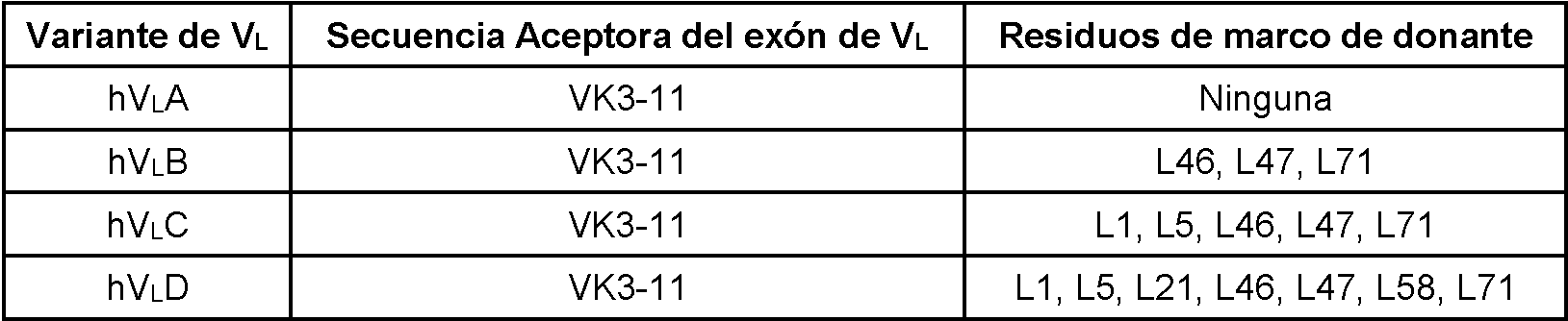
Tabla 3 Mutaciones específicas en las variantes de cadena pesada de 20F3 Table 3 Specific mutations in 20F3 heavy chain variants

Tabla 4 Mutaciones específicas en las variantes de la cadena ligera de 20F3Table 4 Specific mutations in 20F3 light chain variants

Ejemplo 3: Mediciones de EC50 y KdExample 3: EC50 and Kd measurements
Para determinar la EC50, se mezclaron titulaciones de dosis de 3 puntos de los anticuerpos NTB-A humanos no marcados con una concentración constante (final 5 nM) del anticuerpo 20F3 de ratón conjugado de con Alexa Fluor 647. Las células Ramos positivas para antígeno se sembraron en placas de 1 x 10⁵ células por pocillo en una placa con fondo en V de 96 pocillos (Thermo Scientific, Rochester, NY). Se prepararon diluciones en serie de cincuenta veces de anticuerpos en tampón FAC (PBS suero bovino fetal al 2 %) y se añadieron a las células por duplicado. Las soluciones de anticuerpos se incubaron con células durante 1 hora en hielo, protegidas de la luz. Las células se lavaron dos veces con tampón FACs y se analizaron en el citómetro de flujo LSRII (BD BioSciences, San Jose, CA). Los valores EC50 se determinaron con el software GraphPad Prism (La Jolla, CA). Los resultados se muestran en la Tabla 5.To determine the EC50, 3-point dose titrations of unlabeled human NTB-A antibodies were mixed with a constant concentration (final 5 nM) of Alexa Fluor 647-conjugated mouse 20F3 antibody. Antigen-positive Ramos cells were They were plated at 1 × 10⁵ cells per well in a 96-well V-bottom plate (Thermo Scientific, Rochester, NY). Fifty-fold serial dilutions of antibodies were prepared in FAC buffer (2% fetal bovine serum PBS) and added to the cells in duplicate. Antibody solutions were incubated with cells for 1 hour on ice, protected from light. Cells were washed twice with FACs buffer and analyzed on the LSRII flow cytometer (BD BioSciences, San Jose, CA). EC50 values were determined with GraphPad Prism software (La Jolla, CA). The results are shown in Table 5.
Tabla 5 - Determinaciones de unión a EC50 para diferentes permutaciones de cadenas pesadas y ligeras humanizadas de 20F3 humanizado en comparación con 20F3 murinoTable 5 - EC50 binding determinations for different permutations of humanized heavy and light chains of humanized 20F3 compared to murine 20F3

Se usaron titulaciones de dosis de los anticuerpos anti-NTB humanos conjugados con Alexa Fluor 647 (, h20F3_HDLD-AF647) para generar curvas de unión por saturación. Las células Ramos positivas para antígeno se sembraron en placas de 1 x 10⁵ células por pocillo en una placa con fondo en V de 96 pocillos (Thermo Scientific, Rochester, NY). Se prepararon diluciones en serie de tres veces de anticuerpos concentrados 2x en tampón FAC (PBS suero bovino fetal al 2 %) y se añadieron a las células por duplicado. Las soluciones de anticuerpos se incubaron con células durante 1 hora en hielo, protegidas de la luz. Las células se lavaron dos veces con tampón FACs y se analizaron en el citómetro de flujo LSRII (BD BioSciences, San Jose, CA). Los valores de KD se determinaron con el software GraphPad Prism (La Jolla, CA). Los anticuerpos anti-NTB-A humanos h20F3_HDLD y 20F3 quimérico se sometieron a ensayo para determinar la unión a células 293-F17 que sobreexpresan células de cynomolgus NTB-A. Las células 293-F17/cynomolgus-NTB-A se sembraron s 5 x 10⁵ células/pocillo en tampón FACS (PBS suero bovino fetal al 2 % azida al 0,02 %) y se incubaron con 20 μg/ml de anticuerpo durante 30 minutos en hielo. Las células se lavaron dos veces y se tiñeron con 30 μg/ml de anti-IgG humana de cabra-PE (Jackson ImmunoResearch, West Grove, PA) durante 30 minutos, en hielo y protegido de la luz. Las células se lavaron de nuevo dos veces con tampón FACs. Las células teñidas se analizaron en el citómetro de flujo FACs Calibur (BD BioSciences, San Jose, CA). Los resultados se muestran en la Tabla 6. Dose titrations of human anti-NTB antibodies conjugated to Alexa Fluor 647 (, h20F3_HDLD-AF647) were used to generate saturation binding curves. Antigen-positive Ramos cells were plated at 1 × 10⁵ cells per well in a 96-well V-bottom plate (Thermo Scientific, Rochester, NY). Three-fold serial dilutions of 2x concentrated antibodies were prepared in FAC buffer (2% fetal bovine serum PBS) and added to the cells in duplicate. Antibody solutions were incubated with cells for 1 hour on ice, protected from light. Cells were washed twice with FACs buffer and analyzed on the LSRII flow cytometer (BD BioSciences, San Jose, CA). KD values were determined with GraphPad Prism software (La Jolla, CA). Anti-human NTB-A antibodies h20F3_HDLD and chimeric 20F3 were tested for binding to 293-F17 cells overexpressing NTB-A cynomolgus cells. 293-F17/cynomolgus-NTB-A cells were seeded at 5 x 10⁵ cells/well in FACS buffer (PBS 2% fetal bovine serum 0.02% azide) and incubated with 20 μg/ml antibody for 30 minutes on ice. Cells were washed twice and stained with 30 μg/ml goat anti-human IgG-PE (Jackson ImmunoResearch, West Grove, PA) for 30 min, on ice and protected from light. The cells were washed again twice with FACs buffer. Stained cells were analyzed on the FACs Calibur flow cytometer (BD BioSciences, San Jose, CA). The results are shown in Table 6.
Tabla 6- Unión por saturación para el anticuerpo de HDLD variante de 20F3 humanizado en comparación con 20F3 quimérico.Table 6- Saturation binding for humanized 20F3 variant HDLD antibody compared to chimeric 20F3.

Ejemplo 4: Función efectoraExample 4: Effector function
Citotoxicidad dependiente del complemento (CDC): Las células T humanas normales (All Cells, Alameda, CA) o líneas celulares de cáncer (ATCC, Manassas, VA) se marcaron de forma marcada con Sytox Green al 5 μM (Life Technologies, Grand Island, NY), a continuación se unieron con titulaciones seriadas de dosis seriadas de anticuerpo NTB-A humano-A h20F3 o ADC de dímero PBD (0,02-50 μg/ml) en medio RPMI1640 suero humano al 1020 % (Complement Technology, Tyler, TX o Solomon Park Research Laboratories, Kirkland, WA. Las células se incubaron a 37 °C, CO2 al 5 % durante 2 horas, y la fluorescencia de las células lisadas se midió con un lector de placas Envision (Perkin Elmer, Waltham, MA). Los datos se expresaron como un porcentaje de lisis celular máxima determinada con un control positivo de células tratadas con TritonX-100 al 1 % (Sigma, St. Louis, MO). Complement-dependent cytotoxicity (CDC): Normal human T cells (All Cells, Alameda, CA) or cancer cell lines (ATCC, Manassas, VA) were markedly labeled with 5 μM Sytox Green (Life Technologies, Grand Island). , NY), then ligated with serial titrations of serial doses of human NTB-A antibody-A h20F3 or PBD dimer ADC (0.02-50 μg/ml) in RPMI1640 medium 1020% human serum (Complement Technology, Tyler, TX or Solomon Park Research Laboratories, Kirkland, WA. Cells were incubated at 37°C, 5% CO2 for 2 hours, and fluorescence of lysed cells was measured with an Envision plate reader (Perkin Elmer, Waltham , MA).Data were expressed as a percentage of maximal cell lysis determined with a positive control of cells treated with 1% TritonX-100 (Sigma, St . Louis, MO).
Se usaron tres tipos de células para el análisis: células T humanas normales, células WIL2-S y células Raji. La expresión de receptores relevantes en cada tipo de célula se encuentra en la Tabla 7 y se indica como número de receptor por célula.Three types of cells were used for analysis: normal human T cells, WIL2-S cells, and Raji cells. The expression of relevant receptors in each cell type is found in Table 7 and is indicated as receptor number per cell.
Tabla 7 - Expresión de receptoresTable 7 - Expression of receptors
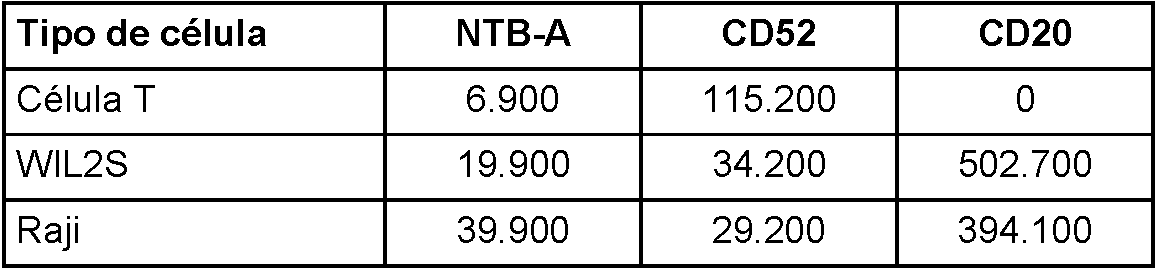
Como se puede ver en la Tabla 8 a continuación, el anticuerpo de IgG1 de 20F3-HDLDwt humanizado y la variante de ec (anticuerpos con cisteína en la posición 239 portan la designación ec) no tienen actividad de CDC contra células T en reposo normales, líneas celulares WIL2-S y Raji. Se observaron resultados similares para la ADC h20F3ec-1910 (2).As can be seen in Table 8 below, the humanized 20F3-HDLDwt IgG1 antibody and the ec variant (antibodies with cysteine at position 239 carry the ec designation) have no CDC activity against normal resting T cells, WIL2-S and Raji cell lines. Similar results were observed for the ADC h20F3ec-1910 (2).
Tabla 8 - Actividad de CDC para anticuerpos 20F3 humanizados y ADC en comparación con campath y rituximabTable 8 - CDC activity for humanized 20F3 antibodies and ADC compared to campath and rituximab

Ensayo de actividad de citotoxicidad celular dependiente de anticuerpos (ADCC): La actividad citotóxica ADCC se midió mediante la liberación de cromo-51 en la que las células citolíticas naturales (NK) efectoras destruyen (lisan) células diana mediante la unión al anticuerpo o ADC en las células diana. Las células WIL2-S se marcaron con cromo-51, se unieron con anticuerpo (0. Ing/ml-10/μg/ml), y a continuación se incubaron con células NK a una relación efector a diana de 10: 1 durante 4 horas a 37 °C, CO25 %. El sobrenadante se retiró a una placa de filtro y los recuentos de cromo-51 se midieron con un TopCount (Perkin Elmer, Waltham, MA). Los datos se expresaron como un porcentaje de lisis celular específica máxima determinada con un control positivo de células tratadas con TritonX-100 al 1 % (Sigma, St. Louis, MO).Antibody-Dependent Cellular Cytotoxicity (ADCC) Activity Assay: ADCC cytotoxic activity was measured by chromium-51 release in which effector natural killer (NK) cells kill (lyse) target cells by binding to antibody or ADC. in the target cells. WIL2-S cells were labeled with chromium-51, bound with antibody (0.ing/ml-10/μg/ml), and then incubated with NK cells at an effector-to-target ratio of 10:1 for 4 hours. at 37°C, CO25%. The supernatant was removed to a filter plate and chromium-51 counts were measured with a TopCount (Perkin Elmer, Waltham, MA). Data were expressed as a percentage of maximum specific cell lysis determined with a positive control of cells treated with 1% TritonX-100 (Sigma, St. Louis, MO).
Se usó un ensayo basado en citometría de flujo para medir la actividad de ADCC en células T humanas normales. Los objetivos de células T humanas normales marcadas con PKH2 se unieron con titulaciones de anticuerpo (0,1 ng/ml-10 μg/ml) y después se incubaron con células NK efectoras a una relación efector a diana de 10: 1 durante 4 horas a 37 °C, CO25 %. La viabilidad se determinó mediante la incorporación de 7-AAD medida en el citómetro de flujo FACsCalibur (BD BioSciences, San Jose, CA). A flow cytometry-based assay was used to measure ADCC activity in normal human T cells. PKH2-labeled normal human T cell targets were bound with antibody titers (0.1 ng/ml-10 μg/ml) and then incubated with effector NK cells at an effector-to-target ratio of 10:1 for 4 hours. at 37°C, CO25%. Viability was determined by 7-AAD incorporation measured on the FACsCalibur flow cytometer (BD BioSciences, San Jose, CA).
Como se puede ver en la Tabla 9 a continuación, el anticuerpo 20F3-HDLDwt humanizado y la variante ec tienen actividad ADCC baja a moderada. El ADC de dímero PBD h20F3ec-1910(2) exhibió una actividad ADCC reducida en relación con el anticuerpo h20F3ec no conjugado. Los números de los receptores se describen en la Tabla 7.As can be seen in Table 9 below, the humanized 20F3-HDLDwt antibody and the ec variant have low to moderate ADCC activity. The h20F3ec-1910(2) PBD dimer ADC exhibited reduced ADCC activity relative to the unconjugated h20F3ec antibody. Receiver numbers are described in Table 7.
Tabla 9 - Actividad de ADCC para 20F3 humanizado en comparación con Campath y RituximabTable 9 - ADCC activity for humanized 20F3 compared to Campath and Rituximab

Para evaluar la actividad de ADCP mediada por NTB-A, se marcaron células T normales o células tumorales con el colorante de membrana fluorescente roja, PKH26, a continuación se marcaron con anticuerpo o ADC en una serie de dilución de 5 puntos en 10 veces comenzando a 2 μg/ml. Después, las células se incubaron durante 30 minutos en hielo y se lavaron dos veces con PBS. Las células se mezclaron con macrófagos derivados de monocitos durante una hora a 37 °C. Después, la mezcla celular se tiñó con anti-CD11 b murino conjugado de con Alexa Fluor 488 para marcar macrófagos y se analizó mediante citometría de flujo para detectar células fluorescentes con doble etiqueta PKH26+CD11b+. La actividad fagocítica se calculó como (porcentaje de PKH26+CD11b+)/(porcentaje de células CD11b+) multiplicado por cien.To evaluate NTB-A-mediated ADCP activity, normal T cells or tumor cells were labeled with the red fluorescent membrane dye, PKH26, then labeled with antibody or ADC in a 5-point 10-fold dilution series starting at 2 μg/ml. The cells were then incubated for 30 min on ice and washed twice with PBS. Cells were mixed with monocyte-derived macrophages for one hour at 37°C. The cell mixture was then stained with Alexa Fluor 488-conjugated murine anti-CD11b to label macrophages and analyzed by flow cytometry to detect PKH26+CD11b+ double-labeled fluorescent cells. Phagocytic activity was calculated as (percentage of PKH26+CD11b+)/(percentage of CD11b+ cells) multiplied by one hundred.
Como se puede ver en la Tabla 10 a continuación, el anticuerpo 20F3-HDLDp humanizado y la variante ec tienen actividad de ADCP moderadamente inferior a rituximab y los controles de anticuerpo de Campath en líneas celulares cancerosas. Se observaron resultados similares para la ADC h20F3ec-1910 (2).As can be seen in Table 10 below, the humanized 20F3-HDLDp antibody and the ec variant have moderately lower ADCP activity than rituximab and the Campath antibody controls in cancer cell lines. Similar results were observed for the ADC h20F3ec-1910 (2).
Tabla 10 - Actividad de ADCP para 20F3 humanizado en comparación con Campath y RituximabTable 10 - ADCP activity for humanized 20F3 compared to Campath and Rituximab

Ejemplo 5: Internalización de ADCExample 5: ADC Internalization
Las líneas celulares de mieloma múltiple (MM. 1R o U-266) se unieron con concentraciones de saturación de ADC (10 μg/ml), se lavaron con medios y se incubaron a 37 °C o 4 °C. Se recogieron puntos de tiempo en los que las muestras se tiñeron con anticuerpo de cabra antihumano marcado con PE (Jackson ImmunoResearch, West Grove, PA) y se fijaron en PFA/p Bs al 1 %. Una vez que se recogieron todos los puntos de tiempo, se midió la intensidad de fluorescencia media en el citómetro de flujo FACs Calibur (BD BioSciences, San Jose, CA). La ADC del dímero PBD h20F3ec-1910(2) anti-NTB-A se internalizó rápidamente en células MM.1R, con 80 % de la ADC internalizado en 4 horas de incubación a 37 °C. Solo el 20 % de ADC h20F3ec-1910(2) se internalizó a las 4 horas cuando las células se mantuvieron a 4 °Condición de control C.Multiple myeloma cell lines (MM. 1R or U-266) were ligated with saturating concentrations of ADC (10 μg/ml), washed with media, and incubated at 37°C or 4°C. Time points were collected at which samples were stained with PE-labeled goat anti-human antibody (Jackson ImmunoResearch, West Grove, PA) and fixed in 1% PFA/ p B s . Once all time points were collected, the mean fluorescence intensity was measured on the FACs Calibur flow cytometer (BD BioSciences, San Jose, CA). The ADC of the anti-NTB-A h20F3ec-1910(2) PBD dimer was rapidly internalized into MM.1R cells, with 80% of the ADC internalized within 4 hours of incubation at 37°C. Only 20% of h20F3ec-1910(2) ADC was internalized at 4 hours when cells were maintained at 4°C control condition.
La superficie celular y la localización intracelular de ADC en células MM.1R también se detectaron con un anticuerpo antiidiotípico de ratón específico para el anticuerpo h20F3ec. Se permitió que la ADC se uniera a las células MM.1R durante 30 minutos a 4 °C, y se encontró que la ADC se internaliza rápidamente en los lisosomas.The cell surface and intracellular localization of ADC in MM.1R cells was also detected with a mouse antiidiotypic antibody specific for the h20F3ec antibody. ADC was allowed to bind to MM.1R cells for 30 min at 4°C, and ADC was found to be rapidly internalized into lysosomes.
Ejemplo 6: Citotoxicidad de ADC en líneas celulares de cáncer de MMExample 6: Cytotoxicity of ADC in MM Cancer Cell Lines
Los anticuerpos humanizados (HDLD) se analizaron como conjugados de anticuerpo-fármaco de PBD y auristatina. El agente antimitótico monometil auristatina E (MMAE) se conjugó con mAb anti-NTB-A mediante un conector de valinacitrulina (vc) escindible por catepsina. Una segunda auristatina, auristatina-2 se conjugó con mAb anti-NTB-A mediante un enlazador peptídico. Para los conjugados de PBD, el enlazador de fármacos SGD-1910 se conjugó con el anticuerpo anti-NTBA a través de un grupo tiol de un residuo de cisteína introducido en la posición 239 de la cadena de IgG1 del anticuerpo (numeración según el índice EU) y la carga de fármaco promedio fue de aproximadamente 2 fármacos por anticuerpo. Los anticuerpos con cisteína en la posición 239 portan la designación ec. La preparación fue como se describe en WO2011/130613 usando los anticuerpos anti-NTBA descritos en la presente memoria. Los ADC se diluyeron en serie 3 veces en medios para producir una curva de dosis de 10 puntos (1000 ng/ml-0,05081 ng/ml) y se aplicaron a múltiples células de mieloma cultivadas en placas de ensayo de 96 pocillos. Las líneas celulares se trataron con ADC anti-NTB-A por cuadruplicado y se incubaron durante 96 horas a 37 °C, CO2 al 5 %. Se analizó la viabilidad de las células mediante el ensayo de citotoxicidad luminiscente Cell Titer Glo (Promega), y los datos se recopilaron con un lector de placas EnVision (Perkin Elmer). Las curvas de efecto de dosis y los valores de IC50 se calcularon usando el software GraphPad Prism. Los resultados se muestran en las Tablas 11 y 12.Humanized antibodies (HDLD) were analyzed as antibody-drug conjugates of PBD and auristatin. The antimitotic agent monomethyl auristatin E (MMAE) was conjugated to anti-NTB-A mAb using a cathepsin-cleavable valinecitrulline (vc) linker. A second auristatin, auristatin-2 was conjugated to anti-NTB-A mAb via a peptide linker. For PBD conjugates, the drug linker SGD-1910 was conjugated to the anti-NTBA antibody via a thiol group of a cysteine residue introduced at position 239 of the IgG1 chain of the antibody (numbering according to the EU index ), and the average drug loading was approximately 2 drugs per antibody. Antibodies with cysteine at position 239 carry the designation ec. Preparation was as described in WO2011/130613 using the anti-NTBA antibodies described herein. ADCs were serially diluted 3-fold in media to produce a 10-point dose curve (1000 ng/ml-0.05081 ng/ml) and applied to multiple myeloma cells cultured in 96-well assay plates. Cell lines were treated with anti-NTB-A ADC in quadruplicate and incubated for 96 hours at 37 °C, 5% CO2. Cell viability was analyzed using the Cell Titer Glo Luminescent Cytotoxicity Assay (Promega), and data were collected with an EnVision plate reader (Perkin Elmer). Dose effect curves and IC50 values were calculated using GraphPad Prism software. The results are shown in Tables 11 and 12.
También se analizó el mecanismo de acción en células MM.1R. Las células MM.1R se trataron con ADC y la activación de las quinasas ATR y ATM se cuantificó mediante transferencia western con anticuerpos específicos de fosfo-epítopo. Los niveles de ATM/ATR activados con ADC casi equivalentes al fármaco dímero PBD libre, por lo tanto la ADC activa la respuesta del daño al ADN en las células MM.The mechanism of action was also analyzed in MM.1R cells. MM.1R cells were treated with ADC and activation of ATR and ATM kinases was quantified by western blotting with phospho-epitope-specific antibodies. ADC-activated ATM/ATR levels almost equivalent to free PBD dimer drug, therefore ADC activates the DNA damage response in MM cells.
Tabla 11 - Valores de IC50 de diversos conjugados de anticuerpo-fármaco con 20F3 humanizado en líneas celulares de mieloma múltiple (valores de IC50 en ng/ml; el hIgG es un anticuerpo de control negativo no enlazante)Table 11 - IC50 values of various antibody-drug conjugates with humanized 20F3 in multiple myeloma cell lines (IC50 values in ng/ml; hIgG is a non-binding negative control antibody)

Tabla 12 - Valores de IC50 de diversos conjugados de anticuerpo-fármaco con 20F3 humanizado en líneas celulares de NHL y AML (valores de IC50 en ng/ml; el hIgG es un anticuerpo de control negativo no enlazante)Table 12 - IC50 values of various antibody-drug conjugates with humanized 20F3 in NHL and AML cell lines (IC50 values in ng/ml; hIgG is a non-binding negative control antibody)

Ejemplo 7: Citotoxicidad de ADC en células humanasExample 7: Cytotoxicity of ADC in human cells
Para evaluar los efectos citotóxicos de los ADC anti-NTB-A en células T y B humanas en reposo, se sembraron células purificadas en placas de ensayo negras de 96 pocillos. A continuación, las células se trataron con ADC anti-NTB-A comenzando con 10 ug/ml volumétricamente por 5 veces para un total de 8 puntos de dilución. Para el tratamiento con fármacos libres, las células se dosificaron con MMAE que comienza a 1000 nM o dímero PBD libre comenzando en 100 nM titulados 5 veces para un total de 8 puntos de dilución. Las placas se incubaron a 37 °C, CO2 al 5 % durante 96 horas, después se dejaron equilibrar hasta temperatura ambiente. Se añadió un volumen igual de reactivo Cell-Titer Glo a cada pocillo y la placa se incubó durante 30 minutos adicionales a temperatura ambiente. A continuación, las placas se leyeron en un lector de placas Perkin Elmer Envision. Las curvas de efecto de dosis y los valores de IC50 se calcularon usando el software GraphPad Prism. Los resultados se muestran en la Tabla 13.To evaluate the cytotoxic effects of anti-NTB-A ADCs on resting human T and B cells, purified cells were seeded in black 96-well assay plates. Cells were then treated with anti-NTB-A ADC starting at 10 μg/ml volumetrically for 5-fold for a total of 8 point dilution. For free drug treatment, cells were dosed with MMAE starting at 1000 nM or free PBD dimer starting at 100 nM titrated 5 times for a total of 8 points of dilution. Plates were incubated at 37°C, 5% CO2 for 96 hours, then allowed to equilibrate to room temperature. An equal volume of Cell-Titer Glo reagent was added to each well and the plate was incubated for an additional 30 minutes at room temperature. The plates were then read on a Perkin Elmer Envision plate reader. Dose effect curves and IC50 values were calculated using GraphPad Prism software. The results are shown in Table 13.
Tabla 13 - Valores IC50 del anticuerpo quimérico 20F3 y fármaco libre en células T y B humanas en reposo.Table 13 - IC50 values of chimeric antibody 20F3 and free drug in resting human T and B cells.


Las células T humanas en reposo no se vieron afectadas por el dímero PBD o ADC de 20F3 quiméricos de auristatina en un ensayo de citotoxicidad de 96 horas. El dímero de PBD libre fue citotóxico para células T en reposo, lo que indica que son sensibles a este fármaco de que daña el ADN. Por lo tanto, los niveles de superficie celular de NTB-A son demasiado bajos para la ADC c20F3-1910(2) para internalizar suficiente fármaco PBD para destruir las células T en reposo. Por el contrario, ni el fármaco libre de MMAE ni la ADC de c20F3-vcMMAE(4) fueron potentes en las células T en reposo. Las células B humanas en reposo son sensibles tanto al fármaco libre MMAE como al dímero PBD. Sin embargo, la ADC de c20F3-1910(2) tuvo un efecto citotóxico en las células B en reposo solo a altas concentraciones de ADC (>1000 ng/ml), mientras que c20F3-vcMMAE(4) no tuvo efecto citotóxico. Por lo tanto, los niveles de superficie celular de NTB-A son demasiado bajos en células B para mediar un potente efecto citotóxico con las ADC de dímero PBD o de auristatina c20F3.Resting human T cells were not affected by auristatin chimeric 20F3 dimer PBD or ADC in a 96-hour cytotoxicity assay. Free PBD dimer was cytotoxic to resting T cells, indicating that they are sensitive to this DNA-damaging drug. Therefore, cell surface levels of NTB-A are too low for the c20F3-1910(2) ADC to internalize enough PBD drug to kill resting T cells. In contrast, neither MMAE-free drug nor c20F3-vcMMAE(4) ADC were potent in resting T cells. Resting human B cells are sensitive to both the free drug MMAE and the PBD dimer. However, c20F3-1910(2) ADC had a cytotoxic effect on resting B cells only at high ADC concentrations (>1000 ng/ml), while c20F3-vcMMAE(4) had no cytotoxic effect. Therefore, cell surface levels of NTB-A are too low in B cells to mediate a potent cytotoxic effect with PBD dimer or c20F3 auristatin ADCs.
Ejemplo 8: Estudios de xenoinjerto in vivoExample 8: In vivo xenograft studies
Los ratones NSG (NOD scid gamma; NOD.Cg-Prkdcsc,d Il2rgtm1Wjl/SzJ) se implantaron por vía intravenosa con 1 millones de células MM.1R, por animal para generar un modelo diseminado de mieloma múltiple. Cinco días después del implante de células tumorales, n=10 ratones por grupo de tratamiento recibieron una sola inyección intraperitoneal de ADC de PBD h20F3ec-1910(2) o ADC de PbD de control hIgGec-1910(2) no enlazante. Los niveles de dosis de ADC de PBD examinados fueron 333 μg/kg, 111 μg/kg y 37 μg/kg. Los ratones con carga tumoral avanzada se sacrificaron al mostrar síntomas de parálisis de las extremidades posteriores, hinchazón craneal y/o morbilidad. Como se muestra en la Figura 3, los ADC de dímeros de PBD h20F3ec-1910(2) HDLD produjeron respuestas completas duraderas en 10/10 ratones en todos los niveles de dosis (dosis única), mientras que los ratones con dosis de ADC de PBD de control no enlazante fueron sacrificados debido a la enfermedad en el día 80 del estudio. Se logró una diferencia estadísticamente significativa (P <0,0001 prueba de Mantel-Cox) entre los grupos ADC de h20F3ec-1910(2) (37 μg/kg) en comparación con ADC de hIgGec-1910(2) de control (333 μg/kg). NSG mice (NOD scid gamma; NOD.Cg-Prkdcsc,d Il2rgtm1Wjl/SzJ) were implanted intravenously with 1 million MM.1R cells, per animal to generate a disseminated model of multiple myeloma. Five days after tumor cell implantation, n=10 mice per treatment group received a single intraperitoneal injection of h20F3ec-1910(2) PBD ADC or non-binding control hIgGec-1910(2) P b D ADC. The PBD ADC dose levels examined were 333 μg/kg, 111 μg/kg, and 37 μg/kg. Mice with advanced tumor burden were euthanized upon showing symptoms of hindlimb paralysis, cranial swelling, and/or morbidity. As shown in Figure 3, h20F3ec-1910(2) HDLD PBD dimer ADCs produced durable full responses in 10/10 mice at all dose levels (single dose), while mice with ADC doses of Non-binding control PBD were sacrificed due to disease on day 80 of the study. A statistically significant difference (P < 0.0001 Mantel-Cox test) was achieved between the ADC groups of h20F3ec-1910(2) (37 μg/kg) compared to ADC of control hIgGec-1910(2) (333 μg/kg).
Los ratones NSG (NOD scid gamma; NOD.Cg-Prkdcscid Il2rgtm1Wjl/SzJ) se implantaron por vía intravenosa con 5 millones de células U-266, por animal para generar un modelo diseminado de mieloma múltiple. Cinco días después del implante de células tumorales, n=10 ratones por grupo de tratamiento recibieron una sola inyección intraperitoneal de ADC de PBD h20F3ec-1910(2) o ADC de PbD de control hIgGec-1910(2) no enlazante. Los niveles de dosis de ADC de PBD examinados fueron 111 μg/kg, 56 μg/kg y 28 μg/kg. Los ratones con carga tumoral avanzada se sacrificaron al mostrar síntomas de parálisis de las extremidades posteriores, hinchazón craneal y/o morbilidad. Como se muestra en la Figura 4, los ADC de dímero de PBD h20F3ec-1910(2) HDLD produjeron respuestas completas duraderas en 9/10 ratones a 111 μg/kg (dosis única). A niveles de dosis más bajos (28 y 56 μg/kg) h20F3ec-1910(2) produjo un retardo significativo (P<0,0001 prueba de Mantel-Cox) del inicio de la enfermedad en comparación con ADC de PBD de control hIgG-1910(2) (111 μg/kg).NSG (NOD scid gamma; NOD.Cg -Prkdcscid Il2rgtm1Wjl/SzJ) mice were implanted intravenously with 5 million U-266 cells, per animal to generate a disseminated model of multiple myeloma. Five days after tumor cell implantation, n=10 mice per treatment group received a single intraperitoneal injection of h20F3ec-1910(2) PBD ADC or non-binding control hIgGec-1910(2) P b D ADC. The PBD ADC dose levels examined were 111 μg/kg, 56 μg/kg, and 28 μg/kg. Mice with advanced tumor burden were euthanized upon showing symptoms of hindlimb paralysis, cranial swelling, and/or morbidity. As shown in Figure 4, h20F3ec-1910(2) HDLD PBD dimer ADCs produced durable full responses in 9/10 mice at 111 μg/kg (single dose). At lower dose levels (28 and 56 μg/kg) h20F3ec-1910(2) produced a significant delay (P<0.0001 Mantel-Cox test) of disease onset compared to hIgG control PBD ADC -1910(2) (111 μg/kg).
Los ratones NSG (NOD scid gamma; NOD.Cg-Prkdcscid Il2rgtm1Wjl/SzJ) se implantaron por vía intravenosa con 10 millones de células EJM, por animal para generar un modelo diseminado de mieloma múltiple. Cinco días después del implante de células tumorales, n=10 ratones por grupo de tratamiento recibieron una sola inyección intraperitoneal de ADC de PBD h20F3ec-1910(2) o ADC de PbD de control hIgGec-1910(2) no enlazante. Los niveles de dosis de ADC de PBD examinados fueron 333 μg/kg, 111 μg/kg y 37 μg/kg. Los ratones con carga tumoral avanzada se sacrificaron al mostrar síntomas de parálisis de las extremidades posteriores, hinchazón craneal y/o morbilidad. Como se muestra en la Figura 5, los ADC de dímero de PBD h20F3ec-1910(2) HDLD produjeron respuestas completas duraderas en 8/10 ratones a 333 μg/kg (dosis única). A niveles de dosis más bajos (37 y 111 μg/kg) h20F3ec-1910(2) produjo un retardo significativo (P<0,0001 prueba de Mantel-Cox) del inicio de la enfermedad en comparación con ADC de PBD de control hIgG-1910(2) (333 μg/kg).NSG mice (NOD scid gamma; NOD.Cg-Prkdcscid Il2rgtm1Wjl/SzJ) were implanted intravenously with 10 million EJM cells, per animal to generate a disseminated model of multiple myeloma. Five days after tumor cell implantation, n=10 mice per treatment group received a single intraperitoneal injection of h20F3ec-1910(2) PBD ADC or non-binding control hIgGec-1910(2) P b D ADC. The PBD ADC dose levels examined were 333 μg/kg, 111 μg/kg, and 37 μg/kg. Mice with advanced tumor burden were euthanized upon showing symptoms of hindlimb paralysis, cranial swelling, and/or morbidity. As shown in Figure 5, h20F3ec-1910(2) HDLD PBD dimer ADCs produced durable full responses in 8/10 mice at 333 μg/kg (single dose). At lower dose levels (37 and 111 μg/kg) h20F3ec-1910(2) produced a significant delay (P<0.0001 Mantel-Cox test) of disease onset compared to hIgG control PBD ADC -1910(2) (333 μg/kg).
Los ratones SCID (C.B-17/Sz-Prkdcsc,d) se implantaron con 5 millones de células de leucemia mieloide aguda HNT-34 por animal por vía subcutánea. Cuando el volumen tumoral medio alcanzó 100 mm3, n=10 ratones por grupo de tratamiento recibieron una sola inyección intraperitoneal de ADC de PBD h20F3ec-1910(2) o ADC de pBd de control hIgGec-1910(2) no enlazante. Los niveles de dosis de ADC de PBD examinados fueron 333 μg/kg, 111 μg/kg y 37 μg/kg. Los ratones individuales se sacrificaron cuando el volumen del tumor HNT-34 subcutáneo alcanzó 1000 mm3. Como se muestra en la Figura 6, los ADC de dímero de PBD h20F3ec-1910(2) HDLD produjeron respuestas completas duraderas en todos los ratones a niveles de dosis de 333 μg/kg y 111 μg/kg. A nivel de dosis más bajo de 37 μg/kg, h20F3ec-1910(2) produjo un fuerte retardo tumoral y 2/10 respuestas completas duraderas. La ADC de PBD de control hIgGec-1910(2) produjo 0/10 respuestas completas a 333 μg/kg. SCID mice (CB-17/Sz-Prkdcsc,d) were implanted with 5 million HNT-34 acute myeloid leukemia cells per animal subcutaneously. When the mean tumor volume reached 100 mm3, n=10 mice per treatment group received a single intraperitoneal injection of PBD h20F3ec-1910(2) ADC or non-binding control p B d ADC hIgGec-1910(2). The PBD ADC dose levels examined were 333 μg/kg, 111 μg/kg, and 37 μg/kg. Individual mice were sacrificed when the subcutaneous HNT-34 tumor volume reached 1000 mm3. As shown in Figure 6, h20F3ec-1910(2) HDLD PBD dimer ADCs produced durable full responses in all mice at dose levels of 333 μg/kg and 111 μg/kg. At the lowest dose level of 37 μg/kg, h20F3ec-1910(2) produced strong tumor retardation and 2/10 durable complete responses. ADC of control PBD hIgGec-1910(2) produced 0/10 complete responses at 333 μg/kg.
Los ratones NSG (NOD scid gamma; NOD.Cg-Prkdcscid Il2rgtm1Wj/SzJ) se implantaron por vía intravenosa con 1 millones de células MM.1R, por animal para generar un modelo diseminado de mieloma múltiple. Cinco días después del implante de células tumorales, n=10 ratones por grupo de tratamiento recibieron una única inyección intraperitoneal de ADC de h20F3-auristatina2/(8) o ADC de hIgG-auristatina2/(8) de control no enlazante. Los niveles de dosis de ADC de auristatina2 examinados fueron 3,0 mg/kg y 1,0 mg/kg. Los ratones con carga tumoral avanzada se sacrificaron al mostrar síntomas de parálisis de las extremidades posteriores, hinchazón craneal y/o morbilidad. Como se muestra en la Figura 7, la ADC de h20F3-auristatina2/(8) HDLD produjo un retraso tumoral significativo (P<0,0001 prueba de Mantel-Cox) a niveles de dosis de 3,0 mg/kg y 1,0 mg/kg n comparación con ADC de hIgG-auristatina2/(8) de control (3,0 mg/kg) en el modelo MM.1R diseminado.NSG (NOD scid gamma; NOD.Cg -Prkdcscid Il2rgtm1Wj/SzJ) mice were implanted intravenously with 1 million MM.1R cells, per animal to generate a disseminated model of multiple myeloma. Five days after tumor cell implantation, n=10 mice per treatment group received a single intraperitoneal injection of h20F3-auristatin2/(8) ADC or non-binding control hIgG-auristatin2/(8) ADC. The auristatin2 ADC dose levels examined were 3.0 mg/kg and 1.0 mg/kg. Mice with advanced tumor burden were euthanized upon showing symptoms of hindlimb paralysis, cranial swelling, and/or morbidity. As shown in Figure 7, ADC of h20F3-auristatin2/(8) HDLD produced significant tumor delay (P<0.0001 Mantel-Cox test) at dose levels of 3.0 mg/kg and 1. 0 mg/kg n comparison with control hIgG-auristatin2/(8) ADC (3.0 mg/kg) in the disseminated MM.1R model.
Los ratones NSG (NOD scid gamma; NOD.Cg-Prkdcscid Il2rgtm1WJl/SzJ) se implantaron por vía intravenosa con 5 millones de células U-266, por animal para generar un modelo diseminado de mieloma múltiple. Cinco días después del implante de células tumorales, n = 10 ratones por grupo de tratamiento recibieron una sola inyección intraperitoneal de ADC anti-NTB-A h20F3-vcMMAE(4), h20F3-auristatina2/(8), o ADC de control no enlazante hIgG-vcMMAE(4) y hIgG-auristatina2(8). Los niveles de dosis de ADC examinados fueron 3,0 mg/kg y 1,0 mg/kg. Los ratones con carga tumoral avanzada se sacrificaron al mostrar síntomas de parálisis de las extremidades posteriores, hinchazón craneal y/o morbilidad. Como se muestra en la Figura 8, la ADC de h20F3-vcMMAE(4) produjo respuestas completas duraderas en 8/10 ratones a un nivel de dosis de 3,0 mg/kg. La ADC de h20F3-auristatina2(8) produjo respuestas completas de 10/10 duraderas tanto en los niveles de dosis de 1,0 mg/kg como de 3,0 mg/kg. Las ADC de auristatina anti-NTB-A tuvieron una mayor actividad antitumoral que los ADC vcMMAE (4), especialmente a un nivel de dosis de 1,0 mg/kg.NSG (NOD scid gamma; NOD.Cg-Prkdcscid Il2rgtm1WJl/SzJ) mice were implanted intravenously with 5 million U-266 cells, per animal to generate a disseminated model of multiple myeloma. Five days after tumor cell implantation, n = 10 mice per treatment group received a single intraperitoneal injection of anti-NTB-A ADC h20F3-vcMMAE(4), h20F3-auristatin2/(8), or nonbinding control ADC hIgG-vcMMAE(4) and hIgG-auristatin2(8). The ADC dose levels examined were 3.0 mg/kg and 1.0 mg/kg. Mice with advanced tumor burden were euthanized upon showing symptoms of hindlimb paralysis, cranial swelling, and/or morbidity. As shown in Figure 8, ADC of h20F3-vcMMAE(4) produced durable complete responses in 8/10 mice at a dose level of 3.0 mg/kg. The ADC of h20F3-auristatin2(8) produced durable 10/10 complete responses at both the 1.0 mg/kg and 3.0 mg/kg dose levels. Auristatin anti-NTB-A ADCs had higher antitumor activity than vcMMAE ADCs (4), especially at a dose level of 1.0 mg/kg.
Los ratones NSG (NOD scid gamma; NOD.Cg-Prkdcscid Il2rgtm1Wjl/SzJ) se implantaron por vía intravenosa con 10 millones de células EJM, por animal para generar un modelo diseminado de mieloma múltiple. Cinco días después del implante de células tumorales, n = 10 ratones por grupo de tratamiento recibieron una sola inyección intraperitoneal de ADC anti-NTB-A h20F3-vcMMAE(4), h20F3-auristatina2/(8), o ADC de control no enlazante hlgG-vcMMAE(4) y hIgG-auristatina2(8). Los niveles de dosis de ADC examinados fueron 3,0 mg/kg y 1,0 mg/kg. Los ratones con carga tumoral avanzada se sacrificaron al mostrar síntomas de parálisis de las extremidades posteriores, hinchazón craneal y/o morbilidad. Como se muestra en la Figura 9, la ADC de h20F3-vcMMAE(4) HDLD produjo un retraso tumoral significativo (P = 0,0002 prueba de Mantel-Cox) en comparación con ADC de hlgG-vcMMAE(4) de control a un nivel de dosis de 3,0 mg/kg. La ADC de h20F3-auristatina2(8) produjo 2/10 o 9/10 respuestas completas duraderas a los niveles de dosis de 1,0 mg/kg y 3,0 mg/kg, respectivamente. Las ADC de auristatina2 anti-NTB-A tuvieron una actividad antitumoral significativamente mayor que las ADC vcMMAE(4) a niveles de dosis de 1,0 mg/kg (P = 0,0002 prueba de Mantel-Cox) y 3,0 mg/kg (P < 0,0001 prueba de Mantel-Cox). NSG mice (NOD scid gamma; NOD.Cg-Prkdcscid Il2rgtm1Wjl/SzJ) were implanted intravenously with 10 million EJM cells, per animal to generate a disseminated model of multiple myeloma. Five days after tumor cell implantation, n = 10 mice per treatment group received a single intraperitoneal injection of anti-NTB-A ADC h20F3-vcMMAE(4), h20F3-auristatin2/(8), or nonbinding control ADC hlgG-vcMMAE(4) and hIgG-auristatin2(8). The ADC dose levels examined were 3.0 mg/kg and 1.0 mg/kg. Mice with advanced tumor burden were euthanized upon showing symptoms of hindlimb paralysis, cranial swelling, and/or morbidity. As shown in Figure 9, ADC of h20F3-vcMMAE(4) HDLD produced significant tumor delay (P = 0.0002 Mantel-Cox test) compared with ADC of control hlgG-vcMMAE(4) at a 3.0 mg/kg dose level. The ADC of h20F3-auristatin2(8) produced 2/10 or 9/10 durable complete responses at the 1.0 mg/kg and 3.0 mg/kg dose levels, respectively. Auristatin2 anti-NTB-A ADCs had significantly greater antitumor activity than vcMMAE(4) ADCs at dose levels of 1.0 mg/kg (P = 0.0002 Mantel-Cox test) and 3.0 mg /kg (P < 0.0001 Mantel-Cox test).
Los ratones SCID (C.B-17/Sz-Prkdcscid) se implantaron con 5 millones de células de leucemia mieloide aguda HNT-34 por animal por vía subcutánea. Cuando el volumen tumoral medio alcanzó 100 mm3, n=10 ratones por grupo de tratamiento recibieron una sola inyección intraperitoneal de ADC anti-NTB-A h20F3-vcMMAE(4), h20F3-auristatina2/(8), o ADC de control no enlazante hIgG-vcMMAE(4) y hIgG-auristatina2(8). Los niveles de dosis de ADC examinados fueron 3,0 mg/kg y 1,0 mg/kg. Los ratones individuales se sacrificaron cuando el volumen del tumor HNT-34 subcutáneo alcanzó 1000 mm3. Como se muestra en la Figura 10, los ADC de HDLD h20F3 vcMMAE(4) y auristatina2(8) fueron muy activos en el modelo de AML subcutánea HNT-34. La ADC de h20F3-vcMMAE(4) produjo respuestas completas duraderas en 4/10 o 9/10 ratones a niveles de dosis de 1,0 mg/kg o 3,0 mg/kg, respectivamente. La ADC de h20F3-auristatina2(8) produjo 3/10 o 9/10 respuestas completas duraderas a niveles de dosis de 1,0 mg/kg o 3,0 mg/kg, respectivamente.SCID mice ( CB-17/Sz-Prkdcscid) were implanted with 5 million HNT-34 acute myeloid leukemia cells per animal subcutaneously. When the mean tumor volume reached 100 mm3, n=10 mice per treatment group received a single intraperitoneal injection of anti-NTB-A ADC h20F3-vcMMAE(4), h20F3-auristatin2/(8), or nonbinding control ADC hIgG-vcMMAE(4) and hIgG-auristatin2(8). The ADC dose levels examined were 3.0 mg/kg and 1.0 mg/kg. Individual mice were sacrificed when the subcutaneous HNT-34 tumor volume reached 1000 mm3. As shown in Figure 10, the ADCs of HDLD h20F3 vcMMAE(4) and auristatin2(8) were highly active in the HNT-34 subcutaneous AML model. ADC of h20F3-vcMMAE(4) produced durable complete responses in 4/10 or 9/10 mice at dose levels of 1.0 mg/kg or 3.0 mg/kg, respectively. The ADC of h20F3-auristatin2(8) produced 3/10 or 9/10 durable complete responses at dose levels of 1.0 mg/kg or 3.0 mg/kg, respectively.
Ejemplo 9: Estudios de xenoinjerto no hodkiniano in vivoExample 9: In vivo non-Hodkin xenograft studies
Los ratones SCID (C.B-17/Sz-Prkdcscid) se implantaron con 5 millones de células de linfoma no hodkiniano Raji por animal por vía subcutánea. Cuando el volumen tumoral medio alcanzó 100 mm3, n=6 ratones por grupo de tratamiento recibieron una sola inyección intraperitoneal de ADC de PBD h20F3ec-1910(2) o ADC de PBD de control hIgGec-1910(2). Los niveles de dosis de ADC de PBD examinados fueron 100 ug/kg, 50 ug/kg y 25 ug/kg. Los ratones individuales se sacrificaron cuando el volumen del tumor Raji subcutáneo alcanzó 1000 mm3. Como se muestra en la Figura 11, los ADC de dímero de PBD h20F3ec-1910(2) HDLD produjeron respuestas completas duraderas en todos los ratones a un nivel de dosis de 100 μg/kg. Además, la ADC de PBD h20F3ec-1910(2) produjo respuestas completas duraderas en 4/6 ratones a un nivel de dosis de 50 ug/kg, mientras que el retardo del crecimiento tumoral se observó al nivel de dosis de 25 ug/kg. El ADC de PBD de control hIgGec-1910(2) no tuvo actividad antitumoral a 100 ug/kg y produjo 0/6 respuestas completas. SCID mice ( CB-17/Sz-Prkdcscid) were implanted with 5 million Raji non-Hodkin lymphoma cells per animal subcutaneously. When the mean tumor volume reached 100 mm3, n=6 mice per treatment group received a single intraperitoneal injection of h20F3ec-1910(2) PBD ADC or hIgGec-1910(2) control PBD ADC. The PBD ADC dose levels examined were 100 ug/kg, 50 ug/kg, and 25 ug/kg. Individual mice were sacrificed when the subcutaneous Raji tumor volume reached 1000 mm3. As shown in Figure 11, h20F3ec-1910(2) HDLD PBD dimer ADCs produced durable full responses in all mice at a dose level of 100 μg/kg. Furthermore, ADC of PBD h20F3ec-1910(2) produced durable complete responses in 4/6 mice at a dose level of 50 ug/kg, while tumor growth retardation was observed at the dose level of 25 ug/kg . The control PBD ADC hIgGec-1910(2) had no antitumor activity at 100 μg/kg and produced 0/6 complete responses.
Los ratones SCID (C.B-17/Sz-Prkdcscid) se implantaron con 5 millones de células de linfoma no hodkiniano WSU-DLCL2 por animal por vía subcutánea. Cuando el volumen tumoral medio alcanzó 100 mm3, n=8 ratones por grupo de tratamiento recibieron una sola inyección intraperitoneal de ADC de PBD h20F3ec-1910(2) o ADC de PBD de control hIgGec-1910(2). Los niveles de dosis de ADC de PBD examinados fueron 100 ug/kg, 50 ug/kg y 25 ug/kg. Los ratones individuales se sacrificaron cuando el volumen del tumor WSU-DLCL2 subcutáneo alcanzó 1000 mm3. Como se muestra en la Figura 12, los ADC de dímero de PBD h20F3ec-1910(2) HDLD produjeron respuestas completas duraderas en 2/8 ratones a un nivel de dosis de 100 ug/kg. A niveles de dosis más bajos de 25 ug/kg y 50 ug/kg, la ADC de PBD h20F3ec-1910(2) produjo retardos medibles del crecimiento tumoral en relación con los ratones no tratados. La ADC de PBD de control hlgGec-1910(2) no tuvo actividad antitumoral a 100 ug/kg y produjo 0/8 respuestas completas. SCID (CB-17/Sz-Prkdcscid) mice were implanted with 5 million WSU-DLCL2 non-Hodkin lymphoma cells per animal subcutaneously. When the mean tumor volume reached 100 mm3, n=8 mice per treatment group received a single intraperitoneal injection of h20F3ec-1910(2) PBD ADC or hIgGec-1910(2) control PBD ADC. The PBD ADC dose levels examined were 100 ug/kg, 50 ug/kg, and 25 ug/kg. Individual mice were sacrificed when the subcutaneous WSU-DLCL2 tumor volume reached 1000 mm3. As shown in Figure 12, h20F3ec-1910(2) HDLD PBD dimer ADCs produced durable full responses in 2/8 mice at a dose level of 100 ug/kg. At lower dose levels of 25 ug/kg and 50 ug/kg, ADC of PBD h20F3ec-1910(2) produced measurable delays in tumor growth relative to untreated mice. The control PBD ADC hlgGec-1910(2) had no antitumor activity at 100 μg/kg and produced 0/8 complete responses.
Listado de secuenciasSequence listing
La sec. con núm. de ident.:1 es la secuencia de aminoácidos de NTB-A humana.The sec. with number ID:1 is the amino acid sequence of human NTB-A.

La sec. con núm. de ident.:2 es la secuencia de aminoácidos de NTB -A de cynomolgus.The sec. with number ID:2 is the amino acid sequence of NTB-A from cynomolgus.

La sec. con núm. de ident.:3 es la secuencia de aminoácidos de la región variable madura de la cadena pesada de 20F3 murino.The sec. with number ID:3 is the amino acid sequence of the mature variable region of the murine 20F3 heavy chain.

La sec. con núm. de ident.:4 es la secuencia de aminoácidos de la región variable madura de cadena pesada del 20F3 humanizado sin retromutaciones y con CDR murinas, según lo definido por Kabat.The sec. with number ID:4 is the amino acid sequence of the mature heavy chain variable region of humanized 20F3 without retromutations and with murine CDRs, as defined by Kabat.

La sec. con núm. de ident.:5 es la secuencia de aminoácidos de la región variable madura de cadena pesada del HA de 20F3 humanizado.The sec. with number ID:5 is the amino acid sequence of the mature heavy chain variable region of humanized 20F3 HA.

La sec. con núm. de ident.:6 es la secuencia de aminoácidos de la región variable madura de cadena pesada del HB de 20F3 humanizado.The sec. with number ID:6 is the amino acid sequence of the mature heavy chain variable region of humanized 20F3 HB.

La sec. con núm. de ident.:7 es la secuencia de aminoácidos de la región variable madura de cadena pesada del HC de 20F3 humanizado.The sec. with number ID:7 is the amino acid sequence of the mature heavy chain variable region of humanized 20F3 HC.

La sec. con núm. de ident.:8 es la secuencia de aminoácidos de la región variable madura de cadena pesada del HD de 20F3 humanizado.The sec. with number ID:8 is the amino acid sequence of the mature heavy chain variable region of humanized 20F3 HD.

La sec. con núm. de ident.:9 es la secuencia de aminoácidos de la región variable madura de cadena pesada del HE de 20F3 humanizado.The sec. with number ID:9 is the amino acid sequence of the mature heavy chain variable region of humanized 20F3 HE.

La sec. con núm. de ident.:10 es la secuencia de aminoácidos de CDR-H1 de 20F3 murino y humanizado, según lo definido por Kabat.The sec. with number ID:10 is the CDR-H1 amino acid sequence of murine and humanized 20F3, as defined by Kabat.
NYGMNNYGMN
La sec. con núm. de ident.:11 es la secuencia de aminoácidos de CDR-H2 de 20F3 murino y humanizado, según lo definido por Kabat.The sec. with number ID:11 is the CDR-H2 amino acid sequence of murine and humanized 20F3, as defined by Kabat.
WINTYSGEPRYADDFKGWINTYSGEPRYADDFKG
La sec. con núm. de ident.:12 es la secuencia de aminoácidos de CDR-H3 de 20F3 murino y humanizado, según lo definido por Kabat.The sec. with number ID:12 is the CDR-H3 amino acid sequence of murine and humanized 20F3, as defined by Kabat.
DYGRWYFDVDYGRWYFDV
La sec. con núm. de ident.:13 es la secuencia de aminoácidos de la región variable madura de cadena ligera de 20F3 murino.The sec. with number ID:13 is the amino acid sequence of the mature light chain variable region of murine 20F3.

La sec. con núm. de ident.:14 es la secuencia de aminoácidos de la región variable madura de cadena ligera del 20F3 humanizado sin retromutaciones y con CDR murinas, según lo definido por Kabat.The sec. with number ID:14 is the amino acid sequence of the mature light chain variable region of humanized 20F3 without retromutations and with murine CDRs, as defined by Kabat.

La sec. con núm. de ident.:15 es la secuencia de aminoácidos de la región variable madura de cadena ligera del LA de 20F3 humanizado.The sec. with number ID:15 is the amino acid sequence of the mature light chain variable region of humanized 20F3 LA.

La sec. con núm. de ident.:16 es la secuencia de aminoácidos de la región variable madura de cadena ligera del LB de 20F3 humanizado.The sec. with number ID:16 is the amino acid sequence of the mature light chain variable region of humanized 20F3 LB.

La sec. con núm. de ident.:17 es la secuencia de aminoácidos de la región variable madura de cadena ligera del LC de 20F3 humanizado.The sec. with number ID:17 is the amino acid sequence of the mature light chain variable region of the humanized 20F3 LC.

La sec. con núm. de ident.:18 es la secuencia de aminoácidos de la región variable madura de cadena ligera del LD de 20F3 humanizado.The sec. with number ID:18 is the amino acid sequence of the mature light chain variable region of the LD of humanized 20F3.

La sec. con núm. de ident.:19 es la secuencia de aminoácidos de CDR-L1 de 20F3 murino y humanizado, según lo definido por Kabat.The sec. with number ID:19 is the amino acid sequence of CDR-L1 of murine and humanized 20F3, as defined by Kabat.
RASSSVSHMHRASSSVSHMH
La sec. con núm. de ident.:20 es la secuencia de aminoácidos de CDR-L2 de 20F3 murino y humanizado, según lo definido por Kabat.The sec. with number ID:20 is the amino acid sequence of CDR-L2 of murine and humanized 20F3, as defined by Kabat.
ATSNLASATSNLAS
La sec. con núm. de ident.:21 es la secuencia de aminoácidos de CDR-L3 de 20F3 murino y humanizado, según lo definido por Kabat. The sec. with number ID:21 is the amino acid sequence of CDR-L3 of murine and humanized 20F3, as defined by Kabat.
QQWSSTPRTQQWSSTPRT
La sec. con núm. de ident.:22 es la secuencia de aminoácidos de CDR-H1 de 20F3 murino, según lo definido por IMGT. GYTFTNYGThe sec. with number ID:22 is the amino acid sequence of CDR-H1 of murine 20F3, as defined by IMGT. GYTFTNYG
La sec. con núm. de ident.:23 es la secuencia de aminoácidos de CDR-H2 de 20F3 murino, según lo definido por IMGT. INTYSGEPThe sec. with number ID:23 is the amino acid sequence of CDR-H2 of murine 20F3, as defined by IMGT. INTYSGEP
La sec. con núm. de ident.:24 es la secuencia de aminoácidos de CDR-H3 de 20F3 murino, según lo definido por IMGT. ARDYGRWYFDVThe sec. with number ID:24 is the amino acid sequence of CDR-H3 of murine 20F3, as defined by IMGT. ARDYGRWYFDV
La sec. con núm. de ident.:25 es la secuencia de aminoácidos de CDR-L1 de 20F3 murino, según lo definido por IMGT. SSVSHThe sec. with number ID:25 is the amino acid sequence of CDR-L1 of murine 20F3, as defined by IMGT. SSVSH
La secuencia de aminoácidos de CDR-L2 de 20F3 murino, según lo definido por IMGT es: ATSThe amino acid sequence of CDR-L2 of murine 20F3, as defined by IMGT is: ATS
La sec. con núm. de ident.:26 es la secuencia de aminoácidos de CDR-L3 de 20F3 murino, según lo definido por IMGT. QQWSSTPRTThe sec. with number ID:26 is the amino acid sequence of CDR-L3 of murine 20F3, as defined by IMGT. QQWSSTPRT
La sec. con núm. de ident.:27 es la secuencia de aminoácidos de una región constante de cadena ligera humana.The sec. with number ID:27 is the amino acid sequence of a human light chain constant region.

La sec. con núm. de ident.:28 es la secuencia de aminoácidos de una región constante de cadena pesada humana de origen natural.The sec. with number ID:28 is the amino acid sequence of a naturally occurring human heavy chain constant region.

La sec. con núm. de ident.:29 es la secuencia de aminoácidos de una región constante de la cadena pesada humana variante (S239C).The sec. with number ID:29 is the amino acid sequence of a constant region of the variant human heavy chain (S239C).

Claims (37)


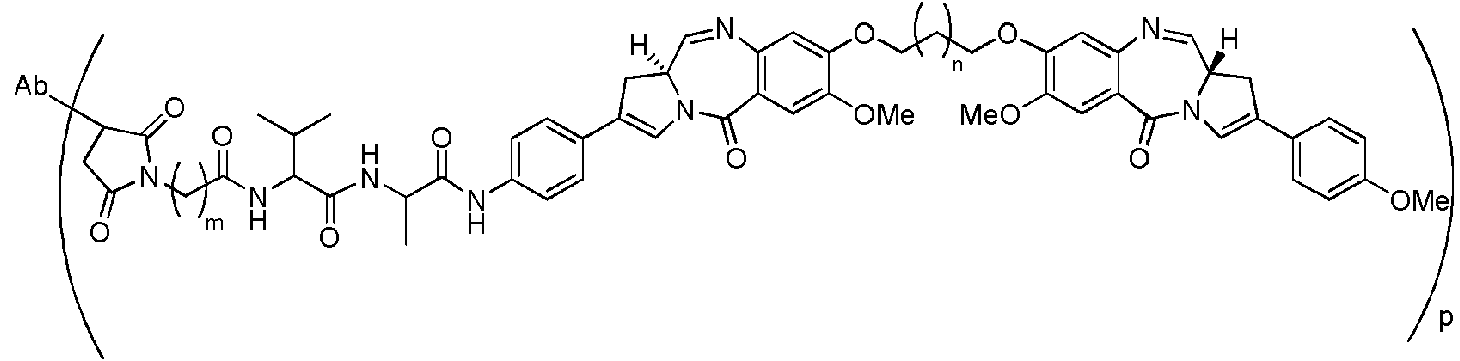

Applications Claiming Priority (3)
| Application Number | Priority Date | Filing Date | Title |
|---|---|---|---|
| US201562186596P | 2015-06-30 | 2015-06-30 | |
| US201662321849P | 2016-04-13 | 2016-04-13 | |
| PCT/US2016/040307 WO2017004330A1 (en) | 2015-06-30 | 2016-06-30 | Anti-ntb-a antibodies and related compositions and methods |
Publications (1)
| Publication Number | Publication Date |
|---|---|
| ES2955961T3 true ES2955961T3 (en) | 2023-12-11 |
Family
ID=57609137
Family Applications (1)
| Application Number | Title | Priority Date | Filing Date |
|---|---|---|---|
| ES16818762T Active ES2955961T3 (en) | 2015-06-30 | 2016-06-30 | Anti-ntb-a antibodies and related compositions and methods |
Country Status (22)
| Country | Link |
|---|---|
| US (2) | US11351269B2 (en) |
| EP (2) | EP4302784A3 (en) |
| JP (2) | JP6879947B2 (en) |
| KR (1) | KR20180021705A (en) |
| CN (2) | CN116063502A (en) |
| AU (2) | AU2016287647A1 (en) |
| BR (1) | BR112017027498A2 (en) |
| CY (1) | CY1126442T1 (en) |
| DK (1) | DK3316909T5 (en) |
| EA (1) | EA201890158A1 (en) |
| ES (1) | ES2955961T3 (en) |
| FI (1) | FI3316909T3 (en) |
| HU (1) | HUE063320T2 (en) |
| IL (2) | IL303690A (en) |
| MX (1) | MX2017017049A (en) |
| NZ (1) | NZ737418A (en) |
| PL (1) | PL3316909T3 (en) |
| PT (1) | PT3316909T (en) |
| SG (1) | SG10202005460RA (en) |
| SI (1) | SI3316909T1 (en) |
| WO (1) | WO2017004330A1 (en) |
| ZA (1) | ZA201707869B (en) |
Families Citing this family (28)
| Publication number | Priority date | Publication date | Assignee | Title |
|---|---|---|---|---|
| AU2013364043B2 (en) * | 2012-12-21 | 2018-01-04 | Seagen Inc. | Anti-NTB-A antibodies and related compositions and methods |
| PT3316909T (en) | 2015-06-30 | 2023-11-22 | Seattle Genetics Inc | Anti-ntb-a antibodies and related compositions and methods |
| IL301637B2 (en) | 2017-09-29 | 2024-10-01 | Daiichi Sankyo Co Ltd | Conjugation of an antibody with a pyrrolobenzodiazepine derivative |
| TWI851577B (en) | 2018-06-07 | 2024-08-11 | 美商思進公司 | Camptothecin conjugates |
| JP7401456B2 (en) | 2018-11-14 | 2023-12-19 | 第一三共株式会社 | Anti-CDH6 antibody-pyrrolobenzodiazepine derivative conjugate |
| AU2020246448A1 (en) | 2019-03-25 | 2021-10-14 | Daiichi Sankyo Company, Limited | Anti-HER2 antibody-pyrrolobenzodiazepine derivative conjugate |
| EP3950061A4 (en) | 2019-03-25 | 2022-11-16 | Daiichi Sankyo Company, Limited | ANTIBODY CONJUGATE-PYRROLOBENZODIAZEPINE DERIVATIVE |
| TWI841715B (en) | 2019-03-27 | 2024-05-11 | 日商第一三共股份有限公司 | Combination of antibody-pyrrolobenzodiazepine derivative conjugate and PARP inhibitor and use thereof |
| CN114008077B (en) * | 2019-07-03 | 2024-10-29 | 牛津生物疗法有限公司 | Antibodies and methods of use |
| WO2021067820A1 (en) | 2019-10-04 | 2021-04-08 | Seagen Inc. | Formulation of antibody-drug conjugate |
| AU2020356955A1 (en) | 2019-10-04 | 2022-04-14 | Seagen Inc. | Camptothecin peptide conjugates |
| US20230092356A1 (en) * | 2019-12-06 | 2023-03-23 | Thoas Fioretos | Novel agents and uses thereof |
| WO2021207701A1 (en) | 2020-04-10 | 2021-10-14 | Seagen Inc. | Charge variant linkers |
| TW202227479A (en) | 2020-09-02 | 2022-07-16 | 日商第一三共股份有限公司 | NOVEL ENDO-[beta]-N-ACETYLGLUCOSAMINIDASE |
| KR20230122008A (en) * | 2020-11-20 | 2023-08-22 | 알.피.쉐러 테크놀러지즈 엘엘씨 | Glycoside double-cleavage linkers for antibody-drug conjugates |
| CA3204628A1 (en) | 2021-01-13 | 2022-07-21 | John T. POIRIER | Antibody-pyrrolobenzodiazepine derivative conjugate |
| AU2022238571A1 (en) | 2021-03-18 | 2023-09-14 | Seagen Inc. | Selective drug release from internalized conjugates of biologically active compounds |
| AU2022262600A1 (en) | 2021-04-20 | 2023-10-05 | Seagen Inc. | Modulation of antibody-dependent cellular cytotoxicity |
| CA3221398A1 (en) | 2021-05-28 | 2022-12-01 | Seagen Inc. | Anthracycline antibody conjugates |
| IL312728A (en) | 2021-11-30 | 2024-07-01 | Daiichi Sankyo Co Ltd | Antibodies masked in protease-wells |
| US20250170255A1 (en) | 2022-02-09 | 2025-05-29 | Daiichi Sankyo Company, Limited | Environmentally-responsive masked antibody and use thereof |
| US20250207169A1 (en) | 2022-03-02 | 2025-06-26 | Daiichi Sankyo Company, Limited | METHOD FOR PRODUCING Fc-CONTAINING MOLECULE |
| IL315508A (en) | 2022-03-17 | 2024-11-01 | Seagen Inc | Camptothecin conjugates |
| WO2024129756A1 (en) | 2022-12-13 | 2024-06-20 | Seagen Inc. | Site-specific engineered cysteine antibody drug conjugates |
| AU2024278032A1 (en) | 2023-05-23 | 2025-11-20 | Lead Biologics International Ab | Antibodies and uses thereof |
| WO2025090774A1 (en) | 2023-10-24 | 2025-05-01 | Seagen Inc. | Chemotherapeutic compounds and methods of use |
| WO2025149947A1 (en) | 2024-01-12 | 2025-07-17 | Seagen Inc. | Antibody-drug conjugates |
| WO2025154050A1 (en) * | 2024-01-17 | 2025-07-24 | Hadasit Medical Research Services & Development Ltd. | Antibodies directed to slamf6 |
Family Cites Families (33)
| Publication number | Priority date | Publication date | Assignee | Title |
|---|---|---|---|---|
| US5225539A (en) | 1986-03-27 | 1993-07-06 | Medical Research Council | Recombinant altered antibodies and methods of making altered antibodies |
| US4880935A (en) | 1986-07-11 | 1989-11-14 | Icrf (Patents) Limited | Heterobifunctional linking agents derived from N-succinimido-dithio-alpha methyl-methylene-benzoates |
| WO1988007089A1 (en) | 1987-03-18 | 1988-09-22 | Medical Research Council | Altered antibodies |
| IL106992A (en) | 1988-02-11 | 1994-06-24 | Bristol Myers Squibb Co | Acylhydrazone derivatives of anthracycline and methods for their preparation |
| EP0368684B2 (en) | 1988-11-11 | 2004-09-29 | Medical Research Council | Cloning immunoglobulin variable domain sequences. |
| US5530101A (en) | 1988-12-28 | 1996-06-25 | Protein Design Labs, Inc. | Humanized immunoglobulins |
| US5859205A (en) | 1989-12-21 | 1999-01-12 | Celltech Limited | Humanised antibodies |
| EP1400536A1 (en) | 1991-06-14 | 2004-03-24 | Genentech Inc. | Method for making humanized antibodies |
| US5622929A (en) | 1992-01-23 | 1997-04-22 | Bristol-Myers Squibb Company | Thioether conjugates |
| ATE234635T1 (en) | 1995-12-22 | 2003-04-15 | Bristol Myers Squibb Co | COUPLERS CONTAINING BRANCHED HYDRAZONE GROUPS |
| US5834597A (en) | 1996-05-20 | 1998-11-10 | Protein Design Labs, Inc. | Mutated nonactivating IgG2 domains and anti CD3 antibodies incorporating the same |
| WO2000046750A1 (en) | 1999-02-05 | 2000-08-10 | Samsung Electronics Co., Ltd. | Image texture retrieving method and apparatus thereof |
| MXPA05000511A (en) | 2001-07-12 | 2005-09-30 | Jefferson Foote | Super humanized antibodies. |
| SI1545613T1 (en) | 2002-07-31 | 2011-11-30 | Seattle Genetics Inc | Auristatin conjugates and their use for treating cancer, an autoimmune disease or an infectious disease |
| US7498298B2 (en) | 2003-11-06 | 2009-03-03 | Seattle Genetics, Inc. | Monomethylvaline compounds capable of conjugation to ligands |
| DE10355904A1 (en) * | 2003-11-29 | 2005-06-30 | Merck Patent Gmbh | Solid forms of anti-EGFR antibodies |
| BRPI0513959A (en) | 2004-07-30 | 2008-05-20 | Rinat Neuroscience Corp | antibodies directed against beta-amyloid peptide, their pharmaceutical compositions, kit and methods of manufacture thereof |
| JP5171621B2 (en) | 2005-07-07 | 2013-03-27 | シアトル ジェネティックス, インコーポレイテッド | Monomethylvaline compound having phenylalanine side chain modification at C-terminus |
| US8871720B2 (en) | 2005-07-07 | 2014-10-28 | Seattle Genetics, Inc. | Monomethylvaline compounds having phenylalanine carboxy modifications at the C-terminus |
| EP2057193B1 (en) * | 2006-08-04 | 2013-12-18 | Novartis AG | Ephb3-specific antibody and uses thereof |
| US7847067B2 (en) * | 2006-08-28 | 2010-12-07 | ARCA Biopharma | Antibodies to NTB-A |
| WO2008070593A2 (en) | 2006-12-01 | 2008-06-12 | Seattle Genetics, Inc. | Variant target binding agents and uses thereof |
| RU2476441C2 (en) | 2007-10-19 | 2013-02-27 | Сиэтл Дженетикс, Инк. | Cd19-binding agents and use thereof |
| MX391454B (en) | 2010-04-15 | 2025-03-05 | Seagen Inc | DRUG-LINKER COMPOUND FOR CONJUGATION TO A LIGAND UNIT. |
| WO2013173493A1 (en) | 2012-05-15 | 2013-11-21 | Manikkam Suthanthiran | Non-invasive method of diagnosing renal fibrosis |
| US20130309223A1 (en) * | 2012-05-18 | 2013-11-21 | Seattle Genetics, Inc. | CD33 Antibodies And Use Of Same To Treat Cancer |
| AU2013328625B2 (en) | 2012-10-12 | 2016-12-15 | Adc Therapeutics Sa | Pyrrolobenzodiazepine-antibody conjugates |
| AU2013364043B2 (en) * | 2012-12-21 | 2018-01-04 | Seagen Inc. | Anti-NTB-A antibodies and related compositions and methods |
| WO2014142182A1 (en) | 2013-03-14 | 2014-09-18 | 塩野義製薬株式会社 | Monoclonal antibody inhibiting enzymatic activity of endothelial lipase |
| US20160311918A1 (en) | 2013-12-16 | 2016-10-27 | Texas Tech University System | Anti-Ron Monoclonal Antibodies as a Cytotoxic Drug Delivery System for Targeted Cancer Therapy |
| TWI734410B (en) * | 2014-09-11 | 2021-07-21 | 日商塩野義製藥股份有限公司 | Humanized monoclonal antibody, inhibiting the enzymatic activity of vascular endothelial lipase |
| PT3316909T (en) | 2015-06-30 | 2023-11-22 | Seattle Genetics Inc | Anti-ntb-a antibodies and related compositions and methods |
| WO2017160954A1 (en) * | 2016-03-15 | 2017-09-21 | Seattle Genetics, Inc. | Combinations of pbd-based antibody drug conjugates with bcl-2 inhibitors |
-
2016
- 2016-06-30 PT PT168187623T patent/PT3316909T/en unknown
- 2016-06-30 EP EP23190081.2A patent/EP4302784A3/en not_active Withdrawn
- 2016-06-30 HU HUE16818762A patent/HUE063320T2/en unknown
- 2016-06-30 DK DK16818762.3T patent/DK3316909T5/en active
- 2016-06-30 BR BR112017027498A patent/BR112017027498A2/en not_active Application Discontinuation
- 2016-06-30 CN CN202211047388.1A patent/CN116063502A/en not_active Withdrawn
- 2016-06-30 EA EA201890158A patent/EA201890158A1/en unknown
- 2016-06-30 ES ES16818762T patent/ES2955961T3/en active Active
- 2016-06-30 US US15/739,363 patent/US11351269B2/en active Active
- 2016-06-30 MX MX2017017049A patent/MX2017017049A/en unknown
- 2016-06-30 SG SG10202005460RA patent/SG10202005460RA/en unknown
- 2016-06-30 KR KR1020177036145A patent/KR20180021705A/en active Pending
- 2016-06-30 NZ NZ737418A patent/NZ737418A/en unknown
- 2016-06-30 JP JP2017567180A patent/JP6879947B2/en not_active Expired - Fee Related
- 2016-06-30 AU AU2016287647A patent/AU2016287647A1/en not_active Abandoned
- 2016-06-30 CN CN201680038295.9A patent/CN107735105B/en active Active
- 2016-06-30 SI SI201631741T patent/SI3316909T1/en unknown
- 2016-06-30 IL IL303690A patent/IL303690A/en unknown
- 2016-06-30 WO PCT/US2016/040307 patent/WO2017004330A1/en not_active Ceased
- 2016-06-30 EP EP16818762.3A patent/EP3316909B1/en active Active
- 2016-06-30 FI FIEP16818762.3T patent/FI3316909T3/en active
- 2016-06-30 IL IL256295A patent/IL256295B2/en unknown
- 2016-06-30 PL PL16818762.3T patent/PL3316909T3/en unknown
-
2017
- 2017-11-20 ZA ZA2017/07869A patent/ZA201707869B/en unknown
-
2021
- 2021-01-26 JP JP2021010171A patent/JP7194762B2/en active Active
-
2022
- 2022-07-25 AU AU2022209203A patent/AU2022209203A1/en not_active Abandoned
- 2022-11-23 US US18/058,454 patent/US20230218776A1/en active Pending
-
2023
- 2023-11-20 CY CY20231100662T patent/CY1126442T1/en unknown
Also Published As
Similar Documents
| Publication | Publication Date | Title |
|---|---|---|
| ES2955961T3 (en) | Anti-ntb-a antibodies and related compositions and methods | |
| US20230105802A1 (en) | Anti-ntb-a antibodies and related compositions and methods | |
| US20210047404A1 (en) | Cd33 antibodies and use of same to treat cancer | |
| CA2986796C (en) | Anti-ntb-a antibodies and related compositions and methods | |
| HK1253306B (en) | Anti-ntb-a antibodies and related compositions and methods | |
| EA044092B1 (en) | ANTI-NTB-A ANTIBODIES AND THERAPEUTIC COMPOSITIONS CONTAINING THEM | |
| BR112014028507B1 (en) | CD33 ANTIBODIES AND THEIR USE TO TREAT CANCER |