JP2004018573A - Proton conductive polymer membrane - Google Patents
Proton conductive polymer membrane Download PDFInfo
- Publication number
- JP2004018573A JP2004018573A JP2002172296A JP2002172296A JP2004018573A JP 2004018573 A JP2004018573 A JP 2004018573A JP 2002172296 A JP2002172296 A JP 2002172296A JP 2002172296 A JP2002172296 A JP 2002172296A JP 2004018573 A JP2004018573 A JP 2004018573A
- Authority
- JP
- Japan
- Prior art keywords
- proton conductive
- proton
- fuel cell
- membrane
- polymer membrane
- Prior art date
- Legal status (The legal status is an assumption and is not a legal conclusion. Google has not performed a legal analysis and makes no representation as to the accuracy of the status listed.)
- Withdrawn
Links
Images
Classifications
-
- Y—GENERAL TAGGING OF NEW TECHNOLOGICAL DEVELOPMENTS; GENERAL TAGGING OF CROSS-SECTIONAL TECHNOLOGIES SPANNING OVER SEVERAL SECTIONS OF THE IPC; TECHNICAL SUBJECTS COVERED BY FORMER USPC CROSS-REFERENCE ART COLLECTIONS [XRACs] AND DIGESTS
- Y02—TECHNOLOGIES OR APPLICATIONS FOR MITIGATION OR ADAPTATION AGAINST CLIMATE CHANGE
- Y02E—REDUCTION OF GREENHOUSE GAS [GHG] EMISSIONS, RELATED TO ENERGY GENERATION, TRANSMISSION OR DISTRIBUTION
- Y02E60/00—Enabling technologies; Technologies with a potential or indirect contribution to GHG emissions mitigation
- Y02E60/30—Hydrogen technology
- Y02E60/50—Fuel cells
Landscapes
- Manufacture Of Macromolecular Shaped Articles (AREA)
- Compositions Of Macromolecular Compounds (AREA)
- Polymers With Sulfur, Phosphorus Or Metals In The Main Chain (AREA)
- Conductive Materials (AREA)
- Fuel Cell (AREA)
Abstract
【課題】本発明の目的は、固体高分子形燃料電池の電解質膜に有用なプロトン伝導度と耐酸化性に代表される耐久性のバランスに優れたプロトン伝導性高分子膜を提供する。
【解決手段】プロトン伝導性置換基を有する高分子化合物と2〜4価の多価金属(好ましくは、マグネシウム(Mg)、カルシウム(Ca)、ストロンチウム(Sr)、バリウム(Ba)、亜鉛(Zn)、銅(Cu)、アルミニウム(Al)、ガリウム(Ga)、インジウム(In)、イットリウム(Y)、ランタン(La)、チタン(Ti)、ジルコニウム(Zr)及びハフニウム(Hf)よりなる群から選択される少なくとも1種)を用いてなる高分子膜であって、プロトン伝導性置換基の水素原子の少なくとも一部が、前記多価金属で置換されているものであるプロトン伝導性高分子膜。
【選択図】なしAn object of the present invention is to provide a proton conductive polymer membrane excellent in balance between proton conductivity and durability represented by oxidation resistance, which is useful for an electrolyte membrane of a polymer electrolyte fuel cell.
A polymer compound having a proton conductive substituent and a divalent to tetravalent polyvalent metal (preferably, magnesium (Mg), calcium (Ca), strontium (Sr), barium (Ba), zinc (Zn) ), Copper (Cu), aluminum (Al), gallium (Ga), indium (In), yttrium (Y), lanthanum (La), titanium (Ti), zirconium (Zr) and hafnium (Hf). Selected from the group consisting of at least one selected from the group consisting of at least one selected from the group consisting of at least one hydrogen atom of a proton-conductive substituent and the polyvalent metal. .
[Selection diagram] None
Description
【0001】
【発明の属する技術分野】
本発明は、固体高分子形燃料電池の電解質膜として有用なプロトン伝導性高分子膜に関するものである。
【0002】
【従来の技術】
近年、環境問題や省エネルギーに対する意識の高まりにより、クリーンなエネルギー源として燃料電池が脚光を浴びている。中でも、電解質にプロトン伝導性高分子膜を使用した固体高分子形燃料電池は、低温作動、小型軽量など、他の燃料電池(リン酸形、固体酸化物形、溶融炭酸塩形)にない特徴を有することから、自動車用途、家庭用コージェネレーション用途への適用が検討されてきた。
【0003】
燃料電池用膜としては、1950年代に開発された、スチレン系の陽イオン交換膜があるが、燃料電池動作環境下における安定性に乏しく、本膜を用いての実用上、充分な寿命を有する燃料電池を製造するには至っていない。実用的安定性を有する燃料電池用膜としては、ナフィオン(Nafion,デュポン社の登録商標。以下同様)に代表されるパーフルオロカーボンスルホン酸膜が開発され、固体高分子形燃料電池を始めとし、他の電気化学素子への応用が提案されている。
【0004】
現在、パーフルオロカーボンスルホン酸膜は非常に高価なため、固体高分子形燃料電池が広く普及する上での障害となっている。従って、この主要部材である膜コストをできる限り下げることは、固体高分子形燃料電池の普及にとって非常に重要である。
【0005】
より安価な燃料電池用膜を得るために、従来のパーフルオロカーボンスルホン酸膜に代わり炭化水素系高分子化合物の燃料電池用膜も種々検討・提案されいる。その代表的なものとしては、スルホン化ポリエーテルエーテルケトン(特開平6−93114号公報など)、スルホン化ポリエーテルスルホン(特開平10―45913号公報など)、スルホン化ポリスルホン(特開平9−245818号公報など)やスルホン化ポリイミド(特表2000−510511など)などの耐熱芳香族系高分子化合物のスルホン化物などが挙げられる。これらの炭化水素系高分子化合物からなる燃料電池用膜は、使用原料が安価で製造が容易なため、低コスト化が可能とされている。しかしながら、高いプロトン伝導度と高耐久性が要求される燃料電池用膜としては、プロトン伝導度が不充分なことが指摘されている。また、それを改善するために、スルホン酸基などのプロトン伝導性置換基の導入量を増やすと、水溶性になったり、膜の吸水率が上昇して、著しく膨潤し、機械的強度が低下するなどハンドリング性が著しく損なわれる点も指摘されている。また、燃料電池用膜として、使用可能な化学的・熱的安定性も不充分な場合が多く、実用化には至っていない。
【0006】
プロトン伝導度と長時間の耐久性を有する固体高分子形燃料電池用膜として、特開平11−67224号公報では、ポリアリールエーテルスルホンをスルホン化処理した燃料電池用膜が提案されている。しかしながら、この膜は水やメタノールに可溶であり、耐水性の検討により、膜の重量減少が観察されている。従って、燃料および酸化剤ガスを加湿して供給する固体高分子形燃料電池や、小型携帯用途などに検討されているメタノールを直接燃料に使用する直接メタノール形燃料電池には、使用できないことは明白である。
【0007】
さらに、固体高分子形燃料電池に使用されるプロトン伝導性高分子膜の場合、膜と電極の界面に形成された触媒層において、過酸化物が生成し、生成した過酸化物が拡散しながら過酸化物ラジカルになること知られている。炭化水素系高分子化合物からなるプロトン伝導性高分子膜の場合、従来この過酸化物ラジカルに対する耐性(耐酸化性)が乏しいとされ、改良が望まれていた。
【0008】
【発明が解決しようとする課題】
本発明の目的は、プロトン伝導度等の所得性は損なわず、耐酸化性の改良されたプロトン伝導性高分子膜を提供することである。
【0009】
【課題を解決するための手段】
すなわち本発明は、プロトン伝導性置換基を有する高分子化合物と2〜4価の多価金属を用いてなる高分子膜であって、プロトン伝導性置換基の水素原子の少なくとも一部が、前記多価金属で置換されているプロトン伝導性高分子膜である。
【0010】
前記の高分子化合物は、下記(A)群から選択される少なくとも1種であるのが好ましい。
(A)群:ポリベンゾオキサゾール(PBO)、ポリベンゾチアゾール(PBT)、ポリベンゾイミダゾール(PBI)、ポリスルホン(PSU)、ポリエーテルスルホン(PES)、ポリエーテルエーテルスルホン(PEES)、ポリフェニレンスルホン(PPSU)、ポリフェニレンオキシド(PPO)、ポリフェニレンスルホキシド(PPSO)、ポリフェニレンサルファイド(PPS)、ポリフェニレンスルフィドスルホン(PPS/SO2)、ポリパラフェニレン(PPP)、ポリエーテルケトン(PEK)、ポリエーテルエーテルケトン(PEEK)、ポリエーテルケトンケトン(PEKK)、ポリイミド(PI)
また、プロトン伝導性置換基の水素原子の少なくとも一部が、前記多価金属で置換されているとは、プロトン伝導性置換基の水素原子の0.01〜0.95当量が、多価金属で置換されているのが好ましい。
【0011】
尚、前記多価金属は、マグネシウム(Mg)、カルシウム(Ca)、ストロンチウム(Sr)、バリウム(Ba)、亜鉛(Zn)、銅(Cu)、アルミニウム(Al)、ガリウム(Ga)、インジウム(In)、イットリウム(Y)、ランタン(La)、チタン(Ti)、ジルコニウム(Zr)及びハフニウム(Hf)よりなる群から選択される少なくとも1種であるのが好ましい。
【0012】
本発明においては上記した高分子化合物のうち、下記一般式(1)で表される繰り返し単位からなるものがより好ましい。
【0013】
【化3】

[式中、Arは2価の芳香族単位、xは0〜2の整数]
また、プロトン伝導性置換基は、スルホン酸基であるのが好ましい。
【0015】
【発明実施の形態】
本発明は、プロトン伝導性置換基を有する高分子化合物と2〜4価の多価金属からなるプロトン伝導性高分子膜であって、プロトン伝導性置換基の水素原子の少なくとも一部が、前記多価金属で置換されているプロトン伝導性高分子膜である。
そして前記高分子化合物は、下記(A)群から選択される少なくとも1種であるのが好ましい。
(A)群:ポリベンゾオキサゾール(PBO)、ポリベンゾチアゾール(PBT)、ポリベンゾイミダゾール(PBI)、ポリスルホン(PSU)、ポリエーテルスルホン(PES)、ポリエーテルエーテルスルホン(PEES)、ポリフェニレンスルホン(PPSU)、ポリフェニレンオキシド(PPO)、ポリフェニレンスルホキシド(PPSO)、ポリフェニレンサルファイド(PPS)、ポリフェニレンスルフィドスルホン(PPS/SO2)、ポリパラフェニレン(PPP)、ポリエーテルケトン(PEK)、ポリエーテルエーテルケトン(PEEK)、ポリエーテルケトンケトン(PEKK)、ポリイミド(PI)
これらの高分子化合物は、単独、あるいは、2種以上の共重合体、あるいは、必要に応じて2種以上を混合したものを使用しても良い。これによって、本発明のプロトン伝導性高分子膜は、優れたプロトン伝導度、耐加水分解性・耐酸化性に代表される化学的安定性に優れ、好ましい。
【0016】
工業的入手の容易さ、得られる膜の特性、などを考慮すると、本発明で使用される高分子化合物は、下記一般式(1)で表される繰り返し単位からなるポリフェニレンスルホキシド(PPSO)、ポリフェニレンサルファイド(PPS)及びポリフェニレンスルフィドスルホン(PPS/SO2)よりなる群から選択される少なくとも1種であることが好ましく、ポリフェニレンサルファイド(PPS)であることがさらに好ましい。
【0017】
【化4】
[式中、Arは2価の芳香族単位、xは0〜2の整数]
本発明のプロトン伝導性高分子膜は、プロトン伝導性置換基の水素原子の少なくとも1部分を2〜4価の多価金属で置換することによって、燃料電池運転時に発生するといわれているラジカル種に対する耐酸化性が著しく向上するため好ましい。例えば、ナトリウム(Na)などの1価の金属を含有させても、耐酸化性の向上は見られず、好ましくない。本発明においては、2〜4価の多価金属としては、マグネシウム(Mg)、カルシウム(Ca)、ストロンチウム(Sr)、バリウム(Ba)、亜鉛(Zn)、銅(Cu)、アルミニウム(Al)、ガリウム(Ga)、インジウム(In)、イットリウム(Y)、ランタン(La)、チタン(Ti)、ジルコニウム(Zr)及びハフニウム(Hf)よりなる群から選択される少なくとも1種であることが、工業的入手の容易さやその耐久性の改善効果などから好ましい。
【0019】
また、本発明のプロトン伝導性高分子膜は、プロトン伝導性置換基が多価金属を介して架橋構造を取りうるため、固体高分子形燃料電池の電解質膜として暴露される水やメタノールなどの存在条件下での膨潤が抑制される点からも好ましい。これによって、膜のハンドリング性が向上するとともに、メタノールなどのクロスオーバーも抑制することができる。
【0020】
多価金属の含有量としては、スルホン酸基、リン酸基、カルボン酸基、フェノール性水酸基などのプロトン伝導性置換基の水素原子の0.01〜0.95当量が多価金属で置換されていることが、プロトン伝導度と耐久性のバランスに優れ、好ましい。ここでいう含有量の範囲は、プロトン伝導性置換基の含有量とその価数(スルホン酸基の場合は1価)の積によって規定されるプロトン伝導性置換基の水素原子量に対して、多価金属の含有量とその価数によって規定される多価金属の量の割合で定義される。多価金属の含有量が、前記範囲よりも少ない場合は、耐酸性に代表される耐久性の向上がほとんど見られなくなる恐れがある。また、前記範囲よりも多い場合は、プロトン伝導度が著しく低下する恐れがある。
【0021】
多価金属の添加量は、酸−塩基滴定によるプロトン伝導性置換基の水素原子(水素イオン)に由来するイオン交換容量を、多価金属置換前後で行う方法や、本発明のプロトン伝導性高分子膜から所定試料を調製して、原子吸光分析(AAS)やICP分光分析により膜中の多価金属量を定量する方法が例示できるが、これに限定されるものではない。
【0022】
多価金属の添加方法等に特に限定はないが、例えば多価金属の水酸化物、酢酸塩、アセチルアセトナート塩、イソプロポキシ塩などのアルコキシ塩などを用いることができる。実際の添加に際しては、上記のような多価金属を含有する化合物を溶媒に溶解して、プロトン伝導性置換基を有する高分子化合物と接触させるのが好ましい。このときプロトン伝導性置換基を有する高分子化合物を適当な溶媒に均一に溶解させる、あるいは、適当な溶媒に分散させる、あるいは、膜形状に加工した後、適当な溶媒に浸漬する、などの状態のものに、多価金属を含有する化合物を含む溶液を添加し、所定条件(温度、時間)下でプロトン伝導性置換基と多価金属を接触させればよい。
【0023】
本発明においてプロトン伝導性置換基としては、スルホン酸基、リン酸基、カルボン酸基、フェノール性水酸基などが例示できるが、得られるプロトン伝導性高分子膜のプロトン伝導度を考慮すると、スルホン酸基であることが好ましい。
【0024】
本発明のプロトン伝導性高分子膜は、プロトン伝導度や化学的安定性を考慮すると、高分子化合物がポリフェニレンサルファイド(PPS)、プロトン伝導性置換基がスルホン酸基である、下記一般式(2)で表される構造単位を有することが好ましい。
【0025】
【化5】
[式中、nは1〜4の整数]
本発明のプロトン伝導性高分子膜は、脆化の抑制や伸び向上などの膜特性を改善するために、さらに可塑剤を含む前記芳香族高分子化合物からなるのが好ましい。これにより、芳香族高分子化合物が可塑化されて柔軟になり、得られるプロトン伝導性高分子膜のハンドリング性が著しく改善される傾向を示す。それに伴い、製造工程や発電時に物理的な膜破壊が生じにくくなり、好ましい。
【0027】
本発明で使用可能な可塑剤としては、使用する芳香族高分子化合物の種類や混合方法によって異なる。例えば、芳香族高分子化合物と可塑剤を溶融混合する場合には、芳香族高分子化合物の溶融温度よりも高い沸点を有する可塑剤を選択することが好ましい。可塑剤の沸点が芳香族高分子化合物の沸点よりも著しく低い場合には、芳香族高分子化合物と可塑剤の混合物が、所望の混合比とならない傾向を生じる。
【0028】
本発明で使用可能な可塑剤としては、トリブチルホスフェート、トリフェニルホスフェート、トリクレジルホスフェート等のリン酸エステル系化合物、フタル酸ジメチル、フタル酸ジエチル、フタル酸ジブチル、フタル酸ジヘプチル、フタル酸ジ−n−オクチル、フタル酸ジ−2−エチルヘキシル、フタル酸ジイソノニル、フタル酸オクチルデシル、フタル酸ジイソデシル、フタル酸ブチルベンジル等のフタル酸エステル系化合物、オレイン酸ブチル、グリセリンモノオレイン酸エステル等の脂肪族一塩基酸エステル系化合物、アジピン酸ジ−n−ブチル、アジピン酸ジ−n−ヘキシル、アジピン酸ジ−2−エチルヘキシル、アジピン酸アルキル610、アゼライン酸ジ−2−エチルヘキシル、セバシン酸ジブチル、セバシン酸ジ−2−エチルヘキシル等の脂肪族二塩基酸エステル系化合物、ジエチレングリコールベンゾエート、トリエチレングリコールジ−2−エチルブチラート等の二価アルコールエステル系化合物、アセチルリシノール酸メチル、アセチルリシノール酸ブチル、ブチルフタリルブチルグリコレート、アセチルクエン酸トリブチル等のオキシ酸エステル系化合物、塩素化パラフィン、塩素化ビフェニル−2−ニトロビフェニル、ジノニルナフタリン、o−トルエンスルホンエチルアミド、p−トルエンスルホンエチルアミド、アビエチン酸メチル、などが例示できる。上記に例示した可塑剤の中でも、高分子化合物との相溶性や難燃性が付与させるいった点から、リン酸エステル系化合物の使用が好ましく、特にトリフェニルホスフェートまたはトリクレジルホスフェートであることが好ましい。
【0029】
本発明のプロトン伝導性高分子膜は、多価金属を添加する前のプロトン伝導性置換基を有する高分子化合物のイオン交換容量が、0.5〜5ミリ当量/gであることが好ましい。イオン交換容量がこの範囲よりも小さい場合は、多価金属を添加した場合に、プロトン伝導度が小さくなりすぎる恐れがあり、好ましくない。イオン交換容量がこの範囲よりも大きい場合は、水やメタノールに可溶となり、固体高分子形燃料電池の電解質膜として不適合な性状を示す恐れがある。また、多価金属を添加しても、耐酸化性が充分改善されない恐れがある。
【0030】
本発明のプロトン伝導性高分子膜は、室温でのプロトン伝導度が、1.0×10⁻³S/cm以上であることが好ましい。プロトン伝導度がこの範囲よりも小さい場合は、プロトンの移動に対する膜抵抗が大きくなり、充分な発電特性を発現しにくくなる傾向を生ずる。
【0031】
本発明のプロトン伝導性高分子膜は、実用的な機械的強度や燃料・酸化剤の遮断性を有する範囲で、薄い程良い。イオン交換容量やプロトン伝導度が同等であれば、厚みが薄くなるほど、膜抵抗が低くなるため、概ね5〜200μm、さらには20〜150μmの厚さであることが好ましい。
【0032】
本発明のプロトン伝導性高分子膜は、γ線、電子線、イオンビームからなる群より選択される少なくとも1種の放射線を照射してもよい。放射線を照射し、膜を改質することによって、燃料電池用膜のプロトン伝導度は向上する。特に、放射線量、材料への透過性、照射時間(工業的な連続照射)、などの点から、電子線であることが好ましい。
【0033】
放射線の照射雰囲気は、空気中、無酸素雰囲気、真空雰囲気のいずれの場合も選択可能である。放射線照射により膜材料の劣化が生じない雰囲気を適宜選択すればよい。また、放射線照射による膜改質を効率的に実施するため、照射雰囲気や膜を加熱してもよい。この際も、膜材料の劣化が生じない条件を適宜設定すればよい。
【0034】
放射線の加速電圧は、0.01〜5.0MeVであることが好ましい。加速電圧が低いと、材料への放射線の透過度が低くなり、材料内部まで均質な膜を得るのが困難になる。また、必要な照射線量を確保するのに長時間の照射が必要となり、生産性が著しく低下する恐れがある。この範囲よりも大きい場合は、装置が必要以上に大がかりになったり、材料劣化を促進する恐れがある。
【0035】
放射線の照射線量は10〜1000kGyであることが好ましい。この範囲よりも照射線量が少ない場合は、充分な照射効果が発現しない恐れがある。また、この範囲よりも照射線量が多い場合は、照射効果が飽和したり、照射時間が長くなったり、材料劣化や特性低下を導く恐れがある。
【0036】
本発明のプロトン伝導性高分子膜は、プロトン伝導性、化学的・熱的安定性、機械的特性を備えており、固体高分子形燃料電池の電解質膜として好適に使用可能である。実際に、固体高分子形燃料電池に使用する場合、ナフィオンに代表されるパーフルオロカーボンスルホン酸膜で適用されている公知の方法で、本発明のプロトン伝導性高分子膜と触媒担持ガス拡散電極を接合した膜−電極接合体を製造し、燃料および酸化剤の供給路を備えた1対のセパレータ間に狭持して、固体高分子形燃料電池セルを構成でき、固体高分子形燃料電池の電解質膜として使用可能となる。燃料としては、純水素、メタノール・天然ガス・ガソリンなどの改質ガス、メタノール、エタノール、ジメチルエーテル等の有機液体燃料等が使用可能である。また、必要な出力を得るため、セルを複数枚積層して、スタックを構成し、使用することもできる。
【0037】
特に、携帯電話やノート型パソコンに適し、高出力が要求されず、高い燃料遮断性が要求される直接アルコール形燃料電池用膜として非常に有用である。
【0038】
【実施例】
以下、実施例により本発明を更に具体的に説明するが、本発明はこれらの実施例によって何ら限定されるものではなく、その要旨を変更しない範囲において適宜変更実施可能である。
【0039】
(プロトン伝導度)
イオン交換水中に保管した試験体(10mm×40mm)を取り出し、試験体表面の水をろ紙で拭き取る。電極間距離30mmで白金電極間に試験体を装着し、2極非密閉系のテフロン(登録商標)製のセルに設置した後、室温下で電圧0.2Vの条件で、交流インピーダンス法(周波数:42Hz〜5MHz)により、試験体の膜抵抗を測定し、プロトン伝導度を算出した。
【0040】
(金属添加量)
金属添加量(当量)は、ベースとして用いた金属添加前のプロトン伝導性高分子膜のイオン交換容量(A)と、金属添加後のプロトン伝導性高分子膜のイオン交換容量(B)から、次式を用いて算出した。
金属添加量(当量)=(A−B)/A。
【0041】
(イオン交換容量の測定方法)
試験体を塩化ナトリウム飽和水溶液に浸漬し、ウォーターバス中で60℃、3時間反応させる。室温まで冷却した後、サンプルをイオン交換水で充分に洗浄し、フェノールフタレイン溶液を指示薬として、0.01Nの水酸化ナトリウム水溶液で滴定し、イオン交換容量を算出した。
【0042】
(耐酸化性試験)
3重量%の過酸化水素水に、鉄(II)イオンの濃度が4ppmになるように硫酸アンモニウム鉄(II)六水和物を添加し、フェントン試薬を調製した。フェントン試薬20mLに、約50mgの膜を添加し、60℃のウォーターバス中で振とうした。所定時間後の膜外観を目視観察した。
【0043】
(比較例1)
下記方法でプロトン伝導性高分子膜を調製した。
ポリフェニレンサルファイドフィルム(商品名:トレリナ、東レ株式会社製、膜厚:50μm)を使用した。
【0044】
900mLのマヨネーズ瓶に、ジクロロメタン966g、クロロスルホン酸4.83gを秤量し、クロロスルホン酸溶液を調製した。これにポリフェニレンサルファイドフィルム2.24g秤量し、浸漬接触させて、室温で所定時間放置した(クロロスルホン酸量は、ポリフェニレンサルファイドの芳香族単位に対して2当量)。
室温で20時間放置後、フィルムを回収し、イオン交換水で中性になるまで洗浄した。
このフィルムを23℃に調温した恒温恒湿器内で、相対湿度98%、80%、60%、50%の調湿下で、それぞれ30分間放置して乾燥し、スルホン化ポリフェニレンサルファイド膜からなるプロトン伝導性高分子膜を得た。
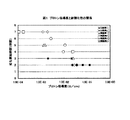
特性の評価結果を表1及び図1に示した。
【0045】
(比較例2)
200mLのイオン交換水に、塩化ナトリウムを所定量を溶解させた溶液を調製し、比較例1で得られたスルホン化ポリフェニレンサルファイド膜(クロロスルホン酸溶液へ20時間浸漬)を0.24gを前記溶液に浸漬した。室温で20時間放置した後、膜を回収してイオン交換水で洗浄した。
この膜を23℃に調温した恒温恒湿器内で、相対湿度98%、80%、60%、50%の調湿下で、それぞれ30分間放置して乾燥し、スルホン化ポリフェニレンサルファイド膜からなるプロトン伝導性高分子膜を得た。
特性の評価結果を表1及び図1に示した。
【0046】
(実施例1)
塩化ナトリウムの代わりに酢酸マグネシウム四水和物を使用した以外は、比較例2と同様にした。この特性の評価結果を表1及び図1に示した。
【0047】
(実施例2)
塩化ナトリウムの代わりに酢酸カルシウム一水和物を使用した以外は、比較例2と同様にした。この特性の評価結果を表1及び図1に示した。
【0048】
(実施例3)
塩化ナトリウムの代わりにアルミニウムトリイソプロポキシドを使用した以外は、比較例2と同様にした。この特性の評価結果を表1及び図1に示した。
【0049】
(実施例4)
塩化ナトリウムの代わりに酢酸ランタン水和物を使用した以外は、比較例2と同様にした。この特性の評価結果を表1及び図1に示した。
【0050】
【表1】
表1の実施例1〜4と比較例1〜2の比較から、本発明のプロトン伝導性高分子膜のプロトン伝導度はやや低下傾向を示す。一方、本発明のプロトン伝導性高分子膜の耐酸化性は、劣化開始時間が明らかに遅くなっており、酸化に関する耐久性が向上している。
【0052】
図1に示した実施例と比較例のプロトン伝導性高分子膜のプロトン伝導度と耐酸化性試験における劣化開始時間の関係から、プロトン伝導度が同等の場合、実施例のプロトン伝導性高分子膜の方が明らかに劣化開始時間が遅くなっており、本発明の有効性が示された。
【0053】
【発明の効果】
本発明のプロトン伝導性置換基を有する高分子化合物と2〜4価の多価金属からなるプロトン伝導性高分子膜は、プロトン伝導度と耐酸化性のバランスに優れ、固体高分子形燃料電池の電解質膜として有用である。
【図面の簡単な説明】
【図1】プロトン伝導度と耐酸化性の関係[0001]
TECHNICAL FIELD OF THE INVENTION
The present invention relates to a proton conductive polymer membrane useful as an electrolyte membrane for a polymer electrolyte fuel cell.
[0002]
[Prior art]
2. Description of the Related Art In recent years, fuel cells have been spotlighted as a clean energy source due to increasing awareness of environmental issues and energy saving. Above all, polymer electrolyte fuel cells using a proton-conducting polymer membrane as the electrolyte are unique to other fuel cells (phosphoric acid type, solid oxide type, molten carbonate type), such as low-temperature operation, small size and light weight. Therefore, application to automobile use and home cogeneration use has been studied.
[0003]
As a membrane for a fuel cell, there is a styrene-based cation exchange membrane developed in the 1950's, but it has poor stability in a fuel cell operating environment and has a sufficient life in practical use using this membrane. No fuel cell has been manufactured yet. As a fuel cell membrane having practical stability, a perfluorocarbon sulfonic acid membrane represented by Nafion (registered trademark of Nafion, hereinafter the same) has been developed. Has been proposed for application to electrochemical devices.
[0004]
At present, the perfluorocarbon sulfonic acid membrane is very expensive, which is an obstacle to widespread use of polymer electrolyte fuel cells. Therefore, it is very important to reduce the cost of the membrane, which is the main member, as much as possible for the spread of polymer electrolyte fuel cells.
[0005]
In order to obtain a more inexpensive fuel cell membrane, various fuel cell membranes of hydrocarbon polymer compounds have been studied and proposed in place of the conventional perfluorocarbon sulfonic acid membrane. Representative examples thereof include sulfonated polyetheretherketone (JP-A-6-93114, etc.), sulfonated polyethersulfone (JP-A-10-45913, etc.) and sulfonated polysulfone (JP-A-9-245818). And the like, and sulfonated polyimides of heat-resistant aromatic polymer compounds such as sulfonated polyimides (for example, JP-T-2000-510511). Fuel cell membranes composed of these hydrocarbon-based polymer compounds can be manufactured at low cost because the raw materials used are inexpensive and easy to manufacture. However, it has been pointed out that the proton conductivity is insufficient for a fuel cell membrane that requires high proton conductivity and high durability. In addition, if the amount of proton-conducting substituents, such as sulfonic acid groups, is increased to improve this, it becomes water-soluble or increases the water absorption of the membrane, swells significantly, and decreases the mechanical strength. It has been pointed out that handling properties are significantly impaired. Further, in many cases, the chemical and thermal stability that can be used as a membrane for a fuel cell is insufficient, and the membrane has not been put to practical use.
[0006]
As a membrane for a polymer electrolyte fuel cell having proton conductivity and long-term durability, Japanese Patent Application Laid-Open No. H11-67224 proposes a membrane for a fuel cell obtained by sulfonating a polyarylether sulfone. However, this film is soluble in water and methanol, and a reduction in the weight of the film has been observed in water resistance studies. Therefore, it cannot be used for a polymer electrolyte fuel cell that supplies humidified fuel and oxidizing gas and a direct methanol fuel cell that uses methanol directly as fuel, which is being studied for small-sized portable applications. It is.
[0007]
Further, in the case of a proton conductive polymer membrane used in a polymer electrolyte fuel cell, peroxide is generated in the catalyst layer formed at the interface between the membrane and the electrode, and the generated peroxide is diffused. It is known to be a peroxide radical. In the case of a proton conductive polymer membrane made of a hydrocarbon polymer compound, resistance to this peroxide radical (oxidation resistance) has conventionally been considered to be poor, and improvement has been desired.
[0008]
[Problems to be solved by the invention]
An object of the present invention is to provide a proton conductive polymer membrane having improved oxidation resistance without impairing profitability such as proton conductivity.
[0009]
[Means for Solving the Problems]
That is, the present invention is a polymer film comprising a polymer compound having a proton conductive substituent and a divalent or tetravalent polyvalent metal, wherein at least a part of the hydrogen atoms of the proton conductive substituent is It is a proton conductive polymer membrane substituted with a polyvalent metal.
[0010]
The polymer compound is preferably at least one selected from the following group (A).
Group (A): polybenzoxazole (PBO), polybenzothiazole (PBT), polybenzimidazole (PBI), polysulfone (PSU), polyethersulfone (PES), polyetherethersulfone (PEES), polyphenylenesulfone (PPSU) ), Polyphenylene oxide (PPO), polyphenylene sulfoxide (PPSO), polyphenylene sulfide (PPS), polyphenylene sulfide sulfone (PPS / SO 2 ), polyparaphenylene (PPP), polyether ketone (PEK), polyether ether ketone (PEEK) ), Polyetherketoneketone (PEKK), polyimide (PI)
Further, the phrase that at least a part of the hydrogen atoms of the proton conductive substituent is substituted by the polyvalent metal means that 0.01 to 0.95 equivalents of the hydrogen atom of the proton conductive substituent is a polyvalent metal. Is preferably substituted.
[0011]
The polyvalent metals are magnesium (Mg), calcium (Ca), strontium (Sr), barium (Ba), zinc (Zn), copper (Cu), aluminum (Al), gallium (Ga), indium ( In), yttrium (Y), lanthanum (La), titanium (Ti), zirconium (Zr) and hafnium (Hf) are preferably at least one selected from the group consisting of:
[0012]
In the present invention, among the above-mentioned polymer compounds, those comprising a repeating unit represented by the following general formula (1) are more preferable.
[0013]
Embedded image
[Wherein, Ar is a divalent aromatic unit, and x is an integer of 0 to 2]
Further, the proton conductive substituent is preferably a sulfonic acid group.
[0015]
DETAILED DESCRIPTION OF THE INVENTION
The present invention is a proton conductive polymer membrane comprising a polymer compound having a proton conductive substituent and a divalent or tetravalent polyvalent metal, wherein at least a part of the hydrogen atoms of the proton conductive substituent is It is a proton conductive polymer membrane substituted with a polyvalent metal.
The polymer compound is preferably at least one selected from the following group (A).
Group (A): polybenzoxazole (PBO), polybenzothiazole (PBT), polybenzimidazole (PBI), polysulfone (PSU), polyethersulfone (PES), polyetherethersulfone (PEES), polyphenylenesulfone (PPSU) ), Polyphenylene oxide (PPO), polyphenylene sulfoxide (PPSO), polyphenylene sulfide (PPS), polyphenylene sulfide sulfone (PPS / SO 2 ), polyparaphenylene (PPP), polyether ketone (PEK), polyether ether ketone (PEEK) ), Polyetherketoneketone (PEKK), polyimide (PI)
These polymer compounds may be used singly, in a copolymer of two or more, or as a mixture of two or more as required. Accordingly, the proton conductive polymer membrane of the present invention is excellent in chemical stability typified by excellent proton conductivity, hydrolysis resistance, and oxidation resistance, and is preferable.
[0016]
In consideration of industrial availability, characteristics of the obtained film, and the like, the polymer compound used in the present invention is a polyphenylene sulfoxide (PPSO) or polyphenylene comprising a repeating unit represented by the following general formula (1). It is preferably at least one selected from the group consisting of sulfide (PPS) and polyphenylene sulfide sulfone (PPS / SO 2 ), and more preferably polyphenylene sulfide (PPS).
[0017]
Embedded image
[Wherein, Ar is a divalent aromatic unit, and x is an integer of 0 to 2]
The proton-conducting polymer membrane of the present invention is characterized in that, by replacing at least a part of the hydrogen atoms of the proton-conducting substituent with a divalent or tetravalent polyvalent metal, a radical species which is said to be generated during fuel cell operation is provided. It is preferable because the oxidation resistance is remarkably improved. For example, even if a monovalent metal such as sodium (Na) is contained, the oxidation resistance is not improved, which is not preferable. In the present invention, the divalent to tetravalent polyvalent metal includes magnesium (Mg), calcium (Ca), strontium (Sr), barium (Ba), zinc (Zn), copper (Cu), and aluminum (Al). , Gallium (Ga), indium (In), yttrium (Y), lanthanum (La), titanium (Ti), zirconium (Zr), and hafnium (Hf). It is preferable from the viewpoint of industrial availability and its effect of improving durability.
[0019]
In addition, the proton conductive polymer membrane of the present invention, since the proton conductive substituent can take a cross-linked structure via a polyvalent metal, such as water or methanol exposed as an electrolyte membrane of a polymer electrolyte fuel cell. It is also preferable from the viewpoint that swelling under existing conditions is suppressed. Thereby, the handleability of the film is improved and crossover of methanol or the like can be suppressed.
[0020]
As the content of the polyvalent metal, 0.01 to 0.95 equivalents of hydrogen atoms of a proton conductive substituent such as a sulfonic acid group, a phosphoric acid group, a carboxylic acid group, and a phenolic hydroxyl group are substituted with the polyvalent metal. Is preferable because the balance between proton conductivity and durability is excellent. The range of the content referred to here is more than the hydrogen atom content of the proton conductive substituent, which is defined by the product of the content of the proton conductive substituent and its valence (monovalent in the case of a sulfonic acid group). It is defined by the ratio of the content of the valent metal and the amount of the polyvalent metal defined by the valence. When the content of the polyvalent metal is smaller than the above range, there is a possibility that almost no improvement in durability represented by acid resistance is observed. On the other hand, if it is larger than the above range, the proton conductivity may be significantly reduced.
[0021]
The amount of the polyvalent metal to be added may be determined by the method in which the ion exchange capacity derived from the hydrogen atom (hydrogen ion) of the proton conductive substituent by acid-base titration is measured before and after the polyvalent metal substitution, or the proton conductivity of the present invention is increased. A method of preparing a predetermined sample from a molecular film and quantifying the amount of a polyvalent metal in the film by atomic absorption analysis (AAS) or ICP spectroscopy can be exemplified, but the method is not limited thereto.
[0022]
The method of adding the polyvalent metal is not particularly limited, and for example, a hydroxide, an acetate, an acetylacetonate salt, an alkoxy salt such as an isopropoxy salt, or the like of the polyvalent metal can be used. In actual addition, it is preferable to dissolve the compound containing a polyvalent metal as described above in a solvent and contact the polymer with a polymer compound having a proton conductive substituent. At this time, the polymer compound having a proton conductive substituent is uniformly dissolved in an appropriate solvent, or is dispersed in an appropriate solvent, or is processed into a film shape and then immersed in an appropriate solvent. , A solution containing a compound containing a polyvalent metal may be added, and the proton conductive substituent and the polyvalent metal may be contacted under predetermined conditions (temperature, time).
[0023]
In the present invention, examples of the proton conductive substituent include a sulfonic acid group, a phosphoric acid group, a carboxylic acid group, and a phenolic hydroxyl group. It is preferably a group.
[0024]
In consideration of proton conductivity and chemical stability, the proton conductive polymer membrane of the present invention has the following general formula (2) in which the polymer compound is polyphenylene sulfide (PPS) and the proton conductive substituent is a sulfonic acid group. It is preferred to have a structural unit represented by the formula:
[0025]
Embedded image
[Where n is an integer of 1 to 4]
The proton conductive polymer membrane of the present invention is preferably made of the aromatic polymer compound further containing a plasticizer in order to improve membrane properties such as suppression of embrittlement and improvement of elongation. Thereby, the aromatic polymer compound is plasticized and becomes flexible, and the handling property of the obtained proton conductive polymer membrane tends to be remarkably improved. Along with this, physical film destruction hardly occurs during the manufacturing process or power generation, which is preferable.
[0027]
The plasticizer that can be used in the present invention varies depending on the type of the aromatic polymer compound used and the mixing method. For example, when the aromatic polymer compound and the plasticizer are melt-mixed, it is preferable to select a plasticizer having a boiling point higher than the melting temperature of the aromatic polymer compound. If the boiling point of the plasticizer is significantly lower than the boiling point of the aromatic polymer compound, the mixture of the aromatic polymer compound and the plasticizer tends not to have a desired mixing ratio.
[0028]
Examples of the plasticizer usable in the present invention include phosphate compounds such as tributyl phosphate, triphenyl phosphate and tricresyl phosphate, dimethyl phthalate, diethyl phthalate, dibutyl phthalate, diheptyl phthalate and di-phthalate. Aliphatic compounds such as n-octyl, di-2-ethylhexyl phthalate, diisononyl phthalate, octyldecyl phthalate, diisodecyl phthalate, butylbenzyl phthalate, etc., and aliphatics such as butyl oleate and glycerin monooleate Monobasic acid ester compound, di-n-butyl adipate, di-n-hexyl adipate, di-2-ethylhexyl adipate, alkyl 610 adipate, di-2-ethylhexyl azelate, dibutyl sebacate, sebacic acid Di-2-eth Aliphatic dibasic acid ester compounds such as hexyl, dihydric alcohol ester compounds such as diethylene glycol benzoate and triethylene glycol di-2-ethyl butyrate, methyl acetyl ricinoleate, butyl acetyl ricinoleate, butyl phthalyl butyl glycolate Oxyester compounds such as acetyl tributyl citrate, chlorinated paraffin, chlorinated biphenyl-2-nitrobiphenyl, dinonylnaphthalene, o-toluenesulfonethylamide, p-toluenesulfonethylamide, methyl abietic acid, etc. Can be illustrated. Among the plasticizers exemplified above, it is preferable to use a phosphate ester-based compound in terms of imparting compatibility with a polymer compound and flame retardancy, and particularly preferable to be triphenyl phosphate or tricresyl phosphate. Is preferred.
[0029]
In the proton conductive polymer membrane of the present invention, the ion exchange capacity of the polymer compound having a proton conductive substituent before adding a polyvalent metal is preferably 0.5 to 5 meq / g. If the ion exchange capacity is smaller than this range, the proton conductivity may be too small when a polyvalent metal is added, which is not preferable. If the ion exchange capacity is larger than this range, the ion exchange capacity becomes soluble in water or methanol, and may exhibit properties unsuitable as an electrolyte membrane of a polymer electrolyte fuel cell. Further, even if a polyvalent metal is added, the oxidation resistance may not be sufficiently improved.
[0030]
The proton conductive polymer membrane of the present invention preferably has a proton conductivity at room temperature of 1.0 × 10 −3 S / cm or more. If the proton conductivity is smaller than this range, the membrane resistance to the movement of protons increases, and it tends to be difficult to exhibit sufficient power generation characteristics.
[0031]
The proton conductive polymer membrane of the present invention is preferably as thin as possible, as long as it has practical mechanical strength and fuel / oxidant barrier properties. If the ion exchange capacity and the proton conductivity are equal, the thinner the thickness, the lower the membrane resistance. Therefore, the thickness is preferably about 5 to 200 μm, more preferably 20 to 150 μm.
[0032]
The proton conductive polymer membrane of the present invention may be irradiated with at least one radiation selected from the group consisting of γ-rays, electron beams, and ion beams. By irradiating radiation and modifying the membrane, the proton conductivity of the fuel cell membrane is improved. In particular, an electron beam is preferable from the viewpoint of radiation dose, transparency to a material, irradiation time (industrial continuous irradiation), and the like.
[0033]
The radiation irradiation atmosphere can be selected from air, an oxygen-free atmosphere, and a vacuum atmosphere. An atmosphere in which the film material is not deteriorated by irradiation with radiation may be appropriately selected. Further, the irradiation atmosphere or the film may be heated in order to efficiently perform the film modification by irradiation with radiation. At this time, a condition that does not cause deterioration of the film material may be appropriately set.
[0034]
The accelerating voltage of the radiation is preferably 0.01 to 5.0 MeV. When the accelerating voltage is low, the transmittance of radiation to the material is low, and it is difficult to obtain a uniform film even inside the material. Further, long-time irradiation is required to secure a required irradiation dose, and there is a possibility that productivity may be significantly reduced. If it is larger than this range, the device may become unnecessarily large or material deterioration may be promoted.
[0035]
The irradiation dose of the radiation is preferably 10 to 1000 kGy. If the irradiation dose is smaller than this range, a sufficient irradiation effect may not be exhibited. If the irradiation dose is larger than this range, the irradiation effect may be saturated, the irradiation time may be prolonged, or the material may be deteriorated or the characteristics may be deteriorated.
[0036]
The proton conductive polymer membrane of the present invention has proton conductivity, chemical / thermal stability, and mechanical properties, and can be suitably used as an electrolyte membrane of a polymer electrolyte fuel cell. In fact, when used in a polymer electrolyte fuel cell, the proton conductive polymer membrane of the present invention and the catalyst-supporting gas diffusion electrode are formed by a known method applied to a perfluorocarbon sulfonic acid membrane represented by Nafion. A joined membrane-electrode assembly is manufactured and sandwiched between a pair of separators provided with fuel and oxidant supply paths to form a polymer electrolyte fuel cell. It can be used as an electrolyte membrane. As the fuel, pure hydrogen, reformed gas such as methanol, natural gas, and gasoline, and organic liquid fuel such as methanol, ethanol, and dimethyl ether can be used. In addition, in order to obtain a required output, a plurality of cells can be stacked to form a stack and used.
[0037]
In particular, it is suitable for a mobile phone or a notebook computer, and is very useful as a membrane for a direct alcohol fuel cell which does not require high output and requires high fuel shutoff.
[0038]
【Example】
Hereinafter, the present invention will be described more specifically with reference to examples. However, the present invention is not limited to these examples, and can be appropriately changed and implemented without changing the gist thereof.
[0039]
(Proton conductivity)
A test specimen (10 mm × 40 mm) stored in ion-exchanged water is taken out, and water on the surface of the test specimen is wiped off with a filter paper. A test specimen was mounted between platinum electrodes at a distance between the electrodes of 30 mm, and placed in a two-pole non-sealed Teflon (registered trademark) cell. At room temperature and at a voltage of 0.2 V, an AC impedance method (frequency : 42 Hz to 5 MHz), the membrane resistance of the test sample was measured, and the proton conductivity was calculated.
[0040]
(Metal addition amount)
The metal addition amount (equivalent) is calculated from the ion exchange capacity (A) of the proton conductive polymer membrane before metal addition used as the base and the ion exchange capacity (B) of the proton conductive polymer membrane after metal addition. It was calculated using the following equation.
Metal addition amount (equivalent) = (AB) / A.
[0041]
(Method of measuring ion exchange capacity)
The test body is immersed in a saturated aqueous solution of sodium chloride and reacted in a water bath at 60 ° C. for 3 hours. After cooling to room temperature, the sample was sufficiently washed with ion-exchanged water, and titrated with a 0.01 N aqueous sodium hydroxide solution using a phenolphthalein solution as an indicator to calculate an ion exchange capacity.
[0042]
(Oxidation resistance test)
Ammonium iron (II) sulfate hexahydrate was added to 3% by weight of aqueous hydrogen peroxide so that the concentration of iron (II) ions was 4 ppm to prepare a Fenton reagent. About 20 mg of the membrane was added to 20 mL of Fenton's reagent and shaken in a 60 ° C water bath. The film appearance after a predetermined time was visually observed.
[0043]
(Comparative Example 1)
A proton conductive polymer membrane was prepared by the following method.
A polyphenylene sulfide film (trade name: Torelina, manufactured by Toray Industries, Inc., film thickness: 50 μm) was used.
[0044]
In a 900 mL mayonnaise bottle, 966 g of dichloromethane and 4.83 g of chlorosulfonic acid were weighed to prepare a chlorosulfonic acid solution. Then, 2.24 g of a polyphenylene sulfide film was weighed, immersed in contact, and allowed to stand at room temperature for a predetermined time (the amount of chlorosulfonic acid was 2 equivalents to the aromatic unit of polyphenylene sulfide).
After being left at room temperature for 20 hours, the film was recovered and washed with ion-exchanged water until neutral.
This film was left to dry in a thermo-hygrostat controlled at 23 ° C. under relative humidity of 98%, 80%, 60%, and 50% for 30 minutes each, and dried from a sulfonated polyphenylene sulfide membrane. Was obtained.
The evaluation results of the characteristics are shown in Table 1 and FIG.
[0045]
(Comparative Example 2)
A solution was prepared by dissolving a predetermined amount of sodium chloride in 200 mL of ion-exchanged water, and 0.24 g of the sulfonated polyphenylene sulfide membrane obtained in Comparative Example 1 (immersed in a chlorosulfonic acid solution for 20 hours) was added to the solution. Immersion. After standing at room temperature for 20 hours, the membrane was collected and washed with ion-exchanged water.
This film was left to dry in a thermo-hygrostat controlled at 23 ° C. under a relative humidity of 98%, 80%, 60%, and 50% for 30 minutes each, and dried from a sulfonated polyphenylene sulfide film. Was obtained.
The evaluation results of the characteristics are shown in Table 1 and FIG.
[0046]
(Example 1)
The procedure was the same as Comparative Example 2, except that magnesium acetate tetrahydrate was used instead of sodium chloride. The evaluation results of the characteristics are shown in Table 1 and FIG.
[0047]
(Example 2)
Comparative Example 2 was repeated except that calcium acetate monohydrate was used instead of sodium chloride. The evaluation results of the characteristics are shown in Table 1 and FIG.
[0048]
(Example 3)
Comparative Example 2 was repeated except that aluminum triisopropoxide was used instead of sodium chloride. The evaluation results of the characteristics are shown in Table 1 and FIG.
[0049]
(Example 4)
Comparative Example 2 was repeated except that lanthanum acetate hydrate was used instead of sodium chloride. The evaluation results of the characteristics are shown in Table 1 and FIG.
[0050]
[Table 1]
From the comparison between Examples 1 to 4 and Comparative Examples 1 and 2 in Table 1, the proton conductivity of the proton conductive polymer membrane of the present invention shows a slightly decreasing tendency. On the other hand, the oxidation resistance of the proton conductive polymer membrane of the present invention is clearly delayed in the onset time, and the durability with respect to oxidation is improved.
[0052]
From the relationship between the proton conductivity of the proton conductive polymer membranes of the example and the comparative example shown in FIG. 1 and the degradation start time in the oxidation resistance test, when the proton conductivity is the same, the proton conductive polymer of the example is used. The film clearly had a longer onset time for deterioration, indicating the effectiveness of the present invention.
[0053]
【The invention's effect】
The proton conductive polymer membrane comprising the polymer compound having a proton conductive substituent of the present invention and a divalent or tetravalent polyvalent metal has an excellent balance between proton conductivity and oxidation resistance, and is a solid polymer fuel cell. Is useful as an electrolyte membrane.
[Brief description of the drawings]
Fig. 1 Relationship between proton conductivity and oxidation resistance
Claims (10)
(A)群:ポリベンゾオキサゾール(PBO)、ポリベンゾチアゾール(PBT)、ポリベンゾイミダゾール(PBI)、ポリスルホン(PSU)、ポリエーテルスルホン(PES)、ポリエーテルエーテルスルホン(PEES)、ポリフェニレンスルホン(PPSU)、ポリフェニレンオキシド(PPO)、ポリフェニレンスルホキシド(PPSO)、ポリフェニレンサルファイド(PPS)、ポリフェニレンスルフィドスルホン(PPS/SO2)、ポリパラフェニレン(PPP)、ポリエーテルケトン(PEK)、ポリエーテルエーテルケトン(PEEK)、ポリエーテルケトンケトン(PEKK)、ポリイミド(PI)The proton conductive polymer membrane according to claim 1, wherein the polymer compound is at least one selected from the following group (A).
Group (A): polybenzoxazole (PBO), polybenzothiazole (PBT), polybenzimidazole (PBI), polysulfone (PSU), polyethersulfone (PES), polyetherethersulfone (PEES), polyphenylenesulfone (PPSU) ), Polyphenylene oxide (PPO), polyphenylene sulfoxide (PPSO), polyphenylene sulfide (PPS), polyphenylene sulfide sulfone (PPS / SO 2 ), polyparaphenylene (PPP), polyether ketone (PEK), polyether ether ketone (PEEK) ), Polyetherketoneketone (PEKK), polyimide (PI)
Priority Applications (1)
| Application Number | Priority Date | Filing Date | Title |
|---|---|---|---|
| JP2002172296A JP2004018573A (en) | 2002-06-13 | 2002-06-13 | Proton conductive polymer membrane |
Applications Claiming Priority (1)
| Application Number | Priority Date | Filing Date | Title |
|---|---|---|---|
| JP2002172296A JP2004018573A (en) | 2002-06-13 | 2002-06-13 | Proton conductive polymer membrane |
Publications (1)
| Publication Number | Publication Date |
|---|---|
| JP2004018573A true JP2004018573A (en) | 2004-01-22 |
Family
ID=31171905
Family Applications (1)
| Application Number | Title | Priority Date | Filing Date |
|---|---|---|---|
| JP2002172296A Withdrawn JP2004018573A (en) | 2002-06-13 | 2002-06-13 | Proton conductive polymer membrane |
Country Status (1)
| Country | Link |
|---|---|
| JP (1) | JP2004018573A (en) |
Cited By (22)
| Publication number | Priority date | Publication date | Assignee | Title |
|---|---|---|---|---|
| WO2005124911A1 (en) * | 2004-06-22 | 2005-12-29 | Asahi Glass Company, Limited | Electrolyte membrane for solid polymer fuel cell, method for producing same and membrane electrode assembly for solid polymer fuel cell |
| WO2006006357A1 (en) * | 2004-07-12 | 2006-01-19 | Asahi Glass Company, Limited | Electrolyte membrane for solid polymer fuel cell, method for producing same and membrane electrode assembly for solid polymer fuel cell |
| JP2006099999A (en) * | 2004-09-28 | 2006-04-13 | Asahi Glass Co Ltd | Electrolyte membrane for polymer electrolyte fuel cell, production method thereof and membrane electrode assembly for polymer electrolyte fuel cell |
| KR100599719B1 (en) | 2004-11-24 | 2006-07-12 | 삼성에스디아이 주식회사 | Polymer electrolyte membrane for fuel cell and fuel cell system comprising same |
| JP2006216285A (en) * | 2005-02-02 | 2006-08-17 | Mitsubishi Heavy Ind Ltd | Solid polymer electrolyte membrane, solid polymer electrolyte membrane electrode assembly, and solid polymer electrolyte fuel cell |
| JP2006338912A (en) * | 2005-05-31 | 2006-12-14 | Toyota Central Res & Dev Lab Inc | Solid polymer electrolyte, solid polymer fuel cell, and manufacturing method thereof |
| US20070099053A1 (en) * | 2005-10-28 | 2007-05-03 | 3M Innovative Properties Company | High durability fuel cell components with cerium salt additives |
| JP2007194121A (en) * | 2006-01-20 | 2007-08-02 | Toyota Central Res & Dev Lab Inc | Membrane electrode assembly and polymer electrolyte fuel cell |
| WO2007119868A1 (en) * | 2006-04-13 | 2007-10-25 | Sumitomo Chemical Company, Limited | Method for producing polymer electrolyte membrane, polymer electrolyte membrane and direct methanol fuel cell |
| JP2007305571A (en) * | 2006-04-13 | 2007-11-22 | Sumitomo Chemical Co Ltd | Method for producing polymer electrolyte membrane, polymer electrolyte membrane and direct methanol fuel cell |
| JP2008533225A (en) * | 2005-03-07 | 2008-08-21 | マツクス−プランク−ゲゼルシャフト ツール フエルデルング デル ヴイツセンシャフテン エー フアウ | Sulfonated poly (arylene) as a hydrolytically and thermally oxidatively stable polymer |
| US20090169959A1 (en) * | 2007-12-27 | 2009-07-02 | 3M Innovative Properties Company | Durable fuel cell membrane electrode assembly with combined additives |
| JP2009238560A (en) * | 2008-03-27 | 2009-10-15 | Toyota Central R&D Labs Inc | Solid polymer fuel cell |
| JP2010212247A (en) * | 2010-04-14 | 2010-09-24 | Toyota Central R&D Labs Inc | Membrane electrode assembly and solid polymer fuel cell |
| US7803847B2 (en) | 2004-09-20 | 2010-09-28 | 3M Innovative Properties Company | Fuel cell membrane electrode assembly |
| US7943249B2 (en) | 2004-06-22 | 2011-05-17 | Asahi Glass Company, Limited | Liquid composition, process for its production and process for producing membrane-electrode assembly for polymer electrolyte fuel cells |
| US8092954B2 (en) | 2004-09-20 | 2012-01-10 | 3M Innovative Properties Company | Method of making a fuel cell polymer electrolyte membrane comprising manganese oxide |
| JP2012124126A (en) * | 2010-12-10 | 2012-06-28 | Sumitomo Chemical Co Ltd | Polymer electrolyte composition, polymer electrolyte membrane, catalyst layer for solid polymer fuel cell, and membrane electrode assembly |
| US8367267B2 (en) | 2005-10-28 | 2013-02-05 | 3M Innovative Properties Company | High durability fuel cell components with cerium oxide additives |
| WO2013031479A1 (en) | 2011-08-26 | 2013-03-07 | 旭硝子株式会社 | Solid polymer electrolyte membrane, and membrane electrode assembly for use in solid polymer fuel cell |
| CN114667622A (en) * | 2019-09-27 | 2022-06-24 | 尼大意器株式会社 | Diaphragm for redox flow battery and method for manufacturing the diaphragm |
| RU2777335C1 (en) * | 2022-03-23 | 2022-08-02 | Федеральное государственное бюджетное учреждение науки Институт высокотемпературной электрохимии Уральского отделения Российской академии наук (ИВТЭ УрО РАН) | Solid oxide electrolyte material with proton conductivity based on barium-lanthanum indate |
-
2002
- 2002-06-13 JP JP2002172296A patent/JP2004018573A/en not_active Withdrawn
Cited By (47)
| Publication number | Priority date | Publication date | Assignee | Title |
|---|---|---|---|---|
| EP1772919B1 (en) | 2004-06-22 | 2010-10-06 | Asahi Glass Company, Limited | Electrolyte membrane for solid polymer fuel cell, method for producing same and membrane electrode assembly for solid polymer fuel cell |
| US10916790B2 (en) | 2004-06-22 | 2021-02-09 | AGC Inc. | Liquid composition, process for its production, and process for producing membrane-electrode assembly for polymer electrolyte fuel cells |
| US10153506B2 (en) | 2004-06-22 | 2018-12-11 | AGC Inc. | Liquid composition, process for its production, and process for producing membrane-electrode assembly for polymer electrolyte fuel cells |
| US9455465B2 (en) | 2004-06-22 | 2016-09-27 | Asahi Glass Company, Limited | Electrolyte membrane for polymer electrolyte fuel cell, process for its production and membrane-electrode assembly for polymer electrolyte fuel cell |
| US9331354B2 (en) | 2004-06-22 | 2016-05-03 | Asahi Glass Company, Limited | Liquid composition, process for its production, and process for producing membrane-electrode assembly for polymer electrolyte fuel cells |
| US8962215B2 (en) | 2004-06-22 | 2015-02-24 | Asahi Glass Company, Limited | Electrolyte membrane for polymer electrolyte fuel cell, process for its production and membrane-electrode assembly for polymer electrolyte fuel cell |
| US8546004B2 (en) | 2004-06-22 | 2013-10-01 | Asahi Glass Company, Limited | Liquid composition, process for its production and process for producing membrane-electrode assembly for polymer electrolyte fuel cells |
| WO2005124911A1 (en) * | 2004-06-22 | 2005-12-29 | Asahi Glass Company, Limited | Electrolyte membrane for solid polymer fuel cell, method for producing same and membrane electrode assembly for solid polymer fuel cell |
| US7943249B2 (en) | 2004-06-22 | 2011-05-17 | Asahi Glass Company, Limited | Liquid composition, process for its production and process for producing membrane-electrode assembly for polymer electrolyte fuel cells |
| WO2006006357A1 (en) * | 2004-07-12 | 2006-01-19 | Asahi Glass Company, Limited | Electrolyte membrane for solid polymer fuel cell, method for producing same and membrane electrode assembly for solid polymer fuel cell |
| US8092954B2 (en) | 2004-09-20 | 2012-01-10 | 3M Innovative Properties Company | Method of making a fuel cell polymer electrolyte membrane comprising manganese oxide |
| US8101317B2 (en) | 2004-09-20 | 2012-01-24 | 3M Innovative Properties Company | Durable fuel cell having polymer electrolyte membrane comprising manganese oxide |
| US7803847B2 (en) | 2004-09-20 | 2010-09-28 | 3M Innovative Properties Company | Fuel cell membrane electrode assembly |
| US9034538B2 (en) | 2004-09-20 | 2015-05-19 | 3M Innovative Properties Company | Casting solution and method for making a polymer electrolyte membrane |
| JP2006099999A (en) * | 2004-09-28 | 2006-04-13 | Asahi Glass Co Ltd | Electrolyte membrane for polymer electrolyte fuel cell, production method thereof and membrane electrode assembly for polymer electrolyte fuel cell |
| KR100599719B1 (en) | 2004-11-24 | 2006-07-12 | 삼성에스디아이 주식회사 | Polymer electrolyte membrane for fuel cell and fuel cell system comprising same |
| US7862922B2 (en) | 2004-11-24 | 2011-01-04 | Samsung Sdi Co., Ltd. | Polymer electrolyte membrane for fuel cell and fuel cell system comprising same |
| JP2006216285A (en) * | 2005-02-02 | 2006-08-17 | Mitsubishi Heavy Ind Ltd | Solid polymer electrolyte membrane, solid polymer electrolyte membrane electrode assembly, and solid polymer electrolyte fuel cell |
| JP2008533225A (en) * | 2005-03-07 | 2008-08-21 | マツクス−プランク−ゲゼルシャフト ツール フエルデルング デル ヴイツセンシャフテン エー フアウ | Sulfonated poly (arylene) as a hydrolytically and thermally oxidatively stable polymer |
| JP2006338912A (en) * | 2005-05-31 | 2006-12-14 | Toyota Central Res & Dev Lab Inc | Solid polymer electrolyte, solid polymer fuel cell, and manufacturing method thereof |
| US7879475B2 (en) | 2005-05-31 | 2011-02-01 | Kabushiki Kaisha Toyota Chuo Kenkyusho | Solid polymer electrolyte, solid polymer fuel cell and method for manufacturing the fuel cell |
| US9431670B2 (en) * | 2005-10-28 | 2016-08-30 | 3M Innovative Properties Company | High durability fuel cell components with cerium salt additives |
| US8367267B2 (en) | 2005-10-28 | 2013-02-05 | 3M Innovative Properties Company | High durability fuel cell components with cerium oxide additives |
| US8628871B2 (en) * | 2005-10-28 | 2014-01-14 | 3M Innovative Properties Company | High durability fuel cell components with cerium salt additives |
| US20140093808A1 (en) * | 2005-10-28 | 2014-04-03 | 3M Innovative Properties Company | High Durability Fuel Cell Components with Cerium Salt Additives |
| US20070099053A1 (en) * | 2005-10-28 | 2007-05-03 | 3M Innovative Properties Company | High durability fuel cell components with cerium salt additives |
| DE112007000167T5 (en) | 2006-01-20 | 2008-11-27 | Toyota Jidosha Kabushiki Kaisha, Toyota-shi | Membrane electrode assembly and polymer electrolyte membrane fuel cell |
| US8187765B2 (en) | 2006-01-20 | 2012-05-29 | Toyota Jidosha Kabushiki Kaisha | Membrane electrode assembly and polymer electrolyte membrane fuel cell |
| DE112007000167B4 (en) | 2006-01-20 | 2020-08-06 | Toyota Jidosha Kabushiki Kaisha | Membrane electrode assembly and polymer electrolyte membrane fuel cell |
| WO2007083229A3 (en) * | 2006-01-20 | 2008-01-17 | Toyota Motor Co Ltd | Membrane electrode assembly and polymer electrolyte membrane fuel cell containing the same |
| JP2007194121A (en) * | 2006-01-20 | 2007-08-02 | Toyota Central Res & Dev Lab Inc | Membrane electrode assembly and polymer electrolyte fuel cell |
| WO2007119868A1 (en) * | 2006-04-13 | 2007-10-25 | Sumitomo Chemical Company, Limited | Method for producing polymer electrolyte membrane, polymer electrolyte membrane and direct methanol fuel cell |
| JP2007305571A (en) * | 2006-04-13 | 2007-11-22 | Sumitomo Chemical Co Ltd | Method for producing polymer electrolyte membrane, polymer electrolyte membrane and direct methanol fuel cell |
| EP2009724A4 (en) * | 2006-04-13 | 2010-03-03 | Sumitomo Chemical Co | METHOD FOR PRODUCING POLYMER ELECTROLYTE MEMBRANE, POLYMER ELECTROLYTE MEMBRANE, AND METHANOL DIRECT FUEL CELL |
| US9023496B2 (en) * | 2007-12-27 | 2015-05-05 | 3M Innovative Properties Company | Durable fuel cell membrane electrode assembly with combined additives |
| US9728801B2 (en) | 2007-12-27 | 2017-08-08 | 3M Innovative Properties Company | Durable fuel cell membrane electrode assembly with combined additives |
| US20090169959A1 (en) * | 2007-12-27 | 2009-07-02 | 3M Innovative Properties Company | Durable fuel cell membrane electrode assembly with combined additives |
| US20120148937A1 (en) * | 2007-12-27 | 2012-06-14 | Pierpont Daniel M | Durable fuel cell membrane electrode assembly with combined additives |
| US8137828B2 (en) * | 2007-12-27 | 2012-03-20 | 3M Innovative Properties Company | Durable fuel cell membrane electrode assembly with combined additives |
| JP2009238560A (en) * | 2008-03-27 | 2009-10-15 | Toyota Central R&D Labs Inc | Solid polymer fuel cell |
| JP2010212247A (en) * | 2010-04-14 | 2010-09-24 | Toyota Central R&D Labs Inc | Membrane electrode assembly and solid polymer fuel cell |
| JP2012124126A (en) * | 2010-12-10 | 2012-06-28 | Sumitomo Chemical Co Ltd | Polymer electrolyte composition, polymer electrolyte membrane, catalyst layer for solid polymer fuel cell, and membrane electrode assembly |
| WO2013031479A1 (en) | 2011-08-26 | 2013-03-07 | 旭硝子株式会社 | Solid polymer electrolyte membrane, and membrane electrode assembly for use in solid polymer fuel cell |
| US9379403B2 (en) | 2011-08-26 | 2016-06-28 | Asahi Glass Company, Limited | Polymer electrolyte membrane and membrane/electrode assembly for polymer electrolyte fuel cell |
| CN114667622A (en) * | 2019-09-27 | 2022-06-24 | 尼大意器株式会社 | Diaphragm for redox flow battery and method for manufacturing the diaphragm |
| CN114667622B (en) * | 2019-09-27 | 2023-11-21 | 尼大意器株式会社 | Separator for redox flow battery and method for manufacturing same |
| RU2777335C1 (en) * | 2022-03-23 | 2022-08-02 | Федеральное государственное бюджетное учреждение науки Институт высокотемпературной электрохимии Уральского отделения Российской академии наук (ИВТЭ УрО РАН) | Solid oxide electrolyte material with proton conductivity based on barium-lanthanum indate |
Similar Documents
| Publication | Publication Date | Title |
|---|---|---|
| Javed et al. | A critical review of electrolytes for advanced low-and high-temperature polymer electrolyte membrane fuel cells | |
| EP1760812B1 (en) | Liquid composition, process for its production, and process for producing membrane electrode assembly for polymer electrolyte fuel cell | |
| Sacca et al. | Nafion–TiO2 hybrid membranes for medium temperature polymer electrolyte fuel cells (PEFCs) | |
| JP3915846B2 (en) | Electrolyte membrane for polymer electrolyte fuel cell, production method thereof, and membrane electrode assembly for polymer electrolyte fuel cell | |
| JP5247974B2 (en) | Method for producing electrolyte membrane for polymer electrolyte hydrogen / oxygen fuel cell | |
| JP4194843B2 (en) | Proton conducting polymer membrane and method for producing the same | |
| JP2003288916A (en) | Direct alcohol fuel cell membrane and method for producing the same | |
| CN100544087C (en) | Electrolyte membrane for solid polymer fuel cell, method for producing same, and membrane electrode assembly for solid polymer fuel cell | |
| CN1981400B (en) | Elctrolyte membrane for solid polymer electrolyte fuel cell, process for its production and membrane-electrode assembly for solid polymer electrolyte fuel cell | |
| JP4836438B2 (en) | Polymer electrolyte laminate film | |
| Rachman et al. | Phosphorylated cerium functionalized Nafion for superior radical scavenging and enhanced proton conductivity in polymer electrolyte membrane fuel cells | |
| JP2007503707A (en) | Fullerene electrolytes for fuel cells | |
| JP5286651B2 (en) | Liquid composition, process for producing the same, and process for producing membrane electrode assembly for polymer electrolyte fuel cell | |
| JP2008098179A (en) | Electrolyte membrane for polymer electrolyte fuel cell, production method thereof and membrane electrode assembly for polymer electrolyte fuel cell | |
| JP2007031718A5 (en) | ||
| US12308498B2 (en) | Durable membrane-electrode assembly with high ionic conductivity and method of manufacturing same | |
| Kato et al. | Phosphoric Acid‐Immobilized Polybenzimidazole Hybrid Membranes with TiO2 Nanowires for High‐Temperature Polymer Electrolyte Membrane Fuel Cells | |
| JP2014234445A (en) | Polymer electrolyte composition, as well as polymer electrolyte membrane, electrode catalyst layer, membrane electrode assembly, and solid polymer fuel cell using the same | |
| JP6415807B2 (en) | Perfluorosulfonic acid polymer-azole blend membrane, production method thereof, and solid polymer fuel cell | |
| Roelofs | Sulfonated poly (ether ether ketone) based membranes for direct ethanol fuel cells | |
| Rhoden | Physicochemical And Thermochemical Properties Of Sulfonated Poly (etheretherketone) Electrolyte Membranes | |
| Zhang | Proton exchange membrane for hydrogen fuel cells: Self-humidification and crystallization | |
| JPWO2007139147A1 (en) | ION CONDUCTIVE POLYMER COMPOSITION, PROCESS FOR PRODUCING THE SAME, FILM CONTAINING THIS ION CONDUCTIVE POLYMER COMPOSITION AND ELECTROCHEMICAL DEVICE USING THE SAME |
Legal Events
| Date | Code | Title | Description |
|---|---|---|---|
| A621 | Written request for application examination |
Free format text: JAPANESE INTERMEDIATE CODE: A621 Effective date: 20050427 |
|
| A761 | Written withdrawal of application |
Free format text: JAPANESE INTERMEDIATE CODE: A761 Effective date: 20070309 |
|
| A521 | Request for written amendment filed |
Free format text: JAPANESE INTERMEDIATE CODE: A523 Effective date: 20070523 |