【0001】
【発明の属する技術分野】
本発明は、熱可塑性樹脂架橋発泡体に関する。
【0002】
【従来の技術】
通常、熱可塑性樹脂は、その燃焼時においては融解・気化しながら燃焼するので、燃焼中には熱可塑性樹脂が熱分解することにより生成した低分子量の液体状の炭化水素が滴下する現象(ドリップ現象)が発生する。
【0003】
上記ドリップ現象は、含ハロゲン熱可塑性樹脂や含窒素熱可塑性樹脂などの難燃性熱可塑性樹脂を主原料として用いた成形体や、ハロゲン系難燃剤、リン系難燃剤、金属水酸化物系難燃剤などの難燃剤を添加した難燃性熱可塑性樹脂を主原料として用いた成形体についても同様に発生し、熱可塑性樹脂を主原料としてなる成形体が燃焼前の形状を保持することは困難である。
【0004】
また、ドリップ現象は、熱可塑性樹脂を主原料として用いた発泡体についても同様に発生し、むしろ、燃焼前後の形状変化は、非発泡の成形体よりも発泡体の方が著しい。
【0005】
現在主流の熱可塑性樹脂発泡体の多くは、見掛け密度が0.025〜0.2g/cm3 であり、単位体積あたりの熱可塑性樹脂量が非常に少ないため、一度着火すると熱可塑性樹脂が迅速に熱分解・燃焼し、燃焼前の発泡体の形状を保持するために必要な気泡構造が破壊されてしまう。
【0006】
一般に熱可塑性樹脂発泡体は、柔軟性、衝撃吸収性、断熱性等に優れているので、例えば、天井、ドア、計器パネルなどの車両内装材や緩衝材等として広く用いられている。また、独立気泡であるポリオレフィン系樹脂発泡体は、断熱材としての用途も多い。しかし、これらの熱可塑性樹脂発泡体には、炎による熱変形に対しては非常に弱いという問題点や、難燃性が高く自己消火性に富む発泡体であっても、自己消火するまでに著しく熱変形してしまうという問題点がある。
【0007】
一方、熱可塑性樹脂発泡体の機械的強度などの力学的物性や衝撃吸収性、断熱性、寸法安定性等を向上させたり、線膨張率を低減させるために、熱可塑性樹脂発泡体中に無機充填剤を含有させることが行われており、例えば、特開平8−143697号公報には、発泡剤およびシランカップリング剤を吸着した粘土化合物および/または珪藻土を含有することを特徴とするポリプロピレン発泡体組成物が開示されている。
【0008】
上記公報に開示されているポリプロピレン発泡体組成物は、粘土化合物や珪藻土をポリプロピレンと混練することによって、発泡体の機械的強度などの力学的物性や衝撃吸収性、断熱性、寸法安定性等を向上させたり、線膨張率を低減させることができるものとされている。
【0009】
しかし、上記公報に開示されているポリプロピレン発泡体組成物は、粘土化合物や珪藻土の凝集構造を解砕して薄片状結晶をポリプロピレン中に均一に分散させることについては全く考慮されていないので、粘土化合物や珪藻土を含有させることによる効果が十分に引き出されているとは言いがたい。即ち、上記公報に開示されているポリプロピレン発泡体組成物は、燃焼時におけるドリップ現象の発生や燃焼前後での発泡体の形状変化等を十分に抑制し得るものとは言いがたい。
【0010】
【発明が解決しようとする課題】
本発明の目的は、上記問題点に鑑み、難燃性に優れ、燃焼時におけるドリップ現象の発生や燃焼前後の形状変化が少なく、しかも力学的物性、耐熱性、柔軟性、衝撃吸収性、断熱性、寸法安定性等に優れ、線膨張率の低い熱可塑性樹脂架橋発泡体を提供することにある。
【0011】
【課題を解決するための手段】
請求項1に記載の発明(本発明)による熱可塑性樹脂架橋発泡体は、熱可塑性樹脂100重量部に対して層状珪酸塩10〜70重量部および発泡剤が配合されてなる発泡性熱可塑性樹脂組成物からなり、かつ、ゲル分率が15〜70重量%であり、見掛け密度が0.03〜0.1g/cm3 であることを特徴とする。
【0012】
本発明の熱可塑性樹脂架橋発泡体(以下、単に「架橋発泡体」と略記する)を構成する発泡性熱可塑性樹脂組成物(以下、単に「発泡性組成物」と略記する)に用いられる熱可塑性樹脂としては、特に限定されるものではないが、例えば、ポリオレフィン系樹脂、ポリスチレン系樹脂、ポリフェニレンエーテル系樹脂、ポリオキシメチレン系樹脂、ポリエステル系樹脂、ポリアミド系樹脂等が挙げられ、なかでもポリオレフィン系樹脂が好適に用いられる。これらの熱可塑性樹脂は、単独で用いられても良いし、2種類以上が併用されても良い。
【0013】
上記ポリオレフィン系樹脂としては、特に限定されるものではないが、例えば、プロピレンの単独重合体、プロピレンとプロピレン以外のα−オレフィンとの共重合体、プロピレンとエチレンとのランダム共重合体またはブロック共重合体、エチレンの単独重合体、エチレンとエチレン以外のα−オレフィンとの共重合体、エチレンと(メタ)アクリル酸との共重合体、エチレンと(メタ)アクリル酸エステルとの共重合体、エチレンと酢酸ビニルとの共重合体、エチレンとスチレンとの共重合体、ブテンの単独重合体、イソプレンやブタジエンなどの共役ジエン類の単独重合体または共重合体等が挙げられ、なかでもプロピレンの単独重合体、プロピレンとプロピレン以外のα−オレフィンとの共重合体、エチレンの単独重合体、エチレンとエチレン以外のα−オレフィンとの共重合体、エチレンとアクリル酸エチルとの共重合体、エチレンと酢酸ビニルとの共重合体等が好適に用いられる。これらのポリオレフィン系樹脂は、単独で用いられても良いし、2種類以上が併用されても良い。なお、本発明で言う例えば(メタ)アクリルとは、アクリルまたはメタクリルを意味する。
【0014】
上記ポリオレフィン系樹脂は、特に限定されるものではないが、JIS K−7210「プラスチック−熱可塑性プラスチックのメルトマスフローレイト(MFR)及びメルトボリュームフローレイト(MVR)の試験方法」のA法に準拠して測定されたメルトマスフローレイト(MFR)が0.2〜10g/10分であることが好ましい。ポリオレフィン系樹脂の上記MFRが0.2g/10分未満であると、得られる架橋発泡体の表面の外観が悪くなることがあり、逆にポリオレフィン系樹脂の上記MFRが10g/10分を超えると、得られる架橋発泡体の耐熱性が不十分となることがある。
【0015】
本発明において、優れた柔軟性を有する架橋発泡体を所望する場合には、熱可塑性樹脂としてエチレンと(メタ)アクリル酸との共重合体やエチレンと(メタ)アクリル酸エステルとの共重合体あるいはエチレンと酢酸ビニルとの共重合体等を用いることが好ましい。この際、共重合体中における(メタ)アクリル酸や(メタ)アクリル酸エステルあるいは酢酸ビニルの含有量は、特に限定されるものではないが、0.1〜50重量%であることが好ましく、より好ましくは5〜30重量%である。共重合体中における(メタ)アクリル酸や(メタ)アクリル酸エステルあるいは酢酸ビニルの含有量が0.1重量%未満であると、得られる架橋発泡体の柔軟性が乏しくなることがあり、逆に共重合体中における(メタ)アクリル酸や(メタ)アクリル酸エステルあるいは酢酸ビニルの含有量が50重量%を超えると、得られる架橋発泡体の耐熱性が不十分となることがある。
【0016】
また、本発明において、柔軟性と力学的物性とのバランスに優れる架橋発泡体を所望する場合には、熱可塑性樹脂としてエチレンとエチレン以外のα−オレフィンとの共重合体を用いることが好ましい。エチレン以外のα−オレフィンの共重合比率を高めることにより、共重合体は柔軟性に富むものとなり、逆にエチレン以外のα−オレフィンの共重合比率を低めることにより、共重合体は力学的物性の高いものとなる。
【0017】
上記エチレン以外のα−オレフィンとしては、特に限定されるものではないが、例えば、プロピレン、1−ブテン、1−ヘキセン、4−メチル−1−ペンテン、1−オクテン等が挙げられる。これらのエチレン以外のα−オレフィンは、単独で用いられても良いし、2種類以上が併用されても良い。
【0018】
共重合体中におけるエチレン以外のα−オレフィンの含有量は、特に限定されるものではないが、0.1〜50重量%であることが好ましく、より好ましくは2〜40重量%である。共重合体中におけるエチレン以外のα−オレフィンの含有量が0.1重量%未満であると、得られる架橋発泡体の柔軟性が乏しくなることがあり、逆に共重合体中におけるエチレン以外のα−オレフィンの含有量が50重量%を超えると、得られる架橋発泡体の耐熱性が不十分となることがある。
【0019】上記エチレンとエチレン以外のα−オレフィンとの共重合体は、均一系の重合触媒を用いて重合された共重合体であっても良い。この共重合体は、一般にメタロセン系化合物を均一系の重合触媒として重合されるので、メタロセンポリエチレンと呼称されることがある。メタロセンポリエチレンにおいては、エチレン以外のα−オレフィンの共重合比率を容易に高めることができるので、著しく優れた柔軟性を有する共重合体を得ることができる。また、メタロセンポリエチレンは、結晶ラメラ厚みが薄いため、結晶同士を結ぶタイ分子が多くなるので、力学的物性にも優れている。従って、本発明において、柔軟性と力学的物性とのバランスが高い次元で優れている架橋発泡体を所望する場合には、熱可塑性樹脂としてメタロセンポリエチレンを用いることが好ましい。
【0020】
上記均一系の重合触媒となり得るメタロセン系化合物としては、特に限定されるものではないが、例えば、IV族、X族、XI族の遷移金属の錯体等が挙げられる。これらのメタロセン系化合物は、単独で用いられても良いし、2種類以上が併用されても良い。
【0021】
上記遷移金属の錯体とは、遷移金属原子に配位子が結合したものであり、上記配位子としては、特に限定されるものではないが、例えば、炭化水素基、置換炭化水素基、炭化水素−置換メタロイド基などにより置換されたシクロペンタジエン環;シクロペンタジエニルオリゴマー環;インデニル環;炭化水素基、置換炭化水素基、炭化水素−置換メタロイド基などにより置換されたインデニル環等や、塩素や臭素などの1価のアニオンリガンド;2価のアニオンキレートリガンド;炭化水素基;アルコキシド基;アミド基;アリールアミド基;アリールオキシド基;ホスフィド基;アリールホスフィド基;シリル基;置換シリル基等が挙げられる。これらの配位子は、単独で用いられても良いし、2種類以上が併用されても良い。
【0022】
また、本発明において、耐熱性に優れる架橋発泡体を所望する場合には、熱可塑性樹脂として高密度ポリエチレン樹脂やポリプロピレン系樹脂を用いることが好ましい。上記ポリプロピレン系樹脂としては、特に限定されるものではないが、例えば、プロピレンの単独重合体やプロピレンとプロピレン以外のα−オレフィンとの共重合体等が挙げられる。上記プロピレン以外のα−オレフィンとしては、特に限定されるものではないが、例えば、エチレン、1−ブテン、1−ペンテン、1−ヘキセン、4−メチル−1−ペンテン、1−ヘプテン、1−オクテン等が挙げられる。これらのプロピレン以外のα−オレフィンは、単独で用いられても良いし、2種類以上が併用されても良い。また、上記ポリプロピレン系樹脂は、単独で用いられても良いし、2種類以上が併用されても良い。さらに、上記高密度ポリエチレン樹脂およびポリプロピレン系樹脂は、それぞれ単独で用いられても良いし、両者が併用されても良い。
【0023】
本発明で用いられる熱可塑性樹脂には、本発明の課題達成を阻害しない範囲で必要に応じて、樹脂の特性を改質するために、熱可塑性エラストマー類やオリゴマー類等が配合されていても良い。
【0024】
上記熱可塑性エラストマー類としては、特に限定されるものではないが、例えば、スチレン系エラストマー、オレフィン系エラストマー、ウレタン系エラストマー、ポリエステル系エラストマー等が挙げられる。これらの熱可塑性エラストマー類は、単独で用いられても良いし、2種類以上が併用されても良い。また、上記オリゴマー類としては、特に限定されるものではないが、例えば、無水マレイン酸変性エチレンオリゴマー等が挙げられる。これらのオリゴマー類は、単独で用いられても良いし、2種類以上が併用されても良い。また、上記熱可塑性エラストマー類およびオリゴマー類は、それぞれ単独で用いられても良いし、両者が併用されても良い。
【0025】
また、本発明で用いられる熱可塑性樹脂には、本発明の課題達成を阻害しない範囲で必要に応じて、物性を均一化する補助手段として結晶を微細化するための結晶核となりうる造核剤や、酸化防止剤(老化防止剤)、熱安定剤、光安定剤、紫外線吸収剤、滑剤、難燃剤、帯電防止剤、防曇剤等の各種添加剤の1種類もしくは2種類以上が配合されていても良い。
【0026】
本発明の架橋発泡体を構成する発泡性組成物に用いられる層状珪酸塩とは、結晶層間に交換性金属カチオンを有する珪酸塩鉱物を意味する。
【0027】
上記層状珪酸塩としては、特に限定されるものではないが、例えば、モンモリロナイト、サポナイト、ヘクトライト、バイデライト、スティブンサイト、ノントロナイトなどのスメクタイト系粘土鉱物や、バーミキュライト、ハロイサイト、膨潤性マイカ等が挙げられ、なかでもモンモリロナイトや膨潤性マイカが好適に用いられる。上記層状珪酸塩は、天然物であっても良いし、合成物であっても良い。また、これらの層状珪酸塩は、単独で用いられても良いし、2種類以上が併用されても良い。
【0028】
上記層状珪酸塩としては、下記関係式(1)で定義される形状異方性効果の大きいスメクタイト系粘土鉱物や膨潤性マイカを用いることが好ましい。スメクタイト系粘土鉱物や膨潤性マイカのような形状異方性効果の大きい層状珪酸塩を用いることにより、得られる架橋発泡体はより優れた力学的物性を有するものとなる。
形状異方性効果=結晶表面(A)の面積/結晶表面(B)の面積‥‥(1)
なお、上式中、結晶表面(A)は層表面を意味し、結晶表面(B)は層側面を意味する。
【0029】
上記層状珪酸塩の形状は、特に限定されるものではないが、凝集構造を解砕した微細薄片状結晶の平均長さが0.01〜3μm、厚みが0.001〜1μm、アスペクト比が20〜500であるものが好ましく、より好ましくは、平均長さが0.05〜2μm、厚みが0.01〜0.5μm、アスペクト比が50〜200のものである。
【0030】
上記層状珪酸塩の結晶層間に存在する交換性金属カチオンとは、層状珪酸塩の結晶表面上に存在するナトリウムやカルシウムなどの金属イオンのことであり、これらの金属イオンは、カチオン性物質とカチオン交換性を有するため、カチオン性を有する種々の物質を上記層状珪酸塩の結晶層間に挿入もしくは捕捉することができる。
【0031】
上記層状珪酸塩のカチオン交換容量は、特に限定されるものではないが、50〜200ミリ等量/100gであることが好ましい。層状珪酸塩のカチオン交換容量が50ミリ等量/100g未満であると、カチオン交換により層状珪酸塩の結晶層間に捕捉されるカチオン性物質の量が少なくなるために、結晶層間が十分に非極性化(疎水化)されないことがあり、逆に層状珪酸塩のカチオン交換容量が200ミリ等量/100gを超えると、層状珪酸塩の結晶層間の結合力が強固になりすぎて、結晶薄片が剥離し難くなることがある。
【0032】
本発明において、熱可塑性樹脂として例えばポリオレフィン系樹脂のような低極性樹脂を用いる場合には、予め層状珪酸塩の層間をカチオン性界面活性剤でカチオン交換して、疎水化しておくことが好ましい。予め層状珪酸塩の層間を疎水化しておくことにより、層状珪酸塩と低極性の熱可塑性樹脂との親和性が高まり、層状珪酸塩を低極性の熱可塑性樹脂中により均一に微分散させることができる。
【0033】
上記カチオン性界面活性剤としては、特に限定されるものではなく、例えば、4級アンモニウム塩、4級ホスホニウム塩等が挙げられ、なかでも、層状珪酸塩の結晶層間を十分に非極性化(疎水化)しうることから、炭素数6以上のアルキル鎖を有する4級アンモニウム塩(炭素数6以上のアルキルアンモニウム塩)が好適に用いられる。
【0034】
上記4級アンモニウム塩としては、特に限定されるものではないが、例えば、ラウリルトリメチルアンモニウム塩、ステアリルトリメチルアンモニウム塩、トリオクチルアンモニウム塩、ジステアリルジメチルアンモニウム塩、ジ硬化牛脂ジメチルアンモニウム塩、ジステアリルジベンジルアンモニウム塩、N−ポリオキシエチレン−N−ラウリル−N,N−ジメチルアンモニウム塩等が挙げられる。これらの4級アンモニウム塩は、単独で用いられても良いし、2種類以上が併用されても良い。
【0035】
また、上記4級ホスホニウム塩としては、特に限定されるものではないが、例えば、ドデシルトリフェニルホスホニウム塩、メチルトリフェニルホスホニウム塩、ラウリルトリメチルホスホニウム塩、ステアリルトリメチルホスホニウム塩、トリオクチルホスホニウム塩、ジステアリルジメチルホスホニウム塩、ジステアリルジベンジルホスホニウム塩等が挙げられる。これらの4級ホスホニウム塩は、単独で用いられても良いし、2種類以上が併用されても良い。また、上記4級アンモニウム塩および4級ホスホニウム塩は、それぞれ単独で用いられても良いし、両者が併用されても良い。
【0036】
本発明で用いられる層状珪酸塩は、上述のように化学処理によって熱可塑性樹脂中への分散性を向上させることができる。
【0037】
上記化学処理は、(1)カチオン性界面活性剤によるカチオン交換法(以下、「化学修飾(1)法」と記す)に限定されるものではなく、例えば、以下に示す各種化学処理法によっても実施することができる。なお、化学修飾(1)法を含め、以下に示す各種化学処理法によって熱可塑性樹脂中への分散性を向上させた層状珪酸塩を、以下、「有機化層状珪酸塩」と記す。
【0038】
(2)化学修飾(1)法で化学処理された有機化層状珪酸塩の結晶表面に存在する水酸基を、これと化学結合しうる官能基または化学結合はしなくとも化学的親和性の大きい官能基を分子末端に1個以上有する化合物で化学処理する方法(以下、「化学修飾(2)法」と記す)。
【0039】
(3)化学修飾(1)法で化学処理された有機化層状珪酸塩の結晶表面に存在する水酸基を、これと化学結合しうる官能基または化学結合はしなくとも化学的親和性の大きい官能基および反応性官能基を分子末端に1個以上有する化合物で化学処理する方法(以下、「化学修飾(3)法」と記す)。
【0040】
(4)化学修飾(1)法で化学処理された有機化層状珪酸塩の結晶表面を、アニオン性界面活性を有する化合物で化学処理する方法(以下、「化学修飾(4)法」と記す)。
【0041】
(5)化学修飾(4)法において、アニオン性界面活性を有する化合物の分子鎖中のアニオン部位以外に反応性官能基を1個以上有する化合物で化学処理する方法(以下、「化学修飾(5)法」と記す)。
【0042】
(6)上記化学修飾(1)法〜化学修飾(5)法のいずれかの方法で化学処理された有機化層状珪酸塩に、さらに、例えば無水マレイン酸変性ポリフェニレンエーテル系樹脂のような層状珪酸塩と反応可能な官能基を有する樹脂を添加した組成物を用いる方法(以下、「化学修飾(6)法」と記す)。
【0043】
これらの化学修飾法は、単独で用いられても良いし、2種類以上の方法が併用されても良い。
【0044】
上記化学修飾(2)法において、水酸基と化学結合しうる官能基または化学結合はしなくとも化学的親和性の大きい官能基としては、特に限定されるものではないが、例えば、アルコキシル基、グリシジル基、カルボキシル基(二塩基性酸無水物も含む)、水酸基、イソシアネート基、アルデヒド基などの官能基や、水酸基との化学的親和性が高いその他の官能基等が挙げられる。これらの官能基は、単独で用いられても良いし、2種類以上が併用されても良い。
【0045】
水酸基と化学結合しうる官能基または化学結合はしなくとも化学的親和性の大きい官能基を有する化合物としては、特に限定されるものではないが、例えば、上記例示の官能基を有するシラン化合物、チタネート化合物、グリシジル化合物、カルボン酸類、アルコール類等が挙げられる。これらの化合物は、単独で用いられても良いし、2種類以上が併用されても良い。
【0046】
上記シラン化合物としては、特に限定されるものではないが、例えば、ビニルトリメトキシシラン、ビニルトリエトキシシラン、ビニルトリス(β−メトキシエトキシ)シラン、γ−アミノプロピルトリメトキシシラン、γ−アミノプロピルメチルジメトキシシラン、γ−アミノプロピルジメチルメトキシシラン、γ−アミノプロピルトリエトキシシラン、γ−アミノプロピルメチルジエトキシシラン、γ−アミノプロピルジメチルエトキシシラン、メチルトリエトキシシラン、ジメチルジメトキシシラン、トリメチルメトキシシラン、ヘキシルトリメトキシシラン、ヘキシルトリエトキシシラン、N−β−(アミノエチル)γ−アミノプロピルトリメトキシシラン、N−β−(アミノエチル)γ−アミノプロピルトリエトキシシラン、N−β−(アミノエチル)γ−アミノプロピルメチルジメトキシシラン、オクタデシルトリメトキシシラン、オクタデシルトリエトキシシラン、γ−メタクリロキシプロピルメチルジメトキシシラン、γ−メタクリロキシプロピルメチルジエトキシシラン、γ−メタクリロキシプロピルトリメトキシシラン、γ−メタクリロキシプロピルトリエトキシシラン等が挙げられる。これらのシラン化合物は、単独で用いられても良いし、2種類以上が併用されても良い。
【0047】
また、化学修飾(4)法および化学修飾(5)法において、アニオン性界面活性を有する化合物および/またはアニオン性界面活性を有し、分子鎖中のアニオン部位以外に反応性官能基を1個以上有する化合物としては、イオン相互作用により層状珪酸塩を化学処理できるものであれば如何なる化合物であっても良く、特に限定されるものではないが、例えば、ラウリル酸ナトリウム、ステアリン酸ナトリウム、オレイン酸ナトリウム、高級アルコール硫酸エステル塩、第2級高級アルコール硫酸エステル塩、不飽和アルコール硫酸エステル塩等が挙げられる。これらの化合物は、単独で用いられても良いし、2種類以上が併用されても良い。
【0048】
本発明で用いられる層状珪酸塩は、広角X線回折測定法により測定した(001)面の平均層間距離が3nm以上であり、かつ、熱可塑性樹脂中において一部もしくは全部が5層以下に分散している層状珪酸塩であることが好ましく、より好ましくは、上記平均層間距離が6nm以上であり、かつ、熱可塑性樹脂中において一部もしくは全部が5層以下に分散している層状珪酸塩である。なお、本発明で言う層状珪酸塩の平均層間距離とは、層状珪酸塩の微細薄片状結晶を層とした場合の平均の層間距離を意味し、X線回折ピークおよび透過型電子顕微鏡撮影、即ち、広角X線回折測定法により、算出することができる。
【0049】
層状珪酸塩の平均層間距離が3nm以上であり、かつ、熱可塑性樹脂中において一部もしくは全部が5層以下に分散していると、層状珪酸塩を熱可塑性樹脂中に配合し分散させて得られる発泡性組成物からなる架橋発泡体は、優れた難燃性、力学的物性、耐熱性、寸法安定性等を発現するものとなる。
【0050】
層状珪酸塩の平均層間距離が3nm以上であるということは、層状珪酸塩の層間が3nm以上に開裂していることを意味しており、また、熱可塑性樹脂中において層状珪酸塩の一部もしくは全部が5層以下に分散しているということは、層状珪酸塩の積層体の一部もしくは全部が熱可塑性樹脂中に広く分散していることを意味しており、いずれも層状珪酸塩の層間の相互作用が弱まっていることになり、そのことにより、上記効果を得ることができる。
【0051】
特に、層状珪酸塩の平均層間距離が6nm以上であると、層状珪酸塩を熱可塑性樹脂中に配合し分散させて得られる発泡性組成物からなる架橋発泡体は、著しく優れた難燃性、力学的物性、耐熱性、寸法安定性等を発現するものとなる。また、層状珪酸塩の平均層間距離が3nm以上、好ましくは6nm以上であると、層状珪酸塩の微細薄片状結晶が層毎に分離し、層状珪酸塩の相互作用が殆ど無視できるほどに弱まるので、層状珪酸塩を構成する微細薄片状結晶の熱可塑性樹脂中における分散状態が離砕安定化の方向に進行する利点がある。
【0052】
また、熱可塑性樹脂中において層状珪酸塩の一部もしくは全部が5層以下に分散しているということは、具体的には、層状珪酸塩の10%以上が5層以下に分散している状態にあることが好ましいことを意味し、より好ましくは層状珪酸塩の20%以上が5層以下に分散している状態である。
【0053】
層状珪酸塩の積層数は、5層以下に分層していることが好ましく、そのことにより、上記効果を得ることができるが、より好ましくは3層以下に分層していることであり、特に好ましくは単層状に薄片化していることである。
【0054】
本発明の架橋発泡体を構成する発泡性組成物において、層状珪酸塩の平均層間距離が3nm以上であり、かつ、熱可塑性樹脂中において層状珪酸塩の一部もしくは全部が5層以下に分散している状態、即ち、熱可塑性樹脂中に層状珪酸塩が高分散している状態であれば、熱可塑性樹脂と層状珪酸塩との界面面積が増大したり、層状珪酸塩の微細薄片状結晶間の平均距離が小さくなる。
【0055】
熱可塑性樹脂と層状珪酸塩との界面面積が増大すると、層状珪酸塩の表面における熱可塑性樹脂の拘束の度合いが高まり、機械的強度や弾性率などの力学的物性が向上する。また、層状珪酸塩の表面における熱可塑性樹脂の拘束の度合いが高まると、溶融粘度が高まり、発泡性や成形性も向上する。
【0056】
一方、層状珪酸塩の微細薄片状結晶間の平均距離が小さくなると、燃焼時において、層状珪酸塩の微細薄片状結晶の移動による焼結体を形成しやすくなる。即ち、層状珪酸塩の微細薄片状結晶が上記平均層間距離が3nm以上となるように分散した発泡性組成物からなる架橋発泡体は、難燃被膜となりうる焼結体を形成しやすくなる。この焼結体は、燃焼時の早い段階で形成されるので、外界からの酸素の供給を遮断するのみならず、燃焼により発生する可燃性ガスも遮断することができ、架橋発泡体は優れた難燃性を発現する。
【0057】
本発明の架橋発泡体を構成する発泡性組成物は、前記熱可塑性樹脂100重量部に対して上記層状珪酸塩(前記有機化層状珪酸塩も含む)10〜70重量部が配合されてなることが必要であり、好ましくは熱可塑性樹脂100重量部に対して層状珪酸塩15〜50重量部である。
【0058】
熱可塑性樹脂100重量部に対する層状珪酸塩の配合量が10重量部未満であると、燃焼時に焼結体を形成するのが困難となるので、難燃化効果が小さいものとなり、逆に熱可塑性樹脂100重量部に対する層状珪酸塩の配合量が70重量部を超えると、発泡性組成物を十分に発泡させることが困難となったり、得られる架橋発泡体の見掛け密度(見掛け比重)が高くなりすぎて、実用性が乏しくなる。
【0059】
熱可塑性樹脂中に層状珪酸塩を分散させる方法としては、特に限定されるものではないが、例えば、前記有機化層状珪酸塩を用いる方法;熱可塑性樹脂と層状珪酸塩とを常法により混合した後、発泡させる方法;分散剤を用いる方法等が挙げられる。これらの分散方法を用いることにより、熱可塑性樹脂中に層状珪酸塩を均一かつ微細に分散させることができる。
【0060】
上記の熱可塑性樹脂と層状珪酸塩とを常法により混合した後、発泡させる方法について以下に述べる。この方法は、発泡剤を用いて熱可塑性樹脂を発泡させ、その発泡エネルギーを層状珪酸塩の分散エネルギーに転換する方法と同時に発泡体を形成せしめる方法とを兼ねている。
【0061】
上記発泡剤としては、特に限定されるものではないが、例えば、気体状発泡剤、易揮発性液状発泡剤、加熱分解型固体状発泡剤等が挙げられる。これらの発泡剤は、単独で用いられても良いし、2種類以上が併用されても良い。
【0062】
層状珪酸塩の存在下で熱可塑性樹脂を発泡させることにより、層状珪酸塩を熱可塑性樹脂中に均一かつ微細に分散せしめると同時に発泡体を形成せしめる具体的な方法としては、特に限定されるものではないが、例えば、以下の方法が挙げられる。
【0063】
(A)法:熱可塑性樹脂100重量部および層状珪酸塩10〜70重量部からなる熱可塑性樹脂組成物(以下、単に「組成物」と略記する)に対し、気体状発泡剤(常温常圧下でガス状の化合物)や易揮発性液状発泡剤を高圧下もしくは常圧下で含浸させて発泡性組成物を調製した後、その気体状発泡剤や易揮発性液状発泡剤を発泡性組成物内で気化させることにより、層状珪酸塩を熱可塑性樹脂中に分散せしめると同時に発泡体を形成せしめる方法。
【0064】
(B)法:結晶層間に予め加熱分解型発泡剤を含有させた層状珪酸塩を用いて発泡性組成物を調製した後、その加熱分解型発泡剤を加熱により分解させることにより、層状珪酸塩を熱可塑性樹脂中に分散せしめると同時に発泡体を形成せしめる方法。
【0065】
(C)法:熱可塑性樹脂中に予め層状珪酸塩および加熱分解型発泡剤を配合し分散させて発泡性組成物を調製した後、その加熱分解型発泡剤を加熱により分解させることにより、層状珪酸塩を熱可塑性樹脂中に分散せしめると同時に発泡体を形成せしめる方法。
【0066】
上記(A)法で用いられる気体状発泡剤や易揮発性液状発泡剤としては、特に限定されるものではないが、例えば、二酸化炭素(炭酸ガス)、窒素、酸素、アルゴン、フロン等の気体状発泡剤や、ペンタン、ネオペンタン、ブタン、ヘキサン、ヘプタンなどの低分子量の炭化水素、塩化メチル、塩化メチレン、トリクロロエチレン、ジクロルエタンなどの塩素化炭化水素、CFC−11、CFC−12、CFC−113、CFC−141bなどのフッ素化炭化水素、水、アルコール、ベンゼン、トルエン、キシレン、メシチレン等の易揮発性液状発泡剤が挙げられ、なかでも気体状発泡剤が好適に用いられる。これらの気体状発泡剤や易揮発性液状発泡剤は、単独で用いられても良いし、2種類以上が併用されても良い。また、上記気体状発泡剤および易揮発性液状発泡剤は、それぞれ単独で用いられても良いし、両者が併用されても良い。
【0067】
上記気体状発泡剤のなかでも、ガスの回収が不要であり、取り扱いが安全であることから、二酸化炭素がより好適に用いられる。二酸化炭素は、比較的低い温度および比較的低い圧力で超臨界化することができ、超臨界状態時に層状珪酸塩の分散に対してより効果的に作用する。ここで言う超臨界状態とは、含浸すべき発泡剤の臨界点よりも温度および圧力が高い状態を言い、気体と液体との区別がなく、気体と液体との中間的な性質を持ち、熱伝導性が高く、拡散速度が速く、粘性が小さいという性質を有する。従って、超臨界状態は、層状珪酸塩を分散させるうえで好都合である。
【0068】
上記気体状発泡剤や易揮発性液状発泡剤を熱可塑性樹脂および層状珪酸塩からなる組成物中に含浸させる方法としては、特に限定されるものではないが、例えば、密閉したオートクレーブ中に上記組成物および気体状発泡剤や易揮発性液状発泡剤を封入し、加圧する方法や、上記組成物を押出機に投入し、スクリューとしてベントタイプスクリューを用いて、シリンダーの途中からベント部分に気体状発泡剤や易揮発性液状発泡剤を注入する方法等が挙げられ、前者の方法は、圧力および温度の制御が容易である点で好ましく、また、後者の方法は、溶融状態にある上記組成物に圧力シールを行うことにより、組成物中に気体状発泡剤や易揮発性液状発泡剤を効果的に含浸させることができ、連続的に発泡体を製造することができる点で好ましい。
【0069】
気体状発泡剤や易揮発性液状発泡剤を上記組成物中に含浸させる温度は、組成物が劣化しない温度であれば良く、特に限定されるものではない。もっとも、含浸温度が高いほど、上記組成物に対する気体状発泡剤や易揮発性液状発泡剤の溶解量が上昇するので、高い発泡倍率の発泡体を得ることができる。従って、含浸温度は上記組成物が劣化しない温度の内で高い方が好ましく、良好な発泡状態を得るためには、熱可塑性樹脂が結晶性樹脂である場合には、熱可塑性樹脂の融点±20℃の範囲であることが好ましく、また、熱可塑性樹脂が非晶性樹脂である場合には、熱可塑性樹脂のガラス転移点±20℃の範囲であることが好ましい。
【0070】
また、前記(B)法および(C)法で用いられる加熱分解型発泡剤としては、特に限定されるものではないが、例えば、アゾジカルボンアミド、ベンゼンスルホニルヒドラジド、ジニトロソペンタメチレンテトラミン、トルエンスルホニルヒドラジド、4,4−オキシビス(ベンゼンスルホニルヒドラジド)等が挙げられる。これらの加熱分解型発泡剤は、単独で用いられても良いし、2種類以上が併用されても良い。
【0071】
上記加熱分解型発泡剤の配合量は、特に限定されるものではないが、熱可塑性樹脂100重量部に対して加熱分解型発泡剤1〜50重量部であることが好ましい。熱可塑性樹脂100重量部に対する加熱分解型発泡剤の配合量が1重量部未満であると、発泡性組成物の発泡性が不十分となることがあり、逆に熱可塑性樹脂100重量部に対する加熱分解型発泡剤の配合量が50重量部を超えると、得られる架橋発泡体の力学的物性が低下することがある。
【0072】
前記(B)法において、加熱分解型発泡剤を層状珪酸塩の結晶層間に含有させる方法としては、特に限定されるものではないが、例えば、以下の方法が挙げられる。
【0073】
(a)法:加熱分解型発泡剤の末端のアミノ基に塩酸を作用させて4級アミン化し、層状珪酸塩の結晶層間に存在する交換性金属カチオンと上記4級アミンとを水中でカチオン交換させることにより、加熱分解型発泡剤を層状珪酸塩の結晶層間に含有させる方法。
【0074】
(b)法:層状珪酸塩の結晶層間に存在する交換性金属カチオンに水中で加熱分解型発泡剤を溶媒和させることにより、加熱分解型発泡剤を層状珪酸塩の結晶層間に含有させる方法。
【0075】
一般に汎用の加熱分解型発泡剤は末端にアミノ基を有するものが多いことから、上記(a)法は実用的であり、また、一般に汎用の加熱分解型発泡剤は窒素や炭素−炭素二重結合のような金属との間に配位結合を形成するサイトを有するものが多いことから、上記(b)法も実用的である。
【0076】
加熱分解型発泡剤を層状珪酸塩の結晶層間に含有させる温度は、熱可塑性樹脂および層状珪酸塩からなる組成物が劣化しない温度および加熱分解型発泡剤が分解しない温度であれば良く、特に限定されるものではない。
【0077】
熱可塑性樹脂中における層状珪酸塩の分散に関しては、層状珪酸塩が剥離し、微細薄片状結晶が熱可塑性樹脂中に分散すればするほど、微細薄片状結晶間の平均距離が小さくなり、燃焼時において層状珪酸塩の微細薄片状結晶の移動による焼結体の形成が行われやすくなる。また、層状珪酸塩の微細薄片状結晶が熱可塑性樹脂中に分散すればするほど、得られる架橋発泡体の力学的物性や寸法安定性が向上する。
【0078】
上記いずれの現象も、熱可塑性樹脂と層状珪酸塩との界面面積が層状珪酸塩の微細薄片状結晶の分散割合の向上に伴って増大することによる。即ち、熱可塑性樹脂と層状珪酸塩との界面において、熱可塑性樹脂の分子運動が拘束されることにより、熱可塑性樹脂の力学的物性が増大するので、層状珪酸塩の微細薄片状結晶の分散割合が向上すればするほど、得られる架橋発泡体の力学的物性を増大させる効果が大きくなる。
【0079】
本発明の架橋発泡体を構成する発泡性組成物には、必須成分である熱可塑性樹脂、層状珪酸塩および発泡剤以外に、本発明の課題達成を阻害しない範囲で必要に応じて、例えば、熱可塑性樹脂と層状珪酸塩との親和性をさらに向上させるための酸変性ポリオレフィン系樹脂、難燃性をさらに向上させるための難燃剤、発泡性をさらに向上させるための発泡助剤、架橋性をさらに向上させるための架橋助剤、充填剤、軟化剤、可塑剤、滑剤、帯電防止剤、防曇剤、着色剤、酸化防止剤(老化防止剤)、熱安定剤、光安定剤、紫外線吸収剤等の各種添加剤の1種類もしくは2種類以上が配合されていても良い。
【0080】
酸変性ポリオレフィン系樹脂としては、特に限定されるものではないが、例えば、無水マレイン酸変性エチレンオリゴマーやエチレン−(メタ)アクリル酸共重合体などの酸変性ポリエチレン系樹脂や、無水マレイン酸変性プロピレンオリゴマーやプロピレン−アクリル酸共重合体などの酸変性ポリプロピレン系樹脂等が挙げられる。これらの酸変性ポリオレフィン系樹脂は、単独で用いられても良いし、2種類以上が併用されても良い。
【0081】
上記酸変性ポリオレフィン系樹脂の配合量は、特に限定されるものではないが、熱可塑性樹脂100重量部に対して酸変性ポリオレフィン系樹脂1〜50重量部であることが好ましい。熱可塑性樹脂100重量部に対する酸変性ポリオレフィン系樹脂の配合量が1重量部未満であると、熱可塑性樹脂と層状珪酸塩との親和性が十分に向上しないことがあり、逆に熱可塑性樹脂100重量部に対する酸変性ポリオレフィン系樹脂の配合量が50重量部を超えると、均質な架橋発泡体を得るために必要とされる適正な溶融粘度や適正な凝集力を得られなくなることがある。
【0082】,
また、難燃剤としては、特に限定されるものではないが、例えば、水酸化アルミニウムや水酸化マグネシウムなどの金属水酸化物;金属酸化物;赤リンやポリリン酸アンモニウムなどのリン系化合物;メラミン、メラミンシアヌレート、メラミンイソシアヌレート、リン酸メラミンおよびこれらの表面処理物などのメラミン誘導体等が挙げられ、なかでも金属水酸化物やメラミン誘導体が好適に用いられる。これらの難燃剤は、単独で用いられても良いし、2種類以上が併用されても良い。
【0083】
上記金属水酸化物の配合量は、特に限定されるものではないが、熱可塑性樹脂100重量部に対して金属水酸化物0.1〜200重量部であることが好ましく、より好ましくは熱可塑性樹脂100重量部に対して金属水酸化物5〜100重量部である。熱可塑性樹脂100重量部に対する金属水酸化物の配合量が0.1重量部未満であると、金属水酸化物を配合することによる難燃性向上効果を十分に得られなくなることがあり、逆に熱可塑性樹脂100重量部に対する金属水酸化物の配合量が200重量部を超えると、発泡性組成物を十分に発泡させることが困難となったり、得られる架橋発泡体の見掛け密度(見掛け比重)が高くなりすぎて、実用性が乏しくなることがある。
【0084】
また、上記メラミン誘導体の配合量は、特に限定されるものではないが、熱可塑性樹脂100重量部に対してメラミン誘導体0.1〜50重量部であることが好ましく、より好ましくは熱可塑性樹脂100重量部に対してメラミン誘導体1〜40重量部である。熱可塑性樹脂100重量部に対するメラミン誘導体の配合量が0.1重量部未満であると、メラミン誘導体を配合することによる難燃性向上効果を十分に得られなくなることがあり、逆に熱可塑性樹脂100重量部に対するメラミン誘導体の配合量が50重量部を超えると、発泡性組成物を十分に発泡させることが困難となることがある。
【0085】
また、発泡助剤としては、特に限定されるものではないが、例えば、ステアリン酸亜鉛、ステアリン酸カルシウム、活性酸化亜鉛等が挙げられる。これらの発泡助剤は、単独で用いられても良いし、2種類以上が併用されても良い。
【0086】
上記発泡助剤の配合量は、特に限定されるものではないが、熱可塑性樹脂100重量部に対して発泡助剤0.1〜10重量部であることが好ましい。熱可塑性樹脂100重量部に対する発泡助剤の配合量が0.1重量部未満であると、発泡助剤を配合することによる発泡性向上効果を十分に得られなくなることがあり、逆に熱可塑性樹脂100重量部に対する発泡助剤の配合量が10重量部を超えると、得られる架橋発泡体に破泡が生じることがある。
【0087】
さらに、架橋助剤としては、特に限定されるものではないが、例えば、過酸化ベンゾイルなどのラジカル発生剤や、ジビニルベンゼン、トリメチロールプロパントリ(メタ)アクリレート、1,6−ヘキサンジオールジ(メタ)アクリレート、1,9−ノナンジオールジ(メタ)アクリレート、1,2,4−ベンゼントリカルボン酸トリアリルエステルなどの多官能性モノマー等が挙げられる。これらの架橋助剤は、単独で用いられても良いし、2種類以上が併用されても良い。
【0088】
上記架橋助剤の配合量は、特に限定されるものではないが、熱可塑性樹脂100重量部に対して架橋助剤0.1〜10重量部であることが好ましい。熱可塑性樹脂100重量部に対する架橋助剤の配合量が0.1重量部未満であると、熱可塑性樹脂の架橋が不十分となって、均質な架橋発泡体を得られなくなることがあり、逆に熱可塑性樹脂100重量部に対する架橋助剤の配合量が10重量部を超えると、熱可塑性樹脂の架橋密度が高くなりすぎて、発泡性組成物の発泡性が損なわれることがある。
【0089】
本発明の架橋発泡体を構成する発泡性組成物の製造方法としては、特に限定されるものではないが、例えば、熱可塑性樹脂、層状珪酸塩および例えば加熱分解型発泡剤の各所定量と、必要に応じて配合される各種添加剤の1種類もしくは2種類以上の各所定量とを、常温下もしくは加熱下で、直接配合して混練する方法(直接混練法)や、予め熱可塑性樹脂の所定量の一部に所定量の層状珪酸塩を配合して混練したマスターバッチを作製しておき、このマスターバッチと熱可塑性樹脂の所定量の残部(残量)、例えば加熱分解型発泡剤および必要に応じて配合される各種添加剤の1種類もしくは2種類以上の各所定量とを、常温下もしくは加熱下で混練する方法(マスターバッチ法)等が挙げられ、いずれの方法が採られても良い。なお、配合される発泡剤が加熱分解型発泡剤である場合には、混練温度は加熱分解型発泡剤の分解温度未満の温度であることが好ましい。
【0090】
上記マスターバッチにおける層状珪酸塩の濃度は、特に限定されるものではないが、熱可塑性樹脂100重量部に対して層状珪酸塩15〜100重量部であることが好ましく、より好ましくは20〜70重量部である。上記マスターバッチにおいて、熱可塑性樹脂100重量部に対する層状珪酸塩の濃度が15重量部未満であると、任意濃度に希釈可能なマスターバッチとしての利便性が失われることがあり、逆に熱可塑性樹脂100重量部に対する層状珪酸塩の濃度が100重量部を超えると、マスターバッチ自体の分散性が悪くなったり、熱可塑性樹脂の所定量の残部(残量)によって層状珪酸塩を所定の配合量に希釈する際の層状珪酸塩の分散性が悪くなることがある。
【0091】
上記直接混練法やマスターバッチ法による発泡性組成物の具体的な製造方法としては、特に限定されるものではないが、例えば、押出機、2本ロール、バンバリーミキサー等の混練機を用いて、発泡性組成物を構成する熱可塑性樹脂、層状珪酸塩および例えば加熱分解型発泡剤の各所定量と、必要に応じて配合される各種添加剤の1種類もしくは2種類以上の各所定量とを、常温下もしくは加熱下で、溶融混練する方法や、熱可塑性樹脂、層状珪酸塩および例えば加熱分解型発泡剤と、必要に応じて配合される各種添加剤の1種類もしくは2種類以上とを、これらが溶解もしくは分散しうる溶媒中で混練した後、溶媒を除去する方法等が挙げられ、いずれの方法が採られても良い。
【0092】
また、例えば遷移金属錯体類のような重合触媒(重合開始剤)を結晶層間に含有する層状珪酸塩を用いて、熱可塑性樹脂を構成するモノマーおよび上記層状珪酸塩の各所定量を混練し、上記モノマーを重合させて熱可塑性樹脂を製造した後に、例えば加熱分解型発泡剤と必要に応じて配合される各種添加剤の1種類もしくは2種類以上の各所定量とを配合して、混練する方法が採られても良い。なお、上記いずれの方法においても、配合される発泡剤が加熱分解型発泡剤である場合には、混練温度は加熱分解型発泡剤の分解温度未満の温度であることが好ましい。
【0093】
本発明の架橋発泡体は、上述した発泡性組成物が先ず架橋され、次いで発泡されてなる。
【0094】
本発明の架橋発泡体の成形方法としては、特に限定されるものではないが、例えば、前記(A)法、(B)法および(C)法等が挙げられ、いずれの成形方法が採られても良いが、なかでも、均質な架橋発泡体を優れた生産性で成形することができることから、(C)法を採ることが好ましい。また、これらの成形方法は、単独で採られても良いし、2種類以上が併用されて採られても良い。
【0095】
前記(C)法による成形方法としては、特に限定されるものではないが、例えば、発泡性組成物を構成する熱可塑性樹脂、層状珪酸塩および加熱分解型発泡剤の各所定量と例えば架橋助剤や発泡助剤のような必要に応じて配合される各種添加剤の1種類もしくは2種類以上の各所定量とを押出機に供給し、溶融混練して押出し、発泡性組成物からなる発泡性シート(発泡性原反)を作製した後に、この発泡性シートに例えば電子線を所定量照射して架橋させ、得られた発泡性架橋シートを発泡炉に導入して連続的に加熱発泡させる方法や、上記発泡性組成物に例えば電子線を所定量照射して架橋させ、得られた発泡性架橋組成物を金型に供給してバッチ式に加熱発泡させる方法等が挙げられ、いずれの方法が採られても良いが、なかでも、生産性に優れることから、前者の方法を採ることが好ましい。
【0096】
こうして得られる本発明の架橋発泡体は、ゲル分率が15〜70重量%であり、かつ、見掛け密度が0.03〜0.1g/cm3 であることが必要である。なお、本発明で言うゲル分率とは、以下の方法で測定されたゲル分率を意味し、また、本発明で言う見掛け密度とは、JIS K−6767「発泡プラスチック−ポリエチレン−試験方法」に準拠して測定された見掛け密度を意味する。
〔ゲル分率の測定方法〕
架橋発泡体の一定量を秤量(Ag)し、これを120℃のキシレン中に24時間浸漬した後、不溶解分を200メッシュの金網で濾過し、金網上の濾過残渣を真空乾燥して、その時の重量(Bg)を測定し、下記式によりゲル分率(重量%)を算出する。
ゲル分率(重量%)=100×B/A
【0097】
架橋発泡体のゲル分率が15〜70重量%の範囲を逸脱すると、均質な架橋発泡体を得るために必要とされる適正な溶融粘度や適正な凝集力を得られなくなって、架橋発泡体が均質性を欠くことになる。
【0098】
また、架橋発泡体の見掛け密度が0.03g/cm3 未満であると、燃焼後の燃焼残渣(灰分)が脆くなって、形状を保持することが困難となり、逆に架橋発泡体の見掛け密度が0.1g/cm3 を超えると、燃焼時に架橋発泡体が膨張して、形状を保持することが困難となる。
【0099】
【作用】
本発明の架橋発泡体は、熱可塑性樹脂に対して特定量の層状珪酸塩および発泡剤が配合されてなる発泡性組成物からなるので、燃焼時に層状珪酸塩による焼結体が形成され、従って燃焼時におけるドリップ現象の発生や燃焼前後の形状変化が少なく、優れた難燃性を発現するものであり、燃焼後も燃焼残渣の形状崩壊が起こらず、延焼を効果的に防止することができる。
【0100】
また、本発明の架橋発泡体は、ゲル分率が特定の範囲となされているので、発泡時における溶融粘度や凝集力が適正であって、均質性に優れる架橋発泡体であり、かつ、見掛け密度が特定の範囲となされているので、上記燃焼前後における形状変化がより少ないものである。
【0101】
【発明の実施の形態】
本発明をさらに詳しく説明するため以下に実施例を挙げるが、本発明はこれらの実施例のみに限定されるものではない。
【0102】
本実施例においては以下の原材料を用いた。
1.熱可塑性樹脂
(1)エチレン−酢酸ビニル共重合体:EVA(商品名「エバフレックスEV460」、酢酸ビニル含有量:19重量%、三井デュポンポリケミカル社製)
(2)低密度ポリエチレン樹脂:LDPE(商品名「LE520H」、日本ポリケム社製)
2.層状珪酸塩
(1)ジステアリルジメチルアンモニウムクロライドで有機化処理が施された膨潤性フッ素マイカ(商品名「ソマシフMAE−100」、平均長さ:0.2μm、厚み:0.002μm、アスペクト比:100、コープケミカル社製)
(2)ジステアリルジメチルアンモニウムクロライドで有機化処理が施されたモンモリロナイト(商品名「クレイトンHY」、サザンクレイプロダクツ社製)
3.加熱分解型発泡剤
・アゾジカルボンアミド(商品名「ユニフォームAZ SO−40」、大塚化学社製)
4.発泡助剤
・ステアリン酸亜鉛(商品名「SZ−2000」、堺化学社製)
【0103】
(実施例1)
熱可塑性樹脂としてエチレン−酢酸ビニル共重合体「エバフレックスEV460」100重量部、層状珪酸塩としてジステアリルジメチルアンモニウムクロライドで有機化処理が施された膨潤性フッ素マイカ「ソマシフMAE−100」15重量部、加熱分解型発泡剤としてアゾジカルボンアミド「ユニフォームAZ SO−40」15重量部および発泡助剤としてステアリン酸亜鉛「SZ−2000」2重量部をラボプラストミルに供給し、110℃で15分間溶融混練して、発泡性組成物を作製した。
【0104】
次いで、ハンドプレスを用いて、上記で得られた発泡性組成物を110℃でプレスして、厚み1mmの発泡性シート(発泡性原反)を作製した後、この発泡性シートに100mA、800KVの電子線を2Mrad照射して上記発泡性シートを架橋させた。その後、上記発泡性架橋シートを240℃のギアーオーブン内に100秒間放置して、発泡させ、架橋発泡体を作製した。
【0105】
(実施例2〜実施例7)および(比較例1〜比較例6)
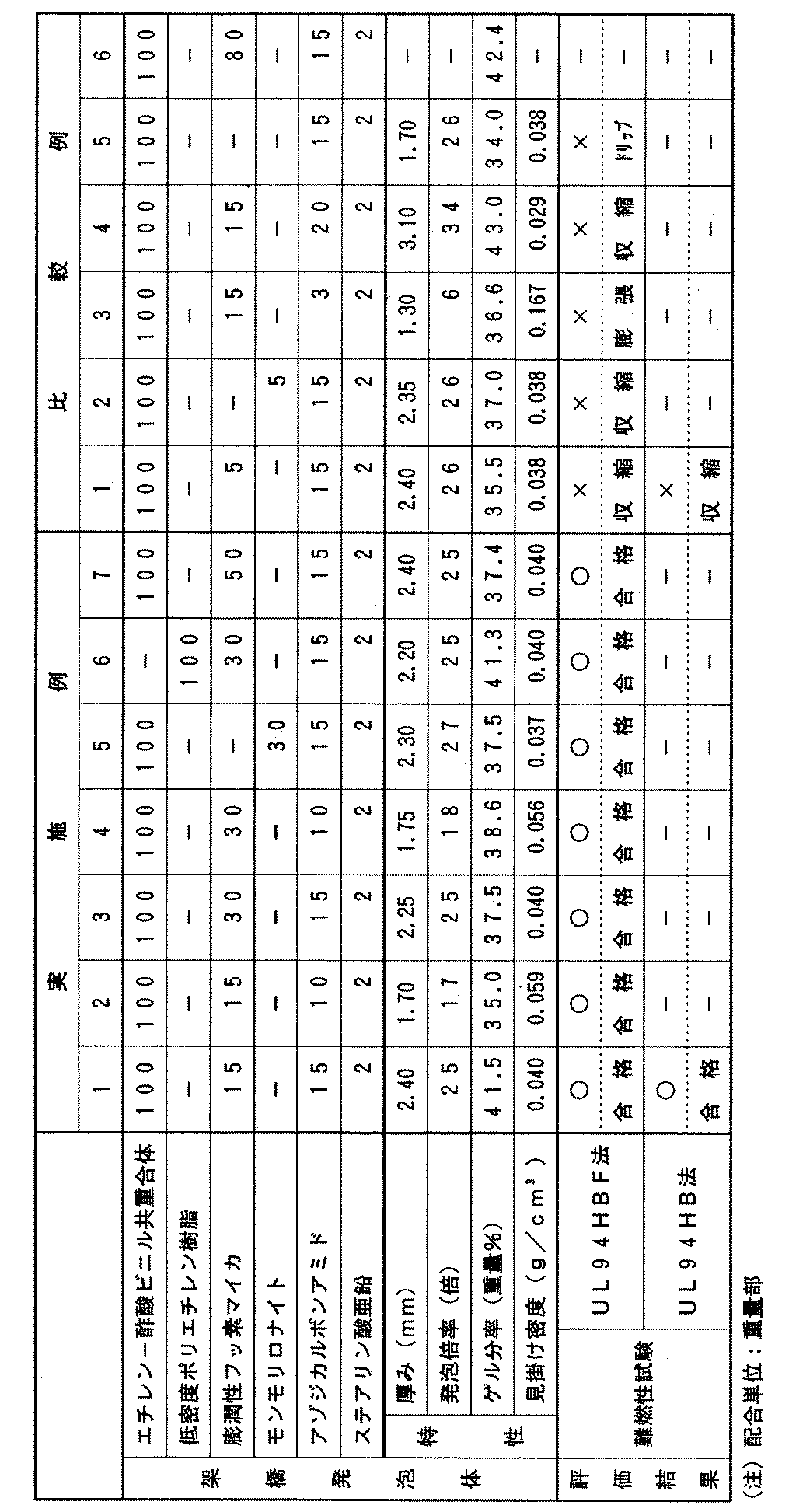
発泡性組成物の配合組成を表1に示す組成としたこと以外は実施例1の場合と同様にして、架橋発泡体を作製した。
【0106】
実施例1〜実施例7および比較例1〜比較例5で得られた12種類の架橋発泡体の厚みおよび発泡倍率を測定した。また、上記12種類の架橋発泡体のゲル分率および見掛け密度を前記方法で測定した。その結果は表1に示すとおりであった。なお、比較例6については良好な架橋発泡体を得られなかったので、上記測定および下記難燃性の評価は行わなかった。
【0107】
次に、実施例1および比較例1で得られた架橋発泡体の難燃性を下記UL94HBF法およびUL94HB法で評価した。また、実施例2〜実施例7および比較例2〜比較例5で得られた架橋発泡体の難燃性を下記UL94HBF法で評価した。その結果は表1に示すとおりであった。
【0108】
1.難燃性試験−UL94HBF法
Underwriters Laboratory(米国)の難燃規格UL94HBFに準拠して、架橋発泡体から切り出した幅2インチ×長さ6インチの燃焼試験片を金網上に載せ、燃焼試験片の幅全体に炎があたるようにガスバーナーを接炎させ、燃焼試験片の長さ方向の端部から1インチから5インチまで燃焼させた後、燃焼試験片の幅方向および長さ方向の寸法を測定し、下記判定基準により難燃性を評価した。
〔判定基準〕
○‥‥燃焼前後の燃焼試験片の形状に変化は認められなかった。
×‥‥燃焼中の燃焼試験片にドリップ現象が認められた。また、燃焼後の燃
焼試験片に収縮や膨張が認められた。
【0109】
2.難燃性試験−UL94HB法
Underwriters Laboratory(米国)の難燃規格UL94HBFに準拠して、架橋発泡体から切り出した幅2インチ×長さ6インチの燃焼試験片の長さ方向の一端を挟んで燃焼試験片が水平になるように保持し、燃焼試験片の長さ方向の他端にガスバーナーを接炎させ、燃焼試験片の長さ方向の他端から1インチから4インチまで燃焼させた後、燃焼試験片の幅方向および長さ方向の寸法を測定し、上記UL94HBF法の場合と同様の判定基準により難燃性を評価した。
【0110】
【表1】
【0111】
表1から明らかなように、本発明による実施例1の架橋発泡体は、難燃性試験のUL94HBF法およびUL94HB法のいずれにも合格しており、優れた難燃性を発現した。また、本発明による実施例2〜実施例7の架橋発泡体は、いずれも難燃性試験のUL94HBF法に合格しており、優れた難燃性を発現した。
【0112】
これに対し、熱可塑性樹脂(エチレン−酢酸ビニル共重合体)100重量部に対する層状珪酸塩(膨潤性フッ素マイカ)の配合量が10重量部未満(5重量部)であった比較例1の架橋発泡体は、難燃性試験のUL94HBF法およびUL94HB法のいずれにも不合格であり、難燃性が悪かった。また、熱可塑性樹脂(エチレン−酢酸ビニル共重合体)100重量部に対する層状珪酸塩(モンモリロナイト)の配合量が10重量部未満(5重量部)であった比較例2の架橋発泡体、見掛け密度が0.1g/cm3 を超えていた(0.167g/cm3 )比較例3の架橋発泡体、見掛け密度が0.03g/cm3 未満(0.029g/cm3 )であった比較例4の架橋発泡体および層状珪酸塩を配合しなかった比較例5の架橋発泡体は、いずれも難燃性試験のUL94HBF法に不合格であり、難燃性が悪かった。さらに、熱可塑性樹脂(エチレン−酢酸ビニル共重合体)100重量部に対する層状珪酸塩(膨潤性フッ素マイカ)の配合量が70重量部を超えていた(80重量部)発泡性組成物を用いた比較例6については、良好な架橋発泡体を得られなかったので、難燃性の評価ができなかった。
【0113】
【発明の効果】
以上述べたように、本発明の架橋発泡体は、難燃性に優れ、燃焼時におけるドリップ現象の発生や燃焼前後の形状変化が少なく、しかも力学的物性、耐熱性、柔軟性、衝撃吸収性、断熱性、寸法安定性等に優れ、線膨張率が低い等の優れた諸性能を兼備するものであり、例えば、天井、ドア、計器パネルなどの車両内装材や緩衝材あるいは断熱材等を始め、各種工業用途に好適に用いられる。[0001]
TECHNICAL FIELD OF THE INVENTION
The present invention relates to a crosslinked thermoplastic resin foam.
[0002]
[Prior art]
Normally, thermoplastic resin burns while melting and vaporizing during its combustion. During combustion, a phenomenon in which low-molecular-weight liquid hydrocarbons produced by the thermal decomposition of the thermoplastic resin drop (drip) Phenomenon) occurs.
[0003]
The drip phenomenon is caused by a molded article using a flame-retardant thermoplastic resin such as a halogen-containing thermoplastic resin or a nitrogen-containing thermoplastic resin as a main raw material, a halogen-based flame retardant, a phosphorus-based flame retardant, and a metal hydroxide-based flame retardant. The same applies to molded products using flame-retardant thermoplastics with flame retardants such as flame retardants added as main raw materials, and it is difficult for molded products made from thermoplastics to maintain the shape before combustion. It is.
[0004]
The drip phenomenon also occurs in a foam using a thermoplastic resin as a main raw material, and the change in shape before and after combustion is more remarkable in a foam than in a non-foamed molded body.
[0005]
Many of the currently mainstream thermoplastic resin foams have an apparent density of 0.025 to 0.2 g / cm. 3 Because the amount of thermoplastic resin per unit volume is very small, once ignited, the thermoplastic resin rapidly pyrolyzes and burns, destroying the foam structure required to maintain the shape of the foam before burning Will be done.
[0006]
In general, thermoplastic resin foams are excellent in flexibility, shock absorption, heat insulation, and the like, and are therefore widely used as, for example, vehicle interior materials such as ceilings, doors, and instrument panels, and cushioning materials. Moreover, the polyolefin resin foam which is a closed cell has many uses as a heat insulating material. However, these thermoplastic resin foams have a problem that they are very weak against thermal deformation due to flames, and even foams with high flame retardancy and high self-extinguishing properties need to be self-extinguishing. There is a problem that thermal deformation is remarkable.
[0007]
On the other hand, in order to improve mechanical properties such as mechanical strength of the thermoplastic resin foam, shock absorption, heat insulation, dimensional stability, etc., and to reduce the coefficient of linear expansion, inorganic A filler is included. For example, Japanese Patent Application Laid-Open No. H8-143697 discloses a polypropylene foam containing a clay compound and / or diatomaceous earth to which a blowing agent and a silane coupling agent are adsorbed. A body composition is disclosed.
[0008]
The polypropylene foam composition disclosed in the above publication, by kneading a clay compound or diatomaceous earth with polypropylene, mechanical properties such as mechanical strength of the foam, shock absorption, heat insulation, dimensional stability and the like. It is said that it can be improved or the coefficient of linear expansion can be reduced.
[0009]
However, the polypropylene foam composition disclosed in the above publication does not consider dispersing the aggregate structure of the clay compound or diatomaceous earth to uniformly disperse the flaky crystals in the polypropylene. It is hard to say that the effect of including a compound or diatomaceous earth has been sufficiently brought out. That is, it cannot be said that the polypropylene foam composition disclosed in the above publication can sufficiently suppress the occurrence of a drip phenomenon at the time of combustion, a change in the shape of the foam before and after combustion, and the like.
[0010]
[Problems to be solved by the invention]
In view of the above problems, an object of the present invention is to provide excellent flame retardancy, less drip phenomenon during combustion and little change in shape before and after combustion, and furthermore, mechanical properties, heat resistance, flexibility, shock absorption, and heat insulation. An object of the present invention is to provide a thermoplastic resin crosslinked foam having excellent properties and dimensional stability and a low coefficient of linear expansion.
[0011]
[Means for Solving the Problems]
The crosslinked thermoplastic resin foam according to the invention (invention) according to claim 1 is a foamable thermoplastic resin obtained by mixing 10 to 70 parts by weight of a layered silicate and a blowing agent with respect to 100 parts by weight of a thermoplastic resin. The composition has a gel fraction of 15 to 70% by weight and an apparent density of 0.03 to 0.1 g / cm. 3 It is characterized by being.
[0012]
The heat used in the foamable thermoplastic resin composition (hereinafter, simply abbreviated as “foamable composition”) constituting the thermoplastic resin crosslinked foam (hereinafter, simply abbreviated as “crosslinked foam”) of the present invention. Examples of the plastic resin include, but are not particularly limited to, polyolefin resins, polystyrene resins, polyphenylene ether resins, polyoxymethylene resins, polyester resins, polyamide resins, and the like. A system resin is preferably used. These thermoplastic resins may be used alone or in combination of two or more.
[0013]
The above-mentioned polyolefin-based resin is not particularly limited. For example, a homopolymer of propylene, a copolymer of propylene and an α-olefin other than propylene, a random copolymer of propylene and ethylene, or a block copolymer of propylene and ethylene. A polymer, a homopolymer of ethylene, a copolymer of ethylene and an α-olefin other than ethylene, a copolymer of ethylene and (meth) acrylic acid, a copolymer of ethylene and (meth) acrylate, Copolymers of ethylene and vinyl acetate, copolymers of ethylene and styrene, homopolymers of butene, homopolymers or copolymers of conjugated dienes such as isoprene and butadiene, among which propylene Homopolymer, copolymer of propylene and α-olefin other than propylene, homopolymer of ethylene, ethylene Copolymers of other α- olefins styrene, a copolymer of ethylene and ethyl acrylate, a copolymer of ethylene and vinyl acetate is preferably used. These polyolefin resins may be used alone or in combination of two or more. In the present invention, for example, (meth) acryl means acryl or methacryl.
[0014]
The above-mentioned polyolefin-based resin is not particularly limited, but conforms to the method A of JIS K-7210 “Test method for melt mass flow rate (MFR) and melt volume flow rate (MVR) of plastic-thermoplastic”. It is preferable that the melt mass flow rate (MFR) measured in the above is 0.2 to 10 g / 10 minutes. When the MFR of the polyolefin resin is less than 0.2 g / 10 min, the appearance of the surface of the obtained cross-linked foam may be deteriorated, and when the MFR of the polyolefin resin exceeds 10 g / 10 min, In addition, the heat resistance of the obtained crosslinked foam may be insufficient.
[0015]
In the present invention, when a crosslinked foam having excellent flexibility is desired, a copolymer of ethylene and (meth) acrylic acid or a copolymer of ethylene and (meth) acrylate is used as the thermoplastic resin. Alternatively, it is preferable to use a copolymer of ethylene and vinyl acetate. At this time, the content of (meth) acrylic acid, (meth) acrylic acid ester or vinyl acetate in the copolymer is not particularly limited, but is preferably 0.1 to 50% by weight, More preferably, it is 5 to 30% by weight. If the content of (meth) acrylic acid, (meth) acrylic acid ester or vinyl acetate in the copolymer is less than 0.1% by weight, the obtained crosslinked foam may have poor flexibility, When the content of (meth) acrylic acid, (meth) acrylate or vinyl acetate in the copolymer exceeds 50% by weight, the heat resistance of the resulting crosslinked foam may be insufficient.
[0016]
In the present invention, when a crosslinked foam excellent in balance between flexibility and mechanical properties is desired, it is preferable to use a copolymer of ethylene and an α-olefin other than ethylene as the thermoplastic resin. By increasing the copolymerization ratio of α-olefins other than ethylene, the copolymer becomes rich in flexibility, and conversely, by lowering the copolymerization ratio of α-olefins other than ethylene, the copolymer has mechanical properties. Will be high.
[0017]
Examples of the α-olefin other than ethylene include, but are not particularly limited to, propylene, 1-butene, 1-hexene, 4-methyl-1-pentene, 1-octene and the like. These α-olefins other than ethylene may be used alone or in combination of two or more.
[0018]
The content of the α-olefin other than ethylene in the copolymer is not particularly limited, but is preferably 0.1 to 50% by weight, more preferably 2 to 40% by weight. When the content of the α-olefin other than ethylene in the copolymer is less than 0.1% by weight, the flexibility of the obtained cross-linked foam may be poor, and conversely, other than ethylene in the copolymer. When the content of the α-olefin exceeds 50% by weight, the heat resistance of the obtained crosslinked foam may be insufficient.
The copolymer of ethylene and an α-olefin other than ethylene may be a copolymer obtained by polymerization using a homogeneous polymerization catalyst. Since this copolymer is generally polymerized using a metallocene-based compound as a homogeneous polymerization catalyst, it may be referred to as a metallocene polyethylene. In metallocene polyethylene, the copolymerization ratio of α-olefins other than ethylene can be easily increased, so that a copolymer having extremely excellent flexibility can be obtained. Further, metallocene polyethylene has a small crystal lamella thickness, so that the number of tie molecules connecting the crystals increases, and therefore, the metallocene polyethylene also has excellent mechanical properties. Therefore, in the present invention, when a crosslinked foam having an excellent balance between flexibility and mechanical properties in a high dimension is desired, it is preferable to use metallocene polyethylene as the thermoplastic resin.
[0020]
The metallocene-based compound which can be a homogeneous polymerization catalyst is not particularly limited, and examples thereof include complexes of transition metals of Group IV, X, and XI. These metallocene compounds may be used alone or in combination of two or more.
[0021]
The transition metal complex is a complex in which a ligand is bonded to a transition metal atom. Examples of the ligand include, but are not limited to, a hydrocarbon group, a substituted hydrocarbon group, and a hydrocarbon group. A cyclopentadiene ring substituted with a hydrogen-substituted metalloid group or the like; a cyclopentadienyl oligomer ring; an indenyl ring; an indenyl ring substituted with a hydrocarbon group, a substituted hydrocarbon group, a hydrocarbon-substituted metalloid group, or the like; Monovalent anion ligands such as bromine and bromine; divalent anion chelate ligand; hydrocarbon group; alkoxide group; amide group; arylamide group; aryloxide group; phosphide group; arylphosphide group; silyl group; Is mentioned. These ligands may be used alone or in combination of two or more.
[0022]
In the present invention, when a crosslinked foam having excellent heat resistance is desired, it is preferable to use a high-density polyethylene resin or a polypropylene resin as the thermoplastic resin. The polypropylene-based resin is not particularly limited, and examples thereof include a homopolymer of propylene and a copolymer of propylene and an α-olefin other than propylene. Examples of the α-olefin other than propylene include, but are not particularly limited to, ethylene, 1-butene, 1-pentene, 1-hexene, 4-methyl-1-pentene, 1-heptene, and 1-octene. And the like. These α-olefins other than propylene may be used alone or in combination of two or more. The polypropylene resin may be used alone or in combination of two or more. Further, the high-density polyethylene resin and the polypropylene-based resin may be used alone or in combination.
[0023]
In the thermoplastic resin used in the present invention, if necessary, in order to modify the properties of the resin, as long as the object of the present invention is not hindered, thermoplastic elastomers and oligomers may be blended. good.
[0024]
The thermoplastic elastomer is not particularly limited, and examples thereof include a styrene-based elastomer, an olefin-based elastomer, a urethane-based elastomer, and a polyester-based elastomer. These thermoplastic elastomers may be used alone or in combination of two or more. The oligomers are not particularly limited, but examples include maleic anhydride-modified ethylene oligomers. These oligomers may be used alone or in combination of two or more. The thermoplastic elastomers and oligomers may be used alone or in combination.
[0025]
Further, the thermoplastic resin used in the present invention may have a nucleating agent that can be a crystal nucleus for refining a crystal as an auxiliary means for homogenizing physical properties, if necessary, as long as the object of the present invention is not hindered. And one or more of various additives such as antioxidants (antiaging agents), heat stabilizers, light stabilizers, ultraviolet absorbers, lubricants, flame retardants, antistatic agents, antifogging agents, etc. May be.
[0026]
The layered silicate used in the expandable composition constituting the crosslinked foam of the present invention means a silicate mineral having exchangeable metal cations between crystal layers.
[0027]
The layered silicate is not particularly limited, but includes, for example, smectite clay minerals such as montmorillonite, saponite, hectorite, beidellite, stevensite, nontronite, vermiculite, halloysite, and swelling mica. Among them, montmorillonite and swellable mica are preferably used. The layered silicate may be a natural product or a synthetic product. These layered silicates may be used alone or in combination of two or more.
[0028]
As the layered silicate, it is preferable to use a smectite-based clay mineral or swelling mica having a large shape anisotropy effect defined by the following relational expression (1). By using a layered silicate having a large shape anisotropy effect such as a smectite clay mineral or swelling mica, the obtained crosslinked foam has more excellent mechanical properties.
Shape anisotropy effect = Area of crystal surface (A) / Area of crystal surface (B) ‥‥ (1)
In the above formula, the crystal surface (A) means the layer surface, and the crystal surface (B) means the layer side surface.
[0029]
The shape of the layered silicate is not particularly limited, but the average length of the fine flaky crystal obtained by crushing the aggregated structure is 0.01 to 3 μm, the thickness is 0.001 to 1 μm, and the aspect ratio is 20. The average length is 0.05 to 2 μm, the thickness is 0.01 to 0.5 μm, and the aspect ratio is 50 to 200.
[0030]
The exchangeable metal cations existing between the crystal layers of the layered silicate are metal ions such as sodium and calcium present on the crystal surface of the layered silicate, and these metal ions are composed of a cationic substance and a cation. Since it has exchangeability, various cationic substances can be inserted or trapped between the crystal layers of the layered silicate.
[0031]
The cation exchange capacity of the layered silicate is not particularly limited, but is preferably 50 to 200 milliequivalents / 100 g. When the cation exchange capacity of the layered silicate is less than 50 milliequivalents / 100 g, the amount of the cationic substance trapped between the crystal layers of the layered silicate by cation exchange is reduced, and the crystal layers are sufficiently non-polar. When the cation exchange capacity of the layered silicate exceeds 200 milliequivalents / 100 g, the bonding force between the crystal layers of the layered silicate becomes too strong, and the crystal flakes are separated. May be difficult.
[0032]
In the present invention, when a low-polarity resin such as a polyolefin-based resin is used as the thermoplastic resin, it is preferable that the interlayer of the layered silicate is previously subjected to cation exchange with a cationic surfactant to make the layer hydrophobic. By preliminarily making the interlayer of the layered silicate hydrophobic, the affinity between the layered silicate and the low-polarity thermoplastic resin is increased, and the layered silicate can be finely dispersed more uniformly in the low-polarity thermoplastic resin. it can.
[0033]
The cationic surfactant is not particularly limited, and includes, for example, quaternary ammonium salts and quaternary phosphonium salts. Among them, the non-polarization (hydrophobicity) between the crystal layers of the layered silicate is sufficient. Therefore, a quaternary ammonium salt having an alkyl chain having 6 or more carbon atoms (an alkyl ammonium salt having 6 or more carbon atoms) is preferably used.
[0034]
Examples of the quaternary ammonium salt include, but are not particularly limited to, lauryl trimethyl ammonium salt, stearyl trimethyl ammonium salt, trioctyl ammonium salt, distearyl dimethyl ammonium salt, di-hardened tallow dimethyl ammonium salt, distearyl diammonium salt, and the like. Benzyl ammonium salt, N-polyoxyethylene-N-lauryl-N, N-dimethylammonium salt and the like can be mentioned. These quaternary ammonium salts may be used alone or in combination of two or more.
[0035]
Examples of the quaternary phosphonium salt include, but are not particularly limited to, for example, dodecyltriphenylphosphonium salt, methyltriphenylphosphonium salt, lauryltrimethylphosphonium salt, stearyltrimethylphosphonium salt, trioctylphosphonium salt, distearyl. Dimethylphosphonium salt, distearyldibenzylphosphonium salt and the like can be mentioned. These quaternary phosphonium salts may be used alone or in combination of two or more. Further, the quaternary ammonium salt and the quaternary phosphonium salt may be used alone or in combination.
[0036]
The layered silicate used in the present invention can be improved in dispersibility in a thermoplastic resin by a chemical treatment as described above.
[0037]
The chemical treatment is not limited to (1) a cation exchange method using a cationic surfactant (hereinafter, referred to as a “chemical modification (1) method”). Can be implemented. The layered silicate having improved dispersibility in a thermoplastic resin by the following various chemical treatment methods including the chemical modification (1) method is hereinafter referred to as “organized layered silicate”.
[0038]
(2) Chemical modification The hydroxyl group present on the crystal surface of the organically modified layered silicate chemically treated by the method (1) is converted into a functional group capable of chemically bonding to the hydroxyl group or a functional group having a high chemical affinity without chemical bonding. A method of performing chemical treatment with a compound having one or more groups at the molecular terminal (hereinafter, referred to as “chemical modification (2) method”).
[0039]
(3) Chemical modification A hydroxyl group present on the surface of the crystallized layered silicate chemically treated by the method (1) is converted into a functional group capable of chemically bonding to the hydroxyl group or a functional group having a high chemical affinity without chemical bonding. A method of performing chemical treatment with a compound having one or more groups and reactive functional groups at molecular terminals (hereinafter, referred to as “chemical modification (3) method”).
[0040]
(4) A method of chemically treating a crystal surface of an organically modified layered silicate chemically treated by the method (1) with a compound having anionic surface activity (hereinafter, referred to as a “chemical modification (4) method”). .
[0041]
(5) Chemical Modification In the method (4), a method of chemically treating a compound having one or more reactive functional groups other than the anion site in the molecular chain of the compound having anionic surface activity (hereinafter referred to as “chemical modification (5) ) Law)).
[0042]
(6) The organically modified layered silicate chemically treated by any one of the above-mentioned chemical modification methods (1) to (5) is further treated with a layered silicic acid such as a maleic anhydride-modified polyphenylene ether-based resin. A method using a composition to which a resin having a functional group capable of reacting with a salt is added (hereinafter, referred to as “chemical modification (6) method”).
[0043]
These chemical modification methods may be used alone or in combination of two or more.
[0044]
In the chemical modification (2) method, the functional group capable of chemically bonding to the hydroxyl group or the functional group having high chemical affinity without chemical bonding is not particularly limited. Examples thereof include an alkoxyl group and a glycidyl group. Functional groups such as a group, a carboxyl group (including a dibasic acid anhydride), a hydroxyl group, an isocyanate group, and an aldehyde group, and other functional groups having high chemical affinity with a hydroxyl group. These functional groups may be used alone or in combination of two or more.
[0045]
The compound having a functional group capable of chemically bonding to a hydroxyl group or a functional group having a high chemical affinity without chemical bonding is not particularly limited, for example, a silane compound having a functional group exemplified above, Examples include titanate compounds, glycidyl compounds, carboxylic acids, alcohols and the like. These compounds may be used alone or in combination of two or more.
[0046]
Although it does not specifically limit as said silane compound, For example, vinyltrimethoxysilane, vinyltriethoxysilane, vinyltris ((beta) -methoxyethoxy) silane, gamma-aminopropyltrimethoxysilane, gamma-aminopropylmethyldimethoxy Silane, γ-aminopropyldimethylmethoxysilane, γ-aminopropyltriethoxysilane, γ-aminopropylmethyldiethoxysilane, γ-aminopropyldimethylethoxysilane, methyltriethoxysilane, dimethyldimethoxysilane, trimethylmethoxysilane, hexyltri Methoxysilane, hexyltriethoxysilane, N-β- (aminoethyl) γ-aminopropyltrimethoxysilane, N-β- (aminoethyl) γ-aminopropyltriethoxysilane, N-β- (A Noethyl) γ-aminopropylmethyldimethoxysilane, octadecyltrimethoxysilane, octadecyltriethoxysilane, γ-methacryloxypropylmethyldimethoxysilane, γ-methacryloxypropylmethyldiethoxysilane, γ-methacryloxypropyltrimethoxysilane, γ- Methacryloxypropyltriethoxysilane and the like can be mentioned. These silane compounds may be used alone or in combination of two or more.
[0047]
Further, in the chemical modification (4) method and the chemical modification (5) method, a compound having anionic surface activity and / or having one anionic surface activity and having one reactive functional group other than an anion site in a molecular chain. The compound having the above may be any compound as long as it can chemically treat the layered silicate by ionic interaction, and is not particularly limited. Examples thereof include sodium laurate, sodium stearate, and oleic acid. Sodium, higher alcohol sulfates, secondary higher alcohol sulfates, unsaturated alcohol sulfates, and the like. These compounds may be used alone or in combination of two or more.
[0048]
The layered silicate used in the present invention has an average interlayer distance of the (001) plane measured by a wide-angle X-ray diffraction measurement method of 3 nm or more, and a part or all of the layered silicate is dispersed in the thermoplastic resin into five layers or less. The layered silicate is preferably a layered silicate having an average interlayer distance of 6 nm or more, and a part or all of which is dispersed in a thermoplastic resin in five or less layers. is there. Incidentally, the average interlayer distance of the layered silicate referred to in the present invention means the average interlayer distance in the case of a layer of fine flaky crystals of the layered silicate, X-ray diffraction peak and transmission electron micrograph, that is, Can be calculated by a wide-angle X-ray diffraction measurement method.
[0049]
When the average interlayer distance of the layered silicate is 3 nm or more and part or all of the layered silicate is dispersed in 5 layers or less, the layered silicate is mixed and dispersed in the thermoplastic resin. The crosslinked foam made of the foamable composition obtained exhibits excellent flame retardancy, mechanical properties, heat resistance, dimensional stability and the like.
[0050]
The fact that the average interlayer distance of the layered silicate is 3 nm or more means that the interlayer of the layered silicate is cleaved to 3 nm or more, and that part of the layered silicate or part of the layered silicate in the thermoplastic resin. The fact that the entirety is dispersed in 5 layers or less means that a part or all of the layered silicate laminate is widely dispersed in the thermoplastic resin. Is weakened, whereby the above effect can be obtained.
[0051]
In particular, when the average interlayer distance of the layered silicate is 6 nm or more, a crosslinked foam made of an expandable composition obtained by blending and dispersing the layered silicate in a thermoplastic resin has remarkably excellent flame retardancy, It exhibits mechanical properties, heat resistance, dimensional stability and the like. Further, when the average interlayer distance of the layered silicate is 3 nm or more, preferably 6 nm or more, the fine flaky crystals of the layered silicate are separated from each other and the interaction of the layered silicate is weakened so as to be almost negligible. In addition, there is an advantage that the dispersion state of the fine flaky crystals constituting the layered silicate in the thermoplastic resin proceeds in the direction of stabilization of crushing.
[0052]
In addition, the fact that part or all of the layered silicate is dispersed in the thermoplastic resin in five or less layers means, specifically, that 10% or more of the layered silicate is dispersed in the five layers or less. And more preferably 20% or more of the layered silicate is dispersed in 5 layers or less.
[0053]
The number of layers of the layered silicate is preferably divided into 5 or less layers, whereby the above effect can be obtained. More preferably, the layered silicate is divided into 3 layers or less. Particularly preferably, it is sliced into a single layer.
[0054]
In the foamable composition constituting the crosslinked foam of the present invention, the average interlayer distance of the layered silicate is 3 nm or more, and part or all of the layered silicate is dispersed in the thermoplastic resin into five or less layers. In other words, if the layered silicate is highly dispersed in the thermoplastic resin, the interface area between the thermoplastic resin and the layered silicate increases, Average distance becomes smaller.
[0055]
When the interface area between the thermoplastic resin and the layered silicate increases, the degree of constraint of the thermoplastic resin on the surface of the layered silicate increases, and mechanical properties such as mechanical strength and elastic modulus are improved. Further, when the degree of restraint of the thermoplastic resin on the surface of the layered silicate increases, the melt viscosity increases, and the foamability and moldability also improve.
[0056]
On the other hand, when the average distance between the fine flaky crystals of the layered silicate is small, a sintered body is easily formed by the movement of the fine flaky crystals of the layered silicate during combustion. That is, a crosslinked foam made of a foamable composition in which fine flaky crystals of a layered silicate are dispersed such that the average interlayer distance is 3 nm or more facilitates formation of a sintered body that can be a flame-retardant film. Since this sintered body is formed at an early stage of combustion, not only can the supply of oxygen from the outside be shut off, but also the combustible gas generated by combustion can be shut off. Expresses flame retardancy.
[0057]
The foamable composition constituting the crosslinked foam of the present invention is such that 10 to 70 parts by weight of the above layered silicate (including the organically modified layered silicate) is mixed with 100 parts by weight of the thermoplastic resin. Is required, and preferably 15 to 50 parts by weight of the layered silicate based on 100 parts by weight of the thermoplastic resin.
[0058]
If the compounding amount of the layered silicate with respect to 100 parts by weight of the thermoplastic resin is less than 10 parts by weight, it becomes difficult to form a sintered body at the time of combustion, so that the flame retarding effect is small, and If the compounding amount of the layered silicate with respect to 100 parts by weight of the resin exceeds 70 parts by weight, it becomes difficult to sufficiently expand the foamable composition or the apparent density (apparent specific gravity) of the obtained crosslinked foam increases. Too much, making it less practical.
[0059]
The method for dispersing the layered silicate in the thermoplastic resin is not particularly limited. For example, a method using the organically modified layered silicate; a method in which the thermoplastic resin and the layered silicate are mixed by an ordinary method Thereafter, a method of foaming; a method using a dispersant, and the like. By using these dispersion methods, the layered silicate can be uniformly and finely dispersed in the thermoplastic resin.
[0060]
A method of mixing the thermoplastic resin and the layered silicate by a conventional method and then foaming the mixture will be described below. This method also serves as a method of foaming a thermoplastic resin using a foaming agent and converting the foaming energy to the dispersion energy of the layered silicate, and at the same time, a method of forming a foam.
[0061]
The foaming agent is not particularly limited, and examples thereof include a gaseous foaming agent, a volatile liquid foaming agent, and a heat decomposition type solid foaming agent. These foaming agents may be used alone or in combination of two or more.
[0062]
By foaming the thermoplastic resin in the presence of the layered silicate, a specific method of uniformly and finely dispersing the layered silicate in the thermoplastic resin and simultaneously forming a foam is specifically limited. However, for example, the following method can be mentioned.
[0063]
Method (A): A thermoplastic resin composition (hereinafter simply referred to as “composition”) consisting of 100 parts by weight of a thermoplastic resin and 10 to 70 parts by weight of a layered silicate is charged with a gaseous blowing agent (under normal temperature and normal pressure). Gaseous compound) or a volatile liquid foaming agent is impregnated under high pressure or normal pressure to prepare a foamable composition, and then the gaseous foaming agent or the volatile liquid foaming agent is added to the foamable composition. By dispersing the layered silicate in the thermoplastic resin and forming a foam at the same time.
[0064]
Method (B): A layered silicate is prepared by preparing an expandable composition using a layered silicate in which a thermally decomposable foaming agent is previously contained between crystal layers, and then decomposing the thermally decomposable foaming agent by heating. A foam is formed at the same time as dispersing in a thermoplastic resin.
[0065]
Method (C): A layered silicate and a thermally decomposable foaming agent are previously mixed and dispersed in a thermoplastic resin to prepare a foamable composition, and the thermally decomposable foaming agent is decomposed by heating to form a layered material. A method in which a silicate is dispersed in a thermoplastic resin and a foam is formed at the same time.
[0066]
The gaseous foaming agent and the volatile liquid foaming agent used in the above-mentioned method (A) are not particularly limited, but, for example, gases such as carbon dioxide (carbon dioxide), nitrogen, oxygen, argon, chlorofluorocarbon and the like. Foaming agents, low molecular weight hydrocarbons such as pentane, neopentane, butane, hexane, heptane, chlorinated hydrocarbons such as methyl chloride, methylene chloride, trichloroethylene, dichloroethane, CFC-11, CFC-12, CFC-113, Examples include fluorinated hydrocarbons such as CFC-141b, water, alcohol, benzene, toluene, xylene, mesitylene, and other easily volatile liquid foaming agents. Among them, gaseous foaming agents are preferably used. These gaseous foaming agents and volatile liquid foaming agents may be used alone or in combination of two or more. In addition, the gaseous foaming agent and the volatile liquid foaming agent may be used alone or in combination.
[0067]
Among the above gaseous foaming agents, carbon dioxide is more preferably used because gas collection is unnecessary and handling is safe. Carbon dioxide can be made supercritical at relatively low temperatures and relatively low pressures, and acts more effectively on dispersion of phyllosilicates during supercritical conditions. Here, the supercritical state refers to a state in which the temperature and pressure are higher than the critical point of the foaming agent to be impregnated, and there is no distinction between gas and liquid, having intermediate properties between gas and liquid, and heat. It has the properties of high conductivity, high diffusion speed, and low viscosity. Therefore, the supercritical state is advantageous for dispersing the layered silicate.
[0068]
The method of impregnating the gaseous foaming agent or the easily volatile liquid foaming agent into the composition comprising the thermoplastic resin and the layered silicate is not particularly limited, but, for example, the composition may be placed in a closed autoclave. Method and pressurizing the gaseous foaming agent and the volatile liquid foaming agent, and charging the above composition into an extruder, and using a vent type screw as a screw, a gaseous part is formed in the vent part from the middle of the cylinder. Examples include a method of injecting a foaming agent and a readily volatile liquid foaming agent. The former method is preferable in that the control of pressure and temperature is easy, and the latter method is a method in which the composition is in a molten state. By performing pressure sealing, the composition can be effectively impregnated with a gaseous foaming agent or a volatile liquid foaming agent, which is preferable in that a foam can be continuously produced. There.
[0069]
The temperature at which the composition is impregnated with the gaseous foaming agent or the volatile liquid foaming agent is not particularly limited as long as the composition does not deteriorate. However, the higher the impregnation temperature, the higher the amount of the gaseous foaming agent or the easily volatile liquid foaming agent dissolved in the composition, so that a foam having a high expansion ratio can be obtained. Therefore, the impregnation temperature is preferably higher within the temperature at which the composition does not deteriorate, and in order to obtain a good foaming state, when the thermoplastic resin is a crystalline resin, the melting point of the thermoplastic resin ± 20. ° C, and when the thermoplastic resin is an amorphous resin, the glass transition temperature of the thermoplastic resin is preferably ± 20 ° C.
[0070]
The thermal decomposition type foaming agent used in the methods (B) and (C) is not particularly limited. For example, azodicarbonamide, benzenesulfonylhydrazide, dinitrosopentamethylenetetramine, toluenesulfonyl Hydrazide, 4,4-oxybis (benzenesulfonyl hydrazide) and the like. These thermal decomposition type foaming agents may be used alone or in combination of two or more.
[0071]
The blending amount of the heat-decomposable blowing agent is not particularly limited, but is preferably 1 to 50 parts by weight based on 100 parts by weight of the thermoplastic resin. If the amount of the heat-decomposable foaming agent is less than 1 part by weight based on 100 parts by weight of the thermoplastic resin, the foaming property of the foamable composition may be insufficient. If the amount of the decomposable foaming agent exceeds 50 parts by weight, the mechanical properties of the resulting crosslinked foam may be reduced.
[0072]
In the above-mentioned method (B), the method of causing the thermally decomposable foaming agent to be contained between the crystal layers of the layered silicate is not particularly limited, and examples thereof include the following methods.
[0073]
Method (a): The terminal amino group of the heat-decomposable blowing agent is treated with hydrochloric acid to form a quaternary aminate, and the exchangeable metal cation present between the crystal layers of the layered silicate and the quaternary amine are cation-exchanged in water. A thermal decomposition type foaming agent is contained between the crystal layers of the layered silicate.
[0074]
Method (b): A method in which a heat-decomposable foaming agent is solvated in water with an exchangeable metal cation present between the crystal layers of the layered silicate, so that the heat-decomposable foaming agent is contained between the crystal layers of the layered silicate.
[0075]
Generally, general-purpose thermal decomposition type foaming agents often have an amino group at the terminal, so the above-mentioned method (a) is practical. In general, general-purpose thermal decomposition type foaming agents are nitrogen and carbon-carbon double. The method (b) is also practical because many of the compounds have a site forming a coordination bond with a metal such as a bond.
[0076]
The temperature at which the thermally decomposable blowing agent is contained between the crystal layers of the layered silicate is not particularly limited as long as the composition comprising the thermoplastic resin and the layered silicate does not deteriorate and the temperature does not decompose the thermally decomposable blowing agent. It is not done.
[0077]
Regarding the dispersion of the layered silicate in the thermoplastic resin, the more the layered silicate is separated and the finer flaky crystals are dispersed in the thermoplastic resin, the smaller the average distance between the fine flaky crystals becomes, In this case, a sintered body is easily formed by the movement of the fine flaky crystal of the layered silicate. Further, the finer the flaky crystals of the layered silicate are dispersed in the thermoplastic resin, the better the mechanical properties and dimensional stability of the obtained crosslinked foam.
[0078]
Both of the above phenomena are based on the fact that the interface area between the thermoplastic resin and the layered silicate increases with an increase in the dispersion ratio of the fine flaky crystals of the layered silicate. That is, at the interface between the thermoplastic resin and the layered silicate, the mechanical properties of the thermoplastic resin are increased by restricting the molecular motion of the thermoplastic resin, so that the dispersion ratio of the fine flaky crystals of the layered silicate is increased. The effect of increasing the mechanical properties of the obtained cross-linked foam increases as the value of.
[0079]
The foamable composition constituting the crosslinked foam of the present invention, in addition to the essential components of the thermoplastic resin, the layered silicate and the blowing agent, if necessary as long as the object of the present invention is not hampered, for example, Acid-modified polyolefin resin for further improving the affinity between the thermoplastic resin and the layered silicate, flame retardant for further improving the flame retardancy, foaming aid for further improving the foaming property, cross-linkability Cross-linking aids, fillers, softeners, plasticizers, lubricants, antistatic agents, anti-fogging agents, coloring agents, antioxidants (anti-aging agents), heat stabilizers, light stabilizers, ultraviolet absorption to further improve One or two or more of various additives such as an agent may be blended.
[0080]
Examples of the acid-modified polyolefin resin include, but are not particularly limited to, acid-modified polyethylene resins such as maleic anhydride-modified ethylene oligomer and ethylene- (meth) acrylic acid copolymer, and maleic anhydride-modified propylene. Examples thereof include an oligomer and an acid-modified polypropylene resin such as a propylene-acrylic acid copolymer. These acid-modified polyolefin resins may be used alone or in combination of two or more.
[0081]
The amount of the acid-modified polyolefin resin is not particularly limited, but is preferably 1 to 50 parts by weight of the acid-modified polyolefin resin per 100 parts by weight of the thermoplastic resin. If the amount of the acid-modified polyolefin-based resin is less than 1 part by weight based on 100 parts by weight of the thermoplastic resin, the affinity between the thermoplastic resin and the layered silicate may not be sufficiently improved. If the amount of the acid-modified polyolefin-based resin is more than 50 parts by weight per part by weight, it may not be possible to obtain a proper melt viscosity or a proper cohesive force required to obtain a homogeneous crosslinked foam.
[0082]
Examples of the flame retardant include, but are not particularly limited to, metal hydroxides such as aluminum hydroxide and magnesium hydroxide; metal oxides; phosphorus compounds such as red phosphorus and ammonium polyphosphate; melamine; Examples thereof include melamine derivatives such as melamine cyanurate, melamine isocyanurate, melamine phosphate, and surface-treated products thereof. Among them, metal hydroxides and melamine derivatives are preferably used. These flame retardants may be used alone or in combination of two or more.
[0083]
The compounding amount of the metal hydroxide is not particularly limited, but is preferably 0.1 to 200 parts by weight of the metal hydroxide with respect to 100 parts by weight of the thermoplastic resin, and more preferably thermoplastic. The metal hydroxide is 5 to 100 parts by weight based on 100 parts by weight of the resin. If the compounding amount of the metal hydroxide is less than 0.1 part by weight with respect to 100 parts by weight of the thermoplastic resin, the effect of improving the flame retardancy due to the compounding of the metal hydroxide may not be sufficiently obtained. If the blending amount of the metal hydroxide with respect to 100 parts by weight of the thermoplastic resin exceeds 200 parts by weight, it becomes difficult to sufficiently expand the expandable composition, or the apparent density (apparent specific gravity) of the obtained crosslinked foamed body ) May be too high and the utility may be poor.
[0084]
Further, the amount of the melamine derivative is not particularly limited, but is preferably 0.1 to 50 parts by weight, more preferably 100 parts by weight of the melamine derivative per 100 parts by weight of the thermoplastic resin. The melamine derivative is used in an amount of 1 to 40 parts by weight based on parts by weight. If the amount of the melamine derivative is less than 0.1 part by weight based on 100 parts by weight of the thermoplastic resin, the effect of improving the flame retardancy due to the incorporation of the melamine derivative may not be sufficiently obtained. If the amount of the melamine derivative per 100 parts by weight exceeds 50 parts by weight, it may be difficult to sufficiently foam the foamable composition.
[0085]
Further, the foaming aid is not particularly limited, and examples thereof include zinc stearate, calcium stearate, and active zinc oxide. These foaming aids may be used alone or in combination of two or more.
[0086]
The amount of the foaming aid is not particularly limited, but is preferably 0.1 to 10 parts by weight based on 100 parts by weight of the thermoplastic resin. If the compounding amount of the foaming aid is less than 0.1 part by weight with respect to 100 parts by weight of the thermoplastic resin, the effect of improving the foamability by adding the foaming aid may not be sufficiently obtained. If the blending amount of the foaming aid with respect to 100 parts by weight of the resin exceeds 10 parts by weight, the obtained crosslinked foam may be broken.
[0087]
Further, the crosslinking assistant is not particularly limited. For example, a radical generator such as benzoyl peroxide, divinylbenzene, trimethylolpropane tri (meth) acrylate, 1,6-hexanediol di (meth) ) Polyfunctional monomers such as acrylate, 1,9-nonanediol di (meth) acrylate, and 1,2,4-benzenetricarboxylic acid triallyl ester. These crosslinking aids may be used alone or in combination of two or more.
[0088]
The amount of the crosslinking aid is not particularly limited, but is preferably 0.1 to 10 parts by weight based on 100 parts by weight of the thermoplastic resin. If the amount of the crosslinking aid is less than 0.1 part by weight based on 100 parts by weight of the thermoplastic resin, the crosslinking of the thermoplastic resin becomes insufficient, and a uniform crosslinked foam may not be obtained. If the blending amount of the crosslinking aid with respect to 100 parts by weight of the thermoplastic resin exceeds 10 parts by weight, the crosslinking density of the thermoplastic resin becomes too high, and the foaming property of the foamable composition may be impaired.
[0089]
The method for producing the expandable composition constituting the crosslinked foam of the present invention is not particularly limited. For example, each of a predetermined amount of a thermoplastic resin, a layered silicate and, for example, a pyrolytic foaming agent, A method of directly blending and kneading one kind or two or more kinds of each kind of various additives to be blended according to the conditions at room temperature or under heating (direct kneading method), or a method of preparing a predetermined amount of a thermoplastic resin in advance. A master batch is prepared by mixing and kneading a predetermined amount of a layered silicate into a part of the master batch, and the master batch and a predetermined amount of the remainder (remaining amount) of the thermoplastic resin, for example, a pyrolysis type foaming agent and A method (master batch method) of kneading one or more predetermined amounts of various additives to be blended at room temperature or under heating (master batch method) and the like may be used, and any method may be adopted. When the foaming agent to be blended is a heat-decomposable foaming agent, the kneading temperature is preferably lower than the decomposition temperature of the heat-decomposable foaming agent.
[0090]
The concentration of the layered silicate in the masterbatch is not particularly limited, but is preferably 15 to 100 parts by weight, more preferably 20 to 70 parts by weight, based on 100 parts by weight of the thermoplastic resin. Department. In the above masterbatch, if the concentration of the layered silicate with respect to 100 parts by weight of the thermoplastic resin is less than 15 parts by weight, the convenience as a masterbatch that can be diluted to an arbitrary concentration may be lost. If the concentration of the layered silicate with respect to 100 parts by weight exceeds 100 parts by weight, the dispersibility of the masterbatch itself deteriorates, or the layered silicate is adjusted to a predetermined blending amount by a predetermined amount (remaining amount) of the thermoplastic resin. In some cases, the dispersibility of the layered silicate during dilution may be poor.
[0091]
Specific methods for producing the foamable composition by the direct kneading method or the masterbatch method are not particularly limited, for example, using an extruder, a two-roll, kneading machine such as a Banbury mixer, A predetermined amount of each of the thermoplastic resin, the layered silicate, and, for example, the pyrolytic blowing agent constituting the expandable composition, and one or more predetermined amounts of one or more kinds of various additives to be blended as necessary, at room temperature. Under or under heating, a method of melt-kneading, a thermoplastic resin, a layered silicate and, for example, a pyrolytic foaming agent, and one or more of various additives blended as necessary, After kneading in a solvent that can be dissolved or dispersed, a method of removing the solvent and the like are mentioned, and any method may be adopted.
[0092]
Further, for example, using a layered silicate containing a polymerization catalyst (polymerization initiator) such as a transition metal complex between crystal layers, kneading predetermined amounts of a monomer constituting the thermoplastic resin and the above-mentioned layered silicate, After the monomer is polymerized to produce a thermoplastic resin, for example, a method in which a heat-decomposable foaming agent and one or two or more predetermined amounts of various additives to be blended as required are blended and kneaded. May be taken. In any of the above methods, when the compounding foaming agent is a thermal decomposition type foaming agent, the kneading temperature is preferably lower than the decomposition temperature of the thermal decomposition type foaming agent.
[0093]
The crosslinked foam of the present invention is obtained by first crosslinking the above-mentioned foamable composition and then foaming the composition.
[0094]
The method for molding the crosslinked foam of the present invention is not particularly limited, and examples thereof include the methods (A), (B) and (C), and any of the molding methods is employed. However, among them, the method (C) is preferred because a homogeneous crosslinked foam can be molded with excellent productivity. In addition, these molding methods may be employed alone or in combination of two or more.
[0095]
The molding method by the method (C) is not particularly limited. For example, predetermined amounts of a thermoplastic resin, a layered silicate, and a pyrolytic foaming agent constituting the foamable composition and, for example, a crosslinking aid One or more predetermined amounts of various additives, such as foaming aids and foaming aids, are supplied to an extruder, melt-kneaded and extruded, and a foamable sheet comprising a foamable composition After producing the (foamable raw material), the foamable sheet is irradiated with a predetermined amount of, for example, an electron beam to crosslink, and the obtained foamable crosslinked sheet is introduced into a foaming furnace and continuously heated and foamed. For example, a method of irradiating the foamable composition with a predetermined amount of an electron beam to crosslink, supplying the obtained foamable crosslinked composition to a mold and heating and foaming in a batch manner, and the like. May be taken, but above all, raw Because of excellent sex, it is preferable to adopt the former method.
[0096]
The thus obtained crosslinked foam of the present invention has a gel fraction of 15 to 70% by weight and an apparent density of 0.03 to 0.1 g / cm. 3 It is necessary to be. In addition, the gel fraction referred to in the present invention means a gel fraction measured by the following method, and the apparent density referred to in the present invention is JIS K-6767 "foamed plastic-polyethylene-test method". Means the apparent density measured in accordance with
(Method for measuring gel fraction)
After weighing (Ag) a certain amount of the crosslinked foam and immersing it in xylene at 120 ° C. for 24 hours, the insoluble matter was filtered through a 200-mesh wire gauze, and the filtration residue on the wire gauze was vacuum-dried. The weight (Bg) at that time is measured, and the gel fraction (% by weight) is calculated by the following equation.
Gel fraction (% by weight) = 100 × B / A
[0097]
If the gel fraction of the crosslinked foam is out of the range of 15 to 70% by weight, it is not possible to obtain a proper melt viscosity or a proper cohesive force required to obtain a homogeneous crosslinked foam, Will lack homogeneity.
[0098]
The apparent density of the crosslinked foam is 0.03 g / cm. 3 If it is less than 3, the combustion residue (ash) after combustion becomes brittle, making it difficult to maintain the shape, and conversely, the apparent density of the crosslinked foam becomes 0.1 g / cm. 3 When it exceeds, the crosslinked foam expands at the time of combustion, and it becomes difficult to maintain the shape.
[0099]
[Action]
Since the crosslinked foam of the present invention is composed of a foamable composition in which a specific amount of a layered silicate and a blowing agent are blended with a thermoplastic resin, a sintered body of the layered silicate is formed during combustion, and It has little drip phenomenon during combustion and changes in shape before and after combustion, and exhibits excellent flame retardancy, does not cause shape collapse of combustion residues even after combustion, and can effectively prevent fire spread. .
[0100]
In addition, the crosslinked foam of the present invention is a crosslinked foam excellent in homogeneity because the gel fraction is in a specific range, the melt viscosity and the cohesive force during foaming are appropriate, and the apparent Since the density is in a specific range, the shape change before and after the combustion is smaller.
[0101]
BEST MODE FOR CARRYING OUT THE INVENTION
EXAMPLES The present invention will be described in more detail with reference to Examples, but the present invention is not limited to these Examples.
[0102]
In this example, the following raw materials were used.
1. Thermoplastic resin
(1) Ethylene-vinyl acetate copolymer: EVA (trade name “Evaflex EV460”, vinyl acetate content: 19% by weight, manufactured by Du Pont-Mitsui Polychemicals)
(2) Low density polyethylene resin: LDPE (trade name "LE520H", manufactured by Nippon Polychem Co., Ltd.)
2. Layered silicate
(1) Swellable fluorinated mica which has been treated with distearyl dimethyl ammonium chloride (trade name “Somasif MAE-100”, average length: 0.2 μm, thickness: 0.002 μm, aspect ratio: 100, corp. Chemical company)
(2) Montmorillonite treated with distearyl dimethyl ammonium chloride (trade name "Clayton HY", manufactured by Southern Clay Products)
3. Thermal decomposition type foaming agent
Azodicarbonamide (trade name "Uniform AZ SO-40", manufactured by Otsuka Chemical Co., Ltd.)
4. Foaming aid
・ Zinc stearate (trade name “SZ-2000”, manufactured by Sakai Chemical Co., Ltd.)
[0103]
(Example 1)
100 parts by weight of an ethylene-vinyl acetate copolymer "Evaflex EV460" as a thermoplastic resin, and 15 parts by weight of a swellable fluorine mica "Somasif MAE-100" which has been treated with distearyldimethylammonium chloride as a layered silicate. Then, 15 parts by weight of azodicarbonamide “Uniform AZ SO-40” as a thermal decomposition type foaming agent and 2 parts by weight of zinc stearate “SZ-2000” as a foaming aid are supplied to Labo Plastomill and melted at 110 ° C. for 15 minutes. By kneading, a foamable composition was prepared.
[0104]
Next, using a hand press, the foamable composition obtained above was pressed at 110 ° C. to form a foamable sheet (foamable raw material) having a thickness of 1 mm, and then the foamable sheet was subjected to 100 mA, 800 KV. Was irradiated with 2 Mrad to crosslink the foamable sheet. Thereafter, the foamable crosslinked sheet was left in a gear oven at 240 ° C. for 100 seconds to foam, thereby producing a crosslinked foam.
[0105]
(Examples 2 to 7) and (Comparative Examples 1 to 6)
A crosslinked foam was produced in the same manner as in Example 1 except that the composition of the foamable composition was changed to the composition shown in Table 1.
[0106]
The thickness and expansion ratio of the twelve types of crosslinked foams obtained in Examples 1 to 7 and Comparative Examples 1 to 5 were measured. Further, the gel fraction and apparent density of the above 12 kinds of crosslinked foams were measured by the above method. The results were as shown in Table 1. In addition, since the favorable crosslinked foam was not obtained about the comparative example 6, the said measurement and the following evaluation of the flame retardancy were not performed.
[0107]
Next, the flame retardancy of the crosslinked foams obtained in Example 1 and Comparative Example 1 was evaluated by the following UL94HBF method and UL94HB method. Further, the flame retardancy of the crosslinked foams obtained in Examples 2 to 7 and Comparative Examples 2 to 5 was evaluated by the following UL94HBF method. The results were as shown in Table 1.
[0108]
1. Flame retardancy test-UL94HBF method
According to the flame retardant standard UL94HBF of Underwriters Laboratory (USA), a 2 inch wide by 6 inch long burning test piece cut from a cross-linked foam is placed on a wire mesh, and the flame is applied to the entire width of the burning test piece. After burning a gas burner from 1 inch to 5 inches from the end in the longitudinal direction of the combustion test piece, measure the dimensions of the combustion test piece in the width direction and the length direction, and determine according to the following criteria. The flame retardancy was evaluated.
(Judgment criteria)
○ ‥‥ No change was observed in the shape of the combustion test piece before and after combustion.
× ‥‥ A dripping phenomenon was observed in the burning test piece during burning. Also, the fuel after combustion
Shrinkage and expansion were observed in the fired test piece.
[0109]
2. Flame retardancy test-UL94HB method
In accordance with UL94HBF, a flame-retardant standard of Underwriters Laboratory (USA), the combustion test piece is cut horizontally from a 2 inch wide by 6 inch long cut piece from a cross-linked foam so as to be horizontal. , And a gas burner is brought into contact with the other end in the length direction of the combustion test piece, and the flame is burned from 1 inch to 4 inches from the other end in the length direction of the combustion test piece. And the dimension in the length direction was measured, and the flame retardancy was evaluated according to the same criteria as in the case of the UL94HBF method.
[0110]
[Table 1]
[0111]
As is clear from Table 1, the crosslinked foam of Example 1 according to the present invention passed both the UL94HBF method and the UL94HB method of the flame retardancy test, and exhibited excellent flame retardancy. In addition, all of the crosslinked foams of Examples 2 to 7 according to the present invention passed the UL94HBF method of the flame retardancy test, and exhibited excellent flame retardancy.
[0112]
On the other hand, the crosslinking amount of Comparative Example 1 in which the amount of the layered silicate (swellable fluorine mica) was less than 10 parts by weight (5 parts by weight) per 100 parts by weight of the thermoplastic resin (ethylene-vinyl acetate copolymer). The foam failed both the UL94HBF method and the UL94HB method of the flame retardancy test, and had poor flame retardancy. The crosslinked foam of Comparative Example 2 in which the blending amount of the layered silicate (montmorillonite) was less than 10 parts by weight (5 parts by weight) with respect to 100 parts by weight of the thermoplastic resin (ethylene-vinyl acetate copolymer), apparent density Is 0.1 g / cm 3 (0.167 g / cm 3 ) Crosslinked foam of Comparative Example 3, apparent density 0.03 g / cm 3 Less than (0.029 g / cm 3 Both of the crosslinked foam of Comparative Example 4 and the crosslinked foam of Comparative Example 5, which did not contain the layered silicate, failed the UL94HBF method of the flame retardancy test and had poor flame retardancy. . Further, a foamable composition in which the blending amount of the layered silicate (swellable fluoromica) with respect to 100 parts by weight of the thermoplastic resin (ethylene-vinyl acetate copolymer) exceeded 70 parts by weight (80 parts by weight) was used. As for Comparative Example 6, good flame-retardant properties could not be evaluated because a good crosslinked foam was not obtained.
[0113]
【The invention's effect】
As described above, the crosslinked foam of the present invention is excellent in flame retardancy, generates little drip phenomenon during combustion and changes in shape before and after combustion, and further has mechanical properties, heat resistance, flexibility, and shock absorption. It has excellent performance such as excellent heat insulation, dimensional stability, and low coefficient of linear expansion.For example, ceiling materials, doors, vehicle interior materials such as instrument panels, cushioning materials, heat insulating materials, etc. Initially, it is suitably used for various industrial uses.