【0001】
【発明の属する技術分野】
本発明は、テレビジョンカメラ装置に関し、特に、屋外に設置するカメラのカラー映像と近赤外白黒映像とを切り替えて撮像するテレビジョンカメラ装置に関するものである。
【0002】
【従来の技術】
カラーテレビジョンカメラに用いるCCD等の撮像素子の感度特性は通常400nm〜900nm位の波長領域であるが、撮像した画像の色再現性を人が見て、自然な画面となるように赤外カットフィルタを撮像素子の受光面の前面に配置し、近赤外領域の約700nm以上の波長成分を除去している。
【0003】
そのため、日中の明るく、可視光領域の400nm〜700nmの波長成分が多い時には良好なカラー画像が得られるし、また、このようなカラーテレビジョンカメラを監視用カメラに用いた場合、監視し易いカラー映像が得られる。しかし、雨の日や夕方の薄暗くなった時等は、可視光成分が減少し、カラー画像が見づらくなるし、また、監視のための侵入者等の監視がしづらくなるという問題が発生する。
【0004】
これを解決する方法として、自動利得制御(以下、AGCと略称する)による感度向上や、フレームメモリを用いて画像蓄積による感度向上を行なう方法がある。しかし、AGCによる感度向上の方法では、S/N比の低下という問題がある。また、画像蓄積による感度向上をするためには、画像蓄積期間を長くする必要がある。しかし、画像蓄積期間を長くすると動きの速い被写体を撮像したときにブレが生じてしまうという問題がある。従って、画像の品質を向上するためには、むやみにAGCゲインを上げたり、画像蓄積期間を長くすることはできない。
【0005】
これらを改善する方法の一つとして、近赤外領域光まで感度がある撮像素子を用い、明るいときは、色再現性を重視し、赤外カットフィルタを撮像素子の前面に付けてカラー映像を撮像し、暗くなると自動または手動で赤外カットフィルタを取り外して、近赤外領域の波長成分をも利用して白黒画像を得るテレビジョンカメラ装置がある。また感度を上げるため近赤外領域用の照明を照射するカメラもある。さらに、上述のAGCや画像蓄積を補助的に組み合わせた場合でも、AGCゲインや画像蓄積を低く抑えることで、前述のS/N比の低下等を極力少なくする方法も取られている。
【0006】
而して、上述のように赤外カットフィルタを自動または手動で切替える場合、その切替タイミングが問題となる。特に赤外カットフィルタを取り外して近赤外照明を照射した場合、赤外カットフィルタを挿入してカラー映像を撮影した時よりも輝度レベルが高くなることもある。従って、輝度レベルを検出してフィルタを切り替える方式の場合は、赤外カットフィルタを取り付けカラー映像に戻してしまうことがあるが、カラー映像に戻ると、また輝度レベルが低いため再び白黒映像に切り替えられる。この動作が繰り返えされることとなる。すなわち、カラー映像と白黒映像が交互に入れ替わる、所謂、ハンチングが起こることとなる。このハンチングを防ぐため、従来の輝度レベルの変化を検出する方式では一度白黒映像に切り替わったら、しばらくカラー映像に切り替わらないように次のようなことを実施している。
【0007】
第1の方法は、赤外照明が照射されるときには、カメラに信号を送り、白黒映像を撮影するようにカメラの動作を固定する方法である。
【0008】
第2の方法は、ヒステリシスを多く持たせて白黒映像からカラー映像に切り替わりにくくする方法である。
【0009】
【発明が解決しようとする課題】
上記第1の方法では、カメラに信号を送るために配線が必要になり、カメラ単体では対応できないという問題がある。
【0010】
また、上記第2の方法では、ヒステリシスを大きくすると暗くなってもカラー映像の状態を保持し続けたり、明るくなっても白黒映像の状態を保持し続けたりするという問題がある。
【0011】
本発明の目的は、これらの欠点を除去し、白黒映像とカラー映像が交互に出力されないようなテレビジョンカメラ装置を提供することを目的とする。
【0012】
【課題を解決するための手段】
本発明のテレビジョンカメラ装置は、被写体を撮像する撮像素子と、近赤外領域の波長成分を除去する赤外カットフィルタと、上記赤外カットフィルタを上記撮像素子の前面に出し入れする駆動機構と、上記撮像素子からの映像信号を処理する映像信号処理手段および時刻情報を有する制御回路とからなり、上記時刻情報に基づいて、上記制御回路は、上記赤外カットフィルタの駆動機構を制御するように構成される。
【0013】
また、本発明のテレビジョンカメラ装置において、上記時刻情報は、日の出か日没かの情報を含み、日の出から日没までの間、前記赤外カットフィルタを上記撮像素子の前面に装着することにより本発明の目的が達成される。
【0014】
その結果、夜間の屋外等低照度時の監視において、近赤外照明を照射してもカラー映像と白黒映像が交互に入れ替わるハンチング現象がなく、監視者の負担を軽減することは勿論のこと、撮像画面が鮮明になり、侵入者等を識別し易くなるので、監視カメラとしては極めて優れたものとなる。
【0015】
【発明の実施の形態】
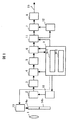
以下、本発明のテレビジョンカメラ装置の一実施例を図1のブロック構成図に基づき説明する。
【0016】
図1において、1は、被写体からの光が入射する撮像レンズ、2は、撮像レンズ1から入射する光を光電変換し、電荷として蓄積し、露光終了後映像信号として出力する、例えば、CCDのような撮像素子、3は、撮像素子2から出力された映像信号の雑音を除去する雑音除去回路、例えば、相関二重サンプリング(CDS)回路である。4は、映像信号を所定レベルになるよう調整する自動利得制御(AGC)回路、5は、アナログ/ディジタル(A/D)変換回路、6は、ディジタル映像信号の各種処理を行うディジタル信号処理回路(DSP)、7は、ディジタル/アナログ(D/A)変換回路、8は、映像信号を所要レベルに増幅し出力する増幅回路である。
【0017】
9は、マイクロコンピュータ等の制御回路であって、自動利得制御回路4のゲイン制御や映像信号等のディジタル信号を処理するディジタル信号処理回路6の制御および撮像素子2の駆動回路10を制御する。制御回路9は、時刻情報(時刻データ等)を記録するメモリー、例えばROM9−1を有し、日の出、日没等の時刻データを記憶している。なお、このメモリーは、時計あるいはカレンダー機能を有しており、日の出、日没の変化も適宜設定されるように構成されている。また、これらの情報は、インターネット等で外部から入力されるように構成することも可能である。9−1は、また、制御回路9に内蔵されるROMであり、制御回路9の制御に必要な制御ソフトウェアを記録している。9−2は、制御回路9に内蔵されるRAMである。
【0018】
10は、撮像素子2の電荷読みだしパルスを出力する駆動回路であって、制御回路9の制御により、撮像素子2の蓄積時間、例えば、通常の露光方式の場合の蓄積時間あるいは周知の長時間露光方式の場合の蓄積時間のように必要により適宜制御する。11は、信号切替回路であって、ディジタル信号処理回路6で処理されたディジタル映像信号を通常の明るい被写体の時にはD/A変換回路7へ出力し、夕方のような低照度時に画像蓄積による感度向上を行なう時には、フレームメモリ12に映像信号を出力する。フレームメモリ12は、画像蓄積時にディジタル信号処理回路6で処理されたディジタル映像信号を蓄積加算して保持する。13は、制御回路9により制御されるフイルタ切替機構であって、日の出の時刻と日没の時刻に基づいて、赤外カットフイルタ14aと透明ガラス14bとを切替えるための駆動機構である。なお、透明ガラス14bは、特に、透明ガラスではなく、空気層であってもよい。
【0019】
本発明のテレビジョンカメラ装置において、その動作について以下説明する。まず、日の出の時刻の場合、制御回路9に内蔵されているROM9−1の時刻データに基づき赤外カットフイルタ14aがセットされる。従って、被写体からの光は、撮像レンズ1を介して赤外カットフィルタ14aにより赤外領域の波長成分が除去され、撮像素子2に入射される。この入射光は、撮像素子2により光電変換され、電荷として画素内に蓄積され、制御回路9により制御される駆動回路10から出力される電荷読みだしパルスにより所定の露光時間まで蓄積され、1画面分の映像信号が雑音除去回路3へ出力される。上記映像信号は、雑音除去回路3により雑音を除去されサンプルホールド後、自動利得制御回路4へ出力される。
【0020】
自動利得制御回路4は、雑音除去回路3から出力された上記映像信号を制御回路9により指定されるレベルになるまで利得の制御を行い、所定の信号レベルの映像信号がA/D変換回路5へ出力される。
【0021】
A/D変換回路5により自動利得制御回路4から出力された前記所定の信号レベルの映像信号は、ディジタル映像信号に変換されディジタル信号処理回路6へ出力される。
【0022】
ディジタル映像信号処理回路6では、制御回路9の制御により、A/D変換回路5から出力された前記ディジタル映像信号に輝度処理、色処理、ガンマ補正、輪郭補償等の画質制御とホワイトバランスの調整等の信号処理が行われる。信号処理が行われた上記ディジタル映像信号は、信号切り替え回路11に印加される。この信号切り替え回路11に印加される信号は、日の出の時刻情報に基づいているので、通常の明るい被写体の撮影時の赤外カットフイルタ14aを通過した映像信号であるので、D/A変換回路7へ直接出力され、上記増幅回路8を経由して出力信号15として出力される。
【0023】
一方、日没の時刻の場合、制御回路9に内蔵されているROM9−1の時刻データに基づき透明ガラス14bがセットされる。従って、被写体からの光は、撮像レンズ1、透明ガラス14bを介して撮像素子2に入射される。撮像素子2から出力される映像信号は、上述と同様に信号処理され、信号切替回路11に印加される。この印可された信号は、日没の時刻情報に基づいて、フレームメモリ12へ出力される。
【0024】
フレームメモリ12では、ディジタル映像信号処理回路6から出力された上記ディジタル映像信号が所定の蓄積期間、例えば2フレーム加算され、保持される。
【0025】
D/A変換回路7では、フレームメモリ12で保持された映像信号が、アナログ映像信号に変換され、増幅回路8へ出力される。
【0026】
増幅回路8では、D/A変換回路7から出力された前記アナログ映像信号が所定の信号レベルに増幅され、その出力15が他の機器、例えばビデオモニタ、VTR等の装置に出力される。
【0027】
なお、前述の自動利得制御回路4のゲインと電荷蓄積時間は所定の限度値に達したときには増減を停止させる。前述のような日没時に撮影する長時間露光方式のテレビジョンカメラ装置の動作は、通常の長時間露光方式テレビジョンカメラの動作と同様であるので、撮像素子2および駆動回路10の詳細な説明は、省略する。
【0028】
以上説明したように、制御回路9では、現在の時刻が、内蔵のROMデータの日没の時刻に達すると、フィルタ切り替え機構13に制御信号を送り、撮像素子2の前面の赤外カットフィルタ14aをダミーガラス14bに切り替え、ディジタル映像信号処理回路6でクロマ信号成分を除去し、白黒映像にする。
【0029】
一方、現在の時刻が、制御回路9内蔵のROMデータの日の出時刻に達すると、ダミーガラス14bを赤外カットフィルタ14aに切り替え、ディジタル映像信号処理回路6のクロマ信号成分のデータを元に戻し、カラー映像を出力する。
【0030】
以上、本発明について詳細に説明したが、本発明は、ここに記載されたテレビジョンカメラ装置の実施例に限定されるものではなく、上記以外に、明るさの変化が大きい被写体の撮像に広く適応することが出来ることは、言うまでも無い。
【0031】
【発明の効果】
本発明によれば、輝度の変化を検出する方式ではないので夜間の屋外等低照度時の監視において、赤外照明を照射してもカラー映像と白黒映像が交互に入れ替わるハンチングが起こらず、監視者の負担を軽減し侵入者等を識別しやすくなるという極めて優れた効果を有する。
【図面の簡単な説明】
【図1】本発明の一実施例のブロック構成を示す図である。
【符号の説明】
1:撮像レンズ、2:撮像素子、3:雑音除去回路、4:自動利得制御回路、5:A/D変換回路器、6:ディジタル映像信号処理回路、7:D/A変換回路、8:出力増幅回路、9:制御回路、9−1:ROM、9−2:RAM、10:駆動回路、11:信号切り替え回路、12:フレームメモリ、13:フィルタ切り替え駆動機構、14a:赤外カットフィルタ、14b:ダミーガラス。[0001]
TECHNICAL FIELD OF THE INVENTION
The present invention relates to a television camera device, and more particularly, to a television camera device that switches between a color image and a near-infrared black-and-white image of a camera installed outdoors and picks up an image.
[0002]
[Prior art]
The sensitivity characteristics of an imaging device such as a CCD used for a color television camera are usually in a wavelength region of about 400 nm to 900 nm. The filter is arranged in front of the light receiving surface of the image sensor to remove a wavelength component of about 700 nm or more in the near infrared region.
[0003]
Therefore, a good color image can be obtained when there is a large amount of wavelength components in the visible light region between 400 nm and 700 nm that is bright during the daytime, and when such a color television camera is used as a monitoring camera, monitoring is easy. A color image is obtained. However, on a rainy day or when it becomes dim in the evening, the visible light component is reduced, making it difficult to see a color image, and also makes it difficult to monitor an intruder or the like for monitoring.
[0004]
As a method of solving this, there is a method of improving sensitivity by automatic gain control (hereinafter abbreviated as AGC) or a method of improving sensitivity by storing images using a frame memory. However, the method of improving sensitivity by AGC has a problem that the S / N ratio decreases. Further, in order to improve the sensitivity by image storage, it is necessary to lengthen the image storage period. However, if the image accumulation period is lengthened, there is a problem that blurring occurs when a fast-moving subject is imaged. Therefore, in order to improve the image quality, it is impossible to increase the AGC gain or to prolong the image accumulation period.
[0005]
One way to improve these is to use an image sensor that has sensitivity up to near-infrared light.When bright, attach importance to color reproducibility and attach an infrared cut filter to the front of the image sensor to produce color images. 2. Description of the Related Art There is a television camera apparatus that automatically or manually removes an infrared cut filter when an image is taken and darkens, and obtains a black-and-white image using a wavelength component in a near-infrared region. There is also a camera that emits illumination for a near-infrared region in order to increase sensitivity. Further, even when the above-mentioned AGC and image storage are combined in an auxiliary manner, a method of minimizing the aforementioned decrease in the S / N ratio and the like by suppressing the AGC gain and the image storage is adopted.
[0006]
Thus, when the infrared cut filter is automatically or manually switched as described above, the switching timing becomes a problem. In particular, when the infrared cut filter is removed and near-infrared illumination is applied, the luminance level may be higher than when a color image is captured with the infrared cut filter inserted. Therefore, in the case of the method of switching the filter by detecting the luminance level, an infrared cut filter may be attached and the image may be returned to the color image. Can be This operation will be repeated. That is, so-called hunting occurs in which color images and black-and-white images are alternately switched. In order to prevent this hunting, in the conventional method of detecting a change in luminance level, once switching to a black-and-white image is performed, the following is performed so as not to switch to a color image for a while.
[0007]
The first method is a method in which a signal is sent to the camera when infrared illumination is applied, and the operation of the camera is fixed so as to capture a black and white image.
[0008]
The second method is to provide a large amount of hysteresis to make it difficult to switch from a black-and-white image to a color image.
[0009]
[Problems to be solved by the invention]
In the first method, wiring is required to send a signal to the camera, and there is a problem that the camera cannot be used alone.
[0010]
Further, in the second method, when the hysteresis is increased, there is a problem that the state of a color image is maintained even when the image becomes dark, and the state of a black and white image is maintained even when the image becomes bright.
[0011]
SUMMARY OF THE INVENTION An object of the present invention is to provide a television camera device which eliminates these drawbacks and does not alternately output black and white video and color video.
[0012]
[Means for Solving the Problems]
A television camera device according to the present invention includes an image sensor that images a subject, an infrared cut filter that removes a wavelength component in a near-infrared region, and a drive mechanism that puts the infrared cut filter in and out of the front of the image sensor. A control circuit having video information processing means for processing a video signal from the image sensor and time information, wherein the control circuit controls a driving mechanism of the infrared cut filter based on the time information. Is configured.
[0013]
Further, in the television camera device of the present invention, the time information includes information of sunrise or sunset, and the infrared cut filter is attached to a front surface of the imaging device from sunrise to sunset. The object of the present invention is achieved.
[0014]
As a result, in monitoring at low illuminance such as outdoors at night, there is no hunting phenomenon in which the color image and the black and white image are alternately switched even when irradiating near-infrared illumination, and, of course, the burden on the monitor is reduced. Since the imaging screen becomes clear and it becomes easy to identify an intruder or the like, the surveillance camera is extremely excellent.
[0015]
BEST MODE FOR CARRYING OUT THE INVENTION
An embodiment of the television camera device according to the present invention will be described below with reference to the block diagram of FIG.
[0016]
In FIG. 1, reference numeral 1 denotes an imaging lens on which light from a subject enters, and 2 denotes a photoelectric conversion of the light incident from the imaging lens 1, accumulates the electric charge, and outputs it as a video signal after completion of exposure. Such an image sensor 3 is a noise removing circuit that removes noise of a video signal output from the image sensor 2, for example, a correlated double sampling (CDS) circuit. 4 is an automatic gain control (AGC) circuit for adjusting a video signal to a predetermined level, 5 is an analog / digital (A / D) conversion circuit, and 6 is a digital signal processing circuit for performing various processes of a digital video signal (DSP) and 7 are digital / analog (D / A) conversion circuits, and 8 is an amplification circuit for amplifying and outputting the video signal to a required level.
[0017]
Reference numeral 9 denotes a control circuit such as a microcomputer, which controls the gain of the automatic gain control circuit 4, controls the digital signal processing circuit 6 that processes digital signals such as video signals, and controls the drive circuit 10 of the image sensor 2. The control circuit 9 has a memory for recording time information (time data and the like), for example, a ROM 9-1, and stores time data such as sunrise and sunset. Note that this memory has a clock or calendar function, and is configured so that changes in sunrise and sunset are appropriately set. Further, such information may be configured to be input from outside via the Internet or the like. Reference numeral 9-1 denotes a ROM built in the control circuit 9, which records control software necessary for controlling the control circuit 9. 9-2 is a RAM built in the control circuit 9.
[0018]
Reference numeral 10 denotes a driving circuit which outputs a charge reading pulse of the image sensor 2, and controls a storage time of the image sensor 2, for example, a storage time in a normal exposure method or a known long time under the control of the control circuit 9. It is appropriately controlled as needed, such as the accumulation time in the case of the exposure method. Reference numeral 11 denotes a signal switching circuit which outputs the digital video signal processed by the digital signal processing circuit 6 to the D / A conversion circuit 7 when the subject is a normal bright subject, and sensitivity by image accumulation at low illuminance such as in the evening. When the improvement is performed, a video signal is output to the frame memory 12. The frame memory 12 accumulates and holds digital video signals processed by the digital signal processing circuit 6 during image storage. Reference numeral 13 denotes a filter switching mechanism controlled by the control circuit 9, which is a drive mechanism for switching between the infrared cut filter 14a and the transparent glass 14b based on the time of sunrise and the time of sunset. The transparent glass 14b may be an air layer instead of the transparent glass.
[0019]
The operation of the television camera device of the present invention will be described below. First, in the case of sunrise time, the infrared cut filter 14a is set based on the time data in the ROM 9-1 built in the control circuit 9. Therefore, the light from the subject passes through the imaging lens 1, and the infrared cut filter 14 a removes the wavelength component in the infrared region, and enters the imaging device 2. This incident light is photoelectrically converted by the image sensor 2 and stored in the pixel as a charge, and is stored until a predetermined exposure time by a charge reading pulse output from the drive circuit 10 controlled by the control circuit 9, so that one screen is displayed. The video signal of the minute is output to the noise removal circuit 3. The video signal is output to the automatic gain control circuit 4 after the noise is removed by the noise removal circuit 3 and sampled and held.
[0020]
The automatic gain control circuit 4 controls the gain of the video signal output from the noise removal circuit 3 until the video signal reaches a level specified by the control circuit 9, and converts the video signal of a predetermined signal level into an A / D conversion circuit 5. Output to
[0021]
The video signal of the predetermined signal level output from the automatic gain control circuit 4 by the A / D conversion circuit 5 is converted into a digital video signal and output to the digital signal processing circuit 6.
[0022]
In the digital video signal processing circuit 6, under the control of the control circuit 9, image quality control such as luminance processing, color processing, gamma correction, contour compensation, and white balance adjustment are performed on the digital video signal output from the A / D conversion circuit 5. Is performed. The digital video signal subjected to the signal processing is applied to the signal switching circuit 11. Since the signal applied to the signal switching circuit 11 is based on the time information of the sunrise, it is a video signal that has passed through the infrared cut filter 14a at the time of photographing a normal bright subject. Is output directly to the output circuit 15 via the amplifying circuit 8.
[0023]
On the other hand, at the time of sunset, the transparent glass 14b is set based on the time data of the ROM 9-1 incorporated in the control circuit 9. Accordingly, light from the subject enters the image sensor 2 via the image pickup lens 1 and the transparent glass 14b. The video signal output from the image sensor 2 is subjected to signal processing in the same manner as described above, and is applied to the signal switching circuit 11. The applied signal is output to the frame memory 12 based on the sunset time information.
[0024]
In the frame memory 12, the digital video signal output from the digital video signal processing circuit 6 is added for a predetermined accumulation period, for example, two frames, and held.
[0025]
In the D / A conversion circuit 7, the video signal held in the frame memory 12 is converted into an analog video signal and output to the amplifier 8.
[0026]
In the amplification circuit 8, the analog video signal output from the D / A conversion circuit 7 is amplified to a predetermined signal level, and the output 15 is output to another device, for example, a device such as a video monitor or a VTR.
[0027]
When the gain and the charge storage time of the automatic gain control circuit 4 reach a predetermined limit value, the increase and decrease are stopped. The operation of the long-exposure television camera device for shooting at sunset as described above is the same as the operation of a normal long-exposure television camera. Is omitted.
[0028]
As described above, when the current time reaches the sunset time of the built-in ROM data, the control circuit 9 sends a control signal to the filter switching mechanism 13 and the infrared cut filter 14a on the front surface of the image sensor 2 Is switched to the dummy glass 14b, and the digital video signal processing circuit 6 removes the chroma signal component to make a monochrome video.
[0029]
On the other hand, when the current time reaches the sunrise time of the ROM data built in the control circuit 9, the dummy glass 14b is switched to the infrared cut filter 14a, and the data of the chroma signal component of the digital video signal processing circuit 6 is restored. Output color video.
[0030]
As described above, the present invention has been described in detail. However, the present invention is not limited to the embodiment of the television camera device described here. It goes without saying that we can adapt.
[0031]
【The invention's effect】
According to the present invention, since it is not a method of detecting a change in luminance, in monitoring at low illuminance such as outdoors at night, hunting in which color images and black and white images alternate alternately does not occur even when infrared illumination is applied, and monitoring is performed. This has an extremely excellent effect of reducing the burden on an intruder and making it easier to identify an intruder or the like.
[Brief description of the drawings]
FIG. 1 is a diagram showing a block configuration of an embodiment of the present invention.
[Explanation of symbols]
1: imaging lens, 2: imaging element, 3: noise removal circuit, 4: automatic gain control circuit, 5: A / D conversion circuit, 6: digital video signal processing circuit, 7: D / A conversion circuit, 8: Output amplification circuit, 9: control circuit, 9-1: ROM, 9-2: RAM, 10: drive circuit, 11: signal switching circuit, 12: frame memory, 13: filter switching drive mechanism, 14a: infrared cut filter , 14b: dummy glass.