JP2004123782A - Printing ink composition - Google Patents
Printing ink composition Download PDFInfo
- Publication number
- JP2004123782A JP2004123782A JP2002285616A JP2002285616A JP2004123782A JP 2004123782 A JP2004123782 A JP 2004123782A JP 2002285616 A JP2002285616 A JP 2002285616A JP 2002285616 A JP2002285616 A JP 2002285616A JP 2004123782 A JP2004123782 A JP 2004123782A
- Authority
- JP
- Japan
- Prior art keywords
- film
- printing ink
- ink composition
- chlorinated polyolefin
- resin
- Prior art date
- Legal status (The legal status is an assumption and is not a legal conclusion. Google has not performed a legal analysis and makes no representation as to the accuracy of the status listed.)
- Pending
Links
Landscapes
- Laminated Bodies (AREA)
- Inks, Pencil-Leads, Or Crayons (AREA)
Abstract
【課題】フィルムをPPシートと熱圧着するか、または該フィルムにPP樹脂を押し出しして成形される食品用トレーにおいて、該フィルムに印刷するインキであって、その皮膜の耐油性が良く、熱ラミネートが可能であり、さらに、電子レンジでの加熱でブリスターの発生しないインキを提供する。
【解決手段】(1)塩素化ポリオレフィン樹脂、金属キレート化合物及びエポキシ基を有する化合物を含有するか、または(2)塩素化ポリオレフィン樹脂及び金属キレート化合物を含有するか、または(3)塩素化ポリオレフィン樹脂及びエポキシ基を有する化合物を含有することを特徴とする印刷インキ組成物である。
【選択図】 無しAn ink for printing on a film in a food tray formed by thermocompression bonding a film with a PP sheet or extruding a PP resin into the film, wherein the film has good oil resistance and heat resistance. It provides an ink that can be laminated and that does not generate blisters when heated in a microwave oven.
The present invention provides (1) a chlorinated polyolefin resin, a metal chelate compound and a compound having an epoxy group, (2) a chlorinated polyolefin resin and a metal chelate compound, or (3) a chlorinated polyolefin. A printing ink composition comprising a resin and a compound having an epoxy group.
[Selection diagram] None
Description
【0001】
【発明の属する技術分野】
本発明は、フィルムとポリプロピレンシートとを熱圧着するか、または該フィルムにポリプロピレン樹脂を押し出しして成形される食品用トレーにおいて、該フィルムに印刷するインキに関する。また該インキを用いて印刷された意匠性フィルムおよび該フィルムを用いて作られた積層体に関する。
【0002】
【従来の技術】
ポリプロピレン等のフイルムに意匠性の絵柄等を印刷し、無発泡のポリプロピレンシート(以下PPシートと表記する)や発泡のPPシートと該印刷されたフィルムとを熱と圧力によりラミネートして食品用トレー(弁当の容器など)が作られる。この印刷用のインキとしては、塩素化ポリオレフイン樹脂やエチレン−酢酸ビニール樹脂を主成分とする印刷インキ組成物が知られている。フィルムがポリプロピレンフィルムの場合は、加工性が良いことから塩素化ポリプロピレンフィルムも用いられる。
【0003】
特許文献1(特開平10−298233号公報)においては、接着剤、インキ、コーティング剤等に使用される塩素化ポリオレフィン系水性樹脂組成物の発明が記載されている。
【0004】
食品トレーは弁当容器等として食品が詰められコンビニエンスストアやスーパーマーケット等で販売されている。この弁当容器は、温める時に電子レンジを使用することがある。ところでフィルムとしてその加工性の良さから塩素化ポリプロピレンフィルム(以下CPPフィルムと表記する)も用いられるが、該フィルムは油や水のバリア性が不十分であり、該フィルムとPPシートとの密着が良くないと、油が浸透してインキが軟化する。また浸透した水分が電子レンジ等で加熱されて気化すると、その圧力で該フイルムが膨れ上がり(ブリスターともいう)見栄えが悪くなる。又、食事中にお箸の先などで膨れ上がった部分を突き破ると油で軟化したインキが食物に付着して好ましくない。
【0005】
フィルムに印刷するのに2液硬化型の油に強いインキを使用すれば前記の問題は改善されるが、インキ皮膜の耐熱性も高くなるため、通常のラミネート温度ではインキが軟化せず、熱ラミネート加工ができなくなる。
【0006】
即ち、2液硬化型インキの耐油性と、従来のインキの熱ラミネート適性とを併せ持った印刷インキ組成物が求められている。
【0007】
【特許文献1】
特開平10−298233号公報
【0008】
【発明が解決しようとする課題】
本発明の課題は、フィルムに印刷してPPシートと熱圧着するか、またはPP樹脂を押し出しして成形される食品用トレーにおいて、該フィルムに印刷するインキであって、その皮膜の耐油性が良く、熱ラミネートが可能であり、さらに、電子レンジでの加熱でブリスターの発生しないインキを提供することである。また該インキで印刷したフィルムを用いて成形したトレー等の積層体を提供することである。
【0009】
【課題を解決するための手段】
本発明者らは、鋭意検討の結果、無水マレイン酸変性塩素化ポリオレフィン樹脂に、金属キレート化合物及び又はエポキシ基を有する化合物を添加した印刷インキが上記の特性を満たすことを見出し、本発明を完成した。
【0010】
無水マレイン酸変性塩素化ポリオレフィン樹脂を含有する塗料で、その使用時にエポキシ基を有する化合物を混合して塗工を行うものは知られているが、230℃での30分程度の焼き付けが必要であり、フィルム用の印刷インキとしては使用できない。
【0011】
即ち、本発明の構成は、(1)塩素化ポリオレフィン樹脂、金属キレート化合物及びエポキシ基を有する化合物を含有するか、または(2)塩素化ポリオレフィン樹脂及び金属キレート化合物を含有するか、または(3)塩素化ポリオレフィン樹脂及びエポキシ基を有する化合物を含有することを特徴とする印刷インキ組成物である。ここで塩素化ポリオレフィン樹脂としては、無水マレイン酸変性塩素化ポリオレフィン樹脂が好ましい。
【0012】
さらに、使用時にエポキシ樹脂を混合する2液型でなく、予めインキ中にエポキシ基を有する化合物が配合されている1液型インキである。且つ、常温ではインキ皮膜は熱可塑性であり、加熱のみでPPシートとラミネートができる。又、インキ皮膜は成形加工時の熱で硬化し、耐油性を発揮する。
【0013】
【発明の実施の形態】
本発明に使用する塩素化ポリオレフィン樹脂は、ポリプロピレンやポリエチレンを塩素化して得られる。この樹脂には塩素含有量が20〜45%の低塩素化物と、塩素含有量45〜65%の高塩素化物とがある。この中でポリプロピレンに対してより強い接着性を有するのは低塩素化ポリプロピレンである。
【0014】
金属キレート化合物とは、金属イオンが電子受容体となって、電子供与体と配位結合して環状構造を形成する化合物である。金属キレート化合物の金属成分としては、チタン、アルミニウム、鉄等が用いられるが、チタンが好ましい。
【0015】
金属としてチタンが使用されたチタンキレートとしては、チタンアセチルアセトネート、チタンアシレート、チタンアルコキシド等が挙げられるが、特に、チタンアセチルアセトネートが好ましい。チタンキレートの添加量は0.5〜10.0質量%が好ましく、より好ましくは1.0〜5.0%である。
【0016】
エポキシ基を有する化合物とは、その分子内に一つ以上のエポキシ基をもっている化合物であり、1分子中に二つ以上のエポキシ基を持つエポキシ樹脂をも含む。
エポキシ基を有する化合物としては、フェニルグリシジルエーテル、アリルグリシジルエーテル、p−tブチルフェニルグリシジルエーテル等が挙げられる。エポキシ樹脂としては、ビスフェノールSジグリシジルエーテル、テレフタル酸ジグリシジルエステル、ハイドロキノンジグリシジルエーテル等が挙げられる。
【0017】
溶剤としては、トルエン、メチルエチルケトン(MEK)、酢酸エチル等のエステル類、イソプロピルアルコール(IPA)、変性アルコール等のアルコール系溶剤や、これらの混合溶剤等を用いる。
添加剤として、必要に応じて、耐摩耗性向上のためのポリエチレンワックス、ブロッキング防止のための二酸化珪素等を添加しても良い。
【0018】
本発明においては、上記の塩素化ポリオレフイン樹脂に加えて、他の樹脂を併用しても良い。併用する樹脂は、グラビア印刷もしくはフレキソ印刷インキに一般的に用いられるものはいずれでもよい。例を挙げれば、非塩素化ポリオレフイン樹脂、ポリアミド樹脂、ケトン樹脂、ポリビニールブチラール樹脂、エポキシ樹脂、エチレン酢酸ビニール樹脂、酢酸ビニール樹脂、塩化ビニールとビニールイソブチールエーテルとの共重合体の樹脂等が挙げられる。
【0019】
本発明で使用される樹脂成分の割合は、塩素化ポリオレフィン樹脂100質量部に対し、キレート化合物が0〜20質量部、エポキシ基を有する化合物が0〜20質量部である。
【0020】
インキの配合比としては、樹脂が5〜30質量部、顔料が0〜60質量部、添加剤が0〜10質量部であり、溶剤の添加量は、不揮発分が10〜55%程度になることが好ましく、15%〜45%が特に好ましい。
【0021】
インキの製造は、通常のグラビアインキと同様に、樹脂、顔料、溶剤および助剤を秤量し、良く撹拌してからアトライターやサンドミル等の練肉分散機により練肉して仕上げる。
【0022】
意匠性を付与するために本発明の印刷インキが使用されるフイルムは、通常グラビア印刷に使用されるフイルムが用いられる。例をあげればポリプロピレンフイルム、塩素化ポリプロピレンフィルム、ポリエステルフイルム、ポリエチレンフイルム、ナイロンフイルム等が挙げられる。これらのフイルムは、コロナ処理、フレーム処理や延伸処理が施されていてもよい。
【0023】
ラミネートされる基材としては、熱可塑性のプラスチックが使用される。好ましくは、ポリオレフイン系の樹脂がよく、体質顔料が配合されていてもよい。又、炭酸ガスやブタンガス、空気等で発泡させたシートでもよい。
【0024】
インキの印刷・塗布方法は、一般的なグラビアコート、シルクスクリーン、フレキソ等の任意の方式が用いられるが、例えば、グラビアコートが好ましく用いられる。
【0025】
インキ皮膜の乾燥膜厚は、0.3〜5μmが好ましく、より好ましくは0.8〜2μmである。乾燥皮膜が厚すぎるとブロッキング(インキ皮膜面同士がくっつく)のトラブルを起こしやすい。
【0026】
【実施例】
以下に、実施例によって、本発明を具体的に説明する。配合組成その他の数値は質量部を表す。
【0027】
実施例1〔印刷インキ組成物(A)の調整〕
分子量4万〜5万、塩素含有率24.5%の塩素化ポリオレフィン(日本製紙社製:スーパークロン822(N.V.20%))56g、
チタンアセチルアセトネート(松本製薬工業社製:オルガチックスTC−401(N.V.75%))4g、
混合溶剤(トルエン:酢酸エチル:IPA=2:1:1)28.4g、
ポリエチレンワックス(三井化学社製:ハイワックス220MP)0.6g、
顔料(山陽色素社製:ピグメントイエロー1429)11g、
をアトライターで1時間練肉し、不揮発分25.8%の印刷インキ組成物(A)を調整した。
【0028】
実施例2〔印刷インキ組成物(B)の調整〕
分子量4万から5万、塩素含有率24.5%の塩素化ポリオレフィン(日本製紙社製:スーパークロン822(N.V.20%))56g、
エポキシ当量180の特殊エポキシ樹脂(ナガセ化成工業社製:デナコールEX614B(N.V.100%))4g、
混合溶剤(トルエン:酢酸エチル:IPA=2:1:1)29.4g、
ポリエチレンワックス(三井化学社製:ハイワックス220MP)0.6g、
顔料(山陽色素社製:ピグメントイエロー1429)11g、
をアトライターで1時間練肉し、不揮発分30.3%の印刷インキ組成物(B)を調整した。
【0029】
実施例3〔印刷インキ組成物(C)の調整〕
分子量4万から5万、塩素含有率24.5%の塩素化ポリオレフィン(日本製紙社製:スーパークロン822(N.V.20%))56g、
チタンアセチルアセトネート(松本製薬工業社製:オルガチックスTC−401(N.V.75%))1g、
エポキシ当量180の特殊エポキシ樹脂(ナガセ化成工業社製:デナコールEX614B(N.V.100%))4g、
混合溶剤(トルエン:酢酸エチル:IPA=2:1:1)27.4g、
ポリエチレンワックス(三井化学社製:ハイワックス220MP)0.6g、
顔料(山陽色素社製:ピグメントイエロー1429)11g、
をアトライターで1時間練肉し、不揮発分27.5%の印刷インキ組成物(C)を調整した。
【0030】
実施例4〔印刷インキ組成物(D)の調整〕
分子量4万から5万、塩素含有率24.5%の塩素化ポリオレフィン(日本製紙社製:スーパークロン822(N.V.20%))56g、
チタンアセチルアセトネート(松本製薬工業社製:オルガチックスTC−401(N.V.75%))1g、
エポキシ当量145の特殊エポキシ樹脂(ナガセ化成工業社製:デナコールEX−321(N.V.100%))4g、
混合溶剤(トルエン:酢酸エチル:IPA=2:1:1)27.4g、
ポリエチレンワックス(三井化学社製:ハイワックス220MP)0.6g、
顔料(山陽色素社製:ピグメントイエロー1429)11g、
をアトライターで1時間練肉し、不揮発分27.5%の印刷インキ組成物(D)を調整した。
【0031】
比較例1〔印刷インキ組成物(E)の調整〕
分子量4万から5万、塩素含有率24.5%の塩素化ポリオレフィン(日本製紙社製:スーパークロン822(N.V.20%))60g、
混合溶剤(トルエン:酢酸エチル:IPA=2:1:1)28.4g、
ポリエチレンワックス(三井化学社製:ハイワックス220MP)0.6g、顔料(山陽色素社製:ピグメントイエロー1429)11g、
をアトライターで1時間練肉し、不揮発分23.6%の印刷インキ組成物(E)を調整した。
【0032】
比較例2〔印刷インキ組成物(F)の調整〕
分子量10万から12万、塩素含有率31〜33%の塩素化ポリオレフィン(日本製紙社製:スーパークロン834D(N.V.30%))35g、
MFR65dg/min、酢酸ビニール含有率41%のエチレン−酢酸ビニール共重合樹脂(三井・デュポンポリケミカル社製:エバフレックスEV40W(N.V.100%))3.5g、
混合溶剤(トルエン:酢酸エチル:IPA=2:1:1)49.9g、
ポリエチレンワックス(三井化学社製:ハイワックス220MP)0.6g、
顔料(山陽色素社製:ピグメントイエロー1429)11g、
をアトライターで1時間練肉し、不揮発分25.6%の印刷インキ組成物(F)を調整した。尚、MFRはメルトフローレートを指す。
【0033】
[評価試験]
上記で作成した実施例の印刷インキ組成物(A),(B),(C),(D),及び比較例のインキ組成物(E),(F)を、ヒガシタニ社製グラビア印刷機を使用し、印刷速度40m/min、175線、30μmの網グラビア版で、厚さ25μmの塩素化ポリプロピレンフィルム(東燃フィルム社製:ポリエース CPP)に印刷を行った。その後、接着性、熱ラミネート適性、ラミネート強度、成形適性、電子レンジ適性について評価し、その結果を表−1に示す。
なお、各評価方法は、以下に記した方法による。
【0034】
〔接着性〕
印刷物を室温で1日放置後、印刷面にニチバン社製セロハンテープ12mmをはりつけ、これを急速にはがした時、印刷皮膜が全くはがれなかったものを(◎)、80%以上フイルムに残ったものを(○)、50〜80%残ったものを(△)、20%以下しか残らなかったものを(×)として評価した。
【0035】
〔熱ラミネート強度〕
厚さ0.75mmの低発泡PPシート(エフピコ社製:ハイスター)の上に、室温で一日放置した印刷物の印刷皮膜面を合わせ、印刷物のフイルム面に厚さ12μmのポリエステルフイルムを置き、林機械製ロール転写機を用いて、温度230℃、速度5m/minの条件で熱ラミネートを行ないポリエステルフイルムを取り払った。その後、180℃の熱風恒温層に40±5秒間放置し、PPフィルム面にクラフトテープ(積水化学製)を貼り付け、25mmの幅に切り、テンシロンで剥離速度500mm/min、180度剥離の条件でラミネート強度を測定した。
【0036】
〔成形試験〕
厚さ0.75mmの低発泡PPシート(エフピコ社製:ハイスター)の上に、室温で一日放置した印刷物の印刷皮膜面を合わせ、印刷物のフイルム面に厚さ12μmのポリエステルフイルムを置き、林機械製ロール転写機を用いて、温度230℃、速度5m/minの条件で熱ラミネートを行なった。その後ポリエステルフイルムを取り除いたラミネート物を、Formech社製真空成形機(Formech 300X型)を用いて直径50mmの半球状の容器を作成し、ブリスターが発生しなかったものを(○)、ブリスターが発生したものを(×)として表示した。
【0037】
〔電子レンジ試験〕
上記で作成した半球状の容器に、サラダ油/水道水=2/8の割合で混合した試験液を3cc入れ、電子レンジ(三洋電機製:EM−650T型)を用いて650Wで60秒加熱し、ブリスターの有無を目視評価した。まったく、ブリスターがないものを(◎)、ブリスターの面積が5%以下のものを(○)、ブリスターの面積が5%から10%のものを(△)、ブリスターの面積が10%以上のもの(×)として評価した。
【0038】
【表1】
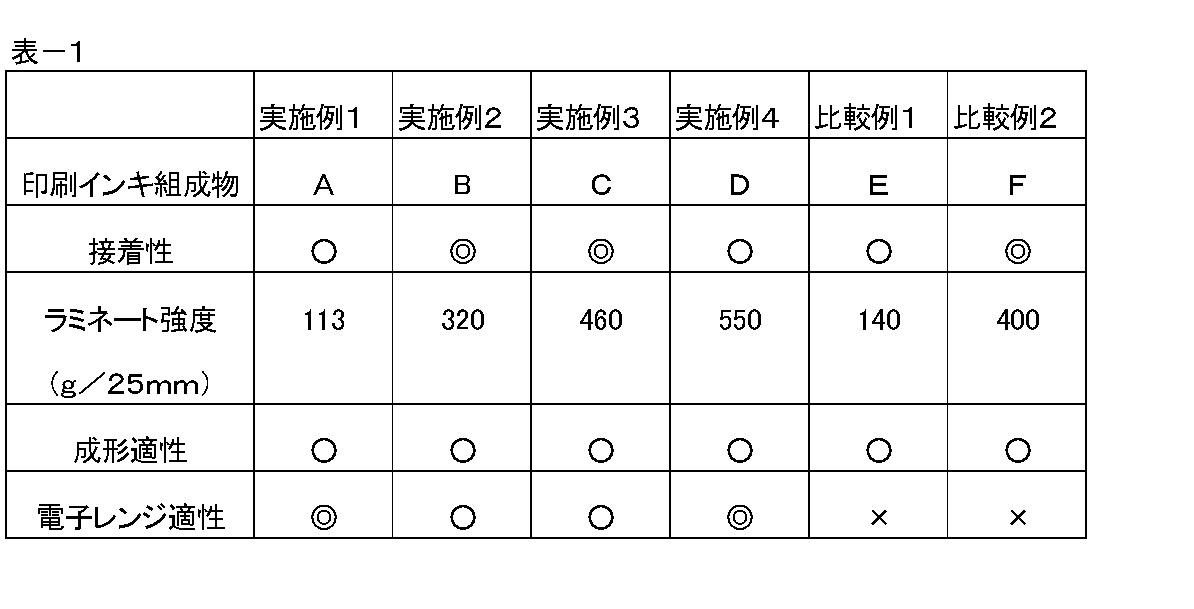
【発明の効果】
本発明の印刷インキ組成物は、塩素化ポリプロピレン等のフイルムに対する接着性が良好であり、印刷したフィルムはPP系シートやPP樹脂と熱ラミネート加工が可能であり、成形加工工程の熱によりインキ皮膜の硬化が起こり、トレー等に成形したものを弁当容器に用いた場合に該容器を電子レンジで加熱してもブリスターが発生しないという効果を有する。[0001]
TECHNICAL FIELD OF THE INVENTION
The present invention relates to an ink for printing on a film in a food tray formed by thermocompression bonding a film and a polypropylene sheet or extruding a polypropylene resin from the film. The present invention also relates to a design film printed with the ink and a laminate made using the film.
[0002]
[Prior art]
A design pattern is printed on a film of polypropylene or the like, and a non-foamed polypropylene sheet (hereinafter referred to as PP sheet) or a foamed PP sheet and the printed film are laminated by heat and pressure to form a food tray. (Such as a lunch box) is made. As this printing ink, a printing ink composition containing a chlorinated polyolefin resin or an ethylene-vinyl acetate resin as a main component is known. When the film is a polypropylene film, a chlorinated polypropylene film is also used because of good workability.
[0003]
Patent Document 1 (JP-A-10-298233) describes an invention of a chlorinated polyolefin-based aqueous resin composition used for an adhesive, an ink, a coating agent and the like.
[0004]
Food trays are packed with food as lunch containers and the like, and sold at convenience stores and supermarkets. The lunch container may use a microwave oven when warming. By the way, a chlorinated polypropylene film (hereinafter referred to as a CPP film) is also used as the film because of its good workability, but the film has insufficient oil and water barrier properties, and the adhesion between the film and the PP sheet is poor. If not good, the oil will penetrate and the ink will soften. Further, when the permeated moisture is vaporized by being heated in a microwave oven or the like, the film swells due to the pressure, and the appearance of the film (blister) deteriorates. In addition, if the swollen portion is pierced by a tip of chopsticks during a meal, the ink softened by oil adheres to food, which is not preferable.
[0005]
The above problem can be solved by using a two-part curable oil-resistant ink for printing on a film. However, since the heat resistance of the ink film also increases, the ink does not soften at a normal laminating temperature, and the heat does not increase. Lamination cannot be performed.
[0006]
That is, there is a demand for a printing ink composition having both the oil resistance of a two-part curable ink and the suitability for thermal lamination of a conventional ink.
[0007]
[Patent Document 1]
JP-A-10-298233
[Problems to be solved by the invention]
An object of the present invention is to provide an ink for printing on a film in a food tray formed by printing on a film and thermocompression bonding with a PP sheet or extruding a PP resin, wherein the film has oil resistance. It is an object of the present invention to provide an ink that can be thermally laminated and that does not generate blisters when heated in a microwave oven. Another object of the present invention is to provide a laminate such as a tray formed using a film printed with the ink.
[0009]
[Means for Solving the Problems]
The present inventors have conducted intensive studies and as a result, have found that a printing ink obtained by adding a metal chelate compound and / or a compound having an epoxy group to a maleic anhydride-modified chlorinated polyolefin resin satisfies the above characteristics, and completed the present invention. did.
[0010]
A paint containing a maleic anhydride-modified chlorinated polyolefin resin, which is coated with a compound having an epoxy group at the time of its use, is known, but requires baking at 230 ° C. for about 30 minutes. Yes, it cannot be used as a printing ink for films.
[0011]
That is, the constitution of the present invention comprises (1) a chlorinated polyolefin resin, a metal chelate compound and a compound having an epoxy group, or (2) a chlorinated polyolefin resin and a metal chelate compound, or (3) A) A printing ink composition comprising a chlorinated polyolefin resin and a compound having an epoxy group. Here, the chlorinated polyolefin resin is preferably a maleic anhydride-modified chlorinated polyolefin resin.
[0012]
Furthermore, it is not a two-pack type in which an epoxy resin is mixed at the time of use, but a one-pack ink in which a compound having an epoxy group is previously blended in the ink. At room temperature, the ink film is thermoplastic, and can be laminated with the PP sheet only by heating. In addition, the ink film is cured by heat during molding and exhibits oil resistance.
[0013]
BEST MODE FOR CARRYING OUT THE INVENTION
The chlorinated polyolefin resin used in the present invention is obtained by chlorinating polypropylene or polyethylene. This resin includes a low chlorinated product having a chlorine content of 20 to 45% and a high chlorinated product having a chlorine content of 45 to 65%. Among them, a low chlorinated polypropylene has stronger adhesion to polypropylene.
[0014]
A metal chelate compound is a compound in which a metal ion becomes an electron acceptor and coordinates with an electron donor to form a cyclic structure. As the metal component of the metal chelate compound, titanium, aluminum, iron and the like are used, but titanium is preferable.
[0015]
Examples of the titanium chelate using titanium as a metal include titanium acetylacetonate, titanium acylate, titanium alkoxide and the like, with titanium acetylacetonate being particularly preferred. The addition amount of the titanium chelate is preferably 0.5 to 10.0% by mass, and more preferably 1.0 to 5.0%.
[0016]
The compound having an epoxy group is a compound having one or more epoxy groups in the molecule, and includes an epoxy resin having two or more epoxy groups in one molecule.
Examples of the compound having an epoxy group include phenyl glycidyl ether, allyl glycidyl ether, and pt-butylphenyl glycidyl ether. Examples of the epoxy resin include bisphenol S diglycidyl ether, terephthalic acid diglycidyl ester, and hydroquinone diglycidyl ether.
[0017]
As the solvent, esters such as toluene, methyl ethyl ketone (MEK) and ethyl acetate, alcohol solvents such as isopropyl alcohol (IPA) and denatured alcohol, and mixed solvents thereof are used.
If necessary, polyethylene wax for improving abrasion resistance, silicon dioxide for preventing blocking, and the like may be added as additives.
[0018]
In the present invention, other resins may be used in combination with the chlorinated polyolefin resin. The resin used in combination may be any resin generally used for gravure printing or flexographic printing ink. Examples include non-chlorinated polyolefin resins, polyamide resins, ketone resins, polyvinyl butyral resins, epoxy resins, ethylene vinyl acetate resins, vinyl acetate resins, and copolymer resins of vinyl chloride and vinyl isobutyl ether. Is mentioned.
[0019]
The ratio of the resin component used in the present invention is such that the chelate compound is 0 to 20 parts by mass and the compound having an epoxy group is 0 to 20 parts by mass based on 100 parts by mass of the chlorinated polyolefin resin.
[0020]
As the compounding ratio of the ink, the resin is 5 to 30 parts by mass, the pigment is 0 to 60 parts by mass, the additive is 0 to 10 parts by mass, and the amount of the solvent is such that the nonvolatile content is about 10 to 55%. It is preferable that the content be 15% to 45%.
[0021]
In the production of the ink, the resin, the pigment, the solvent, and the auxiliary agent are weighed and stirred well as in the case of the usual gravure ink, and then the mixture is finished with a meat dispersing machine such as an attritor or a sand mill.
[0022]
As a film in which the printing ink of the present invention is used to impart a design property, a film usually used for gravure printing is used. Examples include a polypropylene film, a chlorinated polypropylene film, a polyester film, a polyethylene film, a nylon film and the like. These films may have been subjected to a corona treatment, a frame treatment or a stretching treatment.
[0023]
As the substrate to be laminated, a thermoplastic plastic is used. Preferably, a polyolefin resin is used, and an extender may be blended. Further, a sheet foamed with carbon dioxide gas, butane gas, air or the like may be used.
[0024]
As a method for printing and applying the ink, any method such as a general gravure coat, silk screen, and flexo is used. For example, a gravure coat is preferably used.
[0025]
The dry film thickness of the ink film is preferably from 0.3 to 5 μm, more preferably from 0.8 to 2 μm. If the dried film is too thick, a problem of blocking (sticking of the ink film surfaces) tends to occur.
[0026]
【Example】
Hereinafter, the present invention will be described specifically with reference to examples. The blending composition and other numerical values represent parts by mass.
[0027]
Example 1 [Preparation of printing ink composition (A)]
56 g of a chlorinated polyolefin having a molecular weight of 40,000 to 50,000 and a chlorine content of 24.5% (manufactured by Nippon Paper Industries Co., Ltd .: Supercron 822 (N.V. 20%)),
4 g of titanium acetylacetonate (manufactured by Matsumoto Pharmaceutical Co., Ltd .: Organix TC-401 (N.V. 75%))
28.4 g of a mixed solvent (toluene: ethyl acetate: IPA = 2: 1: 1),
0.6 g of polyethylene wax (manufactured by Mitsui Chemicals, Inc .: High Wax 220MP)
11 g of a pigment (Pigment Yellow 1429, manufactured by Sanyo Dyeing Co., Ltd.)
Was kneaded with an attritor for 1 hour to prepare a printing ink composition (A) having a nonvolatile content of 25.8%.
[0028]
Example 2 [Preparation of printing ink composition (B)]
56 g of a chlorinated polyolefin having a molecular weight of 40,000 to 50,000 and a chlorine content of 24.5% (manufactured by Nippon Paper Industries: Supercron 822 (N.V. 20%));
4 g of a special epoxy resin having an epoxy equivalent of 180 (manufactured by Nagase Kasei Kogyo Co., Ltd .: Denacol EX614B (N.V. 100%)),
29.4 g of a mixed solvent (toluene: ethyl acetate: IPA = 2: 1: 1),
0.6 g of polyethylene wax (manufactured by Mitsui Chemicals, Inc .: High Wax 220MP)
11 g of a pigment (Pigment Yellow 1429, manufactured by Sanyo Dyeing Co., Ltd.)
Was kneaded with an attritor for 1 hour to prepare a printing ink composition (B) having a nonvolatile content of 30.3%.
[0029]
Example 3 [Preparation of printing ink composition (C)]
56 g of a chlorinated polyolefin having a molecular weight of 40,000 to 50,000 and a chlorine content of 24.5% (manufactured by Nippon Paper Industries: Supercron 822 (N.V. 20%));
1 g of titanium acetylacetonate (manufactured by Matsumoto Pharmaceutical Co., Ltd .: Organix TC-401 (N.V. 75%))
4 g of a special epoxy resin having an epoxy equivalent of 180 (manufactured by Nagase Kasei Kogyo Co., Ltd .: Denacol EX614B (N.V. 100%)),
27.4 g of a mixed solvent (toluene: ethyl acetate: IPA = 2: 1: 1)
0.6 g of polyethylene wax (manufactured by Mitsui Chemicals, Inc .: High Wax 220MP)
11 g of a pigment (Pigment Yellow 1429, manufactured by Sanyo Dyeing Co., Ltd.)
Was kneaded with an attritor for 1 hour to prepare a printing ink composition (C) having a nonvolatile content of 27.5%.
[0030]
Example 4 [Preparation of printing ink composition (D)]
56 g of a chlorinated polyolefin having a molecular weight of 40,000 to 50,000 and a chlorine content of 24.5% (manufactured by Nippon Paper Industries: Supercron 822 (N.V. 20%));
1 g of titanium acetylacetonate (manufactured by Matsumoto Pharmaceutical Co., Ltd .: Organix TC-401 (N.V. 75%))
4 g of a special epoxy resin having an epoxy equivalent of 145 (Denacol EX-321 (NV 100%) manufactured by Nagase Kasei Kogyo Co., Ltd.)
27.4 g of a mixed solvent (toluene: ethyl acetate: IPA = 2: 1: 1)
0.6 g of polyethylene wax (manufactured by Mitsui Chemicals, Inc .: High Wax 220MP)
11 g of a pigment (Pigment Yellow 1429, manufactured by Sanyo Dyeing Co., Ltd.)
Was kneaded with an attritor for 1 hour to prepare a printing ink composition (D) having a nonvolatile content of 27.5%.
[0031]
Comparative Example 1 [Preparation of printing ink composition (E)]
60 g of a chlorinated polyolefin having a molecular weight of 40,000 to 50,000 and a chlorine content of 24.5% (manufactured by Nippon Paper Industries: Supercron 822 (N.V. 20%));
28.4 g of a mixed solvent (toluene: ethyl acetate: IPA = 2: 1: 1),
0.6 g of polyethylene wax (manufactured by Mitsui Chemicals: High Wax 220MP), 11 g of pigment (manufactured by Sanyo Pigment Co., Ltd .: Pigment Yellow 1429),
Was kneaded with an attritor for 1 hour to prepare a printing ink composition (E) having a nonvolatile content of 23.6%.
[0032]
Comparative Example 2 [Preparation of printing ink composition (F)]
35 g of chlorinated polyolefin having a molecular weight of 100,000 to 120,000 and a chlorine content of 31 to 33% (manufactured by Nippon Paper Industries: Supercron 834D (N.V. 30%));
3.5 g of an ethylene-vinyl acetate copolymer resin having a MFR of 65 dg / min and a vinyl acetate content of 41% (manufactured by DuPont-Mitsui Polychemicals: Evaflex EV40W (N.V. 100%))
49.9 g of a mixed solvent (toluene: ethyl acetate: IPA = 2: 1: 1),
0.6 g of polyethylene wax (manufactured by Mitsui Chemicals, Inc .: High Wax 220MP)
11 g of a pigment (Pigment Yellow 1429, manufactured by Sanyo Dyeing Co., Ltd.)
Was kneaded with an attritor for 1 hour to prepare a printing ink composition (F) having a nonvolatile content of 25.6%. MFR indicates a melt flow rate.
[0033]
[Evaluation test]
The printing ink compositions (A), (B), (C) and (D) of the examples prepared above and the ink compositions (E) and (F) of the comparative examples were prepared using a gravure printing machine manufactured by Higashitani. Printing was performed on a chlorinated polypropylene film (Polyace CPP, manufactured by Tonen Film Co., Ltd.) having a thickness of 25 μm using a mesh gravure plate having a printing speed of 40 m / min, 175 lines, and 30 μm. Thereafter, the adhesiveness, suitability for heat lamination, laminate strength, suitability for molding, suitability for microwave oven were evaluated, and the results are shown in Table 1.
In addition, each evaluation method is based on the method described below.
[0034]
〔Adhesiveness〕
After leaving the printed matter at room temperature for one day, a cellophane tape 12 mm manufactured by Nichiban Co., Ltd. was adhered to the printed surface, and when this was rapidly peeled off, the print film was not peeled off at all (◎), but 80% or more of the film remained on the film. The sample was evaluated as (○), the sample with 50 to 80% remaining was evaluated as (も の), and the sample with only 20% or less was evaluated as (x).
[0035]
[Heat lamination strength]
On a 0.75 mm thick low-foaming PP sheet (manufactured by FP Corporation: Histar), the printed film surface of the printed matter left at room temperature for one day is aligned, and a 12 μm thick polyester film is placed on the film surface of the printed matter. Using a Hayashi Kikai roll transfer machine, thermal lamination was performed at a temperature of 230 ° C. and a speed of 5 m / min to remove the polyester film. Then, it was left in a hot air thermostat at 180 ° C. for 40 ± 5 seconds, a kraft tape (manufactured by Sekisui Chemical Co., Ltd.) was stuck on the PP film surface, cut into 25 mm widths, and peeled at a speed of 500 mm / min with Tensilon at 180 °. And the laminate strength was measured.
[0036]
(Molding test)
On a 0.75 mm thick low-foaming PP sheet (manufactured by FP Corporation: Histar), the printed film surface of the printed matter left at room temperature for one day is aligned, and a 12 μm thick polyester film is placed on the film surface of the printed matter. Using a roll transfer machine made by Hayashi Kikai, thermal lamination was performed at a temperature of 230 ° C. and a speed of 5 m / min. Then, a 50 mm-diameter hemispherical container was prepared from the laminate from which the polyester film had been removed using a vacuum forming machine (Formech 300X type) manufactured by Formech Co., Ltd. The result was indicated as (x).
[0037]
[Microwave oven test]
Into the hemispherical container prepared above, 3 cc of a test liquid mixed at a ratio of salad oil / tap water = 2/8 was put, and heated at 650 W for 60 seconds using a microwave oven (manufactured by Sanyo Electric: EM-650T). The presence or absence of blisters was visually evaluated. Blisters without blisters (◎), blisters with an area of 5% or less (○), blisters with an area of 5% to 10% (△), blisters with an area of 10% or more (×) was evaluated.
[0038]
[Table 1]
【The invention's effect】
The printing ink composition of the present invention has good adhesiveness to a film such as chlorinated polypropylene, and the printed film can be heat-laminated with a PP-based sheet or PP resin. Is hardened, and when a product molded into a tray or the like is used for a lunch container, there is an effect that no blister is generated even if the container is heated in a microwave oven.
Claims (6)
(A)塩素化ポリオレフィン樹脂。
(B)金属キレート化合物。
(C)エポキシ基を有する化合物。A printing ink composition comprising the following (A) and at least one of the two (B) and (C).
(A) Chlorinated polyolefin resin.
(B) a metal chelate compound.
(C) a compound having an epoxy group.
Priority Applications (1)
| Application Number | Priority Date | Filing Date | Title |
|---|---|---|---|
| JP2002285616A JP2004123782A (en) | 2002-09-30 | 2002-09-30 | Printing ink composition |
Applications Claiming Priority (1)
| Application Number | Priority Date | Filing Date | Title |
|---|---|---|---|
| JP2002285616A JP2004123782A (en) | 2002-09-30 | 2002-09-30 | Printing ink composition |
Publications (1)
| Publication Number | Publication Date |
|---|---|
| JP2004123782A true JP2004123782A (en) | 2004-04-22 |
Family
ID=32278873
Family Applications (1)
| Application Number | Title | Priority Date | Filing Date |
|---|---|---|---|
| JP2002285616A Pending JP2004123782A (en) | 2002-09-30 | 2002-09-30 | Printing ink composition |
Country Status (1)
| Country | Link |
|---|---|
| JP (1) | JP2004123782A (en) |
Cited By (4)
| Publication number | Priority date | Publication date | Assignee | Title |
|---|---|---|---|---|
| JP2007169357A (en) * | 2005-12-20 | 2007-07-05 | Toyo Ink Mfg Co Ltd | Printing ink composition containing titanium organic compound, plastic sheet covering and laminate laminate using the composition |
| JP2018053014A (en) * | 2016-09-27 | 2018-04-05 | 東洋インキScホールディングス株式会社 | Gravure ink and printed matter |
| JP2020059787A (en) * | 2018-10-09 | 2020-04-16 | Dicグラフィックス株式会社 | Printing ink for laminate |
| WO2020138117A1 (en) * | 2018-12-27 | 2020-07-02 | 日本製紙株式会社 | Chlorinated polyolefin resin composition and use thereof |
-
2002
- 2002-09-30 JP JP2002285616A patent/JP2004123782A/en active Pending
Cited By (6)
| Publication number | Priority date | Publication date | Assignee | Title |
|---|---|---|---|---|
| JP2007169357A (en) * | 2005-12-20 | 2007-07-05 | Toyo Ink Mfg Co Ltd | Printing ink composition containing titanium organic compound, plastic sheet covering and laminate laminate using the composition |
| JP2018053014A (en) * | 2016-09-27 | 2018-04-05 | 東洋インキScホールディングス株式会社 | Gravure ink and printed matter |
| JP2020059787A (en) * | 2018-10-09 | 2020-04-16 | Dicグラフィックス株式会社 | Printing ink for laminate |
| WO2020138117A1 (en) * | 2018-12-27 | 2020-07-02 | 日本製紙株式会社 | Chlorinated polyolefin resin composition and use thereof |
| CN113195624A (en) * | 2018-12-27 | 2021-07-30 | 日本制纸株式会社 | Chlorinated polyolefin resin composition and use thereof |
| JPWO2020138117A1 (en) * | 2018-12-27 | 2021-11-11 | 日本製紙株式会社 | Chlorinated polyolefin resin composition and its uses |
Similar Documents
| Publication | Publication Date | Title |
|---|---|---|
| JP2004001888A (en) | Food packaging bags | |
| JP2023118799A (en) | Polyethylene laminate and packaging material using the same | |
| US20070087189A1 (en) | Coating for enhancing low temperature heat sealability and high hot tack to polymeric substrates | |
| TW202132463A (en) | Epoxy resin composition, laminate with gas barrier properties, packaging material for retort-packaged food, deodorizing or scent-preserving packaging material, heat shrinkable label and method for producing same, and heat shrinkable label and bottle bearing same | |
| JP4629363B2 (en) | Barrier film and laminated material using the same | |
| JP2008265854A (en) | Self-supporting bag-like container | |
| JP2004123782A (en) | Printing ink composition | |
| JPH09104464A (en) | Container lid material | |
| JP2019014043A (en) | Laminated body and packaging bag using the same | |
| JP2002347158A (en) | Laminate | |
| JP3255893B2 (en) | Cover film | |
| JP2003145699A (en) | Co-extruded composite film for deep drawing and deep drawn package | |
| JP2004285245A (en) | Printing ink composition | |
| JP2003112718A (en) | Paper cup | |
| JP3957499B2 (en) | Coating agent | |
| JP7419802B2 (en) | Laminated films and packaging materials | |
| JPH0156110B2 (en) | ||
| JP2008265853A (en) | Retort processing paper container and retort processing package using the same | |
| JP2008143033A (en) | Laminated film for packaging and method for producing laminated film for packaging | |
| JP4858014B2 (en) | Seed wrapping material and seed bag | |
| JP2000233479A (en) | Laminated material and packaging container using the same | |
| JP2764208B2 (en) | Packaging bag for packaging | |
| JP2016155573A (en) | Packaging material for bath agent | |
| JP2001315284A (en) | Polyester laminate | |
| JP2025009572A (en) | Lid Material |