JP2004123799A - Method for producing styrene resin foam - Google Patents
Method for producing styrene resin foam Download PDFInfo
- Publication number
- JP2004123799A JP2004123799A JP2002286073A JP2002286073A JP2004123799A JP 2004123799 A JP2004123799 A JP 2004123799A JP 2002286073 A JP2002286073 A JP 2002286073A JP 2002286073 A JP2002286073 A JP 2002286073A JP 2004123799 A JP2004123799 A JP 2004123799A
- Authority
- JP
- Japan
- Prior art keywords
- styrene
- resin foam
- weight
- parts
- based resin
- Prior art date
- Legal status (The legal status is an assumption and is not a legal conclusion. Google has not performed a legal analysis and makes no representation as to the accuracy of the status listed.)
- Granted
Links
Landscapes
- Manufacture Of Porous Articles, And Recovery And Treatment Of Waste Products (AREA)
- Compositions Of Macromolecular Compounds (AREA)
Abstract
【課題】本発明は、ジメチルエーテルを含む物理型発泡剤を用いて汎用の発泡設備でもってジメチルエーテルが発火する虞れなくスチレン系樹脂発泡体を製造することができるスチレン系樹脂発泡体の製造方法を提供する。
【解決手段】本発明のスチレン系樹脂発泡体の製造方法は、スチレン系樹脂100重量部、ジメチルエーテルを30重量%以上含有する物理発泡剤6.0〜15.0重量部、及び、アルキルジエタノールアミン及び/又はグリセリンの炭素数が11〜16の高級脂肪酸エステル0.2〜2.0重量部を押出機に供給し溶融混練して押出発泡することを特徴とするので、静電気に起因したスチレン系樹脂発泡体の発火を効果的に抑制することができる。
【選択図】 なしAn object of the present invention is to provide a method for producing a styrene resin foam which can produce a styrene resin foam using a physical foaming agent containing dimethyl ether without fear of dimethyl ether being ignited by a general-purpose foaming facility. provide.
The method for producing a styrenic resin foam of the present invention comprises: a styrenic resin (100 parts by weight); a physical blowing agent containing 30% by weight or more of dimethyl ether (6.0 to 15.0 parts by weight); an alkyldiethanolamine; And / or 0.2 to 2.0 parts by weight of a higher fatty acid ester having 11 to 16 carbon atoms of glycerin is supplied to an extruder, melt-kneaded and extruded to form a styrene resin caused by static electricity. The ignition of the foam can be effectively suppressed.
[Selection diagram] None
Description
【0001】
【発明の属する技術分野】
本発明は、ジメチルエーテルを含む物理発泡剤を用いて発火の虞れなくスチレン系樹脂発泡体を製造することができるスチレン系樹脂発泡体の製造方法に関する。
【0002】
【従来の技術】
従来から種々の分野においてスチレン系樹脂発泡体が用いられている。このスチレン系樹脂発泡体の製造に用いられる物理発泡剤として塩化メチルや塩化エチルが汎用されている。
【0003】
ところが、塩化メチルや塩化エチルは、人体に対してあまり良い物質とはいえず使用を控える必要があり、その代替として、ジメチルエーテルが用いられている。
【0004】
このようなジメチルエーテルを用いたスチレン系樹脂発泡体の製造方法としては、特許文献1には、40〜85重量%のジメチルエーテル、メチルエチルエーテル及びジエチルエーテルよりなる群から選ばれた1種以上のエーテルと、15〜60重量%の炭素数が3〜5の飽和炭化水素よりなる群から選ばれた1種以上の飽和炭化水素とからなる発泡剤を用いたスチレン系樹脂発泡体の製造方法が記載されている。
【0005】
しかしながら、上記エーテルは、着火エネルギーが低くて非常に可燃性の高いガスであり、しかも、エーテルは、スチレン系樹脂に対して透過性が高く、押出機より押出された直後から外気中に放散されることから、エーテルが発泡体内から抜けるまでの間に静電気が発生すると、エーテルが発火する虞れがあるといった問題点があった。
【0006】
【特許文献1】
WO99/54390(特許請求の範囲)
【0007】
【発明が解決しようとする課題】
本発明は、ジメチルエーテルを含む物理発泡剤を用いて汎用の発泡設備でもってジメチルエーテルを発火させる虞れなくスチレン系樹脂発泡体を製造することができるスチレン系樹脂発泡体の製造方法を提供する。
【0008】
【課題を解決する手段】
本発明のスチレン系樹脂発泡体は、スチレン系樹脂100重量部、ジメチルエーテルを30重量%以上含有する物理発泡剤6.0〜15.0重量部、及び、アルキルジエタノールアミン及び/又はグリセリンの炭素数が11〜16の高級脂肪酸エステル0.2〜2.0重量部を押出機に供給し溶融混練して押出発泡することを特徴とする。
【0009】
上記スチレン系樹脂としては、特に限定されず、例えば、スチレン、α−メチルスチレン、ビニルトルエン、クロロスチレン、エチルスチレン、i−プロピルスチレン、ジメチルスチレン、ブロモスチレン等のスチレン系単量体の単独重合体又はこれらの共重合体等が挙げられ、ブロック、ランダム又はグラフト共重合体の何れであってもよい。
【0010】
又、上記スチレン系樹脂としては、上記スチレン系単量体を主成分とする、上記スチレン系単量体とこのスチレン系単量体と共重合可能なビニル単量体との共重合体であってもよく、このようなビニル単量体としては、例えば、(メタ)アクリル酸メチル、(メタ)アクリル酸n−ブチル等の(メタ)アクリル酸アルキル、(メタ)アクリル酸、無水マレイン酸、ブタジエン、(メタ)アクリロニトリル、ジメチルマレエート、ジエチルフマレート、ジビニルベンゼン等が挙げられ、ブロック、ランダム又はグラフトの何れであってもよい。
【0011】
そして、発泡剤としては、ジメチルエーテルを30重量%以上含有する物理発泡剤が用いられる。これは、ジメチルエーテルの発泡剤中における含有量が30重量%未満であると、発泡剤として塩化メチルや塩化エチル等の塩化アルキルを用いた時と同様の発泡倍率を有するスチレン系樹脂発泡体を得ることができないからである。
【0012】
又、上記ジメチルエーテルを30重量%以上含有する物理発泡剤の押出機への供給量は、少ないと、所望の発泡倍率を有するスチレン系樹脂発泡体を得ることができず、又、多いと、独立気泡率の高いスチレン系樹脂発泡体を得ることができないので、スチレン系樹脂100重量部に対して6.0〜15.0重量部に限定される。
【0013】
更に、上記物理発泡剤にジメチルエーテル以外に含有される物理発泡剤としては、押出機から押出された溶融状態のスチレン系樹脂を発泡させることができれば、特に限定されず、例えば、i−ブタン、n−ブタン、二酸化炭素、水、窒素、塩化メチル、塩化エチル、1,1−ジフルオロエタン、1,1,1−トリフルオロエタン、1,1,1,2−テトラフルオロエタン、1,1,1,2,2−ペンタフルオロエタン等が挙げられ、単独で用いられても二種以上が併用されてもよい。
【0014】
そして、本発明のスチレン系樹脂発泡体の製造方法では、アルキルジエタノールアミン〔R−N(CH2 CH2 OH)2 但し、Rはアルキル基〕及び/又はグリセリンの炭素数が11〜16の高級脂肪酸エステルが帯電防止剤として押出機に供給される。
【0015】
上記アルキルジエタノールアミン及びグリセリンの炭素数が11〜16の高級脂肪酸エステルは、スチレン系樹脂との相溶性が低いことから、押出機より押出された直後から直ちにスチレン系樹脂発泡体の表面に円滑にブリードアウトし、少量の添加量でもってスチレン系樹脂発泡体の帯電を確実に防止する。
【0016】
即ち、上記アルキルジエタノールアミン及びグリセリンの炭素数が11〜16の高級脂肪酸エステルは、スチレン系樹脂への少量の添加量でもってスチレン系樹脂発泡体の帯電防止効果を効果的に発揮し、スチレン系樹脂発泡体の押出し直後からスチレン系樹脂発泡体中のジメチルエーテルが抜けるまでの間にスチレン系樹脂発泡体表面に静電気が発生するのを確実に防止し、この静電気に起因したスチレン系樹脂発泡体の製造工程中におけるジメチルエーテルの発火を確実に防止することができる。
【0017】
そして、上記アルキルジエタノールアミン及びグリセリンの炭素数が11〜16の高級脂肪酸エステルは、スチレン系樹脂への少量の添加量で足りることから、得られるスチレン系樹脂発泡体は、その曲げ強度等の機械的強度の低下を生じることはなく、機械的物性に優れている。
【0018】
しかも、上記アルキルジエタノールアミン及びグリセリンの炭素数が11〜16の高級脂肪酸エステルは、金属成分を含有しておらず、スチレン系樹脂発泡体に難燃性を付与するために通常、添加される後述する難燃剤、特に臭素系難燃剤の難燃効果を阻害することがないといった優れた効果も発揮する。
【0019】
上記アルキルジエタノールアミンのアルキル基Rは、炭素数が少ないと、スチレン系樹脂発泡体の帯電防止効果が低下することがあり、又、炭素数が多いと、アルキルジエタノールアミンの帯電防止性能が低下することがあるので、炭素数が11〜21のアルキル基が好ましく、炭素数が11〜18のアルキル基がより好ましく、炭素数が18のアルキル基が特に好ましい。
【0020】
そして、上記アルキルジエタノールアミンとしては、例えば、デシルジエタノールアミン、ウンデシルジエタノールアミン、ドデシルジエタノールアミン、トリデシルジエタノールアミン、テトラデシルジエタノールアミン、ペンタデシルジエタノールアミン、ヘキサデシルジエタノールアミン、ヘプタデシルジエタノールアミン、オクタデシルジエタノールアミン、ノナデシルジエタノールアミン、エイコシルジエタノールアミン等が挙げられる。
【0021】
又、グリセリンの炭素数が11〜16の高級脂肪酸エステルは、モノグリセリドが好ましく、このようなモノグリセリドとしては、例えば、ラウリン酸モノグリセリド(ラウリン酸:炭素数12)、ミリスチン酸モノグリセリド(ミリスチン酸の炭素数:14)、パルミチン酸モノグリセリド(パルミチン酸の炭素数:16)等が挙げられ、ラウリン酸モノグリセリドが好ましい。
【0022】
なお、高級脂肪酸の炭素数は、少ないと、スチレン系樹脂との混練性が低下してスチレン系樹脂発泡体の帯電防止効果が低減し、又、多いと、グリセリンの炭素数が11〜16の高級脂肪酸エステルの帯電防止性能が低下するので、11〜16に限定される。
【0023】
そして、上記アルキルジエタノールアミン及び/又はグリセリンの炭素数が11〜16の高級脂肪酸エステルの押出機への供給量は、少ないと、スチレン系樹脂発泡体の帯電防止効果が発揮されず、又、多いと、スチレン系樹脂の可塑化効果が大きくなってスチレン系樹脂発泡体の機械的強度が低下することがあるので、スチレン系樹脂100重量部に対して0.2〜2.0重量部に限定され、0.4〜1.5重量部が好ましい。なお、アルキルジエタノールアミン及びグリセリンの炭素数が11〜16の高級脂肪酸エステルは、単独で用いられても併用されてもよい。なお、上記アルキルジエタノールアミンとグリセリンの炭素数が11〜16の高級脂肪酸エステルとを併用する場合は、両者の総量が上述の供給量となるように調整する。
【0024】
更に、上記スチレン系樹脂には、スチレン系樹脂発泡体に難燃性を付与するために難燃剤が添加されてもよく、このような難燃剤としては、ヘキサブロモシクロドデカン、テトラブロモシクロオクタン、ペンタブロモモノクロロシクロヘキサン、テトラブロモビスフェノールA等の臭素系難燃剤;トリフェニルフォスファイト等のリン系難燃剤等挙げられ、臭素系難燃剤が好ましく、ヘキサブロモシクロドデカン、テトラブロモシクロオクタンがより好ましく、ヘキサブロモシクロドデカンが特に好ましい。なお、上記難燃剤は、単独で用いられても二種以上が併用されてもよい。
【0025】
そして、上記難燃剤の押出機への供給量は、少ないと、スチレン系樹脂発泡体の難燃性が低下することがあり、又、多いと、スチレン系樹脂発泡体の機械的強度が低下したり或いは発泡倍率が低下することがあるので、スチレン系樹脂100重量部に対して2〜4重量部が好ましい。
【0026】
又、スチレン系樹脂発泡体を製造するには、所定量のスチレン系樹脂、ジメチルエーテルを30重量%以上含有する物理発泡剤、及び、アルキルジエタノールアミン及び/又はグリセリンの炭素数が11〜16の高級脂肪酸エステルを押出機に供給して通常の条件下にて溶融、混練して押出発泡すればよい。
【0027】
【実施例】
(実施例1〜4、比較例1〜3)
口径が50mmの第一押出機の先端に口径が65mmの第二押出機を接続してなるタンデム型押出機の第一押出機に、ポリスチレン(東洋スチレン社製 商品名「HRM−18」)100重量部、帯電防止剤として表1に示した量のオクタデシルジエタノールアミン(丸菱油化社製 商品名「デノン2035」)、ラウリン酸モノグリセリド(丸菱油化社製 商品名「デノン2659」、ラウリン酸の炭素数:12)、アルキルベンゼンスルフォネート(丸菱油化社製 商品名「ケミスタット3033N」)又はステアリン酸モノグリセリド(ステアリン酸の炭素数:18)、ヘキサブロモシクロドデカン3.0重量部及び発泡核剤としてタルク粉末0.5重量部を供給して溶融混練すると共に、第一押出機内に、表1に示した量のジメチルエーテル(DME)、i−ブタン及び二酸化炭素からなる物理発泡剤を圧入して、溶融状態のポリスチレンと物理発泡剤とを混合混練した上で、このポリスチレンを第二押出機に連続的に供給して溶融混練しつつ発泡に適した温度に冷却した後、第二押出機の先端に取付けた幅70mm、厚み1.2mmの口金を有するダイから35kg/時間の押出量(吐出量)で押出発泡して、断面が横長長方形状のスチレン系樹脂発泡体を連続的に製造した。
【0028】
上記スチレン系樹脂発泡体の断面寸法(縦幅及び横幅)、密度、燃焼性及び減衰率を下記に示した方法で測定し、その結果を表2に示した。
【0029】
(密度)
スチレン系樹脂発泡体の密度をJIS K7222に準拠して測定した。
【0030】
(燃焼性)
第二押出機より押出発泡させてから一週間経過した後のスチレン系樹脂発泡体から、この発泡体の任意部分の厚み方向の中央を中心にして厚み方向(VD)の相反する方向に5mmづつ、発泡体の押出方向(MD)の相反する方向に100mmづつ、発泡体の表面に沿って且つ押出し方向に直交する方向(TD方向)の相反する方向に12.5mmづつの大きさでもって切り出して、縦200mm×横25mm×高さ10mmの直方体形状の試験片を作製した。
【0031】
そして、上記試験片の表面に着火限指示線及び燃焼限界指示線をMD方向に
20mmの間隔を存して描いた上で、試験片の表面にろうそくの炎の先端を付けた状態でろうそくを着火限指示線から燃焼限界指示線まで移動させた後、直ちにろうそくの炎を試験片の表面から離し、ろうそくの炎を試験片の表面から離した瞬間から試験片表面の炎が消えるまでの時間を測定した。
【0032】
試験片を5つ用意し、各試験片について上記の要領で時間を測定し、その平均時間を燃焼性とした。
【0033】
(減衰率)
スチレン系樹脂発泡体の減衰率をJIS L1094に準拠して測定した。具体的には、第二押出機より押出発泡させてから一週間経過した後のスチレン系樹脂発泡体の表面部分から、縦40mm×横40mm×厚さ2mmの板状の試験片を切り出した。
【0034】
そして、上記試験片を22℃、湿度50%の雰囲気下に24時間放置した後、この試験片にスタティックオネストメーター(シンド静電気社製 商品名「TYPE S−5109」)を用いて電圧10kVを印加し、試験片の帯電量が一定となったところで初期帯電量を測定した。
【0035】
しかる後、試験片への電圧の印加を停止してから60秒後の試験片の帯電量(60秒後帯電量)を測定した。そして、下記式から減衰率を算出した。なお、減衰率は、値が大きいほど帯電防止性に優れている。
減衰率(%)=100×〔初期帯電量(kV)−60秒後帯電量(kV)〕/初期帯電量(kV)
【0036】
試験片を5つ用意し、各試験片について上記の要領で減衰率を測定し、その平均値を減衰率とした。
【0037】
【表1】
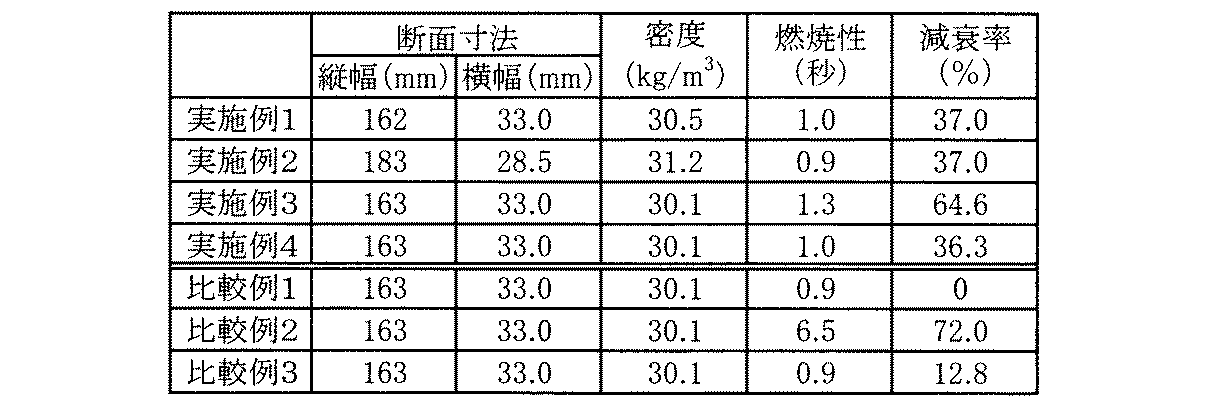
【表2】
【発明の効果】
本発明のスチレン系樹脂発泡体の製造方法は、スチレン系樹脂100重量部、ジメチルエーテルを30重量%以上含有する物理発泡剤6.0〜15.0重量部、及び、アルキルジエタノールアミン及び/又はグリセリンの炭素数が11〜16の高級脂肪酸エステル0.2〜2.0重量部を押出機に供給し溶融混練して押出発泡することを特徴とするので、押出発泡直後からスチレン系樹脂発泡体の表面にはアルキルジエタノールアミン及び/又はグリセリンの炭素数が11〜16の高級脂肪酸エステルが適当量だけブリードアウトしており、よって、スチレン系樹脂発泡体の押出発泡直後からスチレン系樹脂発泡体中からジメチルエーテルが抜け出るまでの間にスチレン系樹脂発泡体の表面に静電気が発生するのを確実に防止し、静電気に起因したスチレン系樹脂発泡体の発火を効果的に抑制することができる。
【0040】
従って、本発明のスチレン系樹脂発泡体の製造方法によれば、別途、ジメチルエーテル濃度を減少させる設備やスチレン系樹脂発泡体の帯電を防止する設備のような特別な設備を要することなく、汎用の押出発泡設備を用いて簡易に且つ確実にスチレン系樹脂発泡体を製造することができる。
【0041】
又、スチレン系樹脂発泡体には難燃剤を添加して難燃性を付与することが行われているが、このようにスチレン系樹脂発泡体に難燃剤を添加した場合にあっても、アルキルジエタノールアミン及びグリセリンの炭素数が11〜16の高級脂肪酸エステルは金属成分を含有しないことから、難燃剤、特に臭素系難燃剤の難燃効果を阻害することはなく、よって、本発明のスチレン系樹脂発泡体の製造方法によれば、優れた難燃性を有するスチレン系樹脂発泡体を簡易に且つ確実に製造することができる。[0001]
TECHNICAL FIELD OF THE INVENTION
The present invention relates to a method for producing a styrene-based resin foam which can produce a styrene-based resin foam without fear of ignition using a physical foaming agent containing dimethyl ether.
[0002]
[Prior art]
Conventionally, styrene resin foams have been used in various fields. Methyl chloride and ethyl chloride are widely used as physical blowing agents used in the production of this styrene resin foam.
[0003]
However, methyl chloride and ethyl chloride are not very good substances for the human body and need to be avoided, and dimethyl ether is used as a substitute.
[0004]
As a method for producing a styrene-based resin foam using such dimethyl ether, Patent Document 1 discloses one or more ethers selected from the group consisting of 40 to 85% by weight of dimethyl ether, methyl ethyl ether and diethyl ether. And a method for producing a styrene-based resin foam using a foaming agent comprising 15 to 60% by weight of one or more saturated hydrocarbons selected from the group consisting of saturated hydrocarbons having 3 to 5 carbon atoms. Have been.
[0005]
However, the above-mentioned ether has a low ignition energy and is a highly flammable gas.Moreover, the ether has a high permeability to a styrene-based resin and is diffused into the outside air immediately after being extruded from an extruder. Therefore, if static electricity is generated before the ether comes out of the foam, the ether may be ignited.
[0006]
[Patent Document 1]
WO99 / 54390 (Claims)
[0007]
[Problems to be solved by the invention]
The present invention provides a method for producing a styrene-based resin foam that can produce a styrene-based resin foam using a physical foaming agent containing dimethyl ether without fear of igniting the dimethyl ether in a general-purpose foaming facility.
[0008]
[Means to solve the problem]
The styrene-based resin foam of the present invention has 100 parts by weight of a styrene-based resin, 6.0 to 15.0 parts by weight of a physical blowing agent containing 30% by weight or more of dimethyl ether, and an alkyldiethanolamine and / or glycerin having a carbon number of 100% by weight. It is characterized in that 0.2 to 2.0 parts by weight of 11 to 16 higher fatty acid ester is supplied to an extruder, melt-kneaded, and extruded and foamed.
[0009]
The styrene-based resin is not particularly limited, and may be, for example, a styrene-based monomer such as styrene, α-methylstyrene, vinyltoluene, chlorostyrene, ethylstyrene, i-propylstyrene, dimethylstyrene, or bromostyrene. Examples thereof include a coalescence or a copolymer thereof, and may be a block, random, or graft copolymer.
[0010]
The styrene resin is a copolymer of the styrene monomer as a main component and the vinyl monomer copolymerizable with the styrene monomer. Such vinyl monomers may include, for example, methyl (meth) acrylate, alkyl (meth) acrylate such as n-butyl (meth) acrylate, (meth) acrylic acid, maleic anhydride, Examples thereof include butadiene, (meth) acrylonitrile, dimethyl maleate, diethyl fumarate, and divinylbenzene, and may be any of block, random, and graft.
[0011]
As the foaming agent, a physical foaming agent containing 30% by weight or more of dimethyl ether is used. This means that when the content of dimethyl ether in the blowing agent is less than 30% by weight, a styrene-based resin foam having the same expansion ratio as when using an alkyl chloride such as methyl chloride or ethyl chloride as the blowing agent is obtained. Because they can't do that.
[0012]
If the amount of the physical foaming agent containing 30% by weight or more of the dimethyl ether to the extruder is small, a styrene-based resin foam having a desired expansion ratio cannot be obtained. Since a styrene-based resin foam having a high cell rate cannot be obtained, the amount is limited to 6.0 to 15.0 parts by weight based on 100 parts by weight of the styrene-based resin.
[0013]
Further, the physical foaming agent contained in the physical foaming agent other than dimethyl ether is not particularly limited as long as the styrene resin in a molten state extruded from an extruder can be foamed. For example, i-butane, n -Butane, carbon dioxide, water, nitrogen, methyl chloride, ethyl chloride, 1,1-difluoroethane, 1,1,1-trifluoroethane, 1,1,1,2-tetrafluoroethane, 1,1,1, Examples thereof include 2,2-pentafluoroethane and the like, which may be used alone or in combination of two or more.
[0014]
In the method for producing a styrenic resin foam according to the present invention, the alkyldiethanolamine [R—N (CH 2 CH 2 OH) 2 where R is an alkyl group] and / or glycerin is a higher fatty acid having 11 to 16 carbon atoms. Esters are fed to the extruder as antistatic agents.
[0015]
The higher fatty acid ester having 11 to 16 carbon atoms of the alkyldiethanolamine and glycerin has a low compatibility with the styrene resin, and thus immediately bleeds on the surface of the styrene resin foam immediately after being extruded from the extruder. Out, and the charging of the styrene resin foam is reliably prevented with a small amount of addition.
[0016]
That is, the alkyldiethanolamine and the higher fatty acid ester having 11 to 16 carbon atoms of glycerin effectively exert the antistatic effect of the styrene resin foam with a small amount of addition to the styrene resin, and the styrene resin Immediately after the foam is extruded and before the dimethyl ether in the styrene resin foam is released, static electricity is reliably prevented from being generated on the surface of the styrene resin foam, and the styrene resin foam produced due to the static electricity is produced. The ignition of dimethyl ether during the process can be reliably prevented.
[0017]
The alkyl diethanolamine and the higher fatty acid ester having 11 to 16 carbon atoms of glycerin need only be added in a small amount to the styrenic resin, so that the obtained styrenic resin foam has mechanical properties such as bending strength. There is no decrease in strength and the mechanical properties are excellent.
[0018]
Moreover, the higher fatty acid ester having 11 to 16 carbon atoms of the alkyldiethanolamine and glycerin does not contain a metal component, and is usually added to impart flame retardancy to the styrene resin foam as described below. An excellent effect of not impairing the flame retardant effect of a flame retardant, particularly a brominated flame retardant, is also exhibited.
[0019]
When the alkyl group R of the alkyldiethanolamine has a small number of carbon atoms, the antistatic effect of the styrene-based resin foam may be reduced, and when the number of carbon atoms is large, the antistatic performance of the alkyldiethanolamine may be reduced. Therefore, an alkyl group having 11 to 21 carbon atoms is preferable, an alkyl group having 11 to 18 carbon atoms is more preferable, and an alkyl group having 18 carbon atoms is particularly preferable.
[0020]
Examples of the alkyl diethanolamine include, for example, decyldiethanolamine, undecyldiethanolamine, dodecyldiethanolamine, tridecyldiethanolamine, tetradecyldiethanolamine, pentadecyldiethanolamine, hexadecyldiethanolamine, heptadecyldiethanolamine, octadecyldiethanolamine, nonadecyldiethanolamine, eicosyldiethanolamine. And the like.
[0021]
The higher fatty acid ester of glycerin having 11 to 16 carbon atoms is preferably a monoglyceride. Examples of such a monoglyceride include lauric acid monoglyceride (lauric acid: carbon number 12), myristic acid monoglyceride (carbon number of myristic acid). : 14), palmitic acid monoglyceride (carbon number of palmitic acid: 16) and the like, and lauric acid monoglyceride is preferable.
[0022]
In addition, if the carbon number of the higher fatty acid is small, the kneadability with the styrene resin is reduced and the antistatic effect of the styrene resin foam is reduced, and if the carbon number is large, the carbon number of glycerin is 11 to 16. Since the antistatic performance of the higher fatty acid ester is reduced, it is limited to 11 to 16.
[0023]
And if the supply amount of the higher fatty acid ester having 11 to 16 carbon atoms of the alkyldiethanolamine and / or glycerin to the extruder is small, the antistatic effect of the styrene resin foam is not exhibited, and if it is large, Since the plasticizing effect of the styrene-based resin is increased and the mechanical strength of the styrene-based resin foam is reduced, the amount is limited to 0.2 to 2.0 parts by weight based on 100 parts by weight of the styrene-based resin. , 0.4 to 1.5 parts by weight. The alkyldiethanolamine and the higher fatty acid ester of glycerin having 11 to 16 carbon atoms may be used alone or in combination. When the alkyldiethanolamine and the higher fatty acid ester of glycerin having 11 to 16 carbon atoms are used in combination, the total amount of both is adjusted so as to be the above-mentioned supply amount.
[0024]
Further, a flame retardant may be added to the styrene resin in order to impart flame retardancy to the styrene resin foam. Examples of such a flame retardant include hexabromocyclododecane, tetrabromocyclooctane, Brominated flame retardants such as pentabromomonochlorocyclohexane and tetrabromobisphenol A; phosphorus-based flame retardants such as triphenylphosphite; and the like; brominated flame retardants are preferred; hexabromocyclododecane and tetrabromocyclooctane are more preferred; Hexabromocyclododecane is particularly preferred. The flame retardants may be used alone or in combination of two or more.
[0025]
When the amount of the flame retardant supplied to the extruder is small, the flame retardancy of the styrene-based resin foam may decrease, and when the amount is large, the mechanical strength of the styrene-based resin foam decreases. The amount is preferably 2 to 4 parts by weight with respect to 100 parts by weight of the styrene-based resin, because of the fact that the expansion ratio may decrease or the expansion ratio may be reduced.
[0026]
In order to produce a styrene-based resin foam, a predetermined amount of a styrene-based resin, a physical foaming agent containing 30% by weight or more of dimethyl ether, and a higher fatty acid having 11 to 16 carbon atoms of alkyldiethanolamine and / or glycerin are used. The ester may be supplied to an extruder, melted and kneaded under ordinary conditions, and extruded and foamed.
[0027]
【Example】
(Examples 1-4, Comparative Examples 1-3)
Polystyrene (trade name “HRM-18” manufactured by Toyo Styrene Co.) is used as the first extruder of a tandem type extruder in which a second extruder having a diameter of 65 mm is connected to a tip of a first extruder having a diameter of 50 mm. Parts by weight, octadecyldiethanolamine (trade name “Denone 2035” manufactured by Marubishi Yuka Co., Ltd.) and lauric acid monoglyceride (trade name “Denone 2659” manufactured by Marubishi Yuka Co., Ltd., lauric acid) Carbon number: 12), alkyl benzene sulfonate (trade name “Chemistat 3033N” manufactured by Marubishi Yuka Co., Ltd.) or stearic acid monoglyceride (carbon number of stearic acid: 18), 3.0 parts by weight of hexabromocyclododecane and foaming 0.5 parts by weight of talc powder was supplied as a nucleating agent and melt-kneaded, and the dimethyl ether having the amount shown in Table 1 was introduced into the first extruder. (DME), a physical blowing agent comprising i-butane and carbon dioxide, press-fit, mix and knead the polystyrene in a molten state and the physical blowing agent, and continuously supply the polystyrene to a second extruder. After being cooled to a temperature suitable for foaming while being melt-kneaded, it is extruded at an extrusion rate (discharge rate) of 35 kg / hour from a die having a die having a width of 70 mm and a thickness of 1.2 mm attached to the tip of the second extruder. Then, a styrene resin foam having a horizontally long rectangular cross section was continuously manufactured.
[0028]
The cross-sectional dimensions (length and width), density, flammability and damping rate of the styrene-based resin foam were measured by the methods shown below, and the results are shown in Table 2.
[0029]
(density)
The density of the styrene resin foam was measured according to JIS K7222.
[0030]
(Combustion quality)
From the styrene resin foam one week after extrusion foaming from the second extruder, 5 mm each in the opposite direction in the thickness direction (VD) around the center in the thickness direction of an arbitrary portion of the foam. Cut out in 100 mm increments in the opposite direction of the foam extrusion direction (MD) and 12.5 mm in opposite directions in the direction perpendicular to the extrusion direction (TD direction) along the foam surface. Thus, a rectangular parallelepiped test piece having a length of 200 mm, a width of 25 mm and a height of 10 mm was prepared.
[0031]
Then, after the ignition limit indicating line and the combustion limit indicating line are drawn on the surface of the test piece at intervals of 20 mm in the MD direction, the candle is burned with the tip of a candle flame attached to the surface of the test piece. Immediately after moving from the ignition limit indicator line to the combustion limit indicator line, the flame of the candle is separated from the surface of the test piece, and the time from when the candle flame is separated from the surface of the test piece until the flame on the test piece surface disappears. Was measured.
[0032]
Five test pieces were prepared, the time was measured for each test piece as described above, and the average time was defined as the flammability.
[0033]
(Attenuation rate)
The attenuation rate of the styrene resin foam was measured according to JIS L1094. Specifically, a plate-shaped test piece having a length of 40 mm, a width of 40 mm and a thickness of 2 mm was cut out from the surface portion of the styrene resin foam one week after the extrusion and foaming from the second extruder.
[0034]
Then, after leaving the test piece in an atmosphere of 22 ° C. and 50% humidity for 24 hours, a voltage of 10 kV was applied to the test piece using a static honest meter (trade name “TYPE S-5109” manufactured by Sindh Electrostatic Co., Ltd.). Then, when the charge amount of the test piece became constant, the initial charge amount was measured.
[0035]
Thereafter, the charge amount of the test piece 60 seconds after the application of the voltage to the test piece was stopped (the charge amount after 60 seconds) was measured. Then, the attenuation rate was calculated from the following equation. The larger the value of the attenuation rate, the better the antistatic property.
Decay rate (%) = 100 × [initial charge amount (kV) −charge amount after 60 seconds (kV)] / initial charge amount (kV)
[0036]
Five test pieces were prepared, the attenuation rate of each test piece was measured as described above, and the average value was defined as the attenuation rate.
[0037]
[Table 1]
[Table 2]
【The invention's effect】
The method for producing a styrenic resin foam of the present invention comprises the steps of: 100 parts by weight of a styrene-based resin, 6.0 to 15.0 parts by weight of a physical blowing agent containing 30% by weight or more of dimethyl ether, and Since 0.2 to 2.0 parts by weight of a higher fatty acid ester having 11 to 16 carbon atoms is supplied to an extruder, melt-kneaded and extruded and foamed, the surface of the styrene-based resin foam is obtained immediately after extrusion foaming. The alkyldiethanolamine and / or the higher fatty acid ester having 11 to 16 carbon atoms of glycerin bleeds out by an appropriate amount. Therefore, immediately after extrusion and foaming of the styrene-based resin foam, dimethyl ether is removed from the styrene-based resin foam. Prevents static electricity from being generated on the surface of the styrenic resin foam before it escapes, Ignition of styrenic resin foam can be effectively suppressed.
[0040]
Therefore, according to the method for producing a styrene-based resin foam of the present invention, there is no need for special equipment such as a facility for reducing the concentration of dimethyl ether or a facility for preventing electrification of the styrene-based resin foam, and it can be used for general purposes. A styrene-based resin foam can be easily and reliably manufactured using an extrusion foaming facility.
[0041]
Further, flame retardants are added to styrene-based resin foams to impart flame retardancy. However, even when a flame-retardant is added to a styrene-based resin foam, an alkyl Since the higher fatty acid esters of diethanolamine and glycerin having 11 to 16 carbon atoms do not contain a metal component, they do not inhibit the flame retardant effect of the flame retardant, especially the bromine flame retardant. According to the method for producing a foam, a styrene-based resin foam having excellent flame retardancy can be easily and reliably produced.
Claims (1)
Priority Applications (1)
| Application Number | Priority Date | Filing Date | Title |
|---|---|---|---|
| JP2002286073A JP3913655B2 (en) | 2002-09-30 | 2002-09-30 | Method for producing styrene resin foam |
Applications Claiming Priority (1)
| Application Number | Priority Date | Filing Date | Title |
|---|---|---|---|
| JP2002286073A JP3913655B2 (en) | 2002-09-30 | 2002-09-30 | Method for producing styrene resin foam |
Publications (2)
| Publication Number | Publication Date |
|---|---|
| JP2004123799A true JP2004123799A (en) | 2004-04-22 |
| JP3913655B2 JP3913655B2 (en) | 2007-05-09 |
Family
ID=32279215
Family Applications (1)
| Application Number | Title | Priority Date | Filing Date |
|---|---|---|---|
| JP2002286073A Expired - Fee Related JP3913655B2 (en) | 2002-09-30 | 2002-09-30 | Method for producing styrene resin foam |
Country Status (1)
| Country | Link |
|---|---|
| JP (1) | JP3913655B2 (en) |
Cited By (1)
| Publication number | Priority date | Publication date | Assignee | Title |
|---|---|---|---|---|
| CN111995824A (en) * | 2020-08-31 | 2020-11-27 | 东莞市星偌包装材料有限公司 | Antistatic foamed sheet and preparation method thereof |
-
2002
- 2002-09-30 JP JP2002286073A patent/JP3913655B2/en not_active Expired - Fee Related
Cited By (1)
| Publication number | Priority date | Publication date | Assignee | Title |
|---|---|---|---|---|
| CN111995824A (en) * | 2020-08-31 | 2020-11-27 | 东莞市星偌包装材料有限公司 | Antistatic foamed sheet and preparation method thereof |
Also Published As
| Publication number | Publication date |
|---|---|
| JP3913655B2 (en) | 2007-05-09 |
Similar Documents
| Publication | Publication Date | Title |
|---|---|---|
| US5489407A (en) | Method of forming thermoplastic foams using cell size enlarging agents | |
| JP2011225641A (en) | Extruded foam of polystyrenic resin and method for producing the same | |
| JP3435161B2 (en) | Method for Unimodal Cell Size Distribution Styrene Foam Structure | |
| JP5565240B2 (en) | Composite resin foamed particles and method for producing the same, and method for producing foamable composite resin particles | |
| JP5042654B2 (en) | Thermoplastic resin foam | |
| JP5248041B2 (en) | Thermoplastic resin foam | |
| JP2003525330A (en) | Extruded foamed products with reduced surface defects | |
| JP5042653B2 (en) | Thermoplastic resin foam | |
| JP3913655B2 (en) | Method for producing styrene resin foam | |
| WO1996016111A1 (en) | Polystyrene resin foam and process for producing the foam | |
| JP4636784B2 (en) | Polystyrene resin extruded foam and method for producing the same | |
| JP4101684B2 (en) | Styrenic resin foam plate and manufacturing method thereof | |
| JP4413080B2 (en) | Flame retardant polystyrene resin extruded foam board | |
| JP4217229B2 (en) | Polystyrene resin extruded foam | |
| JP4791016B2 (en) | Polyolefin resin extruded foam | |
| JP3976592B2 (en) | Styrenic resin extruded foam and method for producing the same | |
| JP4222916B2 (en) | Flame retardant polystyrene resin extruded foam and method for producing the same | |
| JP4708315B2 (en) | Thermoplastic resin foam | |
| JP2007039601A (en) | Extruded foam | |
| JP2004175862A (en) | Styrene-based resin foam board and method for producing the same | |
| JP4474733B2 (en) | Method for producing styrene resin foam | |
| JP2005187756A (en) | Flame retardant polystyrene resin extruded foam board | |
| JP3441810B2 (en) | Method for producing styrene resin foam | |
| JPH02284934A (en) | Production of foamed styrene resin board | |
| JP2006188654A (en) | Method for producing extruded polystyrene resin foam |
Legal Events
| Date | Code | Title | Description |
|---|---|---|---|
| A621 | Written request for application examination |
Free format text: JAPANESE INTERMEDIATE CODE: A621 Effective date: 20041109 |
|
| A977 | Report on retrieval |
Free format text: JAPANESE INTERMEDIATE CODE: A971007 Effective date: 20061215 |
|
| TRDD | Decision of grant or rejection written | ||
| A01 | Written decision to grant a patent or to grant a registration (utility model) |
Free format text: JAPANESE INTERMEDIATE CODE: A01 Effective date: 20070109 |
|
| A61 | First payment of annual fees (during grant procedure) |
Free format text: JAPANESE INTERMEDIATE CODE: A61 Effective date: 20070131 |
|
| R150 | Certificate of patent or registration of utility model |
Free format text: JAPANESE INTERMEDIATE CODE: R150 |
|
| FPAY | Renewal fee payment (event date is renewal date of database) |
Free format text: PAYMENT UNTIL: 20100209 Year of fee payment: 3 |
|
| FPAY | Renewal fee payment (event date is renewal date of database) |
Free format text: PAYMENT UNTIL: 20110209 Year of fee payment: 4 |
|
| S111 | Request for change of ownership or part of ownership |
Free format text: JAPANESE INTERMEDIATE CODE: R313113 |
|
| FPAY | Renewal fee payment (event date is renewal date of database) |
Free format text: PAYMENT UNTIL: 20120209 Year of fee payment: 5 |
|
| R350 | Written notification of registration of transfer |
Free format text: JAPANESE INTERMEDIATE CODE: R350 |
|
| FPAY | Renewal fee payment (event date is renewal date of database) |
Free format text: PAYMENT UNTIL: 20120209 Year of fee payment: 5 |
|
| FPAY | Renewal fee payment (event date is renewal date of database) |
Free format text: PAYMENT UNTIL: 20120209 Year of fee payment: 5 |
|
| FPAY | Renewal fee payment (event date is renewal date of database) |
Free format text: PAYMENT UNTIL: 20130209 Year of fee payment: 6 |
|
| FPAY | Renewal fee payment (event date is renewal date of database) |
Free format text: PAYMENT UNTIL: 20140209 Year of fee payment: 7 |
|
| S531 | Written request for registration of change of domicile |
Free format text: JAPANESE INTERMEDIATE CODE: R313531 |
|
| FPAY | Renewal fee payment (event date is renewal date of database) |
Free format text: PAYMENT UNTIL: 20140209 Year of fee payment: 7 |
|
| R350 | Written notification of registration of transfer |
Free format text: JAPANESE INTERMEDIATE CODE: R350 |
|
| R250 | Receipt of annual fees |
Free format text: JAPANESE INTERMEDIATE CODE: R250 |
|
| R250 | Receipt of annual fees |
Free format text: JAPANESE INTERMEDIATE CODE: R250 |
|
| LAPS | Cancellation because of no payment of annual fees |