【0001】
【発明の属する技術分野】
本発明は平版印刷版材料及びその印刷方法に関する。
【0002】
【従来の技術】
印刷データのデジタル化に伴い、安価で取扱いが容易でPS版と同等の印刷適性を有したCTPが求められている。特に近年、特別な薬剤による現像液処理が不要な、いわゆるプロセスレス印刷版への期待が高まっている。
【0003】
プロセスレス印刷版の画像形成方式のひとつとして有力であるのが、赤外線レーザ記録であり、大きく分けて、後述するアブレーションタイプ、熱融着画像層機上現像タイプ及び熱溶融転写タイプの三種の記録方法が存在する。
【0004】
アブレーションタイプとしては、例えば、特開平8−507727号公報、同6−186750号公報、同6−199064号公報、同7−314934号公報、同10−58636号公報、同10−244773号公報に記載されているものである。これらは、例えば、支持体上に親水性層と親油性層とを有し、いずれかの層を表層として積層したものである。表層が親水性層であれば、画像様に露光し、親水性層をアブレートさせて画像様に除去して親油性層を露出することで画像部を形成することができる。但し、アブレートした表層の飛散物による露光装置内部の汚染が問題となるため、親水性層上に更に水溶性の保護層を設けて、アブレートした表層の飛散を防止し、印刷機上で保護層とともにアブレートした表層を除去する方式も提案されている。
【0005】
熱融着画像層機上現像タイプとしては、特許第2938397号明細書に開示されているような親水性層もしくはアルミ砂目上に、画像形成層に熱可塑性微粒子と水溶性の結合剤とを用いたものが挙げられる。しかし、親水性支持体としてアルミ砂目を用いた場合には、光熱変換素材(一般的には可視光にも着色している)を画像形成層に添加する必要があり、現像した際に印刷機を汚染する懸念がある。また、特開平11−265062号公報では、アニオン性IR−シアニン色素を画像形成層に添加した機上現像タイプの印刷版を開示しているが、現像後も砂目表面上に残る僅かなアニオン性IR−シアニン色素の影響で地汚れしやすい、という欠点を有している。
【0006】
一方、シアニン色素の固体分散方法が開示され(例えば、特許文献1参照。)、また特開2001−30645号公報では支持体上に設けられた親水性の媒質からなる層が疎水性化前駆体と光熱変換剤の複合粒子の分散体を含有した平版印刷版材料が開示されているが、疎水性化前駆体が有機高分子を用いているため、光熱変換剤を含んだ疎水性化前駆体の分散体を調製するときに、光熱変換剤を多く添加しないと感度が出ない、という問題を抱えている。
【0007】
【特許文献1】
特開平8−245902号公報
【0008】
【発明が解決しようとする課題】
本発明の目的は、刷り込んでいっても地汚れの発生のない、高感度で耐刷性の良好な機上現像可能な平版印刷板材料及びその印刷方法を提供することにある。
【0009】
【課題を解決するための手段】
本発明の上記目的は、下記の構成により達成された。
【0010】
1)支持体上に親水性表面を有する熱溶融性微粒子を含んでなる平版印刷版材料において、熱溶融性微粒子が予め光熱変換剤を含んでおり、該光熱変換剤が前記一般式(I)で表されるインドレニン系化合物を含有することを特徴とする平版印刷版材料。
【0011】
2)前記一般式(I)中の3価の連結基であるLが前記(L−1)または(L−2)で表されるインドレニン系化合物であることを特徴とする前記1)に記載の平版印刷版材料。
【0012】
3)熱溶融性微粒子の融点が60〜150℃であることを特徴とする前記1)または2)に記載の平版印刷版材料。
【0013】
4)前記1)〜3)のいずれか1項に記載の平版印刷版材料をサーマルヘッドもしくはサーマルレーザを用いて画像を形成した後に、画像形成層の非画像部を印刷機上で除去することを特徴とする印刷方法。
【0014】
本発明に用いられる熱溶融性微粒子とは、熱可塑性素材の中でも特に溶融した際の粘度が低く、一般的にワックスとして分類される素材で形成された微粒子である。物性としては、軟化点40℃以上、120℃以下、融点60℃以上、150℃以下であることが好ましく、軟化点40℃以上、100℃以下、融点60℃以上、120℃以下であることが更に好ましい。融点が60℃未満では保存性が問題であり、融点が300℃よりも高い場合はインク着肉感度が低下する。
【0015】
使用可能な素材としては、例えば、パラフィン、ポリオレフィン、ポリエチレンワックス、マイクロクリスタリンワックス、脂肪酸系ワックス等が挙げられる。これらは分子量800から10000程度のものであり、また乳化しやすくするためにこれらのワックスを酸化し、水酸基、エステル基、カルボキシル基、アルデヒド基、ペルオキシド基などの極性基を導入することもできる。更には、軟化点を下げたり作業性を向上させるためにこれらのワックスに、例えば、ステアロアミド、リノレンアミド、ラウリルアミド、ミリステルアミド、硬化牛脂肪酸アミド、パルミトアミド、オレイン酸アミド、米糖脂肪酸アミド、ヤシ脂肪酸アミドまたはこれらの脂肪酸アミドのメチロール化物、メチレンビスステラロアミド、エチレンビスステラロアミドなどを添加することも可能である。また、クマロン−インデン樹脂、ロジン変性フェノール樹脂、テルペン変性フェノール樹脂、キシレン樹脂、ケトン樹脂、アクリル樹脂、アイオノマー、これらの樹脂の共重合体も使用することができる。
【0016】
これらの中でも、ポリエチレン、マイクロクリスタリン、脂肪酸エステル、脂肪酸の何れかを含有することが好ましい。これらの素材は融点が比較的低く、溶融粘度も低いため、高感度の画像形成を行うことができる。また、これらの素材は潤滑性を有するため、印刷版材料の表面に剪断力が加えられた際のダメージが低減し、擦りキズ等による印刷汚れ耐性が向上する。
【0017】
また、熱溶融性微粒子は水に分散可能であることが好ましく、その平均粒径は0.01〜10μmであることが好ましく、より好ましくは0.1〜3μmである。平均粒径が0.01μmよりも小さい場合、熱溶融性微粒子を含有する層の塗布液を後述する多孔質な親水性層上に塗布した際に、熱溶融性微粒子が親水性層の細孔中に入り込んだり、親水性層表面の微細な凹凸の隙間に入り込んだりしやすくなり、機上現像が不十分になって、地汚れの懸念が生じる。熱溶融性微粒子の平均粒径が10μmよりも大きい場合には、解像度が低下する。
【0018】
熱溶融性微粒子の作製方法としては、乳化重合法、懸濁重合法、溶液重合法、気相重合法等、公知の重合法で作製された高分子を用いることができる。
【0019】
溶液重合法または気相重合法等の重合法により作製された高分子を微粒子化する方法としては、高分子を有機溶媒に溶解して調製した溶解液を不活性ガス中に噴霧、乾燥して微粒子化する方法、高分子を水に非混和性の有機溶媒に溶解し、得られた溶液を水または、水性媒体に分散、有機溶媒を留去して微粒子化する方法等が挙げられる。
【0020】
また、熱溶融性微粒子は内部と表層との組成が連続的に変化していたり、もしくは異なる素材で被覆されていてもよい。被覆方法は、公知のマイクロカプセル形成方法、ゾルゲル法等が使用できる。
【0021】
構成層中での熱溶融性微粒子の含有量としては、層全体の1〜90質量%が好ましく、5〜80質量%が更に好ましい。また、熱溶融性微粒子は、何れの方法においても、必要に応じ重合あるいは微粒子化の際に分散剤、安定剤として、例えば、ラウリル硫酸ナトリウム、ドデシルベンゼンスルホン酸ナトリウム、ポリエチレングリコール等の界面活性剤やポリビニルアルコール等の水溶性樹脂を用いてもよい。また、トリエチルアミン、トリエタノールアミン等を含有させてもよい。
【0022】
本発明において、一般式(I)で表わされるインドレニン系化合物の光熱変換剤は、熱溶融性微粒子に予め含有せしめ、その熱溶融性微粒子分散体をもって画像層塗布液を調製する。
【0023】
本発明の熱溶融性微粒子に含有することのできる光熱変換剤は、高い光熱変換能を有していることを特徴とし、具体的には前記一般式(I)で表わされる親油性のインドレニン系化合物である。
【0024】
前記式中、Zによって完成される環としては、ベンゼン環、ナフタレン環、ピリジン環、キノリン環、ピラジン環、キノサリン環などを挙げることができる。また、Z上には更に他の置換基R3を結合させてもよい。このような置換基としては、例えば、アルキル基、アリール基、複素環残基、ハロゲン原子、アリーロキシ基、アルキルチオ基、アリールチオ基、アルキルカルボニル基、アリールカルボニル基、アルキルカルボニルオキシ基、アリールカアルボニルオキシ基、アルキルアミド基、アリールアミド基、アルキルカルバモイル基、アリールカルバモイル基、アルキルアミノ基、アリールアミノ基、カルボン酸基、アルキルスルホニル基、アリールスルホニル基、アルキルスルホンアミド基、アリールスルホンアミド基、アルキルスルファモイル基、アリールスルファモイル基、シアノ基、ニトロ基、等の種々の置換基を挙げることができる。そして、Z上に結合される上記置換基の数(p)は通常0、または1〜4が好ましい。なお(p)が2以上の場合は、複数のR3は互いに同じであっても異なっていてもよい。
【0025】
R3の置換基の中でも非極性基が好ましく、ハロゲン原子(例えば、F、Cl等)、シアノ基、置換もしくは非置換の炭素原子数1〜20のアルキル基(例えば、メチル基、エチル基、イソプロピル基、t−ペンチル基、オクタデシル基、シクロヘキシル基等)、炭素原子数6〜20の非置換のフェニル基(例えば、フェニル基、4−メチルフェニル基、4−トリフルオロメチルフェニル基、3,5−ジクロロフェニル基等)、が好ましい。
【0026】
R1及びR2は炭素原子数1〜20のアルキル基、アルケニル基、またはアリール基を表わし、これらは互いに同一でも異なっていてもよい。R1及びR2は、それぞれ更に置換基を有していてもよく、これらの置換基の中でもシー・ハンシュ(C.Hansch)等によって提唱されている疎水性パラメーターが−1.0〜15の範囲である置換基が好ましい。なお、疎水性パラメーターπは下記の文献に従って算出することができる。シー・ハンシュ、ジャーナル オブ メディカルケミストリー(C.Hansch、J.Med.Chem)、第16巻、1207頁(1973年)、同誌第20巻、304頁(1977年)。
【0027】
R1、R2は置換もしくは非置換の炭素原子数が1〜8の低級アルキル基、置換もしくは非置換のフェニル基、置換もしくは非置換のアルケニル基が好ましく、これらの置換基の上記疎水性パラメーターπは、−1.0〜15の範囲であることが好ましい。また、R1、R2が有する置換基としては、ハロゲン原子(F、Cl、Br及びI等)、置換もしくは非置換のフェニル基(例えば、フェニル基、m−クロロフェニル基、p−メチルフェニル基等)、アルキルチオ基(例えば、メチルチオ基、及びブチルチオ基等)、置換もしくは非置換のフェニルチオ基(例えば、フェニルチオ基、p−クロロフェニルチオ基、m−メチルフェニルチオ基等)、アルコキシ基(例えば、エトキシ基、ブトキシ基等)が好ましい。これらの中でも、R1及びR2は特に炭素原子数2〜8のアルキル基、及び炭素数2〜8の非置換のアルケニル基が特に好ましい。
【0028】
Lは3価の連結基を表わし、3価の置換基もしくは非置換のメチン基、または3、5、もしくは7個の置換もしくは非置換のメチン基が共役2重結合により連結されて生じる共役系の連結基であることが好ましいが、下記(L−1)〜(L−9)で表わされる基が好ましい。
【0029】
【化3】
【0030】
(L−1)〜(L−9)中のYは、水素原子または1価の基を表わす。このような1価の基としては、メチル基等の低級アルキル基、置換もしくは非置換のフェニル基及びベンジル基等のアラルキル基、メトキシ基等の低級アルコキシ基、ジメチルアミノ基、ジフェニルアミノ基、メチルフェニルアミノ基、モルホリノ基、イミダゾリジノ基、及びエトキシカルボニルピペラジノ基等の置換アミノ基、アセトキシ基等のアルキルカルボルオキシ基、メチルチオ基等のアルキルチオ基、シアノ基、ニトロ基、及びハロゲン原子(F、Cl、Br等)等が好ましい。一般式(I)中のLで表わされる連結基の中でも(L−1)及び(L−2)で表わされる基が最も好ましい。
【0031】
一般式(I)中のX−は、陽イオン部分の電荷を中和するのに必要な数の陰電荷を供給するものであって、1価もしくは2価の陰イオンを表わす。上記X−としては、Cl−、Br−、I−等のハロゲンイオン、SO2−、HSO−、CH3OSO3 −等のアルキル硫酸イオン、p−トルエンスルホン酸イオン、ナフタレン−1,5−ジスルホン酸イオン、メタンスルホン酸イオン、トリフルオロメタンスルホン酸イオン、オクタンスルホン酸イオン、p−クロロ安息香酸イオン、トリフルオロ酢酸イオン、シュウ酸イオン、コハク酸イオン等のカルボン酸イオン、PF6 −、BF4 −、ClO4 −、IO4 −、タングステン酸イオン、タングストリン酸イオン等のヘテロポリ酸イオン、H2PO4 −、NO3 −、ピクリン酸イオン等のフェノラート等が好ましい。これらの中でも、Cl−、Br−、I−等のハロゲンイオン、CH3OSO3 −、C2H5OSO3 −、p−トルエンスルホン酸イオン、トリフルオロメタンスルホン酸イオン、ら等クロロベンゼンスルホン酸イオン、ナフタレン−1,5−ジスルホン酸イオン、トリフルオロメタンスルホン酸イオン、等のパーフルオロスルホン酸イオン、PF6 −、BF4 −、ClO4 −等がより好ましい。
【0032】
一般式(I)で表わされるインドレニン系化合物の具体例としては、下記に示す化合物が挙げられるが、本発明はこれらに限定されるものではない。
【0033】
【化4】
【0034】
【化5】
【0035】
【化6】
【0036】
前記、一般式(I)で表わされるインドレニン系化合物は、前記熱溶融性微粒子を形成できる素材を溶融したものに溶解し添加、あるいは熱溶融性の素材と相溶性の良い公知の溶媒に溶解した状態で添加することができ、添加量としては、熱溶融性微粒子を形成できる素材に対して0.5〜20質量部、好ましくは3〜15質量部である。
【0037】
本発明においては、前記一般式(I)で表わされるインドレニン系化合物が光熱変換物質の主成分として含有されるが、本発明における効果を損なわない範囲で、更に従来公知の光熱変換物質を含有してもよい。従来公知の光熱変換物質とは、一般的にはレーザ光を吸収することのできる色素(顔料等)であり、このような色素(顔料)の例としては、カーボンブラックのような黒色顔料、フタロシアニン、ナフタロシアニンのような可視から近赤外域に吸収をもつ大環状化合物の顔料、光ディスクなどの高密度レーザ記録材料で使用されている有機染料(本発明に関わるインドレニン系化合物以外のシアニン染料、アントラキノン系染料、アズレン系染料、フタロシアニン系染料)及びチオールニッケル錯体等の有機金属化合物色素が挙げられる。
【0038】
本発明において、十分な機上現像性を実現可能にするために画像形成層に水溶性樹脂を添加するほうが好ましい。水溶性樹脂は親水性の天然高分子及び合成高分子から選ばれる。本発明に好ましく用いられる水溶性樹脂の具体例としては、天然高分子では、アラビアガム、水溶性大豆多糖類、繊維素誘導体(例えば、カルボキシメチルセルローズ、カルボキシエチルセルローズ、メチルセルローズ等)、その変性体、ホワイトデキストリン、プルラン、酵素分解エーテル化デキストリン等、合成高分子では、ポリビニルアルコール(好ましくは鹸化度70モル%以上のもの)、ポリアクリル酸、そのアルカリ金属塩またはアミン塩、ポリアクリル酸共重合体、そのアルカリ金属塩またはアミン塩、ポリメタクリル酸、そのアルカリ金属塩またはアミン塩、ビニルアルコール/アクリル酸共重合体及びそのアルカリ金属塩またはアミン塩、ポリアクリルアミド、その共重合体、ポリヒドロキシエチルアクリレート、ポリビニルピロリドン、その共重合体、ポリビニルメチルエーテル、ビニルメチルエーテル/無水マレイン酸共重合体、ポリ−2−アクリルアミド−2−メチル−1−プロパンスルホン酸、そのアルカリ金属塩またはアミン塩、ポリ−2−アクリルアミド−2−メチル−1−プロパンスルホン酸共重合体、そのアルカリ金属塩またはアミン塩等を挙げることができる。また、目的に応じて、これらを二種以上混合して用いることもできる。しかし、本発明はこれらの例に限定されるものではない。
【0039】
本発明において、印刷時の傷つき防止及び画像強度を向上させるために、画像形成機能層に水溶性樹脂を熱架橋しうる架橋剤を含有することが好ましい。
【0040】
水溶性樹脂を熱架橋しうる架橋剤としては、架橋性を有する多官能性化合物が挙げられ、エポキシ化合物、ポリアミン化合物、イソシアネート化合物、シラン化合物、チタネート化合物、アルデヒド化合物、多価金属塩化合物、ヒドラジン等が挙げられる。
【0041】
エポキシ化合物の具体例としては、グリセリンポリグリシジルエーテル、ポリエチレングリコールジグリシジルエーテル、ポリプロピレングリコールジグリシジルエーテル、ジエチレングリコールジグリシジルエーテル、トリメチロールプロパンポリグリシジルエーテル、トリメチロールプロパンポリグリシジルエーテル、ソルビトールポリグリシジルエーテル、ビスフェノール類またはそれらの水素添加物とエピハロヒドリンとのポリ縮合物等が挙げられる。また上記のうち水溶性エポキシ化合物は水溶性樹脂としても用いることができる。この場合の架橋剤は、架橋剤ハンドブック(大成社 昭和56年10月20日 初版第1刷)の352〜376頁に記載の化合物が好ましく用いることができる。
【0042】
ポリアミン化合物の具体例としては、エチレンジアミン、ジエチレントリアミン、トリエチレンテトラミン、テトラエチレンペンタミン、ヘキサメチレンジアミン、プロピレンジアミン、ポリエチレンイミン、ポリアミドアミン等が挙げられる。
【0043】
イソシアネート化合物の具体例としては、トリレンジイソシアネート、ジフェニルメタンイソシアネート、液状ジフェニルメタンジイソシアネート、ポリメチレンポリフェニルイソシアネート、キシリレンジイソシアネート、ナフタリン−1,5−ジイソシアネート、シクロヘキサンフェニレンジイソシアネート、イソプロピルベンゼン−2,4−ジイソシアネート等の芳香族イソシアネート、ヘキサメチレンジイソシアネート、デカメチレンジイソシアネート等の脂肪族イソシアネート、シクロヘキシルジイソシアネート、イソホロンジイソシアネート等の脂環族ジイソシアネート、またポリプロピレングリコール/トリレンジイソシアネート付加反応物等が挙げられる。
【0044】
シラン化合物としては、メチルトリメトキシシラン、メチルトリエトキシシラン、エチルトリエトキシシラン、フェニルトリエトキシシラン、ビニルトリエトキシシラン、γ−アミノプロピルトリエトキシシラン、N−(β−アミノエチル)−γ−アミノプロピルトリメトキシシラン、γ−グリシドキシプロピルトリメトキシシラン、γ−メタクリロキシプロピルトリメトキシシラン、γ−メルカプトプロピルトリメトキシシラン、β−(3,4−エポキシシクロヘキシル)エチルトリメトキシシラン、ジメチルジメトキシシラン、ジメチルジエトキシシラン、ジフェニルジエトキシシラン、3−クロロプロピルメチルジメトキシシラン、ビニルトリス(メチルエチルケトオキシム)シラン、メチルトリス(メチルエチルケトオキシム)シラン、ビニルトリアセトキシシラン等が挙げられる。
【0045】
チタネート化合物としては、テトラエチルオルトシリケート、ビス(ジオクチルパイロホスフェート)エチレンチタネート、イソプロピルトリアクタノイルチタネート、イソプロピルジメタクリルイソステアロイルチタネート、イソプロピルイソステアロイルジアクリルチタネート、イソプロピル(ジオクチルホスフェート)チタネート、イソプロピルトリクミルフェニルチタネート、イソプロピルトリ(N−アミノエチルアミノエチル)チタネート、ジクミルフェニルオキシアセテートチタネート、ジイソステアロイルエチレンチタネート、イソプロピルトリインステアロイルチタネート、イソプロピルトリドデシルベンゼンスルホニルチタネート、イソプロピルトリス(ジオクチルホスフェート)チタネート、テトライソプロピルビス(ジオクチルホスファイト)チタネート、テトラオクチルビス(ジトリジシルホスファイト)チタネート、テトラ(2,2−ジアリルオキシメチル−1−ブチル)ビス(ジトリデシルホスファイト)チタネート、ビス(ジオクチルパイロホスフェート)オキシアセテートチタネート、ビス(ジオクチルパイロホスフェート)オキシアセテートチタネート等が挙げられる。
【0046】
アルデヒド化合物としては、ホルムアルデヒド、アセトアルデヒド、プロピルアルデヒド、ブチルアルデヒド、グリオキサール、グルタルアルデヒド、テレフタルアルデヒド等が挙げられる。
【0047】
多価金属塩化合物としては、亜鉛、カルシウム、マグネシウム、バリウム、ストロンチウム、コバルト、マンガン、ニッケル等の金属の水溶性塩が挙げられる。
【0048】
上記の挙げた架橋剤の中でも、特にエポキシ化合物、イソシアネート化合物、シラン化合物、アルデヒド化合物、多価金属塩化合物が好ましく用いられる。これらの架橋剤は単独または2種以上を混合して使用することが可能である。これらの架橋剤のうち特に好ましい架橋剤は、水溶性の架橋剤であるが、非水溶性のものは分散剤によって水に分散して使用することができる。特に好ましい水溶性樹脂と架橋剤の組み合わせとしては、カルボン酸含有水溶性樹脂/多価金属化合物、カルボン酸含有水溶性樹脂/エポキシ化合物、水酸基含有樹脂/ジアルデヒド類、水酸基含有樹脂/イソシアネート化合物が挙げられる。架橋剤の好適な添加量は水溶性樹脂の1〜20質量%である。
【0049】
多孔質構造を有する親水性層を形成するためには、下記に記載の親水性マトリクスを形成する素材が好ましく用いられる。
【0050】
本発明でいう親水性層とは、本発明の印刷版材料を印刷版として用いる際に、インクに対する親和性が低く、且つ水に対する親和性が高い層として定義される。そのような物性を持つ層として好ましいのは微粒子で多孔質を形成した層である。多孔質層とは層の内部及び表面に多数の空隙をもつ層構造を有するものである。この空隙は親水性の観点から多孔質層内部において外部に通ずる、いわゆる貫通孔であるものが特に好ましい。
【0051】
多孔質親水性層はコロイダルシリカ、水分散性ポリマー、または両者の混合物を特定の範囲で混合したものを、支持体上に塗布、乾燥することによって得られる。水分散性ポリマーとしては各種ポリマーの水分散体を用いることが出来、具体例としては、アクリル系ポリマー、エステル系ポリマー、ウレタン系ポリマー、オレフィン系ポリマー、塩化ビニリデン系ポリマー、エポキシ系ポリマー、アミド系ポリマー、及びこれらの変成物、共重合体などの分散物を用いることができる。
【0052】
本発明においては造膜強度、親水性の観点からコロイダルシリカの方が特に好ましく使用できる。コロイダルシリカは、比較的低温の乾燥条件であっても造膜性が高いという利点があり、良好な強度を得ることができる。コロイダルシリカとしては、例えば球状のコロイダルシリカが数珠状に連結した長鎖の構造を有するもの、及び連結したシリカが枝分かれしたものを用いた場合に表面にうねり構造を有する多孔質膜を得ることができる。上記コロイダルシリカは球状シリカの一時粒子を2価以上の金属イオンを介在させ粒子−粒子間を結合させたもので、少なくとも3個以上、好ましくは5個以上、更に好ましくは7個以上連結したものをいい、更には数珠状に連結した粒子が分岐したものを含包する。また、コロイダルシリカと他の無機粒子、例えば、アルミナ、セリア、チタニアなどと複合或いは混合粒子であっても良く、これらを介在させて連結したものでもよい。介在させる金属イオンとしては2価以上の金属イオンが好ましく、例えば、Ca2+、Zn2+、Mg2+、Ba2+、Al3+、Ti4+などである。特に、Ca2+とした場合には、数珠状に連結及び分岐したコロイダルシリカを作製するのに好適である。また、コロイダルシリカの一時粒子は0.005μm以上、1μm以下であることが好ましく、より好ましくは0.005μm以上、0.1μm以下、更には0.005μm以上、0.05μm以下である場合、孔形成性の点で好ましい。数珠状に連結及び/または分岐したコロイダルシリカを添加することにより、層の多孔性を確保しつつ、強度を維持することが可能となり、親水性層マトリクスの多孔質化材として好ましく使用できる。これらの中でも、アルカリ性である「スノーテックスPS−S」、「スノーテックスPS−M」、「スノーテックスPS−L」を用いると、親水性層の強度が向上し、また、印刷枚数が多い場合でも地汚れの発生が抑制され、特に好ましい。本発明の親水性層には本発明の効果を阻害しない範囲内で公知の添加物、例えば、無機や有機の微粒子、可塑剤、滑剤、界面活性剤、帯電防止剤、架橋材、架橋触媒、耐熱材、耐候剤、などが添加されていてもよい。親水性に添加できる代表的な素材を下記に示す。
【0053】
多孔質シリカ粒子は一般に湿式法または乾式法により製造される。湿式法では、ケイ酸塩水溶液を中和して得られるゲルを乾燥、粉砕するか、もしくは中和して析出した沈降物を粉砕することで得ることができる。乾式法では、四塩化珪素を水素と酸素と共に燃焼し、シリカを析出することで得られる。これらの粒子は製造条件の調整により、多孔性や粒径を制御することが可能である。多孔質シリカ粒子としては、湿式法のゲルから得られるものが特に好ましい。
【0054】
多孔質アルミノシリケート粒子は、例えば、特開平10−71764号公報に記載されている方法により製造される。即ち、アルミニウムアルコキシドと珪素アルコキシドを主成分として加水分解法により合成された非晶質な複合体粒子である。粒子中のアルミナとシリカの比率は1:4〜4:1の範囲で合成することが可能である。また、製造時にその他の金属のアルコキシドを添加して3成分以上の複合体粒子として製造したものも本発明に使用できる。これらの複合体粒子も製造条件の調整により多孔性や粒径を制御することが可能である。
【0055】
粒子の多孔性としては、細孔容積で0.5ml/g以上であることが好ましく、0.8ml/g以上であることがより好ましく、1.0〜2.5ml/gであることが更に好ましい。
【0056】
ゼオライトは、結晶性のアルミノケイ酸塩であり、細孔径が0.3〜1nmの規則正しい三次元網目構造の空隙を有する多孔質体である。天然及び合成ゼオライトを合わせた一般式は、次のように表される。
【0057】
(M1、(M2)0.5)m(AlmSinO2)(m+n)・xH2O
ここで、M1、M2は交換性のカチオンであって、M1はLi+、Na+、K+、Tl+、Me4N+(TMA)、Et4N+(TEA)、Pr4N+(TPA)、C7H15N2+、C8H16N+等であり、M2はCa2+、Mg2+、Ba2+、Sr2+、C8H18N2 2+等である。また、n≧mであり、m/nの値つまりはAl/Si比率は1以下となる。Al/Si比率が高いほど交換性カチオンの量が多く含まれるため極性が高く、従って親水性も高い。好ましいAl/Si比率は0.4〜1.0であり、更に好ましくは0.8〜1.0である。xは整数を表す。
【0058】
本発明で使用するゼオライト粒子としては、Al/Si比率が安定しており、また粒径分布も比較的シャープである合成ゼオライトが好ましく、例えば、ゼオライトA:Na12(Al12Si12O48)・27H2O;Al/Si比率1.0、ゼオライトX:Na86(Al86Si106O384)・264H2O;Al/Si比率0.811、ゼオライトY:Na56(Al56Si136O384)・250H2O;Al/Si比率0.412等が挙げられる。Al/Si比率が0.4〜1.0である親水性の高い多孔質粒子を含有することで、親水性層自体の親水性も大きく向上し、印刷時に汚れにくく、水量ラチチュードも広くなる。また、指紋跡の汚れも大きく改善される。Al/Si比率が0.4未満では親水性が不充分であり、上記性能の改善効果が小さくなる。また、親水層を構成する親水性層マトリクス構造は、層状粘土鉱物粒子を含有することができる。該層状鉱物粒子としては、例えば、カオリナイト、ハロイサイト、タルク、スメクタイト(モンモリロナイト、バイデライト、ヘクトライト、サボナイト等)、バーミキュライト、マイカ(雲母)、クロライトといった粘土鉱物及び、ハイドロタルサイト、層状ポリケイ酸塩(カネマイト、マカタイト、アイアライト、マガディアイト、ケニヤアイト等)等が挙げられる。特に、単位層(ユニットレイヤー)の電荷密度が高いほど極性が高く、親水性も高いと考えられる。好ましい電荷密度としては0.25以上、更に好ましくは0.6以上である。このような電荷密度を有する層状鉱物としては、スメクタイト(電荷密度0.25〜0.6;陰電荷)、バーミキュライト(電荷密度0.6〜0.9;陰電荷)等が挙げられる。特に、合成フッ素雲母は粒径等安定した品質のものを入手することができ好ましい。また、合成フッ素雲母の中でも、膨潤性であるものが好ましく、自由膨潤であるものが更に好ましい。また、上記の層状鉱物のインターカレーション化合物(ピラードクリスタル等)や、イオン交換処理を施したもの、表面処理(シランカップリング処理、有機バインダとの複合化処理等)を施したものも使用することができる。平板状層状鉱物粒子のサイズとしては、層中に含有されている状態で(膨潤工程、分散剥離工程を経た場合も含めて)、平均粒径(粒子の最大長)が1μm未満であり、平均アスペクト比が50以上であることが好ましい。粒子サイズが上記範囲にある場合、薄層状粒子の特徴である平面方向の連続性及び柔軟性が塗膜に付与され、クラックが入りにくく乾燥状態で強靭な塗膜とすることができる。また、粒子物を多く含有する塗布液においては、層状粘土鉱物の増粘効果によって、粒子物の沈降を抑制することができる。粒子径が上記範囲より大きくなると、塗膜に不均一性が生じて、局所的に強度が弱くなる場合がある。また、アスペクト比が上記範囲以下である場合、添加量に対する平板状の粒子数が少なくなり、増粘性が不充分となり、粒子物の沈降を抑制する効果が低減する。
【0059】
層状鉱物粒子の含有量としては、層全体の0.1〜30質量%であることが好ましく、0.1〜10質量%であることがより好ましい。特に膨潤性合成フッ素雲母やスメクタイトは少量の添加でも効果が見られるため好ましい。層状鉱物粒子は、塗布液に粉体で添加してもよいが、簡便な調液方法(メディア分散等の分散工程を必要としない)でも良好な分散度を得るために、層状鉱物粒子を単独で水に膨潤させたゲルを調製した後、塗布液に添加することが好ましい。
【0060】
親水層を構成する親水性層マトリクスにはその他の添加素材として、ケイ酸塩水溶液も使用することができる。ケイ酸Na、ケイ酸K、ケイ酸Liといったアルカリ金属ケイ酸塩が好ましく、そのSiO2/M2O比率はケイ酸塩を添加した際の塗布液全体のpHが13を超えない範囲となるように選択することが無機粒子の溶解を防止する上で好ましい。また、金属アルコキシドを用いた、いわゆるゾル−ゲル法による無機ポリマーもしくは有機−無機ハイブリッドポリマーも使用することができる。ゾル−ゲル法による無機ポリマーもしくは有機−無機ハイブリッドポリマーの形成については、例えば、「ゾル−ゲル法の応用」(作花済夫著/アグネ承風社発行)に記載されているか、または本書に引用されている文献に記載されている公知の方法を使用することができる。
【0061】
また、本発明では、水溶性樹脂を含有してもよい。水溶性樹脂としては、例えば、多糖類、ポリエチレンオキサイド、ポリプロピレンオキサイド、ポリビニルアルコール、ポリエチレングリコール(PEG)、ポリビニルエーテル、スチレン−ブタジエン共重合体、メチルメタクリレート−ブタジエン共重合体の共役ジエン系重合体ラテックス、アクリル系重合体ラテックス、ビニル系重合体ラテックス、ポリアクリルアミド、ポリビニルピロリドン等の樹脂が挙げられるが、本発明に用いられる水溶性樹脂としては、多糖類を用いることが好ましい。
【0062】
多糖類としては、デンプン類、セルロース類、ポリウロン酸、プルランなどが使用可能であるが、特にメチルセルロース塩、カルボキシメチルセルロース塩、ヒドロキシエチルセルロース塩等のセルロース誘導体が好ましく、カルボキシメチルセルロースのナトリウム塩やアンモニウム塩がより好ましい。これは、親水性層に多糖類を含有させることにより、親水性層の表面形状を好ましい状態形成する効果が得られるためである。
【0063】
本発明で用いることのできる無機粒子としては、例えば、シリカ、アルミナ、チタニア、ジルコニアなど、公知の金属酸化物粒子を用いることができるが、塗布液中での沈降を抑制するために、多孔質な金属酸化物粒子を用いることが好ましい。多孔質な金属酸化物粒子としては、前述の多孔質シリカ粒子や多孔質アルミノシリケート粒子を好ましく用いることができる。また、無機素材で被覆された粒子としては、例えば、ポリメチルメタアクリレートやポリスチレンといった有機粒子を芯材とし、芯材粒子よりも粒径の小さな無機粒子で被覆した粒子が挙げられる。無機粒子の粒径としては、芯材粒子の1/10〜1/100程度であることが好ましい。また、無機粒子としては、同様にシリカ、アルミナ、チタニア、ジルコニアなど、公知の金属酸化物粒子を用いることができる。被覆方法としては、種々の公知の方法を用いることができるが、ハイブリダイザのような空気中で芯材粒子と被覆材粒子とを高速に衝突させて芯材粒子表面に被覆材粒子を食い込ませて固定、被覆する乾式の被覆方法を好ましく用いることができる。また、有機粒子の芯材を金属メッキした粒子も用いることができる。このような粒子としては、例えば、樹脂粒子に金メッキを施した積水化学工業社製の「ミクロパールAU」等が挙げられる。粒径は、1〜10μmが好ましく、更に好ましくは、1.5〜8μmであり、特に好ましくは、2〜6μmである。本発明では、粒径が1μm以上の粒子の添加量としては、親水性層全体の0.1〜50質量%であることが好ましく、0.5〜30質量%であることがより好ましい。親水性層全体としては、有機樹脂やカーボンブラック等の炭素を含有する素材の含有比率が低いことが親水性を向上させるために好ましく、これらの素材の合計が9質量%未満であることが好ましく、5質量%未満であることがより好ましい。
【0064】
本発明の親水性層は公知の塗布方法により形成することができる。例えば、グラビアコート、バーコート、リバースコート、キスコート、ダイコート、ディップコートなどの任意の方法を用いることができる。塗布の付量は通常0.001g/m2以上、1g/m2以下、好ましくは0.005g/m2以上、0.5g/m2以下、更に好ましくは0.01g/m2以上、0.3g/m2以下である。
【0065】
支持体(基材、基板などともいう)としては、印刷版の基板として使用される公知の材料を使用することができる。例えば、金属板、プラスチックフィルム、ポリオレフィン等で処理された紙、上記材料を適宜貼り合わせた複合基材等が挙げられる。基材の厚さとしては、印刷機に取り付け可能であれば特に制限されるものではないが、50〜500μmのものが一般的に取り扱いやすい。
【0066】
本発明では金属板が好ましく、鉄、ステンレス、アルミニウム等が挙げられるが、比重と剛性との関係から特にアルミニウムが好ましい。アルミニウム支持体は、純アルミニウムを用いたアルミニウム支持体材料またはアルミニウム合金を用いたアルミニウム支持体材料から得られる。該アルミニウム合金を用いたアルミニウム支持体材料には、例えば、珪素、銅、マンガン、マグネシウム、クロム、亜鉛、鉛、ビスマス、ニッケル、チタン、ナトリウム、鉄等の金属とアルミニウムとの合金が用いられ、該アルミニウム支持体の表面は大きなうねりに小ピットが重畳された二重構造の粗面形状を有している。図1及び図2は上記アルミニウム支持体の一例を示す拡大断面図であり、図2は図1の一部を更に拡大したものである。1は小ピット、2は大きなうねりを表し、d1(μm)は小ピット1の平均開孔径、h(μm)は平均深さ、d2(μm)は大きなうねり2の平均開孔径を表す。図中小ピットの平均開孔径d1(μm)が0.1以上3μm以下で、該小ピットの平均深さh(μm)と平均開孔径d1(μm)の比が0.4以下であることを必須の要件としている。
【0067】
アルミニウム支持体の表面を上記構成の粗面形状とすることにより、該アルミニウム支持体上に感光層を設けてポジ型PS版を形成し、露光処理及び現像処理したとき、残膜や、指紋汚れを生ずることがなく、良質の印刷画像が得られ、また、該アルミニウム支持体の表面が上記構成の粗面形状を有していない場合は上記効果が発揮されない。
【0068】
また、上記アルミニウム支持体の表面の大きなうねりの平均開孔径d2(μm)は3μmを越え、20μm以下とするのが好ましく、該大きなうねりの平均開孔径が上記範囲外の場合はやはり残膜や、指紋汚れを生じ易くなる。
【0069】
アルミニウム支持体を得るための上記アルミニウム支持体材料は、強固な汚れや自然酸化皮膜を除去する等のため、苛性ソーダ等のアルカリ水溶液を用いて溶解処理が行われ、溶解処理後の残留アルカリ成分を中和するため、燐酸、硝酸、硫酸、塩酸、クロム酸等の酸或いはそれらの混酸に浸漬して中和処理が行われる。なお、必要により上記アルミニウム支持材料表面の油脂、錆、ごみなどを除去するため、トリクレン、シンナー等による溶剤脱脂、ケロシン、トリエタノール等のエマルジョンを用いてエマルジョン脱脂処理を行ってもよい。
【0070】
上記アルカリ水溶液を用いた溶解処理及び酸による中和処理の次には、後記電気化学的粗面化処理が行われるが、中和処理に使用する酸の種類及び組成を電気化学的粗面化処理に使用する酸のそれに合わせることが特に好ましい。
【0071】
上記アルカリ水溶液を用いた溶解処理に先だって、機械的粗面化処理が行われてもよい。機械的粗面化処理の方法は特に限定されないが、ブラシ研磨、ホーニング研磨が好ましい。ブラシ研磨では、例えば、毛径0.2〜1mmのブラシ毛を植毛した円筒状ブラシを回転し、接触面に研磨材を水に分散させたスラリーを供給しながらアルミニウム支持体材料表面に押しつけて粗面化処理を行う。ホーニング研磨では、研磨材を水に分散させたスラリーをノズルより圧力をかけて射出し、アルミニウム支持体材料表面に斜めから衝突させて粗面化処理を行う。更に、予め粗面化処理されたシートをアルミニウム支持体材料表面に張り合わせ、圧力をかけて粗面パターンを転写することにより機械的粗面化処理を行うこともできる。
【0072】
なお、上記機械的粗面化処理を行う場合は、特に上記溶剤脱脂処理またはエマルジョン脱脂処理を省略することができる。
【0073】
上記(必要により脱脂処理)アルカリ溶解処理及び酸による中和処理を行った後、アルミニウム支持体材料の表面は酸性電解液中で交流電流を用いて電気化学的粗面化処理が行われる。本発明では該酸性電解液中での電気化学的粗面化処理の過程で0.6〜5秒の休止時間を設け、且つ1回の電気化学的粗面化処理の電気量を100C/dm2以下とすることを必須の要件としている。上記のように電気化学的粗面化処理を複数回に分けて行う場合は、上記休止時間が0.6秒未満で、且つ1回の電気化学的粗面化処理の電気量が100C/dm2を越えると開孔径が20μmより大きい粗大ピットの生成を抑制することができず、また、上記休止時間が5秒を越えるとアルミニウム支持体の製造に時間がかかり過ぎて生産性が悪くなる。
【0074】
上記電気化学的粗面化処理の電解液としては、塩酸、硝酸等が用いられるが、塩酸がより好ましい。電解液には、必要に応じて硝酸塩、塩化物、アミン類、アルデヒド類、燐酸、クロム酸、ホウ酸、酢酸、蓚酸等を加えることができるが、酢酸が特に好ましい。電気化学的粗面化処理において印加される電圧は、1〜50Vが好ましく、5〜30Vが更に好ましい。電流密度(ピーク値)は10〜200A/dm2が好ましく、20〜150A/dm2が更に好ましい。電気量は全処理工程を合計して100〜2000C/dm2が好ましく、200〜1000C/dm2が更に好ましい。温度は10〜50℃が好ましく、15〜45℃が更に好ましい。
【0075】
また、塩酸濃度は0.1〜5質量%が好ましく、電解に使用する電流波形は正弦波、矩形波、台形波、鋸歯状波等、求める粗面化形状により適宜選択されるが、特に正弦波が好ましい。電気化学的粗面化処理されたアルミニウム支持体材料は、表面のスマット等を除去したり、粗面のピット形状をコントロールする等のために酸またはアルカリの水溶液に浸漬して表面のエッチング処理が行われる。上記酸としては、例えば、硫酸、過硫酸、フッ酸、燐酸、硝酸、塩酸等が含まれ、上記アルカリとしては、例えば、水酸化ナトリウム、水酸化カリウム等が含まれる。これらの中でも、アルカリの水溶液を用いるのが好ましく、該アルカリの0.05〜40%水溶液を用い20〜90℃の液温において5秒〜5分処理するのがよく、該アルカリの水溶液で表面をエッチングした後に、燐酸、硝酸、硫酸、クロム酸等の酸、或いはそれらの混酸に浸漬して中和処理が行なわれる。
【0076】
上記中和処理が行われたアルミニウム支持体材料は、更に陽極酸化処理されて本発明のアルミニウム支持体が得られる。ここで、中和に使用する酸の種類を陽極酸化処理に使用する酸のそれに合わせることが特に好ましい。
【0077】
上記陽極酸化処理に用いられる電解液としては多孔質酸化皮膜を形成するものであれば如何なる電解液でもよいが、一般には硫酸、燐酸、蓚酸、クロム酸、スルファミン酸、ベンゼンスルホン酸等、或るいはこれらの2種類以上を組み合わせた混酸が用いられる。陽極酸化の処理条件は使用する電解液により種々変化するので一概に特定することはできないが、一般的には電解液の濃度が1〜80質量%、温度5〜70℃、電流密度1〜60A/dm2、電圧1〜100V、電解時間10秒〜5分の範囲が適当である。好ましいのは、硫酸法で通常直流電流で処理が行われるが、交流を用いることもできる。ここで、硫酸の濃度は10〜50質量%、温度20〜50℃、電流密度1〜20A/dm2で10秒〜5分間電解処理されるのが好ましく、また電解液中にはアルミニウムイオンが含まれているのが好ましい。
【0078】
上記陽極酸化処理して得られたアルミニウム支持体は、必要に応じ封孔処理を施してもよい。封孔処理は、熱水処理、沸騰水処理、水蒸気処理、珪酸ソーダ処理、重クロム酸塩水溶液処理、亜硝酸塩処理、酢酸アンモニウム塩処理等の公知の方法を用いて行うことができる。
【0079】
【実施例】
以下、実施例により本発明の実施態様を説明するが、本発明はこれらに限定されるものではない。
【0080】
実施例1
《平版ベースの製造》
0.25mm厚さのアルミニウム基材を、5g/Lの水酸化ナトリウムを含有する水溶液中に50℃において浸漬することにより、基材を脱脂し、そして脱塩水ですすいだ。基材を次に交流を用いて4g/Lの塩酸、4g/Lのヒドロホウ酸(Hydroboric acid)及び0.5g/Lのアルミニウムイオンを含有する水溶液中で35℃の温度及び1200A/m2の電流密度において電気化学的に粒状化して、0.5μmの平均中心線粗さRaを有する表面トポロジーを形成した。
【0081】
脱塩水ですすいだ後にアルミニウム基材を、次に300g/Lの硫酸を含有する水溶液で60℃において180秒間エッチングし、そして脱塩水で25℃において30秒間すすいだ。
【0082】
基材を次に200g/Lの硫酸を含有する水溶液中で45℃の温度、約10Vの電圧及び150A/m2の電流密度において約300秒間にわたり陽極酸化にかけて3g/m2のAl2O3の陽極酸化フィルムを形成し、次に脱塩水で洗浄し、20g/Lの炭酸水素ナトリウムを含有する溶液で、40℃において30秒間にわたり後処理し、次に25℃の脱塩水で120秒間すすぎ、そして乾燥した。
【0083】
得られた平版ベースを、5質量%のクエン酸を含有する水溶液中に70℃において60秒間にわたり浸漬し、25℃の脱塩水ですすぎ、そして乾燥した。
【0084】
〈熱溶融性微粒子分散体1〜4の調製〉
融点が80℃のカルナバワックス14gを溶融し、そこに表2に記載の光熱変換剤(I−6、I−7、I−8、I−14)6gを添加し、100℃に加熱した状態で光熱変換剤をカルナバワックスに溶解する。100℃に加熱した純水164gと分散剤としてPVA(PVA117:クラレ社製)を16g添加したPVA水溶液に、約2時間かけてカルナバワックス溶解液を滴下し、その後3時間撹拌混合して、粒径が約0.2〜0.3μmの光熱変換剤を含有した熱溶融性微粒子分散体1〜4を得た。
【0085】
〈熱溶融性微粒子分散体5の調製〉
融点が125℃のステアリン酸アミド320gと表2に記載の光熱変換剤(I−10)を80g、ラウリン酸18.4gを130℃で加熱溶融した後、25%のアンモニア水6.4g、水1180gを投入し、120℃に加熱後、ホモミキサー(特殊機化工業株式会社製)で撹拌し、均一化する。次いで、高圧ホモジナイザー(A.P.V.Galliulin製)にて、20MPaで処理したエマルジョンを水500gに50℃以下を保持しながら、混合、冷却して、20質量%の粒径が0.6μmの光熱変換剤を含有した熱溶融性微粒子分散体5を得た。
【0086】
〈熱溶融性微粒子分散体6の調製〉
融点が80℃のカルナバワックス18gを溶融し、そこに平均粒径20nmのカーボンブラックを2g添加し、100℃に加熱した状態で光熱変換剤をカルナバワックスに溶解する。100℃に加熱した純水164gと分散剤としてPVA(PVA117:クラレ社製)を16g添加したPVA水溶液に、約2時間かけてカルナバワックス溶解液を滴下し、その後3時間撹拌、混合して、粒径が約0.2〜0.3μmの光熱変換剤を含有した熱溶融性微粒子分散体6を得た。
【0087】
〈IR−18の固体微粒子分散物の調製〉
IR−18の合成
1,2,3,3−テトラメチル−クロロインドレニウム−p−トルエンスルホネート11.4g、N−(2,5−ジアニリノメチレンシクロペンチリデン)−ジフェニルアミニウム・パークロレート7.2g、エタノール100ml、無水酢酸6ml、トリエチルアミン12mlを外温100℃で1時間撹拌し、析出した結晶を濾別した。結晶をメタノール100mlで洗浄し、更に水300mlで洗浄した。得られた結晶は、乾燥固形分として7.3gに相当した。融点:250℃以上、λmax:800.8nm、ε:2.14×10⁵(クロロホルム)。
【0088】
IR−18の固体微粒子分散物
IR−18合成時にできるだけ乾燥させないでウエットケーキとして扱い、乾燥固形分2.5gに対し、5%のカルボキシメチルセルロース水溶液15gを加えて全量を63.3gとしてよく混合しスラリーとした。ガラスビーズ100mlを用いてスラリーをサンドグラインダーで12時間分散した後、染料濃度が2%になるように水を加えて固体微粒子分散物を得た。
【0089】
《平版印刷版材料101〜104の画像層塗布液》
熱溶融性微粒子分散体1〜4(固形分10%) 65.80質量部
水溶性樹脂:ポリアクリル酸(商品名:ジュリマーAC−10H、日本純薬、
平均分子量20万) 1.75質量部
架橋剤(カルボジイミド) 1.20質量部
純水 31.05質量部
《平版印刷版材料105の画像層塗布液》
熱溶融性微粒子水分散体(カルナバワックスエマルジョンA118(岐阜セラ
ック社製)、平均粒子径0.3μm、軟化点65℃、融点80℃、140℃での
溶融粘度8×10⁻³Pa・s、固形分40質量%) 8.75質量部
熱溶融性微粒子分散体5(固形分20%) 13.46質量部
水溶性樹脂:ポリアクリル酸(商品名:ジュリマーAC−10H、日本純薬、
平均分子量20万) 3.37質量部
架橋剤(カルボジイミド) 2.69質量部
純水 71.73質量部
《平版印刷版材料106の画像層塗布液》
熱溶融性微粒子分散体6(固形分10%) 65.80質量部
水溶性樹脂:ポリアクリル酸(商品名:ジュリマーAC−10H、日本純薬、
平均分子量20万) 1.40質量部
架橋剤(カルボジイミド) 1.75質量部
純水 31.05質量部
《平版印刷版材料107の画像層塗布液》
熱溶融性微粒子水分散体(カルナバワックスエマルジョンA118(岐阜セラ
ック社製)、平均粒子径0.3μm、軟化点65℃、融点80℃、140℃での
溶融粘度8×10⁻³Pa・s、固形分40質量%) 15.58質量部
水溶性樹脂:ポリアクリル酸(商品名:ジュリマーAC−10H、日本純薬、
平均分子量20万) 1.4質量部
架橋剤(カルボジイミド) 1.75質量部
IR−18の固体微粒子分散物 17.5質量部
純水 63.78質量部
《平版印刷版材料108の画像層塗布液》
熱溶融性微粒子水分散体(カルナバワックスエマルジョンA118(岐阜セラ
ック社製)、平均粒子径0.3μm、軟化点65℃、融点80℃、140℃での
溶融粘度8×10⁻³Pa・s、固形分40質量%) 15.58質量部
水溶性樹脂:ポリアクリル酸(商品名:ジュリマーAC−10H、日本純薬、
平均分子量20万) 1.4質量部
架橋剤(カルボジイミド) 1.75質量部
比較光熱変換剤 0.35質量部
純水 80.93質量部
【0090】
【化7】
【0091】
〔平版印刷版材料101〜108の作製〕
上記画像層塗布液を平版ベースに塗布、乾燥して、乾燥後付量が0.5g/m2の平版印刷版材料101〜108を作製した。
【0092】
《下引き済みPET支持体の作製》
厚さ175μmの透明PETフィルムの両面に、下記の手順で下塗り層を形成し、支持体とした。
【0093】
第一下塗り層
PET基材の塗布面にコロナ放電処理を施した後、下記組成の塗布液を、20℃、相対湿度55%の雰囲気下でワイヤーバーにより、乾燥後の膜厚が0.4μmとなるように塗布した。その後、140℃で2分間乾燥を行った。
【0094】
〈第一下塗り層塗布液〉
アクリルラテックス粒子(n−ブチルアクリレート/t−ブチルアクリレート/スチレン/ヒドロキシエチルメタクリレート=28/22/25/25)36.9g
界面活性剤(A) 0.36g
硬膜剤(a) 0.98g
以上に蒸留水を加えて1000mlとし、塗布液とした。
【0095】
第二下塗り層
上記フィルムの第一下塗り層を形成した面にコロナ放電処理を施した後、下記組成の塗布液を、35℃、相対湿度22%の雰囲気下でエアーナイフ方式により乾燥後の膜厚が0.1μmとなるように塗布した。その後、140℃で2分間乾燥を行った。
【0096】
〈第二下塗り層塗布液〉
ゼラチン 9.6g
界面活性剤(A) 0.4g
硬膜剤(b) 0.1g
以上に蒸留水を加えて1000mlとし、塗布液とした。
【0097】
【化8】
【0098】
〈親水性層塗布液〉
下記組成の親水性層塗布液をホモジナイザで撹拌、混合した後、濾過して固形分濃度20%の親水性層塗布液を調製した。
【0099】
【表1】
【0100】
〔平版印刷版材料201〜203の作製〕
上記下引き済みPET支持体に、上記親水性層塗布液を乾燥後の質量が2.5g/m2となるように塗布し、90℃で3分間乾燥させ、乾燥後55℃で24時間エージングを行った。得られた親水性層塗布品に、前記平版印刷版材料101の画像塗布液であって、表2に示す光熱変換剤を用い、乾燥後の質量が0.5g/m2となるように塗布して、平版印刷版材料201〜202を作製した。また、得られた親水性層塗布品に、前記平版印刷版材料107の画像塗布液を用いて乾燥後の質量が0.5g/m2となるように塗布して、平版印刷版材料203を作製した。
【0101】
〔平版印刷版材料101〜108、201〜203の評価〕
(a)赤外線レーザ方式による画像形成
上記で作製した印刷版材料101〜108、201〜203の試料を露光ドラムに巻付け固定した。露光には波長830nm、スポット径約18μmのレーザビームを用い、露光エネルギを300mJ/cm2とした条件で、2400dpi(dpiとは、1インチ、即ち2.54cm当たりのドット数を表す。)、175線で画像を形成した。
【0102】
(b)上記で画像形成した印刷版試料101〜108について、下記の印刷方法により印刷版としての諸特性を評価した。
【0103】
印刷装置として、三菱重工業社製のDAIYA1F−1を用いて、コート紙と、湿し水としてアストロマーク3(日研化学研究所製)の2質量%溶液、インクとして、東洋インク社製のトーヨーキングハイエコーM紅を使用して印刷を行った。印刷開始のシークエンスはPS版の印刷シークエンスで行い、特別な機上現像操作は行わなかった。印刷後に版面を観察したところ、本発明に係る材料の非画像部は除去されていた。
【0104】
《地汚れの評価》
1000枚印刷後の印刷物の非画線部の微点汚れの目視評価を行った。
【0105】
○:非画線部の汚れは全くない
△:微点だが非画線部に汚れが発生
×:非画線部が全体的に汚れてしまっている
《耐刷性の評価》
3%網点画像の点が半分以上欠落する印刷枚数を求めた(印刷は5万枚まで行った)。印刷枚数の多いほど優れている。
【0106】
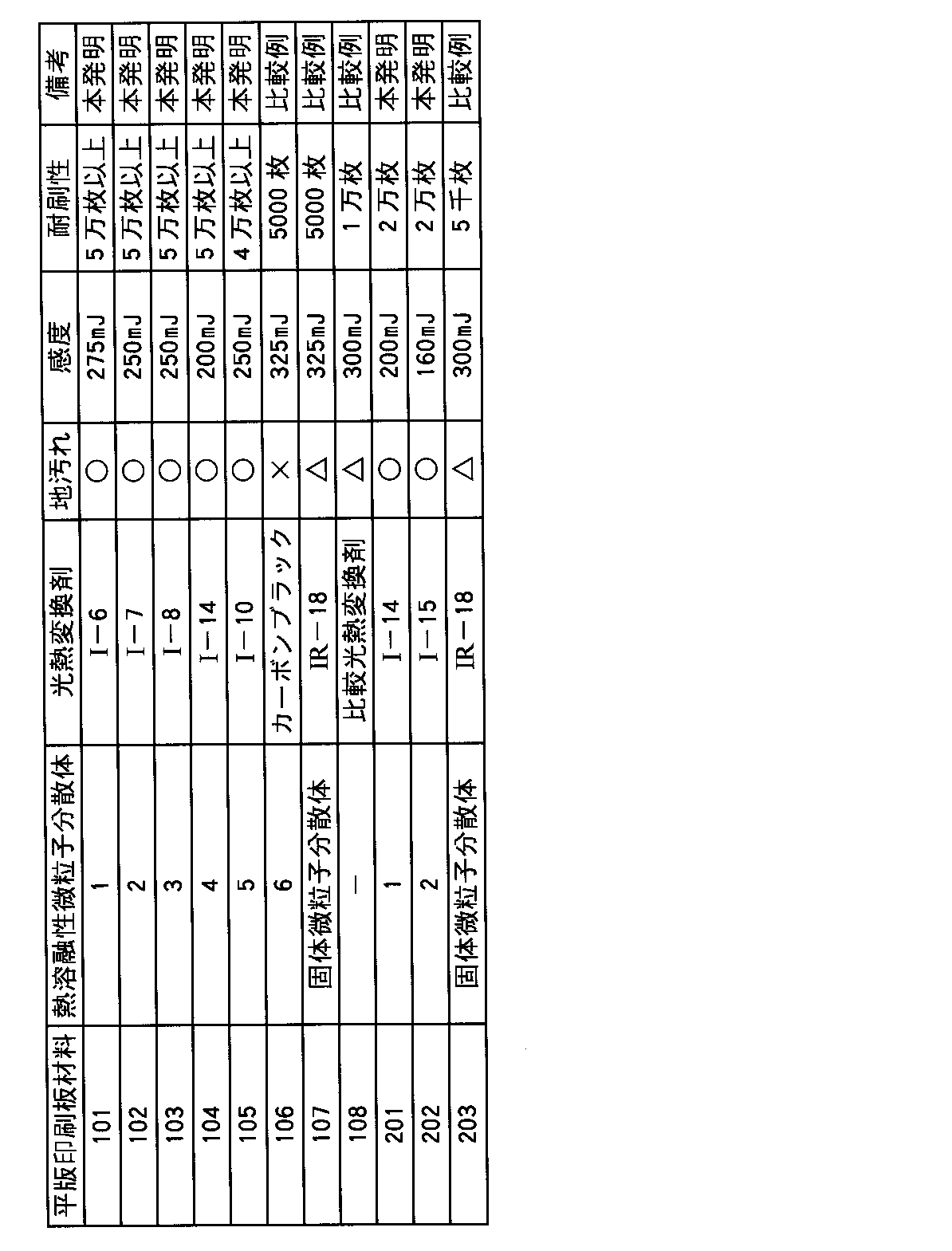
以上により得られた結果を表2に示す。
《感度評価》
感度評価は前記のレーザビームで、200〜400mJまで25mJピッチで50%の平網とベタの露光を行い、耐刷終点でベタがかすれる直前の露光エネルギーを感度として評価した。
【0107】
【表2】
【0108】
表2より、本発明のインドレニン系化合物を含む熱溶融性微粒子を含んでなる平版印刷版材料は、比較に対して地汚れ、感度、耐刷性において優れていることは明らかである。
【0109】
【発明の効果】
本発明によって、地汚れ、感度、耐刷性に優れた平版印刷版材料及びその印刷方法を提供することができた。
【図面の簡単な説明】
【図1】アルミニウム支持体の拡大断面図である。
【図2】図1の一部を更に拡大した拡大断面図である。
【符号の説明】
1 小ピット
2 大きなうねり
d1 小ピット1の平均開孔径
h 小ピット1の平均深さ
d2 大きなうねり2の平均開孔径[0001]
TECHNICAL FIELD OF THE INVENTION
The present invention relates to a lithographic printing plate material and a printing method thereof.
[0002]
[Prior art]
With the digitization of print data, CTPs that are inexpensive, easy to handle, and have the same printability as PS plates are required. In particular, in recent years, expectations for a so-called processless printing plate which does not require a developer treatment with a special chemical have been increasing.
[0003]
Infrared laser recording is one of the most prominent image forming methods for processless printing plates. Broadly speaking, there are three types of recording: an ablation type, a thermal fusion image layer on-machine development type, and a thermal fusion transfer type. A method exists.
[0004]
Examples of the ablation type include JP-A-8-507727, JP-A-6-186750, JP-A-6-199064, JP-A-7-314934, JP-A-10-58636, and JP-A-10-244773. It is described. These are, for example, those having a hydrophilic layer and a lipophilic layer on a support, and laminating any of them as a surface layer. If the surface layer is a hydrophilic layer, an image portion can be formed by exposing the lipophilic layer by exposing the hydrophilic layer to an image and exposing the lipophilic layer by ablating the hydrophilic layer. However, contamination of the inside of the exposure apparatus by the scattered matter of the ablated surface layer becomes a problem. Therefore, a water-soluble protective layer is further provided on the hydrophilic layer to prevent the ablated surface layer from scattering, and the protective layer is formed on the printing machine. In addition, a method of removing the ablated surface layer has been proposed.
[0005]
As a heat-fused image layer on-press development type, a thermoplastic fine particle and a water-soluble binder are added to an image forming layer on a hydrophilic layer or aluminum grain as disclosed in Japanese Patent No. 2938397. Used ones. However, when aluminum grain is used as the hydrophilic support, it is necessary to add a light-to-heat conversion material (generally also colored with visible light) to the image forming layer, and the printed material is developed when developed. There is a risk of polluting the machine. Japanese Patent Application Laid-Open No. 11-265062 discloses an on-press development type printing plate in which an anionic IR-cyanine dye is added to an image forming layer, but a small amount of anion remaining on the grain surface even after development. It has the disadvantage that the background is easily stained by the influence of the sex IR-cyanine dye.
[0006]
On the other hand, a solid dispersion method of a cyanine dye is disclosed (see, for example, Patent Document 1). In Japanese Patent Application Laid-Open No. 2001-30645, a layer made of a hydrophilic medium provided on a support is provided with a hydrophobic precursor. A lithographic printing plate material containing a dispersion of composite particles of a photothermal conversion agent and a photothermal conversion agent is disclosed, but since the hydrophobicization precursor uses an organic polymer, the hydrophobicization precursor containing the photothermal conversion agent is disclosed. When preparing a dispersion of the above, there is a problem that sensitivity is not obtained unless a large amount of a photothermal conversion agent is added.
[0007]
[Patent Document 1]
JP-A-8-245902
[0008]
[Problems to be solved by the invention]
SUMMARY OF THE INVENTION An object of the present invention is to provide a lithographic printing plate material which is free from background contamination even when imprinted, and which can be developed on-press with high sensitivity and good printing durability, and a printing method thereof.
[0009]
[Means for Solving the Problems]
The above object of the present invention has been achieved by the following constitutions.
[0010]
1) In a lithographic printing plate material containing heat-fusible fine particles having a hydrophilic surface on a support, the heat-fusible fine particles contain a light-to-heat conversion agent in advance, and the light-to-heat conversion agent is represented by the general formula (I) A lithographic printing plate material comprising an indolenine compound represented by the formula:
[0011]
2) In the above 1), wherein L which is a trivalent linking group in the general formula (I) is an indolenine compound represented by the above (L-1) or (L-2). The lithographic printing plate material as described.
[0012]
3) The lithographic printing plate material as described in 1) or 2) above, wherein the melting point of the heat-fusible fine particles is 60 to 150 ° C.
[0013]
4) After forming an image on the lithographic printing plate material according to any one of 1) to 3) using a thermal head or a thermal laser, removing a non-image portion of the image forming layer on a printing press. A printing method characterized by the above-mentioned.
[0014]
The heat-meltable fine particles used in the present invention are fine particles formed of a material which is particularly low in viscosity when melted and is generally classified as a wax, among thermoplastic materials. As physical properties, it is preferable that the softening point is 40 ° C. or more and 120 ° C. or less, and the melting point is 60 ° C. or more and 150 ° C. or less, and the softening point is 40 ° C. or more and 100 ° C. or less, and the melting point is 60 ° C. or more and 120 ° C. or less. More preferred. If the melting point is lower than 60 ° C., the storage stability is a problem, and if the melting point is higher than 300 ° C., the ink deposition sensitivity decreases.
[0015]
Examples of usable materials include paraffin, polyolefin, polyethylene wax, microcrystalline wax, and fatty acid wax. These have a molecular weight of about 800 to 10,000. These waxes can be oxidized to facilitate emulsification, and polar groups such as a hydroxyl group, an ester group, a carboxyl group, an aldehyde group, and a peroxide group can be introduced. Furthermore, in order to lower the softening point or to improve workability, these waxes include, for example, stearoamide, linolenamide, laurylamide, myristeramide, hardened bovine fatty acid amide, palmitoamide, oleic acid amide, rice sugar fatty acid amide, It is also possible to add coconut fatty acid amide or a methylolated product of these fatty acid amides, methylene bissteraloamide, ethylene bissteraloamide and the like. Further, a cumarone-indene resin, a rosin-modified phenol resin, a terpene-modified phenol resin, a xylene resin, a ketone resin, an acrylic resin, an ionomer, and a copolymer of these resins can also be used.
[0016]
Among these, it is preferable to contain any of polyethylene, microcrystalline, fatty acid ester, and fatty acid. These materials have relatively low melting points and low melt viscosities, so that high-sensitivity image formation can be performed. In addition, since these materials have lubricity, damage when a shear force is applied to the surface of the printing plate material is reduced, and resistance to printing stains due to scratches and the like is improved.
[0017]
Further, the heat-meltable fine particles are preferably dispersible in water, and the average particle diameter is preferably from 0.01 to 10 μm, more preferably from 0.1 to 3 μm. When the average particle size is smaller than 0.01 μm, when the coating liquid of the layer containing the heat-fusible fine particles is applied on a porous hydrophilic layer described later, It easily penetrates into the inside or into gaps of fine irregularities on the surface of the hydrophilic layer, resulting in insufficient on-press development, which may cause background contamination. When the average particle diameter of the heat-meltable fine particles is larger than 10 μm, the resolution is reduced.
[0018]
As a method for producing the heat-fusible fine particles, a polymer produced by a known polymerization method such as an emulsion polymerization method, a suspension polymerization method, a solution polymerization method, or a gas phase polymerization method can be used.
[0019]
As a method of micronizing a polymer produced by a polymerization method such as a solution polymerization method or a gas phase polymerization method, a solution prepared by dissolving the polymer in an organic solvent is sprayed into an inert gas, and dried. Examples include a method of forming fine particles, a method of dissolving a polymer in a water-immiscible organic solvent, dispersing the obtained solution in water or an aqueous medium, and removing the organic solvent to form fine particles.
[0020]
Further, the composition of the heat-fusible fine particles may be changed continuously between the inside and the surface layer, or may be covered with a different material. As a coating method, a known microcapsule forming method, a sol-gel method, or the like can be used.
[0021]
The content of the heat-fusible fine particles in the constituent layer is preferably from 1 to 90% by mass, more preferably from 5 to 80% by mass of the whole layer. In addition, in any method, the heat-fusible fine particles may be used as a dispersant or a stabilizer during polymerization or micronization, if necessary, for example, a surfactant such as sodium lauryl sulfate, sodium dodecylbenzenesulfonate, or polyethylene glycol. Alternatively, a water-soluble resin such as polyvinyl alcohol or the like may be used. Further, triethylamine, triethanolamine and the like may be contained.
[0022]
In the present invention, the photothermal conversion agent of the indolenine compound represented by the general formula (I) is previously contained in the heat-meltable fine particles, and a coating liquid for the image layer is prepared using the heat-meltable fine particle dispersion.
[0023]
The photothermal conversion agent that can be contained in the heat-fusible fine particles of the present invention is characterized by having a high photothermal conversion ability, and specifically includes a lipophilic indolenine represented by the general formula (I). It is a system compound.
[0024]
In the above formula, the ring completed by Z includes a benzene ring, a naphthalene ring, a pyridine ring, a quinoline ring, a pyrazine ring, a quinosaline ring and the like. Further, on Z, another substituent R3May be combined. Examples of such a substituent include, for example, an alkyl group, an aryl group, a heterocyclic residue, a halogen atom, an aryloxy group, an alkylthio group, an arylthio group, an alkylcarbonyl group, an arylcarbonyl group, an alkylcarbonyloxy group, and an arylcarbonylcarbonyloxy group. Group, alkylamide group, arylamide group, alkylcarbamoyl group, arylcarbamoyl group, alkylamino group, arylamino group, carboxylic acid group, alkylsulfonyl group, arylsulfonyl group, alkylsulfonamide group, arylsulfonamide group, alkylsulfur Examples include various substituents such as a famoyl group, an arylsulfamoyl group, a cyano group, and a nitro group. The number (p) of the substituents bonded on Z is usually 0, or preferably 1 to 4. When (p) is 2 or more, a plurality of R3May be the same or different.
[0025]
R3Among these substituents, a non-polar group is preferable, and a halogen atom (eg, F, Cl, etc.), a cyano group, a substituted or unsubstituted alkyl group having 1 to 20 carbon atoms (eg, a methyl group, an ethyl group, an isopropyl group) , T-pentyl group, octadecyl group, cyclohexyl group, etc.), unsubstituted phenyl group having 6 to 20 carbon atoms (for example, phenyl group, 4-methylphenyl group, 4-trifluoromethylphenyl group, 3,5- And a dichlorophenyl group.
[0026]
R1And R2Represents an alkyl group, an alkenyl group, or an aryl group having 1 to 20 carbon atoms, which may be the same or different. R1And R2May further have a substituent, and among these substituents, a substituent whose hydrophobicity parameter proposed by C. Hansch et al. Is in the range of -1.0 to 15 Is preferred. The hydrophobic parameter π can be calculated according to the following literature. See Hansch, Journal of Medical Chemistry (C. Hansch, J. Med. Chem), Vol. 16, 1207 (1973), Vol. 20, p. 304 (1977).
[0027]
R1, R2Is preferably a substituted or unsubstituted lower alkyl group having 1 to 8 carbon atoms, a substituted or unsubstituted phenyl group, or a substituted or unsubstituted alkenyl group, and the hydrophobic parameter π of these substituents is -1. It is preferably in the range of 0.0 to 15. Also, R1, R2Are a halogen atom (F, Cl, Br and I, etc.), a substituted or unsubstituted phenyl group (eg, phenyl group, m-chlorophenyl group, p-methylphenyl group, etc.), an alkylthio group (eg, , A methylthio group, a butylthio group, etc.), a substituted or unsubstituted phenylthio group (eg, phenylthio group, p-chlorophenylthio group, m-methylphenylthio group, etc.), an alkoxy group (eg, ethoxy group, butoxy group, etc.) Is preferred. Among these, R1And R2Is particularly preferably an alkyl group having 2 to 8 carbon atoms and an unsubstituted alkenyl group having 2 to 8 carbon atoms.
[0028]
L represents a trivalent linking group, and a conjugated system formed by connecting a trivalent substituent or an unsubstituted methine group, or 3, 5, or 7 substituted or unsubstituted methine groups by a conjugated double bond. Is preferable, but groups represented by the following formulas (L-1) to (L-9) are preferable.
[0029]
Embedded image
[0030]
Y in (L-1) to (L-9) represents a hydrogen atom or a monovalent group. Examples of such a monovalent group include a lower alkyl group such as a methyl group, an aralkyl group such as a substituted or unsubstituted phenyl group and a benzyl group, a lower alkoxy group such as a methoxy group, a dimethylamino group, a diphenylamino group, a methyl group. Substituted amino groups such as phenylamino group, morpholino group, imidazolidino group and ethoxycarbonylpiperazino group, alkylcarboxy groups such as acetoxy group, alkylthio groups such as methylthio group, cyano group, nitro group, and halogen atom ( F, Cl, Br, etc.) are preferred. Among the linking groups represented by L in the general formula (I), the groups represented by (L-1) and (L-2) are most preferred.
[0031]
X in the general formula (I)−Supplies a necessary number of anions to neutralize the charge of the cation moiety, and represents a monovalent or divalent anion. X above−As Cl−, Br−, I−Halogen ions such as SO2-, HSO−, CH3OSO3 −Alkyl sulfate ion, p-toluenesulfonic acid ion, naphthalene-1,5-disulfonic acid ion, methanesulfonic acid ion, trifluoromethanesulfonic acid ion, octanesulfonic acid ion, p-chlorobenzoic acid ion, trifluoroacetate ion , Carboxylate ion such as oxalate ion, succinate ion, PF6 −, BF4 −, ClO4 −, IO4 −, Tungstate ions, tungstophosphate ions and other heteropolyacid ions, H2PO4 −, NO3 −And phenolates such as picrate ion. Among these, Cl−, Br−, I−Such as halogen ions, CH3OSO3 −, C2H5OSO3 −Perfluorosulfonic acid ions, such as chlorobenzenesulfonic acid ion, p-toluenesulfonic acid ion, trifluoromethanesulfonic acid ion, etc., naphthalene-1,5-disulfonic acid ion, trifluoromethanesulfonic acid ion, etc., PF6 −, BF4 −, ClO4 −And the like are more preferable.
[0032]
Specific examples of the indolenine compound represented by the general formula (I) include the following compounds, but the present invention is not limited thereto.
[0033]
Embedded image
[0034]
Embedded image
[0035]
Embedded image
[0036]
The indolenine compound represented by the general formula (I) is dissolved in a material capable of forming the heat-meltable fine particles and added, or dissolved in a known solvent having good compatibility with the heat-meltable material. The amount of addition is 0.5 to 20 parts by mass, preferably 3 to 15 parts by mass, based on the material capable of forming the heat-fusible fine particles.
[0037]
In the present invention, the indolenine compound represented by the general formula (I) is contained as a main component of the light-to-heat conversion substance, and further contains a conventionally known light-to-heat conversion substance as long as the effect of the present invention is not impaired. May be. Conventionally known photothermal conversion substances are generally pigments (eg, pigments) that can absorb laser light. Examples of such pigments (eg, pigments) include black pigments such as carbon black, and phthalocyanine. Pigments of macrocyclic compounds having absorption in the visible to near-infrared region such as naphthalocyanine, organic dyes used in high-density laser recording materials such as optical disks (cyanine dyes other than indolenine compounds according to the present invention, Organic metal compound dyes such as anthraquinone dyes, azulene dyes, phthalocyanine dyes) and thiol nickel complexes.
[0038]
In the present invention, it is preferable to add a water-soluble resin to the image forming layer in order to realize sufficient on-press developability. The water-soluble resin is selected from hydrophilic natural polymers and synthetic polymers. Specific examples of the water-soluble resin preferably used in the present invention include, as natural polymers, gum arabic, water-soluble soybean polysaccharide, cellulose derivatives (for example, carboxymethylcellulose, carboxyethylcellulose, methylcellulose, etc.), and denaturation thereof. For synthetic polymers such as solid, white dextrin, pullulan, enzymatically decomposed etherified dextrin, polyvinyl alcohol (preferably having a degree of saponification of 70 mol% or more), polyacrylic acid, an alkali metal salt or an amine salt thereof, and polyacrylic acid. Polymer, its alkali metal salt or amine salt, polymethacrylic acid, its alkali metal salt or amine salt, vinyl alcohol / acrylic acid copolymer and its alkali metal salt or amine salt, polyacrylamide, its copolymer, polyhydroxy Ethyl acrylate, polyvinyl Rupyrrolidone, its copolymer, polyvinyl methyl ether, vinyl methyl ether / maleic anhydride copolymer, poly-2-acrylamido-2-methyl-1-propanesulfonic acid, its alkali metal salt or amine salt, poly-2 -Acrylamide-2-methyl-1-propanesulfonic acid copolymer, an alkali metal salt or an amine salt thereof. Also, depending on the purpose, two or more of these can be used in combination. However, the invention is not limited to these examples.
[0039]
In the present invention, in order to prevent damage during printing and improve image strength, it is preferable that the image forming functional layer contains a crosslinking agent capable of thermally crosslinking the water-soluble resin.
[0040]
Examples of the crosslinking agent capable of thermally crosslinking the water-soluble resin include polyfunctional compounds having crosslinking properties, such as epoxy compounds, polyamine compounds, isocyanate compounds, silane compounds, titanate compounds, aldehyde compounds, polyvalent metal salt compounds, and hydrazine. And the like.
[0041]
Specific examples of epoxy compounds include glycerin polyglycidyl ether, polyethylene glycol diglycidyl ether, polypropylene glycol diglycidyl ether, diethylene glycol diglycidyl ether, trimethylolpropane polyglycidyl ether, trimethylolpropane polyglycidyl ether, sorbitol polyglycidyl ether, and bisphenol. Or a polycondensation product of a hydrogenated product thereof and epihalohydrin. Of the above, the water-soluble epoxy compound can also be used as a water-soluble resin. As the crosslinking agent in this case, the compounds described on pages 352 to 376 of the crosslinking agent handbook (Taiseisha, October 20, 1981, first edition, first edition) can be preferably used.
[0042]
Specific examples of the polyamine compound include ethylenediamine, diethylenetriamine, triethylenetetramine, tetraethylenepentamine, hexamethylenediamine, propylenediamine, polyethyleneimine, and polyamidoamine.
[0043]
Specific examples of the isocyanate compound include tolylene diisocyanate, diphenyl methane isocyanate, liquid diphenyl methane diisocyanate, polymethylene polyphenyl isocyanate, xylylene diisocyanate, naphthalene-1,5-diisocyanate, cyclohexanephenylene diisocyanate, isopropylbenzene-2,4-diisocyanate and the like. And aliphatic alicyclic diisocyanates such as cyclohexyl diisocyanate and isophorone diisocyanate, and addition products of polypropylene glycol / tolylene diisocyanate.
[0044]
Examples of the silane compound include methyltrimethoxysilane, methyltriethoxysilane, ethyltriethoxysilane, phenyltriethoxysilane, vinyltriethoxysilane, γ-aminopropyltriethoxysilane, N- (β-aminoethyl) -γ-amino Propyltrimethoxysilane, γ-glycidoxypropyltrimethoxysilane, γ-methacryloxypropyltrimethoxysilane, γ-mercaptopropyltrimethoxysilane, β- (3,4-epoxycyclohexyl) ethyltrimethoxysilane, dimethyldimethoxysilane Dimethyldiethoxysilane, diphenyldiethoxysilane, 3-chloropropylmethyldimethoxysilane, vinyltris (methylethylketoxime) silane, methyltris (methylethylketoxime) silane, Sulfonyl triacetoxysilane, and the like.
[0045]
Examples of the titanate compound include tetraethyl orthosilicate, bis (dioctyl pyrophosphate) ethylene titanate, isopropyl triactanoyl titanate, isopropyl dimethacryl isostearoyl titanate, isopropyl isostearoyl diacryl titanate, isopropyl (dioctyl phosphate) titanate, and isopropyl tricumyl phenyl titanate. Isopropyl tri (N-aminoethylaminoethyl) titanate, dicumylphenyloxyacetate titanate, diisostearoyl ethylene titanate, isopropyl triinstearoyl titanate, isopropyl tridodecylbenzenesulfonyl titanate, isopropyl tris (dioctyl phosphate) titanate, tetraisopropyl bis ( (Octyl phosphite) titanate, tetraoctyl bis (ditridisyl phosphite) titanate, tetra (2,2-diallyloxymethyl-1-butyl) bis (ditridecyl phosphite) titanate, bis (dioctyl pyrophosphate) oxyacetate titanate And bis (dioctylpyrophosphate) oxyacetate titanate.
[0046]
Examples of the aldehyde compound include formaldehyde, acetaldehyde, propylaldehyde, butyraldehyde, glyoxal, glutaraldehyde, terephthalaldehyde, and the like.
[0047]
Examples of the polyvalent metal salt compound include water-soluble salts of metals such as zinc, calcium, magnesium, barium, strontium, cobalt, manganese, and nickel.
[0048]
Among the above-mentioned crosslinking agents, epoxy compounds, isocyanate compounds, silane compounds, aldehyde compounds and polyvalent metal salt compounds are particularly preferably used. These crosslinking agents can be used alone or in combination of two or more. Among these crosslinking agents, a particularly preferred crosslinking agent is a water-soluble crosslinking agent, but a water-insoluble one can be used by dispersing it in water with a dispersant. Particularly preferred combinations of a water-soluble resin and a crosslinking agent include carboxylic acid-containing water-soluble resin / polyvalent metal compound, carboxylic acid-containing water-soluble resin / epoxy compound, hydroxyl-containing resin / dialdehydes, and hydroxyl-containing resin / isocyanate compound. No. A suitable addition amount of the crosslinking agent is 1 to 20% by mass of the water-soluble resin.
[0049]
In order to form a hydrophilic layer having a porous structure, the following materials for forming a hydrophilic matrix are preferably used.
[0050]
The hydrophilic layer in the present invention is defined as a layer having low affinity for ink and high affinity for water when the printing plate material of the present invention is used as a printing plate. A layer having such physical properties is preferably a layer in which fine particles are formed to be porous. The porous layer has a layer structure having a large number of voids inside and on the surface of the layer. From the viewpoint of hydrophilicity, it is particularly preferable that the void is a so-called through hole that communicates with the inside of the porous layer.
[0051]
The porous hydrophilic layer can be obtained by coating colloidal silica, a water-dispersible polymer, or a mixture of both in a specific range on a support and drying. As the water-dispersible polymer, an aqueous dispersion of various polymers can be used. Specific examples include an acrylic polymer, an ester polymer, a urethane polymer, an olefin polymer, a vinylidene chloride polymer, an epoxy polymer, and an amide polymer. Dispersions such as polymers and their modified products and copolymers can be used.
[0052]
In the present invention, colloidal silica is particularly preferably used from the viewpoint of film forming strength and hydrophilicity. Colloidal silica has the advantage of high film-forming properties even under relatively low-temperature drying conditions, and can provide good strength. As the colloidal silica, for example, a spherical colloidal silica having a long chain structure in which beads are connected in a bead shape, and a porous film having a waviness structure on the surface when a linked silica having a branched structure can be used. it can. The above-mentioned colloidal silica is one in which temporary particles of spherical silica are bonded to each other by interposing metal ions having a valence of 2 or more, and at least 3 or more, preferably 5 or more, and more preferably 7 or more are connected. And further includes those in which beads connected in a bead shape are branched. Further, the particles may be composite or mixed particles of colloidal silica and other inorganic particles, for example, alumina, ceria, titania, or the like, or may be connected with these particles interposed. The metal ion to be interposed is preferably a divalent or higher valent metal ion.2+, Zn2+, Mg2+, Ba2+, Al3+, Ti4+And so on. In particular, Ca2+When it is set as above, it is suitable for producing colloidal silica linked and branched in a bead shape. The temporary particles of colloidal silica preferably have a pore size of 0.005 μm or more and 1 μm or less, more preferably 0.005 μm or more and 0.1 μm or less, and more preferably 0.005 μm or more and 0.05 μm or less. It is preferable in terms of formability. By adding colloidal silica linked and / or branched in a bead shape, it is possible to maintain the strength while maintaining the porosity of the layer, and it can be preferably used as a porous material for the hydrophilic layer matrix. Among these, the use of alkaline “Snowtex PS-S”, “Snowtex PS-M”, and “Snowtex PS-L” improves the strength of the hydrophilic layer and increases the number of printed sheets. However, the occurrence of background dirt is suppressed, which is particularly preferable. Known additives in the hydrophilic layer of the present invention within a range that does not impair the effects of the present invention, for example, inorganic or organic fine particles, plasticizers, lubricants, surfactants, antistatic agents, crosslinking agents, crosslinking catalysts, A heat-resistant material, a weathering agent, and the like may be added. Representative materials that can be added hydrophilically are shown below.
[0053]
The porous silica particles are generally produced by a wet method or a dry method. In the wet method, a gel obtained by neutralizing an aqueous silicate solution can be dried and pulverized, or can be obtained by pulverizing a precipitate deposited by neutralization. In the dry method, it is obtained by burning silicon tetrachloride together with hydrogen and oxygen to precipitate silica. The porosity and particle size of these particles can be controlled by adjusting the production conditions. As the porous silica particles, those obtained from a gel obtained by a wet method are particularly preferable.
[0054]
The porous aluminosilicate particles are produced, for example, by the method described in JP-A-10-71764. That is, it is an amorphous composite particle synthesized by a hydrolysis method using aluminum alkoxide and silicon alkoxide as main components. The particles can be synthesized in a ratio of alumina to silica of 1: 4 to 4: 1. Further, those produced as composite particles of three or more components by adding an alkoxide of another metal during the production can also be used in the present invention. The porosity and particle size of these composite particles can also be controlled by adjusting the production conditions.
[0055]
The porosity of the particles is preferably 0.5 ml / g or more in pore volume, more preferably 0.8 ml / g or more, and further preferably 1.0 to 2.5 ml / g. preferable.
[0056]
Zeolite is a crystalline aluminosilicate, and is a porous body having pores of a regular three-dimensional network structure having a pore diameter of 0.3 to 1 nm. The general formula combining natural and synthetic zeolites is as follows:
[0057]
(M1, (M2) 0.5)m(AlmSinO2)(M + n)・ XH2O
Here, M1 and M2 are exchangeable cations, and M1 is Li+, Na+, K+, Tl+, Me4N+(TMA), Et4N+(TEA), Pr4N+(TPA), C7HFifteenN2+, C8H16N+And M2 is Ca2+, Mg2+, Ba2+, Sr2+, C8H18N2 2+And so on. Further, n ≧ m, and the value of m / n, that is, the Al / Si ratio is 1 or less. The higher the Al / Si ratio, the greater the amount of exchangeable cations included, and thus the higher the polarity and, therefore, the higher the hydrophilicity. The preferred Al / Si ratio is 0.4 to 1.0, more preferably 0.8 to 1.0. x represents an integer.
[0058]
As the zeolite particles used in the present invention, a synthetic zeolite having a stable Al / Si ratio and a relatively sharp particle size distribution is preferable. For example, zeolite A: Na12(Al12Si12O48) ・ 27H2O: Al / Si ratio 1.0, zeolite X: Na86(Al86Si106O384) ・ 264H2O: Al / Si ratio 0.811, zeolite Y: Na56(Al56Si136O384) ・ 250H2O; an Al / Si ratio of 0.412; By containing highly hydrophilic porous particles having an Al / Si ratio of 0.4 to 1.0, the hydrophilicity of the hydrophilic layer itself is also greatly improved, and it is difficult to stain during printing, and the water flow latitude is widened. In addition, stains on fingerprint traces are greatly reduced. When the Al / Si ratio is less than 0.4, the hydrophilicity is insufficient, and the effect of improving the performance is reduced. In addition, the hydrophilic layer matrix structure constituting the hydrophilic layer can contain layered clay mineral particles. Examples of the layered mineral particles include clay minerals such as kaolinite, halloysite, talc, smectite (montmorillonite, beidellite, hectorite, savonite, etc.), vermiculite, mica (mica), chlorite, hydrotalcite, and layered polysilicic acid. Salts (kanemite, macatite, aialite, magadiite, kenyaite, etc.) and the like. In particular, it is considered that the higher the charge density of the unit layer (unit layer), the higher the polarity and the higher the hydrophilicity. The preferred charge density is 0.25 or more, more preferably 0.6 or more. Examples of the layered mineral having such a charge density include smectite (charge density of 0.25 to 0.6; negative charge), vermiculite (charge density of 0.6 to 0.9; negative charge), and the like. In particular, synthetic fluorine mica is preferable because it can be obtained in a stable quality such as a particle size. Further, among synthetic fluorine mica, those which are swellable are preferable, and those which are free swell are more preferable. Further, the above layered mineral intercalation compounds (eg, pillared crystals), those subjected to ion exchange treatment, and those subjected to surface treatment (silane coupling treatment, complexing treatment with organic binder, etc.) are also used. can do. As for the size of the tabular layered mineral particles, the average particle size (the maximum length of the particles) is less than 1 μm when contained in the layer (including the case of passing through the swelling step and the dispersion peeling step). The aspect ratio is preferably 50 or more. When the particle size is in the above range, continuity and flexibility in the planar direction, which are characteristics of the thin layered particles, are imparted to the coating film, and a crack is unlikely to be formed, and a tough coating film in a dry state can be obtained. Further, in a coating liquid containing a large amount of particles, sedimentation of the particles can be suppressed by the thickening effect of the layered clay mineral. If the particle size is larger than the above range, the coating film may be uneven and the strength may be locally reduced. When the aspect ratio is less than the above range, the number of tabular grains with respect to the added amount is small, the viscosity is insufficient, and the effect of suppressing the sedimentation of the grains is reduced.
[0059]
The content of the layered mineral particles is preferably 0.1 to 30% by mass of the entire layer, and more preferably 0.1 to 10% by mass. In particular, swellable synthetic fluorine mica and smectite are preferable because the effect can be seen even in a small amount. The layered mineral particles may be added as a powder to the coating solution. However, in order to obtain a good degree of dispersion by a simple liquid preparation method (which does not require a dispersing step such as media dispersion), the layered mineral particles are used alone. After preparing a gel swollen in water with the above, it is preferable to add the gel to a coating solution.
[0060]
A silicate aqueous solution can also be used as another additive material in the hydrophilic layer matrix constituting the hydrophilic layer. Alkali metal silicates such as Na silicate, K silicate and Li silicate are preferred,2/ M2It is preferable to select the O ratio so that the pH of the entire coating solution when the silicate is added does not exceed 13, in order to prevent the dissolution of the inorganic particles. Further, an inorganic polymer or an organic-inorganic hybrid polymer using a metal alkoxide by a so-called sol-gel method can also be used. The formation of the inorganic polymer or the organic-inorganic hybrid polymer by the sol-gel method is described, for example, in "Application of the sol-gel method" (written by Mio Sakuhana / published by Agne Shofusha Co., Ltd.) or described in this document. Known methods described in the cited documents can be used.
[0061]
Further, in the present invention, a water-soluble resin may be contained. Examples of the water-soluble resin include polysaccharides, polyethylene oxide, polypropylene oxide, polyvinyl alcohol, polyethylene glycol (PEG), polyvinyl ether, styrene-butadiene copolymer, and conjugated diene-based polymer latex of methyl methacrylate-butadiene copolymer. And a resin such as an acrylic polymer latex, a vinyl polymer latex, polyacrylamide, and polyvinylpyrrolidone. As the water-soluble resin used in the present invention, it is preferable to use a polysaccharide.
[0062]
As the polysaccharide, starches, celluloses, polyuronic acid, pullulan and the like can be used, and particularly, cellulose derivatives such as methylcellulose salts, carboxymethylcellulose salts, and hydroxyethylcellulose salts are preferable, and sodium salts and ammonium salts of carboxymethylcellulose are preferable. More preferred. This is because the effect of forming the surface shape of the hydrophilic layer in a favorable state can be obtained by including the polysaccharide in the hydrophilic layer.
[0063]
As the inorganic particles that can be used in the present invention, for example, known metal oxide particles such as silica, alumina, titania, and zirconia can be used, but in order to suppress sedimentation in the coating solution, a porous material is used. It is preferable to use fine metal oxide particles. As the porous metal oxide particles, the aforementioned porous silica particles and porous aluminosilicate particles can be preferably used. Examples of the particles coated with an inorganic material include particles in which organic particles such as polymethyl methacrylate and polystyrene are used as a core material and coated with inorganic particles having a smaller particle size than the core material particles. The particle size of the inorganic particles is preferably about 1/10 to 1/100 of the core material particles. As the inorganic particles, similarly, known metal oxide particles such as silica, alumina, titania, and zirconia can be used. As the coating method, various known methods can be used.However, the core material particles and the coating material particles collide with each other at high speed in the air such as a hybridizer to dig the coating material particles into the surface of the core material particles. A dry coating method of fixing and coating can be preferably used. Further, particles obtained by plating a core material of organic particles with metal can also be used. Examples of such particles include “Micropearl AU” manufactured by Sekisui Chemical Co., Ltd., in which resin particles are plated with gold. The particle size is preferably from 1 to 10 μm, more preferably from 1.5 to 8 μm, and particularly preferably from 2 to 6 μm. In the present invention, the amount of particles having a particle size of 1 μm or more is preferably 0.1 to 50% by mass, more preferably 0.5 to 30% by mass of the entire hydrophilic layer. For the entire hydrophilic layer, a low content ratio of a carbon-containing material such as an organic resin or carbon black is preferable for improving hydrophilicity, and the total of these materials is preferably less than 9% by mass. And more preferably less than 5% by mass.
[0064]
The hydrophilic layer of the present invention can be formed by a known coating method. For example, any method such as a gravure coat, a bar coat, a reverse coat, a kiss coat, a die coat, and a dip coat can be used. The coating weight is usually 0.001 g / m21g / m2Or less, preferably 0.005 g / m20.5g / m2Or less, more preferably 0.01 g / m20.3g / m2It is as follows.
[0065]
As the support (also referred to as a substrate or a substrate), a known material used as a substrate for a printing plate can be used. For example, a metal plate, a plastic film, paper treated with a polyolefin or the like, a composite base material to which the above-mentioned materials are appropriately bonded, and the like can be given. The thickness of the substrate is not particularly limited as long as it can be attached to a printing machine, but a thickness of 50 to 500 μm is generally easy to handle.
[0066]
In the present invention, a metal plate is preferable, and iron, stainless steel, aluminum and the like can be mentioned. Aluminum is particularly preferable from the relationship between specific gravity and rigidity. The aluminum support is obtained from an aluminum support material using pure aluminum or an aluminum support material using an aluminum alloy. As the aluminum support material using the aluminum alloy, for example, an alloy of aluminum and a metal such as silicon, copper, manganese, magnesium, chromium, zinc, lead, bismuth, nickel, titanium, sodium, and iron is used. The surface of the aluminum support has a rough surface of a double structure in which small pits are superimposed on large undulations. 1 and 2 are enlarged cross-sectional views showing an example of the aluminum support, and FIG. 2 is a partially enlarged view of FIG. 1 represents a small pit, 2 represents a large swell, d1(Μm) is the average opening diameter of the small pit 1, h (μm) is the average depth, d2(Μm) represents the average pore diameter of the large undulation 2. Average opening diameter d of small pits in the figure1(Μm) is 0.1 to 3 μm, the average depth h (μm) of the small pits and the average opening diameter d1It is an essential requirement that the ratio of (μm) be 0.4 or less.
[0067]
By forming the surface of the aluminum support into a rough surface having the above structure, a photosensitive layer is provided on the aluminum support to form a positive PS plate, and when exposed and developed, a residual film and fingerprint stains are formed. And a high quality printed image is obtained, and the above effects are not exhibited when the surface of the aluminum support does not have the rough surface shape of the above configuration.
[0068]
The average pore diameter d of the large undulation on the surface of the aluminum support2(Μm) is preferably more than 3 μm and not more than 20 μm. When the average pore diameter of the large undulation is out of the above range, the residual film and the fingerprint stain are liable to occur.
[0069]
The aluminum support material for obtaining the aluminum support is subjected to a dissolution treatment using an aqueous alkali solution such as caustic soda to remove strong dirt and a natural oxide film, and to remove residual alkali components after the dissolution treatment. In order to neutralize, neutralization treatment is performed by dipping in an acid such as phosphoric acid, nitric acid, sulfuric acid, hydrochloric acid, chromic acid or a mixed acid thereof. If necessary, in order to remove oils and fats, rust, dust, and the like on the surface of the aluminum support material, solvent degreasing using trichlene, a thinner, or the like, or emulsion degreasing using an emulsion such as kerosene or triethanol may be performed.
[0070]
Following the dissolution treatment using the above alkaline aqueous solution and the neutralization treatment with an acid, an electrochemical surface roughening treatment described below is performed. It is particularly preferred to match that of the acid used for the treatment.
[0071]
Prior to the dissolution treatment using the alkaline aqueous solution, a mechanical surface roughening treatment may be performed. The method of mechanical surface roughening treatment is not particularly limited, but brush polishing and honing polishing are preferable. In brush polishing, for example, a cylindrical brush on which bristles having a bristle diameter of 0.2 to 1 mm are planted is rotated and pressed against an aluminum support material surface while supplying a slurry in which an abrasive is dispersed in water to a contact surface. A roughening process is performed. In the honing polishing, a slurry in which an abrasive is dispersed in water is injected under pressure from a nozzle, and the slurry is made to impinge obliquely on the surface of the aluminum support material to perform a roughening treatment. Further, mechanical roughening may be performed by bonding a previously roughened sheet to the surface of the aluminum support material and transferring the roughened surface pattern by applying pressure.
[0072]
In the case where the mechanical surface roughening treatment is performed, the solvent degreasing treatment or the emulsion degreasing treatment can be omitted.
[0073]
After performing the above-mentioned (degreasing treatment if necessary) alkali dissolution treatment and neutralization treatment with an acid, the surface of the aluminum support material is subjected to electrochemical surface roughening treatment using an alternating current in an acidic electrolytic solution. In the present invention, a pause of 0.6 to 5 seconds is provided in the course of the electrochemical graining treatment in the acidic electrolytic solution, and the amount of electricity for one electrochemical graining treatment is 100 C / dm.2The following are mandatory requirements. When the electrochemical graining treatment is performed in a plurality of times as described above, the pause time is less than 0.6 seconds, and the amount of electricity of one electrochemical graining treatment is 100 C / dm.2If the diameter is more than 20 μm, the formation of coarse pits having an opening diameter of more than 20 μm cannot be suppressed.
[0074]
Hydrochloric acid, nitric acid, or the like is used as the electrolytic solution for the electrochemical graining treatment, but hydrochloric acid is more preferable. Nitric acid salts, chlorides, amines, aldehydes, phosphoric acid, chromic acid, boric acid, acetic acid, oxalic acid, and the like can be added to the electrolytic solution as needed. Acetic acid is particularly preferred. The voltage applied in the electrochemical graining treatment is preferably 1 to 50 V, more preferably 5 to 30 V. Current density (peak value) is 10 to 200 A / dm2Is preferably 20 to 150 A / dm.2Is more preferred. Electricity is 100 to 2000 C / dm in total for all processing steps2Is preferred, and 200 to 1000 C / dm.2Is more preferred. The temperature is preferably from 10 to 50 ° C, more preferably from 15 to 45 ° C.
[0075]
The concentration of hydrochloric acid is preferably 0.1 to 5% by mass, and a current waveform used for electrolysis is appropriately selected depending on a desired roughened shape such as a sine wave, a rectangular wave, a trapezoidal wave, and a sawtooth wave. Waves are preferred. The aluminum support material that has been subjected to electrochemical surface roughening is immersed in an aqueous solution of acid or alkali to remove surface smut, etc., or to control the pit shape of the roughened surface. Done. The acid includes, for example, sulfuric acid, persulfuric acid, hydrofluoric acid, phosphoric acid, nitric acid, hydrochloric acid, and the like, and the alkali includes, for example, sodium hydroxide, potassium hydroxide, and the like. Among these, it is preferable to use an aqueous solution of an alkali, and it is preferable to use a 0.05 to 40% aqueous solution of the alkali at a liquid temperature of 20 to 90 ° C. for 5 seconds to 5 minutes. Is etched and then immersed in an acid such as phosphoric acid, nitric acid, sulfuric acid, chromic acid, or a mixed acid thereof to perform a neutralization treatment.
[0076]
The aluminum support material that has been subjected to the neutralization treatment is further subjected to anodizing treatment to obtain the aluminum support of the present invention. Here, it is particularly preferable that the kind of the acid used for the neutralization is matched with that of the acid used for the anodizing treatment.
[0077]
As the electrolytic solution used for the anodizing treatment, any electrolytic solution may be used as long as it forms a porous oxide film.Generally, sulfuric acid, phosphoric acid, oxalic acid, chromic acid, sulfamic acid, benzenesulfonic acid, etc. Is a mixed acid obtained by combining two or more of these. Anodizing treatment conditions vary depending on the electrolytic solution used and cannot be specified unconditionally. However, generally, the concentration of the electrolytic solution is 1 to 80% by mass, the temperature is 5 to 70 ° C, and the current density is 1 to 60A. / Dm2, A voltage of 1 to 100 V and an electrolysis time of 10 seconds to 5 minutes are appropriate. Preferably, the treatment is usually carried out with a direct current in the sulfuric acid method, but an alternating current can also be used. Here, the concentration of sulfuric acid is 10 to 50% by mass, the temperature is 20 to 50 ° C, and the current density is 1 to 20 A / dm.2For 10 seconds to 5 minutes, and the electrolyte preferably contains aluminum ions.
[0078]
The aluminum support obtained by the above anodic oxidation treatment may be subjected to a sealing treatment as required. The sealing treatment can be performed by a known method such as a hot water treatment, a boiling water treatment, a steam treatment, a sodium silicate treatment, a dichromate aqueous solution treatment, a nitrite treatment, and an ammonium acetate treatment.
[0079]
【Example】
Hereinafter, embodiments of the present invention will be described with reference to Examples, but the present invention is not limited thereto.
[0080]
Example 1
《Manufacture of lithographic base》
The substrate was degreased by immersing a 0.25 mm thick aluminum substrate in an aqueous solution containing 5 g / L sodium hydroxide at 50 ° C. and rinsed with demineralized water. The substrate is then heated to 35 ° C. and 1200 A / m in an aqueous solution containing 4 g / L of hydrochloric acid, 4 g / L of hydroboric acid and 0.5 g / L of aluminum ions using alternating current.2Was electrochemically granulated to form a surface topology with an average center line roughness Ra of 0.5 μm.
[0081]
After rinsing with demineralized water, the aluminum substrate was then etched with an aqueous solution containing 300 g / L sulfuric acid at 60 ° C. for 180 seconds and rinsed with demineralized water at 25 ° C. for 30 seconds.
[0082]
The substrate is then placed in an aqueous solution containing 200 g / L sulfuric acid at a temperature of 45 ° C., a voltage of about 10 V and 150 A / m23 g / m 3 anodized for about 300 seconds at a current density of2Al2O3And then washed with demineralized water, post-treated with a solution containing 20 g / L sodium bicarbonate at 40 ° C. for 30 seconds, and then rinsed with 25 ° C. demineralized water for 120 seconds. And dried.
[0083]
The resulting lithographic base was immersed in an aqueous solution containing 5% by weight of citric acid at 70 ° C. for 60 seconds, rinsed with 25 ° C. demineralized water and dried.
[0084]
<Preparation of hot-melt fine particle dispersions 1 to 4>
14 g of carnauba wax having a melting point of 80 ° C. was melted, and 6 g of photothermal conversion agents (I-6, I-7, I-8, I-14) shown in Table 2 were added thereto, and the mixture was heated to 100 ° C. Dissolves the photothermal conversion agent in carnauba wax. The carnauba wax solution was added dropwise over about 2 hours to a PVA aqueous solution to which 164 g of pure water heated to 100 ° C. and 16 g of PVA (PVA117: manufactured by Kuraray Co., Ltd.) were added as a dispersant, followed by stirring and mixing for 3 hours. Hot-melt fine particle dispersions 1 to 4 containing a photothermal conversion agent having a diameter of about 0.2 to 0.3 μm were obtained.
[0085]
<Preparation of hot-melt fine particle dispersion 5>
After melting 320 g of stearic acid amide having a melting point of 125 ° C., 80 g of the photothermal conversion agent (I-10) shown in Table 2, and 18.4 g of lauric acid at 130 ° C., 6.4 g of 25% ammonia water and water After charging 1180 g and heating to 120 ° C., the mixture is stirred with a homomixer (manufactured by Tokushu Kika Kogyo Co., Ltd.) to homogenize. Next, the emulsion treated at 20 MPa was mixed and cooled with a high-pressure homogenizer (manufactured by APV Galliulin) in 500 g of water while keeping the temperature at 50 ° C. or lower, and the particle size of 20% by mass was 0.6 μm. The heat-meltable fine particle dispersion 5 containing the photothermal conversion agent was obtained.
[0086]
<Preparation of heat-fusible fine particle dispersion 6>
18 g of carnauba wax having a melting point of 80 ° C. is melted, 2 g of carbon black having an average particle size of 20 nm is added thereto, and the photothermal conversion agent is dissolved in the carnauba wax while heating to 100 ° C. The carnauba wax solution was added dropwise over about 2 hours to an aqueous PVA solution containing 164 g of pure water heated to 100 ° C. and 16 g of PVA (PVA117: manufactured by Kuraray Co., Ltd.) as a dispersant, and then stirred and mixed for 3 hours. A hot-melt fine particle dispersion 6 containing a photothermal conversion agent having a particle size of about 0.2 to 0.3 μm was obtained.
[0087]
<Preparation of solid fine particle dispersion of IR-18>
Synthesis of IR-18
1,1.4 g of 1,2,3,3-tetramethyl-chloroindolenium-p-toluenesulfonate, 7.2 g of N- (2,5-diaanilinomethylenecyclopentylidene) -diphenylaminium perchlorate, 100 ml of ethanol , 6 ml of acetic anhydride and 12 ml of triethylamine were stirred at an external temperature of 100 ° C. for 1 hour, and the precipitated crystals were separated by filtration. The crystals were washed with 100 ml of methanol and then with 300 ml of water. The crystals obtained corresponded to 7.3 g as dry solids. Melting point: 250 ° C. or higher, λmax: 800.8 nm, ε: 2.14 × 10⁵ (chloroform).
[0088]
Solid fine particle dispersion of IR-18
It was treated as a wet cake without drying as much as possible during the synthesis of IR-18, and 15 g of a 5% carboxymethylcellulose aqueous solution was added to 2.5 g of the dry solid content to make a total amount of 63.3 g and mixed well to form a slurry. The slurry was dispersed in a sand grinder for 12 hours using 100 ml of glass beads, and then water was added so that the dye concentration became 2% to obtain a solid fine particle dispersion.
[0089]
<< Image layer coating liquid for lithographic printing plate materials 101-104 >>
Thermally fusible fine particle dispersions 1 to 4 (solid content: 10%) 65.80 parts by mass
Water-soluble resin: polyacrylic acid (trade name: Julimer AC-10H, Nippon Pure Chemical,
(Average molecular weight 200,000) 1.75 parts by mass
Crosslinking agent (carbodiimide) 1.20 parts by mass
31.05 parts by mass of pure water
<< Image layer coating solution for lithographic printing plate material 105 >>
Hot-melt fine particle aqueous dispersion (Carnauba wax emulsion A118 (Gifu Sera)
At an average particle diameter of 0.3 μm, a softening point of 65 ° C., a melting point of 80 ° C., and 140 ° C.
Melt viscosity 8 × 10⁻³(Pa · s, solid content: 40% by mass) 8.75 parts by mass
13.46 parts by mass of hot-melt fine particle dispersion 5 (solid content: 20%)
Water-soluble resin: polyacrylic acid (trade name: Julimer AC-10H, Nippon Pure Chemical,
(Average molecular weight 200,000) 3.37 parts by mass
2.69 parts by mass of crosslinking agent (carbodiimide)
71.73 parts by mass of pure water
<< Coating solution for image layer of lithographic printing plate material 106 >>
Thermally fusible fine particle dispersion 6 (solid content: 10%) 65.80 parts by mass
Water-soluble resin: polyacrylic acid (trade name: Julimer AC-10H, Nippon Pure Chemical,
(Average molecular weight 200,000) 1.40 parts by mass
Crosslinking agent (carbodiimide) 1.75 parts by mass
31.05 parts by mass of pure water
<< Coating solution for image layer of lithographic printing plate material 107 >>
Hot-melt fine particle aqueous dispersion (Carnauba wax emulsion A118 (Gifu Sera)
At an average particle diameter of 0.3 μm, a softening point of 65 ° C., a melting point of 80 ° C., and 140 ° C.
Melt viscosity 8 × 10⁻³Pa · s, solid content: 40% by mass) 15.58 parts by mass
Water-soluble resin: polyacrylic acid (trade name: Julimer AC-10H, Nippon Pure Chemical,
(Average molecular weight 200,000) 1.4 parts by mass
Crosslinking agent (carbodiimide) 1.75 parts by mass
17.5 parts by mass of solid fine particle dispersion of IR-18
63.78 parts by mass of pure water
<< Image layer coating liquid for lithographic printing plate material 108 >>
Hot-melt fine particle aqueous dispersion (Carnauba wax emulsion A118 (Gifu Sera)
At an average particle diameter of 0.3 μm, a softening point of 65 ° C., a melting point of 80 ° C., and 140 ° C.
Melt viscosity 8 × 10⁻³Pa · s, solid content: 40% by mass) 15.58 parts by mass
Water-soluble resin: polyacrylic acid (trade name: Julimer AC-10H, Nippon Pure Chemical,
(Average molecular weight 200,000) 1.4 parts by mass
Crosslinking agent (carbodiimide) 1.75 parts by mass
Comparative photothermal conversion agent 0.35 parts by mass
80.93 parts by mass of pure water
[0090]
Embedded image
[0091]
[Preparation of lithographic printing plate materials 101 to 108]
The above image layer coating solution is applied to a lithographic base and dried, and the applied amount after drying is 0.5 g / m2.2Were prepared.
[0092]
<< Preparation of PET support with undercoat >>
An undercoat layer was formed on both sides of a 175 μm-thick transparent PET film by the following procedure to obtain a support.
[0093]
First undercoat layer
After performing a corona discharge treatment on the coating surface of the PET base material, a coating solution having the following composition is applied to a wire bar in an atmosphere of 20 ° C. and a relative humidity of 55% so that the dried film thickness becomes 0.4 μm. Applied. Thereafter, drying was performed at 140 ° C. for 2 minutes.
[0094]
<First undercoat layer coating liquid>
Acrylic latex particles (n-butyl acrylate / t-butyl acrylate / styrene / hydroxyethyl methacrylate = 28/22/25/25) 36.9 g
Surfactant (A) 0.36 g
Hardener (a) 0.98g
Distilled water was added to make 1000 ml as described above to obtain a coating solution.
[0095]
Second undercoat layer
After performing a corona discharge treatment on the surface of the film on which the first undercoat layer is formed, a coating solution having the following composition is dried at a film thickness of 0 by an air knife method in an atmosphere of 35 ° C. and a relative humidity of 22%. .1 μm. Thereafter, drying was performed at 140 ° C. for 2 minutes.
[0096]
<Second undercoat layer coating liquid>
9.6g of gelatin
Surfactant (A) 0.4g
Hardener (b) 0.1 g
Distilled water was added to make 1000 ml as described above to obtain a coating solution.
[0097]
Embedded image
[0098]
<Hydrophilic layer coating liquid>
The hydrophilic layer coating solution having the following composition was stirred and mixed with a homogenizer, and then filtered to prepare a hydrophilic layer coating solution having a solid content concentration of 20%.
[0099]
[Table 1]
[0100]
[Preparation of lithographic printing plate materials 201 to 203]
On the undercoated PET support, the weight of the hydrophilic layer coating solution after drying is 2.5 g / m 2.2And dried at 90 ° C. for 3 minutes. After drying, aging was performed at 55 ° C. for 24 hours. The obtained hydrophilic layer coated product was coated with an image of the lithographic printing plate material 101 using the photothermal conversion agent shown in Table 2 and weighed 0.5 g / m 2 after drying.2To prepare planographic printing plate materials 201 to 202. The weight of the obtained hydrophilic layer coated product after drying with the image coating solution of the lithographic printing plate material 107 was 0.5 g / m 2.2Then, a lithographic printing plate material 203 was prepared.
[0101]
[Evaluation of lithographic printing plate materials 101 to 108 and 201 to 203]
(A) Image formation by infrared laser method
Samples of the printing plate materials 101 to 108 and 201 to 203 produced above were wound around an exposure drum and fixed. A laser beam having a wavelength of 830 nm and a spot diameter of about 18 μm was used for the exposure, and the exposure energy was 300 mJ / cm.2An image was formed with 175 lines at 2400 dpi (dpi represents the number of dots per inch, that is, 2.54 cm).
[0102]
(B) The printing plate samples 101 to 108 on which the images were formed were evaluated for various properties as printing plates by the following printing method.
[0103]
As a printing device, DAIYA1F-1 manufactured by Mitsubishi Heavy Industries, Ltd. was used. A coated paper, a 2% by mass solution of Astromark 3 (manufactured by Niken Kagaku Kenkyusho) as dampening solution, and Toyo manufactured by Toyo Ink Co., Ltd. as ink were used. Printing was performed using King Hi Echo M Beni. The printing start sequence was a PS plate printing sequence, and no special on-press development operation was performed. When the plate surface was observed after printing, the non-image portion of the material according to the present invention was removed.
[0104]
《Evaluation of soiling》
Visual evaluation of fine spot stains on non-image areas of printed matter after printing 1,000 sheets was performed.
[0105]
:: no stain on non-image area
Δ: Slight spot but stain on non-image area
×: The non-image area is entirely dirty.
《Evaluation of printing durability》
The number of prints in which half or more of the 3% halftone dot image was missing was determined (printing was performed up to 50,000 sheets). The higher the number of prints, the better.
[0106]
Table 2 shows the results obtained as described above.
《Sensitivity evaluation》
The sensitivity was evaluated by using a laser beam as described above to expose 50% of a flat screen and solid at a pitch of 25 mJ from 200 to 400 mJ, and to evaluate the exposure energy immediately before the solid was blurred at the end of printing.
[0107]
[Table 2]
[0108]
From Table 2, it is clear that the lithographic printing plate material containing the heat-meltable fine particles containing the indolenine compound of the present invention is superior in background stain, sensitivity and printing durability to the comparison.
[0109]
【The invention's effect】
According to the present invention, a lithographic printing plate material excellent in background stain, sensitivity, and printing durability and a printing method thereof can be provided.
[Brief description of the drawings]
FIG. 1 is an enlarged sectional view of an aluminum support.
FIG. 2 is an enlarged cross-sectional view further enlarging a part of FIG.
[Explanation of symbols]
1 small pit
2 Big swell
d1 Average opening diameter of small pit 1
h Average depth of small pit 1
d2 Average opening diameter of large undulation 2