JP2004196683A - Quinoline oxide derivative and method for producing the same - Google Patents
Quinoline oxide derivative and method for producing the same Download PDFInfo
- Publication number
- JP2004196683A JP2004196683A JP2002364790A JP2002364790A JP2004196683A JP 2004196683 A JP2004196683 A JP 2004196683A JP 2002364790 A JP2002364790 A JP 2002364790A JP 2002364790 A JP2002364790 A JP 2002364790A JP 2004196683 A JP2004196683 A JP 2004196683A
- Authority
- JP
- Japan
- Prior art keywords
- oxide derivative
- quinoline oxide
- group
- quinoline
- formula
- Prior art date
- Legal status (The legal status is an assumption and is not a legal conclusion. Google has not performed a legal analysis and makes no representation as to the accuracy of the status listed.)
- Granted
Links
- GIIWGCBLYNDKBO-UHFFFAOYSA-N Quinoline 1-oxide Chemical class C1=CC=C2[N+]([O-])=CC=CC2=C1 GIIWGCBLYNDKBO-UHFFFAOYSA-N 0.000 title claims abstract description 106
- 238000004519 manufacturing process Methods 0.000 title claims description 21
- DRLFMBDRBRZALE-UHFFFAOYSA-N melatonin Chemical compound COC1=CC=C2NC=C(CCNC(C)=O)C2=C1 DRLFMBDRBRZALE-UHFFFAOYSA-N 0.000 claims abstract description 67
- YJPIGAIKUZMOQA-UHFFFAOYSA-N Melatonin Natural products COC1=CC=C2N(C(C)=O)C=C(CCN)C2=C1 YJPIGAIKUZMOQA-UHFFFAOYSA-N 0.000 claims abstract description 66
- 229960003987 melatonin Drugs 0.000 claims abstract description 66
- 150000002475 indoles Chemical class 0.000 claims abstract description 22
- 230000001590 oxidative effect Effects 0.000 claims abstract description 13
- 238000000034 method Methods 0.000 claims description 16
- 238000004458 analytical method Methods 0.000 claims description 15
- 125000000217 alkyl group Chemical group 0.000 claims description 13
- 150000007942 carboxylates Chemical group 0.000 claims description 9
- 239000003960 organic solvent Substances 0.000 claims description 9
- 238000007254 oxidation reaction Methods 0.000 claims description 8
- 125000000484 butyl group Chemical group [H]C([*])([H])C([H])([H])C([H])([H])C([H])([H])[H] 0.000 claims description 7
- 239000000126 substance Substances 0.000 claims description 7
- 125000003277 amino group Chemical group 0.000 claims description 6
- 125000003178 carboxy group Chemical group [H]OC(*)=O 0.000 claims description 6
- 238000004128 high performance liquid chromatography Methods 0.000 claims description 6
- 125000003396 thiol group Chemical group [H]S* 0.000 claims description 6
- 125000001495 ethyl group Chemical group [H]C([H])([H])C([H])([H])* 0.000 claims description 5
- 125000001449 isopropyl group Chemical group [H]C([H])([H])C([H])(*)C([H])([H])[H] 0.000 claims description 5
- 125000001931 aliphatic group Chemical group 0.000 claims description 4
- 125000004432 carbon atom Chemical group C* 0.000 claims description 4
- 125000000959 isobutyl group Chemical group [H]C([H])([H])C([H])(C([H])([H])[H])C([H])([H])* 0.000 claims description 4
- 125000002496 methyl group Chemical group [H]C([H])([H])* 0.000 claims description 4
- 125000001436 propyl group Chemical group [H]C([*])([H])C([H])([H])C([H])([H])[H] 0.000 claims description 4
- 229920006395 saturated elastomer Polymers 0.000 claims description 4
- 239000007795 chemical reaction product Substances 0.000 claims description 2
- 230000003647 oxidation Effects 0.000 claims description 2
- 239000008280 blood Substances 0.000 abstract description 10
- 210000004369 blood Anatomy 0.000 abstract description 10
- 238000003556 assay Methods 0.000 abstract 1
- OKKJLVBELUTLKV-UHFFFAOYSA-N Methanol Chemical compound OC OKKJLVBELUTLKV-UHFFFAOYSA-N 0.000 description 48
- 239000000243 solution Substances 0.000 description 15
- CDBYLPFSWZWCQE-UHFFFAOYSA-L Sodium Carbonate Chemical compound [Na+].[Na+].[O-]C([O-])=O CDBYLPFSWZWCQE-UHFFFAOYSA-L 0.000 description 14
- MHAJPDPJQMAIIY-UHFFFAOYSA-N Hydrogen peroxide Chemical compound OO MHAJPDPJQMAIIY-UHFFFAOYSA-N 0.000 description 11
- 150000001875 compounds Chemical class 0.000 description 10
- WEVYAHXRMPXWCK-UHFFFAOYSA-N Acetonitrile Chemical compound CC#N WEVYAHXRMPXWCK-UHFFFAOYSA-N 0.000 description 9
- 230000005284 excitation Effects 0.000 description 9
- COCNDHOPIHDTHK-UHFFFAOYSA-N 5-methoxyindole-3-acetic acid Chemical compound COC1=CC=C2NC=C(CC(O)=O)C2=C1 COCNDHOPIHDTHK-UHFFFAOYSA-N 0.000 description 8
- 239000013078 crystal Substances 0.000 description 8
- 239000000203 mixture Substances 0.000 description 8
- 210000004560 pineal gland Anatomy 0.000 description 7
- 229910000029 sodium carbonate Inorganic materials 0.000 description 7
- LFQSCWFLJHTTHZ-UHFFFAOYSA-N Ethanol Chemical compound CCO LFQSCWFLJHTTHZ-UHFFFAOYSA-N 0.000 description 6
- 238000006243 chemical reaction Methods 0.000 description 6
- 238000002441 X-ray diffraction Methods 0.000 description 5
- 239000003153 chemical reaction reagent Substances 0.000 description 5
- 208000037265 diseases, disorders, signs and symptoms Diseases 0.000 description 5
- 230000035945 sensitivity Effects 0.000 description 5
- XLYOFNOQVPJJNP-UHFFFAOYSA-N water Substances O XLYOFNOQVPJJNP-UHFFFAOYSA-N 0.000 description 5
- 241000699666 Mus <mouse, genus> Species 0.000 description 4
- 238000000695 excitation spectrum Methods 0.000 description 4
- 238000002189 fluorescence spectrum Methods 0.000 description 4
- 239000007850 fluorescent dye Substances 0.000 description 4
- 238000001215 fluorescent labelling Methods 0.000 description 4
- 238000005259 measurement Methods 0.000 description 4
- 239000002974 melatonin derivative Substances 0.000 description 4
- 239000007800 oxidant agent Substances 0.000 description 4
- 230000033764 rhythmic process Effects 0.000 description 4
- QTBSBXVTEAMEQO-UHFFFAOYSA-N Acetic acid Chemical compound CC(O)=O QTBSBXVTEAMEQO-UHFFFAOYSA-N 0.000 description 3
- -1 Ethyl Oxide (N-[(6-Methoxy-4-oxo-1,4-dihydroquinolin-3-yl) methyl] propionamide) Chemical compound 0.000 description 3
- XEKOWRVHYACXOJ-UHFFFAOYSA-N Ethyl acetate Chemical compound CCOC(C)=O XEKOWRVHYACXOJ-UHFFFAOYSA-N 0.000 description 3
- 238000010521 absorption reaction Methods 0.000 description 3
- 230000015572 biosynthetic process Effects 0.000 description 3
- 229940079593 drug Drugs 0.000 description 3
- 239000003814 drug Substances 0.000 description 3
- 238000000605 extraction Methods 0.000 description 3
- 238000010438 heat treatment Methods 0.000 description 3
- 238000003127 radioimmunoassay Methods 0.000 description 3
- 239000007790 solid phase Substances 0.000 description 3
- JTEJPPKMYBDEMY-UHFFFAOYSA-N 5-methoxytryptamine Chemical compound COC1=CC=C2NC=C(CCN)C2=C1 JTEJPPKMYBDEMY-UHFFFAOYSA-N 0.000 description 2
- 0 C*CC(C(c1c2)=O)=CNc1ccc2OC Chemical compound C*CC(C(c1c2)=O)=CNc1ccc2OC 0.000 description 2
- RTZKZFJDLAIYFH-UHFFFAOYSA-N Diethyl ether Chemical compound CCOCC RTZKZFJDLAIYFH-UHFFFAOYSA-N 0.000 description 2
- SIKJAQJRHWYJAI-UHFFFAOYSA-N Indole Chemical compound C1=CC=C2NC=CC2=C1 SIKJAQJRHWYJAI-UHFFFAOYSA-N 0.000 description 2
- QIVBCDIJIAJPQS-VIFPVBQESA-N L-tryptophane Chemical compound C1=CC=C2C(C[C@H](N)C(O)=O)=CNC2=C1 QIVBCDIJIAJPQS-VIFPVBQESA-N 0.000 description 2
- 241000699670 Mus sp. Species 0.000 description 2
- 229940054051 antipsychotic indole derivative Drugs 0.000 description 2
- 239000007864 aqueous solution Substances 0.000 description 2
- 238000010241 blood sampling Methods 0.000 description 2
- 230000027288 circadian rhythm Effects 0.000 description 2
- 238000007796 conventional method Methods 0.000 description 2
- 238000010586 diagram Methods 0.000 description 2
- XBDQKXXYIPTUBI-UHFFFAOYSA-N dimethylselenoniopropionate Natural products CCC(O)=O XBDQKXXYIPTUBI-UHFFFAOYSA-N 0.000 description 2
- 201000010099 disease Diseases 0.000 description 2
- 230000000694 effects Effects 0.000 description 2
- 229940088597 hormone Drugs 0.000 description 2
- 239000005556 hormone Substances 0.000 description 2
- 125000001041 indolyl group Chemical group 0.000 description 2
- 238000004452 microanalysis Methods 0.000 description 2
- PXYQMTMFVSYQRR-UHFFFAOYSA-N n-[(6-methoxy-4-oxo-1h-quinolin-3-yl)methyl]acetamide Chemical compound N1C=C(CNC(C)=O)C(=O)C2=CC(OC)=CC=C21 PXYQMTMFVSYQRR-UHFFFAOYSA-N 0.000 description 2
- 238000004007 reversed phase HPLC Methods 0.000 description 2
- QZAYGJVTTNCVMB-UHFFFAOYSA-N serotonin Chemical compound C1=C(O)C=C2C(CCN)=CNC2=C1 QZAYGJVTTNCVMB-UHFFFAOYSA-N 0.000 description 2
- 239000002904 solvent Substances 0.000 description 2
- 238000003756 stirring Methods 0.000 description 2
- 239000006228 supernatant Substances 0.000 description 2
- 238000001308 synthesis method Methods 0.000 description 2
- 238000003786 synthesis reaction Methods 0.000 description 2
- 125000000999 tert-butyl group Chemical group [H]C([H])([H])C(*)(C([H])([H])[H])C([H])([H])[H] 0.000 description 2
- 238000001644 13C nuclear magnetic resonance spectroscopy Methods 0.000 description 1
- 238000005160 1H NMR spectroscopy Methods 0.000 description 1
- PGZIDERTDJHJFY-UHFFFAOYSA-N 4-fluoro-7-nitro-2,1,3-benzoxadiazole Chemical compound [O-][N+](=O)C1=CC=C(F)C2=NON=C12 PGZIDERTDJHJFY-UHFFFAOYSA-N 0.000 description 1
- 229940097276 5-methoxytryptamine Drugs 0.000 description 1
- JHJUGXXABIWXJK-UHFFFAOYSA-N COC=1C=C2C(C(=CNC2=CC1)CNC(C(C)C)=O)=O.C(C)(C)OC(C)C Chemical compound COC=1C=C2C(C(=CNC2=CC1)CNC(C(C)C)=O)=O.C(C)(C)OC(C)C JHJUGXXABIWXJK-UHFFFAOYSA-N 0.000 description 1
- CFIAKRAAEZAUOI-UHFFFAOYSA-N COC=1C=C2C(C(=CNC2=CC1)CNC(CCC)=O)=O.C(CC)OCCC Chemical compound COC=1C=C2C(C(=CNC2=CC1)CNC(CCC)=O)=O.C(CC)OCCC CFIAKRAAEZAUOI-UHFFFAOYSA-N 0.000 description 1
- ZAFNJMIOTHYJRJ-UHFFFAOYSA-N Diisopropyl ether Chemical compound CC(C)OC(C)C ZAFNJMIOTHYJRJ-UHFFFAOYSA-N 0.000 description 1
- 241000124008 Mammalia Species 0.000 description 1
- MVAWJSIDNICKHF-UHFFFAOYSA-N N-acetylserotonin Chemical compound C1=C(O)C=C2C(CCNC(=O)C)=CNC2=C1 MVAWJSIDNICKHF-UHFFFAOYSA-N 0.000 description 1
- 241000473945 Theria <moth genus> Species 0.000 description 1
- 239000012491 analyte Substances 0.000 description 1
- 230000008033 biological extinction Effects 0.000 description 1
- 238000011088 calibration curve Methods 0.000 description 1
- 238000001460 carbon-13 nuclear magnetic resonance spectrum Methods 0.000 description 1
- JYYOBHFYCIDXHH-UHFFFAOYSA-N carbonic acid;hydrate Chemical compound O.OC(O)=O JYYOBHFYCIDXHH-UHFFFAOYSA-N 0.000 description 1
- 230000007423 decrease Effects 0.000 description 1
- 238000001212 derivatisation Methods 0.000 description 1
- AQEFLFZSWDEAIP-UHFFFAOYSA-N di-tert-butyl ether Chemical compound CC(C)(C)OC(C)(C)C AQEFLFZSWDEAIP-UHFFFAOYSA-N 0.000 description 1
- 235000014113 dietary fatty acids Nutrition 0.000 description 1
- POLCUAVZOMRGSN-UHFFFAOYSA-N dipropyl ether Chemical compound CCCOCCC POLCUAVZOMRGSN-UHFFFAOYSA-N 0.000 description 1
- 238000001647 drug administration Methods 0.000 description 1
- 238000001035 drying Methods 0.000 description 1
- 230000002708 enhancing effect Effects 0.000 description 1
- 238000002284 excitation--emission spectrum Methods 0.000 description 1
- 239000000284 extract Substances 0.000 description 1
- 229930195729 fatty acid Natural products 0.000 description 1
- 239000000194 fatty acid Substances 0.000 description 1
- 150000004665 fatty acids Chemical class 0.000 description 1
- 238000013418 fluorescence derivatisation Methods 0.000 description 1
- 238000002795 fluorescence method Methods 0.000 description 1
- 125000004051 hexyl group Chemical group [H]C([H])([H])C([H])([H])C([H])([H])C([H])([H])C([H])([H])C([H])([H])* 0.000 description 1
- PZOUSPYUWWUPPK-UHFFFAOYSA-N indole Natural products CC1=CC=CC2=C1C=CN2 PZOUSPYUWWUPPK-UHFFFAOYSA-N 0.000 description 1
- RKJUIXBNRJVNHR-UHFFFAOYSA-N indolenine Natural products C1=CC=C2CC=NC2=C1 RKJUIXBNRJVNHR-UHFFFAOYSA-N 0.000 description 1
- 238000002347 injection Methods 0.000 description 1
- 239000007924 injection Substances 0.000 description 1
- 229910001867 inorganic solvent Inorganic materials 0.000 description 1
- 239000003049 inorganic solvent Substances 0.000 description 1
- 230000014759 maintenance of location Effects 0.000 description 1
- 239000003550 marker Substances 0.000 description 1
- 125000004123 n-propyl group Chemical group [H]C([H])([H])C([H])([H])C([H])([H])* 0.000 description 1
- 239000012074 organic phase Substances 0.000 description 1
- 230000002028 premature Effects 0.000 description 1
- 238000002360 preparation method Methods 0.000 description 1
- 125000002924 primary amino group Chemical group [H]N([H])* 0.000 description 1
- 235000019260 propionic acid Nutrition 0.000 description 1
- 238000000425 proton nuclear magnetic resonance spectrum Methods 0.000 description 1
- IUVKMZGDUIUOCP-BTNSXGMBSA-N quinbolone Chemical compound O([C@H]1CC[C@H]2[C@H]3[C@@H]([C@]4(C=CC(=O)C=C4CC3)C)CC[C@@]21C)C1=CCCC1 IUVKMZGDUIUOCP-BTNSXGMBSA-N 0.000 description 1
- 239000011541 reaction mixture Substances 0.000 description 1
- 125000002914 sec-butyl group Chemical group [H]C([H])([H])C([H])([H])C([H])(*)C([H])([H])[H] 0.000 description 1
- 230000028327 secretion Effects 0.000 description 1
- 229940076279 serotonin Drugs 0.000 description 1
- 125000001424 substituent group Chemical group 0.000 description 1
- 208000011580 syndromic disease Diseases 0.000 description 1
- 230000002194 synthesizing effect Effects 0.000 description 1
- 238000004454 trace mineral analysis Methods 0.000 description 1
- 229960004799 tryptophan Drugs 0.000 description 1
- 238000002211 ultraviolet spectrum Methods 0.000 description 1
Images


Landscapes
- Investigating Or Analysing Materials By The Use Of Chemical Reactions (AREA)
- Quinoline Compounds (AREA)
Abstract
Description
【0001】
【発明の属する技術分野】
この発明は、キノリンオキシド誘導体およびその製造方法に関するものであり、更に詳細には、蛍光特性を有するキノリンオキシド誘導体およびその製造方法に関するものである。また、この発明はキノリンオキシド誘導体が発する強い蛍光を利用したキノリンオキシド誘導体の分析方法およびその分析装置に関するものである。
【0002】
【従来の技術】
急速に都市化、情報化の進んだ現代社会は24時間化しており、人々のライフスタイルの多様化と共に睡眠覚醒症候群を含む生体リズム障害が急増している。これらの疾患は成人の社会生活を困難とし、幼児期、高齢者においては生活支援者の生活にも重大な問題を生じる。
【0003】
また、このリズム障害は投与薬物の副作用の減弱と薬効の増強を目的とする時間治療、すなわち薬物投与のタイミングを最適化する治療の導入を困難とし、様々な疾患において治療法に制限を与える。
【0004】
更にまた、例えば、未熟児や新生児の医療現場におけるような微量の試料しか採取できない場合において、生体成分や薬物などの微量分析が要請されるときには、蛍光分析法が広く利用されている。特に誘導体化試薬を用いる蛍光誘導体化法はそれ自体吸収や蛍光を持たない様々な分析対象に対して高感度かつ選択的な分析を可能にする極めて有効な手段であるといえる。
【0005】
また、これまで蛍光標識を目的としてDNS−Cl、NBD−Fなどの数多くの優れた試薬が開発されているけれども、これらの蛍光標識試薬にしても、安定性、感度、溶解性などにおいて問題を有するものも少なくない。例えば、DNS誘導体は感度が不足するという欠点が、またNBD誘導体は光で分解されるという問題を有している。更に、当然のことながら、それらの蛍光標識試薬を用いた分析法や分析装置も問題を有する結果になっている。
【0006】
上記したようなリズム障害に対する著効な薬として、また生体リズムのマーカーとして、松果体から血液中に分泌されるホルモンであるメラトニンが最近注目されている。このメラトニンは、松果体においてL−トリプトファンからセロトニン、N−アセチルセロトニンを経て生合成されるインドールホルモンであり、夜間に生合成、分泌が亢進するという顕著な概日リズムを示すことが知られている。
【0007】
したがって、このような作用を有するメラトニンの血中濃度を正確に測定することは重要である。
現在、メラトニンの分析方法として知られている方法としては、例えば、メラトニン自身の持つ蛍光を測定してメラトニンの量を求める自然蛍光法や、放射線ラベル体を使用してメラトニンの量を求めるラジオイムノアッセイ(RIA)がある。
【0008】
ところで、哺乳類における内因性メラトニンの含量は、極めて微量であり、上述した従来の分析法では、メラトニンなどのインド−ル誘導体の血中濃度を測定するためには数ミリリットルの血液が必要であった。このためには注射による静脈採血が必要であり、被験者に多大な負担を与えることから、特に頻繁に採血が必要な概日リズム測定などには適当でなく、患者に対してはより負担が少なくかつメラトニンなどのインド−ル誘導体の血中濃度をより正確に測定する方法が要望されていた。
【0009】
また、RIAは、ラジオアイソトープを使用しなければならないので、取り扱いが危険であり、特別の施設が必要である。したがって、このようなRIAを使用しないで、インド−ル誘導体の血中濃度をより正確に測定する方法が要望されていた。
【0010】
【発明が解決しようとする課題】
そこで、本発明者らは、従来方法を改良すべく鋭意検討研究した結果、メラトニンの酸化体であるメラトニンオキシドの蛍光を測定することによってメラトニンなどのインド−ル誘導体の血中濃度をより正確に測定することができることを見出して、この発明を完成するに至った。
【0011】
【課題を解決するための手段】
したがって、この発明は、メラトニンなどのインド−ル誘導体の血中濃度をより正確に測定することができる蛍光性を有するキノリンオキシド誘導体を提供することを主な目的とする。
また、この発明は、強い蛍光性を有し、蛍光標識試薬の母核となり得るキノリンオキシド誘導体の製造方法を提供することを別の目的としている。
【0012】
更に、この発明は、できるだけ微量の採血でメラトニンなどのインドール誘導体の量を分析・測定できるようにした高感度なキノリンオキシド誘導体の分析方法と、キノリンオキシド誘導体の分析装置を提供することを別の目的とする。
【0013】
上記目的を達成するために、この発明は、一般式[I]:
【0014】
【化10】
(式中、Rはアミノ基、アルキルアミド基、カルボキシル基、カルボキシレート基、チオール基またはジスルフィド結合を意味する。)
で表されるキノリンオキシド誘導体を提供する。
【0016】
また、この発明に係るキノリンオキシド誘導体は、その好ましい1態様として、一般式[II]:
【0017】
【化11】
で表されるキノリンオキシド誘導体を提供する。この発明の更に好ましい態様としては、一般式[I]または一般式[II]におけるアルキル基が、炭素原子数が1ないし6の、直鎖状もしくは分岐鎖状の1価飽和脂肪族炭化水素残基を意味するキノリンオキシド誘導体が提供される。より好ましい1態様として、一般式[I]または一般式[II]におけるアルキル基が、メチル基、エチル基、プロピル基、イソプロピル基、ブチル基、イソブチル基または第三級ブチル基を意味することを特徴とするキノリンオキシド誘導体が提供される。
【0018】
この発明は、その特に好ましい態様として、該キノリンオキシド誘導体が式[III]:
【0019】
【化12】
【0020】
更に、この発明は、別の形態として、一般式[IV]:
【0021】
【化13】
で表されるインド−ル誘導体を酸化して、上記一般式[I]で表されるキノリンオキシド誘導体を得ることからなるキノリンオキシド誘導体の製造方法を提供する。
【0022】
この発明の形態における好ましい態様としては、一般式[V]:
【0023】
【化14】
で表されるインドール誘導体を酸化して上記一般式[II]で表されるキノリンオキシド誘導体を得ることからなるキノリンオキシド誘導体の製造方法を提供する。
【0024】
この発明に係るキノリンオキシド誘導体の製造方法において、その好ましい態様としては、該インド−ル誘導体をアルカリ性条件下において酸化することからなるキノリンオキシド誘導体の製造方法を提供する。また、この発明は、別の好ましい態様として、上記酸化反応によって得られた該キノリンオキシド誘導体を有機溶媒で抽出することからなるキノリンオキシド誘導体の製造方法を提供する。
【0025】
この発明は、その特に好ましい態様として、式[VI]で表されるメラトニンを酸化して、一般式[III]で表されるメラトニンオキシドを得ることからなるキノリンオキシド誘導体の製造方法を提供する。
【0026】
この発明は、その更に別の形態として、上記キノリンオキシド誘導体の蛍光強度を測定してメラトニンなどのインドール誘導体の量を測定することからなるキノリンオキシド誘導体の分析方法を提供する。この発明は、その形態の好ましい態様として、内標準物質を加えることからなるキノリンオキシド誘導体の分析方法を提供する。
【0027】
また、この発明は、その更に別の形態として、上記インド−ル誘導体を酸化して、上記キノリンオキシド誘導体を得る酸化部と、該キノリンオキシド誘導体の蛍光強度を測定してキノリンオキシド誘導体の量を求める測定部とを備えているキノリンオキシド誘導体の分析装置を提供する。この発明は、その好ましい態様として、上記酸化部で得られた反応生成物から該キノリンオキシド誘導体を有機溶媒で抽出し、抽出した該キノリンオキシド誘導体を上記測定部に供給する抽出部を備えているキノリンオキシド誘導体の分析装置を提供する。また、別の好ましい態様として、この発明は、内標準物質を加える添加部を更に備えているキノリンオキシド誘導体の分析装置を提供する。更に、この発明は、その別の好ましい態様として、上記測定部がヒーター及び高速液体クロマトグラフィー(HPLC)とを備えているキノリンオキシド誘導体の分析装置を提供する。
【0028】
【発明の実施の形態】
この発明に係るキノリンオキシド誘導体は、一般式[I]:
【0029】
【化15】
で表される。
【0030】
上記キノリンオキシド誘導体のうち好ましいキノリンオキシド誘導体としては、一般式[II]:
【0031】
【化16】
で表されるキノリンオキシド誘導体が挙げられる。
【0032】
また、上記キノリンオキシド誘導体のうち、より好ましいキノリンオキシド誘導体としては、一般式[I]または一般式[II]におけるアルキル基が、炭素原子数が1ないし6の、直鎖状もしくは分岐鎖状の1価飽和脂肪族炭化水素残基を意味するキノリンオキシド誘導体が挙げられる。更に、より好ましい態様として、上記アルキル基が、例えば、メチル基、エチル基、プロピル基、i−プロピル基、ブチル基、i−ブチル基、sec−ブチル基、tert−ブチル基、ヘキシル基などを意味するキノリンオキシド誘導体が挙げられる。
更に、一般式[I]で表されるカルボキシレート基としては、例えば、脂肪酸の残基、例えば、酢酸、プロピオン酸などの残基が挙げられる。また、Rがカルボキシレート基を意味する場合には、一般式[I]で表されるキノリンオキシド誘導体がS−S結合で互いに結合していることを意味している。
【0033】
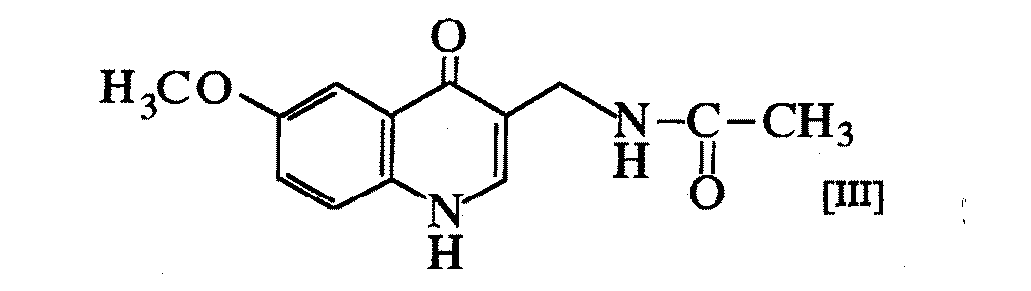
この発明に係るキノリンオキシド誘導体のうち、その特に好ましいものとしては、式[III]:
【0034】
【化17】
【0035】
この発明に係るキノリンオキシド誘導体は、強い蛍光を有すると共に、光や熱に対しても安定であることから、優れた蛍光母核となることができる。
【0036】
この発明において、上記一般式[I]で示されるキノリンオキシド誘導体は、一般式[IV]:
【0037】
【化18】
で表されるインド−ル誘導体を酸化して得ることができる。
【0038】
この発明において、この形態の特に好ましい態様は、式[VI]:
【0039】
【化19】
【0040】
【化20】
【0041】
この発明における酸化反応は、酸化剤を使用して常法に従って行うことができる。使用する酸化剤としては、一般式[VI]もしくは[V]または式[IV]で表されるインド−ル骨格の3位の置換基を酸化することができる酸化剤であればいずれでも使用することができるが、特に好ましい酸化剤としては過酸化水素が挙げられる。また、この発明における酸化反応は、水または炭酸ナトリウムなどの無機溶媒中において、好ましくはアルカリ性下において、例えばpH10〜12の条件下で、加熱下で行うのが好ましい。しかしながら、この発明は、これらに何ら限定されるものではなく、この発明の目的に適うのであれば適宜条件は変更することができる。
【0042】
上記のようにして、一般式[IV]および一般式[V]で表されるインドール誘導体、特に好ましくは式[VI]で表されるメラトニンを酸化して得られた式[I]および[II]で表されるキノリンオキシド誘導体、特に好ましくは式[III]で表されるキノリンオキシド誘導体は、必要に応じて、例えば、メタノール、エタノール、アセトニトリルなどの有機溶媒で抽出することができる。
【0043】
この発明に係るキノリンオキシド誘導体の分析方法は、上記反応式において、一般式[I]、[II]および[III]で表されるキノリンオキシド誘導体の蛍光強度を測定してキノリンオキシド誘導体の量を求めることによって行うことができる。なお、分析方法自体は、当該技術分野において慣用されている方法を用いて行うことができる。
なお、上記したように、キノリンオキシド誘導体を有機溶媒で抽出した場合には、これによりキノリンオキシド誘導体の定量における再現性が低下するおそれがある。
しかし、この場合には、内標準物質を加えて分析するのが好ましい。なお、ここで内標準物質としては、例えば、インド−ル誘導体と同様にインドール骨格を持ち、酸化によって蛍光誘導体化されてクロマトグラム上で良好なピークを与える物質、例えば5−メトキシインドール−3−酢酸(MIAA)などを使用することができる。
【0044】
更に、この発明に係るキノリンオキシド誘導体の分析装置は、基本的には、上記酸化反応を行って上記キノリンオキシド誘導体を得る酸化部と、得られたキノリンオキシド誘導体の蛍光強度を測定してキノリンオキシド誘導体の量を求めるキノリンオキシド誘導体測定部とを備えている。
なお、上記測定部には、例えば、ミクロHPLC(高速液体クロマトグラフィー)を使用し、高感度化して分析することが好ましい。
【0045】
【実施例】
以下、この発明を実施例によって、更に詳細に説明する。
実施例1: メラトニンオキサイド(MEL oxide:N-[(6−メトキシ−4−オキソ−1,4−ジヒドロキノリン−3−イル)メチル]アセタミド)の合成法
メラトニン(MEL)150mg(610μmol)のメタノール溶液(600μl)を100mM炭酸ナトリウム水溶液15mlに溶解し、この混合液を80℃で加熱下攪拌しながら、3M過酸化水素水400μlを10分ごとに15時間滴下した。反応終了後、固相カートリッジを用いて抽出をして、得られたメタノール溶液を減圧留去し、残査を水から再結晶して無色の針状結晶を得た(40.12mg、163μmol、収率25.2%)。
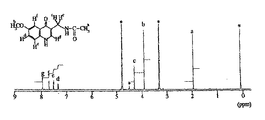
得られたメラトニンオキサイドの機器分析結果は下表1に示す。更に、その1H−NMRと13C−NMRとをそれぞれ図1及び図2に示す。
【0046】
実施例2: エチルオキシド(N-[(6−メトキシ−4−オキソ−1,4−ジヒドロキノリン−3−イル)メチル]プロピオンアミド)の合成法
メラトニンエチルアナログ150mgのメタノール溶液(600μl)を100mM炭酸ナトリウム水溶液15mlに溶解し、この混合液を80℃で加熱下攪拌しながら、3M過酸化水素水400μlを10分ごとに15時間滴下した。反応終了後、固相カートリッジを用いて抽出をして、得られたメタノール溶液を減圧留去し、残査を水から再結晶して結晶を得た(40.66mg、156μmol、収率25.6%)。得られた化合物の機器分析結果は下表1に示す。
【0047】
実施例3: プロピルオキシド(N-[(6−メトキシ−4−オキソ−1,4−ジヒドロキノリン−3−イル)メチル]ブタンアミド)の合成法
メラトニンプロピルアナログ150mgを実施例2と同様に反応させ、メタノールから再結晶してプロピルオキシドを結晶として得た(35.59mg、130μmol、収率22.5%)。得られた化合物の機器分析結果は下表1に示す。
【0048】
実施例4: イソプロピルオキシド(N-[(6−メトキシ−4−オキソ−1,4−ジヒドロキノリン−3−イル)メチル]イソブタンアミド)の合成法
メラトニンイソプロピルアナログ150mgを実施例2と同様に18時間反応させ、メタノールから再結晶してイソプロピルオキシドを結晶として得た(51.99mg、189μmol、収率32.9%)。得られた化合物の機器分析結果は下表1に示す。
【0049】
実施例5: tert−ブチルオキシド(N-[(6−メトキシ−4−オキソ−1,4−ジヒドロキノリン−3−イル)メチル]tert−ブチルカルボンタンアミド)の合成法
メラトニンイソプロピルアナログ150mgを実施例4と同様に反応させ、メタノールから再結晶してtert−ブチルオキシドを結晶として得た(58.58mg、203μmol、収率37.2%)。得られた化合物の機器分析結果は下表1に示す。
【0050】
【表1】
実施例6
5−メトキシトリプタミンに2M炭酸ナトリウムと100mM過酸化水素水溶液を加え、100℃で30分間加熱してアミン体([I] :R=アミノ)を得た。この時の蛍光強度を測定した結果、励起極大波長245nm、蛍光極大波長380nmの強い蛍光が認められた。
【0052】
実験例1:メラトニンオキシドのX線回折解析
実施例1で得た化合物のX線回折分析のために、上記化合物を緩和な条件下でメタノール水溶液(水/メタノール=10:1(v/v))から再結晶した。
X線回折解析の結果、この化合物が、メラトニンオキサイド(N-[(6−メトキシ−4−オキソ−1,4−ジヒドロキノリン−3−イル)メチル]アセタミド)であることを確認した(図3)。また、X線回折解析によって得られたメラトニンオキサイドの結晶についての分析結果を表2に示す。
【0053】
【表2】
実験例2:メラトニンオキサイドおよびそのアナログオキシドの蛍光性
メラトニンオキサイドおよびそのアナログオキシドについて、10%メタノール水溶液を溶媒として10μMにおける励起・蛍光スペクトルを測定した。また、UVスペクトルを測定し、吸収極大波長245nmにおけるモル吸光係数を算出した。結果を下表3に示す。
【0055】
【表3】
実験例3:メラトニンオキシドの蛍光特性
逆相HPLCによるメラトニンの感受性を決定するために、各種有機溶媒中におけるメラトニンオキシドの極大蛍光励起・発光波長と相対蛍光強度(RelativeFluorescence Intensity: RFI)についてメラトニンオキシドの蛍光特性を調べた。有機溶媒としては、逆相HPLCに幅広く使用されているメタノール、エタノール、アセトニトリルを使用した。その結果を表4に示す。この結果から、試験した有機溶媒においては、蛍光強度は溶媒濃度が高くなるにつれて弱くなるのに対し、極大蛍光励起・発光波長は変化しないことが判明した。
【0057】
【表4】
実験例4:マウス松果体試料の調製
マウスをエチルエーテルで麻酔をした後、全松果体を摘出し、60pMのMIAAを含むメタノール溶液500μlに入れて、氷上で1000rpmで20分間ホモジナイズした。得られたホモジネートを4500xgで5分間遠心分離をして、上澄液400μlを乾燥した。残査に水40μlと、4M炭酸ナトリウム水溶液2.5μlと、250mM過酸化水素水とを添加して、100℃で30分間加熱した。処理した反応液から得られたメラトニンオキシドを酢酸エチル150μlで3回抽出して、細胞中の親水性の生物物質からメラトニンオキシドを分離した。得られた有機相を乾燥して、残査に5%アセトニトリル水溶液30μlを添加し、得られた溶液5μlをHPLCシステムに注入した。得られた結果を図4および図5に示す。
検量線は次ぎのようにして作成した。15匹のICRマウスから、全松果体を摘出し、60pMのMIAAを含むメタノール溶液7.5mlに入れて一緒にホモジナイズし、得られたホモジネートを遠心分離した。得られた上澄液400μlに、0.04nM、0.2nM、1nM、10nMのメラトニンのメタノール溶液30μlをそれぞれ添加した後乾燥した。得られた残査を誘導化して、上記のようにして分析した。
【0059】
上記したように、メラトニンの酸化混合物の蛍光性は、メラトニンとは異なっていて、この特性はメラトニンを高感度で特定することが可能である。この発明に係るメラトニンオキシドは、炭酸ナトリウムなどを使用したアルカリ性条件下で、メラトニンに過酸化水素を断続的に添加して、その構造を特定した。酸化反応が進行するにつれて、蛍光・励起波長(380nm、245nm)での蛍光強度は高くなるのに対して、メラトニン自体の蛍光・励起波長(330nm、280nm)での蛍光強度は低くなる。このメラトニンオキシドを精製した後、無色の結晶が得られた。この結晶は、245nmの最大吸収波長を有していて、メラトニンの反応混合物の蛍光励起スペクトルと発光スペクトルと同じスペクトルを有している(図6)。更に、この化合物は、固相HPLCにおいてメラトニンの分析物と保持時間が同じである。
【0060】
上記したように、この発明に係るメラトニンオキシドならびにメラトニンのアナログオキシド、例えば、エチルアナログ、n−プロピルアナログ、イソプロピルアナログ、tert−ブチルアナログなどは、メラトニンの微量分析に有用である。また、この発明に係るキノリンオキシド誘導体の分析方法も、その分析装置もメラトニンの微量分析に有効に利用することができる。
【図面の簡単な説明】
【図1】メラトニン酸化物の1H−NMRスペクトルを示す図。
【図2】メラトニン酸化物の13C−NMRスペクトルを示す図。
【図3】X線回折解析に基づくメラトニン酸化物の分子構造を示す図。
【図4】5−メトキシインドール−3−酢酸(MIAA)を添加していない場合における内因性マウス松果体のメラトニン誘導体のクロマトグラムを示す図。図中、(A、B)はICRマウス松果体の内生メラトニンを調製して分析をした場合を示し、(C)はメラトニン誘導体とMIAAとの標準混合物を分析した場合を示している。
【図5】内標準物質としてMIAAを使用した場合における異なるマウスの松果体のメラトニン誘導体のクロマトグラムを示す図。
【図6】メラトニンの反応液と、メラトニン酸化物の励起・蛍光スペクトルを示すグラフ。(A)は、メラトニンを炭酸ナトリウムの存在下で過酸化水素で100℃で30分間酸化した場合の励起・蛍光スペクトルを示し、(B)メラトニン酸化物を10%メタノール水溶液に溶解した場合の励起・蛍光スペクトルを示している。
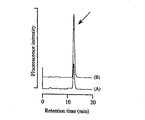
【図7】メラトニン誘導体(A)と、得られたメラトニン酸化物(B)のクロマトグラムを示すグラフ。[0001]
TECHNICAL FIELD OF THE INVENTION
The present invention relates to a quinoline oxide derivative and a method for producing the same, and more particularly, to a quinoline oxide derivative having fluorescent properties and a method for producing the same. The present invention also relates to a method for analyzing a quinoline oxide derivative utilizing strong fluorescence emitted by the quinoline oxide derivative, and an analyzer therefor.
[0002]
[Prior art]
The modern society, which has been rapidly urbanized and computerized, has been operating for 24 hours, and diversification of lifestyles of people has led to a rapid increase in biological rhythm disorders including sleep-wake syndrome. These diseases make the social life of adults difficult and cause serious problems for the life of life supporters in the infancy and the elderly.
[0003]
In addition, this rhythm disorder makes it difficult to introduce chronotherapy aimed at attenuating the side effects of the administered drug and enhancing the efficacy, ie, a treatment that optimizes the timing of drug administration, and limits the treatment method for various diseases.
[0004]
Furthermore, for example, when only a very small amount of a sample can be collected, such as at a medical site for a premature infant or a newborn baby, a fluorescent analysis method is widely used when a trace analysis of a biological component or a drug is required. In particular, the fluorescence derivatization method using a derivatization reagent can be said to be an extremely effective means that enables highly sensitive and selective analysis of various analytes that do not themselves have absorption or fluorescence.
[0005]
Although many excellent reagents such as DNS-Cl and NBD-F have been developed for the purpose of fluorescent labeling, these fluorescent labeling reagents still have problems in stability, sensitivity, solubility and the like. There are not few things to have. For example, the DNS derivative has a disadvantage of lacking sensitivity, and the NBD derivative has a problem of being decomposed by light. Furthermore, it goes without saying that analysis methods and analyzers using these fluorescent labeling reagents also have problems.
[0006]
Melatonin, a hormone secreted into the blood from the pineal gland, has recently been attracting attention as an effective drug for the above rhythm disorders and as a marker of biological rhythm. This melatonin is an indole hormone biosynthesized from L-tryptophan via serotonin and N-acetylserotonin in the pineal gland, and is known to exhibit a remarkable circadian rhythm that biosynthesis and secretion are enhanced at night. ing.
[0007]
Therefore, it is important to accurately measure the blood concentration of melatonin having such an effect.
Currently known methods for analyzing melatonin include, for example, a natural fluorescence method for measuring the amount of melatonin by measuring the fluorescence of melatonin itself, and a radioimmunoassay for measuring the amount of melatonin using a radiolabel. (RIA).
[0008]
By the way, the content of endogenous melatonin in mammals is extremely small, and in the above-mentioned conventional analysis method, several milliliters of blood was required to measure the blood concentration of indole derivatives such as melatonin. . For this purpose, venous blood sampling by injection is necessary, and it places a heavy burden on the subject, so it is not suitable especially for circadian rhythm measurement, which requires frequent blood sampling, and the burden on patients is less. In addition, a method for more accurately measuring the blood concentration of an indole derivative such as melatonin has been demanded.
[0009]
Also, the RIA requires the use of radioisotopes, which is dangerous to handle and requires special facilities. Therefore, there has been a demand for a method for more accurately measuring the blood concentration of an indole derivative without using such an RIA.
[0010]
[Problems to be solved by the invention]
Therefore, the present inventors have conducted intensive studies to improve the conventional method, and as a result, by measuring the fluorescence of melatonin oxide, which is an oxidized form of melatonin, the blood concentration of indole derivatives such as melatonin can be more accurately determined. The inventors have found that it can be measured, and have completed the present invention.
[0011]
[Means for Solving the Problems]
Accordingly, an object of the present invention is to provide a quinoline oxide derivative having a fluorescent property, which can more accurately measure the blood concentration of an indole derivative such as melatonin.
Another object of the present invention is to provide a method for producing a quinoline oxide derivative which has strong fluorescence and can be a core of a fluorescent labeling reagent.
[0012]
Further, the present invention is to provide a highly sensitive method for analyzing a quinoline oxide derivative and a device for analyzing a quinoline oxide derivative, which enable analysis and measurement of the amount of an indole derivative such as melatonin with a minimum amount of blood collection. Aim.
[0013]
In order to achieve the above object, the present invention provides a compound represented by the general formula [I]:
[0014]
Embedded image
(In the formula, R means an amino group, an alkylamide group, a carboxyl group, a carboxylate group, a thiol group, or a disulfide bond.)
A quinoline oxide derivative represented by the formula:
[0016]
In a preferred embodiment, the quinoline oxide derivative according to the present invention has a general formula [II]:
[0017]
Embedded image
A quinoline oxide derivative represented by the formula: In a further preferred embodiment of the present invention, the alkyl group in the general formula [I] or the general formula [II] is a linear or branched monovalent saturated aliphatic hydrocarbon residue having 1 to 6 carbon atoms. A quinoline oxide derivative is provided which represents a group. As a more preferred embodiment, the alkyl group in the general formula [I] or the general formula [II] means a methyl group, an ethyl group, a propyl group, an isopropyl group, a butyl group, an isobutyl group or a tertiary butyl group. A featured quinoline oxide derivative is provided.
[0018]
In a particularly preferred embodiment of the present invention, the quinoline oxide derivative has the formula [III]:
[0019]
Embedded image
[0020]
Further, the present invention provides, as another form, a compound represented by the general formula [IV]:
[0021]
Embedded image
A method for producing a quinoline oxide derivative comprising oxidizing an indole derivative represented by the general formula [I] to obtain a quinoline oxide derivative represented by the above general formula [I].
[0022]
In a preferred embodiment of the present invention, the general formula [V]:
[0023]
Embedded image
And a method for producing a quinoline oxide derivative comprising oxidizing an indole derivative represented by the formula (II) to obtain a quinoline oxide derivative represented by the above general formula [II].
[0024]
In a preferred embodiment of the method for producing a quinoline oxide derivative according to the present invention, there is provided a method for producing a quinoline oxide derivative comprising oxidizing the indole derivative under alkaline conditions. In another preferred embodiment, the present invention provides a method for producing a quinoline oxide derivative, comprising extracting the quinoline oxide derivative obtained by the oxidation reaction with an organic solvent.
[0025]
The present invention provides, as a particularly preferred embodiment, a method for producing a quinoline oxide derivative which comprises oxidizing melatonin represented by the formula [VI] to obtain melatonin oxide represented by the general formula [III].
[0026]
The present invention provides, as yet another form, a method for analyzing a quinoline oxide derivative, which comprises measuring the amount of an indole derivative such as melatonin by measuring the fluorescence intensity of the quinoline oxide derivative. The present invention provides, as a preferred embodiment of the present invention, a method for analyzing a quinoline oxide derivative, which comprises adding an internal standard.
[0027]
Further, the present invention provides, as still another embodiment, an oxidizing part for oxidizing the indole derivative to obtain the quinoline oxide derivative, and measuring the fluorescence intensity of the quinoline oxide derivative to reduce the amount of the quinoline oxide derivative. An analyzer for a quinoline oxide derivative, comprising: a measuring unit to be sought. As a preferred embodiment, the present invention includes an extraction unit that extracts the quinoline oxide derivative from the reaction product obtained in the oxidizing unit with an organic solvent and supplies the extracted quinoline oxide derivative to the measurement unit. Provided is an analyzer for a quinoline oxide derivative. In another preferred embodiment, the present invention provides an apparatus for analyzing a quinoline oxide derivative, further comprising an addition section for adding an internal standard substance. Further, the present invention provides, as another preferred embodiment thereof, an apparatus for analyzing a quinoline oxide derivative, wherein the measuring section includes a heater and high performance liquid chromatography (HPLC).
[0028]
BEST MODE FOR CARRYING OUT THE INVENTION
The quinoline oxide derivative according to the present invention has a general formula [I]:
[0029]
Embedded image
Is represented by
[0030]
Among the above quinoline oxide derivatives, preferred quinoline oxide derivatives include those represented by the general formula [II]:
[0031]
Embedded image
And a quinoline oxide derivative represented by the formula:
[0032]
Further, among the above quinoline oxide derivatives, more preferred quinoline oxide derivatives are those wherein the alkyl group in the general formula [I] or the general formula [II] is a straight-chain or branched-chain having 1 to 6 carbon atoms. A quinoline oxide derivative meaning a monovalent saturated aliphatic hydrocarbon residue is exemplified. Further, as a more preferred embodiment, the alkyl group is, for example, a methyl group, an ethyl group, a propyl group, an i-propyl group, a butyl group, an i-butyl group, a sec-butyl group, a tert-butyl group, a hexyl group, or the like. And quinoline oxide derivatives.
Furthermore, examples of the carboxylate group represented by the general formula [I] include a residue of a fatty acid, for example, a residue of acetic acid, propionic acid, or the like. When R represents a carboxylate group, it means that the quinoline oxide derivatives represented by the general formula [I] are bonded to each other by an SS bond.
[0033]
Among the quinoline oxide derivatives according to the present invention, particularly preferred are those represented by the formula [III]:
[0034]
Embedded image
[0035]
Since the quinoline oxide derivative according to the present invention has strong fluorescence and is stable to light and heat, it can be an excellent fluorescent mother nucleus.
[0036]
In the present invention, the quinoline oxide derivative represented by the above general formula [I] is represented by the general formula [IV]:
[0037]
Embedded image
Can be obtained by oxidizing the indole derivative represented by
[0038]
In this invention, a particularly preferred embodiment of this form is represented by the formula [VI]:
[0039]
Embedded image
[0040]
Embedded image
[0041]
The oxidation reaction in the present invention can be carried out using an oxidizing agent according to a conventional method. As the oxidizing agent to be used, any oxidizing agent that can oxidize the substituent at the 3-position of the indole skeleton represented by the general formula [VI] or [V] or the formula [IV] is used. Although particularly preferred oxidizing agents include hydrogen peroxide. The oxidation reaction in the present invention is preferably carried out in an inorganic solvent such as water or sodium carbonate, preferably under alkaline conditions, for example, under a condition of
[0042]
As described above, the formulas [I] and [II] obtained by oxidizing the indole derivative represented by the general formulas [IV] and [V], particularly preferably the melatonin represented by the formula [VI], are obtained. The quinoline oxide derivative represented by the formula [III], and particularly preferably the quinoline oxide derivative represented by the formula [III], can be extracted with an organic solvent such as methanol, ethanol and acetonitrile, if necessary.
[0043]
In the method for analyzing a quinoline oxide derivative according to the present invention, the amount of the quinoline oxide derivative is determined by measuring the fluorescence intensity of the quinoline oxide derivative represented by the general formulas [I], [II] and [III] in the above reaction formula. You can do it by asking. Note that the analysis method itself can be performed using a method commonly used in the art.
As described above, when the quinoline oxide derivative is extracted with an organic solvent, the reproducibility in the determination of the quinoline oxide derivative may be reduced.
However, in this case, it is preferable to perform analysis by adding an internal standard substance. Here, as the internal standard substance, for example, a substance which has an indole skeleton like an indole derivative, is fluorescently derivatized by oxidation and gives a good peak on a chromatogram, for example, 5-methoxyindole-3- Acetic acid (MIAA) or the like can be used.
[0044]
Furthermore, the analyzer for a quinoline oxide derivative according to the present invention basically comprises an oxidizing section for obtaining the quinoline oxide derivative by performing the oxidation reaction, and measuring the fluorescence intensity of the obtained quinoline oxide derivative to obtain the quinoline oxide derivative. A quinoline oxide derivative measuring section for determining the amount of the derivative.
In addition, it is preferable to use micro HPLC (high-performance liquid chromatography) for the measurement section and to perform analysis with high sensitivity.
[0045]
【Example】
Hereinafter, the present invention will be described in more detail with reference to examples.
Example 1 Synthesis Method of Melatonin Oxide (MEL oxide: N-[(6-Methoxy-4-oxo-1,4-dihydroquinolin-3-yl) methyl] acetamide) Melatonin (MEL) 150 mg (610 μmol) methanol The solution (600 μl) was dissolved in 15 ml of a 100 mM aqueous sodium carbonate solution, and 400 μl of a 3M hydrogen peroxide solution was added dropwise every 10 minutes for 15 hours while stirring the mixture at 80 ° C. while heating. After completion of the reaction, extraction was carried out using a solid phase cartridge, the obtained methanol solution was distilled off under reduced pressure, and the residue was recrystallized from water to obtain colorless needle crystals (40.12 mg, 163 μmol, Yield 25.2%).
The results of instrumental analysis of the obtained melatonin oxide are shown in Table 1 below. 1 H-NMR and 13 C-NMR are shown in FIGS. 1 and 2, respectively.
[0046]
Example 2 Synthesis Method of Ethyl Oxide (N-[(6-Methoxy-4-oxo-1,4-dihydroquinolin-3-yl) methyl] propionamide) A methanol solution (600 μl) of 150 mg of melatonin ethyl analog was dissolved in 100 mM. The mixture was dissolved in 15 ml of an aqueous sodium carbonate solution, and 400 μl of 3M hydrogen peroxide solution was added dropwise every 10 minutes for 15 hours while stirring the mixture at 80 ° C. while heating. After completion of the reaction, extraction was carried out using a solid phase cartridge, the obtained methanol solution was distilled off under reduced pressure, and the residue was recrystallized from water to obtain crystals (40.66 mg, 156 μmol, yield 25. 6%). The results of instrumental analysis of the obtained compound are shown in Table 1 below.
[0047]
Example 3: Method for synthesizing propyl oxide (N-[(6-methoxy-4-oxo-1,4-dihydroquinolin-3-yl) methyl] butanamide) 150 mg of melatonin propyl analog was reacted in the same manner as in Example 2. And recrystallized from methanol to obtain propyl oxide as crystals (35.59 mg, 130 μmol, 22.5% yield). The results of instrumental analysis of the obtained compound are shown in Table 1 below.
[0048]
Example 4: Synthesis of isopropyl oxide (N-[(6-methoxy-4-oxo-1,4-dihydroquinolin-3-yl) methyl] isobutanamide) The mixture was reacted for an hour, and recrystallized from methanol to obtain isopropyl oxide as crystals (51.99 mg, 189 μmol, yield: 32.9%). The results of instrumental analysis of the obtained compound are shown in Table 1 below.
[0049]
Example 5: Synthesis of tert-butyl oxide (N-[(6-methoxy-4-oxo-1,4-dihydroquinolin-3-yl) methyl] tert-butylcarbanamide) 150 mg of melatonin isopropyl analog The reaction was carried out in the same manner as in Example 4 and recrystallized from methanol to obtain tert-butyl oxide as crystals (58.58 mg, 203 μmol, yield: 37.2%). The results of instrumental analysis of the obtained compound are shown in Table 1 below.
[0050]
[Table 1]
Example 6
To 5-methoxytryptamine, 2M sodium carbonate and 100 mM aqueous hydrogen peroxide solution were added, and the mixture was heated at 100 ° C. for 30 minutes to obtain an amine compound ([I]: R = amino). As a result of measuring the fluorescence intensity at this time, strong fluorescence having an excitation maximum wavelength of 245 nm and a fluorescence maximum wavelength of 380 nm was observed.
[0052]
Experimental Example 1: X-ray diffraction analysis of melatonin oxide For the X-ray diffraction analysis of the compound obtained in Example 1, the above compound was subjected to a methanol aqueous solution (water / methanol = 10: 1 (v / v)) under mild conditions. ).
As a result of X-ray diffraction analysis, it was confirmed that this compound was melatonin oxide (N-[(6-methoxy-4-oxo-1,4-dihydroquinolin-3-yl) methyl] acetamide) (FIG. 3). ). Table 2 shows the results of analysis of the melatonin oxide crystals obtained by X-ray diffraction analysis.
[0053]
[Table 2]
Experimental Example 2: Fluorescence of Melatonin Oxide and Its Analog Oxide The excitation and fluorescence spectra of melatonin oxide and its analog oxide at 10 μM were measured using a 10% aqueous methanol solution as a solvent. Further, the UV spectrum was measured, and the molar extinction coefficient at an absorption maximum wavelength of 245 nm was calculated. The results are shown in Table 3 below.
[0055]
[Table 3]
Experimental Example 3: Fluorescence properties of melatonin oxide In order to determine the sensitivity of melatonin by reverse phase HPLC, the maximum fluorescence excitation / emission wavelength and relative fluorescence intensity (Relative Fluorescence Intensity: RFI) of melatonin oxide in various organic solvents were determined. The fluorescence properties were examined. As the organic solvent, methanol, ethanol, and acetonitrile widely used in reverse-phase HPLC were used. Table 4 shows the results. From these results, it was found that, in the tested organic solvent, the fluorescence intensity became weaker as the solvent concentration was increased, but the maximum fluorescence excitation / emission wavelength was not changed.
[0057]
[Table 4]
Experimental Example 4: Preparation of mouse pineal sample After the mouse was anesthetized with ethyl ether, the entire pineal gland was excised, placed in 500 μl of a methanol solution containing 60 pM MIAA, and homogenized on ice at 1000 rpm for 20 minutes. The obtained homogenate was centrifuged at 4500 × g for 5 minutes, and 400 μl of the supernatant was dried. 40 μl of water, 2.5 μl of a 4 M aqueous sodium carbonate solution, and 250 mM aqueous hydrogen peroxide were added to the residue, and the mixture was heated at 100 ° C. for 30 minutes. Melatonin oxide obtained from the treated reaction solution was extracted three times with 150 μl of ethyl acetate to separate melatonin oxide from hydrophilic biological substances in cells. The obtained organic phase was dried, 30 μl of a 5% acetonitrile aqueous solution was added to the residue, and 5 μl of the obtained solution was injected into an HPLC system. The obtained results are shown in FIGS.
The calibration curve was prepared as follows. From 15 ICR mice, the whole pineal gland was excised, placed in 7.5 ml of a methanol solution containing 60 pM MIAA, homogenized together, and the resulting homogenate was centrifuged. To 400 μl of the obtained supernatant, 30 μl of a 0.04 nM, 0.2 nM, 1 nM, and 10 nM methanol solution of melatonin was added, followed by drying. The resulting residue was derivatized and analyzed as described above.
[0059]
As mentioned above, the fluorescence of the oxidized mixture of melatonin is different from melatonin, and this property makes it possible to identify melatonin with high sensitivity. The structure of the melatonin oxide according to the present invention was specified by intermittently adding hydrogen peroxide to melatonin under alkaline conditions using sodium carbonate or the like. As the oxidation reaction proceeds, the fluorescence intensity at the fluorescence / excitation wavelength (380 nm, 245 nm) increases, whereas the fluorescence intensity of melatonin itself at the fluorescence / excitation wavelength (330 nm, 280 nm) decreases. After purifying the melatonin oxide, colorless crystals were obtained. This crystal has a maximum absorption wavelength of 245 nm and has the same fluorescence excitation spectrum and emission spectrum of the reaction mixture of melatonin (FIG. 6). Furthermore, this compound has the same retention time as the melatonin analyte in solid phase HPLC.
[0060]
As described above, the melatonin oxide and analog oxides of melatonin according to the present invention, such as ethyl analog, n-propyl analog, isopropyl analog, and tert-butyl analog, are useful for microanalysis of melatonin. In addition, the method for analyzing a quinoline oxide derivative according to the present invention and its analyzer can be effectively used for microanalysis of melatonin.
[Brief description of the drawings]
FIG. 1 shows a 1 H-NMR spectrum of melatonin oxide.
FIG. 2 shows a 13 C-NMR spectrum of melatonin oxide.
FIG. 3 is a diagram showing a molecular structure of melatonin oxide based on X-ray diffraction analysis.
FIG. 4 is a view showing a chromatogram of a melatonin derivative of endogenous mouse pineal gland when 5-methoxyindole-3-acetic acid (MIAA) is not added. In the figure, (A, B) shows the case where endogenous melatonin of the ICR mouse pineal gland was prepared and analyzed, and (C) shows the case where a standard mixture of a melatonin derivative and MIAA was analyzed.
FIG. 5 is a diagram showing chromatograms of melatonin derivatives of the pineal gland of different mice when MIAA is used as an internal standard.
FIG. 6 is a graph showing excitation / fluorescence spectra of a reaction solution of melatonin and melatonin oxide. (A) shows an excitation / fluorescence spectrum when melatonin is oxidized with hydrogen peroxide at 100 ° C. for 30 minutes in the presence of sodium carbonate, and (B) an excitation when melatonin oxide is dissolved in a 10% aqueous methanol solution. -The fluorescence spectrum is shown.
FIG. 7 is a graph showing chromatograms of the melatonin derivative (A) and the obtained melatonin oxide (B).
Claims (18)
で表されるキノリンオキシド誘導体であることを特徴とするキノリンオキシド誘導体。General formula [I]:
A quinoline oxide derivative represented by the formula:
で表されるキノリンオキシド誘導体であることを特徴とするキノリンオキシド誘導体。The quinoline oxide derivative according to claim 1, wherein the quinoline oxide derivative has a general formula [II]:
A quinoline oxide derivative represented by the formula:
で表されるインド−ル誘導体を酸化して、一般式[I]:
で表されるキノリンオキシド誘導体を得ることを特徴とするキノリンオキシド誘導体の製造方法。General formula [IV]:
Oxidation of the indole derivative represented by the general formula [I]:
A method for producing a quinoline oxide derivative, characterized by obtaining a quinoline oxide derivative represented by the formula:
で表されるインドール誘導体であり、該インドール誘導体を酸化して一般式[II]:
で表されるキノリンオキシド誘導体を得ることを特徴とするキノリンオキシド誘導体の製造方法。The method for producing a quinoline oxide derivative according to claim 6, wherein the indole derivative has a general formula [V]:
Wherein the indole derivative is oxidized to give a general formula [II]:
A method for producing a quinoline oxide derivative, characterized by obtaining a quinoline oxide derivative represented by the formula:
Priority Applications (1)
| Application Number | Priority Date | Filing Date | Title |
|---|---|---|---|
| JP2002364790A JP4503228B2 (en) | 2002-12-17 | 2002-12-17 | Quinoline oxide derivative and method for producing the same |
Applications Claiming Priority (1)
| Application Number | Priority Date | Filing Date | Title |
|---|---|---|---|
| JP2002364790A JP4503228B2 (en) | 2002-12-17 | 2002-12-17 | Quinoline oxide derivative and method for producing the same |
Publications (2)
| Publication Number | Publication Date |
|---|---|
| JP2004196683A true JP2004196683A (en) | 2004-07-15 |
| JP4503228B2 JP4503228B2 (en) | 2010-07-14 |
Family
ID=32762510
Family Applications (1)
| Application Number | Title | Priority Date | Filing Date |
|---|---|---|---|
| JP2002364790A Expired - Fee Related JP4503228B2 (en) | 2002-12-17 | 2002-12-17 | Quinoline oxide derivative and method for producing the same |
Country Status (1)
| Country | Link |
|---|---|
| JP (1) | JP4503228B2 (en) |
Cited By (1)
| Publication number | Priority date | Publication date | Assignee | Title |
|---|---|---|---|---|
| JP2015048332A (en) * | 2013-09-02 | 2015-03-16 | 株式会社 資生堂 | Optical resolution compound, optical resolution reagent, optical resolution method and optical isomer |
Citations (1)
| Publication number | Priority date | Publication date | Assignee | Title |
|---|---|---|---|---|
| JPH07223376A (en) * | 1991-09-10 | 1995-08-22 | Agfa Gevaert Nv | Thermally transferrable fluorescent compound |
-
2002
- 2002-12-17 JP JP2002364790A patent/JP4503228B2/en not_active Expired - Fee Related
Patent Citations (1)
| Publication number | Priority date | Publication date | Assignee | Title |
|---|---|---|---|---|
| JPH07223376A (en) * | 1991-09-10 | 1995-08-22 | Agfa Gevaert Nv | Thermally transferrable fluorescent compound |
Cited By (1)
| Publication number | Priority date | Publication date | Assignee | Title |
|---|---|---|---|---|
| JP2015048332A (en) * | 2013-09-02 | 2015-03-16 | 株式会社 資生堂 | Optical resolution compound, optical resolution reagent, optical resolution method and optical isomer |
Also Published As
| Publication number | Publication date |
|---|---|
| JP4503228B2 (en) | 2010-07-14 |
Similar Documents
| Publication | Publication Date | Title |
|---|---|---|
| Li et al. | An ICT-based fluorescent switch-on probe for hydrogen sulfide in living cells | |
| Yamaguchi et al. | Luminol-type chemiluminescence derivatization reagents for liquid chromatography and capillary electrophoresis | |
| FR2500165A1 (en) | METHOD AND REAGENTS OF POLARIZATION IMMUNODETERMINATION OF FLUORESCENCE USING CARBOXYFLUORESCEINES | |
| US5700654A (en) | Method and compositions to assess oxidative stress in vivo | |
| Brooks et al. | Determination of tryptophan metabolism from biological tissues and fluids using high performance liquid chromatography with simultaneous dual electrochemical detection | |
| Tao et al. | Detecting Cysteine in Bioimaging with a Near‐Infrared Probe Based on a Novel Fluorescence Quenching Mechanism | |
| Yan et al. | Gold nanoparticle enriched by Q sepharose spheres for chemical reaction tandem SERS detection of malondialdehyde | |
| CN107652220A (en) | A kind of preparation method and application technology for the fluorescence probe for detecting cysteine | |
| Vernerová et al. | Liquid chromatography method with tandem mass spectrometry and fluorescence detection for determination of inflammatory biomarkers in gingival crevicular fluid as a tool for diagnosis of periodontal disease | |
| CN108640864A (en) | A kind of chalcone base fluorescent probe and the preparation method and application thereof | |
| Ishida et al. | High-performance liquid chromatographic determination of 5-hydroxyindoles by post-column fluorescence derivatization | |
| Hamase et al. | A sensitive internal standard method for the determination of melatonin in mammals using precolumn oxidation reversed-phase high-performance liquid chromatography | |
| CN110092771A (en) | A kind of fluorescence probe and preparation method thereof for human serum albumins detection, Fluorescence kit | |
| CN110386898B (en) | Quinoline ring derivative fluorescent probe and preparation method and application thereof | |
| JP4503228B2 (en) | Quinoline oxide derivative and method for producing the same | |
| CN110878049A (en) | Preparation and application of fluorescent probe for specifically analyzing hydrogen sulfide in Golgi apparatus | |
| Liu et al. | Design and application: A ordered dual-locked fluorescence probe for hydrogen sulfide specific reaction and lipid droplets-targeted | |
| CN108530457A (en) | Amino acid detection reagent naphthalimide derivative and its synthetic method and application | |
| Lin et al. | Determination of two fenamates in plasma by high‐performance liquid chromatography | |
| JP2015087199A (en) | Capric acid determination method | |
| JP4873437B2 (en) | Analysis method of melatonin | |
| CN111072650B (en) | Benzothiazole hydrogen sulfide fluorescent probe | |
| Raggi et al. | Determination of melatonin in galenic preparations by LC and voltammetry | |
| CN114436892A (en) | Abeta-responsive light-activated fluorescent probe and preparation method and application thereof | |
| Hajdú et al. | Quantitative determination of clobazam in serum and urine by gas chromatography, thin layer chromatography and fluorometry |
Legal Events
| Date | Code | Title | Description |
|---|---|---|---|
| A621 | Written request for application examination |
Free format text: JAPANESE INTERMEDIATE CODE: A621 Effective date: 20051216 |
|
| A977 | Report on retrieval |
Free format text: JAPANESE INTERMEDIATE CODE: A971007 Effective date: 20090422 |
|
| A131 | Notification of reasons for refusal |
Free format text: JAPANESE INTERMEDIATE CODE: A131 Effective date: 20090428 |
|
| A711 | Notification of change in applicant |
Free format text: JAPANESE INTERMEDIATE CODE: A711 Effective date: 20090625 |
|
| A521 | Written amendment |
Free format text: JAPANESE INTERMEDIATE CODE: A523 Effective date: 20090629 |
|
| A521 | Written amendment |
Free format text: JAPANESE INTERMEDIATE CODE: A821 Effective date: 20090625 |
|
| A711 | Notification of change in applicant |
Free format text: JAPANESE INTERMEDIATE CODE: A711 Effective date: 20090831 |
|
| A521 | Written amendment |
Free format text: JAPANESE INTERMEDIATE CODE: A821 Effective date: 20090831 |
|
| TRDD | Decision of grant or rejection written | ||
| A01 | Written decision to grant a patent or to grant a registration (utility model) |
Free format text: JAPANESE INTERMEDIATE CODE: A01 Effective date: 20100413 |
|
| A01 | Written decision to grant a patent or to grant a registration (utility model) |
Free format text: JAPANESE INTERMEDIATE CODE: A01 |
|
| A61 | First payment of annual fees (during grant procedure) |
Free format text: JAPANESE INTERMEDIATE CODE: A61 Effective date: 20100421 |
|
| R150 | Certificate of patent or registration of utility model |
Ref document number: 4503228 Country of ref document: JP Free format text: JAPANESE INTERMEDIATE CODE: R150 Free format text: JAPANESE INTERMEDIATE CODE: R150 |
|
| FPAY | Renewal fee payment (event date is renewal date of database) |
Free format text: PAYMENT UNTIL: 20130430 Year of fee payment: 3 |
|
| FPAY | Renewal fee payment (event date is renewal date of database) |
Free format text: PAYMENT UNTIL: 20140430 Year of fee payment: 4 |
|
| R250 | Receipt of annual fees |
Free format text: JAPANESE INTERMEDIATE CODE: R250 |
|
| R250 | Receipt of annual fees |
Free format text: JAPANESE INTERMEDIATE CODE: R250 |
|
| R250 | Receipt of annual fees |
Free format text: JAPANESE INTERMEDIATE CODE: R250 |
|
| R250 | Receipt of annual fees |
Free format text: JAPANESE INTERMEDIATE CODE: R250 |
|
| R250 | Receipt of annual fees |
Free format text: JAPANESE INTERMEDIATE CODE: R250 |
|
| R250 | Receipt of annual fees |
Free format text: JAPANESE INTERMEDIATE CODE: R250 |
|
| R250 | Receipt of annual fees |
Free format text: JAPANESE INTERMEDIATE CODE: R250 |
|
| R250 | Receipt of annual fees |
Free format text: JAPANESE INTERMEDIATE CODE: R250 |
|
| LAPS | Cancellation because of no payment of annual fees |