JP2005225701A - Method for forming thin film of titanium-containing compound - Google Patents
Method for forming thin film of titanium-containing compound Download PDFInfo
- Publication number
- JP2005225701A JP2005225701A JP2004034787A JP2004034787A JP2005225701A JP 2005225701 A JP2005225701 A JP 2005225701A JP 2004034787 A JP2004034787 A JP 2004034787A JP 2004034787 A JP2004034787 A JP 2004034787A JP 2005225701 A JP2005225701 A JP 2005225701A
- Authority
- JP
- Japan
- Prior art keywords
- titanium
- thin film
- compound
- water
- solution
- Prior art date
- Legal status (The legal status is an assumption and is not a legal conclusion. Google has not performed a legal analysis and makes no representation as to the accuracy of the status listed.)
- Pending
Links
- 239000010409 thin film Substances 0.000 title claims abstract description 64
- 239000010936 titanium Substances 0.000 title claims abstract description 38
- 229910052719 titanium Inorganic materials 0.000 title claims abstract description 36
- RTAQQCXQSZGOHL-UHFFFAOYSA-N Titanium Chemical compound [Ti] RTAQQCXQSZGOHL-UHFFFAOYSA-N 0.000 title claims abstract description 33
- 150000001875 compounds Chemical class 0.000 title claims abstract description 29
- 238000000034 method Methods 0.000 title claims abstract description 23
- 238000000576 coating method Methods 0.000 claims abstract description 42
- 239000011248 coating agent Substances 0.000 claims abstract description 40
- 239000000243 solution Substances 0.000 claims abstract description 36
- 239000000463 material Substances 0.000 claims abstract description 34
- 150000003609 titanium compounds Chemical class 0.000 claims abstract description 25
- 239000007864 aqueous solution Substances 0.000 claims abstract description 20
- 229910052788 barium Inorganic materials 0.000 claims abstract description 5
- DSAJWYNOEDNPEQ-UHFFFAOYSA-N barium atom Chemical compound [Ba] DSAJWYNOEDNPEQ-UHFFFAOYSA-N 0.000 claims abstract description 5
- 229910052797 bismuth Inorganic materials 0.000 claims abstract description 5
- JCXGWMGPZLAOME-UHFFFAOYSA-N bismuth atom Chemical compound [Bi] JCXGWMGPZLAOME-UHFFFAOYSA-N 0.000 claims abstract description 5
- 229910052712 strontium Inorganic materials 0.000 claims abstract description 5
- CIOAGBVUUVVLOB-UHFFFAOYSA-N strontium atom Chemical compound [Sr] CIOAGBVUUVVLOB-UHFFFAOYSA-N 0.000 claims abstract description 5
- 238000001035 drying Methods 0.000 claims abstract description 4
- 150000002736 metal compounds Chemical class 0.000 claims abstract description 4
- OKTJSMMVPCPJKN-UHFFFAOYSA-N Carbon Chemical compound [C] OKTJSMMVPCPJKN-UHFFFAOYSA-N 0.000 claims description 9
- 239000002736 nonionic surfactant Substances 0.000 claims description 9
- 229910052799 carbon Inorganic materials 0.000 claims description 8
- 229910001220 stainless steel Inorganic materials 0.000 claims description 6
- 239000010935 stainless steel Substances 0.000 claims description 6
- 239000011521 glass Substances 0.000 claims description 4
- 239000000919 ceramic Substances 0.000 claims description 3
- 229910052710 silicon Inorganic materials 0.000 claims description 3
- 239000010703 silicon Substances 0.000 claims description 3
- 229910000975 Carbon steel Inorganic materials 0.000 claims description 2
- 239000010962 carbon steel Substances 0.000 claims description 2
- 239000003960 organic solvent Substances 0.000 abstract description 15
- 238000010304 firing Methods 0.000 abstract description 7
- 239000000758 substrate Substances 0.000 description 22
- GWEVSGVZZGPLCZ-UHFFFAOYSA-N Titan oxide Chemical compound O=[Ti]=O GWEVSGVZZGPLCZ-UHFFFAOYSA-N 0.000 description 17
- OGIDPMRJRNCKJF-UHFFFAOYSA-N titanium oxide Inorganic materials [Ti]=O OGIDPMRJRNCKJF-UHFFFAOYSA-N 0.000 description 16
- 239000007788 liquid Substances 0.000 description 13
- -1 titanium alkoxide Chemical class 0.000 description 12
- 239000002202 Polyethylene glycol Substances 0.000 description 11
- 239000011941 photocatalyst Substances 0.000 description 11
- 229920001223 polyethylene glycol Polymers 0.000 description 11
- 239000000126 substance Substances 0.000 description 9
- 238000002441 X-ray diffraction Methods 0.000 description 7
- KRKNYBCHXYNGOX-UHFFFAOYSA-N citric acid Chemical compound OC(=O)CC(O)(C(O)=O)CC(O)=O KRKNYBCHXYNGOX-UHFFFAOYSA-N 0.000 description 7
- XLYOFNOQVPJJNP-UHFFFAOYSA-N water Substances O XLYOFNOQVPJJNP-UHFFFAOYSA-N 0.000 description 7
- 239000012298 atmosphere Substances 0.000 description 6
- CMCBDXRRFKYBDG-UHFFFAOYSA-N 1-dodecoxydodecane Chemical compound CCCCCCCCCCCCOCCCCCCCCCCCC CMCBDXRRFKYBDG-UHFFFAOYSA-N 0.000 description 5
- 229920003171 Poly (ethylene oxide) Polymers 0.000 description 5
- 150000001553 barium compounds Chemical class 0.000 description 5
- AYJRCSIUFZENHW-UHFFFAOYSA-L barium carbonate Chemical compound [Ba+2].[O-]C([O-])=O AYJRCSIUFZENHW-UHFFFAOYSA-L 0.000 description 4
- JRPBQTZRNDNNOP-UHFFFAOYSA-N barium titanate Chemical compound [Ba+2].[Ba+2].[O-][Ti]([O-])([O-])[O-] JRPBQTZRNDNNOP-UHFFFAOYSA-N 0.000 description 4
- 229910002113 barium titanate Inorganic materials 0.000 description 4
- QGZKDVFQNNGYKY-UHFFFAOYSA-O Ammonium Chemical compound [NH4+] QGZKDVFQNNGYKY-UHFFFAOYSA-O 0.000 description 3
- 230000007935 neutral effect Effects 0.000 description 3
- 239000005416 organic matter Substances 0.000 description 3
- 150000003438 strontium compounds Chemical class 0.000 description 3
- 239000004094 surface-active agent Substances 0.000 description 3
- QGZKDVFQNNGYKY-UHFFFAOYSA-N Ammonia Chemical compound N QGZKDVFQNNGYKY-UHFFFAOYSA-N 0.000 description 2
- AEMRFAOFKBGASW-UHFFFAOYSA-N Glycolic acid Chemical compound OCC(O)=O AEMRFAOFKBGASW-UHFFFAOYSA-N 0.000 description 2
- CPWZPANSGPSCFX-UHFFFAOYSA-N [NH4+].[NH4+].CC(O)C([O-])=O.CC(O)C([O-])=O Chemical compound [NH4+].[NH4+].CC(O)C([O-])=O.CC(O)C([O-])=O CPWZPANSGPSCFX-UHFFFAOYSA-N 0.000 description 2
- 239000003945 anionic surfactant Substances 0.000 description 2
- 229910052454 barium strontium titanate Inorganic materials 0.000 description 2
- 229910002115 bismuth titanate Inorganic materials 0.000 description 2
- 239000003093 cationic surfactant Substances 0.000 description 2
- 238000004040 coloring Methods 0.000 description 2
- 239000002131 composite material Substances 0.000 description 2
- 238000000635 electron micrograph Methods 0.000 description 2
- 239000010408 film Substances 0.000 description 2
- 150000002500 ions Chemical class 0.000 description 2
- JVTAAEKCZFNVCJ-UHFFFAOYSA-N lactic acid Chemical compound CC(O)C(O)=O JVTAAEKCZFNVCJ-UHFFFAOYSA-N 0.000 description 2
- 229910052751 metal Inorganic materials 0.000 description 2
- 239000002184 metal Substances 0.000 description 2
- 230000001590 oxidative effect Effects 0.000 description 2
- 230000001699 photocatalysis Effects 0.000 description 2
- 239000002904 solvent Substances 0.000 description 2
- VEALVRVVWBQVSL-UHFFFAOYSA-N strontium titanate Chemical compound [Sr+2].[O-][Ti]([O-])=O VEALVRVVWBQVSL-UHFFFAOYSA-N 0.000 description 2
- BJEPYKJPYRNKOW-REOHCLBHSA-N (S)-malic acid Chemical compound OC(=O)[C@@H](O)CC(O)=O BJEPYKJPYRNKOW-REOHCLBHSA-N 0.000 description 1
- AIFLGMNWQFPTAJ-UHFFFAOYSA-J 2-hydroxypropanoate;titanium(4+) Chemical compound [Ti+4].CC(O)C([O-])=O.CC(O)C([O-])=O.CC(O)C([O-])=O.CC(O)C([O-])=O AIFLGMNWQFPTAJ-UHFFFAOYSA-J 0.000 description 1
- FEWJPZIEWOKRBE-JCYAYHJZSA-N Dextrotartaric acid Chemical compound OC(=O)[C@H](O)[C@@H](O)C(O)=O FEWJPZIEWOKRBE-JCYAYHJZSA-N 0.000 description 1
- MYMOFIZGZYHOMD-UHFFFAOYSA-N Dioxygen Chemical compound O=O MYMOFIZGZYHOMD-UHFFFAOYSA-N 0.000 description 1
- LFQSCWFLJHTTHZ-UHFFFAOYSA-N Ethanol Chemical compound CCO LFQSCWFLJHTTHZ-UHFFFAOYSA-N 0.000 description 1
- DGAQECJNVWCQMB-PUAWFVPOSA-M Ilexoside XXIX Chemical compound C[C@@H]1CC[C@@]2(CC[C@@]3(C(=CC[C@H]4[C@]3(CC[C@@H]5[C@@]4(CC[C@@H](C5(C)C)OS(=O)(=O)[O-])C)C)[C@@H]2[C@]1(C)O)C)C(=O)O[C@H]6[C@@H]([C@H]([C@@H]([C@H](O6)CO)O)O)O.[Na+] DGAQECJNVWCQMB-PUAWFVPOSA-M 0.000 description 1
- ZWNZGTHTOBNSDL-UHFFFAOYSA-N N.[Ti+4] Chemical compound N.[Ti+4] ZWNZGTHTOBNSDL-UHFFFAOYSA-N 0.000 description 1
- 229910000831 Steel Inorganic materials 0.000 description 1
- FEWJPZIEWOKRBE-UHFFFAOYSA-N Tartaric acid Natural products [H+].[H+].[O-]C(=O)C(O)C(O)C([O-])=O FEWJPZIEWOKRBE-UHFFFAOYSA-N 0.000 description 1
- NRTOMJZYCJJWKI-UHFFFAOYSA-N Titanium nitride Chemical compound [Ti]#N NRTOMJZYCJJWKI-UHFFFAOYSA-N 0.000 description 1
- 239000002253 acid Substances 0.000 description 1
- 150000007513 acids Chemical class 0.000 description 1
- 239000002390 adhesive tape Substances 0.000 description 1
- BJEPYKJPYRNKOW-UHFFFAOYSA-N alpha-hydroxysuccinic acid Natural products OC(=O)C(O)CC(O)=O BJEPYKJPYRNKOW-UHFFFAOYSA-N 0.000 description 1
- 229910021529 ammonia Inorganic materials 0.000 description 1
- XKMRRTOUMJRJIA-UHFFFAOYSA-N ammonia nh3 Chemical compound N.N XKMRRTOUMJRJIA-UHFFFAOYSA-N 0.000 description 1
- QVGXLLKOCUKJST-UHFFFAOYSA-N atomic oxygen Chemical compound [O] QVGXLLKOCUKJST-UHFFFAOYSA-N 0.000 description 1
- AYJRCSIUFZENHW-DEQYMQKBSA-L barium(2+);oxomethanediolate Chemical compound [Ba+2].[O-][14C]([O-])=O AYJRCSIUFZENHW-DEQYMQKBSA-L 0.000 description 1
- FFTDWVOLFHWSSJ-UHFFFAOYSA-N barium(2+);oxygen(2-);titanium(4+) Chemical compound [O-2].[O-2].[O-2].[O-2].[O-2].[O-2].[O-2].[O-2].[O-2].[Ti+4].[Ti+4].[Ti+4].[Ti+4].[Ba+2] FFTDWVOLFHWSSJ-UHFFFAOYSA-N 0.000 description 1
- 150000001622 bismuth compounds Chemical class 0.000 description 1
- GDTBXPJZTBHREO-UHFFFAOYSA-N bromine Substances BrBr GDTBXPJZTBHREO-UHFFFAOYSA-N 0.000 description 1
- 229910052794 bromium Inorganic materials 0.000 description 1
- JMRHXFHHTSLVEQ-UHFFFAOYSA-N carbonic acid;titanium Chemical class [Ti].OC(O)=O JMRHXFHHTSLVEQ-UHFFFAOYSA-N 0.000 description 1
- 239000000460 chlorine Substances 0.000 description 1
- 229910052801 chlorine Inorganic materials 0.000 description 1
- 150000001805 chlorine compounds Chemical class 0.000 description 1
- 235000015165 citric acid Nutrition 0.000 description 1
- 230000000052 comparative effect Effects 0.000 description 1
- 238000005238 degreasing Methods 0.000 description 1
- 229910001882 dioxygen Inorganic materials 0.000 description 1
- 238000007598 dipping method Methods 0.000 description 1
- 230000000694 effects Effects 0.000 description 1
- 239000012776 electronic material Substances 0.000 description 1
- 230000002349 favourable effect Effects 0.000 description 1
- 238000010438 heat treatment Methods 0.000 description 1
- 230000001771 impaired effect Effects 0.000 description 1
- 239000011261 inert gas Substances 0.000 description 1
- 230000001678 irradiating effect Effects 0.000 description 1
- 239000004310 lactic acid Substances 0.000 description 1
- 235000014655 lactic acid Nutrition 0.000 description 1
- 239000001630 malic acid Substances 0.000 description 1
- 235000011090 malic acid Nutrition 0.000 description 1
- 238000004519 manufacturing process Methods 0.000 description 1
- 229910021645 metal ion Inorganic materials 0.000 description 1
- 239000000203 mixture Substances 0.000 description 1
- 239000001301 oxygen Substances 0.000 description 1
- 229910052760 oxygen Inorganic materials 0.000 description 1
- 229920003023 plastic Polymers 0.000 description 1
- 239000004033 plastic Substances 0.000 description 1
- 238000007790 scraping Methods 0.000 description 1
- 239000005361 soda-lime glass Substances 0.000 description 1
- 229910052708 sodium Inorganic materials 0.000 description 1
- 239000011734 sodium Substances 0.000 description 1
- 239000007921 spray Substances 0.000 description 1
- 239000010959 steel Substances 0.000 description 1
- 239000011975 tartaric acid Substances 0.000 description 1
- 235000002906 tartaric acid Nutrition 0.000 description 1
- 239000004408 titanium dioxide Substances 0.000 description 1
- XJDNKRIXUMDJCW-UHFFFAOYSA-J titanium tetrachloride Chemical compound Cl[Ti](Cl)(Cl)Cl XJDNKRIXUMDJCW-UHFFFAOYSA-J 0.000 description 1
- 230000007704 transition Effects 0.000 description 1
Images
Landscapes
- Inorganic Compounds Of Heavy Metals (AREA)
- Chemically Coating (AREA)
Abstract
Description
本発明は、光触媒、誘電体、強誘電体、紫外線遮蔽材などの材料として使用されるチタン含有化合物の薄膜を形成する方法に関する。 The present invention relates to a method of forming a thin film of a titanium-containing compound used as a material such as a photocatalyst, a dielectric, a ferroelectric, or an ultraviolet shielding material.
近年、光触媒、誘電体などに使用する材料を作るために、基材にチタン含有化合物の薄膜を形成したものが製造されている。例えば、特許文献1には、光触媒の薄膜を形成させた材料を製造する方法が示されている。 In recent years, a material in which a thin film of a titanium-containing compound is formed on a base material has been manufactured in order to make a material used for a photocatalyst, a dielectric, and the like. For example, Patent Document 1 discloses a method for manufacturing a material in which a thin film of a photocatalyst is formed.
特許文献1に示された方法においては、基材の表面に有機チタネートの溶液をコーティングし、乾燥させた後、焼成することにより光触媒となる結晶性酸化チタンが生成する。 In the method disclosed in Patent Document 1, a solution of an organic titanate is coated on the surface of a substrate, dried, and then fired to produce crystalline titanium oxide serving as a photocatalyst.
上記のように、溶液コーティング法によりチタン含有化合物の薄膜を形成させる場合、当然のことながら、チタン化合物の溶液を使用しなければならないが、安定した水溶液を調製することができるチタン化合物は知られていない。すなわち、殆どのチタン化合物は中性の水に対して難溶性である上に、例えば、四塩化チタンのような水溶性のものであっても、安定した溶液として存在するのは強酸性下だけであって、中性の水溶液中では加水分解されて難水溶性の化合物を生成する。又、特許文献1に示された方法で使用される有機チタネート(チタンアルコキシド)はアルコールなどの有機溶媒に溶解されているが、このチタンアルコキシドは有機溶媒中では安定であるが、僅かな水の存在によって加水分解され、極めて不安定な化合物である。 As described above, when a thin film of a titanium-containing compound is formed by a solution coating method, it is a matter of course that a solution of the titanium compound must be used, but a titanium compound that can prepare a stable aqueous solution is known. Not. That is, most titanium compounds are hardly soluble in neutral water, and even if they are water-soluble, such as titanium tetrachloride, they exist as stable solutions only under strong acidity. However, it is hydrolyzed in a neutral aqueous solution to produce a slightly water-soluble compound. Moreover, although the organic titanate (titanium alkoxide) used in the method disclosed in Patent Document 1 is dissolved in an organic solvent such as alcohol, the titanium alkoxide is stable in the organic solvent, but a little water is used. It is a very unstable compound that is hydrolyzed by its presence.
しかし、チタン化合物を有機溶媒に溶解させた溶液をコーティングする方法により薄膜を形成させる場合、チタン化合物と共に多量の有機溶媒がコーティングされるので、主としてその有機溶媒に由来する成分が製品中に残存することがある。すなわち、コーティング液中の有機物はその大部分が有機溶媒によって占められているので、焼成などの処理をした後であっても、主としてその有機溶媒に由来する微量の有機物が薄膜中に含まれていたり、炭素の形態で残留していたりする。 However, when a thin film is formed by coating a solution in which a titanium compound is dissolved in an organic solvent, a large amount of the organic solvent is coated together with the titanium compound, so that components derived mainly from the organic solvent remain in the product. Sometimes. In other words, most of the organic matter in the coating liquid is occupied by the organic solvent, so that even after the treatment such as baking, a small amount of organic matter derived mainly from the organic solvent is contained in the thin film. Or remain in the form of carbon.
このような有機物又は有機物に由来する炭素が含まれている薄膜が形成される方法は、例えば、有機物などを分解する機能を有する光触媒用の薄膜を形成させる方法としては不適当であるし、又、その薄膜が炭素の残留によって絶縁性が著しく損なわれるので、電子材料用の薄膜を形成させる方法としても不適当である。 Such a method for forming a thin film containing an organic substance or carbon derived from the organic substance is inappropriate as a method for forming a thin film for a photocatalyst having a function of decomposing the organic substance, for example. Since the insulating property of the thin film is remarkably impaired by the carbon residue, it is not suitable as a method for forming a thin film for an electronic material.
さらに、チタンアルコキシドをチタン源として使用する場合、有機溶媒を使用しなければならない上に、チタンアルコキシドは引火点が36℃と非常に低く、製造作業の操作及び装置の構成について十分な安全上の対策を講じなければならない。又、チタンアルコキシドは水との反応性が大きいので、コーティング操作を不活性ガス雰囲気中でしなければならなかったり、コーティング液を長期に保存することができないことや、極めて高価な薬品であるということも、問題点として挙げられている。 Furthermore, when titanium alkoxide is used as a titanium source, an organic solvent must be used, and titanium alkoxide has a very low flash point of 36 ° C. Measures must be taken. In addition, titanium alkoxide is highly reactive with water, so the coating operation must be performed in an inert gas atmosphere, the coating solution cannot be stored for a long time, and is an extremely expensive chemical. This is also cited as a problem.
このように、チタン源として、その溶液を調製する際に有機溶媒を必要とするチタン化合物を使用する薄膜形成方法においては、幾つかの問題点がある。 As described above, the thin film forming method using a titanium compound that requires an organic solvent when preparing the solution as the titanium source has several problems.
本発明は、上記の問題を解決するためになされたものであり、コーティングするチタン源の溶液を調製する際に有機溶媒を必要としないチタン化合物を用いるチタン含有化合物の薄膜形成方法を提供することを目的とする。 The present invention has been made to solve the above problems, and provides a method for forming a thin film of a titanium-containing compound using a titanium compound that does not require an organic solvent when preparing a solution of a titanium source to be coated. With the goal.
上記の課題を解決するために、請求項1に記載の発明に係る方法は、チタンを含む水溶性化合物の水溶液を基材にコーティングし、乾燥処理した後、焼成処理することを特徴としている。 In order to solve the above problems, the method according to the first aspect of the present invention is characterized in that a base material is coated with an aqueous solution of a water-soluble compound containing titanium, dried, and then fired.
請求項2に記載の発明に係る方法は、水溶性チタン化合物の水溶液に、バリウム、ストロンチウム、ビスマスの中から選ばれる1種または2種以上の金属化合物を加えてコーティング液を調製し、このコーティング液を基材にコーティングし、乾燥処理した後、焼成処理することを特徴としている。 The method according to the second aspect of the present invention is to prepare a coating liquid by adding one or more metal compounds selected from barium, strontium, and bismuth to an aqueous solution of a water-soluble titanium compound, and this coating The liquid is coated on a substrate, dried, and then fired.
請求項3に記載の発明に係る方法は、請求項1又は請求項2に記載の発明において、チタンを含む水溶性化合物のコーティング液にノニオン系界面活性剤が添加されていることを特徴としている。 The method according to claim 3 is characterized in that, in the invention according to claim 1 or 2, a nonionic surfactant is added to a coating solution of a water-soluble compound containing titanium. .
請求項4に記載の発明に係る方法は、請求項1〜請求項3の何れかに記載の発明において、チタンを含む水溶性化合物の水溶液をコーティングする基材の材質が、セラミックス、ガラス、炭素鋼、ステンレス鋼、シリコン、又はカーボンであることを特徴としている。 According to a fourth aspect of the present invention, there is provided the method according to any one of the first to third aspects, wherein the base material on which the aqueous solution of the water-soluble compound containing titanium is coated is ceramics, glass, carbon. It is characterized by being steel, stainless steel, silicon or carbon.
上記各発明において、水溶性化合物とは、中性の水に溶解する化合物を指すものとする。 In each of the above inventions, a water-soluble compound refers to a compound that dissolves in neutral water.
上記のように、本発明においては、チタン含有化合物の薄膜を形成するためのチタン源として、チタンの水溶性化合物を使用するが、その化合物を挙げれば、クエン酸、乳酸、リンゴ酸、酒石酸、グリコール酸などのチタン化合物(ヒドロキシカルボン酸チタン化合物)がある。上記のクエン酸などの酸は何れもチタンと安定な錯体を形成し、水溶性化合物になる。その具体的な化合物名を挙げれば、例えば、乳酸チタンアンモニウム、ペルオキソクエン酸チタンアンモニウムがある。 As described above, in the present invention, a titanium water-soluble compound is used as a titanium source for forming a thin film of a titanium-containing compound. Examples of the compound include citric acid, lactic acid, malic acid, tartaric acid, There are titanium compounds (hydroxycarboxylic acid titanium compounds) such as glycolic acid. Any of the above acids such as citric acid forms a stable complex with titanium and becomes a water-soluble compound. Specific examples of the compound names include ammonium ammonium lactate and ammonium ammonium peroxocitrate.
チタン源として、上記のような水溶性チタン化合物が使用される本発明では、有機溶媒が全く使用されないので、形成された薄膜中に有機物や炭素が残留する問題は起らず、良質の薄膜が形成される。又、チタン化合物の溶液を調製する溶媒が水であり、有機溶媒のような有害な物質が揮散しないので、良好な作業環境の中で薄膜形成作業を行うことができる。 In the present invention in which a water-soluble titanium compound as described above is used as a titanium source, no organic solvent is used at all, so there is no problem that organic matter or carbon remains in the formed thin film, and a high-quality thin film is obtained. It is formed. In addition, since the solvent for preparing the titanium compound solution is water and no harmful substances such as organic solvents are volatilized, the thin film can be formed in a good working environment.
又、本発明においては、上記の水溶性チタン化合物と共にバリウム、ストロンチウム、ビスマスの中から選ばれる1種または2種以上の金属化合物を加えた水溶液を基材にコーティングすることにより、電子材料や光触媒のなどに使われる複合酸化物の薄膜が形成される。例えば、水溶性チタン化合物に水溶性のバリウム化合物を加えた溶液を基材にコーティングし、これを焼成処理した場合には、強誘電体材料として使用されるチタン酸バリウム(BaTiO3 )、や光触媒に用いられる四チタン酸バリウム(BaTi4 O9 )が生成する。又、ストロンチウム化合物を加えた溶液をコーティングした場合には、誘電体や光触媒の材料として用いられるチタン酸ストロンチウム(SrTiO3 )が生成し、ビスマス化合物を加えた溶液をコーティングした場合には、強誘電体材料として使用されるチタン酸ビスマス(Bi4Ti3O12)が生成する。ストロンチウム化合物とバリウム化合物を同時に加えた溶液をコーティングした場合、誘電体として用いられるチタン酸バリウムストロンチウム(BaxSr1-xTiO3, 0<x<1)が生成する。 In the present invention, the base material is coated with an aqueous solution containing one or two or more metal compounds selected from barium, strontium, and bismuth together with the water-soluble titanium compound described above. A thin film of a composite oxide used for such as is formed. For example, when a base material is coated with a solution obtained by adding a water-soluble barium compound to a water-soluble titanium compound, and this is fired, barium titanate (BaTiO 3 ) used as a ferroelectric material, or a photocatalyst Barium tetratitanate (BaTi 4 O 9 ) used in the process is produced. In addition, when a solution containing a strontium compound is coated, strontium titanate (SrTiO 3 ) used as a dielectric or photocatalyst material is formed. When a solution containing a bismuth compound is coated, a ferroelectric is used. Bismuth titanate (Bi 4 Ti 3 O 12 ) used as a body material is generated. When a solution in which a strontium compound and a barium compound are added simultaneously is coated, barium strontium titanate (Ba x Sr 1-x TiO 3 , 0 <x <1) used as a dielectric is generated.
又、本発明においては、コーティング液をコーティングした基材を焼成する際の雰囲気を変えることにより、各種の物質を製造することができる。例えば、酸化雰囲気中で焼成することにより、光触媒用の酸化チタンの薄膜が生成し、アンモニア雰囲気中で焼成することにより、窒化チタンの薄膜が生成する。 Moreover, in this invention, various substances can be manufactured by changing the atmosphere at the time of baking the base material which coated the coating liquid. For example, a titanium oxide thin film for a photocatalyst is produced by firing in an oxidizing atmosphere, and a titanium nitride thin film is produced by firing in an ammonia atmosphere.
上記酸化雰囲気とは、空気、酸素富化空気、又は酸素ガスからなる雰囲気を意味する。 The oxidizing atmosphere means an atmosphere composed of air, oxygen-enriched air, or oxygen gas.
ところで、基材の材質によっては、コーティング液が付着しにくく、均一なコーティングができない場合がある。特に、セラミックス、ガラス、炭素鋼、ステンレス鋼、シリコン、カーボンなどの基材は撥水性を有し、その表面を脱脂処理などの処理をしたものであっても、非常に付着しにくく、例えば、ステンレス鋼の基材にスピンコーターでコーティングした場合には、コーティング液が全く付着せず、コーティングすることができないことが確認されている。 By the way, depending on the material of a base material, a coating liquid cannot adhere easily and a uniform coating may not be performed. In particular, base materials such as ceramics, glass, carbon steel, stainless steel, silicon, and carbon have water repellency, and even if the surface is treated such as degreasing treatment, it is very difficult to adhere, for example, It has been confirmed that when a stainless steel substrate is coated with a spin coater, the coating solution does not adhere at all and cannot be coated.
そこで、本発明では、コーティング液にノニオン系界面活性剤を添加し、基材の濡れ性をよくしている。コーティング液に界面活性剤を添加して基材の濡れ性をよくすることができるのは、コーティング液が水溶液であって、界面活性剤の機能を発揮させることができるためである。このため、本発明によれば、上記のような濡れ性の悪い材質からなる基材にも、良好な薄膜が形成される。 Therefore, in the present invention, a nonionic surfactant is added to the coating liquid to improve the wettability of the substrate. The reason why the wettability of the substrate can be improved by adding a surfactant to the coating liquid is that the coating liquid is an aqueous solution and the function of the surfactant can be exhibited. For this reason, according to this invention, a favorable thin film is formed also on the base material which consists of a material with the above poor wettability.
コーティング液に添加する界面活性剤はノニオン系のものに限定される。アニオン系の界面活性剤は分子がマイナスの荷電を帯びており、対イオンとしてナトリウムなどの金属イオンを有しているので、アニオン系のものを添加すると、その中の金属が形成された薄膜に混入してその特性が低下する。又、カチオン系界面活性剤は対イオンとして塩素イオンや臭素イオンなどを有しているので、カチオン系のものを添加すると、形成された薄膜中に塩化物などが残留する恐れがある。 The surfactant added to the coating solution is limited to nonionic surfactants. Anionic surfactants have negatively charged molecules and have a metal ion such as sodium as a counter ion, so adding an anionic surfactant to the thin film on which the metal is formed If mixed, its characteristics deteriorate. In addition, since the cationic surfactant has chlorine ions, bromine ions and the like as counter ions, there is a possibility that chlorides and the like may remain in the formed thin film when a cationic surfactant is added.
コーティング方法としては、スピンコーター、スプレー、刷毛塗り、ローラー、ディッピングなどによる方法を採用することができる。 As a coating method, a spin coater, spray, brush coating, roller, dipping, or the like can be employed.
コーティングする基材は、材質が限定されるものではなく、上記のような濡れ性が悪い材質のものでも用いることができる。又、基材の形状は、板状、棒状、球状、線状、網状などであってもよい。 The base material to be coated is not limited to a material, and a material having poor wettability as described above can be used. Further, the shape of the substrate may be a plate shape, a rod shape, a spherical shape, a linear shape, a net shape, or the like.
焼成処理条件は形成される薄膜の化合物によって異なるが、例えば、光触媒用の二酸化チタンの薄膜を形成させる場合には、活性が高いアナターゼ型の酸化チタンが生成する条件にする必要があり、焼成温度は400℃以上600℃未満であるのがよい。焼成温度を600℃以上にすると、ルチル型への転移が起り始めるので、600℃以上での焼成は、処理時間が短時間である場合を除き、好ましくない。 Firing treatment conditions vary depending on the thin film compound to be formed. For example, when forming a titanium dioxide thin film for photocatalyst, it is necessary to make the conditions under which anatase-type titanium oxide having high activity is produced, Is preferably 400 ° C. or higher and lower than 600 ° C. When the firing temperature is 600 ° C. or higher, the transition to the rutile type begins to occur. Therefore, firing at 600 ° C. or higher is not preferable unless the treatment time is short.
本発明によれば、チタン源が水溶性チタン化合物であり、有機溶媒が全く使用されないので、形成された薄膜中に有機物や炭素が残留する問題が起らず、良質の薄膜が形成される。又、チタン化合物の溶液を調製する溶媒が水であり、有機溶媒のような有害な物質が揮散しないので、良好な作業環境の中で薄膜形成作業を行うことができる。 According to the present invention, since the titanium source is a water-soluble titanium compound and no organic solvent is used, there is no problem that organic substances and carbon remain in the formed thin film, and a high-quality thin film is formed. In addition, since the solvent for preparing the titanium compound solution is water and no harmful substances such as organic solvents are volatilized, the thin film can be formed in a good working environment.
次に、本発明の実施例について説明する。 Next, examples of the present invention will be described.
(実施例1)
水溶性のチタン化合物として乳酸チタンアンモニウムを使用し、その水溶液にノニオン界面活性剤としてポリオキシエチレン(23)ラウリルエーテルを加え、乳酸チタンアンモニウム7mass%、上記ノニオン界面活性剤2mass%の水溶液を調製し、この溶液をコーティング液とした。このコーティング液を、2cm角で厚さ0.3mmのステンレス鋼板(SUS304)の基材上にコーティングした。コーティングは汎用のスピンコーターを用い、3000rpmで行った。そして、コーティング液がコーティングされた基材を、恒温乾燥機により110℃で乾燥させた。次いで、その基材を電気炉に入れて30分で400℃に昇温させた後、400℃で30分間保持してから自然冷却後、電気炉から取り出した。
(Example 1)
Use ammonium ammonium lactate as the water-soluble titanium compound, add polyoxyethylene (23) lauryl ether as the nonionic surfactant to the aqueous solution, and prepare an aqueous solution of 7 mass% titanium lactate and 2 mass% nonionic surfactant. This solution was used as a coating solution. The coating solution was coated on a 2 cm square and 0.3 mm thick stainless steel plate (SUS304) substrate. Coating was performed at 3000 rpm using a general-purpose spin coater. And the base material with which the coating liquid was coated was dried at 110 degreeC with the constant temperature dryer. Next, the substrate was put in an electric furnace and heated to 400 ° C. in 30 minutes, held at 400 ° C. for 30 minutes, naturally cooled, and taken out from the electric furnace.
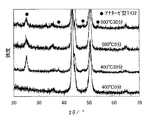
基材上に形成された薄膜は図1に示すX線回折パターンからアナターゼ型酸化チタンであることが確認された。 The thin film formed on the substrate was confirmed to be anatase-type titanium oxide from the X-ray diffraction pattern shown in FIG.
この薄膜について、次の試験を行った。薄膜の表面に蛍光ペンで線を引いて着色物質を付着させた後、20Wのブラックライトを光源として3時間照射したところ、視覚では蛍光ペンによる着色は認められなくなっており、薄膜が光触媒の機能を有していた。 The following test was done about this thin film. After drawing a line with a fluorescent pen on the surface of the thin film and attaching a colored substance, it was irradiated for 3 hours using a 20 W black light as a light source. Had.
又、薄膜の密着性を調べたところ、その密着性は極めてよく、粘着テープを付けても剥がれず、またプラスチックで削ろうとしても剥がれなかったが、金属で削ることにより剥離した。 Further, when the adhesion of the thin film was examined, the adhesion was very good, and it did not peel off even when an adhesive tape was applied, and it did not peel off even when trying to scrape with plastic, but it peeled off by scraping with metal.
(実施例2)
コーティングした基材を30分で500℃に昇温させた後自然冷却させ、電気炉から取り出したこと以外は、実施例1と同じ条件で酸化チタンの薄膜を形成させた。基材上に形成された薄膜はそのX線回折パターンからアナターゼ型酸化チタンであることが確認された。そして、蛍光ペンで着色させた薄膜にブラックライトを照射する試験においても、実施例1の場合と同様に、視覚では着色は認められなくなっており、薄膜が光触媒の機能を有していた。
(Example 2)
A titanium oxide thin film was formed under the same conditions as in Example 1 except that the coated substrate was heated to 500 ° C. in 30 minutes and then naturally cooled and removed from the electric furnace. The thin film formed on the substrate was confirmed to be anatase-type titanium oxide from its X-ray diffraction pattern. And also in the test which irradiates a black light to the thin film colored with the highlighter, like the case of Example 1, coloring is no longer recognized visually and the thin film had the function of the photocatalyst.
(比較例1)
コーティングした基材を30分で400℃に昇温させた後自然冷却させ、電気炉から取り出したこと以外は、実施例1と同じ条件で酸化チタンの薄膜を形成させた。しかし、図1に示すように、基材上に形成された薄膜のX線回折の結果には、アナターゼ型酸化チタンの回折パターンが現れなかった。又、蛍光ペンで着色させた薄膜にブラックライトを照射する試験においても、着色部の色は若干褪せたが、色が消えてはいなかった。このため、この試験においては、焼成処理が適切な条件で行われていなかったものと判断された。
(Comparative Example 1)
A titanium oxide thin film was formed under the same conditions as in Example 1 except that the coated substrate was heated to 400 ° C. in 30 minutes and then naturally cooled and taken out from the electric furnace. However, as shown in FIG. 1, the diffraction pattern of anatase-type titanium oxide did not appear in the result of X-ray diffraction of the thin film formed on the substrate. In the test of irradiating a thin film colored with a fluorescent pen with black light, the color of the colored portion was slightly faded, but the color did not disappear. For this reason, in this test, it was judged that the baking process was not performed on appropriate conditions.
(実施例3)
水溶性のチタン化合物としてチタンペルオキソクエン酸アンモニウム6mass%、ポリオキシエチレン(23)ラウリルエーテル3mass%を使用し、熱処理を1時間で400℃まで昇温し、400℃で5時間保持したこと以外は、実施例1と同じ条件で酸化チタンの薄膜を形成させた。基材上に形成された薄膜はそのX線回折パターンからアナターゼ型酸化チタンであることが確認された。そして、蛍光ペンで着色させた薄膜にブラックライトを照射する試験においても、実施例1の場合と同様に、視覚では着色は認められなくなっており、薄膜が光触媒の機能を有していた。
(Example 3)
Except that 6 mass% of titanium peroxocitrate and 3 mass% of polyoxyethylene (23) lauryl ether were used as water-soluble titanium compounds, heat treatment was raised to 400 ° C in 1 hour, and held at 400 ° C for 5 hours A titanium oxide thin film was formed under the same conditions as in Example 1. The thin film formed on the substrate was confirmed to be anatase-type titanium oxide from its X-ray diffraction pattern. And also in the test which irradiates a black light to the thin film colored with the highlighter, like the case of Example 1, coloring is no longer recognized visually and the thin film had the function of the photocatalyst.
(実施例4)
水溶性のチタン化合物としてチタンペルオキソクエン酸アンモニウムを使用し、その水溶液にノニオン界面活性剤としてポリオキシエチレン(23)ラウリルエーテルを加え、さらにポリエチレングリコール(平均分子量6000)を加えた水溶液を調製し、この溶液をコーティング液とした。コーティング液は、次のように、ポリエチレングリコールの添加量を変えた3種類のものを調製した。チタンペルオキソクエン酸アンモニウムが6mass%、上記ノニオン界面活性剤が3mass%で、ポリエチレングリコールを3mass%、10mass%、30mass%の3段階に変えた。
Example 4
Using ammonium peroxocitrate ammonium as the water-soluble titanium compound, adding polyoxyethylene (23) lauryl ether as a nonionic surfactant to the aqueous solution, and further preparing an aqueous solution in which polyethylene glycol (average molecular weight 6000) is added, This solution was used as a coating solution. Three types of coating solutions were prepared in which the addition amount of polyethylene glycol was changed as follows. The titanium peroxocitrate ammonium was 6 mass%, the nonionic surfactant was 3 mass%, and the polyethylene glycol was changed in three stages of 3 mass%, 10 mass%, and 30 mass%.
この3種類のコーティング液を、実施例3の場合と同じ条件で基材にコーティングし、110℃で乾燥した後、400℃で5時間焼成した。 These three types of coating solutions were coated on the substrate under the same conditions as in Example 3, dried at 110 ° C., and then baked at 400 ° C. for 5 hours.
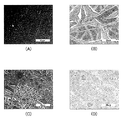
基材表面に形成された薄膜は、何れも実施例3のものと同様に、アナターゼ型酸化チタンであり、光触媒の機能を有していたが、膜の状態は、次のように実施例3のものとは異なっていた。図3に基材表面に形成された酸化チタン薄膜の電子顕微鏡写真を示す。この写真によれば、ポリエチレングリコールを添加しなかった(A)(実施例3の薄膜)では、基材のステンレス板の表面は見えず、均一に形成されているが、ポリエチレングリコールを添加した(B)〜(D)には筋状の模様や斑点状の模様が現れている。このように、ポリエチレングリコールを添加すれば、比表面積が大きく、例えば、光触媒の特性が向上した薄膜が形成される。 The thin film formed on the substrate surface was anatase-type titanium oxide as in Example 3, and had a photocatalytic function. The state of the film was as in Example 3 as follows. It was different. FIG. 3 shows an electron micrograph of the titanium oxide thin film formed on the substrate surface. According to this photograph, in the case where polyethylene glycol was not added (A) (thin film of Example 3), the surface of the stainless steel plate of the base material was not visible and formed uniformly, but polyethylene glycol was added ( In B) to (D), a streaky pattern or a spotted pattern appears. As described above, when polyethylene glycol is added, a thin film having a large specific surface area and improved photocatalytic characteristics is formed.
上記のような薄膜の模様は、基材に付着したコーティング液が乾燥処理され、焼成処理される過程で生成する。コーティングされた基材を乾燥処理する段階においては、コーティング液中の水分は揮散するが、ポリエチレングリコールは残留したまま流動性を失う。そして、乾燥処理された薄膜を焼成処理すると、ポリエチレングリコール又はポリエチレングリコールに由来する有機成分が分解して揮散して膜の体積が減少するので、その際に、膜の収縮が起り、筋状の模様や斑点状の模様が現れるものと思われる。 The thin film pattern as described above is generated in the process in which the coating liquid adhering to the substrate is dried and baked. In the stage of drying the coated substrate, the moisture in the coating solution is volatilized, but the polyethylene glycol loses its fluidity while remaining. When the dried thin film is fired, polyethylene glycol or an organic component derived from polyethylene glycol is decomposed and volatilized to reduce the volume of the film. It seems that patterns and spotted patterns appear.
なお、上記実施例4においては、薄膜に筋状の模様や斑点状の模様を形成させるために、コーティング液にポリエチレングリコールを添加しているが、その目的のために添加するものはポリエチレングリコールに限定されるものではなく、水溶液と混ざり、かつ高温において流動性を持たず分解するものであればよい。 In Example 4 above, polyethylene glycol was added to the coating liquid in order to form a streak pattern or a spotted pattern on the thin film, but what was added for that purpose was added to polyethylene glycol. It is not limited, and any material can be used as long as it is mixed with an aqueous solution and does not have fluidity at high temperatures and decomposes.
(実施例5)
この実施例においては、チタンを含む複合酸化物の薄膜を形成させた。まず、ペルオキソクエン酸チタンアンモニウムの水溶液に炭酸バリウムを加えて溶解させ、このチタンとバリウムを含む溶液に、ノニオン界面活性剤としてポリオキシエチレン(23)ラウリルエーテルを加え、コーティング液を調製した。コーティング液の組成はペルオキソクエン酸チタン錯体11mass%、炭酸バリウム7.9mass%、ポリオキシエチレン(23)ラウリルエーテル3mass%、クエン酸8mass%(炭酸バリウムを溶解しやすくするために過剰に加えた)であった。
(Example 5)
In this example, a thin film of composite oxide containing titanium was formed. First, barium carbonate was added to an aqueous solution of titanium ammonium peroxocitrate and dissolved, and polyoxyethylene (23) lauryl ether was added as a nonionic surfactant to the solution containing titanium and barium to prepare a coating solution. The composition of the coating liquid is 11 mass% peroxocitrate complex, 7.9 mass% barium carbonate, 3 mass% polyoxyethylene (23) lauryl ether, 8 mass% citric acid (added excessively to make barium carbonate easier to dissolve) there were.
このコーティング液を、2.5cm角で厚さ2mmのスライドグラス(ソーダライムガラス)の基材上にコーティングした。コーティングは汎用のスピンコーターを用い、3000rpmで行った。そして、コーティング液がコーティングされた基材を、恒温乾燥機により110℃で乾燥させた。次いで、その基材を電気炉に入れて60分で600℃に昇温させた後、600℃で60分間保持してから自然冷却させ電気炉から取り出した。 This coating solution was coated on a 2.5 cm square and 2 mm thick slide glass (soda lime glass) substrate. Coating was performed at 3000 rpm using a general-purpose spin coater. And the base material with which the coating liquid was coated was dried at 110 degreeC with the constant temperature dryer. Next, the substrate was put into an electric furnace and heated to 600 ° C. in 60 minutes, and then held at 600 ° C. for 60 minutes, and then naturally cooled and taken out from the electric furnace.
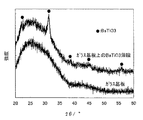
基材上に形成された薄膜は図2に示すX線回折パターンからBaTiO3 (チタン酸バリウム)であることが確認された。 The thin film formed on the substrate was confirmed to be BaTiO 3 (barium titanate) from the X-ray diffraction pattern shown in FIG.
なお、この実施例においては、水溶性チタン化合物の水溶液にバリウム化合物を加えた溶液をコーティングしてチタン酸バリウムの薄膜を形成させたが、水溶性チタン化合物の水溶液に加える化合物をバリウム化合物に代えて、ストロンチウムやビスマスなどの化合物にし、上記と同様の処理を行えば、チタン酸ストロンチウム(SrTiO3 )やチタン酸ビスマス(Bi4Ti3O12)などの薄膜を、バリウム化合物とストロンチウム化合物を同時に加えることでチタン酸バリウムストロンチウム(BaxSr1-xTiO3 (0<X<1))を生成させることができる。 In this example, a thin film of barium titanate was formed by coating a solution obtained by adding a barium compound to an aqueous solution of a water-soluble titanium compound, but the compound added to the aqueous solution of the water-soluble titanium compound was replaced with a barium compound. If a compound such as strontium or bismuth is used and the same treatment as above is performed, a thin film such as strontium titanate (SrTiO 3 ) or bismuth titanate (Bi 4 Ti 3 O 12 ) is formed simultaneously with the barium compound and the strontium compound. In addition, barium strontium titanate (Ba x Sr 1-x TiO 3 (0 <X <1)) can be generated.
Claims (4)
Priority Applications (1)
| Application Number | Priority Date | Filing Date | Title |
|---|---|---|---|
| JP2004034787A JP2005225701A (en) | 2004-02-12 | 2004-02-12 | Method for forming thin film of titanium-containing compound |
Applications Claiming Priority (1)
| Application Number | Priority Date | Filing Date | Title |
|---|---|---|---|
| JP2004034787A JP2005225701A (en) | 2004-02-12 | 2004-02-12 | Method for forming thin film of titanium-containing compound |
Publications (1)
| Publication Number | Publication Date |
|---|---|
| JP2005225701A true JP2005225701A (en) | 2005-08-25 |
Family
ID=35000710
Family Applications (1)
| Application Number | Title | Priority Date | Filing Date |
|---|---|---|---|
| JP2004034787A Pending JP2005225701A (en) | 2004-02-12 | 2004-02-12 | Method for forming thin film of titanium-containing compound |
Country Status (1)
| Country | Link |
|---|---|
| JP (1) | JP2005225701A (en) |
Cited By (2)
| Publication number | Priority date | Publication date | Assignee | Title |
|---|---|---|---|---|
| JP2015051907A (en) * | 2013-08-05 | 2015-03-19 | 日本フッソ工業株式会社 | Corrosion resistant parts for precision machinery |
| JP2025010051A (en) * | 2023-06-29 | 2025-01-20 | 三井金属鉱業株式会社 | Metal Compound Inclusions |
-
2004
- 2004-02-12 JP JP2004034787A patent/JP2005225701A/en active Pending
Cited By (3)
| Publication number | Priority date | Publication date | Assignee | Title |
|---|---|---|---|---|
| JP2015051907A (en) * | 2013-08-05 | 2015-03-19 | 日本フッソ工業株式会社 | Corrosion resistant parts for precision machinery |
| JP2025010051A (en) * | 2023-06-29 | 2025-01-20 | 三井金属鉱業株式会社 | Metal Compound Inclusions |
| JP7664464B2 (en) | 2023-06-29 | 2025-04-17 | 三井金属鉱業株式会社 | Metal Compound Inclusions |
Similar Documents
| Publication | Publication Date | Title |
|---|---|---|
| US6379811B2 (en) | Coating method of amorphous type titanium peroxide | |
| KR100696225B1 (en) | Titanium oxide sol, thin film and their preparation method | |
| JPH0141714B2 (en) | ||
| EA018759B1 (en) | Method for producing an enamelled steel substrate | |
| JPS6065712A (en) | Formation of silicon oxide coating film | |
| JPH01151238A (en) | Formation of patterned film | |
| KR101078948B1 (en) | Photocatalyst thin film, method for forming photocatalyst thin film, and photocatalyst thin film coated product | |
| JP7814030B2 (en) | Functional materials and articles | |
| CN101056716B (en) | Method for producing metal oxide film | |
| JP2005225701A (en) | Method for forming thin film of titanium-containing compound | |
| JP2009106905A (en) | Production method of titanium oxide photocatalyst thin film | |
| EP2593220A2 (en) | A doped material | |
| EP0940379A1 (en) | Formulations based on water soluble compounds of titanium and chromium combined with antimony or tungsten or mixtures thereof suitable for colouring ceramic manufactured articles and relevant high temperature colouring process | |
| DE19712918C1 (en) | Silicon-containing non-oxide ceramic body production | |
| US5202175A (en) | Thin films of metal phosphates and the method of their formation | |
| JP4839785B2 (en) | Method for producing metal oxide film | |
| JP3678227B2 (en) | Photocatalytic coating composition for metal substrate, photocatalytic metal material obtained using the same, and method for producing photocatalytic metal material | |
| JP2000070728A (en) | Photocatalytic materials irradiated with electron beam and their paints and coatings | |
| JP2001031483A (en) | Method for producing ceramic building material having photocatalytic function | |
| RU2159159C2 (en) | Method of production of piezoelectric film | |
| RU2049102C1 (en) | Priming for fluoroplastic coating | |
| KR20250119563A (en) | Antibacterial and antiviral coating containing niobium- and copper-doped titanium dioxide | |
| KR100478515B1 (en) | Method for fusion plating a tile with precious metal | |
| JPH0222148B2 (en) | ||
| JP2001011657A (en) | Stainless steel with titanium oxide layer surface |
Legal Events
| Date | Code | Title | Description |
|---|---|---|---|
| A977 | Report on retrieval |
Free format text: JAPANESE INTERMEDIATE CODE: A971007 Effective date: 20061110 |
|
| A131 | Notification of reasons for refusal |
Free format text: JAPANESE INTERMEDIATE CODE: A131 Effective date: 20061205 |
|
| A02 | Decision of refusal |
Effective date: 20070508 Free format text: JAPANESE INTERMEDIATE CODE: A02 |