JP2005290532A - Chemical treatment of Ni-plated steel sheet - Google Patents
Chemical treatment of Ni-plated steel sheet Download PDFInfo
- Publication number
- JP2005290532A JP2005290532A JP2004111738A JP2004111738A JP2005290532A JP 2005290532 A JP2005290532 A JP 2005290532A JP 2004111738 A JP2004111738 A JP 2004111738A JP 2004111738 A JP2004111738 A JP 2004111738A JP 2005290532 A JP2005290532 A JP 2005290532A
- Authority
- JP
- Japan
- Prior art keywords
- bath
- cro
- treatment
- steel sheet
- corrosion resistance
- Prior art date
- Legal status (The legal status is an assumption and is not a legal conclusion. Google has not performed a legal analysis and makes no representation as to the accuracy of the status listed.)
- Withdrawn
Links
Classifications
-
- C—CHEMISTRY; METALLURGY
- C23—COATING METALLIC MATERIAL; COATING MATERIAL WITH METALLIC MATERIAL; CHEMICAL SURFACE TREATMENT; DIFFUSION TREATMENT OF METALLIC MATERIAL; COATING BY VACUUM EVAPORATION, BY SPUTTERING, BY ION IMPLANTATION OR BY CHEMICAL VAPOUR DEPOSITION, IN GENERAL; INHIBITING CORROSION OF METALLIC MATERIAL OR INCRUSTATION IN GENERAL
- C23C—COATING METALLIC MATERIAL; COATING MATERIAL WITH METALLIC MATERIAL; SURFACE TREATMENT OF METALLIC MATERIAL BY DIFFUSION INTO THE SURFACE, BY CHEMICAL CONVERSION OR SUBSTITUTION; COATING BY VACUUM EVAPORATION, BY SPUTTERING, BY ION IMPLANTATION OR BY CHEMICAL VAPOUR DEPOSITION, IN GENERAL
- C23C28/00—Coating for obtaining at least two superposed coatings either by methods not provided for in a single one of groups C23C2/00 - C23C26/00 or by combinations of methods provided for in subclasses C23C and C25C or C25D
- C23C28/30—Coatings combining at least one metallic layer and at least one inorganic non-metallic layer
- C23C28/32—Coatings combining at least one metallic layer and at least one inorganic non-metallic layer including at least one pure metallic layer
- C23C28/322—Coatings combining at least one metallic layer and at least one inorganic non-metallic layer including at least one pure metallic layer only coatings of metal elements only
-
- C—CHEMISTRY; METALLURGY
- C23—COATING METALLIC MATERIAL; COATING MATERIAL WITH METALLIC MATERIAL; CHEMICAL SURFACE TREATMENT; DIFFUSION TREATMENT OF METALLIC MATERIAL; COATING BY VACUUM EVAPORATION, BY SPUTTERING, BY ION IMPLANTATION OR BY CHEMICAL VAPOUR DEPOSITION, IN GENERAL; INHIBITING CORROSION OF METALLIC MATERIAL OR INCRUSTATION IN GENERAL
- C23C—COATING METALLIC MATERIAL; COATING MATERIAL WITH METALLIC MATERIAL; SURFACE TREATMENT OF METALLIC MATERIAL BY DIFFUSION INTO THE SURFACE, BY CHEMICAL CONVERSION OR SUBSTITUTION; COATING BY VACUUM EVAPORATION, BY SPUTTERING, BY ION IMPLANTATION OR BY CHEMICAL VAPOUR DEPOSITION, IN GENERAL
- C23C28/00—Coating for obtaining at least two superposed coatings either by methods not provided for in a single one of groups C23C2/00 - C23C26/00 or by combinations of methods provided for in subclasses C23C and C25C or C25D
- C23C28/30—Coatings combining at least one metallic layer and at least one inorganic non-metallic layer
- C23C28/34—Coatings combining at least one metallic layer and at least one inorganic non-metallic layer including at least one inorganic non-metallic material layer, e.g. metal carbide, nitride, boride, silicide layer and their mixtures, enamels, phosphates and sulphates
- C23C28/345—Coatings combining at least one metallic layer and at least one inorganic non-metallic layer including at least one inorganic non-metallic material layer, e.g. metal carbide, nitride, boride, silicide layer and their mixtures, enamels, phosphates and sulphates with at least one oxide layer
-
- C—CHEMISTRY; METALLURGY
- C23—COATING METALLIC MATERIAL; COATING MATERIAL WITH METALLIC MATERIAL; CHEMICAL SURFACE TREATMENT; DIFFUSION TREATMENT OF METALLIC MATERIAL; COATING BY VACUUM EVAPORATION, BY SPUTTERING, BY ION IMPLANTATION OR BY CHEMICAL VAPOUR DEPOSITION, IN GENERAL; INHIBITING CORROSION OF METALLIC MATERIAL OR INCRUSTATION IN GENERAL
- C23C—COATING METALLIC MATERIAL; COATING MATERIAL WITH METALLIC MATERIAL; SURFACE TREATMENT OF METALLIC MATERIAL BY DIFFUSION INTO THE SURFACE, BY CHEMICAL CONVERSION OR SUBSTITUTION; COATING BY VACUUM EVAPORATION, BY SPUTTERING, BY ION IMPLANTATION OR BY CHEMICAL VAPOUR DEPOSITION, IN GENERAL
- C23C28/00—Coating for obtaining at least two superposed coatings either by methods not provided for in a single one of groups C23C2/00 - C23C26/00 or by combinations of methods provided for in subclasses C23C and C25C or C25D
- C23C28/30—Coatings combining at least one metallic layer and at least one inorganic non-metallic layer
- C23C28/34—Coatings combining at least one metallic layer and at least one inorganic non-metallic layer including at least one inorganic non-metallic material layer, e.g. metal carbide, nitride, boride, silicide layer and their mixtures, enamels, phosphates and sulphates
- C23C28/345—Coatings combining at least one metallic layer and at least one inorganic non-metallic layer including at least one inorganic non-metallic material layer, e.g. metal carbide, nitride, boride, silicide layer and their mixtures, enamels, phosphates and sulphates with at least one oxide layer
- C23C28/3455—Coatings combining at least one metallic layer and at least one inorganic non-metallic layer including at least one inorganic non-metallic material layer, e.g. metal carbide, nitride, boride, silicide layer and their mixtures, enamels, phosphates and sulphates with at least one oxide layer with a refractory ceramic layer, e.g. refractory metal oxide, ZrO2, rare earth oxides or a thermal barrier system comprising at least one refractory oxide layer
Landscapes
- Chemical & Material Sciences (AREA)
- Inorganic Chemistry (AREA)
- Engineering & Computer Science (AREA)
- Chemical Kinetics & Catalysis (AREA)
- Materials Engineering (AREA)
- Mechanical Engineering (AREA)
- Metallurgy (AREA)
- Organic Chemistry (AREA)
- Ceramic Engineering (AREA)
- Other Surface Treatments For Metallic Materials (AREA)
Abstract
【課題】 Niめっき鋼板に塗料密着性、耐食性及び溶接性に優れた化学処理被膜を形成させる方法を提供する。
【解決手段】 300〜2000mg/m2 のNiめっきを施した鋼板上を、CrO3 及びCrO3 との質量比で1/50〜1/300のH2 SO4 を含む浴温45℃未満の処理浴中で30A/dm2 以上の陰極電解に引き続いてCrO3 を含んだ浴温50℃以上の処理浴中で浸漬処理を行い、かつ、金属クロム付着量が30〜200mg/m2 、オキサイドクロム付着量が1〜15mg/m2 であることを特徴とする耐食性、塗料密着性、溶接性に優れたNiめっき鋼板の化学処理法。陰極電解処理浴中におけるCrO3 の濃度が100〜250g/lとすること、浸漬処理浴中におけるCrO3 の濃度が10〜200g/lとすることが望ましい。
【選択図】 なし PROBLEM TO BE SOLVED: To provide a method for forming a chemically treated film excellent in paint adhesion, corrosion resistance and weldability on a Ni-plated steel sheet.
SOLUTION: On a steel plate plated with 300 to 2000 mg / m 2 of Ni, a bath temperature containing H 2 SO 4 of 1/50 to 1/300 by mass ratio with CrO 3 and CrO 3 is less than 45 ° C. Subsequent to cathodic electrolysis of 30 A / dm 2 or more in the treatment bath, immersion treatment is performed in a treatment bath containing CrO 3 and having a bath temperature of 50 ° C. or more, and the amount of chromium metal deposition is 30 to 200 mg / m 2 . corrosion resistance of chromium coating weight is characterized in that it is a 1-15 mg / m 2, coating adherence, chemical treatment method superior Ni-plated steel sheet weldability. It is desirable that the concentration of CrO 3 in the cathode electrolytic treatment bath is 100 to 250 g / l, and the concentration of CrO 3 in the immersion bath is 10 to 200 g / l.
[Selection figure] None
Description
本発明は、Niめっき鋼板に塗料密着性及び耐食性及び溶接性に優れた化学処理被膜を形成させる方法に関するものである。 The present invention relates to a method for forming a chemically treated coating having excellent paint adhesion, corrosion resistance and weldability on a Ni-plated steel sheet.
従来、ニッケルめっき鋼板は、缶詰、乾電池など種々の金属容器用の材料として広く使用されているが、缶内外に塗装を施して耐食性を確保するという使われ方が増加している。この場合、塗膜密着性の良否が耐食性を左右する重要な因子となる。ニッケルめっき鋼板の塗膜密着性を高める方法として硫酸、フッ素化合物などを助剤として含有する無水クロム酸系処理浴中で陰極電解することにより、金属クロム(以後Me−Crという)と水和酸化クロム(以後Ox−Crという)からなる被膜を形成させる方法や以上の処理後高温洗浄する方法{特開昭57−35697号公報(特許文献1)、や{特開昭57−35698号公報(特許文献2)等}が知られているが、単に無水クロム酸系浴中で陰極電解処理を行っただけでは下記のような問題点がある。すなわち、塗料密着性向上を得るのに必要なMe−Cr量を生成させた場合、同時に生成するOx−Cr量が多くなり過ぎる傾向にあり、シーム溶接性を損なうとともに、Ox−Cr生成量の不均一による外観ムラが生じやすい。 Conventionally, nickel-plated steel sheets have been widely used as materials for various metal containers such as cans and dry batteries. However, the usage of coating the inside and outside of the can to ensure corrosion resistance is increasing. In this case, the quality of the coating film adhesion is an important factor affecting the corrosion resistance. Hydrating oxidation with metallic chromium (hereinafter referred to as Me-Cr) by cathodic electrolysis in a chromic anhydride-based treatment bath containing sulfuric acid, fluorine compounds and the like as a method for improving the coating film adhesion of nickel-plated steel sheet A method of forming a film made of chromium (hereinafter referred to as Ox-Cr) or a method of performing high-temperature cleaning after the above treatment {Japanese Patent Laid-Open No. 57-35697 (Patent Document 1), or {Japanese Patent Laid-Open No. 57-35698 ( Patent Document 2) etc. are known. However, simply performing the cathodic electrolysis treatment in a chromic anhydride bath has the following problems. That is, when the amount of Me-Cr necessary for improving paint adhesion is generated, the amount of Ox-Cr generated at the same time tends to be excessively increased, the seam weldability is impaired, and the amount of Ox-Cr generated is reduced. Appearance unevenness easily occurs due to non-uniformity.
そこで、発明者らは鋭意検討した結果、請求項記載の無水クロム酸系浴での陰極電解処理浴温度を低下するほどMe−Cr、Ox−Crの被覆性は共に良好で、また、Ox−Cr量は増加するものの、このとき生成したOx−Cr被膜中上層のオール型Ox−Crは硫酸イオンの共析量が多いため溶解性の高く、電解した後高温の無水クロム酸浴に浸漬処理することで容易に溶解することができ、また、このとき残留したOx−Crはオキソ化度の高い密着性に優れた被膜であることを明らかにした。 Accordingly, as a result of intensive studies, the inventors have found that the coverage of Me—Cr and Ox—Cr is so good that the cathode electrolytic treatment bath temperature in the chromic anhydride bath described in the claims is lowered, and Ox— Although the amount of Cr increases, the all-type Ox-Cr in the upper layer of the Ox-Cr coating produced at this time has a high solubility due to the large amount of eutectoid of sulfate ions, so that it is immersed in a high-temperature chromic anhydride bath after electrolysis. It was clarified that the Ox-Cr remaining at this time was a film having a high degree of oxonation and excellent adhesion.
すなわち、本発明は所定の浴組成、低温浴での高電流密度による電解によるMe−Crの被覆性向上及び高温浴での浸漬処理により効率的なOx−Crの低減により、半田性、溶接性、外観均一性の向上、連続製造ラインでの生産性向上を図り、さらに塗料密着性に対しても著しい効果をもたらすニッケルめっき鋼板の化学処理法を提供することを目的としている。 That is, the present invention improves solderability and weldability by improving the coverage of Me-Cr by electrolysis due to high current density in a predetermined bath composition and low temperature bath and reducing Ox-Cr efficiently by immersion treatment in a high temperature bath. The object of the present invention is to provide a chemical treatment method for a nickel-plated steel sheet that improves the uniformity of appearance, improves the productivity in a continuous production line, and also has a remarkable effect on paint adhesion.
本発明の要旨は次の通りである。
(1)300〜2000mg/m2 のNiめっきを施した鋼板上を、CrO3 及びCrO3 との質量比で1/50〜1/300のH2 SO4 を含む浴温45℃未満の処理浴中で30A/dm2 以上の陰極電解に引き続いてCrO3 を含んだ浴温50℃以上の処理浴中で浸漬処理を行い、かつ、金属クロム付着量が30〜200mg/m2 、オキサイドクロム付着量が1〜15mg/m2 であることを特徴とする耐食性、塗料密着性、溶接性に優れたNi−Crめっき鋼板の化学処理法。
The gist of the present invention is as follows.
(1) Treatment with a bath temperature of less than 45 ° C. containing H 2 SO 4 of 1/50 to 1/300 by mass ratio of CrO 3 and CrO 3 on a steel plate subjected to 300 to 2000 mg / m 2 of Ni plating. Subsequent to cathodic electrolysis of 30 A / dm 2 or more in the bath, immersion treatment is performed in a treatment bath containing CrO 3 and having a bath temperature of 50 ° C. or more, and the amount of metal chromium deposited is 30 to 200 mg / m 2 . A chemical treatment method for a Ni—Cr plated steel sheet excellent in corrosion resistance, paint adhesion, and weldability, wherein the adhesion amount is 1 to 15 mg / m 2 .
(2)陰極電解処理浴中におけるCrO3 の濃度が100〜250g/lであることを特徴とする前記(1)に記載の耐食性、塗料密着性、溶接性に優れたNi−Crめっき鋼板の化学処理法。
(3)浸漬処理浴中におけるCrO3 の濃度が10〜200g/lであることを特徴とする前記(1)〜(2)に記載の耐食性、塗料密着性、溶接性に優れたNi−Crめっき鋼板の化学処理法にある。
(2) The concentration of CrO 3 in the cathodic electrolytic treatment bath is 100 to 250 g / l. The Ni—Cr plated steel sheet having excellent corrosion resistance, paint adhesion, and weldability as described in (1) above Chemical processing method.
(3) Ni—Cr excellent in corrosion resistance, paint adhesion and weldability according to (1) to (2) above, wherein the concentration of CrO 3 in the immersion bath is 10 to 200 g / l. It is in the chemical treatment method of plated steel sheets.
本発明により化学処理されたNiめっき鋼板は、優れたシーム溶接性、塗料密着性および耐食性を得ることが出来る。 The Ni-plated steel sheet chemically treated according to the present invention can obtain excellent seam weldability, paint adhesion and corrosion resistance.
以下、本発明をさらに詳細に説明する。
Niめっきは、耐食性とシーム溶接性確保向上のために必要であり、鋼板表面を十分に被覆できる付着量は300mg/m2 であり十分な耐食性確保のために300mg/m2 以上の付着量が必要である。Ni付着量が増加すると共に耐食性・シーム溶接性も向上するが2000mg/m2 を超えると、その効果も飽和し不経済であるため上限を2000mg/m2 とする。Niめっきを施した後に、請求項記載の低温無水クロム酸系浴中で陰極電解処理及び高温無水クロム酸系浴中への浸漬処理によりMe−CrとOx−Crからなる被膜を形成させるがその付着量はそれぞれ30〜200mg/m2 及び1〜15mg/m2 (いづれも片面当たり)が必要である。
Hereinafter, the present invention will be described in more detail.
Ni plating is necessary to improve the corrosion resistance and seam weldability, and the amount of adhesion that can sufficiently cover the surface of the steel sheet is 300 mg / m 2 , and the amount of adhesion of 300 mg / m 2 or more is necessary to ensure sufficient corrosion resistance. is necessary. As the amount of deposited Ni increases, the corrosion resistance and seam weldability also improve. However, if it exceeds 2000 mg / m 2 , the effect is saturated and uneconomical, so the upper limit is set to 2000 mg / m 2 . After Ni plating, a film made of Me-Cr and Ox-Cr is formed by cathodic electrolysis in a low-temperature chromic anhydride-based bath according to claim and immersion treatment in a high-temperature chromic anhydride-based bath. Adhesion amounts of 30 to 200 mg / m 2 and 1 to 15 mg / m 2 (both per side) are necessary.
Me−Cr付着量が30mg/m2 未満だとNi上を完全に被覆することができないためNiとMe−Crで局部電池を形成し耐食性が悪化する。また、Me−Cr付着量の増加と共に耐食性は向上するが200mg/m2 を超えると効果は飽和し不経済であるため上限値を200mg/m2 とする。また、Ox−Cr付着量は1mg/m2 未満では塗料密着性が悪化するし15mg/m2 を超えると表面抵抗値が増加するためシーム溶接性が悪化する。よって、Ox−Cr付着量は下限を1mg/m2 、上限を15mg/m2 とする。 If the amount of Me—Cr deposited is less than 30 mg / m 2 , Ni cannot be completely covered, so a local battery is formed with Ni and Me—Cr, and the corrosion resistance deteriorates. Moreover, although corrosion resistance improves with the increase in the amount of Me-Cr attached, if 200 mg / m 2 is exceeded, the effect is saturated and uneconomical, so the upper limit is set to 200 mg / m 2 . Further, when the Ox-Cr adhesion amount is less than 1 mg / m 2 , the paint adhesion deteriorates, and when it exceeds 15 mg / m 2 , the surface resistance value increases, and the seam weldability deteriorates. Therefore, the lower limit of the Ox—Cr adhesion amount is 1 mg / m 2 and the upper limit is 15 mg / m 2 .
この発明の特に重要なポイントはクロム酸系浴中で30A/dm2 以上で陰極電解させる浴を低温化し、かつ高温浴での浸漬処理を施すことである。陰極電解処理浴の温度低下によりMe−Crの均一被覆性が向上する。また、Ox−Crは上層にオール型化合物、下層にオキソ型化合物の2層構造を呈しており、電解処理浴の低温下によりオール型及びオキソ型Ox−Crの析出量は増加するが、この際、上層のオール型Ox−Cr中への硫酸イオンの共析量が増加し、次の浸漬処理工程でのオール型Ox−Crの溶解性が増すことを明らかにした。そのため電解処理浴の浴温は45℃未満が必要である。電解処理浴温の下限については特に設けないがあまり低すぎると強力な冷却器の設置が必要となり不経済であるため、10℃を下限とするのが好ましい。 A particularly important point of the present invention is to lower the temperature of the cathode electrolyzed in a chromic acid bath at 30 A / dm 2 or more and to perform an immersion treatment in the high temperature bath. The uniform coverage of Me—Cr is improved by lowering the temperature of the cathode electrolytic treatment bath. Ox-Cr has a two-layer structure of an all-type compound in the upper layer and an oxo-type compound in the lower layer, and the precipitation amount of all-type and oxo-type Ox-Cr increases with the low temperature of the electrolytic treatment bath. At this time, it was clarified that the amount of sulfate ions co-deposited in the upper all-type Ox-Cr increased, and the solubility of the all-type Ox-Cr increased in the next immersion treatment step. Therefore, the bath temperature of the electrolytic treatment bath needs to be less than 45 ° C. The lower limit of the electrolytic treatment bath temperature is not particularly provided, but if it is too low, a powerful cooler needs to be installed, which is uneconomical.
さらに、Niめっき上に均一なMe−Cr被膜を形成させるためには、30A/dm2 以上の電解が必要である。また、電解処理浴中に含まれるCrO3 濃度を100g/l以上にするのが望ましく、あまり高すぎるとOx−Crの生成が不均一になり、塗料・フィルム密着性の低下が生じるため250g/lを上限とするのが望ましい。 Furthermore, in order to form a uniform Me—Cr film on the Ni plating, electrolysis of 30 A / dm 2 or more is required. In addition, it is desirable that the concentration of CrO 3 contained in the electrolytic treatment bath is 100 g / l or more. If it is too high, the generation of Ox—Cr becomes non-uniform, resulting in a decrease in paint / film adhesion. It is desirable to set l as the upper limit.
処理浴への硫酸添加はMe−Crの生成には不可欠であり、無水クロム酸に対する質量比(以下硫酸濃度比という)1/300〜1/50とする必要がある。硫酸濃度比は、高すぎても低すぎてもMe−Cr電析効率が著しく低下するので、硫酸濃度比の下限は1/300、上限は1/50とする。
なお、上記処理浴はMe−Cr析出助剤として、硫酸以外にケイフッ化ナトリウム、ホウフッ化ナトリウム、フッ化アンモニウムなどのフッ素化合物を含有してもかまわない。また、処理浴中への三価のクロムイオンの購入量が0.1〜5g/lではクロメート被膜の均一化に悪影響を及ぼさないため、混入してもかまわない。
The addition of sulfuric acid to the treatment bath is indispensable for the production of Me—Cr, and it is necessary to make the mass ratio to chromic anhydride (hereinafter referred to as sulfuric acid concentration ratio) 1/300 to 1/50. If the sulfuric acid concentration ratio is too high or too low, the Me—Cr electrodeposition efficiency is remarkably reduced, so the lower limit of the sulfuric acid concentration ratio is 1/300 and the upper limit is 1/50.
In addition, the said treatment bath may contain fluorine compounds, such as sodium silicofluoride, sodium borofluoride, and ammonium fluoride other than a sulfuric acid, as a Me-Cr precipitation adjuvant. Further, if the purchase amount of trivalent chromium ions in the treatment bath is 0.1 to 5 g / l, it does not adversely affect the homogenization of the chromate film, so it may be mixed.
上記処理条件での陰極電解処理に引き続いて、この陰極電解処理で過剰に生成したオール型Ox−Cr量の低減及び高オキソ化度のOx−Crの形成による塗膜密着性の向上を目的とした無水クロム酸水溶液浸漬処理を行う。オール型Ox−Crの溶解能力は浴温の上昇と共に増加し、効率的に溶解させるためには50℃以上の浴温が必要である。浴温の上限は特に規定しないが、あまり高温にすると浴のヒューム回収が大がかりとなり不経済であるため、80℃を上限とするのが望ましい。 Following the cathodic electrolysis under the above treatment conditions, the purpose is to reduce the amount of all-type Ox-Cr produced excessively by this cathodic electrolysis and to improve the adhesion of the coating film by forming Ox-Cr having a high degree of oxoation. The obtained chromic anhydride aqueous solution immersion treatment is performed. The dissolution capacity of all-type Ox-Cr increases with an increase in bath temperature, and a bath temperature of 50 ° C. or higher is necessary for efficient dissolution. The upper limit of the bath temperature is not particularly defined, but if the temperature is too high, the recovery of the bath fume becomes large and uneconomical, so it is desirable to set the upper limit at 80 ° C.
また、無水クロム酸濃度が10g/l未満ではオール型Ox−Crを溶解する能力が著しく低下するため、これ以上の濃度が望ましく、200g/l超の高濃度とするとエッチング作用が強すぎてオキソ型Ox−Crも溶解されるため塗料密着性、耐食性の低下につながることがある。そこで無水クロム酸濃度の上限を200g/lとするのが望ましい。好ましくは50g/l以下とするのが望ましい。
なお、上記処理浴中には無水クロム酸以外に三価のクロム酸イオン、硫酸、ケイフッ化ナトリウム、ホウフッ化ナトリウム、フッ化アンモニウムなどのフッ素化合物等を含有してもかまわない。
Further, if the chromic anhydride concentration is less than 10 g / l, the ability to dissolve all-type Ox-Cr is remarkably reduced. Therefore, a concentration higher than this is desirable, and if it is higher than 200 g / l, the etching action is too strong and oxo Since the type Ox-Cr is also dissolved, it may lead to a decrease in paint adhesion and corrosion resistance. Therefore, it is desirable to set the upper limit of the chromic anhydride concentration to 200 g / l. Preferably it is 50 g / l or less.
In addition to the anhydrous chromic acid, the treatment bath may contain a trivalent chromate ion, a fluorine compound such as sulfuric acid, sodium silicofluoride, sodium borofluoride, and ammonium fluoride.
以下、本発明の実施例について説明する。
冷間圧延、焼鈍及び調質圧延を施した鋼板に、脱脂・酸洗したのちNiめっきを施した素材に化学処理を施し、外観均一性、シーム溶接性、塗膜密着性、耐食性への影響を調べた。
各処理材について、以下に示す(A)〜(D)の各項目について実施し、その性能を評価した。
(A)外観均一性
目視により下記の通り評価した。
○:色調ムラ無し
×:色調ムラ有り
Examples of the present invention will be described below.
Steel sheets that have been cold-rolled, annealed, and temper-rolled are subjected to chemical treatment on the Ni-plated material after degreasing, pickling, and effects on appearance uniformity, seam weldability, coating film adhesion, and corrosion resistance I investigated.
About each processing material, it implemented about each item of (A)-(D) shown below, and evaluated the performance.
(A) Appearance uniformity Visually evaluated as follows.
○: Color tone unevenness ×: Color tone unevenness
(B)シーム溶接性
ラップ代0.5mm,加圧力45kgf、溶接ワイヤースピード100m/minの条件で、電流を変更して溶接を実施し十分な溶接強度が得られる最小電流値とチリなどの溶接欠陥が目立ち始める最大電流値からなる適正電流範囲の広さから総合的に判断し、3段階、(◎:非常に広い、○:実用上問題なし、×:狭い)で評価した。
(B) Seam weldability Welding such as dust and the minimum current value at which sufficient welding strength can be obtained by changing the current under the conditions of lap allowance of 0.5 mm, pressure of 45 kgf, and welding wire speed of 100 m / min. Judging comprehensively from the width of the appropriate current range consisting of the maximum current value at which defects begin to be noticeable, the evaluation was made in three stages ((: very wide, ○: no practical problem, ×: narrow).
(C)塗料密着性
試験片の缶内面側に相当する面にエポキシフェノール系の塗料を55mg/dm2 塗布し、さらに缶外面に相当する面にクリヤーラッカーを40mg/dm2 塗布し、290℃まで15secの焼き付け条件で乾燥硬化した。引き続き、各々の面に1mm間隔でスクラッチを入れ、100個の碁盤目を作製し、速やかにテープ剥離し、その剥離状況を観察し、3段階、(◎:剥離無し、○:1〜4個剥離、×:5個以上剥離)で塗料密着性を評価した。
(C) Paint adhesion The surface of the test piece corresponding to the inner surface of the can was coated with 55 mg / dm 2 of epoxyphenol-based paint, and the surface corresponding to the outer surface of the can was coated with 40 mg / dm 2 of clear lacquer. Until it was dried and cured under a baking condition of 15 sec. Subsequently, scratches are placed on each surface at intervals of 1 mm, 100 grids are produced, the tape is peeled off quickly, and the peeled state is observed in three stages (◎: no peeling, ○: 1-4 pieces) The paint adhesion was evaluated by peeling, x: peeling 5 or more.
(D)UCC(アンダーカッティングコロージョン)評価テスト
試験片の缶内面に相当する面の耐食性を評価するため、缶内面側に相当する面に厚さ15μmのPET(ポリエチレンテレフタレート)系フィルムをラミネートした。その後地鉄に達するまでクロスカットを入れ、1.5%クエン酸−1.5%食塩混合液からなる試験液中に大気開放下55℃×4日間浸漬した。試験終了後、速やかにスクラッチ部および平面部をテープで剥離して、スクラッチ部近傍の腐食状況、スクラッチ部のピッティング状況および平面部のフィルム剥離状況を3段階、(◎:剥離が無く腐食も認められない、○:僅かな剥離があるが腐食は認められない、×:大部分で剥離し激しい腐食が認められる)で総合的に評価した。
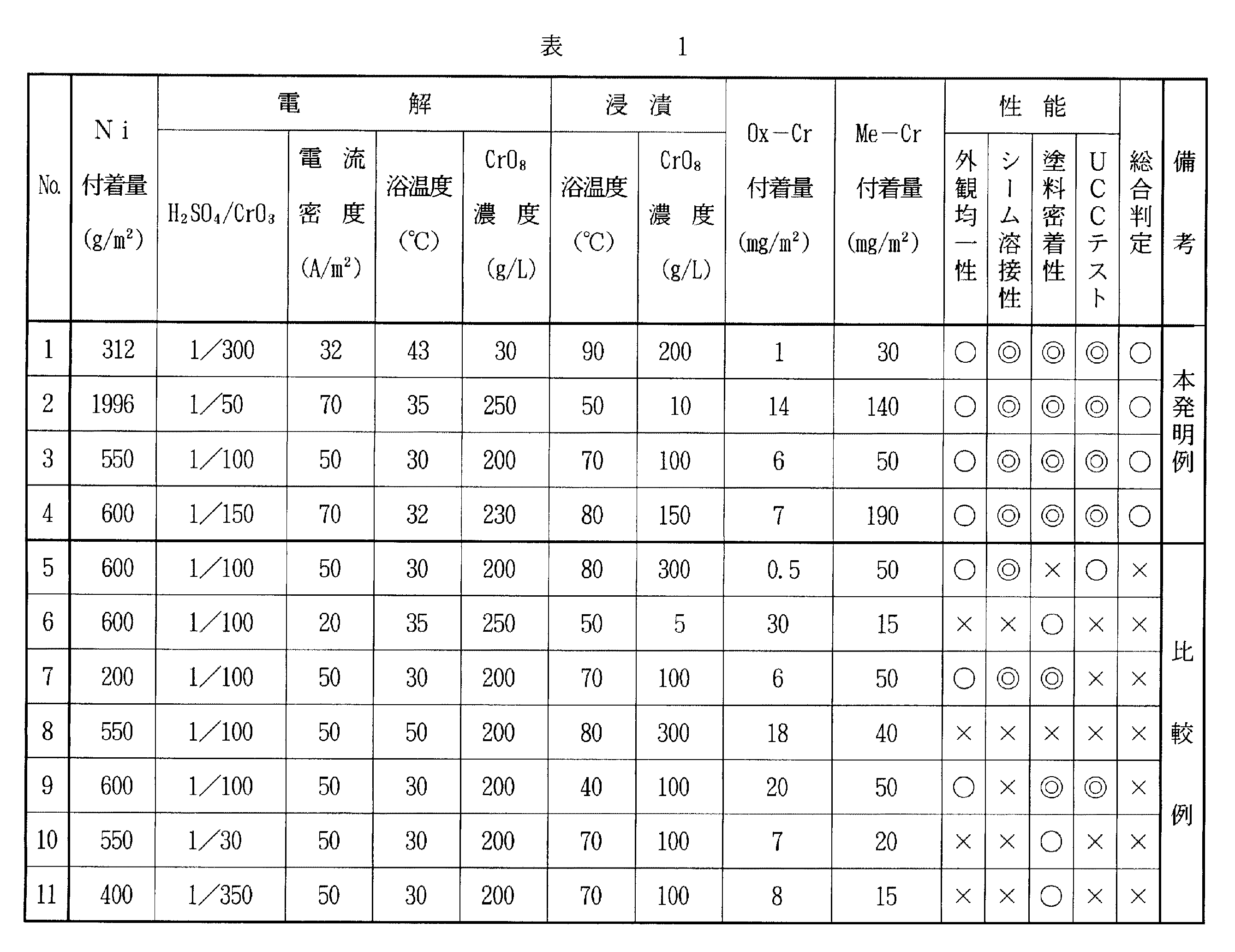
表1に示すように、本発明により化学処理されたNiめっき鋼板は、優れたシーム溶接性、塗料密着性および耐食性を有することが明らかになった。
(D) UCC (Under Cutting Corrosion) Evaluation Test In order to evaluate the corrosion resistance of the surface corresponding to the inner surface of the can of the test piece, a PET (polyethylene terephthalate) film having a thickness of 15 μm was laminated on the surface corresponding to the inner surface of the can. After that, a cross cut was put in until it reached the ground iron, and it was immersed in a test solution composed of a 1.5% citric acid-1.5% sodium chloride mixture at 55 ° C. for 4 days under open air. Immediately after the test, the scratch part and the flat part are peeled off with tape, and the corrosion situation near the scratch part, the pitting situation of the scratch part, and the film peeling situation of the flat part are classified into three stages (◎: no peeling and corrosion) Not recognized, ○: There was slight peeling but no corrosion was observed, and X: Most peeled and severe corrosion was observed).
As shown in Table 1, it was revealed that the Ni-plated steel sheet chemically treated according to the present invention has excellent seam weldability, paint adhesion, and corrosion resistance.
特許出願人 新日本製鐡株式会社
代理人 弁理士 椎 名 彊 他1
Patent applicant: Nippon Steel Corporation
Attorney Attorney Shiina and others 1
Claims (3)
Priority Applications (1)
| Application Number | Priority Date | Filing Date | Title |
|---|---|---|---|
| JP2004111738A JP2005290532A (en) | 2004-04-06 | 2004-04-06 | Chemical treatment of Ni-plated steel sheet |
Applications Claiming Priority (1)
| Application Number | Priority Date | Filing Date | Title |
|---|---|---|---|
| JP2004111738A JP2005290532A (en) | 2004-04-06 | 2004-04-06 | Chemical treatment of Ni-plated steel sheet |
Publications (1)
| Publication Number | Publication Date |
|---|---|
| JP2005290532A true JP2005290532A (en) | 2005-10-20 |
Family
ID=35323794
Family Applications (1)
| Application Number | Title | Priority Date | Filing Date |
|---|---|---|---|
| JP2004111738A Withdrawn JP2005290532A (en) | 2004-04-06 | 2004-04-06 | Chemical treatment of Ni-plated steel sheet |
Country Status (1)
| Country | Link |
|---|---|
| JP (1) | JP2005290532A (en) |
Cited By (1)
| Publication number | Priority date | Publication date | Assignee | Title |
|---|---|---|---|---|
| JP2008156731A (en) * | 2006-12-26 | 2008-07-10 | Nippon Steel Corp | Chemical conversion treatment method for tin-plated steel sheet |
-
2004
- 2004-04-06 JP JP2004111738A patent/JP2005290532A/en not_active Withdrawn
Cited By (1)
| Publication number | Priority date | Publication date | Assignee | Title |
|---|---|---|---|---|
| JP2008156731A (en) * | 2006-12-26 | 2008-07-10 | Nippon Steel Corp | Chemical conversion treatment method for tin-plated steel sheet |
Similar Documents
| Publication | Publication Date | Title |
|---|---|---|
| JP2015520794A (en) | Coated substrate for packaging applications and method for producing coated substrate | |
| WO2002013289A1 (en) | Surface-treated steel plate for battery case and battery case | |
| JP2005330502A (en) | Chemical treatment of Ni-plated steel sheet | |
| JP3670857B2 (en) | Chemical treatment of nickel-plated steel sheet | |
| JP2005290532A (en) | Chemical treatment of Ni-plated steel sheet | |
| JPS6144158B2 (en) | ||
| JP3670845B2 (en) | Chemical treatment of nickel-plated steel sheet | |
| JP3895873B2 (en) | Manufacturing method for surface-treated steel sheets with excellent high-speed seam weldability, adhesion, and corrosion resistance | |
| JP4280181B2 (en) | Steel plate for welding cans with excellent weldability, adhesion and corrosion resistance | |
| JP3643473B2 (en) | Surface-treated steel sheet with excellent high-speed seam weldability, adhesion, and corrosion resistance, and its manufacturing method | |
| JP3670844B2 (en) | Chemical treatment of tin-plated steel sheet | |
| JP2007254848A (en) | Method for producing multilayer Ni diffusion plated steel sheet | |
| JPH05156416A (en) | Hot-dip galvanizing method for Si-containing steel sheet | |
| JP4221874B2 (en) | Plated steel sheet for welding cans | |
| JPH05239605A (en) | Hot dip galvanizing method for high strength steel | |
| JPH05171389A (en) | Method for producing hot dip galvanized steel sheet | |
| JP2000008194A (en) | Chemical treatment of tin-based plated steel sheet | |
| JP4423739B2 (en) | Plated steel sheet for welding cans | |
| JP2000080498A (en) | Chemical treatment of tin-based plated steel sheet | |
| JP3093917B2 (en) | Laminated steel sheet and its original sheet | |
| JP3745457B2 (en) | Manufacturing method of steel sheet for welding can excellent in weldability, corrosion resistance, appearance and adhesion | |
| JP3822704B2 (en) | Manufacturing method of steel sheet for welding can excellent in weldability, corrosion resistance, appearance and adhesion | |
| JP2005213580A (en) | Method for producing tin-plated steel sheet | |
| JP2610979B2 (en) | Method for producing electrolytic chromated steel sheet having excellent corrosion resistance, surface color and weldability | |
| JPS58120771A (en) | Manufacture of alloyed galvanized steel plate |
Legal Events
| Date | Code | Title | Description |
|---|---|---|---|
| A300 | Withdrawal of application because of no request for examination |
Free format text: JAPANESE INTERMEDIATE CODE: A300 Effective date: 20070703 |