JP2005296595A - Production method and deodorization method of microbial deodorizer - Google Patents
Production method and deodorization method of microbial deodorizer Download PDFInfo
- Publication number
- JP2005296595A JP2005296595A JP2004148420A JP2004148420A JP2005296595A JP 2005296595 A JP2005296595 A JP 2005296595A JP 2004148420 A JP2004148420 A JP 2004148420A JP 2004148420 A JP2004148420 A JP 2004148420A JP 2005296595 A JP2005296595 A JP 2005296595A
- Authority
- JP
- Japan
- Prior art keywords
- bad
- bacillus
- compost
- excreta
- bacteria
- Prior art date
- Legal status (The legal status is an assumption and is not a legal conclusion. Google has not performed a legal analysis and makes no representation as to the accuracy of the status listed.)
- Pending
Links
- 238000000034 method Methods 0.000 title claims abstract description 8
- 238000004519 manufacturing process Methods 0.000 title claims abstract 3
- 238000004332 deodorization Methods 0.000 title abstract description 5
- 230000000813 microbial effect Effects 0.000 title abstract description 5
- 210000003608 fece Anatomy 0.000 claims abstract description 20
- 239000002361 compost Substances 0.000 claims abstract description 11
- 241000193830 Bacillus <bacterium> Species 0.000 claims abstract description 9
- 239000010802 sludge Substances 0.000 claims abstract description 9
- 239000010871 livestock manure Substances 0.000 claims description 12
- 230000001877 deodorizing effect Effects 0.000 claims description 9
- 244000005700 microbiome Species 0.000 claims description 9
- 238000002360 preparation method Methods 0.000 claims description 6
- 241001037822 Bacillus bacterium Species 0.000 claims description 4
- 239000003112 inhibitor Substances 0.000 claims 1
- 230000001629 suppression Effects 0.000 claims 1
- 241000894006 Bacteria Species 0.000 abstract description 16
- 230000000694 effects Effects 0.000 abstract description 7
- 241001134775 Lysinibacillus fusiformis Species 0.000 abstract description 4
- 241001465754 Metazoa Species 0.000 abstract description 4
- 230000009965 odorless effect Effects 0.000 abstract description 4
- 239000002781 deodorant agent Substances 0.000 abstract description 2
- 235000019645 odor Nutrition 0.000 description 14
- 239000000126 substance Substances 0.000 description 11
- XLYOFNOQVPJJNP-UHFFFAOYSA-N water Substances O XLYOFNOQVPJJNP-UHFFFAOYSA-N 0.000 description 8
- 241000233866 Fungi Species 0.000 description 6
- OKTJSMMVPCPJKN-UHFFFAOYSA-N Carbon Chemical compound [C] OKTJSMMVPCPJKN-UHFFFAOYSA-N 0.000 description 4
- 241000287828 Gallus gallus Species 0.000 description 4
- VYPSYNLAJGMNEJ-UHFFFAOYSA-N Silicium dioxide Chemical compound O=[Si]=O VYPSYNLAJGMNEJ-UHFFFAOYSA-N 0.000 description 4
- -1 aliphatic aldehyde Chemical class 0.000 description 4
- 235000013330 chicken meat Nutrition 0.000 description 4
- 230000000855 fungicidal effect Effects 0.000 description 4
- 239000000417 fungicide Substances 0.000 description 4
- 239000000654 additive Substances 0.000 description 3
- 230000000996 additive effect Effects 0.000 description 3
- 239000003795 chemical substances by application Substances 0.000 description 3
- 108020004465 16S ribosomal RNA Proteins 0.000 description 2
- QGZKDVFQNNGYKY-UHFFFAOYSA-N Ammonia Chemical compound N QGZKDVFQNNGYKY-UHFFFAOYSA-N 0.000 description 2
- RWSOTUBLDIXVET-UHFFFAOYSA-N Dihydrogen sulfide Chemical class S RWSOTUBLDIXVET-UHFFFAOYSA-N 0.000 description 2
- WQZGKKKJIJFFOK-GASJEMHNSA-N Glucose Natural products OC[C@H]1OC(O)[C@H](O)[C@@H](O)[C@@H]1O WQZGKKKJIJFFOK-GASJEMHNSA-N 0.000 description 2
- LSDPWZHWYPCBBB-UHFFFAOYSA-N Methanethiol Chemical compound SC LSDPWZHWYPCBBB-UHFFFAOYSA-N 0.000 description 2
- 229910021536 Zeolite Inorganic materials 0.000 description 2
- HNPSIPDUKPIQMN-UHFFFAOYSA-N dioxosilane;oxo(oxoalumanyloxy)alumane Chemical compound O=[Si]=O.O=[Al]O[Al]=O HNPSIPDUKPIQMN-UHFFFAOYSA-N 0.000 description 2
- 238000005516 engineering process Methods 0.000 description 2
- 238000000855 fermentation Methods 0.000 description 2
- 230000004151 fermentation Effects 0.000 description 2
- 239000003337 fertilizer Substances 0.000 description 2
- 239000008103 glucose Substances 0.000 description 2
- 239000000463 material Substances 0.000 description 2
- 229910052760 oxygen Inorganic materials 0.000 description 2
- 239000001301 oxygen Substances 0.000 description 2
- 239000000843 powder Substances 0.000 description 2
- 239000010865 sewage Substances 0.000 description 2
- 239000000741 silica gel Substances 0.000 description 2
- 229910002027 silica gel Inorganic materials 0.000 description 2
- 230000002459 sustained effect Effects 0.000 description 2
- GETQZCLCWQTVFV-UHFFFAOYSA-N trimethylamine Chemical compound CN(C)C GETQZCLCWQTVFV-UHFFFAOYSA-N 0.000 description 2
- 210000002700 urine Anatomy 0.000 description 2
- 239000010457 zeolite Substances 0.000 description 2
- 241000283690 Bos taurus Species 0.000 description 1
- QMMFVYPAHWMCMS-UHFFFAOYSA-N Dimethyl sulfide Chemical compound CSC QMMFVYPAHWMCMS-UHFFFAOYSA-N 0.000 description 1
- 241000283086 Equidae Species 0.000 description 1
- JOYRKODLDBILNP-UHFFFAOYSA-N Ethyl urethane Chemical compound CCOC(N)=O JOYRKODLDBILNP-UHFFFAOYSA-N 0.000 description 1
- 241000282326 Felis catus Species 0.000 description 1
- 241000282412 Homo Species 0.000 description 1
- 239000005909 Kieselgur Substances 0.000 description 1
- 241000193386 Lysinibacillus sphaericus Species 0.000 description 1
- 108091028043 Nucleic acid sequence Proteins 0.000 description 1
- 239000004677 Nylon Substances 0.000 description 1
- 241001494479 Pecora Species 0.000 description 1
- 239000001888 Peptone Substances 0.000 description 1
- 108010080698 Peptones Proteins 0.000 description 1
- 239000004698 Polyethylene Substances 0.000 description 1
- 240000004808 Saccharomyces cerevisiae Species 0.000 description 1
- 229920002472 Starch Polymers 0.000 description 1
- BZHJMEDXRYGGRV-UHFFFAOYSA-N Vinyl chloride Chemical compound ClC=C BZHJMEDXRYGGRV-UHFFFAOYSA-N 0.000 description 1
- 239000003463 adsorbent Substances 0.000 description 1
- 150000007933 aliphatic carboxylic acids Chemical class 0.000 description 1
- 150000001412 amines Chemical class 0.000 description 1
- 229910021529 ammonia Inorganic materials 0.000 description 1
- QVGXLLKOCUKJST-UHFFFAOYSA-N atomic oxygen Chemical compound [O] QVGXLLKOCUKJST-UHFFFAOYSA-N 0.000 description 1
- 230000001580 bacterial effect Effects 0.000 description 1
- 229940041514 candida albicans extract Drugs 0.000 description 1
- 150000001720 carbohydrates Chemical class 0.000 description 1
- 235000014633 carbohydrates Nutrition 0.000 description 1
- 150000001735 carboxylic acids Chemical class 0.000 description 1
- 238000005119 centrifugation Methods 0.000 description 1
- 238000009264 composting Methods 0.000 description 1
- 150000001875 compounds Chemical class 0.000 description 1
- 238000010276 construction Methods 0.000 description 1
- 238000004925 denaturation Methods 0.000 description 1
- 230000036425 denaturation Effects 0.000 description 1
- PXEDJBXQKAGXNJ-QTNFYWBSSA-L disodium L-glutamate Chemical compound [Na+].[Na+].[O-]C(=O)[C@@H](N)CCC([O-])=O PXEDJBXQKAGXNJ-QTNFYWBSSA-L 0.000 description 1
- 239000000284 extract Substances 0.000 description 1
- 235000013305 food Nutrition 0.000 description 1
- 230000002538 fungal effect Effects 0.000 description 1
- 239000011521 glass Substances 0.000 description 1
- 239000008187 granular material Substances 0.000 description 1
- 239000010800 human waste Substances 0.000 description 1
- 229910000037 hydrogen sulfide Inorganic materials 0.000 description 1
- 229910010272 inorganic material Inorganic materials 0.000 description 1
- 239000011147 inorganic material Substances 0.000 description 1
- 239000003456 ion exchange resin Substances 0.000 description 1
- 229920003303 ion-exchange polymer Polymers 0.000 description 1
- 239000007788 liquid Substances 0.000 description 1
- 238000005259 measurement Methods 0.000 description 1
- 238000000691 measurement method Methods 0.000 description 1
- 235000013372 meat Nutrition 0.000 description 1
- 125000002496 methyl group Chemical group [H]C([H])([H])* 0.000 description 1
- 235000013923 monosodium glutamate Nutrition 0.000 description 1
- 229930014626 natural product Natural products 0.000 description 1
- 235000015097 nutrients Nutrition 0.000 description 1
- 229920001778 nylon Polymers 0.000 description 1
- 150000002894 organic compounds Chemical class 0.000 description 1
- 239000003895 organic fertilizer Substances 0.000 description 1
- 239000011368 organic material Substances 0.000 description 1
- 239000005416 organic matter Substances 0.000 description 1
- 150000002926 oxygen Chemical class 0.000 description 1
- 235000019319 peptone Nutrition 0.000 description 1
- 229920003023 plastic Polymers 0.000 description 1
- 239000004033 plastic Substances 0.000 description 1
- 229920002401 polyacrylamide Polymers 0.000 description 1
- 229920000728 polyester Polymers 0.000 description 1
- 229920000573 polyethylene Polymers 0.000 description 1
- 239000002861 polymer material Substances 0.000 description 1
- 239000011148 porous material Substances 0.000 description 1
- 230000002265 prevention Effects 0.000 description 1
- 239000003223 protective agent Substances 0.000 description 1
- 108090000623 proteins and genes Proteins 0.000 description 1
- 102000004169 proteins and genes Human genes 0.000 description 1
- 150000003839 salts Chemical class 0.000 description 1
- 239000004576 sand Substances 0.000 description 1
- 238000000926 separation method Methods 0.000 description 1
- 235000020183 skimmed milk Nutrition 0.000 description 1
- 229940073490 sodium glutamate Drugs 0.000 description 1
- 238000001179 sorption measurement Methods 0.000 description 1
- 241000894007 species Species 0.000 description 1
- 235000019698 starch Nutrition 0.000 description 1
- 239000000725 suspension Substances 0.000 description 1
- 229920001059 synthetic polymer Polymers 0.000 description 1
- 238000005406 washing Methods 0.000 description 1
- 239000002699 waste material Substances 0.000 description 1
- 239000012138 yeast extract Substances 0.000 description 1
Classifications
-
- Y—GENERAL TAGGING OF NEW TECHNOLOGICAL DEVELOPMENTS; GENERAL TAGGING OF CROSS-SECTIONAL TECHNOLOGIES SPANNING OVER SEVERAL SECTIONS OF THE IPC; TECHNICAL SUBJECTS COVERED BY FORMER USPC CROSS-REFERENCE ART COLLECTIONS [XRACs] AND DIGESTS
- Y02—TECHNOLOGIES OR APPLICATIONS FOR MITIGATION OR ADAPTATION AGAINST CLIMATE CHANGE
- Y02W—CLIMATE CHANGE MITIGATION TECHNOLOGIES RELATED TO WASTEWATER TREATMENT OR WASTE MANAGEMENT
- Y02W30/00—Technologies for solid waste management
- Y02W30/40—Bio-organic fraction processing; Production of fertilisers from the organic fraction of waste or refuse
Landscapes
- Treatment Of Sludge (AREA)
- Fertilizers (AREA)
- Micro-Organisms Or Cultivation Processes Thereof (AREA)
- Disinfection, Sterilisation Or Deodorisation Of Air (AREA)
Abstract
Description
本発明は,悪臭の脱臭に関するものである。さらに詳しくは,糞尿,コンポスト,汚泥等の脱臭,及びそれらよりの悪臭発生防止に関するものである。 The present invention relates to malodor deodorization. More specifically, it relates to deodorization of manure, compost, sludge, etc., and prevention of malodors from them.
ヒトや動物の排泄物は,本来有機肥料としての価値を有しているにも拘わらず,衛生上の問題があることと同時に,その特有の悪臭が障害となって,それを利用するよりも早く処理することが望まれ,都市部では水洗そして下水処理という大規模な公共投資された設備を用い,経費をかけて処理する手段がとられている。また,下水道の設備が無い地方ではヒトの排泄物を簡易水洗の浄化槽によって処理することも行われてきた。とくに,肥料として価値の高い鶏糞や馬糞は,乾燥するすることによって臭気を抑え,肥料として流通に乗せることも行われている。しかしながら,近年そのような経費とエネルギ−をつぎ込む処理法ではなく,有機物を有価物として利用することが望まれ,微生物の働きによってコンポスト化などを行う技術が開発されて来た。ところが,このような場合でも糞尿等の排泄物の悪臭を除去することが必要である。その目的の脱臭剤及び脱臭方法として,以下のようなものが開発されているが,それぞれにも欠点がある。 Although human and animal excrement is inherently valuable as an organic fertilizer, it has hygiene problems, and its unique odor is an obstacle, rather than using it. It is desired to treat it quickly, and in urban areas, a large-scale publicly invested facility such as water washing and sewage treatment is used, and measures are taken at high cost. In rural areas where there is no sewerage system, human waste has been treated with a simple water septic tank. In particular, chicken dung and horse dung, which are highly valuable as fertilizers, are dried to reduce odor and are put into circulation as fertilizers. However, in recent years, it has been desired to use organic matter as a valuable material instead of a treatment method that puts such expense and energy, and a technology for composting by the action of microorganisms has been developed. However, even in such a case, it is necessary to remove the malodor of excrement such as manure. The following types of deodorizers and deodorization methods have been developed for that purpose, but each has drawbacks.
イ)活性炭,ゼオライト,シリカゲルなどの無機多孔性材料やイオン交換樹脂が悪臭除去のための吸着剤として有効であるとされているが,吸着物質の量が一定量以上となると吸着能力を失い,悪臭除去効果が失われる。 B) Inorganic porous materials such as activated carbon, zeolite, and silica gel and ion exchange resins are said to be effective as adsorbents for removing malodors, but when the amount of adsorbed material exceeds a certain level, it loses its adsorption capacity. The odor removal effect is lost.
ロ)悪臭物質の大半がアミン,メルカプタン,カルボン酸などの反応性に富んだ化合物であるので,これらと反応して共有結合を生成するような不飽和結合を有する有機化合物を脱臭剤として用いる方法も知られているが,この場合も反応量が一定量以上となると悪臭除去効果が失われる。 B) Since most offensive odor substances are highly reactive compounds such as amines, mercaptans, and carboxylic acids, organic compounds having unsaturated bonds that react with these to form covalent bonds are used as deodorants. However, in this case, if the reaction amount exceeds a certain level, the malodor removal effect is lost.
ハ)悪臭物質を無臭の物質に変化させる植物由来の酸素も知られているが,この酸素が特定の物質にのみ作用することから糞尿のように雑多な臭気物質を含むものに効果が少ないことと,糞尿に含まれる雑多な物質や微生物により変性を受けて効果が持続しない。 C) Oxygen derived from plants that changes malodorous substances to odorless substances is also known, but since this oxygen acts only on certain substances, it is less effective for those containing miscellaneous odorous substances such as manure. However, the effect is not sustained due to denaturation by various substances and microorganisms contained in manure.
ニ)イ)〜ニ)の問題を克服する脱臭方法として微生物を用いることが考えられ,いくつか報告されているが,それぞれ特定の悪臭物質の除去に有効であっても雑多な悪臭成分のすべてに有効なものは報告されていない。
本発明は,糞尿,コンポスト,汚泥等から発生する悪臭物質(アンモニア,トリメチルアミン,硫化水素,メチルメルカプタン,硫化メチル,二流化メチル,低級脂肪族カルボン酸,低級脂肪族アルデヒド等)を無臭の物質に変化させることにより脱臭する微生物脱臭剤とそれを用いる脱臭方法に関する。 In the present invention, malodorous substances (ammonia, trimethylamine, hydrogen sulfide, methyl mercaptan, methyl sulfide, disulfurized methyl, lower aliphatic carboxylic acid, lower aliphatic aldehyde, etc.) generated from manure, compost, sludge, etc. are used as odorless substances. The present invention relates to a microbial deodorizing agent that deodorizes by changing and a deodorizing method using the same.
本発明は,上記課題を解決するために,1)糞尿,コンポスト,汚泥等の悪臭発生源に対して添加することによって効果が持続し,2)悪臭成分を無臭の成分に変化させ,3)しかも細菌による糞尿,コンポスト,汚泥等からの悪臭発生を抑制する能力を有する細菌を得るべく,各種糞便のコンポストを分離源として検索を行った。その結果,バチルス・フシホルミス(Bacills fusiformis)の亜種に位置するバチルス属細菌が上記の条件を満たし,この種の細菌を主成分とする脱臭用製剤を用いた場合に糞尿の悪臭除去と悪臭発生抑制ができることを見出し,本発明を完成した。
即ち本発明は,糞尿の悪臭除去及び悪臭発生抑制に当たり,バチルス・フシホルミスの亜種に位置するバチルス属細菌を主成分とすることを特徴とする脱臭用微生物製剤に係わる。In order to solve the above-mentioned problems, the present invention has the effect of 1) being added to odor generating sources such as manure, compost, sludge, etc., 2) changing the odorous component to an odorless component, and 3) Furthermore, in order to obtain bacteria having the ability to suppress the generation of malodor from manure, compost, sludge, etc. by bacteria, searches were conducted using compost from various feces as a separation source. As a result, when the Bacillus bacterium belonging to the subspecies of Bacillus fusiformis satisfies the above-mentioned conditions and uses a deodorizing preparation containing this kind of bacterium as a main component, the odor removal of feces and urine is generated. The present invention has been completed by finding that it can be suppressed.
That is, the present invention relates to a deodorizing microbial preparation characterized by comprising, as a main component, a Bacillus bacterium that is located in a subspecies of Bacillus fushiformis in removing malodor from manure and suppressing the generation of malodor.
本発明では,バチルス・フシホルミスの亜種に位置するバチルス属細菌(以下本発明細菌とする)が何れも使用できる。その具体例としては,例えば,本発明者が鶏糞コンポストから分離したバチルス・スペシ−スMKH−01株(以下単にMKH−01株とする)を挙げることができる。このMKH−01株は,文献末記載の新規菌株であり,独立行政法人産業技術総合研究所特許微生物寄託センタ−FERM P−19736号として寄託した。この菌株の菌学的性質は下記表1の通りである。 In the present invention, any bacterium belonging to the genus Bacillus (hereinafter referred to as the bacterium of the present invention) located in a subspecies of Bacillus fushiformis can be used. Specific examples thereof include Bacillus species MKH-01 strain (hereinafter simply referred to as MKH-01 strain) isolated from chicken manure compost by the present inventor. This MKH-01 strain is a novel strain described at the end of the literature, and was deposited as an independent administrative agency, National Institute of Advanced Industrial Science and Technology, Patent Microorganism Deposit Center-FERM P-19736. The mycological properties of this strain are shown in Table 1 below.
さらに,同株と近縁種の標準株とについて16SrDNAの1547塩基配列を比較した相違性は,表3の通りである。 Further, Table 3 shows the difference in comparison of the 1547 nucleotide sequences of 16S rDNA between the same strain and the related standard strain.
上記MKH−01株の培養はバチルス属に属する公知の細菌と同様にして行えばよい。本発明細菌を主成分とする脱臭用微生物製剤を製造するに当たっては,細菌を懸濁液状,ペ−スト状,乾燥粉末,顆粒状など何れの状態にしてもよく,添加剤をしようしてもしなくてもよい。添加剤としては,公知のものが何れも採用できる。たとえば,水に可溶性のものとしては,糖質,タンパク質,塩類などが使用され,水に不溶性のものとしては,澱粉,オガクズ,バカスなど澱粉,セルロ−ス,キチンなどを主成分とする天然の有機材料,活性炭,ゼオライト,シリカゲル,白砂,珪藻土,ガラスなどの無機材料やポリアクリルアミド,塩化ビニル,ナイロン,ウレタン,ポリエステルなどの合成高分子材料が使用される。 The MKH-01 strain may be cultured in the same manner as known bacteria belonging to the genus Bacillus. In producing a deodorizing microbial preparation mainly composed of the bacterium of the present invention, the bacterium may be in any state such as a suspension, paste, dry powder, granule, etc., and an additive may be used. It does not have to be. Any known additive can be used as the additive. For example, carbohydrates, proteins, salts, etc. are used as water-soluble substances, and those that are insoluble in water include starches, sawdust, bacus, etc. Inorganic materials such as organic materials, activated carbon, zeolite, silica gel, white sand, diatomaceous earth, and glass, and synthetic polymer materials such as polyacrylamide, vinyl chloride, nylon, urethane, and polyester are used.
本発明の脱臭用微生物製剤を用いる対象としては,ヒト,鶏,牛,馬,羊などの動物の糞尿のほか,生ゴミ,食品工場廃棄物,汚泥などの天然物由来の悪臭を発生するものすべてが挙げられる。細菌の添加量は,対象によって異なるが,悪臭発生の比較的少ないものに対しては,対象物1gにつき105−106個程度,悪臭発生が著しいものに対しては,同じく107−108個程度を添加することが効果的である。The object of using the deodorizing microorganism preparation of the present invention is not only manure of animals such as humans, chickens, cattle, horses, sheep, but also odors from natural products such as garbage, food factory waste, sludge, etc. Everything is mentioned. The amount of bacteria added varies depending on the subject, but about 10 5 -10 6 per gram of the object for those with relatively low odor generation, and 10 7 -10 for those with significant odor generation. It is effective to add about eight .
本発明によれば,悪臭除去及び悪臭発生抑制のために以下のような効果が達成される。 According to the present invention, the following effects are achieved in order to remove malodor and suppress the occurrence of malodor.
(1)本発明品を用いることにより,悪臭除去のための特別な設備を必要とせず,しかも新たな悪臭発生を防止することができる。 (1) By using the product of the present invention, special equipment for removing malodor is not required, and generation of new malodor can be prevented.
(2)本発明菌は,広い範囲の悪臭成分の除去及び発生抑制に有効で,各種の悪臭発生物を対象とすることができる。 (2) The bacterium of the present invention is effective for removing and suppressing the generation of malodorous components in a wide range, and can target various malodorous products.
(3)本発明菌は,生育に特別な栄養物を必要とせず,各種の悪臭発生物中で増殖することができるので,作用の効果が持続する。 (3) The fungus of the present invention does not require special nutrients for growth and can grow in various malodorous products, so that the effect of the action is sustained.
(4)本発明菌は,悪臭を除去する上にさらに雑菌の繁殖によって悪臭がすることを抑制することができる。 (4) The bacterium of the present invention can further prevent malodors from being caused by the propagation of miscellaneous bacteria in addition to removing malodors.
MKH−01株を,肉エキス1%,ペプトン1%,酵母エキス0.2%,グルコ−ス0.1%を含む液体培地(pH7.0)にて37℃で2日間振盪培養した。
得られた菌体を遠心分離によって集め,3%スキムミルク,5%グルコ−ス,1%グルタミン酸ナトリウムを含む保護剤(pH7.0)を加えて凍結乾燥し,粉末の菌剤を調整した。下記実施例において,この粉末を菌剤(1g当たりの生菌数が1011個〉を用いて各種糞尿及びコンポストの脱臭と悪臭発生防止を行った。悪臭発生の判定は,官能試験によって行った。The MKH-01 strain was cultured with shaking at 37 ° C. for 2 days in a liquid medium (pH 7.0) containing 1% meat extract, 1% peptone, 0.2% yeast extract, and 0.1% glucose.
The obtained bacterial cells were collected by centrifugation, and a protective agent (pH 7.0) containing 3% skim milk, 5% glucose, and 1% sodium glutamate was added and lyophilized to prepare a powdered fungus agent. In the following examples, this powder was used to deodorize various urine and compost and prevent the generation of malodors using a fungicide (the number of viable bacteria per gram was 10 11 ). .
家庭用簡易型浄化槽(1999L)を家族4人で六カ月連続使用して,排水が悪臭を発する状態になった槽中に乾燥菌剤15gを水と共に便器から流し込んだところ,悪臭は除去され,その後三カ月以上悪臭の発生が抑制された。 A household septic tank (1999L) was used continuously for 6 months by 4 family members, and 15 g of dry fungus was poured from the toilet together with water into a tank where the drainage was stinking. After that, the generation of malodor was suppressed for more than three months.
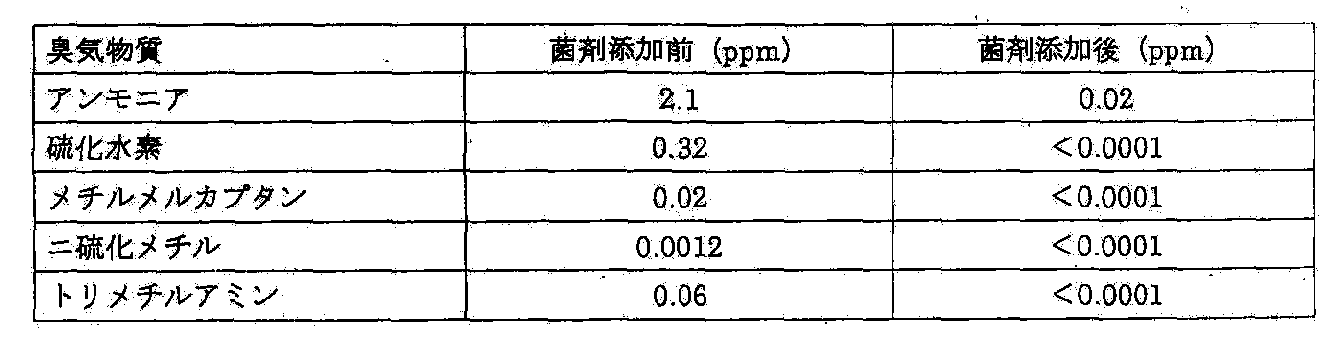
実施例1と同規模の家庭用合併処理浄化槽に本発明の乾燥菌剤を添加する前後の処理槽から発生する臭気成分の濃度を特定悪臭物質測定方法(昭和47年環境庁告示第9号)に従って測定したところ,表4の通りであった。 Specific malodorous substance measurement method (Showa 47 Environment Agency Notification No. 9) to determine the concentration of odorous components generated from the treatment tank before and after adding the dry fungal agent of the present invention to the household combined treatment septic tank of the same scale as Example 1. As a result, the measurement was as shown in Table 4.
鶏糞4.3kgを厚さが1cm位になるようにポリエチレン製ビニル袋中に広げ,乾燥菌剤43gを加えて切り返し,袋の口を縛って30℃にて2日間置いたところ,鶏糞特有の悪臭が消失した。 Spread 4.3 kg of chicken manure into a polyethylene plastic bag so that the thickness is about 1 cm, add 43 g of dry fungi, turn it back, tie the mouth of the bag and leave it at 30 ° C. for 2 days. The bad odor disappeared.
建設現場の簡易式トイレの汚物タンク(300L)に,乾燥菌剤20gを約100mlの水に溶かして流し込んだところ,タンクが一杯になり交換する時点まで臭気が発生しなくなった。 When 20 g of dry fungicide was dissolved in about 100 ml of water and poured into a filth tank (300 L) of a simple toilet at the construction site, the tank became full and no odor was generated until the time of replacement.
ドラム缶にすてられ,数日を経て悪臭を発生するようになった生ゴミ約100kgの表面に,乾燥菌剤1gを約100mlの水に溶かしスプレ−したところ,特有の悪臭が消失した。 When sprayed by dissolving 1 g of dry fungicide in about 100 ml of water on the surface of about 100 kg of raw garbage that had been put into a drum can and became odorous after several days, the peculiar odor disappeared.
下水処理場の汚泥の山(表面積約100m2)に乾燥菌剤300kgを約30Lの水に溶かし散布したところ,1日後に悪臭発生が抑制された。When 300 kg of dry fungicide was dissolved in about 30 L of water and sprayed on a sludge pile (surface area of about 100 m 2 ) at a sewage treatment plant, the generation of malodor was suppressed after one day.
猫5匹を飼っている部屋に,乾燥菌剤2gを200mlの水に溶かして家庭用噴霧器でスプレ−したところ,部屋内の悪臭が消失した。 When 2 g of dry fungus was dissolved in 200 ml of water in a room with 5 cats and sprayed with a household sprayer, the odor in the room disappeared.
動植物から発せられる,あらゆる悪臭の除去に利用できる。 It can be used to remove any odors from animals and plants.
Claims (3)
Priority Applications (1)
| Application Number | Priority Date | Filing Date | Title |
|---|---|---|---|
| JP2004148420A JP2005296595A (en) | 2004-04-15 | 2004-04-15 | Production method and deodorization method of microbial deodorizer |
Applications Claiming Priority (1)
| Application Number | Priority Date | Filing Date | Title |
|---|---|---|---|
| JP2004148420A JP2005296595A (en) | 2004-04-15 | 2004-04-15 | Production method and deodorization method of microbial deodorizer |
Publications (1)
| Publication Number | Publication Date |
|---|---|
| JP2005296595A true JP2005296595A (en) | 2005-10-27 |
Family
ID=35328834
Family Applications (1)
| Application Number | Title | Priority Date | Filing Date |
|---|---|---|---|
| JP2004148420A Pending JP2005296595A (en) | 2004-04-15 | 2004-04-15 | Production method and deodorization method of microbial deodorizer |
Country Status (1)
| Country | Link |
|---|---|
| JP (1) | JP2005296595A (en) |
Cited By (1)
| Publication number | Priority date | Publication date | Assignee | Title |
|---|---|---|---|---|
| KR20210001839A (en) * | 2019-06-26 | 2021-01-06 | 한국생산기술연구원 | Composition for removing odor and method of preparing same |
-
2004
- 2004-04-15 JP JP2004148420A patent/JP2005296595A/en active Pending
Cited By (2)
| Publication number | Priority date | Publication date | Assignee | Title |
|---|---|---|---|---|
| KR20210001839A (en) * | 2019-06-26 | 2021-01-06 | 한국생산기술연구원 | Composition for removing odor and method of preparing same |
| KR102289660B1 (en) | 2019-06-26 | 2021-08-17 | 한국생산기술연구원 | Composition for removing odor and method of preparing same |
Similar Documents
| Publication | Publication Date | Title |
|---|---|---|
| CN102526781B (en) | Compound biological enzyme deodorant and preparation method thereof | |
| AU2002227224B2 (en) | Low oxygen organic waste bioconversion system | |
| JPH07163336A (en) | Deodorant containing microorganisms and fungi | |
| RU2347808C1 (en) | Biopreparation from effective microbes for breaking down organic wastes | |
| JPH09131177A (en) | Microbial preparation containing novel microorganism, production method thereof, sewage treatment and deodorization method utilizing the microorganism | |
| JP2013545702A (en) | Organic fertilizer and method for producing the same | |
| KR101580780B1 (en) | Microorganism having ammonia and hydrogen sulfide odor removal activity and uses thereof | |
| WO1994003411A1 (en) | Liquid livestock waste treating method | |
| CN109576169A (en) | Microbial deodorant and preparation method thereof | |
| JP2005296595A (en) | Production method and deodorization method of microbial deodorizer | |
| JP3122797B2 (en) | Manure odor generation suppressing or deodorizing agent and manure odor generation suppressing or deodorizing method | |
| JP3925463B2 (en) | Deodorant and method for livestock manure | |
| JP2006102633A (en) | Recycling method of organic waste in slaughterhouse | |
| Gupta et al. | Utilization of solid or liquid wastes in agriculture | |
| KR20230031692A (en) | Manufacturing method of bio-enzyme and treating method of organic matter for improving environment and recycling waste by using the bio-enzyme | |
| JP4229425B2 (en) | Deodorant and deodorizing method | |
| JP2002087897A (en) | Organic fertilizer production method | |
| KR20150115481A (en) | Microorganisms for deodorizing or degrading waste | |
| JP4697945B2 (en) | Deodorizer and composting method that does not generate odor | |
| JP2005262055A (en) | Method and apparatus for treating animal organic matter-containing waste water | |
| JPH1085591A (en) | Deodorizer and deodorizing method utilizing waste mushroom bed of mushroom bed cultivation | |
| JP4434459B2 (en) | Deodorization method for organic waste | |
| JP6099076B2 (en) | Deodorant biodegradation promoting material and deodorant biodegradation promoting method | |
| KR20020034123A (en) | Malodor Removing method of malodor | |
| JP2004147751A (en) | Deodorizer, deodorizing method for organic waste using the same, and box for housing organic waste |