JP2006161237A - Water repellent and breathable reversible woven or knitted fabric and method for producing the same - Google Patents
Water repellent and breathable reversible woven or knitted fabric and method for producing the same Download PDFInfo
- Publication number
- JP2006161237A JP2006161237A JP2004357729A JP2004357729A JP2006161237A JP 2006161237 A JP2006161237 A JP 2006161237A JP 2004357729 A JP2004357729 A JP 2004357729A JP 2004357729 A JP2004357729 A JP 2004357729A JP 2006161237 A JP2006161237 A JP 2006161237A
- Authority
- JP
- Japan
- Prior art keywords
- woven
- water
- knitted fabric
- air permeability
- swellable
- Prior art date
- Legal status (The legal status is an assumption and is not a legal conclusion. Google has not performed a legal analysis and makes no representation as to the accuracy of the status listed.)
- Granted
Links
Classifications
-
- D—TEXTILES; PAPER
- D03—WEAVING
- D03D—WOVEN FABRICS; METHODS OF WEAVING; LOOMS
- D03D15/00—Woven fabrics characterised by the material, structure or properties of the fibres, filaments, yarns, threads or other warp or weft elements used
- D03D15/50—Woven fabrics characterised by the material, structure or properties of the fibres, filaments, yarns, threads or other warp or weft elements used characterised by the properties of the yarns or threads
- D03D15/527—Woven fabrics characterised by the material, structure or properties of the fibres, filaments, yarns, threads or other warp or weft elements used characterised by the properties of the yarns or threads waterproof or water-repellent
-
- D—TEXTILES; PAPER
- D01—NATURAL OR MAN-MADE THREADS OR FIBRES; SPINNING
- D01F—CHEMICAL FEATURES IN THE MANUFACTURE OF ARTIFICIAL FILAMENTS, THREADS, FIBRES, BRISTLES OR RIBBONS; APPARATUS SPECIALLY ADAPTED FOR THE MANUFACTURE OF CARBON FILAMENTS
- D01F8/00—Conjugated, i.e. bi- or multicomponent, artificial filaments or the like; Manufacture thereof
- D01F8/02—Conjugated, i.e. bi- or multicomponent, artificial filaments or the like; Manufacture thereof from cellulose, cellulose derivatives, or proteins
-
- D—TEXTILES; PAPER
- D03—WEAVING
- D03D—WOVEN FABRICS; METHODS OF WEAVING; LOOMS
- D03D1/00—Woven fabrics designed to make specified articles
- D03D1/0035—Protective fabrics
- D03D1/0041—Cut or abrasion resistant
-
- D—TEXTILES; PAPER
- D03—WEAVING
- D03D—WOVEN FABRICS; METHODS OF WEAVING; LOOMS
- D03D15/00—Woven fabrics characterised by the material, structure or properties of the fibres, filaments, yarns, threads or other warp or weft elements used
-
- D—TEXTILES; PAPER
- D03—WEAVING
- D03D—WOVEN FABRICS; METHODS OF WEAVING; LOOMS
- D03D15/00—Woven fabrics characterised by the material, structure or properties of the fibres, filaments, yarns, threads or other warp or weft elements used
- D03D15/20—Woven fabrics characterised by the material, structure or properties of the fibres, filaments, yarns, threads or other warp or weft elements used characterised by the material of the fibres or filaments constituting the yarns or threads
- D03D15/208—Woven fabrics characterised by the material, structure or properties of the fibres, filaments, yarns, threads or other warp or weft elements used characterised by the material of the fibres or filaments constituting the yarns or threads cellulose-based
- D03D15/217—Woven fabrics characterised by the material, structure or properties of the fibres, filaments, yarns, threads or other warp or weft elements used characterised by the material of the fibres or filaments constituting the yarns or threads cellulose-based natural from plants, e.g. cotton
-
- D—TEXTILES; PAPER
- D03—WEAVING
- D03D—WOVEN FABRICS; METHODS OF WEAVING; LOOMS
- D03D15/00—Woven fabrics characterised by the material, structure or properties of the fibres, filaments, yarns, threads or other warp or weft elements used
- D03D15/20—Woven fabrics characterised by the material, structure or properties of the fibres, filaments, yarns, threads or other warp or weft elements used characterised by the material of the fibres or filaments constituting the yarns or threads
- D03D15/208—Woven fabrics characterised by the material, structure or properties of the fibres, filaments, yarns, threads or other warp or weft elements used characterised by the material of the fibres or filaments constituting the yarns or threads cellulose-based
- D03D15/225—Woven fabrics characterised by the material, structure or properties of the fibres, filaments, yarns, threads or other warp or weft elements used characterised by the material of the fibres or filaments constituting the yarns or threads cellulose-based artificial, e.g. viscose
-
- D—TEXTILES; PAPER
- D03—WEAVING
- D03D—WOVEN FABRICS; METHODS OF WEAVING; LOOMS
- D03D15/00—Woven fabrics characterised by the material, structure or properties of the fibres, filaments, yarns, threads or other warp or weft elements used
- D03D15/50—Woven fabrics characterised by the material, structure or properties of the fibres, filaments, yarns, threads or other warp or weft elements used characterised by the properties of the yarns or threads
- D03D15/56—Woven fabrics characterised by the material, structure or properties of the fibres, filaments, yarns, threads or other warp or weft elements used characterised by the properties of the yarns or threads elastic
-
- D—TEXTILES; PAPER
- D04—BRAIDING; LACE-MAKING; KNITTING; TRIMMINGS; NON-WOVEN FABRICS
- D04B—KNITTING
- D04B1/00—Weft knitting processes for the production of fabrics or articles not dependent on the use of particular machines; Fabrics or articles defined by such processes
- D04B1/14—Other fabrics or articles characterised primarily by the use of particular thread materials
-
- D—TEXTILES; PAPER
- D06—TREATMENT OF TEXTILES OR THE LIKE; LAUNDERING; FLEXIBLE MATERIALS NOT OTHERWISE PROVIDED FOR
- D06B—TREATING TEXTILE MATERIALS USING LIQUIDS, GASES OR VAPOURS
- D06B3/00—Passing of textile materials through liquids, gases or vapours to effect treatment, e.g. washing, dyeing, bleaching, sizing, impregnating
- D06B3/10—Passing of textile materials through liquids, gases or vapours to effect treatment, e.g. washing, dyeing, bleaching, sizing, impregnating of fabrics
- D06B3/20—Passing of textile materials through liquids, gases or vapours to effect treatment, e.g. washing, dyeing, bleaching, sizing, impregnating of fabrics with means to improve the circulation of the treating material on the surface of the fabric
-
- D—TEXTILES; PAPER
- D10—INDEXING SCHEME ASSOCIATED WITH SUBLASSES OF SECTION D, RELATING TO TEXTILES
- D10B—INDEXING SCHEME ASSOCIATED WITH SUBLASSES OF SECTION D, RELATING TO TEXTILES
- D10B2201/00—Cellulose-based fibres, e.g. vegetable fibres
- D10B2201/20—Cellulose-derived artificial fibres
- D10B2201/28—Cellulose esters or ethers, e.g. cellulose acetate
-
- D—TEXTILES; PAPER
- D10—INDEXING SCHEME ASSOCIATED WITH SUBLASSES OF SECTION D, RELATING TO TEXTILES
- D10B—INDEXING SCHEME ASSOCIATED WITH SUBLASSES OF SECTION D, RELATING TO TEXTILES
- D10B2321/00—Fibres made from polymers obtained by reactions only involving carbon-to-carbon unsaturated bonds
- D10B2321/10—Fibres made from polymers obtained by reactions only involving carbon-to-carbon unsaturated bonds polymers of unsaturated nitriles, e.g. polyacrylonitrile, polyvinylidene cyanide
-
- D—TEXTILES; PAPER
- D10—INDEXING SCHEME ASSOCIATED WITH SUBLASSES OF SECTION D, RELATING TO TEXTILES
- D10B—INDEXING SCHEME ASSOCIATED WITH SUBLASSES OF SECTION D, RELATING TO TEXTILES
- D10B2331/00—Fibres made from polymers obtained otherwise than by reactions only involving carbon-to-carbon unsaturated bonds, e.g. polycondensation products
- D10B2331/02—Fibres made from polymers obtained otherwise than by reactions only involving carbon-to-carbon unsaturated bonds, e.g. polycondensation products polyamides
-
- D—TEXTILES; PAPER
- D10—INDEXING SCHEME ASSOCIATED WITH SUBLASSES OF SECTION D, RELATING TO TEXTILES
- D10B—INDEXING SCHEME ASSOCIATED WITH SUBLASSES OF SECTION D, RELATING TO TEXTILES
- D10B2331/00—Fibres made from polymers obtained otherwise than by reactions only involving carbon-to-carbon unsaturated bonds, e.g. polycondensation products
- D10B2331/04—Fibres made from polymers obtained otherwise than by reactions only involving carbon-to-carbon unsaturated bonds, e.g. polycondensation products polyesters, e.g. polyethylene terephthalate [PET]
-
- D—TEXTILES; PAPER
- D10—INDEXING SCHEME ASSOCIATED WITH SUBLASSES OF SECTION D, RELATING TO TEXTILES
- D10B—INDEXING SCHEME ASSOCIATED WITH SUBLASSES OF SECTION D, RELATING TO TEXTILES
- D10B2401/00—Physical properties
- D10B2401/02—Moisture-responsive characteristics
-
- D—TEXTILES; PAPER
- D10—INDEXING SCHEME ASSOCIATED WITH SUBLASSES OF SECTION D, RELATING TO TEXTILES
- D10B—INDEXING SCHEME ASSOCIATED WITH SUBLASSES OF SECTION D, RELATING TO TEXTILES
- D10B2401/00—Physical properties
- D10B2401/04—Heat-responsive characteristics
- D10B2401/041—Heat-responsive characteristics thermoplastic; thermosetting
-
- D—TEXTILES; PAPER
- D10—INDEXING SCHEME ASSOCIATED WITH SUBLASSES OF SECTION D, RELATING TO TEXTILES
- D10B—INDEXING SCHEME ASSOCIATED WITH SUBLASSES OF SECTION D, RELATING TO TEXTILES
- D10B2401/00—Physical properties
- D10B2401/08—Physical properties foamed
-
- D—TEXTILES; PAPER
- D10—INDEXING SCHEME ASSOCIATED WITH SUBLASSES OF SECTION D, RELATING TO TEXTILES
- D10B—INDEXING SCHEME ASSOCIATED WITH SUBLASSES OF SECTION D, RELATING TO TEXTILES
- D10B2501/00—Wearing apparel
- D10B2501/04—Outerwear; Protective garments
Landscapes
- Engineering & Computer Science (AREA)
- Textile Engineering (AREA)
- Life Sciences & Earth Sciences (AREA)
- Botany (AREA)
- Chemical & Material Sciences (AREA)
- Chemical Kinetics & Catalysis (AREA)
- General Chemical & Material Sciences (AREA)
- Woven Fabrics (AREA)
- Treatments For Attaching Organic Compounds To Fibrous Goods (AREA)
- Treatment Of Fiber Materials (AREA)
- Chemical Or Physical Treatment Of Fibers (AREA)
- Multicomponent Fibers (AREA)
Abstract
【課題】衣服としたときに、衣服内部からの湿度変化に迅速に対応し、可逆的に通気度を変化させる通気性能と、かつ衣服外部からの水分の浸入を防ぐ撥水性能とを併せ持つ撥水通気可逆性織編物を提供する。
【解決手段】高膨潤性成分と低膨潤性成分がサイドバイサイドに複合された膨潤性コンジュゲート繊維が30wt%以上含まれ、撥水剤が付与された織編物であって、織編物の撥水度が3級以上で、かつ下記式で表される織編物の通気度変化量が10%以上である撥水通気可逆性織編物を、高膨潤性成分と低膨潤性成分がサイドバイサイドに複合された膨潤性コンジュゲート繊維を含む織編物を撥水加工後、さらに揉み込み加工することにより得る。
通気度変化量(%)=[(湿潤時通気度(B)−初期通気度(A))/初期通気度(A)]×100
【選択図】なし[PROBLEMS] To provide a repellency that, when used as a garment, has a breathing performance that quickly responds to changes in humidity from the inside of the garment, reversibly changes the air permeability, and a water repellency that prevents moisture from entering from the outside of the garment. A water-breathable reversible woven or knitted fabric is provided.
SOLUTION: A woven or knitted fabric containing 30 wt% or more of swellable conjugate fiber in which a high swellable component and a low swellable component are combined on a side-by-side basis and provided with a water repellent, the water repellency of the woven or knitted fabric Is a water repellent breathable reversible woven or knitted fabric having a degree of air permeability of 10% or more, and a highly swellable component and a low swellable component are combined side by side. A woven or knitted fabric containing a swellable conjugate fiber is obtained by further squeezing after water-repellent processing.
Air permeability change amount (%) = [(wet air permeability (B) −initial air permeability (A)) / initial air permeability (A)] × 100
[Selection figure] None
Description
本発明は、撥水通気可逆性を有する織編物及びその製造方法に関する。 The present invention relates to a woven or knitted fabric having water repellent ventilation reversibility and a method for producing the same.
従来から多くの機能性素材の開発が行われ、機能性商品にあっては、さらに高度な機能性を発現させるため繊維素材、織物や編物等の布帛構造、機能後加工等或いはこれらの組み合わせた開発が積極的に進められている。近年の新しい機能素材の提案は、複合化、高次化が進化し、さらに衣料においては、着用環境の変化に応じ機能性の変化する、いわゆる動的な機能性の提案が多くなされている。光エネルギーの吸収量に応じ保温性の向上を追及した蓄熱性素材の提案等はその一例である。 Many functional materials have been developed in the past. For functional products, fiber materials, fabric structures such as woven fabrics and knitted fabrics, functional post-processing, etc., or a combination thereof are used to express even higher functionality. Development is actively underway. In recent years, proposals for new functional materials have evolved to be more complex and more advanced, and in clothing, there have been many proposals for so-called dynamic functionality in which functionality changes according to changes in the wearing environment. An example is a proposal of a heat storage material that seeks to improve heat retention according to the amount of light energy absorbed.
しかしながら、近年のファッショントレンドや消費者ニーズは、極めて多様化、高級化しており、消費者の要望に沿った機能素材を市場に提供するには、さらなる風合いの改良や特化された機能性の提案が必要となっている。この特化された機能性の一つとして衣服内の温湿度の調整機能が挙げられ、いわゆる呼吸する衣服が要望されている。この呼吸する衣服とは、衣服内の温度や湿気、水分等の動的な変化に応じ衣服の通気性が可逆的に変化し、衣服内の温湿度をコントロールし常に快適な状態に調整するものである。 However, fashion trends and consumer needs in recent years have become extremely diversified and sophisticated, and in order to provide functional materials in line with consumer demands, further improvements in texture and specialized functionality are required. A proposal is needed. As one of the specialized functions, there is a function of adjusting the temperature and humidity in the clothes, and so-called breathing clothes are desired. This breathing garment reversibly changes the breathability of the garment in response to dynamic changes in the garment temperature, humidity, moisture, etc., and controls the temperature and humidity in the garment to constantly adjust it to a comfortable state. It is.
このような呼吸する衣服の要望に対し、湿気、水分に応じ可逆的に変化する繊維素材を用いた、いくつかの通気可逆性織編物の提案がなされている。化学繊維、合成繊維では、湿度に応じ捲縮率の変化する素材を用いて通気度が変化するアセテート繊維を用いた織編物が提案されている(特許文献1参照)。また変性ポリエチレンテレフタレートとナイロンの複合繊維を用いての提案もなされている(特許文献2参照)。 In response to such a demand for breathable clothes, some ventilation reversible woven or knitted fabrics using fiber materials that reversibly change according to moisture and moisture have been proposed. For chemical fibers and synthetic fibers, there has been proposed a woven or knitted fabric using acetate fibers whose air permeability changes using a material whose crimp rate changes according to humidity (see Patent Document 1). There has also been a proposal using a composite fiber of modified polyethylene terephthalate and nylon (see Patent Document 2).
これらの通気可逆性織編物においては、湿気及び水分の変化に迅速に対応し、かつ可逆的に通気度を変化させるには、湿気及び水分の吸放湿性が高いコンジュゲート繊維素材等が用いられている。またこれら通気可逆性織編物は、激しい運動時の発汗時により湿気や汗を吸収し、織編目が拡大し通気性が増加することによって、衣服内の蒸れ感やべとつき感を解消し、快適性が高められる。 In these breathable reversible knitted and knitted fabrics, a conjugate fiber material having a high moisture absorption and moisture absorption / release property is used to quickly respond to changes in moisture and moisture and reversibly change the breathability. ing. These breathable reversible woven and knitted fabrics absorb moisture and sweat when sweating during intense exercise, and the woven stitches expand and breathability increases, eliminating the feeling of stuffiness and stickiness in clothing and comfort. Is increased.
しかしながら、これら通気可逆性織編物は、衣服としたとき、衣服内部からの湿気や汗だけでなく、降雨時等の外部からの多量の水分においても織編目が拡大することから、多くの水分が衣服内に浸入し易く、さらには通気性が高まるため保温性が低下する等の問題点がある。 However, when these breathable reversible woven and knitted fabrics are used as clothes, not only moisture and sweat from the inside of the clothes, but also a large amount of moisture from the outside such as rain, the woven stitches expand, so a lot of moisture There are problems such as easy penetration into clothes and further reduction in heat retention due to increased air permeability.
本発明の目的は、このような従来技術における問題点を解決するものであり、衣服としたときに、衣服内部からの湿度変化に迅速に対応し、可逆的に通気度を変化させる通気性能と、かつ衣服外部からの水分の浸入を防ぐ撥水性能とを併せ持つ撥水通気可逆性織編物を提供することにある。 The object of the present invention is to solve such problems in the prior art, and when it is used as a garment, it can respond quickly to changes in humidity from the inside of the garment and reversibly change the air permeability. Another object of the present invention is to provide a water-repellent and breathable reversible woven or knitted fabric that has both water-repellent properties that prevent moisture from entering from the outside of the garment.
本発明の第1の要旨は、高水膨潤性成分と低水膨潤性成分がサイドバイサイドに複合された膨潤性コンジュゲート繊維が30wt%以上含まれて構成され、撥水剤が付与された織編物であって、織編物の撥水度が3級以上で、かつ下記式で表される織編物の通気度変化量が10%以上であることを特徴とする撥水通気可逆性織編物にある。
通気度変化量(%)=[(湿潤時通気度(B)−初期通気度(A))/初期通気度(A)]×100
なお、初期通気度は、織編物が25℃、65%RHで水分率平衡時の通気度、湿潤時通気度は、織編物を30分水に浸漬した後に脱水、風乾し、織編物の水分率が25℃、50wt%時の通気度をいう。
また本発明の第2の要旨は、高水膨潤性成分と低水膨潤性成分がサイドバイサイドに複合された膨潤性コンジュゲート繊維を30wt%以上含ませて構成した織編物を、撥水度3級以上に撥水加工した後、さらに揉み込み加工することを特徴とする撥水通気可逆性織編物の製造方法にある。
The first gist of the present invention is a woven or knitted fabric comprising 30% by weight or more of a swellable conjugate fiber in which a high water swellable component and a low water swellable component are combined side-by-side and provided with a water repellent. The water-repellent breathable reversible woven or knitted fabric is characterized in that the water-repellent degree of the woven or knitted fabric is grade 3 or more and the air permeability change amount of the woven or knitted fabric represented by the following formula is 10% or more. .
Air permeability change amount (%) = [(wet air permeability (B) −initial air permeability (A)) / initial air permeability (A)] × 100
The initial air permeability is the air permeability of the woven or knitted fabric at 25 ° C. and 65% RH when the moisture content is balanced, and the air permeability when wet is dehydrated and air-dried after immersing the woven or knitted fabric in water for 30 minutes. The air permeability when the rate is 25 ° C. and 50 wt%.
The second gist of the present invention is that a woven or knitted fabric comprising 30% by weight or more of a swellable conjugate fiber in which a high water swellable component and a low water swellable component are combined side by side is used. The water-repellent breathable reversible woven or knitted fabric is characterized in that after the water-repellent processing as described above, further squeezing processing is performed.
本発明の織編物は、衣服としたときに、激しい運動等による発汗時の衣服内部における温湿度の自動調整効果を有し、かつ繊維表面への撥水加工により衣服の乾燥を速め、さらに降雨時等の外部からの水分の浸入を防ぐことで過剰な通気作用による体温の低下を防ぎ、蒸れ感やべとつき感がないものである。 The woven or knitted fabric of the present invention, when used as a garment, has an effect of automatically adjusting the temperature and humidity inside the garment when sweating due to intense exercise, etc., and also accelerates drying of the garment by water repellent treatment on the fiber surface, and further rains. By preventing the ingress of moisture from the outside such as time, the body temperature is prevented from decreasing due to excessive ventilation, and there is no stuffiness or stickiness.
本発明の織編物は、高水膨潤性成分と低水膨潤性成分がサイドバイサイドに複合された膨潤性コンジュゲート繊維が30wt%以上含まれて構成されることが必要である。膨潤性コンジュゲート繊維が30wt%未満では、湿度、水分による膨潤性コンジュゲート繊維による織編目の変化が小さくなり、十分な通気度変化が得られない。本発明の膨潤性コンジュゲート繊維を構成する高水膨潤性成分は、水膨潤度が好ましくは30〜200%、より好ましくは40〜100%の高膨潤性の成分であり、低水膨潤性成分は、水膨潤度が20%以下、好ましくは10%以下の低水膨潤性乃至は非水膨潤性の成分である。かかる膨潤性の異なる成分の組み合わせの膨潤性コンジュゲート繊維であることが、吸湿、吸水性と速乾性に優れ、吸湿、吸水時と乾燥時の繊維の形態変化が可逆的で大きく、耐久性にも優れたものとなる。なお、コンジュゲート繊維の各成分の水膨潤度はそれぞれの単独成分の繊維で測定したときの数値である。 The woven or knitted fabric of the present invention is required to be composed of 30 wt% or more of a swellable conjugate fiber in which a high water swellable component and a low water swellable component are combined side by side. When the swellable conjugate fiber is less than 30 wt%, the change in the weave stitch due to the swellable conjugate fiber due to humidity and moisture becomes small, and a sufficient change in air permeability cannot be obtained. The highly water swellable component constituting the swellable conjugate fiber of the present invention is a highly swellable component having a water swell degree of preferably 30 to 200%, more preferably 40 to 100%, and a low water swellable component. Is a low water swellable or non-water swellable component having a water swelling degree of 20% or less, preferably 10% or less. The swellable conjugate fiber with a combination of components having different swelling properties is excellent in moisture absorption, water absorption and quick drying, and reversible and large change in fiber shape during moisture absorption, water absorption and drying, and durability. Will also be excellent. In addition, the water swelling degree of each component of a conjugate fiber is a numerical value when it measures with the fiber of each single component.
また、膨潤性コンジュゲート繊維における高水膨潤性成分と低水膨潤性成分との複合比は、重量比で20:80〜80:20であることが好ましく、さらには40:60〜75:25の範囲であることがより好ましい。低水膨潤性成分が20wt%未満或いは80wt%を超えると、収縮が十分に起こらず可逆的な繊維の形態変化を生ずることが不十分となる。さらに成分間に収縮差を生じさせるためには、水膨潤度の差が好ましくは20%以上、より好ましくは30%以上あることが望ましい。 In addition, the composite ratio of the high water swellable component and the low water swellable component in the swellable conjugate fiber is preferably 20:80 to 80:20, and more preferably 40:60 to 75:25. More preferably, it is the range. If the low water swellable component is less than 20 wt% or more than 80 wt%, the shrinkage does not occur sufficiently and it is insufficient to cause a reversible fiber shape change. Further, in order to cause a difference in shrinkage between the components, the difference in the degree of water swelling is preferably 20% or more, more preferably 30% or more.
膨潤性コンジュゲート繊維における高水膨潤性成分は、膨潤時には伸張し非膨潤時には収縮するという現象を繰り返すが、低水膨潤性成分とサイドバイサイドに接合されていることから、吸湿、吸水時に高水膨潤性成分側の伸張により繊維のクリンプが消失し、乾燥時に高膨潤性成分の収縮によりクリンプが生じ、吸湿、吸水時と乾燥時にあってクリンプ形態の消失とクリンプ形態の発現を可逆的に繰り返すことにより、織編物の通気度が可逆的に変化する。 The high water swellable component in the swellable conjugate fiber repeats the phenomenon of stretching when swollen and shrinking when not swollen, but because it is bonded to the low water swellable component side-by-side, it swells with high water during moisture absorption and water absorption. The crimp of the fiber disappears due to the stretching of the active ingredient side, the crimp is caused by the shrinkage of the highly swellable ingredient during drying, and the disappearance of the crimp form and the expression of the crimp form are reversibly repeated during moisture absorption, water absorption and drying. As a result, the air permeability of the woven or knitted fabric reversibly changes.
本発明の織編物における膨潤性コンジュゲート繊維として、具体的には、一方が高水膨潤性のセルロース、他方がセルロースアセテートである2種の成分がサイドバイサイドに複合されたセルロース系の膨潤性コンジュゲート繊維が好ましものとして挙げられる。セルロース系膨潤性コンジュゲート繊維においては、酢化度0%のセルロースが高水膨潤性成分、酢化度56.2%以上62.5%以下のセルロースアセテートが低水膨潤性成分となることがより好ましい。 As the swellable conjugate fiber in the woven or knitted fabric of the present invention, specifically, a cellulose-based swellable conjugate in which two components, one of which is highly water-swellable cellulose and the other is cellulose acetate, are combined side by side. Fiber is preferred. In the cellulose-based swellable conjugate fiber, cellulose having an acetylation degree of 0% may be a high water swellable component, and cellulose acetate having an acetylation degree of 56.2% or more and 62.5% or less may be a low water swellable component. More preferred.
このセルロース系の膨潤性コンジュゲート繊維は、例えば平均置換度2.60未満のセルロースアセテートと平均置換度2.76以上のセルロースアセテートがサイドバイサイドに複合された前駆体繊維をアルカリにて脱アセチル化処理することにより得られる。アルカリでの脱アセチル化処理により、それぞれの置換度のセルロースアセテートは脱アセチル化されるが、低置換度セルロースアセテートがより脱アセチル化され易いことから、低置換度セルロースアセテートのみが脱アセチル化される条件で脱アセチル化処理する。この脱アセチル化処理により、前駆体繊維の低置換度セルロースアセテート成分が酢化度0%の或いは酢化度0%に極めて近いセルロースになり、他成分との水膨潤性の差が大きくなり、湿度や水分による繊維の可逆的な形態変化が得られる。この脱アセチル化のためのアルカリ処理は、糸の状態でも又織編物の状態で行ってもよいが、取り扱いの面から織編物形成後に行うことがより好ましい。 This cellulose-based swellable conjugate fiber is obtained by, for example, subjecting a precursor fiber in which cellulose acetate having an average degree of substitution of less than 2.60 and cellulose acetate having an average degree of substitution of 2.76 or more to the side-by-side is deacetylated with an alkali. Can be obtained. Cellulose acetate of each substitution degree is deacetylated by deacetylation treatment with alkali, but only low-substitution cellulose acetate is deacetylated because low-substitution cellulose acetate is more easily deacetylated. Deacetylation is performed under the following conditions. By this deacetylation treatment, the low-substitution cellulose acetate component of the precursor fiber becomes cellulose with an acetylation degree of 0% or an acetylation degree of 0%, and the difference in water swellability with other components increases. A reversible shape change of the fiber due to humidity and moisture can be obtained. The alkali treatment for deacetylation may be performed in the state of a yarn or a woven or knitted fabric, but is more preferably performed after forming the woven or knitted fabric in terms of handling.
さらに、本発明の織編物においては、膨潤性コンジュゲート繊維の他に、他の構成繊維素材が70wt%を超えない範囲で含まれていてもよい。他の構成繊維素材が含まれる場合は、任意の複合化手段によってもよいが、膨潤性コンジュゲート繊維との複合糸として含まれることが好ましい。他の構成繊維素材としては、アルカリ等の耐薬品性に優れる熱可塑性繊維が好ましく、また繊維強度面での補強及び織編物での形態安定性を高めるための熱セット性の面からも熱可塑性繊維であることが好ましい。 Furthermore, in the woven or knitted fabric of the present invention, in addition to the swellable conjugate fiber, other constituent fiber materials may be included within a range not exceeding 70 wt%. When other constituent fiber materials are included, any composite means may be used, but it is preferably included as a composite yarn with a swellable conjugate fiber. As other constituent fiber materials, thermoplastic fibers excellent in chemical resistance such as alkali are preferable, and also from the viewpoint of the heat setting property for reinforcing the fiber strength and improving the shape stability of the woven or knitted fabric. It is preferably a fiber.
熱可塑性繊維は、特に限定されるものではないが、ポリエステル繊維、ポリアミド繊維等が好ましく、捲縮加工した糸形態でもよい。また熱可塑性繊維の断面形状も、特に限定されるものではなく、得られる織編物の風合い、光沢等を考慮して、三角型、円形、扁平、Y字等の断面形状を適宜選択する。さらには、熱可塑性繊維の単繊維繊度、繊度斑、染色特性等についても特に限定されない。 The thermoplastic fiber is not particularly limited, but is preferably a polyester fiber, a polyamide fiber or the like, and may be a crimped yarn form. In addition, the cross-sectional shape of the thermoplastic fiber is not particularly limited, and a cross-sectional shape such as a triangular shape, a circular shape, a flat shape, and a Y shape is appropriately selected in consideration of the texture, gloss, and the like of the obtained woven or knitted fabric. Furthermore, the single fiber fineness, fineness unevenness, dyeing characteristics and the like of the thermoplastic fiber are not particularly limited.
また、熱可塑性繊維は、溶融粘度や組成の異なる2種のポリエステル同士、ポリエステルとポリアクリロニトリル、ポリエステルとポリアミド等の2種のポリマーを複合比80:20〜20:80、好ましくは60:40〜40:60のサイドバイサイドに貼り合わせたコンジュゲート繊維であることがより好ましい。すなわち、コンジュゲート繊維は、捲縮特性を有しているため、膨潤性コンジュゲート繊維が吸湿により伸張する場合または放湿により収縮する場合に、繊維の動きを妨げにくくする効果が高い。 The thermoplastic fiber is composed of two kinds of polymers having different melt viscosities and compositions, two kinds of polymers such as polyester and polyacrylonitrile, polyester and polyamide, and a composite ratio of 80:20 to 20:80, preferably 60:40 to More preferably, it is a conjugate fiber bonded to the side by side of 40:60. That is, since the conjugate fiber has crimp characteristics, when the swellable conjugate fiber is stretched by moisture absorption or contracted by moisture release, the effect of making it difficult to hinder the movement of the fiber is high.
熱可塑性繊維の複合化手段としては、撚糸、カバリング、エア流体加工、仮撚加工等の方法を用いることができる。この中でも好ましくはエア流体加工が好ましい方法として挙げられる。すなわち、膨潤性コンジュゲート繊維の自由度が大きければ、織編物での通気度効果も大きいためエア流体加工により、膨潤性コンジュゲート繊維に対して熱可塑性繊維を長くして浮かせた糸形態とすることが好ましい。 As a means for combining thermoplastic fibers, methods such as twisting, covering, air fluid processing, false twisting, and the like can be used. Among these, air fluid processing is preferable as a preferable method. That is, if the degree of freedom of the swellable conjugate fiber is large, the air permeability effect in the woven or knitted fabric is also large, so that the yarn form is formed by elongating the thermoplastic fiber with respect to the swellable conjugate fiber by air fluid processing. It is preferable.
また、本発明の織編物は、衣服としたときに外部からの水分の織編物への浸入を防ぎながら、湿気による通気度変化を得るために、織編物に撥水剤が付与され、撥水度が3級以上であることが必要である。撥水度が3級未満では、外部からの水分により織編目が素早く拡大してしまい、内部へ水分が浸入し、また過剰な通気効果をなすために、保温性が低下するという問題点が生じる。織編物に付与される撥水剤としては、シリコン系撥水剤、フッ素系撥水剤等が挙げられる。 Further, the woven or knitted fabric of the present invention is provided with a water repellent to the woven or knitted fabric to obtain a change in air permeability due to moisture while preventing entry of moisture from the outside into the woven or knitted fabric when used as a garment. The degree must be 3rd or higher. If the water repellency is less than the third grade, the weave stitches are rapidly expanded due to moisture from the outside, moisture penetrates into the interior, and the excessive ventilation effect is produced, resulting in a problem of reduced heat retention. . Examples of the water repellent applied to the woven or knitted fabric include a silicon-based water repellent and a fluorine-based water repellent.
さらに、本発明の織編物は、下記式で表される織編物の通気度変化量が10%以上であることが必要である。
通気度変化量(%)=[(湿潤時通気度(B)−初期通気度(A))/初期通気度(A)]×100
通気度変化量が10%未満の場合には、湿度による膨潤性コンジュゲート繊維のクリンプ形態の発現、消失による繊維の形態変化が小さくなり、織編目での通気性が小さくなって蒸れ感やべとつき感により快適性が損なわれる。
Furthermore, in the woven or knitted fabric of the present invention, the air permeability change amount of the woven or knitted fabric represented by the following formula needs to be 10% or more.
Air permeability change amount (%) = [(wet air permeability (B) −initial air permeability (A)) / initial air permeability (A)] × 100
When the change in air permeability is less than 10%, the expression of the crimped form of the swellable conjugate fiber due to humidity is reduced, and the change in the form of the fiber due to disappearance is reduced, and the air permeability at the woven stitch is reduced, resulting in stuffiness and stickiness. The comfort is impaired by the feeling.
本発明の初期通気度とは、織編物が25℃、65%RHで水分率平衡時に測定したときの通気度をいい、湿潤時通気度とは、織編物を30分水に浸漬した後に脱水、風乾し、織編物の水分率が25℃、50wt%時の状態で測定したときの通気度をいう。湿潤時通気度は、衣料における発汗の多い運動時等の実用面を想定した通気度であり、その測定条件は、衣服が湿潤状態でありながら、過剰水分による測定精度への影響が少ない水分量として、織編物の水分率が25℃、50wt%という条件を設定した。 The initial air permeability of the present invention refers to the air permeability when the woven or knitted fabric is measured at 25 ° C. and 65% RH when the moisture content is balanced. The wet air permeability is dehydrated after the woven or knitted fabric is immersed in water for 30 minutes. The air permeability measured when air-dried and the moisture content of the woven or knitted fabric is 25 ° C. and 50 wt% is measured. Air permeability when wet is the air permeability assuming practical use such as during sweating exercise in clothing, and the measurement conditions are moisture content that has little effect on measurement accuracy due to excess moisture while the clothes are wet. As a condition, the moisture content of the woven or knitted fabric was set to 25 ° C. and 50 wt%.
本発明の織編物は、例えば次のようにして製造することができる。
すなわち、本発明の織編物は、高水膨潤性成分と低水膨潤性成分がサイドバイサイドに複合された膨潤性コンジュゲート繊維を30wt%以上含ませて構成した織編物を、撥水度2級以上に撥水加工した後、さらに揉み込み加工することにより製造される。具体的には、置換度の異なる2種のセルロースアセテートがサイドバイサイドに複合された前駆体繊維を30wt%以上含ませて構成した織編物をアルカリ処理し、前駆体繊維を脱アセチル化して膨潤性コンジュゲート繊維に変性し、かかる織編物を撥水度3級以上に撥水加工した後、さらに揉み込み加工することにより製造される。
The woven or knitted fabric of the present invention can be produced, for example, as follows.
That is, the woven or knitted fabric of the present invention is a woven or knitted fabric comprising 30% by weight or more of a swellable conjugate fiber in which a high water swellable component and a low water swellable component are combined side by side. After being water-repellent processed, it is manufactured by further squeezing. Specifically, a woven or knitted fabric composed of 30% by weight or more of precursor fibers in which two types of cellulose acetates having different degrees of substitution are compounded side by side is alkali-treated, and the precursor fibers are deacetylated to swell the conjugate. The woven or knitted fabric is manufactured by subjecting it to a gate fiber and subjecting the woven or knitted fabric to a water repellent degree of 3 or more, followed by further squeezing.
さらに、好ましくは前駆体繊維は、平均置換度2.60未満のセルロースアセテートと平均置換度2.76以上のセルロースアセテートがサイドバイサイドに複合された繊維であり、アルカリでの脱アセチル化処理においては、前駆体繊維の低置換度セルロースアセテートのみが選択的に脱アセチル化されるような同一条件でアルカリ処理することが好ましく、選択的な脱アセチル化を起こさせる条件は、用いるセルロースアセテートの平均置換度、前駆体繊維の割合等に応じて、低置換度セルロースアセテートが脱アセチル化される濃度、温度、時間等のアルカリ処理条件を求めて設定する。かかる低置換度セルロースアセテート対象の条件での前駆体繊維のアルカリ処理により、低置換度セルロースアセテートが容易に脱アセチル化され、酢化度0%の或いは酢化度0%に極めて近いセルロースになって高水膨潤性を示し、高置換度セルロースアセテートが脱アセチル化の少ない或いは殆どない酢化度の高いままで低又は非水膨潤性を示すものになる。 Further preferably, the precursor fiber is a fiber in which cellulose acetate having an average degree of substitution of less than 2.60 and cellulose acetate having an average degree of substitution of 2.76 or more are combined side by side. In the deacetylation treatment with alkali, It is preferable to perform alkali treatment under the same conditions so that only the low-substituted cellulose acetate of the precursor fiber is selectively deacetylated, and the conditions for causing selective deacetylation are the average degree of substitution of cellulose acetate used Depending on the proportion of the precursor fiber, etc., the alkali treatment conditions such as the concentration, temperature, and time at which the low-substituted cellulose acetate is deacetylated are determined and set. By the alkali treatment of the precursor fiber under the conditions for such low-substituted cellulose acetate, the low-substituted cellulose acetate is easily deacetylated to become cellulose having an acetylation degree of 0% or very close to acetylation degree of 0%. Thus, the cellulose acetate exhibits high water swellability, and the highly substituted cellulose acetate exhibits low or non-water swellability while maintaining a high degree of acetylation with little or no deacetylation.
撥水加工は、シリコン系撥水剤やフッ素系撥水剤等の公知の撥水剤を用い、一般に採用されているパディング法、スプレー法等の方法を用いて行うことができるが、織編物を撥水度3級以上に撥水加工することが外部からの過剰の水分の浸入を防ぐうえで必要である。撥水加工における処理条件は、撥水度が3級以上になるのであれば、撥水剤の種類、織編物への付与量、織編物の密度、組織、加工温度、時間等の加工条件は任意に選ぶことができる。 The water-repellent processing can be performed using a known water-repellent agent such as a silicon-based water-repellent agent or a fluorine-based water-repellent agent, and a generally employed padding method, spray method, or the like. In order to prevent the entry of excessive moisture from the outside, it is necessary to water-repellent the water repellency to grade 3 or higher. If the water repellency is 3 or more, the processing conditions in the water repellent processing are as follows: the type of water repellent, the amount applied to the woven or knitted fabric, the density of the woven or knitted fabric, the structure, the processing temperature, the time, etc. You can choose arbitrarily.
さらに、本発明では、撥水加工した後には、揉み込み加工をする必要がある。撥水加工においては単繊維間隙や織編物の交絡点の間隙部に撥水剤が浸透して付着し、繊維間の動き、すなわち繊維の自由度が妨げられた状態になるが、揉み込み加工により、繊維間の拘束状態を開放し、湿度による膨潤性コンジュゲート繊維の繊維形態変化による通気性の可逆変化を容易に行わせるようにするものである。揉み込み加工には、例えばタンブラーやカムフィット等が用いられ、織編物の密度、組織等にもよるが、好ましくは少なくとも織編物が25℃、65%RHで水分率平衡時に測定したときの初期通気度で120cm3/cm2/secになるように温度、時間、衝撃負荷等の条件を選んで行う。 Further, in the present invention, it is necessary to perform a squeezing process after the water repellent process. In water-repellent processing, the water-repellent agent penetrates and adheres to the gaps between the single fibers and the interlaced points of the woven or knitted fabric, and the movement between the fibers, that is, the degree of freedom of the fibers is hindered. Thus, the constrained state between the fibers is released, and the breathable reversible change due to the change in the fiber shape of the swellable conjugate fiber due to humidity is easily performed. For example, a tumbler or cam fit is used for the squeezing process. Depending on the density and structure of the woven or knitted fabric, it is preferable that at least the woven or knitted fabric is initially measured at 25 ° C. and 65% RH at the time of moisture content equilibrium. The conditions such as temperature, time, impact load, etc. are selected so that the air permeability is 120 cm 3 / cm 2 / sec.
以下、本発明を実施例により具体的に説明する。なお、各特性値の測定は以下の方法によって行った。 Hereinafter, the present invention will be specifically described by way of examples. Each characteristic value was measured by the following method.
(1)撥水度
JIS L1092一般試験方法(スプレー試験)に従って測定した。
(1) Water repellency measured according to JIS L1092 general test method (spray test).
(2)通気度
20℃、65%RHの環境可変室で、JIS L1018一般試験方法(フラジール形試験)に従って、テクステスト(TEXTEST)社製、通気度試験機FX3300を用いて測定した。本発明における初期通気度(A)とは、織編物が25℃、65%RHで水分率平衡時に測定したときの通気度(cm3/cm2/sec)をいい、湿潤時通気度(B)とは、織編物を30分水に浸漬した後に脱水、風乾し、織編物の水分率が25℃、50wt%時の状態で測定したときの通気度(cm3/cm2/sec)をいう。また再乾燥時通気度(A1)とは、織編物を湿潤させた後、再び乾燥させた場合の可逆性を確認するためのものであり、25℃、65%RHの水分率平衡状態まで風乾したときの通気度(cm3/cm2/sec)で求めた。
(2) In an environment variable chamber with an air permeability of 20 ° C. and 65% RH, the measurement was performed using an air permeability tester FX3300 manufactured by Textex Co., Ltd. according to JIS L1018 general test method (Fragile test). The initial air permeability (A) in the present invention means the air permeability (cm 3 / cm 2 / sec) when the woven or knitted fabric is measured at 25 ° C. and 65% RH at the time of moisture content equilibrium. ) Is the air permeability (cm 3 / cm 2 / sec) when the woven or knitted fabric is immersed in water for 30 minutes, dehydrated and air-dried, and measured when the moisture content of the woven or knitted fabric is 25 ° C. and 50 wt%. Say. The re-drying air permeability (A1) is used to confirm reversibility when the woven or knitted fabric is wetted and then dried again, and is air-dried to a moisture content equilibrium state of 25 ° C. and 65% RH. The air permeability (cm 3 / cm 2 / sec) was determined.
(3)水膨潤度
膨潤性コンジュゲート繊維における各成分の水膨潤度の測定は、それぞれ単独成分で構成の繊維を用い、以下のようにして測定した。なお、本実施例では置換度の異なるセルロースアセテートのそれぞれ単独成分で構成の繊維を実施例に示すような同一条件でアルカリ処理して脱アセチル化した繊維を用いて測定した。
繊維の断面を、顕微鏡で撮影して、断面積(a)を求め、更にプレパラート上で水を滴下し繊維を膨潤させ、15分後の断面積(b)を求めた。以下の式から断面積比で水膨潤度を算出した。
水膨潤度(%)=((b−a)/a)×100
(3) Degree of water swell The measurement of the degree of water swell of each component in the swellable conjugate fiber was measured as follows, using fibers each composed of a single component. In this example, the measurement was performed using fibers that are composed of single components of cellulose acetates having different degrees of substitution, and were deacetylated by alkali treatment under the same conditions as shown in the examples.
The cross section of the fiber was photographed with a microscope to determine the cross sectional area (a), and water was added dropwise on the preparation to swell the fiber, and the cross sectional area (b) after 15 minutes was determined. The degree of water swelling was calculated from the following formula by the cross-sectional area ratio.
Water swelling degree (%) = ((b−a) / a) × 100
(4)置換度
JIS L1013A法に従って酢化度を測定し、以下の式からセルロースでのアセテート置換度を求めた。
酢化度=[(60×置換度)/(158+43×置換度+1×(3−置換度))]×100
(4) Degree of substitution
The degree of acetylation was measured according to JIS L1013A method, and the degree of acetate substitution with cellulose was determined from the following formula.
Degree of acetylation = [(60 × degree of substitution) / (158 + 43 × degree of substitution + 1 × (3-degree of substitution))] × 100
(5)蒸れ感、べとつき感
得られた織編物でランシャツを作成し着用試験を行った。ランニングを1時間した後の蒸れ感、べとつき感を着用者により官能評価した。
(5) Feeling of stuffiness and stickiness A run shirt was made from the obtained woven or knitted fabric and subjected to a wearing test. The feeling of stuffiness and stickiness after running for 1 hour was sensorially evaluated by the wearer.
(実施例1)
平均置換度2.41のセルロースジアセテートと平均置換度2.91のセルローストリアセテートの各成分を重量比50:50のサイドバイサイド型に複合紡糸して得たアセテートコンジュゲート繊維(84dtex/30フィラメント)と、熱収縮性の異なる2種のポリエステルをサイドバイサイドに複合紡糸して得たポリエステルコンジュゲート繊維(三菱レイヨン社製、ラシーナ 33dtex/12フィラメント)を用い、撚数1800T/m、80℃、40分の条件でスチームによる熱セットを行い、合撚糸を作成した。
Example 1
Acetate conjugate fibers (84 dtex / 30 filaments) obtained by composite spinning of cellulose diacetate having an average degree of substitution of 2.41 and cellulose triacetate having an average degree of substitution of 2.91 in a side-by-side type having a weight ratio of 50:50; , Using polyester conjugate fiber (Made by Rayon, Rasina 33 dtex / 12 filament) obtained by composite spinning of two kinds of polyesters having different heat shrinkability side by side, twist number 1800 T / m, 80 ° C., 40 minutes Heat setting with steam was performed under the conditions to produce a twisted yarn.
この合撚糸を用い、経二重織組織で、経密度45羽/4本、緯密度115本/2.54cmにて織物を織成した。得られた織物に水酸化ナトリウム1重量%水溶液、浴比1:100の処理浴で、温度60℃、時間15分のアルカリ処理を施した後、染色温度130℃、染色時間30分の条件で分散染料を用いて染色を行った。得られた染色織物における元のアセテートコンジュゲート繊維は、セルロースジアセテート成分がアルカリ処理により著しく脱アセチル化された水膨潤度60%の高水膨潤性成分、セルローストリアセテート成分が殆ど脱アセチル化されない水膨潤度9%の低水膨潤性成分となり、これら2成分が45:55の重量比で構成されたサイドバイサイド型の膨潤性コンジュゲート繊維となっていた。 Using this twisted yarn, a woven fabric was woven in a warp double weave structure with a warp density of 45/4 pieces and a weft density of 115 pieces / 2.54 cm. The obtained woven fabric was subjected to an alkali treatment in a treatment bath having a 1% by weight sodium hydroxide aqueous solution and a bath ratio of 1: 100 at a temperature of 60 ° C. for 15 minutes, and then at a dyeing temperature of 130 ° C. and a dyeing time of 30 minutes. Dyeing was performed using a disperse dye. The original acetate conjugate fiber in the resulting dyed fabric is composed of a highly water-swellable component having a water swelling degree of 60%, in which the cellulose diacetate component is significantly deacetylated by alkali treatment, and water in which the cellulose triacetate component is hardly deacetylated. It became a low water swellable component with a swelling degree of 9%, and it became a side-by-side swellable conjugate fiber in which these two components were constituted at a weight ratio of 45:55.
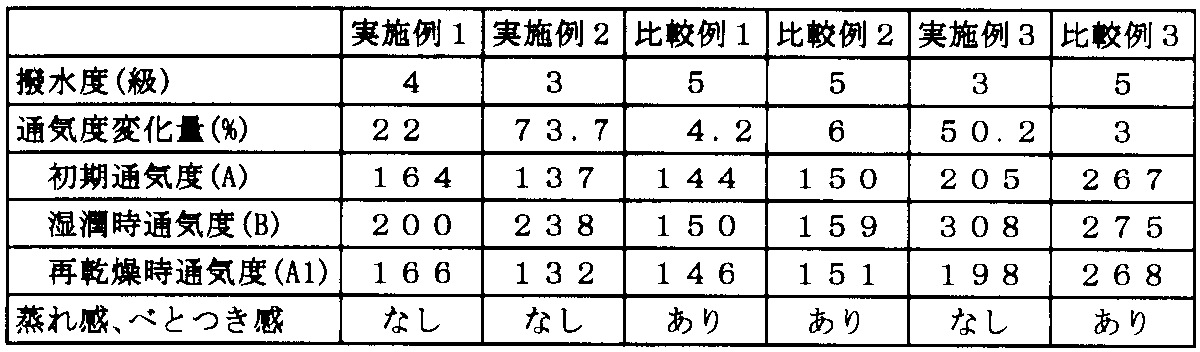
得られた織物に、フッ素系撥水剤(パーフルオロアルキルアクリレートコポリマーからなる撥水剤)を用い、パディング法にてフッ素系撥水剤を含浸させ、マングルで絞った後、170℃で3分熱処理し、フッ素系撥水剤を5wt%付着させる条件で、撥水加工を施した。その後、さらにタンブラーによる揉み込み加工を施し、繊維間の拘束を解除した。得られた織物の評価結果を表1に示す。なお、表1中の通気度の単位はcm3/cm2/secである。 The obtained woven fabric was impregnated with a fluorine water repellent by a padding method using a fluorine water repellent (a water repellent comprising a perfluoroalkyl acrylate copolymer), squeezed with a mangle, and then at 170 ° C. for 3 minutes. It was heat-treated and subjected to water repellent treatment under the condition that 5 wt% of the fluorine-based water repellent was adhered. After that, further squeezing process was performed with a tumbler to release the restraint between the fibers. Table 1 shows the evaluation results of the obtained woven fabric. In addition, the unit of the air permeability in Table 1 is cm 3 / cm 2 / sec.
(実施例2)
実施例1で用いた糸構成で撚数1200T/mの合撚糸に、実施例1でのアセテートコンジュゲート繊維を1200T/m追撚した合撚糸を作成し、この追撚合撚糸を用い、経糸、緯糸に1:1の配列で経二重織組織にて、経密度48羽/4本、緯密度130本/2.54cmにて織物を作成した。その後、この織物にアルカリ処理、染色、撥水加工及び揉み込み加工を実施例1と同様に施した。得られた織物の評価結果を表1に示す。
(Example 2)
A twisted yarn obtained by adding 1200 T / m of the acetate conjugate fiber in Example 1 to the twisted yarn of 1200 T / m in the yarn configuration used in Example 1 is prepared, and using this twisted twisted yarn, warp A woven fabric was prepared in a warp yarn with a 1: 1 arrangement in a warp double weave structure with a warp density of 48/4 pieces and a weft density of 130 pieces / 2.54 cm. Thereafter, the woven fabric was subjected to alkali treatment, dyeing, water repellent treatment and squeezing treatment in the same manner as in Example 1. Table 1 shows the evaluation results of the obtained woven fabric.
(比較例1)
実施例1において、パディング法による撥水加工後に、タンブラーによる揉み込み加工を施さないで、織物を得た。得られた織物の評価結果を表1に示す。
(Comparative Example 1)
In Example 1, a woven fabric was obtained without water-repellent processing by the padding method without squeezing with a tumbler. Table 1 shows the evaluation results of the obtained woven fabric.
(比較例2)
実施例2において、パディング法に代えてのスプレー法による撥水加工後に、タンブラーによる揉み込み加工を施さないで、織物を得た。得られた織物の評価結果を表1に示す。
(Comparative Example 2)
In Example 2, a woven fabric was obtained without water-repellent processing by a spray method instead of the padding method and without squeezing by a tumbler. Table 1 shows the evaluation results of the obtained woven fabric.
(実施例3)
平均置換度2.41のセルロースジアセテートと平均置換度2.91のセルローストリアセテート各々の成分を重量比50:50のサイドバイサイド型に複合紡糸して得たアセテートコンジュゲート繊維(84dtex/20フィラメント)と、ポリエステル繊維(33dtex/12フィラメント)を用い、エア流体加工を施して混繊糸を作成した。この混繊糸を用い、リバーシブル組織で、表面層はポリエステル繊維(110dtex/24フィラメント)、中間層のタック部分はポリエステル繊維(56dtex/24フィラメント)、裏面層はこの混繊糸にて編物を作成した。その後この編物にアルカリ処理、染色、撥水加工及び揉み込み加工を実施例1と同様にして施した。得られた編物の評価結果を表1に示す。
(Example 3)
Acetate conjugate fiber (84 dtex / 20 filament) obtained by composite spinning of cellulose diacetate having an average substitution degree of 2.41 and cellulose triacetate having an average substitution degree of 2.91 in a side-by-side type having a weight ratio of 50:50; Polyester fiber (33 dtex / 12 filament) was used, and air fluid processing was performed to create a mixed fiber. Using this blended yarn, a reversible structure with a surface layer of polyester fiber (110 dtex / 24 filament), an intermediate layer tack portion of polyester fiber (56 dtex / 24 filament), and a back layer made of this blended yarn. did. Thereafter, the knitted fabric was subjected to alkali treatment, dyeing, water-repellent processing and squeezing in the same manner as in Example 1. The evaluation results of the obtained knitted fabric are shown in Table 1.
(比較例3)
実施例3において、パディング法に代えてのスプレー法による撥水加工後に、タンブラーによる揉み込み加工を施さないで、織物を得た。得られた織物の評価結果を表1に示す。
(Comparative Example 3)
In Example 3, a woven fabric was obtained without water repellency by spraying instead of padding and without squeezing with a tumbler. Table 1 shows the evaluation results of the obtained woven fabric.
本発明の織編物は、衣服としたときに、激しい運動等による発汗時の衣服内部における温湿度の自動調整効果を有し、かつ繊維表面への撥水加工により衣服の乾燥を速め、さらに降雨時等の外部からの水分の浸入を防ぐことで過剰な通気作用による体温の低下を防ぎ、蒸れ感やべとつき感がない衣服素材であることから、ウインドブレーカー等の高密度織編物からなるアウトドアウェア等に好適に使用可能なるものである。
The woven or knitted fabric of the present invention, when used as a garment, has an effect of automatically adjusting the temperature and humidity inside the garment when sweating due to intense exercise, etc., and also accelerates drying of the garment by water repellent treatment on the fiber surface, and further rains. Outdoor clothing made of high-density woven and knitted fabrics such as windbreakers because it prevents moisture from entering from the outside and prevents body temperature from being lowered due to excessive ventilation, and has no stuffiness or stickiness. Etc. can be suitably used.
Claims (4)
通気度変化量(%)=[(湿潤時通気度(B)−初期通気度(A))/初期通気度(A)]×100
なお、初期通気度は、織編物が25℃、65%RHで水分率平衡時の通気度、湿潤時通気度は、織編物を30分水に浸漬した後に脱水、風乾し、織編物の水分率が25℃、50wt%時の通気度をいう。 A woven or knitted fabric comprising a swellable conjugate fiber in which a high water swellable component and a low water swellable component are combined side by side in an amount of 30 wt% or more, and having a water repellent added thereto. A water-repellent breathable reversible woven or knitted fabric having a degree of grade 3 or higher and an air permeability change amount of the woven or knitted fabric represented by the following formula of 10% or more.
Air permeability change amount (%) = [(wet air permeability (B) −initial air permeability (A)) / initial air permeability (A)] × 100
The initial air permeability is the air permeability of the woven or knitted fabric at 25 ° C. and 65% RH when the moisture content is balanced, and the air permeability when wet is dehydrated and air-dried after immersing the woven or knitted fabric in water for 30 minutes. The air permeability when the rate is 25 ° C. and 50 wt%.
The swellable conjugate fiber is deacetylated with alkali under the condition that the precursor fiber in which two types of cellulose acetates with different degrees of substitution are compounded side-by-side is deacetylated with alkali. A method for producing a water-repellent and breathable reversible woven or knitted fabric according to claim 3.
Priority Applications (2)
| Application Number | Priority Date | Filing Date | Title |
|---|---|---|---|
| JP2004357729A JP4606863B2 (en) | 2004-12-10 | 2004-12-10 | Water repellent and breathable reversible woven or knitted fabric and method for producing the same |
| PCT/JP2005/022296 WO2006062061A1 (en) | 2004-12-10 | 2005-12-05 | Water-repellent woven/knit fabric with reversible air permeability and process for producing the same |
Applications Claiming Priority (1)
| Application Number | Priority Date | Filing Date | Title |
|---|---|---|---|
| JP2004357729A JP4606863B2 (en) | 2004-12-10 | 2004-12-10 | Water repellent and breathable reversible woven or knitted fabric and method for producing the same |
Publications (2)
| Publication Number | Publication Date |
|---|---|
| JP2006161237A true JP2006161237A (en) | 2006-06-22 |
| JP4606863B2 JP4606863B2 (en) | 2011-01-05 |
Family
ID=36577888
Family Applications (1)
| Application Number | Title | Priority Date | Filing Date |
|---|---|---|---|
| JP2004357729A Expired - Fee Related JP4606863B2 (en) | 2004-12-10 | 2004-12-10 | Water repellent and breathable reversible woven or knitted fabric and method for producing the same |
Country Status (2)
| Country | Link |
|---|---|
| JP (1) | JP4606863B2 (en) |
| WO (1) | WO2006062061A1 (en) |
Cited By (5)
| Publication number | Priority date | Publication date | Assignee | Title |
|---|---|---|---|---|
| JP2008111214A (en) * | 2006-10-03 | 2008-05-15 | Mitsubishi Rayon Co Ltd | Breathable reversible anti-pill fiber |
| JP2008138318A (en) * | 2006-12-01 | 2008-06-19 | Asahi Kasei Fibers Corp | Warp knitted fabric |
| JP2008303510A (en) * | 2007-06-11 | 2008-12-18 | Mitsubishi Rayon Co Ltd | Metachromatic design fabric and method for producing the same |
| US7820571B2 (en) * | 2004-06-01 | 2010-10-26 | Mitsubishi Rayon Co., Ltd. | Woven or knitted fabric exhibiting reversibly changeable air permeability |
| JP2019214809A (en) * | 2018-06-12 | 2019-12-19 | 株式会社カネマス | Jersey fabric, clothing and cover composed of jersey fabric |
Families Citing this family (2)
| Publication number | Priority date | Publication date | Assignee | Title |
|---|---|---|---|---|
| US10225172B2 (en) | 2015-01-29 | 2019-03-05 | Hewlett Packard Enterprise Development Lp | Tap technology selection |
| US11122846B2 (en) * | 2018-10-25 | 2021-09-21 | Cornell University | Breathable fabrics with smart pores |
Citations (3)
| Publication number | Priority date | Publication date | Assignee | Title |
|---|---|---|---|---|
| JPH09324362A (en) * | 1996-03-05 | 1997-12-16 | Daito Kosan:Kk | Purifying cellulosic fabric woven or knitted fabric fir processing machine and fir processing method |
| JP2002180323A (en) * | 2000-12-11 | 2002-06-26 | Mitsubishi Rayon Co Ltd | Acetate fiber, method for producing the same, and woven / knitted material |
| JP2004091991A (en) * | 2002-09-02 | 2004-03-25 | Asahi Kasei Fibers Corp | Twisted union yarn and knit fabric |
Family Cites Families (1)
| Publication number | Priority date | Publication date | Assignee | Title |
|---|---|---|---|---|
| JP2003041462A (en) * | 2001-07-24 | 2003-02-13 | Teijin Ltd | Breathable self-regulating woven / knitted fabric |
-
2004
- 2004-12-10 JP JP2004357729A patent/JP4606863B2/en not_active Expired - Fee Related
-
2005
- 2005-12-05 WO PCT/JP2005/022296 patent/WO2006062061A1/en not_active Ceased
Patent Citations (3)
| Publication number | Priority date | Publication date | Assignee | Title |
|---|---|---|---|---|
| JPH09324362A (en) * | 1996-03-05 | 1997-12-16 | Daito Kosan:Kk | Purifying cellulosic fabric woven or knitted fabric fir processing machine and fir processing method |
| JP2002180323A (en) * | 2000-12-11 | 2002-06-26 | Mitsubishi Rayon Co Ltd | Acetate fiber, method for producing the same, and woven / knitted material |
| JP2004091991A (en) * | 2002-09-02 | 2004-03-25 | Asahi Kasei Fibers Corp | Twisted union yarn and knit fabric |
Cited By (5)
| Publication number | Priority date | Publication date | Assignee | Title |
|---|---|---|---|---|
| US7820571B2 (en) * | 2004-06-01 | 2010-10-26 | Mitsubishi Rayon Co., Ltd. | Woven or knitted fabric exhibiting reversibly changeable air permeability |
| JP2008111214A (en) * | 2006-10-03 | 2008-05-15 | Mitsubishi Rayon Co Ltd | Breathable reversible anti-pill fiber |
| JP2008138318A (en) * | 2006-12-01 | 2008-06-19 | Asahi Kasei Fibers Corp | Warp knitted fabric |
| JP2008303510A (en) * | 2007-06-11 | 2008-12-18 | Mitsubishi Rayon Co Ltd | Metachromatic design fabric and method for producing the same |
| JP2019214809A (en) * | 2018-06-12 | 2019-12-19 | 株式会社カネマス | Jersey fabric, clothing and cover composed of jersey fabric |
Also Published As
| Publication number | Publication date |
|---|---|
| WO2006062061A1 (en) | 2006-06-15 |
| JP4606863B2 (en) | 2011-01-05 |
Similar Documents
| Publication | Publication Date | Title |
|---|---|---|
| JP3834018B2 (en) | Reversible breathable fabric | |
| JP2003041462A (en) | Breathable self-regulating woven / knitted fabric | |
| TW201713815A (en) | Multilayer-structure circular knit fabric | |
| JP4372153B2 (en) | Air permeability reversible change knitted fabric | |
| WO2019029057A1 (en) | Design of textile fabric having ambient moisture responsiveness capability, and method for preparation thereof | |
| JP4606863B2 (en) | Water repellent and breathable reversible woven or knitted fabric and method for producing the same | |
| JP5154079B2 (en) | Breathable reversible woven or knitted fabric and method for producing the same | |
| JPH1025642A (en) | Multi-layer fabric | |
| JP6655478B2 (en) | fabric | |
| CA3101125C (en) | Water-repellent knitted fabric, method for producing water-repellent knitted fabric, clothing made of water-repellent knitted fabric, and layering including clothing | |
| JP3657253B2 (en) | Moisture-absorbing / releasing fiber, method for producing the same, and fiber product using the same | |
| JP5778400B2 (en) | Water-absorbing quick-drying fabric | |
| JP3631685B2 (en) | Water-absorbing / water-repellent two-layer woven fabric and method for producing the same | |
| JP4475011B2 (en) | Underwear knitted fabric | |
| JP4228112B2 (en) | Fabrics and textiles with excellent moisture absorption / release properties | |
| JP4446167B2 (en) | Knitted fabric with excellent breathability | |
| JP5190193B2 (en) | Breathable reversible anti-pill fiber | |
| JP7434881B2 (en) | ventilation variable fabric | |
| CN100543211C (en) | Textiles with reversibly variable air permeability | |
| JP3145131B2 (en) | Fabric with excellent refreshing properties | |
| JP4601336B2 (en) | Polyamide fabric | |
| JP2006045716A (en) | Moisture-permeable waterproof cloth and method for producing the same | |
| JP2010174403A (en) | Double structural woven fabric, and method for producing the same | |
| JP7120008B2 (en) | fiber structure | |
| JP6469152B2 (en) | Futon side |
Legal Events
| Date | Code | Title | Description |
|---|---|---|---|
| A621 | Written request for application examination |
Free format text: JAPANESE INTERMEDIATE CODE: A621 Effective date: 20071114 |
|
| RD02 | Notification of acceptance of power of attorney |
Free format text: JAPANESE INTERMEDIATE CODE: A7422 Effective date: 20071114 |
|
| A131 | Notification of reasons for refusal |
Free format text: JAPANESE INTERMEDIATE CODE: A131 Effective date: 20100330 |
|
| A521 | Request for written amendment filed |
Free format text: JAPANESE INTERMEDIATE CODE: A523 Effective date: 20100428 |
|
| A131 | Notification of reasons for refusal |
Free format text: JAPANESE INTERMEDIATE CODE: A131 Effective date: 20100608 |
|
| A521 | Request for written amendment filed |
Free format text: JAPANESE INTERMEDIATE CODE: A523 Effective date: 20100804 |
|
| A131 | Notification of reasons for refusal |
Free format text: JAPANESE INTERMEDIATE CODE: A131 Effective date: 20100831 |
|
| A521 | Request for written amendment filed |
Free format text: JAPANESE INTERMEDIATE CODE: A523 Effective date: 20100908 |
|
| TRDD | Decision of grant or rejection written | ||
| A01 | Written decision to grant a patent or to grant a registration (utility model) |
Free format text: JAPANESE INTERMEDIATE CODE: A01 Effective date: 20101005 |
|
| A01 | Written decision to grant a patent or to grant a registration (utility model) |
Free format text: JAPANESE INTERMEDIATE CODE: A01 |
|
| A61 | First payment of annual fees (during grant procedure) |
Free format text: JAPANESE INTERMEDIATE CODE: A61 Effective date: 20101006 |
|
| R150 | Certificate of patent or registration of utility model |
Ref document number: 4606863 Country of ref document: JP Free format text: JAPANESE INTERMEDIATE CODE: R150 Free format text: JAPANESE INTERMEDIATE CODE: R150 |
|
| FPAY | Renewal fee payment (event date is renewal date of database) |
Free format text: PAYMENT UNTIL: 20131015 Year of fee payment: 3 |
|
| FPAY | Renewal fee payment (event date is renewal date of database) |
Free format text: PAYMENT UNTIL: 20131015 Year of fee payment: 3 |
|
| S531 | Written request for registration of change of domicile |
Free format text: JAPANESE INTERMEDIATE CODE: R313531 |
|
| S531 | Written request for registration of change of domicile |
Free format text: JAPANESE INTERMEDIATE CODE: R313531 |
|
| FPAY | Renewal fee payment (event date is renewal date of database) |
Free format text: PAYMENT UNTIL: 20131015 Year of fee payment: 3 |
|
| R350 | Written notification of registration of transfer |
Free format text: JAPANESE INTERMEDIATE CODE: R350 |
|
| R250 | Receipt of annual fees |
Free format text: JAPANESE INTERMEDIATE CODE: R250 |
|
| R250 | Receipt of annual fees |
Free format text: JAPANESE INTERMEDIATE CODE: R250 |
|
| R250 | Receipt of annual fees |
Free format text: JAPANESE INTERMEDIATE CODE: R250 |
|
| R250 | Receipt of annual fees |
Free format text: JAPANESE INTERMEDIATE CODE: R250 |
|
| R250 | Receipt of annual fees |
Free format text: JAPANESE INTERMEDIATE CODE: R250 |
|
| S111 | Request for change of ownership or part of ownership |
Free format text: JAPANESE INTERMEDIATE CODE: R313115 |
|
| S533 | Written request for registration of change of name |
Free format text: JAPANESE INTERMEDIATE CODE: R313533 |
|
| R350 | Written notification of registration of transfer |
Free format text: JAPANESE INTERMEDIATE CODE: R350 |
|
| LAPS | Cancellation because of no payment of annual fees |