JP2010077410A - Method for producing liquid fuel derived from biomass, and apparatus therefor - Google Patents
Method for producing liquid fuel derived from biomass, and apparatus therefor Download PDFInfo
- Publication number
- JP2010077410A JP2010077410A JP2009194569A JP2009194569A JP2010077410A JP 2010077410 A JP2010077410 A JP 2010077410A JP 2009194569 A JP2009194569 A JP 2009194569A JP 2009194569 A JP2009194569 A JP 2009194569A JP 2010077410 A JP2010077410 A JP 2010077410A
- Authority
- JP
- Japan
- Prior art keywords
- biomass
- tar
- gas
- liquid fuel
- pyrolysis
- Prior art date
- Legal status (The legal status is an assumption and is not a legal conclusion. Google has not performed a legal analysis and makes no representation as to the accuracy of the status listed.)
- Withdrawn
Links
Images




Classifications
-
- Y—GENERAL TAGGING OF NEW TECHNOLOGICAL DEVELOPMENTS; GENERAL TAGGING OF CROSS-SECTIONAL TECHNOLOGIES SPANNING OVER SEVERAL SECTIONS OF THE IPC; TECHNICAL SUBJECTS COVERED BY FORMER USPC CROSS-REFERENCE ART COLLECTIONS [XRACs] AND DIGESTS
- Y02—TECHNOLOGIES OR APPLICATIONS FOR MITIGATION OR ADAPTATION AGAINST CLIMATE CHANGE
- Y02E—REDUCTION OF GREENHOUSE GAS [GHG] EMISSIONS, RELATED TO ENERGY GENERATION, TRANSMISSION OR DISTRIBUTION
- Y02E50/00—Technologies for the production of fuel of non-fossil origin
- Y02E50/30—Fuel from waste, e.g. synthetic alcohol or diesel
-
- Y—GENERAL TAGGING OF NEW TECHNOLOGICAL DEVELOPMENTS; GENERAL TAGGING OF CROSS-SECTIONAL TECHNOLOGIES SPANNING OVER SEVERAL SECTIONS OF THE IPC; TECHNICAL SUBJECTS COVERED BY FORMER USPC CROSS-REFERENCE ART COLLECTIONS [XRACs] AND DIGESTS
- Y02—TECHNOLOGIES OR APPLICATIONS FOR MITIGATION OR ADAPTATION AGAINST CLIMATE CHANGE
- Y02W—CLIMATE CHANGE MITIGATION TECHNOLOGIES RELATED TO WASTEWATER TREATMENT OR WASTE MANAGEMENT
- Y02W30/00—Technologies for solid waste management
- Y02W30/50—Reuse, recycling or recovery technologies
- Y02W30/78—Recycling of wood or furniture waste
Landscapes
- Processing Of Solid Wastes (AREA)
- Liquid Carbonaceous Fuels (AREA)
- Production Of Liquid Hydrocarbon Mixture For Refining Petroleum (AREA)
Abstract
【課題】植物バイオマス(木材、果樹の老木、稲わら、麦わら、南洋材の木質繊維、油やし、椰子ガラ、ゴムの老木、トウモロコシ芯、古紙、パルプ及びこれらの廃棄物等)の熱分解により発生した熱分解ガスを効率よくタール、酢酸、水、等に粗分留して回収し、またバイオマス原料の種類によっては高品質の燃料油の回収を行い、さらに、熱分解ガスから析出する不揮発成分に起因する配管経路の詰まりを抑制し、連続運転操業が可能な高効率なバイオマス由来液体燃料の製造方法及びその装置の提供を目的とする。
【解決手段】バイオマス原料を熱分解して発生した熱分解ガスを、多段階で分留して液体燃料を製造するバイオマス由来液体燃料の製造方法であって、バイオマス原料を熱分解して熱分解ガスを発生させる熱分解工程と、前記熱分解工程の直後に熱分解ガスから少なくともタール分を回収する留分回収工程を行う。
【選択図】図1[PROBLEMS] Thermal decomposition of plant biomass (wood, old fruit trees, rice straw, wheat straw, wood fiber from the South Sea, oil palm, palm gala, old rubber tree, corn core, waste paper, pulp and wastes thereof). The pyrolysis gas generated by the process is efficiently recovered by roughly fractional distillation into tar, acetic acid, water, etc., and depending on the type of biomass raw material, high-quality fuel oil is recovered and further precipitated from the pyrolysis gas An object of the present invention is to provide a highly efficient method for producing biomass-derived liquid fuel and an apparatus therefor, which can suppress clogging of a piping path caused by non-volatile components and can be operated continuously.
A biomass-derived liquid fuel production method in which a pyrolysis gas generated by pyrolyzing a biomass raw material is fractionated in multiple stages to produce a liquid fuel, wherein the biomass raw material is pyrolyzed and pyrolyzed. A pyrolysis step for generating gas and a fraction recovery step for recovering at least a tar content from the pyrolysis gas immediately after the pyrolysis step are performed.
[Selection] Figure 1
Description
本願発明は、バイオマスを熱分解して液体燃料及び化学原料を製造するプラントにおいて、長時間連続運転可能な高品質油を製造する装置に関するものである。 The present invention relates to an apparatus for producing high-quality oil that can be continuously operated for a long time in a plant that thermally decomposes biomass to produce liquid fuel and chemical raw material.
近年、石油資源の枯渇及びその価格の高騰が憂慮され、また、地球温暖化の原因の1つとして化石資源利用による大気中の二酸化炭素の濃度上昇が懸念され、世界的に石油資源に代わり理論的にカーボンニュートラルとなるバイオマスエネルギーを積極的に活用する動きが活発化している。その中の1つの方法として、木材、農産物、椰子やゴムなどの南洋樹木や種子の廃棄物等を熱分解して液体燃料とするバイオマス由来の液化燃料製造方法がある。 In recent years, there has been concern about the depletion of oil resources and rising prices, and as a cause of global warming, there is concern about the rise in the concentration of carbon dioxide in the atmosphere due to the use of fossil resources. In particular, there is a growing movement to actively use biomass energy that is carbon neutral. As one of the methods, there is a method for producing a liquefied fuel derived from biomass by thermally decomposing wood, agricultural products, southern sea trees such as palm and rubber, waste of seeds, and the like into liquid fuel.
上記の方法は、植物系の廃材等を原料として利用するものであり、食料となるジャガイモ、とうもろこし、米、麦等を発酵してバイオエタノールを製造する場合とは異なり、食糧需給に影響を与えない利点がある。 The above method uses plant-based waste materials as raw materials. Unlike the case of producing bioethanol by fermenting food potatoes, corn, rice, wheat, etc., it affects food supply and demand. There are no advantages.
ただ、バイオマスの熱分解で生産する液体燃料には、木タール(重質なグアヤコール、オイゲノール、ベラトロール、フェノール、クレゾール等含酸素化学物質の集合体)、カルボン酸類、ケトン類、アルデヒド類、アルコール類及びその他多種多様の有機成分が含まれている。その化学成分は400種以上であるが水分含量が多く、pHが2〜3の酸性を呈し経時変化する。
However, liquid fuels produced by pyrolysis of biomass include wood tar (aggregates of heavy guaiacol, eugenol, veratrol, phenol, cresol and other oxygen-containing chemicals), carboxylic acids, ketones, aldehydes, alcohols. And a wide variety of other organic components. Its chemical composition is 400 or more, but it has a high water content, has an acidity of
また、機器や装置に対しての腐食性が問題視され、燃料とするには熱量が低く改質が必要である。木タール分は原料と同等以上に発熱量を有することから液体燃料として有望であるが、高温で濃縮するとその熱履歴によって容易に重縮合化合物となり、固化して加熱容器内から抜き出せなくなる欠点がある。 In addition, corrosiveness to equipment and devices is regarded as a problem, and in order to use it as fuel, the amount of heat is low and reforming is necessary. The wood tar component is promising as a liquid fuel because it has a calorific value equal to or greater than that of the raw material, but if it is concentrated at a high temperature, it becomes a polycondensation compound easily due to its thermal history, and it has the disadvantage that it solidifies and cannot be extracted from the heating vessel .
上記の性状のため、バイオマス由来液体燃料を燃料として使用する際には、分留により各成分に分けることが行なわれており、一般的な方法としては分留塔を使用する方法である。 Because of the above properties, when biomass-derived liquid fuel is used as fuel, it is divided into components by fractional distillation, and a common method is to use a fractionation tower.
バイオマスを熱分解することで得られる熱分解ガスを分留塔に送り、分留塔では各段階で異なる温度となっているため、沸点の異なる成分を持つ熱分解ガスは、沸点ごとに分留され、タールや可燃性ガスを生産物として得ることが可能となっている。(例えば特許文献1又は2参照)また、バイオオイルを燃料として使用する際に特に問題となる、酢酸を取り除く方法が開示されている(例えば特許文献3参照)。
Pyrolysis gas obtained by pyrolyzing biomass is sent to a fractionation tower, and the fractionation tower has different temperatures at each stage. Therefore, pyrolysis gas having components with different boiling points is fractionated at each boiling point. Thus, tar and combustible gas can be obtained as a product. (For example, refer
特許文献3によれば、前記熱分解ガスを酢酸の沸点より高い温度に設定された冷却器で冷却し、燃料成分を選択的に凝縮し、水を添加して所定の流動性と発熱量を有する液体燃料として回収し、残ったガスは酢酸が凝縮する温度に設定された後段の冷却器を通過し、ここで酢酸を主成分とする木酢液を生産物として回収する方法が開示されている。
According to
しかしながら、前記バイオマス由来液体燃料の分留塔を使用した分留においては、400〜600℃の熱分解ガスが100℃以下の分留塔内で一気に冷やされるため、分留塔手前の配管内でタールの析出が始まり、配管を閉塞してしまう問題がある。また、分留塔の内壁にタールが付着すると、タールは粘度が非常に高いため移動することなく、その場に留まり、結果、タールの堆積が進んでいくことになる。即ち、一度タールの析出が始まると、解消することはなく、このタールを除去するためにはプラントを停止して、分解し、清掃等が必要となるため、連続運転は非常に困難となっている。 However, in the fractionation using the biomass-derived liquid fuel fractionation tower, the pyrolysis gas at 400 to 600 ° C. is cooled at once in the fractionation tower at 100 ° C. or less. There is a problem that the precipitation of tar starts and the piping is blocked. Further, when tar adheres to the inner wall of the fractionation tower, the tar remains in place without moving because of its very high viscosity, and as a result, the accumulation of tar proceeds. In other words, once tar deposition begins, it does not disappear. To remove this tar, the plant must be stopped, disassembled, cleaned, etc., so continuous operation becomes very difficult. Yes.
しかしながら、特許文献1乃至3において、タールの問題について記載及び示唆はなく、したがって、提案されている装置及び方法は、例えば1日程度の短時間運転であれば可能であるが、数日から数週間にわたる長時間連続運転は困難となっている。
However, in
特許文献3においては、「第一の冷却手段」の温度を、「少なくとも水の沸点より高く、かつ前記燃料成分が選択的に凝集する任意の温度」あるいは「酢酸の沸点より高い任意の温度で冷却し」と請求項に記載されているが、実施例においては、400〜600℃の熱分解ガスを118℃の冷却器に供給するよう構成しているため、タールが析出し、冷却器及び冷却器に至る配管を閉塞してしまう問題がある。上記のような温度落差がある場合は、装置として運転可能な時間は僅かな時間となってしまう。
In
また、特許文献1の請求の範囲では温度の指定はなされていないが、明細書中には「凝縮液の取り出し口の温度は、水の沸点以上の温度を維持する必要がある。例えば、110〜200℃位の温度を保持する」としている。さらに、特許文献2においては5−250℃という多段冷却器の温度設定がなされている。
Further, although the temperature is not specified in the claims of
即ち、既存文献においては、第1冷却手段手前の配管内におけるタールの析出については考慮されておらず、温度設定においてタール閉塞を回避することが可能な設定にはなっていない。タール閉塞により生じる長時間連続運転の困難性及びその解決策については提供されていない。しかしながら、本特許の課題解決を行うことにより既存特許技術を活用することが可能になる。大量のバイオマス由来液体燃料を生産するための工場において、長時間連続運転が困難であるという状態は致命的な問題である。 That is, in the existing literature, the precipitation of tar in the pipe before the first cooling means is not taken into consideration, and the setting for avoiding the tar blockage is not made in the temperature setting. The difficulty of long-term continuous operation caused by tar blockage and the solution are not provided. However, existing patent technology can be utilized by solving the problems of this patent. In a factory for producing a large amount of biomass-derived liquid fuel, a state where continuous operation for a long time is difficult is a fatal problem.
さらに、近年は急速熱分解反応によりタール分の回収量が、従来の熱分解反応に比べ飛躍的に増加しているため、タール閉塞の問題が大きなものとなっている。 Furthermore, in recent years, the amount of tar recovered due to rapid pyrolysis reaction has increased dramatically compared to conventional pyrolysis reactions, and thus the problem of tar blockage has become a major problem.
急速熱分解法は、急速でバイオマス原料を昇温することで、タールの生成量が多くなり、炭化物重量が少なくなる方法である。具体的には、伝熱特性のよくないバイオマス原料の粒子の大きさを小さくし、この微粉化をすることで、バイオマス原料を容易に高温にすることが可能となり、この高温のために、熱分解生成物の吐出量が多くなり、液状タールの収率が高くなる特徴がある。 The rapid pyrolysis method is a method in which the amount of tar generated is increased and the weight of carbide is reduced by rapidly raising the temperature of the biomass raw material. Specifically, by reducing the size of biomass raw material particles with poor heat transfer characteristics and making this fine powder, it is possible to easily raise the biomass raw material to a high temperature. There is a feature that the discharge amount of the decomposition product is increased and the yield of the liquid tar is increased.
また、本発明ではタールを含めた高品質な燃料に注目すると、タールは粘度が高いために流動性が低く、燃料には不向きと考えられてきた。しかし、タールの熱量は一般に高く、これを効率的に活用することが、高品質な燃料製造においては重要である。 Further, in the present invention, when attention is paid to high-quality fuel including tar, tar has been considered to be unsuitable for fuel because of its high viscosity and low fluidity. However, the amount of heat of tar is generally high, and it is important to efficiently use this in the production of high-quality fuel.
本願発明は上述の問題を鑑みてなされたものであり、その目的は、植物バイオマス(木材、果樹の老木、稲わら、麦わら、南洋材の木質繊維、油やし、椰子ガラ、ゴムの老木、トウモロコシ芯、古紙、パルプ及びこれらの廃棄物等)の熱分解により発生した熱分解ガスを効率よくタール、酢酸、水、等に粗分留して回収し、またバイオマス原料の種類によっては高品質の燃料油の回収を行い、さらに、熱分解ガスから析出する不揮発成分に起因する配管経路の詰まりを抑制し、連続運転操業が可能な高効率なバイオマス由来液体燃料の製造方法及びその装置を提供することにある。 The present invention has been made in view of the above-mentioned problems. The purpose of the present invention is plant biomass (wood, old fruit tree, rice straw, wheat straw, wood fiber from the south, wood, oil palm, palm gala, rubber old tree, The pyrolysis gas generated by the thermal decomposition of corn core, waste paper, pulp and these wastes is efficiently recovered by roughly fractionating into tar, acetic acid, water, etc., and depending on the type of biomass raw material, the quality is high. Of high-efficiency biomass-derived liquid fuel capable of continuous operation by suppressing the clogging of piping paths caused by non-volatile components deposited from pyrolysis gas There is to do.
上記の目的を達成するための本願発明に係るバイオマス由来液体燃料の製造方法は、バイオマス原料を熱分解して発生した熱分解ガスを、多段階で分留して液体燃料を製造するバイオマス由来液体燃料の製造方法であって、バイオマス原料を熱分解して熱分解ガスを発生させる熱分解工程と、前記熱分解工程の直後に熱分解ガスから少なくともタール分を回収する留分回収工程を行うことを特徴とする。 In order to achieve the above object, a method for producing a biomass-derived liquid fuel according to the present invention includes a biomass-derived liquid that produces a liquid fuel by fractionating a pyrolysis gas generated by pyrolyzing a biomass raw material in multiple stages. A fuel production method comprising performing a pyrolysis step in which a biomass raw material is pyrolyzed to generate pyrolysis gas, and a fraction recovery step in which at least tar is recovered from the pyrolysis gas immediately after the pyrolysis step. It is characterized by.
熱分解反応後の最初の段階で、熱分解ガスからタール分を回収する構成としたことで、後段の工程において、配管等でタールが付着、固着して閉塞を起こすタール閉塞の抑制が可能となった。 In the first stage after the pyrolysis reaction, the tar content is recovered from the pyrolysis gas, and in the subsequent process, it is possible to suppress tar clogging that causes clogging by adhering and adhering to the pipe etc. became.
また、後段で木酢液等の酸性度の高い物質を分離して取り除くように構成することで、液体燃料の酸性度を適性の範囲にして、汎用性の高い製品として製造することが可能となっている。 In addition, it is possible to manufacture a highly versatile product by setting the acidity of the liquid fuel within a suitable range by separating and removing substances with high acidity such as wood vinegar at a later stage. ing.
上記の製造方法において、留分回収工程が、縦型に設置された筒状物の上方から下方に熱分解ガスを流しながら冷却し、前記筒状物内の液状タールを前記筒状物下端の回収槽内に供給された極性溶媒中に回収し、タール分を回収された後の気相を排気する工程としたことを特徴とする。 In the above manufacturing method, the fraction collection step is cooled while flowing a pyrolysis gas from the upper side to the lower side of the cylindrical object installed in the vertical shape, and the liquid tar in the cylindrical object is cooled at the lower end of the cylindrical object. The step of recovering in the polar solvent supplied into the recovery tank and exhausting the gas phase after recovering the tar content is characterized.
熱分解ガスを、筒状物中を下降させながら冷却することで、熱分解ガス中を浮遊している微細な液状タール、及び冷却され凝縮した液状タールは自重で下方の回収槽に落下していく。そのため、タールが壁面等に付着して筒状物を閉塞することを抑制可能している。 By cooling the pyrolysis gas while descending the cylinder, the fine liquid tar floating in the pyrolysis gas and the cooled and condensed liquid tar fall to the lower recovery tank under their own weight. Go. Therefore, it is possible to suppress the tar from adhering to the wall surface or the like and closing the cylindrical object.
また、タールと親和性があり、燃料となる極性溶媒を供給した回収槽内に前記液状タールを回収するため、極性溶媒によりタールの粘度が低下し、タールの取り扱いが容易になる。即ち、前記回収槽内にタールが付着及び固着することを防止し、かつ、タールと極性溶媒の混合物はそのまま燃料として使用できるため、そのための運搬及び使用時にタール閉塞を起こすことを防止することができる。 Further, since the liquid tar is recovered in a recovery tank having affinity with tar and supplied with a polar solvent as a fuel, the viscosity of the tar is lowered by the polar solvent, and the handling of the tar becomes easy. That is, tar is prevented from adhering to and sticking in the recovery tank, and the mixture of tar and polar solvent can be used as fuel as it is, so that it is possible to prevent tar clogging during transportation and use. it can.
前述の製造方法において、留分回収工程が、下端が液相中に浸漬された吹き込み管で、熱分解ガスを前記液相中に直接吹き込んで、前記熱分解ガスを気泡として浮上させる間に、少なくとも熱分解ガス中のタール分及び油分を前記液相中に気液接触により回収し、気液接触後の気相を排気する工程としたことを特徴とする。 In the above-described production method, the fraction collection step is performed by blowing a pyrolysis gas directly into the liquid phase with the lower end immersed in the liquid phase to float the pyrolysis gas as bubbles. At least tar and oil in the pyrolysis gas are collected in the liquid phase by gas-liquid contact, and the gas phase after gas-liquid contact is exhausted.
粘度が高いタールを気液接触により直接、液相に回収するため、配管の壁面等に付着及び固着することを防止し、液相中に油分とともに回収しているため、粘度が下がり取り扱いが容易となる。また、液相はタール分と油分又は、タール分、油分、極性有機溶液からなっているため、そのまま液体燃料の製品として使用することが可能となっている。 Tar with high viscosity is recovered directly in the liquid phase by gas-liquid contact, so it is prevented from adhering to and sticking to the wall surface of the piping, etc., and is recovered together with oil in the liquid phase, so the viscosity decreases and handling is easy It becomes. Moreover, since the liquid phase consists of a tar component and an oil component, or a tar component, an oil component, and a polar organic solution, it can be used as it is as a liquid fuel product.
ここでは液相の温度を制御することにより、タール分及び油分に加えて、極性有機溶液(木酢液を含まない)を回収することも可能である。 Here, by controlling the temperature of the liquid phase, it is also possible to recover a polar organic solution (not containing a wood vinegar solution) in addition to the tar and oil components.
上記の目的を達成するための本願発明に係るバイオマス由来液体燃料の製造方法は、バイオマス原料を熱分解して発生した熱分解ガスを、多段階で分留して液体燃料を製造するバイオマス由来液体燃料の製造方法であって、バイオマス原料を熱分解して熱分解ガスを発生させる熱分解工程と、熱分解ガスを筒状物の上方から下方に流しながら冷却し、前記筒状物内の液状タールを極性溶媒中に回収し、タール分を回収された後の気相を排気する
第1留分回収工程と、下端が液相中に浸漬された吹き込み管で、熱分解ガスを直接吹き込み、少なくとも気相中のタール分及び油分を前記液相中に気液接触により回収し、気液接触後の気相を排気する第2留分回収工程を含むことを特徴とする。
In order to achieve the above object, a method for producing a biomass-derived liquid fuel according to the present invention includes a biomass-derived liquid that produces a liquid fuel by fractionating a pyrolysis gas generated by pyrolyzing a biomass raw material in multiple stages. A method for producing fuel, wherein a pyrolysis step of pyrolyzing biomass raw material to generate pyrolysis gas, and cooling while flowing the pyrolysis gas downward from above the cylinder, Tar is recovered in a polar solvent, the first fraction recovery step for exhausting the gas phase after the tar content is recovered, and a blow pipe in which the lower end is immersed in the liquid phase, and pyrolysis gas is directly blown, It includes a second fraction recovery step of recovering at least tar and oil in the gas phase by gas-liquid contact in the liquid phase and exhausting the gas phase after gas-liquid contact.
熱分解工程の直後に、第1留分回収工程により熱分解ガス中のタール分を回収し、さらに第2留分回収工程で熱分解ガス中に残ったタール分を回収することが可能となっているため、後段の工程にタール分が流れることはほとんどなくなり、これによって、タール閉塞を防止することが可能となり、長時間連続して実施可能なバイオマス由来液体燃料の製造方法を提供することが可能となった。 Immediately after the pyrolysis step, it is possible to recover the tar content in the pyrolysis gas by the first fraction recovery step, and further recover the tar content remaining in the pyrolysis gas in the second fraction recovery step. Therefore, the tar component hardly flows in the subsequent process, thereby preventing tar blockage and providing a method for producing a biomass-derived liquid fuel that can be carried out continuously for a long time. It has become possible.
上記の目的を達成するための本願発明に係るバイオマス由来液体燃料の製造装置は、バイオマス原料を熱分解して発生した熱分解ガスを、多段階で分留して液体燃料を製造するバイオマス由来液体燃料の製造装置において、バイオマス原料を熱分解する熱分解反応炉に、重力式分離装置を接続し、前記重力式分離装置から後段の回収装置へ気相を排気するよう構成し、前記重力式分離装置は、外周に冷却ジャケットが設置され、熱分解ガスを上方から下方に流しながら冷却する筒状物と、前記筒状物の下端に設置され、筒状物内から落下する液相を回収する回収槽を具備したことを特徴とする。 An apparatus for producing a biomass-derived liquid fuel according to the present invention for achieving the above object is a biomass-derived liquid that produces a liquid fuel by fractionating a pyrolysis gas generated by pyrolyzing a biomass raw material in multiple stages. In the fuel production apparatus, a gravity type separation device is connected to a pyrolysis reactor for pyrolyzing the biomass raw material, and the gas phase is exhausted from the gravity type separation device to a subsequent recovery device. The apparatus is provided with a cooling jacket on the outer periphery, and cools the pyrolysis gas while flowing downward from above, and is installed at the lower end of the cylindrical object to collect the liquid phase falling from the cylindrical object. A collection tank is provided.
熱分解ガスを、筒状物中を下降させながら冷却することで、熱分解ガス中を浮遊している微細な液状タール、及び冷却され凝縮した液状タールは自重で下方の回収槽に落下していく。そのため、タールが壁面等に付着して筒状物を閉塞することを抑制可能している。 By cooling the pyrolysis gas while descending the cylinder, the fine liquid tar floating in the pyrolysis gas and the cooled and condensed liquid tar fall to the lower recovery tank under their own weight. Go. Therefore, it is possible to suppress the tar from adhering to the wall surface or the like and closing the cylindrical object.
上記の製造装置において、前記筒状物の内壁温度が、少なくとも熱分解ガス中のタールが凝縮する温度範囲に制御されていることを特徴とする。 In the manufacturing apparatus described above, the inner wall temperature of the cylindrical material is controlled to be in a temperature range in which at least tar in the pyrolysis gas is condensed.
この構成により、重力式分離装置で熱分解ガス中の大部分のタール分を回収可能とし、そのため、後段の回収装置でタール閉塞が発生することを防止することが可能となった。ここで、望ましくは木酢液(酢酸)等の酸性度の高い物質が凝縮しない温度範囲とすることで、回収したタールの燃料としての使用可能範囲が広がる。 With this configuration, most of the tar content in the pyrolysis gas can be recovered by the gravitational separator, and therefore, it is possible to prevent the occurrence of tar clogging in the subsequent recovery device. Here, it is desirable that the temperature range in which a substance with high acidity such as pyroligneous acid (acetic acid) is not condensed widens the usable range of recovered tar as fuel.
即ち、回収したタール等の液体燃料に酸性度の高い物質が混入している場合、例えばボイラーやディーゼルエンジン等で使用すると、機械を腐食してしまうため、木酢液等の酸性度の高い物質は液体燃料から分離する必要がある。 That is, when a highly acidic substance is mixed in the recovered liquid fuel such as tar, for example, when used in a boiler or diesel engine, the machine will be corroded. Must be separated from liquid fuel.
上記の製造装置において、前記回収槽内に、タールと親和性があり、かつ燃料となる極性溶媒を供給可能に構成したことを特徴とする。 In the manufacturing apparatus, the recovery tank is configured to be capable of supplying a polar solvent that has affinity for tar and serves as a fuel.
重力式分離装置で回収したタールを極性溶媒内に回収するため、タールの粘度が下がることで、配管や装置等への付着又は固着が発生しないため、取り扱いが容易となる。 Since the tar recovered by the gravity separator is recovered in the polar solvent, the viscosity of the tar is lowered, so that no sticking or sticking to the piping or the apparatus occurs, and the handling becomes easy.
上記の製造装置において、前記筒状物内に付着したタールを燃焼して除去するためのバーナーを、筒状物内に設置したことを特徴とする。 In the manufacturing apparatus described above, a burner for burning and removing the tar adhering to the inside of the cylindrical object is installed in the cylindrical object.
そもそも筒状物には、タールが付着及び固着しないように構成しているが、万が一、筒状物内にタールが付着及び固着した場合に、タールを除去するためのバーナーを設置している。前記バーナーは筒状物内のタールに点火可能に構成しており、メンテナンス時にタールに点火することで、筒状物内のタールを燃焼させ、従来の性能を回復することを可能としている。 In the first place, it is configured so that tar does not adhere to and adhere to the cylindrical object, but in the unlikely event that tar adheres and adheres to the inside of the cylindrical object, a burner is installed to remove the tar. The burner is configured to be able to ignite the tar in the cylindrical object, and by igniting the tar during maintenance, the tar in the cylindrical object can be burned and the conventional performance can be recovered.
上記の目的を達成するための本願発明に係るバイオマス由来液体燃料の製造装置は、バ
イオマス原料を熱分解して発生した熱分解ガスを、多段階で分留して液体燃料を製造するバイオマス由来液体燃料の製造装置において、バイオマス原料を熱分解する熱分解反応炉に、気液接触式分離装置を接続し、前記気液接触式分離装置から後段の回収装置へ気相を排気するよう構成し、前記気液接触式分離装置は、熱分解ガスから回収した少なくともタール分及び油分を含む液相を内部に有した回収槽と、前記回収槽の液相内に熱分解ガスを直接吹き込むための吹き込み管を具備したことを特徴とする。
An apparatus for producing a biomass-derived liquid fuel according to the present invention for achieving the above object is a biomass-derived liquid that produces a liquid fuel by fractionating a pyrolysis gas generated by pyrolyzing a biomass raw material in multiple stages. In the fuel production apparatus, a gas-liquid contact type separation device is connected to a pyrolysis reactor for pyrolyzing the biomass raw material, and the gas-liquid contact type separation device is configured to exhaust the gas phase to a subsequent recovery device, The gas-liquid contact type separation device includes a recovery tank having a liquid phase containing at least a tar content and an oil content recovered from a pyrolysis gas, and a blow for directly blowing the pyrolysis gas into the liquid phase of the recovery tank It is characterized by having a tube.
前記気液接触式分離装置では、液相の温度をタール及び油が凝縮する温度範囲とすることで、重力式分離装置で使用した極性溶媒を使用することなく、タールの粘度が油と混合し下がった状態で回収することが可能となるため、取り扱いが容易となっている。また、液体燃料として使用することが可能な状態となっている。 In the gas-liquid contact type separation device, the viscosity of the tar is mixed with the oil without using the polar solvent used in the gravity type separation device by adjusting the temperature of the liquid phase to a temperature range in which the tar and oil are condensed. Since it can be collected in a lowered state, it is easy to handle. Moreover, it can be used as liquid fuel.
さらに、熱分解ガスを液相に直接接触させることで、タールを回収するため、タールが回収槽の内壁面等に付着及び固着することがなく、かつ、後段の回収装置にタール分がほとんど移動しないため、タール閉塞を防止することが可能となっている。 Furthermore, since tar is recovered by bringing pyrolysis gas into direct contact with the liquid phase, tar does not adhere to and adhere to the inner wall surface of the recovery tank, and the tar content is almost transferred to the subsequent recovery device. Therefore, tar blockage can be prevented.
上記の製造装置において、前記気液接触式分離装置が、先端が拡開した吹き込み管と、吹き込み管の先端部に設置された撹拌手段を具備したことを特徴とする。 In the above manufacturing apparatus, the gas-liquid contact type separation device is characterized in that it includes a blowing pipe whose tip is widened, and a stirring means installed at the tip of the blowing pipe.
前記吹き込み管の液相中に浸漬している先端部を拡開した、例えばラッパ状とすることによって、熱分解ガスと液相が接触する先端部の内壁でタールによる閉塞が発生することを防止している。 By expanding the tip part immersed in the liquid phase of the blowing tube, for example, in the form of a trumpet, it is possible to prevent clogging with tar on the inner wall of the tip part where the pyrolysis gas and the liquid phase are in contact is doing.
また、吹き込み管の先端部に例えばプロペラ等の撹拌手段を設置することで、熱分解ガスの吹き込みにより発生する気泡を小さくし、さらに液相を撹拌させ流れを付加することで、気液接触の機会が増加し、熱分解ガス中のタールを効率的に液相中に移動させ、回収することが可能となっている。 In addition, by installing a stirring means such as a propeller at the tip of the blowing pipe, the bubbles generated by blowing the pyrolysis gas are reduced, and the liquid phase is stirred to add a flow. Opportunities have increased and tar in the pyrolysis gas can be efficiently transferred into the liquid phase and recovered.
植物バイオマス(木材、果樹の老木、稲わら、麦わら、南洋材の木質繊維、油やし、椰子ガラ、ゴムの老木、トウモロコシ芯、古紙、パルプ及びこれらの廃棄物等)の熱分解により発生した熱分解ガスを効率よくタール、酢酸、水、等に粗分留して回収し、またバイオマス原料の種類によっては高品質の燃料油の回収を行い、さらに、熱分解ガスから析出する不揮発成分に起因する配管経路の詰まりを抑制し、連続運転操業が可能な高効率なバイオマス由来液体燃料の製造方法及びその装置を提供することが可能となった。 Generated by thermal decomposition of plant biomass (wood, old fruit trees, rice straw, wheat straw, wood fiber from the South Sea, oil palm, palm tree, old rubber tree, corn core, waste paper, pulp, and wastes thereof) The pyrolysis gas is efficiently recovered by rough fractionation in tar, acetic acid, water, etc., and depending on the type of biomass raw material, high-quality fuel oil is recovered, and further, it is converted into non-volatile components that precipitate from the pyrolysis gas. It has become possible to provide a highly efficient method for producing biomass-derived liquid fuel and an apparatus thereof capable of suppressing the clogging of the resulting piping path and capable of continuous operation.
即ち、熱分解ガスから最初にタールを回収することで、後段の工程に搬送する配管及び後段の回収装置でタール閉塞が抑制され、液体燃料及び化学原料の製造が長時間連続して行うことが可能となった。 In other words, by first recovering tar from the pyrolysis gas, tar clogging is suppressed by piping and downstream recovery devices that are transported to the subsequent stage, and liquid fuel and chemical raw materials can be produced continuously for a long time. It has become possible.
さらに、極性溶媒又は油等を混合して粘度を下げたタールを積極的に回収することで、高品質な液体燃料を製造することが可能となり、また、後段では木酢液等の化学原料をタール閉塞に悩まされることなく分離回収することが可能となった。 In addition, it is possible to produce high-quality liquid fuel by actively recovering tar with reduced viscosity by mixing polar solvent or oil, etc. It became possible to separate and recover without suffering from blockage.
以下、本願発明を図に示す実施形態を参照して具体的に説明する。 Hereinafter, the present invention will be specifically described with reference to embodiments shown in the drawings.
(バイオマス由来液体燃料の製造)
図6はバイオマス由来液体燃料の製造工程を示しており、熱分解工程でバイオマスを400〜500℃に加熱し、熱分解ガスとし、例えば第1留分回収工程、第2留分回収工程のように、多段的に異なる性状を持つ物質を、燃料や化学原料として取り出すよう構成している。
(Manufacture of biomass-derived liquid fuel)
FIG. 6 shows a process for producing a biomass-derived liquid fuel. In the pyrolysis process, biomass is heated to 400 to 500 ° C. to obtain pyrolysis gas, for example, the first fraction recovery process and the second fraction recovery process. In addition, it is configured to take out substances having different properties in multiple stages as fuel and chemical raw materials.
ここで、熱分解ガスの気相の温度を、各回収工程で変化させることで、燃料となる油や木酢液等を沸点以下とし、凝縮して回収するよう構成しており、さらに、回収対象とする物質により、各回収工程における熱分解ガスを凝縮するための適切な装置を選択することで、効率的に、バイオマス由来の燃料及び化学原料を製品として生産することが可能となっている。 Here, the temperature of the gas phase of the pyrolysis gas is changed in each recovery step, so that the oil or pyroligneous acid liquid used as the fuel is reduced to the boiling point or less, and is condensed and recovered. By selecting an appropriate device for condensing the pyrolysis gas in each recovery step, it is possible to efficiently produce biomass-derived fuel and chemical raw materials as products.
また、回収対象とする物質を細かく分離する場合は、回収工程の段数を増やすことで、性状ごとに異なる、特に沸点の異なる成分ごとに分離及び回収することが可能となっている。 In addition, when the substance to be collected is finely separated, it is possible to separate and collect the components having different boiling points, particularly components having different boiling points, by increasing the number of steps of the collecting step.
そのため、例えば、酸性度の高い木酢液を含まない液体燃料を製造することで、燃料使用に伴う機器の酸による腐食等を防止することが可能であるし、燃料には不必要であった木酢液を分離して回収することで、化学原料として利用することが可能となる等、バイオマス中に含まれる成分を分離、回収することで、有効活用できる範囲が広がった。 Therefore, for example, by manufacturing a liquid fuel that does not contain highly acidic pyroligneous acid liquid, it is possible to prevent corrosion of the equipment due to the acid due to the use of the fuel, etc. By separating and recovering the liquid, it becomes possible to use it as a chemical raw material. For example, by separating and recovering the components contained in the biomass, the range of effective utilization has expanded.
(タールの概念)
本明細書に記載のタールとは、以下に示すものである。熱分解反応工程の熱分解反応炉で発生するタールの性状は、熱分解ガス中に浮遊する液状タールとして気相とともに流動している状態と、冷却されたときにタール(液相)となるガスとして存在している状態がある。
(Tar concept)
The tar described in the present specification is as follows. The properties of tar generated in the pyrolysis reactor in the pyrolysis reaction step are the state of flowing as a liquid tar floating in the pyrolysis gas with the gas phase, and the gas that becomes tar (liquid phase) when cooled There is a state that exists.
タールは液化したとき、あるいはガス中で液状タールの浮遊物であるときは、粘性が高く、留まりやすい性質を有している。このため、タールは配管等の壁面に付着し閉塞を起こしやすく、この閉塞を防ぐにはタールを留まりにくくする必要がある。 When tar is liquefied or is a suspended substance of liquid tar in gas, it has a high viscosity and tends to stay. For this reason, tar adheres to the wall surface of a pipe or the like and easily causes clogging. To prevent this clogging, it is necessary to make the tar difficult to stay.
また、タールは液相となった後に、高い温度(概ね370℃から炉内ガス温度である500℃)に晒されると、重合が進み、固体(ピッチ)となり、一度付着すると分離が困難なほど、強力に固着する性質を有している。そのため、液相のタールを、気相に接している状態で高熱にすることは避ける必要がある。この液相のタールは、原料となるバイオマスにより温度範囲は異なるが、概ね150〜370℃であれば固体(ピッチ)にならず、液体状態を保つことが可能となっている。 Moreover, after the tar becomes a liquid phase, when it is exposed to a high temperature (generally 370 ° C. to 500 ° C. which is the gas temperature in the furnace), the polymerization proceeds and becomes a solid (pitch). , Has the property of firmly fixing. For this reason, it is necessary to avoid increasing the heat of the liquid-phase tar while in contact with the gas phase. Although the temperature range of this liquid-phase tar varies depending on the biomass as the raw material, it is not solid (pitch) at about 150 to 370 ° C., and it is possible to maintain a liquid state.
さらに、タールは極性溶媒に親和性があるため、燃料として利用可能な極性溶媒に、タールを溶かし込んで取り出すことで、このタールを燃料として使用することが可能となっている。 Furthermore, since tar has an affinity for a polar solvent, it is possible to use the tar as a fuel by dissolving the tar in a polar solvent that can be used as a fuel.
以上より特に、急速熱分解により大量に発生するタールを、液体燃料として効率的に生産することが可能となり、化石燃料枯渇や地球温暖化に起因するエネルギー問題の解決の一助とすることが可能となった。 In particular, tar generated in large quantities by rapid pyrolysis can be efficiently produced as liquid fuel, which can help solve energy problems caused by fossil fuel depletion and global warming. became.
(重力式分離装置)
図1は、重力式分離装置10の概略図を示しており、前記重力式分離装置10は、前述したバイオマス由来液体燃料の製造工程において、熱分解工程直後の、第1留分回収工程で使用されるものである。前記重力式分離装置10は、吸気管14を介して、熱分解工程で発生した熱分解ガスを供給される筒状物11と、筒状物11に供給された気相32である熱分解ガスを冷却するための冷却ジャケット12と、冷却され凝縮したタールを回収する回収槽16と、タールを除かれた熱分解ガスを排気する排気管15を具備していることを特徴としている。
(Gravity separation device)
FIG. 1 shows a schematic diagram of a
熱分解反応炉から送られる400〜500℃の熱分解ガスは、吸気管14から筒状物11に供給され、冷却ジャケット12により内部を冷却され、筒状物11の上方から下方に流れ、排気管15を介して排気され、バイオマス由来液体燃料の製造装置50における後の工程に送られる。
The pyrolysis gas at 400 to 500 ° C. sent from the pyrolysis reactor is supplied from the
ここで、冷却ジャケット12による冷却温度は、タールが気相のまま、バイオマス由来液体燃料の製造工程の後段に進むことがなく、また、固化して筒状物11の内壁に固着することを防止する温度範囲にすることが望ましく、原料となるバイオマスにより温度範囲は異なるが、概ね150〜330℃に制御する。望ましくは150〜300℃に制御する。
Here, the cooling temperature by the cooling
この熱分解ガスが筒状物11の上方から下方へ流れる際に、液相で分散している液状タール及び筒状物11の側壁部の冷却ジャケット12の作用により冷やされ、気相から液相へ変化した液状タールは、重力と熱分解ガスのガス流に乗って下方へ押し出され、筒状物11の最下部に接続された回収槽16(タール回収槽)で回収されるよう構成している。
When this pyrolysis gas flows from the upper side to the lower side of the cylindrical object 11, it is cooled by the action of the liquid tar dispersed in the liquid phase and the cooling
ここで、回収槽16内にはタールと親和性のある極性溶媒を入れ、好ましくは前記極性溶媒の温度を60℃以下、さらに望ましくは20〜60℃とすることで、回収槽16に回収した液状タールの固化を防止することが可能となった。この20〜60℃の温度範囲は、タール溶液の粘性を確保することと、極性溶媒の蒸発を防止することのバランスから決定される。当然、極性溶媒とする物質を変更すれば、最適な温度範囲も変化する。
Here, a polar solvent having an affinity for tar is placed in the
前記極性溶媒は、タールと親和性があり、かつ燃料に適したものであればよく、例えば、沸点が60℃以上のアルコール類(ブタノール、ペンタノールなど)、又は、バイオマス由来液体燃料の製造工程で回収される、あるいは別途調製した有機化合物の水溶液などが挙げられる。 The polar solvent has only to be compatible with tar and suitable for fuel. For example, alcohols having a boiling point of 60 ° C. or higher (butanol, pentanol, etc.), or a process for producing biomass-derived liquid fuel Or an aqueous solution of an organic compound that is collected separately or prepared separately.
そのため、第2留分回収工程以降の後段で回収した油類、極性有機溶液等を、液相31として供給するための配管を回収槽16に設置しても良い。これにより、後段で回収した油類等を前記極性溶媒として使用することが可能となった。
Therefore, a pipe for supplying oils, polar organic solutions, etc. recovered in the subsequent stage after the second fraction recovery step as the liquid phase 31 may be installed in the
前記極性溶媒に、液状タールを溶かすことにより、粘度の高い液状タールが希釈され粘度が下がり、固形化を防ぐとともに、タールの取り扱いが容易となった。そのため、例えばボイラー燃料やディーゼル燃料など、広範囲の領域で液体燃料として使用することが可能となった。 By dissolving the liquid tar in the polar solvent, the liquid tar having a high viscosity was diluted to lower the viscosity, thereby preventing solidification and facilitating the handling of the tar. Therefore, it became possible to use it as a liquid fuel in a wide range of areas such as boiler fuel and diesel fuel.
前記冷却ジャケット12には、冷却水を流すことも可能であるが、バイオマス由来液体燃料の製造工程で回収される例えば油、水等を利用することも可能である。前記製造工程で回収された油、水等を利用することで、新たな冷却用水の供給が不要となり、バイオマス由来液体燃料の製造プラント内部で、必要なものを循環させることで、環境負荷の少ないプラントとすることが可能であり、水資源の有効利用にもつながる、循環型プラントとすることが可能となっている。
Although cooling water can be allowed to flow through the cooling
また、図1に示した前記筒状物11は上部に比べ、下部の径が小さくなっているが、上部及び下部の径を同一とした筒状物を使用することも可能である。径を同一とすることで、筒状物の内部の壁面へのタールの付着を更に減らすことが可能となっている。上部の径は、供給される熱分解ガスの圧力や、ガスの流量及び重力式分離装置10全体の大きさから適切に決定することができる。
Moreover, although the diameter of the lower part of the cylindrical object 11 shown in FIG. 1 is smaller than that of the upper part, it is also possible to use a cylindrical object having the same upper and lower diameters. By making the diameters the same, it is possible to further reduce the adhesion of tar to the inner wall surface of the cylindrical object. The diameter of the upper part can be appropriately determined from the pressure of the pyrolysis gas to be supplied, the flow rate of the gas, and the overall size of the
さらに、筒状物11の内壁面に、タールが付着しないように、例えばホーロー加工等を施すことで、タールの付着及び固着を防止することが可能となっている。 Furthermore, it is possible to prevent the tar from adhering to and sticking to the inner wall surface of the cylindrical object 11 by applying, for example, enamel processing so that the tar does not adhere.
加えて、微量ではあるが筒状物11の内部の側壁へ付着するタールを、除去するための機構として、筒状物11の内部にバーナー13を設置することが可能である。このバーナー13は外部から、例えばプロパンガスやバイオマス由来液体燃料の製造装置50から得られた可燃性ガス等の燃料ガスを供給し、この燃料ガスに点火することで、側壁へ付着したタールを燃焼し、筒状物11の内部をタールの付着のない状態に回復させることが可能である。
In addition, a burner 13 can be installed inside the cylindrical object 11 as a mechanism for removing a small amount of tar adhering to the inner side wall of the cylindrical object 11. This burner 13 supplies fuel gas such as flammable gas obtained from an
(気液接触式分離装置)
図2は気液接触式分離装置20の概略図を示しており、前記気液接触式分離装置20は、前述したバイオマス由来液体燃料の製造工程において、熱分解工程直後の、第1留分回収工程で主に使用され、後段の第2留分回収工程以降で使用することも可能である。気液接触式分離装置20は、吸気管23から吹き込み管21を介して、熱分解ガスを回収槽26の液相31中に直接吹き込むよう構成したことを特徴としている。
(Gas-liquid contact type separation device)
FIG. 2 shows a schematic view of the gas-liquid contact
液相31中に吹き込まれたガス27は気泡状になり、液相31により冷やされ、凝縮した成分が分離される。残ったガス(気相32)は排気管24により後段の工程に搬送されるよう構成している。
The
気液接触式分離装置20を第1留分回収工程で使用する場合、熱分解反応炉から送られる400〜500℃の熱分解ガスは、回収槽26の液相中に直接吹き込まれ、気液接触をしている状態で冷やされ、熱分解ガス中にもともと微細な液相として含まれている液状タール、冷却により凝縮したタール、及び油を液相31中で回収するため、回収槽26の側壁等にタールが付着し、また固化することを防止可能とした。前記液相31の温度範囲によっては、ここで極性有機溶液(酢酸を除く)を同時に回収することも可能である。
When the gas-liquid contact
この液相の温度は、タールが気相のまま、バイオマス由来液体燃料の製造工程の後段に進むことがなく、また、タールと同時に回収する油中で、タールが重合を進め固化することを防止する温度範囲にすることが望ましく、原料となるバイオマスにより温度範囲は異なるが、例えば150〜250℃に制御することが望ましい。 The temperature of this liquid phase prevents tar from proceeding to polymerization and solidifying in the oil recovered at the same time as tar, while the tar remains in the gas phase and does not proceed to the later stage of the biomass-derived liquid fuel production process. It is desirable that the temperature range be within a range, and the temperature range varies depending on the biomass as a raw material, but it is desirable to control the temperature range to 150 to 250 ° C.
また、従来の100℃以下という低温の分留塔に熱分解ガスを供給していた場合と異なり、本願発明では液相31の温度を、タールが凝縮するが、固化しない程度の温度としてタールを回収するため、タールが配管や回収槽の内壁に流動性の低い状態で付着し、固着して閉塞を起こすことがなくなった。つまり、配管中の熱分解ガスは、タールが主に気相
となる温度範囲にあって、気液接触式分離装置20の液相31に吹き込まれた瞬間に、タールが主に液相となる温度範囲となり、そのため、熱分解ガスが従来の分留塔手前の配管で、徐々に冷やされ配管に付着し、配管を閉塞する問題を解決することが可能となった。
Unlike the conventional case where the pyrolysis gas is supplied to a low-temperature fractionating column of 100 ° C. or lower, in the present invention, the temperature of the liquid phase 31 is set to a temperature at which the tar is condensed but not solidified. In order to recover, tar does not adhere to the inner wall of the pipe or the recovery tank in a state of low fluidity, and does not stick and cause clogging. That is, the pyrolysis gas in the pipe is in the temperature range where tar is mainly in the gas phase, and at the moment when it is blown into the liquid phase 31 of the gas-liquid contact
ここで、液相31は、熱分解ガス中に含まれる油や極性有機溶液(酢酸を除く)がタールとともに回収されており、タールの粘度を下げるために別途、アルコール類等の極性溶媒を供給する必要がないため、アルコール類等の極性溶媒の運搬及び供給が不必要となり、バイオマス由来燃料の製造プラントを、バイオマス原料が発生する農場等の直近に設置することが可能となり、製造された燃料及び化学原料のみを運搬するため、運搬費等を削減することが可能となっている。 Here, in the liquid phase 31, oil and polar organic solution (excluding acetic acid) contained in the pyrolysis gas are recovered together with tar, and a polar solvent such as alcohol is separately supplied to lower the viscosity of the tar. This eliminates the need for transport and supply of polar solvents such as alcohols, making it possible to install a biomass-derived fuel production plant in the immediate vicinity of a farm where biomass raw materials are generated, and the produced fuel. Since only chemical raw materials are transported, it is possible to reduce transportation costs.
(気液接触式分離装置の改造型)
図2に示す様に、気液接触式分離装置20において、吹き込み管21の先端部にモーター22により回転するプロペラ25を設置し、熱分解ガスと液相31の接触部分を撹拌する撹拌手段により、接触効率を向上させるように構成することも可能となっている。この撹拌手段により、ガス27中の回収対象としている成分を高い確率で、液相31中に捕集することが可能となり、特に、気液接触式分離装置20を図6における第1留分回収工程で使用した場合は、ガス27中のタール分をほとんど回収することが可能となるため、後段の回収工程で、タールが付着し、閉塞を起こす問題を防止することが可能となった。
(Modified type of gas-liquid contact type separation device)
As shown in FIG. 2, in the gas-liquid contact
ここで、本願発明における撹拌手段は、図2に示した形状及び配置のプロペラ25に限られることはなく、気液接触を促進するための、他の撹拌手段であっても同様の効果を得ることが可能である。 Here, the stirring means in the present invention is not limited to the propeller 25 having the shape and arrangement shown in FIG. 2, and the same effect can be obtained even with other stirring means for promoting gas-liquid contact. It is possible.
例えば、複数のプロペラ25を回転軸28に沿って設置し、プロペラ25の径を吹き込み管21の内壁に接触する長さとし、さらに、複数のプロペラ25が回転軸28に沿って移動することで、吹き込み管21の内壁に付着したタールをこそぎ落とす構成とすることも可能である。この構成により、液相31の撹拌と、吹き込み管21の清掃を可能とした撹拌手段とすることが可能となった。
For example, by installing a plurality of propellers 25 along the
また、吹き込み管21の先端部を拡開させることで、前記撹拌手段を設置するスペースを広げるとともに、吹き込み管21の閉塞を防止することを可能としている。
Further, by expanding the tip portion of the blowing
さらに、第2留分回収工程以降の後段で回収した油類、極性有機溶液等を、液相31として供給するための配管を回収槽26に設置しても良い。これにより、後段で回収した油類、極性有機溶液等を前記極性溶媒として使用することが可能となった。
Furthermore, a pipe for supplying oils, polar organic solutions, etc. recovered in the subsequent stage after the second fraction recovery step as the liquid phase 31 may be installed in the
(バイオマス由来液体燃料の製造装置の実施例1)
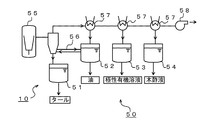
図3はバイオマス由来液体燃料の製造プラントの実施例の1つを示しており、熱分解反応炉55で発生した熱分解ガスが、第1留分回収工程から第4留分回収工程の4段階で分離回収されるよう構成した製造プラントの概略図を示している。
(Example 1 of biomass-derived liquid fuel production apparatus)
FIG. 3 shows one embodiment of a biomass-derived liquid fuel production plant, in which pyrolysis gas generated in the
第1留分回収工程は、重力式分離装置10によりタールを分離するよう構成しており、第1留分回収槽51にはタールを主成分とする燃料が製品として得られる。第2留分回収工程は、コンデンサー57と第2留分回収槽52から構成されており、油を主成分とする燃料が製品として得られる。第3留分回収工程はコンデンサー57と第3留分回収槽53から構成されており、極性有機溶液を主成分とする燃料が得られる。第4留分回収工程はコンデンサー57と第4留分回収槽54から構成されており、木酢液を主成分とする化学原料が製品として得られる。ブロワ58は、熱分解ガスが第1留分回収工程から第4留分回収工程まで円滑に搬送されるように設置されている。
The first fraction collection step is configured to separate tar with the
ここで、各回収槽51、52、53、54に回収される物質は、重力式分離装置10及びコンデンサー57における熱分解ガスの冷却温度により制御することが可能となっている。例えば、第3留分回収工程では、極性有機溶液が液相となり、後段で回収する木酢液が気相となる温度範囲で熱分解ガスを冷却するよう構成している。
Here, the substances recovered in the
第1留分回収工程に重力式分離装置10を設置したことにより、熱分解ガス中に含まれるタール分をほぼ取り除くことが可能となり、そのため、後段の回収工程においてタール付着による閉塞が発生しなくなる。
By installing the
また、第2留分回収工程で回収した油を、重力式分離装置10における冷却ジャケット12の冷媒として使用するため、冷媒循環ライン56を設置している。前記冷媒は油のみならず、図3の第3留分回収工程で回収される極性有機溶液を使用してもよい。
In addition, a refrigerant circulation line 56 is installed in order to use the oil collected in the second fraction collection step as a refrigerant for the cooling
さらに、第4留分回収工程で木酢液を回収した後、第5留分回収工程で水を回収し、前記第5留分回収工程で回収された水を製造プラント全体の冷却水として利用することも可能であり、例えば、コンデンサー57の冷却用に使用したり、各回収槽を冷却するために使用したりすることが可能である。
Furthermore, after recovering the wood vinegar liquid in the fourth fraction recovery step, water is recovered in the fifth fraction recovery step, and the water recovered in the fifth fraction recovery step is used as cooling water for the entire manufacturing plant. For example, it can be used for cooling the
上記のように、各回収工程で得られた製品等を、製造プラントの冷却等に使用することで、外部からの供給が必要となる物質を最低限のものに限り、環境負荷の少ない循環型の製造プラントとすることが可能となっている。 As mentioned above, the products obtained in each recovery process are used for cooling the production plant, etc., so that the substances that need to be supplied from the outside are limited to the minimum, and the circulation type has a low environmental impact. It is possible to make it a manufacturing plant.
また、図3では4段回で熱分解ガスを分留するよう構成しているが、これは必要に応じて段数を増減することは可能であり、製品として得るものによって、各回収工程での温度制御を行い、任意の成分を抽出することが可能となっている。 In FIG. 3, the pyrolysis gas is fractionated in four stages, but the number of stages can be increased / decreased as necessary. Depending on what is obtained as a product, It is possible to extract arbitrary components by performing temperature control.
(バイオマス由来液体燃料の製造装置の実施例2)
図4はバイオマス由来液体燃料の製造プラントの実施例の1つを示しており、第1留分回収工程に気液接触式分離装置20を用いたことを特徴としている。
(Example 2 of a production apparatus for biomass-derived liquid fuel)
FIG. 4 shows one embodiment of a biomass-derived liquid fuel production plant, which is characterized in that a gas-liquid contact
前記気液接触式分離装置20により、熱分解ガス中に含まれるタール分のほとんどを第1留分回収槽51に取り出すため、タールによる閉塞発生を防止することが可能となっている。
Since most of the tar content contained in the pyrolysis gas is taken out to the first
(バイオマス由来液体燃料の製造装置の実施例3)
図5は第1留分回収工程に重力式分離装置10を用い、第2留分回収工程に気液接触式分離装置20を用いたことを特徴としている。この構成により、重力式分離装置10でほとんどのタール分を除いた後に、熱分解ガスに若干残っているタール分を気液接触式分離装置20により、更に取り除くため、ほぼ100%に近いタール分を取り除くことが可能となっている。そのため、バイオマス由来液体燃料の製造装置50を長時間運転した場合であっても、配管がタールにより閉塞することがなくなった。
(Example 3 of biomass-derived liquid fuel production apparatus)
FIG. 5 is characterized in that a
(実施例1の構成における試験及び考察)
以下に、バイオマス由来液体燃料の製造装置50を利用して、燃料を製造する試験及びその結果に関して説明する。この試験では、図3に示した製造装置50を利用した。また、製造装置50の運転におけるタールの析出及び閉塞の有無をモニタリングした。具体的には、製造装置50の各所に圧力計を設置し、圧力損失からタールの析出及び閉塞を観察した。表1に試験の条件と結果を示す。
(Test and discussion in the configuration of Example 1)
Below, the test which manufactures a fuel using the biomass-derived liquid

表1に示す様に、試験1では、バイオマス原料として208gの椰子ガラを使用した。この椰子ガラを熱分解反応炉55に投入し、熱分解反応炉55内の温度が概ね500℃を保つように設定した。そして、タール分を回収する重力式分離装置10内の温度を、概ね200℃に保つように設定した。以上の条件により、バイオマス原料からタール、油、極性有機溶液、木酢液等を回収する試験を行った。同様に、試験2では、原料の重量及び熱分解反応炉55の温度を変更し、試験3では、バイオマス原料及び重力式分離装置10の設定温度を変更した。
As shown in Table 1, in
表1の試験1に示す様に、熱分解反応炉55、熱分解反応炉出口、重力式分離装置10、及び第2留分回収工程のコンデンサー57に設置した熱電対の測定値は、それぞれ525℃、324℃、201℃、及び157℃であった。また、製品となる回収物は、101.59g得ることができ、原料重量に対する回収率は48.8%となった。
As shown in
加えて、この試験1では、製造装置50における圧力損失は確認できなかった。つまり、タールによる閉塞は発生しなかったと言える。また、重力式分離装置10の上部に、観察窓を設置していたが、この観察窓に付着したタールは、液状であった。
In addition, in
なお、試験終了後に、重力式分離装置10前後の配管が、冷却されていく過程では、タールの固化による圧力損失を確認することができた。同様に、試験2及び3でも、タールによる閉塞は発生しなかった。また、試験終了後に、重力式分離装置10前後の配管が冷却されていく過程では、タールの固化による圧力損失を確認することができた。同様に、試験2及び3の結果も表1に示している。
In addition, after the test was completed, pressure loss due to tar solidification could be confirmed in the process of cooling the pipes around the
以上の試験の結果より、重力式分離装置10の温度が、少なくとも142℃〜201℃である場合には、タールの固化による閉塞を防止することが可能となる。また、第2留分回収工程におけるコンデンサー57の温度が、少なくとも68℃〜157℃である場合には、タールの固化による閉塞を防止することが可能となる。つまり、重力式分離装置10で、閉塞の原因となるタールの大部分を、的確に回収していると言える。
From the results of the above test, when the temperature of the
(まとめ)
本願発明におけるバイオマス由来液体燃料の製造方法及びその装置により、タールによる閉塞の発生を防止し、バイオマス由来液体燃料の製造を長時間連続で行うことが可能となった。また、高品質な液体燃料を得ることが可能となり、従来の添加物や水と混合した液体燃料と比較して、運搬時における取り扱いが楽になり、また、余分な水等を運搬しな
いため運搬効率も高くなった。さらに、水等の不要物がないため熱量の高い高品質な液体燃料を提供することが可能となった。
(Summary)
By the method and apparatus for producing biomass-derived liquid fuel according to the present invention, it is possible to prevent the occurrence of clogging due to tar and to produce biomass-derived liquid fuel continuously for a long time. In addition, it is possible to obtain high-quality liquid fuel, which makes handling easier during transportation compared to liquid fuels mixed with conventional additives and water, and also eliminates the need for transporting excess water. It was also expensive. Furthermore, since there is no unnecessary matter such as water, it has become possible to provide a high-quality liquid fuel with a high calorific value.
以上、本願発明により、バイオマスの熱分解により発生した熱分解ガスを効率よくタール、油、水、木酢液等に分留し、高品質な燃料及び化学原料を製造する方法及びその装置を提供し、さらに、タールの付着及び固着による配管の詰まりがなく、連続運転が可能な高効率なバイオマス由来液体燃料の製造方法及びその装置の提供を実現した。 As described above, the present invention provides a method and an apparatus for producing high-quality fuel and chemical raw material by efficiently fractionating pyrolysis gas generated by pyrolysis of biomass into tar, oil, water, pyroligneous acid liquid, etc. Furthermore, the present invention has provided a highly efficient method for producing a biomass-derived liquid fuel and an apparatus therefor that are capable of continuous operation without clogging of piping due to adhesion and sticking of tar.
10 重力式分離装置
11 筒状物
16 回収槽
20 気液接触式分離装置
21 吹き込み管
50 バイオマス由来液体燃料の製造装置
55 熱分解反応炉
DESCRIPTION OF
Claims (10)
バイオマス原料を熱分解して熱分解ガスを発生させる熱分解工程と、前記熱分解工程の直後に熱分解ガスから少なくともタール分を回収する留分回収工程を行うことを特徴とするバイオマス由来液体燃料の製造方法。 A method for producing a biomass-derived liquid fuel, in which a pyrolysis gas generated by pyrolyzing a biomass raw material is fractionated in multiple stages to produce a liquid fuel,
A biomass-derived liquid fuel comprising: a pyrolysis step in which a biomass raw material is pyrolyzed to generate a pyrolysis gas; and a fraction recovery step in which at least a tar content is recovered from the pyrolysis gas immediately after the pyrolysis step. Manufacturing method.
縦型に設置された筒状物の内部に上方から下方に熱分解ガスを流し、前記筒状物内の液状タールを前記筒状物下端に設置された回収槽内に供給された極性溶媒中に回収し、タール分を回収された後の気相を排気する工程としたことを特徴とする請求項1に記載のバイオマス由来液体燃料の製造方法。 The fraction collection process
In the polar solvent supplied into the recovery tank installed at the lower end of the cylindrical body, the pyrolysis gas is allowed to flow from the upper side to the lower side inside the cylindrical body installed in the vertical type. The method for producing a biomass-derived liquid fuel according to claim 1, wherein the vapor phase after the tar content is recovered is exhausted.
下端が液相中に浸漬された吹き込み管で、熱分解ガスを前記液相中に直接吹き込んで、前記熱分解ガスを気泡として浮上させる間に、少なくとも熱分解ガス中のタール分及び油分を前記液相中に気液接触により回収し、気液接触後の気相を排気する工程としたことを特徴とする請求項1に記載のバイオマス由来液体燃料の製造方法。 The fraction collection process
While blowing the pyrolysis gas directly into the liquid phase with the lower end immersed in the liquid phase and floating the pyrolysis gas as bubbles, at least the tar content and the oil content in the pyrolysis gas are The method for producing a biomass-derived liquid fuel according to claim 1, wherein the liquid phase is recovered by gas-liquid contact, and the gas phase after gas-liquid contact is exhausted.
バイオマス原料を熱分解して熱分解ガスを発生させる熱分解工程と、
熱分解ガスを筒状物の上方から下方に流しながら冷却し、前記筒状物内の液状タールを極性溶媒中に回収し、タール分を回収された後の気相を排気する第1留分回収工程と、
下端が液相中に浸漬された吹き込み管で、熱分解ガスを直接吹き込み、少なくとも気相中のタール分及び油分を前記液相中に気液接触により回収し、気液接触後の気相を排気する第2留分回収工程を含むことを特徴とするバイオマス由来液体燃料の製造方法。 A method for producing a biomass-derived liquid fuel, in which a pyrolysis gas generated by pyrolyzing a biomass raw material is fractionated in multiple stages to produce a liquid fuel,
A pyrolysis step of pyrolyzing the biomass raw material to generate pyrolysis gas;
A first fraction that cools the pyrolysis gas while flowing downward from above the cylinder, collects the liquid tar in the cylinder in a polar solvent, and exhausts the gas phase after the tar is recovered A recovery process;
A pyrolysis gas is directly blown with a blowing tube whose lower end is immersed in the liquid phase, and at least tar and oil in the gas phase are recovered by gas-liquid contact in the liquid phase, and the gas phase after the gas-liquid contact is recovered. The manufacturing method of the biomass origin liquid fuel characterized by including the 2nd fraction collection process to exhaust.
バイオマス原料を熱分解する熱分解反応炉に、重力式分離装置を接続し、前記重力式分離装置から後段の回収装置へ気相を排気するよう構成し、
前記重力式分離装置は、外周に冷却ジャケットが設置され、熱分解ガスを上方から下方に流しながら冷却する筒状物と、前記筒状物の下端に設置され、筒状物内から落下する液相を回収する回収槽を具備したことを特徴とするバイオマス由来液体燃料の製造装置。 In a biomass-derived liquid fuel production apparatus that produces liquid fuel by fractionating the pyrolysis gas generated by pyrolyzing biomass raw material in multiple stages,
A gravity separation device is connected to the pyrolysis reactor for pyrolyzing the biomass raw material, and the gas phase is exhausted from the gravity separation device to the subsequent recovery device,
The gravitational separator is provided with a cooling jacket on the outer periphery, and cools the pyrolysis gas while flowing downward from above, and a liquid that is installed at the lower end of the cylindrical object and falls from within the cylindrical object. An apparatus for producing a biomass-derived liquid fuel, comprising a recovery tank for recovering a phase.
バイオマス原料を熱分解する熱分解反応炉に、気液接触式分離装置を接続し、前記気液
接触式分離装置から後段の回収装置へ気相を排気するよう構成し、
前記気液接触式分離装置は、熱分解ガスから回収した少なくともタール分及び油分を含む液相を内部に有した回収槽と、前記回収槽の液相内に熱分解ガスを直接吹き込むための吹き込み管を具備したことを特徴とするバイオマス由来液体燃料の製造装置。 In a biomass-derived liquid fuel production apparatus that produces liquid fuel by fractionating the pyrolysis gas generated by pyrolyzing biomass raw material in multiple stages,
A gas-liquid contact type separation device is connected to a pyrolysis reactor for pyrolyzing biomass raw material, and the gas-liquid contact type separation device is configured to exhaust the gas phase to a subsequent recovery device,
The gas-liquid contact type separation device includes a recovery tank having a liquid phase containing at least a tar content and an oil content recovered from a pyrolysis gas, and a blow for directly blowing the pyrolysis gas into the liquid phase of the recovery tank An apparatus for producing a biomass-derived liquid fuel comprising a pipe.
Priority Applications (1)
| Application Number | Priority Date | Filing Date | Title |
|---|---|---|---|
| JP2009194569A JP2010077410A (en) | 2008-08-27 | 2009-08-25 | Method for producing liquid fuel derived from biomass, and apparatus therefor |
Applications Claiming Priority (2)
| Application Number | Priority Date | Filing Date | Title |
|---|---|---|---|
| JP2008218816 | 2008-08-27 | ||
| JP2009194569A JP2010077410A (en) | 2008-08-27 | 2009-08-25 | Method for producing liquid fuel derived from biomass, and apparatus therefor |
Publications (1)
| Publication Number | Publication Date |
|---|---|
| JP2010077410A true JP2010077410A (en) | 2010-04-08 |
Family
ID=42208194
Family Applications (1)
| Application Number | Title | Priority Date | Filing Date |
|---|---|---|---|
| JP2009194569A Withdrawn JP2010077410A (en) | 2008-08-27 | 2009-08-25 | Method for producing liquid fuel derived from biomass, and apparatus therefor |
Country Status (1)
| Country | Link |
|---|---|
| JP (1) | JP2010077410A (en) |
Cited By (8)
| Publication number | Priority date | Publication date | Assignee | Title |
|---|---|---|---|---|
| CN102840885A (en) * | 2012-09-17 | 2012-12-26 | 南京工业大学 | Wind tunnel experiment condensate water flow measuring device |
| CN103059896A (en) * | 2012-12-29 | 2013-04-24 | 北京林业大学 | Method and device for preparing low-moisture-content and low-acidity bio-oil through fast pyrolysis |
| CN103363295A (en) * | 2012-04-09 | 2013-10-23 | 中国石油化工股份有限公司 | Process product diesel hot feeding method |
| JP2014190882A (en) * | 2013-03-28 | 2014-10-06 | Meiwa Industries Ltd | Processing method for radioactive cesium-adhered biomass |
| CN107142122A (en) * | 2017-07-05 | 2017-09-08 | 李宏江 | Underground HTHP biomass fuel process units |
| KR101788575B1 (en) | 2016-07-15 | 2017-10-23 | 한국과학기술연구원 | The apparatus and method for the production of bio-oil and bio-char from macroalgae biomass |
| JP2021095498A (en) * | 2019-12-17 | 2021-06-24 | 株式会社ジャパンErcm | Fuel, method for producing fuel, apparatus for treating organic matter-containing waste, and method for treating organic matter-containing waste |
| CN115725329A (en) * | 2022-11-27 | 2023-03-03 | 吉林省秸源新能源科技有限公司 | A method for separating biochar from heat carrier |
-
2009
- 2009-08-25 JP JP2009194569A patent/JP2010077410A/en not_active Withdrawn
Cited By (10)
| Publication number | Priority date | Publication date | Assignee | Title |
|---|---|---|---|---|
| CN103363295A (en) * | 2012-04-09 | 2013-10-23 | 中国石油化工股份有限公司 | Process product diesel hot feeding method |
| CN103363295B (en) * | 2012-04-09 | 2015-09-23 | 中国石油化工股份有限公司 | The hot method of feeding of a kind of process product diesel oil |
| CN102840885A (en) * | 2012-09-17 | 2012-12-26 | 南京工业大学 | Wind tunnel experiment condensate water flow measuring device |
| CN103059896A (en) * | 2012-12-29 | 2013-04-24 | 北京林业大学 | Method and device for preparing low-moisture-content and low-acidity bio-oil through fast pyrolysis |
| CN103059896B (en) * | 2012-12-29 | 2014-10-22 | 北京林业大学 | Method and device for preparing low-moisture-content and low-acidity bio-oil through fast pyrolysis |
| JP2014190882A (en) * | 2013-03-28 | 2014-10-06 | Meiwa Industries Ltd | Processing method for radioactive cesium-adhered biomass |
| KR101788575B1 (en) | 2016-07-15 | 2017-10-23 | 한국과학기술연구원 | The apparatus and method for the production of bio-oil and bio-char from macroalgae biomass |
| CN107142122A (en) * | 2017-07-05 | 2017-09-08 | 李宏江 | Underground HTHP biomass fuel process units |
| JP2021095498A (en) * | 2019-12-17 | 2021-06-24 | 株式会社ジャパンErcm | Fuel, method for producing fuel, apparatus for treating organic matter-containing waste, and method for treating organic matter-containing waste |
| CN115725329A (en) * | 2022-11-27 | 2023-03-03 | 吉林省秸源新能源科技有限公司 | A method for separating biochar from heat carrier |
Similar Documents
| Publication | Publication Date | Title |
|---|---|---|
| JP2010077410A (en) | Method for producing liquid fuel derived from biomass, and apparatus therefor | |
| TWI491723B (en) | Methods for deoxygenating biomass-derived pyrolysis oil | |
| Oasmaa et al. | Quality improvement of pyrolysis liquid: Effect of light volatiles on the stability of pyrolysis liquids | |
| AU2012101985A4 (en) | System for removal of toxic waste from woody materials | |
| CN101691495B (en) | Method and device for preparing bio-oil and chemicals by pyrolyzing biomass in steps | |
| US20100166620A1 (en) | System and process of biodiesel production | |
| Li et al. | Design and operation of a down-tube reactor demonstration plant for biomass fast pyrolysis | |
| CN101693845A (en) | Method and device for preparing high-quality biological oil from biomass by selective pyrolysis | |
| Dewayanto et al. | Use of palm oil decanter cake as a new substrate for the production of bio-oil by vacuum pyrolysis | |
| JPH1180750A (en) | Combined cycle power generation method and power generator | |
| Mašek et al. | Biochar production and feedstock | |
| US10525441B2 (en) | Modular processing system | |
| EP3476468B1 (en) | Gasification device in a supercritical medium of an aqueous effluent | |
| CN104662133B (en) | By the method and apparatus of sewage sludge production biodiesel | |
| CN104031675A (en) | Process for modifying bio-oil | |
| EP3080232A1 (en) | Method and system for producing liquid biofuel from bio-based oils and/or fats | |
| Mufandi et al. | Efficiency of bio-oil production from napier grass using circulating fluidized bed reactor with bio-oil scrubber | |
| CN113493697A (en) | High-salt oil-containing sludge cracking device and method | |
| CN211734266U (en) | Device for refining bio-oil by constant-pressure online hydrodeoxygenation of volatile matters through continuous pyrolysis of biomass | |
| Li et al. | Fast pyrolysis of birch wood in a bubbling fluidized bed reactor with recycled non-condensable gases | |
| CN104498104B (en) | Biogas boiler production method and system device | |
| EP3592831B1 (en) | Heating and cooling method for a high pressure processing system | |
| CN104628512B (en) | A kind of system preparing industrial refined naphthalene | |
| CN102051193A (en) | Method for preparing liquid fuel with low oxygen content by catalyzing and pyrolyzing biomass on line | |
| CN101724436A (en) | Thermal cracking method for reducing viscosity and condensation point of extra-heavy crude oil |
Legal Events
| Date | Code | Title | Description |
|---|---|---|---|
| A300 | Application deemed to be withdrawn because no request for examination was validly filed |
Free format text: JAPANESE INTERMEDIATE CODE: A300 Effective date: 20121106 |