JP2010096609A - Pressure sensor element - Google Patents
Pressure sensor element Download PDFInfo
- Publication number
- JP2010096609A JP2010096609A JP2008267168A JP2008267168A JP2010096609A JP 2010096609 A JP2010096609 A JP 2010096609A JP 2008267168 A JP2008267168 A JP 2008267168A JP 2008267168 A JP2008267168 A JP 2008267168A JP 2010096609 A JP2010096609 A JP 2010096609A
- Authority
- JP
- Japan
- Prior art keywords
- sensor element
- gel
- carbon fiber
- coiled carbon
- matrix portion
- Prior art date
- Legal status (The legal status is an assumption and is not a legal conclusion. Google has not performed a legal analysis and makes no representation as to the accuracy of the status listed.)
- Pending
Links
- 229920000049 Carbon (fiber) Polymers 0.000 claims abstract description 98
- 239000004917 carbon fiber Substances 0.000 claims abstract description 98
- VNWKTOKETHGBQD-UHFFFAOYSA-N methane Chemical compound C VNWKTOKETHGBQD-UHFFFAOYSA-N 0.000 claims abstract description 80
- 239000011159 matrix material Substances 0.000 claims abstract description 66
- 229920000642 polymer Polymers 0.000 claims abstract description 26
- 229920001296 polysiloxane Polymers 0.000 claims description 14
- 229920002125 Sokalan® Polymers 0.000 claims description 10
- 239000004215 Carbon black (E152) Substances 0.000 claims description 9
- 229930195733 hydrocarbon Natural products 0.000 claims description 9
- 150000002430 hydrocarbons Chemical class 0.000 claims description 9
- 239000004584 polyacrylic acid Substances 0.000 claims description 9
- 229920005992 thermoplastic resin Polymers 0.000 claims description 9
- 239000000512 collagen gel Substances 0.000 claims description 7
- 230000035515 penetration Effects 0.000 claims description 7
- 239000000758 substrate Substances 0.000 claims description 7
- 230000035945 sensitivity Effects 0.000 abstract description 28
- 230000008859 change Effects 0.000 abstract description 20
- 230000008602 contraction Effects 0.000 abstract description 5
- 239000000499 gel Substances 0.000 description 81
- 238000000034 method Methods 0.000 description 12
- 238000001514 detection method Methods 0.000 description 11
- OKTJSMMVPCPJKN-UHFFFAOYSA-N Carbon Chemical compound [C] OKTJSMMVPCPJKN-UHFFFAOYSA-N 0.000 description 7
- 239000013013 elastic material Substances 0.000 description 6
- 239000003054 catalyst Substances 0.000 description 5
- 239000011248 coating agent Substances 0.000 description 5
- 238000000576 coating method Methods 0.000 description 5
- 230000005291 magnetic effect Effects 0.000 description 5
- 238000004519 manufacturing process Methods 0.000 description 5
- 239000000463 material Substances 0.000 description 5
- 229920005989 resin Polymers 0.000 description 5
- 239000011347 resin Substances 0.000 description 5
- 229920002050 silicone resin Polymers 0.000 description 5
- 238000004804 winding Methods 0.000 description 5
- XKRFYHLGVUSROY-UHFFFAOYSA-N Argon Chemical compound [Ar] XKRFYHLGVUSROY-UHFFFAOYSA-N 0.000 description 4
- 229910052799 carbon Inorganic materials 0.000 description 4
- 230000000052 comparative effect Effects 0.000 description 4
- 239000010408 film Substances 0.000 description 4
- 239000007788 liquid Substances 0.000 description 4
- 239000000843 powder Substances 0.000 description 4
- 239000000835 fiber Substances 0.000 description 3
- 239000007789 gas Substances 0.000 description 3
- 239000000203 mixture Substances 0.000 description 3
- 229920001495 poly(sodium acrylate) polymer Polymers 0.000 description 3
- NNMHYFLPFNGQFZ-UHFFFAOYSA-M sodium polyacrylate Chemical compound [Na+].[O-]C(=O)C=C NNMHYFLPFNGQFZ-UHFFFAOYSA-M 0.000 description 3
- -1 superelastic coils Substances 0.000 description 3
- 229920001817 Agar Polymers 0.000 description 2
- 108010010803 Gelatin Proteins 0.000 description 2
- VVQNEPGJFQJSBK-UHFFFAOYSA-N Methyl methacrylate Chemical compound COC(=O)C(C)=C VVQNEPGJFQJSBK-UHFFFAOYSA-N 0.000 description 2
- PPBRXRYQALVLMV-UHFFFAOYSA-N Styrene Chemical compound C=CC1=CC=CC=C1 PPBRXRYQALVLMV-UHFFFAOYSA-N 0.000 description 2
- YTPLMLYBLZKORZ-UHFFFAOYSA-N Thiophene Chemical compound C=1C=CSC=1 YTPLMLYBLZKORZ-UHFFFAOYSA-N 0.000 description 2
- 239000008272 agar Substances 0.000 description 2
- HSFWRNGVRCDJHI-UHFFFAOYSA-N alpha-acetylene Natural products C#C HSFWRNGVRCDJHI-UHFFFAOYSA-N 0.000 description 2
- 229910052786 argon Inorganic materials 0.000 description 2
- 230000036772 blood pressure Effects 0.000 description 2
- 210000004204 blood vessel Anatomy 0.000 description 2
- 239000002134 carbon nanofiber Substances 0.000 description 2
- 238000005229 chemical vapour deposition Methods 0.000 description 2
- 150000001875 compounds Chemical class 0.000 description 2
- 229920001577 copolymer Polymers 0.000 description 2
- 238000004132 cross linking Methods 0.000 description 2
- 229920001971 elastomer Polymers 0.000 description 2
- 125000002534 ethynyl group Chemical group [H]C#C* 0.000 description 2
- 230000005294 ferromagnetic effect Effects 0.000 description 2
- 229920000159 gelatin Polymers 0.000 description 2
- 239000008273 gelatin Substances 0.000 description 2
- 235000019322 gelatine Nutrition 0.000 description 2
- 235000011852 gelatine desserts Nutrition 0.000 description 2
- 229910002804 graphite Inorganic materials 0.000 description 2
- 239000010439 graphite Substances 0.000 description 2
- 238000010438 heat treatment Methods 0.000 description 2
- 239000012535 impurity Substances 0.000 description 2
- 229910052751 metal Inorganic materials 0.000 description 2
- 239000002184 metal Substances 0.000 description 2
- 238000012856 packing Methods 0.000 description 2
- 239000007787 solid Substances 0.000 description 2
- 229920001059 synthetic polymer Polymers 0.000 description 2
- 239000010409 thin film Substances 0.000 description 2
- 229910052723 transition metal Inorganic materials 0.000 description 2
- 150000003624 transition metals Chemical class 0.000 description 2
- RYGMFSIKBFXOCR-UHFFFAOYSA-N Copper Chemical compound [Cu] RYGMFSIKBFXOCR-UHFFFAOYSA-N 0.000 description 1
- RWSOTUBLDIXVET-UHFFFAOYSA-N Dihydrogen sulfide Chemical compound S RWSOTUBLDIXVET-UHFFFAOYSA-N 0.000 description 1
- 244000043261 Hevea brasiliensis Species 0.000 description 1
- UFHFLCQGNIYNRP-UHFFFAOYSA-N Hydrogen Chemical compound [H][H] UFHFLCQGNIYNRP-UHFFFAOYSA-N 0.000 description 1
- 239000004743 Polypropylene Substances 0.000 description 1
- 239000004372 Polyvinyl alcohol Substances 0.000 description 1
- 229920001328 Polyvinylidene chloride Polymers 0.000 description 1
- 229920002472 Starch Polymers 0.000 description 1
- GFBZUOBHZYBBBR-UHFFFAOYSA-N [Fe].[In].[Sn] Chemical compound [Fe].[In].[Sn] GFBZUOBHZYBBBR-UHFFFAOYSA-N 0.000 description 1
- 230000005856 abnormality Effects 0.000 description 1
- 230000009471 action Effects 0.000 description 1
- 230000004075 alteration Effects 0.000 description 1
- 230000017531 blood circulation Effects 0.000 description 1
- 239000003990 capacitor Substances 0.000 description 1
- 238000006243 chemical reaction Methods 0.000 description 1
- 229920006026 co-polymeric resin Polymers 0.000 description 1
- 239000002131 composite material Substances 0.000 description 1
- 229910052802 copper Inorganic materials 0.000 description 1
- 239000010949 copper Substances 0.000 description 1
- 230000003247 decreasing effect Effects 0.000 description 1
- 239000000806 elastomer Substances 0.000 description 1
- 239000003822 epoxy resin Substances 0.000 description 1
- PCHJSUWPFVWCPO-UHFFFAOYSA-N gold Chemical compound [Au] PCHJSUWPFVWCPO-UHFFFAOYSA-N 0.000 description 1
- 229910052737 gold Inorganic materials 0.000 description 1
- 239000010931 gold Substances 0.000 description 1
- 229920000578 graft copolymer Polymers 0.000 description 1
- 239000001307 helium Substances 0.000 description 1
- 229910052734 helium Inorganic materials 0.000 description 1
- SWQJXJOGLNCZEY-UHFFFAOYSA-N helium atom Chemical compound [He] SWQJXJOGLNCZEY-UHFFFAOYSA-N 0.000 description 1
- 229910000037 hydrogen sulfide Inorganic materials 0.000 description 1
- 239000004816 latex Substances 0.000 description 1
- 229920000126 latex Polymers 0.000 description 1
- 238000002156 mixing Methods 0.000 description 1
- 229920003052 natural elastomer Polymers 0.000 description 1
- 229920005615 natural polymer Polymers 0.000 description 1
- 229920001194 natural rubber Polymers 0.000 description 1
- 239000002245 particle Substances 0.000 description 1
- 230000035699 permeability Effects 0.000 description 1
- 229920000647 polyepoxide Polymers 0.000 description 1
- 229920001155 polypropylene Polymers 0.000 description 1
- 229920002451 polyvinyl alcohol Polymers 0.000 description 1
- 239000005033 polyvinylidene chloride Substances 0.000 description 1
- 239000002994 raw material Substances 0.000 description 1
- 229930195734 saturated hydrocarbon Natural products 0.000 description 1
- 239000004065 semiconductor Substances 0.000 description 1
- 235000019698 starch Nutrition 0.000 description 1
- 239000008107 starch Substances 0.000 description 1
- 230000003068 static effect Effects 0.000 description 1
- 230000008961 swelling Effects 0.000 description 1
- 238000005979 thermal decomposition reaction Methods 0.000 description 1
- 229920002725 thermoplastic elastomer Polymers 0.000 description 1
- 229920002803 thermoplastic polyurethane Polymers 0.000 description 1
- 229930192474 thiophene Natural products 0.000 description 1
- 230000009466 transformation Effects 0.000 description 1
- 238000001947 vapour-phase growth Methods 0.000 description 1
Images

Landscapes
- Compositions Of Macromolecular Compounds (AREA)
Abstract
【課題】本発明の目的は、センサに対する微弱な圧力変化であっても従来よりもさらに感度良く検出することができる圧力センサ素子を提供することにある。
【解決手段】圧力センサ素子1は、コイル状炭素繊維を高分子系ゲルに分散したセンサ素子マトリクス部2を備えている。高分子系ゲルによって従来よりも弾性率が低く柔らかく形成されたセンサ素子マトリクス部2に分散されたコイル状炭素繊維は、その伸縮に応じて電気特性が変化するため、その特性変化を検出することで高感度に圧力を検出する。
【選択図】図1An object of the present invention is to provide a pressure sensor element capable of detecting even a slight pressure change with respect to a sensor with higher sensitivity than in the past.
A pressure sensor element includes a sensor element matrix portion in which coiled carbon fibers are dispersed in a polymer gel. The coiled carbon fiber dispersed in the sensor element matrix portion 2 formed of a polymer gel and having a lower elastic modulus and softer than before changes its electrical characteristics according to its expansion and contraction. The pressure is detected with high sensitivity.
[Selection] Figure 1
Description
本発明は、圧力センサ素子に関するものである。特に、コイル状炭素繊維がゲルの中に分散されてセンサ素子マトリクス部を構成しており、微小な圧力を高感度に検出することのできる圧力センサ素子に関する。 The present invention relates to a pressure sensor element. In particular, the present invention relates to a pressure sensor element in which coiled carbon fibers are dispersed in a gel to form a sensor element matrix portion, and a minute pressure can be detected with high sensitivity.
コイル状炭素繊維(カーボンマイクロコイル)は、直径0.01〜100μm、ピッチ0.01〜100μmの螺旋構造を有する炭素繊維である。コイル状炭素繊維には伸縮性があり、その伸縮によって電気特性であるインダクタンス(L)、キャパシタンス(C)、及びレジスタンス(R)が変化するという性質を備えている。具体的には、コイル状炭素繊維が伸長すると前記L、C、及びRが増加し、コイル状炭素繊維が収縮すると前記L、C、及びRは減少する。コイル状炭素繊維の伸縮と前記L、C、Rの値の変化とは非常に高い相関を有しており、且つ再現性がよいことから、このコイル状炭素繊維は触圧を高精度に測定するセンサに利用することが可能である。 The coiled carbon fiber (carbon microcoil) is a carbon fiber having a helical structure with a diameter of 0.01 to 100 μm and a pitch of 0.01 to 100 μm. The coiled carbon fiber is stretchable, and has the property that the electrical characteristics of inductance (L), capacitance (C), and resistance (R) change due to the expansion and contraction. Specifically, when the coiled carbon fiber is elongated, the L, C, and R are increased, and when the coiled carbon fiber is contracted, the L, C, and R are decreased. The coiled carbon fiber has a very high correlation between the expansion and contraction of the coiled carbon fiber and the changes in the values of L, C, and R, and the reproducibility is good. It is possible to use for the sensor which does.
発明者らは、このコイル状炭素繊維を弾性材料に分散させてマトリクス部を形成し、このマトリクス部を利用することで、外圧を高精度に検出することができる圧力センサを発明し、特許文献1において提案している。特許文献1の圧力センサのマトリクス部には、長さが90〜150μm、コイルの直径が0.1〜10μmのコイル状炭素繊維が含まれる。このコイル状炭素繊維を分散させる弾性材料としては、シリコーン樹脂、ウレタン樹脂、エポキシ樹脂、スチレンと熱可塑性エラストマーとの共重合樹脂等の樹脂が好適に用いられる。特許文献1の圧力センサは、弾性材料中のコイル状炭素繊維の含量を増やすことによって外圧の検出感度を上げることが可能であるが、含量が30重量%を越えた場合にはマトリクス部が固くなって検出感度が落ちる傾向が認められるため、弾性材料中に含まれるコイル状炭素繊維の含量を0.1〜30重量%としている。
The inventors have invented a pressure sensor that can detect the external pressure with high accuracy by forming a matrix portion by dispersing the coiled carbon fiber in an elastic material, and using this matrix portion. 1 proposes. The matrix portion of the pressure sensor of
特許文献1の圧力センサは、簡単な構造でありながら幅広い圧力を高感度に検出することができ、且つ機械的強度に優れている。このために、例えば医療用器具のカテーテルの先端に取り付けられて血管内壁に当たったか否かを事前に検出し、血管の内壁を傷つけることを事前に回避することができる。又、血圧や脈拍の変化を常に監視し、異常を早期に検出することができる。
The pressure sensor of
特許文献2には、外力の作用で抵抗値が変化する導電性感圧部材と、この導電性感圧部材を支持する支持体とを備え、外力の検出のために該導電性部材の抵抗値を検出する感圧センサにおいて、導電性部材にゲル又はエラストマーにコイル状炭素繊維を混入した部材を利用する技術が開示されている。しかしこの特許文献2には、具体的なゲルとして如何なるものを使用するのかについては詳細に開示されてはいない。
本発明者らは、前記特許文献1の提案後も継続して検討を進めることにより、改良すべき課題が存在していることを知るに至った。特許文献1の圧力センサには、コイル状炭素繊維が弾性材料である樹脂に分散されたマトリクス部が用いられている。圧力を受けたマトリクス部の中のコイル状炭素繊維は、周囲の樹脂と同程度に変形することでその電気特性(LCR成分)が変化する。ところが、特許文献1にて提案した樹脂は全てコイル状炭素繊維よりも固く弾性率が大きい。このために、極めて微小な圧力を受けた場合のマトリクス部の変形は、同じ圧力をコイル状炭素繊維単体が受けた場合と比較すると、相対的に小さくなっていた。特許文献1の圧力センサは、マトリクス部に分散されているコイル状炭素繊維の変形に伴う電気特性の変化を検知して高感度に外圧を検出するため、マトリクス部の変形が微小である場合にはその中のコイル状炭素繊維の変形を検出することが困難であり、微弱な圧力を検出するための圧力センサとしては感度が不充分な場合があった。
The present inventors have come to know that there is a problem to be improved by continuing the examination after the proposal of
本発明は、このような従来技術における課題を解決するためになされたものであり、その目的とするところは、センサに対する極めて微弱な圧力変化であっても従来よりもさらに感度良く検出することができる圧力センサ素子を提供することにある。 The present invention has been made to solve such problems in the prior art, and the object of the present invention is to detect even a very weak pressure change against the sensor with higher sensitivity than in the past. An object of the present invention is to provide a pressure sensor element that can be used.
上記目的を達成するために、本発明の圧力センサ素子は、コイル状炭素繊維を高分子系ゲル中に分散したセンサ素子マトリクス部と、センサ素子マトリクス部を支持する基板と、センサ素子マトリクス部に接続される一対の電極とを備えていることを特徴とする。本発明のセンサ素子マトリクス部に適用される高分子系ゲルは、シリコーンゲル、ポリアクリル酸系ゲル、炭化水素系熱可塑性樹脂を含むゲル、コラーゲンゲルの中のいずれか1種又は2種以上を含むゲルである。 In order to achieve the above object, a pressure sensor element of the present invention includes a sensor element matrix portion in which coiled carbon fibers are dispersed in a polymer gel, a substrate that supports the sensor element matrix portion, and a sensor element matrix portion. And a pair of electrodes to be connected. The polymer gel applied to the sensor element matrix part of the present invention includes one or more of silicone gel, polyacrylic acid gel, gel containing hydrocarbon thermoplastic resin, and collagen gel. It is a gel containing.
本発明の圧力センサ素子は、コイル状炭素繊維を分散させるために、弾性材料の中でも柔らかく弾性率が小さいシリコーンゲル、ポリアクリル酸系ゲル、炭化水素系熱可塑性樹脂を含むゲル、コラーゲンゲルの中のいずれか1種又は2種以上のゲルを適用してマトリクス部を構成する。これにより本発明の圧力センサ素子のマトリクス部は、僅かな触圧に対して従来よりも変形し易くなり、同時にマトリクス部に分散しているコイル状炭素繊維が変形しやすくなることから、コイル状炭素繊維の電気特性の変化を大きく発現させることができる。この結果、本発明の圧力センサ素子は、極めて微弱な圧力変化であっても従来よりもさらに感度良く検出することが可能となる。 In order to disperse the coiled carbon fiber, the pressure sensor element of the present invention is a soft, low elastic modulus silicone gel, polyacrylic acid gel, gel containing hydrocarbon thermoplastic resin, or collagen gel. The matrix part is configured by applying any one kind or two or more kinds of gels. As a result, the matrix portion of the pressure sensor element of the present invention is more easily deformed than a conventional contact with a slight contact pressure, and at the same time, the coiled carbon fiber dispersed in the matrix portion is more easily deformed. The change in the electrical properties of the carbon fiber can be greatly expressed. As a result, the pressure sensor element of the present invention can detect even a very weak pressure change with higher sensitivity than in the past.
本発明の圧力センサ素子は、センサ素子マトリクス部の高分子系ゲルに対するコイル状炭素繊維の添加量が0.1〜40重量%であり、且つコイル状炭素繊維の長さが10μm以上10mm以下であることを特徴とする。 In the pressure sensor element of the present invention, the amount of the coiled carbon fiber added to the polymer gel in the sensor element matrix portion is 0.1 to 40% by weight, and the length of the coiled carbon fiber is 10 μm or more and 10 mm or less. It is characterized by being.
圧力センサ素子が微弱な圧力変化に対して高い検出感度を得るためには、電気信号を発生するコイル状炭素繊維の添加量を0.1重量%以上とすることが好ましい。一方で、コイル状炭素繊維の添加量が40重量%を越えた場合には、マトリクス部が固くなりセンサとして必要な感度が得られなくなる恐れがある。以上のことから、センサ素子マトリクス部の高分子系ゲルに対するコイル状炭素繊維の添加量は0.1〜40重量%が好適である。 In order for the pressure sensor element to obtain a high detection sensitivity for a weak pressure change, it is preferable that the amount of coiled carbon fiber that generates an electrical signal is 0.1 wt% or more. On the other hand, when the added amount of the coiled carbon fiber exceeds 40% by weight, the matrix portion may become hard and sensitivity necessary for the sensor may not be obtained. From the above, the addition amount of the coiled carbon fiber to the polymer gel in the sensor element matrix portion is preferably 0.1 to 40% by weight.
又、コイル状炭素繊維は、10μm以上の長さのものを用いることで検出感度を高くすることが可能である。一方で、10mm以上の非常に長いコイル状炭素繊維を用いることは、高分子系ゲルに均一に分散させることが困難となる。このため、センサ素子マトリクス部に添加されるコイル状炭素繊維の長さは、10μm以上10mm以下が好適である。 In addition, the detection sensitivity can be increased by using a coiled carbon fiber having a length of 10 μm or more. On the other hand, using a very long coiled carbon fiber of 10 mm or more makes it difficult to uniformly disperse the polymer gel. For this reason, the length of the coiled carbon fiber added to the sensor element matrix portion is preferably 10 μm or more and 10 mm or less.
本発明の圧力センサは、センサ素子マトリクス部に用いられる高分子系ゲルが、JIS K2220で規定される針入度で20以上200以下であることを特徴とする。本発明に係る圧力センサは、センサ素子マトリクス部に用いられる高分子系ゲルが前記針入度を備えることによって、従来用いられていた弾性体よりも有意に小さい弾性率を備えることとなる。この結果、センサ素子マトリクス部全体の弾性率を小さくすることが可能となり、極めて微弱な圧力変化であっても従来よりもさらに感度良く検出することができる。 The pressure sensor of the present invention is characterized in that the polymer gel used in the sensor element matrix portion has a penetration of 20 or more and 200 or less as defined by JIS K2220. The pressure sensor according to the present invention has an elastic modulus that is significantly smaller than that of a conventionally used elastic body when the polymer gel used in the sensor element matrix portion has the penetration. As a result, the elastic modulus of the entire sensor element matrix portion can be reduced, and even a very weak pressure change can be detected with higher sensitivity than in the past.
本発明の圧力センサ素子は、コイル状炭素繊維を分散させるために、弾性材料の中でも弾性率が小さく柔らかい、シリコーンゲル、ポリアクリル酸系ゲル、炭化水素系熱可塑性樹脂を含むゲル、コラーゲンゲルの中のいずれか1種又は2種以上のゲルを適用してセンサ素子マトリクス部を構成する。これにより、センサ素子マトリクス部に加えられる圧力が微小であってもより変形し易くなり、センサ素子マトリクス部に含まれるコイル状炭素繊維のより大きな構造変化がもたらされる。この結果、コイル状炭素繊維の電気特性(LCR成分)の変化が大きくなって、圧力の検出感度が向上する。 In order to disperse the coiled carbon fiber, the pressure sensor element of the present invention has a low elastic modulus and is soft among elastic materials, such as silicone gel, polyacrylic acid gel, gel containing hydrocarbon thermoplastic resin, and collagen gel. Any one or two or more kinds of gels are applied to constitute the sensor element matrix portion. Thereby, even if the pressure applied to the sensor element matrix portion is very small, the sensor element matrix portion is more easily deformed, and a larger structural change of the coiled carbon fiber included in the sensor element matrix portion is brought about. As a result, the change in the electrical characteristics (LCR component) of the coiled carbon fiber is increased, and the pressure detection sensitivity is improved.
本発明は、センサ素子マトリクス部を構成するゲルが柔らかいために、従来よりもコイル状炭素繊維の添加量を増やすことが可能であり、これによって一層圧力の検出感度を高めることができる。 In the present invention, since the gel constituting the sensor element matrix portion is soft, it is possible to increase the addition amount of the coiled carbon fiber as compared with the conventional case, thereby further increasing the pressure detection sensitivity.
以下本発明について添付図面に基づいて具体的に説明する。本実施形態における圧力センサ素子の概略断面図を図1に示す。本実施態様における圧力センサ素子1は、コイル状炭素繊維がゲルに分散されて構成されたセンサ素子マトリクス部2(以下、単にマトリクス部2とも称する)と、このマトリクス部2を支持している基板3とを備えている。マトリクス部2の変形によりコイル状炭素繊維の構造変化がもたらされ、この構造変化による電気特性の変化が検出されて圧力が検出される。
Hereinafter, the present invention will be specifically described with reference to the accompanying drawings. A schematic cross-sectional view of the pressure sensor element in the present embodiment is shown in FIG. The
マトリクス部2と基板3との間に、マトリクス部2の電気特性の変化を感受するように一対の電極4が設けられている。電極4には、それぞれ図示されない接続線が接続されて延びており、図示されないLCR測定装置に接続されて、電気特性としてインダクタンス(L)、静電容量(C、キャパシタンス)及び電気抵抗(R、レジスタンス)を測定してオシロスコープ等に表示することができるようになっている。
A pair of
マトリクス部2は、高分子系ゲルにコイル状炭素繊維が分散されて構成されている。このゲルは誘電体であって、静電容量(C)を有し、コンデンサとして作用する。本発明で好適に使用される高分子系ゲルは、安定な支持構造を有する3次元網目構造を持っており、高分子及びその膨潤体で構成されている。高分子系ゲルには、寒天やゼラチンなどの天然高分子ゲルと、メチルメタクリレート、シリコーン、スチレンージビニルベンゼン共重合体のような合成高分子系ゲルの2種類がある。高分子系ゲルは、高分子が液体を吸収し膨潤したものである。したがって、高分子系ゲルは、見かけ上液体と固体の中間の物質形態をとっているが、架橋度の違いに応じて高分子ゲルは粘性のある液体に近いものからかなり硬い固体まで変化する。また一般にゴムのような弾性を示すと同時に、非線形的に形状を変える塑性をも併せ持っている。さらに外界と作用する開放系物質であるという事も高分子ゲルの重要な特性である。 The matrix portion 2 is configured by dispersing coiled carbon fibers in a polymer gel. This gel is a dielectric, has a capacitance (C), and acts as a capacitor. The polymer gel suitably used in the present invention has a three-dimensional network structure having a stable support structure, and is composed of a polymer and a swelling body thereof. There are two types of polymer gels: natural polymer gels such as agar and gelatin, and synthetic polymer gels such as methyl methacrylate, silicone, and styrene-divinylbenzene copolymer. The polymer gel is one in which a polymer absorbs a liquid and swells. Therefore, the polymer gel apparently takes a material form intermediate between a liquid and a solid, but the polymer gel changes from a nearly viscous liquid to a fairly hard solid depending on the difference in the degree of crosslinking. In general, it exhibits elasticity like rubber, and at the same time has plasticity that changes its shape nonlinearly. Another important characteristic of polymer gels is that they are open materials that interact with the outside world.
本発明を実施するために使用される最良の高分子系ゲルとしては、シリコーンゲル、ポリアクリル酸系ゲル、炭化水素系熱可塑性樹脂を含むゲル、コラーゲンゲル等が用いられる。具体的には、シリコーンゲルとして、信越化学(株)製の商品名、KE−1052(JIS K2220で規定される針入度65)、KE1056(JIS K2220で規定される針入度90)等が挙げられる。ポリアクリル酸系ゲルとしては、ポリアクリル酸ナトリウム、カルボキシビニルポリマー等が挙げられる。炭化水素系熱可塑性樹脂を含むゲルとして大場機工(株)の商品名、ゲルOKパッキン等が挙げられる。 As the best polymer gel used for carrying out the present invention, silicone gel, polyacrylic acid gel, gel containing hydrocarbon thermoplastic resin, collagen gel and the like are used. Specifically, as silicone gel, there are trade names made by Shin-Etsu Chemical Co., Ltd., such as KE-1052 (Penetration 65 specified by JIS K2220), KE1056 (Penetration 90 specified by JIS K2220), etc. Can be mentioned. Examples of the polyacrylic acid gel include sodium polyacrylate and carboxyvinyl polymer. Examples of the gel containing the hydrocarbon-based thermoplastic resin include a trade name of Oba Kiko Co., Ltd., gel OK packing, and the like.
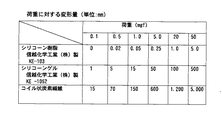
ゲルの硬さは圧力センサ素子1の感度を向上させる上で重要である。ゲルがJIS K2220で規定される針入度で20以上200以下の堅さを備えることによって、従来用いられていた樹脂に対して弾性率が有意に小さくなり、変形しやすくなる。図2に、デュロメータ硬度24の従来のシリコーン樹脂(信越化学(株)製 商品名:KE−103)と、JIS K 2220で規定される針入度が65のシリコーンゲル(信越化学(株)製 商品名:KE−1052)と、コイル状炭素繊維について、加重に対する変形量を示す。同一の加重を受けた場合のシリコーンゲルの変形量はシリコーン樹脂の変形量よりも大きく、シリコーンゲルが、よりコイル状炭素繊維に近い硬さを備えていることが明らかである。シリコーンゲルとコイル状炭素繊維とで構成されるセンサ素子マトリクス部2は、その弾性率が従来と比較して非常に小さく柔らかいために、極微弱な圧力変化であっても伸縮してその圧力を高感度で検出することができる。
The hardness of the gel is important for improving the sensitivity of the
前記の高分子系ゲルにはコイル状炭素繊維が分散されるが、そのコイル状炭素繊維としては一重巻きのコイル状炭素繊維、二重巻きのコイル状炭素繊維、超弾性コイル又はそれらの混合物等が用いられる。コイル状炭素繊維は弾性体としての機械特性を有していると同時に、その伸縮により電気特性であるインダクタンス(L)、静電容量(C)及び電気抵抗(R)が変化する。このため、それらの変化量に基づいて圧力を検出することができる。例えば、コイル状炭素繊維を伸ばすと上記L、C及びRが増加し、収縮させるとL、C及びRが減少する。具体的には、所定のコイル状炭素繊維を例えば4mm伸ばすと、Lは0.1mH増加し、Cは600pF増加し、Rは4.5kΩ増加する。そして、コイル状炭素繊維を収縮させて元の長さに戻すと、L、C及びRは元の値まで再現性良く戻る。 Coiled carbon fibers are dispersed in the polymer gel, and the coiled carbon fibers include single wound coiled carbon fibers, double wound coiled carbon fibers, superelastic coils, or mixtures thereof. Is used. The coiled carbon fiber has mechanical properties as an elastic body, and at the same time, due to the expansion and contraction, the inductance (L), capacitance (C), and electrical resistance (R), which are electrical properties, change. For this reason, a pressure can be detected based on the amount of change. For example, when the coiled carbon fiber is stretched, the L, C, and R increase, and when contracted, the L, C, and R decrease. Specifically, when a predetermined coiled carbon fiber is stretched by 4 mm, for example, L increases by 0.1 mH, C increases by 600 pF, and R increases by 4.5 kΩ. When the coiled carbon fiber is contracted and returned to its original length, L, C, and R return to their original values with good reproducibility.
コイル状炭素繊維と高分子系ゲルから成るマトリクス部に外部から圧力が加わったとき、まずゲルが伸縮し、次いでコイル状炭素繊維が伸縮するため、ゲルを介してコイル状炭素繊維に加わる圧力に基づいて前記L、C及びRの値が変化する。 When pressure is applied from the outside to the matrix part composed of the coiled carbon fiber and the polymer gel, the gel first expands and contracts, and then the coiled carbon fiber expands and contracts, so that the pressure applied to the coiled carbon fiber through the gel is increased. Based on this, the values of L, C and R change.
前記一重巻きのコイル状炭素繊維としては、1本のコイルの直径が0.01〜50μm、コイルのギャップ(繊維と繊維との間隔)が0.01〜10μm及びコイルの長さが10μm〜10mmであるものが好ましい。製造の容易性等の観点から、コイルの直径は0.1〜10μmであることが好ましく、ギャップは0.1〜10μmであることが好ましい。このコイル状炭素繊維は、一定の太さを有するコイルが一定のピッチ(間隔)をおいて一重巻きで螺旋状に延びるように形成されている。このため、一重巻きのコイル状炭素繊維は、弾力性に優れ、あらゆる方向からの圧力に対して容易に変形し、従ってあらゆる方向からの圧力を高感度で検出することができる。 The single-winding coiled carbon fiber has a diameter of one coil of 0.01 to 50 μm, a coil gap (interval between fibers) of 0.01 to 10 μm, and a coil length of 10 μm to 10 mm. Are preferred. From the viewpoint of ease of manufacture and the like, the diameter of the coil is preferably 0.1 to 10 μm, and the gap is preferably 0.1 to 10 μm. The coiled carbon fiber is formed such that a coil having a certain thickness extends in a spiral manner with a single winding at a certain pitch (interval). For this reason, the single-wound coiled carbon fiber is excellent in elasticity and easily deforms with respect to pressure from any direction, and therefore, pressure from any direction can be detected with high sensitivity.
一方、二重巻きのコイル状炭素繊維の場合には、2本のコイルが交互に密接した状態で螺旋状に延び、従って全体としてほぼ円筒状をなし、中心には空洞が形成されている。二重巻きのコイル状炭素繊維としては、コイルの直径が0.01〜50μm、ギャップがほぼ0で長さが10μm〜10mmであるものが好ましい。二重巻きのコイル状炭素繊維は一重巻きのコイル状炭素繊維に比べて弾力性が乏しく、圧力を受けたときに変位しにくいという性質がある。 On the other hand, in the case of a double-wound coiled carbon fiber, the two coils extend in a spiral shape in close contact with each other, and thus have a substantially cylindrical shape as a whole, and a cavity is formed at the center. The double-wound coiled carbon fiber preferably has a coil diameter of 0.01 to 50 μm, a gap of almost 0, and a length of 10 μm to 10 mm. Double-winding coiled carbon fibers are less elastic than single-winding coiled carbon fibers and have the property of being difficult to displace when subjected to pressure.
また、超弾性コイルはコイルの直径が大きく、線径が小さいものをいい、弾力性がより大きいコイルのことをいう。具体的には、超弾性コイルは、コイルの直径が5〜50μm、コイルのギャップが0.1〜10μm及びコイルの長さが10μm〜10mmであるものが好ましい。なお、コイル状炭素繊維の巻き方向は、コイルの軸線を中心として時計方向(右巻き)又は反時計方向(左巻き)のいずれであってもよい。 A superelastic coil is a coil having a large coil diameter and a small wire diameter, and having a higher elasticity. Specifically, the superelastic coil preferably has a coil diameter of 5 to 50 μm, a coil gap of 0.1 to 10 μm, and a coil length of 10 μm to 10 mm. The winding direction of the coiled carbon fiber may be either clockwise (right-handed) or counterclockwise (left-handed) around the coil axis.
コイル状炭素繊維は、ゲル中に0.1〜40重量%含まれることが好ましい。より好ましい含量は、1〜10重量%である。含有量が0.1重量%未満の場合には、ゲルに対するコイル状炭素繊維の割合が少ないために、コイル状炭素繊維に基づく圧力センサ12の感度が低下する。一方、含有量が40重量%を越える場合には、ゲルに対するコイル状炭素繊維の割合が多くなり過ぎて固くなり、又成形性が悪くなる傾向を示す。 The coiled carbon fiber is preferably contained in the gel in an amount of 0.1 to 40% by weight. A more preferable content is 1 to 10% by weight. When the content is less than 0.1% by weight, since the ratio of the coiled carbon fiber to the gel is small, the sensitivity of the pressure sensor 12 based on the coiled carbon fiber is lowered. On the other hand, when the content exceeds 40% by weight, the ratio of the coiled carbon fiber to the gel becomes excessively hard and the moldability tends to deteriorate.
コイル状炭素繊維は、どのような製法で製造されたものであってもよいが、例えば触媒活性化CVD(化学気相成長)法等により得られる。この気相成長法は、Ni粉末触媒を塗布したグラファイト基板上に、チオフェン又は硫化水素を不純物として含有するアセチレン、水素ガス、アルゴンを流入させ、600〜950℃に加熱して、気相中でアセチレンを分解してコイル状炭素繊維を得る方法である。この方法により得られるコイル状炭素繊維は非晶質であり、その大半が繊維の中心部分まで微細な炭素粒が詰まった状態で形成されている。また、一部には中空状に形成されたものも観察される。 The coiled carbon fiber may be manufactured by any manufacturing method, and is obtained by, for example, a catalyst activated CVD (chemical vapor deposition) method. In this vapor phase growth method, acetylene, hydrogen gas, and argon containing thiophene or hydrogen sulfide as impurities are flowed onto a graphite substrate coated with a Ni powder catalyst, heated to 600 to 950 ° C. In this method, acetylene is decomposed to obtain a coiled carbon fiber. Coiled carbon fibers obtained by this method are amorphous, and most of them are formed in a state where fine carbon particles are packed up to the center of the fibers. Some of them are also observed to be hollow.
さらに、加熱処理を施すことにより、非晶質のコイル状炭素繊維をグラファイト化(六方晶系)することができる。加熱条件としては、ヘリウム又はアルゴンなどの不活性雰囲気下で、処理温度を950〜3000℃、好ましくは1500〜3000℃、最も好ましくは2000〜3000℃である。また処理時間は、0.1〜100時間、好ましくは1〜20時間、最も好ましくは3〜10時間である。このような処理を経ることにより、グラファイト層において炭素繊維を構成する炭素粒が規則正しく配列されることにより磁場の変動などを検知する際に生じる電気抵抗の変動が著しくなるために、共振特性が顕著となる。すなわちLCR共振回路におけるR成分などの変動が顕著となるので、センサの検出感度を向上させることができる。 Furthermore, the amorphous coiled carbon fiber can be graphitized (hexagonal) by performing heat treatment. As heating conditions, the treatment temperature is 950 to 3000 ° C, preferably 1500 to 3000 ° C, and most preferably 2000 to 3000 ° C under an inert atmosphere such as helium or argon. The treatment time is 0.1 to 100 hours, preferably 1 to 20 hours, and most preferably 3 to 10 hours. Through such treatment, the variation in electrical resistance that occurs when detecting the variation in the magnetic field due to the regular arrangement of the carbon grains constituting the carbon fiber in the graphite layer becomes remarkable, and the resonance characteristics are remarkable. It becomes. That is, fluctuations in the R component and the like in the LCR resonance circuit become significant, so that the detection sensitivity of the sensor can be improved.
なお、前記方法以外にもコイル状炭素繊維の製造方法としては、遷移金属触媒を設けた基板上に5b族化合物または6b族化合物よりなる不純物ガスと炭素原料ガスを600〜900℃の温度下において反応領域に静磁場を与えながら熱分解させて製造する方法(特開平11−124740号公報)や、鎖状飽和炭化水素などを原料として400〜900℃の温度範囲で、0.3〜60.0MPaの絶対圧力範囲で、触媒として遷移金属と酸化物半導体を共存させて製造する方法(特開2004−352592号公報)、インジウム・スズ・鉄系触媒を用いることを特徴とする方法(特開2004−261630号公報)などがあり、これらの製造方法により得られるコイル状炭素繊維を用いることも勿論可能である。 In addition to the above method, as a method for producing coiled carbon fiber, an impurity gas composed of a 5b group compound or a 6b group compound and a carbon source gas are placed on a substrate provided with a transition metal catalyst at a temperature of 600 to 900 ° C. A method of producing by thermal decomposition while applying a static magnetic field to the reaction region (Japanese Patent Laid-Open No. 11-124740), a chain saturated hydrocarbon or the like as a raw material in a temperature range of 400 to 900 ° C., and 0.3 to 60. A method in which a transition metal and an oxide semiconductor are coexistent as a catalyst in an absolute pressure range of 0 MPa (Japanese Patent Application Laid-Open No. 2004-352592), and a method using an indium-tin-iron-based catalyst (Japanese Patent Application Laid-Open No. 2004-352592) Of course, it is possible to use coiled carbon fibers obtained by these production methods.
こうして得られたコイル状炭素繊維を、マトリクス部2の加圧と除圧が行われる方向に配向させた状態で配置することにより、コイル状炭素繊維が伸縮によって圧力の検出をより効果的に行うことができる。コイル状炭素繊維を配向させる方法としては例えば、コイル状炭素繊維の表面に強磁性体膜をコーティングする工程、前記コイル状炭素繊維をゲルに添加し、混合する工程、前記混合物を鋳型内に充填して、該型に対して配向させたい方向に強力磁石(永久磁石では磁場強度が1テスラ(1万ガウス)程度であるのに対し、高温超電導バルク磁石は10テスラ以上の磁場発生が可能)をセットしたのち、混合物を固化させる工程、固化させたゲルに一対の電極4を接続する工程、からなる製造方法がある。強磁性体のコーティングによってコイル状炭素繊維が、磁場内で整列され、その状態でゲルを注入し固化させて固定し、コイル状炭素繊維が配向されたセンサを得ることができるのである。
The coiled carbon fibers thus obtained are arranged in a state in which they are oriented in the direction in which the matrix portion 2 is pressurized and depressurized, so that the coiled carbon fibers can detect pressure more effectively by expansion and contraction. be able to. Examples of the method for orienting the coiled carbon fiber include a step of coating a ferromagnetic film on the surface of the coiled carbon fiber, a step of adding and mixing the coiled carbon fiber to a gel, and filling the mixture into the mold. A strong magnet in the direction to be oriented with respect to the mold (the magnetic field strength of a permanent magnet is about 1 Tesla (10,000 gauss), whereas a high-temperature superconducting bulk magnet can generate a magnetic field of 10 Tesla or more) There is a manufacturing method comprising a step of solidifying the mixture and a step of connecting a pair of
ゲルの中には、コイル状炭素繊維以外に気相成長繊維(VGCF)、カーボンナノファイバー、炭素粉末、金属粉末、誘電体粉末、圧電体粉末等を配合することもできる。また、コイル状炭素繊維の表面には、導電性を高めるために、金、銅等の金属薄膜を形成することにより、圧力センサ1の感度及び安定性を向上させることができる。
In addition to the coiled carbon fiber, vapor grown fiber (VGCF), carbon nanofiber, carbon powder, metal powder, dielectric powder, piezoelectric powder, and the like can be blended in the gel. In addition, the sensitivity and stability of the
前記ゲルにコイル状炭素繊維を分散させる方法としては、硬化する前のゲルにコイル状炭素繊維を添加し、真空遠心混合して均一に分散させた後、脱泡し、鋳型に充填する方法がある。 As a method for dispersing the coiled carbon fiber in the gel, there is a method in which the coiled carbon fiber is added to the gel before curing, vacuum-mixed and dispersed uniformly, and then defoamed and filled into a mold. is there.
本発明の圧力センサ素子1のマトリクス部2に、シリコーンゲル、ポリアクリル酸系ゲル、炭化水素系熱可塑性樹脂を含むゲル、コラーゲンゲルの他に、メチルメタクリレートゲル、ポリビニルアルコール/ポリアクリル系ゲル、スチレンージビニルベンゼン共重合体ゲルなどの合成高分子系ゲル、寒天やゼラチンなどの天然系ゲル、でんぷん/ポリアクリル酸グラフト系ポリマーゲルなどの複合ゲルを用いることができる。
In addition to silicone gel, polyacrylic acid-based gel, hydrocarbon-based thermoplastic resin, collagen gel, matrix portion 2 of
コイル状炭素繊維を分散させたゲルをそのままの状態でマトリクス部2に用いた場合には大気と反応して変質する。変質を防止するためには、マトリクス部2の表面に架橋度を上げた層を形成するか、若しくはマトリクス部2の表面に超薄膜で被覆を行うことが好ましい。被覆の材料としては、天然ゴム、チオックス、ラテックス(登録商標)等のゴム、シリコーン、ポリ塩化ビニリデン、ポリプロピレン等の気体と液体の透過性の低いものが好適に用いられる。 When the gel in which the coiled carbon fiber is dispersed is used as it is for the matrix portion 2, it is altered by reacting with the atmosphere. In order to prevent alteration, it is preferable to form a layer having a higher degree of crosslinking on the surface of the matrix portion 2 or to coat the surface of the matrix portion 2 with an ultrathin film. As the coating material, a material having low gas and liquid permeability such as natural rubber, Thiox, latex (registered trademark), silicone, polyvinylidene chloride, polypropylene, or the like is preferably used.
マトリクス部2を微小鋳型に充填して硬化する場合には、あらかじめ微小鋳型上に上記被覆材料の超薄膜をライニングし、コイル状炭素繊維を分散させた硬化前のゲルを注入後、その上からさらに超薄膜をライニングして固化させることで、必要な被覆を行うことができる。大きな鋳型を用いてマトリクス部2を作成する場合には、マトリクス部2を硬化した後、超薄膜のライニングを施すことも可能である。又、マトリクス部2の硬化を行う前に、鋳型に電極4を配置した状態にしておくことによりセンサ素子との電気的接続が形成されて成形できる。
When the matrix part 2 is filled in a micro mold and cured, an ultra-thin film of the above coating material is lined on the micro mold in advance, a gel before curing in which coiled carbon fibers are dispersed is injected, and then from above Furthermore, the necessary coating can be performed by lining and solidifying the ultrathin film. When the matrix portion 2 is formed using a large mold, it is possible to line the ultrathin film after the matrix portion 2 is cured. In addition, before the matrix portion 2 is cured, the
以下、実施例及び比較例により、本発明の実施形態をさらに具体的に説明する。
(実施例1)
長さが平均500μm、コイル径が平均5μmのコイル状炭素繊維をシリコーンゲル(商品名:KE1052,信越化学工業製)中に10.0重量%添加したセンサ素子マトリクス部2を形成して、圧力センサ素子1を作成した。
(実施例2)
長さが平均500μm、コイル径が平均5μmのコイル状炭素繊維を、ポリアクリル酸系ゲル(ポリアクリル酸ナトリウム)中に10.0重量%添加したセンサ素子マトリクス部2を形成して、圧力センサ素子1を作成した。
(実施例3)
長さが平均500μm、コイル径が平均5μmのコイル状炭素繊維を、コラーゲンゲル中に10.0重量%添加したセンサ素子マトリクス部2を形成して、圧力センサ素子1を作成した。
(実施例4)
長さが平均500μm、コイル径が平均5μmのコイル状炭素繊維を、炭化水素系熱可塑性樹脂を含むゲル(商品名:ゲルOKパッキン,大場機工(株)製)中に10.0重量%添加したセンサ素子マトリクス部2を形成して、圧力センサ素子1を作成した。
(比較例1)
長さが平均500μm、コイル径が平均5μmのコイル状炭素繊維をシリコーン樹脂(商品名:KE103,信越化学工業製)中に10.0重量%添加したセンサ素子マトリクス部2を形成して、圧力センサ素子1を作成した。
Hereinafter, embodiments of the present invention will be described more specifically with reference to examples and comparative examples.
Example 1
A sensor element matrix portion 2 is formed by adding 10.0% by weight of a coiled carbon fiber having an average length of 500 μm and an average coil diameter of 5 μm to a silicone gel (trade name: KE1052, manufactured by Shin-Etsu Chemical Co., Ltd.). A
(Example 2)
A pressure sensor is formed by forming a sensor element matrix portion 2 in which 10.0% by weight of a coiled carbon fiber having an average length of 500 μm and an average coil diameter of 5 μm is added to polyacrylic acid gel (sodium polyacrylate).
(Example 3)
A sensor element matrix portion 2 in which 10.0% by weight of a coiled carbon fiber having an average length of 500 μm and an average coil diameter of 5 μm was added to collagen gel was formed to produce a
Example 4
Adds 10.0% by weight of coiled carbon fiber with an average length of 500 μm and an average coil diameter of 5 μm into a gel containing hydrocarbon-based thermoplastic resin (trade name: Gel OK Packing, manufactured by Oba Kiko Co., Ltd.) The sensor element matrix portion 2 thus formed was formed to produce a
(Comparative Example 1)
A sensor element matrix part 2 is formed by adding 10.0% by weight of a coiled carbon fiber having an average length of 500 μm and an average coil diameter of 5 μm to a silicone resin (trade name: KE103, manufactured by Shin-Etsu Chemical Co., Ltd.). A
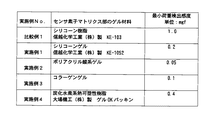
実施例1〜4及び比較例1にて成形した圧力センサ素子は、直径10mm、高さ5mmの半球形状に成形されている。これらの圧力センサ素子を静置した状態で、センサ素子マトリクス部2の上側から微小な荷重をかけて徐々にその荷重を増やすことで、各々の圧力センサ素子の最小荷重検出感度を測定した。その結果を図3に示す。図3からも明らかなように、本発明実施例1〜4の圧力センサ素子は、シリコーン樹脂にてマトリクス部2を形成された従来の圧力センサ素子に比較して、最も感度の低い実施例4の炭化水素系熱可塑性樹脂を含むゲルを適用した圧力センサ素子であっても、従来の40%の荷重である0.4mgfの荷重を検出することが可能である。又、最も感度の高い実施例3のポリアクリル酸ナトリウムを適用した圧力センサ素子は、従来の5%の荷重である0.05mgfの荷重を検出することが可能であり、従来の20倍の感度を備えている。このように、本発明の圧力センサ素子1は、微小な圧力に対してセンサ素子マトリクス部2がより大きく変形可能でありそこに含まれるコイル状炭素繊維にもより大きな構造変化がもたらされるために、コイル状炭素繊維の電気特性(LCR成分)がより変化し易くなっており、結果圧力の検出感度が向上している。
The pressure sensor elements formed in Examples 1 to 4 and Comparative Example 1 are formed in a hemispherical shape having a diameter of 10 mm and a height of 5 mm. With these pressure sensor elements still standing, the minimum load detection sensitivity of each pressure sensor element was measured by gradually increasing the load by applying a minute load from the upper side of the sensor element matrix portion 2. The result is shown in FIG. As is apparent from FIG. 3, the pressure sensor elements of Examples 1 to 4 of the present invention are the least sensitive Example 4 compared to the conventional pressure sensor element in which the matrix portion 2 is formed of silicone resin. Even a pressure sensor element to which a gel containing a hydrocarbon-based thermoplastic resin is applied can detect a load of 0.4 mgf, which is a conventional load of 40%. Moreover, the pressure sensor element using the sodium polyacrylate of Example 3 having the highest sensitivity can detect a load of 0.05 mgf, which is a conventional 5% load, and is 20 times as sensitive as the conventional one. It has. Thus, in the
本実施例1〜4の圧力センサ素子1は、センサ素子マトリクス部2を構成するゲルが柔らかいために、従来よりもコイル状炭素繊維の添加量を増やすことが可能であり、これによって一層圧力の検出感度を高めることができる。
In the
本発明の圧力センサ素子は、センサ素子マトリクス部を高分子系ゲルで構成することにより、従来の圧力センサ素子よりも感度が著しく向上している。そこで、このように高感度な圧力センサ素子は、カテーテル用センサ素子をはじめとして、各種触覚情報検知用センサ素子、血圧測定用センサ素子、血流音検出センサ素子、波動検出用センサ素子、として利用可能である。 In the pressure sensor element of the present invention, the sensor element matrix portion is made of a polymer gel, so that the sensitivity is remarkably improved as compared with the conventional pressure sensor element. Therefore, such a highly sensitive pressure sensor element is used as a sensor element for detecting various tactile information, a sensor element for measuring blood pressure, a sensor element for detecting blood flow, and a sensor element for detecting a wave, including a sensor element for a catheter. Is possible.
1 圧力センサ素子
2 センサ素子マトリクス部
3 基板
4 電極
DESCRIPTION OF
Claims (3)
前記センサ素子マトリクス部を支持する基板と、
前記センサ素子マトリクス部に接続される一対の電極とを備えている圧力センサ素子であって、
センサ素子マトリクス部の高分子系ゲルが、シリコーンゲル、ポリアクリル酸系ゲル、炭化水素系熱可塑性樹脂を含むゲル、コラーゲンゲルの中のいずれか1種又は2種以上を含むゲルであることを特徴とする圧力センサ素子。 A sensor element matrix part in which coiled carbon fibers are dispersed in a polymer gel;
A substrate for supporting the sensor element matrix portion;
A pressure sensor element comprising a pair of electrodes connected to the sensor element matrix portion,
The polymer gel of the sensor element matrix portion is a gel containing one or more of silicone gel, polyacrylic acid gel, gel containing hydrocarbon thermoplastic resin, and collagen gel. A characteristic pressure sensor element.
Priority Applications (1)
| Application Number | Priority Date | Filing Date | Title |
|---|---|---|---|
| JP2008267168A JP2010096609A (en) | 2008-10-16 | 2008-10-16 | Pressure sensor element |
Applications Claiming Priority (1)
| Application Number | Priority Date | Filing Date | Title |
|---|---|---|---|
| JP2008267168A JP2010096609A (en) | 2008-10-16 | 2008-10-16 | Pressure sensor element |
Publications (1)
| Publication Number | Publication Date |
|---|---|
| JP2010096609A true JP2010096609A (en) | 2010-04-30 |
Family
ID=42258398
Family Applications (1)
| Application Number | Title | Priority Date | Filing Date |
|---|---|---|---|
| JP2008267168A Pending JP2010096609A (en) | 2008-10-16 | 2008-10-16 | Pressure sensor element |
Country Status (1)
| Country | Link |
|---|---|
| JP (1) | JP2010096609A (en) |
Cited By (8)
| Publication number | Priority date | Publication date | Assignee | Title |
|---|---|---|---|---|
| CN105156775A (en) * | 2015-08-11 | 2015-12-16 | 广东双虹新材料科技有限公司 | An elastic microtube in which fluid pressure can be detected |
| KR20160109621A (en) * | 2015-03-12 | 2016-09-21 | 엘지이노텍 주식회사 | Rain sensor and wiper driving device including the same |
| KR20170084879A (en) * | 2016-01-13 | 2017-07-21 | (주)창성 | A sensing system for pedestrian having carbon micro coil sensor |
| US9735747B2 (en) * | 2015-07-10 | 2017-08-15 | Intel Corporation | Balancing mobile device audio |
| KR20180061495A (en) * | 2016-11-29 | 2018-06-08 | 중앙대학교 산학협력단 | Sensor and manufacturing method of the same |
| CN108981976A (en) * | 2018-08-14 | 2018-12-11 | 深圳大学 | A kind of flexible capacitance type stress sensor chip and preparation method thereof |
| KR20190132853A (en) * | 2018-05-21 | 2019-11-29 | 한국전자통신연구원 | Method of manufacturing nanocomposite sensor and nanocomposite |
| CN111198063A (en) * | 2018-11-16 | 2020-05-26 | 北京纳米能源与系统研究所 | a pressure sensor |
-
2008
- 2008-10-16 JP JP2008267168A patent/JP2010096609A/en active Pending
Cited By (15)
| Publication number | Priority date | Publication date | Assignee | Title |
|---|---|---|---|---|
| US10407028B2 (en) | 2015-03-12 | 2019-09-10 | Lg Innotek Co., Ltd. | Rain sensor and wiper driving apparatus comprising same |
| KR20160109621A (en) * | 2015-03-12 | 2016-09-21 | 엘지이노텍 주식회사 | Rain sensor and wiper driving device including the same |
| KR102327610B1 (en) | 2015-03-12 | 2021-11-17 | 엘지이노텍 주식회사 | Rain sensor and wiper driving device including the same |
| CN107428315B (en) * | 2015-03-12 | 2021-02-05 | Lg伊诺特有限公司 | Rain sensor and wiper drive device including the same |
| CN107428315A (en) * | 2015-03-12 | 2017-12-01 | Lg伊诺特有限公司 | Rain sensor and wiper driving device including the rain sensor |
| EP3269603A4 (en) * | 2015-03-12 | 2018-02-21 | LG Innotek Co., Ltd. | Rain sensor and wiper driving apparatus comprising same |
| US9735747B2 (en) * | 2015-07-10 | 2017-08-15 | Intel Corporation | Balancing mobile device audio |
| CN105156775A (en) * | 2015-08-11 | 2015-12-16 | 广东双虹新材料科技有限公司 | An elastic microtube in which fluid pressure can be detected |
| KR20170084879A (en) * | 2016-01-13 | 2017-07-21 | (주)창성 | A sensing system for pedestrian having carbon micro coil sensor |
| KR101896158B1 (en) | 2016-11-29 | 2018-09-07 | 중앙대학교 산학협력단 | Sensor and manufacturing method of the same |
| KR20180061495A (en) * | 2016-11-29 | 2018-06-08 | 중앙대학교 산학협력단 | Sensor and manufacturing method of the same |
| KR20190132853A (en) * | 2018-05-21 | 2019-11-29 | 한국전자통신연구원 | Method of manufacturing nanocomposite sensor and nanocomposite |
| KR102576519B1 (en) * | 2018-05-21 | 2023-09-12 | 한국전자통신연구원 | Method of manufacturing nanocomposite sensor and nanocomposite |
| CN108981976A (en) * | 2018-08-14 | 2018-12-11 | 深圳大学 | A kind of flexible capacitance type stress sensor chip and preparation method thereof |
| CN111198063A (en) * | 2018-11-16 | 2020-05-26 | 北京纳米能源与系统研究所 | a pressure sensor |
Similar Documents
| Publication | Publication Date | Title |
|---|---|---|
| JP2010096609A (en) | Pressure sensor element | |
| Huang et al. | Three-dimensional light-weight piezoresistive sensors based on conductive polyurethane sponges coated with hybrid CNT/CB nanoparticles | |
| Shu et al. | Flexible resistive tactile pressure sensors | |
| Qiu et al. | A path beyond metal and silicon: polymer/nanomaterial composites for stretchable strain sensors | |
| Cheng et al. | A highly sensitive piezoresistive sensor with interlocked graphene microarrays for meticulous monitoring of human motions | |
| Wang et al. | Mechanically flexible conductors for stretchable and wearable e‐skin and e‐textile devices | |
| Huang et al. | A unique, flexible, and porous pressure sensor with enhanced sensitivity and durability by synergy of surface microstructure and supercritical fluid foaming | |
| Yang et al. | Flexible, conductive, and highly pressure-sensitive graphene-polyimide foam for pressure sensor application | |
| Chang et al. | A high-sensitivity and low-hysteresis flexible pressure sensor based on carbonized cotton fabric | |
| Yuan et al. | Flexible and breathable strain sensor with high performance based on MXene/nylon fabric network | |
| Li et al. | Design of a wearable and shape-memory fibriform sensor for the detection of multimodal deformation | |
| Yuan et al. | Bending and Stretching‐Insensitive, Crosstalk‐free, flexible pressure sensor arrays for Human‐machine interactions | |
| Tai et al. | Flexible pressure sensing film based on ultra-sensitive SWCNT/PDMS spheres for monitoring human pulse signals | |
| Cheng et al. | Low‐cost, highly sensitive, and flexible piezoresistive pressure sensor characterized by low‐temperature interfacial polymerization of polypyrrole on latex sponge | |
| JP4627661B2 (en) | Pressure sensor for catheter | |
| Yang et al. | Construction of laser-induced graphene/silver nanowire composite structures for low-strain, high-sensitivity flexible wearable strain sensors | |
| Zhu et al. | Large‐area hand‐covering elastomeric electronic skin sensor with distributed multifunctional sensing capability | |
| Xue et al. | Wearable and visual pressure sensors based on Zn 2 GeO 4@ polypyrrole nanowire aerogels | |
| Gao et al. | Flexible and sensitive piezoresistive electronic skin based on TOCN/PPy hydrogel films | |
| Yuan et al. | A flexible viscoelastic coupling cable with self-adapted electrical properties and anti-impact performance toward shapeable electronic devices | |
| CN105444928A (en) | Preparation method of piezoresistance type linear flexibility stress sensor | |
| CN113720386A (en) | Bimodal flexible sensor for measuring temperature and strain and preparation method thereof | |
| Chen et al. | CNT@ leather-based electronic bidirectional pressure sensor | |
| Oren et al. | Helical-shaped graphene tubular spring formed within microchannel for wearable strain sensor with wide dynamic range | |
| Li et al. | A Seamlessly Integrated Sandwich‐Structured Hydrogel for Supercapacitors and Multimodal Wearable Sensors Enabling Information Transmission |