JP2012131702A - Method of manufacturing ceramic porous body - Google Patents
Method of manufacturing ceramic porous body Download PDFInfo
- Publication number
- JP2012131702A JP2012131702A JP2012014687A JP2012014687A JP2012131702A JP 2012131702 A JP2012131702 A JP 2012131702A JP 2012014687 A JP2012014687 A JP 2012014687A JP 2012014687 A JP2012014687 A JP 2012014687A JP 2012131702 A JP2012131702 A JP 2012131702A
- Authority
- JP
- Japan
- Prior art keywords
- ash
- porous body
- ceramic porous
- clinker
- raw materials
- Prior art date
- Legal status (The legal status is an assumption and is not a legal conclusion. Google has not performed a legal analysis and makes no representation as to the accuracy of the status listed.)
- Pending
Links
Images

Landscapes
- Compositions Of Oxide Ceramics (AREA)
- Cultivation Of Plants (AREA)
- Farming Of Fish And Shellfish (AREA)
- Processing Of Solid Wastes (AREA)
- Porous Artificial Stone Or Porous Ceramic Products (AREA)
Abstract
Description
本発明は、石炭火力発電所等から排出されるボトムアッシュ(クリンカアッシュ)、フライアッシュ、および廃ガラスを原料とするセラミック多孔質体の製造方法に関する。 The present invention relates to a method for producing a porous ceramic body using as raw materials bottom ash (clinker ash), fly ash, and waste glass discharged from a coal-fired power plant or the like.
世界の石油需給の長期的展望から、電力供給において石炭火力発電が重視されてきており、今後その比率が増大することは必至である。これに対応して石炭灰の発生量も年間1080万トン(2002年、財団法人 石炭エネルギーセンター)であり、発生石炭灰のうち973万トン/年はセメント製造分野、土木分野、建築分野(軽量ボード等として)などで有効利用されているが、残る107万トン/年は埋立て処分されている。 From the long-term perspective of oil supply and demand in the world, coal-fired power generation has been emphasized in power supply, and the ratio will inevitably increase in the future. Correspondingly, the amount of coal ash generated is 10.8 million tons per year (2002, Coal Energy Center). Of the generated coal ash, 9.73 million tons / year is cement manufacturing, civil engineering, and construction (lightweight) The remaining 1.70 million tons / year is disposed of in landfills.
石炭火力発電所等で燃焼される石炭からの石炭灰の約90%がフライアッシュであり、10%がボトムアッシュ(クリンカアッシュ)である。フライアッシュは集塵装置で捕集された微粒状石炭灰であり、ボトムアッシュはボイラ底部で回収される塊状石炭灰でクリンカアッシュともいう。 About 90% of coal ash from coal burned at a coal-fired power plant or the like is fly ash, and 10% is bottom ash (clinker ash). Fly ash is fine coal ash collected by a dust collector, and bottom ash is massive coal ash collected at the bottom of the boiler and is also called clinker ash.
処で、ボトムアッシュ(クリンカアッシュ)は砒素や、カドミウム、鉛といった有害重金属類を含んでおり、ボトムアッシュ(クリンカアッシュ)を埋立て処分するときは溶出の危険性がある処から、管理型処分(有害重金属が地下水等に溶出流入することがないよう、遮断設備を施して埋立て処分する)対象となっており、その処分には高いコストを伴っている。これは、表6および表7に示すように、ボトムアッシュからの溶出量がフライアッシュのそれよりもはるかに多いことに起因している。ボトムアッシュ(クリンカアッシュ)の低コスト無害化さらには資源化のための技術が強く望まれている処である。 However, bottom ash (clinker ash) contains hazardous heavy metals such as arsenic, cadmium, and lead. When landfilling bottom ash (clinker ash), there is a risk of elution, and therefore managed disposal. It is subject to disposal (landfilled with a shut-off facility so that harmful heavy metals do not flow into groundwater etc.), and the disposal involves high costs. As shown in Tables 6 and 7, this is because the amount of elution from the bottom ash is much larger than that of fly ash. The technology for making bottom ash (clinker ash) low-cost harmless and resource-recycling is strongly desired.

一方、廃ガラス(板ガラスを除く)は年間260万トン放出され、そのうちの165万トン/年は再利用されている。残りの95万トン/年が廃棄物として埋立て処分されている。廃ガラスの廃棄量は今後も増加の傾向にあり、その有効利用のための技術が望まれている。 On the other hand, waste glass (excluding plate glass) is released 2.6 million tons per year, of which 16.5 million tons / year is reused. The remaining 950,000 tons / year is landfilled as waste. The amount of waste glass discarded will continue to increase, and a technology for its effective use is desired.
他方、ボトムアッシュ(クリンカアッシュ)を骨材とし、その表面の少なくとも一部に被覆した、10μm〜100μmの通孔をもつ、ソーダ石灰ガラスと水硬性セメントからなる多孔質結晶化ガラスを介してクリンカアッシュを部分的に結合せしめるとともに、このクリンカアッシュの粒子間に100μm〜500μmの孔隙を有するセラミック焼結体が既知である(特許文献1参照)。そして、この先行技術にあっては、フライアッシュを20重量%以下の範囲で添加する態様もある。 On the other hand, a clinker is formed through a porous crystallized glass made of soda-lime glass and hydraulic cement having bottom ash (clinker ash) as an aggregate and covering at least a part of its surface and having 10 to 100 μm through holes. A ceramic sintered body in which ash is partially bonded and pores of 100 μm to 500 μm are provided between the clinker ash particles is known (see Patent Document 1). And in this prior art, there also exists an aspect which adds fly ash in 20 weight% or less.
しかしながら特許文献1には、ボトムアッシュ(クリンカアッシュ)が含んでいる砒素や、カドミウム、鉛といった有害重金属類溶出の問題を解決するという課題およびそれを解決するための技術的手段について教示する処がない。また、この先行技術にあって必須の多孔質結晶化ガラスは、ソーダ石灰ガラスと水硬性セメントからなる。而して、多孔質結晶化ガラスを製造するための別途のプロセスを必要とする。
However,
本発明は、従来、専ら管理型埋立て処分対象とされてきたボトムアッシュ(クリンカアッシュ)を出発原料の一部として、有害重金属類溶出の危険性のない、透水・保水性材料、濾過材料、微生物を担持する水浄化材料、吸音材料、保湿材料、耐火断熱材料、植栽用材料等として用いられるセラミック多孔質体の製造方法を提供することを目的とする。 The present invention uses a bottom ash (clinker ash), which has conventionally been exclusively managed landfill disposal, as a part of the starting material, a water-permeable / water-retaining material, a filtering material, without the risk of elution of harmful heavy metals, It aims at providing the manufacturing method of the ceramic porous body used as a water purification material, a sound absorption material, a moisture retention material, a fireproof heat insulation material, a planting material etc. which carry microorganisms.
上記課題を解決するための本発明は、重量で、フライアッシュ:10%〜60%、廃ガラス:15%〜50%、ボトムアッシュ(クリンカアッシュ):10%〜70%の配合比率の原料を粒粉体とし、該原料を混合して空気遮断状態下に、600℃〜1100℃の温度域で10分間〜120分間の焼成を行った後、空気遮断状態下に冷却するようにしたセラミック多孔質体の製造方法である。 In order to solve the above problems, the present invention provides, by weight, raw materials having a blending ratio of fly ash: 10% to 60%, waste glass: 15% to 50%, and bottom ash (clinker ash): 10% to 70%. The ceramic porous material is made into granular powder, mixed with the raw materials, fired in a temperature range of 600 ° C. to 1100 ° C. for 10 minutes to 120 minutes in an air-blocked state, and then cooled in the air-blocked state. It is a manufacturing method of a mass.
本発明によれば、配合原料中の廃ガラスがバインダとしての機能を有するから別途バインダを加える必要はなく、強度に優れたセラミック多孔質体を得ることができる。また、ボムアッシュ(クリンカアッシュ)中に含まれる砒素や、カドミウム、鉛といった有害重金属類はガラス骨格内に閉じ込められ(ガラス固化され)、セラミック多孔質体からの溶出が殆どなくなる。 According to the present invention, since the waste glass in the blended raw material has a function as a binder, it is not necessary to add a binder separately, and a ceramic porous body having excellent strength can be obtained. In addition, harmful heavy metals such as arsenic, cadmium, and lead contained in bomb ash (clinker ash) are confined in the glass skeleton (solidified), and almost no elution from the ceramic porous body occurs.
また、フライアッシュに含まれている炭素、硫黄といった元素の燃焼によって溶融ガラス中で多数の独立気泡→連続気孔(微細孔)が形成され、比表面積のきわめて大きな吸水性に優れたセラミック多孔質体を得ることができる。このセラミック多孔質体は、その微細孔中に微生物を棲まわせ、水質を浄化する要素として利用することができるほか、透水・保水性材料、濾過材料、吸音材料、保湿材料、耐火断熱材料、植栽用材料等として用いることができる。 In addition, the ceramic porous body with a large specific surface area and excellent water absorption is formed by the combustion of elements such as carbon and sulfur contained in fly ash, and many closed cells → continuous pores (micropores) are formed in the molten glass. Can be obtained. This ceramic porous body can be used as an element for purifying the water quality by allowing microorganisms to be contained in the fine pores, as well as water permeable and water retaining materials, filtration materials, sound absorbing materials, moisture retaining materials, fireproof and heat insulating materials, It can be used as a planting material.
本発明のセラミック多孔質体は、フライアッシュ、廃ガラス、ボトムアッシュ(クリンカアッシュ)を出発原料とし、これら原料を特定の比率で配合し微粉砕、混合を行った後、空気遮断状態下に600℃〜1100℃の温度域で10分間〜120分間の焼成を行うことによって得られる。
これら出発原料の化学的組成の一例を、表1乃至表3に示す。
The ceramic porous body of the present invention uses fly ash, waste glass, and bottom ash (clinker ash) as starting materials, and these materials are blended at a specific ratio, pulverized and mixed, and then in an air-blocked state, 600 It is obtained by performing baking for 10 minutes to 120 minutes in a temperature range of from 1 to 100 ° C.
Examples of chemical compositions of these starting materials are shown in Tables 1 to 3.
また、石炭灰中に含まれる重金属の一例を、表4に示す。 Table 4 shows an example of heavy metals contained in coal ash.
出発原料の配合比率は、重量で、フライアッシュ:10%〜60%、廃ガラス:15%〜50%、ボトムアッシュ(クリンカアッシュ):10%〜70%である。
フライッシュは通常、重量で、数%の炭素や硫黄を含んでおり、焼成過程でこれらが燃焼、ガス化し溶融したガラス中で独立気泡→連続気孔(微細孔)を形成し、最終的に無数の連続気孔(微細孔)を形成する。而して、フライアッシュは少なくとも10%は必要であり、これに満たない配合比率では炭素、硫黄の燃焼、ガス化による連続気孔(微細孔)の形成が不十分となる。一方、60%を超えるフライアッシュの配合は廃ガラスおよびボトムアッシュの配合比率を過少ならしめ、わけてもバインダとして機能する廃ガラスの量を過少ならしめて焼結を不十分なものとし、得られるセラミック多孔質体の強度不足を招く。
The blending ratio of the starting materials is, by weight, fly ash: 10% to 60%, waste glass: 15% to 50%, and bottom ash (clinker ash): 10% to 70%.
Fries usually contain several percent of carbon and sulfur by weight, and in the firing process, these burned, gasified and melted to form closed cells → open pores (micropores), and finally countless The continuous pores (micropores) are formed. Therefore, at least 10% of fly ash is necessary. If the blending ratio is less than this, the formation of continuous pores (micropores) due to the combustion and gasification of carbon and sulfur becomes insufficient. On the other hand, if fly ash content exceeds 60%, the mixing ratio of waste glass and bottom ash is made too small, especially if the amount of waste glass that functions as a binder is made too small to make sintering insufficient, and the resulting ceramic porous Insufficient strength of the material.
廃ガラスはバインダとして機能しその配合比率を増していくと、焼結性を良好ならしめて得られるセラミック多孔質体の強度を高める。而して、その配合比率が15%に満たないと、焼結を不十分なものとし、得られるセラミック多孔質体の強度不足を招く。一方、50%を超える配合比率では、フライアッシュおよびボトムアッシュ(クリンカアッシュ)の配合比率が過少となり、連続気孔(微細孔)の形成が不十分となる。 Waste glass functions as a binder and increases the blending ratio thereof, thereby increasing the strength of the ceramic porous body obtained by improving the sinterability. Thus, if the blending ratio is less than 15%, the sintering is insufficient and the resulting ceramic porous body is insufficient in strength. On the other hand, if the blending ratio exceeds 50%, the blending ratio of fly ash and bottom ash (clinker ash) becomes too small, and the formation of continuous pores (micropores) becomes insufficient.
上記配合比率の出発原料を、好ましくは100μm以下の粒粉体とし、これらを混合して空気遮断状態下に600℃〜1100℃の温度域で10分間〜120分間加熱して焼結させ、空気遮断状態下に自然冷却して数μm〜数mm直径の連続気孔(微細孔)を有するセラミック多孔質体を得る。 The starting material having the above blending ratio is preferably granular powder of 100 μm or less, mixed, heated and sintered in a temperature range of 600 ° C. to 1100 ° C. for 10 minutes to 120 minutes in an air shut-off state, and air A ceramic porous body having continuous pores (micropores) having a diameter of several μm to several mm is obtained by natural cooling in a blocked state.
出発原料を100μm以下に粉砕し、この原料混合物に水を添加して混練したものを型に注入して成型物を得、自然乾燥した後、空気遮断状態下に600℃〜1100℃の温度域で10分間〜120分間の焼成を行って、空気遮断状態下に自然冷却して数μm〜数mm直径の連続気孔(微細孔)を有する所望形状のセラミック多孔質体を得ることができる。 The starting material is pulverized to 100 μm or less, and the mixture obtained by adding water to the starting material mixture is poured into a mold to obtain a molded product. The ceramic porous body having a desired shape having continuous pores (micropores) having a diameter of several μm to several mm can be obtained by firing for 10 minutes to 120 minutes and naturally cooling in an air-blocked state.
焼成過程における加熱温度が600℃未満では配合原料中の廃ガラスは溶融せず、フライアッシュ中の炭素や硫黄が燃焼してガス化しても微細孔を形成することなく拡散してしまう。一方、1100℃を超える高温になると、ガラスはほぼ完全に溶けてしまい、ガラス相中に発生した気体の多くは速やかに系外に放出される。而して、好ましくは、650℃〜1050℃の温度域で溶融したガラス中で炭素や硫黄が燃焼して発生したガスによって効率よく独立気泡→連続気孔(微細孔)を形成させてセラミック多孔質体とするのがよい。 If the heating temperature in the firing process is less than 600 ° C., the waste glass in the blended raw material does not melt, and even if carbon and sulfur in the fly ash burn and gasify, they diffuse without forming fine pores. On the other hand, when the temperature exceeds 1100 ° C., the glass is almost completely melted, and most of the gas generated in the glass phase is quickly released out of the system. Thus, it is preferable to form closed cells → continuous pores (micropores) efficiently by a gas generated by burning carbon or sulfur in a glass melted at a temperature range of 650 ° C. to 1050 ° C. It is good to have a body.
加熱時間が10分間未満では満足な焼結体を得ることが困難である。また、加熱時間が120分間を超えると、微細孔同士が連結して孔のサイズが大きくなるとともに、製造コストの上昇を招く。 If the heating time is less than 10 minutes, it is difficult to obtain a satisfactory sintered body. On the other hand, when the heating time exceeds 120 minutes, the fine holes are connected to increase the size of the holes and increase the manufacturing cost.
重量で、フライアッシュ:廃ガラス:ボトムアッシュ(クリンカアッシュ)=1:1:1の配合比率で出発原料とし、これらを100μm以下に微粉砕して混合した後、900℃×60分間、および1000℃×60分間のプロセス条件で空気遮断状態下に坩堝を用いて電気炉中で加熱・焼成を行った。その後、空気遮断状態下の電気炉中で焼結体を坩堝内ごと常温まで自然冷却して数μm〜数mm直径の連続気孔(微細孔)を有するセラミック多孔質体とした。 By weight, fly ash: waste glass: bottom ash (clinker ash) = 1: 1: 1 as a starting material, these were finely pulverized to 100 μm or less, mixed, 900 ° C. × 60 minutes, and 1000 It heated and baked in the electric furnace using the crucible in the air shut-off state on the process conditions for 60 degreeC x 60 minutes. Thereafter, the sintered body was naturally cooled to room temperature in an electric furnace in an air shut-off state to obtain a ceramic porous body having continuous pores (micropores) having a diameter of several μm to several mm.
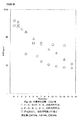
得られたセラミック多孔質体を用いて浸漬濾床法によって水質浄化試験を行った。その結果を、図1(COD値)に示す。また、BOD値の経時変化を図2に示す。図1および図2から明らかなように、当初(0日目)に、COD:400mg/L程度、BOD:800mg/L程度の値を示していたものが、3日目には、COD:30mg/L程度、BOD:30mg/L程度にまで急激に低下している。その後緩やかに数値が下降し、15日目には、COD:10mg/L程度、BOD:7mg/Lにまで浄化された。 A water purification test was conducted by the soaking filter bed method using the obtained ceramic porous body. The result is shown in FIG. 1 (COD value). Moreover, the time-dependent change of a BOD value is shown in FIG. As apparent from FIG. 1 and FIG. 2, COD: about 400 mg / L and BOD: about 800 mg / L at the beginning (day 0) showed COD: 30 mg on the third day. / L and BOD: about 30 mg / L. Thereafter, the values gradually decreased, and on the 15th day, COD was purified to about 10 mg / L and BOD was purified to 7 mg / L.
重量で、フライアッシュ:廃ガラス:ボトムアッシュ(クリンカアッシュ)=5:2:1(62.5%:25.0%:12.5%)の配合比率で出発原料とし、これらを100μm以下に微粉砕して混合した後、900℃×60分間、および1000℃×60分間のプロセス条件で空気遮断状態下に坩堝を用いてで電気炉中で加熱・焼成を行った。その後、空気遮断状態下で焼結体を坩堝ごと常温まで自然冷却して数μm〜数mm直径の連続気孔(微細孔)を有するセラミック多孔質体とした。 By weight, fly ash: waste glass: bottom ash (clinker ash) = 5: 2: 1 (62.5%: 25.0%: 12.5%) The starting material was used as a starting material, and these were reduced to 100 μm or less. After being finely pulverized and mixed, heating and firing were performed in an electric furnace using a crucible in an air-blocked state under process conditions of 900 ° C. × 60 minutes and 1000 ° C. × 60 minutes. Then, the sintered compact was naturally cooled to room temperature together with the crucible in an air shut-off state to obtain a ceramic porous body having continuous pores (micropores) having a diameter of several μm to several mm.
得られたセラミック多孔質体を用いて浸漬濾床法によって水質浄化試験を行った。その結果を、図1(COD値)に実施例1のものと併せて示す。また、BOD値の経時変化を図2に実施例1のものと併せて示す。図1および図2から明らかなように、当初(0日目)に、COD:400mg/L程度、BOD:800mg/L程度の値を示していたものが、3日目には、COD:120mg/L程度、BOD:180mg/L程度にまで低下している。その後緩やかに数値が下降し、15日目には、COD:10mg/L以下、BOD:2mg/Lにまで浄化された。 A water purification test was conducted by the soaking filter bed method using the obtained ceramic porous body. The results are shown in FIG. 1 (COD value) together with that of Example 1. Moreover, the time-dependent change of a BOD value is combined with the thing of Example 1 in FIG. As apparent from FIG. 1 and FIG. 2, COD: about 400 mg / L and BOD: about 800 mg / L at the beginning (day 0) showed COD: 120 mg on the third day. / L, BOD: about 180 mg / L. Thereafter, the value gradually decreased, and on the 15th day, COD was purified to 10 mg / L or less and BOD was purified to 2 mg / L.
実施例1および実施例2によって得られたセラミック多孔質体の溶出液の分析を下記手順によって行った。
1)プラスチック容器にセラミック多孔質体および超純水(セラミック多孔質体の重量の10倍量)を入れ、振盪恒温槽(30℃)に6時間装入した。
2)その後、セラミック多孔質体を取り出し、溶出液を吸引濾過した。
3)濾液を1リットル採取し、財団法人九州環境管理協会に成分分析を依頼した。その結果を、表5に示す。
The eluate of the ceramic porous body obtained in Example 1 and Example 2 was analyzed according to the following procedure.
1) A ceramic porous body and ultrapure water (10 times the weight of the ceramic porous body) were placed in a plastic container, and charged in a shaking thermostat (30 ° C.) for 6 hours.
2) Thereafter, the ceramic porous body was taken out, and the eluate was suction filtered.
3) One liter of the filtrate was collected and requested for component analysis by the Kyushu Environmental Management Association. The results are shown in Table 5.
表5から明らかなように、本発明のセラミック多孔質体は有害重金属の溶出量は排出基準値を大きく下回っており、環境基準値と同等或いはそれ以下ときわめて低い値となっている。よって、微生物を棲まわせて水の浄化を行う安全な浄化要素等として利用することができる。 As is apparent from Table 5, in the ceramic porous body of the present invention, the leaching amount of harmful heavy metals is far below the emission standard value, which is a very low value equal to or less than the environmental standard value. Therefore, it can be used as a safe purification element that purifies water by sprinkling microorganisms.
本発明によって得られるセラミック多孔質体は、その微細孔中に微生物を棲まわせ、水質を浄化する要素として利用することができるほか、透水・保水性材料、濾過材料、吸音材料、保湿材料、耐火断熱材料、植栽用材料等として用いることができる。 The ceramic porous body obtained by the present invention can be used as an element for purifying microorganisms in the micropores and purifying water quality, as well as water permeable / water retaining materials, filtration materials, sound absorbing materials, moisture retaining materials, fireproof materials. It can be used as a heat insulating material, a planting material or the like.
Claims (1)
Priority Applications (1)
| Application Number | Priority Date | Filing Date | Title |
|---|---|---|---|
| JP2012014687A JP2012131702A (en) | 2012-01-27 | 2012-01-27 | Method of manufacturing ceramic porous body |
Applications Claiming Priority (1)
| Application Number | Priority Date | Filing Date | Title |
|---|---|---|---|
| JP2012014687A JP2012131702A (en) | 2012-01-27 | 2012-01-27 | Method of manufacturing ceramic porous body |
Related Parent Applications (1)
| Application Number | Title | Priority Date | Filing Date |
|---|---|---|---|
| JP2007172753A Division JP2009007233A (en) | 2007-06-29 | 2007-06-29 | Ceramic porous body and method for producing the same |
Publications (1)
| Publication Number | Publication Date |
|---|---|
| JP2012131702A true JP2012131702A (en) | 2012-07-12 |
Family
ID=46647753
Family Applications (1)
| Application Number | Title | Priority Date | Filing Date |
|---|---|---|---|
| JP2012014687A Pending JP2012131702A (en) | 2012-01-27 | 2012-01-27 | Method of manufacturing ceramic porous body |
Country Status (1)
| Country | Link |
|---|---|
| JP (1) | JP2012131702A (en) |
Cited By (5)
| Publication number | Priority date | Publication date | Assignee | Title |
|---|---|---|---|---|
| WO2015011737A2 (en) | 2013-07-22 | 2015-01-29 | Politecnico Di Torino | Heat-insulating porous glass-ceramic material in slabs and process for producing such material |
| JP2017000943A (en) * | 2015-06-09 | 2017-01-05 | 株式会社大林組 | Muddy water treatment apparatus and muddy water treatment system |
| JPWO2014132877A1 (en) * | 2013-02-28 | 2017-02-02 | 小松精練株式会社 | Porous ceramic fired body and method for producing the same |
| JP2020044459A (en) * | 2018-09-14 | 2020-03-26 | 株式会社神戸製鋼所 | Method for detoxicating coal ash |
| JP2020044458A (en) * | 2018-09-14 | 2020-03-26 | 株式会社神戸製鋼所 | Detoxifying coal ash |
Citations (6)
| Publication number | Priority date | Publication date | Assignee | Title |
|---|---|---|---|---|
| JPH1160328A (en) * | 1997-08-04 | 1999-03-02 | Hisaji Koyama | Production method of water-absorbent brick by coal ash and its solidified body |
| JPH11139886A (en) * | 1997-11-06 | 1999-05-25 | Tetra:Kk | Coarse particle sintered body and method for producing the same |
| JP2001328859A (en) * | 2000-05-18 | 2001-11-27 | Tadashi Fukiya | Indoor ceramic building materials with breathability |
| JP2004067450A (en) * | 2002-08-07 | 2004-03-04 | Kitakyushu Foundation For The Advancement Of Industry Science & Technology | Porous glass and glass ceramics made from coal ash, dust from metal refining furnaces and the like, and methods for producing them |
| JP2005058044A (en) * | 2003-08-08 | 2005-03-10 | Tetra Co Ltd | Method for producing vegetation greening base material |
| JP2005089863A (en) * | 2003-09-15 | 2005-04-07 | Trumpf Werkzeugmaschinen Gmbh & Co Kg | Apparatus and method for manufacturing three-dimensional molding |
-
2012
- 2012-01-27 JP JP2012014687A patent/JP2012131702A/en active Pending
Patent Citations (6)
| Publication number | Priority date | Publication date | Assignee | Title |
|---|---|---|---|---|
| JPH1160328A (en) * | 1997-08-04 | 1999-03-02 | Hisaji Koyama | Production method of water-absorbent brick by coal ash and its solidified body |
| JPH11139886A (en) * | 1997-11-06 | 1999-05-25 | Tetra:Kk | Coarse particle sintered body and method for producing the same |
| JP2001328859A (en) * | 2000-05-18 | 2001-11-27 | Tadashi Fukiya | Indoor ceramic building materials with breathability |
| JP2004067450A (en) * | 2002-08-07 | 2004-03-04 | Kitakyushu Foundation For The Advancement Of Industry Science & Technology | Porous glass and glass ceramics made from coal ash, dust from metal refining furnaces and the like, and methods for producing them |
| JP2005058044A (en) * | 2003-08-08 | 2005-03-10 | Tetra Co Ltd | Method for producing vegetation greening base material |
| JP2005089863A (en) * | 2003-09-15 | 2005-04-07 | Trumpf Werkzeugmaschinen Gmbh & Co Kg | Apparatus and method for manufacturing three-dimensional molding |
Cited By (7)
| Publication number | Priority date | Publication date | Assignee | Title |
|---|---|---|---|---|
| JPWO2014132877A1 (en) * | 2013-02-28 | 2017-02-02 | 小松精練株式会社 | Porous ceramic fired body and method for producing the same |
| WO2015011737A2 (en) | 2013-07-22 | 2015-01-29 | Politecnico Di Torino | Heat-insulating porous glass-ceramic material in slabs and process for producing such material |
| JP2017000943A (en) * | 2015-06-09 | 2017-01-05 | 株式会社大林組 | Muddy water treatment apparatus and muddy water treatment system |
| JP2020044459A (en) * | 2018-09-14 | 2020-03-26 | 株式会社神戸製鋼所 | Method for detoxicating coal ash |
| JP2020044458A (en) * | 2018-09-14 | 2020-03-26 | 株式会社神戸製鋼所 | Detoxifying coal ash |
| JP7055943B2 (en) | 2018-09-14 | 2022-04-19 | 株式会社神戸製鋼所 | Detoxification method of coal ash |
| JP7055944B2 (en) | 2018-09-14 | 2022-04-19 | 株式会社神戸製鋼所 | Detoxification method of coal ash |
Similar Documents
| Publication | Publication Date | Title |
|---|---|---|
| JP2009007233A (en) | Ceramic porous body and method for producing the same | |
| CN102584316B (en) | A kind of preparation method of electrolytic manganese slag porous ceramics | |
| JP5658270B2 (en) | Manufacturing method of lightweight construction materials using sludge waste | |
| CN102372496A (en) | Material formula for preparing gasification furnace slag ceramisite and production method of ceramisite | |
| CN103601526A (en) | Method for microwave firing of porous ceramsites by adopting medical waste incineration fly ash | |
| Eliche-Quesada et al. | Olive stone ash as secondary raw material for fired clay bricks | |
| CN108101511A (en) | A kind of heavy metal pollution earth cooperation flying ash prepares the microwave sintering method of haydite | |
| CN113372097A (en) | Phase-change ceramsite based on waste incineration fly ash and preparation method and application thereof | |
| CN106187268B (en) | Process for preparing ultra-light filler from waste incineration fly ash | |
| JP2005320188A (en) | Inorganic foam fired body and method for producing the same | |
| WO2016051053A1 (en) | Process for manufacturing a solid element made of ceramic material, capable of being used in particular for heat storage - associated solid element | |
| CN108117375A (en) | A kind of flying dust-the Yellow River silt particle building porcelain granule and preparation method thereof | |
| KR20100067815A (en) | Carbonized lightweight aggregate be made from organic sludge | |
| Chiang et al. | Novel lightweight building bricks manufactured from water treatment plant sludge and agricultural waste | |
| Xiao et al. | Characterization and solidification of heavy metals in sintered solid-waste ceramics made from zinc-extraction kiln slag | |
| CN106500106B (en) | A method of detoxified using sintering technology leached-out chromium residue | |
| JP2000034179A (en) | Method for producing water-retentive granular sintered body | |
| WO2017196942A1 (en) | Sintered ceramics | |
| JP5019308B2 (en) | Porous fireproof insulation board and method for producing the same | |
| KR20110091169A (en) | Manufacturing method of cement using fly ash and purified sludge | |
| CN115141003B (en) | Method for preparing high-strength light ceramic tile by recycling fly ash | |
| CN114276160A (en) | Method for preparing ceramsite by utilizing incineration disposal residues | |
| JP7372215B2 (en) | Composition for fired body and method for producing fired body using the same | |
| JP3431416B2 (en) | Porous surface amorphous porous ceramics and method for producing the same | |
| KR102596866B1 (en) | Method for manufacturing oxide iron and reduced iron composite fuel |
Legal Events
| Date | Code | Title | Description |
|---|---|---|---|
| A711 | Notification of change in applicant |
Free format text: JAPANESE INTERMEDIATE CODE: A711 Effective date: 20130426 |
|
| A521 | Request for written amendment filed |
Free format text: JAPANESE INTERMEDIATE CODE: A821 Effective date: 20130426 |
|
| A131 | Notification of reasons for refusal |
Free format text: JAPANESE INTERMEDIATE CODE: A131 Effective date: 20131008 |
|
| A02 | Decision of refusal |
Free format text: JAPANESE INTERMEDIATE CODE: A02 Effective date: 20140715 |