JP2012149221A - Ink composition, inkjet recording ink, and inkjet recording method - Google Patents
Ink composition, inkjet recording ink, and inkjet recording method Download PDFInfo
- Publication number
- JP2012149221A JP2012149221A JP2011142333A JP2011142333A JP2012149221A JP 2012149221 A JP2012149221 A JP 2012149221A JP 2011142333 A JP2011142333 A JP 2011142333A JP 2011142333 A JP2011142333 A JP 2011142333A JP 2012149221 A JP2012149221 A JP 2012149221A
- Authority
- JP
- Japan
- Prior art keywords
- ink
- ink composition
- mass
- color material
- ion
- Prior art date
- Legal status (The legal status is an assumption and is not a legal conclusion. Google has not performed a legal analysis and makes no representation as to the accuracy of the status listed.)
- Ceased
Links
Landscapes
- Ink Jet Recording Methods And Recording Media Thereof (AREA)
- Inks, Pencil-Leads, Or Crayons (AREA)
- Ink Jet (AREA)
Abstract
【課題】本発明のインク組成物、インクジェット記録用インク及び記録方法は表面張力などのインク物性をコントロールし、受像紙へのインクの浸透性を向上させ、インク滲み及び色移りを防止することができる。さらなる高画質化の点から、印画物の金属様光沢、保存安定性に優れるインク組成物、インクジェット記録用インク及び記録方法を提供する。
【解決手段】少なくとも、第1の色材、及び第2の色材を含有するインク組成物であって、前記第1の色材が、水溶性アゾ系染料であり、前記第2の色材が、複素環式化合物からなる染料であり、前記第2の色材のインク組成物中における含有量(質量%)が、前記第1の色材のインク組成物中における含有量(質量%)に対して、質量比率で、0.001以上1.0以下であり、該インク中の遷移金属イオンの含有量が0.0001mmol/l〜0.1mmol/lであることを特徴とするインク組成物。
【選択図】なしThe ink composition, ink for ink jet recording, and recording method of the present invention can control ink physical properties such as surface tension, improve ink permeability to image receiving paper, and prevent ink bleeding and color migration. it can. Provided are an ink composition, an ink for ink jet recording, and a recording method excellent in metal-like gloss and storage stability of a printed material from the viewpoint of further improving the image quality.
An ink composition containing at least a first color material and a second color material, wherein the first color material is a water-soluble azo dye, and the second color material. Is a dye comprising a heterocyclic compound, and the content (% by mass) of the second color material in the ink composition is the content (% by mass) of the first color material in the ink composition. The ink composition is characterized in that the mass ratio is 0.001 or more and 1.0 or less, and the content of transition metal ions in the ink is 0.0001 mmol / l to 0.1 mmol / l. object.
[Selection figure] None
Description
本発明は、記録画像の品質が高く、吐出安定性に優れ、しかも得られた画像の保存性が優れたインク組成物、インクジェット記録用インク及びそれを用いたインクジェット記録方法に関する。 The present invention relates to an ink composition, an ink for ink jet recording, and an ink jet recording method using the ink composition having high quality of a recorded image, excellent ejection stability, and excellent storage stability of the obtained image.
近年、コンピューターの普及に伴いインクジェットプリンターがオフィスだけでなく家庭で紙、フィルム、布等に印字するために広く利用されている。
インクジェット記録方法には、ピエゾ素子により圧力を加えて液滴を吐出させる方式、熱によりインク中に気泡を発生させて液滴を吐出させる方式、超音波を用いた方式、あるいは静電力により液滴を吸引吐出させる方式がある。これらのインクジェット記録用インクとしては、水性インク、油性インク、あるいは固体(溶融型)インクが用いられる。これらのインクのうち、製造、取り扱い性・臭気・安全性等の点から水性インクが主流となっている。
In recent years, with the spread of computers, ink jet printers are widely used for printing on paper, film, cloth and the like not only in offices but also at home.
Ink jet recording methods include a method of ejecting droplets by applying pressure with a piezo element, a method of ejecting droplets by generating bubbles in ink by heat, a method of using ultrasonic waves, or a droplet by electrostatic force. There is a method of sucking and discharging. As these inks for inkjet recording, water-based inks, oil-based inks, or solid (melting type) inks are used. Among these inks, water-based inks are mainly used from the viewpoints of production, handleability, odor, safety, and the like.
これらのインクジェット記録用インクに用いられる着色剤に対しては、溶剤に対する溶解性が高いこと、高濃度記録が可能であること、色相が良好であること、光、熱、空気、水や薬品に対する堅牢性に優れていること、受像材料に対して定着性が良く滲みにくいこと、インクとしての保存性に優れていること、毒性がないこと、純度が高いこと、更には、安価に入手できることが要求されている。しかしながら、これらの要求を高いレベルで満たす着色剤を捜し求めることは、極めて難しい。
これまでの研究により、インクジェット記録用インクの性能の改善が行われてきている。特許文献1には、特定のピラゾリルアゾ色素により、インクジェット記録用インクに要求される良好な色相と堅牢性の高さを両立できることが開示されている。特許文献2〜4にも特定のピラゾリルアゾ色素が記載されている。また、特許文献5には特定構造のアゾ色素を含むインク中における、遷移金属イオン濃度を特定濃度以下とすることで、色素の堅牢性を抑制し得ることが開示されている。
The colorant used in these inks for ink jet recording has high solubility in solvents, high density recording, good hue, light, heat, air, water and chemicals. Excellent fastness, good fixability to image-receiving materials, good bleeding, excellent ink storage, no toxicity, high purity, and availability at low cost. It is requested. However, it is extremely difficult to search for colorants that meet these requirements at a high level.
Up to now, the performance of ink for ink jet recording has been improved. Patent Document 1 discloses that a specific pyrazolyl azo dye can satisfy both a good hue required for an ink jet recording ink and a high fastness. Patent Documents 2 to 4 also describe specific pyrazolyl azo dyes. Patent Document 5 discloses that the fastness of a dye can be suppressed by setting the transition metal ion concentration in an ink containing an azo dye having a specific structure to a specific concentration or less.
近年の更なる研究により、インクジェット記録用インクに求められる性能として、高速印字適正が挙げられる。そのためには表面張力などのインク物性をコントロールし、受像紙へのインクの浸透性を向上させ、インク滲み及び色移りを防止する必要がある。同時にさらなる高画質化の点から、印画物の金属様光沢、いわゆるブロンズ現象を高いレベルで改良し、さらに、優れた保存安定性が要求され続けている。
しかしながら、インクの受像紙への浸透性や、印画物のブロンズ光沢、保存安定性に対する解決法については、前記特許文献1及び2には開示がない。
本発明が解決しようとする課題は、受像紙への浸透性が優れた、印画物のブロンズ光沢を抑制し、保存安定性に優れるインク組成物、インクジェット記録用インク並びに記録方法を提供することである。
As a result of further research in recent years, high-speed printing suitability is cited as a performance required for ink jet recording ink. For this purpose, it is necessary to control ink physical properties such as surface tension, improve the ink permeability to the image receiving paper, and prevent ink bleeding and color transfer. At the same time, from the viewpoint of higher image quality, the metallic luster of prints, the so-called bronzing phenomenon, has been improved at a high level, and further excellent storage stability has been required.
However, there is no disclosure in Patent Documents 1 and 2 regarding solutions for penetrability of ink into image receiving paper, bronze gloss of printed matter, and storage stability.
The problem to be solved by the present invention is to provide an ink composition, an ink jet recording ink, and a recording method that have excellent permeability to an image receiving paper, suppress bronze gloss of a printed matter, and have excellent storage stability. is there.
本発明の課題は、下記〔1〕〜〔12〕によって達成された。 The object of the present invention has been achieved by the following [1] to [12].
〔1〕
少なくとも、第1の色材、及び第2の色材を含有するインク組成物であって、
前記第1の色材が、下記一般式(Y)で表される化合物であり、前記第2の色材が、下記群Aから選択される少なくとも1種の化合物であり、前記第2の色材のインク組成物中における含有量(質量%)が、前記第1の色材のインク組成物中における含有量(質量%)に対して、質量比率で、0.001以上1.0以下であり、該インク中の遷移金属イオンの含有量が0.0001mmol/l〜0.1mmol/lであることを特徴とするインク組成物。
一般式(Y)
(群A中、Mはそれぞれ独立に水素原子またはカチオンを表し、Mがカチオンを表す場合はLi+イオン、Na+イオン、K+イオンまたはNH4 +イオンを表す。)
〔2〕
前記群Aより選択される化合物が、1、2、3及び8から選ばれる少なくとも1種である〔1〕に記載のインク組成物。
〔3〕
前記一般式(Y)で表される化合物において、Mの主成分がK+イオンであり、群Aより選択される化合物において、Mの主成分がK+イオンである〔1〕又は〔2〕に記載のインク組成物。
〔4〕
前記一般式(Y)で表される化合物及び群Aより選択される化合物におけるMが全てK+イオンである〔1〕〜〔3〕のいずれか1項に記載のインク組成物。
〔5〕
前記第1の色材の含有量が、インク組成物全質量を基準として、1質量%以上15質量%以下である〔1〕〜〔4〕のいずれか1項に記載のインク組成物。〔6〕
前記第2の色材のインク組成物中における含有量(質量%)が、前記第1の色材のインク組成物中における含有量(質量%)に対して、質量比率で、0.001以上0.2以下である〔1〕〜〔5〕のいずれか1項に記載のインク組成物。
〔7〕
前記第2の色材の含有量が、インク組成物全質量を基準として、0.01質量%以上1.1質量%以下である〔1〕〜〔6〕のいずれか1項に記載のインク組成物。
〔8〕
前記遷移金属イオンがTi,Cr,Mn,Fe,Co,Ni,Cu,Zn,Mo,Pd,Ag,Cd,及びHgのイオンより選択される少なくとも1種であることを特徴とする〔1〕〜〔7〕のいずれか一項に記載のインク組成物。
〔9〕
前記遷移金属イオンの含有量が0.01mmol/l〜0.1mmol/lであることを特徴とする〔1〕〜〔8〕のいずれか一項に記載のインク組成物。
〔10〕
前記染料を0.2〜20質量%含有することを特徴とする〔1〕〜〔9〕のいずれか一項に記載のインク組成物。
〔11〕
〔1〕〜〔10〕のいずれか一項に記載のインク組成物を用いることを特徴とするインクジェット記録用インク。
〔12〕
支持体上に白色無機顔料粒子を含有する受像層を有する受像材料にインク滴を記録信号に応じて吐出させ、受像材料上に画像を記録するインクジェット記録方法であって、インク滴が〔1〕〜〔10〕のいずれか一項に記載のインク組成物からなることを特徴とするインクジェット記録用インク。
[1]
An ink composition containing at least a first color material and a second color material,
The first color material is a compound represented by the following general formula (Y), the second color material is at least one compound selected from the following group A, and the second color The content (mass%) of the material in the ink composition is 0.001 or more and 1.0 or less in mass ratio with respect to the content (mass%) of the first color material in the ink composition. An ink composition, wherein the content of transition metal ions in the ink is 0.0001 mmol / l to 0.1 mmol / l.
General formula (Y)
(In group A, M independently represents a hydrogen atom or a cation, and when M represents a cation, it represents a Li + ion, a Na + ion, a K + ion, or an NH 4 + ion.)
[2]
The ink composition according to [1], wherein the compound selected from Group A is at least one selected from 1, 2, 3 and 8.
[3]
In the compound represented by the general formula (Y), the main component of M is K + ion, and in the compound selected from Group A, the main component of M is K + ion [1] or [2] The ink composition described in 1.
[4]
The ink composition according to any one of [1] to [3], wherein all Ms in the compound represented by the general formula (Y) and the compound selected from Group A are K + ions.
[5]
The ink composition according to any one of [1] to [4], wherein the content of the first color material is 1% by mass or more and 15% by mass or less based on the total mass of the ink composition. [6]
The content (mass%) of the second color material in the ink composition is 0.001 or more in terms of mass ratio with respect to the content (mass%) of the first color material in the ink composition. The ink composition according to any one of [1] to [5], which is 0.2 or less.
[7]
The ink according to any one of [1] to [6], wherein the content of the second color material is 0.01% by mass or more and 1.1% by mass or less based on the total mass of the ink composition. Composition.
[8]
The transition metal ion is at least one selected from ions of Ti, Cr, Mn, Fe, Co, Ni, Cu, Zn, Mo, Pd, Ag, Cd, and Hg [1] -The ink composition as described in any one of [7].
[9]
The ink composition according to any one of [1] to [8], wherein the content of the transition metal ion is 0.01 mmol / l to 0.1 mmol / l.
[10]
The ink composition according to any one of [1] to [9], comprising 0.2 to 20% by mass of the dye.
[11]
[1] An ink for ink jet recording using the ink composition according to any one of [10].
[12]
An ink jet recording method for recording an image on an image receiving material by ejecting ink droplets onto an image receiving material having an image receiving layer containing white inorganic pigment particles on a support in accordance with a recording signal. An ink for ink jet recording comprising the ink composition according to any one of [10] to [10].
本発明のインク組成物、インクジェット記録用インク及び記録方法は表面張力などのインク物性をコントロールし、受像紙へのインクの浸透性を向上させ、インク滲み及び色移りを防止することができる。さらなる高画質化の点から、印画物の金属様光沢、いわゆるブロンズ現象を高いレベルで改良し、保存安定性に優れるインク組成物、インクジェット記録用インク及び記録方法を提供することができる。 The ink composition, ink for ink jet recording, and recording method of the present invention can control ink physical properties such as surface tension, improve ink permeability to image receiving paper, and prevent ink bleeding and color transfer. From the standpoint of further improving the image quality, it is possible to provide an ink composition, an ink jet recording ink and a recording method which improve the metallic luster of the printed matter, the so-called bronzing phenomenon, at a high level and have excellent storage stability.
以下、本発明を詳細に説明する。 Hereinafter, the present invention will be described in detail.
本発明者らは、上記の技術課題を解決するために検討を行い、本発明に至った。すなわち、本発明のインク組成物は、
少なくとも、第1の色材、及び第2の色材を含有するインク組成物であって、
前記第1の色材が、下記一般式(Y)で表される化合物であり、前記第2の色材が、下記群Aから選択される少なくとも1種の化合物であり、前記第2の色材のインク組成物中における含有量(質量%)が、前記第1の色材のインク組成物中における含有量(質量%)に対して、質量比率で、0.001以上1.0以下であり、該インク中の遷移金属イオンの含有量が0.0001mmol/l〜0.1mmol/lである。
第1の色材である一般式(Y)で表される化合物と、第2の色材である下記A群から選択される少なくとも1種の化合物とを特定の質量比率で含有し、遷移金属イオン含有量を0.0001mmol/l〜0.1mmol/lとすることにより、インク組成物の受像紙への浸透性が改良し、印画物のブロンズ光沢が改良し、保存安定性に優れる。
The present inventors have made studies in order to solve the above technical problem and have arrived at the present invention. That is, the ink composition of the present invention is
An ink composition containing at least a first color material and a second color material,
The first color material is a compound represented by the following general formula (Y), the second color material is at least one compound selected from the following group A, and the second color The content (mass%) of the material in the ink composition is 0.001 or more and 1.0 or less in mass ratio with respect to the content (mass%) of the first color material in the ink composition. The content of transition metal ions in the ink is 0.0001 mmol / l to 0.1 mmol / l.
A transition metal containing a compound represented by the general formula (Y) as the first color material and at least one compound selected from the following group A as the second color material in a specific mass ratio; By adjusting the ion content to 0.0001 mmol / l to 0.1 mmol / l, the penetrability of the ink composition into the image receiving paper is improved, the bronze gloss of the printed material is improved, and the storage stability is excellent.
(第1の色材)
〔一般式(Y)で表される化合物〕 本発明のインク組成物において使用する第1の色材であるアゾ染料は、一般式(Y)で表される。以下に、一般式(Y)で表される化合物について説明する。一般式(Y)で表される化合物は水溶性アゾ染料(イエロー)である。また、一般式(Y)で表される化合物を「アゾ染料」と表記する場合がある。
一般式(Y)
(First color material)
[Compound Represented by General Formula (Y)] The azo dye that is the first colorant used in the ink composition of the present invention is represented by the general formula (Y). Below, the compound represented by general formula (Y) is demonstrated. The compound represented by the general formula (Y) is a water-soluble azo dye (yellow). In addition, the compound represented by the general formula (Y) may be referred to as “azo dye”.
General formula (Y)
(一般式(Y)中、Mはそれぞれ独立に水素原子又はカチオンを表し、Mがカチオンを表す場合はLi+イオン、Na+イオン、K+イオン又はNH4 +イオンを表す。) (In the general formula (Y), each M independently represents a hydrogen atom or a cation. When M represents a cation, each represents a Li + ion, a Na + ion, a K + ion, or an NH 4 + ion.)
Mは、水素原子、Li+イオン、Na+イオン、K+イオン、又はNH4 +イオンを表し、特にNa+イオン、K+イオン又はNH4 +イオンが好ましく、更にNa+イオン、K+イオンが好ましく、その中でも特にK+イオンが最も好ましい。一般式(Y)で表される染料において、少なくとも1つのMがK+イオンであることが好ましく、Mの主成分であるカウンターカチオンがK+イオンであることがより好ましく、全てのMがK+イオンであることが更に好ましい。
一般式(Y)で表される染料は複数種類のMが存在する混合塩の状態であってもよい。混合塩である場合、インク中に含まれる全式(Y)で表される染料が有するMのうち、モル分率で好ましくは50〜100%、更に好ましくは80〜100%、その中でも特に90〜100%のMがK+イオンであることが好ましい。K+イオン以外のMとしては、Na+イオン、NH4 +イオンが好ましく、Na+イオンがより好ましい。
M represents a hydrogen atom, Li + ion, Na + ion, K + ion, or NH 4 + ion, particularly preferably Na + ion, K + ion, or NH 4 + ion, and more preferably Na + ion or K + ion. Of these, K + ions are most preferable. In the dye represented by the general formula (Y), it is preferable that at least one of M is K + ion, more preferably the counter cation is K + ions as the main component of the M, all M K More preferably, it is a + ion.
The dye represented by formula (Y) may be in the form of a mixed salt in which a plurality of types of M are present. In the case of a mixed salt, the M of the dye represented by the formula (Y) contained in the ink has a molar fraction of preferably 50 to 100%, more preferably 80 to 100%, and particularly 90 of these. It is preferred that ~ 100% of M is K + ions. As M other than K + ions, Na + ions and NH 4 + ions are preferable, and Na + ions are more preferable.
また、混合塩ではなく、インク組成物中に含まれる全ての式(Y)で表される染料のMがK+イオンであることが最も好ましい。全てのMがK+イオンであることにより、水溶液又はインク溶液中に溶解した分子分散状態において、イオン性親水性基であるカルボキシ基又はその塩(−CO2M)が解離して−CO2 −とM+にイオン化した状態でカチオン種が交換することにより、より水溶液又はインク溶液に対して溶解性の低い塩の状態を形成して着色剤の塩の状態で析出することを抑制し易いといった効果が得られるためである。
上記一般式(Y)の化合物の中でも特に、下記式(Y−1)の化合物を使用することが好ましい。
式(Y−1)
Further, it is most preferable that M of the dye represented by the formula (Y) contained in the ink composition, not the mixed salt, is a K + ion. Since all M is a K + ion, in a molecular dispersion state dissolved in an aqueous solution or an ink solution, a carboxy group that is an ionic hydrophilic group or a salt thereof (—CO 2 M) is dissociated to —CO 2. By exchanging cation species in an ionized state of − and M + , it is easy to suppress the formation of a salt state that is less soluble in an aqueous solution or ink solution and precipitation in the salt state of the colorant. This is because such an effect is obtained.
Among the compounds of the general formula (Y), it is preferable to use a compound of the following formula (Y-1).
Formula (Y-1)
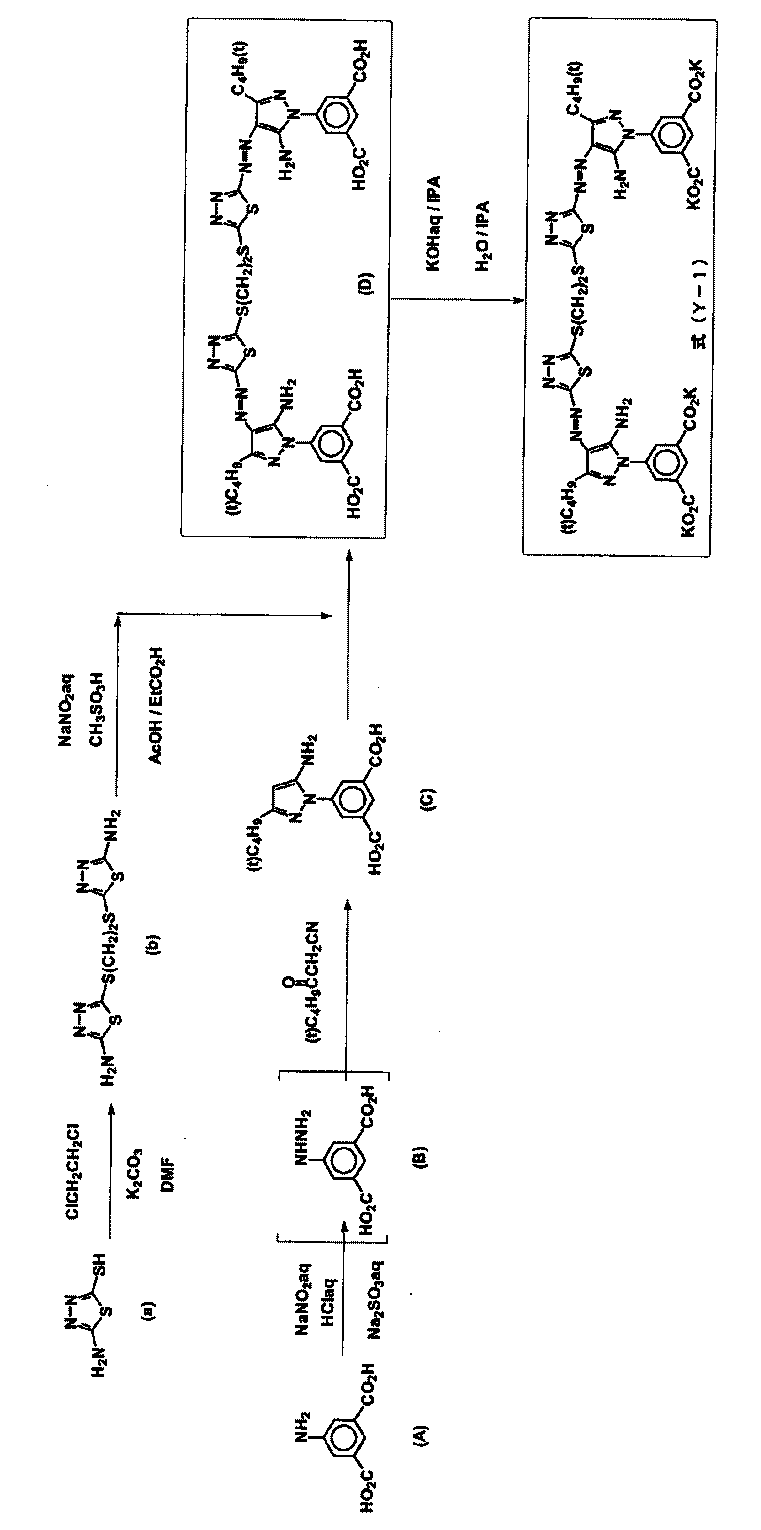
一般式(Y)及び式(Y−1)で表される染料は、一般的な合成法で合成することが可能であり、例えば特開2004−083903の[0066]及び[0067]の記載の方法と同様に合成することができる。 The dyes represented by the general formula (Y) and the formula (Y-1) can be synthesized by a general synthesis method. For example, as described in JP-A-2004-083903, [0066] and [0067] It can be synthesized in the same way as the method.
〔群A〕
本発明のインク組成物は、第1の色材として使用する上記で説明した前記一般式(Y)の化合物又は前記式(Y−1)の化合物に加えて、インク組成物の貯蔵安定性、インクの着色性、印画物の画像堅牢性に優れるという特徴を有する第2の色材を含有してなることが必要である。本発明では、第2の色材として、下記群Aから選択される少なくとも1種の化合物を用いる。下記群Aから選択される少なくとも1種の化合物の中でも、特に群Aにおける化合物1,2,3,5,6又は8を用いることが好ましく、1,2,3,6又は8を用いることがより好ましく、1、2,3又は8を用いることが更に好ましい。
[Group A]
The ink composition of the present invention comprises, in addition to the compound of the general formula (Y) or the compound of the formula (Y-1) described above used as the first color material, the storage stability of the ink composition, It is necessary to contain a second color material having the characteristics of excellent colorability of ink and image fastness of printed matter. In the present invention, at least one compound selected from the following group A is used as the second color material. Among at least one compound selected from the following group A, it is particularly preferable to use compound 1, 2, 3, 5, 6 or 8 in group A, and to use 1, 2, 3, 6 or 8 More preferably, 1, 2, 3 or 8 is more preferably used.
本発明においては、第2の色材として、群Aから選択される少なくとも1種の化合物は、単独でも、又は複数を組み合わせて使用してもよい。本発明においては、第2の色材として、1と2と3と5と6と8とを組み合わせて使用することが好ましく、1と2と3と6と8とを組み合わせて使用することがより好ましく、1と2と3と8とを組み合わせて使用することが更に好ましい。 In the present invention, as the second coloring material, at least one compound selected from the group A may be used alone or in combination. In the present invention, it is preferable to use a combination of 1, 2, 3, 5, 6, and 8 as the second coloring material, and it is preferable to use a combination of 1, 2, 3, 6, and 8. More preferably, it is more preferable to use a combination of 1, 2, 3, and 8.
また、下記群Aから選択される少なくとも1種の化合物は、前記一般式(Y)の化合物と組み合わせて用いることで相乗効果が発揮され、以下のような効果を得ることができる。すなわち、これらの色材を含有させることで、高い着色力を有するイエローインク組成物とすることができるだけではなく、更に耐光性に優れた画像を与え、加えて、インク供給経路の目詰まり防止や保存安定性を十分満足させることができる。以下、これらの一般式について説明する。 Moreover, the synergistic effect is exhibited by using at least 1 type of compound selected from the following group A in combination with the compound of the said general formula (Y), The following effects can be acquired. That is, by including these color materials, not only can the yellow ink composition have a high coloring power, but also an image with excellent light resistance can be obtained, and in addition, the ink supply path can be prevented from being clogged. Storage stability can be fully satisfied. Hereinafter, these general formulas will be described.
(群A中、Mはそれぞれ独立に水素原子又はカチオンを表し、Mがカチオンを表す場合はLi+イオン、Na+イオン、K+イオン又はNH4 +イオンを表す。)
群Aから選択される少なくとも1種の化合物におけるMは、水素原子、Li+イオン、Na+イオン、K+イオン、又はNH4 +イオンを表し、Na+イオン、K+イオン、NH4 +イオン、が好ましく、更にNa+イオン、K+イオンが好ましく、K+イオンがより好ましい。群Aから選択される少なくとも1種の化合物において、カウンターカチオンMの主成分がK+イオンであることが好ましく、全てのMがK+イオンであることがより好ましい。
(In group A, M independently represents a hydrogen atom or a cation, and when M represents a cation, it represents a Li + ion, a Na + ion, a K + ion, or an NH 4 + ion.)
M in at least one compound selected from the group A represents a hydrogen atom, Li + ion, Na + ion, K + ion, or NH 4 + ion, and Na + ion, K + ion, NH 4 + ion. Are preferred, Na + ions and K + ions are preferred, and K + ions are more preferred. In at least one compound selected from the group A, it is preferable that the main component of the counter cation M is K + ions, it is more preferred that all of M is K + ion.
群Aから選択される少なくとも1種の化合物は複数種類のMが存在する混合塩の状態であってもよい。混合塩である場合、インク組成物中に含まれる群Aから選択される化合物が有するMのうち、モル分率で好ましくは50〜100%、更に好ましくは80〜100%、より好ましくは90〜100%のMがK+イオンであることが好ましい。K+イオン以外のMとしては、Na+イオン、NH4 +イオンが好ましく、Na+イオンがより好ましい。 The at least one compound selected from group A may be in the form of a mixed salt in which a plurality of types of M are present. In the case of a mixed salt, the M selected from the group A contained in the ink composition preferably has a molar fraction of 50 to 100%, more preferably 80 to 100%, and more preferably 90 to 90%. Preferably 100% of M is a K + ion. As M other than K + ions, Na + ions and NH 4 + ions are preferable, and Na + ions are more preferable.
また、混合塩ではなく、インク組成物中に含まれる全ての群Aから選択される化合物のMがK+であることが特に好ましい。全てのMがK+イオンであることにより、水溶液又はインク溶液中に溶解した分子分散状態において、イオン性親水性基であるカルボキシ基又はその塩(−CO2M)が解離して−CO2 −とM+にイオン化した状態でカチオン種が交換することにより、より水溶液又はインク溶液に対して溶解性の低い塩の状態を形成して着色剤の塩の状態で析出することを抑制し易いといった効果が得られるためである。
群Aから選択される化合物は、一般的な合成法で合成することが可能であり、例えば特開2004−083903公報中に記載のジアゾ成分及びカップリング成分を変更、種々組み合わせることで一般式(Y)又は式(Y−1)と同様に合成することができる。
Further, it is particularly preferable that M of the compound selected from all the groups A contained in the ink composition, not the mixed salt, is K + . Since all M is a K + ion, in a molecular dispersion state dissolved in an aqueous solution or an ink solution, a carboxy group that is an ionic hydrophilic group or a salt thereof (—CO 2 M) is dissociated to —CO 2. By exchanging cation species in an ionized state of − and M + , it is easy to suppress the formation of a salt state that is less soluble in an aqueous solution or ink solution and precipitation in the salt state of the colorant. This is because such an effect is obtained.
The compound selected from Group A can be synthesized by a general synthesis method. For example, the diazo component and the coupling component described in JP-A-2004-083903 are changed and combined in various ways. Y) or similar to formula (Y-1).
本発明においては、一般式(Y)で表される化合物において、カウンターカチオンMの主成分がK+イオンであり、群Aより選択される化合物においても、カウンターカチオンMの主成分がK+イオンであることが好ましい。ここで、カウンターカチオンMの主成分とは、全カウンターカチオンM中、80%以上を占めるイオン、好ましくは90%以上を占めるイオンを意味する。
一般式(Y)で表される化合物及び群Aより選択される化合物のイオン性親水性基のカウンターカチオンMの主成分がK+イオンであれば、インク組成物中の溶解性が高くなり、塩の形成・析出を抑制しインク組成物の貯蔵安定性を大幅に向上することができるためである。
また、一般式(Y)で表される化合物及び群Aより選択される化合物におけるMが全てK+イオンであることがより好ましい。これによりインク組成物の貯蔵安定性を大幅に向上することができるためである。
In the present invention, in the compound represented by the general formula (Y), the main component of the counter cation M is K + ion, and in the compound selected from the group A, the main component of the counter cation M is K + ion. It is preferable that Here, the main component of the counter cation M means ions that occupy 80% or more, preferably 90% or more of all the counter cations M.
If the main component of the counter cation M of the ionic hydrophilic group of the compound represented by the general formula (Y) and the compound selected from the group A is K + ion, the solubility in the ink composition is increased, This is because salt formation and precipitation can be suppressed and the storage stability of the ink composition can be greatly improved.
Moreover, it is more preferable that all of M in the compound represented by the general formula (Y) and the compound selected from Group A are K + ions. This is because the storage stability of the ink composition can be greatly improved.
〔色材の検証方法〕
本発明で用いる色材がインク組成物及びインク中に含まれているか否かの検証には、液体クロマトグラフ質量分析(LC−MS)を用いた下記(1)〜(3)の検証方法が適用できる。
(1)ピークの保持時間
(2)(1)のピークについての最大吸収波長
(3)(1)のピークについてのマススペクトルのm/z(posi)、m/z(nega)
[Color material verification method]
In order to verify whether or not the color material used in the present invention is contained in the ink composition and the ink, the following verification methods (1) to (3) using liquid chromatograph mass spectrometry (LC-MS) are used. Applicable.
(1) Peak retention time (2) Maximum absorption wavelength for peak of (1) (3) m / z (posi), m / z (nega) of mass spectrum for peak of (1)
液体クロマトグラフ質量分析の分析条件は、以下に示す通りである。純水で約1,000倍に希釈した液体(インク)を測定用サンプルとした。そして、下記の条件で液体クロマトグラフ質量分析での分析を行い、ピークの保持時間(retention time)、及び、Mass実測値ピークを測定した。 The analysis conditions of liquid chromatograph mass spectrometry are as follows. A liquid (ink) diluted about 1,000 times with pure water was used as a measurement sample. And the analysis by a liquid chromatograph mass spectrometry was performed on the following conditions, and the retention time (retention time) of a peak and a Mass actual value peak were measured.
<液体クロマトグラフ質量分析(LC−MS)測定条件>
・装置:Agilent1100(アジレント・テクノロジー社製)
・カラム:YMC AM−312 内径 6.0 mm× 長さ 150 mm(ワイエムシー社製)
・溶離液:A液 超純水+0.1%酢酸、0.2%トリエチルアミン
B液 メタノール+0.1%酢酸、0.2%トリエチルアミン
・移動相及びグラジエント条件:(表1)
表1中、B.Conc.はB液の濃度を表す。
<Measurement conditions of liquid chromatograph mass spectrometry (LC-MS)>
・ Device: Agilent 1100 (manufactured by Agilent Technologies)
Column: YMC AM-312 ID 6.0 mm x length 150 mm (manufactured by YMC)
-Eluent: Liquid A Ultrapure water + 0.1% acetic acid, 0.2% triethylamine
Liquid B Methanol + 0.1% acetic acid, 0.2% triethylamine Mobile phase and gradient conditions: (Table 1)
In Table 1, B.I. Conc. Represents the concentration of the B liquid.
また、マススペクトルの分析条件は以下に示す通りである。得られたピークについて、下記の条件でマススペクトルを測定し、最も強く検出されたm/zをposi、negaそれぞれに対して測定する。
・装置:Applied BiosystemsTM QSTAR pulseri(ライフテクノロジー社製)
・イオン化法:ESI(posi)
・キャピラリ電圧:3.5kV
・脱溶媒ガス:300℃
・イオン源温度:120℃
・検出法:TOF−MS
・検出範囲:120〜1500
The analysis conditions of the mass spectrum are as shown below. About the obtained peak, a mass spectrum is measured on condition of the following, and m / z detected most strongly is measured with respect to each of posi and negative.
・ Apparatus: Applied Biosystems ™ QSTAR pulser (manufactured by Life Technology)
・ Ionization method: ESI (posi)
・ Capillary voltage: 3.5 kV
-Desolvent gas: 300 ° C
-Ion source temperature: 120 ° C
・ Detection method: TOF-MS
-Detection range: 120-1500
上記の方法及び条件下で、それぞれの色材の代表例として、第1の色材化合物(Y−1)、第2の色材の群A中の化合物1〜8(M=K)について測定を行った。その結果、得られた保持時間、Mass実測値{m/z(posi)}を表2に示した。インク組成物及びインクについて、上記と同様の方法及び条件下で測定を行って、表2に示す値に該当する場合、本発明において用いる化合物に該当すると判断できる。
なお、Mは例えば、イオンクロマトグラフによる測定により検証することができる。
イオンクロマトグラフ測定条件:
装置:パーソナルイオンアナライザPIA−1000(島津製作所製)
カラム:カチオン分析用セミミクロカラムShim−pack IC−C3(S)(内径2mm × 長さ100mm
移動相:2.5 mMシュウ酸水溶液
カラム温度:35℃
流速:0.2mL/分
Under the above method and conditions, as representative examples of the respective color materials, the first color material compound (Y-1) and the compounds 1 to 8 (M = K) in the second color material group A were measured. Went. As a result, the obtained retention time and Mass measured value {m / z (posi)} are shown in Table 2. When the ink composition and the ink are measured under the same method and conditions as described above and correspond to the values shown in Table 2, it can be determined that they correspond to the compounds used in the present invention.
M can be verified, for example, by measurement using an ion chromatograph.
Ion chromatograph measurement conditions:
Apparatus: Personal ion analyzer PIA-1000 (manufactured by Shimadzu Corporation)
Column: Semi-micro column for cation analysis Shim-pack IC-C3 (S) (inner diameter 2 mm × length 100 mm)
Mobile phase: 2.5 mM oxalic acid aqueous solution Column temperature: 35 ° C.
Flow rate: 0.2 mL / min
(インク組成物)〔色材の含有量〕
インク組成物中の第1の色材の含有量(質量%)が、インク組成物全質量を基準として、1質量%以上15質量%以下であることが好ましい。また、第1の色材の含有量(質量%)が、インク組成物全質量を基準として、8質量%以上12質量%以下であることも好ましい。
本発明のインク組成物は、インク原料として、着色剤を高い濃度で含む濃厚水溶液とすることができる。濃厚水溶液の着色剤濃度は15質量%以下、好ましくは12質量%以下であることが染料の経時安定性、取り扱いの容易さ(粘度)の点で好ましく、染料の経時安定性の向上や輸送コストの抑制の観点から、8質量%以上の濃度であることが好ましい。
また、本発明のインク組成物は、インクジェット用インクとすることもできる。インクジェット用インクの着色剤濃度はインク粘度や、印画物の濃度の点で、1〜12質量%が好ましく、2〜8質量%がより好ましく、3〜6質量%が特に好ましい。
インク組成物中の第2の色材[群Aから選択される少なくとも1種の化合物]の含有量は、以下のようにすることが好ましい。すなわち、第2の色材の含有量(質量%)は、インク組成物全質量を基準として、0.001質量%以上2.0質量%以下であることが好ましく、0.005質量%以上1.5質量%以下であることがより好ましく、0.01質量%以上1.1質量%以下であることが更に好ましく、0.05質量%以上0.8質量%以下であることが特に好ましい。
(Ink composition) [Coloring material content]
The content (% by mass) of the first color material in the ink composition is preferably 1% by mass or more and 15% by mass or less based on the total mass of the ink composition. Further, the content (% by mass) of the first color material is preferably 8% by mass or more and 12% by mass or less based on the total mass of the ink composition.
The ink composition of the present invention can be a concentrated aqueous solution containing a colorant at a high concentration as an ink raw material. The concentration of the colorant in the concentrated aqueous solution is preferably 15% by mass or less, and preferably 12% by mass or less from the viewpoint of dye stability over time and ease of handling (viscosity). Improvement in dye stability over time and transportation costs From the viewpoint of suppressing the above, the concentration is preferably 8% by mass or more.
The ink composition of the present invention can also be used as an inkjet ink. The colorant concentration of the inkjet ink is preferably 1 to 12% by mass, more preferably 2 to 8% by mass, and particularly preferably 3 to 6% by mass in terms of the ink viscosity and the density of the printed matter.
The content of the second color material [at least one compound selected from group A] in the ink composition is preferably as follows. That is, the content (% by mass) of the second color material is preferably 0.001% by mass or more and 2.0% by mass or less, and 0.005% by mass or more and 1% by mass based on the total mass of the ink composition. More preferably, it is 0.5 mass% or less, More preferably, it is 0.01 mass% or more and 1.1 mass% or less, Especially preferably, it is 0.05 mass% or more and 0.8 mass% or less.
なお、この場合の第2の色材の含有量は、他の色材との関連において、下記のようにすることが、より好ましい。群Aから選択される少なくとも1種の化合物のいずれかを単独で用いる場合はその含有量が、また、これらから選ばれる2種以上を併用する場合はその合計含有量が、それぞれ上記の範囲を満足するように構成することが好ましい。第1の色材及び/又は第2の色材の含有量を上記範囲とすることで、画像の耐光性と色調を満足させるだけではなく、保存安定性や記録耐久性といった、インク組成物を用いたインクの信頼性の点も満足させることが可能となる。
群A中の化合物1は、インク組成物全質量を基準として、0.001〜1.0質量%含まれることが好ましく、0.01〜1.0質量%含まれることがより好ましい。
群A中の化合物2は、インク組成物全質量を基準として、0.003〜3.0質量%含まれることが好ましく、0.1〜3.0質量%含まれることがより好ましい。
群A中の化合物3は、インク組成物全質量を基準として、0.001〜1.0質量%含まれることが好ましく、0.01〜1.0質量%含まれることがより好ましい。
群A中の化合物4は、インク組成物全質量を基準として、0.0〜0.5質量%含まれることが好ましい。
群A中の化合物5は、インク組成物全質量を基準として、0.0〜0.5質量%含まれることが好ましい。
群A中の化合物6は、インク組成物全質量を基準として、0.0〜0.5質量%含まれることが好ましい。
群A中の化合物7は、インク組成物全質量を基準として、0.0〜0.5質量%含まれることが好ましい。
群A中の化合物8は、インク組成物全質量を基準として、0.002〜2.0質量%含まれることが好ましく、0.05〜2.0質量%含まれることがより好ましい。
In this case, the content of the second color material is more preferably as follows in relation to other color materials. When any one of at least one compound selected from Group A is used alone, the content thereof, and when two or more selected from these are used in combination, the total content thereof is within the above range. It is preferable to satisfy the requirements. By setting the content of the first color material and / or the second color material in the above range, not only the light resistance and color tone of the image are satisfied, but also the ink composition such as storage stability and recording durability is added. The reliability of the ink used can also be satisfied.
Compound 1 in Group A is preferably contained in an amount of 0.001 to 1.0% by mass, more preferably 0.01 to 1.0% by mass, based on the total mass of the ink composition.
Compound 2 in Group A is preferably contained in an amount of 0.003 to 3.0% by mass, more preferably 0.1 to 3.0% by mass, based on the total mass of the ink composition.
Compound 3 in Group A is preferably contained in an amount of 0.001 to 1.0% by mass, more preferably 0.01 to 1.0% by mass, based on the total mass of the ink composition.
The compound 4 in the group A is preferably contained in an amount of 0.0 to 0.5% by mass based on the total mass of the ink composition.
The compound 5 in Group A is preferably contained in an amount of 0.0 to 0.5% by mass based on the total mass of the ink composition.
The compound 6 in the group A is preferably contained in an amount of 0.0 to 0.5% by mass based on the total mass of the ink composition.
The compound 7 in Group A is preferably contained in an amount of 0.0 to 0.5% by mass based on the total mass of the ink composition.
The compound 8 in group A is preferably contained in an amount of 0.002 to 2.0 mass%, more preferably 0.05 to 2.0 mass%, based on the total mass of the ink composition.
インク組成物全質量を基準とした、第2の色材の含有量(質量%)は、第1の色材の含有量(質量%)に対して、質量比率で、(第2の色材/第1の色材)=0.001以上1.0以下であることが必要である。 The content (% by mass) of the second color material based on the total mass of the ink composition is a mass ratio with respect to the content (% by mass) of the first color material. / First coloring material) = 0.001 or more and 1.0 or less.
本発明においては更に、第2の色材の含有量(質量%)は、第1の色材の含有量(質量%)に対して、質量比率で、(第2の色材/第1の色材)=0.001以上0.3以下であることが好ましい。色材の含有量の質量比率を上記範囲となるように構成することで、第1の色材が有する溶解性・耐光性と第2の色材が有する溶解性・耐光性との組み合わせから予測される性能をはるかに上回る高いレベルの耐光性を有する画像を形成することができる。また、より好ましい色調の画像を得ることができる。第2の色材の含有量(質量%)は、第1の色材の含有量(質量%)に対して、質量比率で、(第2の色材/第1の色材)=0.001以上0.2以下であることがより好ましく、0.01以上0.2以下であることが更に好ましく、0.02以上0.12以下であることがより更に好ましい。色材の含有量の質量比率をこの範囲とすることで、上記の含有量の質量比率においても特に高いレベルの耐光性を有する画像を形成することができる。更には特に好ましい色調の画像を得ることができ、加えて、インクとしての信頼性も十分に満足することが可能となる。 Further, in the present invention, the content (mass%) of the second color material is a mass ratio with respect to the content (mass%) of the first color material ((second color material / first Colorant) = 0.001 or more and 0.3 or less is preferable. Predicted from the combination of the solubility and light resistance of the first color material and the solubility and light resistance of the second color material by configuring the mass ratio of the color material content to be in the above range. Images with a high level of lightfastness can be formed that far exceed the performance that is achieved. In addition, an image having a more preferable color tone can be obtained. The content (mass%) of the second color material is a mass ratio with respect to the content (mass%) of the first color material, (second color material / first color material) = 0. It is more preferably 001 or more and 0.2 or less, further preferably 0.01 or more and 0.2 or less, and further preferably 0.02 or more and 0.12 or less. By setting the mass ratio of the content of the color material within this range, an image having a particularly high level of light resistance can be formed even in the mass ratio of the content described above. Furthermore, an image having a particularly preferable color tone can be obtained, and in addition, the reliability as an ink can be sufficiently satisfied.
質量比率が0.001以上であると、インク溶液の保存安定性が向上し、1.0以下であれば、インク組成物の水溶液安定性に優れる。色材の含有量の質量比率を上記範囲となるように構成することで、第1の色材が有する溶解性・画像堅牢性と、第2の色材が有する溶解性・画像堅牢性との組み合わせから予測される性能を上回る高いレベルのインク液貯蔵安定性・印画物の画像堅牢性を達成することができる。また、好ましい色調の画像が得られ、インクとしての信頼性も満足できる。 When the mass ratio is 0.001 or more, the storage stability of the ink solution is improved, and when it is 1.0 or less, the aqueous solution stability of the ink composition is excellent. By configuring the mass ratio of the color material content to be in the above range, the solubility and image fastness of the first color material and the solubility and image fastness of the second color material It is possible to achieve a high level of ink storage stability and image fastness of printed matter that exceed the performance predicted from the combination. Further, an image having a preferable color tone can be obtained, and the reliability as an ink can be satisfied.
第1の色材と第2の色材とを特定の質量比率で用いることで、相乗効果が発揮され、予測を上回るインクの貯蔵安定性付与と印画物の画像堅牢化を両立できる理由を本発明者らは以下のように推測している。第1の色材は、もともと水性媒体に対する溶解性が低い傾向があるため、これらの化合物を含有するインク組成物を用いたインクを記録媒体に付与すると、その直後から速やかに色材の会合や凝集が起こる。会合や凝集は、画像を形成している記録媒体上の色材の堅牢性を向上させる傾向がある。しかし、その一方で、過度の会合や凝集は、水溶液及びインク溶液への溶解性を低下させる場合がある。これに対し、第1の色材と第2の色材とを共存させることで、記録媒体上で、第1の色材が耐光性に関して最適な会合や凝集の状態を形成し、これにより、画像の耐光性が向上したものと考えられる。 The reason why a synergistic effect can be achieved by using the first color material and the second color material at a specific mass ratio, and it is possible to achieve both the storage stability of the ink exceeding the prediction and the image fastness of the printed matter. The inventors presume as follows. Since the first color material tends to have low solubility in an aqueous medium from the beginning, when an ink using an ink composition containing these compounds is applied to a recording medium, the color material is immediately assembled or immediately after that. Aggregation occurs. The association or aggregation tends to improve the fastness of the color material on the recording medium on which the image is formed. On the other hand, however, excessive association or aggregation may reduce the solubility in aqueous solutions and ink solutions. On the other hand, by causing the first color material and the second color material to coexist, the first color material forms an optimal association or aggregation state with respect to light resistance on the recording medium. It is considered that the light resistance of the image has been improved.
また、第1の色材と第2の色材とを特定の質量比率で用いることで、相乗効果が発揮され、インク組成物を用いたインクの信頼性が達成される理由を本発明者らは以下のように推測している。上記で述べた通り、インク中には、インクカートリッジやインク供給経路を構成する部材から溶出したと考えられる不純物が混入し、インク供給経路の目詰まりやインク供給特性の低下、インク保存安定性の低下の原因となる場合がある。本発明者らは検討の結果、第一の色材構造に類似の第二の色材をインク中に共存させることにより、インクの着色力を低下させること無く、第一の色材の結晶化抑制を付与することができ、インクの貯蔵安定性を大幅に向上させることができたと考えている。つまり、色材として第1の色材のみを使用することでは達成が困難であったインクの信頼性に関して、第2の色材を併用することにより、予想を上回る効果が得られ、十分な信頼性を達成することができるのである。 In addition, the inventors of the present invention have the reason why a synergistic effect is achieved by using the first color material and the second color material at a specific mass ratio, and the reliability of the ink using the ink composition is achieved. Guesses as follows. As described above, impurities that are considered to have eluted from the ink cartridge and the members constituting the ink supply path are mixed in the ink, and the ink supply path is clogged, the ink supply characteristics are degraded, and the ink storage stability is improved. May cause a drop. As a result of the study, the present inventors have found that the second coloring material similar to the first coloring material structure is allowed to coexist in the ink, so that the crystallization of the first coloring material can be achieved without reducing the coloring power of the ink. It is believed that the suppression could be imparted and the storage stability of the ink could be greatly improved. In other words, with regard to the reliability of the ink, which was difficult to achieve by using only the first color material as the color material, the combined use of the second color material provides an effect that exceeds the expectation, and sufficient reliability. Sex can be achieved.
本発明に用いられる上記イエロー染料は、優れたオゾンガスに対する強制褪色速度定数を有する。オゾンガスに対する強制褪色速度定数の測定は、当該インクのみを反射型受像媒体に印画して得られた画像の該インクの主分光吸収領域の色であってステータスAのフィルターを通して測定した反射濃度が0.90〜1.10の濃度の着色領域を初期濃度点として選択し、この初期濃度を開始濃度(=100%)とする。この画像を5mg/Lのオゾン濃度を常時維持するオゾン褪色試験機を用いて褪色させ、その濃度が初期濃度の80%となるまでの時間を測定し、この時間の逆数[hour−1]を求め、褪色濃度と時間関係が一次反応の速度式に従うとの仮定のもとに、褪色反応速度定数とする。したがって、求められる褪色速度定数は当該インクによって印画された着色領域の褪色速度定数であるが、本明細書では、この値をインクの褪色速度定数として用いる。 The yellow dye used in the present invention has an excellent forced fading rate constant for ozone gas. The measurement of the forced fading rate constant for ozone gas is the color of the main spectral absorption region of the ink obtained by printing only the ink on the reflective image receiving medium, and the reflection density measured through the status A filter is 0. A colored region having a density of .90 to 1.10. This image is faded using an ozone fading tester that constantly maintains an ozone concentration of 5 mg / L, the time until the concentration reaches 80% of the initial concentration is measured, and the reciprocal of this time [hour −1 ] is calculated. The amber reaction rate constant is obtained on the assumption that the relationship between the amber color density and the time follows the rate equation of the first order reaction. Therefore, the obtained fading speed constant is the fading speed constant of the colored area printed by the ink, but in this specification, this value is used as the fading speed constant of the ink.
試験用の印画パッチは、JISコード2223の黒四角記号を印字したパッチ、マクベスチャートの階段状カラーパッチ、そのほか測定面積が得られる任意の階段濃度パッチを用いることができる。 As the test print patch, a patch printed with a black square symbol of JIS code 2223, a stepped color patch of Macbeth chart, or any other step density patch that can obtain a measurement area can be used.
測定用に印画される反射画像(階段状カラーパッチ)の反射濃度は、国際規格ISO5−4(反射濃度の幾何条件)を満たした濃度計によりステータスAフィルターを透した測定光で求められた濃度である。 The reflection density of the reflected image (stepped color patch) printed for measurement is the density obtained with the measurement light that has passed through the status A filter by a densitometer that satisfies the international standard ISO5-4 (geometric condition of reflection density). It is.
オゾンガスに対する強制褪色速度定数測定用の試験チャンバーには、内部のオゾンガス濃度を定常的に5mg/Lに維持可能のオゾン発生装置(例えば乾燥空気に交流電圧を印可する高圧放電方式)が設けられ、曝気温度は25℃に調節される。 A test chamber for forced fading rate constant measurement for ozone gas is provided with an ozone generator (for example, a high-pressure discharge system that applies an alternating voltage to dry air) that can maintain the internal ozone gas concentration at 5 mg / L constantly, The aeration temperature is adjusted to 25 ° C.
なお、この強制褪色速度定数は、光化学スモッグ、自動車排気、家具の塗装面や絨毯などからの有機蒸気、明室の額縁内の発生ガスなどの環境中の酸化性雰囲気による酸化の受け易さの指標であって、オゾンガスによってこれらの酸化性雰囲気を代表させた指標である。 This forced fading rate constant is determined by the susceptibility to oxidation by an oxidizing atmosphere in the environment, such as photochemical smog, automobile exhaust, organic vapor from painted surfaces and carpets of furniture, and gas generated in the frame of a bright room. An index that represents these oxidizing atmospheres with ozone gas.
また、インク組成物中の第1の色材と、第2の色材との含有量の合計(質量%)が、インク組成物全質量を基準として、1.00質量%以上12.00質量%以下であることが好ましく、特に3.00質量%以上8.0質量%以下であることが好ましい。含有量の合計が1.00質量%以上であれば、耐光性及び発色性が十分に得られ、含有量の合計が12.00質量%以下であれば、インク中に不溶物の析出等が無くインクジェット吐出特性に優れる。 Further, the total content (% by mass) of the first color material and the second color material in the ink composition is 1.00% by mass or more and 12.00% by mass based on the total mass of the ink composition. %, Preferably 3.00 mass% or more and 8.0 mass% or less. If the total content is 1.00% by mass or more, light fastness and color developability are sufficiently obtained, and if the total content is 12.00% by mass or less, insoluble matter is precipitated in the ink. Excellent inkjet discharge characteristics.
なお、本発明のインク組成物がインクジェット記録用インクのイエローインクである場合、イエローインクとして好ましい色調とは、以下の二つのことを意味する。すなわち、イエローインクのみを用いて形成した画像が赤味や緑味を帯びていないことを意味する。更に、これに加えて、イエローインクを用いて形成する2次色の画像、つまりレッドやグリーンの画像を形成する際に、レッド及びグリーンの色再現範囲をいずれも大きく損失することがない色調を有することを意味する。 In addition, when the ink composition of the present invention is a yellow ink for ink jet recording, the preferred color tone for the yellow ink means the following two things. That is, it means that an image formed using only yellow ink is not reddish or greenish. In addition to this, when forming a secondary color image formed using yellow ink, that is, a red or green image, a color tone that does not greatly lose the red and green color reproduction ranges. It means having.
本発明のインク組成物(好ましくはインクジェット記録用インク)には、第1の色材である前記一般式(Y)で表される水溶性アゾ染料、前記第2の色材である群Aから選ばれる少なくとも1種の化合物、及び一般式(2)で表される化合物とともに色調を整えるためや性能のバランスをとるために他の染料を併用してもよい。また、フルカラーの画像を得る目的で、本発明のインク組成物とともに他の色素を含むインクを併用してもよい。併用することができる染料や色素の例としては以下を挙げることができる。 The ink composition of the present invention (preferably ink for inkjet recording) includes a water-soluble azo dye represented by the general formula (Y) as a first color material, and a group A as the second color material. Other dyes may be used in combination with the selected at least one compound and the compound represented by the general formula (2) in order to adjust the color tone and balance the performance. For the purpose of obtaining a full-color image, an ink containing another pigment may be used in combination with the ink composition of the present invention. Examples of dyes and pigments that can be used in combination include the following.
イエロー染料としては、例えばカップリング成分としてフェノール類、ナフトール類、アニリン類、ピラゾロン類、ピリドン類、開鎖型活性メチレン化合物類を有するアリール若しくはヘテリルアゾ染料;例えばカップリング成分として開鎖型活性メチレン化合物類を有するアゾメチン染料;例えばベンジリデン染料やモノメチンオキソノール染料等のようなメチン染料;例えばナフトキノン染料、アントラキノン染料等のようなキノン系染料などがあり、これ以外の染料種としてはキノフタロン染料、ニトロ・ニトロソ染料、アクリジン染料、アクリジノン染料等を挙げることができる。これらの染料は、クロモフォアの一部が解離して初めてイエローを呈するものであってもよく、その場合のカウンターカチオンはアルカリ金属や、アンモニウムのような無機のカチオンであってもよいし、ピリジニウム、4級アンモニウム塩のような有機のカチオンであってもよく、更にはそれらを部分構造に有するポリマーカチオンであってもよい。 As yellow dyes, for example, phenols, naphthols, anilines, pyrazolones, pyridones, aryl or heteryl azo dyes having open-chain active methylene compounds as coupling components; for example, open-chain active methylene compounds as coupling components Azomethine dyes; methine dyes such as benzylidene dyes and monomethine oxonol dyes; quinone dyes such as naphthoquinone dyes and anthraquinone dyes; And dyes, acridine dyes, acridinone dyes and the like. These dyes may be those that exhibit yellow only after a part of the chromophore is dissociated, in which case the counter cation may be an alkali metal or an inorganic cation such as ammonium, pyridinium, It may be an organic cation such as a quaternary ammonium salt, and may further be a polymer cation having them in a partial structure.
マゼンタ染料としては、例えばカップリング成分としてフェノール類、ナフトール類、アニリン類を有するアリール若しくはヘテリルアゾ染料;例えばカップリング成分としてピラゾロン類、ピラゾロトリアゾール類を有するアゾメチン染料;例えばアリーリデン染料、スチリル染料、メロシアニン染料、オキソノール染料のようなメチン染料;ジフェニルメタン染料、トリフェニルメタン染料、キサンテン染料のようなカルボニウム染料、例えばナフトキノン、アントラキノン、アントラピリドンなどのようなキノン系染料、例えばジオキサジン染料等のような縮合多環系染料等を挙げることができる。これらの染料は、クロモフォアの一部が解離して初めてマゼンタを呈するものであってもよく、その場合のカウンターカチオンはアルカリ金属や、アンモニウムのような無機のカチオンであってもよいし、ピリジニウム、4級アンモニウム塩のような有機のカチオンであってもよく、更にはそれらを部分構造に有するポリマーカチオンであってもよい。 Examples of magenta dyes include, for example, aryl or heteryl azo dyes having phenols, naphthols, and anilines as coupling components; azomethine dyes having pyrazolones and pyrazolotriazoles as coupling components; for example, arylidene dyes, styryl dyes, and merocyanine Dyes, methine dyes such as oxonol dyes; carbonium dyes such as diphenylmethane dyes, triphenylmethane dyes, xanthene dyes, quinone dyes such as naphthoquinone, anthraquinone, anthrapyridone, etc. Examples thereof include ring dyes. These dyes may exhibit magenta only after part of the chromophore is dissociated, and the counter cation in that case may be an alkali metal or an inorganic cation such as ammonium, pyridinium, It may be an organic cation such as a quaternary ammonium salt, and may further be a polymer cation having them in a partial structure.
シアン染料としては、例えばインドアニリン染料、インドフェノール染料のようなアゾメチン染料;シアニン染料、オキソノール染料、メロシアニン染料のようなポリメチン染料;ジフェニルメタン染料、トリフェニルメタン染料、キサンテン染料のようなカルボニウム染料;フタロシアニン染料;アントラキノン染料;例えばカップリング成分としてフェノール類、ナフトール類、アニリン類を有するアリール若しくはヘテリルアゾ染料、インジゴ・チオインジゴ染料を挙げることができる。これらの染料は、クロモフォアの一部が解離して初めてシアンを呈するものであってもよく、その場合のカウンターカチオンはアルカリ金属や、アンモニウムのような無機のカチオンであってもよいし、ピリジニウム、4級アンモニウム塩のような有機のカチオンであってもよく、更にはそれらを部分構造に有するポリマーカチオンであってもよい。
また、ポリアゾ染料などのブラック染料も使用することができる。
Examples of the cyan dye include azomethine dyes such as indoaniline dyes and indophenol dyes; polymethine dyes such as cyanine dyes, oxonol dyes and merocyanine dyes; carbonium dyes such as diphenylmethane dyes, triphenylmethane dyes and xanthene dyes; phthalocyanine Dyes; anthraquinone dyes; for example, aryl or heteryl azo dyes having phenols, naphthols and anilines as coupling components, and indigo / thioindigo dyes. These dyes may exhibit cyan only after a part of the chromophore is dissociated, and the counter cation in that case may be an alkali metal or an inorganic cation such as ammonium, pyridinium, It may be an organic cation such as a quaternary ammonium salt, and may further be a polymer cation having them in a partial structure.
Also, black dyes such as polyazo dyes can be used.
水溶性染料としては、直接染料、酸性染料、食用染料、塩基性染料、反応性染料等が挙げられる。好ましいものとしては、C.I.ダイレクトレッド2、4、9、23、26、31、39、62、63、72、75、76、79、80、81、83、84、89、92、95、111、173、184、207、211、212、214、218、21、223、224、225、226、227、232、233、240、241、242、243、247C.I.ダイレクトバイオレット7、9、47、48、51、66、90、93、94、95、98、100、101C.I.ダイレクトイエロー8、9、11、12、27、28、29、33、35、39、41、44、50、53、58、59、68、86、87、93、95、96、98、100、106、108、109、110、130、132、142、144、161、163C.I.ダイレクトブルー1、10、15、22、25、55、67、68、71、76、77、78、80、84、86、87、90、98、106、108、109、151、156、158、159、160、168、189、192、193、194、199、200、201、202、203、207、211、213、214、218、225、229、236、237、244、248、249、251、252、264、270、280、288、289、291C.I.ダイレクトブラック9、17、19、22、32、51、56、62、69、77、80、91、94、97、108、112、113、114、117、118、121、122、125、132、146、154、166、168、173、199C.I.アシッドレッド35、42、52、57、62、80、82、111、114、118、119、127、128、131、143、151、154、158、249、254、257、261、263、266、289、299、301、305、336、337、361、396、397C.I.アシッドバイオレット5、34、43、47、48、90、103、126C.I.アシッドイエロー17、19、23、25、39、40、42、44、49、50、61、64、76、79、110、127、135、143、151、159、169、174、190、195、196、197、199、218、219、222、227C.I.アシッドブルー9、25、40、41、62、72、76、78、80、82、92、106、112、113、120、127:1、129、138、143、175、181、205、207、220、221、230、232、247、258、260、264、271、277、278、279、280、288、290、326C.I.アシッドブラック7、24、29、48、52:1、172C.I.リアクティブレッド3、13、17、19、21、22、23、24、29、35、37、40、41、43、45、49、55C.I.リアクティブバイオレット1、3、4、5、6、7、8、9、16、17、22、23、24、26、27、33、34C.I.リアクティブイエロー2、3、13、14、15、17、18、23、24、25、26、27、29、35、37、41、42C.I.リアクティブブルー2、3、5、8、10、13、14、15、17、18、19、21、25、26、27、28、29、38C.I.リアクティブブラック4、5、8、14、21、23、26、31、32、34C.I.ベーシックレッド12、13、14、15、18、22、23、24、25、27、29、35、36、38、39、45、46C.I.ベーシックバイオレット1、2、3、7、10、15、16、20、21、25、27、28、35、37、39、40、48C.I.ベーシックイエロー1、2、4、11、13、14、15、19、21、23、24、25、28、29、32、36、39、40C.I.ベーシックブルー1、3、5、7、9、22、26、41、45、46、47、54、57、60、62、65、66、69、71C.I.ベーシックブラック8、等が挙げられる。 Examples of water-soluble dyes include direct dyes, acid dyes, food dyes, basic dyes, and reactive dyes. Preferred examples include C.I. I. Direct Red 2, 4, 9, 23, 26, 31, 39, 62, 63, 72, 75, 76, 79, 80, 81, 83, 84, 89, 92, 95, 111, 173, 184, 207, 211, 212, 214, 218, 21, 223, 224, 225, 226, 227, 232, 233, 240, 241, 242, 243, 247C. I. Direct violet 7, 9, 47, 48, 51, 66, 90, 93, 94, 95, 98, 100, 101C. I. Direct yellow 8, 9, 11, 12, 27, 28, 29, 33, 35, 39, 41, 44, 50, 53, 58, 59, 68, 86, 87, 93, 95, 96, 98, 100, 106, 108, 109, 110, 130, 132, 142, 144, 161, 163C. I. Direct Blue 1, 10, 15, 22, 25, 55, 67, 68, 71, 76, 77, 78, 80, 84, 86, 87, 90, 98, 106, 108, 109, 151, 156, 158, 159, 160, 168, 189, 192, 193, 194, 199, 200, 201, 202, 203, 207, 211, 213, 214, 218, 225, 229, 236, 237, 244, 248, 249, 251, 252, 264, 270, 280, 288, 289, 291C. I. Direct Black 9, 17, 19, 22, 32, 51, 56, 62, 69, 77, 80, 91, 94, 97, 108, 112, 113, 114, 117, 118, 121, 122, 125, 132, 146, 154, 166, 168, 173, 199 C.I. I. Acid Red 35, 42, 52, 57, 62, 80, 82, 111, 114, 118, 119, 127, 128, 131, 143, 151, 154, 158, 249, 254, 257, 261, 263, 266, 289, 299, 301, 305, 336, 337, 361, 396, 397 C.I. I. Acid Violet 5, 34, 43, 47, 48, 90, 103, 126C. I. Acid Yellow 17, 19, 23, 25, 39, 40, 42, 44, 49, 50, 61, 64, 76, 79, 110, 127, 135, 143, 151, 159, 169, 174, 190, 195, 196, 197, 199, 218, 219, 222, 227C. I. Acid Blue 9, 25, 40, 41, 62, 72, 76, 78, 80, 82, 92, 106, 112, 113, 120, 127: 1, 129, 138, 143, 175, 181, 205, 207, 220, 221, 230, 232, 247, 258, 260, 264, 271, 277, 278, 279, 280, 288, 290, 326C. I. Acid Black 7, 24, 29, 48, 52: 1, 172C. I. Reactive Red 3, 13, 17, 19, 21, 22, 23, 24, 29, 35, 37, 40, 41, 43, 45, 49, 55C. I. Reactive violet 1, 3, 4, 5, 6, 7, 8, 9, 16, 17, 22, 23, 24, 26, 27, 33, 34C. I. Reactive Yellow 2, 3, 13, 14, 15, 17, 18, 23, 24, 25, 26, 27, 29, 35, 37, 41, 42C. I. Reactive Blue 2, 3, 5, 8, 10, 13, 14, 15, 17, 18, 19, 21, 25, 26, 27, 28, 29, 38C. I. Reactive Black 4, 5, 8, 14, 21, 23, 26, 31, 32, 34C. I. Basic Red 12, 13, 14, 15, 18, 22, 23, 24, 25, 27, 29, 35, 36, 38, 39, 45, 46C. I. Basic violet 1, 2, 3, 7, 10, 15, 16, 20, 21, 25, 27, 28, 35, 37, 39, 40, 48C. I. Basic Yellow 1, 2, 4, 11, 13, 14, 15, 19, 21, 23, 24, 25, 28, 29, 32, 36, 39, 40C. I. Basic Blue 1, 3, 5, 7, 9, 22, 26, 41, 45, 46, 47, 54, 57, 60, 62, 65, 66, 69, 71C. I. Basic black 8, etc. are mentioned.
更に本発明のインクには、顔料も併用し得る。
本技術に用いられる顔料としては、市販のものの他、各種文献に記載されている公知のものが利用できる。文献に関してはカラーインデックス(The Society of
Dyers and Colourists編)、「改訂新版顔料便覧」日本顔料技術協会編(1989年刊)、「最新顔料応用技術」CMC出版(1986年刊)、「印刷インキ技術」CMC出版(1984年刊)、W.Herbst,K.Hunger共著によるIndustrial Organic Pigments (VCH Verlagsgesellschaft、1993年刊)等がある。具体的には、有機顔料ではアゾ顔料(アゾレーキ顔料、不溶性アゾ顔料、縮合アゾ顔料、キレートアゾ顔料)、多環式顔料(フタロシアニン系顔料、アントラキノン系顔料、ペリレン及びペリノン系顔料、インジゴ系顔料、キナクリドン系顔料、ジオキサジン系顔料、イソインドリノン系顔料、キノフタロン系顔料、ジケトピロロピロール系顔料等)、染付けレーキ顔料(酸性又は塩基性染料のレーキ顔料)、アジン顔料等があり、無機顔料では、黄色顔料のC.I.Pigment Yellow 34,37,42,53など、赤系顔料のC.I.Pigment Red 101,108など、青系顔料のC.I.Pigment Blue 27,29,17:1など、黒系顔料のC.I.Pigment Black 7,マグネタイトなど、白系顔料のC.I. Pigment White 4,6,18,21などを挙げることができる。
Furthermore, pigments may be used in combination with the ink of the present invention.
As the pigment used in the present technology, commercially available pigments and known pigments described in various documents can be used. For literature, see the Color Index (The Society of
Dyers and Colorists), “Revised New Edition Pigment Handbook” edited by Japan Pigment Technology Association (1989), “Latest Pigment Applied Technology” CMC Publishing (1986), “Printing Ink Technology” CMC Publishing (1984), W. Herbst, K.M. Hunger co-authored, Industrial Organic Pigments (VCH Verlagsgesellschaft, published in 1993). Specifically, for organic pigments, azo pigments (azo lake pigments, insoluble azo pigments, condensed azo pigments, chelate azo pigments), polycyclic pigments (phthalocyanine pigments, anthraquinone pigments, perylene and perinone pigments, indigo pigments, quinacridone Pigments, dioxazine pigments, isoindolinone pigments, quinophthalone pigments, diketopyrrolopyrrole pigments, etc.), dyed lake pigments (acid or basic dye lake pigments), azine pigments, etc. C.I. of yellow pigment I. Pigment Yellow 34, 37, 42, 53, and other red pigments such as C.I. I. Pigment Red 101, 108, C.I. I. Pigment Blue 27, 29, 17: 1, etc. I. Pigment Black 7, magnetite, and other white pigments such as C.I. I. Pigment White 4, 6, 18, 21 and the like.
画像形成用に好ましい色調を持つ顔料としては、青ないしシアン顔料ではフタロシアニン顔料、アントラキノン系のインダントロン顔料(たとえばC.I.Pigment Blue 60など)、染め付けレーキ顔料系のトリアリールカルボニウム顔料が好ましく、特にフタロシアニン顔料(好ましい例としては、C.I.Pigment Blue 15:1、同15:2、同15:3、同15:4、同15:6などの銅フタロシアニン、モノクロロないし低塩素化銅フタロシアニン、アルニウムフタロシアニンでは欧州特許860475号に記載の顔料、C.I.Pigment Blue 16である無金属フタロシアニン、中心金属がZn、Ni、Tiであるフタロシアニンなど、中でも好ましいものはC.I.Pigment Blue 15:3、同15:4、アルミニウムフタロシアニン)が最も好ましい。 As a pigment having a preferable color tone for image formation, a phthalocyanine pigment, an anthraquinone-based indanthrone pigment (for example, CI Pigment Blue 60), and a dyed lake pigment-based triarylcarbonium pigment are preferable for a blue or cyan pigment. Phthalocyanine pigments (preferred examples include copper phthalocyanine such as CI Pigment Blue 15: 1, 15: 2, 15: 3, 15: 4, 15: 6, monochloro or low chlorinated copper) Among the phthalocyanines and alnium phthalocyanines, the pigments described in European Patent No. 860475, the metal-free phthalocyanine which is CI Pigment Blue 16, the phthalocyanines whose central metals are Zn, Ni and Ti, among them, CI pigment is preferable. Bl e 15: 3, 15: 4 and aluminum phthalocyanine) are most preferred.
赤ないし紫色の顔料では、アゾ顔料(好ましい例としては、C.I.Pigment Red 3、同5、同11、同22、同38、同48:1、同48:2、同48:3、同48:4、同49:1、同52:1、同53:1、同57:1、同63:2、同144、同146、同184)など、中でも好ましいものはC.I.Pigment Red 57:1、同146、同184)、キナクリドン系顔料(好ましい例としてはC.I.Pigment Red 122、同192、同202、同207、同209、C.I.Pigment Violet 19、同42、なかでも好ましいものはC.I.Pigment Red 122)、染め付けレーキ顔料系のトリアリールカルボニウム顔料(好ましい例としてはキサンテン系のC.I.Pigment Red 81:1、C.I.Pigment Violet 1、同2、同3、同27、同39)、ジオキサジン系顔料(例えばC.I.Pigment Violet 23、同37)、ジケトピロロピロール系顔料(例えばC.I.Pigment Red 254)、ペリレン顔料(例えばC.I.Pigment Violet 29)、アントラキノン系顔料(例えばC.I.Pigment Violet 5:1、同31、同33)、チオインジゴ系(例えばC.I.Pigment Red 38、同88)が好ましく用いられる。 For red to purple pigments, azo pigments (preferred examples include CI Pigment Red 3, 5, 11, 22, 38, 48: 1, 48: 2, 48: 3, 48: 4, 49: 1, 52: 1, 53: 1, 57: 1, 63: 2, 144, 146, and 184). I. Pigment Red 57: 1, 146, 184), quinacridone pigments (preferred examples include CI Pigment Red 122, 192, 202, 207, 209, CI Pigment Violet 19, 42, particularly preferred are CI Pigment Red 122), dyed lake pigment-based triarylcarbonium pigments (preferred examples include xanthene-based CI Pigment Red 81: 1, CI Pigment Violet). 1, 2, 3, 27, 39), dioxazine pigments (for example, CI Pigment Violet 23, 37), diketopyrrolopyrrole pigments (for example, CI Pigment Red 254), perylene Pigments (e.g. CI Pi ment Violet 29), anthraquinone pigments (e.g., C.I. Pigment Violet 5: 1, the 31, the 33), thioindigo (e.g. C.I. Pigment Red 38, the 88) is preferably used.
黄色顔料としては、アゾ顔料(好ましい例としてはモノアゾ顔料系のC.I.Pigment Yellow 1,3,74,98、ジスアゾ顔料系のC.I.PigmentYellow 12,13,14,16,17,83、総合アゾ系のC.I.Pigment Yellow 93,94,95,128,155、ベンズイミダゾロン系のC.I.Pigment Yellow 120,151,154,156,180など、なかでも好ましいものはベンジジン系化合物を原料に使用しないもの)、イソインドリン・イソインドリノン系顔料(好ましい例としてはC.I.Pigment Yellow 109,110,137,139など)、キノフタロン顔料(好ましい例としてはC.I.Pigment Yellow 138など)、フラパントロン顔料(例えばC.I.Pigment Yellow 24など)が好ましく用いられる。 Examples of yellow pigments include azo pigments (preferred examples include monoazo pigment-based CI Pigment Yellow 1, 3, 74, 98, disazo pigment-based CI Pigment Yellow 12, 13, 14, 16, 17, 83. Among them, preferred are benzidine type, such as CI Pigment Yellow 93, 94, 95, 128, 155 of synthetic azo type, CI Pigment Yellow 120, 151, 154, 156, 180 of benzimidazolone type. Compounds in which no compound is used as a raw material), isoindoline / isoindolinone pigments (preferred examples include CI Pigment Yellow 109, 110, 137, 139), quinophthalone pigments (preferred examples include CI Pigment). Yellow 13 8), and Frapantron pigments (for example, CI Pigment Yellow 24) are preferably used.
黒顔料としては、無機顔料(好ましくは例としてはカーボンブラック、マグネタイト)やアニリンブラックを好ましいものとして挙げることができる。
この他、オレンジ顔料(C.I.Pigment Orange 13,16など)や緑顔料(C.I.Pigment Green 7など)を使用してもよい。
Preferred examples of the black pigment include inorganic pigments (preferably carbon black and magnetite as examples) and aniline black.
In addition, an orange pigment (such as CI Pigment Orange 13, 16) or a green pigment (such as CI Pigment Green 7) may be used.
本技術に使用できる顔料は、上述の裸の顔料であっても良いし、表面処理を施された顔料でも良い。表面処理の方法には、樹脂やワックスを表面コートする方法、界面活性剤を付着させる方法、反応性物質(例えば、シランカップリング剤やエポキシ化合物、ポリイソシアネート、ジアゾニウム塩から生じるラジカルなど)を顔料表面に結合させる方法などが考えられ、次の文献や特許に記載されている。
(1) 金属石鹸の性質と応用(幸書房)
(2) 印刷インキ印刷(CMC出版 1984)
(3) 最新顔料応用技術(CMC出版 1986)
(4) 米国特許5,554,739号、同5,571,311号
(5) 特開平9−151342号、同10−140065号、同10−292143号、同11−166145号
特に、上記(4)の米国特許に記載されたジアゾニウム塩をカーボンブラックに作用させて調製された自己分散性顔料や、上記(5)の日本特許に記載された方法で調製されたカプセル化顔料は、インク中に余分な分散剤を使用することなく分散安定性が得られるため特に有効である。
The pigment that can be used in the present technology may be the aforementioned bare pigment or a surface-treated pigment. Surface treatment methods include resin or wax surface coating, surfactant deposition, reactive substances (eg radicals derived from silane coupling agents, epoxy compounds, polyisocyanates, diazonium salts, etc.) pigments A method of bonding to the surface is conceivable and is described in the following documents and patents.
(1) Properties and applications of metal soap (Sachishobo)
(2) Printing ink printing (CMC Publishing 1984)
(3) Latest pigment application technology (CMC Publishing 1986)
(4) U.S. Pat. Nos. 5,554,739 and 5,571,311 (5) JP-A Nos. 9-151342, 10-140065, 10-292143, and 11-166145 Self-dispersing pigments prepared by allowing a diazonium salt described in US Patent 4) to act on carbon black and encapsulated pigments prepared by the method described in Japanese Patent (5) above are used in inks. In particular, the dispersion stability can be obtained without using an extra dispersant.
本発明においては、顔料は更に分散剤を用いて分散されていてもよい。分散剤は、用いる顔料に合わせて公知の種々のもの、例えば界面活性剤型の低分子分散剤や高分子型分散剤を用いることが出来る。分散剤の例としては特開平3−69949号、欧州特許549486号等に記載のものを挙げることができる。また、分散剤を使用する際に分散剤の顔料への吸着を促進するためにシナジストと呼ばれる顔料誘導体を添加してもよい。
本技術に使用できる顔料の粒径は、分散後で0.01〜10μmの範囲であることが好ましく、0.05〜1μmであることが更に好ましい。
顔料を分散する方法としては、インク製造やトナー製造時に用いられる公知の分散技術が使用できる。分散機としては、縦型あるいは横型のアジテーターミル、アトライター、コロイドミル、ボールミル、3本ロールミル、パールミル、スーパーミル、インペラー、デスパーサー、KDミル、ダイナトロン、加圧ニーダー等が挙げられる。詳細は「最新顔料応用技術」(CMC出版、1986)に記載がある。
In the present invention, the pigment may be further dispersed using a dispersant. Various known dispersants can be used in accordance with the pigment to be used, for example, a surfactant-type low-molecular dispersant or a polymer-type dispersant. Examples of the dispersant include those described in JP-A-3-69949, European Patent 549486 and the like. In addition, when a dispersant is used, a pigment derivative called a synergist may be added to promote adsorption of the dispersant to the pigment.
The particle size of the pigment that can be used in the present technology is preferably in the range of 0.01 to 10 μm after dispersion, and more preferably 0.05 to 1 μm.
As a method for dispersing the pigment, a known dispersion technique used in ink production or toner production can be used. Examples of the dispersing machine include vertical or horizontal agitator mills, attritors, colloid mills, ball mills, three roll mills, pearl mills, super mills, impellers, dispersers, KD mills, dynatrons, and pressure kneaders. Details are described in "Latest Pigment Application Technology" (CMC Publishing, 1986).
〔金属イオン〕
次に、本発明にかかるインクに含まれる金属イオンについて説明する。本発明にかかるインクには後述する遷移金属イオンが含有される。また、一般式(Y)で表される染料に由来するリチウム、ナトリウム、カリウム、アンモニウムの中から選ばれるいずれかの一価のカチオンが含有し得る。
〔Metal ions〕
Next, metal ions contained in the ink according to the present invention will be described. The ink according to the present invention contains transition metal ions described later. Further, any monovalent cation selected from lithium, sodium, potassium and ammonium derived from the dye represented by the general formula (Y) may be contained.
その他、各種添加剤や溶剤及びその原料、添加剤等の合成過程の反応触媒や装置などから不純物カチオンとして混入する。特に遷移金属イオンは磁性を有したり、錯体形成したり、水和イオンが着色したりしやすいため、吐出ヘッドへの析出やノズル詰まりの原因となったり、形成した画像のくすみなどを引き起こしたり、紙への浸透阻害を引き起こしたり、染料を過度に凝集させたりする。特に淡い色のイエロー画像や分子量の大きな2量体型の染料やヘテロ原子を多く含む染料などで顕著である。完全に除去することが好ましいが、効果と効率のバランスで、上限値と下限値が決まる。 In addition, it is mixed as impurity cations from various additives, solvents, raw materials, additives such as reaction catalysts and devices in the synthesis process. In particular, transition metal ions have magnetism, complex formation, and hydration ions are easily colored, causing precipitation on the discharge head and nozzle clogging, and dullness of the formed image. Cause inhibition of paper penetration or excessive aggregation of the dye. This is particularly noticeable in pale yellow images, dimeric dyes having a large molecular weight, and dyes containing many heteroatoms. Although it is preferable to remove completely, the upper limit value and the lower limit value are determined by the balance between the effect and the efficiency.
〔遷移金属イオン〕
本発明のインクは、インク中に含まれる遷移金属イオン含有量が、0.0001mmol/l〜0.1mmol/lであるという特徴を有する。金属イオンとして遷移金属イオンを含まないようにするためには、染料の合成の過程で金属容器の使用を避ける、金属イオンフリーの状態にしてから、アルカリ金属塩にする、遷移金属のマスク剤を合成時に添加して金属イオンを除く、生成した染料をイオン交換するなどの方法で行うことができる。
また、インクを調液する際の溶媒からイオンを取り除くことも重要である。特にメインの溶媒である水については、脱イオン水を使用することが好ましい。
[Transition metal ions]
The ink of the present invention is characterized in that the content of transition metal ions contained in the ink is 0.0001 mmol / l to 0.1 mmol / l. In order not to include transition metal ions as metal ions, avoid the use of metal containers in the process of dye synthesis, and make transition metal masking agents into metal ions free and then into alkali metal salts. It can be carried out by a method such as adding metal ions during synthesis to remove metal ions, or exchanging the produced dye.
It is also important to remove ions from the solvent used to prepare the ink. In particular, deionized water is preferably used for water as the main solvent.
本発明のインク中に含まれる遷移金属イオンの含有量は0.0001mmol/l〜0.1mmol/lであり、好ましくは0.01mmol/l〜0.1mmol/lである。遷移金属イオン含有量を上記の範囲にすることにより、インクジェット記録用インクの受像紙への浸透性が改良し、印画物のブロンズ光沢が改良し、保存安定性に優れる。 The content of transition metal ions contained in the ink of the present invention is 0.0001 mmol / l to 0.1 mmol / l, preferably 0.01 mmol / l to 0.1 mmol / l. By setting the transition metal ion content in the above range, the permeability of the inkjet recording ink to the image receiving paper is improved, the bronze gloss of the printed matter is improved, and the storage stability is excellent.
前記遷移金属イオンとしてはTi,Cr,Mn,Fe,Co,Ni,Cu,Zn,Mo,Pd,Ag,Cd,及びHgのイオンより選択される少なくとも1種を挙げることができ、本発明のインク中に含まれる遷移金属イオンとしてTi,Cr,Mn,Fe,Co,Ni,Cu,Zn,Mo,Pd,Ag,Cd,及びHgの含有量の合計が上記の範囲であることがより好ましく、Fe,Cr,Ni,Znのイオンの含有量の合計が上記の範囲であることが更に好ましい。これらの遷移金属イオンは反応釜や水道管のステンレスや鉄に由来することが考えられる。 Examples of the transition metal ions include at least one selected from ions of Ti, Cr, Mn, Fe, Co, Ni, Cu, Zn, Mo, Pd, Ag, Cd, and Hg. More preferably, the total content of Ti, Cr, Mn, Fe, Co, Ni, Cu, Zn, Mo, Pd, Ag, Cd, and Hg as transition metal ions contained in the ink is in the above range. More preferably, the total content of ions of Fe, Cr, Ni and Zn is in the above range. These transition metal ions can be derived from stainless steel and iron in reaction kettles and water pipes.
次に、本発明のインクジェット記録用インクが含有し得る界面活性剤について説明する。
本発明で使用される界面活性剤としては脂肪酸塩類、高級アルコールのエステル塩類、アルキルベンゼンスルホン酸塩類、スルホコハク酸エステル塩類、高級アルコールのリン酸エステル塩類等のアニオン界面活性剤、脂肪族アミン塩類、4級アンモニウム塩類等のカチオン界面活性剤、高級アルコールのエチレンオキサイド付加物、アルキルフェノールのエチレンオキサイド付加物、多価アルコール脂肪酸エステルのエチレンオキサイド付加物、アセチレングリコール及びそのエチレンオキサイド付加物等のノニオン界面活性剤、アミノ酸型、ベタイン型等の両性界面活性剤、フッ素系、シリコン系化合物等が挙げられる。これらは単独であるいは2種以上を用いることができる。
Next, the surfactant that can be contained in the ink jet recording ink of the present invention will be described.
Examples of the surfactant used in the present invention include anionic surfactants such as fatty acid salts, higher alcohol ester salts, alkylbenzene sulfonate salts, sulfosuccinic acid ester salts, higher alcohol phosphoric acid ester salts, aliphatic amine salts, 4 Nonionic surfactants such as cationic surfactants such as quaternary ammonium salts, ethylene oxide adducts of higher alcohols, ethylene oxide adducts of alkylphenols, polyhydric alcohol fatty acid esters, acetylene glycol and its ethylene oxide adducts And amphoteric surfactants such as amino acid type and betaine type, fluorine-based compounds, and silicon-based compounds. These may be used alone or in combination of two or more.
本発明のインクジェット記録用インクに界面活性剤を含有させ、表面張力等のインクの液物性を調整することで、インクの吐出安定性を向上させ、画像の耐水性の向上や印字したインクの滲み及び色移りの防止などに優れた効果を持たせることができる。また、上記の界面活性剤は2種類以上併用してもよい。
本発明で用いるインク組成物は、界面活性剤を0.05〜50g/L含有することが好ましく、より好ましくは0.05〜30g/L含有する。インク組成物中の界面活性剤の含有量が0.05〜50g/Lの範囲にあると、吐出安定性の低下、混色時の滲みの発生、ひげ発生などの印字品質の低下が起こらず、吐出時、ハード表面へのインクの付着等による印字不良を抑えることができる。
By incorporating a surfactant into the ink jet recording ink of the present invention and adjusting the liquid physical properties of the ink such as surface tension, the ink ejection stability is improved, the water resistance of the image is improved, and the printed ink bleeds. In addition, it is possible to provide an excellent effect in preventing color transfer. Further, two or more kinds of the above surfactants may be used in combination.
The ink composition used in the present invention preferably contains 0.05 to 50 g / L of surfactant, more preferably 0.05 to 30 g / L. When the content of the surfactant in the ink composition is in the range of 0.05 to 50 g / L, the discharge stability does not deteriorate, the occurrence of bleeding at the time of color mixing, the deterioration of printing quality such as the generation of whiskers does not occur, At the time of ejection, it is possible to suppress printing defects due to ink adhesion to the hard surface.
本発明のインクジェット記録用インクは、水性媒体中に前記染料を溶解させ、更に界面活性剤を特定量添加し、必要に応じてその他の添加剤を溶解及び/又は分散させることによって作製することができる。本発明における「水性媒体」とは、水又は水と少量の水混和性有機溶剤との混合物に、必要に応じて湿潤剤、安定剤、防腐剤等の添加剤を添加したものを意味する。 The ink for inkjet recording of the present invention can be prepared by dissolving the dye in an aqueous medium, adding a specific amount of a surfactant, and dissolving and / or dispersing other additives as necessary. it can. The “aqueous medium” in the present invention means a mixture of water or a mixture of water and a small amount of a water-miscible organic solvent with additives such as a wetting agent, a stabilizer and a preservative added as necessary.
本発明のインク液を調液する際には、水溶性インクの場合、まず水に溶解することが好ましい。そのあと、各種溶剤や添加物を添加し、溶解、混合して均一なインク液とする。
このときの溶解方法としては、攪拌による溶解、超音波照射による溶解、振とうによる溶解等種々の方法が使用可能である。中でも特に攪拌法が好ましく使用される。攪拌を行う場合、当該分野では公知の流動攪拌や反転アジターやディゾルバを利用した剪断力を利用した攪拌など、種々の方式が利用可能である。一方では、磁気攪拌子のように、容器底面との剪断力を利用した攪拌法も好ましく利用できる。
When preparing the ink liquid of the present invention, in the case of water-soluble ink, it is preferable to first dissolve in water. Thereafter, various solvents and additives are added, dissolved and mixed to obtain a uniform ink solution.
As the dissolution method at this time, various methods such as dissolution by stirring, dissolution by ultrasonic irradiation, and dissolution by shaking can be used. Of these, the stirring method is particularly preferably used. In the case of stirring, various methods such as fluidized stirring known in the art and stirring using shearing force using an inverted agitator or dissolver can be used. On the other hand, a stirring method using a shearing force with the bottom surface of the container, such as a magnetic stirrer, can also be preferably used.
水性のインクジェット用インクの調製方法については、特開平5−148436号、同5−295312号、同7−97541号、同7−82515号、同7−118584号、特開2002−020657、特開2002−060663の各公報に詳細が記載されていて、本発明のインクジェット記録用インクの調製にも利用できる。 Regarding preparation methods of water-based inkjet inks, JP-A-5-148436, JP-A-5-295212, JP-A-7-97541, JP-A-7-82515, JP-A-7-118857, JP-A-2002-020657, and JP-A-2002-020657. Details are described in each publication of Japanese Patent Publication No. 2002-060663, and can also be used for preparing the ink for inkjet recording of the present invention.
本発明のインクは、一般式(Y)で表される少なくとも1種の水溶性染料を含有してもよい。前記水混和性有機溶剤の例は、以下のものが挙げられる。下記の中から本発明に適切な水混和性有機溶剤を選ぶことができる。
アルコール(例、メタノール、エタノール、プロパノール、イソプロパノール、ブタノール、イソブタノール、sec−ブタノール、t−ブタノール、ペンタノール、ヘキサノール、シクロヘキサノール、ベンジルアルコール)、多価アルコール類(例、エチレングリコール、ジエチレングリコール、チオジエチレングリコール、トリエチレングリコール、テトラエチレングリコール、ポリエチレングリコール、2−ブテン−1,4−ジオール、2−メチル−2,4−ペンタンジオール、1,3−ブタンジオール、1,5−ペンタンジオール、1,2−ヘキサンジオール、プロピレングリコール、ジプロピレングリコール、ポリプロピレングリコール、ブチレングリコール、ヘキサンジオール、ペンタンジオール、グリセリン、ヘキサントリオール、チオジグリコール)、グリコール誘導体(例、エチレングリコールモノメチルエーテル、エチレングリコールモノエチルエーテル、エチレングリコールモノブチルエーテル、ジエチレングルコールモノメチルエーテル、ジエチレングルコールモノエチルエーテル、ジエチレングリコールモノブチルエーテル、トリエチレングリコールモノブチルエーテル、プロピレングリコールモノメチルエーテル、プロピレングリコールモノブチルエーテル、ジプロピレングリコールモノメチルエーテル、ポリエチレングリコールモノメチルエーテル、エチレングリコールモノイソプロピルエーテル、トリエチレングリコールモノブチルエーテル、エチレングリコールモノイソブチルエーテル、ジエチレングリコールモノイソブチルエーテル、プロピレングリコールモノプロピルエーテル、
The ink of the present invention may contain at least one water-soluble dye represented by the general formula (Y). Examples of the water-miscible organic solvent include the following. A water-miscible organic solvent suitable for the present invention can be selected from the following.
Alcohol (eg, methanol, ethanol, propanol, isopropanol, butanol, isobutanol, sec-butanol, t-butanol, pentanol, hexanol, cyclohexanol, benzyl alcohol), polyhydric alcohols (eg, ethylene glycol, diethylene glycol, thiol) Diethylene glycol, triethylene glycol, tetraethylene glycol, polyethylene glycol, 2-butene-1,4-diol, 2-methyl-2,4-pentanediol, 1,3-butanediol, 1,5-pentanediol, 1, 2-hexanediol, propylene glycol, dipropylene glycol, polypropylene glycol, butylene glycol, hexanediol, pentanediol, glycerin, hexanetri Thiodiglycol), glycol derivatives (eg, ethylene glycol monomethyl ether, ethylene glycol monoethyl ether, ethylene glycol monobutyl ether, diethylene glycol monomethyl ether, diethylene glycol monoethyl ether, diethylene glycol monobutyl ether, triethylene glycol mono Butyl ether, propylene glycol monomethyl ether, propylene glycol monobutyl ether, dipropylene glycol monomethyl ether, polyethylene glycol monomethyl ether, ethylene glycol monoisopropyl ether, triethylene glycol monobutyl ether, ethylene glycol monoisobutyl ether, diethylene glycol monoisobutyl ether, pro Glycol monopropyl ether,
エチレングリコールジアセテート、エチレングルコールモノメチルエーテルアセテート、トリエチレングリコールモノメチルエーテル、トリエチレングリコールモノエチルエーテル、エチレングリコールモノフェニルエーテル)、アミン(例、エタノールアミン、ジエタノールアミン、トリエタノールアミン、N−メチルジエタノールアミン、N−エチルジエタノールアミン、モルホリン、N−エチルモルホリン、エチレンジアミンン、ジエチレントリアミン、トリエチレンテトラミン、ポリエチレンイミン、テトラメチルプロピレンジアミン)及びその他の極性溶媒(例、ホルムアミド、N,N−ジメチルホルムアミド、N,N−ジメチルアセトアミド、ジメチルスルホキシド、スルホラン、2−ピロリドン、N−メチル−2−ピロリドン、N−ビニル−2−ピロリドン、2−オキサゾリドン、1,3−ジメチル−2−イミダゾリジノン、アセトニトリル、アセトン、ジアセトンアルコール)。
なお、前記水混和性有機溶剤は、二種類以上を併用してもよい。
Ethylene glycol diacetate, ethylene glycol monomethyl ether acetate, triethylene glycol monomethyl ether, triethylene glycol monoethyl ether, ethylene glycol monophenyl ether), amine (eg, ethanolamine, diethanolamine, triethanolamine, N-methyldiethanolamine, N-ethyldiethanolamine, morpholine, N-ethylmorpholine, ethylenediamine, diethylenetriamine, triethylenetetramine, polyethyleneimine, tetramethylpropylenediamine) and other polar solvents (eg, formamide, N, N-dimethylformamide, N, N- Dimethylacetamide, dimethylsulfoxide, sulfolane, 2-pyrrolidone, N-methyl-2-pyrrolidone N- vinyl-2-pyrrolidone, 2-oxazolidone, 1,3-dimethyl-2-imidazolidinone, acetonitrile, acetone, diacetone alcohol).
In addition, the said water miscible organic solvent may use 2 or more types together.
本発明で併用する前記他の染料が油溶性染料の場合は、該油溶性染料を高沸点有機溶媒中に溶解させ、水性媒体中に乳化分散させることによって調製することができる。
用いられる高沸点有機溶媒の沸点は150℃以上であるが、好ましくは170℃以上である。
高沸点有機溶媒は油溶性染料に対して質量比で0.01〜3倍量、好ましくは0.01〜1.0倍量で使用できる。
これらの高沸点有機溶媒は単独で使用しても、数種の混合で使用してもよい。
上記高沸点有機溶媒は、油溶性染料に対し、質量比で0.01〜3.0倍量、好ましくは0.01〜1.0倍量で使用する。
When the other dye used in combination with the present invention is an oil-soluble dye, it can be prepared by dissolving the oil-soluble dye in a high boiling point organic solvent and emulsifying and dispersing it in an aqueous medium.
The high-boiling organic solvent used has a boiling point of 150 ° C. or higher, preferably 170 ° C. or higher.
The high-boiling organic solvent can be used in an amount of 0.01 to 3 times, preferably 0.01 to 1.0 times the mass ratio of the oil-soluble dye.
These high boiling point organic solvents may be used alone or in a mixture of several kinds.
The high boiling point organic solvent is used in an amount of 0.01 to 3.0 times, preferably 0.01 to 1.0 times the mass ratio of the oil-soluble dye.
本発明では油溶性性染料や高沸点有機溶媒は、水性媒体中に乳化分散して用いられる。乳化分散の際、乳化性の観点から場合によっては低沸点有機溶媒を用いることができる。低沸点有機溶媒としては、常圧で沸点約30℃以上150℃以下の有機溶媒である。例えばエステル類(例えばエチルアセテート、ブチルアセテート、エチルプロピオネート、β−エトキシエチルアセテート、メチルセロソルブアセテート)、アルコール類(例えばイソプロピルアルコール、n−ブチルアルコール、セカンダリーブチルアルコール)、ケトン類(例えばメチルイソブチルケトン、メチルエチルケトン、シクロヘキサノン)、アミド類(例えばジメチルホルムアミド、N−メチルピロリドン)、エーテル類(例えばテトラヒドロフラン、ジオキサン)等が好ましく用いられるが、これに限定されるものではない。 In the present invention, the oil-soluble dye and the high boiling point organic solvent are emulsified and dispersed in an aqueous medium. In the emulsification dispersion, a low boiling organic solvent can be used depending on the case from the viewpoint of emulsification. The low boiling point organic solvent is an organic solvent having a boiling point of about 30 ° C. or higher and 150 ° C. or lower at normal pressure. For example, esters (eg ethyl acetate, butyl acetate, ethyl propionate, β-ethoxyethyl acetate, methyl cellosolve acetate), alcohols (eg isopropyl alcohol, n-butyl alcohol, secondary butyl alcohol), ketones (eg methyl isobutyl) Ketones, methyl ethyl ketone, cyclohexanone), amides (for example, dimethylformamide, N-methylpyrrolidone), ethers (for example, tetrahydrofuran, dioxane) and the like are preferably used, but are not limited thereto.
乳化分散は、高沸点有機溶媒と場合によっては低沸点有機溶媒の混合溶媒に染料を溶かした油相を、水を主体とした水相中に分散し、油相の微小油滴を作るために行われる。この際、水相、油相のいずれか又は両方に、後述する界面活性剤、湿潤剤、染料安定化剤、乳化安定剤、防腐剤、防黴剤等の添加剤を必要に応じて添加することができる。乳化法としては水相中に油相を添加する方法が一般的であるが、油相中に水相を滴下して行く、いわゆる転相乳化法も好ましく用いることができる。 The emulsification dispersion is used to disperse an oil phase in which a dye is dissolved in a mixed solvent of a high-boiling organic solvent and, optionally, a low-boiling organic solvent, in an aqueous phase mainly composed of water to form fine oil droplets in the oil phase. Done. At this time, additives such as a surfactant, a wetting agent, a dye stabilizer, an emulsion stabilizer, an antiseptic and an antifungal agent, which will be described later, are added to either or both of the aqueous phase and the oil phase as necessary. be able to. As an emulsification method, a method of adding an oil phase to an aqueous phase is common, but a so-called phase inversion emulsification method in which an aqueous phase is dropped into an oil phase can also be preferably used.
高圧乳化分散装置で乳化する際の圧力は50MPa以上であり、好ましくは60MPa以上、更に好ましくは180MPa以上である。
例えば、撹拌乳化機で乳化した後、高圧ホモジナイザーを通す等の方法で2種以上の乳化装置を併用するのは特に好ましい方法である。また、一度これらの乳化装置で乳化分散した後、湿潤剤や界面活性剤等の添加剤を添加した後、カートリッジにインクを充填する間に再度高圧ホモジナイザーを通過させる方法も好ましい方法である。
高沸点有機溶媒に加えて低沸点有機溶媒を含む場合、乳化物の安定性及び安全衛生上の観点から低沸点溶媒を除去するのが好ましい。低沸点溶媒を除去する方法は溶媒の種類に応じて各種の公知の方法を用いることができる。即ち、蒸発法、真空蒸発法、限外濾過法等である。この低沸点有機溶剤の除去工程は乳化直後、できるだけ速やかに行うのが好ましい。
The pressure when emulsifying with the high-pressure emulsifying dispersion device is 50 MPa or more, preferably 60 MPa or more, more preferably 180 MPa or more.
For example, it is a particularly preferable method that two or more types of emulsifiers are used in combination by a method such as emulsification with a stirring emulsifier and then passing through a high-pressure homogenizer. Also preferred is a method of once emulsifying and dispersing with these emulsifiers, adding an additive such as a wetting agent or a surfactant, and then passing the high-pressure homogenizer again while filling the cartridge with ink.
When a low boiling point organic solvent is contained in addition to the high boiling point organic solvent, it is preferable to remove the low boiling point solvent from the viewpoint of the stability of the emulsion and safety and health. Various known methods can be used as the method for removing the low boiling point solvent depending on the type of the solvent. That is, an evaporation method, a vacuum evaporation method, an ultrafiltration method, and the like. This step of removing the low-boiling organic solvent is preferably performed as soon as possible immediately after emulsification.
本発明では以上の化合物のほかにインクジェット用記録インクとして用いる場合には、インクの噴射口での乾燥による目詰まりを防止するための乾燥防止剤、インクを紙により浸透させるための浸透促進剤、紫外線吸収剤、酸化防止剤、粘度調整剤、表面張力調整剤、分散剤、分散安定剤、防黴剤、防錆剤、pH調整剤、消泡剤、キレート剤等の添加剤を適宜選択して適量使用することができる。 In the present invention, in addition to the above compounds, when used as an inkjet recording ink, a drying inhibitor for preventing clogging due to drying at the ink jetting port, a penetration accelerator for penetrating the ink with paper, Select additives such as UV absorbers, antioxidants, viscosity modifiers, surface tension modifiers, dispersants, dispersion stabilizers, antifungal agents, rust inhibitors, pH adjusters, antifoaming agents, chelating agents, etc. Can be used in an appropriate amount.
本発明に使用される乾燥防止剤としては水より蒸気圧の低い水溶性有機溶剤が好ましい。
具体的な例としてはエチレングリコール、プロピレングリコール、ジエチレングリコール、ポリエチレングリコール、チオジグリコール、ジチオジグリコール、2−メチル−1,3−プロパンジオール、1,2,6−ヘキサントリオール、アセチレングリコール誘導体、グリセリン、トリメチロールプロパン等に代表される多価アルコール類、エチレングリコールモノメチル(又はエチル)エーテル、ジエチレングリコールモノメチル(又はエチル)エーテル、トリエチレングリコールモノエチル(又はブチル)エーテル等の多価アルコールの低級アルキルエーテル類、2−ピロリドン、N−メチルー2−ピロリドン、1,3−ジメチル−2−イミダゾリジノン、N−エチルモルホリン等の複素環類、スルホラン、ジメチルスルホキシド、3−スルホレン等の含硫黄化合物、ジアセトンアルコール、ジエタノールアミン等の多官能化合物、尿素誘導体が挙げられる。これらのうちグリセリン、ジエチレングリコール等の多価アルコールがより好ましい。また上記の乾燥防止剤は単独で用いても良いし2種以上併用しても良い。これらの乾燥防止剤はインク中に10〜50質量%含有することが好ましい。
The drying inhibitor used in the present invention is preferably a water-soluble organic solvent having a vapor pressure lower than that of water.
Specific examples include ethylene glycol, propylene glycol, diethylene glycol, polyethylene glycol, thiodiglycol, dithiodiglycol, 2-methyl-1,3-propanediol, 1,2,6-hexanetriol, acetylene glycol derivatives, glycerin. Polyhydric alcohols typified by trimethylolpropane, etc., lower alkyl ethers of polyhydric alcohols such as ethylene glycol monomethyl (or ethyl) ether, diethylene glycol monomethyl (or ethyl) ether, triethylene glycol monoethyl (or butyl) ether 2-pyrrolidone, N-methyl-2-pyrrolidone, 1,3-dimethyl-2-imidazolidinone, heterocyclic rings such as N-ethylmorpholine, sulfolane, dimethyl sulfoxide, 3 Sulfur-containing compounds such as sulfolane, diacetone alcohol, polyfunctional compounds such as diethanolamine, and urea derivatives. Of these, polyhydric alcohols such as glycerin and diethylene glycol are more preferred. Moreover, said anti-drying agent may be used independently and may be used together 2 or more types. These drying inhibitors are preferably contained in the ink in an amount of 10 to 50% by mass.
本発明に使用される浸透促進剤としてはエタノール、イソプロパノール、ブタノール,ジエチレングリコールモノブチルエーテル、トリエチレングリコールモノブチルエーテル、1,2−ヘキサンジオール等のアルコール類やラウリル硫酸ナトリウム、オレイン酸ナトリウムやノニオン性界面活性剤等も用いることができる。これらはインク中に10〜30質量%含有すれば充分な効果があり、印字の滲み、紙抜け(プリントスルー)を起こさない添加量の範囲で使用するのが好ましい。 Examples of penetration enhancers used in the present invention include alcohols such as ethanol, isopropanol, butanol, diethylene glycol monobutyl ether, triethylene glycol monobutyl ether, and 1,2-hexanediol, sodium lauryl sulfate, sodium oleate, and nonionic surface activity. An agent or the like can also be used. If these are contained in the ink in an amount of 10 to 30% by mass, the effect is sufficient, and it is preferable to use them in a range of addition amounts that do not cause printing bleeding and paper loss (print through).
本発明で画像の保存性を向上させるために使用される紫外線吸収剤としては特開昭58−185677号公報,同61−190537号公報,特開平2−782号公報、同5−197075号公報、同9−34057号公報等に記載されたベンゾトリアゾール系化合物、特開昭46−2784号公報、特開平5−194483号、米国特許第3214463号等に記載されたベンゾフェノン系化合物、特公昭48−30492号公報、同56−21141号公報、特開平10−88106号公報等に記載された桂皮酸系化合物、特開平4−298503号公報、同8−53427号公報、同8−239368号公報、同10−182621号公報、特表平8−501291号公報等に記載されたトリアジン系化合物、リサーチディスクロージャーNo.24239号に記載された化合物やスチルベン系、ベンズオキサゾール系に代表される紫外線を吸収して蛍光を発する化合物、いわゆる蛍光増白剤も用いることができる。 Examples of the ultraviolet absorber used for improving the storability of the image in the present invention include JP-A Nos. 58-185677, 61-190537, JP-A-2-782, and JP-A-5-97075. Benzotriazole compounds described in JP-A-9-34057, etc., benzophenone compounds described in JP-A No. 46-2784, JP-A-5-194443, US Pat. No. 3,214,463, etc. -30492, 56-211141, cinnamic acid compounds described in JP-A-10-88106, JP-A-4-298503, 8-53427, 8-239368 Triazine compounds described in JP-A-10-182621, JP-A-8-501291, etc., Research Disclosure Over No. A compound described in No. 24239, a compound that emits fluorescence by absorbing ultraviolet rays typified by a stilbene series or a benzoxazole series, a so-called fluorescent whitening agent can also be used.
本発明で画像の保存性を向上させるために使用される酸化防止剤としては、各種の有機系及び金属錯体系の褪色防止剤を使用することができる。有機の褪色防止剤としてはハイドロキノン類、アルコキシフェノール類、ジアルコキシフェノール類、フェノール類、アニリン類、アミン類、インダン類、クロマン類、アルコキシアニリン類、ヘテロ環類などがあり、金属錯体としてはニッケル錯体、亜鉛錯体などがある。より具体的にはリサーチディスクロージャーNo.17643の第VIIのIないしJ項、同No.15162、同No.18716の650頁左欄、同No.36544の527頁、同No.307105の872頁、同No.15162に引用された特許に記載された化合物や特開昭62−215272号公報の127頁〜137頁に記載された代表的化合物の一般式及び化合物例に含まれる化合物を使用することができる。 As the antioxidant used for improving the storability of the image in the present invention, various organic and metal complex anti-fading agents can be used. Organic anti-fading agents include hydroquinones, alkoxyphenols, dialkoxyphenols, phenols, anilines, amines, indanes, chromans, alkoxyanilines, heterocycles, etc. Complex, zinc complex and the like. More specifically, Research Disclosure No. No. 17643, No. VII, I to J, ibid. 15162, ibid. No. 18716, page 650, left column, ibid. No. 36544, page 527, ibid. No. 307105, page 872, ibid. The compounds described in the patent cited in No. 15162 and the compounds included in the general formulas and compound examples of the representative compounds described in pages 127 to 137 of JP-A-62-215272 can be used.
本発明に使用される防黴剤としてはデヒドロ酢酸ナトリウム、安息香酸ナトリウム、ナトリウムピリジンチオン−1−オキシド、p−ヒドロキシ安息香酸エチルエステル、1,2−ベンズイソチアゾリン−3−オン及びその塩等が挙げられる。これらはインク中に0.02〜5.00質量%使用するのが好ましい。なお、これらの詳細については「防菌防黴辞典」(日本防菌防黴学会辞典編集委員会編)等に記載されている。又、防錆剤としては例えば、酸性亜鉛硫酸塩、チオ硫酸ナトリウム、チオグリコール酸アンモン、ジイソプロピルアンモニウムニトライト、4硝酸ペンタエリスリトール、ジシクロヘキシルアンモニウムニトライト、ベンゾトリアゾール等が挙げられる。これらはインク中の0.02〜5.00質量%使用するのが好ましい。 Antifungal agents used in the present invention include sodium dehydroacetate, sodium benzoate, sodium pyridinethione-1-oxide, p-hydroxybenzoic acid ethyl ester, 1,2-benzisothiazolin-3-one and its salts. Can be mentioned. These are preferably used in the ink in an amount of 0.02 to 5.00% by mass. Details of these are described in the “Anti-bacterial and fungal dictionary” (edited by the Japanese Society for Antibacterial and Fungal Dictionary). Examples of the rust inhibitor include acidic zinc sulfate, sodium thiosulfate, ammonium thioglycolate, diisopropyl ammonium nitrite, pentaerythritol nitrate, dicyclohexyl ammonium nitrite, and benzotriazole. These are preferably used in an amount of 0.02 to 5.00% by mass in the ink.
本発明に使用されるpH調整剤はpH調節、分散安定性付与などの点で好適に使用する事ができ、25℃でのインクのpHが8〜11に調整されているものである。pHが8未満である場合は染料の溶解性が低下してノズルが詰まりやすく、11を超えると耐水性が劣化する。pH調整剤としては、塩基性のものとして有機塩基、無機アルカリ等が、酸性のものとして有機酸、無機酸等が挙げられる。
前記有機塩基としてはトリエタノールアミン、ジエタノールアミン、N−メチルジエタノールアミン、ジメチルエタノールアミンなどが挙げられる。前記無機アルカリとしては、アルカリ金属の水酸化物(例えば、水酸化ナトリウム、水酸化リチウム、水酸化カリウムなど)、炭酸塩(例えば、炭酸ナトリウム、炭酸水素ナトリウムなど)、アンモニウムなどが挙げられる。また、前記有機酸としては酢酸、プロピオン酸、トリフルオロ酢酸、アルキルスルホン酸などが挙げられる。前記無機酸としては、塩酸,硫酸、リン酸などが挙げられる。
The pH adjuster used in the present invention can be suitably used in terms of pH adjustment, imparting dispersion stability, etc., and the pH of the ink at 25 ° C. is adjusted to 8-11. When the pH is less than 8, the solubility of the dye is lowered and the nozzle is easily clogged, and when it exceeds 11, the water resistance is deteriorated. As a pH adjuster, an organic base, an inorganic alkali, etc. are mentioned as a basic thing, An organic acid, an inorganic acid, etc. are mentioned as an acidic thing.
Examples of the organic base include triethanolamine, diethanolamine, N-methyldiethanolamine, and dimethylethanolamine. Examples of the inorganic alkali include alkali metal hydroxides (for example, sodium hydroxide, lithium hydroxide, and potassium hydroxide), carbonates (for example, sodium carbonate, sodium hydrogen carbonate, and the like), ammonium, and the like. Examples of the organic acid include acetic acid, propionic acid, trifluoroacetic acid, and alkylsulfonic acid. Examples of the inorganic acid include hydrochloric acid, sulfuric acid, and phosphoric acid.
本発明で用いるインクの表面張力は25℃において20〜50mN/m以下であることが好ましく、20〜40mN/m以下であることが更に好ましい。この値とすることで、吐出安定性、印字品質が良好となる傾向にあり、吐出時のノズル周辺部へのインクの付着等による印字不良を防止し易くなる。 The surface tension of the ink used in the present invention is preferably 20 to 50 mN / m or less at 25 ° C., more preferably 20 to 40 mN / m or less. By setting this value, the ejection stability and the printing quality tend to be good, and it becomes easy to prevent printing defects due to the adhesion of ink to the peripheral portion of the nozzle during ejection.
本発明に用いられるインクの粘度は30mPa・s以下が好ましい。更に20mPa・s以下に調整することがより好ましいので、粘度を調整する目的で、粘度調整剤が使用されることがある。粘度調整剤としては、例えば、セルロース類、ポリビニルアルコールなどの水溶性ポリマーやノニオン系界面活性剤等が挙げられる。更に詳しくは、「粘度調整技術」(技術情報協会、1999年)第9章、及び「インクジェットプリンタ用ケミカルズ(98増補)−材料の開発動向・展望調査−」(シーエムシー、1997年)162〜174頁に記載されている。 The viscosity of the ink used in the present invention is preferably 30 mPa · s or less. Furthermore, since it is more preferable to adjust to 20 mPa * s or less, a viscosity modifier may be used in order to adjust a viscosity. Examples of the viscosity modifier include water-soluble polymers such as celluloses and polyvinyl alcohol, and nonionic surfactants. More specifically, “Viscosity Adjustment Technology” (Technical Information Association, 1999), Chapter 9, and “Chemicals for Inkjet Printers (98 Supplement) —Material Development Trends and Prospects Survey” (CMC, 1997) 162- Page 174.
更に本発明において、ポリマー微粒子分散物を用いることもできる。これらの詳細については特開2002−264490に記載されている。本発明では分散剤、分散安定剤として上述のカチオン、アニオン、ノニオン系の各種界面活性剤、消泡剤としてフッソ系、シリコーン系化合物やEDTAに代表されるキレート剤等も必要に応じて使用することができる。 Furthermore, in the present invention, a polymer fine particle dispersion may be used. Details thereof are described in JP-A-2002-264490. In the present invention, the above-mentioned cation, anion, and nonionic surfactants are used as a dispersant and a dispersion stabilizer, and fluorine-based, silicone-based compounds, chelating agents represented by EDTA, and the like are used as necessary. be able to.
本発明のインクは公知の被記録材、即ち普通紙、樹脂コート紙、例えば特開平8−169172号公報、同8−27693号公報、同2−276670号公報、同7−276789号公報、同9−323475号公報、特開昭62−238783号公報、特開平10−153989号公報、同10−217473号公報、同10−235995号公報、同10−337947号公報、同10−217597号公報、同10−337947号公報等に記載されているインクジェット専用紙、フィルム、電子写真共用紙、布帛、ガラス、金属、陶磁器等に画像を形成するのに用いることができる。 The ink of the present invention is a known recording material, i.e., plain paper, resin-coated paper, such as JP-A-8-169172, JP-A-8-27693, JP-A-2-276670, JP-A-7-276789, JP-A-9-323475, JP-A-62-238783, JP-A-10-153898, JP-A-10-217473, JP-A-10-235995, JP-A-10-337947, and JP-A-10-217597. 10-337947, etc., can be used to form an image on ink jet paper, film, electrophotographic co-paper, fabric, glass, metal, ceramics and the like.
以下に本発明のインクを用いてインクジェットプリントをするのに用いられる記録紙及び記録フィルムについて説明する。記録紙及び記録フィルムおける支持体はLBKP、NBKP等の化学パルプ、GP、PGW、RMP、TMP、CTMP、CMP、CGP等の機械パルプ、DIP等の古紙パルプ等をからなり、必要に応じて従来の公知の顔料、バインダー、サイズ剤、定着剤、カチオン剤、紙力増強剤等の添加剤を混合し、長網抄紙機、円網抄紙機等の各種装置で製造されたもの等が使用可能である。これらの支持体の他に合成紙、プラスチックフィルムシートのいずれであってもよく、支持体の厚み10〜250μm、坪量は10〜250g/m2が望ましい。支持体には、そのままインク受容層及びバックコート層を設けてもよいし、デンプン、ポリビニルアルコール等でサイズプレスやアンカーコート層を設けた後、インク受容層及びバックコート層を設けてもよい。更に支持体には、マシンカレンダー、TGカレンダー、ソフトカレンダー等のカレンダー装置により平坦化処理を行ってもよい。本発明では支持体としては、両面をポリオレフィン(例、ポリエチレン、ポリスチレン、ポリエチレンテレフタレート、ポリブテン及びそれらのコポリマー)でラミネートした紙及びプラスチックフイルムがより好ましく用いられる。ポリオレフィンポリオレフィン中に、白色顔料(例、酸化チタン、酸化亜鉛)又は色味付け色素(例、コバルトブルー、群青、酸化ネオジウム)を添加することが好ましい。 The recording paper and recording film used for inkjet printing using the ink of the present invention will be described below. The support for recording paper and recording film consists of chemical pulp such as LBKP and NBKP, mechanical pulp such as GP, PGW, RMP, TMP, CTMP, CMP, CGP, and waste paper pulp such as DIP. Additives such as known pigments, binders, sizing agents, fixing agents, cationic agents, paper strength enhancers, etc. can be mixed, and those manufactured by various devices such as long net paper machines and circular net paper machines can be used. It is. In addition to these supports, either synthetic paper or plastic film sheet may be used, and the thickness of the support is preferably 10 to 250 μm and the basis weight is preferably 10 to 250 g / m 2 . The support may be provided with an ink receiving layer and a backcoat layer as they are, or after a size press or anchor coat layer is provided with starch, polyvinyl alcohol or the like, an ink receiving layer and a backcoat layer may be provided. Further, the support may be flattened by a calendar device such as a machine calendar, a TG calendar, or a soft calendar. In the present invention, as the support, paper and plastic film laminated on both sides with polyolefin (eg, polyethylene, polystyrene, polyethylene terephthalate, polybutene and copolymers thereof) are more preferably used. It is preferable to add a white pigment (eg, titanium oxide, zinc oxide) or a coloring dye (eg, cobalt blue, ultramarine blue, neodymium oxide) to the polyolefin polyolefin.
支持体上に設けられるインキ受容層には、顔料や水性バインダーが含有される。顔料としては、白色顔料がよく、白色顔料としては、炭酸カルシウム、カオリン、タルク、クレー、珪藻土、合成非晶質シリカ、珪酸アルミニウム、珪酸マグネシウム、珪酸カルシウム、水酸化アルミニウム、アルミナ、リトポン、ゼオライト、硫酸バリウム、硫酸カルシウム、二酸化チタン、硫化亜鉛、炭酸亜鉛等の無機白色顔料、スチレン系ピグメント、アクリル系ピグメント、尿素樹脂、メラミン樹脂等の有機顔料等が挙げられる。インク受容層に含有される白色顔料としては、多孔性無機顔料がよく、特に細孔面積が大きい合成非晶質シリカ等が好適である。合成非晶質シリカは、乾式製造法(気相法)によって得られる無水珪酸及び湿式製造法によって得られる含水珪酸のいずれも使用可能であるが、特に含水珪酸を使用することが望ましい。これらの顔料は2種以上を併用しても良い。 The ink receiving layer provided on the support contains a pigment and an aqueous binder. As the pigment, a white pigment is good, and as the white pigment, calcium carbonate, kaolin, talc, clay, diatomaceous earth, synthetic amorphous silica, aluminum silicate, magnesium silicate, calcium silicate, aluminum hydroxide, alumina, lithopone, zeolite, Examples thereof include inorganic white pigments such as barium sulfate, calcium sulfate, titanium dioxide, zinc sulfide, and zinc carbonate, and organic pigments such as styrene pigments, acrylic pigments, urea resins, and melamine resins. The white pigment contained in the ink receiving layer is preferably a porous inorganic pigment, and synthetic amorphous silica having a large pore area is particularly suitable. As the synthetic amorphous silica, either anhydrous silicic acid obtained by a dry production method (gas phase method) or hydrous silicic acid obtained by a wet production method can be used, but it is particularly desirable to use hydrous silicic acid. Two or more of these pigments may be used in combination.
上記顔料を受像層に含有する記録紙としては、具体的には、特開平10−81064号、同10−119423号、同10−157277号、同10−217601号、同10−348409号、特開2001−138621号、同2000−43401号、同2000−211235号、同2000−309157号、同2001−96897号、同2001−138627号、特開平11−91242号、同8−2087号、同8−2090号、同8−2091号、同8−2093号、同8−174992号、同11−192777号、特開2001−301314号などに開示されたものを用いることができる。 Specific examples of the recording paper containing the pigment in the image receiving layer include JP-A Nos. 10-81064, 10-119423, 10-157277, 10-217601, and 10-348409. No. 2001-138621, 2000-43401, 2000-2111235, 2000-309157, 2001-96897, 2001-138627, JP-A-11-91242, 8-2087, Those disclosed in Nos. 8-2090, 8-2091, 8-2093, 8-174992, 11-192777, and JP-A-2001-301314 can be used.
インク受容層に含有される水性バインダーとしては、ポリビニルアルコール、シラノール変性ポリビニルアルコール、デンプン、カチオン化デンプン、カゼイン、ゼラチン、カルボキシメチルセルロース、ヒドロキシエチルセルロース、ポリビニルピロリドン、ポリアルキレンオキサイド、ポリアルキレンオキサイド誘導体等の水溶性高分子、スチレンブタジエンラテックス、アクリルエマルジョン等の水分散性高分子等が挙げられる。これらの水性バインダーは単独又は2種以上併用して用いることができる。本発明においては、これらの中でも特にポリビニルアルコール、シラノール変性ポリビニルアルコールが顔料に対する付着性、インク受容層の耐剥離性の点で好適である。インク受容層は、顔料及び水性結着剤の他に媒染剤、耐水化剤、耐光性向上剤、耐オゾン性向上剤、界面活性剤、その他の添加剤を含有することができる。 Examples of the aqueous binder contained in the ink receiving layer include polyvinyl alcohol, silanol-modified polyvinyl alcohol, starch, cationized starch, casein, gelatin, carboxymethylcellulose, hydroxyethylcellulose, polyvinylpyrrolidone, polyalkylene oxide, and polyalkylene oxide derivatives. Water-dispersible polymers such as water-soluble polymers, styrene butadiene latexes, and acrylic emulsions. These aqueous binders can be used alone or in combination of two or more. In the present invention, among these, polyvinyl alcohol and silanol-modified polyvinyl alcohol are particularly preferable in terms of adhesion to the pigment and resistance to peeling of the ink receiving layer. The ink receiving layer can contain a mordant, a water resistance agent, a light resistance improver, an ozone resistance improver, a surfactant, and other additives in addition to the pigment and the aqueous binder.
インク受容層中に添加する媒染剤は、不動化されていることが好ましい。そのためには、ポリマー媒染剤が好ましく用いられる。ポリマー媒染剤については、特開昭48−28325号、同54−74430号、同54−124726号、同55−22766号、同55−142339号、同60−23850号、同60−23851号、同60−23852号、同60−23853号、同60−57836号、同60−60643号、同60−118834号、同60−122940号、同60−122941号、同60−122942号、同60−235134号、特開平1−161236号の各公報、米国特許2484430号、同2548564号、同3148061号、同3309690号、同4115124号、同4124386号、同4193800号、同4273853号、同4282305号、同4450224号の各明細書に記載がある。特開平1−161236号公報の212〜215頁に記載のポリマー媒染剤を含有する受像材料が特に好ましい。同公報記載のポリマー媒染剤を用いると、優れた画質の画像が得られ、かつ画像の耐光性が改善される The mordant added to the ink receiving layer is preferably immobilized. For that purpose, a polymer mordant is preferably used. For the polymer mordant, JP-A-48-28325, 54-74430, 54-124726, 55-22766, 55-142339, 60-23850, 60-23835, 60-23852, 60-23853, 60-57836, 60-60643, 60-118834, 60-122940, 60-122941, 60-122942, 60- No. 235134, JP-A-1-161236, U.S. Pat.Nos. 2,484,430, 2,548,564, 3,148,061, 3,309,690, 4,115,124, 4,124,386, 4,193,800, 4,283,853, 4,282,305, It is described in each specification of the same No. 4450224. An image receiving material containing a polymer mordant described in JP-A-1-161236, pages 212 to 215 is particularly preferred. When the polymer mordant described in the publication is used, an image with excellent image quality is obtained and the light resistance of the image is improved.
耐水化剤は、画像の耐水化に有効であり、これらの耐水化剤としては、特にカチオン樹脂が望ましい。このようなカチオン樹脂としては、ポリアミドポリアミンエピクロルヒドリン、ポリエチレンイミン、ポリアミンスルホン、ジメチルジアリルアンモニウムクロライド重合物、カチオンポリアクリルアミド等が挙げられる。これらのカチオン樹脂の含有量は、インク受容層の全固形分に対して1〜15質量%が好ましく、特に3〜10質量%であることが好ましい。 The water-proofing agent is effective for making the image water-resistant. As these water-proofing agents, cationic resins are particularly desirable. Examples of such a cationic resin include polyamide polyamine epichlorohydrin, polyethyleneimine, polyamine sulfone, dimethyldiallylammonium chloride polymer, and cationic polyacrylamide. The content of these cationic resins is preferably 1 to 15% by mass, particularly 3 to 10% by mass, based on the total solid content of the ink receiving layer.
耐光性向上剤、耐ガス性向上剤としては、フェノール化合物、ヒンダードフェノール化合物、チオエーテル化合物、チオ尿素化合物、チオシアン酸化合物、アミン化合物、ヒンダードアミン化合物、TEMPO化合物、ヒドラジン化合物、ヒドラジド化合物、アミジン化合物、ビニル基含有化合物、エステル化合物、アミド化合物、エーテル化合物、アルコール化合物、スルフィン酸化合物、糖類、水溶性還元性化合物、有機酸、無機酸、ヒドロキシ基含有有機酸、ベンゾトリアゾール化合物、ベンゾフェノン化合物、トリアジン化合物、ヘテロ環化合物、水溶性金属塩、有機金属化合物、金属錯体等が挙げられる。これらの具体的な化合物例としては、特開平10−182621号、特開2001−260519号、特開2000−260519号、特公平4−34953号、特公平4−34513号、特公平4−34512号、特開平11−170686号、特開昭60−67190号、特開平7−276808号、特開2000−94829号、特表平8−512258号、特開平11−321090号等に記載のものが挙げられる。 Examples of the light resistance improver and gas resistance improver include phenol compounds, hindered phenol compounds, thioether compounds, thiourea compounds, thiocyanate compounds, amine compounds, hindered amine compounds, TEMPO compounds, hydrazine compounds, hydrazide compounds, amidine compounds, Vinyl group-containing compounds, ester compounds, amide compounds, ether compounds, alcohol compounds, sulfinic acid compounds, saccharides, water-soluble reducing compounds, organic acids, inorganic acids, hydroxy group-containing organic acids, benzotriazole compounds, benzophenone compounds, triazine compounds , Heterocyclic compounds, water-soluble metal salts, organometallic compounds, metal complexes, and the like. Specific examples of these compounds include JP-A-10-182621, JP-A-2001-260519, JP-A-2000-260519, JP-B-4-34953, JP-B-4-34513, and JP-B-4-34512. , JP-A-11-170686, JP-A-60-67190, JP-A-7-276808, JP-A-2000-94829, JP-T 8-512258, JP-A-11-321090, etc. Is mentioned.
界面活性剤は、塗布助剤、剥離性改良剤、スベリ性改良剤あるいは帯電防止剤として機能する。界面活性剤については、特開昭62−173463号、同62−183457号の各公報に記載がある。
界面活性剤の代わりに有機フルオロ化合物を用いてもよい。有機フルオロ化合物は、疎水性であることが好ましい。有機フルオロ化合物の例には、フッ素系界面活性剤、オイル状フッ素系化合物(例、フッ素油)及び固体状フッ素化合物樹脂(例、四フッ化エチレン樹脂)が含まれる。有機フルオロ化合物については、特公昭57−9053号(第8〜17欄)、特開昭61−20994号、同62−135826号の各公報に記載がある。
The surfactant functions as a coating aid, a peelability improver, a slippage improver or an antistatic agent. The surfactant is described in JP-A Nos. 62-173463 and 62-183457.
An organic fluoro compound may be used in place of the surfactant. The organic fluoro compound is preferably hydrophobic. Examples of the organic fluoro compound include a fluorine-based surfactant, an oily fluorine-based compound (eg, fluorine oil), and a solid fluorine compound resin (eg, tetrafluoroethylene resin). The organic fluoro compounds are described in JP-B-57-9053 (columns 8 to 17), JP-A-61-20994, and 62-135826.
硬膜剤としては特開平1−161236号公報の222頁、特開平9−263036号、特開平10−119423号、特開2001−310547号、に記載されている材料等を用いることが出来る。 As the hardener, materials described in JP-A-1-161236, page 222, JP-A-9-263036, JP-A-10-119423, and JP-A-2001-310547 can be used.
その他のインク受容層に添加される添加剤としては、顔料分散剤、増粘剤、消泡剤、染料、蛍光増白剤、防腐剤、pH調整剤、マット剤、硬膜剤等が挙げられる。なお、インク受容層は1層でも2層でもよい。 Examples of other additives added to the ink receiving layer include pigment dispersants, thickeners, antifoaming agents, dyes, fluorescent whitening agents, preservatives, pH adjusters, matting agents, and hardening agents. . The ink receiving layer may be one layer or two layers.
記録紙及び記録フィルムには、バックコート層を設けることもでき、この層に添加可能な成分としては、白色顔料、水性結着剤、その他の成分が挙げられる。バックコート層に含有される白色顔料としては、例えば、軽質炭酸カルシウム、重質炭酸カルシウム、カオリン、タルク、硫酸カルシウム、硫酸バリウム、二酸化チタン、酸化亜鉛、硫化亜鉛、炭酸亜鉛、サチンホワイト、珪酸アルミニウム、ケイソウ土、珪酸カルシウム、珪酸マグネシウム、合成非晶質シリカ、コロイダルシリカ、コロイダルアルミナ、擬ベーマイト、水酸化アルミニウム、アルミナ、リトポン、ゼオライト、加水ハロイサイト、炭酸マグネシウム、水酸化マグネシウム等の白色無機顔料、スチレン系プラスチックピグメント、アクリル系プラスチックピグメント、ポリエチレン、マイクロカプセル、尿素樹脂、メラミン樹脂等の有機顔料等が挙げられる。 The recording paper and the recording film may be provided with a backcoat layer, and examples of components that can be added to this layer include a white pigment, an aqueous binder, and other components. Examples of white pigments contained in the backcoat layer include light calcium carbonate, heavy calcium carbonate, kaolin, talc, calcium sulfate, barium sulfate, titanium dioxide, zinc oxide, zinc sulfide, zinc carbonate, satin white, and aluminum silicate. White inorganic pigments such as diatomaceous earth, calcium silicate, magnesium silicate, synthetic amorphous silica, colloidal silica, colloidal alumina, pseudoboehmite, aluminum hydroxide, alumina, lithopone, zeolite, hydrous halloysite, magnesium carbonate, magnesium hydroxide, Examples thereof include organic pigments such as styrene plastic pigment, acrylic plastic pigment, polyethylene, microcapsule, urea resin, and melamine resin.
バックコート層に含有される水性バインダーとしては、スチレン/マレイン酸塩共重合体、スチレン/アクリル酸塩共重合体、ポリビニルアルコール、シラノール変性ポリビニルアルコール、デンプン、カチオン化デンプン、カゼイン、ゼラチン、カルボキシメチルセルロース、ヒドロキシエチルセルロース、ポリビニルピロリドン等の水溶性高分子、スチレンブタジエンラテックス、アクリルエマルジョン等の水分散性高分子等が挙げられる。バックコート層に含有されるその他の成分としては、消泡剤、抑泡剤、染料、蛍光増白剤、防腐剤、耐水化剤等が挙げられる。 As the aqueous binder contained in the backcoat layer, styrene / maleate copolymer, styrene / acrylate copolymer, polyvinyl alcohol, silanol modified polyvinyl alcohol, starch, cationized starch, casein, gelatin, carboxymethylcellulose Water-soluble polymers such as hydroxyethyl cellulose and polyvinyl pyrrolidone, and water-dispersible polymers such as styrene butadiene latex and acrylic emulsion. Examples of other components contained in the backcoat layer include an antifoaming agent, an antifoaming agent, a dye, a fluorescent brightening agent, a preservative, and a water-proofing agent.
インクジェット記録紙及び記録フィルムの構成層(バック層を含む)には、ポリマーラテックスを添加してもよい。ポリマーラテックスは、寸度安定化、カール防止、接着防止、膜のひび割れ防止のような膜物性改良の目的で使用される。ポリマーラテックスについては、特開昭62−245258号、同62−1316648号、同62−110066号の各公報に記載がある。ガラス転移温度が低い(40℃以下の)ポリマーラテックスを媒染剤を含む層に添加すると、層のひび割れやカールを防止することができる。また、ガラス転移温度が高いポリマーラテックスをバック層に添加しても、カールを防止できる。 Polymer latex may be added to the constituent layers (including the back layer) of the inkjet recording paper and recording film. The polymer latex is used for the purpose of improving film physical properties such as dimensional stabilization, curling prevention, adhesion prevention, and film cracking prevention. The polymer latex is described in JP-A Nos. 62-245258, 62-1316648, and 62-110066. When a polymer latex having a low glass transition temperature (40 ° C. or lower) is added to a layer containing a mordant, cracking and curling of the layer can be prevented. Also, curling can be prevented by adding a polymer latex having a high glass transition temperature to the back layer.
本発明は、本発明に係るインクジェット記録用インクを用いるインクジェット記録方法にも関する。
本発明のインクはインクジェットの記録方式に制限はなく、公知の方式例えば静電誘引力を利用してインクを吐出させる電荷制御方式、ピエゾ素子の振動圧力を利用するドロップオンデマンド方式(圧力パルス方式)、電気信号を音響ビームに変えインクに照射して放射圧を利用してインクを吐出させる音響インクジェット方式、及びインクを加熱して気泡を形成し、生じた圧力を利用するサーマルインクジェット方式等に用いられる。
インクジェット記録方式には、フォトインクと称する濃度の低いインクを小さい体積で多数射出する方式、実質的に同じ色相で濃度の異なる複数のインクを用いて画質を改良する方式や無色透明のインクを用いる方式が含まれる。
好ましい被記録材と記録方式の組み合わせは、支持体上に白色無機顔料粒子を含有する受像層を有する受像材料にインク滴を記録信号に応じて吐出させ、受像材料上に画像を記録するインクジェット記録方法である。
The present invention also relates to an ink jet recording method using the ink for ink jet recording according to the present invention.
The ink of the present invention is not limited to the ink jet recording system, and is a known system such as a charge control system that ejects ink using electrostatic attraction, a drop-on-demand system (pressure pulse system) that uses the vibration pressure of a piezo element. ), An acoustic ink jet method that converts an electrical signal into an acoustic beam, irradiates the ink and uses ink to eject the ink, and a thermal ink jet method that heats the ink to form bubbles and uses the generated pressure. Used.
Inkjet recording methods use a method of ejecting a large number of low-density inks called photo inks in a small volume, a method of improving image quality using a plurality of inks having substantially the same hue and different concentrations, and colorless and transparent inks. The method is included.
A preferred combination of a recording material and a recording method is an inkjet recording in which an image receiving material having an image receiving layer containing white inorganic pigment particles on a support is ejected with ink droplets according to a recording signal, and an image is recorded on the image receiving material. Is the method.
本発明のインクジェット記録用インクは、インクジェット記録以外の用途に使用することもできる。例えば、ディスプレイ画像用材料、室内装飾材料の画像形成材料及び屋外装飾材料の画像形成材料などに使用が可能である。 The ink for ink jet recording of the present invention can also be used for purposes other than ink jet recording. For example, it can be used for display image materials, image forming materials for interior decoration materials, and image forming materials for outdoor decoration materials.
ディスプレイ画像用材料としては、ポスター、壁紙、装飾小物(置物や人形など)、商業宣伝用チラシ、包装紙、ラッピング材料、紙袋、ビニール袋、パッケージ材料、看板、交通機関(自動車、バス、電車など)の側面に描画や添付した画像、ロゴ入りの洋服、等各種の物を指す。本発明の染料をディスプレイ画像の形成材料とする場合、その画像とは狭義の画像の他、抽象的なデザイン、文字、幾何学的なパターンなど、人間が認知可能な染料によるパターンをすべて含む。 Display image materials include posters, wallpaper, small decorative items (such as figurines and dolls), commercial flyers, wrapping paper, wrapping materials, paper bags, plastic bags, packaging materials, signs, transportation (automobiles, buses, trains, etc.) ) Refers to various things such as images drawn and attached to the side, clothes with logos, and so on. When the dye of the present invention is used as a material for forming a display image, the image includes all patterns of dyes that can be recognized by humans, such as abstract designs, characters, and geometric patterns, in addition to images in a narrow sense.
室内装飾材料としては、壁紙、装飾小物(置物や人形など)、照明器具の部材、家具の部材、床や天井のデザイン部材等各種の物を指す。本発明の染料を画像形成材料とする場合、その画像とは狭義の画像の他、抽象的なデザイン、文字、幾何学的なパターンなど、人間が認知可能な染料によるパターンをすべて含む。 The interior decoration material refers to various items such as wallpaper, decorative accessories (such as figurines and dolls), lighting fixture members, furniture members, floor and ceiling design members. When the dye of the present invention is used as an image forming material, the image includes all patterns of dyes that can be recognized by humans such as abstract designs, characters, and geometric patterns in addition to images in a narrow sense.
屋外装飾材料としては、壁材、ルーフィング材、看板、ガーデニング材料屋外装飾小物(置物や人形など)、屋外照明器具の部材等各種の物を指す。本発明の染料を画像形成材料とする場合、その画像とは狭義の画像ののみならず、抽象的なデザイン、文字、幾何学的なパターンなど、人間が認知可能な染料によるパターンをすべて含む。 The outdoor decoration material refers to various materials such as wall materials, roofing materials, signboards, gardening materials, outdoor decoration accessories (such as figurines and dolls), and members of outdoor lighting equipment. When the dye of the present invention is used as an image forming material, the image includes not only images in a narrow sense but also all patterns of dyes that can be recognized by humans, such as abstract designs, characters, and geometric patterns.
以上のような用途において、パターンが形成されるメディアとしては、紙、繊維、布(不織布も含む)、プラスチック、金属、セラミックス等種々の物を挙げることができる。染色形態としては、媒染、捺染、若しくは反応性基を導入した反応性染料の形で色素を固定化することもできる。この中で、好ましくは媒染形態で染色されることが好ましい。 In the above applications, examples of media on which a pattern is formed include various materials such as paper, fiber, cloth (including non-woven fabric), plastic, metal, and ceramics. As the dyeing form, the dye can be fixed in the form of mordanting, printing, or a reactive dye having a reactive group introduced. Among these, it is preferable that the mordanting is performed.
以下、本発明を実施例によって説明するが、本発明はこれに限定されるものではない。 EXAMPLES Hereinafter, although an Example demonstrates this invention, this invention is not limited to this.
(合成例)
以下、実施例に本発明の染料混合物の合成法を詳しく説明するが、本発明はこれらの実施例に何ら限定されるものではない。
(Synthesis example)
Hereinafter, although the synthesis method of the dye mixture of this invention is demonstrated in detail to an Example, this invention is not limited to these Examples at all.
本発明の式(Y−1)で表される染料は、例えば下記合成ルートから誘導することができる。
以下の実施例において、λmaxは吸収極大波長であり、εmaxは吸収極大波長におけるモル吸光係数を意味する。また、単に%と記載しているものは質量%を表す。
The dye represented by the formula (Y-1) of the present invention can be derived from, for example, the following synthesis route.
In the following examples, λmax is the absorption maximum wavelength, and εmax is the molar extinction coefficient at the absorption maximum wavelength. Moreover, what is simply described as% represents mass%.
(合成例1)
DMF(N,N−ジメチルホルムアミド)450mLと1,2−ジクロロエタン24.75g中に、室温で化合物(a)(2−アミノ−5−メルカプト−1,3,4−チアジアゾール(和光純薬工業(株)製/カタログ番号019−11125))76.5gを加え、炭酸カリウム79.5gを添加後に70℃まで昇温して同温度で30分間撹拌した。引き続き、80℃の温水375mLを上記反応液中に10分間かけて滴下し、内温25℃まで冷却した。析出した結晶をろ別し、イオン交換水250mL、引き続きメタノール150mLで洗浄後70℃にて一晩乾燥して化合物(b)65.1gを得た。
(Synthesis Example 1)
In 450 mL of DMF (N, N-dimethylformamide) and 24.75 g of 1,2-dichloroethane, compound (a) (2-amino-5-mercapto-1,3,4-thiadiazole (Wako Pure Chemical Industries ( Co., Ltd./Catalog No. 019-11125)) was added to 76.5 g, potassium carbonate 79.5 g was added, the temperature was raised to 70 ° C., and the mixture was stirred at the same temperature for 30 minutes. Subsequently, 375 mL of warm water at 80 ° C. was dropped into the reaction solution over 10 minutes and cooled to an internal temperature of 25 ° C. The precipitated crystals were separated by filtration, washed with 250 mL of ion exchange water and subsequently with 150 mL of methanol, and then dried at 70 ° C. overnight to obtain 65.1 g of compound (b).
(合成例2)
アミノイソフタル酸((和光純薬工業(株)製/カタログ番号322−26175))(A)181.2gをイオン交換水1000mlに懸濁後、濃塩酸257mLを添加し、氷浴で5℃に保った。そこへ亜硝酸ナトリウム69.7gの水溶液116mlを滴下した(反応液A)。亜硫酸ナトリウム378.1gの水溶液1300mlを内温25℃で攪拌し、そこへ上記反応液Aを注入した。この状態で30分攪拌した後、内温を30℃まで加熱して、60分攪拌した。この反応液に塩酸500mLを添加し、すぐに内温50℃まで昇温した(反応液B)。この状態で90分攪拌した後に、ピバロイルアセトニトリル(東京化成(株)製/カタログ番号P1112)125.2gとイソプロパノール100mLを上記反応液Bに添加後、内温を93℃まで昇温し、240分間攪拌した。室温まで冷却後、析出した結晶(C)を吸引濾過し、結晶をイオン交換水1500mL、続いてイソプロパノール1000mLで洗浄後乾燥した。単離収率223.5g。収率73.7%。
(Synthesis Example 2)
Aminoisophthalic acid (manufactured by Wako Pure Chemical Industries, Ltd./catalog number 322-26175) (A) 181.2 g was suspended in 1000 ml of ion-exchanged water, 257 mL of concentrated hydrochloric acid was added, and the mixture was heated to 5 ° C. in an ice bath. Kept. Thereto was added 116 ml of an aqueous solution of 69.7 g of sodium nitrite (reaction liquid A). 1300 ml of an aqueous solution containing 378.1 g of sodium sulfite was stirred at an internal temperature of 25 ° C., and the reaction solution A was poured therein. After stirring in this state for 30 minutes, the internal temperature was heated to 30 ° C. and stirred for 60 minutes. Hydrochloric acid 500mL was added to this reaction liquid, and it heated up immediately to the internal temperature of 50 degreeC (reaction liquid B). After stirring for 90 minutes in this state, 125.2 g of pivaloyl acetonitrile (manufactured by Tokyo Chemical Industry Co., Ltd./catalog number P1112) and 100 mL of isopropanol were added to the reaction solution B, and the internal temperature was raised to 93 ° C. Stir for 240 minutes. After cooling to room temperature, the precipitated crystals (C) were filtered with suction, and the crystals were washed with 1500 mL of ion-exchanged water and then with 1000 mL of isopropanol and dried. Isolated yield 223.5 g. Yield 73.7%.
(合成例3)
メタンスルホン酸100mL、酢酸120mL、プロピオン酸180mL中に、室温で化合物(b)29.2gを添加し、内温を45℃まで昇温して均一溶液にした後に内温0℃まで冷却した。引き続き、NaNO214.7gとイオン交換水27mLの溶液を上記均一溶液中に内温0〜10℃を保ちながら滴下し、内温5℃で15分間撹拌して、ジアゾニウム塩を調製した。合成例2で作成したカプラー成分(C)60.6g、メタノール600mL、エチレングリコール600mLから予め作成した溶液に、内温0〜10℃を保つ速度で上記ジアゾニウム塩溶液を滴下した。引き続き、内温25℃で30分間撹拌した。析出した結晶をろ過し、メタノール250mLで洗浄後、粗結晶を650mLの水に分散し、その後内温80℃で30分間撹拌後室温まで冷却し、ろ過、水300mLで洗浄後、60℃で一晩乾燥して、64.47gの色素(D)を得た。
(Synthesis Example 3)
29.2 g of the compound (b) was added at room temperature to 100 mL of methanesulfonic acid, 120 mL of acetic acid, and 180 mL of propionic acid, the internal temperature was raised to 45 ° C. to obtain a homogeneous solution, and then the internal temperature was cooled to 0 ° C. Subsequently, a solution of 14.7 g of NaNO 2 and 27 mL of ion-exchanged water was added dropwise to the homogeneous solution while maintaining the internal temperature of 0 to 10 ° C., and stirred for 15 minutes at an internal temperature of 5 ° C. to prepare a diazonium salt. The diazonium salt solution was added dropwise to a solution prepared in advance from 60.6 g of the coupler component (C) prepared in Synthesis Example 2, 600 mL of methanol, and 600 mL of ethylene glycol at a rate maintaining the internal temperature of 0 to 10 ° C. Subsequently, the mixture was stirred at an internal temperature of 25 ° C. for 30 minutes. The precipitated crystals were filtered and washed with 250 mL of methanol, and then the crude crystals were dispersed in 650 mL of water, then stirred for 30 minutes at an internal temperature of 80 ° C., cooled to room temperature, filtered, washed with 300 mL of water, and then washed at 60 ° C. Drying overnight gave 64.47 g of dye (D).
(合成例4)
予め調製したKOH(錠剤)16.5gとイオン交換水414.9mLの溶液中に、内温20〜30℃で上記合成例3で作成した色素(D)46.1gを添加して溶解した。
引き続き、酢酸カリウム40.0gとメタノール200mLの溶液を上記色素水溶液中に内温25℃で滴下し、引き続き同温で10分間撹拌した。その後、IPA(イソプロパノール)2488mLを滴下して造塩し、同温度で30分間撹拌後にろ過、IPA500mLで洗浄、70℃で一晩乾燥して、44gの式(Y−1)で表される水溶性染料の粗結晶を得た。
(Synthesis Example 4)
In a solution of 16.5 g of KOH (tablet) prepared in advance and 414.9 mL of ion-exchanged water, 46.1 g of the dye (D) prepared in Synthesis Example 3 was added and dissolved at an internal temperature of 20 to 30 ° C.
Subsequently, a solution of 40.0 g of potassium acetate and 200 mL of methanol was dropped into the dye aqueous solution at an internal temperature of 25 ° C., and the mixture was stirred at the same temperature for 10 minutes. Thereafter, 2488 mL of IPA (isopropanol) was dropped to form a salt, and after stirring for 30 minutes at the same temperature, filtered, washed with 500 mL of IPA, dried at 70 ° C. overnight, and 44 g of a water solution represented by the formula (Y-1) A crude crystal of a functional dye was obtained.
(合成例5)
イオン交換水78.3mLに式(Y−1)で表される水溶性染料の粗結晶8.7gを室温で溶解後、0.1N塩酸を用いて水溶液のpH値を8.5に調整し、0.2μmのメンブランフィルターでろ過後、ろ液中にIPA391.5mLを内温25℃で滴下した。析出した結晶をろ過、IPA100mLで洗浄後、80℃で一晩乾燥して、7.8gの式(Y−1)で表される水溶性染料の精結晶を得た。{λmax:428nm(H2O)、εmax:4.20×10⁴}
(Synthesis Example 5)
After dissolving 8.7 g of a water-soluble dye crude crystal represented by the formula (Y-1) in ion exchange water 78.3 mL at room temperature, the pH value of the aqueous solution is adjusted to 8.5 using 0.1 N hydrochloric acid. After filtering through a 0.2 μm membrane filter, 391.5 mL of IPA was dropped into the filtrate at an internal temperature of 25 ° C. The precipitated crystals were filtered, washed with 100 mL of IPA, and dried overnight at 80 ° C. to obtain 7.8 g of a fine crystal of a water-soluble dye represented by the formula (Y-1). {Λmax: 428 nm (H 2 O), εmax: 4.20 × 10 4 }
(合成例6)
合成例4のKOHをNaOHに、酢酸カリウムを酢酸ナトリウムに変更した以外は、合成例4及び合成例5と同様の操作を行い、7.7gの水溶性染料(Y−2:一般式(Y)中のM=Na+)の精結晶を得た。
(Synthesis Example 6)
Except that KOH of Synthesis Example 4 was changed to NaOH and potassium acetate was changed to sodium acetate, the same operation as in Synthesis Example 4 and Synthesis Example 5 was performed, and 7.7 g of a water-soluble dye (Y-2: general formula (Y ) To obtain a fine crystal of M = Na + ).
(合成例7)
合成例4のKOHをLiOHに、酢酸カリウムを酢酸リチウムに変更した以外は、合成例4及び合成例5と同様の操作を行い、7.4gの水溶性染料(Y−3:一般式(Y)中のM=Li+)の精結晶を得た。
(Synthesis Example 7)
Except that KOH of Synthesis Example 4 was changed to LiOH and potassium acetate was changed to lithium acetate, the same operation as in Synthesis Example 4 and Synthesis Example 5 was performed, and 7.4 g of a water-soluble dye (Y-3: general formula (Y ) To obtain a fine crystal of M = Li + ).
(合成例8)
合成例4のKOHをNH4OHに、酢酸カリウムを酢酸アンモニウムに変更した以外は、合成例4及び合成例5と同様の操作を行い、7.3gの水溶性染料(Y−4:一般式(Y)中のM=NH4 +)の精結晶を得た。
(Synthesis Example 8)
Except that KOH of Synthesis Example 4 was changed to NH 4 OH and potassium acetate was changed to ammonium acetate, the same operation as in Synthesis Example 4 and Synthesis Example 5 was performed, and 7.3 g of a water-soluble dye (Y-4: general formula A fine crystal of (M = NH 4 + ) in (Y) was obtained.
〔インク原液の調製〕 上記合成例5で得られた色材1である水溶性染料(Y−1)、及び、色材2として群A中の1(M=K+イオン)/2(M=K+イオン)/3(M=K+イオン)/8(M=K+イオン)=1/3/1/2(質量比)を下記表3に示した質量比率で含む混合物100gを超純水900gに室温で攪拌しながらこれらを完全に混合溶解した。引き続き、平均孔径0.2μmのメンブランフィルターを用いて不溶物のろ過を行い、インク原液1を得た。 [Preparation of Ink Stock Solution] The water-soluble dye (Y-1), which is the coloring material 1 obtained in Synthesis Example 5, and 1 (M = K + ion) / 2 (M in the group A as the coloring material 2 = K + ion) / 3 (M = K + ion) / 8 (M = K + ion) = 1/3/1/2 (mass ratio) at a mass ratio shown in Table 3 below, exceeding 100 g of the mixture These were completely mixed and dissolved in 900 g of pure water while stirring at room temperature. Subsequently, insoluble matter was filtered using a membrane filter having an average pore size of 0.2 μm, and ink stock solution 1 was obtained.
色材1、色材2、及び調液に使用する水の種類を変更し、また、染料の精製の有無を変更した以外はインク原液1の調整と同様にして、インク原液2〜6、101及び102をそれぞれ作製した。 Ink stock solutions 2 to 6, 101 are the same as the preparation of ink stock solution 1 except that the color material 1, the color material 2, and the type of water used for the preparation are changed, and the presence or absence of purification of the dye is changed. And 102 were prepared, respectively.
<実施例1〜22、比較例1及び2>
〔インク液の調製〕
上記で得られたインク原液1〜6及び101〜102を用い、以下に記載の成分に超純水を加え1000gとした後、30〜40℃で加熱しながら1時間攪拌溶解した。その後、平均孔径0.25μmのミクロフィルターで減圧ろ過しイエローインク液1〜22及び101〜102をそれぞれ調整した。
イエローインク液1〜22及び101〜102の重金属イオン濃度を原子吸光法によって測定したところ、表4〜6に記載のイオンが検出された。他にも微量の遷移金属イオンが検出され、遷移金属イオンの総和は表4〜6に記載の量となった。
<Examples 1 to 22, Comparative Examples 1 and 2>
[Preparation of ink liquid]
Using the ink stock solutions 1 to 6 and 101 to 102 obtained above, ultrapure water was added to the components described below to make 1000 g, and the mixture was stirred and dissolved for 1 hour while heating at 30 to 40 ° C. Then, it filtered under reduced pressure with the micro filter with an average hole diameter of 0.25 micrometer, and adjusted yellow ink liquid 1-22 and 101-102, respectively.
When the heavy metal ion concentrations of the yellow ink liquids 1 to 22 and 101 to 102 were measured by an atomic absorption method, ions shown in Tables 4 to 6 were detected. In addition, trace amounts of transition metal ions were detected, and the total amount of transition metal ions was as shown in Tables 4-6.
〔インク液の組成〕 [Composition of ink liquid]
*アセチレングリコール系界面活性剤
プロキセルXL-II(1,2−ベンズイソチアゾリン−3−オン、AVECIA製)
* Acetylene glycol surfactant Proxel XL-II (1,2-benzisothiazolin-3-one, manufactured by AVECIA)
(画像記録及び評価)
以上の本発明(インク液1〜22)及び比較例(インク液101〜102)のインクジェット用インクについて、下記評価を行った。その結果を表7に示した。
なお、表7において、「にじみ」、「色移り」、「色相」、「色濃度」及び「画像の保存安定性」は、各インクジェット用インクを、インクジェットプリンター(商品名:PIXUS iP8600;キヤノン製)でキャノン社製 フォト光沢フィルム HG201に画像を記録した後で評価したものである。
(Image recording and evaluation)
The following evaluation was performed about the ink for inkjet of the above this invention (ink liquid 1-22) and the comparative example (ink liquid 101-102). The results are shown in Table 7.
In Table 7, “smudge”, “color transfer”, “hue”, “color density”, and “image storage stability” indicate that each inkjet ink is an inkjet printer (trade name: PIXUS iP8600; manufactured by Canon Inc.). ) And evaluated after recording an image on Canon photo glossy film HG201.
<画像のにじみ及び色移りの評価>
前記画像を形成したフォト光沢紙を、1時間室温乾燥した後、10秒間脱イオン水に浸漬し、室温にて自然乾燥させ、滲みを観察した。滲みが少ないものをA、滲みが中程度のものをB、滲みが多いものをCとして、三段階で評価した。
また色移りを、連続6枚画像を記録し集積部に集積させ、全記録が終了後、記録紙の記録面に重なっていた記録紙裏面の色移りを観察した。色移りが無いものを○、1枚でも色移りがあるものを×で評価した。
<Evaluation of image blur and color transfer>
The photo glossy paper on which the image was formed was dried at room temperature for 1 hour, then immersed in deionized water for 10 seconds, and naturally dried at room temperature, and bleeding was observed. The evaluation was made in three stages, with A indicating low bleeding, B indicating moderate bleeding, and C indicating high bleeding.
Further, the color shift was recorded by continuously collecting six images and accumulated in the stacking unit. After all the recordings were completed, the color shift on the back side of the recording paper that overlapped the recording surface of the recording paper was observed. The case where there was no color transfer was evaluated as ○, and the case where even one sheet had color transfer was evaluated as ×.
<画像品質評価(色調)>
上記で得られた各インクをそれぞれ、熱エネルギーを利用したインクジェット記録装置(商品名:PIXUS iP8600;キヤノン製)に搭載した。記録条件を、温度23℃、相対湿度55%、記録密度2,400dpi×1,200dpi、吐出量2.5pLとした。そして、上記と同様の記録媒体に記録デューティを60%とした画像を形成して、画像を温度23℃、相対湿度55%で24時間自然乾燥した。このようにして得られた記録物の画像の部分について、分光光度計(Spectorolino;Gretag Macbeth製)を用いて色相角を測定し、色調の評価を行った。色調の評価基準は以下の通りである。評価結果を表7に示した。本発明においては、下記の評価基準でAA、A及びBを許容できるレベル、Cを許容できないレベルとした。
AA:色相角が88°以上90°以下。
A:色相角が85°以上88°未満、又は90°より大きく92°以下。
B:色相角が83°以上85°未満、又は92°より大きく94°以下。
C:色相角が83°未満、又は94°より大きい。
<Image quality evaluation (color tone)>
Each of the inks obtained above was mounted on an ink jet recording apparatus (trade name: PIXUS iP8600; manufactured by Canon) using thermal energy. The recording conditions were a temperature of 23 ° C., a relative humidity of 55%, a recording density of 2,400 dpi × 1,200 dpi, and a discharge amount of 2.5 pL. An image with a recording duty of 60% was formed on the same recording medium as described above, and the image was naturally dried for 24 hours at a temperature of 23 ° C. and a relative humidity of 55%. The hue angle of the image portion of the recorded matter thus obtained was measured using a spectrophotometer (Spectorolino; manufactured by Gretag Macbeth) to evaluate the color tone. The evaluation criteria for the color tone are as follows. The evaluation results are shown in Table 7. In the present invention, AA, A and B are acceptable levels and C is not acceptable according to the following evaluation criteria.
AA: Hue angle is 88 ° or more and 90 ° or less.
A: The hue angle is 85 ° or more and less than 88 °, or greater than 90 ° and 92 ° or less.
B: The hue angle is 83 ° or more and less than 85 °, or greater than 92 ° and 94 ° or less.
C: Hue angle is less than 83 ° or greater than 94 °.
<画像の保存安定性評価>
画像の保存安定性については、イエローのベタ画像印字サンプルを作成し、以下の評価を行った。(1)光堅牢性は印字直後の画像濃度Ciを反射濃度計(X−Rite310TR)にて測定した後、アトラス社製ウェザーメーターを用い画像にキセノン光(8万5千ルックス)を10日照射した後、再び画像濃度Cfを測定し染料残存率(100×Cf/Ci)を求め評価を行った。染料残像率について反射濃度が1、1.5及び2の3点にて評価し、いずれの濃度でも染料残存率が70%以上の場合をA、2点が70%未満の場合をB、全ての濃度で70%未満の場合をCとした。(2)熱堅牢性については、80℃15%RHの条件下に10日間、試料を保存する前後での濃度を、反射濃度計(X−Rite310TR)にて測定し染料残存率を求め評価した。染料残像率について反射濃度が1,1.5,2の3点にて評価し、いずれの濃度でも染料残存率が90%以上の場合をA、2点が90%未満の場合をB、全ての濃度で90%未満の場合をCとした。
<Evaluation of image storage stability>
For image storage stability, a yellow solid image print sample was prepared and evaluated as follows. (1) Light fastness is determined by measuring the image density Ci immediately after printing with a reflection densitometer (X-Rite 310TR) and then irradiating the image with xenon light (85,000 lux) for 10 days using a weather meter manufactured by Atlas. Then, the image density Cf was measured again, and the dye residual ratio (100 × Cf / Ci) was determined and evaluated. The afterimage rate of the dye is evaluated at three points of reflection density of 1, 1.5, and 2. A is the case where the dye residual rate is 70% or more at any concentration, and B is the case where the point is less than 70%. When the concentration was less than 70%, C was designated. (2) About heat fastness, the density before and after storing a sample for 10 days under conditions of 80 ° C. and 15% RH was measured with a reflection densitometer (X-Rite 310TR), and the dye residual ratio was determined and evaluated. . The afterimage rate of the dye is evaluated at three points of reflection density of 1, 1.5, and 2. A is the case where the dye residual rate is 90% or more at any concentration, and B is the case where the reflection point is less than 90%. The concentration of less than 90% was defined as C.
何れの濃度でも色素残存率が80%以上の場合をA、1又は2点が80%未満をB、全ての濃度で70%未満の場合をCとして、三段階で評価した。 The evaluation was made in three stages, with A being a dye residual ratio of 80% or more at any concentration, A being 1 or 2 points being less than 80% B, and C being less than 70% at all concentrations.
<ブロンズ現象>
ブロンズ現象発生の有無については、記録した直後の画像を24時間乾燥させた後で、目視にて観察して評価した。ブロンズ光沢が全く確認できなかったものを○、僅かながらブロンズ光沢が確認されたものを△、明らかにブロンズ光沢が確認されたものを×とした。なお、ブロンズ現象が発生すると印字濃度はブロンズ現象がない場合よりも低くなることによっても確認できる。
<Bronze phenomenon>
The presence or absence of bronze phenomenon was evaluated by visually observing the image immediately after recording for 24 hours and then visually observing it. The case where bronze gloss was not confirmed at all was rated as “◯”, the case where slight bronze gloss was confirmed as Δ, and the case where bronze gloss was clearly confirmed as “X”. In addition, when the bronze phenomenon occurs, it can be confirmed that the print density is lower than that without the bronze phenomenon.
以上で得られた結果を表7に示す。 The results obtained above are shown in Table 7.
<実施例23〜29>
インク原液1中における色材1及び色材2の種類及び量を、下記表8に示すように変更した以外は、インク液1と同様にインク組成物を調製した。
また、インク組成物中における第1の色材の含有量(質量%)に対する第2の色材の含有量(質量%)の質量比率(〔群Aから選択される少なくとも1種の化合物の含有量〕/〔一般式(Y)、又は式(Y−1)の化合物の含有量〕)を「色材2/色材1」として下記表8に示した。
これらインク組成物をインク液1と同様に評価した結果を表9に示した。
<Examples 23 to 29>
An ink composition was prepared in the same manner as the ink liquid 1 except that the types and amounts of the coloring material 1 and the coloring material 2 in the ink stock solution 1 were changed as shown in Table 8 below.
Further, the mass ratio of the content (% by mass) of the second color material to the content (% by mass) of the first color material in the ink composition (containing at least one compound selected from Group A Amount] / [content of compound of general formula (Y) or formula (Y-1)]) is shown in Table 8 as “Coloring material 2 / Coloring material 1”.
Table 9 shows the results of evaluating these ink compositions in the same manner as ink liquid 1.
表7及び9に示される結果より、本発明のインク組成物をインクジェット記録に用いた場合、比較例に比べ、受像紙へのインクの浸透性を向上させ、インク滲み及び色移りを防止することができる。また、印画物の金属様光沢、いわゆるブロンズ現象を高いレベルで改良し、保存安定性に優れることが分かる。
なお、本発明において使用する受像紙をEPSON社製PM写真用紙、キャノン社製 PR101に変更した場合でも上記結果と同様の効果が見られる。
From the results shown in Tables 7 and 9, when the ink composition of the present invention is used for inkjet recording, the ink permeability to the image receiving paper is improved and ink bleeding and color transfer are prevented as compared with the comparative example. Can do. It can also be seen that the metallic luster of the printed matter, the so-called bronze phenomenon, has been improved at a high level and is excellent in storage stability.
Even when the image receiving paper used in the present invention is changed to a PM photographic paper manufactured by EPSON or PR101 manufactured by Canon, the same effect as the above results can be seen.
Claims (12)
前記第1の色材が、下記一般式(Y)で表される化合物であり、前記第2の色材が、下記群Aから選択される少なくとも1種の化合物であり、前記第2の色材のインク組成物中における含有量(質量%)が、前記第1の色材のインク組成物中における含有量(質量%)に対して、質量比率で、0.001以上1.0以下であり、該インク中の遷移金属イオンの含有量が0.0001mmol/l〜0.1mmol/lであることを特徴とするインク組成物。
一般式(Y)
The first color material is a compound represented by the following general formula (Y), the second color material is at least one compound selected from the following group A, and the second color The content (mass%) of the material in the ink composition is 0.001 or more and 1.0 or less in mass ratio with respect to the content (mass%) of the first color material in the ink composition. An ink composition, wherein the content of transition metal ions in the ink is 0.0001 mmol / l to 0.1 mmol / l.
General formula (Y)
Priority Applications (1)
| Application Number | Priority Date | Filing Date | Title |
|---|---|---|---|
| JP2011142333A JP2012149221A (en) | 2010-12-28 | 2011-06-27 | Ink composition, inkjet recording ink, and inkjet recording method |
Applications Claiming Priority (3)
| Application Number | Priority Date | Filing Date | Title |
|---|---|---|---|
| JP2010294324 | 2010-12-28 | ||
| JP2010294324 | 2010-12-28 | ||
| JP2011142333A JP2012149221A (en) | 2010-12-28 | 2011-06-27 | Ink composition, inkjet recording ink, and inkjet recording method |
Publications (1)
| Publication Number | Publication Date |
|---|---|
| JP2012149221A true JP2012149221A (en) | 2012-08-09 |
Family
ID=46791778
Family Applications (1)
| Application Number | Title | Priority Date | Filing Date |
|---|---|---|---|
| JP2011142333A Ceased JP2012149221A (en) | 2010-12-28 | 2011-06-27 | Ink composition, inkjet recording ink, and inkjet recording method |
Country Status (1)
| Country | Link |
|---|---|
| JP (1) | JP2012149221A (en) |
Cited By (1)
| Publication number | Priority date | Publication date | Assignee | Title |
|---|---|---|---|---|
| JP2015532666A (en) * | 2012-08-15 | 2015-11-12 | フジフィルム・イメイジング・カラランツ,インコーポレーテッド | Ink for inkjet printing |
Citations (6)
| Publication number | Priority date | Publication date | Assignee | Title |
|---|---|---|---|---|
| JP2003231843A (en) * | 2002-02-12 | 2003-08-19 | Fuji Photo Film Co Ltd | Ink for ink-jet recording and ink-jet recording method |
| JP2004083903A (en) * | 2002-08-06 | 2004-03-18 | Fuji Photo Film Co Ltd | Ink, method for ink jet recording and bisazo compound |
| JP2004123822A (en) * | 2002-09-30 | 2004-04-22 | Fuji Photo Film Co Ltd | Inkjet recording ink and inkjet recording method |
| JP2005264085A (en) * | 2004-03-22 | 2005-09-29 | Fuji Photo Film Co Ltd | Ink composition, ink for inkjet recording and inkjet recording method |
| WO2012090826A1 (en) * | 2010-12-28 | 2012-07-05 | 富士フイルム株式会社 | Coloring composition and azo compound |
| WO2012117645A1 (en) * | 2011-02-28 | 2012-09-07 | 富士フイルム株式会社 | Ink composition, ink for ink jet recording and method for ink jet recording |
-
2011
- 2011-06-27 JP JP2011142333A patent/JP2012149221A/en not_active Ceased
Patent Citations (7)
| Publication number | Priority date | Publication date | Assignee | Title |
|---|---|---|---|---|
| JP2003231843A (en) * | 2002-02-12 | 2003-08-19 | Fuji Photo Film Co Ltd | Ink for ink-jet recording and ink-jet recording method |
| JP2004083903A (en) * | 2002-08-06 | 2004-03-18 | Fuji Photo Film Co Ltd | Ink, method for ink jet recording and bisazo compound |
| JP2004123822A (en) * | 2002-09-30 | 2004-04-22 | Fuji Photo Film Co Ltd | Inkjet recording ink and inkjet recording method |
| JP2005264085A (en) * | 2004-03-22 | 2005-09-29 | Fuji Photo Film Co Ltd | Ink composition, ink for inkjet recording and inkjet recording method |
| WO2012090826A1 (en) * | 2010-12-28 | 2012-07-05 | 富士フイルム株式会社 | Coloring composition and azo compound |
| JP2012149212A (en) * | 2010-12-28 | 2012-08-09 | Fujifilm Corp | Coloring composition and azo compound |
| WO2012117645A1 (en) * | 2011-02-28 | 2012-09-07 | 富士フイルム株式会社 | Ink composition, ink for ink jet recording and method for ink jet recording |
Cited By (1)
| Publication number | Priority date | Publication date | Assignee | Title |
|---|---|---|---|---|
| JP2015532666A (en) * | 2012-08-15 | 2015-11-12 | フジフィルム・イメイジング・カラランツ,インコーポレーテッド | Ink for inkjet printing |
Similar Documents
| Publication | Publication Date | Title |
|---|---|---|
| JP4070432B2 (en) | Ink composition and inkjet recording method | |
| JP4686151B2 (en) | Ink jet recording ink and ink jet recording method | |
| JP5850654B2 (en) | Ink for inkjet recording | |
| JP5976127B2 (en) | Colored composition, ink for ink jet recording using the color composition, ink jet recording method using the ink for ink jet recording, ink cartridge, and ink jet recorded matter | |
| JP5656759B2 (en) | Ink composition, ink jet recording ink, and ink jet recording method | |
| JP5227505B2 (en) | Ink composition, ink jet recording ink, and ink jet recording method | |
| JP5227504B2 (en) | Ink composition, ink jet recording ink, and ink jet recording method | |
| JP2009226781A (en) | Method of forming inkjet image | |
| JP4105412B2 (en) | Ink composition | |
| JP2003064287A (en) | Ink composition and image formation method | |
| JP5818200B2 (en) | Ink composition, ink jet recording ink, and ink jet recording method | |
| JP2007009081A (en) | Coloring composition, inkjet printing ink, and inkjet recording method | |
| JP5637938B2 (en) | Ink composition, ink jet recording ink, and ink jet recording method | |
| JP5757805B2 (en) | Ink composition, ink jet recording ink, and ink jet recording method | |
| JP2012149216A (en) | Ink composition, inkjet recording ink, and inkjet recording method | |
| JP2012149220A (en) | Ink composition, inkjet recording ink, and inkjet recording method | |
| JP2012149219A (en) | Ink composition, inkjet recording ink, and inkjet recording method | |
| JP4783523B2 (en) | Ink composition and inkjet recording method | |
| JP2004043757A (en) | Cyan ink for inkjet recording, method of inkjet recording and inkjet recorded image | |
| JP2004075825A (en) | Coloring composition containing phthalocyanine dye and used for forming image and ink for inkjet recording | |
| JP2004018825A (en) | Ink composition for ink jet recording and ink jet recording method | |
| JP2012149217A (en) | Ink composition, inkjet recording ink, and inkjet recording method | |
| JP2012149218A (en) | Ink composition, inkjet recording ink, and inkjet recording method | |
| JP2003231842A (en) | Ink for ink-jet recording and ink-jet recording method | |
| JP2012149213A (en) | Ink composition, inkjet recording ink, and inkjet recording method |
Legal Events
| Date | Code | Title | Description |
|---|---|---|---|
| RD03 | Notification of appointment of power of attorney |
Free format text: JAPANESE INTERMEDIATE CODE: A7423 Effective date: 20121005 |
|
| A621 | Written request for application examination |
Free format text: JAPANESE INTERMEDIATE CODE: A621 Effective date: 20131129 |
|
| A977 | Report on retrieval |
Free format text: JAPANESE INTERMEDIATE CODE: A971007 Effective date: 20140723 |
|
| A131 | Notification of reasons for refusal |
Free format text: JAPANESE INTERMEDIATE CODE: A131 Effective date: 20140805 |
|
| A521 | Written amendment |
Free format text: JAPANESE INTERMEDIATE CODE: A523 Effective date: 20140909 |
|
| A01 | Written decision to grant a patent or to grant a registration (utility model) |
Free format text: JAPANESE INTERMEDIATE CODE: A01 Effective date: 20141014 |
|
| A045 | Written measure of dismissal of application |
Free format text: JAPANESE INTERMEDIATE CODE: A045 Effective date: 20150224 |