JP2013242551A - Photosensitive resin composition - Google Patents
Photosensitive resin composition Download PDFInfo
- Publication number
- JP2013242551A JP2013242551A JP2013089090A JP2013089090A JP2013242551A JP 2013242551 A JP2013242551 A JP 2013242551A JP 2013089090 A JP2013089090 A JP 2013089090A JP 2013089090 A JP2013089090 A JP 2013089090A JP 2013242551 A JP2013242551 A JP 2013242551A
- Authority
- JP
- Japan
- Prior art keywords
- meth
- acrylate
- parts
- resin composition
- photosensitive resin
- Prior art date
- Legal status (The legal status is an assumption and is not a legal conclusion. Google has not performed a legal analysis and makes no representation as to the accuracy of the status listed.)
- Pending
Links
- RDMAGNDVBQEXRH-FHRUPHLASA-N N=[NH+][N-][NH+]([O-])OC1[C@H](C2)C(C3OC3C3)C3C2C1 Chemical compound N=[NH+][N-][NH+]([O-])OC1[C@H](C2)C(C3OC3C3)C3C2C1 RDMAGNDVBQEXRH-FHRUPHLASA-N 0.000 description 1
Classifications
-
- G—PHYSICS
- G03—PHOTOGRAPHY; CINEMATOGRAPHY; ANALOGOUS TECHNIQUES USING WAVES OTHER THAN OPTICAL WAVES; ELECTROGRAPHY; HOLOGRAPHY
- G03F—PHOTOMECHANICAL PRODUCTION OF TEXTURED OR PATTERNED SURFACES, e.g. FOR PRINTING, FOR PROCESSING OF SEMICONDUCTOR DEVICES; MATERIALS THEREFOR; ORIGINALS THEREFOR; APPARATUS SPECIALLY ADAPTED THEREFOR
- G03F7/00—Photomechanical, e.g. photolithographic, production of textured or patterned surfaces, e.g. printing surfaces; Materials therefor, e.g. comprising photoresists; Apparatus specially adapted therefor
- G03F7/004—Photosensitive materials
- G03F7/027—Non-macromolecular photopolymerisable compounds having carbon-to-carbon double bonds, e.g. ethylenic compounds
- G03F7/032—Non-macromolecular photopolymerisable compounds having carbon-to-carbon double bonds, e.g. ethylenic compounds with binders
- G03F7/033—Non-macromolecular photopolymerisable compounds having carbon-to-carbon double bonds, e.g. ethylenic compounds with binders the binders being polymers obtained by reactions only involving carbon-to-carbon unsaturated bonds, e.g. vinyl polymers
-
- C—CHEMISTRY; METALLURGY
- C09—DYES; PAINTS; POLISHES; NATURAL RESINS; ADHESIVES; COMPOSITIONS NOT OTHERWISE PROVIDED FOR; APPLICATIONS OF MATERIALS NOT OTHERWISE PROVIDED FOR
- C09B—ORGANIC DYES OR CLOSELY-RELATED COMPOUNDS FOR PRODUCING DYES, e.g. PIGMENTS; MORDANTS; LAKES
- C09B11/00—Diaryl- or thriarylmethane dyes
- C09B11/04—Diaryl- or thriarylmethane dyes derived from triarylmethanes, i.e. central C-atom is substituted by amino, cyano, alkyl
- C09B11/10—Amino derivatives of triarylmethanes
- C09B11/24—Phthaleins containing amino groups ; Phthalanes; Fluoranes; Phthalides; Rhodamine dyes; Phthaleins having heterocyclic aryl rings; Lactone or lactame forms of triarylmethane dyes
-
- G—PHYSICS
- G03—PHOTOGRAPHY; CINEMATOGRAPHY; ANALOGOUS TECHNIQUES USING WAVES OTHER THAN OPTICAL WAVES; ELECTROGRAPHY; HOLOGRAPHY
- G03F—PHOTOMECHANICAL PRODUCTION OF TEXTURED OR PATTERNED SURFACES, e.g. FOR PRINTING, FOR PROCESSING OF SEMICONDUCTOR DEVICES; MATERIALS THEREFOR; ORIGINALS THEREFOR; APPARATUS SPECIALLY ADAPTED THEREFOR
- G03F7/00—Photomechanical, e.g. photolithographic, production of textured or patterned surfaces, e.g. printing surfaces; Materials therefor, e.g. comprising photoresists; Apparatus specially adapted therefor
- G03F7/0005—Production of optical devices or components in so far as characterised by the lithographic processes or materials used therefor
- G03F7/0007—Filters, e.g. additive colour filters; Components for display devices
-
- G—PHYSICS
- G03—PHOTOGRAPHY; CINEMATOGRAPHY; ANALOGOUS TECHNIQUES USING WAVES OTHER THAN OPTICAL WAVES; ELECTROGRAPHY; HOLOGRAPHY
- G03F—PHOTOMECHANICAL PRODUCTION OF TEXTURED OR PATTERNED SURFACES, e.g. FOR PRINTING, FOR PROCESSING OF SEMICONDUCTOR DEVICES; MATERIALS THEREFOR; ORIGINALS THEREFOR; APPARATUS SPECIALLY ADAPTED THEREFOR
- G03F7/00—Photomechanical, e.g. photolithographic, production of textured or patterned surfaces, e.g. printing surfaces; Materials therefor, e.g. comprising photoresists; Apparatus specially adapted therefor
- G03F7/004—Photosensitive materials
- G03F7/027—Non-macromolecular photopolymerisable compounds having carbon-to-carbon double bonds, e.g. ethylenic compounds
-
- G—PHYSICS
- G03—PHOTOGRAPHY; CINEMATOGRAPHY; ANALOGOUS TECHNIQUES USING WAVES OTHER THAN OPTICAL WAVES; ELECTROGRAPHY; HOLOGRAPHY
- G03F—PHOTOMECHANICAL PRODUCTION OF TEXTURED OR PATTERNED SURFACES, e.g. FOR PRINTING, FOR PROCESSING OF SEMICONDUCTOR DEVICES; MATERIALS THEREFOR; ORIGINALS THEREFOR; APPARATUS SPECIALLY ADAPTED THEREFOR
- G03F7/00—Photomechanical, e.g. photolithographic, production of textured or patterned surfaces, e.g. printing surfaces; Materials therefor, e.g. comprising photoresists; Apparatus specially adapted therefor
- G03F7/004—Photosensitive materials
- G03F7/027—Non-macromolecular photopolymerisable compounds having carbon-to-carbon double bonds, e.g. ethylenic compounds
- G03F7/028—Non-macromolecular photopolymerisable compounds having carbon-to-carbon double bonds, e.g. ethylenic compounds with photosensitivity-increasing substances, e.g. photoinitiators
- G03F7/029—Inorganic compounds; Onium compounds; Organic compounds having hetero atoms other than oxygen, nitrogen or sulfur
-
- G—PHYSICS
- G03—PHOTOGRAPHY; CINEMATOGRAPHY; ANALOGOUS TECHNIQUES USING WAVES OTHER THAN OPTICAL WAVES; ELECTROGRAPHY; HOLOGRAPHY
- G03F—PHOTOMECHANICAL PRODUCTION OF TEXTURED OR PATTERNED SURFACES, e.g. FOR PRINTING, FOR PROCESSING OF SEMICONDUCTOR DEVICES; MATERIALS THEREFOR; ORIGINALS THEREFOR; APPARATUS SPECIALLY ADAPTED THEREFOR
- G03F7/00—Photomechanical, e.g. photolithographic, production of textured or patterned surfaces, e.g. printing surfaces; Materials therefor, e.g. comprising photoresists; Apparatus specially adapted therefor
- G03F7/004—Photosensitive materials
- G03F7/027—Non-macromolecular photopolymerisable compounds having carbon-to-carbon double bonds, e.g. ethylenic compounds
- G03F7/032—Non-macromolecular photopolymerisable compounds having carbon-to-carbon double bonds, e.g. ethylenic compounds with binders
Landscapes
- Physics & Mathematics (AREA)
- General Physics & Mathematics (AREA)
- Spectroscopy & Molecular Physics (AREA)
- Chemical & Material Sciences (AREA)
- Inorganic Chemistry (AREA)
- Organic Chemistry (AREA)
- Chemical Kinetics & Catalysis (AREA)
- Materials For Photolithography (AREA)
- Optical Filters (AREA)
Abstract
【課題】 従来の感光性樹脂組成物では、当該組成物から得られるパターンの硬度及びタック性が必ずしも満足できない場合があった。
【解決手段】 (A)バインダー樹脂、(B)重合性化合物、(C)重合開始剤および開始助剤、および(D)溶剤を含む感光性樹脂組成物であり、(A)バインダー樹脂の重量平均分子量が8,000以上100,000以下、(C)重合開始剤および開始助剤が少なくともオキシム系化合物とアシルフォスフィンオキサイド系化合物とチオキサントン系化合物を含み、(D)溶剤が、溶解度パラメーターが8.0〜9.1(cal/cm3)1/2である溶剤を全溶剤中70質量%以上で99質量%以下含み、溶解度パラメーターが9.2〜11.0(cal/cm3)1/2である溶剤を全溶剤中1質量%以上30質量%以下含む感光性樹脂組成物。
【選択図】なしPROBLEM TO BE SOLVED: In a conventional photosensitive resin composition, the hardness and tackiness of a pattern obtained from the composition may not always be satisfied.
A photosensitive resin composition comprising (A) a binder resin, (B) a polymerizable compound, (C) a polymerization initiator and an initiation assistant, and (D) a solvent, and (A) the weight of the binder resin. The average molecular weight is 8,000 or more and 100,000 or less, (C) the polymerization initiator and the initiation assistant include at least an oxime compound, an acyl phosphine oxide compound, and a thioxanthone compound, and (D) the solvent has a solubility parameter. The solvent which is 8.0 to 9.1 (cal / cm 3 ) 1/2 includes 70% by mass or more and 99% by mass or less in the total solvent, and the solubility parameter is 9.2 to 11.0 (cal / cm 3 ). A photosensitive resin composition containing 1% by mass or more and 30% by mass or less of a solvent that is 1/2 .
[Selection figure] None
Description
本発明は、感光性樹脂組成物に関する。 The present invention relates to a photosensitive resin composition.
特許文献1には、樹脂、光重合性化合物、着色剤、N−ベンゾイルオキシ−1−(4−フェニルスルファニルフェニル)オクタン−1−オン−2−イミン〔商品名:イルガキュア(登録商標)OXE−01〕を含み、溶剤としてプロピレングリコールモノエチルエーテルアセテートを用いる感光性樹脂組成物が記載されている。 Patent Document 1 discloses a resin, a photopolymerizable compound, a colorant, N-benzoyloxy-1- (4-phenylsulfanylphenyl) octane-1-one-2-imine [trade name: Irgacure (registered trademark) OXE- 01], and a photosensitive resin composition using propylene glycol monoethyl ether acetate as a solvent is described.
従来の感光性樹脂組成物では、当該組成物から得られるパターンの硬度及びタック性が必ずしも満足できない場合があった。 In the conventional photosensitive resin composition, the hardness and tackiness of the pattern obtained from the said composition may not necessarily be satisfied.
本発明者らは、上記した課題を解決するために検討した結果、ある種の溶剤を含む組成物が、満足し得る硬度及びタック性を有するパターンを与えることを見出した。
即ち、本発明は、以下の[1]〜[11]を提供するものである。
[1] (A)バインダー樹脂、(B)重合性化合物、(C)重合開始剤および開始助剤、および(D)溶剤を含む感光性樹脂組成物であり、(A)バインダー樹脂の重量平均分子量が8,000以上100,000以下であり、(C)重合開始剤および開始助剤が少なくともオキシム系化合物、アシルフォスフィンオキサイド系化合物、チオキサントン系化合物を含有し、(D)溶剤が、溶解度パラメーターが8.0〜9.1(cal/cm3)1/2である溶剤を全溶剤中70質量%以上で99質量%以下含み、溶解度パラメーターが9.2〜11.0(cal/cm3)1/2である溶剤を全溶剤中1質量%以上30質量%以下含む感光性樹脂組成物。
[2] (A)バインダー樹脂の固形分酸価が80以上200以下である請求項1記載の感光性樹脂組成物。
[3] (A)バインダー樹脂と(B)重合性化合物の比率が、質量基準で(A)バインダー樹脂/(B)重合性化合物として表すとき、50/50以上80/20以下である請求項1または2記載の感光性樹脂組成物。
[4] さらに、(E)着色剤を含有する請求項1から3のいずれかに記載の感光性樹脂組成物。
[5] さらに、(F)レべリング剤を含有し、レべリング剤量が0.001質量%以上0.3質量%以下である請求項1から4のいずれかに記載の感光性樹脂組成物。
[6] 請求項1〜5のいずれかに記載の感光性樹脂組成物により形成されるパターン。
[7] 請求項1〜5のいずれかに記載の感光性樹脂組成物を支持体上に塗布し、溶剤を除去して、塗布膜を形成する工程、
前記塗布膜を、マスキングした後に露光し、前記塗布膜の未露光部分を現像液で除去する工程を含むことを特徴とするパターンの製造方法。
[8] 請求項1〜5のいずれかに記載の感光性樹脂組成物を支持体上に塗布し、溶剤を除去して、塗布膜を形成する工程、および
前記塗布膜を、マスキングした後に露光し、前記塗布膜の未露光部分を現像液で除去する工程のみからなることを特徴とするパターンの製造方法。
[9] 請求項1〜5のいずれかに記載の感光性樹脂組成物を支持体上に塗布し、溶剤を除去して、塗布膜を形成する工程、
前記塗布膜を、マスキングした後に露光し、前記塗布膜の未露光部分を現像液で除去する工程、および
未露光部分を現像液で除去した塗布膜を23℃以上200℃以下の温度で保持する工程を含むことを特徴とするパターンの製造方法。
[10] 請求項6記載のパターンを含むカラーフィルタ。
[11] 請求項7〜9のいずれかに記載の製造方法により得られるパターンを含むカラーフィルタ。
As a result of studies to solve the above problems, the present inventors have found that a composition containing a certain type of solvent gives a pattern having satisfactory hardness and tackiness.
That is, the present invention provides the following [1] to [11].
[1] A photosensitive resin composition comprising (A) a binder resin, (B) a polymerizable compound, (C) a polymerization initiator and an initiation assistant, and (D) a solvent, and (A) a weight average of the binder resin. The molecular weight is 8,000 or more and 100,000 or less, (C) the polymerization initiator and the initiation assistant contain at least an oxime compound, an acylphosphine oxide compound, and a thioxanthone compound, and (D) the solvent has a solubility. A solvent having a parameter of 8.0 to 9.1 (cal / cm 3 ) 1/2 includes 70% by mass to 99% by mass of the total solvent, and a solubility parameter of 9.2 to 11.0 (cal / cm 3 ) The photosensitive resin composition which contains 1 to 30 mass% of the solvent which is 1/2 in all the solvents.
[2] The photosensitive resin composition according to claim 1, wherein the solid content acid value of (A) the binder resin is 80 or more and 200 or less.
[3] The ratio of (A) binder resin to (B) polymerizable compound is 50/50 or more and 80/20 or less when expressed as (A) binder resin / (B) polymerizable compound on a mass basis. 3. The photosensitive resin composition according to 1 or 2.
[4] The photosensitive resin composition according to any one of claims 1 to 3, further comprising (E) a colorant.
[5] The photosensitive resin according to any one of [1] to [4], further comprising (F) a leveling agent, wherein the leveling agent amount is 0.001% by mass or more and 0.3% by mass or less. Composition.
[6] A pattern formed from the photosensitive resin composition according to any one of claims 1 to 5.
[7] A step of applying the photosensitive resin composition according to any one of claims 1 to 5 on a support, removing the solvent, and forming a coating film;
A method for producing a pattern, comprising: exposing the coating film after masking, and removing a non-exposed portion of the coating film with a developer.
[8] The step of applying the photosensitive resin composition according to any one of claims 1 to 5 on a support, removing the solvent to form a coating film, and exposing the coating film after masking And the manufacturing method of the pattern characterized by consisting only of the process of removing the unexposed part of the said coating film with a developing solution.
[9] A step of applying the photosensitive resin composition according to any one of claims 1 to 5 on a support, removing the solvent, and forming a coating film,
The coating film is exposed after masking, the step of removing the unexposed portion of the coating film with a developer, and the coating film with the unexposed portion removed with the developer are maintained at a temperature of 23 ° C. or more and 200 ° C. or less. The manufacturing method of the pattern characterized by including a process.
[10] A color filter comprising the pattern according to [6].
[11] A color filter comprising a pattern obtained by the production method according to any one of [7] to [9].
本発明によれば、満足し得る硬度及びタック性を有するパターンを与える感光性樹脂組成物を提供することが可能となる。 According to the present invention, it is possible to provide a photosensitive resin composition that gives a pattern having satisfactory hardness and tackiness.
本発明の感光性樹脂組成物は、(A)バインダー樹脂、(B)重合性化合物、(C)重合開始剤および開始助剤、および(D)溶剤を含有する。 The photosensitive resin composition of the present invention contains (A) a binder resin, (B) a polymerizable compound, (C) a polymerization initiator and an initiation assistant, and (D) a solvent.
本発明の感光性樹脂組成物は、(A)バインダー樹脂を含有する。(A)バインダー樹脂は、不飽和カルボン酸に由来する構造単位を有する付加重合体(a)(以下、「(a)」という場合がある)に、オキシラニル基を有する不飽和化合物(b)(以下、「(b)」という場合がある)を反応させたバインダー樹脂(A1)(以下、「樹脂(A1)」という場合がある)を含む。
なお、(A)バインダー樹脂には、後述する(E)着色剤の顔料分散液中の樹脂(バインダー樹脂)は含まれないものとする。
The photosensitive resin composition of the present invention contains (A) a binder resin. (A) The binder resin comprises an addition compound (a) having a structural unit derived from an unsaturated carboxylic acid (hereinafter sometimes referred to as “(a)”), an unsaturated compound (b) ( Hereinafter, the binder resin (A1) (hereinafter sometimes referred to as “resin (A1)”) reacted with “sometimes referred to as“ (b) ”” is included.
The (A) binder resin does not include the resin (binder resin) in the pigment dispersion of the colorant (E) described later.
(a)としては、例えば、不飽和カルボン酸(a1)(以下、「(a1)」という場合がある)と、(a1)と(b)と付加重合可能な不飽和結合を有する単量体(a2)(以下、「(a2)」という場合がある)とを付加重合させて得られる付加重合体が挙げられる。 Examples of (a) include an unsaturated carboxylic acid (a1) (hereinafter sometimes referred to as “(a1)”) and a monomer having an unsaturated bond capable of addition polymerization with (a1) and (b). An addition polymer obtained by addition polymerization of (a2) (hereinafter sometimes referred to as “(a2)”) may be mentioned.
(a1)としては、具体的には、アクリル酸、メタクリル酸、クロトン酸、o−ビニル安息香酸、m−ビニル安息香酸、p−ビニル安息香酸等の不飽和モノカルボン酸類;
マレイン酸、フマル酸、シトラコン酸、メサコン酸、イタコン酸、3‐ビニルフタル酸、4−ビニルフタル酸、3,4,5,6−テトラヒドロフタル酸、1,2,3,6−テトラヒドロフタル酸、ジメチルテトラヒドロフタル酸、1、4−シクロヘキセンジカルボン酸等の不飽和ジカルボン酸類;
メチル−5−ノルボルネン−2,3−ジカルボン酸、5−カルボキシビシクロ[2.2.1]ヘプト−2−エン、5,6−ジカルボキシビシクロ[2.2.1]ヘプト−2−エン、5−カルボキシ−5−メチルビシクロ[2.2.1]ヘプト−2−エン、5−カルボキシ−5−エチルビシクロ[2.2.1]ヘプト−2−エン、5−カルボキシ−6−メチルビシクロ[2.2.1]ヘプト−2−エン、5−カルボキシ−6−エチルビシクロ[2.2.1]ヘプト−2−エン等のカルボキシ基を含有するビシクロ不飽和化合物類;
Specific examples of (a1) include unsaturated monocarboxylic acids such as acrylic acid, methacrylic acid, crotonic acid, o-vinylbenzoic acid, m-vinylbenzoic acid, and p-vinylbenzoic acid;
Maleic acid, fumaric acid, citraconic acid, mesaconic acid, itaconic acid, 3-vinylphthalic acid, 4-vinylphthalic acid, 3,4,5,6-tetrahydrophthalic acid, 1,2,3,6-tetrahydrophthalic acid, dimethyl Unsaturated dicarboxylic acids such as tetrahydrophthalic acid and 1,4-cyclohexene dicarboxylic acid;
Methyl-5-norbornene-2,3-dicarboxylic acid, 5-carboxybicyclo [2.2.1] hept-2-ene, 5,6-dicarboxybicyclo [2.2.1] hept-2-ene, 5-carboxy-5-methylbicyclo [2.2.1] hept-2-ene, 5-carboxy-5-ethylbicyclo [2.2.1] hept-2-ene, 5-carboxy-6-methylbicyclo Bicyclounsaturated compounds containing a carboxy group such as [2.2.1] hept-2-ene, 5-carboxy-6-ethylbicyclo [2.2.1] hept-2-ene;
こはく酸モノ〔2−(メタ)アクリロイルオキシエチル〕、フタル酸モノ〔2−(メタ)アクリロイルオキシエチル〕等の2価以上の多価カルボン酸の不飽和モノ〔(メタ)アクリロイルオキシアルキル〕エステル類;
α−(ヒドロキシメチル)アクリル酸のような、同一分子中にヒドロキシ基及びカルボキシ基を含有する不飽和アクリレート類等が挙げられる。
これらのうち、アクリル酸、メタクリル酸等が共重合反応性の点やアルカリ溶解性の点から好ましく用いられる。
ここで、本明細書において、「(メタ)アクリル酸」とは、アクリル酸及びメタクリル酸からなる群から選ばれる少なくとも1種を表す。「(メタ)アクリロイル」及び「(メタ)アクリレート」等の表記も同様の意味を有する。
Unsaturated mono [(meth) acryloyloxyalkyl] esters of polyvalent carboxylic acids such as succinic acid mono [2- (meth) acryloyloxyethyl] and phthalic acid mono [2- (meth) acryloyloxyethyl] Kind;
Examples thereof include unsaturated acrylates containing a hydroxy group and a carboxy group in the same molecule, such as α- (hydroxymethyl) acrylic acid.
Of these, acrylic acid, methacrylic acid and the like are preferably used from the viewpoint of copolymerization reactivity and alkali solubility.
Here, in this specification, “(meth) acrylic acid” represents at least one selected from the group consisting of acrylic acid and methacrylic acid. Notations such as “(meth) acryloyl” and “(meth) acrylate” have the same meaning.
(a2)としては、例えば、メチル(メタ)アクリレート、エチル(メタ)アクリレート、n−ブチル(メタ)アクリレート、sec−ブチル(メタ)アクリレート、tert−ブチル(メタ)アクリレート等の(メタ)アクリル酸アルキルエステル類;
シクロヘキシル(メタ)アクリレート、2−メチルシクロヘキシル(メタ)アクリレート、トリシクロ[5.2.1.02,6]デカン−8−イル(メタ)アクリレート(当該技術分野では、慣用名として、ジシクロペンタニル(メタ)アクリレートといわれている。
)、ジシクロペンタニルオキシエチル(メタ)アクリレート、イソボルニル(メタ)アクリレート等の(メタ)アクリル酸環状アルキルエステル類;
Examples of (a2) include (meth) acrylic acid such as methyl (meth) acrylate, ethyl (meth) acrylate, n-butyl (meth) acrylate, sec-butyl (meth) acrylate, and tert-butyl (meth) acrylate. Alkyl esters;
Cyclohexyl (meth) acrylate, 2-methylcyclohexyl (meth) acrylate, tricyclo [5.2.1.0 2,6 ] decan-8-yl (meth) acrylate (in this technical field, dicyclopenta It is said to be nyl (meth) acrylate.
), (Meth) acrylic acid cyclic alkyl esters such as dicyclopentanyloxyethyl (meth) acrylate and isobornyl (meth) acrylate;
フェニル(メタ)アクリレート、ベンジル(メタ)アクリレート等の(メタ)アクリル酸アリール又はアラルキルエステル類;
マレイン酸ジエチル、フマル酸ジエチル、イタコン酸ジエチル等のジカルボン酸ジエステル;
2−ヒドロキシエチル(メタ)アクリレート、2−ヒドロキシプロピル(メタ)アクリレート等のヒドロキシアルキルエステル類;
Aryl (meth) acrylates or aralkyl esters such as phenyl (meth) acrylate and benzyl (meth) acrylate;
Dicarboxylic acid diesters such as diethyl maleate, diethyl fumarate, diethyl itaconate;
Hydroxyalkyl esters such as 2-hydroxyethyl (meth) acrylate and 2-hydroxypropyl (meth) acrylate;
ビシクロ[2.2.1]ヘプト−2−エン、5−メチルビシクロ[2.2.1]ヘプト−2−エン、5−エチルビシクロ[2.2.1]ヘプト−2−エン、5−ヒドロキシビシクロ[2.2.1]ヘプト−2−エン、5−ヒドロキシメチルビシクロ[2.2.1]ヘプト−2−エン、5−(2’−ヒドロキシエチル)ビシクロ[2.2.1]ヘプト−2−エン、5−メトキシビシクロ[2.2.1]ヘプト−2−エン、5−エトキシビシクロ[2.2.1]ヘプト−2−エン、5,6−ジヒドロキシビシクロ[2.2.1]ヘプト−2−エン、5,6−ジ(ヒドロキシメチル)ビシクロ[2.2.1]ヘプト−2−エン、5,6−ジ(2’−ヒドロキシエチル)ビシクロ[2.2.1]ヘプト−2−エン、5,6−ジメトキシビシクロ[2.2.1]ヘプト−2−エン、5,6−ジエトキシビシクロ[2.2.1]ヘプト−2−エン、5−ヒドロキシ−5−メチルビシクロ[2.2.1]ヘプト−2−エン、5−ヒドロキシ−5−エチルビシクロ[2.2.1]ヘプト−2−エン、5−ヒドロキシメチル−5−メチルビシクロ[2.2.1]ヘプト−2−エン、5−tert−ブトキシカルボニルビシクロ[2.2.1]ヘプト−2−エン、5−シクロヘキシルオキシカルボニルビシクロ[2.2.1]ヘプト−2−エン、5−フェノキシカルボニルビシクロ[2.2.1]ヘプト−2−エン、5,6−ビス(tert−ブトキシカルボニル)ビシクロ[2.2.1]ヘプト−2−エン、5,6−ビス(シクロヘキシルオキシカルボニル)ビシクロ[2.2.1]ヘプト−2−エン等のビシクロ不飽和化合物類; Bicyclo [2.2.1] hept-2-ene, 5-methylbicyclo [2.2.1] hept-2-ene, 5-ethylbicyclo [2.2.1] hept-2-ene, 5- Hydroxybicyclo [2.2.1] hept-2-ene, 5-hydroxymethylbicyclo [2.2.1] hept-2-ene, 5- (2′-hydroxyethyl) bicyclo [2.2.1] Hept-2-ene, 5-methoxybicyclo [2.2.1] hept-2-ene, 5-ethoxybicyclo [2.2.1] hept-2-ene, 5,6-dihydroxybicyclo [2.2 .1] Hept-2-ene, 5,6-di (hydroxymethyl) bicyclo [2.2.1] hept-2-ene, 5,6-di (2′-hydroxyethyl) bicyclo [2.2. 1] hept-2-ene, 5,6-dimethoxybicyclo [2. .1] hept-2-ene, 5,6-diethoxybicyclo [2.2.1] hept-2-ene, 5-hydroxy-5-methylbicyclo [2.2.1] hept-2-ene, 5-hydroxy-5-ethylbicyclo [2.2.1] hept-2-ene, 5-hydroxymethyl-5-methylbicyclo [2.2.1] hept-2-ene, 5-tert-butoxycarbonylbicyclo [2.2.1] hept-2-ene, 5-cyclohexyloxycarbonylbicyclo [2.2.1] hept-2-ene, 5-phenoxycarbonylbicyclo [2.2.1] hept-2-ene, 5,6-bis (tert-butoxycarbonyl) bicyclo [2.2.1] hept-2-ene, 5,6-bis (cyclohexyloxycarbonyl) bicyclo [2.2.1] hept-2-ene Bicyclo unsaturated compounds;
N−フェニルマレイミド、N−シクロヘキシルマレイミド、N−ベンジルマレイミド、N−スクシンイミジル−3−マレイミドベンゾエート、N−スクシンイミジル−4−マレイミドブチレート、N−スクシンイミジル−6−マレイミドカプロエート、N−スクシンイミジル−3−マレイミドプロピオネート、N−(9−アクリジニル)マレイミド等のジカルボニルイミド誘導体類; N-phenylmaleimide, N-cyclohexylmaleimide, N-benzylmaleimide, N-succinimidyl-3-maleimidobenzoate, N-succinimidyl-4-maleimidobutyrate, N-succinimidyl-6-maleimidocaproate, N-succinimidyl-3 -Dicarbonylimide derivatives such as maleimide propionate, N- (9-acridinyl) maleimide;
スチレン、α−メチルスチレン、m−メチルスチレン、p−メチルスチレン、ビニルトルエン、p−メトキシスチレン、アクリロニトリル、メタクリロニトリル、塩化ビニル、塩化ビニリデン、アクリルアミド、メタクリルアミド、酢酸ビニル、1,3−ブタジエン、イソプレン、2,3−ジメチル−1,3−ブタジエン等が挙げられる。 Styrene, α-methylstyrene, m-methylstyrene, p-methylstyrene, vinyl toluene, p-methoxystyrene, acrylonitrile, methacrylonitrile, vinyl chloride, vinylidene chloride, acrylamide, methacrylamide, vinyl acetate, 1,3-butadiene , Isoprene, 2,3-dimethyl-1,3-butadiene and the like.
(a2)としては、特に、トリシクロデカン骨格及びトリシクロデセン骨格からなる群から選ばれる少なくとも1種の骨格と、エチレン性不飽和結合とを有する化合物(a2−1)(以下「(a2−1)」という場合がある)であることが好ましい。(a2)が(a2−1)である場合、現像によるパターンの膜減りを抑制することができる。
ここで、本明細書中における「トリシクロデカン骨格」及び「トリシクロデセン骨格」とは、それぞれ以下の構造(それぞれ、結合手を任意のカ所に有する)をいう。
As (a2), in particular, a compound (a2-1) having at least one skeleton selected from the group consisting of a tricyclodecane skeleton and a tricyclodecene skeleton and an ethylenically unsaturated bond (hereinafter referred to as “(a2− 1) ”may be preferred). When (a2) is (a2-1), it is possible to suppress film loss due to development.
Here, “tricyclodecane skeleton” and “tricyclodecene skeleton” in the present specification refer to the following structures (each having a bond at an arbitrary position), respectively.
(a2−1)として、具体的には、ジシクロペンタニル(メタ)アクリレート、ジシクロペンテニル(メタ)アクリレート、ジシクロペンタニルオキシエチル(メタ)アクリレート、ジシクロペンテニルオキシエチル(メタ)アクリレートが挙げられる。これらは、それぞれ単独でまたは2種以上を組み合わせて用いることができる。 Specific examples of (a2-1) include dicyclopentanyl (meth) acrylate, dicyclopentenyl (meth) acrylate, dicyclopentanyloxyethyl (meth) acrylate, and dicyclopentenyloxyethyl (meth) acrylate. Can be mentioned. These may be used alone or in combination of two or more.
(b)としては、例えば、鎖式オレフィンをエポキシ化した構造とエチレン性不飽和結合とを有する単量体(b−1)(以下「(b−1)」という場合がある)、シクロアルケンをエポキシ化した構造とエチレン性不飽和結合とを有する単量体(b−2)(以下「(b−2)」という場合がある)が挙げられる。(b)としては、反応性の観点から(b−1)が好ましい。 Examples of (b) include a monomer (b-1) having a structure obtained by epoxidizing a chain olefin and an ethylenically unsaturated bond (hereinafter sometimes referred to as “(b-1)”), cycloalkene And a monomer (b-2) (hereinafter sometimes referred to as “(b-2)”) having an epoxidized structure and an ethylenically unsaturated bond. (B) is preferably (b-1) from the viewpoint of reactivity.
(b−1)としては、具体的には、グリシジル(メタ)アクリレート、β−メチルグリシジル(メタ)アクリレート、β−エチルグリシジル(メタ)アクリレート、グリシジルビニルエーテル、o−ビニルベンジルグリシジルエーテル、m−ビニルベンジルグリシジルエーテル、p−ビニルベンジルグリシジルエーテル、α−メチル−o−ビニルベンジルグリシジルエーテル、α−メチル−m−ビニルベンジルグリシジルエーテル、α−メチル−p−ビニルベンジルグリシジルエーテル、2,3−ビス(グリシジルオキシメチル)スチレン、2,4−ビス(グリシジルオキシメチル)スチレン、2,5−ビス(グリシジルオキシメチル)スチレン、2,6−ビス(グリシジルオキシメチル)スチレン、2,3,4−トリス(グリシジルオキシメチル)スチレン、2,3,5−トリス(グリシジルオキシメチル)スチレン、2,3,6−トリス(グリシジルオキシメチル)スチレン、3,4,5−トリス(グリシジルオキシメチル)スチレン、2,4,6−トリス(グリシジルオキシメチル)スチレン、特開平7−248625号公報に記載される化合物等が挙げられる。 Specific examples of (b-1) include glycidyl (meth) acrylate, β-methylglycidyl (meth) acrylate, β-ethylglycidyl (meth) acrylate, glycidyl vinyl ether, o-vinylbenzyl glycidyl ether, m-vinyl. Benzyl glycidyl ether, p-vinylbenzyl glycidyl ether, α-methyl-o-vinylbenzyl glycidyl ether, α-methyl-m-vinylbenzyl glycidyl ether, α-methyl-p-vinylbenzyl glycidyl ether, 2,3-bis ( Glycidyloxymethyl) styrene, 2,4-bis (glycidyloxymethyl) styrene, 2,5-bis (glycidyloxymethyl) styrene, 2,6-bis (glycidyloxymethyl) styrene, 2,3,4-tris ( Glycidyloxymethi ) Styrene, 2,3,5-tris (glycidyloxymethyl) styrene, 2,3,6-tris (glycidyloxymethyl) styrene, 3,4,5-tris (glycidyloxymethyl) styrene, 2,4 Examples thereof include 6-tris (glycidyloxymethyl) styrene and compounds described in JP-A-7-248625.
(b−2)としては、ビニルシクロヘキセンモノオキサイド、1,2−エポキシ−4−ビニルシクロヘキサン(例えば、セロキサイド2000;ダイセル化学工業(株)製)、3,4−エポキシシクロヘキシルメチルアクリレート(例えば、サイクロマーA400;ダイセル化学工業(株)製)、3,4−エポキシシクロヘキシルメチルメタアクリレート(例えば、サイクロマーM100;ダイセル化学工業(株)製)、式(I)で表される化合物、式(II)で表される化合物等が挙げられる。 Examples of (b-2) include vinylcyclohexene monooxide, 1,2-epoxy-4-vinylcyclohexane (for example, Celoxide 2000; manufactured by Daicel Chemical Industries, Ltd.), 3,4-epoxycyclohexylmethyl acrylate (for example, cyclohexane). Mer A400; manufactured by Daicel Chemical Industries, Ltd.), 3,4-epoxycyclohexylmethyl methacrylate (for example, Cyclomer M100; manufactured by Daicel Chemical Industries, Ltd.), a compound represented by formula (I), formula (II) ) And the like.
[式(I)及び式(II)において、R1及びR2は、互いに独立に、水素原子、又は炭素数1〜4のアルキル基を表し、該アルキル基に含まれる水素原子はヒドロキシ基で置換されていてもよい。
X1及びX2は、互いに独立に、単結合、−R3−、*−R3−O−、*−R3−S−、*−R3−NH−を表す。
R3は、炭素数1〜6のアルカンジイル基を表す。
*は、Oとの結合手を表す。]
[In Formula (I) and Formula (II), R 1 and R 2 each independently represent a hydrogen atom or an alkyl group having 1 to 4 carbon atoms, and the hydrogen atom contained in the alkyl group is a hydroxy group. May be substituted.
X 1 and X 2 each independently represent a single bond, —R 3 —, * —R 3 —O—, * —R 3 —S—, or * —R 3 —NH—.
R 3 represents an alkanediyl group having 1 to 6 carbon atoms.
* Represents a bond with O. ]
バインダー樹脂(A1)は、例えば、二段階の工程を経て製造することができる。この場合、例えば、文献「高分子合成の実験法」(大津隆行著 発行所(株)化学同人 第1版第1刷 1972年3月1日発行)に記載された方法、及び特開2001−89533号公報に記載された方法等を参考にして製造することができる。 Binder resin (A1) can be manufactured through a two-step process, for example. In this case, for example, the method described in the document “Experimental Method for Polymer Synthesis” (Takayuki Otsu, published by Kagaku Dojin Co., Ltd., 1st edition, 1st edition, published on March 1, 1972) It can be produced with reference to the method described in JP 89533.
バインダー樹脂(A1)の製造においては、まず、第一段階として、(a1)と(a2)との付加重合体(a)を得る。具体的には、(a1)及び(a2)の所定量、重合開始剤及び溶剤等を反応容器中に仕込んで、窒素により酸素を置換することにより、脱酸素の雰囲気中で、攪拌、加熱、保温する方法が例示される。ここで用いられる重合開始剤及び溶剤等は、特に限定されず、当該分野で通常使用されているもののいずれをも使用することができる。重合開始剤としては、例えば、アゾ化合物(2,2’−アゾビスイソブチロニトリル、2,2’−アゾビス(2,4−ジメチルバレロニトリル)等)や有機過酸化物(ベンゾイルペルオキシド等)が挙げられ、溶剤としては、各単量体を溶解するものであればよく、着色感光性樹脂組成物の溶剤として後述する溶剤等を用いることができる。
また、得られた付加重合体は、反応後の溶液のままで使用してもよいし、濃縮あるいは希釈した溶液として使用してもよいし、再沈殿等の方法で固体(粉体)として取り出したものを使用してもよい。
In the production of the binder resin (A1), first, as a first step, an addition polymer (a) of (a1) and (a2) is obtained. Specifically, a predetermined amount of (a1) and (a2), a polymerization initiator, a solvent, and the like are charged into a reaction vessel, and oxygen is replaced with nitrogen, thereby stirring and heating in a deoxygenated atmosphere. A method for keeping warm is exemplified. The polymerization initiator and solvent used here are not particularly limited, and any of those usually used in the field can be used. Examples of the polymerization initiator include azo compounds (2,2′-azobisisobutyronitrile, 2,2′-azobis (2,4-dimethylvaleronitrile), etc.) and organic peroxides (benzoyl peroxide, etc.). Any solvent may be used as long as it dissolves each monomer, and a solvent described later can be used as a solvent for the colored photosensitive resin composition.
Further, the obtained addition polymer may be used as it is after the reaction, or may be used as a concentrated or diluted solution, or taken out as a solid (powder) by a method such as reprecipitation. May be used.
(a1)及び(a2)に由来する構造単位の比率が、付加重合体を構成する全構造単位の合計モル数に対して、以下の範囲にあることが好ましい。
(a1)に由来する構造単位;5〜50モル%(より好ましくは10〜45モル%)
(a2)に由来する構造単位;50〜95モル%(より好ましくは55〜90モル%)
The ratio of the structural units derived from (a1) and (a2) is preferably in the following range with respect to the total number of moles of all structural units constituting the addition polymer.
Structural unit derived from (a1); 5 to 50 mol% (more preferably 10 to 45 mol%)
Structural unit derived from (a2); 50 to 95 mol% (more preferably 55 to 90 mol%)
次に、第二段階として、得られた付加重合体に由来する(a1)のカルボン酸の一部を、(b)と反応させる。反応性が高く、未反応の(b)が残存しにくいことから、(b)としては(b−1)が好ましい。
具体的には、上記に引き続き、フラスコ内雰囲気を窒素から空気に置換し、(a1)のモル数に対して、5〜80モル%の(b)、反応触媒(例えばトリス(ジメチルアミノメチル)フェノール等)を(a1)、(b)及び(a2)の合計量に対して0.001〜5質量%、及び重合禁止剤(例えばハイドロキノン等)を(a1)、(b)及び(a2)の合計量に対して0.001〜5質量%をフラスコ内に入れて、通常、60〜130℃で、1〜10時間反応させ、樹脂(A1)を得ることができる。なお、重合条件と同様に、製造設備や重合による発熱量等を考慮し、仕込み方法や反応温度を適宜調整することができる。
また、この場合、(b)のモル数は、(a1)のモル数に対して、10〜75モル%とすることが好ましく、より好ましくは15〜70モル%である。(b)のモル数をこの範囲とすることにより、保存安定性、耐溶剤性及び耐熱性のバランスが良好になる傾向がある。
Next, as a second step, a part of the carboxylic acid (a1) derived from the obtained addition polymer is reacted with (b). (B-1) is preferred as (b) because it is highly reactive and unreacted (b) hardly remains.
Specifically, following the above, the atmosphere in the flask was replaced from nitrogen to air, and 5 to 80 mol% (b) of the reaction catalyst (for example, tris (dimethylaminomethyl) relative to the number of moles of (a1). Phenol etc.) with respect to the total amount of (a1), (b) and (a2), and 0.001 to 5% by mass, and a polymerization inhibitor (eg hydroquinone etc.) with (a1), (b) and (a2) 0.001-5 mass% is put in a flask with respect to the total amount of, and it is normally made to react at 60-130 degreeC for 1 to 10 hours, and resin (A1) can be obtained. Similar to the polymerization conditions, the charging method and the reaction temperature can be appropriately adjusted in consideration of the production equipment, the amount of heat generated by the polymerization, and the like.
In this case, the number of moles of (b) is preferably 10 to 75 mole%, and more preferably 15 to 70 mole%, relative to the number of moles of (a1). By setting the number of moles of (b) within this range, the balance between storage stability, solvent resistance and heat resistance tends to be good.
バインダー樹脂(A1)の具体例としては、(メタ)アクリル酸/ジシクロペンタニル(メタ)アクリレートの共重合体にグリシジル(メタ)アクリレートを反応させた樹脂、(メタ)アクリル酸/ベンジル(メタ)アクリレートの共重合体にグリシジル(メタ)アクリレートを反応させた樹脂、(メタ)アクリル酸/シクロヘキシル(メタ)アクリレートの共重合体にグリシジル(メタ)アクリレートを反応させた樹脂、(メタ)アクリル酸/スチレンの共重合体にグリシジル(メタ)アクリレートを反応させた樹脂、(メタ)アクリル酸/(メタ)アクリル酸メチルの共重合体にグリシジル(メタ)アクリレートを反応させた樹脂、(メタ)アクリル酸/N−シクロヘキシルマレイミドの共重合体にグリシジル(メタ)アクリレートを反応させた樹脂、クロトン酸/ジシクロペンタニル(メタ)アクリレートの共重合体にグリシジル(メタ)アクリレートを反応させた樹脂; Specific examples of the binder resin (A1) include a resin obtained by reacting a copolymer of (meth) acrylic acid / dicyclopentanyl (meth) acrylate with glycidyl (meth) acrylate, (meth) acrylic acid / benzyl (meth) ) Resin in which glycidyl (meth) acrylate is reacted with an acrylate copolymer, Resin in which glycidyl (meth) acrylate is reacted with (meth) acrylic acid / cyclohexyl (meth) acrylate copolymer, (meth) acrylic acid / Styrene copolymer reacted with glycidyl (meth) acrylate, (meth) acrylic acid / methyl (meth) acrylate copolymer reacted with glycidyl (meth) acrylate, (meth) acrylic Glycidyl (meth) acrylate is added to the acid / N-cyclohexylmaleimide copolymer. Is a resin obtained, glycidyl on copolymers of crotonic acid / dicyclopentanyl (meth) acrylate (meth) resins obtained by reacting an acrylate;
クロトン酸/ベンジル(メタ)アクリレートの共重合体にグリシジル(メタ)アクリレートを反応させた樹脂、クロトン酸/シクロヘキシル(メタ)アクリレートの共重合体にグリシジル(メタ)アクリレートを反応させた樹脂、クロトン酸/スチレンの共重合体にグリシジル(メタ)アクリレートを反応させた樹脂、クロトン酸/クロトン酸メチルの共重合体にグリシジル(メタ)アクリレートを反応させた樹脂、クロトン酸/N−シクロヘキシルマレイミドの共重合体にグリシジル(メタ)アクリレートを反応させた樹脂; Crotonic acid / benzyl (meth) acrylate copolymer reacted with glycidyl (meth) acrylate, crotonic acid / cyclohexyl (meth) acrylate copolymer reacted with glycidyl (meth) acrylate, crotonic acid / Styrene copolymer reacted with glycidyl (meth) acrylate, Crotonic acid / Methyl crotonic acid copolymer reacted with glycidyl (meth) acrylate, Crotonic acid / N-cyclohexylmaleimide copolymer Resin obtained by reacting glycidyl (meth) acrylate with the coalescence;
マレイン酸/ジシクロペンタニル(メタ)アクリレートの共重合体にグリシジル(メタ)アクリレートを反応させた樹脂、マレイン酸/ベンジル(メタ)アクリレートの共重合体にグリシジル(メタ)アクリレートを反応させた樹脂、マレイン酸/シクロヘキシル(メタ)アクリレートの共重合体にグリシジル(メタ)アクリレートを反応させた樹脂、マレイン酸/スチレンの共重合体にグリシジル(メタ)アクリレートを反応させた樹脂、マレイン酸/マレイン酸メチルの共重合体にグリシジル(メタ)アクリレートを反応させた樹脂、マレイン酸/N−シクロヘキシルマレイミドの共重合体にグリシジル(メタ)アクリレートを反応させた樹脂; Resin obtained by reacting maleic acid / dicyclopentanyl (meth) acrylate copolymer with glycidyl (meth) acrylate, and resin obtained by reacting maleic acid / benzyl (meth) acrylate copolymer with glycidyl (meth) acrylate , A resin obtained by reacting maleic acid / cyclohexyl (meth) acrylate copolymer with glycidyl (meth) acrylate, a resin obtained by reacting maleic acid / styrene copolymer with glycidyl (meth) acrylate, maleic acid / maleic acid A resin obtained by reacting a copolymer of methyl with glycidyl (meth) acrylate, a resin obtained by reacting a copolymer of maleic acid / N-cyclohexylmaleimide with glycidyl (meth) acrylate;
(メタ)アクリル酸/マレイン酸無水物/ジシクロペンタニル(メタ)アクリレートの共重合体にグリシジル(メタ)アクリレートを反応させた樹脂、(メタ)アクリル酸/マレイン酸無水物/ベンジル(メタ)アクリレートの共重合体にグリシジル(メタ)アクリレートを反応させた樹脂、(メタ)アクリル酸/マレイン酸無水物/シクロヘキシル(メタ)アクリレートの共重合体にグリシジル(メタ)アクリレートを反応させた樹脂、(メタ)アクリル酸/マレイン酸無水物/スチレンの共重合体にグリシジル(メタ)アクリレートを反応させた樹脂、(メタ)アクリル酸/マレイン酸無水物/(メタ)アクリル酸メチルの共重合体にグリシジル(メタ)アクリレートを反応させた樹脂、(メタ)アクリル酸/マレイン酸無水物/N−シクロヘキシルマレイミドの共重合体にグリシジル(メタ)アクリレートを反応させた樹脂; Resin obtained by reacting (meth) acrylic acid / maleic anhydride / dicyclopentanyl (meth) acrylate copolymer with glycidyl (meth) acrylate, (meth) acrylic acid / maleic anhydride / benzyl (meth) Resin obtained by reacting glycidyl (meth) acrylate with a copolymer of acrylate, resin obtained by reacting glycidyl (meth) acrylate with a copolymer of (meth) acrylic acid / maleic anhydride / cyclohexyl (meth) acrylate, Resin obtained by reacting a meth) acrylic acid / maleic anhydride / styrene copolymer with glycidyl (meth) acrylate, and a glycidyl (meth) acrylic acid / maleic anhydride / methyl (meth) acrylate copolymer Resin reacted with (meth) acrylate, (meth) acrylic acid / maleic anhydride / N-cyclohexylmale Glycidyl the copolymer of bromide (meth) resins obtained by reacting an acrylate;
(メタ)アクリル酸/ジシクロペンタニル(メタ)アクリレートの共重合体に3,4−エポキシシクロヘキシルメチルメタクリレートを反応させた樹脂、(メタ)アクリル酸/ベンジル(メタ)アクリレートの共重合体に3,4−エポキシシクロヘキシルメチルメタクリレートを反応させた樹脂、(メタ)アクリル酸/シクロヘキシル(メタ)アクリレートの共重合体に3,4−エポキシシクロヘキシルメチルメタクリレートを反応させた樹脂、(メタ)アクリル酸/スチレンの共重合体に3,4−エポキシシクロヘキシルメチルメタクリレートを反応させた樹脂、(メタ)アクリル酸/(メタ)アクリル酸メチルの共重合体に3,4−エポキシシクロヘキシルメチルメタクリレートを反応させた樹脂、(メタ)アクリル酸/N−シクロヘキシルマレイミドの共重合体に3,4−エポキシシクロヘキシルメチルメタクリレートを反応させた樹脂; Resin obtained by reacting (meth) acrylic acid / dicyclopentanyl (meth) acrylate copolymer with 3,4-epoxycyclohexylmethyl methacrylate, and (meth) acrylic acid / benzyl (meth) acrylate copolymer 3 , 4-Epoxycyclohexylmethyl methacrylate resin, (Meth) acrylic acid / cyclohexyl (meth) acrylate copolymer and 3,4-epoxycyclohexylmethyl methacrylate reaction resin, (Meth) acrylic acid / styrene A resin prepared by reacting 3,4-epoxycyclohexylmethyl methacrylate with a copolymer of (4), a resin obtained by reacting 3,4-epoxycyclohexylmethyl methacrylate with a copolymer of (meth) acrylic acid / methyl (meth) acrylate, (Meth) acrylic acid / N-cyclohexyl male Resins obtained by reacting a copolymer in 3,4-epoxycyclohexylmethyl methacrylate bromide;
クロトン酸/ジシクロペンタニル(メタ)アクリレートの共重合体に3,4−エポキシシクロヘキシルメチルメタクリレートを反応させた樹脂、クロトン酸/ベンジル(メタ)アクリレートの共重合体に3,4−エポキシシクロヘキシルメチルメタクリレートを反応させた樹脂、クロトン酸/シクロヘキシル(メタ)アクリレートの共重合体に3,4−エポキシシクロヘキシルメチルメタクリレートを反応させた樹脂、クロトン酸/スチレンの共重合体に3,4−エポキシシクロヘキシルメチルメタクリレートを反応させた樹脂、クロトン酸/クロトン酸メチルの共重合体に3,4−エポキシシクロヘキシルメチルメタクリレートを反応させた樹脂、クロトン酸/N−シクロヘキシルマレイミドの共重合体に3,4−エポキシシクロヘキシルメチルメタクリレートを反応させた樹脂; Crotonic acid / dicyclopentanyl (meth) acrylate copolymer reacted with 3,4-epoxycyclohexylmethyl methacrylate; Crotonic acid / benzyl (meth) acrylate copolymer with 3,4-epoxycyclohexylmethyl Resin in which methacrylate is reacted, Resin in which crotonic acid / cyclohexyl (meth) acrylate copolymer is reacted with 3,4-epoxycyclohexylmethyl methacrylate, Crotonic acid / styrene copolymer in 3,4-epoxycyclohexylmethyl Resin reacted with methacrylate, Crotonic acid / methyl crotonate copolymer reacted with 3,4-epoxycyclohexylmethyl methacrylate, Crotonic acid / N-cyclohexylmaleimide copolymer, 3,4-epoxycyclohexyl Methylme Resins obtained by reacting an acrylate;
マレイン酸/ジシクロペンタニル(メタ)アクリレートの共重合体に3,4−エポキシシクロヘキシルメチルメタクリレートを反応させた樹脂、マレイン酸/ベンジル(メタ)アクリレートの共重合体に3,4−エポキシシクロヘキシルメチルメタクリレートを反応させた樹脂、マレイン酸/シクロヘキシル(メタ)アクリレートの共重合体に3,4−エポキシシクロヘキシルメチルメタクリレートを反応させた樹脂、マレイン酸/スチレンの共重合体に3,4−エポキシシクロヘキシルメチルメタクリレートを反応させた樹脂、マレイン酸/マレイン酸メチルの共重合体に3,4−エポキシシクロヘキシルメチルメタクリレートを反応させた樹脂、マレイン酸/N−シクロヘキシルマレイミドの共重合体に3,4−エポキシシクロヘキシルメチルメタクリレートを反応させた樹脂; A resin obtained by reacting a maleic acid / dicyclopentanyl (meth) acrylate copolymer with 3,4-epoxycyclohexylmethyl methacrylate, and a maleic acid / benzyl (meth) acrylate copolymer with 3,4-epoxycyclohexylmethyl Resin reacted with methacrylate, Resin reacted with 3,4-epoxycyclohexylmethyl methacrylate on maleic acid / cyclohexyl (meth) acrylate copolymer, 3,4-epoxycyclohexylmethyl on maleic acid / styrene copolymer Resin reacted with methacrylate, Resin reacted with 3,4-epoxycyclohexylmethyl methacrylate on copolymer of maleic acid / methyl maleate, 3,4-epoxycyclohexyl on copolymer of maleic acid / N-cyclohexylmaleimide Methylme Resins obtained by reacting an acrylate;
(メタ)アクリル酸/マレイン酸無水物/ジシクロペンタニル(メタ)アクリレートの共重合体に3,4−エポキシシクロヘキシルメチルメタクリレートを反応させた樹脂、(メタ)アクリル酸/マレイン酸無水物/ベンジル(メタ)アクリレートの共重合体に3,4−エポキシシクロヘキシルメチルメタクリレートを反応させた樹脂、(メタ)アクリル酸/マレイン酸無水物/シクロヘキシル(メタ)アクリレートの共重合体に3,4−エポキシシクロヘキシルメチルメタクリレートを反応させた樹脂、(メタ)アクリル酸/マレイン酸無水物/スチレンの共重合体に3,4−エポキシシクロヘキシルメチルメタクリレートを反応させた樹脂、(メタ)アクリル酸/マレイン酸無水物/(メタ)アクリル酸メチルの共重合体に3,4−エポキシシクロヘキシルメチルメタクリレートを反応させた樹脂、(メタ)アクリル酸/マレイン酸無水物/N−シクロヘキシルマレイミドの共重合体に3,4−エポキシシクロヘキシルメチルメタクリレートを反応させた樹脂等が挙げられる。 (Meth) acrylic acid / maleic anhydride / dicyclopentanyl (meth) acrylate copolymer reacted with 3,4-epoxycyclohexylmethyl methacrylate, (meth) acrylic acid / maleic anhydride / benzyl Resin obtained by reacting (meth) acrylate copolymer with 3,4-epoxycyclohexylmethyl methacrylate; (meth) acrylic acid / maleic anhydride / cyclohexyl (meth) acrylate copolymer with 3,4-epoxycyclohexyl Resin in which methyl methacrylate is reacted, Resin in which 3,4-epoxycyclohexylmethyl methacrylate is reacted with a copolymer of (meth) acrylic acid / maleic anhydride / styrene, (meth) acrylic acid / maleic anhydride / Copolymer of methyl (meth) acrylate with 3,4-epoxycyclohexene Examples thereof include a resin obtained by reacting silmethyl methacrylate and a resin obtained by reacting a copolymer of (meth) acrylic acid / maleic anhydride / N-cyclohexylmaleimide with 3,4-epoxycyclohexylmethyl methacrylate.
さらに、バインダー樹脂(A1)としては、(a1)と(a2−1)と(a2−1)以外の(a2)とを共重合させて得られる付加重合体に、(b)を反応させて得られる樹脂であることがより好ましい。バインダー樹脂(A1)が上記構成であることにより、得られるパターンは基板との密着性及び耐溶剤性に優れる傾向がある。
付加重合体(a)が、(a1)と(a2−1)と(a2−1)以外の(a2)とからなる場合、(a2−1)及び(a2−1)以外の(a2)に由来する構造単位の比率が、10:90〜60:40が好ましく、10:90〜40:60がより好ましく、10:90〜30:70がさらに好ましい。
Furthermore, as the binder resin (A1), (b1) is reacted with an addition polymer obtained by copolymerizing (a2) other than (a1), (a2-1), and (a2-1). More preferably, it is a resin obtained. When the binder resin (A1) has the above configuration, the resulting pattern tends to be excellent in adhesion to the substrate and solvent resistance.
When the addition polymer (a) is composed of (a2) other than (a1), (a2-1), and (a2-1), (a2) other than (a2-1) and (a2-1) The ratio of the derived structural unit is preferably 10:90 to 60:40, more preferably 10:90 to 40:60, and even more preferably 10:90 to 30:70.
(a1)と(a2−1)と(a2−1)以外の(a2)とを共重合させて得られる付加重合体に、(b)を反応させて得られる樹脂としては、具体的に、(メタ)アクリル酸/ジシクロペンタニル(メタ)アクリレート/ベンジル(メタ)アクリレートの共重合体にグリシジル(メタ)アクリレートを反応させた樹脂、(メタ)アクリル酸/ジシクロペンタニル(メタ)アクリレート/シクロヘキシル(メタ)アクリレートの共重合体にグリシジル(メタ)アクリレートを反応させた樹脂、(メタ)アクリル酸/ジシクロペンタニル(メタ)アクリレート/スチレンの共重合体にグリシジル(メタ)アクリレートを反応させた樹脂、(メタ)アクリル酸/ジシクロペンタニル(メタ)アクリレート/(メタ)アクリル酸メチルの共重合体にグリシジル(メタ)アクリレートを反応させた樹脂、(メタ)アクリル酸/ジシクロペンタニル(メタ)アクリレート/N−シクロヘキシルマレイミドの共重合体にグリシジル(メタ)アクリレートを反応させた樹脂; As a resin obtained by reacting (b) with an addition polymer obtained by copolymerizing (a2) other than (a1), (a2-1) and (a2-1), specifically, Resin obtained by reacting glycidyl (meth) acrylate with a copolymer of (meth) acrylic acid / dicyclopentanyl (meth) acrylate / benzyl (meth) acrylate, (meth) acrylic acid / dicyclopentanyl (meth) acrylate Resin obtained by reacting glycidyl (meth) acrylate with a copolymer of acrylate / cyclohexyl (meth) acrylate and glycidyl (meth) acrylate with a copolymer of (meth) acrylic acid / dicyclopentanyl (meth) acrylate / styrene The resin, a copolymer of (meth) acrylic acid / dicyclopentanyl (meth) acrylate / methyl (meth) acrylate Glycidyl (meth) resins obtained by reacting acrylate, (meth) acrylic acid / dicyclopentanyl (meth) acrylate / N- cyclohexyl glycidyl the copolymer of maleimide (meth) resins obtained by reacting an acrylate;
クロトン酸/ジシクロペンタニル(メタ)アクリレート/ベンジル(メタ)アクリレートの共重合体にグリシジル(メタ)アクリレートを反応させた樹脂、クロトン酸/ジシクロペンタニル(メタ)アクリレート/シクロヘキシル(メタ)アクリレートの共重合体にグリシジル(メタ)アクリレートを反応させた樹脂、クロトン酸/ジシクロペンタニル(メタ)アクリレート/スチレンの共重合体にグリシジル(メタ)アクリレートを反応させた樹脂、クロトン酸/ジシクロペンタニル(メタ)アクリレート/クロトン酸メチルの共重合体にグリシジル(メタ)アクリレートを反応させた樹脂、クロトン酸/ジシクロペンタニル(メタ)アクリレート/N−シクロヘキシルマレイミドの共重合体にグリシジル(メタ)アクリレートを反応させた樹脂; Crotonic acid / dicyclopentanyl (meth) acrylate / benzyl (meth) acrylate copolymer, resin obtained by reacting glycidyl (meth) acrylate, crotonic acid / dicyclopentanyl (meth) acrylate / cyclohexyl (meth) acrylate A resin obtained by reacting glycidyl (meth) acrylate with a copolymer of the above, a resin obtained by reacting crotonic acid / dicyclopentanyl (meth) acrylate / styrene with a glycidyl (meth) acrylate, and crotonic acid / dicyclo A resin obtained by reacting a glycidyl (meth) acrylate with a copolymer of pentanyl (meth) acrylate / methyl crotonate, and a glycidyl (meth) acrylate with a copolymer of crotonic acid / dicyclopentanyl (meth) acrylate / N-cyclohexylmaleimide ) Resin reacted with acrylate;
マレイン酸/ジシクロペンタニル(メタ)アクリレート/ベンジル(メタ)アクリレートの共重合体にグリシジル(メタ)アクリレートを反応させた樹脂、マレイン酸/ジシクロペンタニル(メタ)アクリレート/シクロヘキシル(メタ)アクリレートの共重合体にグリシジル(メタ)アクリレートを反応させた樹脂、マレイン酸/ジシクロペンタニル(メタ)アクリレート/スチレンの共重合体にグリシジル(メタ)アクリレートを反応させた樹脂、マレイン酸/ジシクロペンタニル(メタ)アクリレート/マレイン酸メチルの共重合体にグリシジル(メタ)アクリレートを反応させた樹脂、マレイン酸/ジシクロペンタニル(メタ)アクリレート/N−シクロヘキシルマレイミドの共重合体にグリシジル(メタ)アクリレートを反応させた樹脂; Resin obtained by reacting maleic acid / dicyclopentanyl (meth) acrylate / benzyl (meth) acrylate copolymer with glycidyl (meth) acrylate, maleic acid / dicyclopentanyl (meth) acrylate / cyclohexyl (meth) acrylate A resin obtained by reacting glycidyl (meth) acrylate with a copolymer of the above, a resin obtained by reacting maleic acid / dicyclopentanyl (meth) acrylate / styrene with a glycidyl (meth) acrylate, maleic acid / dicyclo A resin obtained by reacting a copolymer of pentanyl (meth) acrylate / methyl maleate with glycidyl (meth) acrylate, and a copolymer of maleic acid / dicyclopentanyl (meth) acrylate / N-cyclohexylmaleimide, ) Resin reacted with acrylate;
(メタ)アクリル酸/マレイン酸無水物/ジシクロペンタニル(メタ)アクリレート/ベンジル(メタ)アクリレートの共重合体にグリシジル(メタ)アクリレートを反応させた樹脂、(メタ)アクリル酸/マレイン酸無水物/ジシクロペンタニル(メタ)アクリレート/シクロヘキシル(メタ)アクリレートの共重合体にグリシジル(メタ)アクリレートを反応させた樹脂、(メタ)アクリル酸/マレイン酸無水物/ジシクロペンタニル(メタ)アクリレート/スチレンの共重合体にグリシジル(メタ)アクリレートを反応させた樹脂、(メタ)アクリル酸/マレイン酸無水物/ジシクロペンタニル(メタ)アクリレート/(メタ)アクリル酸メチルの共重合体にグリシジル(メタ)アクリレートを反応させた樹脂、(メタ)アクリル酸/マレイン酸無水物/ジシクロペンタニル(メタ)アクリレート/N−シクロヘキシルマレイミドの共重合体にグリシジル(メタ)アクリレートを反応させた樹脂; (Meth) acrylic acid / maleic anhydride / dicyclopentanyl (meth) acrylate / benzyl (meth) acrylate copolymer reacted with glycidyl (meth) acrylate, (meth) acrylic acid / maleic anhydride Resin / dicyclopentanyl (meth) acrylate / cyclohexyl (meth) acrylate copolymer reacted with glycidyl (meth) acrylate, (meth) acrylic acid / maleic anhydride / dicyclopentanyl (meth) Resin obtained by reacting acrylate / styrene copolymer with glycidyl (meth) acrylate, (meth) acrylic acid / maleic anhydride / dicyclopentanyl (meth) acrylate / methyl (meth) acrylate copolymer Resin reacted with glycidyl (meth) acrylate, (meth) acrylic acid / maleic anhydride / Cyclopentanyl (meth) acrylate / N- cyclohexyl glycidyl the copolymer of maleimide (meth) resins obtained by reacting an acrylate;
(メタ)アクリル酸/ジシクロペンタニル(メタ)アクリレート/ベンジル(メタ)アクリレートの共重合体に3,4−エポキシシクロヘキシルメチルメタクリレートを反応させた樹脂、(メタ)アクリル酸/ジシクロペンタニル(メタ)アクリレート/シクロヘキシル(メタ)アクリレートの共重合体に3,4−エポキシシクロヘキシルメチルメタクリレートを反応させた樹脂、(メタ)アクリル酸/ジシクロペンタニル(メタ)アクリレート/スチレンの共重合体に3,4−エポキシシクロヘキシルメチルメタクリレートを反応させた樹脂、(メタ)アクリル酸/ジシクロペンタニル(メタ)アクリレート/(メタ)アクリル酸メチルの共重合体に3,4−エポキシシクロヘキシルメチルメタクリレートを反応させた樹脂、(メタ)アクリル酸/ジシクロペンタニル(メタ)アクリレート/N−シクロヘキシルマレイミドの共重合体に3,4−エポキシシクロヘキシルメチルメタクリレートを反応させた樹脂; A resin obtained by reacting a copolymer of (meth) acrylic acid / dicyclopentanyl (meth) acrylate / benzyl (meth) acrylate with 3,4-epoxycyclohexylmethyl methacrylate, (meth) acrylic acid / dicyclopentanyl ( A resin obtained by reacting a copolymer of (meth) acrylate / cyclohexyl (meth) acrylate with 3,4-epoxycyclohexylmethyl methacrylate, and a copolymer of (meth) acrylic acid / dicyclopentanyl (meth) acrylate / styrene. , 4-Epoxycyclohexylmethyl methacrylate reacted with 3,4-epoxycyclohexylmethyl methacrylate to (meth) acrylic acid / dicyclopentanyl (meth) acrylate / methyl (meth) acrylate copolymer Resin, (meth) acrylic acid / disi Ropentaniru (meth) acrylate / N- cyclohexyl maleimide copolymer resin obtained by reacting 3,4-epoxycyclohexylmethyl methacrylate;
クロトン酸/ジシクロペンタニル(メタ)アクリレート/ベンジル(メタ)アクリレートの共重合体に3,4−エポキシシクロヘキシルメチルメタクリレートを反応させた樹脂、クロトン酸/ジシクロペンタニル(メタ)アクリレート/シクロヘキシル(メタ)アクリレートの共重合体に3,4−エポキシシクロヘキシルメチルメタクリレートを反応させた樹脂、クロトン酸/ジシクロペンタニル(メタ)アクリレート/スチレンの共重合体に3,4−エポキシシクロヘキシルメチルメタクリレートを反応させた樹脂、クロトン酸/ジシクロペンタニル(メタ)アクリレート/クロトン酸メチルの共重合体に3,4−エポキシシクロヘキシルメチルメタクリレートを反応させた樹脂、クロトン酸/ジシクロペンタニル(メタ)アクリレート/N−シクロヘキシルマレイミドの共重合体に3,4−エポキシシクロヘキシルメチルメタクリレートを反応させた樹脂; A resin obtained by reacting a copolymer of crotonic acid / dicyclopentanyl (meth) acrylate / benzyl (meth) acrylate with 3,4-epoxycyclohexylmethyl methacrylate, crotonic acid / dicyclopentanyl (meth) acrylate / cyclohexyl ( Resin of 3,4-epoxycyclohexylmethyl methacrylate reacted with meth) acrylate copolymer, 3,4-epoxycyclohexylmethyl methacrylate reacted with crotonic acid / dicyclopentanyl (meth) acrylate / styrene copolymer Resin, crotonic acid / dicyclopentanyl (meth) acrylate / methyl crotonic acid copolymer reacted with 3,4-epoxycyclohexylmethyl methacrylate, crotonic acid / dicyclopentanyl (meth) acrylate / N-cyclohex A resin obtained by reacting a copolymer of silmaleimide with 3,4-epoxycyclohexylmethyl methacrylate;
マレイン酸/ジシクロペンタニル(メタ)アクリレート/ベンジル(メタ)アクリレートの共重合体に3,4−エポキシシクロヘキシルメチルメタクリレートを反応させた樹脂、マレイン酸/ジシクロペンタニル(メタ)アクリレート/シクロヘキシル(メタ)アクリレートの共重合体に3,4−エポキシシクロヘキシルメチルメタクリレートを反応させた樹脂、マレイン酸/ジシクロペンタニル(メタ)アクリレート/スチレンの共重合体に3,4−エポキシシクロヘキシルメチルメタクリレートを反応させた樹脂、マレイン酸/ジシクロペンタニル(メタ)アクリレート/マレイン酸メチルの共重合体に3,4−エポキシシクロヘキシルメチルメタクリレートを反応させた樹脂、マレイン酸/ジシクロペンタニル(メタ)アクリレート/N−シクロヘキシルマレイミドの共重合体に3,4−エポキシシクロヘキシルメチルメタクリレートを反応させた樹脂; A resin obtained by reacting a copolymer of maleic acid / dicyclopentanyl (meth) acrylate / benzyl (meth) acrylate with 3,4-epoxycyclohexylmethyl methacrylate, maleic acid / dicyclopentanyl (meth) acrylate / cyclohexyl ( Resin of 3,4-epoxycyclohexylmethyl methacrylate reacted with meth) acrylate copolymer, 3,4-epoxycyclohexylmethyl methacrylate reacted with maleic acid / dicyclopentanyl (meth) acrylate / styrene copolymer Resin, maleic acid / dicyclopentanyl (meth) acrylate / methyl maleate copolymer reacted with 3,4-epoxycyclohexylmethyl methacrylate, maleic acid / dicyclopentanyl (meth) acrylate / N-cyclohex A resin obtained by reacting a copolymer of silmaleimide with 3,4-epoxycyclohexylmethyl methacrylate;
(メタ)アクリル酸/マレイン酸無水物/ジシクロペンタニル(メタ)アクリレート/ベンジル(メタ)アクリレートの共重合体に3,4−エポキシシクロヘキシルメチルメタクリレートを反応させた樹脂、(メタ)アクリル酸/マレイン酸無水物/ジシクロペンタニル(メタ)アクリレート/シクロヘキシル(メタ)アクリレートの共重合体に3,4−エポキシシクロヘキシルメチルメタクリレートを反応させた樹脂、(メタ)アクリル酸/マレイン酸無水物/ジシクロペンタニル(メタ)アクリレート/スチレンの共重合体に3,4−エポキシシクロヘキシルメチルメタクリレートを反応させた樹脂、(メタ)アクリル酸/マレイン酸無水物/ジシクロペンタニル(メタ)アクリレート/(メタ)アクリル酸メチルの共重合体に3,4−エポキシシクロヘキシルメチルメタクリレートを反応させた樹脂、(メタ)アクリル酸/マレイン酸無水物/ジシクロペンタニル(メタ)アクリレート/N−シクロヘキシルマレイミドの共重合体に3,4−エポキシシクロヘキシルメチルメタクリレートを反応させた樹脂等が挙げられる。
これらのバインダー樹脂(A1)は、単独でも、2種以上を組み合わせて用いてもよい。
(Meth) acrylic acid / maleic anhydride / dicyclopentanyl (meth) acrylate / benzyl (meth) acrylate copolymer reacted with 3,4-epoxycyclohexylmethyl methacrylate, (meth) acrylic acid / A resin obtained by reacting a copolymer of maleic anhydride / dicyclopentanyl (meth) acrylate / cyclohexyl (meth) acrylate with 3,4-epoxycyclohexylmethyl methacrylate, (meth) acrylic acid / maleic anhydride / di Resin prepared by reacting cyclopentanyl (meth) acrylate / styrene copolymer with 3,4-epoxycyclohexylmethyl methacrylate, (meth) acrylic acid / maleic anhydride / dicyclopentanyl (meth) acrylate / (meta ) Copolymer of methyl acrylate with 3,4-epoxycyclohexane Resin reacted with silmethyl methacrylate, (meth) acrylic acid / maleic anhydride / dicyclopentanyl (meth) acrylate / N-cyclohexylmaleimide copolymer, reacted with 3,4-epoxycyclohexylmethyl methacrylate Examples thereof include resins.
These binder resins (A1) may be used alone or in combination of two or more.
バインダー樹脂(A1)のポリスチレン換算の重量平均分子量(Mw)は、8,000〜100,000であり、好ましくは10,000〜50,000である。樹脂(B1)の重量平均分子量が、前記の範囲にあると、塗布性およびタック性が良好となる傾向があり、また現像時に膜減りが生じにくく、さらに現像時に非画素部分の抜け性が良好である傾向がある。 The weight average molecular weight (Mw) in terms of polystyrene of the binder resin (A1) is 8,000 to 100,000, preferably 10,000 to 50,000. If the weight average molecular weight of the resin (B1) is in the above range, the coatability and tackiness tend to be good, the film is less likely to be lost during development, and the non-pixel portion is easily removed during development. Tend to be.
バインダー樹脂(A1)の酸価は、好ましくは50〜200mg−KOH/gであり、より好ましくは60〜190mg−KOH/g、さらに好ましくは80〜180mg−KOH/gである。酸価はバインダー樹脂(A1)1gを中和するために必要な水酸化カリウムの量(mg)として測定される値であり、水酸化カリウム水溶液を用いて滴定することにより求めることができる。 The acid value of binder resin (A1) becomes like this. Preferably it is 50-200 mg-KOH / g, More preferably, it is 60-190 mg-KOH / g, More preferably, it is 80-180 mg-KOH / g. The acid value is a value measured as the amount (mg) of potassium hydroxide necessary to neutralize 1 g of the binder resin (A1), and can be determined by titration using an aqueous potassium hydroxide solution.
本発明の感光性樹脂組成物に含まれるバインダー樹脂(A)は、前述したバインダー樹脂(A1)のみで構成されることが好ましいが、本発明の効果を損なわない程度であれば、その他の樹脂を含むことができる。そのような樹脂としては、例えば、エポキシ樹脂、アクリル樹脂、ウレタン樹脂、ポリエステル樹脂、ポリイミド樹脂、ポリオレフィン樹脂、ノボラック樹脂、ポリアミン樹脂などが挙げられる。
バインダー樹脂(A)がバインダー樹脂(A1)以外の樹脂を含む場合、バインダー樹脂(A1)の含有量は、バインダー樹脂(A)に対して、1〜80質量%が好ましく、1〜50質量%がより好ましい。
The binder resin (A) contained in the photosensitive resin composition of the present invention is preferably composed only of the above-described binder resin (A1), but other resins as long as the effects of the present invention are not impaired. Can be included. Examples of such a resin include an epoxy resin, an acrylic resin, a urethane resin, a polyester resin, a polyimide resin, a polyolefin resin, a novolac resin, and a polyamine resin.
When binder resin (A) contains resin other than binder resin (A1), 1-80 mass% is preferable with respect to binder resin (A), and content of binder resin (A1) is 1-50 mass%. Is more preferable.
本発明の感光性樹脂組成物は、(B)重合性化合物を含む。(B)重合性化合物は、光又は熱の作用によって(C)重合開始剤から発生した活性ラジカル、酸等によって重合を開始しうる化合物であれば、特に限定されるものではない。(B)重合性化合物としては、重合性の炭素−炭素不飽和結合を有する化合物等が挙げられ、好ましくは単官能モノマー、2官能モノマー、3官能以上の多官能モノマーが用いられる。 The photosensitive resin composition of the present invention contains (B) a polymerizable compound. The (B) polymerizable compound is not particularly limited as long as it is a compound capable of initiating polymerization by an active radical, acid, or the like generated from the (C) polymerization initiator by the action of light or heat. (B) As a polymeric compound, the compound etc. which have a polymerizable carbon-carbon unsaturated bond are mentioned, Preferably a monofunctional monomer, a bifunctional monomer, a trifunctional or more polyfunctional monomer is used.
単官能モノマーの具体例としては、ノニルフェニルカルビトールアクリレート、2−ヒドロキシ−3−フェノキシプロピルアクリレート、2−エチルヘキシルカルビトールアクリレート、2−ヒドロキシエチルアクリレート、N−ビニルピロリドン等が挙げられる。 Specific examples of the monofunctional monomer include nonylphenyl carbitol acrylate, 2-hydroxy-3-phenoxypropyl acrylate, 2-ethylhexyl carbitol acrylate, 2-hydroxyethyl acrylate, N-vinyl pyrrolidone and the like.
また2官能モノマーの具体例としては、1,6−ヘキサンジオールジ(メタ)アクリレート、エチレングリコールジ(メタ)アクリレート、ネオペンチルグリコールジ(メタ)アクリレート、トリエチレングリコールジ(メタ)アクリレート、ビスフェノールAのビス(アクリロイロキシエチル)エーテル、3−メチルペンタンジオールジ(メタ)アクリレート等が挙げられる。 Specific examples of the bifunctional monomer include 1,6-hexanediol di (meth) acrylate, ethylene glycol di (meth) acrylate, neopentyl glycol di (meth) acrylate, triethylene glycol di (meth) acrylate, and bisphenol A. Bis (acryloyloxyethyl) ether, 3-methylpentanediol di (meth) acrylate, and the like.
3官能以上の多官能モノマーの具体例としては、トリメチロールプロパントリ(メタ)アクリレート、ペンタエリスリトールトリ(メタ)アクリレート、ペンタエリスリトールテトラ(メタ)アクリレート、ジペンタエリスリトールペンタ(メタ)アクリレート、ジペンタエリスリトールヘキサ(メタ)アクリレート、ペンタエリスリトールトリ(メタ)アクリレートと酸無水物との反応物、ジペンタエリスリトールペンタ(メタ)アクリレートと酸無水物との反応物、大阪有機化学社製のV#1000、V#802、STAR−501や共栄社化学(株)製のUA−306H、UA−306T、UA−306I、第一工業製薬社製のニューフロンティアR−1150等のウレタンアクリレート等が挙げられる。なかでも、2官能モノマー、3官能以上の多官能モノマーが好ましく用いられる。 Specific examples of the trifunctional or higher polyfunctional monomer include trimethylolpropane tri (meth) acrylate, pentaerythritol tri (meth) acrylate, pentaerythritol tetra (meth) acrylate, dipentaerythritol penta (meth) acrylate, and dipentaerythritol. Hexa (meth) acrylate, reaction product of pentaerythritol tri (meth) acrylate and acid anhydride, reaction product of dipentaerythritol penta (meth) acrylate and acid anhydride, V # 1000 manufactured by Osaka Organic Chemical Co., V Examples include urethane acrylates such as # 802, STAR-501, UA-306H, UA-306T, UA-306I manufactured by Kyoeisha Chemical Co., Ltd., and New Frontier R-1150 manufactured by Daiichi Kogyo Seiyaku. Of these, bifunctional monomers, trifunctional or higher polyfunctional monomers are preferably used.
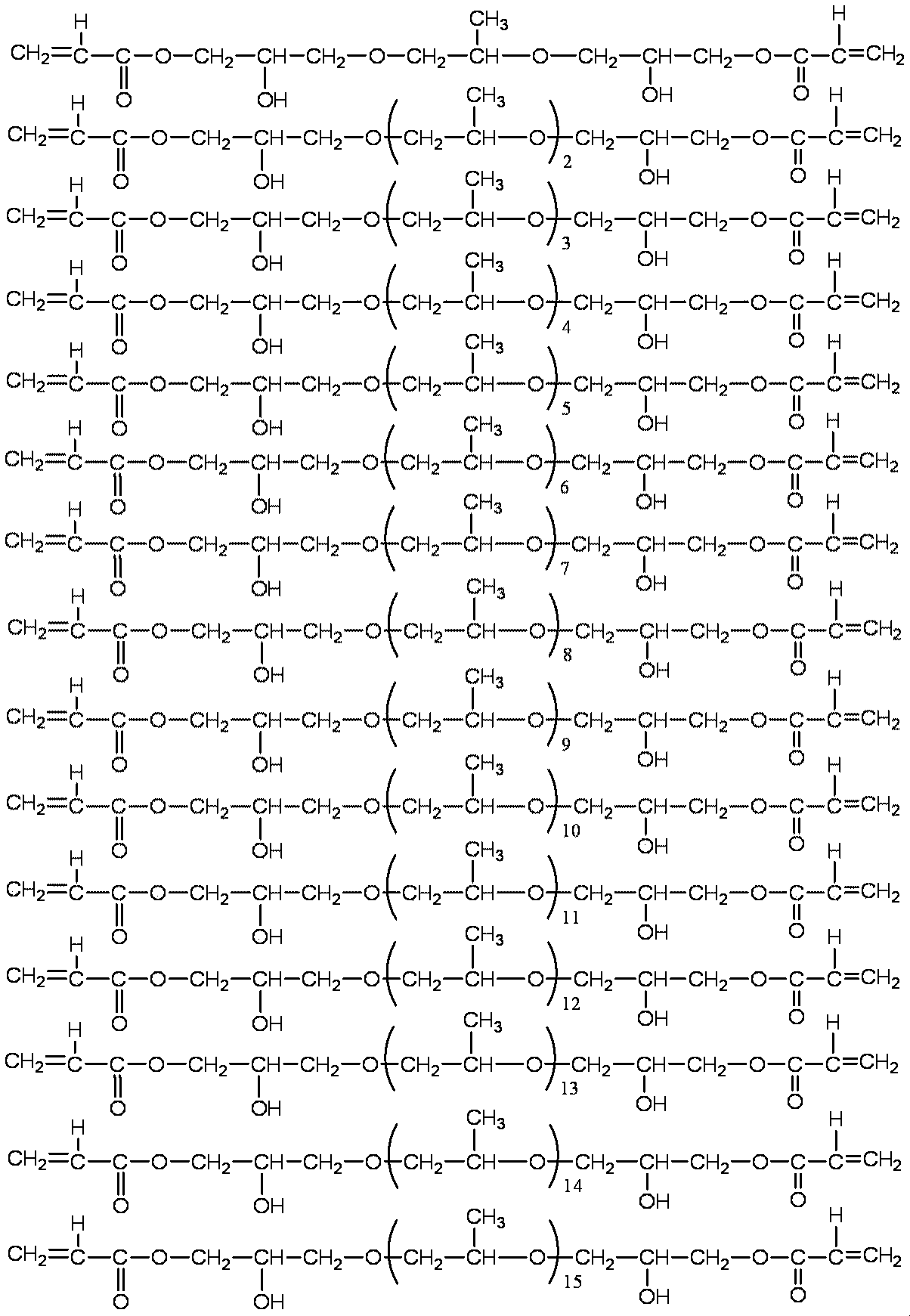
また、下記の重合性化合物を添加することも出来る。
(B)重合性化合物は、単独もしくは二種以上併用して用いることができる。 (B) A polymeric compound can be used individually or in combination of 2 or more types.
(B)重合性化合物の含有量は、感光性樹脂組成物の固形分に対して、1〜50質量%が好ましく、5〜30質量%がより好ましい。また、(A)バインダー樹脂と(B)重合性化合物の割合は、質量基準で(A)バインダー樹脂/(B)重合性化合物として表すとき、50/50以上80/20以下であることが好ましい。 (B) 1-50 mass% is preferable with respect to solid content of the photosensitive resin composition, and, as for content of a polymeric compound, 5-30 mass% is more preferable. Further, the ratio of (A) binder resin and (B) polymerizable compound is preferably 50/50 or more and 80/20 or less when expressed as (A) binder resin / (B) polymerizable compound on a mass basis. .
(A)バインダー樹脂と(B)重合性化合物の割合が前記の範囲にあると、タック性が抑制され、色むらのないカラーフィルタが得られる傾向があるため好ましい。 It is preferable that the ratio of the (A) binder resin and the (B) polymerizable compound be in the above range because tackiness is suppressed and a color filter having no color unevenness tends to be obtained.
本発明の感光性樹脂組成物は、(C)重合開始剤および開始助剤を含む。
(C)重合開始剤および開始助剤としては、活性ラジカル発生剤、酸発生剤、重合促進剤、増感剤等が挙げられる。活性ラジカル発生剤は光又は熱の作用によって活性ラジカルを発生する。(C)重合開始剤および開始助剤は、少なくともオキシム系化合物、アシルフォスフィンオキサイド系化合物およびチオキサントン系化合物を含む。
The photosensitive resin composition of the present invention contains (C) a polymerization initiator and an initiation assistant.
Examples of (C) the polymerization initiator and the initiation assistant include active radical generators, acid generators, polymerization accelerators, and sensitizers. An active radical generator generates an active radical by the action of light or heat. (C) The polymerization initiator and the initiation assistant include at least an oxime compound, an acyl phosphine oxide compound, and a thioxanthone compound.
前記のオキシム系化合物としては、式(C−1)で表される部分構造を有する化合物が挙げられる。下式中、*は結合手を表す。
前記のアシルフォスフィンオキサイド系化合物としては、2,4,6−トリメチルベンゾイルジフェニルホスフィンオキサイド、ビス(2,4,6−トリメチルベンゾイル)−フェニルホスフィンオキサイド等が挙げられる。Lucirin(登録商標)TPO(BASF社製)、イルガキュア(登録商標)819(BASF社製)等の市販品を用いてもよい。 Examples of the acylphosphine oxide compound include 2,4,6-trimethylbenzoyldiphenylphosphine oxide and bis (2,4,6-trimethylbenzoyl) -phenylphosphine oxide. Commercial products such as Lucirin (registered trademark) TPO (manufactured by BASF) and Irgacure (registered trademark) 819 (manufactured by BASF) may be used.
前記のチオキサントン系化合物としては、例えば、2−イソプロピルチオキサントン、4−イソプロピルチオキサントン、2,4−ジエチルチオキサントン、2,4−ジクロロチオキサントン、1−クロロ−4−プロポキシチオキサントン等が挙げられる。中でも2,4−ジエチルチオキサントンが好ましい。 Examples of the thioxanthone compound include 2-isopropylthioxanthone, 4-isopropylthioxanthone, 2,4-diethylthioxanthone, 2,4-dichlorothioxanthone, 1-chloro-4-propoxythioxanthone, and the like. Of these, 2,4-diethylthioxanthone is preferable.
また、本発明の効果を損なわない程度であれば、この分野で通常用いられている重合開始剤もしくは重合開始助剤をさらに併用することができ、当該重合開始剤もしくは重合開始助剤としては、例えば、アセトフェノン系化合物、ビイミダゾール系化合物、トリアジン系化合物、ベンゾイン系化合物、ベンゾフェノン系化合物、アントラセン系化合物、アミン系化合物、チアゾリン系化合物、アルコキシアントラセン系化合物、カルボン酸系化合物等が挙げられる。 Moreover, as long as the effect of the present invention is not impaired, a polymerization initiator or a polymerization initiation assistant usually used in this field can be further used in combination. As the polymerization initiator or the polymerization initiation assistant, Examples include acetophenone compounds, biimidazole compounds, triazine compounds, benzoin compounds, benzophenone compounds, anthracene compounds, amine compounds, thiazoline compounds, alkoxyanthracene compounds, carboxylic acid compounds, and the like.
前記のアセトフェノン系化合物としては、ジエトキシアセトフェノン、2−ヒドロキシ−2−メチル−1−フェニルプロパン−1−オン、ベンジルジメチルケタール、2−ヒドロキシ−1−〔4−(2−ヒドロキシエトキシ)フェニル〕−2−メチルプロパン−1−オン、1−ヒドロキシシクロヘキシルフェニルケトン、2−メチル−1−(4−メチルチオフェニル)−2−モルホリノプロパン−1−オン、2−ベンジル−2−ジメチルアミノ−1−(4−モルホリノフェニル)ブタン−1−オン、2−(2−メチルベンジル)−2−ジメチルアミノ−1−(4−モルホリノフェニル)−ブタノン、2−(3−メチルベンジル)−2−ジメチルアミノ−1−(4−モルホリノフェニル)−ブタノン、2−(4−メチルベンジル)−2−ジメチルアミノ−1−(4−モルホリノフェニル)−ブタノン、2−(2−エチルベンジル)−2−ジメチルアミノ−1−(4−モルホリノフェニル)−ブタノン、2−(2−プロピルベンジル)−2−ジメチルアミノ−1−(4−モルホリノフェニル)−ブタノン、2−(2−ブチルベンジル)−2−ジメチルアミノ−1−(4−モルホリノフェニル)−ブタノン、2−(2,3−ジメチルベンジル)−2−ジメチルアミノ−1−(4−モルホリノフェニル)−ブタノン、2−(2、4−ジメチルベンジル)−2−ジメチルアミノ−1−(4−モルホリノフェニル)−ブタノン、2−(2−クロロベンジル)−2−ジメチルアミノ−1−(4−モルホリノフェニル)−ブタノン、2−(2−ブロモベンジル)−2−ジメチルアミノ−1−(4−モルホリノフェニル)−ブタノン、2−(3−クロロベンジル)−2−ジメチルアミノ−1−(4−モルホリノフェニル)−ブタノン、2−(4−クロロベンジル)−2−ジメチルアミノ−1−(4−モルホリノフェニル)−ブタノン、2−(3−ブロモベンジル)−2−ジメチルアミノ−1−(4−モルホリノフェニル)−ブタノン、2−(4−ブロモベンジル)−2−ジメチルアミノ−1−(4−モルホリノフェニル)−ブタノン、2−(2−メトキシベンジル)−2−ジメチルアミノ−1−(4−モルホリノフェニル)−ブタノン、2−(3−メトキシベンジル)−2−ジメチルアミノ−1−(4−モルホリノフェニル)−ブタノン、2−(4−メトキシベンジル)−2−ジメチルアミノ−1−(4−モルホリノフェニル)−ブタノン、2−(2−メチル−4−メトキシベンジル)−2−ジメチルアミノ−1−(4−モルホリノフェニル)−ブタノン、2−(2−メチル−4−ブロモベンジル)−2−ジメチルアミノ−1−(4−モルホリノフェニル)−ブタノン、2−(2−ブロモ−4−メトキシベンジル)−2−ジメチルアミノ−1−(4−モルホリノフェニル)−ブタノン、2−ヒドロキシ−2−メチル−1−〔4−(1−メチルビニル)フェニル〕プロパン−1−オンのオリゴマー等が挙げられる。 Examples of the acetophenone compound include diethoxyacetophenone, 2-hydroxy-2-methyl-1-phenylpropan-1-one, benzyldimethyl ketal, 2-hydroxy-1- [4- (2-hydroxyethoxy) phenyl]. 2-methylpropan-1-one, 1-hydroxycyclohexyl phenyl ketone, 2-methyl-1- (4-methylthiophenyl) -2-morpholinopropan-1-one, 2-benzyl-2-dimethylamino-1- (4-morpholinophenyl) butan-1-one, 2- (2-methylbenzyl) -2-dimethylamino-1- (4-morpholinophenyl) -butanone, 2- (3-methylbenzyl) -2-dimethylamino -1- (4-morpholinophenyl) -butanone, 2- (4-methylbenzyl) -2-dimethyl Amino-1- (4-morpholinophenyl) -butanone, 2- (2-ethylbenzyl) -2-dimethylamino-1- (4-morpholinophenyl) -butanone, 2- (2-propylbenzyl) -2-dimethyl Amino-1- (4-morpholinophenyl) -butanone, 2- (2-butylbenzyl) -2-dimethylamino-1- (4-morpholinophenyl) -butanone, 2- (2,3-dimethylbenzyl) -2 -Dimethylamino-1- (4-morpholinophenyl) -butanone, 2- (2,4-dimethylbenzyl) -2-dimethylamino-1- (4-morpholinophenyl) -butanone, 2- (2-chlorobenzyl) 2-dimethylamino-1- (4-morpholinophenyl) -butanone, 2- (2-bromobenzyl) -2-dimethylamino-1- (4-moly Holinophenyl) -butanone, 2- (3-chlorobenzyl) -2-dimethylamino-1- (4-morpholinophenyl) -butanone, 2- (4-chlorobenzyl) -2-dimethylamino-1- (4-morpholino Phenyl) -butanone, 2- (3-bromobenzyl) -2-dimethylamino-1- (4-morpholinophenyl) -butanone, 2- (4-bromobenzyl) -2-dimethylamino-1- (4-morpholino) Phenyl) -butanone, 2- (2-methoxybenzyl) -2-dimethylamino-1- (4-morpholinophenyl) -butanone, 2- (3-methoxybenzyl) -2-dimethylamino-1- (4-morpholino) Phenyl) -butanone, 2- (4-methoxybenzyl) -2-dimethylamino-1- (4-morpholinophenyl) -butanone, 2 -(2-Methyl-4-methoxybenzyl) -2-dimethylamino-1- (4-morpholinophenyl) -butanone, 2- (2-methyl-4-bromobenzyl) -2-dimethylamino-1- (4 -Morpholinophenyl) -butanone, 2- (2-bromo-4-methoxybenzyl) -2-dimethylamino-1- (4-morpholinophenyl) -butanone, 2-hydroxy-2-methyl-1- [4- ( 1-methylvinyl) phenyl] propan-1-one oligomer and the like.
前記のビイミダゾール系化合物としては、2,2’−ビス(2−クロロフェニル)−4,4’,5,5’−テトラフェニルビイミダゾール、2,2’−ビス(2,3−ジクロロフェニル)−4,4’,5,5’−テトラフェニルビイミダゾール(例えば、特開平6−75372号公報、特開平6−75373号公報等参照。)、2,2’−ビス(2−クロロフェニル)−4,4’,5,5’−テトラフェニルビイミダゾール、2,2’−ビス(2−クロロフェニル)−4,4’,5,5’−テトラ(アルコキシフェニル)ビイミダゾール、2,2’−ビス(2−クロロフェニル)−4,4’,5,5’−テトラ(ジアルコキシフェニル)ビイミダゾール、2,2’−ビス(2−クロロフェニル)−4,4’,5,5’−テトラ(トリアルコキシフェニル)ビイミダゾール(例えば、特公昭48−38403号公報、特開昭62−174204号公報等参照。)、4,4’5,5’−位のフェニル基がカルボアルコキシ基により置換されているイミダゾール化合物(例えば、特開平7−10913号公報等参照。)等が挙げられ、好ましくは2,2’−ビス(2−クロロフェニル)−4,4’,5,5’−テトラフェニルビイミダゾール、2,2’−ビス(2、3−ジクロロフェニル)−4,4’,5,5’−テトラフェニルビイミダゾールが挙げられる。 Examples of the biimidazole compound include 2,2′-bis (2-chlorophenyl) -4,4 ′, 5,5′-tetraphenylbiimidazole and 2,2′-bis (2,3-dichlorophenyl)-. 4,4 ′, 5,5′-tetraphenylbiimidazole (see, for example, JP-A-6-75372 and JP-A-6-75373), 2,2′-bis (2-chlorophenyl) -4 , 4 ′, 5,5′-tetraphenylbiimidazole, 2,2′-bis (2-chlorophenyl) -4,4 ′, 5,5′-tetra (alkoxyphenyl) biimidazole, 2,2′-bis (2-chlorophenyl) -4,4 ′, 5,5′-tetra (dialkoxyphenyl) biimidazole, 2,2′-bis (2-chlorophenyl) -4,4 ′, 5,5′-tetra (trialkoxy) Phenyl) biimidazole (for example, see JP-B-48-38403, JP-A-62-174204, etc.), and the phenyl group at the 4,4′5,5′-position is substituted with a carboalkoxy group. Imidazole compounds (see, for example, JP-A-7-10913) and the like, preferably 2,2′-bis (2-chlorophenyl) -4,4 ′, 5,5′-tetraphenylbiimidazole, 2,2′-bis (2,3-dichlorophenyl) -4,4 ′, 5,5′-tetraphenylbiimidazole may be mentioned.
前記のトリアジン系化合物としては、2,4−ビス(トリクロロメチル)−6−(4−メトキシフェニル)−1,3,5−トリアジン、2,4−ビス(トリクロロメチル)−6−(4−メトキシナフチル)−1,3,5−トリアジン、2,4−ビス(トリクロロメチル)−6−ピペロニル−1,3,5−トリアジン、2,4−ビス(トリクロロメチル)−6−(4−メトキシスチリル)−1,3,5−トリアジン、2,4−ビス(トリクロロメチル)−6−〔2−(5−メチルフラン−2−イル)エテニル〕−1,3,5−トリアジン、2,4−ビス(トリクロロメチル)−6−〔2−(フラン−2−イル)エテニル〕−1,3,5−トリアジン、2,4−ビス(トリクロロメチル)−6−〔2−(4−ジエチルアミノ−2−メチルフェニル)エテニル〕−1,3,5−トリアジン、2,4−ビス(トリクロロメチル)−6−〔2−(3,4−ジメトキシフェニル)エテニル〕−1,3,5−トリアジン等が挙げられる。 Examples of the triazine compound include 2,4-bis (trichloromethyl) -6- (4-methoxyphenyl) -1,3,5-triazine, 2,4-bis (trichloromethyl) -6- (4- Methoxynaphthyl) -1,3,5-triazine, 2,4-bis (trichloromethyl) -6-piperonyl-1,3,5-triazine, 2,4-bis (trichloromethyl) -6- (4-methoxy Styryl) -1,3,5-triazine, 2,4-bis (trichloromethyl) -6- [2- (5-methylfuran-2-yl) ethenyl] -1,3,5-triazine, 2,4 -Bis (trichloromethyl) -6- [2- (furan-2-yl) ethenyl] -1,3,5-triazine, 2,4-bis (trichloromethyl) -6- [2- (4-diethylamino- 2-methylphenyl Ethenyl] -1,3,5-triazine, 2,4-bis (trichloromethyl) -6- [2- (3,4-dimethoxyphenyl) ethenyl] -1,3,5-triazine.
前記のベンゾイン系化合物としては、例えば、ベンゾイン、ベンゾインメチルエーテル、ベンゾインエチルエーテル、ベンゾインイソプロピルエーテル、ベンゾインイソブチルエーテル等が挙げられる。 Examples of the benzoin-based compound include benzoin, benzoin methyl ether, benzoin ethyl ether, benzoin isopropyl ether, and benzoin isobutyl ether.
前記のベンゾフェノン系化合物としては、例えば、ベンゾフェノン、o−ベンゾイル安息香酸メチル、4−フェニルベンゾフェノン、4−ベンゾイル−4’−メチルジフェニルサルファイド、3,3’,4,4’−テトラ(tert−ブチルパーオキシカルボニル)ベンゾフェノン、2,4,6−トリメチルベンゾフェノン等が挙げられる。 Examples of the benzophenone compounds include benzophenone, methyl o-benzoylbenzoate, 4-phenylbenzophenone, 4-benzoyl-4′-methyldiphenyl sulfide, 3,3 ′, 4,4′-tetra (tert-butyl). Peroxycarbonyl) benzophenone, 2,4,6-trimethylbenzophenone, and the like.
前記のアントラセン系化合物としては、例えば、9,10−ジメトキシアントラセン、2−エチル−9,10−ジメトキシアントラセン、9,10−ジエトキシアントラセン、2−エチル−9,10−ジエトキシアントラセン等が挙げられる。 Examples of the anthracene compound include 9,10-dimethoxyanthracene, 2-ethyl-9,10-dimethoxyanthracene, 9,10-diethoxyanthracene, 2-ethyl-9,10-diethoxyanthracene and the like. It is done.
前記のアミン系化合物としては、例えば、トリエタノールアミン、メチルジエタノールアミン、トリイソプロパノールアミン、4−ジメチルアミノ安息香酸メチル、4−ジメチルアミノ安息香酸エチル、4−ジメチルアミノ安息香酸イソアミル、安息香酸2−ジメチルアミノエチル、4−ジメチルアミノ安息香酸2−エチルヘキシル、N,N−ジメチルパラトルイジン、4,4’−ビス(ジメチルアミノ)ベンゾフェノン(通称ミヒラーズケトン)、4,4’−ビス(ジエチルアミノ)ベンゾフェノン、4,4’−ビス(エチルメチルアミノ)ベンゾフェノン等が挙げられ、中でも4,4’−ビス(ジエチルアミノ)ベンゾフェノンが好ましい。 Examples of the amine compound include triethanolamine, methyldiethanolamine, triisopropanolamine, methyl 4-dimethylaminobenzoate, ethyl 4-dimethylaminobenzoate, isoamyl 4-dimethylaminobenzoate, and 2-dimethylbenzoate. Aminoethyl, 2-ethylhexyl 4-dimethylaminobenzoate, N, N-dimethylparatoluidine, 4,4′-bis (dimethylamino) benzophenone (commonly known as Michler's ketone), 4,4′-bis (diethylamino) benzophenone, 4, Examples thereof include 4′-bis (ethylmethylamino) benzophenone, and among them, 4,4′-bis (diethylamino) benzophenone is preferable.
チアゾリン系化合物としては、式(III−1)〜式(III−3)で表される化合物等が挙げられる。
前記のアルコキシアントラセン系化合物としては、例えば、9,10−ジメトキシアントラセン、2−エチル−9,10−ジメトキシアントラセン、9,10−ジエトキシアントラセン、2−エチル−9,10−ジエトキシアントラセン等が挙げられる。 Examples of the alkoxyanthracene compound include 9,10-dimethoxyanthracene, 2-ethyl-9,10-dimethoxyanthracene, 9,10-diethoxyanthracene, 2-ethyl-9,10-diethoxyanthracene, and the like. Can be mentioned.
カルボン酸化合物としては、フェニルスルファニル酢酸、メチルフェニルスルファニル酢酸、エチルフェニルスルファニル酢酸、メチルエチルフェニルスルファニル酢酸、ジメチルフェニルスルファニル酢酸、メトキシフェニルスルファニル酢酸、ジメトキシフェニルスルファニル酢酸、クロロフェニルスルファニル酢酸、ジクロロフェニルスルファニル酢酸、N−フェニルグリシン、フェノキシ酢酸、ナフチルチオ酢酸、N−ナフチルグリシン、ナフトキシ酢酸等が挙げられる。 Carboxylic acid compounds include phenylsulfanyl acetic acid, methylphenylsulfanyl acetic acid, ethylphenylsulfanyl acetic acid, methylethylphenylsulfanyl acetic acid, dimethylphenylsulfanyl acetic acid, methoxyphenylsulfanyl acetic acid, dimethoxyphenylsulfanyl acetic acid, chlorophenylsulfanyl acetic acid, dichlorophenylsulfanyl acetic acid, N -Phenylglycine, phenoxyacetic acid, naphthylthioacetic acid, N-naphthylglycine, naphthoxyacetic acid and the like.
その他にも、市販の商品名「EAB−F」(保土谷化学工業(株)製)等が(C)重合開始剤として例示される。 In addition, a commercially available brand name “EAB-F” (manufactured by Hodogaya Chemical Co., Ltd.) and the like are exemplified as (C) the polymerization initiator.
また、(C)重合開始剤のうち、連鎖移動を起こしうる基を有する重合開始剤として、特表2002−544205号公報に記載されている重合開始剤を使用することができる。 Moreover, the polymerization initiator described in Japanese translations of PCT publication No. 2002-544205 can be used as a polymerization initiator which has group which can raise | generate chain transfer among (C) polymerization initiators.
前記の連鎖移動を起こしうる基を有する重合開始剤は、前記の共重合体の構成成分(A3)としても使用することができる。そして、得られた共重合体は、(A)バインダー樹脂としても使用できる。 The polymerization initiator having a group capable of causing chain transfer can also be used as the constituent component (A3) of the copolymer. And the obtained copolymer can be used also as (A) binder resin.
(C)開始助剤としては、例えば、上記記載のアミン系化合物、チアゾリン系化合物、アルコキシアントラセン系化合物、チオキサントン系化合物、カルボン酸系化合物、市販の商品名「EAB−F」等が挙げられる。 Examples of the (C) initiation assistant include the above-described amine compounds, thiazoline compounds, alkoxyanthracene compounds, thioxanthone compounds, carboxylic acid compounds, and a commercially available product name “EAB-F”.
(C)重合開始剤および開始助剤の含有量は、感光性樹脂組成物の固形分に対して、オキシム系化合物、アシルフォスフィン系化合物、チオキサントン系化合物、それぞれ好ましくは1〜20質量%である。
また、(C)重合開始剤および開始助剤の含有量は、(A)バインダー樹脂及び(B)重合性化合物の合計量に対して質量分率で、好ましくは0.1〜40質量%、より好ましくは1〜30質量%である。
(C) Content of a polymerization initiator and a start adjuvant is an oxime type compound, an acyl phosphine type compound, a thioxanthone type compound with respect to solid content of the photosensitive resin composition, respectively, Preferably it is 1-20 mass%. is there.
The content of (C) the polymerization initiator and the initiation assistant is a mass fraction with respect to the total amount of (A) the binder resin and (B) the polymerizable compound, preferably 0.1 to 40% by mass, More preferably, it is 1-30 mass%.
(C)重合開始剤および開始助剤の合計量が前記の範囲にあると、感光性樹脂組成物が高感度となり、前記の感光性樹脂組成物を用いて形成したカラーフィルタの画素部の強度や、前記の画素の表面における平滑性が良好になる傾向があるため好ましい。 (C) When the total amount of the polymerization initiator and the start assistant is in the above range, the photosensitive resin composition becomes highly sensitive, and the strength of the pixel portion of the color filter formed using the photosensitive resin composition In addition, it is preferable because the smoothness on the surface of the pixel tends to be good.
本発明の感光性樹脂組成物は、さらに、(E)着色剤を含むことが好ましい。かかる(E)着色剤としては、顔料及び染料が挙げられるが、耐熱性、耐光性の点で、顔料を含むことが好ましい。 The photosensitive resin composition of the present invention preferably further contains (E) a colorant. Examples of the colorant (E) include pigments and dyes, but it is preferable to include a pigment from the viewpoint of heat resistance and light resistance.
顔料としては、有機顔料及び無機顔料が挙げられ、カラーインデックス(The Society of Dyers and Colourists出版)でピグメントに分類されている化合物が挙げられる。
有機顔料としては、具体的には、例えばC.I.ピグメントイエロー1、3、12、13、14、15、16、17、20、24、31、53、83、86、93、94、109、110、117、125、128、137、138、139、147、148、150、153、154、166、173、194、214などの黄色顔料;
C.I.ピグメントオレンジ13、31、36、38、40、42、43、51、55、59、61、64、65、71、73などのオレンジ色顔料;
C.I.ピグメントレッド9、97、105、122、123、144、149、166、168、176、177、180、192、209、215、216、224、242、254、255、264、265などの赤色顔料;
C.I.ピグメントブルー15、15:3、15:4、15:6、60などの青色顔料;C.I.ピグメントバイオレット1、19、23、29、32、36、38などのバイオレット色顔料;
C.I.ピグメントグリーン7、36、58などの緑色顔料;
C.I.ピグメントブラウン23、25などのブラウン色顔料;
C.I.ピグメントブラック1、7などの黒色顔料などが挙げられる。
Examples of the pigment include organic pigments and inorganic pigments, and compounds classified as pigments by Color Index (published by The Society of Dyers and Colorists).
Specific examples of the organic pigment include C.I. I. Pigment Yellow 1, 3, 12, 13, 14, 15, 16, 17, 20, 24, 31, 53, 83, 86, 93, 94, 109, 110, 117, 125, 128, 137, 138, 139, Yellow pigments such as 147, 148, 150, 153, 154, 166, 173, 194, 214;
C. I. Orange pigments such as CI Pigment Orange 13, 31, 36, 38, 40, 42, 43, 51, 55, 59, 61, 64, 65, 71, 73;
C. I. Red pigments such as CI Pigment Red 9, 97, 105, 122, 123, 144, 149, 166, 168, 176, 177, 180, 192, 209, 215, 216, 224, 242, 254, 255, 264, 265;
C. I. Blue pigments such as CI Pigment Blue 15, 15: 3, 15: 4, 15: 6, 60; I. Violet color pigments such as CI Pigment Violet 1, 19, 23, 29, 32, 36, 38;
C. I. Green pigments such as CI Pigment Green 7, 36, 58;
C. I. Brown pigments such as CI Pigment Brown 23 and 25;
C. I. And black pigments such as CI Pigment Black 1 and 7.
中でも、C.I.ピグメントイエロー138、139、150、C.I.ピグメントレッド177、242、254、C.I.ピグメントレッドバイオレット23、C.I.ピグメントブルー15:3、15:6及びC.I.ピグメントグリーン7、36、58より好ましい。これらの顔料は、単独で又は2種以上を混合して用いてもよい。 Among them, C.I. I. Pigment yellow 138, 139, 150, C.I. I. Pigment red 177, 242, 254, C.I. I. Pigment red violet 23, C.I. I. Pigment blue 15: 3, 15: 6 and C.I. I. Pigment Green 7, 36, 58 is more preferable. These pigments may be used alone or in admixture of two or more.
前記顔料は、必要に応じて、ロジン処理、酸性基又は塩基性基が導入された顔料誘導体や顔料分散剤などを用いた表面処理、高分子化合物などによる顔料表面へのグラフト処理、硫酸微粒化法などによる微粒化処理、又は不純物を除去するための有機溶剤や水などによる洗浄処理、イオン性不純物のイオン交換法などによる除去処理などが施されていてもよい。また、顔料は、粒径が均一であることが好ましい。顔料分散剤を含有させて分散処理を行うことで、顔料が溶液中で均一に分散した状態の顔料分散液を得ることができる。 The pigment is optionally treated with rosin, surface treatment using a pigment derivative or pigment dispersant introduced with an acidic group or basic group, graft treatment on the pigment surface with a polymer compound, etc., sulfuric acid atomization Atomization treatment by a method or the like, cleaning treatment with an organic solvent or water for removing impurities, removal treatment by ion exchange method of ionic impurities, or the like may be performed. The pigment preferably has a uniform particle size. By carrying out a dispersion treatment by containing a pigment dispersant, a pigment dispersion in which the pigment is uniformly dispersed in the solution can be obtained.
前記顔料分散剤としては、市販の界面活性剤を用いることができ、例えば、シリコーン系、フッ素系、エステル系、カチオン系、アニオン系、ノニオン系、両性、ポリエステル系、ポリアミン系、アクリル系などの界面活性剤などが挙げられる。前記界面活性剤としては、ポリオキシエチレンアルキルエーテル類、ポリオキシエチレンアルキルフェニルエーテル類、ポリエチレングリコールジエステル類、ソルビタン脂肪酸エステル類、脂肪酸変性ポリエステル類、3級アミン変性ポリウレタン類、ポリエチレンイミン類などのほか、商品名でKP(信越化学工業(株)製)、フローレン(共栄社化学(株)製)、ソルパース(ゼネカ(株)製)、EFKA(BASF社製)、アジスパー(登録商標)(味の素ファインテクノ(株)製)、Disperbyk(ビックケミー社製)などが挙げられる。これらは、それぞれ単独で、又は2種以上を組合せて用いることができる。 Commercially available surfactants can be used as the pigment dispersant, and examples thereof include silicone-based, fluorine-based, ester-based, cationic-based, anionic-based, non-ionic, amphoteric, polyester-based, polyamine-based, and acrylic-based. Surfactant etc. are mentioned. Examples of the surfactant include polyoxyethylene alkyl ethers, polyoxyethylene alkyl phenyl ethers, polyethylene glycol diesters, sorbitan fatty acid esters, fatty acid-modified polyesters, tertiary amine-modified polyurethanes, and polyethyleneimines. , KP (manufactured by Shin-Etsu Chemical Co., Ltd.), Floren (manufactured by Kyoeisha Chemical Co., Ltd.), Solpers (manufactured by Zeneca Co., Ltd.), EFKA (manufactured by BASF), Ajisper (registered trademark) (Ajinomoto Fine Techno) (Manufactured by Co., Ltd.), Disperbyk (manufactured by Big Chemie) and the like. These can be used alone or in combination of two or more.
顔料分散剤を用いる場合、その使用量は、顔料に対して、好ましくは100質量%以下であり、より好ましくは5〜50質量%である。顔料分散剤の使用量が前記の範囲にあると、均一な分散状態の顔料分散液が得られる傾向にある。 When a pigment dispersant is used, the amount used is preferably 100% by mass or less, more preferably 5 to 50% by mass, based on the pigment. When the amount of the pigment dispersant used is in the above range, a pigment dispersion in a uniform dispersion state tends to be obtained.
(E)着色剤の含有量は、感光性樹脂組成物の固形分に対して、好ましくは5〜60質量%であり、より好ましくは5〜45質量%である。(E)着色剤の含有量が前記の範囲であると、所望する分光や色濃度を得ることができる。 (E) Content of a coloring agent becomes like this. Preferably it is 5-60 mass% with respect to solid content of the photosensitive resin composition, More preferably, it is 5-45 mass%. (E) When the content of the colorant is within the above range, a desired spectrum and color density can be obtained.
本発明の感光性樹脂組成物における(D)溶剤は、溶解度パラメーターが8.0〜9.1(cal/cm3)1/2である溶剤と溶解度パラメーターが9.2〜11.0(cal/cm3)1/2である溶剤とを含む。
溶解度パラメーターが8.0〜9.1(cal/cm3)1/2である溶剤としては、エチレングリコールモノi−ブチルエーテル、ジエチレングリコールモノ 2−エチルヘキシルエーテル、ジプロピレングリコールモノn−プロピルエーテル、ジプロピレングリコールモノn−ブチルエーテル、トリプロピレングリコールモノn−プロピルエーテル、トリプロピレングリコールモノn−ブチルエーテル、エチレングリコールジメチルエーテル、ジエチレングリコールジメチルエーテル、ジエチレングリコールジエチルエーテル、ジエチレングリコールジn−ブチルエーテル、トリエチレングリコールジメチルエーテル、ジエチレングリコールエチルメチルエーテル、ジエチレングリコールモノn−ブチルエーテルアセテート、プロピレングリコールモノメチルエーテルアセテート、ジプロピレングリコールモノメチルエーテルアセテート、エチル−3−エトキシプロピオネート、酢酸nプロピル、プロピオン酸nプロピル、プロピオン酸nブチル、プロピオン酸nペンチル、メチルイソブチルケトン、シクロへキサン、トルエン、酢酸エチル、酢酸ブチル、テトラヒドロフラン、四塩化炭素、2−ヘプタノン等が挙げられる。この中でも溶解性の観点からプロピレングリコールモノメチルエーテルアセテートが好ましい。
The solvent (D) in the photosensitive resin composition of the present invention has a solubility parameter of 8.0 to 9.1 (cal / cm 3 ) 1/2 and a solubility parameter of 9.2 to 11.0 (cal / Cm 3 ) 1/2 .
Solvents having a solubility parameter of 8.0 to 9.1 (cal / cm 3 ) 1/2 include ethylene glycol mono i-butyl ether, diethylene glycol mono 2-ethylhexyl ether, dipropylene glycol mono n-propyl ether, dipropylene Glycol mono n-butyl ether, tripropylene glycol mono n-propyl ether, tripropylene glycol mono n-butyl ether, ethylene glycol dimethyl ether, diethylene glycol dimethyl ether, diethylene glycol diethyl ether, diethylene glycol di n-butyl ether, triethylene glycol dimethyl ether, diethylene glycol ethyl methyl ether, Diethylene glycol mono n-butyl ether acetate, propylene Glycol monomethyl ether acetate, dipropylene glycol monomethyl ether acetate, ethyl-3-ethoxypropionate, npropyl acetate, npropyl propionate, nbutyl propionate, npentyl propionate, methyl isobutyl ketone, cyclohexane, toluene, Examples include ethyl acetate, butyl acetate, tetrahydrofuran, carbon tetrachloride, and 2-heptanone. Among these, propylene glycol monomethyl ether acetate is preferable from the viewpoint of solubility.
溶解度パラメーターが9.2〜11.0(cal/cm3)1/2である溶剤としては、エチレングリコールモノプロピルエーテル、エチレングリコールモノisoプロピルエーテル、エチレングリコールモノn−ブチルエーテル、エチレングリコールモノヘキシルエーテル、エチレングリコールモノフェニルエーテル、エチレングリコールモノベンジルエーテル、エチレングリコールモノアリルエーテル、ジエチレングリコールモノメチルエーテル、ジエチレングリコールモノn−ブチルエーテル、ジエチレングリコールモノヘキシルエーテル、ジエチレングリコールモノ 2−エチルヘキシルエーテル、ジエチレングリコールモノベンジルエーテル、トリエチレングリコールモノメチルエーテル、トリエチレングリコールモノエチルエーテル、トリエチレングリコールモノn−ブチルエーテル、ポリエチレングリコールモノメチルエーテル、プロピレングリコールモノメチルエーテル、プロピレングリコールモノn−プロピルエーテル、プロピレングリコールモノn−ブチルエーテル、プロピレングリコールモノt−ブチルエーテル、プロピレングリコールモノフェニルエーテル、ジプロピレングリコールモノメチルエーテル、トリプロピレングリコールモノメチルエーテル、エチレングリコールモノn−ブチルエーテルアセテート、プロピレングリコールジアセテート、メチル−3−メトキシプロピオネート、乳酸メチル、乳酸ブチル、シクロヘキサノン、ダイアセトンアルコール、1−プロパノール、1−ブタノール、メチルエチルケトン、ジオキサン、ジクロルメタン、クロロホルム、ジメチルスルホキシド、アセトン、炭酸ジメチル、1,1,2,2−テトラクロロエタン等が挙げられる。この中でも溶解性の観点からプロピレングリコールモノメチルエーテルが好ましい。 Solvents having a solubility parameter of 9.2 to 11.0 (cal / cm 3 ) 1/2 include ethylene glycol monopropyl ether, ethylene glycol monoisopropyl ether, ethylene glycol mono n-butyl ether, ethylene glycol monohexyl ether. , Ethylene glycol monophenyl ether, ethylene glycol monobenzyl ether, ethylene glycol monoallyl ether, diethylene glycol monomethyl ether, diethylene glycol mono n-butyl ether, diethylene glycol monohexyl ether, diethylene glycol mono 2-ethylhexyl ether, diethylene glycol monobenzyl ether, triethylene glycol monomethyl ether Ether, triethylene glycol monoethyl ether Ter, triethylene glycol mono n-butyl ether, polyethylene glycol monomethyl ether, propylene glycol monomethyl ether, propylene glycol mono n-propyl ether, propylene glycol mono n-butyl ether, propylene glycol mono t-butyl ether, propylene glycol monophenyl ether, dipropylene Glycol monomethyl ether, tripropylene glycol monomethyl ether, ethylene glycol mono n-butyl ether acetate, propylene glycol diacetate, methyl-3-methoxypropionate, methyl lactate, butyl lactate, cyclohexanone, diacetone alcohol, 1-propanol, 1-propanol Butanol, methyl ethyl ketone, dioxane, dichloromethane, Chloroform, dimethyl sulfoxide, acetone, dimethyl carbonate, 1,1,2,2-tetrachloroethane, and the like. Among these, propylene glycol monomethyl ether is preferable from the viewpoint of solubility.
(D)溶剤の含有量は、感光性樹脂組成物の全溶剤に対して、好ましくは溶解度パラメーターが8.0〜9.1(cal/cm3)1/2である溶剤が70質量%以上99質量%以下、溶解度パラメーターが9.2〜11.0(cal/cm3)1/2である溶剤が1質量%以上30質量%以下であり、より好ましくは、溶解度パラメーターが8.0〜9.1(cal/cm3)1/2である溶剤が70質量%以上97質量%以下、溶解度パラメーターが9.2〜11.0(cal/cm3)1/2である溶剤が3質量%以上30質量%以下である。溶剤の質量%の比率が前記の範囲にあると溶解性、塗布時の平坦性が良好になる傾向がある。 (D) The content of the solvent is preferably 70% by mass or more of the solvent having a solubility parameter of 8.0 to 9.1 (cal / cm 3 ) 1/2 with respect to the total solvent of the photosensitive resin composition. 99% by mass or less and a solubility parameter of 9.2 to 11.0 (cal / cm 3 ) 1/2 is 1% by mass or more and 30% by mass or less, and more preferably, the solubility parameter is 8.0 to 8.0%. The solvent which is 9.1 (cal / cm 3 ) 1/2 is 70% by mass to 97% by mass, and the solvent whose solubility parameter is 9.2 to 11.0 (cal / cm 3 ) 1/2 is 3 %. % To 30% by mass. When the ratio by mass% of the solvent is within the above range, the solubility and flatness during application tend to be good.
なお溶解度パラメーターは、次式によって求められる。
溶解度パラメーター=(△E/V)1/2
△E:凝集エネルギー(蒸発エンタルピー)、V:モル体積
The solubility parameter is determined by the following formula.
Solubility parameter = (ΔE / V) 1/2
ΔE: cohesive energy (evaporation enthalpy), V: molar volume
(D)溶剤は、(A)バインダー樹脂の合成の際に使用し、感光性樹脂組成物として調整する際に、溶解度パラメーターが8.0〜9.1(cal/cm3)1/2である溶剤を、70質量%以上99質量%以下、溶解度パラメーターが9.2〜11.0(cal/cm3)1/2である溶剤を1質量%以上30質量%以下としてもよい。 (D) The solvent is used in the synthesis of the (A) binder resin, and the solubility parameter is 8.0 to 9.1 (cal / cm 3 ) 1/2 when adjusting as a photosensitive resin composition. One solvent may be 70% by mass or more and 99% by mass or less, and a solvent whose solubility parameter is 9.2 to 11.0 (cal / cm 3 ) 1/2 may be 1% by mass or more and 30% by mass or less.
(D)溶剤の含有量は、感光性樹脂組成物に対して、好ましくは60〜95質量%であり、より好ましくは70〜90質量%である。言い換えると、感光性樹脂組成物の固形分は、好ましくは5〜40質量%であり、より好ましくは10〜30質量%である。(D)溶剤の含有量が前記の範囲にあると、塗布時の平坦性が良好になる傾向がある。 (D) Content of a solvent becomes like this. Preferably it is 60-95 mass% with respect to the photosensitive resin composition, More preferably, it is 70-90 mass%. In other words, the solid content of the photosensitive resin composition is preferably 5 to 40% by mass, and more preferably 10 to 30% by mass. (D) When content of a solvent exists in the said range, there exists a tendency for the flatness at the time of application | coating to become favorable.
本発明の感光性樹脂組成物は、(F)界面活性剤を含んでいてもよい。界面活性剤としては、例えば、シリコーン系界面活性剤、フッ素系界面活性剤、フッ素原子を有するシリコーン系界面活性剤等が挙げられる。界面活性剤を含むことで、塗布時の平坦性が良好になる傾向がある。 The photosensitive resin composition of the present invention may contain (F) a surfactant. Examples of the surfactant include a silicone surfactant, a fluorine surfactant, a silicone surfactant having a fluorine atom, and the like. By including the surfactant, the flatness during application tends to be good.
シリコーン系界面活性剤としては、シロキサン結合を有する界面活性剤が挙げられる。具体的には、トーレシリコーンDC3PA、同SH7PA、同DC11PA、同SH21PA、同SH28PA、同SH29PA、同SH30PA、ポリエーテル変性シリコーンオイルSH8400(商品名:東レ・ダウコーニング(株)製)、KP321、KP322、KP323、KP324、KP326、KP340、KP341(信越化学工業(株)製)、TSF400、TSF401、TSF410、TSF4300、TSF4440、TSF4445、TSF−4446、TSF4452、TSF4460(モメンティブ・パフォーマンス・マテリアルズ・ジャパン合同会社製)等が挙げられる。 Examples of the silicone surfactant include surfactants having a siloxane bond. Specifically, Torre Silicone DC3PA, SH7PA, DC11PA, SH21PA, SH28PA, SH29PA, SH29PA, SH30PA, polyether-modified silicone oil SH8400 (trade name: manufactured by Toray Dow Corning Co., Ltd.), KP321, KP322 , KP323, KP324, KP326, KP340, KP341 (manufactured by Shin-Etsu Chemical Co., Ltd.), TSF400, TSF401, TSF410, TSF4300, TSF4440, TSF4445, TSF-4446, TSF4452, TSF4460 (Momentive Performance Materials Japan GK) Manufactured) and the like.
フッ素系界面活性剤としては、フルオロカーボン鎖を有する界面活性剤が挙げられる。具体的には、フロリナート(登録商標)FC430、同FC431(住友スリーエム(株)製)、メガファック(登録商標)F142D、同F171、同F172、同F173、同F177、同F183、同R30(DIC(株)製)、エフトップ(登録商標)EF301、同EF303、同EF351、同EF352(三菱マテリアル電子化成(株)製)、サーフロン(登録商標)S381、同S382、同SC101、同SC105(旭硝子(株)製)、E5844(ダイキン工業(株))等が挙げられる。 Examples of the fluorosurfactant include surfactants having a fluorocarbon chain. Specifically, Florinart (registered trademark) FC430, FC431 (manufactured by Sumitomo 3M Co., Ltd.), MegaFac (registered trademark) F142D, F171, F172, F173, F177, F183, R183 (DIC) ), Ftop (registered trademark) EF301, EF303, EF351, EF351, EF352 (manufactured by Mitsubishi Materials Denkasei), Surflon (registered trademark) S381, S382, SC101, SC105 (Asahi Glass) And E5844 (Daikin Industries, Ltd.).
フッ素原子を有するシリコーン系界面活性剤としては、シロキサン結合及びフルオロカーボン鎖を有する界面活性剤が挙げられる。具体的には、メガファック(登録商標)R08、同BL20、同F475、同F477、同F443(DIC(株)製)等が挙げられる。好ましくはメガファック(登録商標)F475が挙げられる。 Examples of the silicone-based surfactant having a fluorine atom include surfactants having a siloxane bond and a fluorocarbon chain. Specifically, Megafac (registered trademark) R08, BL20, F475, F477, F443 (manufactured by DIC Corporation) and the like can be mentioned. Preferably, MegaFac (registered trademark) F475 is used.
界面活性剤は、感光性樹脂組成物に対して、好ましくは0.001質量%以上0.3質量%以下であり、より好ましくは0.002質量%以上0.2質量%以下、特に好ましくは0.01質量%以上0.1質量%以下である。界面活性剤をこの範囲で含有することにより、塗膜の平坦性を良好にすることができる。 The surfactant is preferably 0.001% by mass or more and 0.3% by mass or less, more preferably 0.002% by mass or more and 0.2% by mass or less, particularly preferably based on the photosensitive resin composition. It is 0.01 mass% or more and 0.1 mass% or less. By containing the surfactant in this range, the flatness of the coating film can be improved.
本発明の感光性樹脂組成物は、必要に応じて、充填剤、他の高分子化合物、密着促進剤、酸化防止剤、紫外線吸収剤、光安定剤、連鎖移動剤等の種々の添加剤を含んでもよい。 The photosensitive resin composition of the present invention contains various additives such as fillers, other polymer compounds, adhesion promoters, antioxidants, ultraviolet absorbers, light stabilizers, chain transfer agents and the like as necessary. May be included.
本発明の感光性樹脂組成物は、必要により(E)着色剤や(D)溶剤やその他の成分の存在下、(A)バインダー樹脂、(B)重合性化合物、および(C)重合開始剤と開始助剤を混合することにより得られる。 The photosensitive resin composition of the present invention comprises (A) a binder resin, (B) a polymerizable compound, and (C) a polymerization initiator in the presence of (E) a colorant, (D) a solvent, and other components as necessary. And an initiating aid.
また、(E)着色剤として顔料を混合する場合、例えば、以下の手順で調製することが好ましい。
まず、顔料を予め(D)溶剤と混合し、顔料の平均粒子径が0.2μm以下程度となるまで、ビーズミルなどを用いて分散させる。この際、必要に応じて顔料分散剤、(A)バインダー樹脂の一部又は全部を配合してもよい。得られた顔料分散液に、(A)バインダー樹脂の残り、(B)重合性化合物や(C)重合開始剤等、必要に応じて使用されるその他の成分、さらには必要により追加の溶剤を、所定の濃度となるように添加し、感光性樹脂組成物を得ることができる。
Moreover, when mixing a pigment as (E) colorant, it is preferable to prepare in the following procedures, for example.
First, the pigment is mixed with a solvent (D) in advance and dispersed using a bead mill or the like until the average particle diameter of the pigment is about 0.2 μm or less. Under the present circumstances, you may mix | blend a pigment dispersant and a part or all of (A) binder resin as needed. In the obtained pigment dispersion, (A) the remainder of the binder resin, (B) a polymerizable compound, (C) a polymerization initiator, and other components used as necessary, and further an additional solvent if necessary. The photosensitive resin composition can be obtained by adding to a predetermined concentration.
本発明の感光性樹脂組成物の基板への塗布方法としては、例えば、押し出しコーティング法、ダイレクトグラビアコーティング法、リバースグラビアコーティング法、CAP(キャップ)コーティング法、ダイコーティング法等が挙げられる。また、ディップコーター、ロールコーター、バーコーター、スピンコーター、スリット&スピンコーター、スリットコーター(ダイコーター、カーテンフローコーター、スピンレスコーターとも呼ばれることがある)、インクジェット等の塗布装置を用いて塗布してもよい。なかでも、スリットコーター、スピンコーター、ロールコーター等を用いて塗布することが好ましい。 Examples of the method for applying the photosensitive resin composition of the present invention to a substrate include an extrusion coating method, a direct gravure coating method, a reverse gravure coating method, a CAP (cap) coating method, and a die coating method. Apply using a coating device such as a dip coater, roll coater, bar coater, spin coater, slit & spin coater, slit coater (sometimes called a die coater, curtain flow coater, or spinless coater) or inkjet. Also good. Especially, it is preferable to apply using a slit coater, a spin coater, a roll coater or the like.
基板に塗布した膜の乾燥方法としては、例えば、加熱乾燥、自然乾燥、通風乾燥、減圧乾燥等の方法が挙げられるが、複数の方法を組み合わせて行ってもよい。
乾燥温度としては、10〜120℃が好ましく、25〜100℃がより好ましい。また加熱時間としては、10秒間〜60分間であることが好ましく、30秒間〜30分間であることがより好ましい。
減圧乾燥は、50〜150Paの圧力下、20〜25℃の温度範囲で行うことが好ましい。
乾燥後の塗布膜の膜厚は、特に限定されず、用いる材料、用途等によって適宜調整することができ、例えば、0.1〜20μmであり、好ましくは1〜6μmである。
Examples of the method for drying the film applied to the substrate include methods such as heat drying, natural drying, ventilation drying, and reduced pressure drying, but a plurality of methods may be combined.
As drying temperature, 10-120 degreeC is preferable and 25-100 degreeC is more preferable. In addition, the heating time is preferably 10 seconds to 60 minutes, and more preferably 30 seconds to 30 minutes.
The vacuum drying is preferably performed at a temperature of 20 to 25 ° C. under a pressure of 50 to 150 Pa.
The film thickness of the coating film after drying is not particularly limited and can be appropriately adjusted depending on the material used, application, etc., and is, for example, 0.1 to 20 μm, preferably 1 to 6 μm.
乾燥後の塗布膜は、目的のパターンを形成するためのフォトマスクを介して、露光する。この際のフォトマスク上のパターン形状は特に限定されず、目的とする用途に応じたパターン形状が用いられる。
露光に用いられる光源としては、250〜450nmの波長の光を発生する光源が好ましい。例えば、350nm未満の光を、この波長域をカットするフィルタを用いてカットしたり、436nm付近、408nm付近、365nm付近の光を、これらの波長域を取り出すバンドパスフィルタを用いて選択的に取り出したりしてもよい。光源としては、具体的には、水銀灯、発光ダイオード、メタルハライドランプ、ハロゲンランプ等が挙げられる。
露光面全体に均一に平行光線を照射したり、マスクと基材との正確な位置合わせを行ったりすることができるため、マスクアライナ、ステッパ等の装置を使用することが好ましい。
The coating film after drying is exposed through a photomask for forming a target pattern. The pattern shape on the photomask at this time is not particularly limited, and a pattern shape corresponding to the intended application is used.
The light source used for exposure is preferably a light source that generates light having a wavelength of 250 to 450 nm. For example, light less than 350 nm can be cut using a filter that cuts this wavelength range, or light near 436 nm, 408 nm, and 365 nm can be selectively extracted using a bandpass filter that extracts these wavelength ranges. Or you may. Specific examples of the light source include a mercury lamp, a light emitting diode, a metal halide lamp, and a halogen lamp.
It is preferable to use an apparatus such as a mask aligner or a stepper because the entire exposed surface can be irradiated with parallel light rays uniformly or the mask and the substrate can be accurately aligned.
露光後、塗布膜を現像液に接触させて所定部分、例えば、未露光部を溶解させ、現像することにより、パターンを得ることができる。現像液としては、有機溶剤を用いることもできるが、塗布膜の露光部が現像液によって溶解や膨潤しにくく、良好な形状のパターンを得ることができるため、アルカリ性化合物の水溶液を用いることが好ましい。
現像方法は、パドル法、ディッピング法、スプレー法等のいずれでもよい。さらに現像時に基板を任意の角度に傾けてもよい。
現像後は、水洗することが好ましい。
After exposure, the coating film is brought into contact with a developer to dissolve a predetermined portion, for example, an unexposed portion, and developed, whereby a pattern can be obtained. As the developer, an organic solvent can be used, but it is preferable to use an aqueous solution of an alkaline compound because the exposed portion of the coating film is hardly dissolved or swollen by the developer and a pattern having a good shape can be obtained. .
The developing method may be any of paddle method, dipping method, spray method and the like. Further, the substrate may be tilted at an arbitrary angle during development.
After development, it is preferable to wash with water.
前記アルカリ性化合物としては、水酸化ナトリウム、水酸化カリウム、燐酸水素二ナトリウム、燐酸二水素ナトリウム、燐酸水素二アンモニウム、燐酸二水素アンモニウム、燐酸二水素カリウム、ケイ酸ナトリウム、ケイ酸カリウム、炭酸ナトリウム、炭酸カリウム、炭酸水素ナトリウム、炭酸水素カリウム、ホウ酸ナトリウム、ホウ酸カリウム、アンモニア等の無機アルカリ性化合物;テトラメチルアンモニウムヒドロキシド、2−ヒドロキシエチルトリメチルアンモニウムヒドロキシド、モノメチルアミン、ジメチルアミン、トリメチルアミン、モノエチルアミン、ジエチルアミン、トリエチルアミン、モノイソプロピルアミン、ジイソプロピルアミン、エタノールアミン等の有機アルカリ性化合物が挙げられる。中でも、水酸化カリウム、炭酸水素ナトリウム及びテトラメチルアンモニウムヒドロキシドが好ましい。
これらの無機及び有機アルカリ性化合物の水溶液中の濃度は、好ましくは0.01〜10質量%であり、より好ましくは0.03〜5質量%である。
Examples of the alkaline compound include sodium hydroxide, potassium hydroxide, disodium hydrogen phosphate, sodium dihydrogen phosphate, diammonium hydrogen phosphate, ammonium dihydrogen phosphate, potassium dihydrogen phosphate, sodium silicate, potassium silicate, sodium carbonate, Inorganic alkaline compounds such as potassium carbonate, sodium bicarbonate, potassium bicarbonate, sodium borate, potassium borate, ammonia; tetramethylammonium hydroxide, 2-hydroxyethyltrimethylammonium hydroxide, monomethylamine, dimethylamine, trimethylamine, mono Examples include organic alkaline compounds such as ethylamine, diethylamine, triethylamine, monoisopropylamine, diisopropylamine, and ethanolamine. Of these, potassium hydroxide, sodium hydrogen carbonate and tetramethylammonium hydroxide are preferable.
The density | concentration in the aqueous solution of these inorganic and organic alkaline compounds becomes like this. Preferably it is 0.01-10 mass%, More preferably, it is 0.03-5 mass%.
前記アルカリ性化合物の水溶液は、界面活性剤を含んでいてもよい。
界面活性剤としては、ポリオキシエチレンアルキルエーテル、ポリオキシエチレンアリールエーテル、ポリオキシエチレンアルキルアリールエーテル、その他のポリオキシエチレン誘導体、オキシエチレン/オキシプロピレンブロックコポリマー、ソルビタン脂肪酸エステル、ポリオキシエチレンソルビタン脂肪酸エステル、ポリオキシエチレンソルビトール脂肪酸エステル、グリセリン脂肪酸エステル、ポリオキシエチレン脂肪酸エステル、ポリオキシエチレンアルキルアミン等のノニオン系界面活性剤;
ラウリルアルコール硫酸エステルナトリウム、オレイルアルコール硫酸エステルナトリウム、ラウリル硫酸ナトリウム、ラウリル硫酸アンモニウム、ドデシルベンゼンスルホン酸ナトリウム、ドデシルナフタレンスルホン酸ナトリウム等のアニオン系界面活性剤;
ステアリルアミン塩酸塩、ラウリルトリメチルアンモニウムクロライド等のカチオン系界面活性剤等が挙げられる。
アルカリ性化合物の水溶液中の界面活性剤の濃度は、好ましくは0.01〜10質量%、より好ましくは0.05〜8質量%、特に好ましくは0.1〜5質量%である。
The aqueous solution of the alkaline compound may contain a surfactant.
Surfactants include polyoxyethylene alkyl ether, polyoxyethylene aryl ether, polyoxyethylene alkyl aryl ether, other polyoxyethylene derivatives, oxyethylene / oxypropylene block copolymers, sorbitan fatty acid esters, polyoxyethylene sorbitan fatty acid esters , Nonionic surfactants such as polyoxyethylene sorbitol fatty acid ester, glycerin fatty acid ester, polyoxyethylene fatty acid ester, polyoxyethylene alkylamine;
Anionic surfactants such as sodium lauryl alcohol sulfate, sodium oleyl alcohol sulfate, sodium lauryl sulfate, ammonium lauryl sulfate, sodium dodecylbenzenesulfonate, sodium dodecylnaphthalenesulfonate;
And cationic surfactants such as stearylamine hydrochloride and lauryltrimethylammonium chloride.
The concentration of the surfactant in the aqueous solution of the alkaline compound is preferably 0.01 to 10% by mass, more preferably 0.05 to 8% by mass, and particularly preferably 0.1 to 5% by mass.
本発明では、現像後に加温して保持する工程を省くことも出来る。また必要ならば加温して保持する工程を入れることが出来る。 In the present invention, the step of heating and holding after development can be omitted. If necessary, a step of heating and holding can be included.
本発明において加温して保持する工程の温度としては、通常、23℃以上200℃以下、好ましくは25℃以上180℃以下、より好ましくは25℃以上160℃以下、さらに好ましくは25℃以上120℃以下である。加温して保持する時間としては、通常、1〜300分、好ましくは1〜180分、より好ましくは1〜60分である。 In the present invention, the temperature of the heating and holding step is usually 23 ° C. or higher and 200 ° C. or lower, preferably 25 ° C. or higher and 180 ° C. or lower, more preferably 25 ° C. or higher and 160 ° C. or lower, and further preferably 25 ° C. or higher and 120 ° C. or lower. It is below ℃. As time to heat and hold | maintain, it is 1 to 300 minutes normally, Preferably it is 1 to 180 minutes, More preferably, it is 1 to 60 minutes.
加温して保持する工程が省略できると、工程の工数が減り、製造コストを下げることが出来る。また、加温して保持する工程が省略できると、フィルム基板を使用することができ、フレキシブルディスプレイを製造することが出来る。 If the step of heating and holding can be omitted, the number of steps can be reduced and the manufacturing cost can be reduced. Moreover, if the process of heating and holding can be omitted, a film substrate can be used and a flexible display can be manufactured.
本発明の感光性組成物は、色濃度、明度、コントラスト、感度、解像度、耐熱性等の良好なパターン、及び当該パターンを含むカラーフィルタを得ることが可能となる。また、これらのカラーフィルタ又はパターンは、これらをその構成部品の一部として備える表示装置、例えば、公知の液晶表示装置、有機EL装置、固体撮像素子、電子ペーパー等の着色画像に関連する機器に、公知の態様で、利用することができる。 The photosensitive composition of the present invention makes it possible to obtain a good pattern such as color density, brightness, contrast, sensitivity, resolution, heat resistance, and a color filter including the pattern. In addition, these color filters or patterns are used in devices related to colored images, such as a known liquid crystal display device, organic EL device, solid-state imaging device, electronic paper, etc. Can be used in a known manner.
<バインダー樹脂溶液A1の合成>
攪拌装置、滴下ロート、コンデンサー、温度計、ガス導入管を備えたフラスコにプロピレングリコールモノメチルエーテルアセテート67重量部、プロピレングリコールモノメチルエーテル33重量部を取り、窒素置換しながら攪拌し120℃に昇温した。次に、トリシクロデカニルメタクリレート11重量部、ベンジルメタクリレート31重量部、メタクリル酸23重量部からなるモノマー混合物にパーブチルO(t−ブチルペルオキシ2−エチルヘキサネート、日本油脂(株)製)をモノマー混合物100重量部に対し1重量部を添加した。これを滴下ロートから2時間かけてフラスコに滴下し、さらに、120℃で2時間攪拌し共重合体を得た。次に、フラスコ内を空気置換に替え、グリシジルメタクリレート10重量部、トリフェニルホスフィン0.46重量部、およびメチルハイドロキノン0.08重量部を上記共重合体の溶液中に投入し120℃で反応を続け固形分酸価が150KOHmg/gとなったところで反応を終了し、プロピレングリコールモノメチルエーテルアセテート75重量部、プロピレングリコールモノメチルエーテル5重量部を加えることにより、不揮発分30%のアルカリ現像可能なバインダー樹脂(Mw:30000)溶液A1を得た。
<Synthesis of binder resin solution A1>
67 parts by weight of propylene glycol monomethyl ether acetate and 33 parts by weight of propylene glycol monomethyl ether were placed in a flask equipped with a stirrer, a dropping funnel, a condenser, a thermometer, and a gas introduction tube. . Next, a monomer mixture composed of 11 parts by weight of tricyclodecanyl methacrylate, 31 parts by weight of benzyl methacrylate and 23 parts by weight of methacrylic acid is added with perbutyl O (t-butylperoxy 2-ethylhexanate, manufactured by NOF Corporation) as a monomer. One part by weight was added to 100 parts by weight of the mixture. This was dropped into the flask over 2 hours from the dropping funnel, and further stirred at 120 ° C. for 2 hours to obtain a copolymer. Next, the inside of the flask is replaced with air, and 10 parts by weight of glycidyl methacrylate, 0.46 parts by weight of triphenylphosphine, and 0.08 parts by weight of methylhydroquinone are put into the above copolymer solution and reacted at 120 ° C. When the solid content acid value reached 150 KOHmg / g, the reaction was terminated, and by adding 75 parts by weight of propylene glycol monomethyl ether acetate and 5 parts by weight of propylene glycol monomethyl ether, a binder resin capable of alkali development having a nonvolatile content of 30%. (Mw: 30000) Solution A1 was obtained.
<バインダー樹脂溶液A2の合成>
攪拌装置、滴下ロート、コンデンサー、温度計、ガス導入管を備えたフラスコにプロピレングリコールモノメチルエーテルアセテート67重量部、プロピレングリコールモノメチルエーテル33重量部を取り、窒素置換しながら攪拌し120℃に昇温した。次に、トリシクロデカニルメタクリレート10重量部、ベンジルメタクリレート34重量部、メタクリル酸20重量部からなるモノマー混合物にパーブチルO(t−ブチルペルオキシ2−エチルヘキサネート、日本油脂(株)製)をモノマー混合物100重量部に対し1重量部を添加した。これを滴下ロートから2時間かけてフラスコに滴下し、さらに、120℃で2時間攪拌し共重合体を得た。次に、フラスコ内を空気置換に替え、グリシジルメタクリレート10重量部、トリフェニルホスフィン0.44重量部、およびメチルハイドロキノン0.08重量部を上記共重合体の溶液中に投入し120℃で反応を続け固形分酸価が130KOHmg/gとなったところで反応を終了し、プロピレングリコールモノメチルエーテルアセテート74重量部、プロピレングリコールモノメチルエーテル5重量部を加えることにより、不揮発分30%のアルカリ現像可能なバインダー樹脂(Mw:30000)溶液A2を得た。
<Synthesis of binder resin solution A2>
67 parts by weight of propylene glycol monomethyl ether acetate and 33 parts by weight of propylene glycol monomethyl ether were placed in a flask equipped with a stirrer, a dropping funnel, a condenser, a thermometer, and a gas introduction tube. . Next, a monomer mixture consisting of 10 parts by weight of tricyclodecanyl methacrylate, 34 parts by weight of benzyl methacrylate, and 20 parts by weight of methacrylic acid is added with perbutyl O (t-butylperoxy 2-ethylhexanate, manufactured by NOF Corporation) as a monomer. One part by weight was added to 100 parts by weight of the mixture. This was dropped into the flask over 2 hours from the dropping funnel, and further stirred at 120 ° C. for 2 hours to obtain a copolymer. Next, the atmosphere in the flask was replaced with air, and 10 parts by weight of glycidyl methacrylate, 0.44 parts by weight of triphenylphosphine, and 0.08 parts by weight of methylhydroquinone were charged into the copolymer solution and reacted at 120 ° C. When the solid content acid value reached 130 KOHmg / g, the reaction was terminated, and by adding 74 parts by weight of propylene glycol monomethyl ether acetate and 5 parts by weight of propylene glycol monomethyl ether, an alkali developable binder resin having a nonvolatile content of 30% (Mw: 30000) Solution A2 was obtained.
<バインダー樹脂溶液A3の合成> 特開2010−140042記載の樹脂A
撹拌機、温度計、還流冷却管、滴下ロートおよび窒素導入管を備えたフラスコに、プロピレングリコールモノメチルエーテルアセテート182gを導入し、フラスコ内雰囲気を空気から窒素にした後、100℃に昇温後、ベンジルメタクリレート70.5g(0.40モル)、メタクリル酸43.0g(0.5モル)、トリシクロデカン骨格のモノメタクリレート(日立化成(株)製FA−513M)22.0g(0.10モル)およびプロピレングリコールモノメチルエーテルアセテート136gからなる混合物にアゾビスイソブチロニトリル3.6gを添加した溶液を滴下ロートから2時間かけてフラスコに滴下し、さらに100℃で5時間撹拌し続けた。次に、フラスコ内雰囲気を窒素から空気にし、グリシジルメタクリレート35.5g[0.25モル、(本反応に用いたメタクリル酸のカルボキシル基に対して50モル%)]、トリスジメチルアミノメチルフェノール0.9gおよびハイドロキノン0.145gをフラスコ内に投入し、110℃で6時間反応を続け、固形分酸価が79mgKOH/gのバインダー樹脂溶液A3(Mw:13000)を得た。
<Synthesis of Binder Resin Solution A3> Resin A described in JP2010-140042A
After introducing 182 g of propylene glycol monomethyl ether acetate into a flask equipped with a stirrer, a thermometer, a reflux condenser, a dropping funnel and a nitrogen introduction tube, and changing the atmosphere in the flask from air to nitrogen, the temperature was raised to 100 ° C., 70.5 g (0.40 mol) of benzyl methacrylate, 43.0 g (0.5 mol) of methacrylic acid, 22.0 g (0.10 mol) of monomethacrylate having a tricyclodecane skeleton (FA-513M manufactured by Hitachi Chemical Co., Ltd.) ) And propylene glycol monomethyl ether acetate (136 g) in a solution obtained by adding 3.6 g of azobisisobutyronitrile to the flask from the dropping funnel over 2 hours, and further stirring at 100 ° C. for 5 hours. Next, the atmosphere in the flask was changed from nitrogen to air, and 35.5 g of glycidyl methacrylate [0.25 mol, (50 mol% with respect to the carboxyl group of methacrylic acid used in this reaction)], trisdimethylaminomethylphenol, 0.5%. 9 g and 0.145 g of hydroquinone were charged into the flask, and the reaction was continued at 110 ° C. for 6 hours to obtain a binder resin solution A3 (Mw: 13000) having a solid content acid value of 79 mgKOH / g.
<バインダー樹脂溶液A4の合成>
撹拌機、温度計、還流冷却管、滴下ロートおよび窒素導入管を備えたフラスコに、プロピレングリコールモノメチルエーテルアセテート591部を導入し、フラスコ内雰囲気を空気から窒素にした後、110℃に昇温後、ベンジルメタクリレート17.6部、グリシジルメタクリレート113.7部、およびトリシクロデカン骨格のモノメタクリレート(日立化成(株)製FA−513M)22.0部からなるモノマー混合物に、プロピレングリコールモノメチルエーテルアセテート153部にアゾビスイソブチロニトリル3.6部を添加した溶液を滴下ロートから2時間かけてフラスコに滴下し、さらに100℃で2時間撹拌し続けた。次に、フラスコ内雰囲気を窒素から空気にし、メタクリル酸68.9部、トリスジメチルアミノメチルフェノール0.9gおよびハイドロキノン0.145部をフラスコ内に投入し、110℃で6時間反応を続け、固形分酸価が1mgKOH/gとなったところで反応を終了した。
次にテトラヒドロ無水フタル酸53.3部、トリエチルアミン0.8部を加え、120℃で3.5時間反応させ固形分37.9%、酸価が68.6mgKOH/g(固形分換算)のバインダー樹脂溶液A4(Mw:7900)を得た。
<Synthesis of binder resin solution A4>
After introducing 591 parts of propylene glycol monomethyl ether acetate into a flask equipped with a stirrer, thermometer, reflux condenser, dropping funnel and nitrogen inlet tube, the atmosphere in the flask was changed from air to nitrogen, and then heated to 110 ° C. , 17.6 parts of benzyl methacrylate, 113.7 parts of glycidyl methacrylate, and 22.0 parts of monomethacrylate having a tricyclodecane skeleton (FA-513M manufactured by Hitachi Chemical Co., Ltd.) were added to propylene glycol monomethyl ether acetate 153. A solution obtained by adding 3.6 parts of azobisisobutyronitrile to the part was dropped into the flask over 2 hours from the dropping funnel, and the stirring was further continued at 100 ° C. for 2 hours. Next, the atmosphere in the flask was changed from nitrogen to air, 68.9 parts of methacrylic acid, 0.9 g of trisdimethylaminomethylphenol and 0.145 parts of hydroquinone were put into the flask, and the reaction was continued at 110 ° C. for 6 hours to obtain a solid. The reaction was terminated when the acid value reached 1 mgKOH / g.
Next, 53.3 parts of tetrahydrophthalic anhydride and 0.8 part of triethylamine were added and reacted at 120 ° C. for 3.5 hours to obtain a binder having a solid content of 37.9% and an acid value of 68.6 mgKOH / g (in terms of solid content). Resin solution A4 (Mw: 7900) was obtained.
<バインダー樹脂溶液A5の合成>
還流冷却器、滴下ロート及び撹拌機を備えた1Lのフラスコ内に窒素を適量流して窒素雰囲気とし、プロピレングリコールモノメチルエーテルアセテート100重量部を入れ、撹拌しながら85℃まで加熱した。次いで、該フラスコ内に、メタクリル酸19重量部、3,4−エポキシトリシクロ[5.2.1.02.6]デシルアクリレート(式(I−1)で表される化合物及び式(II−1)で表される化合物171重量部をプロピレングリコールモノメチルエーテルアセテート40重量部に溶解した溶液を滴下ポンプを用いて約5時間かけて滴下した。一方、重合開始剤2,2′−アゾビス(2,4−ジメチルバレロニトリル)26重量部をプロピレングリコールモノメチルエーテルアセテート120重量部に溶解した溶液を別の滴下ポンプを用いて約5時間かけてフラスコ内に滴下した。重合開始剤の滴下が終了した後、約3時間同温度に保持し、その後室温まで冷却して、固形分43.5重量%、酸価が52mgKOH/g(固形分換算)のバインダー樹脂溶液A5(Mw:8000)を得た。
An appropriate amount of nitrogen was flowed into a 1 L flask equipped with a reflux condenser, a dropping funnel and a stirrer to form a nitrogen atmosphere, and 100 parts by weight of propylene glycol monomethyl ether acetate was added and heated to 85 ° C. with stirring. Next, 19 parts by weight of methacrylic acid, 3,4-epoxytricyclo [5.2.1.0 2.6 ] decyl acrylate (the compound represented by the formula (I-1) and the formula (II) -1), a solution prepared by dissolving 171 parts by weight of the compound represented by 40 parts by weight of propylene glycol monomethyl ether acetate was added dropwise over about 5 hours using a dropping pump, while the polymerization initiator 2,2′-azobis ( A solution prepared by dissolving 26 parts by weight of 2,4-dimethylvaleronitrile) in 120 parts by weight of propylene glycol monomethyl ether acetate was dropped into the flask over about 5 hours using another dropping pump. After that, the mixture was kept at the same temperature for about 3 hours, and then cooled to room temperature, so that a solid content of 43.5% by weight and an acid value of 52 mgKOH / g (solid content conversion) A dander resin solution A5 (Mw: 8000) was obtained.
合成例で得られたバインダー樹脂溶液の重量平均分子量(Mw)の測定は、GPC法を用いて、以下の条件で行なった。
装置:K2479((株)島津製作所製)
カラム:SHIMADZU Shim−pack GPC−80M
カラム温度:40℃
溶媒:THF(テトラヒドロフラン)
流速:1.0mL/min
検出器:RI
The weight average molecular weight (Mw) of the binder resin solution obtained in the synthesis example was measured using the GPC method under the following conditions.
Apparatus: K2479 (manufactured by Shimadzu Corporation)
Column: SHIMADZU Shim-pack GPC-80M
Column temperature: 40 ° C
Solvent: THF (tetrahydrofuran)
Flow rate: 1.0 mL / min
Detector: RI
実施例1
〔感光性樹脂組成物1の調製〕
着色剤(E):C.I.ピグメントレッド242 15部、
着色剤(E):C.I.ピグメントレッド177 20部、
アクリル系顔料分散剤 14部、
バインダー樹脂溶液(A1)(固形分換算) 10部、及び
プロピレングリコールモノメチルエーテルアセテート 191部
を混合し、ビーズミルを用いて顔料を十分に分散させた顔料分散液;
バインダー樹脂溶液(A1) 280部;
重合性化合物(B):グリセロール1,3−ジグリセロレートジアクリレート
(GDDA;Aldrich社製) 40部;
重合開始剤(C):N−ベンゾイルオキシ−1−(4−フェニルスルファニルフェニル)オクタン−1−オン−2−イミン
(イルガキュア(登録商標)OXE−01;BASFジャパン社製) 4.0部;
重合開始剤(C):ビス(2,4,6−トリメチルベンゾイル)フェニルホスシンオキサイド
(イルガキュア(登録商標)819;BASFジャパン社製) 8.0部;
重合開始助剤(C):ジエチルチオキサントン
(KAYACURE(登録商標) DETX−S 日本化薬(株)製)4.0部;
溶剤(D):プロピレングリコールモノメチルエーテルアセテート 409部;並びに界面活性剤(F):ポリエーテル変性シリコーンオイル(トーレシリコーンSH8400;東レダウコーニング(株)製) 0.5部
を混合して感光性樹脂組成物1を得た。
得られた感光性樹脂組成物の溶剤は全溶剤中プロピレングリコールモノメチルエーテルアセテートが92.7質量%であり、プロピレングリコールモノメチルエーテルが7.3質量%であった。また、バインダー樹脂(A1)と重合性化合物(B)の比率は固形分換算で70/30であった。
Example 1
[Preparation of photosensitive resin composition 1]
Coloring agent (E): C.I. I. 15 pigment red 242,
Coloring agent (E): C.I. I. 20 parts of Pigment Red 177
14 parts acrylic pigment dispersant,
10 parts of binder resin solution (A1) (in terms of solid content) and 191 parts of propylene glycol monomethyl ether acetate are mixed, and a pigment dispersion in which the pigment is sufficiently dispersed using a bead mill;
280 parts of binder resin solution (A1);
Polymerizable compound (B): glycerol 1,3-diglycerolate diacrylate (GDDA; manufactured by Aldrich) 40 parts;
Polymerization initiator (C): N-benzoyloxy-1- (4-phenylsulfanylphenyl) octane-1-one-2-imine (Irgacure (registered trademark) OXE-01; manufactured by BASF Japan Ltd.) 4.0 parts;
Polymerization initiator (C): Bis (2,4,6-trimethylbenzoyl) phenylphosphine oxide (Irgacure (registered trademark) 819; manufactured by BASF Japan Ltd.) 8.0 parts;
Polymerization initiation aid (C): diethylthioxanthone (KAYACURE (registered trademark) DETX-S, Nippon Kayaku Co., Ltd.) 4.0 parts;
Solvent (D): 409 parts of propylene glycol monomethyl ether acetate; and surfactant (F): polyether-modified silicone oil (Toray Silicone SH8400; manufactured by Toray Dow Corning Co., Ltd.) Composition 1 was obtained.
The solvent of the obtained photosensitive resin composition was 92.7% by mass of propylene glycol monomethyl ether acetate and 7.3% by mass of propylene glycol monomethyl ether in all the solvents. Moreover, the ratio of binder resin (A1) and polymeric compound (B) was 70/30 in conversion of solid content.
実施例2
〔感光性樹脂組成物2の調製〕
着色剤(E):C.I.ピグメントグリーン58 43部、
着色剤(E):C.I.ピグメントイエロー138 24部、
アクリル系顔料分散剤 12部、
バインダー樹脂溶液(A1)(固形分換算) 26部、及び
プロピレングリコールモノメチルエーテルアセテート 390部
を混合し、ビーズミルを用いて顔料を十分に分散させた顔料分散液;
バインダー樹脂溶液(A1) 133部;
重合性化合物(B):ジペンタエリスリトールヘキサアクリレート
KAYARAD(登録商標) DPHA(日本化薬社製) 44部;
重合開始剤(C):N−ベンゾイルオキシ−1−(4−フェニルスルファニルフェニル)オクタン−1−オン−2−イミン
(イルガキュア(登録商標)OXE−01;BASFジャパン社製) 11部;
重合開始剤(C):ビス(2,4,6−トリメチルベンゾイル)フェニルホスシンオキサイド
(イルガキュア(登録商標)819;BASFジャパン社製) 8.8部;
重合開始助剤(C):ジエチルチオキサントン
(KAYACURE(登録商標) DETX−S 日本化薬(株)製) 11部;
溶剤(D):プロピレングリコールモノメチルエーテルアセテート 322部;並びに界面活性剤(F):ポリエーテル変性シリコーンオイル(トーレシリコーンSH8400;東レダウコーニング(株)製) 0.5部
を混合して感光性樹脂組成物2を得た。
得られた感光性樹脂組成物の溶剤は全溶剤中プロピレングリコールモノメチルエーテルアセテートが96.4質量%であり、プロピレングリコールモノメチルエーテルが3.6質量%であった。また、バインダー樹脂(A1)と重合性化合物(B)の比率は固形分換算で60/40であった。
Example 2
[Preparation of photosensitive resin composition 2]
Coloring agent (E): C.I. I. Pigment Green 58 43 parts,
Coloring agent (E): C.I. I. 24 parts of Pigment Yellow 138,
12 parts acrylic pigment dispersant,
26 parts of binder resin solution (A1) (solid content conversion) and 390 parts of propylene glycol monomethyl ether acetate are mixed, and a pigment dispersion in which the pigment is sufficiently dispersed using a bead mill;
133 parts of binder resin solution (A1);
Polymerizable compound (B): 44 parts of dipentaerythritol hexaacrylate KAYARAD (registered trademark) DPHA (manufactured by Nippon Kayaku Co., Ltd.);
Polymerization initiator (C): N-benzoyloxy-1- (4-phenylsulfanylphenyl) octane-1-one-2-imine (Irgacure (registered trademark) OXE-01; manufactured by BASF Japan Ltd.) 11 parts;
Polymerization initiator (C): bis (2,4,6-trimethylbenzoyl) phenylphosphine oxide (Irgacure (registered trademark) 819; manufactured by BASF Japan Ltd.) 8.8 parts;
Polymerization initiation assistant (C): Diethylthioxanthone (KAYACURE (registered trademark) DETX-S manufactured by Nippon Kayaku Co., Ltd.) 11 parts;
Solvent (D): 322 parts of propylene glycol monomethyl ether acetate; and surfactant (F): polyether-modified silicone oil (Toray Silicone SH8400; manufactured by Toray Dow Corning Co., Ltd.) Composition 2 was obtained.
The solvent of the obtained photosensitive resin composition was 96.4% by mass of propylene glycol monomethyl ether acetate and 3.6% by mass of propylene glycol monomethyl ether in all the solvents. Moreover, the ratio of binder resin (A1) and polymeric compound (B) was 60/40 in conversion of solid content.
実施例3
〔感光性樹脂組成物3の調製〕
着色剤(E):C.I.ピグメントブルー15:6 27部、
着色剤(E):C.I.ピグメントバイオレット23 0.5部、
アクリル系顔料分散剤 10部、
バインダー樹脂溶液(A1)(固形分換算) 8.3部、及び
プロピレングリコールモノメチルエーテルアセテート 140部
を混合し、ビーズミルを用いて顔料を十分に分散させた顔料分散液;
バインダー樹脂溶液(A1) 248部;
重合性化合物(B):ジペンタエリスリトールヘキサアクリレート
(KAYARAD(登録商標) DPHA日本化薬社製) 35部;
重合開始剤(C):N−ベンゾイルオキシ−1−(4−フェニルスルファニルフェニル)オクタン−1−オン−2−イミン
(イルガキュア(登録商標)OXE−01;BASFジャパン社製) 5.8部;
重合開始剤(C):ビス(2,4,6−トリメチルベンゾイル)フェニルホスシンオキサイド
(イルガキュア(登録商標)819;BASFジャパン社製) 9.4部;
重合開始助剤(C):ジエチルチオキサントン
(KAYACURE(登録商標) DETX−S 日本化薬(株)製)4.7部;
溶剤(D):プロピレングリコールモノメチルエーテルアセテート 507部;並びに界面活性剤(F):ポリエーテル変性シリコーンオイル(トーレシリコーンSH8400;東レダウコーニング(株)製) 0.5部
を混合して感光性樹脂組成物3を得た。
得られた感光性樹脂組成物の溶剤は全溶剤中プロピレングリコールモノメチルエーテルアセテートが93.7質量%であり、プロピレングリコールモノメチルエーテルが6.3質量%であった。また、バインダー樹脂(A1)と重合性化合物(B)の比率は固形分換算で70/30であった。
Example 3
[Preparation of photosensitive resin composition 3]
Coloring agent (E): C.I. I. Pigment Blue 15: 6 27 parts,
Coloring agent (E): C.I. I. 0.5 parts of Pigment Violet 23,
10 parts acrylic pigment dispersant,
Binder resin solution (A1) (solid content conversion) 8.3 parts and propylene glycol monomethyl ether acetate 140 parts are mixed, and a pigment dispersion in which the pigment is sufficiently dispersed using a bead mill;
248 parts of binder resin solution (A1);
Polymerizable compound (B): 35 parts of dipentaerythritol hexaacrylate (KAYARAD (registered trademark) DPHA Nippon Kayaku Co., Ltd.);
Polymerization initiator (C): N-benzoyloxy-1- (4-phenylsulfanylphenyl) octane-1-one-2-imine (Irgacure (registered trademark) OXE-01; manufactured by BASF Japan Ltd.) 5.8 parts;
Polymerization initiator (C): bis (2,4,6-trimethylbenzoyl) phenylphosphine oxide (Irgacure (registered trademark) 819; manufactured by BASF Japan Ltd.) 9.4 parts;
Polymerization initiation assistant (C): diethylthioxanthone (KAYACURE (registered trademark) DETX-S, Nippon Kayaku Co., Ltd.) 4.7 parts;
Solvent (D): 507 parts of propylene glycol monomethyl ether acetate; and surfactant (F): polyether-modified silicone oil (Toray Silicone SH8400; manufactured by Toray Dow Corning Co., Ltd.) Composition 3 was obtained.
The solvent of the obtained photosensitive resin composition was 93.7% by mass of propylene glycol monomethyl ether acetate and 6.3% by mass of propylene glycol monomethyl ether in all the solvents. Moreover, the ratio of binder resin (A1) and polymeric compound (B) was 70/30 in conversion of solid content.
実施例4
〔感光性樹脂組成物4の調製〕
着色剤(E):C.I.ピグメントブルー15:6 27部、
着色剤(E):C.I.ピグメントバイオレット23 0.5部、
アクリル系顔料分散剤 10部、
バインダー樹脂溶液(A2)(固形分換算) 7.4部、及び
プロピレングリコールモノメチルエーテルアセテート 140部
を混合し、ビーズミルを用いて顔料を十分に分散させた顔料分散液;
バインダー樹脂溶液(A2) 209部;
重合性化合物(B):ジペンタエリスリトールヘキサアクリレート
KAYARAD(登録商標) DPHA((日本化薬社製) 47部;
重合開始剤(C):N−ベンゾイルオキシ−1−(4−フェニルスルファニルフェニル)オクタン−1−オン−2−イミン
(イルガキュア(登録商標)OXE−01;BASFジャパン社製) 5.8部;
重合開始剤(C):ビス(2,4,6−トリメチルベンゾイル)フェニルホスシンオキサイド
(イルガキュア(登録商標)819;BASFジャパン社製) 9.4部;
重合開始助剤(C):ジエチルチオキサントン
(KAYACURE(登録商標) DETX−S 日本化薬(株)製)4.7部;
溶剤(D):プロピレングリコールモノメチルエーテルアセテート 530部;並びに界面活性剤(F):ポリエーテル変性シリコーンオイル(トーレシリコーンSH8400;東レダウコーニング(株)製) 0.5部
を混合して感光性樹脂組成物4を得た。
得られた感光性樹脂組成物の溶剤は全溶剤中プロピレングリコールモノメチルエーテルアセテートが94.7質量%であり、プロピレングリコールモノメチルエーテルが5.3質量%であった。また、バインダー樹脂(A2)と重合性化合物(B)の比率は固形分換算で60/40であった。
Example 4
[Preparation of photosensitive resin composition 4]
Coloring agent (E): C.I. I. Pigment Blue 15: 6 27 parts,
Coloring agent (E): C.I. I. 0.5 parts of Pigment Violet 23,
10 parts acrylic pigment dispersant,
Binder resin solution (A2) (solid content conversion) 7.4 parts and propylene glycol monomethyl ether acetate 140 parts are mixed, and a pigment dispersion in which the pigment is sufficiently dispersed using a bead mill;
209 parts of binder resin solution (A2);
Polymerizable compound (B): Dipentaerythritol hexaacrylate KAYARAD (registered trademark) DPHA (manufactured by Nippon Kayaku Co., Ltd.) 47 parts;
Polymerization initiator (C): N-benzoyloxy-1- (4-phenylsulfanylphenyl) octane-1-one-2-imine (Irgacure (registered trademark) OXE-01; manufactured by BASF Japan Ltd.) 5.8 parts;
Polymerization initiator (C): bis (2,4,6-trimethylbenzoyl) phenylphosphine oxide (Irgacure (registered trademark) 819; manufactured by BASF Japan Ltd.) 9.4 parts;
Polymerization initiation assistant (C): diethylthioxanthone (KAYACURE (registered trademark) DETX-S, Nippon Kayaku Co., Ltd.) 4.7 parts;
Solvent (D): 530 parts of propylene glycol monomethyl ether acetate; and surfactant (F): polyether-modified silicone oil (Toray Silicone SH8400; manufactured by Toray Dow Corning Co., Ltd.) Composition 4 was obtained.
The solvent of the obtained photosensitive resin composition was 94.7% by mass of propylene glycol monomethyl ether acetate and 5.3% by mass of propylene glycol monomethyl ether in all the solvents. Moreover, the ratio of binder resin (A2) and polymeric compound (B) was 60/40 in conversion of solid content.
実施例5
〔感光性樹脂組成物5の調製〕
着色剤(E):C.I.ピグメントブルー15:6 27部、
着色剤(E):C.I.ピグメントバイオレット23 0.5部、
アクリル系顔料分散剤 10部、
バインダー樹脂溶液(A1)(固形分換算) 7.4部、及び
プロピレングリコールモノメチルエーテルアセテート 140部
を混合し、ビーズミルを用いて顔料を十分に分散させた顔料分散液;
バインダー樹脂溶液(A1) 268部;
重合性化合物(B):ジペンタエリスリトールヘキサアクリレート
KAYARAD(登録商標) DPHA(日本化薬社製) 29部;
重合開始剤(C):N−ベンゾイルオキシ−1−(4−フェニルスルファニルフェニル)オクタン−1−オン−2−イミン
(イルガキュア(登録商標)OXE−01;BASFジャパン社製) 5.8部;
重合開始剤(C):ビス(2,4,6−トリメチルベンゾイル)フェニルホスシンオキサイド
(イルガキュア(登録商標)819;BASFジャパン社製) 9.4部;
重合開始助剤(C):ジエチルチオキサントン
(KAYACURE(登録商標) DETX−S 日本化薬(株)製)4.7部;
溶剤(D):プロピレングリコールモノメチルエーテルアセテート 494部;並びに界面活性剤(F):ポリエーテル変性シリコーンオイル(トーレシリコーンSH8400;東レダウコーニング(株)製) 0.5部
を混合して感光性樹脂組成物5を得た。
得られた感光性樹脂組成物の溶剤は全溶剤中プロピレングリコールモノメチルエーテルアセテートが93.2質量%であり、プロピレングリコールモノメチルエーテルが6.8質量%であった。また、バインダー樹脂(A1)と重合性化合物(B)の比率は固形分換算で75/25であった。
Example 5
[Preparation of photosensitive resin composition 5]
Coloring agent (E): C.I. I. Pigment Blue 15: 6 27 parts,
Coloring agent (E): C.I. I. 0.5 parts of Pigment Violet 23,
10 parts acrylic pigment dispersant,
7.4 parts of binder resin solution (A1) (solid content conversion) and 140 parts of propylene glycol monomethyl ether acetate are mixed, and a pigment dispersion in which the pigment is sufficiently dispersed using a bead mill;
268 parts of binder resin solution (A1);
Polymerizable compound (B): dipentaerythritol hexaacrylate KAYARAD (registered trademark) DPHA (manufactured by Nippon Kayaku Co., Ltd.) 29 parts;
Polymerization initiator (C): N-benzoyloxy-1- (4-phenylsulfanylphenyl) octane-1-one-2-imine (Irgacure (registered trademark) OXE-01; manufactured by BASF Japan Ltd.) 5.8 parts;
Polymerization initiator (C): bis (2,4,6-trimethylbenzoyl) phenylphosphine oxide (Irgacure (registered trademark) 819; manufactured by BASF Japan Ltd.) 9.4 parts;
Polymerization initiation assistant (C): diethylthioxanthone (KAYACURE (registered trademark) DETX-S, Nippon Kayaku Co., Ltd.) 4.7 parts;
Solvent (D): 494 parts of propylene glycol monomethyl ether acetate; and surfactant (F): polyether-modified silicone oil (Toray Silicone SH8400; manufactured by Toray Dow Corning Co., Ltd.) Composition 5 was obtained.
The solvent of the obtained photosensitive resin composition was 93.2% by mass of propylene glycol monomethyl ether acetate and 6.8% by mass of propylene glycol monomethyl ether in all the solvents. The ratio of the binder resin (A1) and the polymerizable compound (B) was 75/25 in terms of solid content.
実施例6
〔感光性樹脂組成物6の調製〕
着色剤(E):C.I.ピグメントブルー15:6 27部、
着色剤(E):C.I.ピグメントバイオレット23 0.5部、
アクリル系顔料分散剤 10部、
バインダー樹脂溶液(A1)(固形分換算) 8.3部、及び
プロピレングリコールモノメチルエーテルアセテート 140部
を混合し、ビーズミルを用いて顔料を十分に分散させた顔料分散液;
バインダー樹脂溶液(A1) 248部;
重合性化合物(B):ジペンタエリスリトールヘキサアクリレート
KAYARAD(登録商標) DPHA(日本化薬社製) 35部;
重合開始剤(C):N−ベンゾイルオキシ−1−(4−フェニルスルファニルフェニル)オクタン−1−オン−2−イミン
(イルガキュア(登録商標)OXE−01;BASFジャパン社製) 5.8部;
重合開始剤(C):ビス(2,4,6−トリメチルベンゾイル)フェニルホスシンオキサイド
(イルガキュア(登録商標)819;BASFジャパン社製) 9.4部;
重合開始助剤(C):ジエチルチオキサントン
(KAYACURE(登録商標) DETX−S 日本化薬(株)製)4.7部;
溶剤(D):プロピレングリコールモノメチルエーテル 190部
溶剤(D):プロピレングリコールモノメチルエーテルアセテート 317部;並びに界面活性剤(F):ポリエーテル変性シリコーンオイル(トーレシリコーンSH8400;東レダウコーニング(株)製) 0.5部
を混合して感光性樹脂組成物6を得た。
得られた感光性樹脂組成物の溶剤は全溶剤中プロピレングリコールモノメチルエーテルアセテートが70.7質量%であり、プロピレングリコールモノメチルエーテルが29.3質量%であった。また、バインダー樹脂(A2)と重合性化合物(B)の比率は固形分換算で70/30であった。
Example 6
[Preparation of photosensitive resin composition 6]
Coloring agent (E): C.I. I. Pigment Blue 15: 6 27 parts,
Coloring agent (E): C.I. I. 0.5 parts of Pigment Violet 23,
10 parts acrylic pigment dispersant,
Binder resin solution (A1) (solid content conversion) 8.3 parts and propylene glycol monomethyl ether acetate 140 parts are mixed, and a pigment dispersion in which the pigment is sufficiently dispersed using a bead mill;
248 parts of binder resin solution (A1);
Polymerizable compound (B): 35 parts of dipentaerythritol hexaacrylate KAYARAD (registered trademark) DPHA (manufactured by Nippon Kayaku Co., Ltd.);
Polymerization initiator (C): N-benzoyloxy-1- (4-phenylsulfanylphenyl) octane-1-one-2-imine (Irgacure (registered trademark) OXE-01; manufactured by BASF Japan Ltd.) 5.8 parts;
Polymerization initiator (C): bis (2,4,6-trimethylbenzoyl) phenylphosphine oxide (Irgacure (registered trademark) 819; manufactured by BASF Japan Ltd.) 9.4 parts;
Polymerization initiation assistant (C): diethylthioxanthone (KAYACURE (registered trademark) DETX-S, Nippon Kayaku Co., Ltd.) 4.7 parts;
Solvent (D): 190 parts of propylene glycol monomethyl ether Solvent (D): 317 parts of propylene glycol monomethyl ether acetate; and surfactant (F): polyether-modified silicone oil (Toray Silicone SH8400; manufactured by Toray Dow Corning Co., Ltd.) 0.5 part was mixed and the photosensitive resin composition 6 was obtained.
The solvent of the obtained photosensitive resin composition was 70.7% by mass of propylene glycol monomethyl ether acetate and 29.3% by mass of propylene glycol monomethyl ether in all the solvents. The ratio of the binder resin (A2) and the polymerizable compound (B) was 70/30 in terms of solid content.
実施例7
〔感光性樹脂組成物7の調製〕
着色剤(E):C.I.ピグメントブルー15:6 27部、
着色剤(E):C.I.ピグメントバイオレット23 0.5部、
アクリル系顔料分散剤 10部、
バインダー樹脂溶液(A1)(固形分換算) 8.3部、及び
プロピレングリコールモノメチルエーテルアセテート 140部
を混合し、ビーズミルを用いて顔料を十分に分散させた顔料分散液;
バインダー樹脂溶液(A1) 248部;
重合性化合物(B):ジペンタエリスリトールヘキサアクリレート
KAYARAD(登録商標) DPHA(日本化薬社製) 35部;
重合開始剤(C):N−ベンゾイルオキシ−1−(4−フェニルスルファニルフェニル)オクタン−1−オン−2−イミン
(イルガキュア(登録商標)OXE−01;BASFジャパン社製) 5.8部;
重合開始剤(C):2,4,6−トリメチルベンゾイル−ジフェニル−フォスフィンオキサイド
(Lucirin(登録商標)TPO;BASFジャパン社製) 9.4部;
重合開始助剤(C):ジエチルチオキサントン
(KAYACURE(登録商標) DETX−S 日本化薬(株)製)4.7部;
溶剤(D):プロピレングリコールモノメチルエーテル 190部
溶剤(D):プロピレングリコールモノメチルエーテルアセテート 317部;並びに
界面活性剤(F):ポリエーテル変性シリコーンオイル(トーレシリコーンSH8400;東レダウコーニング(株)製) 0.5部
を混合して感光性樹脂組成物7を得た。
得られた感光性樹脂組成物の溶剤は全溶剤中プロピレングリコールモノメチルエーテルアセテートが70.7質量%であり、プロピレングリコールモノメチルエーテルが29.3質量%であった。また、バインダー樹脂(A2)と重合性化合物(B)の比率は固形分換算で70/30であった。
Example 7
[Preparation of photosensitive resin composition 7]
Coloring agent (E): C.I. I. Pigment Blue 15: 6 27 parts,
Coloring agent (E): C.I. I. 0.5 parts of Pigment Violet 23,
10 parts acrylic pigment dispersant,
Binder resin solution (A1) (solid content conversion) 8.3 parts and propylene glycol monomethyl ether acetate 140 parts are mixed, and a pigment dispersion in which the pigment is sufficiently dispersed using a bead mill;
248 parts of binder resin solution (A1);
Polymerizable compound (B): 35 parts of dipentaerythritol hexaacrylate KAYARAD (registered trademark) DPHA (manufactured by Nippon Kayaku Co., Ltd.);
Polymerization initiator (C): N-benzoyloxy-1- (4-phenylsulfanylphenyl) octane-1-one-2-imine (Irgacure (registered trademark) OXE-01; manufactured by BASF Japan Ltd.) 5.8 parts;
Polymerization initiator (C): 2,4,6-trimethylbenzoyl-diphenyl-phosphine oxide (Lucirin (registered trademark) TPO; manufactured by BASF Japan) 9.4 parts;
Polymerization initiation assistant (C): diethylthioxanthone (KAYACURE (registered trademark) DETX-S, Nippon Kayaku Co., Ltd.) 4.7 parts;
Solvent (D): 190 parts of propylene glycol monomethyl ether Solvent (D): 317 parts of propylene glycol monomethyl ether acetate; and surfactant (F): polyether-modified silicone oil (Toray Silicone SH8400; manufactured by Toray Dow Corning Co., Ltd.) 0.5 part was mixed and the photosensitive resin composition 7 was obtained.
The solvent of the obtained photosensitive resin composition was 70.7% by mass of propylene glycol monomethyl ether acetate and 29.3% by mass of propylene glycol monomethyl ether in all the solvents. The ratio of the binder resin (A2) and the polymerizable compound (B) was 70/30 in terms of solid content.
比較例8
〔感光性樹脂組成物8の調製〕
着色剤(E):C.I.ピグメントグリーン36 55部、
着色剤(E):C.I.ピグメントイエロー150 24部、
アクリル系顔料分散剤 10部、
バインダー樹脂溶液(A3)(固形分換算) 20部、及び
プロピレングリコールモノメチルエーテルアセテート 260部
を混合し、ビーズミルを用いて顔料を十分に分散させた顔料分散液;
バインダー樹脂溶液(A3)(固形分換算) 46部;
重合性化合物(B):ジペンタエリスリトールヘキサアクリレート
KAYARAD(登録商標) DPHA(日本化薬社製) 57部;
重合開始剤(C):N−ベンゾイルオキシ−1−(4−フェニルスルファニルフェニル)オクタン−1−オン−2−イミン
(イルガキュア(登録商標)OXE−01;BASFジャパン社製) 15部;
重合開始助剤(C):
4,4‘−ジ(N,N−ジエチルアミノ)―ベンズフェノン
(EAB−F 保土ヶ谷化学(株)製) 5部;
溶剤(D):プロピレングリコールモノメチルエーテルアセテート 500部;並びに界面活性剤(F):ポリエーテル変性シリコーンオイル(トーレシリコーンSH8400;東レダウコーニング(株)製) 0.5部;
エポキシ樹脂:SUMI−EPOXY
ESCN−195XL(住友化学(株)製) 6.1部;
を混合して感光性樹脂組成物8を得た。
得られた感光性樹脂組成物の溶剤は全溶剤中プロピレングリコールモノメチルエーテルアセテートが100質量%であった。また、バインダー樹脂(A3)と重合性化合物(B)の比率は固形分換算で46/57であった。
Comparative Example 8
[Preparation of photosensitive resin composition 8]
Coloring agent (E): C.I. I. Pigment Green 36 55 parts,
Coloring agent (E): C.I. I. 24 parts of Pigment Yellow 150,
10 parts acrylic pigment dispersant,
20 parts of binder resin solution (A3) (solid content conversion) and 260 parts of propylene glycol monomethyl ether acetate are mixed, and a pigment dispersion in which the pigment is sufficiently dispersed using a bead mill;
Binder resin solution (A3) (solid content conversion) 46 parts;
Polymerizable compound (B): 57 parts of dipentaerythritol hexaacrylate KAYARAD (registered trademark) DPHA (manufactured by Nippon Kayaku Co., Ltd.);
Polymerization initiator (C): N-benzoyloxy-1- (4-phenylsulfanylphenyl) octane-1-one-2-imine (Irgacure (registered trademark) OXE-01; manufactured by BASF Japan Ltd.) 15 parts;
Polymerization initiation aid (C):
5,4′-di (N, N-diethylamino) -benzphenone (EAB-F manufactured by Hodogaya Chemical Co., Ltd.) 5 parts;
Solvent (D): Propylene glycol monomethyl ether acetate 500 parts; and Surfactant (F): Polyether-modified silicone oil (Toray Silicone SH8400; manufactured by Toray Dow Corning Co., Ltd.) 0.5 part;
Epoxy resin: SUMI-EPOXY
ESCN-195XL (Sumitomo Chemical Co., Ltd.) 6.1 parts;
Were mixed to obtain a photosensitive resin composition 8.
The solvent of the obtained photosensitive resin composition was 100% by mass of propylene glycol monomethyl ether acetate in all the solvents. The ratio of the binder resin (A3) and the polymerizable compound (B) was 46/57 in terms of solid content.
比較例9
〔感光性樹脂組成物9の調製〕
着色剤(E):C.I.ピグメントブルー15:6 27部、
着色剤(E):C.I.ピグメントバイオレット23 0.5部、
アクリル系顔料分散剤 10部、
バインダー樹脂溶液(A1)(固形分換算) 7.4部、及び
プロピレングリコールモノメチルエーテルアセテート 140部
を混合し、ビーズミルを用いて顔料を十分に分散させた顔料分散液;
バインダー樹脂溶液(A1) 274部;
重合性化合物(B):ジペンタエリスリトールヘキサアクリレート
KAYARAD(登録商標) DPHA(日本化薬社製) 38部;
重合開始剤(C):N−ベンゾイルオキシ−1−(4−フェニルスルファニルフェニル)オクタン−1−オン−2−イミン
(イルガキュア(登録商標)OXE−01;BASFジャパン社製) 6.4部;
重合開始助剤(C):ジエチルチオキサントン
(KAYACURE(登録商標) DETX−S 日本化薬(株)製)2.6部;
溶剤(D):プロピレングリコールモノメチルエーテルアセテート 489部;並びに界面活性剤(F):ポリエーテル変性シリコーンオイル(トーレシリコーンSH8400;東レダウコーニング(株)製) 0.5部
を混合して感光性樹脂組成物9を得た。
得られた感光性樹脂組成物の溶剤は全溶剤中プロピレングリコールモノメチルエーテルアセテートが93.0質量%であり、プロピレングリコールモノメチルエーテルが7.0質量%であった。また、バインダー樹脂(A1)と重合性化合物(B)の比率は固形分換算で70/30であった。
Comparative Example 9
[Preparation of photosensitive resin composition 9]
Coloring agent (E): C.I. I. Pigment Blue 15: 6 27 parts,
Coloring agent (E): C.I. I. 0.5 parts of Pigment Violet 23,
10 parts acrylic pigment dispersant,
7.4 parts of binder resin solution (A1) (solid content conversion) and 140 parts of propylene glycol monomethyl ether acetate are mixed, and a pigment dispersion in which the pigment is sufficiently dispersed using a bead mill;
274 parts of binder resin solution (A1);
Polymerizable compound (B): dipentaerythritol hexaacrylate KAYARAD (registered trademark) DPHA (manufactured by Nippon Kayaku Co., Ltd.) 38 parts;
Polymerization initiator (C): N-benzoyloxy-1- (4-phenylsulfanylphenyl) octane-1-one-2-imine (Irgacure (registered trademark) OXE-01; manufactured by BASF Japan Ltd.) 6.4 parts;
Polymerization initiation aid (C): Diethylthioxanthone (KAYACURE (registered trademark) DETX-S manufactured by Nippon Kayaku Co., Ltd.) 2.6 parts;
Solvent (D): 489 parts of propylene glycol monomethyl ether acetate; and surfactant (F): polyether-modified silicone oil (Toray Silicone SH8400; manufactured by Toray Dow Corning Co., Ltd.) Composition 9 was obtained.
The solvent of the obtained photosensitive resin composition was 93.0% by mass of propylene glycol monomethyl ether acetate and 7.0% by mass of propylene glycol monomethyl ether in all the solvents. Moreover, the ratio of binder resin (A1) and polymeric compound (B) was 70/30 in conversion of solid content.
比較例10
〔感光性樹脂組成物10の調製〕
着色剤(E):C.I.ピグメントブルー15:6 27部、
着色剤(E):C.I.ピグメントバイオレット23 0.5部、
アクリル系顔料分散剤 10部、
バインダー樹脂溶液(A4)(固形分換算) 7.4部、及び
プロピレングリコールモノメチルエーテルアセテート 140部
を混合し、ビーズミルを用いて顔料を十分に分散させた顔料分散液;
バインダー樹脂溶液(A4) 197部;
重合性化合物(B):ジペンタエリスリトールヘキサアクリレート
KAYARAD(登録商標) DPHA(日本化薬社製) 35部;
光重合開始剤(C):N−ベンゾイルオキシ−1−(4−フェニルスルファニルフェニル)オクタン−1−オン−2−イミン
(イルガキュア(登録商標)OXE−01;BASFジャパン社製) 5.8部;
光重合開始剤(C):ビス(2,4,6−トリメチルベンゾイル)フェニルホスシンオキサイド
(イルガキュア(登録商標)819;BASFジャパン社製) 9.4部;
重合開始助剤(C):ジエチルチオキサントン
(KAYACURE(登録商標) DETX−S 日本化薬(株)製)4.7部;
溶剤(F):プロピレングリコールモノメチルエーテルアセテート 559部;並びに界面活性剤(F):ポリエーテル変性シリコーンオイル(トーレシリコーンSH8400;東レダウコーニング(株)製) 0.5部
を混合して感光性樹脂組成物10を得た。
得られた感光性樹脂組成物の溶剤は全溶剤中プロピレングリコールモノメチルエーテルアセテートが100質量%であった。また、バインダー樹脂(A1)と重合性化合物(B)の比率は固形分換算で70/30であった。
Comparative Example 10
[Preparation of photosensitive resin composition 10]
Coloring agent (E): C.I. I. Pigment Blue 15: 6 27 parts,
Coloring agent (E): C.I. I. 0.5 parts of Pigment Violet 23,
10 parts acrylic pigment dispersant,
Binder resin solution (A4) (solid content conversion) 7.4 parts and propylene glycol monomethyl ether acetate 140 parts are mixed, and a pigment dispersion in which the pigment is sufficiently dispersed using a bead mill;
197 parts of a binder resin solution (A4);
Polymerizable compound (B): 35 parts of dipentaerythritol hexaacrylate KAYARAD (registered trademark) DPHA (manufactured by Nippon Kayaku Co., Ltd.);
Photopolymerization initiator (C): N-benzoyloxy-1- (4-phenylsulfanylphenyl) octane-1-one-2-imine (Irgacure (registered trademark) OXE-01; manufactured by BASF Japan Ltd.) 5.8 parts ;
Photopolymerization initiator (C): bis (2,4,6-trimethylbenzoyl) phenylphosphine oxide (Irgacure (registered trademark) 819; manufactured by BASF Japan Ltd.) 9.4 parts;
Polymerization initiation assistant (C): diethylthioxanthone (KAYACURE (registered trademark) DETX-S, Nippon Kayaku Co., Ltd.) 4.7 parts;
Solvent (F): 559 parts of propylene glycol monomethyl ether acetate; and surfactant (F): polyether-modified silicone oil (Toray Silicone SH8400; manufactured by Toray Dow Corning Co., Ltd.) Composition 10 was obtained.
The solvent of the obtained photosensitive resin composition was 100% by mass of propylene glycol monomethyl ether acetate in all the solvents. Moreover, the ratio of binder resin (A1) and polymeric compound (B) was 70/30 in conversion of solid content.
比較例11
〔感光性樹脂組成物11の調製〕
着色剤(E):C.I.ピグメントブルー15:6 27部、
着色剤(E):C.I.ピグメントバイオレット23 0.5部、
アクリル系顔料分散剤 10部、
バインダー樹脂溶液(A5)(固形分換算) 7.4部、及び
プロピレングリコールモノメチルエーテルアセテート 140部
を混合し、ビーズミルを用いて顔料を十分に分散させた顔料分散液;
バインダー樹脂溶液(A5) 171部;
重合性化合物(B):ジペンタエリスリトールヘキサアクリレート
KAYARAD(登録商標) DPHA(日本化薬社製) 35部;
光重合開始剤(C):N−ベンゾイルオキシ−1−(4−フェニルスルファニルフェニル)オクタン−1−オン−2−イミン
(イルガキュア(登録商標)OXE−01;BASFジャパン社製) 5.8部;
光重合開始剤(C):ビス(2,4,6−トリメチルベンゾイル)フェニルホスシンオキサイド
(イルガキュア(登録商標)819;BASFジャパン社製) 9.4部;
重合開始助剤(C):ジエチルチオキサントン
(KAYACURE(登録商標) DETX−S 日本化薬(株)製)4.7部;
溶剤(F):プロピレングリコールモノメチルエーテルアセテート 584部;並びに界面活性剤(F):ポリエーテル変性シリコーンオイル(トーレシリコーンSH8400;東レダウコーニング(株)製) 0.5部
を混合して感光性樹脂組成物11を得た。
得られた感光性樹脂組成物の溶剤は全溶剤中プロピレングリコールモノメチルエーテルアセテートが100質量%であった。また、バインダー樹脂(A1)と重合性化合物(B)の比率は固形分換算で70/30であった。
Comparative Example 11
[Preparation of photosensitive resin composition 11]
Coloring agent (E): C.I. I. Pigment Blue 15: 6 27 parts,
Coloring agent (E): C.I. I. 0.5 parts of Pigment Violet 23,
10 parts acrylic pigment dispersant,
7.4 parts of binder resin solution (A5) (solid content conversion) and 140 parts of propylene glycol monomethyl ether acetate are mixed, and a pigment dispersion in which the pigment is sufficiently dispersed using a bead mill;
171 parts of binder resin solution (A5);
Polymerizable compound (B): 35 parts of dipentaerythritol hexaacrylate KAYARAD (registered trademark) DPHA (manufactured by Nippon Kayaku Co., Ltd.);
Photopolymerization initiator (C): N-benzoyloxy-1- (4-phenylsulfanylphenyl) octane-1-one-2-imine (Irgacure (registered trademark) OXE-01; manufactured by BASF Japan Ltd.) 5.8 parts ;
Photopolymerization initiator (C): bis (2,4,6-trimethylbenzoyl) phenylphosphine oxide (Irgacure (registered trademark) 819; manufactured by BASF Japan Ltd.) 9.4 parts;
Polymerization initiation assistant (C): diethylthioxanthone (KAYACURE (registered trademark) DETX-S, Nippon Kayaku Co., Ltd.) 4.7 parts;
Solvent (F): 584 parts of propylene glycol monomethyl ether acetate; and surfactant (F): polyether-modified silicone oil (Toray Silicone SH8400; manufactured by Toray Dow Corning Co., Ltd.) Composition 11 was obtained.
The solvent of the obtained photosensitive resin composition was 100% by mass of propylene glycol monomethyl ether acetate in all the solvents. Moreover, the ratio of binder resin (A1) and polymeric compound (B) was 70/30 in conversion of solid content.
比較例12
〔感光性樹脂組成物12の調製〕
着色剤(E):C.I.ピグメントブルー15:6 27部、
着色剤(E):C.I.ピグメントバイオレット23 0.5部、
アクリル系顔料分散剤 10部、
バインダー樹脂溶液(A1)(固形分換算) 8.3部、及び
プロピレングリコールモノメチルエーテルアセテート 140部
を混合し、ビーズミルを用いて顔料を十分に分散させた顔料分散液;
バインダー樹脂溶液(A1) 248部;
重合性化合物(B):ジペンタエリスリトールヘキサアクリレート
KAYARAD(登録商標) DPHA(日本化薬社製) 35部;
重合開始剤(C):N−ベンゾイルオキシ−1−(4−フェニルスルファニルフェニル)オクタン−1−オン−2−イミン
(イルガキュア(登録商標)OXE−01;BASFジャパン社製) 5.8部;
重合開始剤(C):ビス(2,4,6−トリメチルベンゾイル)フェニルホスシンオキサイド
(イルガキュア(登録商標)819;BASFジャパン社製) 9.4部;
重合開始助剤(C):ジエチルチオキサントン
(KAYACURE(登録商標) DETX−S 日本化薬(株)製)4.7部;
溶剤(D):プロピレングリコールモノメチルエーテル 231部
溶剤(D):プロピレングリコールモノメチルエーテルアセテート 275部;並びに
界面活性剤(F):ポリエーテル変性シリコーンオイル(トーレシリコーンSH8400;東レダウコーニング(株)製) 0.5部
を混合して感光性樹脂組成物12を得た。
得られた感光性樹脂組成物の溶剤は全溶剤中プロピレングリコールモノメチルエーテルアセテートが65.0質量%であり、プロピレングリコールモノメチルエーテルが35.0質量%であった。また、バインダー樹脂(A1)と重合性化合物(B)の比率は固形分換算で70/30であった。
Comparative Example 12
[Preparation of photosensitive resin composition 12]
Coloring agent (E): C.I. I. Pigment Blue 15: 6 27 parts,
Coloring agent (E): C.I. I. 0.5 parts of Pigment Violet 23,
10 parts acrylic pigment dispersant,
Binder resin solution (A1) (solid content conversion) 8.3 parts and propylene glycol monomethyl ether acetate 140 parts are mixed, and a pigment dispersion in which the pigment is sufficiently dispersed using a bead mill;
248 parts of binder resin solution (A1);
Polymerizable compound (B): 35 parts of dipentaerythritol hexaacrylate KAYARAD (registered trademark) DPHA (manufactured by Nippon Kayaku Co., Ltd.);
Polymerization initiator (C): N-benzoyloxy-1- (4-phenylsulfanylphenyl) octane-1-one-2-imine (Irgacure (registered trademark) OXE-01; manufactured by BASF Japan Ltd.) 5.8 parts;
Polymerization initiator (C): bis (2,4,6-trimethylbenzoyl) phenylphosphine oxide (Irgacure (registered trademark) 819; manufactured by BASF Japan Ltd.) 9.4 parts;
Polymerization initiation assistant (C): diethylthioxanthone (KAYACURE (registered trademark) DETX-S, Nippon Kayaku Co., Ltd.) 4.7 parts;
Solvent (D): 231 parts of propylene glycol monomethyl ether Solvent (D): 275 parts of propylene glycol monomethyl ether acetate; and surfactant (F): polyether-modified silicone oil (Toray Silicone SH8400; manufactured by Toray Dow Corning Co., Ltd.) 0.5 part was mixed and the photosensitive resin composition 12 was obtained.
The solvent of the obtained photosensitive resin composition was 65.0% by mass of propylene glycol monomethyl ether acetate and 35.0% by mass of propylene glycol monomethyl ether in all the solvents. Moreover, the ratio of binder resin (A1) and polymeric compound (B) was 70/30 in conversion of solid content.
<パターンの作製>
2インチ角のガラス板上にPETフィルム(東レ製ルミラー75−T60)を貼合して基板を作製した。基板のPETフィルム側に、上記で得られた感光性樹脂組成物をスピンコート法により塗布し、ホットプレート上、80℃で2分間プリベークした。放冷後、この硬化性組成物を塗布した基板を露光機(TME−150RSK;トプコン(株)製)を用いて、大気雰囲気下、150mJ/cm2の露光量(365nm基準)で基板全面に光照射した。尚、フォトマスクとしては、10〜100μmのラインアンドスペースパターンが形成されたものを使用した。光照射後、非イオン系界面活性剤0.12%と水酸化カリウム0.04%とを含む水系現像液に、23℃で50秒間浸漬して現像し、純水で洗浄することにより、パターン塗膜を得た。得られたパターン塗膜の膜厚を、膜厚測定装置(DEKTAK3;日本真空技術(株)製)を用いて測定したところ、2μmであった。
<Pattern preparation>
A PET film (Toray Lumirror 75-T60) was bonded onto a 2-inch square glass plate to prepare a substrate. The photosensitive resin composition obtained above was applied to the PET film side of the substrate by spin coating, and prebaked at 80 ° C. for 2 minutes on a hot plate. After allowing to cool, the substrate coated with the curable composition was exposed on the entire surface of the substrate with an exposure amount (365 nm standard) of 150 mJ / cm 2 in an air atmosphere using an exposure machine (TME-150RSK; manufactured by Topcon Corporation). Irradiated with light. Note that a photomask having a line and space pattern of 10 to 100 μm was used. After light irradiation, the pattern was developed by immersing in an aqueous developer containing 0.12% of a nonionic surfactant and 0.04% of potassium hydroxide at 23 ° C. for 50 seconds and washing with pure water. A coating film was obtained. It was 2 micrometers when the film thickness of the obtained pattern coating film was measured using the film thickness measuring apparatus (DEKTAK3; Nippon Vacuum Technology Co., Ltd. product).
<解像度評価>
得られたパターンをレーザー顕微鏡(Axio Imager MAT カールツァイス社製)にて観察し、解像している最小寸法を解像度とした。解像度が高いほど、高精細なカラーフィルタの製造に用いることができる。
<Resolution evaluation>
The obtained pattern was observed with a laser microscope (manufactured by Axio Imager MAT Carl Zeiss), and the minimum dimension resolved was taken as the resolution. The higher the resolution, the more fine color filter can be used for manufacturing.
<現像ムラ評価>
得られたパターンをレーザー顕微鏡(Axio Imager MAT カールツァイス社製)にて観察し、パターン上に水シミがないものを○(現像ムラが見られない)、水シミがあるものを×(現像ムラが見られる)として評価した。現像ムラが見られる場合、カラーフィルタの製造に用いる際に、色ムラが生じる。
<Development unevenness evaluation>
The obtained pattern was observed with a laser microscope (Axio Imager MAT, Carl Zeiss). A pattern having no water spots on the pattern was ○ (development unevenness was not seen), and a pattern having water spots was x (development unevenness). Can be seen). When development unevenness is observed, color unevenness occurs when used for manufacturing a color filter.
<耐溶剤性評価>
前記基板上に形成されたパターンにプロピレングリコールモノメチルエーテルアセテートを1ml滴下し、30秒間静止した後、スピンコーターを用いて回転数1000rpmで10秒間回転させ、パターン上のプロピレングリコールモノメチルエーテルアセテートを振り切った。
プロピレングリコールモノメチルエーテルアセテートとの接触前後に測定した膜厚値から下記式に従って膜厚保持率を計算した。膜厚保持率が高いほど硬化性が良好であり、カラーフィルタの製造に用いる際に、混色を防ぐことができ、現像ムラが改善される。
(膜厚保持率)(%)=(接触後の膜厚)/(接触前の膜厚)
<Solvent resistance evaluation>
1 ml of propylene glycol monomethyl ether acetate was dropped on the pattern formed on the substrate, and after standing still for 30 seconds, the spin coater was used to rotate at 1000 rpm for 10 seconds, and the propylene glycol monomethyl ether acetate on the pattern was shaken off. .
The film thickness retention was calculated from the film thickness values measured before and after contact with propylene glycol monomethyl ether acetate according to the following formula. The higher the film thickness retention, the better the curability, and the color mixing can be prevented and the development unevenness can be improved when used for manufacturing a color filter.
(Thickness retention) (%) = (film thickness after contact) / (film thickness before contact)
<べた塗膜(全面露光塗膜)の作製>
2インチ角のガラス板上にPETフィルム(東レ製ルミラー75−T60)を貼合して基板を作製した。基板のPETフィルム側に、上記で得られた感光性樹脂組成物をスピンコート法により塗布し、ホットプレート上、80℃で2分間プリベークした。放冷後、この硬化性組成物を塗布した基板を露光機(TME−150RSK;トプコン(株)製)を用いて、大気雰囲気下、150mJ/cm2の露光量(365nm基準)で基板全面に光照射した。尚、フォトマスクは、使用せず全面に露光を行なった。得られたべた塗膜の膜厚を、膜厚測定装置(DEKTAK3;日本真空技術(株)製)を用いて測定したところ、2μmであった。
<Preparation of solid coating film (full exposure coating film)>
A PET film (Toray Lumirror 75-T60) was bonded onto a 2-inch square glass plate to prepare a substrate. The photosensitive resin composition obtained above was applied to the PET film side of the substrate by spin coating, and prebaked at 80 ° C. for 2 minutes on a hot plate. After allowing to cool, the substrate coated with the curable composition was exposed on the entire surface of the substrate with an exposure amount (365 nm standard) of 150 mJ / cm 2 in an air atmosphere using an exposure machine (TME-150RSK; manufactured by Topcon Corporation). Irradiated with light. Note that the entire surface was exposed without using a photomask. It was 2 micrometers when the film thickness of the obtained coating film was measured using the film thickness measuring apparatus (DEKTAK3; Nippon Vacuum Technology Co., Ltd. product).
<クロスカット試験>
得られたべた塗膜について、JIS K5600−5−6に準じたテープ剥離試験(クロスカット試験)を行い、PETフィルムとの密着性を評価した。結果を表1、2に示す。
<Cross cut test>
About the obtained coating film, the tape peeling test (cross-cut test) according to JISK5600-5-6 was performed, and adhesiveness with PET film was evaluated. The results are shown in Tables 1 and 2.
<鉛筆硬度>
得られたべた塗膜について、JIS−K5400に準じた鉛筆硬度の測定を、鉛筆引っかき硬度試験機(株式会社安田精機製作所製)を用いて行った。なお、荷重は1,000gとした。
<Pencil hardness>
About the obtained coating film, the measurement of the pencil hardness according to JIS-K5400 was performed using the pencil scratch hardness tester (made by Yasuda Seiki Seisakusyo Co., Ltd.). The load was 1,000 g.
<タック性評価>
5cm角PETフィルム(東レ製ルミラー75−T60)に、上記で得られた感光性樹脂組成物をフィルムアプリケーター(太佑機材株式会社製AP75)を用いて塗布し、ホットプレート上、80℃で2分間プリベークした。放冷後、この硬化性組成物を塗布した面に塗布していない5cm角PETフィルム(東レ製ルミラー75−T60)を貼合した後、塗布していない5cm角PETフィルム(東レ製ルミラー75−T60)を剥がした。塗布したPETフィルムにムラがなく、さらに塗布していないPETフィルムに転写がないものを○(タック性が見られない)、塗布したPETフィルムにムラがあり、さらに塗布していないPETフィルムに転写があるものを×(タック性が見られる)として評価した。タック性が見られる場合、カラーフィルタの製造に用いる際に、色ムラが生じる。
<Tack evaluation>
The photosensitive resin composition obtained above is applied to a 5 cm square PET film (Toray Lumirror 75-T60) using a film applicator (AP75, manufactured by Dazai Equipment Co., Ltd.), and heated on a hot plate at 80 ° C. for 2 minutes. Pre-baked. After allowing to cool, a 5 cm square PET film (Toray Lumirror 75-T60) not coated on the surface coated with this curable composition was bonded, and then an uncoated 5 cm square PET film (Toray Lumirror 75-) T60) was peeled off. The coated PET film has no unevenness, and the uncoated PET film has no transfer (no tackiness), and the coated PET film has unevenness and is further transferred to the uncoated PET film Those with a mark were evaluated as x (tackiness was observed). When tackiness is observed, color unevenness occurs when used for manufacturing a color filter.
本発明によれば、満足し得る硬度及びタック性を有するパターンを与える感光性樹脂組成物を提供することが可能となる。
本発明の感光性樹脂組成物を用いることにより、現像ムラが改善された解像度の高いパターンが得られる。本発明により得られるパターンは、液晶表示装置や有機EL表示装置、電子ペーパー表示装置などに用いる表示用カラーフィルタとして有用である。
According to the present invention, it is possible to provide a photosensitive resin composition that gives a pattern having satisfactory hardness and tackiness.
By using the photosensitive resin composition of the present invention, a high resolution pattern with improved development unevenness can be obtained. The pattern obtained by the present invention is useful as a color filter for display used in a liquid crystal display device, an organic EL display device, an electronic paper display device and the like.
Claims (11)
前記塗布膜を、マスキングした後に露光し、前記塗布膜の未露光部分を現像液で除去する工程を含むことを特徴とするパターンの製造方法。 Applying the photosensitive resin composition according to any one of claims 1 to 5 on a support, removing the solvent, and forming a coating film;
A method for producing a pattern, comprising: exposing the coating film after masking, and removing a non-exposed portion of the coating film with a developer.
前記塗布膜を、マスキングした後に露光し、前記塗布膜の未露光部分を現像液で除去する工程のみからなることを特徴とするパターンの製造方法。 Applying the photosensitive resin composition according to any one of claims 1 to 5 on a support, removing the solvent to form a coating film, and exposing the coating film after masking, A method for producing a pattern, comprising only a step of removing an unexposed portion of a coating film with a developer.
前記塗布膜を、マスキングした後に露光し、前記塗布膜の未露光部分を現像液で除去する工程、および
未露光部分を現像液で除去した塗布膜を23℃以上200℃以下の温度で保持する工程を含むことを特徴とするパターンの製造方法。 Applying the photosensitive resin composition according to any one of claims 1 to 5 on a support, removing the solvent, and forming a coating film;
The coating film is exposed after masking, the step of removing the unexposed portion of the coating film with a developer, and the coating film with the unexposed portion removed with the developer are maintained at a temperature of 23 ° C. or more and 200 ° C. or less. The manufacturing method of the pattern characterized by including a process.
Priority Applications (1)
| Application Number | Priority Date | Filing Date | Title |
|---|---|---|---|
| JP2013089090A JP2013242551A (en) | 2012-04-25 | 2013-04-22 | Photosensitive resin composition |
Applications Claiming Priority (3)
| Application Number | Priority Date | Filing Date | Title |
|---|---|---|---|
| JP2012099593 | 2012-04-25 | ||
| JP2012099593 | 2012-04-25 | ||
| JP2013089090A JP2013242551A (en) | 2012-04-25 | 2013-04-22 | Photosensitive resin composition |
Publications (1)
| Publication Number | Publication Date |
|---|---|
| JP2013242551A true JP2013242551A (en) | 2013-12-05 |
Family
ID=49461983
Family Applications (1)
| Application Number | Title | Priority Date | Filing Date |
|---|---|---|---|
| JP2013089090A Pending JP2013242551A (en) | 2012-04-25 | 2013-04-22 | Photosensitive resin composition |
Country Status (4)
| Country | Link |
|---|---|
| JP (1) | JP2013242551A (en) |
| KR (1) | KR20130120394A (en) |
| CN (1) | CN103376659B (en) |
| TW (1) | TWI588606B (en) |
Cited By (1)
| Publication number | Priority date | Publication date | Assignee | Title |
|---|---|---|---|---|
| KR20180048488A (en) * | 2015-10-12 | 2018-05-10 | 동우 화인켐 주식회사 | A self-light emitting photosensitive resin composition, color filter and display device comprising the same |
Families Citing this family (2)
| Publication number | Priority date | Publication date | Assignee | Title |
|---|---|---|---|---|
| CN106569389B (en) * | 2015-10-12 | 2021-07-16 | 东友精细化工有限公司 | Self-luminous photosensitive resin composition, color filter and display device including the same |
| JP7210091B2 (en) * | 2017-03-28 | 2023-01-23 | 株式会社レゾナック | Transfer type photosensitive film, method for forming cured film pattern, cured film and touch panel |
Citations (11)
| Publication number | Priority date | Publication date | Assignee | Title |
|---|---|---|---|---|
| JP2006243173A (en) * | 2005-03-01 | 2006-09-14 | Fuji Photo Film Co Ltd | Dye-containing negative curable composition, color filter and method for producing the same |
| WO2006129697A1 (en) * | 2005-05-31 | 2006-12-07 | Taiyo Ink Manufacturing Co., Ltd. | Photocuring/thermosetting resin composition, curing/setting product thereof and printed wiring board obtained using the same |
| JP2007241051A (en) * | 2006-03-10 | 2007-09-20 | Toyo Ink Mfg Co Ltd | Coloring composition for color filter, color filter, and method for producing color filter |
| JP2007256745A (en) * | 2006-03-24 | 2007-10-04 | Fujifilm Corp | Photosensitive composition, photosensitive film, photosensitive laminate, permanent pattern forming method, and printed circuit board |
| JP2007310060A (en) * | 2006-05-17 | 2007-11-29 | Fujifilm Corp | Photosensitive resin composition, photosensitive film, permanent pattern forming method, and printed wiring board |
| JP2007333885A (en) * | 2006-06-13 | 2007-12-27 | Toyo Ink Mfg Co Ltd | Photosensitive coloring composition and color filter that can be formed using the composition |
| JP2008275912A (en) * | 2007-04-27 | 2008-11-13 | Fujifilm Corp | Colored photopolymerizable composition, color filter using the same, and method for producing color filter |
| JP2010026362A (en) * | 2008-07-23 | 2010-02-04 | Toyo Ink Mfg Co Ltd | Photosensitive color composition for color filter of transflective liquid crystal display, method for manufacturing color filter using the composition, color filter manufactured by the method, and the transflective liquid crystal display device |
| JP2010032940A (en) * | 2008-07-31 | 2010-02-12 | Tokyo Ohka Kogyo Co Ltd | Colored photosensitive resin composition, color filter, and liquid crystal display |
| JP2011028219A (en) * | 2009-06-25 | 2011-02-10 | Jsr Corp | Coloring composition, color filter and color liquid crystal display element |
| JP2012058728A (en) * | 2010-08-10 | 2012-03-22 | Sumitomo Chemical Co Ltd | Photosensitive resin composition |
Family Cites Families (3)
| Publication number | Priority date | Publication date | Assignee | Title |
|---|---|---|---|---|
| TWI300795B (en) * | 2001-08-21 | 2008-09-11 | Mitsubishi Chem Corp | Curable resin composition for die coating and process for producing color filter |
| US7838197B2 (en) * | 2006-11-15 | 2010-11-23 | Taiyo Ink Mfg. Co., Ltd. | Photosensitive composition |
| KR100996046B1 (en) * | 2007-03-29 | 2010-11-22 | 도쿄 오카 고교 가부시키가이샤 | Colored photosensitive resin composition, black matrix, color filter, and liquid crystal display display |
-
2013
- 2013-04-22 KR KR1020130044088A patent/KR20130120394A/en not_active Ceased
- 2013-04-22 JP JP2013089090A patent/JP2013242551A/en active Pending
- 2013-04-23 TW TW102114333A patent/TWI588606B/en active
- 2013-04-23 CN CN201310142849.8A patent/CN103376659B/en active Active
Patent Citations (11)
| Publication number | Priority date | Publication date | Assignee | Title |
|---|---|---|---|---|
| JP2006243173A (en) * | 2005-03-01 | 2006-09-14 | Fuji Photo Film Co Ltd | Dye-containing negative curable composition, color filter and method for producing the same |
| WO2006129697A1 (en) * | 2005-05-31 | 2006-12-07 | Taiyo Ink Manufacturing Co., Ltd. | Photocuring/thermosetting resin composition, curing/setting product thereof and printed wiring board obtained using the same |
| JP2007241051A (en) * | 2006-03-10 | 2007-09-20 | Toyo Ink Mfg Co Ltd | Coloring composition for color filter, color filter, and method for producing color filter |
| JP2007256745A (en) * | 2006-03-24 | 2007-10-04 | Fujifilm Corp | Photosensitive composition, photosensitive film, photosensitive laminate, permanent pattern forming method, and printed circuit board |
| JP2007310060A (en) * | 2006-05-17 | 2007-11-29 | Fujifilm Corp | Photosensitive resin composition, photosensitive film, permanent pattern forming method, and printed wiring board |
| JP2007333885A (en) * | 2006-06-13 | 2007-12-27 | Toyo Ink Mfg Co Ltd | Photosensitive coloring composition and color filter that can be formed using the composition |
| JP2008275912A (en) * | 2007-04-27 | 2008-11-13 | Fujifilm Corp | Colored photopolymerizable composition, color filter using the same, and method for producing color filter |
| JP2010026362A (en) * | 2008-07-23 | 2010-02-04 | Toyo Ink Mfg Co Ltd | Photosensitive color composition for color filter of transflective liquid crystal display, method for manufacturing color filter using the composition, color filter manufactured by the method, and the transflective liquid crystal display device |
| JP2010032940A (en) * | 2008-07-31 | 2010-02-12 | Tokyo Ohka Kogyo Co Ltd | Colored photosensitive resin composition, color filter, and liquid crystal display |
| JP2011028219A (en) * | 2009-06-25 | 2011-02-10 | Jsr Corp | Coloring composition, color filter and color liquid crystal display element |
| JP2012058728A (en) * | 2010-08-10 | 2012-03-22 | Sumitomo Chemical Co Ltd | Photosensitive resin composition |
Cited By (2)
| Publication number | Priority date | Publication date | Assignee | Title |
|---|---|---|---|---|
| KR20180048488A (en) * | 2015-10-12 | 2018-05-10 | 동우 화인켐 주식회사 | A self-light emitting photosensitive resin composition, color filter and display device comprising the same |
| KR102174182B1 (en) * | 2015-10-12 | 2020-11-04 | 동우 화인켐 주식회사 | A self-light emitting photosensitive resin composition, color filter and display device comprising the same |
Also Published As
| Publication number | Publication date |
|---|---|
| CN103376659A (en) | 2013-10-30 |
| CN103376659B (en) | 2019-05-17 |
| KR20130120394A (en) | 2013-11-04 |
| TW201403233A (en) | 2014-01-16 |
| TWI588606B (en) | 2017-06-21 |
Similar Documents
| Publication | Publication Date | Title |
|---|---|---|
| JP6303436B2 (en) | Photosensitive resin composition | |
| JP5892760B2 (en) | Colored photosensitive resin composition | |
| JP5825961B2 (en) | Colored photosensitive composition | |
| CN105372937A (en) | Photosensitive resin composition | |
| JP2012173549A (en) | Colored photosensitive resin composition | |
| JP2012159567A (en) | Colored photosensitive resin composition | |
| JP2012159566A (en) | Colored photosensitive resin composition | |
| CN102749807A (en) | Photosensitive resin composition | |
| JP7329309B2 (en) | Resin, curable resin composition and cured film | |
| CN103676480A (en) | Photosensitive resin composition | |
| JP2011185966A (en) | Method for manufacturing cured pattern | |
| JP2013003284A (en) | Colored photosensitive resin composition | |
| JP2013242551A (en) | Photosensitive resin composition | |
| JP6370247B2 (en) | Colored photocurable resin composition capable of high color reproduction, color filter, and liquid crystal display device including the same | |
| JP2014035392A (en) | Photosensitive resin composition | |
| JP2016051176A (en) | Colored photosensitive resin composition | |
| JP6079109B2 (en) | Method for manufacturing protective film | |
| KR102456390B1 (en) | Colored photo sensitive resin composition, a color filter comprising the same, and a display devide comprising the color filter | |
| JP2014048607A (en) | Photosensitive resin composition | |
| JP2014052401A (en) | Photosensitive resin composition | |
| JP2014106266A (en) | Photosensitive resin composition | |
| JP2012173550A (en) | Color filter | |
| TW201520691A (en) | Photosensitive resin composition | |
| CN108693708A (en) | Hardening resin composition and cured film | |
| KR20160112645A (en) | Colored photosensitive resin composition and color filter using the same |
Legal Events
| Date | Code | Title | Description |
|---|---|---|---|
| A621 | Written request for application examination |
Free format text: JAPANESE INTERMEDIATE CODE: A621 Effective date: 20160229 |
|
| A977 | Report on retrieval |
Free format text: JAPANESE INTERMEDIATE CODE: A971007 Effective date: 20161108 |
|
| A131 | Notification of reasons for refusal |
Free format text: JAPANESE INTERMEDIATE CODE: A131 Effective date: 20161213 |
|
| A02 | Decision of refusal |
Free format text: JAPANESE INTERMEDIATE CODE: A02 Effective date: 20170620 |