JP2014122151A - Method for producing faujasite-type zeolite using alumino-borosilicate glass as raw material - Google Patents
Method for producing faujasite-type zeolite using alumino-borosilicate glass as raw material Download PDFInfo
- Publication number
- JP2014122151A JP2014122151A JP2013178730A JP2013178730A JP2014122151A JP 2014122151 A JP2014122151 A JP 2014122151A JP 2013178730 A JP2013178730 A JP 2013178730A JP 2013178730 A JP2013178730 A JP 2013178730A JP 2014122151 A JP2014122151 A JP 2014122151A
- Authority
- JP
- Japan
- Prior art keywords
- type zeolite
- glass
- aluminoborosilicate glass
- producing
- fau
- Prior art date
- Legal status (The legal status is an assumption and is not a legal conclusion. Google has not performed a legal analysis and makes no representation as to the accuracy of the status listed.)
- Pending
Links
Images







Landscapes
- Silicates, Zeolites, And Molecular Sieves (AREA)
Abstract
【課題】不要となり回収されたアルミノホウケイ酸ガラスを多大なエネルギーを消費せず効率的に資源として有効利用し、触媒能に優れ、重金属の溶出がないFAU型ゼオライトの製造方法を提供する。効率的で、容易に反応制御可能なFAU型ゼオライトの製造方法を提供する。
【解決手段】アルミノホウケイ酸ガラスを原料とし、Si/Alモル比が1.6〜2.4となるようにアルミノホウケイ酸ガラスにアルミニウム化合物および/またはシリコン化合物を添加する調合工程と、アルミノホウケイ酸ガラスとアルミニウム化合物および/またはシリコン化合物の混合物とアルカリ溶液とを接触させるアルカリ処理工程と、アルカリ処理工程で得られたアルカリ溶液とガラスとアルミニウム化合物および/またはシリコン化合物の混合物を水熱合成処理する水熱合成工程とを含むことを特徴とするFAU型ゼオライトの製造方法。
【選択図】図1Provided is a method for producing a FAU-type zeolite in which an aluminoborosilicate glass which has become unnecessary is efficiently used effectively as a resource without consuming a great deal of energy, has excellent catalytic ability, and does not elute heavy metals. Provided is a method for producing an efficient and easily controllable FAU type zeolite.
A compounding step in which an aluminum borosilicate glass is used as a raw material and an aluminum compound and / or a silicon compound is added to the aluminoborosilicate glass so that the Si / Al molar ratio is 1.6 to 2.4; An alkali treatment step in which a mixture of an acid glass and an aluminum compound and / or a silicon compound is brought into contact with an alkali solution, and a hydrothermal synthesis treatment of the mixture of the alkali solution, glass, aluminum compound and / or silicon compound obtained in the alkali treatment step And a hydrothermal synthesis step for producing a FAU-type zeolite.
[Selection] Figure 1
Description
本発明は、アルミノホウケイ酸ガラスを原料としたホージャサイト(FAU)型ゼオライトを製造する方法に関する。 The present invention relates to a method for producing faujasite (FAU) type zeolite using aluminoborosilicate glass as a raw material.
近年、液晶パネルを用いた液晶テレビなどの家電製品、パソコン、携帯端末などの製品が急速に普及している。ここで、上述した「液晶パネル」とは、貼り合せた2枚のガラス基板の内側に液晶材料を注入、封入し、各ガラス基板の外側に偏光板(樹脂)を貼り付けたものを指す。液晶パネルを用いた製品の普及に伴い、液晶パネルの廃棄物(廃液晶パネル)の数量も急激に増加しているが、環境との共存が期待される循環型社会の形成の中、廃液晶パネルについてもリサイクルし資源を有効に利用することが要望されている。 In recent years, home appliances such as a liquid crystal television using a liquid crystal panel, personal computers, portable terminals, and other products are rapidly spreading. Here, the above-mentioned “liquid crystal panel” refers to one in which a liquid crystal material is injected and sealed inside two bonded glass substrates, and a polarizing plate (resin) is bonded to the outside of each glass substrate. With the spread of products that use liquid crystal panels, the number of liquid crystal panel waste (waste liquid crystal panels) has also increased rapidly, but in the formation of a recycling society where coexistence with the environment is expected, waste liquid crystals Panels are also required to be recycled and effectively use resources.
現在、家電製品や情報機器などの廃棄物に含まれる液晶表示装置や液晶パネルは、廃棄物の量としては少ないこともあって、廃棄物の処理施設にて製品ごとに破砕された後、プラスチックを多量に含むシュレッダーダストと共に、埋め立て処理あるいは焼却処理されている。 Currently, liquid crystal display devices and liquid crystal panels contained in waste such as home appliances and information equipment are small in amount of waste, and after being crushed for each product in a waste treatment facility, plastic Along with shredder dust containing a large amount of waste, it is landfilled or incinerated.
また、特開昭59−35019号公報(特許文献1)には、石炭の流動床式燃焼炉から生成される石炭灰を原料としてゼオライトを製造する方法が開示されている。この特許文献1に記載された方法は、原料にアルミナ源、アルカリ源、水を、シリカ/アルミナ、水/アルカリ、アルカリ/アルミナ比が所定のモル比になるように添加、配合して得た原料成分混合物を用いて水熱条件下で合成するゼオライトの合成方法である。 JP-A-59-35019 (Patent Document 1) discloses a method for producing zeolite using coal ash produced from a fluidized bed combustion furnace for coal as a raw material. The method described in Patent Document 1 was obtained by adding and blending an alumina source, an alkali source, and water as raw materials so that the silica / alumina, water / alkali, and alkali / alumina ratio was a predetermined molar ratio. This is a method for synthesizing zeolite synthesized using a raw material component mixture under hydrothermal conditions.
また、特開昭64−24014号公報(特許文献2)には、石炭炊きボイラーの燃料残渣であるフライアッシュを原料としてゼオライト組成物を製造する方法が開示されている。この特許文献2に記載された方法は、原料に0.5N乃至3NのNaOH溶液に配合混練し、3.0kg/cm2以上の圧力でオートクレーブ処理してゼオライト組成物を製造する方法である。
Japanese Patent Laid-Open No. 64-24014 (Patent Document 2) discloses a method for producing a zeolite composition using fly ash, which is a fuel residue of a coal-fired boiler, as a raw material. The method described in
また、特開昭58−120512号公報(特許文献3)には、水砕スラグ粉末を原料としてゼオライト組成物を製造する方法が開示されている。この特許文献3に記載された方法は、水砕スラグ粉末を無機酸水溶液に溶解した後、アンモニアガスを吹き込んでpHを4〜9に調整して得た沈殿物(シリカ、アルミナが主成分、カルシウム分は濾液側)をろ別し、沈殿物にアルカリ金属水酸化物を添加して水熱合成しゼオライトを合成する方法である。
Japanese Patent Application Laid-Open No. 58-120512 (Patent Document 3) discloses a method for producing a zeolite composition using a granulated slag powder as a raw material. In the method described in
また、特開2007−131502号公報(特許文献4)には、陶器、コンクリート、がれき屑、ガラスおよびこれらの混合物を原料としてFAU型ゼオライトを製造する方法が開示されている。この特許文献4に記載された方法は、原料に固体状塩基を添加・混合して得られた混合物を加熱溶融してSi、Alが水に対して易溶化した粉末を生成させ、ここで得られた粉末を水に添加し、20〜200℃の反応温度で反応させるゼオライトの製造方法である。
Japanese Patent Application Laid-Open No. 2007-131502 (Patent Document 4) discloses a method for producing FAU-type zeolite using ceramics, concrete, debris, glass and a mixture thereof as raw materials. In the method described in
また、特開2005−343765号公報(特許文献5)には、製鉄所などから排出される焼却灰(石炭灰等)を原料としてFAU型ゼオライト、A型ゼオライト、またはFAU型ゼオライトを含有する複合体を製造する方法が開示されている。特許文献5に開示された方法では、石炭灰をアルカリ剤とともに600〜800℃で熱処理することにより、石炭灰中に含まれる未燃焼炭素から賦活化したあと、さらに水を加えて50〜110℃で水熱処理することにより、石炭灰中に含まれるシリカおよびアルミナを利用してゼオライトを製造する方法である。
Japanese Patent Application Laid-Open No. 2005-343765 (Patent Document 5) discloses a composite containing FAU-type zeolite, A-type zeolite, or FAU-type zeolite using incinerated ash (coal ash, etc.) discharged from a steel mill or the like as a raw material. A method of manufacturing a body is disclosed. In the method disclosed in
また、特開2001−39740号公報(特許文献6)には、シリカ−アルミナ系ガラス繊維およびシリカ系ガラス繊維を原料として、FAU型ゼオライトを製造する方法が開示されている。シリカ−アルミナ系ガラス繊維およびシリカ系ガラス繊維を0.5〜3mol/Lの水酸化ナトリウム溶液中に浸漬し、この状態で水酸化ナトリウム溶液を80〜150℃に加熱し、前記ガラス繊維表面にゼオライトを析出させる方法である。 Japanese Patent Laid-Open No. 2001-39740 (Patent Document 6) discloses a method for producing FAU-type zeolite using silica-alumina glass fiber and silica glass fiber as raw materials. The silica-alumina glass fiber and the silica glass fiber are immersed in a 0.5 to 3 mol / L sodium hydroxide solution. In this state, the sodium hydroxide solution is heated to 80 to 150 ° C. This is a method for precipitating zeolite.
液晶パネルは、省電力・省資源に貢献できる表示装置であるので、今後、高度情報化社会の進展に伴って、急激に生産量が増大するとともに、その表示面積も大型化することが予測され、これに伴って、今後、廃液晶パネルも、数・量ともに急激に増大すると予想される。したがって、液晶パネルの重量の大半を占めるガラス(液晶パネルガラス)についても、廃棄物の低減と資源を大切にする観点から、再生利用することが好ましい。しかしながら特許文献1に開示された方法では、セメント材料として再利用することを意図しているため、液晶パネルガラスはスラグとなり、ガラス自体として再生利用することはできない。 Since the LCD panel is a display device that can contribute to power and resource savings, it is predicted that the production volume will increase rapidly and the display area will increase with the progress of the advanced information society. Along with this, the number and amount of waste liquid crystal panels are expected to increase rapidly in the future. Therefore, glass (liquid crystal panel glass) occupying most of the weight of the liquid crystal panel is preferably recycled from the viewpoint of reducing waste and valuing resources. However, since the method disclosed in Patent Document 1 is intended to be reused as a cement material, the liquid crystal panel glass becomes slag and cannot be recycled as the glass itself.
資源有効利用の観点からは、回収された液晶パネルガラスを液晶パネルガラス自体として再びマテリアルリサイクルすることが望ましい。しかしながら、液晶パネルガラス表面に付着している不純物、ガラス組成の異なる数多くの品種が存在することなどの理由で、光学的特性、熱特性の厳しい仕様が求められる液晶パネルガラスにリサイクルすることは、技術的に確立されていない。そのため、回収した液晶パネルガラスの、液晶パネルガラス以外の高付加価値製品としての用途開発が課題となっている。 From the viewpoint of effective use of resources, it is desirable to recycle the recovered liquid crystal panel glass as the liquid crystal panel glass itself. However, recycling to liquid crystal panel glass that requires strict specifications for optical and thermal characteristics due to the presence of impurities on the surface of the liquid crystal panel glass and the presence of many varieties with different glass compositions. Not technically established. Therefore, application development of the collected liquid crystal panel glass as a high value-added product other than the liquid crystal panel glass has been an issue.
なお、液晶パネルガラスにはアルミノホウケイ酸ガラスと呼ばれるガラスが通常用いられている。アルミノホウケイ酸ガラスは、液晶パネルの製造工程に適合するように作られた特殊なガラスであり、その歪点は650℃以上である。これに対し、びんガラス、建築用窓ガラス、ガラス繊維、食器ガラスなど幅広くガラス製品に用いられているソーダライムガラスの歪点は、550℃以下である。このように、100℃以上歪点が異なるため、一般的にガラス製品に使用されるソーダライムガラスの溶融加工設備で、再生利用のためのアルミノホウケイ酸ガラスの溶融加工を行なうことは、加熱設備の性能、設備全般の耐熱性などの点で非常に困難である。また溶融温度の高いアルミノホウケイ酸ガラスを、通常はソーダライムガラスを原料として使用する建築用窓ガラス、ガラス繊維、食器ガラスなどの汎用的な製品へ使用することは、エネルギー消費の観点からも不利となる。このように、通常のソーダライムガラス製品の原料としての用途に用いる方法は技術的に確立されていないのが現状である。このため、不要となった液晶パネルガラスの用途として、現状の製造工程の温度と比較し加工温度が上昇しない用途に用いる再資源化方法が望まれている。 As the liquid crystal panel glass, glass called aluminoborosilicate glass is usually used. Aluminoborosilicate glass is a special glass made to be compatible with the manufacturing process of liquid crystal panels, and has a strain point of 650 ° C. or higher. On the other hand, the strain point of soda lime glass widely used for glass products such as bottle glass, architectural window glass, glass fiber, and tableware glass is 550 ° C. or lower. As described above, since the strain points are different by 100 ° C. or more, it is a heating facility to melt aluminoborosilicate glass for recycling in a soda lime glass melting processing facility generally used for glass products. It is very difficult in terms of performance and heat resistance of the overall equipment. Also, it is disadvantageous from the viewpoint of energy consumption to use aluminoborosilicate glass with a high melting temperature for general-purpose products such as architectural window glass, glass fiber, and tableware glass that usually uses soda-lime glass as a raw material. It becomes. Thus, the present condition is that the method used for the use as a raw material of a normal soda-lime glass product is not technically established. For this reason, as a use of liquid crystal panel glass that has become unnecessary, there is a demand for a recycling method that is used for applications in which the processing temperature does not increase compared to the temperature of the current manufacturing process.
上述した特許文献1に記載された方法は、石炭の流動床式燃焼炉から出る灰分を原料とするものである。石炭の燃焼により生成した灰分は、石炭中に含まれた無機成分が焼成された状態で残留したもので、Al2O3とSiO2を主成分としており、Al2O3/SiO2比は、2〜5の範囲となっている。このため、特許文献1に開示された方法では、原料の石炭灰に不純物が多く含まれるためゼオライトの合成率が低く、原料石炭の産地などによって原料組成のばらつきにより合成率にばらつきが生じるため、その都度組成を調合する操作が必要である。 The method described in Patent Document 1 described above uses ash content from a fluidized bed combustion furnace for coal as a raw material. The ash produced by the combustion of coal is the one in which the inorganic components contained in the coal remain in a baked state, and are mainly composed of Al 2 O 3 and SiO 2 , and the Al 2 O 3 / SiO 2 ratio is , In the range of 2-5. For this reason, in the method disclosed in Patent Document 1, since the raw material coal ash contains many impurities, the synthesis rate of zeolite is low, and the synthesis rate varies due to variations in the raw material composition depending on the origin of the raw coal, In each case, it is necessary to prepare the composition.
上述した特許文献2に記載された方法は、石炭炊きボイラーの燃料残渣であるフライアッシュを原料としてゼオライト組成物を製造する方法である。しかしながら、フライアッシュは、ボイラー内で溶融後に急冷され、ガラス化した石炭灰であり、融点が高く、硬く安定であるため、反応しにくいといった課題があり、反応性を高めるため、アルカリで溶融し高温で溶融するなどの前処理が必要となり、効率が悪くなる。
The method described in
上述した特許文献3に記載された方法は、水砕スラグを原料としてゼオライトを生成する方法である。しかしながら、特許文献3に開示された方法のようにスラグを原料とする場合、スラグがゼオライト化を阻害するCa分を多く含むため、酸処理などCa分を除去する処理が必要となり、効率が悪くなる。
The method described in
上述した特許文献4に記載された方法は、原料を固体状塩基と混合し、200〜1000℃に加熱溶解し、水に対して易溶化した後、20〜200℃で水熱合成を施すゼオライトの製造方法である。しかしながら、この特許文献4に開示された方法は、1000℃付近の高温での加熱が必要であり、多大なエネルギーを消費する。
The method described in
上述した特許文献5に記載された方法は、石炭灰をアルカリ剤とともに熱処理した後、水を加えて水熱処理することにより、FAU型ゼオライトを製造する方法である。しかしながら、石炭灰は融点が高く、硬く安定であるので、反応性を高めるため、アルカリ剤とともに600〜800℃付近の高温で熱処理するが必要あり、工程が複雑となり、また、多くのエネルギーを消費するといった課題がある。
The method described in
上述した特許文献6に記載された方法は、シリカ−アルミナ系ガラス繊維およびシリカ系ガラス繊維を原料として、水酸化ナトリウム溶液中で水熱処理することにより、FAU型ゼオライトを製造する方法である。しかしながら、SiO2とAl2O3のみとからなるガラス繊維を原料としており、アルミノホウケイ酸ガラスのように多様な成分やゼオライト生成を阻害する成分が存在する場合でのFAU型ゼオライトの製造法は開示されていない。
The method described in
廃棄物からゼオライトを合成する方法および廃棄物から合成したゼオライト材料が開示されているが、液晶パネルから回収したアルミノホウケイ酸ガラスを原料としてFAU型ゼオライトを合成する方法は開示されていない。また、石炭灰、焼却灰、スラグなどから合成したゼオライトは、原料の石炭、鉱石等に由来する重金属を含むことから、ゼオライトを合成した場合に重金属の溶出が課題となる。 A method for synthesizing zeolite from waste and a zeolite material synthesized from waste are disclosed, but a method for synthesizing FAU-type zeolite using aluminoborosilicate glass recovered from a liquid crystal panel as a raw material is not disclosed. Further, since zeolite synthesized from coal ash, incinerated ash, slag, and the like contains heavy metals derived from raw coal, ore, etc., elution of heavy metals becomes a problem when zeolite is synthesized.
本発明は、上記課題を解決するためになされたものであって、その目的とするところは、不要となり回収されたアルミノホウケイ酸ガラスを多大なエネルギーを消費せず効率的に資源として有効利用する方法を提供し、さらに、触媒能に優れ、ビルダー剤、水質・土壌浄化、分離剤として利用可能で、重金属の溶出がないFAU型ゼオライトの製造方法を提供することである。また、効率的で、容易に反応制御可能なFAU型ゼオライトの製造方法を提供することにある。 The present invention has been made to solve the above-mentioned problems, and the object of the present invention is to efficiently use the recovered aluminoborosilicate glass efficiently as a resource without consuming a great deal of energy. Another object of the present invention is to provide a method for producing a FAU-type zeolite which is excellent in catalytic ability, can be used as a builder agent, water quality / soil purification and separation agent, and has no elution of heavy metals. Another object of the present invention is to provide a method for producing an FAU type zeolite which is efficient and can be easily controlled.
本発明のホージャサイト(FAU)型ゼオライトの製造方法は、アルミノホウケイ酸ガラスを原料とし、Si/Alモル比が1.6〜2.4となるようにアルミノホウケイ酸ガラスにアルミニウム化合物および/またはシリコン化合物を添加する調合工程と、アルミノホウケイ酸ガラスとアルミニウム化合物および/またはシリコン化合物の混合物とアルカリ溶液とを接触させるアルカリ処理工程と、アルカリ処理工程で得られたアルカリ溶液とガラスとアルミニウム化合物および/またはシリコン化合物の混合物を水熱合成処理する水熱合成工程とを含むことを特徴とする。 The faujasite (FAU) type zeolite production method of the present invention uses an aluminoborosilicate glass as a raw material, and an aluminum compound and / or an aluminoborosilicate glass so that the Si / Al molar ratio is 1.6 to 2.4. A compounding step of adding a silicon compound, an alkali treatment step of bringing a mixture of an aluminoborosilicate glass and an aluminum compound and / or a silicon compound and an alkali solution into contact, an alkali solution obtained in the alkali treatment step, glass and an aluminum compound, and And / or a hydrothermal synthesis step of hydrothermal synthesis of a mixture of silicon compounds.
本発明のFAU型ゼオライトの製造方法において、前記アルカリ処理工程で用いられるアルカリ溶液の濃度が2〜5Nであり、アルミノホウケイ酸ガラスとアルミニウム化合物および/またはシリコン化合物の混合物とアルカリ溶液との接触が24時間〜1000時間行なわれるものであることが、好ましい。 In the method for producing a FAU-type zeolite of the present invention, the concentration of the alkali solution used in the alkali treatment step is 2 to 5 N, and the contact between the aluminoborosilicate glass and the aluminum compound and / or silicon compound and the alkali solution is performed. It is preferably performed for 24 hours to 1000 hours.
本発明のFAU型ゼオライトの製造方法において、前記アルミノホウケイ酸ガラスはSiO2:50重量%以上、Al2O3:10〜20重量%の組成を有することが好ましい。 In the method for producing a FAU-type zeolite of the present invention, the aluminoborosilicate glass preferably has a composition of SiO 2 : 50% by weight or more and Al 2 O 3 : 10 to 20% by weight.
本発明のFAU型ゼオライトの製造方法においては、調合工程の前に、アルミノホウケイ酸ガラスを酸性溶液と接触させ、アルミノホウケイ酸ガラスの表層に、アルミノホウケイ酸ガラスの他の領域と比較してカルシウム含有量が少ない領域を形成させる酸処理工程を含むことが、好ましい。 In the method for producing the FAU type zeolite of the present invention, before the preparation step, the aluminoborosilicate glass is brought into contact with an acidic solution, and the surface layer of the aluminoborosilicate glass is compared with other regions of the aluminoborosilicate glass. It is preferable to include an acid treatment step for forming a region having a low content.
本発明のFAU型ゼオライトの製造方法において得られるホージャサイト型ゼオライトは、Y型ゼオライトであることが好ましい。 The faujasite-type zeolite obtained in the method for producing a FAU-type zeolite of the present invention is preferably a Y-type zeolite.
本発明のFAU型ゼオライトの製造方法において、記水熱合成工程は60〜150℃で10時間〜1000時間水熱合成処理をすることが好ましい。 In the method for producing FAU type zeolite of the present invention, the hydrothermal synthesis step is preferably hydrothermal synthesis treatment at 60 to 150 ° C. for 10 hours to 1000 hours.
本発明のFAU型ゼオライトの製造方法は、前記アルミノホウケイ酸ガラスを1〜1000μmに粉砕したものを原料とすることが好ましい。 The method for producing the FAU-type zeolite of the present invention preferably uses a material obtained by grinding the aluminoborosilicate glass to 1 to 1000 μm.
本発明のFAU型ゼオライトの製造方法において、前記酸処理工程に用いられる酸性溶液の濃度が0.1〜10Nであり、アルミノホウケイ酸ガラスと酸性溶液との接触が1分間〜100時間行なわれるものであることが、好ましい。 In the method for producing FAU-type zeolite of the present invention, the concentration of the acidic solution used in the acid treatment step is 0.1 to 10 N, and the contact between the aluminoborosilicate glass and the acidic solution is performed for 1 minute to 100 hours. It is preferable that
本発明のFAU型ゼオライトの製造方法において、前記酸性溶液は、塩酸、硝酸から選ばれた少なくとも1種を含む溶液であることが、好ましい。 In the method for producing a FAU-type zeolite of the present invention, the acidic solution is preferably a solution containing at least one selected from hydrochloric acid and nitric acid.
本発明のFAU型ゼオライトの製造方法において、前記アルミノホウケイ酸ガラスは、液晶パネルから回収したアルミノホウケイ酸ガラスであることが好ましい。 In the method for producing a FAU-type zeolite of the present invention, the aluminoborosilicate glass is preferably an aluminoborosilicate glass recovered from a liquid crystal panel.
本発明によれば、不要となった液晶パネルなどから回収されたアルミノホウケイ酸ガラスを高付加価値な無機材料へと有効に利用することが可能となる。本発明より、高温溶融などを施すことなく、不要となったアルミノホウケイ酸ガラスを用いたFAU型ゼオライトを製造できるため、低環境負荷、かつ、低コストな製造方法が提供される。また、簡単な処理でFAU型ゼオライトを製造することが可能となり、安価なゼオライト材料を得ることができる。さらに、本発明によれば、所定の処理を経ることで反応を制御でき、触媒、ビルダー剤、水質・土壌浄化、分離剤として利用可能なFAU型ゼオライトの製造方法を提供することができる。 ADVANTAGE OF THE INVENTION According to this invention, it becomes possible to utilize effectively the alumino borosilicate glass collect | recovered from the liquid crystal panel etc. which became unnecessary to a high added value inorganic material. According to the present invention, since FAU type zeolite using aluminoborosilicate glass that has become unnecessary can be produced without performing high temperature melting or the like, a low environmental load and low cost production method is provided. Further, it becomes possible to produce FAU type zeolite by simple treatment, and an inexpensive zeolite material can be obtained. Furthermore, according to the present invention, it is possible to provide a method for producing FAU-type zeolite that can control the reaction through a predetermined treatment and can be used as a catalyst, a builder agent, water quality / soil purification, and a separation agent.
本発明のアルミノホウケイ酸ガラスを用いたFAU型ゼオライトの製造方法は、基本的には、アルミノホウケイ酸ガラスとアルカリ溶液を混合するアルカリ処理工程と、アルミノホウケイ酸ガラスとアルカリ溶液の混合物を水熱合成処理する水熱合成工程とを含むことを特徴とする。 The FAU-type zeolite production method using the aluminoborosilicate glass of the present invention basically includes an alkali treatment step of mixing an aluminoborosilicate glass and an alkali solution, and a hydrothermal mixture of the aluminoborosilicate glass and the alkali solution. And a hydrothermal synthesis step of synthesizing.
このような本発明のFAU型ゼオライトの製造方法によれば、高温での溶融処理を施すことなく、アルミノホウケイ酸ガラスを原料として用いてFAU型ゼオライトを製造することができる。これにより、不要となった液晶パネルなどに用いられているアルミノホウケイ酸ガラスを、低環境負荷のプロセスで、資源として有効に利用することが可能となる。また、本来不要となったアルミノホウケイ酸ガラスを原料とし、かつ、原料ガラスを高温溶融しないため、エネルギー消費量が少なく、設備コストおよびエネルギーコストが低く抑えられ安価なゼオライト材料を得ることができる。また、反応を緻密に制御することにより、純度の高いFAU型ゼオライトを合成できるため、高性能な触媒、ビルダー剤、水質・土壌浄化、分離剤などに利用可能なゼオライトを製造することが可能となる。 According to such a method for producing a FAU type zeolite of the present invention, a FAU type zeolite can be produced using aluminoborosilicate glass as a raw material without performing a melting treatment at a high temperature. This makes it possible to effectively use aluminoborosilicate glass used in liquid crystal panels and the like that are no longer necessary as a resource in a low environmental load process. In addition, since aluminoborosilicate glass which is essentially unnecessary is used as a raw material and the raw glass is not melted at a high temperature, the energy consumption is small, and an inexpensive zeolitic material can be obtained with low equipment cost and energy cost. In addition, by controlling the reaction precisely, it is possible to synthesize high-purity FAU-type zeolite, making it possible to produce zeolite that can be used for high-performance catalysts, builder agents, water / soil purification, separation agents, etc. Become.
本発明におけるアルミノホウケイ酸ガラスは、SiO2:50重量%以上、Al2O3:10〜20重量%の組成を有することが、好ましい。これにより、Si/Alがモル比で1.6〜2.4であり、すなわちSi/Alモル比が1.5以上の範囲にあり、FAU型ゼオライト、すなわちY型ゼオライト(Si/Alモル比:1.5〜3)およびX型ゼオライト(Si/Alモル比:1〜1.5)の原料として好適である。なお、アルミノホウケイ酸ガラスがこのような組成を有することは、たとえば蛍光X線分析を用いた組成分析により確認することができる。 Aluminoborosilicate glass according to the present invention, SiO 2: 50 wt% or more, Al 2 O 3: have a composition of 10 to 20 wt%, preferably. Thereby, Si / Al is 1.6-2.4 in molar ratio, ie, Si / Al molar ratio exists in the range of 1.5 or more, FAU type zeolite, ie, Y type zeolite (Si / Al molar ratio) : 1.5 to 3) and X-type zeolite (Si / Al molar ratio: 1 to 1.5). The aluminoborosilicate glass having such a composition can be confirmed by, for example, composition analysis using fluorescent X-ray analysis.
液晶表示装置に使用されているアルミノホウケイ酸ガラスを再資源化するため、本発明において原料となるアルミノホウケイ酸ガラスは、液晶表示装置に搭載される液晶パネルガラスとして使用されているアルミノホウケイ酸ガラス組成範囲である、SiO2:50重量%以上、Al2O3:10〜20重量%、B2O3:5〜20重量%、MgO+CaO+ZnO+SrO+BaO:5〜20重量%の範囲であることがより好ましい。SiO2およびAl2O3組成、すなわち上述したSi/Alモル比の観点から、このような組成のアルミノホウケイ酸ガラスは、FAU型ゼオライトの原料として好適に使用される。 In order to recycle the aluminoborosilicate glass used in the liquid crystal display device, the aluminoborosilicate glass used as a raw material in the present invention is an aluminoborosilicate glass used as a liquid crystal panel glass mounted on the liquid crystal display device. More preferably, the composition ranges are SiO 2 : 50% by weight or more, Al 2 O 3 : 10 to 20% by weight, B 2 O 3 : 5 to 20% by weight, MgO + CaO + ZnO + SrO + BaO: 5 to 20% by weight. . From the viewpoint of the SiO 2 and Al 2 O 3 composition, that is, the Si / Al molar ratio described above, the aluminoborosilicate glass having such a composition is suitably used as a raw material for the FAU-type zeolite.
本発明においては、原料となるアルミノホウケイ酸ガラスが上述した組成を有することで、不要となった液晶パネルなどから回収したアルミノホウケイ酸ガラスを原料として好適に使用できるため資源有効利用が可能となる。このように液晶パネル用のアルミノホウケイ酸ガラスを用いることで、石炭灰、フライアッシュ、スラグなどを用いた場合と異なり、原料組成のばらつきが少ないため、効率的に、反応制御性が良く、FAU型ゼオライトを製造することが可能となる。
In the present invention, since the raw material aluminoborosilicate glass has the above-mentioned composition, aluminoborosilicate glass recovered from a liquid crystal panel or the like that has become unnecessary can be suitably used as a raw material, so that effective use of resources becomes possible. . Unlike the case of using coal ash, fly ash, slag, etc., by using aluminoborosilicate glass for liquid crystal panels in this way, there is little variation in the raw material composition, so the reaction controllability is efficient and the FAU is efficient. Type zeolite can be produced.
さらに、アルミノホウケイ酸ガラスは、従来、加工温度が高く、再溶融する場合に多大なエネルギーを消費するため、環境負荷およびエネルギーコストの面から、ほとんどリサイクルがなされていなかった。本発明によれば、従来リサイクルされておらず、今後急激に増加すると予測される不要となったアルミノホウケイ酸ガラスを資源として有効に利用することが可能となるといった効果が奏される。 Furthermore, aluminoborosilicate glass has conventionally been processed at a high processing temperature and consumes a great deal of energy when remelted, so that it has hardly been recycled in terms of environmental load and energy cost. According to the present invention, there is an effect that it becomes possible to effectively use as a resource an aluminoborosilicate glass that has not been recycled in the past and is no longer needed and is expected to increase rapidly in the future.
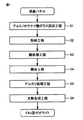
ここで、図1は、本発明のFAU型ゼオライトの製造方法の好ましい一例を示すフローチャートである。上述したように、本発明のFAU型ゼオライトの製造方法は、調合工程(図1中、ステップS4)、アルカリ処理工程(図1中、ステップS5)および水熱合成工程(図1中、ステップS6)を有していればよいが、合成するFAU型ゼオライトの構造を調整するため、その前に、アルミノホウケイ酸ガラスを酸性溶液で処理する酸処理工程(図1中、ステップS3)をさらに有していることが好ましい。図1に示す例のフローチャートは、さらに、アルミノホウケイ酸ガラス回収工程(図1中、ステップS1)および粉砕工程(図1中、ステップS2)を有する場合を示している。以下、図1に示す例のフローチャートに沿って、本発明のFAU型ゼオライトの製造方法を詳細に説明する。 Here, FIG. 1 is a flowchart showing a preferred example of the method for producing the FAU-type zeolite of the present invention. As described above, the FAU-type zeolite production method of the present invention includes the preparation step (step S4 in FIG. 1), the alkali treatment step (step S5 in FIG. 1), and the hydrothermal synthesis step (step S6 in FIG. 1). However, in order to adjust the structure of the FAU-type zeolite to be synthesized, an acid treatment step (step S3 in FIG. 1) for treating the aluminoborosilicate glass with an acidic solution is further included. It is preferable. The flowchart of the example shown in FIG. 1 shows a case where the aluminoborosilicate glass recovery step (step S1 in FIG. 1) and the crushing step (step S2 in FIG. 1) are further included. Hereinafter, the method for producing the FAU-type zeolite of the present invention will be described in detail along the flowchart of the example shown in FIG.
〔1〕アルミノホウケイ酸ガラス回収工程
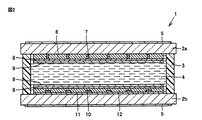
図1に示す例では、まず、アルミノホウケイ酸ガラス回収工程(ステップS1)として、たとえば、液晶パネルからアルミノホウケイ酸ガラスを回収する。ここで、図2は、典型的な一例の液晶パネルを模式的に示す断面図である。図2には、TFT(Thin Film Transistor)などのアクティブ素子(図示せず)を備えた液晶パネルを示している。図2に示す例の液晶パネルは、たとえば、対向配置された2枚のパネルガラス(カラーフィルタ側パネルガラス2a、TFT側パネルガラス2b)を備える。これらパネルガラス(ガラス基板)2a,2bは、対向配置された側(内面側)に、周縁部に沿ってシール樹脂体(シール材)3が設けられ、互いに貼り合わされてなる。また、これらパネルガラス2a,2bとシール樹脂体3とによって密封された領域には、液晶が封入され、液晶層4が形成されている。
[1] Aluminoborosilicate Glass Recovery Step In the example shown in FIG. 1, first, as the aluminoborosilicate glass recovery step (step S1), for example, aluminoborosilicate glass is recovered from a liquid crystal panel. Here, FIG. 2 is a cross-sectional view schematically showing a typical example of a liquid crystal panel. FIG. 2 shows a liquid crystal panel including an active element (not shown) such as a TFT (Thin Film Transistor). The liquid crystal panel of the example shown in FIG. 2 includes, for example, two panel glasses (color filter
また、典型的な液晶パネルでは、図2に示すように、各パネルガラス2a,2bの対向配置された側とは反対側(外面側)には、偏光板5が粘着剤により貼着されている。典型的な液晶パネルでは、図2に示すように、カラーフィルタ側パネルガラス2aの内面側に、反射防止膜6、カラーフィルタ7、透明導電膜8および配向膜9が形成されている。また、典型的な液晶パネルでは、図2に示すように、TFT側パネルガラス2bの内面側に、画素電極10、バス電極11、絶縁膜12、透明導電膜8および配向膜9が形成されている。前記反射防止膜6、カラーフィルタ7、透明導電膜8、配向膜9、画素電極10、バス電極11および絶縁膜12の膜厚は、前記2枚のパネルガラス2a,2bの厚みと比較して、十分に薄い。以下、図2に示す例の液晶パネルよりアルミノホウケイ酸ガラスを得る手順を説明するが、本発明において原料となるアルミノホウケイ酸ガラスを回収する手順はこれに限定されるものではなく、また、液晶パネルから回収されたものにも限定されない。
Further, in a typical liquid crystal panel, as shown in FIG. 2, a
まず、液晶テレビなど、液晶パネルを備えた表示装置などから取り出された、たとえば図2に示すような構造の液晶パネル1から偏光板5を除去する。偏光板5の除去は、公知の機械的な方法を利用する。次に、貼り合わされたガラス基板2a,2bを、2枚に分離する。具体的には、ガラス基板におけるシール樹脂体3よりも内側の四辺を、該シール樹脂体3に沿って、ダイヤモンドソーやガラスカッターなどの切断工具を用いて矩形状に切断する。その後、必要に応じて外力を加えることにより、元の大きさよりも一回り小さい大きさのガラス基板を、液晶パネルから切断して取り外す。ガラス基板が取り外されると、封入されていた液晶層4が開封され、液晶は、ガラス基板に付着した状態で露出する。次に、液晶が露出したガラス基板から樹脂性のスキージを用いてかき取ることによって液晶を除去する。
First, the
液晶パネルなどから回収されたアルミノホウケイ酸ガラスには、通常、カラーフィルタに使用される有機物薄膜、TFT(Thin Film Transistor)に使用される金属薄膜および無機物薄膜などの不純物が付着している。このような不純物は、たとえばサンドブラスト、回転研磨などの従来公知の機械的手法、ならびに、たとえば酸性溶液、有機溶媒によるエッチングなどの従来公知の化学的手法を適宜組み合わせることで、除去することができる。このように使用済み液晶テレビから取り出した液晶パネルからアルミノホウケイ酸ガラスが回収される。 Aluminoborosilicate glass recovered from a liquid crystal panel or the like is usually attached with impurities such as an organic thin film used for a color filter, a metal thin film used for a TFT (Thin Film Transistor), and an inorganic thin film. Such impurities can be removed by appropriately combining conventionally known mechanical methods such as sand blasting and rotational polishing, and conventionally known chemical methods such as etching with an acidic solution and an organic solvent. In this way, aluminoborosilicate glass is recovered from the liquid crystal panel taken out from the used liquid crystal television.
〔2〕粉砕工程
図1に示す例では、続く粉砕工程(ステップS2)において、原料として使用するアルミノホウケイ酸ガラスを粉砕する。ここで、アルミノホウケイ酸ガラスの粉砕のサイズとしては、1〜1000μmの範囲内であることが好ましく、1〜500μmの範囲内であることがより好ましい。アルミノホウケイ酸ガラスを1〜1000μmに粉砕したものを原料とすることで、後述するアルカリ処理工程において、アルカリ溶液との接触面積が増大し、反応効率が高くなることで、後工程でゼオライトが効率的に生成できるという利点がある。また、アルミノホウケイ酸ガラス内部まで反応が進行し、濃度のゆらぎが減少し、構造のばらつきが少ない、均一なゼオライト構造を得ることが可能となる。
[2] Pulverization Step In the example shown in FIG. 1, in the subsequent pulverization step (step S2), the aluminoborosilicate glass used as a raw material is pulverized. Here, the size of the pulverization of the aluminoborosilicate glass is preferably in the range of 1 to 1000 μm, and more preferably in the range of 1 to 500 μm. By using an aluminoborosilicate glass ground to 1 to 1000 μm as a raw material, the contact area with the alkali solution is increased in the alkali treatment step described later, and the reaction efficiency is increased, so that the zeolite is efficient in the subsequent step. There is an advantage that can be generated automatically. In addition, the reaction proceeds to the inside of the aluminoborosilicate glass, the concentration fluctuation is reduced, and a uniform zeolite structure with little variation in structure can be obtained.
粉砕の方法としては、従来公知のせん断方式の破砕機、ハンマーミル、ロールミル、カッターミル、ボールミル、ジェットミルなどを用いて粉砕することができる。また、複数段処理を行ない、粉砕することもできる。ハンマーミルなどを用い、粗破砕した後、ボールミルなどで微粉砕すると効率よく粉砕することができる。たとえば、上述の液晶パネルから回収された液晶パネル画面サイズのアルミノホウケイ酸ガラスを、ハンマーミルなどで処理し、5mm以下のサイズに粗破砕したものを、さらに、ボールミルを用い1000μm以下に粉砕し、アルミノホウケイ酸ガラスの原料として用いる。 As a pulverization method, pulverization can be performed using a conventionally known shearing type crusher, hammer mill, roll mill, cutter mill, ball mill, jet mill or the like. Further, it can be pulverized by performing a multi-stage process. After roughly crushing using a hammer mill or the like, fine crushing with a ball mill or the like enables efficient crushing. For example, a liquid crystal panel screen-sized aluminoborosilicate glass recovered from the above-mentioned liquid crystal panel is processed with a hammer mill or the like and roughly crushed to a size of 5 mm or less, and further pulverized to 1000 μm or less using a ball mill, Used as a raw material for aluminoborosilicate glass.
〔3〕酸処理工程
図1に示す例では、続いて、酸処理工程(ステップS3)において、上述のアルミノホウケイ酸ガラス粉体と、酸性溶液とを接触させる。これにより、アルミノホウケイ酸ガラスの表層に、アルミノホウケイ酸ガラスの他の領域と比較してカルシウム含有量が少ない領域を形成させる。アルミノホウケイ酸ガラス粉体と酸性溶液との接触は、たとえば、マグネチックスターラー、インペラ式撹拌機、バレル式撹拌機などの従来公知の撹拌機を用い、これらを撹拌しながら混合するようにして行なわれることが好ましい。これにより、アルミノホウケイ酸ガラス中のCa分が酸性溶液に溶解し、分離除去される。
[3] Acid Treatment Step In the example shown in FIG. 1, subsequently, in the acid treatment step (step S3), the above-mentioned aluminoborosilicate glass powder is brought into contact with an acidic solution. Thereby, the area | region with little calcium content is formed in the surface layer of alumino borosilicate glass compared with the other area | region of alumino borosilicate glass. The contact between the aluminoborosilicate glass powder and the acidic solution is performed, for example, using a known stirrer such as a magnetic stirrer, impeller stirrer, barrel stirrer and the like while mixing them with stirring. It is preferred that Thereby, the Ca content in the aluminoborosilicate glass is dissolved in the acidic solution and separated and removed.
酸性溶液としては、たとえば、塩酸、硝酸などの酸性物質を含む溶液を用いることができる。溶液はこれらの酸性物質を2種以上含んでいてもよい。塩酸、硝酸を含む溶液を用いることにより、低コストで、効率的にCa分の除去が可能となる。 As the acidic solution, for example, a solution containing an acidic substance such as hydrochloric acid or nitric acid can be used. The solution may contain two or more of these acidic substances. By using a solution containing hydrochloric acid and nitric acid, Ca can be efficiently removed at low cost.
酸処理工程における撹拌温度は、5〜100℃が好ましい。酸処理工程において攪拌温度が100℃を超えると、酸性物質が気化し、安全上の問題が生じ、設備の腐食も発生してしまう虞がある。酸処理工程において攪拌温度が5℃未満である場合には、溶解反応が極めて遅くなり、効率が悪くなってしまう。 The stirring temperature in the acid treatment step is preferably 5 to 100 ° C. When the stirring temperature exceeds 100 ° C. in the acid treatment step, the acidic substance is vaporized, which causes a safety problem and may cause corrosion of the equipment. When the stirring temperature is less than 5 ° C. in the acid treatment step, the dissolution reaction becomes extremely slow and the efficiency is deteriorated.
また酸処理工程における撹拌時間は、1分間以上が好ましい。酸処理工程において攪拌時間が1分間未満になると、酸性溶液とアルミノホウケイ酸ガラスの十分な反応が得られず、アルミノホウケイ酸ガラス中のCa成分がそのまま残ってしまいゼオライトの合成割合が低くなってしまう。また、酸処理工程における攪拌時間は100時間以下であることが好ましい。酸処理工程において撹拌を100時間行えば、十分にアルミノホウケイ酸ガラス中のCa成分を溶出させ、ゼオライトの生成が阻害されることがなくなるため、撹拌時間が100時間を超えると製造効率が悪くなってしまう。 The stirring time in the acid treatment step is preferably 1 minute or longer. When the stirring time is less than 1 minute in the acid treatment step, a sufficient reaction between the acidic solution and the aluminoborosilicate glass cannot be obtained, and the Ca component in the aluminoborosilicate glass remains as it is, and the synthesis rate of zeolite becomes low. End up. Moreover, it is preferable that the stirring time in an acid treatment process is 100 hours or less. If stirring is performed for 100 hours in the acid treatment step, the Ca component in the aluminoborosilicate glass is sufficiently eluted, and the formation of zeolite is not inhibited. Therefore, if the stirring time exceeds 100 hours, the production efficiency deteriorates. End up.
酸性溶液の濃度は、酸の種類、ゼオライトの種類などに応じて適宜選択することができるが、0.1〜10Nが好ましく、0.1〜5Nがより好ましい。酸性溶液の濃度が0.1N未満になると、アルミノホウケイ酸ガラスと酸性溶液の反応が小さくなり、効率的なゼオライトの合成がなくなるからである。また、酸性溶液の濃度が10Nを超える場合には、廃液処理が困難となり、効率が悪くなる虞がある。 Although the density | concentration of an acidic solution can be suitably selected according to the kind of acid, the kind of zeolite, etc., 0.1-10N are preferable and 0.1-5N are more preferable. This is because when the concentration of the acidic solution is less than 0.1 N, the reaction between the aluminoborosilicate glass and the acidic solution becomes small, and efficient zeolite synthesis is lost. Moreover, when the density | concentration of an acidic solution exceeds 10N, a waste liquid process becomes difficult and there exists a possibility that efficiency may worsen.
アルミノホウケイ酸ガラス粉体と酸性溶液との混合比(体積比)は、アルミノホウケイ酸ガラス粉体/酸性溶液=1/1000〜1/1が好ましい。アルミノホウケイ酸ガラス粉体1に対し酸性溶液が1000を超える場合には、必要な酸性溶液が多くなりすぎ、処理効率が悪くなってしまう。アルミノホウケイ酸ガラス粉体1に対し酸性溶液が1未満である場合には、アルミノホウケイ酸ガラス粉体と酸性溶液の接触面積が小さくなり、溶解反応が十分に進まなくなる。 The mixing ratio (volume ratio) of the aluminoborosilicate glass powder and the acidic solution is preferably aluminoborosilicate glass powder / acidic solution = 1/1000 to 1/1. If the acidic solution exceeds 1000 with respect to the aluminoborosilicate glass powder 1, the required acidic solution becomes too much and the processing efficiency is deteriorated. When the acidic solution is less than 1 with respect to the aluminoborosilicate glass powder 1, the contact area between the aluminoborosilicate glass powder and the acidic solution becomes small, and the dissolution reaction does not proceed sufficiently.
得られたアルミノホウケイ酸ガラス粉体と酸性溶液との混合物をろ過し、アルミノホウケイ酸ガラス粉体と酸性溶液を分離する。 The obtained mixture of aluminoborosilicate glass powder and acidic solution is filtered to separate the aluminoborosilicate glass powder and acidic solution.
なお、アルミノホウケイ酸ガラス粉体中のCa濃度が高くとも合成可能なゼオライト構造などを合成する場合は、酸処理工程は省略することができる。 In addition, when synthesizing a zeolite structure that can be synthesized even if the Ca concentration in the aluminoborosilicate glass powder is high, the acid treatment step can be omitted.
〔4〕調合工程
図1に示す例では、続く調合工程(ステップS4)において、アルミニウム化合物および/またはシリコン化合物を添加し、粉体中のSiO2/Al2O3モル比の調整を行なう。たとえば、アルミノホウケイ酸ガラス中に含まれるSiO2と、アルミノホウケイ酸ガラス中に含まれるAl2O3と、添加したアルミニウム化合物に含まれるAl2O3と、添加したシリコン化合物に含まれるSiO2とを考慮したSiO2/Al2O3モル比に関し、Si/Alモル比が1.6〜2.4の範囲となるようにアルミニウム化合物および/またはシリコン化合物を添加することにより、Si/Alモル比が1〜3の範囲にある化学組成を持つ準安定相であるFAU型ゼオライトの合成が可能となる。ここで、Si/Alモル比が1.6未満である場合には、低Siのゼオライト種であるA型ゼオライトが支配的に生成し、FAU型ゼオライトが生成しないという不具合があるためであり、2.4を超える場合には、高Siのゼオライト種の中でも安定相であるNa−P1型ゼオライトが支配的に生成し、FAU型ゼオライトが生成しないという不具合があるためである。
[4] Preparation Step In the example shown in FIG. 1, in the subsequent preparation step (Step S4), an aluminum compound and / or a silicon compound is added, and the SiO 2 / Al 2 O 3 molar ratio in the powder is adjusted. For example, the SiO 2 contained in an aluminum borosilicate glass,, Al 2 O 3, based on contained in an aluminum borosilicate glass,, Al 2 O 3, based on contained in the aluminum compounds added, SiO 2 contained in the silicon compound added By adding an aluminum compound and / or a silicon compound so that the Si / Al molar ratio is in the range of 1.6 to 2.4, the Si 2 / Al 2 O 3 molar ratio is considered. This makes it possible to synthesize a FAU type zeolite that is a metastable phase having a chemical composition with a molar ratio in the range of 1-3. Here, when the Si / Al molar ratio is less than 1.6, A type zeolite which is a low Si zeolite species is predominantly produced, and there is a problem that FAU type zeolite is not produced, If it exceeds 2.4, Na-P1 zeolite, which is a stable phase among the high Si zeolite species, is predominantly produced, and FAU-type zeolite is not produced.
添加するアルミニウム化合物としては、たとえば、NaAlO2、Al(OH)3、AlCl3などを用いることができる。アルミニウム化合物としてNaAlO2、Al(OH)3およびAlCl3から選ばれる少なくともいずれかを用いることにより、反応性が高く、効率的に反応を進行させることができる。 As an aluminum compound to be added, for example, NaAlO 2 , Al (OH) 3 , AlCl 3 or the like can be used. By using at least one selected from NaAlO 2 , Al (OH) 3 and AlCl 3 as the aluminum compound, the reactivity is high and the reaction can proceed efficiently.
添加するシリコン化合物としては、たとえば、メタケイ酸ナトリウムなどを用いることができる。シリコン化合物としてメタケイ酸ナトリウムを用いることにより、アルカリ溶液に易溶性であり、溶液反応が素早く進行するという効果が奏される。 As the silicon compound to be added, for example, sodium metasilicate can be used. By using sodium metasilicate as the silicon compound, it is easily soluble in an alkaline solution, and the effect that the solution reaction proceeds quickly is achieved.
アルミニウム化合物、シリコン化合物の形態としては、粉体が好ましい。これにより後述のアルカリ処理工程において、均一に混合撹拌することが可能となる。 As the form of the aluminum compound or silicon compound, powder is preferable. Thereby, it becomes possible to uniformly mix and stir in the alkali treatment step described later.
〔5〕アルカリ処理工程
図1に示す例では、次に、本発明のFAU型ゼオライトの製造方法において必須の工程であるアルカリ処理工程(ステップS5)において、上述のアルミノホウケイ酸ガラスとアルミニウム化合物および/またはシリコン化合物の混合物と、アルカリ溶液とを接触させる。アルミノホウケイ酸ガラスとアルミニウム化合物および/またはシリコン化合物の混合物と、アルカリ溶液との接触は、たとえば、マグネチックスターラー、インペラ式撹拌機、バレル式撹拌機などの従来公知の撹拌機を用い、これらを撹拌しながら混合するようにして行なわれることが好ましい。これにより、アルミノホウケイ酸ガラスがアルカリ溶液に溶解する。
[5] Alkali Treatment Step In the example shown in FIG. 1, next, in the alkali treatment step (step S5), which is an essential step in the method for producing the FAU-type zeolite of the present invention, the above-mentioned aluminoborosilicate glass, aluminum compound, and The mixture of silicon compounds is contacted with an alkaline solution. The contact between the aluminoborosilicate glass and the mixture of the aluminum compound and / or silicon compound and the alkali solution is performed using a conventionally known stirrer such as a magnetic stirrer, impeller stirrer, barrel stirrer, or the like. It is preferable to carry out mixing while stirring. As a result, the aluminoborosilicate glass is dissolved in the alkaline solution.
アルカリ処理工程における撹拌温度は、5〜60℃が好ましい。アルカリ処理工程において攪拌温度が60℃を超えると、エージング(熟成)ではなくなり、後述の水熱反応が進行してしまう。また、アルカリ溶液が気化し、安全上の問題が生じる虞がある。また、アルカリ処理工程における攪拌温度が5℃未満になると、溶解反応が極めて遅くなり、効率が悪くなってしまう場合がある。 As for the stirring temperature in an alkali treatment process, 5-60 degreeC is preferable. When the stirring temperature exceeds 60 ° C. in the alkali treatment step, aging (aging) is lost and the hydrothermal reaction described later proceeds. In addition, the alkaline solution is vaporized, which may cause a safety problem. Moreover, when the stirring temperature in an alkali treatment process will be less than 5 degreeC, a dissolution reaction will become very slow and efficiency may worsen.
アルカリ処理時間を好ましくは24時間〜1000時間にすることで、エージング(熟成)を行うことが好ましい。これによりガラスから溶液中に溶けだしたSiとAlにより形成されるアルミノケイ酸塩に、過剰に存在するSiが取り込まれ、Siリッチなアルミノケイ酸塩の結晶核が生成される。FAU型ゼオライトは高Si/Al比をもつゼオライトであり、エージングを行うことでFAU型ゼオライトの生成を促進することが可能である。アルカリ処理時間が24時間未満では上述の結晶核の生成が十分行われない。水熱合成工程においてもエージング効果が得られるので、エージングは省略することも可能である。 Aging (aging) is preferably performed by setting the alkali treatment time to preferably 24 hours to 1000 hours. As a result, excessive Si is taken into the aluminosilicate formed from Si and Al dissolved in the solution from the glass, and crystal nuclei of Si-rich aluminosilicate are generated. The FAU-type zeolite is a zeolite having a high Si / Al ratio, and it is possible to promote the generation of the FAU-type zeolite by performing aging. When the alkali treatment time is less than 24 hours, the above-mentioned crystal nuclei are not sufficiently generated. Since an aging effect can be obtained also in the hydrothermal synthesis step, aging can be omitted.
アルカリ処理工程に用いるアルカリ溶液としては、特に制限されないが、反応性、廃液処理の観点および取り扱いの容易性の観点から、水酸化ナトリウム、炭酸ナトリウム、炭酸水素ナトリウム、水酸化カリウム、炭酸カリウム、炭酸水素カリウムなどのアルカリ物質を含む溶液が好ましい。溶液はこれらのアルカリ物質を2種以上を含んでいてもよい。なお、強アルカリ溶液であり反応性が極めて高く、安価であることから、またNa型のゼオライトが製造されることから、上記中でも、水酸化ナトリウムをアルカリ溶液として用いることが好ましい。 The alkali solution used in the alkali treatment step is not particularly limited, but sodium hydroxide, sodium carbonate, sodium hydrogen carbonate, potassium hydroxide, potassium carbonate, carbonate from the viewpoint of reactivity, waste liquid treatment, and ease of handling. A solution containing an alkaline substance such as potassium hydrogen is preferred. The solution may contain two or more of these alkaline substances. In addition, since it is a strong alkali solution, has extremely high reactivity and is inexpensive, and Na-type zeolite is produced, among these, sodium hydroxide is preferably used as the alkaline solution.
アルカリ処理工程に用いるアルカリ溶液の濃度は、アルカリの種類、ゼオライトの種類などに応じて適宜選択することができるが、2〜5Nが好ましい。アルカリ溶液の濃度が2N未満になると、FAU型ゼオライトが生成しなくなる虞があるためであり、また、5Nを超えるアルカリ溶液を用いた場合には、使用する材料が多くなり、高濃度のアルカリ溶液を用いることによる安全性、廃液処理の課題がある。 Although the density | concentration of the alkaline solution used for an alkali treatment process can be suitably selected according to the kind of alkali, the kind of zeolite, etc., 2-5N are preferable. This is because when the concentration of the alkaline solution is less than 2N, FAU-type zeolite may not be generated. When an alkaline solution exceeding 5N is used, more materials are used and a high-concentration alkaline solution is used. There is a problem of safety and waste liquid treatment due to the use of.
アルミノホウケイ酸ガラスとアルミニウム化合物および/またはシリコン化合物の混合物とアルカリ溶液との混合比(体積比)は、アルミノホウケイ酸ガラスとアルミニウム化合物および/またはシリコン化合物の混合物/アルカリ溶液=1/1000〜1/10が好ましい。アルミノホウケイ酸ガラスとアルミニウム化合物および/またはシリコン化合物の混合物1に対しアルカリ溶液が1000を超える場合には、必要なアルカリ溶液が多くなりすぎ、処理効率が悪くなってしまう場合がある。アルミノホウケイ酸ガラスとアルミニウム化合物および/またはシリコン化合物の混合物1に対しアルカリ溶液が10未満である場合には、アルミノホウケイ酸ガラスとアルミニウム化合物および/またはシリコン化合物の混合物とアルカリ溶液の接触面積が小さくなり、溶解反応が十分に進まなくなる虞がある。 The mixing ratio (volume ratio) of the mixture of the aluminoborosilicate glass and the aluminum compound and / or silicon compound and the alkaline solution is a mixture of the aluminoborosilicate glass and the aluminum compound and / or silicon compound / alkaline solution = 1 / 1000-1. / 10 is preferred. When the alkaline solution exceeds 1000 with respect to the mixture 1 of the aluminoborosilicate glass and the aluminum compound and / or the silicon compound, the necessary alkaline solution becomes too much, and the processing efficiency may deteriorate. When the alkali solution is less than 10 with respect to the mixture 1 of the aluminoborosilicate glass and the aluminum compound and / or silicon compound, the contact area between the mixture of the aluminoborosilicate glass and the aluminum compound and / or silicon compound and the alkali solution is small. Therefore, the dissolution reaction may not proceed sufficiently.
〔6〕水熱合成工程
図1に示す例では、次に、本発明のFAU型ゼオライトの製造方法において必須の工程である水熱合成工程(ステップS6)において、得られたヒドロゲルを水熱合成処理し、ゼオライトを合成する。水熱合成処理は、バッチ式または連続式のいずれによっても行なうことができ、たとえば耐圧容器または反応器にヒドロゲルを導入し、好ましくは60〜150℃、より好ましくは60〜120℃に加熱することにより、水熱状態を得る。これにより、従来のセラミックス材料として焼成する方法と異なり、さらに低温でのゼオライトの合成が可能となり、ボイラーなどの廃熱を利用できる温度範囲であり、省エネルギーに貢献できる方法となる。なお、水熱合成工程における温度が60℃未満である場合には、合成反応速度が極めて遅くなり、効率が悪くなり、ゼオライトの生成が遅くなりガラス相が残存しやすいという傾向にある。また、150℃を超える場合には、Na−P1型ゼオライトなどのFAU型ゼオライト以外の相が生成してしまい、FAU型ゼオライトの純度が低くなる場合があるためである。
[6] Hydrothermal synthesis step In the example shown in FIG. 1, next, the hydrogel obtained in the hydrothermal synthesis step (step S6), which is an essential step in the method for producing the FAU-type zeolite of the present invention, is hydrothermally synthesized. Process and synthesize zeolite. The hydrothermal synthesis treatment can be performed either batchwise or continuously. For example, a hydrogel is introduced into a pressure vessel or a reactor, and preferably heated to 60 to 150 ° C, more preferably 60 to 120 ° C. Thus, a hydrothermal state is obtained. This makes it possible to synthesize zeolite at a lower temperature, unlike the method of firing as a conventional ceramic material, and is a temperature range in which waste heat from a boiler or the like can be used, thereby contributing to energy saving. When the temperature in the hydrothermal synthesis process is less than 60 ° C., the synthesis reaction rate is extremely slow, the efficiency is deteriorated, the production of zeolite is slow, and the glass phase tends to remain. Moreover, when it exceeds 150 degreeC, it is because phases other than FAU type zeolites, such as Na-P1 type | mold zeolite, will produce | generate and the purity of FAU type zeolite may become low.
水熱合成の圧力はその温度での飽和蒸気圧とし、1〜10気圧となるように、反応容器内に導入する液体、固体の量を設定し、反応容器内の空間の体積を調整する。 The hydrothermal synthesis pressure is the saturated vapor pressure at that temperature, the amount of liquid and solid introduced into the reaction vessel is set so as to be 1 to 10 atm, and the volume of the space in the reaction vessel is adjusted.
水熱合成の合成時間は、好ましくは10時間〜1000時間、より好ましくは10時間〜200時間とする。合成時間が10時間未満である場合は、ガラス相が残存し、十分にゼオライトが生成しない場合がある。また合成時間が1000時間を超えると、FAU型ゼオライト以外の相が生成し、高純度のFAU型ゼオライトが得られない。 The synthesis time of hydrothermal synthesis is preferably 10 hours to 1000 hours, more preferably 10 hours to 200 hours. When the synthesis time is less than 10 hours, the glass phase may remain and the zeolite may not be sufficiently formed. On the other hand, if the synthesis time exceeds 1000 hours, phases other than FAU-type zeolite are produced, and high-purity FAU-type zeolite cannot be obtained.
上述したような本発明のFAU型ゼオライトの製造方法によれば、上述した原料から直接的にFAU型ゼオライトを得ることができる。すなわち、水熱合成の条件を適当に選択することにより、高価な合成装置などを必要とせず、純度が高いFAU型ゼオライトを直接的に得ることができる。 According to the FAU-type zeolite production method of the present invention as described above, the FAU-type zeolite can be obtained directly from the above-described raw materials. That is, by appropriately selecting the conditions for hydrothermal synthesis, it is possible to directly obtain a high-purity FAU-type zeolite without requiring an expensive synthesizer.
なお、本発明のFAU型ゼオライトの製造方法においては、好ましくは110℃以下の温度域で水熱合成し、作製するものであり、この場合にはボイラーの廃熱などを利用することができる温度域であり、省エネルギーに貢献することができる。 In the method for producing FAU-type zeolite of the present invention, hydrothermal synthesis is preferably performed in a temperature range of 110 ° C. or lower, and in this case, the temperature at which waste heat of the boiler can be used. Can contribute to energy conservation.
本発明のFAU型ゼオライトの製造方法によって、液晶パネルの廃材から純度が高いFAU型ゼオライトを得ることができる。FAU型ゼオライトは、数あるゼオライトの中でも触媒能に優れているため、石油の流動接触分解(FCC)プロセスなど工業的に重要な用途にも利用することが可能である。 By the method for producing FAU-type zeolite of the present invention, high-purity FAU-type zeolite can be obtained from the waste material of the liquid crystal panel. FAU-type zeolite is excellent in catalytic ability among many zeolites, and can be used for industrially important applications such as fluid catalytic cracking (FCC) process of petroleum.
以下に実施例を挙げて、本発明をさらに詳しく説明するが、本発明はこれらに限定されるものではない。 The present invention will be described in more detail with reference to examples below, but the present invention is not limited to these examples.
<参考例1>
市販の液晶パネル用ガラスをボールミル粉砕処理を行い、ガラス紛体サンプルを素作成した。粒度分布は、中心径D50が8μmであった。波長分散型蛍光エックス線分析によりガラスのSiO2およびAl2O3の組成を求めた結果、SiO2が62質量%、Al2O3が18質量%であった。
<Reference Example 1>
A commercially available glass for liquid crystal panel was ball milled to prepare a glass powder sample. As for the particle size distribution, the center diameter D50 was 8 μm. As a result of obtaining the composition of SiO 2 and Al 2 O 3 of the glass by wavelength dispersion type fluorescent X-ray analysis, SiO 2 was 62 mass% and Al 2 O 3 was 18 mass%.
<実施例1>
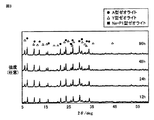
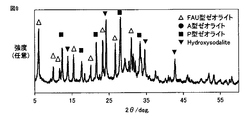
中心径8μmに粉砕したアルミノホウケイ酸ガラス10gを250mLの5M HNO3に加え室温にて3時間攪拌した後、吸引ろ過、乾燥を経て硝酸処理廃ガラスを得た。14mLの2.0M NaOH水溶液に硝酸処理した廃ガラス0.91gを加え、さらに、NaAlO2 0.38gを加えた。NaOH原料は、キシダ化学製特級水酸化ナトリウムペレットを用い、NaAlO2原料は、関東化学株式会社製鹿1級アルミン酸ナトリウムを用いた。このとき、Si/Alモル比は1.6となっていた。この混合溶液を攪拌した状態で24時間室温にてエージングを行い、95℃で12時間〜96時間の条件で水熱合成を行なった。水熱合成の完了後、吸引ろ過により合成物をろ別し、乾燥を経て試料を得た。
<Example 1>
10 g of aluminoborosilicate glass pulverized to a center diameter of 8 μm was added to 250 mL of 5M HNO 3 and stirred at room temperature for 3 hours, followed by suction filtration and drying to obtain nitric acid-treated waste glass. To 14 mL of 2.0 M NaOH aqueous solution, 0.91 g of waste glass treated with nitric acid was added, and 0.38 g of NaAlO 2 was further added. As the NaOH raw material, special grade sodium hydroxide pellets manufactured by Kishida Chemical were used, and as the NaAlO 2 raw material, deer primary sodium aluminate manufactured by Kanto Chemical Co., Ltd. was used. At this time, the Si / Al molar ratio was 1.6. The mixed solution was stirred for 24 hours at room temperature, and hydrothermal synthesis was performed at 95 ° C. for 12 hours to 96 hours. After completion of the hydrothermal synthesis, the synthesized product was filtered off by suction filtration, and dried to obtain a sample.
得られた試料についてX線回折を行ない、合成された生成物の相の同定を行なった。XRD測定結果を図3に示す。図3より分かるように、合成時間12時間〜96時間でFAU型ゼオライトの回折ピークが見られた。 The obtained sample was subjected to X-ray diffraction, and the phase of the synthesized product was identified. An XRD measurement result is shown in FIG. As can be seen from FIG. 3, a diffraction peak of FAU type zeolite was observed at a synthesis time of 12 to 96 hours.
<実施例2>
NaAlO2の添加量を0.16g(Si/Alモル比:2.1)に変更したこと以外は実施例1と同様にして試料を得た。同様にXRD測定を行なった結果、合成時間12時間〜96時間でFAU型ゼオライトの回折ピークが見られた。合成時間48時間の場合の生成物のXRD測定結果を図4に示す。
<Example 2>
A sample was obtained in the same manner as in Example 1 except that the amount of NaAlO 2 added was changed to 0.16 g (Si / Al molar ratio: 2.1). Similarly, as a result of XRD measurement, a diffraction peak of FAU type zeolite was observed at a synthesis time of 12 hours to 96 hours. The result of XRD measurement of the product when the synthesis time is 48 hours is shown in FIG.
<実施例3>
NaAlO2の添加量を0.10g(Si/Alモル比:2.4)に変更したこと以外は実施例1と同様にして試料を得た。同様にXRD測定を行なった結果、合成時間12時間〜96時間でFAU型ゼオライトの回折ピークが見られた。合成時間48時間の場合の生成物のXRD測定結果を図5に示す。
<Example 3>
A sample was obtained in the same manner as in Example 1 except that the amount of NaAlO 2 added was changed to 0.10 g (Si / Al molar ratio: 2.4). Similarly, as a result of XRD measurement, a diffraction peak of FAU type zeolite was observed at a synthesis time of 12 hours to 96 hours. The result of XRD measurement of the product when the synthesis time is 48 hours is shown in FIG.
<実施例4〜6>
NaOHの濃度を3.0Mに変更したこと以外は実施例1〜3とそれぞれ同様にして、試料を得た。実施例1〜3と同様にそれぞれX線回折を行ない、合成された生成物の相の同定を行なった。いずれのSi/Al比においても合成時間48時間〜96時間でFAU型ゼオライトの回折ピークが見られた。合成時間48時間の場合の生成物のXRD測定結果をそれぞれ図6(実施例4)、図7(実施例5)、図8(実施例6)に示す。
<Examples 4 to 6>
Samples were obtained in the same manner as in Examples 1 to 3, except that the NaOH concentration was changed to 3.0M. X-ray diffraction was performed in the same manner as in Examples 1 to 3, and the phases of the synthesized products were identified. At any Si / Al ratio, a diffraction peak of FAU type zeolite was observed at a synthesis time of 48 hours to 96 hours. FIG. 6 (Example 4), FIG. 7 (Example 5), and FIG. 8 (Example 6) show the XRD measurement results of the product when the synthesis time is 48 hours, respectively.
<実施例7>
中心径8μmに粉砕したアルミノホウケイ酸ガラス10gを250mLの5M HNO3に加え室温にて3時間攪拌した後、吸引ろ過、乾燥を経て硝酸処理廃ガラスを得た。14mLの2.0M NaOH水溶液に硝酸処理した廃ガラス0.91gを加え、さらに、NaAlO2 0.16gを加えた。このとき、Si/Alモル比は2.1となっている。この混合溶液を攪拌した状態で48時間および480時間室温にてエージングを行い、75℃で96時間の条件で水熱合成を行なった。水熱合成の完了後、吸引ろ過により合成物をろ別し、乾燥を経て試料を得た。
<Example 7>
10 g of aluminoborosilicate glass pulverized to a center diameter of 8 μm was added to 250 mL of 5M HNO 3 and stirred at room temperature for 3 hours, followed by suction filtration and drying to obtain nitric acid-treated waste glass. To 14 mL of 2.0 M NaOH aqueous solution, 0.91 g of waste glass treated with nitric acid was added, and further 0.16 g of NaAlO 2 was added. At this time, the Si / Al molar ratio is 2.1. The mixed solution was stirred for 48 hours and 480 hours at room temperature, and hydrothermal synthesis was performed at 75 ° C. for 96 hours. After completion of the hydrothermal synthesis, the synthesized product was filtered off by suction filtration, and dried to obtain a sample.
得られた試料についてX線回折を行ない、合成された生成物の相の同定を行なった。XRD測定結果を図9に示す。図9より分かるように、エージング時間48時間および480時間でFAU型ゼオライトの回折ピークが見られた。 The obtained sample was subjected to X-ray diffraction, and the phase of the synthesized product was identified. The XRD measurement results are shown in FIG. As can be seen from FIG. 9, FAU type zeolite diffraction peaks were observed at aging times of 48 hours and 480 hours.
<実施例8>
中心径8μmに粉砕したアルミノホウケイ酸ガラス10gを250mLの5M HNO3に加え室温にて3時間攪拌した後、吸引ろ過、乾燥を経て硝酸処理廃ガラスを得た。14mLの2.0M NaOH水溶液に硝酸処理した廃ガラス0.91gを加え、さらに、NaAlO2 0.16gを加えた。このとき、Si/Alモル比は2.1となっている。この混合溶液を攪拌した状態で96時間室温にてエージングを行い、65℃および95℃で96時間の条件で水熱合成を行なった。水熱合成の完了後、吸引ろ過により合成物をろ別し、乾燥を経て試料を得た。
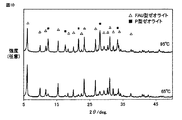
<Example 8>
10 g of aluminoborosilicate glass pulverized to a center diameter of 8 μm was added to 250 mL of 5M HNO 3 and stirred at room temperature for 3 hours, followed by suction filtration and drying to obtain nitric acid-treated waste glass. To 14 mL of 2.0 M NaOH aqueous solution, 0.91 g of waste glass treated with nitric acid was added, and further 0.16 g of NaAlO 2 was added. At this time, the Si / Al molar ratio is 2.1. The mixed solution was stirred for 96 hours at room temperature, and hydrothermal synthesis was performed at 65 ° C. and 95 ° C. for 96 hours. After completion of the hydrothermal synthesis, the synthesized product was filtered off by suction filtration, and dried to obtain a sample.
得られた試料についてX線回折を行ない、合成された生成物の相の同定を行なった。XRD測定結果を図10に示す。図10より分かるように、合成温度65℃および95℃でFAU型ゼオライトの回折ピークが見られた。 The obtained sample was subjected to X-ray diffraction, and the phase of the synthesized product was identified. The XRD measurement results are shown in FIG. As can be seen from FIG. 10, diffraction peaks of FAU type zeolite were observed at synthesis temperatures of 65 ° C. and 95 ° C.
<比較例1〜3>
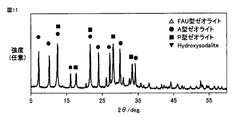
中心径8μmに粉砕したアルミノホウケイ酸ガラス10gを250mLの5M HNO3に加え室温にて3時間攪拌した後、吸引ろ過、乾燥を経て硝酸処理廃ガラスを得た。14mLの1.0M(比較例1)、2.0M(比較例2)、3.0M(比較例3)のNaOH水溶液それぞれに硝酸処理した廃ガラス0.91gを加え、さらに、NaAlO2 0.77gを加えた。このとき、Si/Alモル比は1.1となっている。この混合溶液を攪拌した状態で24時間室温にてエージングを行い、95℃で48時間の条件で水熱合成を行なった。水熱合成の完了後、吸引ろ過により合成物をろ別し、乾燥を経て試料を得た。
<Comparative Examples 1-3>
10 g of aluminoborosilicate glass pulverized to a center diameter of 8 μm was added to 250 mL of 5M HNO 3 and stirred at room temperature for 3 hours, followed by suction filtration and drying to obtain nitric acid-treated waste glass. To each 14 mL of 1.0 M (Comparative Example 1), 2.0 M (Comparative Example 2), and 3.0 M (Comparative Example 3) NaOH aqueous solution, 0.91 g of waste glass treated with nitric acid was added, and NaAlO 2 0. 77 g was added. At this time, the Si / Al molar ratio is 1.1. The mixed solution was aged for 24 hours at room temperature, and hydrothermal synthesis was performed at 95 ° C. for 48 hours. After completion of the hydrothermal synthesis, the synthesized product was filtered off by suction filtration, and dried to obtain a sample.
得られた試料についてX線回折を行ない、合成された生成物の相の同定を行なった。1.0M、2.0M、3.0MいずれのNaOH濃度においてもA型ゼオライトの回折ピークが見られた。FAU型ゼオライトは得られなかった。XRD測定結果をそれぞれ図11(比較例1)、図12(比較例2)、図13(比較例3)に示す。 The obtained sample was subjected to X-ray diffraction, and the phase of the synthesized product was identified. A diffraction peak of A-type zeolite was observed at NaOH concentrations of 1.0M, 2.0M, and 3.0M. No FAU type zeolite was obtained. The XRD measurement results are shown in FIG. 11 (Comparative Example 1), FIG. 12 (Comparative Example 2), and FIG. 13 (Comparative Example 3), respectively.
<比較例4〜6>
中心径8μmに粉砕したアルミノホウケイ酸ガラス10gを250mLの5M HNO3に加え室温にて3時間攪拌した後、吸引ろ過、乾燥を経て硝酸処理廃ガラスを得た。14mLの1.0M(比較例4)、2.0M(比較例5)、3.0M(比較例6)のNaOH水溶液それぞれに硝酸処理した廃ガラス0.91gを加え、さらに、NaAlO2を0.06g加えた。このとき、Si/Alモル比は2.6となっている。この混合溶液を攪拌した状態で24時間室温にてエージングを行い、95℃で48時間の条件で水熱合成を行なった。水熱合成の完了後、吸引ろ過により合成物をろ別し、乾燥を経て試料を得た。
<Comparative Examples 4-6>
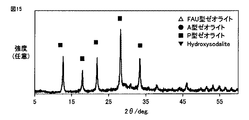
10 g of aluminoborosilicate glass pulverized to a center diameter of 8 μm was added to 250 mL of 5M HNO 3 and stirred at room temperature for 3 hours, followed by suction filtration and drying to obtain nitric acid-treated waste glass. To each 14 mL of 1.0 M (Comparative Example 4), 2.0 M (Comparative Example 5), and 3.0 M (Comparative Example 6) NaOH aqueous solution, 0.91 g of waste glass treated with nitric acid was added, and NaAlO 2 was further reduced to 0. 0.06 g was added. At this time, the Si / Al molar ratio is 2.6. The mixed solution was aged for 24 hours at room temperature, and hydrothermal synthesis was performed at 95 ° C. for 48 hours. After completion of the hydrothermal synthesis, the synthesized product was filtered off by suction filtration, and dried to obtain a sample.
得られた試料についてX線回折を行ない、合成された生成物の相の同定を行なった。1.0M、2.0M、3.0MいずれのNaOH濃度においてもNa−P1型ゼオライトの回折ピークが見られた。FAU型ゼオライトは得られなかった。XRD測定結果をそれぞれ図14(比較例4)、図15(比較例5)、図16(比較例6)に示す。 The obtained sample was subjected to X-ray diffraction, and the phase of the synthesized product was identified. A diffraction peak of Na-P1 type zeolite was observed at any of NaOH concentrations of 1.0M, 2.0M, and 3.0M. No FAU type zeolite was obtained. The XRD measurement results are shown in FIG. 14 (Comparative Example 4), FIG. 15 (Comparative Example 5), and FIG. 16 (Comparative Example 6), respectively.
実施例1〜6、比較例1〜6におけるFAU型ゼオライトの生成の有無の結果を表1に示す。 Table 1 shows the results of the presence or absence of production of FAU-type zeolite in Examples 1 to 6 and Comparative Examples 1 to 6.
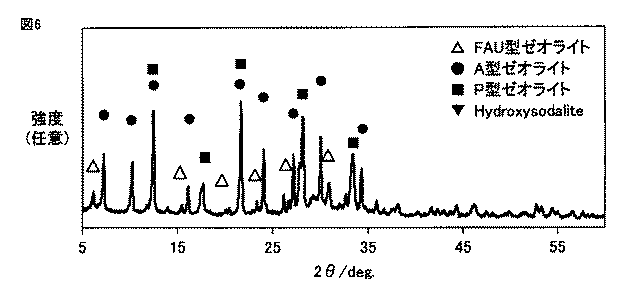
表1中、○はFAU型ゼオライトが生成した場合、×はFAU型ゼオライトが生成しなかった場合の結果を示す。 In Table 1, o indicates the result when FAU-type zeolite is produced, and x indicates the result when FAU-type zeolite is not produced.
<比較例7>
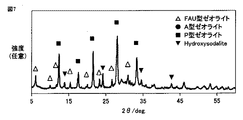
中心径8μmに粉砕したアルミノホウケイ酸ガラス10gを250mLの5M HNO3に加え室温にて3時間攪拌した後、吸引ろ過、乾燥を経て硝酸処理廃ガラスを得た。14mLの2.0M NaOH水溶液に硝酸処理した廃ガラス0.91gを加え、さらに、NaAlO2 0.16gを加えた。このとき、Si/Alモル比は2.1となっている。この混合溶液を攪拌した状態でエージングを行わず(エージング時間0時間)、75℃で96時間の条件で水熱合成を行なった。水熱合成の完了後、吸引ろ過により合成物をろ別し、乾燥を経て試料を得た。
<Comparative Example 7>
10 g of aluminoborosilicate glass pulverized to a center diameter of 8 μm was added to 250 mL of 5M HNO 3 and stirred at room temperature for 3 hours, followed by suction filtration and drying to obtain nitric acid-treated waste glass. To 14 mL of 2.0 M NaOH aqueous solution, 0.91 g of waste glass treated with nitric acid was added, and further 0.16 g of NaAlO 2 was added. At this time, the Si / Al molar ratio is 2.1. Hydrothermal synthesis was carried out under the conditions of 96 hours at 75 ° C. without aging (aging time 0 hour) while stirring the mixed solution. After completion of the hydrothermal synthesis, the synthesized product was filtered off by suction filtration, and dried to obtain a sample.
得られた試料についてX線回折を行ない、合成された生成物の相の同定を行なった。XRD測定結果を図17に示す。図17より分かるように、P型ゼオライトの回折ピークが見られ、FAU型ゼオライトは生成しなかった。 The obtained sample was subjected to X-ray diffraction, and the phase of the synthesized product was identified. The XRD measurement results are shown in FIG. As can be seen from FIG. 17, a diffraction peak of P-type zeolite was observed, and no FAU-type zeolite was produced.
今回開示された実施の形態および実施例はすべての点で例示であって制限的なものではないと考えられるべきである。本発明の範囲は上記した説明ではなくて特許請求の範囲によって示され、特許請求の範囲と均等の意味および範囲内でのすべての変更が含まれることが意図される。 It should be understood that the embodiments and examples disclosed herein are illustrative and non-restrictive in every respect. The scope of the present invention is defined by the terms of the claims, rather than the description above, and is intended to include any modifications within the scope and meaning equivalent to the terms of the claims.
1 液晶パネル、2a カラーフィルタ側パネルガラス、2b TFT側パネルガラス、3 シール樹脂体、4 液晶層、5 光学フィルム、6 反射防止膜、7 カラーフィルタ、8 透明導電膜、9 配向膜、10 画素電極、11 バス電極、12 絶縁膜。 DESCRIPTION OF SYMBOLS 1 Liquid crystal panel, 2a Color filter side panel glass, 2b TFT side panel glass, 3 Seal resin body, 4 Liquid crystal layer, 5 Optical film, 6 Antireflection film, 7 Color filter, 8 Transparent conductive film, 9 Orientation film, 10 Pixel Electrode, 11 bus electrode, 12 insulating film.
Claims (10)
Si/Alモル比が1.6〜2.4となるようにアルミノホウケイ酸ガラスにアルミニウム化合物および/またはシリコン化合物を添加する調合工程と、
アルミノホウケイ酸ガラスとアルミニウム化合物および/またはシリコン化合物の混合物とアルカリ溶液とを接触させるアルカリ処理工程と、
アルカリ処理工程で得られたアルカリ溶液とガラスとアルミニウム化合物および/またはシリコン化合物の混合物を水熱合成処理する水熱合成工程とを含むことを特徴とするホージャサイト型ゼオライトの製造方法。 A method for producing faujasite-type zeolite using aluminoborosilicate glass as a raw material,
A compounding step of adding an aluminum compound and / or a silicon compound to the aluminoborosilicate glass so that the Si / Al molar ratio is 1.6 to 2.4;
An alkali treatment step in which an aluminoborosilicate glass and a mixture of an aluminum compound and / or a silicon compound and an alkali solution are contacted;
A method for producing faujasite-type zeolite, comprising a hydrothermal synthesis step of hydrothermal synthesis treatment of a mixture of an alkali solution obtained in the alkali treatment step, glass, an aluminum compound and / or a silicon compound.
Priority Applications (1)
| Application Number | Priority Date | Filing Date | Title |
|---|---|---|---|
| JP2013178730A JP2014122151A (en) | 2012-11-21 | 2013-08-30 | Method for producing faujasite-type zeolite using alumino-borosilicate glass as raw material |
Applications Claiming Priority (3)
| Application Number | Priority Date | Filing Date | Title |
|---|---|---|---|
| JP2012255265 | 2012-11-21 | ||
| JP2012255265 | 2012-11-21 | ||
| JP2013178730A JP2014122151A (en) | 2012-11-21 | 2013-08-30 | Method for producing faujasite-type zeolite using alumino-borosilicate glass as raw material |
Publications (1)
| Publication Number | Publication Date |
|---|---|
| JP2014122151A true JP2014122151A (en) | 2014-07-03 |
Family
ID=51402992
Family Applications (1)
| Application Number | Title | Priority Date | Filing Date |
|---|---|---|---|
| JP2013178730A Pending JP2014122151A (en) | 2012-11-21 | 2013-08-30 | Method for producing faujasite-type zeolite using alumino-borosilicate glass as raw material |
Country Status (1)
| Country | Link |
|---|---|
| JP (1) | JP2014122151A (en) |
Cited By (2)
| Publication number | Priority date | Publication date | Assignee | Title |
|---|---|---|---|---|
| CN108906348A (en) * | 2018-03-05 | 2018-11-30 | 中国标准化研究院 | Separate the separator and separation method of micro- plastics and cellulose crystallite in soil |
| CN118851199A (en) * | 2024-07-05 | 2024-10-29 | 北京师范大学珠海校区 | A method for synthesizing FAU type hollow molecular sieve material using hydrothermal synthesis |
-
2013
- 2013-08-30 JP JP2013178730A patent/JP2014122151A/en active Pending
Cited By (3)
| Publication number | Priority date | Publication date | Assignee | Title |
|---|---|---|---|---|
| CN108906348A (en) * | 2018-03-05 | 2018-11-30 | 中国标准化研究院 | Separate the separator and separation method of micro- plastics and cellulose crystallite in soil |
| CN108906348B (en) * | 2018-03-05 | 2023-10-10 | 中国标准化研究院 | Separation device and separation method for separating microplastic and cellulose crystals in soil |
| CN118851199A (en) * | 2024-07-05 | 2024-10-29 | 北京师范大学珠海校区 | A method for synthesizing FAU type hollow molecular sieve material using hydrothermal synthesis |
Similar Documents
| Publication | Publication Date | Title |
|---|---|---|
| JP5778342B2 (en) | Method for producing zeolite A using aluminoborosilicate glass as a raw material | |
| Eloneva et al. | Steel converter slag as a raw material for precipitation of pure calcium carbonate | |
| Yaping et al. | Synthesis of pure zeolites from supersaturated silicon and aluminum alkali extracts from fused coal fly ash | |
| CN116715506B (en) | Ceramic blank, ceramic brick and preparation method thereof based on lithium slag | |
| JP4325856B2 (en) | Waste glass recycling method and recycled glass | |
| CN101254933B (en) | Method for extracting high-purity alumina and silica gel from fly ash | |
| CN115260807B (en) | Rare earth high-infrared-radiation coating and preparation method and application thereof | |
| JP2012116743A (en) | Method for manufacturing inorganic material using alkali-free glass as raw material | |
| CN102153070A (en) | Method for purifying calcined petroleum coke | |
| CN1903725A (en) | Comprehensive utilization treatment tachnology of aluminium waste slag, waste ash | |
| CN117980082A (en) | Method for recycling waste glass from waste photovoltaic panels | |
| CN114212799A (en) | Coal ash pretreatment method for molecular sieve preparation | |
| JP2009280425A (en) | Recycling method for non-alkali glass, and glass material obtained thereby | |
| JP2013142048A (en) | Method for manufacturing of zeolite using alkali-free glass as raw material, a-type zeolite, and molded product, water cleaning agent, soil modifying agent, and fertilizer holding agent using a-type zeolite | |
| JP2014122151A (en) | Method for producing faujasite-type zeolite using alumino-borosilicate glass as raw material | |
| Tenza et al. | Coal fly ash industrial waste-derived products: a review on the extraction of aluminum and silicon for nanoparticle synthesis | |
| KR20120061435A (en) | Recycling of SiO2 and Al2O3 from wasted RFCC catalyst by mechnochemistry | |
| CN107934969B (en) | Method for preparing silicon carbide from blast furnace water-quenched slag and waste activated carbon | |
| JP2016160139A (en) | Manufacturing method of a-type zeolite material | |
| CN115073006A (en) | A kind of electrolytic manganese slag and coal gangue glass-ceramic and preparation method thereof | |
| JP2016160167A (en) | Manufacturing method of a-type zeolite material | |
| JP5399658B2 (en) | Method for producing artificial zeolite | |
| CN112479218A (en) | Recycling and harmless treatment method for tailings | |
| JP2016147788A (en) | Method for producing zeolite A using aluminoborosilicate glass as a raw material | |
| US20240279769A1 (en) | Lithium reclamation from glass-based materials by water-driven extraction |