JP2014208751A - Epoxy resin composition, composition for filling gap, and printed wiring board using the same - Google Patents
Epoxy resin composition, composition for filling gap, and printed wiring board using the same Download PDFInfo
- Publication number
- JP2014208751A JP2014208751A JP2013204161A JP2013204161A JP2014208751A JP 2014208751 A JP2014208751 A JP 2014208751A JP 2013204161 A JP2013204161 A JP 2013204161A JP 2013204161 A JP2013204161 A JP 2013204161A JP 2014208751 A JP2014208751 A JP 2014208751A
- Authority
- JP
- Japan
- Prior art keywords
- epoxy resin
- resin composition
- printed wiring
- filling
- hole
- Prior art date
- Legal status (The legal status is an assumption and is not a legal conclusion. Google has not performed a legal analysis and makes no representation as to the accuracy of the status listed.)
- Granted
Links
Images
Classifications
-
- C—CHEMISTRY; METALLURGY
- C08—ORGANIC MACROMOLECULAR COMPOUNDS; THEIR PREPARATION OR CHEMICAL WORKING-UP; COMPOSITIONS BASED THEREON
- C08L—COMPOSITIONS OF MACROMOLECULAR COMPOUNDS
- C08L63/00—Compositions of epoxy resins; Compositions of derivatives of epoxy resins
-
- C—CHEMISTRY; METALLURGY
- C08—ORGANIC MACROMOLECULAR COMPOUNDS; THEIR PREPARATION OR CHEMICAL WORKING-UP; COMPOSITIONS BASED THEREON
- C08K—Use of inorganic or non-macromolecular organic substances as compounding ingredients
- C08K13/00—Use of mixtures of ingredients not covered by one single of the preceding main groups, each of these compounds being essential
- C08K13/02—Organic and inorganic ingredients
-
- C—CHEMISTRY; METALLURGY
- C08—ORGANIC MACROMOLECULAR COMPOUNDS; THEIR PREPARATION OR CHEMICAL WORKING-UP; COMPOSITIONS BASED THEREON
- C08K—Use of inorganic or non-macromolecular organic substances as compounding ingredients
- C08K3/00—Use of inorganic substances as compounding ingredients
- C08K3/01—Use of inorganic substances as compounding ingredients characterized by their specific function
- C08K3/013—Fillers, pigments or reinforcing additives
-
- C—CHEMISTRY; METALLURGY
- C08—ORGANIC MACROMOLECULAR COMPOUNDS; THEIR PREPARATION OR CHEMICAL WORKING-UP; COMPOSITIONS BASED THEREON
- C08K—Use of inorganic or non-macromolecular organic substances as compounding ingredients
- C08K5/00—Use of organic ingredients
- C08K5/16—Nitrogen-containing compounds
- C08K5/34—Heterocyclic compounds having nitrogen in the ring
- C08K5/3442—Heterocyclic compounds having nitrogen in the ring having two nitrogen atoms in the ring
- C08K5/3445—Five-membered rings
-
- C—CHEMISTRY; METALLURGY
- C08—ORGANIC MACROMOLECULAR COMPOUNDS; THEIR PREPARATION OR CHEMICAL WORKING-UP; COMPOSITIONS BASED THEREON
- C08K—Use of inorganic or non-macromolecular organic substances as compounding ingredients
- C08K5/00—Use of organic ingredients
- C08K5/55—Boron-containing compounds
-
- H—ELECTRICITY
- H05—ELECTRIC TECHNIQUES NOT OTHERWISE PROVIDED FOR
- H05K—PRINTED CIRCUITS; CASINGS OR CONSTRUCTIONAL DETAILS OF ELECTRIC APPARATUS; MANUFACTURE OF ASSEMBLAGES OF ELECTRICAL COMPONENTS
- H05K1/00—Printed circuits
- H05K1/02—Details
- H05K1/03—Use of materials for the substrate
- H05K1/0313—Organic insulating material
- H05K1/0353—Organic insulating material consisting of two or more materials, e.g. two or more polymers, polymer + filler, + reinforcement
- H05K1/0373—Organic insulating material consisting of two or more materials, e.g. two or more polymers, polymer + filler, + reinforcement containing additives, e.g. fillers
Landscapes
- Chemical & Material Sciences (AREA)
- Health & Medical Sciences (AREA)
- Chemical Kinetics & Catalysis (AREA)
- Medicinal Chemistry (AREA)
- Polymers & Plastics (AREA)
- Organic Chemistry (AREA)
- Engineering & Computer Science (AREA)
- Microelectronics & Electronic Packaging (AREA)
- Compositions Of Macromolecular Compounds (AREA)
- Non-Metallic Protective Coatings For Printed Circuits (AREA)
- Epoxy Resins (AREA)
Abstract
【課題】従来よりも保存安定性に優れ、ボイドおよびクラックの発生を大幅に低減することができる研磨性および耐熱性に優れたエポキシ樹脂組成物、穴埋め充填用組成物およびこれらを用いたプリント配線板を提供する。【解決手段】(A)エポキシ樹脂と、(B)イミダゾール化合物と、(C)ホウ酸エステル化合物と、(D)無機フィラーと、を含有してなる。前記(B)イミダゾール化合物は、非潜在型であることが好ましく、前記(B)イミダゾール化合物の配合量は、前記(A)エポキシ樹脂100質量部に対して1〜20質量部であることが好ましい。【選択図】図1The present invention provides an epoxy resin composition excellent in polishing stability and heat resistance capable of greatly reducing the occurrence of voids and cracks, and a composition for filling a hole, and a printed wiring using the same. Provide a board. SOLUTION: It comprises (A) an epoxy resin, (B) an imidazole compound, (C) a boric acid ester compound, and (D) an inorganic filler. The (B) imidazole compound is preferably a non-latent type, and the blending amount of the (B) imidazole compound is preferably 1 to 20 parts by mass with respect to 100 parts by mass of the (A) epoxy resin. . [Selection] Figure 1
Description
本発明は、エポキシ樹脂組成物(以下、単に「樹脂組成物」とも称する)、穴埋め充填用組成物およびこれらを用いたプリント配線板に関し、詳しくは、従来よりも保存安定性に優れ、ボイドおよびクラックの発生を大幅に低減することができる研磨性および耐熱性に優れたエポキシ樹脂組成物、穴埋め充填用組成物およびこれらを用いたプリント配線板に関する。 The present invention relates to an epoxy resin composition (hereinafter, also simply referred to as “resin composition”), a composition for filling a hole and a printed wiring board using these, and more specifically, it has superior storage stability than conventional ones, voids and The present invention relates to an epoxy resin composition excellent in abrasiveness and heat resistance capable of greatly reducing the occurrence of cracks, a composition for filling a hole, and a printed wiring board using these.
近年、プリント配線板のパターンの細線化と実装面積の縮小化が進んでおり、また、プリント配線板を備える機器の小型化・高機能化に対応すべく、プリント配線板のさらなる軽薄短小化が望まれている。そのため、プリント配線板は、コア基板の上下に樹脂絶縁層を形成し、必要な導体回路を形成してからさらに樹脂絶縁層を形成し、導体回路を形成していく方式のビルドアップ工法へ、また実装部品はBGA(ボール・グリッド・アレイ)、LGA(ランド・グリッド・アレイ)等のエリアアレイ型への進化が進んでいる。このような状況下において、スルーホールやバイアホール等の穴部に充填するための充填性、研磨性、硬化物特性等に優れた永久穴埋め用組成物の開発が望まれている。 In recent years, the printed wiring board pattern has become thinner and the mounting area has been reduced, and the printed wiring board has been made lighter, thinner, and smaller in order to cope with the downsizing and higher functionality of equipment equipped with the printed wiring board. It is desired. Therefore, the printed wiring board forms a resin insulation layer on the top and bottom of the core substrate, and after forming the necessary conductor circuit, further forms the resin insulation layer, to the build-up method of the method of forming the conductor circuit, In addition, the mounting components are evolving into area array types such as BGA (ball grid array) and LGA (land grid array). Under such circumstances, it is desired to develop a permanent hole filling composition excellent in filling properties, polishing properties, cured product characteristics, and the like for filling holes such as through holes and via holes.
一般に、プリント配線板の永久穴埋め用組成物としては、その硬化物が機械的、電気的、化学的性質に優れ、接着性も良好であることから、熱硬化型のエポキシ樹脂組成物が広く用いられている。このような樹脂組成物を用いるプリント配線板の永久穴埋め加工は、一般に、エポキシ樹脂組成物をプリント配線板の穴部に充填する工程と、充填された組成物を加熱して研磨可能な状態に予備硬化する工程と、予備硬化した樹脂組成物の穴部表面からはみ出している部分を研磨・除去する工程と、および予備硬化した樹脂組成物をさらに加熱して本硬化する工程と、からなる。 In general, thermosetting epoxy resin compositions are widely used as permanent hole filling compositions for printed wiring boards because their cured products have excellent mechanical, electrical, and chemical properties and good adhesion. It has been. Permanent hole filling processing of a printed wiring board using such a resin composition generally includes a step of filling the hole portion of the printed wiring board with an epoxy resin composition and a state in which the filled composition can be heated and polished. It consists of a step of pre-curing, a step of polishing and removing a portion protruding from the surface of the hole of the pre-cured resin composition, and a step of further heating and pre-curing the pre-cured resin composition.
このプリント配線板の永久穴埋め加工では、樹脂組成物をスルーホールやバイアホール等の穴部に充填する際に、空気の巻き込み等によりどうしてもボイドが発生してしまう。このボイドは、予備硬化や本硬化を行なっても完全に除去することは困難であり、なくすことはできなかった。このような現象は、穴部の深さが深い程(スルーホールの場合はコア基板の厚さが厚くなる程)、また、樹脂組成物の粘度が高い程顕著である。また、プリント配線板の永久穴埋め加工では、予備硬化時にクラックが発生するという問題があった。 In the permanent hole filling process of the printed wiring board, voids are inevitably generated due to air entrainment or the like when filling the resin composition into holes such as through holes and via holes. This void is difficult to remove completely even if pre-curing or main curing is performed, and cannot be eliminated. Such a phenomenon becomes more prominent as the depth of the hole is deeper (in the case of a through hole, the core substrate is thicker) and the viscosity of the resin composition is higher. Moreover, in the permanent hole filling process of the printed wiring board, there is a problem that cracks occur during preliminary curing.
さらに、従来、プリント配線板の穴埋め加工に用いられるエポキシ樹脂組成物においては、エポキシ樹脂組成物の硬化剤としてイミダゾール化合物が広く用いられてきた。硬化剤としてイミダゾール化合物を用いた場合、低温で短時間で樹脂組成物を硬化させることができるという利点がある反面、樹脂組成物の保存安定性が悪く、長期間保存することができないという問題を有していた。エポキシ樹脂組成物の保存安定性の改良に関する技術としては、例えば、特許文献1では、エポキシ樹脂組成物の硬化剤として潜在性硬化剤であるマイクロカプセル化されたアミン系硬化剤を用いることが提案されている。
Furthermore, in the past, imidazole compounds have been widely used as curing agents for epoxy resin compositions in epoxy resin compositions used for hole filling of printed wiring boards. When an imidazole compound is used as a curing agent, there is an advantage that the resin composition can be cured in a short time at a low temperature, but on the other hand, there is a problem that the storage stability of the resin composition is poor and the resin composition cannot be stored for a long time. Had. As a technique for improving the storage stability of an epoxy resin composition, for example,
潜在性硬化剤は、エポキシ樹脂との硬化反応が進行しにくいため、エポキシ樹脂組成物の保存安定性に優れている。しかしながら、硬化剤としての効果を得るためには、エポキシ樹脂に対する配合量を多くしなければならない。潜在性硬化剤の配合量が多くなるとエポキシ樹脂組成物の粘度は上昇してしまい、プリント配線板の穴埋め加工時に、空気の巻き込み等によりボイドが発生してしまう。このように、エポキシ樹脂組成物の保存安定性と、ボイドやクラックの発生とを同時に改善することは困難であった。また得られる硬化物の耐熱性も十分ではなかった。 The latent curing agent is excellent in the storage stability of the epoxy resin composition because the curing reaction with the epoxy resin does not easily proceed. However, in order to obtain the effect as a curing agent, the blending amount with respect to the epoxy resin must be increased. When the blending amount of the latent curing agent is increased, the viscosity of the epoxy resin composition is increased, and voids are generated due to air entrainment or the like at the time of filling a printed wiring board. Thus, it has been difficult to simultaneously improve the storage stability of the epoxy resin composition and the occurrence of voids and cracks. Moreover, the heat resistance of the obtained cured product was not sufficient.
そこで、本発明の目的は、従来よりも保存安定性に優れ、ボイドおよびクラックの発生を大幅に低減することができる研磨性および耐熱性に優れたエポキシ樹脂組成物、穴埋め充填用組成物およびこれらを用いたプリント配線板を提供することにある。 Accordingly, an object of the present invention is to provide an epoxy resin composition excellent in abrasive stability and heat resistance capable of greatly reducing the occurrence of voids and cracks, and a composition for filling a hole, and these, which are superior in storage stability than in the past. It is in providing the printed wiring board using the.
本発明者は、上記課題を解消するために鋭意検討した結果、イミダゾール化合物を硬化剤として含有するエポキシ樹脂組成物であっても、ホウ酸エステル化合物を添加することで、また、穴埋め充填用組成物にホウ酸エステル化合物を混合させることで、上記課題を解消することができることを見出し、本発明を完成するに至った。 As a result of diligent studies to solve the above problems, the present inventor has added a boric acid ester compound to an epoxy resin composition containing an imidazole compound as a curing agent. It has been found that the above-mentioned problems can be solved by mixing a boric acid ester compound with the product, and the present invention has been completed.
すなわち、本発明のエポキシ樹脂組成物は、(A)エポキシ樹脂と、(B)イミダゾール化合物と、(C)ホウ酸エステル化合物と、(D)無機フィラーと、を含有してなることを特徴とするものである。 That is, the epoxy resin composition of the present invention comprises (A) an epoxy resin, (B) an imidazole compound, (C) a boric acid ester compound, and (D) an inorganic filler. To do.
本発明のエポキシ樹脂組成物においては、前記(B)イミダゾール化合物が、非潜在型であることが好ましく、また、前記(B)イミダゾール化合物の配合量が、前記(A)エポキシ樹脂100質量部に対して1〜20質量部であることが好ましい。さらに、本発明のエポキシ樹脂組成物においては、初期のゲルタイムと、製造から20日間30℃の条件で保存した後のゲルタイムと、の差が10%以内であることが好ましい。本発明のエポキシ樹脂組成物は、上記のとおり優れた特性を有するため、プリント配線板の凹部や貫通孔の充填用に好適である。 In the epoxy resin composition of the present invention, the (B) imidazole compound is preferably non-latent, and the amount of the (B) imidazole compound is 100 parts by mass of the (A) epoxy resin. It is preferable that it is 1-20 mass parts with respect to it. Furthermore, in the epoxy resin composition of the present invention, the difference between the initial gel time and the gel time after storage at 30 ° C. for 20 days after production is preferably within 10%. Since the epoxy resin composition of the present invention has excellent characteristics as described above, it is suitable for filling concave portions and through holes of printed wiring boards.
また、本発明の穴埋め充填用組成物は、ホウ酸エステル化合物を含有してなることを特徴とするものである。 Moreover, the hole filling and filling composition of the present invention contains a borate ester compound.
さらに、本発明のプリント配線板は、上記本発明のエポキシ樹脂組成物が用いられてなること、または上記本発明の穴埋め充填用組成物が用いられてなることを特徴とするものである。 Furthermore, the printed wiring board of the present invention is characterized in that the epoxy resin composition of the present invention is used or the hole filling and filling composition of the present invention is used.
本発明によれば、従来よりも保存安定性に優れ、ボイドおよびクラックの発生を大幅に低減することができる研磨性および耐熱性に優れたエポキシ樹脂組成物、穴埋め充填用組成物およびこれらを用いたプリント配線板を提供することができる。また、本発明のエポキシ樹脂組成物および穴埋め充填用組成物は、ホウ酸エステル化合物を含むことにより、保存安定性に優れながら、低温、短時間で硬化できる。さらに、本発明のエポキシ樹脂組成物および穴埋め充填用組成物は、保存安定性に優れるため、全ての成分をまとめて保存できるという一液性に優れる。 According to the present invention, the epoxy resin composition, the filling composition for filling holes, and the epoxy resin composition excellent in abrasiveness and heat resistance, which are superior in storage stability and can greatly reduce the occurrence of voids and cracks, are used. A printed wiring board can be provided. Moreover, the epoxy resin composition and the filling composition for filling a hole of the present invention can be cured at a low temperature and in a short time while being excellent in storage stability by containing a borate ester compound. Furthermore, since the epoxy resin composition and the filling composition for filling a hole of the present invention are excellent in storage stability, they are excellent in one-part property that all components can be stored together.
以下、本発明の実施の形態について、詳細に説明する。
本発明のエポキシ樹脂組成物は、(A)エポキシ樹脂と、(B)イミダゾール化合物と、(C)ホウ酸エステル化合物と、(D)無機フィラーと、を含有してなる。エポキシ樹脂組成物に(C)ホウ酸エステル化合物を添加することで、(C)ホウ酸エステル化合物が(B)イミダゾール化合物の活性基であるアミノ基に配位結合し、樹脂組成物の硬化反応を抑制するため、樹脂組成物の長期保存が可能になると考えられる。
Hereinafter, embodiments of the present invention will be described in detail.
The epoxy resin composition of the present invention comprises (A) an epoxy resin, (B) an imidazole compound, (C) a boric acid ester compound, and (D) an inorganic filler. By adding the (C) boric acid ester compound to the epoxy resin composition, the (C) boric acid ester compound is coordinated to the amino group that is the active group of the (B) imidazole compound, and the curing reaction of the resin composition Therefore, it is considered that the resin composition can be stored for a long time.
また、エポキシ樹脂組成物に(C)ホウ酸エステル化合物を添加することで、樹脂組成物の硬化時間に影響しない程度にゲルタイムを遅らせることができる。その結果、樹脂組成物の硬化時に低粘度の状態を長く維持することが可能となるため、プリント配線板の穴埋め加工時に、樹脂組成物中の気泡が抜けやすくなり、ボイドやクラックの発生を抑制することができる。 Moreover, by adding the (C) borate compound to the epoxy resin composition, the gel time can be delayed to the extent that it does not affect the curing time of the resin composition. As a result, it is possible to maintain a low-viscosity state for a long time when the resin composition is cured, which makes it easier for bubbles in the resin composition to escape during hole-filling processing of printed wiring boards and suppress the occurrence of voids and cracks. can do.
さらに、従来は、樹脂組成物中の空気を十分に除去するために、低温での予備硬化が行われていた。しかしながら、本発明のエポキシ樹脂組成物は、従来のエポキシ樹脂組成物と比較してゲルタイムが長いため、予備硬化を行わなくても樹脂組成物中から空気を除去することができる。そのため、予備硬化工程を省略することができる。以下、本発明のエポキシ樹脂組成物の各成分について、詳細に説明する。 Further, conventionally, preliminary curing at a low temperature has been performed in order to sufficiently remove air in the resin composition. However, since the epoxy resin composition of the present invention has a longer gel time than a conventional epoxy resin composition, air can be removed from the resin composition without pre-curing. Therefore, the preliminary curing step can be omitted. Hereinafter, each component of the epoxy resin composition of the present invention will be described in detail.
<(A)エポキシ樹脂>
本発明のエポキシ樹脂組成物には、公知のエポキシ樹脂を使用することができる。例えば、ビスフェノールA型エポキシ樹脂、ビスフェノールF型エポキシ樹脂、水添ビスフェノールA型エポキシ樹脂、臭素化ビスフェノールA型エポキシ樹脂、ビスフェノールS型エポキシ樹脂、フェノールノボラック型エポキシ樹脂、クレゾールノボラック型エポキシ樹脂、ビスフェノールAのノボラック型エポキシ樹脂、ビフェニル型エポキシ樹脂、ナフトール型エポキシ樹脂、ナフタレン型エポキシ樹脂、ジシクロペンタジエン型エポキシ樹脂、トリフェニルメタン型エポキシ樹脂、脂環式エポキシ樹脂、脂肪族鎖状エポキシ樹脂、リン含有エポキシ樹脂、アントラセン型エポキシ樹脂、ノルボルネン型エポキシ樹脂、アダマンタン型エポキシ樹脂、フルオレン型エポキシ樹脂、アミノフェノール型エポキシ樹脂、アミノクレゾール型エポキシ樹脂、アルキルフェノール型エポキシ樹脂等を挙げることができる。
<(A) Epoxy resin>
A known epoxy resin can be used for the epoxy resin composition of the present invention. For example, bisphenol A type epoxy resin, bisphenol F type epoxy resin, hydrogenated bisphenol A type epoxy resin, brominated bisphenol A type epoxy resin, bisphenol S type epoxy resin, phenol novolac type epoxy resin, cresol novolac type epoxy resin, bisphenol A Novolac epoxy resin, biphenyl epoxy resin, naphthol epoxy resin, naphthalene epoxy resin, dicyclopentadiene epoxy resin, triphenylmethane epoxy resin, alicyclic epoxy resin, aliphatic chain epoxy resin, phosphorus-containing Epoxy resin, anthracene type epoxy resin, norbornene type epoxy resin, adamantane type epoxy resin, fluorene type epoxy resin, aminophenol type epoxy resin, aminocresol Epoxy resins, alkylphenol type epoxy resin or the like.
本発明の樹脂組成物をプリント配線板の穴埋め材として用いる場合、無溶剤であることが好ましいため、液状エポキシ樹脂が好適である。このような観点から、本発明の樹脂組成物においては、ビスフェノールA型、ビスフェノールF型、アミノフェノール型、フェノールノボラック型のエポキシ樹脂を好適に用いることができる。なお、本発明の樹脂組成物においては、これらエポキシ樹脂を単独で用いてもよく、または2種以上を併用してもよい。また、液状エポキシ樹脂ではなく固形のエポキシ樹脂を用いる場合は、溶剤を用いて固形のエポキシ樹脂に後述するイミダゾール化合物、ホウ酸エステル化合物および無機フィラーを分散させればよい。 When using the resin composition of this invention as a hole-filling material of a printed wiring board, since it is preferable that it is solventless, a liquid epoxy resin is suitable. From such a viewpoint, in the resin composition of the present invention, a bisphenol A type, bisphenol F type, aminophenol type, or phenol novolac type epoxy resin can be suitably used. In addition, in the resin composition of this invention, these epoxy resins may be used independently or may use 2 or more types together. Further, when a solid epoxy resin is used instead of a liquid epoxy resin, an imidazole compound, a borate ester compound and an inorganic filler described later may be dispersed in the solid epoxy resin using a solvent.
(A)エポキシ樹脂の市販品としては、例えば、ビスフェノールA型液状エポキシ樹脂として、三菱化学(株)製の828、新日鉄住金化学(株)製のYD127、ビスフェノールF型液状エポキシ樹脂として、三菱化学(株)製の807、新日鉄住金化学(株)製のYD170、アミノフェノール型液状エポキシ樹脂(パラアミノフェノール型液状エポキシ樹脂)として、三菱化学(株)製のjER−630、住友化学(株)製のELM−100等を挙げることができる。 (A) As a commercial product of epoxy resin, for example, as bisphenol A type liquid epoxy resin, 828 manufactured by Mitsubishi Chemical Co., Ltd., YD127 manufactured by Nippon Steel & Sumikin Chemical Co., Ltd., as bisphenol F type liquid epoxy resin, Mitsubishi Chemical 807 manufactured by NSSMC, YD170 manufactured by Nippon Steel & Sumikin Chemical Co., Ltd., aminophenol type liquid epoxy resin (paraaminophenol type liquid epoxy resin), jER-630 manufactured by Mitsubishi Chemical Corporation, manufactured by Sumitomo Chemical Co., Ltd. ELM-100 and the like.
<(B)イミダゾール化合物>
本発明のエポキシ樹脂組成物には、公知のイミダゾール化合物を使用することができる。本発明のエポキシ樹脂組成物においては、イミダゾール化合物は、非潜在型であることが好ましい。ここで、潜在型のイミダゾール化合物とは、例えば、エポキシ樹脂とイミダゾールの反応物等を言う。本発明の(B)イミダゾール化合物は、例えば、2−メチルイミダゾール、4−メチル−2−エチルイミダゾール、2−フェニルイミダゾール、4−メチル−2−フェニルイミダゾール、1−ベンジル−2−メチルイミダゾール、2−エチルイミダゾール、2−イソプロピルイミダゾール、1−シアノエチル−2−メチルイミダゾール、1−シアノエチル−2−エチル−4−メチルイミダゾール、1−シアノエチル−2−ウンデシルイミダゾール等を挙げることができる。
<(B) Imidazole compound>
A known imidazole compound can be used for the epoxy resin composition of the present invention. In the epoxy resin composition of the present invention, the imidazole compound is preferably a non-latent type. Here, the latent imidazole compound refers to, for example, a reaction product of an epoxy resin and imidazole. Examples of the (B) imidazole compound of the present invention include 2-methylimidazole, 4-methyl-2-ethylimidazole, 2-phenylimidazole, 4-methyl-2-phenylimidazole, 1-benzyl-2-methylimidazole, 2 -Ethylimidazole, 2-isopropylimidazole, 1-cyanoethyl-2-methylimidazole, 1-cyanoethyl-2-ethyl-4-methylimidazole, 1-cyanoethyl-2-undecylimidazole and the like can be mentioned.
特に、本発明の樹脂組成物においては、上記イミダゾール化合物の中でもマイクロカプセル化されていないイミダゾール化合物が好ましい。マイクロカプセル化されていないイミダゾール化合物であれば、樹脂組成物に対する添加量が少量で済み、樹脂組成物の粘度の上昇によるボイドの発生を防止することができるからである。なお、本発明の樹脂組成物においては、イミダゾール化合物は単独で用いてもよく、または2種以上を併用してもよい。 In particular, in the resin composition of the present invention, among the imidazole compounds, imidazole compounds that are not microencapsulated are preferable. This is because an imidazole compound that is not microencapsulated requires only a small amount of addition to the resin composition and can prevent voids due to an increase in the viscosity of the resin composition. In addition, in the resin composition of this invention, an imidazole compound may be used independently or may use 2 or more types together.
(B)イミダゾール化合物の市販品としては、例えば、2E4MZ、C11Z、C17Z、2PZ等のイミダゾール類や、2MZ−A、2E4MZ−A等のイミダゾールのAZINE(アジン)化合物、2MZ−OK、2PZ−OK等のイミダゾールのイソシアヌル酸塩、2PHZ、2P4MHZ等のイミダゾールヒドロキシメチル体(これらはいずれも四国化成工業(株)製)等を挙げることができる。 (B) Examples of commercially available imidazole compounds include imidazoles such as 2E4MZ, C11Z, C17Z, and 2PZ, and AZINE (azine) compounds of imidazoles such as 2MZ-A and 2E4MZ-A, 2MZ-OK, and 2PZ-OK. Imidazole hydroxymethyl compounds such as isocyanurate of imidazole such as 2PHZ and 2P4MHZ (all of which are manufactured by Shikoku Kasei Kogyo Co., Ltd.).
本発明の樹脂組成物においては、(B)イミダゾール化合物の添加量は、(A)エポキシ樹脂100質量部に対して1〜20質量部であることが好ましく、1〜10質量部であることがより好ましい。(B)イミダゾール化合物の添加量を1質量部以上とすれば、樹脂組成物の硬化速度を速くすることができ、穴部深部の組成物の硬化が十分となる結果、クラックが生じにくくなるので好ましい。一方、20質量部以下とすれば、保存安定性が良くなる他、樹脂組成物の予備硬化速度が遅くなり、硬化物にボイドが残留しにくくなるので好ましい。より好適には5〜15質量部である。 In the resin composition of this invention, it is preferable that the addition amount of (B) imidazole compound is 1-20 mass parts with respect to 100 mass parts of (A) epoxy resins, and it is 1-10 mass parts. More preferred. (B) If the addition amount of the imidazole compound is 1 part by mass or more, the curing rate of the resin composition can be increased, and as a result of sufficient curing of the composition in the deep part of the hole, cracks are less likely to occur. preferable. On the other hand, when the amount is 20 parts by mass or less, storage stability is improved, the preliminary curing rate of the resin composition is decreased, and voids are less likely to remain in the cured product. More preferably, it is 5 to 15 parts by mass.
<(C)ホウ酸エステル化合物>
本発明のエポキシ樹脂組成物には、公知のホウ酸エステル化合物を用いることができる。例えば、揮発性の低いホウ酸トリフェニルや環状ホウ酸エステル等を挙げることができる。好ましくは環状ホウ酸エステル化合物である。環状ホウ酸エステル化合物とは、ホウ素が環式構造に含まれているものであり、特に、2,2’−オキシビス(5,5’−ジメチル−1,3,2−オキサボリナン)が好ましい。ホウ酸エステル化合物としては、ホウ酸トリフェニルや環状ホウ酸エステル化合物以外には、例えば、ホウ酸トリメチル、ホウ酸トリエチル、ホウ酸トリプロピル、ホウ酸トリブチル等が挙げられるが、これらのホウ酸エステル化合物は揮発性が高いため、特に高温時における組成物の保存安定性に対しては、その効果が十分ではない場合もある。なお、本発明の樹脂組成物においては、これらホウ酸エステル化合物は、単独で用いてもよく、または2種以上を併用してもよい。
<(C) Boric acid ester compound>
A known boric acid ester compound can be used in the epoxy resin composition of the present invention. For example, triphenyl borate or cyclic borate having low volatility can be used. A cyclic borate compound is preferred. The cyclic borate ester compound is a compound in which boron is contained in a cyclic structure, and 2,2′-oxybis (5,5′-dimethyl-1,3,2-oxaborinane) is particularly preferable. Examples of boric acid ester compounds include trimethyl borate, triethyl borate, tripropyl borate, tributyl borate, and the like other than triphenyl borate and cyclic borate compounds. Since the compound has high volatility, the effect may not be sufficient for the storage stability of the composition particularly at high temperatures. In addition, in the resin composition of this invention, these boric acid ester compounds may be used independently, or may use 2 or more types together.
(C)ホウ酸エステル化合物の市販品としては、例えば、ハイボロンBC1、ハイボロンBC2、ハイボロンBC3、ハイボロンBCN(これらはいずれも(株)ボロンインターナショナル製)、キュアダクトL−07N(四国化成工業(株)製)等を挙げることができる。 (C) Examples of commercially available boric acid ester compounds include high boron BC1, high boron BC2, high boron BC3, high boron BCN (all of which are manufactured by Boron International Co., Ltd.), cure duct L-07N (Shikoku Kasei Kogyo Co., Ltd.) )) And the like.
本発明の樹脂組成物においては、(C)ホウ酸エステル化合物の添加量は、(A)エポキシ樹脂100質量部に対して0.01〜5質量部であることが好ましく、0.01〜3質量部であることがより好ましい。(C)ホウ酸エステル化合物の添加量が5質量部以下であれば、(A)エポキシ樹脂と(B)イミダゾール化合物の硬化反応を阻害しにくくなるからである。一方、0.01質量部以上であれば、十分に長期の保存安定性が得られる。より好適には0.05〜1質量部である。 In the resin composition of this invention, it is preferable that the addition amount of (C) boric acid ester compound is 0.01-5 mass parts with respect to 100 mass parts of (A) epoxy resins, and 0.01-3. More preferably, it is part by mass. It is because it will become difficult to inhibit the hardening reaction of (A) epoxy resin and (B) imidazole compound if the addition amount of (C) boric acid ester compound is 5 mass parts or less. On the other hand, if it is 0.01 mass part or more, sufficient long-term storage stability is obtained. More preferably, it is 0.05-1 mass part.
<(D)無機フィラー>
本発明のエポキシ樹脂組成物には、通常の樹脂組成物に用いられる公知の無機フィラーを用いることができる。具体的には、例えば、シリカ、硫酸バリウム、炭酸カルシウム、窒化ケイ素、窒化アルミニウム、窒化ホウ素、アルミナ、酸化マグネシウム、水酸化アルミニウム、水酸化マグネシウム、酸化チタン、マイカ、タルク、ノイブルグ珪土、有機ベントナイト等の非金属フィラーや、銅、金、銀、パラジウム、シリコン等の金属フィラーを挙げることができる。本発明の樹脂組成物においては、これら無機フィラーは単独で用いてもよく、または2種以上を併用してもよい。
<(D) Inorganic filler>
For the epoxy resin composition of the present invention, known inorganic fillers used in ordinary resin compositions can be used. Specifically, for example, silica, barium sulfate, calcium carbonate, silicon nitride, aluminum nitride, boron nitride, alumina, magnesium oxide, aluminum hydroxide, magnesium hydroxide, titanium oxide, mica, talc, Neuburg silica, organic bentonite Nonmetal fillers such as copper, metal fillers such as copper, gold, silver, palladium, and silicon can be used. In the resin composition of this invention, these inorganic fillers may be used independently or may use 2 or more types together.
これらのうち、低吸湿性、低体積膨張性に優れるシリカや、炭酸カルシウムが好適である。シリカはとしては、非晶質、結晶のいずれであってもよく、これらの混合物でもよい。特に非晶質(溶融)シリカが好ましい。また、炭酸カルシウムとしては、天然の重質炭酸カルシウム、合成の沈降炭酸カルシウムのいずれであってもよい。本発明の樹脂組成物を、プリント配線板の穴埋め材として用いる場合は、研磨性に優れる炭酸カルシウムが好適である。 Of these, silica and calcium carbonate, which are excellent in low hygroscopicity and low volume expansibility, are preferable. Silica may be either amorphous or crystalline, or a mixture thereof. In particular, amorphous (fused) silica is preferred. The calcium carbonate may be either natural heavy calcium carbonate or synthetic precipitated calcium carbonate. When using the resin composition of this invention as a hole-filling material of a printed wiring board, the calcium carbonate which is excellent in abrasiveness is suitable.
このような無機フィラーの形状は、球状、針状、板状、鱗片状、中空状、不定形状、六角状、キュービック状、薄片状等が挙げられるが、無機フィラーの高充填の観点から球状が好ましい。 Examples of the shape of such an inorganic filler include a spherical shape, a needle shape, a plate shape, a scale shape, a hollow shape, an indefinite shape, a hexagonal shape, a cubic shape, and a flake shape. preferable.
また、これら無機フィラーの平均粒径は、0.1〜25μmが好ましい。平均粒径が0.1μm以上であれば、比表面積が小さくフィラー同士の凝集作用の効果により良好に分散し、またフィラーの充填量を増やすことが容易である。一方、25μm以下であれば、本発明の樹脂組成物をプリント配線板の穴埋め材として用いた時、プリント配線板の穴部への充填性が良くなり、さらに、穴埋めした部分に導体層を形成したときに平滑性が良くなるという効果がある。より好ましくは、1〜10μmである。ここで、平均粒径とは、平均一次粒径を意味する。平均粒径(D50)は、レーザー回折/散乱法により測定することができる。 The average particle size of these inorganic fillers is preferably 0.1 to 25 μm. When the average particle size is 0.1 μm or more, the specific surface area is small, and the filler is favorably dispersed due to the effect of agglomeration between the fillers, and the filling amount of the filler can be easily increased. On the other hand, if it is 25 μm or less, when the resin composition of the present invention is used as a hole filling material for a printed wiring board, the filling property to the hole of the printed wiring board is improved, and further, a conductor layer is formed in the filled portion. This has the effect of improving smoothness. More preferably, it is 1-10 micrometers. Here, the average particle size means an average primary particle size. The average particle diameter (D50) can be measured by a laser diffraction / scattering method.
本発明の樹脂組成物においては、(D)無機フィラーは全組成物中の40〜90質量%で含まれるのが好ましい。(D)無機フィラーの添加量が40質量%以上であれば、得られる硬化物が充分な低膨張性を示し、研磨性や密着性を発揮する。一方、95質量%以下であれば、液状ペースト化が容易に生じやすく、印刷性、穴埋め充填性等が得られる。より好適には50〜75質量%である。 In the resin composition of this invention, it is preferable that (D) inorganic filler is contained by 40 to 90 mass% in the whole composition. (D) If the addition amount of an inorganic filler is 40 mass% or more, the hardened | cured material obtained shows sufficient low expansibility, and exhibits polishability and adhesiveness. On the other hand, when the amount is 95% by mass or less, liquid paste is easily generated, and printability, hole filling and filling properties, and the like are obtained. More preferably, it is 50-75 mass%.
<その他>
本発明のエポキシ樹脂組成物は、(A)エポキシ樹脂と、(B)イミダゾール化合物と、(C)ホウ酸エステル化合物と、(D)無機フィラーと、を含有してなるものであるが、必要に応じて他の既知の添加剤を加えてもよい。例えば、フタロシアニン・ブルー、フタロシアニン・グリーン、アイオジン・グリーン、ジスアゾイエロー、クリスタルバイオレット、酸化チタン、カーボンブラック、ナフタレンブラック等の公知慣用の着色剤、保管時の保存安定性を付与するためにハイドロキノン、ハイドロキノンモノメチルエーテル、tert−ブチルカテコール、ピロガロール、フェノチアジン等の公知慣用の熱重合禁止剤、クレー、カオリン、有機ベントナイト、モンモリロナイト等の公知慣用の増粘剤もしくはチキソトロピー剤、シリコーン系、フッ素系、高分子系等の消泡剤および/またはレベリング剤、イミダゾール系、チアゾール系、トリアゾール系、シランカップリング剤等の密着性付与剤のような公知慣用の添加剤類を添加することができる。特に、有機ベントナイトを用いた場合、穴部表面からはみ出した部分が研磨・除去し易い突出した状態に形成され易く、研磨性に優れたものとなるので好ましい。
<Others>
The epoxy resin composition of the present invention contains (A) an epoxy resin, (B) an imidazole compound, (C) a boric acid ester compound, and (D) an inorganic filler. Depending on the, other known additives may be added. For example, phthalocyanine blue, phthalocyanine green, iodin green, disazo yellow, crystal violet, titanium oxide, carbon black, naphthalene black and other known and commonly used colorants, hydroquinone, hydroquinone to provide storage stability during storage Known and commonly used thermal polymerization inhibitors such as monomethyl ether, tert-butylcatechol, pyrogallol and phenothiazine, known and commonly used thickeners or thixotropic agents such as clay, kaolin, organic bentonite and montmorillonite, silicones, fluorines and polymers Conventional additives such as an antifoaming agent and / or a leveling agent such as an adhesion imparting agent such as an imidazole-based, thiazole-based, triazole-based, and silane coupling agent can be added. In particular, when organic bentonite is used, a portion protruding from the surface of the hole is easily formed in a protruding state that can be easily polished and removed, and is excellent in polishing properties.
本発明の樹脂組成物をプリント配線板の穴埋め材として用いる場合、エポキシ樹脂は液状のものが好適であるが、上述のとおり、固形状のエポキシ樹脂を溶剤に溶かして用いてもよい。この場合、溶剤としては、ケトン類、芳香族炭化水素類、グリコールエーテル類、グリコールエーテルアセテート類、エステル類、アルコール類、脂肪族炭化水素、石油系溶剤等を用いることができる。具体的には、メチルエチルケトン、シクロヘキサノン等のケトン類;トルエン、キシレン、テトラメチルベンゼン等の芳香族炭化水素類;セロソルブ、メチルセロソルブ、ブチルセロソルブ、カルビトール、メチルカルビトール、ブチルカルビトール、プロピレングリコールモノメチルエーテル、ジプロピレングリコールモノメチルエーテル、ジプロピレングリコールジエチルエーテル、トリエチレングリコールモノエチルエーテル等のグリコールエーテル類;酢酸エチル、酢酸ブチル、ジプロピレングリコールメチルエーテルアセテート、プロピレングリコールメチルエーテルアセテート、プロピレングリコールエチルエーテルアセテート、プロピレングリコールブチルエーテルアセテート、乳酸メチル、乳酸エチル、乳酸ブチル等のエステル類;エタノール、プロパノール、エチレングリコール、プロピレングリコール等のアルコール類;オクタン、デカン等の脂肪族炭化水素;石油エーテル、石油ナフサ、水添石油ナフサ、ソルベントナフサ等の石油系溶剤等を挙げることができる。これら溶剤は、単独で用いてもよく、または2種以上を併用してもよい。なお、溶剤の配合量は、本発明の所期の効果が得られる範囲で、作業性等に基づいて適宜決定すればよい。 When the resin composition of the present invention is used as a filling material for a printed wiring board, a liquid epoxy resin is suitable. However, as described above, a solid epoxy resin may be dissolved in a solvent and used. In this case, ketones, aromatic hydrocarbons, glycol ethers, glycol ether acetates, esters, alcohols, aliphatic hydrocarbons, petroleum solvents and the like can be used as the solvent. Specifically, ketones such as methyl ethyl ketone and cyclohexanone; aromatic hydrocarbons such as toluene, xylene and tetramethylbenzene; cellosolve, methyl cellosolve, butyl cellosolve, carbitol, methyl carbitol, butyl carbitol, propylene glycol monomethyl ether , Glycol ethers such as dipropylene glycol monomethyl ether, dipropylene glycol diethyl ether, triethylene glycol monoethyl ether; ethyl acetate, butyl acetate, dipropylene glycol methyl ether acetate, propylene glycol methyl ether acetate, propylene glycol ethyl ether acetate, S such as propylene glycol butyl ether acetate, methyl lactate, ethyl lactate, butyl lactate Examples include alcohols such as ethanol, propanol, ethylene glycol, and propylene glycol; aliphatic hydrocarbons such as octane and decane; petroleum solvents such as petroleum ether, petroleum naphtha, hydrogenated petroleum naphtha, and solvent naphtha. it can. These solvents may be used alone or in combination of two or more. In addition, what is necessary is just to determine the compounding quantity of a solvent suitably based on workability | operativity etc. in the range in which the effect of this invention is acquired.
本発明のエポキシ系樹脂組成物においては、従来よりも保存安定性およびボイドおよびクラックの発生を改善するためには、好適には、初期のゲルタイムと、製造から20日間30℃の条件で保存した後のゲルタイムと、の差が10%以内であり、かかる特性が得られるように、エポキシ樹脂組成物の各成分の添加量を、上記範囲内で適宜決定すればよい。本発明の樹脂組成物においては、ゲルタイムの差は、より好適には、5%以内である。かかる要件を満足するエポキシ樹脂組成物は、ゲルタイムの差が少ないため、保存安定性に優れる。また、ゲルタイムを従来の組成物よりも長くできるため、クラックとボイドの発生を抑制できる。なお、本発明のエポキシ系樹脂組成物は、ゲルタイムは長いが、加熱すれば十分に硬化できる。 In the epoxy resin composition of the present invention, in order to improve the storage stability and the occurrence of voids and cracks than before, it is preferably stored at the initial gel time and at 30 ° C. for 20 days from the production. What is necessary is just to determine suitably the addition amount of each component of an epoxy resin composition within the said range so that the difference with a later gel time is less than 10%, and this characteristic is acquired. In the resin composition of the present invention, the difference in gel time is more preferably within 5%. An epoxy resin composition that satisfies such requirements is excellent in storage stability because there is little difference in gel time. Moreover, since gel time can be made longer than the conventional composition, generation | occurrence | production of a crack and a void can be suppressed. The epoxy resin composition of the present invention has a long gel time but can be sufficiently cured by heating.
本発明のエポキシ樹脂組成物は、従来より採用されている方法、例えばスクリーン印刷法、ロールコーティング法、ダイコーティング法等を利用してプリント配線板のバイアホールやスルーホール等の穴部に容易に充填することができる。次いで、例えば、約120〜180℃で約30〜90分程度加熱して樹脂組成物を硬化させる。このようにして硬化された樹脂組成物の基板表面からはみ出している不要部分は、物理研磨により容易に除去でき、平坦面とすることができる。なお、物理研磨は、従来より行われてきた、公知の手法にて行うことができる。 The epoxy resin composition of the present invention can be easily applied to holes such as via holes and through holes of printed wiring boards by using conventionally employed methods such as screen printing, roll coating, and die coating. Can be filled. Next, for example, the resin composition is cured by heating at about 120 to 180 ° C. for about 30 to 90 minutes. Unnecessary portions protruding from the substrate surface of the resin composition thus cured can be easily removed by physical polishing and can be made flat. The physical polishing can be performed by a known method that has been conventionally performed.
なお、本発明のエポキシ樹脂組成物は、プリント配線板の永久穴埋め用組成物としてのみでなく、上記のような優れた特性を活かして、ソルダーレジストや層間絶縁材やカバーレイ、ソルダーダム、ICパッケージの封止材等、他の用途にも好適に用いることができる。 In addition, the epoxy resin composition of the present invention is not only used as a permanent hole filling composition for printed wiring boards, but also by taking advantage of the excellent characteristics as described above, solder resist, interlayer insulating material, coverlay, solder dam, IC package It can be suitably used for other applications such as a sealing material.
次に、本発明の穴埋め充填用組成物について説明する。
本発明の穴埋め充填用組成物は、ホウ酸エステル化合物を含有するものである。穴埋め充填用組成物にホウ酸エステルを混合することで、従来よりも保存安定性に優れ、ボイドおよびクラックの発生を大幅に低減することができる研磨性および耐熱性に優れた穴埋め充填用組成物とすることができる。本発明においては、プリント配線基板等の穴埋め用に用いられている充填剤組成物にホウ酸エステルを混合することが重要であり、プリント配線基板等の穴埋め用に用いられている充填剤組成物としては既知のものを用いることができる。
Next, the hole filling composition of the present invention will be described.
The composition for filling a hole of the present invention contains a borate ester compound. By filling boric acid ester with the composition for filling in hole filling, the composition for filling in hole filling with excellent polishing stability and heat resistance, which is superior in storage stability and can greatly reduce the occurrence of voids and cracks. It can be. In the present invention, it is important to mix a boric acid ester with a filler composition used for filling a hole in a printed wiring board or the like, and the filler composition used for filling a hole in a printed wiring board or the like A known one can be used.
次に、本発明のプリント配線板について説明する。
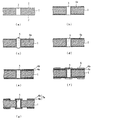
本発明のプリント配線板は、上記本発明のエポキシ樹脂組成物が用いられてなるもの、好適には、プリント配線板のスルーホールやビアホールといった貫通穴等の穴部の穴埋め材として用いられたものである。以下、本発明のプリント配線板の製造方法について、図1〜3を参照しつつ、詳細に説明する。
Next, the printed wiring board of the present invention will be described.
The printed wiring board of the present invention is the one using the epoxy resin composition of the present invention, preferably used as a filling material for holes such as through holes such as through holes and via holes in printed wiring boards. It is. Hereinafter, the manufacturing method of the printed wiring board of this invention is demonstrated in detail, referring FIGS.
<スルーホールの形成>
図1は、本発明のプリント配線板の製造工程の一部の一例を示す概略断面図である。まず、図1(a)に示すように銅箔2をラミネートした基板1にドリル等で貫通孔をあけ、貫通孔の壁面および銅箔表面に無電解めっきを施してスルーホール3を形成する。基板1としては、ガラスエポキシ基板やポリイミド基板、ビスマレイミド−トリアジン樹脂基板、フッ素樹脂基板等の樹脂基板、またはこれらの樹脂基板の銅張積層板、セラミック基板、金属基板等を用いることができる。フッ素樹脂基板のようにめっきのつきまわりが悪い基板の場合は、有機金属ナトリウムからなる前処理剤、プラズマ処理等の表面改質を行なう。次に、厚付けのために電解めっきを行ない、図1(b)に示すように基板1の表面およびスルーホール3内壁にめっき膜4aを形成する。この電解めっきとしては銅めっきが好ましい。
<Formation of through holes>
FIG. 1 is a schematic cross-sectional view showing an example of a part of the manufacturing process of the printed wiring board of the present invention. First, as shown in FIG. 1A, a through hole is formed in a
<穴埋め>
基板1に形成したスルーホール3内に、図1(c)に示すように、本発明の樹脂組成物5を充填する。具体的には、スルーホール3部分に開口を設けたマスクを基板1上に載置し、印刷法等による塗布や、ドット印刷法等により、スルーホール3内に容易に充填できる。次に、樹脂組成物5を約120〜180℃で約30〜90分程度加熱して硬化させた後、図1(d)に示すように、スルーホール3からはみ出した樹脂組成物5の不要部分を研磨により除去して平坦化する。研磨は、ベルトサンダーやバフ研磨等により行なうことができる。
<Filling holes>
The through
<導体回路層の形成>
スルーホール3の穴埋めを行なった基板1の表面に、図1(e)に示すようにめっき膜4bを形成する。その後、図1(f)に示すようにエッチングレジスト6を形成し、レジスト非形成部分をエッチングする。次いで、エッチングレジスト6を剥離することにより、図1(g)に示すように、導体回路層7aを形成する。
<Formation of conductor circuit layer>
A
<層間樹脂絶縁層の形成>
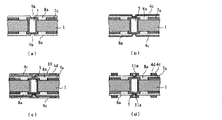
図2は、図1に示す本発明のプリント配線板の製造工程の後の工程の一例を示す概略断面図である。導体回路層7a上に、層間樹脂絶縁層8aを形成する。層間樹脂絶縁層8aとしては、熱硬化性樹脂、光硬化性樹脂、熱可塑性樹脂、またはこれらの樹脂の複合体や混合物、ガラスクロス含浸樹脂複合体、無電解めっき用接着剤を用いることができる。
<Formation of interlayer resin insulation layer>
FIG. 2 is a schematic cross-sectional view showing an example of a process after the manufacturing process of the printed wiring board of the present invention shown in FIG. An interlayer
<バイアホールの形成>
次に、図2(a)に示されるように層間樹脂絶縁層8aに開口9aを設ける。この開口9aの穿孔は、層間樹脂絶縁層8aが感光性樹脂からなる場合は、露光、現像処理にて行ない、熱硬化性樹脂や熱可塑性樹脂からなる場合は、レーザ光にて行なう。レーザ光にて開口9aを設けた場合は、デスミア処理を行なってもよい。
<Formation of via holes>
Next, as shown in FIG. 2A, an
次に、図2(b)に示すように、全面にめっき膜4cを形成する。そして、図2(c)に示すように、めっき膜4c上にめっきレジスト層10を形成する。めっきレジスト層10は、好適には感光性ドライフィルムをラミネートして露光、現像処理して形成される。さらに、電解めっきを行ない、導体回路部分を厚付けし、図2(c)に示すように電解めっき膜4dを形成する。
Next, as shown in FIG. 2B, a
次いで、めっきレジスト層10を剥離した後、そのめっきレジスト層10下の無電解めっき膜4cをエッチングにて溶解除去し、図2(d)に示すように、独立した導体回路(バイアホール11aを含む)を形成する。
Next, after the plating resist
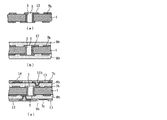
図3は、本発明のプリント配線板の製造方法の他の例を示す概略断面図である。図1(d)に示すようなコア基板作製工程まで終えた後、コア基板1の両面の導体層に対し所定パターン通りにエッチングを施すと、図3(a)に示すように、基板1の両面に所定パターンを有する第1の導体回路層7bが形成されると共に、スルーホール3に接続する導体回路層7bの一部にはランド12が同時に形成される。
FIG. 3 is a schematic cross-sectional view showing another example of the method for producing a printed wiring board of the present invention. After finishing the core substrate manufacturing process as shown in FIG. 1D, when the conductor layers on both surfaces of the
次いで、基板1の上下両面の上に、図3(b)に示すように、層間樹脂絶縁層8bを形成する。さらに、ランド12の真上に位置する樹脂絶縁層8bに対し、図3(c)に示すように、バイアホール11bを形成する。次いで、バイアホール11b内と層間樹脂絶縁8b層の上に銅めっきによるめっき層を形成し、これらの上にエッチングレジストを形成した後で、エッチングを施す。これにより、図3(c)に示すように、層間樹脂絶縁層8bの上に第2の導体回路層7cが形成される。第1、第2の各導体回路層7b、7cはバイアホール11bを介して互いに導通すると共に、基板両面の導体回路層7bもスルーホール3を介して互いに導通する。
Next, an interlayer
そして、図3(c)に示すように、各樹脂絶縁層8bと第2の導体回路層7cの上にソルダーレジスト層13を形成し、上方のソルダーレジスト層13には、これを貫通しかつ導体回路層の表面から立設するはんだバンプ14を形成する。また、下方のソルダーレジスト層13の間に形成した開口9bから露出する導体回路層7cには、その表面にAuおよびNiメッキを施して、接続端子として用いる多層の配線基板を得ることができる。
And as shown in FIG.3 (c), the soldering resist
以下、実施例を用いて本発明をより詳細に説明する。
下記表1〜3に示す配合(質量部)で、エポキシ樹脂組成物を調製した。得られた各樹脂組成物につき、初期および30℃で20日間保管した後の粘度およびゲルタイムを下記の手順で測定した。その後、あらかじめパネルめっきによりスルーホールを形成したガラスエポキシ基板(板厚1.6mm、スルーホール径0.3mm)に、初期および30℃で20日間保存した各樹脂組成物をスクリーン印刷法でスルーホール内に充填した。これを熱風循環式乾燥炉に入れ、150℃で30分間保持して評価サンプルを作製した。得られた各評価サンプルにつき、クラック、ボイドの残留、研磨性、はんだ耐熱性について以下の方法で評価した。得られた結果を表4〜6に示す。
Hereinafter, the present invention will be described in more detail with reference to examples.
Epoxy resin compositions were prepared with the formulations (parts by mass) shown in Tables 1 to 3 below. About each obtained resin composition, the viscosity and gel time after storing it for 20 days at the initial stage and 30 degreeC were measured in the following procedure. After that, each resin composition stored for 20 days at initial and 30 ° C. on a glass epoxy substrate (plate thickness 1.6 mm, through hole diameter 0.3 mm) on which through holes had been formed in advance by panel plating was screen-printed. Filled in. This was put into a hot air circulation type drying furnace and held at 150 ° C. for 30 minutes to prepare an evaluation sample. For each of the obtained evaluation samples, cracks, residual voids, polishing properties, and solder heat resistance were evaluated by the following methods. The obtained results are shown in Tables 4-6.
<粘度>
各樹脂組成物を0.2mL採取し、コーンプレート型粘度計(TV−30:東機産業(株)製)を用いて、25℃、回転数5rpmの30秒値を粘度とした。
<Viscosity>
0.2 mL of each resin composition was sampled, and the viscosity was determined at 30 ° C. and a rotation speed of 5 rpm for 30 seconds using a cone plate viscometer (TV-30: manufactured by Toki Sangyo Co., Ltd.).
<ゲルタイム>
JIS C 2105の熱板法に準拠してゲル試験機により測定した。測定温度150℃に保持した試料0.5mL中で回転棒を回転させた時のトルクが、最大トルクの30%に達するまでの時間をゲルタイムとした。ゲルタイムの差は以下の式にて算出した。
ゲルタイムの差(%)={(初期のゲルタイム−30℃20日後のゲルタイム)/初期のゲルタイム}×100
<Geltime>
It measured with the gel tester based on the hot plate method of JISC2105. The time until the torque when the rotating rod was rotated in 0.5 mL of the sample held at a measurement temperature of 150 ° C. reached 30% of the maximum torque was defined as the gel time. The difference in gel time was calculated by the following formula.
Difference in gel time (%) = {(initial gel time−gel time after 30 days at 30 ° C.) / Initial gel time} × 100
<ボイド>
各評価サンプルをスルーホール部で切断し、断面を光学顕微鏡にて観察して、100個のスルーホールにおけるボイドの発生数を数えた。評価基準は以下のとおりである。
〇・・・0個
△・・・1〜5個
×・・・6個以上
<Void>
Each evaluation sample was cut at the through-hole portion, and the cross-section was observed with an optical microscope to count the number of voids generated in 100 through-holes. The evaluation criteria are as follows.
〇 ・ ・ ・ 0 △ ・ ・ ・ 1 to 5 × ・ ・ ・ 6 or more
<クラック>
各評価サンプルをスルーホール部で切断し、断面を光学顕微鏡にて観察して、100個のスルーホールにおけるクラックの発生数を数えた。評価基準は以下のとおりである。
〇・・・0個
△・・・1〜5個
×・・・6個以上
<Crack>
Each evaluation sample was cut at the through hole portion, and the cross section was observed with an optical microscope to count the number of occurrences of cracks in 100 through holes. The evaluation criteria are as follows.
〇 ・ ・ ・ 0 △ ・ ・ ・ 1 to 5 × ・ ・ ・ 6 or more
<研磨性>
各評価サンプルを研磨機で#320相当の樹脂研磨用バフ1軸により物理研磨を行った。その際に完全に樹脂が除去されるまでのパス回数を比較した。
<Abrasiveness>
Each evaluation sample was physically polished by a polishing machine with a resin polishing buff uniaxial shaft corresponding to # 320. At that time, the number of passes until the resin was completely removed was compared.
<はんだ耐熱性>
各評価サンプルを研磨機で#320相当の樹脂研磨用バフ1軸により物理研磨を行った。その後288℃のはんだ液中に10秒間、3回浸漬した後、室温まで放冷した。次いでスルーホール部で切断し、断面を光学顕微鏡にて観察して、100個のスルーホールにおけるクラックの発生数を数えた。評価基準は以下のとおりである。
〇・・・0個
△・・・1〜5個
×・・・6個以上
<Solder heat resistance>
Each evaluation sample was physically polished by a polishing machine with a resin polishing buff uniaxial shaft corresponding to # 320. Thereafter, it was immersed in a solder liquid at 288 ° C. for 3 seconds for 10 seconds, and then allowed to cool to room temperature. Subsequently, it cut | disconnected by the through hole part, the cross section was observed with the optical microscope, and the generation | occurrence | production number of the crack in 100 through holes was counted. The evaluation criteria are as follows.
〇 ・ ・ ・ 0 △ ・ ・ ・ 1 to 5 × ・ ・ ・ 6 or more
※2:新日鉄住金化学(株)製YDF170
※3:住友化学(株)製ELM−100
※4:ダウケミカル(株)製 DEN-431
※5:2,2’−オキシビス(5,5’−ジメチル−1,3,2−オキサボリナン)
※6:四国化成工業(株)製2MZ−A
※7:四国化成工業(株)製2P4MHZ
※8:旭化成イーマテリアルズ(株)製ノバキュアH103941HP
※9:日本化薬(株)製カヤハードA−A
※10:備北粉化工業(株)製ソフトン1800(平均粒径:1.25μm)
※11:(株)アドマテック製SO−C5(平均粒径:1.6μm)
※12:白石工業(株)製オルベン
※13:信越化学工業(株)製KS−66
* 2: YDF170 manufactured by Nippon Steel & Sumikin Chemical Co., Ltd.
* 3: ELM-100 manufactured by Sumitomo Chemical Co., Ltd.
* 4: DEN-431 manufactured by Dow Chemical Co., Ltd.
* 5: 2,2′-oxybis (5,5′-dimethyl-1,3,2-oxaborinane)
* 6: Shikoku Kasei Kogyo Co., Ltd. 2MZ-A
* 7: Shikoku Kasei Kogyo Co., Ltd. 2P4MHZ
* 8: NovaCure H103941HP manufactured by Asahi Kasei E-Materials Co., Ltd.
* 9: Kayahard A-A manufactured by Nippon Kayaku Co., Ltd.
* 10: Softon 1800 manufactured by Bihoku Flour Industry Co., Ltd. (average particle size: 1.25 μm)
* 11: Admatech Co., Ltd. SO-C5 (average particle size: 1.6 μm)
* 12: Olven manufactured by Shiraishi Kogyo Co., Ltd. * 13: KS-66 manufactured by Shin-Etsu Chemical Co., Ltd.
以上、表1〜6より、本発明の樹脂組成物は、プリント配線板の穴埋め材として用いた場合、ボイドやクラックの発生を著しく抑制できていることがわかる。また、本発明の樹脂組成物は、保存安定性と耐熱性も優れていることがわかる。 As described above, Tables 1 to 6 show that the resin composition of the present invention can remarkably suppress the generation of voids and cracks when used as a hole filling material for printed wiring boards. Moreover, it turns out that the resin composition of this invention is excellent also in storage stability and heat resistance.
1 基板
2 銅箔
3 スルーホール
4 めっき膜
5 樹脂組成物
6 エッチングレジスト
7 導体回路層
8 層間樹脂絶縁層
9 開口
10 めっきレジスト層
11 バイアホール
12 ランド
13 ソルダーレジスト層
14 はんだバンプ
DESCRIPTION OF
6 Etching resist 7 Conductor circuit layer 8 Interlayer resin insulating layer 9
Claims (8)
Priority Applications (1)
| Application Number | Priority Date | Filing Date | Title |
|---|---|---|---|
| JP2013204161A JP5758463B2 (en) | 2013-03-26 | 2013-09-30 | Epoxy resin composition, hole filling composition, and printed wiring board using the same |
Applications Claiming Priority (3)
| Application Number | Priority Date | Filing Date | Title |
|---|---|---|---|
| JP2013063826 | 2013-03-26 | ||
| JP2013063826 | 2013-03-26 | ||
| JP2013204161A JP5758463B2 (en) | 2013-03-26 | 2013-09-30 | Epoxy resin composition, hole filling composition, and printed wiring board using the same |
Publications (2)
| Publication Number | Publication Date |
|---|---|
| JP2014208751A true JP2014208751A (en) | 2014-11-06 |
| JP5758463B2 JP5758463B2 (en) | 2015-08-05 |
Family
ID=51594570
Family Applications (1)
| Application Number | Title | Priority Date | Filing Date |
|---|---|---|---|
| JP2013204161A Active JP5758463B2 (en) | 2013-03-26 | 2013-09-30 | Epoxy resin composition, hole filling composition, and printed wiring board using the same |
Country Status (4)
| Country | Link |
|---|---|
| JP (1) | JP5758463B2 (en) |
| KR (1) | KR101531106B1 (en) |
| CN (1) | CN104072947B (en) |
| TW (1) | TW201437276A (en) |
Cited By (1)
| Publication number | Priority date | Publication date | Assignee | Title |
|---|---|---|---|---|
| JP2017025290A (en) * | 2015-07-21 | 2017-02-02 | 太陽インキ製造株式会社 | Curable resin composition, dry film, cured product and printed wiring board |
Families Citing this family (8)
| Publication number | Priority date | Publication date | Assignee | Title |
|---|---|---|---|---|
| CN104449455B (en) * | 2014-12-29 | 2017-10-03 | 中科院广州化学有限公司 | A kind of intermediate temperature setting type high-performance conductive silver paste and its preparation method and application |
| TWI557177B (en) | 2015-12-16 | 2016-11-11 | 財團法人工業技術研究院 | Low dielectric constant and solventless resin composition and substrate structure |
| CN108203497B (en) * | 2016-12-20 | 2021-04-13 | 太阳油墨(苏州)有限公司 | Epoxy resin composition for filling holes in printed wiring board, cured product, and printed wiring board using same |
| TWI656172B (en) | 2017-09-18 | 2019-04-11 | 台燿科技股份有限公司 | Solvent-free resin composition and uses of the same |
| TWI698484B (en) | 2018-10-12 | 2020-07-11 | 台燿科技股份有限公司 | Solvent-free resin composition and uses of the same |
| CN111378253B (en) * | 2018-12-29 | 2023-07-11 | 太阳油墨(苏州)有限公司 | Resin filling material |
| CN115141460B (en) * | 2021-03-30 | 2023-09-01 | 太阳油墨(苏州)有限公司 | Thermosetting resin composition, cured product, and electronic component |
| KR102611114B1 (en) * | 2023-03-07 | 2023-12-07 | 주식회사 스마트코리아피씨비 | Method for manufacturing hole plugging land |
Citations (9)
| Publication number | Priority date | Publication date | Assignee | Title |
|---|---|---|---|---|
| JPH04227924A (en) * | 1990-05-21 | 1992-08-18 | Dow Chem Co:The | Latent catalyst, epoxy resin composition undergoing controlled curing, and laminate made therefrom |
| JPH0673156A (en) * | 1992-06-24 | 1994-03-15 | Shikoku Chem Corp | Latent epoxy curing agent, its production and epoxy resin composition |
| JPH07224148A (en) * | 1994-02-09 | 1995-08-22 | Amuko Enterp Kk | Heat-resistant epoxy resin composition excellent in stability at normal temperature |
| JPH09268224A (en) * | 1996-03-29 | 1997-10-14 | Shikoku Chem Corp | Epoxy resin composition |
| JPH11256013A (en) * | 1998-03-12 | 1999-09-21 | Ajinomoto Co Inc | Epoxy resin composition |
| JP2004115729A (en) * | 2002-09-27 | 2004-04-15 | Sumitomo Bakelite Co Ltd | One-pack type epoxy resin composition |
| JP2008248100A (en) * | 2007-03-30 | 2008-10-16 | Sumitomo Bakelite Co Ltd | Epoxy resin powder coating composition |
| JP2009269994A (en) * | 2008-05-07 | 2009-11-19 | Taiyo Ink Mfg Ltd | Thermosetting resin composition for filling hole in printed wiring board and printed wiring board using the same |
| WO2012105072A1 (en) * | 2011-02-03 | 2012-08-09 | ナミックス株式会社 | Epoxy resin composition and semiconductor sealing material using same |
Family Cites Families (2)
| Publication number | Priority date | Publication date | Assignee | Title |
|---|---|---|---|---|
| JP2001207029A (en) * | 2000-01-27 | 2001-07-31 | Sumitomo Bakelite Co Ltd | One-component liquid epoxy resin composition |
| JP4877717B2 (en) * | 2005-09-29 | 2012-02-15 | 旭化成イーマテリアルズ株式会社 | Curing agent for slow-reactive epoxy resin and epoxy resin composition |
-
2013
- 2013-09-30 JP JP2013204161A patent/JP5758463B2/en active Active
- 2013-10-09 TW TW102136524A patent/TW201437276A/en unknown
- 2013-11-22 KR KR1020130142635A patent/KR101531106B1/en active Active
- 2013-12-10 CN CN201310666490.4A patent/CN104072947B/en active Active
Patent Citations (9)
| Publication number | Priority date | Publication date | Assignee | Title |
|---|---|---|---|---|
| JPH04227924A (en) * | 1990-05-21 | 1992-08-18 | Dow Chem Co:The | Latent catalyst, epoxy resin composition undergoing controlled curing, and laminate made therefrom |
| JPH0673156A (en) * | 1992-06-24 | 1994-03-15 | Shikoku Chem Corp | Latent epoxy curing agent, its production and epoxy resin composition |
| JPH07224148A (en) * | 1994-02-09 | 1995-08-22 | Amuko Enterp Kk | Heat-resistant epoxy resin composition excellent in stability at normal temperature |
| JPH09268224A (en) * | 1996-03-29 | 1997-10-14 | Shikoku Chem Corp | Epoxy resin composition |
| JPH11256013A (en) * | 1998-03-12 | 1999-09-21 | Ajinomoto Co Inc | Epoxy resin composition |
| JP2004115729A (en) * | 2002-09-27 | 2004-04-15 | Sumitomo Bakelite Co Ltd | One-pack type epoxy resin composition |
| JP2008248100A (en) * | 2007-03-30 | 2008-10-16 | Sumitomo Bakelite Co Ltd | Epoxy resin powder coating composition |
| JP2009269994A (en) * | 2008-05-07 | 2009-11-19 | Taiyo Ink Mfg Ltd | Thermosetting resin composition for filling hole in printed wiring board and printed wiring board using the same |
| WO2012105072A1 (en) * | 2011-02-03 | 2012-08-09 | ナミックス株式会社 | Epoxy resin composition and semiconductor sealing material using same |
Cited By (1)
| Publication number | Priority date | Publication date | Assignee | Title |
|---|---|---|---|---|
| JP2017025290A (en) * | 2015-07-21 | 2017-02-02 | 太陽インキ製造株式会社 | Curable resin composition, dry film, cured product and printed wiring board |
Also Published As
| Publication number | Publication date |
|---|---|
| CN104072947A (en) | 2014-10-01 |
| TW201437276A (en) | 2014-10-01 |
| KR101531106B1 (en) | 2015-06-23 |
| KR20140117250A (en) | 2014-10-07 |
| CN104072947B (en) | 2017-12-29 |
| JP5758463B2 (en) | 2015-08-05 |
Similar Documents
| Publication | Publication Date | Title |
|---|---|---|
| JP5758463B2 (en) | Epoxy resin composition, hole filling composition, and printed wiring board using the same | |
| JP5238342B2 (en) | Thermosetting resin composition for hole filling of printed wiring board and printed wiring board using the same | |
| CN1235971C (en) | Liquid thermosetting resin composition, printed circuit board, and manufacturing method thereof | |
| US11746227B2 (en) | Thermosetting resin composition, cured product thereof, and printed wiring board | |
| KR101316105B1 (en) | Manufacturing method for printed circuit board containing flame retardant insulating layer | |
| JP7441928B2 (en) | Thermosetting resin filler, its cured product and multilayer printed wiring board | |
| JP5901923B2 (en) | Thermosetting resin filler and printed wiring board | |
| JP2012041386A (en) | Thermosetting resin composition for circuit board | |
| JP2012069879A (en) | Thermosetting resin filler | |
| JP5739631B2 (en) | Thermosetting resin filler | |
| CN111748078B (en) | Curable resin composition for hole filling | |
| JP6198483B2 (en) | Thermosetting resin composition and printed wiring board | |
| JP2006278530A (en) | Solder resist and thermosetting resin composition therefor | |
| CN108203497B (en) | Epoxy resin composition for filling holes in printed wiring board, cured product, and printed wiring board using same | |
| JP5636240B2 (en) | Thermosetting resin filler | |
| JP2005317986A (en) | Process for producing printed wiring board by use of liquid thermosetting resin composition | |
| JP2019112610A (en) | Thermosetting resin filler, cured product of the same, and multilayer printed wiring board | |
| JP2005307100A (en) | Packing ink composition for printed circuit board |
Legal Events
| Date | Code | Title | Description |
|---|---|---|---|
| A131 | Notification of reasons for refusal |
Free format text: JAPANESE INTERMEDIATE CODE: A131 Effective date: 20140924 |
|
| A521 | Request for written amendment filed |
Free format text: JAPANESE INTERMEDIATE CODE: A523 Effective date: 20141121 |
|
| TRDD | Decision of grant or rejection written | ||
| A01 | Written decision to grant a patent or to grant a registration (utility model) |
Free format text: JAPANESE INTERMEDIATE CODE: A01 Effective date: 20150519 |
|
| A61 | First payment of annual fees (during grant procedure) |
Free format text: JAPANESE INTERMEDIATE CODE: A61 Effective date: 20150603 |
|
| R150 | Certificate of patent or registration of utility model |
Ref document number: 5758463 Country of ref document: JP Free format text: JAPANESE INTERMEDIATE CODE: R150 |
|
| R250 | Receipt of annual fees |
Free format text: JAPANESE INTERMEDIATE CODE: R250 |
|
| R250 | Receipt of annual fees |
Free format text: JAPANESE INTERMEDIATE CODE: R250 |
|
| R250 | Receipt of annual fees |
Free format text: JAPANESE INTERMEDIATE CODE: R250 |
|
| R250 | Receipt of annual fees |
Free format text: JAPANESE INTERMEDIATE CODE: R250 |
|
| R250 | Receipt of annual fees |
Free format text: JAPANESE INTERMEDIATE CODE: R250 |
|
| R250 | Receipt of annual fees |
Free format text: JAPANESE INTERMEDIATE CODE: R250 |
|
| S111 | Request for change of ownership or part of ownership |
Free format text: JAPANESE INTERMEDIATE CODE: R313113 |
|
| R350 | Written notification of registration of transfer |
Free format text: JAPANESE INTERMEDIATE CODE: R350 |
|
| R250 | Receipt of annual fees |
Free format text: JAPANESE INTERMEDIATE CODE: R250 |
|
| R250 | Receipt of annual fees |
Free format text: JAPANESE INTERMEDIATE CODE: R250 |