JP2017190412A - Tire rubber composition, and pneumatic tire - Google Patents
Tire rubber composition, and pneumatic tire Download PDFInfo
- Publication number
- JP2017190412A JP2017190412A JP2016081263A JP2016081263A JP2017190412A JP 2017190412 A JP2017190412 A JP 2017190412A JP 2016081263 A JP2016081263 A JP 2016081263A JP 2016081263 A JP2016081263 A JP 2016081263A JP 2017190412 A JP2017190412 A JP 2017190412A
- Authority
- JP
- Japan
- Prior art keywords
- rubber composition
- mass
- rubber
- tire
- content
- Prior art date
- Legal status (The legal status is an assumption and is not a legal conclusion. Google has not performed a legal analysis and makes no representation as to the accuracy of the status listed.)
- Pending
Links
Landscapes
- Testing Resistance To Weather, Investigating Materials By Mechanical Methods (AREA)
- Tires In General (AREA)
- Compositions Of Macromolecular Compounds (AREA)
Abstract
Description
本発明は、タイヤ用ゴム組成物、及びこれを用いた空気入りタイヤに関する。 The present invention relates to a rubber composition for a tire and a pneumatic tire using the same.
一般にゴム製品は、大気中のオゾンや酸素によって劣化し、表面に亀裂(クラック)が生じる。この亀裂は、ゴム製品にかかる静的及び動的応力により進行し、その結果、ゴム材料が破壊に至る。 Generally, rubber products are deteriorated by ozone or oxygen in the atmosphere, and cracks are generated on the surface. The cracks progress due to static and dynamic stresses on the rubber product, resulting in the rubber material breaking.
このような亀裂を抑制するために、すなわち、耐クラック性を改善するために、ゴム製品、とりわけタイヤに用いられるゴム組成物(特に、使用環境下で大気中にさらされるトレッド、サイドウォール、クリンチ、ウイングに使用されるタイヤ用ゴム組成物)においては、オゾンと反応しやすい老化防止剤やゴム製品の表面に保護膜を形成するためのワックスが予め配合されている。 In order to suppress such cracks, that is, to improve crack resistance, rubber compositions used in rubber products, particularly tires (especially treads, sidewalls, clinch exposed to the atmosphere in the use environment) In the rubber composition for tires used for wings), an anti-aging agent that easily reacts with ozone and a wax for forming a protective film on the surface of a rubber product are blended in advance.
老化防止剤もワックスも表面に析出しなければ耐オゾン性の効果を発揮できないが、老化防止剤はゴム表面で結晶化するワックスとは異なり、大気中にさらされた時の揮発性が高く、耐オゾン性の効果持続性が短い。 Unlike the wax that crystallizes on the rubber surface, the anti-aging agent has high volatility when exposed to the atmosphere, although the anti-aging effect cannot be exerted unless the anti-aging agent and the wax are deposited on the surface. Sustained effect of ozone resistance is short.
このような問題を解決するために、特許文献1では、ポリオキシエチレンのエーテル型非イオン性界面活性剤を配合することで老化防止剤の過剰な析出を抑え、効果の持続性を高める手法が提案されている。 In order to solve such a problem, Patent Document 1 discloses a technique for suppressing excessive precipitation of an anti-aging agent and increasing the sustainability of the effect by blending an ether type nonionic surfactant of polyoxyethylene. Proposed.
本発明者らが鋭意検討した結果、特許文献1の手法では、老化防止剤の表面への析出速度を抑えることはできるものの、表面に析出した後の老化防止剤の揮発を抑制する点については改善の余地があり、耐クラック性については改善の余地があることが分かった。
本発明は、前記課題を解決し、良好な耐クラック性を有するタイヤ用ゴム組成物、及びこれを用いた空気入りタイヤを提供することを目的とする。
As a result of intensive studies by the present inventors, the method of Patent Document 1 can suppress the precipitation rate of the anti-aging agent on the surface, but suppresses the volatilization of the anti-aging agent after being deposited on the surface. There was room for improvement, and it was found that there was room for improvement in crack resistance.
An object of the present invention is to solve the above-mentioned problems and to provide a rubber composition for tires having good crack resistance and a pneumatic tire using the same.
本発明は、80℃の恒温容器に2週間静置した後、残存する老化防止剤の含有量が0.5質量%以上であることを特徴とする使用環境下で大気中にさらされるタイヤ用ゴム組成物に関する。 The present invention is for a tire that is exposed to the atmosphere in a use environment, characterized in that the content of the remaining anti-aging agent is 0.5% by mass or more after standing in a thermostatic container at 80 ° C. for 2 weeks. The present invention relates to a rubber composition.
上記タイヤ用ゴム組成物は、屋外に6カ月間静置した後、色差計を用いて測定した色差(−(a*+b*)×10)が−20より大きいことが好ましい。 The tire rubber composition preferably has a color difference (− (a * + b * ) × 10) measured by using a color difference meter after standing for 6 months outdoors is larger than −20.
上記タイヤ用ゴム組成物は、トレッド用ゴム組成物、サイドウォール用ゴム組成物、クリンチ用ゴム組成物及び/又はウイング用ゴム組成物であることが好ましい。 The tire rubber composition is preferably a tread rubber composition, a sidewall rubber composition, a clinch rubber composition, and / or a wing rubber composition.
本発明はまた、上記ゴム組成物を用いて作製したタイヤ部材を有する空気入りタイヤに関する。 The present invention also relates to a pneumatic tire having a tire member produced using the rubber composition.
上記タイヤ部材が、トレッド、サイドウォール、クリンチ及び/又はウイングであることが好ましい。 The tire member is preferably a tread, a sidewall, a clinch and / or a wing.
本発明によれば、80℃の恒温容器に2週間静置した後、残存する老化防止剤の含有量が0.5質量%以上であることを特徴とする使用環境下で大気中にさらされるタイヤ用ゴム組成物であるので、良好な耐クラック性を有し、耐クラック性に優れた空気入りタイヤを提供できる。 According to the present invention, after standing in a thermostatic container at 80 ° C. for 2 weeks, the content of the remaining anti-aging agent is 0.5% by mass or more, and is exposed to the atmosphere in a use environment characterized in that Since it is a rubber composition for tires, a pneumatic tire having good crack resistance and excellent crack resistance can be provided.
本発明のタイヤ用ゴム組成物(使用環境下で大気中にさらされるタイヤ用ゴム組成物)は、80℃の恒温容器に2週間静置した後、残存する老化防止剤の含有量が0.5質量%以上である。 The tire rubber composition of the present invention (the tire rubber composition exposed to the atmosphere under the use environment) is allowed to stand in a thermostatic container at 80 ° C. for 2 weeks, and then the content of the remaining antioxidant is 0.00. It is 5 mass% or more.
ゴム中に含まれる老化防止剤の揮発は、温度が高いほど促進されるが、あまりに高いと市場で実際に使用される場合との相関を保つことができない。いくつかの温度条件と市場で実際に使用される場合との相関を調べた結果、80℃の温度で2週間静置させることによって市場において約2年経過した後の状態と相関が得られることを見出した。更に、80℃の恒温容器に2週間静置した後、ゴム中の残存する老化防止剤の含有量が0.5質量%以上であれば、市場で実際に使用した場合に良好な耐クラック性を保つことができることを見出し、本発明を完成した。 The volatilization of the anti-aging agent contained in the rubber is promoted as the temperature increases, but if it is too high, it cannot be correlated with the actual use in the market. As a result of investigating the correlation between several temperature conditions and actual use in the market, it is possible to obtain a correlation with the state after about 2 years in the market by leaving it at 80 ° C for 2 weeks. I found. Furthermore, after standing in a thermostatic container at 80 ° C. for 2 weeks, if the content of the remaining anti-aging agent in the rubber is 0.5% by mass or more, good crack resistance when actually used in the market The present invention has been completed.
本発明のタイヤ用ゴム組成物は、80℃の恒温容器に2週間静置した後、残存する老化防止剤の含有量が、ゴム組成物100質量%中、0.5質量%以上であり、好ましくは0.7質量%以上、より好ましくは0.9質量%以上である。良好な耐クラック性を得るという観点からは上限は特に限定されないが、オゾンにより劣化した老化防止剤を原因とする茶変色を抑制でき、良好な耐変色性が得られるという理由から、好ましくは1.5質量%以下、より好ましくは1.2質量%以下、更に好ましくは1.0質量%以下である。
ここで、80℃の恒温容器に2週間静置する方法、残存する老化防止剤の含有量の測定方法は、実施例に記載の方法により行われる。
The rubber composition for tires of the present invention, after standing for 2 weeks in a constant temperature container at 80 ° C., the content of the remaining antioxidant is 0.5% by mass or more in 100% by mass of the rubber composition, Preferably it is 0.7 mass% or more, More preferably, it is 0.9 mass% or more. The upper limit is not particularly limited from the viewpoint of obtaining good crack resistance, but it is preferably 1 for the reason that tea discoloration caused by an anti-aging agent deteriorated by ozone can be suppressed and good discoloration resistance can be obtained. 0.5% by mass or less, more preferably 1.2% by mass or less, and still more preferably 1.0% by mass or less.
Here, the method of standing in a thermostatic container at 80 ° C. for 2 weeks and the method of measuring the content of the remaining anti-aging agent are carried out by the methods described in the examples.
本発明のタイヤ用ゴム組成物は、屋外に6カ月間静置した後、色差計を用いて測定した色差(−(a*+b*)×10)が−20より大きいことが好ましく、−10より大きいことが更に好ましく、0より大きいことが特に好ましく、上限は特に限定されない。これは、オゾンにより劣化した老化防止剤を原因とする茶変色が抑制できていることを意味し、耐変色性、タイヤの外観を改善できることを意味する。
ここで、屋外に6カ月間静置する方法、色差計を用いて色差を測定する方法は、実施例に記載の方法により行われる。
The rubber composition for tires of the present invention preferably has a color difference (− (a * + b * ) × 10) measured with a color difference meter of greater than −20 after standing for 6 months outdoors. It is more preferably larger, particularly preferably larger than 0, and the upper limit is not particularly limited. This means that brown discoloration caused by an anti-aging agent deteriorated by ozone can be suppressed, and that discoloration resistance and tire appearance can be improved.
Here, the method of standing outdoors for 6 months and the method of measuring the color difference using a color difference meter are performed by the method described in the examples.
80℃の恒温容器に2週間静置した後、残存する老化防止剤の含有量を上記特定量以上とし、更には、屋外に6カ月間静置した後、色差計を用いて測定した色差(−(a*+b*)×10)を−20より大きくするためには、ゴム組成物に特定の非イオン界面活性剤を配合することが好ましい。これにより、老化防止剤の表面への析出速度を抑えつつ、表面に析出した後の老化防止剤の揮発も抑制でき、耐クラック性を改善できる。 After standing in a thermostatic container at 80 ° C. for 2 weeks, the content of the remaining anti-aging agent is set to the above specified amount or more, and further, the color difference measured using a color difference meter after standing outdoors for 6 months ( In order to make − (a * + b * ) × 10) larger than −20, it is preferable to add a specific nonionic surfactant to the rubber composition. Thereby, volatilization of the anti-aging agent after depositing on the surface can be suppressed while suppressing the deposition rate of the anti-aging agent on the surface, and crack resistance can be improved.
更に、特定の非イオン界面活性剤は、老化防止剤やワックスと共にゴム表面にブルームし、老化防止剤やワックスを溶解して平坦化するため、ワックス等の析出により形成されるタイヤ表面(ブルーム層)の凸凹が平滑化され、光の乱反射が抑制される。これにより、上述の茶変色を軽減するなど、耐変色性も向上する。また、タイヤ表面に適度な黒色外観と光沢を与えるなど、タイヤ外観が改善される。 Furthermore, the specific nonionic surfactant blooms on the rubber surface together with the anti-aging agent and the wax, and dissolves and flattens the anti-aging agent and the wax, so that the tire surface (bloom layer) formed by precipitation of the wax or the like. ) Is smoothed, and irregular reflection of light is suppressed. Thereby, discoloration resistance, such as reducing the above-mentioned brown discoloration, is also improved. In addition, the tire appearance is improved by giving the tire surface an appropriate black appearance and gloss.
特定の非イオン界面活性剤としては、下記式(1)及び/又は下記式(2)で表される非イオン界面活性剤、並びにプルロニック型非イオン界面活性剤からなる群より選択される少なくとも1種が挙げられる。非イオン界面活性剤は、単独で用いてもよく、2種以上を併用してもよい。 The specific nonionic surfactant is at least one selected from the group consisting of a nonionic surfactant represented by the following formula (1) and / or the following formula (2), and a pluronic type nonionic surfactant. Species are mentioned. A nonionic surfactant may be used independently and may use 2 or more types together.
まず、下記式(1)及び/又は下記式(2)で表される非イオン界面活性剤について説明する。
式(1)のR1は、炭素数6〜26の炭化水素基を表す。R1の炭化水素基の炭素数が5以下の場合、ゴムへの浸透性が低く、ゴム表面に移行する速度が速くなりすぎる為、ゴム表面の外観が悪くなる傾向がある。またR1の炭化水素基の炭素数が27以上の場合、原料が入手困難または高価であり、不適である。R1の炭化水素基の炭素数が上記範囲内であると、非イオン界面活性剤のブルームを好適にコントロールでき、本発明の効果がより好適に得られる。 R 1 in Formula (1) represents a hydrocarbon group having 6 to 26 carbon atoms. When the carbon number of the hydrocarbon group of R 1 is 5 or less, since the permeability to rubber is low and the speed of transfer to the rubber surface becomes too fast, the rubber surface tends to deteriorate in appearance. In addition, when the carbon number of the hydrocarbon group of R 1 is 27 or more, the raw material is difficult to obtain or expensive and is not suitable. When the carbon number of the hydrocarbon group of R 1 is within the above range, the bloom of the nonionic surfactant can be suitably controlled, and the effects of the present invention can be obtained more suitably.
R1の炭化水素基の炭素数は、好ましくは8〜24、より好ましくは10〜22、更に好ましくは14〜20である。 The number of carbon atoms in the hydrocarbon group R 1 is preferably 8 to 24, more preferably 10 to 22, more preferably from 14 to 20.
R1の炭素数6〜26の炭化水素基としては、炭素数6〜26のアルケニル基、炭素数6〜26のアルキニル基、炭素数6〜26のアルキル基が挙げられる。 Examples of the hydrocarbon group having 6 to 26 carbon atoms of R 1 include an alkenyl group having 6 to 26 carbon atoms, an alkynyl group having 6 to 26 carbon atoms, and an alkyl group having 6 to 26 carbon atoms.
炭素数6〜26のアルケニル基としては、例えば、1−ヘキセニル基、2−ヘキセニル基、1−オクテニル基、デセニル基、ウンデセニル基、ドデセニル基、トリデセニル基、テトラデセニル基、ペンタデセニル基、ヘプタデセニル基、オクタデセニル基、イコセニル基、トリコセニル基、ヘキサコセニル基等が挙げられる。 Examples of the alkenyl group having 6 to 26 carbon atoms include 1-hexenyl group, 2-hexenyl group, 1-octenyl group, decenyl group, undecenyl group, dodecenyl group, tridecenyl group, tetradecenyl group, pentadecenyl group, heptadecenyl group, octadecenyl group Group, icocenyl group, tricocenyl group, hexacocenyl group and the like.
炭素数6〜26のアルキニル基としては、例えば、ヘキシニル基、へプチニル基、オクチニル基、ノニニル基、デシニル基、ウンデシニル基、ドデシニル基、トリデシニル基、テトラデシニル基、ペンタデシニル基、ヘプタデシニル基、オクタデシニル基、イコシニル基、トリコシニル基、ヘキサコシニル基等が挙げられる。 Examples of the alkynyl group having 6 to 26 carbon atoms include hexynyl group, heptynyl group, octynyl group, noninyl group, decynyl group, undecynyl group, dodecynyl group, tridecynyl group, tetradecynyl group, pentadecynyl group, heptadecynyl group, octadecynyl group, Examples include an icosinyl group, a tricosinyl group, and a hexacosinyl group.
炭素数6〜26のアルキル基としては、例えば、へキシル基、へプチル基、2−エチルヘキシル基、オクチル基、ノニル基、デシル基、ウンデシル基、ドデシル基、トリデシル基、テトラデシル基、ペンタデシル基、オクタデシル基、ヘプタデシル基、オクタデシル基、イコシル基、トリコシル基、ヘキサコシル基等が挙げられる。 Examples of the alkyl group having 6 to 26 carbon atoms include hexyl, heptyl, 2-ethylhexyl, octyl, nonyl, decyl, undecyl, dodecyl, tridecyl, tetradecyl, pentadecyl, Examples include an octadecyl group, a heptadecyl group, an octadecyl group, an icosyl group, a tricosyl group, and a hexacosyl group.
R1としては、炭素数6〜26のアルケニル基、炭素数6〜26のアルキニル基が好ましく、炭素数6〜26のアルケニル基がより好ましい。 R 1 is preferably an alkenyl group having 6 to 26 carbon atoms and an alkynyl group having 6 to 26 carbon atoms, and more preferably an alkenyl group having 6 to 26 carbon atoms.
d(整数)は、大きいほど親水親油バランスを表すHLB値が高くなり、ゴム表面に移行する速度が速くなる傾向がある。本発明において、dの値は特に限定されず、使用条件・目的等に応じて適宜選択できる。なかでも、dとしては、好ましくは2〜25、より好ましくは4〜20、更に好ましくは8〜16、特に好ましくは10〜14である。 As d (integer) is larger, the HLB value representing the hydrophilic / lipophilic balance is higher, and the speed of transfer to the rubber surface tends to be higher. In the present invention, the value of d is not particularly limited, and can be appropriately selected according to use conditions and purposes. Especially, as d, Preferably it is 2-25, More preferably, it is 4-20, More preferably, it is 8-16, Most preferably, it is 10-14.
上記式(1)で表される非イオン界面活性剤としては、エチレングリコールモノオレエート、エチレングリコールモノパルミエート、エチレングリコールモノパルミテート、エチレングリコールモノバクセネート、エチレングリコールモノリノレート、エチレングリコールモノリノレネート、エチレングリコールモノアラキドネート、エチレングリコールモノステアレート、エチレングリコールモノセチルエート、エチレングリコールモノラウレート等が挙げられる。これらは、単独で用いてもよく、2種以上を併用してもよい。なかでも、入手の容易性、コストの点から、エチレングリコールモノオレエート、エチレングリコールモノラウレート、エチレングリコールモノステアレート、エチレングリコールモノパルミテートが好ましい。 Examples of the nonionic surfactant represented by the above formula (1) include ethylene glycol monooleate, ethylene glycol monopalmitate, ethylene glycol monopalmitate, ethylene glycol monobaccinate, ethylene glycol monolinoleate, and ethylene glycol. Examples include monolinolenate, ethylene glycol monoarachidonate, ethylene glycol monostearate, ethylene glycol monocetylate, and ethylene glycol monolaurate. These may be used alone or in combination of two or more. Of these, ethylene glycol monooleate, ethylene glycol monolaurate, ethylene glycol monostearate, and ethylene glycol monopalmitate are preferable from the viewpoint of availability and cost.
式(2)のR2及びR3は、同一若しくは異なって、炭素数6〜26の炭化水素基を表す。R2及びR3の炭化水素基の炭素数が5以下の場合、ゴムへの浸透性が低く、ゴム表面に移行する速度が速くなりすぎる為、ゴム表面の外観が悪くなる傾向がある。またR2及びR3の炭化水素基の炭素数が27以上の場合、原料が入手困難または高価であり、不適である。R2及びR3の炭化水素基の炭素数が上記範囲内であると、非イオン界面活性剤のブルームを好適にコントロールでき、本発明の効果がより好適に得られる。 R 2 and R 3 in the formula (2) are the same or different and represent a hydrocarbon group having 6 to 26 carbon atoms. When the carbon number of the hydrocarbon group of R 2 and R 3 is 5 or less, the rubber permeability is low and the speed of transition to the rubber surface becomes too fast, so that the appearance of the rubber surface tends to deteriorate. Further, when the carbon number of the hydrocarbon group of R 2 and R 3 is 27 or more, the raw material is difficult to obtain or expensive, and is inappropriate. When the carbon number of the hydrocarbon group of R 2 and R 3 is within the above range, the bloom of the nonionic surfactant can be suitably controlled, and the effects of the present invention can be more suitably obtained.
R2及びR3の炭化水素基の炭素数は、好ましくは8〜24、より好ましくは10〜22、更に好ましくは14〜20である。 Number of carbon atoms in the hydrocarbon group of R 2 and R 3 are preferably 8 to 24, more preferably 10 to 22, more preferably from 14 to 20.
R2及びR3の炭素数6〜26の炭化水素基としては、炭素数6〜26のアルケニル基、炭素数6〜26のアルキニル基、炭素数6〜26のアルキル基が挙げられる。 Examples of the hydrocarbon group having 6 to 26 carbon atoms of R 2 and R 3 include an alkenyl group having 6 to 26 carbon atoms, an alkynyl group having 6 to 26 carbon atoms, and an alkyl group having 6 to 26 carbon atoms.
炭素数6〜26のアルケニル基、炭素数6〜26のアルキニル基、炭素数6〜26のアルキル基としては、上述のR1の場合と同様の基が挙げられる。 Examples of the alkenyl group having 6 to 26 carbon atoms, the alkynyl group having 6 to 26 carbon atoms, and the alkyl group having 6 to 26 carbon atoms include the same groups as those described above for R 1 .
R2及びR3としては、炭素数6〜26のアルケニル基、炭素数6〜26のアルキニル基が好ましく、炭素数6〜26のアルケニル基がより好ましい。 The R 2 and R 3, an alkenyl group having 6 to 26 carbon atoms, preferably an alkynyl group having 6 to 26 carbon atoms, more preferably an alkenyl group having 6 to 26 carbon atoms.
e(整数)は、大きいほど親水親油バランスを表すHLB値が高くなり、ゴム表面に移行する速度が速くなる傾向がある。本発明において、eの値は特に限定されず、使用条件・目的等に応じて適宜選択できる。なかでも、eとしては、好ましくは2〜25、より好ましくは4〜20、更に好ましくは8〜16、特に好ましくは10〜14である。 As e (integer) is larger, the HLB value representing the hydrophilic / lipophilic balance is higher, and the speed of moving to the rubber surface tends to be faster. In the present invention, the value of e is not particularly limited, and can be appropriately selected according to use conditions and purposes. Especially, as e, Preferably it is 2-25, More preferably, it is 4-20, More preferably, it is 8-16, Most preferably, it is 10-14.
上記式(2)で表される非イオン界面活性剤としては、エチレングリコールジオレエート、エチレングリコールジパルミエート、エチレングリコールジパルミテート、エチレングリコールジバクセネート、エチレングリコールジリノレート、エチレングリコールジリノレネート、エチレングリコールジアラキドネート、エチレングリコールジステアレート、エチレングリコールジセチルエート、エチレングリコールジラウレート等が挙げられる。これらは、単独で用いてもよく、2種以上を併用してもよい。なかでも、入手の容易性、コストの点から、エチレングリコールジオレエート、エチレングリコールジラウレート、エチレングリコールジステアレート、エチレングリコールジパルミテートが好ましい。 Examples of the nonionic surfactant represented by the above formula (2) include ethylene glycol dioleate, ethylene glycol dipalmitate, ethylene glycol dipalmitate, ethylene glycol dibactenate, ethylene glycol dilinoleate, and ethylene glycol dilinoleate. Nate, ethylene glycol diarachidonate, ethylene glycol distearate, ethylene glycol dicetylate, ethylene glycol dilaurate and the like. These may be used alone or in combination of two or more. Of these, ethylene glycol dioleate, ethylene glycol dilaurate, ethylene glycol distearate, and ethylene glycol dipalmitate are preferable from the viewpoint of availability and cost.
次に、プルロニック型非イオン界面活性剤について説明する。
プルロニック型非イオン界面活性剤は、ポリオキシエチレンポリオキシプロピレングリコール、ポリオキシエチレンポリオキシプロピレンブロックポリマー、ポリプロピレングリコールエチレンオキシド付加物とも呼ばれ、一般的には、下記式(I)で表わされる非イオン界面活性剤である。下記式(I)で表わされるように、プルロニック型非イオン界面活性剤は、両側にエチレンオキシド構造から構成される親水基を有し、この親水基に挟まれるように、プロピレンオキシド構造から構成される疎水基を有する。
Pluronic type nonionic surfactant is also called polyoxyethylene polyoxypropylene glycol, polyoxyethylene polyoxypropylene block polymer, polypropylene glycol ethylene oxide adduct, and is generally nonionic represented by the following formula (I) It is a surfactant. As represented by the following formula (I), the pluronic-type nonionic surfactant has a hydrophilic group composed of an ethylene oxide structure on both sides, and is composed of a propylene oxide structure so as to be sandwiched between the hydrophilic groups. Has a hydrophobic group.
プルロニック型非イオン界面活性剤のポリプロピレンオキシドブロックの重合度(上記式(I)のb)、及びポリエチレンオキシドの付加量(上記式(I)のa+c)は特に限定されず、使用条件・目的等に応じて適宜選択できる。ポリプロピレンオキシドブロックの割合が高くなる程ゴムとの親和性が高く、ゴム表面に移行する速度が遅くなる傾向がある。なかでも、非イオン界面活性剤のブルームを好適にコントロールでき、本発明の効果がより好適に得られるという理由から、ポリプロピレンオキシドブロックの重合度(上記式(I)のb)は、好ましくは100以下であり、より好ましくは10〜70、更に好ましくは10〜60、特に好ましくは20〜60、最も好ましくは20〜45である。同様に、ポリエチレンオキシドの付加量(上記式(I)のa+c)は、好ましくは100以下であり、より好ましくは3〜65、更に好ましくは5〜55、特に好ましくは5〜40、最も好ましくは10〜40である。ポリプロピレンオキシドブロックの重合度、ポリエチレンオキシドの付加量が上記範囲内であると、非イオン界面活性剤のブルームを好適にコントロールでき、本発明の効果がより好適に得られる。 The degree of polymerization of the polypropylene oxide block of the pluronic-type nonionic surfactant (b in the above formula (I)) and the addition amount of polyethylene oxide (a + c in the above formula (I)) are not particularly limited, and the use conditions, purpose, etc. It can be appropriately selected depending on the situation. The higher the proportion of the polypropylene oxide block, the higher the affinity with rubber and the slower the rate of transfer to the rubber surface. Among these, the degree of polymerization of the polypropylene oxide block (b in the above formula (I)) is preferably 100 because the bloom of the nonionic surfactant can be suitably controlled and the effects of the present invention can be more suitably obtained. Or less, more preferably 10 to 70, still more preferably 10 to 60, particularly preferably 20 to 60, and most preferably 20 to 45. Similarly, the addition amount of polyethylene oxide (a + c in the above formula (I)) is preferably 100 or less, more preferably 3 to 65, still more preferably 5 to 55, particularly preferably 5 to 40, most preferably. 10-40. When the degree of polymerization of the polypropylene oxide block and the addition amount of polyethylene oxide are within the above ranges, the bloom of the nonionic surfactant can be suitably controlled, and the effects of the present invention can be more suitably obtained.
プルロニック型非イオン界面活性剤としては、BASFジャパン(株)製のプルロニックシリーズ、三洋化成工業(株)製のニューポールPEシリーズ、旭電化工業(株)製のアデカプルロニックL又はFシリーズ、第一工業製薬(株)製のエパンシリーズ、日油(株)製のプロノンシリーズ又はユニルーブ等が挙げられる。これらは、単独で用いてもよく、2種以上を併用してもよい。 Pluronic type nonionic surfactants include BASF Japan's Pluronic series, Sanyo Chemical Industries' New Pole PE series, Asahi Denka Kogyo's Adeka Pluronic L or F series, Daiichi Examples include Epan series manufactured by Kogyo Seiyaku Co., Ltd., Pronon series manufactured by NOF Co., Ltd. or Unilube. These may be used alone or in combination of two or more.
なかでも、より好適に本発明のタイヤ用ゴム組成物が得られるという理由から、プルロニック型非イオン界面活性剤が好ましい。 Among these, a pluronic type nonionic surfactant is preferred because the rubber composition for tires of the present invention can be obtained more suitably.
上記ゴム組成物が上記非イオン界面活性剤を含有する場合、上記式(1)で表される非イオン界面活性剤、上記式(2)で表される非イオン界面活性剤、及びプルロニック型非イオン界面活性剤の合計含有量(上記非イオン界面活性剤の含有量)は、ゴム組成物100質量%中、好ましくは0.3質量%以上、より好ましくは0.6質量%以上、更に好ましくは0.9質量%以上、特に好ましくは1.2質量%以上、最も好ましくは1.5質量%以上である。0.3質量%未満では、本発明の効果が充分に得られないおそれがある。また、上記合計含有量は、好ましくは5.0質量%以下、より好ましくは4.0質量%以下、更に好ましくは3.0質量%以下、特に好ましくは2.5質量%以下である。5.0質量%を超えると、低燃費性、耐摩耗性、タイヤの外観が悪化するおそれがある。
上記非イオン界面活性剤の含有量を上記範囲内とすることにより、80℃の恒温容器に2週間静置した後、残存する老化防止剤の含有量を好適に上記特定量以上とでき、更には、屋外に6カ月間静置した後、色差計を用いて測定した色差(−(a*+b*)×10)を好適に−20より大きくすることができる。
When the rubber composition contains the nonionic surfactant, the nonionic surfactant represented by the formula (1), the nonionic surfactant represented by the formula (2), and the pluronic non-type The total content of the ionic surfactant (content of the nonionic surfactant) is preferably 0.3% by mass or more, more preferably 0.6% by mass or more, and still more preferably in 100% by mass of the rubber composition. Is 0.9% by mass or more, particularly preferably 1.2% by mass or more, and most preferably 1.5% by mass or more. If it is less than 0.3% by mass, the effects of the present invention may not be sufficiently obtained. The total content is preferably 5.0% by mass or less, more preferably 4.0% by mass or less, still more preferably 3.0% by mass or less, and particularly preferably 2.5% by mass or less. If it exceeds 5.0% by mass, fuel economy, wear resistance, and tire appearance may be deteriorated.
By setting the content of the nonionic surfactant in the above range, the content of the remaining anti-aging agent can be suitably more than the above specific amount after standing in a thermostatic container at 80 ° C. for 2 weeks, The color difference (− (a * + b * ) × 10) measured using a color difference meter after being allowed to stand outdoors for 6 months can be preferably larger than −20.
本発明のゴム組成物は、オゾンによる亀裂の発生及び進行を抑制するために、老化防止剤を含有する。 The rubber composition of the present invention contains an anti-aging agent in order to suppress the occurrence and progression of cracks due to ozone.
老化防止剤としては特に限定されず、例えば、ナフチルアミン系、キノリン系、ジフェニルアミン系、p−フェニレンジアミン系、ヒドロキノン誘導体、フェノール系(モノフェノール系、ビスフェノール系、トリスフェノール系、ポリフェノール系)、チオビスフェノール系、ベンゾイミダゾール系、チオウレア系、亜リン酸系、有機チオ酸系老化防止剤などが挙げられる。これらは、単独で用いてもよく、2種以上を併用してもよい。なかでも、耐オゾン性能が良好であり、本発明の効果がより好適に得られるという理由から、p−フェニレンジアミン系が好ましい。 The anti-aging agent is not particularly limited. For example, naphthylamine, quinoline, diphenylamine, p-phenylenediamine, hydroquinone derivatives, phenol (monophenol, bisphenol, trisphenol, polyphenol), thiobisphenol Series, benzimidazole series, thiourea series, phosphorous acid series, and organic thioacid series antioxidants. These may be used alone or in combination of two or more. Of these, p-phenylenediamine is preferable because ozone resistance is good and the effects of the present invention can be obtained more suitably.
p−フェニレンジアミン系老化防止剤としては、N−(1,3−ジメチルブチル)−N’−フェニル−p−フェニレンジアミン、N−イソプロピル−N’−フェニル−p−フェニレンジアミン、N−1,4−ジメチルペンチル−N’−フェニル−p−フェニレンジアミン、N,N’−ジフェニル−p−フェニレンジアミン、N,N’−ジ−2−ナフチル−p−フェニレンジアミン、N−シクロヘキシル−N’−フェニル−p−フェニレンジアミン、N,N’−ビス(1−メチルヘプチル)−p−フェニレンジアミン、N,N’−ビス(1,4−ジメチルペンチル)−p−フェニレンジアミン、N,N’−ビス(1−エチル−3−メチルペンチル)−p−フェニレンジアミン、N−4−メチル−2−ペンチル−N’−フェニル−p−フェニレンジアミン、N,N’−ジアリール−p−フェニレンジアミン、ヒンダードジアリール−p−フェニレンジアミン、フェニルヘキシル−p−フェニレンジアミン、フェニルオクチル−p−フェニレンジアミンなどが挙げられる。これらは、単独で用いてもよく、2種以上を併用してもよい。なかでも、耐オゾン性能が良好であり、本発明の効果がより好適に得られ、経済性にも優れるという理由から、N−(1,3−ジメチルブチル)−N’−フェニル−p−フェニレンジアミンがより好ましい。 As the p-phenylenediamine-based antioxidant, N- (1,3-dimethylbutyl) -N′-phenyl-p-phenylenediamine, N-isopropyl-N′-phenyl-p-phenylenediamine, N-1, 4-dimethylpentyl-N′-phenyl-p-phenylenediamine, N, N′-diphenyl-p-phenylenediamine, N, N′-di-2-naphthyl-p-phenylenediamine, N-cyclohexyl-N′- Phenyl-p-phenylenediamine, N, N′-bis (1-methylheptyl) -p-phenylenediamine, N, N′-bis (1,4-dimethylpentyl) -p-phenylenediamine, N, N′- Bis (1-ethyl-3-methylpentyl) -p-phenylenediamine, N-4-methyl-2-pentyl-N′-phenyl-p-phenylene Amine, N, N'-diaryl -p- phenylenediamine, hindered mistakes aryl -p- phenylenediamine, phenyl hexyl -p- phenylenediamine, and the like phenyloctyl -p- phenylenediamine. These may be used alone or in combination of two or more. Among these, N- (1,3-dimethylbutyl) -N′-phenyl-p-phenylene is preferred because it has good ozone resistance, the effects of the present invention can be obtained more suitably, and the economy is excellent. Diamine is more preferred.
老化防止剤の初期含有量(ゴム組成物を調製する際に配合する老化防止剤の配合量)は、ゴム組成物100質量%中、好ましくは0.5質量%以上、より好ましくは0.6質量%以上、更に好ましくは0.8質量%以上である。0.5質量%未満であると、充分な耐クラック性が得られない。老化防止剤の含有量は、好ましくは5.0質量%以下、より好ましくは4.0質量%以下、更に好ましくは3.0質量%以下、特に好ましくは2.0質量%以下、最も好ましくは1.4質量%以下である。5.0質量%を超えると、老化防止剤のブルーム量が増大し、タイヤの外観が悪化するおそれがある。
老化防止剤の初期含有量の下限値を上記量とすることにより、80℃の恒温容器に2週間静置した後、残存する老化防止剤の含有量を好適に上記特定量以上とでき、老化防止剤の初期含有量の上限値を上記量とすることにより、屋外に6カ月間静置した後、色差計を用いて測定した色差(−(a*+b*)×10)を好適に−20より大きくすることができる。
The initial content of the anti-aging agent (the amount of the anti-aging agent compounded when preparing the rubber composition) is 100% by mass of the rubber composition, preferably 0.5% by mass or more, and more preferably 0.6%. It is at least 0.8% by mass, more preferably at least 0.8% by mass. If it is less than 0.5% by mass, sufficient crack resistance cannot be obtained. The content of the anti-aging agent is preferably 5.0% by mass or less, more preferably 4.0% by mass or less, still more preferably 3.0% by mass or less, particularly preferably 2.0% by mass or less, most preferably. It is 1.4 mass% or less. If it exceeds 5.0% by mass, the amount of bloom of the anti-aging agent increases, and the appearance of the tire may deteriorate.
By setting the lower limit of the initial content of the anti-aging agent to the above-mentioned amount, the content of the remaining anti-aging agent can be suitably set to the above specified amount or more after standing in a thermostatic container at 80 ° C. for 2 weeks. By setting the upper limit of the initial content of the inhibitor to the above amount, the color difference (− (a * + b * ) × 10) measured using a color difference meter after being allowed to stand outdoors for 6 months is preferably − It can be greater than 20.
本発明のゴム組成物に使用されるゴム成分としては、例えば、イソプレン系ゴム、ブタジエンゴム(BR)、スチレンブタジエンゴム(SBR)、スチレンイソプレンブタジエンゴム(SIBR)、エチレンプロピレンジエンゴム(EPDM)、クロロプレンゴム(CR)、アクリロニトリルブタジエンゴム(NBR)、ブチルゴム(IIR)等のジエン系ゴムが挙げられる。ゴム成分は、単独で用いてもよく、2種以上を併用してもよい。なかでも、本発明の効果がより好適に得られるという理由から、イソプレン系ゴム、BR、SBRが好ましく、イソプレン系ゴム、BR、SBRを併用することがより好ましい。 Examples of the rubber component used in the rubber composition of the present invention include isoprene rubber, butadiene rubber (BR), styrene butadiene rubber (SBR), styrene isoprene butadiene rubber (SIBR), ethylene propylene diene rubber (EPDM), Examples thereof include diene rubbers such as chloroprene rubber (CR), acrylonitrile butadiene rubber (NBR), and butyl rubber (IIR). A rubber component may be used independently and may use 2 or more types together. Of these, isoprene-based rubber, BR, and SBR are preferable because the effects of the present invention can be more suitably obtained, and isoprene-based rubber, BR, and SBR are more preferably used in combination.
イソプレン系ゴムとしては、合成イソプレンゴム(IR)、天然ゴム(NR)、改質天然ゴム等が挙げられる。NRには、脱タンパク質天然ゴム(DPNR)、高純度天然ゴム(HPNR)も含まれ、改質天然ゴムとしては、エポキシ化天然ゴム(ENR)、水素添加天然ゴム(HNR)、グラフト化天然ゴム等が挙げられる。また、NRとしては、例えば、SIR20、RSS♯3、TSR20等、タイヤ工業において一般的なものを使用できる。なかでも、NR、IRが好ましく、NRがより好ましい。 Examples of the isoprene-based rubber include synthetic isoprene rubber (IR), natural rubber (NR), and modified natural rubber. NR includes deproteinized natural rubber (DPNR) and high-purity natural rubber (HPNR). Modified natural rubber includes epoxidized natural rubber (ENR), hydrogenated natural rubber (HNR), and grafted natural rubber. Etc. Moreover, as NR, what is common in tire industry, such as SIR20, RSS # 3, TSR20, can be used, for example. Of these, NR and IR are preferable, and NR is more preferable.
上記ゴム組成物がイソプレン系ゴムを含有する場合、ゴム成分100質量%中のイソプレン系ゴムの含有量は、好ましくは5質量%以上、より好ましくは10質量%以上である。該イソプレン系ゴムの含有量は、好ましくは40質量%以下、より好ましくは30質量%以下である。イソプレン系ゴムの含有量が上記範囲内であると、本発明の効果がより好適に得られる。 When the rubber composition contains isoprene-based rubber, the content of isoprene-based rubber in 100% by mass of the rubber component is preferably 5% by mass or more, more preferably 10% by mass or more. The content of the isoprene-based rubber is preferably 40% by mass or less, more preferably 30% by mass or less. When the content of the isoprene-based rubber is within the above range, the effects of the present invention can be obtained more suitably.
BRとしては特に限定されず、例えば、JSR(株)製のBR730、BR51、日本ゼオン(株)製のBR1220、宇部興産(株)製のBR130B、BR150B、BR710等の高シス含量BR、日本ゼオン(株)製のBR1250H等の低シス含量BR、宇部興産(株)製のVCR412、VCR617等の1,2−シンジオタクチックポリブタジエン結晶(SPB)を含有するBR(SPB含有BR)等を使用できる。これらは、単独で用いてもよく、2種以上を併用してもよい。なかでも、本発明の効果がより好適に得られるという理由から、シス含量が95質量%以上の高シス含量BRが好ましい。 The BR is not particularly limited. For example, BR730 and BR51 manufactured by JSR Corporation, BR1220 manufactured by Nippon Zeon Co., Ltd., BR130B manufactured by Ube Industries, Ltd., BR150B, BR710, etc., high cis content BR, Nippon Zeon Co., Ltd. BR (SPB-containing BR) containing 1,2-syndiotactic polybutadiene crystals (SPB) such as VCR412, VCR617, etc. manufactured by Ube Industries, Ltd. . These may be used alone or in combination of two or more. Among these, a high cis content BR having a cis content of 95% by mass or more is preferable because the effects of the present invention can be more suitably obtained.
上記ゴム組成物がBRを含有する場合、ゴム成分100質量%中のBRの含有量は、好ましくは20質量%以上、より好ましくは30質量%以上である。該BRの含有量は、好ましくは60質量%以下、より好ましくは50質量%以下である。BRの含有量が上記範囲内であると、本発明の効果がより好適に得られる。 When the said rubber composition contains BR, content of BR in 100 mass% of rubber components becomes like this. Preferably it is 20 mass% or more, More preferably, it is 30 mass% or more. The BR content is preferably 60% by mass or less, more preferably 50% by mass or less. The effect of this invention is acquired more suitably as content of BR is in the said range.
SBRとしては特に限定されず、乳化重合スチレンブタジエンゴム(E−SBR)、溶液重合スチレンブタジエンゴム(S−SBR)等、タイヤ工業において一般的なものを使用できる。なかでも、本発明の効果がより好適に得られるという理由から、S−SBRが好ましい。 The SBR is not particularly limited, and those generally used in the tire industry such as emulsion polymerization styrene butadiene rubber (E-SBR) and solution polymerization styrene butadiene rubber (S-SBR) can be used. Among these, S-SBR is preferable because the effects of the present invention can be obtained more suitably.
上記ゴム組成物がSBRを含有する場合、ゴム成分100質量%中のSBRの含有量は、好ましくは20質量%以上、より好ましくは30質量%以上である。該SBRの含有量は、好ましくは60質量%以下、より好ましくは50質量%以下である。SBRの含有量が上記範囲内であると、本発明の効果がより好適に得られる。 When the said rubber composition contains SBR, content of SBR in 100 mass% of rubber components becomes like this. Preferably it is 20 mass% or more, More preferably, it is 30 mass% or more. The SBR content is preferably 60% by mass or less, and more preferably 50% by mass or less. When the content of SBR is within the above range, the effects of the present invention are more suitably obtained.
本発明のゴム組成物では、イソプレン系ゴム、BR、及びSBRの合計含有量がゴム成分100質量%中好ましくは80質量%以上、より好ましくは90質量%以上であり、100質量%であってもよい。80質量%未満では、耐クラック性、耐オゾン性が悪化するおそれがある。 In the rubber composition of the present invention, the total content of isoprene-based rubber, BR, and SBR is preferably 80% by mass or more, more preferably 90% by mass or more, and 100% by mass in 100% by mass of the rubber component. Also good. If it is less than 80% by mass, crack resistance and ozone resistance may be deteriorated.
本発明では、ポリマー鎖に適度な架橋鎖を形成する為に、硫黄が使用される。これにより、上記非イオン界面活性剤のブルームを好適にコントロールでき、本発明の効果がより良好に得られる。硫黄としては、ゴム工業において一般的に用いられる粉末硫黄、沈降硫黄、コロイド硫黄、不溶性硫黄、高分散性硫黄、可溶性硫黄などが挙げられる。これらは、単独で用いてもよく、2種以上を併用してもよい。 In the present invention, sulfur is used to form an appropriate cross-linked chain in the polymer chain. Thereby, the bloom of the said nonionic surfactant can be controlled suitably and the effect of this invention is acquired more favorably. Examples of sulfur include powdered sulfur, precipitated sulfur, colloidal sulfur, insoluble sulfur, highly dispersible sulfur, and soluble sulfur that are generally used in the rubber industry. These may be used alone or in combination of two or more.
硫黄の含有量は、ゴム成分100質量部に対して、好ましくは0.1質量部以上、より好ましくは0.5質量部以上、更に好ましくは1.0質量部以上である。0.1質量部未満であると、本発明の効果が充分に得られないおそれがある。硫黄の含有量は、好ましくは6.0質量部以下、より好ましくは5.0質量部以下、更に好ましくは4.0質量部以下、特に好ましくは3.0質量部以下である。6.0質量部を超えると、操縦安定性、耐オゾン性、耐変色性、タイヤの外観が悪化するおそれがある。 The sulfur content is preferably 0.1 parts by mass or more, more preferably 0.5 parts by mass or more, and still more preferably 1.0 parts by mass or more with respect to 100 parts by mass of the rubber component. There exists a possibility that the effect of this invention may not fully be acquired as it is less than 0.1 mass part. The sulfur content is preferably 6.0 parts by mass or less, more preferably 5.0 parts by mass or less, still more preferably 4.0 parts by mass or less, and particularly preferably 3.0 parts by mass or less. If it exceeds 6.0 parts by mass, steering stability, ozone resistance, discoloration resistance, and tire appearance may be deteriorated.
本発明では、カーボンブラックを配合することが好ましい。これにより、良好な補強性が得られ、良好な操縦安定性、耐クラック性、耐オゾン性が得られる。また、上記非イオン界面活性剤のブルームを好適にコントロールでき、本発明の効果がより良好に得られる。 In the present invention, it is preferable to blend carbon black. As a result, good reinforcing properties are obtained, and good steering stability, crack resistance, and ozone resistance are obtained. Moreover, the bloom of the said nonionic surfactant can be controlled suitably and the effect of this invention is acquired more favorably.
カーボンブラックとしては、GPF、FEF、HAF、ISAF、SAFなどが挙げられるが、特に限定されない。これらは、単独で用いてもよく、2種以上を併用してもよい。 Examples of carbon black include GPF, FEF, HAF, ISAF, and SAF, but are not particularly limited. These may be used alone or in combination of two or more.
カーボンブラックの窒素吸着比表面積(N2SA)は20m2/g以上が好ましく、50m2/g以上がより好ましく、80m2/g以上が更に好ましい。20m2/g未満では、充分な補強性が得られないおそれがある。該N2SAは、180m2/g以下が好ましく、140m2/g以下がより好ましい。180m2/gを超えると、分散させるのが困難となり、操縦安定性、耐クラック性、耐オゾン性が悪化する傾向がある。
なお、カーボンブラックのN2SAは、JIS K 6217−2:2001によって求められる。
The nitrogen adsorption specific surface area (N 2 SA) of carbon black is preferably 20 m 2 / g or more, more preferably 50 m 2 / g or more, and still more preferably 80 m 2 / g or more. If it is less than 20 m < 2 > / g, there exists a possibility that sufficient reinforcement may not be acquired. The N 2 SA is preferably 180 m 2 / g or less, more preferably 140 m 2 / g. If it exceeds 180 m 2 / g, it becomes difficult to disperse, and the steering stability, crack resistance, and ozone resistance tend to deteriorate.
Incidentally, N 2 SA of carbon black, JIS K 6217-2: determined by 2001.
上記ゴム組成物がカーボンブラックを含有する場合、カーボンブラックの含有量は、ゴム成分100質量部に対して、好ましくは2質量部以上、より好ましくは10質量部以上である。2質量部未満では、充分な補強性が得られないおそれがある。該含有量は、好ましくは60質量部以下、より好ましくは40質量部以下である。60質量部を超えると、操縦安定性、耐オゾン性が悪化する傾向がある。 When the rubber composition contains carbon black, the content of carbon black is preferably 2 parts by mass or more, more preferably 10 parts by mass or more with respect to 100 parts by mass of the rubber component. If the amount is less than 2 parts by mass, sufficient reinforcement may not be obtained. The content is preferably 60 parts by mass or less, more preferably 40 parts by mass or less. If it exceeds 60 parts by mass, the handling stability and ozone resistance tend to deteriorate.
本発明では、シリカを配合することが好ましい。シリカを配合することにより、タイヤの外観をより改善できる。シリカとしては特に限定されず、例えば、乾式法シリカ(無水ケイ酸)、湿式法シリカ(含水ケイ酸)などが挙げられる。これらは、単独で用いてもよく、2種以上を併用してもよい。なかでも、シラノール基が多いという理由から、湿式法シリカが好ましい。 In the present invention, silica is preferably blended. By blending silica, the appearance of the tire can be further improved. The silica is not particularly limited, and examples thereof include dry process silica (anhydrous silicic acid), wet process silica (hydrous silicic acid) and the like. These may be used alone or in combination of two or more. Of these, wet-process silica is preferred because it has many silanol groups.
シリカの窒素吸着比表面積(N2SA)は、好ましくは50m2/g以上、より好ましくは100m2/g以上、更に好ましくは150m2/g以上である。50m2/g未満では、操縦安定性、耐クラック性、耐オゾン性が低下する傾向がある。該N2SAは、好ましくは250m2/g以下、より好ましくは210m2/g以下である。250m2/gを超えると、分散させるのが困難となり、操縦安定性、耐クラック性、耐オゾン性が悪化する傾向がある。
なお、シリカのN2SAは、ASTM D3037−93に準じてBET法で測定される値である。
The nitrogen adsorption specific surface area (N 2 SA) of silica is preferably 50 m 2 / g or more, more preferably 100 m 2 / g or more, and further preferably 150 m 2 / g or more. If it is less than 50 m < 2 > / g, there exists a tendency for steering stability, crack resistance, and ozone resistance to fall. The N 2 SA is preferably 250 m 2 / g or less, more preferably 210 m 2 / g or less. When it exceeds 250 m 2 / g, it becomes difficult to disperse, and steering stability, crack resistance, and ozone resistance tend to deteriorate.
The N 2 SA of silica is a value determined by the BET method in accordance with ASTM D3037-93.
上記ゴム組成物がシリカを含有する場合、シリカの含有量は、ゴム成分100質量部に対して、好ましくは3質量部以上、より好ましくは10質量部以上、更に好ましくは20質量部以上、特に好ましくは40質量部以上である。また、シリカの含有量は、好ましくは80質量部以下、更に好ましくは60質量部以下である。シリカの含有量が80質量部を超えると、耐クラック性、耐オゾン性、耐変色性、タイヤの外観が悪化する傾向がある。シリカの含有量を上記範囲内にすることにより、タイヤの外観をより改善できるとともに、補強効果も得られる。 When the rubber composition contains silica, the content of silica is preferably 3 parts by mass or more, more preferably 10 parts by mass or more, still more preferably 20 parts by mass or more, particularly 100 parts by mass of the rubber component. Preferably it is 40 mass parts or more. Further, the content of silica is preferably 80 parts by mass or less, more preferably 60 parts by mass or less. When the content of silica exceeds 80 parts by mass, crack resistance, ozone resistance, discoloration resistance, and tire appearance tend to deteriorate. By making the content of silica within the above range, the appearance of the tire can be further improved and a reinforcing effect can be obtained.
本発明のゴム組成物は、シリカを配合する場合、シリカとともにシランカップリング剤を含むことが好ましい。
シランカップリング剤としては、ゴム工業において、従来からシリカと併用される任意のシランカップリング剤を使用することができ、例えば、ビス(3−トリエトキシシリルプロピル)ジスルフィド等のスルフィド系、3−メルカプトプロピルトリメトキシシランなどのメルカプト系、ビニルトリエトキシシランなどのビニル系、3−アミノプロピルトリエトキシシランなどのアミノ系、γ−グリシドキシプロピルトリエトキシシランのグリシドキシ系、3−ニトロプロピルトリメトキシシランなどのニトロ系、3−クロロプロピルトリメトキシシランなどのクロロ系等が挙げられる。これらは、単独で用いてもよく、2種以上を併用してもよい。なかでも、スルフィド系が好ましく、ビス(3−トリエトキシシリルプロピル)テトラスルフィドがより好ましい。
The rubber composition of the present invention preferably contains a silane coupling agent together with silica when silica is blended.
As the silane coupling agent, any silane coupling agent conventionally used in combination with silica can be used in the rubber industry, and examples thereof include sulfide systems such as bis (3-triethoxysilylpropyl) disulfide, 3- Mercapto type such as mercaptopropyltrimethoxysilane, vinyl type such as vinyltriethoxysilane, amino type such as 3-aminopropyltriethoxysilane, glycidoxy type of γ-glycidoxypropyltriethoxysilane, 3-nitropropyltrimethoxy Examples thereof include nitro compounds such as silane and chloro compounds such as 3-chloropropyltrimethoxysilane. These may be used alone or in combination of two or more. Among these, sulfide type is preferable, and bis (3-triethoxysilylpropyl) tetrasulfide is more preferable.
上記ゴム組成物がシランカップリング剤を含有する場合、シランカップリング剤の含有量は、シリカ100質量部に対して、好ましくは2質量部以上、より好ましくは5質量部以上である。2質量部未満では、操縦安定性、耐クラック性、耐オゾン性が低下する傾向がある。また、該シランカップリング剤の含有量は、好ましくは20質量部以下、より好ましくは12質量部以下である。20質量部を超えると、コストの増加に見合った効果が得られない傾向がある。 When the said rubber composition contains a silane coupling agent, Preferably content of a silane coupling agent is 2 mass parts or more with respect to 100 mass parts of silica, More preferably, it is 5 mass parts or more. If it is less than 2 parts by mass, steering stability, crack resistance, and ozone resistance tend to decrease. Further, the content of the silane coupling agent is preferably 20 parts by mass or less, more preferably 12 parts by mass or less. When it exceeds 20 parts by mass, there is a tendency that an effect commensurate with the increase in cost cannot be obtained.
本発明では、オゾンによる亀裂の発生及び進行を抑制するために、ワックスを配合することが好ましい。本発明では、ワックスを配合しても上述のように、ワックス等の析出により形成されるタイヤ表面(ブルーム層)の凸凹を平滑化でき、光の乱反射が抑制されるため、上述の茶変色やワックスの析出により生じる白変色を軽減できる。また、タイヤ表面に適度な黒色外観と光沢を与えるなど、タイヤ外観が改善される。 In the present invention, it is preferable to add a wax in order to suppress the occurrence and progress of cracks due to ozone. In the present invention, as described above, the unevenness of the tire surface (bloom layer) formed by precipitation of wax or the like can be smoothed even if the wax is blended, and irregular reflection of light is suppressed. White discoloration caused by the precipitation of wax can be reduced. In addition, the tire appearance is improved by giving the tire surface an appropriate black appearance and gloss.
ワックスとしては特に限定されず、石油系ワックス、天然系ワックスなどが挙げられ、また、複数のワックスを精製又は化学処理した合成ワックスも使用可能である。これらのワックスは、単独で使用しても、2種類以上を併用してもよい。 The wax is not particularly limited, and examples thereof include petroleum wax and natural wax. A synthetic wax obtained by refining or chemically treating a plurality of waxes can also be used. These waxes may be used alone or in combination of two or more.
石油系ワックスとしては、パラフィンワックス、マイクロクリスタリンワックス等が挙げられる。天然系ワックスとしては、石油外資源由来のワックスであれば特に限定されず、例えば、キャンデリラワックス、カルナバワックス、木ろう、ライスワックス、ホホバろうなどの植物系ワックス;ミツロウ、ラノリン、鯨ろうなどの動物系ワックス;オゾケライト、セレシン、ペトロラクタムなどの鉱物系ワックス;及びこれらの精製物などが挙げられる。 Examples of petroleum waxes include paraffin wax and microcrystalline wax. Natural waxes are not particularly limited as long as they are derived from non-petroleum resources. For example, plant waxes such as candelilla wax, carnauba wax, wood wax, rice wax, jojoba wax; beeswax, lanolin, whale wax, etc. Animal waxes; mineral waxes such as ozokerite, ceresin, petrolactam; and purified products thereof.
上記ゴム組成物がワックスを含有する場合、ワックスの含有量は、ゴム成分100質量部に対して、好ましくは0.5質量部以上、より好ましくは1.0質量部以上である。0.5質量部未満であると、充分な耐オゾン性が得られないおそれがある。また、該ワックスの含有量は、好ましくは12質量部以下、より好ましくは10質量部以下、更に好ましくは5.0質量部以下である。12質量部を超えると、それ以上の耐オゾン性の向上効果が望めず、コストが上昇するおそれがある。 When the rubber composition contains a wax, the content of the wax is preferably 0.5 parts by mass or more, more preferably 1.0 part by mass or more with respect to 100 parts by mass of the rubber component. If the amount is less than 0.5 parts by mass, sufficient ozone resistance may not be obtained. The wax content is preferably 12 parts by mass or less, more preferably 10 parts by mass or less, and still more preferably 5.0 parts by mass or less. If it exceeds 12 parts by mass, no further effect of improving ozone resistance can be expected, and the cost may increase.
本発明のゴム組成物は、オイルを配合してもよい。オイルを配合することにより、加工性が改善され、タイヤに柔軟性を与える事ができ、本発明の効果がより良好に得られる。オイルとしては、例えば、プロセスオイル、植物油脂、又はその混合物を用いることができる。プロセスオイルとしては、例えば、パラフィン系プロセスオイル、アロマ系プロセスオイル、ナフテン系プロセスオイルなどを用いることができる。パラフィン系プロセスオイルとして、具体的には出光興産(株)製のPW−32、PW−90、PW−150、PS−32などが挙げられる。また、アロマ系プロセスオイルとして、具体的には出光興産(株)製のAC−12、AC−460、AH−16、AH−24、AH−58などが挙げられる。植物油脂としては、ひまし油、綿実油、あまに油、なたね油、大豆油、パーム油、やし油、落花生湯、ロジン、パインオイル、パインタール、トール油、コーン油、こめ油、べに花油、ごま油、オリーブ油、ひまわり油、パーム核油、椿油、ホホバ油、マカデミアナッツ油、桐油等が挙げられる。これらは、単独で用いてもよく、2種以上を併用してもよい。なかでも、本発明の効果が好適に得られるという理由から、アロマ系プロセスオイルが好ましい。 The rubber composition of the present invention may contain oil. By blending oil, processability is improved, the tire can be given flexibility, and the effects of the present invention can be obtained better. As the oil, for example, process oil, vegetable oil, or a mixture thereof can be used. As the process oil, for example, a paraffin process oil, an aroma process oil, a naphthenic process oil, or the like can be used. Specific examples of the paraffinic process oil include PW-32, PW-90, PW-150, and PS-32 manufactured by Idemitsu Kosan Co., Ltd. Specific examples of the aroma-based process oil include AC-12, AC-460, AH-16, AH-24, and AH-58 manufactured by Idemitsu Kosan Co., Ltd. As vegetable oils and fats, castor oil, cottonseed oil, sesame oil, rapeseed oil, soybean oil, palm oil, palm oil, peanut hot water, rosin, pine oil, pineapple, tall oil, corn oil, rice bran oil, beet flower oil, sesame oil, Examples include olive oil, sunflower oil, palm kernel oil, camellia oil, jojoba oil, macadamia nut oil, and tung oil. These may be used alone or in combination of two or more. Among these, an aromatic process oil is preferable because the effects of the present invention can be suitably obtained.
上記ゴム組成物がオイルを含有する場合、オイルの含有量は、ゴム成分100質量部に対して、好ましくは5質量部以上、より好ましくは10質量部以上、更に好ましくは15質量部以上である。また、オイルの含有量は、好ましくは60質量部以下、より好ましくは40質量部以下、更に好ましくは30質量部以下である。自らもタイヤ表面にブルームするオイルの含有量を上記範囲内とすることにより、上記非イオン界面活性剤のブルームを好適にコントロールでき、本発明の効果がより好適に得られる。 When the rubber composition contains oil, the content of oil is preferably 5 parts by mass or more, more preferably 10 parts by mass or more, and further preferably 15 parts by mass or more with respect to 100 parts by mass of the rubber component. . The oil content is preferably 60 parts by mass or less, more preferably 40 parts by mass or less, and still more preferably 30 parts by mass or less. By setting the content of the oil that blooms on the tire surface itself within the above range, the bloom of the nonionic surfactant can be suitably controlled, and the effects of the present invention can be more suitably obtained.
本発明のゴム組成物は加硫促進剤を含むことが好ましい。加硫促進剤としては、例えば、スルフェンアミド系、チアゾール系、チウラム系、チオウレア系、グアニジン系、ジチオカルバミン酸系、アルデヒド−アミン系若しくはアルデヒド−アンモニア系、イミダゾリン系、又はキサンテート系加硫促進剤等が挙げられる。これら加硫促進剤は、単独で用いてもよく、2種以上を併用してもよい。なかでも、本発明の効果がより好適に得られるという理由から、スルフェンアミド系加硫促進剤が好ましい。 The rubber composition of the present invention preferably contains a vulcanization accelerator. Examples of the vulcanization accelerator include sulfenamide, thiazole, thiuram, thiourea, guanidine, dithiocarbamic acid, aldehyde-amine or aldehyde-ammonia, imidazoline, or xanthate vulcanization accelerators. Etc. These vulcanization accelerators may be used alone or in combination of two or more. Of these, sulfenamide-based vulcanization accelerators are preferable because the effects of the present invention can be obtained more suitably.
スルフェンアミド系加硫促進剤としては、例えば、N−tert−ブチル−2−ベンゾチアゾリルスルフェンアミド(TBBS)、N−シクロヘキシル−2−ベンゾチアゾリルスルフェンアミド(CBS)、N,N−ジシクロヘキシル−2−ベンゾチアゾリルスルフェンアミド(DCBS)等が挙げられる。これらは、単独で用いてもよく、2種以上を併用してもよい。なかでも、本発明の効果がより好適に得られるという理由から、TBBSが好ましい。 Examples of the sulfenamide vulcanization accelerator include N-tert-butyl-2-benzothiazolylsulfenamide (TBBS), N-cyclohexyl-2-benzothiazolylsulfenamide (CBS), N, N -Dicyclohexyl-2-benzothiazolylsulfenamide (DCBS) and the like. These may be used alone or in combination of two or more. Among these, TBBS is preferable because the effects of the present invention can be obtained more suitably.
上記ゴム組成物が加硫促進剤を含有する場合、加硫促進剤の含有量は、ゴム成分100質量部に対して、好ましくは0.3質量部以上、より好ましくは0.5質量部以上である。該含有量は、好ましくは5.0質量部以下、より好ましくは3.0質量部以下である。加硫促進剤の含有量が上記範囲内であると、本発明の効果がより好適に得られる。 When the rubber composition contains a vulcanization accelerator, the content of the vulcanization accelerator is preferably 0.3 parts by mass or more, more preferably 0.5 parts by mass or more with respect to 100 parts by mass of the rubber component. It is. The content is preferably 5.0 parts by mass or less, more preferably 3.0 parts by mass or less. When the content of the vulcanization accelerator is within the above range, the effect of the present invention can be more suitably obtained.
本発明のゴム組成物には、前記成分以外にも、ゴム組成物の製造に一般に使用される配合剤、例えば、酸化亜鉛、ステアリン酸、粘着付与剤などを適宜配合することができる。 In the rubber composition of the present invention, in addition to the above-mentioned components, compounding agents generally used in the production of rubber compositions such as zinc oxide, stearic acid, tackifiers and the like can be appropriately blended.
本発明のゴム組成物の製造方法としては、公知の方法を用いることができ、例えば、前記各成分をオープンロール、バンバリーミキサーなどのゴム混練装置を用いて混練し、その後加硫する方法などにより製造できる。 As a method for producing the rubber composition of the present invention, a known method can be used. For example, the above components are kneaded using a rubber kneader such as an open roll or a Banbury mixer, and then vulcanized. Can be manufactured.
本発明のゴム組成物は、使用環境下で大気中にさらされるタイヤ用ゴム組成物として使用される。具体的には、タイヤの表面(外面)を構成し、使用環境下で大気中にさらされ、良好な耐クラック性、耐変色性が要求されるタイヤ部材であるトレッド、サイドウォール、クリンチ及び/又はウイングに使用されるトレッド用ゴム組成物、サイドウォール用ゴム組成物、クリンチ用ゴム組成物及び/又はウイング用ゴム組成物として使用される。 The rubber composition of the present invention is used as a rubber composition for a tire that is exposed to the atmosphere in a use environment. Specifically, the tire surface (outer surface) constitutes a tire member that is exposed to the atmosphere in a use environment and requires good crack resistance and discoloration resistance. Or it is used as a rubber composition for treads, a rubber composition for sidewalls, a rubber composition for clinch and / or a rubber composition for wings used for wings.
サイドウォールとは、ショルダー部からビード部にかけてケースの外側に配された部材であり、具体的には、特開2005−280612号公報の図1、特開2000−185529号公報の図1等に示される部材である。 The side wall is a member arranged on the outside of the case from the shoulder portion to the bead portion. Specifically, in FIG. 1 of JP-A-2005-280612, FIG. 1 of JP-A-2000-185529, and the like. It is a member shown.
クリンチとは、サイドウォール下部に存在するリムとの接触部をカバーするゴム部であり、クリンチエイペックス又はラバーチェーファーともいう。具体的には、例えば、特開2008−75066号公報の図1等に示される部材である。 The clinch is a rubber portion that covers a contact portion with a rim that exists under the sidewall, and is also called a clinch apex or a rubber chafer. Specifically, it is a member shown in FIG. 1 etc. of Unexamined-Japanese-Patent No. 2008-75066, for example.
ウイングとは、ショルダー部において、トレッドとサイドウォールの間に位置する部材であり、具体的には、特開2007−176267号公報の図1、3等に示される部材である。 The wing is a member located between the tread and the sidewall in the shoulder portion, and specifically, a member shown in FIGS. 1 and 3 of JP-A-2007-176267.
本発明の空気入りタイヤは、上記ゴム組成物を用いて通常の方法で製造できる。
すなわち、前記成分を配合したゴム組成物を、未加硫の段階でトレッド、サイドウォール、クリンチ、ウイング等のタイヤ部材の形状にあわせて押出し加工し、他のタイヤ部材とともに、タイヤ成型機上にて通常の方法で成形することにより、未加硫タイヤを形成できる。この未加硫タイヤを加硫機中で加熱加圧することによりタイヤが得られる。
The pneumatic tire of the present invention can be produced by a usual method using the rubber composition.
That is, the rubber composition containing the above components is extruded in accordance with the shape of tire members such as treads, sidewalls, clinch, wings, etc. in an unvulcanized stage, and put on a tire molding machine together with other tire members. Thus, an unvulcanized tire can be formed by molding by a usual method. A tire is obtained by heating and pressurizing the unvulcanized tire in a vulcanizer.
本発明の空気入りタイヤは、たとえば乗用車用タイヤ、トラック・バス用タイヤ、二輪車用タイヤ、高性能タイヤ等として用いられる。なお、本明細書における高性能タイヤとは、グリップ性能に特に優れたタイヤであり、競技車両に使用する競技用タイヤをも含む概念である。 The pneumatic tire of the present invention is used as, for example, passenger car tires, truck / bus tires, motorcycle tires, high-performance tires, and the like. In addition, the high-performance tire in this specification is a tire that is particularly excellent in grip performance, and is a concept that includes a competition tire used in a competition vehicle.
本発明はまた、ゴム組成物に配合された老化防止剤の揮発性を予測する手法も提供する。 The present invention also provides a method for predicting the volatility of the anti-aging agent blended in the rubber composition.
老化防止剤の含有量の測定方法としては、特開平4−20857号公報には、ゴム試料を薄層クロマトグラフィー・プレート上に直接置き、吸着させることで、ゴム表面に析出した老化防止剤を定量する方法が開示されているが、表面にとどまっている老化防止剤の量を定量することしかできず、老化防止剤の揮発性を評価することはできなかった。 As a method for measuring the content of an anti-aging agent, JP-A-4-20857 discloses an anti-aging agent deposited on the rubber surface by placing a rubber sample directly on a thin layer chromatography plate and adsorbing it. Although a method for quantification is disclosed, it was only possible to quantify the amount of the anti-aging agent remaining on the surface, and it was not possible to evaluate the volatility of the anti-aging agent.
本発明者らは、上述の通り、温度条件と市場で実際に使用される場合との相関を調べた結果、80℃の温度で2週間静置させることによって市場において約2年経過した後の状態と相関が得られることを見出した。更に、80℃の恒温容器に2週間静置した後、ゴム中の残存する老化防止剤の含有量が0.5質量%以上であれば、市場で実際に使用した場合に良好な耐クラック性を保つことができることを見出した。従って、本発明では、この知見に基づいて、以下の方法を提供する。 As described above, the present inventors have investigated the correlation between the temperature condition and the case where it is actually used in the market, and as a result, after standing for 2 weeks at a temperature of 80 ° C., after about 2 years have passed in the market. We found that a correlation with the state was obtained. Furthermore, after standing in a thermostatic container at 80 ° C. for 2 weeks, if the content of the remaining anti-aging agent in the rubber is 0.5% by mass or more, good crack resistance when actually used in the market Found that you can keep. Therefore, the present invention provides the following method based on this finding.
方法1:ゴム組成物を80℃の恒温容器に2週間静置する工程1と、静置したゴム組成物中に含まれる老化防止剤の含有量を測定する工程2とを含む、ゴム組成物に配合された老化防止剤の揮発性を評価する方法 Method 1: A rubber composition comprising a step 1 of allowing the rubber composition to stand in a thermostatic container at 80 ° C. for 2 weeks and a step 2 of measuring the content of an anti-aging agent contained in the rubber composition that has been left still. For evaluating the volatility of anti-aging agents in food
方法2:ゴム組成物を80℃の恒温容器に2週間静置する工程1と、静置したゴム組成物中に含まれる老化防止剤の含有量を測定する工程2と、工程2で測定した老化防止剤の含有量に基づいて、ゴム組成物の耐クラック性を評価する工程3とを含む、ゴム組成物の耐クラック性を評価する方法
すなわち、方法2は、方法1の方法に更に工程3を加えた方法である。
Method 2: The rubber composition was allowed to stand in a constant temperature container at 80 ° C. for 2 weeks, the content of the anti-aging agent contained in the static rubber composition was measured, and the process 2 was measured. The method for evaluating the crack resistance of the rubber composition, including the step 3 for evaluating the crack resistance of the rubber composition based on the content of the anti-aging agent, that is, the method 2 is a step further than the method of the method 1. 3 is added.
(工程1)
工程1では、測定対象であるゴム組成物(測定試料)を80℃の恒温容器に2週間静置する。ここで、80℃の恒温容器とは、80±2℃の恒温容器を意味する。
(Process 1)
In step 1, the rubber composition (measurement sample) to be measured is left in a constant temperature container at 80 ° C. for 2 weeks. Here, the constant temperature container at 80 ° C. means a constant temperature container at 80 ± 2 ° C.
恒温容器(オーブン)は、温度を80℃に維持できるものであれば特に限定されないが、ゴムと空気との接触機会を増やすため、空気循環装置がついている強制循環形熱老化試験機を用いることがより好ましい。 The thermostatic container (oven) is not particularly limited as long as the temperature can be maintained at 80 ° C., but a forced circulation heat aging tester equipped with an air circulation device should be used in order to increase the chance of contact between rubber and air. Is more preferable.
恒温容器の容量は、槽内に揮発した老化防止剤が飽和しないよう5L以上が好ましく、20L以上がより好ましく、また槽内の老化防止剤濃度や温度に差がでないよう80L以下が好ましい。 The capacity of the thermostatic container is preferably 5 L or more so as not to saturate the anti-aging agent volatilized in the tank, more preferably 20 L or more, and preferably 80 L or less so that there is no difference in the concentration or temperature of the antioxidant in the tank.
恒温容器内で空気循環させる場合の風速は、老化防止剤の揮発を促進するため0.25m/s以上であることが好ましく、ゴムの市場での劣化状態との相関を保てる1.5m/s以下であることが好ましい。 The air speed when air is circulated in the thermostatic container is preferably 0.25 m / s or more in order to promote the volatilization of the anti-aging agent, and 1.5 m / s which can maintain a correlation with the deterioration state in the rubber market. The following is preferable.
測定対象であるゴム組成物(測定試料)の形状、大きさは特に限定されないが、直方体形状が好ましく、幅5〜30mm、長さ60〜200mm、厚さ0.5〜5mmの直方体形状がより好ましい。なお、測定対象であるゴム組成物としては、未加硫ゴム組成物、加硫ゴム組成物のいずれも使用できるが、本発明の効果がより好適に得られるという理由から、加硫ゴム組成物が好ましい。 The shape and size of the rubber composition (measurement sample) to be measured are not particularly limited, but a rectangular parallelepiped shape is preferable, and a rectangular parallelepiped shape having a width of 5 to 30 mm, a length of 60 to 200 mm, and a thickness of 0.5 to 5 mm is more preferable. preferable. Incidentally, as the rubber composition to be measured, any of an unvulcanized rubber composition and a vulcanized rubber composition can be used. Is preferred.
(工程2)
工程2では、工程1により静置した後のゴム組成物について、該ゴム組成物中に含まれる老化防止剤の含有量を測定する。
(Process 2)
In step 2, the content of the anti-aging agent contained in the rubber composition is measured for the rubber composition after standing in step 1.
ゴム組成物中に含まれる老化防止剤の含有量の測定方法は、特に限定されないが、例えば、有機溶媒にてゴム組成物内部の老化防止剤を抽出し、得られた抽出物を、ガスクロマトグラフィーを用いて測定すればよい。 The method for measuring the content of the anti-aging agent contained in the rubber composition is not particularly limited. For example, the anti-aging agent inside the rubber composition is extracted with an organic solvent, and the obtained extract is subjected to gas chromatography. What is necessary is just to measure using a graph.
抽出に使用する有機溶媒としては、特に限定されないが、例えば、アセトン、テトラヒドロフラン、シクロヘキサン、トルエン、メタノール等が挙げられる。 Although it does not specifically limit as an organic solvent used for extraction, For example, acetone, tetrahydrofuran, a cyclohexane, toluene, methanol etc. are mentioned.
方法1では、ゴム組成物を80℃の恒温容器に2週間静置することにより、試料内部の老化防止剤の揮発を促進し、その後試料中に残存する老化防止剤量を評価することによって、使用環境下で大気中にさらされた際の老化防止剤の揮発性を予測することができる。 In Method 1, the rubber composition is allowed to stand in a constant temperature container at 80 ° C. for 2 weeks to promote volatilization of the anti-aging agent inside the sample, and then the amount of the anti-aging agent remaining in the sample is evaluated. It is possible to predict the volatility of the anti-aging agent when exposed to the atmosphere in the use environment.
(工程3)
方法2では、更に、工程3を実施する。
工程3では、工程2で測定した老化防止剤の含有量、すなわち、ゴム中に残存する老化防止剤の含有量に基づいて、ゴム組成物の耐クラック性を評価する。これにより、あるゴム組成物が、市場で実際に使用した場合に良好な耐クラック性を有するゴム組成物であるか否かを評価でき、市場で実際に使用した場合の耐クラック性をより正確に予測することができる。
(Process 3)
In the method 2, step 3 is further performed.
In step 3, the crack resistance of the rubber composition is evaluated based on the content of the anti-aging agent measured in step 2, that is, the content of the anti-aging agent remaining in the rubber. This makes it possible to evaluate whether a rubber composition is a rubber composition that has good crack resistance when actually used in the market, and more accurately determines crack resistance when actually used in the market. Can be predicted.
実施例に基づいて、本発明を具体的に説明するが、本発明はこれらのみに限定されるものではない。 The present invention will be specifically described based on examples, but the present invention is not limited to these examples.
以下、実施例及び比較例で使用した各種薬品について、まとめて説明する。
天然ゴム:RSS#3
SBR:日本ゼオン社製 NS116R(溶液重合SBR、結合スチレン量:23質量%、Tg:−21℃)
BR:宇部興産(株)製のBR150B(シス含量:98質量%)
カーボンブラック:三菱化学(株)製のシーストN220(N2SA:114m2/g)
シリカ:EVONIK−DEGUSSA社製のウルトラジルVN3(N2SA:175m2/g)
シランカップリング剤:EVONIK−DEGUSSA社製のSi69(ビス(3−トリエトキシシリルプロピル)テトラスルフィド)
プロセスオイル(アロマオイル):ジャパンエナジー社製のプロセスX−140(アロマ系プロセスオイル)
パラフィンワックス:日本精蝋(株)製 オゾエース0355
老化防止剤:大内新興化学工業(株)製のノクラック6C(N−(1,3−ジメチルブチル)−N’−フェニル−p−フェニレンジアミン)
非イオン界面活性剤1:三洋化成工業(株)製のニューポールPE−64(プルロニック型非イオン界面活性剤(PEG/PPG−25/30コポリマー)(上記式(I)のa+c:25、b:30))
非イオン界面活性剤2:三洋化成工業(株)製のイオネットDO600(主成分が、式(2)のR2及びR3:−C17H33、式(2)のe:12、下式で表わされる化合物)
酸化亜鉛:三井金属鉱業(株)製の亜鉛華1号
硫黄:鶴見化学(株)製の粉末硫黄
加硫促進剤:大内新興化学工業(株)製のノクセラーNS(化学名:N−tert−ブチル−2−ベンゾチアジルスルフェンアミド))
Hereinafter, various chemicals used in Examples and Comparative Examples will be described together.
Natural rubber: RSS # 3
SBR: NS116R manufactured by Nippon Zeon Co., Ltd. (solution polymerization SBR, amount of bonded styrene: 23% by mass, Tg: −21 ° C.)
BR: BR150B manufactured by Ube Industries, Ltd. (cis content: 98% by mass)
Carbon black: Seast N220 manufactured by Mitsubishi Chemical Corporation (N 2 SA: 114 m 2 / g)
Silica: Ultrasil VN3 (N 2 SA: 175 m 2 / g) manufactured by EVONIK-DEGUSSA
Silane coupling agent: Si69 (bis (3-triethoxysilylpropyl) tetrasulfide) manufactured by EVONIK-DEGUSSA
Process oil (aromatic oil): Process X-140 (aromatic process oil) manufactured by Japan Energy
Paraffin wax: Nippon Seiwa Co., Ltd. Ozoace 0355
Anti-aging agent: NOCRACK 6C (N- (1,3-dimethylbutyl) -N′-phenyl-p-phenylenediamine) manufactured by Ouchi Shinsei Chemical Industry Co., Ltd.
Nonionic surfactant 1: New Paul PE-64 (Pluronic type nonionic surfactant (PEG / PPG-25 / 30 copolymer) manufactured by Sanyo Chemical Industries, Ltd.) (a + c of the above formula (I): 25, b : 30))
Nonionic surfactant 2: Ionette DO600 manufactured by Sanyo Chemical Industries, Ltd. (main components are R 2 and R 3 in formula (2): -C 17 H 33 , e in formula (2): 12, lower formula Compound represented by
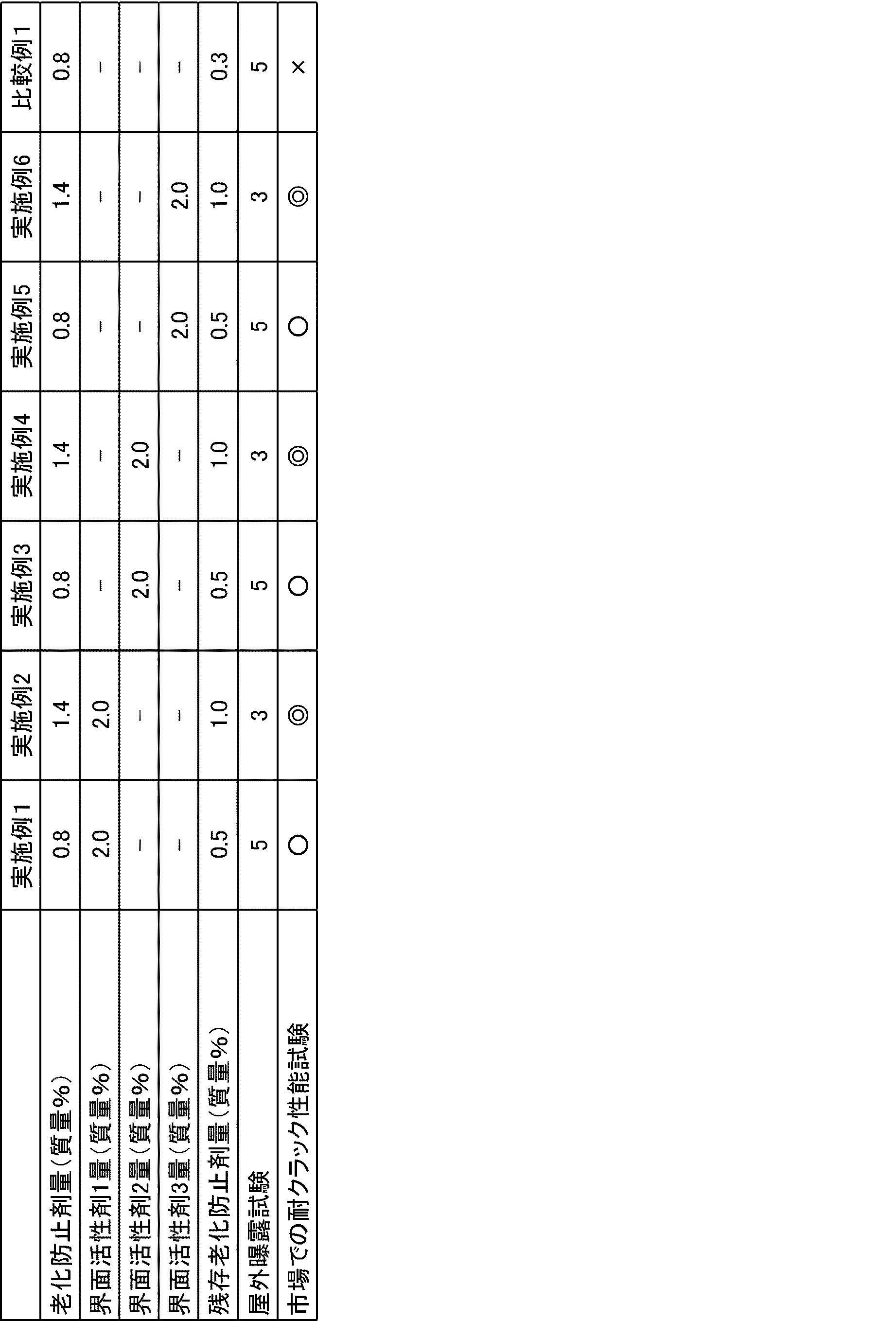
1.7Lバンバリーミキサーを用いて、天然ゴム(20部)、SBR(40部)、BR(40部)、カーボンブラック(20部)、シリカ(50部)、シランカップリング剤(5部)、プロセスオイル(20部)、パラフィンワックス(1部)、老化防止剤(表1の老化防止剤量参照)、非イオン界面活性剤(表1の非イオン性界面活性剤量参照)、ステアリン酸(2部)、酸化亜鉛(2部)を混練りした。次に、オープンロールを用いて、得られた混練り物に硫黄(2部)及び加硫促進剤(1部)を添加して練り込み、未加硫ゴム組成物を得た。次に、得られた未加硫ゴム組成物を170℃で15分間、2mm厚の金型でプレス加硫し、加硫ゴム組成物(加硫ゴムシート)を得た。
また、得られた未加硫ゴム組成物を用いて、トレッドの形状に合わせて成形し、他のタイヤ部材とともに貼り合わせて未加硫タイヤを作製し、170℃で加硫して試験用タイヤを得た。
なお、表1に記載の量(質量%)は、ゴム組成物100質量%中の含有量(質量%)を意味する。
Using a 1.7 L Banbury mixer, natural rubber (20 parts), SBR (40 parts), BR (40 parts), carbon black (20 parts), silica (50 parts), silane coupling agent (5 parts), Process oil (20 parts), paraffin wax (1 part), anti-aging agent (see anti-aging agent amount in Table 1), nonionic surfactant (see non-ionic surfactant amount in Table 1), stearic acid ( 2 parts) and zinc oxide (2 parts) were kneaded. Next, using an open roll, sulfur (2 parts) and a vulcanization accelerator (1 part) were added to the kneaded product and kneaded to obtain an unvulcanized rubber composition. Next, the obtained unvulcanized rubber composition was press vulcanized with a 2 mm thick mold at 170 ° C. for 15 minutes to obtain a vulcanized rubber composition (vulcanized rubber sheet).
Further, using the obtained unvulcanized rubber composition, the tire is molded in accordance with the shape of the tread, and bonded together with other tire members to produce an unvulcanized tire, and vulcanized at 170 ° C. for a test tire. Got.
In addition, the quantity (mass%) of Table 1 means content (mass%) in 100 mass% of rubber compositions.
<加硫ゴム組成物の評価>
得られた加硫ゴム組成物を下記により評価し、結果を表1に示した。
厚さ2mmのゴムシートから幅15mm×長さ120mmの長方形状に切り出したサンプルを試験片とし、80℃のオーブンで2週間静置した(恒温容器の容量:64L、恒温容器内の風速:1.0m/s)後、以下の評価を行った。
<Evaluation of vulcanized rubber composition>
The obtained vulcanized rubber composition was evaluated as follows, and the results are shown in Table 1.
A sample cut out from a rubber sheet having a thickness of 2 mm into a rectangular shape having a width of 15 mm and a length of 120 mm was used as a test piece, and was left to stand in an oven at 80 ° C. for 2 weeks (capacity of the thermostatic container: 64 L, wind speed in the thermostatic container: 1 0.0 m / s), the following evaluation was performed.
(残存老化防止剤濃度の計測)
試験片から1mm角の立方体形状に切り出したものを50mg準備し、アセトン(和光純薬工業(株)製の特級アセトン)にて試験片内部の老化防止剤などを抽出した。得られた抽出物を、ガスクロマトグラフィー装置((株)島津製作所製)を用いて成分分析を行った。溶離剤として窒素ガス((株)島津製作所製、純度99.9%)を用い、毎分50mL、50℃の条件で分離した後、概物質の溶出ピークの面積を用いて、概物質の重量分率を見積もった。
(Measurement of residual anti-aging agent concentration)
50 mg of a 1 mm square cube cut out from the test piece was prepared, and the anti-aging agent and the like inside the test piece were extracted with acetone (special grade acetone manufactured by Wako Pure Chemical Industries, Ltd.). The obtained extract was subjected to component analysis using a gas chromatography apparatus (manufactured by Shimadzu Corporation). Using nitrogen gas (manufactured by Shimadzu Corporation, purity: 99.9%) as an eluent and separating at 50 mL / min at 50 ° C., using the area of the elution peak of the approximate substance, the weight of the approximate substance The fraction was estimated.
(屋外暴露試験)
ゴム試験片を屋外の日の当たる場所(兵庫県神戸市)に6カ月間(3月〜9月)放置した後、色差計を用いて、a*、b*を測定し、その値により、以下の基準にしたがって5段階に分けて評価した。数字が大きいほど、茶変色の度合いが小さいことを示している。なお、a*は赤色の強さを意味しており、b*は黄色の強さを意味している。3以上の場合、耐変色性が良好であると判断した。
(基準)
1:−(a*+b*)×10≦−30
2:−30<−(a*+b*)×10≦−20
3:−20<−(a*+b*)×10≦−10
4:−10<−(a*+b*)×10≦0
5:−(a*+b*)×10>0
(Outdoor exposure test)
After leaving the rubber test piece in a place exposed to the sun (Kobe City, Hyogo Prefecture) for 6 months (March to September), measure the a * and b * using a color difference meter. Evaluation was made in five stages according to the following criteria. The larger the number, the smaller the degree of brown discoloration. In addition, a * means the intensity of red, and b * means the intensity of yellow. In the case of 3 or more, it was judged that the discoloration resistance was good.
(Standard)
1: − (a * + b * ) × 10 ≦ −30
2: −30 <− (a * + b * ) × 10 ≦ −20
3: −20 <− (a * + b * ) × 10 ≦ −10
4: −10 <− (a * + b * ) × 10 ≦ 0
5:-(a * + b * ) × 10> 0
<試験用タイヤの市場での耐クラック性評価>
試験用タイヤを2年間使用した後、トレッド溝底の耐クラック性を評価した。評価方法は目視にて確認し、亀裂の長さに応じて下記のように評点付けを行った。結果を表1に示した。
◎:亀裂が発生していない
○:亀裂は発生しているが、長さが1mm未満
△:亀裂の長さが1mm以上〜3mm未満
×:亀裂の長さが3mm以上
<Evaluation of crack resistance in test tire market>
After using the test tire for 2 years, the crack resistance of the tread groove bottom was evaluated. The evaluation method was confirmed by visual observation, and was scored as follows according to the length of the crack. The results are shown in Table 1.
A: No crack is generated. B: A crack is generated, but the length is less than 1 mm. Δ: The crack length is 1 mm or more to less than 3 mm. X: The crack length is 3 mm or more.
80℃の恒温容器に2週間静置した後、残存する老化防止剤の含有量が0.5質量%以上である実施例は、良好な耐クラック性を有していた。また、実施例は、耐変色性、ゴム(タイヤ)の外観も良好であった。 The example in which the content of the remaining antioxidant was 0.5% by mass or more after standing in a thermostatic container at 80 ° C. for 2 weeks had good crack resistance. Further, in the examples, the discoloration resistance and the appearance of rubber (tire) were also good.
実施例及び比較例の比較により、残存老化防止剤量と市場での耐クラック性能には相関があり、80℃の恒温容器に2週間静置した後、残存する老化防止剤の含有量が0.5質量%以上であれば市場での耐クラック性を保てることが分かった。 By comparing the examples and comparative examples, there is a correlation between the amount of residual anti-aging agent and the crack resistance performance in the market, and after standing in a thermostatic container at 80 ° C. for 2 weeks, the content of anti-aging agent remaining is 0 It has been found that crack resistance in the market can be maintained when the content is 5% by mass or more.
実施例1と比較例1の比較により、特定の非イオン界面活性剤を配合した実施例1の方が残存する老化防止剤の含有量が多いことから、ゴム組成物に特定の非イオン界面活性剤を配合することにより、老化防止剤の表面への析出速度を抑えつつ、表面に析出した後の老化防止剤の揮発も抑制でき、耐クラック性を改善できることが分かった。 As a result of comparison between Example 1 and Comparative Example 1, since the content of the remaining anti-aging agent is higher in Example 1 in which a specific nonionic surfactant is blended, a specific nonionic surfactant is added to the rubber composition. It was found that by blending the agent, the volatilization of the anti-aging agent after deposition on the surface can be suppressed while suppressing the deposition rate of the anti-aging agent, and the crack resistance can be improved.
Claims (7)
Priority Applications (1)
| Application Number | Priority Date | Filing Date | Title |
|---|---|---|---|
| JP2016081263A JP2017190412A (en) | 2016-04-14 | 2016-04-14 | Tire rubber composition, and pneumatic tire |
Applications Claiming Priority (1)
| Application Number | Priority Date | Filing Date | Title |
|---|---|---|---|
| JP2016081263A JP2017190412A (en) | 2016-04-14 | 2016-04-14 | Tire rubber composition, and pneumatic tire |
Publications (1)
| Publication Number | Publication Date |
|---|---|
| JP2017190412A true JP2017190412A (en) | 2017-10-19 |
Family
ID=60084527
Family Applications (1)
| Application Number | Title | Priority Date | Filing Date |
|---|---|---|---|
| JP2016081263A Pending JP2017190412A (en) | 2016-04-14 | 2016-04-14 | Tire rubber composition, and pneumatic tire |
Country Status (1)
| Country | Link |
|---|---|
| JP (1) | JP2017190412A (en) |
Cited By (2)
| Publication number | Priority date | Publication date | Assignee | Title |
|---|---|---|---|---|
| CN108037119A (en) * | 2017-12-05 | 2018-05-15 | 中国兵器工业第五九研究所 | A kind of atmospheric environment severity appraisal procedure based on typical polymer material aging |
| WO2020004560A1 (en) * | 2018-06-28 | 2020-01-02 | 横浜ゴム株式会社 | Rubber composition |
Citations (6)
| Publication number | Priority date | Publication date | Assignee | Title |
|---|---|---|---|---|
| WO2014203667A1 (en) * | 2013-06-18 | 2014-12-24 | 住友ゴム工業株式会社 | Rubber composition for tires, and pneumatic tire |
| WO2014203666A1 (en) * | 2013-06-18 | 2014-12-24 | 住友ゴム工業株式会社 | Rubber composition for tires, and pneumatic tire |
| JP2015000973A (en) * | 2013-06-18 | 2015-01-05 | 住友ゴム工業株式会社 | Rubber composition for tires, and pneumatic tire |
| JP2015000972A (en) * | 2013-06-18 | 2015-01-05 | 住友ゴム工業株式会社 | Rubber composition for tire and pneumatic tire |
| WO2015001935A1 (en) * | 2013-07-05 | 2015-01-08 | 住友ゴム工業株式会社 | Tire rubber composition and pneumatic tire |
| JP2015157879A (en) * | 2014-02-21 | 2015-09-03 | 住友ゴム工業株式会社 | Tire rubber composition and pneumatic tire |
-
2016
- 2016-04-14 JP JP2016081263A patent/JP2017190412A/en active Pending
Patent Citations (8)
| Publication number | Priority date | Publication date | Assignee | Title |
|---|---|---|---|---|
| WO2014203667A1 (en) * | 2013-06-18 | 2014-12-24 | 住友ゴム工業株式会社 | Rubber composition for tires, and pneumatic tire |
| WO2014203666A1 (en) * | 2013-06-18 | 2014-12-24 | 住友ゴム工業株式会社 | Rubber composition for tires, and pneumatic tire |
| JP2015000973A (en) * | 2013-06-18 | 2015-01-05 | 住友ゴム工業株式会社 | Rubber composition for tires, and pneumatic tire |
| JP2015000971A (en) * | 2013-06-18 | 2015-01-05 | 住友ゴム工業株式会社 | Rubber composition for tires, and pneumatic tire |
| JP2015000972A (en) * | 2013-06-18 | 2015-01-05 | 住友ゴム工業株式会社 | Rubber composition for tire and pneumatic tire |
| JP2015000974A (en) * | 2013-06-18 | 2015-01-05 | 住友ゴム工業株式会社 | Rubber composition for tires, and pneumatic tire |
| WO2015001935A1 (en) * | 2013-07-05 | 2015-01-08 | 住友ゴム工業株式会社 | Tire rubber composition and pneumatic tire |
| JP2015157879A (en) * | 2014-02-21 | 2015-09-03 | 住友ゴム工業株式会社 | Tire rubber composition and pneumatic tire |
Cited By (2)
| Publication number | Priority date | Publication date | Assignee | Title |
|---|---|---|---|---|
| CN108037119A (en) * | 2017-12-05 | 2018-05-15 | 中国兵器工业第五九研究所 | A kind of atmospheric environment severity appraisal procedure based on typical polymer material aging |
| WO2020004560A1 (en) * | 2018-06-28 | 2020-01-02 | 横浜ゴム株式会社 | Rubber composition |
Similar Documents
| Publication | Publication Date | Title |
|---|---|---|
| US9994699B2 (en) | Tire rubber composition and pneumatic tire | |
| US9708476B2 (en) | Tire rubber composition and pneumatic tire | |
| JP6193841B2 (en) | Rubber composition for tire and pneumatic tire | |
| JP5934677B2 (en) | Rubber composition for tire and pneumatic tire | |
| JP5946798B2 (en) | Rubber composition for tire and pneumatic tire | |
| JP6133703B2 (en) | Rubber composition for tire and pneumatic tire | |
| JP6010060B2 (en) | Rubber composition for tire and pneumatic tire | |
| WO2015001942A1 (en) | Pneumatic tire | |
| JP6084934B2 (en) | Rubber composition for tire and pneumatic tire | |
| JP5806705B2 (en) | Rubber composition for tire and pneumatic tire | |
| JP6346081B2 (en) | Rubber composition for tire and pneumatic tire | |
| JP6374315B2 (en) | Rubber composition for tire and pneumatic tire | |
| JP6552454B2 (en) | Rubber composition for tire and pneumatic tire | |
| EP3257894B1 (en) | Rubber composition for tire and pneumatic tire | |
| US20210291589A1 (en) | Pneumatic tire | |
| JP6088090B2 (en) | Rubber composition for tire and pneumatic tire | |
| JP6389068B2 (en) | Rubber composition for tire and pneumatic tire |
Legal Events
| Date | Code | Title | Description |
|---|---|---|---|
| A621 | Written request for application examination |
Free format text: JAPANESE INTERMEDIATE CODE: A621 Effective date: 20190204 |
|
| A977 | Report on retrieval |
Free format text: JAPANESE INTERMEDIATE CODE: A971007 Effective date: 20200226 |
|
| A131 | Notification of reasons for refusal |
Free format text: JAPANESE INTERMEDIATE CODE: A131 Effective date: 20200303 |
|
| A521 | Request for written amendment filed |
Free format text: JAPANESE INTERMEDIATE CODE: A523 Effective date: 20200501 |
|
| A131 | Notification of reasons for refusal |
Free format text: JAPANESE INTERMEDIATE CODE: A131 Effective date: 20201104 |
|
| A02 | Decision of refusal |
Free format text: JAPANESE INTERMEDIATE CODE: A02 Effective date: 20210511 |