JP2017190515A - Steel wire and method for producing the same - Google Patents
Steel wire and method for producing the same Download PDFInfo
- Publication number
- JP2017190515A JP2017190515A JP2016082293A JP2016082293A JP2017190515A JP 2017190515 A JP2017190515 A JP 2017190515A JP 2016082293 A JP2016082293 A JP 2016082293A JP 2016082293 A JP2016082293 A JP 2016082293A JP 2017190515 A JP2017190515 A JP 2017190515A
- Authority
- JP
- Japan
- Prior art keywords
- steel wire
- temperature
- less
- transformation
- steel
- Prior art date
- Legal status (The legal status is an assumption and is not a legal conclusion. Google has not performed a legal analysis and makes no representation as to the accuracy of the status listed.)
- Granted
Links
Landscapes
- Heat Treatment Of Steel (AREA)
Abstract
Description
本発明は、大きな吸収エネルギーを示す鋼線およびその製造方法に関する。 The present invention relates to a steel wire exhibiting large absorbed energy and a method for producing the same.
崖や切通しに接している道路や線路への落石の侵入を防止するために、落石防護ネットが用いられている。落石防護ネットには、落石時に落石の運動エネルギーを吸収して落石を受け止め、落石を静止させることが要求される。 A rockfall protection net is used to prevent rockfalls from entering the roads and tracks that are in contact with cliffs and cuts. A rockfall protection net is required to absorb the kinetic energy of the rockfall and receive the rockfall and to stop the rockfall.
落石防護ネットに用いられる鋼線の破壊に至るまでのエネルギー吸収量は、概ね引張強度と伸びに比例する。伸びが変わらないのであれば引張強度を上げるほど、引張強度が変わらないのであれば伸びが大きくなるほど、鋼線の吸収エネルギーは大きくなる。しかしながら、通常、引張強度をあげると引張強度の上昇率以上に伸びが低下するため、吸収エネルギーは小さくなる。このため、落石防護ネット用の鋼線は軟質で伸びが大きななまし線が多用されてきた。伸びを低下することなく引張強度の上昇を図ることができれば、落石防護ネットの吸収エネルギーは飛躍的に増大する。 The amount of energy absorbed until the steel wire used in the rockfall protection net is broken is roughly proportional to the tensile strength and elongation. If the elongation does not change, the absorbed energy of the steel wire increases as the tensile strength increases, and if the tensile strength does not change, the elongation increases. However, normally, when the tensile strength is increased, the elongation is reduced more than the rate of increase of the tensile strength, so the absorbed energy is reduced. For this reason, steel wires for rockfall protection nets have been frequently used for soft wires with large elongation. If the tensile strength can be increased without decreasing the elongation, the energy absorbed by the rock fall protection net will increase dramatically.
鋼材の伸びを低下することなく引張強度の上昇を図る手法として、残留オーステナイトを活用する方法が知られている。即ち、伸び(変形)の途中で残留オーステナイトが次々マルテンサイトに変態し(加工誘起変態)、破断の起点となる脆弱部分を強化して、伸びを確保する方法である。 A method of utilizing retained austenite is known as a method for increasing the tensile strength without reducing the elongation of the steel material. That is, in this process, retained austenite is transformed into martensite one after another in the course of elongation (deformation) (processing-induced transformation), and the fragile portion that is the starting point of fracture is strengthened to ensure elongation.
残留オーステナイトを活用した落石防護に関する技術として特許文献1の技術がある。特許文献1に記載の技術は、主に落石防護柵、落石防護ネット等の落石防止設備を支えるロープでエネルギーを吸収する技術である。 As a technique related to rock fall protection using residual austenite, there is a technique of Patent Document 1. The technique described in Patent Document 1 is a technique that absorbs energy with a rope that supports rockfall prevention facilities such as a rockfall protection fence and a rockfall protection net.
しかしながら、特許文献1等の従来の残留オーステナイトを活用する方法で落石防護ネット等の落石防止設備を作製した場合でも、依然として、受け止められる落石エネルギーの大きさが不十分であった。より大きな落石エネルギーを受け止めるためには、落石防護ネット等の落石防止設備自体に用いることが可能な鋼線のエネルギー吸収能を上げることが必要である。 However, even when rock fall prevention equipment such as a rock fall protection net is produced by a method utilizing conventional retained austenite, such as Patent Document 1, the magnitude of fall rock energy that can be received is still insufficient. In order to receive larger rockfall energy, it is necessary to increase the energy absorption capacity of the steel wire that can be used for the rockfall prevention equipment itself such as the rockfall protection net.
そのため、従来よりも、破断するまでに大きなエネルギーを吸収することが可能な鋼線が求められている。 Therefore, there is a demand for a steel wire that can absorb a large amount of energy before it breaks.
本発明の要旨は以下のとおりである:
(1)質量%で、
C:0.05〜0.25%、
Si:0.3〜1.0%、
Mn:0.10〜3.00%、
S:0.005〜0.015%、
N:0.005〜0.013%、および
Al:0.005%以下
の化学成分を含有し、
残部がFeおよび不可避不純物からなる鋼線であって、
前記鋼線断面におけるフェライトの結晶粒径が9μm以下であり、
断面面積率で8%以上の残留オーステナイトを含み、
破断までの単位面積当たりの吸収エネルギーが1300J/cm2以上である、
ことを特徴とする鋼線。
(2)質量%で更に、Cr:0.05〜2.00%、Ni:0.05〜2.00%、Cu:0.05〜1.00%、Mo:0.05〜1.00%のうち一種または二種以上を含有することを特徴とする、上記(1)に記載の鋼線。
(3)質量%で、
C:0.05〜0.25%、
Si:0.3〜1.0%、
Mn:0.10〜3.00%、
S:0.005〜0.015%、
N:0.005〜0.013%、および
Al:0.005%以下
の化学成分を含有し、
残部がFeおよび不可避不純物からなる鋼材を、1.0以上の塑性歪を与えて伸線すること、
前記伸線した鋼材を、AC1変態点温度以上且つ(AC1変態点温度+AC3変態点温度)/2以下の加熱温度まで8℃/秒以上の昇温速度で加熱し、前記加熱温度にて15秒〜120秒保持すること、
前記加熱した鋼材を、8℃/秒以上の冷却速度で式(2):
MS(℃)=550−350C−40Mn−10Cu−17Ni−20Cr
−10Mo+30Al (2)
で示されるMS変態点温度を基準として、(MS変態点温度+50℃)以下且つ(MS変態点温度−50℃)以上の温度まで冷却し、その温度で50〜320秒保持すること、および
前記冷却した鋼材を、室温までさらに空冷すること、
を特徴とする鋼線の製造方法。
The gist of the present invention is as follows:
(1) In mass%,
C: 0.05 to 0.25%
Si: 0.3 to 1.0%,
Mn: 0.10 to 3.00%,
S: 0.005-0.015%,
N: 0.005 to 0.013%, and Al: 0.005% or less of chemical components,
The balance is a steel wire made of Fe and inevitable impurities,
The ferrite grain size in the steel wire cross section is 9 μm or less,
Including residual austenite of 8% or more in cross-sectional area ratio,
The absorbed energy per unit area until breakage is 1300 J / cm 2 or more,
A steel wire characterized by that.
(2) By mass%, Cr: 0.05 to 2.00%, Ni: 0.05 to 2.00%, Cu: 0.05 to 1.00%, Mo: 0.05 to 1.00 The steel wire as set forth in (1) above, comprising one or more of%.
(3) In mass%,
C: 0.05 to 0.25%
Si: 0.3 to 1.0%,
Mn: 0.10 to 3.00%,
S: 0.005-0.015%,
N: 0.005 to 0.013%, and Al: 0.005% or less of chemical components,
Drawing the steel material, the balance of which is Fe and inevitable impurities, giving a plastic strain of 1.0 or more,
The steel described above drawing, heating at A C1 transformation point temperature or higher and (A C1 transformation point temperature + A C3 transformation temperature) / 2 or less to the heating temperature 8 ° C. / sec or more heating rate, the heating temperature Hold for 15 to 120 seconds,
The heated steel material is expressed by the formula (2) at a cooling rate of 8 ° C./second or more:
M S (° C.) = 550−350C-40Mn-10Cu-17Ni-20Cr
-10Mo + 30Al (2)
In reference to the M S transformation temperature indicated, (M S transformation temperature + 50 ° C.) or less and cooled to (M S transformation temperature -50 ° C.) or higher temperatures, can be held at that temperature from 50 to 320 seconds And further cooling the cooled steel material to room temperature,
A method of manufacturing a steel wire characterized by
本発明によれば、大きな吸収エネルギーを示す鋼線を得ることができる。 According to the present invention, a steel wire exhibiting large absorbed energy can be obtained.
本発明は、質量%で、C:0.05〜0.25%、Si:0.3〜1.0%、Mn:0.10〜3.00%、S:0.005〜0.015%、N:0.005〜0.013%、およびAl:0.005%以下の化学成分を含有し、残部がFeおよび不可避不純物からなる鋼線であって、前記鋼線断面におけるフェライトの結晶粒径が9μm以下であり、断面面積率で8%以上の残留オーステナイトを含み、破断までの単位面積当たりの吸収エネルギーが1300J/cm2以上である、ことを特徴とする鋼線を対象とする。 In the present invention, by mass, C: 0.05 to 0.25%, Si: 0.3 to 1.0%, Mn: 0.10 to 3.00%, S: 0.005 to 0.015 %, N: 0.005 to 0.013%, and Al: 0.005% or less of chemical components, the balance being Fe and unavoidable impurities, and a ferrite crystal in the cross section of the steel wire Intended for a steel wire having a particle size of 9 μm or less, containing 8% or more of retained austenite in cross-sectional area ratio, and having an absorbed energy per unit area of 1300 J / cm 2 or more until fracture. .
本発明に係る鋼線は、所定の化学成分並びに残部としてFeおよび不可避不純物からなり、断面におけるフェライトの結晶粒径が9μm以下であり、且つ8%以上の残留オーステナイトを含む鋼線である。本発明に係る鋼線は、従来のなまし線に比べて、引張強度と延性のバランスに優れており、大きな吸収エネルギーを示す。本願において、吸収エネルギーとは、鋼線の引張強度試験時における荷重―変位曲線を変位で積分した値である。 The steel wire according to the present invention is a steel wire comprising a predetermined chemical component and the balance Fe and inevitable impurities, the ferrite crystal grain size in the cross section being 9 μm or less, and containing 8% or more of retained austenite. The steel wire according to the present invention is superior in balance between tensile strength and ductility as compared with a conventional annealed wire, and exhibits a large absorbed energy. In the present application, the absorbed energy is a value obtained by integrating the load-displacement curve in the tensile strength test of the steel wire by the displacement.
本発明に係る鋼線を用いて落石防護ネット用の金網を編むことができる。本発明に係る鋼線を用いて作製した金網を備えた落石防護ネットは、落石の衝突等で特定部位に高い負荷がかかった場合、その部位の鋼線が加工誘起マルテンサイトの生成により強化され、他の部位の鋼線に変形が分散されて、従来よりも大きな吸収エネルギーを示すことができる。また、本発明に係る鋼線は大きな吸収エネルギーを示すため、本発明に係る鋼線を用いて落石防護ネット用の金網を作製する場合、落石防護ネット用の金網を単線で構成することができるので、落石防護ネットを安価に作製することができる。本願において、単線とは、撚り線ではないことを意味する。撚り線は、複数の線を撚り合わせたものである。 A wire mesh for a rock fall protection net can be knitted using the steel wire according to the present invention. When a high load is applied to a specific part of a rockfall protection net provided with a wire mesh produced by using the steel wire according to the present invention, the steel wire at that part is strengthened by the formation of work-induced martensite. The deformation is dispersed in the steel wires in other parts, and the absorbed energy can be shown larger than before. In addition, since the steel wire according to the present invention exhibits a large absorbed energy, when a wire mesh for a rock fall protection net is produced using the steel wire according to the present invention, the wire mesh for the rock fall protection net can be constituted by a single wire. Therefore, a rockfall protection net can be produced at low cost. In the present application, a single wire means that it is not a stranded wire. A stranded wire is obtained by twisting a plurality of wires.
以下に、本発明に係る鋼線の組成を説明する。以下の組成の説明において、パーセント表示は、鋼線の全質量を基準とする質量%である。 Below, the composition of the steel wire which concerns on this invention is demonstrated. In the description of the composition below, the percentage display is mass% based on the total mass of the steel wire.
本発明に係る鋼線は、質量%で、
C:0.05〜0.25%、
Si:0.3〜1.0%、
Mn:0.10〜3.00%、
S:0.005〜0.015%、
N:0.005〜0.013%、および
Al:0.005%以下を含有する。
The steel wire according to the present invention is mass%,
C: 0.05 to 0.25%
Si: 0.3 to 1.0%,
Mn: 0.10 to 3.00%,
S: 0.005-0.015%,
N: 0.005 to 0.013%, and Al: 0.005% or less.
鋼線は、0.05〜0.25%のCを含む。Cは、残留オーステナイトの生成のため重要な元素で、鋼線が0.05%以上のCを含むことによって十分な量の残留オーステナイトを得ることができ、良好な伸びが得られる。鋼線は、好ましくは0.10%以上のCを含む。鋼線中のC含有量が0.25%を超えると、鋼線が硬くなりすぎ伸びが低下して、金網に成形することが困難になるため、C含有量の上限を0.25%以下、好ましくは0.23%以下とする。 The steel wire contains 0.05 to 0.25% C. C is an important element for the production of retained austenite. When the steel wire contains 0.05% or more of C, a sufficient amount of retained austenite can be obtained, and good elongation can be obtained. The steel wire preferably contains 0.10% or more of C. If the C content in the steel wire exceeds 0.25%, the steel wire becomes too hard and the elongation decreases, making it difficult to form into a wire mesh, so the upper limit of the C content is 0.25% or less. Preferably, the content is 0.23% or less.
鋼線は、0.3〜1.0%のSiを含む。Siは、変態過程においてBCC相(フェライト)から未変態FCC相(オーステナイト)へのCの濃化を促し、残留オーステナイトの生成を容易にする元素である。鋼線が0.3%以上のSiを含むことによって、残留オーステナイトの生成を促進することができる。鋼線は、好ましくは0.4%以上のSiを含む。鋼線中のSi含有量が1.0%を超えると、スケール剥離性に問題が生じるため、Si含有量の上限を1.0%以下、好ましくは0.9%以下、より好ましくは0.8%以下、さらに好ましくは0.7%以下とする。 The steel wire contains 0.3 to 1.0% Si. Si is an element that promotes the concentration of C from the BCC phase (ferrite) to the untransformed FCC phase (austenite) in the transformation process, and facilitates the formation of residual austenite. When the steel wire contains 0.3% or more of Si, the generation of retained austenite can be promoted. The steel wire preferably contains 0.4% or more of Si. If the Si content in the steel wire exceeds 1.0%, a problem arises in scale peelability. Therefore, the upper limit of the Si content is 1.0% or less, preferably 0.9% or less, more preferably 0.8. 8% or less, more preferably 0.7% or less.
鋼線は、0.10〜3.00%のMnを含む。Mnは、拡散型変態であるフェライト変態およびパーライト変態の変態速度を低下させ、残留オーステナイトを生成し易くする効果のある元素である。鋼線が0.10%以上のMnを含むことによって、フェライト粒の粗大化を抑制し十分な量の残留オーステナイトを生成することができる。鋼線は、好ましくは0.20%以上のMnを含む。鋼線中のMn含有量が3.00%を超えると熱間延性の低下を招き製造性が著しく低下するため、Mn含有量の上限を3.00%以下、好ましくは2.50%以下とする。 The steel wire contains 0.10 to 3.00% of Mn. Mn is an element that has the effect of reducing the transformation rate of the ferrite transformation and pearlite transformation, which are diffusion transformations, and facilitating the formation of retained austenite. When the steel wire contains 0.10% or more of Mn, it is possible to suppress the coarsening of ferrite grains and to generate a sufficient amount of retained austenite. The steel wire preferably contains 0.20% or more of Mn. When the Mn content in the steel wire exceeds 3.00%, the hot ductility is lowered and the productivity is remarkably lowered. Therefore, the upper limit of the Mn content is 3.00% or less, preferably 2.50% or less. To do.
鋼線は、0.005〜0.015%のSを含む。Sは、MnSを形成しスケール剥離性を向上させる重要な元素である。鋼線が0.005%以上のSを含むことによって、スケール剥離性を向上することができる。鋼線は、好ましくは0.008%以上のSを含む。鋼線中のS含有量が0.015%を超えると、MnSを起点とした破壊が顕著になり延性が低下するため、S含有量の上限を0.015%以下、好ましくは0.012%以下とする。本発明に係る鋼線は高い引張強度を有するが、MnSが多く生成されると引張強度への悪影響が極めて大きいため、鋼線中のS含有量は厳格に制限される。 The steel wire contains 0.005 to 0.015% S. S is an important element that forms MnS and improves the scale peelability. When the steel wire contains 0.005% or more of S, scale peelability can be improved. The steel wire preferably contains 0.008% or more of S. If the S content in the steel wire exceeds 0.015%, fracture starting from MnS becomes prominent and ductility decreases, so the upper limit of the S content is 0.015% or less, preferably 0.012%. The following. Although the steel wire according to the present invention has a high tensile strength, if a large amount of MnS is produced, the adverse effect on the tensile strength is extremely large, so the S content in the steel wire is strictly limited.
鋼線は、0.005〜0.013%のNを含む。Nは、Cと同様に、残留オーステナイト生成のために重要な元素である。鋼線が0.005%以上のNを含むことによって、残留オーステナイトを生成させる効果が非常に大きくなる。鋼線は、好ましくは0.008%以上のNを含む。鋼線中のN含有量が0.013%を超えると、溶製が困難になるため、N含有量の上限を0.013%以下、好ましくは0.010%とする。このように、残留オーステナイト生成および溶製の観点から、鋼線中のN含有量は厳格に制限される。 The steel wire contains 0.005 to 0.013% N. N, like C, is an important element for the formation of retained austenite. When the steel wire contains 0.005% or more of N, the effect of generating retained austenite becomes very large. The steel wire preferably contains 0.008% or more of N. If the N content in the steel wire exceeds 0.013%, melting becomes difficult, so the upper limit of the N content is 0.013% or less, preferably 0.010%. Thus, from the viewpoint of residual austenite formation and melting, the N content in the steel wire is strictly limited.
本発明に係る鋼線において、Al含有量はできる限り少ない方がよく、鋼線中のAl含有量を0.005%以下、より好ましくは0.003%以下とする。Alは、Siと同様、未変態オーステナイトへのCの濃化を促し、残留オーステナイトの生成を容易にし得るが、鋼線の吸収エネルギーを大きくすることはできない。また、Alは、製錬時にOと反応して硬質なAl2O3を生成し、伸線時の断線の原因となるため、Al含有量は可能な限り低減する必要がある。本発明に係る鋼線は高い引張強度を有するが、生成し得るAl2O3の引張強度への悪影響が極めて大きいため、鋼線中のAl含有量は厳格に制限される。 In the steel wire according to the present invention, the Al content is preferably as low as possible, and the Al content in the steel wire is 0.005% or less, more preferably 0.003% or less. Al, like Si, can promote the concentration of C into untransformed austenite and facilitate the formation of residual austenite, but it cannot increase the absorbed energy of the steel wire. Further, Al reacts with O during smelting to produce hard Al 2 O 3 and causes disconnection during wire drawing, so the Al content needs to be reduced as much as possible. The steel wire according to the present invention has a high tensile strength, but the Al content in the steel wire is strictly limited because the adverse effect on the tensile strength of Al 2 O 3 that can be produced is extremely large.
好ましくは、鋼線は、質量%で更に、0.05〜2.00%のCr、0.05〜2.00%のNi、0.05〜1.00%のCu、および0.05〜1.00%のMoのうち一種または二種以上を含有する。 Preferably, the steel wire further comprises 0.05 to 2.00% Cr, 0.05 to 2.00% Ni, 0.05 to 1.00% Cu, and 0.05 to 1 type or 2 types or more are included among 1.00% Mo.
Cr、Ni、Cu、およびMoはそれぞれ、鋼の強化元素であり、残留オーステナイトを生成し易くする元素である。Cr、Ni、Cu、およびMoを、それぞれ、鋼線中に好ましくは0.05%以上、より好ましくは0.2%以上、さらに好ましくは0.5%以上、さらにより好ましくは1.1%以上添加することが好ましい。CrおよびNiについては、過剰の添加はコストを上昇させるので、鋼線中の含有量の上限を2.00%以下とする。CuおよびMoについても、過剰の添加はコストを上昇させるので、鋼線中の含有量の上限を1.00%以下とする。 Each of Cr, Ni, Cu, and Mo is a steel strengthening element, and is an element that facilitates the formation of retained austenite. Each of Cr, Ni, Cu, and Mo is preferably 0.05% or more, more preferably 0.2% or more, still more preferably 0.5% or more, and even more preferably 1.1% in the steel wire. It is preferable to add more. For Cr and Ni, excessive addition increases the cost, so the upper limit of the content in the steel wire is made 2.00% or less. Also for Cu and Mo, excessive addition increases the cost, so the upper limit of the content in the steel wire is made 1.00% or less.
鋼線の残部は、Feおよび不可避不純物である。 The balance of the steel wire is Fe and inevitable impurities.
鋼線の断面におけるフェライトの結晶粒径は、9μm以下、好ましくは8μm以下、より好ましくは7μm以下、さらに好ましくは6μm以下である。フェライトの結晶粒径の下限は特に限定されるものではないが、例えば1μm程度にすることができる。フェライトの結晶粒径が上記範囲にあることにより、残留オーステナイトを多く生成することができる。また、フェライトの結晶粒径が上記範囲にあることにより、伸びを大きすることもできる。 The crystal grain size of ferrite in the cross section of the steel wire is 9 μm or less, preferably 8 μm or less, more preferably 7 μm or less, and further preferably 6 μm or less. The lower limit of the crystal grain size of ferrite is not particularly limited, but can be about 1 μm, for example. When the crystal grain size of ferrite is in the above range, a large amount of retained austenite can be generated. Further, when the ferrite crystal grain size is in the above range, the elongation can be increased.
鋼線は、断面面積率で8%以上、好ましくは9%以上、より好ましくは10%以上、さらに好ましくは11%以上の残留オーステナイトを含む。残留オーステナイトの上限は特に限定されるものではないが、例えば30%以下にすることができる。残留オーステナイトの断面面積率が上記範囲にあることにより、伸びに優れ、且つ破断までの単位面積当たりの吸収エネルギーが大きい鋼線を得ることができる。 The steel wire contains 8% or more, preferably 9% or more, more preferably 10% or more, and even more preferably 11% or more of retained austenite in terms of the cross-sectional area ratio. The upper limit of retained austenite is not particularly limited, but can be, for example, 30% or less. When the cross-sectional area ratio of the retained austenite is in the above range, a steel wire having excellent elongation and large absorbed energy per unit area until breakage can be obtained.
鋼線の、破断までの単位面積当たりの吸収エネルギーは、1300J/cm2以上、好ましくは1400J/cm2以上、より好ましくは1500J/cm2以上、さらに好ましくは1600J/cm2以上である。 The absorbed energy per unit area until breakage of the steel wire is 1300 J / cm 2 or more, preferably 1400 J / cm 2 or more, more preferably 1500 J / cm 2 or more, and further preferably 1600 J / cm 2 or more.
上記範囲の吸収エネルギーを示す鋼線は、落石防護ネットの作製に好適に用いることができる。 The steel wire which shows the absorption energy of the said range can be used suitably for preparation of a rock fall protection net.
本発明に係る鋼線の引張強度(TS)は、好ましくは500MPa以上、より好ましくは550MPa以上、さらに好ましくは575MPa以上、さらにより好ましくは600MPa以上である。 The tensile strength (TS) of the steel wire according to the present invention is preferably 500 MPa or more, more preferably 550 MPa or more, further preferably 575 MPa or more, and even more preferably 600 MPa or more.
本発明に係る鋼線の伸び(EL)は、引張強度とのバランスで、吸収エネルギーが大きくなるような伸び(EL)であればよく、好ましくは30%〜70%程度の範囲であることができる。 The elongation (EL) of the steel wire according to the present invention may be an elongation (EL) that increases the absorbed energy in balance with the tensile strength, and is preferably in the range of about 30% to 70%. it can.
本発明はまた、質量%で、C:0.05〜0.25%、Si:0.3〜1.0%、
Mn:0.10〜3.00%、S:0.005〜0.015%、N:0.005〜0.013%、およびAl:0.005%以下の化学成分を含有し、残部がFeおよび不可避不純物からなる鋼材を、1.0以上の塑性歪を与えて伸線すること、前記伸線した鋼材を、AC1変態点温度以上且つ(AC1変態点温度+AC3変態点温度)/2以下の加熱温度に8℃/秒以上の昇温速度で加熱し、前記加熱温度にて15秒〜120秒保持すること、前記加熱した鋼材を、8℃/秒以上の冷却速度で式(2):
MS(℃)=550−350C−40Mn−10Cu−17Ni−20Cr
−10Mo+30Al (2)
で示されるMS変態点温度を基準として、(MS変態点温度+50℃)以下且つ(MS変態点温度−50℃)以上の温度まで冷却し、その温度で50〜320秒間保持すること、および前記冷却した鋼材を、室温までさらに空冷すること、を特徴とする鋼線の製造方法を対象とする。
The present invention also includes, in mass%, C: 0.05 to 0.25%, Si: 0.3 to 1.0%,
Mn: 0.10 to 3.00%, S: 0.005 to 0.015%, N: 0.005 to 0.013%, and Al: 0.005% or less of chemical components, with the balance being Drawing a steel material composed of Fe and inevitable impurities with a plastic strain of 1.0 or more, and drawing the drawn steel material to an AC1 transformation point temperature or more and ( AC1 transformation point temperature + AC3 transformation point temperature) Heating at a heating rate of 8 ° C./second or more to a heating temperature of / 2 or less and holding at the heating temperature for 15 seconds to 120 seconds, the heated steel material is expressed at a cooling rate of 8 ° C./second or more. (2):
M S (° C.) = 550−350C-40Mn-10Cu-17Ni-20Cr
-10Mo + 30Al (2)
In reference to the M S transformation temperature indicated, (M S transformation temperature + 50 ° C.) or less and cooled to (M S transformation temperature -50 ° C.) or higher temperatures, can be held at that temperature from 50 to 320 seconds And a method for producing a steel wire, characterized in that the cooled steel material is further air-cooled to room temperature.
以下に、本発明に係る鋼線の製造方法の各構成を説明する。 Below, each structure of the manufacturing method of the steel wire which concerns on this invention is demonstrated.
質量%で、C:0.05〜0.25%、Si:0.3〜1.0%、Mn:0.10〜3.00%、S:0.005〜0.015%、N:0.005〜0.013%、およびAl:0.005%以下の化学成分を含有し、残部がFeおよび不可避不純物からなる鋼材を、伸線して鋼線を得る。好ましくは、鋼材を、落石防護ネットを製網するための線径にまで伸線する。本発明に係る鋼線を用いて作製し得る落石防護ネットの網の構造は、好ましくは菱型金網である。落石防護ネットの網目寸法は、好ましくは30〜80mmである。 In mass%, C: 0.05 to 0.25%, Si: 0.3 to 1.0%, Mn: 0.10 to 3.00%, S: 0.005 to 0.015%, N: A steel material containing a chemical component of 0.005 to 0.013% and Al: 0.005% or less, with the balance being Fe and inevitable impurities is drawn to obtain a steel wire. Preferably, the steel material is drawn to a wire diameter for making a rock fall protection net. The net structure of the falling rock protection net that can be produced using the steel wire according to the present invention is preferably a rhombus metal net. The mesh size of the rockfall protection net is preferably 30 to 80 mm.
伸線は、冷間伸線であり、通常のダイスを用いた乾式伸線やローラーを用いた圧延等により行うことができる。 Drawing is cold drawing and can be performed by dry drawing using a normal die, rolling using a roller, or the like.
次いで、伸線した鋼線を、フェライト−オーステナイト2相域に加熱すると、伸線時に導入された高転位密度の部位を核として、フェライトが再結晶する。 Next, when the drawn steel wire is heated to the ferrite-austenite two-phase region, the ferrite is recrystallized with the high dislocation density site introduced at the time of wire drawing as a nucleus.
フェライト再結晶時の粒径は、核の数が多い程微細になるため、加熱前の伸線歪(塑性歪)は高い方が好ましい。加熱前の塑性歪を1.0以上とすることにより、フェライト粒径の粗大化を抑制しフェライト粒径を十分に細かくすることができ、残留オーステナイトを生成しやすくなり伸びが向上する。そのため、塑性歪の下限を1.0以上、好ましくは1.1以上、より好ましくは1.2以上、さらに好ましくは1.3以上とする。塑性歪εは、伸線前の元線径D1と伸線後の線径D2から、式(1):
ε=2×ln(D1/D2) (1)
により算出される。
Since the grain size at the time of recrystallization of ferrite becomes finer as the number of nuclei increases, the wire drawing strain (plastic strain) before heating is preferably higher. By setting the plastic strain before heating to 1.0 or more, coarsening of the ferrite grain size can be suppressed and the ferrite grain size can be made sufficiently fine, and retained austenite can be easily generated to improve elongation. Therefore, the lower limit of plastic strain is 1.0 or more, preferably 1.1 or more, more preferably 1.2 or more, and further preferably 1.3 or more. The plastic strain epsilon, the diameter D 2 after the original wire diameter D 1 and drawing before drawing, formula (1):
ε = 2 × ln (D 1 / D 2 ) (1)
Is calculated by
伸線後の加熱温度を、AC1変態点温度以上にすることにより、フェライト−オーステナイト2相域にすることができる。 The heating temperature after the drawing, by more than A C1 transformation point temperature, ferrite - can be austenite 2-phase region.
また、伸線後の加熱温度を、(AC1変態点温度+AC3変態点温度)/2以下にすることにより、フェライト粒径の粗大化を抑制し、且つフェライト−オーステナイト2相域中のオーステナイト相の炭素濃度をさらに高めることができる。オーステナイト相の炭素濃度をさらに高めることによって、オーステナイト相が安定化し、冷却時にオーステナイトからフェライトへの変態量が減少して、冷却後の残留オーステナイト量を増加させることができる。一方で、伸線後の加熱温度を、(AC1変態点温度+AC3変態点温度)/2よりも高くすると、加熱時のオーステナイト量は増えるが、冷却時にオーステナイトからフェライトへの変態量が増加して、残留オーステナイト量は大きく減少する。 Further, the heating temperature after the drawing, by the (A C1 transformation point temperature + A C3 transformation temperature) / 2 or less, and suppress the coarsening of the ferrite grain size, and the ferrite - austenite in austenite 2-phase region The carbon concentration of the phase can be further increased. By further increasing the carbon concentration of the austenite phase, the austenite phase is stabilized, the amount of transformation from austenite to ferrite decreases during cooling, and the amount of retained austenite after cooling can be increased. On the other hand, when the heating temperature after wire drawing is higher than ( AC1 transformation point temperature + AC3 transformation point temperature) / 2, the amount of austenite during heating increases, but the amount of transformation from austenite to ferrite increases during cooling. Thus, the amount of retained austenite is greatly reduced.
したがって、加熱温度を、AC1変態点温度以上且つ(AC1変態点温度+AC3変態点温度)/2以下に限定することにより、鋼線の伸びを向上することができる。 Therefore, the heating temperature, by limiting the A C1 transformation point temperature or higher and (A C1 transformation point temperature + A C3 transformation temperature) / 2 or less, it is possible to improve the elongation of the steel wire.
なお、伸線時に中間焼鈍を行う場合には、焼鈍時に歪がクリアされるため、ここで規定する塑性歪とは、最終中間焼鈍後の伸線歪である。 When intermediate annealing is performed at the time of wire drawing, the strain is cleared at the time of annealing, so the plastic strain defined here is the wire drawing strain after the final intermediate annealing.
塑性歪が1.0以上であっても、昇温速度が8℃/秒未満であると、昇温中にフェライトが再結晶して粗大化し、残留オーステナイトが減少し伸びが減少するため、昇温速度の下限を8℃/秒以上、好ましくは10℃/秒、より好ましくは20℃/秒以上とする。 Even if the plastic strain is 1.0 or more, if the rate of temperature rise is less than 8 ° C./second, the ferrite recrystallizes and coarsens during the temperature rise, and the retained austenite decreases and the elongation decreases. The lower limit of the temperature rate is 8 ° C./second or more, preferably 10 ° C./second, more preferably 20 ° C./second or more.
フェライト−オーステナイト2相域温度での保持により、オーステナイト中へ炭素が濃化して、残留オーステナイトが生成し易くなる。2相域温度に到達後の保持時間が10秒未満であると、オーステナイトへの炭素の濃化が十分でなく伸びが減少するため、下限を15秒以上、好ましくは20秒以上とする。また、2相域温度に長時間保持するとフェライトが成長して粗大化して、残留オーステナイトは十分生成するが、伸びが大きくならず、結果として吸収エネルギーが低くなるため、保持時間の上限を120秒以下、好ましくは100秒以下、より好ましくは90秒以下とする。この2相域温度での加熱処理により、低炭素で微細なフェライト地に高炭素のオーステナイト粒が分散した組織となる。 By holding at the ferrite-austenite two-phase region temperature, carbon is concentrated in the austenite and residual austenite is easily generated. If the holding time after reaching the two-phase region temperature is less than 10 seconds, the concentration of carbon in the austenite is not sufficient and elongation decreases, so the lower limit is made 15 seconds or more, preferably 20 seconds or more. Further, if the two-phase region temperature is maintained for a long time, the ferrite grows and coarsens, and sufficient retained austenite is generated, but the elongation does not increase and as a result, the absorbed energy decreases, so the upper limit of the retention time is 120 seconds. Hereinafter, it is preferably 100 seconds or less, more preferably 90 seconds or less. This heat treatment at the two-phase region temperature results in a structure in which high carbon austenite grains are dispersed in a fine ferrite ground with low carbon.
その後の冷却過程において、未変態オーステナイト中への炭素の濃化に寄与しないパーライト変態をできる限り起こさないような冷却速度で冷却する必要がある。8℃/秒未満の冷却速度ではパーライト変態が生じ、残留オーステナイトが減少し伸びが減少するため、冷却速度の下限を8℃/秒以上、好ましくは10℃/秒以上、より好ましくは20℃/秒以上とする。 In the subsequent cooling process, it is necessary to cool at a cooling rate that does not cause pearlite transformation that does not contribute to the concentration of carbon in untransformed austenite as much as possible. When the cooling rate is less than 8 ° C./second, pearlite transformation occurs, the retained austenite decreases and the elongation decreases, so the lower limit of the cooling rate is 8 ° C./second or more, preferably 10 ° C./second or more, more preferably 20 ° C./second. More than a second.
2相域温度での加熱処理後の冷却停止温度は、ベイナイト変態が生じる温度域で停止する必要がある。この温度域での保持により、ベイナイトから残留オーステナイトへCが排出され、残留オーステナイトのC濃度が上昇して、残留オーステナイトが安定化する。 The cooling stop temperature after the heat treatment at the two-phase region temperature needs to be stopped in a temperature region where the bainite transformation occurs. By holding in this temperature range, C is discharged from bainite to retained austenite, the C concentration of retained austenite increases, and the retained austenite is stabilized.
ベイナイト変態が生じるような温度でも、温度が高すぎると、ベイナイトから残留オーステナイト相へCが排出されるよりも早く、ベイナイト内部に炭化物が析出してしまうため、冷却停止温度の上限を式(2):
MS(℃)=550−350C−40Mn−10Cu−17Ni−20Cr
−10Mo+30Al (2)
で示される母相平均濃度から計算されるMS変態点温度を基準として、(MS変態点温度+50℃)、好ましくは(MS変態点温度+40℃)、より好ましくは(MS変態点温度+30℃)とする。式(2)において、鋼材に含まれない成分については、ゼロを代入する。
Even at a temperature at which bainite transformation occurs, if the temperature is too high, carbide precipitates in the bainite earlier than C is discharged from the bainite to the residual austenite phase. ):
M S (° C.) = 550−350C-40Mn-10Cu-17Ni-20Cr
-10Mo + 30Al (2)
In reference to the M S transformation temperature which is calculated from the matrix average density represented, (M S transformation temperature + 50 ° C.), preferably (M S transformation temperature + 40 ° C.), more preferably (M S transformation point Temperature + 30 ° C.). In formula (2), zero is substituted for components not included in the steel material.
式(2)において、MS変態点温度は母相平均濃度から計算されるが、残留オーステナイトのC濃度は平均濃度より高く、式(2)で求められるMS変態点温度においても、マルテンサイトは生成しない。しかし、温度が低すぎるとマルテンサイト変態が生じてしまい、伸びが低下するため、冷却停止温度の下限を(MS変態点温度−50℃)、好ましくは(MS変態点温度−40℃)、より好ましくは(MS変態点温度−30℃)とする。 In the formula (2), but M S transformation temperature is calculated from the matrix average density, C the concentration of the residual austenite is higher than the average concentration, in M S transformation point temperature determined by equation (2), martensite Does not generate. However, the temperature will occur martensite transformation is too low, since the elongation is lowered, the lower limit of the cooling stop temperature (M S transformation temperature -50 ° C.), preferably (M S transformation temperature -40 ° C.) , and more preferably (M S transformation temperature -30 ° C.).
2相域温度での加熱処理後の冷却は、好ましくは、空冷、強制空冷、ソルトバス、及び水冷から選択される1以上の方法により行うことができる。 The cooling after the heat treatment at the two-phase region temperature can be preferably performed by one or more methods selected from air cooling, forced air cooling, salt bath, and water cooling.
冷却停止温度における保持時間は、ベイナイトから残留オーステナイトへのCの濃化に必要である。50秒未満では残留オーステナイトへのC濃化が十分に生じず、残留オーステナイトが安定化せず伸びが低下するため、保持時間の下限を50秒以上、好ましくは60秒以上とする。保持時間が320秒を超えると、ベイナイト変態の進行により十分な量の残留オーステナイト量を確保できず伸びが低下するため、保持時間の上限を320秒以下、好ましくは300秒以下、より好ましくは240秒以下とする。 The holding time at the cooling stop temperature is necessary for the concentration of C from bainite to retained austenite. If it is less than 50 seconds, the C concentration in the retained austenite does not occur sufficiently and the retained austenite is not stabilized and the elongation is lowered. Therefore, the lower limit of the holding time is set to 50 seconds or more, preferably 60 seconds or more. If the holding time exceeds 320 seconds, a sufficient amount of retained austenite cannot be ensured due to the progress of the bainite transformation, and the elongation decreases. Therefore, the upper limit of the holding time is 320 seconds or less, preferably 300 seconds or less, more preferably 240 Less than a second.
上記の成分および製造方法で製造された鋼線は、8%以上の残留オーステナイト量および9μm以下の断面におけるフェライト粒径を有し、破断までの吸収エネルギーが1300J/cm2以上を示す。そのため、前記鋼線は、落石防護ネットに好適に用いられる。 The steel wire manufactured by the above components and manufacturing method has a retained austenite amount of 8% or more and a ferrite particle size in a cross section of 9 μm or less, and the absorbed energy until breakage is 1300 J / cm 2 or more. Therefore, the steel wire is preferably used for a rockfall protection net.
本発明により製造された鋼線は、鋼線中の残留オーステナイトが鋼線変形時に加工誘起変態をすることにより、破断するまでに断面単位面積当たり1300J/cm2以上のエネルギーを吸収する。この鋼線を用いて落石防護ネットを作成すれば、大きな落石が道路や線路を塞ぐことを防ぐことが可能となる。 The steel wire manufactured according to the present invention absorbs energy of 1300 J / cm 2 or more per unit area of the cross section until it breaks due to the processing-induced transformation of the retained austenite in the steel wire when the steel wire is deformed. By creating a rockfall protection net using this steel wire, it is possible to prevent large rockfalls from blocking roads and tracks.
表1に、準備した鋼の化学成分と変態温度を示す。加熱温度の上限である(AC1変態点温度+AC3変態点温度)/2を「参照温度」と記載した。 Table 1 shows the chemical components and transformation temperatures of the prepared steels. The upper limit of the heating temperature (A C1 transformation point temperature + A C3 transformation point temperature) / 2 was described as “reference temperature”.
表1に示した実施例および比較例となる鋼種1〜20を、φ12mm、φ7.5mm、およびφ5.5mmまで熱間圧延したものを、表2の伸線条件で(冷間)乾式伸線した。 Hot-rolled steel types 1-20 as examples and comparative examples shown in Table 1 to φ12 mm, φ7.5 mm, and φ5.5 mm under the wire drawing conditions in Table 2 (cold) dry drawing did.
伸線した鋼材を熱処理した。表3に熱処理条件を示す。加熱温度と冷却停止温度も重要な熱処理条件因子であるが、成分が変わると、AC1変態点温度、AC3変態点温度、およびマルテンサイト変態開始温度が変わるため、表4に記載した。 The drawn steel was heat treated. Table 3 shows the heat treatment conditions. The heating temperature and the cooling stop temperature are also important heat treatment condition factors. However, since the A C1 transformation point temperature, the A C3 transformation point temperature, and the martensite transformation start temperature change as the components change, they are listed in Table 4.
所定の温度に加熱保持した鋼材を、空冷及び強制空冷により冷却停止温度まで冷却し、所定時間保持した後、室温まで空冷した。 The steel material heated and held at a predetermined temperature was cooled to a cooling stop temperature by air cooling and forced air cooling, held for a predetermined time, and then cooled to room temperature.
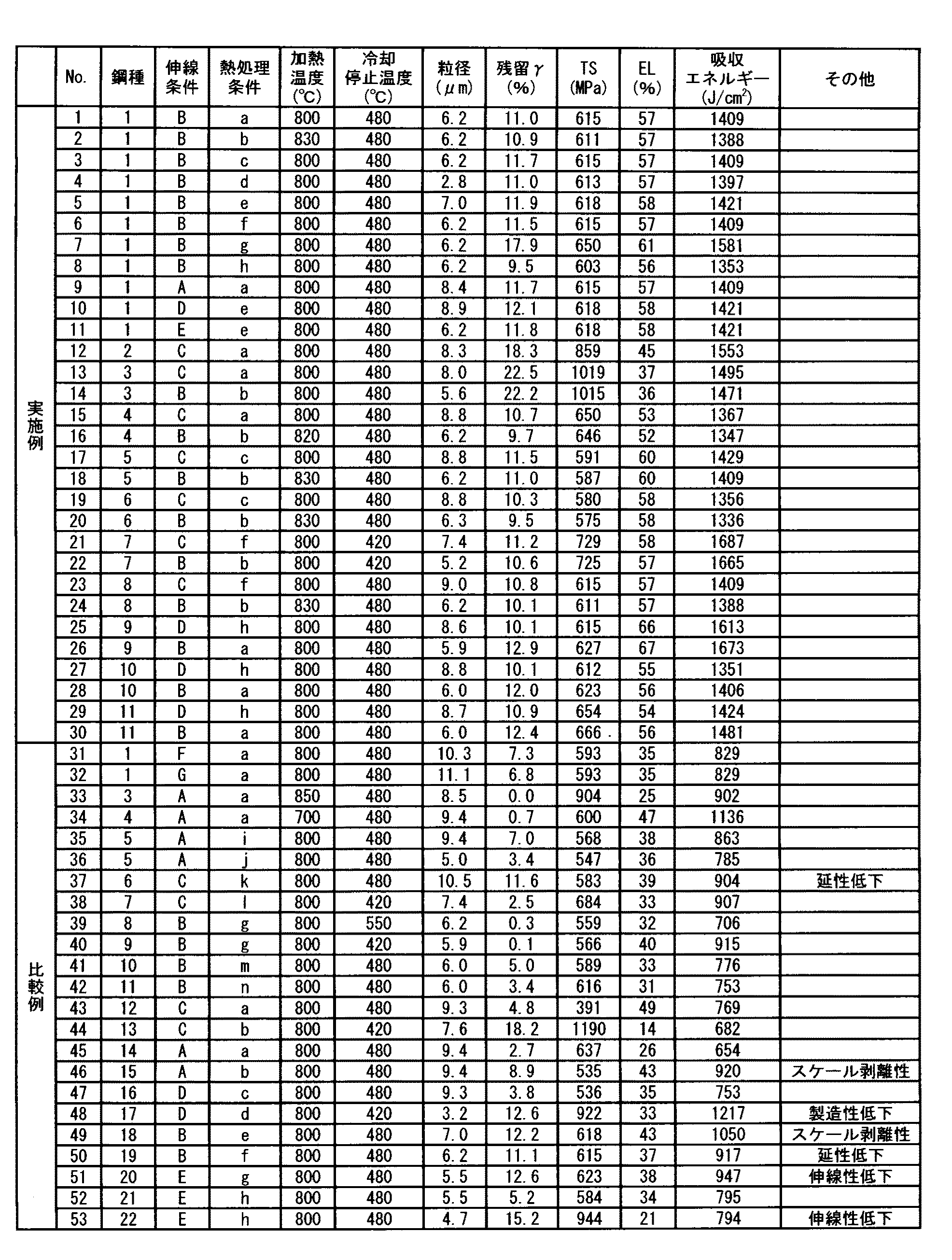
表4に、鋼種(化学成分)、伸線条件、熱処理条件および冷却停止温度の各条件により製造された鋼線の各種試験結果を示す。残留オーステナイト量を「残留γ」と記載した。 Table 4 shows various test results of steel wires manufactured under various conditions such as steel type (chemical composition), wire drawing conditions, heat treatment conditions, and cooling stop temperature. The amount of retained austenite was described as “residual γ”.
得られた鋼線を樹脂埋めして研磨し、研磨した試験片の横断面をナイタール腐食した。ナイタール腐食した横断面の中心部について500倍の光学顕微鏡写真を撮影し、切断法(JIS規格準拠:JIS G 0551)により、鋼線のフェライト結晶粒径を求めた。鋼線中の残留オーステナイト量は、試験片の横断面の中心部について、コリメーター径φ1.0mmのX線回折装置(Rigaku製、AutoMATE M)を用いて測定した。引張強度(TS)および伸び(EL)は、JIS9A号引張試験片を用い、標点間距離100mm、掴み部の間隔150mm、引張速度1mm/分の定速引張により測定した。吸収エネルギーは、JIS9A号引張試験片を用い、掴み部間隔50mm、引張速度10m/秒で引っ張って破断させ、その時の荷重の時間変化をクロスヘッドの移動量で積分して求めた。 The obtained steel wire was filled with resin and polished, and the cross section of the polished specimen was subjected to nital corrosion. A 500-fold optical micrograph was taken at the center of the cross-section subjected to the nital corrosion, and the ferrite crystal grain size of the steel wire was determined by a cutting method (JIS standard compliant: JIS G 0551). The amount of retained austenite in the steel wire was measured using an X-ray diffractometer (manufactured by Rigaku, AutoMATE M) having a collimator diameter of 1.0 mm at the center of the cross section of the test piece. Tensile strength (TS) and elongation (EL) were measured by a constant speed tension using a JIS No. 9A tensile test piece with a distance between the gauge points of 100 mm, a gap between the grips of 150 mm, and a tensile speed of 1 mm / min. Absorbed energy was obtained by using a JIS No. 9A tensile test piece and pulling and breaking at a grip portion interval of 50 mm and a tensile speed of 10 m / second, and integrating the time change of the load with the amount of movement of the crosshead.
本発明によれば、フェライト結晶粒径が9μm以下、残留オーステナイトが8%以上、および吸収エネルギーが1300J/cm2以上の鋼線が得られた。 According to the present invention, a steel wire having a ferrite crystal grain size of 9 μm or less, a retained austenite of 8% or more, and an absorption energy of 1300 J / cm 2 or more was obtained.
Claims (3)
C:0.05〜0.25%、
Si:0.3〜1.0%、
Mn:0.10〜3.00%、
S:0.005〜0.015%、
N:0.005〜0.013%、および
Al:0.005%以下
の化学成分を含有し、
残部がFeおよび不可避不純物からなる鋼線であって、
前記鋼線断面におけるフェライトの結晶粒径が9μm以下であり、
断面面積率で8%以上の残留オーステナイトを含み、
破断までの単位面積当たりの吸収エネルギーが1300J/cm2以上である、
ことを特徴とする鋼線。 % By mass
C: 0.05 to 0.25%
Si: 0.3 to 1.0%,
Mn: 0.10 to 3.00%,
S: 0.005-0.015%,
N: 0.005 to 0.013%, and Al: 0.005% or less of chemical components,
The balance is a steel wire made of Fe and inevitable impurities,
The ferrite grain size in the steel wire cross section is 9 μm or less,
Including residual austenite of 8% or more in cross-sectional area ratio,
The absorbed energy per unit area until breakage is 1300 J / cm 2 or more,
A steel wire characterized by that.
C:0.05〜0.25%、
Si:0.3〜1.0%、
Mn:0.10〜3.00%、
S:0.005〜0.015%、
N:0.005〜0.013%、および
Al:0.005%以下
の化学成分を含有し、
残部がFeおよび不可避不純物からなる鋼材を、1.0以上の塑性歪を与えて伸線すること、
前記伸線した鋼材を、AC1変態点温度以上且つ(AC1変態点温度+AC3変態点温度)/2以下の加熱温度まで8℃/秒以上の昇温速度で加熱し、前記加熱温度にて15秒〜120秒保持すること、
前記加熱した鋼材を、8℃/秒以上の冷却速度で式(2):
MS(℃)=550−350C−40Mn−10Cu−17Ni−20Cr
−10Mo+30Al (2)
で示されるMS変態点温度を基準として、(MS変態点温度+50℃)以下且つ(MS変態点温度−50℃)以上の温度まで冷却し、その温度で50〜320秒間保持すること、および
前記冷却した鋼材を、室温までさらに空冷すること、
を特徴とする鋼線の製造方法。 % By mass
C: 0.05 to 0.25%
Si: 0.3 to 1.0%,
Mn: 0.10 to 3.00%,
S: 0.005-0.015%,
N: 0.005 to 0.013%, and Al: 0.005% or less of chemical components,
Drawing the steel material, the balance of which is Fe and inevitable impurities, giving a plastic strain of 1.0 or more,
The steel described above drawing, heating at A C1 transformation point temperature or higher and (A C1 transformation point temperature + A C3 transformation temperature) / 2 or less to the heating temperature 8 ° C. / sec or more heating rate, the heating temperature Hold for 15 to 120 seconds,
The heated steel material is expressed by the formula (2) at a cooling rate of 8 ° C./second or more:
M S (° C.) = 550−350C-40Mn-10Cu-17Ni-20Cr
-10Mo + 30Al (2)
In reference to the M S transformation temperature indicated, (M S transformation temperature + 50 ° C.) or less and cooled to (M S transformation temperature -50 ° C.) or higher temperatures, can be held at that temperature from 50 to 320 seconds And further cooling the cooled steel material to room temperature,
A method of manufacturing a steel wire characterized by
Priority Applications (1)
| Application Number | Priority Date | Filing Date | Title |
|---|---|---|---|
| JP2016082293A JP6642226B2 (en) | 2016-04-15 | 2016-04-15 | Steel wire and method of manufacturing the same |
Applications Claiming Priority (1)
| Application Number | Priority Date | Filing Date | Title |
|---|---|---|---|
| JP2016082293A JP6642226B2 (en) | 2016-04-15 | 2016-04-15 | Steel wire and method of manufacturing the same |
Publications (2)
| Publication Number | Publication Date |
|---|---|
| JP2017190515A true JP2017190515A (en) | 2017-10-19 |
| JP6642226B2 JP6642226B2 (en) | 2020-02-05 |
Family
ID=60085110
Family Applications (1)
| Application Number | Title | Priority Date | Filing Date |
|---|---|---|---|
| JP2016082293A Expired - Fee Related JP6642226B2 (en) | 2016-04-15 | 2016-04-15 | Steel wire and method of manufacturing the same |
Country Status (1)
| Country | Link |
|---|---|
| JP (1) | JP6642226B2 (en) |
Citations (3)
| Publication number | Priority date | Publication date | Assignee | Title |
|---|---|---|---|---|
| JPS6220824A (en) * | 1985-07-20 | 1987-01-29 | Kobe Steel Ltd | Production of extra fine wire |
| JPH06505308A (en) * | 1991-02-14 | 1994-06-16 | コンパニー、ゼネラール、デ、ゼタブリスマン、ミシュラン−ミシュラン、エ、コンパニー | A metal wire comprising a cold-rolled and tempered steel matrix and coating with a martensitic structure, and a method for producing this wire. |
| JP2007191774A (en) * | 2006-01-20 | 2007-08-02 | Tokyo Seiko Co Ltd | Energy absorption rope |
-
2016
- 2016-04-15 JP JP2016082293A patent/JP6642226B2/en not_active Expired - Fee Related
Patent Citations (3)
| Publication number | Priority date | Publication date | Assignee | Title |
|---|---|---|---|---|
| JPS6220824A (en) * | 1985-07-20 | 1987-01-29 | Kobe Steel Ltd | Production of extra fine wire |
| JPH06505308A (en) * | 1991-02-14 | 1994-06-16 | コンパニー、ゼネラール、デ、ゼタブリスマン、ミシュラン−ミシュラン、エ、コンパニー | A metal wire comprising a cold-rolled and tempered steel matrix and coating with a martensitic structure, and a method for producing this wire. |
| JP2007191774A (en) * | 2006-01-20 | 2007-08-02 | Tokyo Seiko Co Ltd | Energy absorption rope |
Also Published As
| Publication number | Publication date |
|---|---|
| JP6642226B2 (en) | 2020-02-05 |
Similar Documents
| Publication | Publication Date | Title |
|---|---|---|
| JP4109619B2 (en) | High strength steel plate with excellent elongation and stretch flangeability | |
| EP2818568B1 (en) | Cold-rolled steel sheet and manufacturing method for same | |
| JPWO2001075186A1 (en) | Hot-rolled wire rods and steel bars for machine structures that do not require annealing and their manufacturing method | |
| JP2010168624A (en) | Rolled steel material for induction hardening and method for manufacturing the same | |
| JPWO2020121418A1 (en) | A method for manufacturing a high-strength steel sheet having excellent formability and impact resistance, and a high-strength steel sheet having excellent formability and impact resistance. | |
| JP2005336526A (en) | High-strength steel sheet with excellent workability and method for producing the same | |
| WO2015004906A1 (en) | High-carbon hot-rolled steel sheet and production method for same | |
| JP6160574B2 (en) | High-strength hot-rolled steel sheet excellent in strength-uniform elongation balance and method for producing the same | |
| JP5459064B2 (en) | Rolled steel for induction hardening and method for producing the same | |
| JP2010144226A (en) | Rolled steel material to be induction-hardened and method for manufacturing the same | |
| JP2016028172A (en) | Cold rolled steel sheet and production method therefor | |
| JP5459063B2 (en) | Rolled steel for induction hardening and method for producing the same | |
| JP6288265B2 (en) | Steel wire | |
| JP5459062B2 (en) | Rolled steel for induction hardening and method for producing the same | |
| JP5729829B2 (en) | High-strength steel sheet for warm forming excellent in ductility and deep drawability in warm and its manufacturing method | |
| JP2014019926A (en) | High strength steel sheet having excellent delayed fracture resistance and method for producing the same | |
| JP4539484B2 (en) | High strength hot-rolled steel sheet and manufacturing method thereof | |
| JP5459065B2 (en) | Rolled steel for induction hardening and method for producing the same | |
| JP2004011002A (en) | Wire and wire for wire drawing | |
| JP6642226B2 (en) | Steel wire and method of manufacturing the same | |
| JP4515315B2 (en) | High strength and high ductility steel plate with excellent weldability | |
| JP6682886B2 (en) | High strength low alloy steel and method for producing the same | |
| JP6728816B2 (en) | High-strength spring steel, spring, and method for manufacturing high-strength spring steel | |
| JP6347153B2 (en) | Steel material and manufacturing method thereof | |
| JP6250750B2 (en) | High strength wire rod excellent in corrosion resistance and method for producing the same |
Legal Events
| Date | Code | Title | Description |
|---|---|---|---|
| A621 | Written request for application examination |
Free format text: JAPANESE INTERMEDIATE CODE: A621 Effective date: 20181206 |
|
| A977 | Report on retrieval |
Free format text: JAPANESE INTERMEDIATE CODE: A971007 Effective date: 20190925 |
|
| A131 | Notification of reasons for refusal |
Free format text: JAPANESE INTERMEDIATE CODE: A131 Effective date: 20191008 |
|
| A521 | Request for written amendment filed |
Free format text: JAPANESE INTERMEDIATE CODE: A523 Effective date: 20191119 |
|
| TRDD | Decision of grant or rejection written | ||
| A01 | Written decision to grant a patent or to grant a registration (utility model) |
Free format text: JAPANESE INTERMEDIATE CODE: A01 Effective date: 20191203 |
|
| A61 | First payment of annual fees (during grant procedure) |
Free format text: JAPANESE INTERMEDIATE CODE: A61 Effective date: 20191216 |
|
| R151 | Written notification of patent or utility model registration |
Ref document number: 6642226 Country of ref document: JP Free format text: JAPANESE INTERMEDIATE CODE: R151 |
|
| LAPS | Cancellation because of no payment of annual fees |