JP2017190532A - Elastic fabric - Google Patents
Elastic fabric Download PDFInfo
- Publication number
- JP2017190532A JP2017190532A JP2016079034A JP2016079034A JP2017190532A JP 2017190532 A JP2017190532 A JP 2017190532A JP 2016079034 A JP2016079034 A JP 2016079034A JP 2016079034 A JP2016079034 A JP 2016079034A JP 2017190532 A JP2017190532 A JP 2017190532A
- Authority
- JP
- Japan
- Prior art keywords
- fabric
- yarn
- weft
- warp
- elongation
- Prior art date
- Legal status (The legal status is an assumption and is not a legal conclusion. Google has not performed a legal analysis and makes no representation as to the accuracy of the status listed.)
- Granted
Links
Landscapes
- Professional, Industrial, Or Sporting Protective Garments (AREA)
- Woven Fabrics (AREA)
Abstract
【課題】弾性糸を含有する布帛において、伸長時瞬間的に温度が上昇し、伸縮を繰り返しても永続的に伸長時発熱し、トップスやボトムスに使用可能な織物の提供。
【解決手段】経糸、緯糸とも、繊度250〜500dtexの、非弾性糸と弾性糸との複合糸からなる伸縮性織物において、少なくとも、該緯糸の非弾性糸は、紡績糸であり、該織物は、弾性糸を15〜30g/m2で含有し、該織物の9.8N荷重下での経方向と緯方向それぞれの伸長率は、30〜60%であり、所定密度比は、1.2〜1.8であり、経糸、緯糸とも、所定複合糸伸長量は、1.3〜2.5であり、かつ、該織物の経方向の瞬間発熱温度は、1.0℃以上である、ことを特徴とする前記伸縮性織物。
【選択図】なし[PROBLEMS] To provide a woven fabric that can be used for tops and bottoms in a fabric containing elastic yarns, whose temperature rises instantaneously when stretched and generates heat when stretched permanently even after repeated stretching.
In a stretchable woven fabric composed of a composite yarn of an inelastic yarn and an elastic yarn having a fineness of 250 to 500 dtex for both the warp and the weft, at least the inelastic yarn of the weft is a spun yarn. The elastic yarn is contained in an amount of 15 to 30 g / m 2 , and the stretch ratio in the warp direction and the weft direction under a load of 9.8 N of the woven fabric is 30 to 60%, and the predetermined density ratio is 1.2. -1.8, both the warp and the weft, the predetermined composite yarn elongation amount is 1.3-2.5, and the instantaneous heat generation temperature in the warp direction of the woven fabric is 1.0 ° C or more, The stretchable woven fabric characterized by the above.
[Selection figure] None
Description
本発明は、伸長時瞬間的に温度が上昇する、弾性糸を含有する伸縮性織物、及び該織物からなる衣服に関する。 The present invention relates to a stretchable fabric containing an elastic yarn whose temperature increases instantaneously when stretched, and a garment made of the fabric.
従来、保温衣服等、着用時に温度が上昇する衣服として、セルロース等の吸湿発熱繊維を混合した布帛からなる衣服を製造し、着用時の人体からの不感蒸泄や発汗により発熱させる衣服が知られている(例えば、下記特許文献1参照)。しかし、これらの吸湿発熱繊維では、繊維の吸湿量が飽和に達すればそれ以上発熱することは無く、発熱時間が短いばかりでなく、吸湿量が飽和に達した後は、繊維中の水分により冷感を感じることさえあった。
また、下記特許文献2には、弾性糸を含有する織物において、伸長時発熱する織物の提案もなされているが、特許文献2の織物は伸度が60〜150%、弾性糸を40〜150g/m2含有したパワーの強いサポーター等に好適な織物であり、ソフトな伸び感を有するシャツ等のトップスやパンツ等のボトムス等衣服への展開は不可能であった。
このように、現在、着用時温度が上昇し、また、動きやすくて着用運動している限り永続的に発熱し、かつ、衣服に使用可能な織物は未だ提供されていない。
2. Description of the Related Art Conventionally, clothing that is made of a fabric mixed with moisture-absorbing heat-generating fibers such as cellulose and that heats up due to insensitive excretion or sweating when worn is known as clothing that rises in temperature when worn, such as heat retaining clothing. (For example, refer to Patent Document 1 below). However, these moisture-absorbing heat-generating fibers do not generate any further heat when the fiber's moisture absorption reaches saturation, not only the heat generation time is short, but also after moisture absorption reaches saturation, the moisture absorption in the fiber causes cooling. There was even a feeling.
Patent Document 2 below proposes a woven fabric containing elastic yarns that generates heat when stretched. However, the woven fabric of Patent Document 2 has an elongation of 60 to 150% and elastic yarns of 40 to 150 g. It is a woven fabric suitable for a strong power supporter containing / m 2 , and cannot be developed on clothes such as tops such as shirts and bottoms such as pants having a soft stretch feeling.
Thus, at present, no fabric has yet been provided that has a temperature that increases when worn, and that generates heat and can be used for clothes as long as it is easy to move and wears.
上記従来技術の問題に鑑み、本発明が解決しようとする課題は、弾性糸を含有する布帛において、伸長時瞬間的に温度が上昇し、伸縮を繰り返しても永続的に伸長時発熱し、トップスやボトムスに使用可能な織物を提供すること、さらに該織物を利用して保温性と伸長部位の筋肉や関節を暖めることによる怪我の防止や筋肉および脂肪燃焼効果も期待できる衣服を提供することである。 In view of the above-mentioned problems of the prior art, the problem to be solved by the present invention is that, in a fabric containing elastic yarn, the temperature rises instantaneously when stretched, and even when it is repeatedly stretched, heat is generated permanently when stretched. By providing a woven fabric that can be used for skirts and bottoms, and by using the woven fabric, it is possible to provide heat retention and prevention of injury due to warming of muscles and joints of the stretched part and clothing that can be expected to have muscle and fat burning effects. is there.
本発明者らは、上記課題を解決すべく鋭意検討し実験を重ねた結果、非弾性糸と弾性糸とからなる織物において、伸長時の瞬間発熱温度が1.0℃以上である織物により上記課題を解決しうることを見出し、本発明を完成するに至ったものである。
すなわち、本発明は以下の通りのものである。
As a result of intensive investigations and repeated experiments to solve the above-mentioned problems, the present inventors have found that the woven fabric composed of inelastic yarns and elastic yarns has a tempering heat generation temperature of 1.0 ° C. or higher when stretched. The present inventors have found that the problem can be solved and have completed the present invention.
That is, the present invention is as follows.
[1]経糸、緯糸とも、繊度250〜500dtexの、非弾性糸と弾性糸との複合糸からなる伸縮性織物において、少なくとも、該緯糸の非弾性糸は、紡績糸であり、該織物は、弾性糸を15〜30g/m2で含有し、該織物の9.8N荷重下での経方向と緯方向それぞれの伸長率は、30〜60%であり、下記式(1):
密度比=(経糸密度)/(緯糸密度) 式(1)
で表される密度比は、1.2〜1.8であり、経糸、緯糸とも、下記式(2):
複合糸伸長量= B/A 式(2)
{式中、Aは、無荷重下での織物長さであり、そしてBは、無荷重下で織物長さAに織り込まれている複合糸を抜出し、0.98N荷重下で測定した該複合糸の長さである。}で表される複合糸伸長量は、1.3〜2.5であり、かつ、該織物の経方向について、伸縮以外に外部からのエネルギー供給を受けない条件下で該織物を10%伸長させて伸縮試験機(デマッチャー試験機)に取り付け、次いで20%伸長させ、その後緩和させて元の長さに戻す工程を1回とする繰り返し伸縮を、100回/分の速度で5分間行った後、500回目の20%伸長時の織物温度をサーモグラフィで測定して、試験開始前の織物温度との差から算出する瞬間発熱温度は、1.0℃以上である、ことを特徴とする前記伸縮性織物。
[2]通気性が2.0〜10.0cc/cm2/secである、前記[1]に記載の伸縮性織物。
[3]前記[1]又は[2]に記載の伸縮性織物を身体に密着させて使用してなる衣服。
[1] In both the warp and the weft, a stretchable fabric made of a composite yarn of an inelastic yarn and an elastic yarn having a fineness of 250 to 500 dtex, at least the inelastic yarn of the weft is a spun yarn, The elastic yarn is contained at 15 to 30 g / m 2 , and the stretch rate in the warp direction and the weft direction under a load of 9.8 N of the woven fabric is 30 to 60%, and the following formula (1):
Density ratio = (warp density) / (weft density) Formula (1)
Is a ratio of 1.2 to 1.8, and both the warp and the weft are represented by the following formula (2):
Composite yarn elongation amount = B / A Formula (2)
{Wherein A is the fabric length under no load, and B is the composite measured under 0.98N load with the composite yarn woven into the fabric length A under no load. The length of the thread. }, The elongation amount of the composite yarn is 1.3 to 2.5, and the fabric is stretched by 10% in the warp direction under the condition that it receives no external energy supply other than expansion and contraction. It was attached to an expansion / contraction tester (dematcher tester), then stretched by 20%, and then repeatedly expanded and contracted at a rate of 100 times / minute for 5 minutes. Thereafter, the fabric temperature at the time of 20% elongation at the 500th time is measured by thermography, and the instantaneous heat generation temperature calculated from the difference from the fabric temperature before the start of the test is 1.0 ° C. or more. Elastic fabric.
[2] The stretchable fabric according to [1], wherein the air permeability is 2.0 to 10.0 cc / cm 2 / sec.
[3] A garment formed by using the elastic fabric according to [1] or [2] in close contact with the body.
本発明の伸縮性織物は、身体にフィットするシャツ等のトップスや、膝から上が身体にフィットするブーツカットパンツ、脚全体フィットするスキニーパンツ等のボトムスで、伸縮部が身体に密着する衣服に使用され、動作時の保温性向上、及び、サポート機能により怪我の防止が期待できる。 The elastic fabric of the present invention is a tops such as a shirt that fits the body, boots pants that fit the body from the knee up, and bottoms such as skinny pants that fit the entire leg. It is used, and it can be expected to prevent injuries by improving heat retention during operation and supporting functions.
以下、本発明の実施形態を詳細に説明する。
本実施形態の伸縮性織物は、非弾性糸と弾性糸との複合糸からなる織物であって、織物伸長時、少なくとも経方向の瞬間発熱温度が1.0℃以上であることを特徴とする。
本明細書中、用語「瞬間発熱温度」とは、伸縮以外に外部からのエネルギー供給を受けない条件下で織物を10%伸長して伸縮試験機に取り付け、次いでさらに20%伸長、緩和してもとの長さに戻す工程を1回とする繰り返し伸縮を、100回/分の速度で5分間行った後、500回目の20%伸長時の織物温度をサーモグラフィで測定し、試験開始前の織物温度との差から算出された値をいう。
Hereinafter, embodiments of the present invention will be described in detail.
The stretchable fabric of this embodiment is a fabric composed of a composite yarn of an inelastic yarn and an elastic yarn, and at the time of stretching the fabric, at least the instantaneous heat generation temperature in the warp direction is 1.0 ° C. or higher. .
In this specification, the term “instantaneous heat generation temperature” means that the fabric is stretched by 10% and attached to the stretch tester under conditions that do not receive external energy supply other than stretching and then stretched and relaxed by another 20%. After repeating the expansion / contraction with the step of returning to the original length once at a rate of 100 times / minute for 5 minutes, the fabric temperature at the time of 20% elongation at the 500th time was measured by thermography, before the start of the test. The value calculated from the difference from the fabric temperature.
500回目の20%伸長時の織物温度が試験開始前より高くなれば、瞬間発熱していることを示し、本実施形態の伸縮性織物は、この瞬間発熱温度が1.0℃以上あることが必要である。1.0℃未満の瞬間発熱温度では、ほとんど発熱を感じられず、所望の効果が発揮されず、瞬間発熱温度は好ましくは1.5℃以上である。瞬間発熱温度は高いほど好適であり、人体に悪影響を与えない範囲であれば上限は特に限定されないが、瞬間発熱温度を高くするために弾性糸含有量を高くしすぎると織物がハイパワーとなって衣服として動き難いものとなる。尚、発熱温度の測定方法は、以下、実施例の欄で具体的に説明する。 If the fabric temperature at the time of 20% elongation at the 500th time becomes higher than before the start of the test, it indicates that instantaneous heat is generated, and the elastic fabric of this embodiment has an instantaneous heat generation temperature of 1.0 ° C. or higher. is necessary. At an instantaneous heat generation temperature of less than 1.0 ° C., almost no heat generation is felt, the desired effect is not exhibited, and the instantaneous heat generation temperature is preferably 1.5 ° C. or higher. The higher the instantaneous heat generation temperature, the better. The upper limit is not particularly limited as long as it does not adversely affect the human body, but if the elastic yarn content is too high to increase the instantaneous heat generation temperature, the fabric becomes high power. It becomes difficult to move as clothes. In addition, the measuring method of exothermic temperature is hereafter demonstrated concretely in the Example column.
織物伸長時の発熱は、衣服は織物経方向に伸張される場合が多いため、少なくとも経方向の伸長時発熱温度が1.0℃以上であることが必要であるが、無論、経方向、緯方向とも伸長時に1.0℃以上発熱する方が、衣服製造時の型入れ方向を気にすることなく可能となり、かつ、衣服着用時も温かくて好ましい。 Since the heat generated when the fabric is stretched is often stretched in the warp direction, it is necessary that at least the heat generation temperature when stretching in the warp direction is 1.0 ° C. or higher. Heating at 1.0 ° C. or more when extending in both directions is possible without worrying about the mold-insertion direction at the time of manufacturing the clothes, and it is preferable because the clothes are warm.
本実施形態の伸縮性織物は、低伸度下でも高い伸長時発熱する織物構造について鋭意検討した結果達成されたものである。すなわち、瞬間発熱温度を1.0℃以上とするには、弾性糸の伸長時発熱する効果を十分に発揮させることと、伸縮による生地内の摩擦を生じさせること、さらに、生じた熱を逃がしにくい生地構造とすることが必要である。 The stretchable fabric of this embodiment has been achieved as a result of intensive studies on a fabric structure that generates heat when stretched even under low elongation. That is, in order to set the instantaneous heat generation temperature to 1.0 ° C. or higher, the effect of generating heat when the elastic yarn is stretched is sufficiently exerted, the friction in the fabric is caused by expansion and contraction, and the generated heat is released. It is necessary to create a difficult fabric structure.
具体的に説明すると、本実施形態の伸縮性織物は、経糸、緯糸とも、繊度250〜500dtex(デシテックス:以下同じ記号を使用する)の、非弾性糸と弾性糸との複合糸からなる織物において、少なくとも緯糸の非弾性糸については紡績糸を使用しており、さらに、織物中に弾性糸が15〜30g/m2で含有されている必要がある。上記複合糸の繊度については、繊度が細いと風合いのソフトな織物となるが、細過ぎると弾性糸も細くなって伸長時発熱温度が低くなり、また、生地内の摩擦による発熱も期待できなくなる。逆に、複合糸の繊度が太いと太い弾性糸の使用が可能となり、また、生地内の摩擦による発熱も期待できるが、太くなり過ぎると硬い生地となって着用時動き難く不快な衣服となるため、非弾性糸と弾性糸との複合糸の繊度は、250〜500dtex、好ましくは、300〜450dtexとなるよう織物設計する。また、非弾性糸と弾性糸との複合糸については、少なくとも緯糸の非弾性糸として紡績糸を使用することが好ましく、これにより、伸縮時の生地内の摩擦による発熱が期待できるようになる。無論、経糸、緯糸とも、非弾性糸として紡績糸を使用した複合糸である場合、伸縮時の発熱温度は高くなる傾向で好ましいが、経糸のみに非弾性糸が紡績糸である複合糸を使用した織物の場合、はっきりした原因は判らないが恐らく摩擦による発熱効果が低くなり、生地として伸縮時の発熱温度が低くなり好ましくない。 More specifically, the stretchable fabric of the present embodiment is a fabric composed of a composite yarn of an inelastic yarn and an elastic yarn having a fineness of 250 to 500 dtex (decitex: hereinafter the same symbol is used) for both warp and weft. The spun yarn is used for at least the inelastic yarn of the weft, and the elastic yarn needs to be contained in the woven fabric at 15 to 30 g / m 2 . As for the fineness of the composite yarn, if the fineness is thin, it becomes a soft woven fabric, but if it is too thin, the elastic yarn also becomes thin and the exothermic temperature at the time of elongation becomes low, and heat generation due to friction in the fabric can not be expected. . On the contrary, if the fineness of the composite yarn is thick, it is possible to use a thick elastic yarn, and heat generation due to friction in the fabric can be expected, but if it becomes too thick, it becomes a hard fabric and it becomes difficult to move when worn and uncomfortable clothes Therefore, the woven fabric is designed so that the fineness of the composite yarn of the non-elastic yarn and the elastic yarn is 250 to 500 dtex, preferably 300 to 450 dtex. As for the composite yarn of the inelastic yarn and the elastic yarn, it is preferable to use a spun yarn as at least the inelastic yarn of the weft. As a result, heat generation due to friction in the fabric during expansion and contraction can be expected. Of course, when both the warp and weft are composite yarns using spun yarn as inelastic yarn, the heat generation temperature during expansion / contraction is preferred, but a composite yarn in which the inelastic yarn is spun yarn is used only for warp. In the case of the woven fabric, the obvious cause is not known, but the heat generation effect due to friction is probably low, and the heat generation temperature during expansion and contraction of the fabric is low, which is not preferable.
複合糸の繊度について、紡績糸の場合は綿番手等が使用されるが、長繊維の場合に使用されるdtexから綿番手等に換算して繊度を求める。
複合糸の製造方法については任意な方法により、弾性糸と長繊維、紡績糸、1種以上の非弾性糸と複合することができ、例えば、撚糸、FTY、SCY、DCYと称されるカバーリング糸、エアー混繊糸、CSYと称される紡績糸に、製造時に弾性糸を混合させて複合糸とする方法が使用できる。
複合糸とする場合、弾性糸と非弾性糸との長さ比率は任意に設定可能であるが、弾性糸の長さに対し非弾性糸の長さを2.5〜4.5倍程度となるよう弾性糸を伸長して被覆弾性糸として使用すれば、織物の長さに対する織物中の弾性糸の長さの比を1.3〜2.5に設定し易くなる。
Regarding the fineness of the composite yarn, a cotton count or the like is used in the case of a spun yarn, but the fineness is obtained by converting the dtex used in the case of a long fiber into a cotton count or the like.
The composite yarn can be produced by any method, and can be combined with elastic yarn, long fiber, spun yarn, one or more inelastic yarns. For example, twisting, FTY, SCY, DCY covering It is possible to use a method in which an elastic yarn is mixed with a spun yarn called air yarn, air-mixed yarn, or CSY at the time of production to form a composite yarn.
In the case of a composite yarn, the length ratio of the elastic yarn and the inelastic yarn can be arbitrarily set, but the length of the inelastic yarn is about 2.5 to 4.5 times the length of the elastic yarn. If the elastic yarn is stretched and used as a coated elastic yarn, the ratio of the length of the elastic yarn in the fabric to the length of the fabric can be easily set to 1.3 to 2.5.
伸長時に高い発熱温度を得るためには、織物中の弾性糸含有量が多いほど好ましいが、弾性糸の含有量が多すぎるとパワーの強い生地となって、着用時動き難くなり、弾性糸の含有量が少ないと着用時動き易いが伸長時発熱温度が低くなるため、弾性糸の含有量は15〜30g/m2であることが必要である。 In order to obtain a high exothermic temperature at the time of stretching, it is preferable that the elastic yarn content in the woven fabric is large. However, if the elastic yarn content is too large, the fabric becomes strong and becomes difficult to move when worn. for easy wearing time and motion content is low but the heat generation temperature becomes lower when extended, the content of the elastic yarn is required to be 15 to 30 g / m 2.
伸縮性織物の発熱効果について検討した結果、伸縮性織物の伸度による影響も大きく、経方向又は緯方向のいずれか一方しか伸縮しない織物よりも、経方向と緯方向ともに伸縮する織物の方が、伸長時発熱が高くなることが判明した。これは、弾性糸の伸縮による発熱と、生地内の摩擦による発熱が生じ易くなり、これらの発熱効果が相乗効果となって伸長時発熱温度が高まり、織物伸度も発熱温度に大きく影響することも判明した。すなわち、9.8N荷重下の経方向、緯方向それぞれの伸度が30〜60%であることが必要である。9.8N荷重下の伸度が30%未満では、伸縮性が乏しく、着用時に突っ張り感を感じる不快な衣服となる。他方、60%より大きい場合、伸長時十分に発熱しない衣服となる。この伸度調整は、複合糸の繊度調整、複合糸内の弾性糸の伸長率(ドラフト率とも称される)調整、経糸、及び緯糸密度調整、織物中の弾性糸の伸長率調整等、さらに、染色仕上げ加工時の幅出しや追い込み量調整により可能である。 As a result of examining the heat generation effect of the stretchable fabric, the stretch fabric has a great influence on the elongation, and the fabric that stretches in both the warp direction and the weft direction is more stretchable than the fabric that stretches only in either the warp direction or the weft direction. It was found that the exotherm during elongation was high. This is because heat generation due to expansion and contraction of the elastic yarn and heat generation due to friction in the fabric are likely to occur, and these heat generation effects synergistically increase the heat generation temperature during elongation, and the fabric elongation also greatly affects the heat generation temperature. Also turned out. That is, the elongation in the warp direction and the weft direction under a load of 9.8 N is required to be 30 to 60%. If the elongation under a 9.8N load is less than 30%, the stretchability is poor, and an unpleasant garment that feels tense when worn. On the other hand, if it is larger than 60%, the clothes do not generate sufficient heat when stretched. This elongation adjustment includes adjustment of the fineness of the composite yarn, adjustment of the elongation rate (also referred to as draft rate) of the elastic yarn in the composite yarn, adjustment of the warp and weft density, adjustment of the elongation rate of the elastic yarn in the fabric, etc. This is possible by adjusting the width and adjusting the amount of chase during dyeing finishing.
織物の伸度にも関連するが、本実施形態の伸縮性織物では、織物の経方向と緯方向の密度も伸長時の発熱温度へ大きく影響し、下記式(1):
密度比 = (経糸密度) / (緯糸密度) 式(1)
で求められる密度比を、1.2〜1.8となるようにすれば、複合糸中の弾性糸の伸縮による発熱と、生地内の摩擦による発熱との相乗効果がより発揮しやすくなり、密度比が1.2未満の場合や1.8より大きい場合には伸長時発熱温度は低くなる。これは、複合糸の繊度が経糸と緯糸とで大きく異なっている場合や、異なる繊度の緯糸である場合も同様である。すなわち、織物の密度比は1.2〜1.8であることが必要であり、好ましくは1.3〜1.7であり、この場合、伸長時発熱温度が最も高くなる。
Although related to the elongation of the woven fabric, in the stretchable woven fabric of the present embodiment, the density in the warp direction and the weft direction of the fabric also greatly affects the heat generation temperature during elongation, and the following formula (1):
Density ratio = (warp density) / (weft density) Formula (1)
If the density ratio required in the step is 1.2 to 1.8, the synergistic effect between the heat generation due to the expansion and contraction of the elastic yarn in the composite yarn and the heat generation due to friction in the fabric can be more easily exhibited. When the density ratio is less than 1.2 or greater than 1.8, the exothermic temperature during elongation decreases. The same applies to the case where the fineness of the composite yarn is greatly different between the warp and the weft, or the case of the weft having a different fineness. That is, the density ratio of the woven fabric needs to be 1.2 to 1.8, preferably 1.3 to 1.7, and in this case, the exothermic temperature at the time of elongation becomes the highest.
下記式(2):
複合糸伸長量 = B/A 式(2)
{式中、Aは、無荷重下での織物長さであり、そしてBは、無荷重下で織物長さAに織り込まれている複合糸を抜出し、0.98N荷重下で測定した複合糸の長さである。}で求められる織物中の複合糸伸長量も伸長時発熱温度に影響する。すなわち、複合糸伸長量を1.3〜2.5に設定すれば、伸長時発熱温度が高くなり、より好ましくは1.4〜2.4である。複合糸伸長量の調整は、織物密度、複合糸内の弾性糸の伸長率により可能であり、複合糸伸長量を多くするには、織物の密度を高くし、複合糸内の弾性糸の伸長率を高くすればよい。複合糸伸長量と織物の伸度とを所定範囲とすることにより、高い伸長時発熱が得られる。
Following formula (2):
Composite yarn elongation = B / A Formula (2)
{In the formula, A is the fabric length under no load, and B is the composite yarn measured under 0.98N load after extracting the composite yarn woven into the fabric length A under no load. Is the length of }, The amount of elongation of the composite yarn in the woven fabric determined by the above also affects the exothermic temperature during elongation. That is, if the amount of elongation of the composite yarn is set to 1.3 to 2.5, the exothermic temperature at the time of elongation becomes high, and more preferably 1.4 to 2.4. The amount of the composite yarn can be adjusted by adjusting the fabric density and the elastic yarn elongation rate in the composite yarn. To increase the amount of composite yarn, increase the fabric density and stretch the elastic yarn in the composite yarn. You can increase the rate. By setting the amount of elongation of the composite yarn and the elongation of the woven fabric within a predetermined range, high heat generation during elongation can be obtained.
本実施形態の伸縮性織物では、伸長時発熱は織物中の弾性糸の伸縮による発熱が大きいが、織物内の摩擦による発熱も寄与し、この摩擦による発熱は織物の通気性に関係することも判明した。
すなわち、織物の通気性を2〜10cc/cm2/secとなるよう織物を設計すればよく、通気性が2cc/cm2/sec未満では風合いの硬い生地となり、通気性が10cc/cm2/secより大きいと伸長時発熱効果が低くなり好ましくない。従って織物の通気性は、2〜10cc/cm2/secとなるように複合糸の繊度、織物密度等を調整すればよい。
In the stretchable fabric of this embodiment, the heat generation during elongation is large due to the expansion and contraction of the elastic yarn in the fabric, but the heat generation due to friction in the fabric also contributes, and the heat generation due to this friction may be related to the breathability of the fabric. found.
That is, the woven fabric may be designed so that the air permeability of the woven fabric is 2 to 10 cc / cm 2 / sec. If the air permeability is less than 2 cc / cm 2 / sec, the fabric has a hard texture, and the air permeability is 10 cc / cm 2 / sec. If it is longer than sec, the heat generation effect at the time of elongation is lowered, which is not preferable. Therefore, the fineness of the composite yarn, the fabric density, etc. may be adjusted so that the air permeability of the fabric is 2 to 10 cc / cm 2 / sec.
本実施形態の伸縮性織物の複合糸に用いられる弾性糸は、30〜130dtexであることが好ましく、より好ましくは40〜110dtexであり、弾性糸が太くなる程、伸長時の発熱効果を発揮でき、30dtexより細いと発熱効果が小さい。他方、130dtexより太いと伸縮力が大きくなりすぎ、着用時突っ張り感が強くて動き難く不快な衣服となる。繊度の異なる複数の弾性糸を使用する場合も、弾性糸の繊度が上記範囲であることが好ましい。 The elastic yarn used for the composite yarn of the stretchable fabric of the present embodiment is preferably 30 to 130 dtex, more preferably 40 to 110 dtex. As the elastic yarn becomes thicker, the heat generation effect at the time of elongation can be exhibited. If it is thinner than 30 dtex, the heat generation effect is small. On the other hand, if it is thicker than 130 dtex, the stretch force becomes too large, and the clothes become uncomfortable and difficult to move due to a strong feeling of tension when worn. Even when a plurality of elastic yarns having different finenesses are used, the fineness of the elastic yarns is preferably in the above range.
弾性糸としては、ポリウレタン系、ポリエーテルエステル系の弾性糸、例えば、ポリウレタン系弾性糸としては、乾式紡糸又は溶融紡糸したものが使用でき、ポリマーや紡糸方法には特に限定されない。弾性糸の破断伸度は400%〜1000%程度が好ましく、かつ、伸縮性に優れ、染色加工時のプレセット工程で通常処理温度の180℃近辺で伸縮性を損なわない弾性糸が好ましい。また、弾性糸に特殊ポリマーや粉体を添加することにより、高セット性、抗菌性、吸湿、吸水性等の機能性を付与したものも使用可能である。 As the elastic yarn, polyurethane-based or polyether ester-based elastic yarn, for example, polyurethane-based elastic yarn can be used by dry spinning or melt spinning, and the polymer and spinning method are not particularly limited. The breaking elongation of the elastic yarn is preferably about 400% to 1000%, and is preferably an elastic yarn that is excellent in stretchability and does not impair the stretchability at around 180 ° C., which is a normal processing temperature in the presetting process during dyeing. Moreover, what added functionality, such as high set property, antibacterial property, moisture absorption, and water absorption, can be used by adding a special polymer and powder to an elastic yarn.
本実施形態の伸縮性織物では、弾性糸に無機物質を含有させることもでき、含有する無機物質の性能を加味した織物とすることができる。例えば、酸化チタンを含有させると織物の発熱を酸化チタンに蓄え、遠赤外線効果による保温性が付与できる。無機物質の含有法については、弾性糸の紡糸原液に無機物質を含有させて紡糸する方法が最も簡単である。無機物質とは、酸化チタン等のセラミックス、カーボン、カーボンブラック等の無機物及び無機化合物であり、弾性糸の紡糸の障害とならないよう、微粉末状が好ましい。これらの無機物質を弾性糸に1〜10重量%含有させていることが好ましく、無機物質を含有することにより、織物の伸長発熱時、保温効果をより効果的に発揮することが可能となる。尚、無機物質が少ないと保温効果が小さく、多すぎると紡糸時や伸長時に糸切れすることがあるため、1〜10重量%の含有が好ましく、より好ましくは2〜5重量%の含有である。 In the stretchable fabric of the present embodiment, the elastic yarn can contain an inorganic substance, and the fabric can be made in consideration of the performance of the contained inorganic substance. For example, when titanium oxide is contained, the heat generated by the fabric can be stored in titanium oxide, and heat retention due to the far-infrared effect can be imparted. Regarding the method of containing an inorganic substance, the simplest method is to add an inorganic substance to a spinning dope for elastic yarn and perform spinning. Inorganic substances are ceramics such as titanium oxide, inorganic substances such as carbon and carbon black, and inorganic compounds, and are preferably finely powdered so as not to hinder spinning of elastic yarns. These inorganic substances are preferably contained in the elastic yarn in an amount of 1 to 10% by weight. By containing the inorganic substance, the heat retention effect can be more effectively exhibited when the woven fabric stretches and generates heat. If the inorganic substance is small, the heat retention effect is small, and if it is too large, the yarn may break during spinning or stretching. .
本実施形態の伸縮性織物を構成する非弾性糸としては、ポリエチレンテレフタレート、ポリトリメチレンテレフタレート等のポリエステル系繊維、ポリアミド系繊維、ポリプロピレン等のポリオレフィン系繊維、さらに、キュプラ、レーヨン、綿、竹繊維等のセルロース系繊維、羊毛等の獣毛繊維等の長繊維又は短繊維を使用することができる。非弾性糸としてセルロース等の吸湿発熱する素材を使用すれば、着用時吸湿により発熱し、運動することによっても発熱することになり、発熱効果をされに高めることができる。また、紡績糸の使用や起毛によって、発熱した熱を逃がし難くし、保温効果を高めることもできる。 Examples of the inelastic yarn constituting the stretchable fabric of the present embodiment include polyester fibers such as polyethylene terephthalate and polytrimethylene terephthalate, polyamide fibers, polyolefin fibers such as polypropylene, and cupra, rayon, cotton, bamboo fibers. Long fibers or short fibers such as cellulosic fibers such as wool and animal fibers such as wool can be used. If a material that absorbs moisture by heat, such as cellulose, is used as the non-elastic yarn, it generates heat by absorbing moisture when worn, and also generates heat when exercised, so that the heat generation effect can be enhanced. In addition, the use of spun yarn and raising can make it difficult for heat generated to escape and enhance the heat retaining effect.
ポリエステル系繊維、ポリアミド系繊維、セルロース系繊維等も、無機物質を0.3〜5重量%含有していることが好ましく、無機物質を含有することにより、弾性織物の発熱時、保温効果をより効果的に発揮することが可能となる。尚、無機物質が少ないと保温効果が小さく、多すぎると紡糸時や伸長時に糸切れすることがあるため、0.5〜5重量%の含有が好ましく、より好ましくは0.4〜3重量%の含有である。また、これらの繊維のブライト糸、セミダル糸、フルダル糸等も任意に使用でき、繊維の断面形状も丸型、楕円型、W型、繭型、中空糸等任意な断面形状の繊維の使用が可能である。非弾性糸の繊度としては、特に限定されないが、100〜400dtex程度であれば、着用時にソフトな風合いの製品となる。 Polyester fiber, polyamide fiber, cellulosic fiber and the like preferably also contain 0.3 to 5% by weight of an inorganic substance. By containing an inorganic substance, the heat-insulating effect can be further improved when the elastic fabric is heated. It becomes possible to demonstrate effectively. If the amount of the inorganic substance is small, the heat retaining effect is small. If the amount is too large, the yarn may break during spinning or stretching. Therefore, the content is preferably 0.5 to 5% by weight, more preferably 0.4 to 3% by weight. It is inclusion of. Bright fibers, semi-dal yarns, full-dal yarns, etc. of these fibers can also be used arbitrarily, and fibers having an arbitrary cross-sectional shape such as round, elliptical, W-shaped, saddle-shaped, hollow fiber can be used. Is possible. The fineness of the inelastic yarn is not particularly limited, but if it is about 100 to 400 dtex, the product has a soft texture when worn.
本実施形態の伸縮性織物の組織は、タフタ、ツイル、サテン、ジャカード組織等任意であり、これらの変化組織の使用も可能である。
本実施形態の伸縮性織物の染色仕上げ方法は、非弾性糸のみで染色する方法、複合糸として染色する方法、織物として染色する方法のいずれでもよく、いずれの方法でも通常の染色仕上げ工程が使用でき、使用する繊維素材に応じた染色条件とし、使用する染色機も液流染色機、ウインス染色機、パドル染色機、オーバーマイヤー染色機など任意である。
The structure of the stretchable woven fabric of the present embodiment is arbitrary such as taffeta, twill, satin, jacquard structure, and the use of these changed structures is also possible.
The method for dyeing and finishing the stretchable fabric of the present embodiment may be any of a method of dyeing with inelastic yarn only, a method of dyeing as a composite yarn, or a method of dyeing as a fabric, and any method uses a normal dyeing finishing process. The dyeing conditions can be set according to the fiber material to be used, and the dyeing machine to be used is optional, such as a liquid dyeing machine, a wins dyeing machine, a paddle dyeing machine, and an overmeier dyeing machine.
吸水性や柔軟性を向上させる加工剤の使用も可能であるが、シリコン系の加工剤では糸の滑り効果が高く、伸長時の発熱効果も低いため、糸の滑り効果が少なくなるようにポリエステル系等の非シリコン系の仕上げ剤を使用するか、又は仕上げ剤を使用しないで製品とすることが好ましい。 Processing agents that improve water absorption and flexibility can be used, but silicone processing agents have a high thread sliding effect and a low heat generation effect when stretched. It is preferable to use a non-silicone finishing agent such as a system, or make a product without using a finishing agent.
実施形態の伸縮性織物は、ソフトな伸び感を有するシャツ等のトップスやパンツ等のボトムス等衣服に使用可能であり、さらに、関節部を覆う身体に密着したサポーターとしても使用でき、保温性と伸長部位の筋肉や関節を暖めることによる怪我の防止や脂肪燃焼効果も期待できる衣服製品を提供することが可能となる。 The stretchable fabric of the embodiment can be used for clothes such as shirts and bottoms such as pants with a soft stretch feeling, and can also be used as a supporter that is in close contact with the body covering the joints. It is possible to provide a garment product that can be expected to prevent injuries due to warming of the muscles and joints of the stretched part and to have a fat burning effect.
以下、実施例により本発明を具体的に説明するが、本発明はこれらの実施例のみに限定されるものではない。尚、実施例における伸縮性織物、製造した衣服の評価は以下の方法により行なった。
(1)瞬間発熱温度
瞬間発熱温度の測定は、織物の経方向について、伸縮以外に外部からのエネルギー供給を受けない条件下で織物を10%伸長して伸縮試験機(デマッチャー試験機)に取り付け、次いでさらに20%伸長、緩和してもとの長さに戻す工程を1回とする繰り返し伸縮を、100回/分の速度で5分間行った後、500回目の20%伸長時の織物温度をサーモグラフィで測定し、試験開始前の織物温度との差から算出する。
伸縮試験機:デマッチャー試験機((株)大栄科学精器製作所製)。
試料の大きさ:長さ10cm(把持部除く)、幅6cm。
測定環境:温度20℃、湿度65%RHの恒温恒湿条件。伸縮以外に外部からのエネルギー供給を受けない状態で測定する。
繰り返し伸縮サイクル:100回/分
発熱温度測定:繰り返し伸長100回目の所定伸長時の試料表面温度をサーモグラフィで測定。サーモグラフィの放射率は1.0に設定。
発熱温度評価:測定する試料の表面最高温度を読み取り、伸縮前に比べ何℃上昇したかを算出し、小数点以下二桁目を四捨五入して瞬間発熱温度とする。
EXAMPLES Hereinafter, although an Example demonstrates this invention concretely, this invention is not limited only to these Examples. In addition, the elastic fabric in the Examples and the manufactured clothes were evaluated by the following methods.
(1) Instantaneous exothermic temperature The instantaneous exothermic temperature is measured by stretching the fabric by 10% under the condition that it receives no external energy supply in addition to stretching in the warp direction of the fabric and attaches it to the stretch tester (dematcher tester). Then, after further stretching and stretching for 20% at a rate of 100 times / minute for 5 minutes, the temperature of the fabric at the time of 20% stretching for the 500th time Is measured by thermography and calculated from the difference from the fabric temperature before the start of the test.
Extension tester: Dematcher tester (manufactured by Daiei Scientific Instruments).
Sample size: length 10 cm (excluding gripping part), width 6 cm.
Measurement environment: constant temperature and humidity conditions of temperature 20 ° C. and humidity 65% RH. Measured with no external energy supply other than expansion and contraction.
Repeated expansion / contraction cycle: 100 times / minute Exothermic temperature measurement: Sample surface temperature at the time of predetermined extension at the 100th extension is measured by thermography. The emissivity of the thermography is set to 1.0.
Exothermic temperature evaluation: Read the maximum surface temperature of the sample to be measured, calculate how many degrees the temperature rose compared to before stretching, and round off the second decimal place to obtain the instantaneous exothermic temperature.
(2)弾性糸含有量
織物中の弾性糸含有量(g/m2)を、以下の方法により求め、小数点一桁を四捨五入する。
20℃65%RHの環境で24時間以上調湿した織物(実施例では約10cm×10cmの正方形)の重量及び面積を測定した後、織物中の非弾性糸を溶解等により除去し、再調湿した弾性糸のみの重量を測定して換算する。非弾性糸を溶解等により除去できない場合、重量測定後の織物から弾性糸を抜き出し、弾性糸の重量を測定して弾性糸含有量を測定する。
(2) Elastic yarn content The elastic yarn content (g / m 2 ) in the woven fabric is determined by the following method, and the decimal point is rounded off.
After measuring the weight and area of a woven fabric (about 10 cm × 10 cm square in the example) conditioned for 24 hours or more in an environment of 20 ° C. and 65% RH, the inelastic yarn in the woven fabric is removed by dissolution, etc. Measure and convert the weight of the wet elastic yarn only. When the non-elastic yarn cannot be removed by dissolution or the like, the elastic yarn is extracted from the woven fabric after the weight measurement, and the elastic yarn content is measured by measuring the weight of the elastic yarn.
(3)織物伸度
織物伸度を次の方法により測定する。
試料の大きさ:長さ100mm(把持部除く)、幅25mm。
引張り試験機:テンシロン引張り試験機。
初荷重:0.1N。
引張り速度:300mm/分。
引張り長さ:9.8N荷重まで伸長。
測定:上記条件で伸長し、9.8N荷重での経方向伸度又は緯方向伸度を下記式によって求め、小数点以下を四捨五入して織物伸度とする。
織物伸度(%)=(9.8N荷重下での伸び長さ(mm)/100)×100
(3) Fabric elongation The fabric elongation is measured by the following method.
Sample size: length 100 mm (excluding gripping part), width 25 mm.
Tensile tester: Tensilon tensile tester.
Initial load: 0.1N.
Tensile speed: 300 mm / min.
Tensile length: Elongates to 9.8N load.
Measurement: Elongation under the above conditions, warp direction elongation or weft direction elongation at 9.8 N load is obtained by the following formula, and the decimal point is rounded off to obtain the fabric elongation.
Textile elongation (%) = (9.8 N length under load (mm) / 100) × 100
(4)密度比
20℃65%RHの環境下で24時間以上調湿した織物の、経緯2.54cm間隔に印をつけ、印の間に存在する経緯糸数をルーペで読み取り、それぞれ経糸密度、緯糸密度(本/2.54cm)とする。このようにして求めた経糸密度と緯糸密度を用い、下記式(1):
密度比=(経糸密度)/(緯糸密度) 式(1)
により、小数点以下二桁目を四捨五入して密度比を求める。
(4) Density ratio Marks at intervals of 2.54 cm in the weft of fabric conditioned for 24 hours or more in an environment of 20 ° C. and 65% RH, reads the number of weft yarns between the marks with a loupe, The weft density (main / 2.54 cm). Using the warp density and the weft density thus determined, the following formula (1):
Density ratio = (warp density) / (weft density) Formula (1)
To round off the second decimal place to obtain the density ratio.
(5)複合糸伸長量
20℃65%RHの環境下で24時間以上調湿した織物を机上に置いて、無荷重下で織物長さAとなる位置に印をつける。本実施例では、A=30cmとなる位置に印をつけた。B:20℃65%RHの環境下で、無荷重下で織物長さAに織り込まれている複合糸を織物から抜出し、0.98N荷重下で該複合糸の印をつけた間の長さを定規で測定する。10本の複合糸を織物中から抜き出して測定した平均値をBとする。
このようにして求めたAとBを下記式(2):
複合糸伸長量= (B/A)×100 (%) 式(2)
に代入して、小数点以下二桁目を四捨五入して複合糸伸長量を求めた。
(5) Composite yarn elongation amount Place a woven fabric that has been conditioned for at least 24 hours in an environment of 20 ° C. and 65% RH on a desk, and mark the position where the fabric length is A under no load. In the present example, a position where A = 30 cm is marked. B: Length of the composite yarn woven in the fabric length A under no load under an environment of 20 ° C. and 65% RH from the fabric and marked with the composite yarn under a load of 0.98 N Measure with a ruler. The average value obtained by measuring 10 composite yarns extracted from the fabric is defined as B.
A and B thus obtained are expressed by the following formula (2):
Composite yarn elongation amount = (B / A) × 100 (%) Equation (2)
And the second digit after the decimal point was rounded off to obtain the amount of elongation of the composite yarn.
(6)通気性
20℃65%RHの環境下で24時間以上調湿した織物を、30cm×30cmの大きさに裁断してJIS L1096 通気性 フラジール形法により測定する。
尚、得られた数値は小数点一桁目を四捨五入して通気性とする。
(6) Breathability A fabric conditioned for 24 hours or more in an environment of 20 ° C. and 65% RH is cut into a size of 30 cm × 30 cm and measured according to JIS L1096 Breathability Frazier method.
In addition, the obtained numerical value rounds off the first digit of the decimal point to make it breathable.
(7)着用感
実施例で得た伸縮性織物を用いて、脚全体にフィットするストレッチパンツを縫製し、15℃50%RHの環境試験室で着用し、トレッドミルで4km/分での速度で10分間歩行した後、温かさ、及び風合い(ハリ、コシ感)を下記基準:
○:膝、臀部、及び、大腿部等パンツ全体が温かく感じ、ハリ、コシ感が適度で着用感がよく、動き易い;
△:膝、臀部の伸縮を繰り返す部分が温かく、ハリ、コシ感があり動き易い;
×:暖かさを感じない、または、動き難く不快である;
で評価した。○と△を合格とした。
(7) Wearing feeling Using the stretch fabric obtained in the examples, a stretch pant that fits the entire leg is sewn, worn in an environmental test room at 15 ° C. and 50% RH, and a speed of 4 km / min on a treadmill. After walking for 10 minutes, warmth and texture (harshness, stiffness) are as follows:
○: The whole pants such as knees, buttocks, and thighs feel warm, the feeling of firmness and firmness is moderate, the feeling of wearing is good, and it is easy to move;
Δ: The portion where the knee and buttocks stretch repeatedly is warm, firm and firm, and easy to move;
X: It does not feel warmth or is uncomfortable due to difficulty in movement;
It was evaluated with. ○ and △ were regarded as acceptable.
[実施例1]
複合糸として綿染めした綿の紡績工程中に3倍に伸長した44dtexの弾性糸を挿入して、CSYとして340dtexの複合糸を製造した。この複合糸をビームに巻いて織機にセットし、33羽/インチの筬に2本入れ/羽で筬入れした。緯糸も同じ複合糸を使用して2/1ツイル組織で緯糸打ち込み54本/インチの条件で製織した後、連続精練機で精練を行い、次いで185℃で1分間仕上げセットを行い、伸縮性織物を得た。
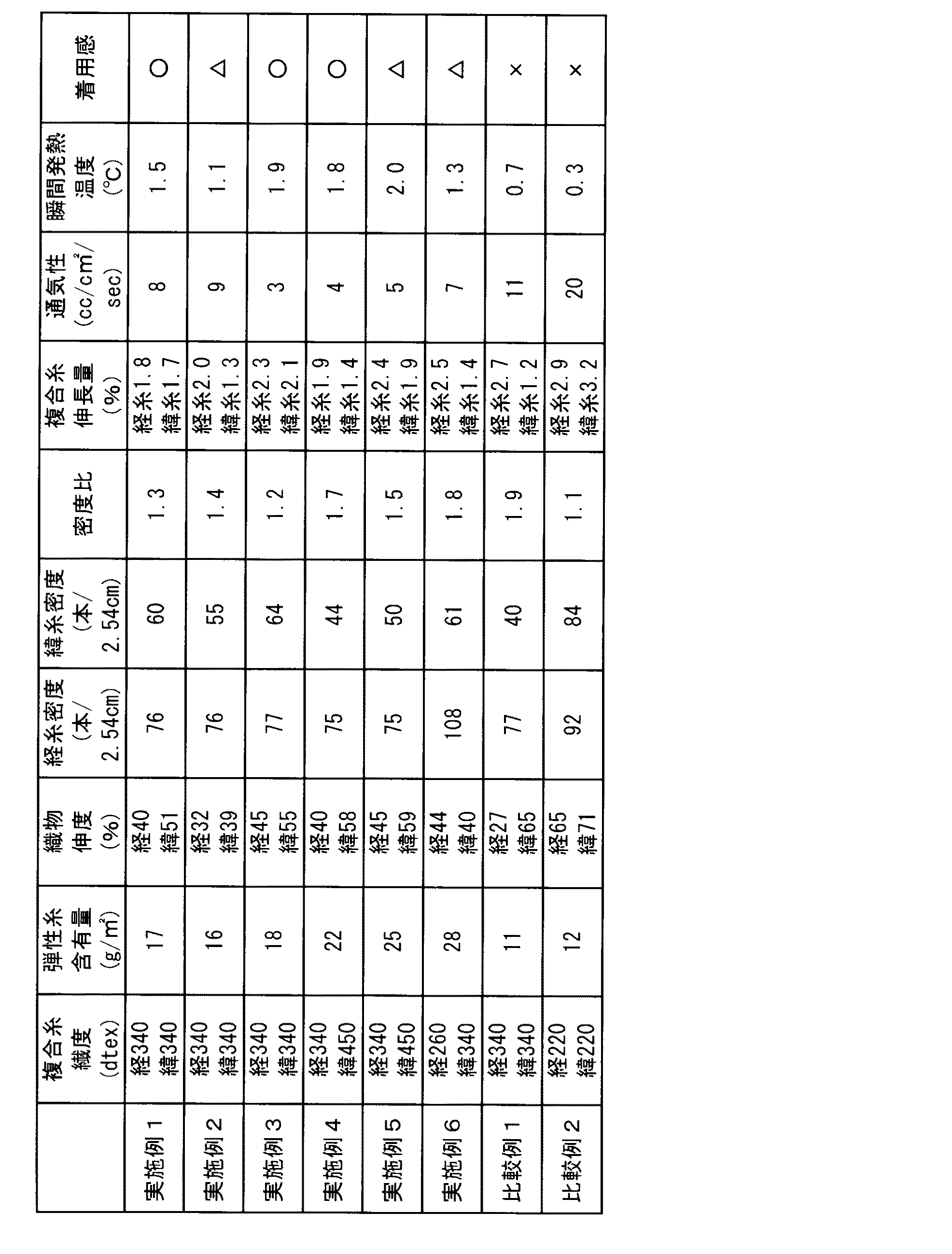
得られた伸縮性織物の評価結果を以下の表1に示す。
[Example 1]
An elastic yarn of 44 dtex that was stretched three times during the spinning process of cotton dyed as a composite yarn was inserted to produce a composite yarn of 340 dtex as CSY. This composite yarn was wound around a beam, set on a loom, and placed in a 33 / inch kite with 2 pcs / feather. The weft is the same composite yarn, weaved in a 2/1 twill structure and weaved under the conditions of 54 wefts / inch, then scoured with a continuous scourer, then finished and set at 185 ° C for 1 minute to stretch fabric Got.
The evaluation results of the resulting stretchable fabric are shown in Table 1 below.
[実施例2、3、比較例1]
実施例1において、緯糸打ち密度を50本/インチとした織物(実施例2)、及び、58本とした織物(実施例3)、さらに、37本/インチとした織物(比較例1)を製造し、実施例1と同様に仕上げた。
得られた伸縮性織物の評価結果を以下の表1に示す。
[Examples 2 and 3, Comparative Example 1]
In Example 1, a fabric (Example 2) with a weft punching density of 50 / inch, a fabric with 58 (Example 3), and a fabric with 37 / inch (Comparative Example 1). Manufactured and finished as in Example 1.
The evaluation results of the resulting stretchable fabric are shown in Table 1 below.
[実施例4、5]
複合糸として綿染めした綿の紡績工程中に3倍に伸長した78dtexの弾性糸を挿入して、CSYとして450dtexの複合糸を製造し、このCSYを緯糸として実施例1において製造した緯糸に代えて、緯糸打ち込み40本/インチの条件で織物を製造した(実施例4)。また、緯糸の打ち込み密度を45本/インチとした織物も製造した(実施例5)。
得られた伸縮性織物の評価結果を以下の表1に示す。
[Examples 4 and 5]
Inserting an elastic yarn of 78 dtex, which was stretched 3 times during the spinning process of cotton dyed as a composite yarn, produced a 450 dtex composite yarn as CSY, and replaced the weft yarn produced in Example 1 with this CSY as the weft. Thus, a woven fabric was manufactured under conditions of 40 wefts per inch (Example 4). In addition, a woven fabric with a weft threading density of 45 yarns / inch was also manufactured (Example 5).
The evaluation results of the resulting stretchable fabric are shown in Table 1 below.
[実施例6]
3倍に伸長した78dtexの弾性糸に165dtexのポリエステル2ヒーター加工糸を800T/mの条件で巻きつけた240dtexの複合糸を経糸としてビームに捲いて織機にセットし、45羽/インチの筬に2本入れ/筬で筬入れし、緯糸は実施例1で製造したCSY340dtexの複合糸を使用して打ち込み本数54本/インチでタフタ組織の織物を製造した。得られた織物を連続精練機でリラックス、精練を行い、次いで185℃で1分間プレセットを行い、その後、液流染色機でポリエステルの染色を行った。染色後に柔軟仕上げ剤をパディングして、160℃で1分の条件で仕上げセットを行い、伸縮性織物を得た。
得られた伸縮性織物の評価結果を以下の表1に示す。
[Example 6]
A composite yarn of 240 dtex, in which 165 dtex of polyester 2 heater-processed yarn is wrapped around a stretched 78 dtex elastic yarn under a condition of 800 T / m, is wound on a beam as a warp and set in a loom. A taffeta-textured fabric was manufactured using a composite yarn of CSY 340 dtex produced in Example 1 at a rate of 54 yarns / inch. The obtained woven fabric was relaxed and scoured with a continuous scouring machine, then pre-set at 185 ° C. for 1 minute, and then dyed with a liquid dyeing machine. After dyeing, a soft finish was padded and a finishing set was performed at 160 ° C. for 1 minute to obtain an elastic fabric.
The evaluation results of the resulting stretchable fabric are shown in Table 1 below.
[比較例2]
3倍に伸長した56dtexの弾性糸に165dtexのポリエステル2ヒーター加工糸を800T/mの条件で巻きつけた220dtexの複合糸を経糸としてビームに捲いて織機にセットし、40羽/インチの筬に2本入れ/筬で筬入れし、緯糸も経糸と同じ複合糸を使用して打ち込み本数70本/インチでタフタ組織の織物を製造した。
得られた伸縮性織物の評価結果を以下の表1に示す。
[Comparative Example 2]
A fiber of 220 dtex, in which a polyester 2 heater processed yarn of 165 dtex is wound around an elastic yarn of 3 times stretched at 3 times under the condition of 800 T / m, is wound on a beam as a warp and set in a loom, and 40 pcs / inch A taffeta-woven fabric was produced with a number of 70 pieces / inch by using the same composite yarn as the warp.
The evaluation results of the resulting stretchable fabric are shown in Table 1 below.
本発明の伸縮性織物は、伸長時に瞬間発熱する織物であり、これを用いて、保温性と伸長部位の筋肉や関節を暖めることによる怪我の防止や、脂肪燃焼効果も期待できる衣料製品、例えば、シャツ、タイツ等が得られる。 The stretch fabric of the present invention is a fabric that instantaneously generates heat when stretched, and using this, clothing products that can be expected to have heat retention and prevention of injury due to warming muscles and joints of the stretched part, and fat burning effect, for example, , Shirts and tights.
Claims (3)
密度比=(経糸密度)/(緯糸密度) 式(1)
で表される密度比は、1.2〜1.8であり、経糸、緯糸とも、下記式(2):
複合糸伸長量= B/A 式(2)
{式中、Aは、無荷重下での織物長さであり、そしてBは、無荷重下で織物長さAに織り込まれている複合糸を抜出し、0.98N荷重下で測定した該複合糸の長さである。}で表される複合糸伸長量は、1.3〜2.5であり、かつ、該織物の経方向について、伸縮以外に外部からのエネルギー供給を受けない条件下で該織物を10%伸長させて伸縮試験機(デマッチャー試験機)に取り付け、次いで20%伸長させ、その後緩和させて元の長さに戻す工程を1回とする繰り返し伸縮を、100回/分の速度で5分間行った後、500回目の20%伸長時の織物温度をサーモグラフィで測定して、試験開始前の織物温度との差から算出する瞬間発熱温度は、1.0℃以上である、ことを特徴とする前記伸縮性織物。 In both the warp and the weft, in a stretchable fabric made of a composite yarn of an inelastic yarn and an elastic yarn having a fineness of 250 to 500 dtex, at least the inelastic yarn of the weft is a spun yarn, and the fabric has an elastic yarn. It is contained at 15 to 30 g / m 2 , and the elongation rate in the warp direction and the weft direction under a 9.8 N load of the woven fabric is 30 to 60%, and the following formula (1):
Density ratio = (warp density) / (weft density) Formula (1)
Is a ratio of 1.2 to 1.8, and both the warp and the weft are represented by the following formula (2):
Composite yarn elongation amount = B / A Formula (2)
{Wherein A is the fabric length under no load, and B is the composite measured under 0.98N load with the composite yarn woven into the fabric length A under no load. The length of the thread. }, The elongation amount of the composite yarn is 1.3 to 2.5, and the fabric is stretched by 10% in the warp direction under the condition that it receives no external energy supply other than expansion and contraction. It was attached to an expansion / contraction tester (dematcher tester), then stretched by 20%, and then repeatedly expanded and contracted at a rate of 100 times / minute for 5 minutes. Thereafter, the fabric temperature at the time of 20% elongation at the 500th time is measured by thermography, and the instantaneous heat generation temperature calculated from the difference from the fabric temperature before the start of the test is 1.0 ° C. or more. Elastic fabric.
Priority Applications (1)
| Application Number | Priority Date | Filing Date | Title |
|---|---|---|---|
| JP2016079034A JP6628676B2 (en) | 2016-04-11 | 2016-04-11 | Stretch fabric |
Applications Claiming Priority (1)
| Application Number | Priority Date | Filing Date | Title |
|---|---|---|---|
| JP2016079034A JP6628676B2 (en) | 2016-04-11 | 2016-04-11 | Stretch fabric |
Publications (2)
| Publication Number | Publication Date |
|---|---|
| JP2017190532A true JP2017190532A (en) | 2017-10-19 |
| JP6628676B2 JP6628676B2 (en) | 2020-01-15 |
Family
ID=60084552
Family Applications (1)
| Application Number | Title | Priority Date | Filing Date |
|---|---|---|---|
| JP2016079034A Active JP6628676B2 (en) | 2016-04-11 | 2016-04-11 | Stretch fabric |
Country Status (1)
| Country | Link |
|---|---|
| JP (1) | JP6628676B2 (en) |
Cited By (4)
| Publication number | Priority date | Publication date | Assignee | Title |
|---|---|---|---|---|
| JP2020169401A (en) * | 2019-04-01 | 2020-10-15 | 旭化成株式会社 | Elastic woven fabric and clothing containing the woven fabric |
| CN111962195A (en) * | 2020-07-16 | 2020-11-20 | 广东职业技术学院 | Preparation method of self-heating micro-elastic jean fabric |
| CN113802243A (en) * | 2021-09-29 | 2021-12-17 | 华中科技大学 | Preparation method of friction heating warm-keeping fabric |
| CN117802665A (en) * | 2024-01-04 | 2024-04-02 | 江西吉臻实业有限公司 | Textile fabric relying on frictional heating and manufacturing method |
Citations (2)
| Publication number | Priority date | Publication date | Assignee | Title |
|---|---|---|---|---|
| JP2014152425A (en) * | 2013-02-13 | 2014-08-25 | Asahi Kasei Fibers Corp | Elastic fabric |
| WO2014157667A1 (en) * | 2013-03-29 | 2014-10-02 | 旭化成せんい株式会社 | Elastic knitted fabric and clothing item |
-
2016
- 2016-04-11 JP JP2016079034A patent/JP6628676B2/en active Active
Patent Citations (2)
| Publication number | Priority date | Publication date | Assignee | Title |
|---|---|---|---|---|
| JP2014152425A (en) * | 2013-02-13 | 2014-08-25 | Asahi Kasei Fibers Corp | Elastic fabric |
| WO2014157667A1 (en) * | 2013-03-29 | 2014-10-02 | 旭化成せんい株式会社 | Elastic knitted fabric and clothing item |
Cited By (5)
| Publication number | Priority date | Publication date | Assignee | Title |
|---|---|---|---|---|
| JP2020169401A (en) * | 2019-04-01 | 2020-10-15 | 旭化成株式会社 | Elastic woven fabric and clothing containing the woven fabric |
| JP7257223B2 (en) | 2019-04-01 | 2023-04-13 | 旭化成株式会社 | Elastic fabric and garment containing said fabric |
| CN111962195A (en) * | 2020-07-16 | 2020-11-20 | 广东职业技术学院 | Preparation method of self-heating micro-elastic jean fabric |
| CN113802243A (en) * | 2021-09-29 | 2021-12-17 | 华中科技大学 | Preparation method of friction heating warm-keeping fabric |
| CN117802665A (en) * | 2024-01-04 | 2024-04-02 | 江西吉臻实业有限公司 | Textile fabric relying on frictional heating and manufacturing method |
Also Published As
| Publication number | Publication date |
|---|---|
| JP6628676B2 (en) | 2020-01-15 |
Similar Documents
| Publication | Publication Date | Title |
|---|---|---|
| RU2622804C2 (en) | Elastic knitted fabric and items of clothing | |
| RU2582466C2 (en) | Stretchable knitted fabric and clothing | |
| JPWO2018066565A1 (en) | Warp knitted fabric | |
| JP6628676B2 (en) | Stretch fabric | |
| JP5584497B2 (en) | Elastic knitted fabric | |
| JP6101503B2 (en) | Elastic fabric | |
| JP2012112078A (en) | Elastic warp knitted fabric | |
| TWI669424B (en) | Elastic round braid | |
| JP6851746B2 (en) | Cellulose fiber mixed knitting warp knitted fabric | |
| JP5896677B2 (en) | Knitted fabric | |
| JP6602986B2 (en) | Leg products | |
| JP7257223B2 (en) | Elastic fabric and garment containing said fabric | |
| JP6510337B2 (en) | Stretchable weft knit | |
| JP6243176B2 (en) | Knitted fabric and clothes | |
| JP6004624B2 (en) | Supporter | |
| JP7101523B2 (en) | Cylindrical knitted fabric and products containing it and clothing | |
| JP2013072155A (en) | Exothermic supporter | |
| JP6767226B2 (en) | Cellulose fiber mixed knitted fabric | |
| JP2021055208A (en) | Tubular knitted fabric product |
Legal Events
| Date | Code | Title | Description |
|---|---|---|---|
| A621 | Written request for application examination |
Free format text: JAPANESE INTERMEDIATE CODE: A621 Effective date: 20181227 |
|
| A977 | Report on retrieval |
Free format text: JAPANESE INTERMEDIATE CODE: A971007 Effective date: 20191108 |
|
| TRDD | Decision of grant or rejection written | ||
| A01 | Written decision to grant a patent or to grant a registration (utility model) |
Free format text: JAPANESE INTERMEDIATE CODE: A01 Effective date: 20191119 |
|
| A61 | First payment of annual fees (during grant procedure) |
Free format text: JAPANESE INTERMEDIATE CODE: A61 Effective date: 20191203 |
|
| R150 | Certificate of patent or registration of utility model |
Ref document number: 6628676 Country of ref document: JP Free format text: JAPANESE INTERMEDIATE CODE: R150 |