JP2017193059A - Glossy paper for inkjet and method for producing the same - Google Patents
Glossy paper for inkjet and method for producing the same Download PDFInfo
- Publication number
- JP2017193059A JP2017193059A JP2016082785A JP2016082785A JP2017193059A JP 2017193059 A JP2017193059 A JP 2017193059A JP 2016082785 A JP2016082785 A JP 2016082785A JP 2016082785 A JP2016082785 A JP 2016082785A JP 2017193059 A JP2017193059 A JP 2017193059A
- Authority
- JP
- Japan
- Prior art keywords
- receiving layer
- ink
- paper
- ink receiving
- glossy paper
- Prior art date
- Legal status (The legal status is an assumption and is not a legal conclusion. Google has not performed a legal analysis and makes no representation as to the accuracy of the status listed.)
- Granted
Links
Landscapes
- Ink Jet Recording Methods And Recording Media Thereof (AREA)
- Paper (AREA)
Abstract
【課題】本発明は、高品位の光沢紙であり、かつ搬送性の良いインクジェット用光沢紙を提供することである。【解決手段】本発明に係るインクジェット用光沢紙は、紙基材の片面に顔料と結着剤を含有するインク受容層を設けたインクジェット用光沢紙において、前記インク受容層の写像性が、JIS H 8686−2:1999「アルミニウム及びアルミニウム合金の陽極酸化皮膜の写像性試験方法」による光学くし幅2mm入反射角度60°による条件において、55%以上であり、かつ、前記インク受容層を設けた面の反対面のベック平滑度が20秒以下である。【選択図】なしAn object of the present invention is to provide a glossy paper for inkjet which is high-quality glossy paper and has good transportability. An inkjet glossy paper according to the present invention is an inkjet glossy paper in which an ink receiving layer containing a pigment and a binder is provided on one side of a paper substrate. H 8686-2: 1999, “The imaging test method of anodized film of aluminum and aluminum alloy” was 55% or more under the condition of an optical comb width of 2 mm and an incident reflection angle of 60 °, and the ink receiving layer was provided. The Beck smoothness of the opposite surface is 20 seconds or less. [Selection figure] None
Description
本開示は、反転給紙型プリンターの搬送性に優れるインクジェット用光沢紙に関するものである。 The present disclosure relates to glossy paper for ink jet that is excellent in transportability of a reversal paper feed type printer.
インクジェット記録方式は、インクの液滴を吐出し、記録紙上に付着させることによってドットを形成し、記録を行う方式である。近年、インクジェットプリンター、インク、記録媒体の技術的進歩によって、印字品質の高い記録が可能になってきている。これらインクジェット記録専用の媒体としては、紙及び/又はフィルムを支持体として、顔料と結着剤を主成分とする顔料塗工層を表面に設けたものが多く使用される。 The ink jet recording system is a system in which ink droplets are ejected and deposited on recording paper to form dots and recording is performed. In recent years, recording with high print quality has become possible due to technological advances in ink jet printers, inks, and recording media. As these ink jet recording-dedicated media, a medium having a pigment coating layer mainly composed of a pigment and a binder on the surface and using paper and / or film as a support is often used.
インクジェット専用媒体は、更に表面状態からマット調媒体と光沢媒体に分類される。銀塩写真により近い画像品質を要求する場合には、後者の光沢媒体が使用される。 Inkjet dedicated media are further classified into matte and glossy media from the surface state. The latter glossy medium is used when image quality closer to silver halide photography is required.
光沢媒体の製法としては、一般的方法はキャスト法によってインク受容層を形成し表面に光沢を付与する方法と印画紙用基材上にインク受容層を形成する方法とがある。 As a method for producing a glossy medium, general methods include a method of forming an ink receiving layer by a casting method and imparting gloss to the surface, and a method of forming an ink receiving layer on a photographic paper base.
後者の印画紙用基材は、一般にRC紙(レジンコート紙)といわれるように、紙の基材上にポリエチレンのフィルム層が形成されているために、インク受容層をその表面に形成した場合、フィルム層が平滑であることから、インク受容層表面も平滑で、光沢のある表面が形成されやすい。 The latter substrate for photographic paper is generally formed of a polyethylene film layer on a paper substrate, as is commonly called RC paper (resin coated paper). Since the film layer is smooth, the surface of the ink receiving layer is also smooth and a glossy surface is easily formed.
しかし、全体のコストは、インク吸収性をあげるために塗工量を多くする必要があり、また基材そのものが紙よりも高価であることから前者のキャスト法による光沢媒体に比べ高いものとなる。また、廃棄する場合には、複合素材であることからリサイクルができないといった問題もある。 However, the overall cost needs to be increased in order to increase ink absorbency, and the base material itself is more expensive than paper, so it is higher than the former glossy media produced by the casting method. . In addition, when it is discarded, there is a problem that it cannot be recycled because it is a composite material.
一方で、近年、パーソナルインクジェットプリンターはデザイン性を重視しており、筐体がコンパクトな反転給紙型プリンターが多くなってきている。このタイプのプリンターは、例えば、インク受容層に印字する時には、インク受容層の反対面を上にしてセットし、給紙される際に紙が反転してインク受容層に印字される。従来の背面給紙型プリンターとは異なり、給紙機構が複雑であり、重送等(ここでいう、重送とは、複数枚が重なって給紙される現象のことである)の搬送不良が生じやすい問題がある。特にインクジェット用光沢紙の場合は、光沢面とその反対面との間の摩擦係数が大きくなる傾向があるため、搬送不良が発生しやすい。また、写像性が高い程、紙と紙が密着しやすく、重送等の搬送不良が生じやすい。また、葉書の場合、軽量なため、更に重送が生じやすい傾向にある。従来、搬送性改善を目的として、各種の提案がなされている。例えば、インク受容層の顔料とバインダーを規定することによって搬送性を向上させる提案がある(例えば、特許文献1を参照。)。 On the other hand, in recent years, personal inkjet printers place emphasis on design, and there are an increasing number of reversal paper feed type printers with a compact housing. In this type of printer, for example, when printing on the ink receiving layer, the opposite side of the ink receiving layer is set up, and when the paper is fed, the paper is reversed and printed on the ink receiving layer. Unlike conventional rear-feed type printers, the paper feed mechanism is complicated, and poor conveyance such as double feed (here, double feed is a phenomenon in which multiple sheets are fed together) There is a problem that tends to occur. In particular, in the case of glossy paper for inkjet, there is a tendency that the coefficient of friction between the glossy surface and the opposite surface tends to be large, so that conveyance failure tends to occur. In addition, the higher the image clarity, the easier the paper and paper are brought into close contact with each other, leading to poor transport such as double feeding. In addition, since postcards are lightweight, they tend to be more likely to cause double feeding. Conventionally, various proposals have been made for the purpose of improving transportability. For example, there is a proposal to improve transportability by defining the pigment and binder of the ink receiving layer (see, for example, Patent Document 1).
しかし、特許文献1に記載の技術の場合には、光沢面の写像性が高くなると、搬送不良が発生しやすい問題点がある。 However, in the case of the technique described in Patent Document 1, there is a problem that poor conveyance is likely to occur when the image clarity of the glossy surface increases.
このように、近年普及している反転給紙型プリンターの搬送性を、搬送不良がなくなるように、完全にすることは、使用する媒体がインクジェット光沢紙の場合、一層困難である。 As described above, it is more difficult to completely complete the transportability of the reversing paper feed type printers that have been widely used in recent years when the medium to be used is inkjet glossy paper so that the transport failure is eliminated.
そこで、本開示の目的は、写像性が高い高品位の光沢紙であり、かつ搬送性の良いインクジェット用光沢紙を提供することである。より具体的には、高品位の光沢紙でありつつ、複数枚の紙をプリンターにセットした場合、紙と紙の間に適度な空隙が生じ、給紙時に紙がセパレートされやすく、重送が生じにくいインクジェット用光沢紙を提供することである。 Accordingly, an object of the present disclosure is to provide an inkjet glossy paper that is high-quality glossy paper with high image clarity and good transportability. More specifically, when multiple sheets of paper are set in the printer, even though they are high-quality glossy paper, an appropriate gap is generated between the sheets, and the sheets are easily separated during feeding, and multiple feeding is possible. It is an object to provide glossy paper for ink jet that is difficult to occur.
本発明に係るインクジェット用光沢紙は、紙基材の片面に顔料と結着剤を含有するインク受容層を設けたインクジェット用光沢紙において、前記インク受容層の写像性が、JIS H 8686−2:1999「アルミニウム及びアルミニウム合金の陽極酸化皮膜の写像性試験方法」による光学くし幅2mm入反射角度60°による条件において、55%以上であり、かつ、前記インク受容層を設けた面の反対面のベック平滑度が20秒以下であることを特徴とする。 The inkjet glossy paper according to the present invention is an inkjet glossy paper in which an ink receiving layer containing a pigment and a binder is provided on one side of a paper substrate, and the image receptivity of the ink receiving layer is JIS H 8686-2. : 55% or more under the condition of an optical comb width of 2 mm and an incident reflection angle of 60 ° according to 1999 “Image clarity test method of anodized film of aluminum and aluminum alloy” and opposite to the surface provided with the ink receiving layer The Beck smoothness is 20 seconds or less.
本発明に係るインクジェット用光沢紙では、前記インク受容層が、前記顔料として多孔質微細顔料を含有することが好ましい。多孔質微細顔料の幾何学的形状によって、インク受容層を形成したときに層内に空隙が形成しやすく、染料インク及び顔料インクのインク吸収性に優れる。 In the glossy paper for inkjet according to the present invention, the ink receiving layer preferably contains a porous fine pigment as the pigment. Due to the geometric shape of the porous fine pigment, when the ink receiving layer is formed, voids are easily formed in the layer, and the ink absorbability of the dye ink and the pigment ink is excellent.
本発明に係るインクジェット用光沢紙では、前記多孔質微細顔料は、気相法シリカ、沈降法シリカ、γ‐アルミナ、θ‐アルミナ、ベーマイト(擬ベーマイトも含む)、アルミナ修飾シリカより選ばれる1種以上であり、前記多孔質微細顔料のBET比表面積が100〜400m2/gであることが好ましい。染料インクと顔料インクのインク吸収性をより優れたものにすることが可能となる。 In the glossy paper for inkjet according to the present invention, the porous fine pigment is one selected from gas phase method silica, precipitation method silica, γ-alumina, θ-alumina, boehmite (including pseudoboehmite), and alumina-modified silica. It is above, and it is preferable that the BET specific surface area of the said porous fine pigment is 100-400 m < 2 > / g. It becomes possible to make the ink absorbability of dye ink and pigment ink more excellent.
本発明に係るインクジェット用光沢紙では、前記多孔質微細顔料は、平均一次粒子径が5〜30nm又は平均二次粒子径が20〜1000nmのいずれか一方又は両方を満たすことが好ましい。顔料インクのインク吸収性とインク受容層の光沢感のバランスが良好となる。 In the glossy paper for inkjet according to the present invention, the porous fine pigment preferably satisfies one or both of an average primary particle diameter of 5 to 30 nm and an average secondary particle diameter of 20 to 1000 nm. The balance between the ink absorbability of the pigment ink and the glossiness of the ink receiving layer is improved.
本発明に係るインクジェット用光沢紙では、前記インク受容層の最表面に単分散球状コロイダルシリカが分布していることが好ましい。インク受容層の表面の写像性の向上、耐傷性の向上及び摩擦係数の低下の効果がみられる。 In the glossy paper for inkjet according to the present invention, it is preferable that monodispersed spherical colloidal silica is distributed on the outermost surface of the ink receiving layer. The effect of improving the image clarity of the surface of the ink receiving layer, improving the scratch resistance, and reducing the friction coefficient is observed.
本発明に係るインクジェット用光沢紙は、前記インク受容層の反対面が宛名面である、葉書用紙であることが好ましい。葉書は、軽量であるゆえに重送が生じやすいが、本発明によれば搬送性に優れる。 The inkjet glossy paper according to the present invention is preferably a postcard paper in which the opposite surface of the ink receiving layer is an address surface. Since the postcard is lightweight, it is easy to cause double feeding. However, according to the present invention, the postcard has excellent transportability.
本発明に係るインクジェット用光沢紙の製造方法は、紙基材の片面に顔料と結着剤を含有するインク受容層を設けたインクジェット用光沢紙の製造方法において、前記インク受容層を設けることとなる面の反対面のベック平滑度が10秒以上40秒以下である紙基材を準備する工程と、前記顔料と前記結着剤とを含有するインク受容層用塗工液を前記紙基材に塗工して塗工層を形成する工程と、前記結着剤を凝固させる凝固剤を前記結着剤に対して5質量%以上含有する凝固液を、前記塗工層が湿潤状態にあるうちに塗布して凝固処理をした後に、キャストドラムに圧接する工程と、有し、該工程を経た後の前記インク受容層の写像性が、JIS H 8686−2:1999「アルミニウム及びアルミニウム合金の陽極酸化皮膜の写像性試験方法」による光学くし幅2mm入反射角度60°による条件において55%以上であり、かつ、前記インク受容層を設けた面の反対面のベック平滑度が5秒以上20秒以下であることを特徴とする。 An inkjet glossy paper manufacturing method according to the present invention is the inkjet glossy paper manufacturing method in which an ink receiving layer containing a pigment and a binder is provided on one side of a paper substrate, and the ink receiving layer is provided. A step of preparing a paper base material having a Beck smoothness of 10 to 40 seconds on the opposite side of the surface, and an ink receiving layer coating liquid containing the pigment and the binder. The coating layer is in a wet state with a step of forming a coating layer by coating on the surface and a coagulant containing 5% by mass or more of the coagulant for coagulating the binder with respect to the binder. And coating with a cast drum after applying and solidifying, and the image receptivity of the ink-receiving layer after passing through this step is JIS H 8686-2: 1999 “of aluminum and aluminum alloys. Image clarity test of anodized film 55% or more under the condition of an optical comb width of 2 mm and an incident / reflection angle of 60 ° according to the “method”, and the Beck smoothness of the surface opposite to the surface provided with the ink receiving layer is from 5 seconds to 20 seconds. And
本開示によって、写像性が高品位の光沢紙であり、かつ搬送性の良いインクジェット用光沢紙を提供することができる。例えば、近年普及している反転給紙型のパーソナルインクジェットプリンターを使用しても、重送等の搬送不良が生じないので、本発明の有意性は大きいと考えられる。また、本開示では、紙を基材としていることから、フィルム層を有する印画紙基材に比べ、製造コストも低く、廃棄する場合にはリサイクル可能であり、資源の有効利用という観点からも好ましい。 According to the present disclosure, it is possible to provide glossy paper for inkjet which is high-quality glossy paper and has good transportability. For example, even if a reversal paper feeding type personal ink jet printer that has been widespread in recent years is used, there is no conveyance failure such as double feeding, so the present invention is considered significant. Further, in the present disclosure, since paper is used as a base material, the manufacturing cost is low as compared with a photographic paper base material having a film layer, and it can be recycled when discarded, which is preferable from the viewpoint of effective use of resources. .
これより本発明について実施形態を示して詳細に説明するが、本発明はこれらの記載に限定して解釈されない。本発明の効果を奏する限り、実施形態は種々の変形をしてもよい。 Embodiments of the present invention will be described in detail below, but the present invention is not construed as being limited to these descriptions. As long as the effect of the present invention is exhibited, the embodiment may be variously modified.
インクジェット用光沢紙のインク受容層を形成するための塗工液に含有させる通常用いられる顔料としては、沈降法シリカ、球状コロイダルシリカ、複数個の球状コロイダルシリカが連結した非球状コロイダルシリカ、気相法シリカ、アルミナ(ベーマイト、擬ベーマイト結晶も含む)、アルミナ修飾シリカなどを挙げることができる。 Commonly used pigments to be included in the coating liquid for forming the ink receiving layer of glossy paper for inkjet include precipitated silica, spherical colloidal silica, non-spherical colloidal silica in which a plurality of spherical colloidal silicas are connected, gas phase Examples thereof include silica, alumina (including boehmite and pseudoboehmite crystals), and alumina-modified silica.
また、気相法シリカやアルミナ、複数個の球状コロイダルシリカが連結した非球状コロイダルシリカなどの多孔質微細顔料については、その極めて高い比表面積性に由来するインク吸収の良さからインクジェット用光沢紙で一般的に使用される顔料であるが、その幾何学的形状から成膜時の空隙が形成しやすく、染料インク及び顔料インクのインク吸収性に優れる一方で、摩擦係数が高くなり、搬送不良が生じやすい。 In addition, porous fine pigments such as gas phase method silica, alumina, and non-spherical colloidal silica in which a plurality of spherical colloidal silicas are linked are used for inkjet glossy paper due to their excellent ink absorption due to their extremely high specific surface area. Although it is a commonly used pigment, it is easy to form voids during film formation due to its geometric shape, and while it has excellent ink absorbability of dye ink and pigment ink, it has a high coefficient of friction and poor conveyance. Prone to occur.
本実施形態で使用する多孔質微細顔料とは、一次粒子が凝集して二次以上の粒子を形成している顔料のことであり、粒子自体が空隙を有する顔料のことである。平均一次粒子径が5〜30nm、平均二次粒子径(三次以上を形成している場合は最終的な凝集形状の平均粒子径とする)は20〜1000nmであることが好ましい。ここで平均一次粒子径が5〜30nm又は平均二次粒子径が20〜1000nmのいずれか一方又は両方を満たすことが好ましい。いずれか一方を満たす場合として、例えば、多孔質微細顔料の微構造観察をしても一次粒子が視認できない場合、二次粒子を観察することとする。上記粒子径において、より好ましくは、平均一次粒子径が5〜25nm、平均二次粒子径が20〜500nmである。本実施形態で使用する多孔質微細顔料はこのような粒子径を有し、かつ、気相法シリカ、沈降法シリカ、ゲル法シリカ、複数個の球状コロイダルシリカが連結した非球状コロイダルシリカ、ベーマイト(擬ベーマイトも含む)、γ‐アルミナ、θ‐アルミナ、σ‐アルミナ、アルミナ修飾シリカであることが好ましい。顔料インクのインク吸収性と光沢感の観点から、気相法シリカ、沈降法シリカ、γ‐アルミナ、θ‐アルミナ、ベーマイト(擬ベーマイトも含む)、アルミナ修飾シリカを使用することが好ましい。更に、写像性とインク吸収性のバランスの良さから、気相法シリカを含有することが好ましい。 The porous fine pigment used in the present embodiment is a pigment in which primary particles aggregate to form secondary or higher particles, and the particles themselves have a void. The average primary particle size is preferably 5 to 30 nm, and the average secondary particle size (when the tertiary or higher is formed, the average particle size of the final aggregated shape) is preferably 20 to 1000 nm. Here, the average primary particle diameter is preferably 5 to 30 nm or the average secondary particle diameter is preferably 20 to 1000 nm or both. As a case where either one is satisfied, for example, when the primary particles cannot be visually recognized even when the fine structure of the porous fine pigment is observed, the secondary particles are observed. In the above particle diameter, more preferably, the average primary particle diameter is 5 to 25 nm and the average secondary particle diameter is 20 to 500 nm. The porous fine pigment used in the present embodiment has such a particle size, and gas phase method silica, precipitation method silica, gel method silica, non-spherical colloidal silica in which a plurality of spherical colloidal silicas are connected, boehmite (Including pseudoboehmite), γ-alumina, θ-alumina, σ-alumina, and alumina-modified silica are preferable. From the viewpoint of the ink absorbability and glossiness of the pigment ink, it is preferable to use gas phase method silica, precipitation method silica, γ-alumina, θ-alumina, boehmite (including pseudoboehmite), and alumina-modified silica. Furthermore, it is preferable to contain vapor phase method silica from the viewpoint of good balance between image clarity and ink absorbability.
また、本実施形態で使用する多孔質微細顔料のBET比表面積は、100〜400m2/gであることが好ましい。より好ましくは、150〜380m2/gであり、特に好ましくは、180〜350m2/gである。BET比表面積が100m2/g未満であると、顔料インクの画像鮮明性に劣ることがある。BET比表面積が400m2/gを超えると、塗工液の粘度が高すぎて安定性が劣ることがある。ここで、BET比表面積は、BET法によって求めた単位質量あたりの表面積である。BET法とは、気相吸着法による粉体の比表面積測定法の一つであり、吸着等温線から1gの試料のもつ総表面積、すなわち比表面積を求める方法である。通常、吸着気体としては、窒素ガスが多く用いられ、吸着量を被吸着気体の圧、又は容積の変化から測定する方法が最も多く用いられている。多分子吸着の等温線を表すのに最も著名なものは、Brunauer、Emmett、Tellerの式であってBET式と呼ばれ表面積決定に広く用いられている。BET式に基づいて吸着量を求め、吸着分子1個が表面で占める面積を掛けて、表面積が得られる。また、本発明の効果を損なわない範囲においては、BET比表面積が100m2/g未満の多孔質微細顔料と併用してもかまわない。 Moreover, it is preferable that the BET specific surface area of the porous fine pigment used by this embodiment is 100-400 m < 2 > / g. More preferably, it is 150-380 m < 2 > / g, Most preferably, it is 180-350 m < 2 > / g. When the BET specific surface area is less than 100 m 2 / g, the image clarity of the pigment ink may be inferior. If the BET specific surface area exceeds 400 m 2 / g, the viscosity of the coating solution may be too high, resulting in poor stability. Here, the BET specific surface area is a surface area per unit mass determined by the BET method. The BET method is a method for measuring the specific surface area of a powder by a gas phase adsorption method, and is a method for obtaining the total surface area, that is, the specific surface area of a 1 g sample from an adsorption isotherm. Usually, nitrogen gas is often used as the adsorbed gas, and the most frequently used method is to measure the amount of adsorption from the change in pressure or volume of the gas to be adsorbed. The most prominent expression for expressing the isotherm of multimolecular adsorption is the Brunauer, Emmett, and Teller equation, called the BET equation, which is widely used for determining the surface area. The adsorption amount is obtained based on the BET equation, and the surface area is obtained by multiplying the area occupied by one adsorbed molecule on the surface. Moreover, in the range which does not impair the effect of this invention, you may use together with the porous fine pigment whose BET specific surface area is less than 100 m < 2 > / g.
本実施形態で使用する多孔質微細顔料の粒子径は、主として動的光散乱法(例えば、大塚電子社製、DLS−6500)で求めることが可能であり、また、高倍率観察が可能なフィールドエミッション型の電子顕微鏡で直接観察して求めることも可能である。平均一次粒子径を求めるときには、フィールドエミッション型の電子顕微鏡を用い、平均二次粒子径を求めるときには、動的光散乱法を用いる。本開示において、平均二次粒子径とは、二次粒子の数平均粒子径を意味する。 The particle diameter of the porous fine pigment used in the present embodiment can be determined mainly by a dynamic light scattering method (for example, DLS-6500, manufactured by Otsuka Electronics Co., Ltd.), and can be observed at a high magnification. It can also be obtained by direct observation with an emission electron microscope. When determining the average primary particle size, a field emission electron microscope is used, and when determining the average secondary particle size, the dynamic light scattering method is used. In the present disclosure, the average secondary particle diameter means the number average particle diameter of secondary particles.
更に、インク受容層に含有させる結着剤としては、ポリビニルアルコール(シラノール変性ポリビニルアルコール、カルボキシル変性ポリビニルアルコール等の変性ポリビニルアルコールなども含む)、ポリビニルアセタール、酸化澱粉、エーテル化澱粉、カルボキシメチルセルロース、ヒドロキシエチルセルロース、カゼイン、ゼラチン、大豆タンパク、ポリエチレンイミド系樹脂、ポリビニルピロリドン系樹脂、ポリアクリル酸又はその共重合体、無水マレイン酸共重合体、アクリルアミド系樹脂、アクリル酸エステル系樹脂、ポリアミド系樹脂、アクリル系樹脂、スチレン−アクリル系樹脂、ポリウレタン系樹脂(カチオン性ポリウレタン樹脂を含む。)、ポリエステル系樹脂、ポリビニルブチラール系樹脂、アルキッド樹脂、エポキシ系樹脂、エピクロルヒドリン系樹脂、尿素樹脂、メラミン樹脂、スチレン−ブタジエン共重合体、メチルメタクリレート−ブタジエン共重合体、アクリル酸エステル、メタアクリル酸エステルの重合体又は共重合体等のアクリル系重合体ラテックス類、エチレン−酢酸ビニル共重合体等のビニル系重合体ラテックス類、コロイダルシリカとアクリル樹脂の複合体樹脂、コロイダルシリカとスチレン−アクリル樹脂の複合体樹脂、などが例示され、単独又は併用して用いられる。結着剤の使用量は、記録媒体の印字適性、塗工層の強度、表面光沢感、塗料液性などを考慮して決定される。通常、顔料100質量部に対し1〜100質量部の範囲で添加することが好ましい。より好ましくは、5〜60質量部の範囲で添加し、更に好ましくは10〜50質量部である。1質量部未満であると、塗工層強度が低下する場合がある。100質量部を超えると、インク吸収性が低下する場合がある。 Further, as a binder to be contained in the ink receiving layer, polyvinyl alcohol (including modified polyvinyl alcohol such as silanol-modified polyvinyl alcohol and carboxyl-modified polyvinyl alcohol), polyvinyl acetal, oxidized starch, etherified starch, carboxymethylcellulose, hydroxy Ethyl cellulose, casein, gelatin, soy protein, polyethylene imide resin, polyvinyl pyrrolidone resin, polyacrylic acid or copolymers thereof, maleic anhydride copolymer, acrylamide resin, acrylate resin, polyamide resin, acrylic Resin, styrene-acrylic resin, polyurethane resin (including cationic polyurethane resin), polyester resin, polyvinyl butyral resin, alkyd resin, epoxy resin -Based resin, epichlorohydrin-based resin, urea resin, melamine resin, styrene-butadiene copolymer, methyl methacrylate-butadiene copolymer, acrylic ester, methacrylic ester polymer or copolymer acrylic latex , Vinyl polymer latexes such as ethylene-vinyl acetate copolymer, composite resin of colloidal silica and acrylic resin, composite resin of colloidal silica and styrene-acrylic resin, etc. are exemplified, alone or in combination Used. The amount of the binder used is determined in consideration of the printability of the recording medium, the strength of the coating layer, the surface glossiness, the paint liquid property, and the like. Usually, it is preferable to add in the range of 1 to 100 parts by mass with respect to 100 parts by mass of the pigment. More preferably, it adds in 5-60 mass parts, More preferably, it is 10-50 mass parts. If the amount is less than 1 part by mass, the coating layer strength may decrease. If it exceeds 100 parts by mass, the ink absorbability may decrease.
インク受容層の塗工液には、発色性の観点から結着剤にポリビニルアルコールを含有することが好ましい。 The coating liquid for the ink receiving layer preferably contains polyvinyl alcohol as a binder from the viewpoint of color developability.
インク受容層には、前記顔料及び前記結着剤以外にカチオン性ポリマーを添加することが好ましい。カチオン性ポリマーの作用としては、インク中に使用されている染料中のアニオン性の成分と反応し水に不溶な塩を形成することから、インクをインク受容層に、より強固に定着させ、耐水性が向上する。このようなカチオン性ポリマーとしては、ポリエチレンイミン、エピクロルヒドリン変性ポリアルキルアミン、ポリアミン、ポリアミンポリアミドエピクロルヒドリン、ジメチルアミンアンモニアエピクロルヒドリン、ポリビニルベンジルトリメチルアンモニウムハライド、ポリジアクリルジメチルアンモニウムハライド、ポリジメチルアミノエチルメタクリレート塩酸塩、ポリビニルピリジウムハライド
、カチオン性ポリアクリルアミド、カチオン性ポリスチレン共重合体、ジアリルジメチルアンモニウムクロライド重合物、ジアリルジメチルアンモニウムクロライド二酸化硫黄共重合物、ジアリルジメチルアンモニウムクロライドアミド共重合物、ジシアンジアミドホルマリン重縮合物、ジシアンジアミドジエチレントリアミン重縮合物、ポリアリルアミン、ポリアリルアミン塩酸塩、ポリアクリルアミド系樹脂、ポリアミドエポキシ樹脂、メラミン樹脂酸コロイド、尿素系樹脂、カチオン変性ポリビニルアルコール、アミノ酸型両性界面活性剤、ベタイン型化合物、ポリアミジン系化合物、その他第4級アンモニウム塩類などが用いられる。添加量は、特に限定されないが、顔料100質量部に対し1〜50質量部の範囲で添加することが好ましい。より好ましくは、5〜40質量部の範囲で添加される。1質量部未満であると、印画部の耐水性が低下する場合がある。50質量部を超えると、インク吸収性が劣る場合がある。
It is preferable to add a cationic polymer to the ink receiving layer in addition to the pigment and the binder. The action of the cationic polymer is to react with an anionic component in the dye used in the ink to form a salt that is insoluble in water. Improves. Such cationic polymers include polyethyleneimine, epichlorohydrin-modified polyalkylamine, polyamine, polyamine polyamide epichlorohydrin, dimethylamine ammonia epichlorohydrin, polyvinylbenzyltrimethylammonium halide, polydiacryldimethylammonium halide, polydimethylaminoethyl methacrylate hydrochloride, polyvinyl Pyridium halide, cationic polyacrylamide, cationic polystyrene copolymer, diallyldimethylammonium chloride polymer, diallyldimethylammonium chloride sulfur dioxide copolymer, diallyldimethylammonium chloride amide copolymer, dicyandiamide formalin polycondensate, dicyandiamide diethylenetriamine Polycondensate Polyallylamine, polyallylamine hydrochloride, polyacrylamide resin, polyamide epoxy resin, melamine resin acid colloid, urea resin, cation-modified polyvinyl alcohol, amino acid type amphoteric surfactant, betaine type compound, polyamidine type compound, other quaternary Ammonium salts are used. The addition amount is not particularly limited, but it is preferably added in the range of 1 to 50 parts by mass with respect to 100 parts by mass of the pigment. More preferably, it is added in the range of 5 to 40 parts by mass. If it is less than 1 part by mass, the water resistance of the printed part may be lowered. If it exceeds 50 parts by mass, the ink absorbability may be inferior.
また更に、インク受容層には、分散剤、増粘剤、防腐剤、消泡剤、着色染料、着色顔料、蛍光増白剤、耐水化剤、酸化防止剤、紫外線吸収剤などの添加剤を適宜選定して添加することができる。 Furthermore, additives such as dispersants, thickeners, preservatives, antifoaming agents, colored dyes, coloring pigments, fluorescent brighteners, water resistance agents, antioxidants, and UV absorbers are added to the ink receiving layer. It can select suitably and can add.
本実施形態のインク受容層を形成する塗工液の塗工方法としては、エアーナイフコーター、ロールコーター、リバースロールコーター、バーコーター、コンマコーター、ブレードコーター、同時多層塗工機などの公知の塗工機があるが、いずれのものを用いてもよい。塗工量は、固形分換算で3〜30g/m2の範囲が好ましく、5〜25g/m2の範囲がより好ましい。塗工量が30g/m2を超えると生産性が劣り、塗工量が3g/m2未満の場合には十分な光沢面が形成しづらい。 As a coating method of the coating liquid for forming the ink receiving layer of this embodiment, known coating methods such as an air knife coater, roll coater, reverse roll coater, bar coater, comma coater, blade coater, simultaneous multilayer coater, etc. Although there is a machine tool, any one may be used. The coating amount is preferably in the range of 3 to 30 g / m 2 in terms of solid content, and more preferably in the range of 5 to 25 g / m 2 . When the coating amount exceeds 30 g / m 2 , the productivity is inferior, and when the coating amount is less than 3 g / m 2 , it is difficult to form a sufficiently glossy surface.
本発明に係るインクジェット用光沢紙は、公知のキャストコート法によって製造することが好ましい。キャストコート法には、ウェット法、凝固法、リウェット法が知られており、いずれの方式でも使用可能であるが、本実施形態においては、写像性の観点から凝固法であることが好ましい。凝固法は、塗工層が湿潤状態にあるうちに凝固液を塗布して凝固処理した後にキャストドラムに圧接する方法である。凝固処理においては、凝固剤は、塗工層の結着剤成分と効果的に凝固するものを選定することが重要であり、本実施形態においては例えばホウ素化合物を使用できる。また、凝固液濃度が高い場合は、凝固力が強くなり、耐傷性がより良化するので好ましい。凝固剤の含有量は、凝固しうる結着剤に対して5質量%以上が好ましい。5質量%未満の場合は、表面強度が低下する恐れがあり、更に好ましくは10質量%以上である。凝固剤の含有量の上限は、凝固しうる結着剤に対して200質量%以下であることが好ましい。また、凝固液にコロイダルシリカを添加することも可能である。その場合、インク受容層最表面にコロイダルシリカが存在(分布)し、光沢面の写像性の向上や、光沢面の耐傷性の向上、光沢面の摩擦係数の低下、等の効果がある。前記コロイダルシリカは、単分散球状コロイダルシリカであることが、前記効果の観点から好ましい。 The inkjet glossy paper according to the present invention is preferably produced by a known cast coating method. As the cast coating method, a wet method, a coagulation method, and a rewet method are known, and any method can be used. In the present embodiment, the coagulation method is preferable from the viewpoint of image clarity. The coagulation method is a method in which a coagulating liquid is applied and the coagulation treatment is performed while the coating layer is in a wet state, and then pressed against the cast drum. In the coagulation treatment, it is important to select a coagulant that effectively coagulates with the binder component of the coating layer. In this embodiment, for example, a boron compound can be used. A high concentration of the coagulating liquid is preferable because the coagulation force is increased and the scratch resistance is further improved. The content of the coagulant is preferably 5% by mass or more based on the binder that can coagulate. If it is less than 5% by mass, the surface strength may be lowered, and more preferably 10% by mass or more. The upper limit of the content of the coagulant is preferably 200% by mass or less with respect to the binder that can coagulate. It is also possible to add colloidal silica to the coagulation liquid. In that case, colloidal silica is present (distributed) on the outermost surface of the ink receiving layer, and there are effects such as improvement of image clarity of the glossy surface, improvement of scratch resistance of the glossy surface, and reduction of the friction coefficient of the glossy surface. The colloidal silica is preferably monodispersed spherical colloidal silica from the viewpoint of the above effects.
また、インク受容層を塗工してから凝固液を塗布するまでの時間、凝固液を塗布してキャストドラムに到達するまでの時間、キャストドラム温度、圧着するときの圧力、及びライン速度を調整することによって、光沢度の高い表面を形成できる。これらの諸条件については、使用する設備、塗料に応じて最適条件を求めることで適正化する必要がある。 Also, adjust the time from application of the ink receiving layer to application of the coagulation liquid, the time from application of the coagulation liquid to the cast drum, the cast drum temperature, pressure during pressure bonding, and the line speed. By doing so, a surface with high glossiness can be formed. These various conditions need to be optimized by obtaining optimum conditions according to the equipment and paint used.
また、キャスト処理後にマシンカレンダー、ソフトカレンダー、スーパーカレンダーなどのカレンダー処理を行ってもよいし、カール調整のため、裏面に水、カール調整剤などを塗工したり、加湿したりしてカール調整を行うこともできる。 In addition, calendar processing such as machine calendar, soft calendar, super calendar, etc. may be performed after cast processing, and for curl adjustment, water, curling agent etc. are coated on the back side or humidified to adjust curl. Can also be done.
さらに、JIS H 8686−2:1999「アルミニウム及びアルミニウム合金の陽極酸化皮膜の写像性試験方法」による光学くし幅2mm入反射角度60°による条件の
インク受容層の写像性が55%以上であることが光沢感の観点から必要である。さらに好ましくは、写像性が60%以上である。写像性が60%以上であれば、更に優れた光沢感を有するといえる。ここで、入反射角度を当該JIS記載の45°を60°と変更した理由は、光沢感の差異を評価しやすくするためである。
Furthermore, the image receiving layer having an optical comb width of 2 mm and an incident reflection angle of 60 ° according to JIS H 8686-2: 1999 “Aluminum and aluminum alloy anodic oxide film imaging test method” has a mapping property of 55% or more. Is necessary from the viewpoint of glossiness. More preferably, the image clarity is 60% or more. If the image clarity is 60% or more, it can be said that the glossiness is further improved. Here, the reason for changing the incident / reflective angle from 45 ° described in JIS to 60 ° is to facilitate evaluation of the difference in glossiness.
本実施形態のインクジェット用光沢紙は、インク受容層の下に1層以上のアンダー層を設けることが経済性及びインク吸収性の観点から好ましい。アンダー層は、白色顔料と結着剤とを主成分とする。前記白色顔料は合成シリカを含有することが好ましい。また、アンダー層に含有させる結着剤はポリビニルアルコール、エチレン−酢酸ビニルであることが好ましい。 In the glossy paper for ink jet of this embodiment, it is preferable from the viewpoint of economy and ink absorbency to provide one or more under layers under the ink receiving layer. The under layer is mainly composed of a white pigment and a binder. The white pigment preferably contains synthetic silica. The binder contained in the under layer is preferably polyvinyl alcohol or ethylene-vinyl acetate.
本実施形態で使用する透気性を有する紙基材としては、上質紙、中質紙、白板紙等の紙基材を用いることができる。また、本実施形態においては、燃料としてリサイクルされる場合を考慮し原料パルプとしては、塩素含有量の少ないECF(Elemental Chlorine Free)パルプ又はTCF(Totally Chlorine Free)パルプの使用が望ましい。また、使用する填料としては、重質炭酸カルシウム、軽質炭酸カルシウム、炭酸マグネシウム、酸化チタン、合成シリカ、アルミナ、タルク、焼成カオリンクレー、カオリンクレー、ベントナイト、ゼオライト、水酸化アルミニウム、酸化亜鉛等の公知の顔料を使用することが可能である。 As the paper substrate having air permeability used in the present embodiment, paper substrates such as high-quality paper, medium-quality paper, and white paperboard can be used. In the present embodiment, it is preferable to use ECF (Elemental Chlorine Free) pulp or TCF (Totally Chlorine Free) pulp having a low chlorine content as a raw material pulp in consideration of the case where the fuel is recycled as fuel. As fillers to be used, known are heavy calcium carbonate, light calcium carbonate, magnesium carbonate, titanium oxide, synthetic silica, alumina, talc, calcined kaolin clay, kaolin clay, bentonite, zeolite, aluminum hydroxide, zinc oxide, etc. It is possible to use other pigments.
また、紙料中には上記パルプ、填料以外にも公知の紙力剤、硫酸バンド、歩留まり向上剤、サイズ剤、染料、蛍光染料等の各種抄紙用薬品が適宜用いられる。各紙料の調成方法、配合、各抄紙薬品の添加方法については、本実施形態の効果を損なうものでなければ特に限定されない。また、上記紙料を用いて円網抄紙機、長網抄紙機及びツインワイヤー抄紙機等の公知の抄紙機を適用して抄造することが可能である。また、抄き合わせ数が2層以上の多層抄き紙を基材として使用することも可能である。 In addition to the above pulp and filler, various papermaking chemicals such as known paper strength agents, sulfuric acid bands, yield improvers, sizing agents, dyes and fluorescent dyes are appropriately used in the paper stock. There is no particular limitation on the preparation method, blending, and addition method of each papermaking chemical for each paper, as long as the effects of this embodiment are not impaired. In addition, it is possible to make a paper using a known paper machine such as a circular net paper machine, a long net paper machine, and a twin-wire paper machine using the above-mentioned stock. It is also possible to use a multilayer paper having two or more layers as a base material.
また、インク受容層塗工液の過度の浸透を押さえるために、紙基材には、サイズプレス等で澱粉、ポリビニルアルコール、ポリアクリルアミド等の公知の水溶性高分子を塗布することが好ましい。 In order to suppress excessive penetration of the ink-receiving layer coating solution, it is preferable to apply a known water-soluble polymer such as starch, polyvinyl alcohol, or polyacrylamide to the paper base material with a size press or the like.
本発明のインクジェット光沢紙は、インク受容層の反対面のベック平滑度を20秒以下とする。好ましくは19秒以下であり、更に好ましくは18秒以下である。インク受容層の反対面のベック平滑度が20秒を超えると重送の問題がある。下限は特に限定するものではないが、5秒以上であることが好ましく、より好ましくは10秒以上である。ベック平滑度が5秒未満の場合は、インク受容層の表面がボコつき、写像性が低下しやすくなる。インク受容層の反対面のベック平滑度を20秒以下に調整する方法としては、例えば、紙基材抄造時のウェットプレスやカレンダーにて平滑度を適宜調整する。キャストコート処理後は、インク受容層の反対面の平滑度が低下する傾向にあるので、ベック平滑度を最終製品の狙いより高めに調整することが好ましい。インク受容層を設ける前の紙基材としては、ベック平滑度が40秒以下であることが好ましい。更に好ましくは35〜10秒である。10秒未満では光沢表面がボコつき、光沢表面の写像性が低下するおそれがある。紙基材のベック平滑度が40秒を超えると重送の問題がある。 In the inkjet glossy paper of the present invention, the Beck smoothness of the opposite surface of the ink receiving layer is 20 seconds or less. Preferably it is 19 seconds or less, More preferably, it is 18 seconds or less. When the Beck smoothness on the opposite surface of the ink receiving layer exceeds 20 seconds, there is a problem of double feeding. Although a minimum is not specifically limited, It is preferable that it is 5 second or more, More preferably, it is 10 second or more. When the Beck smoothness is less than 5 seconds, the surface of the ink receiving layer is blurred, and the image clarity tends to deteriorate. As a method for adjusting the Beck smoothness of the opposite surface of the ink receiving layer to 20 seconds or less, for example, the smoothness is appropriately adjusted by a wet press or a calendar at the time of paper base papermaking. Since the smoothness of the opposite surface of the ink receiving layer tends to decrease after the cast coating treatment, it is preferable to adjust the Beck smoothness higher than the final product. The paper base before the ink receiving layer is provided preferably has a Beck smoothness of 40 seconds or less. More preferably, it is 35 to 10 seconds. If it is less than 10 seconds, the glossy surface is blurred, and the image clarity of the glossy surface may be lowered. When the Beck smoothness of the paper substrate exceeds 40 seconds, there is a problem of double feeding.
次に、実施例を挙げて本発明を更に詳述するが、本発明はこれらの例に限定されるものではない。また、実施例において示す「部」及び「%」は特に明示しない限り固形質量部および固形質量%を示す。 EXAMPLES Next, although an Example is given and this invention is further explained in full detail, this invention is not limited to these examples. Further, “parts” and “%” shown in the examples indicate solid mass parts and solid mass% unless otherwise specified.
(実施例1)
(アンダー層の形成)
サイズプレスにて酸化澱粉を表面処理した坪量170g/m2、インク受容層を塗工する面の反対面のベック平滑度を35秒に調整した上質紙を紙基材とした。次に、顔料として合成シリカ(ミズカシルP−78A、水澤化学工業社製)100質量部、結着剤としてポリビニルアルコール(PVA117:クラレ社製)12質量部及びエチレン−酢酸ビニル(ポリゾールEVA AD−10:昭和高分子社製)43質量部、更にカチオン性ポリマー(パピオゲンP−105:センカ社製)25質量部を用い、固形分濃度20質量%のアンダー層用塗工液を得た。続いて、このアンダー層用塗工液をエアーナイフコーターで絶乾塗工量10g/m2となるように前記紙基材の片面に塗布・乾燥してアンダー層を塗設した。
(インク受容層の形成)
次いで、インク受容層塗工液の顔料として気相法シリカ(HDK T30、BET比表面積300m2/g、平均一次粒子径10nm、平均2次粒子径150nm:ワッカー社製)100質量部、結着剤としてシラノール変性ポリビニルアルコール(PVA−R2105:クラレ社製)3質量部とポリビニルアルコール(PVA−235、鹸化度87mol%、重合度3500:クラレ社製)10質量部とカチオン性ポリウレタン樹脂(ハイドランCP−7020:大日本インキ工業社製)5質量部とし、更にインク定着向上のためにカチオン性高分子(ハイマックスSC−600L:ハイモ社製)10質量部と、を配合してセリエミキサーで攪拌して固形分濃度18%のインク受容層用塗工液を得た。このインク受容層用塗工液を前記アンダー層形成面上にエアーナイフコーターで絶乾塗工量10g/m2となるように塗工した。次いで、インク受容層が湿潤状態にあるうちに、凝固剤としてホウ酸を1.0%及びホウ酸ナトリウムを1.0%と、単分散球状コロイダルシリカ(スノーテックスYL、平均粒子径80nm:日産化学工業社製)2.0%、アクリル樹脂(ビニブラン2580、日信化学工業社製)0.5%とを含む水溶液を凝固液(凝固液の濃度は4.5%)としてウェット塗布量30g/m2となるように更に塗布して凝固処理を行ったのち、得られた塗工層表面が湿潤状態にあるうちに表面温度105℃のキャストドラムに圧着し、インクジェット用光沢紙を作製した。なお、凝固剤はホウ酸、ホウ酸ナトリウムであり、凝固しうる結着剤は、前記ポリビニルアルコールであり、凝固剤の含有量は、凝固しうる結着剤に対して60質量%である。
Example 1
(Formation of under layer)
A high-quality paper having a basis weight of 170 g / m 2 obtained by surface-treating oxidized starch with a size press and Beck smoothness of the surface opposite to the surface on which the ink receiving layer was applied was adjusted to 35 seconds was used as a paper substrate. Next, 100 parts by mass of synthetic silica (Mizukasil P-78A, manufactured by Mizusawa Chemical Co., Ltd.) as a pigment, 12 parts by mass of polyvinyl alcohol (PVA117: manufactured by Kuraray Co., Ltd.) and ethylene-vinyl acetate (Polysol EVA AD-10) : Showa High Polymer Co., Ltd.) 43 parts by mass, and further using a cationic polymer (Papiogen P-105: manufactured by Senka Co., Ltd.) 25 parts by mass, an under layer coating solution having a solid content concentration of 20% by mass was obtained. Subsequently, this under layer coating solution was applied and dried on one side of the paper base so that the dry coating amount was 10 g / m 2 with an air knife coater, and an under layer was applied.
(Formation of ink receiving layer)
Next, 100 parts by mass of gas phase method silica (HDK T30, BET specific surface area 300 m 2 / g, average primary particle size 10 nm, average secondary particle size 150 nm: manufactured by Wacker) as a pigment of the ink receiving layer coating liquid, binding 3 parts by mass of silanol-modified polyvinyl alcohol (PVA-R2105: manufactured by Kuraray Co., Ltd.), 10 parts by mass of polyvinyl alcohol (PVA-235, saponification degree 87 mol%, polymerization degree 3500: manufactured by Kuraray Co., Ltd.) and cationic polyurethane resin (Hydran CP) -7020: manufactured by Dainippon Ink & Chemicals Co., Ltd.) 5 parts by mass, and further mixed with 10 parts by mass of a cationic polymer (Himax SC-600L: manufactured by Hymo Co.) to improve ink fixation, and stirred with a serie mixer. Thus, an ink receiving layer coating solution having a solid content concentration of 18% was obtained. This ink receiving layer coating solution was applied onto the underlayer forming surface with an air knife coater so that the dry coating amount was 10 g / m 2 . Next, while the ink receiving layer is in a wet state, 1.0% boric acid and 1.0% sodium borate as coagulants, monodispersed spherical colloidal silica (Snowtex YL, average particle diameter 80 nm: Nissan Wet coating amount 30 g using an aqueous solution containing 2.0% acrylic resin (Vinyl Blanc 2580, Nissin Chemical Industry Co., Ltd.) 0.5% as a coagulating liquid (concentration of coagulating liquid 4.5%) After further coating and coagulation treatment so as to be 2 m 2 , the coated layer surface obtained was pressure-bonded to a cast drum having a surface temperature of 105 ° C. while the surface of the coating layer was wet to produce glossy paper for inkjet. . The coagulant is boric acid or sodium borate, the binder capable of coagulation is the polyvinyl alcohol, and the content of the coagulant is 60% by mass with respect to the binder capable of coagulation.
(実施例2)
実施例1において、紙基材のベック平滑度を33秒に調整した以外は、実施例1に記載したとおりの条件でインクジェット用光沢紙を作製した。
(Example 2)
In Example 1, the glossy paper for inkjets was produced on the conditions as described in Example 1 except having adjusted the Beck smoothness of the paper base material to 33 second.
(実施例3)
実施例1において、紙基材のベック平滑度を21秒に調整した以外は、実施例1に記載したとおりの条件でインクジェット用光沢紙を作製した。
(Example 3)
In Example 1, except that the Beck smoothness of the paper base material was adjusted to 21 seconds, glossy paper for inkjet was produced under the conditions described in Example 1.
(実施例4)
実施例1において、インク受容層塗工液の顔料として、γ‐アルミナ(TM−300D、BET比表面積200m2/g、平均一次粒子径10nm、平均2次粒子径250nm:大明化学工業社製)70質量部、θ‐アルミナ(TM−100、BET比表面積120m2/g、平均一次粒子径14nm、平均2次粒子径400nm:大明化学工業社製)20質量部、沈降法シリカ(ファインシールX−37B、BET比表面積287m2/g、平均一次粒子径は不明、平均2次粒子径3.7μm:トクヤマ社製)10質量部とした以外は、実施例1に記載したとおりの条件でインクジェット用光沢紙を作製した。
Example 4
In Example 1, γ-alumina (TM-300D, BET specific surface area 200 m 2 / g, average primary particle size 10 nm, average secondary particle size 250 nm: manufactured by Daimei Chemical Industry Co., Ltd.) is used as a pigment of the ink-receiving layer coating solution. 70 parts by mass, 20 parts by mass of θ-alumina (TM-100, BET specific surface area 120 m 2 / g, average primary particle size 14 nm, average secondary particle size 400 nm: manufactured by Daimei Chemical Co., Ltd.), precipitated silica (Fine Seal X -37B, BET specific surface area of 287 m 2 / g, average primary particle size is unknown, average secondary particle size is 3.7 μm (manufactured by Tokuyama Corporation) Glossy paper was prepared.
(実施例5)
実施例1において、インク受容層塗工液の顔料としてベーマイト(ベーマイトC01、BET比表面積128m2/g、平均一次粒子径30nm、平均2次粒子径90nm:大明化学工業社製)100質量部とした以外は、実施例1に記載したとおりの条件でインクジェット用光沢紙を作製した。
(Example 5)
In Example 1, 100 parts by weight of boehmite (boehmite C01, BET specific surface area of 128 m 2 / g, average primary particle diameter of 30 nm, average secondary particle diameter of 90 nm: manufactured by Daimei Chemical Co., Ltd.) as a pigment for the ink-receiving layer coating solution Except that, an inkjet glossy paper was produced under the same conditions as described in Example 1.
(実施例6)
インク受容層の顔料として、気相法シリカ(HDK T30、BET比表面積300m2/g、平均一次粒子径10nm、平均2次粒子径150nm:ワッカー社製)55質量部、単分散球状コロイダルシリカ45質量部(スノーテックスAK−YL、平均粒子径80nm:日産化学工業社製)とした以外は、実施例1に記載したとおりの条件でインクジェット用光沢紙を作製した。
(Example 6)
As a pigment of the ink receiving layer, 55 parts by mass of vapor phase silica (HDK T30, BET specific surface area 300 m 2 / g, average primary particle size 10 nm, average secondary particle size 150 nm: manufactured by Wacker), monodispersed spherical colloidal silica 45 A glossy paper for inkjet was produced under the same conditions as described in Example 1 except that the mass part (Snowtex AK-YL, average particle size 80 nm: manufactured by Nissan Chemical Industries, Ltd.) was used.
(比較例1)
実施例1において、紙基材のベック平滑度を40秒に調整した以外は、実施例1に記載したとおりの条件でインクジェット用光沢紙を作製した。
(Comparative Example 1)
In Example 1, glossy paper for inkjet was produced under the conditions described in Example 1, except that the Beck smoothness of the paper substrate was adjusted to 40 seconds.
(比較例2)
実施例1において、紙基材のベック平滑度を60秒に調整した以外は、実施例1に記載したとおりの条件でインクジェット用光沢紙を作製した。
(Comparative Example 2)
In Example 1, glossy paper for inkjet was produced under the same conditions as described in Example 1 except that the Beck smoothness of the paper substrate was adjusted to 60 seconds.
得られたインクジェット用光沢紙について、次の試験を実施し、結果を表1に示した。 The obtained glossy paper for inkjet was subjected to the following test, and the results are shown in Table 1.
(1)インク受容層(光沢表面)の反対面のベック平滑度の測定:
JIS−P8119に準じて測定を実施した。
(1) Measurement of Beck smoothness on the opposite side of the ink receiving layer (glossy surface):
The measurement was performed according to JIS-P8119.
(2)光沢表面(インク受容層面)の写像性:
得られたインクジェット記録用紙の光沢表面の鏡面性を評価するために写像性を測定した。写像性は、JIS H 8686−2に準じて、光学くし幅2mmにて入反射角度60°とし、写像性測定器(ICM−1T:スガ試験機社製)にて測定した。評価と
しては、写像性が55%以上は、反射した像が鮮明に写り、光沢感に優れている。55%未満では、反射した像が不鮮明に写り、光沢感に劣る。
(2) Image clarity of glossy surface (ink receiving layer surface):
The image clarity was measured in order to evaluate the specularity of the glossy surface of the obtained ink jet recording paper. The image clarity was measured with an image clarity measuring instrument (ICM-1T: manufactured by Suga Test Instruments Co., Ltd.) in accordance with JIS H 8686-2 with an optical comb width of 2 mm and an incident / reflection angle of 60 °. As an evaluation, when the image clarity is 55% or more, the reflected image is clearly visible and the glossiness is excellent. If it is less than 55%, the reflected image is unclear and inferior in gloss.
(3)染料インクのインク吸収性:
ヒューレットパッカード社製インクジェットプリンター「ENVY5530」を用い、CMYKの各インクを用いて、CMYKの各インクのベタ(100%濃度)及び文字並びにRGB(Red-Green-Blue)のベタ(100%濃度)及び文字を得られたインクジェット記録用紙に印字した。ベタ部の各色の境界及び文字のにじみの程度を目視によって評価した。
◎:境界がくっきりしてにじみが全く無く、文字が鮮明であり、実用できる。
○:境界のにじみが目立たず、文字が鮮明であり、実用できる。
△:境界のにじみが目立ち、文字が不鮮明で実用上問題がある。
×:境界のにじみがひどく、文字が判別できなくなり実用上不可。
(3) Ink absorbability of dye ink:
Using an inkjet printer “ENVY5530” manufactured by Hewlett-Packard Co., using each ink of CMYK, solid (100% density) and characters of each ink of CMYK and solid (100% density) of RGB (Red-Green-Blue) and The characters were printed on the resulting inkjet recording paper. The boundary of each color of the solid portion and the degree of blurring of the characters were evaluated visually.
(Double-circle): The boundary is clear, there is no blur, a character is clear, and it can be used practically.
○: The blurring of the boundary is not conspicuous and the characters are clear and practical.
(Triangle | delta): The blur of a boundary is conspicuous, a character is unclear, and there exists a problem practically.
X: The blurring of the boundary is severe, and the character cannot be identified, so that it is not practical.
(4)顔料インクのインク吸収性:
セイコーエプソン社製インクジェットプリンター「PX−105」を用い、CMYKの各インクを用いて、CMYKの各インクのベタ(100%濃度)及び文字並びにRGB(Red-Green-Blue)のベタ(100%濃度)及び文字を得られたインクジェット記録用紙に印字した。ベタ部の各色の境界及び文字のにじみの程度を目視によって評価した。
◎:境界がくっきりしてにじみが全く無く、文字が鮮明であり、実用できる。
○:境界のにじみが目立たず、文字が鮮明であり、実用できる。
△:境界のにじみが目立ち、文字が不鮮明で実用上問題がある。
×:境界のにじみがひどく、文字が判別できなくなり実用上不可。
(4) Ink absorbability of pigment ink:
Using an ink-jet printer “PX-105” manufactured by Seiko Epson Corporation, using CMYK inks, solid (100% density) and characters of each CMYK ink and solid (100% density) of RGB (Red-Green-Blue) ) And characters were printed on the resulting ink jet recording paper. The boundary of each color of the solid portion and the degree of blurring of the characters were evaluated visually.
(Double-circle): The boundary is clear, there is no blur, a character is clear, and it can be used practically.
○: The blurring of the boundary is not conspicuous and the characters are clear and practical.
(Triangle | delta): The blur of a boundary is conspicuous, a character is unclear, and there exists a problem practically.
X: The blurring of the boundary is severe, and the character cannot be identified, so that it is not practical.
(5)プリンター搬送性:
反転給紙型インクジェットプリンター(brother DCP-J940N、ブラザー工業社製)に、得られたインクジェット用光沢紙(葉書サイズ)を5枚ずつセットして光沢面への印字を行い、これを100回繰り返し、重送回数をカウントした。
◎:重送回数が0回で、実用できる。
○:重送回数が1〜2回で、実用できる。
△:重送回数が3〜5回で、実用上問題がある。
×:重送回数が6回以上で、実用上不可。
(5) Printer transportability:
Set the resulting inkjet glossy paper (postcard size) 5 sheets at a time on a reversing paper feed type inkjet printer (brother DCP-J940N, manufactured by Brother Industries, Ltd.), and repeat this 100 times. , Counted the number of double feeds.
A: The number of times of double feeding is 0, and it can be practically used.
○: The number of times of double feeding is 1-2, and it can be put into practical use.
(Triangle | delta): The frequency | count of double feeding is 3-5 times, and there exists a problem practically.
X: The number of times of double feeding is 6 times or more, impractical.
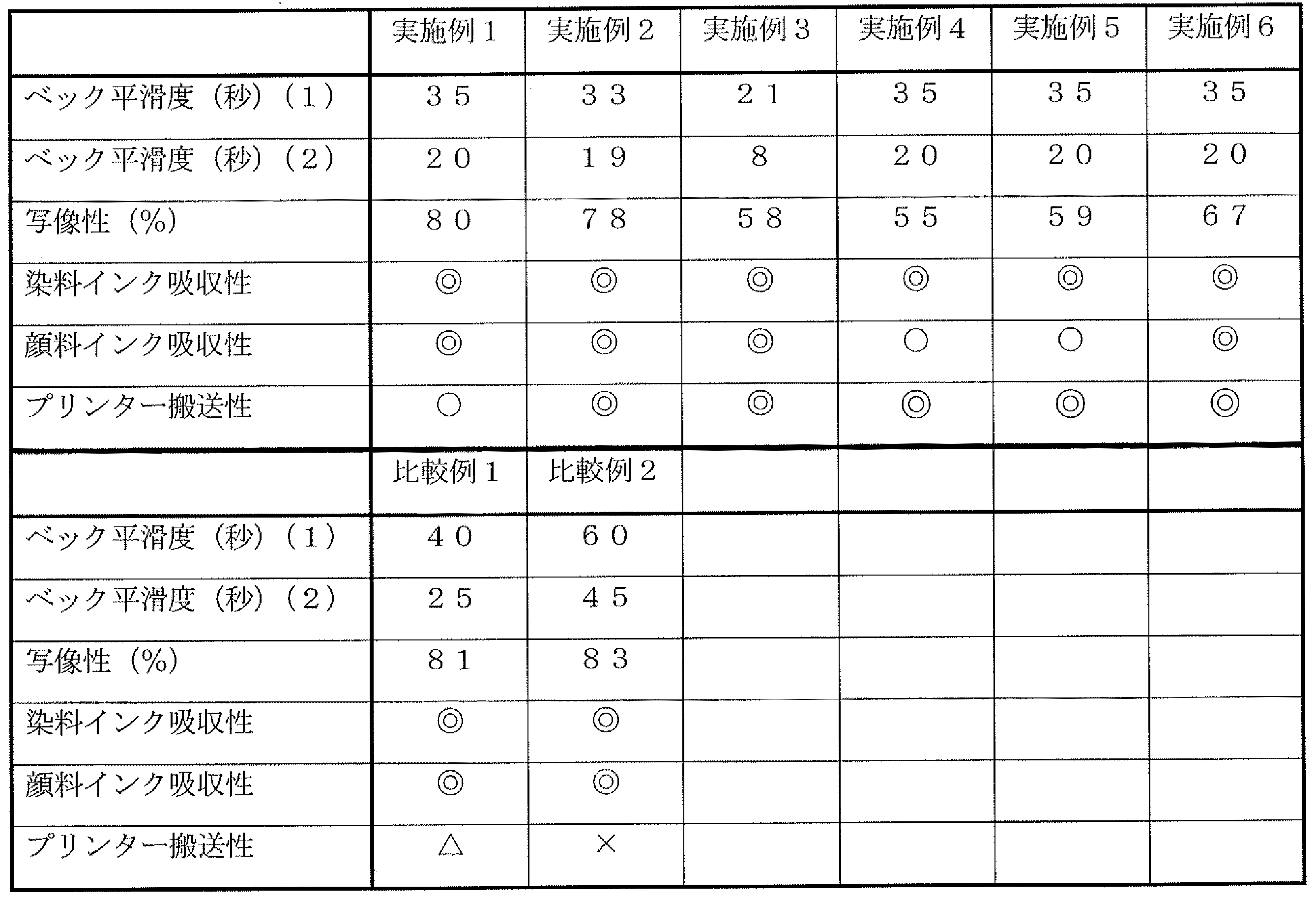
ベック平滑度(秒)(2):キャストコート処理後の、インク受容層を設けた面の反対面のベック平滑度
表1から明らかなように、実施例1〜6は、比較例1〜2に比べてプリンター搬送性に優れていた。 As is clear from Table 1, Examples 1 to 6 were superior in printer transportability compared to Comparative Examples 1 and 2.
比較例1、2はインク受容層とは反対面のベック平滑度が20秒を超えているために、
搬送性が悪かった。
In Comparative Examples 1 and 2, the Beck smoothness on the surface opposite to the ink receiving layer exceeds 20 seconds.
The transportability was bad.
Claims (7)
前記インク受容層の写像性が、JIS H 8686−2:1999「アルミニウム及びアルミニウム合金の陽極酸化皮膜の写像性試験方法」による光学くし幅2mm入反射角度60°による条件において、55%以上であり、かつ、前記インク受容層を設けた面の反対面のベック平滑度が20秒以下であることを特徴とするインクジェット用光沢紙。 In the glossy paper for ink-jet with an ink receiving layer containing a pigment and a binder on one side of a paper substrate,
The image receptivity of the ink receiving layer is 55% or more under the condition of an optical comb width of 2 mm and an incident reflection angle of 60 ° according to JIS H 8686-2: 1999 “Method for testing image clarity of anodized film of aluminum and aluminum alloy”. An inkjet glossy paper, wherein the Beck smoothness of the surface opposite to the surface provided with the ink receiving layer is 20 seconds or less.
前記多孔質微細顔料のBET比表面積が100〜400m2/gであることを特徴とする請求項1又は2に記載のインクジェット用光沢紙。 The porous fine pigment is at least one selected from gas phase method silica, precipitation method silica, γ-alumina, θ-alumina, boehmite (including pseudoboehmite), and alumina-modified silica.
The glossy paper for ink jet according to claim 1, wherein the porous fine pigment has a BET specific surface area of 100 to 400 m 2 / g.
前記インク受容層を設けることとなる面の反対面のベック平滑度が10秒以上40秒以下である紙基材を準備する工程と、
前記顔料と前記結着剤とを含有するインク受容層用塗工液を前記紙基材に塗工して塗工層を形成する工程と、
前記結着剤を凝固させる凝固剤を前記結着剤に対して5質量%以上含有する凝固液を、前記塗工層が湿潤状態にあるうちに塗布して凝固処理をした後に、キャストドラムに圧接する工程と、有し、
該工程を経た後の前記インク受容層の写像性が、JIS H 8686−2:1999「アルミニウム及びアルミニウム合金の陽極酸化皮膜の写像性試験方法」による光学くし幅2mm入反射角度60°による条件において55%以上であり、かつ、前記インク受容層を設けた面の反対面のベック平滑度が5秒以上20秒以下であることを特徴とするインクジェット用光沢紙の製造方法。
In the method for producing glossy paper for ink jet, in which an ink receiving layer containing a pigment and a binder is provided on one side of a paper substrate,
Preparing a paper substrate having a Beck smoothness of 10 to 40 seconds on the opposite side of the surface on which the ink receiving layer is to be provided;
Applying an ink-receiving layer coating solution containing the pigment and the binder to the paper substrate to form a coating layer;
After the coagulant containing 5% by mass or more of the coagulant for coagulating the binder is applied while the coating layer is in a wet state and solidified, the coagulant is applied to the cast drum. A process of pressing, and
The image receptivity of the ink-receiving layer after passing through this step is determined under the condition of an optical comb width of 2 mm and an incident / reflecting angle of 60 ° according to JIS H 8686-2: 1999 “Method for testing image clarity of anodized film of aluminum and aluminum alloy”. A method for producing glossy paper for ink jets, characterized in that the Beck smoothness of the surface opposite to the surface provided with the ink receiving layer is 55% or more and 5 seconds or more and 20 seconds or less.
Priority Applications (1)
| Application Number | Priority Date | Filing Date | Title |
|---|---|---|---|
| JP2016082785A JP6795902B2 (en) | 2016-04-18 | 2016-04-18 | Glossy paper for inkjet and its manufacturing method |
Applications Claiming Priority (1)
| Application Number | Priority Date | Filing Date | Title |
|---|---|---|---|
| JP2016082785A JP6795902B2 (en) | 2016-04-18 | 2016-04-18 | Glossy paper for inkjet and its manufacturing method |
Publications (2)
| Publication Number | Publication Date |
|---|---|
| JP2017193059A true JP2017193059A (en) | 2017-10-26 |
| JP6795902B2 JP6795902B2 (en) | 2020-12-02 |
Family
ID=60155756
Family Applications (1)
| Application Number | Title | Priority Date | Filing Date |
|---|---|---|---|
| JP2016082785A Active JP6795902B2 (en) | 2016-04-18 | 2016-04-18 | Glossy paper for inkjet and its manufacturing method |
Country Status (1)
| Country | Link |
|---|---|
| JP (1) | JP6795902B2 (en) |
Citations (6)
| Publication number | Priority date | Publication date | Assignee | Title |
|---|---|---|---|---|
| JPH08174995A (en) * | 1994-12-26 | 1996-07-09 | Canon Inc | Recording medium, inkjet recording method and image forming method using the same |
| JP2000158806A (en) * | 1998-12-01 | 2000-06-13 | Oji Paper Co Ltd | Inkjet recording paper |
| JP2000292964A (en) * | 1999-04-02 | 2000-10-20 | Kiso Kasei Sangyo Kk | Synthetic resin film or paper for printer or copying |
| JP2008036962A (en) * | 2006-08-07 | 2008-02-21 | Kimoto & Co Ltd | Process material for functional member and processing method of functional member |
| JP2011005753A (en) * | 2009-06-26 | 2011-01-13 | Hokuetsu Kishu Paper Co Ltd | Glossy paper for inkjet recording |
| JP2013059939A (en) * | 2011-09-14 | 2013-04-04 | Hokuetsu Kishu Paper Co Ltd | Glossy paper for inkjet recording and method of manufacturing the same |
-
2016
- 2016-04-18 JP JP2016082785A patent/JP6795902B2/en active Active
Patent Citations (6)
| Publication number | Priority date | Publication date | Assignee | Title |
|---|---|---|---|---|
| JPH08174995A (en) * | 1994-12-26 | 1996-07-09 | Canon Inc | Recording medium, inkjet recording method and image forming method using the same |
| JP2000158806A (en) * | 1998-12-01 | 2000-06-13 | Oji Paper Co Ltd | Inkjet recording paper |
| JP2000292964A (en) * | 1999-04-02 | 2000-10-20 | Kiso Kasei Sangyo Kk | Synthetic resin film or paper for printer or copying |
| JP2008036962A (en) * | 2006-08-07 | 2008-02-21 | Kimoto & Co Ltd | Process material for functional member and processing method of functional member |
| JP2011005753A (en) * | 2009-06-26 | 2011-01-13 | Hokuetsu Kishu Paper Co Ltd | Glossy paper for inkjet recording |
| JP2013059939A (en) * | 2011-09-14 | 2013-04-04 | Hokuetsu Kishu Paper Co Ltd | Glossy paper for inkjet recording and method of manufacturing the same |
Also Published As
| Publication number | Publication date |
|---|---|
| JP6795902B2 (en) | 2020-12-02 |
Similar Documents
| Publication | Publication Date | Title |
|---|---|---|
| JP5801219B2 (en) | Glossy paper for void-type inkjet recording | |
| JP5503398B2 (en) | Glossy paper for inkjet recording and method for producing the same | |
| JP5260443B2 (en) | Glossy paper for inkjet recording | |
| JP2011183637A (en) | Glossy paper for ink jet recording | |
| JP5113860B2 (en) | Glossy paper for inkjet recording and method for producing the same | |
| JP5468828B2 (en) | Glossy paper for inkjet recording | |
| JP5697568B2 (en) | Glossy paper for inkjet recording and method for producing the same | |
| JP5921419B2 (en) | Inkjet recording paper | |
| JP5113707B2 (en) | Inkjet recording medium | |
| JP5751963B2 (en) | Glossy paper for inkjet recording and method for producing the same | |
| JP5463176B2 (en) | Glossy paper for inkjet recording and method for producing the same | |
| JP4573229B2 (en) | Cast coated paper for inkjet recording for postcard use with glossy side and back side for address printing | |
| JP5296250B1 (en) | Glossy paper for inkjet recording | |
| JP5622651B2 (en) | Glossy paper for inkjet recording | |
| JP4257732B2 (en) | Glossy paper for inkjet recording | |
| JP6795902B2 (en) | Glossy paper for inkjet and its manufacturing method | |
| JP4162149B2 (en) | Glossy paper for inkjet recording | |
| JP2006272562A (en) | Glossy paper for inkjet recording | |
| JP5439203B2 (en) | Glossy paper for inkjet recording | |
| JP5271663B2 (en) | Glossy paper for inkjet recording and method for producing the same | |
| JP5903218B2 (en) | Method for manufacturing inkjet recording medium | |
| JP5756770B2 (en) | Glossy medium for gap type ink jet recording | |
| JP4338580B2 (en) | Glossy paper for inkjet recording | |
| JP5451307B2 (en) | Glossy colored inkjet recording paper and method for producing the same | |
| JP2010100001A (en) | Glossy paper for inkjet recording |
Legal Events
| Date | Code | Title | Description |
|---|---|---|---|
| A621 | Written request for application examination |
Free format text: JAPANESE INTERMEDIATE CODE: A621 Effective date: 20180418 |
|
| A977 | Report on retrieval |
Free format text: JAPANESE INTERMEDIATE CODE: A971007 Effective date: 20190327 |
|
| A131 | Notification of reasons for refusal |
Free format text: JAPANESE INTERMEDIATE CODE: A131 Effective date: 20190402 |
|
| A521 | Request for written amendment filed |
Free format text: JAPANESE INTERMEDIATE CODE: A523 Effective date: 20190520 |
|
| A131 | Notification of reasons for refusal |
Free format text: JAPANESE INTERMEDIATE CODE: A131 Effective date: 20190611 |
|
| A521 | Request for written amendment filed |
Free format text: JAPANESE INTERMEDIATE CODE: A523 Effective date: 20190806 |
|
| A02 | Decision of refusal |
Free format text: JAPANESE INTERMEDIATE CODE: A02 Effective date: 20191023 |
|
| A521 | Request for written amendment filed |
Free format text: JAPANESE INTERMEDIATE CODE: A523 Effective date: 20200122 |
|
| C60 | Trial request (containing other claim documents, opposition documents) |
Free format text: JAPANESE INTERMEDIATE CODE: C60 Effective date: 20200122 |
|
| A911 | Transfer to examiner for re-examination before appeal (zenchi) |
Free format text: JAPANESE INTERMEDIATE CODE: A911 Effective date: 20200130 |
|
| C21 | Notice of transfer of a case for reconsideration by examiners before appeal proceedings |
Free format text: JAPANESE INTERMEDIATE CODE: C21 Effective date: 20200204 |
|
| A912 | Re-examination (zenchi) completed and case transferred to appeal board |
Free format text: JAPANESE INTERMEDIATE CODE: A912 Effective date: 20200221 |
|
| C211 | Notice of termination of reconsideration by examiners before appeal proceedings |
Free format text: JAPANESE INTERMEDIATE CODE: C211 Effective date: 20200303 |
|
| C22 | Notice of designation (change) of administrative judge |
Free format text: JAPANESE INTERMEDIATE CODE: C22 Effective date: 20200512 |
|
| C23 | Notice of termination of proceedings |
Free format text: JAPANESE INTERMEDIATE CODE: C23 Effective date: 20200929 |
|
| C03 | Trial/appeal decision taken |
Free format text: JAPANESE INTERMEDIATE CODE: C03 Effective date: 20201110 |
|
| C30A | Notification sent |
Free format text: JAPANESE INTERMEDIATE CODE: C3012 Effective date: 20201110 |
|
| A61 | First payment of annual fees (during grant procedure) |
Free format text: JAPANESE INTERMEDIATE CODE: A61 Effective date: 20201113 |
|
| R150 | Certificate of patent or registration of utility model |
Ref document number: 6795902 Country of ref document: JP Free format text: JAPANESE INTERMEDIATE CODE: R150 |
|
| R250 | Receipt of annual fees |
Free format text: JAPANESE INTERMEDIATE CODE: R250 |