JP2017193622A - tire - Google Patents
tire Download PDFInfo
- Publication number
- JP2017193622A JP2017193622A JP2016084426A JP2016084426A JP2017193622A JP 2017193622 A JP2017193622 A JP 2017193622A JP 2016084426 A JP2016084426 A JP 2016084426A JP 2016084426 A JP2016084426 A JP 2016084426A JP 2017193622 A JP2017193622 A JP 2017193622A
- Authority
- JP
- Japan
- Prior art keywords
- group
- rubber composition
- mass
- hydroxide
- rubber
- Prior art date
- Legal status (The legal status is an assumption and is not a legal conclusion. Google has not performed a legal analysis and makes no representation as to the accuracy of the status listed.)
- Granted
Links
Classifications
-
- Y—GENERAL TAGGING OF NEW TECHNOLOGICAL DEVELOPMENTS; GENERAL TAGGING OF CROSS-SECTIONAL TECHNOLOGIES SPANNING OVER SEVERAL SECTIONS OF THE IPC; TECHNICAL SUBJECTS COVERED BY FORMER USPC CROSS-REFERENCE ART COLLECTIONS [XRACs] AND DIGESTS
- Y02—TECHNOLOGIES OR APPLICATIONS FOR MITIGATION OR ADAPTATION AGAINST CLIMATE CHANGE
- Y02T—CLIMATE CHANGE MITIGATION TECHNOLOGIES RELATED TO TRANSPORTATION
- Y02T10/00—Road transport of goods or passengers
- Y02T10/80—Technologies aiming to reduce greenhouse gasses emissions common to all road transportation technologies
- Y02T10/86—Optimisation of rolling resistance, e.g. weight reduction
Landscapes
- Tires In General (AREA)
- Compositions Of Macromolecular Compounds (AREA)
Abstract
Description
本発明は、所定のゴム組成物で構成されるトレッドを有する空気入りタイヤに関する。 The present invention relates to a pneumatic tire having a tread composed of a predetermined rubber composition.
近年、環境問題への関心の高まりから、自動車に対する低燃費化の要求が強くなっており、タイヤの転がり抵抗を低減して、発熱を抑えたタイヤの開発が進められている。タイヤ部材のなかでも、特にタイヤにおける占有比率の高いトレッドに対しては、優れた低燃費性が要求される。また、トレッド本来の性能として、グリップ性能、耐摩耗性なども要求される。 In recent years, due to increasing interest in environmental issues, there has been a strong demand for fuel efficiency reduction for automobiles, and tires that reduce heat generation by reducing rolling resistance of tires are being developed. Among the tire members, particularly for a tread having a high occupation ratio in the tire, excellent low fuel consumption is required. In addition, grip performance, wear resistance, and the like are also required as the original performance of the tread.
一般に、低燃費性を改善するためにはゴム組成物のエネルギーロスを低下させることが有効である。一方、グリップ性能を改善するためには、シリカを増量する、オイルなどの軟化剤比率を上げる、レジンを配合してゴム組成物のガラス転移温度を上げるなどの方法がなされているが、これらの方法によればエネルギーロスが増加し、低燃費性が悪化する。つまり、低燃費性とグリップ性能は背反する関係にあり、両立することは困難であった。また、炭酸カルシウム、酸化マグネシウムなどの大粒径の無機フィラーを配合してゴムの伸びを大きくすることで、エネルギーロスを増加させずに路面との追従性を高め、グリップ性能を向上させる方法も検討されているが、これらの大粒径の無機フィラーは補強性に劣るため、耐摩耗性が不十分となるという問題がある。このように、低燃費性、グリップ性能および耐摩耗性をバランスよく改善することは困難であった。 In general, it is effective to reduce the energy loss of the rubber composition in order to improve fuel efficiency. On the other hand, in order to improve the grip performance, methods such as increasing the amount of silica, increasing the ratio of a softener such as oil, and blending a resin to increase the glass transition temperature of the rubber composition have been made. According to the method, energy loss increases and fuel efficiency deteriorates. In other words, fuel efficiency and grip performance are contradictory, and it is difficult to achieve both. There is also a method to improve grip performance by increasing the elongation of rubber by adding inorganic fillers of large particle size such as calcium carbonate and magnesium oxide, and increasing the followability with the road surface without increasing energy loss. Although being studied, these large-diameter inorganic fillers have a problem of insufficient wear resistance due to poor reinforcement. Thus, it has been difficult to improve the fuel economy, grip performance and wear resistance in a well-balanced manner.
特許文献1には、ガラス転移温度の低いゴム成分に特定の物性を有する水酸化アルミニウムを配合することにより、加工性および耐摩耗性を低下させることなく、低燃費性およびウェットグリップ性能を向上させたトレッドゴム組成物が記載されている。さらに、シランカップリング剤を配合することで水酸化アルミニウムの補強性を強めることも記載されている。しかしながら、耐摩耗性、低燃費性およびグリップ性能の両立という点では改善の余地がある。 Patent Document 1 improves the fuel economy and wet grip performance without degrading workability and wear resistance by blending aluminum hydroxide having specific properties with a rubber component having a low glass transition temperature. A tread rubber composition is described. Further, it is described that the reinforcing property of aluminum hydroxide is enhanced by blending a silane coupling agent. However, there is room for improvement in terms of achieving both wear resistance, low fuel consumption, and grip performance.
本発明は、耐摩耗性および低燃費性を維持しながらグリップ性能に優れたタイヤを提供することを目的とする。 An object of the present invention is to provide a tire excellent in grip performance while maintaining wear resistance and low fuel consumption.
本発明の第1の発明は、水酸化アルミニウムを除く第13族元素の水酸化物、および
カップリング剤を含有するゴム組成物で構成されるトレッドを備えるタイヤに関する。
1st invention of this invention is related with a tire provided with the tread comprised with the hydroxide of the group 13 element except aluminum hydroxide, and the rubber composition containing a coupling agent.
本発明の第2の発明は、第13族元素の水酸化物、およびカップリング剤を含有するゴム組成物であり、第13族元素の水酸化物を含有しない基準ゴム組成物に対して、ゴム硬度が−3〜+3であり、かつ破断時伸びが103%以上であるゴム組成物で構成されるトレッドを備えるタイヤに関する。 A second invention of the present invention is a rubber composition containing a hydroxide of a group 13 element and a coupling agent, and with respect to a reference rubber composition not containing a hydroxide of a group 13 element, The present invention relates to a tire including a tread composed of a rubber composition having a rubber hardness of −3 to +3 and an elongation at break of 103% or more.
<第1の発明>
第1の発明のタイヤは、ジエン系ゴム成分に対し、水酸化アルミニウムを除く第13族元素の水酸化物、およびカップリング剤を含有するゴム組成物で構成されるトレッドを備えることを特徴とする。
<First invention>
A tire according to a first aspect of the present invention includes a tread composed of a rubber composition containing a hydroxide of a group 13 element excluding aluminum hydroxide and a coupling agent with respect to a diene rubber component. To do.
前記ジエン系ゴム成分としては特に限定されず、例えば、天然ゴム(NR)、エポキシ化天然ゴム(ENR)、イソプレンゴム(IR)、スチレンブタジエンゴム(SBR)、ブタジエンゴム(BR)、アクリロニトリルブタジエンゴム(NBR)、クロロプレンゴム(CR)、ブチルゴム(IIR)など、ゴム工業において一般的なものを使用できる。これらのゴム成分は単独で用いてもよく、2種以上を組み合わせてもよい。ゴム成分は要求性能に応じて適宜選択すればよく、例えば、NR、ENR、SBR、BRが好ましい。 The diene rubber component is not particularly limited. For example, natural rubber (NR), epoxidized natural rubber (ENR), isoprene rubber (IR), styrene butadiene rubber (SBR), butadiene rubber (BR), acrylonitrile butadiene rubber (NBR), chloroprene rubber (CR), butyl rubber (IIR), and the like can be used in the rubber industry. These rubber components may be used alone or in combination of two or more. The rubber component may be appropriately selected according to the required performance, and for example, NR, ENR, SBR, and BR are preferable.
前記NRとしては特に限定されず、SIR20、RSS#3、TSR20など、ゴム工業において一般的なものを使用することができる。また、前記ENRとしては特に限定されず、MRB社(マレーシア)製のENR25、ENR50などの市販品を用いてもよく、NRをエポキシ化して用いてもよい。 The NR is not particularly limited, and those generally used in the rubber industry such as SIR20, RSS # 3, TSR20, and the like can be used. The ENR is not particularly limited, and commercially available products such as ENR25 and ENR50 manufactured by MRB (Malaysia) may be used, or NR may be epoxidized.
NRおよび/またはENRを含有する場合のゴム成分100質量%中の含有量は、十分な強度を得られるという理由から、5質量%以上が好ましく、10質量%以上がより好ましい。また、耐亀裂成長性や耐オゾン性、耐摩耗性などを改善するためには他のゴム成分と併用することが好ましいため、NRおよび/またはENRの含有量は、90質量%以下が好ましく、70質量%以下がより好ましい。 The content in 100% by mass of the rubber component in the case of containing NR and / or ENR is preferably 5% by mass or more, more preferably 10% by mass or more, because sufficient strength can be obtained. Further, in order to improve crack growth resistance, ozone resistance, wear resistance, etc., it is preferable to use in combination with other rubber components, so the content of NR and / or ENR is preferably 90% by mass or less, 70 mass% or less is more preferable.
前記SBRとしては特に限定されず、未変性の溶液重合SBR(S−SBR)、未変性の乳化重合SBR(E−SBR)、およびこれらの変性SBR(変性S−SBR、変性E−SBR)などが挙げられ、なかでも、グリップ性能、低燃費性および操縦安定性の向上効果が高いという理由から、変性SBRが好ましい。 The SBR is not particularly limited, and unmodified solution polymerization SBR (S-SBR), unmodified emulsion polymerization SBR (E-SBR), and these modified SBRs (modified S-SBR, modified E-SBR), and the like Among them, modified SBR is preferable because it has a high effect of improving grip performance, low fuel consumption, and steering stability.
変性SBRとしては、スズ、ケイ素化合物などでカップリングされたものが好ましい。変性SBRのカップリング方法としては、常法に従って、例えば、変性SBRの分子鎖末端のアルカリ金属(Liなど)やアルカリ土類金属(Mgなど)を、ハロゲン化スズやハロゲン化ケイ素などと反応させる方法などが挙げられる。 As the modified SBR, those coupled with tin, a silicon compound or the like are preferable. As a coupling method of the modified SBR, for example, an alkali metal (such as Li) or an alkaline earth metal (such as Mg) at the molecular chain terminal of the modified SBR is reacted with tin halide or silicon halide according to a conventional method. The method etc. are mentioned.
また変性SBRとしては、スチレンおよびブタジエンの共重合体で、第1級アミノ基やアルコキシシリル基を有するものも好ましい。第1級アミノ基は、重合開始末端、重合終了末端、重合体主鎖、側鎖のいずれに結合していても良いが、重合体末端からのエネルギー消失を抑制してエネルギーロス特性を改良し得る点から、重合開始末端または重合終了末端に導入されていることが好ましい。 The modified SBR is preferably a copolymer of styrene and butadiene having a primary amino group or an alkoxysilyl group. The primary amino group may be bonded to any of the polymerization initiation terminal, the polymerization termination terminal, the polymer main chain, and the side chain, but the energy loss characteristic is improved by suppressing the energy loss from the polymer terminal. From the viewpoint of obtaining, it is preferably introduced at the polymerization initiation terminal or the polymerization termination terminal.
これら変性SBRのなかでも、ポリマーの分子量をコントロールし易く、転がり抵抗を増大させる低分子量成分を少なくすることができ、さらに補強剤とポリマー鎖の結合を強め、グリップ性能、低燃費性および操縦安定性をより向上できるという理由から、溶液重合のスチレンブタジエンゴム(S−SBR)の重合末端(活性末端)を下記化学式(1)で表される化合物などの窒素含有化合物により変性した変性S−SBR(特開2010−111753号公報に記載の変性SBR)が好適に用いられる。
R1、R2およびR3のアルキル基は、炭素数1〜4のアルキル基が好ましい。 The alkyl group for R 1 , R 2 and R 3 is preferably an alkyl group having 1 to 4 carbon atoms.
R1、R2およびR3のアルコキシ基は、炭素数1〜8のアルコキシ基が好ましく、炭素数1〜6のアルコキシ基がより好ましく、炭素数1〜4のアルコキシ基がより好ましい。 The alkoxy group of R 1 , R 2 and R 3 is preferably an alkoxy group having 1 to 8 carbon atoms, more preferably an alkoxy group having 1 to 6 carbon atoms, and more preferably an alkoxy group having 1 to 4 carbon atoms.
R1、R2およびR3のアセタール基は、炭素数1〜8のアセタール基が好ましい。 The acetal group of R 1 , R 2 and R 3 is preferably an acetal group having 1 to 8 carbon atoms.
R4およびR5のアルキル基は、炭素数1〜4のアルキル基が好ましい。 The alkyl group for R 4 and R 5 is preferably an alkyl group having 1 to 4 carbon atoms.
mは整数を表し、1〜5が好ましく、2〜4がより好ましく、3がさらに好ましい。 m represents an integer, preferably 1 to 5, more preferably 2 to 4, and still more preferably 3.
化学式(1)で表される化合物としては、3−アミノプロピルトリメトキシシラン、3−アミノプロピルジメチルメトキシシラン、3−アミノプロピルメチルジメトキシシラン、2−ジメチルアミノエチルトリメトキシシラン、3−ジエチルアミノプロピルトリメトキシシラン、3−ジメチルアミノプロピルトリメトキシシランなどが挙げられる。これらは、単独で用いてもよく、2種以上を併用してもよい。なかでも変性SBRに用いる化学式(1)で表される化合物としては、優れたグリップ性能および低燃費性を得ることができるという理由から、R1、R2およびR3がアルコキシ基であり、R4およびR5が水素原子である化合物(3−アミノプロピルトリメトキシシラン)が好ましい。 Examples of the compound represented by the chemical formula (1) include 3-aminopropyltrimethoxysilane, 3-aminopropyldimethylmethoxysilane, 3-aminopropylmethyldimethoxysilane, 2-dimethylaminoethyltrimethoxysilane, 3-diethylaminopropyltri Examples include methoxysilane and 3-dimethylaminopropyltrimethoxysilane. These may be used alone or in combination of two or more. Among them, as the compound represented by the chemical formula (1) used for the modified SBR, R 1 , R 2 and R 3 are alkoxy groups because of excellent grip performance and low fuel consumption, and R A compound in which 4 and R 5 are hydrogen atoms (3-aminopropyltrimethoxysilane) is preferred.
化学式(1)で表される化合物(変性剤)によるSBRの変性方法としては、特公平6−53768号公報、特公平6−57767号公報、特表2003−514078号公報などに記載されている方法など、従来公知の手法を用いることができる。例えば、SBRと変性剤とを接触させればよく、アニオン重合によりSBRを合成した後、該重合体ゴム溶液中に変性剤を所定量添加し、SBRの重合末端(活性末端)と変性剤とを反応させる方法、BR溶液中に変性剤を添加して反応させる方法などが挙げられる。 As a method for modifying SBR with a compound (modifier) represented by the chemical formula (1), it is described in JP-B-6-53768, JP-B-6-57767, JP-T2003-514078, and the like. A conventionally known method such as a method can be used. For example, SBR may be brought into contact with a modifying agent. After SBR is synthesized by anionic polymerization, a predetermined amount of a modifying agent is added to the polymer rubber solution, and the polymerization terminal (active terminal) of SBR and the modifying agent are added. And a method of reacting by adding a denaturing agent to the BR solution.
SBRのスチレン含有量は、グリップ性能の観点から10質量%以上が好ましく、20質量%以上がより好ましく、30質量%以上がさらに好ましい。また、SBRのスチレン含有量は、路面との接地面積が増加して高いグリップ性能が得られるという理由から、60質量%以下が好ましく、50質量%以下がより好ましく、45質量%以下がさらに好ましい。なお、本明細書におけるSBRのスチレン含有量は、1H−NMR測定により算出される値である。 The styrene content of SBR is preferably 10% by mass or more, more preferably 20% by mass or more, and further preferably 30% by mass or more from the viewpoint of grip performance. Further, the styrene content of SBR is preferably 60% by mass or less, more preferably 50% by mass or less, and even more preferably 45% by mass or less, because the contact area with the road surface increases and high grip performance is obtained. . In addition, the styrene content of SBR in the present specification is a value calculated by 1 H-NMR measurement.
SBRのビニル結合量は、グリップ性能確保の観点から、5モル%以上が好ましく、10モル%以上がより好ましく、15モル%以上がさらに好ましい。また、SBRのビニル結合量は、耐摩耗性および低燃費性の観点から、60モル%以下が好ましく、55モル%以下がより好ましく、50モル%以下がさらに好ましい。なお、本明細書におけるSBRのビニル結合量とは、ブタジエン部のビニル結合量のことを示し、1H−NMR測定により算出される値である。 The vinyl bond amount of SBR is preferably 5 mol% or more, more preferably 10 mol% or more, and further preferably 15 mol% or more from the viewpoint of securing grip performance. The vinyl bond amount of SBR is preferably 60 mol% or less, more preferably 55 mol% or less, and even more preferably 50 mol% or less, from the viewpoints of wear resistance and fuel efficiency. In addition, the vinyl bond amount of SBR in this specification shows the vinyl bond amount of a butadiene part, and is a value computed by < 1 > H-NMR measurement.
SBRを含有する場合のゴム成分100質量%中の含有量は、グリップ性能の観点から、20質量%以上が好ましく、50質量%以上がより好ましく、70質量%以上がさらに好ましく、100質量%が特に好ましい。また、SBRの含有量の上限は特に限定されないが、他のゴム成分と併用する場合は、90質量%以下が好ましい。なお、SBRがオイルを添加した油展物である場合、SBRの含有量はオイル分を除いたSBR(ゴム固形分)の含有量を示す。 In the case of containing SBR, the content in 100% by mass of the rubber component is preferably 20% by mass or more, more preferably 50% by mass or more, further preferably 70% by mass or more, and 100% by mass from the viewpoint of grip performance. Particularly preferred. Further, the upper limit of the SBR content is not particularly limited, but when used in combination with other rubber components, it is preferably 90% by mass or less. In addition, when SBR is an oil-extended product to which oil is added, the content of SBR indicates the content of SBR (rubber solid content) excluding the oil content.
前記BRとしては特に限定されず、ハイシス1,4−ポリブタジエンゴム(ハイシスBR)、1,2−シンジオタクチックポリブタジエン結晶を含むブタジエンゴム(SPB含有BR)などの未変性ブタジエンゴム;変性ブタジエンゴム(変性BR)などが挙げられる。 The BR is not particularly limited, and unmodified butadiene rubber such as high cis 1,4-polybutadiene rubber (high cis BR), butadiene rubber containing 1,2-syndiotactic polybutadiene crystals (SPB-containing BR); modified butadiene rubber ( Modified BR) and the like.
前記ハイシスBRとは、シス1,4結合含有量が90質量%以上のブタジエンゴムである。このようなハイシスBRの市販品としては、日本ゼオン(株)製のBR1220、宇部興産(株)製のUBEPOL BR130B、BR150Bなどが挙げられる。 The high cis BR is a butadiene rubber having a cis 1,4 bond content of 90% by mass or more. Examples of such commercially available high-sis BR include BR1220 manufactured by Nippon Zeon Co., Ltd., UBEPOL BR130B and BR150B manufactured by Ube Industries, Ltd.
前記SPB含有BRは、1,2−シンジオタクチックポリブタジエン結晶を単にBR中に分散させたものではなく、BRと化学結合したうえで分散しているものが好ましい。このようなSPB含有BRの市販品としては、宇部興産(株)製のVCR303、VCR412、VCR617などが挙げられる。 The SPB-containing BR is preferably not that in which 1,2-syndiotactic polybutadiene crystals are simply dispersed in BR but is dispersed after being chemically bonded to BR. Examples of such commercially available SPB-containing BR include VCR303, VCR412, and VCR617 manufactured by Ube Industries.
前記変性BRとしては、リチウム開始剤により1,3−ブタジエンの重合をおこなったのち、スズ化合物を添加することにより得られ、さらに変性BR分子の末端がスズ−炭素結合で結合されているもの;前記化学式(1)で表される化合物などの窒素含有化合物により変性されたものなどが挙げられる。 The modified BR is obtained by polymerizing 1,3-butadiene with a lithium initiator and then adding a tin compound, and the modified BR molecule has an end bonded with a tin-carbon bond; Examples thereof include those modified with a nitrogen-containing compound such as the compound represented by the chemical formula (1).
化学式(1)で表される化合物(変性剤)によるBRの変性方法としては、前記SBRの変性方法と同様であり、例えば、BRと変性剤とを接触させればよく、アニオン重合によりBRを合成した後、該重合体ゴム溶液中に変性剤を所定量添加し、BRの重合末端(活性末端)と変性剤とを反応させる方法、BR溶液中に変性剤を添加して反応させる方法などが挙げられる。 The method for modifying BR by the compound represented by the chemical formula (1) (modifier) is the same as the method for modifying SBR. For example, BR may be brought into contact with the modifier. After synthesizing, a predetermined amount of a modifier is added to the polymer rubber solution to react the polymerization terminal (active end) of BR with the modifier, a method of adding a modifier to the BR solution and reacting, etc. Is mentioned.
これら各種BRの中でも、耐摩耗性および低燃費性が良好であるという理由から、シス1,4結合含有量が90質量%以上の未変性ハイシスBRを用いることが好ましい。 Among these various BRs, it is preferable to use an unmodified high cis BR having a cis 1,4 bond content of 90% by mass or more because it has good wear resistance and low fuel consumption.
BRを含有する場合のゴム成分100質量%中の含有量は、耐摩耗性および操縦安定性に優れるという理由から、5質量%以上が好ましく、8質量%以上がより好ましい。またBRの含有量は、低燃費性の観点から、15質量%以下が好ましく、10質量%以下がより好ましい。 The content in 100% by mass of the rubber component in the case of containing BR is preferably 5% by mass or more, and more preferably 8% by mass or more, because it is excellent in wear resistance and steering stability. Further, the BR content is preferably 15% by mass or less, and more preferably 10% by mass or less, from the viewpoint of low fuel consumption.
前記水酸化アルミニウムを除く第13族元素の水酸化物は、シリカやカーボンブラックと同様にカップリング剤と反応し、ポリマー−カップリング剤−第13族元素の水酸化物による結合ができるため、シリカやカーボンブラックと同様の補強性を発揮する。第13族元素の水酸化物はシリカやカーボンブラックよりも反応点が少なく動きやすいため、第13族元素の水酸化物を含有するゴム組成物は、しなやかでよく伸び、グリップ性能および操縦安定性に優れる。また、従来のエネルギーロスの増加によりグリップ性能を向上させる方法ではないため、低燃費性が悪化するといった問題が起こらない。さらに、前記のように13族元素の水酸化物はシリカやカーボンブラックと同様の補強性を有するため、従来の炭酸カルシウムや酸化マグネシウムなどの大粒径の無機フィラーを添加してグリップ性能を向上させる方法による耐摩耗性が不十分になるという問題も起こらない。よって、耐摩耗性および低燃費性を悪化させることなくグリップ性能が向上するゴム組成物とすることができる。 Since the hydroxide of the group 13 element excluding the aluminum hydroxide reacts with the coupling agent in the same manner as silica and carbon black, it can be bonded by the polymer-coupling agent-hydroxide of the group 13 element. It exhibits the same reinforcement as silica and carbon black. Group 13 element hydroxides have fewer reactive sites than silica and carbon black, and are easy to move. Therefore, rubber compositions containing Group 13 element hydroxides are supple and well-stretched, resulting in grip performance and handling stability. Excellent. Moreover, since it is not the method of improving grip performance by the increase in the conventional energy loss, the problem that a fuel-consumption property deteriorates does not arise. Furthermore, as mentioned above, Group 13 element hydroxides have the same reinforcing properties as silica and carbon black, so conventional inorganic fillers such as calcium carbonate and magnesium oxide are added to improve grip performance. There is no problem of insufficient wear resistance due to the method used. Therefore, it can be set as the rubber composition which improves grip performance, without deteriorating abrasion resistance and low fuel consumption.
第13族元素の水酸化物としては、水酸化アルミニウム、水酸化ガリウム、水酸化インジウム、水酸化タリウムなどが挙げられるが、第1の発明にかかるゴム組成物は水酸化アルミニウムを除く第13族元素の水酸化物を含有する。水酸化アルミニウムを除く第13族元素の水酸化物のなかでも粒子径が大きく、ゴム組成物が伸びやすくなるという理由から、水酸化インジウムが好ましい。 Examples of the hydroxide of the group 13 element include aluminum hydroxide, gallium hydroxide, indium hydroxide, thallium hydroxide, etc., but the rubber composition according to the first invention is a group 13 excluding aluminum hydroxide. Contains elemental hydroxides. Among group 13 element hydroxides excluding aluminum hydroxide, indium hydroxide is preferred because the particle size is large and the rubber composition is easily stretched.
水酸化アルミニウムを除く第13族元素の水酸化物の窒素吸着比表面積(N2SA)は、耐摩耗性の観点から、5m2/g以上が好ましく、10m2/g以上がより好ましい。また、水酸化アルミニウムを除く第13族元素の水酸化物のN2SAは、分散性の観点から、30m2/g未満が好ましく、25m2/g以下がより好ましく、20m2/g以下がさらに好ましい。なお、本明細書における第13族元素の水酸化物のN2SAは、ASTM D3037−81に準じてBET法で測定される値である。 The nitrogen adsorption specific surface area (N 2 SA) of the Group 13 element hydroxide excluding aluminum hydroxide is preferably 5 m 2 / g or more, more preferably 10 m 2 / g or more, from the viewpoint of wear resistance. Also, N 2 SA of hydroxides of Group 13 elements except aluminum hydroxide, from the viewpoint of dispersibility, preferably less than 30 m 2 / g, more preferably 25 m 2 / g or less, is 20 m 2 / g or less Further preferred. Incidentally, N 2 SA of the hydroxide of a Group 13 element in the present specification is a value measured by the BET method in accordance with ASTM D3037-81.
水酸化アルミニウムを除く第13族元素の水酸化物の平均粒子径(d50)は、分散性の観点から、0.1μm以上が好ましく、0.2μm以上がより好ましい。また、水酸化アルミニウムを除く第13族元素の水酸化物の平均粒子径は、耐摩耗性の観点から、10μm以下が好ましく、8μm以下がより好ましい。なお、本明細書における第13族元素の水酸化物の平均粒子径(d50)は、粉体粒子の大きさの分布(範囲と含有率)から算出した値である。 From the viewpoint of dispersibility, the average particle diameter (d50) of the Group 13 element hydroxide excluding aluminum hydroxide is preferably 0.1 μm or more, and more preferably 0.2 μm or more. In addition, the average particle size of the Group 13 element hydroxide excluding aluminum hydroxide is preferably 10 μm or less, more preferably 8 μm or less, from the viewpoint of wear resistance. In addition, the average particle diameter (d50) of the hydroxide of the Group 13 element in this specification is a value calculated from the size distribution (range and content rate) of the powder particles.
前記カップリング剤を含有することにより、ポリマー−カップリング剤−第13族元素の水酸化物による結合を構成し得る。よって、本発明の第1の発明は、水酸化アルミニウムを除く第13族元素の水酸化物、シリカおよびシランカップリング剤の3つを併用することにより、耐摩耗性および低燃費性を悪化させることなくグリップ性能を向上することができる。カップリング剤としては、シリカおよびポリマーと結合するシランカップリング剤、カーボンブラックおよびポリマーと結合するカーボンカップリング剤などが挙げられる。 By containing the coupling agent, a bond of the polymer-coupling agent-group 13 element hydroxide can be formed. Therefore, according to the first invention of the present invention, wear resistance and low fuel consumption are deteriorated by using three of group 13 element hydroxide excluding aluminum hydroxide, silica and silane coupling agent in combination. The grip performance can be improved without any problems. Examples of the coupling agent include a silane coupling agent that binds to silica and a polymer, a carbon coupling agent that binds to carbon black and a polymer, and the like.
前記シランカップリング剤は、シリカおよびポリマーと結合し、前記シリカの分散性を向上させて、ゴム組成物の低燃費性および耐摩耗性を向上させることができる。さらに、前述のようにポリマー−カップリング剤−第13族元素の水酸化物による結合が生じ、しなやかでよく伸び、グリップ性能に優れたゴム組成物とすることができる。 The silane coupling agent can be combined with silica and a polymer to improve the dispersibility of the silica, thereby improving the fuel economy and wear resistance of the rubber composition. Further, as described above, a polymer-coupling agent-group 13 element hydroxide bonds are formed, and the rubber composition can be made flexible and stretchable, and has excellent grip performance.
シランカップリング剤としては、ポリマーおよび第13族元素の水酸化物と結合できるものであれば、従来から公知のものを用いることができ、たとえば、ビス(3−トリエトキシシリルプロピル)テトラスルフィド、ビス(2−トリエトキシシリルエチル)テトラスルフィド、ビス(3−トリメトキシシリルプロピル)テトラスルフィド、ビス(2−トリメトキシシリルエチル)テトラスルフィド、ビス(3−トリエトキシシリルプロピル)トリスルフィド、ビス(3−トリメトキシシリルプロピル)トリスルフィド、ビス(3−トリエトキシシリルプロピル)ジスルフィド、ビス(3−トリメトキシシリルプロピル)ジスルフィド、3−トリメトキシシリルプロピル−N,N−ジメチルチオカルバモイルテトラスルフィド、3−トリメトキシシリルプロピルベンゾチアゾリルテトラスルフィド、3−トリエトキシシリルプロピルベンゾチアゾールテトラスルフィド、3−トリエトキシシリルプロピルメタクリレートモノスルフィド、3−トリメトキシシリルプロピルメタクリレートモノスルフィドなどのスルフィド系;3−メルカプトプロピルトリメトキシシラン、3−メルカプトプロピルトリエトキシシラン、2−メルカプトエチルトリメトキシシラン、2−メルカプトエチルトリエトキシシランなどのメルカプト系;ビニルトリエトキシシラン、ビニルトリメトキシシランなどのビニル系;3−アミノプロピルトリエトキシシラン、3−アミノプロピルトリメトキシシラン、3−(2−アミノエチル)アミノプロピルトリエトキシシラン、3−(2−アミノエチル)アミノプロピルトリメトキシシランなどのアミノ系;γ−グリシドキシプロピルトリエトキシシラン、γ−グリシドキシプロピルトリメトキシシラン、γ−グリシドキシプロピルメチルジエトキシシラン、γ−グリシドキシプロピルメチルジメトキシシランなどのグリシドキシ系;3−ニトロプロピルトリメトキシシラン、3−ニトロプロピルトリエトキシシランなどのニトロ系;3−クロロプロピルトリメトキシシラン、3−クロロプロピルトリエトキシシラン、2−クロロエチルトリメトキシシラン、2−クロロエチルトリエトキシシランなどのクロロ系シランカップリング剤などが挙げられる。なお、前記のシランカップリング剤は、単独で用いてもよく、2種以上を組み合わせて用いてもよい。なかでも、入手の容易性から、スルフィド系シランカップリング剤が好ましく、ビス(3−トリエトキシシリルプロピル)テトラスルフィドがより好ましい。 As the silane coupling agent, conventionally known silane coupling agents can be used as long as they can be combined with a polymer and a hydroxide of a Group 13 element. For example, bis (3-triethoxysilylpropyl) tetrasulfide, Bis (2-triethoxysilylethyl) tetrasulfide, bis (3-trimethoxysilylpropyl) tetrasulfide, bis (2-trimethoxysilylethyl) tetrasulfide, bis (3-triethoxysilylpropyl) trisulfide, bis ( 3-trimethoxysilylpropyl) trisulfide, bis (3-triethoxysilylpropyl) disulfide, bis (3-trimethoxysilylpropyl) disulfide, 3-trimethoxysilylpropyl-N, N-dimethylthiocarbamoyl tetrasulfide, 3 -Trimet Sulfide systems such as silylpropylbenzothiazolyl tetrasulfide, 3-triethoxysilylpropylbenzothiazole tetrasulfide, 3-triethoxysilylpropyl methacrylate monosulfide, 3-trimethoxysilylpropyl methacrylate monosulfide; 3-mercaptopropyltri Mercapto type such as methoxysilane, 3-mercaptopropyltriethoxysilane, 2-mercaptoethyltrimethoxysilane, 2-mercaptoethyltriethoxysilane; Vinyl type such as vinyltriethoxysilane, vinyltrimethoxysilane; 3-aminopropyltri Ethoxysilane, 3-aminopropyltrimethoxysilane, 3- (2-aminoethyl) aminopropyltriethoxysilane, 3- (2-aminoethyl) amino Amino series such as propyltrimethoxysilane; γ-glycidoxypropyltriethoxysilane, γ-glycidoxypropyltrimethoxysilane, γ-glycidoxypropylmethyldiethoxysilane, γ-glycidoxypropylmethyldimethoxysilane Such as 3-nitropropyltrimethoxysilane and 3-nitropropyltriethoxysilane; 3-chloropropyltrimethoxysilane, 3-chloropropyltriethoxysilane, 2-chloroethyltrimethoxysilane, 2 -Chloro silane coupling agents such as chloroethyltriethoxysilane. In addition, the said silane coupling agent may be used independently and may be used in combination of 2 or more type. Among these, a sulfide-based silane coupling agent is preferable from the viewpoint of availability, and bis (3-triethoxysilylpropyl) tetrasulfide is more preferable.
シランカップリング剤のシリカ100質量部に対する含有量は、1質量部以上であり、4質量部以上が好ましく、9質量部以上がより好ましい。シランカップリング剤の含有量が1質量部未満の場合は、シランカップリング剤を含有することによる十分な補強効果およびグリップ性能が得られない傾向がある。また、シランカップリング剤の含有量は、20質量部以下であり、15質量部以下が好ましい。シランカップリング剤の含有量が20質量部を超える場合は、ゴム組成物が硬化する傾向がある。 Content with respect to 100 mass parts of silicas of a silane coupling agent is 1 mass part or more, 4 mass parts or more are preferable and 9 mass parts or more are more preferable. When content of a silane coupling agent is less than 1 mass part, there exists a tendency for sufficient reinforcement effect and grip performance by containing a silane coupling agent not to be acquired. Moreover, content of a silane coupling agent is 20 mass parts or less, and 15 mass parts or less are preferable. When the content of the silane coupling agent exceeds 20 parts by mass, the rubber composition tends to be cured.
前記カーボンカップリング剤は、カーボンブラックおよびポリマーと結合し、前記カーボンブラックの分散性を向上させて、ゴム組成物の低燃費性および耐摩耗性を向上させることができる。さらに、前述のようにポリマー−カップリング剤−第13族元素の水酸化物による結合が生じ、しなやかでよく伸び、グリップ性能に優れたゴム組成物とすることができる。 The carbon coupling agent can be combined with carbon black and a polymer to improve the dispersibility of the carbon black, thereby improving the fuel economy and wear resistance of the rubber composition. Further, as described above, a polymer-coupling agent-group 13 element hydroxide bonds are formed, and the rubber composition can be made flexible and stretchable, and has excellent grip performance.
カーボンカップリング剤としては、ビス(ジメチルアミノエチル)テトラスルフィド(DME)、ビス(ジメチルアミノプロピル)テトラスルフィド(DMP)などのテトラスルフィド化合物;1,2−ビス(ベンズイミダゾリル−2)エタン(EBZ)、1,4’−ビス(メルカプトベンズイミダゾリル−2)ブタン(C4SBZ)などのベンズイミダゾール系化合物;ピリチオン金属塩などが挙げられる。なかでも、入手の容易性から、ピリチオン金属塩が好ましく、下記化学式(2)で表されるピリチオン金属塩がより好ましい。
化学式(2)で表されるピリチオン金属塩は、ピリチオン亜鉛、ピリチオン銅、ピリチオンナトリウム、ピリチオンカルシウムであり、なかでも、入手の容易性から、ピリチオン亜鉛が好ましい。ピリチオン亜鉛は、例えば米国特許第2,809,971号に記載されているように、1−ヒドロキシ−2−ピリジンチオンまたはその可溶性塩を亜鉛塩(例えば、ZnSO4)と反応させ、ピリチオン亜鉛沈殿を生成させることによって製造される。ピリチオン亜鉛の市販品としては、FLEXSYS社製のビス[1−ヒドロキシ−2(1H)−ピリジンチオネート−O,S]亜鉛(ZPNO)などが挙げられる。 The pyrithione metal salt represented by the chemical formula (2) is pyrithione zinc, pyrithione copper, pyrithione sodium, and pyrithione calcium. Among them, pyrithione zinc is preferable because of its availability. Pyrithione zinc is prepared by reacting 1-hydroxy-2-pyridinethione or a soluble salt thereof with a zinc salt (eg, ZnSO 4 ) as described, for example, in US Pat. No. 2,809,971. It is manufactured by producing. Commercially available products of pyrithione zinc include bis [1-hydroxy-2 (1H) -pyridinethionate-O, S] zinc (ZPNO) manufactured by FLEXSYS.
カーボンカップリング剤のカーボンブラック100質量部に対する含有量は、2質量部以上であり、3質量部以上が好ましく、4質量部以上がより好ましい。カーボンカップリング剤の含有量が2質量部未満の場合、補強効果が不十分となり耐摩耗性が低下する傾向がある。また、カーボンカップリング剤の含有量は、20質量部以下であり、18質量部以下が好ましく、15質量部以下がより好ましい。カーボンカップリング剤の含有量が20質量部を超える場合は、ゴム組成物が硬化する傾向がある。 Content with respect to 100 mass parts of carbon black of a carbon coupling agent is 2 mass parts or more, 3 mass parts or more are preferable and 4 mass parts or more are more preferable. When the content of the carbon coupling agent is less than 2 parts by mass, the reinforcing effect is insufficient and the wear resistance tends to be reduced. Moreover, content of a carbon coupling agent is 20 mass parts or less, 18 mass parts or less are preferable and 15 mass parts or less are more preferable. When the content of the carbon coupling agent exceeds 20 parts by mass, the rubber composition tends to be cured.
本発明の第1の発明にかかるゴム組成物には、前記成分以外にも従来ゴム工業で使用される配合剤、例えば、カーボンブラックやシリカなどの補強剤;無機フィラーなどの充填剤;ステアリン酸、酸化亜鉛などの加硫活性化剤;ジクミルパーオキシド、ジターシャリブチルパーオキシドなどの有機過酸化物;加工助剤;老化防止剤;ワックス;硫黄などの加硫剤;チアゾール系加硫促進剤、チウラム系加硫促進剤、スルフェンアミド系加硫促進剤、グアニジン系加硫促進剤などの加硫促進剤などを適宜配合することができる。 In addition to the above components, the rubber composition according to the first aspect of the present invention includes compounding agents conventionally used in the rubber industry, for example, reinforcing agents such as carbon black and silica; fillers such as inorganic fillers; stearic acid Vulcanization activators such as zinc oxide; organic peroxides such as dicumyl peroxide and ditertiary butyl peroxide; processing aids; anti-aging agents; waxes; vulcanizing agents such as sulfur; Vulcanization accelerators such as vulcanizing agents, thiuram vulcanization accelerators, sulfenamide vulcanization accelerators, and guanidine vulcanization accelerators can be appropriately blended.
第1の発明にかかるゴム組成物は、着色効果が得られるという理由から、カーボンブラックを含有することが好ましい。 The rubber composition according to the first invention preferably contains carbon black because a coloring effect can be obtained.
カーボンブラックの窒素吸着比表面積(N2SA)は100m2/g以上が好ましく、120m2/g以上がより好ましい。100m2/g未満では、充分な補強効果が得られないおそれがある。また、カーボンブラックのN2SAは250m2/g以下が好ましく、300m2/g以下がより好ましい。250m2/gを超えると、初期グリップが悪化するおそれがある。なお、カーボンブラックの窒素吸着比表面積は、JIS K6217のA法によって求められる。 The nitrogen adsorption specific surface area (N 2 SA) of carbon black is preferably 100 m 2 / g or more, and more preferably 120 m 2 / g or more. If it is less than 100 m 2 / g, a sufficient reinforcing effect may not be obtained. Also, N 2 SA of carbon black is preferably 250 meters 2 / g or less, more preferably 300m 2 / g. If it exceeds 250 m 2 / g, the initial grip may be deteriorated. In addition, the nitrogen adsorption specific surface area of carbon black is calculated | required by A method of JISK6217.
カーボンブラックを含有する場合の含有量は、ゴム成分100質量部に対して、30質量部以上が好ましく、35質量部以上がより好ましい。30質量部未満の場合は、十分な伸びによるグリップアップ効果が得られないおそれがある。また、カーボンブラックの含有量は、100質量部以下が好ましく、90質量部以下がより好ましい。100質量部を超える場合は、転がり抵抗が悪化する傾向がある。 When carbon black is contained, the content is preferably 30 parts by mass or more, and more preferably 35 parts by mass or more with respect to 100 parts by mass of the rubber component. If the amount is less than 30 parts by mass, the grip-up effect due to sufficient elongation may not be obtained. Moreover, 100 mass parts or less are preferable and, as for content of carbon black, 90 mass parts or less are more preferable. When it exceeds 100 mass parts, there exists a tendency for rolling resistance to deteriorate.
第1の発明にかかるゴム組成物は、良好な低燃費性が得られるとともに、補強効果が得られるという理由から、シリカを含有することが好ましい。 The rubber composition according to the first invention preferably contains silica for the reason that good fuel efficiency is obtained and a reinforcing effect is obtained.
シリカのBET法による窒素吸着比表面積は、50m2/g以上が好ましく、100m2/g以上がより好ましい。50m2/g未満では、ゴム強度が低下する傾向がある。また、シリカのBET法による窒素吸着比表面積は250m2/g以下が好ましく、200m2/g以下がより好ましい。250m2/gを超えると、加工性が悪化する傾向にある。なお、シリカのBET法による窒素吸着比表面積は、ASTM D3037−81に準拠した方法により測定することができる。 The nitrogen adsorption specific surface area by silica BET method is preferably 50 m 2 / g or more, and more preferably 100 m 2 / g or more. If it is less than 50 m 2 / g, the rubber strength tends to decrease. Further, the nitrogen adsorption specific surface area by the BET method of the silica is preferably 250 meters 2 / g or less, more preferably 200m 2 / g. If it exceeds 250 m 2 / g, the processability tends to deteriorate. In addition, the nitrogen adsorption specific surface area by BET method of a silica can be measured by the method based on ASTM D3037-81.
シリカの含有量は、ゴム成分100質量部に対して、0質量部以上が好ましく、10質量部以上がより好ましい。また、シリカの含有量は、100質量部以下が好ましく、90質量部以下がより好ましく、80質量部以下がさらに好ましい。上記範囲内にすることにより、グリップと転がり抵抗の両立ができる。 The content of silica is preferably 0 part by mass or more and more preferably 10 parts by mass or more with respect to 100 parts by mass of the rubber component. Moreover, 100 mass parts or less are preferable, as for content of a silica, 90 mass parts or less are more preferable, and 80 mass parts or less are more preferable. By making it within the above range, both grip and rolling resistance can be achieved.
前記老化防止剤としては、アミン系、フェノール系、イミダゾール系の各化合物や、カルバミン酸金属塩などを適宜選択して使用することができる。なかでも、アミン系化合物が好ましく、N−(1,3−ジメチルブチル)−N’−フェニル−p−フェニレンジアミンがより好ましい。 As the anti-aging agent, amine-based, phenol-based and imidazole-based compounds, carbamic acid metal salts, and the like can be appropriately selected and used. Of these, amine compounds are preferable, and N- (1,3-dimethylbutyl) -N′-phenyl-p-phenylenediamine is more preferable.
老化防止剤を含有する場合のゴム成分100質量部に対する含有量は、0.5質量部以上が好ましく、1.0質量部以上がより好ましく、1.2質量部以上がさらに好ましい。また、老化防止剤の含有量は、8質量部以下が好ましく、4質量部以下がより好ましく、2.5質量部以下がさらに好ましい。 When the anti-aging agent is contained, the content with respect to 100 parts by mass of the rubber component is preferably 0.5 parts by mass or more, more preferably 1.0 part by mass or more, and further preferably 1.2 parts by mass or more. Further, the content of the anti-aging agent is preferably 8 parts by mass or less, more preferably 4 parts by mass or less, and further preferably 2.5 parts by mass or less.
前記ワックスとしては、パラフィンワックス、マイクロクリスタリンワックスなどの石油系ワックス;ミツロウ、キャンデリラワックスなどの非石油系ワックスなど従来ゴム工業で使用されている一般的なものを使用できる。耐オゾン性を改善できるという理由からは、非石油系ワックスと前記老化防止剤とを併用することが好ましい。 As the wax, those generally used in the rubber industry such as petroleum waxes such as paraffin wax and microcrystalline wax; non-petroleum waxes such as beeswax and candelilla wax can be used. From the reason that ozone resistance can be improved, it is preferable to use a non-petroleum wax and the anti-aging agent in combination.
ワックスを含有する場合のゴム成分100質量部に対する含有量は、耐劣化性の観点から、0.1質量部以上が好ましく、0.5質量部以上がより好ましく、1.5質量部以上がさらに好ましい。また、ワックスの含有量は、白色化を抑制するという理由から、10質量部以下が好ましく、8質量部以下がより好ましく、6質量部以下がさらに好ましい。 The content with respect to 100 parts by mass of the rubber component in the case of containing the wax is preferably 0.1 parts by mass or more, more preferably 0.5 parts by mass or more, and further preferably 1.5 parts by mass or more from the viewpoint of deterioration resistance. preferable. Further, the content of the wax is preferably 10 parts by mass or less, more preferably 8 parts by mass or less, and further preferably 6 parts by mass or less from the reason that whitening is suppressed.
第1の発明にかかるゴム組成物の製造方法としては特に限定されず、公知の方法を用いることができる。例えば、前記の各成分をオープンロール、バンバリーミキサー、密閉式混練機などのゴム混練装置を用いて混練し、その後加硫する方法などにより製造できる。 It does not specifically limit as a manufacturing method of the rubber composition concerning 1st invention, A well-known method can be used. For example, each of the above components can be produced by a method of kneading using a rubber kneader such as an open roll, a Banbury mixer, a closed kneader, and then vulcanizing.
第1の発明にかかるゴム組成物は、耐摩耗性および低燃費性を悪化させることなくグリップ性能を向上させることができるという理由から、タイヤのトレッドに使用することが好ましい。さらに、トレッドがキャップトレッドとベーストレッドとからなる2層構造のトレッドである場合はどちらにも使用できるが、キャップトレッドに使用することが好ましい。 The rubber composition according to the first invention is preferably used for a tire tread because the grip performance can be improved without deteriorating the wear resistance and fuel efficiency. Further, when the tread is a tread having a two-layer structure consisting of a cap tread and a base tread, it can be used for both, but it is preferable to use the tread for a cap tread.
第1の発明のタイヤは、前記ゴム組成物を用いて、通常の方法により製造することができる。すなわち、必要に応じて前記の各成分を配合した第1の発明にかかるゴム組成物を、未加硫の段階でタイヤのトレッドの形状にあわせて押出し加工し、タイヤ成形機上で他のタイヤ部材とともに貼り合わせ、通常の方法にて成形することにより、未加硫タイヤを形成する。この未加硫タイヤを加硫機中で加熱加圧することにより、第1の発明のタイヤを得ることができる。 The tire of the first invention can be produced by a normal method using the rubber composition. That is, if necessary, the rubber composition according to the first invention in which the above-mentioned components are blended is extruded in accordance with the shape of the tire tread at an unvulcanized stage, and another tire is formed on the tire molding machine. The unvulcanized tire is formed by bonding together with the members and molding by a normal method. By heating and pressurizing this unvulcanized tire in a vulcanizer, the tire of the first invention can be obtained.
第1の発明のタイヤは、耐摩耗性および低燃費性を悪化させることなくグリップ性能を向上させることができることから、乗用車用タイヤ、トラック・バス用タイヤ、二輪車用タイヤ、競技用タイヤなどとして使用することが好ましく、乗用車用タイヤとして使用することがより好ましい。 Since the tire of the first invention can improve grip performance without deteriorating wear resistance and fuel efficiency, it is used as a tire for passenger cars, tires for trucks and buses, tires for motorcycles, competition tires, etc. It is preferable to use it as a tire for passenger cars.
<第2の発明>
第2の発明のタイヤは、ジエン系ゴム成分に対し、第13族元素の水酸化物、およびカップリング剤を含有するゴム組成物であり、第13族元素の水酸化物を含有しない基準ゴム組成物に対して、ゴム硬度が−3〜+3であり、かつ破断時伸びが103%以上であるゴム組成物で構成されるトレッドを備えることを特徴とする。
<Second invention>
The tire of the second invention is a rubber composition containing a hydroxide of a group 13 element and a coupling agent with respect to a diene rubber component, and does not contain a hydroxide of a group 13 element. The composition is characterized by comprising a tread composed of a rubber composition having a rubber hardness of −3 to +3 and an elongation at break of 103% or more.
前記ジエン系ゴム成分としては、第1の発明で挙げたゴム成分を、第1の発明と同様に用いることができ、NR、ENR、SBR、BRが好ましい。 As the diene rubber component, the rubber component mentioned in the first invention can be used in the same manner as in the first invention, and NR, ENR, SBR and BR are preferable.
前記第13族元素の水酸化物シリカやカーボンブラックと同様にカップリング剤と反応し、ポリマー−カップリング剤−第13族元素の水酸化物による結合ができるため、シリカやカーボンブラックと同様の補強性を発揮する。第13族元素の水酸化物はシリカやカーボンブラックよりも反応点が少なく動きやすいため、第13族元素の水酸化物を含有するゴム組成物は、しなやかでよく伸び、グリップ性能および操縦安定性に優れる。また、従来のエネルギーロスの増加によりグリップ性能を向上させる方法ではないため、低燃費性が悪化するといった問題が起こらない。さらに、前記のように13族元素の水酸化物はシリカやカーボンブラックと同様の補強性を有するため、従来の炭酸カルシウムや酸化マグネシウムなどの大粒径の無機フィラーを添加してグリップ性能を向上させる方法による耐摩耗性が不十分になるという問題も起こらない。よって、耐摩耗性および低燃費性を悪化させることなくグリップ性能が向上するゴム組成物とすることができる。 It reacts with the coupling agent in the same manner as the hydroxide silica or carbon black of the group 13 element, and can be bonded by the polymer-coupling agent-hydroxide of the group 13 element. Exhibits reinforcement. Group 13 element hydroxides have fewer reactive sites than silica and carbon black, and are easy to move. Therefore, rubber compositions containing Group 13 element hydroxides are supple and well-stretched, resulting in grip performance and handling stability. Excellent. Moreover, since it is not the method of improving grip performance by the increase in the conventional energy loss, the problem that a fuel-consumption property deteriorates does not arise. Furthermore, as mentioned above, Group 13 element hydroxides have the same reinforcing properties as silica and carbon black, so conventional inorganic fillers such as calcium carbonate and magnesium oxide are added to improve grip performance. There is no problem of insufficient wear resistance due to the method used. Therefore, it can be set as the rubber composition which improves grip performance, without deteriorating abrasion resistance and low fuel consumption.
第13族元素の水酸化物としては、水酸化アルミニウム、水酸化ガリウム、水酸化インジウム、水酸化タリウムなどが挙げられる。第13族元素の水酸化物のなかでも粒子径が大きいという理由から、水酸化インジウムが好ましい。 Examples of the Group 13 element hydroxide include aluminum hydroxide, gallium hydroxide, indium hydroxide, and thallium hydroxide. Among the hydroxides of group 13 elements, indium hydroxide is preferred because of its large particle size.
第13族元素の水酸化物の窒素吸着比表面積(N2SA)は、耐摩耗性の観点から、5m2/g以上が好ましく、10m2/g以上がより好ましい。また、第13族元素の水酸化物のN2SAは、分散性の観点から、30m2/g未満が好ましく、25m2/g以下がより好ましく、20m2/g以下がさらに好ましい。なお、本明細書における第13族元素の水酸化物のN2SAは、ASTM D3037−81に準じてBET法で測定される値である。 The nitrogen adsorption specific surface area (N 2 SA) of the hydroxide of the group 13 element is preferably 5 m 2 / g or more, more preferably 10 m 2 / g or more, from the viewpoint of wear resistance. Also, N 2 SA of hydroxides of Group 13 elements, from the viewpoint of dispersibility, preferably less than 30 m 2 / g, more preferably not more than 25m 2 / g, 20m 2 / g or less is more preferred. Incidentally, N 2 SA of the hydroxide of a Group 13 element in the present specification is a value measured by the BET method in accordance with ASTM D3037-81.
第13族元素の水酸化物の平均粒子径(d50)は、分散性の観点から、0.1μm以上が好ましく、0.2μm以上がより好ましい。また、第13族元素の水酸化物の平均粒子径は、耐摩耗性の観点から、10μm以下が好ましく、8μm以下がより好ましい。なお、本明細書における第13族元素の水酸化物の平均粒子径(d50)は、粉体粒子の大きさの分布(範囲と含有率)から算出した値である。 From the viewpoint of dispersibility, the average particle size (d50) of the Group 13 element hydroxide is preferably 0.1 μm or more, and more preferably 0.2 μm or more. Moreover, the average particle diameter of the hydroxide of the group 13 element is preferably 10 μm or less, more preferably 8 μm or less, from the viewpoint of wear resistance. In addition, the average particle diameter (d50) of the hydroxide of the Group 13 element in this specification is a value calculated from the size distribution (range and content rate) of the powder particles.
前記カップリング剤としては、第1の発明で挙げたシランカップリング剤、カーボンカップリング剤などを第1の発明と同様に用いることができる。 As said coupling agent, the silane coupling agent, carbon coupling agent, etc. which were mentioned by 1st invention can be used similarly to 1st invention.
第2の発明にかかるゴム組成物には、前記成分以外にも従来ゴム工業で使用される配合剤、例えば、カーボンブラックやシリカなどの補強剤;無機フィラーなどの充填剤;ステアリン酸、酸化亜鉛などの加硫活性化剤;ジクミルパーオキシド、ジターシャリブチルパーオキシドなどの有機過酸化物;加工助剤;老化防止剤;ワックス;硫黄などの加硫剤;チアゾール系加硫促進剤、チウラム系加硫促進剤、スルフェンアミド系加硫促進剤、グアニジン系加硫促進剤などの加硫促進剤などを、第1の発明と同様に、適宜配合することができる。 In addition to the above components, the rubber composition according to the second invention includes compounding agents conventionally used in the rubber industry, for example, reinforcing agents such as carbon black and silica; fillers such as inorganic fillers; stearic acid, zinc oxide Vulcanization activators such as dicumyl peroxide, organic peroxide such as ditertiary butyl peroxide, processing aids, anti-aging agents, waxes, sulfur vulcanizing agents, thiazole vulcanization accelerators, thiuram A vulcanization accelerator such as a vulcanization accelerator, a sulfenamide vulcanization accelerator, and a guanidine vulcanization accelerator can be appropriately blended as in the first invention.
第2の発明にかかるゴム組成物は、基準ゴム組成物と比較したゴム硬度および破断時伸びが所定の値であることを特徴とする。当該ゴム硬度および破断時伸びを満たすゴム組成物により構成されたトレッドを有するタイヤとすることにより、耐摩耗性および低燃費性を悪化させることなくグリップ性能に優れたタイヤとすることができる。 The rubber composition according to the second invention is characterized in that the rubber hardness and elongation at break compared to the reference rubber composition are predetermined values. By using a tire having a tread composed of a rubber composition satisfying the rubber hardness and elongation at break, a tire excellent in grip performance can be obtained without deteriorating wear resistance and fuel efficiency.
前記基準ゴム組成物とは、第13族元素の水酸化物を含有しないこと以外は比較対象となるゴム組成物と同じ組成および製造方法により得られたゴム組成物である。 The reference rubber composition is a rubber composition obtained by the same composition and production method as the rubber composition to be compared except that it does not contain a hydroxide of a Group 13 element.
第2の発明にかかるゴム組成物の硬度は、基準ゴム組成物の硬度の−3〜+3であり、−2〜+2が好ましい。硬度が基準ゴム組成物の−3未満の場合は、操縦安定性が悪化する恐れがある。また、硬度が基準ゴム組成物の+3を超える場合は、グリップ性能が悪化する恐れがある。なお、本明細書におけるゴム硬度は、JIS K6253−3:2012に準じて、25℃の雰囲気下でタイプAデュロメータにより測定された硬度である。 The hardness of the rubber composition according to the second invention is -3 to +3 of the hardness of the reference rubber composition, and is preferably -2 to +2. When the hardness is less than −3 of the reference rubber composition, the steering stability may be deteriorated. Moreover, when hardness exceeds +3 of a reference | standard rubber composition, there exists a possibility that grip performance may deteriorate. In addition, the rubber hardness in this specification is a hardness measured by a type A durometer in an atmosphere of 25 ° C. according to JIS K6253-3: 2012.
第2の発明にかかる破断時伸びは、基準ゴム組成物の破断時伸びの103%以上であり、105%以上が好ましい。破断時伸びが基準ゴム組成物の103%未満の場合は、グリップ性能の向上効果が得られない恐れがある。また、破断時伸びの上限は特に限定されない。なお、本明細書における破断時伸びは、JIS K6251:2010に準じて、3号ダンベル型試験片を用いて室温下で測定された破断時伸びである。 The elongation at break according to the second invention is 103% or more, and preferably 105% or more of the elongation at break of the reference rubber composition. When the elongation at break is less than 103% of the reference rubber composition, there is a possibility that the effect of improving the grip performance cannot be obtained. Moreover, the upper limit of elongation at break is not particularly limited. In addition, the elongation at break in this specification is the elongation at break measured at room temperature using a No. 3 dumbbell type test piece according to JIS K6251: 2010.
第2の発明にかかるゴム組成物の製造方法としては特に限定されず、公知の方法を用いることができる。例えば、前記の各成分をオープンロール、バンバリーミキサー、密閉式混練機などのゴム混練装置を用いて混練し、その後加硫する方法などにより製造できる。 It does not specifically limit as a manufacturing method of the rubber composition concerning 2nd invention, A well-known method can be used. For example, each of the above components can be produced by a method of kneading using a rubber kneader such as an open roll, a Banbury mixer, a closed kneader, and then vulcanizing.
第2の発明にかかるゴム組成物は、耐摩耗性および低燃費性を悪化させることなくグリップ性能を向上させることができるという理由から、タイヤのトレッドに使用することが好ましい。さらに、トレッドがキャップトレッドとベーストレッドとからなる2層構造のトレッドである場合はどちらにも使用できるが、キャップトレッドに使用することが好ましい。 The rubber composition according to the second invention is preferably used for a tire tread because the grip performance can be improved without deteriorating the wear resistance and fuel efficiency. Further, when the tread is a tread having a two-layer structure consisting of a cap tread and a base tread, it can be used for both, but it is preferable to use the tread for a cap tread.
第2の発明のタイヤは、前記ゴム組成物を用いて、通常の方法により製造することができる。すなわち、必要に応じて前記の各成分を配合した第2の発明にかかるゴム組成物を、未加硫の段階でタイヤのトレッドの形状にあわせて押出し加工し、タイヤ成形機上で他のタイヤ部材とともに貼り合わせ、通常の方法にて成形することにより、未加硫タイヤを形成する。この未加硫タイヤを加硫機中で加熱加圧することにより、第1の発明のタイヤを得ることができる。 The tire of the second invention can be produced by a normal method using the rubber composition. That is, if necessary, the rubber composition according to the second invention in which the above-mentioned components are blended is extruded according to the shape of the tread of the tire at an unvulcanized stage, and the other tires on the tire molding machine. The unvulcanized tire is formed by bonding together with the members and molding by a normal method. By heating and pressurizing this unvulcanized tire in a vulcanizer, the tire of the first invention can be obtained.
第2の発明のタイヤは、耐摩耗性および低燃費性を悪化させることなくグリップ性能を向上させることができることから、乗用車用タイヤ、トラック・バス用タイヤ、二輪車用タイヤ、競技用タイヤなどとして使用することが好ましく、乗用車用タイヤとして使用することがより好ましい。 Since the tire of the second invention can improve grip performance without deteriorating wear resistance and fuel efficiency, it is used as a tire for passenger cars, tires for trucks and buses, tires for motorcycles, competition tires, etc. It is preferable to use it as a tire for passenger cars.
本発明を実施例に基づいて説明するが、本発明は、実施例にのみ限定されるものではない。 The present invention will be described based on examples, but the present invention is not limited to the examples.
以下、実施例および比較例において用いた各種薬品をまとめて示す。
S−SBR:旭化成(株)製のタフデン4350(結合スチレン量:40質量%、ビニル結合量:38モル%、ゴム固形分100重量部に対してオイル分50重量部含有)
変性SBR:JSR(株)製のHPR350(変性S−SBR、結合スチレン量:21質量%、ビニル結合量:56モル%、アルコキシシランでカップリングし末端に導入、化学式(1)で表される化合物により変性(化学式(1)中、R1〜R3=メトキシ基、R4およびR5=水素原子、m=3)
NR:RSS#3
BR:宇部興産(株)製のUBEPOL BR150B(ハイシスBR、シス1,4結合含有量:97質量%)
シリカ:Degussa社製のウルトラジルVN3(N2SA:175m2/g)
カーボンブラック:三菱化学(株)製のダイアブラックA(N110、N2SA:142m2/g、DBP:116ml/100g)
水酸化アルミニウム:住友化学(株)製のATH#B(平均粒子径:0.6μm、N2SA:15m2/g)
水酸化インジウム:昭和化学(株)製(平均粒子径:0.8μm、N2SA:20m2/g)
無機フィラー1:白石工業(株)製の白艶華CC(炭酸カルシウム、平均粒子径:1μm)
無機フィラー2:タテホ化学工業(株)製のPUREMAG FNM−G(酸化マグネシウム、平均粒子径:2μm)
オイル:(株)ジャパンエナジー製のダイアナプロセスオイルX140
シランカップリング剤:デグッサ社製のSi69(ビス(3−トリエトキシシリルプロピル)テトラスルフィド)
カーボンカップリング剤:FLEXSYS製のピリチオン亜鉛(化学式(2)で表される化合物(ビス[1−ヒドロキシ−2(1H)−ピリジンチオネート−O,S]亜鉛(ZPNO)、化学式(2)中、n=2、M=Zn)
老化防止剤:大内新興化学工業(株)製のノクラック6C(N−(1,3−ジメチルブチル)−N’−フェニル−p−フェニレンジアミン)
ワックス:大内新興化学工業(株)製のサンノックN(石油系ワックス)
ステアリン酸:日油(株)製のステアリン酸「桐」
酸化亜鉛:三井金属鉱業(株)製の酸化亜鉛2種
加硫促進剤1:大内新興化学工業(株)製のノクセラーD(DPG、1,3−ジフェニルグアニジン)
加硫促進剤2:大内新興化学工業(株)製のノクセラーCZ(CZ、N−シクロヘキシル−2−ベンゾチアゾールスルフェンアミド)
硫黄:鶴見化学工業(株)製の粉末硫黄
Hereinafter, various chemicals used in Examples and Comparative Examples are shown together.
S-SBR: Toughden 4350 manufactured by Asahi Kasei Corporation (bonded styrene content: 40% by mass, vinyl bond content: 38 mol%, containing 50 parts by weight of oil with respect to 100 parts by weight of rubber solid content)
Modified SBR: HPR350 (modified S-SBR, manufactured by JSR Co., Ltd., bound styrene content: 21 mass%, vinyl bond content: 56 mol%, coupled with alkoxysilane, introduced at the end, represented by chemical formula (1) Modified by a compound (in the chemical formula (1), R 1 to R 3 = methoxy group, R 4 and R 5 = hydrogen atom, m = 3)
NR: RSS # 3
BR: UBEPOL BR150B manufactured by Ube Industries, Ltd. (High cis BR, cis 1,4 bond content: 97% by mass)
Silica: Ultrazil VN3 manufactured by Degussa (N 2 SA: 175 m 2 / g)
Carbon black: Dia Black A (N110, N 2 SA: 142 m 2 / g, DBP: 116 ml / 100 g) manufactured by Mitsubishi Chemical Corporation
Aluminum hydroxide: ATH # B manufactured by Sumitomo Chemical Co., Ltd. (average particle size: 0.6 μm, N 2 SA: 15 m 2 / g)
Indium hydroxide: Showa Chemical Co., Ltd. (average particle size: 0.8 μm, N 2 SA: 20 m 2 / g)
Inorganic filler 1: White sinter flower CC (calcium carbonate, average particle size: 1 μm) manufactured by Shiroishi Kogyo Co., Ltd.
Inorganic filler 2: PUREMAG FNM-G (magnesium oxide, average particle size: 2 μm) manufactured by Tateho Chemical Co., Ltd.
Oil: Diana Process Oil X140 from Japan Energy Co., Ltd.
Silane coupling agent: Si69 (bis (3-triethoxysilylpropyl) tetrasulfide) manufactured by Degussa
Carbon coupling agent: Zinc pyrithione manufactured by FLEXSYS (compound represented by chemical formula (2) (bis [1-hydroxy-2 (1H) -pyridinethionate-O, S] zinc (ZPNO), in chemical formula (2) , N = 2, M = Zn)
Anti-aging agent: NOCRACK 6C (N- (1,3-dimethylbutyl) -N′-phenyl-p-phenylenediamine) manufactured by Ouchi Shinsei Chemical Industry Co., Ltd.
Wax: Sunnock N (petroleum wax) manufactured by Ouchi Shinsei Chemical Co., Ltd.
Stearic acid: Stearic acid “paulownia” manufactured by NOF Corporation
Zinc oxide: Zinc oxide type 2 vulcanization accelerator manufactured by Mitsui Mining & Smelting Co., Ltd. 1: Noxeller D (DPG, 1,3-diphenylguanidine) manufactured by Ouchi Shinsei Chemical Co., Ltd.
Vulcanization accelerator 2: Noxeller CZ (CZ, N-cyclohexyl-2-benzothiazolesulfenamide) manufactured by Ouchi Shinsei Chemical Industry Co., Ltd.
Sulfur: Powdered sulfur manufactured by Tsurumi Chemical Co., Ltd.
実施例および比較例
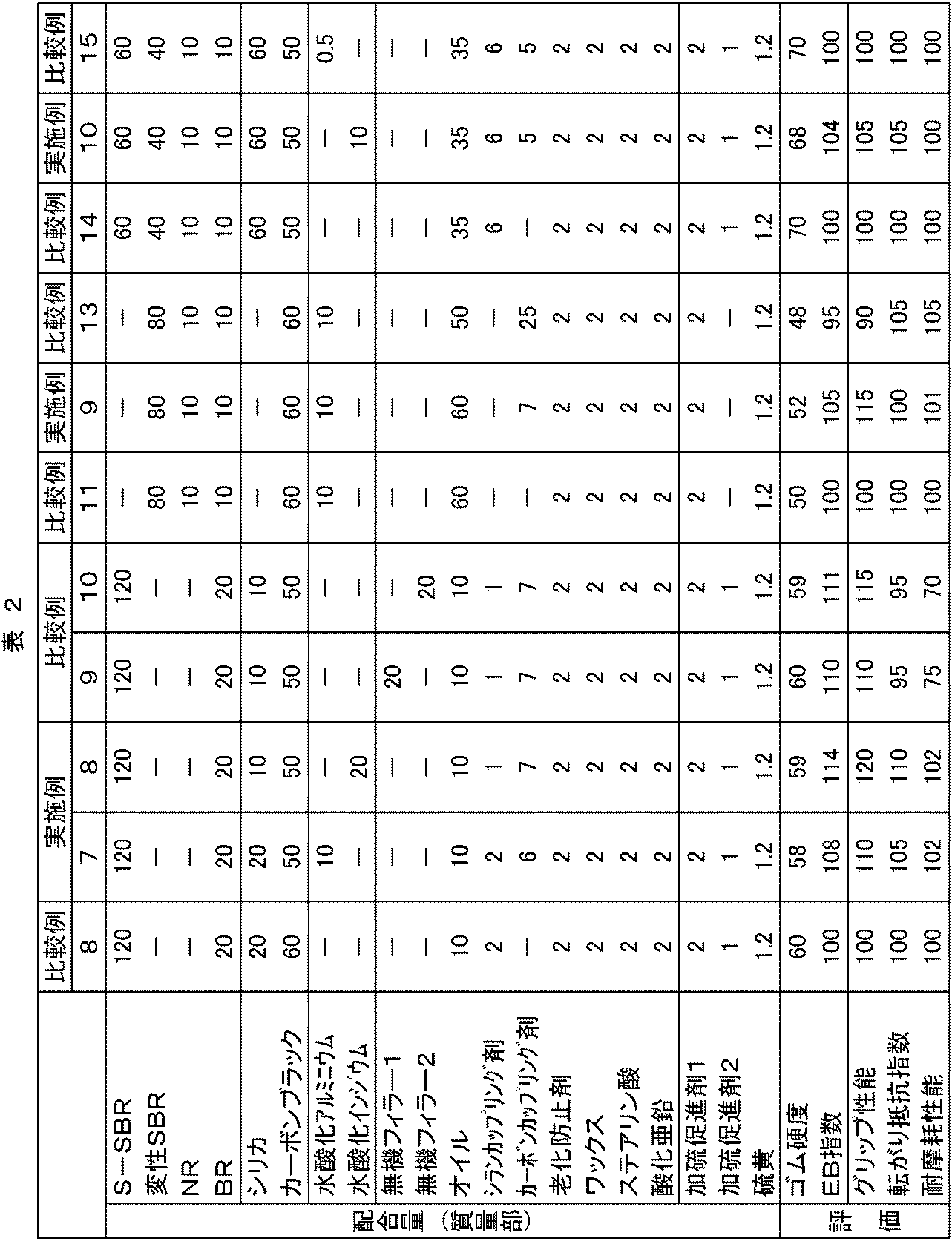
表1および2に示す配合内容に従い、(株)神戸製鋼所製の1.7Lバンバリーミキサーを用いて、硫黄および加硫促進剤以外の材料を排出温度150℃の条件下で5.0分間混練りし、混練り物を得た。次に、得られた混練り物に硫黄および加硫促進剤を添加し、排出温度100℃の条件下で3.0分間混練りし、未加硫ゴム組成物を得た。得られた未加硫ゴム組成物を170℃で12分間、2mm厚の金型でプレス加硫し、シート状の加硫ゴム組成物を得た。また、得られた未加硫ゴム組成物をトレッドの形状に成形し、タイヤ成形機上で他のタイヤ部材とともに貼り合わせて未加硫タイヤを形成し、170℃で12分間プレス加硫し、試験用タイヤ(サイズ:195/65R15)を製造した。得られた加硫ゴム組成物、試験用タイヤについて下記評価を行った。なお、比較例1は実施例1〜3ならびに比較例2および3の基準例、比較例4は実施例4および5ならびに比較例5の基準例、比較例6は実施例6および比較例7の基準例、比較例8は実施例7および8ならびに比較例9および10の基準例、比較例11は実施例9ならびに比較例12および13の基準例、比較例14は実施例10ならびに比較例15および16の基準例とする。
Examples and Comparative Examples In accordance with the blending contents shown in Tables 1 and 2, materials other than sulfur and a vulcanization accelerator were discharged under a condition of an exhaust temperature of 150 ° C. using a 1.7 L Banbury mixer manufactured by Kobe Steel Co., Ltd. The mixture was kneaded for 5.0 minutes to obtain a kneaded product. Next, sulfur and a vulcanization accelerator were added to the obtained kneaded product and kneaded for 3.0 minutes under the condition of a discharge temperature of 100 ° C. to obtain an unvulcanized rubber composition. The obtained unvulcanized rubber composition was press vulcanized with a 2 mm thick mold at 170 ° C. for 12 minutes to obtain a sheet-like vulcanized rubber composition. Further, the obtained unvulcanized rubber composition was molded into a tread shape, and bonded together with other tire members on a tire molding machine to form an unvulcanized tire, and press vulcanized at 170 ° C. for 12 minutes, A test tire (size: 195 / 65R15) was produced. The following evaluation was performed about the obtained vulcanized rubber composition and the tire for a test. Comparative Example 1 is a reference example of Examples 1 to 3 and Comparative Examples 2 and 3, Comparative Example 4 is a reference example of Examples 4 and 5 and Comparative Example 5, and Comparative Example 6 is of Example 6 and Comparative Example 7. Reference Example, Comparative Example 8 is the Reference Example of Examples 7 and 8, and Comparative Examples 9 and 10, Comparative Example 11 is the Reference Example of Example 9 and Comparative Examples 12 and 13, and Comparative Example 14 is Example 10 and Comparative Example 15. And 16 reference examples.
<ゴム硬度>
JIS K6253−3:2012に準じて、25℃の雰囲気下でタイヤトレッド部のタイプAデュロメータ硬さ(ゴム硬度)を測定した。
<Rubber hardness>
According to JIS K6253-3: 2012, the type A durometer hardness (rubber hardness) of the tire tread portion was measured under an atmosphere of 25 ° C.
<破断時伸びEB>
JIS K6251:2010に準じて、各加硫ゴム組成物からなる3号ダンベル型試験片を用いて室温下で引張試験を実施し、各加硫ゴム組成物の破断時伸びEB(%)を測定し、下記の式により各配合のEBを指数表示した。
(EB指数)=(各配合のEB)/(各基準例のEB)×100
<Elongation at break EB>
In accordance with JIS K6251: 2010, a tensile test was performed at room temperature using a No. 3 dumbbell-shaped test piece made of each vulcanized rubber composition, and the elongation at break EB (%) of each vulcanized rubber composition was measured. Then, the EB of each formulation was displayed as an index according to the following formula.
(EB index) = (EB of each formulation) / (EB of each reference example) × 100
<グリップ性能>
内圧を180kPaとした各試験用タイヤを、(株)ティアンドティのトラクションバスの全輪に装着し、試験タイヤ軸に装備された制御システムが時速65kmでホイールロックする直前のピークμを測定した。下記計算式により、各配合のグリップ性能を指数表示した。指数が大きいほどピークμが大きく、グリップ性能が高いことを示す。
(グリップ性能指数)=(各配合のピークμ)/(各基準例のピークμ)×100
<Grip performance>
Each test tire with an internal pressure of 180 kPa was mounted on all wheels of T & T Corporation's traction bus, and the peak μ was measured immediately before the control system equipped on the test tire shaft locked the wheel at 65 km / h. . The grip performance of each formulation was displayed as an index according to the following formula. The larger the index, the larger the peak μ and the higher the grip performance.
(Grip performance index) = (Peak μ of each formulation) / (Peak μ of each reference example) × 100
<転がり抵抗>
(株)岩本製作所製の粘弾性スペクトロメーターVESを用いて、温度70℃、初期歪み10%、動歪み2%の条件下で各加硫ゴム組成物の損失正接(tanδ)を測定した。下記計算式により、各配合の転がり抵抗特性を指数表示した。指数が大きいほど転がり抵抗特性(低燃費性)に優れることを示す。
(転がり抵抗指数)=(各基準例のtanδ)/(各配合のtanδ)×100
<Rolling resistance>
The loss tangent (tan δ) of each vulcanized rubber composition was measured under the conditions of a temperature of 70 ° C., an initial strain of 10% and a dynamic strain of 2% using a viscoelastic spectrometer VES manufactured by Iwamoto Seisakusho. The rolling resistance characteristics of each formulation were indicated by an index according to the following formula. The larger the index, the better the rolling resistance characteristics (low fuel consumption).
(Rolling resistance index) = (tan δ of each reference example) / (tan δ of each formulation) × 100
<耐摩耗性>
(株)岩本製作所製のランボーン型摩耗試験機を用い、室温、負荷荷重1.0kg、スリップ率30%の条件下で各加硫ゴム組成物の摩耗量を測定した。下記計算式により、各配合の耐摩耗性を指数表示した。指数が大きいほど、摩耗量が少なく、耐摩耗性に優れることを示す。
(耐摩耗性指数)=(各基準例の摩耗量)/(各配合の摩耗量)×100
<Abrasion resistance>
The amount of wear of each vulcanized rubber composition was measured under the conditions of room temperature, applied load of 1.0 kg, and slip rate of 30% using a Lambone-type wear tester manufactured by Iwamoto Seisakusho. The wear resistance of each formulation was displayed as an index according to the following formula. The larger the index, the smaller the amount of wear and the better the wear resistance.
(Abrasion resistance index) = (Abrasion amount of each reference example) / (Abrasion amount of each formulation) × 100
表1および2の結果より、第1の発明のタイヤおよび第2の発明のタイヤが、耐摩耗性および低燃費性を悪化させることなくグリップ性能に優れたタイヤであることが分かる。 From the results of Tables 1 and 2, it can be seen that the tire of the first invention and the tire of the second invention are excellent in grip performance without deteriorating wear resistance and fuel efficiency.
Claims (2)
カップリング剤を含有するゴム組成物で構成されるトレッドを備えるタイヤ。 A tire comprising a tread composed of a rubber composition containing a hydroxide of a group 13 element excluding aluminum hydroxide and a coupling agent.
第13族元素の水酸化物を含有しない基準ゴム組成物に対して、ゴム硬度が−3〜+3であり、かつ破断時伸びが103%以上であるゴム組成物で構成されるトレッドを備えるタイヤ。 A rubber composition containing a hydroxide of a Group 13 element and a coupling agent;
A tire provided with a tread composed of a rubber composition having a rubber hardness of -3 to +3 and an elongation at break of 103% or more with respect to a reference rubber composition not containing a hydroxide of a Group 13 element .
Priority Applications (1)
| Application Number | Priority Date | Filing Date | Title |
|---|---|---|---|
| JP2016084426A JP6736955B2 (en) | 2016-04-20 | 2016-04-20 | tire |
Applications Claiming Priority (1)
| Application Number | Priority Date | Filing Date | Title |
|---|---|---|---|
| JP2016084426A JP6736955B2 (en) | 2016-04-20 | 2016-04-20 | tire |
Publications (2)
| Publication Number | Publication Date |
|---|---|
| JP2017193622A true JP2017193622A (en) | 2017-10-26 |
| JP6736955B2 JP6736955B2 (en) | 2020-08-05 |
Family
ID=60156310
Family Applications (1)
| Application Number | Title | Priority Date | Filing Date |
|---|---|---|---|
| JP2016084426A Active JP6736955B2 (en) | 2016-04-20 | 2016-04-20 | tire |
Country Status (1)
| Country | Link |
|---|---|
| JP (1) | JP6736955B2 (en) |
Cited By (2)
| Publication number | Priority date | Publication date | Assignee | Title |
|---|---|---|---|---|
| JP2019104484A (en) * | 2017-12-08 | 2019-06-27 | 横浜ゴム株式会社 | Pneumatic tire |
| EP3552840A1 (en) * | 2018-04-09 | 2019-10-16 | Sumitomo Rubber Industries, Ltd. | Tire rubber composition and tire |
Citations (5)
| Publication number | Priority date | Publication date | Assignee | Title |
|---|---|---|---|---|
| JP2001181447A (en) * | 1999-12-27 | 2001-07-03 | Sumitomo Rubber Ind Ltd | Tread rubber composition and pneumatic tire using the same |
| JP2007077322A (en) * | 2005-09-15 | 2007-03-29 | Sumitomo Rubber Ind Ltd | Rubber composition |
| JP2014214297A (en) * | 2013-04-30 | 2014-11-17 | 住友ゴム工業株式会社 | Rubber composition for tire and pneumatic tire |
| WO2015104955A1 (en) * | 2014-01-07 | 2015-07-16 | 住友ゴム工業株式会社 | Pneumatic tire |
| JP2016020427A (en) * | 2014-07-14 | 2016-02-04 | 住友ゴム工業株式会社 | Rubber composition for tire and pneumatic tire |
-
2016
- 2016-04-20 JP JP2016084426A patent/JP6736955B2/en active Active
Patent Citations (5)
| Publication number | Priority date | Publication date | Assignee | Title |
|---|---|---|---|---|
| JP2001181447A (en) * | 1999-12-27 | 2001-07-03 | Sumitomo Rubber Ind Ltd | Tread rubber composition and pneumatic tire using the same |
| JP2007077322A (en) * | 2005-09-15 | 2007-03-29 | Sumitomo Rubber Ind Ltd | Rubber composition |
| JP2014214297A (en) * | 2013-04-30 | 2014-11-17 | 住友ゴム工業株式会社 | Rubber composition for tire and pneumatic tire |
| WO2015104955A1 (en) * | 2014-01-07 | 2015-07-16 | 住友ゴム工業株式会社 | Pneumatic tire |
| JP2016020427A (en) * | 2014-07-14 | 2016-02-04 | 住友ゴム工業株式会社 | Rubber composition for tire and pneumatic tire |
Cited By (6)
| Publication number | Priority date | Publication date | Assignee | Title |
|---|---|---|---|---|
| JP2019104484A (en) * | 2017-12-08 | 2019-06-27 | 横浜ゴム株式会社 | Pneumatic tire |
| JP7397272B2 (en) | 2017-12-08 | 2023-12-13 | 横浜ゴム株式会社 | pneumatic tires |
| EP3552840A1 (en) * | 2018-04-09 | 2019-10-16 | Sumitomo Rubber Industries, Ltd. | Tire rubber composition and tire |
| CN110358162A (en) * | 2018-04-09 | 2019-10-22 | 住友橡胶工业株式会社 | Rubber composition for tire and tire |
| JP2019182982A (en) * | 2018-04-09 | 2019-10-24 | 住友ゴム工業株式会社 | Rubber composition for tire, and tire |
| CN110358162B (en) * | 2018-04-09 | 2022-05-31 | 住友橡胶工业株式会社 | Rubber composition for tire and tire |
Also Published As
| Publication number | Publication date |
|---|---|
| JP6736955B2 (en) | 2020-08-05 |
Similar Documents
| Publication | Publication Date | Title |
|---|---|---|
| JP4783356B2 (en) | Rubber composition | |
| JP5543226B2 (en) | Rubber composition for tire and pneumatic tire | |
| JP5249362B2 (en) | Rubber composition for tire and pneumatic tire | |
| JP7428463B2 (en) | tire tread and tires | |
| USRE46184E1 (en) | Rubber composition for tread, and pneumatic tire | |
| CN102666707B (en) | Rubber composition for tires and pneumatic tire | |
| JP5872125B1 (en) | Rubber composition and tire | |
| JP2010174169A (en) | Rubber composition for coating tread or carcass cord, and tire | |
| JP2011144324A (en) | Rubber composition for tire and pneumatic tire | |
| JP2003192842A (en) | Rubber composition for tire and tire using the rubber composition | |
| CN102844368B (en) | Rubber composition for tire and pneumatic tire | |
| US9416258B2 (en) | Rubber composition for tire, and pneumatic tire | |
| JP6249718B2 (en) | Rubber composition, tire member and tire using the same | |
| JP2011046875A (en) | Rubber composition for tire and pneumatic tire | |
| JP2015174991A (en) | Pneumatic tire | |
| JP6208422B2 (en) | Rubber composition for tire and pneumatic tire | |
| JP5612427B2 (en) | Rubber composition for tread and pneumatic tire | |
| JP5524561B2 (en) | Rubber composition for tread and pneumatic tire | |
| JP2011057922A (en) | Tire rubber composition and pneumatic tire | |
| JP2017141325A (en) | tire | |
| JP2014105293A (en) | Rubber composition for tire and pneumatic tire | |
| JP2012001697A (en) | Rubber composition for sidewall and pneumatic tire | |
| JP6736955B2 (en) | tire | |
| JP2015174990A (en) | pneumatic tire | |
| JP5144137B2 (en) | Rubber composition for tread and tire having tread using the same |
Legal Events
| Date | Code | Title | Description |
|---|---|---|---|
| A621 | Written request for application examination |
Free format text: JAPANESE INTERMEDIATE CODE: A621 Effective date: 20190313 |
|
| A977 | Report on retrieval |
Free format text: JAPANESE INTERMEDIATE CODE: A971007 Effective date: 20200324 |
|
| A131 | Notification of reasons for refusal |
Free format text: JAPANESE INTERMEDIATE CODE: A131 Effective date: 20200331 |
|
| A521 | Request for written amendment filed |
Free format text: JAPANESE INTERMEDIATE CODE: A523 Effective date: 20200527 |
|
| TRDD | Decision of grant or rejection written | ||
| A01 | Written decision to grant a patent or to grant a registration (utility model) |
Free format text: JAPANESE INTERMEDIATE CODE: A01 Effective date: 20200616 |
|
| A61 | First payment of annual fees (during grant procedure) |
Free format text: JAPANESE INTERMEDIATE CODE: A61 Effective date: 20200629 |
|
| R150 | Certificate of patent or registration of utility model |
Ref document number: 6736955 Country of ref document: JP Free format text: JAPANESE INTERMEDIATE CODE: R150 |
|
| R250 | Receipt of annual fees |
Free format text: JAPANESE INTERMEDIATE CODE: R250 |
|
| R250 | Receipt of annual fees |
Free format text: JAPANESE INTERMEDIATE CODE: R250 |
|
| R250 | Receipt of annual fees |
Free format text: JAPANESE INTERMEDIATE CODE: R250 |