JP2017502004A - Porphyrin-based sensitizers for dye-sensitized solar cells - Google Patents
Porphyrin-based sensitizers for dye-sensitized solar cells Download PDFInfo
- Publication number
- JP2017502004A JP2017502004A JP2016538059A JP2016538059A JP2017502004A JP 2017502004 A JP2017502004 A JP 2017502004A JP 2016538059 A JP2016538059 A JP 2016538059A JP 2016538059 A JP2016538059 A JP 2016538059A JP 2017502004 A JP2017502004 A JP 2017502004A
- Authority
- JP
- Japan
- Prior art keywords
- formula
- compound
- aryl
- alkyl
- dye
- Prior art date
- Legal status (The legal status is an assumption and is not a legal conclusion. Google has not performed a legal analysis and makes no representation as to the accuracy of the status listed.)
- Granted
Links
- 0 CC(N(*)C1=O)=C(C=C23)C1=CC2=C(C)N(*)C3=O Chemical compound CC(N(*)C1=O)=C(C=C23)C1=CC2=C(C)N(*)C3=O 0.000 description 4
Images

Classifications
-
- C—CHEMISTRY; METALLURGY
- C07—ORGANIC CHEMISTRY
- C07F—ACYCLIC, CARBOCYCLIC OR HETEROCYCLIC COMPOUNDS CONTAINING ELEMENTS OTHER THAN CARBON, HYDROGEN, HALOGEN, OXYGEN, NITROGEN, SULFUR, SELENIUM OR TELLURIUM
- C07F3/00—Compounds containing elements of Groups 2 or 12 of the Periodic Table
- C07F3/06—Zinc compounds
-
- C—CHEMISTRY; METALLURGY
- C09—DYES; PAINTS; POLISHES; NATURAL RESINS; ADHESIVES; COMPOSITIONS NOT OTHERWISE PROVIDED FOR; APPLICATIONS OF MATERIALS NOT OTHERWISE PROVIDED FOR
- C09B—ORGANIC DYES OR CLOSELY-RELATED COMPOUNDS FOR PRODUCING DYES, e.g. PIGMENTS; MORDANTS; LAKES
- C09B47/00—Porphines; Azaporphines
-
- C—CHEMISTRY; METALLURGY
- C09—DYES; PAINTS; POLISHES; NATURAL RESINS; ADHESIVES; COMPOSITIONS NOT OTHERWISE PROVIDED FOR; APPLICATIONS OF MATERIALS NOT OTHERWISE PROVIDED FOR
- C09B—ORGANIC DYES OR CLOSELY-RELATED COMPOUNDS FOR PRODUCING DYES, e.g. PIGMENTS; MORDANTS; LAKES
- C09B47/00—Porphines; Azaporphines
- C09B47/04—Phthalocyanines abbreviation: Pc
- C09B47/08—Preparation from other phthalocyanine compounds, e.g. cobaltphthalocyanineamine complex
- C09B47/085—Preparation from other phthalocyanine compounds, e.g. cobaltphthalocyanineamine complex substituting the central metal atom
-
- H—ELECTRICITY
- H01—ELECTRIC ELEMENTS
- H01G—CAPACITORS; CAPACITORS, RECTIFIERS, DETECTORS, SWITCHING DEVICES, LIGHT-SENSITIVE OR TEMPERATURE-SENSITIVE DEVICES OF THE ELECTROLYTIC TYPE
- H01G9/00—Electrolytic capacitors, rectifiers, detectors, switching devices, light-sensitive or temperature-sensitive devices; Processes of their manufacture
- H01G9/20—Light-sensitive devices
- H01G9/2027—Light-sensitive devices comprising an oxide semiconductor electrode
- H01G9/2031—Light-sensitive devices comprising an oxide semiconductor electrode comprising titanium oxide, e.g. TiO2
-
- H—ELECTRICITY
- H01—ELECTRIC ELEMENTS
- H01G—CAPACITORS; CAPACITORS, RECTIFIERS, DETECTORS, SWITCHING DEVICES, LIGHT-SENSITIVE OR TEMPERATURE-SENSITIVE DEVICES OF THE ELECTROLYTIC TYPE
- H01G9/00—Electrolytic capacitors, rectifiers, detectors, switching devices, light-sensitive or temperature-sensitive devices; Processes of their manufacture
- H01G9/20—Light-sensitive devices
- H01G9/2059—Light-sensitive devices comprising an organic dye as the active light absorbing material, e.g. adsorbed on an electrode or dissolved in solution
-
- H—ELECTRICITY
- H10—SEMICONDUCTOR DEVICES; ELECTRIC SOLID-STATE DEVICES NOT OTHERWISE PROVIDED FOR
- H10K—ORGANIC ELECTRIC SOLID-STATE DEVICES
- H10K85/00—Organic materials used in the body or electrodes of devices covered by this subclass
- H10K85/30—Coordination compounds
- H10K85/381—Metal complexes comprising a group IIB metal element, e.g. comprising cadmium, mercury or zinc
-
- H—ELECTRICITY
- H01—ELECTRIC ELEMENTS
- H01G—CAPACITORS; CAPACITORS, RECTIFIERS, DETECTORS, SWITCHING DEVICES, LIGHT-SENSITIVE OR TEMPERATURE-SENSITIVE DEVICES OF THE ELECTROLYTIC TYPE
- H01G9/00—Electrolytic capacitors, rectifiers, detectors, switching devices, light-sensitive or temperature-sensitive devices; Processes of their manufacture
- H01G9/20—Light-sensitive devices
- H01G9/2004—Light-sensitive devices characterised by the electrolyte, e.g. comprising an organic electrolyte
- H01G9/2018—Light-sensitive devices characterised by the electrolyte, e.g. comprising an organic electrolyte characterised by the ionic charge transport species, e.g. redox shuttles
-
- Y—GENERAL TAGGING OF NEW TECHNOLOGICAL DEVELOPMENTS; GENERAL TAGGING OF CROSS-SECTIONAL TECHNOLOGIES SPANNING OVER SEVERAL SECTIONS OF THE IPC; TECHNICAL SUBJECTS COVERED BY FORMER USPC CROSS-REFERENCE ART COLLECTIONS [XRACs] AND DIGESTS
- Y02—TECHNOLOGIES OR APPLICATIONS FOR MITIGATION OR ADAPTATION AGAINST CLIMATE CHANGE
- Y02E—REDUCTION OF GREENHOUSE GAS [GHG] EMISSIONS, RELATED TO ENERGY GENERATION, TRANSMISSION OR DISTRIBUTION
- Y02E10/00—Energy generation through renewable energy sources
- Y02E10/50—Photovoltaic [PV] energy
- Y02E10/542—Dye sensitized solar cells
-
- Y—GENERAL TAGGING OF NEW TECHNOLOGICAL DEVELOPMENTS; GENERAL TAGGING OF CROSS-SECTIONAL TECHNOLOGIES SPANNING OVER SEVERAL SECTIONS OF THE IPC; TECHNICAL SUBJECTS COVERED BY FORMER USPC CROSS-REFERENCE ART COLLECTIONS [XRACs] AND DIGESTS
- Y02—TECHNOLOGIES OR APPLICATIONS FOR MITIGATION OR ADAPTATION AGAINST CLIMATE CHANGE
- Y02E—REDUCTION OF GREENHOUSE GAS [GHG] EMISSIONS, RELATED TO ENERGY GENERATION, TRANSMISSION OR DISTRIBUTION
- Y02E10/00—Energy generation through renewable energy sources
- Y02E10/50—Photovoltaic [PV] energy
- Y02E10/549—Organic PV cells
Landscapes
- Engineering & Computer Science (AREA)
- Chemical & Material Sciences (AREA)
- Power Engineering (AREA)
- Organic Chemistry (AREA)
- Microelectronics & Electronic Packaging (AREA)
- Materials Engineering (AREA)
- Inorganic Chemistry (AREA)
- Hybrid Cells (AREA)
- Photovoltaic Devices (AREA)
- Nitrogen Condensed Heterocyclic Rings (AREA)
Abstract
本発明は、全体のUV‐可視及び近赤外スペクトル応答をカバーする高い吸収係数を有する、ポルフィリンコア及びπ共役リンカーすなわちポルフィリンコアとアンカー基の間に導入されたアクセプターをベースとする式(I)の化合物、増感剤又は色素としてのその使用、及び本発明の化合物(I)を含む電気化学又は光電子デバイスに関する。【選択図】図1The present invention is based on a formula (I) based on an acceptor introduced between a porphyrin core and a π-conjugated linker or porphyrin core and an anchor group with a high absorption coefficient covering the entire UV-visible and near-infrared spectral response. ) Compounds, their use as sensitizers or dyes, and electrochemical or optoelectronic devices comprising the compound (I) of the invention. [Selection] Figure 1
Description
本発明は、増感剤として用いるポルフィリンベースの化合物、又は電子アクセプターとして働く酸化物骨格の表面に色素を固定するアクセプター部分へのドナーからの効率的な電荷移動の流れを与える亜鉛ポルフィリンベースの光増感性化合物に関する。さらに、本発明は光電変換効率を増大させる高い吸収係数を有するUV‐可視全体から近赤外領域のスペクトルをカバーするポルフィリン光増感性色素、光電気化学、電気化学又は光電子デバイス、特に、係る亜鉛ポルフィリンベースの光増感剤化合物を含む色素増感太陽電池(DSC)におけるその使用に関する。 The present invention relates to a porphyrin-based compound used as a sensitizer, or a zinc porphyrin-based light that provides an efficient charge transfer flow from a donor to an acceptor moiety that fixes the dye to the surface of an oxide skeleton that acts as an electron acceptor. It relates to a sensitizing compound. Furthermore, the present invention relates to porphyrin photosensitizing dyes, photoelectrochemical, electrochemical or optoelectronic devices that cover the spectrum from the entire UV-visible to the near infrared region with a high absorption coefficient that increases the photoelectric conversion efficiency, in particular such zinc It relates to its use in dye-sensitized solar cells (DSC) comprising porphyrin-based photosensitizer compounds.
従来技術と本発明の基本的な課題
世界は、エネルギー及び世界的な温度上昇の我々への警鐘に関し、化石燃料の使用を低減し、代替の再生可能なエネルギー源を見つけることをますます必要としている。太陽エネルギーの電気への変換の分野において、色素増感太陽電池(DSC)は、その低コストと高効率のために、近年かなりの注目を集めている。例えば、ルテニウム増感剤をベースとするDSCは、標準エアマス1.5G照射の下で11%を超える全体の電力変換効率(PCE)に到達している。
The fundamental challenges of the prior art and the present invention The world is increasingly in need of reducing the use of fossil fuels and finding alternative renewable energy sources with regard to warnings of energy and global temperature rise Yes. In the field of conversion of solar energy to electricity, dye-sensitized solar cells (DSC) have attracted considerable attention in recent years due to their low cost and high efficiency. For example, DSCs based on ruthenium sensitizers have reached an overall power conversion efficiency (PCE) of over 11% under standard air mass 1.5G irradiation.
近年、その高いモル吸収係数、合成の容易さ、及び構造の修正のために、また、制限された利用可能性を有するコストの高い金属の使用を回避するために、実用的な有機増感剤の開発に多くの努力が捧げられている。 In recent years, practical organic sensitizers because of their high molar absorption coefficient, ease of synthesis, and structural modifications, and to avoid the use of costly metals with limited availability Much effort has been devoted to the development of.
したがって、ドナー‐π‐アクセプター(D‐π‐A)有機増感剤のPCEは、DSCに関する増感剤として用いられる魅力的な候補である。なぜなら、それは10%を超える電力変換に到達するからである(Ito et al.、Chem Commun、2008、5194)。 Thus, the donor-π-acceptor (D-π-A) organic sensitizer PCE is an attractive candidate for use as a sensitizer for DSC. Because it reaches more than 10% power conversion (Ito et al., Chem Commun, 2008, 5194).
ポルフィリンは、可視領域において、そのソレー及びQバンドの大きな吸収係数を有する。また、それらは非常に魅力的な増感剤であると考えられている。さらに、これらのポルフィリン増感剤を発色団のメソ及びベータ位にて官能化して、ポルフィリンのスペクトル特性及びエネルギー論を調節してよい。 Porphyrin has a large absorption coefficient of its sole and Q bands in the visible region. They are also considered to be very attractive sensitizers. In addition, these porphyrin sensitizers may be functionalized at the meso and beta positions of the chromophore to adjust the spectral properties and energetics of the porphyrin.
ポルフィリンのファミリーにおいて、ドナー及びアクセプター部分の導入と、πブリッジストラテジーとしての亜鉛ポルフィリン発色団の使用は、電子アクセプターとして働く酸化物骨格の表面に色素を固定するアクセプター部分へのドナーからの賢明な方向性のある電子の流れを作り出すことにより、効率的な増感剤の新たなファミリーを作り出してきた(US2010/0125136、US2013/0090469)。しかし、係る増感剤を含むDSCの電力変換効率は低く、10%未満のままである。 In the porphyrin family, the introduction of the donor and acceptor moieties and the use of the zinc porphyrin chromophore as a π-bridge strategy is a wise direction from the donor to the acceptor moiety that anchors the dye to the surface of the oxide skeleton acting as an electron acceptor. A new family of efficient sensitizers has been created by creating sexual electron flows (US2010 / 0125136, US2013 / 0090469). However, the power conversion efficiency of DSCs containing such sensitizers is low and remains below 10%.
ポルフィリンの吸収スペクトルにおいて、ソレーバンドとQバンドとの間に約500nmのバレー又はギャップがある。このバレーは、Lu et al.(Phys.Chem.Chem.Phys.、2009、第10270‐10274頁)にも記載され、そこではポルフィリン色素はπ共役ブリッジ及びカルボキシアンカー基で構成されたアクセプターを含む。このバレーを乗り越え、広範なスペクトル応答の吸収を得るために、コバルトレドックス電解質を併用する、ドナーアクセプター亜鉛ポルフィリンと有機共増感剤色素とを組み合わせることによる共増感剤アプローチを用いてデバイス性能を向上させた(Yella et al.、Science、2011、334、629‐634)。 In the porphyrin absorption spectrum, there is a valley or gap of about 500 nm between the Sore band and the Q band. This valley is based on Lu et al. (Phys. Chem. Chem. Phys., 2009, pages 10270-10274), where the porphyrin dye comprises an acceptor composed of a π-conjugated bridge and a carboxy anchor group. Device performance using a co-sensitizer approach by combining a donor acceptor zinc porphyrin and an organic co-sensitizer dye in combination with a cobalt redox electrolyte to overcome this valley and obtain a broad spectrum response absorption (Yella et al., Science, 2011, 334, 629-634).
本発明は、有機増感剤の欠点、特にルテニウムベースの色素及びポルフィリンベースの色素のスペクトル応答に対処する。本発明は、相補的な吸収スペクトルを含む2種の色素による共増感剤アプローチを回避することにより、500nm周辺の光吸収の低下(「バレー」)の課題にも対処して前記ポルフィリン色素のスペクトル応答を広範化する。 The present invention addresses the disadvantages of organic sensitizers, particularly the spectral response of ruthenium-based and porphyrin-based dyes. The present invention also addresses the problem of reduced light absorption (“valley”) around 500 nm by avoiding a co-sensitizer approach with two dyes that include complementary absorption spectra. Broaden the spectral response.
本発明は、制限された利用可能性を有するコストの高い金属を使用せず、ポルフィリンベースの色素の光吸収スペクトルを補完する共増感剤色素をさらに必要としない新規のポルフィリン増感剤又はポルフィリン色素を提供することを目的とする。本発明の前記ポルフィリン色素は、広範な光吸収スペクトルを有し、ソレーバンドとQバンドとの間のバレーを埋める追加の電荷遷移バンドを有する。したがって、相補的な吸収スペクトルを有する色素を含む共増感剤は、高いPCEを得ること、及び係る色素を含む光電気化学デバイスを向上させるのに必要とされない。さらに、ポルフィリン色素は、高度に効率的で低コストであり、集光性の近赤外への拡張を示すことに加えて良好な安定性を示す。 The present invention is a novel porphyrin sensitizer or porphyrin that does not use costly metals with limited availability and does not require additional co-sensitizer dyes that complement the light absorption spectrum of porphyrin-based dyes. The object is to provide a dye. The porphyrin dyes of the present invention have a broad light absorption spectrum and an additional charge transition band that fills the valley between the Sore band and the Q band. Thus, co-sensitizers containing dyes with complementary absorption spectra are not required to obtain high PCE and to improve photoelectrochemical devices containing such dyes. In addition, porphyrin dyes are highly efficient and low cost and exhibit good stability in addition to exhibiting light-collecting near-infrared.
本発明は、上記の課題に対処する。 The present invention addresses the above problems.
発明の概要
驚くべきことに、本発明者らは、アンカー基及びポルフィリン発色団すなわちコア間のπ共役リンカーとしての電子アクセプターの導入が、ソレーバンドとQバンドとの間のバレーを埋める追加の電荷遷移バンドに寄与することを見出した。ポルフィリンコア及び安息香酸由来のアンカー基間のキノキサリンベースのスペーサー等の電子アクセプターの導入は、UV‐可視スペクトル全体から近赤外(IR)スペクトルをカバーする広範な吸収を有する新規のポルフィリン増感性化合物を提供する。
SUMMARY OF THE INVENTION Surprisingly, the inventors have found that the introduction of an electron acceptor as an anchor group and a porphyrin chromophore or π-conjugated linker between cores adds additional charge transitions that fill the valley between the Soray and Q bands. I found that it contributed to the band. Introduction of an electron acceptor such as a quinoxaline-based spacer between the porphyrin core and the benzoic acid derived anchor group is a novel porphyrin sensitizing compound with broad absorption covering the entire UV-visible spectrum to the near infrared (IR) spectrum I will provide a.
驚くべきことに、本発明の化合物はまた、キナキソリンベース(quinaxoline)の電子アクセプターなしの参照ポルフィリン増感剤と比較して、ソレーバンドとQバンドとの間の吸収ギャップを埋めることに加えてレッドシフトしたスペクトルを示し、係る色素を含むポルフィリン色素増感太陽電池のエネルギー変換効率を向上させることが観察されている。そのうちの1種が前のポルフィリン色素である2種の色素を含む共増感剤は、エネルギー変換効率を増大させるのに必要とされない。本発明の1種の色素を含む増感剤は、12%を超える電力変換効率を有するデバイスを得るのに十分である。 Surprisingly, the compounds of the present invention also have a red color in addition to filling the absorption gap between the sore and Q bands, compared to a quinaxolin based electron acceptor-free reference porphyrin sensitizer. It has been observed that it exhibits a shifted spectrum and improves the energy conversion efficiency of porphyrin dye-sensitized solar cells containing such dyes. Co-sensitizers containing two dyes, one of which is the previous porphyrin dye, are not required to increase energy conversion efficiency. A sensitizer comprising one dye of the present invention is sufficient to obtain a device having a power conversion efficiency of greater than 12%.
ある側面において、本発明は式Iの化合物を提供する。 In certain aspects, the present invention provides a compound of formula I.
(式中、
‐MはCo、Cu、Fe、Mg、Mn、Ni、Si若しくはZnから選択され、又はMはポルフィリンコアを構成する2つのピロール部分を置換する2つのH(水素)であり、
‐Aは式(1)〜(36)及び(103)〜(107)
(Where
-M is selected from Co, Cu, Fe, Mg, Mn, Ni, Si or Zn, or M is two H (hydrogen) substituting the two pyrrole moieties that make up the porphyrin core;
-A represents the formulas (1) to (36) and (103) to (107)
(式中、R1〜R68及びR137〜R141は、H、C1〜C16アルキル、C1〜C16アルコキシ、C1〜C16チオアルキル、C1〜C16アルコキシアルキル、C4〜C16アリール、C1〜C16アリールアルキル、又はC4〜C16ヘテロアリール、C4〜C16ヘテロアリールアルキル(ヘテロ原子はO、S、又はNから選択される)から独立に選択される置換基である)のいずれか1つによる部分から選択されるアクセプター基であり、
‐Ancはさらに置換されたC4〜C16アリール又はC4〜C16ヘテロアリール(ヘテロ原子はO、S、又はNから選択される)から選択されるアンカー基であり、さらなる置換基はCOOH、=O(ケト)、C4〜C16シアノアルケニルカルボン酸から選択され、
‐L1及びL2は、さらに置換された又は置換されていないC4〜C16アリール又はC4〜C16ヘテロアリール(ヘテロ原子はO、S、又はNから選択される)から独立に選択される置換基であり、さらなる置換基はH、C1〜C16アルキル、C1〜C16アルコキシ、C1〜C16チオアルキル、C1〜C16アルコキシアルキル、C4〜C16アリール、C1〜C16アリールアルキル、又はC4〜C16ヘテロアリール、C4〜C16ヘテロアリールアルキル(ヘテロ原子はO、S、又はNから選択される)から選択され、
‐Ar1及びAr2は、さらに置換された又は置換されていないC4〜C16アリール、C8〜C32ジアリール、C4〜C16ヘテロアリール(ヘテロ原子はO、S、又はNから選択される)から選択されるドナー置換基であり、さらなる置換基はH、C1〜C16アルキル、C1〜C16アルコキシ、C1〜C16チオアルキル、C1〜C16アルコキシアルキル、C4〜C16アリール、C1〜C16アリールアルキル、又はC4〜C16ヘテロアリール、C14〜C16ヘテロアリールアルキル(ヘテロ原子はO、S、又はNから選択される)から選択される。)
Wherein R 1 to R 68 and R 137 to R 141 are H, C1-C16 alkyl, C1-C16 alkoxy, C1-C16 thioalkyl, C1-C16 alkoxyalkyl, C4-C16 aryl, C1-C16 arylalkyl. Or a moiety according to any one of C4-C16 heteroaryl, C4-C16 heteroarylalkyl, wherein the heteroatom is a substituent independently selected from O, S, or N. Acceptor group,
-Anc is an anchor group selected from further substituted C4-C16 aryl or C4-C16 heteroaryl (where the heteroatom is selected from O, S, or N), and further substituents are COOH, = O ( Keto), C4 to C16 cyanoalkenylcarboxylic acids,
-L 1 and L 2 are substituents independently selected from further substituted or unsubstituted C 4 -C 16 aryl or C 4 -C 16 heteroaryl (where the heteroatom is selected from O, S, or N) And further substituents are H, C1-C16 alkyl, C1-C16 alkoxy, C1-C16 thioalkyl, C1-C16 alkoxyalkyl, C4-C16 aryl, C1-C16 arylalkyl, or C4-C16 heteroaryl, C4- Selected from C16 heteroarylalkyl, wherein the heteroatom is selected from O, S, or N;
-Ar 1 and Ar 2 are further selected from substituted or unsubstituted C4-C16 aryl, C8-C32 diaryl, C4-C16 heteroaryl (the heteroatom is selected from O, S, or N) Further substituents are H, C1-C16 alkyl, C1-C16 alkoxy, C1-C16 thioalkyl, C1-C16 alkoxyalkyl, C4-C16 aryl, C1-C16 arylalkyl, or C4-C16 hetero Selected from aryl, C14-C16 heteroarylalkyl, where the heteroatom is selected from O, S, or N. )
さらなる側面において、本発明は電気化学又は光電子デバイスにおける色素又は増感性化合物としての前記式(I)の化合物の使用を提供する。 In a further aspect, the present invention provides the use of a compound of formula (I) as a dye or sensitizing compound in an electrochemical or optoelectronic device.
別の側面において、本発明は前記式(I)の化合物である色素を含む電気化学、好ましくは光電気化学、又は光電子デバイスを提供する。 In another aspect, the present invention provides an electrochemical, preferably photoelectrochemical, or optoelectronic device comprising a dye that is a compound of formula (I).
本発明のさらなる側面及び好ましい実施態様は、本開示の以下及び添付の特許請求の範囲において規定される。本発明のさらなる特徴及び利点は、以下に与えられる好ましい実施態様の記載から当業者に明らかとなるであろう。 Further aspects and preferred embodiments of the present invention are defined below in this disclosure and in the appended claims. Further features and advantages of the present invention will become apparent to those skilled in the art from the description of the preferred embodiments given below.
好ましい実施態様の詳細な説明
本発明は、共増感剤の必要性なしにUV‐可視の全体のスペクトル及び近赤外光スペクトルを吸収するポルフィリンコアをベースとする化合物、電気化学又は光電子デバイスにおける増感性化合物又は色素としてのその使用、及び本発明の化合物を含む電気化学又は光電子デバイスに関する。
Detailed Description of the Preferred Embodiments The present invention relates to porphyrin core-based compounds, electrochemical or optoelectronic devices that absorb the entire UV-visible spectrum and near-infrared light spectrum without the need for co-sensitizers. It relates to sensitizing compounds or their use as dyes and to electrochemical or optoelectronic devices comprising the compounds according to the invention.
特に、本発明の化合物は、式(I)の化合物である。 In particular, the compounds of the present invention are compounds of formula (I).
理論にとらわれることなく、ポルフィリンコアは、電気化学、光電気化学、又は光電子デバイスのため、特にDSCのための増感剤として、アンカー基(Anc)及びポルフィリン発色団間のπ共役リンカーとしての電子アクセプター(A)の導入により、予想を上回る電力変換効率(PCE)を提供するように調節される。前記ポルフィリン発色団は、C4〜C12アリール又はC4〜C12ヘテロアリール(ヘテロ原子はSである)であるL1及びL2により、前記ポルフィリンコアのメソ10、20位がさらに置換されており、前記アリール又はヘテロアリールは、凝集から色素を保護するために、アルコキシ鎖によりさらに置換されている。したがって、分子間の立体障害は増大し、ポルフィリン環自体のπ‐π相互作用は低減され、分子溶解度は向上し、分子の凝集は防止される。ポルフィリンコアは、ドナー基により置換され、式中、アミノ基は芳香族基、ドナー置換基Ar1及びAr2によりさらに置換される。
Without being bound by theory, the porphyrin core is an electron as a π-conjugated linker between the anchor group (Anc) and the porphyrin chromophore, as a sensitizer for electrochemistry, photoelectrochemistry, or optoelectronic devices, particularly for DSC. The introduction of the acceptor (A) is adjusted to provide a power conversion efficiency (PCE) greater than expected. The porphyrin chromophore is further substituted at the
Mは二価金属であり、それは存在してもしなくてもよく、存在する場合は、MはCo、Cu、Fe、Mg、Mn、Ni、Si、又はZnから選択される。好ましくは、MはCo、Cu、又はZnから選択される。最も好ましくは、MはZnである。Mが存在しない場合は、Mはポルフィリンコアを構成する2つのピロール部分を置換する2つのH(水素)に置き換えられる。 M is a divalent metal, which may or may not be present, and when present, M is selected from Co, Cu, Fe, Mg, Mn, Ni, Si, or Zn. Preferably, M is selected from Co, Cu, or Zn. Most preferably, M is Zn. In the absence of M, M is replaced by two H (hydrogen) that replace the two pyrrole moieties that make up the porphyrin core.
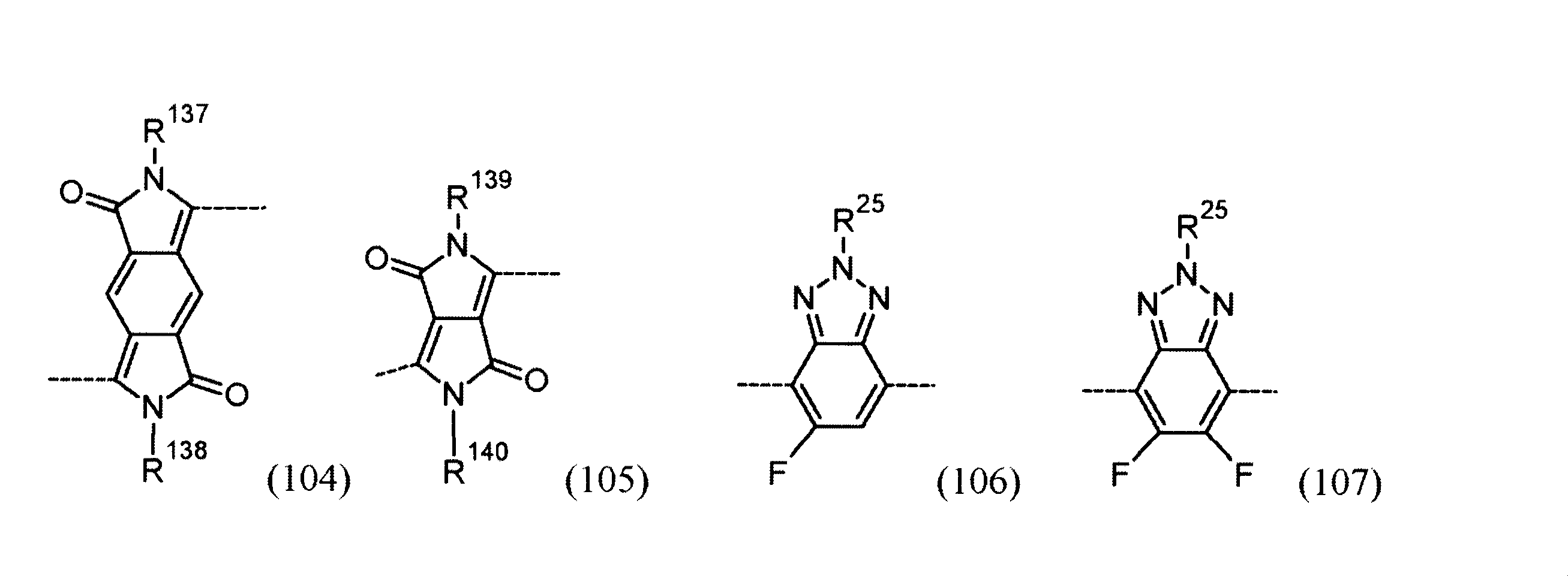
Aは式(1)〜(36)及び(103)〜(107)のいずれか1つによる部分から選択されるアクセプター基である。 A is an acceptor group selected from the moieties according to any one of formulas (1) to (36) and (103) to (107).
(式中、R1〜R68及びR137〜R141はH、C1〜C16アルキル、C1〜C16アルコキシ、C1〜C16チオアルキル、C1〜C16アルコキシアルキル、C4〜C16アリール、C1〜C16アリールアルキル又はC4〜C16ヘテロアリール、C4〜C16ヘテロアリールアルキル(ヘテロ原子はO、S、又はNから選択される)から独立に選択される置換基である。)アルキル、アルコキシ、チオアルキル、アルコキシアルキル、アリールアルキル及びヘテロアリール基が3又はそれより多くの炭素を含む場合、それは直鎖、分岐又は環状であってよい。好ましくは、アルキル、アルコキシ、チオアルキル、アルコキシアルキル、アリールアルキル及びヘテロアリールは、1〜16の炭素、1〜12の炭素又は1〜8の炭素を含む炭化水素から選択される。同じ式の同じ部分を置換するR1〜R68及びR137〜R141からの置換基は、同じ式の同じ部分を置換する他の置換基と同一又は異なってよい。例えば、式(2)の部分を置換するR1及びR2は、同一又は異なってよい。 Wherein R 1 to R 68 and R 137 to R 141 are H, C1-C16 alkyl, C1-C16 alkoxy, C1-C16 thioalkyl, C1-C16 alkoxyalkyl, C4-C16 aryl, C1-C16 arylalkyl or C4-C16 heteroaryl, C4-C16 heteroarylalkyl (the heteroatom is a substituent independently selected from O, S, or N). Alkyl, alkoxy, thioalkyl, alkoxyalkyl, arylalkyl And when a heteroaryl group contains 3 or more carbons, it may be straight-chained, branched or cyclic. Preferably, alkyl, alkoxy, thioalkyl, alkoxyalkyl, arylalkyl and heteroaryl are selected from hydrocarbons containing 1 to 16 carbons, 1 to 12 carbons or 1 to 8 carbons. The substituents from R 1 to R 68 and R 137 to R 141 that replace the same part of the same formula may be the same or different from other substituents that replace the same part of the same formula. For example, R 1 and R 2 substituting the moiety of formula (2) may be the same or different.
さらなる実施態様において、Aは式(1)〜(36)及び(103)〜(105)のいずれか1つによる部分から選択されるアクセプター基である。 In a further embodiment, A is an acceptor group selected from moieties according to any one of formulas (1) to (36) and (103) to (105).
(式中、R1〜R68及びR137〜R141はH、C1〜C16アルキル、C1〜C16アルコキシ、C1〜C16チオアルキル、C1〜C16アルコキシアルキル、C4〜C16アリール、C1〜C16アリールアルキル、又はC14〜C16ヘテロアリール、C4〜C16ヘテロアリールアルキル(ヘテロ原子はO、S、又はNから選択される)から独立に選択される置換基である。)アルキル、アルコキシ、チオアルキル、アルコキシアルキル、アリールアルキル及びヘテロアリール基が3又はそれより多くの炭素を含む場合、それは直鎖、分岐又は環状であってよい。好ましくは、アルキル、アルコキシ、チオアルキル、アルコキシアルキル、アリールアルキル及びヘテロアリールは、1〜16の炭素、1〜12の炭素又は1〜8の炭素を含む炭化水素から選択される。同じ式の同じ部分を置換するR1〜R68及びR137〜R141からの置換基は、同じ式の同じ部分を置換する他の置換基と同一又は異なってよい。例えば、式(2)の部分を置換するR1及びR2は、同一又は異なってよい。 Wherein R 1 to R 68 and R 137 to R 141 are H, C1-C16 alkyl, C1-C16 alkoxy, C1-C16 thioalkyl, C1-C16 alkoxyalkyl, C4-C16 aryl, C1-C16 arylalkyl, Or C14-C16 heteroaryl, C4-C16 heteroarylalkyl (wherein the heteroatom is a substituent independently selected from O, S, or N). Alkyl, alkoxy, thioalkyl, alkoxyalkyl, aryl If the alkyl and heteroaryl group contains 3 or more carbons, it may be linear, branched or cyclic. Preferably, alkyl, alkoxy, thioalkyl, alkoxyalkyl, arylalkyl and heteroaryl are selected from hydrocarbons containing 1 to 16 carbons, 1 to 12 carbons or 1 to 8 carbons. The substituents from R 1 to R 68 and R 137 to R 141 that replace the same part of the same formula may be the same or different from other substituents that replace the same part of the same formula. For example, R 1 and R 2 substituting the moiety of formula (2) may be the same or different.
本発明の化合物のさらなる実施態様において、アクセプターAは式(1)〜(12)、(14)、(15)、(25)、(27)、(30)及び(31)のいずれか1つによる部分から選択される。さらに、Aは式(1)〜(11)、(16)、(17)及び(27)〜(29)のいずれか1つによる部分から選択される。好ましくは、Aは式(1)〜(11)のいずれか1つによる部分から選択され、最も好ましくは式(1)及び(2)のいずれか1つによる部分から選択される。 In a further embodiment of the compound of the invention, the acceptor A is any one of formulas (1) to (12), (14), (15), (25), (27), (30) and (31). It is selected from the part by. Furthermore, A is selected from the parts according to any one of formulas (1) to (11), (16), (17) and (27) to (29). Preferably A is selected from a moiety according to any one of formulas (1) to (11), most preferably from a moiety according to any one of formulas (1) and (2).
Ancは、さらに置換されたC4〜C16アリール又はC4〜C16ヘテロアリール(ヘテロ原子はO、S、又はNから選択される)から選択されるアンカー基であり、さらなる置換基はCOOH、=O(ケト)、C4〜C16シアノアルケニルカルボン酸から選択される。 Anc is an anchor group selected from further substituted C 4 -C 16 aryl or C 4 -C 16 heteroaryl (where the heteroatom is selected from O, S, or N), and further substituents are COOH, ═O ( Keto), C4 to C16 cyanoalkenylcarboxylic acids.
式(I)の化合物中のアンカー基Ancのアンカー部分(好ましくは‐COOHである)は、‐COOH、PO3H2、‐PO4H2、‐P(R8)O2H、‐SO3H2、‐SO4H2、‐CONHOH-、1,2‐ヒドロキシベンゼン、1‐ヒドロキシ‐2‐カルボキシベンゼン、アセチルアセトネート、上記の脱プロトン化形態、前記脱プロトン化形態の有機及び/又は無機塩、並びにπ共役特性を有するキレート基から独立に選択されるアンカー部分と置き換えられてよい。R8は1〜50の炭素及びO、N、又はSから選択される0〜25のヘテロ原子を含む炭化水素であってよく、前記炭化水素は前記ホスフィン酸基のP原子に炭素原子で共有結合している。R8は、置換された、又は置換されていない直鎖、分岐又は環状のC1〜C20アルキル、C2〜C20アルケニル、C2〜C20アルキニル、及びC4〜C20アリールであってよい。
The anchor moiety (preferably —COOH) of the anchor group Anc in the compound of formula (I) is —COOH, PO 3 H 2 , —PO 4 H 2 , —P (R 8 ) O 2 H, —SO 3 H 2 , —SO 4 H 2 , —CONHOH − , 1,2-hydroxybenzene, 1-hydroxy-2-carboxybenzene, acetylacetonate, the above deprotonated form, organic of the deprotonated form and / or Alternatively, it may be replaced with an anchor moiety independently selected from inorganic salts and chelating groups having π-conjugated properties. R 8 may be a hydrocarbon containing 1 to 50 carbons and 0 to 25 heteroatoms selected from O, N, or S, and the hydrocarbons are shared by carbon atoms in the P atom of the phosphinic acid group Are connected. R 8 may be substituted or unsubstituted linear, branched or cyclic C 1 -
本発明によれば、アリール又はヘテロアリール部分は、アリール又はヘテロアリールのメタ‐、オルト‐又はパラ‐位上で上記の置換基により置換されてよい。 According to the present invention, the aryl or heteroaryl moiety may be substituted with the above substituents on the meta-, ortho- or para-position of the aryl or heteroaryl.
実施態様において、Ancは式(37)〜(53)のいずれか1つによる部分から選択される。 In an embodiment, Anc is selected from a moiety according to any one of formulas (37)-(53).
(式中、R69及びR70はH、C1〜C16アルキル、C1〜C16アルコキシ、C1〜C16チオアルキル、C1〜C16アルコキシアルキル、C4〜C16アリール、C1〜C16アリールアルキル又はC4〜C16ヘテロアリール、C4〜C16ヘテロアリールアルキル(ヘテロ原子はO、S、又はNから選択される)から独立に選択される置換基である。)アルキル、アルコキシ、チオアルキル、アルコキシアルキル、アリールアルキル及びヘテロアリール基が3又はそれより多くの炭素を含む場合、それは直鎖、分岐又は環状であってよい。好ましくは、アルキル、アルコキシ、チオアルキル、アルコキシアルキル、アリールアルキル及びヘテロアリールは、1〜16の炭素、1〜12の炭素又は1〜8の炭素を含む炭化水素から選択される。 Wherein R 69 and R 70 are H, C1-C16 alkyl, C1-C16 alkoxy, C1-C16 thioalkyl, C1-C16 alkoxyalkyl, C4-C16 aryl, C1-C16 arylalkyl or C4-C16 heteroaryl, C4-C16 heteroarylalkyl (the heteroatom is a substituent independently selected from O, S, or N).) 3 alkyl, alkoxy, thioalkyl, alkoxyalkyl, arylalkyl, and heteroaryl groups Or if it contains more carbon, it may be linear, branched or cyclic. Preferably, alkyl, alkoxy, thioalkyl, alkoxyalkyl, arylalkyl and heteroaryl are selected from hydrocarbons containing 1 to 16 carbons, 1 to 12 carbons or 1 to 8 carbons.
さらなる実施態様において、式(I)の化合物中のAncは、式(37)〜(47)のいずれか1つ、又は式(37)〜(40)のいずれか1つによる部分から選択される。 In a further embodiment, Anc in the compound of formula (I) is selected from a moiety according to any one of formulas (37) to (47), or any one of formulas (37) to (40). .
本発明の化合物の半導体表面上への結合は、本発明の化合物のアンカー基により影響される。前記結合は、静電相互作用、及び/又は共有結合、及び/又は配位結合によるものであることができ、それは少なくとも10時間、好ましくは少なくとも10週間、より好ましくは少なくとも10月、理想的には最大1〜3年を超える間安定である。アンカー基は、半導体の表面上への前記式(I)の化合物の固定に好適である。特に、コア構造を有する化合物は、前記半導体の表面に好ましくは何らかの形で、特に前記アンカー基により吸着し、又は付着する。 The binding of the compounds of the invention on the semiconductor surface is affected by the anchor groups of the compounds of the invention. Said binding may be due to electrostatic interactions and / or covalent and / or coordinate bonds, which is ideally at least 10 hours, preferably at least 10 weeks, more preferably at least 10 months. Is stable for more than 1-3 years. The anchor group is suitable for immobilizing the compound of formula (I) on the surface of the semiconductor. In particular, the compound having a core structure is adsorbed or attached to the surface of the semiconductor, preferably in some form, in particular by the anchor group.
L1及びL2は、さらに置換され、又は置換されていないC4〜C16アリール又はC4〜C16ヘテロアリール(ヘテロ原子はO、S、又はNから選択される)から独立に選択される置換基であり、さらなる置換基はH、C1〜C16アルキル、C1〜C16アルコキシ、C1〜C16チオアルキル、C1〜C16アルコキシアルキル、C4〜C16アリール、C1〜C16アリールアルキル、又はC4〜C16ヘテロアリール、C4〜C16ヘテロアリールアルキル(ヘテロ原子はO、S、又はNから選択される)から選択される。 L 1 and L 2 are substituents independently selected from further substituted or unsubstituted C 4 -C 16 aryl or C 4 -C 16 heteroaryl (where the heteroatom is selected from O, S, or N). Yes, further substituents are H, C1-C16 alkyl, C1-C16 alkoxy, C1-C16 thioalkyl, C1-C16 alkoxyalkyl, C4-C16 aryl, C1-C16 arylalkyl, or C4-C16 heteroaryl, C4-C16 Selected from heteroarylalkyl (wherein the heteroatom is selected from O, S, or N).
実施態様において、L1及びL2は、式(54)〜(65)のいずれか1つによる部分から独立に選択される。 In an embodiment, L 1 and L 2 are independently selected from the moiety according to any one of formulas (54) to (65).
(式中、R71〜R100はH、C1〜C16アルキル、C1〜C16アルコキシ、C1〜C16チオアルキル、C1〜C16アルコキシアルキル、C4〜C16アリール、C1〜C16アリールアルキル又はC4〜C16ヘテロアリール、C4〜C16ヘテロアリールアルキル(ヘテロ原子はO、S、又はNから選択される)から独立に選択される置換基である。)アルキル、アルコキシ、チオアルキル、アルコキシアルキル、アリールアルキル及びヘテロアリール基が3又はそれより多くの炭素を含む場合、それは直鎖、分岐又は環状であってよい。好ましくは、アルキル、アルコキシ、チオアルキル、アルコキシアルキル、アリールアルキル及びヘテロアリールは、1〜16の炭素、1〜12の炭素、1〜8の炭素、又は1〜6の炭素を含む炭化水素から選択される。同じ式の同じ部分を置換するR71〜R100からの置換基は、同じ式の同じ部分を置換する他の置換基と同一又は異なってよい。 Wherein R 71 to R 100 are H, C1-C16 alkyl, C1-C16 alkoxy, C1-C16 thioalkyl, C1-C16 alkoxyalkyl, C4-C16 aryl, C1-C16 arylalkyl or C4-C16 heteroaryl, C4-C16 heteroarylalkyl (the heteroatom is a substituent independently selected from O, S, or N).) 3 alkyl, alkoxy, thioalkyl, alkoxyalkyl, arylalkyl, and heteroaryl groups Or if it contains more carbon, it may be linear, branched or cyclic. Preferably, alkyl, alkoxy, thioalkyl, alkoxyalkyl, arylalkyl and heteroaryl are selected from hydrocarbons containing 1 to 16 carbons, 1 to 12 carbons, 1 to 8 carbons, or 1 to 6 carbons. The The substituents from R 71 to R 100 that substitute the same part of the same formula may be the same or different from other substituents that substitute the same part of the same formula.
さらなる実施態様において、L1及びL2は、式(55)〜(58)のいずれか1つによる部分から選択される。L1及びL2は、同一の部分又は異なる部分であってよい。好ましくは、L1及びL2は同一であり、部分(55)から選択され、式中R71及びR72は同一である。最も好ましくは、L1及びL2は、部分(55)から選択され、式中R71及びR72は同一であり、C1〜C12アルキル、C1〜C12アルコキシアルキル又はC1〜C12アルコキシから選択される。 In a further embodiment, L 1 and L 2 are selected from moieties according to any one of formulas (55)-(58). L 1 and L 2 may be the same part or different parts. Preferably L 1 and L 2 are the same and are selected from moiety (55), wherein R 71 and R 72 are the same. Most preferably, L 1 and L 2 are selected from moiety (55), wherein R 71 and R 72 are the same and are selected from C1-C12 alkyl, C1-C12 alkoxyalkyl or C1-C12 alkoxy. .
Ar1及びAr2は、さらに置換された又は置換されていないC4〜C16アリール、C8〜C32ジアリール、C4〜C16ヘテロアリール(ヘテロ原子はO、S、又はNから選択される)から選択されるドナー置換基であり、さらなる置換基はH、C1〜C16アルキル、C1〜C16アルコキシ、C1〜C16チオアルキル、C1〜C16アルコキシアルキル、C4〜C16アリール、C1〜C16アリールアルキル、又はC4〜C16ヘテロアリール、C4〜C16ヘテロアリールアルキル(ヘテロ原子はO、S、又はNから選択される)から選択される。 Ar 1 and Ar 2 are further selected from substituted or unsubstituted C4-C16 aryl, C8-C32 diaryl, C4-C16 heteroaryl (the heteroatom is selected from O, S, or N) A donor substituent, further substituents being H, C1-C16 alkyl, C1-C16 alkoxy, C1-C16 thioalkyl, C1-C16 alkoxyalkyl, C4-C16 aryl, C1-C16 arylalkyl, or C4-C16 heteroaryl , C4-C16 heteroarylalkyl, wherein the heteroatom is selected from O, S, or N.
さらなる実施態様において、Ar1及びAr2は、式(66)〜(88)のいずれか1つによる部分から独立に選択される。 In a further embodiment, Ar 1 and Ar 2 are independently selected from moieties according to any one of formulas (66)-(88).
(式中、R101〜R136及びR142はH、C1〜C16アルキル、C1〜C16アルコキシ、C1〜C16チオアルキル、C1〜C16アルコキシアルキル、C4〜C16アリール、C1〜C16アリールアルキル、又はC4〜C16ヘテロアリール、C4〜C16ヘテロアリールアルキル(ヘテロ原子はO、S、又はNから選択される)から独立に選択される置換基である。アルキル、アルコキシ、チオアルキル、アルコキシアルキル、アリールアルキル及びヘテロアリール基が3又はそれより多くの炭素を含む場合、それは直鎖、分岐又は環状であってよい。好ましくは、アルキル、アルコキシ、チオアルキル、アルコキシアルキル、アリールアルキル及びヘテロアリールは、1〜16の炭素、1〜12の炭素、1〜8の炭素、又は1〜6の炭素を含む炭化水素から選択される。同じ式の同じ部分を置換するR101〜R136及びR142からの置換基は、同じ式の同じ部分を置換する他の置換基と同一又は異なってよい。
Wherein R 101 to R 136 and R 142 are H,
さらなる実施態様において、Ar1及びAr2は、式(67)、(75)〜(81)のいずれか1つによる部分から選択される。Ar1及びAr2は、同一の部分又は異なる部分であってよい。好ましくは、Ar1及びAr1は同一であり、部分(77)から選択され、式中R121及びR122は同一である。最も好ましくは、Ar1及びAr2は部分(77)から選択され、式中R121及びR122は同一であり、C1〜C6アルキル、C1〜C6アルコキシアルキル又はC1〜C6アルコキシから選択される。 In a further embodiment, Ar 1 and Ar 2 are selected from moieties according to any one of formulas (67), (75)-(81). Ar 1 and Ar 2 may be the same part or different parts. Preferably Ar 1 and Ar 1 are the same and are selected from moiety (77), wherein R 121 and R 122 are the same. Most preferably, Ar 1 and Ar 2 are selected from moiety (77), wherein R 121 and R 122 are the same and are selected from C1-C6 alkyl, C1-C6 alkoxyalkyl or C1-C6 alkoxy.
式(I)の化合物のさらなる実施態様において、L1及びL2は同一の部分であり、Ar1及びAr2は同一の部分である。したがって、ポルフィリンコアを含む対称な配置が形成される。 In a further embodiment of the compound of formula (I), L 1 and L 2 are the same moiety and Ar 1 and Ar 2 are the same moiety. Thus, a symmetrical arrangement is formed that includes a porphyrin core.
式(1)〜(88)の部分において、基本的な構造のポルフィリンコア又は上記の部分への任意の部分の結合は、ポルフィリンコアと以下の部分、又は上記の部分と以下の部分への部分の結合を示す結合を表す破線により示される。 In the parts of the formulas (1) to (88), the basic structure of the porphyrin core or the attachment of any part to the above part is the porphyrin core and the following part or the above part and the following part This is indicated by a broken line representing a bond.
実施態様によれば、式(I)の化合物は、式(89)〜(102)のいずれか1つによる1種の化合物から選択される。 According to an embodiment, the compound of formula (I) is selected from one compound according to any one of formulas (89) to (102).
本発明は、電気化学又は光電子デバイスにおける色素又は増感性化合物として式(I)の化合物の使用も提供する。 The present invention also provides the use of a compound of formula (I) as a dye or sensitizing compound in an electrochemical or optoelectronic device.
「色素」、「増感剤」、「増感性色素又は化合物」、「光増感剤」、「色素増感材」の意味は、部分的に又は全体的に相互に重なり合ってよい。 The meanings of “dye”, “sensitizer”, “sensitizing dye or compound”, “photosensitizer”, and “dye sensitizer” may partially or wholly overlap each other.
本発明はさらに、1つの側面において、本発明の式(I)の化合物である色素を含む電気化学又は光電子デバイスを提供する。 The invention further provides, in one aspect, an electrochemical or optoelectronic device comprising a dye that is a compound of formula (I) of the invention.
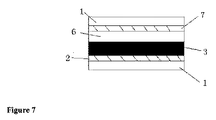
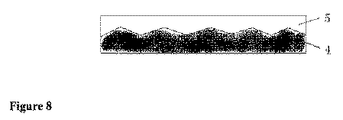
説明の目的のために、本発明によるDSCの例示的な、非制限的な実施態様を図7及び8に示す。デバイスは、半導体材料4を含む光吸収層3、及びそこに併合された本発明による色素又は本発明の化合物を含む色素を含む層5を含む。
For illustrative purposes, an exemplary, non-limiting embodiment of a DSC according to the present invention is shown in FIGS. The device comprises a light-absorbing
実施態様によれば、半導体材料4はポーラス構造を含む。ポーラス構造は、図8のジグザグ線により示される。 According to an embodiment, the semiconductor material 4 comprises a porous structure. The porous structure is indicated by the zigzag line in FIG.
別の実施態様において、本発明のデバイスは半導体表面4を含み、その上で本発明の化合物が吸着される。
実施態様によれば、本発明のデバイスは、電気化学デバイス、光電気化学デバイス、光電子デバイス、光放出デバイス、エレクトロクロミック若しくはフォトエレクトロクロミックデバイス、電気化学センサー、電気化学ディスプレイ又は色素増感太陽電池から選択される。
In another embodiment, the device of the present invention comprises a semiconductor surface 4 on which a compound of the present invention is adsorbed.
According to an embodiment, the device of the invention is from an electrochemical device, a photoelectrochemical device, an optoelectronic device, a light emitting device, an electrochromic or photoelectrochromic device, an electrochemical sensor, an electrochemical display or a dye-sensitized solar cell. Selected.
好ましい実施態様によれば、電気化学デバイスは、太陽電池、色素増感太陽電池(DSC)、再生式色素増感太陽電池、光起電性デバイス又は光電池から選択される光電変換デバイスである。本発明のデバイスは、最も好ましくは色素増感太陽電池(DSC)である。前記デバイスにおいて、半導体は、アンカー基Ancにより半導体表面上に結合されてよい式(I)の本発明の化合物により増感される。 According to a preferred embodiment, the electrochemical device is a photovoltaic device selected from solar cells, dye-sensitized solar cells (DSC), regenerative dye-sensitized solar cells, photovoltaic devices or photovoltaic cells. The device of the present invention is most preferably a dye-sensitized solar cell (DSC). In said device, the semiconductor is sensitized with a compound of the invention of formula (I) which may be bonded onto the semiconductor surface by an anchor group Anc.
さらなる側面において、本発明は第一の電極がTiO2のメソポーラス酸化物膜により覆われたアノードである第一(電極2)及び第二の電極(電極7)、前記TiO2のメソポーラス酸化物膜に対する増感剤としての式(I)の化合物、及び固体状態デバイスのための電解質及びレドックス対又はホール輸送性材料を含む中間層(電荷輸送層6)を得る、電気化学又は光電子デバイス、好ましくはDSCを製造する方法を提供する。 In a further aspect, the present invention relates to first (electrode 2) and second electrode (electrode 7), wherein the first electrode is an anode covered with a TiO 2 mesoporous oxide film, and the TiO 2 mesoporous oxide film. An electrochemical or optoelectronic device, preferably obtaining an intermediate layer (charge transport layer 6) comprising a compound of formula (I) as a sensitizer for and a solid state device comprising an electrolyte and a redox couple or a hole transporting material, preferably A method of manufacturing a DSC is provided.
さらなる実施態様によれば、半導体材料(層4)は、ポーラス構造を含む。本発明のデバイスは、少なくとも1つの基材1、電極2とカウンター電極7、及び電荷輸送層6をさらに含み、前記電荷輸送層は、前記カウンター電極及び前記色素層5の間に与えられる。
According to a further embodiment, the semiconductor material (layer 4) comprises a porous structure. The device of the present invention further comprises at least one
基材層1は、好ましくはガラス又はプラスチックから選択される輸送基材層である。図7に示されるように、2つの上部及び底部の基材層1があるが、上部又は底部の輸送基材層の1つだけを含むデバイスも包含される。概して、基材はしたがって前記カウンター電極7の側にある。例示的なプラスチック基材は、ポリエチレンテレフタレート、ポリエチレンナフタレート(PEN)、ポリカーボネート、ポリプロピレン、ポリイミド、3‐アセチルセルロール、及びポリエーテルスルホン(PES)である。
The
伝導層は、例えばインジウムスズ酸化物(ITO)、スズ酸化フッ化物(FTO)、ZnO‐Ga2O3、ZnO‐Al2O3、スズ‐酸化物、アンチモンスズ酸化物(ATO)及び亜鉛酸化物の1種により与えられてよい。 Conductive layers are, for example, indium tin oxide (ITO), tin oxyfluoride (FTO), ZnO—Ga 2 O 3 , ZnO—Al 2 O 3 , tin-oxide, antimony tin oxide (ATO) and zinc oxide May be given by one of the things.
本発明のデバイスは、半導体層(4)を含む。この層は、単層又は幾つかの層により構成されてよく、概して最大100μmの全厚み、例えば最大60μmの全厚みを有する。しかし、本発明の実施態様によれば、半導体層4は半導体材料を含み、前記半導体層は、20μmより小さい厚みを有する。20ミクロンより小さい厚みを有する半導体層4は、単層からなってもよく、又は2つ若しくはそれより多くの別個の層、例えばサブ層を含んでもよい。例えば、サブ層は他の上に配された1つであり、各サブ層は、各々1つ又は2つの隣接するサブ層と連続的に接触している。例えば、半導体層は、比較的低い多孔性を有するベース半導体層、及びその上に比較的高い多孔性の半導体層含んでよく、増感剤は、好ましくは又は大体の場合、高い多孔性のサブ層中の半導体材料に吸収される。すなわち、異なる層は異なる多孔性を有してよく、例えばそれは異なるサイズのナノ粒子から製造されてよいが、好ましくはそのサイズはさらに以下に与えられる範囲にとどまる。全ての潜在的なサブ層を含む全体の半導体層の厚みは、好ましくは<20μm、より好ましくは≦17μm、一層好ましくは≦15、最も好ましくは≦13μmである。 The device of the present invention comprises a semiconductor layer (4). This layer may be composed of a single layer or several layers and generally has a total thickness of up to 100 μm, for example a total thickness of up to 60 μm. However, according to an embodiment of the present invention, the semiconductor layer 4 includes a semiconductor material, and the semiconductor layer has a thickness of less than 20 μm. The semiconductor layer 4 having a thickness of less than 20 microns may consist of a single layer or may comprise two or more separate layers, for example sub-layers. For example, the sub-layer is one disposed over the other, and each sub-layer is in continuous contact with one or two adjacent sub-layers each. For example, the semiconductor layer may include a base semiconductor layer having a relatively low porosity, and a relatively high porosity semiconductor layer thereon, and the sensitizer is preferably or in most cases a highly porous sub-layer. Absorbed by the semiconductor material in the layer. That is, the different layers may have different porosities, for example, it may be made from nanoparticles of different sizes, but preferably the size remains in the range given below. The total semiconductor layer thickness including all potential sub-layers is preferably <20 μm, more preferably ≦ 17 μm, more preferably ≦ 15, most preferably ≦ 13 μm.
半導体材料層4は、Si、TiO2、SnO2、ZnO、WO3、Nb2O5、及びTiSrO3から選択される半導体材料を含んでよく、それは全て本発明の目的に関する例示的な半導体材料である。好ましくは、半導体材料層4は、半導体ナノ粒子、例えば上記の半導体材料で作製されたナノ粒子から作製されたポーラス層を含む。好ましくは、半導体ナノ粒子の平均直径は、0.5nm〜2000nm、好ましくは1〜1000nm、より好ましくは2〜500nm、最も好ましくは5〜100nmの範囲である。 The semiconductor material layer 4 may comprise a semiconductor material selected from Si, TiO 2 , SnO 2 , ZnO, WO 3 , Nb 2 O 5 , and TiSrO 3 , all of which are exemplary semiconductor materials for the purposes of the present invention. It is. Preferably, the semiconductor material layer 4 comprises a porous layer made of semiconductor nanoparticles, for example nanoparticles made of the above-mentioned semiconductor materials. Preferably, the average diameter of the semiconductor nanoparticles is in the range of 0.5 nm to 2000 nm, preferably 1 to 1000 nm, more preferably 2 to 500 nm, and most preferably 5 to 100 nm.
色素は、色素層5の形態で与えられ、それは本発明による色素分子、特に、式(I)により規定された化合物、及び/又は式(89)〜(102)により規定された色素を含む色素を含む。色素分子は、好ましくは半導体層(4)のポーラスナノ粒子層の表面にそのアンカー基により固定され、その上に単分子層を形成する。
The dye is given in the form of a
電荷輸送層6は、好ましくは(a)電気伝導ホール及び/若しくは電子輸送材料又は(b)電解質を含む。前記電気伝導ホール及び/又は電子輸送材料により電荷が輸送される場合、電子及び/又はホールは、荷電分子の拡散の替わりに電子の動きにより移動する。係る電気伝導層は、好ましくはポリマーを含む有機化合物をベースとする。したがって、層6はアモルファス有機ホール輸送材料2,2’,7,7’‐テトラキス(N,N‐ジ‐p‐メトキシフェニル‐アミン)9,9’‐スピロフルオレン(OMeTAD)等の電子及び/又はホール伝導性材料であってよい。WO2007/107961において、室温にて液体である電荷輸送材料と、色素増感太陽電池におけるその適用が開示される。これらの材料を例えば本発明の目的のために用いてよい。
The
電荷輸送層が電解質である場合、好ましいことには、それはレドックス対を含む。色素増感太陽電池に好適なレドックス対の好ましい例は、I-/I3 -対又はCo2+/Co3+レドックス対(コバルトトリス‐ポリピリダイル(pyridayl)錯体)である。 If the charge transport layer is an electrolyte, preferably it comprises a redox couple. Preferred examples of redox pairs suitable for dye-sensitized solar cells are I − / I 3 − pairs or Co 2+ / Co 3+ redox pairs (cobalt tris-polypyridyl complexes).
さらなる実施態様において、電解質は、1つ又はそれより多くのイオン性液体、複合イオン性液体又は共晶融液を含む。イオン性液体は、それが100℃以下の融点を有するという事実により概して規定される。例えば、好適なイオン性液体のアニオンは、I-、Br-、Cl-、[N(CN)2]-、[N(SO2CF3)2]-、[PF6]-、[BF4]-、[NO3]-、[C(CN)3]-、[B(CN)4]-、[CF3COO]-、[ClO4]-、[BF3CF3]-、[CF3SO3]-、[CF3F2SO3]-、[CH3H2SO3]-、[(CF3SO2)2N]-、[(C2H5SO2)2N]-、[(CF3SO2)3C]-、[(C2F5SO2)3C]-、[(FSO2)3C]-、[CH3CH2OSO3]-、[CF3C(O)O]-、[CF3CF2C(O)O]-、[CH3CH2C(O)O]-、[CH3C(O)O]-、[P(C2H5)3F3]-、[P(CF3)3F3]-、[P(C2H4H)(CF3)2F3]]-、[P(C2F3H2)3F3]-、[P(C2F5)(CF3)2F3]-、[P(CF3)3F3]-、[P(C6H5)3F3]-、[P(C3H7)3F3]-、[P(C4H9)3F3]-、[P(C2H5)2F4]-、[(C2H5)2P(O)O]-、[(C2H5)2P(O)O2]2-、[PC6H5]2F4]-、[(CF3)2P(O)O]-、[(CH3)2P(O)O]-、[(C4H9)2P(O)O]-、[CF3P(O)O2]2-、[CH3P(O)O2]2-、[(CH3O)2P(O)O]-、[BF2(C2F5)2]-、[BF3(C2F5)]-、[BF2(CF3)2]-、[B(C2F5)4]-、[BF3(CN)]-、[BF2(CN)2]-、[B(CF3)4]-、[B(OCH3)4]-、[B(OCH3)2(C2H5)]-、[B(O2C2H4)2]-、[B(O2C2H2)2]-、[B(O2CH4)2]-、[N(CF3)2]-、[AlCl4]-、及び[SiF6]2-から選択されてよい。 In further embodiments, the electrolyte comprises one or more ionic liquids, composite ionic liquids or eutectic melts. An ionic liquid is generally defined by the fact that it has a melting point of 100 ° C. or less. For example, suitable anionic liquid anions include I − , Br − , Cl − , [N (CN) 2 ] − , [N (SO 2 CF 3 ) 2 ] − , [PF 6 ] − , [BF 4. ] -, [NO 3] - , [C (CN) 3] -, [B (CN) 4] -, [CF 3 COO] -, [ClO 4] -, [BF 3 CF 3] -, [CF 3 SO 3 ] − , [CF 3 F 2 SO 3 ] − , [CH 3 H 2 SO 3 ] − , [(CF 3 SO 2 ) 2 N] − , [(C 2 H 5 SO 2 ) 2 N] - , [(CF 3 SO 2 ) 3 C] - , [(C 2 F 5 SO 2 ) 3 C] - , [(FSO 2 ) 3 C] - , [CH 3 CH 2 OSO 3 ] - , [CF 3 C (O) O] − , [CF 3 CF 2 C (O) O] − , [CH 3 CH 2 C (O) O] − , [CH 3 C (O) O] − , [P (C 2 H 5) 3 F 3] -, [P (CF 3) 3 F 3] -, [P (C 2 H 4 ) (CF 3) 2 F 3 ]] -, [P (C 2 F 3 H 2) 3 F 3] -, [P (C 2 F 5) (CF 3) 2 F 3] -, [P (CF 3 ) 3 F 3 ] − , [P (C 6 H 5 ) 3 F 3 ] − , [P (C 3 H 7 ) 3 F 3 ] − , [P (C 4 H 9 ) 3 F 3 ] − , [P (C 2 H 5 ) 2 F 4 ] − , [(C 2 H 5 ) 2 P (O) O] − , [(C 2 H 5 ) 2 P (O) O 2 ] 2− , [PC 6 H 5 ] 2 F 4 ] − , [(CF 3 ) 2 P (O) O] − , [(CH 3 ) 2 P (O) O] − , [(C 4 H 9 ) 2 P (O) O] − , [CF 3 P (O) O 2 ] 2− , [CH 3 P (O) O 2 ] 2− , [(CH 3 O) 2 P (O) O] − , [BF 2 (C 2 F 5 ) 2 ] − , [BF 3 (C 2 F 5 )] − , [BF 2 (CF 3 ) 2 ] − , [B (C 2 F 5 ) 4 ] − , [BF 3 (CN)] - , [BF 2 (CN) 2 ] - , [B (CF 3 ) 4 ] − , [B (OCH 3 ) 4 ] − , [B (OCH 3 ) 2 (C 2 H 5 )] − , [B (O 2 C 2 H 4 ) 2 ] − , [B (O 2) C 2 H 2 ) 2 ] − , [B (O 2 CH 4 ) 2 ] − , [N (CF 3 ) 2 ] − , [AlCl 4 ] − , and [SiF 6 ] 2− .
本発明によるイオン性液体のカチオンは、例えば以下に示される構造を有する化合物から選択されてよい。 The cation of the ionic liquid according to the invention may be selected, for example, from compounds having the structure shown below.
(ヘテロ原子に結合した少なくとも1つのRがHとは異なるという条件で、H、
直鎖又は分岐のC1〜C20アルキル、
1つ又は幾つかの二重結合を含む直鎖又は分岐のC2〜C20アルケニル、
1つ又は幾つかの三重結合を含む直鎖又は分岐のC2〜C20アルキニル、
飽和、部分的に不飽和又は全体的に不飽和のC3〜C7シクロアルキル、
ハロゲン‐ヘテロ原子結合がないという条件で、ハロゲン、好ましくはフッ素又は塩素、
NO2基と正に帯電したヘテロ原子の結合がなく、かつ、少なくとも1つのRがNO2とは異なるという条件で、NO2、
CN基と正に帯電したヘテロ原子の結合がなく、かつ、少なくとも1つのRがCNとは異なるという条件で、CN、
式中、Rは同一又は異なってよく、
Rの対は単結合又は二重結合により結合されてよく、
1つ又は幾つかのRは、全てのRが全体的にハロゲン化されていないという条件で、ハロゲン、好ましくは‐F、及び/若しくは‐Clにより部分的に若しくは全体的に置換されてよく、又は‐CN若しくは‐NO2により部分的に置換されてよく、
任意のRの1つ又は2つの炭素原子は、任意のヘテロ原子及び/又は‐O‐、‐C(O)‐、‐C(O)O‐、‐S‐、‐S(O)‐、SO2‐、‐S(O)2O‐、‐N=、‐P=、‐NR’‐、‐PR’‐、‐P(O)(OR’)‐、‐P(O)(OR’)O‐、‐P(O)(NR’R’)‐、‐P(O)(NR’R’)O‐、P(O)(NR’R’)NR’‐、‐S(O)NR’‐、及び‐S(O)2NR’の基から選択される基により置き換えられ、又は置き換えられなくてよく、R’は、H、任意選択的に部分的に若しくは全体的にパーフルオロ化されたC1〜C6アルキル、及び/又は任意選択的に部分的に若しくは全体的にパーフルオロ化されたフェニルであり、
任意のRはH及びC1〜C15アルキルから独立に選択される。)
(Provided that at least one R bonded to a heteroatom is different from H, H,
Linear or branched C1-C20 alkyl,
Linear or branched C2-C20 alkenyl containing one or several double bonds,
Linear or branched C2-C20 alkynyl containing one or several triple bonds,
Saturated, partially unsaturated or totally unsaturated C3-C7 cycloalkyl,
Halogen, preferably fluorine or chlorine, provided that there is no halogen-heteroatom bond,
No binding of the positively charged heteroatom and an NO 2 group, and at least one R is with the proviso that different from NO 2, NO 2,
CN, provided that there is no bond between the CN group and a positively charged heteroatom and at least one R is different from CN,
In which R may be the same or different;
The pair of R may be linked by a single bond or a double bond;
One or several R may be partially or fully substituted by halogen, preferably -F, and / or -Cl, provided that all R is not totally halogenated, Or may be partially substituted by -CN or -NO 2 ,
One or two carbon atoms of any R may be any heteroatom and / or —O—, —C (O) —, —C (O) O—, —S—, —S (O) —, SO 2- , -S (O) 2 O-, -N =, -P =, -NR'-, -PR'-, -P (O) (OR ')-, -P (O) (OR' ) O-, -P (O) (NR'R ')-, -P (O) (NR'R') O-, P (O) (NR'R ') NR'-, -S (O) Substituted or unsubstituted with a group selected from the group NR′-, and —S (O) 2 NR ′, R ′ is H, optionally partially or wholly perfluoro C1-C6 alkyl, and / or optionally partially or fully perfluorinated phenyl,
Any R is independently selected from H and C1-C15 alkyl. )
上記に示される有機カチオンの好ましい置換基は、WO2007/093961の第5〜7頁に開示されている。これらの頁で規定された好ましいカチオンは、参照により本開示に全体的に組み入れられる。最も好ましい置換基Rは、H及びC1〜C15アルキルから独立に選択される。置換基は、指示された正電荷が得られるように選択される。 Preferred substituents of the organic cations shown above are disclosed on pages 5-7 of WO2007 / 093961. The preferred cations defined on these pages are incorporated herein by reference in their entirety. The most preferred substituent R is independently selected from H and C1-C15 alkyl. Substituents are selected to obtain the indicated positive charge.
好ましい複合イオン性液体又は共晶融液及び係る複合イオン性液体を含む電解質は、WO2009/083901の第7〜15頁に開示され、参照により本開示に全体的に組み入れられる。
Preferred composite ionic liquids or eutectic melts and electrolytes containing such composite ionic liquids are disclosed on
本明細書中で言及される任意のアルキル、アルケニル又はアルキニルは、直鎖、分岐又は環状であってよい。直鎖アルキル、アルケニル及びアルキニルが好ましい。 Any alkyl, alkenyl or alkynyl referred to herein may be linear, branched or cyclic. Straight chain alkyl, alkenyl and alkynyl are preferred.
本発明のデバイスの電解質は、2種又はそれより多くのイオン性液体を含んでよい。好ましくは、電解質は溶媒が実質的にない。実質的に溶媒がないとは、25体積%未満の追加の高沸点(200℃を超える)の溶媒があり、好ましくは追加の溶媒がないことを意味する。より好ましくは、溶媒が実質的にないとは、5体積%未満の追加の溶媒があることを意味する。 The electrolyte of the device of the present invention may comprise two or more ionic liquids. Preferably, the electrolyte is substantially free of solvent. Substantially free of solvent means that there is less than 25% by volume of additional high boiling point (above 200 ° C.) solvent, and preferably no additional solvent. More preferably, substantially free of solvent means that there is less than 5% by volume of additional solvent.
カウンター電極7は、Pt、Au、Ni、Cu、Ag、In、Ru、Pd、Rh、Ir、Os、C、CoS、伝導ポリマー又は上記の2種又はそれより多くを含む組み合わせを含んでよく、又はこれからなってよい。伝導ポリマー(これから好適なカウンター電極材料が選択されてよい)の例は、ポリアニリン、ポリピロール、ポリチオフェン、ポリベンゼン及びアセチレンを含むポリマーである。
The
本発明は、これより例により説明される。これらの例は、添付の特許請求の範囲により規定される本発明の範囲を制限しない。 The invention will now be described by way of example. These examples do not limit the scope of the invention as defined by the appended claims.
例
例1
式(89)すなわち色素Y789の化合物の合成
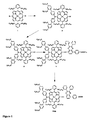
式(89)すなわち色素Y789の化合物の合成の基本的なスキームは、図1に示される。
Example 1
Synthesis of Compound of Formula (89) or Dye Y789 The basic scheme for the synthesis of compound of Formula (89) or Dye Y789 is shown in FIG.
[5‐ブロモ‐15‐ビス(2’,4’‐ジヘキソキシビフェニル‐4‐イル)アミノ‐10,20‐ビス(2,6‐ジドデコキシフェニル)‐ポルフィリナト]亜鉛(II)(図1のスキームにおける化合物2)の合成
不活性雰囲気において、140mg(0.1mM)の[5,15‐ジブロモ‐10,20‐ビス(2,6‐ジドデコキシフェニル)ポルフィリナト]亜鉛(II)を、5mLのトルエン中110℃にて12時間50mg(0.5mM)のt‐BuONaの存在下で5mg(0.01mM)のPd(Pt‐Bu3)2により触媒された110mg(0.15mM)のビス(2’,4’‐ジヘキソキシビフェニル‐4‐イル)アミンと反応させ、次いで混合物を室温に冷却し、50mLの水に注いだ。混合物を50mLのCH2Cl2により2回抽出した後、有機相を合わせて蒸発させた。残渣は、溶離剤として1:1のCH2Cl2及びヘキサンの混合物を用いるシリカゲルカラムクロマトグラフィーに供され、150mg(75%)の紫色のろう状の生成物が得られた。1H NMR(400MHz、クロロホルム‐d)δ9.68(d、J=4.6Hz、2H)、9.29(d、J=4.6Hz、2H)、8.88(d、J=4.6Hz、2H)、8.74(d、J=4.6Hz、2H)、7.66(t、J=8.4Hz、2H)、7.37(d、J=1.7Hz、8H)、7.16(d、J=8.5Hz、2H)、6.97(d、J=8.5Hz、4H)、6.54‐6.40(m、4H)、4.01‐3.75(m、16H)、1.84‐1.62(m、16H)、1.61‐0.37(m、120H)。
[5-Bromo-15-bis (2 ′, 4′-dihexoxybiphenyl-4-yl) amino-10,20-bis (2,6-didodecoxyphenyl) -porphyrinato] zinc (II) (FIG. Synthesis of Compound 2) in
5‐エチニル‐15ビス(2’,4’‐ジヘキソキシビフェニル‐4‐イル)アミノ‐10,20‐ビス(2,6‐ジドデコキシフェニル)‐ポルフィリナト]亜鉛(II)(図1のスキームにおける化合物3)の合成
[5‐ブロモ‐15‐ビス(2’,4’‐ジヘキソキシビフェニル‐4‐イル)アミノ‐10,20‐ビス(2,6‐ジドデコキシフェニル)‐ポルフィリナト]亜鉛(II)200mg(0.1mM)及び50mg(0.5mM)のトリメチルシリルアセチレン、9mg(0.01mM)のPd2(dba)3及び5.2mg(0.02mM)のトリフェニルホスフィンの混合物を2mLのトリエチルアミン中で60℃に4時間加熱し、次いで混合物を室温に冷却し、溶媒を蒸発させた。残渣は、シリカゲルカラムクロマトグラフィーにより精製され、1:1のCH2Cl2及びヘキサンにより洗浄されて緑色のオイルが得られた。次いで、オイルを60mg(0.2mM)のBu4NFとTHF中で室温にて1時間反応させてトリメチルシリル保護基を除いた。減圧により溶媒が除去され、残渣は溶離剤として1:1のCH2Cl2及びヘキサンを用いてシリカゲルカラムにより精製され、120mg(60%)の生成物が得られた。1H NMR(400MHz、クロロホルム‐d)δ9.65(d、J=4.6Hz、2H)、9.31(d、J=4.6Hz、2H)、8.91(d、J=4.6Hz、2H)、8.76(d、J=4.6Hz、2H)、7.69(t、J=8.4Hz、2H)、7.37(s、8H)、7.17(d、J=8.5Hz、2H)、6.99(d、J=8.5Hz、4H)、6.58‐6.40(m、4H)、4.10(s、1H)、4.01‐3.79(m、16H)、1.90‐1.64(m、16H)、1.57‐0.44(m、120H)。
5-Ethynyl-15bis (2 ′, 4′-dihexoxybiphenyl-4-yl) amino-10,20-bis (2,6-didodecoxyphenyl) -porphyrinato] zinc (II) (FIG. 1 Synthesis of compound 3) in the scheme [5-Bromo-15-bis (2 ′, 4′-dihexoxybiphenyl-4-yl) amino-10,20-bis (2,6-didodecoxyphenyl) -porphyrinato A mixture of zinc (II) 200 mg (0.1 mM) and 50 mg (0.5 mM) trimethylsilylacetylene, 9 mg (0.01 mM) Pd 2 (dba) 3 and 5.2 mg (0.02 mM) triphenylphosphine Was heated in 2 mL of triethylamine to 60 ° C. for 4 hours, then the mixture was cooled to room temperature and the solvent was evaporated. The residue was purified by silica gel column chromatography and washed with 1: 1 CH 2 Cl 2 and hexanes to give a green oil. The oil was then reacted with 60 mg (0.2 mM) Bu 4 NF in THF for 1 hour at room temperature to remove the trimethylsilyl protecting group. The solvent was removed by reduced pressure and the residue was purified on a silica gel column using 1: 1 CH 2 Cl 2 and hexane as eluent to give 120 mg (60%) of product. 1 H NMR (400 MHz, chloroform-d) δ 9.65 (d, J = 4.6 Hz, 2H), 9.31 (d, J = 4.6 Hz, 2H), 8.91 (d, J = 4. 6 Hz, 2H), 8.76 (d, J = 4.6 Hz, 2H), 7.69 (t, J = 8.4 Hz, 2H), 7.37 (s, 8H), 7.17 (d, J = 8.5 Hz, 2H), 6.99 (d, J = 8.5 Hz, 4H), 6.58-6.40 (m, 4H), 4.10 (s, 1H), 4.01- 3.79 (m, 16H), 1.90-1.64 (m, 16H), 1.57-0.44 (m, 120H).
図1のスキームにおける化合物4の合成
5mLのトリエチルアミン中の[5‐エチニル‐15‐ビス(2’,4’‐ジヘキソキシビフェニル‐4‐イル)アミノ‐10,20‐ビス(2,6‐ジドデコキシフェニル)‐ポルフィリナト]亜鉛(II)200mg(0.1mM)及びメチル4‐(8‐ブロモ‐2,3‐ジフェニルキノキサリン‐5‐イル)ベンゾエート50mg(0.1mM)の混合物にPd2(dba)3及び5.2mg(0.02mM)のトリフェニルホスフィンを加えた。N2ガスの保護下において、混合物を60℃にて24時間加熱した。溶媒を蒸発させた後、残渣をシリカゲルカラムにより精製し、2:1のCH2Cl2及びヘキサンの混合物により溶離させて110mg(50%)の暗緑色の固体生成物を得た。1H NMR(400MHz、クロロホルム‐d)δ10.16(d、J=4.6Hz、2H)、9.28(d、J=4.6Hz、2H)、8.82(d、J=4.6Hz、2H)、8.76(d、J=4.6Hz、2H)、8.51(d、J=7.6Hz、1H)、8.25(d、J=8.3Hz、2H)、8.09‐8.00(m、6H)、7.76‐7.65(m、5H)、7.49(dd、J=5.1、2.0Hz、2H)、7.44‐7.33(m、10H)、7.17(d、J=8.5Hz、2H)、7.02(d、J=8.5Hz、4H)、6.54‐6.41(m、4H)、4.00(s、3H)、3.98‐3.83(m、16H)、1.94‐1.55(m、24H)、1.50‐0.39(m、112H)。
Synthesis of Compound 4 in the Scheme of FIG. 1 [5-Ethynyl-15-bis (2 ′, 4′-dihexoxybiphenyl-4-yl) amino-10,20-bis (2,6-) in 5 mL of triethylamine Didodecoxyphenyl) -porphyrinato] zinc (II) 200 mg (0.1 mM) and methyl 4- (8-bromo-2,3-diphenylquinoxalin-5-yl) benzoate 50 mg (0.1 mM) in a mixture of Pd 2 (Dba) 3 and 5.2 mg (0.02 mM) of triphenylphosphine were added. Under the protection of N 2 gas, the mixture was heated at 60 ° C. for 24 hours. After evaporation of the solvent, the residue was purified by silica gel column and eluted with a mixture of 2: 1 CH 2 Cl 2 and hexanes to give 110 mg (50%) of a dark green solid product. 1 H NMR (400 MHz, chloroform-d) δ 10.16 (d, J = 4.6 Hz, 2H), 9.28 (d, J = 4.6 Hz, 2H), 8.82 (d, J = 4. 6 Hz, 2H), 8.76 (d, J = 4.6 Hz, 2H), 8.51 (d, J = 7.6 Hz, 1H), 8.25 (d, J = 8.3 Hz, 2H), 8.09-8.00 (m, 6H), 7.76-7.65 (m, 5H), 7.49 (dd, J = 5.1, 2.0 Hz, 2H), 7.44-7 .33 (m, 10H), 7.17 (d, J = 8.5 Hz, 2H), 7.02 (d, J = 8.5 Hz, 4H), 6.54-6.41 (m, 4H) 4.00 (s, 3H), 3.98-3.83 (m, 16H), 1.94-1.55 (m, 24H), 1.50-0.39 (m, 112H).
色素Y789(式(89)の化合物)の合成
5mLのエタノール及び1mLの水を48mg(0.02mM)及びLiOH26mg(1mM)の混合物に加え、混合物を室温にて4時間撹拌した。混合物を50mLの水へ注ぎ、50mLのCH2Cl2により2回抽出し、有機相を合わせて蒸発させた。シリカゲルカラムにより精製した後、36mgの暗緑色固体が製造された。1H NMR(400MHz、クロロホルム‐d)δ10.12(d、J=4.5Hz、2H)、9.24(d、J=4.5Hz、2H)、8.78(d、J=4.5Hz、2H)、8.71(d、J=4.6Hz、2H)、8.49(d、J=7.6Hz、1H)、8.28(d、J=8.0Hz、2H)、8.12‐7.98(m、6H)、7.77‐7.63(m、5H)、7.47(dd、J=4.8、2.3Hz、2H)、7.43‐7.31(m、10H)、7.15(d、J=8.5Hz、2H)、7.01(d、J=8.4Hz、4H)、6.55‐6.41(m、4H)、4.11‐3.75(m、16H)、1.95‐1.55(m、24H)、1.55‐1.20(m、32H)、1.20‐0.39(m、80H)。APCI:m/zC159H197N7O10Znの計算値2405.4447、観測2405.4405。
Synthesis of Dye Y789 (Compound of Formula (89)) 5 mL of ethanol and 1 mL of water were added to a mixture of 48 mg (0.02 mM) and LiOH 26 mg (1 mM) and the mixture was stirred at room temperature for 4 hours. The mixture was poured into 50 mL water, extracted twice with 50 mL CH 2 Cl 2 and the combined organic phases were evaporated. After purification through a silica gel column, 36 mg of a dark green solid was produced. 1 H NMR (400 MHz, chloroform-d) δ 10.12 (d, J = 4.5 Hz, 2H), 9.24 (d, J = 4.5 Hz, 2H), 8.78 (d, J = 4. 5 Hz, 2H), 8.71 (d, J = 4.6 Hz, 2H), 8.49 (d, J = 7.6 Hz, 1H), 8.28 (d, J = 8.0 Hz, 2H), 8.12-7.98 (m, 6H), 7.77-7.63 (m, 5H), 7.47 (dd, J = 4.8, 2.3 Hz, 2H), 7.43-7 .31 (m, 10H), 7.15 (d, J = 8.5 Hz, 2H), 7.01 (d, J = 8.4 Hz, 4H), 6.55-6.41 (m, 4H) 4.11-3.75 (m, 16H), 1.95-1.55 (m, 24H), 1.55-1.20 (m, 32H), 1.20-0.39 (m, 80H). APCI: m / z C 159 H 197 N 7 O 10 Zn calcd 2405.4447, observed 2405.4405.
例2
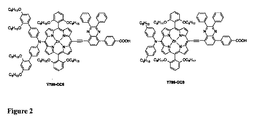
化合物Y789‐OC6及びY789‐OC8の合成(図2)
Y789‐OC6及びY789‐OC8をY789、すなわち式(89)の化合物の合成手順にしたがって合成した。両方の化合物は図2に示される。
Example 2
Synthesis of compounds Y789-OC6 and Y789-OC8 (FIG. 2)
Y789-OC6 and Y789-OC8 were synthesized according to the synthesis procedure of Y789, a compound of formula (89). Both compounds are shown in FIG.
Y789‐OC6のキャラクタリゼーションデータは以下のとおりである:1H NMR(400MHz、クロロホルム‐d)δ10.13(d、J=4.4Hz、2H)、9.26(d、J=4.5Hz、2H)、8.80(d、J=4.5Hz、2H)、8.73(d、J=4.5Hz、2H)、8.51(d、J=7.5Hz、1H)、8.30(d、J=8.2Hz、2H)、8.13‐8.07(m、2H)、8.07‐7.99(m、4H)、7.74‐7.65(m、5H)、7.47(dd、J=5.2、2.0Hz、2H)、7.39‐7.33(m、10H)、7.16(d、J=8.5Hz、2H)、7.05‐6.96(m、4H)、6.52‐6.41(m、4H)、3.97‐3.83(m、16H)、1.86‐1.62(m、12H)、1.59‐0.12(m、76H)。APCI: m/zC133H149N7O10Znの計算値2068.0657、観測2068.0651。
The characterization data for Y789-OC6 are as follows: 1 H NMR (400 MHz, chloroform-d) δ 10.13 (d, J = 4.4 Hz, 2H), 9.26 (d, J = 4.5 Hz) 2H), 8.80 (d, J = 4.5 Hz, 2H), 8.73 (d, J = 4.5 Hz, 2H), 8.51 (d, J = 7.5 Hz, 1H), 8 .30 (d, J = 8.2 Hz, 2H), 8.13-8.07 (m, 2H), 8.07-7.99 (m, 4H), 7.74-7.65 (m, 5H), 7.47 (dd, J = 5.2, 2.0 Hz, 2H), 7.39-7.33 (m, 10H), 7.16 (d, J = 8.5 Hz, 2H), 7.05-6.96 (m, 4H), 6.52-6.41 (m, 4H), 3.97-3.83 (m, 16H), 1.86- 1.62 (m, 12H), 1.59-0.12 (m, 76H). APCI: m / zC 133 H 149 N 7
Y789‐OC8のキャラクタリゼーションデータは以下のとおりである:1H NMR(400MHz、クロロホルム‐d)δ10.12 (d、J=4.5Hz、2H)、9.18(d、J=4.5Hz、2H)、8.79(d、J=4.6Hz、2H)、8.70(d、J=4.6Hz、2H)、8.50(d、J=7.6Hz、1H)、8.28(d、J=8.1Hz、2H)、8.12‐7.99(m、5H)、7.75‐7.65(m、4H)、7.47(dd、J=5.1、2.0Hz、4H)、7.38(dd、J=5.6、3.7Hz、2H)、7.25‐7.20(m、4H)、7.01(d、J=8.4Hz、4H)、6.94(d、J=8.7Hz、4H)、3.86(t、J=6.6Hz、8H)、2.47(t、J=7.8Hz、4H)、1.62‐0.33(m、82H)。. APCI: m/zC117H133N7O6Znの計算値1795.9609、観測1795.9615。
The characterization data for Y789-OC8 is as follows: 1 H NMR (400 MHz, chloroform-d) δ 10.12 (d, J = 4.5 Hz, 2H), 9.18 (d, J = 4.5 Hz) 2H), 8.79 (d, J = 4.6 Hz, 2H), 8.70 (d, J = 4.6 Hz, 2H), 8.50 (d, J = 7.6 Hz, 1H), 8 .28 (d, J = 8.1 Hz, 2H), 8.12-7.99 (m, 5H), 7.75-7.65 (m, 4H), 7.47 (dd, J = 5. 1, 2.0 Hz, 4H), 7.38 (dd, J = 5.6, 3.7 Hz, 2H), 7.25-7.20 (m, 4H), 7.01 (d, J = 8 .4 Hz, 4H), 6.94 (d, J = 8.7 Hz, 4H), 3.86 (t, J = 6.6 Hz, 8H), 2.47 (t, J = 7.8 Hz, 4H), 1.62-0.33 (m, 82H). . APCI: m / zC 117 H 133 N 7
例3
色素Y789及び色素Y350の光起電特性
色素Y789において、キナキソリン部分はポルフィリンコア及び安息香酸であるアンカー基の間のπ共役リンカーとして用いられる。前記π共役リンカー、キナキソリンベースのアクセプターには、構造が図3に示される色素Y350が存在しない。
Example 3
Photovoltaic properties of dye Y789 and dye Y350 In dye Y789, the quinazoline moiety is used as a π-conjugated linker between the porphyrin core and the anchor group that is benzoic acid. The π-conjugated linker, quinazoline-based acceptor does not have the dye Y350 whose structure is shown in FIG.
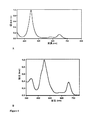
両方のポルフィリンベースの色素は、400〜500nm及び600〜700nmに吸収極大を、色素Y789に関して300〜400nmにさらなる吸収極大を呈する(図4A及び4B参照)。色素Y789の600〜700nm中の吸収は、これらの波長におけるY350の吸収と比較して2倍程度である。この効果は、ポルフィリン及びアンカー基間のπ共役リンカーとしての電子吸引性キナキソリンベースのアクセプターの挿入の効果に起因する。 Both porphyrin-based dyes exhibit absorption maxima at 400-500 nm and 600-700 nm and further absorption maxima at 300-400 nm for dye Y789 (see FIGS. 4A and 4B). The absorption of dye Y789 in 600 to 700 nm is about twice that of Y350 at these wavelengths. This effect is due to the effect of insertion of an electron-withdrawing quinoxoline-based acceptor as a π-conjugated linker between the porphyrin and the anchor group.
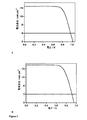
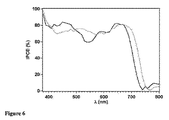
2種の色素Y789、Y350の光起電性性能は、アセトニトリル中のコバルトトリス‐ビピリジンベースのレドックスメディエーターによりDSCにおいてそれらを用いることにより評価した。コバルト電解質の組成は以下のとおりである:0.1Mのリチウムトリフルオロメタンスルホンイミド(LiTFSI)、0.055Mの[Co(bpy)3](TFSI)3、0.2M[Co(bpy)3](TFSI)2、0.8Mのtert‐ブチルピリジン(TBP)(アセトニトリル中)。シミュレーションされたある太陽照射(AM1.5G、100mW/cm2)下におけるこれらのデバイス電流‐電圧(J‐V)特性は、図5A及び5B並びに図6に示され、対応する光起電性データは表1にまとめられる。 The photovoltaic performance of the two dyes Y789, Y350 was evaluated by using them in DSC with a cobalt tris-bipyridine based redox mediator in acetonitrile. The composition of the cobalt electrolyte is as follows: 0.1M lithium trifluoromethanesulfonimide (LiTFSI), 0.055M [Co (bpy) 3 ] (TFSI) 3 , 0.2M [Co (bpy) 3 ] (TFSI) 2 , 0.8M tert-butylpyridine (TBP) in acetonitrile. These device current-voltage (JV) characteristics under some simulated solar illumination (AM1.5G, 100 mW / cm 2 ) are shown in FIGS. 5A and 5B and FIG. 6 and the corresponding photovoltaic data. Are summarized in Table 1.
ポルフィリンコア及びアンカー安息香酸間の電子吸引性キノキサリンアクセプターの導入により、ポルフィリン色素Y789は可視全体から近赤外スペクトル範囲をカバーする広範な吸収を示す。キノキサリンアクセプターなしの参照ポルフィリン増感剤Y350と比較すると、新規のポルフィリン色素Y789は、ソレーバンドとQバンドとの間の吸収ギャップを埋め、レッドシフトしたスペクトルを示す(図4A及びB並びに図6参照)。 With the introduction of an electron-withdrawing quinoxaline acceptor between the porphyrin core and the anchor benzoic acid, the porphyrin dye Y789 exhibits a broad absorption covering the entire visible to near-infrared spectral range. Compared to the reference porphyrin sensitizer Y350 without quinoxaline acceptor, the new porphyrin dye Y789 fills the absorption gap between the Sore band and the Q band and shows a red shifted spectrum (see FIGS. 4A and B and FIG. 6). ).
最先端のCo+2/+3(ビピリジン)3錯体ベースの電解質を用いたDSCの研究において、たかだか半分の太陽光に対応する電力入にて高い開回路電圧及び13.5%の高いエネルギー変換効率が達成された。これは、単一色素増感DSCデバイスにより得られる最も高い電力変換効率である。 High open circuit voltage and high energy conversion of 13.5% at power input corresponding to at most half sunlight in DSC research using state-of-the-art Co + 2 / + 3 (bipyridine) 3 complex-based electrolyte Efficiency was achieved. This is the highest power conversion efficiency obtained with a single dye-sensitized DSC device.
従来は、相補的な吸収スペクトルを示す有機色素を含む共増感剤が、ソレーバンドとQバンドとの間のギャップを埋めるのに用いられていた。Y789色素の場合において、ソレーバンドの広範化が、典型的に以前のDSCにおいて用いられた全てのポルフィリンの場合において観察されないソレーバンドとQバンドとの間のギャップを埋めることをもたらすことは、IPCEスペクトルから明らかである。 Conventionally, co-sensitizers containing organic dyes that exhibit complementary absorption spectra have been used to fill the gap between the Soray band and the Q band. From the IPCE spectrum, in the case of Y789 dye, the broadening of the Soray band results in bridging the gap between the Soray band and the Q band not typically observed in all porphyrin cases used in previous DSCs. it is obvious.
したがって、ポルフィリンコア及びアンカー基間の電子吸引性基の導入は、さらに吸収スペクトルをさらにレッドへシフトさせる新たな方法を開き、ポルフィリン色素増感太陽電池のエネルギー変換効率を向上させる。 Therefore, introduction of an electron-withdrawing group between the porphyrin core and the anchor group opens a new method for further shifting the absorption spectrum to red, and improves the energy conversion efficiency of the porphyrin dye-sensitized solar cell.
Claims (15)
‐MはCo、Cu、Fe、Mg、Mn、Ni、Si若しくはZnから選択され、又はMはポルフィリンコアを構成する2つのピロール部分を置換する2つのH(水素)であり、
‐Aは式(1)〜(36)及び(103)〜(107)
‐Ancはさらに置換されたC4〜C16アリール又はC4〜C16ヘテロアリール(ヘテロ原子はO、S、又はNから選択される)から選択されるアンカー基であり、さらなる置換基はCOOH、=O(ケト)、C4〜C16シアノアルケニルカルボン酸から選択され、
‐L1及びL2は、さらに置換された又は置換されていないC4〜C16アリール又はC4〜C16ヘテロアリール(ヘテロ原子はO、S、又はNから選択される)から独立に選択される置換基であり、さらなる置換基はH、C1〜C16アルキル、C1〜C16アルコキシ、C1〜C16チオアルキル、C1〜C16アルコキシアルキル、C4〜C16アリール、C1〜C16アリールアルキル、又はC4〜C16ヘテロアリール、C4〜C16ヘテロアリールアルキル(ヘテロ原子はO、S、又はNから選択される)から選択され、
‐Ar1及びAr2は、さらに置換された又は置換されていないC4〜C16アリール、C8〜C32ジアリール、C4〜C16ヘテロアリール(ヘテロ原子はO、S、又はNから選択される)から選択されるドナー置換基であり、さらなる置換基はH、C1〜C16アルキル、C1〜C16アルコキシ、C1〜C16チオアルキル、C1〜C16アルコキシアルキル、C4〜C16アリール、C1〜C16アリールアルキル又はC4〜C16ヘテロアリール、C4〜C16ヘテロアリールアルキル(ヘテロ原子はO、S、又はNから選択される)から選択される)の化合物。 Formula (I)
-M is selected from Co, Cu, Fe, Mg, Mn, Ni, Si or Zn, or M is two H (hydrogen) substituting the two pyrrole moieties that make up the porphyrin core;
-A represents the formulas (1) to (36) and (103) to (107)
-Anc is an anchor group selected from further substituted C4-C16 aryl or C4-C16 heteroaryl (where the heteroatom is selected from O, S, or N), and further substituents are COOH, = O ( Keto), C4 to C16 cyanoalkenylcarboxylic acids,
-L 1 and L 2 are substituents independently selected from further substituted or unsubstituted C 4 -C 16 aryl or C 4 -C 16 heteroaryl (where the heteroatom is selected from O, S, or N) And further substituents are H, C1-C16 alkyl, C1-C16 alkoxy, C1-C16 thioalkyl, C1-C16 alkoxyalkyl, C4-C16 aryl, C1-C16 arylalkyl, or C4-C16 heteroaryl, C4- Selected from C16 heteroarylalkyl, wherein the heteroatom is selected from O, S, or N;
-Ar 1 and Ar 2 are further selected from substituted or unsubstituted C4-C16 aryl, C8-C32 diaryl, C4-C16 heteroaryl (the heteroatom is selected from O, S, or N) Further substituents are H, C1-C16 alkyl, C1-C16 alkoxy, C1-C16 thioalkyl, C1-C16 alkoxyalkyl, C4-C16 aryl, C1-C16 arylalkyl or C4-C16 heteroaryl. , A C4-C16 heteroarylalkyl (wherein the heteroatom is selected from O, S, or N)).
Applications Claiming Priority (3)
| Application Number | Priority Date | Filing Date | Title |
|---|---|---|---|
| EP13197269.7A EP2883915A1 (en) | 2013-12-13 | 2013-12-13 | Porphyrin based sensitizer for dye-sensitized solar cell |
| EP13197269.7 | 2013-12-13 | ||
| PCT/IB2014/066581 WO2015087210A1 (en) | 2013-12-13 | 2014-12-04 | Porphyrin based sensitizer for dye-sensitized solar cell |
Publications (2)
| Publication Number | Publication Date |
|---|---|
| JP2017502004A true JP2017502004A (en) | 2017-01-19 |
| JP6510527B2 JP6510527B2 (en) | 2019-05-08 |
Family
ID=49841505
Family Applications (1)
| Application Number | Title | Priority Date | Filing Date |
|---|---|---|---|
| JP2016538059A Expired - Fee Related JP6510527B2 (en) | 2013-12-13 | 2014-12-04 | Porphyrin-based sensitizers for dye-sensitized solar cells |
Country Status (6)
| Country | Link |
|---|---|
| US (1) | US9812658B2 (en) |
| EP (2) | EP2883915A1 (en) |
| JP (1) | JP6510527B2 (en) |
| KR (1) | KR20160098409A (en) |
| CN (1) | CN105980484B (en) |
| WO (1) | WO2015087210A1 (en) |
Cited By (1)
| Publication number | Priority date | Publication date | Assignee | Title |
|---|---|---|---|---|
| JPWO2018216679A1 (en) * | 2017-05-22 | 2020-03-26 | 国立大学法人京都大学 | Tetraphenylporphyrin derivative |
Families Citing this family (7)
| Publication number | Priority date | Publication date | Assignee | Title |
|---|---|---|---|---|
| EP3065190A1 (en) | 2015-03-02 | 2016-09-07 | Ecole Polytechnique Fédérale de Lausanne (EPFL) | Small molecule hole transporting material for optoelectronic and photoelectrochemical devices |
| EP3157025A1 (en) * | 2015-10-15 | 2017-04-19 | g2e glass2energy SA | Porphyrin-based sensitizer for dye-sensitized solar cell |
| LT6540B (en) | 2016-09-19 | 2018-06-25 | Kauno technologijos universitetas | HANDLING ORGANIC MOLECULES CONTAINING ENAMINO GROUPS FOR OPTOELECTRONIC AND PHOTO ELECTRONIC DEVICES |
| EP3407361A1 (en) | 2017-05-24 | 2018-11-28 | Ecole Polytechnique Fédérale de Lausanne (EPFL) | Redox melts formed by copper (i)/(ii) complexes as charge transfer and charge storage materials |
| EP3489240A1 (en) | 2017-11-28 | 2019-05-29 | Ecole Polytechnique Fédérale de Lausanne (EPFL) | In-situ cross-linkable hole transporting triazatruxene monomers for optoelectronic devicestr |
| CN108198693A (en) * | 2018-01-09 | 2018-06-22 | 阜阳师范学院 | Preparation method of Co0.85Se electrocatalytic material and its application in sensitized battery with porphyrin as dye |
| DE102019118793A1 (en) * | 2019-07-11 | 2021-01-14 | OSRAM Opto Semiconductors Gesellschaft mit beschränkter Haftung | OPTOELECTRONIC COMPONENT |
Citations (4)
| Publication number | Priority date | Publication date | Assignee | Title |
|---|---|---|---|---|
| US20130090469A1 (en) * | 2011-10-05 | 2013-04-11 | National Chung Hsing University | Green zinc porphyrin sensitizers and their applications |
| KR20130066547A (en) * | 2011-12-12 | 2013-06-20 | 고려대학교 산학협력단 | Porphyrin derivatives, organic dye sensitizers containing the same for highly efficient dye-sensitized solar cells and dye-sensitized solar cells containing the same |
| JP2013532190A (en) * | 2010-05-18 | 2013-08-15 | ▲海▼洋王照明科技股▲ふん▼有限公司 | Quinoxaline unit-containing porphyrin copolymer, method for producing the same, and application thereof |
| CN103390504A (en) * | 2013-07-23 | 2013-11-13 | 中国科学院长春应用化学研究所 | Method for filling surface molecular layer defects of wide bandgap semiconductor adopting nano structure |
Family Cites Families (12)
| Publication number | Priority date | Publication date | Assignee | Title |
|---|---|---|---|---|
| US6743777B1 (en) * | 1992-03-19 | 2004-06-01 | Eli Lilly And Company | Cyclic peptide antifungal agents and process for preparation thereof |
| US5652213A (en) * | 1995-05-26 | 1997-07-29 | Eli Lilly And Company | Cyclic peptide antifungal agents |
| EP1819005A1 (en) | 2006-02-13 | 2007-08-15 | Ecole Polytechnique Fédérale de Lausanne (EPFL) | Ionic liquid electrolyte |
| EP1837929A1 (en) | 2006-03-23 | 2007-09-26 | Ecole Polytechnique Fédérale de Lausanne (EPFL) | Liquid Charge Transporting Material |
| CN101232080B (en) | 2007-12-29 | 2012-11-07 | 中国科学院长春应用化学研究所 | Congruent melting room temperature ionic liquid and preparing method and application thereof |
| TWI379834B (en) | 2008-11-17 | 2012-12-21 | Univ Nat Chiao Tung | Porphyrin-based photosensitizer dyes for dye-sensitized solar cells |
| JP2012201809A (en) * | 2011-03-25 | 2012-10-22 | Mitsubishi Paper Mills Ltd | Dye for dye-sensitized solar cell, semiconductor electrode and dye-sensitized solar cell |
| US9553452B2 (en) * | 2011-07-06 | 2017-01-24 | Carla R. Gillett | Hybrid energy system |
| CN102408744B (en) * | 2011-08-10 | 2013-06-12 | 中北大学 | Photosensitive fuel for dye-sensitized solar cell and preparation method thereof |
| CN102417510A (en) * | 2011-09-22 | 2012-04-18 | 西北师范大学 | Conjugated Schiff base Zn (zinc) porphyrin as well as preparation and application thereof |
| CN102417512A (en) * | 2011-12-30 | 2012-04-18 | 华东理工大学 | Porphyrin compounds and application thereof |
| CN103044952A (en) * | 2013-01-04 | 2013-04-17 | 北京科技大学 | Asymmetric porphyrin solar cell dye and preparation method thereof |
-
2013
- 2013-12-13 EP EP13197269.7A patent/EP2883915A1/en not_active Withdrawn
-
2014
- 2014-12-04 WO PCT/IB2014/066581 patent/WO2015087210A1/en not_active Ceased
- 2014-12-04 KR KR1020167018895A patent/KR20160098409A/en not_active Ceased
- 2014-12-04 US US15/101,975 patent/US9812658B2/en not_active Expired - Fee Related
- 2014-12-04 EP EP14812659.2A patent/EP3080206B9/en active Active
- 2014-12-04 JP JP2016538059A patent/JP6510527B2/en not_active Expired - Fee Related
- 2014-12-04 CN CN201480067146.6A patent/CN105980484B/en not_active Expired - Fee Related
Patent Citations (4)
| Publication number | Priority date | Publication date | Assignee | Title |
|---|---|---|---|---|
| JP2013532190A (en) * | 2010-05-18 | 2013-08-15 | ▲海▼洋王照明科技股▲ふん▼有限公司 | Quinoxaline unit-containing porphyrin copolymer, method for producing the same, and application thereof |
| US20130090469A1 (en) * | 2011-10-05 | 2013-04-11 | National Chung Hsing University | Green zinc porphyrin sensitizers and their applications |
| KR20130066547A (en) * | 2011-12-12 | 2013-06-20 | 고려대학교 산학협력단 | Porphyrin derivatives, organic dye sensitizers containing the same for highly efficient dye-sensitized solar cells and dye-sensitized solar cells containing the same |
| CN103390504A (en) * | 2013-07-23 | 2013-11-13 | 中国科学院长春应用化学研究所 | Method for filling surface molecular layer defects of wide bandgap semiconductor adopting nano structure |
Non-Patent Citations (7)
| Title |
|---|
| ASWANI YELLA; HSUAN-WEI LEE; HOI NOK TSAO ET AL: "PORPHYRIN-SENSITIZED SOLAR CELLS WITH COBALT (I/II)-BASED REDOX ELECTROLYTE 以下備考", SCIENCE, vol. VOL:334 NR:6056, JPN5016012152, 4 November 2011 (2011-11-04), US, pages 629 - 634, ISSN: 0003871077 * |
| CHOU-POU HSIEH; HSUEH-PEI LU; CHIEN-LAN CHIU ET AL: "SYNTHESIS AND CHARACTERIZATION OF PORPHYRIN SENSITIZERS WITH VARIOUS ELECTRON-DONATING 以下備考", JOURNAL OF MATERIALS CHEMISTRY, vol. VOL:20 NR:6, JPN5016012150, 2010, pages 1127 - 1134, ISSN: 0003871075 * |
| LU H P; MAI C L; TSIA C Y ET AL: "DESIGN AND CHARACTERIZATION OF HIGHLY EFFICIENT PORPHYRIN SENSITIZERS FOR GREEN 以下備考", PHYSICAL CHEMISTRY CHEMICAL PHYSICS, vol. VOL:11 NR:44, JPN5016012149, 28 November 2009 (2009-11-28), pages 10270 - 10274, ISSN: 0003871074 * |
| SANTHANAMOORTHI, N. ET AL.: "Molecular Design of Porphyrins for Dye-Sensitized Solar Cells: A DFT/TDDFT Study", THE JOURNAL OF PHYSICAL CHEMISTRY LETTERS, vol. 4, JPN6018033941, 2013, pages 524 - 530, ISSN: 0003871072 * |
| SHARMA, S. ET AL.: "Synthesis and spectroscopic properties of meso-substituted quinoxalinoporphyrins", NEW JOURNAL OF CHEMISTRY, vol. 35, JPN6018033940, 2011, pages 1630 - 1639, ISSN: 0003871078 * |
| TAKERU BESSHO; SHAIK M ZAKEERUDDIN; CHEN-YU YEH ET AL: "HIGHLY EFFICIENT MESOSCOPIC DYE-SENSITIZED SOLAR CELLS BASED ON 以下備考", ANGEWANDTE CHEMIE INTERNATIONAL EDITION, vol. VOL:49 NR:37, JPN5016012151, 2010, DE, pages 6646 - 6649, ISSN: 0003871076 * |
| WARNAN, J. ET AL.: "Diketopyrrolopyrrole-Porphyrin Conjugates as Broadly Absorbing Sensitizers for Dye-Sensitized Solar", CHEMSUSCHEM, vol. 5, JPN6018033939, 2012, pages 1568 - 1577, XP055259022, ISSN: 0003871073, DOI: 10.1002/cssc.201100764 * |
Cited By (2)
| Publication number | Priority date | Publication date | Assignee | Title |
|---|---|---|---|---|
| JPWO2018216679A1 (en) * | 2017-05-22 | 2020-03-26 | 国立大学法人京都大学 | Tetraphenylporphyrin derivative |
| JP7223218B2 (en) | 2017-05-22 | 2023-02-16 | 国立大学法人京都大学 | Tetraphenylporphyrin derivative |
Also Published As
| Publication number | Publication date |
|---|---|
| EP3080206A1 (en) | 2016-10-19 |
| KR20160098409A (en) | 2016-08-18 |
| EP2883915A1 (en) | 2015-06-17 |
| US20160308150A1 (en) | 2016-10-20 |
| JP6510527B2 (en) | 2019-05-08 |
| EP3080206B1 (en) | 2020-01-08 |
| WO2015087210A1 (en) | 2015-06-18 |
| US9812658B2 (en) | 2017-11-07 |
| CN105980484A (en) | 2016-09-28 |
| CN105980484B (en) | 2018-09-14 |
| EP3080206B9 (en) | 2020-04-22 |
Similar Documents
| Publication | Publication Date | Title |
|---|---|---|
| JP6510527B2 (en) | Porphyrin-based sensitizers for dye-sensitized solar cells | |
| JP5576298B2 (en) | Organic sensitizer | |
| Luo et al. | Co-sensitization of dithiafulvenyl-phenothiazine based organic dyes with N719 for efficient dye-sensitized solar cells | |
| JP6092787B2 (en) | Improved redox couple for electrochemical and optoelectronic devices | |
| Gupta et al. | Carbazole based A-π-D-π-A dyes with double electron acceptor for dye-sensitized solar cell | |
| Sirohi et al. | Novel di-anchoring dye for DSSC by bridging of two mono anchoring dye molecules: a conformational approach to reduce aggregation | |
| Liu et al. | Effect of structural modification on the performances of phenothiazine-dye sensitized solar cells | |
| Dai et al. | Synthesis of phenothiazine-based di-anchoring dyes containing fluorene linker and their photovoltaic performance | |
| Qian et al. | Triazatruxene-based organic dyes containing a rhodanine-3-acetic acid acceptor for dye-sensitized solar cells | |
| Yan et al. | Ethynylene-linked planar rigid organic dyes based on indeno [1, 2-b] indole for efficient dye-sensitized solar cells | |
| KR20100132508A (en) | Metal Dye Of Large Molecular Absorption Coefficient | |
| Wan et al. | Influence of different arylamine electron donors in organic sensitizers for dye-sensitized solar cells | |
| Babu et al. | From Molecular Design to Co-sensitization; High performance indole based photosensitizers for dye-sensitized solar cells | |
| Hong et al. | Synthesis of double D–A branched organic dyes employing indole and phenoxazine as donors for efficient DSSCs | |
| Ji et al. | Quinoxaline-based organic dyes for efficient dye-sensitized solar cells: Effect of different electron-withdrawing auxiliary acceptors on the solar cell performance | |
| Chen et al. | The impact of adjusting auxiliary donors on the performance of dye-sensitized solar cells based on phenothiazine DD-π-A sensitizers | |
| Jie et al. | Porphyrin sensitizers involving a fluorine-substituted benzothiadiazole as auxiliary acceptor and thiophene as π bridge for use in dye-sensitized solar cells (DSSCs) | |
| Lu et al. | Studies on DA-π-A structured porphyrin sensitizers with different additional electron-withdrawing unit | |
| Lyu et al. | Three-component one-pot reaction for molecular engineering of novel cost-effective highly rigid quinoxaline-based photosensitizers for highly efficient DSSCs application: Remarkable photovoltage | |
| Pan et al. | Improved conversion efficiency in dye-sensitized solar cells based on porphyrin dyes with dithieno [3, 2-b: 2′, 3′-d] pyrrole donor | |
| Gezgin et al. | Novel D–π–A dye as a co-sensitizer of indoline and benzothiadiazole dyes to enhance photovoltaic performance of dye-sensitized solar cells | |
| Shivashimpi et al. | Novel unsymmetrical squaraine dye bearing cyanoacrylic acid anchoring group and its photosensitization behavior | |
| Zhang et al. | Effects of various heteroatom donor species on the photophysical, electrochemical and photovoltaic performance of dye-sensitized solar cells | |
| Unny et al. | Starburst configured imidazole-arylamine organic sensitizers for DSSC applications | |
| Xiao et al. | Effect of substitution position on photoelectronic properties of indolo [3, 2-b] carbazole-based metal-free organic dyes |
Legal Events
| Date | Code | Title | Description |
|---|---|---|---|
| A621 | Written request for application examination |
Free format text: JAPANESE INTERMEDIATE CODE: A621 Effective date: 20171128 |
|
| A977 | Report on retrieval |
Free format text: JAPANESE INTERMEDIATE CODE: A971007 Effective date: 20180802 |
|
| A131 | Notification of reasons for refusal |
Free format text: JAPANESE INTERMEDIATE CODE: A131 Effective date: 20180904 |
|
| A521 | Request for written amendment filed |
Free format text: JAPANESE INTERMEDIATE CODE: A523 Effective date: 20181130 |
|
| TRDD | Decision of grant or rejection written | ||
| A01 | Written decision to grant a patent or to grant a registration (utility model) |
Free format text: JAPANESE INTERMEDIATE CODE: A01 Effective date: 20190305 |
|
| A61 | First payment of annual fees (during grant procedure) |
Free format text: JAPANESE INTERMEDIATE CODE: A61 Effective date: 20190404 |
|
| R150 | Certificate of patent or registration of utility model |
Ref document number: 6510527 Country of ref document: JP Free format text: JAPANESE INTERMEDIATE CODE: R150 |
|
| R250 | Receipt of annual fees |
Free format text: JAPANESE INTERMEDIATE CODE: R250 |
|
| LAPS | Cancellation because of no payment of annual fees |