JP2018024552A - Method for producing ornamental pottery - Google Patents
Method for producing ornamental pottery Download PDFInfo
- Publication number
- JP2018024552A JP2018024552A JP2016157231A JP2016157231A JP2018024552A JP 2018024552 A JP2018024552 A JP 2018024552A JP 2016157231 A JP2016157231 A JP 2016157231A JP 2016157231 A JP2016157231 A JP 2016157231A JP 2018024552 A JP2018024552 A JP 2018024552A
- Authority
- JP
- Japan
- Prior art keywords
- layer
- resin
- pottery
- glass layer
- glass
- Prior art date
- Legal status (The legal status is an assumption and is not a legal conclusion. Google has not performed a legal analysis and makes no representation as to the accuracy of the status listed.)
- Pending
Links
- 238000004519 manufacturing process Methods 0.000 title claims abstract description 15
- 229920005989 resin Polymers 0.000 claims abstract description 58
- 239000011347 resin Substances 0.000 claims abstract description 58
- 239000010410 layer Substances 0.000 claims abstract description 55
- 239000011521 glass Substances 0.000 claims abstract description 47
- 239000000463 material Substances 0.000 claims abstract description 33
- 239000012790 adhesive layer Substances 0.000 claims abstract description 15
- 239000000919 ceramic Substances 0.000 claims description 23
- 238000005034 decoration Methods 0.000 claims description 14
- 239000000853 adhesive Substances 0.000 claims description 10
- 230000001070 adhesive effect Effects 0.000 claims description 9
- 239000002184 metal Substances 0.000 claims description 3
- 229910052751 metal Inorganic materials 0.000 claims description 3
- 235000014653 Carica parviflora Nutrition 0.000 claims description 2
- 241000243321 Cnidaria Species 0.000 claims description 2
- 241000238631 Hexapoda Species 0.000 claims description 2
- 239000002131 composite material Substances 0.000 claims description 2
- 239000012634 fragment Substances 0.000 claims description 2
- 229920000642 polymer Polymers 0.000 claims description 2
- 238000000034 method Methods 0.000 description 9
- 239000004576 sand Substances 0.000 description 9
- 239000000758 substrate Substances 0.000 description 9
- 239000011248 coating agent Substances 0.000 description 7
- 238000000576 coating method Methods 0.000 description 7
- 239000007788 liquid Substances 0.000 description 6
- 239000000843 powder Substances 0.000 description 4
- 238000009281 ultraviolet germicidal irradiation Methods 0.000 description 4
- XLYOFNOQVPJJNP-UHFFFAOYSA-N water Substances O XLYOFNOQVPJJNP-UHFFFAOYSA-N 0.000 description 4
- 239000004593 Epoxy Substances 0.000 description 3
- 239000004927 clay Substances 0.000 description 3
- 238000005516 engineering process Methods 0.000 description 3
- 238000010304 firing Methods 0.000 description 3
- 239000002994 raw material Substances 0.000 description 3
- 230000015572 biosynthetic process Effects 0.000 description 2
- 239000006063 cullet Substances 0.000 description 2
- 229910052571 earthenware Inorganic materials 0.000 description 2
- 230000001678 irradiating effect Effects 0.000 description 2
- NLYAJNPCOHFWQQ-UHFFFAOYSA-N kaolin Chemical compound O.O.O=[Al]O[Si](=O)O[Si](=O)O[Al]=O NLYAJNPCOHFWQQ-UHFFFAOYSA-N 0.000 description 2
- 239000005101 luminescent paint Substances 0.000 description 2
- 239000002245 particle Substances 0.000 description 2
- 229910052573 porcelain Inorganic materials 0.000 description 2
- NIXOWILDQLNWCW-UHFFFAOYSA-M Acrylate Chemical compound [O-]C(=O)C=C NIXOWILDQLNWCW-UHFFFAOYSA-M 0.000 description 1
- 229910017052 cobalt Inorganic materials 0.000 description 1
- 239000010941 cobalt Substances 0.000 description 1
- GUTLYIVDDKVIGB-UHFFFAOYSA-N cobalt atom Chemical compound [Co] GUTLYIVDDKVIGB-UHFFFAOYSA-N 0.000 description 1
- 210000001520 comb Anatomy 0.000 description 1
- 230000000694 effects Effects 0.000 description 1
- 238000004049 embossing Methods 0.000 description 1
- 238000010438 heat treatment Methods 0.000 description 1
- 239000000155 melt Substances 0.000 description 1
- 239000003973 paint Substances 0.000 description 1
- 238000000926 separation method Methods 0.000 description 1
- 239000007787 solid Substances 0.000 description 1
- 238000007711 solidification Methods 0.000 description 1
- 230000008023 solidification Effects 0.000 description 1
- 229920006337 unsaturated polyester resin Polymers 0.000 description 1
Images
Landscapes
- Laminated Bodies (AREA)
Abstract
Description
本発明は装飾陶器の製造法に関し、更に詳細には装飾物を利用することで意匠性を高めた装飾陶器の製造法に関する。 The present invention relates to a method for manufacturing decorative ceramics, and more particularly, to a method for manufacturing decorative ceramics having improved design by using decorative objects.
陶器はその本質的機能の他に、その表面に種々の装飾を施して全体の美感を高めることが良く行われている。このような装飾としては、古くからの縄文の他、櫛目、布目、指押し、貝や植物等の型押しなどが知られている。また、異なる材料を用いて装飾を与える方法も知られており、その一つとして、例えば、皿、杯、灰皿等の陶器の窪みの中にガラスの層を形成し、あたかもそこに水がたまっているような印象を与える技術が知られている。 In addition to its essential functions, pottery is often given various decorations on its surface to enhance the overall aesthetics. As such decorations, in addition to the old Jomon, combs, cloths, finger presses, embossing of shells, plants and the like are known. There is also a known method of decorating with different materials. For example, a glass layer is formed in a hollow of a pottery such as a plate, a cup, or an ashtray, and water is accumulated there. The technology that gives the impression is known.
しかし、上記のガラス層を形成する技術の意匠性は、あたかも陶器の底に水が入っているように見えるだけに止まるものであり、これに更に新しい技術を加え、その意匠性を高めることが要望されている。 However, the design of the technology for forming the glass layer described above is just as if water is in the bottom of the pottery, and a new technology can be added to improve the design. It is requested.
本発明者は、ガラス層を形成した陶器の上に形成されたガラス層の上に、種々の装飾物、例えば、花等の乾燥植物(押し花)や星砂等を置き、その上をきれいに樹脂層で覆い、硬化させれば、あたかも装飾物が水の中に存在するように見えることを着想した。 The present inventor places various decorative objects such as dried plants (pressed flowers) such as flowers, star sand, etc. on the glass layer formed on the pottery on which the glass layer is formed, and cleans the resin on it. The idea was that if it was covered with a layer and allowed to cure, the decoration would appear to be present in the water.
しかしながら、単にガラス層上を樹脂層で覆い、硬化させた場合、経時的に剥離が生じ、実用性が著しく低下するという問題があり、この点の解消が必要となっていた。 However, when the glass layer is simply covered with a resin layer and cured, there is a problem that peeling occurs with time and the practicality is remarkably lowered, and it has been necessary to eliminate this point.
本発明は、上記実情下においてなされたものであり、ガラス層上の装飾物を樹脂層で被覆、硬化させても、その樹脂層がガラス層から剥離せず、長い間、美感を維持できる装飾陶器の製造方法の提供をその課題とするものである。 The present invention has been made under the above circumstances, and even if a decorative object on a glass layer is coated and cured with a resin layer, the resin layer does not peel off from the glass layer, and the decoration can maintain aesthetics for a long time. The issue is to provide a method for producing ceramics.
本発明者は、ガラス層と樹脂層間の剥離を防ぐ方法に関し鋭意検討を行っていたところ、樹脂層の形成に先立ち特定の接着剤による被膜を形成することで、ガラス層と樹脂層間の経時的な剥離を防ぐことができることを見出し、本発明を完成した。 The present inventor has been diligently studying a method for preventing the separation between the glass layer and the resin layer, and by forming a film with a specific adhesive prior to the formation of the resin layer, the time course between the glass layer and the resin layer is increased. The present invention was completed by discovering that proper peeling can be prevented.
即ち本発明は、陶器の窪み中に形成したガラス層上に、接着剤層を形成し、次いでこの接着剤層上に所要の装飾物を載置した後、樹脂材料を充填し、これに光または紫外線を照射して硬化させることを特徴とする装飾陶器の製造法である。 That is, according to the present invention, an adhesive layer is formed on a glass layer formed in a pit of a pottery, and then a desired ornament is placed on the adhesive layer, and then a resin material is filled thereinto, and light is applied to this. Or it is the manufacturing method of the decorative ceramics characterized by irradiating and hardening | curing an ultraviolet-ray.
本発明の装飾陶器の製造法によれば、陶器上に設けられたガラス層の上に光硬化または紫外線効果樹脂中に封入された装飾物を固着した陶器が提供され、この陶器は、装飾物があたかも水中に存在するような印象を与えるため、皿、杯、灰皿、飾りタイル、飾り陶片等として利用することができる。 According to the method for producing a decorative ceramic of the present invention, there is provided a ceramic having a decorative object sealed in a light-curing or ultraviolet effect resin fixed on a glass layer provided on the ceramic. In order to give the impression that it exists in water, it can be used as a dish, cup, ashtray, decorative tile, decorative ceramic piece, etc.
本発明によれば、装飾陶器は、
(1)ガラス層形成工程
(2)接着層形成工程
(3)装飾物載置工程
(4)樹脂被覆・硬化工程
の各工程により製造される。
According to the present invention, decorative ceramics are
(1) Glass layer forming step (2) Adhesive layer forming step (3) Decorative article placing step (4) Manufactured by each step of resin coating / curing step.
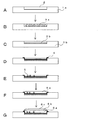
これら行程のうち、ガラス層形成工程(1)は、陶器上にガラス層を形成させる工程である。この工程は、図1のA、B、Cで模式的に示される。 Among these steps, the glass layer forming step (1) is a step of forming a glass layer on the pottery. This process is schematically shown by A, B, and C in FIG.
この工程は、皿、杯、灰皿、飾りタイル、飾り陶片等(以下、「陶器」という)の形状とした素地(1a)の窪み2にガラス層の原料となるガラス片、ガラス砂等(以下、「ガラス原料」という;3a)を入れ、これを窯の中で素地とガラス原料が共に焼成される温度にまで昇温させることにより行われる。
This process consists of a glass piece, glass sand, etc., as a raw material for the glass layer in the
本発明で用いられる素地は、ガラス材料が溶融してガラス層を形成する窪みがあれば、この形状や大きさには特に制約はない。また、素地は陶土により形成されるが、この陶土にも特段制約はなく、一般に陶芸用として使用されている粘土などを利用することができる。更に、ガラス材料としても特に制約はないが、破砕したガラス片、例えば、平均粒径が2〜5mm程度で、同じ色のものを集めた、カレットといわれるものを利用することができる。更に必要によっては、ガラス材料と共に夜光粉末を使用しても良い。このようにすることで、焼成後のガラス層を夜光を発するものとすることができ、より美感を高めることができる。 The substrate used in the present invention is not particularly limited in its shape and size as long as the glass material melts to form a glass layer. Moreover, although the base material is formed of porcelain clay, there is no particular restriction on the porcelain clay, and clay or the like generally used for pottery can be used. Furthermore, although there is no restriction | limiting in particular also as a glass material, What was called cullet which collected the crushed glass piece, for example, the average particle diameter of about 2-5 mm, and the thing of the same color, can be utilized. Further, if necessary, a luminescent powder may be used together with the glass material. By doing in this way, the glass layer after baking can emit a nightlight, and aesthetics can be improved more.
この工程において、その窪みにガラス材料等を入れた素地は、ガラス粉等が溶融しガラス層を形成する温度以上、好ましくは、1150〜1250℃程度の温度で、5〜6時間程度以上、好ましくは、6時間〜20時間程度、より好ましくは12時間〜20時間程度焼成される。こうすることにより、図1のCで示すように陶器1bの窪み2中にガラス層3が形成される。
In this step, the substrate in which the glass material or the like is put in the depression is at a temperature not lower than the temperature at which the glass powder is melted to form a glass layer, preferably at a temperature of about 1150 to 1250 ° C., preferably for about 5 to 6 hours, preferably Is fired for about 6 to 20 hours, more preferably for about 12 to 20 hours. By doing so, a
なお、上記の素地は、陶土で形作った後、単に乾燥させた状態のものを使用し、これを直接焼成しても良いが、陶土で形成した素地に釉薬を掛け、乾燥させた後のもの、あるいは釉薬を掛け、素焼きをしたものを利用し、この窪みにガラス材料等を入れ、焼成しても良い。釉薬で処理した素地を用いて焼成すると、焼成により釉薬から形成されるガラス質の層とガラス層の密着が陶土直接の場合と比べ高くなり、剥離などの問題はより起こりにくい。また、釉薬として色釉薬を使用すれば、窪みのガラス層の色と、コントラストや調和の取れた陶器を調製することができる。 In addition, the above-mentioned substrate may be used after it has been shaped with porcelain and then simply dried, and it may be directly baked. However, the substrate after glaze is applied to the substrate formed with porcelain and dried. Alternatively, it is possible to use a material that has been glazed and then unglazed, and a glass material or the like is placed in this recess and baked. When firing using a base treated with glaze, the adhesion between the glassy layer formed from the glaze by firing and the glass layer is higher than in the case of direct clay, and problems such as peeling are less likely to occur. Moreover, if a glaze is used as a glaze, the color of the glass layer of a dent, and the earthenware with contrast and harmony can be prepared.
次に、上記工程1で焼成された陶器のガラス層を含む上面には、図1のDで示されるように接着剤層4が形成される(工程(2))。
Next, an
この接着剤層が形成される部分は、後の工程で樹脂材料により被覆される部分と同じか、若干大きめにすることが好ましい。また、接着剤層の形成に使用される接着剤としては、加熱などの工程を必要としないものが好ましく、例えば、エポキシ系などの2液型接着剤を使用することが好ましい。 The part where the adhesive layer is formed is preferably the same as or slightly larger than the part to be coated with the resin material in a later step. Moreover, as an adhesive agent used for formation of an adhesive bond layer, what does not require processes, such as a heating, is preferable, for example, it is preferable to use two liquid adhesives, such as an epoxy type.
この接着剤層は、薄く均一に塗布することが好ましい。なお、ここでは一般に接着剤とされているものを用いるため接着剤層と表現したが、接着剤は、固体と固体の間を接着することが一般的であり、本発明のように、液状で流動性がある樹脂材料に対しては、接着剤としての使用とはいえない。 This adhesive layer is preferably applied thinly and uniformly. In addition, since what is generally used as an adhesive is used here, it is expressed as an adhesive layer. However, the adhesive is generally bonded between solids and is in a liquid state as in the present invention. It cannot be said that the resin material having fluidity is used as an adhesive.
次いで、図1のEで示すように表面が接着剤層4で覆われたガラス層3b上に装飾物5を載置する(工程(3))。
Next, the
このガラス層上に載置される装飾物としては、水分やその他の液体成分を全くあるいはほとんど含んでいないものが好ましく、その例としては、サンゴの微細破片である星砂、小さな貝の貝殻、押し花のような乾燥植物、金属片、ラメ等の金属−高分子複合材料片、乾燥された昆虫等が挙げられる。これらの装飾物は、接着剤層により固定されるため、次の工程で樹脂材料により被覆される際にも、ほとんどその位置を変えることがない。 The decoration placed on this glass layer is preferably one that contains no or almost no moisture or other liquid components, examples of which are star sand that is fine coral fragments, small shells of shells, Examples thereof include dry plants such as pressed flowers, metal pieces, metal-polymer composite material pieces such as lame, and dried insects. Since these ornaments are fixed by the adhesive layer, their positions are hardly changed even when they are covered with a resin material in the next step.
上記のように、ガラス層上に載置された装飾物は、更に、図1のFで示すように樹脂材料6aにより被覆された後、硬化される(工程(4))。 As described above, the ornament placed on the glass layer is further coated with the resin material 6a as shown by F in FIG. 1 and then cured (step (4)).
この工程において被覆に用いられる樹脂材料は、光または紫外線(以下、「UV」という)硬化性の樹脂であり、このような性質を有するものであれば種々のものを使用することができる。具体的には、UV硬化アクリレートのような、不飽和ポリエステル系樹脂材料を使用することができる。 The resin material used for coating in this step is light or ultraviolet (hereinafter referred to as “UV”) curable resin, and various materials can be used as long as they have such properties. Specifically, an unsaturated polyester resin material such as UV curable acrylate can be used.
この樹脂材料は、硬化後も透明性を保持するものであることが好ましく、液状であることが充填性の面から好ましい。 This resin material is preferably one that retains transparency even after curing, and is preferably liquid in terms of filling properties.
最後に、樹脂材料により被覆された装飾物は、その樹脂材料で指定された強度の光あるいはUVを照射し、硬化させる。この工程での光の波長、強度は樹脂材料により異なるので、当該樹脂材料での指示に従い、実施すればよい。 Finally, the ornament covered with the resin material is irradiated with light or UV having the intensity specified by the resin material and cured. Since the wavelength and intensity of light in this step vary depending on the resin material, it may be carried out according to the instructions for the resin material.
このようにすることにより、ガラス層上の樹脂材料中に装飾物が封入される。この状態では、若干粘着性があるが、更に、例えば太陽光に当てることで、硬化が進み、完全な装飾陶器が得られる。 By doing in this way, a decoration is enclosed in the resin material on a glass layer. In this state, it is slightly sticky, but further, for example, by exposure to sunlight, curing proceeds and a complete decorative ceramic is obtained.
なお、上記の樹脂材料による被覆工程および硬化工程は、1回でも良いが、複数回、例えば2〜5回程度繰り返すことが、樹脂層を厚くし、装飾物が樹脂層の奥に封じ込まれたように見え、また樹脂層の表面が滑らかになるため好ましい。この状態を図1のGに示す。 Note that the coating step and the curing step with the resin material may be performed once, but repeating a plurality of times, for example, about 2 to 5 times, thickens the resin layer and encloses the decoration in the back of the resin layer. It is preferable because the surface of the resin layer becomes smooth. This state is shown in FIG.
このように樹脂材料による被覆および光又はUV照射による硬化を繰り返す場合は、樹脂材料による被覆後、指定された強度の光あるいはUVを照射し、硬化させた後、また樹脂材料で被覆し、同様に硬化させる工程を繰り返せばよい。 In this way, when coating with resin material and curing by light or UV irradiation are repeated, after coating with resin material, irradiation with light or UV of specified intensity is cured and then coated again with resin material. What is necessary is just to repeat the process made to harden.
なお、光あるいはUV照射による硬化後の樹脂層は、前記したように若干粘着性が残っているので、被覆、硬化を繰り返す場合には、樹脂層上に再度装飾物を載置してから、被覆、固化を繰り返すこともできる。このようにすることで、深さ(高さ)の異なる数段の位置に装飾物を配置することも可能である。また、前記の若干粘着性が残っている樹脂層上に粉状の発光塗料(夜光粉末)を散布すれば、光によって発光させることもできる。 In addition, since the resin layer after curing by light or UV irradiation remains slightly sticky as described above, when covering and curing are repeated, after placing the decorative object on the resin layer again, Coating and solidification can be repeated. By doing in this way, it is also possible to arrange the ornaments at several positions with different depths (heights). Moreover, if a powdery light-emitting paint (light-glow powder) is spread on the resin layer on which the slight stickiness remains, light can be emitted by light.
以上のようにすることで、装飾物を透明樹脂中に封入した装飾陶器が容易に得られ、このものは経時的な耐久性を有するものである。 By doing as described above, a decorative pottery in which a decorative article is enclosed in a transparent resin can be easily obtained, and this article has durability over time.
次に実施例を挙げ、本発明を更に詳しく説明するが、本発明はこれら実施例に何ら制約されるものではない。 EXAMPLES Next, although an Example is given and this invention is demonstrated in more detail, this invention is not restrict | limited at all by these Examples.
実 施 例 1
装飾タイル片の製造(1):
沖縄県恩納村産出の陶芸用赤土を採取し、直径約10cm、厚さ約10mmのタイル素地を調製した。この素地の中央には、直径約2.5cm、深さ約6mmの窪みを形成した。
Example 1
Manufacture of decorative tile pieces (1):
A red clay for ceramics produced in Onna Village, Okinawa Prefecture was collected, and a tile base having a diameter of about 10 cm and a thickness of about 10 mm was prepared. A recess having a diameter of about 2.5 cm and a depth of about 6 mm was formed in the center of the substrate.
このタイル素地に、コバルト釉を掛け、2〜3時間風乾した後、窪み中に青色カレット(平均粒径2mm〜5mm)を、その8分目まで入れた。これを陶芸用ガス窯中、1250℃で17時間焼成した。この結果、窪み中の約4割程度までにガラス層が形成されたタイル片が形成された。 The tile substrate was covered with a cobalt cocoon and air-dried for 2 to 3 hours, and then a blue cullet (average particle size: 2 mm to 5 mm) was put into the depression until the 8th minute. This was fired at 1250 ° C. for 17 hours in a ceramic gas furnace. As a result, tile pieces having a glass layer formed up to about 40% in the depressions were formed.
焼成終了後、2日かけて品温を室温まで下げ、タイル片のガラス層上および窪みの上側までエポキシ系2液型接着剤(ボンドクイック5(金属、ガラス、陶磁器用)/コニシ株式会社製)を薄く塗布した。ガラス層上に、数粒の星砂と小さい花の押し花を置き、その上からUV硬化樹脂(商品名:商品名;KIYOHARA UVクラフトレジン液 紫外線硬化樹脂液(ハードタイプ)/清原株式会社製)を注入し、被覆した。 After firing, the product temperature is lowered to room temperature over 2 days, and epoxy two-component adhesive (Bondquick 5 (for metal, glass, ceramics)) / manufactured by Konishi ) Was applied thinly. Place several star sand and small flower pressed flowers on the glass layer, and UV curable resin (trade name: trade name; KIYOARA UV craft resin liquid, UV curable resin liquid (hard type) / manufactured by Kiyohara Co., Ltd.) Was injected and coated.
UV照射装置(GELNAIL UV LIGHT(DIVA−UV36w)を用い、UVを120秒照射することで、UV硬化樹脂層を硬化させた。次いで、再度同じUV硬化樹脂で被覆し、同じ条件でUVを照射した。これをもう一度繰り返した。 Using a UV irradiation device (GELNAIL UV LIGHT (DIVA-UV36w)), the UV curable resin layer was cured by irradiating with UV for 120 seconds. Then, it was again coated with the same UV curable resin and irradiated with UV under the same conditions. This was repeated once more.
最後にこのタイル片を屋外に持ち出し、日光に12時間曝露した。得られたタイル片のUV硬化樹脂表面には粘着性は全くなく、また装飾物である星砂と押し花が透明な樹脂中にきれいに封入されていた。 Finally, the tile pieces were taken outdoors and exposed to sunlight for 12 hours. The surface of the UV cured resin of the obtained tile piece had no stickiness, and star sand and pressed flowers as decorations were neatly enclosed in a transparent resin.
実 施 例 2
装飾タイル片の製造(2):
実施例1と同様にしてガラス層が形成されたタイル片を得た。これに実施例1と同様にエポキシ系2液型接着剤を塗布し、小さい花の押し花を置き、UV硬化樹脂で被覆後、実施例1と同様硬化させた。
Example 2
Manufacture of decorative tile pieces (2):
In the same manner as in Example 1, a tile piece on which a glass layer was formed was obtained. An epoxy two-component adhesive was applied thereto in the same manner as in Example 1, and a small flower pressed flower was placed thereon, followed by coating with a UV curable resin, followed by curing as in Example 1.
次いで、まだ粘着性を有するUV硬化樹脂上に、星砂と粉状の発光塗料(商品名:夜光粉末/株式会社ペパレス製作所製)を置き、同じUV硬化樹脂で被覆し、UV照射により硬化させた。この工程を再度繰り返した。 Next, on the UV curable resin still sticky, place star sand and powdered luminescent paint (trade name: Yakko Powder / manufactured by Pepares Mfg. Co., Ltd.), cover with the same UV curable resin, and cure by UV irradiation. It was. This process was repeated again.
最後に実施例1と同様に、このタイル片を日光に曝露させた。得られたタイル片のUV硬化樹脂表面には粘着性は全くなく、また装飾物である星砂と押し花と星砂および発光塗料が透明な樹脂中、異なる高さできれいに封入されていた。 Finally, as in Example 1, the tile pieces were exposed to sunlight. The surface of the UV cured resin of the obtained tile piece had no stickiness, and the star sand, pressed flowers, star sand and luminescent paint as decorations were neatly enclosed at different heights in the transparent resin.
なお、実施例1および2で調製したタイル片を、屋外に置いて暴露試験を行ったが、長期間にわたって陶器部と装飾物を封入した硬化樹脂部の間での剥離は認められなかった。 The tile pieces prepared in Examples 1 and 2 were placed outdoors and subjected to an exposure test. However, no peeling was observed between the pottery part and the cured resin part enclosing the decoration over a long period of time.
1a … … 陶器素地
1b … … 陶器
2 … … 窪み
3a … … ガラス材料
3b … … ガラス層
4 … … 接着剤層
5 … … 装飾物(星砂)
6a … …最初の硬化樹脂層
6b … …2番目の硬化樹脂層
6c … …3番目の硬化樹脂層
DESCRIPTION OF SYMBOLS 1a…… Ceramic base 1b……
6a ... ... first cured resin layer
6b ... 2nd cured resin layer 6c ... 3rd cured resin layer
Claims (5)
The method for producing decorative ceramics according to any one of claims 1 to 4, wherein the filling of the resin material and the curing by irradiation with light or ultraviolet light are repeated a plurality of times.
Priority Applications (1)
| Application Number | Priority Date | Filing Date | Title |
|---|---|---|---|
| JP2016157231A JP2018024552A (en) | 2016-08-10 | 2016-08-10 | Method for producing ornamental pottery |
Applications Claiming Priority (1)
| Application Number | Priority Date | Filing Date | Title |
|---|---|---|---|
| JP2016157231A JP2018024552A (en) | 2016-08-10 | 2016-08-10 | Method for producing ornamental pottery |
Publications (1)
| Publication Number | Publication Date |
|---|---|
| JP2018024552A true JP2018024552A (en) | 2018-02-15 |
Family
ID=61194959
Family Applications (1)
| Application Number | Title | Priority Date | Filing Date |
|---|---|---|---|
| JP2016157231A Pending JP2018024552A (en) | 2016-08-10 | 2016-08-10 | Method for producing ornamental pottery |
Country Status (1)
| Country | Link |
|---|---|
| JP (1) | JP2018024552A (en) |
Cited By (1)
| Publication number | Priority date | Publication date | Assignee | Title |
|---|---|---|---|---|
| KR102993406B1 (en) | 2026-03-13 | 2026-07-22 | 이기호 | Method of manufacturing inlaid pottery |
-
2016
- 2016-08-10 JP JP2016157231A patent/JP2018024552A/en active Pending
Cited By (1)
| Publication number | Priority date | Publication date | Assignee | Title |
|---|---|---|---|---|
| KR102993406B1 (en) | 2026-03-13 | 2026-07-22 | 이기호 | Method of manufacturing inlaid pottery |
Similar Documents
| Publication | Publication Date | Title |
|---|---|---|
| KR101094718B1 (en) | Lacquer ware using opaque glaze and method of manufacturing the same | |
| US9428686B2 (en) | Photo-luminescence coating and application thereof | |
| KR100994133B1 (en) | Glass products with patterns inserted and methods for manufacturing the same | |
| KR101295499B1 (en) | Method for manufacturing ceramics | |
| KR101692878B1 (en) | Manufacture method for ceramic | |
| KR101692877B1 (en) | Manufacture method for ceramic | |
| KR20230030199A (en) | Manufacturing method for pottery decorated with pearl mark | |
| CN103215856A (en) | Gold powder paper and formula and manufacturing technology thereof | |
| JP6998041B2 (en) | Manufacturing method of glass products and manufacturing method of ceramic products | |
| KR101692879B1 (en) | Manufacture method for ceramic | |
| KR101543316B1 (en) | Production method of embody as the celadon and the white porcelain and grayish-blue-powdered celadon | |
| KR101500989B1 (en) | Process for preparing pottery decorated with pearl mark and pottery using the same | |
| KR101569971B1 (en) | Method for Decorating a surface of Ceramics | |
| KR101265897B1 (en) | Method for manufacturing ceramic beads used accessory | |
| JP2000086329A (en) | Porcelain with glass and phosphorescent agent | |
| CN107351596A (en) | A kind of Taishan jade ranges process of surface treatment | |
| CN113752740A (en) | Preparation method of cold enamel product | |
| KR101490855B1 (en) | Method for coating metal leaf on ceramics | |
| KR101873185B1 (en) | Finishing material for construction using phosporescence and manufacturing method for the same | |
| JPH11139098A (en) | Manufacturing method of ceramics | |
| RU2827347C1 (en) | Cloisonne enamel imitation method | |
| KR100358900B1 (en) | The method for preparing of infrared decoration and lighting cover | |
| KR20050012331A (en) | Glass Tile mounted with gold and its manufacturing method | |
| CN1136128C (en) | Technology for generating ceramic-like decoration on glass utensil | |
| JP2006111481A (en) | Decoration method of ceramic product using metal foil and ceramic product decorated by using metal foil |
Legal Events
| Date | Code | Title | Description |
|---|---|---|---|
| RD01 | Notification of change of attorney |
Free format text: JAPANESE INTERMEDIATE CODE: A7426 Effective date: 20160906 |