JP2019085437A - Coating composition, coating film and coated article - Google Patents
Coating composition, coating film and coated article Download PDFInfo
- Publication number
- JP2019085437A JP2019085437A JP2017211848A JP2017211848A JP2019085437A JP 2019085437 A JP2019085437 A JP 2019085437A JP 2017211848 A JP2017211848 A JP 2017211848A JP 2017211848 A JP2017211848 A JP 2017211848A JP 2019085437 A JP2019085437 A JP 2019085437A
- Authority
- JP
- Japan
- Prior art keywords
- plasticizer
- meth
- coating film
- coating
- composition
- Prior art date
- Legal status (The legal status is an assumption and is not a legal conclusion. Google has not performed a legal analysis and makes no representation as to the accuracy of the status listed.)
- Granted
Links
Images
Landscapes
- Application Of Or Painting With Fluid Materials (AREA)
- Laminated Bodies (AREA)
- Paints Or Removers (AREA)
Abstract
【課題】専用の逆プライマーを使用しなくても、可塑剤含有樹脂に含まれる可塑剤のSP値にかかわらず、可塑剤移行防止性に優れ、さらに、耐候性及び耐温冷繰返し性を同時に満足する、可塑剤移行防止用塗料組成物、塗膜及び塗装物品を提供すること。【解決手段】塗膜のガラス転移温度が30〜100℃である、アルコキシシリル基含有(メタ)アクリル樹脂(A)を含む可塑剤移行防止用塗料組成物、当該可塑剤移行防止用塗料組成物から形成される塗膜、及び、当該塗膜が形成された塗装物品。また、前記(A)成分の溶解度パラメータ値が9.6以上である、可塑剤移行防止用塗料組成物、当該可塑剤移行防止用塗料組成物から形成される塗膜、及び、当該塗膜が形成された塗装物品。【選択図】なしPROBLEM TO BE SOLVED: To have excellent plasticizer migration prevention property regardless of the SP value of a plasticizer contained in a plasticizer-containing resin, and to have weather resistance and thermal / cold repeatability at the same time without using a dedicated reverse primer. To provide a satisfactory plasticizer transfer prevention paint composition, coating film and coated article. SOLUTION: The plasticizer migration preventing coating composition containing an alkoxysilyl group-containing (meth) acrylic resin (A) having a glass transition temperature of a coating film of 30 to 100 ° C., and the plasticizer migration preventing coating composition. A coating film formed from, and a painted article on which the coating film is formed. Further, the coating film for preventing the migration of the plasticizer, the coating film formed from the coating composition for preventing the migration of the plasticizer, and the coating film having a solubility parameter value of the component (A) of 9.6 or more are The formed painted article. [Selection diagram] None
Description
本発明は、可塑剤移行防止用塗料組成物、塗膜及び塗装物品に関し、建築及び土木、電気部品、並びに自動車等の幅広い産業分野の様々な工業用製品分野において使用することができ、特に、建築及び土木分野に好ましく使用可能であり、これら技術分野に属する。 The present invention relates to a coating composition for preventing plasticizer migration, a coating film and a coated article, and can be used in various industrial product fields in a wide range of industrial fields such as construction and civil engineering, electric parts, and automobiles. It is preferably usable in the construction and civil engineering fields and belongs to these technical fields.
樹脂を主成分とする材料は、建築及び土木、電気部品、並びに自動車等の幅広い産業分野で使用されている。前記材料は、柔軟性や加工性を付与する目的で、可塑剤が配合された樹脂(以下、「可塑剤含有樹脂」という。)を主成分とすることがある。このため、例えば、可塑剤含有樹脂を主成分とする材料の上に、汎用の塗料等を直接塗装すると、当該塗料により形成された塗膜中に可塑剤成分が移行する。これにより、塗膜表面がべたついたり、汚染物質が付着したり、塗膜がシワのように変形したりするといった問題が生じることがある。 Resin-based materials are used in a wide range of industrial fields such as construction and civil engineering, electrical parts, and automobiles. The said material may have as a main component resin (Hereafter, it is called "plasticizer containing resin.") With which the plasticizer was mix | blended in order to provide a softness | flexibility and processability. For this reason, for example, when a general-purpose paint or the like is directly coated on a material containing a plasticizer-containing resin as a main component, the plasticizer component migrates in a coating film formed of the paint. As a result, the surface of the coating film may become sticky, contaminants may adhere, or the coating film may be deformed like wrinkles.
建築及び土木分野では、可塑剤含有樹脂として、シーリング材が使用される。シーリング材は、建築物の外壁等において、主に線防水を目的としてコンクリートの伸縮目地及び誘発目地、並びに成型材の板間目地等に充填される。更に、シーリング材の表面に塗料、仕上塗材、防水材等を塗布することで、目地部分の保護を図ることができ、全体的な意匠性が統一され美観性を高めることができる。しかしながら、シーリング材に含まれる可塑剤が、シーリング材上に形成された塗膜に移行することによって、空気中の汚染物質が塗膜に付着したり、塗膜がシワのように変形したりすることで、外観を損なうという問題があった。 In the construction and civil engineering fields, sealing materials are used as plasticizer-containing resins. Sealing materials are filled in expansion / contraction joints and induction joints of concrete, and in sheet joints of molding materials, etc., mainly for the purpose of line waterproofing, in outer walls of buildings and the like. Furthermore, by applying a paint, a finish paint, a waterproof material, etc. to the surface of a sealing material, protection of a joint part can be aimed at, the overall designability can be unified, and the aesthetics can be improved. However, when the plasticizer contained in the sealing material migrates to the coating film formed on the sealing material, contaminants in the air adhere to the coating film or the coating film deforms like wrinkles. There was a problem of losing the appearance.
また、建築物の屋根は、可塑剤含有樹脂である塩化ビニル樹脂を主成分とする防水シート(以下、「塩化ビニル系防水材)という。)を使用して防水される。塩化ビニル系防水材が経年で劣化した場合には、塗膜防水により改修することがある。しかし、前記シーリング材の場合と同様に、塩化ビニル系防水材に含まれる可塑剤が、塩化ビニル系防水材上に形成された塗膜に移行することによって、空気中の汚染物質が塗膜に付着したり、塗膜防水の付着性が低下してフクレが発生することで、外観を損なうという問題があった。 In addition, the roof of the building is waterproofed using a waterproofing sheet (hereinafter referred to as "vinyl chloride-based waterproofing material") whose main component is vinyl chloride resin, which is a plasticizer-containing resin. However, as with the case of the sealing material, the plasticizer contained in the vinyl chloride-based waterproofing material is formed on the vinyl chloride-based waterproofing material. By transferring to the coated film, contaminants in the air adhere to the coated film, or the adhesion of the waterproofing of the coating film is reduced to cause swelling, resulting in a problem of impairing the appearance.
さらに、建築物の内装においても、可塑剤含有樹脂である塩化ビニル樹脂を主成分とする壁紙及び床材等(以下、「塩化ビニル系内装材)という。)がよく用いられている。塩化ビニル樹脂が経年で劣化した場合には、古い塩化ビニル系内装材を新品に取り替える方法が一般的であるが、廃棄物処理に伴うダイオキシン発生を回避する観点から、これに替わる方法として、近年塗装による改装が注目されつつある。しかしながら、このような塩化ビニル系内装材の表面に、直接塗料などを施した場合には、前記シーリング材及び塩化ビニル系防水材の場合と同様に、塩化ビニル系内装材に含まれる可塑剤が、塩化ビニル系内装材上に形成された塗膜に移行することによって、空気中の汚染物質が塗膜に付着したり、塗膜がシワのように変形したりすることで、外観を損なうという問題があった。 Furthermore, also in interiors of buildings, wallpaper, flooring, etc. (hereinafter referred to as "vinyl chloride-based interior materials") mainly containing vinyl chloride resin, which is a plasticizer-containing resin, are often used. If the resin has deteriorated over time, a method of replacing the old vinyl chloride-based interior material with a new one is generally used, but from the viewpoint of avoiding the generation of dioxins associated with waste treatment, painting is used as an alternative method. However, when paint or the like is directly applied to the surface of such a vinyl chloride-based interior material, the vinyl chloride-based interior is the same as in the case of the sealing material and the vinyl chloride-based waterproof material. When the plasticizer contained in the material transfers to the coating formed on the vinyl chloride-based interior material, contaminants in the air adhere to the coating or the coating deforms like wrinkles. Benefit it is, there is a problem that detract from the appearance.
このため、可塑剤含有樹脂であるシーリング材、塩化ビニル系防水材及び塩化ビニル系内装材の上に、塗料、仕上塗材、防水材等を塗布する場合は、可塑剤の移行を防止したり、塗料、仕上塗材、防水材等との付着性を向上させる目的で、逆プライマーと呼ばれるプライマーを可塑剤含有樹脂の上に塗布した後に、塗料、仕上塗材、防水材等を塗布することがある。前記逆プライマーはシーリング材、塩化ビニル系防水材及び塩化ビニル系内装材の種類によって専用のものを使い分ける必要がある。しかしながら、シーリング材、塩化ビニル系防水材及び塩化ビニル系内装材を施工して長期間経過後に、塗料、仕上塗材、防水材等を用いて改修を行う場合、シーリング材、塩化ビニル系防水材及び塩化ビニル系内装材の種類を見分けることは非常に困難である。このため、専用の逆プライマーを使用することができず、塗料、仕上塗材、防水材等に可塑剤が移行するなどして汚染したり、塗膜がシワ状に変形したりするという問題がある。また、逆プライマーの主成分はウレタン樹脂及び/又はエポキシ樹脂であるため、紫外線や熱による劣化に伴う変色が著しく、逆プライマーの上に透明塗料を塗布した場合には、前記変色が目立ち外観を損なうという問題がある。さらに、逆プライマーは高硬度の塗膜を形成するため、温冷繰返しによるシーリング材の動きに追従することが難しく、塗膜にひび割れが発生するなどの問題がある。 For this reason, when a paint, a finish paint, a waterproofing material, etc. are applied on a sealing material which is a plasticizer-containing resin, a vinyl chloride-based waterproofing material and a vinyl chloride-based interior material, the migration of the plasticizer is prevented Apply a primer, called reverse primer, onto the plasticizer-containing resin in order to improve the adhesion with paints, finish paints, waterproof materials, etc., then apply paint, finish paints, waterproof materials, etc. There is. As the reverse primer, it is necessary to use different dedicated ones depending on the kind of sealing material, vinyl chloride waterproof material and vinyl chloride interior material. However, when a sealing material, a vinyl chloride-based waterproofing material and a vinyl chloride-based interior material are applied and repair is performed using a paint, a finish-coating material, a waterproofing material, etc. after a long period of time, the sealing material and the vinyl chloride-based waterproofing material It is very difficult to identify the type of vinyl chloride interior material. For this reason, it is not possible to use a dedicated reverse primer, and there is a problem that the plasticizer is transferred to a paint, a finish paint, a waterproof material, etc. to cause contamination, or the coating film is deformed into wrinkles. is there. In addition, since the main component of the reverse primer is urethane resin and / or epoxy resin, discoloration due to deterioration due to ultraviolet light and heat is remarkable, and when the transparent paint is applied on the reverse primer, the discoloration is noticeable There is a problem of losing. Furthermore, since the reverse primer forms a coating film of high hardness, it is difficult to follow the movement of the sealing material due to repeated heating and cooling, and there are problems such as generation of cracks in the coating film.
このような背景の下、シーリング材、塩化ビニル系防水材及び塩化ビニル系内装材等に含まれる可塑剤による、塗料、仕上塗材、防水材等の汚染を防止することを目的とした塗料組成物(以下、「可塑剤移行防止用塗料組成物」という。)を、あらかじめ塗布してから塗料、仕上塗材、防水材等を塗布する方法が提案されている。 Under such background, paint composition intended to prevent the contamination of paint, finish paint, waterproof material, etc. by plasticizers contained in sealing material, vinyl chloride waterproof material, vinyl chloride interior material, etc. A method has been proposed in which a paint (hereinafter referred to as "plasticizer migration preventing coating composition") is applied in advance, and then a paint, a finish coating material, a waterproof material, and the like are applied.
特許文献1及び2には、シーリング材の汚染防止方法として、アルコキシシリル基含有(メタ)アクリル樹脂を含む塗料組成物によってシーリング材を被覆する方法が開示されている。 Patent Documents 1 and 2 disclose a method of coating a sealing material with a coating composition containing an alkoxysilyl group-containing (meth) acrylic resin as a method of preventing the contamination of the sealing material.
特許文献3には、シーリング材及び塩化ビニル系内装材の汚染防止方法として、親水性基を含有し特定の吸湿率を有する吸湿性粉体と合成樹脂を含む塗料組成物によってシーリング材又は塩化ビニル系内装材を被覆する方法が開示されている。 In Patent Document 3, as a method for preventing the contamination of a sealing material and a vinyl chloride-based interior material, a sealing material or a vinyl chloride is prepared using a paint composition containing a hygroscopic powder containing a hydrophilic group and having a specific moisture absorption rate and a synthetic resin. A method of coating a system interior material is disclosed.
特許文献4には、シーリング材の汚染防止方法として、エポキシ樹脂を含む塗料組成物によってシーリング材を被覆する方法が開示されている。 Patent Document 4 discloses a method for covering a sealing material with a coating composition containing an epoxy resin as a method for preventing the contamination of the sealing material.
しかしながら、特許文献1〜4に記載された可塑剤移行防止用塗料組成物は、シーリング材、塩化ビニル系防水材及び塩化ビニル系内装材と塗料、仕上塗材、防水材等との初期付着性は良好であり、フタル酸ジオクチル(以下、「DOP」という、溶解度パラメータ値(以下、「SP値」という。)8.9)等のSP値が比較的低い可塑剤による汚染は防止できているものの、フタル酸ブチルベンジル(以下、「BBP」という、SP値9.9)等のSP値が比較的高い可塑剤による汚染を防止できていなかった。そのため、SP値が比較的高い可塑剤を含有する可塑剤含有樹脂においては、汚染防止を目的とした塗料組成物を使用したにも関わらず、塗料、仕上塗材、防水材等に可塑剤が移行するなどして汚染が見られるという問題がある。また、可塑剤の移行により塗料、仕上塗材、防水材等にシワ状の変形などが発生するという問題もある。 However, the coating composition for plasticizer transfer prevention described in Patent Documents 1 to 4 is an initial adhesion property of a sealing material, a vinyl chloride-based waterproof material, a vinyl chloride-based interior material, a paint, a finish coating material, a waterproof material, etc. Is good, and contamination with plasticizers with relatively low SP values such as dioctyl phthalate (hereinafter referred to as “DOP”, solubility parameter value (hereinafter referred to as “SP value”) 8.9) can be prevented However, it has not been possible to prevent the contamination with a plasticizer having a relatively high SP value such as butyl benzyl phthalate (hereinafter referred to as "BBP", SP value 9.9). Therefore, in the plasticizer-containing resin containing a plasticizer having a relatively high SP value, the plasticizer is used as a paint, finish paint, waterproofing material, etc. despite the use of a paint composition intended to prevent contamination. There is a problem that contamination is seen by migrating. In addition, there is also a problem that wrinkle-like deformation or the like occurs in a paint, a finish paint, a waterproof material, etc. due to the transfer of a plasticizer.
また、特許文献4に記載された可塑剤移行防止用塗料組成物は、エポキシ樹脂を主成分としているため、紫外線による変色やひび割れが著しく、その上にクリア塗料を塗布した場合には変色が目立つため、その上に塗布される塗料としては着色塗料に限られるという問題がある。 Moreover, since the coating composition for plasticizer transfer prevention described in Patent Document 4 contains an epoxy resin as a main component, the discoloration or cracking due to ultraviolet light is remarkable, and when the clear paint is applied thereon, the discoloration is noticeable Therefore, there is a problem that the paint to be applied thereon is limited to the colored paint.
前記した通り、可塑剤含有樹脂に塗布した塗料、仕上塗材、防水材等に経年で空気中の汚染物質の付着がないこと(以下、「耐汚染性」という。)以外にも、シワ及びフクレ等の変形がないこと(以下、「変形防止性」という。)、剥がれがないこと(以下、「付着性」という。)、及び変色がないこと(以下、「変色防止性」という。)も求められ、既存の塗料組成物ではこれら全てを満足することは困難であった。
ここで、前記の耐汚染性、変形防止性、付着性及び変色防止性をまとめて、「可塑剤移行防止性」と呼ぶ。
As described above, in addition to the fact that the paint, finish paint, waterproof material, etc. applied to the plasticizer-containing resin do not adhere to contaminants in the air over time (hereinafter referred to as "contamination resistance"), wrinkles and There is no deformation such as blister (hereinafter referred to as "deformation resistant"), no peeling (hereinafter referred to as "adhesive"), and no discoloration (hereinafter referred to as "color transformed prevention") It was also difficult to satisfy all of these with existing paint compositions.
Here, the above-mentioned stain resistance, deformation prevention, adhesion and discoloration prevention are collectively referred to as "plasticizer migration prevention".
さらに、特許文献1〜4に記載された塗料組成物では、前記可塑剤移行防止性と、紫外線の影響による、可塑剤移行防止用塗料組成物の塗膜の変色及びひび割れがないこと(以下、「耐候性」という。)、及び、温冷繰返しによっても、可塑剤含有樹脂の動きに追従することで、可塑剤移行防止用塗料組成物の塗膜のひび割れがないこと(以下、「耐温冷繰返し性」という。)を同時に満足する事は困難であった。 Furthermore, in the paint compositions described in Patent Documents 1 to 4, there is no discoloration or cracking of the coating film of the paint composition for preventing plasticizer transfer due to the effect of the plasticizer transfer prevention and the influence of ultraviolet light (hereinafter referred to as No cracking of the coating film of the plasticizer transfer prevention coating composition by following the movement of the plasticizer-containing resin even by repeated heat and cold cycles (hereinafter referred to as “temperature resistance”) It is difficult to simultaneously satisfy cold repeatability.
本発明は、上記事情に鑑みてなされたものであり、その目的は、専用の逆プライマーを使用しなくても、可塑剤含有樹脂からなるシーリング材、塩化ビニル系防水材及び塩化ビニル系内装材に含まれる可塑剤のSP値にかかわらず、可塑剤移行防止性に優れ、さらに、耐候性及び耐温冷繰返し性を同時に満足する可塑剤移行防止用塗料組成物、塗膜及び塗装物品を提供することである。 The present invention has been made in view of the above circumstances, and an object thereof is a sealing material comprising a plasticizer-containing resin, a vinyl chloride waterproof material and a vinyl chloride interior material without using a dedicated reverse primer. Provided is a plasticizer composition for preventing migration of a plasticizer, a coating film and a coated article, which are excellent in plasticizer migration prevention regardless of the SP value of the plasticizer contained in the composition and which simultaneously satisfy the weather resistance and heat-cold repeatability. It is to be.
本発明者らは、前記課題を解決するために鋭意検討した結果、塗膜のガラス転移温度が特定の値である、アルコキシシリル基含有(メタ)アクリル樹脂(A)を含む可塑剤移行防止用塗料組成物を見出し、本発明を完成した。 MEANS TO SOLVE THE PROBLEM As a result of earnestly examining in order to solve the said subject, the present inventors are plasticizer transfer prevention containing the alkoxy silyl group containing (meth) acrylic resin (A) whose glass transition temperature of a coating film is a specific value. The paint composition was found and the present invention was completed.
本発明は以下の通りである。
[1]塗膜のガラス転移温度が30〜100℃である、アルコキシシリル基含有(メタ)アクリル樹脂(A)を含む可塑剤移行防止用塗料組成物。
[2]前記(A)成分の溶解度パラメータ値が9.6以上である、[1]に記載の可塑剤移行防止用塗料組成物。
[3]前記(A)成分の構成単量体単位としてポリオキシアルキレン基含有エチレン性不飽和単量体を1〜50質量%含む、[1]又は[2]に記載の可塑剤移行防止用塗料組成物。
[4]前記(A)成分の構成単量体単位として水酸基含有エチレン性不飽和単量体を1〜25質量%含む、[1]〜[3] のいずれか一に記載の可塑剤移行防止用塗料組成物。
[5]前記(A)成分の数平均分子量がポリメチルメタクリレート換算した値として4,000〜30,000である、[1]〜[4] のいずれか一に記載の可塑剤移行防止用塗料組成物。
[6]シーリング材、塩化ビニル系防水材又は塩化ビニル系内装材のいずれかに適用される、[1]〜[5]のいずれか一に記載の可塑剤移行防止用塗料組成物。
[7][1]〜[6]のいずれか一に記載の可塑剤移行防止用塗料組成物から形成される塗膜。
[8]可塑剤含有樹脂の上に、[7]に記載の塗膜が形成された塗装物品。
The present invention is as follows.
[1] A plasticizer composition for transfer prevention containing a alkoxysilyl group-containing (meth) acrylic resin (A), wherein the glass transition temperature of the coating film is 30 to 100 ° C.
[2] The coating composition for plasticizer transfer prevention as described in [1] whose solubility parameter value of the said (A) component is 9.6 or more.
[3] For the plasticizer migration prevention according to [1] or [2], containing 1 to 50% by mass of a polyoxyalkylene group-containing ethylenic unsaturated monomer as a constituent monomer unit of the component (A) Paint composition.
[4] The plasticizer migration prevention according to any one of [1] to [3], which comprises 1 to 25% by mass of a hydroxyl group-containing ethylenic unsaturated monomer as a constituent monomer unit of the component (A). Paint composition.
[5] The plasticizer migration preventing paint according to any one of [1] to [4], wherein the number average molecular weight of the component (A) is 4,000 to 30,000 as a value converted to polymethyl methacrylate. Composition.
[6] The coating composition for plasticizer transfer prevention as described in any one of [1] to [5], which is applied to any one of a sealing material, a vinyl chloride-based waterproof material and a vinyl chloride-based interior material.
The coating film formed from the coating material composition for plasticizer transfer prevention as described in any one of [7] [1]-[6].
[8] A coated article in which the coating film according to [7] is formed on a plasticizer-containing resin.
本発明の可塑剤移行防止用塗料組成物、塗膜及び塗装物品によれば、可塑剤含有樹脂に含まれる可塑剤のSP値に関わらず、可塑剤移行防止性、耐候性及び耐温冷繰返し性を同時に満足することができる。 According to the coating composition for preventing plasticizer migration, the coating film and the coated article of the present invention, regardless of the SP value of the plasticizer contained in the plasticizer-containing resin, the plasticizer migration preventing property, the weather resistance and the heat-cold repeatability Sex can be satisfied at the same time.
以下、本明細書に開示される技術の各種実施形態を詳しく説明する。尚、本明細書においては、アクリル樹脂及び/又はメタクリル樹脂を(メタ)アクリル樹脂と表し、アクリロイル基及び/又はメタクリロイル基を(メタ)アクリロイル基と表し、アクリロキシ及び/又はメタクリロキシを(メタ)アクリロキシと表し、アクリレート及び/又はメタクリレートを(メタ)アクリレートと表し、アクリル酸及び/又はメタクリル酸を(メタ)アクリル酸と表す。 Hereinafter, various embodiments of the technology disclosed in the present specification will be described in detail. In the present specification, acrylic resin and / or methacrylic resin is referred to as (meth) acrylic resin, acryloyl group and / or methacryloyl group is referred to as (meth) acryloyl group, and acryloxy and / or methacryloxy is (meth) acryloxy. And acrylate and / or methacrylate as (meth) acrylate and acrylic acid and / or methacrylic acid as (meth) acrylic acid.
本発明は、塗膜のガラス転移温度(以下、「Tg」という。)が30〜100℃である、アルコキシシリル基含有(メタ)アクリル樹脂(A)を含む可塑剤移行防止用塗料組成物に関する。 The present invention relates to a coating composition for plasticizer transfer prevention, which comprises an alkoxysilyl group-containing (meth) acrylic resin (A), wherein the glass transition temperature (hereinafter referred to as "Tg") of the coating is 30 to 100 ° C. .
本発明の可塑剤移行防止用塗料組成物が適用される可塑剤含有樹脂は、特に限定はなく、シーリング材、塩化ビニル系防水材及び塩化ビニル系内装材等を挙げることができ、シーリング材が特に好ましい。 The plasticizer-containing resin to which the coating composition for plasticizer transfer prevention of the present invention is applied is not particularly limited, and examples thereof include a sealing material, a vinyl chloride-based waterproofing material and a vinyl chloride-based interior material. Particularly preferred.
前記シーリング材としては、一成分形または二成分形のシリコーン系、ポリイソブチレン系、変成シリコーン系、ポリサルファイド系、変成ポリサルファイド系、アクリル系、ポリウレタン系、アクリルウレタン系及びブチルゴム系等を挙げることができる。 Examples of the sealing material include one-component or two-component silicones, polyisobutylenes, modified silicones, polysulfides, modified polysulfides, acrylics, polyurethanes, acrylic urethanes and butyl rubbers. .
前記可塑剤の具体例としては、DOP,BBP、ジブチルフタレート、ジイソノニルフタレート、ジイソデシルフタレート及びジブトキシエチルフタレート等のフタル酸エステル類、ジエチレングリコールジベンゾエート等の安息香酸エステル類、ジブチルアジペート、ビス(2−エチルヘキシル)アジペート、ジブチルセバケート及びビス(2−エチルヘキシル)セバケート等の脂肪族二塩基酸エステル類、オレイン酸ブチル及びアセチルリシリノール酸メチル等の脂肪族エステル類、トリクレジルホスフェート、トリ(2−エチルヘキシル)ホスフェート及びトリブトキシエチルホスフェート等のリン酸エステル類、塩素化パラフィン類、エポキシ化大豆油等のエポキシ系可塑剤類等を挙げることができる。 Specific examples of the plasticizer include phthalic acid esters such as DOP, BBP, dibutyl phthalate, diisononyl phthalate, diisodecyl phthalate and dibutoxyethyl phthalate, benzoic acid esters such as diethylene glycol dibenzoate, dibutyl adipate, bis (2- Aliphatic dibasic acid esters such as ethylhexyl) adipate, dibutyl sebacate and bis (2-ethylhexyl) sebacate, aliphatic esters such as butyl oleate and methyl acetyl ricinoleate, tricresyl phosphate, tri (2- (2-ethylhexyl)) Examples thereof include phosphoric acid esters such as ethylhexyl) phosphate and tributoxyethyl phosphate, and epoxy plasticizers such as chlorinated paraffins and epoxidized soybean oil.
前記塗料、仕上塗材、防水材等としては、特に限定はなく、可塑剤含有樹脂の保護、防水及び美観付与等を目的に塗布される、従来公知のアクリルゴム、アクリル樹脂、アクリルウレタン樹脂、アクリルシリコン樹脂、エポキシ樹脂、フッ素樹脂、エチレン酢酸ビニル樹脂、ウレタンゴム、クロロプレンゴム、ゴムアスファルト、、ポリエステル樹脂、
ビニルエステル系樹脂、ポリオレフィン系樹脂、シリコーン系樹脂、ポリウレタン系樹脂、フェノール系樹脂及びアルキッド系樹脂を含む塗料等を挙げることができる。
The paint, finish paint, waterproof material, etc. are not particularly limited, and conventionally known acrylic rubbers, acrylic resins, acrylic urethane resins, which are applied for the purpose of protection of plasticizer-containing resin, waterproofing and aesthetic appearance, etc. Acrylic silicone resin, epoxy resin, fluorine resin, ethylene vinyl acetate resin, urethane rubber, chloroprene rubber, rubber asphalt, polyester resin,
Examples thereof include paints containing vinyl ester resins, polyolefin resins, silicone resins, polyurethane resins, phenol resins and alkyd resins.
以下、(A)成分、その他成分、可塑剤移行防止用塗料組成物の製造方法、使用方法及び用途について説明する。 Hereinafter, the method for producing the coating composition for preventing migration of the plasticizer, the component (A), the other components, the method of use, and the use will be described.
1.(A)成分
(A)成分は、アルコキシシリル基含有(メタ)アクリル樹脂である。
1. Component (A) The component (A) is an alkoxysilyl group-containing (meth) acrylic resin.
本発明の(A)成分を含む可塑剤移行防止用塗料組成物は、当該塗膜の動的粘弾性測定によるTgが30〜100℃であると(A)成分中のアルコキシシリル基が湿気硬化し、架橋することで、可塑剤移行防止性、耐候性及び耐温冷繰返し性に優れた塗膜を得ることができる。 In the coating composition for plasticizer transfer prevention containing the component (A) of the present invention, the alkoxysilyl group in the component (A) is moisture cured when the Tg of the coating film measured by dynamic viscoelasticity measurement is 30 to 100 ° C. By crosslinking and crosslinking, it is possible to obtain a coating film excellent in plasticizer migration prevention, weather resistance, and heat-cold repeatability.
(A)成分を含む可塑剤移行防止用塗料組成物の塗膜のTgとしては、可塑剤移行防止性及び耐候性を向上できる点で、40℃以上が好ましく、50℃以上がより好ましい。また、可塑剤移行防止性、耐候性及び耐温冷繰返し性を同時に満足できる点で、95℃以下が好ましく、85℃以下がより好ましい。 The Tg of the coating film of the plasticizer migration preventing coating composition containing the component (A) is preferably 40 ° C. or more, more preferably 50 ° C. or more, from the viewpoint of improving the plasticizer migration preventing property and the weather resistance. In addition, 95 ° C. or less is preferable, and 85 ° C. or less is more preferable in that the plasticizer migration prevention property, the weather resistance, and the heat-cold repeatability can be simultaneously satisfied.
(A)成分のSP値としては、可塑剤含有樹脂に含まれる可塑剤のSP値に関わらず、可塑剤移行防止性を向上できる点で、9.6以上が好ましく、9.8以上がより好ましく、10.0以上であることが特に好ましい。また、幅広い種類の溶剤や添加剤との溶解性の観点から、11.0以下であることが好ましい。 The SP value of the component (A) is preferably 9.6 or more, more preferably 9.8 or more, in that the plasticizer migration preventing property can be improved regardless of the SP value of the plasticizer contained in the plasticizer-containing resin. Preferably, it is particularly preferably 10.0 or more. In addition, from the viewpoint of solubility with a wide variety of solvents and additives, it is preferably 11.0 or less.
本発明において、(A)成分のSP値は、簡便な実測法である濁点滴定法により測定することができる。 In the present invention, the SP value of the component (A) can be measured by a cloud point titration method which is a simple measurement method.
濁点滴定法によるSP値は、高分子溶液に貧溶媒を滴下し、濁りを生じるまでに要した貧溶媒の滴定量を求め、下記のK.W.SUH、J.M.CORBETTの式(Journal of Applied Polymer Science,12,2359,1968の記載参照)に従い算出される値である。
この際、貧溶媒として、SP値の低い貧溶媒(例えば、イソオクタンなど)とSP値の高い貧溶媒(例えば、水など)を用いる。
The SP value by the turbidity point titration method is obtained by dropping the poor solvent into the polymer solution, and determining the titration amount of the poor solvent required until the clouding occurs, and the following K.V. W. SUH, J.L. M. It is a value calculated according to the CORBETT equation (see the description of Journal of Applied Polymer Science, 12, 2359, 1968).
At this time, as a poor solvent, a poor solvent with a low SP value (for example, isooctane and the like) and a poor solvent with a high SP value (for example, water and the like) are used.
式(1) SP値=(Vml 1/2・δml+Vmh 1/2・δmh)/(Vml 1/2+Vmh 1/2)
ここで、上記計算式中の各記号は、以下を意味する。
Vml=v1×v2/((1−VL)×v2+VL×v1)
Vmh=v1×v3/((1−VH)×v3+VH×v1)
T:高分子を溶解させるのに要した溶媒の量(ml)
L:SP値の低い貧溶媒の滴定量(ml)
H:SP値の高い貧溶媒の滴定量(ml)
VL=L/(T+L)
VH=H/(T+H)
v1:高分子を溶解させるのに用いた溶媒のモル分子容(cm3/mol)
v2:SP値の低い貧溶媒のモル分子容(cm3/mol)
v3:SP値の高い貧溶媒のモル分子容(cm3/mol)
Equation (1) SP value = (V ml 1/2 · δ ml + V mh 1/2 · δ mh) / (V ml 1/2 + V mh 1/2)
Here, each symbol in the above-mentioned formula means the following.
V ml = v 1 x v 2 / ((1-V L ) x v 2 + V L x v 1 )
V mh = v 1 × v 3 / ((1−V H ) × v 3 + V H × v 1 )
T: Amount of solvent required to dissolve the polymer (ml)
L: Titrate of poor solvent with low SP value (ml)
H: Titrate of poor solvent with high SP value (ml)
V L = L / (T + L)
V H = H / (T + H)
v 1 : molar molecular volume (cm 3 / mol) of the solvent used to dissolve the polymer
v 2 : molar molecular volume (cm 3 / mol) of poor solvent with low SP value
v 3 : molar molecular volume (cm 3 / mol) of poor solvent with high SP value
δml=δT×T/(T+L)+δL×L/(T+L)
δmh=δT×T/(T+H)+δH×H/(T+H)
δT:高分子を溶解させるのに用いた溶媒のSP値
δL:SP値の低い貧溶媒のSP値
δH:SP値の高い貧溶媒のSP値
δ ml = δ T × T / (T + L) + δ L × L / (T + L)
δ mh = δ T × T / (T + H) + δ H × H / (T + H)
δ T : SP value of the solvent used to dissolve the polymer δ L : SP value of the poor solvent with low SP value δ H : SP value of the poor solvent with high SP value
本発明の濁点滴定では、(A)成分0.03gをテトラヒドロフラン(以下、「THF」という。)10mlに溶解した中に、イソオクタンを加えていき、濁点での滴定量L(ml)を読み、同様にTHF溶液中に脱イオン水を加えたときの濁点における滴定量H(ml)を読み、以下の計算式により得られたVml、Vmh、δml及びδmhを用いて、上記式(1)により、(A)成分のSP値を算出した。
尚、各溶剤のモル分子容(cm3/mol)は、THF:81.1、イソオクタン:165.6、脱イオン水:18であり、各溶剤のSP値は、THF:9.1、イソオクタン:6.9、脱イオン水:23.4である。
In the cloud point titration of the present invention, isooctane is added to 10 g of tetrahydrofuran (hereinafter referred to as "THF") in which 0.03 g of the component (A) is dissolved, and the titer L (ml) at the cloud point is read. Similarly, read the titer H (ml) at the cloud point when deionized water is added to the THF solution, and use the V ml , V mh , δ ml and δ mh obtained by the following formula to obtain the above formula The SP value of the component (A) was calculated by (1).
The molar molecular volume (cm 3 / mol) of each solvent is THF: 81.1, isooctane: 165.6, deionized water: 18, and the SP value of each solvent is THF: 9.1, isooctane : 6.9, deionized water: 23.4.
Vml=81.1×165.6/((1−VL)×165.6+VL×81.1)
Vmh=81.1×18/((1−VH)×18+VH×81.1)
VL=L/(10+L)
VH=H/(10+H)
δml=9.1×10/(10+L)+6.9×L/(10+L)
δmh=9.1×10/(10+H)+23.4×H/(10+H)
V ml = 81.1 × 165.6 / ((1- VL ) × 165.6 + VL × 81.1)
V mh = 81.1 × 18 / ((1−V H ) × 18 + V H × 81.1)
V L = L / (10 + L)
V H = H / (10 + H)
δ ml = 9.1 × 10 / (10 + L) + 6.9 × L / (10 + L)
δ mh = 9.1 × 10 / (10 + H) + 23.4 × H / (10 + H)
(A)成分としては、1個以上のアルコキシシリル基を有するエチレン性不飽和単量体(以下「アルコキシシリル基含有エチレン性不飽和単量体」という。)を重合して得られる重合体が好ましく、アルコキシシリル基含有単量体と共重合可能なエチレン性不飽和単量体(以下「共重合性不飽和単量体」という。)との共重合体がさらに好ましい。 As the component (A), a polymer obtained by polymerizing an ethylenically unsaturated monomer having one or more alkoxysilyl groups (hereinafter referred to as “alkoxysilyl group-containing ethylenically unsaturated monomer”) is Preferably, a copolymer of an alkoxysilyl group-containing monomer and a copolymerizable ethylenically unsaturated monomer (hereinafter referred to as "copolymerizable unsaturated monomer") is more preferable.
アルコキシシリル基含有エチレン性不飽和単量体は、1個以上のアルコキシシリル基を有するエチレン性不飽和単量体である。 The alkoxysilyl group-containing ethylenically unsaturated monomer is an ethylenically unsaturated monomer having one or more alkoxysilyl groups.
アルコキシシリル基含有エチレン性不飽和単量体のエチレン性不飽和基としては、(メタ)アクリロイル基、ビニル基及び(メタ)アリル基等が挙げられ、これらの中でも、原料の入手の容易さや反応性の観点から、(メタ)アクリロイル基及びビニル基が好ましい。 Examples of the ethylenically unsaturated group of the alkoxysilyl group-containing ethylenically unsaturated monomer include a (meth) acryloyl group, a vinyl group and a (meth) allyl group. Among these, the availability and reaction of the raw material From the viewpoint of properties, a (meth) acryloyl group and a vinyl group are preferred.
アルコキシシリル基含有エチレン性不飽和単量体の具体例としては、γ−(メタ)アクリロキシプロピルトリメトキシシラン、γ−(メタ)アクリロキシプロピルトリエトキシシラン、γ−(メタ)アクリロキシプロピルトリプロポキシシラン、γ−(メタ)アクリロキシプロピルトリブトキシシラン、γ−(メタ)アクリロキシプロピルメチルジメトキシシラン、γ−(メタ)アクリロキシプロピルメチルジエトキシシラン、γ−(メタ)アクリロキシプロピルメチルジプロポキシシラン、γ−(メタ)アクリロキシプロピルメチルジブトキシシラン、γ−(メタ)アクリロキシプロピルメチルジメトキシシラン、γ−(メタ)アクリロキシプロピルメチルジエトキシシラン、γ−(メタ)アクリロキシプロピルメチルジプロポキシシラン、γ−(メタ)アクリロキシプロピルメチルジブトキシシランγ−(メタ)アクリロキシプロピルジメチルエトキシシラン、γ−(メタ)アクリロキシプロピルジメチルメトキシシラン、γ−(メタ)アクリロキシプロピルジメチルプロポキシシラン及びγ−(メタ)アクリロキシプロピルジメチルブトキシシラン等の(メタ)アクリロイル基を有する単量体、ビニルトリメトキシシラン、ビニルトリエトキシシラン、ビニルメチルジメトキシシラン、ビニルメチルジエトキシシラン、ビニルメチルジメトキシシラン、ビニルメチルジエトキシシラン、ビニルジメチルメトキシシラン及びビニルジメチルエトキシシラン等のビニル基を有する単量体等が挙げられる。
上記アルコキシシリル基含有エチレン性不飽和単量体は、1種のみを使用しても、2種以上を併用しても良い。
Specific examples of the alkoxysilyl group-containing ethylenically unsaturated monomer include γ- (meth) acryloxypropyltrimethoxysilane, γ- (meth) acryloxypropyltriethoxysilane, and γ- (meth) acryloxypropyltri Propoxysilane, γ- (meth) acryloxypropyltributoxysilane, γ- (meth) acryloxypropylmethyldimethoxysilane, γ- (meth) acryloxypropylmethyldiethoxysilane, γ- (meth) acryloxypropylmethyldi Propoxysilane, γ- (meth) acryloxypropylmethyldibutoxysilane, γ- (meth) acryloxypropylmethyldimethoxysilane, γ- (meth) acryloxypropylmethyldiethoxysilane, γ- (meth) acryloxypropylmethyl Dipropoxysilane, γ- ( TA) Acryloxypropylmethyldibutoxysilane γ- (meth) acryloxypropyldimethylethoxysilane, γ- (meth) acryloxypropyldimethylmethoxysilane, γ- (meth) acryloxypropyldimethylpropoxysilane and γ- (meth) Monomers having a (meth) acryloyl group such as acryloxypropyldimethylbutoxysilane, vinyltrimethoxysilane, vinyltriethoxysilane, vinylmethyldimethoxysilane, vinylmethyldiethoxysilane, vinylmethyldimethoxysilane, vinylmethyldiethoxysilane And monomers having a vinyl group such as vinyldimethylmethoxysilane and vinyldimethylethoxysilane.
The above alkoxysilyl group-containing ethylenically unsaturated monomers may be used alone or in combination of two or more.
共重合性不飽和単量体のエチレン性不飽和基としては、(メタ)アクリロイル基、ビニル基、(メタ)アクリルアミド基及び(メタ)アリル基等が挙げられ、これらの中でも、原料の入手の容易さや反応性の観点から、(メタ)アクリロイル基及びビニル基が好ましい。 Examples of the ethylenically unsaturated group of the copolymerizable unsaturated monomer include a (meth) acryloyl group, a vinyl group, a (meth) acrylamide group and a (meth) allyl group. Among these, the raw materials can be obtained From the viewpoint of ease and reactivity, (meth) acryloyl group and vinyl group are preferable.
共重合性不飽和単量体としては、炭化水素基含有エチレン性不飽和単量体、ポリオキシアルキレン基含有エチレン性不飽和単量体、水酸基含有エチレン性不飽和単量体、カルボキシル基含有エチレン性不飽和単量体及び芳香族ビニル単量体、不飽和イミド化合物及び末端にモノ(メタ)アクリロイル基を有するマクロモノマー類、並びにその他エチレン性不飽和単量体等が挙げられる。 As a copolymerizable unsaturated monomer, a hydrocarbon group-containing ethylenic unsaturated monomer, a polyoxyalkylene group-containing ethylenic unsaturated monomer, a hydroxyl group-containing ethylenic unsaturated monomer, a carboxyl group-containing ethylene And unsaturated vinyl monomers, unsaturated imide compounds, macromonomers having a mono (meth) acryloyl group at the end, and other ethylenically unsaturated monomers.
炭化水素基含有エチレン性不飽和単量体の具体例としては、メチル(メタ)アクリレート、エチル(メタ)アクリレート、n−プロピル(メタ)アクリレート、イソプロピル(メタ)アクリレート、n−ブチル(メタ)アクリレート、イソブチル(メタ)アクリレート、sec−ブチル(メタ)アクリレート及びt−ブチル(メタ)アクリレート等のアルキル(メタ)アクリレート;シクロヘキシル(メタ)アクリレート、イソボルニル(メタ)アクリレート及びトリシクロ[5.2.1.02、6]デカン−8−イル(メタ)アクリレート等のシクロアルキル(メタ)アクリレート等の脂環式(メタ)アクリレートが挙げられる。 Specific examples of the hydrocarbon group-containing ethylenically unsaturated monomer include methyl (meth) acrylate, ethyl (meth) acrylate, n-propyl (meth) acrylate, isopropyl (meth) acrylate and n-butyl (meth) acrylate Alkyl (meth) acrylates such as isobutyl (meth) acrylate, sec-butyl (meth) acrylate and t-butyl (meth) acrylate; cyclohexyl (meth) acrylate, isobornyl (meth) acrylate and tricyclo [5.2.1. Alicyclic (meth) acrylates such as cycloalkyl (meth) acrylates such as [ 2,6 ] decane-8-yl (meth) acrylate.
水酸基含有エチレン性不飽和単量体の具体例としては、2−ヒドロキシエチル(メタ)アクリレート、2−ヒドロキシプロピル(メタ)アクリレート、3−ヒドロキシプロピル(メタ)アクリレート及びヒドロキシブチル(メタ)アクリレート等のヒドロキシアルキル(メタ)アクリレート;ポリエチレングリコールモノ(メタ)アクリレート、ポリプロピレングリコールモノ(メタ)アクリレート、ポリブチレングリコールモノ(メタ)アクリレート及びポリエチレングリコールーポリプロピレングリコールモノ(メタ)アクリレート等の水酸基末端ポリアルキレングリコールモノ(メタ)アクリレート;2−ヒドロキシ−3−フェノキシプロピル(メタ)アクリレート;グリセロールモノ(メタ)アクリレート等が挙げられる。 Specific examples of the hydroxyl group-containing ethylenic unsaturated monomer include 2-hydroxyethyl (meth) acrylate, 2-hydroxypropyl (meth) acrylate, 3-hydroxypropyl (meth) acrylate and hydroxybutyl (meth) acrylate Hydroxyalkyl (meth) acrylate; hydroxyl terminated polyalkylene glycol mono such as polyethylene glycol mono (meth) acrylate, polypropylene glycol mono (meth) acrylate, polybutylene glycol mono (meth) acrylate and polyethylene glycol-polypropylene glycol mono (meth) acrylate (Meth) acrylate; 2-hydroxy-3-phenoxypropyl (meth) acrylate; glycerol mono (meth) acrylate and the like.
(A)成分の構成単量体単位として水酸基含有エチレン性不飽和単量体を1〜25質量%含む事が好ましい。可塑剤移行防止性を向上できる点で、1質量%以上が好ましく、3質量%以上がより好ましい。また、貯蔵安定性を損なわない点で、25質量%以下が好ましく、20質量%以下がより好ましい。 It is preferable to contain 1 to 25% by mass of a hydroxyl group-containing ethylenic unsaturated monomer as a constituent monomer unit of the component (A). In the point which can improve plasticizer transfer prevention property, 1 mass% or more is preferable, and 3 mass% or more is more preferable. Moreover, in the point which does not impair storage stability, 25 mass% or less is preferable, and 20 mass% or less is more preferable.
ポリオキシアルキレン基含有エチレン性不飽和単量体の具体例としては、前記水酸基末端ポリアルキレングリコールモノ(メタ)アクリレートの他、メトキシポリエチレングリコールモノ(メタ)アクリレート、オクトキシポリエチレングリコールポリプロピレングリコールモノ(メタ)アクリレート、ラウロキシポリエチレングリコールモノ(メタ)アクリレート、ステアロキシポリエチレングリコールモノ(メタ)アクリレート、ステアロキシポリエチレングリコール-ポリプロピレングリコールモノ(メタ)アクリレート、アリロキシポリエチレングリコール-ポリプロピレングリコールモノ(メタ)アクリレート、ノニルフェノキシポリエチレングリコールモノ(メタ)アクリレート、ノニルフェノキシポリエチレングリコール-ポリプロピレングリコールモノ(メタ)アクリレート等のアルキル基末端ポリアルキレングリコールモノ(メタ)アクリレートが挙げられる。 Specific examples of the polyoxyalkylene group-containing ethylenically unsaturated monomer include methoxypolyethylene glycol mono (meth) acrylate, octoxy polyethylene glycol polypropylene glycol mono (meth) in addition to the hydroxyl group-terminated polyalkylene glycol mono (meth) acrylate. ) Acrylate, lauroxy polyethylene glycol mono (meth) acrylate, stearoxy polyethylene glycol mono (meth) acrylate, stearoxy polyethylene glycol-polypropylene glycol mono (meth) acrylate, allyloxy polyethylene glycol-polypropylene glycol mono (meth) acrylate, nonyl Phenoxy polyethylene glycol mono (meth) acrylate, nonyl phenoxy polyethylene glycol-polypropylene Alkyl group-terminated polyalkylene glycol mono (meth) acrylates such as propylene glycol mono (meth) acrylate.
ポリオキシアルキレン基含有エチレン性不飽和単量体のオキシアルキレン基の繰り返し単位のアルキレン部分の炭素数は、可塑剤移行防止性及び耐候性を発現できる点で2〜4が好ましく、2〜3がより好ましい。オキシアルキレン基の平均繰り返し数は、可塑剤移行防止性、耐候性及び耐温冷繰返し性を同時に満足できる点で、2〜20が好ましく、2〜15がより好ましい。 The number of carbon atoms of the alkylene moiety of the repeating unit of the oxyalkylene group of the polyoxyalkylene group-containing ethylenically unsaturated monomer is preferably 2 to 4 from the viewpoint of exhibiting plasticizer migration preventing property and weather resistance, and 2 to 3 is preferable. More preferable. The average repetition number of the oxyalkylene group is preferably 2 to 20, and more preferably 2 to 15 in that the plasticizer migration preventing property, the weather resistance and the heat-cold repeatability can simultaneously be satisfied.
(A)成分の構成単量体単位としてポリオキシアルキレン鎖含有エチレン性不飽和単量体を1〜50質量%含む事が好ましい。可塑剤移行防止性を向上できる点で、1質量%以上が好ましく、10質量%以上がより好ましい。また、塗膜の物性を損なわない点で、50質量%以下が好ましく、45質量%以下がより好ましい。 It is preferable that 1-50 mass% of polyoxyalkylene chain | strand containing ethylenic unsaturated monomers are included as a constituent monomer unit of (A) component. In the point which can improve plasticizer transfer prevention, 1 mass% or more is preferable, and 10 mass% or more is more preferable. Moreover, in the point which does not impair the physical property of a coating film, 50 mass% or less is preferable, and 45 mass% or less is more preferable.
カルボキシル基含有エチレン性不飽和単量体の具体例としては、(メタ)アクリル酸、クロトン酸、α−クロルアクリル酸及びけい皮酸等の不飽和モノカルボン酸類又はその無水物類;マレイン酸、無水マレイン酸、フマル酸、イタコン酸、無水イタコン酸、シトラコン酸、無水シトラコン酸及びメサコン酸等の不飽和ジカルボン酸又はその無水物類;3価以上の不飽和多価カルボン酸又はその無水物類;コハク酸モノ(2−(メタ)アクリロイロキシエチル)及びフタル酸モノ(2−(メタ)アクリロイロキシエチル)等の2価以上の多価カルボン酸のモノ〔(メタ)アクリロイロキシアルキル〕エステル類;並びにω−カルボキシポリカプロラクトンモノ(メタ)アクリレート等の両末端にカルボキシ基と水酸基とを有するポリマーのモノ(メタ)アクリレート類等を挙げることができる。これらのカルボキシル基含有エチレン性不飽和単量体のうち、コハク酸モノ(2−アクリロイロキシエチル)及びフタル酸モノ(2−アクリロイロキシエチル)は、それぞれアロニックスM−5300及びM−5400〔東亞合成(株)製〕の商品名で市販されている。 Specific examples of the carboxyl group-containing ethylenically unsaturated monomer include unsaturated monocarboxylic acids such as (meth) acrylic acid, crotonic acid, α-chloroacrylic acid and cinnamic acid, or anhydrides thereof; maleic acid, Unsaturated dicarboxylic acids such as maleic anhydride, fumaric acid, itaconic acid, itaconic acid, citraconic acid, citraconic acid, citraconic anhydride and mesaconic acid or anhydrides thereof; Trivalent or more unsaturated polyvalent carboxylic acids or anhydrides thereof Mono [(meth) acryloyloxyalkyls of divalent or higher polyvalent carboxylic acids such as succinic acid mono (2- (meth) acryloyloxyethyl) and phthalic acid mono (2- (meth) acryloyloxyethyl) Monoesters of polymers having a carboxy group and a hydroxyl group at both ends, such as esters; and ω-carboxypolycaprolactone mono (meth) acrylate (Meth) acrylates and the like can be mentioned. Among these carboxyl group-containing ethylenic unsaturated monomers, succinic acid mono (2-acryloyloxyethyl) and phthalic acid mono (2-acryloyloxyethyl) are Alonix M-5300 and M-5400 [ It is marketed under the trade name of Toagosei Co., Ltd.].
芳香族ビニル単量体の具体例としては、スチレン、α−メチルスチレン、o−ビニルトルエン、m−ビニルトルエン、p−ビニルトルエン、p−クロルスチレン、o−メトキシスチレン、m−メトキシスチレン、p−メトキシスチレン、2−ビニルベンジルメチルエーテル、3−ビニルベンジルメチルエーテル、4−ビニルベンジルメチルエーテル、2−ビニルベンジルグリシジルエーテル、3−ビニルベンジルグリシジルエーテル及び4−ビニルベンジルグリシジルエーテル等が挙げられる。 Specific examples of the aromatic vinyl monomer include styrene, α-methylstyrene, o-vinyltoluene, m-vinyltoluene, p-vinyltoluene, p-chlorostyrene, o-methoxystyrene, m-methoxystyrene, p -Methoxy styrene, 2-vinyl benzyl methyl ether, 3-vinyl benzyl methyl ether, 4-vinyl benzyl methyl ether, 2-vinyl benzyl glycidyl ether, 3-vinyl benzyl glycidyl ether, 4-vinyl benzyl glycidyl ether, etc. are mentioned.
不飽和イミド化合物の具体例としては、N−フェニルマレイミド及びN−シクロヘキシルマレイミド等が挙げられる。 Specific examples of the unsaturated imide compound include N-phenyl maleimide and N-cyclohexyl maleimide.
末端にモノ(メタ)アクリロイル基を有するマクロモノマー類の具体例としては、ポリスチレン、ポリメチル(メタ)アクリレート、ポリ−n−ブチル(メタ)アクリレート及びポリシロキサン等の高分子鎖を有するもの等を挙げることができる。 Specific examples of macromonomers having a mono (meth) acryloyl group at an end include those having a polymer chain such as polystyrene, polymethyl (meth) acrylate, poly-n-butyl (meth) acrylate and polysiloxane, etc. be able to.
その他エチレン性不飽和単量体の具体例としては、2−メトキシエチル(メタ)アクリレート等のアルコキシアルキル(メタ)アクリレート;ベンジル(メタ)アクリレート、フェニル(メタ)アクリレート、2−フェノキシエチル(メタ)アクリレート等の芳香族(メタ)アクリレート;2−(3,4,5,6−テトラヒドロフタルイミド)エチル(メタ)アクリレート、2−(2,3−ジメチルマレイミド)エチル(メタ)アクリレート等のイミド(メタ)アクリレート;2−アミノエチル(メタ)アクリレート、2−ジメチルアミノエチル(メタ)アクリレート、2−アミノプロピル(メタ)アクリレート、2−ジメチルアミノプロピルアクリレート、3−アミノプロピル(メタ)アクリレート及び3−ジメチルアミノプロピル(メタ)アクリレート等のアミノアルキル(メタ)アクリレート;(メタ)アクリルアミド及びN−(2−ヒドロキシエチル)(メタ)アクリルアミド等の(メタ)アクリルアミド及びその誘導体;グリシジル(メタ)アクリレート;アリル(メタ)アクリレート等が挙げられる。
上記共重合性不飽和単量体は、1種のみを使用しても、2種以上を併用しても良い。
Specific examples of other ethylenically unsaturated monomers include alkoxyalkyl (meth) acrylates such as 2-methoxyethyl (meth) acrylate; benzyl (meth) acrylate, phenyl (meth) acrylate, 2-phenoxyethyl (meth) Aromatic (meth) acrylates such as acrylates; imides (meth) such as 2- (3,4,5,6-tetrahydrophthalimido) ethyl (meth) acrylates and 2- (2,3-dimethylmaleimide) ethyl (meth) acrylates ) Acrylate; 2-aminoethyl (meth) acrylate, 2-dimethylaminoethyl (meth) acrylate, 2-aminopropyl (meth) acrylate, 2-dimethylaminopropyl acrylate, 3-aminopropyl (meth) acrylate and 3-dimethyl Aminopropyl (Meta Aminoalkyl (meth) acrylates such as acrylates; (meth) acrylamides such as (meth) acrylamides and N- (2-hydroxyethyl) (meth) acrylamides and derivatives thereof; glycidyl (meth) acrylates; allyl (meth) acrylates etc. It can be mentioned.
The copolymerizable unsaturated monomers may be used alone or in combination of two or more.
(A)成分の数平均分子量(以下、「Mn」という。)としては、ポリメチルメタクリレート換算した値として4,000〜30,000である事が好ましい。可塑剤移行防止性、耐候性及び温冷繰返し性のいずれにも優れる点で、4,000以上が好ましく、6,000以上がより好ましい。また、貯蔵安定性及び作業性を損なわない点で、30,000以下が好ましく、25,000以下がより好ましい。 The number average molecular weight (hereinafter referred to as "Mn") of the component (A) is preferably 4,000 to 30,000 as a value converted to polymethyl methacrylate. 4,000 or more are preferable and 6,000 or more are more preferable at the point which is excellent in all, plasticizer transfer prevention property, weather resistance, and heat-cold repeatability. Moreover, 30,000 or less is preferable and 25,000 or less is more preferable from the point which does not impair storage stability and workability.
本発明の(A)成分において、Mnとは、ゲルパーミエーションクロマトグラフィー(以下、「GPC」)という。)により測定した分子量をポリメチルメタクリレート換算した値である。 In component (A) of the present invention, Mn is referred to as gel permeation chromatography (hereinafter "GPC"). It is the value which converted the molecular weight measured by 1.) into polymethyl methacrylate.
尚、本発明におけるGPCにより測定した分子量は、以下の条件で測定した値を意味する。
・装置:東ソー(株)製GPC HLC−8020
・検出器:RI検出器
・カラム:東ソー製TSKgel SuperMultiporeHZ−M 4本
・カラムの温度:40℃
・溶離液組成:THF(内部標準として硫黄を0.03%含むもの)、流量0.60mL/分
・分子量標準物質:ポリメチルメタクリレ―ト
In addition, the molecular weight measured by GPC in this invention means the value measured on condition of the following.
Device: GPC HLC-8020 manufactured by Tosoh Corporation
-Detector: RI detector-Column: Tosoh TSKgel SuperMultipore HZ-M 4 pieces
・ Column temperature: 40 ° C
Eluent composition: THF (containing 0.03% of sulfur as internal standard), flow rate 0.60 mL / min Molecular weight standard substance: polymethyl methacrylate
(A)成分の共重合形態としては、ランダム共重合体、ブロック共重合体又はグラフト共重合体のいずれでも良い。 As a copolymerization form of (A) component, any of a random copolymer, a block copolymer, or a graft copolymer may be sufficient.
本発明の可塑剤移行防止用塗料組成物としては、(A)成分は、1種のみを使用しても、2種以上を併用しても良い。 As the coating composition for plasticizer migration prevention of the present invention, the component (A) may be used alone or in combination of two or more.
(A)成分の含有量としては、可塑剤移行防止性、耐候性及び温冷繰返し性のいずれにも優れるという点で、塗料組成物の固形分100質量%に、50〜100質量%であることが好ましく、より好ましくは60〜100質量%であり、特に好ましくは70〜100質量%である。 The content of the component (A) is 50 to 100% by mass, based on 100% by mass of the solid content of the coating composition, from the viewpoint of being excellent in all of plasticizer migration preventing property, weather resistance and hot-cold repeatability. Is more preferably 60 to 100% by mass, and particularly preferably 70 to 100% by mass.
(A)成分の製造方法としては、特に制限は無く、前記したエチレン性不飽和単量体を使用して、溶液重合、塊状重合、懸濁重合及び乳化重合等の公知の方法を用いることができる。
これらの中でも、重合体の製造が容易、かつ乳化剤等の余計な不純物を含まない点で溶液重合法が好ましい。
There is no restriction | limiting in particular as a manufacturing method of (A) component, Using well-known methods, such as solution polymerization, block polymerization, suspension polymerization, and emulsion polymerization, using the above-mentioned ethylenically unsaturated monomer it can.
Among these, the solution polymerization method is preferable in that the polymer production is easy and it does not contain unnecessary impurities such as an emulsifier.
溶液重合法で製造する場合は、使用するエチレン性不飽和単量体を有機溶剤に溶解し、熱重合開始剤を添加し、加熱攪拌することにより得られる。溶液重合法でラジカル重合により合成する場合は、使用するエチレン性不飽和単量体を有機溶剤に溶解し、熱ラジカル重合開始剤を添加し、加熱攪拌することにより得られる。又、必要に応じて、重合体の分子量を調節するために連鎖移動剤を使用することができる。 When manufacturing by a solution polymerization method, the ethylenic unsaturated monomer to be used is melt | dissolved in the organic solvent, a thermal polymerization initiator is added, and it is obtained by heat-stirring. When it synthesize | combines by radical polymerization by solution polymerization method, the ethylenic unsaturated monomer to be used is melt | dissolved in the organic solvent, a thermal radical polymerization initiator is added, and it is obtained by heating and stirring. Also, if desired, chain transfer agents can be used to control the molecular weight of the polymer.
溶液重合法に用いられる有機溶剤の具体例としては、アセトン、メチルエチルケトン及びメチルイソブチルケトン等のケトン類;酢酸エチル、酢酸ブチル等のエステル類;プロピレングリコールモノメチルエーテル等のエーテル類;トルエン、キシレン等の芳香族炭化水素類;並びにヘキサン、ヘプタン及びミネラルスピリット等の脂肪族炭化水素類等が挙げられる。 Specific examples of the organic solvent used in the solution polymerization method include ketones such as acetone, methyl ethyl ketone and methyl isobutyl ketone; esters such as ethyl acetate and butyl acetate; ethers such as propylene glycol monomethyl ether; and toluene and xylene Aromatic hydrocarbons; and aliphatic hydrocarbons such as hexane, heptane and mineral spirits.
熱重合開始剤の具体例としては、アゾビスイソブチロニトリル、アゾビスイソバレロニトリル、アゾビスシクロヘキサンカルボニトリル及びアゾビスシアノバレリックアシッド等のアゾ系開始剤;t-ブチルパーオキシピバレート、t−ヘキシルパーオキシピバレート、ジラウロイルパーオキシド、ジ(2−エチルヘキシル)パーオキシジカーボネート、ジt-ブチルパーオキシド及びジクミルパーオキシド等の有機過酸化物;並びに過酸化水素−鉄(II)塩、ペルオキソ二硫酸塩−亜硫酸水素ナトリウム、クメンヒドロペルオキシド−鉄(II)塩等が挙げられる。
熱重合開始剤の使用割合は、目標とする分子量に応じて適宜設定すれば良い。熱重合開始剤の使用割合は、使用する全エチレン性不飽和単量体の合計100質量部に対して、0.1〜10質量部が好ましい。
Specific examples of the thermal polymerization initiator include azo-based initiators such as azobisisobutyronitrile, azobisisovaleronitrile, azobiscyclohexanecarbonitrile and azobiscyanovaleric acid; t-butyl peroxypivalate, organic peroxides such as t-hexylperoxypivalate, dilauroylperoxide, di (2-ethylhexyl) peroxydicarbonate, dit-butylperoxide and dicumylperoxide; and hydrogen peroxide-iron (II Salts, peroxodisulfate-sodium bisulfite, cumene hydroperoxide-iron (II) salts and the like.
The use ratio of the thermal polymerization initiator may be appropriately set according to the target molecular weight. The use ratio of the thermal polymerization initiator is preferably 0.1 to 10 parts by mass with respect to 100 parts by mass in total of all the ethylenically unsaturated monomers to be used.
2.その他成分
本発明の可塑剤移行防止用塗料組成物は、(A)成分を含有するものであるが、目的に応じて種々の成分を配合することができる。
2. Other Components The coating composition for preventing plasticizer migration of the present invention contains the component (A), but various components can be blended depending on the purpose.
その他成分としては、具体的には、(A)成分以外の樹脂、硬化触媒、脱水剤、顔料、造膜助剤、増粘剤、消泡剤、分散剤、ポリイソシアネート硬化剤、酸化防止剤、光安定剤、紫外線吸収剤、帯電防止剤、難燃剤、密着性付与剤、レベリング剤、染料、防腐剤、防藻剤、沈降防止剤、つや消し剤、可塑剤、無機粉体及び有機溶剤等が挙げられる。 As other components, specifically, resins other than the component (A), curing catalysts, dehydrating agents, pigments, coalescent agents, thickening agents, antifoaming agents, dispersing agents, polyisocyanate curing agents, antioxidants , Light stabilizers, UV absorbers, antistatic agents, flame retardants, adhesion imparting agents, leveling agents, dyes, preservatives, anti-algal agents, anti-settling agents, matting agents, plasticizers, inorganic powders, organic solvents, etc. Can be mentioned.
以下、これらの成分について説明する。
尚、後記するその他成分は、例示した化合物の1種のみを使用しても良く、2種以上を併用しても良い。尚、後記するその他成分の内、液体のものは、可塑剤移行防止用塗料組成物と相溶するものであればいずれのものも使用できるが、その他成分によりSP値が大きく変化する可能性がある場合は、SP値が8.5〜11.0であることが好ましい。
Hereinafter, these components will be described.
In addition, the other component mentioned later may use only 1 type of the illustrated compound, and may use 2 or more types together. Among the other components described later, any liquid may be used as long as it is compatible with the plasticizer migration preventing coating composition, but the SP value may be largely changed by the other components. In some cases, the SP value is preferably 8.5 to 11.0.
2−1.硬化触媒
硬化触媒は、可塑剤移行防止用塗料組成物の湿気硬化性を向上する目的で配合することができる。
2-1. Curing Catalyst The curing catalyst can be blended for the purpose of improving the moisture curing property of the plasticizer migration preventing coating composition.
硬化触媒の具体例としては、ジブチルスズジラウレート、ジブチルスズジマレート、ジオクチルスズジラウレート、ジオクチルスズジマレート及びオクチル酸スズ等の有機スズ化合物;ジイソプロポキシチタンビス(アセチルアセトナート)、チタンテトラ(アセチルアセトナート)、ジオクタノキシチタンジオクタネート及びジイソプロポキシチタンビス(エチルアセトアセテート)等の有機チタン化合物が挙げられ、触媒効果が高い点で有機スズ化合物が好ましい。 Specific examples of the curing catalyst include organic tin compounds such as dibutyltin dilaurate, dibutyltin dimaleate, dioctyltin dilaurate, dioctyltin dimaleate and tin octylate; diisopropoxytitanium bis (acetylacetonate), titanium tetra (acetylacetonate) And organic titanium compounds such as dioctanoxytitanium dioctanate and diisopropoxytitanium bis (ethylacetoacetate), and organic tin compounds are preferable in terms of high catalytic effect.
硬化触媒の含有割合は、(A)成分を含む全固形分100質量部に対して0.01〜20質量部が好ましい。硬化触媒の割合を0.01質量部以上にすることで触媒効果が充分に得られやすく、硬化触媒の割合を20質量部以下とすることで可塑剤移行防止用塗料組成物の貯蔵安定性を確保できる。 The content ratio of the curing catalyst is preferably 0.01 to 20 parts by mass with respect to 100 parts by mass of the total solid content including the component (A). By setting the ratio of the curing catalyst to 0.01 parts by mass or more, the catalytic effect is easily obtained sufficiently, and by setting the ratio of the curing catalyst to 20 parts by mass or less, the storage stability of the coating composition for plasticizer migration prevention is Can be secured.
2−2.脱水剤
脱水剤は、可塑剤移行防止用塗料組成物の貯蔵安定性を向上する目的で配合することができる。
2-2. Dehydrating Agent A dehydrating agent can be blended for the purpose of improving the storage stability of the plasticizer migration preventing coating composition.
脱水剤の具体例としては、五酸化リン、炭酸水素ナトリウム、硫酸ナトリウム(無水芒硝)及びモレキュラーシーブス等の無機固体、オルトギ酸メチル、オルトギ酸エチル、オルト酢酸メチル、オルト酢酸エチル、メチルトリメトキシシラン、γ−メタクリロキシプロピルトリメトキシシラン及びビニルトリメトキシシラン等の加水分解性エステル化合物等が挙げられる。 Specific examples of the dehydrating agent include inorganic solids such as phosphorus pentoxide, sodium hydrogen carbonate, sodium sulfate (sodium sulfate) and molecular sieves, methyl orthoformate, ethyl orthoformate, methyl orthoacetate, ethyl orthoacetate, methyltrimethoxysilane And hydrolyzable ester compounds such as γ-methacryloxypropyltrimethoxysilane and vinyltrimethoxysilane.
脱水剤の含有割合は、(A)成分を含む全固形分100質量部に対して0.1〜20質量部が好ましい。脱水剤の割合を0.1質量部以上にすることで可塑剤移行防止用塗料組成物の貯蔵安定性を向上でき、脱水剤の割合を20質量部以下とすることで塗膜の物性を維持できる。 The content ratio of the dehydrating agent is preferably 0.1 to 20 parts by mass with respect to 100 parts by mass of the total solid content including the component (A). The storage stability of the coating composition for plasticizer transfer prevention can be improved by setting the ratio of the dehydrating agent to 0.1 parts by mass or more, and the physical properties of the coating film are maintained by setting the ratio of the dehydrating agent to 20 parts by mass or less. it can.
3.可塑剤移行防止用塗料組成物の製造方法
本発明は、前記(A)成分を含む可塑剤移行防止用塗料組成物に関する。
本発明の可塑剤移行防止用塗料組成物の製造方法としては、常法に従えば良く、前記(A)成分と、必要に応じてさらにその他成分を、常法に従い攪拌・混合することにより製造することができる。この場合、必要に応じて加熱することができる。
3. The manufacturing method of the coating material composition for plasticizer transfer prevention TECHNICAL FIELD This invention relates to the coating material composition for plasticizer transfer prevention containing the said (A) component.
The coating composition for preventing plasticizer migration of the present invention may be produced according to a conventional method, and the component (A) and, if necessary, other components may be further stirred and mixed according to the conventional method. can do. In this case, heating can be performed as needed.
4.使用方法
本発明の可塑剤移行防止用塗料組成物の使用方法としては、常法に従えば良い。可塑剤含有樹脂の上に、直接、本発明の可塑剤移行防止用塗料組成物を塗工しても良いし、可塑剤含有樹脂の上に形成されたプライマー層等の塗膜上に、本発明の可塑剤移行防止用塗料組成物を塗工しても良く、塗工後、自然乾燥又は加熱乾燥して、本発明の塗膜及び塗装物品を得る方法等が挙げられる。
4. Method of Use The method of using the paint composition for preventing plasticizer migration of the present invention may be in accordance with a conventional method. The plasticizer transfer preventing coating composition of the present invention may be coated directly on the plasticizer-containing resin, or on the coating film such as a primer layer formed on the plasticizer-containing resin. The coating composition for preventing migration of a plasticizer according to the invention may be coated, and after coating, the coating composition and the coated article of the present invention can be obtained by naturally drying or heating and drying.
可塑剤含有樹脂に対する塗工は、従来知られている方法に従えば良く、例えば、刷毛、ローラー、こて若しくはヘラ等により塗布したり、又は、スプレーガンで吹き付けたりするなどの一般的な方法により施工することができる。 Coating on the plasticizer-containing resin may be carried out according to a conventionally known method, for example, a general method such as coating with a brush, roller, trowel or spatula, or spraying with a spray gun. It can be constructed by
又、本発明の可塑剤移行防止用塗料組成物の塗布厚さは、20〜500μmであり、可塑剤含有樹脂及び用途に応じて選択すれば良いが、好ましくは20〜200μmであり、より好ましくは40〜150μmである。 The coating thickness of the coating composition for preventing migration of a plasticizer according to the present invention is 20 to 500 μm, and may be selected according to the plasticizer-containing resin and application, but is preferably 20 to 200 μm, more preferably Is 40 to 150 μm.
本発明の可塑剤移行防止用塗料組成物は、着色顔料を含まない場合には無色透明であり、その塗膜は耐候性に優れ、経年での黄変等の変色がないため、塗料、仕上塗材、防水材等としては、着色塗料のみならずクリア塗料も使用することができる。 The coating composition for preventing migration of a plasticizer according to the present invention is colorless and transparent when it does not contain a color pigment, and the coating film is excellent in weatherability and does not have discoloration such as yellowing over time, so it is paint and finish Not only colored paints but also clear paints can be used as the coating material, the waterproof material and the like.
5.用途
本発明の可塑剤移行防止用塗料組成物、塗膜及び塗装物品は、建築及び土木、電気部品、並びに自動車等の幅広い産業分野の様々な工業用製品分野において使用することができる。
5. Applications The plasticizer migration preventing coating composition, coating film and coated article of the present invention can be used in various industrial product fields in a wide range of industrial fields such as construction and civil engineering, electrical parts, and automobiles.
建築及び土木分野における用途の具体例としては、シーリング材、塩化ビニル系防水材及び塩化ビニル系内装材等がある。 Specific examples of applications in the construction and civil engineering fields include sealing materials, vinyl chloride waterproofing materials and vinyl chloride based interior materials.
電気部品分野における用途の具体例としては、電線コード及びケーブル等がある。 Examples of applications in the field of electrical components include wire cords and cables.
自動車分野における用途の具体例としては、ハンドル及びシート等の内装部品等がある。 Specific examples of applications in the automotive field include interior parts such as steering wheels and seats.
これらの中でも、本発明の可塑剤移行防止用塗料組成物、塗膜及び塗装物品の用途としては、建築及び土木分野に好ましく使用可能であり、可塑剤含有樹脂としては、シーリング材、塩化ビニル系防水材及び塩化ビニル系内装材がより好ましく、シーリング材が特に好ましい。尚、本発明の可塑剤移行防止用塗料組成物は、シーリング材等の可塑剤含有樹脂に接するコンクリート、タイル、金属等にも塗装することができる。 Among these, the plasticizer transfer preventing coating composition, the coating film and the coated article of the present invention can be preferably used in the fields of construction and civil engineering, and as the plasticizer-containing resin, sealing materials, vinyl chlorides The waterproof material and the vinyl chloride-based interior material are more preferable, and the sealing material is particularly preferable. In addition, the coating material composition for plasticizer transfer prevention of this invention can be coated also to concrete, a tile, metal etc. which contact plasticizer containing resin, such as a sealing material.
以下に、実施例及び比較例を示し、本発明をより具体的に説明する。 Hereinafter, the present invention will be described more specifically by showing Examples and Comparative Examples.
1.製造例
1)製造例1〔(A)成分の製造〕
まず、メチルメタクリレート(三菱ガス化学(株)製MMA(メタクリル酸メチル)、以下、「MMA」という。)43質量部、メトキシポリエチレングリコールモノメタクリレート(n≒4)(日油(株)製ブレンマーPME−200、以下、「PME200」という。)42質量部、3−(メチルジメトキシシリル)プロピルメタクリレート(信越化学工業(株)製KBM−502、以下、「SiPMA」という。)10質量部、2−ヒドロキシプロピルメタクリレート(共栄社化学(株)製ライトエステルHOP(N)、以下、「2HPA」という。)5.0質量部と、溶剤としてキシレン93質量部からなる単量体混合物193質量部を調製した。
次に、内容積2リットルの4つ口フラスコに、前記単量体混合物の30質量%に当たる57.9質量部を仕込み、この混合液を窒素ガスのバブリングにより十分に脱気し、混合液の内温を85℃まで昇温した。次いで、重合開始剤として2,2’−アゾビス(2,4−ジメチルバレロニトリル)(和光純薬工業(株)製V−65、以下、「V65」という。)0.2質量部と、溶剤としてキシレン6.0質量部からなる初期添加用重合開始剤溶液を加え、重合を開始した。前記単量体混合物の70質量%に当たる135.1質量部を滴下ロートからフラスコ内に1.5時間かけて滴下すると共に、V65 0.8質量部とキシレン24部からなる連続滴下用重合開始剤溶液を別の滴下ロートからフラスコ内に4時間かけて滴下することで重合を行った。滴下終了後、2時間加熱熟成することで、アルコキシシリル基含有(メタ)アクリル樹脂(以下、「A1成分」という。)を含むキシレン溶液(固形分45%)を得た。
1. Production example
1) Production Example 1 [ Production of (A) Component]
First, 43 parts by mass of methyl methacrylate (Mitsubishi Gas Chemical Co., Ltd. MMA (methyl methacrylate), hereinafter referred to as "MMA"), methoxypolyethylene glycol monomethacrylate (n44) (Neosil Co., Ltd. Blenmar PME) -200, hereinafter referred to as "PME 200" 42 parts by mass, 3- (methyldimethoxysilyl) propyl methacrylate (Shin-Etsu Chemical Co., Ltd. KBM-502, hereinafter referred to as "SiPMA") 10 parts by mass, 2- 5.0 parts by mass of hydroxypropyl methacrylate (light ester HOP (N) manufactured by Kyoeisha Chemical Co., Ltd., hereinafter referred to as "2 HPA") and 193 parts by mass of a monomer mixture consisting of 93 parts by mass of xylene as a solvent were prepared .
Next, 57.9 parts by mass corresponding to 30% by mass of the monomer mixture is charged in a 2-liter four-necked flask, the mixture is sufficiently degassed by bubbling nitrogen gas, and The internal temperature was raised to 85 ° C. Next, 0.2 parts by mass of 2,2′-azobis (2,4-dimethylvaleronitrile) (V-65 manufactured by Wako Pure Chemical Industries, Ltd., hereinafter referred to as “V65”) as a polymerization initiator and a solvent As a polymerization initiator solution consisting of 6.0 parts by mass of xylene was added to initiate polymerization. While adding 135.1 parts by mass corresponding to 70% by mass of the monomer mixture from the dropping funnel into the flask over 1.5 hours, a polymerization initiator for continuous addition comprising 0.8 parts by mass of V65 and 24 parts of xylene The polymerization was carried out by dropping the solution from another dropping funnel into the flask over 4 hours. After completion of the dropwise addition, the mixture was heated and aged for 2 hours to obtain a xylene solution (solid content 45%) containing an alkoxysilyl group-containing (meth) acrylic resin (hereinafter referred to as "component A1").
2)製造例2〜7〔(A)成分の製造〕、比較製造例1及び同2
構成単量体及び重合開始剤を表1に記載の部数とした以外は、製造例1と同様の方法に従い、重合を行って、製造例2〜7において「A2〜A7成分」を、比較製造例1〜2において「A’1〜A’2成分」を含むキシレン溶液(固形分45%)を得た。
2) Production Examples 2 to 7 [Production of (A) Component], Comparative Production Examples 1 and 2
The polymerization is carried out according to the same method as in Production Example 1 except that the constituent monomers and the polymerization initiator are in the number of parts described in Table 1, and “A2 to A7 component” is produced as a comparison in Production Examples 2 to 7. The xylene solution (45% of solid content) containing "A'1-A 'two components" in Examples 1-2 was obtained.
尚、表1における数字は部数を意味する。
又、表1における略号は下記を意味する。
・IBMA:イソブチルメタクリレート(共栄社化学(株)製ライトエステルIB)
The numbers in Table 1 mean the number of copies.
The abbreviations in Table 1 mean the following.
・ IBMA: isobutyl methacrylate (Keieisha Chemical Co., Ltd. light ester IB)
3)アルコキシシリル基含有(メタ)アクリル樹脂の評価方法
製造例1〜7、並びに比較製造例1及び同2で得られたA1〜A7成分、A’1成分及びA’2成分について、後記する方法に従い、塗膜のTg、SP値及びMnを測定した。それらの結果を表1に示す。
3) Evaluation Method of Alkoxysilyl Group-Containing (Meth) Acrylic Resin The components A1 to A7, the component A′1 and the component A′2 obtained in Production Examples 1 to 7 and Comparative Production Examples 1 and 2 will be described later. According to the method, the Tg, the SP value and the Mn of the coating were measured. The results are shown in Table 1.
◆塗膜のTg
アルコキシシリル基含有(メタ)アクリル樹脂を含むキシレン溶液を、離形紙で作製した型枠に流し込み、23℃1日養生し、さらに80℃3日養生した後の厚さ約300μmの塗膜を用いて、動的粘弾性測定を測定温度0〜150℃、周波数1Hzで行い、損失弾性率の極大値となる温度をTgとした。
◆ Tg of coating film
A xylene solution containing an alkoxysilyl group-containing (meth) acrylic resin is poured into a mold made of release paper, aged at 23 ° C. for 1 day, and further cured at 80 ° C. for 3 days. Dynamic viscoelasticity measurement was performed at a measurement temperature of 0 to 150 ° C. and a frequency of 1 Hz, and a temperature at which the loss elastic modulus was a maximum value was taken as Tg.
◆SP値
前記した濁度滴定法にて、低極性貧溶媒としてイソオクタン、高極性貧溶媒として脱イオン水を用いて測定した。
試料は、200mlのポリカップにアルコキシシリル基含有(メタ)アクリル樹脂を含むキシレン溶液を1g入れ、60℃、1.0Torrにて3時間真空乾燥させて得た。
110mlのガラス製サンプル瓶中において、前記試料0.03gをTHF10mlに溶解させ、次いでイソオクタンを加えていき、目視で溶液が濁った点を濁点として、そのときの滴定量L(ml)を読んだ。
同様に、試料のTHF溶液中に脱イオン水を加えたときの濁点における脱イオン水の滴定量H(ml)を読み、以下の計算式により、Vml、Vmh、δml及びδmhを算出した。
SP value: Measured by the above-mentioned turbidity titration method using isooctane as a low polarity poor solvent and deionized water as a high polarity poor solvent.
The sample was obtained by placing 1 g of a xylene solution containing an alkoxysilyl group-containing (meth) acrylic resin in a 200 ml poly cup and vacuum drying at 60 ° C. and 1.0 Torr for 3 hours.
In a 110-ml glass sample bottle, 0.03 g of the sample was dissolved in 10 ml of THF, then iso-octane was added, and the titration point L (ml) at that point was read, with the solution becoming a cloudy point visually .
Similarly, read the titration amount H (ml) of deionized water at the cloud point when deionized water is added to the THF solution of the sample, and calculate V ml , V mh , δ ml and δ mh according to the following formula. Calculated.
Vml=81.1×165.6/((1−VL)×165.6+VL×81.1)
Vmh=81.1×18/((1−VH)×18+VH×81.1)
VL=L/(10+L)
VH=H/(10+H)
δml=9.1×10/(10+L)+6.9×L/(10+L)
δmh=9.1×10/(10+H)+23.4×H/(10+H)
V ml = 81.1 × 165.6 / ((1- VL ) × 165.6 + VL × 81.1)
V mh = 81.1 × 18 / ((1−V H ) × 18 + V H × 81.1)
V L = L / (10 + L)
V H = H / (10 + H)
δ ml = 9.1 × 10 / (10 + L) + 6.9 × L / (10 + L)
δ mh = 9.1 × 10 / (10 + H) + 23.4 × H / (10 + H)
次いで、上記で得られたVml、Vmh、δml及びδmhを用いて、次式により、アルコキシシリル基含有(メタ)アクリル樹脂のSP値を算出した。
SP値=(Vml 1/2・δml+Vmh 1/2・δmh)/(Vml 1/2+Vmh 1/2)
Then, V ml obtained above, using a V mh, [delta] ml and [delta] mh, the following equation was calculated SP value of alkoxysilyl-containing (meth) acrylic resin.
SP value = (V ml 1/2 · δ ml + V mh 1/2 · δ mh ) / (V ml 1/2 + V mh 1/2 )
◆Mn(GPC測定条件)。
・装置:東ソー(株)製GPC HLC−8020
・検出器:RI検出器
・カラム:東ソー(株)製TSKgel SuperMultiporeHZ−M 4本
・カラムの温度:40℃
・溶離液組成:THF(内部標準として硫黄を0.03%含むもの)、流量0.60mL/分
・分子量標準物質:ポリメチルメタクリレ―ト
◆ Mn (GPC measurement conditions) .
Device: GPC HLC-8020 manufactured by Tosoh Corporation
-Detector: RI detector-Column: Tosoh Corp. TSKgel SuperMultipore HZ-M 4 pieces
・ Column temperature: 40 ° C
Eluent composition: THF (containing 0.03% of sulfur as internal standard), flow rate 0.60 mL / min Molecular weight standard substance: polymethyl methacrylate

2.実施例1〜7、比較例1及び同2
塗料組成物の調製
下記表2に示す化合物を表2に示す割合で撹拌・混合し、塗料組成物を製造した。
得られた表2の塗料組成物を使用し、後記する評価を行った。それらの結果を表2に示す。
ここで、前記と同様の方法で、表2記載の塗料組成物の塗膜のTgを測定した結果、表1記載の対応するアルコキシシリル基含有(メタ)アクリル樹脂の塗膜のTgと同じであった。
尚、表2における数字は質量部を意味する。
又、表2における略号は下記を意味する。
・DBTDL:ジブチルスズジラウレート((株)ADEKA製アデカスタブBT−11)
2. Examples 1 to 7 and Comparative Examples 1 and 2
Preparation of Coating Composition The compounds shown in Table 2 below were stirred and mixed in the proportions shown in Table 2 to prepare a coating composition.
The paint compositions of Table 2 obtained were used and evaluated as described later. The results are shown in Table 2.
Here, as a result of measuring the Tg of the coating film of the coating composition described in Table 2 by the same method as described above, it is the same as the Tg of the coating film of the corresponding alkoxysilyl group-containing (meth) acrylic resin described in Table 1 there were.
The numbers in Table 2 mean parts by mass.
The abbreviations in Table 2 mean the following.
-DBTDL: dibutyl tin dilaurate (ADEKA Stub BT-11 manufactured by ADEKA Co., Ltd.)
塗料組成物の評価
1)試験体の作製
本評価では、シーリング材として、「ペンギンシールMS2500typeNB ホワイト」(サンスター技研(株)製シーリング材、可塑剤非含有)に対し、可塑剤としてDOP又はBBPを13質量%配合したものを用いた。
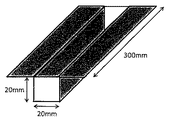
まず、試験体用基材(目地幅20mmのアルミ製型枠、図1参照)の目地部分にシーリング材用プライマーとして「UM−2」(サンスター技研(株)製)を刷毛塗りし、気温23℃、湿度50%で2時間養生した。その後、シーリング材を目地部分に充填し、気温23℃、湿度50%で3日養生することにより、シーリング材層を形成した。
次に、前記シーリング材の表面に、表2記載の塗料組成物の塗布量が、塗膜として80g/m2となるように刷毛塗りし、気温23℃、湿度50%で1日乾燥させた。
続いて、弱溶剤系アクリルウレタン樹脂下塗材である「クリアウオールCP−100」(東亞合成(株)製)を0.12kg/m2となるように刷毛塗りした。その後、気温23℃、湿度50%で1日養生した。
さらに、弱溶剤系アクリルウレタン樹脂中塗材である「クリアウオールCS−200」(東亞合成(株)製)を0.24kg/m2となるように刷毛塗りし、気温23℃、湿度50%で1日乾燥させた。最後に、弱溶剤系アクリルシリコン樹脂上塗材である「クリアウオールCT−300」(東亞合成(株)製)を0.12kg/m2となるように刷毛塗りした。その後、気温23℃、湿度50%で1日養生することにより、試験体を得た。塗膜の外観は無色透明であった。
Evaluation of paint composition
1) Preparation of test body In this evaluation, 13% by mass of DOP or BBP as a plasticizer is added to "Penguin Seal MS2500 type NB White" (Sanstar Giken Co., Ltd. product sealing material, plasticizer not included) as a sealing material Used.
First, brush “UM-2” (manufactured by Sun Star Giken Co., Ltd.) as a primer for sealing material on the joint portion of the base material for test body (aluminum mold of joint width 20 mm, see FIG. 1) and air temperature It was aged at 23 ° C. and 50% humidity for 2 hours. Thereafter, the sealing material was filled in the joint portion, and a sealing material layer was formed by curing for 3 days at a temperature of 23 ° C. and a humidity of 50%.
Next, the surface of the sealing material was brushed so that the coating amount of the coating composition described in Table 2 was 80 g / m 2 as a coating film, and dried at a temperature of 23 ° C. and a humidity of 50% for one day. .
Subsequently, "Clear Wall CP-100" (manufactured by Toagosei Co., Ltd.), which is a weak solvent-based acrylic urethane resin primer, was brush-coated at 0.12 kg / m 2 . Thereafter, it was cured for one day at a temperature of 23 ° C. and a humidity of 50%.
Furthermore, "Clear Wall CS-200" (made by Toagosei Co., Ltd.), which is a weak solvent-based acrylic urethane resin coating material, is brushed to 0.24 kg / m 2 at a temperature of 23 ° C and a humidity of 50%. Dried for 1 day. Finally, "Clear Wall CT-300" (manufactured by Toagosei Co., Ltd.), which is a weak solvent acrylic silicone resin topcoat material, was brush-coated at 0.12 kg / m 2 . Thereafter, the specimen was obtained by curing for one day at a temperature of 23 ° C. and a humidity of 50%. The appearance of the coating was colorless and transparent.
2)可塑剤移行防止性試験
(1)変形防止性の評価
3.1)で得られた試験体を、乾燥機(80℃)に静置し、14日間加熱した。加熱後の塗膜の外観を目視観察し、以下の4水準で評価を行った。それらの結果を表2に示す。
◎:全くシワ又はフクレ等の変形が発生しなかった。
○:極僅かにシワ又はフクレ等の変形が発生した。
△:僅かにシワ又はフクレ等の変形が発生した。
×:著しくシワ又はフクレ等の変形が発生した。
2) Plasticizer Migration Prevention Test (1) Evaluation of Deformation Prevention 3.1 The test body obtained in 3.1) was allowed to stand in a drier (80 ° C.) and heated for 14 days. The appearance of the coated film after heating was visually observed and evaluated on the following four levels. The results are shown in Table 2.
◎: No deformation such as wrinkles or blisters occurred at all.
○: Very slight deformation such as wrinkles or blisters occurred.
Δ: Slight deformation such as wrinkles or blisters occurred.
X: Significant deformation such as wrinkles or blisters occurred.
(2)耐汚染性の評価
3.1)で得られた試験体を、乾燥機(80℃)に静置し、14日間加熱した。加熱後の試験体を水平に置いて8号黒色珪砂を散布した後、試験体を垂直に立てて珪砂を自然落下させた。このとき、付着した8号黒色珪砂の程度(ふりかけた面積に対する付着面積の割合)について、目視確認し、以下の4水準で評価を行った。それらの結果を表2に示す。
◎:付着面積が10%未満
○:付着面積が10%以上20%未満
△:付着面積が20%以上50%未満
×:付着面積が50%以上
(2) Evaluation of contamination resistance The test body obtained in 3.1) was allowed to stand in a drier (80 ° C.) and heated for 14 days. The test sample after heating was placed horizontally and sprayed with No. 8 black silica sand, and then the test sample was stood vertically to naturally drop the silica sand. At this time, the degree of the adhered No. 8 black silica sand (the ratio of the adhesion area to the area sprinkled) was visually checked, and the evaluation was made on the following four levels. The results are shown in Table 2.
:: adhesion area less than 10% ○: adhesion area 10% to less than 20% Δ: adhesion area 20% to less than 50% ×: adhesion area 50% or more
(3)付着性の評価
3.1)で得られた試験体を、乾燥機(80℃)に静置し、14日間加熱した。加熱後の塗膜の付着性を、JIS K5600−5−6(付着性(クロスカット法))に準じて評価し、以下の4水準で評価を行った。それらの結果を表2に示す。
◎:全く剥がれがない
○:剥がれが全面積の5%未満
△:剥がれが全面積の5%以上35%未満
×:剥がれが全面積の35%以上
尚、作製直後の試験体は実施例1〜7及び比較例1〜2のいずれの評価結果も、◎であった。
(3) Evaluation of adhesion The test body obtained in 3.1) was allowed to stand in a drier (80 ° C.) and heated for 14 days. The adhesion of the coating film after heating was evaluated according to JIS K 5600-5-6 (adhesion (cross-cut method)), and evaluation was made on the following four levels. The results are shown in Table 2.
:: no peeling at all ○: peeling less than 5% of total area △: peeling at least 5% to less than 35% of total area ×: peeling at least 35% of total area Test sample immediately after preparation is Example 1 The evaluation results of 〜7 and Comparative Examples 1 and 2 were also ◎.
(4)変色防止性の評価
3.1)で得られた試験体を、乾燥機(80℃)に静置し、14日間加熱した。加熱後の塗膜の外観を目視観察し、以下の4水準で評価を行った。それらの結果を表2に示す。
◎:全く変色が見られなかった。
○:極僅かに変色が見られた。
△:僅かに変色が見られた。
×:著しい変色が見られた。
(4) Evaluation of discoloration prevention property The test body obtained by 3.1) was left still in the dryer (80 degreeC), and was heated for 14 days. The appearance of the coated film after heating was visually observed and evaluated on the following four levels. The results are shown in Table 2.
◎: no discoloration was observed
○: Very slight discoloration was observed.
Δ: Slight discoloration was observed.
X: significant discoloration was observed.
3)促進耐候性試験
(1)耐候性の評価
3.1)で得られた試験体を、サンシャインスーパーロングライフウェザーメーター(スガ試験機社製)に設置し、JIS A1415 4に規定するWS−A法に準拠して3000時間の促進耐候性試験を行った。
促進耐候性試験後の塗膜の外観を目視観察し、以下の4水準で評価を行った。それらの結果を表2に示す。
尚、同試験条件では、下塗材「クリアウオールCP−100」、中塗材「クリアウオールCS−200」及び上塗材「クリアウオールCT−300」の変色及びひび割れが全く見られないことが分かっているため、本評価は、アルコキシシリル基含有(メタ)アクリル樹脂の塗膜の変色及びひび割れの有無を観察する評価である。
◎:全く変色が見られず、ひび割れも見られなかった。
○:極僅かに変色が見られるが、ひび割れは見られなかった。
△:僅かに変色が見られるが、ひび割れは見られなかった。
×:著しい変色が見られ、ひび割れも見られた。
3) Accelerated weathering test
(1) Evaluation of weather resistance The test body obtained in 3.1) was installed in a sunshine super long life weather meter (manufactured by Suga Test Instruments Co., Ltd.), and in accordance with the WS-A method defined in JIS A14154. An accelerated weathering test of 3000 hours was conducted.
The appearance of the coating after the accelerated weathering test was visually observed and evaluated on the following four levels. The results are shown in Table 2.
Under the same test conditions, it has been found that no discoloration or cracking of the primer "Clear Wall CP-100", the inner coating "Clear Wall CS-200" and the top coating "Clear Wall CT-300" is observed at all. Therefore, this evaluation is an evaluation for observing the presence or absence of discoloration and cracking of the coating of the alkoxysilyl group-containing (meth) acrylic resin.
◎: no discoloration was observed and no cracking was observed.
○: Very slight discoloration was observed, but no cracks were observed.
Δ: Slight discoloration, but no cracking.
X: Remarkable discoloration was observed, and cracks were also observed.
4)温冷繰返し試験
(1)耐温冷繰返し性の評価
3.1)で得られた試験体を、水浸漬(23℃)、18時間→低温インキュベーター(−20℃)、3時間→乾燥機(60℃)、3時間を1サイクルとする冷熱サイクル試験を合計10サイクル実施した。
温冷繰返し試験後の塗膜の外観を目視観察し、以下の2水準で評価を行った。それらの結果を表2に示す。
尚、同試験条件では、下塗材「クリアウオールCP−100」、中塗材「クリアウオールCS−200」及び上塗材「クリアウオールCT−300」のひび割れが全く見られないことが分かっているため、本評価は、アルコキシシリル基含有(メタ)アクリル樹脂の塗膜のひび割れの有無を観察する評価である。
◎:ひび割れが見られなかった。
×:ひび割れが見られた。
4) Thermal cycle test
(1) Evaluation of heat and cold repeatability 3.1) The test sample obtained in water immersion (23 ° C), 18 hours → low temperature incubator (-20 ° C), 3 hours → dryer (60 ° C), A total of 10 cycles of thermal cycle tests with one cycle of 3 hours were performed.
The appearance of the coated film after the heating and cooling test was visually observed and evaluated on the following two levels. The results are shown in Table 2.
Under the same test conditions, it was found that no cracks were observed at all for the base coat material "Clear Wall CP-100", the middle coat material "Clear Wall CS-200" and the top coat material "Clear Wall CT-300", This evaluation is an observation for observing the presence or absence of a crack in the coating of the alkoxysilyl group-containing (meth) acrylic resin.
◎: no cracks were observed
X: Cracking was observed.
5)評価結果
実施例1〜7の結果から明らかなように、本発明の可塑剤移行防止用塗料組成物は、可塑剤のSP値によらず、可塑剤移行防止性、耐候性及び耐温冷繰返し性のいずれにも優れるものであった。
これに対して、比較例1の塗料組成物は、可塑剤のSP値が比較的高い場合には、可塑剤移行防止性に劣り、比較例2の塗料組成物は、耐温冷繰返し性に劣るものであった。
5) Evaluation results As is clear from the results of Examples 1 to 7, the paint composition for preventing plasticizer migration of the present invention is not dependent on the SP value of the plasticizer, and the plasticizer migration preventing property, the weather resistance and the temperature resistance It was excellent in any of cold repeatability.
On the other hand, when the SP value of the plasticizer is relatively high, the paint composition of Comparative Example 1 is inferior in the plasticizer migration preventing property, and the paint composition of Comparative Example 2 is excellent in heat and cold repeatability. It was inferior.
本発明は、可塑剤移行防止用塗料組成物、塗膜及び塗装物品に関し、建築及び土木、電気部品、並びに自動車等の幅広い産業分野の様々な工業用製品分野において使用することができる。建築及び土木分野に好ましく使用可能であり、当該分野の中でも、シーリング材、塩化ビニル系防水材又は塩化ビニル系内装材のいずれかに適用されることがより好ましく、シーリング材が特に好ましい。 The present invention relates to coating compositions for preventing plasticizer migration, coatings and coated articles, and can be used in various industrial product fields in a wide range of industrial fields such as construction and civil engineering, electrical parts, and automobiles. It is preferably usable in the construction and civil engineering fields, and among the fields, it is more preferable to be applied to any of a sealing material, a vinyl chloride-based waterproofing material or a vinyl chloride-based interior material, and a sealing material is particularly preferable.
Claims (8)
Priority Applications (1)
| Application Number | Priority Date | Filing Date | Title |
|---|---|---|---|
| JP2017211848A JP7144713B2 (en) | 2017-11-01 | 2017-11-01 | Coating composition, coating film and coated article |
Applications Claiming Priority (1)
| Application Number | Priority Date | Filing Date | Title |
|---|---|---|---|
| JP2017211848A JP7144713B2 (en) | 2017-11-01 | 2017-11-01 | Coating composition, coating film and coated article |
Publications (2)
| Publication Number | Publication Date |
|---|---|
| JP2019085437A true JP2019085437A (en) | 2019-06-06 |
| JP7144713B2 JP7144713B2 (en) | 2022-09-30 |
Family
ID=66762371
Family Applications (1)
| Application Number | Title | Priority Date | Filing Date |
|---|---|---|---|
| JP2017211848A Active JP7144713B2 (en) | 2017-11-01 | 2017-11-01 | Coating composition, coating film and coated article |
Country Status (1)
| Country | Link |
|---|---|
| JP (1) | JP7144713B2 (en) |
Cited By (1)
| Publication number | Priority date | Publication date | Assignee | Title |
|---|---|---|---|---|
| JP2022100574A (en) * | 2020-12-24 | 2022-07-06 | トヨタ自動車株式会社 | Method for forming coated film on coated matter having sealer part |
Citations (2)
| Publication number | Priority date | Publication date | Assignee | Title |
|---|---|---|---|---|
| JPH04292674A (en) * | 1991-03-19 | 1992-10-16 | Kansai Paint Co Ltd | Coating composition |
| JP2004155940A (en) * | 2002-11-07 | 2004-06-03 | Mitsubishi Rayon Co Ltd | Aqueous coating material for plasticizer migration prevention |
-
2017
- 2017-11-01 JP JP2017211848A patent/JP7144713B2/en active Active
Patent Citations (2)
| Publication number | Priority date | Publication date | Assignee | Title |
|---|---|---|---|---|
| JPH04292674A (en) * | 1991-03-19 | 1992-10-16 | Kansai Paint Co Ltd | Coating composition |
| JP2004155940A (en) * | 2002-11-07 | 2004-06-03 | Mitsubishi Rayon Co Ltd | Aqueous coating material for plasticizer migration prevention |
Cited By (1)
| Publication number | Priority date | Publication date | Assignee | Title |
|---|---|---|---|---|
| JP2022100574A (en) * | 2020-12-24 | 2022-07-06 | トヨタ自動車株式会社 | Method for forming coated film on coated matter having sealer part |
Also Published As
| Publication number | Publication date |
|---|---|
| JP7144713B2 (en) | 2022-09-30 |
Similar Documents
| Publication | Publication Date | Title |
|---|---|---|
| US6174977B1 (en) | Cold curable resin composition and base material coated with the same | |
| JP5635766B2 (en) | Emulsion resin paint | |
| JP7119339B2 (en) | Painting method | |
| JP2019099728A (en) | Copolymer, leveling agent, coating composition and coating article | |
| JP3423830B2 (en) | Resin composition for water-based paint and method for forming coating film excellent in stain resistance | |
| JP2011148916A (en) | Emulsion resin paint | |
| JP2006306994A (en) | Water paint composition and method for painting the water paint composition | |
| JPWO1999005228A1 (en) | Low-staining agent for water-based paints, low-staining water-based paint composition and method of use thereof | |
| JP6893089B2 (en) | Water-based coating material composition that imparts design to the outer wall | |
| JP4564571B1 (en) | One-component water-based coating composition that imparts designability to the outer wall of buildings | |
| JP3161591B2 (en) | Non-staining paint composition | |
| JP5085951B2 (en) | Water-based paint composition and coating method | |
| JP7144713B2 (en) | Coating composition, coating film and coated article | |
| JP4913941B2 (en) | Weak solvent-based coating for base preparation and paint finishing method using the same | |
| JP2000256612A (en) | Floor finishing method | |
| JP3202570B2 (en) | Non-staining paint composition | |
| JP4663681B2 (en) | Penetration waterproofing composition and inner surface mortar lining ductile cast iron pipe coated therewith | |
| JP2023091053A (en) | Aqueous coating composition | |
| JP3161595B2 (en) | Non-staining paint composition | |
| CN100572470C (en) | Coating film, water-based coating material, method for producing a coating film using the same, and coated article forming a coating film | |
| JPH1180289A (en) | Curable resin composition forming hydrophilic film surface | |
| JP3582920B2 (en) | Aqueous paint composition for road marking | |
| JP2007031648A (en) | Coatings and painted products | |
| JP2005187517A (en) | Two-component aqueous coating composition | |
| JP2012246408A (en) | Aqueous emulsion composition, water-based coating material composition and method for producing the same |
Legal Events
| Date | Code | Title | Description |
|---|---|---|---|
| A621 | Written request for application examination |
Free format text: JAPANESE INTERMEDIATE CODE: A621 Effective date: 20200903 |
|
| A977 | Report on retrieval |
Free format text: JAPANESE INTERMEDIATE CODE: A971007 Effective date: 20210514 |
|
| A131 | Notification of reasons for refusal |
Free format text: JAPANESE INTERMEDIATE CODE: A131 Effective date: 20210525 |
|
| A521 | Request for written amendment filed |
Free format text: JAPANESE INTERMEDIATE CODE: A523 Effective date: 20210701 |
|
| A131 | Notification of reasons for refusal |
Free format text: JAPANESE INTERMEDIATE CODE: A131 Effective date: 20220106 |
|
| A601 | Written request for extension of time |
Free format text: JAPANESE INTERMEDIATE CODE: A601 Effective date: 20220302 |
|
| A521 | Request for written amendment filed |
Free format text: JAPANESE INTERMEDIATE CODE: A523 Effective date: 20220330 |
|
| TRDD | Decision of grant or rejection written | ||
| A01 | Written decision to grant a patent or to grant a registration (utility model) |
Free format text: JAPANESE INTERMEDIATE CODE: A01 Effective date: 20220817 |
|
| A61 | First payment of annual fees (during grant procedure) |
Free format text: JAPANESE INTERMEDIATE CODE: A61 Effective date: 20220830 |
|
| R150 | Certificate of patent or registration of utility model |
Ref document number: 7144713 Country of ref document: JP Free format text: JAPANESE INTERMEDIATE CODE: R150 |
|
| R250 | Receipt of annual fees |
Free format text: JAPANESE INTERMEDIATE CODE: R250 |