JP2020005537A - Renewable energy utilization system - Google Patents
Renewable energy utilization system Download PDFInfo
- Publication number
- JP2020005537A JP2020005537A JP2018128174A JP2018128174A JP2020005537A JP 2020005537 A JP2020005537 A JP 2020005537A JP 2018128174 A JP2018128174 A JP 2018128174A JP 2018128174 A JP2018128174 A JP 2018128174A JP 2020005537 A JP2020005537 A JP 2020005537A
- Authority
- JP
- Japan
- Prior art keywords
- unit
- microalgae
- renewable energy
- culturing
- water
- Prior art date
- Legal status (The legal status is an assumption and is not a legal conclusion. Google has not performed a legal analysis and makes no representation as to the accuracy of the status listed.)
- Pending
Links
Images



Classifications
-
- Y—GENERAL TAGGING OF NEW TECHNOLOGICAL DEVELOPMENTS; GENERAL TAGGING OF CROSS-SECTIONAL TECHNOLOGIES SPANNING OVER SEVERAL SECTIONS OF THE IPC; TECHNICAL SUBJECTS COVERED BY FORMER USPC CROSS-REFERENCE ART COLLECTIONS [XRACs] AND DIGESTS
- Y02—TECHNOLOGIES OR APPLICATIONS FOR MITIGATION OR ADAPTATION AGAINST CLIMATE CHANGE
- Y02A—TECHNOLOGIES FOR ADAPTATION TO CLIMATE CHANGE
- Y02A20/00—Water conservation; Efficient water supply; Efficient water use
- Y02A20/124—Water desalination
-
- Y—GENERAL TAGGING OF NEW TECHNOLOGICAL DEVELOPMENTS; GENERAL TAGGING OF CROSS-SECTIONAL TECHNOLOGIES SPANNING OVER SEVERAL SECTIONS OF THE IPC; TECHNICAL SUBJECTS COVERED BY FORMER USPC CROSS-REFERENCE ART COLLECTIONS [XRACs] AND DIGESTS
- Y02—TECHNOLOGIES OR APPLICATIONS FOR MITIGATION OR ADAPTATION AGAINST CLIMATE CHANGE
- Y02A—TECHNOLOGIES FOR ADAPTATION TO CLIMATE CHANGE
- Y02A20/00—Water conservation; Efficient water supply; Efficient water use
- Y02A20/124—Water desalination
- Y02A20/138—Water desalination using renewable energy
- Y02A20/142—Solar thermal; Photovoltaics
-
- Y—GENERAL TAGGING OF NEW TECHNOLOGICAL DEVELOPMENTS; GENERAL TAGGING OF CROSS-SECTIONAL TECHNOLOGIES SPANNING OVER SEVERAL SECTIONS OF THE IPC; TECHNICAL SUBJECTS COVERED BY FORMER USPC CROSS-REFERENCE ART COLLECTIONS [XRACs] AND DIGESTS
- Y02—TECHNOLOGIES OR APPLICATIONS FOR MITIGATION OR ADAPTATION AGAINST CLIMATE CHANGE
- Y02A—TECHNOLOGIES FOR ADAPTATION TO CLIMATE CHANGE
- Y02A20/00—Water conservation; Efficient water supply; Efficient water use
- Y02A20/20—Controlling water pollution; Waste water treatment
- Y02A20/208—Off-grid powered water treatment
- Y02A20/212—Solar-powered wastewater sewage treatment, e.g. spray evaporation
-
- Y—GENERAL TAGGING OF NEW TECHNOLOGICAL DEVELOPMENTS; GENERAL TAGGING OF CROSS-SECTIONAL TECHNOLOGIES SPANNING OVER SEVERAL SECTIONS OF THE IPC; TECHNICAL SUBJECTS COVERED BY FORMER USPC CROSS-REFERENCE ART COLLECTIONS [XRACs] AND DIGESTS
- Y02—TECHNOLOGIES OR APPLICATIONS FOR MITIGATION OR ADAPTATION AGAINST CLIMATE CHANGE
- Y02P—CLIMATE CHANGE MITIGATION TECHNOLOGIES IN THE PRODUCTION OR PROCESSING OF GOODS
- Y02P60/00—Technologies relating to agriculture, livestock or agroalimentary industries
- Y02P60/12—Technologies relating to agriculture, livestock or agroalimentary industries using renewable energies, e.g. solar water pumping
-
- Y—GENERAL TAGGING OF NEW TECHNOLOGICAL DEVELOPMENTS; GENERAL TAGGING OF CROSS-SECTIONAL TECHNOLOGIES SPANNING OVER SEVERAL SECTIONS OF THE IPC; TECHNICAL SUBJECTS COVERED BY FORMER USPC CROSS-REFERENCE ART COLLECTIONS [XRACs] AND DIGESTS
- Y02—TECHNOLOGIES OR APPLICATIONS FOR MITIGATION OR ADAPTATION AGAINST CLIMATE CHANGE
- Y02P—CLIMATE CHANGE MITIGATION TECHNOLOGIES IN THE PRODUCTION OR PROCESSING OF GOODS
- Y02P60/00—Technologies relating to agriculture, livestock or agroalimentary industries
- Y02P60/20—Reduction of greenhouse gas [GHG] emissions in agriculture, e.g. CO2
Landscapes
- Cultivation Of Seaweed (AREA)
- Fodder In General (AREA)
- Apparatus Associated With Microorganisms And Enzymes (AREA)
- Heat Treatment Of Water, Waste Water Or Sewage (AREA)
Abstract
【課題】微細藻類による燃料油生産に必要なエネルギーを、再生可能エネルギーで賄うことができ、該微細藻類を多段利用できるシステムを提供すること。
【解決手段】本発明の再生可能エネルギー利用システムは以下のユニット(1)〜(5)を有する。(1)温度差淡水化法を用いる淡水製造ユニット1;(2)淡水製造ユニットで得られた淡水による陸上植物生産ユニット2;(3)温度差淡水化法の冷媒として用いることによって昇温させた海洋深層水、又は、温度差淡水化法で淡水を取り除くことによって濃縮させた海水で高度好塩性微細藻類を培養する高度好塩性微細藻類培養ユニット3;(4)該高度好塩性微細藻類から有効成分を分離回収する分離回収ユニット4;及び、(5)該グリセリンを炭素(C)源として醗酵させて、アミノ酸、ペプチド、油脂、醗酵残渣等を得るグリセリン利用ユニット5。
【選択図】図1
An object of the present invention is to provide a system in which energy required for fuel oil production by microalgae can be covered by renewable energy, and the microalgae can be used in multiple stages.
A renewable energy utilization system according to the present invention has the following units (1) to (5). (1) a freshwater production unit 1 using the temperature difference desalination method; (2) a terrestrial plant production unit 2 using the freshwater obtained in the freshwater production unit; (3) the temperature is raised by using as a refrigerant in the temperature difference desalination method. A highly halophilic microalgae culturing unit 3 for culturing a highly halophilic microalgae in deep sea water or seawater concentrated by removing fresh water by a temperature difference desalination method; (4) the highly halophilic A separation and recovery unit 4 for separating and recovering the active ingredient from the microalgae; and (5) a glycerin utilization unit 5 for fermenting the glycerin as a carbon (C) source to obtain amino acids, peptides, oils, fermentation residues, and the like.
[Selection diagram] Fig. 1
Description
本発明は、海洋深層水、微細藻類等を多段利用する再生可能エネルギー利用システムに関する。 The present invention relates to a renewable energy utilization system that uses deep sea water, microalgae, and the like in multiple stages.
温室効果ガスを排出することなくエネルギーを得られる、太陽エネルギーや風力エネルギー等の再生可能エネルギーによってエネルギー需要の多くを賄うことが、地球温暖化対策等で求められているが、再生可能エネルギーの多くは、電気という二次エネルギーを生み出すものである。
また、再生可能エネルギーはエネルギー密度が非常に低く、再生可能エネルギーへの早急な転換は非常にハードルが高く、微細藻類による燃料油生産は、該ハードルをある程度下げることが期待されている。
Global warming countermeasures, etc., require that renewable energies, such as solar energy and wind energy, provide energy without emitting greenhouse gases. Produces electricity, a secondary energy.
In addition, renewable energy has a very low energy density, and rapid conversion to renewable energy has a very high hurdle, and fuel oil production by microalgae is expected to lower the hurdle to some extent.
微細藻類による燃料油生産というアイデアはすでに70年程前に提案され、実証実験も数か国で繰り返されてきている(例えば、特許文献1、2)。多くの研究開発費が投入され、具体的な数字やロードマップが提示されているが、現状を鑑みると実用化には至っていない。従来技術は、目標に至るまでの戦略を持った確固たるグランドデザインが描かれていないために、経済収支や実用化等の問題が解決できていない。
The idea of fuel oil production using microalgae was already proposed about 70 years ago, and demonstration experiments have been repeated in several countries (for example,
また、近年、飲料水や産業用水等に使用される淡水が世界的に不足しており、海水の淡水化技術の研究が盛んに行われている。海水淡水化技術として、海水から水蒸気を取り出すことにより淡水を確保する蒸発法と、膜を用いたろ過により淡水を確保する膜法の2種類がある。 In recent years, freshwater used for drinking water, industrial water, and the like is in short supply worldwide, and seawater desalination technology has been actively studied. There are two types of seawater desalination technologies: an evaporation method that secures freshwater by extracting water vapor from seawater, and a membrane method that secures freshwater by filtration using a membrane.
上記蒸発法の1つとして、温度差淡水化法やスプレーフラッシュ法がある。例えば、非特許文献1のように、表層温海水を減圧容器に注入し、ノズルを通して放出することによって蒸発させ、この蒸気を低温の海洋深層水で冷却することによって、淡水を得ることができる。
しかし、上記冷媒として用い温度が上昇した深層冷海水(海洋深層水)の具体的な再利用方法はこれまでに提案されていない。
As one of the evaporation methods, there are a temperature difference desalination method and a spray flash method. For example, as in Non-Patent
However, a specific method for reusing the deep cold seawater (deep ocean water) which has been used as the above-mentioned refrigerant and has increased temperature has not been proposed so far.
本発明は上記背景技術に鑑みてなされたものであり、その課題は、前記問題点を解決し、微細藻類による燃料油生産に必要なエネルギーを、再生可能エネルギーで賄うことができ、該微細藻類を多段利用できるシステムを提供することである。 The present invention has been made in view of the above background art, and its object is to solve the above problems, and to provide the energy required for fuel oil production by microalgae with renewable energy, Is to provide a system that can be used in multiple stages.
また、海水の淡水化において発生する「温度が上昇した海洋深層水」や「淡水」;それぞれのユニットで得られる副産物・残渣・エネルギー;等を余すことなく、他のユニットで有効利用することができるシステムを提供することである。 In addition, the “depth of seawater with increased temperature” and “freshwater” generated in seawater desalination; by-products, residues, and energy obtained in each unit can be effectively used in other units. It is to provide a system that can do it.
本発明者は、上記の課題を解決すべく鋭意検討を重ねた結果、経済収支がプラス(黒字)になり、実用化が可能である微細藻類による燃料油生産を行うために、複数の技術を組み合わせたグランドデザインを描く必要があることに注目した。
また、太陽光、太陽熱、バイオマス、海水自体を含む海洋資源等から生成されるエネルギーである、再生可能エネルギーのエネルギー密度は非常に低い一方、最終的に生産される(燃料)油等のエネルギー密度は非常に高いことに鑑み、エネルギー密度の低い再生可能エネルギーと複数の各技術を、状況により的確に組み合わせることを試みた。
The inventor of the present invention has conducted intensive studies to solve the above-mentioned problems, and as a result, the economic balance has been increased (in the black), and a plurality of technologies have been developed in order to produce fuel oil using microalgae that can be put to practical use. We noticed that we needed to draw a combined grand design.
In addition, the energy density of renewable energy, which is energy generated from marine resources including sunlight, solar heat, biomass, and seawater itself, is extremely low, while the energy density of (fuel) oil and the like finally produced. In view of its extremely high cost, he tried to combine renewable energy with low energy density and each of the technologies more appropriately in the situation.
そして、特定の微細藻類を海洋深層水で培養するにあたり、温度差淡水化法(スプレーフラッシュ法やマルチスプレーフラッシュ法も含まれる)を用いて海水から淡水を製造する際に、冷媒として用いて昇温した海洋深層水を有効利用できることを見出した。また、温度差淡水化法(スプレーフラッシュ法やマルチスプレーフラッシュ法も含まれる)を用いて海水から淡水を製造する際に、該海水として、「種々の方法(ユニット)で昇温した深層海洋水」を有効利用できる。
海洋深層水には、リン(P)とカリウム(K)が豊富に含まれるので、海洋深層水から淡水を取り出した後の「濃水」には、更にリン(P)とカリウム(K)が豊富に含まれるので、微細藻類を培養するのに好適である。
Then, when culturing a specific microalgae in deep ocean water, it is used as a refrigerant when producing freshwater from seawater using the temperature difference desalination method (including the spray flash method and the multi-spray flash method). We found that warm deep sea water could be used effectively. Further, when producing fresh water from seawater using the temperature difference desalination method (including the spray flash method and the multi-spray flash method), as the seawater, "deep ocean water heated by various methods (units)" is used. Can be used effectively.
Since deep sea water contains abundant phosphorus (P) and potassium (K), the "concentrated water" after extracting fresh water from deep sea water further contains phosphorus (P) and potassium (K). Because it is abundantly contained, it is suitable for culturing microalgae.
また、上記海洋深層水で培養した微細藻類から、グリセリン、タンパク質、炭水化物、油脂等の有価物を抽出でき、更に、ここで得られたグリセリンは、醗酵の原料として有効利用でき、該醗酵残渣が上記特定の微細藻類の窒素(N)源とリン(P)源になること等を見出して、本発明を完成するに至った。 In addition, valuable substances such as glycerin, proteins, carbohydrates, oils and fats can be extracted from the microalgae cultured in the deep sea water, and the glycerin obtained here can be effectively used as a raw material for fermentation. The present inventors have found that the specific microalgae serve as a nitrogen (N) source and a phosphorus (P) source, and have completed the present invention.
すなわち、本発明は、以下のユニット(1)ないし(5)の全てを有することを特徴とする再生可能エネルギー利用システムに存する。
(1)温度差淡水化法を用いて海水から淡水を製造する淡水製造ユニット;
(2)淡水製造ユニットで得られた淡水で陸上植物を生産する陸上植物生産ユニット;
(3)温度差淡水化法の冷媒として用いることによって昇温させた海洋深層水、又は温度差淡水化法で淡水を取り除くことによって濃縮させた海水で高度好塩性微細藻類を培養する高度好塩性微細藻類培養ユニット;
(4)該高度好塩性微細藻類から、カロテン類、グルタチオン、グリセリン、タンパク質、炭水化物、及び/又は、油脂を分離回収する分離回収ユニット;及び、
(5)該グリセリンを炭素(C)源として醗酵させて、アミノ酸、ペプチド若しくはタンパク質、炭素数6以下のアルコール、油脂、燃料、及び/又は、醗酵残渣を得るグリセリン利用ユニット
That is, the present invention resides in a renewable energy utilization system having all of the following units (1) to (5).
(1) a freshwater production unit that produces freshwater from seawater using a temperature difference desalination method;
(2) a terrestrial plant production unit that produces terrestrial plants with freshwater obtained by the freshwater production unit;
(3) Highly cultivating highly halophilic microalgae in deep ocean water that has been heated by using it as a refrigerant in the temperature difference desalination method, or in seawater that has been concentrated by removing fresh water by the temperature difference desalination method. Salt microalgae culture unit;
(4) a separation and recovery unit for separating and recovering carotenes, glutathione, glycerin, protein, carbohydrate, and / or oil and fat from the highly halophilic microalgae; and
(5) A glycerin utilization unit for fermenting the glycerin as a carbon (C) source to obtain an amino acid, a peptide or a protein, an alcohol having a carbon number of 6 or less, a fat, a fuel, and / or a fermentation residue.
本発明によれば、前記問題点や上記課題を解決し、温度差淡水化法を用いて海水から淡水を製造する際に冷媒として使用され副産物として残る「温度上昇された海洋深層水」を有効利用することができる。
また、該海洋深層水で高度好塩性微細藻類を培養し、得られた有価物を有効利用することができる。
According to the present invention, it is possible to solve the above-mentioned problems and the above-mentioned problems, and to effectively use `` temperature-raised deep sea water '' which is used as a refrigerant when producing fresh water from seawater using a temperature difference desalination method and remains as a by-product. Can be used.
In addition, highly valuable halophilic microalgae are cultured in the deep sea water, and the obtained valuable resources can be effectively used.
また、本発明における高度好塩性微細藻類の培養にあたっては、海洋深層水の有する、雑菌が少ない、コンタミネーション(汚染)が少ない等と言った清浄性や、窒素(N)、リン(P)等の元素が豊富に含まれると言った高栄養塩類性を無駄なく最大限に利用することができる。 In the cultivation of the highly halophilic microalgae according to the present invention, cleanliness such as having deep seawater, less germs, and less contamination (contamination), nitrogen (N), phosphorus (P), etc. It is possible to maximize the use of high nutrient salts, which are said to be rich in elements such as.
また、本発明の再生可能エネルギー利用システムにより、上記副産物として残る海洋深層水で飼料・餌料用微細藻類を培養し、二枚貝や甲殻類等を養殖することにより、該海洋深層水を有効利用することができる。
また、飼料・餌料用微細藻類を餌として海洋深層水で海産動物を養殖し、該養殖の過程で得られる(前記海産動物養殖ユニットで発生する)養殖排水で海藻を培養すれば、該養殖排水は浄化され(例えば、窒素(N)、リン(P)等の元素が少なくなり)、排水処理を施すことなく、海洋に排出でき、窒素やリンによる海洋汚染を防止できる。
Further, by using the renewable energy utilization system of the present invention, by culturing microalgae for feed and feed in the deep sea water remaining as the by-product, and cultivating bivalves and crustaceans, the deep sea water can be effectively used. Can be.
Further, marine animals are cultivated in deep sea water using feed and feed microalgae as a feed, and cultivation of seaweed in cultivation wastewater (generated by the marine animal cultivation unit) obtained in the course of the cultivation provides the cultivation wastewater. Is purified (for example, elements such as nitrogen (N) and phosphorus (P) are reduced), and can be discharged to the ocean without performing wastewater treatment, thereby preventing marine pollution by nitrogen and phosphorus.
また、本発明の再生可能エネルギー利用システムにおいて得られた淡水は、陸上植物の生産や飲料水として用いることができるので、沙漠等の淡水の確保が難しい地域で本発明の再生可能エネルギー利用システムの効果を十分発揮することができる。 In addition, the freshwater obtained in the renewable energy utilization system of the present invention can be used for production of terrestrial plants and drinking water. The effect can be fully exhibited.
また、本発明の再生可能エネルギー利用システムのグリセリン利用ユニットで得られた醗酵残渣中には、タンパク質等が残存するため、不足しがちな窒素(N)源やリン(P)源として、高度好塩性微細藻類の培養や、陸上植物の生産に有効利用することができ、該再生可能エネルギー利用システムで産出する物質を余すことなく有効利用することができる。 In addition, since proteins and the like remain in the fermentation residue obtained by the glycerin utilization unit of the renewable energy utilization system of the present invention, highly suitable nitrogen (N) and phosphorus (P) sources tend to be insufficient. It can be effectively used for cultivation of salty microalgae and production of terrestrial plants, and the substances produced by the renewable energy utilization system can be effectively used without exhaustion.
また、本発明の再生可能エネルギー利用システムにより、これまでに想定されていなかった「技術や資源の複合利用又は多段利用」をすることにより、微細藻類による燃料油等の生産;淡水での陸上植物の生産;カロテン類、グルタチオン、アミノ酸、ペプチド、タンパク質等の有価物の獲得;海産動物の養殖;等を含め、該システム全体として初めて、最終的な経済収支を黒字にしつつ実行できる。 In addition, the renewable energy utilization system of the present invention makes it possible to produce fuel oil and the like by microalgae by performing “combined use or multi-stage use of technology and resources”, which has not been anticipated so far; For the first time as a whole system, including the production of valuable resources such as carotenes, glutathione, amino acids, peptides, and proteins; the cultivation of marine animals;
また、本発明の再生可能エネルギー利用システムでは、微細藻類の培養、陸上植物の生産等で多量の光合成生物生産を行うことで、二酸化炭素を削減でき、地球温暖化を抑制することができる。
また、本発明の再生可能エネルギー利用システムで使用するエネルギーは、該システム中のユニットで生産されるエネルギーを用いることにより、該システムに投入するエネルギー量を最小限に抑えることができる。
In the renewable energy utilization system of the present invention, carbon dioxide can be reduced and global warming can be suppressed by producing a large amount of photosynthetic organisms in culture of microalgae, production of land plants, and the like.
The energy used in the renewable energy utilization system of the present invention can be minimized by using the energy produced by the units in the system, by inputting the energy to the system.
このように、例えば、1つないし3つ程度のユニットだけだと、そこから産出される物質やエネルギー、及び/又は、そこから得られる残渣、副産物、養殖排水等が、無駄に廃棄・散逸されてしまう。本発明によれば、ある1つのユニットに必要な、必須元素(栄養源)等を含む餌・肥料;反応(合成)原料;適切温度、無菌(清浄)化、淡水化等の環境;エネルギー;等が、他のユニットから、残渣・副産物・排水等として得られるので、それらが無駄にならず有効利用でき、複数のユニットが相乗的に作用して、システム全体として経済収支を黒字にして現実性のあるものとできる。 In this way, for example, if there are only one to three units, substances and energy produced therefrom and / or residues, by-products, aquaculture wastewater, etc. obtained therefrom are wastefully discarded / dissipated. Would. According to the present invention, baits and fertilizers containing essential elements (nutrient sources) and the like required for one unit; reaction (synthetic) raw materials; appropriate temperature, sterilization (cleaning), desalination and other environments; energy; Can be obtained from other units as residues, by-products, wastewater, etc., so that they can be used effectively without wasting them, and multiple units work synergistically to make the entire system a profitable economy. It can have something.
以下、本発明について説明するが、本発明は、以下の具体的形態に限定されるものではなく、技術的思想の範囲内で任意に変形することができる。 Hereinafter, the present invention will be described, but the present invention is not limited to the following specific embodiments, and can be arbitrarily modified within the scope of the technical idea.
本発明の再生可能エネルギー利用システムは、以下のユニット(1)ないし(5)の全てを有することを特徴とする。
(1)温度差淡水化法を用いて海水から淡水を製造する淡水製造ユニット1;
(2)上記淡水製造ユニット1で得られた淡水で陸上植物を生産する陸上植物生産ユニット2;
(3)温度差淡水化法の冷媒として用いることによって昇温させた海洋深層水、又は、温度差淡水化法で淡水を取り除くことによって濃縮させた海水で高度好塩性微細藻類を培養する高度好塩性微細藻類培養ユニット3;
(4)該高度好塩性微細藻類から、カロテン類、グルタチオン、グリセリン、タンパク質、炭水化物、及び/又は、油脂を分離回収する分離回収ユニット4;及び;
(5)該グリセリンを炭素(C)源として醗酵させて、アミノ酸、ペプチド若しくはタンパク質、炭素数6以下のアルコール、油脂、燃料、及び/又は、醗酵残渣を得るグリセリン利用ユニット5
The renewable energy utilization system of the present invention is characterized by having all of the following units (1) to (5).
(1) A
(2) A terrestrial
(3) Altitude for culturing highly halophilic microalgae in deep ocean water heated by using it as a refrigerant in the temperature difference desalination method, or in seawater concentrated by removing fresh water by the temperature difference desalination method Halophilic
(4) a separation and
(5) A
上記ユニット(1)〜(5)を有する再生可能エネルギー利用システムの概略の一例を図1に示す。なお、本発明の再生可能エネルギー利用システムは、図1の具体例には限定されない。
以下、該ユニット(1)〜(5)について、詳細に説明する。
FIG. 1 shows a schematic example of a renewable energy utilization system having the units (1) to (5). In addition, the renewable energy utilization system of the present invention is not limited to the specific example of FIG.
Hereinafter, the units (1) to (5) will be described in detail.
<淡水製造ユニット>
上記淡水製造ユニット1では、温度差淡水化法を用いて海水から淡水を製造する。温度差淡水化法の代表的なものとして、スプレーフラッシュ法がある。
<Freshwater production unit>
The fresh
温度差淡水化法とは、例えば、非特許文献1等に、「スプレーフラッシュ法」として開示されている方法と実質的(原理的)には同様の方法である(同様の原理に基づくものである)。該スプレーフラッシュ法は、「表層の温かい海水」(海洋表層水)を減圧容器等に注入することによって蒸発させ、この蒸気を「深層の冷たい海水」(海洋深層水)で冷却することによって液化させて、淡水を得る方法である。一般に、「スプレーフラッシュ法」は、海洋表層水と海洋深層水との温度差を利用している。海水から淡水を製造する際は、海洋表層水と海洋深層水の温度差が大きいほど好ましい。
温度差淡水化法に用いる装置としては、スプレーフラッシュ法に用いる装置と類似・同様のものが用いられ得る。
The temperature difference desalination method is substantially (in principle) the same as the method disclosed as the “spray flash method” in
As a device used for the temperature difference desalination method, a device similar or similar to the device used for the spray flash method can be used.
本発明における温度差淡水化法では、蒸発させる海水として、上記海洋表層水に代えて「後記する方法等で加温された海洋深層水」を用いることが好ましい。
また、該温度差淡水化法は、減圧容器を多段にして、所謂「マルチ温度差淡水化法」とすることが好ましい。「マルチ温度差淡水化法」としては、「マルチスプレーフラッシュ法」として開示されている方法が用いられ得る。装置に関しても、マルチスプレーフラッシュ法の装置が好適に用いられる。
In the temperature difference desalination method in the present invention, it is preferable to use "deep ocean water heated by a method described below or the like" instead of the above-mentioned ocean surface water as the seawater to be evaporated.
In addition, it is preferable that the temperature difference desalination method be a so-called “multi-temperature difference desalination method” in which pressure reducing vessels are provided in multiple stages. As the “multi-temperature difference desalination method”, a method disclosed as “multi-spray flash method” can be used. As for the apparatus, a multi-spray flash method apparatus is preferably used.
上記淡水製造ユニット1で得られた淡水は、飲料水、農業用水、工業用水等の産業用水として利用することができる。また、下記する「陸上植物生産ユニット2」で、陸上植物の生産に用いることができる。
The fresh water obtained by the fresh
海洋深層水は、海洋表層水に比較して、場所によって異なるが、例えば日本の伊豆大島付近では、硝酸態の窒素(N)で約30倍、リン酸態のリン(P)で約60倍が含有されている。また、海洋深層水は無菌でもある。 Deep ocean water varies depending on the location compared to ocean surface water. For example, in the vicinity of Izu Oshima in Japan, nitrate nitrogen (N) is about 30 times, and phosphate phosphorus (P) is about 60 times. Is contained. Deep ocean water is also sterile.
本発明によれば、これらの組成・物性を安価に獲得できるので、後述する高度好塩性微細藻類培養ユニット3、海産動物養殖ユニット6、飼料・餌料用微細藻類培養ユニットA等で好適に有効利用でき、システム全体として経済収支が黒字になる。少なくとも、従来の単独技術(単独ユニット又は2〜3個のユニットの組み合わせ技術)のように赤字にならない。
なお、本発明から、グリセリン利用ユニット5を除いたとしても、すなわち、ユニット(1)〜(4)だけでも、上記のような効果がある程度は得られる。
According to the present invention, since these compositions and physical properties can be obtained at low cost, it is suitably effective in the highly halophilic
In addition, even if the
海洋深層水は、陸上、船上等において海面以下の高さにパイプの出口を設け、深海での水圧を利用して、サイホンの原理で汲み上げれば、ポンプの回転に必要な電力を節約できる。また、ポンプを使用するときでも、海洋深層水の存在する深海での水圧が利用できるので、電力エネルギーが少なくて済むので、更に経済的である。 The deep sea water can be reduced in power required for the rotation of the pump by providing a pipe outlet at a height below sea level on land, on a ship, or the like, and using the water pressure in the deep sea by the siphon principle. Further, even when the pump is used, the water pressure in the deep sea where the deep sea water exists can be used, so that less electric power energy is required, which is more economical.
上記淡水製造ユニット1では、温度差淡水化法を用いて海水から淡水を製造するが、該海水としては海洋深層水が好ましい。
該海洋深層水としては、海洋深層水濃縮ユニットEで濃縮されたもの;太陽熱、海洋深層水濃縮ユニットE等で昇温されたもの;種々のアクアインダストリー、レアメタル回収装置等を通過したもの;それらを組み合わせたもの;等が挙げられる(図5参照)。
海洋深層水には、リン(P)やカリウム(K)が豊富に含まれるので、海洋深層水から淡水を取り出した後の「濃縮深層水」は、後述する「高度好塩性微細藻類培養ユニット」で、微細藻類を好適に培養することができる。
In the
Examples of the deep sea water include those that have been concentrated in the deep sea water enrichment unit E; those that have been heated by the solar heat, the deep sea water enrichment unit E, etc .; those that have passed through various aqua industries, rare metal recovery devices, and the like; And the like (see FIG. 5).
Since deep sea water contains abundant phosphorus (P) and potassium (K), the “concentrated deep water” obtained by extracting freshwater from deep sea water is referred to as the “highly halophilic microalgae culture unit” described later. ", Microalgae can be suitably cultured.
<陸上植物生産ユニット>
陸上植物生産ユニット2では、上記淡水製造ユニット1で得られた淡水で陸上植物を生産する。
<Land plant production unit>
The terrestrial
上記陸上植物生産ユニット2で必要な水(淡水)は、上記淡水製造ユニット1から得る。
また、該陸上植物生産ユニット2での温度調整は、「後記発電ユニットDから得られる冷熱温度差発電の電力」、太陽熱等によって行うことができる。
本発明は、沙漠等の淡水の確保が難しい地域で効果を十分に発揮するが、かかる地域は他の地域に比較して太陽熱が豊富にあり、更に、かかる地方では、海洋表層水の温度が高いので、海洋表層水と海洋深層水との温度差が大きくなっており、「後記発電ユニットDから得られる冷熱温度差発電の電力」が得られ易い点からも、かかる地域では、淡水製造ユニット1と陸上植物生産ユニット2とは非常によくマッチングしている。
The water (fresh water) required in the land
Further, the temperature adjustment in the land
The present invention is sufficiently effective in areas where freshwater is difficult to secure, such as deserts, but such areas have abundant solar heat compared to other areas, and furthermore, in such areas, the temperature of ocean surface water is low. Because of the high temperature, the temperature difference between the surface ocean water and the deep ocean water is large, and it is easy to obtain "power for cold temperature difference power generation obtained from the power generation unit D". 1 and the terrestrial
該陸上植物生産ユニット2で必要な光は、二酸化炭素の削減やコスト削減等の点で、再生可能エネルギーである太陽光を利用することが好ましい。沙漠等の地域では、晴れの日が多く太陽光を利用し易いので、その点からも、淡水製造ユニット1と陸上植物生産ユニット2とは非常によくマッチングしている。
また、陸上植物生産ユニット2で必要な肥料(窒素やリン)は、グリセリン利用ユニット5の醗酵残渣や、後記窒素固定ユニットFから得ることができる。
As light required in the land
Further, fertilizers (nitrogen and phosphorus) required in the land
本発明は、海洋深層水や海洋表層水を得易い海近傍の地域;海産動物・海藻・海洋性微細藻類等を利用し易い海へのアクセス容易地域;気温が高い地域;晴れの日が多く日照時間が長い地域;陸上植物や海産動物を育てたり微細藻類を培養したりするための好ましくは平地を確保できる地域;等において実施することが、各種資源・環境等が無料で確保できるために好ましい。
更に、淡水が不足する程に雨が少ない地域;インフラが整備されておらずエネルギー確保が困難な地域;等では、本発明の効果が特に発揮されるので好ましい。
このような地域としては、日照時間3000時間/年以上、雨量400mm/年以下、又は年間平均気温18℃以上の地域が好ましい。
The present invention relates to an area near the sea where it is easy to obtain deep ocean water and surface ocean water; an area where the sea is easily accessible to marine animals, seaweeds, marine microalgae, etc .; an area where the temperature is high; and many sunny days. In areas where sunshine hours are long; preferably in areas where flat land for cultivating land plants and marine animals and culturing microalgae can be secured; and so on, various resources and environments can be secured free of charge. preferable.
Further, it is preferable in an area where the amount of rain is so small that fresh water is insufficient, an area where infrastructure is not provided and energy is difficult to secure, and the like, since the effect of the present invention is particularly exhibited.
As such an area, an area having a sunshine time of 3000 hours / year or more, a rainfall of 400 mm / year or less, or an annual average temperature of 18 ° C. or more is preferable.
上記陸上植物は、特に限定はなく、目的に応じて適宜選択することができる。例えば、食料確保の点等から、野菜、果物、穀類、豆類、芋類等の食用植物であることが好ましい。上記陸上植物生産ユニット2では、1種又は2種以上の陸上植物を生産することができる。
また、微細藻類、植物プランクトン、シアノバクテリア、窒素固定細菌等の微細生物を生産することも好ましい。陸上植物に加えて微細生物を生産することも好ましい。
The above-mentioned land plant is not particularly limited, and can be appropriately selected depending on the purpose. For example, from the viewpoint of securing food, edible plants such as vegetables, fruits, cereals, beans, and potatoes are preferable. The land
It is also preferable to produce microbes such as microalgae, phytoplankton, cyanobacteria, and nitrogen-fixing bacteria. It is also preferable to produce microscopic organisms in addition to land plants.
<高度好塩性微細藻類培養ユニット>
高度好塩性微細藻類培養ユニット3では、上記マルチ温度差淡水化法の冷媒として用いることによって昇温させた海洋深層水、又は、マルチ温度差淡水化法で淡水を取り除くことによって濃縮させた海水(好ましくは海洋深層水を濃縮させた濃縮深層水)で、高度好塩性微細藻類を培養する。
<Highly halophilic microalgae culture unit>
In the highly halophilic
上記高度好塩性微細藻類培養ユニット3で培養する高度好塩性微細藻類として、例えば、アファノカプサ(Aphanocapsa)属、スイゼンジノリ(Aphanothece)属、パーキュアサリア(Percursaria)属、スピルリナ(Spirulina)属、シネココッカス(Shnechococcus)属、又はデュナリエラ(Dunaliella)属に属する微細藻類等が挙げられる。該高度好塩性微細藻類培養ユニット3では、1種又は2種以上の高度好塩性微細藻類を培養することができる。
油脂等の有価物を抽出できる;二酸化炭素以外の炭素源が利用可能である;高度好塩性藻類(海洋性微細藻類)である;適応生育温度範囲が広い;強光阻害を受けない;等の点で、デュナリエラ(Dunaliella)属に属する微細藻類が好ましい。
該微細藻類によって、大気中の二酸化炭素が資源化できる。
Examples of highly halophilic microalgae cultured in the highly halophilic
It is possible to extract valuables such as oils and fats; carbon sources other than carbon dioxide can be used; highly halophilic algae (marine microalgae); a wide range of adaptive growth temperature; In this respect, microalgae belonging to the genus Dunaliella are preferred.
With the microalgae, carbon dioxide in the atmosphere can be recycled.
デュナリエラ属藻類には、高度好塩性藻類が含まれており、これらの藻類を高塩分濃度海水中で培養することで、コンタミネーション(雑菌混入)のリスク低減を低コストによって実現することが可能となる。
デュナリエラ(Dunaliella)属は、細胞壁をもたないので、油の抽出が容易である。また、デュナリエラ(Dunaliella)属はグリセリンを浸透圧調整のために細胞中に貯蔵しているため、該グリセリンを回収して下記するグリセリン利用ユニット5で有効利用することができる。なお、該グリセリンは溶媒や触媒等を含まない純粋なグリセリンであるため香粧品・食用から醗酵基質としても利用価値が高い。
また、デュナリエラ(Dunaliella)属は二酸化炭素を炭酸水素に変換することができるため、バブリング(二酸化炭素のエアレーション)が不要であり、培養コストを抑えることができる。
また、デュナリエラ(Dunaliella)属は、増殖しながら脂質蓄積が可能な数少ない微細藻類であり、バッチ培養よりも生産効率が高い連続培養が可能である。
また、カロテン類を蓄積することで、強光阻害を起こさずに培養可能である。
また、適応生育温度範囲が広いため、人為的な温度コントロールを行わずに培養可能なため、大幅に培養コストを低減することが可能となる。
Dunaliella algae contain highly halophilic algae, and by culturing these algae in seawater with high salinity, it is possible to reduce the risk of contamination (mixed bacteria) at low cost. Becomes
The genus Dunaliella does not have a cell wall, so that oil can be easily extracted. Moreover, since the genus Dunaliella stores glycerin in cells for osmotic pressure adjustment, the glycerin can be recovered and effectively used in the
In addition, since Dunaliella can convert carbon dioxide into hydrogen carbonate, bubbling (aeration of carbon dioxide) is unnecessary, and culturing costs can be reduced.
The genus Dunaliella is one of the few microalgae capable of accumulating lipids while growing, and enables continuous culture with higher production efficiency than batch culture.
In addition, by accumulating carotenes, culture can be performed without causing strong light inhibition.
In addition, since the adaptive growth temperature range is wide, culturing can be performed without performing artificial temperature control, so that the culturing cost can be significantly reduced.
デュナリエラ(Dunaliella)属に属する微細藻類として、例えば、Dunaliella salina、Dunaliella viridis、Dunaliella bioculata、Dunaliella primolecta、Dunaliella tertiolecta、Dunaliella bardawil等が挙げられる。
生存可能温度範囲が4〜60℃と低温でも高温でも生存・生育することができる点、高浸透圧状況下で高温に耐えることができる点等から、デュナリエラ・サリナ(Dunaliella salina)を培養することがより好ましい。上記高度好塩性微細藻類培養ユニット3では、1種又は2種以上のデュナリエラ(Dunaliella)属に属する微細藻類を培養することができる。
Examples of microalgae belonging to the genus Dunaliella include Dunaliella salina, Dunaliella viridis, Dunaliella bioculata, Dunaliella primolecta, Dunaliella tertiolecta, Dunaliella bardawil, and the like.
Cultivating Dunaliella salina (Dunaliella salina) because it can survive and grow at temperatures as low as 4-60 ° C at high or low temperatures, and can withstand high temperatures under high osmotic pressure. Is more preferred. In the highly halophilic
高度好塩性微細藻類培養ユニット3では、海洋深層水由来の海水で高度好塩性微細藻類を培養することが好ましい。
「海洋深層水由来の海水」としては、上記淡水製造ユニット1で温度差淡水化法の冷媒として用いて昇温したもの;上記淡水製造ユニット1での温度差淡水化法における「分離される原料としての海洋深層水(スプレーされる液)」として用いて濃縮されたもの;海洋深層水濃縮ユニットEで濃縮されたもの;太陽熱、海洋深層水濃縮ユニットE等で昇温されたもの;種々のアクアインダストリー、レアメタル回収装置等を通過したもの;それらを組み合わせたもの;等が挙げられる。
In the highly halophilic
The “seawater derived from deep sea water” is the one whose temperature has been raised in the above-mentioned
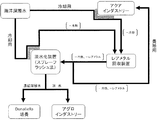
上記フローの概略を図5に示す。図5は、上記工程を全て記載したものであって、図5のいくつかは行わないことも可能であり、それも本発明に含まれる。
図5中、「−冷熱」は、冷熱ではなくなり昇温したことを示し、「−レアメタル」は、レアメタルが回収されてなくなった(少なくなった)ことを示す。また、斜線のハッチは、熱交換が起ったことを示す。
FIG. 5 shows an outline of the above flow. FIG. 5 illustrates all of the above steps, and some of the steps in FIG. 5 may not be performed, which is also included in the present invention.
In FIG. 5, “−cold heat” indicates that the temperature was raised instead of cold heat, and “−rare metal” indicates that the rare metal was not collected (reduced). A hatched hatch indicates that heat exchange has occurred.
海洋深層水には、リン(P)やカリウム(K)が豊富に含まれるので、海洋深層水から淡水を取り出した後の「濃縮深層水」は、更に高濃度のリン(P)やカリウム(K)を含むこともあり、高度好塩性微細藻類を特に好適に培養することができる。
また、温度差淡水化法の冷媒として用いたり、太陽熱で昇温したり、海洋深層水濃縮ユニットEで用いたり、種々のアクアインダストリーで用いたり、レアメタルを回収したり、それらを組み合わせたりすれば、(化石燃料からの)熱エネルギーを別途供給して加温しなくても海洋深層水を昇温でき、高度好塩性微細藻類を特に好適に培養することができる。
Since deep sea water contains abundant phosphorus (P) and potassium (K), "concentrated deep water" after extracting fresh water from deep sea water has a higher concentration of phosphorus (P) and potassium (K). K), which makes it possible to particularly preferably culture highly halophilic microalgae.
Also, if used as a refrigerant in the temperature difference desalination method, or heated by solar heat, used in the deep sea water concentration unit E, used in various aqua industries, recovering rare metals, or combining them In addition, it is possible to raise the temperature of the deep ocean water without heating by separately supplying thermal energy (from fossil fuel), and it is possible to particularly preferably culture highly halophilic microalgae.
後記する海洋深層水濃縮ユニットEで、海洋深層水を、太陽熱を利用して水を蒸発させて濃縮させることによって、高度好塩性微細藻類の培養に必要な窒素(N)源やリン(P)源の濃度を上げることができ好適であるが、同時に海洋深層水(海水)の食塩(塩化ナトリウム)濃度も(例えば約15質量%まで)上がってしまう。
しかしながら、高度好塩性微細藻類は、高い食塩(塩化ナトリウム)濃度(例えば約15質量%)でも培養可能である。
その点からも、太陽熱を利用して、窒素(N)源やリン(P)源の濃度を上げる「海洋深層水濃縮ユニットE」は、高度好塩性微細藻類を培養する「高度好塩性微細藻類培養ユニット3」と良くマッチングしている。
In the deep sea water concentration unit E described later, the deep sea water is concentrated by evaporating water using solar heat, thereby obtaining nitrogen (N) source and phosphorus (P) necessary for culturing highly halophilic microalgae. ) The concentration of the source can be increased, which is preferable, but at the same time, the concentration of sodium chloride (sodium chloride) in the deep sea water (sea water) also increases (for example, to about 15% by mass).
However, highly halophilic microalgae can be cultured even at high salt (sodium chloride) concentrations (eg, about 15% by mass).
From that point of view, the “Deep Sea Water Concentration Unit E”, which increases the concentration of nitrogen (N) and phosphorus (P) sources using solar heat, is used to “cultivate highly halophilic microalgae”. It matches well with the
また、高い食塩(塩化ナトリウム)濃度(例えば約15質量%)になると、雑菌が繁殖し難くなり、コンタミネーション(汚染)が少なくなるので、高度好塩性微細藻類の増殖に好都合である。 In addition, when the salt (sodium chloride) concentration becomes high (for example, about 15% by mass), it becomes difficult for bacteria to grow and contamination (contamination) is reduced, which is advantageous for the growth of highly halophilic microalgae.
海洋深層水には、窒素(N)とリン(P)が豊富であり、かつ無菌である。これらの組成・物性を安価に獲得できる、又は、上記マルチ温度差淡水化法を用いる淡水製造ユニット1で副産物(冷媒として使用した残り又は淡水を取り除くことにより濃縮させたもの)として獲得できるので、システム全体として経済収支が黒字にさせ易い。このように、海洋深層水は、高度好塩性微細藻類の培養に好適であると共に、システム全体として変動費を低減できる。
Deep ocean water is rich in nitrogen (N) and phosphorus (P) and is sterile. Since these compositions and physical properties can be obtained at a low cost, or can be obtained as by-products (residuals used as refrigerants or concentrated by removing fresh water) in the fresh
上記高度好塩性微細藻類培養ユニット3では、二酸化炭素の削減やコスト削減等の点で、光エネルギーとして太陽光を用いることが好ましい。また、培養液の撹拌は、二酸化炭素の削減やコスト削減等の点で、風力を用いることが好ましい。
In the highly halophilic
上記高度好塩性微細藻類培養ユニット3における微細藻類の培養は、公知の方法を用いることができる。コスト削減や人為的なコントロールを減らす等の点から、連続培養することが好ましく、棚田式の連続培養であることがより好ましい。
For culturing the microalgae in the highly halophilic
<分離回収ユニット>
上記高度好塩性微細藻類からは、次の具体例には限定されないが、カロテン類、グルタチオン、グリセリン、タンパク質、炭水化物、油脂等の有価物が得られる。
分離回収ユニット4では、上記培養した微細藻類から、カロテン類、グルタチオン、グリセリン、タンパク質、炭水化物及び油脂からなる群から選ばれる少なくとも1種の有価物を分離回収することが必須である。
上記分離回収ユニット4では、上記培養した微細藻類から、カロテン類、グルタチオン、グリセリン、タンパク質、炭水化物、及び/又は、油脂を分離回収する。なお、本明細書中で「及び/又は」とは、「及び」又は「又は」を意味する。
上記成分の分離回収は、公知の方法を用いればよい。該分離回収の際に必要となるエネルギーは、二酸化炭素の削減やコスト削減等の点で、下記発電ユニットDで発生する電力を用いることが好ましい。
<Separation and recovery unit>
From the highly halophilic microalgae, valuable resources such as carotenes, glutathione, glycerin, proteins, carbohydrates, oils and fats can be obtained without being limited to the following specific examples.
In the separation and
The separation and
A known method may be used to separate and collect the above components. As the energy required for the separation and recovery, it is preferable to use the power generated by the power generation unit D described below in terms of reduction of carbon dioxide and cost.
上記分離回収ユニット4により回収されたカロテン類は、高い抗酸化作用を有し、例えば、医薬品、食品、食品添加物、サプリメント等に利用することができる。
The carotenes recovered by the separation and
上記分離回収ユニット4により回収されたグルタチオンは、高い抗酸化作用を有し、例えば、医薬品、食品、サプリメント、肥料、飼料等に利用することができる。
また、該回収されたグルタチオンは、上記陸上植物生産ユニット2で利用することにより、陸上植物の光合成を促進することができるので、分離回収ユニット4と陸上植物生産ユニット2との併用は、相乗効果を奏する。
Glutathione recovered by the separation and
In addition, the use of the recovered glutathione in the land
上記分離回収ユニット4により回収されたグリセリンは、例えば、化粧品、医薬品等の原料としても、燃料としても、好適に利用することができる。また、下記のグリセリン利用ユニット5の原料として用いることができるので、分離回収ユニット4とグリセリン利用ユニット5とは、よくマッチングしていて相乗効果を発揮する。
The glycerin recovered by the separation and
上記分離回収ユニット4により回収された油脂は、例えば、食料用油、飼料用油、燃料油等に利用することができる。
The fats and oils collected by the separation and
上記分離回収ユニット4において、上記有価物回収後の微細藻類には良質なタンパク質が含まれているので、例えば、飼料、醗酵原料等として利用することができる。また、下記海産動物養殖ユニット6において、海産動物の餌として利用することができるので、利用することが好ましい。
In the separation and
<グリセリン利用ユニット>
上記グリセリン利用ユニット5では、上記分離回収ユニット4で得られたグリセリンを香粧品原料や食用として利用する及び/又は炭素(C)源として醗酵させて、アミノ酸、ペプチド若しくはタンパク質、炭素数6以下のアルコール、油脂、燃料、及び/又は、醗酵残渣を得る。
再生可能エネルギー利用分野においては、従来技術では世界的に炭素(C)源が不足しており、例えばサトウキビ等から抽出した糖蜜から砂糖を結晶させたあとに残る廃糖蜜の量では、例えばバイオエタノール(エタノール工業)成立のためには足りず、産業として実現していない。本発明の再生可能エネルギー利用システムでは、上記高度好塩性微細藻類培養ユニット3とグリセリン利用ユニット5を組み合わせることで、上記分離回収ユニット4で得られたグリセリンを炭素(C)源として有効活用できる。
<Glycerin utilization unit>
In the
In the field of renewable energy utilization, the prior art lacks a carbon (C) source worldwide, and for example, the amount of molasses remaining after crystallizing sugar from molasses extracted from sugarcane etc. (Ethanol industry) It is not enough to be established and has not been realized as an industry. In the renewable energy utilization system of the present invention, the glycerin obtained in the separation and
上記グリセリンは、グリセリンを資化する油脂酵母による醗酵によって、油脂を得ることができる。該油脂は、燃料、エネルギー源等として利用することができる。 The above-mentioned glycerin can obtain an oil or fat by fermentation using an oil or fat yeast that assimilates glycerin. The fats and oils can be used as fuels, energy sources and the like.
上記グリセリンは、酵素醗酵によって、アミノ酸、ペプチド、タンパク質等を得ることができる。アミノ酸、ペプチド、タンパク質等は、食品、医薬品、化粧品等の原料として用いることができる。 Amino acids, peptides, proteins and the like can be obtained from the glycerin by enzyme fermentation. Amino acids, peptides, proteins, and the like can be used as raw materials for foods, pharmaceuticals, cosmetics, and the like.
上記炭素数6以下のアルコールは、例えば、エタノール、ブタノール等が挙げられる。該炭素数6以下のアルコールは、燃料、各種化学品の原料等に利用することができる。 Examples of the alcohol having 6 or less carbon atoms include ethanol and butanol. The alcohol having 6 or less carbon atoms can be used as a fuel, a raw material for various chemicals, and the like.
また、上記グリセリンを燃焼させることによって、該グリセリン自体を熱エネルギー(燃料)として利用することができる。 Further, by burning the glycerin, the glycerin itself can be used as thermal energy (fuel).
また、上記グリセリンは、例えば、プロパンジオール等に変換して化学品原料として用いる、バイオリファイナリー技術での原料として用いることができる。 The glycerin can be used as a raw material in biorefinery technology, for example, converted into propanediol or the like and used as a chemical raw material.
上記グリセリン利用ユニット5において、醗酵により得られる醗酵残渣は、窒素(N)源やリン(P)源として、上記陸上植物生産ユニット2や高度好塩性微細藻類培養ユニット3で再利用することができる。
グリセリン利用ユニット5においては、窒素(N)とリン(P)は、「グリセリンを資化する油脂酵母」の餌として、外部(限定はされないが例えば、窒素(N)は鉱物、ペプトン等として、リン(P)は鉱物、下水等)から供給せざるを得ない。しかし、グリセリン利用ユニット5の該醗酵残渣中に残存する窒素(N)とリン(P)は、上記陸上植物生産ユニット2や高度好塩性微細藻類培養ユニット3で有効に再利用することができる。
In the
In the
世界的に窒素源とリン源は不足している。本発明の再生可能エネルギー利用システムでは、窒素(N)源とリン(P)源は、一部不足分は外部から供給せざるを得ないが、それらが本発明の複数のユニットの組み合わせで無駄になることはない。
また、後記する「シアノバクテリアを利用する窒素固定ユニットF」で窒素(N)を固定すれば、不足分の窒素(N)源を大気から補強することができ、更に組み合わせ効果(相乗効果)を発揮するので好ましい。
There is a shortage of nitrogen and phosphorus sources worldwide. In the renewable energy utilization system of the present invention, the nitrogen (N) source and the phosphorus (P) source have to be partially supplied from the outside, but they are wasted by combining a plurality of units of the present invention. Never be.
In addition, if nitrogen (N) is fixed by the “nitrogen fixing unit F using cyanobacteria” described later, the insufficient nitrogen (N) source can be reinforced from the atmosphere, and the combined effect (synergistic effect) can be further improved. It is preferable because it demonstrates.
また、醗酵残渣からメタンガスを発生させることにより、該メタンガスを燃料として用いることができる。 Further, by generating methane gas from the fermentation residue, the methane gas can be used as fuel.
<その他のユニット>
本発明の再生可能エネルギー利用システムは、上記ユニット(1)ないし(5)に加えて、「その他のユニット」を有していることが好ましい。「その他のユニット」としては、以下のユニット(6)や(A)〜(F)、海洋深層水からレアメタルを回収するレアメタル回収ユニット等が挙げられる。該再生可能エネルギー利用システムは、上記ユニット(1)ないし(5)に加えて、更に、1つの「その他のユニット」を有していてもよいし、2つ以上の「その他のユニット」を有していてもよい。
「その他のユニット」を有していることにより、上記ユニット(1)ないし(5)を含む各ユニットで得られた副産物・残渣・エネルギー等を余すことなく、他のユニットで有効利用することができ易くなり、複数のユニットが相乗的に作用して、更にシステム全体として経済収支を黒字にし易くできる。
<Other units>
The renewable energy utilization system of the present invention preferably has “other units” in addition to the units (1) to (5). Examples of the “other units” include the following units (6) and (A) to (F), a rare metal recovery unit that recovers rare metal from deep ocean water, and the like. The renewable energy utilization system may have one “other unit” or two or more “other units” in addition to the units (1) to (5). It may be.
By having "other units", by-products, residues, energy, etc., obtained in each unit including the above units (1) to (5) can be effectively used in other units. This makes it easier for the plurality of units to act synergistically, and furthermore, to make the economic balance of the system as a whole profitable.
(6)飼料・餌料用微細藻類を餌として海洋深層水で海産動物を養殖する海産動物養殖ユニット
(A)海洋深層水で上記飼料・餌料用微細藻類を培養する飼料・餌料用微細藻類培養ユニット
(B)上記海産動物養殖ユニット6で得た養殖排水を肥料として海藻を生産する海藻生産ユニット
(C)上記海藻生産ユニットBで生産した海藻中のマンニトールを利用して水素を得る水素生産ユニット
(D)熱源として太陽熱を用いて、及び/又は、冷源として海洋深層水を用いて冷熱温度差発電をする発電ユニット
(E)海洋深層水を、太陽熱を利用して水を蒸発させて濃縮する海洋深層水濃縮ユニット
(F)シアノバクテリアを利用して大気中の窒素を固定する窒素固定ユニット
上記ユニット(A)ないし(F)の全てを有する場合の、再生可能エネルギー利用システムの概略の一例を図2に示す。なお、本発明の再生可能エネルギー利用システムは、図2の具体例には限定されない。
(6) A marine animal cultivation unit for culturing marine animals in deep sea water using feed and feed microalgae as a feed (A) A feed / feed microalgae culture unit for culturing the above feed / feed microalgae in deep sea water (B) A seaweed production unit that produces seaweed using the culture wastewater obtained by the marine
<海産動物養殖ユニット>
上記海産動物養殖ユニット6では、飼料・餌料用微細藻類を餌として海洋深層水で海産動物を養殖する。
海洋深層水は、資源を無駄なく利用する点等で、上記淡水製造ユニット1において、温度差淡水化法の冷媒として用いることによって昇温させた海洋深層水を使用することが好ましい。
更に、海洋深層水を使用すれば、窒素(N)とリン(P)が豊富で、無菌(清浄)化が達成できているので、該飼料・餌料用微細藻類の増殖や該海産物の養殖にも好適である。
<Marine Animal Farming Unit>
The marine
It is preferable to use the deep sea water whose temperature is raised by using it as a refrigerant in the temperature difference desalination method in the fresh
Furthermore, if deep sea water is used, nitrogen (N) and phosphorus (P) are abundant and sterilization (cleaning) can be achieved, so that it is possible to grow microalgae for feed and feed and to cultivate the marine products. Are also suitable.
海洋深層水は、上記「温度差淡水化法を用いる淡水製造ユニット1」でも副産物(冷媒として使用した残り)として獲得でき、下記「海洋深層水を用いて冷熱温度差発電をする発電ユニットD」でも副産物(冷源として使用した残り)として獲得できるので、本発明は、システム全体として変動費(原料費)を低減できて経済収支が黒字にさせ易い。
Deep seawater can also be obtained as a by-product (the remainder used as a refrigerant) in the above-mentioned “
上記海産動物は、例えば、アサリ、ハマグリ、ムール貝、牡蠣、ホタテ等の二枚貝;エビ、カニ等の甲殻類;魚類等が挙げられる。
上記海産動物養殖ユニット6では、1種又は2種以上の海産動物を養殖することができる。
Examples of the marine animals include clams such as clams, clams, mussels, oysters and scallops; shellfish such as shrimps and crabs; and fishes.
In the marine
上記飼料・餌料用微細藻類は、例えば、キートセロス(Chaetoceros)属、スケレトネマ(Skeletonema)属等の珪藻類;パプロバ(Pavlova)属、イソクリシス(Isochrysis)属等のハプト藻類;緑藻類;ナンノクロロプシス(Nannochlopsis)属等の真眼点藻類;等が挙げられる。餌料として用いられる;海洋深層水での培養に適している;等の点で、珪藻類が好ましく、キートセロス(Chaetoceros)属に属する微細藻類がより好ましい。
1種又は2種以上の飼料・餌料用微細藻類を餌として用いることができる。
該飼料・餌料用微細藻類は、飼料・餌料用微細藻類培養ユニットAから得ることができる。
Examples of the microalgae for feed / feed include diatoms such as genus Chaetoceros and Skeletonema; haptoalga such as genus Paplova and genus Isochrysis; green algae; Nannochloropsis. ) Genus etc .; Diatoms are preferred in terms of being used as a feed; suitable for culturing in deep ocean water; and the like, and microalgae belonging to the genus Chaetoceros are more preferred.
One or more types of feed and feed microalgae can be used as feed.
The feed and feed microalgae can be obtained from the feed and feed microalgae culture unit A.
<飼料・餌料用微細藻類培養ユニット>
上記飼料・餌料用微細藻類培養ユニットAでは、海洋深層水で上記飼料・餌料用微細藻類を培養する。
得られた飼料・餌料用微細藻類は、上記海産動物養殖ユニット6において、海産動物の餌として用いることができる。
<Microalgae cultivation unit for feed and feed>
In the feed / feed microalgae culturing unit A, the feed / feed microalgae is cultured in deep sea water.
The obtained microalgae for feed and feed can be used as a feed for marine animals in the marine
飼料・餌料用微細藻類の具体例は、上述のとおりである。上記飼料・餌料用微細藻類培養ユニットAでは、1種又は2種以上の高度好塩性微細藻類を培養することができる。
餌料として用いられる;海洋深層水での培養に適している;等の点で、珪藻類が好ましく、キートセロス(Chaetoceros)属に属する微細藻類がより好ましい。
Specific examples of the microalgae for feed and feed are as described above. In the microalgae culturing unit A for feed and feed, one or more highly halophilic microalgae can be cultured.
Diatoms are preferred in terms of being used as a feed; suitable for culturing in deep ocean water; and the like, and microalgae belonging to the genus Chaetoceros are more preferred.
海洋深層水は、資源を無駄なく利用する点等で、上記淡水製造ユニット1において、温度差淡水化法の冷媒として用いることによって昇温させた海洋深層水を使用することが好ましい。
更に、海洋深層水を使用すれば、窒素(N)とリン(P)が豊富で、無菌(清浄)化が達成できているので、該飼料・餌料用微細藻類の増殖にも好適である。
海洋深層水は、上記「温度差淡水化法を用いる淡水製造ユニット1」でも副産物(冷媒として使用した残り)として獲得でき、下記「海洋深層水を用いて冷熱温度差発電をする発電ユニットD」でも副産物(冷源として使用した残り)として獲得できるので、本発明は、システム全体として変動費(原料費)を低減できて、経済収支が黒字にさせ易い。
It is preferable to use the deep sea water whose temperature is raised by using it as a refrigerant in the temperature difference desalination method in the fresh
Furthermore, if deep sea water is used, nitrogen (N) and phosphorus (P) are abundant and sterilization (cleaning) can be achieved, so that it is suitable for the propagation of the microalgae for feed and feed.
Deep seawater can also be obtained as a by-product (the remainder used as a refrigerant) in the above-mentioned “
<海藻生産ユニット>
上記海藻生産ユニットBでは、上記海産動物養殖ユニット6で得た養殖排水を肥料として海藻を生産する。
該養殖排水中には、上記海産動物養殖ユニット6で使用した海洋深層水中の窒素(N)とリン(P)が養殖排水中に残存するので、窒素(N)源とリン(P)源として、該海藻の肥料に利用することができる。
<Seaweed production unit>
The seaweed production unit B produces seaweed using the culture wastewater obtained in the marine
Since nitrogen (N) and phosphorus (P) in the deep sea water used in the marine
上記海藻は、例えば、コンブ、ノコギリモク、クビレズタ、ヤナギモク、アラメ、ツルアラメ、ワカメ、アオモク、ヒジキ等が挙げられる。下記マンニトールを多く回収できる点で、所謂大型海藻が好ましく、具体的には、コンブ、ノコギリモク、クビレズタ、アラメ、ワカメ等が特に好ましい。
上記海藻生産ユニットBでは、1種又は2種以上の海藻を生産することができる。
The seaweed includes, for example, kelp, sawtoothed moku, kubirezuta, willow moku, arame, tsuruarame, wakame, aomok, hijiki and the like. So-called large seaweeds are preferred in that a large amount of the following mannitol can be recovered, and specifically, kelp, saw-toothed moku, kubirezuta, alame, seaweed and the like are particularly preferred.
In the seaweed production unit B, one or more seaweeds can be produced.
また、上記海藻生産ユニットBでは、海藻が窒素(N)やリン(P)を肥料として吸収することにより、上記養殖排水は浄化され、例えば、再び、海産動物養殖ユニット6で好適に使用することができる。
In the seaweed production unit B, the seaweed absorbs nitrogen (N) and phosphorus (P) as a fertilizer, so that the culture wastewater is purified. For example, the seaweed production unit B can be suitably used in the marine
<水素生産ユニット>
上記水素生産ユニットCでは、上記海藻生産ユニットBで生産した海藻中のマンニトールを利用して水素を得る。得られた水素は、燃料等として使用することができる。
海藻からマンニトールを得る方法や、該マンニトールから水素を得る方法は、公知の方法を用いることができる。
<Hydrogen production unit>
In the hydrogen production unit C, hydrogen is obtained using mannitol in the seaweed produced in the seaweed production unit B. The obtained hydrogen can be used as fuel or the like.
Known methods can be used for obtaining mannitol from seaweed and for obtaining hydrogen from the mannitol.
<発電ユニット>
上記発電ユニットDでは、熱源として太陽熱を用いて、及び/又は、冷源として海洋深層水を用いて冷熱温度差発電をする。
<Power generation unit>
In the power generation unit D, the thermal temperature difference power generation is performed using solar heat as a heat source and / or using deep ocean water as a cold source.
熱源として太陽熱を用いて、及び/又は、冷源として海洋深層水を用いて冷熱温度差発電をする方法は、熱源としては、太陽熱を利用したソーラー吸収冷温水機等の公知の手段を用いることができる。
上記発電ユニットDで得られた電力は、例えば、陸上植物生産ユニット2や、海産動物養殖ユニット6、海藻生産ユニットB等で用いることができる。
A method for generating thermal energy difference using solar heat as a heat source and / or deep ocean water as a cold source uses a known means such as a solar absorption chiller / heater using solar heat as a heat source. Can be.
The electric power obtained by the power generation unit D can be used, for example, in the land
<海洋深層水濃縮ユニット>
上記海洋深層水濃縮ユニットEでは、海洋深層水を、太陽熱を利用して水を蒸発させて濃縮する。
得られた濃縮海洋深層水は、上記高度好塩性微細藻類培養ユニット3において、高度好塩性微細藻類の培養に用いることができる。
<Deep sea water concentration unit>
In the deep sea water concentration unit E, deep sea water is concentrated by evaporating water using solar heat.
The obtained concentrated deep seawater can be used for culturing highly halophilic microalgae in the highly halophilic
上記海洋深層水濃縮ユニットEで、海洋深層水の塩化ナトリウム濃度を、好ましくは5〜30質量%、より好ましくは10〜25質量%、特に好ましくは15〜20質量%に濃縮することが好ましい。
上記範囲内に濃縮すると、雑菌等のコンタミネーションがない海洋深層水において、更にコンタミネーションが起こり難くなり、上記高度好塩性微細藻類を効率よく培養することができる。
また、上記高度好塩性微細藻類は、塩化ナトリウム濃度が高くても培養でき、16〜17質量%の塩化ナトリウム濃度が最適とされているので、上記範囲内に海水を濃縮することが好ましい。
In the deep ocean water concentration unit E, the concentration of sodium chloride in the deep ocean water is preferably reduced to 5 to 30% by mass, more preferably 10 to 25% by mass, and particularly preferably 15 to 20% by mass.
Concentration within the above range makes it harder for contamination to occur in deep ocean water free of contamination such as germs, so that the highly halophilic microalgae can be cultured efficiently.
The highly halophilic microalgae can be cultured even when the concentration of sodium chloride is high, and the concentration of sodium chloride of 16 to 17% by mass is optimized. Therefore, it is preferable to concentrate seawater within the above range.
<窒素固定ユニット>
上記窒素固定ユニットFでは、シアノバクテリアを利用して大気中の窒素を固定する。
得られた窒素(N)源は、上記陸上植物生産ユニット2での陸上植物の生産や、高度好塩性微細藻類培養ユニット3での高度好塩性微細藻類の培養に用いることができる。
海洋深層水は、上記海洋深層水濃縮ユニットEで、高度好塩性微細藻類の培養に最適な16〜17質量%の塩化ナトリウム濃度になるまで濃縮しても、該微細藻類の培養に必要な窒素(N)濃度、リン(P)濃度には達しない(必要量の1/3程度)。そのため、窒素(N)源を、窒素固定ユニットFで確保して、前記高度好塩性微細藻類培養ユニット3に供給することは、本発明のシステムとして好ましい。
<Nitrogen fixing unit>
In the nitrogen fixing unit F, nitrogen in the atmosphere is fixed using cyanobacteria.
The obtained nitrogen (N) source can be used for the production of land plants in the land
Even if the deep sea water is concentrated in the deep sea water concentration unit E to a sodium chloride concentration of 16 to 17% by mass, which is optimal for the culture of highly halophilic microalgae, it is necessary for the culture of the microalgae. Nitrogen (N) concentration and phosphorus (P) concentration are not reached (about 1/3 of required amount). Therefore, securing a nitrogen (N) source in the nitrogen fixing unit F and supplying it to the highly halophilic
上記シアノバクテリアとして、例えば、アナベナ(Anabaena)属、ノストック(Nostoc)属、カロトリックス(Calothrix)属、トリコデスミウム(Trichodesmium)属、プレクトネマ(Plectonema)属等が挙げられ、アナベナ(Anabaena)属又はノストック(Nostoc)属を用いることが好ましい。
上記窒素固定ユニットFでは、1種又は2種以上のシアノバクテリアを使用することができる。
Examples of the cyanobacteria include genus Anabaena, genus Nostoc, genus Calothrix, genus Trichodesmium, genus Plectonema, and genus Anabaena. Alternatively, it is preferable to use the genus Nostoc.
In the nitrogen fixing unit F, one or more cyanobacteria can be used.
また、本発明の再生可能エネルギー利用システムにおいては、上記グリセリン利用ユニット5において、醗酵残渣を、上記陸上植物生産ユニット2及び/又は上記高度好塩性微細藻類培養ユニット3において、窒素(N)源及びリン(P)源として用いることが、不足している窒素(N)源及びリン(P)源を有効利用する点から好ましい。
Further, in the renewable energy utilization system of the present invention, in the
<レアメタル回収ユニット>
上記レアメタル回収ユニットでは、海洋深層水からレアメタルを回収する。
海洋深層水は、本発明の再生可能エネルギー利用システムで発生する産物を余すことなく利用する点等で、上記淡水製造ユニット1において、温度差淡水化法の冷媒として用いることによって昇温させた海洋深層水を使用することが好ましい。
<Rare metal collection unit>
The rare metal recovery unit recovers rare metals from deep sea water.
In the
上記レアメタルとしては、例えば、リチウム、ルビジウム、ストロンチウム、モリブデン等が挙げられる。
海洋深層水からレアメタルを回収する方法は、それぞれの金属に応じて公知の方法を用いることができる。
Examples of the rare metal include lithium, rubidium, strontium, and molybdenum.
As a method for recovering rare metals from deep ocean water, known methods can be used according to each metal.
上記レアメタルを回収した海洋深層水は、上記海産動物養殖ユニット6における海産動物の養殖や、上記飼料・餌料用微細藻類培養ユニットAにおける飼料・餌料用微細藻類の培養に用いることができる。
The deep sea water from which the rare metal has been collected can be used for culturing marine animals in the marine
<再生可能エネルギーシステムの設置場所>
本発明の再生可能エネルギーシステムは、太陽光エネルギーを十分確保できる地域に設置されることが好ましい。具体的には、再生可能エネルギーのポテンシャルが高い場所である中緯度地域に設置されることが好ましい。
また、本発明の再生可能エネルギー利用システムは、海洋性微細藻類を培養する上記高度好塩性微細藻類培養ユニット3や、海洋深層水で海産動物を養殖する上記海産動物養殖ユニット6を有しているので、海の近くに設置されることが好ましい。
また、前記陸上植物生産ユニット2の箇所で記載した地域に設置されることが特に好ましい。
<Installation location of renewable energy system>
The renewable energy system of the present invention is preferably installed in an area where solar energy can be sufficiently secured. Specifically, it is preferably installed in a middle latitude area where renewable energy potential is high.
In addition, the renewable energy utilization system of the present invention includes the highly halophilic
In addition, it is particularly preferable to be installed in the area described for the land
以下に、実施例及び比較例を挙げて本発明を更に具体的に説明するが、本発明は、その要旨を超えない限りこれらの実施例に限定されるものではない。 Hereinafter, the present invention will be described more specifically with reference to Examples and Comparative Examples, but the present invention is not limited to these Examples as long as the gist of the present invention is not exceeded.
実施例1
<ユニット1、2>
淡水製造ユニット1及び陸上植物生産ユニット2は、何れも公知の方法で実施できる。
Example 1
<
Both the
実施例2
<ユニット3>
[濃縮海水を用いたデュナリエラ属の培養]
月島機械株式会社から譲渡された濃縮海水(濃縮された海洋表層水)を用いて、デュナリエラ(Dunaliella)属に属する微細藻類であるデュナリエラ・サリナ(Dunaliella salina)の培養を行った。表1に、該濃縮海水の分析結果を示す。
Example 2
<
[Culture of Dunaliella sp. Using concentrated seawater]
Using concentrated seawater (concentrated marine surface water) transferred from Tsukishima Kikai Co., Ltd., Dunaliella salina, a microalga belonging to the genus Dunaliella, was cultured. Table 1 shows the analysis results of the concentrated seawater.

表1の結果より、Si(ケイ素)を除くと、海洋深層水の利用を想定した場合、該濃縮海水は、太平洋の水深150m程度の海水を2倍濃縮したものに該当する。 From the results in Table 1, when Si (silicon) is excluded, assuming the use of deep ocean water, the concentrated seawater corresponds to double-concentrated seawater at a depth of about 150 m in the Pacific Ocean.
次に、以下の4条件においてデュナリエラ(Dunaliella)属に属する微細藻類であるデュナリエラ・サリナ(Dunaliella salina)の培養を行った。 Next, under the following four conditions, Dunaliella salina, a microalga belonging to the genus Dunaliella, was cultured.
条件1:培養液として、人工海水にNaClを加えて塩濃度を7質量%とし、N(窒素)7.8mgとP(リン)2.4mgを加えたものを使用。
条件2:培養液として、上記濃縮海水にN(窒素)7.8mgとP(リン)2.4mgを加えたものを使用。
条件3:培養液として、上記濃縮海水にN(窒素)7.8mgとP(リン)2.4mgを加え、更にCH3COONa(酢酸ナトリウム)を加えたものを使用。
条件4:培養液として、上記濃縮海水を使用。
Condition 1: A culture solution prepared by adding NaCl to artificial seawater to a salt concentration of 7% by mass and adding 7.8 mg of N (nitrogen) and 2.4 mg of P (phosphorus) is used.
Condition 2: A culture solution obtained by adding 7.8 mg of N (nitrogen) and 2.4 mg of P (phosphorus) to the above concentrated seawater is used.
Condition 3: A culture solution obtained by adding 7.8 mg of N (nitrogen) and 2.4 mg of P (phosphorus) to the above concentrated seawater, and further adding CH 3 COONa (sodium acetate).
Condition 4: The above concentrated seawater is used as a culture solution.
条件1〜3は、デュナリエラ・サリナ(Dunaliella salina)100mLに対して、培養液300mLを加えて培養を行った。条件4に関しては、デュナリエラ・サリナ(Dunaliella salina)75mLに対して、培養液225mLを加えて培養を行った。何れの条件においても、4倍希釈になるように調整した。
また、各条件とも、温度25℃、照度5500Lux下で培養を行った。
Under the
In addition, culturing was performed at a temperature of 25 ° C. and an illuminance of 5500 Lux under each condition.
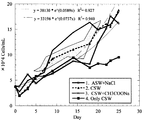
培養結果を図3に示す。図1中、縦軸は細胞数(×104細胞数/mL)、横軸は培養日数(日)を示す。また、「1.ASW+NaCl」は条件1、「2.CSW」は条件2、「3.CSW+CH3COONa」は条件3、「4.Only CSW」は条件4の結果を示す。
The results of the culture are shown in FIG. In FIG. 1, the vertical axis indicates the number of cells (× 10 4 cells / mL), and the horizontal axis indicates the number of culture days (days). “1. ASW + NaCl” indicates the result of
図3の結果、条件1(塩濃度7質量%の人工海水)や条件4(上記濃縮海水のみ)でも、細胞数が培養初日に比べて増え、塩濃度が高い状態でもデュナリエラ属に属する微細藻類が培養できることがわかった。
また、条件4(濃縮海水のみ)と比べて、条件2(濃縮海水+N+P)の方が、細胞数が大きく増加した。この結果から、培養過程で窒素(N)源やリン(P)源は、更に加えた方がよいことがわかった。
As a result of FIG. 3, the microalgae belonging to the genus Dunaliella even under condition 1 (artificial seawater with a salt concentration of 7% by mass) or condition 4 (only the above-mentioned concentrated seawater) had an increased cell number compared to the first day of culture, even under a high salt concentration. Was found to be cultivable.
In addition, the number of cells was significantly increased in condition 2 (concentrated seawater + N + P) as compared to condition 4 (concentrated seawater only). From this result, it was found that it is better to further add a nitrogen (N) source and a phosphorus (P) source during the culture process.
以上から、海洋深層水が、温度25℃で、デュナリエラ(Dunaliella)属に属する微細藻類の培養に適していることがわかった。すなわち、温度25℃、照度5500Lux下で、大気中の炭素(C)を取り込んで、グリセリン等に変換して、エネルギー密度を好適に高められることが分かった。
なお、条件3(濃縮海水+N+P+CH3COONa)では、培養9日〜18日は、条件2(濃縮海水+N+P)より細胞数が増加していた。この結果から、酢酸ナトリウムを炭素(C)源として利用していることも示唆された。
From the above, it was found that deep sea water was suitable for culturing microalgae belonging to the genus Dunaliella at a temperature of 25 ° C. That is, it was found that at a temperature of 25 ° C. and an illuminance of 5500 Lux, carbon (C) in the atmosphere was taken in and converted to glycerin or the like, whereby the energy density could be suitably increased.
In condition 3 (concentrated seawater + N + P + CH 3 COONa), the number of cells increased from condition 2 (concentrated seawater + N + P) on days 9 to 18 of culture. These results also suggested that sodium acetate was used as a carbon (C) source.
実施例3
次に、培養途中で、リン(P)源や炭素(C)源を加えることによる細胞数の変化を観察した。条件1〜3の培養液を用い、4倍希釈になるように調整し、5.56Lの条件で培養を行った。培養を始めてから1週間後に、リン(P)、4週間後にCH3COONa、5週間後にリン(P)を加えた。
Example 3
Next, during the culture, a change in the number of cells due to the addition of a phosphorus (P) source or a carbon (C) source was observed. Using the culture solution under the
培養結果を図4に示す。図4中、縦軸は細胞数(×104細胞数/mL)、横軸は培養日数(日)を示す。また、B2は条件1、B4は条件2、B7は条件3の結果を示す。
The results of the culture are shown in FIG. In FIG. 4, the vertical axis indicates the number of cells (× 10 4 cells / mL), and the horizontal axis indicates the number of days of culture (days). B2 indicates the result of
図4の結果、条件1〜3の何れの培養液を用いたときでも、培養途中でリン(P)源や炭素(C)源を加えることにより、細胞数が右肩上がりで増加することが分かった。
As a result of FIG. 4, even when any of the culture solutions under the
実施例4
<ユニット4>
[海洋深層水で培養したデュナリエラ属に属する微細藻類からの有効成分の測定]
海洋深層水で培養したデュナリエラ・サリナ(Dunaliella salina)から抽出される有効成分の測定を行った。4倍希釈になるように調整後、温度25℃、照度5500Lux下で培養を行った。
細胞数が約5×10⁵個/mLになるまで培養後、公知の方法により、有効成分を回収し、定量した。定量結果を表2に示す。
Example 4
<
[Measurement of active ingredients from microalgae belonging to the genus Dunaliella cultured in deep ocean water]
The active ingredients extracted from Dunaliella salina cultured in deep ocean water were measured. After adjusting to be 4-fold dilution, culture was performed at a temperature of 25 ° C. and an illuminance of 5500 Lux.
After culturing until the number of cells reached about 5 × 10 5 cells / mL, the active ingredient was recovered and quantified by a known method. Table 2 shows the results of the quantification.
表2の結果、海洋深層水で培養したデュナリエラ属に属する微細藻類から有効成分を回収することができ、該有効成分を利用することができることが示唆された。 The results in Table 2 suggest that the active ingredient can be recovered from microalgae belonging to the genus Dunaliella cultivated in deep sea water, and that the active ingredient can be used.
実施例5
<ユニット5>
グリセリン利用ユニット5は、何れも公知の方法で実施できる。
グリセリン利用ユニット5における醗酵残渣は、上記陸上植物生産ユニット2や上記高度好塩性微細藻類培養ユニット3において、窒素(N)源及びリン(P)源として用いることができる。
ユニット1〜5を組み合わせれば、本発明の前記効果を発揮する。
Example 5
<
The
The fermentation residue in the
When the
実施例6
<ユニット6、A>
海産動物養殖ユニット6及び飼料・餌料微細藻類培養ユニットAは、何れも公知の方法で実施できる。
ユニット1〜5の組み合わせに、更に、ユニット6、Aの何れか1ユニット以上を組み合わせれば、本発明の前記効果を更に発揮する。
Example 6
<
Both the marine
If the combination of the
実施例7
<ユニットB>
[養殖排水を用いた海藻の栽培]
海産動物養殖ユニット6で得た養殖排水を肥料として海藻を生産した。すなわち、牡蠣の飼育排水を用いて、海藻であるクビレズタ(Caulerpa lentillifera)の栽培を行った。1週間に1度、50質量%の換水を行った。
その結果、海産動物養殖ユニット6で得た養殖排水を用いれば、クビレズタを長期間にわたって栽培できることがわかった。
Example 7
<Unit B>
[Cultivation of seaweed using aquaculture wastewater]
Seaweed was produced using the culture wastewater obtained by the marine
As a result, it was found that if the culture wastewater obtained by the marine
実施例8
<ユニットC、D、E、F>
ユニットC、D、E、Fは、何れも公知の方法で実施できる。
ユニット1〜5の組み合わせに、更に、ユニットC、D、E、Fの何れか1ユニット以上を組み合わせれば、本発明の前記効果を更に発揮する。
Example 8
<Unit C, D, E, F>
Each of the units C, D, E, and F can be implemented by a known method.
If the combination of the
実施例9
ユニット(1)ないし(5)の全てのユニットを有する本発明における各ユニットのコストを、ユニット(1)ないし(5)を単独で実施したときのコストと比較したものを表3に示す。
表3中に、コストの具体的数値(円)は記載しなかったが、組み合わせたときと組み合わせなかったときの比較はできる。
Example 9
Table 3 shows a comparison of the cost of each unit in the present invention having all the units (1) to (5) with the cost when the units (1) to (5) are implemented alone.
In Table 3, the specific numerical value (yen) of the cost is not described, but the comparison can be made when the combination is performed and when the combination is not performed.
表3から分かるように、淡水製造ユニット(ユニット(1))では、組み合わせると、燃料代(N)が不要となる。
陸上植物生産ユニット(ユニット(2))では、組み合わせると、温度調整コスト(E)が30%となり、肥料代(F)が50%になる。
高度好塩性微細藻類培養ユニット(ユニット(3))では、組み合わせると、海洋深層水の昇温や濃縮(α)が不要になると共に、昇温時間や昇温設備(α)が不要となる
As can be seen from Table 3, in the freshwater production unit (unit (1)), when combined, the fuel cost (N) becomes unnecessary.
In the land plant production unit (unit (2)), when combined, the temperature adjustment cost (E) becomes 30% and the fertilizer cost (F) becomes 50%.
In the highly halophilic microalgae culturing unit (unit (3)), when combined, the temperature rise and concentration (α) of deep ocean water become unnecessary, and the temperature rise time and temperature rise equipment (α) become unnecessary.
また、表3には示さなかったが、分離回収ユニット(ユニット(4))で分離回収したカロテン類、グルタチオン、グリセリン、タンパク質、炭水化物、及び/又は、油脂が、他のユニット(図2等参照)や別途用途で有効利用できるので、コスト的に当然に有利になる。
また、表3には示さなかったが、グリセリン利用ユニット(ユニット(5))で、グリセリンを醗酵させて得られた、アミノ酸、ペプチド若しくはタンパク質、炭素数6以下のアルコール、油脂、燃料、及び/又は、醗酵残渣が、他のユニット(図2等参照)や別途用途で有効利用できるので、コスト的に有利になる。
Although not shown in Table 3, carotenes, glutathione, glycerin, proteins, carbohydrates, and / or fats and oils separated and collected by the separation and collection unit (unit (4)) were replaced with other units (see FIG. 2 and the like). ) And other applications can be effectively used, which is naturally advantageous in terms of cost.
Although not shown in Table 3, amino acids, peptides or proteins obtained by fermenting glycerin in a glycerin utilization unit (unit (5)), alcohols having a carbon number of 6 or less, oils and fats, fuels, and / or Alternatively, the fermentation residue can be effectively used in another unit (see FIG. 2 and the like) or in a separate application, which is advantageous in cost.
このように、ユニット(1)ないし(5)の全てを有することによって、意外にも相乗的にコスト的に極めて有利になるので、ユニット(1)、(2)、(3)、(4)、(5)は極めてよくマッチングしていることが分かった。ユニット(1)ないし(5)は、あるユニットの副産物が、丁度他のユニットで利用できるようになっているので、特異的にコストダウンが図れる。
本発明では、各ユニットが極めて大規模である。そのため、1つのユニットでの副産物を「場所的に集中された本発明のシステム」では、副産物を有効利用することが、極めて大きなコストダウンに結び付く。
As described above, since all of the units (1) to (5) are surprisingly and synergistically extremely advantageous in terms of cost, the units (1), (2), (3), (4) , (5) were found to match very well. In units (1) to (5), by-products of a certain unit can be used in another unit, so that the cost can be reduced specifically.
In the present invention, each unit is very large. Therefore, in the "system of the present invention in which the by-products in one unit are concentrated", the effective use of the by-products leads to an extremely large cost reduction.
更に、これらユニットに、ユニット(6)、(A)、(B)、(C)、(D)、(E)及び/又は(F)を組み合わせると、更にコスト的に有利になる。 Further, when these units are combined with the units (6), (A), (B), (C), (D), (E) and / or (F), the cost becomes more advantageous.
未利用資源である微細藻類と3つの特徴(すなわち、低温性、清浄性、高栄養塩類性)を持つ海洋深層水とを組み合わせた相乗効果が発揮されると、沙漠地域でインスタント化石燃料と大量で安価な淡水を入手できるようになり、更に、醗酵産業や化成品・医薬品産業が集積してくる。これまで沙漠に無駄に降り注いでいたエネルギーをインスタント化石燃料に変換させ、同時に淡水が生み出されることになるので、植物工場や陸上養殖産業を興すことが可能となる。 The synergistic effect of combining microalgae, an untapped resource, and deep sea water with three characteristics (ie, low temperature, cleanliness, and high nutrients), will result in large quantities of instant fossil fuels in desert areas. Inexpensive fresh water can be obtained, and the fermentation industry, the chemical products and the pharmaceutical industries will accumulate. Energy that was previously wasted in deserts will be converted to instant fossil fuels, and at the same time fresh water will be produced, which will enable the establishment of plant factories and onshore aquaculture industries.
以上のようなことが実現されれば、これまでなし得なかった「沙漠の緑地化」が実現し、二酸化炭素を削減しながら産業活動が行える持続可能社会のモデルとなる。また、これまで不毛とされていた沙漠に、雇用と産業がもたらされることになり、貧富の格差が是正され、例えば中東地域の安定化に一石を投じることができる。 If the above is realized, the greening of the desert, which could not be achieved until now, will be realized, and it will be a model of a sustainable society where industrial activities can be performed while reducing carbon dioxide. In addition, jobs and industries will be brought to the desert, which has been barren until now, and the gap between the rich and the poor will be corrected, and for example, a stabilization in the Middle East can be thrown away.
1 淡水製造ユニット
2 陸上植物生産ユニット
3 高度好塩性微細藻類培養ユニット
4 分離回収ユニット
5 グリセリン利用ユニット
6 海産動物養殖ユニット
A 飼料・餌料用微細藻類培養ユニット
B 海藻生産ユニット
C 水素生産ユニット
D 発電ユニット
E 海洋深層水濃縮ユニット
F 窒素固定ユニット
1
Claims (9)
(1)温度差淡水化法を用いて海水から淡水を製造する淡水製造ユニット;
(2)淡水製造ユニットで得られた淡水で陸上植物を生産する陸上植物生産ユニット;
(3)温度差淡水化法の冷媒として用いることによって昇温させた海洋深層水、又は、温度差淡水化法で淡水を取り除くことによって濃縮させた海水で高度好塩性微細藻類を培養する高度好塩性微細藻類培養ユニット;
(4)該高度好塩性微細藻類から、カロテン類、グルタチオン、グリセリン、タンパク質、炭水化物、及び/又は、油脂を分離回収する分離回収ユニット;及び、
(5)該グリセリンを炭素(C)源として醗酵させて、アミノ酸、ペプチド若しくはタンパク質、炭素数6以下のアルコール、油脂、燃料、及び/又は、醗酵残渣を得るグリセリン利用ユニット A renewable energy utilization system comprising all of the following units (1) to (5).
(1) a freshwater production unit that produces freshwater from seawater using a temperature difference desalination method;
(2) a terrestrial plant production unit that produces terrestrial plants with freshwater obtained by the freshwater production unit;
(3) Altitude for culturing highly halophilic microalgae in deep ocean water heated by using it as a refrigerant in the temperature difference desalination method, or in seawater concentrated by removing fresh water by the temperature difference desalination method Halophilic microalgae culture unit;
(4) a separation and collection unit for separating and collecting carotene, glutathione, glycerin, protein, carbohydrate, and / or fat from the highly halophilic microalgae; and
(5) A glycerin utilization unit for fermenting the glycerin as a carbon (C) source to obtain an amino acid, a peptide or a protein, an alcohol having a carbon number of 6 or less, a fat, a fuel, and / or a fermentation residue.
(6)飼料・餌料用微細藻類を餌として海洋深層水で海産動物を養殖する海産動物養殖ユニット The renewable energy utilization system according to claim 1, further comprising the following unit (6).
(6) Marine animal cultivation unit that cultivates marine animals in deep sea water using microalgae for feed and feed
(A)海洋深層水で上記飼料・餌料用微細藻類を培養する飼料・餌料用微細藻類培養ユニット The renewable energy utilization system according to claim 2, further comprising the following unit (A).
(A) Feed / feed microalgae culturing unit for culturing the feed / feed microalgae in deep ocean water
(B)上記海産動物養殖ユニット(6)で得た養殖排水を肥料として海藻を生産する海藻生産ユニット The renewable energy utilization system according to claim 2 or 3, further comprising the following unit (B).
(B) A seaweed production unit that produces seaweed using the culture wastewater obtained in the marine animal culture unit (6) as a fertilizer
(C)上記海藻生産ユニット(B)で生産した海藻中のマンニトールを利用して水素を得る水素生産ユニット The renewable energy utilization system according to claim 4, further comprising the following unit (C).
(C) A hydrogen production unit that obtains hydrogen using mannitol in the seaweed produced in the seaweed production unit (B).
(D)熱源として太陽熱を用いて、及び/又は、冷源として海洋深層水を用いて冷熱温度差発電をする発電ユニット The renewable energy utilization system according to any one of claims 1 to 5, further comprising the following unit (D).
(D) A power generation unit that performs cold temperature difference power generation using solar heat as a heat source and / or using deep ocean water as a cold source.
(E)海洋深層水を、太陽熱を利用して水を蒸発させて濃縮する海洋深層水濃縮ユニット Furthermore, it has the following unit (E), and uses the concentrated deep sea water as a nitrogen (N) source and a phosphorus (P) source, and in the above highly halophilic microalgae culturing unit (3), The renewable energy utilization system according to any one of claims 1 to 6, wherein a salty microalga is cultured.
(E) Deep sea water concentration unit that concentrates deep sea water by evaporating water using solar heat
(F)シアノバクテリアを利用して大気中の窒素を固定する窒素固定ユニット Further, the method comprises culturing highly halophilic microalgae in the highly halophilic microalgae culturing unit (3) using the obtained unit as a nitrogen (N) source, comprising the following unit (F): The renewable energy utilization system according to any one of claims 1 to 7.
(F) Nitrogen fixing unit that fixes atmospheric nitrogen using cyanobacteria
The fermentation residue obtained in the glycerin utilization unit (5) is subjected to the nitrogen (N) source and the phosphorus (P) in the land plant production unit (2) and / or the highly halophilic microalgae culture unit (3). The renewable energy utilization system according to any one of claims 1 to 8, which is used as a source.
Priority Applications (1)
| Application Number | Priority Date | Filing Date | Title |
|---|---|---|---|
| JP2018128174A JP2020005537A (en) | 2018-07-05 | 2018-07-05 | Renewable energy utilization system |
Applications Claiming Priority (1)
| Application Number | Priority Date | Filing Date | Title |
|---|---|---|---|
| JP2018128174A JP2020005537A (en) | 2018-07-05 | 2018-07-05 | Renewable energy utilization system |
Publications (1)
| Publication Number | Publication Date |
|---|---|
| JP2020005537A true JP2020005537A (en) | 2020-01-16 |
Family
ID=69149580
Family Applications (1)
| Application Number | Title | Priority Date | Filing Date |
|---|---|---|---|
| JP2018128174A Pending JP2020005537A (en) | 2018-07-05 | 2018-07-05 | Renewable energy utilization system |
Country Status (1)
| Country | Link |
|---|---|
| JP (1) | JP2020005537A (en) |
Cited By (2)
| Publication number | Priority date | Publication date | Assignee | Title |
|---|---|---|---|---|
| CN114436402A (en) * | 2022-01-24 | 2022-05-06 | 启迪环境科技发展股份有限公司 | Modular constructed wetland for treating biogas slurry |
| JP2024030988A (en) * | 2022-08-25 | 2024-03-07 | トヨタ自動車株式会社 | Control method for resource recovery plant system |
Citations (3)
| Publication number | Priority date | Publication date | Assignee | Title |
|---|---|---|---|---|
| JP2006320798A (en) * | 2005-05-17 | 2006-11-30 | Kochi Univ | High concentration salt water production method and seawater concentration system |
| JP2013233534A (en) * | 2012-05-07 | 2013-11-21 | Hotsuma Kobo Kk | Integrated use of deep sea water |
| WO2016129703A1 (en) * | 2015-02-13 | 2016-08-18 | 株式会社ゼネラルオイスター | Method for cultivating oysters on land |
-
2018
- 2018-07-05 JP JP2018128174A patent/JP2020005537A/en active Pending
Patent Citations (3)
| Publication number | Priority date | Publication date | Assignee | Title |
|---|---|---|---|---|
| JP2006320798A (en) * | 2005-05-17 | 2006-11-30 | Kochi Univ | High concentration salt water production method and seawater concentration system |
| JP2013233534A (en) * | 2012-05-07 | 2013-11-21 | Hotsuma Kobo Kk | Integrated use of deep sea water |
| WO2016129703A1 (en) * | 2015-02-13 | 2016-08-18 | 株式会社ゼネラルオイスター | Method for cultivating oysters on land |
Non-Patent Citations (3)
| Title |
|---|
| 倉橋 みどり: "サイエンスへの招待", 淡青, vol. 34, JPN6022016514, March 2017 (2017-03-01), pages 26, ISSN: 0005037976 * |
| 小俣 達男 ほか: "光合成微生物は資源・エネルギー分野で人類に貢献できるか?", 光合成研究, vol. Vol. 20(2), JPN6022016513, 2010, pages 65 - 71, ISSN: 0005037977 * |
| 谷生 重晴 ほか: "海藻バイオマス栽培による発酵水素生産", 水素エネルギーシステム, vol. Vol. 35(1), JPN6022016511, 2010, pages 22 - 27, ISSN: 0004903505 * |
Cited By (2)
| Publication number | Priority date | Publication date | Assignee | Title |
|---|---|---|---|---|
| CN114436402A (en) * | 2022-01-24 | 2022-05-06 | 启迪环境科技发展股份有限公司 | Modular constructed wetland for treating biogas slurry |
| JP2024030988A (en) * | 2022-08-25 | 2024-03-07 | トヨタ自動車株式会社 | Control method for resource recovery plant system |
Similar Documents
| Publication | Publication Date | Title |
|---|---|---|
| Fernández et al. | The role of microalgae in the bioeconomy | |
| Yu et al. | Microalgae: a multifaceted catalyst for sustainable solutions in renewable energy, food security, and environmental management | |
| Singh et al. | Effect of CO2 concentration on algal growth: A review | |
| Souza et al. | Life cycle assessment of biofuels from an integrated Brazilian algae-sugarcane biorefinery | |
| DK2668259T3 (en) | Process for the preparation of microalgae, cyanobacteria and their metabolites | |
| ES2557317T3 (en) | Integrated production procedure for ethanol and seaweed sap from Kappaphycus alvarezii | |
| ES2421355T3 (en) | Procedure for the production of bioproducts | |
| Pimpimol et al. | Spirogyra cultured in fishpond wastewater for biomass generation | |
| Galanakis | Microalgae: cultivation, recovery of compounds and applications | |
| Andrade et al. | Microalgae: cultivation, biotechnological, environmental, and agricultural applications | |
| Mishra et al. | Advantages and challenges of biodiesel producing microalgae | |
| Gautam et al. | Application of halophilic algae for water desalination | |
| US8148120B2 (en) | Concentration and separation of lipids from renewable resources | |
| Dibenedetto | Production of aquatic biomass and extraction of bio-oil | |
| Goyal et al. | Targeting cyanobacteria as a novel source of biofuel | |
| Williams et al. | Algae bioreactor for biodiesel production | |
| Cabello-Galindo et al. | Microalgae biomass: a model of a sustainable third-generation of biorefinery concept | |
| CN105176824A (en) | Chlorella culture method | |
| AU2014201314A1 (en) | Process to produce biomass and proteins by microalgae | |
| Ermanoski et al. | From renewable energy to edible fungi: Bypassing photosynthesis toward planetary sustainability | |
| D'Este | Algal biomass for bioenergy and bioproducts production in biorefinery concepts | |
| Juracsek | Algae farming | |
| Ehimen | Algae biomass supply chains | |
| WO2013144915A1 (en) | A system for producing electricity from combustible vegetable oil self-produced by algae growth | |
| Sonnekus | Effects of salinity on the growth and lipid production of ten species of microalgae from the Swartkops Saltworks: A biodiesel perspective |
Legal Events
| Date | Code | Title | Description |
|---|---|---|---|
| A621 | Written request for application examination |
Free format text: JAPANESE INTERMEDIATE CODE: A621 Effective date: 20210628 |
|
| A977 | Report on retrieval |
Free format text: JAPANESE INTERMEDIATE CODE: A971007 Effective date: 20220427 |
|
| A131 | Notification of reasons for refusal |
Free format text: JAPANESE INTERMEDIATE CODE: A131 Effective date: 20220510 |
|
| A521 | Request for written amendment filed |
Free format text: JAPANESE INTERMEDIATE CODE: A523 Effective date: 20220623 |
|
| A131 | Notification of reasons for refusal |
Free format text: JAPANESE INTERMEDIATE CODE: A131 Effective date: 20221025 |
|
| A02 | Decision of refusal |
Free format text: JAPANESE INTERMEDIATE CODE: A02 Effective date: 20230418 |