JP2021123719A - Coating composition, coated metal plate, drawn and ironed can, and method for manufacturing the same - Google Patents
Coating composition, coated metal plate, drawn and ironed can, and method for manufacturing the same Download PDFInfo
- Publication number
- JP2021123719A JP2021123719A JP2021015256A JP2021015256A JP2021123719A JP 2021123719 A JP2021123719 A JP 2021123719A JP 2021015256 A JP2021015256 A JP 2021015256A JP 2021015256 A JP2021015256 A JP 2021015256A JP 2021123719 A JP2021123719 A JP 2021123719A
- Authority
- JP
- Japan
- Prior art keywords
- resin
- acid
- coating film
- mass
- metal plate
- Prior art date
- Legal status (The legal status is an assumption and is not a legal conclusion. Google has not performed a legal analysis and makes no representation as to the accuracy of the status listed.)
- Pending
Links
Images
Landscapes
- Rigid Containers With Two Or More Constituent Elements (AREA)
- Details Of Rigid Or Semi-Rigid Containers (AREA)
- Paints Or Removers (AREA)
Abstract
Description
本発明は、塗料組成物及びそれを塗布した塗装金属板に関する。さらには、その塗装金属板を用いた絞りしごき缶及びその製造方法に関する。 The present invention relates to a coating composition and a coated metal plate coated with the coating composition. Furthermore, the present invention relates to a squeezing can using the coated metal plate and a method for manufacturing the same.
飲料缶等に広く用いられるシームレス缶を製造する加工方法として、絞りしごき加工が知られている。この絞りしごき加工は、アルミニウム板やスチール板等の金属板を円形に打ち抜き、絞り加工を加えて、側面継目のない胴部と該胴部に継目なしに一体に接続された底部とから成る円筒状カップに成形し、次いでしごき加工を加えて、容器胴部を薄肉化する加工方法であり、この方法で得られたシームレス缶は絞りしごき缶と呼ばれている。 Squeezing and ironing is known as a processing method for producing seamless cans widely used for beverage cans and the like. This drawing is a cylinder consisting of a body without side seams and a bottom that is seamlessly connected to the body by punching a metal plate such as an aluminum plate or steel plate into a circle and drawing. It is a processing method in which a container body is thinned by molding it into a shaped cup and then ironing it, and the seamless can obtained by this method is called a squeezing iron can.
この絞りしごき缶の製造方法としては、例えば、金属板として予めポリエチレンテレフタレート等の熱可塑性樹脂フィルムを被覆したラミネート金属板を使用した方法が知られている。この方法によれば、絞りしごき加工を施す際に、熱可塑性樹脂フィルムが潤滑機能を有するため、液体クーラント(水系潤滑剤)を使用しないドライ条件下で絞りしごき加工を行うことが可能となり、従来の液体クーラントを使用して絞りしごき加工を行う場合に比して、環境負荷低減に資するという利点がある。一方、この方法で用いるラミネート金属板における熱可塑性樹脂フィルムは、成膜の都合上、一定以上の膜厚となることから、経済面で問題となる場合があった。 As a method for producing this squeezed iron can, for example, a method using a laminated metal plate previously coated with a thermoplastic resin film such as polyethylene terephthalate as a metal plate is known. According to this method, since the thermoplastic resin film has a lubricating function when drawing and ironing, it is possible to perform drawing and ironing under dry conditions without using a liquid coolant (water-based lubricant). Compared to the case of squeezing and ironing using the liquid coolant of the above, there is an advantage that it contributes to the reduction of the environmental load. On the other hand, the thermoplastic resin film in the laminated metal plate used in this method has a certain thickness or more for the convenience of film formation, which may cause a problem in terms of economy.
上記の方法に対し、塗装金属板を絞りしごき加工することにより絞りしごき缶を製造する方法が提案されている(特許文献1)。この方法によれば、塗装による膜(塗膜)が形成された金属板に対して絞りしごき加工を施す際に、塗膜が潤滑機能を有するためドライ条件下で絞りしごき加工が実現可能である。さらに、塗膜を薄膜とすることにより経済面でも優れるものである。 In contrast to the above method, a method of producing a squeezed iron can by squeezing and ironing a coated metal plate has been proposed (Patent Document 1). According to this method, when a metal plate on which a coating film (coating film) is formed is squeezed and ironed, the coating film has a lubricating function, so that the squeezing and ironing can be realized under dry conditions. .. Further, by making the coating film a thin film, it is economically excellent.
しかしながら上記した塗装金属板を用いた絞りしごき加工の缶の製造方法においては、塗膜の製缶加工性、基材密着性、内容物の耐フレーバー収着性、等の観点から、充分に性能を満たすものは未だ提案されていない。 However, in the above-mentioned method for manufacturing a can of squeezing and ironing using a coated metal plate, sufficient performance is obtained from the viewpoints of can manufacturing processability of the coating film, substrate adhesion, flavor adhesion resistance of the contents, and the like. Nothing that meets the requirements has yet been proposed.
すなわち絞りしごき加工においては、製缶加工中に塗膜欠陥が生じないこと(製缶加工性)と共に、塗膜が基材から剥離しないこと(基材密着性)が求められる。
さらに加えて、上記したような絞りしごき加工により製造された容器に内容物を充填した際、内容物に含まれるリモネン等のフレーバー成分(香気成分)が塗膜に収着された場合、内容物の風味が変化してしまうため、缶内面側の塗膜としては当該収着をしないこと(耐フレーバー収着性)が求められる。
That is, in the drawing and ironing process, it is required that the coating film defect does not occur during the can manufacturing process (can manufacturing processability) and that the coating film does not peel off from the base material (base material adhesion).
In addition, when the contents are filled in the container manufactured by the above-mentioned squeezing and ironing process, if the flavor components (fragrance components) such as limonene contained in the contents are contained in the coating film, the contents Since the flavor of the can changes, it is required that the coating film on the inner surface side of the can does not adhere (flavor adhesion resistance).
本発明者らは上記課題を解決するため鋭意検討した。その結果、ポリエステル樹脂、硬化剤及び硬化触媒を含む塗料組成物において、ガラス転移温度が所定の温度以上のポリエステル樹脂を用いると共に、ポリエステル樹脂と硬化剤の架橋反応を促進させるために配合する硬化触媒の量を所定量未満とすることで、上記課題を高い次元で両立し得ることを見出し、本発明に想到したものである。 The present inventors have diligently studied to solve the above problems. As a result, in the coating composition containing the polyester resin, the curing agent and the curing catalyst, the polyester resin having a glass transition temperature of a predetermined temperature or higher is used, and the curing catalyst is blended to promote the cross-linking reaction between the polyester resin and the curing agent. The present invention has been conceived by finding that the above problems can be compatible with each other at a high level by setting the amount of the resin to less than a predetermined amount.
上記目的を達成するため、本発明の一実施形態における塗料組成物は、(1)主剤樹脂としてガラス転移温度が60℃以上のポリエステル樹脂と、硬化剤としてレゾール型フェノール樹脂及び/又はアミノ樹脂と、硬化触媒として有機スルホン酸系酸触媒及び/又はリン酸系酸触媒を含有し、前記主剤樹脂100質量部に対する硬化触媒の含有量が0.3質量部未満であることを特徴とする。
上記(1)において(2)前記主剤樹脂100質量部に対する硬化触媒の含有量が0.1質量部以下であることが好ましい。
上記(1)又は(2)において、(3)前記主剤樹脂の酸価が20mgKOH/g未満であることが好ましい。
上記(1)〜(3)において、(4)前記主剤樹脂100質量部に対する前記硬化剤の含有量が4〜30質量部であることが好ましい。
また本実施形態の絞りしごき缶用塗装金属板は、(5)金属板の少なくとも片面の金属表面上に、上記(1)〜(4)いずれかに記載の塗料組成物による塗膜が形成されてなるものである。
上記(5)において、(6)前記塗膜の180°ピール強度が1N/15mm以上であることが好ましい。
本実施形態の絞りしごき缶は、(7)上記(5)又は(6)に記載の絞りしごき缶用塗装金属板から成るものである。
上記(7)において、(8)内面及び/又は外面の缶胴側壁中央部の前記塗膜の厚みが、缶底部の前記塗膜の厚みの20〜75%の厚みであることを特徴とする。
本実施形態の絞りしごき缶の製造方法は、(9)上記(5)又は(6)に記載の絞りしごき缶用塗装金属板を、25〜80%のしごき率にて絞りしごき加工して製造することを特徴とする。
本実施形態の絞りしごき缶は、(10)内面及び/又は外面に塗膜を有する絞りしごき缶であって、前記塗膜が主剤樹脂としてガラス転移温度が60℃以上のポリエステル樹脂と、硬化剤としてレゾール型フェノール樹脂及び/又はアミノ樹脂と、硬化触媒として有機スルホン酸系酸触媒及び/又はリン酸系酸触媒を含有し、前記主剤樹脂100質量部に対する硬化触媒の含有量が0.3質量部未満であり、かつ缶胴側壁中央部の前記塗膜の厚みが、缶底部の前記塗膜の厚みの20〜75%の厚みであることをも特徴とする。
上記(10)において、(11)前記主剤樹脂100質量部に対する硬化触媒の含有量が0.1質量部以下であることが好ましい。
上記(10)又は(11)において、(12)金属板の少なくとも片面に塗膜を有する塗装金属板から成形されてなることが好ましい。
In order to achieve the above object, the coating composition in one embodiment of the present invention comprises (1) a polyester resin having a glass transition temperature of 60 ° C. or higher as a main agent resin, and a resol type phenol resin and / or an amino resin as a curing agent. The curing catalyst contains an organic sulfonic acid-based acid catalyst and / or a phosphoric acid-based acid catalyst, and the content of the curing catalyst with respect to 100 parts by mass of the main resin is less than 0.3 parts by mass.
In the above (1), (2) the content of the curing catalyst with respect to 100 parts by mass of the base resin is preferably 0.1 part by mass or less.
In the above (1) or (2), it is preferable that the acid value of (3) the base resin is less than 20 mgKOH / g.
In the above (1) to (3), (4) the content of the curing agent with respect to 100 parts by mass of the main agent resin is preferably 4 to 30 parts by mass.
Further, in the coated metal plate for a squeezing iron of the present embodiment, (5) a coating film of the coating composition according to any one of (1) to (4) above is formed on the metal surface of at least one side of the metal plate. It is made up of.
In (5) above, (6) the 180 ° peel strength of the coating film is preferably 1N / 15 mm or more.
The squeezed iron can of the present embodiment is made of (7) a coated metal plate for a squeezed iron can according to (5) or (6) above.
In the above (7), the thickness of the coating film at the center of the side wall of the can body on the inner surface and / or the outer surface of (8) is 20 to 75% of the thickness of the coating film on the bottom of the can. ..
The method for manufacturing a squeezed iron can of the present embodiment is as follows: (9) The coated metal plate for a squeezed iron can according to (5) or (6) above is squeezed and squeezed at a squeezing rate of 25 to 80%. It is characterized by doing.
The squeezed iron can of the present embodiment is (10) a squeezed iron can having a coating film on the inner surface and / or the outer surface, wherein the coating film is a main resin, a polyester resin having a glass transition temperature of 60 ° C. or higher, and a curing agent. It contains a resole-type phenol resin and / or an amino resin as a curing catalyst, and an organic sulfonic acid-based acid catalyst and / or a phosphoric acid-based acid catalyst as a curing catalyst, and the content of the curing catalyst with respect to 100 parts by mass of the base resin is 0.3 mass by mass. It is also characterized in that the thickness of the coating film at the center of the side wall of the can body is 20 to 75% of the thickness of the coating film at the bottom of the can.
In the above (10), it is preferable that the content of the curing catalyst with respect to 100 parts by mass of the main agent resin (11) is 0.1 parts by mass or less.
In the above (10) or (11), it is preferable that the metal plate (12) is formed from a coated metal plate having a coating film on at least one side.
本発明の塗料組成物によれば、絞りしごき成形等の製缶加工において、製缶時に塗膜が剥離することのない高い基材密着性を有する絞りしごき缶用の塗装金属板を提供することが可能である。 According to the coating composition of the present invention, in the can-making process such as squeezing and ironing, it is provided to provide a coated metal plate for squeezing and squeezing cans having high substrate adhesion without peeling of the coating film during can-making. Is possible.
<塗料組成物>
以下、実施形態を用いて本発明の塗料組成物について説明するが、本発明は以下の実施形態に限定されるものではない。
本実施形態の塗料組成物は、主剤樹脂、硬化剤、及び硬化触媒を含有することを特徴とする。具体的には、ガラス転移温度(Tg)が60℃以上のポリエステル樹脂を主剤樹脂とし、硬化剤としてレゾール型フェノール樹脂及び/又はアミノ樹脂、硬化触媒として有機スルホン酸系及び/又はリン酸系の酸触媒を含有するものである。
<Paint composition>
Hereinafter, the coating composition of the present invention will be described using embodiments, but the present invention is not limited to the following embodiments.
The coating composition of the present embodiment is characterized by containing a main agent resin, a curing agent, and a curing catalyst. Specifically, a polyester resin having a glass transition temperature (Tg) of 60 ° C. or higher is used as a main resin, a resole-type phenol resin and / or an amino resin as a curing agent, and an organic sulfonic acid-based and / or a phosphoric acid-based curing catalyst. It contains an acid catalyst.
本実施形態において、主剤樹脂は、ガラス転移温度が60℃以上のポリエステル樹脂であることを特徴とする。その理由は以下のとおりである。
上記したような絞りしごき加工により製造された缶容器に内容物を充填した際、内容物に含まれるリモネン等のフレーバー成分(香気成分)が塗膜に収着された場合、内容物の風味が変化してしまうため、缶内面側の塗膜としては当該収着をしないことが求められる(耐フレーバー収着性)。
ポリエステル樹脂のガラス転移温度が60℃未満の場合は、樹脂の運動性が高くなるため、フレーバー成分が塗膜内部に拡散しやすくなり、塗膜に収着するフレーバー成分が多くなり、耐フレーバー収着性が低下する可能性があることに加え、耐食性や耐レトルト性が低下する可能性があるため好ましくない。
なお、ポリエステル樹脂のガラス転移温度は60℃以上、好ましくは60〜120℃、より好ましくは65℃より高く120℃以下、更に好ましくは67〜100℃、特に好ましくは70〜90℃の範囲のあることが望ましい。
In the present embodiment, the main resin is a polyester resin having a glass transition temperature of 60 ° C. or higher. The reason is as follows.
When the contents are filled in a can container manufactured by the above-mentioned squeezing and ironing process, if the flavor component (fragrance component) such as limonene contained in the contents is absorbed in the coating film, the flavor of the contents is lost. Since it changes, it is required that the coating film on the inner surface side of the can does not adhere (flavor adhesion resistance).
When the glass transition temperature of the polyester resin is less than 60 ° C., the motility of the resin becomes high, so that the flavor component easily diffuses into the coating film, the flavor component adheres to the coating film increases, and the flavor resistance resistance increases. In addition to the possibility of reducing the adhesion, the corrosion resistance and the retort resistance may be reduced, which is not preferable.
The glass transition temperature of the polyester resin is in the range of 60 ° C. or higher, preferably 60 to 120 ° C., more preferably higher than 65 ° C. and 120 ° C. or lower, further preferably 67 to 100 ° C., and particularly preferably 70 to 90 ° C. Is desirable.
本実施形態において、主剤樹脂としてのポリエステル樹脂は、ガラス転移温度の異なる複数のポリエステル樹脂のブレンド体であってもよい。その場合、下記式(1)により算出されるポリエステル樹脂ブレンド体のTgmixが60℃以上であればよく、好ましくは60〜120℃、より好ましくは65℃より高く120℃以下、更に好ましくは67〜100℃、特に好ましくは70〜90℃の範囲のあることが望ましい。
1/Tgmix=(W1/Tg1)+(W2/Tg2)+…+(Wm/Tgm)・・・(1)
W1+W2+…+Wm=1
式中、Tgmixはポリエステル樹脂ブレンドのガラス転移温度(K)を表わし、Tg1,Tg2,…,Tgmは使用する各ポリエステル樹脂(ポリエステル樹脂1,ポリエステル樹脂2,…ポリエステル樹脂m)単体のガラス転移温度(K)を表わす。また、W1,W2,…,Wmは各ポリエステル樹脂(ポリエステル樹脂1,ポリエステル樹脂2,…ポリエステル樹脂m)の重量分率を表わす。
In the present embodiment, the polyester resin as the main resin may be a blend of a plurality of polyester resins having different glass transition temperatures. In that case, the Tg mix of the polyester resin blend calculated by the following formula (1) may be 60 ° C. or higher, preferably 60 to 120 ° C., more preferably higher than 65 ° C. and 120 ° C. or lower, still more preferably 67. It is desirable that the temperature is in the range of ~ 100 ° C., particularly preferably 70 to 90 ° C.
1 / Tg mix = (W1 / Tg1) + (W2 / Tg2) + ... + (Wm / Tgm) ... (1)
W1 + W2 + ... + Wm = 1
In the formula, Tg mix represents the glass transition temperature (K) of the polyester resin blend, and Tg1, Tg2, ..., Tgm is the glass transition of each polyester resin (
ガラス転移温度の測定方法としては公知の方法を適用することが可能であり、たとえば示差走査熱量計(DSC)を用いて10℃/分の昇温速度で行うことが可能である。 As a method for measuring the glass transition temperature, a known method can be applied, and for example, it can be performed at a heating rate of 10 ° C./min using a differential scanning calorimeter (DSC).
本実施形態の主剤樹脂であるポリエステル樹脂の酸価は20mgKOH/g未満、好ましくは15mgKOH/g以下、より好ましくは0.5〜11.5mgKOH/gの範囲であることが望ましい。ポリエステル樹脂の酸価が20mgKOH/g以上である場合には、硬化剤との反応点が多くなることで塗膜の架橋密度が高くなり、絞りしごき缶製造時において、好ましい製缶加工性が得られない可能性があるため、好ましくない。 The acid value of the polyester resin, which is the main resin of the present embodiment, is preferably less than 20 mgKOH / g, preferably 15 mgKOH / g or less, and more preferably 0.5 to 11.5 mgKOH / g. When the acid value of the polyester resin is 20 mgKOH / g or more, the number of reaction points with the curing agent increases, so that the crosslink density of the coating film increases, and preferable can-making processability can be obtained during the production of squeezed iron cans. It is not preferable because it may not be possible.
なお、主剤樹脂が2種類以上のポリエステル樹脂をブレンドしたブレンド体である場合においては、各々のポリエステル樹脂の酸価と質量分率を乗じて得られた値の総和を、ブレンド体の平均酸価(AVmix)とし、その平均酸価が上述した酸価範囲内にあれば良い。 When the main resin is a blend of two or more types of polyester resins, the sum of the values obtained by multiplying the acid value of each polyester resin by the mass fraction is the average acid value of the blend. (AV mix ), and the average acid value thereof may be within the above-mentioned acid value range.
本実施形態における主剤樹脂において、ポリエステル樹脂を構成する多価カルボン酸成分としては、例えばテレフタル酸、イソフタル酸、オルソフタル酸、ナフタレンジカルボン酸等の芳香族ジカルボン酸、コハク酸、グルタル酸、アジピン酸、アゼライン酸、セバシン酸、ドデカンジオン酸、ダイマー酸等の脂肪族ジカルボン酸、(無水)マレイン酸、フマル酸、テルペン−マレイン酸付加体などの不飽和ジカルボン酸、1,4−シクロヘキサンジカルボン酸、テトラヒドロフタル酸、ヘキサヒドロイソフタル酸、1,2−シクロヘキセンジカルボン酸などの脂環族ジカルボン酸、(無水)トリメリット酸、(無水)ピロメリット酸、メチルシクロへキセントリカルボン酸等の3価以上の多価カルボン酸等が挙げられ、これらの中から1種または2種以上を選択し使用できる。 In the main agent resin of the present embodiment, examples of the polyvalent carboxylic acid component constituting the polyester resin include aromatic dicarboxylic acids such as terephthalic acid, isophthalic acid, orthophthalic acid, and naphthalenedicarboxylic acid, succinic acid, glutaric acid, and adipic acid. Aliphatic dicarboxylic acids such as azelaic acid, sebacic acid, dodecandioic acid, dimer acid, unsaturated dicarboxylic acids such as (anhydrous) maleic acid, fumaric acid, terpene-maleic acid adduct, 1,4-cyclohexanedicarboxylic acid, tetrahydro Trivalent or higher polyvalents such as alicyclic dicarboxylic acids such as phthalic acid, hexahydroisophthalic acid and 1,2-cyclohexendicarboxylic acid, (anhydrous) trimellitic acid, (anhydrous) pyromellitic acid, and methylcyclohexentricarboxylic acid. Examples thereof include carboxylic acids, and one or more of these can be selected and used.
本実施形態においては、耐フレーバー収着性、耐食性や耐レトルト性等の観点から、ポリエステル樹脂を構成する多価カルボン酸成分に占めるテレフタル酸やイソフタル酸、ナフタレンジカルボン酸等の芳香族ジカルボン酸の割合が80モル%以上であることが好ましく、80〜100モル%がより好ましく、90〜100モル%であることが特に好ましい。
また、アジピン酸、アゼライン酸、セバシン酸、ドデカンジオン酸等の炭素数が6より大きい直鎖脂肪族ジカルボン酸を、上記芳香族ジカルボン酸の残余の割合、すなわち20モル%以下の量で含有しても良いが、炭素数が6より大きい直鎖脂肪族ジカルボン酸は、リモネン等の疎水性のフレーバー成分と親和性が高く収着しやすい傾向にある。そのため、ポリエステル樹脂を構成する多価カルボン酸成分として、炭素数が6より大きい直鎖脂肪族ジカルボン酸を多く含むポリエステル樹脂を用いて塗膜を形成した場合、塗膜のフレーバー収着性が劣るようになる。従って、ポリエステル樹脂を構成する多価カルボン酸成分に占める、炭素数が6より大きい直鎖脂肪族ジカルボン酸の割合は、20モル%未満、好ましくは10モル%未満、より好ましくは7モル%未満、更に好ましくは5モル%未満であることが望ましい。
In the present embodiment, from the viewpoints of flavor sorption resistance, corrosion resistance, retort resistance, etc., aromatic dicarboxylic acids such as terephthalic acid, isophthalic acid, and naphthalenedicarboxylic acid among the polyvalent carboxylic acid components constituting the polyester resin are used. The ratio is preferably 80 mol% or more, more preferably 80 to 100 mol%, and particularly preferably 90 to 100 mol%.
Further, a linear aliphatic dicarboxylic acid having a carbon number of more than 6 such as adipic acid, azelaic acid, sebacic acid, and dodecandioic acid is contained in the residual ratio of the aromatic dicarboxylic acid, that is, in an amount of 20 mol% or less. However, a linear aliphatic dicarboxylic acid having a carbon number of more than 6 has a high affinity with a hydrophobic flavor component such as limonene and tends to be easily sorbed. Therefore, when a coating film is formed using a polyester resin containing a large amount of linear aliphatic dicarboxylic acid having a carbon number of more than 6 as the polyvalent carboxylic acid component constituting the polyester resin, the flavor adhesion of the coating film is inferior. Will be. Therefore, the proportion of the linear aliphatic dicarboxylic acid having a carbon number of more than 6 in the polyvalent carboxylic acid component constituting the polyester resin is less than 20 mol%, preferably less than 10 mol%, and more preferably less than 7 mol%. , More preferably less than 5 mol%.
なお、ポリエステル樹脂が、2種以上のポリエステル樹脂をブレンドしたブレンド体の場合は、ポリエステル樹脂ブレンド体を構成する全ての多価カルボン酸成分のトータルに占める、炭素数が6より大きい直鎖脂肪族ジカルボン酸の割合が、20モル%未満、好ましくは10モル%未満、より好ましくは7モル%未満、更に好ましくは5モル%未満であることが望ましい。 When the polyester resin is a blend of two or more types of polyester resins, it is a linear aliphatic compound having a carbon number of more than 6 in the total of all polyvalent carboxylic acid components constituting the polyester resin blend. It is desirable that the proportion of dicarboxylic acid is less than 20 mol%, preferably less than 10 mol%, more preferably less than 7 mol%, still more preferably less than 5 mol%.
一方で、ポリエステル樹脂を構成する多価アルコール成分としては、特に限定はなく、エチレングリコール、プロピレングリコール(1,2−プロパンジオール)、1,3−プロパンジオール、1,4−ブタンジオール、1,2−ブタンジオール、1,3−ブタンジオール、2−メチル−1,3−プロパンジオール、ネオペンチルグリコール、1,5−ペンタンジオール、1,6−ヘキサンジオール、3−メチル−1,5−ペンタンジオール、2−エチル−2−ブチル−1,3−プロパンジオール、2,4−ジエチル−1,5−ペンタンジオール、1−メチル−1,8−オクタンジオール、3−メチル−1,6−ヘキサンジオール、4−メチル−1,7−ヘプタンジオール、4−メチル−1,8−オクタンジオール、4−プロピル−1,8−オクタンジオール、1,9−ノナンジオール、などの脂肪族グリコール、ジエチレングリコール、トリエチレングリコール、ポリエチレングリコール、ポリプロピレングリコール、ポリテトラメチレングリコール等のエーテルグリコール類、1,4−シクロヘキサンジメタノール、1,3−シクロヘキサンジメタノール、1,2−シクロヘキサンジメタノール、トリシクロデカングリコール類、水添加ビスフェノール類、などの脂環族ポリアルコール、トリメチロールプロパン、トリメチロールエタン、ペンタエリスリトール、などの3価以上のポリアルコール等から1種、または2種以上の組合せで使用することができる。
本実施形態においては、上記の多価アルコール成分の中でも、エチレングリコール、プロピレングリコール、1,4−ブタンジオール、1,4−シクロヘキサンジメタノール、2−メチル−1,3−プロパンジオール、ジエチレングリコールをポリエステル樹脂を構成する成分として好適に用いることできる。特に耐フレーバー収着性の観点から、ポリエステル樹脂を構成する多価アルコール成分に占めるエチレングリコール、プロピレングリコール、ネオペンチルグリコール、2−メチル−1,3−プロパンジオール、1,4−シクロヘキサンジメタノールの中から選ばれる少なくとも1種の割合が70モル%以上、好ましくは80モル%以上、より好ましく90モル%以上であることが望ましい。
On the other hand, the polyhydric alcohol component constituting the polyester resin is not particularly limited, and is ethylene glycol, propylene glycol (1,2-propanediol), 1,3-propanediol, 1,4-butanediol, 1, 2-butanediol, 1,3-butanediol, 2-methyl-1,3-propanediol, neopentyl glycol, 1,5-pentanediol, 1,6-hexanediol, 3-methyl-1,5-pentane Glycol, 2-ethyl-2-butyl-1,3-propanediol, 2,4-diethyl-1,5-pentanediol, 1-methyl-1,8-octanediol, 3-methyl-1,6-hexane Aliphatic glycols such as diols, 4-methyl-1,7-heptanediols, 4-methyl-1,8-octanediols, 4-propyl-1,8-octanediols, 1,9-nonanediols, diethylene glycols, Ether glycols such as triethylene glycol, polyethylene glycol, polypropylene glycol, polytetramethylene glycol, 1,4-cyclohexanedimethanol, 1,3-cyclohexanedimethanol, 1,2-cyclohexanedimethanol, tricyclodecaneglycols, It can be used alone or in combination of two or more from alicyclic polyalcohols such as water-added bisphenols, trivalent or higher polyalcohols such as trimethylolpropane, trimethylolethane, and pentaerythritol.
In the present embodiment, among the above polyhydric alcohol components, ethylene glycol, propylene glycol, 1,4-butanediol, 1,4-cyclohexanedimethanol, 2-methyl-1,3-propanediol, and diethylene glycol are polyesters. It can be suitably used as a component constituting the resin. In particular, from the viewpoint of flavor sorption resistance, ethylene glycol, propylene glycol, neopentyl glycol, 2-methyl-1,3-propanediol and 1,4-cyclohexanedimethanol among the polyhydric alcohol components constituting the polyester resin It is desirable that the ratio of at least one selected from the above is 70 mol% or more, preferably 80 mol% or more, and more preferably 90 mol% or more.
ポリエステル樹脂の数平均分子量(Mn)はこれに限定されるものではないが、製缶加工性の観点から、好ましくは1,000〜100,000、特に好ましくは3,000〜50,000、更に好ましくは5,000〜20,000の範囲であるにあることが好適である。好ましい。上記範囲よりも小さいと塗膜が脆くなり、製缶加工性に劣る場合があり、上記範囲よりも大きいと塗料安定性が低下するおそれがある。 The number average molecular weight (Mn) of the polyester resin is not limited to this, but is preferably 1,000 to 100,000, particularly preferably 3,000 to 50,000, and further, from the viewpoint of can-making processability. It is preferably in the range of 5,000 to 20,000. preferable. If it is smaller than the above range, the coating film becomes brittle and the can-making processability may be inferior, and if it is larger than the above range, the paint stability may be lowered.
またポリエステル樹脂としては、製缶加工性や耐デント性、塗料化の観点から非結晶性ポリエステル樹脂であることが好ましい。ここで非結晶性とは、示査走査型熱量計による測定において、明確な結晶成分の融点を示さないことを意味する。非結晶性ポリエステル樹脂の場合、結晶性のポリエステル樹脂に比して、溶剤への溶解性に優れ、塗料化が容易であると共に、製缶加工性や耐デント性に優れた塗膜を形成できる。 Further, the polyester resin is preferably an amorphous polyester resin from the viewpoint of can manufacturing processability, dent resistance, and paint formation. Here, amorphous means that the melting point of the crystal component is not clearly shown in the measurement by the inspection scanning calorimeter. In the case of a non-crystalline polyester resin, a coating film having excellent solubility in a solvent, easy to make into a paint, and excellent can-making processability and dent resistance can be formed as compared with a crystalline polyester resin. ..
ポリエステル樹脂の水酸基価については、これに限定されるものではないが、20mgKOH/g以下、より好ましくは10mgKOH/g以下であることが好ましい。 The hydroxyl value of the polyester resin is not limited to this, but is preferably 20 mgKOH / g or less, more preferably 10 mgKOH / g or less.
<硬化剤>
次に、本実施形態の塗料組成物に用いられる硬化剤について説明する。本実施形態に用いられる硬化剤としては、衛生性、硬化性の観点からレゾール型フェノール樹脂及び/又はアミノ樹脂を好適に用いることができる。
<Hardener>
Next, the curing agent used in the coating composition of the present embodiment will be described. As the curing agent used in the present embodiment, a resol type phenol resin and / or an amino resin can be preferably used from the viewpoint of hygiene and curability.
本実施形態において、レゾール型フェノール樹脂としては、フェノールモノマーとホルムアルデヒドとをアルカリ触媒の存在下で反応させたものである。例えばフェノールモノマーとしてはo−クレゾール、p−クレゾール、p−tert−ブチルフェノール、p−エチルフェノール、2,3−キシレノール、2,5−キシレノール、フェノール、m−クレゾール、m−エチルフェノール、3,5−キシレノール、m−メトキシフェノール等が挙げられこれらは1種または2種以上を混合して使用でき、中でも硬化性の観点から、フェノールモノマーとしてはm−クレゾールが好適である。
また含有するメチロール基の一部ないしは全部を炭素数1〜12のアルコール類でアルキルエーテル化したものも使用できる。
本実施形態においては、主剤樹脂との反応性、相溶性の点から、含有するメチロール基の一部ないしは全部を炭素数1〜12のアルコール類でアルキルエーテル化したものを好適に使用することができ、特に、m−クレゾールから誘導されたレゾール型フェノール樹脂(m−クレゾール系レゾール型フェノール樹脂)のメチロール基をn−ブタノールでアルキルエーテル化したものが好ましい。
また上記レゾール型フェノール樹脂の数平均分子量(Mn)としては、500〜3,000、好ましくは800〜2,500の範囲であることが好適である。
In the present embodiment, the resol-type phenol resin is obtained by reacting a phenol monomer and formaldehyde in the presence of an alkaline catalyst. For example, as phenol monomers, o-cresol, p-cresol, p-tert-butylphenol, p-ethylphenol, 2,3-xylenol, 2,5-xylenol, phenol, m-cresol, m-ethylphenol, 3,5 Examples thereof include -xylenol and m-methoxyphenol, which can be used alone or in admixture of two or more. Among them, m-cresol is preferable as the phenol monomer from the viewpoint of curability.
Further, one in which a part or all of the contained methylol groups are alkyl etherized with alcohols having 1 to 12 carbon atoms can also be used.
In the present embodiment, from the viewpoint of reactivity and compatibility with the main resin, a part or all of the contained methylol groups which are alkyl etherified with alcohols having 1 to 12 carbon atoms can be preferably used. It is possible, and in particular, a methylol group of a resol-type phenol resin derived from m-cresol (m-cresol-based resol-type phenol resin) is alkyl etherized with n-butanol is preferable.
The number average molecular weight (Mn) of the resole-type phenol resin is preferably in the range of 500 to 3,000, preferably 800 to 2,500.
本実施形態においてアミノ樹脂としては、例えば、メラミン、尿素、ベンゾグアナミン、アセトグアナミン、ステログアナミン、スピログアナミン、ジシアンジアミド、などのアミノ成分と、ホルムアルデヒド、パラホルムアルデヒド、アセトアルデヒド、ベンツアルデヒドなどのアルデヒド成分との反応によって得られるメチロール化アミノ樹脂が挙げられる。このメチロール化アミノ樹脂のメチロール基を炭素原子数1〜6のアルコールによってアルキルエーテル化したものも上記アミノ樹脂に含まれる。これらを単独或いは2種以上を併用して使用できる。衛生上の観点から、メラミンを使用したメチロール化アミノ樹脂(メラミン樹脂)、ベンゾグアナミンを使用したメチロール化アミノ樹脂(ベンゾグアナミン樹脂)が好ましい。 In the present embodiment, the amino resin includes, for example, a reaction between an amino component such as melamine, urea, benzoguanamine, acetguanamine, steroguanamine, spiroganamin, dicyandiamide, and an aldehyde component such as formaldehyde, paraformaldehyde, acetaldehyde, and benzaldehyde. Examples thereof include the methylolated amino resin obtained by. The amino resin also includes a methylolated amino resin in which the methylol group is alkyl etherized with an alcohol having 1 to 6 carbon atoms. These can be used alone or in combination of two or more. From the viewpoint of hygiene, a methylolated amino resin (melamine resin) using melamine and a methylolated amino resin (benzoguanamine resin) using benzoguanamine are preferable.
ベンゾグアナミン樹脂としては、ベンゾグアナミン樹脂のメチロール基の一部又は全部を、メタノール、エタノール、n−ブタノール、i−ブタノール等のアルコールでアルキルエーテル化したベンゾグアナミン樹脂、特にメチルアルコールによってエーテル化したメチルエーテル化ベンゾグアナミン樹脂、ブチルアルコールによってブチルエーテル化したブチルエーテル化ベンゾグアナミン樹脂、或いはメチルアルコールとブチルアルコールとの両者によってエーテル化したメチルエーテル、ブチルエーテルとの混合エーテル化ベンゾグアナミン樹脂が好ましい。上記、ブチルアルコールとしてはイソブチルアルコール、n−ブチルアルコールが好ましい。 As the benzoguanamine resin, a benzoguanamine resin obtained by alkyl etherifying a part or all of the methylol groups of the benzoguanamine resin with an alcohol such as methanol, ethanol, n-butanol or i-butanol, particularly methyl etherified benzoguanamine etherified with a methyl alcohol. A resin, a butyl etherified benzoguanamine resin butyl etherified with butyl alcohol, or a mixed etherified benzoguanamine resin with methyl ether and butyl ether etherified with both methyl alcohol and butyl alcohol is preferable. As the butyl alcohol, isobutyl alcohol and n-butyl alcohol are preferable.
メラミン樹脂としては、メラミン樹脂のメチロール基の一部又は全部を、メタノール、エタノール、n−ブタノール、i−ブタノール等のアルコールでアルキルエーテル化したメラミン樹脂、特にメチルアルコールによってエーテル化したメチルエーテル化メラミン樹脂、ブチルアルコールによってブチルエーテル化したブチルエーテル化メラミン樹脂、或いはメチルアルコールとブチルアルコールとの両者によってエーテル化したメチルエーテル、ブチルエーテルとの混合エーテル化メラミン樹脂が好ましい。 As the melamine resin, a melamine resin obtained by alkyl etherifying a part or all of the methylol groups of the melamine resin with an alcohol such as methanol, ethanol, n-butanol or i-butanol, particularly methyl etherified melamine etherified with a methyl alcohol. A resin, a butyl etherified melamine resin butyl etherified with butyl alcohol, or a mixed etherified melamine resin with methyl ether etherified with both methyl alcohol and butyl alcohol and butyl ether is preferable.
なお本実施形態の塗料組成物に用いられる硬化剤としては、上記したうち特にレゾール型フェノール樹脂であることが、塗膜の製缶加工性、耐熱性等の観点からは好ましい。 Of the above, the curing agent used in the coating composition of the present embodiment is particularly preferably a resol-type phenol resin from the viewpoint of can-making processability, heat resistance, and the like of the coating film.
本実施形態において、硬化剤の含有量としては、主剤樹脂であるポリエステル樹脂100質量部に対して3質量部以上、好ましくは3〜50質量部、より好ましくは4〜30質量部、更に好ましくは6〜20質量部である。上記範囲よりも硬化剤の含有量が少ない場合には、硬化性が不十分となり、絞りしごき缶を成形した場合において、塗膜の耐熱性や耐レトルト性、耐内容物性、耐食性等が不足する可能性があるため好ましくない。硬化剤の含有量が50質量部を超えた場合には、過度に硬化が進み、塗膜の製缶加工性や耐衝撃性の低下をもたらすおそれがある。 In the present embodiment, the content of the curing agent is 3 parts by mass or more, preferably 3 to 50 parts by mass, more preferably 4 to 30 parts by mass, and further preferably 4 to 30 parts by mass with respect to 100 parts by mass of the polyester resin which is the main resin. It is 6 to 20 parts by mass. If the content of the curing agent is less than the above range, the curing property becomes insufficient, and when a squeezed iron can is formed, the heat resistance, retort resistance, content resistance, corrosion resistance, etc. of the coating film are insufficient. It is not preferable because it may be possible. If the content of the curing agent exceeds 50 parts by mass, curing may proceed excessively, resulting in deterioration of the can-making processability and impact resistance of the coating film.
<硬化触媒>
本実施形態の塗料組成物には主剤樹脂と硬化剤との架橋反応を促進するための硬化触媒が配合される。硬化触媒としては酸触媒が挙げられる。
具体的には有機スルホン酸系及び/又はリン酸系の酸触媒を挙げることができる。有機スルホン酸系の酸触媒としては、p−トルエンスルホン酸、ドデシルベンゼンスルホン酸、ジノニルナフタレンジスルホン酸、またはこれらのアミン中和物等の酸触媒を挙げることができる。一方でリン酸系の酸触媒としては、リン酸、アルキルリン酸、またはこれらのアミン中和物等を使用することができる。
これらの中から1種、又は2種以上を併用することができる。上記酸触媒の中でも、ドデシルベンゼンスルホン酸、及びこのアミン中和物が好ましい。
<Curing catalyst>
The coating composition of the present embodiment contains a curing catalyst for accelerating the cross-linking reaction between the main resin and the curing agent. Examples of the curing catalyst include acid catalysts.
Specific examples thereof include organic sulfonic acid-based and / or phosphoric acid-based acid catalysts. Examples of the organic sulfonic acid-based acid catalyst include acid catalysts such as p-toluenesulfonic acid, dodecylbenzenesulfonic acid, dinonylnaphthalenedisulfonic acid, and amine neutralized products thereof. On the other hand, as the phosphoric acid-based acid catalyst, phosphoric acid, alkyl phosphoric acid, or an amine neutralized product thereof or the like can be used.
Of these, one type or two or more types can be used in combination. Among the above acid catalysts, dodecylbenzenesulfonic acid and this amine neutralized product are preferable.
本実施形態の塗料組成物においては、硬化触媒の含有量が、主剤樹脂であるポリエステル樹脂100質量部に対して、固形分として0.3質量部未満、好ましくは0.2質量部未満、より好ましくは0.1質量部以下、更に好ましくは0.03〜0.1質量部であることを特徴とする。なお、本実施形態においては、硬化触媒が上記酸触媒のアミン中和物(例えばドデシルベンゼンスルホン酸のアミン中和物)である場合には、アミンを除いた酸触媒の含有量が上記範囲内であれば良い。 In the coating composition of the present embodiment, the content of the curing catalyst is less than 0.3 parts by mass, preferably less than 0.2 parts by mass, as a solid content with respect to 100 parts by mass of the polyester resin which is the main resin. It is preferably 0.1 part by mass or less, more preferably 0.03 to 0.1 part by mass. In the present embodiment, when the curing catalyst is an amine neutralized product of the acid catalyst (for example, an amine neutralized product of dodecylbenzenesulfonic acid), the content of the acid catalyst excluding the amine is within the above range. If it is good.
この理由としては以下のとおりである。
すなわち、塗装金属板において、基材(例えばアルミニウム)表面と塗膜との密着性は、ポリエステル樹脂に含まれるカルボキシル基と基材との間の酸−塩基相互作用によるところが大きいと考えられる。従って原理的には、ポリエステル樹脂中のカルボキシル基が多い方が(すなわちポリエステル樹脂の酸価が高い方が)基材密着性が高いといえる。しかし、ポリエステル樹脂の酸価が所定の数値よりも高くなると、塗膜の架橋密度が高くなり、それにより製缶加工性が不足するおそれがある。
そこで本実施形態では、酸価の高いポリエステル樹脂に比べ、基材密着性が低い傾向にある酸価の低いポリエステル樹脂を使用した場合においても、充分な基材密着性を付与させるために、硬化触媒の含有量を上記範囲に限定したものである。
The reason for this is as follows.
That is, in the coated metal plate, the adhesion between the surface of the base material (for example, aluminum) and the coating film is considered to be largely due to the acid-base interaction between the carboxyl group contained in the polyester resin and the base material. Therefore, in principle, it can be said that the more carboxyl groups in the polyester resin (that is, the higher the acid value of the polyester resin), the higher the adhesion to the base material. However, when the acid value of the polyester resin becomes higher than a predetermined value, the crosslink density of the coating film becomes high, which may result in insufficient can-making processability.
Therefore, in the present embodiment, even when a polyester resin having a low acid value, which tends to have a lower substrate adhesion than a polyester resin having a high acid value, is used, it is cured in order to impart sufficient substrate adhesion. The content of the catalyst is limited to the above range.
従来、ポリエステル樹脂と硬化剤とを含有する塗料組成物における硬化触媒の含有量を少量にした場合には樹脂の硬化性が低下すると考えられてはいたものの、硬化触媒の配合量には特に着目されていなかった。すなわち従来、硬化触媒の含有量が硬化性以外の要素に影響するとの知見は、当業者の間では知られていなかった。
本実施形態では、ポリエステル樹脂と硬化剤とを含有する塗料組成物において酸触媒の含有量を少量にすると、塗膜の基材密着性が向上することが確認された。
この理由として本発明者らは、酸触媒(例えばドデシルベンゼンスルホン酸)中のスルホン酸基と基材(例えばアルミニウム)との間で酸−塩基相互作用を起こすことで、塗膜と基材との境界に酸触媒が局所的に存在するためと推測した。そしてその結果、塗膜におけるポリエステル樹脂と基材との密着性が低下するものと推測した。なお、硬化触媒が有機スルホン酸系の酸触媒以外の場合であっても、基材と酸−塩基相互作用を起こしうる酸触媒(例えば、リン酸系の酸触媒)においては上記推測が成り立つ。
Conventionally, it has been considered that the curability of the resin is lowered when the content of the curing catalyst in the coating composition containing the polyester resin and the curing agent is reduced, but particular attention is paid to the blending amount of the curing catalyst. It wasn't done. That is, conventionally, it has not been known among those skilled in the art that the content of the curing catalyst affects factors other than curability.
In the present embodiment, it has been confirmed that when the content of the acid catalyst in the coating composition containing the polyester resin and the curing agent is reduced to a small amount, the adhesion of the coating film to the substrate is improved.
The reason for this is that the present inventors cause an acid-base interaction between the sulfonic acid group in the acid catalyst (for example, dodecylbenzenesulfonic acid) and the base material (for example, aluminum) to cause the coating film and the base material. It was speculated that the acid catalyst was locally present at the boundary of. As a result, it was presumed that the adhesion between the polyester resin and the base material in the coating film was lowered. Even when the curing catalyst is other than the organic sulfonic acid-based acid catalyst, the above estimation holds for an acid catalyst capable of causing an acid-base interaction with the substrate (for example, a phosphoric acid-based acid catalyst).
上記推測に基づいて本発明者らが実験を繰り返した結果、塗料組成物に配合する硬化触媒の量を変化させた場合において、硬化触媒の含有量を従来より少なくした場合でも、硬化性に悪影響を与えないばかりか、基材密着性については実用化に耐え得る結果を得られることを見出した。
すなわち、ポリエステル樹脂の酸価が低い場合であっても(例えば酸価が2.0mgKOH/g以下であっても)硬化触媒の含有量を所定の値以下とすることにより、基材密着性の低下を抑制可能であることを見出し、本発明に想到したものである。
As a result of repeating experiments by the present inventors based on the above estimation, when the amount of the curing catalyst to be blended in the coating composition is changed, even if the content of the curing catalyst is made smaller than before, the curability is adversely affected. It was found that the results that can withstand practical use can be obtained in terms of substrate adhesion.
That is, even when the acid value of the polyester resin is low (for example, even if the acid value is 2.0 mgKOH / g or less), by setting the content of the curing catalyst to a predetermined value or less, the substrate adhesion can be obtained. It was found that the decrease can be suppressed, and the present invention was conceived.
<塗料組成物>
本実施形態の塗料組成物は少なくとも、主剤(主成分)として上述した特定のポリエステル樹脂、硬化剤としてレゾール型フェノール樹脂及び/又はアミノ樹脂、溶媒、酸触媒を含有する。なお、本実施形態の塗料組成物においては、塗料組成物中の塗膜を形成する固形成分(水や溶剤などの揮発する物質を除いた不揮発成分)の中で、最も含有量(質量割合)が多い成分を、主剤(主成分)として定義する。
本実施形態の塗料組成物の種類としては、溶剤型塗料組成物、水性塗料組成物が挙げられるが、本発明においては、塗装性等の観点から溶剤型塗料組成物が好ましい。
<Paint composition>
The coating composition of the present embodiment contains at least the above-mentioned specific polyester resin as the main agent (main component), the resole-type phenol resin and / or the amino resin as the curing agent, the solvent, and the acid catalyst. In the coating composition of the present embodiment, the content (mass ratio) is the highest among the solid components (nonvolatile components excluding volatile substances such as water and solvent) forming the coating film in the coating composition. The component with a large amount of water is defined as the main agent (main component).
Examples of the type of the coating composition of the present embodiment include a solvent-based coating composition and a water-based coating composition, but in the present invention, the solvent-based coating composition is preferable from the viewpoint of coatability and the like.
<溶媒>
本実施形態の塗料組成物が溶剤型塗料組成物である場合、上述したポリエステル樹脂、硬化剤、酸触媒、並びに溶媒として有機溶媒を含有する。なお、本実施形態における溶剤型塗料組成物とは主剤樹脂、硬化剤等を公知の有機溶媒に溶解された状態で塗料化されたものであって、塗料組成物中における有機溶媒の占める質量割合が40質量%以上である塗料組成物と定義する。
前記有機溶媒としては、トルエン、キシレン、芳香族系炭化水素化合物、酢酸エチル、酢酸ブチル、メチルエチルケトン、メチルイソブチルケトン、シクロヘキサノン、イソホロン、メチルセロソルブ、ブチルセロソルブ、エチレングリコールモノエチルエーテルアセテート、ジエチレングリコールモノエチルエーテルアセテート、エチレングリコールモノアセテート、メタノール、エタノール、ブタノール、エチレングリコールモノエチルエーテル、エチレングリコールモノブチルエーテル、ジエチレングリコールモノブチルエーテル、ソルベントナフサ等から溶解性、蒸発速度等を考慮して1種、または2種以上を選択し使用される。
<Solvent>
When the coating composition of the present embodiment is a solvent-based coating composition, it contains the above-mentioned polyester resin, curing agent, acid catalyst, and an organic solvent as a solvent. The solvent-based paint composition in the present embodiment is a paint in which a main resin, a curing agent, etc. are dissolved in a known organic solvent, and the mass ratio of the organic solvent in the paint composition. Is defined as a coating composition in which is 40% by mass or more.
Examples of the organic solvent include toluene, xylene, aromatic hydrocarbon compounds, ethyl acetate, butyl acetate, methyl ethyl ketone, methyl isobutyl ketone, cyclohexanone, isophorone, methyl cellosolve, butyl cellosolve, ethylene glycol monoethyl ether acetate, and diethylene glycol monoethyl ether acetate. , Ethylene glycol monoacetate, methanol, ethanol, butanol, ethylene glycol monoethyl ether, ethylene glycol monobutyl ether, diethylene glycol monobutyl ether, solvent naphtha, etc., select one or more in consideration of solubility, evaporation rate, etc. Is used.
<添加剤>
本実施形態の塗料組成物に対しては、さらに本発明の目的を損なわない範囲において、公知の添加剤を含んでいてもよい。例えば、潤滑材、顔料、レベリング剤、消泡剤等を含んでいてもよい。本実施形態の塗料組成物に加えることのできる潤滑剤としては、特に限定されないが、例えば、ポリオール化合物と脂肪酸とのエステル化物である脂肪酸エステルワックス、シリコン系ワックス、ポリテトラフルオロエチレン等のフッ素系ワックス、ポリエチレンなどのポリオレフィンワックス、パラフィンワックス、ラノリン、モンタンワックス、マイクロクリスタリンワックス、カルナバろう、およびシリコン系化合物、ワセリンなどを挙げることができる。これらの潤滑剤は一種、または二種以上を混合し使用できる。
<Additives>
The coating composition of the present embodiment may further contain known additives as long as the object of the present invention is not impaired. For example, it may contain a lubricant, a pigment, a leveling agent, an antifoaming agent and the like. The lubricant that can be added to the coating composition of the present embodiment is not particularly limited, but is, for example, a fluorine-based wax such as a fatty acid ester wax, a silicon-based wax, or a polytetrafluoroethylene that is an esterified product of a polyol compound and a fatty acid. Examples thereof include polyolefin waxes such as waxes and polyethylenes, paraffin waxes, lanolin, montan waxes, microcrystallin waxes, carnauba waxes, silicon-based compounds, and vaseline. These lubricants can be used alone or in admixture of two or more.
<塗装金属板>
次に、本実施形態の塗装金属板について説明する。本実施形態の塗装金属板は、金属板の少なくとも片面上に、好適には缶内面となる面に塗膜を有し、より好適には金属板の両面上に塗膜を有することが望ましい。塗膜は、上述した塗料組成物を金属板上に塗布した後、加熱等により焼付けることにより形成することができ、好適には金属板の金属表面上に塗膜が形成されていること(金属板に直接接するように塗膜が形成されていること)が望ましい。本実施形態の塗装金属板は、絞りしごき缶用に適した金属板である。
<Painted metal plate>
Next, the painted metal plate of the present embodiment will be described. It is desirable that the coated metal plate of the present embodiment has a coating film on at least one surface of the metal plate, preferably on the inner surface of the can, and more preferably on both sides of the metal plate. The coating film can be formed by applying the above-mentioned coating composition on a metal plate and then baking it by heating or the like, and preferably the coating film is formed on the metal surface of the metal plate ( The coating film is formed so as to be in direct contact with the metal plate). The coated metal plate of the present embodiment is a metal plate suitable for a squeezing iron can.
本実施形態の塗装金属板に好適に用いられる金属板としては、例えば、熱延伸鋼板、冷延鋼板、溶融亜鉛メッキ鋼板、電気亜鉛メッキ鋼板、合金メッキ鋼板、アルミニウム亜鉛合金メッキ鋼板、アルミニウム板、アルミニウム合金板、スズメッキ鋼板、ステンレス鋼板、銅板、銅メッキ鋼板、ティンフリースチール、ニッケルメッキ鋼板、極薄スズメッキ鋼板、クロム処理鋼板などが挙げられる。必要に応じてこれらに各種表面処理を行ったものが使用してもよい。 Examples of the metal plate preferably used for the coated metal plate of the present embodiment include a hot-stretched steel sheet, a cold-rolled steel sheet, a hot-dip zinc-plated steel sheet, an electrozinc-plated steel sheet, an alloy-plated steel sheet, an aluminum-zinc alloy-plated steel sheet, and an aluminum plate. Examples thereof include aluminum alloy sheets, tin-plated steel sheets, stainless steel sheets, copper plates, copper-plated steel sheets, tin-free steels, nickel-plated steel sheets, ultrathin tin-plated steel sheets, and chrome-treated steel sheets. If necessary, those subjected to various surface treatments may be used.
本実施形態の塗装金属板について、塗膜の形成方法としては、上述した塗料組成物を、ロールコーター塗装、スプレー塗装などの公知の塗装方法によって上述の金属板に塗装することができる。また塗装後、コイルオーブン等の加熱手段によって焼き付けることにより塗膜を得ることができる。 Regarding the coated metal plate of the present embodiment, as a method for forming a coating film, the above-mentioned coating composition can be applied to the above-mentioned metal plate by a known coating method such as roll coater coating or spray coating. Further, after painting, a coating film can be obtained by baking with a heating means such as a coil oven.
塗料組成物の焼き付け条件は、ポリエステル樹脂、硬化剤、金属基材の種類、塗工量等によって適宜調節されるが、上述した塗料組成物は、充分な硬化性を得るために、焼付け温度が150℃〜350℃、好ましくは200℃より高く320℃以下の温度で、5秒以上、好ましくは5秒〜30分間、特に好ましくは5秒〜180秒間の条件で加熱硬化させる。 The baking conditions of the coating composition are appropriately adjusted depending on the polyester resin, the curing agent, the type of the metal base material, the coating amount, etc., but the above-mentioned coating composition has a baking temperature in order to obtain sufficient curability. It is heat-cured at a temperature of 150 ° C. to 350 ° C., preferably higher than 200 ° C. and 320 ° C. or lower, under the conditions of 5 seconds or longer, preferably 5 seconds to 30 minutes, and particularly preferably 5 seconds to 180 seconds.
塗膜重量は特に限定されないが、乾燥・焼付け後の塗膜重量で300mg/dm2以下、好ましくは20mg/dm2〜200mg/dm2、より好ましくは30mg/dm2〜150mg/dm2、更に好ましくは40mg/dm2〜140mg/dm2の範囲であることが好ましい。塗膜重量は塗装金属板の用途により適宜決められる。塗膜の焼き付け条件は、使用した溶剤や塗装する金属材料の種類、厚さ、塗装速度などにより適宜調節される。 Although coating weight is not particularly limited, with the coating weight after drying and baking 300 mg / dm 2 or less, preferably 20mg / dm 2 ~200mg / dm 2 , more preferably 30mg / dm 2 ~150mg / dm 2 , further preferably it is preferably in the range of 40mg / dm 2 ~140mg / dm 2 . The weight of the coating film is appropriately determined depending on the use of the coated metal plate. The baking conditions of the coating film are appropriately adjusted depending on the solvent used, the type and thickness of the metal material to be coated, the coating speed, and the like.
本実施形態の塗装金属板は、上記のように金属板上に塗膜が形成されているが、金属板と塗膜との間における180°ピール強度が絞りしごき加工にも耐えうるために1N/15mm以上であることが好ましい。 In the coated metal plate of the present embodiment, a coating film is formed on the metal plate as described above, but the 180 ° peel strength between the metal plate and the coating film is 1N because it can withstand squeezing and ironing. It is preferably / 15 mm or more.
<絞りしごき缶>
本実施形態の絞りしごき缶は、上述した塗料組成物及び/又は塗装金属板を用いて、従来公知の絞りしごき方法により得ることができる。なお、本実施形態の塗装金属板は、成形性や潤滑性に優れるものであるから、液体のクーラントを用いる場合はもちろん、液体クーラントを用いず、ドライ条件下で成形を行った場合でも、絞りしごき缶を成形することができる。
<Squeezed iron can>
The squeezing can of the present embodiment can be obtained by a conventionally known squeezing method using the above-mentioned coating composition and / or coated metal plate. Since the coated metal plate of the present embodiment is excellent in moldability and lubricity, it is squeezed not only when a liquid coolant is used but also when molding is performed under dry conditions without using a liquid coolant. Ironing cans can be molded.
本実施形態の絞りしごき缶は、具体的には以下のような製造方法により成形することが可能である。
まず絞りしごき成形に先立って、塗装金属板の表面にはワックス系潤滑剤、例えば、パラフィン系ワックス、白色ワセリン、パーム油、各種天然ワックス、ポリエチレンワックス等を塗布することが好ましく、これによりドライ条件下で効率よく絞りしごき加工を行うことができる。
ワックス系潤滑剤が塗布された塗装金属板を、カッピング・プレスで、ブランクを打抜き、絞り加工法により、絞りカップを成形する。本実施形態においては、下記式(3)で定義される絞り比RDが、トータル(絞りしごき缶まで)で1.1〜2.6の範囲、特に1.4〜2.6の範囲にあることが望ましい。上記範囲よりも絞り比が大きいと、絞りしわが大きくなり、塗膜に亀裂が発生して金属露出を発生するおそれがある。
RD=D/d・・・(3)
式中、Dはブランク径、dは缶胴径を表す。
Specifically, the squeezed iron can of the present embodiment can be molded by the following manufacturing method.
First, prior to squeezing and ironing, it is preferable to apply a wax-based lubricant, for example, paraffin-based wax, white petrolatum, palm oil, various natural waxes, polyethylene wax, etc. to the surface of the coated metal plate, whereby dry conditions are obtained. It is possible to efficiently squeeze and iron underneath.
A painted metal plate coated with a wax-based lubricant is punched out with a cupping press, and a drawing cup is formed by a drawing method. In the present embodiment, the drawing ratio RD defined by the following formula (3) is in the range of 1.1 to 2.6 in total (up to the squeezing can), particularly in the range of 1.4 to 2.6. Is desirable. If the aperture ratio is larger than the above range, the aperture wrinkles become large, cracks may occur in the coating film, and metal exposure may occur.
RD = D / d ... (3)
In the formula, D represents the blank diameter and d represents the can body diameter.
次いで、前記絞りカップを、再絞り−一段又は数段階のしごき加工を行う。 The drawing cup is then re-squeezed-one or several steps of ironing.
本実施形態においては、下記式(4)で表されるしごき率Rが、25〜80%、特に40〜80%、より好ましくは50〜70%の範囲にあることが望ましい。上記範囲よりもしごき率が低いと、缶胴側壁部が十分に薄肉化できず、経済性の点で十分満足するものではなく、一方上記範囲よりもしごき率が高い場合には、金属露出のおそれがある。
R(%)=(tb−tw)/tb×100・・・(4)
式中、tbは元の塗装金属板の厚み、twは絞りしごき缶の缶胴側壁中央部の厚みを表す。
In the present embodiment, it is desirable that the ironing ratio R represented by the following formula (4) is in the range of 25 to 80%, particularly 40 to 80%, more preferably 50 to 70%. If the squeezing rate is lower than the above range, the side wall of the can body cannot be sufficiently thinned, which is not sufficiently satisfactory in terms of economy. On the other hand, if the squeezing rate is higher than the above range, the metal is exposed. There is a risk.
R (%) = (tb-tw) / tb × 100 ... (4)
In the formula, tb represents the thickness of the original coated metal plate, and tw represents the thickness of the central portion of the side wall of the can body of the squeezed iron can.
また本実施形態の絞りしごき缶においては、缶胴側壁中央部(最も薄肉化されている部分)の厚みが、缶底(中央部)の厚みの20〜75%、好ましくは20〜60%の厚み、より好ましくは30〜50%の厚みであることが好適である。また、塗装金属板から絞りしごき加工により絞りしごき缶を成形した場合には、缶胴部に位置する塗膜の厚みは、加工により金属基材と同様薄くなる。従って、缶胴側壁中央部の塗膜の厚みは、製缶時にほとんど薄肉化されない缶底中央部の塗膜の厚みの20〜75%、好ましくは20〜60%、より好ましくは30〜50%の厚みとなることが好適である。 Further, in the squeezed iron can of the present embodiment, the thickness of the central portion (the thinnest portion) of the side wall of the can body is 20 to 75%, preferably 20 to 60% of the thickness of the bottom (central portion) of the can. The thickness, more preferably 30 to 50%, is preferable. Further, when a squeezed iron can is formed from a painted metal plate by squeezing and ironing, the thickness of the coating film located on the body of the can becomes as thin as the metal base material by the processing. Therefore, the thickness of the coating film at the center of the side wall of the can body is 20 to 75%, preferably 20 to 60%, more preferably 30 to 50% of the thickness of the coating film at the center of the bottom of the can, which is hardly thinned during can manufacturing. It is preferable that the thickness is as high as.
得られた絞りしごき缶を、常法に従って底部のドーミング成形及び開口端縁のトリミング加工を行う。その後、所望により、一段或いは多段のネックイン加工に付し、フランジ加工を行って、巻締用の缶とする。また、絞りしごき缶を成形した後、その上部を変形させてボトル形状にすることもできるし、底部を切り取って、他の缶端を取り付けてボトル形状とすることもできる。 The obtained squeezed iron can is subjected to doming molding at the bottom and trimming of the open edge according to a conventional method. Then, if desired, it is subjected to one-stage or multi-stage neck-in processing, and flange processing is performed to obtain a can for winding. Further, after forming a squeezed iron can, the upper portion thereof can be deformed to form a bottle shape, or the bottom portion can be cut off and another can end can be attached to form a bottle shape.
なお本実施形態の絞りしごき缶は、内面及び/又は外面に塗膜を有する絞りしごき缶であって、上述の塗料組成物を用いて成形することができるものであるが、前記塗膜が主剤樹脂としてガラス転移温度が60℃以上のポリエステル樹脂と、硬化剤としてレゾール型フェノール樹脂及び/又はアミノ樹脂と、硬化触媒として有機スルホン酸系酸触媒及び/又はリン酸系酸触媒を含有し、前記主剤樹脂100質量部に対する硬化触媒の含有量が0.3質量部未満であり、かつ缶胴側壁中央部の前記塗膜の厚みが、缶底部の前記塗膜の厚みの20〜75%の厚みであることを特徴とする。 The squeezed iron can of the present embodiment is a squeezed iron can having a coating film on the inner surface and / or the outer surface, and can be formed by using the above-mentioned coating composition, but the coating film is the main ingredient. The resin contains a polyester resin having a glass transition temperature of 60 ° C. or higher, a resole-type phenol resin and / or an amino resin as a curing agent, and an organic sulfonic acid-based acid catalyst and / or a phosphoric acid-based acid catalyst as a curing catalyst. The content of the curing catalyst with respect to 100 parts by mass of the main resin is less than 0.3 parts by mass, and the thickness of the coating film at the center of the side wall of the can body is 20 to 75% of the thickness of the coating film at the bottom of the can. It is characterized by being.
本実施形態の絞りしごき缶においては、前記主剤樹脂100質量部に対する硬化触媒の含有量が好ましくは0.3質量部未満、さらに好ましくは0.1質量部以下、特に好ましくは0.03〜0.1質量部であることを特徴とする。 In the squeezed iron can of the present embodiment, the content of the curing catalyst with respect to 100 parts by mass of the base resin is preferably less than 0.3 parts by mass, more preferably 0.1 parts by mass or less, and particularly preferably 0.03 to 0. It is characterized by having 1 part by mass.
以下、実施例を用いてさらに詳細に説明するが、本発明は以下の実施例に限定されるものではない。なお、実施例、比較例において単に部とあるものは質量部を示す。 Hereinafter, the present invention will be described in more detail with reference to Examples, but the present invention is not limited to the following Examples. In the examples and comparative examples, the part simply referred to as a part indicates a mass part.
(実施例1)
[内面塗料組成物の調整]
主剤樹脂としてポリエステル樹脂(a)(非結晶性ポリエステル樹脂、酸価:2mgKOH/g、Tg:80℃、Mn=18,000、モノマー組成:テレフタル酸成分/イソフタル酸成分/エチレングリコール成分/プロピレングリコール成分=38/12/17/33mol%)、硬化剤としては、メチロール基をn−ブタノールでアルコキシメチル化したm−クレゾール系レゾール型フェノール樹脂(エーテル化されたメチロール基の割合:90モル%、Mn=1,200)、硬化触媒(酸触媒)としてドデシルベンゼンスルホン酸(アミン中和物)を用いた。
(Example 1)
[Adjustment of inner surface coating composition]
As the main resin, polyester resin (a) (non-crystalline polyester resin, acid value: 2 mgKOH / g, Tg: 80 ° C., Mn = 18,000, monomer composition: terephthalic acid component / isophthalic acid component / ethylene glycol component / propylene glycol Ingredients = 38/12/17/33 mol%), as a curing agent, an m-cresol-based resol-type phenol resin in which a methylol group was alkoxymethylated with n-butanol (ratio of etherified methylol groups: 90 mol%, Mn = 1,200), and dodecylbenzenesulfonic acid (amine neutralized product) was used as the curing catalyst (acid catalyst).
ポリエステル樹脂(a)をメチルエチルケトン/ソルベントナフサ=50/50(質量比)の混合溶剤に溶解させ、固形分30質量%のポリエステル樹脂(a)溶液を得た。レゾール型フェノール樹脂のn―ブタノール溶液(固形分50質量%)をメチルエチルケトンで希釈し、固形分30質量%のレゾール型フェノール樹脂溶液を得た。ドデシルベンゼンスルホン酸を2―ジメチルアミノエタノールでアミン中和した後、イソプロパノールに溶解させ、ドデシルベンゼンスルホン酸の固形分が30質量%の酸触媒溶液を得た。 The polyester resin (a) was dissolved in a mixed solvent of methyl ethyl ketone / solvent naphtha = 50/50 (mass ratio) to obtain a polyester resin (a) solution having a solid content of 30% by mass. An n-butanol solution (solid content 50% by mass) of the resol-type phenol resin was diluted with methyl ethyl ketone to obtain a resol-type phenol resin solution having a solid content of 30% by mass. Dodecylbenzenesulfonic acid was amine-neutralized with 2-dimethylaminoethanol and then dissolved in isopropanol to obtain an acid catalyst solution having a solid content of dodecylbenzenesulfonic acid of 30% by mass.
次に、ポリエステル樹脂(a)溶液333部(固形分100部)、レゾール型フェノール樹脂溶液33部(固形分10部)、酸触媒溶液0.33部(固形分0.10部)を用いて塗料組成物[固形分濃度:約30質量%、固形分配合比:ポリエステル樹脂(a)/硬化剤/酸触媒(ドデシルベンゼンスルホン酸) = 100/10/0.1(質量比)]を調整した。 Next, using 333 parts of the polyester resin (a) solution (100 parts of solid content), 33 parts of the resole-type phenol resin solution (10 parts of solid content), and 0.33 parts of the acid catalyst solution (0.10 part of solid content). Adjust the coating composition [solid content concentration: about 30% by mass, solid content mixing ratio: polyester resin (a) / curing agent / acid catalyst (dodecylbenzene sulfonic acid) = 100/10 / 0.1 (mass ratio)] bottom.
[外面用塗料組成物の調整]
ポリエステル樹脂としてポリエステル樹脂(a)、硬化剤としてはアミノ樹脂(メチルエーテル化メラミン樹脂)、硬化触媒(酸触媒)としてドデシルベンゼンスルホン酸(アミン中和物)を用いた。
[Adjustment of exterior paint composition]
A polyester resin (a) was used as the polyester resin, an amino resin (methyl etherified melamine resin) was used as the curing agent, and dodecylbenzenesulfonic acid (amine neutralized product) was used as the curing catalyst (acid catalyst).
上記内面用塗料組成物の調整と同様に、固形分30質量%のポリエステル樹脂(a)溶液、ドデシルベンゼンスルホン酸の酸触媒溶液を得た。アミノ樹脂をメチルエチルケトンで希釈し、固形分30質量%のアミノ樹脂溶液を得た。次に、ポリエステル樹脂a溶液333部(固形分100部)、アミノ樹脂溶液20部(固形分6部)、酸触媒溶液0.33部(固形分0.10部)を用いて塗料組成物[固形分濃度:約30質量%、固形分配合比:ポリエステル樹脂(a)/硬化剤/酸触媒(ドデシルベンゼンスルホン酸) = 100/6/0.1(質量比)]を調整した。 Similar to the preparation of the coating composition for the inner surface, a polyester resin (a) solution having a solid content of 30% by mass and an acid catalyst solution of dodecylbenzenesulfonic acid were obtained. The amino resin was diluted with methyl ethyl ketone to obtain an amino resin solution having a solid content of 30% by mass. Next, a coating composition using 333 parts of the polyester resin a solution (100 parts of solid content), 20 parts of the amino resin solution (6 parts of solid content), and 0.33 parts of the acid catalyst solution (0.10 part of solid content) [ The solid content concentration: about 30% by mass, the solid content mixing ratio: polyester resin (a) / curing agent / acid catalyst (dodecylbenzenesulfonic acid) = 100/6 / 0.1 (mass ratio)] was adjusted.
ポリエステル樹脂の下記測定項目は以下の方法に従った。
(1)ポリエステル樹脂の数平均分子量の測定
ゲル浸透クロマトグラフィー(GPC)によって標準ポリスチレンの検量線を用いて測定した。
The following measurement items of the polyester resin followed the following method.
(1) Measurement of Number Average Molecular Weight of Polyester Resin It was measured by gel permeation chromatography (GPC) using a standard polystyrene calibration curve.
(2)ガラス転移温度の測定
示差走査熱量計(DSC)を用いて10℃/分の昇温速度で測定した。
(2) Measurement of glass transition temperature Measurement was performed at a heating rate of 10 ° C./min using a differential scanning calorimeter (DSC).
(3)酸価の測定
JIS 0070の中和滴定法の試験方法に従って、4gのポリエステル樹脂を20mlのクロロホルムに溶解し、0.1NのKOHエタノール溶液で滴定し、樹脂酸価(mgKOH/g)を求めた。指示薬はフェノールフタレインを用いた。
(3) Measurement of acid value According to the test method of the neutralization titration method of JIS 0070, 4 g of polyester resin was dissolved in 20 ml of chloroform and titrated with 0.1 N KOH ethanol solution to obtain the resin acid value (mgKOH / g). Asked. Phenolphthalein was used as an indicator.
(4)モノマー組成の測定
ポリエステル樹脂の固形物30mgを重クロロホルム0.6mLに溶解させ、1H−NMR測定し、ピーク強度からモノマー組成比を求めた。なおごく微量な成分(全モノマー成分に対して1モル%未満)は除き、組成比を決定した。
(4) Measurement of Monomer Composition 30 mg of a solid polyester resin was dissolved in 0.6 mL of deuterated chloroform, measured by 1 H-NMR, and the monomer composition ratio was determined from the peak intensity. The composition ratio was determined by removing a very small amount of components (less than 1 mol% with respect to all monomer components).
上記の内面用塗料組成物、外面用塗料組成物から塗装金属板及びそれを用いた絞りしごき缶を作製し、後述する各々の評価を行った。 A coated metal plate and a squeezing can using the same were prepared from the above-mentioned inner surface coating composition and outer surface coating composition, and each evaluation described later was performed.
[塗装金属板の作成]
金属板としてリン酸クロメート系表面処理アルミニウム板(3104合金、板厚:0.27mm、表面処理皮膜中のクロム重量:20mg/m2)を用い、まず、成形後に外面側となる面に、乾燥・焼付け後の塗膜重量が40mg/dm2になるように、外面用塗料組成物をバーコーターにて塗装し120℃で60秒間乾燥を行った。その後、反対側の内面側となる面に、乾燥・焼付け後の塗膜重量が90mg/dm2となるよう内面用塗料組成物をバーコーターにて塗装し、250℃(オーブンの炉内温度)で30秒間焼付けを行うことにより作成した。
[Creation of painted metal plate]
A phosphoric acid chromate-based surface-treated aluminum plate (3104 alloy, plate thickness: 0.27 mm, chromium weight in the surface-treated film: 20 mg / m 2 ) was used as the metal plate, and first, the surface to be the outer surface side after molding was dried. The exterior coating composition was coated with a bar coater and dried at 120 ° C. for 60 seconds so that the coating weight after baking was 40 mg / dm 2. Then, on the surface on the opposite inner surface side, the coating composition for the inner surface was coated with a bar coater so that the coating film weight after drying and baking was 90 mg / dm 2, and the temperature was 250 ° C. (the temperature inside the oven). It was prepared by baking for 30 seconds.
塗装金属板の評価は以下の方法に従った。
(5)基材密着性評価(180°ピール試験)
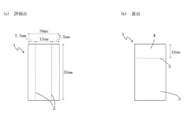
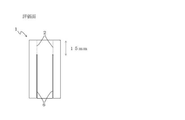
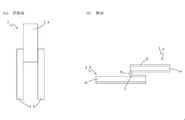
上記のようにして作製した塗装金属板から、図1(a)に示すように、金属基材の圧延(ロール目)方向が長辺となるように高さ50mm幅30mmの短冊状の試験片1を切り出した。カッターナイフを用いて、評価面の両端から7.5mm位置に、短冊状の先端から垂直に金属基材mの素地に達するような長手方向に略平行な傷2を2箇所入れた。なお2箇所の傷2間の幅は15mmに相当する。次に評価面の裏側に、短冊状の長辺の先端から15mmの位置に幅方向に平行となるように傷3を入れた(図1(b))。次いで金属はさみ等を用いて、試験片下部5から試験片上部4に向かって傷2に沿って傷3に到達するまで切れ目6を入れた(図2)。切れ目6の間の試験片の端部1aを、切れ目6の両側の端部1bを残して、傷3を起点として評価面の塗膜8が内側となるように折り曲げ、傷3に沿って2箇所の傷2間のみ幅方向に基材mを切断した。この時、剥離強度の評価部7においては、評価面の塗膜8は切断されることなく、切断分離された金属板の各々に繋がったまま残っている(図3(b))。一方で裏面の塗膜9は傷3に沿って切断されている。引張試験機(株式会社島津製作所製「オートグラフAG−IS」)を用いて180°ピール(剥離)試験を23℃下、引張速度5mm/minで行って剥離強度(ピール強度)を測定した。
The evaluation of the painted metal plate was carried out according to the following method.
(5) Substrate adhesion evaluation (180 ° peel test)
From the coated metal plate produced as described above, as shown in FIG. 1A, a strip-shaped test piece having a height of 50 mm and a width of 30 mm so that the rolling (roll) direction of the metal base material is the long side. 1 was cut out. Using a utility knife, two
180°ピール試験によって測定部の塗膜が均一に剥がれた場合の剥離強度は測定開始部から5〜10mm(測定開始から1〜2分)の強度が安定した領域の平均値を読み取った。 When the coating film of the measuring part was uniformly peeled by the 180 ° peel test, the peeling strength was read as the average value of the region where the strength was stable at 5 to 10 mm (1 to 2 minutes from the start of measurement) from the measurement start part.
塗膜8を基材mから強制剥離した評価部7の観察を目視で行い、評価部7の塗膜8が全面的に基材から剥がれ、剥離後の基材mに塗膜8が残っていない場合には、塗膜が界面剥離をしたと評価し、塗膜8が基材mとの密着性が高く、基材mから剥離する前に、塗膜8が破断した場合は塗膜が凝集破壊したと評価した。
評価結果は
◎ :界面剥離で剥離強度が2.0N/15mm以上 もしくは 凝集破壊
○ :界面剥離で剥離強度が2.0N/15mm未満 1.0N/15mm以上、
△ :界面剥離で剥離強度が1.0N/15mm未満 0.5N/15mm以上、
× :界面剥離で剥離強度が0.5N/15mm未満
で示した。
The evaluation unit 7 forcibly peeling the
Evaluation results are: ◎: Peeling strength is 2.0N / 15mm or more due to interfacial peeling or cohesive failure ○: Peeling strength is less than 2.0N / 15mm due to interfacial peeling 1.0N / 15mm or more,
Δ: Peeling strength is less than 1.0 N / 15 mm due to interfacial peeling, 0.5 N / 15 mm or more,
X: The peel strength was less than 0.5 N / 15 mm in the interfacial peeling.
(6)硬化性評価(MEK抽出評価)
上記と同様の方法で内面側の塗膜のみ形成した塗装金属板を作製し、得られた塗装金属板から5.0cm×5.0cmサイズの試験片を切り出し、試験片の質量測定後(W1)、200mlのMEK(メチルエチルケトン)を用い、沸騰しているMEK(80℃還流下)に試験片を1時間浸漬させ、沸点で1時間のMEK抽出を行った。抽出後の試験片をMEKで洗浄後、120℃で1分間乾燥し、抽出後の試験片の質量(W2)を測定した。さらに塗膜を濃硫酸による分解法で脱膜し、試験片の質量(W3)を測定した。塗装金属板の塗膜の硬化度を示す塗装板のMEK抽出率は下記式(5)で求められる。
MEK抽出率%=100×(W1−W2)/(W1−W3)・・・(5)
評価結果は
◎:10%未満
○:10%以上20%未満
△:20%以上30%未満
×:30%以上
で示した。
(6) Curability evaluation (MEK extraction evaluation)
A coated metal plate in which only the coating film on the inner surface side is formed is produced by the same method as above, a test piece having a size of 5.0 cm × 5.0 cm is cut out from the obtained coated metal plate, and after measuring the mass of the test piece (W1). ), 200 ml of MEK (methyl ethyl ketone) was used, and the test piece was immersed in boiling MEK (under reflux at 80 ° C.) for 1 hour, and MEK extraction was performed at the boiling point for 1 hour. The test piece after extraction was washed with MEK, dried at 120 ° C. for 1 minute, and the mass (W2) of the test piece after extraction was measured. Further, the coating film was removed by a decomposition method using concentrated sulfuric acid, and the mass (W3) of the test piece was measured. The MEK extraction rate of the coated plate, which indicates the degree of curing of the coating film of the coated metal plate, is calculated by the following formula (5).
MEK extraction rate% = 100 × (W1-W2) / (W1-W3) ... (5)
The evaluation results were: ⊚: less than 10% ◯: 10% or more and less than 20% Δ: 20% or more and less than 30% ×: 30% or more.
(7)絞りしごき缶の作製
上記の方法で作成した塗装金属板の両面に、パラフィンワックスを塗油した後、直径142mmの円形に打ち抜き、浅絞りカップを作成した。次いで、この浅絞りカップに対し、ドライ条件下で再絞り加工、しごき加工(3段)、ドーミング加工を行い、絞りしごき缶(缶径:66mm、高さ:約130mm、トータル絞り比:2.15、しごき率:64%、缶胴側壁中央部厚み:缶底中央部厚みの38.5%)を得た。
(7) Preparation of Squeezing Iron Can A shallow squeezing cup was prepared by applying paraffin wax to both sides of the coated metal plate prepared by the above method and then punching it into a circle having a diameter of 142 mm. Next, the shallow drawing cup is re-drawn, ironed (3 steps), and domed under dry conditions, and the drawing can (can diameter: 66 mm, height: about 130 mm, total drawing ratio: 2. 15. Ironing rate: 64%, thickness at the center of the side wall of the can body: 38.5% of the thickness at the center of the bottom of the can).
(8)製缶加工性評価(缶胴ERV試験)
上記の方法で作成した絞りしごき缶の缶底の外面側に金属露出部を形成し、缶体をエナメルレーターの陽極に接続する一方、1%食塩水360mLを缶内へ注ぎ、エナメルレーターの陰極を缶内に満たされた食塩水に浸して、室温下で6.30Vの電圧を4秒間印加した後の電流値を測定した。このような測定において、電流が多く流れるほど絶縁体である塗膜層に欠陥が存在し、缶内面の金属が露出していることを示している。
評価結果は、
◎:電流値 50mA未満
○:電流値 50mA以上100mA未満
△:電流値 100mA以上300mA未満
×:電流値 300mA以上
で示した。
(8) Evaluation of can manufacturing processability (can body ERV test)
A metal exposed part is formed on the outer surface side of the bottom of the squeezed iron can prepared by the above method, and the can body is connected to the anode of the enamelator. Was immersed in a saline solution filled in a can, and a voltage of 6.30 V was applied for 4 seconds at room temperature, and then the current value was measured. In such a measurement, it is shown that the more the current flows, the more defects exist in the coating film layer which is an insulator, and the metal on the inner surface of the can is exposed.
The evaluation result is
⊚: Current value less than 50 mA ◯: Current value 50 mA or more and less than 100 mA Δ: Current value 100 mA or more and less than 300 mA ×: Current value 300 mA or more.
(9)加工密着性評価
上記の方法で作成した絞りしごき缶の開口端を観察し、開口端近傍における塗膜の剥離度合いを目視で観察し、製缶加工時の密着性(加工密着性)を評価した。
評価結果は
○: 開口端近傍において、塗膜の剥離が確認されない。
×: 開口端近傍において、塗膜の剥離が確認される。
で示した。
(9) Evaluation of processing adhesion By observing the open end of the squeezed iron can created by the above method and visually observing the degree of peeling of the coating film in the vicinity of the opening end, adhesion during can manufacturing (processing adhesion). Was evaluated.
Evaluation result is ◯: No peeling of the coating film is confirmed near the opening edge.
X: Peeling of the coating film is confirmed in the vicinity of the open end.
Shown in.
(10)耐フレーバー収着性評価(フレーバー収着試験)
上記の方法で作製した絞りしごき缶の缶底から高さ8.0cmの位置を中心に2.5cm×5.0cmの大きさの試験片を切り出し、外面側の塗膜をサンドペーバー(紙やすり)で削り、洗浄・乾燥した。モデルフレーバー試験溶液として、リモネン2ppmを含む5%エタノール水溶液を調製した。パッキン付きガラス瓶(デュラン瓶)にモデルフレーバー試験溶液を入れ、試験片を浸漬、密閉し、30℃で2週間保存した。試験片をガラス瓶より取り出し、水洗後、水滴を取り除き、ジエチルエーテル50mLに浸漬、密封、一昼夜室温保存した。抽出液を濃縮装置で濃縮し、GC−MS分析(ガスクロマトグラフィー質量分析)を行った。GC−MS分析から得られたリモネン由来の成分ピークから、検量線により収着量を求め、下記式(6)よりリモネンの仕込み量に対する比率を、リモネン収着率(%)として求めた。
リモネン収着率(%)=リモネンの収着量/リモネンの仕込み量×100・・・(6)
評価結果は
○:リモネン収着率が2%未満
×:リモネン収着率が2%以上
で示した。
(10) Flavor sorption evaluation (flavor sorption test)
A test piece having a size of 2.5 cm x 5.0 cm is cut out from the bottom of the squeezed iron can produced by the above method at a height of 8.0 cm, and the coating film on the outer surface side is sandpaper (sandpaper). ), Washed and dried. A 5% ethanol aqueous solution containing 2 ppm of limonene was prepared as a model flavor test solution. The model flavor test solution was placed in a glass bottle with packing (Duran bottle), the test piece was immersed and sealed, and stored at 30 ° C. for 2 weeks. The test piece was taken out from a glass bottle, washed with water, water droplets were removed, immersed in 50 mL of diethyl ether, sealed, and stored at room temperature for a whole day and night. The extract was concentrated with a concentrator and subjected to GC-MS analysis (gas chromatography-mass spectrometry). From the limonene-derived component peak obtained by GC-MS analysis, the amount of limonene was determined by a calibration curve, and the ratio to the amount of limonene charged was determined as the limonene accretion rate (%) from the following formula (6).
Limonene collection rate (%) = Limonene collection amount / Limonene charge amount x 100 ... (6)
The evaluation result is
◯: Limonene sorption rate is less than 2% ×: Limonene sorption rate is 2% or more.
(実施例2〜9、比較例1〜4)
表1に示すようにポリエステル樹脂の種類、固形分配合比を変えて内面用塗料組成物を調製した以外は、実施例1と同様に行い、評価を行った。結果を表1に示す。なお、ポリエステル樹脂として、前述のポリエステル樹脂の他に、ポリエステル樹脂(b)(非結晶性ポリエステル樹脂、酸価:22mgKOH/g、Tg:82℃、Mn=6,000、モノマー組成:テレフタル酸成分/トリメリット酸成分/エチレングリコール成分/プロピレングリコール成分=49/1/12/38mol%)、ポリエステル樹脂(c)(非結晶性ポリエステル樹脂、酸価:2mgKOH/g、Tg:84℃、Mn=18,000、モノマー組成:テレフタル酸成分/エチレングリコール成分/プロピレングリコール成分=50/14/36mol%)、ポリエステル樹脂(d)(酸価:11mgKOH/g、Tg:−25℃、Mn=17,000、モノマー組成:テレフタル酸成分/イソフタル酸成分/セバシン酸成分/1,4−ブタンジオール成分=14/17/19/50mol%)、ポリエステル樹脂(e)(非結晶性ポリエステル樹脂、酸価:3mgKOH/g、Tg:40℃、Mn=15,000、モノマー組成:テレフタル酸成分/イソフタル酸成分/セバシン酸成分/エチレングリコール成分/プロピレングリコール成分/ネオペンチルグリコール成分/1,4−ブタンジオール成分=25/20/5/16/14/3/17mol%)を用いた。
(Examples 2 to 9, Comparative Examples 1 to 4)
As shown in Table 1, the coating composition for the inner surface was prepared by changing the type of polyester resin and the solid content blending ratio, and the same procedure as in Example 1 was carried out for evaluation. The results are shown in Table 1. As the polyester resin, in addition to the above-mentioned polyester resin, the polyester resin (b) (non-crystalline polyester resin, acid value: 22 mgKOH / g, Tg: 82 ° C., Mn = 6,000, monomer composition: terephthalic acid component / Trimellitic acid component / ethylene glycol component / propylene glycol component = 49/1/12/38 mol%), polyester resin (c) (non-crystalline polyester resin, acid value: 2 mgKOH / g, Tg: 84 ° C., Mn = 18,000, monomer composition: terephthalic acid component / ethylene glycol component / propylene glycol component = 50/14/36 mol%), polyester resin (d) (acid value: 11 mgKOH / g, Tg: -25 ° C, Mn = 17, 000, monomer composition: terephthalic acid component / isophthalic acid component / sebacic acid component / 1,4-butanediol component = 14/17/19/50 mol%), polyester resin (e) (non-crystalline polyester resin, acid value: 3 mgKOH / g, Tg: 40 ° C., Mn = 15,000, monomer composition: terephthalic acid component / isophthalic acid component / sebacic acid component / ethylene glycol component / propylene glycol component / neopentyl glycol component / 1,4-butanediol component = 25/20/5/16/14/3/17 mol%) was used.

本発明の塗料組成物を用いた塗装金属板及びそれを用いた絞りしごき缶は、製缶加工性、基材密着性、耐フレーバー収着性の全てを兼ね備えていることが明らかである。 It is clear that the coated metal plate using the coating composition of the present invention and the squeezing can using the same have all of can-making processability, substrate adhesion, and flavor-adhesion resistance.
本発明は、高度な製缶加工性を維持しつつ環境に配慮する金属加工の分野において、好適に利用することが可能である。 The present invention can be suitably used in the field of metal processing that considers the environment while maintaining a high degree of can manufacturing processability.
1 試験片
1a 端部
1b 端部
2 傷a
3 傷b
4 試験片上部
5 試験片下部
6 切れ目
7 評価部
8 塗膜(評価面)
9 塗膜
1 Test piece 1a
3 wound b
4 Upper part of test piece 5 Lower part of test piece 6 Cut 7
9 coating film
Claims (12)
The squeezing can according to claim 10 or 11, which is formed from a coated metal plate having a coating film on at least one side of the metal plate.
Applications Claiming Priority (2)
| Application Number | Priority Date | Filing Date | Title |
|---|---|---|---|
| JP2020016563 | 2020-02-03 | ||
| JP2020016563 | 2020-02-03 |
Publications (1)
| Publication Number | Publication Date |
|---|---|
| JP2021123719A true JP2021123719A (en) | 2021-08-30 |
Family
ID=77458292
Family Applications (1)
| Application Number | Title | Priority Date | Filing Date |
|---|---|---|---|
| JP2021015256A Pending JP2021123719A (en) | 2020-02-03 | 2021-02-02 | Coating composition, coated metal plate, drawn and ironed can, and method for manufacturing the same |
Country Status (1)
| Country | Link |
|---|---|
| JP (1) | JP2021123719A (en) |
Citations (7)
| Publication number | Priority date | Publication date | Assignee | Title |
|---|---|---|---|---|
| JP2002179997A (en) * | 2000-12-08 | 2002-06-26 | Toyo Seikan Kaisha Ltd | Inner surface touch-up coating material for welded can |
| JP2005052997A (en) * | 2003-08-05 | 2005-03-03 | Nippon Steel Corp | Precoated metal plate with excellent drawability |
| JP2006088515A (en) * | 2004-09-24 | 2006-04-06 | Sakuranomiya Kagaku Kk | Coated metal sheet and drawn/ironed can using it |
| JP2007077268A (en) * | 2005-09-14 | 2007-03-29 | Toyobo Co Ltd | Resin composition for inner coating of can and metal plate for can inner coated with the same |
| WO2008117694A1 (en) * | 2007-03-27 | 2008-10-02 | Toyo Seikan Kaisha, Ltd. | Polyester resin for metal coating and method for producing the same |
| JP2017226726A (en) * | 2016-06-20 | 2017-12-28 | 東洋紡株式会社 | Polyester resin composition, painted metal plate for cans and cans |
| JP2019069536A (en) * | 2017-10-06 | 2019-05-09 | 東洋製罐グループホールディングス株式会社 | Coated metal plate |
-
2021
- 2021-02-02 JP JP2021015256A patent/JP2021123719A/en active Pending
Patent Citations (7)
| Publication number | Priority date | Publication date | Assignee | Title |
|---|---|---|---|---|
| JP2002179997A (en) * | 2000-12-08 | 2002-06-26 | Toyo Seikan Kaisha Ltd | Inner surface touch-up coating material for welded can |
| JP2005052997A (en) * | 2003-08-05 | 2005-03-03 | Nippon Steel Corp | Precoated metal plate with excellent drawability |
| JP2006088515A (en) * | 2004-09-24 | 2006-04-06 | Sakuranomiya Kagaku Kk | Coated metal sheet and drawn/ironed can using it |
| JP2007077268A (en) * | 2005-09-14 | 2007-03-29 | Toyobo Co Ltd | Resin composition for inner coating of can and metal plate for can inner coated with the same |
| WO2008117694A1 (en) * | 2007-03-27 | 2008-10-02 | Toyo Seikan Kaisha, Ltd. | Polyester resin for metal coating and method for producing the same |
| JP2017226726A (en) * | 2016-06-20 | 2017-12-28 | 東洋紡株式会社 | Polyester resin composition, painted metal plate for cans and cans |
| JP2019069536A (en) * | 2017-10-06 | 2019-05-09 | 東洋製罐グループホールディングス株式会社 | Coated metal plate |
Similar Documents
| Publication | Publication Date | Title |
|---|---|---|
| US10508214B2 (en) | Coating composition and coated metal plate, metal container and metal closure coated with the coating composition | |
| US7030197B2 (en) | Aqueous resin composition, aqueous coating material containing the composition, coating provided by the material, and metal plate coated with the material | |
| WO2021157572A1 (en) | Coating composition, coated metal plate, and drawn/ironed can and method for producing same | |
| US12528619B2 (en) | Drawn/ironed can and coated metal sheet for drawn/ironed cans | |
| CN106794675B (en) | Organic resin-coated painted metal sheets and can bodies and can lids made therefrom | |
| US12589910B2 (en) | Method for producing drawn/ironed can and drawn/ironed can | |
| JP6242000B2 (en) | Coating composition and metal can | |
| JP2021123718A (en) | Coating composition, coated metal plate, drawn and ironed can, and method for manufacturing the same | |
| JP2021123719A (en) | Coating composition, coated metal plate, drawn and ironed can, and method for manufacturing the same | |
| JP2001311041A (en) | Coating resin composition for can and metal plate coated with the same and used for can | |
| WO2023013614A1 (en) | Seamless can and coated metal plate | |
| US20240343447A1 (en) | Seamless can and coated metal sheet | |
| TWI916315B (en) | Coated metal sheet and drawn-ironed can | |
| WO2021187621A1 (en) | Drawn-and-ironed can | |
| WO2021187622A1 (en) | Drawn and ironed can | |
| JP6690771B1 (en) | Painted metal plate and squeezed ironing can | |
| JP2023021955A (en) | Seamless cans and painted metal sheets | |
| JP2023021956A (en) | Seamless cans and painted metal sheets | |
| TW202035136A (en) | Coated metal sheet and drawn-ironed can |
Legal Events
| Date | Code | Title | Description |
|---|---|---|---|
| AA64 | Notification of invalidation of claim of internal priority (with term) |
Free format text: JAPANESE INTERMEDIATE CODE: A241764 Effective date: 20210302 |
|
| A521 | Request for written amendment filed |
Free format text: JAPANESE INTERMEDIATE CODE: A523 Effective date: 20210303 |
|
| A621 | Written request for application examination |
Free format text: JAPANESE INTERMEDIATE CODE: A621 Effective date: 20240115 |
|
| A131 | Notification of reasons for refusal |
Free format text: JAPANESE INTERMEDIATE CODE: A131 Effective date: 20250325 |
|
| A601 | Written request for extension of time |
Free format text: JAPANESE INTERMEDIATE CODE: A601 Effective date: 20250522 |
|
| A521 | Request for written amendment filed |
Free format text: JAPANESE INTERMEDIATE CODE: A523 Effective date: 20250723 |
|
| A131 | Notification of reasons for refusal |
Free format text: JAPANESE INTERMEDIATE CODE: A131 Effective date: 20251104 |
|
| A601 | Written request for extension of time |
Free format text: JAPANESE INTERMEDIATE CODE: A601 Effective date: 20251222 |
|
| A521 | Request for written amendment filed |
Free format text: JAPANESE INTERMEDIATE CODE: A523 Effective date: 20260225 |
|
| A131 | Notification of reasons for refusal |
Free format text: JAPANESE INTERMEDIATE CODE: A131 Effective date: 20260324 |