JP2022008092A - Polymerizable compounds, compositions for electronic components, materials for electronic components - Google Patents
Polymerizable compounds, compositions for electronic components, materials for electronic components Download PDFInfo
- Publication number
- JP2022008092A JP2022008092A JP2021083058A JP2021083058A JP2022008092A JP 2022008092 A JP2022008092 A JP 2022008092A JP 2021083058 A JP2021083058 A JP 2021083058A JP 2021083058 A JP2021083058 A JP 2021083058A JP 2022008092 A JP2022008092 A JP 2022008092A
- Authority
- JP
- Japan
- Prior art keywords
- compound
- composition
- carbon atoms
- formula
- independently
- Prior art date
- Legal status (The legal status is an assumption and is not a legal conclusion. Google has not performed a legal analysis and makes no representation as to the accuracy of the status listed.)
- Withdrawn
Links
- 0 CCc1ccc(*C(C)(C)c2ccc(*=*)cc2)cc1 Chemical compound CCc1ccc(*C(C)(C)c2ccc(*=*)cc2)cc1 0.000 description 13
- PKCLYDUYXATTDN-UHFFFAOYSA-N CC1(CCOc(cc2)ccc2-c(cc2)ccc2-c(cc2)cc(C)c2OCCC2(C)OC2)OC1 Chemical compound CC1(CCOc(cc2)ccc2-c(cc2)ccc2-c(cc2)cc(C)c2OCCC2(C)OC2)OC1 PKCLYDUYXATTDN-UHFFFAOYSA-N 0.000 description 1
- LEIWSINCDRLJCY-RILYUOAZSA-N C[C@@H](CC1=CC=C11)/C1=C(\C)/C=C Chemical compound C[C@@H](CC1=CC=C11)/C1=C(\C)/C=C LEIWSINCDRLJCY-RILYUOAZSA-N 0.000 description 1
- ZPERCXDIOIOJQN-UHFFFAOYSA-N Cc(cc(cc1)OCCC2OC2)c1-c(cc1)ccc1-c1ccc(CCC2OC2)cc1 Chemical compound Cc(cc(cc1)OCCC2OC2)c1-c(cc1)ccc1-c1ccc(CCC2OC2)cc1 ZPERCXDIOIOJQN-UHFFFAOYSA-N 0.000 description 1
Landscapes
- Epoxy Resins (AREA)
- Epoxy Compounds (AREA)
Abstract
【課題】本発明の課題は、液晶性があり融点が低い、液晶性エポキシ化合物を提供する事である。また該エポキシ化合物を用いた、熱伝導率の高いエポキシ樹脂材料を提供する事である。【解決手段】2個以上のオキシラニルおよび2から5個の芳香環を有する液晶性エポキシ化合物において、該オキシラニルは該芳香環に結合し、少なくとも1つのオキシラニルが炭素を介して芳香環と結合した化合物を、熱伝導率の高いエポキシ樹脂材料として提供するものである。【選択図】なし。[Problem] The object of the present invention is to provide a liquid crystalline epoxy compound that has liquid crystallinity and a low melting point. Also, to provide an epoxy resin material with high thermal conductivity using said epoxy compound. [Solution] A liquid crystalline epoxy compound having two or more oxiranyls and 2 to 5 aromatic rings, in which the oxiranyls are bonded to the aromatic rings and at least one oxiranyl is bonded to the aromatic ring via a carbon atom, is provided as an epoxy resin material with high thermal conductivity. [Selected Figure] None.
Description
本発明は、電子機器の内部に生じた熱を効率よく伝導する放熱部材用組成物、およびこれに用いられる液晶性を有する重合性化合物に関する。 The present invention relates to a composition for a heat radiating member that efficiently conducts heat generated inside an electronic device, and a polymerizable compound having liquid crystallinity used therein.
近年、ハイブリッド自動車や電気自動車などの電力制御用の半導体素子や、高速コンピューター用のCPUなどにおいて、内部の半導体の温度が高くなり過ぎないように、パッケージ材料の高熱伝導化が望まれている。すなわち半導体チップから発生した熱を効率よく外部に放出させる能力が重要になっている。 In recent years, in semiconductor elements for power control such as hybrid vehicles and electric vehicles, CPUs for high-speed computers, and the like, it has been desired to increase the thermal conductivity of packaging materials so that the temperature of internal semiconductors does not become too high. That is, the ability to efficiently release the heat generated from the semiconductor chip to the outside is important.
このような放熱問題を解決する方法としては、発熱部位に高熱伝導性材料(放熱部材)を接触させて熱を外部に導き、放熱する方法が挙げられる。熱伝導性が高い材料としては、金属や金属酸化物などの無機材料が挙げられる。しかし、このような無機材料は、加工性や絶縁性などに問題があり、単独で半導体パッケージの充填材に使用することは非常に難しい。そのため、これら無機材料と樹脂を複合化し、高熱伝導化した放熱部材の開発が行われている。 As a method for solving such a heat dissipation problem, there is a method in which a high thermal conductive material (heat dissipation member) is brought into contact with a heat generating portion to guide heat to the outside and dissipate heat. Examples of the material having high thermal conductivity include inorganic materials such as metals and metal oxides. However, such an inorganic material has problems in processability and insulating property, and it is very difficult to use it alone as a filler for a semiconductor package. Therefore, a heat radiating member which is made of a composite of these inorganic materials and a resin and has high thermal conductivity is being developed.
複合材の高熱伝導化は、一般的に、ポリエチレン樹脂、ポリアミド樹脂、ポリスチレン樹脂、アクリル樹脂、エポキシ樹脂などの汎用樹脂に、金属充填材などの無機充填材を多量に添加することにより行われてきた。しかし、無機充填材の熱伝導率は物質固有の値であり上限が決まっている。そのため、樹脂の熱伝導率を向上させることで、複合材のこれを行う方法が広く試みられている。これを実際に行う手段としては、例えば、液晶性を有するエポキシ化合物を用いる方法が知られている。 High thermal conductivity of composite materials has generally been achieved by adding a large amount of inorganic fillers such as metal fillers to general-purpose resins such as polyethylene resins, polyamide resins, polystyrene resins, acrylic resins and epoxy resins. rice field. However, the thermal conductivity of the inorganic filler is a value peculiar to the substance and the upper limit is set. Therefore, a method for performing this in a composite material by improving the thermal conductivity of the resin has been widely attempted. As a means for actually performing this, for example, a method using an epoxy compound having a liquid crystallinity is known.
特許文献1には、グリシジルオキシを2つ有するターフェニル化合物が開示されている。また特許文献2には、グリシジルオキシを3つ有するターフェニル化合物が開示されている。しかしながら該特許文献に開示されている化合物は、液晶温度が無く、融点も117℃以上の高い温度であった。 Patent Document 1 discloses a terphenyl compound having two glycidyloxy. Further, Patent Document 2 discloses a terphenyl compound having three glycidyloxy. However, the compound disclosed in the patent document has no liquid crystal temperature and has a melting point as high as 117 ° C. or higher.
本発明の課題は、液晶性があり融点が低い、液晶性エポキシ化合物を提供する事である。また該エポキシ化合物を用いた、熱伝導率の高いエポキシ樹脂材料を提供する事である。さらに本発明のもう一つの課題は、溶媒への溶解性が高い、液晶性エポキシ化合物を提供する事である。 An object of the present invention is to provide a liquid crystalline epoxy compound having a liquid crystallinity and a low melting point. Another object of the present invention is to provide an epoxy resin material having high thermal conductivity using the epoxy compound. Further, another object of the present invention is to provide a liquid crystal epoxy compound having high solubility in a solvent.
本発明者らは、オキシラニルを2個以上および2から5個の芳香環を有する液晶性エポキシ化合物において、該オキシラニルを有する基は該芳香環に結合し、少なくとも1つのオキシラニルが、芳香環とメチレンで結合した、化合物が、上記課題を解決することを見出し、本発明を完成させた。 In a liquid crystal epoxy compound having two or more oxylanyls and two to five aromatic rings, the group having the oxylanyl is bonded to the aromatic ring, and at least one oxylanyl is an aromatic ring and methylene. The present invention was completed by finding that the compound bonded in 1 solves the above-mentioned problems.
上記化合物を原料とした組成物は、それ自体または該組成物を硬化する際に、液晶性を発現し易い。そのため、硬化物は高い熱伝導性を持つ。また該化合物は結晶性が低く、これを原料とした組成物は、ペースト化しやすい。そこで、パワー半導体用などの放熱材料として、好適に使用する事が出来る。 A composition made from the above compound tends to exhibit liquid crystallinity when it is cured by itself or when the composition is cured. Therefore, the cured product has high thermal conductivity. Further, the compound has low crystallinity, and a composition using the compound as a raw material is easy to be made into a paste. Therefore, it can be suitably used as a heat dissipation material for power semiconductors and the like.
以下、本発明の実施の形態について詳細に説明する。また、本発明は、実施の形態に制限されるものではない。 Hereinafter, embodiments of the present invention will be described in detail. Further, the present invention is not limited to the embodiments.
本発明は下記の項などである。 The present invention includes the following items.
[1] 2個以上のオキシラニルおよび2から5個の芳香環を有する液晶性エポキシ化合物において、該オキシラニルを有する基は該芳香環に結合し、少なくとも1つのオキシラニルが、炭素を介して芳香環と結合した、化合物。 [1] In a liquid crystal epoxy compound having two or more oxylanyls and two to five aromatic rings, the group having the oxylanyl is bonded to the aromatic ring, and at least one oxylanyl is attached to the aromatic ring via carbon. Bound, compound.
[2] 液晶性エポキシ化合物が棒状の分子である、項[1]に記載の化合物。 [2] The compound according to Item [1], wherein the liquid crystalline epoxy compound is a rod-shaped molecule.
[3] 式(1)で表される項[2]に記載の化合物。

[4] 式(1)で表される液晶性エポキシ化合物において、Xが単結合または-C≡C-である、項[3]に記載の化合物。 [4] The compound according to item [3], wherein X is a single bond or —C≡C— in the liquid crystal epoxy compound represented by the formula (1).
[5] 項[1]から[4]のいずれか1項に記載の化合物および硬化剤を含む組成物。 [5] A composition containing the compound according to any one of Items [1] to [4] and a curing agent.
[6] 硬化促進剤をさらに含む、項[5]に記載の組成物。 [6] The composition according to item [5], further comprising a curing accelerator.
[7] 硬化剤が、芳香族1級アミン、脂肪族1級アミン、2級アミノを分子骨格に2つ以上持つ芳香族、または2級アミノを分子骨格に2つ以上持つ脂肪族アミンである、項[5]または[6]に記載の組成物。 [7] The curing agent is an aromatic amine having two or more aromatic primary amines, an aliphatic primary amine, and a secondary amino in the molecular skeleton, or an aliphatic amine having two or more secondary aminos in the molecular skeleton. , Item [5] or [6].
[8] 硬化剤が、式(2-1)又は(2-2)で表される少なくとも1つの化合物である、項[7]に記載の組成物。
E-Z-(L-Z)n-E (2-1)
L1-Z-E (2-2)
式(2-1)および(2-2)中、
Lは独立して、単結合、シクロヘキシレン、フェニレン、またはナフタレンであり、これらの環の少なくとも1つの水素は、炭素数1~10のアルキルで置き換えられてもよく、
L1は、水素、シクロヘキシル、フェニル、またはナフチルであり、これらの環の少なくとも1つの水素は、炭素数1~10のアルキルで置き換えられてもよく、
Zは独立して、単結合、-O-、-NH-、-S-、-SO2-、-CO2-、または炭素数1~12のアルキレンであり、
Eは独立して、アミノ、炭素数1~10のアルキルアミノ、水酸基、またはカルボキシであり、Eの少なくとも1つはアミノ、または炭素数1~10のアルキルアミノであり、
nは、0~7の整数である。
[8] The composition according to item [7], wherein the curing agent is at least one compound represented by the formula (2-1) or (2-2).
EZ- (LZ) n-E (2-1)
L1 - Z-E (2-2)
In equations (2-1) and (2-2),
L is independently a single bond, cyclohexylene, phenylene, or naphthalene, and at least one hydrogen in these rings may be replaced by an alkyl having 1 to 10 carbon atoms.
L 1 is hydrogen, cyclohexyl, phenyl, or naphthyl, and at least one hydrogen in these rings may be replaced with an alkyl having 1 to 10 carbon atoms.
Z is independently a single bond, -O-, -NH-, -S-, -SO 2- , -CO 2- , or an alkylene with 1-12 carbon atoms.
E is independently an amino, an alkylamino having 1 to 10 carbon atoms, a hydroxyl group, or a carboxy, and at least one of E is an amino or an alkylamino having 1 to 10 carbon atoms.
n is an integer from 0 to 7.
[9] 硬化剤が、分子骨格に-OHを2つ以上持つフェノール類、またはそのフェノール類中の-OHの少なくとも1つが短鎖のエステルとなる化合物である、項[5]または[6]に記載の組成物。
(短鎖のエステルとは、以下の(3-E)で表される基が、OH基のHに置換した構造である。

(The short-chain ester is a structure in which the group represented by (3-E) below is replaced with H of the OH group.
[10] 硬化剤が、式(3-1)から(3-7)で表される少なくとも1つの化合物、またはその短鎖のエステルである、項[9]に記載の組成物。


環Bは、ベンゼン、ナフタレン、アントラセン、フルオレン、または9,9‐ジフェニルフルオレンであり、これら環Bにおいて、少なくとも1つの水素は、炭素数1~3のアルキル、または炭素数1~3のアルコキシで置き換えられてもよく;
n31は2以上4以下の整数である。
式(3-2)中、n32およびn33は独立して、1~3の整数であり;
Z30は、単結合、炭素数1~10のアルキレン、-CH(CH3)-、-C(CH3)2-、-C(CF3)2-、-O-、-S-、または-SO2-であり、
ベンゼン環上の、少なくとも1つの水素は、炭素数1~3のアルキルまたは炭素数2~3のアルケニルで置き換えられてもよく;
式(3-3)および式(3-4)中、
n34は1以上5000以下の整数であり、n35およびn36は独立して、0または1であり、n34が2以上の場合、繰り返し毎に異なってもよく、
R10およびR11は独立して、1,4-フェニレン、4,4’-ビフェニレン、またはシクロペンタジエニレンであり、
式(3-5)中、
n34は1以上5000以下の整数であり、
式(3-6)中、
Z31は独立して単結合、-CH(CH3)-、または-C(CH3)2-であり、n34は1以上5000以下の整数である。
式(3-7)中、
n34は1以上5000以下の整数であり、R12は水素またはメチルである。
短鎖のエステルとは、以下の(3-E)で表される基が、OH基のHに置換した構造である。
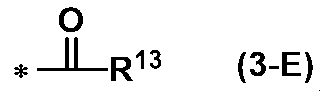
また、これら式(3-3)から式(3-7)中の芳香環上の少なくとも1つの水素はメチルで置き換えられてもよい。
[10] The composition according to Item [9], wherein the curing agent is at least one compound represented by the formulas (3-1) to (3-7), or an ester thereof.
Ring B is benzene, naphthalene, anthracene, fluorene, or 9,9-diphenylfluorene, in which at least one hydrogen is an alkyl having 1 to 3 carbon atoms or an alkoxy having 1 to 3 carbon atoms. May be replaced;
n31 is an integer of 2 or more and 4 or less.
In equation (3-2), n32 and n33 are independently integers of 1 to 3;
Z 30 is a single bond, an alkylene having 1 to 10 carbon atoms, -CH (CH 3 )-, -C (CH 3 ) 2- , -C (CF 3 ) 2- , -O-, -S-, or. -SO 2 -and
At least one hydrogen on the benzene ring may be replaced with an alkyl having 1-3 carbon atoms or an alkenyl having 2-3 carbon atoms;
In equations (3-3) and (3-4),
n34 is an integer of 1 or more and 5000 or less, n35 and n36 are independently 0 or 1, and when n34 is 2 or more, it may be different for each iteration.
R 10 and R 11 are independently 1,4-phenylene, 4,4'-biphenylene, or cyclopentadienylene.
In equation (3-5),
n34 is an integer of 1 or more and 5000 or less,
In equation (3-6),
Z 31 is an independently single bond, -CH (CH 3 )-, or -C (CH 3 ) 2- , and n34 is an integer of 1 or more and 5000 or less.
In equation (3-7),
n34 is an integer of 1 or more and 5000 or less, and R12 is hydrogen or methyl.
The short-chain ester has a structure in which the group represented by (3-E) below is replaced with H of the OH group.
Further, at least one hydrogen on the aromatic ring in these formulas (3-3) to (3-7) may be replaced with methyl.
[11] 硬化剤がシアネートエステルを含む化合物である、項[5]または[6]に記載の組成物。 [11] The composition according to item [5] or [6], wherein the curing agent is a compound containing a cyanate ester.
[12] 硬化剤が、カルボン酸、カルボン酸エステル、酸無水物、またはチオールを含む化合物である、項[5]または[6]に記載の組成物。 [12] The composition according to item [5] or [6], wherein the curing agent is a compound containing a carboxylic acid, a carboxylic acid ester, an acid anhydride, or a thiol.
[13] 無機フィラーをさらに含む、項[5]から[12]のいずれか1項に記載の組成物。 [13] The composition according to any one of Items [5] to [12], further comprising an inorganic filler.
[14] 無機フィラーが酸化アルミニウムまたは窒化ホウ素である、項[13]に記載の組成物。 [14] The composition according to item [13], wherein the inorganic filler is aluminum oxide or boron nitride.
[15] 項[5]から[14]のいずれか1項に記載の組成物を硬化させた電子部品用材料。 [15] A material for electronic components obtained by curing the composition according to any one of items [5] to [14].
[16] 式(1’)で表される化合物。

[16] A compound represented by the formula (1').
「環の少なくとも1つの水素は、又は炭素数1~10のアルキルで置き換えられてもよく」の句は、例えば1,4-フェニレンの2,3,5,6位の水素の少なくとも1つがフッ素やメチル等の置換基で置き換えられた場合の態様を意味する。
「化合物(1)」は、式(1)で表される化合物を意味し、また、式(1)で表される化合物の少なくとも1種を意味することもある。
The phrase "at least one hydrogen in the ring may be replaced with an alkyl having 1 to 10 carbon atoms" states that, for example, at least one of the hydrogens at positions 2, 3, 5, and 6 of 1,4-phenylene is fluorine. It means an embodiment when it is replaced with a substituent such as or methyl.
"Compound (1)" means a compound represented by the formula (1), and may also mean at least one of the compounds represented by the formula (1).
[液晶性エポキシ化合物]
上記したように、2個以上のオキシラニルおよび2から5個の芳香環を有する液晶性エポキシ化合物において、該オキシラニルを有する基は該芳香環に結合し、少なくとも1つのオキシラニルが、炭素を介して芳香環と結合した化合物を用いる事により、本願の課題を解決する事ができる。このとき上記炭素を介してとは、芳香環に直結する位置の原子が置換されていてもよいメチレンや、オキシラニルを構成する炭素等である事を示す。
[Liquid crystal epoxy compound]
As described above, in a liquid crystal epoxy compound having two or more oxylanyls and two to five aromatic rings, the group having the oxylanyl is bonded to the aromatic ring, and at least one oxylanyl is aromatic via carbon. By using a compound bonded to a ring, the problem of the present application can be solved. At this time, the term “via carbon” indicates that the atom at a position directly connected to the aromatic ring may be substituted with methylene, carbon constituting oxylanyl, or the like.
より結晶性を抑えペースト化しやすい事から、該液晶性エポキシ化合物は、棒状である事が好ましい。このような棒状の液晶性化合物に関しては、液晶温度範囲を拡大するために、液晶のコアが芳香環を3から5個有する事が、好ましい。 The liquid crystal epoxy compound is preferably rod-shaped because it suppresses crystallinity and is easy to form into a paste. For such rod-shaped liquid crystal compounds, it is preferable that the liquid crystal core has 3 to 5 aromatic rings in order to expand the liquid crystal temperature range.
上記液晶のコアとは、芳香環や脂環が、比較的コンフォメーションが定まった結合基で連結された構造を示す。このとき、該結合基の例としては単結合、エチレン、オキシメチレン、二重結合、三重結合、またはエステル等が挙げられる。 The core of the liquid crystal display shows a structure in which aromatic rings and alicyclic rings are linked by a bonding group having a relatively fixed conformation. At this time, examples of the bonding group include a single bond, ethylene, oxymethylene, a double bond, a triple bond, an ester and the like.
上記の棒状の液晶性化合物とは、液晶のコアとして、芳香環や脂環が直線状に連なり、そのコアの両端にアルキル等の柔軟性のある置換基が結合した構造である。このとき上記直線は、厳密な直線である必要はなく、45度程度の角度まで屈曲してもよい。 The rod-shaped liquid crystal compound has a structure in which aromatic rings and alicyclic rings are linearly connected as a liquid crystal core, and flexible substituents such as alkyl are bonded to both ends of the core. At this time, the straight line does not have to be a strict straight line and may be bent to an angle of about 45 degrees.
このような棒状の液晶性化合物においては、200℃以上の温度での分解を防ぐために、その分子構造中にエステルを含有しない事が好ましい。 It is preferable that such a rod-shaped liquid crystal compound does not contain an ester in its molecular structure in order to prevent decomposition at a temperature of 200 ° C. or higher.
上記の棒状の液晶化合物としては、液晶性を示す温度範囲が広く、製造が容易であり、これを硬化物とした際の耐熱性が高い事から、式(1)で表される化合物を選択する事が、より好ましい。 As the rod-shaped liquid crystal compound, the compound represented by the formula (1) is selected because it has a wide temperature range showing liquid crystal properties, is easy to manufacture, and has high heat resistance when it is used as a cured product. It is more preferable to do so.

式(1)の化合物において、Repは、それぞれ独立して、オキシラニルを含む炭素数2から12の基である。このとき、Repのオキシラニル以外の構造は特に制限が無いが、硬化物としたときに高い耐熱性を与えるためには、炭素数2から10のオキシラニルを含む基である事が好ましく、炭素数2から8のオキシラニルを含む基である事が特に好ましい。またこれらのオキシラニルを含む基の-CH2-は-O-で置換されてもよい。芳香環に-O-が直接結合する構造の化合物は、合成が特に容易である。しかしながら、化合物の結晶性を抑え液晶性を向上するためには、少なくとも一つのRepは、炭素を介して芳香環に結合する必要がある。一方で両方のRepが炭素を介して芳香環に結合すると、液晶性が低下する傾向がある。そのため、少なくとも一つのRepは-O-を介して芳香環に結合する事が好ましい。 In the compound of formula (1), Reps are independently groups having 2 to 12 carbon atoms containing oxylanyl. At this time, the structure of R ep other than oxylanyl is not particularly limited, but in order to give high heat resistance when made into a cured product, it is preferable that the group contains oxylanyl having 2 to 10 carbon atoms, and the carbon number is preferably. It is particularly preferable that the group contains 2 to 8 oxylanyl. Further, -CH 2- of these oxylanyl-containing groups may be substituted with -O-. Compounds having a structure in which —O— is directly bonded to an aromatic ring are particularly easy to synthesize. However, in order to suppress the crystallinity of the compound and improve the liquid crystallinity, at least one Rep needs to be bonded to the aromatic ring via carbon. On the other hand, when both Reps are bonded to the aromatic ring via carbon, the liquid crystallinity tends to decrease. Therefore, it is preferable that at least one Rep is bonded to the aromatic ring via —O—.
式(1)の化合物において、連結基Xは、それぞれ独立して、単結合、-CH2CH2-、-CH2O-、-CH=CH-、-C≡C-、または-COO-である。これらの連結基において、結合の方向は任意である。このとき、硬化物の耐熱性を向上させるためには、Xとして単結合、-CH2CH2-、-CH2O-、または-C≡C-を選択する事が好ましく、化合物に広い液晶温度範囲を付与するため、単結合、または-C≡C-を選択する事が特に好ましい。また合成上の容易さから、単結合を選択する事が最も好ましい。 In the compound of formula (1), the linking group X is independently single-bonded, -CH 2 CH 2- , -CH 2 O-, -CH = CH-, -C≡C-, or -COO-. Is. In these linking groups, the direction of bonding is arbitrary. At this time, in order to improve the heat resistance of the cured product, it is preferable to select single bond, -CH 2 CH 2- , -CH 2 O-, or -C≡C- as X, and a wide liquid crystal display for the compound. It is particularly preferred to select single bond or -C≡C- to provide a temperature range. Moreover, it is most preferable to select a single bond because of the ease of synthesis.
式(1)の化合物において、R1はそれぞれ独立して、水素、炭素数1から8のアルキル、炭素数1から8のアルコキシ、またはRepである。またこれらのアルキルおよびアルコキシの1つの-CH2-は-CO-で置換されてもよい。このとき、化合物の液晶温度範囲を拡大する事が出来る事から、これらのR1として、アルキルまたはアルコキシを選択する事が好ましく、アルキルを選択する事が特に好ましい。またRepやXが同一の基でない場合、同様な理由から、水素を選択する事も好ましい。化合物の液晶温度範囲を拡大するためには、R1としてメチルを選択する事が最も好ましい。さらに硬化物の耐熱性を向上させるためには、R1としてRepを選択する事が好ましい。 In the compound of formula (1), R 1 is independently hydrogen, an alkyl having 1 to 8 carbon atoms, an alkoxy having 1 to 8 carbon atoms, or R ep . Also, one of these alkyl and alkoxy -CH 2- may be substituted with -CO-. At this time, since the liquid crystal temperature range of the compound can be expanded, it is preferable to select alkyl or alkoxy as these R1 , and it is particularly preferable to select alkyl. Further, when R ep and X are not the same group, it is also preferable to select hydrogen for the same reason. In order to expand the liquid crystal temperature range of the compound, it is most preferable to select methyl as R1 . Further, in order to improve the heat resistance of the cured product, it is preferable to select R ep as R 1 .
式(1)の化合物において、nは0から2である。このとき、化合物の液晶温度範囲を拡大する事が出来る事から、nは1または2が好ましい。 In the compound of formula (1), n is 0 to 2. At this time, n is preferably 1 or 2 because the liquid crystal temperature range of the compound can be expanded.
式(1)で表される液晶性エポキシ化合物の好適な例としては、式(1-1)から式(1-48)の化合物が挙げられる。
Preferable examples of the liquid crystal epoxy compound represented by the formula (1) include compounds of the formulas (1-1) to (1-48).
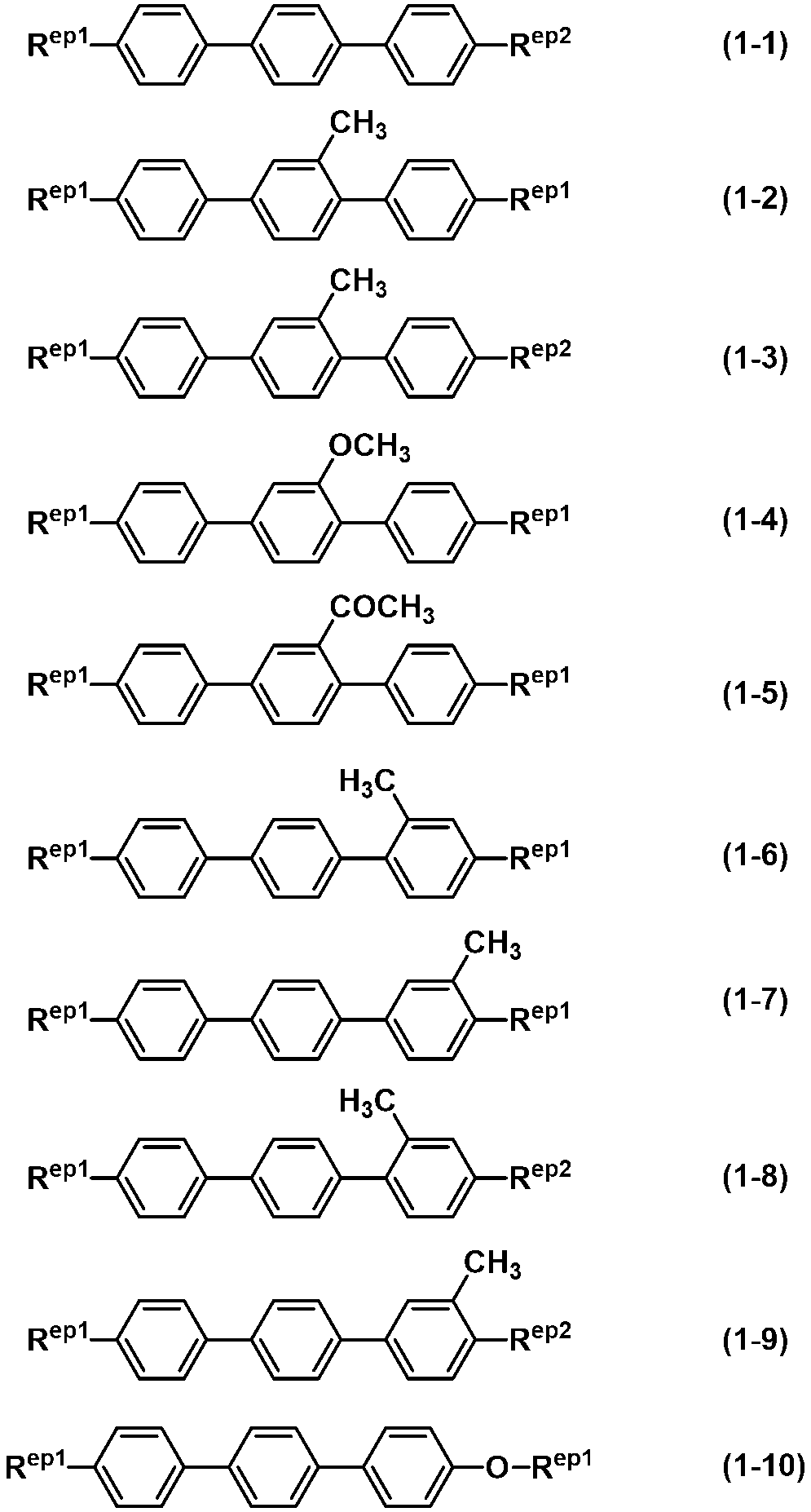


式(1-1)から式(1-48)中、Rep1およびRep2は、オキシラニル以外はそれぞれ独立して、全て炭素-炭素単結合および炭素に結合する水素からなる、炭素数2から12の基を表す。 From formula (1-1) to formula (1-48), R ep1 and R ep2 are independent except for oxylanyl, and are all composed of a carbon-carbon single bond and hydrogen bonded to carbon, and have 2 to 12 carbon atoms. Represents the basis of.
上記式(1-1)から式(1-48)で表される化合物において、本発明の課題を解決するためには、式(1-11)から式(1-18)および式(1-20)から式(1-23)で表される化合物の1つを選択する事が、最も好ましい。これらの化合物は、液晶温度範囲が広く、またそれが硬化に適した温度領域にある。 In the compounds represented by the above formulas (1-1) to (1-48), in order to solve the problem of the present invention, formulas (1-11) to formulas (1-18) and formulas (1-48) are used. It is most preferable to select one of the compounds represented by the formula (1-23) from 20). These compounds have a wide liquid crystal temperature range and are in a temperature range suitable for curing.
本発明の式(1’)で表される化合物は、溶媒への溶解性が高い。従ってこれらの化合物を含む組成物を印刷に使用した場合、結晶の発生を抑制する事が出来るため、印刷性に優れる。 The compound represented by the formula (1') of the present invention has high solubility in a solvent. Therefore, when a composition containing these compounds is used for printing, the generation of crystals can be suppressed, so that the printability is excellent.

式(1’)において、Rep’は独立して、オキシラニルを有する炭素数4から12の基である。オキシラニルは2つのCと1つのOから成るので、Rep’はオキシラニル以外に2から10の炭化水素を持つ。このとき、溶媒への溶解性を高めるためには、オキシラニル以外に3から10の炭化水素を持つ事が好ましい。また同様な目的には、Rep’は分岐鎖を持つ事が好ましい。一方で炭化水素基および分岐鎖が多くなると、液晶性が低下し、硬化物としたときの耐熱性が低下する。これを防ぐためには、オキシラニル以外に3から5の炭化水素を持つ事が好ましい。 In formula (1'), R ep'is an independent group of 4 to 12 carbon atoms with oxylanyl. Since oxylanyl consists of two Cs and one O, Rep'has 2 to 10 hydrocarbons in addition to oxylanyl. At this time, in order to increase the solubility in the solvent, it is preferable to have 3 to 10 hydrocarbons in addition to oxylanyl. For the same purpose, it is preferable that Rep'has a branched chain. On the other hand, when the number of hydrocarbon groups and branched chains increases, the liquid crystallinity decreases and the heat resistance of the cured product decreases. In order to prevent this, it is preferable to have 3 to 5 hydrocarbons in addition to oxylanyl.
2つのRep’がどちらも-O-を介して芳香環と結合した化合物を含め、式(1’)に記載した化合物は、溶媒への溶解性が高い。しかしながら、少なくとも1つのRep’が炭素を介して芳香環に結合した化合物の方が、より溶解性や液晶性が高く、好適である。 The compounds of formula (1') are highly soluble in solvents, including compounds in which the two R ep'are both attached to the aromatic ring via —O—. However, a compound in which at least one Rep'is bonded to an aromatic ring via carbon is more soluble and liquid crystal-like, and is preferable.
式(1’)において、R1は独立して、水素またはメチルである。このとき、液晶性を向上させるためには、R1として、CH3を選択しないまたは1つ選択する事が好ましく、溶媒への溶解性を高めるためには1つ選択する事が好ましい。 In formula (1'), R 1 is independently hydrogen or methyl. At this time, it is preferable not to select or select one CH 3 as R 1 in order to improve the liquid crystallinity, and it is preferable to select one in order to improve the solubility in the solvent.
式(1’)で表される化合物の好適な例としては、上記式(1-1)から式(1-48)で表される化合物において、Rep1およびRep2がオキシラニルを有する炭素数4から12の基である化合物が挙げられる。これらの化合物において、さらに本発明の課題を解決するためには、式(1-11)から式(1-18)および式(1-20)から式(1-23)で表される化合物の1つを選択する事が、最も好ましい。これらの化合物は、液晶温度範囲が広く、またそれが硬化に適した温度領域にある。 As a suitable example of the compound represented by the formula (1'), in the compounds represented by the above formulas (1-1) to (1-48), R ep1 and R ep2 have oxylanyl and have 4 carbon atoms. From 12 compounds are mentioned. In these compounds, in order to further solve the problem of the present invention, the compounds represented by the formulas (1-11) to (1-18) and the formulas (1-20) to (1-23) are used. It is most preferable to select one. These compounds have a wide liquid crystal temperature range and are in a temperature range suitable for curing.
式(1’)で表される化合物の好適な別の例としては、以下の式(1’-1)から式(1‘-24)で表される化合物が挙げられる。
Another suitable example of the compound represented by the formula (1') is a compound represented by the following formulas (1'-1) to (1'-24).

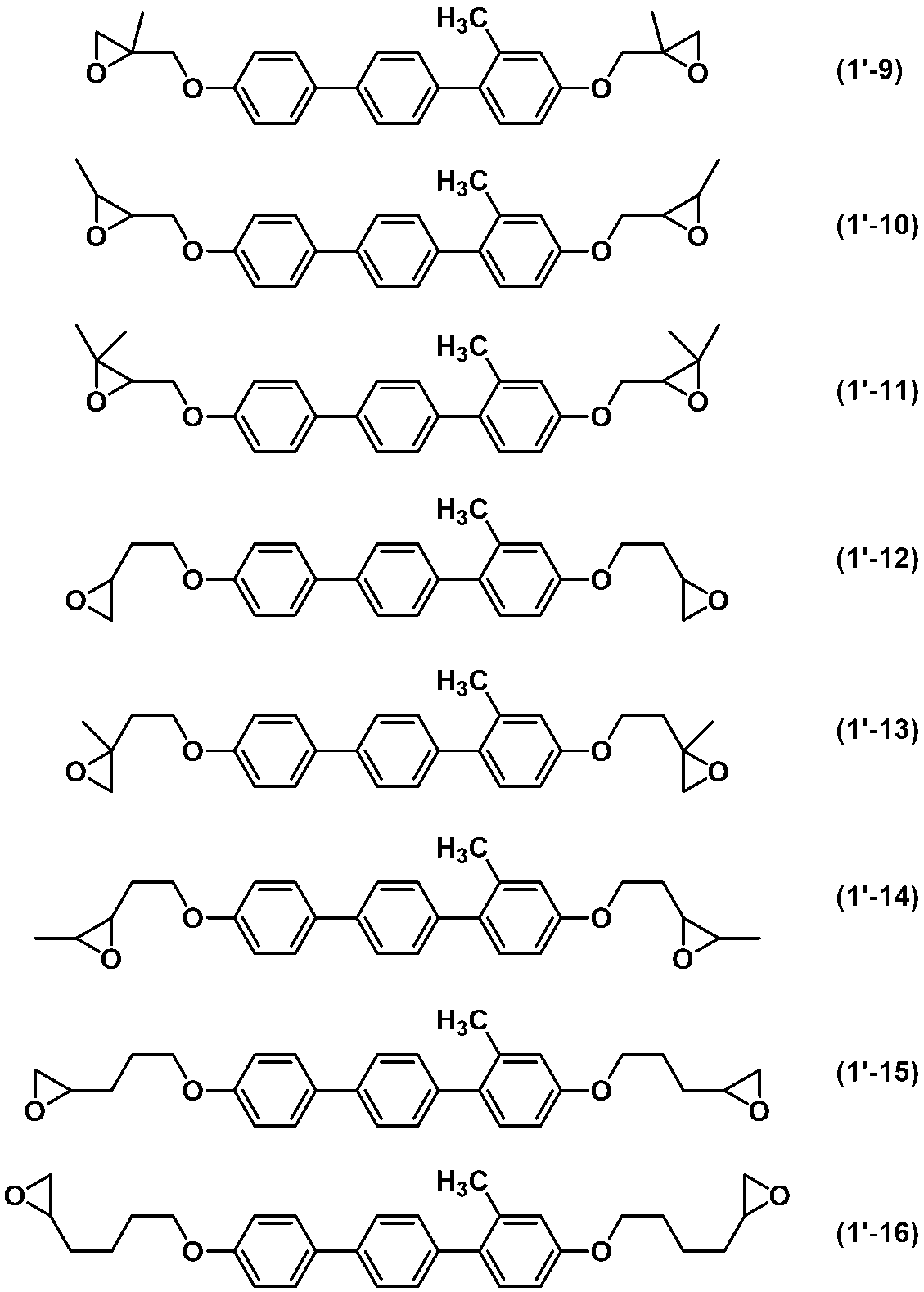

これらの化合物は、溶媒への溶解性が高く、安価に製造出来る。これらの化合物においても、液晶温度範囲が広い事から、式(1’-1)から式(1’-16)で表される化合物が、より好適である。 These compounds have high solubility in a solvent and can be produced at low cost. Among these compounds, the compounds represented by the formulas (1'-1) to (1'-16) are more suitable because the liquid crystal temperature range is wide.
本発明の組成物は、本発明重合性化合物、硬化剤、および必要に応じて添加される硬化促進剤を含む事を特徴とする。このような本発明の組成物は液晶性を呈し易い。さらにこの状態を保ったまま硬化させる事により、硬化物中の分子骨格同士の絡みが緩和される。結果として、熱を効率よく伝導させる材料を与える。 The composition of the present invention is characterized by containing the polymerizable compound of the present invention, a curing agent, and a curing accelerator added as needed. Such a composition of the present invention tends to exhibit liquid crystallinity. Further, by curing while maintaining this state, the entanglement between the molecular skeletons in the cured product is alleviated. As a result, it provides a material that conducts heat efficiently.
本発明の組成物は、上記式(1)で表される化合物を含む事を特徴とする。式(1)の化合物は1種類または複数を使用してもよい。また組成物の液晶性を喪失させない限りにおいては、その他の公知のエポキシ化合物を併用する事が出来る。このような化合物としては、式(o-1)から式(o-6)で表す液晶性エポキシ化合物を好ましく用いる事が出来る。 The composition of the present invention is characterized by containing the compound represented by the above formula (1). One kind or a plurality of compounds of the formula (1) may be used. Further, other known epoxy compounds can be used in combination as long as the liquid crystal property of the composition is not lost. As such a compound, a liquid crystal epoxy compound represented by the formulas (o-1) to (o-6) can be preferably used.

また上記他のエポキシ化合物としては、式(o-7)から式(o-21)で表される非液晶性エポキシ化合物も好ましく用いられる。
Further, as the above-mentioned other epoxy compound, a non-liquid crystal epoxy compound represented by the formulas (o-7) to (o-21) is also preferably used.

式(o-12)において、Z10は単結合、-CH2-、-O-、-S-、-CH(CH3)-、-C(CH3)2-、-SO2-、または-C(CF3)2-を表す。
In formula (o-12), Z 10 is a single bond, -CH 2- , -O-, -S-, -CH (CH 3 )-, -C (CH 3 ) 2- , -SO 2- , or. -C (CF 3 ) 2 -represents.

式(o-13)および式(o-14)において、Z11はCHまたはCCH3を表す。
In equations (o-13) and (o-14), Z 11 represents CH or CCH 3 .

また上記他のエポキシ化合物としては、式(o-23)から式(o-27)で表される構造の樹脂も好ましく用いられる。 Further, as the above-mentioned other epoxy compound, a resin having a structure represented by the formulas (o-23) to (o-27) is also preferably used.

式(o-23)中、Z12およびZ13は独立して、単結合、-CH2-、-O-、-S-、-CH(CH3)-、-C(CH3)2-、-SO2-、または-C(CF3)2-であり、n21は1以上5000以下の整数である。
式(o-24)および式(o-25)中、n21は1以上5000以下の整数であり、n22およびn23は独立して、0または1であり、n21が2以上の場合、繰り返し毎に異なってもよく、
R10およびR11は独立して、1,4-フェニレン、4,4’-ビフェニレン、またはシクロペンタジエニレンであり、
またこれら式(o-24)から式(o-25)中の芳香環上の水素はメチルで置き換えられてもよい。
In formula (o-23), Z 12 and Z 13 are independently single-bonded, -CH 2- , -O-, -S-, -CH (CH 3 )-, -C (CH 3 ) 2- , -SO 2- , or -C (CF 3 ) 2- , and n21 is an integer of 1 or more and 5000 or less.
In equations (o-24) and (o-25), n21 is an integer of 1 or more and 5000 or less, n22 and n23 are independently 0 or 1, and when n21 is 2 or more, every iteration. May be different,
R 10 and R 11 are independently 1,4-phenylene, 4,4'-biphenylene, or cyclopentadienylene.
Further, the hydrogen on the aromatic ring in the formulas (o-24) to (o-25) may be replaced with methyl.

式(o-26)および式(o-27)中、Z14は独立して、単結合、-CH(CH3)-、または-C(CH3)2-であり、n21は1以上5000以下の整数を表す。
またこれら式(o-26)および式(o-27)中の芳香環上の水素はメチルで置換されてもよい。
In formulas (o-26) and (o-27), Z 14 is independently a single bond, -CH (CH 3 )-, or -C (CH 3 ) 2- , and n21 is 1 or more and 5000. Represents the following integers.
Further, hydrogen on the aromatic ring in these formulas (o-26) and (o-27) may be substituted with methyl.
式(1)の化合物に対する、このような公知のエポキシ化合物の含有量は、組成物またはその硬化物が所望の特性を発現する限りにおいて、特に制限は無い。すなわちエポキシ化合物の全重量に対し、0.1重量%から99.9重量%の間で使用する事が出来る。このとき本発明の効果を発現させるためには、0.1重量%から90重量%の間で使用する事が好ましく、0.1重量%から80重量%の間で使用する事がさらに好ましい。 The content of such a known epoxy compound with respect to the compound of the formula (1) is not particularly limited as long as the composition or a cured product thereof exhibits desired properties. That is, it can be used between 0.1% by weight and 99.9% by weight based on the total weight of the epoxy compound. At this time, in order to exhibit the effect of the present invention, it is preferable to use it between 0.1% by weight and 90% by weight, and it is more preferable to use it between 0.1% by weight and 80% by weight.
[硬化剤]
本発明の組成物に併用できる、硬化剤としては、全ての公知のアミン、フェノール、シアネートエステル、カルボン酸、カルボン酸エステル、酸無水物、またはチオールなどの化合物を使用する事が出来る。
[Curing agent]
As the curing agent that can be used in combination with the composition of the present invention, all known compounds such as amines, phenols, cyanate esters, carboxylic acids, carboxylic acid esters, acid anhydrides, and thiols can be used.
アミン系硬化剤としては、組成物の液晶性を大きく損なう事がなく、容易に入手出来る事から、下記式(2-1)または(2-2)で表される少なくとも1つの化合物である事が好ましい。
E-Z-(L-Z)n-E (2-1)
L1-Z-E (2-2)
式(2-1)および(2-2)中、
Lは独立して、単結合、シクロヘキシレン、フェニレン、またはナフタレンであり、これらの環の少なくとも1つの水素は、炭素数1~10のアルキルで置き換えられてもよく、
L1は、水素、シクロヘキシル、フェニル、またはナフチルであり、これらの環の少なくとも1つの水素は、炭素数1~10のアルキルで置き換えられてもよく、
Zは独立して、単結合、-O-、-NH-、-S-、-SO2-、-CO2-、または炭素数1~12のアルキレンであり、
Eは独立して、アミノ、炭素数1~10のアルキルアミノ、水酸基、またはカルボキシであり、Eの少なくとも1つはアミノ、または炭素数1~10のアルキルアミノであり、
nは、0~7の整数である。
The amine-based curing agent is at least one compound represented by the following formula (2-1) or (2-2) because it is easily available without significantly impairing the liquid crystallinity of the composition. Is preferable.
EZ- (LZ) n-E (2-1)
L1 - Z-E (2-2)
In equations (2-1) and (2-2),
L is independently a single bond, cyclohexylene, phenylene, or naphthalene, and at least one hydrogen in these rings may be replaced by an alkyl having 1 to 10 carbon atoms.
L 1 is hydrogen, cyclohexyl, phenyl, or naphthyl, and at least one hydrogen in these rings may be replaced with an alkyl having 1 to 10 carbon atoms.
Z is independently a single bond, -O-, -NH-, -S-, -SO 2- , -CO 2- , or an alkylene with 1-12 carbon atoms.
E is independently an amino, an alkylamino having 1 to 10 carbon atoms, a hydroxyl group, or a carboxy, and at least one of E is an amino or an alkylamino having 1 to 10 carbon atoms.
n is an integer from 0 to 7.
このような式(2-1)で表される化合物としては、エチレンジアミン、トリメチレンジアミン、テトラメチレンジアミン、ヘキサメチレンジアミン、ジエチレントリアミン、トリエチレンテトラミン、p-キシレンジアミン、m-キシレンジアミンなどの炭素数2~12の脂肪族多価アミン、p-フェニレンジアミン、N-メチル-p-フェニレンジアミン、N-エチル-p-フェニレンジアミン、N-プロピル-p-フェニレンジアミン、N-ブチル-p-フェニレンジアミン、2,5-ジアミノトルエン、m-フェニレンジアミン、N-メチル-m-フェニレンジアミン、N-エチル-m-フェニレンジアミン、N-プロピル-m-フェニレンジアミン、N-ブチル-m-フェニレンジアミン、2,4-ジアミノトルエン、2,6-ジアミノトルエン、o-フェニレンジアミン、1,5-ジアミノナフタレン、4,4’-ジアミノジフェニルメタン、4,4’-ジアミノジフェニルエタン、4,4’-ジアミノジフェニルプロパン、4,4’-ジアミノジフェニルエーテル、1,1-ビス(4-アミノフェニル)シクロヘキサン、4,4’-ジアミノジフェニルスルホン、ビス(4-アミノフェニル)フェニルメタン、m-トリジン、o-トリジンなどの芳香族多価アミン、1,4-シクロヘキシルジアミン、1,3-シクロヘキシルジアミン、1,2-シクロヘキシルジアミン、1,3-ビス(アミノメチル)シクロヘキサンなどの、脂環式多価アミンが挙げられる。 Examples of the compound represented by the formula (2-1) include ethylenediamine, trimethylenediamine, tetramethylenediamine, hexamethylenediamine, diethylenetriamine, triethylenetetramine, p-xylenediamine, m-xylenediamine and the like. 2-12 aliphatic polyvalent diamines, p-phenylenediamine, N-methyl-p-phenylenediamine, N-ethyl-p-phenylenediamine, N-propyl-p-phenylenediamine, N-butyl-p-phenylenediamine , 2,5-Diaminotoluene, m-phenylenediamine, N-methyl-m-phenylenediamine, N-ethyl-m-phenylenediamine, N-propyl-m-phenylenediamine, N-butyl-m-phenylenediamine, 2, , 4-Diaminotoluene, 2,6-diaminotoluene, o-phenylenediamine, 1,5-diaminonaphthalene, 4,4'-diaminodiphenylmethane, 4,4'-diaminodiphenylethane, 4,4'-diaminodiphenylpropane , 4,4'-Diaminodiphenyl ether, 1,1-bis (4-aminophenyl) cyclohexane, 4,4'-diaminodiphenyl sulfone, bis (4-aminophenyl) phenylmethane, m-tridine, o-tridine, etc. Examples thereof include alicyclic polyvalent amines such as aromatic polyvalent diamines, 1,4-cyclohexyldiamine, 1,3-cyclohexyldiamine, 1,2-cyclohexyldiamine, and 1,3-bis (aminomethyl) cyclohexane.
これらの中でも、組成物にした際の相溶性がよく、保存安定性に優れる事から、p-フェニレンジアミン、N-メチル-p-フェニレンジアミン、N-エチル-p-フェニレンジアミン、N-プロピル-p-フェニレンジアミン、N-ブチル-p-フェニレンジアミン、2,5-ジアミノトルエン、m-フェニレンジアミン、N-メチル-m-フェニレンジアミン、N-エチル-m-フェニレンジアミン、N-プロピル-m-フェニレンジアミン、N-ブチル-m-フェニレンジアミン、2,4-ジアミノトルエン、2,6-ジアミノトルエン、4,4’-ジアミノジフェニルメタン、4,4’-ジアミノジフェニルエタン、4,4’-ジアミノジフェニルプロパン、4,4’-ジアミノジフェニルエーテル、および4,4’-ジアミノジフェニルスルホンが特に好適である。 Among these, p-phenylenediamine, N-methyl-p-phenylenediamine, N-ethyl-p-phenylenediamine, N-propyl-because they have good compatibility when made into a composition and are excellent in storage stability. p-phenylenediamine, N-butyl-p-phenylenediamine, 2,5-diaminotoluene, m-phenylenediamine, N-methyl-m-phenylenediamine, N-ethyl-m-phenylenediamine, N-propyl-m- Phenylenediamine, N-butyl-m-phenylenediamine, 2,4-diaminotoluene, 2,6-diaminotoluene, 4,4'-diaminodiphenylmethane, 4,4'-diaminodiphenylethane, 4,4'-diaminodiphenyl Propane, 4,4'-diaminodiphenyl ether, and 4,4'-diaminodiphenyl sulfone are particularly suitable.
式(2-2)で表される化合物としては、n-プロピルアミン、n-ブチルアミン、n-ペンチルアミン、n-ヘキシルアミン、n-オクチルアミン、n-ドデシルアミンなどの炭素数2~12の脂肪族アミン、アニリン、o-トルイジン、m-トルイジン、p-トルイジン、2,3-ジメチルアニリン、2,4-ジメチルアニリン、2,6-ジメチルアニリン、2,4,6-トリメチルアニリン、2-エチルアニリン、1-ナフチルアミン、1-アミノ-2-メチルナフタレンなどの芳香族アミン、シクロヘキシルアミン、2-メチルシクロヘキシルアミンなどの脂環式アミンが挙げられる。これらの中でも、組成物にした際の相溶性がよく、保存安定性に優れる事から、アニリン、o-トルイジン、m-トルイジン、p-トルイジン、2,3-ジメチルアニリン、2,4-ジメチルアニリン、2,6-ジメチルアニリン、2,4,6-トリメチルアニリン、2-エチルアニリンが特に好適である。 Examples of the compound represented by the formula (2-2) include n-propylamine, n-butylamine, n-pentylamine, n-hexylamine, n-octylamine, n-dodecylamine and the like having 2 to 12 carbon atoms. Aliphatic amines, aniline, o-toluidine, m-toluidine, p-toluidine, 2,3-dimethylaniline, 2,4-dimethylaniline, 2,6-dimethylaniline, 2,4,6-trimethylaniline, 2- Examples include aromatic amines such as ethylaniline, 1-naphthylamine and 1-amino-2-methylnaphthalene, and alicyclic amines such as cyclohexylamine and 2-methylcyclohexylamine. Among these, aniline, o-toluidine, m-toluidine, p-toluidine, 2,3-dimethylaniline, and 2,4-dimethylaniline are excellent in compatibility and storage stability when made into a composition. , 2,6-Dimethylaniline, 2,4,6-trimethylaniline, 2-ethylaniline are particularly suitable.
フェノール系硬化剤としては、組成物の液晶性を大きく損なう事がなく、容易に入手出来る事から、下記式(3-1)から(3-7)で表される少なくとも1つのフェノール化合物、またはその短鎖のエステルである事が好ましい。 As the phenolic curing agent, at least one phenolic compound represented by the following formulas (3-1) to (3-7), or at least one phenolic compound represented by the following formulas (3-1) to (3-7), can be easily obtained without significantly impairing the liquid crystallinity of the composition. It is preferably the short chain ester.


式(3-1)中、
環Bは、ベンゼン、ナフタレン、アントラセン、フルオレン、または9,9‐ジフェニルフルオレンであり、これら環Bにおいて、少なくとも1つの水素は、炭素数1~3のアルキル、または炭素数1~3のアルコキシで置き換えられてもよく;
n31は2以上4以下の整数である。
In equation (3-1),
Ring B is benzene, naphthalene, anthracene, fluorene, or 9,9-diphenylfluorene, in which at least one hydrogen is an alkyl having 1 to 3 carbon atoms or an alkoxy having 1 to 3 carbon atoms. May be replaced;
n31 is an integer of 2 or more and 4 or less.
式(3-2)中、n32およびn33は独立して、1~3の整数であり;
Z30は、単結合、炭素数1~10のアルキレン、-CH(CH3)-、-C(CH3)2-、-C(CF3)2-、-O-、-S-、または-SO2-であり、
ベンゼン環上の、少なくとも1つの水素は、炭素数1~3のアルキル、炭素数2~3のアルケニルで置き換えられてもよく;
In equation (3-2), n32 and n33 are independently integers of 1 to 3;
Z 30 is a single bond, an alkylene having 1 to 10 carbon atoms, -CH (CH 3 )-, -C (CH 3 ) 2- , -C (CF 3 ) 2- , -O-, -S-, or. -SO 2 -and
At least one hydrogen on the benzene ring may be replaced with an alkyl having 1-3 carbon atoms and an alkenyl having 2-3 carbon atoms;
式(3-3)および式(3-4)中、
n34は1以上5000以下の整数であり、n35およびn36は独立して、0または1であり、n34が2以上の場合、繰り返し毎に異なってもよく、
R10およびR11は独立して、1,4-フェニレン、4,4’-ビフェニレン、またはシクロペンタジエニレンであり、
式(3-5)中、
n34は1以上5000以下の整数であり、
式(3-6)中、
Z31は独立して単結合、-CH(CH3)-、または-C(CH3)2-であり、n34は1以上5000以下の整数である。
式(3-7)中、
n34は1以上5000以下の整数であり、R12は水素またはメチルである。
また、これら式(3-3)から式(3-7)中の芳香環上の少なくとも1つの水素はメチルで置き換えられてもよい。
In equations (3-3) and (3-4),
n34 is an integer of 1 or more and 5000 or less, n35 and n36 are independently 0 or 1, and when n34 is 2 or more, it may be different for each iteration.
R 10 and R 11 are independently 1,4-phenylene, 4,4'-biphenylene, or cyclopentadienylene.
In equation (3-5),
n34 is an integer of 1 or more and 5000 or less,
In equation (3-6),
Z 31 is an independently single bond, -CH (CH 3 )-, or -C (CH 3 ) 2- , and n34 is an integer of 1 or more and 5000 or less.
In equation (3-7),
n34 is an integer of 1 or more and 5000 or less, and R12 is hydrogen or methyl.
Further, at least one hydrogen on the aromatic ring in these formulas (3-3) to (3-7) may be replaced with methyl.
上記式(3-1)から(3-7)で表されるフェノール化合物の短鎖のエステルとは、以下の(3-E)で表される基が、OH基のHに置換した構造である。 The short-chain ester of the phenol compound represented by the above formulas (3-1) to (3-7) has a structure in which the group represented by the following (3-E) is replaced with H of the OH group. be.

好ましいカルボキシ含有硬化剤としては、フタル酸、テレフタル酸、イソフタル酸、1,4-ナフタレンジカルボン酸、2,3-ナフタレンジカルボン酸、2,6-ナフタレンジカルボン酸、2,2’-ビフェニルジカルボン酸、4,4’-ビフェニルジカルボン酸、ベンゾフェノン-4,4’-ジカルボン酸などが挙げられる。 Preferred carboxy-containing curing agents include phthalic acid, terephthalic acid, isophthalic acid, 1,4-naphthalenedicarboxylic acid, 2,3-naphthalenedicarboxylic acid, 2,6-naphthalenedicarboxylic acid, 2,2'-biphenyldicarboxylic acid, and the like. Examples thereof include 4,4'-biphenyldicarboxylic acid and benzophenone-4,4'-dicarboxylic acid.
本発明組成物に使用出来る硬化剤としては、上記したアミン、フェノール、シアネートエステル、カルボン酸、カルボン酸エステル、酸無水物、またはチオールなどの公知化合物に限らない。例えば、半硬化シートなどを作成するため、より高温で組成物を硬化する目的には、ジシアンジアミドなどを添加する事も好ましい。 The curing agent that can be used in the composition of the present invention is not limited to the above-mentioned known compounds such as amine, phenol, cyanate ester, carboxylic acid, carboxylic acid ester, acid anhydride, and thiol. For example, in order to prepare a semi-cured sheet or the like, it is also preferable to add dicyandiamide or the like for the purpose of curing the composition at a higher temperature.
本発明組成物において、式(1)の化合物と硬化剤の比は、特に制限は無い。このとき耐熱性を向上させるため反応を効率的に進めるために、式(1)の化合物と硬化剤との反応基を当量とする事が好ましい。例えば、エポキシ:アミンの場合は2:1、エポキシ:フェノールの場合は、1:1である。 In the composition of the present invention, the ratio of the compound of the formula (1) to the curing agent is not particularly limited. At this time, in order to efficiently proceed the reaction in order to improve the heat resistance, it is preferable to use an equivalent amount of the reactive group of the compound of the formula (1) and the curing agent. For example, in the case of epoxy: amine, it is 2: 1 and in the case of epoxy: phenol, it is 1: 1.
上記硬化剤は一種類を用いても、複数の種類を用いても良い。 One type of the curing agent may be used, or a plurality of types may be used.
[硬化促進剤]
本発明組成物において、特にフェノール系の硬化剤を使用する場合、耐熱性を向上させるため反応を効率的に進めるために、硬化促進剤を組成物に添加する事が好ましい。このような硬化促進剤として、2-エチル-4-メチル-1H-イミダゾール、2-フェニル-4-メチル-1H-イミダゾール、1,2-ジメチルイミダゾール、2-ウンデシルイミダゾール、1-ベンジル-2-メチルイミダゾール、1-シアノエチル-2-ウンデシルイミダゾール、および1-シアノエチル-2-エチル-4-メチルイミダゾールなどのイミダゾール系硬化促進剤、トリフェニルフォスフィンなどのリン系硬化促進剤、2,4,6-トリス(ジメチルアミノメチル)フェノール、トリエチレンジアミン、ベンジルジメチルアミン、2-(ジメチルアミノメチル)フェノール、1,8-ジアザビシクロ[5.4.0]ウンデカ-7-エン、などのアミン系硬化促進剤などが挙げられる。このような硬化促進剤のうち、硬化温度が200℃以下であり硬化性が高い事から、イミダゾール系の硬化促進剤を使用する事が好ましい。
[Curing accelerator]
In the composition of the present invention, particularly when a phenol-based curing agent is used, it is preferable to add a curing accelerator to the composition in order to efficiently proceed the reaction in order to improve heat resistance. Examples of such a curing accelerator include 2-ethyl-4-methyl-1H-imidazole, 2-phenyl-4-methyl-1H-imidazole, 1,2-dimethylimidazole, 2-undecylimidazole, and 1-benzyl-2. -Imidazole-based curing accelerators such as methylimidazole, 1-cyanoethyl-2-undecylimidazole, and 1-cyanoethyl-2-ethyl-4-methylimidazole, phosphorus-based curing accelerators such as triphenylphosphine, 2,4 , 6-Tris (dimethylaminomethyl) phenol, triethylenediamine, benzyldimethylamine, 2- (dimethylaminomethyl) phenol, 1,8-diazabicyclo [5.4.0] undec-7-ene, etc. Accelerators and the like can be mentioned. Among such curing accelerators, it is preferable to use an imidazole-based curing accelerator because the curing temperature is 200 ° C. or lower and the curing property is high.
本発明の組成物における硬化促進剤の濃度は、耐熱性を向上させるため反応を効率的に進めるために、本発明重合性化合物の重量に対し、0.1重量%以上である事が好ましく、0.5重量%以上である事がさらに好ましい。また硬化促進剤の昇華などによる信頼性などの悪化を避けるために、本発明重合性化合物の重量に対し、5重量%以下である事が好ましく、3重量%以下である事がさらに好ましい。 The concentration of the curing accelerator in the composition of the present invention is preferably 0.1% by weight or more with respect to the weight of the polymerizable compound of the present invention in order to efficiently proceed the reaction in order to improve the heat resistance. It is more preferably 0.5% by weight or more. Further, in order to avoid deterioration of reliability due to sublimation of the curing accelerator, the content is preferably 5% by weight or less, more preferably 3% by weight or less, based on the weight of the polymerizable compound of the present invention.
[無機フィラー]
本発明の電子部品用組成物は、無機フィラーを含有してもよい。
電子部品用組成物が含有する無機フィラーとしては、高熱伝導性の充填材として、窒化アルミニウム、窒化ホウ素、窒化珪素などの窒化物が挙げられる。ダイアモンド、黒鉛、炭化珪素、珪素、ベリリア、酸化マグネシウム、酸化アルミニウム、酸化亜鉛、酸化珪素、酸化銅、酸化チタン、酸化セリウム、酸化イットリウム、酸化錫、酸化ホルミニウム、酸化ビスマス、酸化コバルト、酸化カルシウム、窒化アルミニウム、窒化ホウ素、窒化珪素、水酸化マグネシウム、水酸化アルミニウム、金、銀、銅、白金、鉄、錫、鉛、ニッケル、アルミニウム、マグネシウム、タングステン、モリブデン、ステンレスなどの無機充填材や金属充填材であってもよい。好ましくは、窒化ホウ素、窒化アルミニウム、酸化アルミニウムである。窒化ホウ素、窒化アルミニウムは平面方向の熱伝導率が非常に高く、誘電率が低く、絶縁性が高いため好ましい。特に六方晶系の窒化ホウ素(h-BN)や窒化アルミニウムが好ましい。
[Inorganic filler]
The composition for electronic components of the present invention may contain an inorganic filler.
Examples of the inorganic filler contained in the composition for electronic components include nitrides such as aluminum nitride, boron nitride, and silicon nitride as a filler having high thermal conductivity. Diamond, graphite, silicon carbide, silicon, beryllia, magnesium oxide, aluminum oxide, zinc oxide, silicon oxide, copper oxide, titanium oxide, cerium oxide, yttrium oxide, tin oxide, forminium oxide, bismuth oxide, cobalt oxide, calcium oxide, Inorganic fillers and metal fillings such as aluminum nitride, boron nitride, silicon nitride, magnesium hydroxide, aluminum hydroxide, gold, silver, copper, platinum, iron, tin, lead, nickel, aluminum, magnesium, tungsten, molybdenum, and stainless steel. It may be a material. Boron nitride, aluminum nitride and aluminum oxide are preferable. Boron nitride and aluminum nitride are preferable because they have a very high thermal conductivity in the plane direction, a low dielectric constant, and a high insulating property. Hexagonal boron nitride (h-BN) and aluminum nitride are particularly preferable.
無機フィラーの形状としては、球状、無定形、繊維状、棒状、筒状、板状、四脚状などが挙げられる。無機フィラーの種類、形状、大きさ、添加量などは、目的に応じて適宜選択できる。例えば、電子部品用組成物から形成された硬化物(電子部品用材料)が絶縁性を必要とする場合、所望の絶縁性が保たれれば導電性を有する無機フィラーであっても構わない。 Examples of the shape of the inorganic filler include spherical, amorphous, fibrous, rod-shaped, tubular, plate-shaped, and quadruped-shaped. The type, shape, size, addition amount, etc. of the inorganic filler can be appropriately selected according to the purpose. For example, when a cured product (material for electronic components) formed from a composition for electronic components requires insulating properties, an inorganic filler having conductivity may be used as long as the desired insulating properties are maintained.
無機フィラーの平均粒径は、例えば、0.1~200μmであることが好ましい。より好ましくは、1~100μmである。0.1μm以上であると熱伝導率がよく、200μm以下であると充填率を上げられる。なお、本明細書において平均粒径とは、レーザー回折・散乱法による粒度分布測定に基づく。すなわち、フランホーファー回折理論及びミーの散乱理論による解析を利用して、湿式法により、粉体をある粒子径から2つに分けたとき、大きい側と小さい側が等量(体積基準)となる径をメジアン径とした。 The average particle size of the inorganic filler is preferably 0.1 to 200 μm, for example. More preferably, it is 1 to 100 μm. When it is 0.1 μm or more, the thermal conductivity is good, and when it is 200 μm or less, the filling rate can be increased. In the present specification, the average particle size is based on the particle size distribution measurement by the laser diffraction / scattering method. That is, when the powder is divided into two from a certain particle size by the wet method using the analysis by Franhofer diffraction theory and Mie's scattering theory, the large side and the small side have the same amount (volume basis). Was taken as the median diameter.
無機フィラーの添加量は、例えば、放熱部材に用いる場合は、20~95重量%であることが好ましい。より好ましくは、50~95重量%である。20重量%以上であると熱伝導率が高くなり好ましい。95重量%以下であると放熱部材が脆くならず好ましい。 The amount of the inorganic filler added is preferably 20 to 95% by weight when used for a heat radiating member, for example. More preferably, it is 50 to 95% by weight. When it is 20% by weight or more, the thermal conductivity becomes high, which is preferable. When it is 95% by weight or less, the heat radiating member is not brittle and is preferable.
無機フィラーは、未修飾のものをそのまま使用してもよい。又は、その表面をカップリング剤で処理したものを用いてもよい。例えば、窒化ホウ素(h-BN)をシランカップリング剤で処理する。窒化ホウ素の場合は粒子の平面に反応基がないため、その周囲のみにシランカップリング剤が結合する。カップリング剤で処理された窒化ホウ素は、電子部品用組成物中の重合性化合物との結合を形成でき、この結合は熱伝導に寄与すると考えられる。そのため、カップリング剤は、オキシラニル、オキセタニル、又は硬化剤の有する基と反応するものが好ましい。例えば、アミン系、又はオキシラニル、オキセタニルを有するものが好ましい。具体的には、JNC(株)製では、サイラエースS310,S320,S330,S360,S510,S530などが挙げられる。 As the inorganic filler, an unmodified one may be used as it is. Alternatively, a material whose surface is treated with a coupling agent may be used. For example, boron nitride (h-BN) is treated with a silane coupling agent. In the case of boron nitride, since there is no reactive group on the plane of the particles, the silane coupling agent is bonded only around the reaction group. Boron nitride treated with the coupling agent can form a bond with the polymerizable compound in the composition for electronic components, and this bond is considered to contribute to heat conduction. Therefore, the coupling agent is preferably one that reacts with the group of oxylanyl, oxetanyl, or a curing agent. For example, amine-based ones or those having oxylanyl or oxetanyl are preferable. Specifically, in the case of JNC Co., Ltd., Sila Ace S310, S320, S330, S360, S510, S530 and the like can be mentioned.
無機フィラーは、カップリング剤で処理した後さらにエポキシなどの重合性の基を持つ化合物(重合性化合物)で表面修飾したものを用いてもよい。例えば、シランカップリング剤で処理された窒化ホウ素(h-BN)を重合性化合物で表面修飾する。重合性化合物で表面修飾された窒化ホウ素が、電子部品用組成物中の重合性化合物や硬化剤と結合を形成できると、この結合は熱伝導に寄与すると考えられる。例えば、重合性化合物は、式(1)で示す本発明重合性化合物であってもよく、それ以外の重合性化合物であってもよい。 The inorganic filler may be treated with a coupling agent and then surface-modified with a compound having a polymerizable group (polymerizable compound) such as epoxy. For example, boron nitride (h-BN) treated with a silane coupling agent is surface-modified with a polymerizable compound. If boron nitride surface-modified with a polymerizable compound can form a bond with a polymerizable compound or a curing agent in a composition for electronic components, this bond is considered to contribute to heat conduction. For example, the polymerizable compound may be the polymerizable compound of the present invention represented by the formula (1), or may be another polymerizable compound.
[その他の構成要素]
本発明の組成物において、含有する事の出来るその他の構成要素としては、特に限定されない。例えばエポキシ以外の重合性基を持つ重合性化合物、非重合性化合物、重合開始剤、溶媒などが挙げられる。
[Other components]
The other components that can be contained in the composition of the present invention are not particularly limited. Examples thereof include polymerizable compounds having a polymerizable group other than epoxy, non-polymerizable compounds, polymerization initiators, solvents and the like.
エポキシ以外の重合性基を持つ重合性化合物としては、本発明の電子材料の特性を低下させない限りにおいて、特に制限は無く、公知の重合性化合物を使用する事が出来る。その中でも、アクリル化合物やスチレン系化合物などのラジカル重合する化合物が好ましく使用出来、液晶性を持つようなこれら化合物が、より好適に使用する事が出来る。
重合開始剤としては、例えば熱重合開始剤、光カチオン重合開始剤、および光アニオン重合開始剤などが挙げられる。熱カチオン重合開始剤としてはスルホニウム塩系、三フッ化ホウ素-アミン錯体、ジシアンアジド、有機酸ヒドラジド、トルエンスルホン酸エステルなどが挙げられる。また光カチオン開始剤としては、スルホニウム塩系、ヨードニウム塩系、非イオン系などが知られている。さらに光アニオン開始剤としては、オキシム系、カーバメート系、グアニジウム-カルボン酸塩系、ニフェジピン系などが知られている。
The polymerizable compound having a polymerizable group other than the epoxy is not particularly limited as long as the characteristics of the electronic material of the present invention are not deteriorated, and a known polymerizable compound can be used. Among them, radically polymerizing compounds such as acrylic compounds and styrene compounds can be preferably used, and these compounds having liquid crystallinity can be more preferably used.
Examples of the polymerization initiator include a thermal polymerization initiator, a photocationic polymerization initiator, a photoanionic polymerization initiator, and the like. Examples of the thermal cationic polymerization initiator include sulfonium salts, boron trifluoride-amine complexes, dicyan azide, organic acid hydrazide, and toluene sulfonic acid esters. Further, as the photocation initiator, a sulfonium salt type, an iodonium salt type, a nonionic type and the like are known. Further, as the photoanion initiator, an oxime type, a carbamate type, a guanidium-carboxylate type, a nifedipine type and the like are known.
本発明組成物に、アクリル化合物やスチレン系化合物などのラジカル重合する化合物を含む場合は、ラジカル重合開始剤を使用してもよい。 When the composition of the present invention contains a compound that undergoes radical polymerization such as an acrylic compound or a styrene-based compound, a radical polymerization initiator may be used.
本発明の組成物は溶媒を含有してもよい。好ましい溶媒としては、例えば、1,4-ジオキサン、エチレングリコールモノメチルエーテル、エチレングリコールモノエチルエーテル、エチレングリコールモノブチルエーテル、エチレングリコールモノエチルエーテルアセテート、プロピレングリコールモノメチルエーテルアセテート、ジエチレングリコールモノメチルエーテル、ジエチレングリコールモノエチルエーテル、プロピレングリコールモノメチルエーテル、プロピレングリコールモノブチルエーテル、3-メトキシ-3-メチル-1-ブタノール、ジプロピレングリコールメチルエーテル、エチレングリコールジメチルエーテル、ジエチレングリコールジメチルエーテル、エチレングリコールジエチルエーテル、ジエチレングリコールジエチルエーテル、ジプロピレングリコールジメチルエーテル、N-メチル-2-ピロリドン、ジメチルホルムアミド、ジメチルアセトアミド、ジメチルスルホキシド、3-メトキシプロピオン酸メチル、3-エトキシプロピオン酸エチル、プロピレングリコールモノメチルエーテルアセテート、プロピレングリコールモノメチルエーテルプロピオネート、ジエチルカーボネート、エチルメチルカーボネート、γ-ブチロラクトン、乳酸メチル、乳酸エチル、乳酸ブチル、2-エチルヘキサノール、1-プロパノール、イソブチルアルコール、n-ブタノール、2-ペンタノン、メチルイソブチルケトン、ジイソブチルケトン、シクロペンタノン、シクロヘキサノン、ジアセトンアルコール、エチレングリコールなどが挙げられる。溶媒は1種単独で用いても2種以上を混合して用いてもよい。 The composition of the present invention may contain a solvent. Preferred solvents include, for example, 1,4-dioxane, ethylene glycol monomethyl ether, ethylene glycol monoethyl ether, ethylene glycol monobutyl ether, ethylene glycol monoethyl ether acetate, propylene glycol monomethyl ether acetate, diethylene glycol monomethyl ether, diethylene glycol monoethyl ether. , Propylene glycol monomethyl ether, propylene glycol monobutyl ether, 3-methoxy-3-methyl-1-butanol, dipropylene glycol methyl ether, ethylene glycol dimethyl ether, diethylene glycol dimethyl ether, ethylene glycol diethyl ether, diethylene glycol diethyl ether, dipropylene glycol dimethyl ether, N-Methyl-2-pyrrolidone, dimethylformamide, dimethylacetamide, dimethylsulfoxide, methyl 3-methoxypropionate, ethyl 3-ethoxypropionate, propylene glycol monomethyl ether acetate, propylene glycol monomethyl ether propionate, diethyl carbonate, ethylmethyl Carbonate, γ-butyrolactone, methyl lactate, ethyl lactate, butyl lactate, 2-ethylhexanol, 1-propanol, isobutyl alcohol, n-butanol, 2-pentanone, methyl isobutyl ketone, diisobutyl ketone, cyclopentanone, cyclohexanone, diacetone Examples include alcohol and ethylene glycol. The solvent may be used alone or in combination of two or more.
本発明の組成物は高い重合性を有するので、取扱いを容易にするために、安定剤を添加してもよい。このような安定剤としては、公知のものを制限なく使用できる。例えば、ハイドロキノン、4-エトキシフェノール、3,5-ジ-t-ブチル-4-ヒドロキシトルエン(BHT)などが挙げられる。 Since the composition of the present invention has high polymerizable properties, a stabilizer may be added for ease of handling. As such a stabilizer, known ones can be used without limitation. For example, hydroquinone, 4-ethoxyphenol, 3,5-di-t-butyl-4-hydroxytoluene (BHT) and the like can be mentioned.
さらに、電子部品用組成物の粘度や色を調整するために添加剤(酸化物等)を添加してもよい。例えば、白色にするための酸化チタン、黒色にするためのカーボンブラック、粘度を調整するためのシリカの微粉末を挙げることができる。また、機械的強度をさらに増すために、例えば、ガラス、カーボンファイバーなどの無機繊維や、それらのクロス、又は、ポリビニルホルマール、ポリビニルブチラール、ポリエステル、ポリアミド、ポリイミドなどの合成繊維、超分子などを添加してもよい。 Further, an additive (oxide or the like) may be added to adjust the viscosity or color of the composition for electronic components. For example, titanium oxide for whitening, carbon black for blackening, and fine powder of silica for adjusting the viscosity can be mentioned. Further, in order to further increase the mechanical strength, for example, inorganic fibers such as glass and carbon fiber, cloths thereof, synthetic fibers such as polyvinyl formal, polyvinyl butyral, polyester, polyamide and polyimide, supermolecules and the like are added. You may.
材料の熱伝導率は、液晶の配向を制御する事で、より向上する事が知られている。このような目的で、液晶の配向を制御する、いわゆる配向制御剤を、本発明の組成物に添加する事も好ましい。液晶性を持つ組成物を基板平面に対し垂直に配向させるような、垂直配向剤としての一例としては、例えば炭素数10以上50以下の炭化水素構造を持ち、構造の片末端に水酸基、アミノ、またはカルボキシルを持つ化合物が挙げられる。 It is known that the thermal conductivity of a material can be further improved by controlling the orientation of the liquid crystal display. For this purpose, it is also preferable to add a so-called orientation control agent that controls the orientation of the liquid crystal display to the composition of the present invention. As an example of a vertical alignment agent that orients a liquid crystal-like composition perpendicularly to a substrate plane, for example, it has a hydrocarbon structure having 10 or more and 50 or less carbon atoms, and a hydroxyl group, amino, or the like at one end of the structure. Alternatively, a compound having a carboxyl can be mentioned.
[電子部品用材料]
本発明の電子部品用材料は、上記第2の実施の形態に係る電子部品用組成物を硬化させた硬化物を用途に応じて成形したものである。例えば、電子部品用材料を放熱部材として適用できる。
[Materials for electronic components]
The material for electronic parts of the present invention is obtained by molding a cured product obtained by curing the composition for electronic parts according to the second embodiment, according to the intended use. For example, a material for electronic parts can be applied as a heat dissipation member.
電子部品用材料は、本発明の組成物を重合(硬化)させることによって得られる重合体である。この重合体は、高い熱伝導性を有するとともに、化学的安定性、耐熱性、硬度及び機械的強度などに優れている。なお、前記機械的強度とは、ヤング率、引っ張り強度、引き裂き強度、曲げ強度、曲げ弾性率、衝撃強度などである。 The material for electronic parts is a polymer obtained by polymerizing (curing) the composition of the present invention. This polymer has high thermal conductivity and is excellent in chemical stability, heat resistance, hardness, mechanical strength and the like. The mechanical strength includes Young's modulus, tensile strength, tear strength, bending strength, flexural modulus, impact strength, and the like.
本発明の組成物は、熱硬化性樹脂である。熱硬化性樹脂は、原料となる組成物を加熱する事で、組成物に含まれるモノマーを高分子化させ、さらに三次元架橋させる事等により、硬化する。この際の加熱温度は、本発明の組成物が液晶相を示す温度範囲である事が好ましい。また本発明の組成物は、硬化をある程度進める事により、液晶温度範囲が上昇する場合もある。このような場合は、上昇した液晶温度範囲において硬化させてもよい。 The composition of the present invention is a thermosetting resin. The thermosetting resin is cured by heating the composition as a raw material to polymerize the monomer contained in the composition, and further by three-dimensionally cross-linking the monomer. The heating temperature at this time is preferably in the temperature range in which the composition of the present invention exhibits a liquid crystal phase. Further, in the composition of the present invention, the liquid crystal temperature range may be increased by advancing the curing to some extent. In such a case, it may be cured in an increased liquid crystal temperature range.
硬化させる温度は、一定であってもよく、段階的に上昇または降下させてもよい。後者の場合、最初の硬化温度は、材料の放熱特性を向上させるため、組成物またはその硬化物が液晶相を示す温度が好ましい。また耐熱性を向上させるため、最初の硬化温度より高い温度で加熱する事が好ましい。 The curing temperature may be constant and may be gradually increased or decreased. In the latter case, the initial curing temperature is preferably a temperature at which the composition or its cured product exhibits a liquid crystal phase in order to improve the heat dissipation characteristics of the material. Further, in order to improve heat resistance, it is preferable to heat at a temperature higher than the initial curing temperature.
熱重合による熱硬化温度は、20℃~350℃、好ましくは20℃~250℃、より好ましくは50℃~200℃の範囲である。硬化時間は、5秒~10時間、好ましくは1分~8時間、より好ましくは5分~5時間の範囲である。重合後は、応力ひずみなどを抑制するために徐冷することが好ましい。また、再加熱処理を行い、ひずみなどを緩和させてもよい。 The thermosetting temperature by thermal polymerization is in the range of 20 ° C. to 350 ° C., preferably 20 ° C. to 250 ° C., and more preferably 50 ° C. to 200 ° C. The curing time is in the range of 5 seconds to 10 hours, preferably 1 minute to 8 hours, and more preferably 5 minutes to 5 hours. After the polymerization, it is preferable to slowly cool the mixture in order to suppress stress-strain and the like. Further, the strain may be relaxed by performing a reheat treatment.
より架橋させるために架橋剤を添加してもよい。これにより、耐薬品性及び耐熱性に極めて優れた重合体(硬化物)を得られる。このような架橋剤としては、公知のものを制限なく使用できるが、例えば、トリメチロールプロパントリス(3-メルカプトプロピオネート)などが挙げられる。 A cross-linking agent may be added for further cross-linking. As a result, a polymer (cured product) having extremely excellent chemical resistance and heat resistance can be obtained. As such a cross-linking agent, known ones can be used without limitation, and examples thereof include trimethylolpropane tris (3-mercaptopropionate).
本発明の電子部品用材料は、シート、フィルム、薄膜、繊維、成形体などの形状で使用できる。好ましい形状は、フィルム及び薄膜である。フィルム及び薄膜は、電子部品用組成物を基板に塗布した状態又は基板で挟んだ状態で重合させることによって得られる。また、溶媒を含有する電子部品用組成物を、基板に塗布し溶媒を除去することによっても得られる。さらに、フィルムについては、重合体をプレス成形することによっても得られる。なお、本明細書におけるシートの膜厚は1mm以上であり、フィルムの膜厚は5μm以上、好ましくは10~900μmであり、より好ましくは20~800μmであり、薄膜の膜厚は5μm未満である。膜厚は用途に応じて適宜変更すればよい。 The material for electronic parts of the present invention can be used in the form of a sheet, a film, a thin film, a fiber, a molded body or the like. Preferred shapes are films and thin films. The film and the thin film are obtained by polymerizing the composition for electronic components in a state of being applied to a substrate or in a state of being sandwiched between the substrates. It can also be obtained by applying a composition for electronic components containing a solvent to a substrate and removing the solvent. Further, the film can also be obtained by press-molding the polymer. In the present specification, the film thickness of the sheet is 1 mm or more, the film thickness of the film is 5 μm or more, preferably 10 to 900 μm, more preferably 20 to 800 μm, and the film thickness of the thin film is less than 5 μm. .. The film thickness may be appropriately changed according to the intended use.
本発明の電子部品用材料は、高熱伝導性に加え、化学的安定性、耐熱性、硬度及び機械的強度などの優れた特性をも有する。よって、放熱板、放熱シート、放熱フィルム、放熱塗膜、放熱接着材、放熱成形品などに有用である。 In addition to high thermal conductivity, the material for electronic components of the present invention also has excellent properties such as chemical stability, heat resistance, hardness and mechanical strength. Therefore, it is useful for heat-dissipating plates, heat-dissipating sheets, heat-dissipating films, heat-dissipating coating films, heat-dissipating adhesives, heat-dissipating molded products, and the like.
本発明の重合性化合物から形成された電子部品用材料を上記では放熱材料として用いることを説明したが、電子部品用材料の用途は放熱材料に限られない。例えば、封止材や接着材料として用いてもよい。 Although it has been described above that the material for electronic parts formed from the polymerizable compound of the present invention is used as a heat radiating material, the use of the material for electronic parts is not limited to the heat radiating material. For example, it may be used as a sealing material or an adhesive material.
[電子部品用組成物の製造方法]
電子部品用組成物とは、本発明の組成物である放熱材料を指し、熱伝導性を高めるため無機フィラーを含有してもよく、無機フィラーに対するカップリング処理の実施は問わない。電子部品用組成物の製造例として、無機フィラーにカップリング処理を施す場合の製造方法を以下に説明する。カップリング処理は公知の方法を適用できる。
[Manufacturing method of composition for electronic parts]
The composition for electronic components refers to a heat-dissipating material which is the composition of the present invention, and may contain an inorganic filler in order to enhance thermal conductivity, and it does not matter whether the inorganic filler is coupled. As an example of manufacturing a composition for electronic parts, a manufacturing method when a coupling treatment is applied to an inorganic filler will be described below. A known method can be applied to the coupling treatment.
一例として、まず無機フィラー粒子とカップリング剤を溶媒に加える。スターラー等を用いて撹拌したのち、放置する。溶媒乾燥後に真空乾燥機等を用いて真空条件下で加熱処理をする。この無機フィラー粒子に溶媒を加えて、超音波処理により粉砕する。遠心分離機を用いてこの溶液を分離精製する。上澄みを捨てたのち、溶媒を加えて同様の操作を数回行う。オーブンを用いて精製後の無機フィラー粒子を乾燥させる。 As an example, first, the inorganic filler particles and the coupling agent are added to the solvent. After stirring with a stirrer or the like, leave it to stand. After the solvent is dried, heat treatment is performed under vacuum conditions using a vacuum dryer or the like. A solvent is added to the inorganic filler particles, and the particles are pulverized by ultrasonic treatment. The solution is separated and purified using a centrifuge. After discarding the supernatant, add a solvent and perform the same operation several times. Dry the purified inorganic filler particles in an oven.
次にカップリング処理された無機フィラー粒子と重合性化合物を、メノウ乳鉢等を用いて混合したのち、2軸ロール等を用いて混練する。その後、超音波処理及び遠心分離によって分離精製する。 Next, the coupled inorganic filler particles and the polymerizable compound are mixed using an agate mortar or the like, and then kneaded using a biaxial roll or the like. Then, it is separated and purified by ultrasonic treatment and centrifugation.
さらにアミン系硬化剤を加え、メノウ乳鉢等を用いて混合したのち、2軸ロール等を用いて混練する。これにより、溶媒を含有しない電子部品用組成物を得られる。 Further, an amine-based curing agent is added, and the mixture is mixed using an agate mortar or the like, and then kneaded using a twin-screw roll or the like. As a result, a solvent-free composition for electronic components can be obtained.
[電子部品用材料の製造方法]
一例として、溶媒を含有しない電子部品用組成物を用いて、電子部品用材料としてのフィルムを製造する方法を以下に説明する。
[Manufacturing method of materials for electronic parts]
As an example, a method for producing a film as a material for electronic components using a solvent-free composition for electronic components will be described below.
溶媒を含有しない電子部品用組成物を、圧縮成形機を用いて加熱板中にはさみ、圧縮成形により成形する。重合性化合物が所定の温度、時間で重合し重合体を形成する。さらに適切な時間、温度で後硬化を施してもよい。なお、圧縮成形時の圧力は、50~500kgf/cm2が好ましく、より好ましくは70~250kgf/cm2である。硬化時の圧力は基本的には高い方が好ましい。しかし、金型の流動性や、目的とする物性(どちら向きの熱伝導率を重視するかなど)によって適宜変更し、適切な圧力を加えることが好ましい。 A solvent-free composition for electronic components is sandwiched in a heating plate using a compression molding machine and molded by compression molding. The polymerizable compound polymerizes at a predetermined temperature and time to form a polymer. Further, post-curing may be performed at an appropriate time and temperature. The pressure during compression molding is preferably 50 to 500 kgf / cm 2 , more preferably 70 to 250 kgf / cm 2 . Basically, it is preferable that the pressure at the time of curing is high. However, it is preferable to appropriately change it according to the fluidity of the mold and the desired physical properties (which direction the thermal conductivity is emphasized, etc.) and apply an appropriate pressure.
なお、電子部品用組成物は一部を硬化させた状態(半硬化状態)とすると、扱い易くなる。例えば、半硬化状態の組成物をシート状に形成し、好みの形に切り取り、これを好適な部材と部材の間に配置し貼りあわせてもよい。 It should be noted that the composition for electronic components becomes easier to handle when it is in a partially cured state (semi-cured state). For example, the composition in a semi-cured state may be formed into a sheet, cut into a desired shape, arranged between suitable members, and bonded together.
溶媒を含有する電子部品用組成物を用いて、電子部品用材料としてのフィルムを製造する方法を以下に説明する。 A method for producing a film as a material for electronic components by using a composition for electronic components containing a solvent will be described below.
基板上に電子部品用組成物を塗布し、溶媒を乾燥除去して膜厚の均一な塗膜層を形成する。塗布方法としては、例えば、スピンコート、ロールコート、カテンコート、フローコート、プリント、マイクログラビアコート、グラビアコート、ワイヤーバーコート、デップコート、スプレーコート、メニスカスコート法などが挙げられる。 The composition for electronic components is applied onto the substrate, and the solvent is dried and removed to form a coating film layer having a uniform film thickness. Examples of the coating method include spin coating, roll coating, cutane coating, flow coating, printing, micro gravure coating, gravure coating, wire bar coating, dip coating, spray coating, meniscus coating method and the like.
溶媒の乾燥除去は、例えば、室温での風乾、ホットプレートでの乾燥、乾燥炉での乾燥、温風や熱風の吹き付けなどにより実施できる。溶媒除去の条件は特に限定されず、溶媒がおおむね除去され、塗膜層の流動性がなくなるまで乾燥すればよい。 The solvent can be removed by drying, for example, by air-drying at room temperature, drying on a hot plate, drying in a drying oven, blowing warm air or hot air, or the like. The conditions for removing the solvent are not particularly limited, and the solvent may be generally removed and dried until the coating film layer loses its fluidity.
[電子部品]
電子部品としては、例えば発熱部を有する電子デバイスが挙げられる。本発明の電子部品用材料を放熱部材として用いる場合は、放熱部材を前記発熱部に接触するように電子デバイスに配置する。放熱部材の形状は、放熱板、放熱シート、放熱フィルム、放熱接着材、放熱成形品などのいずれであってもよい。このように、放熱部材により電子デバイスに生じた熱を放熱させ、熱による故障を回避することで、電子デバイスを備える電子機器の寿命を延ばせる。
[Electronic components]
Examples of the electronic component include an electronic device having a heat generating portion. When the material for electronic parts of the present invention is used as a heat radiating member, the heat radiating member is arranged in the electronic device so as to be in contact with the heat generating portion. The shape of the heat radiating member may be any of a heat radiating plate, a heat radiating sheet, a heat radiating film, a heat radiating adhesive, a heat radiating molded product, and the like. In this way, the heat generated in the electronic device is dissipated by the heat radiating member, and the failure due to the heat is avoided, so that the life of the electronic device including the electronic device can be extended.
電子デバイスとしては、半導体素子を挙げることができる。放熱部材は、高熱伝導性に加えて、高耐熱性、高絶縁性を有する。そのため、半導体素子の中でも高電力のためより効率的な放熱機構を必要とする絶縁ゲートバイポーラトランジスタ(Insulated Gate Bipolar Transistor、IGBT)に特に有効である。IGBTは半導体素子のひとつで、MOSFETをゲート部に組み込んだバイポーラトランジスタであり、電力制御の用途で使用される。IGBTを備えた電子機器には、大電力インバータの主変換素子、無停電電源装置、交流電動機の可変電圧可変周波数制御装置、鉄道車両の制御装置、ハイブリッドカー、エレクトリックカーなどの電動輸送機器、IH調理器などを挙げることができる。 Examples of electronic devices include semiconductor devices. The heat radiating member has high heat resistance and high insulation in addition to high thermal conductivity. Therefore, it is particularly effective for an insulated gate bipolar transistor (IGBT), which requires a more efficient heat dissipation mechanism due to its high power among semiconductor elements. An IGBT is one of the semiconductor elements, which is a bipolar transistor in which a MOSFET is incorporated in a gate portion, and is used for power control. Electronic devices equipped with IGBTs include main conversion elements for high-power inverters, non-disruptive power supply devices, variable voltage variable frequency control devices for AC motors, control devices for railway vehicles, electric transport equipment such as hybrid cars and electric cars, and IH. Examples include cookers.
[式(1)で表される化合物の合成方法]
式(1)の化合物は、有機合成化学における公知の手法を組合せることにより合成できる。出発物質に目的の重合性基及び環構造を導入する方法は、例えば、ホーベン-ワイル(Houben-Weyl, Methods of Organic Chemistry, Georg Thieme Verlag, Stuttgart)、オーガニック・シンセシーズ(Organic Syntheses, John Wiley & Sons, Inc.)、オーガニック・リアクションズ(Organic Reactions, John Wiley & Sons, Inc.)、コンプリヘンシブ・オーガニック・シンセシス(Comprehensive Organic Synthesis, Pergamon Press)、新実験化学講座(丸善)などの成書に記載されている。また、特開2006-265527号公報を参照してもよい。
[Method for synthesizing the compound represented by the formula (1)]
The compound of formula (1) can be synthesized by combining known methods in synthetic organic chemistry. Methods for introducing the desired polymerizable group and ring structure into the starting material include, for example, Houben-Weyl, Methods of Organic Chemistry, Georg Thieme Verlag, Stuttgart, Organic Syntheses, John Wiley & Sons, Inc.), Organic Reactions (John Wiley & Sons, Inc.), Comprehensive Organic Synthesis (Pergamon Press), New Experimental Chemistry Course (Maruzen), etc. Are listed. Further, Japanese Patent Application Laid-Open No. 2006-265527 may be referred to.
以下に、本発明に対して実施例を用いて詳細に説明する。しかし本発明は、実施例に記載された内容に限定されるものではない。なお温度の記載がない場合は、23℃で測定を行った。 Hereinafter, the present invention will be described in detail with reference to examples. However, the present invention is not limited to the contents described in the examples. When the temperature was not described, the measurement was performed at 23 ° C.
[化合物の相転移点測定および液晶相の同定]
偏光顕微鏡および示差走査熱量計を使用して、測定した。偏光顕微鏡はニコン社製、およびVHX5000デジタルマイクロスコープ(KEYENCE社)に、偏光板を取り付けた構成であった。これにホットステージシステムHS1(メトラー トレド社製)を用い、温度を調節した。偏光顕微鏡測定は、クロスニコル下で観察した。接眼および対物レンズの倍率は、それぞれ10x20倍であった。示差走査熱量計はPerkin Elmer社製、Diamond DSCを用いた。測定時、昇温または降温速度は、どちらも測定においても、3℃/minであった。実施例中、Cは結晶、Sはスメクチック相、Nはネマチック相、Iは等方性液体を示し、()はモノトロピック液晶相を示す。
[Measurement of phase transition point of compound and identification of liquid crystal phase]
Measurements were made using a polarizing microscope and a differential scanning calorimeter. The polarizing microscope was manufactured by Nikon Corporation and was configured by attaching a polarizing plate to a VHX5000 digital microscope (KEYENCE). A hot stage system HS1 (manufactured by METTLER TOLEDO) was used for this, and the temperature was adjusted. Petrographic microscopy measurements were observed under cross Nicol. The magnification of the eyepiece and the objective lens was 10x20 times, respectively. As the differential scanning calorimeter, a Diamond DSC manufactured by PerkinElmer was used. At the time of measurement, the rate of temperature increase or decrease was 3 ° C./min in both measurements. In the examples, C is a crystal, S is a smectic phase, N is a nematic phase, I is an isotropic liquid, and () is a monotropic liquid crystal phase.
[組成物の液晶性の確認]
組成物を数滴、スライドガラスに滴下し、80℃で10分維持して溶媒を蒸発させた。このサンプル上にカバーガラスを乗せ、ガラスプレートに挟み、該組成物を一度等方性液体以上の温度で溶融させてから急冷し、ガラスの間にまんべんなく密着させた。該サンプルは上記偏光顕微鏡を用い、クロスニコル下で観察した。液晶相特有の配向欠陥の有無、相転移温度範囲、サンプルの流動性、および散乱現象による光抜けが目視で観察領域の半分程度以上にみられる場合、液晶性があると判断した。または、組成物が垂直配向している場合、暗視野の領域が大部分を占めたが、液晶状態に特徴的な配向欠陥が存在する領域で観察し、その欠陥が存在する場合、液晶性があると判断した。
[Confirmation of liquid crystallinity of composition]
A few drops of the composition were dropped onto a glass slide and maintained at 80 ° C. for 10 minutes to evaporate the solvent. A cover glass was placed on this sample, sandwiched between glass plates, and the composition was once melted at a temperature equal to or higher than that of an isotropic liquid, then rapidly cooled, and evenly adhered between the glasses. The sample was observed under a cross Nicol using the above-mentioned polarizing microscope. If the presence or absence of orientation defects peculiar to the liquid crystal phase, the phase transition temperature range, the fluidity of the sample, and the light leakage due to the scattering phenomenon are visually observed in about half or more of the observation area, it is judged to be liquid crystal. Alternatively, when the composition is vertically oriented, the dark field area occupies most of the area, but when the composition is observed in a region where there is an orientation defect characteristic of the liquid crystal state, and when the defect is present, the liquid crystal property becomes liquid crystal. I decided that there was.
[NMR測定]
NMRは、VARIAN社製のVARIAN NMR SYSTEMで計測した。1H NMR測定での磁場強度は500MHzであり、試料はCDCl3などの重水素化溶媒に溶解させ、測定は室温で行った。この際、積算回数は8回である。内部標準は、テトラメチルシランである。NMRの符号のうち、sはシングレット、dはダブレット、tはトリプレット、mはマルチプレット、brはブロードを意味する。
[NMR measurement]
NMR was measured by VARIAN NMR SYSTEM manufactured by VARIAN. 1 The magnetic field strength in 1 H NMR measurement was 500 MHz, the sample was dissolved in a deuterated solvent such as CDCl 3 , and the measurement was performed at room temperature. At this time, the total number of times is eight. The internal standard is tetramethylsilane. Among the NMR codes, s means singlet, d means doublet, t means triplet, m means multiplet, and br means broad.
[熱伝導率の測定]
・樹脂のみから成るサンプル;NETZSCH(株)製、LFA467 HyperFlashを用い、サンプルの熱拡散率(α、m2/s)を求めた。熱拡散率は、サンプルの面内方向と厚み方向に対して、それぞれ測定した。サンプルの比熱(c、J/(Kg))と密度(ρ、g/m3)から、以下の式に従い、熱伝導率(W/(Km))を求めた。
κ=αxcxρ
このとき、比熱は(株)リガク製DSC型高感度示差走査熱量計Thermo Plus EVO2 DSC-8231で測定した。比重は、新光電子(株)製比電子はかり式比重計DME-220により測定した。
・フィラー入りサンプル;(株)アイフェイズ製、ai-Phase Mobile 1u熱拡散率測定装置により、サンプルの厚み方向の熱拡散率を測定した。また上記と同様にして、サンプルの比熱と密度を測定した。これらの値から、上記と同様にして、熱伝導率を求めた。
[Measurement of thermal conductivity]
-A sample consisting only of a resin; the thermal diffusivity (α, m 2 / s) of the sample was determined using LFA467 HyperFlash manufactured by NETZSCH Co., Ltd. The thermal diffusivity was measured in the in-plane direction and the thickness direction of the sample, respectively. From the specific heat (c, J / (Kg)) and density (ρ, g / m 3 ) of the sample, the thermal conductivity (W / (Km)) was determined according to the following formula.
κ = αxcxρ
At this time, the specific heat was measured with a DSC type high-sensitivity differential scanning calorimeter manufactured by Rigaku Co., Ltd., Thermo Plus EVO2 DSC-8231. The specific gravity was measured by a specific electron scale type hydrometer DME-220 manufactured by Shinko Denshi Co., Ltd.
-Sample containing filler; The thermal diffusivity in the thickness direction of the sample was measured by an ai-Phase Mobile 1u thermal diffusivity measuring device manufactured by iPhase Co., Ltd. In the same manner as above, the specific heat and density of the sample were measured. From these values, the thermal conductivity was determined in the same manner as above.
[エポキシ化合物]
式(1)で表される重合性化合物として、下記式(1-2-1)、式(1-10-1)、式(1-11-1)、式(1-13-1)、式(1-14-1)から式(1-14-4)、および式(1’-21)で表される化合物を実施例に使用した。この化合物は以下の実施例に記載の通り合成した。また比較化合物として、国際特許公報2005/061473号に記載の式(ref.1)で表される化合物を用いた。さらに上記式(o-1)で表される化合物も使用した。化合物(o-1)は特許5862479号公報に従い、合成した。化合物(o-1)の相転移点は、C・51.1・N・64.6・I(℃)であった。


Examples of the polymerizable compound represented by the formula (1) include the following formulas (1-2-1), formulas (1-10-1), formulas (1-11-1), and formulas (1-13-1). The compounds represented by the formulas (1-14-1) to (1-14-4) and the formula (1'-21) were used in the examples. This compound was synthesized as described in the examples below. Further, as the comparative compound, a compound represented by the formula (ref. 1) described in International Patent Publication No. 2005/061473 was used. Further, a compound represented by the above formula (o-1) was also used. Compound (o-1) was synthesized in accordance with Japanese Patent No. 5862479. The phase transition point of compound (o-1) was C, 51.1, N, 64.6, I (° C.).
[硬化剤]
1,3-フェニレンジアミン(PDA)および3,5-ジメチルアニリン(DMA)は、東京化成工業(株)製を、精製せずにそのまま使用した。またフェノール系硬化剤として、ビスフェノールEおよび以下の式(3-2-1)で表される化合物を用いた。ビスフェノールEは、東京化成工業(株)製を、精製せずにそのまま使用した。


As 1,3-phenylenediamine (PDA) and 3,5-dimethylaniline (DMA) were manufactured by Tokyo Chemical Industry Co., Ltd. and used as they were without purification. Further, as the phenolic curing agent, bisphenol E and a compound represented by the following formula (3-2-1) were used. The bisphenol E manufactured by Tokyo Chemical Industry Co., Ltd. was used as it was without purification.
[垂直配向剤]
以下の式(p-1)を用いた。この化合物は後述する実施例中に記載の通り合成した。
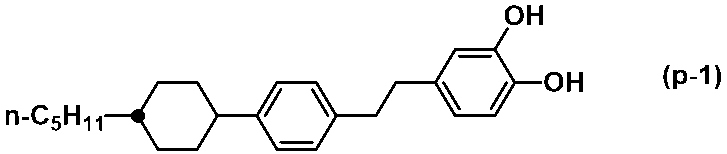
The following formula (p-1) was used. This compound was synthesized as described in Examples described below.
[実施例1] 式(1-2-1)で表される化合物の合成

市販の2,5-ジブロモトルエン1.29g(5.16mmol)、4-(3-ブテニル)フェニルボロン酸2.00g(11.3mmol)、テトラキストリフェニルフォスフィンパラジウム(0)0.238g(0.206mmol)、およびNa2CO31.44g(13.6mmol)の混合物を、ジメトキシエタン(20ml)中、窒素気流下、3時間還流した。4-(3-ブテニル)フェニルボロン酸は、特開2014-31322号公報に従い合成した。反応終了後、反応液を冷却し、純水及びルエン各100mlを加えた。有機層を分離後、同量の純水で2回洗浄し、MgSO4で乾燥した。ろ過及び溶媒を減圧留去後、得られた生成物をカラムクロマトグラフィー(シリカゲル、ヘプタン/トルエン=1/1)で精製することにより、化合物(1-2-1-a)を得た。収量946mg(収率52%)。 Commercially available 2,5-dibromotoluene 1.29 g (5.16 mmol), 4- (3-butenyl) phenylboronic acid 2.00 g (11.3 mmol), tetrakistriphenylphosphine palladium (0) 0.238 g (0) A mixture of .206 mmol) and 1.44 g (13.6 mmol) of Na 2 CO 3 was refluxed in dimethoxyethane (20 ml) under a nitrogen stream for 3 hours. 4- (3-Butenyl) phenylboronic acid was synthesized according to JP-A-2014-313222. After completion of the reaction, the reaction solution was cooled, and 100 ml each of pure water and ruen was added. After separating the organic layer, it was washed twice with the same amount of pure water and dried with ו 4 . After filtration and distillation of the solvent under reduced pressure, the obtained product was purified by column chromatography (silica gel, heptane / toluene = 1/1) to obtain compound (1-2-1-a). Yield 946 mg (yield 52%).
化合物(1-2-1-a)1.00g(2.83mmol)のCH2Cl2(10ml)溶液に、3-クロロ過安息香酸1.50g(mCPBA、65%、5.65mmol)を、10℃以下で加え、そのまま室温で一晩撹拌した。反応液を氷浴で冷却後、チオ硫酸ナトリウム5水和物の10%水溶液(5ml)および10%重曹水溶液(5ml)を加え、室温で30分撹拌した。この反応液から有機層を分離し、10%重曹水溶液(5ml)および純水(5ml)で洗浄した。有機層を分離後、MgSO4で乾燥した。ろ過および溶媒を減圧留去後、得られた生成物をカラムクロマトグラフィー(シリカゲル、トルエン/酢酸エチル=10/1)および再結晶(エタノール)で精製することにより、化合物(1-2-1)を得た。収量680mg(収率62%)。 1.50 g (mCPBA, 65%, 5.65 mmol) of 3-chloroperbenzoic acid was added to a CH 2 Cl 2 (10 ml) solution of 1.00 g (2.83 mmol) of compound (1-2-1-a). The mixture was added at 10 ° C. or lower, and the mixture was stirred at room temperature overnight. After cooling the reaction solution in an ice bath, a 10% aqueous solution (5 ml) of sodium thiosulfate pentahydrate and a 10% aqueous sodium bicarbonate solution (5 ml) were added, and the mixture was stirred at room temperature for 30 minutes. The organic layer was separated from this reaction solution and washed with 10% aqueous sodium bicarbonate solution (5 ml) and pure water (5 ml). After separating the organic layer, it was dried with Л4 . After filtration and distillation of the solvent under reduced pressure, the obtained product was purified by column chromatography (silica gel, toluene / ethyl acetate = 10/1) and recrystallized (ethanol) to compound (1-2-1). Got Yield 680 mg (yield 62%).
相転移点(℃);C・67.3・N・76.4・I
1H―NMR(ppm,CDCl3);7.59-7.28(m,11H),3.07-2.97,2.93-2.78(m,8H),2.56-2.51(m,2H),2.36-2.35(m,3H),1.99-1.82(m,4H).
Phase transition point (° C); C ・ 67.3 ・ N ・ 76.4 ・ I
1 1 H-NMR (ppm, CDCl 3 ); 7.59-7.28 (m, 11H), 3.07-2.97, 2.93-2.78 (m, 8H), 2.56-2 .51 (m, 2H), 2.36-2.35 (m, 3H), 1.99-1.82 (m, 4H).
[実施例2] 式(1-10-1)で表される化合物の合成

式(1-10-1-a)で表される化合物を、実施例1と同様な方法で、mCPBAを用いて酸化した。得られた生成物をカラムクロマトグラフィー(シリカゲル、トルエン/酢酸エチル=10/1)および再結晶(トルエン-エタノール)で精製することにより、化合物(1-10-1)を得た。収量0.58g(収率25%)。 The compound represented by the formula (1-10-1-a) was oxidized using mCPBA in the same manner as in Example 1. The obtained product was purified by column chromatography (silica gel, toluene / ethyl acetate = 10/1) and recrystallization (toluene-ethanol) to obtain compound (1-10-1). Yield 0.58 g (yield 25%).
相転移点(℃);C・250.2・S
1H―NMR(ppm,CDCl3);7.64-7.61(m,4H),7.59-7.56(m,4H),7.31-7.25(m,2H),7.02-6.98(m,2H),4.21-4.15(m,2H),3.19-3.17(m,1H),3.02-2.98(m,1H),2.91-2.77(m,4H),2.62-2.60(m,1H),2.53-2.50(m,1H),2.18-2.11(m,1H),2.01-1.36(m,3H).
Phase transition point (° C); C ・ 250.2 ・ S
1 1 H-NMR (ppm, CDCl 3 ); 7.64-7.61 (m, 4H), 7.59-7.56 (m, 4H), 7.31-7.25 (m, 2H), 7.02-6.98 (m, 2H), 4.21-4.15 (m, 2H), 3.19-3.17 (m, 1H), 3.02-2.98 (m, 1H) ), 2.91-2.77 (m, 4H), 2.62-2.60 (m, 1H), 2.53-2.50 (m, 1H), 2.18-2.11 (m) , 1H), 2.01-1.36 (m, 3H).
[実施例3] 式(1-11-1)で表される化合物の合成

市販の4-ブロモ-3-メチルフェノール1.00g(5.35mmol)、4-(3-ブテニル)フェニルボロン酸1.27g(7.21mmol)、テトラキストリフェニルフォスフィンパラジウム(0)0.127g(0.110mmol)、およびNa2CO31.33g(12.5mmol)の混合物を、ジメトキシエタン(12ml)、水(4ml)中、窒素気流下、6時間還流した。反応終了後、反応液を冷却し、純水及びルエン各100mlを加えた。有機層を分離後、同量の純水で2回洗浄し、MgSO4で乾燥した。ろ過及び溶媒を減圧留去後、得られた生成物をカラムクロマトグラフィー(シリカゲル、トルエン)で精製することにより、化合物(1-11-1-a)を得た。収量1.01g(収率79.3%)。 Commercially available 4-bromo-3-methylphenol 1.00 g (5.35 mmol), 4- (3-butenyl) phenylboronic acid 1.27 g (7.21 mmol), tetrakistriphenylphosphine palladium (0) 0.127 g A mixture of (0.110 mmol) and 1.33 g (12.5 mmol) of Na 2 CO 3 was refluxed in dimethoxyethane (12 ml), water (4 ml) under a nitrogen stream for 6 hours. After completion of the reaction, the reaction solution was cooled, and 100 ml each of pure water and ruen was added. After separating the organic layer, it was washed twice with the same amount of pure water and dried with ו 4 . After filtration and distillation of the solvent under reduced pressure, the obtained product was purified by column chromatography (silica gel, toluene) to obtain compound (1-11-1-a). Yield 1.01 g (yield 79.3%).
化合物(1-11-1-a)1.01g(4.24mmol)およびピリジン1.5mlの塩化メチレン(10ml)溶液中に、無水トリフルオロメタンスルホン酸0.8ml(4.89mmol)を室温以下で加えた。反応液を一晩撹拌後、純水(50ml)にあけ、トルエン(50ml)で抽出した。有機層を、希塩酸、純水、および重曹水(各50ml)で洗浄後、無水硫酸マグネシウムで乾燥した。有機層をろ過し、溶媒を減圧留去後、得られた生成物をカラムクロマトグラフィー(ヘプタン)で精製する事により、化合物(1-11-1-b)を得た。収量1.39g(収率87%)。 0.8 ml (4.89 mmol) of trifluoromethanesulfonic anhydride in a solution of 1.01 g (4.24 mmol) of compound (1-11-1-a) and 1.5 ml of pyridine in methylene chloride (10 ml) at room temperature or below. added. The reaction mixture was stirred overnight, poured into pure water (50 ml), and extracted with toluene (50 ml). The organic layer was washed with dilute hydrochloric acid, pure water, and aqueous sodium hydrogen carbonate (50 ml each), and then dried over anhydrous magnesium sulfate. The organic layer was filtered, the solvent was distilled off under reduced pressure, and the obtained product was purified by column chromatography (heptane) to obtain compound (1-11-1-b). Yield 1.39 g (yield 87%).
4-(3-ブテニルオキシ)-フェニルボロン酸 940mg(4.90mmol)、化合物(1-9-1-b) 1.39g(3.75mmol)、ジクロロビストリフェニルフォスフィンパラジウム(II) 66mg(0.094mmol)、およびNa2CO3 1.05g(9.91mmol)の混合物を、THF/純水=10/5ml混合溶媒中、窒素気流下で、2時間還流した。反応液を冷却後、純水(50ml)およびトルエン(50ml)を加え、分液操作を行った。有機層を無水MgSO4で乾燥後、ろ過し、溶媒を減圧留去した。残渣をカラムクロマトグラフィー(シリカゲル、トルエン)および再結晶(エタノール)で精製することにより、化合物(1-11-1-c)を得た。収量1.12g(収率81%)。 4- (3-Butenyloxy) -phenylboronic acid 940 mg (4.90 mmol), compound (1-9.1-b) 1.39 g (3.75 mmol), dichlorobistriphenylphosphine palladium (II) 66 mg (0. A mixture of 1.05 g (9.91 mmol) of Na 2 CO 3 (094 mmol) was refluxed in a mixed solvent of THF / pure water = 10/5 ml under a nitrogen stream for 2 hours. After cooling the reaction solution, pure water (50 ml) and toluene (50 ml) were added, and a liquid separation operation was performed. The organic layer was dried over anhydrous י 4 , filtered, and the solvent was distilled off under reduced pressure. The residue was purified by column chromatography (silica gel, toluene) and recrystallization (ethanol) to obtain compound (1-11-1-c). Yield 1.12 g (yield 81%).
式(1-11-1-c)で表される化合物を、実施例1と同様な方法で、mCPBAを用いて酸化した。得られた生成物をカラムクロマトグラフィー(シリカゲル、トルエン/酢酸エチル=50/1)および再結晶(エタノール)で精製することにより、化合物(1-11-1)を得た。収量585mg(収率48%)。 The compound represented by the formula (1-11-1-c) was oxidized using mCPBA in the same manner as in Example 1. The obtained product was purified by column chromatography (silica gel, toluene / ethyl acetate = 50/1) and recrystallization (ethanol) to obtain compound (1-11-1). Yield 585 mg (48% yield).
相転移点(℃);C・67.3・N・100.1・I
1H―NMR(ppm,CDCl3);7.58-7.55(m,2H),7.46-7.42(m,2H),7.33-7.29(m,5H),7.01-6.98(m,2H),4.21-4.14(m,2H),3.20-3.17(m,1H),3.03-2.99(m,1H),2.96-2.79(m,4H),2.63-2.60(m,1H),2.54-2.50(m,1H),2.35(s,1H)2.18-2.11(m,1H),2.01-1.85(m,3H).
Phase transition point (° C); C ・ 67.3 ・ N ・ 100.1 ・ I
1 1 H-NMR (ppm, CDCl 3 ); 7.58-7.55 (m, 2H), 7.46-7.42 (m, 2H), 7.33-7.29 (m, 5H), 7.01-6.98 (m, 2H), 4.21-4.14 (m, 2H), 3.20-3.17 (m, 1H), 3.03-2.99 (m, 1H) ), 2.96-2.79 (m, 4H), 2.63-2.60 (m, 1H), 2.54-2.50 (m, 1H), 2.35 (s, 1H) 2. .18-2.11 (m, 1H), 2.01-1.85 (m, 3H).
[実施例4] 式(1-13-1)で表される化合物の合成
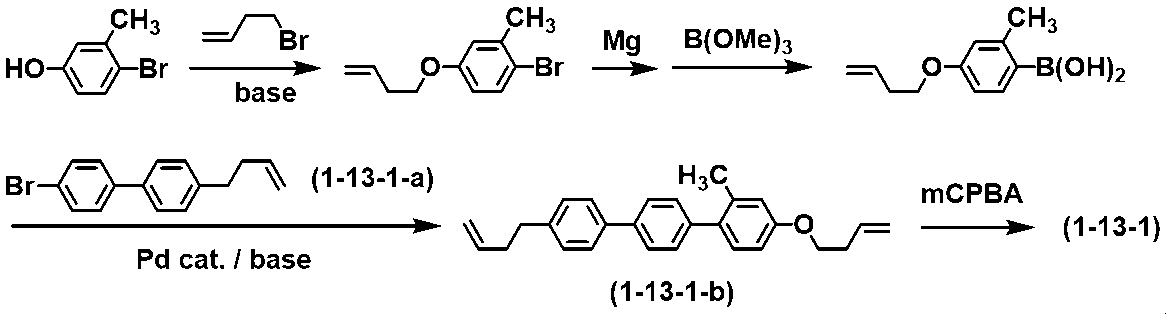
第5版実験化学講座18 有機化合物の合成VI、101ページ、丸善株式会社等に記載の方法に従い、上記4-(3-ブテニルオキシ)-2-メチルブロモベンゼンを用い、4-(3-ブテニルオキシ)-2-メチルフェニルボロン酸を合成した。収量2.51g(収率78%)。この化合物は精製せずにそのまま次の反応に用いた。収量1.97g(収率92%)。 5th Edition Experimental Chemistry Course 18 Synthesis of Organic Compounds According to the method described in VI, page 101, Maruzen Co., Ltd., etc., 4- (3-butenyloxy) -2-methylbromobenzene was used and 4- (3-butenyloxy). -2-Methylphenylboronic acid was synthesized. Yield 2.51 g (yield 78%). This compound was used as it was in the next reaction without purification. Yield 1.97 g (yield 92%).
4-(3-ブテニルオキシ)-2-メチルフェニルボロン酸 930mg(4.51mmol)、化合物(1-13-1-a) 1.00g(3.48mmol)、ジクロロビストリフェニルフォスフィンパラジウム(II) 61mg、およびNa2CO3 960mg(9.06mmol)の混合物を、THF/純水=20/20ml混合溶媒中、窒素気流下で、4時間還流した。反応液を冷却後、純水(50ml)およびトルエン(50ml)を加え、分液操作を行った。有機層を無水MgSO4で乾燥後、ろ過し、溶媒を減圧留去した。残渣をカラムクロマトグラフィー(シリカゲル、ヘプタン/トルエン=10/1→5/1)および再結晶(ヘプタン)で精製することにより、化合物(1-13-1-b)を得た。収量0.87g(収率68%)。なお上記化合物(1-13-1-a)はEP1013649Aと同様な方法で合成した。 4- (3-Butenyloxy) -2-methylphenylboronic acid 930 mg (4.51 mmol), compound (1-13-1-a) 1.00 g (3.48 mmol), dichlorobistriphenylphosphine palladium (II) 61 mg , And Na 2 CO 3 960 mg (9.06 mmol) were refluxed in a mixed solvent of THF / pure water = 20/20 ml under a nitrogen stream for 4 hours. After cooling the reaction solution, pure water (50 ml) and toluene (50 ml) were added, and a liquid separation operation was performed. The organic layer was dried over anhydrous י 4 , filtered, and the solvent was distilled off under reduced pressure. The residue was purified by column chromatography (silica gel, heptane / toluene = 10/1 → 5/1) and recrystallization (heptane) to obtain compound (1-13-1-b). Yield 0.87 g (yield 68%). The above compound (1-13-1-a) was synthesized by the same method as EP1013649A.
式(1-13-1-b)で表される化合物を、実施例1と同様な方法で、mCPBAを用いて酸化した。得られた生成物をカラムクロマトグラフィー(シリカゲル、トルエン/酢酸エチル=20/1)および再結晶(エタノール)で精製することにより、化合物(1-13-1)を得た。収量0.41g(収率90%)。 The compound represented by the formula (1-13-1-b) was oxidized using mCPBA in the same manner as in Example 1. The obtained product was purified by column chromatography (silica gel, toluene / ethyl acetate = 20/1) and recrystallization (ethanol) to obtain compound (1-13-1). Yield 0.41 g (yield 90%).
相転移点(℃);C・65.8・N・105.8・I
1H―NMR(ppm,CDCl3);7.61,7.58,7.37,7.30(AA’BB’,8H),7.20(d,1H,J=8.50Hz),6.85(d,1H,J=3.00Hz),6.81(dd,1H,J=8.00,2.50Hz),4.20-4.13,3.20-3.16,3.01-3.00,2.86-2.77,2.62-2.60,2.53-2,50(m,10H),2.31(s,3H),2.14-2.10,2.00-1.88(m,4H).
Phase transition point (° C); C ・ 65.8 ・ N ・ 105.8 ・ I
1 1 H-NMR (ppm, CDCl 3 ); 7.61, 7.58, 7.37, 7.30 (AA'BB', 8H), 7.20 (d, 1H, J = 8.50Hz), 6.85 (d, 1H, J = 3.00Hz), 6.81 (dd, 1H, J = 8.00, 2.50Hz), 4.20-4.13, 3.20-3.16, 3.01-3.00, 2.86-2.77, 2.62-2.60, 2.53-2,50 (m, 10H), 2.31 (s, 3H), 2.14- 2.10, 2.00-1.88 (m, 4H).
[実施例5] 式(1-14-1)で表される化合物の合成

実施例4の4-(3-ブテニルオキシ)-2-メチルフェニルボロン酸と同様にして合成した、4-(3-ブテニルオキシ)-3-メチルフェニルボロン酸および化合物(1-13-1-a)を用い、上記実施例4と同様な方法で、化合物(1-14-1-b)を合成した。生成物は、カラムクロマトグラフィー(シリカゲル、ヘプタン:トルエン=1:1)および再結晶(ヘプタン)で精製した。収量0.82g(収率64%)。 4- (3-Butenyloxy) -3-methylphenylboronic acid and compound (1-13-1-a) synthesized in the same manner as in 4- (3-butenyloxy) -2-methylphenylboronic acid of Example 4. Was used to synthesize the compound (1-14-1-b) in the same manner as in Example 4 above. The product was purified by column chromatography (silica gel, heptane: toluene = 1: 1) and recrystallization (heptane). Yield 0.82 g (yield 64%).
化合物(1-14-1-b)を用い、上記実施例1と同様な方法で化合物(1-14-1)を合成した。生成物は、カラムクロマトグラフィー(シリカゲル、トルエン→トルエン/酢酸エチル=10/1)および再結晶(エタノール)で精製した。収量0.55g(収率62%)。 Using compound (1-14-1-b), compound (1-14-1) was synthesized in the same manner as in Example 1 above. The product was purified by column chromatography (silica gel, toluene → toluene / ethyl acetate = 10/1) and recrystallization (ethanol). Yield 0.55 g (yield 62%).
相転移点(℃);C・144.1・N・183.4・I
1H―NMR(ppm,CDCl3);7.64-7.62(m,4H),7.57,7.43(AA’BB’,4H),7.31-7.25(m,2H),4.20-4.16(m,2H),3.21-3.19,3.01-3.00,2.93-2.77,2.64-2.60,2.55-2.51(m,8H),2.30(s,3H),2.18-1.83(m,4H).
Phase transition point (° C.); C ・ 144.1 ・ N ・ 183.4 ・ I
1 1 H-NMR (ppm, CDCl 3 ); 7.64-7.62 (m, 4H), 7.57, 7.43 (AA'BB', 4H), 7.31-7.25 (m, 2H), 4.20-4.16 (m, 2H), 3.21-3.19, 3.01-3.00, 2.93-2.77, 2.64-2.60, 2. 55-2.51 (m, 8H), 2.30 (s, 3H), 2.18-1.83 (m, 4H).
[実施例6] 式(1-14-2)で表される化合物の合成

実施例4の4-(3-ブテニルオキシ)-2-メチルフェニルボロン酸と同様にして合成した、4-(4-ペンテニルオキシ)-3-メチルフェニルボロン酸および化合物(1-13-1-a)を用い、上記実施例4と同様な方法で、化合物(1-14-2-a)を合成した。生成物は、カラムクロマトグラフィー(シリカゲル、トルエン)および再結晶(ヘプタン)で精製した。収量9.5g(収率82%)。 4- (4-Pentenyloxy) -3-methylphenylboronic acid and compound (1-13-1-a) synthesized in the same manner as in 4- (3-butenyloxy) -2-methylphenylboronic acid of Example 4. ) Was used to synthesize the compound (1-14-2-a) in the same manner as in Example 4 above. The product was purified by column chromatography (silica gel, toluene) and recrystallization (heptane). Yield 9.5 g (yield 82%).
化合物(1-14-2-a)を用い、上記実施例1と同様な方法で化合物(1-14-2)を合成した。生成物は、カラムクロマトグラフィー(シリカゲル、トルエン/酢酸エチル=10/1)および再結晶(エタノール)で精製した。収量6.4g(収率62%)。 Using compound (1-14-2-a), compound (1-14-2) was synthesized in the same manner as in Example 1 above. The product was purified by column chromatography (silica gel, toluene / ethyl acetate = 10/1) and recrystallization (ethanol). Yield 6.4 g (yield 62%).
相転移点(℃);C・126.6・N・184.0・I
1H―NMR(ppm,CDCl3);7.64-7.60(m,4H),7.57,7.43(AA’BB’,4H),7.31-7.25(m,2H),6.89(d,1H,J=8.00Hz),4.11-4.04(m,2H),3.04-2.99,2.93-2.78,2.53-2.51,1.90-1.86,1.78-1.67(m,16H)2.30(s,3H).
Phase transition point (° C); C ・ 126.6 ・ N ・ 184.0 ・ I
1 1 H-NMR (ppm, CDCl 3 ); 7.64-7.60 (m, 4H), 7.57, 7.43 (AA'BB', 4H), 7.31-7.25 (m, 2H), 6.89 (d, 1H, J = 8.00Hz), 4.11-4.04 (m, 2H), 3.04-2.99, 2.93-2.78, 2.53 -2.51, 1.90-1.86, 1.78-1.67 (m, 16H) 2.30 (s, 3H).
[実施例7] 式(1-14-3)で表される化合物の合成

実施例4の4-(3-ブテニルオキシ)-2-メチルフェニルボロン酸と同様にして合成した、4-(3-メチル-3-ブテニルオキシ)-3-メチルフェニルボロン酸および化合物(1-13-1-a)を用い、上記実施例4と同様な方法で、化合物(1-14-3-a)を合成した。生成物は、カラムクロマトグラフィー(シリカゲル、トルエン)および再結晶(ヘプタン)で精製した。収量6.5g(収率86%)。 4- (3-Methyl-3-butenyloxy) -3-methylphenylboronic acid and compound (1-13-) synthesized in the same manner as in 4- (3-butenyloxy) -2-methylphenylboronic acid of Example 4. Using 1-a), compound (1-14-3-a) was synthesized by the same method as in Example 4 above. The product was purified by column chromatography (silica gel, toluene) and recrystallization (heptane). Yield 6.5 g (yield 86%).
化合物(1-14-2-a)を用い、上記実施例1と同様な方法で化合物(1-14-3)を合成した。生成物は、カラムクロマトグラフィー(シリカゲル、トルエン:酢酸エチル=10:1)および再結晶(エタノール)で精製した。収量6.9g(収率85%)。 Using compound (1-14-2-a), compound (1-14-3) was synthesized in the same manner as in Example 1 above. The product was purified by column chromatography (silica gel, toluene: ethyl acetate = 10: 1) and recrystallization (ethanol). Yield 6.9 g (yield 85%).
相転移点(℃);C・122.0・N・153.3・I
1H―NMR(ppm,CDCl3);7.63-7.62(m,4H),7.57,7.29(AA’BB’,4H),7.45-7.42(m,2H),6.90(d,1H,J=9.00Hz),3.00-2.77,2.67-2.66,2.51-2.50(m,7H),2.29(s,3H),2.17-1.83(m,4H),1.55(s,3H).
Phase transition point (° C); C ・ 122.0 ・ N ・ 153.3 ・ I
1 1 H-NMR (ppm, CDCl 3 ); 7.63-7.62 (m, 4H), 7.57, 7.29 (AA'BB', 4H), 7.45-7.42 (m, 4H). 2H), 6.90 (d, 1H, J = 9.00Hz), 3.00-2.77, 2.67-2.66, 2.51-2.50 (m, 7H), 2.29 (S, 3H), 2.17-1.83 (m, 4H), 1.55 (s, 3H).
[実施例8] 式(1-14-4)で表される化合物の合成

実施例4の4-(3-ブテニルオキシ)-2-メチルフェニルボロン酸と同様にして合成した、4-(4-ヘキセニルオキシ)-3-メチルフェニルボロン酸および化合物(1-13-1-a)を用い、上記実施例4と同様な方法で、化合物(1-14-4-a)を合成した。生成物は、カラムクロマトグラフィー(シリカゲル、ヘプタン/トルエン=1/1)および再結晶(トルエン/エタノール)で精製した。収量1.7g(収率88%)。 4- (4-Hexenyloxy) -3-methylphenylboronic acid and compound (1-13-1-a) synthesized in the same manner as in 4- (3-butenyloxy) -2-methylphenylboronic acid of Example 4. ) Was used to synthesize the compound (1-14-4-a) in the same manner as in Example 4 above. The product was purified by column chromatography (silica gel, heptane / toluene = 1/1) and recrystallization (toluene / ethanol). Yield 1.7 g (yield 88%).
化合物(1-14-4-a)を用い、上記実施例1と同様な方法で化合物(1-14-4)を合成した。生成物は、カラムクロマトグラフィー(シリカゲル、トルエン:酢酸エチル=10:1)および再結晶(エタノール)で精製した。収量0.96g(収率52%)。 Using compound (1-14-4-a), compound (1-14-4) was synthesized in the same manner as in Example 1 above. The product was purified by column chromatography (silica gel, toluene: ethyl acetate = 10: 1) and recrystallization (ethanol). Yield 0.96 g (yield 52%).
相転移点(℃);C・108.3・N・174.0・I
1H―NMR(ppm,CDCl3);7.63-7.60(m,4H),7.57,7.29(AA’BB’,4H),7.44-7.40(m,2H),6.89(d,1H,J=8.00Hz),4.04(t,2H,J=6.00Hz),3.05-3.00,2.82-2.77,2.52-2.50(m,8H),2.29(s,3H),2.05-1.83,1.80-1.60(m,8H).
Phase transition point (° C.); C ・ 108.3 ・ N ・ 174.0 ・ I
1 1 H-NMR (ppm, CDCl 3 ); 7.63-7.60 (m, 4H), 7.57, 7.29 (AA'BB', 4H), 7.44-7.40 (m, 2H), 6.89 (d, 1H, J = 8.00Hz), 4.04 (t, 2H, J = 6.00Hz), 3.05-3.00, 2.82-2.77, 2 .52-2.50 (m, 8H), 2.29 (s, 3H), 2.05-1.83, 1.80-1.60 (m, 8H).
[実施例9] 式(1’-21)で表される化合物の合成

化合物(1’-21-a)3.00g(10.9mmol)、4-ブロモ-2-メチルブト-1-エン3.56g(23.9mmol)、およびK2CO33.6g(26mmol)の混合物を、DMF(20ml)中、N2雰囲気下、80℃で8時間反応させた。反応液を冷却後、トルエン(100ml)を加え、純水(100ml)で洗浄した。有機層を分離後、無水MgSO4で乾燥後、ろ過した。溶媒を減圧留去した後、残渣をカラムクロマトグラフィー(シリカゲル、トルエン)で精製することにより、化合物(1’-21-b)を得た。収量2.85g(収率64%)。 Of compound (1'-21-a) 3.00 g (10.9 mmol), 4-bromo-2-methylbut-1-ene 3.56 g (23.9 mmol), and K2 CO 3 3.6 g (26 mmol). The mixture was reacted in DMF (20 ml) in N2 atmosphere at 80 ° C. for 8 hours. After cooling the reaction solution, toluene (100 ml) was added, and the mixture was washed with pure water (100 ml). The organic layer was separated, dried in anhydrous י 4 , and then filtered. After distilling off the solvent under reduced pressure, the residue was purified by column chromatography (silica gel, toluene) to obtain compound (1'-21-b). Yield 2.85 g (yield 64%).
化合物(1’-21-b)を用い、上記実施例1と同様な方法で化合物(1’-21)を合成した。生成物は、カラムクロマトグラフィー(シリカゲル、トルエン:酢酸エチル=10:1)および再結晶(エタノール)で精製した。収量0.95g(収率69%)。 Using compound (1'-21-b), compound (1'-21) was synthesized in the same manner as in Example 1 above. The product was purified by column chromatography (silica gel, toluene: ethyl acetate = 10: 1) and recrystallization (ethanol). Yield 0.95 g (yield 69%).
相転移点(℃);C・151.8・I
1H―NMR(ppm,CDCl3);7.63-7.59(m,4H),7.56(AA’XX’,2H),7.43-7.41(m,2H),6.98(AA’XX’,2H),6.89(d,1H,J=9.00Hz),4.15-4.09,2.80-2.76,2.68-2.65,2.23-2.13,2.10-2.03(m,12H),2.29,1.44,1.43(s,9H).
Phase transition point (° C); C ・ 151.8 ・ I
1 1 H-NMR (ppm, CDCl 3 ); 7.63-7.59 (m, 4H), 7.56 (AA'XX', 2H), 7.43-7.41 (m, 2H), 6 .98 (AA'XX', 2H), 6.89 (d, 1H, J = 9.00Hz), 4.15-4.09, 2.80-2.76, 2.68-2.65, 2.23-2.13, 2.10-2.03 (m, 12H), 2.29, 1.44, 1.43 (s, 9H).
[比較例1]
式(ref.1)で表される化合物の相転移点を測定した結果、以下であった。
相転移点(℃);C・176.9・I
[Comparative Example 1]
As a result of measuring the phase transition point of the compound represented by the formula (ref. 1), the results were as follows.
Phase transition point (° C); C ・ 176.9 ・ I
上記実施例と比較例との比較から、本発明の化合物は液晶性を持ちやす事が分かる。特に、実施例3から実施例8の化合物は、エポキシの硬化に適した温度範囲である80℃から180℃までの温度領域に、広く液晶相を有する。 From the comparison between the above Examples and Comparative Examples, it can be seen that the compound of the present invention tends to have liquid crystallinity. In particular, the compounds of Examples 3 to 8 have a wide liquid crystal phase in a temperature range from 80 ° C. to 180 ° C., which is a temperature range suitable for curing an epoxy.
[合成例1] 式(3-2-1)で表される化合物の合成
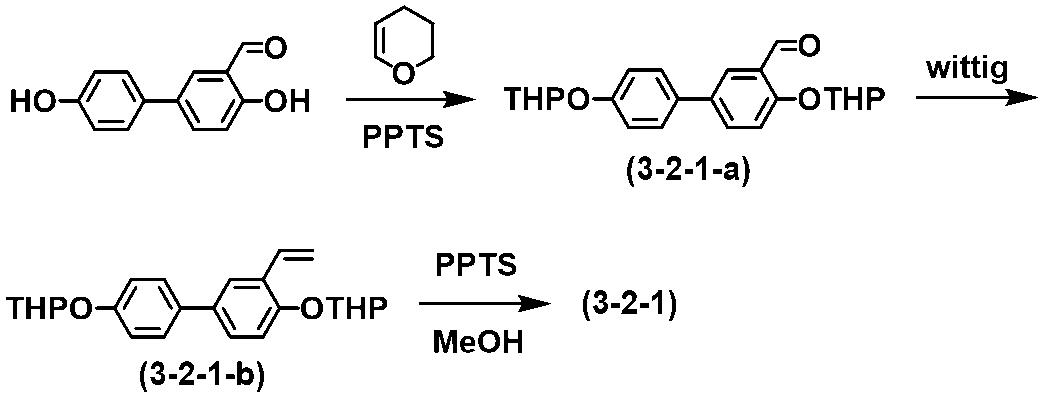
3-ホルミル-4,4’-ジヒドロキシビフェニル 2.00g(9.34mmol)、3,4-ジヒドロ-2H-ピラン 4.7g(56mmol)、およびPPTS0.47g(1.9mmol)の混合物を、CH2Cl2 20ml中、室温で一晩撹拌した。上記反応において、3-ホルミル-4,4’-ジヒドロキシビフェニルは、Journal of Medicinal Chemistry, vol.52, p.858(2009).に従って合成した。反応液に飽和重曹水30mlを加え、有機層を分離した。有機層を無水硫酸マグネシウムで乾燥した後ろ過し、溶媒を減圧留去後、得られた生成物をカラムクロマトグラフィー(トルエン/酢酸エチル=10/1)で精製する事により、化合物(3-2-1-a)を得た。収量244mg(収率7.9%)。 CH 3-formyl-4,4'-dihydroxybiphenyl 2.00 g (9.34 mmol), 3,4-dihydro-2H-pyran 4.7 g (56 mmol), and PPTS 0.47 g (1.9 mmol) CH 2 Cl 2 In 20 ml, stirred overnight at room temperature. In the above reaction, 3-formyl-4,4'-dihydroxybiphenyl was added to Journal of Medicinal Chemistry, vol. 52, p. 858 (2009). Synthesized according to. 30 ml of saturated aqueous sodium hydrogen carbonate was added to the reaction solution, and the organic layer was separated. The organic layer is dried over anhydrous magnesium sulfate, filtered, the solvent is distilled off under reduced pressure, and the obtained product is purified by column chromatography (toluene / ethyl acetate = 10/1) to purify the compound (3-2). -1-a) was obtained. Yield 244 mg (yield 7.9%).
メチルトリフェニルホスホニウムブロミド868mg(2.43mmol)のTHF(10ml)溶液に、t-BuOK294mg(2.62mmol)のTHF(10ml)溶液を、0℃以下で加えた。0℃で30分撹拌後、-20℃に冷却し、化合物(3-2-1-a)1.00g(1.87mmol)を加えた。室温で2時間撹拌後、純水(50ml)にあけ、トルエン(50ml)で抽出した。有機層を純水(50ml)で洗浄後、無水硫酸マグネシウムで乾燥した。有機層をろ過し、溶媒を減圧留去後、得られた生成物をカラムクロマトグラフィー(ヘプタン/トルエン=1/1→トルエン)で精製し、化合物(3-2-1-b)を得た。収量766mg、収率77%。 A solution of t-BuOK 294 mg (2.62 mmol) in THF (10 ml) was added to a solution of methyltriphenylphosphonium bromide in 868 mg (2.43 mmol) in THF (10 ml) at 0 ° C. or lower. After stirring at 0 ° C. for 30 minutes, the mixture was cooled to −20 ° C., and 1.00 g (1.87 mmol) of compound (3-2-1-a) was added. After stirring at room temperature for 2 hours, the mixture was poured into pure water (50 ml) and extracted with toluene (50 ml). The organic layer was washed with pure water (50 ml) and then dried over anhydrous magnesium sulfate. The organic layer was filtered, the solvent was distilled off under reduced pressure, and the obtained product was purified by column chromatography (heptane / toluene = 1/1 → toluene) to obtain compound (3-2-1-1b). .. Yield 766 mg, yield 77%.
化合物(3-2-1-b)1.61g(4.21mmol)のTHF(10ml)-MeOH(10ml)混合溶液に、p-トルエンスルホン酸ピリジニウム425mg(16.9mmol)を加え、室温で一晩撹拌した。反応液にブラインおよび酢酸エチル(それぞれ30ml)を加え、有機層を分離した。有機層を無水硫酸マグネシウムで乾燥後、ろ過し、溶媒を減圧留去した。得られた生成物をカラムクロマトグラフィー(トルエン:酢酸エチル=2:1)で精製し、化合物(3-2-1)を得た。収率100%。 To a mixed solution of 1.61 g (4.21 mmol) of compound (3-2-1-b) in THF (10 ml) -MeOH (10 ml), 425 mg (16.9 mmol) of pyridinium p-toluenesulfonate was added, and the mixture was added at room temperature. It was stirred in the evening. Brine and ethyl acetate (30 ml each) were added to the reaction solution, and the organic layer was separated. The organic layer was dried over anhydrous magnesium sulfate, filtered, and the solvent was evaporated under reduced pressure. The obtained product was purified by column chromatography (toluene: ethyl acetate = 2: 1) to obtain compound (3-2-1). Yield 100%.
融点(℃);138.0-145.7.
1H―NMR(ppm,CDCl3);7.54(d,1H,J=2.50Hz),7.44-7.41(AA’BB’,2H),7.31(dd,1H,J=8.00,2.50Hz),6.97(dd,1H,J=17.50,10.50Hz),6.91-6.87(AA’BB’,2H),6.85(d,1H,J=8.50Hz),5.80(d,1H,J=18.00Hz),5.41(d,1H,J=11.00Hz),4.99(s,1H),4.76(s,1H).
Melting point (° C); 138.0-145.7.
1 H-NMR (ppm, CDCl 3 ); 7.54 (d, 1H, J = 2.50Hz), 7.44-7.41 (AA'BB', 2H), 7.31 (dd, 1H, J = 8.00, 2.50Hz), 6.97 (dd, 1H, J = 17.50, 10.50Hz), 6.91-6.87 (AA'BB', 2H), 6.85 ( d, 1H, J = 8.50Hz), 5.80 (d, 1H, J = 18.00Hz), 5.41 (d, 1H, J = 11.000Hz), 4.99 (s, 1H), 4.76 (s, 1H).
[合成例2] 式(p-1)で表される化合物の合成

上記の、1-ヨード-4―トランス(4-n-ペンチル)シクロヘキシルベンゼンおよび4-エチニル-1,2-ジメトキシベンゼンは、それぞれ、J.Am.Chem.Soc.,131,6763(2009).およびJ.Org.Chem.,73,4241(2008).に従って合成した。 The above-mentioned 1-iodo-4-trans (4-n-pentyl) cyclohexylbenzene and 4-ethynyl-1,2-dimethoxybenzene are described in J. Am. Chem. Soc. , 131,6763 (2009). And J. Org. Chem. , 73, 4241 (2008). Synthesized according to.
化合物(p-1-a)の2.20g(5.75mmol)を、トルエン/エタノール=20/20ml中、Pd/C 320mを触媒として、オートクレーブ中で水素添加反応した。このとき、水素圧は0.7MPaであった。反応後、触媒をろ別し、溶媒を減圧留去した。残さを再結晶(EtOH)で精製することにより、化合物(p-1-b)を得た。収量1.70g(収率75%)。 2.20 g (5.75 mmol) of compound (p-1-a) was hydrogenated in an autoclave in toluene / ethanol = 20/20 ml with Pd / C 320 m as a catalyst. At this time, the hydrogen pressure was 0.7 MPa. After the reaction, the catalyst was filtered off and the solvent was distilled off under reduced pressure. The residue was purified by recrystallization (EtOH) to obtain compound (p-1-b). Yield 1.70 g (yield 75%).
化合物(p-1-b)の1.10g(2.79mmol)のCH2Cl2(10ml)溶液に、-10℃で、BBr3のCH2Cl2溶液(1M)を5.8mlを加えた。室温で一晩撹拌後、反応液を純水中(30ml)に加えた。この混合物に、AcOEt(40ml)を加え、抽出した。有機層を純水(15ml)で2回洗浄後、MgSO4で乾燥した。溶液をろ過し、溶媒を減圧留去した。残渣をカラムクロマトグラフィー(シリカゲル、トルエン/酢酸エチル=1/1)および再結晶(トルエン)で精製することにより、化合物(p-1)を得た。収量870mg(収率85%)。 To 1.10 g (2.79 mmol) of compound (p-1-b) in CH 2 Cl 2 (10 ml), add 5.8 ml of BBr 3 in CH 2 Cl 2 (1M) at -10 ° C. rice field. After stirring overnight at room temperature, the reaction solution was added to pure water (30 ml). AcOEt (40 ml) was added to this mixture and extracted. The organic layer was washed twice with pure water (15 ml) and then dried with ו 4 . The solution was filtered and the solvent was distilled off under reduced pressure. The residue was purified by column chromatography (silica gel, toluene / ethyl acetate = 1/1) and recrystallization (toluene) to obtain compound (p-1). Yield 870 mg (yield 85%).
相転移点(℃);C・147.4・N・161.4・I.
1H―NMR(ppm,CDCl3);7.14-7.09(AA‘BB’,4H),6.78(d,1H,J=8.00Hz),6.72(d,1H,J=2.00Hz),6.64(dd,1H,J=8.00,2.00Hz),4.98,4.86(s,1H),2.84-2.79,2.48-2.39,1.89-1.84,1.49-0.88(m,25H).
Phase transition point (° C.); C. 147.4, N, 161.4, I.
1 1 H-NMR (ppm, CDCl 3 ); 7.14-7.09 (AA'BB', 4H), 6.78 (d, 1H, J = 8.00Hz), 6.72 (d, 1H, J = 2.00Hz), 6.64 (dd, 1H, J = 8.00, 2.00Hz), 4.98, 4.86 (s, 1H), 2.84-2.79, 2.48 -2.39, 1.89-1.84, 1.49-0.88 (m, 25H).
[実施例10] 組成物の調製および溶解性の確認
実施例1で合成した式(1-2-1)で表される化合物0.5000g(1.300mmol)、およびビスフェノールE 0.2786g(1.300mmol)をサンプル瓶に入れ、シクロペンタノン(2.80ml)を加え、固形分を溶解し、固形分濃度約20%の組成物(組成物12)を得た。この組成物10を0℃に設定した冷蔵庫に一晩静置したところ、沈殿は発生せず、そのままの状態を保っていた。
[Example 10] Preparation of composition and confirmation of solubility 0.5000 g (1.300 mmol) of the compound represented by the formula (1-2-1) synthesized in Example 1 and 0.2786 g (1) of bisphenol E. .300 mmol) was placed in a sample bottle, cyclopentanone (2.80 ml) was added, and the solid content was dissolved to obtain a composition (composition 12) having a solid content concentration of about 20%. When this composition 10 was allowed to stand in a refrigerator set at 0 ° C. overnight, no precipitation occurred and the composition remained as it was.
[実施例11]から[実施例30]
エポキシ化合物および硬化剤を以下の表1に示すように変更した以外は、実施例10と同様な方法で、以下に示す固形分濃度20重量%の組成物溶液を調製し、溶解性を確認した。表1において、エポキシ化合物または硬化剤が2種類記載されている欄は、これらが混合されている事を示し、後ろにその割合を、それぞれの化合物のモル比で示した。また、各組成物中のエポキシ化合物と硬化剤とのモル比は、等しくした。
[Example 11] to [Example 30]
A composition solution having a solid content concentration of 20% by weight shown below was prepared in the same manner as in Example 10 except that the epoxy compound and the curing agent were changed as shown in Table 1 below, and the solubility was confirmed. .. In Table 1, the column in which two types of epoxy compounds or curing agents are listed indicates that they are mixed, and the ratio thereof is shown by the molar ratio of each compound. Moreover, the molar ratio of the epoxy compound and the curing agent in each composition was made equal.
表1 組成物およびその溶解性(溶媒シクロペンタノン)

[実施例31]
式(1-14-3)で表される化合物0.5000g(1.206mmol)、式(3-2-1)で表される化合物0.1794g(0.8452mmol)、および式(p-1)で表される化合物0.1330g(0.3628mmol)をサンプル瓶に入れ、シクロペンタノン(3.14ml)を加え、固形分を溶解し、固形分濃度約20%の組成物(組成物31)を得た。この組成物31を0℃に設定した冷蔵庫に一晩静置したところ、沈殿は発生せず、そのままの状態を保っていた。
[Example 31]
0.5000 g (1.26 mmol) of the compound represented by the formula (1-14-3), 0.1794 g (0.8452 mmol) of the compound represented by the formula (3-2-1), and (p-1). ), 0.1330 g (0.3628 mmol) of the compound is placed in a sample bottle, cyclopentanone (3.14 ml) is added, the solid content is dissolved, and the composition having a solid content concentration of about 20% (composition 31). ) Was obtained. When this composition 31 was allowed to stand in a refrigerator set at 0 ° C. overnight, no precipitation occurred and the composition remained as it was.
[比較例2]
式(ref.1)で表される化合物を用い、上記実施例10と同様な方法で、溶解性を確認した。その結果、シクロペンタノンに溶解しなかった。
[Comparative Example 2]
Using the compound represented by the formula (ref.1), the solubility was confirmed by the same method as in Example 10 above. As a result, it did not dissolve in cyclopentanone.
上記実施例10から実施例31と、比較例2との比較から、本発明の化合物は、溶媒への溶解性が高い事が分かる。 From the comparison between Examples 10 to 31 and Comparative Example 2, it can be seen that the compound of the present invention has high solubility in a solvent.
[実施例32] 組成物の調製、液晶性確認、および保存安定性の確認
実施例1で合成した式(1-2-1)で表される化合物1.000g(2.601mmol)、PDA 0.1406g(1.300mmol)をサンプル瓶に入れ、テトラヒドロフラン(10ml)を加え、固形分を溶解した(組成物32)。この組成物をホットプレート上で偏光顕微鏡観察したところ、液晶性を確認した。
次に、この溶液を室温で2時間真空乾燥する事により、溶媒なし組成物(組成物32’)を、粘稠性液体として得た。
上記の組成物34’を、0℃の冷蔵庫中に一晩放置したところ、粘稠性液体を保っていた。
[Example 32] Preparation of composition, confirmation of liquid crystallinity, and confirmation of storage stability 1.000 g (2.601 mmol) of the compound represented by the formula (1-2-1) synthesized in Example 1, PDA 0. .1406 g (1.300 mmol) was placed in a sample bottle, tetrahydrofuran (10 ml) was added, and the solid content was dissolved (composition 32). When this composition was observed with a polarizing microscope on a hot plate, liquid crystallinity was confirmed.
Next, the solution was vacuum dried at room temperature for 2 hours to obtain a solvent-free composition (composition 32') as a viscous liquid.
When the above composition 34'was left in a refrigerator at 0 ° C. overnight, it kept a viscous liquid.
[比較例3]
式(ref.1)で表される化合物1.000g(2.574mmol)、PDA 0.1392g(1.287mmol)をサンプル瓶に入れ、テトラヒドロフラン(100ml)を加え、固形分を溶解した(組成物ref.3)。この組成物を偏光顕微鏡観察したところ、一部に液晶性を示す領域を確認したが、その他の領域では結晶が確認された。さらにこの溶液から溶媒エバポレータで減圧留去した後、室温で2時間真空乾燥する事により、溶媒なし組成物(組成物ref.3’)を得た。この組成物ref.3’は、一部が結晶化していた。
[Comparative Example 3]
1.000 g (2.574 mmol) of the compound represented by the formula (ref. 1) and 0.1392 g (1.287 mmol) of the PDA were placed in a sample bottle, and tetrahydrofuran (100 ml) was added to dissolve the solid content (composition). ref.3). When this composition was observed with a polarizing microscope, a region showing liquid crystallinity was confirmed in a part, but crystals were confirmed in other regions. Further, the solution was distilled off under reduced pressure with a solvent evaporator and then vacuum dried at room temperature for 2 hours to obtain a solvent-free composition (composition ref. 3'). This composition ref. Part of 3'was crystallized.
上記実施例32と比較例3との比較により、本発明の液晶性エポキシ化合物を用いた組成物は、結晶化しにくい事が分かる。このような組成物は、ペースト状のサンプルを調製する際に、非常に有用である。 By comparing Example 32 and Comparative Example 3, it can be seen that the composition using the liquid crystal epoxy compound of the present invention is difficult to crystallize. Such compositions are very useful in preparing pasty samples.
[実施例33]から[実施例54] 組成物の液晶性確認
上記実施例10から実施例31で調製した組成物の、液晶性を確認した。結果を表2に示す。
表2 組成物の液晶性確認
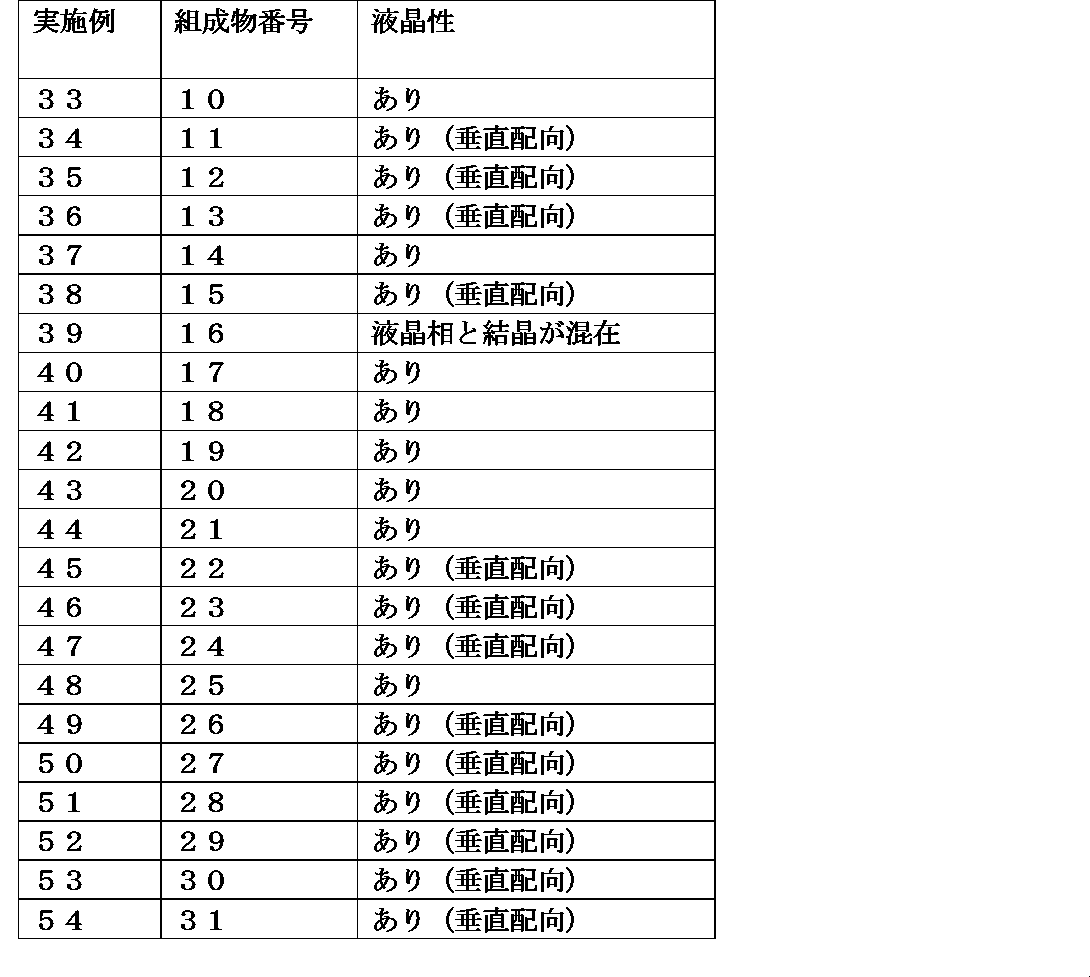
Table 2 Confirmation of liquid crystal properties of the composition
上記実施例33から実施例54に記載の組成物は、実施例39に記載の組成物を除き、その液晶温度領域において、均一なネマチック相を示した。一方比較例3の組成物ref.3は、均一な液晶相とならなかった。この事は、本発明液晶性エポキシ化合物を用いた組成物は、硬化剤との相溶性が高い事を示唆している。このような組成物を硬化させた硬化物は、成分の偏りが無く、熱伝導性や信頼性などが優れた材料となる。 The compositions described in Examples 33 to 54 exhibited a uniform nematic phase in the liquid crystal temperature region, except for the composition described in Example 39. On the other hand, the composition of Comparative Example 3 ref. No. 3 did not have a uniform liquid crystal phase. This suggests that the composition using the liquid crystal epoxy compound of the present invention has high compatibility with the curing agent. The cured product obtained by curing such a composition is a material having no bias in the components and having excellent thermal conductivity and reliability.
[実施例55]
組成物32から調整した硬化物の熱伝導率の測定
上記組成物32を、φ2.4cmのアルミ製容器に入れ、150℃の温度に加温したホットプレート上にて120分間保持し、厚みが1.5mmの円形片を取り出した。この硬化物(硬化物32)の熱伝導率は、サンプルの面内方向と厚み方向で、それぞれ0.95W/m・Kおよび0.45W/m・Kであった。
[Example 55]
Measurement of thermal conductivity of cured product adjusted from composition 32 The above composition 32 was placed in an aluminum container having a diameter of 2.4 cm and held on a hot plate heated to a temperature of 150 ° C. for 120 minutes to increase the thickness. A 1.5 mm circular piece was taken out. The thermal conductivity of this cured product (cured product 32) was 0.95 W / m · K and 0.45 W / m · K, respectively, in the in-plane direction and the thickness direction of the sample.
[実施例56]から[実施例57]
上記実施例55と同様な方法で、表3に記載の組成物、または該組成物から調製した硬化物の放熱特性を確認した。表中において、カッコ内には各構成要素におけるそれぞれの成分化合物のモル%を示した。また液晶性に関しては、ある場合を〇、無い場合を×とした。
[Example 56] to [Example 57]
The heat dissipation characteristics of the composition shown in Table 3 or the cured product prepared from the composition were confirmed by the same method as in Example 55. In the table, the molar% of each component compound in each component is shown in parentheses. Regarding the liquid crystal property, the case where there was a case was evaluated as ◯, and the case where there was no case was evaluated as x.
表3.組成物の液晶性と熱伝導率
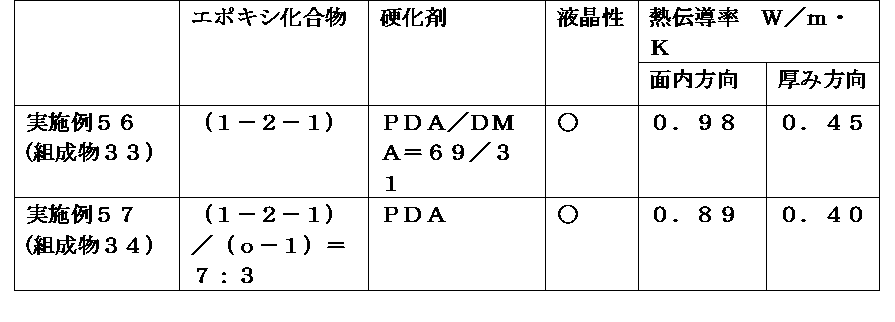
[実施例58] 硬化物の熱伝導率の測定2
実施例10で調製した組成物10に、イミダゾール0.0400g(0.588mmol)を加え溶解させ、組成物10Cを得た。該組成物10Cを、φ2.4cmのアルミ製容器に入れ、150℃の温度に加温したホットプレート上にて120分間保持し、厚みが約1.0mmの円形片を取り出した。この硬化物(硬化物10C)の熱伝導率は、サンプルの面内方向と厚み方向で、それぞれ0.90W/m・Kおよび0.41W/m・Kであった。
[Example 58] Measurement of thermal conductivity of cured product 2
0.0400 g (0.588 mmol) of imidazole was added to and dissolved in the composition 10 prepared in Example 10 to obtain the composition 10C. The composition 10C was placed in an aluminum container having a diameter of 2.4 cm and held on a hot plate heated to a temperature of 150 ° C. for 120 minutes, and a circular piece having a thickness of about 1.0 mm was taken out. The thermal conductivity of this cured product (cured product 10C) was 0.90 W / m · K and 0.41 W / m · K, respectively, in the in-plane direction and the thickness direction of the sample.
[実施例59]から[実施例78]
実施例58と同様な方法で、上記組成物11から組成物31(元組成物、組成物16を除く)にイミダゾールを加え、組成物11Cから組成物31Cを調製した。さらに該組成物を加熱し、硬化物を得た。これら硬化物の熱伝導率を測定した結果を、表4に示す。
表4.組成物の熱伝導率

[Example 59] to [Example 78]
Imidazole was added to the composition 31 (excluding the original composition and the composition 16) from the above composition 11 by the same method as in Example 58, and the composition 31C was prepared from the composition 11C. Further, the composition was heated to obtain a cured product. The results of measuring the thermal conductivity of these cured products are shown in Table 4.
Table 4. Thermal conductivity of the composition
[実施例79] フィラー入りサンプルの作製
組成物32の1.0g、および窒化ホウ素粒子(モメンティブ・パフォーマンス・マテリアルズ・ジャパン(合)製PolarTherm PTX-25)0.90gをそれぞれ量りとってよく混ぜ、80℃の温度に加温したホットプレート上にて5分間静置した後、このサンプルをステンレス製板中に挟み、150℃の温度に加温した圧縮成形機((株)井元製作所製IMC-19EC)にて20MPaの圧力をかけて45分間保持し、放熱部材としての厚みが768μmの四角片を取り出した。このサンプル(フィラー入りサンプル32)の熱伝導率は、10.8W/m・Kであった。
[Example 79] Preparation of sample containing filler Weigh 1.0 g of the composition 32 and 0.90 g of boron nitride particles (PolyrTherm PTX-25 manufactured by Momentive Performance Materials Japan (Go)) and mix them well. After standing on a hot plate heated to a temperature of 80 ° C for 5 minutes, this sample was sandwiched between stainless steel plates and heated to a temperature of 150 ° C. IMC manufactured by Imoto Seisakusho Co., Ltd. A pressure of 20 MPa was applied at -19EC) and the mixture was held for 45 minutes, and a square piece having a thickness of 768 μm as a heat radiating member was taken out. The thermal conductivity of this sample (sample 32 containing filler) was 10.8 W / m · K.
[実施例80]および[実施例81]
組成物32に代え組成物33および34を使用した以外は、上記実施例79に記載の方法と同様にして、フィラー入りサンプル33および34を調製し、熱伝導率を測定した。結果を表5に示す。
[Example 80] and [Example 81]
Samples 33 and 34 containing a filler were prepared and the thermal conductivity was measured in the same manner as in Example 79 above, except that the compositions 33 and 34 were used instead of the composition 32. The results are shown in Table 5.
表5.フィラー入りサンプルの熱伝導率1

[実施例82] フィラー入りサンプルの作製2
組成物22Cの0.5gを用いた以外は実施例79と同様な方法で、サンプル(フィラー入りサンプル22C)を調製した。このフィラー入りサンプル22Cの熱伝導率は、12.0W/m・Kであった。
[Example 82] Preparation of sample containing filler 2
A sample (sample 22C containing a filler) was prepared in the same manner as in Example 79 except that 0.5 g of the composition 22C was used. The thermal conductivity of the filler-containing sample 22C was 12.0 W / m · K.
[実施例83]から[実施例90]
組成物22Cに代え、組成物23Cから組成物31Cを使用した以外は、上記実施例82に記載の方法と同様にして、フィラー入りサンプル23Cから31Cを調製し、熱伝導率を測定した。結果を表6に示す。
[Example 83] to [Example 90]
31C was prepared from the filler-containing sample 23C and the thermal conductivity was measured in the same manner as in Example 82 above, except that the composition 31C was used from the composition 23C instead of the composition 22C. The results are shown in Table 6.
表6.フィラー入りサンプルの熱伝導率2

[実施例91]および[実施例92]
組成物24Cまたは組成物26Cの0.5g、および酸化アルミニウム粒子(デンカ製DAW-10)0.90gをそれぞれ量りとってよく混ぜ、上記実施例84に記載の方法と同様にして、フィラー入りサンプル24CAOと26CAOを調製し、熱伝導率を測定した。結果を表7に示す。
[Example 91] and [Example 92]
0.5 g of the composition 24C or the composition 26C and 0.90 g of aluminum oxide particles (DAW-10 manufactured by Denka) are weighed and mixed well, and a sample containing a filler is used in the same manner as in Example 84 above. 24C AO and 26C AO were prepared and their thermal conductivity was measured. The results are shown in Table 7.
表7.フィラー入りサンプルの熱伝導率3

上記のように、本発明に開示された技術は、高い熱伝導率を与える事が分かる。
Table 7. Thermal conductivity of sample with filler 3
As mentioned above, it can be seen that the technique disclosed in the present invention provides high thermal conductivity.
本発明の技術は、半導体素子のパッケージ用材料に好適に使用する事が出来る。また接着剤などその他のエポキシ樹脂に対する代替用途にも、使用する事が出来る。 The technique of the present invention can be suitably used as a material for packaging a semiconductor device. It can also be used as an alternative to other epoxy resins such as adhesives.
Claims (16)

E-Z-(L-Z)n-E (2-1)
L1-Z-E (2-2)
式(2-1)および(2-2)中、
Lは独立して、単結合、シクロヘキシレン、フェニレン、またはナフタレンであり、これらの環の少なくとも1つの水素は、炭素数1~10のアルキルで置き換えられてもよく、
L1は、水素、シクロヘキシル、フェニル、またはナフチルであり、これらの環の少なくとも1つの水素は、炭素数1~10のアルキルで置き換えられてもよく、
Zは独立して、単結合、-O-、-NH-、-S-、-SO2-、-CO2-、または炭素数1~12のアルキレンであり、
Eは独立して、アミノ、炭素数1~10のアルキルアミノ、水酸基、又はカルボキシであり、Eの少なくとも1つはアミノまたは炭素数1~10のアルキルアミノであり、
nは、0~7の整数である。 The composition according to claim 7, wherein the curing agent is at least one compound represented by the formula (2-1) or (2-2).
EZ- (LZ) n-E (2-1)
L1 - Z-E (2-2)
In equations (2-1) and (2-2),
L is independently a single bond, cyclohexylene, phenylene, or naphthalene, and at least one hydrogen in these rings may be replaced by an alkyl having 1 to 10 carbon atoms.
L 1 is hydrogen, cyclohexyl, phenyl, or naphthyl, and at least one hydrogen in these rings may be replaced with an alkyl having 1 to 10 carbon atoms.
Z is independently a single bond, -O-, -NH-, -S-, -SO 2- , -CO 2- , or an alkylene with 1-12 carbon atoms.
E is independently an amino, an alkylamino having 1 to 10 carbon atoms, a hydroxyl group, or a carboxy, and at least one of E is an amino or an alkylamino having 1 to 10 carbon atoms.
n is an integer from 0 to 7.
短鎖のエステルとは、以下の(3-E)で表される基が、OH基のHに置換した構造である。

The short-chain ester has a structure in which the group represented by (3-E) below is replaced with H of the OH group.


環Bは、ベンゼン、ナフタレン、アントラセン、フルオレン、または9,9‐ジフェニルフルオレンであり、これら環Bにおいて、少なくとも1つの水素は、炭素数1~3のアルキル、または炭素数1~3のアルコキシで置き換えられてもよく;
n31は2以上4以下の整数である。
式(3-2)中、n32およびn33は独立して、1~3の整数であり;
Z30は、単結合、炭素数1~10のアルキレン、-CH(CH3)-、-C(CH3)2-、-C(CF3)2-、-O-、-S-、または-SO2-であり、
ベンゼン環上の、少なくとも1つの水素は、炭素数1~3のアルキルまたは炭素数2~3のアルケニルで置き換えられてもよく;
式(3-3)および式(3-4)中、
n34は1以上5000以下の整数であり、n35およびn36は独立して、0または1であり、n34が2以上の場合、繰り返し毎に異なってもよく、
R10およびR11は独立して、1,4-フェニレン、4,4’-ビフェニレン、または1,3-シクロペンタジエニレンであり、
式(3-5)中、
n34は1以上5000以下の整数であり、
式(3-6)中、
Z31は独立して単結合、-CH(CH3)-、または-C(CH3)2-であり、n34は1以上5000以下の整数である。
式(3-7)中、
n34は1以上5000以下の整数であり、R12は独立して水素またはメチルである。
短鎖のエステルとは、以下の(3-E)で表される基が、OH基のHに置換した構造である。

また、これら式(3-3)から式(3-7)中の芳香環上の少なくとも1つの水素はメチルで置き換えられてもよい。 The ninth aspect of the present invention, wherein the curing agent is at least one compound represented by the formulas (3-1) to (3-7), or a compound in which at least one of -OH in the compound is a short-chain ester. The composition described.
Ring B is benzene, naphthalene, anthracene, fluorene, or 9,9-diphenylfluorene, in which at least one hydrogen is an alkyl having 1 to 3 carbon atoms or an alkoxy having 1 to 3 carbon atoms. May be replaced;
n31 is an integer of 2 or more and 4 or less.
In equation (3-2), n32 and n33 are independently integers of 1 to 3;
Z 30 is a single bond, an alkylene having 1 to 10 carbon atoms, -CH (CH 3 )-, -C (CH 3 ) 2- , -C (CF 3 ) 2- , -O-, -S-, or. -SO 2 -and
At least one hydrogen on the benzene ring may be replaced with an alkyl having 1-3 carbon atoms or an alkenyl having 2-3 carbon atoms;
In equations (3-3) and (3-4),
n34 is an integer of 1 or more and 5000 or less, n35 and n36 are independently 0 or 1, and when n34 is 2 or more, it may be different for each iteration.
R 10 and R 11 are independently 1,4-phenylene, 4,4'-biphenylene, or 1,3-cyclopentadienylene.
In equation (3-5),
n34 is an integer of 1 or more and 5000 or less,
In equation (3-6),
Z 31 is an independently single bond, -CH (CH 3 )-, or -C (CH 3 ) 2- , and n34 is an integer of 1 or more and 5000 or less.
In equation (3-7),
n34 is an integer of 1 or more and 5000 or less, and R12 is independently hydrogen or methyl.
The short-chain ester has a structure in which the group represented by (3-E) below is replaced with H of the OH group.
Further, at least one hydrogen on the aromatic ring in these formulas (3-3) to (3-7) may be replaced with methyl.

Priority Applications (1)
| Application Number | Priority Date | Filing Date | Title |
|---|---|---|---|
| JP2025018108A JP7852759B2 (en) | 2020-05-22 | 2025-02-06 | Polymerizable compounds, compositions for electronic components, materials for electronic components |
Applications Claiming Priority (4)
| Application Number | Priority Date | Filing Date | Title |
|---|---|---|---|
| JP2020089443 | 2020-05-22 | ||
| JP2020089443 | 2020-05-22 | ||
| JP2020172543 | 2020-10-13 | ||
| JP2020172543 | 2020-10-13 |
Related Child Applications (1)
| Application Number | Title | Priority Date | Filing Date |
|---|---|---|---|
| JP2025018108A Division JP7852759B2 (en) | 2020-05-22 | 2025-02-06 | Polymerizable compounds, compositions for electronic components, materials for electronic components |
Publications (1)
| Publication Number | Publication Date |
|---|---|
| JP2022008092A true JP2022008092A (en) | 2022-01-13 |
Family
ID=80110430
Family Applications (2)
| Application Number | Title | Priority Date | Filing Date |
|---|---|---|---|
| JP2021083058A Withdrawn JP2022008092A (en) | 2020-05-22 | 2021-05-17 | Polymerizable compounds, compositions for electronic components, materials for electronic components |
| JP2025018108A Active JP7852759B2 (en) | 2020-05-22 | 2025-02-06 | Polymerizable compounds, compositions for electronic components, materials for electronic components |
Family Applications After (1)
| Application Number | Title | Priority Date | Filing Date |
|---|---|---|---|
| JP2025018108A Active JP7852759B2 (en) | 2020-05-22 | 2025-02-06 | Polymerizable compounds, compositions for electronic components, materials for electronic components |
Country Status (1)
| Country | Link |
|---|---|
| JP (2) | JP2022008092A (en) |
Cited By (5)
| Publication number | Priority date | Publication date | Assignee | Title |
|---|---|---|---|---|
| JP2022165552A (en) * | 2021-04-20 | 2022-11-01 | Jnc株式会社 | Epoxy composition, composition for electronic component, material for electronic component |
| WO2023106052A1 (en) * | 2021-12-09 | 2023-06-15 | 住友化学株式会社 | Vinyl compound, method for producing vinyl compound, vinyl composition, vinyl resin cured product, prepreg, film with resin, metal foil with resin, metal-clad laminate and printed wiring board |
| JP2023136574A (en) * | 2022-03-17 | 2023-09-29 | Jnc株式会社 | Epoxy resin precursor composition and electronic component material |
| WO2025164068A1 (en) * | 2024-01-31 | 2025-08-07 | Jnc株式会社 | Composition for forming low dielectric loss tangent resin, low dielectric loss tangent resin component, and electronic device using same |
| JP7782745B1 (en) * | 2025-04-18 | 2025-12-09 | Jnc株式会社 | Method for producing polymerizable liquid crystal compounds and use of polymerizable liquid crystal compounds |
Families Citing this family (1)
| Publication number | Priority date | Publication date | Assignee | Title |
|---|---|---|---|---|
| JP2022008092A (en) * | 2020-05-22 | 2022-01-13 | Jnc株式会社 | Polymerizable compounds, compositions for electronic components, materials for electronic components |
Citations (7)
| Publication number | Priority date | Publication date | Assignee | Title |
|---|---|---|---|---|
| JPS5375299A (en) * | 1976-12-17 | 1978-07-04 | Mitsubishi Electric Corp | Epoxy resin composition |
| JPS61289084A (en) * | 1985-06-06 | 1986-12-19 | チバ−ガイギ− アクチエンゲゼル シヤフト | 2,6-disubstituted 4-epoxypropylphenylglycidyl ether and manufacture |
| WO2005061473A1 (en) * | 2003-12-24 | 2005-07-07 | Sumitomo Chemical Company, Limited | Epoxy compounds and cured epoxy resins obtained by curing the compounds |
| JP2006273989A (en) * | 2005-03-29 | 2006-10-12 | Sumitomo Chemical Co Ltd | Epoxy compound and epoxy resin cured product |
| WO2016006649A1 (en) * | 2014-07-10 | 2016-01-14 | Dic株式会社 | Epoxy resin, method for producing same, epoxy resin composition, and cured product thereof |
| JP2016011347A (en) * | 2014-06-27 | 2016-01-21 | Jnc株式会社 | Polymerizable compound having triple bond, liquid crystal composition, and liquid crystal display element |
| JP2025065333A (en) * | 2020-05-22 | 2025-04-17 | Jnc株式会社 | Polymerizable compound, composition for electronic components, material for electronic components |
Family Cites Families (2)
| Publication number | Priority date | Publication date | Assignee | Title |
|---|---|---|---|---|
| JP2012177060A (en) | 2011-02-28 | 2012-09-13 | Mitsubishi Electric Corp | Resin composition and resin cured material |
| CN107216442A (en) | 2017-07-24 | 2017-09-29 | 贵阳学院 | A kind of epoxy resin of low linear expansion coefficient and preparation method thereof |
-
2021
- 2021-05-17 JP JP2021083058A patent/JP2022008092A/en not_active Withdrawn
-
2025
- 2025-02-06 JP JP2025018108A patent/JP7852759B2/en active Active
Patent Citations (7)
| Publication number | Priority date | Publication date | Assignee | Title |
|---|---|---|---|---|
| JPS5375299A (en) * | 1976-12-17 | 1978-07-04 | Mitsubishi Electric Corp | Epoxy resin composition |
| JPS61289084A (en) * | 1985-06-06 | 1986-12-19 | チバ−ガイギ− アクチエンゲゼル シヤフト | 2,6-disubstituted 4-epoxypropylphenylglycidyl ether and manufacture |
| WO2005061473A1 (en) * | 2003-12-24 | 2005-07-07 | Sumitomo Chemical Company, Limited | Epoxy compounds and cured epoxy resins obtained by curing the compounds |
| JP2006273989A (en) * | 2005-03-29 | 2006-10-12 | Sumitomo Chemical Co Ltd | Epoxy compound and epoxy resin cured product |
| JP2016011347A (en) * | 2014-06-27 | 2016-01-21 | Jnc株式会社 | Polymerizable compound having triple bond, liquid crystal composition, and liquid crystal display element |
| WO2016006649A1 (en) * | 2014-07-10 | 2016-01-14 | Dic株式会社 | Epoxy resin, method for producing same, epoxy resin composition, and cured product thereof |
| JP2025065333A (en) * | 2020-05-22 | 2025-04-17 | Jnc株式会社 | Polymerizable compound, composition for electronic components, material for electronic components |
Non-Patent Citations (1)
| Title |
|---|
| POLYMER, vol. 42, JPN7024005217, 2001, pages 1507 - 1514, ISSN: 0005586517 * |
Cited By (9)
| Publication number | Priority date | Publication date | Assignee | Title |
|---|---|---|---|---|
| JP2022165552A (en) * | 2021-04-20 | 2022-11-01 | Jnc株式会社 | Epoxy composition, composition for electronic component, material for electronic component |
| JP7582041B2 (en) | 2021-04-20 | 2024-11-13 | Jnc株式会社 | Epoxy composition, composition for electronic components, material for electronic components |
| WO2023106052A1 (en) * | 2021-12-09 | 2023-06-15 | 住友化学株式会社 | Vinyl compound, method for producing vinyl compound, vinyl composition, vinyl resin cured product, prepreg, film with resin, metal foil with resin, metal-clad laminate and printed wiring board |
| JP2023085845A (en) * | 2021-12-09 | 2023-06-21 | 住友化学株式会社 | Vinyl compound, method for producing vinyl compound, vinyl composition, cured vinyl resin, prepreg, resin-coated film, resin-coated metal foil, metal-clad laminate, and printed wiring board |
| JP7829310B2 (en) | 2021-12-09 | 2026-03-13 | 住友化学株式会社 | Vinyl compounds, methods for producing vinyl compounds, vinyl compositions, cured vinyl resins, prepregs, resin-coated films, resin-coated metal foils, metal-clad laminates, and printed circuit boards. |
| JP2023136574A (en) * | 2022-03-17 | 2023-09-29 | Jnc株式会社 | Epoxy resin precursor composition and electronic component material |
| JP7740076B2 (en) | 2022-03-17 | 2025-09-17 | Jnc株式会社 | Epoxy resin precursor composition, material for electronic components |
| WO2025164068A1 (en) * | 2024-01-31 | 2025-08-07 | Jnc株式会社 | Composition for forming low dielectric loss tangent resin, low dielectric loss tangent resin component, and electronic device using same |
| JP7782745B1 (en) * | 2025-04-18 | 2025-12-09 | Jnc株式会社 | Method for producing polymerizable liquid crystal compounds and use of polymerizable liquid crystal compounds |
Also Published As
| Publication number | Publication date |
|---|---|
| JP2025065333A (en) | 2025-04-17 |
| JP7852759B2 (en) | 2026-04-28 |
Similar Documents
| Publication | Publication Date | Title |
|---|---|---|
| JP7852759B2 (en) | Polymerizable compounds, compositions for electronic components, materials for electronic components | |
| CN106661191A (en) | Composition for exothermic member, exothermic member, electronic device, method for producing exothermic member | |
| JP6128804B2 (en) | Thermosetting liquid crystal polyester composition and cured product thereof | |
| CN106459736A (en) | Composition for heat-dissipation members, heat-dissipation member, and electronic device | |
| JP2020079417A (en) | Epoxy resin, epoxy resin composition, epoxy resin cured product, and composite material | |
| US20190055444A1 (en) | Composition for low thermal expansion members, low thermal expansion member, electronic device, and method for producing low thermal expansion member | |
| CN109843964A (en) | Epoxy resin, composition epoxy resin, epoxy resin cured product and composite material | |
| JP7725880B2 (en) | Epoxy resin compositions, compositions for electronic components, materials for electronic components | |
| JP2012041507A (en) | Epoxy resin composition and method for producing epoxy resin cured product | |
| JP2012177060A (en) | Resin composition and resin cured material | |
| EP3425019A1 (en) | Composition for heat-dissipating member, heat-dissipating member, electronic instrument, method for producing composition for heat-dissipating member, and method for producing heat-dissipating member | |
| JP7740076B2 (en) | Epoxy resin precursor composition, material for electronic components | |
| JP7582041B2 (en) | Epoxy composition, composition for electronic components, material for electronic components | |
| JP2021193176A (en) | Polymerizable compound, electronic component composition, and electronic component material | |
| JP7651988B2 (en) | Liquid crystal polymer, composition for heat dissipation members using the same, and material for electronic components | |
| JP2022107975A (en) | Polymerizable compound, composition for electronic components, material for electronic components | |
| JP2023069126A (en) | Composition, epoxy resin, and material for electronic components including the same | |
| JP2019172936A (en) | Composition for heat radiation member, heat radiation member, and electronic device | |
| KR102841887B1 (en) | Compound having thermotropic liquid crystalline structure and polyethylene glycol polymer thereof | |
| WO2019188973A1 (en) | Composition, heat dissipation member, electronic device and method for producing composition | |
| JP2013209631A (en) | Method for producing epoxy resin cured product | |
| JP2021195506A (en) | Electronic component composition and electronic component material | |
| JP6297892B2 (en) | Thermosetting liquid crystal polyester composition and cured product thereof | |
| JP2021123607A (en) | Composition for heat radiation members, heat radiation member, and electronic apparatus | |
| JP2021024989A (en) | Heat radiation member composition, heat radiation member, electronic device |
Legal Events
| Date | Code | Title | Description |
|---|---|---|---|
| A621 | Written request for application examination |
Free format text: JAPANESE INTERMEDIATE CODE: A621 Effective date: 20231109 |
|
| A977 | Report on retrieval |
Free format text: JAPANESE INTERMEDIATE CODE: A971007 Effective date: 20241128 |
|
| A131 | Notification of reasons for refusal |
Free format text: JAPANESE INTERMEDIATE CODE: A131 Effective date: 20241210 |
|
| A521 | Request for written amendment filed |
Free format text: JAPANESE INTERMEDIATE CODE: A523 Effective date: 20250128 |
|
| A131 | Notification of reasons for refusal |
Free format text: JAPANESE INTERMEDIATE CODE: A131 Effective date: 20250507 |
|
| A761 | Written withdrawal of application |
Free format text: JAPANESE INTERMEDIATE CODE: A761 Effective date: 20250521 |