JP2022013902A - Olefin polymerization catalyst component, olefin polymerization catalyst, and method for producing olefin polymer - Google Patents
Olefin polymerization catalyst component, olefin polymerization catalyst, and method for producing olefin polymer Download PDFInfo
- Publication number
- JP2022013902A JP2022013902A JP2021109898A JP2021109898A JP2022013902A JP 2022013902 A JP2022013902 A JP 2022013902A JP 2021109898 A JP2021109898 A JP 2021109898A JP 2021109898 A JP2021109898 A JP 2021109898A JP 2022013902 A JP2022013902 A JP 2022013902A
- Authority
- JP
- Japan
- Prior art keywords
- group
- carbon atoms
- atom
- hydrocarbon group
- component
- Prior art date
- Legal status (The legal status is an assumption and is not a legal conclusion. Google has not performed a legal analysis and makes no representation as to the accuracy of the status listed.)
- Granted
Links
- 0 *C1*CCCC1 Chemical compound *C1*CCCC1 0.000 description 7
Images


Classifications
-
- Y—GENERAL TAGGING OF NEW TECHNOLOGICAL DEVELOPMENTS; GENERAL TAGGING OF CROSS-SECTIONAL TECHNOLOGIES SPANNING OVER SEVERAL SECTIONS OF THE IPC; TECHNICAL SUBJECTS COVERED BY FORMER USPC CROSS-REFERENCE ART COLLECTIONS [XRACs] AND DIGESTS
- Y02—TECHNOLOGIES OR APPLICATIONS FOR MITIGATION OR ADAPTATION AGAINST CLIMATE CHANGE
- Y02P—CLIMATE CHANGE MITIGATION TECHNOLOGIES IN THE PRODUCTION OR PROCESSING OF GOODS
- Y02P20/00—Technologies relating to chemical industry
- Y02P20/50—Improvements relating to the production of bulk chemicals
- Y02P20/52—Improvements relating to the production of bulk chemicals using catalysts, e.g. selective catalysts
Landscapes
- Transition And Organic Metals Composition Catalysts For Addition Polymerization (AREA)
Abstract
【課題】充分に分子量分布が広く、高分子量側に分布が広がっており、且つ、分子量分布の高分子量側領域に充分な量の分岐鎖を含むオレフィン系重合体を製造することができるオレフィン重合用触媒成分を提供する。【解決手段】成分(I)として特定のメタロセン架橋構造を持ちコモノマー共重合能が低い遷移金属化合物(メタロセン錯体)と、成分(II)としてコモノマー共重合能が高い特定の遷移金属化合物を組み合わせたオレフィン重合用触媒成分である。【選択図】なし[Problem] To provide a catalyst component for olefin polymerization capable of producing an olefin polymer having a sufficiently wide molecular weight distribution, the distribution being spread toward the high molecular weight side, and containing a sufficient amount of branched chains in the high molecular weight region of the molecular weight distribution. [Solution] The catalyst component for olefin polymerization combines, as component (I), a transition metal compound (metallocene complex) having a specific metallocene bridge structure and low comonomer copolymerization ability, and, as component (II), a specific transition metal compound having high comonomer copolymerization ability. [Selected Figure] None
Description
本発明は、オレフィンの重合体及び共重合体の製造に有用なオレフィン重合用触媒成分、当該触媒成分を含むオレフィン重合用触媒、及び、当該オレフィン重合用触媒を用いたエチレン単独重合体またはエチレン/αオレフィン共重合体の製造方法に関する。 The present invention relates to an olefin polymerization catalyst component useful for producing an olefin polymer and a copolymer, an olefin polymerization catalyst containing the catalyst component, and an ethylene homopolymer or ethylene / ethylene using the olefin polymerization catalyst. The present invention relates to a method for producing an α-olefin copolymer.
ポリエチレン、ポリプロピレン等のオレフィン系重合体は、プラスチック成形材料として広く用いられている。成形材料としてのオレフィン系重合体は、溶融状態での流動性、溶融張力、伸長粘度などの成形性、及び、成形後の硬度、剛性、耐衝撃強度、耐熱性、耐久性、透明性など成形体の用途に適した物性が求められる。
このような中で、オレフィン重合用メタロセン触媒で製造されるポリオレフィンは、分子量分布や共重合組成分布といったポリマー分子構造の均一性が高く、衝撃強度や長期寿命等、様々な機械的物性に優れることから、近年、その使用量が増加してきている。しかし、メタロセン系ポリオレフィンは、機械的諸物性には優れているものの、狭い分子量分布故に、溶融張力や溶融流動性といったポリオレフィンの成形加工上重要な特性において劣り、成形加工面においては十分な性能を満たすものではなかった。
Olefin polymers such as polyethylene and polypropylene are widely used as plastic molding materials. The olefin polymer as a molding material has moldability such as fluidity in a molten state, melt tension, and extensional viscosity, and molding such as hardness, rigidity, impact resistance, heat resistance, durability, and transparency after molding. Physical properties suitable for the purpose of the body are required.
Under these circumstances, the polyolefin produced by the metallocene catalyst for olefin polymerization has high uniformity of the polymer molecular structure such as molecular weight distribution and copolymer composition distribution, and is excellent in various mechanical properties such as impact strength and long life. Therefore, in recent years, the amount used has been increasing. However, although metallocene-based polyolefins are excellent in mechanical properties, they are inferior in important properties for molding of polyolefins such as melt tension and melt fluidity due to their narrow molecular weight distribution, and have sufficient performance in terms of molding. It didn't meet.
オレフィン系重合体の成形性や成形後の物性を改善することを目的として、2種類のメタロセン触媒を組み合わせた触媒系を用いることが知られている。
例えば、特許文献1には、広い分子量分布と高い分子量を有するポリオレフィンの製造方法として、特定のメタロセン化合物群から選ばれる2種類のメタロセン混合物を用いることが開示されている。
It is known to use a catalyst system in which two types of metallocene catalysts are combined for the purpose of improving the moldability and the physical properties of the olefin polymer after molding.
For example,
また、エチレンとコモノマーであるαオレフィンを、コモノマー共重合能が異なる2種類のメタロセン触媒を組み合わせた触媒系を用いて共重合することにより、分子量分布、及び、αオレフィン由来の分岐鎖の量(すなわち、コモノマーの導入量)を調節したエチレン/αオレフィン共重合体を得る試みが行われている。
例えば、特許文献2~4は、エチレンとコモノマーを、コモノマー共重合能が低いメタロセンと、コモノマー共重合能が高いメタロセンを、組み合わせた触媒系を用いて共重合することにより、ただ1種類のメタロセン触媒を用いて製造されたエチレン/αオレフィン共重合体と比べて、多峰性(マルチモーダル)の広い分子量分布を有し、かつ、分子量分布の高分子量側領域にコモノマー由来の分岐鎖を多く含むエチレン/αオレフィン共重合体が得られたことを開示している。
Further, by copolymerizing ethylene and α-olefin, which is a comonomer, using a catalytic system in which two types of metallocene catalysts having different comonomer copolymerization abilities are combined, the molecular weight distribution and the amount of branched chains derived from α-olefin (the amount of branched chains derived from α-olefin) ( That is, attempts have been made to obtain an ethylene / α-olefin copolymer in which the amount of comonomer introduced) is adjusted.
For example,
特許文献2には、コモノマー少量取り込み触媒化合物とコモノマー多量取り込み触媒化合物を組み合わせて用い、エチレンとコモノマーを共重合することが記載されているが、前者のコモノマー少量取り込み触媒化合物は相対的にコモノマー共重合能が低いメタロセンであり、後者のコモノマー多量取り込み触媒化合物は相対的にコモノマー共重合能が高いメタロセンである。
特許文献3には、特定の第1メタロセン化合物と特定の第2メタロセン化合物を組み合わせて用い、エチレンとコモノマーを共重合することが記載されているが、特許文献3の段落0006の記載によれば、前者の第1メタロセン化合物は相対的にコモノマー共重合能が高いメタロセンであり、後者の第2メタロセン化合物は相対的にコモノマー共重合能が低いメタロセンである。
特許文献4には、周期表第4族メタロセン化合物群から選ばれる2種類の異なる成分(、A)及び成分(B)を組み合わせて用い、エチレンとコモノマーを共重合することが記載されているが、特許文献4の段落0020の記載によれば、前者の成分(A)は相対的にコモノマー共重合能が低いメタロセンであり、後者の成分(B)は相対的にコモノマー共重合能が高いメタロセンである。
また、非特許文献1には、架橋メタロセンの一つである、ジクロロ{o-フェニレンジメチレンビス(η5-1-インデニル)ジルコニウム}を用いてエチレン及びプロピレンそれぞれの単独重合体を合成した実験が記載されている。
In addition, Non-Patent
複数の遷移金属化合物を用いて分子量分布やコモノマー組成分布を制御する技術においては、成形性、及び、剛性と強度や耐久性とのバランスに優れたオレフィン系重合体を製造するために、分子量分布を広くし、かつ、分子量分布の高分子量側にコモノマーを選択的に導入して高分子量側のコモノマー導入量を大きくすることができるオレフィン重合用触媒が求められる。
しかし後述するように、特許文献2~4に開示されているメタロセン触媒は、上記のような技術的要求を必ずしも充分に満足させることができない。
また、上記非特許文献1には、エチレンとαオレフィンを共重合する場合における、ジクロロ{o-フェニレンジメチレンビス(η5-1-インデニル)ジルコニウム}の共重合能について何も記載されていない。
In the technique of controlling the molecular weight distribution and the comonomer composition distribution using a plurality of transition metal compounds, the molecular weight distribution is used in order to produce an olefin-based polymer having an excellent balance between formability and rigidity, strength and durability. There is a need for a catalyst for olefin polymerization that can increase the amount of comonomer introduced on the high molecular weight side by selectively introducing the comonomer on the high molecular weight side of the molecular weight distribution.
However, as will be described later, the metallocene catalysts disclosed in
Further, Non-Patent
上記のごとき従来技術に対し、本発明は、充分に分子量分布が広く、高分子量側に分布が広がっており、且つ、分子量分布の高分子量側領域に充分な量の分岐鎖を含むオレフィン系重合体を製造することができるオレフィン重合用触媒成分を提供することを目的とする。
また本発明は、上記のごときオレフィン重合用触媒成分を用いて、成形性、及び、剛性と強度や耐久性とのバランスに優れたエチレン系重合体を製造する方法を提供することを目的とする。
In contrast to the prior art as described above, the present invention has a sufficiently wide molecular weight distribution, a distribution on the high molecular weight side, and an olefin-based weight containing a sufficient amount of branched chains in the high molecular weight side region of the molecular weight distribution. It is an object of the present invention to provide a catalyst component for olefin polymerization capable of producing a coalescence.
Another object of the present invention is to provide a method for producing an ethylene-based polymer having an excellent balance between formability and rigidity, strength and durability by using the above-mentioned catalyst component for olefin polymerization. ..
本発明者は、上記課題を解決すべく鋭意検討した結果、特定のメタロセン架橋構造を持ちコモノマー共重合能が低い遷移金属化合物(メタロセン錯体)と、コモノマー共重合能が高い特定の遷移金属化合物を組み合わせた触媒成分を含む触媒を用いることにより、充分に分子量分布が広く、高分子量側に分布が広がっており、且つ、分子量分布の高分子量側領域に充分な量の分岐鎖を含むオレフィン系重合体が得られることを見出し、本発明を完成するに至った。 As a result of diligent studies to solve the above problems, the present inventor has obtained a transition metal compound (metallocene complex) having a specific metallocene crosslinked structure and a low comonomer copolymerization ability, and a specific transition metal compound having a high comonomer copolymerization ability. By using a catalyst containing a combined catalyst component, the molecular weight distribution is sufficiently wide, the distribution is widened on the high molecular weight side, and the olefin-based weight containing a sufficient amount of branched chains in the high molecular weight side region of the molecular weight distribution. We have found that a coalescence can be obtained, and have completed the present invention.
すなわち、本発明のオレフィン重合用触媒成分は、以下の成分(I)及び成分(II)を含むことを特徴とする触媒成分である。
[成分(I)]
下記式(1)で表される遷移金属化合物
That is, the catalyst component for olefin polymerization of the present invention is a catalyst component characterized by containing the following components (I) and (II).
[Component (I)]
Transition metal compound represented by the following formula (1)
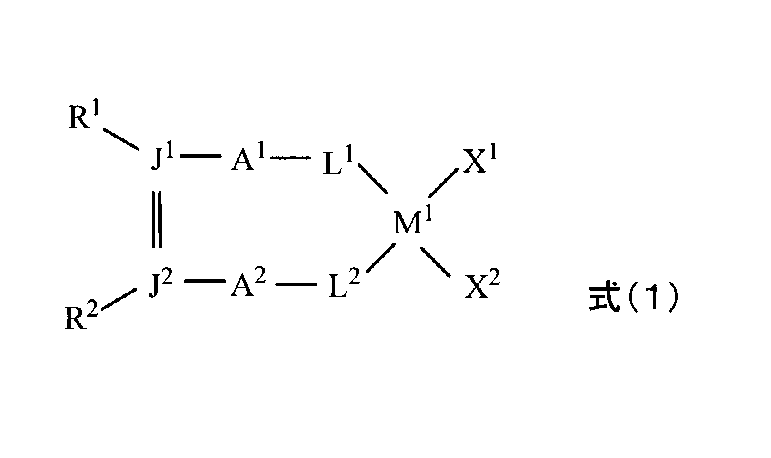
[式中、
M1は、周期表4族の遷移金属を示す。
L1とL2は、シクロペンタジエニル構造を含む配位子を示し、M1に配位している。
X1及びX2は、それぞれ独立して、M1と結合する水素原子、ハロゲン原子、炭素数1~20の炭化水素基、炭素数1~20のアルコキシ基、酸素原子若しくは窒素原子を含む炭素数3~20の炭化水素基または炭素数1~20の炭化水素基置換アミノ基を示す。
J1とJ2は、炭素原子を示す。
A1とA2は、それぞれJ1とL1、J2とL2とを結合する架橋基を示し、以下の群から選ばれる。
-CR3
2-、-SiR3
2-、-NR3-、-PR3-、-O-、-S-、[ここでR3は水素原子または炭素数1~10の炭化水素基であり、2つのR3が結合して環状構造を形成してもよい]、
R1とR2は、それぞれ独立して、水素原子、炭素数1~20の炭化水素基、炭素数1~20のアルコキシ基、1つ~6つのケイ素原子を含む炭素数1~20の炭化水素基、炭素数1~20のハロゲン置換炭化水素基、酸素原子、硫黄原子若しくは窒素原子を含む炭素数3~20の炭化水素基または炭素数1~20の炭化水素基置換シリル基を示す。R1とR2は、それらが結合しあってJ1およびJ2と一緒に環状構造を形成してもよい。]
[During the ceremony,
M 1 represents a transition metal of
L 1 and L 2 represent a ligand containing a cyclopentadienyl structure and are coordinated to M 1 .
Each of X 1 and X 2 independently has a hydrogen atom, a halogen atom, a hydrocarbon group having 1 to 20 carbon atoms, an alkoxy group having 1 to 20 carbon atoms, and a carbon containing an oxygen atom or a nitrogen atom. A hydrocarbon group having a number of 3 to 20 or a hydrocarbon group substituted amino group having a carbon number of 1 to 20 is shown.
J 1 and J 2 represent carbon atoms.
A 1 and A 2 indicate a cross-linking group that binds J 1 and L 1 and J 2 and L 2 , respectively, and are selected from the following groups.
-CR 3 2- , -SiR 3 2- , -NR 3- , -PR 3- , -O-, -S-, [Here, R 3 is a hydrogen atom or a hydrocarbon group having 1 to 10 carbon atoms. Two R3s may combine to form a cyclic structure],
R 1 and R 2 independently have a hydrogen atom, a hydrocarbon group having 1 to 20 carbon atoms, an alkoxy group having 1 to 20 carbon atoms, and a hydrocarbon having 1 to 20 carbon atoms including 1 to 6 silicon atoms. A hydrogen group, a halogen-substituted hydrocarbon group having 1 to 20 carbon atoms, a hydrocarbon group having 3 to 20 carbon atoms including an oxygen atom, a sulfur atom or a nitrogen atom, or a hydrocarbon group-substituted silyl group having 1 to 20 carbon atoms is shown. R 1 and R 2 may combine with each other to form a cyclic structure with J 1 and J 2 . ]
[成分(II)]
下記式(2)、式(3)又は式(4)で表される化合物群から選ばれる遷移金属化合物
A3
qL3L3’M3X3X3’ 式(2)
[式中、
M3は、周期表4族の遷移金属を示す。
L3とL3’は、それぞれ独立して、シクロペンタジエニル構造を含む配位子を示し、M3に配位している。該シクロペンタジエニル構造を含む配位子は、ハロゲン原子、炭素数1~20の炭化水素基、炭素数1~20のアルコキシ基、1つ~6つのケイ素原子を含む炭素数1~20の炭化水素基、炭素数1~20のハロゲン置換炭化水素基、酸素原子、硫黄原子若しくは窒素原子を含む炭素数3~20の炭化水素基または炭素数1~20の炭化水素基置換シリル基で置換されていてもよい。L3またはL3’上に、隣り合う置換基が存在する場合、それらが結合して環構造を形成してもよい。
X3とX3’は、それぞれ独立して、M3と結合する水素原子、ハロゲン原子、炭素数1~20の炭化水素基、炭素数1~20のアルコキシ基、酸素原子若しくは窒素原子を含む炭素数3~20の炭化水素基または炭素数1~20の炭化水素基置換アミノ基を示す。
A3は、L3とL3’を架橋する架橋基を示し、存在しても存在しなくてもよく、存在する場合にはL3とL3’の間に架橋構造を有する。
qは0または1であり、A3の数を示す。]
[Ingredient (II)]
Transition metal compound selected from the compound group represented by the following formula (2), formula (3) or formula (4) A 3 q L 3 L 3'M 3 X 3 X 3'formula (2)
[During the ceremony,
M 3 indicates a transition metal of
L 3 and L 3'independently represent ligands containing a cyclopentadienyl structure and are coordinated to M 3 . The ligand containing the cyclopentadienyl structure has a halogen atom, a hydrocarbon group having 1 to 20 carbon atoms, an alkoxy group having 1 to 20 carbon atoms, and 1 to 20 carbon atoms containing 1 to 6 silicon atoms. Substituted with a hydrocarbon group, a halogen-substituted hydrocarbon group having 1 to 20 carbon atoms, a hydrocarbon group having 3 to 20 carbon atoms including an oxygen atom, a sulfur atom or a nitrogen atom, or a hydrocarbon group substituted silyl group having 1 to 20 carbon atoms. It may have been. If adjacent substituents are present on L 3 or L 3' , they may be combined to form a ring structure.
X 3 and X 3'contain a hydrogen atom , a halogen atom, a hydrocarbon group having 1 to 20 carbon atoms, an alkoxy group having 1 to 20 carbon atoms, an oxygen atom or a nitrogen atom independently of each other. A hydrocarbon group having 3 to 20 carbon atoms or a hydrocarbon group substituted amino group having 1 to 20 carbon atoms is shown.
A 3 indicates a cross-linking group that crosslinks L 3 and L 3' , and may or may not be present, and if present, has a cross-linking structure between L 3 and L 3' .
q is 0 or 1 and indicates the number of A3. ]
式(3):
A4L4M4X4X4’
[式中、
M4は、周期表4族の遷移金属を示す。
L4は、シクロペンタジエニル構造を含む配位子を示し、M4に配位している。該シクロペンタジエニル構造を含む配位子は、ハロゲン原子、炭素数1~20の炭化水素基、炭素数1~20のアルコキシ基、1つ~6つのケイ素原子を含む炭素数1~20の炭化水素基、炭素数1~20のハロゲン置換炭化水素基、酸素原子、硫黄原子若しくは窒素原子を含む炭素数3~20の炭化水素基または炭素数1~20の炭化水素基置換シリル基で置換されていてもよい。
X4とX4’は、それぞれ独立して、金属M4と結合する水素原子、ハロゲン原子、炭素数1~20の炭化水素基、炭素数1~20のアルコキシ基、酸素原子若しくは窒素原子を含む炭素数3~20の炭化水素基または炭素数1~20の炭化水素基置換アミノ基を示す。
A4は、L4に結合しているヘテロ原子を有する有機基を示し、ヘテロ原子を介してM4に結合している。]
Equation (3):
A 4 L 4 M 4 X 4 X 4'
[During the ceremony,
M 4 indicates a transition metal of
L 4 represents a ligand containing a cyclopentadienyl structure and is coordinated to M 4 . The ligand containing the cyclopentadienyl structure has a halogen atom, a hydrocarbon group having 1 to 20 carbon atoms, an alkoxy group having 1 to 20 carbon atoms, and 1 to 20 carbon atoms containing 1 to 6 silicon atoms. Substituted with a hydrocarbon group, a halogen-substituted hydrocarbon group having 1 to 20 carbon atoms, a hydrocarbon group having 3 to 20 carbon atoms including an oxygen atom, a sulfur atom or a nitrogen atom, or a hydrocarbon group substituted silyl group having 1 to 20 carbon atoms. It may have been.
X4 and X4'independently form a hydrogen atom, a halogen atom, a hydrocarbon group having 1 to 20 carbon atoms, an alkoxy group having 1 to 20 carbon atoms, an oxygen atom or a nitrogen atom, which are bonded to the metal M4 , respectively. A hydrocarbon group having 3 to 20 carbon atoms or a hydrocarbon group substituted amino group having 1 to 20 carbon atoms is shown.
A 4 represents an organic group having a hetero atom bonded to L 4 , and is bonded to M 4 via the hetero atom. ]
式(4):
L5
mM5X5
p
[式中、
M5は、周期表3~11族の遷移金属を示す。
m個あるL5は、それぞれ独立して、2つ以上の酸素、窒素、リン、硫黄原子から選ばれる原子を有する置換基で置換されている炭化水素基を示しており、少なくとも2つの該酸素、窒素、リン、硫黄原子から選ばれる原子がM5に結合している。
p個あるX5は、それぞれ独立して、M5と結合する水素原子、ハロゲン原子、炭素数1~20の炭化水素基、炭素数1~20のアルコキシ基、酸素原子若しくは窒素原子を含む炭素数3~20の炭化水素基または中性のルイス塩基を示す。
mはL5の数を示しており、1または2である。
pはXの数を示しており、式(4)の遷移金属化合物が電気的中性になるように選ばれる数である。]
Equation (4):
L 5 m M 5 X 5 p
[During the ceremony,
M 5 indicates a transition metal of
The m L5s each independently represent a hydrocarbon group substituted with a substituent having an atom selected from two or more oxygen, nitrogen, phosphorus, and sulfur atoms, and at least two of the oxygen. , Nitrogen, phosphorus, and an atom selected from sulfur atoms are bonded to M5 .
Each of the p X 5s independently has a hydrogen atom, a halogen atom, a hydrocarbon group having 1 to 20 carbon atoms, an alkoxy group having 1 to 20 carbon atoms, and a carbon containing an oxygen atom or a nitrogen atom. The
m represents the number of L5 and is 1 or 2.
p indicates the number of X, which is the number selected so that the transition metal compound of the formula (4) is electrically neutral. ]
また、本発明のオレフィン重合用触媒は、以下の成分(I)、成分(II)、成分(III)及び成分(IV)を含むことを特徴とするオレフィン重合用触媒、及び、以下の成分(I)、成分(II)、成分(III)及び成分(IV)を混合することにより製造されたオレフィン重合用触媒である。
[成分(I)]
上記式(1)で表される遷移金属化合物
[成分(II)]
上記式(2)、式(3)又は式(4)で表される化合物群から選ばれる遷移金属化合物
[成分(III)]
成分(I)および成分(II)の遷移金属化合物と反応してカチオン性化合物を生成させる化合物
[成分(IV)]
微粒子担体
Further, the olefin polymerization catalyst of the present invention comprises the following components (I), component (II), component (III) and component (IV), and the olefin polymerization catalyst and the following components ( I), a catalyst for olefin polymerization produced by mixing the component (II), the component (III) and the component (IV).
[Component (I)]
Transition metal compound represented by the above formula (1) [Component (II)]
A transition metal compound selected from the compound group represented by the above formula (2), formula (3) or formula (4) [Component (III)]
A compound that reacts with a transition metal compound of component (I) and component (II) to form a cationic compound [component (IV)].
Fine particle carrier
さらに、本発明のエチレン系重合体の製造方法は、上記本発明のオレフィン重合用触媒を用いて、エチレンとエチレン以外のαオレフィンよりなる群から選ばれるαオレフィンの共重合を行うことを特徴とする。 Further, the method for producing an ethylene-based polymer of the present invention is characterized in that the copolymerization of an α-olefin selected from the group consisting of ethylene and an α-olefin other than ethylene is carried out using the above-mentioned olefin polymerization catalyst of the present invention. do.
本発明によれば、充分に分子量分布が広く、高分子量側に分布が広がっており、且つ、分子量分布の高分子量側領域に充分な量の分岐鎖を含むオレフィン系重合体を製造することができるオレフィン重合用触媒成分を提供することができる。
また、この触媒成分を含むオレフィン重合用触媒、及び、この触媒を用いたオレフィン重合体の製造方法、特にエチレン系重合体の製造方法を提供することができる。
According to the present invention, it is possible to produce an olefin-based polymer having a sufficiently wide molecular weight distribution, a wide distribution on the high molecular weight side, and a sufficient amount of branched chains in the high molecular weight side region of the molecular weight distribution. It is possible to provide a catalyst component for olefin polymerization that can be produced.
Further, it is possible to provide a catalyst for olefin polymerization containing this catalyst component, and a method for producing an olefin polymer using this catalyst, particularly a method for producing an ethylene-based polymer.
以下、本発明について説明する。
なお、本発明において「重合」とは、1種類のモノマーの単独重合と複数種のモノマーの共重合を総称するものであり、特に両者を区別する必要がない場合には、総称して単に「重合」と記載する。
また、本発明において数値範囲を示す「~」とは、その前後に記載された数値を下限値及び上限値として含む意味で使用される。
本発明において「Ph」はフェニル、「Me」はメチルまたはメチル基、「Et」はエチル又はエチル基、「Pr」はプロピルまたはプロピル基、「Hex」はヘキシルまたはヘキシル基を表す。さらに、アルキル基名称に付随する「i」はイソ、「n]はノルマル、「t」はターシャリー、「c」はシクロの異性体構造を表す。なお,アルキル基に異性体構造が付随していない場合は,ノルマル構造であることを示す。
Hereinafter, the present invention will be described.
In the present invention, "polymerization" is a general term for homopolymerization of one type of monomer and copolymerization of a plurality of types of monomers, and when it is not necessary to distinguish between the two, the generic term is simply "polymerization". It is described as "polymerization".
Further, in the present invention, "-" indicating a numerical range is used in the sense that the numerical values described before and after the numerical range are included as the lower limit value and the upper limit value.
In the present invention, "Ph" stands for phenyl, "Me" stands for methyl or methyl group, "Et" stands for ethyl or ethyl group, "Pr" stands for propyl or propyl group, and "Hex" stands for hexyl or hexyl group. Further, "i" associated with the alkyl group name represents iso, "n] represents normal, "t" represents tertiary, and "c" represents cycloisomeric structure. If the alkyl group is not accompanied by an isomer structure, it indicates that it has a normal structure.
I.オレフィン重合用触媒成分
本発明のオレフィン重合用触媒成分は、後述する式(1)で表される遷移金属化合物である成分(I)、及び、後述する式(2)、式(3)又は式(4)で表される化合物群から選ばれる遷移金属化合物である成分(II)を含むことを特徴とするオレフィン重合用触媒成分である。成分(I)と成分(II)の比較において、成分(I)は共重合能が相対的に低い遷移金属化合物であり、成分(II)は共重合能が相対的に高い遷移金属化合物であり、いずれの遷移金属化合物も、オレフィン重合の触媒活性を有している。
本発明のオレフィン重合用触媒成分は、充分に分子量分布が広く、高分子量側に分布が広がっており、且つ、分子量分布の高分子量側領域に充分な量の分岐鎖を含むオレフィン系重合体を製造することができるオレフィン重合用触媒の触媒活性成分として有用である。本発明のオレフィン重合用触媒成分を助触媒や担体と組み合わせて、オレフィン重合用触媒とすることができる。
I. Catalyst component for olefin polymerization The catalyst component for olefin polymerization of the present invention is a component (I) which is a transition metal compound represented by the formula (1) described later, and the formula (2), the formula (3) or the formula described later. It is a catalyst component for olefin polymerization, which comprises a component (II) which is a transition metal compound selected from the compound group represented by (4). In the comparison between the component (I) and the component (II), the component (I) is a transition metal compound having a relatively low copolymerization ability, and the component (II) is a transition metal compound having a relatively high copolymerization ability. , Both transition metal compounds have catalytic activity for olefin polymerization.
The catalyst component for olefin polymerization of the present invention has a sufficiently wide molecular weight distribution, a wide distribution on the high molecular weight side, and an olefin polymer containing a sufficient amount of branched chains in the high molecular weight side region of the molecular weight distribution. It is useful as a catalytically active component of a catalyst for olefin polymerization that can be produced. The catalyst component for olefin polymerization of the present invention can be combined with a co-catalyst or a carrier to obtain a catalyst for olefin polymerization.
複数の遷移金属化合物を用いて分子量分布やコモノマー組成分布を制御する技術においては、成形性、及び、剛性と強度や耐久性とのバランスに優れたオレフィン系重合体を製造するために、分子量分布を広くし、かつ、分子量分布の高分子量側にコモノマーを選択的に導入して高分子量側のコモノマー導入量を大きくすることができるオレフィン重合用触媒が求められる。 In the technique of controlling the molecular weight distribution and the comonomer composition distribution using a plurality of transition metal compounds, the molecular weight distribution is used in order to produce an olefin-based polymer having an excellent balance between formability and rigidity, strength and durability. There is a need for a catalyst for olefin polymerization that can increase the amount of comonomer introduced on the high molecular weight side by selectively introducing the comonomer on the high molecular weight side of the molecular weight distribution.
特許文献2の表1及び段落0035~0036には、エチレンとヘキセンコモノマーを、コモノマー少量取り込み触媒化合物(すなわちコモノマー共重合能が低いメタロセン)、又は、コモノマー多量取り込み触媒化合物(すなわちコモノマー共重合能が高いメタロセン)を単独で用い、ヘキセン/エチレン比(C6/C2)を変えて他の条件を同じにして、気相プロセスで共重合することによって得られたいくつかのエチレン-ヘキセン共重合体について、ヘキセン/エチレン比と密度、メルトインデックス(MI)及びMFRの関係が示されている。
一般に、コモノマー共重合能が低いメタロセンを用いてオレフィンを共重合する場合には、仕込みモノマーのコモノマー/モノマー比が高くないとコモノマーを充分に導入することができず、一方、コモノマー共重合能が高いメタロセンを用いてオレフィンを共重合する場合には、仕込みモノマーのコモノマー/モノマー比が低くてもコモノマーを充分に導入することができる。
もし、コモノマー共重合能が低いメタロセン、及び、コモノマー共重合能が高いメタロセンをそれぞれ単独で用い、仕込みモノマーのコモノマー/モノマー比以外の重合条件を同じにして共重合を行って、同じ密度の共重合体を得ようとする場合には、メタロセンのコモノマー共重合能が低いほど、仕込みモノマーのコモノマー/モノマー比を高くする必要がある。
すなわち、2つの異なるメタロセンを用いて得られた共重合体を、同じ密度を有するもの同士で、すなわち密度見合いで対比する場合には、重合時の仕込みモノマーのヘキセン/エチレン比が大きかった共重合体ほど、用いたメタロセンのコモノマー共重合能が低く、一方、重合時の仕込みモノマーのヘキセン/エチレン比が小さかった共重合体ほど、用いたメタロセンのコモノマー共重合能が高い。
In Table 1 and paragraphs 0035 to 0036 of
In general, when an olefin is copolymerized using metallocene having a low comonomer copolymerization ability, the comonomer cannot be sufficiently introduced unless the comonomer / monomer ratio of the charged monomer is high, while the comonomer copolymerizability is high. When the olefin is copolymerized with a high metallocene, the comonomer can be sufficiently introduced even if the comonomer / monomer ratio of the charged monomer is low.
If metallocene having a low comonomer copolymerization ability and metallocene having a high comonomer copolymerization ability are used alone, copolymerization is carried out under the same polymerization conditions other than the comonomer / monomer ratio of the charged monomer, and the same density is obtained. When obtaining a polymer, it is necessary to increase the comonomer / monomer ratio of the charged monomer as the copolymerization ability of the comonomer of metallocene is lower.
That is, when the copolymers obtained by using two different metallocenes are compared with each other having the same density, that is, in terms of density, the hexene / ethylene ratio of the charged monomer at the time of polymerization is large. The lower the copolymerization ability of the metallocene used, the lower the copolymerization ability of the comonomer of the metallocene used, while the smaller the hexene / ethylene ratio of the charged monomer at the time of polymerization, the higher the copolymerization ability of the comonomer of the metallocene used.
特許文献2の段落0036には、触媒のコモノマー少量組込み触媒が密度0.920 g/ccのポリマーを作るのに必要とするコモノマー/モノマーのモル比は、多量組込み触媒が密度0.920g/ccのポリマーを作るのに必要とするコモノマー/モノマーのモル比の値の少なくとも2倍であることが好ましく、3倍であればより好ましく、4倍であればさらに好ましく、5倍であればよりいっそう好ましい旨が記載されている。
特許文献2の表1に示されたデータによると、コモノマー少量取り込み触媒を用いて得られた共重合体の仕込みモノマーのヘキセン/エチレン比とコモノマー多量取り込み触媒を用いて得られた共重合体の仕込みモノマーのヘキセン/エチレン比とを、密度見合いで対比する場合には、コモノマー少量取り込み触媒の使用例のなかで最もヘキセン/エチレン比が大きいものと、コモノマー多量取り込み触媒の使用例のなかで最もヘキセン/エチレン比が小さいものとの比は10倍程度である(例えば特許文献2の表1の8行目に記載されたMeso-O(Me2SiIND)2錯体におけるC6/C2のモル比が0.056で密度0.934を示す例と、同表の35行目に記載されたMeSi(H4IND)2錯体におけるC6/C2のモル比が0.005で密度0.929を示す例を比較した場合である。)。しかし、共重合能の比が10倍程度となるようなコモノマー少量取り込み触媒とコモノマー多量取り込み触媒を実際に組み合わせて共重合を行った実験は記載されていない。
また、特許文献2の実施例5Cには、コモノマー少量取り込み触媒とコモノマー多量取り込み触媒を組み合わせて用い得られたエチレン-ヘキセン共重合体の分子量分布(Mw/Mn)は約3.5~4.5であった旨が記載されており、成形性の観点から分子量分布が十分に広いとは言えない。
In paragraph 0036 of
According to the data shown in Table 1 of
Further, in Example 5C of
特許文献3には、第1メタロセン化合物(すなわちコモノマー共重合能が高いメタロセン)を単独で用いた場合の共重合能と、第2メタロセン化合物(すなわちコモノマー共重合能が低いメタロセン)を単独で用いた場合の共重合能の差、すなわち反応性比が明確には記載されていない。
しかし、特許文献3の図2に示されたGPC-IRのデータを参照すると、第2メタロセン化合物を単独で用いて得られる低分子側ピークにおけるポリマー中の短鎖分岐鎖数と、第1メタロセン化合物を単独で用いて得られる高分子側ピークにおけるポリマー中の短鎖分岐鎖数の比は、3倍程度であると推測される。
In
However, referring to the GPC-IR data shown in FIG. 2 of
特許文献4の表5には、成分(A-1)~(A-5)(すなわち相対的にコモノマー共重合能が低いメタロセン)を単独で用いた場合の短鎖分岐数(1/1000C、炭素数1000個当たりの短鎖分岐の数)と、成分(B-1)~(B-2)(すなわち相対的にコモノマー共重合能が高いメタロセン)を単独で用いた場合の短鎖分岐数(1/1000C)が示されており、成分(A-1)~(A-5)を単独で用いて得られる低分子量成分の最も小さい短鎖分岐数と、成分(B-1)~(B-2)を単独で用いて得られる高分子量成分の最も大きい短鎖分岐数の差、すなわち比率は、5.5倍程度である。
Table 5 of
上記のような従来技術に対し、本発明においては、共重合能が低い遷移金属化合物として上記成分(I)、及び、共重合能が高い遷移金属化合物として上記成分(II)を組み合わせた触媒成分を含むオレフィン重合用触媒を用い、オレフィンメインモノマーと、オレフィンコモノマーを共重合させる。この重合反応により、一つの反応系の中で、成分(I)が媒介する触媒反応によって分子量が小さく且つコモノマー含有量が少ない共重合体が合成され、同時に、成分(II)が媒介する触媒反応によって分子量が大きく且つコモノマー含有量が多い共重合体が合成される。その結果、成分(I)が媒介する触媒反応によって生じたコモノマー含有量が少ない共重合体が低分子量側に多く含まれ、一方、成分(II)が媒介する触媒反応によって生じたコモノマー含有量が多い共重合体が高分子量側に多く含まれたオレフィン系重合体が得られる。
したがって反応系全体としてみると、充分に分子量分布が広く、高分子量側に分布が広がっており、且つ、分子量分布の高分子量側領域に充分な量の分岐鎖を含むオレフィン系重合体を製造することができる。
特に、上記成分(I)と上記成分(II)を組み合わせた触媒成分は、低分子量側のコモノマー含量と高分子量側のコモノマー含量の差を、従来の触媒よりも大きくすることができるという特長がある。
In contrast to the above-mentioned prior art, in the present invention, the catalyst component is a combination of the above component (I) as a transition metal compound having a low copolymerization ability and the above component (II) as a transition metal compound having a high copolymerization ability. The olefin main monomer and the olefin comonomer are copolymerized using a catalyst for olefin polymerization containing the above. By this polymerization reaction, a copolymer having a small molecular weight and a low comonomer content is synthesized by a catalytic reaction mediated by the component (I) in one reaction system, and at the same time, a catalytic reaction mediated by the component (II). A copolymer having a large molecular weight and a high comonomer content is synthesized. As a result, a large amount of the copolymer having a low comonomer content generated by the catalytic reaction mediated by the component (I) is contained on the low molecular weight side, while the comonomer content generated by the catalytic reaction mediated by the component (II) is contained. An olefin-based polymer containing a large amount of a large amount of copolymer on the high molecular weight side can be obtained.
Therefore, when looking at the reaction system as a whole, an olefin polymer is produced that has a sufficiently wide molecular weight distribution, a distribution on the high molecular weight side, and a sufficient amount of branched chains in the high molecular weight side region of the molecular weight distribution. be able to.
In particular, the catalyst component in which the above component (I) and the above component (II) are combined has a feature that the difference between the comonomer content on the low molecular weight side and the comonomer content on the high molecular weight side can be made larger than that of the conventional catalyst. be.
成分(I)がコモノマー含量の低いポリマーを生成させる理由としては、成分(I)の2つの配位子(L1、L2)は架橋基(A1、A2)と結合して特定の化学構造(-L1-A1-J1=J2-A2-L2-)をとるため、この2つの配位子(L1、L2)が中心金属(M1)に配位したときに、配位子上の置換基が、モノマーが配位してくる方向にせり出している構造を取るためであると考えられる。ただし、配位子がインデニルの場合には、5員環を基準に考えると5員環に縮環した炭素数4の縮環部分が、モノマーが配位してくる方向にせり出している構造を取ると考えられる。特定の化学構造(-L1-A1-J1=J2-A2-L2-)において、J1=J2がSP2混成軌道を取り、架橋基(A1、A2)がsp3の混成軌道でつながると、ちょうどよい角度と距離が成立し、上記のようなせり出しが可能になる。
このようにモノマーが配位してくる方向に障害があると、より大きいコモノマーが配位困難になるため、エチレンなどのモノマーは中心金属に配位してポリマーへ変化するが、1-ヘキセンのようなコモノマーはポリマーに取り込まれにくくなる。
なお、上記のような構造をさらに取りやすくするには、配位子(L1、L2)がインデニルの場合に、そのインデニルの1または3位の位置で架橋基(A1、A2)と結合していることが好ましい。
The reason why component (I) produces a polymer with a low comonomer content is that the two ligands (L 1 , L 2 ) of component (I) bind to bridging groups (A 1 , A 2 ) and are specific. Since the chemical structure (-L 1 -A 1 -J 1 = J 2 -A 2 -L 2- ) is taken, these two ligands (L 1 , L 2 ) are coordinated to the central metal (M 1 ). It is considered that this is because the substituent on the ligand has a structure in which the monomer is extruded in the direction of coordination. However, when the ligand is indenyl, the condensed ring portion having 4 carbon atoms fused to the 5-membered ring protrudes in the direction in which the monomer is coordinated, considering the 5-membered ring as a reference. It is thought to take. In a specific chemical structure (-L 1 -A 1 -J 1 = J 2 -A 2 -L 2- ), J 1 = J 2 takes an SP2 hybrid orbital and the cross-linking group (A 1 , A 2 ) is sp3. When connected by a hybrid orbital of, the right angle and distance are established, and the above-mentioned protrusion is possible.
If there is an obstacle in the direction in which the monomer is coordinated in this way, it becomes difficult to coordinate the larger comonomer, so the monomer such as ethylene coordinates to the central metal and changes to a polymer. Such comonomer is less likely to be incorporated into the polymer.
In order to further facilitate the above-mentioned structure, when the ligand (L 1 , L 2 ) is indenyl, the cross-linking group (A 1 , A 2 ) is located at the
上記のように、成分(I)である特定の架橋部分による結合距離と角度を持たせた共重合能の低いメタロセンを、成分(II)である共重合能の高い遷移金属化合物と組み合わせることにより、共重合体中の低分子量側のコモノマー含量と高分子量側のコモノマー含量の差を大きくすることができる。成分(II)としては、共重合能を有する分子量が高い遷移金属化合物を用いるが、好ましくは架橋のビスインデン型、架橋のシクロペンタジエン-フルオレン型、架橋のビスフルオレン型が用いられる。この場合の架橋基は、ケイ素や炭素原子であることが好ましい。架橋基により、2つの配位子の5員環部分がそれぞれ形成する2つの面の二面体角が広がり、コモノマーが配位する障害がなくなってコモノマーとの反応性が大きくなると考えている。
配位子には種々の配位子の組み合わせが考えられるが、シクロペンタジエニル構造を含む配位子のなかでも分子量も高いものとして、ビスインデン、シクロペンタジエン-フルオレン、ビスフルオレン型が好ましい。
As described above, by combining a metallocene having a low copolymerization ability having a bond distance and an angle due to a specific crosslinked portion as a component (I) with a transition metal compound having a high copolymerization ability which is a component (II). , The difference between the comonomer content on the low molecular weight side and the comonomer content on the high molecular weight side in the copolymer can be increased. As the component (II), a transition metal compound having a copolymerizable ability and a high molecular weight is used, but a crosslinked bisinden type, a crosslinked cyclopentadiene-fluorene type, and a crosslinked bisfluorene type are preferably used. The cross-linking group in this case is preferably silicon or a carbon atom. It is believed that the cross-linking group widens the dihedron angle of the two surfaces formed by the 5-membered ring portions of the two ligands, eliminating the obstacles to coordination of the comonomer and increasing the reactivity with the comonomer.
Various combinations of ligands can be considered for the ligand, and among the ligands having a cyclopentadienyl structure, those having a high molecular weight are preferably bisindene, cyclopentadiene-fluorene, or bisfluorene type.
低分子量側のコモノマー含量と高分子量側のコモノマー含量の差は、以下のいずれかの方法により評価することができる。
方法1:
オレフィン系重合体の分子量分布曲線と、当該オレフィン系重合体に含まれる重合体の分子量とコモノマーに由来する分岐の数の相関曲線を、一つのグラフ上で分子量を共通軸にとり重ね合わせ、分子量分布曲線の形状から低分子量側領域と高分子量側領域を分け、低分子量側領域に存在する分岐の数と高分子量側領域に存在する分岐の数を比較する。この方法では、分子量分布曲線の低分子量側ピークにおける分岐の数と、分子量分布曲線の高分子量側ピークにおける分岐の数を比較してもよい。
方法2:
オレフィン系重合体の分子量分布曲線と、当該オレフィン系重合体に含まれる重合体の分子量とコモノマーに由来する分岐の数の相関曲線から得られるコモノマーに由来する分岐の数の累積曲線を、一つのグラフ上で分子量を共通軸にとり重ね合わせ、分子量分布曲線の形状から低分子量側領域と高分子量側領域を分け、低分子量側から高分子量側に向かう分岐の累積数の傾き(急進性)を観察する。
方法3:
成分(I)を含むが成分(II)を含まない重合触媒、及び、成分(II)を含むが成分(I)を含まない重合触媒を、それぞれ単独で用い、同じ重合条件でオレフィンを共重合させることにより、共重合能が低い遷移金属化合物である成分(I)から低分子量の共重合体を、一方、共重合能が高い遷移金属化合物である成分(I)から高分子量の共重合体を製造し、低分子量の共重合体に含まれる分岐の数と、高分子量の共重合体に含まれる分岐の数を比較する。
The difference between the comonomer content on the low molecular weight side and the comonomer content on the high molecular weight side can be evaluated by any of the following methods.
Method 1:
The molecular weight distribution curve of the olefin polymer and the correlation curve between the molecular weight of the polymer contained in the olefin polymer and the number of branches derived from the comonomer are superimposed on a single graph with the molecular weight as a common axis, and the molecular weight distribution is distributed. The low molecular weight side region and the high molecular weight side region are separated from the shape of the curve, and the number of branches existing in the low molecular weight side region and the number of branches existing in the high molecular weight side region are compared. In this method, the number of branches at the low molecular weight side peak of the molecular weight distribution curve may be compared with the number of branches at the high molecular weight side peak of the molecular weight distribution curve.
Method 2:
One cumulative curve of the number of branches derived from the comonomer obtained from the correlation curve between the molecular weight distribution curve of the olefin polymer and the molecular weight of the polymer contained in the olefin polymer and the number of branches derived from the comonomer. By superimposing the molecular weights on the common axis on the graph, the low molecular weight side region and the high molecular weight side region are separated from the shape of the molecular weight distribution curve, and the gradient of the cumulative number of branches from the low molecular weight side to the high molecular weight side (radicality) is observed. do.
Method 3:
A polymerization catalyst containing the component (I) but not the component (II) and a polymerization catalyst containing the component (II) but not the component (I) are used independently, and the olefin is copolymerized under the same polymerization conditions. By doing so, a low-molecular-weight copolymer is obtained from the component (I), which is a transition metal compound having a low copolymerization ability, while a high-molecular-weight copolymer is obtained from the component (I), which is a transition metal compound having a high copolymerization ability. Is produced, and the number of branches contained in the low molecular weight copolymer is compared with the number of branches contained in the high molecular weight copolymer.
本発明に属する一つの例としての説明にすぎないが、本発明によれば、オレフィン系重合体を、分子量分布(Mw/Mn)を6以上、60以下の範囲とし、同時に、上記の方法3によって特定される低分子量側のコモノマー含有量に対する高分子量側のコモノマー含有量の比(高分子側コモノマー含有量/低分子量側コモノマー含有量)を、4倍以上、さらに8倍以上、さらに10倍以上とすることができる。
Although the description is merely an example belonging to the present invention, according to the present invention, the olefin polymer has a molecular weight distribution (Mw / Mn) of 6 or more and 60 or less, and at the same time, the
以下、成分(I)及び成分(II)について説明する。
なお、本明細書において、例えば「酸素原子、硫黄原子若しくは窒素原子を含む炭素数3~20の炭化水素基」や「1つ~6つのケイ素原子を含む炭素数1~20の炭化水素基」のように「酸素原子、硫黄原子、窒素原子、ケイ素原子などの異種原子Xを含む炭素数a~bの炭化水素基」という記述を用いる場合がある。
この場合、「異種原子Xを含む炭化水素基」とは、水素原子との結合を持たない又は炭素原子との結合のみ有する異種原子Xが、炭化水素基の炭素鎖上または炭素鎖内に存在していることを意味する。
例えば、炭素原子との結合のみ有する異種原子が炭化水素基の炭素鎖上に存在する場合としては、アルコキシ基、チオエーテル基、ジアルキルアミノ基またはトリアルキルシリル基が、アルキル基の末端に結合している場合や、アルキル基の途中にペンダント状に結合している場合や、アルキル基の末端または途中にオキソ基が結合している場合が挙げられる。
また、「炭化水素基の炭素鎖内に存在している」とは、炭化水素基の炭素鎖が異種原子で中断された状態を意味している。
例えば、炭化水素基の炭素鎖内に存在する場合としては、鎖状炭化水素基の途中にエーテル結合またはチオエーテル結合が挿入されている場合や、環状エーテルの構造をとる場合が挙げられる。
また、この場合、異種原子を含む炭化水素基の炭素数とは、異種原子を含む炭化水素基全体に含まれる炭素原子の数を意味する。例えば、「異種原子を含む炭素数a~bの炭化水素基」とは、炭化水素基内で異種原子によって分断された炭素鎖の炭素原子を含む炭素原子の総数がa~b個であることを意味する。より具体的には、メトキシメチル基(CH3O-CH2-)の炭素数は2である。
Hereinafter, the component (I) and the component (II) will be described.
In the present specification, for example, "a hydrocarbon group having 3 to 20 carbon atoms including an oxygen atom, a sulfur atom or a nitrogen atom" and "a hydrocarbon group having 1 to 20 carbon atoms including 1 to 6 silicon atoms". In some cases, the description "a hydrocarbon group having a number of carbon atoms a to b including a heterogeneous atom X such as an oxygen atom, a sulfur atom, a nitrogen atom, and a silicon atom" may be used.
In this case, the "hydrocarbon group containing a heteroatom X" means that a heteroatom X having no bond with a hydrogen atom or having only a bond with a carbon atom exists on or in the carbon chain of the hydrocarbon group. It means that you are doing.
For example, when a heterologous atom having only a bond with a carbon atom is present on the carbon chain of the hydrocarbon group, an alkoxy group, a thioether group, a dialkylamino group or a trialkylsilyl group is bonded to the end of the alkyl group. This may be the case, the case where the alkyl group is bonded in the middle of the alkyl group, or the case where the oxo group is bonded to the end or the middle of the alkyl group.
Further, "existing in the carbon chain of the hydrocarbon group" means a state in which the carbon chain of the hydrocarbon group is interrupted by a heteroatom.
For example, examples of the presence in the carbon chain of the hydrocarbon group include a case where an ether bond or a thioether bond is inserted in the middle of the chain hydrocarbon group, and a case where the structure is a cyclic ether.
Further, in this case, the carbon number of the hydrocarbon group containing a heteroatom means the number of carbon atoms contained in the entire hydrocarbon group containing a heteroatom. For example, the "hydrocarbon group having a number of carbon atoms a to b containing a heteroatom" means that the total number of carbon atoms including the carbon atom of the carbon chain divided by the heteroatom in the hydrocarbon group is a to b. Means. More specifically, the methoxymethyl group (CH 3 O-CH 2- ) has 2 carbon atoms.
1.成分(I)
本発明で用いられる成分(I)は、下記式(1)で表される遷移金属化合物である。
1. 1. Ingredient (I)
The component (I) used in the present invention is a transition metal compound represented by the following formula (1).
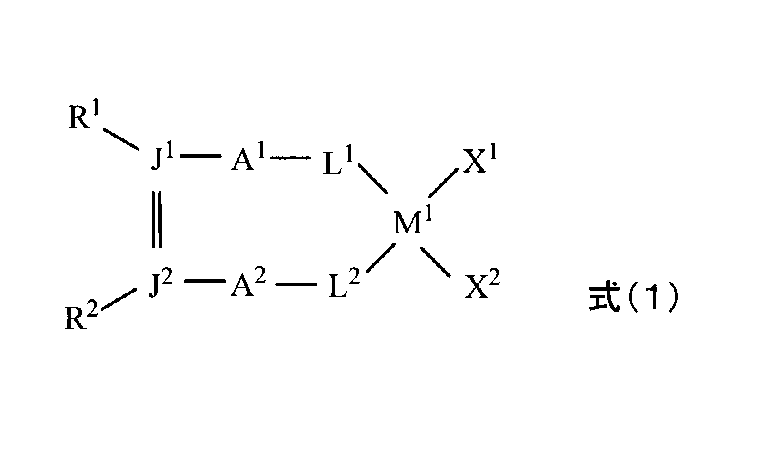
[式中、
M1は、周期表4族の遷移金属を示す。
L1とL2は、シクロペンタジエニル構造を含む配位子を示し、M1に配位している。
X1及びX2は、それぞれ独立して、M1と結合する水素原子、ハロゲン原子、炭素数1~20の炭化水素基、炭素数1~20のアルコキシ基、酸素原子若しくは窒素原子を含む炭素数3~20の炭化水素基または炭素数1~20の炭化水素基置換アミノ基を示す。
J1とJ2は、炭素原子を示す。
A1とA2は、それぞれJ1とL1、J2とL2とを結合する架橋基を示し、以下の群から選ばれる。
-CR3
2-、-SiR3
2-、-NR3-、-PR3-、-O-、-S-、[ここでR3は水素原子または炭素数1~10の炭化水素基であり、2つのR3が結合して環状構造を形成してもよい]、
R1とR2は、それぞれ独立して、水素原子、炭素数1~20の炭化水素基、炭素数1~20のアルコキシ基、1つ~6つのケイ素原子を含む炭素数1~20の炭化水素基、炭素数1~20のハロゲン置換炭化水素基、酸素原子、硫黄原子若しくは窒素原子を含む炭素数3~20の炭化水素基または炭素数1~20の炭化水素基置換シリル基を示す。R1とR2は、それらが結合しあってJ1およびJ2と一緒に環状構造を形成してもよい。]
[During the ceremony,
M 1 represents a transition metal of
L 1 and L 2 represent a ligand containing a cyclopentadienyl structure and are coordinated to M 1 .
Each of X 1 and X 2 independently has a hydrogen atom, a halogen atom, a hydrocarbon group having 1 to 20 carbon atoms, an alkoxy group having 1 to 20 carbon atoms, and a carbon containing an oxygen atom or a nitrogen atom. A hydrocarbon group having a number of 3 to 20 or a hydrocarbon group substituted amino group having a carbon number of 1 to 20 is shown.
J 1 and J 2 represent carbon atoms.
A 1 and A 2 indicate a cross-linking group that binds J 1 and L 1 and J 2 and L 2 , respectively, and are selected from the following groups.
-CR 3 2- , -SiR 3 2- , -NR 3- , -PR 3- , -O-, -S-, [Here, R 3 is a hydrogen atom or a hydrocarbon group having 1 to 10 carbon atoms. Two R3s may combine to form a cyclic structure],
R 1 and R 2 independently have a hydrogen atom, a hydrocarbon group having 1 to 20 carbon atoms, an alkoxy group having 1 to 20 carbon atoms, and a hydrocarbon having 1 to 20 carbon atoms including 1 to 6 silicon atoms. A hydrogen group, a halogen-substituted hydrocarbon group having 1 to 20 carbon atoms, a hydrocarbon group having 3 to 20 carbon atoms including an oxygen atom, a sulfur atom or a nitrogen atom, or a hydrocarbon group-substituted silyl group having 1 to 20 carbon atoms is shown. R 1 and R 2 may combine with each other to form a cyclic structure with J 1 and J 2 . ]
M1は、周期表第4族の遷移元素である。M1としては、例えば、チタン原子(Ti)、ジルコニウム原子(Zr)又はハフニウム原子(Hf)が用いられるが、ハフニウム原子よりジルコニウム原子の方が共重合能を低くし且つ重合活性を高くすることができるため、ジルコニウム原子が好ましい。
M 1 is a transition element of
L1とL2は、シクロペンタジエニル構造を含み、M1に配位する配位子である。シクロペンタジエニル構造を含む配位子としては、例えば、シクロペンタジニル骨格を有する配位子、インデニル骨格を有する配位子、フルオレニル骨格を有する配位子等が挙げられる。シクロペンタジエニル構造を含む配位子は、骨格に含まれる不飽和結合の一部が水素原子で置換されていてもよく、例えば、インデニル骨格を有する配位子としてはテトラヒドロインデニル基であってもよい。また、L1とL2がそれぞれシクロペンタジエニル骨格とインデニル骨格、シクロペンタジエニル骨格とフルオレニル骨格、インデニル骨格とフルオレニル骨格のように異なるものであってもよい。
シクロペンタジエニル構造を含む配位子は、置換基を有していてもよい。特にシクロペンタジエニル骨格を有する配位子の場合には、2置換以上であることが好ましい。置換基としては、例えば、ハロゲン原子、炭素数1~20の炭化水素基、炭素数1~20のアルコキシ基、1つ~6つのケイ素原子を含む炭素数1~20の炭化水素基、炭素数1~20のハロゲン置換炭化水素基、酸素原子、硫黄原子若しくは窒素原子を含む炭素数3~20の炭化水素基または炭素数1~20の炭化水素基置換シリル基を挙げることができる。L1またはL2上に、隣り合う置換基が存在する場合、それらが結合して環構造を形成してもよい。また、L1またはL2上の置換基の位置は任意に選ばれ、インデニル骨格の場合、2位、3位、4位の1置換型、4,7位や5,6位の2置換型が挙げられる。
L 1 and L 2 contain a cyclopentadienyl structure and are ligands that coordinate to M 1 . Examples of the ligand containing a cyclopentadienyl structure include a ligand having a cyclopentadienyl skeleton, a ligand having an indenyl skeleton, and a ligand having a fluorenyl skeleton. The ligand containing the cyclopentadienyl structure may have a part of the unsaturated bond contained in the skeleton substituted with a hydrogen atom. For example, the ligand having an indenyl skeleton is a tetrahydroindenyl group. You may. Further, L 1 and L 2 may be different such as cyclopentadienyl skeleton and indenyl skeleton, cyclopentadienyl skeleton and fluorenyl skeleton, and indenyl skeleton and fluorenyl skeleton, respectively.
The ligand containing the cyclopentadienyl structure may have a substituent. In particular, in the case of a ligand having a cyclopentadienyl skeleton, it is preferably two substitutions or more. Examples of the substituent include a halogen atom, a hydrocarbon group having 1 to 20 carbon atoms, an alkoxy group having 1 to 20 carbon atoms, a hydrocarbon group having 1 to 20 carbon atoms including 1 to 6 silicon atoms, and a hydrocarbon group having 1 to 20 carbon atoms. Examples thereof include a halogen-substituted hydrocarbon group having 1 to 20, a hydrocarbon group having 3 to 20 carbon atoms including an oxygen atom, a sulfur atom or a nitrogen atom, or a hydrocarbon group-substituted silyl group having 1 to 20 carbon atoms. If adjacent substituents are present on L 1 or L 2 , they may be combined to form a ring structure. Further, the position of the substituent on L 1 or L 2 is arbitrarily selected, and in the case of the indenyl skeleton, the 1-substituted type at the 2-position, 3-position and 4-position, and the 2-substituted type at the 4, 7 and 5, 6 positions. Can be mentioned.
ハロゲン原子の具体例としては、例えば、塩素原子、臭素原子、ヨウ素原子、フッ素原子を挙げることができる。
炭素数1~20の炭化水素基の具体例としては、メチル基、エチル基、n-プロピル基、i-プロピル基、n-ブチル基、i-ブチル基、s-ブチル基、t-ブチル基、n-ペンチル基、ネオペンチル基、n-ヘキシル基、オクチル基、シクロプロピル基、シクロペンチル基、シクロヘキシル基等のアルキル基またはシクロアルキル基;ビニル基、プロペニル基、ブテニル基、ヘキセニル基、シクロヘキセニル基等のアルケニル基;シクロペンチルメチル基、2-シクロヘキシルエチル基等の脂環式置換基を有するアルキル基;フェニル基、2-メチルフェニル基、3-メチルフェニル基、4-メチルフェニル基、3,5-ジメチルフェニル基、2,4,6-トリメチルフェニル基、4-t-ブチルフェニル基、3,5-ジ-t-ブチルフェニル基、4-ビニルフェニル基、3-アリルフェニル基、4-(3-ブテニル)フェニル基、ナフチル基等の飽和又は不飽和の炭化水素基が置換していてもよい単環又は縮合環のアリール基;ベンジル基、2-フェニルエチル基等の芳香族置換基を有するアルキル基などを挙げることができる。
Specific examples of the halogen atom include a chlorine atom, a bromine atom, an iodine atom, and a fluorine atom.
Specific examples of the hydrocarbon group having 1 to 20 carbon atoms include a methyl group, an ethyl group, an n-propyl group, an i-propyl group, an n-butyl group, an i-butyl group, an s-butyl group, and a t-butyl group. , N-pentyl group, neopentyl group, n-hexyl group, octyl group, cyclopropyl group, cyclopentyl group, cyclohexyl group and other alkyl groups or cycloalkyl groups; vinyl group, propenyl group, butenyl group, hexenyl group, cyclohexenyl group Alkenyl groups such as; alkyl groups having alicyclic substituents such as cyclopentylmethyl group and 2-cyclohexylethyl group; phenyl group, 2-methylphenyl group, 3-methylphenyl group, 4-methylphenyl group, 3,5 -Dimethylphenyl group, 2,4,6-trimethylphenyl group, 4-t-butylphenyl group, 3,5-di-t-butylphenyl group, 4-vinylphenyl group, 3-allylphenyl group, 4-( 3-Butenyl) A monocyclic or fused ring aryl group that may be substituted with a saturated or unsaturated hydrocarbon group such as a phenyl group or a naphthyl group; an aromatic substituent such as a benzyl group or a 2-phenylethyl group. Examples thereof include an alkyl group having.
炭素数1~20のアルコキシ基の具体例としては、メトキシ基、エトキシ基、n-プロポキシ基、i-プロポキシ基、n-ブトキシ基、i-ブトキシ基、t-ブトキシ基、フェノキシ基などを挙げることができる。
1つ~6つのケイ素原子を含む炭素数1~20の炭化水素基の具体例としては、1つ~6つのトリアルキルシリル基が置換した炭化水素基であってアルキルシリル基の炭素原子を含む炭素原子の総数が1~20の炭化水素基が挙げられる。より具体的には、ビス(トリメチルシリル)メチル基、ビス(t-ブチルジメチルシリル)メチル基、トリメチルシリルエチル基、トリエチルシリルエチル基、2-トリメチルシリルプロピル基等のアルキルシリル置換アルキル基;4-トリメチルシリルフェニル基等のアルキルシリル置換芳香族炭化水素基などを挙げることができる。
Specific examples of the alkoxy group having 1 to 20 carbon atoms include a methoxy group, an ethoxy group, an n-propoxy group, an i-propoxy group, an n-butoxy group, an i-butoxy group, a t-butoxy group, a phenoxy group and the like. be able to.
Specific examples of a hydrocarbon group having 1 to 20 carbon atoms containing 1 to 6 silicon atoms include a hydrocarbon group substituted with 1 to 6 trialkylsilyl groups and containing a carbon atom of the alkylsilyl group. Hydrocarbon groups having a total number of carbon atoms of 1 to 20 can be mentioned. More specifically, an alkylsilyl substituted alkyl group such as a bis (trimethylsilyl) methyl group, a bis (t-butyldimethylsilyl) methyl group, a trimethylsilylethyl group, a triethylsilylethyl group, a 2-trimethylsilylpropyl group; 4-trimethylsilylphenyl. Examples thereof include an alkylsilyl substituted aromatic hydrocarbon group such as a group.
炭素数1~20のハロゲン置換炭化水素基の具体例としては、ブロモメチル基、クロロメチル基、トリフルオロメチル基、2-クロロエチル基、2-ブロモエチル基、2,2,2-トリフルオロエチル基、2-ブロモプロピル基、3-ブロモプロピル基、3,3,3-トリフルオロプロピル基、4-クロロブチル基、3-フルオロブチル基、4,4,4-トリフルオロブチル基等のハロゲン化アルキル基、2-ブロモシクロペンチル基、2,3-ジブロモシクロペンチル基、2-ブロモ-3-ヨードシクロペンチル基、2,3-ジブロモシクロヘキシル基、2-クロロ-3-ヨードシクロヘキシル基等のハロゲン化シクロアルキル基、2-クロロフェニル基、4-クロロフェニル基、3,5-ジクロロフェニル基、2,3,4,5,6-ペンタフルオロフェニル基等のハロゲン化芳香族基、4-トリフルオロメチルフェニル基等のハロゲン化アルキル芳香族基などを挙げることができる。 Specific examples of the halogen-substituted hydrocarbon group having 1 to 20 carbon atoms include a bromomethyl group, a chloromethyl group, a trifluoromethyl group, a 2-chloroethyl group, a 2-bromoethyl group, a 2,2,2-trifluoroethyl group, and the like. Alkyl halides such as 2-bromopropyl group, 3-bromopropyl group, 3,3,3-trifluoropropyl group, 4-chlorobutyl group, 3-fluorobutyl group, 4,4,4-trifluorobutyl group , 2-bromocyclopentyl group, 2,3-dibromocyclopentyl group, 2-bromo-3-iodocyclopentyl group, 2,3-dibromocyclohexyl group, 2-chloro-3-iodocyclohexyl group and other halide cycloalkyl groups, Halogenized aromatic groups such as 2-chlorophenyl group, 4-chlorophenyl group, 3,5-dichlorophenyl group, 2,3,4,5,6-pentafluorophenyl group, halogenation of 4-trifluoromethylphenyl group and the like. Alkyl aromatic groups and the like can be mentioned.
酸素原子、硫黄原子若しくは窒素原子を含む炭素数3~20の炭化水素基の具体例としては、次のものがある。酸素を含むものとして、エトキシメチル基、n-プロポキシメチル基、i-プロポキシメチル基、n-ブトキシメチル基、i-ブトキシメチル基、t-ブトキシメチル基、メトキシエチル基、エトキシエチル基、4-メトキシブチル基、3-エトキシブチル基、6-メトキシヘキシル基等のアルコキシアルキル基、2-メトキシフェニル基、3-メトキシフェニル基、4-メトキシフェニル基、2,4-ジメトキシフェニル基等のアルコキシ芳香族基、アセチル基、1-オキソプロピル基、1-オキソ-n-ブチル基、2-メチル-1-オキソプロピル基、2 ,2-ジメチル-1-オキソ-プロピル基、フェニルアセチル基、ジフェニルアセチル基、ベンゾイル基等のオキソ基含有炭化水素基、2-フリル基、2-テトラヒドロフリル基、2-メチルフリル基等の環状エーテル基など;硫黄原子を含むものとして、2-チエニル基、2-テトラヒドロチエニル基、2-メチルチエニル基など;及び、窒素原子を含むものとして、ジメチルアミノメチル基、ジエチルアミノメチル基、ジi-プロピルアミノメチル基、ビス(ジメチルアミノ)メチル基、ビス(ジi-プロピルアミノ)メチル基、(ジメチルアミノ)(フェニル)メチル基、アミノエチル基、ジメチルアミノエチル基、ジエチルアミノエチル基、1-(メチルイミノ)エチル基、1-(フェニルイミノ)エチル基、1-[(フェニルメチル)イミノ]エチル基、ジメチルアミノヘキシル基等のアミノ置換アルキル基、4-アミノフェニル基、4-ジメチルアミノフェニル基等のアミノ置換芳香族基などを挙げることができる。 Specific examples of the hydrocarbon group having 3 to 20 carbon atoms including an oxygen atom, a sulfur atom or a nitrogen atom are as follows. As those containing oxygen, ethoxymethyl group, n-propoxymethyl group, i-propoxymethyl group, n-butoxymethyl group, i-butoxymethyl group, t-butoxymethyl group, methoxyethyl group, ethoxyethyl group, 4- Ekalkyl fragrances such as alkoxyalkyl groups such as methoxybutyl group, 3-ethoxybutyl group and 6-methoxyhexyl group, 2-methoxyphenyl group, 3-methoxyphenyl group, 4-methoxyphenyl group and 2,4-dimethoxyphenyl group. Group group, acetyl group, 1-oxopropyl group, 1-oxo-n-butyl group, 2-methyl-1-oxopropyl group, 2,2-dimethyl-1-oxo-propyl group, phenylacetyl group, diphenylacetyl Oxo group-containing hydrocarbon groups such as groups and benzoyl groups, cyclic ether groups such as 2-furyl groups, 2-tetrahydrofuryl groups and 2-methylfuryl groups; 2-thienyl groups and 2-thienyl groups as those containing a sulfur atom. Tetrahydrothienyl group, 2-methylthienyl group, etc .; and dimethylaminomethyl group, diethylaminomethyl group, di-propylaminomethyl group, bis (dimethylamino) methyl group, bis (dii-) as those containing a nitrogen atom. Propylamino) methyl group, (dimethylamino) (phenyl) methyl group, aminoethyl group, dimethylaminoethyl group, diethylaminoethyl group, 1- (methylimino) ethyl group, 1- (phenylimino) ethyl group, 1-[( Phenylmethyl) imino] Amino-substituted alkyl groups such as ethyl group and dimethylaminohexyl group, amino-substituted aromatic groups such as 4-aminophenyl group and 4-dimethylaminophenyl group can be mentioned.
炭素数1~20の炭化水素基置換シリル基の具体例としては、トリメチルシリル基、トリt-ブチルシリル基、ジt-ブチルメチルシリル基、t-ブチルジメチルシリル基等のアルキルシリル基、トリフェニルシリル基、ジフェニルメチルシリル基、フェニルジメチルシリル基等の芳香族シリル基などを挙げることができる。 Specific examples of the hydrocarbon group substituted silyl group having 1 to 20 carbon atoms include an alkylsilyl group such as a trimethylsilyl group, a trit-butylsilyl group, a dit-butylmethylsilyl group and a t-butyldimethylsilyl group, and a triphenylsilyl. Examples include an aromatic silyl group such as a group, a diphenylmethylsilyl group, and a phenyldimethylsilyl group.
X1及びX2は、それぞれ独立して、M1と結合する水素原子、ハロゲン原子、炭素数1~20の炭化水素基、炭素数1~20のアルコキシ基、酸素原子若しくは窒素原子を含む炭素数3~20の炭化水素基または炭素数1~20の炭化水素基置換アミノ基である。
ハロゲン原子の具体例としては、上記L1及びL2の置換基について説明したハロゲン原子の具体例を、X1及びX2についても挙げることができる。
炭素数1~20の炭化水素基の具体例としては、上記L1及びL2の置換基について説明した炭素数1~20の炭化水素基の具体例を、X1及びX2についても挙げることができる。
炭素数1~20のアルコキシ基の具体例としては、上記L1及びL2の置換基について説明した炭素数1~20のアルコキシ基の具体例を、X1及びX2についても挙げることができる。
酸素原子若しくは窒素原子を含む炭素数3~20の炭化水素基の具体例としては、上記L1及びL2の置換基について説明した酸素原子若しくは窒素原子を含む炭素数3~20の炭化水素基の具体例を、X1及びX2についても挙げることができる。
炭素数1~20の炭化水素基置換アミノ基の具体例としては、ジメチルアミノ基、ジエチルアミノ基、ジn-プロピルアミノ基、ジi-ブチルアミノ基、ジt-ブチルアミノ基、ジフェニルアミノ基などを挙げることができる。
Each of X 1 and X 2 independently has a hydrogen atom, a halogen atom, a hydrocarbon group having 1 to 20 carbon atoms, an alkoxy group having 1 to 20 carbon atoms, and a carbon containing an oxygen atom or a nitrogen atom. It is a hydrocarbon group having 3 to 20 carbon atoms or a hydrocarbon group substituted amino group having 1 to 20 carbon atoms.
As a specific example of the halogen atom, specific examples of the halogen atom described for the substituents of L 1 and L 2 can be given for X 1 and X 2 .
As specific examples of the hydrocarbon groups having 1 to 20 carbon atoms, specific examples of the hydrocarbon groups having 1 to 20 carbon atoms described above for the substituents of L 1 and L 2 are also given for X 1 and X 2 . Can be done.
As a specific example of the alkoxy group having 1 to 20 carbon atoms, specific examples of the alkoxy group having 1 to 20 carbon atoms described for the substituents of L 1 and L 2 can be given also for X 1 and X 2 . ..
As a specific example of the hydrocarbon group having 3 to 20 carbon atoms containing an oxygen atom or a nitrogen atom, the hydrocarbon group having 3 to 20 carbon atoms containing an oxygen atom or a nitrogen atom described above for the substituents of L 1 and L 2 has been described. Specific examples of X 1 and X 2 can also be given.
Specific examples of the hydrocarbon group-substituted amino group having 1 to 20 carbon atoms include a dimethylamino group, a diethylamino group, a din-propylamino group, a di-butylamino group, a dit-butylamino group, and a diphenylamino group. Can be mentioned.
J1とJ2は、炭素原子を示す。J1とJ2が二重結合で結合し、さらにJ1とJ2がsp2混成軌道になることにより、架橋基A1及びA2と共同して配位子L1とL2が遷移金属M1に適度な角度で配位することができる。配位子L1とL2が遷移金属M1に適度な角度で配位させることができる原子として、J1及びJ2の位置には炭素原子が最適である。 J 1 and J 2 represent carbon atoms. When J 1 and J 2 are bonded by a double bond and J 1 and J 2 become sp2 hybrid orbitals, the ligands L 1 and L 2 are transition metals in cooperation with the bridging groups A 1 and A 2 . It can be coordinated to M 1 at an appropriate angle. A carbon atom is optimal at the positions of J 1 and J 2 as an atom capable of coordinating the ligands L 1 and L 2 to the transition metal M 1 at an appropriate angle.
A1とA2は、それぞれJ1とL1、J2とL2とを結合する架橋基であり、以下の群から選ばれる:-CR3
2-、-SiR3
2-、-NR3-、-PR3-、-O-、-S-、[ここでR3は水素原子または炭素数1~10の炭化水素基であり、2つのR3が結合して環状構造を形成してもよい]。
R3である炭素数1~10の炭化水素基の具体例としては、L1及びL2の置換基について説明した炭化水素基の具体例のうち炭素数1~10のものをR3についても挙げることができる。
A1及びA2としては、無置換または炭素数1~4のアルキル基を有するメチレン基、及び、無置換または炭素数1~4のアルキル基を有するシリレン基が好ましい。
A 1 and A 2 are cross-linking groups that bind J 1 and L 1 and J 2 and L 2 , respectively, and are selected from the following groups: -CR 3 2- , -SiR 3 2- , -NR 3 -, -PR 3- , -O-, -S-, [Here, R 3 is a hydrogen atom or a hydrocarbon group having 1 to 10 carbon atoms, and two R 3s are bonded to form a cyclic structure. May be good].
As specific examples of the hydrocarbon groups having 1 to 10 carbon atoms which are R3 , among the specific examples of the hydrocarbon groups described for the substituents of L1 and L2, those having 1 to 10 carbon atoms are also used for R3. Can be mentioned.
As A 1 and A 2 , a methylene group having an unsubstituted or alkyl group having 1 to 4 carbon atoms and a silylene group having an unsubstituted or alkyl group having 1 to 4 carbon atoms are preferable.
R1とR2は、それぞれ独立して、水素原子、炭素数1~20の炭化水素基、炭素数1~20のアルコキシ基、1つ~6つのケイ素原子を含む炭素数1~20の炭化水素基、炭素数1~20のハロゲン置換炭化水素基、酸素原子、硫黄原子若しくは窒素原子を含む炭素数3~20の炭化水素基または炭素数1~20の炭化水素基置換シリル基である。 R 1 and R 2 independently have a hydrogen atom, a hydrocarbon group having 1 to 20 carbon atoms, an alkoxy group having 1 to 20 carbon atoms, and a hydrocarbon having 1 to 20 carbon atoms including 1 to 6 silicon atoms. It is a hydrogen group, a halogen-substituted hydrocarbon group having 1 to 20 carbon atoms, a hydrocarbon group having 3 to 20 carbon atoms including an oxygen atom, a sulfur atom or a nitrogen atom, or a hydrocarbon group-substituted silyl group having 1 to 20 carbon atoms.
炭素数1~20の炭化水素基の具体例としては、上記L1及びL2の置換基について説明した炭素数1~20の炭化水素基の具体例を、R1とR2についても挙げることができる。
炭素数1~20のアルコキシ基の具体例としては、上記L1及びL2の置換基について説明した炭素数1~20のアルコキシ基の具体例を、R1とR2についても挙げることができる。
1つ~6つのケイ素原子を含む炭素数1~20の炭化水素基の具体例としては、上記L1及びL2の置換基について説明した1つ~6つのケイ素原子を含む炭素数1~20の炭化水素基の具体例を、R1とR2についても挙げることができる。
炭素数1~20のハロゲン置換炭化水素基の具体例としては、上記L1及びL2の置換基について説明した炭素数1~20のハロゲン置換炭化水素基の具体例を、R1とR2についても挙げることができる。
酸素原子、硫黄原子若しくは窒素原子を含む炭素数3~20の炭化水素基の具体例としては、上記L1及びL2の置換基について説明した酸素原子、硫黄原子若しくは窒素原子を含む炭素数3~20の炭化水素基の具体例を、R1とR2についても挙げることができる。
炭素数1~20の炭化水素基置換シリル基の具体例としては、上記L1及びL2の置換基について説明した炭素数1~20の炭化水素基置換シリル基の具体例を、R1とR2についても挙げることができる。
As specific examples of the hydrocarbon groups having 1 to 20 carbon atoms, specific examples of the hydrocarbon groups having 1 to 20 carbon atoms described above for the substituents of L 1 and L 2 are also given for R 1 and R 2 . Can be done.
As a specific example of the alkoxy group having 1 to 20 carbon atoms, specific examples of the alkoxy group having 1 to 20 carbon atoms described above for the substituents of L 1 and L 2 can be given for R 1 and R 2 . ..
As a specific example of the hydrocarbon group having 1 to 20 carbon atoms containing 1 to 6 silicon atoms, 1 to 20 carbon atoms containing 1 to 6 silicon atoms described above for the substituents of L 1 and L 2 have been described. Specific examples of the hydrocarbon group of R 1 and R 2 can also be mentioned.
As specific examples of the halogen-substituted hydrocarbon groups having 1 to 20 carbon atoms, the specific examples of the halogen-substituted hydrocarbon groups having 1 to 20 carbon atoms described above for the substituents L 1 and L 2 are R 1 and R 2 . Can also be mentioned.
As a specific example of the hydrocarbon group having 3 to 20 carbon atoms including an oxygen atom, a sulfur atom or a nitrogen atom, the
As a specific example of the hydrocarbon group-substituted silyl group having 1 to 20 carbon atoms, the specific example of the hydrocarbon group-substituted silyl group having 1 to 20 carbon atoms described with respect to the substituents of L 1 and L 2 is referred to as R1 . R2 can also be mentioned.
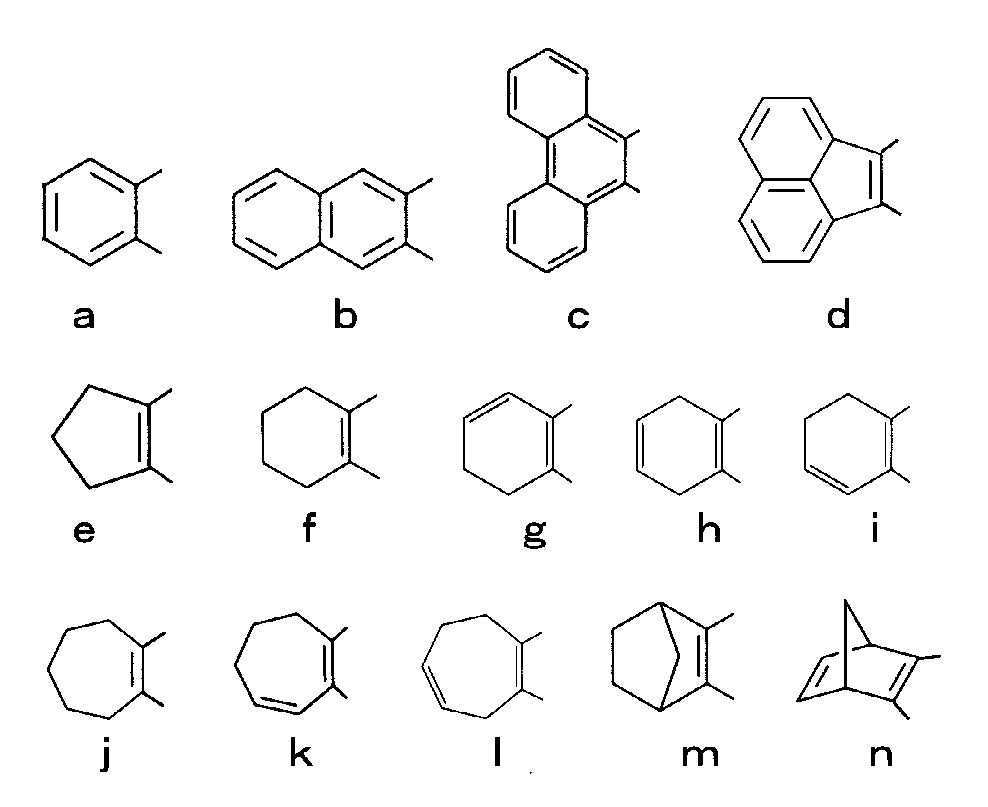
R1およびR2とJ1およびJ2が一緒に環状構造の一部を形成する場合、環状構造としては例えば、ベンゼン-1,2-ジイル基、ナフタレン-2,3-ジイル基、フェナントレン-9,10ジイル基等の芳香族環、シクロブタン-1,2-ジイル基(シクロブチリデン基)、シクロペンタン-1,2-ジイル基(シクロペンチリデン基)、シクロへキサン-1,2-ジイル基(シクロへキシリデン基)などの炭素原子で構成される4~7員環;ビシクロ[2.2.1]ヘプタン-ジイル基(ノルボルナン-ジイル基)、ビシクロ[4.4.0]デカン-ジイル基(デカリン-ジイル基)等の脂環式ビシクロ環などが挙げられる。
これらの環状構造は、環骨格上にJ1とJ2の間の二重結合以外の二重結合を含んでいてもよいし、環骨格上にアルキル基、アルケニル等の炭化水素基、ハロゲン、その他の置換基を有していてもよい。また、この環状構造は、環骨格を形成する原子間を架橋する架橋構造を有していてもよい。
When R 1 and R 2 and J 1 and J 2 form a part of the cyclic structure together, the cyclic structure may be, for example, benzene-1,2-diyl group, naphthalene-2,3-diyl group, phenanthrene-. Aromatic rings such as 9,10 diyl groups, cyclobutane-1,2-diyl group (cyclobutylidene group), cyclopentane-1,2-diyl group (cyclopentylidene group), cyclohexane-1,2- A 4- to 7-membered ring composed of carbon atoms such as a diyl group (cyclohexylidene group); bicyclo [2.2.1] heptane-diyl group (norbornane-diyl group), bicyclo [4.4.0] decan. -An alicyclic bicyclo ring such as a diyl group (decalin-diyl group) can be mentioned.
These cyclic structures may contain a double bond other than the double bond between J 1 and J 2 on the ring skeleton, or an alkyl group, a hydrocarbon group such as alkenyl, a halogen, etc. on the ring skeleton. It may have other substituents. Further, this cyclic structure may have a crosslinked structure for cross-linking between the atoms forming the ring skeleton.
さらに、R1およびR2とJ1およびJ2を含む環骨格上に置換基が2つ以上存在する場合、それらの置換基が結合しあって閉環し、R1およびR2とJ1およびJ2を含む環骨格の構成原子の一部を共有する縮合型の多環構造を形成していてもよい。
R1およびR2とJ1およびJ2を含む環骨格と他の環骨格を含む縮合環は、R1およびR2とJ1およびJ2を含む環骨格以外の環骨格上に置換基を有していてもよい。縮合環上の置換基としては、例えば、アルキル基、アルケニル等の炭化水素基、ハロゲン等が挙げられる。
R1およびR2とJ1およびJ2とで形成される環状構造としては、例えば、以下の構造aから構造nが挙げられる。
Furthermore, if there are two or more substituents on the ring skeleton containing R 1 and R 2 and J 1 and J 2 , those substituents bind to each other to close the ring, and R 1 and R 2 and J 1 and A condensed polycyclic structure may be formed that shares a part of the constituent atoms of the ring skeleton containing J 2 .
Ring skeletons containing R 1 and R 2 and J 1 and J 2 and fused rings containing other ring skeletons have substituents on ring skeletons other than those containing R 1 and R 2 and J 1 and J 2 . You may have. Examples of the substituent on the fused ring include an alkyl group, a hydrocarbon group such as alkenyl, and a halogen.
Examples of the annular structure formed by R 1 and R 2 and J 1 and J 2 include structures a to n below.
上記式(1)で表される化合物の中でも、下記式(1-1)乃至式(1-5)のいずれかで表される化合物が好ましい。
式(1-1)乃至式(1-5)は、式(1)において、R1とR2が結合しあって閉環し、R1およびR2とJ1およびJ2を含む6員環の環状構造を形成した化合物である。
Among the compounds represented by the above formula (1), the compounds represented by any of the following formulas (1-1) to (1-5) are preferable.
Formulas (1-1) to (1-5) are 6-membered rings including R 1 and R 2 and J 1 and J 2 in which R 1 and R 2 are coupled to each other to form a ring closure in the formula (1). It is a compound forming a cyclic structure of.

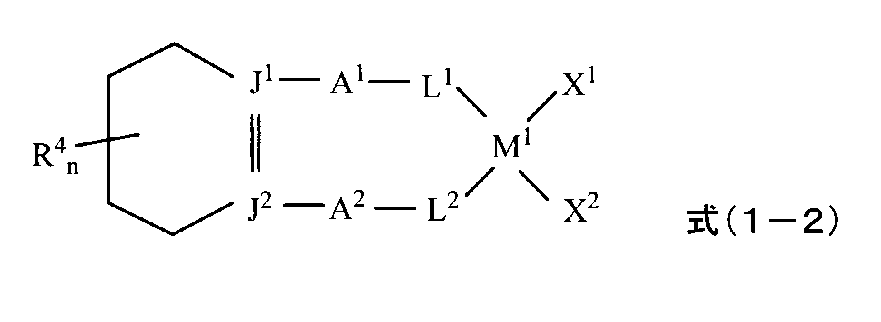
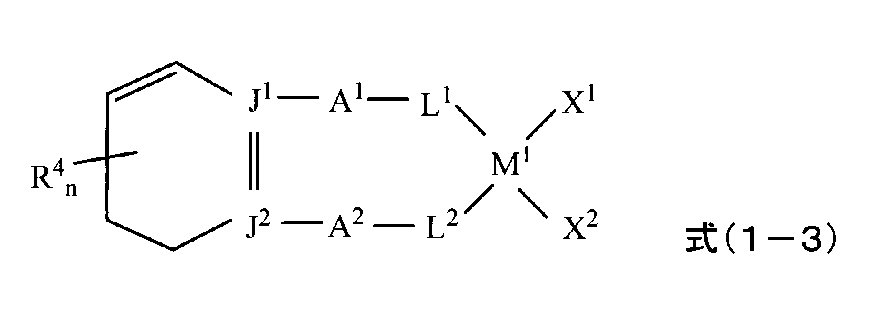
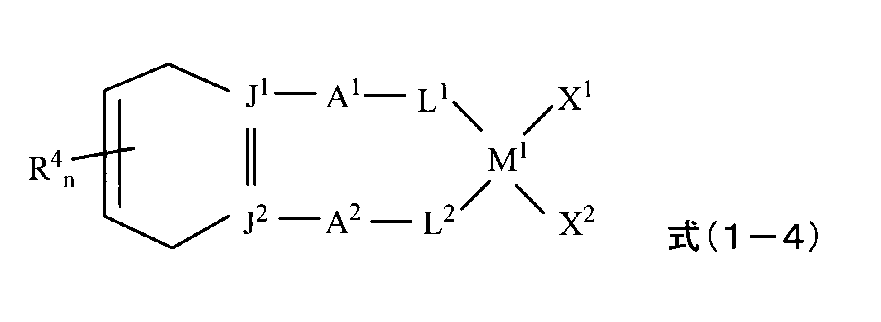

[式中、
M1、L1、L2、X1、X2、J1、J2、A1及びA2は、前記式(1)と同じである。
R4は6員環上に存在する置換基を示し、存在しても存在しなくてもよく、存在する場合にはそれぞれ独立して、ハロゲン原子、炭素数1~9の炭化水素基、炭素数1~9のアルコキシ基、炭素数1~9のハロゲン置換炭化水素基、酸素原子、硫黄原子若しくは窒素原子を含む炭素数3~9の炭化水素基、炭素数1~9の炭化水素基置換シリル基または炭素数1~9の炭化水素基で置換されていてもよいアミノ基である。R4は、当該R4が存在する6員環内に架橋構造を形成してもよい。R4が2つ以上存在する場合、それらが結合し、当該R4が存在する6員環の構成原子の一部を共有する縮合環を形成してもよいし、当該縮合環上に置換基を有していてもよい。
nは6員環上に存在するR4の数を示し、0~4を示す。]
[During the ceremony,
M 1 , L 1 , L 2 , X 1 , X 2 , J 1 , J 2 , A 1 and A 2 are the same as those in the above formula (1).
R4 indicates a substituent existing on the 6-membered ring, and may or may not be present. If present, each of them independently has a halogen atom, a hydrocarbon group having 1 to 9 carbon atoms, and carbon. An alkoxy group having a number of 1 to 9, a halogen-substituted hydrocarbon group having 1 to 9 carbon atoms, a hydrocarbon group having 3 to 9 carbon atoms including an oxygen atom, a sulfur atom or a nitrogen atom, and a hydrocarbon group having 1 to 9 carbon atoms. It is an amino group that may be substituted with a silyl group or a hydrocarbon group having 1 to 9 carbon atoms. R 4 may form a crosslinked structure in the 6-membered ring in which the R 4 is present. When two or more R 4s are present, they may be bonded to form a fused ring that shares a part of the constituent atoms of the 6-membered ring in which the R 4 is present, or a substituent may be formed on the condensed ring. May have.
n indicates the number of R4 existing on the 6-membered ring, and indicates 0 to 4. ]
ハロゲン原子の具体例としては、上記L1及びL2の置換基について説明したハロゲン原子の具体例を、R4についても挙げることができる。
炭素数1~9の炭化水素基の具体例としては、上記L1及びL2の置換基について説明した炭素数1~20の炭化水素基の具体例のうち炭素数1~9の例を、R4についても挙げることができる。R4が炭素数1~9の炭化水素基である場合の具体例としては、特に、メチル基、エチル基、プロピル基、n-ブチル基、t-ブチル基等の炭素数1~4のアルキル基、ビニル基、プロペニル基、ブテニル基等の炭素数1~4のアルケニル基が挙げられる。
炭素数1~9のアルコキシ基の具体例としては、上記L1及びL2の置換基について説明した炭素数1~20のアルコキシ基の具体例のうち炭素数1~9の例を、R4についても挙げることができる。R4が炭素数1~9のアルコキシ基である場合の具体例としては、特に、メトキシ基、エトキシ基、ブトキシ基等の炭素数1~4のアルコキシ基が挙げられる。
As a specific example of the halogen atom, a specific example of the halogen atom described for the substituents of L 1 and L 2 can be given for R4 as well.
As a specific example of the hydrocarbon group having 1 to 9 carbon atoms, among the specific examples of the hydrocarbon group having 1 to 20 carbon atoms described for the substituents of L 1 and L 2 , the example having 1 to 9 carbon atoms will be used. R4 can also be mentioned. Specific examples of the case where R4 is a hydrocarbon group having 1 to 9 carbon atoms include an alkyl having 1 to 4 carbon atoms such as a methyl group, an ethyl group, a propyl group, an n-butyl group and a t-butyl group. Examples thereof include an alkenyl group having 1 to 4 carbon atoms such as a group, a vinyl group, a propenyl group and a butenyl group.
As specific examples of the alkoxy groups having 1 to 9 carbon atoms, among the specific examples of the alkoxy groups having 1 to 20 carbon atoms described for the substituents of L 1 and L 2 , the example having 1 to 9 carbon atoms is referred to as R4 . Can also be mentioned. Specific examples of the case where R 4 is an alkoxy group having 1 to 9 carbon atoms include an alkoxy group having 1 to 4 carbon atoms such as a methoxy group, an ethoxy group, and a butoxy group.
炭素数1~9のハロゲン置換炭化水素基の具体例としては、上記L1及びL2の置換基について説明した炭素数1~20のハロゲン置換炭化水素基の具体例のうち炭素数1~9の例を、R4についても挙げることができる。R4が炭素数1~9のハロゲン置換炭化水素基である場合の具体例としては、特に、トリフルオロメチル基、2,2,2-トリフルオロエチル基が挙げられる。
酸素原子、硫黄原子若しくは窒素原子を含む炭素数3~9の炭化水素基の具体例としては、上記L1及びL2の置換基について説明した酸素原子、硫黄原子若しくは窒素原子を含む炭素数3~20の炭化水素基の具体例のうち炭素数3~9の例を、R4についても挙げることができる。R4が酸素原子を含む場合の具体例としては、特に、メトキシブチル基、エトキシブチル基、メトキシヘキシル基、エトキシヘキシル基等の酸素原子を含む炭素数5~8の炭化水素基が挙げられる。R4が硫黄原子を含む場合の具体例としては、特に、メチルチオブチル基、エチルチオブチル基、メチルチオヘキシル基、エチルチオヘキシル基等の硫黄原子を含む炭素数5~8の炭化水素基が挙げられる。R4が窒素原子を含む場合の具体例としては、特に、ジメチルアミノブチル基、ジメチルアミノヘキシル基等の窒素原子を含む炭素数6~8の炭化水素基が挙げられる。
As a specific example of the halogen-substituted hydrocarbon group having 1 to 9 carbon atoms, among the specific examples of the halogen-substituted hydrocarbon group having 1 to 20 carbon atoms described with respect to the substituents L 1 and L 2 , the
As a specific example of the hydrocarbon group having 3 to 9 carbon atoms including an oxygen atom, a sulfur atom or a nitrogen atom, the
炭素数1~9の炭化水素基置換シリル基の具体例としては、上記L1及びL2の置換基について説明した炭素数1~20の炭化水素基置換シリル基の具体例のうち炭素数1~9の例を、R4についても挙げることができる。R4が炭素数1~9の炭化水素基置換シリル基である場合の具体例としては、特に、トリメチルシリル基、トリエチルシリル基等の炭素数1~2の炭化水素基置換シリル基が挙げられる。
炭素数1~9の炭化水素基で置換されていてもよいアミノ基の具体例としては、ジメチルアミノ基、ジエチルアミノ基、ジブチルアミノ基等の炭素数1~4のアルキル基で置換されている3級アミノ基が挙げられる。
As a specific example of the hydrocarbon group-substituted silyl group having 1 to 9 carbon atoms, among the specific examples of the hydrocarbon group-substituted silyl group having 1 to 20 carbon atoms described above for the substituents L 1 and L 2 , the
Specific examples of the amino group optionally substituted with a hydrocarbon group having 1 to 9 carbon atoms include an alkyl group having 1 to 4 carbon atoms such as a dimethylamino group, a diethylamino group and a dibutylamino group. Examples include class amino groups.
式(1)においてM1がジルコニウム原子で、X1及びX2が塩素原子である遷移金属化合物の具体例としては、以下のものを挙げることができる。 Specific examples of the transition metal compound in which M 1 is a zirconium atom and X 1 and X 2 are chlorine atoms in the formula (1) include the following.


M1は、ジルコニウム原子以外にチタン原子、ハフニウム原子も用いることができるが、好ましくはジルコニウム原子である。
上記化合物のうち、J1、J2、R1及びR2によって形成される環状構造が、ベンゼン-1,2-ジイル基、すなわちベンゼン環であることが好ましく、上記表中の化合物番号が5、6、7、8、9、10,11、13、14、15、19、20、21のものがさらに好ましく、化合物番号が5,6,7、10、11、14、15のものが特に好ましい。
As M 1 , a titanium atom or a hafnium atom can be used in addition to the zirconium atom, but a zirconium atom is preferable.
Among the above compounds, the cyclic structure formed by J 1 , J 2 , R 1 and R 2 is preferably a benzene-1,2-diyl group, that is, a benzene ring, and the compound number in the above table is 5. , 6, 7, 8, 9, 10, 11, 13, 14, 15, 19, 20, 21 are more preferable, and those having
式(1)で表される遷移金属化合物は、メタロセン化合物の一般的な合成方法を利用して製造することができる。
一般的な手順として、インデンとブチルリチウムとからインデニルリチウム塩を合成し、その2当量のリチウム塩を、α、α’-ジブロモ-オルトキシレンに反応させて、メタロセン用の配位子であるα、α’-ビス(1-インデニル)-オルトキシレンを合成する。この後、さらにブチルリチウムで配位子のリチウム塩を合成してから、四塩化ジルコニウムと反応させて、メタロセンを得ることができる。
上記インデンの代わりに各種のシクロペンタジエニル構造を持つ化合物を用いることで、L1やL2を変えたメタロセン化合物を得ることができる
また、式(1)で表される遷移金属化合物を合成する際には、特開平9-286812の実施例1、およびJournal of Organometallic Chemistry 535(1997)29-32記載の化合物1aの合成例を参考にすることができる。
式(1)においてR1およびR2とJ1およびJ2が一緒に環状構造を形成している或いは当該環状構造がさらに多環構造を形成している化合物を合成する場合、上記説明のように、式(1)のR1およびR2とJ1およびJ2に相当する部分がすでに単環又は多環の環状構造を形成している原料化合物を用いてもよいし、合成の途中又は最終段階でR1とR2を反応させて閉環することにより環状構造を形成してもよい。
The transition metal compound represented by the formula (1) can be produced by utilizing a general method for synthesizing a metallocene compound.
As a general procedure, an indenyl lithium salt is synthesized from indene and butyl lithium, and two equivalents of the lithium salt are reacted with α, α'-dibromo-orthoxylene to be a ligand for metallocene. Synthesize α, α'-bis (1-indenyl) -ortoxylene. After that, a lithium salt of the ligand can be further synthesized with butyl lithium and then reacted with zirconium tetrachloride to obtain metallocene.
By using a compound having various cyclopentadienyl structures instead of the above indene, a metallocene compound in which L 1 and L 2 are changed can be obtained, and a transition metal compound represented by the formula (1) is synthesized. In this case, it is possible to refer to Example 1 of JP-A-9-286812 and the synthesis example of compound 1a described in Journal of Organometallic Chemistry 535 (1997) 29-32.
In the case of synthesizing a compound in which R 1 and R 2 and J 1 and J 2 together form a cyclic structure in the formula (1), or the cyclic structure further forms a polycyclic structure, as described above. A raw material compound in which the portions corresponding to R 1 and R 2 and J 1 and J 2 of the formula (1) already form a monocyclic or polycyclic cyclic structure may be used, or during synthesis or during synthesis. A cyclic structure may be formed by reacting R 1 and R 2 to close the ring at the final stage.
2.成分(II)
本発明で用いられる成分(II)は、下記式(2)、式(3)又は式(4)で表される化合物群から選ばれる遷移金属化合物である。
[式(2)の化合物]
本発明においては、成分(II)として、下記式(2)で表される遷移金属化合物を用いることができる。
式(2):
A3
qL3L3’M3X3X3’
2. 2. Ingredient (II)
The component (II) used in the present invention is a transition metal compound selected from the compound group represented by the following formula (2), formula (3) or formula (4).
[Compound of formula (2)]
In the present invention, a transition metal compound represented by the following formula (2) can be used as the component (II).
Equation (2):
A 3 q L 3 L 3'M 3 X 3 X 3 '
[式中、
M3は、周期表4族の遷移金属を示す。
L3とL3’は、それぞれ独立して、シクロペンタジエニル構造を含む配位子を示し、M3に配位している。該シクロペンタジエニル構造を含む配位子は、ハロゲン原子、炭素数1~20の炭化水素基、炭素数1~20のアルコキシ基、1つ~6つのケイ素原子を含む炭素数1~20の炭化水素基、炭素数1~20のハロゲン置換炭化水素基、酸素原子、硫黄原子若しくは窒素原子を含む炭素数3~20の炭化水素基または炭素数1~20の炭化水素基置換シリル基で置換されていてもよい。L3またはL3’上に、隣り合う置換基が存在する場合、それらが結合して環構造を形成してもよい。
X3とX3’は、それぞれ独立して、M3と結合する水素原子、ハロゲン原子、炭素数1~20の炭化水素基、炭素数1~20のアルコキシ基、酸素原子若しくは窒素原子を含む炭素数3~20の炭化水素基または炭素数1~20の炭化水素基置換アミノ基を示す。
A3は、L3とL3’を架橋する架橋基を示し、存在しても存在しなくてもよく、存在する場合にはL3とL3’の間に架橋構造を有する。
qは0または1であり、A3の数を示す。]
[During the ceremony,
M 3 indicates a transition metal of
L 3 and L 3'independently represent ligands containing a cyclopentadienyl structure and are coordinated to M 3 . The ligand containing the cyclopentadienyl structure has a halogen atom, a hydrocarbon group having 1 to 20 carbon atoms, an alkoxy group having 1 to 20 carbon atoms, and 1 to 20 carbon atoms containing 1 to 6 silicon atoms. Substituted with a hydrocarbon group, a halogen-substituted hydrocarbon group having 1 to 20 carbon atoms, a hydrocarbon group having 3 to 20 carbon atoms including an oxygen atom, a sulfur atom or a nitrogen atom, or a hydrocarbon group substituted silyl group having 1 to 20 carbon atoms. It may have been. If adjacent substituents are present on L 3 or L 3' , they may be combined to form a ring structure.
X 3 and X 3'contain a hydrogen atom , a halogen atom, a hydrocarbon group having 1 to 20 carbon atoms, an alkoxy group having 1 to 20 carbon atoms, an oxygen atom or a nitrogen atom independently of each other. A hydrocarbon group having 3 to 20 carbon atoms or a hydrocarbon group substituted amino group having 1 to 20 carbon atoms is shown.
A 3 indicates a cross-linking group that crosslinks L 3 and L 3' , and may or may not be present, and if present, has a cross-linking structure between L 3 and L 3' .
q is 0 or 1 and indicates the number of A3. ]
M3は、周期表4族の遷移金属であり、M3としては、例えば、チタン原子(Ti)、ジルコニウム原子(Zr)又はハフニウム原子(Hf)が用いられるが、触媒の高活性化の点から、ジルコニウム原子が好ましい。
M 3 is a transition metal of
L3及びL3’は、シクロペンタジエニル構造を含み、M3に配位する配位子である。シクロペンタジエニル構造を含む配位子としては、例えば、シクロペンタジニル骨格を有する配位子、インデニル骨格を有する配位子、フルオレニル骨格を有する配位子等が挙げられる。
配位子L3及びL3’は、次の組み合わせとすることができる:いずれも置換または無置換のシクロペンタジニル骨格を有する配位子;いずれも置換または無置換のインデニル骨格を有する配位子;いずれも置換または無置換のフルオレニル骨格を有する配位子;L3が置換または無置換のシクロペンタジエニル骨格を有する配位子で、L3’が置換または無置換のインデニル骨格を有する配位子;L3が置換または無置換のシクロペンタジエニル骨格を有する配位子で、L3’が置換または無置換のフルオレニル骨格を有する配位子;L3が置換または無置換のインデニル骨格を有する配位子で、L3’が置換または無置換のフルオレニル骨格を有する配位子。
これらの組み合わせのなかでも、L3、L3’がいずれも置換または無置換のインデニル骨格を有する配位子である組み合わせ、L3が置換または無置換のシクロペンタジエニル骨格を有する配位子でL3’が置換または無置換のフルオレニル骨格を有する配位子である組み合わせ、及び、いずれも置換または無置換のフルオレニル骨格を有する配位子である組み合わせが好ましい。
L 3 and L 3'contain a cyclopentadienyl structure and are ligands that coordinate to M 3 . Examples of the ligand containing a cyclopentadienyl structure include a ligand having a cyclopentadienyl skeleton, a ligand having an indenyl skeleton, and a ligand having a fluorenyl skeleton.
The ligands L 3 and L 3'can be in the following combinations: both ligands with a substituted or unsubstituted cyclopentazinyl skeletal; both with a substituted or unsubstituted indenyl skeletal. Ligand; a ligand with a substituted or unsubstituted fluorenyl skeleton; L 3 is a ligand with a substituted or unsubstituted cyclopentadienyl skeleton, and L 3'is a substituted or unsubstituted indenyl skeleton. Ligand with; L 3 is a ligand with a substituted or unsubstituted cyclopentadienyl skeleton and L 3'is a ligand with a substituted or unsubstituted fluorenyl skeleton; L 3 is a substituted or unsubstituted A ligand having an indenyl skeleton and having a fluorenyl skeleton in which L 3'is substituted or unsubstituted.
Among these combinations, L 3 and L 3'are both ligands having a substituted or unsubstituted indenyl skeleton, and L 3 is a ligand having a substituted or unsubstituted cyclopentadienyl skeleton. A combination in which L 3'is a ligand having a substituted or unsubstituted fluorenyl skeleton and a combination in which both are ligands having a substituted or unsubstituted fluorenyl skeleton are preferable.
配位子L3及びL3’は、ハロゲン原子、炭素数1~20の炭化水素基、炭素数1~20のアルコキシ基、1つ~6つのケイ素原子を含む炭素数1~20の炭化水素基、炭素数1~20のハロゲン置換炭化水素基、酸素原子、硫黄原子若しくは窒素原子を含む炭素数3~20の炭化水素基または炭素数1~20の炭化水素基置換シリル基で置換されていてもよい。また、L3またはL3’上に、隣り合う置換基が存在する場合、それらが結合して環構造を形成してもよい。 The ligands L 3 and L 3'are a halogen atom, a hydrocarbon group having 1 to 20 carbon atoms, an alkoxy group having 1 to 20 carbon atoms, and a hydrocarbon having 1 to 20 carbon atoms including 1 to 6 silicon atoms. Substituted with a group, a halogen-substituted hydrocarbon group having 1 to 20 carbon atoms, a hydrocarbon group having 3 to 20 carbon atoms including an oxygen atom, a sulfur atom or a nitrogen atom, or a hydrocarbon group substituted silyl group having 1 to 20 carbon atoms. May be. Further, when adjacent substituents are present on L 3 or L 3' , they may be bonded to form a ring structure.
ハロゲン原子の具体例としては、上記L1及びL2の置換基について説明したハロゲン原子の具体例を、L3及びL3’についても挙げることができる。
炭素数1~20の炭化水素基の具体例としては、上記L1及びL2の置換基について説明した炭素数1~20の炭化水素基の具体例を、L3及びL3’についても挙げることができる。
炭素数1~20のアルコキシ基の具体例としては、上記L1及びL2の置換基について説明した炭素数1~20のアルコキシ基の具体例を、L3及びL3’についても挙げることができる。
1つ~6つのケイ素原子を含む炭素数1~20の炭化水素基の具体例としては、上記L1及びL2の置換基について説明した1つ~6つのケイ素原子を含む炭素数1~20の炭化水素基の具体例を、L3及びL3’についても挙げることができる。
As a specific example of the halogen atom, a specific example of the halogen atom described for the substituents of L 1 and L 2 can be given for L 3 and L 3' .
As specific examples of the hydrocarbon groups having 1 to 20 carbon atoms, specific examples of the hydrocarbon groups having 1 to 20 carbon atoms described above for the substituents of L 1 and L 2 are also given for L 3 and L 3' . be able to.
As specific examples of the alkoxy groups having 1 to 20 carbon atoms, specific examples of the alkoxy groups having 1 to 20 carbon atoms described above for the substituents of L 1 and L 2 may be given for L 3 and L 3' . can.
As a specific example of the hydrocarbon group having 1 to 20 carbon atoms containing 1 to 6 silicon atoms, 1 to 20 carbon atoms containing 1 to 6 silicon atoms described above for the substituents of L 1 and L 2 have been described. Specific examples of the hydrocarbon group of L 3 and L 3'can also be mentioned.
炭素数1~20のハロゲン置換炭化水素基の具体例としては、上記L1及びL2の置換基について説明した炭素数1~20のハロゲン置換炭化水素基の具体例を、L3及びL3’についても挙げることができる。
酸素原子、硫黄原子若しくは窒素原子を含む炭素数3~20の炭化水素基の具体例としては、上記L1及びL2の置換基について説明した酸素原子、硫黄原子若しくは窒素原子を含む炭素数3~20の炭化水素基の具体例を、L3及びL3’についても挙げることができる。
炭素数1~20の炭化水素基置換シリル基の具体例としては、上記L1及びL2の置換基について説明した炭素数1~20の炭化水素基置換シリル基の具体例を、L3及びL3’についても挙げることができる。
As specific examples of the halogen-substituted hydrocarbon groups having 1 to 20 carbon atoms, specific examples of the halogen-substituted hydrocarbon groups having 1 to 20 carbon atoms described above for the substituents L 1 and L 2 are L 3 and L 3 . ' Can also be mentioned.
As a specific example of the hydrocarbon group having 3 to 20 carbon atoms including an oxygen atom, a sulfur atom or a nitrogen atom, the
Specific examples of the hydrocarbon group-substituted silyl group having 1 to 20 carbon atoms include L3 and specific examples of the hydrocarbon group - substituted silyl group having 1 to 20 carbon atoms described with respect to the substituents L1 and L2. L 3'can also be mentioned.
L3、L3’がいずれも置換インデニル基の場合、少なくとも一方の、好ましくは両方のインデニル基が、2位の位置に炭素数1~6のアルキル基、炭素数1~6のアルコキシ基、置換基を有していてもよいフリル基又は置換基を有していてもよいチエニル基を有することが好ましい。
また、少なくとも一方の、好ましくは両方のインデニル基が、4位の位置に置換基を有していてもよいアリール基を有するものも好適に用いられる。
When both L 3 and L 3'are substituted indenyl groups, at least one, preferably both indenyl groups, have an alkyl group having 1 to 6 carbon atoms and an alkoxy group having 1 to 6 carbon atoms at the 2-position position. It is preferable to have a frill group which may have a substituent or a thienyl group which may have a substituent.
Further, at least one, preferably both indenyl groups having an aryl group which may have a substituent at the 4-position position are also preferably used.
X3とX3’は、それぞれ独立して、M3と結合する水素原子、ハロゲン原子、炭素数1~20の炭化水素基、炭素数1~20のアルコキシ基、酸素原子若しくは窒素原子を含む炭素数3~20の炭化水素基または炭素数1~20の炭化水素基置換アミノ基である。
X3及びX3’の具体例としては、前記式(1)のX1及びX2について説明した具体例を、X3及びX3’についても挙げることができる。
X 3 and X 3'contain a hydrogen atom , a halogen atom, a hydrocarbon group having 1 to 20 carbon atoms, an alkoxy group having 1 to 20 carbon atoms, an oxygen atom or a nitrogen atom independently of each other. It is a hydrocarbon group having 3 to 20 carbon atoms or a hydrocarbon group substituted amino group having 1 to 20 carbon atoms.
As specific examples of X 3 and X 3' , specific examples explaining X 1 and X 2 of the above formula (1) can also be given for X 3 and X 3' .
A3は、L3とL3’を架橋する架橋基であり、存在しても存在しなくてもよい。式(2)のqが0(ゼロ)の場合、A3は存在せず、L3とL3’の間に架橋構造を有しない。
式(2)の化合物は、架橋していないメタロセン、架橋したメタロセンいずれでもよいが、架橋したメタロセンであることが好ましい。
A 3 is a cross-linking group that crosslinks L 3 and L 3' , and may or may not be present. When q in the formula (2) is 0 (zero), A 3 does not exist and there is no cross-linking structure between L 3 and L 3' .
The compound of the formula (2) may be either a non-crosslinked metallocene or a crosslinked metallocene, but is preferably a crosslinked metallocene.
架橋基A3は、置換基を有していてもよい炭素数1~20の2価の炭化水素基、置換基を有していてもよいシリレン基、または置換基を有していてもよいゲルミレン基の何れかであることが好ましい。
置換基としては、例えば、ハロゲン原子、炭素数1~20の炭化水素基、炭素数1~20のハロゲン置換炭化水素基、1つ~6つのケイ素原子を含む炭素数1~20の炭化水素基、炭素数1~20の炭化水素基置換シリル基、酸素原子、硫黄原子若しくは窒素原子を含む炭素数3~20の炭化水素基を挙げることができる。
A3上に複数の置換基が存在する場合は、それらが互いに結合して環構造を形成していてもよい。
The cross-linking group A3 may have a divalent hydrocarbon group having 1 to 20 carbon atoms which may have a substituent, a silylene group which may have a substituent, or a substituent. It is preferably any of the gelmilene groups.
Examples of the substituent include a halogen atom, a hydrocarbon group having 1 to 20 carbon atoms, a halogen substituted hydrocarbon group having 1 to 20 carbon atoms, and a hydrocarbon group having 1 to 20 carbon atoms including 1 to 6 silicon atoms. , A hydrocarbon group substituted silyl group having 1 to 20 carbon atoms, and a hydrocarbon group having 3 to 20 carbon atoms including an oxygen atom, a sulfur atom or a nitrogen atom can be mentioned.
When a plurality of substituents are present on A3 , they may be bonded to each other to form a ring structure.
A3の具体例としては、メチレン、メチルメチレン、ジメチルメチレン、1,2-エチレン等のアルキレン基;ジフェニルメチレン等のアリールアルキレン基;シリレン基;メチルシリレン、ジメチルシリレン、ジエチルシリレン、ジ(n-プロピル)シリレン、ジ(i-プロピル)シリレン、ジ(シクロヘキシル)シリレン等のアルキルシリレン基、メチル(フェニル)シリレン等の(アルキル)(アリール)シリレン基;ジフェニルシリレン等のアリールシリレン基;テトラメチルジシリレン等のアルキルオリゴシリレン基;ゲルミレン基;上記のアルキルシリレン基のケイ素をゲルマニウムに置換したアルキルゲルミレン基;(アルキル)(アリール)ゲルミレン基;アリールゲルミレン基などを挙げることができる。
また、環構造を形成する場合、4~7員環である、シラシクロブタン、シラシクロペンタン、2,5-ジメチルシラシクロペンタン、シラシクロヘキサン、シラフルオレンなどの構造を有する2価の基を挙げることができる。
これらの中では、炭素数1~20の炭化水素基を有するシリレン基、または、炭素数1~20の炭化水素基を有するゲルミレン基が好ましく、アルキルシリレン基、アルキルゲルミレン基が特に好ましい。
Specific examples of A3 include an alkylene group such as methylene , methylmethylene, dimethylmethylene and 1,2-ethylene; an arylalkylene group such as diphenylmethylene; a silylene group; a methylsilylene, a dimethylsilylene, a diethylsilylene and a di (n-). Alkylylylene group such as propyl) silylene, di (i-propyl) silylene, di (cyclohexyl) silylene, (alkyl) (aryl) silylene group such as methyl (phenyl) silylene; arylcyrylene group such as diphenylsilylene; tetramethyldi Examples thereof include an alkyloligosilylene group such as silylene; a gelmilene group; an alkyl gelmilene group in which the silicon of the above alkylsilylene group is replaced with germanium; an (alkyl) (aryl) gelmilene group; an aryl gelmilene group and the like.
When forming a ring structure, a divalent group having a structure such as silacyclobutane, silacyclopentane, 2,5-dimethylsilacyclopentane, silacyclohexane, or silafluorene, which is a 4- to 7-membered ring, is mentioned. Can be done.
Among these, a silylene group having a hydrocarbon group having 1 to 20 carbon atoms or a gelmilene group having a hydrocarbon group having 1 to 20 carbon atoms is preferable, and an alkylcilylene group and an alkylgelmilene group are particularly preferable.
式(2)で表される遷移金属化合物のなかでも、下記式(2-1)で表される遷移金属化合物が好ましい。 Among the transition metal compounds represented by the formula (2), the transition metal compound represented by the following formula (2-1) is preferable.

[式中、
M3は、チタン原子(Ti)、ジルコニウム原子(Zr)又はハフニウム原子(Hf)を示す。
X3とX3’は、それぞれ前記式(2)のX3とX3’と同じである。
Yは、炭素原子、珪素原子又はゲルマニウム原子を示す。
R11とR21は、それぞれ独立して、水素原子、炭素数1~6のアルキル基、炭素数1~6のアルコキシ基、置換基を有していてもよいフリル基又は置換基を有していてもよいチエニル基を示す。R11とR21の少なくとも一方は、置換基を有していてもよいフリル基又は置換基を有していてもよいチエニル基のいずれかである。
R12、R13、R14、R15、R16、R17、R18、R19、R22、R23、R24、R25、R26、R27、R28及びR29は、それぞれ独立して、水素原子、ハロゲン原子、炭素数1~6のアルキル基、炭素数1~6のアルコキシ基、炭素数1~6のアルケニル基、炭素数1~6のハロゲン置換アルキル基、トリアルキルシリル基を有する炭素数1~6のアルキル基、炭素数1~6の炭化水素基を有するシリル基、炭素数6~18のアリール基、炭素数6~18のハロゲン置換アリール基又は置換基を有していてもよい5員環若しくは6員環を構成する複素環基を示す。R12乃至R19及びR22乃至R29のうち隣接する基同士が結合し6~7員環を構成してもよく、6~7員環が不飽和結合を含んでいてもよい。
R31とR32は、それぞれ独立して、水素原子、炭素数1~6のアルキル基、炭素数1~6のアルケニル基、炭素数1~6のハロゲン置換アルキル基、トリアルキルシリル基を有する炭素数1~6のアルキル基、炭素数1~6の炭化水素基を有するシリル基、炭素数6~18のアリール基、炭素数6~18のハロゲン置換アリール基又は置換基を有していてもよい5員環若しくは6員環を構成する複素環基を示す。R31とR32はYと一緒に4~7員環を形成していてもよく、R31及びR32の少なくとも一つが環状構造を有する場合、R31とR32とYにより構成される4~7員環は、R31及びR32が有する環状構造の構成原子の一部を共有する縮合環を形成してもよい。]
[During the ceremony,
M 3 represents a titanium atom (Ti), a zirconium atom (Zr) or a hafnium atom (Hf).
X 3 and X 3'are the same as X 3 and X 3'in the above equation (2), respectively.
Y represents a carbon atom, a silicon atom or a germanium atom.
Each of R 11 and R 21 independently has a hydrogen atom, an alkyl group having 1 to 6 carbon atoms, an alkoxy group having 1 to 6 carbon atoms, and a frill group or a substituent which may have a substituent. Indicates a thienyl group which may be present. At least one of R 11 and R 21 is either a frill group which may have a substituent or a thienyl group which may have a substituent.
R 12 , R 13 , R 14 , R 15 , R 16 , R 17 , R 18 , R 19 , R 22 , R 23 , R 24 , R 25 , R 26 , R 27 , R 28 and R 29 , respectively. Independently, a hydrogen atom, a halogen atom, an alkyl group having 1 to 6 carbon atoms, an alkoxy group having 1 to 6 carbon atoms, an alkenyl group having 1 to 6 carbon atoms, a halogen substituted alkyl group having 1 to 6 carbon atoms, and a trialkyl group. An alkyl group having 1 to 6 carbon atoms having a silyl group, a silyl group having a hydrocarbon group having 1 to 6 carbon atoms, an aryl group having 6 to 18 carbon atoms, a halogen-substituted aryl group having 6 to 18 carbon atoms or a substituent. A heterocyclic group constituting a 5-membered ring or a 6-membered ring which may be possessed is shown. Adjacent groups of R 12 to R 19 and R 22 to R 29 may be bonded to each other to form a 6 to 7-membered ring, or the 6 to 7-membered ring may contain an unsaturated bond.
Each of R 31 and R 32 independently has a hydrogen atom, an alkyl group having 1 to 6 carbon atoms, an alkenyl group having 1 to 6 carbon atoms, a halogen-substituted alkyl group having 1 to 6 carbon atoms, and a trialkylsilyl group. It has an alkyl group having 1 to 6 carbon atoms, a silyl group having a hydrocarbon group having 1 to 6 carbon atoms, an aryl group having 6 to 18 carbon atoms, and a halogen-substituted aryl group or a substituent having 6 to 18 carbon atoms. It shows a heterocyclic group constituting a good 5-membered ring or 6-membered ring. R 31 and R 32 may form a 4- to 7-membered ring together with Y, and if at least one of R 31 and R 32 has a cyclic structure, it is composed of R 31 and R 32 and
式(2)で表される遷移金属化合物のなかで好ましいものとしては、以下のものを挙げることができる。
(i)ビスインデン型
{1,1’-ジメチルシリレンビス(2-メチル-4-フェニルインデニル)}ジルコニウムジクロリド、
[1,1’-ジメチルシリレンビス{2-メチル-4-(4-クロロフェニル)インデニル}]ジルコニウムジクロリド、
[1,1’-ジメチルシリレンビス{2-メチル-4-(4-i-プロピルフェニル)インデニル}]ジルコニウムジクロリド、
[1,1’-ジメチルシリレンビス{2-メチル-4-(4-t-ブチルフェニル)インデニル}]ジルコニウムジクロリド、
[1,1’-ジメチルシリレンビス{2-メチル-4-(4-トリメチルシリルフェニル)インデニル}]ジルコニウムジクロリド、
[1,1’-ジメチルシリレンビス{2-メチル-4-(3-クロロ-4-t-ブチルフェニル)インデニル}]ジルコニウムジクロリド、
[1,1’-ジメチルシリレンビス{2-メチル-4-(3-メチル-4-t-ブチルフェニル)インデニル}]ジルコニウムジクロリド、
[1,1’-ジメチルシリレンビス{2-メチル-4-(3-クロロ-4-トリメチルシリルフェニル)インデニル}]ジルコニウムジクロリド、
[1,1’-ジメチルシリレンビス{2-メチル-4-(3-メチル-4-トリメチルシリルフェニル)インデニル}]ジルコニウムジクロリド、
[1,1’-ジメチルシリレンビス{2-メチル-4-(1-ナフチル)インデニル}]ジルコニウムジクロリド、
[1,1’-ジメチルシリレンビス{2-メチル-4-(2-ナフチル)インデニル}]ジルコニウムジクロリド、
[1,1’-ジメチルシリレンビス{2-メチル-4-(2-フルオロ-4-ビフェニル)インデニル}]ジルコニウムジクロリド、
[1,1’-ジメチルシリレンビス{2-メチル-4-(2-クロロ-4-ビフェニル)インデニル}]ジルコニウムジクロリド、
[1,1’-ジメチルシリレンビス{2-メチル-4-(9-フェナントリル)インデニル}]ジルコニウムジクロリド、
[1,1’-ジメチルシリレンビス{2-メチル-4-(4-クロロ-2-ナフチル)インデニル}]ジルコニウムジクロリド、
Among the transition metal compounds represented by the formula (2), the following can be mentioned as preferable ones.
(I) Bisindene type {1,1'-dimethylsilylenebis (2-methyl-4-phenylindenyl)} zirconium dichloride,
[1,1'-dimethylsilylenebis {2-methyl-4- (4-chlorophenyl) indenyl}] zirconium dichloride,
[1,1'-dimethylsilylenebis {2-methyl-4- (4-i-propylphenyl) indenyl}] zirconium dichloride,
[1,1'-dimethylsilylenebis {2-methyl-4- (4-t-butylphenyl) indenyl}] zirconium dichloride,
[1,1'-dimethylsilylenebis {2-methyl-4- (4-trimethylsilylphenyl) indenyl}] zirconium dichloride,
[1,1'-dimethylsilylenebis {2-methyl-4- (3-chloro-4-t-butylphenyl) indenyl}] zirconium dichloride,
[1,1'-dimethylsilylenebis {2-methyl-4- (3-methyl-4-t-butylphenyl) indenyl}] zirconium dichloride,
[1,1'-dimethylsilylenebis {2-methyl-4- (3-chloro-4-trimethylsilylphenyl) indenyl}] zirconium dichloride,
[1,1'-dimethylsilylenebis {2-methyl-4- (3-methyl-4-trimethylsilylphenyl) indenyl}] zirconium dichloride,
[1,1'-dimethylsilylenebis {2-methyl-4- (1-naphthyl) indenyl}] zirconium dichloride,
[1,1'-dimethylsilylenebis {2-methyl-4- (2-naphthyl) indenyl}] zirconium dichloride,
[1,1'-dimethylsilylenebis {2-methyl-4- (2-fluoro-4-biphenyl) indenyl}] zirconium dichloride,
[1,1'-dimethylsilylenebis {2-methyl-4- (2-chloro-4-biphenyl) indenyl}] zirconium dichloride,
[1,1'-dimethylsilylenebis {2-methyl-4- (9-phenanthril) indenyl}] zirconium dichloride,
[1,1'-dimethylsilylenebis {2-methyl-4- (4-chloro-2-naphthyl) indenyl}] zirconium dichloride,
[1,1’-ジメチルシリレンビス{2-エチル-4-(4-クロロフェニル)インデニル}]ジルコニウムジクロリド、
[1,1’-ジメチルシリレンビス{2-n-プロピル-4-(3-クロロ-4-トリメチルシリルフェニル)インデニル}]ジルコニウムジクロリド、
[1,1’-ジメチルシリレンビス{2-エチル-4-(3-クロロ-4-t-ブチルフェニル)インデニル}]ジルコニウムジクロリド、
[1,1’-ジメチルゲルミレンビス{2-メチル-4-(2-フルオロ-4-ビフェニル)インデニル}]ジルコニウムジクロリド、
[1,1’-ジメチルゲルミレンビス{2-メチル-4-(4-t-ブチルフェニル)インデニル}]ジルコニウムジクロリド、
[1,1’-(9-シラフルオレン-9,9-ジイル)ビス{2-エチル-4-(4-クロロフェニル)インデニル}]ジルコニウムジクロリド、
[1,1'-dimethylsilylenebis {2-ethyl-4- (4-chlorophenyl) indenyl}] zirconium dichloride,
[1,1'-dimethylsilylenebis {2-n-propyl-4- (3-chloro-4-trimethylsilylphenyl) indenyl}] zirconium dichloride,
[1,1'-dimethylsilylenebis {2-ethyl-4- (3-chloro-4-t-butylphenyl) indenyl}] zirconium dichloride,
[1,1'-dimethylgelmilenebis {2-methyl-4- (2-fluoro-4-biphenyl) indenyl}] zirconium dichloride,
[1,1'-dimethylgelmilenebis {2-methyl-4- (4-t-butylphenyl) indenyl}] zirconium dichloride,
[1,1'-(9-silafluorene-9,9-diyl) bis {2-ethyl-4- (4-chlorophenyl) indenyl}] zirconium dichloride,
さらに、インデニル基の2位の位置がフリル基またはチエニル基である化合物として、
[1,1’-ジメチルシリレンビス{2-(2-フリル)-4-フェニル-インデニル}]ジルコニウムジクロリド、
[1,1’-ジメチルシリレンビス{2-(2-チエニル)-4-フェニル-インデニル}]ジルコニウムジクロリド、
[1,1’-ジメチルシリレンビス{2-(5-メチル-2-フリル)-4-フェニル-インデニル}]ジルコニウムジクロリド、
[1,1’-ジフェニルシリレンビス{2-(5-メチル-2-フリル)-4-フェニル-インデニル}]ジルコニウムジクロリド、
[1,1’-ジメチルゲルミレンビス{2-(5-メチル-2-フリル)-4-フェニル-インデニル}]ジルコニウムジクロリド、
[1,1’-ジメチルゲルミレンビス{2-(5-メチル-2-チエニル)-4-フェニル-インデニル}]ジルコニウムジクロリド、
[1,1’-ジメチルシリレンビス{2-(5-t-ブチル-2-フリル)-4-フェニル-インデニル}]ジルコニウムジクロリド、
[1,1’-ジメチルシリレンビス{2-(5-トリメチルシリル-2-フリル)-4-フェニル-インデニル}]ジルコニウムジクロリド、
[1,1’-ジメチルシリレンビス{2-(5-フェニル-2-フリル)-4-フェニル-インデニル}]ジルコニウムジクロリド、
[1,1’-ジメチルシリレンビス{2-(4,5-ジメチル-2-フリル)-4-フェニル-インデニル}]ジルコニウムジクロライドジクロリド、
[1,1’-ジメチルシリレンビス{2-(2-ベンゾフリル)-4-フェニル-インデニル}]ジルコニウムジクロリド、
[1,1’-ジメチルシリレンビス{2-(2-フルフリル)-4-フェニル-インデニル}]ジルコニウムジクロリド、
Further, as a compound in which the position of the 2-position of the indenyl group is a frill group or a thienyl group,
[1,1'-dimethylsilylenebis {2- (2-furyl) -4-phenyl-indenyl}] zirconium dichloride,
[1,1'-dimethylsilylenebis {2- (2-thienyl) -4-phenyl-indenyl}] zirconium dichloride,
[1,1'-dimethylsilylenebis {2- (5-methyl-2-furyl) -4-phenyl-indenyl}] zirconium dichloride,
[1,1'-Diphenylcilylenebis {2- (5-methyl-2-furyl) -4-phenyl-indenyl}] zirconium dichloride,
[1,1'-dimethylgelmilenebis {2- (5-methyl-2-furyl) -4-phenyl-indenyl}] zirconium dichloride,
[1,1'-dimethylgelmilenebis {2- (5-methyl-2-thienyl) -4-phenyl-indenyl}] zirconium dichloride,
[1,1'-dimethylsilylenebis {2- (5-t-butyl-2-furyl) -4-phenyl-indenyl}] zirconium dichloride,
[1,1'-dimethylsilylenebis {2- (5-trimethylsilyl-2-furyl) -4-phenyl-indenyl}] zirconium dichloride,
[1,1'-dimethylsilylenebis {2- (5-phenyl-2-furyl) -4-phenyl-indenyl}] zirconium dichloride,
[1,1'-dimethylsilylenebis {2- (4,5-dimethyl-2-furyl) -4-phenyl-indenyl}] zirconium dichloride dichloride,
[1,1'-dimethylsilylenebis {2- (2-benzofuryl) -4-phenyl-indenyl}] zirconium dichloride,
[1,1'-dimethylsilylenebis {2- (2-furfuryl) -4-phenyl-indenyl}] zirconium dichloride,
[1,1’-ジメチルシリレンビス{2-(5-メチル-2-フリル)-4-(4-クロロフェニル)-インデニル}]ジルコニウムジクロリド、
[1,1’-ジメチルシリレンビス{2-(5-メチル-2-フリル)-4-(4-フルオロフェニル)-インデニル}]ジルコニウムジクロリド、
[1,1’-ジメチルシリレンビス{2-(5-メチル-2-フリル)-4-(4-トリフルオロメチルフェニル)-インデニル}]ジルコニウムジクロリド、
[1,1’-ジメチルシリレンビス{2-(5-メチル-2-フリル)-4-(4-t-ブチルフェニル)-インデニル}]ジルコニウムジクロリド、
[1,1’-ジメチルシリレンビス{2-(5-メチル-2-フリル)-4-(4-i-プロピルフェニル)-インデニル}]ジルコニウムジクロリド、
[1,1’-ジメチルシリレンビス{2-(5-メチル-2-フリル)-4-(4-トリメチルシリルフェニル)-インデニル}]ジルコニウムジクロリド、
[1,1'-dimethylsilylenebis {2- (5-methyl-2-furyl) -4- (4-chlorophenyl) -indenyl}] zirconium dichloride,
[1,1'-dimethylsilylenebis {2- (5-methyl-2-furyl) -4- (4-fluorophenyl) -indenyl}] zirconium dichloride,
[1,1'-dimethylsilylenebis {2- (5-methyl-2-furyl) -4- (4-trifluoromethylphenyl) -indenyl}] zirconium dichloride,
[1,1'-dimethylsilylenebis {2- (5-methyl-2-furyl) -4- (4-t-butylphenyl) -indenyl}] zirconium dichloride,
[1,1'-dimethylsilylenebis {2- (5-methyl-2-furyl) -4- (4-i-propylphenyl) -indenyl}] zirconium dichloride,
[1,1'-dimethylsilylenebis {2- (5-methyl-2-furyl) -4- (4-trimethylsilylphenyl) -indenyl}] zirconium dichloride,
[1,1’-ジメチルシリレンビス{2-(2-フリル)-4-(1-ナフチル)-インデニル}]ジルコニウムジクロリド、
[1,1’-ジメチルシリレンビス{2-(2-フリル)-4-(2-ナフチル)-インデニル}]ジルコニウムジクロリド、
[1,1’-ジメチルシリレンビス{2-(2-フリル)-4-(2-フェナンスリル)-インデニル}]ジルコニウムジクロリド、
[1,1’-ジメチルシリレンビス{2-(2-フリル)-4-(9-フェナンスリル)-インデニル}]ジルコニウムジクロリド、
[1,1'-dimethylsilylenebis {2- (2-furyl) -4- (1-naphthyl) -indenyl}] zirconium dichloride,
[1,1'-dimethylsilylenebis {2- (2-furyl) -4- (2-naphthyl) -indenyl}] zirconium dichloride,
[1,1'-dimethylsilylenebis {2- (2-furyl) -4- (2-phenanthrill) -indenyl}] zirconium dichloride,
[1,1'-dimethylsilylenebis {2- (2-furyl) -4- (9-phenanthril) -indenyl}] zirconium dichloride,
[1,1’-ジメチルシリレンビス{2-(5-メチル-2-フリル)-4-(1-ナフチル)-インデニル}]ジルコニウムジクロリド、
[1,1’-ジメチルシリレンビス{2-(5-メチル-2-フリル)-4-(2-ナフチル)-インデニル}]ジルコニウムジクロリド、
[1,1’-ジメチルシリレンビス{2-(5-メチル-2-フリル)-4-(2-フェナンスリル)-インデニル}]ジルコニウムジクロリド、
[1,1’-ジメチルシリレンビス{2-(5-メチル-2-フリル)-4-(9-フェナンスリル)-インデニル}]ジルコニウムジクロリド、
[1,1’-ジメチルシリレンビス{2-(5-t-ブチル-2-フリル)-4-(1-ナフチル)-インデニル}]ジルコニウムジクロリド、
[1,1’-ジメチルシリレンビス{2-(5-t-ブチル-2-フリル)-4-(2-ナフチル)-インデニル}]ジルコニウムジクロリド、
[1,1’-ジメチルシリレンビス{2-(5-t-ブチル-2-フリル)-4-(2-フェナンスリル)-インデニル}]ジルコニウムジクロリド、
[1,1’-ジメチルシリレンビス{2-(5-t-ブチル-2-フリル)-4-(9-フェナンスリル)-インデニル}]ジルコニウムジクロリド、などである。
[1,1'-dimethylsilylenebis {2- (5-methyl-2-furyl) -4- (1-naphthyl) -indenyl}] zirconium dichloride,
[1,1'-dimethylsilylenebis {2- (5-methyl-2-furyl) -4- (2-naphthyl) -indenyl}] zirconium dichloride,
[1,1'-dimethylsilylenebis {2- (5-methyl-2-furyl) -4- (2-phenanthrill) -indenyl}] zirconium dichloride,
[1,1'-dimethylsilylenebis {2- (5-methyl-2-furyl) -4- (9-phenanthryl) -indenyl}] zirconium dichloride,
[1,1'-dimethylsilylenebis {2- (5-t-butyl-2-furyl) -4- (1-naphthyl) -indenyl}] zirconium dichloride,
[1,1'-dimethylsilylenebis {2- (5-t-butyl-2-furyl) -4- (2-naphthyl) -indenyl}] zirconium dichloride,
[1,1'-dimethylsilylenebis {2- (5-t-butyl-2-frill) -4- (2-phenanthrill) -indenyl}] zirconium dichloride,
[1,1'-dimethylsilylenebis {2- (5-t-butyl-2-furyl) -4- (9-phenanthryl) -indenyl}] zirconium dichloride, and the like.
(ii)シクロペンタジエニル-フルオレニル型
ジフェニルメチレン(1-シクロペンタジエニル)(9-フルオレニル)ジルコニウムジクロリド、
ジフェニルメチレン(2-トリメチルシリル-1-シクロペンタジエニル)(9-フルオレニル)ジルコニウムジクロリド、
ジフェニルメチレン(1-シクロペンタジエニル)(2,7-ジメチル-9-フルオレニル)ジルコニウムジクロリド、
ジフェニルメチレン(1-シクロペンタジエニル)(2,7-ジ-t-ブチル-9-フルオレニル)ジルコニウムジクロリド、
イソプロピリデン(1-シクロペンタジエニル)(9-フルオレニル)ジルコニウムジクロリド、
イソプロピリデン(1-シクロペンタジエニル)(2,7-ジ-t-ブチル-9-フルオレニル)ジルコニウムジクロリド、
ジフェニルシランジイル(1-シクロペンタジエニル)(9-フルオレニル)ジルコニウムジクロリド、ジメチルシランジイル(1-シクロペンタジエニル)(9-フルオレニル)ジルコニウムジクロリド、などが挙げられる。
(Ii) Cyclopentadienyl-fluorenyl-type diphenylmethylene (1-cyclopentadienyl) (9-fluorenyl) zirconium dichloride,
Diphenylmethylene (2-trimethylsilyl-1-cyclopentadienyl) (9-fluorenyl) zirconium dichloride,
Diphenylmethylene (1-cyclopentadienyl) (2,7-dimethyl-9-fluorenyl) zirconium dichloride,
Diphenylmethylene (1-cyclopentadienyl) (2,7-di-t-butyl-9-fluorenyl) zirconium dichloride,
Isopropyridene (1-cyclopentadienyl) (9-fluorenyl) zirconium dichloride,
Isopropyridene (1-cyclopentadienyl) (2,7-di-t-butyl-9-fluorenyl) zirconium dichloride,
Examples thereof include diphenylsilanediyl (1-cyclopentadienyl) (9-fluorenyl) zirconium dichloride, dimethylsilanediyl (1-cyclopentadienyl) (9-fluorenyl) zirconium dichloride, and the like.
(iii)ビスフルオレニル型
ジメチルシランジイルビス(フルオレニル)ジルコニウムジクロリド、
ジ(n-ブチル)シランジイルビス(フルオレニル)ジルコニウムジクロリド、
ジエチルシランジイルビス(1-メチルフルオレニル)ジルコニウムジクロリド、
(1,1-ジフルオレニルメタン)ジルコニウムジクロリド、
(1,2-ジフルオレニル)エタンジルコニウムジクロリド、
(1,3-ジフルオレニルプロパン)ジルコニウムジクロリド、
(1,2-ジ(1-メチルフルオレニル)エタン)ジルコニウムジクロリド、
(1,2-ジ(2-エチルフルオレニル)エタン)ジルコニウムジクロリド、
(1,2-ジ(2-t-ブチルフルオレニル)エタン)ジルコニウムジクロリド、
(1,2-ジ(1-t-ブチルフルオレニル)エタン)ジルコニウムジクロリド、
(1,2-ジ(4-メチルフルオレニル)エタン)ジルコニウムジクロリド、
(1,2-ジ(4-t-ブチルフルオレニル)エタン)ジルコニウムジクロリド、
(1,2-ジ(2,7-ジ-t-ブチル-4-メチルフルオレニル)エタン)ジルコニウムジクロリドなどが挙げられる。
(Iii) Bisfluorenyl type dimethylsilanediylbis (fluorenyl) zirconium dichloride,
Di (n-butyl) silanediylbis (fluorenyl) zirconium dichloride,
Diethylsilanediylbis (1-methylfluorenyl) zirconium dichloride,
(1,1-difluorenylmethane) zirconium dichloride,
(1,2-Difluolenyl) Ethanezirconium dichloride,
(1,3-Difluolenylpropane) Zirconium dichloride,
(1,2-di (1-methylfluorenyl) ethane) zirconium dichloride,
(1,2-di (2-ethylfluorenyl) ethane) zirconium dichloride,
(1,2-di (2-t-butylfluorenyl) ethane) zirconium dichloride,
(1,2-di (1-t-butylfluorenyl) ethane) zirconium dichloride,
(1,2-di (4-methylfluorenyl) ethane) zirconium dichloride,
(1,2-di (4-t-butylfluorenyl) ethane) zirconium dichloride,
(1,2-di (2,7-di-t-butyl-4-methylfluorenyl) ethane) zirconium dichloride and the like can be mentioned.
式(2)で表される遷移金属化合物を製造する方法しては、配位子構造のもとになるシクロペンタジエン構造を持つ化合物を合成し、ブチルリチウムなどで配位子のリチウム塩を製造する。2当量のリチウム塩とジメチルジクロロシランとを反応させ、架橋された配位子を合成する。この架橋された配位子に2当量のブチルリチウムを反応させてジリチウム塩とし、これを四塩化ジルコニウムと反応させることで架橋メタロセン化合物を得ることができる。最初に用いるシクロペンタジエン構造をもつ化合物に、置換基を結合させたシクロペンタジエン、インデン、フルオレンを用いることで、種々のメタロセン化合物が得られる。また、配位子のリチウム塩を1当量のジメチルジクロロシランと反応させ、その後別の配位子のリチウム塩と反応させることで、異なった構造の配位子が架橋された配位子を得ることもできる。 As a method for producing a transition metal compound represented by the formula (2), a compound having a cyclopentadiene structure which is the basis of the ligand structure is synthesized, and a lithium salt of the ligand is produced with butyl lithium or the like. do. Two equivalents of lithium salt are reacted with dimethyldichlorosilane to synthesize a crosslinked ligand. A crosslinked metallocene compound can be obtained by reacting this crosslinked ligand with 2 equivalents of butyl lithium to form a dilithium salt and reacting this with zirconium tetrachloride. Various metallocene compounds can be obtained by using cyclopentadiene, indene, and fluorene having a substituent bonded to the compound having a cyclopentadiene structure used first. Further, by reacting the lithium salt of the ligand with one equivalent of dimethyldichlorosilane and then reacting with the lithium salt of another ligand, a ligand having a different structure cross-linked is obtained. You can also do it.
[式(3)の化合物]
本発明においては、成分(II)として、下記式(3)で表される遷移金属化合物を用いることができる。
式(3):
A4L4M4X4X4’
[Compound of formula (3)]
In the present invention, a transition metal compound represented by the following formula (3) can be used as the component (II).
Equation (3):
A 4 L 4 M 4 X 4 X 4'
[式中、
M4は、周期表4族の遷移金属を示す。
L4は、シクロペンタジエニル構造を含む配位子を示し、M4に配位している。該シクロペンタジエニル構造を含む配位子は、ハロゲン原子、炭素数1~20の炭化水素基、炭素数1~20のアルコキシ基、1つ~6つのケイ素原子を含む炭素数1~20の炭化水素基、炭素数1~20のハロゲン置換炭化水素基、酸素原子、硫黄原子若しくは窒素原子を含む炭素数3~20の炭化水素基または炭素数1~20の炭化水素基置換シリル基で置換されていてもよい。
X4とX4’は、それぞれ独立して、金属M4と結合する水素原子、ハロゲン原子、炭素数1~20の炭化水素基、炭素数1~20のアルコキシ基、酸素原子若しくは窒素原子を含む炭素数3~20の炭化水素基または炭素数1~20の炭化水素基置換アミノ基を示す。
A4は、L4に結合しているヘテロ原子を有する有機基を示し、ヘテロ原子を介してM4に結合している。]
[During the ceremony,
M 4 indicates a transition metal of
L 4 represents a ligand containing a cyclopentadienyl structure and is coordinated to M 4 . The ligand containing the cyclopentadienyl structure has a halogen atom, a hydrocarbon group having 1 to 20 carbon atoms, an alkoxy group having 1 to 20 carbon atoms, and 1 to 20 carbon atoms containing 1 to 6 silicon atoms. Substituted with a hydrocarbon group, a halogen-substituted hydrocarbon group having 1 to 20 carbon atoms, a hydrocarbon group having 3 to 20 carbon atoms including an oxygen atom, a sulfur atom or a nitrogen atom, or a hydrocarbon group substituted silyl group having 1 to 20 carbon atoms. It may have been.
X4 and X4'independently form a hydrogen atom, a halogen atom, a hydrocarbon group having 1 to 20 carbon atoms, an alkoxy group having 1 to 20 carbon atoms, an oxygen atom or a nitrogen atom, which are bonded to the metal M4 , respectively. A hydrocarbon group having 3 to 20 carbon atoms or a hydrocarbon group substituted amino group having 1 to 20 carbon atoms is shown.
A 4 represents an organic group having a hetero atom bonded to L 4 , and is bonded to M 4 via the hetero atom. ]
M4は、周期表第4族の遷移元素である。M4としては、例えば、チタン原子(Ti)、ジルコニウム原子(Zr)又はハフニウム原子(Hf)が用いられるが、好ましくはチタン原子が用いられる。
L4は、シクロペンタジエニル構造を含み、M4に配位する配位子である。シクロペンタジエニル構造を含む配位子としては、例えば、シクロペンタジニル骨格を有する配位子、インデニル骨格を有する配位子、フルオレニル骨格を有する配位子等が挙げられる。
配位子L4は、ハロゲン原子、炭素数1~20の炭化水素基、炭素数1~20のアルコキシ基、1つ~6つのケイ素原子を含む炭素数1~20の炭化水素基、炭素数1~20のハロゲン置換炭化水素基、酸素原子、硫黄原子若しくは窒素原子を含む炭素数3~20の炭化水素基または炭素数1~20の炭化水素基置換シリル基で置換されていてもよい。
配位子L4の上記置換基の具体例としては、上記式(2)で表される遷移金属化合物の配位子L3について説明した具体例を、L4についても挙げることができる。
M 4 is a transition element of
L 4 contains a cyclopentadienyl structure and is a ligand coordinated to M 4 . Examples of the ligand containing a cyclopentadienyl structure include a ligand having a cyclopentadienyl skeleton, a ligand having an indenyl skeleton, and a ligand having a fluorenyl skeleton.
The ligand L 4 is a halogen atom, a hydrocarbon group having 1 to 20 carbon atoms, an alkoxy group having 1 to 20 carbon atoms, a hydrocarbon group having 1 to 20 carbon atoms including 1 to 6 silicon atoms, and a hydrocarbon group having 1 to 20 carbon atoms. It may be substituted with a halogen-substituted hydrocarbon group of 1 to 20, a hydrocarbon group having 3 to 20 carbon atoms including an oxygen atom, a sulfur atom or a nitrogen atom, or a hydrocarbon group-substituted silyl group having 1 to 20 carbon atoms.
As a specific example of the above-mentioned substituent of the ligand L 4 , a specific example explaining the ligand L 3 of the transition metal compound represented by the above formula (2) can also be given for L 4 .
X4とX4’は、それぞれ独立して、M4と結合する水素原子、ハロゲン原子、炭素数1~20の炭化水素基、炭素数1~20のアルコキシ基、酸素原子若しくは窒素原子を含む炭素数3~20の炭化水素基または炭素数1~20の炭化水素基置換アミノ基である。
X4及びX4’の具体例としては、前記式(1)のX1及びX2について説明した具体例を、X4及びX4’についても挙げることができる。
X 4 and X 4'contain a hydrogen atom, a halogen atom, a hydrocarbon group having 1 to 20 carbon atoms, an alkoxy group having 1 to 20 carbon atoms, an oxygen atom or a nitrogen atom independently of each other. It is a hydrocarbon group having 3 to 20 carbon atoms or a hydrocarbon group substituted amino group having 1 to 20 carbon atoms.
As specific examples of X 4 and X 4' , specific examples explaining X 1 and X 2 of the above formula (1) can also be given for X 4 and X 4' .
A4は、L4に結合しているヘテロ原子を有する有機基であり、ヘテロ原子を介してM4に結合している。このときA4は、L4に結合している有機基Qと、ヘテロ原子を有する部分Zとに分けられ、Q-Zと記載できる。
Q-Z構造のQとしては、炭素数1~20の二価の炭化水素基、炭素数1~20の炭化水素基を有していてもよいシリレン基又は炭素数1~20の炭化水素基を有していてもよいゲルミレン基が挙げられる。具体例としては、ジメチルシリレン基、ジエチルシリレン基、ジ-i-プロピルシリレン基、ジフェニルシリレン基、メチルフェニルシリレン基、メチル―i―プロピルシリレン基、ジメチルゲルミレン基、ジエチルゲルミレン基、ジ-i-プロピルゲルミレン基、ジフェニルゲルミレン基、メチルフェニルゲルミレン基、メチル―i―プロピルゲルミレン基、ジメチルメチレン基、エチレン基、1,2-ジメチルエチレン基、1-フェニルエチレン基、1,2-ジフェニルエチレン基、シラシクロブタン基、シラシクロペンタン基、2,5-ジメチルシラシクロペンタン基、シラシクロヘキサン基、シラフルオレン基、フェニレン基などを挙げることができる。
これらの中でも好ましいのは、ジメチルシリレン基、ジ-i-プロピルシリレン基、ジフェニルシリレン基、シラシクロブタン基、シラシクロペンタン基、シラシクロヘキサン基、フェニレン基であり、特に好ましくはジメチルシリレン基、ジフェニルシリレン基、シラシクロヘキサン基である。
Q-Z構造のZとしては、アミド基、ホスフィド基、酸素原子、硫黄原子、フェニレンオキシ基またはアルキリデン基が挙げられ、好ましくはアミド基、フェニレンオキシ基、酸素原子であり、最も好ましいのはアミド基である。
A 4 is an organic group having a hetero atom bonded to L 4 , and is bonded to M 4 via the hetero atom. At this time, A 4 is divided into an organic group Q bonded to L 4 and a portion Z having a hetero atom, and can be described as QZ.
The Q of the QZ structure includes a divalent hydrocarbon group having 1 to 20 carbon atoms, a silylene group which may have a hydrocarbon group having 1 to 20 carbon atoms, or a hydrocarbon group having 1 to 20 carbon atoms. Examples thereof include a gelmillene group which may have a hydrocarbon group. Specific examples include a dimethylsilylene group, a diethylsilylene group, a di-i-propylsilylene group, a diphenylcilylene group, a methylphenylcilylene group, a methyl-i-propylsilylene group, a dimethylgermylene group, a diethylgermylene group, and a di-. i-propyl gelmilene group, diphenyl gelmilene group, methylphenyl gelmilene group, methyl-i-propyl gelmilene group, dimethylmethylene group, ethylene group, 1,2-dimethylethylene group, 1-phenylethylene group, 1, Examples thereof include 2-diphenylethylene group, silacyclobutane group, silacyclopentane group, 2,5-dimethylsilacyclopentane group, silacyclohexane group, silafluorene group and phenylene group.
Of these, dimethylsilylene group, di-i-propylsilylene group, diphenylcilylene group, silacyclobutane group, silacyclopentane group, silacyclohexane group and phenylene group are preferable, and dimethylsilylene group and diphenylcilylene are particularly preferable. The group is a silacyclohexane group.
Examples of Z in the QZ structure include an amide group, a phosphide group, an oxygen atom, a sulfur atom, a phenyleneoxy group or an alkylidene group, preferably an amide group, a phenyleneoxy group and an oxygen atom, and the most preferable is an amide. It is a group.
式(3)で表される遷移金属化合物を製造する方法しては、シクロペンタジエン構造を持つ化合物の金属塩を準備し、これにジクロロジアルキルシランを反応させてシクロペンタジエン構造を持つ化合物にジアルキルクロロシランが結合した化合物を生成させる。次にアミン類を反応させるとアミノ(ジアルキル)シラン基に変換され、これにブチルリチウムを作用させてリチウム塩に変換したのち、四塩化チタンと反応させることで、Cp化合物-SiR2-(NR)が配位した錯体が生成する。
この時、原料であるシクロペンタジエン化合物、アミン化合物の種類を変えることで、各種の式(3)の遷移金属化合物を製造できる。
As a method for producing the transition metal compound represented by the formula (3), a metal salt of a compound having a cyclopentadiene structure is prepared, and dichlorodialkylsilane is reacted with the metal salt to make the compound having a cyclopentadiene structure dialkylchlorosilane. Generates a compound bound to. Next, when amines are reacted, they are converted to amino (dialkyl) silane groups, which are converted to lithium salts by the action of butyllithium, and then reacted with titanium tetrachloride to form a Cp compound-SiR 2- (NR). ) Coordinates to form a complex.
At this time, by changing the types of the cyclopentadiene compound and the amine compound as raw materials, various transition metal compounds of the formula (3) can be produced.
[式(4)の化合物]
本発明においては、成分(II)として、下記式(4)で表される遷移金属化合物を用いることができる。
式(4):
L5
mM5X5
p
[Compound of formula (4)]
In the present invention, a transition metal compound represented by the following formula (4) can be used as the component (II).
Equation (4):
L 5 m M 5 X 5 p
[式中、
M5は、周期表3~11族の遷移金属を示す。
m個あるL5は、それぞれ独立して、2つ以上の酸素、窒素、リン、硫黄原子から選ばれる原子を有する置換基で置換されている炭化水素基を示しており、少なくとも2つの該酸素、窒素、リン、硫黄原子から選ばれる原子がM5に結合している。
p個あるX5は、それぞれ独立して、M5と結合する水素原子、ハロゲン原子、炭素数1~20の炭化水素基、炭素数1~20のアルコキシ基、酸素原子若しくは窒素原子を含む炭素数3~20の炭化水素基または中性のルイス塩基を示す。
mはL5の数を示しており、1または2である。
pはXの数を示しており、式(4)の遷移金属化合物が電気的中性になるように選ばれる数である。]
[During the ceremony,
M 5 indicates a transition metal of
The m L5s each independently represent a hydrocarbon group substituted with a substituent having an atom selected from two or more oxygen, nitrogen, phosphorus, and sulfur atoms, and at least two of the oxygen. , Nitrogen, phosphorus, and an atom selected from sulfur atoms are bonded to M5 .
Each of the p X 5s independently has a hydrogen atom, a halogen atom, a hydrocarbon group having 1 to 20 carbon atoms, an alkoxy group having 1 to 20 carbon atoms, and a carbon containing an oxygen atom or a nitrogen atom. The
m represents the number of L5 and is 1 or 2.
p indicates the number of X, which is the number selected so that the transition metal compound of the formula (4) is electrically neutral. ]
M5は、周期表第3~11族の遷移元素である。M5としては、例えば、スカンジウム原子、チタン原子、ジルコニウム原子、ハフニウム原子、バナジウム原子、ニオブ原子、タンタル原子、コバルト原子、ロジウム原子、イットリウム原子、クロム原子、モリブデン原子、タングステン原子、マンガン原子、レニウム原子、鉄原子、ルテニウム原子、オスニウム原子、イリジウム原子が用いられるが、好ましくはスカンジウム原子、チタン原子、ジルコニウム原子、ハフニウム原子、バナジウム原子、ニオブ原子、タンタル原子、コバルト原子、ロジウム原子などであり、より好ましくは、チタン原子、ジルコニウム原子、ハフニウム原子、コバルト原子、ロジウム原子、バナジウム原子、ニオブ原子、タンタル原子などであり、特に好ましくはチタン原子、ジルコニウム原子、ハフニウム原子が好ましい。
M 5 is a transition element of
L5の具体例としては、後述の式(L5-1)、式(L5-2)、式(L5-3)、式(L5-4)、式(L5-5)に示す基が挙げられる。これらについては、式(4)で表される遷移金属化合物の具体例の一部として後述する。
X5の具体例としては、前記式(1)のX1及びX2について説明した具体例を、X5についても挙げることができる。
Specific examples of L 5 include groups represented by the following formulas (L5-1), formula (L5-2), formula (L5-3), formula (L5-4), and formula (L5-5). .. These will be described later as part of specific examples of the transition metal compound represented by the formula (4).
As a specific example of X 5 , a specific example explaining X 1 and X 2 of the above formula (1) can also be given for X 5 .
式(4)で表される遷移金属化合物の具体例としては、以下の式(4-1)、式(4-2)、式(4-3)、式(4-4)、式(4-5)に示す基を挙げることができる。
これらのうち、式(4-2)、式(4-4)に挙げる化合物が、成分(I)と組み合わせたときの分子量の差が適切であり、好ましいものである。
Specific examples of the transition metal compound represented by the formula (4) include the following formulas (4-1), formulas (4-2), formulas (4-3), formulas (4-4), and formulas (4). The groups shown in -5) can be mentioned.
Of these, the compounds listed in the formulas (4-2) and (4-4) are preferable because the difference in molecular weight when combined with the component (I) is appropriate.
[式(4-1) で表される遷移金属化合物]
式(4-1)で表される遷移金属化合物は、式(4)のL5として、式(L5-1)で表される置換基を有する。
[Transition metal compound represented by the formula (4-1)]
The transition metal compound represented by the formula (4-1) has a substituent represented by the formula ( L5-1 ) as L5 of the formula (4).

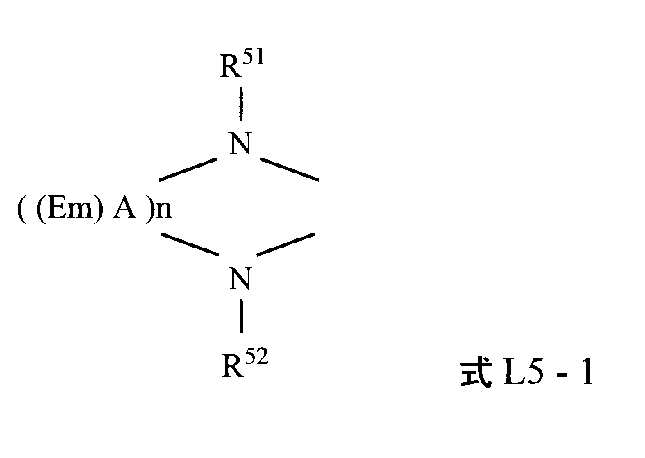
[式(4-1)及び式(L5-1)中、
M5は、周期表第3~6族の遷移金属原子を示す。
X5は、それぞれ独立して、水素原子、ハロゲン原子、炭素数1~20の炭化水素基、炭素数1~20のアルコキシ基または酸素原子若しくは窒素原子を含む炭素数3~20の炭化水素基を示す。
pはM5の価数-2である。
R51およびR52は、それぞれ独立して、水素原子、炭化水素基、ハロゲン化炭化水素基、有機シリル基または、窒素原子、酸素原子、リン原子、硫黄原子およびケイ素原子から選ばれる少なくとも1種の元素を有する置換基を示す。
mは、0~2の整数であり、nは、1~5の整数である。
Aは、周期表第13~16族の原子を示す。
nが2以上の場合には、複数のAは、互いに同一でも異なっていてもよい。
Eは、炭素原子、水素原子、酸素原子、ハロゲン原子、窒素原子、硫黄原子、リン原子、ホウ素原子およびケイ素原子から選ばれる少なくとも1種の元素を有する置換基を示す。
mが2以上の場合には、複数のEは、互いに同一でも異なっていてもよく、またEで示される2個以上の基が互いに連結して環を形成していてもよい。]
[In the formula (4-1) and the formula (L5-1),
M 5 indicates a transition metal atom of
Each of X5 has a hydrogen atom, a halogen atom, a hydrocarbon group having 1 to 20 carbon atoms, an alkoxy group having 1 to 20 carbon atoms, or a hydrocarbon group having 3 to 20 carbon atoms including an oxygen atom or a nitrogen atom. Is shown.
p is the valence of M5-2 .
Each of R 51 and R 52 is independently selected from a hydrogen atom, a hydrocarbon group, a halogenated hydrocarbon group, an organic silyl group or a nitrogen atom, an oxygen atom, a phosphorus atom, a sulfur atom and a silicon atom. Indicates a substituent having the element of.
m is an integer of 0 to 2, and n is an integer of 1 to 5.
A indicates an atom of Group 13 to 16 of the periodic table.
When n is 2 or more, the plurality of A's may be the same or different from each other.
E represents a substituent having at least one element selected from a carbon atom, a hydrogen atom, an oxygen atom, a halogen atom, a nitrogen atom, a sulfur atom, a phosphorus atom, a boron atom and a silicon atom.
When m is 2 or more, the plurality of Es may be the same or different from each other, or two or more groups represented by E may be connected to each other to form a ring. ]
R51およびR52は、水素原子、炭化水素基、ハロゲン化炭化水素基、有機シリル基または、窒素原子、酸素原子、リン原子、硫黄原子およびケイ素原子から選ばれる少なくとも1種の元素を有する置換基である。
炭化水素基としては、例えば、メチル基、エチル基、t-ブチル基等の炭素数1~20の直鎖または分岐状のアルキル基;フェニル基、ナフチル基等の炭素数6~20のアリール基;これらのアリール基に前記炭素数1~20のアルキル基等の置換基が1~5個置換した置換アリール基;シクロペンチル基、ノルボルニル基等のシクロアルキル基;ビニル基、プロペニル基、シクロヘキセニル基等のアルケニル基;ベンジル基、フェニルエチル基、フェニルプロピル基などのアリールアルキル基などが挙げられる。
ハロゲン化炭化水素基としては、例えば、前記炭化水素基にハロゲンが置換した基が挙げられる。
有機シリル基としては、例えば、メチルシリル基、トリメチルシリル基、エチルシリル基、トリフェニルシリル基等が挙げられる。
窒素原子、酸素原子、リン原子、イオウ原子およびケイ素原子から選ばれる少なくとも1種の元素を含む置換基で置換された炭化水素基としては、例えば、前記炭化水素基に-COOCH3、-N(CH3)C(O)CH3 、-OC(O)CH3、-CN、-N(C2H5)2、-N(CH3)S(O2)CH3、-P(C6H5)2等が置換した基が挙げられる。
R 51 and R 52 are substituteds having at least one element selected from a hydrogen atom, a hydrocarbon group, a halogenated hydrocarbon group, an organic silyl group or a nitrogen atom, an oxygen atom, a phosphorus atom, a sulfur atom and a silicon atom. It is the basis.
Examples of the hydrocarbon group include a linear or branched alkyl group having 1 to 20 carbon atoms such as a methyl group, an ethyl group and a t-butyl group; and an aryl group having 6 to 20 carbon atoms such as a phenyl group and a naphthyl group. A substituted aryl group in which 1 to 5 substituents such as an alkyl group having 1 to 20 carbon atoms are substituted on these aryl groups; a cycloalkyl group such as a cyclopentyl group and a norbornyl group; a vinyl group, a propenyl group and a cyclohexenyl group. Alkenyl groups such as benzyl group, phenylethyl group, arylalkyl group such as phenylpropyl group and the like.
Examples of the halogenated hydrocarbon group include a group in which the hydrocarbon group is substituted with a halogen.
Examples of the organic silyl group include a methylsilyl group, a trimethylsilyl group, an ethylsilyl group, a triphenylsilyl group and the like.
Examples of the hydrocarbon group substituted with a substituent containing at least one element selected from a nitrogen atom, an oxygen atom, a phosphorus atom, a sulfur atom and a silicon atom include -COOCH 3 , -N (in the above-mentioned hydrocarbon group). CH 3 ) C (O) CH 3 , -OC (O) CH 3 , -CN, -N (C 2 H 5 ) 2 , -N (CH 3 ) S (O 2 ) CH 3 , -P (C 6 ) H 5 ) Examples thereof include groups substituted with 2 and the like.
Aは、周期表第13~16族の原子であり、例えば、ホウ素原子、炭素原子、窒素原子、酸素原子、ケイ素原子、リン原子、硫黄原子、ゲルマニウム原子、セレン原子、スズ原子などが挙げられる。
Eは、炭素原子、水素原子、酸素原子、ハロゲン原子、窒素原子、硫黄原子、リン原子、ホウ素原子およびケイ素原子から選ばれる少なくとも1種の元素を有する置換基である。
このような-((E m)A)n-で示される2個の窒素原子を結合する結合基として、例えば、以下のような基が挙げられる:-CH2-、-C(Me)2-、-C(Ph)2-、-Si(Me)2-、-Si(Ph)2-、-Si(Me)(Ph)-、-CH2CH2CH2-、-CH2C(nPr)2CH2-、-CH2C(cHex)2CH2-
A is an atom of Group 13 to 16 of the periodic table, and examples thereof include a boron atom, a carbon atom, a nitrogen atom, an oxygen atom, a silicon atom, a phosphorus atom, a sulfur atom, a germanium atom, a selenium atom, and a tin atom. ..
E is a substituent having at least one element selected from a carbon atom, a hydrogen atom, an oxygen atom, a halogen atom, a nitrogen atom, a sulfur atom, a phosphorus atom, a boron atom and a silicon atom.
Examples of the bonding group that binds the two nitrogen atoms represented by-((E m) A) n- include the following groups: -CH 2- , -C (Me) 2 . -, -C (Ph) 2- , -Si (Me) 2- , -Si (Ph) 2- , -Si (Me) (Ph)-, -CH 2 CH 2 CH 2- , -CH 2 C ( nPr) 2 CH 2- , -CH 2 C (cHex) 2 CH 2-
上記の式(4-1)で表される遷移金属化合物は、特開平10-330412号公報の化合物(I-1)と類似しており、当該公報を参考にすることできる。 The transition metal compound represented by the above formula (4-1) is similar to the compound (I-1) of JP-A No. 10-330412, and the publication can be referred to.
[式(4-2) で表される遷移金属化合物]
式(4-2)で表される遷移金属化合物は、式(4)のL5として、式(L5-2)で表される置換基を有する。
[Transition metal compound represented by the formula (4-2)]
The transition metal compound represented by the formula (4-2) has a substituent represented by the formula ( L5-2 ) as L5 of the formula (4).


[式(4-2)及び式(L5-2)中、
M5は、周期表第3~11族の遷移金属原子を示す。
mは、1~2の整数を示す。
R53~R58は、それぞれ独立して、水素原子、ハロゲン原子、炭化水素基、ヘテロ環式化合物残基、酸素含有基、窒素含有基、ホウ素含有基、硫黄含有基、リン含有基、ケイ素含有基、ゲルマニウム含有基、またはスズ含有基を示し、これらのうちの2個以上が互いに連結して環を形成していてもよい。
nは、M5の価数を満たす数を示す。
X5は、それぞれ独立して、水素原子、ハロゲン、炭素数1~20の炭化水素基、炭素数1~20のアルコキシ基または酸素原子若しくは窒素原子を含む炭素数3~20の炭化水素基を示す。]
[In the formula (4-2) and the formula (L5-2),
M 5 indicates a transition metal atom of
m represents an integer of 1 to 2.
R 53 to R 58 are independently hydrogen atom, halogen atom, hydrocarbon group, heterocyclic compound residue, oxygen-containing group, nitrogen-containing group, boron-containing group, sulfur-containing group, phosphorus-containing group, and silicon. It indicates a containing group, a germanium-containing group, or a tin-containing group, and two or more of them may be linked to each other to form a ring.
n represents a number satisfying the valence of M5 .
Each of X5 independently contains a hydrogen atom, a halogen, a hydrocarbon group having 1 to 20 carbon atoms, an alkoxy group having 1 to 20 carbon atoms, or a hydrocarbon group having 3 to 20 carbon atoms including an oxygen atom or a nitrogen atom. show. ]
R53~R58は、水素原子、ハロゲン原子、炭化水素基、ヘテロ環式化合物残基、酸素含有基、窒素含有基、ホウ素含有基、硫黄含有基、リン含有基、ケイ素含有基、ゲルマニウム含有基、またはスズ含有基である。 R 53 to R 58 contain a hydrogen atom, a halogen atom, a hydrocarbon group, a heterocyclic compound residue, an oxygen-containing group, a nitrogen-containing group, a boron-containing group, a sulfur-containing group, a phosphorus-containing group, a silicon-containing group, and a germanium-containing group. A group or a tin-containing group.
ハロゲン原子としては、フッ素原子、塩素原子、臭素原子、ヨウ素原子が挙げられる。
炭化水素基としては、例えば、メチル基、エチル基、t-ブチル基等の炭素数1~30の直鎖状または分岐状のアルキル基;ビニル基、アリル基、イソプロペニル基等の炭素数2~30の直鎖状または分岐状のアルケニル基;プロパルギル基等の炭素数2~30の直鎖状または分岐状のアルキニル基;シクロヘキシル基、アダマンチル基等の炭素数3~30の環状飽和炭化水素基;シクロペンタジエニル基、インデニル基、フルオレニル基等の炭素数5~30の環状不飽和炭化水素基;フェニル基、ベンジル基、ナフチル基、ビフェニル基等の炭素数6~30の芳香族基;トリル基、t-ブチルフェニル基、ジ-t-ブチルフェニル基等のアルキル置換芳香族基などが挙げられる。
上記炭化水素基は、フッ素原子等のハロゲン原子;他の炭化水素基;後述するヘテロ環式化合物残基、酸素含有基、窒素含有基、ホウ素含有基、硫黄含有基、リン含有基、ケイ素含有基、ゲルマニウム含有基、またはスズ含有基が置換していてもよい。
ヘテロ環式化合物残基としては、例えば、ピロール基、ピリジン基等の含窒素化合物、フラン基、ピラン基などの含酸素化合物、チオフェン基などの含硫黄化合物などの残基、およびこれらのヘテロ環式化合物残基に炭素数1~30アルキル基、アルコキシ基などの置換基がさらに置換した基などが挙げられる。
Examples of the halogen atom include a fluorine atom, a chlorine atom, a bromine atom and an iodine atom.
Examples of the hydrocarbon group include a linear or branched alkyl group having 1 to 30 carbon atoms such as a methyl group, an ethyl group and a t-butyl group; and a vinyl group, an allyl group, an isopropenyl group and the like having 2 carbon atoms. Linear or branched alkenyl group of ~ 30; Linear or branched alkynyl group having 2 to 30 carbon atoms such as propargyl group; Cyclic saturated hydrocarbon having 3 to 30 carbon atoms such as cyclohexyl group and adamantyl group Group; Cyclic unsaturated hydrocarbon group having 5 to 30 carbon atoms such as cyclopentadienyl group, indenyl group and fluorenyl group; Aromatic group having 6 to 30 carbon atoms such as phenyl group, benzyl group, naphthyl group and biphenyl group. Examples thereof include alkyl-substituted aromatic groups such as trill group, t-butylphenyl group and di-t-butylphenyl group.
The above-mentioned hydrocarbon group is a halogen atom such as a fluorine atom; another hydrocarbon group; a heterocyclic compound residue described later, an oxygen-containing group, a nitrogen-containing group, a boron-containing group, a sulfur-containing group, a phosphorus-containing group, and a silicon-containing group. It may be substituted with a group, a germanium-containing group, or a tin-containing group.
Examples of the heterocyclic compound residue include a nitrogen-containing compound such as a pyrrole group and a pyridine group, an oxygen-containing compound such as a furan group and a pyran group, a residue such as a sulfur-containing compound such as a thiophene group, and a heterocycle thereof. Examples of the compound residue include a group having 1 to 30 carbon atoms and a group further substituted with a substituent such as an alkoxy group.
酸素含有基としては、例えば、アルコシキ基、アリーロキシ基、エステル基、エーテル基、アシル基などが挙げられる。
窒素含有基としては、例えば、アミノ基、イミノ基、アミド基、ヒドラジノ基、ニトロ基、シアノ基などが挙げられる。
ホウ素含有基としては、例えば、ボランジイル基、ボラントリイル基、ジボラニル基などが挙げられる。
イオウ含有基としては、例えば、メルカプト基、チオエステル基、アリールチオ基、チオアシル基、チオエーテル基、チオシアン酸エステル基、スルホ基、スルホニル基などが挙げられる。
リン含有基としては、例えば、ホスフィド基、ホスホリル基、チオホスホリル基、ホスファト基などが挙げられる。
ケイ素含有基としては、例えば、シリル基;シロキシ基;メチルシリル基、トリメチルシリル基、トリエチルシリル基、トリフェニルシリル基、ジメチルフェニルシリル基等の炭化水素置換シリル基、トリメチルシロキシ基等の炭化水素置換シロキシ基などが挙げられる。
ゲルマニウム含有基およびスズ含有基としては、例えば、前記ケイ素含有基のケイ素をゲルマニウムおよびスズに置換したものが挙げられる。
Examples of the oxygen-containing group include an alcohol group, an aryloxy group, an ester group, an ether group, an acyl group and the like.
Examples of the nitrogen-containing group include an amino group, an imino group, an amide group, a hydrazino group, a nitro group, a cyano group and the like.
Examples of the boron-containing group include a bolangyyl group, a bolantriyl group, and a diboranyl group.
Examples of the sulfur-containing group include a mercapto group, a thioester group, an arylthio group, a thioacyl group, a thioether group, a thiosian acid ester group, a sulfo group, a sulfonyl group and the like.
Examples of the phosphorus-containing group include a phosphido group, a phosphoryl group, a thiophosphoryl group, a phosphat group and the like.
Examples of the silicon-containing group include a silyl group; a syroxy group; a methylsilyl group, a trimethylsilyl group, a triethylsilyl group, a triphenylsilyl group, a dimethylphenylsilyl group and the like, and a hydrocarbon substituted silyl group such as a trimethylsiloxy group. The group etc. can be mentioned.
Examples of the germanium-containing group and the tin-containing group include those in which the silicon of the silicon-containing group is replaced with germanium and tin.
上記の式(4-2)で表される遷移金属化合物は、特開2000-63415号公報の一般式(I)で表される遷移金属化合物(B)と類似しており、当該公報を参考にすることできる。 The transition metal compound represented by the above formula (4-2) is similar to the transition metal compound (B) represented by the general formula (I) of JP-A-2000-63415, and the relevant publication is referred to. Can be.
[式(4-3) で表される遷移金属化合物]
式(4-3)で表される遷移金属化合物は、式(4)のL5として、式(L5-3)で表される置換基を有する。
[Transition metal compound represented by the formula (4-3)]
The transition metal compound represented by the formula (4-3) has a substituent represented by the formula ( L5-3 ) as L5 of the formula (4).


[式(4-3)及び式(L5-3)中、
M5は、周期表第8~11族の遷移金属原子を示す。
R61~R64は、それぞれ独立して、水素原子、ハロゲン原子、ハロゲン化炭化水素基、炭化水素基、ヘテロ環式化合物残基、酸素含有基、窒素含有基、ホウ素含有基、硫黄含有基、リン含有基、ケイ素含有基、ゲルマニウム含有基またはスズ含有基などを示す。
R65及びR66は、それぞれ独立して、ハロゲン原子、ハロゲン化炭化水素基、炭化水素基、ヘテロ環式化合物残基、酸素含有基、窒素含有基、ホウ素含有基、硫黄含有基、リン含有基、ケイ素含有基、ゲルマニウム含有基またはスズ含有基などを示す。また、R61とR65が互いに連結して環を形成していてもよく、 R62とR66が互いに連結して環を形成していてもよく、 R61とR63が互いに連結して環を形成していてもよく、R62とR64が互いに連結して環を形成していてもよく、 R63とR64が互いに連結して環を形成していてもよい。
nは、M5の価数を示す。
X5は、水素原子、ハロゲン原子、炭素数1~20の炭化水素基、炭素数1~20のアルコキシ基または酸素原子若しくは窒素原子を含む炭素数3~20の炭化水素基を示す。
nが2以上の場合には、X5で示される複数の基は互いに同一でも異なっていてもよい。
Yは周期表第15族または第16族の原子を示す。]
[In the formula (4-3) and the formula (L5-3),
M 5 indicates a transition metal atom of
R 61 to R 64 are independently hydrogen atom, halogen atom, halogenated hydrocarbon group, hydrocarbon group, heterocyclic compound residue, oxygen-containing group, nitrogen-containing group, boron-containing group, sulfur-containing group. , Phosphorus-containing group, silicon-containing group, germanium-containing group, tin-containing group and the like.
R 65 and R 66 each independently contain a halogen atom, a halogenated hydrocarbon group, a hydrocarbon group, a heterocyclic compound residue, an oxygen-containing group, a nitrogen-containing group, a boron-containing group, a sulfur-containing group, and a phosphorus-containing group. A group, a silicon-containing group, a germanium-containing group, a tin-containing group, and the like are shown. Further, R 61 and R 65 may be connected to each other to form a ring, R 62 and R 66 may be connected to each other to form a ring, and R 61 and R 63 may be connected to each other to form a ring. A ring may be formed, R 62 and R 64 may be connected to each other to form a ring, and R 63 and R 64 may be connected to each other to form a ring.
n represents the valence of M5 .
Reference numeral X5 indicates a hydrogen atom, a halogen atom, a hydrocarbon group having 1 to 20 carbon atoms, an alkoxy group having 1 to 20 carbon atoms, or a hydrocarbon group having 3 to 20 carbon atoms including an oxygen atom or a nitrogen atom.
When n is 2 or more, the plurality of groups represented by X 5 may be the same or different from each other.
Y indicates an atom of Group 15 or Group 16 of the periodic table. ]
R61~R64、R65及びR66のハロゲン原子、ハロゲン化炭化水素基、炭化水素基、ヘテロ環式化合物残基、酸素含有基、窒素含有基、ホウ素含有基、硫黄含有基、リン含有基、ケイ素含有基、ゲルマニウム含有基またはスズ含有基の具体例としては、上記式(4-2)のR53~R58について説明した具体例を、式(4-3)のR61~R64、R65及びR66についても挙げることができる。 Halogen atoms of R 61 to R 64 , R 65 and R 66 , halogenated hydrocarbon groups, hydrocarbon groups, heterocyclic compound residues, oxygen-containing groups, nitrogen-containing groups, boron-containing groups, sulfur-containing groups, phosphorus-containing As specific examples of the group, the silicon-containing group, the germanium-containing group or the tin-containing group, the specific examples described for R 53 to R 58 of the above formula (4-2) are described as R 61 to R of the formula (4-3). 64 , R 65 and R 66 can also be mentioned.
上記の式(4-3)で表される遷移金属化合物は、特開2000-191719号公報の一般式(I)で表される遷移金属イミン化合物と類似しており、当該公報を参考にすることできる。 The transition metal compound represented by the above formula (4-3) is similar to the transition metal imine compound represented by the general formula (I) of JP-A-2000-191719, and the relevant publication is referred to. Can be.
[式(4-4) で表される遷移金属化合物]
式(4-4)で表される遷移金属化合物は、式(4)のL5として、式(L5-4)で表される置換基を有する。
[Transition metal compound represented by the formula (4-4)]
The transition metal compound represented by the formula (4-4) has a substituent represented by the formula ( L5-4 ) as L5 of the formula (4).


[式(4-4)及び式(L5-4)中、
R67及びR68は、それぞれ独立して、アルキル、アリール、複素環式基及び水素原子を示す。
R69及びR70は、それぞれ独立して、ハロゲン原子、水素原子、炭素数1~20のアルキル、アリール、アルケニル、アルキルアリール、アリールアルキル、ヒドロカルボキシ基、アミド、ホスフィド、スルフィド、シリルアルキル、ジケトネート及びカルボキシレートを示す。
各X5は、それぞれ独立して、水素原子、ハロゲン原子、炭素数1~20の炭化水素基、炭素数1~20のアルコキシ基または酸素原子若しくは窒素原子を含む炭素数3~20の炭化水素基を示す。]
[In the formula (4-4) and the formula (L5-4),
R 67 and R 68 independently represent alkyl, aryl, heterocyclic groups and hydrogen atoms, respectively.
R 69 and R 70 are independently halogen atoms, hydrogen atoms, alkyls having 1 to 20 carbon atoms, aryls, alkenyls, alkylaryls, arylalkyls, hydrocarboxy groups, amides, phosphides, sulfides, silylalkyls, and diketonates. And carboxylate.
Each X 5 independently has a hydrogen atom, a halogen atom, a hydrocarbon group having 1 to 20 carbon atoms, an alkoxy group having 1 to 20 carbon atoms, or a hydrocarbon having 3 to 20 carbon atoms including an oxygen atom or a nitrogen atom. Shows the group. ]
上記の式(4-4)で表される遷移金属化合物は、特表2003-515628号公報の段落0027に記載された一般式で表される第二金属化合物と類似しており、当該公報を参考にすることできる。また、当該公報の段落0030に記載された化合物1、及び、段落0031に記載された化合物2を、本発明における式(4-4)の遷移金属化合物として用いることができる。
The transition metal compound represented by the above formula (4-4) is similar to the second metal compound represented by the general formula described in paragraph 0027 of Japanese Patent Application Laid-Open No. 2003-515628. It can be used as a reference. Further, the
[式(4-5) で表される遷移金属化合物]
式(4-5)で表される遷移金属化合物は、式(4)のL5として、式(L5-5)で表される置換基を有する。
[Transition metal compound represented by the formula (4-5)]
The transition metal compound represented by the formula (4-5) has a substituent represented by the formula ( L5-5 ) as L5 of the formula (4).
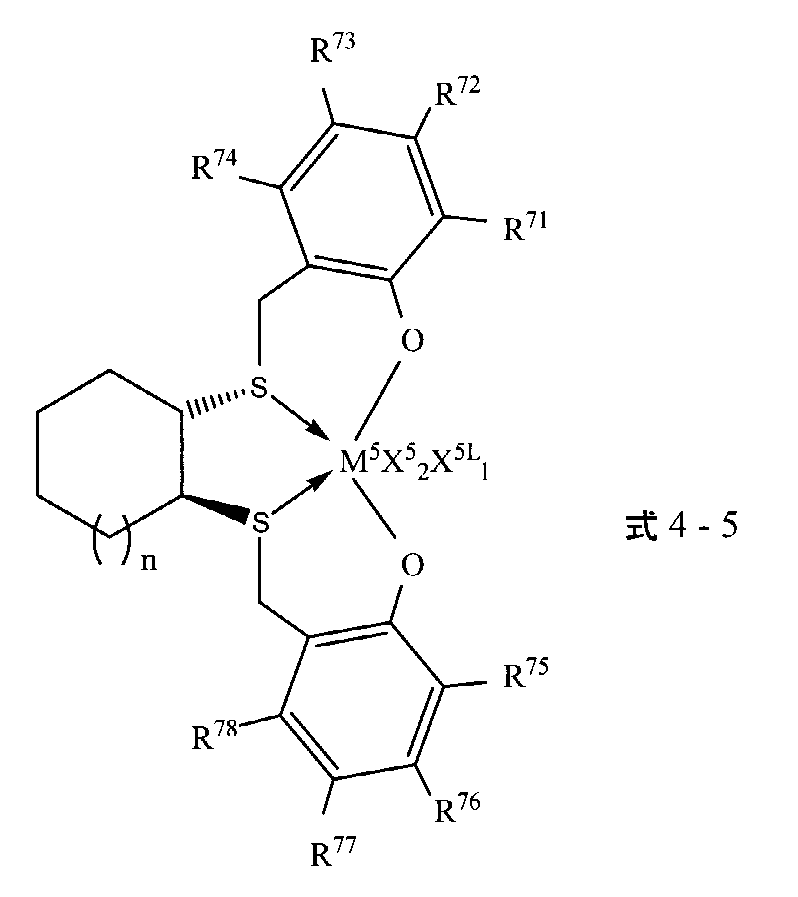
[式(4-5)及び式(L5-5)中、
nは1、2または3である。
M5は、ジルコニウム原子またはハフニウム原子を示す。
R71~R78は、それぞれ独立して、水素原子、ハロゲン原子、炭素数1~20の炭化水素基、炭素数1~20のアルコキシ基、酸素原子若しくは窒素原子を含む炭素数3~20の炭化水素基またはハロゲンで置換された炭素数1~20の炭化水素基を示す。
X5は、それぞれ独立して、水素原子、ハロゲン原子、炭素数1~20の炭化水素基、炭素数1~20のアルコキシ基または酸素原子若しくは窒素原子を含む炭素数3~20の炭化水素基を示し、X5Lは中性のルイス塩基を示す。X5Lが複数ある場合は、複数のX5Lは同一でも異なっていてもよい。
lは、0、1、または2である。]
[In the formula (4-5) and the formula (L5-5),
n is 1, 2 or 3.
M 5 represents a zirconium atom or a hafnium atom.
R 71 to R 78 each have a hydrogen atom, a halogen atom, a hydrocarbon group having 1 to 20 carbon atoms, an alkoxy group having 1 to 20 carbon atoms, and 3 to 20 carbon atoms including an oxygen atom or a nitrogen atom. A hydrocarbon group having 1 to 20 carbon atoms substituted with a hydrocarbon group or a halogen is shown.
Each of X5 has a hydrogen atom, a halogen atom, a hydrocarbon group having 1 to 20 carbon atoms, an alkoxy group having 1 to 20 carbon atoms, or a hydrocarbon group having 3 to 20 carbon atoms including an oxygen atom or a nitrogen atom. X 5L indicates a neutral Lewis base. When there are a plurality of X 5Ls , the plurality of X 5Ls may be the same or different.
l is 0, 1, or 2. ]
R71~R78は、水素原子、ハロゲン原子、炭素数1~20の炭化水素基、炭素数1~20のアルコキシ基、酸素原子若しくは窒素原子を含む炭素数3~20の炭化水素基またはハロゲンで置換された炭素数1~20の炭化水素基である。
ハロゲン原子としては、フッ素原子、塩素原子、臭素原子およびヨウ素原子が挙げられる。
炭素数1~20の炭化水素基としては、例えば、メチル基、エチル基、t-ブチル基等の直鎖状または分岐状のアルキル基;ビニル基、アリル基、イソプロペニル基等の直鎖状または分岐状のアルケニル基;プロパルギル基等の直鎖状または分岐状のアルキニル基;シクロヘキシル基、アダマンチル基等の環状飽和炭化水素基;シクロペンタジエニル基、インデニル基、フルオレニル基等の環状不飽和炭化水素基;フェニル基、ベンジル基、ナフチル基、ビフェニル基等の芳香族基;トリル基、t-ブチルフェニル基、ジ-t-ブチルフェニル基等のアルキル置換芳香族基などが挙げられる。
R 71 to R 78 are a hydrogen atom, a halogen atom, a hydrocarbon group having 1 to 20 carbon atoms, an alkoxy group having 1 to 20 carbon atoms, a hydrocarbon group having 3 to 20 carbon atoms including an oxygen atom or a nitrogen atom, or a halogen. It is a hydrocarbon group having 1 to 20 carbon atoms substituted with.
Examples of the halogen atom include a fluorine atom, a chlorine atom, a bromine atom and an iodine atom.
Examples of the hydrocarbon group having 1 to 20 carbon atoms include a linear or branched alkyl group such as a methyl group, an ethyl group and a t-butyl group; a linear group such as a vinyl group, an allyl group and an isopropenyl group. Or a branched alkenyl group; a linear or branched alkynyl group such as a propargyl group; a cyclic saturated hydrocarbon group such as a cyclohexyl group or an adamantyl group; a cyclic unsaturated group such as a cyclopentadienyl group, an indenyl group or a fluorenyl group. Hydrocarbon groups; aromatic groups such as phenyl group, benzyl group, naphthyl group and biphenyl group; alkyl substituted aromatic groups such as tolyl group, t-butylphenyl group and di-t-butylphenyl group can be mentioned.
酸素原子を含む炭素数1~20の炭化水素基としては、例えば、アルコシキ基、アリーロキシ基、エステル基、エーテル基、アシル基等の酸素含有基を有する炭化水素基が挙げられる。
窒素原子を含む炭素数1~20の炭化水素基としては、例えば、アミノ基、イミノ基、アミド基、ヒドラジノ基、ニトロ基、シアノ基等の窒素含有基を有する炭化水素基が挙げられる。
ハロゲンで置換された炭素数1~20の炭化水素基としては、例えば、トリフルオロメチル基、パーフルオロエチル基、2,2,2-トリフルオロエチル基、ペンタフルオロフェニル基などが挙げられる。
Examples of the hydrocarbon group having 1 to 20 carbon atoms including an oxygen atom include a hydrocarbon group having an oxygen-containing group such as an alcoholic group, an aryloxy group, an ester group, an ether group and an acyl group.
Examples of the hydrocarbon group having 1 to 20 carbon atoms including a nitrogen atom include a hydrocarbon group having a nitrogen-containing group such as an amino group, an imino group, an amide group, a hydrazino group, a nitro group and a cyano group.
Examples of the halogen-substituted hydrocarbon group having 1 to 20 carbon atoms include a trifluoromethyl group, a perfluoroethyl group, a 2,2,2-trifluoroethyl group and a pentafluorophenyl group.
上記の式(4-5)で表される遷移金属化合物は、特開2013-53308号公報に記載された一般式(1-1)で表される成分(A1)と類似しており、当該公報を参考にすることできる。 The transition metal compound represented by the above formula (4-5) is similar to the component (A1) represented by the general formula (1-1) described in JP2013-53308. The publication can be referred to.
II.オレフィン重合用触媒
上記成分(I)及び上記成分(II)は、それぞれオレフィン重合の触媒活性成分であるが、これらの組み合わせは、充分に分子量分布が広く、高分子量側に分布が広がっており、且つ、分子量分布の高分子量側領域に充分な量の分岐鎖を含むオレフィン系重合体を製造することができるオレフィン重合用触媒の触媒活性成分として作用する。
上記成分(I)および上記成分(II)を助触媒や担体と組み合わせてオレフィン重合用触媒とすることができる。
本発明においては、例えば、次の成分(I)、成分(II)、成分(III)及び成分(IV)を必須成分として含むオレフィン重合用触媒を用いることができる。それぞれ成分は、2種以上を用いてもよい。
成分(I) : 上記式(1)で表される遷移金属化合物
成分(II) : 上記式(2)、(3)又は(4)で表される化合物群から選ばれる遷移金属化合物
成分(III): 成分(I)及び成分(II)の遷移金属化合物と反応してカチオン性化合物を生成させる化合物
成分(IV) : 微粒子担体
II. Catalyst for olefin polymerization The above component (I) and the above component (II) are each catalytically active components for olefin polymerization, but the combination thereof has a sufficiently wide molecular weight distribution and a wide distribution on the high molecular weight side. Moreover, it acts as a catalytically active component of a catalyst for olefin polymerization capable of producing an olefin-based polymer containing a sufficient amount of branched chains in the high-molecular-weight side region of the molecular weight distribution.
The above component (I) and the above component (II) can be combined with a co-catalyst or a carrier to prepare a catalyst for olefin polymerization.
In the present invention, for example, an olefin polymerization catalyst containing the following components (I), component (II), component (III) and component (IV) as essential components can be used. Two or more kinds of each component may be used.
Component (I): Transition metal compound represented by the above formula (1) Component (II): Transition metal compound selected from the compound group represented by the above formula (2), (3) or (4) Component (III) ): A compound that reacts with the transition metal compound of the component (I) and the component (II) to form a cationic compound. Component (IV): Fine particle carrier
成分(I)及び成分(II)は上記したとおりのものである。以下に、成分(III)及び成分(IV)について説明する。
1.成分(III)
成分(III)、すなわち、成分(I)及び成分(II)の遷移金属化合物と反応してカチオン性化合物を生成させる化合物は助触媒である。成分(III)としては、例えば、有機アルミニウムオキシ化合物、ボラン化合物、ボレート化合物、後述する層状珪酸塩等を用いることができる。これらのうち、ボランやボレート化合物は微粒子担体への固定化に難があり、有機アルミニウムオキシ化合物が好ましく用いられる。
The component (I) and the component (II) are as described above. The component (III) and the component (IV) will be described below.
1. 1. Ingredient (III)
The component (III), that is, the compound that reacts with the transition metal compound of the component (I) and the component (II) to form a cationic compound is a co-catalyst. As the component (III), for example, an organoaluminum oxy compound, a borane compound, a borate compound, a layered silicate described later, or the like can be used. Of these, borane and borate compounds have difficulty in immobilizing on a fine particle carrier, and organoaluminum oxy compounds are preferably used.
(1)有機アルミニウムオキシ化合物
有機アルミニウムオキシ化合物は、分子中にAl-O-Al結合を有する化合物であり、Al-O-Al結合の結合数は通常1~100、好ましくは1~50個の範囲にある。
典型的には、下記式(5-1)又は式(5-2)で表されような、-(O-Al)-単位の連鎖構造を含む有機アルミニウムオキシ化合物が用いられる。
(1) Organic Aluminum Oxy Compound The organic aluminum oxy compound is a compound having an Al—O—Al bond in the molecule, and the number of Al—O—Al bonds is usually 1 to 100, preferably 1 to 50. It is in the range.
Typically, an organoaluminum oxy compound containing a chain structure of-(O-Al) -units as represented by the following formula (5-1) or formula (5-2) is used.
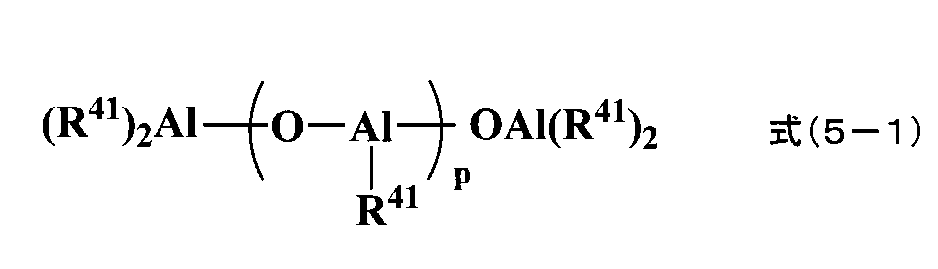

[上記の各式中、R41は、それぞれ独立に、水素原子または炭化水素基であり、好ましくは炭素数1~18、さらに好ましくは炭素数1~12のアルキル基、アルケニル基、アリール基、アラルキル基等の炭化水素基であり、R41の少なくとも一部は炭化水素基である。pは0~40、好ましくは2~30の整数を示す。] [In each of the above formulas, R 41 is independently a hydrogen atom or a hydrocarbon group, preferably an alkyl group having 1 to 18 carbon atoms, more preferably an alkyl group having 1 to 12 carbon atoms, an alkenyl group, or an aryl group. It is a hydrocarbon group such as an aralkyl group, and at least a part of R 41 is a hydrocarbon group. p represents an integer of 0 to 40, preferably 2 to 30. ]
このような有機アルミニウムオキシ化合物は、通常、有機アルミニウム化合物と水とを反応させて得られる。
有機アルミニウムと水との反応は、通常、不活性炭化水素(溶媒)中で行われる。不活性炭化水素としては、ペンタン、ヘキサン、ヘプタン、シクロヘキサン、メチルシクロヘキサン、ベンゼン、トルエン、キシレン等の脂肪族炭化水素、脂環族炭化水素及び芳香族炭化水素が使用できるが、脂肪族炭化水素又は芳香族炭化水素を使用することが好ましい。
Such an organoaluminum oxy compound is usually obtained by reacting an organoaluminum compound with water.
The reaction between organoaluminum and water is usually carried out in an inert hydrocarbon (solvent). As the inert hydrocarbon, aliphatic hydrocarbons such as pentane, hexane, heptane, cyclohexane, methylcyclohexane, benzene, toluene and xylene, alicyclic hydrocarbons and aromatic hydrocarbons can be used, but aliphatic hydrocarbons or It is preferable to use aromatic hydrocarbons.
原料の有機アルミニウム化合物としては、下記式(6) で表される化合物を使用できるが、好ましくはトリアルキルアルミニウムが使用される。
R41
tAlX6
3-t 式(6)
[式(6)中、R41は、上記式(5-1)及び(5-2)と同じであり、X6は、水素原子又はハロゲン原子を示し、tは、1≦t≦3の整数を示す。]
As the organoaluminum compound as a raw material, a compound represented by the following formula (6) can be used, but trialkylaluminum is preferably used.
R 41 t AlX 6 3-t formula (6)
[In the formula (6), R 41 is the same as the above formulas (5-1) and (5-2), X 6 represents a hydrogen atom or a halogen atom, and t is 1 ≦ t ≦ 3. Indicates an integer. ]
トリアルキルアルミニウムのアルキル基は、メチル基、エチル基、プロピル基、イソプロピル基、ブチル基、イソブチル基、ペンチル基、ヘキシル基、オクチル基、デシル基、ドデシル基等のいずれでも差し支えないが、メチル基であることが特に好ましい。上記有機アルミニウム化合物は、2種以上混合して使用することもできる。 The alkyl group of trialkylaluminum may be any of a methyl group, an ethyl group, a propyl group, an isopropyl group, a butyl group, an isobutyl group, a pentyl group, a hexyl group, an octyl group, a decyl group, a dodecyl group and the like, but a methyl group. Is particularly preferable. The above-mentioned organoaluminum compounds can also be used by mixing two or more kinds.
水と有機アルミニウム化合物との反応比(水/Alモル比)は、0.25/1~1.2
/1、特に、0.5/1~1/1であることが好ましく、反応温度は、通常-70~100℃、好ましくは-20~20℃の範囲である。反応時間は、通常5分~24時間、好ましくは10分~5時間の範囲で選ばれる。
反応に要する水として、単なる水のみならず、硫酸銅水和物、硫酸アルミニウム水和物等に含まれる結晶水や反応系中に水が生成しうる成分も利用することもできる。
The reaction ratio (water / Al molar ratio) between water and the organoaluminum compound is 0.25 / 1 to 1.2.
1/1, particularly preferably 0.5 / 1/1 to 1/1, and the reaction temperature is usually in the range of −70 to 100 ° C., preferably −20 to 20 ° C. The reaction time is usually selected in the range of 5 minutes to 24 hours, preferably 10 minutes to 5 hours.
As the water required for the reaction, not only water but also water of crystallization contained in copper sulfate hydrate, aluminum sulfate hydrate and the like, and components capable of producing water in the reaction system can be used.
原料の有機アルミニウム化合物としてトリメチルアルミニウムを用いた有機アルミニウムオキシ化合物をメチルアルミノキサン(MAO)と呼び、特に好ましく使われる。MAOは未反応のトリメチルアルミニウムを含んだ形で成分(III)として使うこともできる。この未反応のトリメチルアルミニウムは、トリメチルアルミニウムとメチルアルミノキサンの合計のアルミニウム原子に対して、1~30mol%で存在し、少ないとMAOが溶液中で析出して使いづらく、トリメチルアルミニウムが多いと取り扱い時の危険性が高くなって使いづらい。好ましくは10~15mol%のトリメチルアルミニウムを含むMAO溶液がよい。また、MAOの濃度は濃すぎると取り扱い時の危険性が高くなることと保存中にMAOが析出して使いづらくなること、薄いと安全性と析出しにくさは増すが、取り扱う容器や設備が大きくなって経済的なデメリットになる。MAOの濃度は好ましくは10~20質量%のものが用いられる。さらにMAO溶液は気温中で析出しやすいということもあり、-10℃を下回る低温保管が好ましい。
もちろん、有機アルミニウムオキシ化合物として、上記した有機アルミニウムオキシ化合物の2種以上を組み合わせて使用することもでき、また、前記有機アルミニウムオキシ化合物を前述の不活性炭化水素溶媒に溶液または分散させた溶液としたものを用いても良い。
An organoaluminum oxy compound using trimethylaluminum as a raw material organoaluminum compound is called methylaluminoxane (MAO) and is particularly preferably used. MAO can also be used as component (III) in the form of unreacted trimethylaluminum. This unreacted trimethylaluminum is present in an amount of 1 to 30 mol% with respect to the total aluminum atom of trimethylaluminum and methylaluminoxane. It is difficult to use due to the high risk of. A MAO solution containing 10 to 15 mol% of trimethylaluminum is preferable. In addition, if the concentration of MAO is too high, the risk of handling increases, MAO precipitates during storage, making it difficult to use, and if it is thin, safety and difficulty in precipitation increase, but the containers and equipment handled are It becomes large and becomes an economic disadvantage. The concentration of MAO is preferably 10 to 20% by mass. Further, since the MAO solution tends to precipitate in the temperature, it is preferable to store it at a low temperature below −10 ° C.
Of course, as the organoaluminum oxy compound, two or more of the above-mentioned organoaluminum oxy compounds can be used in combination, and the organoaluminum oxy compound can be used as a solution or a solution obtained by dispersing the organoaluminum oxy compound in the above-mentioned inert hydrocarbon solvent. You may use the one that has been used.
(2)ボラン化合物
ボラン化合物としては、例えば、次の化合物が挙げられる:トリフェニルボラン、トリ(o-トリル)ボラン、トリ(p-トリル)ボラン、トリ(m-トリル)ボラン、トリ(o-フルオロフェニル)ボラン、トリス(p-フルオロフェニル)ボラン、トリス(m-フルオロフェニル)ボラン、トリス(2,5-ジフルオロフェニル)ボラン、トリス(3,5-ジフルオロフェニル)ボラン、トリス(4-トリフルオロメチルフェニル)ボラン、トリス(3,5-ジトリフルオロメチルフェニル)ボラン、トリス(2,6-ジトリフルオロメチルフェニル)ボラン、トリス(ペンタフルオロフェニル)ボラン、トリス(パーフルオロナフチル)ボラン、トリス(パーフルオロビフェニル)ボラン、トリス( パーフルオロアントリル)ボラン、トリス(パーフルオロビナフチル)ボラン。
(2) Borane compounds Examples of borane compounds include the following compounds: triphenylborane, tri (o-tolyl) borane, tri (p-tolyl) borane, tri (m-tolyl) borane, tri (o). -Fluorophenyl) borane, tris (p-fluorophenyl) borane, tris (m-fluorophenyl) borane, tris (2,5-difluorophenyl) borane, tris (3,5-difluorophenyl) borane, tris (4-) Trifluoromethylphenyl) borane, tris (3,5-ditrifluoromethylphenyl) borane, tris (2,6-ditrifluoromethylphenyl) borane, tris (pentafluorophenyl) borane, tris (perfluoronaphthyl) borane, tris (Perfluorobiphenyl) borane, tris (perfluoroanthril) borane, tris (perfluorobinaphthyl) borane.
これらの中でも、次の化合物が好ましい:トリス(3,5-ジトリフルオロメチルフェニル) ボラン、トリス(2,6-ジトリフルオロメチルフェニル)ボラン、トリス(ペンタフルオロフェニル)ボラン、トリス(パーフルオロナフチル)ボラン、トリス(パーフルオロビフェニル)ボラン、トリス(パーフルオロアントリル)ボラン、トリス(パーフルオロビナフチル)ボランがより好ましい。
これらの中でも、次の化合物がさらに好ましい:トリス(2,6-ジトリフルオロメチルフェニル)ボラン、トリス(ペンタフルオロフェニル)ボラン、トリス(パーフルオロナフチル)ボラン、トリス(パーフルオロビフェニル)ボラン。
Among these, the following compounds are preferred: tris (3,5-ditrifluoromethylphenyl) borane, tris (2,6-ditrifluoromethylphenyl) borane, tris (pentafluorophenyl) borane, tris (perfluoronaphthyl). Borane, tris (perfluorobiphenyl) borane, tris (perfluoroanthryl) borane, tris (perfluorobinaphthyl) borane are more preferred.
Among these, the following compounds are further preferred: tris (2,6-ditrifluoromethylphenyl) borane, tris (pentafluorophenyl) borane, tris (perfluoronaphthyl) borane, tris (perfluorobiphenyl) borane.
(3)ボレート化合物
ボレート化合物の第1の例としては、例えば次の式(7)で表される化合物が挙げられる。
[L6-H]+[BR42R43X7X7’]- 式(7)
(3) Borate compound As a first example of a borate compound, for example, a compound represented by the following formula (7) can be mentioned.
[L 6 -H] + [BR 42 R 43 X 7 X 7' ] - Equation (7)
式(7)中、L6は、中性ルイス塩基であり、Hは、水素原子であり、[L6-H ]は、アンモニウム、アニリニウム、ホスフォニウム等のブレンステッド酸である。
アンモニウムとしては、トリメチルアンモニウム、トリエチルアンモニウム、トリプロピルアンモニウム、トリブチルアンモニウム、トリ(n-ブチル)アンモニウムなどのトリアルキル置換アンモニウム、ジ(n-プロピル)アンモニウム、ジシクロヘキシルアンモニウムなどのジアルキルアンモニウムを例示できる。
また、アニリニウムとしては、N,N-ジメチルアニリニウム、N,N-ジエチルアニリニウム、N,N-2,4,6-ペンタメチルアニリニウムなどのN,N-ジアルキルアニリニウムが例示できる。
さらに、ホスフォニウムとしては、トリフェニルホスフォニウム、トリブチルホスホニウム、トリ(メチルフェニル)ホスフォニウム、トリ(ジメチルフェニル)ホスフォニウムなどのトリアリールホスフォニウム、トリアルキルホスフォニウムが挙げられる。
In formula (7), L 6 is a neutral Lewis base, H is a hydrogen atom, and [L 6 -H] is a Bronsted acid such as ammonium, anilinium, and phosphonium.
Examples of the ammonium include trialkyl-substituted ammonium such as trimethylammonium, triethylammonium, tripropylammonium, tributylammonium and tri (n-butyl) ammonium, and dialkylammonium such as di (n-propyl) ammonium and dicyclohexylammonium.
Examples of the anilinium include N, N-dialkylaniliniums such as N, N-dimethylanilinium, N, N-diethylanilinium, N, N-2,4,6-pentamethylanilinium.
Further, examples of phosphonium include triarylphosphonium such as triphenylphosphine, tributylphosphonium, tri (methylphenyl) phosphonium, and tri (dimethylphenyl) phosphonium, and trialkylphosphonium.
また、式(7)中、R42およびR43は、炭素数6~20、好ましくは炭素数6~16の、同じか又は異なる芳香族又は置換芳香族炭化水素基で、架橋基によって互いに連結されていてもよく、置換芳香族炭化水素基の置換基としては、メチル基、エチル基、プロピル基、イソプロピル基等に代表されるアルキル基やフッ素、塩素、臭素、ヨウ素等のハロゲンが好ましい。
さらに、X7及びX7’は、それぞれ独立して、水素原子、ハロゲン原子、炭素数1~20の炭化水素基、1個以上の水素原子がハロゲン原子によって置換された炭素数1~20の置換炭化水素基である。
Further, in the formula (7), R 42 and R 43 are the same or different aromatic or substituted aromatic hydrocarbon groups having 6 to 20 carbon atoms, preferably 6 to 16 carbon atoms, and are linked to each other by a bridging group. As the substituent of the substituted aromatic hydrocarbon group, an alkyl group typified by a methyl group, an ethyl group, a propyl group, an isopropyl group and the like, and a halogen such as fluorine, chlorine, bromine and iodine are preferable.
Further, X 7 and X 7'independently have a hydrogen atom, a halogen atom, a hydrocarbon group having 1 to 20 carbon atoms, and one or more hydrogen atoms having 1 to 20 carbon atoms substituted with the halogen atom. It is a substituted hydrocarbon group.
上記一般式(7)で表される化合物の具体例としては、例えば、次の化合物が挙げられる:トリブチルアンモニウムテトラ(ペンタフルオロフェニル)ボレート、トリブチルアンモニウムテトラ(2,6-ジトリフルオロメチルフェニル)ボレート、トリブチルアンモニウムテトラ(3,5-ジトリフルオロメチルフェニル)ボレート、トリブチルアンモニウムテトラ(2,6-ジフルオロフェニル)ボレート、トリブチルアンモニウムテトラ(パーフルオロナフチル)ボレート、ジメチルアニリニウムテトラ(ペンタフルオロフェニル)ボレート、ジメチルアニリニウムテトラ(2,6-ジトリフルオロメチルフェニル)ボレート、ジメチルアニリニウムテトラ(3,5-ジトリフルオロメチルフェニル)ボレート、ジメチルアニリニウムテトラ(2,6-ジフルオロフェニル)ボレート、ジメチルアニリニウムテトラ(パーフルオロナフチル)ボレート、トリフェニルホスホニウムテトラ(ペンタフルオロフェニル)ボレート、トリフェニルホスホニウムテトラ(2,6-ジトリフルオロメチルフェニル)ボレート、トリフェニルホスホニウムテトラ(3,5-ジトリフルオロメチルフェニル)ボレート、トリフェニルホスホニウムテトラ(2,6-ジフルオロフェニル)ボレート、トリフェニルホスホニウムテトラ(パーフルオロナフチル)ボレート、トリメチルアンモニウムテトラ(2,6-ジトリフルオロメチルフェニル) ボレート、トリエチルアンモニウムテトラ(ペンタフルオロフェニル)ボレート、トリエチルアンモニウムテトラ(2,6-ジトリフルオロメチルフェニル)ボレート、トリエチルアンモニウムテトラ(パーフルオロナフチル)ボレート、トリプロピルアンモニウムテトラ(ペンタフルオロフェニル)ボレート、トリプロピルアンモニウムテトラ(2,6-ジトリフルオロメチルフェニル)ボレート、トリプロピルアンモニウムテトラ(パーフルオロナフチル)ボレート、ジ(1-プロピル)アンモニウムテトラ(ペンタフルオロフェニル)ボレート、ジシクロヘキシルアンモニウムテトラフェニルボレート。 Specific examples of the compound represented by the above general formula (7) include the following compounds: tributylammonium tetra (pentafluorophenyl) borate, tributylammonium tetra (2,6-ditrifluoromethylphenyl) bolate. , Tributylammonium tetra (3,5-ditrifluoromethylphenyl) borate, tributylammonium tetra (2,6-difluorophenyl) borate, tributylammonium tetra (perfluoronaphthyl) borate, dimethylanilinium tetra (pentafluorophenyl) bolate, Dimethylanilinium tetra (2,6-ditrifluoromethylphenyl) borate, dimethylanilinium tetra (3,5-ditrifluoromethylphenyl) borate, dimethylaniliniumtetra (2,6-difluorophenyl) borate, dimethylaniliniumtetra (Perfluoronaphthyl) borate, triphenylphosphonium tetra (pentafluorophenyl) borate, triphenylphosphonium tetra (2,6-ditrifluoromethylphenyl) borate, triphenylphosphonium tetra (3,5-ditrifluoromethylphenyl) borate, Triphenylphosphonium tetra (2,6-difluorophenyl) borate, triphenylphosphonium tetra (perfluoronaphthyl) borate, trimethylammonium tetra (2,6-ditrifluoromethylphenyl) borate, triethylammonium tetra (pentafluorophenyl) borate, Triethylammonium tetra (2,6-ditrifluoromethylphenyl) borate, triethylammonium tetra (perfluoronaphthyl) borate, tripropylammonium tetra (pentafluorophenyl) borate, tripropylammonium tetra (2,6-ditrifluoromethylphenyl) Borate, Tripropylammoniumtetra (Perfluoronaphthyl) Borate, Di (1-propyl) Ammonium Tetra (Pentafluorophenyl) Borate, Dicyclohexylammoniumtetraphenylborate.
これらの中でも、次の化合物が好ましい:トリブチルアンモニウムテトラ(ペンタフルオロフェニル)ボレート、トリブチルアンモニウムテトラ(2,6-ジトリフルオロメチルフェニル)ボレート、トリブチルアンモニウムテトラ(3,5-ジトリフルオロメチルフェニル)ボレート、トリブチルアンモニウムテトラ(パーフルオロナフチル)ボレート、ジメチルアニリニウムテトラ(ペンタフルオロフェニル)ボレート、ジメチルアニリニウムテトラ(2,6-ジトリフルオロメチルフェニル)ボレート、ジメチルアニリニウムテトラ(3,5-ジトリフルオロメチルフェニル)ボレート、ジメチルアニリニウムテトラ(パーフルオロナフチル)ボレート。 Among these, the following compounds are preferred: tributylammonium tetra (pentafluorophenyl) borate, tributylammonium tetra (2,6-ditrifluoromethylphenyl) borate, tributylammonium tetra (3,5-ditrifluoromethylphenyl) borate, Tributylammonium tetra (perfluoronaphthyl) borate, dimethylanilinium tetra (pentafluorophenyl) borate, dimethylanilinium tetra (2,6-ditrifluoromethylphenyl) borate, dimethylanilinium tetra (3,5-ditrifluoromethylphenyl) ) Bolate, dimethylanilinium tetra (perfluoronaphthyl) borate.
ボレート化合物の第2の例としては、例えば次の式(8)で表される化合物が挙げられる。
式(8):
[L7]+[BR42R43X7’X7’]-
As a second example of the borate compound, for example, a compound represented by the following formula (8) can be mentioned.
Equation (8):
[L 7 ] + [BR 42 R 43 X 7'X 7 ' ] -
式(8)中、L7は、カルボカチオン、メチルカチオン、エチルカチオン、プロピルカチオン、イソプロピルカチオン、ブチルカチオン、イソブチルカチオン、t-ブチルカチオン、ペンチルカチオン、トロピニウムカチオン、ベンジルカチオン、トリチルカチオン、ナトリウムカチオン、プロトン等が挙げられる。また、R42、R43、X7及びX7’は、前記式(7)における定義と同じである。 In formula ( 8 ), L7 is a carbocation, methyl cation, ethyl cation, propyl cation, isopropyl cation, butyl cation, isobutyl cation, t-butyl cation, pentyl cation, tropinium cation, benzyl cation, trityl cation, sodium. Examples include cations and protons. Further, R 42 , R 43 , X 7 and X 7'are the same as the definitions in the above equation (7).
上記式(8)で表される化合物の具体例としては、例えば、次の化合物が挙げられる:トリチルテトラフェニルボレート、トリチルテトラ(o-トリル)ボレート、トリチルテトラ(p-トリル)ボレート、トリチルテトラ(m-トリル)ボレート、トリチルテトラ(o-フルオロフェニル)ボレート、トリチルテトラ(p-フルオロフェニル)ボレート、トリチルテトラ(m-フルオロフェニル)ボレート、トリチルテトラ(3,5-ジフルオロフェニル)ボレート、トリチルテトラ(ペンタフルオロフェニル)ボレート、トリチルテトラ(2,6-ジトリフルオロメチルフェニル)ボレート、トリチルテトラ(3,5-ジトリフルオロメチルフェニル)ボレート、トリチルテトラ(パーフルオロナフチル)ボレート、トロピニウムテトラフェニルボレート、トロピニウムテトラ(o-トリル)ボレート、トロピニウムテトラ(p-トリル)ボレート、トロピニウムテトラ(m-トリル)ボレート、トロピニウムテトラ(o-フルオロフェニル)ボレート、トロピニウムテトラ(p-フルオロフェニル)ボレート、トロピニウムテトラ(m-フルオロフェニル)ボレート、トロピニウムテトラ(3,5-ジフルオロフェニル)ボレート、トロピニウムテトラ(ペンタフルオロフェニル)ボレート、トロピニウムテトラ(2,6-ジトリフルオロメチルフェニル)ボレート、トロピニウムテトラ(3,5-ジトリフルオロメチルフェニル)ボレート、トロピニウムテトラ(パーフルオロナフチル)ボレート、NaBPh4 、NaB(o-CH3-Ph)4、NaB(p-CH3-Ph)4、NaB(m-CH3-Ph)4、NaB(o-F-Ph)4、NaB(p-F-Ph)4、NaB(m-F-Ph)4、NaB(3,5-F2-Ph)4、NaB(C6F5)4、NaB(2,6-(CF3)2-Ph)4、NaB(3,5-(CF3)2-Ph)4、NaB(C10F7)4、HBPh4・(Et2O)2、HB(3,5-F2-Ph)4・(Et2O)2、HB(C6F5)4・(Et2O)2、HB(2,6-(CF3)2-Ph)4・(Et2O)2、HB(3,5-(CF3)2-Ph)4・(Et2O)2、HB(C10H7)4・(Et2O)2。 Specific examples of the compound represented by the above formula (8) include the following compounds: trityltetraphenylborate, trityltetra (o-tolyl) borate, trityltetra (p-tolyl) borate, trityltetra. (M-tril) borate, trityltetra (o-fluorophenyl) borate, trityltetra (p-fluorophenyl) borate, trityltetra (m-fluorophenyl) borate, trityltetra (3,5-difluorophenyl) borate, trityl Tetra (pentafluorophenyl) borate, trityltetra (2,6-ditrifluoromethylphenyl) borate, trityltetra (3,5-ditrifluoromethylphenyl) borate, trityltetra (perfluoronaphthyl) borate, tropinium tetraphenylborate , Tropinium tetra (o-tolyl) borate, tropinium tetra (p-tolyl) borate, tropinium tetra (m-tolyl) borate, tropinium tetra (o-fluorophenyl) borate, tropinium tetra (p-fluorophenyl) ) Borate, Tropinium Tetra (m-Fluorophenyl) Borate, Tropinium Tetra (3,5-Difluorophenyl) Borate, Tropinium Tetra (Pentafluorophenyl) Borate, Tropinium Tetra (2,6-Ditrifluoromethylphenyl) Borate, Tropinium Tetra (3,5-Ditrifluoromethylphenyl) Borate, Tropinium Tetra (Perfluoronaphthyl) Borate, NaBPh 4 , NaB (o-CH 3 -Ph) 4 , NaB (p-CH 3 -Ph) 4 , NaB (m-CH 3 -Ph) 4 , NaB (o-F-Ph) 4 , NaB (p-F-Ph) 4 , NaB (m-F-Ph) 4 , NaB (3,5-F) 2 -Ph) 4 , NaB (C 6 F 5 ) 4 , NaB (2,6- (CF 3 ) 2 -Ph) 4 , NaB (3,5- (CF 3 ) 2 -Ph) 4 , NaB (C) 10 F 7 ) 4 , HBPh 4 · (Et 2 O) 2 , HB (3,5-F 2 -Ph) 4 · (Et 2 O) 2 , HB (C 6 F 5 ) 4 · (Et 2 O) 2 , HB (2,6- (CF 3 ) 2 -Ph) 4 , (Et 2 O) 2 , HB (3,5- (CF 3 ) 2 -Ph) 4 , (Et 2 O) 2 , H B (C 10 H 7 ) 4. (Et 2 O) 2 .
これらの中でも、次の化合物が好ましい:トリチルテトラ(ペンタフルオロフェニル)ボレート、トリチルテトラ(2,6-ジトリフルオロメチルフェニル)ボレート、トリチルテトラ(3,5-ジトリフルオロメチルフェニル)ボレート、トリチルテトラ(パーフルオロナフチル)ボレート、トロピニウムテトラ(ペンタフルオロフェニル)ボレート、トロピニウムテトラ(2,6-ジトリフルオロメチルフェニル)ボレート、トロピニウムテトラ(3,5-ジトリフルオロメチルフェニル)ボレート、トロピニウムテトラ(パーフルオロナフチル)ボレート、NaB(C6F5)4、NaB(2,6-(CF3)2-Ph)4、NaB(3,5-(CF3)2-Ph)4、NaB(C10F7)4、HB(C6F5)4・(Et2O)2、HB(2,6-(CF3)2-Ph)4・(Et2O)2、HB(3,5-(CF3)2-Ph)4・(Et2O)2、HB(C10H7)4・(Et2O)2。 Among these, the following compounds are preferred: trityltetra (pentafluorophenyl) borate, trityltetra (2,6-ditrifluoromethylphenyl) borate, trityltetra (3,5-ditrifluoromethylphenyl) borate, trityltetra ( Perfluoronaphthyl) borate, tropinium tetra (pentafluorophenyl) borate, tropinium tetra (2,6-ditrifluoromethylphenyl) borate, tropinium tetra (3,5-ditrifluoromethylphenyl) borate, tropinium tetra ( Perfluoronaphthyl) borate, NaB (C 6 F 5 ) 4 , NaB (2,6- (CF 3 ) 2 -Ph) 4 , NaB (3,5- (CF 3 ) 2 -Ph) 4 , NaB (C) 10 F 7 ) 4 , HB (C 6 F 5 ) 4 , (Et 2 O) 2 , HB (2,6- (CF 3 ) 2 -Ph) 4 , (Et 2 O) 2 , HB (3, 5) -(CF 3 ) 2 -Ph) 4. (Et 2 O) 2 , HB (C 10 H 7 ) 4. (Et 2 O) 2 .
これらの中でも、次の化合物がさらに好ましい:トリチルテトラ(ペンタフルオロフェニル)ボレート、トリチルテトラ(2,6-ジトリフルオロメチルフェニル)ボレート、トロピニウムテトラ(ペンタフルオロフェニル) ボレート、トロピニウムテトラ(2,6-ジトリフルオロメチルフェニル)ボレート、NaB(C6F5)4、NaB(2,6-(CF3)2-Ph)4、HB(C6F5)4・(Et2O)2、HB(2,6-(CF3)2-Ph)4・(Et2O)2、HB(3,5-(CF3)2-Ph)4・(Et2O)2、HB(C10H7)4・(Et2O)2。 Among these, the following compounds are further preferred: trityltetra (pentafluorophenyl) borate, trityltetra (2,6-ditrifluoromethylphenyl) borate, tropiniumtetra (pentafluorophenyl) borate, tropiniumtetra (2,). 6-Ditrifluoromethylphenyl) Borate, NaB (C 6 F 5 ) 4 , NaB (2,6- (CF 3 ) 2 -Ph) 4 , HB (C 6 F 5 ) 4 , (Et 2 O) 2 , HB (2,6- (CF 3 ) 2 -Ph) 4 , (Et 2 O) 2 , HB (3,5- (CF 3 ) 2 -Ph) 4 , (Et 2 O) 2 , HB (C 10 ) H 7 ) 4. (Et 2 O) 2 .
なお、成分(III)として、前記の有機アルミニウムオキシ化合物と、上記ボラン化合物やボレート化合物との混合物を用いることもできる。さらに、上記ボラン化合物やボレート化合物は、2種以上混合して使用することもできる。 As the component (III), a mixture of the above-mentioned organoaluminum oxy compound and the above-mentioned borane compound or borate compound can also be used. Further, the above-mentioned borane compound and borate compound can be used by mixing two or more kinds.
2.成分(IV)
成分(IV)、すなわち微粒子担体としては、無機物担体、粒子状ポリマー担体またはこれらの混合物が挙げられる。無機物担体は、金属、金属酸化物、金属塩化物、金属炭酸塩、炭素質物、またはこれらの混合物が使用可能である。
無機物担体に用いることができる好適な金属としては、例えば、鉄、アルミニウム、ニッケルなどが挙げられる。
2. 2. Ingredient (IV)
The component (IV), that is, the fine particle carrier, includes an inorganic carrier, a particulate polymer carrier, or a mixture thereof. As the inorganic carrier, a metal, a metal oxide, a metal chloride, a metal carbonate, a carbonaceous substance, or a mixture thereof can be used.
Suitable metals that can be used for the inorganic carrier include, for example, iron, aluminum, nickel and the like.
また、金属酸化物としては、周期表1~14族の元素の単独酸化物または複合酸化物が挙げられ、例えば、SiO2、Al2O3、MgO、CaO、B2O3、TiO2、ZrO2、Fe2O3、Al2O3・MgO、Al2O3・CaO、Al2O3・SiO2、Al2O3・MgO・CaO、Al2O3・MgO・SiO2、Al2O3・CuO、Al2O3・Fe2O3、Al2O3・NiO、SiO2・MgO などの天然または合成の各種単独酸化物または複合酸化物を例示することができる。ここで、上記の式は、分子式ではなく、組成のみを表すものであって、本発明において用いられる複合酸化物の構造および成分比率は特に限定されるものではない。また、本発明において用いる金属酸化物は、少量の水分を吸収していても差し支えなく、少量の不純物を含有していても差し支えない。
Examples of the metal oxide include single oxides or composite oxides of the elements of
金属塩化物としては、例えば、アルカリ金属、アルカリ土類金属の塩化物が好ましく、具体的にはMgCl2、CaCl2などが特に好適である。金属炭酸塩としては、アルカリ金属、アルカリ土類金属の炭酸塩が好ましく、具体的には、炭酸マグネシウム、炭酸カルシウム、炭酸バリウムなどが挙げられる。
炭素質物としては、例えば、カーボンブラック、活性炭などが挙げられる。
以上の無機物担体は、いずれも本発明に好適に用いることができるが、金属酸化物、シリカ、アルミナを用いることが好ましく、シリカを用いることがさらに好ましい。シリカとしては、平均粒径が10μm~150μm程度の小粒径シリカを用いることが好ましい。ここで、平均粒径は一般的に用いられるレーザー回折を用いた測定方法で、体積基準により表されたデータより、メジアン径として示される値である。
As the metal chloride, for example, chlorides of alkali metals and alkaline earth metals are preferable, and specifically, MgCl 2 and CaCl 2 are particularly suitable. The metal carbonate is preferably a carbonate of an alkali metal or an alkaline earth metal, and specific examples thereof include magnesium carbonate, calcium carbonate and barium carbonate.
Examples of carbonaceous materials include carbon black and activated carbon.
All of the above inorganic carriers can be preferably used in the present invention, but it is preferable to use metal oxides, silica, and alumina, and it is more preferable to use silica. As the silica, it is preferable to use small particle size silica having an average particle size of about 10 μm to 150 μm. Here, the average particle size is a measurement method using laser diffraction, which is generally used, and is a value indicated as a median diameter from the data expressed by the volume standard.
これら無機物担体は、通常、200℃~800℃、好ましくは400℃~600℃で空気中または窒素、アルゴン等の不活性ガス中で焼成して、表面水酸基の量を0.8mmol/g~1.5mmol/gに調節して用いるのが好ましい。これら無機物担体の性状としては、特に制限はないが、通常、平均粒径は5μm~200μm、好ましくは10μm~150μm、平均細孔径は20Å~1000Å、好ましくは50Å~500Å、比表面積は150m2/g~1000m2/g、好ましくは200m2/g~700m2/g、細孔容積は0.3cm3/g~2.5cm3/g、好ましくは0.5cm3/g~2.0cm3/g、見掛比重は0.20g/cm3~0.50g/cm3、好ましくは0.25g/cm3~0.45g/cm3を有する無機物担体を用いるのが好ましい。 These inorganic carriers are usually calcined at 200 ° C. to 800 ° C., preferably 400 ° C. to 600 ° C. in air or in an inert gas such as nitrogen or argon to reduce the amount of surface hydroxyl groups to 0.8 mmol / g to 1. It is preferable to adjust to 5.5 mmol / g before use. The properties of these inorganic carriers are not particularly limited, but usually, the average particle size is 5 μm to 200 μm, preferably 10 μm to 150 μm, the average pore diameter is 20 Å to 1000 Å, preferably 50 Å to 500 Å, and the specific surface area is 150 m 2 /. g-1000m 2 / g, preferably 200m 2 / g-700m 2 / g, pore volume 0.3cm 3 / g-2.5cm 3 / g, preferably 0.5cm 3 / g-2.0cm 3 It is preferable to use an inorganic carrier having / g and an apparent specific surface area of 0.20 g / cm 3 to 0.50 g / cm 3 , preferably 0.25 g / cm 3 to 0.45 g / cm 3 .
上記した無機物担体は、もちろんそのまま用いることもできるが、予備処理としてこれらの担体をトリメチルアルミニウム、トリエチルアルミニウム、トリイソブチルアルミニウム、トリヘキシルアルミニウム、トリプロピルアルミニウム、トリブチルアルミニウム、トリオクチルアルミニウム、トリデシルアルミニウム、ジイソブチルアルミニウムハイドライドなどの有機アルミニウム化合物や、Al-O-Al結合を含む有機アルミニウムオキシ化合物に接触させた後、用いることができる Of course, the above-mentioned inorganic carriers can be used as they are, but as a preliminary treatment, these carriers can be used as trimethylaluminum, triethylaluminum, triisobutylaluminum, trihexylaluminum, tripropylaluminum, tributylaluminum, trioctylaluminum, tridecylaluminum, etc. It can be used after contacting with an organic aluminum compound such as diisobutylaluminum hydride or an organic aluminum oxy compound containing an Al—O—Al bond.
III.オレフィン重合用触媒の調製
触媒活性成分として成分(I)及び成分(II)を含むオレフィン重合用触媒は、成分(I)及び成分(II)、必要に応じてさらに成分(III)及び成分(IV)等の助触媒や担体を混合することにより、調製することができる。
成分(I)及び成分(II)を含むオレフィン重合用触媒を調製する際に、成分(I)及び成分(II)を助触媒や担体と接触させる方法は、特に限定されない。例えば、成分(I)及び成分(II)を、上記成分(III)及び成分(IV)と接触させる場合には、以下の方法が任意に採用可能である。
方法(1):
成分(I)及び成分(II)を、最初に成分(III)と接触させた後、成分(IV)と接触させる。より詳しくは、成分(I)と成分(II)を一つの成分(III)と接触させた後、または、成分(I)及び成分(II)それぞれを、別個に分けた成分(III)と接触させた後、得られた接触処理物を成分(IV)とを接触させる。
成分(I)と成分(II)を一つの成分(III)と接触させる場合、成分(I)と成分(II)の混合物を成分(III)と接触させてもよいし、成分(I)と成分(II)を成分(III)に対し同時に又は順次接触させてもよい。
成分(I)及び成分(II)を、それぞれ別個に分けた成分(III)と接触させる場合、成分(I)の接触処理物と成分(II)の接触処理物を一つの成分(IV)と接触させてもよいし、成分(I)の接触処理物と成分(II)の接触処理物それぞれを、別個に分けた成分(III)と接触させた後、得られた2つの接触処理物を混合してもよい。
III. Preparation of Catalyst for Olefin Polymerization An olefin polymerization catalyst containing components (I) and (II) as catalytically active components includes components (I) and (II), and if necessary, components (III) and (IV). ) And other co-catalysts and carriers can be mixed.
When preparing the olefin polymerization catalyst containing the component (I) and the component (II), the method for contacting the component (I) and the component (II) with the co-catalyst or the carrier is not particularly limited. For example, when the component (I) and the component (II) are brought into contact with the above component (III) and the component (IV), the following method can be arbitrarily adopted.
Method (1):
Component (I) and component (II) are first contacted with component (III) and then with component (IV). More specifically, after contacting component (I) and component (II) with one component (III), or contacting component (I) and component (II) with separately separated component (III). After that, the obtained contact-treated product is brought into contact with the component (IV).
When the component (I) and the component (II) are brought into contact with one component (III), a mixture of the component (I) and the component (II) may be brought into contact with the component (III) or with the component (I). Ingredient (II) may be brought into contact with Ingredient (III) simultaneously or sequentially.
When the component (I) and the component (II) are brought into contact with the separately separated component (III), the contact-treated product of the component (I) and the contact-treated product of the component (II) are combined with one component (IV). The contact-treated product of the component (I) and the contact-treated product of the component (II) may be brought into contact with each other, and then the two contact-treated products obtained after contacting the contact-treated product of the component (I) with the separately separated component (III) are used. It may be mixed.
方法(2):
成分(I)及び成分(II)を、最初に成分(IV)と接触させた後、成分(III)と接触させる。より詳しくは、成分(I)と成分(II)を一つの成分(IV)と接触させた後、または、成分(I)及び成分(II)それぞれを、別個に分けた成分(IV)と接触させた後、得られた接触処理物を成分(III)とを接触させる。
成分(I)と成分(II)を一つの成分(IV)と接触させる場合、成分(I)と成分(II)の混合物を成分(IV)と接触させてもよいし、成分(I)と成分(II)を成分(IV)に対し同時に又は順次接触させてもよい。
成分(I)及び成分(II)を、それぞれ別個に分けた成分(IV)と接触させる場合、成分(I)の接触処理物と成分(II)の接触処理物を一つの成分(III)と接触させてもよいし、成分(I)の接触処理物と成分(II)の接触処理物それぞれを、別個に分けた成分(III)と接触させた後、得られた2つの接触処理物を混合してもよい。
Method (2):
Component (I) and component (II) are first contacted with component (IV) and then with component (III). More specifically, after contacting component (I) and component (II) with one component (IV), or contacting component (I) and component (II) with separately separated component (IV). After that, the obtained contact-treated product is brought into contact with the component (III).
When the component (I) and the component (II) are brought into contact with one component (IV), a mixture of the component (I) and the component (II) may be brought into contact with the component (IV) or with the component (I). Ingredient (II) may be brought into contact with Ingredient (IV) simultaneously or sequentially.
When the component (I) and the component (II) are brought into contact with the separately separated component (IV), the contact-treated product of the component (I) and the contact-treated product of the component (II) are combined with one component (III). The contact-treated product of the component (I) and the contact-treated product of the component (II) may be brought into contact with each other, and then the two contact-treated products obtained after contacting the contact-treated product of the component (I) with the separately separated component (III) are used. It may be mixed.
方法(3):
成分(III)と成分(IV)を最初に接触させて接触処理物を得た後、成分(I)及び成分(II)を接触処理物と接触させる。より詳しくは、成分(III)と成分(IV)を接触させて接触処理物を得た後、成分(I)と成分(II)を一つの接触処理物と接触させるか、または、成分(I)及び成分(II)それぞれを、別個に分けた接触処理物と接触させ、得られた2つの接触処理物を混合する。
成分(I)と成分(II)を一つの接触処理物と接触させる場合、成分(I)と成分(II)の混合物を接触処理物と接触させてもよいし、成分(I)と成分(II)を接触処理物に対し同時に又は順次接触させてもよい。
Method (3):
The component (III) and the component (IV) are first contacted to obtain a contact-treated product, and then the component (I) and the component (II) are brought into contact with the contact-treated product. More specifically, the component (III) and the component (IV) are brought into contact with each other to obtain a contact-treated product, and then the component (I) and the component (II) are brought into contact with one contact-treated product, or the component (I) is contacted. ) And component (II) are each contacted with a separately separated contact-treated product, and the obtained two contact-treated products are mixed.
When the component (I) and the component (II) are brought into contact with one contact-treated product, a mixture of the component (I) and the component (II) may be brought into contact with the contact-treated product, or the component (I) and the component (I) and the component (II) may be brought into contact with the contact-treated product. II) may be brought into contact with the contacted material simultaneously or sequentially.
これらの接触方法の中で、成分(I)及び成分(II)を最初に成分(III)と接触させる(1)の方法と、成分(I)及び成分(II)を成分(III)と成分(IV)の接触処理物と接触させる(3)の方法が好ましく、さらに(1)の方法が最も好ましい。さらに、成分(I)と成分(II)の混合物を、成分(III)、成分(IV)または成分(III)と成分(IV)の接触処理物と接触させることが好ましい。 Among these contact methods, the method (1) in which the component (I) and the component (II) are first contacted with the component (III), and the component (I) and the component (II) are combined with the component (III). The method (3) in which the contact-treated product of (IV) is brought into contact is preferable, and the method (1) is most preferable. Further, it is preferable that the mixture of the component (I) and the component (II) is brought into contact with the component (III), the component (IV) or the contact-treated product of the component (III) and the component (IV).
いずれの接触方法においても、通常は窒素またはアルゴンなどの不活性雰囲気中、一般にベンゼン、トルエン、キシレン、エチルベンゼンなどの芳香族炭化水素(通常炭素数は6~12)、ヘプタン、ヘキサン、デカン、ドデカン、シクロヘキサンなどの脂肪族あるいは脂環族炭化水素(通常炭素数5~12)等の液状不活性炭化水素の存在下、撹拌下または非撹拌下に各成分を接触させる方法が採用される。
この接触は、通常-100℃~200℃、好ましくは-50℃~100℃、さらに好ましくは0℃~50℃の温度にて、5分~50時間、好ましくは30分~24時間、さらに好ましくは30分~12時間で行うことが望ましい。
接触方法の具体例としては、成分(I)と成分(II)の混合物、または成分(I)と成分(II)を上記したような不活性溶剤に溶解または分散させた液と、成分(III)を不活性溶剤に溶解または分散させた液とを混合し、得られた混合液を、成分(IV)のスラリーと混合する方法が挙げられる。
In either contact method, aromatic hydrocarbons such as benzene, toluene, xylene and ethylbenzene (usually 6-12 carbon atoms), heptane, hexane, decane and dodecane are generally used in an inert atmosphere such as nitrogen or argon. , A method of contacting each component with stirring or non-stirring in the presence of a liquid inert hydrocarbon such as an aliphatic or alicyclic hydrocarbon (usually 5 to 12 carbon atoms) such as cyclohexane is adopted.
This contact is usually carried out at a temperature of −100 ° C. to 200 ° C., preferably −50 ° C. to 100 ° C., more preferably 0 ° C. to 50 ° C., for 5 minutes to 50 hours, preferably 30 minutes to 24 hours, still more preferably. It is desirable to do it in 30 minutes to 12 hours.
Specific examples of the contact method include a mixture of the component (I) and the component (II), or a liquid in which the component (I) and the component (II) are dissolved or dispersed in the above-mentioned inert solvent, and the component (III). ) Is dissolved or dispersed in an inert solvent, and the obtained mixed solution is mixed with the slurry of the component (IV).
また、成分(I)、成分(II)、成分(III)及び成分(IV)の接触に際しては、ある種の成分が可溶ないしは難溶な芳香族炭化水素溶媒と、ある種の成分が不溶ないしは難溶な脂肪族または脂環族炭化水素溶媒とがいずれも使用可能である。 Further, upon contact of the component (I), the component (II), the component (III) and the component (IV), a certain component is soluble or sparingly soluble in an aromatic hydrocarbon solvent, and a certain component is insoluble. Alternatively, either a sparingly soluble aliphatic or alicyclic hydrocarbon solvent can be used.
各成分同士の接触反応を段階的に行う場合にあっては、前段で用いた溶媒などを除去することなく、これをそのまま後段の接触反応の溶媒に用いてもよい。また、可溶性溶媒を使用した前段の接触反応後、ある種の成分が不溶もしくは難溶な液状不活性炭化水素(例えば、ペンタン、ヘキサン、デカン、ドデカン、シクロヘキサン、ベンゼン、トルエン、キシレンなどの脂肪族炭化水素、脂環族炭化水素あるいは芳香族炭化水素)を添加して、所望生成物を固形物として回収した後に、あるいは一旦可溶性溶媒の一部または全部を、乾燥等の手段により除去して所望生成物を固形物として取り出した後に、この所望生成物の後段の接触反応を、上記した不活性炭化水素溶媒のいずれかを使用して実施することもできる。本発明では、各成分の接触反応を複数回行うことを妨げない。 When the contact reaction between the components is carried out stepwise, the solvent used in the previous stage may be used as it is as the solvent for the contact reaction in the subsequent stage without removing the solvent or the like. In addition, after the contact reaction in the previous stage using a soluble solvent, liquid inert hydrocarbons in which certain components are insoluble or sparingly soluble (for example, pentane, hexane, decane, dodecane, cyclohexane, benzene, toluene, xylene, etc.) (Hydrocarbon, alicyclic hydrocarbon or aromatic hydrocarbon) is added to recover the desired product as a solid, or once a part or all of the soluble solvent is removed by means such as drying, which is desired. After the product is taken out as a solid, the subsequent contact reaction of the desired product can also be carried out using any of the above-mentioned inert hydrocarbon solvents. In the present invention, it does not prevent the contact reaction of each component from being carried out a plurality of times.
本発明において、成分(I)、成分(II)、成分(III)及び成分(IV)の使用割合は、特に限定されないが、以下の範囲が好ましい。
成分(I)と成分(II)のモル比(成分(I):成分(II))は、得られる重合体の分子量分布の形を決めるために任意に調整され、通常1:500~500:1、好ましくは1:100~100:1、さらに好ましくは、1:10~10:1の範囲が望ましい。
成分(III)として、有機アルミニウムオキシ化合物を用いる場合、成分(I)及び成分(II)に含まれる遷移金属(M)の合計量に対する有機アルミニウムオキシ化合物のアルミニウム原子のモル比(Al/M)は、通常、1~100,000、好ましくは5~1000、さらに好ましくは50~200の範囲が望ましく、また、ボラン化合物やボレート化合物を用いる場合、成分(I)及び成分(II)に含まれる遷移金属(M)の合計量に対する、ホウ素原子のモル比(B/M)は、通常、0 .01~100、好ましくは0.1~50、さらに好ましくは0.2~10の範囲で選択することが望ましい。
さらに、成分(III)として、有機アルミニウムオキシ化合物と、ボラン化合物、ボレート化合物との混合物を用いる場合にあっては、混合物における各化合物について、成分(I)及び成分(II)に含まれる遷移金属(M)の合計量に対して上記と同様な使用割合で選択することが望ましい。
In the present invention, the ratio of the component (I), the component (II), the component (III) and the component (IV) to be used is not particularly limited, but the following range is preferable.
The molar ratio of component (I) to component (II) (component (I): component (II)) is arbitrarily adjusted to determine the shape of the molecular weight distribution of the resulting polymer, usually 1: 500-500 :. 1, preferably in the range of 1: 100 to 100: 1, more preferably 1:10 to 10: 1.
When an organic aluminum oxy compound is used as the component (III), the molar ratio (Al / M) of the aluminum atom of the organic aluminum oxy compound to the total amount of the transition metal (M) contained in the component (I) and the component (II). Is usually preferably in the range of 1 to 100,000, preferably 5 to 1000, more preferably 50 to 200, and is included in the component (I) and the component (II) when a borane compound or a borate compound is used. The molar ratio (B / M) of the boron atom to the total amount of the transition metal (M) is usually 0. It is desirable to select from 01 to 100, preferably 0.1 to 50, and more preferably 0.2 to 10.
Further, when a mixture of an organic aluminum oxy compound, a borane compound and a borate compound is used as the component (III), the transition metal contained in the component (I) and the component (II) is used for each compound in the mixture. It is desirable to select the same usage ratio as above with respect to the total amount of (M).
成分(IV)の使用量は、成分(I)及び成分(II)に含まれる遷移金属の合計量が成分(IV)1g当たり、0.0001mmol~5mmol、好ましくは0.001mmol~0.5mmol、さらに好ましくは0.01mmol~0.1mmolである。 The amount of the component (IV) used is such that the total amount of the transition metals contained in the component (I) and the component (II) is 0.0001 mmol to 5 mmol, preferably 0.001 mmol to 0.5 mmol per 1 g of the component (IV). More preferably, it is 0.01 mmol to 0.1 mmol.
成分(I)、成分(II)、成分(III)及び成分(IV)を前記接触方法(1)~(3)のいずれかで相互に接触させることでオレフィン重合用触媒が得られるが、接触工程に続き、未反応物や不要な生成物を除去するための洗浄工程を実施した後に、溶媒を除去してもよい。
洗浄工程においては、オレフィン重合用触媒を沈降させ、その後に不要な上澄み液を抜き出してから新たな溶媒を追加し攪拌均一化させる方法、前記の攪拌均一化を繰り返す方法、フィルター装置を使って洗浄する方法などが用いられる。洗浄工程で使用される溶媒は、成分(I)~(IV)の接触で用いることができる溶媒が用いられる。また、洗浄工程の途中で溶媒を変更することもできる。
溶媒を除去する工程としては、溶媒の沸点に応じた圧力において溶媒を蒸発させる留去方法や、乾燥した不活性ガスの気流によって溶媒を気化させる方法などを用いることができる。溶媒の除去は、常圧下または減圧下、0℃~200℃、好ましくは20℃~150℃で1分~50時間、好ましくは10分~10時間で行うことが望ましい。
洗浄工程後に得られたオレフィン重合用触媒はスラリー状態で取り扱い或いは保管することができ、溶媒を除去する工程で得られたオレフィン重合用触媒は、粉末状固体触媒として取り扱い或いは保管することができる。
A catalyst for olefin polymerization can be obtained by contacting the component (I), the component (II), the component (III) and the component (IV) with each other by any of the contact methods (1) to (3). Following the step, the solvent may be removed after performing a washing step to remove unreacted products and unwanted products.
In the washing step, a method of precipitating the catalyst for olefin polymerization, then extracting an unnecessary supernatant liquid and then adding a new solvent to make the stirring uniform, a method of repeating the above-mentioned stirring uniformization, and washing using a filter device. The method of cleaning is used. As the solvent used in the cleaning step, a solvent that can be used in contact with the components (I) to (IV) is used. It is also possible to change the solvent during the cleaning process.
As a step of removing the solvent, a distillation method in which the solvent is evaporated at a pressure corresponding to the boiling point of the solvent, a method in which the solvent is vaporized by a stream of a dry inert gas, or the like can be used. It is desirable to remove the solvent under normal pressure or reduced pressure at 0 ° C. to 200 ° C., preferably 20 ° C. to 150 ° C. for 1 minute to 50 hours, preferably 10 minutes to 10 hours.
The olefin polymerization catalyst obtained after the washing step can be handled or stored in a slurry state, and the olefin polymerization catalyst obtained in the step of removing the solvent can be handled or stored as a powdery solid catalyst.
なお、オレフィン重合用触媒は、以下の方法によっても得ることができる。
方法(4):
成分(I)及び成分(II)と微粒子担体である成分(IV)とを接触させて溶媒を除去し、これを固体触媒成分とし、重合条件下で助触媒である成分(III)と接触させる。
方法(5):
助触媒である成分(III)と微粒子担体である成分(IV)とを接触させて溶媒を除去し、これを固体触媒成分とし、重合条件下で触媒活性成分である成分(I)及び成分(II)と接触させる。
上記方法(4)及び上記方法(5)の場合も、成分比、接触条件および溶媒除去条件は、前記と同様の条件を採用できる。
The catalyst for olefin polymerization can also be obtained by the following method.
Method (4):
The solvent is removed by contacting the component (I) and the component (II) with the component (IV) which is a fine particle carrier, and this is used as a solid catalyst component and is brought into contact with the component (III) which is a co-catalyst under polymerization conditions. ..
Method (5):
The solvent is removed by contacting the component (III) which is a co-catalyst and the component (IV) which is a fine particle carrier, and this is used as a solid catalyst component, which is a catalytically active component (I) and a component (under polymerization conditions). Contact with II).
Also in the case of the above method (4) and the above method (5), the same conditions as described above can be adopted as the component ratio, the contact condition and the solvent removal condition.
また、助触媒である成分(III)と微粒子担体である成分(IV)とを兼ねる成分として、層状珪酸塩を用いることもできる。層状珪酸塩とは、イオン結合等によって構成される面が互いに弱い結合力で平行に積み重なった結晶構造をとる珪酸塩化合物である。大部分の層状珪酸塩は、天然には主に粘土鉱物の主成分として産出するが、これら、層状珪酸塩は特に天然産のものに限らず、人工合成物であってもよい。
これらの中では、モンモリロナイト、ザウコナイト、バイデライト、ノントロナイト、サポナイト、ヘクトライト、スチーブンサイト、ベントナイト、テニオライト等のスメクタイト族、バーミキュライト族、雲母族が好ましい。
Further, a layered silicate can also be used as a component that also serves as a component (III) that is a co-catalyst and a component (IV) that is a fine particle carrier. The layered silicate is a silicate compound having a crystal structure in which planes composed of ionic bonds and the like are stacked in parallel with each other with a weak bonding force. Most layered silicates are naturally produced mainly as the main component of clay minerals, but these layered silicates are not limited to those naturally produced, and may be artificial compounds.
Among these, montmorillonite, saponite, byderite, nontronite, saponite, hectorite, stepnsite, bentonite, teniolite and other smectites, vermiculites and mica are preferred.
一般に、天然品は、非イオン交換性(非膨潤性)であることが多く、その場合は好ましいイオン交換性(ないし膨潤性)を有するものとするために、イオン交換性(ないし膨潤性)を付与するための処理を行うことが好ましい。そのような処理のうちで特に好ましいものとしては、次のような化学処理が挙げられる。ここで化学処理とは、表面に付着している不純物を除去する表面処理と層状珪酸塩の結晶構造、化学組成に影響を与える処理のいずれをも用いることができる。
具体的には、(イ)塩酸、硫酸等を用いて行う酸処理、(ロ)NaOH、KOH、N H3等を用いて行うアルカリ処理、(ハ)周期表第2族から第14族から選ばれた少なくとも1種の原子を含む陽イオンとハロゲン原子または無機酸由来の陰イオンからなる群より選ばれた少なくとも1種の陰イオンからなる塩類を用いた塩類処理、(ニ)アルコール、炭化水素化合物、ホルムアミド、アニリン等の有機物処理等が挙げられる。これらの処理は、単独で行ってもよいし、2つ以上の処理を組み合わせてもよい。
In general, natural products are often non-ion exchangeable (non-swellable), in which case they are ion-exchangeable (or swellable) in order to have preferable ion-exchangeable (or swellable) properties. It is preferable to carry out a process for imparting. Among such treatments, the following chemical treatments are particularly preferable. Here, as the chemical treatment, any of a surface treatment for removing impurities adhering to the surface and a treatment for affecting the crystal structure and chemical composition of the layered silicate can be used.
Specifically, (a) acid treatment performed using hydrochloric acid, sulfuric acid, etc., (b) alkaline treatment performed using NaOH, KOH, NH3 , etc., (c) from
前記層状珪酸塩は、全ての工程の前、間、後のいずれの時点においても、粉砕、造粒、分粒、分別等によって粒子性状を制御することができる。その方法は、合目的的な任意のものであり得る。特に、造粒法について示せば、例えば、噴霧造粒法、転動造粒法、圧縮造粒法、撹拌造粒法、ブリケッティング法、コンパクティング法、押出造粒法、流動層造粒法、乳化造粒法および液中造粒法等が挙げられる。特に好ましい造粒法は、上記の内、噴霧造粒法、転動造粒法および圧縮造粒法である。 The particle properties of the layered silicate can be controlled by pulverization, granulation, granulation, separation, etc. at any time before, during, or after all the steps. The method can be arbitrary and purposeful. In particular, regarding the granulation method, for example, a spray granulation method, a rolling granulation method, a compression granulation method, a stirring granulation method, a briquetting method, a compacting method, an extrusion granulation method, and a fluidized bed granulation method. Examples thereof include a method, an emulsified granulation method, and an in-liquid granulation method. Among the above, particularly preferable granulation methods are the spray granulation method, the rolling granulation method and the compression granulation method.
上記した層状珪酸塩は、もちろんそのまま用いることもできるが、これらの層状珪酸塩をトリメチルアルミニウム、トリエチルアルミニウム、トリイソブチルアルミニウム、トリプロピルアルミニウム、トリブチルアルミニウム、トリヘキシルアルミニウム、トリオクチルアルミニウム、トリデシルアルミニウム、ジイソブチルアルミニウムハイドライドなどの有機アルミニウム化合物やAl-O-Al結合を含む有機アルミニウムオキシ化合物と組み合わせて用いることができる。 Of course, the above-mentioned layered silicates can be used as they are, but these layered silicates can be used as trimethylaluminum, triethylaluminum, triisobutylaluminum, tripropylaluminum, tributylaluminum, trihexylaluminum, trioctylaluminum, tridecylaluminum, etc. It can be used in combination with an organic aluminum compound such as diisobutylaluminum hydride or an organic aluminum oxy compound containing an Al—O—Al bond.
触媒活性成分である成分(I)及び成分(II)を、層状珪酸塩に担持するには、成分(I)及び成分(II)と層状珪酸塩を相互に接触させる、あるいは成分(I)及び成分(II)、有機アルミニウム化合物又は有機アルミニウムオキシ化合物、及び、層状珪酸塩を相互に接触させてもよい。
各成分の接触方法は、特に限定されず、例えば、以下の方法が任意に採用可能である。
方法(6):
成分(I)及び成分(II)と有機アルミニウム化合物又は有機アルミニウムオキシ化合物を接触させた後、層状珪酸塩担体と接触させる。
方法(7):
成分(I)及び成分(II)と層状珪酸塩担体を接触させた後、有機アルミニウム化合物又は有機アルミニウムオキシ化合物と接触させる。
方法(8):
有機アルミニウム化合物又は有機アルミニウムオキシ化合物と層状珪酸塩担体を接触させた後、成分(I)及び成分(II)と接触させる。
In order to support the catalytically active component (I) and the component (II) on the layered silicate, the component (I) and the component (II) and the layered silicate are brought into mutual contact, or the component (I) and the layered silicate are brought into contact with each other. The component (II), the organoaluminum compound or the organoaluminum oxy compound, and the layered silicate may be brought into contact with each other.
The contact method for each component is not particularly limited, and for example, the following methods can be arbitrarily adopted.
Method (6):
The organoaluminum compound or the organoaluminum oxy compound is brought into contact with the component (I) and the component (II), and then contacted with the layered silicate carrier.
Method (7):
After contacting the component (I) and the component (II) with the layered silicate carrier, they are brought into contact with the organoaluminum compound or the organoaluminum oxy compound.
Method (8):
After contacting the organoaluminum compound or the organoaluminum oxy compound with the layered silicate carrier, the organoaluminum compound or the organoaluminum oxy compound is brought into contact with the component (I) and the component (II).
これらの接触方法の中で方法(6)と方法(8)が好ましい。いずれの接触方法においても、通常は窒素またはアルゴンなどの不活性雰囲気中、一般にベンゼン、トルエン、キシレン、エチルベンゼンなどの芳香族炭化水素(通常炭素数は6~12)、ヘプタン、ヘキサン、デカン、ドデカン、シクロヘキサンなどの脂肪族あるいは脂環族炭化水素(通常炭素数5~12)等の液状不活性炭化水素の存在下、撹拌下または非撹拌下に各成分を接触させる方法が採用される。
成分(I)及び成分(II)を層状珪酸塩に担持する場合の担持、溶媒洗浄および溶媒除去の方法は、前記の無機物担体と同様の条件を採用できる。
Among these contact methods, method (6) and method (8) are preferable. In either contact method, aromatic hydrocarbons such as benzene, toluene, xylene and ethylbenzene (usually 6-12 carbon atoms), heptane, hexane, decane and dodecane are generally used in an inert atmosphere such as nitrogen or argon. , A method of contacting each component with stirring or non-stirring in the presence of a liquid inert hydrocarbon such as an aliphatic or alicyclic hydrocarbon (usually 5 to 12 carbon atoms) such as cyclohexane is adopted.
When the component (I) and the component (II) are supported on the layered silicate, the same conditions as those for the above-mentioned inorganic carrier can be adopted as the method of supporting, solvent washing and solvent removal.
触媒活性成分である成分(I)及び成分(II)と、有機アルミニウム化合物または有機アルミニウムオキシ化合物、層状珪酸塩担体の使用割合は、特に限定されないが、以下の範囲が好ましい。
成分(I)及び成分(II)の担持量は、層状珪酸塩担体1gあたり、成分(I)及び成分(II)に含まれる遷移金属(M)の合計量が、0.0001mmol~5mmol、好ましくは0.001mmol~0.5mmol、さらに好ましくは0.01mmol~0.1mmolである。
また、有機アルミニウム化合物又は有機アルミニウムオキシ化合物を用いる場合、成分(I)及び成分(II)に含まれる遷移金属(M)の合計量に対する、有機アルミニウム化合物又は有機アルミニウムオキシ化合物に含まれるAl原子のモル比(Al/M)は、0.01~100、好ましくは0.1~50、さらに好ましくは0.2~10の範囲であることが望ましい。
The ratio of the components (I) and (II) which are catalytically active components, the organoaluminum compound or the organoaluminum oxy compound, and the layered silicate carrier is not particularly limited, but the following range is preferable.
As for the supported amount of the component (I) and the component (II), the total amount of the transition metal (M) contained in the component (I) and the component (II) is preferably 0.0001 mmol to 5 mmol per 1 g of the layered silicate carrier. Is 0.001 mmol to 0.5 mmol, more preferably 0.01 mmol to 0.1 mmol.
When an organic aluminum compound or an organic aluminum oxy compound is used, the Al atom contained in the organic aluminum compound or the organic aluminum oxy compound is based on the total amount of the transition metal (M) contained in the component (I) and the component (II). The molar ratio (Al / M) is preferably in the range of 0.01 to 100, preferably 0.1 to 50, and more preferably 0.2 to 10.
IV.オレフィン重合用触媒の予備重合
こうして得られるオレフィン重合用触媒は、重合槽内で、あるいは重合槽外で、オレフィンの存在下で予備重合を行ってもよい。オレフィンとは炭素間二重結合を少なくとも1個含む炭化水素をいい、エチレン、プロピレン、1-ブテン、1-ヘキセン、3-メチルブテン-1、スチレン、ジビニルベンゼン等が例示されるが、特に種類に制限はなく、これらと他のオレフィンとの混合物を用いてもよい。好ましくはエチレン、プロピレンである。さらに好ましくはエチレンである。
IV. Prepolymerization of the olefin polymerization catalyst The olefin polymerization catalyst thus obtained may be prepolymerized in the polymerization tank or outside the polymerization tank in the presence of the olefin. The olefin refers to a hydrocarbon containing at least one carbon-carbon double bond, and examples thereof include ethylene, propylene, 1-butene, 1-hexene, 3-methylbutene-1, styrene, and divinylbenzene. There is no limitation, and a mixture of these and other olefins may be used. Ethylene and propylene are preferable. More preferably, it is ethylene.
予備重合を行う際のオレフィンの供給方法は、オレフィンを反応槽に定速的にあるいは定圧状態になるように維持する供給方法やその組み合わせ、段階的な変化をさせるなど、任意の方法が可能である。
予備重合時間は、特に限定されないが、5分~24時間の範囲であることが好ましい。また、予備重合量は、予備重合ポリマー量がポリオレフィン重合用触媒の1重量部に対し、好ましくは0.01重量部~100重量部、さらに好ましくは0.1重量部~50重量部である。予備重合を終了した後に、触媒の使用形態に応じ、そのまま使用することが可能であるが、必要ならば乾燥を行ってもよい。
The olefin supply method for prepolymerization can be any method such as a supply method for maintaining the olefin in the reaction vessel at a constant speed or a constant pressure state, a combination thereof, and a stepwise change. be.
The prepolymerization time is not particularly limited, but is preferably in the range of 5 minutes to 24 hours. The amount of the prepolymerized polymer is preferably 0.01 parts by weight to 100 parts by weight, more preferably 0.1 parts by weight to 50 parts by weight, based on 1 part by weight of the polyolefin polymerization catalyst. After the prepolymerization is completed, it can be used as it is depending on the usage mode of the catalyst, but it may be dried if necessary.
予備重合温度は、特に制限は無いが、0℃~100℃が好ましく、より好ましくは10℃~70℃、特に好ましくは20℃~60℃、さらに好ましくは30℃~50℃である。この範囲を下回ると反応速度が低下したり、活性化反応が進行しないという弊害が生じる可能性があり、上回ると予備重合ポリマーが溶解したり、予備重合速度が速すぎて粒子性状が悪化したり、副反応のため活性点が失活するという弊害が生じる可能性がある。 The prepolymerization temperature is not particularly limited, but is preferably 0 ° C to 100 ° C, more preferably 10 ° C to 70 ° C, particularly preferably 20 ° C to 60 ° C, and even more preferably 30 ° C to 50 ° C. If it falls below this range, the reaction rate may decrease or the activation reaction may not proceed. If it exceeds this range, the prepolymerized polymer may dissolve, or the prepolymerization rate may be too fast and the particle properties may deteriorate. There is a possibility that the active point will be deactivated due to a side reaction.
予備重合は有機溶媒等の液体中で実施することも出来、かつこれが好ましい。予備重合時の固体触媒の濃度には特に制限は無いが、好ましくは50g/L以上、より好ましくは60g/L以上、特に好ましくは70g/L以上である。濃度が高い方が成分(I)及び成分(II)の活性化が進行し、高活性触媒となる。 Prepolymerization can also be carried out in a liquid such as an organic solvent, which is preferred. The concentration of the solid catalyst at the time of prepolymerization is not particularly limited, but is preferably 50 g / L or more, more preferably 60 g / L or more, and particularly preferably 70 g / L or more. The higher the concentration, the more the activation of the component (I) and the component (II) proceeds, and the catalyst becomes a highly active catalyst.
さらに、オレフィン重合用触媒とオレフィンの接触の際、もしくは接触の後の接触混合物中に、ポリエチレン、ポリプロピレン、ポリスチレンなどの重合体やシリカ、チタニアなどの無機酸化物固体を共存させることも可能である。 Further, it is also possible to coexist a polymer such as polyethylene, polypropylene or polystyrene or an inorganic oxide solid such as silica or titania in the contact mixture at the time of contact between the catalyst for olefin polymerization and the olefin or after the contact. ..
予備重合後に触媒を乾燥してもよい。乾燥方法には特に制限は無いが、減圧乾燥や加熱乾燥、乾燥ガスを流通させることによる乾燥などが例示され、これらの方法を単独で用いても良いし2 つ以上の方法を組み合わせて用いてもよい。乾燥工程において触媒を攪拌、振動、流動させてもよいし静置させてもよい。 The catalyst may be dried after the prepolymerization. The drying method is not particularly limited, and examples thereof include vacuum drying, heat drying, and drying by circulating a drying gas. These methods may be used alone or in combination of two or more methods. May be good. In the drying step, the catalyst may be agitated, vibrated, flowed, or allowed to stand.
V.オレフィンの重合
本発明により得られたオレフィン重合用触媒は、オレフィン単独あるいは該オレフィンと他のコモノマーの重合に用いられる。
重合し得るオレフィンとしては、炭素数2~20程度のものが好ましく、具体的にはエチレン、プロピレン、1-ブテン、1-ヘキセン、1-オクテン、スチレン、ジビニルベンゼン、7-メチル-1,7-オクタジエン、シクロペンテン、ノルボルネン、エチリデンノルボルネン等が挙げられる。好ましくは、炭素数2~8のα-オレフィンである。
V. Polymerization of olefins The catalyst for olefin polymerization obtained by the present invention can be used for polymerization of olefins alone or olefins and other comonomer.
The olefin that can be polymerized is preferably one having about 2 to 20 carbon atoms, and specifically, ethylene, propylene, 1-butene, 1-hexene, 1-octene, styrene, divinylbenzene, 7-methyl-1,7. -Octane, cyclopentene, norbornene, ethylidene norbornene and the like can be mentioned. It is preferably an α-olefin having 2 to 8 carbon atoms.
共重合の場合、コモノマーとしては、前記オレフィンとして挙げられるものの中から、主成分となるオレフィン以外のオレフィンを選択して用いることができる。
エチレン系共重合体を製造する場合、オレフィンコモノマーとしては、炭素数3~8のα-オレフィンを用いることが好ましく、炭素数4~6のα-オレフィンを用いることがさらに好ましい。
In the case of copolymerization, as the comonomer, an olefin other than the olefin as the main component can be selected and used from those listed as the olefin.
When producing an ethylene-based copolymer, it is preferable to use an α-olefin having 3 to 8 carbon atoms as the olefin comonomer, and it is more preferable to use an α-olefin having 4 to 6 carbon atoms.
重合様式は、触媒成分と各モノマーが効率よく接触するならば、あらゆる様式を採用しうる。具体的には、不活性溶媒を用いるスラリー法、不活性溶媒を実質的に用いずプロピレンを溶媒として用いる方法、溶液重合法あるいは実質的に液体溶媒を用いず各モノマーをガス状に保つ気相法などが採用できる。また、連続重合、回分式重合、又は予備重合を行う方法も適用される。これらの中では、スラリー法が好ましい。
また、水素濃度、モノマー濃度、重合圧力、重合温度等の重合条件が互いに異なる2段階以上の多段階重合行う方法も適用される。
スラリー重合の場合は、重合溶媒として、イソブタン、ヘキサン、ヘプタン、ペンタン、シクロヘキサン、ベンゼン、トルエン等の飽和脂肪族又は芳香族炭化水素の単独又は混合物が用いられる。重合温度は0℃~150℃であり、また分子量調節剤として補助的に水素を用いることができる。重合圧力は0MPa~200MPa、好ましくは0MPa~6MPaが適当である。
共重合の場合、反応系中の各モノマーの量比は、経時的に一定である必要はなく、各モノマーを一定の混合比で供給することも便利であるし、供給するモノマーの混合比を経時的に変化させることも可能である。また、共重合反応比を考慮してモノマーのいずれかを分割添加することもできる。
As the polymerization mode, any mode can be adopted as long as the catalyst component and each monomer are in efficient contact with each other. Specifically, the slurry method using an inert solvent, the method using propylene as a solvent without substantially using the inert solvent, the solution polymerization method, or the vapor phase in which each monomer is kept in a gaseous state without using a liquid solvent substantially. The law can be adopted. Further, a method of performing continuous polymerization, batch polymerization, or prepolymerization is also applied. Of these, the slurry method is preferred.
Further, a method of performing multi-step polymerization of two or more steps in which polymerization conditions such as hydrogen concentration, monomer concentration, polymerization pressure, and polymerization temperature are different from each other is also applied.
In the case of slurry polymerization, a single or a mixture of saturated aliphatic or aromatic hydrocarbons such as isobutane, hexane, heptane, pentane, cyclohexane, benzene and toluene is used as the polymerization solvent. The polymerization temperature is 0 ° C. to 150 ° C., and hydrogen can be used as an auxiliary as a molecular weight modifier. The polymerization pressure is preferably 0 MPa to 200 MPa, preferably 0 MPa to 6 MPa.
In the case of copolymerization, the amount ratio of each monomer in the reaction system does not have to be constant over time, it is convenient to supply each monomer at a constant mixing ratio, and the mixing ratio of the supplied monomers is set. It is also possible to change it over time. Further, any of the monomers may be added in portions in consideration of the copolymerization reaction ratio.
一般的にエチレン系重合体を重合する際には、 重合反応器へのポリマーの静電気付着を抑制するため、例えば、Innospec社製(代理店丸和物産)の製品名Stadisや製品名STATSAFE等の静電気防止剤を使用することも可能である。StadisやSTATSAFE等の静電気防止剤は、不活性炭化水素媒体に希釈したものをポンプ等により重合反応器に添加することもできる。
添加方法には、オレフィン重合用触媒に事前に添加する方法や、重合反応器に添加する方法などがあるが、添加量としては、スラリー重合の場合には、溶媒に対して0.1ppm~500ppmが好ましく、1ppm~50ppmがより好ましい。また、気相法の場合には、単位時間当たりのエチレン系重合体の生産量に対して、1ppm~500ppmが好ましく、10ppm~100ppmがより好ましい。
Generally, when an ethylene polymer is polymerized, in order to suppress static electricity adhesion of the polymer to the polymerization reactor, for example, static electricity such as product name Stadis or product name STATSAFE manufactured by Innospec (distributor Maruwa Bussan) is used. It is also possible to use an inhibitor. As the antistatic agent such as Stadis and STATSAFE, a diluted solution in an inert hydrocarbon medium can be added to the polymerization reactor by a pump or the like.
Examples of the addition method include a method of adding in advance to the catalyst for olefin polymerization and a method of adding to the polymerization reactor, but in the case of slurry polymerization, the addition amount is 0.1 ppm to 500 ppm with respect to the solvent. Is preferable, and 1 ppm to 50 ppm is more preferable. Further, in the case of the vapor phase method, 1 ppm to 500 ppm is preferable, and 10 ppm to 100 ppm is more preferable with respect to the production amount of the ethylene-based polymer per unit time.
生成重合体の分子量は、重合温度を変えることや、重合反応器内に水素を添加することなどで調節することができるが、水素の添加で調節する方法が好ましく用いられる。水素が遷移金属とポリマー鎖との結合に挿入して水素による連鎖移動反応が起き、ポリマー鎖は遷移金属との結合をなくし、それ以上分子量が長くならなくなる。したがって、水素添加量を多くして、反応器内の水素濃度を高くすると分子量が小さくなり、添加量を少なくして水素濃度を低くすると分子量が高くなる。
この水素による連鎖移動反応の起きやすさは、個々のオレフィン重合用触媒で変化し、したがって、使用する遷移金属化合物によって分子量を制御できる。本発明において用いる成分(I)からできるオレフィン重合用触媒は水素による連鎖移動反応が起きやすく、そのために分子量の低いポリマーを生成させるのに適切であり、反対に成分(II)からできるオレフィン重合用触媒は水素による連鎖移動反応が起きにくく、分子量の高いポリマーを生成させるのに適切である。
The molecular weight of the produced polymer can be adjusted by changing the polymerization temperature, adding hydrogen to the polymerization reactor, or the like, but a method of adjusting by adding hydrogen is preferably used. Hydrogen is inserted into the bond between the transition metal and the polymer chain, causing a chain transfer reaction by hydrogen, and the polymer chain loses the bond with the transition metal and the molecular weight does not become longer. Therefore, if the hydrogen addition amount is increased and the hydrogen concentration in the reactor is increased, the molecular weight is reduced, and if the hydrogen addition amount is decreased and the hydrogen concentration is decreased, the molecular weight is increased.
The likelihood of this hydrogen chain transfer reaction varies with the individual olefin polymerization catalysts and therefore the molecular weight can be controlled by the transition metal compound used. The catalyst for olefin polymerization made from the component (I) used in the present invention is likely to undergo a chain transfer reaction with hydrogen, which is suitable for producing a polymer having a low molecular weight, and conversely for olefin polymerization made from the component (II). The catalyst is suitable for producing a polymer having a high molecular weight because the chain transfer reaction due to hydrogen is unlikely to occur.
生成重合体の分子量分布は、前記成分(I)および成分(II)の種類とオレフィン重合用触媒に含有される成分(I)および成分(II)の量によって制御できる。
分子量分布を広げるには、水素による連鎖移動反応の差が大きくなるような成分(I)と成分(II)の組み合わせを用いて制御することができ、本発明における成分(I)及び成分(II)は好適な組み合わせである。
次に、分子量分布の形、すなわち低分子量のポリマー成分が多いのか、高分子量のポリマーが多いのかを制御するには、成分(I)及び成分(II)の量を変えることで制御できる。
The molecular weight distribution of the produced polymer can be controlled by the type of the component (I) and the component (II) and the amount of the component (I) and the component (II) contained in the catalyst for olefin polymerization.
In order to widen the molecular weight distribution, it is possible to control by using a combination of the component (I) and the component (II) such that the difference in the chain transfer reaction by hydrogen becomes large, and the component (I) and the component (II) in the present invention can be controlled. ) Is a suitable combination.
Next, in order to control the shape of the molecular weight distribution, that is, whether there are many low molecular weight polymer components or high molecular weight polymers, it can be controlled by changing the amounts of the component (I) and the component (II).
生成重合体の密度は共重合に用いるコモノマーの重合反応器内の濃度で制御できる。コモノマーの供給量を増やして重合反応器内の濃度を高くすると、ポリマー中のモノマー連鎖に取り込まれるコモノマーが増加し、ポリマーの結晶化を阻害して密度が低下する。 The density of the produced polymer can be controlled by the concentration in the polymerization reactor of the comonomer used for the copolymerization. When the supply amount of comonomer is increased to increase the concentration in the polymerization reactor, the comonomer incorporated into the monomer chain in the polymer increases, which inhibits the crystallization of the polymer and reduces the density.
重合においては、1つの反応器を使う以外に複数の反応器を用いる多段階の重合方法も用いられる。これは反応条件の同じまたは異なる反応器を接続し、1つ目の反応器で製造したポリマーを溶媒とともに、または溶媒を含まず、連続または間欠的に2つ目の反応器に供給し、2つ目の反応条件下においてポリマーの製造を継続するものである。反応器の数に制約はないが、好ましくは2または3段階の反応器が用いられる。1つ目の反応条件と2つ目以降の反応条件との間で、重合温度、重合圧力、モノマー濃度、コモノマー濃度、水素濃度など多様な条件を変更することで、それぞれの反応器で製造されるポリマーの混合物が得られる。水素濃度を変えることで分子量分布を広げることが可能となり、水素濃度に加え、コモノマー濃度を変えることを併用すれば、分子量ごとにコモノマー含量の異なるポリマーを製造することが可能になる。さらにモノマー濃度や重合温度を変えて反応器ごとのポリマー生成量を変えることで、反応器ごとに生成されるポリマーの量比を制御することも可能である。
多段重合においては、2段目以降に1段目とは異なるまたは同じオレフィン重合用触媒を追加してもよく、反応器を接続する間に未反応のガスを除去する装置を付与してもよい。
In the polymerization, a multi-step polymerization method using a plurality of reactors is also used in addition to using one reactor. It connects reactors with the same or different reaction conditions and feeds the polymer produced in the first reactor with or without solvent to the second reactor continuously or intermittently. The production of the polymer is continued under the second reaction condition. The number of reactors is not limited, but a two- or three-stage reactor is preferably used. Manufactured in each reactor by changing various conditions such as polymerization temperature, polymerization pressure, monomer concentration, comonomer concentration, and hydrogen concentration between the first reaction condition and the second and subsequent reaction conditions. A mixture of polymers is obtained. By changing the hydrogen concentration, it becomes possible to widen the molecular weight distribution, and if the comonomer concentration is changed in addition to the hydrogen concentration, it becomes possible to produce a polymer having a different comonomer content for each molecular weight. Furthermore, it is also possible to control the amount ratio of the polymer produced in each reactor by changing the amount of polymer produced in each reactor by changing the monomer concentration and the polymerization temperature.
In the multi-stage polymerization, a catalyst for olefin polymerization different from or the same as that of the first stage may be added to the second and subsequent stages, or an apparatus for removing unreacted gas may be provided while connecting the reactor. ..
また、重合系中に、水分除去を目的とした成分、いわゆるスカベンジャーを加えてもよい。なお、かかるスカベンジャーとしては、トリメチルアルミニウム、トリエチルアルミニウム、トリイソブチルアルミニウムなどの有機アルミニウム化合物、前記有機アルミニウムオキシ化合物、分岐アルキルを含有する変性有機アルミニウム化合物、ジエチル亜鉛、ジブチル亜鉛などの有機亜鉛化合物、ジエチルマグネシウム、ジブチルマグネシウム、エチルブチルマグネシウムなどの有機マグネシウム化合物、エチルマグネシウムクロリド、ブチルマグネシウムクロリドなどのグリニヤ化合物などが使用される。これらのなかでは、トリエチルアルミニウム、トリイソブチルアルミニウム、エチルブチルマグネシウムが好ましく、トリエチルアルミニウムが特に好ましい。 Further, a component for the purpose of removing water, a so-called scavenger, may be added to the polymerization system. The scavengers include organoaluminum compounds such as trimethylaluminum, triethylaluminum, and triisobutylaluminum, the organoaluminum oxy compound, modified organoaluminum compounds containing branched alkyl, organozinc compounds such as diethylzinc and dibutylzinc, and diethyl. Organoaluminium compounds such as magnesium, dibutylmagnesium and ethylbutylmagnesium, and glinal compounds such as ethylmagnesium chloride and butylmagnesium chloride are used. Among these, triethylaluminum, triisobutylaluminum, and ethylbutylmagnesium are preferable, and triethylaluminum is particularly preferable.
VI.得られるオレフィン系共重合体の物性
本発明のオレフィン重合用触媒を用いてオレフィンを共重合させることにより、充分に分子量分布が広く、高分子量側に分布が広がっており、且つ、分子量分布の高分子量側領域に充分な量の分岐鎖を含むオレフィン系共重合体を製造することができる。
得られたオレフィン系共重合体は、溶融時の流動性が高く、かつ、溶融強度および高歪み側での伸長粘度が高いため成形性に優れているだけでなく、剛性と強度や耐久性とのバランスにも優れており、プラスチック成形材料として好適に用いられる。
特に、本発明のオレフィン重合用触媒を用いて得られたエチレン系共重合体は、溶融時流動性、溶融強度および高歪み側での伸長粘度が高く成形性に優れているだけでなく、剛性と強度や耐久性とのバランスにも優れている高密度ポリエチレン(HDPE)グレード用途のプラスチック成形材料として好適に用いられる。
本発明のオレフィン重合用触媒を用いて製造されたオレフィン系共重合体は、別の重合体と混合して使用してもよい。 また当該オレフィン系共重合体は、重合体以外にも各種添加剤を混合したのち、溶融混錬されてから使うこともできる。
VI. Physical properties of the obtained olefin-based copolymer By copolymerizing the olefin using the catalyst for olefin polymerization of the present invention, the molecular weight distribution is sufficiently wide, the distribution is widened on the high molecular weight side, and the molecular weight distribution is high. An olefin-based copolymer containing a sufficient amount of branched chains in the molecular weight side region can be produced.
The obtained olefin-based copolymer has high fluidity at the time of melting and high melt strength and extensional viscosity on the high strain side, so that it is not only excellent in moldability, but also has rigidity, strength and durability. It is also excellent in balance and is suitably used as a plastic molding material.
In particular, the ethylene-based copolymer obtained by using the olefin polymerization catalyst of the present invention has not only high fluidity at the time of melting, melt strength and extensional viscosity on the high strain side, but also excellent moldability and rigidity. It is suitably used as a plastic molding material for high-density polyethylene (HDPE) grade applications, which has an excellent balance between strength and durability.
The olefin-based copolymer produced by using the catalyst for olefin polymerization of the present invention may be mixed with another polymer and used. Further, the olefin-based copolymer can be used after being melt-kneaded after mixing various additives in addition to the polymer.
本発明においては、以下の物性を有し、高密度ポリエチレン(HDPE)グレード用途に適したエチレン系共重合体が得られる。
(1)MFR(190℃、2.16kg荷重)
本発明において得られるエチレン系重合体のメルトフローレート、すなわち、MFR(190℃、2.16kg荷重)は、好ましくは0.001g/10分~1000g/10分であり、より好ましくは0.005g/10分~200g/10分であり、更に好ましくは0.01g/10分~50g/10分、特に好ましくは0.02g/10分~5.0g/10分である。
In the present invention, an ethylene-based copolymer having the following physical properties and suitable for high-density polyethylene (HDPE) grade applications can be obtained.
(1) MFR (190 ° C, 2.16 kg load)
The melt flow rate of the ethylene-based polymer obtained in the present invention, that is, MFR (190 ° C., 2.16 kg load) is preferably 0.001 g / 10 min to 1000 g / 10 min, more preferably 0.005 g. It is / 10 minutes to 200 g / 10 minutes, more preferably 0.01 g / 10 minutes to 50 g / 10 minutes, and particularly preferably 0.02 g / 10 minutes to 5.0 g / 10 minutes.
(2)HLMFR(190℃℃、21.6kg荷重)
本発明において得られるエチレン系重合体のハイロードメルトフローレート、すなわち、HLMFR(190℃、21.6kg荷重)は、好ましくは0.01g/10分~1000g/10分であり、より好ましくは0.1g/10分~500g/10分であり、更に好ましくは1.0g/10分~300g/10分、特に好ましくは2.0g/10分~100g/10分である。
(2) HLMFR (190 ° C. ° C., 21.6 kg load)
The high load melt flow rate of the ethylene polymer obtained in the present invention, that is, HLMFR (190 ° C., 21.6 kg load) is preferably 0.01 g / 10 min to 1000 g / 10 min, more preferably 0. .1 g / 10 minutes to 500 g / 10 minutes, more preferably 1.0 g / 10 minutes to 300 g / 10 minutes, and particularly preferably 2.0 g / 10 minutes to 100 g / 10 minutes.
(3)密度
本発明において得られるエチレン系重合体の密度は、好ましくは0.850g/cm3~0.980g/cm3であり、より好ましくは0.935g/cm3~0.970g/cm3であり、更に好ましくは0.945g/cm3~0.965g/cm3である。
(3) Density The density of the ethylene-based polymer obtained in the present invention is preferably 0.850 g / cm 3 to 0.980 g / cm 3 , and more preferably 0.935 g / cm 3 to 0.970 g / cm. It is 3 , more preferably 0.945 g / cm 3 to 0.965 g / cm 3 .
(4)分子量分布(Mw/Mn)
本発明において得られるエチレン系重合体の分子量分布(Mw/Mn)は、好ましくは6.0以上~60以下であり、より好ましくは8.0~50、更に好ましくは10~40、特に好ましくは15~25である。
本発明において、分子量分布(Mw/Mn)は、ゲルパーミエーションクロマトグラフィー(GPC)法で測定される重量平均分子量(Mw)及び数平均分子量(Mn)から計算される。
(4) Molecular weight distribution (Mw / Mn)
The molecular weight distribution (Mw / Mn) of the ethylene-based polymer obtained in the present invention is preferably 6.0 or more and 60 or less, more preferably 8.0 to 50, still more preferably 10 to 40, and particularly preferably. It is 15 to 25.
In the present invention, the molecular weight distribution (Mw / Mn) is calculated from the weight average molecular weight (Mw) and the number average molecular weight (Mn) measured by the gel permeation chromatography (GPC) method.
(5)低分子量側のコモノマー含有量に対する高分子側のコモノマー含有量の比
オレフィン系重合体の分子量分布の低分子量側のコモノマー含有量に対する、オレフィン系重合体の分子量分布の高分子量側のコモノマー含有量の比(高分子側コモノマー含有量/低分子量側コモノマー含有量)は、好ましくは4倍以上、さらに好ましくは8倍以上、さらに好ましくは10倍以上である。
本発明においては、次のような実験により、比(高分子側コモノマー含有量/低分子量側コモノマー含有量)を特定する。
[比(高分子側コモノマー含有量/低分子量側コモノマー含有量)の特定方法]
成分(I)、成分(III)及び(IV)を含むが成分(II)を含まないオレフィン重合用触媒、及び、成分(II)、成分(III)及び(IV)を含むが成分(I)を含まないオレフィン重合用触媒を調製し、これら触媒をそれぞれ用いて同じ重合条件でオレフィン系重合体を製造する。
そして、成分(I)を含む触媒を用いて得られた低分子量の共重合体に含まれる分岐の数と、成分(II)を含む触媒を用いて得られた高分子量の共重合体に含まれる分岐の数を測定し、比(高分子側コモノマー含有量/低分子量側コモノマー含有量)を計算する。
得られた比の値を、成分(I)、成分(II)、成分(III)及び(IV)を含むオレフィン重合用触媒を用いて得られたオレフィン系重合体の比(高分子側コモノマー含有量/低分子量側コモノマー含有量)であると特定する。
(5) Ratio of comonomer content on the polymer side to the comonomer content on the low molecular weight side The comonomer on the high molecular weight side of the molecular weight distribution of the olefin polymer with respect to the comonomer content on the low molecular weight side of the molecular weight distribution of the olefin polymer. The content ratio (polymer side comonomer content / low molecular weight side comonomer content) is preferably 4 times or more, more preferably 8 times or more, still more preferably 10 times or more.
In the present invention, the ratio (polymer side comonomer content / low molecular weight side comonomer content) is specified by the following experiment.
[Method for specifying ratio (polymer side comonomer content / low molecular weight side comonomer content)]
A catalyst for olefin polymerization containing component (I), component (III) and (IV) but not component (II), and component (I) containing component (II), component (III) and (IV). A catalyst for olefin polymerization that does not contain the above is prepared, and an olefin-based polymer is produced under the same polymerization conditions using each of these catalysts.
Then, the number of branches contained in the low molecular weight copolymer obtained by using the catalyst containing the component (I) and the high molecular weight copolymer obtained by using the catalyst containing the component (II) are contained. The number of branches is measured and the ratio (polymer side copolymer content / low molecular weight side copolymer content) is calculated.
The value of the obtained ratio is the ratio of the olefin polymer obtained by using the catalyst for olefin polymerization containing the component (I), the component (II), the component (III) and (IV) (containing the polymer side comonomer). Amount / low molecular weight side comonomer content).
(6)溶融張力(MT)
本発明において得られるエチレン系重合体の溶融張力(MT)は、測定温度190℃において、好ましくは50mN以上であり、より好ましくは60mN以上であり、更に好ましくは70mN以上である。
溶融張力は、MFRやHLMFRで制御することができる。また、分子量分布によっても溶融張力を調節できる。MFRやHLMFRを小さくすると溶融張力は大きくなり、分子量分布を広げても溶融張力は大きくなる。さらに、溶融張力は長鎖分岐の影響も受け、長鎖分岐の量が多いほど溶融張力は大きい。溶融張力が上記範囲にあると、耐ドローダウンが良好で成形が容易になる。
(6) Melt tension (MT)
The melt tension (MT) of the ethylene-based polymer obtained in the present invention is preferably 50 mN or more, more preferably 60 mN or more, still more preferably 70 mN or more at a measurement temperature of 190 ° C.
The melting tension can be controlled by MFR or HLMFR. The melt tension can also be adjusted by the molecular weight distribution. When the MFR or HLMFR is reduced, the melt tension is increased, and even if the molecular weight distribution is widened, the melt tension is increased. Further, the melt tension is also affected by the long chain branch, and the larger the amount of the long chain branch, the larger the melt tension. When the melt tension is in the above range, the drawdown resistance is good and molding becomes easy.
(7)引張衝撃強度(TIS)
本発明において得られるエチレン系重合体の引張衝撃強度(TIS)は、好ましくは100kJ/m2以上であり、より好ましくは150kJ/m2以上であり、更に好ましくは200kJ/m2以上である。
本発明において、引張衝撃強度(TIS)は、ASTM D1822 Type-Sの形状の試験片を用いて、JIS K 7160-1996のB法に準拠して測定される。
引張衝撃強度(TIS)は重量平均分子量や分子量分布、および密度により制御できる。分子量を大きくすることや分子量分布を狭くすること、および密度を下げることが衝撃強度を高くすることにつながるが、その反面、成形性とトレードオフの関係にある。
(7) Tensile impact strength (TIS)
The tensile impact strength (TIS) of the ethylene-based polymer obtained in the present invention is preferably 100 kJ / m 2 or more, more preferably 150 kJ / m 2 or more, and further preferably 200 kJ / m 2 or more.
In the present invention, the tensile impact strength (TIS) is measured according to the B method of JIS K 7160-1996 using a test piece in the shape of ASTM D1822 Type-S.
The tensile impact strength (TIS) can be controlled by the weight average molecular weight, the molecular weight distribution, and the density. Increasing the molecular weight, narrowing the molecular weight distribution, and decreasing the density lead to an increase in impact strength, but on the other hand, there is a trade-off relationship with formability.
(8)耐環境応力亀裂性
本発明において得られるエチレン系重合体は、ISO 16770に準拠して行う全周囲ノッチ式クリープ試験(FNCT)の破断時間が、好ましくは20時間以上であり、より好ましくは180時間以上であり、更に好ましくは600時間以上である。
耐環境応力亀裂性は主に密度によっても変化する。コモノマー含量を増やして密度を下げると耐環境応力亀裂性(FNCT)は高くなる。低分子量側に含まれるコモノマー含量による影響は小さいが、高分子量側に含まれるコモノマー含量が大きな影響を持つ。高分子量側に含まれるコモノマー含量が増加するとFNCTの破断時間は長くなる。また、耐環境応力亀裂性は、高分子量成分が多く含まれることによっても高くなり、高分子量成分が多く含まれるとFNCTの破断時間は長くなる。したがって、破断時間が長くなる重合体としては、高分子量側にコモノマーを含み、かつ十分な量の高分子量成分を持つ重合体である。
(8) Environmental stress crack resistance The ethylene-based polymer obtained in the present invention has a rupture time of preferably 20 hours or more in the all-around notch type creep test (FNCT) conducted in accordance with ISO 16770, which is more preferable. Is 180 hours or more, more preferably 600 hours or more.
Environmental stress crack resistance also changes mainly with density. Environmental stress crack resistance (FNCT) increases as the comonomer content increases and the density decreases. The influence of the content of comonomer contained in the low molecular weight side is small, but the influence of the content of comonomer contained in the high molecular weight side is large. As the content of comonomer contained in the high molecular weight side increases, the breaking time of FNCT becomes longer. Further, the environmental stress crack resistance is also increased by containing a large amount of high molecular weight components, and when a large amount of high molecular weight components are contained, the fracture time of FNCT becomes long. Therefore, the polymer having a long breaking time is a polymer containing a comonomer on the high molecular weight side and having a sufficient amount of high molecular weight components.
以下の実施例および比較例において本発明をさらに詳細に説明するが、本発明はこれらによって限定されるものではない。
実施例においては、下記の評価方法を実施し、触媒合成工程および重合工程は、すべて精製窒素雰囲気下で実施し、使用した溶媒は、モレキュラーシーブ4A(商品名、ユニオン昭和株式会社製)で脱水精製したものを用いた。
The present invention will be described in more detail in the following Examples and Comparative Examples, but the present invention is not limited thereto.
In the examples, the following evaluation methods were carried out, the catalyst synthesis step and the polymerization step were all carried out in a purified nitrogen atmosphere, and the solvent used was dehydrated with Molecular Sheave 4A (trade name, manufactured by Union Showa Co., Ltd.). The purified product was used.
1.評価方法
(1)MFR(190℃、2.16kg荷重)
MFRは、JIS K6760に準拠し、温度190℃、荷重2.16kgの条件で測定した。
(2)HLMFR(190℃℃、21.6kg荷重)
HLMFRは、JIS K6922-2:1997に準拠し、温度190℃、荷重21.6kgの条件で測定した。
(3)密度
密度は、JIS K6922-1,2:1997に準拠して測定した。
1. 1. Evaluation method (1) MFR (190 ° C, 2.16 kg load)
The MFR was measured in accordance with JIS K6760 under the conditions of a temperature of 190 ° C. and a load of 2.16 kg.
(2) HLMFR (190 ° C. ° C., 21.6 kg load)
The HLMFR was measured in accordance with JIS K6922-2: 1997 under the conditions of a temperature of 190 ° C. and a load of 21.6 kg.
(3) Density Density was measured according to JIS K6922-1, 2: 1997.
(4)分子量分布(Mw/Mn)
ゲルパーミエーションクロマトグラフィー(GPC)法を以下に示す条件で実施し、保持容量から分子量へ換算することにより数平均分子量(Mn)及び重量平均分子量(Mw)を測定し、分子量分布(Mw/Mn)を計算した。
[GPC装置、測定条件]
装置:Waters社製GPC(ALC/GPC 150C)
検出器:FOXBORO社製MIRAN 1A IR検出器(測定波長:3.42μm)
カラム:昭和電工社製AD806M/S(3本)
移動相溶媒:o-ジクロロベンゼン(ODCB)
測定温度:140℃
流速:1.0ml/分
注入量:0.2ml
[試料の調製]
試料を、140℃で約1時間を要してODCB(0.5mg/mLのBHTを含む)中に溶解させ、濃度1mg/mLの試料溶液を調製した。
[保持容量から分子量への換算]
保持容量から分子量への換算は、予め作成しておいた標準ポリスチレンによる検量線を用いて行った。使用する標準ポリスチレンは、何れも東ソー(株)製の以下の銘柄である。F380、F288、F128、F80、F40、F20、F10、F4、F1、A5000、A2500、A1000。
各々の標準ポリスチレンが0.5mg/mLとなるように、ODCB(0.5mg/mLのBHTを含む)に溶解した溶液を0.2mL注入して較正曲線を作成する。較正曲線は、最小二乗法で近似して得られる三次式を用いる。分子量への換算に使用する粘度式[η]=K×Mαは、以下の数値を用いる。
PS:K=1.38×10⁻⁴、α=0.7
PE:K=3.92×10⁻⁴、α=0.733
PP:K=1.03×10⁻⁴、α=0.78
(4) Molecular weight distribution (Mw / Mn)
The gel permeation chromatography (GPC) method was carried out under the conditions shown below, and the number average molecular weight (Mn) and the weight average molecular weight (Mw) were measured by converting the holding capacity into the molecular weight, and the molecular weight distribution (Mw / Mn) was measured. ) Was calculated.
[GPC device, measurement conditions]
Equipment: Waters GPC (ALC / GPC 150C)
Detector: FOXBORO MIRAN 1A IR detector (measurement wavelength: 3.42 μm)
Column: Showa Denko AD806M / S (3)
Mobile phase solvent: o-dichlorobenzene (ODCB)
Measurement temperature: 140 ° C
Flow rate: 1.0 ml / min Injection amount: 0.2 ml
[Sample preparation]
The sample was dissolved in ODCB (containing 0.5 mg / mL BHT) at 140 ° C. for about 1 hour to prepare a sample solution having a concentration of 1 mg / mL.
[Conversion from retention capacity to molecular weight]
The conversion from the holding capacity to the molecular weight was performed using a calibration curve prepared in advance using standard polystyrene. The standard polystyrenes used are all the following brands manufactured by Tosoh Corporation. F380, F288, F128, F80, F40, F20, F10, F4, F1, A5000, A2500, A1000.
A calibration curve is created by injecting 0.2 mL of a solution dissolved in ODCB (containing 0.5 mg / mL BHT) so that each standard polystyrene is 0.5 mg / mL. The calibration curve uses a cubic equation obtained by approximating with the least squares method. The following numerical values are used for the viscosity formula [η] = K × Mα used for conversion to the molecular weight.
PS: K = 1.38 × 10 -4 , α = 0.7
PE: K = 3.92 × 10 -4 , α = 0.733
PP: K = 1.03 × 10 -4 , α = 0.78
(5)重合体のコモノマー含量と末端ビニル基含量の測定(NMR分析)
成分(I)を含むが成分(II)を含まない触媒または成分(II)を含むが成分(I)を含まない触媒を用いて製造したエチレン系重合体を80℃で2時間の真空乾燥した後、190℃でプレスし、プレスフィルムを作成した。そのプレスフィルム約200mgとODCB系混合溶媒をNMR試料管に入れ、150℃のブロックヒーターで均一に溶解し、試料溶液を調製した。この試料溶液を用い、13C-NMRおよび1H-NMRを実施し、測定結果からエチレン系重合体のコモノマー含量(ブチル分岐数として求めた)と末端ビニル基含量を特定した。
[装置]
装置:ブルカー・ジャパン社製 AVANCE400
プローブ:10mmφクライオプローブ(Type:CP2.1 DUL 400S1 C-H-D-10 Z XT)
測定温度:120℃
[13C-NMR条件]
1H完全デカップル、45°パルス、取り込み時間2.5秒、待ち時間0.26秒、積算10240~5120回によって得られる23.3ppmのブチル分岐のピーク面積を30ppmの-CH2-主鎖の面積で割った値から、炭素数1000個当たりのブチル分岐数(ブチル分岐数/1000C)を求めた。
[1H-NMR条件]
溶媒事前飽和、4.5°パルス、取り込み時間1.8秒、待ち時間0.2秒、積算2048~1024回によって得られる4.8~6ppmの末端H2C=C(H)-R由来のピーク面積と1.3ppmの-CH2-主鎖由来のピーク面積から、炭素数1000個当たりの末端ビニル数(末端ビニル数/1000C)を求めた。
(5) Measurement of comonomer content and terminal vinyl group content of polymer (NMR analysis)
An ethylene-based polymer produced by using a catalyst containing the component (I) but not the component (II) or a catalyst containing the component (II) but not the component (I) was vacuum-dried at 80 ° C. for 2 hours. After that, it was pressed at 190 ° C. to prepare a press film. About 200 mg of the press film and an ODCB-based mixed solvent were placed in an NMR sample tube and uniformly dissolved with a block heater at 150 ° C. to prepare a sample solution. Using this sample solution, 13C-NMR and 1H-NMR were carried out, and the comonomer content (determined as the number of butyl branches) and the terminal vinyl group content of the ethylene polymer were specified from the measurement results.
[Device]
Equipment: AVANCE400 manufactured by Bruker Japan
Probe: 10mmφ cryoprobe (Type: CP2.1 DUL 400S1 CHD-10 Z XT)
Measurement temperature: 120 ° C
[13C-NMR conditions]
Peak area of 23.3 ppm butyl branch obtained by 1H complete decoupler, 45 ° pulse, uptake time 2.5 seconds, waiting time 0.26 seconds, cumulative 10240-5120 times with 30 ppm -CH2-main chain area The number of butyl branches per 1000 carbon atoms (number of butyl branches / 1000C) was obtained from the divided values.
[1H-NMR condition]
Peak derived from terminal H2C = C (H) -R of 4.8 to 6 ppm obtained by solvent presaturation, 4.5 ° pulse, uptake time 1.8 seconds, waiting time 0.2 seconds, integration 2048 to 1024 times. From the area and the peak area derived from the -CH2-main chain of 1.3 ppm, the number of terminal vinyls per 1000 carbon atoms (number of terminal vinyls / 1000C) was determined.
(6)重合体のコモノマー含量の分子量依存性(GPC-IR分析)
成分(I)及び成分(II)を含む触媒を用いて製造したエチレン系重合体についてGPC-IR測定を実施し、分子量の推移とコモノマー由来の短鎖分岐数の相関関係を観察した。GPC-IRは以下の装置と条件は次の通りである。
[装置]
装置:Ploymer Char社製GPC-IR 検出器:IR-6
カラム:昭和電工社製HT-806M(2本)
移動相溶媒:o-ジクロロベンゼン(酸化防止剤としてトリメチルフェノール3.6g/18L添加)
測定温度:145℃ 流速:1.0ml/分 注入量:20μL
[試料の調製]
試料はバイアル瓶に約1mg/ml濃度で溶解して測定に用いた。
検量線は、標準ポリスチレンにより作成し、Qファクターを用いてポリエチレンに換算した。QファクターはPloymer Char社のソフトにデフォルトで入っていた値で-0.3649を使った。使用した標準ポリスチレンはShowdex Standard SM-105(商品名、昭和電工社製)のサンプルセット、およびn-エイコサン、n-テトラコンタンを用いた。なおn-エイコサン、n-テトラコンタンの分子量はQファクターを用いてポリスチレンに換算した。
(6) Molecular weight dependence of comonomer content of polymer (GPC-IR analysis)
GPC-IR measurement was carried out on the ethylene-based polymer produced by using the catalyst containing the component (I) and the component (II), and the correlation between the transition of the molecular weight and the number of short chain branches derived from the comonomer was observed. The following devices and conditions for GPC-IR are as follows.
[Device]
Equipment: Plymer Char GPC-IR detector: IR-6
Column: Showa Denko HT-806M (2)
Mobile phase solvent: o-dichlorobenzene (3.6 g / 18 L of trimethylphenol added as an antioxidant)
Measurement temperature: 145 ° C Flow rate: 1.0 ml / min Injection amount: 20 μL
[Sample preparation]
The sample was dissolved in a vial at a concentration of about 1 mg / ml and used for measurement.
The calibration curve was made of standard polystyrene and converted to polyethylene using the Q factor. The Q factor used was -0.3649, which was included in the Playmer Char software by default. As the standard polystyrene used, a sample set of Showdex Standard SM-105 (trade name, manufactured by Showa Denko KK), n-eicosane, and n-tetracontane were used. The molecular weights of n-icosane and n-tetracontane were converted to polystyrene using a Q factor.
(7)溶融張力(MT)
溶融させたエチレン系重合体を一定速度で延伸したときの応力を測定することにより決定され、下記条件により測定した。
[測定条件]
使用機種:東洋精機製作所製、キャピログラフ1B
ノズル径:2.095mm
ノズル長さ:8.0mm
流入角度:180°(flat)
押出速度:15mm/min
引き取り速度:6.5m/min
測定温度:190℃
(7) Melt tension (MT)
It was determined by measuring the stress when the molten ethylene polymer was stretched at a constant speed, and was measured under the following conditions.
[Measurement condition]
Model used: Capillograph 1B manufactured by Toyo Seiki Seisakusho
Nozzle diameter: 2.095 mm
Nozzle length: 8.0 mm
Inflow angle: 180 ° (flat)
Extrusion speed: 15 mm / min
Pick-up speed: 6.5m / min
Measurement temperature: 190 ° C
(8)引張衝撃強度(TIS)
[引張衝撃強さ試験サンプルの作製方法]
試料を、厚さ1mmの加熱プレス用モールドに入れ、表面温度230℃の熱プレス機中で5分間予熱後、加圧と減圧を繰り返すことで試料を溶融すると共に試料中の残留気体を脱気し、更に4.9MPaで加圧し、5分間保持した。その後、4.9MPaの圧力をかけた状態で、10℃/分の速度で徐々に冷却し、温度が室温付近まで低下したところでモールドから成形板を取り出した。得られた成形板を温度23±2℃、湿度50±5℃の環境下で48時間以上、状態調節した。状態調節後のプレス板からASTM D1822 Type-Sの形状の試験片を打ち抜き、引張衝撃強さ試験サンプルとした。
[引張衝撃強さ試験条件(TIS)]
上記試験片を用い、JIS K 7160-1996のB法に準拠して引張衝撃強さを測定した。なお、JIS K 7160-1996と異なるのは、試験片の形状のみである。その他測定条件等に関しては、JIS K 7160-1996に準じた方法で試験を実施した。
(8) Tensile impact strength (TIS)
[Method for preparing tensile impact strength test sample]
The sample is placed in a 1 mm thick heating press mold, preheated in a hot press machine with a surface temperature of 230 ° C. for 5 minutes, and then pressurized and depressurized repeatedly to melt the sample and degas the residual gas in the sample. Then, the pressure was further increased at 4.9 MPa, and the mixture was held for 5 minutes. Then, it was gradually cooled at a rate of 10 ° C./min under a pressure of 4.9 MPa, and when the temperature dropped to around room temperature, the molded plate was taken out from the mold. The state of the obtained molded plate was adjusted for 48 hours or more in an environment of a temperature of 23 ± 2 ° C. and a humidity of 50 ± 5 ° C. A test piece in the shape of ASTM D1822 Type-S was punched out from the press plate after adjusting the state to prepare a tensile impact strength test sample.
[Tensile Impact Strength Test Conditions (TIS)]
Using the above test piece, the tensile impact strength was measured according to the B method of JIS K 7160-1996. The only difference from JIS K 7160-1996 is the shape of the test piece. Regarding other measurement conditions, the test was carried out by a method according to JIS K 7160-1996.
(9)耐環境応力亀裂性(FNCT)
全周囲ノッチ式クリープ試験(FNCT)を、ISO 16770に準拠して行った。試料は、6mm×6mm×11mmの大きさの角柱の全周囲にカミソリ刃にて1mmのノッチが付けられ、4mm×4mmの大きさの断面を有した試験片を用意し、80℃の純水中で、3.7MPaに相当する引張応力を試験片に与え、試験片が破断するまでの時間を計測して、FNCTの破断時間とした。
(9) Environmental stress crack resistance (FNCT)
An all-around notch creep test (FNCT) was performed according to ISO 16770. For the sample, a 1 mm notch was made with a razor blade around the entire circumference of a prism having a size of 6 mm × 6 mm × 11 mm, and a test piece having a cross section having a size of 4 mm × 4 mm was prepared, and pure water at 80 ° C. was prepared. Among them, a tensile stress corresponding to 3.7 MPa was applied to the test piece, and the time until the test piece broke was measured and used as the fracture time of FNCT.
2.成分(I)及び成分(II)の合成例
[合成例1]
{o-キシレン-α,α’-ビス-(η5-1-インデニル)-ジルコニウム}ジクロリド(以下、メタロセンI-1と略称する)の合成:
メタロセンI-1は、前記表1の化合物番号5である。特開平9-286812の実施例1、およびJournal of Organometallic Chemistry 535(1997)29-32記載の化合物1aの合成例を参考に、メタロセンI-1を合成した。
2. 2. Synthesis example of component (I) and component (II) [Synthesis example 1]
Synthesis of {o-xylene-α, α'-bis- (η5-1-indenyl) -zirconium} dichloride (hereinafter abbreviated as metallocene I-1):
Metallocene I-1 is
[合成例2]
{3,4-ジメチル-o-キシレン-α,α’-ビス-(η5-1-インデニル)-ジルコニウム}ジクロリド(以下、メタロセンI-2と略称する)の合成:
(2-1)3,4-ジメチル-α,α’-ジクロロ-o-キシレンの合成
500mlフラスコに、o-キシレン10.00g(0.09419mol)、濃塩酸94.20ml(0.9487mol)を加え、0℃まで冷却した。ここに1-ブチル-3-メチルイミダゾリウムテトラフルオロボラート8.55g(0.0377mol)とパラホルムアルデヒド8.56g(0.283mol)を加え、70℃で12時間撹拌した。再び濃塩酸94.20ml(0.9487mol)とパラホルムアルデヒド2.85g(0.0942mol)を加え、さらに70℃で12時間撹拌した。反応液を減圧留去で濃縮し、蒸留水200mlを加え、ジクロロメタン200mlで3回抽出を行なった。得られた有機相を蒸留水200mlで洗浄し、無水硫酸ナトリウムで乾燥した。硫酸ナトリウムを濾過し、溶媒を減圧留去して、シリカゲルカラム(石油エーテル)で精製し、3,4-ジメチル-α,α’-ジクロロ-o-キシレンの白色粉末18.00g(収率94%)を得た。
[Synthesis Example 2]
Synthesis of {3,4-dimethyl-o-xylene-α, α'-bis- (η5-1-indenyl) -zirconium} dichloride (hereinafter abbreviated as metallocene I-2):
(2-1) Synthesis of 3,4-dimethyl-α, α'-dichloro-o-xylene In a 500 ml flask, 10.00 g (0.09419 mol) of o-xylene and 94.20 ml (0.9487 mol) of concentrated hydrochloric acid were placed. In addition, it was cooled to 0 ° C. To this, 8.55 g (0.0377 mol) of 1-butyl-3-methylimidazolium tetrafluoroborate and 8.56 g (0.283 mol) of paraformaldehyde were added, and the mixture was stirred at 70 ° C. for 12 hours. 94.20 ml (0.9487 mol) of concentrated hydrochloric acid and 2.85 g (0.0942 mol) of paraformaldehyde were added again, and the mixture was further stirred at 70 ° C. for 12 hours. The reaction mixture was concentrated by distillation under reduced pressure, 200 ml of distilled water was added, and extraction was performed 3 times with 200 ml of dichloromethane. The obtained organic phase was washed with 200 ml of distilled water and dried over anhydrous sodium sulfate. Sodium sulfate was filtered, the solvent was distilled off under reduced pressure, and the residue was purified on a silica gel column (petroleum ether). 18.00 g of white powder of 3,4-dimethyl-α, α'-dichloro-o-xylene (yield 94). %) Was obtained.
(2-2)α,α’-ビス-(1-インデニル)-3,4-ジメチル-o-キシレンの合成
500mlフラスコに、インデン17.16g(0.1477mol)、THF200mlを加え、-78℃まで冷却した。ここにn-ブチルリチウム/n-ヘキサン溶液(2.5M)55.14ml(0.1379mol)を滴下し、室温に戻し2時間撹拌した。再び-78℃まで冷却し、3,4-ジメチル-α,α’-ジクロロ-o-キシレン10.00g(0.04923mol)のTHF50ml溶液を滴下し、徐々に室温に戻しながら一夜撹拌した。反応液を蒸留水200mlにゆっくり注ぎ、ジクロロメタン250mlで3回抽出を行なった。得られた有機相を飽和食塩水120mlで洗浄し、無水硫酸ナトリウムで乾燥した。硫酸ナトリウムを濾過し、溶媒を減圧留去して、シリカゲルカラム(石油エーテル/酢酸エチル=10/1)で精製し、α,α’-ビス-(1-インデニル)-3,4-ジメチル-o-キシレンの黄色オイル12.00g(収率67%)を得た。
(2-2) Synthesis of α, α'-bis- (1-indenyl) -3,4-dimethyl-o-xylene To a 500 ml flask, 17.16 g (0.1477 mol) of indene and 200 ml of THF were added, and the temperature was −78 ° C. Cooled down to. 55.14 ml (0.1379 mol) of an n-butyllithium / n-hexane solution (2.5 M) was added dropwise thereto, and the mixture was returned to room temperature and stirred for 2 hours. The mixture was cooled to −78 ° C. again, a solution of 10.00 g (0.049223 mol) of 3,4-dimethyl-α, α'-dichloro-o-xylene in 50 ml of THF was added dropwise, and the mixture was stirred overnight while gradually returning to room temperature. The reaction was slowly poured into 200 ml of distilled water and extracted 3 times with 250 ml of dichloromethane. The obtained organic phase was washed with 120 ml of saturated brine and dried over anhydrous sodium sulfate. Sodium sulfate was filtered, the solvent was distilled off under reduced pressure, and the residue was purified on a silica gel column (petroleum ether / ethyl acetate = 10/1), α, α'-bis- (1-indenyl) -3,4-dimethyl-. 12.00 g (yield 67%) of o-xylene yellow oil was obtained.
(2-3){3,4-ジメチル-o-キシレン-α,α’-ビス-(η5-1-インデニル)-ジルコニウム}ジクロリドの合成
200mlフラスコに、α,α’-ビス-(1-インデニル)-3,4-ジメチル-o-キシレン1.99g(5.49mmol)、THF60mlを加え、-78℃まで冷却した。ここにn-ブチルリチウム/n-ヘキサン溶液(1.58M)7.20ml(11.4mmol)を滴下し、室温に戻し3時間撹拌した。そこに、別途準備した四塩化ジルコニウム1.54g(6.61mmol)/n-ヘキサン10ml/THF40ml溶液を0℃で加え、徐々に室温に戻しながら一夜撹拌した。反応液から溶媒を減圧留去することで、黄色粉末が得られた。この粉末に室温でトルエン35mlを加え30分間撹拌した。不溶分をろ過で除き、得られたろ液から溶媒を減圧留去することで、再び黄色粉末が得られた。得られた黄色粉末をジクロロメタン/n-ヘキサンの混合溶媒で再結晶し、{3,4-ジメチル-o-キシレン-α,α’-ビス-(η5-1-インデニル)-ジルコニウム}ジクロリドの黄色粉末0.284g(収率10%)を得た。
1H-NMR値(CDCl3):δ2.35(s,6H),δ3.99(d,2H),δ4.13(d,2H),δ5.97(d,2H),δ6.01(d,2H),δ7.12(dd,2H),δ7.19(s,2H),δ7.31(dd,2H),δ7.42(d,2H),δ7.64(d,2H)。
(2-3) {3,4-dimethyl-o-xylene-α, α'-bis- (η5-1-indenyl) -zirconium} Synthesis of dichloride In a 200 ml flask, α, α'-bis- (1-) Indenyl) -3,4-dimethyl-o-xylene 1.99 g (5.49 mmol) and 60 ml of THF were added, and the mixture was cooled to −78 ° C. 7.20 ml (11.4 mmol) of an n-butyllithium / n-hexane solution (1.58 M) was added dropwise thereto, and the mixture was returned to room temperature and stirred for 3 hours. A separately prepared solution of 1.54 g (6.61 mmol) of zirconium tetrachloride / 10 ml of n-hexane / 40 ml of THF was added thereto at 0 ° C., and the mixture was stirred overnight while gradually returning to room temperature. A yellow powder was obtained by distilling off the solvent from the reaction solution under reduced pressure. Toluene (35 ml) was added to this powder at room temperature, and the mixture was stirred for 30 minutes. The insoluble matter was removed by filtration, and the solvent was distilled off under reduced pressure from the obtained filtrate to obtain a yellow powder again. The obtained yellow powder was recrystallized from a mixed solvent of dichloromethane / n-hexane, and {3,4-dimethyl-o-xylene-α, α'-bis- (η5-1-indenyl) -zylconyl} dichloride yellow. 0.284 g of powder (yield 10%) was obtained.
1 1 H-NMR value (CDCl 3 ): δ2.35 (s, 6H), δ3.99 (d, 2H), δ4.13 (d, 2H), δ5.97 (d, 2H), δ6.01 ( d, 2H), δ7.12 (dd, 2H), δ7.19 (s, 2H), δ7.31 (dd, 2H), δ7.42 (d, 2H), δ7.64 (d, 2H).
[合成例3]
{o-キシレン-α,α’-ビス-(η5-(5,6-ジメチル)-1-インデニル)-ジルコニウム}ジクロリド(以下、メタロセンI-3と略称する)の合成:
特開平9-286812号の実施例7に記載の手順に従って合成した。
[Synthesis Example 3]
Synthesis of {o-xylene-α, α'-bis- (η5- (5,6-dimethyl) -1-indenyl) -zirconium} dichloride (hereinafter abbreviated as metallocene I-3):
It was synthesized according to the procedure described in Example 7 of JP-A-9-286812.
[合成例4]
ビス(n-ブチルシクロペンタジエニル)ジルコニウムジクロリド(以下、メタロセンI-4と略称する)は、富士フィルム和光純薬(株)より入手した。
[Synthesis Example 4]
Bis (n-butylcyclopentadienyl) zirconium dichloride (hereinafter abbreviated as metallocene I-4) was obtained from Fuji Film Wako Pure Chemical Industries, Ltd.
[合成例5]
{ラセミ-ジメチルシリレンビス(2-(5-メチル-2-フリル)-4-(4-i-プロピルフェニル)インデニル)ジルコニウム}ジクロリド(以下、メタロセンII-1と略称する)の合成:
メタロセンII-1は、前記式(2-1)で表される化合物である。特願2011-008562の合成例1に記載の手順に従って配位子を合成し、四塩化ハフニウムの代わりに四塩化ジルコニウムを用いて、メタロセンII-1を合成した。
[Synthesis Example 5]
{Synthesis of racemic-dimethylsilylenebis (2- (5-methyl-2-furyl) -4- (4-i-propylphenyl) indenyl) zirconium} dichloride (hereinafter abbreviated as metallocene II-1):
Metallocene II-1 is a compound represented by the above formula (2-1). A ligand was synthesized according to the procedure described in Synthesis Example 1 of Japanese Patent Application No. 2011-008562, and metallocene II-1 was synthesized using zirconium tetrachloride instead of hafnium tetrachloride.
[合成例6]
ラセミ-ジメチルシリレンビス(2-メチル-4-フェニルインデニル)ジルコニウムジクロリド(以下、メタロセンII-2と略称する)の合成:
メタロセンII-2は、Organometallics、1994、vol.13、pp.954-963に記載の手順に従って合成した。
[Synthesis Example 6]
Synthesis of racemic-dimethylsilylenebis (2-methyl-4-phenylindenyl) zirconium dichloride (hereinafter abbreviated as metallocene II-2):
Metallocene II-2 is described in Organometallics, 1994, vol. 13, pp. It was synthesized according to the procedure described in 954-963.
[合成例7]
{ジフェニルメチレン(3-メチル-1-シクロペンタジエニル)(2,7-ジt-ブチル-9-フルオレニル)}ジルコニウムジクロリド(以下、メタロセンII-3と略称する)の合成:
メタロセンII-3は、US2015/0299352A1のManufacturing Example 2に記載の手順に従って合成した。
[Synthesis Example 7]
{Synthesis of diphenylmethylene (3-methyl-1-cyclopentadienyl) (2,7-dit-butyl-9-fluorenyl)} zirconium dichloride (hereinafter abbreviated as metallocene II-3):
Metallocene II-3 was synthesized according to the procedure described in Manufacturing Example 2 of US2015 / 0299352A1.
3.触媒調製及びエチレン系重合体の製造
[実施例1]
(1)固体触媒の調製
グレース社のsylopol2212の未焼成品を400℃で7時間焼成したシリカゲル3.8gに、トルエン38mlを添加して40℃でスラリー化し、成分(IV)をあらかじめ調製した。
上記工程とは別に、成分(I)としてメタロセンI-1を28mg(58μmol)と成分(II)としてメタロセンII-1を32mg(38μmol)計量した容器に、トルエンを25ml、成分(III)としてメチルアルミノキサントルエン溶液(アルベマール社より購入;MAO濃度20wt%品)を10ml(アルミニウムとして30mmol)添加して室温で1時間攪拌した。メタロセンI-1とメタロセンII-1との合計量のシリカゲル1g当たりの量は、25μmol/gである。
この溶液を、成分(IV)であるシリカゲルのトルエンスラリーに添加した。その後、40℃で1時間攪拌後、減圧にて溶媒を留去し、ピンク色のさらさらとした固体触媒(MIX-1)を得た。
3. 3. Preparation of catalyst and production of ethylene-based polymer [Example 1]
(1) Preparation of solid catalyst 38 ml of toluene was added to 3.8 g of silica gel obtained by calcining an uncalcined product of siropol 2212 manufactured by Grace Co., Ltd. at 400 ° C. for 7 hours to form a slurry at 40 ° C. to prepare the component (IV) in advance.
Separately from the above steps, 25 ml of toluene and methyl as component (III) are placed in a container weighing 28 mg (58 μmol) of metallocene I-1 as component (I) and 32 mg (38 μmol) of metallocene II-1 as component (II). 10 ml (30 mmol as aluminum) of an alminoxane toluene solution (purchased from Albemarle; MAO concentration 20 wt%) was added, and the mixture was stirred at room temperature for 1 hour. The total amount of metallocene I-1 and metallocene II-1 per 1 g of silica gel is 25 μmol / g.
This solution was added to the toluene slurry of silica gel, which is the component (IV). Then, after stirring at 40 ° C. for 1 hour, the solvent was distilled off under reduced pressure to obtain a pink smooth solid catalyst (MIX-1).
(2)エチレン/ヘキセン共重合
上記(1)で得た固体触媒(MIX-1)を用いてエチレン・1-ヘキセン共重合体を製造した。
すなわち、攪拌および温度制御装置を有する内容積2リットルのステンレス鋼製オートクレーブに、窒素下で、トリイソブチルアルミニウムを1.0mmol、1-ヘキセンを2ml、反応器の汚れ防止剤としてイノスペック社の製品名Statsafe6000をヘキサンで2vol%に希釈したもの1ml、精製イソブタンを800ml投入し、撹拌しながら70℃へ昇温した。次いで、水素を15ml(0.67mmol)導入後、エチレンを分圧が1MPaになるまで導入した。その後、上記固体触媒(MIX-1)の50mgを窒素ガスで圧入して60分間重合を行った。重合中は70℃を維持するように温度制御を実施し、また、全圧が一定になるようにエチレンを継続的に供給した。
なお、重合反応中、エチレン消費速度に比例して1-ヘキセン、および水素も供給した。その結果、重合開始前のオートクレーブの気相部の水素とエチレンのモル比が0.09mol%に対し、重合終了時は0.1mol%と維持していた。また、重合中に追加した1-ヘキセンは2mlであり、生成したポリエチレンに対して、0.9wt%だった。
重合の結果、142gのさらさらとしたポリエチレンが生成した。重合結果を表2にまとめた。また、得られたポリエチレンのGPC-IRの結果を図1に示した。
メタロセンI-1とメタロセンII-1とを組み合わせることで、分子量分布が広く、コモノマーが優先的に高分子量側に導入されていることが分かる。
(2) Ethylene / hexene copolymer A ethylene / 1-hexene copolymer was produced using the solid catalyst (MIX-1) obtained in (1) above.
That is, in a stainless steel autoclave with an internal volume of 2 liters equipped with a stirring and temperature control device, 1.0 mmol of triisobutylaluminum and 2 ml of 1-hexane under nitrogen, a product of Ino-Spec Co., Ltd. as a stain inhibitor for the reactor. 1 ml of the name Statsafe 6000 diluted to 2 vol% with hexane and 800 ml of purified isobutane were added, and the temperature was raised to 70 ° C. with stirring. Then, after introducing 15 ml (0.67 mmol) of hydrogen, ethylene was introduced until the partial pressure reached 1 MPa. Then, 50 mg of the solid catalyst (MIX-1) was press-fitted with nitrogen gas to carry out polymerization for 60 minutes. During the polymerization, the temperature was controlled so as to maintain 70 ° C., and ethylene was continuously supplied so that the total pressure became constant.
During the polymerization reaction, 1-hexene and hydrogen were also supplied in proportion to the ethylene consumption rate. As a result, the molar ratio of hydrogen to ethylene in the gas phase of the autoclave before the start of the polymerization was 0.09 mol%, whereas it was maintained at 0.1 mol% at the end of the polymerization. The amount of 1-hexene added during the polymerization was 2 ml, which was 0.9 wt% with respect to the produced polyethylene.
As a result of the polymerization, 142 g of free-flowing polyethylene was produced. The polymerization results are summarized in Table 2. The results of GPC-IR of the obtained polyethylene are shown in FIG.
By combining metallocene I-1 and metallocene II-1, it can be seen that the molecular weight distribution is wide and the comonomer is preferentially introduced to the high molecular weight side.
[比較例1a]
メタロセンI-1とメタロセンII-1を使う替わりに、メタロセンI-1をシリカゲル1gに対して25μmol用いた以外は、実施例1同様に固体触媒(SI-1)を製造し、実施例1同様にエチレン/ヘキセン共重合を行った。結果を表2にまとめた。
[比較例1b]
メタロセンI-1とメタロセンII-1を使う替わりに、メタロセンII-1をシリカゲル1gに対して25μmol用いた以外は、実施例1同様に固体触媒(SII-1)を製造し、実施例1同様にエチレン/ヘキセン共重合を行った。結果を表2にまとめた。
[Comparative Example 1a]
A solid catalyst (SI-1) was produced in the same manner as in Example 1 except that 25 μmol of metallocene I-1 was used with respect to 1 g of silica gel instead of using metallocene I-1 and metallocene II-1. Ethylene / hexene copolymerization was carried out. The results are summarized in Table 2.
[Comparative Example 1b]
A solid catalyst (SII-1) was produced in the same manner as in Example 1 except that 25 μmol of metallocene II-1 was used with respect to 1 g of silica gel instead of using metallocene I-1 and metallocene II-1. Ethylene / hexene copolymerization was carried out. The results are summarized in Table 2.
[実施例2]
(1)固体触媒の調製
成分(I)としてメタロセンI-1の替わりにメタロセンI-2を30mg(58μmol)使用した以外は、実施例1同様に固体触媒を調製し、固体触媒MIX-2を得た。
(2)エチレン/ヘキセン共重合
次いで、55mgのMIX-2を用いて実施例1同様にエチレン/ヘキセン共重合を行った。重合開始前のオートクレーブの気相部の水素とエチレンのモル比が0.08mol%に対し、重合終了時は0.1mol%と維持していた。また、重合中に追加した1-ヘキセンは2mlであり、生成したポリエチレンに対して、1.0wt%だった。
重合の結果、139gのさらさらとしたポリエチレンが生成した。重合結果を表2にまとめた。
[Example 2]
(1) Preparation of solid catalyst A solid catalyst was prepared in the same manner as in Example 1 except that 30 mg (58 μmol) of metallocene I-2 was used instead of metallocene I-1 as the component (I), and the solid catalyst MIX-2 was used. Obtained.
(2) Ethylene / hexene copolymerization Next, ethylene / hexene copolymerization was carried out in the same manner as in Example 1 using 55 mg of MIX-2. The molar ratio of hydrogen to ethylene in the gas phase of the autoclave before the start of the polymerization was 0.08 mol%, whereas it was maintained at 0.1 mol% at the end of the polymerization. The amount of 1-hexene added during the polymerization was 2 ml, which was 1.0 wt% with respect to the produced polyethylene.
As a result of the polymerization, 139 g of free-flowing polyethylene was produced. The polymerization results are summarized in Table 2.
[比較例2a]
メタロセンI-1とメタロセンII-1を使う替わりに、メタロセンI-2をシリカゲル1gに対して25μmol用いた以外は、実施例1同様にして固体触媒(SI-2)を製造し、実施例1同様にエチレン/ヘキセン共重合を行った。結果を表2にまとめた。
[Comparative Example 2a]
A solid catalyst (SI-2) was produced in the same manner as in Example 1 except that 25 μmol of metallocene I-2 was used with respect to 1 g of silica gel instead of using metallocene I-1 and metallocene II-1. Similarly, ethylene / hexene copolymerization was carried out. The results are summarized in Table 2.
[実施例3]
(1)固体触媒の調製
成分(I)としてメタロセンI-1の替わりにメタロセンI-3を42mg(76μmol)と成分(II)のメタロセンII-1の使用量を16mg(19μmol)とした以外は、実施例1同様に固体触媒を調製し、固体触媒MIX-3を得た。
(2)エチレン/ヘキセン共重合
次いで、53mgのMIX-3と1-ヘキセンの1mlを用いた以外は実施例1と同様にしてエチレン/ヘキセン共重合を行った。重合開始前のオートクレーブの気相部の水素とエチレンのモル比が0.12mol%に対し、重合終了時は0.06mol%だった。また、重合中に追加した1-ヘキセンは1mlであり、生成したポリエチレンに対して、0.5wt%だった。
重合の結果、134gのさらさらとしたポリエチレンが生成した。重合結果を表2にまとめた。
[Example 3]
(1) Preparation of solid catalyst Except that the amount of metallocene I-3 used as component (I) was 42 mg (76 μmol) instead of metallocene I-1, and the amount of metallocene II-1 used as component (II) was 16 mg (19 μmol). , A solid catalyst was prepared in the same manner as in Example 1 to obtain a solid catalyst MIX-3.
(2) Ethylene / hexene copolymerization Next, ethylene / hexene copolymerization was carried out in the same manner as in Example 1 except that 53 mg of MIX-3 and 1 ml of 1-hexene were used. The molar ratio of hydrogen to ethylene in the gas phase of the autoclave before the start of the polymerization was 0.12 mol%, whereas it was 0.06 mol% at the end of the polymerization. The amount of 1-hexene added during the polymerization was 1 ml, which was 0.5 wt% with respect to the produced polyethylene.
As a result of the polymerization, 134 g of free-flowing polyethylene was produced. The polymerization results are summarized in Table 2.
[比較例3a]
メタロセンI-1とメタロセンII-1を使う替わりに、メタロセンI-3をシリカゲル1gに対して25μmol用いた以外は、実施例1同様にして固体触媒(SI-3)を製造し、実施例1同様にエチレン/ヘキセン共重合を行った。結果を表2にまとめた。
[Comparative Example 3a]
A solid catalyst (SI-3) was produced in the same manner as in Example 1 except that 25 μmol of metallocene I-3 was used with respect to 1 g of silica gel instead of using metallocene I-1 and metallocene II-1. Similarly, ethylene / hexene copolymerization was carried out. The results are summarized in Table 2.
[実施例4]
(1)固体触媒の調製
成分(II)としてメタロセンII-1の替わりにメタロセンII-2を24mg(38μmol)使用した以外は、実施例1同様に固体触媒を調製し、固体触媒MIX-4を得た。
(2)エチレン/ヘキセン共重合
次いで、55mgのMIX-4を用いた以外は実施例1と同様にしてエチレン/ヘキセン共重合を行った。重合開始前のオートクレーブの気相部の水素とエチレンのモル比が0.07mol%に対し、重合終了時は0.06mol%だった。また、重合中に追加した1-ヘキセンは2mlであり、生成したポリエチレンに対して、1.1wt%だった。
重合の結果、119gのさらさらとしたポリエチレンが生成した。重合結果を表2にまとめた。
(3)共重合体の物性評価
得られたエチレン/ヘキセン共重合体は、分子量分布、MT、TIS、FNCTの測定を行った。結果を表4にまとめた。また、得られたポリエチレンのGPC-IRの結果を図2に示した。
[Example 4]
(1) Preparation of solid catalyst A solid catalyst was prepared in the same manner as in Example 1 except that 24 mg (38 μmol) of metallocene II-2 was used instead of metallocene II-1 as the component (II), and the solid catalyst MIX-4 was used. Obtained.
(2) Ethylene / hexene copolymerization Next, ethylene / hexene copolymerization was carried out in the same manner as in Example 1 except that 55 mg of MIX-4 was used. The molar ratio of hydrogen to ethylene in the gas phase of the autoclave before the start of the polymerization was 0.07 mol%, whereas it was 0.06 mol% at the end of the polymerization. The amount of 1-hexene added during the polymerization was 2 ml, which was 1.1 wt% with respect to the produced polyethylene.
As a result of the polymerization, 119 g of free-flowing polyethylene was produced. The polymerization results are summarized in Table 2.
(3) Evaluation of Physical Properties of Copolymer The obtained ethylene / hexene copolymer was measured for molecular weight distribution, MT, TIS, and FNCT. The results are summarized in Table 4. The results of GPC-IR of the obtained polyethylene are shown in FIG.
[比較例4b]
メタロセンI-1とメタロセンII-1を使う替わりに、メタロセンII-2をシリカゲル1gに対して25μmol用いた以外は、実施例1同様にして固体触媒(SII-2)を製造し、実施例1同様にエチレン/ヘキセン共重合を行った。結果を表2にまとめた。
[Comparative Example 4b]
A solid catalyst (SII-2) was produced in the same manner as in Example 1 except that 25 μmol of metallocene II-2 was used with respect to 1 g of silica gel instead of using metallocene I-1 and metallocene II-1. Similarly, ethylene / hexene copolymerization was carried out. The results are summarized in Table 2.
[実施例5]
(1)固体触媒の調製
成分(II)としてメタロセンII-1の替わりにメタロセンII-3を26mg(38μmol)使用した以外は、実施例1同様に固体触媒を調製し、固体触媒MIX-5を得た。
(2)エチレン/ヘキセン共重合
次いで、52mgのMIX-5を用いた以外は実施例1と同様にしてエチレン/ヘキセン共重合を行った。重合開始前のオートクレーブの気相部の水素とエチレンのモル比が0.09mol%に対し、重合終了時は0.08mol%だった。また、重合中に追加した1-ヘキセンは2mlであり、生成したポリエチレンに対して、0.9wt%だった。
重合の結果、145gのさらさらとしたポリエチレンが生成した。重合結果を表2にまとめた。
[Example 5]
(1) Preparation of solid catalyst A solid catalyst was prepared in the same manner as in Example 1 except that 26 mg (38 μmol) of metallocene II-3 was used instead of metallocene II-1 as the component (II), and the solid catalyst MIX-5 was used. Obtained.
(2) Ethylene / hexene copolymerization Next, ethylene / hexene copolymerization was carried out in the same manner as in Example 1 except that 52 mg of MIX-5 was used. The molar ratio of hydrogen to ethylene in the gas phase of the autoclave before the start of the polymerization was 0.09 mol%, whereas it was 0.08 mol% at the end of the polymerization. The amount of 1-hexene added during the polymerization was 2 ml, which was 0.9 wt% with respect to the produced polyethylene.
As a result of the polymerization, 145 g of free-flowing polyethylene was produced. The polymerization results are summarized in Table 2.
[比較例5b]
メタロセンI-1とメタロセンII-1を使う替わりに、メタロセンII-3をシリカゲル1gに対して25μmol用いた以外は、実施例1同様にして固体触媒(SII-3)を製造した。次いで、水素の15ml(0.67mmol)を50ml(2.2mmol)とした以外は実施例1同様にエチレン/ヘキセン共重合を行った。結果を表2にまとめた。
なお、SII-3を用いて実施例1と同じ水素濃度で重合すると流動しないポリエチレンが得られたので、水素濃度を高くして実施した。
[Comparative Example 5b]
A solid catalyst (SII-3) was produced in the same manner as in Example 1 except that 25 μmol of metallocene II-3 was used with respect to 1 g of silica gel instead of using metallocene I-1 and metallocene II-1. Then, ethylene / hexene copolymerization was carried out in the same manner as in Example 1 except that 15 ml (0.67 mmol) of hydrogen was changed to 50 ml (2.2 mmol). The results are summarized in Table 2.
When polymerized with SII-3 at the same hydrogen concentration as in Example 1, polyethylene that did not flow was obtained. Therefore, the hydrogen concentration was increased.
[実施例6]
(1)固体触媒の調製
成分(I)としてメタロセンI-1の使用量を34mg(68μmol)、成分(II)としてメタロセンII-1の使用量を19mg(23μmol)とした以外は、実施例1同様に固体触媒を調製し、固体触媒MIX-6を得た。
(2)エチレン/ヘキセン共重合
次いで、31mgのMIX-6を用い、水素を30ml(1.3mmol)とした以外は実施例1と同様にしてエチレン/ヘキセン共重合を行った。重合開始前のオートクレーブの気相部の水素とエチレンのモル比が0.18mol%に対し、重合終了時は0.13mol%だった。また、重合中に追加した1-ヘキセンは1mlであり、生成したポリエチレンに対して、0.9wt%だった。
重合の結果、78gのさらさらとしたポリエチレンが生成した。
(3)共重合体の物性評価
得られたエチレン/ヘキセン共重合体は、分子量分布、MT、TIS、FNCTの測定を行った。結果を表4にまとめた。
[Example 6]
(1) Preparation of solid catalyst Example 1 except that the amount of metallocene I-1 used as the component (I) was 34 mg (68 μmol) and the amount of the metallocene II-1 used as the component (II) was 19 mg (23 μmol). A solid catalyst was prepared in the same manner to obtain a solid catalyst MIX-6.
(2) Ethylene / hexene copolymerization Next, ethylene / hexene copolymerization was carried out in the same manner as in Example 1 except that 31 mg of MIX-6 was used and the amount of hydrogen was 30 ml (1.3 mmol). The molar ratio of hydrogen to ethylene in the gas phase of the autoclave before the start of the polymerization was 0.18 mol%, whereas it was 0.13 mol% at the end of the polymerization. The amount of 1-hexene added during the polymerization was 1 ml, which was 0.9 wt% with respect to the produced polyethylene.
As a result of the polymerization, 78 g of free-flowing polyethylene was produced.
(3) Evaluation of Physical Properties of Copolymer The obtained ethylene / hexene copolymer was measured for molecular weight distribution, MT, TIS, and FNCT. The results are summarized in Table 4.
[実施例7]
(1)固体触媒の調製
成分(I)としてメタロセンI-1の使用量を32mg(65μmol)、成分(II)としてメタロセンII-1の使用量を19mg(30μmol)とした以外は、実施例1同様に固体触媒を調製し、固体触媒MIX-7を得た。
(2)エチレン/ヘキセン共重合
次いで、42mgのMIX-7を用い、水素を25ml(1.1mmol)、90℃として0.9時間の重合とした以外は実施例1と同様にしてエチレン/ヘキセン共重合を行った。重合開始前のオートクレーブの気相部の水素とエチレンのモル比が0.14mol%に対し、重合終了時は0.09mol%だった。また、重合中に追加した1-ヘキセンは2mlであり、生成したポリエチレンに対して、0.9wt%だった。
重合の結果、150gのさらさらとしたポリエチレンが生成した。
(3)共重合体の物性評価
得られたエチレン/ヘキセン共重合体は、分子量分布、MT、TIS、FNCTの測定を行った。結果を表4にまとめた。また、得られたポリエチレンのGPC-IRの結果を図3に示した。
[Example 7]
(1) Preparation of solid catalyst Example 1 except that the amount of metallocene I-1 used as the component (I) was 32 mg (65 μmol) and the amount of metallocene II-1 used as the component (II) was 19 mg (30 μmol). A solid catalyst was prepared in the same manner to obtain a solid catalyst MIX-7.
(2) Ethylene / hexene copolymerization Then, using 42 mg of MIX-7, the polymerization was carried out at 25 ml (1.1 mmol) of hydrogen at 90 ° C. for 0.9 hours in the same manner as in Example 1. Ethylene / hexene. Copolymerization was performed. The molar ratio of hydrogen to ethylene in the gas phase of the autoclave before the start of the polymerization was 0.14 mol%, whereas it was 0.09 mol% at the end of the polymerization. The amount of 1-hexene added during the polymerization was 2 ml, which was 0.9 wt% with respect to the produced polyethylene.
As a result of the polymerization, 150 g of free-flowing polyethylene was produced.
(3) Evaluation of Physical Properties of Copolymer The obtained ethylene / hexene copolymer was measured for molecular weight distribution, MT, TIS, and FNCT. The results are summarized in Table 4. The results of GPC-IR of the obtained polyethylene are shown in FIG.
[比較例6]
(1)固体触媒の調製
成分(I)としてメタロセンI-1の替わりにメタロセンI-4を23mg(58μmol)、成分(II)としてメタロセンII-1の替わりにメタロセンII-2を24mg(38μmol)使用した以外は、実施例1同様に固体触媒を調製し、固体触媒MIX-8を得た。
(2)エチレン/ヘキセン共重合
次いで、53mgのMIX-8を用い、水素を38ml(1.7mmol)とし、1-ヘキセンを1mlとした以外は実施例1と同様にしてエチレン/ヘキセン共重合を行った。重合開始前のオートクレーブの気相部の水素とエチレンのモル比が0.19mol%に対し、重合終了時は0.11mol%だった。また、重合中に追加した1-ヘキセンは1mlであり、生成したポリエチレンに対して、0.5wt%だった。
重合の結果、130gのさらさらとしたポリエチレンが生成した。
(3)共重合体の物性評価
得られたエチレン/ヘキセン共重合体は、分子量分布、MT、TIS、FNCTの測定を行った。結果を表4にまとめた。
[Comparative Example 6]
(1) Preparation of solid catalyst 23 mg (58 μmol) of metallocene I-4 instead of metallocene I-1 as component (I), and 24 mg (38 μmol) of metallocene II-2 instead of metallocene II-1 as component (II). A solid catalyst was prepared in the same manner as in Example 1 except that it was used, and a solid catalyst MIX-8 was obtained.
(2) Ethylene / hexene copolymerization Next, using 53 mg of MIX-8, carry out ethylene / hexene copolymerization in the same manner as in Example 1 except that hydrogen was added to 38 ml (1.7 mmol) and 1-hexene was added to 1 ml. went. The molar ratio of hydrogen to ethylene in the gas phase of the autoclave before the start of the polymerization was 0.19 mol%, whereas it was 0.11 mol% at the end of the polymerization. The amount of 1-hexene added during the polymerization was 1 ml, which was 0.5 wt% with respect to the produced polyethylene.
As a result of the polymerization, 130 g of free-flowing polyethylene was produced.
(3) Evaluation of Physical Properties of Copolymer The obtained ethylene / hexene copolymer was measured for molecular weight distribution, MT, TIS, and FNCT. The results are summarized in Table 4.
[比較例7]
商品名エボリューH SP6505(プライムポリマー社製、メタロセン触媒を用いたスラリー法多段重合プロセスより得られる中・高密度ポリエチレン)について物性測定を行い、結果を表4にまとめた。
[Comparative Example 7]
Physical properties of Evolu H SP6505 (medium- and high-density polyethylene obtained by a slurry method multi-stage polymerization process using a metallocene catalyst, manufactured by Prime Polymer Co., Ltd.) were measured, and the results are summarized in Table 4.
[比較例8]
商品名ノバテックHD HB431(日本ポリエチレン社製、高密度ポリエチレン)について物性測定した結果を表4にまとめた。
[Comparative Example 8]
Table 4 summarizes the results of physical property measurements for the product name Novatec HD HB431 (high-density polyethylene manufactured by Japan Polyethylene Corporation).
[参考例]
以下は、実施例に用いた遷移金属化合物の特徴を示すために実施した例である。メタロセンI-1とメタロセンII-1の組み合わせにより、ブチル分岐数の比が13倍のように高い値であることが分かる。
[参考例1]
固体触媒SI-1を用い、1-ヘキセンを6mlとした以外は、実施例1と同様にエチレン/1-ヘキセンの共重合を行った。得られたポリエチレンのNMR分析により、ブチル分岐数と末端ビニル数を求めた。結果を表3にまとめた。
[参考例2]
固体触媒SII-1を用い、1-ヘキセンを6mlとした以外は、実施例1と同様にエチレン/1-ヘキセンの共重合を行った。得られたポリエチレンのNMR分析により、ブチル分岐数と末端ビニル数を求めた。結果を表3にまとめた。
[Reference example]
The following is an example carried out to show the characteristics of the transition metal compound used in the examples. It can be seen that the ratio of the number of butyl branches is as high as 13 times due to the combination of metallocene I-1 and metallocene II-1.
[Reference Example 1]
Ethylene / 1-hexene copolymerization was carried out in the same manner as in Example 1 except that 1-hexene was adjusted to 6 ml using the solid catalyst SI-1. The number of butyl branches and the number of terminal vinyls were determined by NMR analysis of the obtained polyethylene. The results are summarized in Table 3.
[Reference Example 2]
Ethylene / 1-hexene copolymerization was carried out in the same manner as in Example 1 except that 1-hexene was adjusted to 6 ml using the solid catalyst SII-1. The number of butyl branches and the number of terminal vinyls were determined by NMR analysis of the obtained polyethylene. The results are summarized in Table 3.
[参考例3]
固体触媒SI-2を用い、1-ヘキセンを6mlとした以外は、実施例1と同様にエチレン/1-ヘキセンの共重合を行った。得られたポリエチレンのNMR分析により、ブチル分岐数と末端ビニル数を求めた。結果を表3にまとめた。
[参考例4]
固体触媒SI-3を用い、1-ヘキセンを6mlとした以外は、実施例1と同様にエチレン/1-ヘキセンの共重合を行った。得られたポリエチレンのNMR分析により、ブチル分岐数と末端ビニル数を求めた。結果を表3にまとめた。
[参考例5]
固体触媒SII-2を用い、水素を75ml(3.3mmol)、1-ヘキセンを6mlとした以外は、実施例1と同様にエチレン/1-ヘキセンの共重合を行った。得られたポリエチレンのNMR分析により、ブチル分岐数と末端ビニル数を求めた。結果を表3にまとめた。
[参考例6]
固体触媒SII-3を用い、水素を70ml(3.1mmol)、1-ヘキセンを6mlとした以外は、実施例1と同様にエチレン/1-ヘキセンの共重合を行った。得られたポリエチレンのNMR分析により、ブチル分岐数と末端ビニル数を求めた。結果を表3にまとめた。
[Reference Example 3]
Ethylene / 1-hexene copolymerization was carried out in the same manner as in Example 1 except that 1-hexene was adjusted to 6 ml using the solid catalyst SI-2. The number of butyl branches and the number of terminal vinyls were determined by NMR analysis of the obtained polyethylene. The results are summarized in Table 3.
[Reference example 4]
Ethylene / 1-hexene copolymerization was carried out in the same manner as in Example 1 except that 1-hexene was adjusted to 6 ml using the solid catalyst SI-3. The number of butyl branches and the number of terminal vinyls were determined by NMR analysis of the obtained polyethylene. The results are summarized in Table 3.
[Reference Example 5]
Ethylene / 1-hexene copolymerization was carried out in the same manner as in Example 1 except that the solid catalyst SII-2 was used to make 75 ml (3.3 mmol) of hydrogen and 6 ml of 1-hexene. The number of butyl branches and the number of terminal vinyls were determined by NMR analysis of the obtained polyethylene. The results are summarized in Table 3.
[Reference Example 6]
Ethylene / 1-hexene copolymerization was carried out in the same manner as in Example 1 except that hydrogen was 70 ml (3.1 mmol) and 1-hexene was 6 ml using the solid catalyst SII-3. The number of butyl branches and the number of terminal vinyls were determined by NMR analysis of the obtained polyethylene. The results are summarized in Table 3.

(*1)重合活性単位:g/g/h/MPa(エチレン分圧)
重合活性は、固体触媒1g、重合時間1時間、エチレン分圧1MPa当たりの重合体生成量(単位:g)である。
(*2)重合中の反応器気相部分のガス分析により求めた平均値(単位:mol%)である。
(* 1) Polymerization activity unit: g / g / h / MPa (partial pressure of ethylene)
The polymerization activity is 1 g of a solid catalyst, a polymerization time of 1 hour, and a polymer production amount (unit: g) per 1 MPa of ethylene partial pressure.
(* 2) An average value (unit: mol%) obtained by gas analysis of the gas phase portion of the reactor during polymerization.


4.考察
表2の比較例1a及び比較例1bから、触媒活性成分として成分(I)又は成分(II)を単独で用いる場合には、得られるエチレン系重合体の分子量分布が狭いことが分かる。
これに対し、実施例1は、メタロセンI-1とメタロセンII-1とを組み合わせることで、得られるエチレン系重合体の分子量分布が広いことが分かる。同様に、比較例2aと比較例1bに対する実施例2、比較例3aと比較例1bに対する実施例3、比較例1aと比較例4bに対する実施例4、比較例1aと比較例5bに対する実施例5において分子量分布が広がっていることわかる。
4. Consideration From Comparative Examples 1a and 1b in Table 2, it can be seen that when the component (I) or the component (II) is used alone as the catalytically active ingredient, the molecular weight distribution of the obtained ethylene polymer is narrow.
On the other hand, in Example 1, it can be seen that the molecular weight distribution of the ethylene-based polymer obtained by combining metallocene I-1 and metallocene II-1 is wide. Similarly, Example 2 for Comparative Example 2a and Comparative Example 1b, Example 3 for Comparative Example 3a and Comparative Example 1b, Example 4 for Comparative Example 1a and Comparative Example 4b, and Example 5 for Comparative Example 1a and Comparative Example 5b. It can be seen that the molecular weight distribution is widening in.
図1に、実施例1のGPC-IR分析の結果を示す。SCB(Short Chain Branch)は、IR分析で検出されたCH3基の強度から求めた短鎖分岐数を意味し、本実施例の場合、コモノマーであるヘキセンを共重合することにより生成する炭素数4の分岐鎖数を示している。なお、LogM<4未満の領域でSCBが大きくなっているのは、ポリエチレン分子末端CH3基の検出による誤差を含んでいるためであり、真にSCBが多いわけではない。
図1において、logMが4.5のピークを持つ低分子側ポリエチレンが成分(I)のメタロセンI-1を含む固体触媒(SI-1)の触媒反応から生じたものであり、logMが5.9のピークを持つ高分子量側ポリエチレンが成分(II)のメタロセンII-1を含む固体触媒(SII-1)の触媒反応から生じたものであると考えられる。
各々のピークにおけるSCBを読み取ると、メタロセンI-1由来のSCBはほぼ0であり、メタロセンII-1由来のSCBは2.5である。仮にメタロセンI-1由来のSCBを多くても0.1と見積もれば、実施例1で得られたポリエチレンの高分子量側領域と低分子量側領域とのヘキセン含量の比(SCBの比)は、2.5/0.1=25倍という高い値であり、成分(I)と成分(II)を組み合わせることにより、オレフィン系重合体の高分子量側に高度にコモノマーを導入することが可能ということを示している。同様の分析結果の例を、実施例4と実施例7についてそれぞれ図2と図3に示した。いずれも高分子量側に高度にコモノマーを導入できていることが分かる。
FIG. 1 shows the results of GPC-IR analysis of Example 1. SCB (Short Chain Branch) means the number of short chain branches obtained from the strength of 3 CH groups detected by IR analysis, and in the case of this example, the number of carbon atoms produced by copolymerizing the comonomer hexene. The number of branched chains of 4 is shown. It should be noted that the reason why the SCB is large in the region where LogM <4 is included is that an error due to the detection of the three polyethylene molecule terminal CHs is included, and the SCB is not really large.
In FIG. 1, the low molecular weight polyethylene having a peak of logM of 4.5 is generated from the catalytic reaction of the solid catalyst (SI-1) containing the metallocene I-1 of the component (I), and the logM is 5. It is considered that the high molecular weight polyethylene having a peak of 9 is generated from the catalytic reaction of the solid catalyst (SII-1) containing the metallocene II-1 of the component (II).
When the SCB at each peak is read, the SCB derived from metallocene I-1 is almost 0, and the SCB derived from metallocene II-1 is 2.5. Assuming that the SCB derived from metallocene I-1 is estimated to be 0.1 at most, the ratio of the hexene content (ratio of SCB) between the high molecular weight side region and the low molecular weight side region of polyethylene obtained in Example 1 is. It is a high value of 2.5 / 0.1 = 25 times, and by combining the component (I) and the component (II), it is possible to introduce a high degree of comonomer on the high molecular weight side of the olefin polymer. Is shown. Examples of similar analysis results are shown in FIGS. 2 and 3, respectively, for Example 4 and Example 7. It can be seen that in each case, the comonomer can be highly introduced on the high molecular weight side.
表3のブチル分岐数は、コモノマーであるヘキセンが共重合されたことにより生成する炭素数4の分岐鎖の数を意味する。
実施例1において成分(II)として使用したメタロセンII-1と、成分(I)として使用したメタロセンI-1を、それぞれ単独で用い、同じ重合条件でエチレン/1-ヘキセンの共重合を行うと、メタロセンII-1由来の共重合体ではブチル分岐数が5.1であるのに対し、メタロセンI-1由来の共重合体ではブチル分岐数が0.4個/1000Cであった。すなわち、比(高分子側コモノマー含有量/低分子量側コモノマー含有量)は、5.1/0.4=13と計算され、13倍もの差があることを示している。
以上の結果から、実施例1は、メタロセンI-1とメタロセンII-1とを組み合わせることで、分子量分布が広く、また、コモノマーが優先的に高分子量側に導入されていることが分かる。このように、成分(II)と成分(I)の特徴は表3の参考例3から参考例6においても同様に示されており、本願の成分(I)と成分(II)の組み合わせにより、高分子量側に高度にコモノマーを導入できる組み合わせであると分かる。
表4では得られたポリエチレンの物性を比較している。比較例6は成分(I)として非架橋メタロセンを用いており、実施例4と比較すると分子量分布が同等でHLMFRがほぼ同等にも関わらず、強度、FNCT、MTすべてにおいて低い。比較例7はメタロセン触媒による二段重合により得られたポリエチレンであり、強度が高く、FNCTも十分高い一方で、MTが低いため成形性は良くない。比較例8は市販のHDPEグレードであり、これに比べて実施例4,6および7は強度、FNCT、MTがいずれも高く、優れている。
The number of butyl branches in Table 3 means the number of branched chains having 4 carbon atoms produced by copolymerizing hexene, which is a comonomer.
When the metallocene II-1 used as the component (II) in Example 1 and the metallocene I-1 used as the component (I) are used alone and the copolymerization of ethylene / 1-hexene is carried out under the same polymerization conditions. In the copolymer derived from metallocene II-1, the number of butyl branches was 5.1, whereas in the copolymer derived from metallocene I-1, the number of butyl branches was 0.4 / 1000C. That is, the ratio (polymer side comonomer content / low molecular weight side comonomer content) was calculated to be 5.1 / 0.4 = 13, indicating a difference of 13 times.
From the above results, it can be seen that in Example 1, by combining metallocene I-1 and metallocene II-1, the molecular weight distribution is wide and the comonomer is preferentially introduced to the high molecular weight side. As described above, the characteristics of the component (II) and the component (I) are similarly shown in Reference Examples 3 to 6 in Table 3, and the combination of the component (I) and the component (II) of the present application can be used. It can be seen that it is a combination that can highly introduce comonomer on the high molecular weight side.
Table 4 compares the physical characteristics of the obtained polyethylene. Comparative Example 6 uses non-crosslinked metallocene as the component (I), and although the molecular weight distribution is the same and the HLMFR is almost the same as that of Example 4, the intensity, FNCT, and MT are all low. Comparative Example 7 is polyethylene obtained by two-stage polymerization using a metallocene catalyst, which has high strength and sufficiently high FNCT, but has low MT and therefore poor moldability. Comparative Example 8 is a commercially available HDPE grade, and Examples 4, 6 and 7 are superior in strength, FNCT, and MT.
本発明のオレフィン重合用触媒成分、オレフィン重合用触媒を用いてオレフィンの共重合を行うことにより、充分に分子量分布が広く、高分子量側に分布が広がっており、且つ、分子量分布の高分子量側領域に充分な量の分岐鎖を含むオレフィン系重合体を製造することができるため、成形性、及び、剛性と強度や耐久性とのバランスに優れたオレフィン系共重合体を製造するために利用することができ、特に、高密度ポリエチレン(HDPE)グレード用途に適したエチレン系共重合体を製造するために好適に利用できる。 By copolymerizing the olefin using the olefin polymerization catalyst component of the present invention and the olefin polymerization catalyst, the molecular weight distribution is sufficiently wide, the distribution is widened on the high molecular weight side, and the high molecular weight distribution is on the high molecular weight side. Since it is possible to produce an olefin-based polymer containing a sufficient amount of branched chains in the region, it is used for producing an olefin-based copolymer having an excellent balance between formability, rigidity, strength and durability. In particular, it can be suitably used for producing an ethylene-based copolymer suitable for high-density polyethylene (HDPE) grade applications.
Claims (11)
[成分(I)]
下記式(1)で表される遷移金属化合物

M1は、周期表4族の遷移金属を示す。
L1とL2は、シクロペンタジエニル構造を含む配位子を示し、M1に配位している。
X1及びX2は、それぞれ独立して、M1と結合する水素原子、ハロゲン原子、炭素数1~20の炭化水素基、炭素数1~20のアルコキシ基、酸素原子若しくは窒素原子を含む炭素数3~20の炭化水素基または炭素数1~20の炭化水素基置換アミノ基を示す。
J1とJ2は、炭素原子を示す。
A1とA2は、それぞれJ1とL1、J2とL2とを結合する架橋基を示し、以下の群から選ばれる。
-CR3 2-、-SiR3 2-、-NR3-、-PR3-、-O-、-S-、[ここでR3は水素原子または炭素数1~10の炭化水素基であり、2つのR3が結合して環状構造を形成してもよい]、
R1とR2は、それぞれ独立して、水素原子、炭素数1~20の炭化水素基、炭素数1~20のアルコキシ基、1つ~6つのケイ素原子を含む炭素数1~20の炭化水素基、炭素数1~20のハロゲン置換炭化水素基、酸素原子、硫黄原子若しくは窒素原子を含む炭素数3~20の炭化水素基または炭素数1~20の炭化水素基置換シリル基を示す。R1とR2は、それらが結合しあってJ1およびJ2と一緒に環状構造を形成してもよい。]
[成分(II)]
下記式(2)、式(3)又は式(4)で表される化合物群から選ばれる遷移金属化合物
式(2):
A3 qL3L3’M3X3X3’
[式中、
M3は、周期表4族の遷移金属を示す。
L3とL3’は、それぞれ独立して、シクロペンタジエニル構造を含む配位子を示し、M3に配位している。該シクロペンタジエニル構造を含む配位子は、ハロゲン原子、炭素数1~20の炭化水素基、炭素数1~20のアルコキシ基、1つ~6つのケイ素原子を含む炭素数1~20の炭化水素基、炭素数1~20のハロゲン置換炭化水素基、酸素原子、硫黄原子若しくは窒素原子を含む炭素数3~20の炭化水素基または炭素数1~20の炭化水素基置換シリル基で置換されていてもよい。L3またはL3’上に、隣り合う置換基が存在する場合、それらが結合して環構造を形成してもよい。
X3とX3’は、それぞれ独立して、M3と結合する水素原子、ハロゲン原子、炭素数1~20の炭化水素基、炭素数1~20のアルコキシ基、酸素原子若しくは窒素原子を含む炭素数3~20の炭化水素基または炭素数1~20の炭化水素基置換アミノ基を示す。
A3は、L3とL3’を架橋する架橋基を示し、存在しても存在しなくてもよく、存在する場合にはL3とL3’の間に架橋構造を有する。
qは0または1であり、A3の数を示す。]
式(3):
A4L4M4X4X4’
[式中、
M4は、周期表4族の遷移金属を示す。
L4は、シクロペンタジエニル構造を含む配位子を示し、M4に配位している。該シクロペンタジエニル構造を含む配位子は、ハロゲン原子、炭素数1~20の炭化水素基、炭素数1~20のアルコキシ基、1つ~6つのケイ素原子を含む炭素数1~20の炭化水素基、炭素数1~20のハロゲン置換炭化水素基、酸素原子、硫黄原子若しくは窒素原子を含む炭素数3~20の炭化水素基または炭素数1~20の炭化水素基置換シリル基で置換されていてもよい。
X4とX4’は、それぞれ独立して、金属M4と結合する水素原子、ハロゲン原子、炭素数1~20の炭化水素基、炭素数1~20のアルコキシ基、酸素原子若しくは窒素原子を含む炭素数3~20の炭化水素基または炭素数1~20の炭化水素基置換アミノ基を示す。
A4は、L4に結合しているヘテロ原子を有する有機基を示し、ヘテロ原子を介してM4に結合している。]
式(4):
L5 mM5X5 p
[式中、
M5は、周期表3~11族の遷移金属を示す。
m個あるL5は、それぞれ独立して、2つ以上の酸素、窒素、リン、硫黄原子から選ばれる原子を有する置換基で置換されている炭化水素基を示しており、少なくとも2つの該酸素、窒素、リン、硫黄原子から選ばれる原子がM5に結合している。
p個あるX5は、それぞれ独立して、M5と結合する水素原子、ハロゲン原子、炭素数1~20の炭化水素基、炭素数1~20のアルコキシ基、酸素原子若しくは窒素原子を含む炭素数3~20の炭化水素基または中性のルイス塩基を示す。
mはL5の数を示しており、1または2である。
pはXの数を示しており、式(4)の遷移金属化合物が電気的中性になるように選ばれる数である。] A catalyst component for olefin polymerization, which comprises the following component (I) and component (II).
[Component (I)]
Transition metal compound represented by the following formula (1)
M 1 represents a transition metal of Group 4 of the periodic table.
L 1 and L 2 represent a ligand containing a cyclopentadienyl structure and are coordinated to M 1 .
Each of X 1 and X 2 independently has a hydrogen atom, a halogen atom, a hydrocarbon group having 1 to 20 carbon atoms, an alkoxy group having 1 to 20 carbon atoms, and a carbon containing an oxygen atom or a nitrogen atom. A hydrocarbon group having a number of 3 to 20 or a hydrocarbon group substituted amino group having a carbon number of 1 to 20 is shown.
J 1 and J 2 represent carbon atoms.
A 1 and A 2 indicate a cross-linking group that binds J 1 and L 1 and J 2 and L 2 , respectively, and are selected from the following groups.
-CR 3 2- , -SiR 3 2- , -NR 3- , -PR 3- , -O-, -S-, [Here, R 3 is a hydrogen atom or a hydrocarbon group having 1 to 10 carbon atoms. Two R3s may combine to form a cyclic structure],
R 1 and R 2 independently have a hydrogen atom, a hydrocarbon group having 1 to 20 carbon atoms, an alkoxy group having 1 to 20 carbon atoms, and a hydrocarbon having 1 to 20 carbon atoms including 1 to 6 silicon atoms. A hydrogen group, a halogen-substituted hydrocarbon group having 1 to 20 carbon atoms, a hydrocarbon group having 3 to 20 carbon atoms including an oxygen atom, a sulfur atom or a nitrogen atom, or a hydrocarbon group-substituted silyl group having 1 to 20 carbon atoms is shown. R 1 and R 2 may combine with each other to form a cyclic structure with J 1 and J 2 . ]
[Ingredient (II)]
Transition metal compound selected from the compound group represented by the following formula (2), formula (3) or formula (4) Formula (2):
A 3 q L 3 L 3'M 3 X 3 X 3 '
[During the ceremony,
M 3 indicates a transition metal of Group 4 of the periodic table.
L 3 and L 3'independently represent ligands containing a cyclopentadienyl structure and are coordinated to M 3 . The ligand containing the cyclopentadienyl structure has a halogen atom, a hydrocarbon group having 1 to 20 carbon atoms, an alkoxy group having 1 to 20 carbon atoms, and 1 to 20 carbon atoms containing 1 to 6 silicon atoms. Substituted with a hydrocarbon group, a halogen-substituted hydrocarbon group having 1 to 20 carbon atoms, a hydrocarbon group having 3 to 20 carbon atoms including an oxygen atom, a sulfur atom or a nitrogen atom, or a hydrocarbon group substituted silyl group having 1 to 20 carbon atoms. It may have been. If adjacent substituents are present on L 3 or L 3' , they may be combined to form a ring structure.
X 3 and X 3'contain a hydrogen atom , a halogen atom, a hydrocarbon group having 1 to 20 carbon atoms, an alkoxy group having 1 to 20 carbon atoms, an oxygen atom or a nitrogen atom independently of each other. A hydrocarbon group having 3 to 20 carbon atoms or a hydrocarbon group substituted amino group having 1 to 20 carbon atoms is shown.
A 3 indicates a cross-linking group that crosslinks L 3 and L 3' , and may or may not be present, and if present, has a cross-linking structure between L 3 and L 3' .
q is 0 or 1 and indicates the number of A3. ]
Equation (3):
A 4 L 4 M 4 X 4 X 4'
[During the ceremony,
M 4 indicates a transition metal of Group 4 of the periodic table.
L 4 represents a ligand containing a cyclopentadienyl structure and is coordinated to M 4 . The ligand containing the cyclopentadienyl structure has a halogen atom, a hydrocarbon group having 1 to 20 carbon atoms, an alkoxy group having 1 to 20 carbon atoms, and 1 to 20 carbon atoms containing 1 to 6 silicon atoms. Substituted with a hydrocarbon group, a halogen-substituted hydrocarbon group having 1 to 20 carbon atoms, a hydrocarbon group having 3 to 20 carbon atoms including an oxygen atom, a sulfur atom or a nitrogen atom, or a hydrocarbon group substituted silyl group having 1 to 20 carbon atoms. It may have been.
X4 and X4'independently form a hydrogen atom, a halogen atom, a hydrocarbon group having 1 to 20 carbon atoms, an alkoxy group having 1 to 20 carbon atoms, an oxygen atom or a nitrogen atom, which are bonded to the metal M4 , respectively. A hydrocarbon group having 3 to 20 carbon atoms or a hydrocarbon group substituted amino group having 1 to 20 carbon atoms is shown.
A 4 represents an organic group having a hetero atom bonded to L 4 , and is bonded to M 4 via the hetero atom. ]
Equation (4):
L 5 m M 5 X 5 p
[During the ceremony,
M 5 indicates a transition metal of Group 3 to 11 of the Periodic Table.
The m L5s each independently represent a hydrocarbon group substituted with a substituent having an atom selected from two or more oxygen, nitrogen, phosphorus, and sulfur atoms, and at least two of the oxygen. , Nitrogen, phosphorus, and an atom selected from sulfur atoms are bonded to M5 .
Each of the p X5s has a hydrogen atom, a halogen atom, a hydrocarbon group having 1 to 20 carbon atoms, an alkoxy group having 1 to 20 carbon atoms, and a carbon containing an oxygen atom or a nitrogen atom, which independently bond with M5. The number 3 to 20 hydrocarbon groups or neutral Lewis bases are shown.
m represents the number of L5 and is 1 or 2.
p indicates the number of X, which is the number selected so that the transition metal compound of the formula (4) is electrically neutral. ]

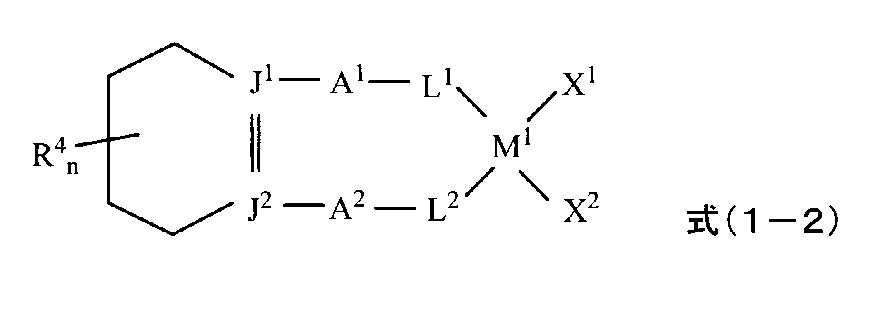


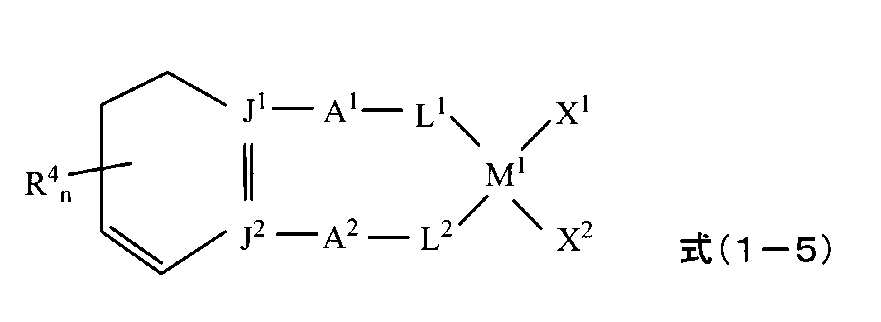
M1、L1、L2、X1、X2、J1、J2、A1及びA2は、前記式(1)と同じである。
R4は6員環上に存在する置換基を示し、存在しても存在しなくてもよく、存在する場合にはそれぞれ独立して、ハロゲン原子、炭素数1~9の炭化水素基、炭素数1~9のアルコキシ基、炭素数1~9のハロゲン置換炭化水素基、酸素原子、硫黄原子若しくは窒素原子を含む炭素数3~9の炭化水素基、炭素数1~9の炭化水素基置換シリル基または炭素数1~9の炭化水素基で置換されていてもよいアミノ基である。R4は、当該R4が存在する6員環内に架橋構造を形成してもよい。R4が2つ以上存在する場合、それらが結合し、当該R4が存在する6員環の構成原子の一部を共有する縮合環を形成してもよいし、当該縮合環上に置換基を有していてもよい。
nは6員環上に存在するR4の数を示し、0~4を示す。] The catalyst component for olefin polymerization according to claim 2, wherein the component (I) is a transition metal compound represented by any of the following formulas (1-1) to (1-5).
M 1 , L 1 , L 2 , X 1 , X 2 , J 1 , J 2 , A 1 and A 2 are the same as those in the above formula (1).
R4 indicates a substituent existing on the 6-membered ring, and may or may not be present. If present, each of them independently has a halogen atom, a hydrocarbon group having 1 to 9 carbon atoms, and carbon. An alkoxy group having a number of 1 to 9, a halogen-substituted hydrocarbon group having 1 to 9 carbon atoms, a hydrocarbon group having 3 to 9 carbon atoms including an oxygen atom, a sulfur atom or a nitrogen atom, and a hydrocarbon group having 1 to 9 carbon atoms. It is an amino group that may be substituted with a silyl group or a hydrocarbon group having 1 to 9 carbon atoms. R 4 may form a crosslinked structure in the 6-membered ring in which the R 4 is present. When two or more R 4s are present, they may be bonded to form a fused ring that shares a part of the constituent atoms of the 6-membered ring in which the R 4 is present, or a substituent may be formed on the condensed ring. May have.
n indicates the number of R4 existing on the 6-membered ring, and indicates 0 to 4. ]

M3は、チタン原子、ジルコニウム原子又はハフニウム原子を示す。
X3とX3’は、それぞれ前記式(2)のX3とX3’と同じである。
Yは、炭素原子、珪素原子又はゲルマニウム原子を示す。
R11とR21は、それぞれ独立して、水素原子、炭素数1~6のアルキル基、炭素数1~6のアルコキシ基、置換基を有していてもよいフリル基又は置換基を有していてもよいチエニル基を示す。R11とR21の少なくとも一方は、置換基を有していてもよいフリル基又は置換基を有していてもよいチエニル基のいずれかである。
R12、R13、R14、R15、R16、R17、R18、R19、R22、R23、R24、R25、R26、R27、R28及びR29は、それぞれ独立して、水素原子、ハロゲン原子、炭素数1~6のアルキル基、炭素数1~6のアルコキシ基、炭素数1~6のアルケニル基、炭素数1~6のハロゲン置換アルキル基、トリアルキルシリル基を有する炭素数1~6のアルキル基、炭素数1~6の炭化水素基を有するシリル基、炭素数6~18のアリール基、炭素数6~18のハロゲン置換アリール基又は置換基を有していてもよい5員環若しくは6員環を構成する複素環基を示す。R12乃至R19及びR22乃至R29のうち隣接する基同士が結合し6~7員環を構成してもよく、6~7員環が不飽和結合を含んでいてもよい。
R31とR32は、それぞれ独立して、水素原子、炭素数1~6のアルキル基、炭素数1~6のアルケニル基、炭素数1~6のハロゲン置換アルキル基、トリアルキルシリル基を有する炭素数1~6のアルキル基、炭素数1~6の炭化水素基を有するシリル基、炭素数6~18のアリール基、炭素数6~18のハロゲン置換アリール基又は置換基を有していてもよい5員環若しくは6員環を構成する複素環基を示す。R31とR32はYと一緒に4~7員環を形成していてもよく、R31及びR32の少なくとも一つが環状構造を有する場合、R31とR32とYにより構成される4~7員環は、R31及びR32が有する環状構造の構成原子の一部を共有する縮合環を形成してもよい。] The catalyst component for olefin polymerization according to claim 7, wherein the component (II) is a transition metal compound represented by the following formula (2-1).
M 3 represents a titanium atom, a zirconium atom or a hafnium atom.
X 3 and X 3'are the same as X 3 and X 3'in the above equation (2), respectively.
Y represents a carbon atom, a silicon atom or a germanium atom.
Each of R 11 and R 21 independently has a hydrogen atom, an alkyl group having 1 to 6 carbon atoms, an alkoxy group having 1 to 6 carbon atoms, and a frill group or a substituent which may have a substituent. Indicates a thienyl group which may be present. At least one of R 11 and R 21 is either a frill group which may have a substituent or a thienyl group which may have a substituent.
R 12 , R 13 , R 14 , R 15 , R 16 , R 17 , R 18 , R 19 , R 22 , R 23 , R 24 , R 25 , R 26 , R 27 , R 28 and R 29 , respectively. Independently, a hydrogen atom, a halogen atom, an alkyl group having 1 to 6 carbon atoms, an alkoxy group having 1 to 6 carbon atoms, an alkenyl group having 1 to 6 carbon atoms, a halogen substituted alkyl group having 1 to 6 carbon atoms, and a trialkyl group. An alkyl group having 1 to 6 carbon atoms having a silyl group, a silyl group having a hydrocarbon group having 1 to 6 carbon atoms, an aryl group having 6 to 18 carbon atoms, a halogen-substituted aryl group having 6 to 18 carbon atoms or a substituent. A heterocyclic group constituting a 5-membered ring or a 6-membered ring which may be possessed is shown. Adjacent groups of R 12 to R 19 and R 22 to R 29 may be bonded to each other to form a 6 to 7-membered ring, or the 6 to 7-membered ring may contain an unsaturated bond.
Each of R 31 and R 32 independently has a hydrogen atom, an alkyl group having 1 to 6 carbon atoms, an alkenyl group having 1 to 6 carbon atoms, a halogen-substituted alkyl group having 1 to 6 carbon atoms, and a trialkylsilyl group. It has an alkyl group having 1 to 6 carbon atoms, a silyl group having a hydrocarbon group having 1 to 6 carbon atoms, an aryl group having 6 to 18 carbon atoms, and a halogen-substituted aryl group or a substituent having 6 to 18 carbon atoms. It shows a heterocyclic group constituting a good 5-membered ring or 6-membered ring. R 31 and R 32 may form a 4- to 7-membered ring together with Y, and if at least one of R 31 and R 32 has a cyclic structure, it is composed of R 31 and R 32 and Y 4 The 7-membered ring may form a fused ring that shares a part of the constituent atoms of the cyclic structure of R 31 and R 32 . ]
[成分(I)]
下記式(1)で表される遷移金属化合物
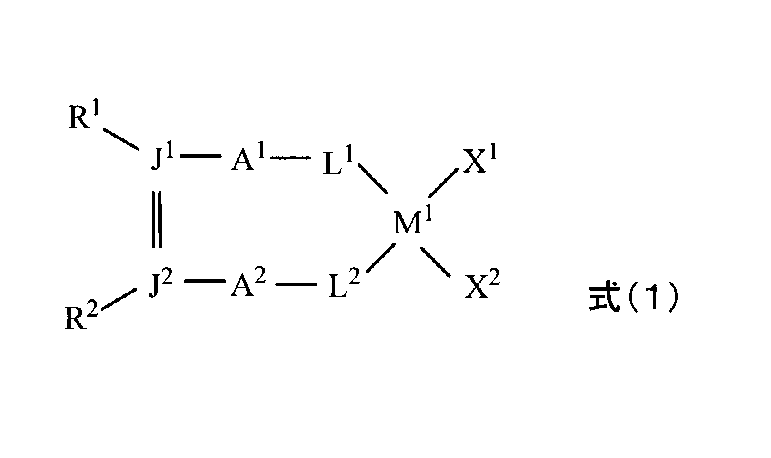
M1は、周期表4族の遷移金属を示す。
L1とL2は、シクロペンタジエニル構造を含む配位子を示し、M1に配位している。
X1及びX2は、それぞれ独立して、M1と結合する水素原子、ハロゲン原子、炭素数1~20の炭化水素基、炭素数1~20のアルコキシ基、酸素原子若しくは窒素原子を含む炭素数3~20の炭化水素基または炭素数1~20の炭化水素基置換アミノ基を示す。
J1とJ2は、炭素原子を示す。
A1とA2は、それぞれJ1とL1、J2とL2とを結合する架橋基を示し、以下の群から選ばれる。
-CR3 2-、-SiR3 2-、-NR3-、-PR3-、-O-、-S-、[ここでR3は水素原子または炭素数1~10の炭化水素基であり、2つのR3が結合して環状構造を形成してもよい]、
R1とR2は、それぞれ独立して、水素原子、炭素数1~20の炭化水素基、炭素数1~20のアルコキシ基、1つ~6つのケイ素原子を含む炭素数1~20の炭化水素基、炭素数1~20のハロゲン置換炭化水素基、酸素原子、硫黄原子若しくは窒素原子を含む炭素数3~20の炭化水素基または炭素数1~20の炭化水素基置換シリル基を示す。R1とR2は、それらが結合しあってJ1およびJ2と一緒に環状構造を形成してもよい。]
[成分(II)]
下記式(2)、(3)又は(4)で表される化合物群から選ばれる遷移金属化合物
式(2):
A3 qL3L3’M3X3X3’
[式中、
M3は、周期表4族の遷移金属を示す。
L3とL3’は、それぞれ独立して、シクロペンタジエニル構造を含む配位子を示し、M3に配位している。該シクロペンタジエニル構造を含む配位子は、ハロゲン原子、炭素数1~20の炭化水素基、炭素数1~20のアルコキシ基、1つ~6つのケイ素原子を含む炭素数1~20の炭化水素基、炭素数1~20のハロゲン置換炭化水素基、酸素原子、硫黄原子若しくは窒素原子を含む炭素数3~20の炭化水素基または炭素数1~20の炭化水素基置換シリル基で置換されていてもよい。L3またはL3’上に、隣り合う置換基が存在する場合、それらが結合して環構造を形成してもよい。
X3とX3’は、それぞれ独立して、M3と結合する水素原子、ハロゲン原子、炭素数1~20の炭化水素基、炭素数1~20のアルコキシ基、酸素原子若しくは窒素原子を含む炭素数3~20の炭化水素基または炭素数1~20の炭化水素基置換アミノ基を示す。
A3は、L3とL3’を架橋する架橋基を示し、存在しても存在しなくてもよく、存在する場合にはL3とL3’の間に架橋構造を有する。
qは0または1であり、A3の数を示す。]
式(3):
A4L4M4X4X4’
[式中、
M4は、周期表4族の遷移金属を示す。
L4は、シクロペンタジエニル構造を含む配位子を示し、M4に配位している。該シクロペンタジエニル構造を含む配位子は、ハロゲン原子、炭素数1~20の炭化水素基、炭素数1~20のアルコキシ基、1つ~6つのケイ素原子を含む炭素数1~20の炭化水素基、炭素数1~20のハロゲン置換炭化水素基、酸素原子、硫黄原子若しくは窒素原子を含む炭素数3~20の炭化水素基または炭素数1~20の炭化水素基置換シリル基で置換されていてもよい。
X4とX4’は、それぞれ独立して、金属M4と結合する水素原子、ハロゲン原子、炭素数1~20の炭化水素基、炭素数1~20のアルコキシ基、酸素原子若しくは窒素原子を含む炭素数3~20の炭化水素基または炭素数1~20の炭化水素基置換アミノ基を示す。
A4は、L4に結合しているヘテロ原子を有する有機基を示し、ヘテロ原子を介してM4に結合している。]
式(4):
L5 mM5X5 p
[式中、
M5は、周期表3~11族の遷移金属を示す。
m個あるL5は、それぞれ独立して、2つ以上の酸素、窒素、リン、硫黄原子から選ばれる原子を有する置換基で置換されている炭化水素基を示しており、少なくとも2つの該酸素、窒素、リン、硫黄原子から選ばれる原子がM5に結合している。
p個あるX5は、それぞれ独立して、M5と結合する水素原子、ハロゲン原子、炭素数1~20の炭化水素基、炭素数1~20のアルコキシ基、酸素原子若しくは窒素原子を含む炭素数3~20の炭化水素基または中性のルイス塩基を示す。
mはL5の数を示しており、1または2である。
pはXの数を示しており、式(4)の遷移金属化合物が電気的中性になるように選ばれる数である。]
[成分(III)]
成分(I)および成分(II)の遷移金属化合物と反応してカチオン性化合物を生成させる化合物
[成分(IV)]
微粒子担体 A catalyst for olefin polymerization, which comprises the following components (I), component (II), component (III) and component (IV).
[Component (I)]
Transition metal compound represented by the following formula (1)
M 1 represents a transition metal of Group 4 of the periodic table.
L 1 and L 2 represent a ligand containing a cyclopentadienyl structure and are coordinated to M 1 .
Each of X 1 and X 2 independently has a hydrogen atom, a halogen atom, a hydrocarbon group having 1 to 20 carbon atoms, an alkoxy group having 1 to 20 carbon atoms, and a carbon containing an oxygen atom or a nitrogen atom. A hydrocarbon group having a number of 3 to 20 or a hydrocarbon group substituted amino group having a carbon number of 1 to 20 is shown.
J 1 and J 2 represent carbon atoms.
A 1 and A 2 indicate a cross-linking group that binds J 1 and L 1 and J 2 and L 2 , respectively, and are selected from the following groups.
-CR 3 2- , -SiR 3 2- , -NR 3- , -PR 3- , -O-, -S-, [Here, R 3 is a hydrogen atom or a hydrocarbon group having 1 to 10 carbon atoms. Two R3s may combine to form a cyclic structure],
R 1 and R 2 independently have a hydrogen atom, a hydrocarbon group having 1 to 20 carbon atoms, an alkoxy group having 1 to 20 carbon atoms, and a hydrocarbon having 1 to 20 carbon atoms including 1 to 6 silicon atoms. A hydrogen group, a halogen-substituted hydrocarbon group having 1 to 20 carbon atoms, a hydrocarbon group having 3 to 20 carbon atoms including an oxygen atom, a sulfur atom or a nitrogen atom, or a hydrocarbon group-substituted silyl group having 1 to 20 carbon atoms is shown. R 1 and R 2 may combine with each other to form a cyclic structure with J 1 and J 2 . ]
[Ingredient (II)]
Transition metal compound selected from the compound group represented by the following formula (2), (3) or (4) Formula (2):
A 3 q L 3 L 3'M 3 X 3 X 3 '
[During the ceremony,
M 3 indicates a transition metal of Group 4 of the periodic table.
L 3 and L 3'independently represent ligands containing a cyclopentadienyl structure and are coordinated to M 3 . The ligand containing the cyclopentadienyl structure has a halogen atom, a hydrocarbon group having 1 to 20 carbon atoms, an alkoxy group having 1 to 20 carbon atoms, and 1 to 20 carbon atoms containing 1 to 6 silicon atoms. Substituted with a hydrocarbon group, a halogen-substituted hydrocarbon group having 1 to 20 carbon atoms, a hydrocarbon group having 3 to 20 carbon atoms including an oxygen atom, a sulfur atom or a nitrogen atom, or a hydrocarbon group substituted silyl group having 1 to 20 carbon atoms. It may have been. If adjacent substituents are present on L 3 or L 3' , they may be combined to form a ring structure.
X 3 and X 3'contain a hydrogen atom , a halogen atom, a hydrocarbon group having 1 to 20 carbon atoms, an alkoxy group having 1 to 20 carbon atoms, an oxygen atom or a nitrogen atom independently of each other. A hydrocarbon group having 3 to 20 carbon atoms or a hydrocarbon group substituted amino group having 1 to 20 carbon atoms is shown.
A 3 indicates a cross-linking group that crosslinks L 3 and L 3' , and may or may not be present, and if present, has a cross-linking structure between L 3 and L 3' .
q is 0 or 1 and indicates the number of A3. ]
Equation (3):
A 4 L 4 M 4 X 4 X 4'
[During the ceremony,
M 4 indicates a transition metal of Group 4 of the periodic table.
L 4 represents a ligand containing a cyclopentadienyl structure and is coordinated to M 4 . The ligand containing the cyclopentadienyl structure has a halogen atom, a hydrocarbon group having 1 to 20 carbon atoms, an alkoxy group having 1 to 20 carbon atoms, and 1 to 20 carbon atoms containing 1 to 6 silicon atoms. Substituted with a hydrocarbon group, a halogen-substituted hydrocarbon group having 1 to 20 carbon atoms, a hydrocarbon group having 3 to 20 carbon atoms including an oxygen atom, a sulfur atom or a nitrogen atom, or a hydrocarbon group substituted silyl group having 1 to 20 carbon atoms. It may have been.
X4 and X4'independently form a hydrogen atom, a halogen atom, a hydrocarbon group having 1 to 20 carbon atoms, an alkoxy group having 1 to 20 carbon atoms, an oxygen atom or a nitrogen atom, which are bonded to the metal M4 , respectively. A hydrocarbon group having 3 to 20 carbon atoms or a hydrocarbon group substituted amino group having 1 to 20 carbon atoms is shown.
A 4 represents an organic group having a hetero atom bonded to L 4 , and is bonded to M 4 via the hetero atom. ]
Equation (4):
L 5 m M 5 X 5 p
[During the ceremony,
M 5 indicates a transition metal of Group 3 to 11 of the Periodic Table.
The m L5s each independently represent a hydrocarbon group substituted with a substituent having an atom selected from two or more oxygen, nitrogen, phosphorus, and sulfur atoms, and at least two of the oxygen. , Nitrogen, phosphorus, and an atom selected from sulfur atoms are bonded to M5 .
Each of the p X 5s independently has a hydrogen atom, a halogen atom, a hydrocarbon group having 1 to 20 carbon atoms, an alkoxy group having 1 to 20 carbon atoms, and a carbon containing an oxygen atom or a nitrogen atom. The number 3 to 20 hydrocarbon groups or neutral Lewis bases are shown.
m represents the number of L5 and is 1 or 2.
p indicates the number of X, which is a number selected so that the transition metal compound of the formula (4) is electrically neutral. ]
[Ingredient (III)]
A compound that reacts with a transition metal compound of component (I) and component (II) to form a cationic compound [component (IV)].
Fine particle carrier
[成分(I)]
下記式(1)で表される遷移金属化合物

M1は、周期表4族の遷移金属を示す。
L1とL2は、シクロペンタジエニル構造を含む配位子を示し、M1に配位している。
X1及びX2は、それぞれ独立して、M1と結合する水素原子、ハロゲン原子、炭素数1~20の炭化水素基、炭素数1~20のアルコキシ基、酸素原子若しくは窒素原子を含む炭素数3~20の炭化水素基または炭素数1~20の炭化水素基置換アミノ基を示す。
J1とJ2は、炭素原子を示す。
A1とA2は、それぞれJ1とL1、J2とL2とを結合する架橋基を示し、以下の群から選ばれる。
-CR3 2-、-SiR3 2-、-NR3-、-PR3-、-O-、-S-、[ここでR3は水素原子または炭素数1~10の炭化水素基であり、2つのR3が結合して環状構造を形成してもよい]、
R1とR2は、それぞれ独立して、水素原子、炭素数1~20の炭化水素基、炭素数1~6のアルコキシ基、1つ~6つのケイ素原子を含む炭素数1~20の炭化水素基、炭素数1~20のハロゲン置換炭化水素基、酸素原子、硫黄原子若しくは窒素原子を含む炭素数3~20の炭化水素基または炭素数1~20の炭化水素基置換シリル基を示す。R1とR2は、それらが結合しあってJ1およびJ2と一緒に環状構造を形成してもよい。]
[成分(II)]
下記式(2)、(3)又は(4)で表される化合物群から選ばれる遷移金属化合物
式(2):
A3 qL3L3’M3X3X3’
[式中、
M3は、周期表4族の遷移金属を示す。
L3とL3’は、それぞれ独立して、シクロペンタジエニル構造を含む配位子を示し、M3に配位している。該シクロペンタジエニル構造を含む配位子は、ハロゲン原子、炭素数1~20の炭化水素基、炭素数1~20のアルコキシ基、1つ~6つのケイ素原子を含む炭素数1~20の炭化水素基、炭素数1~20のハロゲン置換炭化水素基、酸素原子、硫黄原子若しくは窒素原子を含む炭素数3~20の炭化水素基または炭素数1~20の炭化水素基置換シリル基で置換されていてもよい。L3またはL3’上に、隣り合う置換基が存在する場合、それらが結合して環構造を形成してもよい。
X3とX3’は、それぞれ独立して、M3と結合する水素原子、ハロゲン原子、炭素数1~20の炭化水素基、炭素数1~20のアルコキシ基、酸素原子若しくは窒素原子を含む炭素数3~20の炭化水素基または炭素数1~20の炭化水素基置換アミノ基を示す。
A3は、L3とL3’を架橋する架橋基を示し、存在しても存在しなくてもよく、存在する場合にはL3とL3’の間に架橋構造を有する。
qは0または1であり、A3の数を示す。]
式(3):
A4L4M4X4X4’
[式中、
M4は、周期表4族の遷移金属を示す。
L4は、シクロペンタジエニル構造を含む配位子を示し、M4に配位している。該シクロペンタジエニル構造を含む配位子は、ハロゲン原子、炭素数1~20の炭化水素基、炭素数1~20のアルコキシ基、1つ~6つのケイ素原子を含む炭素数1~20の炭化水素基、炭素数1~20のハロゲン置換炭化水素基、酸素原子、硫黄原子若しくは窒素原子を含む炭素数3~20の炭化水素基または炭素数1~20の炭化水素基置換シリル基で置換されていてもよい。
X4とX4’は、それぞれ独立して、金属M4と結合する水素原子、ハロゲン原子、炭素数1~20の炭化水素基、炭素数1~20のアルコキシ基、酸素原子若しくは窒素原子を含む炭素数3~20の炭化水素基または炭素数1~20の炭化水素基置換アミノ基を示す。
A4は、L4に結合しているヘテロ原子を有する有機基を示し、ヘテロ原子を介してM4に結合している。]
式(4):
L5 mM5X5 p
[式中、
M5は、周期表3~11族の遷移金属を示す。
m個あるL5は、それぞれ独立して、2つ以上の酸素、窒素、リン、硫黄原子から選ばれる原子を有する置換基で置換されている炭化水素基を示しており、少なくとも2つの該酸素、窒素、リン、硫黄原子から選ばれる原子がM5に結合している。
p個あるX5は、それぞれ独立して、M5と結合する水素原子、ハロゲン原子、炭素数1~20の炭化水素基、炭素数1~20のアルコキシ基、酸素原子若しくは窒素原子を含む炭素数3~20の炭化水素基または中性のルイス塩基を示す。
mはL5の数を示しており、1または2である。
pはXの数を示しており、式(4)の遷移金属化合物が電気的中性になるように選ばれる数である。]
[成分(III)]
成分(I)および成分(II)の遷移金属化合物と反応してカチオン性化合物を生成させる化合物
[成分(IV)]
微粒子担体 A catalyst for olefin polymerization produced by mixing the following components (I), component (II), component (III) and component (IV).
[Component (I)]
Transition metal compound represented by the following formula (1)
M 1 represents a transition metal of Group 4 of the periodic table.
L 1 and L 2 represent a ligand containing a cyclopentadienyl structure and are coordinated to M 1 .
Each of X 1 and X 2 independently has a hydrogen atom, a halogen atom, a hydrocarbon group having 1 to 20 carbon atoms, an alkoxy group having 1 to 20 carbon atoms, and a carbon containing an oxygen atom or a nitrogen atom. A hydrocarbon group having a number of 3 to 20 or a hydrocarbon group substituted amino group having a carbon number of 1 to 20 is shown.
J 1 and J 2 represent carbon atoms.
A 1 and A 2 indicate a cross-linking group that binds J 1 and L 1 and J 2 and L 2 , respectively, and are selected from the following groups.
-CR 3 2- , -SiR 3 2- , -NR 3- , -PR 3- , -O-, -S-, [Here, R 3 is a hydrogen atom or a hydrocarbon group having 1 to 10 carbon atoms. Two R3s may combine to form a cyclic structure],
R 1 and R 2 are independent hydrocarbons having 1 to 20 carbon atoms including a hydrogen atom, a hydrocarbon group having 1 to 20 carbon atoms, an alkoxy group having 1 to 6 carbon atoms, and 1 to 6 silicon atoms. A hydrogen group, a halogen-substituted hydrocarbon group having 1 to 20 carbon atoms, a hydrocarbon group having 3 to 20 carbon atoms including an oxygen atom, a sulfur atom or a nitrogen atom, or a hydrocarbon group-substituted silyl group having 1 to 20 carbon atoms is shown. R 1 and R 2 may combine with each other to form a cyclic structure with J 1 and J 2 . ]
[Ingredient (II)]
Transition metal compound selected from the compound group represented by the following formula (2), (3) or (4) Formula (2):
A 3 q L 3 L 3'M 3 X 3 X 3 '
[During the ceremony,
M 3 indicates a transition metal of Group 4 of the periodic table.
L 3 and L 3'independently represent ligands containing a cyclopentadienyl structure and are coordinated to M 3 . The ligand containing the cyclopentadienyl structure has a halogen atom, a hydrocarbon group having 1 to 20 carbon atoms, an alkoxy group having 1 to 20 carbon atoms, and 1 to 20 carbon atoms containing 1 to 6 silicon atoms. Substituted with a hydrocarbon group, a halogen-substituted hydrocarbon group having 1 to 20 carbon atoms, a hydrocarbon group having 3 to 20 carbon atoms including an oxygen atom, a sulfur atom or a nitrogen atom, or a hydrocarbon group substituted silyl group having 1 to 20 carbon atoms. It may have been. If adjacent substituents are present on L 3 or L 3' , they may be combined to form a ring structure.
X 3 and X 3'contain a hydrogen atom , a halogen atom, a hydrocarbon group having 1 to 20 carbon atoms, an alkoxy group having 1 to 20 carbon atoms, an oxygen atom or a nitrogen atom independently of each other. A hydrocarbon group having 3 to 20 carbon atoms or a hydrocarbon group substituted amino group having 1 to 20 carbon atoms is shown.
A 3 indicates a cross-linking group that crosslinks L 3 and L 3' , and may or may not be present, and if present, has a cross-linking structure between L 3 and L 3' .
q is 0 or 1 and indicates the number of A3. ]
Equation (3):
A 4 L 4 M 4 X 4 X 4'
[During the ceremony,
M 4 indicates a transition metal of Group 4 of the periodic table.
L 4 represents a ligand containing a cyclopentadienyl structure and is coordinated to M 4 . The ligand containing the cyclopentadienyl structure has a halogen atom, a hydrocarbon group having 1 to 20 carbon atoms, an alkoxy group having 1 to 20 carbon atoms, and 1 to 20 carbon atoms containing 1 to 6 silicon atoms. Substituted with a hydrocarbon group, a halogen-substituted hydrocarbon group having 1 to 20 carbon atoms, a hydrocarbon group having 3 to 20 carbon atoms including an oxygen atom, a sulfur atom or a nitrogen atom, or a hydrocarbon group substituted silyl group having 1 to 20 carbon atoms. It may have been.
X4 and X4'independently form a hydrogen atom, a halogen atom, a hydrocarbon group having 1 to 20 carbon atoms, an alkoxy group having 1 to 20 carbon atoms, an oxygen atom or a nitrogen atom, which are bonded to the metal M4 , respectively. A hydrocarbon group having 3 to 20 carbon atoms or a hydrocarbon group substituted amino group having 1 to 20 carbon atoms is shown.
A 4 represents an organic group having a hetero atom bonded to L 4 , and is bonded to M 4 via the hetero atom. ]
Equation (4):
L 5 m M 5 X 5 p
[During the ceremony,
M 5 indicates a transition metal of Group 3 to 11 of the Periodic Table.
The m L5s each independently represent a hydrocarbon group substituted with a substituent having an atom selected from two or more oxygen, nitrogen, phosphorus, and sulfur atoms, and at least two of the oxygen. , Nitrogen, phosphorus, and an atom selected from sulfur atoms are bonded to M5 .
Each of the p X5s has a hydrogen atom, a halogen atom, a hydrocarbon group having 1 to 20 carbon atoms, an alkoxy group having 1 to 20 carbon atoms, and a carbon containing an oxygen atom or a nitrogen atom, which independently bond with M5. The number 3 to 20 hydrocarbon groups or neutral Lewis bases are shown.
m represents the number of L5 and is 1 or 2.
p indicates the number of X, which is the number selected so that the transition metal compound of the formula (4) is electrically neutral. ]
[Ingredient (III)]
A compound that reacts with a transition metal compound of component (I) and component (II) to form a cationic compound [component (IV)].
Fine particle carrier
Applications Claiming Priority (2)
| Application Number | Priority Date | Filing Date | Title |
|---|---|---|---|
| JP2020114345 | 2020-07-01 | ||
| JP2020114345 | 2020-07-01 |
Publications (2)
| Publication Number | Publication Date |
|---|---|
| JP2022013902A true JP2022013902A (en) | 2022-01-18 |
| JP7743720B2 JP7743720B2 (en) | 2025-09-25 |
Family
ID=80169767
Family Applications (1)
| Application Number | Title | Priority Date | Filing Date |
|---|---|---|---|
| JP2021109898A Active JP7743720B2 (en) | 2020-07-01 | 2021-07-01 | Catalyst component for olefin polymerization, catalyst for olefin polymerization, and method for producing olefin polymer |
Country Status (1)
| Country | Link |
|---|---|
| JP (1) | JP7743720B2 (en) |
Citations (4)
| Publication number | Priority date | Publication date | Assignee | Title |
|---|---|---|---|---|
| JPH09286812A (en) * | 1995-07-06 | 1997-11-04 | Enichem Spa | Metallocene catalyst for alpha-olefin (co)polymerization |
| JPH1067817A (en) * | 1996-05-09 | 1998-03-10 | Enichem Spa | Production of elastomeric ep(d)m copolymer |
| JP2012214780A (en) * | 2011-03-30 | 2012-11-08 | Japan Polyethylene Corp | Catalytic ingredient for olefin polymerization, catalyst for olefin polymerization containing the ingredient, production method of olefin-based polymer using the catalyst, and olefin-based polymer produced by the method |
| US20190119420A1 (en) * | 2016-12-05 | 2019-04-25 | Lg Chem, Ltd. | Catalyst composition for synthesizing olefin copolymer and method for preparing olefin copolymer |
-
2021
- 2021-07-01 JP JP2021109898A patent/JP7743720B2/en active Active
Patent Citations (4)
| Publication number | Priority date | Publication date | Assignee | Title |
|---|---|---|---|---|
| JPH09286812A (en) * | 1995-07-06 | 1997-11-04 | Enichem Spa | Metallocene catalyst for alpha-olefin (co)polymerization |
| JPH1067817A (en) * | 1996-05-09 | 1998-03-10 | Enichem Spa | Production of elastomeric ep(d)m copolymer |
| JP2012214780A (en) * | 2011-03-30 | 2012-11-08 | Japan Polyethylene Corp | Catalytic ingredient for olefin polymerization, catalyst for olefin polymerization containing the ingredient, production method of olefin-based polymer using the catalyst, and olefin-based polymer produced by the method |
| US20190119420A1 (en) * | 2016-12-05 | 2019-04-25 | Lg Chem, Ltd. | Catalyst composition for synthesizing olefin copolymer and method for preparing olefin copolymer |
Also Published As
| Publication number | Publication date |
|---|---|
| JP7743720B2 (en) | 2025-09-25 |
Similar Documents
| Publication | Publication Date | Title |
|---|---|---|
| KR100568839B1 (en) | Bridged metallocenes for olefin copolymerization | |
| JP6361524B2 (en) | Metallocene compound, olefin polymerization catalyst component and olefin polymerization catalyst containing the same, and method for producing olefin polymer using the olefin polymerization catalyst | |
| JP2016537500A (en) | Polyolefin production method and polyolefin produced therefrom | |
| US11485808B2 (en) | Metallocene compound, catalyst component for olefin polymerization and catalyst for olefin polymerization containing the same, and method for producing olefin polymer using catalyst for olefin polymerization | |
| CN104822697A (en) | Bridged metallocene compounds, catalyst systems and polymerization methods using them | |
| WO2015047030A1 (en) | Method for preparing propylene-1-butene copolymer and propylene-1-butene copolymer obtained thereby | |
| JP2012149160A (en) | Method for producing olefin polymerization catalyst | |
| JP2011506313A (en) | Nonmetallocene olefin polymerization catalyst containing tetrazole group and olefin polymerization method using the same | |
| JP5884457B2 (en) | Process for producing olefin polymerization catalyst | |
| JP2013001737A (en) | METHOD FOR PRODUCING ETHYLENE-α-OLEFIN COPOLYMER HAVING BIMODAL COMPOSITION DISTRIBUTION | |
| JP2002194016A (en) | Metallocene compound, catalyst for olefin polymerization containing the same, and method for producing olefin polymer using the catalyst | |
| JP6844340B2 (en) | A metallocene compound, a catalyst component for olefin polymerization containing the same, a catalyst for olefin polymerization, and a method for producing an olefin polymer using the catalyst for olefin polymerization. | |
| JP2018178101A (en) | Olefin polymerization catalyst, method for producing the same, and method for producing olefin polymer using the olefin polymerization catalyst | |
| US7019157B2 (en) | Metallocene compounds, production process for olefin polymers using catalysts containing them and olefin polymers produced by the production process | |
| JP7112657B2 (en) | Metallocene compound, catalyst component for olefin polymerization containing same, catalyst for olefin polymerization, and method for producing olefin polymer using the catalyst for olefin polymerization | |
| KR101229076B1 (en) | Transition metal catalysts composition and preparation method of poly-olefin using the same | |
| KR101232264B1 (en) | Transition metal compound, transition metal catalysts composition, and preparation method of poly-ethylene using the same | |
| JP7743720B2 (en) | Catalyst component for olefin polymerization, catalyst for olefin polymerization, and method for producing olefin polymer | |
| JP5285893B2 (en) | Method for producing propylene polymer having improved melt properties | |
| JP2022512099A (en) | Method for preparing catalyst for olefin polymerization | |
| JP2006002098A (en) | NOVEL ETHYLENE POLYMER AND PROCESS FOR PRODUCING THE SAME | |
| WO2015047031A1 (en) | Polypropylene preparation method and polypropylene obtained therefrom | |
| JP2023098694A (en) | Method for producing ethylene polymer | |
| JP2020152794A (en) | Method for producing ethylene-based macromonomer | |
| JP2023152883A (en) | Catalyst for olefin polymerization and method for producing ethylene polymer |
Legal Events
| Date | Code | Title | Description |
|---|---|---|---|
| A621 | Written request for application examination |
Free format text: JAPANESE INTERMEDIATE CODE: A621 Effective date: 20240412 |
|
| A977 | Report on retrieval |
Free format text: JAPANESE INTERMEDIATE CODE: A971007 Effective date: 20250212 |
|
| A131 | Notification of reasons for refusal |
Free format text: JAPANESE INTERMEDIATE CODE: A131 Effective date: 20250311 |
|
| A521 | Request for written amendment filed |
Free format text: JAPANESE INTERMEDIATE CODE: A523 Effective date: 20250507 |
|
| TRDD | Decision of grant or rejection written | ||
| A01 | Written decision to grant a patent or to grant a registration (utility model) |
Free format text: JAPANESE INTERMEDIATE CODE: A01 Effective date: 20250812 |
|
| A61 | First payment of annual fees (during grant procedure) |
Free format text: JAPANESE INTERMEDIATE CODE: A61 Effective date: 20250825 |
|
| R150 | Certificate of patent or registration of utility model |
Ref document number: 7743720 Country of ref document: JP Free format text: JAPANESE INTERMEDIATE CODE: R150 |