JP2023113473A - PTP sheet and molding - Google Patents
PTP sheet and molding Download PDFInfo
- Publication number
- JP2023113473A JP2023113473A JP2022015872A JP2022015872A JP2023113473A JP 2023113473 A JP2023113473 A JP 2023113473A JP 2022015872 A JP2022015872 A JP 2022015872A JP 2022015872 A JP2022015872 A JP 2022015872A JP 2023113473 A JP2023113473 A JP 2023113473A
- Authority
- JP
- Japan
- Prior art keywords
- ptp sheet
- ptp
- sheet
- mpa
- heat
- Prior art date
- Legal status (The legal status is an assumption and is not a legal conclusion. Google has not performed a legal analysis and makes no representation as to the accuracy of the status listed.)
- Pending
Links
Images
Landscapes
- Packages (AREA)
- Wrappers (AREA)
Abstract
Description
本発明は、PTP(プレススルーパック)用シート及び該PTP用シートを含む成形体に関する。 TECHNICAL FIELD The present invention relates to a PTP (Press Through Pack) sheet and a molded article containing the PTP sheet.
医薬品や食品等の包装形態の一つとして、底材と蓋材とを備えるPTP包装体が知られている。PTP包装体は、底材に形成されているポケット状の凹部に内容物を充填した後、凹部以外の部分であるフランジ部に蓋材をヒートシールすることにより製造される。収納された内容物は、内容物に対して底材の外側から蓋材の方向に力を加えて蓋材を突き破ることにより、取り出すことができる。 BACKGROUND ART A PTP package including a bottom material and a lid material is known as one form of packaging for pharmaceuticals, food, and the like. A PTP package is manufactured by filling contents into a pocket-shaped recess formed in a bottom material, and then heat-sealing a cover material to a flange portion other than the recess. The stored contents can be taken out by applying force to the contents from the outside of the bottom member in the direction of the lid member to break through the lid member.
底材としては、従来、ポリ塩化ビニル系樹脂を含むプラスチックシートからなるものが多く使用されてきた。しかしながら、近年、ポリ塩化ビニル樹脂シートは、焼却時に塩素ガスを発生するという環境面の問題から敬遠されつつあり、これに代わる樹脂としてポリプロピレン樹脂が使用されるようになっている。例えば、特許文献1~7には、ポリプロピレン系樹脂を含むPTP用蓋材が開示されている。 As the bottom material, conventionally, a plastic sheet containing a polyvinyl chloride resin has often been used. In recent years, however, polyvinyl chloride resin sheets are being avoided due to the environmental problem of generating chlorine gas when incinerated, and polypropylene resin has been used as an alternative resin. For example, Patent Documents 1 to 7 disclose PTP lid materials containing polypropylene-based resins.
一方、蓋材には、従来、内容物を押し出すことによって容易に破れるという性質に優れたアルミ箔、グラシン紙等が用いられてきた。しかしながら、近年、使い捨てプラスチック製品の削減とリサイクルの実施、再生可能資源への転換という流れから、底材だけでなく、蓋材にもポリプロピレン系樹脂等を含むプラスチックシートを用いることにより、ゴミとして廃棄する場合の分別の必要がなく、リサイクル可能な環境対応型のPTP包装体が注目されている。 On the other hand, as the lid material, conventionally, aluminum foil, glassine paper, or the like has been used, which is excellent in that it can be easily broken by pushing out the contents. However, in recent years, due to the trend of reducing single-use plastic products, implementing recycling, and switching to renewable resources, not only the bottom material but also the plastic sheet containing polypropylene resin etc. is used for the lid material. There is no need for sorting in the case of recycling, and an environmentally friendly PTP package that can be recycled has attracted attention.
しかしながら、ポリプロピレン系樹脂シートは、ポリ塩化ビニル系樹脂シートに比べて成形性に劣るという問題点がある。具体的には、ポリ塩化ビニルシートに比べて成形温度範囲が狭く、かつ高温である。成形性を改善するために種々の工夫がなされてきたが、常温でのシートの剛性とのバランスをとるのが難しく、常温での剛性が高くなるあまり、誤飲時に食道壁を傷つけて損傷させるという危険性もある。 However, the polypropylene resin sheet has a problem that it is inferior to the polyvinyl chloride resin sheet in moldability. Specifically, the molding temperature range is narrower and higher than that of a polyvinyl chloride sheet. Various attempts have been made to improve moldability, but it is difficult to balance the rigidity of the sheet at room temperature, and the rigidity at room temperature is so high that it damages the esophageal wall during accidental ingestion. There is also the danger of
そこで、本発明は、適度な柔軟性を有し、成形性に優れるPTP用シート及び該PTP用シートを含む成形体を提供することを目的とする。 Accordingly, an object of the present invention is to provide a PTP sheet having appropriate flexibility and excellent moldability, and a molded article containing the PTP sheet.
本発明者等は、上記課題を解決するため鋭意検討を重ねた結果、ポリプロピレン系樹脂を含み、特定の範囲の厚み、150%引張応力、及び結晶融解熱量を有するシートとすることで、上記課題を解決できることを見出し、本発明を完成するに至った。 As a result of intensive studies to solve the above problems, the present inventors have found that the above problems can be solved by making a sheet containing a polypropylene resin and having a thickness within a specific range, a 150% tensile stress, and a heat of crystal fusion. can be solved, and the present invention has been completed.
即ち、本発明は以下のとおりである。
[1]
ポリプロピレン系樹脂を含み、
厚みが200~400μmであり、
125℃で引張試験を行ったときに、150%伸長時の引張応力(150%引張応力)が1.8~3.0MPaであり、
示差走査熱量計(DSC)による結晶融解熱量が63.0~80.0J/gである
ことを特徴とする、PTP用シート。
[2]
少なくとも2層で構成され、そのうち1層がヒートシール層であり、前記ヒートシール層のシール面の静摩擦係数が0.7以下である、[1]に記載のPTP用シート。
[3]
前記ヒートシール層のシール面に対して厚み20~40μmのポリプロピレンフィルムを100℃でヒートシールしたときに、シール強度が8N/15mm以上である、[2]に記載のPTP用シート。
[4]
125℃で引張試験を行ったときに、上降伏点が存在しないか、又は、存在する場合に3MPa以下である、[1]~[3]のいずれかに記載のPTP用シート。
[5]
前記ヒートシール層にポリオレフィン系熱可塑性エラストマーを含む[2]~[4]のいずれかに記載のPTP用シート。
[6]
[1]~[5]のいずれかに記載のPTP用シートを含み、
前記PTP用シートの押込み荷重が15~21Nである
ことを特徴とする、成形体。
That is, the present invention is as follows.
[1]
including polypropylene resin,
The thickness is 200 to 400 μm,
When a tensile test is performed at 125 ° C., the tensile stress at 150% elongation (150% tensile stress) is 1.8 to 3.0 MPa,
A PTP sheet characterized by having a heat of crystal fusion of 63.0 to 80.0 J/g measured by a differential scanning calorimeter (DSC).
[2]
The PTP sheet according to [1], which is composed of at least two layers, one of which is a heat-sealing layer, and the static friction coefficient of the sealing surface of the heat-sealing layer is 0.7 or less.
[3]
The PTP sheet according to [2], wherein the sealing strength is 8 N/15 mm or more when a polypropylene film having a thickness of 20 to 40 μm is heat-sealed at 100° C. to the sealing surface of the heat-sealing layer.
[4]
The PTP sheet according to any one of [1] to [3], wherein the upper yield point does not exist or, if it exists, it is 3 MPa or less when a tensile test is performed at 125°C.
[5]
The PTP sheet according to any one of [2] to [4], wherein the heat seal layer contains a polyolefin thermoplastic elastomer.
[6]
including the PTP sheet according to any one of [1] to [5],
A molded product, wherein the PTP sheet has an indentation load of 15 to 21N.
本発明によれば、適度な柔軟性を有し、成形性に優れるPTP用シート及び該PTP用シートを含む成形体を提供することができる。 According to the present invention, it is possible to provide a PTP sheet having appropriate flexibility and excellent moldability, and a molded article containing the PTP sheet.
以下、本発明を実施するための形態(以下、「本実施形態」という。)について、詳細に説明するが、本発明は以下の記載に限定されるものではなく、その要旨の範囲内で種々変形して実施できる。 Hereinafter, the mode for carrying out the present invention (hereinafter referred to as "the present embodiment") will be described in detail, but the present invention is not limited to the following description, and various It can be modified and implemented.
〈PTP用シート〉
本実施形態のPTP用シートは、ポリプロピレン系樹脂を含む。
PTP用シート100質量%中のポリプロピレン系樹脂の含有量は、70質量%以上であることが好ましく、より好ましくは90質量%以上であり、特に好ましくは100質量%である。ポリプロピレン系樹脂の含有量が上記範囲であると、生産過程で排出される端部や使用後のゴミをマテリアルリサイクルする際に、ポリプロピレンとしての物性を落とさずに再資源化することができる傾向にある。例えば、再利用するために再混錬した後も透明性が維持されてリサイクル性が良好となる傾向にある。
<PTP sheet>
The PTP sheet of this embodiment contains a polypropylene-based resin.
The polypropylene resin content in 100% by mass of the PTP sheet is preferably 70% by mass or more, more preferably 90% by mass or more, and particularly preferably 100% by mass. When the content of the polypropylene-based resin is within the above range, it tends to be possible to recycle the material without degrading the physical properties of polypropylene when recycling the ends discharged during the production process and the waste after use. be. For example, even after re-kneading for reuse, transparency tends to be maintained and recyclability tends to be good.
〈〈ポリプロピレン系樹脂〉〉
PTP用シートに含まれるポリプロピレン系樹脂は、特に限定されることなく、例えば、プロピレンホモポリマー、プロピレンと他のモノマーとの共重合体、及びこれらの変性物等が挙げられる。また、環境対応の観点から、バイオポリプロピレンであってもよい。
〈〈Polypropylene resin〉〉
The polypropylene-based resin contained in the PTP sheet is not particularly limited, and examples thereof include propylene homopolymers, copolymers of propylene and other monomers, modified products thereof, and the like. Bio-polypropylene may also be used from the viewpoint of environmental friendliness.
プロピレンと共重合可能なモノマーとしては、例えば、エチレン、1-ブテン、イソブチレン、1-ペンテン、1-ヘキセン等のα-オレフィン等が挙げられる。重合形態は、特に限定されず、ランダム共重合体、ブロック共重合体等であってもよい。 Examples of monomers copolymerizable with propylene include α-olefins such as ethylene, 1-butene, isobutylene, 1-pentene and 1-hexene. The form of polymerization is not particularly limited, and may be a random copolymer, a block copolymer, or the like.
ポリプロピレン系樹脂の製造方法としては、特に限定されず、触媒の存在下でプロピレンやその他のモノマーを重合させる方法等の公知の方法を用いることができる。具体的には、例えば、触媒とアルキルアルミニウム化合物との存在下、重合温度0~100℃、重合圧力3~100気圧の範囲で、プロピレンやその他のモノマーを重合させる方法が挙げられる。
上記触媒としては、三塩化チタン触媒、塩化マグネシウム等の担体に担持したハロゲン化チタン触媒等が挙げられる。重合体の分子量を調整するために、水素等の連鎖移動剤を添加してもよい。
The method for producing the polypropylene-based resin is not particularly limited, and known methods such as a method of polymerizing propylene or other monomers in the presence of a catalyst can be used. Specifically, for example, there is a method of polymerizing propylene or other monomers in the presence of a catalyst and an alkylaluminum compound at a polymerization temperature of 0 to 100° C. and a polymerization pressure of 3 to 100 atm.
Examples of the catalyst include a titanium trichloride catalyst and a titanium halide catalyst supported on a carrier such as magnesium chloride. A chain transfer agent such as hydrogen may be added to adjust the molecular weight of the polymer.
ポリプロピレン系樹脂の製造において、上記触媒の他に、ポリプロピレンのアイソタクティシティや重合活性を高めるため、第三成分として、電子供与性化合物を内部ドナー成分又は外部ドナー成分として用いることができる。電子供与性化合物としては、特に限定されず、公知のものが使用でき、例えば、ε-カプロラクトン、メタクリル酸メチル、安息香酸エチル、トルイル酸メチル等のエステル化合物;亜リン酸トリフェニル、亜リン酸トリブチル等の亜リン酸エステル;ヘキサメチルホスホリックトリアミド等のリン酸誘導体;アルコキシエステル化合物;芳香族モノカルボン酸エステル;芳香族アルキルアルコキシシラン;脂肪族炭化水素アルコキシシラン;各種エーテル化合物;各種アルコール類;各種フェノール類等が挙げられる。 In the production of polypropylene-based resin, in addition to the above catalyst, an electron-donating compound can be used as a third component as an internal donor component or an external donor component in order to increase the isotacticity and polymerization activity of polypropylene. The electron-donating compound is not particularly limited, and known compounds can be used. Examples include ester compounds such as ε-caprolactone, methyl methacrylate, ethyl benzoate, and methyl toluate; Phosphites such as tributyl; Phosphoric acid derivatives such as hexamethylphosphoric triamide; Alkoxy ester compounds; Aromatic monocarboxylic acid esters; Aromatic alkylalkoxysilanes; Aliphatic hydrocarbon alkoxysilanes; class; various phenols and the like.
上記方法における重合方式としては、バッチ式又は連続式のいずれであってもよい。重合方法は、ブタン、ペンタン、ヘキサン、ヘプタン、オクタン等の溶媒下での溶液重合、スラリー重合、無溶媒下でのモノマー中での塊状重合、ガス状モノマー中での気相重合等が挙げられる。 The polymerization system in the above method may be either a batch system or a continuous system. The polymerization method includes solution polymerization in a solvent such as butane, pentane, hexane, heptane, octane, etc., slurry polymerization, bulk polymerization in a monomer in the absence of solvent, gas phase polymerization in a gaseous monomer, and the like. .
ポリプロピレン系樹脂は、未変性のポリプロピレン系樹脂をα,β-不飽和カルボン酸又はその誘導体(酸無水物やエステルも含む)等の変性剤により変性したものであってもよい。変性ポリプロピレン系樹脂としては、例えば、未変性のポリプロピレン系樹脂をα,β-不飽和カルボン酸又はその誘導体でグラフト化又は付加させたもの等が挙げられる。具体例としては、α,β-不飽和カルボン酸又はその誘導体が、ポリプロピレン系樹脂全体の0.01~10質量%程度の割合で、ポリプロピレン系樹脂にグラフト又は付加しているもの等が挙げられる。
変性ポリプロピレン系樹脂は、例えば、ラジカル発生剤の存在下又は非存在下、溶融状態、溶液状態、又はスラリー状態で、30~350℃の範囲で、未変性のポリプロピレン系樹脂と変性剤とを反応させることによって得られる。
The polypropylene-based resin may be obtained by modifying an unmodified polypropylene-based resin with a modifying agent such as α,β-unsaturated carboxylic acid or its derivative (including acid anhydride and ester). Modified polypropylene resins include, for example, those obtained by grafting or adding an α,β-unsaturated carboxylic acid or a derivative thereof to an unmodified polypropylene resin. Specific examples include α,β-unsaturated carboxylic acid or a derivative thereof grafted or added to a polypropylene-based resin at a rate of about 0.01 to 10% by mass based on the total polypropylene-based resin. .
The modified polypropylene resin is, for example, in the presence or absence of a radical generator, in a molten state, in a solution state, or in a slurry state, in the range of 30 to 350 ° C., reacting an unmodified polypropylene resin and a modifier. obtained by letting
ポリプロピレン系樹脂が、未変性のポリプロピレンと変性ポリプロピレンとの混合物である場合、未変性のポリプロピレンと変性ポリプロピレンとの混合割合は、特に限定されることなく、任意の割合としてよい。 When the polypropylene-based resin is a mixture of unmodified polypropylene and modified polypropylene, the mixing ratio of the unmodified polypropylene and modified polypropylene is not particularly limited, and may be any ratio.
ポリプロピレン系樹脂は、1種単独であっても、2種以上の組み合わせであってもよいが、適度な剛性及び柔軟性と優れた成形性を有するPTP用シートとなる傾向にあることから、プロピレンホモポリマー(H-PP)とプロピレンランダムコポリマー(R-PP)との混合物であることが好ましい。
プロピレンホモポリマーを含むことにより、例えば、PTP用シートをPTP用底材に成形する際に、シートが伸びて変形するのを抑制できる傾向にあり、また、内容物を保護するのに十分な剛性を発現できる傾向にある。また、プロピレンランダムコポリマーを含むことにより、プロピレンホモポリマーのみの場合と比較して、低温(110~140℃等)での成形性が良好となる傾向にある。
以下、好適なプロピレンホモポリマー及びプロピレンランダムコポリマーについてさらに説明する。
Polypropylene-based resins may be used alone or in combination of two or more. A mixture of a homopolymer (H-PP) and a propylene random copolymer (R-PP) is preferred.
By including propylene homopolymer, for example, when a PTP sheet is molded into a PTP bottom material, it tends to be possible to suppress the sheet from stretching and deforming, and also has sufficient rigidity to protect the contents. tend to be able to express In addition, by containing a propylene random copolymer, moldability at low temperatures (110 to 140° C., etc.) tends to be better than when only a propylene homopolymer is used.
Suitable propylene homopolymers and propylene random copolymers are further described below.
プロピレンホモポリマーとしては、プロピレンホモポリマーのシートを用いて125℃で引張試験を行ったときに、150%伸長時の引張応力(150%引張応力)が3.8~5.8MPaであることが好ましく、より好ましくは3.9~5.6MPa、さらに好ましくは4.0~5.5MPaである。150%引張応力が上記範囲であると、低温(110~140℃等)でも成形しやすい傾向にある。 The propylene homopolymer has a tensile stress of 3.8 to 5.8 MPa at 150% elongation (150% tensile stress) when a tensile test is performed using a propylene homopolymer sheet at 125°C. It is preferably 3.9 to 5.6 MPa, more preferably 4.0 to 5.5 MPa. When the 150% tensile stress is within the above range, molding tends to be easy even at low temperatures (110 to 140° C., etc.).
また、プロピレンホモポリマーは、プロピレンホモポリマーのシートを用いて125℃で引張試験を行ったときに、上降伏点が、150%引張応力+0~2MPaであることが好ましく、より好ましくは150%引張応力+0~1MPaである。上降伏点と150%引張応力との差が+0~2MPaであると、成形温度の幅が広くなり、成形性に優れる傾向にある。 In addition, the propylene homopolymer preferably has an upper yield point of 150% tensile stress + 0 to 2 MPa, more preferably 150% tensile strength when a tensile test is performed at 125 ° C. using a propylene homopolymer sheet. The stress is +0 to 1 MPa. When the difference between the upper yield point and the 150% tensile stress is +0 to 2 MPa, the range of molding temperature is widened, and the moldability tends to be excellent.
また、プロピレンホモポリマーは、プロピレンホモポリマーのシートを用いて常温で引張試験を行ったときの引張弾性率が、650~850MPaであることが好ましく、より好ましくは650~820MPa、さらに好ましくは650~800MPaである。引張弾性率が650MPa以上であると、PTP用シートが適度な剛性を有し、シートの成形中にシートが伸びて変形するのを抑制できる傾向にあり、850MPa以下であると、PTP用シートが適度な柔軟性を有し、PTP用シートの破片を誤飲した際に食道壁を損傷する危険を低減できる傾向にある。
プロピレンホモポリマーシートの引張弾性率の制御方法としては、例えば、シートの結晶融解熱量を調整する方法が挙げられ、結晶融解熱量を低減すると、引張弾性率は低下する傾向にある。
Further, the propylene homopolymer preferably has a tensile modulus of 650 to 850 MPa, more preferably 650 to 820 MPa, still more preferably 650 to 850 MPa, when a tensile test is performed using a propylene homopolymer sheet at room temperature. 800 MPa. When the tensile modulus is 650 MPa or more, the PTP sheet has an appropriate rigidity and tends to suppress deformation due to elongation of the sheet during sheet molding. It has moderate flexibility and tends to reduce the risk of damage to the esophageal wall when a fragment of the PTP sheet is accidentally swallowed.
Methods for controlling the tensile modulus of a propylene homopolymer sheet include, for example, a method of adjusting the heat of crystal fusion of the sheet, and when the heat of crystal fusion is reduced, the tensile modulus tends to decrease.
プロピレンランダムコポリマーとしては、プロピレンランダムコポリマーのシートを用いて125℃で引張試験を行ったときに、150%伸長時の引張応力(150%引張応力)が、0.1~0.8MPaであることが好ましく、より好ましくは0.2~0.8MPaであり、さらに好ましくは0.3~0.7MPaである。150%引張応力が0.1MPa以上であると、PTP用シートが適度な剛性を有し、シートを成形中にシートが伸びて変形するのを抑制できる傾向にあり、0.8MPa以下であると、低温(110~140℃等)での成形が良好となる傾向にある。 The propylene random copolymer has a tensile stress at 150% elongation (150% tensile stress) of 0.1 to 0.8 MPa when a tensile test is performed at 125°C using a propylene random copolymer sheet. is preferred, more preferably 0.2 to 0.8 MPa, still more preferably 0.3 to 0.7 MPa. When the 150% tensile stress is 0.1 MPa or more, the PTP sheet has an appropriate rigidity, and the sheet tends to be restrained from being stretched and deformed during molding, and when it is 0.8 MPa or less. , molding at low temperatures (110 to 140° C., etc.) tends to be good.
125℃での引張試験は、具体的には、後述の実施例に記載の方法により測定することができる。
また、常温での引張試験は、JIS K7127に準拠して実施するものであり、具体的には、後述の実施例に記載の方法により測定することができる。
Specifically, the tensile test at 125° C. can be measured by the method described in Examples below.
Moreover, the tensile test at room temperature is carried out in accordance with JIS K7127, and specifically, it can be measured by the method described in Examples below.
プロピレンホモポリマーのメルトフローレート(MFR)は、1.0~15g/10分であることが好ましく、より好ましくは1.5~12g/10分、さらに好ましくは2~10g/10分である。MFRが上記範囲であると、MFRが1.0以下であると押出成形が困難になって適さず、15以上であるとPTP用シート加工時の割れが発生しやすい。
また、プロピレンランダムコポリマーのメルトフローレート(MFR)は、0.8~15g/10分であることが好ましく、より好ましくは1~12g/10分、さらに好ましくは1.5~10g/10分である。MFRが上記範囲であると、MFRが0.4以下であると押出成形が困難になって適さず、15以上であるとPTP用シート加工時の割れが発生しやすくなる。
なお、MFRは、JIS K 7210に準拠して230℃、2.16kgfの荷重で測定することができる。
The melt flow rate (MFR) of the propylene homopolymer is preferably 1.0 to 15 g/10 minutes, more preferably 1.5 to 12 g/10 minutes, still more preferably 2 to 10 g/10 minutes. If the MFR is within the above range, if the MFR is less than 1.0, extrusion molding becomes difficult, and if it is 15 or more, cracks are likely to occur during processing of the PTP sheet.
Further, the melt flow rate (MFR) of the propylene random copolymer is preferably 0.8 to 15 g/10 minutes, more preferably 1 to 12 g/10 minutes, still more preferably 1.5 to 10 g/10 minutes. be. If the MFR is within the above range, if the MFR is 0.4 or less, extrusion molding becomes difficult, and if it is 15 or more, cracks are likely to occur during processing of the PTP sheet.
The MFR can be measured at 230° C. under a load of 2.16 kgf according to JIS K 7210.
プロピレンホモポリマーとプロピレンランダムコポリマーとの配合質量比(H-PP:R-PP)は、40:60~60:40であることが好ましく、より好ましくは45:55~55:45、さらに好ましくは42.5:57.5~57.5:42.5である。配合質量比が上記範囲であると、適度な柔軟性及び剛性を有し、成形性に優れるPTP用シートとなる傾向にある。 The blending weight ratio (H-PP:R-PP) of the propylene homopolymer and the propylene random copolymer is preferably 40:60 to 60:40, more preferably 45:55 to 55:45, still more preferably 42.5:57.5 to 57.5:42.5. When the blending mass ratio is within the above range, the PTP sheet tends to have appropriate flexibility and rigidity and excellent moldability.
本実施形態のPTP用シートは、少なくとも2層で構成された積層体であってもよく、例えば、基材層とヒートシール層とを含む積層体であってもよい。
基材層及びヒートシール層以外の層としては、例えば、強度等のPTP用シートの物性を調整するための調整層、ガスバリア性を向上させるためのバリア層等が挙げられる。
積層数は、特に限定されないが、柔軟性、シール性、及びリサイクル性のバランスの観点から、2~5層であることが好ましく、2~3層であることがより好ましい。
The PTP sheet of the present embodiment may be a laminate composed of at least two layers, for example, a laminate including a substrate layer and a heat seal layer.
Layers other than the base material layer and the heat seal layer include, for example, an adjustment layer for adjusting physical properties of the PTP sheet such as strength, and a barrier layer for improving gas barrier properties.
Although the number of layers to be laminated is not particularly limited, it is preferably 2 to 5 layers, more preferably 2 to 3 layers, from the viewpoint of the balance of flexibility, sealability and recyclability.
〈〈基材層〉〉
基材層は、ポリプロピレン系樹脂を含むものであれば特に限定されず、ポリプロピレン系樹脂としては、上述のものが挙げられ、1種単独でも、2種以上の組み合わせであってもよい。成形性及び柔軟性の観点から、基材層に含まれるポリプロピレン系樹脂は、上述のプロピレンホモポリマーとプロピレンランダムコポリマーとの混合物であることが好ましい。
基材層100質量%中のポリプロピレン系樹脂の含有量は、生産過程で排出される端部や使用後のゴミをマテリアルリサイクルする際に、ポリプロピレンとしての物性を落とさずに再資源化することができ、例えば、再利用するために再混錬した後も透明性が維持されてリサイクル性が良好となる傾向にあることから、90質量%以上であることが好ましく、より好ましくは95質量%以上であり、特に好ましくは100質量%である。
<<Base material layer>>
The base material layer is not particularly limited as long as it contains a polypropylene-based resin, and examples of the polypropylene-based resin include the above-described ones, and they may be used singly or in combination of two or more. From the viewpoint of moldability and flexibility, the polypropylene-based resin contained in the substrate layer is preferably a mixture of the above propylene homopolymer and propylene random copolymer.
The polypropylene-based resin content in 100% by mass of the base material layer can be recycled without degrading the physical properties of polypropylene when recycling the edges discharged during the production process or waste after use. For example, even after re-kneading for reuse, transparency tends to be maintained and recyclability tends to be good, so it is preferably 90% by mass or more, more preferably 95% by mass or more. and particularly preferably 100% by mass.
基材層の厚みは、225~315μmであることが好ましく、より好ましくは235~285μm、さらに好ましくは240~270μmである。厚みが225μm未満であると、シートが柔らかくなりすぎて錠剤の保護性が低下しやすく、315μm超であると、シートの成形温度幅が狭くなる傾向にある。 The thickness of the base material layer is preferably 225-315 μm, more preferably 235-285 μm, still more preferably 240-270 μm. If the thickness is less than 225 μm, the sheet will be too soft and the protective properties of the tablet will tend to decrease.
〈〈ヒートシール層〉〉
ヒートシール層は、PTP用シートのシール面(例えば、PTP用シートを成形してPTP用底材とした際に、PTP用蓋材と接着される面)を形成する層である。
ヒートシール層は、ポリプロピレン系樹脂を含むものであれば特に限定されず、ポリプロピレン系樹脂としては、上述のものが挙げられ、1種単独でも、2種以上の組み合わせであってもよい。
ヒートシール層100質量%中のポリプロピレン系樹脂の含有量は、再利用するために再混錬した後も透明性が維持されてリサイクル性が良好となる傾向にあることから、40~90質量%であることが好ましく、より好ましくは45~75質量%であり、さらに好ましくは50~60質量%である。
〈〈Heat seal layer〉〉
The heat seal layer is a layer that forms the sealing surface of the PTP sheet (for example, the surface that adheres to the PTP lid material when the PTP sheet is formed into the PTP bottom material).
The heat seal layer is not particularly limited as long as it contains a polypropylene-based resin, and examples of the polypropylene-based resin include the above-described ones, and one type alone or a combination of two or more types may be used.
The content of the polypropylene resin in 100% by mass of the heat seal layer is 40 to 90% by mass, because transparency tends to be maintained even after re-kneading for reuse and recyclability tends to be good. is preferably 45 to 75% by mass, and more preferably 50 to 60% by mass.
ヒートシール層は、優れたヒートシール性を発現する観点から、ポリオレフィン系熱可塑性エラストマーを含むことが好ましい。
ポリオレフィン系熱可塑性エラストマーは、結晶化度が50%以下の低結晶性ないし非晶性のオレフィン系重合体であり、ポリオレフィン系熱可塑性エラストマーのモノマー(オレフィン)としては、例えば、エチレン、プロピレン、1-ブテン、イソブチレン、1-ペンテン、1-ヘキセン、4-メチル-1-ペンテン、3-メチル-1-ブテン、2-メチル-1-ブテン、1-ヘキセン、1-オクテン、1-デセン、1-ドデセン等のα-オレフィン、シクロブテン、シクロペンテン、シクロヘキセン等の環状オレフィンが挙げられる。
中でも、低温(100~140℃等)でのヒートシール性に優れることから、低融点(55~90℃)のポリプロピレン系エラストマーが好ましい。また、環境対応の観点から、バイオポリオレフィン系熱可塑性エラストマーであってもよい。
ポリオレフィン系熱可塑性エラストマーは、1種単独でも、2種以上の組み合わせであってもよい。
The heat-sealing layer preferably contains a polyolefin-based thermoplastic elastomer from the viewpoint of exhibiting excellent heat-sealing properties.
A polyolefin thermoplastic elastomer is a low-crystalline or amorphous olefin polymer having a degree of crystallinity of 50% or less. -butene, isobutylene, 1-pentene, 1-hexene, 4-methyl-1-pentene, 3-methyl-1-butene, 2-methyl-1-butene, 1-hexene, 1-octene, 1-decene, 1 -α-olefins such as dodecene, and cyclic olefins such as cyclobutene, cyclopentene and cyclohexene.
Among them, polypropylene-based elastomers having a low melting point (55 to 90°C) are preferable because they are excellent in heat-sealing properties at low temperatures (100 to 140°C, etc.). Moreover, from the viewpoint of environmental friendliness, a biopolyolefin thermoplastic elastomer may be used.
Polyolefin-based thermoplastic elastomers may be used alone or in combination of two or more.
ポリオレフィン系熱可塑性エラストマーの製造方法は、特に限定されず、シングルサイト系触媒、マルチサイト系触媒等の公知の触媒を用いて重合することができる。 The method for producing the polyolefin-based thermoplastic elastomer is not particularly limited, and polymerization can be performed using known catalysts such as single-site catalysts and multi-site catalysts.
ヒートシール層100質量%中のポリオレフィン系熱可塑性エラストマーの含有量は、再利用するために再混錬した後も透明性が維持されてリサイクル性が良好となる傾向にあることから、10~60質量%であることが好ましく、より好ましくは20~55質量%であり、さらに好ましくは30~50質量%である。 The content of the polyolefin thermoplastic elastomer in 100% by mass of the heat seal layer is 10 to 60 because transparency tends to be maintained even after re-kneading for reuse and recyclability tends to be good. % by mass, more preferably 20 to 55% by mass, and even more preferably 30 to 50% by mass.
ヒートシール層は、シール面の静摩擦係数が0.7以下であることが好ましく、より好ましくは0.6以下、さらに好ましくは0.55以下である。シール面の静摩擦係数が0.7以下であると、例えば、PTP用シートをポリプロピレン系樹脂製のPTP用蓋材に対するPTP用底材として用い、PTP包装体を成形する時に、蓋材に皺がよることなく成形することができる傾向にある。また、シール面の静摩擦係数の下限は、特に限定されないが、例えば、PTP用シートをポリプロピレン系樹脂製のPTP用蓋材に対するPTP用底材として用い、PTP包装体を成形する時に、底材と蓋材とがずれることを防ぐ観点からは、0.01以上であることが好ましく、より好ましくは0.03以上、さらに好ましくは0.05以上である。
なお、ヒートシール層のシール面の静摩擦係数は、具体的には、後述の実施例に記載の方法により測定することができる。
The heat seal layer preferably has a static friction coefficient of 0.7 or less, more preferably 0.6 or less, and still more preferably 0.55 or less on the sealing surface. If the coefficient of static friction of the sealing surface is 0.7 or less, for example, when a PTP sheet is used as a PTP bottom material for a PTP lid material made of polypropylene resin, and a PTP package is formed, the lid material is wrinkled. It tends to be able to be molded without bending. The lower limit of the coefficient of static friction of the sealing surface is not particularly limited. From the viewpoint of preventing the lid from slipping, it is preferably 0.01 or more, more preferably 0.03 or more, and still more preferably 0.05 or more.
Specifically, the coefficient of static friction of the sealing surface of the heat seal layer can be measured by the method described in Examples below.
PTP用シートは、ヒートシール層のシール面に対して厚み20~40μmのポリプロピレンフィルムを100℃でヒートシールしたときに、シール強度が8N/15mm以上であることが好ましく、より好ましくは8.5N/15mm以上、さらに好ましくは9.0N/15mm以上である。上記シール強度が8N/15mm以上であると、ヒートシールする際の温度がアルミ箔等(160~200℃)よりも低いポリプロピレンフィルム等(100~140℃)に対するシール性に優れるため、例えば、ポリプロピレン系樹脂製のPTP用蓋材に対するPTP用底材として好適に用いることができる。また、上記シール強度の上限は、特に限定されないが、30N/15mm以下であることが好ましく、より好ましくは20N/15mm以下、さらに好ましくは18N/15mm以下である。
なお、上記シール強度は、具体的には、後述の実施例に記載の方法により測定することができる。
The PTP sheet preferably has a sealing strength of 8 N/15 mm or more, more preferably 8.5 N, when a polypropylene film having a thickness of 20 to 40 μm is heat-sealed at 100° C. to the sealing surface of the heat-sealing layer. /15 mm or more, more preferably 9.0 N/15 mm or more. When the seal strength is 8 N / 15 mm or more, the temperature at the time of heat sealing is excellent for polypropylene film etc. (100 to 140 ° C.) which is lower than that for aluminum foil etc. (160 to 200 ° C.). It can be suitably used as a PTP bottom material for a PTP lid material made of a base resin. Although the upper limit of the seal strength is not particularly limited, it is preferably 30 N/15 mm or less, more preferably 20 N/15 mm or less, and even more preferably 18 N/15 mm or less.
The seal strength can be specifically measured by the method described in Examples below.
ヒートシール層の厚みは、20~75μmであることが好ましく、より好ましくは20~70μm、さらに好ましくは30~60μmである。厚みが20μm以上であると、例えば、ポリプロピレン系樹脂製のPTP用蓋材に対するPTP用底材として用いた場合に、蓋材とのシール性を発現しやすく、75μm以下であると、PTP用シートの成形性に与える影響が少なく、成形しやすいPTP用シートとなる傾向にある。 The thickness of the heat seal layer is preferably 20-75 μm, more preferably 20-70 μm, and still more preferably 30-60 μm. When the thickness is 20 μm or more, for example, when used as a PTP bottom material for a PTP lid material made of polypropylene resin, the sealing property with the lid material is easily exhibited, and when the thickness is 75 μm or less, the PTP sheet It tends to be a PTP sheet that is easy to mold.
本実施形態のPTP用シートは、当該技術分野において通常用いられる添加剤、例えば、無機充填材、無機充填材の分散を補助する金属石鹸、着色剤、可塑剤、酸化防止剤、熱安定剤、紫外線吸収剤、滑剤、帯電防止剤、結晶核剤等を含んでいてもよい。
添加剤の含有量は、本発明の効果を損なわない範囲であれば特に限定されないが、PTP用シートを100質量%として5質量%以下であることが好ましく、リサイクル性の観点からは、添加剤を含まないことが特に好ましい。
The PTP sheet of the present embodiment contains additives commonly used in the art, such as inorganic fillers, metal soaps that assist dispersion of inorganic fillers, colorants, plasticizers, antioxidants, heat stabilizers, It may contain ultraviolet absorbers, lubricants, antistatic agents, crystal nucleating agents, and the like.
The content of the additive is not particularly limited as long as it does not impair the effects of the present invention. It is particularly preferred not to contain
また、PTP用シートは、その表面に印刷を施す場合、印刷の特性改善を目的としたコロナ処理、プラズマ処理、紫外線処理、AC(アンカーコート)処理等の処理を行ってもよい。 When the PTP sheet is printed on its surface, it may be subjected to corona treatment, plasma treatment, ultraviolet treatment, AC (anchor coat) treatment, or the like for the purpose of improving printing characteristics.
PTP用シートの厚みは、全体として200~400μmであり、好ましくは250~350μmであり、より好ましくは250~300μmである。厚みが200μm未満であると、シートが薄く錠剤保護性が悪化しやすく、400μm超であると、錠剤の突出し性が悪化したり、成形する際の加工適性が低下する傾向にある。 The thickness of the PTP sheet as a whole is 200-400 μm, preferably 250-350 μm, more preferably 250-300 μm. When the thickness is less than 200 μm, the sheet tends to be thin and the tablet protective property tends to be deteriorated, and when it exceeds 400 μm, the ejection property of the tablet tends to be deteriorated and the processability during molding tends to deteriorate.
PTP用シートは、125℃で引張試験を行ったときに、150%伸長時の引張応力(150%引張応力)が1.8~3.0MPaであり、好ましくは1.9~3.0MPa、より好ましくは2.0~2.9MPaである。150%引張応力が1.8MPa以上であると、過度に柔軟となって成形温度の上限が低くなりすぎるのを抑制できる傾向にあり、その結果、成形中にシートが伸びて変形しやすくなるのを抑制できる傾向にある。また、150%引張応力が3.0MPa以下であると、成形型への追従性よくポケットを成形できる傾向にある。
PTP用シートの150%引張応力の制御方法としては、例えば、プロピレンホモポリマーとプロピレンランダムコポリマーとの混合物を用い、その配合比を調整する方法が挙げられ、プロピレンホモポリマーの配合比率を増加させると、150%引張応力は大きくなる傾向にある。
The PTP sheet has a tensile stress at 150% elongation (150% tensile stress) of 1.8 to 3.0 MPa, preferably 1.9 to 3.0 MPa, when subjected to a tensile test at 125 ° C. More preferably 2.0 to 2.9 MPa. When the 150% tensile stress is 1.8 MPa or more, the sheet tends to be excessively flexible and the upper limit of the molding temperature can be suppressed from becoming too low, and as a result, the sheet tends to stretch and deform during molding. can be suppressed. Further, when the 150% tensile stress is 3.0 MPa or less, there is a tendency that the pocket can be molded with good conformability to the molding die.
As a method for controlling the 150% tensile stress of the PTP sheet, for example, a method of using a mixture of a propylene homopolymer and a propylene random copolymer and adjusting the blending ratio thereof can be mentioned. , the 150% tensile stress tends to increase.
PTP用シートは、125℃で引張試験を行ったときに、上降伏点が存在しないか、又は、存在する場合には3MPa以下であることが好ましい。上降伏点が存在しないか、又は、存在する場合には3MPa以下であると、適度な引張弾性率を有し、例えば、凹部を有するPTP用底材に成形した際に、完全な形状の凹部が得られる傾向にある。上降伏点が存在する場合、より好ましくは2.9MPa以下、さらに好ましくは2.8MPa以下であり、また、下限は特に限定されないが、成形中のシートの変形を抑制する観点からは、1.8MPa以上であることが好ましく、さらに好ましくは2.0MPa以上である。
PTP用シートの上降伏点の制御方法としては、例えば、プロピレンホモポリマーとプロピレンランダムコポリマーとの混合物を用い、その配合比を調整する方法が挙げられプロピレンホモポリマーの配合比率を増加させると、上降伏点は大きくなる傾向にある。
なお、上降伏点とは、応力-歪曲線の弾性変形領域(試験開始から応力が最初に低下に転じるまでの領域)において、応力が最大値を示す点を意味する。
The PTP sheet preferably does not have an upper yield point when subjected to a tensile test at 125° C., or if it does, has an upper yield point of 3 MPa or less. If the upper yield point does not exist, or if it exists, it is 3 MPa or less, it has a moderate tensile modulus, and for example, when molded into a PTP bottom material having a recess, the recess has a perfect shape. tends to be obtained. If there is an upper yield point, it is more preferably 2.9 MPa or less, still more preferably 2.8 MPa or less, and the lower limit is not particularly limited. It is preferably 8 MPa or more, more preferably 2.0 MPa or more.
As a method for controlling the upper yield point of the PTP sheet, for example, a method of using a mixture of a propylene homopolymer and a propylene random copolymer and adjusting the blending ratio thereof can be mentioned. The yield point tends to increase.
The upper yield point means the point at which the stress shows the maximum value in the elastic deformation region of the stress-strain curve (the region from the start of the test until the stress first begins to decrease).
PTP用シートは、常温で引張試験を行ったときに、MD引張弾性率が、400~600MPaであることが好ましく、より好ましくは425~575MPa、さらに好ましくは450~550MPaである。MD引張弾性率が600MPa超であると、シートが硬くなりすぎてPTP用シートの破片を誤飲した際に、食道壁を損傷する危険性が高まる傾向にある。また、MD引張弾性率が400MP未満であると、常温での剛性が不足し、成形する際の加工適性が低下する傾向にある。
PTP用シートのMD引張弾性率の制御方法としては、例えば、PTP用シートの結晶融解熱量やMD配向度を調整する方法が挙げられ、結晶融解熱量やMD配向度を低減すると、MD引張弾性率は低下する傾向にある。
なお、MDとは、PTP用シート製造時のシートの流れ方向を意味する。
The PTP sheet preferably has an MD tensile modulus of 400 to 600 MPa, more preferably 425 to 575 MPa, and still more preferably 450 to 550 MPa when subjected to a tensile test at room temperature. When the MD tensile modulus exceeds 600 MPa, the sheet tends to be too hard, and there is a tendency to increase the risk of damaging the esophageal wall when a piece of the PTP sheet is accidentally swallowed. On the other hand, when the MD tensile modulus is less than 400 MP, the rigidity at room temperature tends to be insufficient, and the workability during molding tends to deteriorate.
Methods for controlling the MD tensile modulus of the PTP sheet include, for example, a method of adjusting the heat of crystal fusion and the degree of MD orientation of the PTP sheet. is trending downward.
In addition, MD means the flow direction of the sheet|seat at the time of sheet|seat manufacture for PTP.
PTP用シートは、常温で引張試験を行ったときに、TD引張弾性率が、400~600MPaであることが好ましく、より好ましくは425~575MPa、さらに好ましくは450~550MPaである。TD引張弾性率が600MPa超であると、シートが硬くなりすぎてPTP用シートの破片を誤飲した際に食道壁を損傷する危険性が高まる傾向にある。また、TD引張弾性率が400MPa未満であると、常温での剛性が不足し、成形する際の加工適性が低下する傾向にある。
PTP用シートのTD引張弾性率の制御方法としては、例えば、PTP用シートの結晶融解熱量やTD配向度を調整する方法が挙げられ、結晶融解熱量やTD配向度を低減すると、TD引張弾性率は低下する傾向にある。
なお、TDとは、MDに垂直な方向を意味する。
The PTP sheet preferably has a TD tensile modulus of 400 to 600 MPa, more preferably 425 to 575 MPa, and still more preferably 450 to 550 MPa when subjected to a tensile test at room temperature. If the TD tensile modulus exceeds 600 MPa, the sheet tends to be too hard and there is a tendency to increase the risk of damaging the esophageal wall when a piece of the PTP sheet is swallowed. Further, when the TD tensile modulus is less than 400 MPa, the rigidity at room temperature tends to be insufficient, and the workability during molding tends to deteriorate.
As a method for controlling the TD tensile elastic modulus of the PTP sheet, for example, there is a method of adjusting the heat of crystal fusion and the degree of TD orientation of the PTP sheet. is trending downward.
Note that TD means a direction perpendicular to MD.
常温での引張試験は、JIS K7127に準拠して実施するものであり、具体的には、後述の実施例に記載の方法により測定することができる。 The tensile test at normal temperature is carried out in accordance with JIS K7127, and specifically, it can be measured by the method described in Examples below.
PTP用シートの示差走査熱量計(DSC)により測定した結晶融解熱量は、63.0~80.0J/gであり、好ましくは64.0~75.0J/gであり、より好ましくは64.0~73.0J/gである。結晶融解熱量が上記範囲であると、MD引張弾性率及びTD引張弾性率が好適範囲になりやすく、適度な柔軟性及び剛性が得られる傾向にある。
PTP用シートの結晶融解熱量の制御方法としては、例えば、PTP用シートを製造する際のシートの冷却速度、製造後のアニール、結晶核剤の添加等を調整する方法が挙げられる。一例として、PTP用シートをダイレクトインフレーション法により製造する際の冷却を徐冷化すること、シートを製造後にアニールすること、結晶核剤を添加すること等により結晶融解熱量を増加させることができる。
なお、示差走査熱量計(DSC)による結晶融解熱量の測定は、具体的には、後述の実施例に記載の方法により行うことができる。
The PTP sheet has a heat of crystal fusion measured by a differential scanning calorimeter (DSC) of 63.0 to 80.0 J/g, preferably 64.0 to 75.0 J/g, more preferably 64.0 J/g. 0 to 73.0 J/g. When the heat of crystal fusion is within the above range, the MD tensile modulus and the TD tensile modulus tend to fall within the preferred ranges, and moderate flexibility and rigidity tend to be obtained.
Methods for controlling the heat of crystal fusion of the PTP sheet include, for example, a method of adjusting the cooling rate of the sheet when producing the PTP sheet, annealing after production, addition of a crystal nucleating agent, and the like. As an example, the amount of heat of crystal fusion can be increased by slowing cooling when manufacturing a PTP sheet by a direct inflation method, annealing the sheet after manufacturing, adding a crystal nucleating agent, or the like.
The heat of crystal fusion can be specifically measured by a differential scanning calorimeter (DSC) by the method described in Examples below.
PTP用シートは、成形性の観点から、深さ:4mm、開口部分:直径10mmの円形、底面部分:直径8mmの円形の凹部を有するPTP用底材を成形する際に、成形温度の幅が10℃以上であることが好ましく、より好ましくは12℃以上、さらに好ましくは13℃以上である。
なお、成形温度は、上記凹部が完全に成形された温度領域を指し、具体的には、後述の実施例に記載の方法により測定することができる。
From the viewpoint of moldability, the PTP sheet has a depth of 4 mm, an opening portion of 10 mm in diameter, and a bottom portion of 8 mm in diameter. It is preferably 10°C or higher, more preferably 12°C or higher, and still more preferably 13°C or higher.
The molding temperature refers to a temperature range in which the recesses are completely molded, and can be specifically measured by the method described in Examples below.
本実施形態のPTP用シートは、適度な柔軟性を有し、成形性に優れることから、PTP用底材の成形材料として使用することが好ましく、特に、低温でのヒートシール性にも優れることやリサイクル性の観点から、ポリプロピレン系樹脂製のPTP用蓋材に対するPTP用底材の成形材料として使用することが好ましい。 Since the PTP sheet of the present embodiment has moderate flexibility and excellent moldability, it is preferably used as a molding material for a PTP bottom material, and is particularly excellent in heat sealability at low temperatures. From the viewpoint of recyclability, it is preferable to use it as a molding material for the PTP bottom material for the PTP lid material made of polypropylene resin.
<PTP用シートの製造方法>
PTP用シートの製造方法としては、特に限定されないが、冷却速度が比較的遅く、結晶融解熱量を高めることができることから、ダイレクトインフレーション法(環状ダイを備えた公知の溶融押出機を用いて原材料をチューブ状に押出した後、直接エアーを吹き込み延伸させる方法)が好ましい。PTP用シートが複数層からなる積層体である場合は、共押出ダイレクトインフレーション法であることが好ましい。
以下、積層体であるPTP用シートを共押出ダイレクトインフレーション法により製造する方法について、その概略を説明する。
<Method for manufacturing PTP sheet>
The method for producing the PTP sheet is not particularly limited, but since the cooling rate is relatively slow and the heat of crystal melting can be increased, a direct inflation method (using a known melt extruder equipped with an annular die to extract raw materials) is used. A method of extruding into a tubular shape and then directly blowing in air for stretching) is preferable. When the PTP sheet is a laminate comprising a plurality of layers, it is preferable to use a co-extrusion direct inflation method.
The outline of a method for producing a PTP sheet, which is a laminate, by a co-extrusion direct inflation method will be described below.
各層の構成材料である樹脂又は樹脂組成物を、樹脂の融解温度以上で溶融し、層数に対応した台数の押出機を用いて各層を同時に押出する。押出された各層の樹脂又は樹脂組成物をフィードパイプを通じて環状ダイに送り、環状ダイを介して各層が積層したチューブ状のフィルムを作製する。続いて、フィルム内にエアー(空気、窒素等)を吹き込んでバブルを形成させ、フィルムをMD及びTD方向に延伸させることにより、PTP用シートを製造する。 A resin or a resin composition, which is a constituent material of each layer, is melted at a melting temperature of the resin or higher, and each layer is simultaneously extruded using extruders corresponding in number to the number of layers. The extruded resin or resin composition of each layer is sent to an annular die through a feed pipe to produce a tubular film in which each layer is laminated through the annular die. Subsequently, air (air, nitrogen, etc.) is blown into the film to form bubbles, and the film is stretched in the MD and TD directions to produce a PTP sheet.
フィルムのMD延伸倍率(DDR)は、4~15倍であることが好ましく、より好ましくは5~10倍である。MD延伸倍率が4倍以上であると、
バブルの脈動が抑制され、延伸が安定化する傾向にあり、10倍以下であると、目的の厚みのシートが得られる傾向にある。
また、フィルムのTD延伸倍率(BUR)は、1.2~4倍であることが好ましく、より好ましくは1.5~3倍である。TD延伸倍率1.2倍以上であるとバブルの脈動が抑制され、延伸が安定化する傾向にあり、4倍以下であると目的の厚みのシートが得られる、傾向にある。
なお、MD延伸倍率は、ピンチローラーの速度で調節することができ、TD延伸倍率は、フィルム内に吹き込むエアーの体積により調節することができる。
The MD draw ratio (DDR) of the film is preferably 4 to 15 times, more preferably 5 to 10 times. When the MD draw ratio is 4 times or more,
The pulsation of bubbles tends to be suppressed, and the stretching tends to be stabilized.
The TD draw ratio (BUR) of the film is preferably 1.2 to 4 times, more preferably 1.5 to 3 times. When the TD draw ratio is 1.2 times or more, the pulsation of bubbles tends to be suppressed, and the drawing tends to be stabilized.
The MD draw ratio can be adjusted by the speed of the pinch rollers, and the TD draw ratio can be adjusted by adjusting the volume of air blown into the film.
<成形体>
本実施形態の成形体は、上述の本実施形態のPTP用シートを含むことを特徴とする。
本実施形態の成形体は、PTP用底材として好適に用いることができ、特に、低温でのヒートシール性にも優れることやリサイクル性の観点から、ポリプロピレン系樹脂製のPTP用蓋材に対するPTP用底材として使用することが好ましい。
<Molded body>
The molded article of the present embodiment is characterized by including the PTP sheet of the present embodiment described above.
The molded product of the present embodiment can be suitably used as a bottom material for PTP, and in particular, from the viewpoint of excellent heat sealability at low temperatures and recyclability, PTP for lid material for PTP made of polypropylene resin It is preferable to use it as a sole material.
PTP用底材としての成形体の形状は、内容物を収容する凹部を有するものであれば特に限定されず、凹部の底面部分及び開口部分の形状は、例えば、矩形(正方形、長方形、三角形等)又は円形(円、楕円等)であってよく、矩形は角が丸みを帯びていてもよい。
PTP用底材としての成形体のサイズは、特に限定されず、内容物の大きさや数等に応じて適宜定めてよいが、例えば、凹部の深さは、1~15mmであることが好ましく、より好ましくは2~10mmである。また、特に、凹部の開口部分及び底面部分の形状が円形である場合、開口部分の直径は、例えば、それぞれ5~150mmであることが好ましく、より好ましくは9~100mmである。また、底面部分の直径は、それぞれ開口部分の直径の5~20%であることが好ましい。
また、凹部以外の部分であるフランジ部は、特に限定されないが、凹部の深さ方向に直交する方向に延びるように設けられていることが好ましい。フランジ部の平均幅としては、例えば、2~100mmであることが好ましく、より好ましくは4~50mmである。
The shape of the molded body as the bottom material for PTP is not particularly limited as long as it has a recess for containing the contents. ) or circular (circle, oval, etc.), and a rectangle may have rounded corners.
The size of the molded body as the PTP bottom material is not particularly limited, and may be appropriately determined according to the size and number of the contents. More preferably, it is 2 to 10 mm. In particular, when the shape of the opening portion and the bottom portion of the recess is circular, the diameter of the opening portion is preferably 5 to 150 mm, more preferably 9 to 100 mm. Also, the diameter of the bottom portion is preferably 5 to 20% of the diameter of the opening portion.
Moreover, although the flange portion, which is a portion other than the recess, is not particularly limited, it is preferably provided so as to extend in a direction orthogonal to the depth direction of the recess. The average width of the flange portion is, for example, preferably 2 to 100 mm, more preferably 4 to 50 mm.
成形体において、PTP用シートの押込み荷重は、15~21Nであることが好ましく、より好ましくは17~19Nである。押込み荷重が上記範囲であると、適度な柔軟性及び剛性を有し、PTP用シートの破片を誤飲した際に食道壁を損傷する危険を低減できる傾向にある。
成形体の押込み荷重を制御する方法としては、例えば、フィルムの厚みを大きくしたり、補強層を設けることにより押込み荷重を増加させる方法、結晶化度を減少させることにより押込み荷重を低下させる方法等が挙げられる。
なお、成形体の押込み荷重は、具体的には、後述の実施例に記載の方法により行うことができる。
In the molded product, the pressing load of the PTP sheet is preferably 15 to 21N, more preferably 17 to 19N. When the indentation load is within the above range, it has appropriate flexibility and rigidity, and tends to reduce the risk of damage to the esophageal wall when a fragment of the PTP sheet is accidentally swallowed.
Methods for controlling the indentation load of the molded body include, for example, a method of increasing the indentation load by increasing the thickness of the film or providing a reinforcing layer, a method of reducing the indentation load by reducing the degree of crystallinity, and the like. is mentioned.
In addition, the indentation load of the compact can be specifically determined by the method described in Examples below.
<成形体の製造方法>
本実施形態の成形体の製造方法は、特に限定されず、成形体は、本実施形態のPTP用シートを成形することにより製造することができる。例えば、成形体がPTP用底材である場合は、PTP成形機を用いて従来公知の方法により製造することができる。
<Method for manufacturing molded body>
The method for producing the molded article of the present embodiment is not particularly limited, and the molded article can be produced by molding the PTP sheet of the present embodiment. For example, when the molded article is a bottom material for PTP, it can be produced by a conventionally known method using a PTP molding machine.
以下、本実施形態について、具体的な実施例及び比較例を挙げて説明するが、本実施形態はこれらに限定されるものではない。 Hereinafter, the present embodiment will be described with specific examples and comparative examples, but the present embodiment is not limited to these.
実施例及び比較例で用いた測定・評価方法は以下のとおりである。 Measurement and evaluation methods used in Examples and Comparative Examples are as follows.
〈シール面の静摩擦係数〉
PTP用シートのシール面の静摩擦係数を、摩擦係数測定装置(TOYOSEIKI社製「FRICTION TESTER TR」)を用いて測定した。移動試験片、固定試験片共にPTP用シートを使用し、PTP用シートのヒートシール層のシール面同士の静摩擦係数を測定した。試験条件は、試験速度1000mm/min、移動距離120mm、スライダーの質量500gとした。
静摩擦係数が0.7以下である場合を「〇(良好)」、0.7超である場合を「×(不良)」と評価した。
<Static friction coefficient of sealing surface>
The static friction coefficient of the sealing surface of the PTP sheet was measured using a friction coefficient measuring device (“FRICTION TESTER TR” manufactured by TOYOSEIKI). A PTP sheet was used for both the moving test piece and the fixed test piece, and the static friction coefficient between the sealing surfaces of the heat seal layers of the PTP sheet was measured. The test conditions were a test speed of 1000 mm/min, a moving distance of 120 mm, and a slider mass of 500 g.
When the coefficient of static friction was 0.7 or less, it was evaluated as "good (good)", and when it exceeded 0.7, it was evaluated as "poor (poor)".
〈引張試験〉
(高温引張試験)
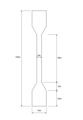
原材料の各樹脂シートとPTP用シートから、それぞれ図1に示す形状の試験片を切り出した。この試験片の端部を、125℃において、精密万能試験機((株)エー・アンド・ディ製「高温槽付きテンシロン」)にチャック間距離が30mmとなるように取り付け、チャック間の移動速度200mm/分にて移動を行い、150%伸長時の引張応力(150%引張応力)及び上降伏点を測定した。それぞれ3枚の試験片について測定した値を平均した値を、その原材料の樹脂シート及びPTP用シートの150%引張応力及び上降伏点とした。
(常温引張試験〉
原材料の樹脂シート及びPTP用シートについて、JIS K7127に準拠して常温で引張試験を行い、樹脂シートの引張弾性率(MPa)、PTP用シートのMD引張弾性率(MPa)及びTD引張弾性率(MPa)を測定した。
具体的には、熱プレス機で製造した原材料の各樹脂1種のみからなる樹脂シートと、PTP用シートから、それぞれ短冊状の試験片(長さ150mm×幅10mm)を切り出した。この試験片の端部を、精密万能試験機((株)島津製作所製「オートグラフ」)に、チャック間距離が50mmとなるように取り付け、チャック間の移動速度200mm/分にて移動を行い、2%伸長時の荷重を引張弾性率(MPa)とした。それぞれ3枚の試験片について測定した値を平均した値を、その原材料の樹脂シートの引張弾性率、PTP用シートのMD引張弾性率及びTD引張弾性率とした。
また、PTP用シートの150%引張応力について、1.8~3.0MPaである場合を「〇(良好)」、1.8MPa未満又は3.0MPa超である場合を「×(不良)」とした。
PTP用シートの上降伏点については、3MPa以下である場合を「〇(良好)」、3MPa超である場合を「×(不良)」とした。
PTP用シートのMD引張弾性率及びTD引張弾性率については、いずれも400~600MPaである場合を「〇(良好)」、一方でも400MPa未満又は600MPa超である場合を「×(不良)」として、柔軟性を評価した。
<Tensile test>
(High temperature tensile test)
A test piece having the shape shown in FIG. 1 was cut out from each resin sheet and PTP sheet as raw materials. The end of this test piece is attached to a precision universal testing machine ("Tensilon with high temperature tank" manufactured by A&D Co., Ltd.) at 125 ° C. so that the distance between chucks is 30 mm, and the moving speed between chucks is It was moved at 200 mm/min, and the tensile stress at 150% elongation (150% tensile stress) and the upper yield point were measured. The values obtained by averaging the values measured for each of the three test pieces were taken as the 150% tensile stress and the upper yield point of the resin sheet and the PTP sheet as raw materials.
(Normal temperature tensile test>
The raw material resin sheet and PTP sheet were subjected to a tensile test at room temperature in accordance with JIS K7127, and the tensile modulus (MPa) of the resin sheet, the MD tensile modulus (MPa) and TD tensile modulus of the PTP sheet ( MPa) was measured.
Specifically, a strip-shaped test piece (150 mm long×10 mm wide) was cut out from each of a resin sheet made of only one type of raw material resin produced by a heat press and a PTP sheet. The end of this test piece was attached to a precision universal testing machine (manufactured by Shimadzu Corporation, "Autograph") so that the distance between chucks was 50 mm, and the movement speed between chucks was 200 mm/min. , and the load at 2% elongation was taken as the tensile modulus (MPa). The values obtained by averaging the values measured for each of the three test pieces were taken as the tensile elastic modulus of the raw material resin sheet and the MD tensile elastic modulus and TD tensile elastic modulus of the PTP sheet.
In addition, regarding the 150% tensile stress of the PTP sheet, when it is 1.8 to 3.0 MPa, it is “O (good)”, and when it is less than 1.8 MPa or more than 3.0 MPa, it is “× (poor)”. did.
Regarding the upper yield point of the PTP sheet, when it was 3 MPa or less, it was evaluated as "◯ (good)", and when it exceeded 3 MPa, it was evaluated as "x (bad)".
Regarding the MD tensile modulus and TD tensile modulus of the PTP sheet, if both are 400 to 600 MPa, "O (good)", but if it is less than 400 MPa or more than 600 MPa, "X (bad)". , evaluated flexibility.
〈結晶融解熱量〉
PTP用シートからサンプル(5~10mg)を切り出し、示差走査熱量計(DSC)(日立ハイテクサイエンス社製「DSC7000X」)を用いて、窒素雰囲気下、熱量標準としてインジウムを使用して測定を行った。加熱プログラムとしては、サンプルを10℃/分の昇温速度で0℃から200℃まで昇温し、得られた熱流曲線の融解に起因する吸熱ピークに対して、低温側から外挿する直線をベースラインとして、結晶融解熱量(J/g)を求めた。
<Crystal melting heat>
A sample (5 to 10 mg) was cut out from the PTP sheet and measured using a differential scanning calorimeter (DSC) ("DSC7000X" manufactured by Hitachi High-Tech Science Co., Ltd.) under a nitrogen atmosphere using indium as a calorie standard. . As for the heating program, the temperature of the sample was raised from 0°C to 200°C at a heating rate of 10°C/min. As a baseline, the heat of crystal fusion (J/g) was determined.
〈シール性〉
PTP用シートについて、以下の手順でシール強度を測定した。
まず、PTP用シートのシール層と後述のとおり作製したポリプロピレンフィルム(厚み40μm)のTPO層とをヒートシールテスター(テスター産業(株)製)によりヒートシールした。その際のシール温度を100℃、シール時間を0.5秒、シール圧力を0.25MPaとした。その後、短冊状の試験片(PTP用シート及びポリプロピレンフィルムの長さ各40mm(計80mm)×幅15mm)を切り出した。この試験片のシール部を、精密万能試験機(島津製作所製、オートグラフ)のチャック間に配置し、幅5mmのヒートシール線が引張方向に対して垂直になり、かつチャック間距離が30mmとなるように試験片端部を取り付けた。チャック間の移動速度200mm/分にて移動を行い、180°剥離試験を実施し、シール部が完全に剥がれるまでの最大荷重をシール強度(N/15mm)とした。それぞれ5枚の試験片について測定した値を平均し、そのPTP用シートのシール強度とした。
[ポリプロピレンフィルムの作製]
共押出ダイレクトインフレーション法を用いて、ポリプロピレン樹脂(PP)層とポリオレフィン系エラストマー(TPO)層とを積層した2層のポリプロピレンフィルムを作製した。
具体的には、ポリプロピレン(後述のH-PP1)とポリオレフィン系エラストマー(後述のTPO-1)のペレットを、それぞれ樹脂の融解温度以上で溶融し、複数台の押出機を用いて各層を同時に押出した。押出された各層の樹脂をフィードパイプを通じて環状ダイに送り、環状ダイを介して各層が積層したチューブ状の積層フィルムを作製した。なお、厚み比がPP層:TPO層=80:20となるように調整した。
続いて、積層フィルムに空気を吹き込んで延伸させることにより、厚み40μmのポリプロピレンフィルムを得た。なお、延伸倍率は、MD30倍、TD2倍とした。
<Sealability>
The seal strength of the PTP sheet was measured according to the following procedure.
First, the seal layer of the PTP sheet and the TPO layer of a polypropylene film (thickness: 40 μm) prepared as described below were heat-sealed using a heat seal tester (manufactured by Tester Sangyo Co., Ltd.). At that time, the sealing temperature was 100° C., the sealing time was 0.5 seconds, and the sealing pressure was 0.25 MPa. After that, strip-shaped test pieces (PTP sheet and polypropylene film each having a length of 40 mm (a total of 80 mm) and a width of 15 mm) were cut out. The sealed portion of this test piece was placed between the chucks of a precision universal testing machine (manufactured by Shimadzu Corporation, Autograph), the heat seal line with a width of 5 mm was perpendicular to the tensile direction, and the distance between the chucks was 30 mm. The end of the test piece was attached so that A 180° peeling test was performed by moving between chucks at a moving speed of 200 mm/min, and the maximum load until the seal was completely peeled off was taken as the seal strength (N/15 mm). The values measured for each of the five test pieces were averaged and taken as the seal strength of the PTP sheet.
[Production of polypropylene film]
A two-layer polypropylene film was prepared by laminating a polypropylene resin (PP) layer and a polyolefin elastomer (TPO) layer using a co-extrusion direct inflation method.
Specifically, pellets of polypropylene (H-PP1 described later) and polyolefin elastomer (TPO-1 described later) are melted at a temperature higher than the melting temperature of the resin, and each layer is simultaneously extruded using multiple extruders. did. The extruded resin of each layer was sent to an annular die through a feed pipe to produce a tubular laminated film in which each layer was laminated through the annular die. The thickness ratio was adjusted to PP layer:TPO layer=80:20.
Subsequently, the laminated film was stretched by blowing air into it to obtain a polypropylene film having a thickness of 40 μm. In addition, the draw ratio was 30 times in MD and 2 times in TD.
〈成形性〉
PTP成形機(CKD(株)製「FBP-M1」)を用い、PTP用シートを、深さ:4mm、開口部分:直径10mmの円形、底面部分:直径8mmの円形の凹部を有し、深さ方向に直交する方向に延びる平均幅10mmのフランジ部を有する成形体(PTP用底材)に成形した。115~145℃の範囲で成形を行い、凹部が完全に成形された温度領域をそのPTP用シートの成形温度(℃)とした。
なお、「凹部が完全に成形された」とは、深さ:3.6~4mm、開口部分:直径9~10mmの円形、底面部分:直径7.7~8mmの円形の凹部を有する状態を指すものとする。
また、成形温度の温度幅が10℃以上である場合を「〇(優れる)」、7℃以上10℃未満である場合を「△(実用可能)」、7℃未満である場合を「×(不良)」として、成形性を評価した。
<Moldability>
Using a PTP molding machine (“FBP-M1” manufactured by CKD Co., Ltd.), a PTP sheet was formed with a depth of 4 mm, an opening portion having a circular diameter of 10 mm, and a bottom portion having a circular recess having a diameter of 8 mm. It was molded into a molded body (bottom material for PTP) having a flange portion with an average width of 10 mm extending in a direction orthogonal to the longitudinal direction. Molding was performed in the range of 115 to 145° C., and the temperature range in which the concave portions were completely formed was defined as the molding temperature (° C.) of the PTP sheet.
In addition, "the recess is completely formed" means that the depth is 3.6 to 4 mm, the opening part is circular with a diameter of 9 to 10 mm, and the bottom part is a circular recess with a diameter of 7.7 to 8 mm. shall point to
In addition, when the temperature range of the molding temperature is 10 ° C or more, "○ (excellent)", when it is 7 ° C or more and less than 10 ° C, "△ (practical)", when it is less than 7 ° C, "× ( The moldability was evaluated as "defective)".
〈リサイクル性〉
PTP用シートを10mm×10mm角に多数切り出し、H-PP樹脂(後述のH-PP1)のペレットと、PTP用シート:H-PP樹脂=80:20の質量割合で混合し、混錬・押出成形評価試験装置((株)東洋精機製作所製「ラボプラストミル」)で200℃、50rpmの条件下で10分間混錬した。混錬物を、熱プレス機(東洋精機(株)製)で200℃、面圧0.5MPaで90秒加熱プレスした後、200℃、面圧20MPaで60秒加熱プレスした。その後、1分間冷却することで厚み350~450μmのプレスシートを作製した。
プレスシートを35mm×35mm角に切り出し、測色色差計(日本電色工業(株)製「ZE6000」)を用い、透過モード、23℃、50%RHの条件でb*値を測定した。それぞれ3枚の試験片について測定した値を平均し、そのプレスシートのb*値とした。b*値が大きいほどフィルムの黄変度合いが大きいことを表す。
b*値が6未満である場合を「〇(優れる)」、6以上である場合を「×(不良)」として、リサイクル性を評価した。
<Recyclability>
A large number of PTP sheets are cut into 10 mm × 10 mm squares, and pellets of H-PP resin (H-PP1 described later) are mixed at a mass ratio of PTP sheet: H-PP resin = 80:20, kneaded and extruded. The mixture was kneaded for 10 minutes at 200° C. and 50 rpm using a molding evaluation testing device (“Laboplastomill” manufactured by Toyo Seiki Seisakusho Co., Ltd.). The kneaded material was heat-pressed at 200° C. and a surface pressure of 0.5 MPa for 90 seconds with a hot press (manufactured by Toyo Seiki Co., Ltd.), and then heat-pressed at 200° C. and a surface pressure of 20 MPa for 60 seconds. After that, it was cooled for 1 minute to prepare a pressed sheet having a thickness of 350 to 450 μm.
The press sheet was cut into 35 mm×35 mm squares, and the b* value was measured using a colorimetric colorimeter ("ZE6000" manufactured by Nippon Denshoku Industries Co., Ltd.) under the conditions of transmission mode, 23° C., and 50% RH. The b* value of the pressed sheet was obtained by averaging the values measured for each of the three test pieces. A higher b* value indicates a higher degree of yellowing of the film.
A case where the b* value was less than 6 was evaluated as "good (excellent)", and a case where the b* value was 6 or more was evaluated as "poor (poor)", and the recyclability was evaluated.
〈押込み荷重〉
上記〈成形性〉に記載の方法に従って成形した成形体について、以下の手順で押込み荷重(N)を測定した。
成形体から、ポケットを1つ含むようにして17mm×17mm角の試験片を切り出した。切り出した試験片のポケット底面を上面にして、直径10mmの穴を有する治具に固定した。精密万能試験機(島津製作所、オートグラフ)に、先端が径4mmで平板状の針を装着し、固定した試験片に、ポケットの底面側から垂直に押し込むことで、押込み荷重試験を行った。測定は温度23℃、湿度50%RHの環境下で行い、針の移動速度は50mm/分とし、ポケット底面がフランジ部と同じ高さになるまで押し込まれた際にかかる圧縮荷重の最大値を測定した。それぞれ3つの試験片について測定した圧縮荷重の最大値を平均し、その値を成形体の押込み荷重とした。
押込み荷重が15N以上21N以下である場合を「〇(良好)」、15N未満又は21N超である場合を「×(不良)」として、評価した。
<Indentation load>
The indentation load (N) was measured according to the following procedure for the molded article molded according to the method described in <Moldability> above.
A test piece of 17 mm x 17 mm square was cut out from the compact so as to include one pocket. The cut test piece was fixed to a jig having a hole with a diameter of 10 mm with the bottom of the pocket facing up. A precision universal testing machine (Shimadzu Corporation, Autograph) was equipped with a needle having a flat tip with a diameter of 4 mm, and the fixed test piece was vertically pushed from the bottom side of the pocket to perform an indentation load test. The measurement was performed in an environment with a temperature of 23°C and a humidity of 50% RH, with a needle moving speed of 50 mm/min. It was measured. The maximum value of the compressive load measured for each of the three test pieces was averaged, and this value was taken as the indentation load of the compact.
The case where the indentation load was 15 N or more and 21 N or less was evaluated as "Good (good)", and the case where it was less than 15 N or more than 21 N was evaluated as "Poor (poor)".
実施例及び比較例で使用した原材料は以下のとおりである。 Raw materials used in Examples and Comparative Examples are as follows.
〈ポリプロピレン(PP)系樹脂〉
・H-PP1:ポリプロピレンホモポリマー(サンアロマー(株)製「PL500A」)
・H-PP2:ポリプロピレンホモポリマー(サンアロマー(株)製「VS700A」)
・H-PP3:ポリプロピレンホモポリマー(サンアロマー(株)製「PLB00A」)
・R-PP1:ポリプロピレンランダムコポリマー(サンアロマー(株)製「PC540R」)
・R-PP2:ポリプロピレンランダムコポリマー(住友化学(株)製「住友ノーブレン(登録商標)S131」)
・R-PP3:ポリプロピレンランダムコポリマー(サンアロマー(株)製「PS320M」)
<Polypropylene (PP) resin>
・ H-PP1: Polypropylene homopolymer (“PL500A” manufactured by SunAllomer Co., Ltd.)
・ H-PP2: Polypropylene homopolymer (“VS700A” manufactured by SunAllomer Co., Ltd.)
・ H-PP3: Polypropylene homopolymer (“PLB00A” manufactured by SunAllomer Co., Ltd.)
・ R-PP1: Polypropylene random copolymer ("PC540R" manufactured by SunAllomer Co., Ltd.)
・ R-PP2: polypropylene random copolymer ("Sumitomo Noblen (registered trademark) S131" manufactured by Sumitomo Chemical Co., Ltd.)
・ R-PP3: Polypropylene random copolymer (“PS320M” manufactured by SunAllomer Co., Ltd.)
〈オレフィン系熱可塑性エラストマー(TPO)〉
・TPO-1:プロピレン-α-オレフィンコポリマー(三井化学(株)製、タフマー(登録商標)XM7070S)
<Thermoplastic olefin elastomer (TPO)>
・TPO-1: Propylene-α-olefin copolymer (Tafmer (registered trademark) XM7070S, manufactured by Mitsui Chemicals, Inc.)
ポリプロピレン系樹脂及びオレフィン系熱可塑性エラストマーの物性を表1に示す。

[実施例1]
共押出ダイレクトインフレーション法を用いて、H-PP1とR-PP1との混合物からなる基材層と、とR-PP1とTPO-1との混合物からなるヒートシール層とを積層した2層のPTP用シートを作製した。
具体的には、各層ごとに押出機を用い、原材料である樹脂のペレットを樹脂の融解温度以上で溶融し、各層をそれぞれの押出機から同時に押出した。押出された各層の樹脂をフィードパイプを通じて環状ダイに送り、環状ダイを介して各層が積層したチューブ状の積層フィルムを作製した。なお、厚み比が基材層:TPO層=90:10となるように調整した。
続いて、積層フィルムに空気を吹き込んで延伸させることにより、厚み300μmのPTP用シートを得た。
組成及び各物性の測定・評価結果を表2に示す。
[Example 1]
A two-layer PTP in which a substrate layer made of a mixture of H-PP1 and R-PP1 and a heat seal layer made of a mixture of R-PP1 and TPO-1 are laminated using a coextrusion direct inflation method. A sheet for
Specifically, an extruder was used for each layer, pellets of a resin as a raw material were melted at a temperature higher than the melting temperature of the resin, and each layer was simultaneously extruded from the respective extruders. The extruded resin of each layer was sent to an annular die through a feed pipe to prepare a tubular laminated film in which each layer was laminated through the annular die. In addition, the thickness ratio was adjusted so that the base material layer:TPO layer=90:10.
Subsequently, by blowing air into the laminated film to stretch it, a PTP sheet having a thickness of 300 μm was obtained.
Table 2 shows the composition and measurement/evaluation results of each physical property.
[実施例2~7、比較例1~5]
実施例2~7、比較例1~5は、表2、表3に示すように原材料、層比率等を変更したこと以外は実施例1と同様にして、PTP用シートを作製した。
組成及び各物性の測定・評価結果を表2、表3に示す。
[Examples 2 to 7, Comparative Examples 1 to 5]
In Examples 2 to 7 and Comparative Examples 1 to 5, PTP sheets were produced in the same manner as in Example 1 except that the raw materials, layer ratios, etc. were changed as shown in Tables 2 and 3.
Tables 2 and 3 show the composition and measurement/evaluation results of each physical property.
[比較例6]
特開平11-129417号公報に記載の実施例2を参考に、厚み0.30mmの層構成がH-PP1/H-PP1(85質量%)+ジシクロペンタジエン系石油樹脂(15質量%)/H-PP1からなる3層系シートを、実施例1と同様の手法で作製し、PPシートを得た。なお、各層の厚みは0.015mm/0.27mm/0.015mmとした。
表3に示すように、得られたPPシートをPTP用シートとした。
組成及び各物性の測定・評価結果を表3に示す。
[Comparative Example 6]
With reference to Example 2 described in JP-A-11-129417, the layer structure with a thickness of 0.30 mm is H-PP1 / H-PP1 (85% by mass) + dicyclopentadiene petroleum resin (15% by mass) / A three-layer sheet made of H-PP1 was produced in the same manner as in Example 1 to obtain a PP sheet. The thickness of each layer was 0.015 mm/0.27 mm/0.015 mm.
As shown in Table 3, the obtained PP sheet was used as a PTP sheet.
Table 3 shows the composition and measurement/evaluation results of each physical property.


本発明のPTPシートは、錠剤、カプセル等の医薬品やキャンディーやチョコレート等の食品の包装に好適に使用できる。 The PTP sheet of the present invention can be suitably used for packaging pharmaceuticals such as tablets and capsules, and foods such as candies and chocolates.
Claims (6)
厚みが200~400μmであり、
125℃で引張試験を行ったときに、150%伸長時の引張応力(150%引張応力)が1.8~3.0MPaであり、
示差走査熱量計(DSC)による結晶融解熱量が63.0~80.0J/gである
ことを特徴とする、PTP用シート。 including polypropylene resin,
The thickness is 200 to 400 μm,
When a tensile test is performed at 125 ° C., the tensile stress at 150% elongation (150% tensile stress) is 1.8 to 3.0 MPa,
A PTP sheet characterized by having a heat of crystal fusion of 63.0 to 80.0 J/g measured by a differential scanning calorimeter (DSC).
前記PTP用シートの押込み荷重が15~21Nである
ことを特徴とする、成形体。
including the PTP sheet according to any one of claims 1 to 5,
A molded product, wherein the PTP sheet has an indentation load of 15 to 21N.
Priority Applications (1)
| Application Number | Priority Date | Filing Date | Title |
|---|---|---|---|
| JP2022015872A JP2023113473A (en) | 2022-02-03 | 2022-02-03 | PTP sheet and molding |
Applications Claiming Priority (1)
| Application Number | Priority Date | Filing Date | Title |
|---|---|---|---|
| JP2022015872A JP2023113473A (en) | 2022-02-03 | 2022-02-03 | PTP sheet and molding |
Publications (1)
| Publication Number | Publication Date |
|---|---|
| JP2023113473A true JP2023113473A (en) | 2023-08-16 |
Family
ID=87566294
Family Applications (1)
| Application Number | Title | Priority Date | Filing Date |
|---|---|---|---|
| JP2022015872A Pending JP2023113473A (en) | 2022-02-03 | 2022-02-03 | PTP sheet and molding |
Country Status (1)
| Country | Link |
|---|---|
| JP (1) | JP2023113473A (en) |
Cited By (1)
| Publication number | Priority date | Publication date | Assignee | Title |
|---|---|---|---|---|
| WO2025013899A1 (en) | 2023-07-11 | 2025-01-16 | 株式会社スリーボンド | Detergent composition and coating agent composition |
Citations (4)
| Publication number | Priority date | Publication date | Assignee | Title |
|---|---|---|---|---|
| JPH09314770A (en) * | 1996-05-31 | 1997-12-09 | Sumitomo Bakelite Co Ltd | Ptp wrapping polypropylene sheet |
| JPH11105217A (en) * | 1997-10-06 | 1999-04-20 | Tohcello Co Ltd | Laminated film for press through pack cover |
| JP2012001588A (en) * | 2010-06-15 | 2012-01-05 | Mitsubishi Plastics Inc | Propylenic sheet |
| JP2017088239A (en) * | 2015-11-17 | 2017-05-25 | 三菱樹脂株式会社 | Multilayer sheet for ptp and ptp packaging body using the same |
-
2022
- 2022-02-03 JP JP2022015872A patent/JP2023113473A/en active Pending
Patent Citations (4)
| Publication number | Priority date | Publication date | Assignee | Title |
|---|---|---|---|---|
| JPH09314770A (en) * | 1996-05-31 | 1997-12-09 | Sumitomo Bakelite Co Ltd | Ptp wrapping polypropylene sheet |
| JPH11105217A (en) * | 1997-10-06 | 1999-04-20 | Tohcello Co Ltd | Laminated film for press through pack cover |
| JP2012001588A (en) * | 2010-06-15 | 2012-01-05 | Mitsubishi Plastics Inc | Propylenic sheet |
| JP2017088239A (en) * | 2015-11-17 | 2017-05-25 | 三菱樹脂株式会社 | Multilayer sheet for ptp and ptp packaging body using the same |
Cited By (1)
| Publication number | Priority date | Publication date | Assignee | Title |
|---|---|---|---|---|
| WO2025013899A1 (en) | 2023-07-11 | 2025-01-16 | 株式会社スリーボンド | Detergent composition and coating agent composition |
Similar Documents
| Publication | Publication Date | Title |
|---|---|---|
| US7651779B2 (en) | Resin composition having easy-openable property | |
| CN101233185A (en) | Polypropylene resin composition, film or sheet, stretched film produced from the film or sheet, laminate, and stretched film produced from the laminate | |
| JP6463995B2 (en) | Resin composition, film, laminated film, laminate, easy peel material and cover tape | |
| JP2011501775A (en) | Polyolefin-based peelable seal | |
| JP7444761B2 (en) | PTP lid material and PTP packaging | |
| JP2018127556A (en) | Resin composition, lid material for easily-openable container, and easily-openable container | |
| US11866572B2 (en) | Polyolefin-based resin film and laminate including the same | |
| CN1740223A (en) | Resin composition and film obtained therefrom | |
| JP6717639B2 (en) | Multilayer film and manufacturing method thereof | |
| JP4935123B2 (en) | Laminated polypropylene unstretched film | |
| JP6822198B2 (en) | Sealant adhesive and easy-to-peel film | |
| JP7755756B2 (en) | Polypropylene-based unstretched film and laminate using the same | |
| JP6717641B2 (en) | Multilayer film and manufacturing method thereof | |
| JP2004035711A (en) | Heat sealable film and laminate using the same | |
| JP2012001588A (en) | Propylenic sheet | |
| KR102852188B1 (en) | Covering material for PTP and PTP packaging body | |
| KR102852189B1 (en) | Covering material for PTP and PTP packaging body | |
| JP2021133590A (en) | Easy-to-open film and packaging | |
| JP6582461B2 (en) | Resin composition and easily peelable film | |
| JP2023172393A (en) | PTP lidding film, its manufacturing method, and PTP packaging | |
| JP2025156235A (en) | Press-through package lid material film and press-through package | |
| JP4237185B2 (en) | Propylene-based block copolymer composition and use thereof | |
| JP6572563B2 (en) | Resin composition and easily peelable film | |
| JP6639306B2 (en) | Multilayer film and method for producing the same | |
| WO2024111565A1 (en) | Laminate, film and packaging material |
Legal Events
| Date | Code | Title | Description |
|---|---|---|---|
| A621 | Written request for application examination |
Free format text: JAPANESE INTERMEDIATE CODE: A621 Effective date: 20241119 |
|
| A977 | Report on retrieval |
Free format text: JAPANESE INTERMEDIATE CODE: A971007 Effective date: 20250828 |
|
| A131 | Notification of reasons for refusal |
Free format text: JAPANESE INTERMEDIATE CODE: A131 Effective date: 20250924 |
|
| A02 | Decision of refusal |
Free format text: JAPANESE INTERMEDIATE CODE: A02 Effective date: 20260217 |