JP2024032425A - Carbon-based metal adsorbent - Google Patents
Carbon-based metal adsorbent Download PDFInfo
- Publication number
- JP2024032425A JP2024032425A JP2022136073A JP2022136073A JP2024032425A JP 2024032425 A JP2024032425 A JP 2024032425A JP 2022136073 A JP2022136073 A JP 2022136073A JP 2022136073 A JP2022136073 A JP 2022136073A JP 2024032425 A JP2024032425 A JP 2024032425A
- Authority
- JP
- Japan
- Prior art keywords
- carbon
- amount
- based metal
- metal adsorbent
- nitrogen
- Prior art date
- Legal status (The legal status is an assumption and is not a legal conclusion. Google has not performed a legal analysis and makes no representation as to the accuracy of the status listed.)
- Granted
Links
Images


Landscapes
- Solid-Sorbent Or Filter-Aiding Compositions (AREA)
Abstract
Description
本発明は炭素系金属吸着材に関するものである。 The present invention relates to a carbon-based metal adsorbent.
工場などからの排水に含まれる金属は微量であっても河川汚染や土壌汚染などの原因となり、また人体にも悪影響を及ぼす。また製品の生産過程などで使用された洗浄水などの液体からは金属は不純物として除去することが求められている。そのため浄水や排水などの液体に含まれている金属を除去する手段の一つとして活性炭などの多孔質吸着材が用いられている。 Even minute amounts of metals contained in wastewater from factories can cause river and soil pollution, and they can also have a negative impact on the human body. Furthermore, there is a need to remove metals as impurities from liquids such as cleaning water used in product production processes. Therefore, porous adsorbents such as activated carbon are used as a means for removing metals contained in liquids such as purified water and wastewater.
近年、多孔質吸着材を改質して金属吸着性能をより一層向上させる技術が提案されている。
例えば特許文献1には、炭素質材料を酸性ガスにより賦活処理して得られた活性炭をさらに酸化剤で処理して、全酸性官能基量とカルボン酸由来の酸性官能基量を制御した活性炭が開示されている。
また特許文献2には、金属酸化物多孔体の細孔内に窒素含有有機化合物を導入し、該有機化合物を熱分解させて細孔内に炭素原子と窒素原子により骨格が形成された多孔体が開示されている。
In recent years, techniques have been proposed to further improve metal adsorption performance by modifying porous adsorbents.
For example, Patent Document 1 discloses activated carbon obtained by activating a carbonaceous material with an acidic gas and further treating it with an oxidizing agent to control the total amount of acidic functional groups and the amount of acidic functional groups derived from carboxylic acid. Disclosed.
Furthermore,
本発明の目的は、金属に対して優れた吸着性能を有する吸着材を提供することである。 An object of the present invention is to provide an adsorbent having excellent adsorption performance for metals.
本発明の金属吸着材は以下の構成を有する。
[1] 比表面積が100~4000m2/g、
カルボキシ基量が0.6~5.0meq/g、且つ
塩基性官能基量に占める炭素系金属吸着材中の窒素分が3~100μeq/g、
である炭素系金属吸着材。
The metal adsorbent of the present invention has the following configuration.
[1] Specific surface area is 100 to 4000 m 2 /g,
The amount of carboxy groups is 0.6 to 5.0 meq/g, and the nitrogen content in the carbon-based metal adsorbent relative to the amount of basic functional groups is 3 to 100 μeq/g,
A carbon-based metal adsorbent.
[2] 前記炭素系金属吸着材を元素分析して得られる炭素、窒素、水素、酸素の合計量に対する窒素の比率が1~20質量%、且つ
前記塩基性官能基量が0.17meq/g超、0.60meq/g以下、
である[1]に記載の炭素系金属吸着材。
[2] The ratio of nitrogen to the total amount of carbon, nitrogen, hydrogen, and oxygen obtained by elemental analysis of the carbon-based metal adsorbent is 1 to 20% by mass, and the amount of basic functional groups is 0.17 meq/g. Super, 0.60 meq/g or less,
The carbon-based metal adsorbent according to [1].
[3] 全酸性官能基量が1.5~5.0meq/g、且つ
全酸性官能基量に対するカルボキシ基量の比率が31~100%、
である[1]に記載の炭素系金属吸着材。
[3] The total amount of acidic functional groups is 1.5 to 5.0 meq/g, and the ratio of the amount of carboxy groups to the total amount of acidic functional groups is 31 to 100%,
The carbon-based metal adsorbent according to [1].
[4] 前記炭素系金属吸着材は、アルカリ賦活された活性炭である[1]に記載の炭素系金属吸着材。 [4] The carbon-based metal adsorbent according to [1], wherein the carbon-based metal adsorbent is alkali-activated activated carbon.
[5] 前記金属が、周期表第3~第15族に属する金属である[1]に記載の炭素系金属吸着材。 [5] The carbon-based metal adsorbent according to [1], wherein the metal is a metal belonging to Groups 3 to 15 of the periodic table.
[6] [1]~[5]のいずれかに記載の炭素系金属吸着材を用いた金属除去材、または金属担持体。 [6] A metal removal material or metal support using the carbon-based metal adsorbent according to any one of [1] to [5].
本発明によれば、金属、特に周期表第3~第15族に属する金属に対して優れた吸着性能を有する炭素系金属吸着材を提供できる。 According to the present invention, it is possible to provide a carbon-based metal adsorbent having excellent adsorption performance for metals, particularly metals belonging to Groups 3 to 15 of the periodic table.
本発明の炭素系金属吸着材は、比表面積が100~4000m2/g、カルボキシ基量が0.6~5.0meq/g、且つ塩基性官能基量に占める炭素系金属吸着材中の窒素分が3~100μeq/gである。
塩基性官能基量に占める炭素系金属吸着材中の窒素分は、炭素系金属吸着材を元素分析して得られる炭素、窒素、水素、酸素の合計量に対する窒素の比率を塩基性官能基量に乗じた値である。
特に本発明の炭素系金属吸着材は、(I)カルボキシ基量、及び(II)塩基性官能基量に占める炭素系金属吸着材中の窒素分を適切に制御することによって、これらが制御されていない従来の吸着材と比べて優れた金属吸着性能を示す。
The carbon-based metal adsorbent of the present invention has a specific surface area of 100 to 4000 m 2 /g, a carboxy group content of 0.6 to 5.0 meq/g, and a nitrogen content in the carbon-based metal adsorbent that accounts for the basic functional group content. minutes is 3 to 100 μeq/g.
The nitrogen content in the carbon-based metal adsorbent based on the amount of basic functional groups is determined by calculating the ratio of nitrogen to the total amount of carbon, nitrogen, hydrogen, and oxygen obtained by elemental analysis of the carbon-based metal adsorbent. It is the value multiplied by
In particular, in the carbon-based metal adsorbent of the present invention, these can be controlled by appropriately controlling the nitrogen content in the carbon-based metal adsorbent that accounts for (I) the amount of carboxy groups and (II) the amount of basic functional groups. It exhibits superior metal adsorption performance compared to conventional adsorbents that do not.
炭素系金属吸着材
本発明の炭素系金属吸着材は、炭素を主体とする吸着材である。炭素を主体とは、炭素系金属吸着材を元素分析装置で分析して得られる炭素、窒素、水素、酸素の合計量に対する炭素の比率が好ましくは50質量%以上、より好ましくは55質量%以上、さらに好ましくは60質量%以上、よりさらに好ましくは65質量%以上である。
炭素系金属吸着材は細孔を有する多孔質体であり、金属は細孔内に吸着される。このような性質を有する炭素系金属吸着材としては、好ましくはアルカリ賦活された活性炭(アルカリ賦活炭ということがある)である。
なお、本発明の優れた金属吸着性能とは、同等の比表面積を有する従来の多孔質吸着材と比べた場合に金属吸着量が多いことを意味する。吸着材の金属吸着量は比表面積を大きくすると増加するため、比表面積を同等にして比較する。
吸着対象である金属は、特に限定されないが、好ましくは周期表第3~第15族に属する金属、より好ましくは周期表第3~第14族、さらに好ましくは周期表第3~第11族、よりさらに好ましくは周期表第8~第11族である。また吸着対象の金属は周期表第8~14族であってもよい。あるいは本発明の吸着対象の金属は好ましくは任意の1以上の重金属、より好ましくは任意の1以上の遷移金属、さらに好ましくはコバルト、鉄、銅、および鉛よりなる群から選ばれる少なくとも1種であってもよい。
Carbon-based metal adsorbent The carbon-based metal adsorbent of the present invention is an adsorbent mainly composed of carbon. Mainly composed of carbon means that the ratio of carbon to the total amount of carbon, nitrogen, hydrogen, and oxygen obtained by analyzing a carbon-based metal adsorbent with an elemental analyzer is preferably 50% by mass or more, more preferably 55% by mass or more. , more preferably 60% by mass or more, even more preferably 65% by mass or more.
A carbon-based metal adsorbent is a porous body having pores, and metals are adsorbed within the pores. The carbon-based metal adsorbent having such properties is preferably alkali-activated activated carbon (sometimes referred to as alkali-activated carbon).
In addition, the excellent metal adsorption performance of the present invention means that the amount of metal adsorption is large when compared with a conventional porous adsorbent having an equivalent specific surface area. Since the amount of metal adsorbed by the adsorbent increases as the specific surface area increases, comparisons are made with the specific surface area being the same.
The metal to be adsorbed is not particularly limited, but preferably metals belonging to Groups 3 to 15 of the periodic table, more preferably metals belonging to Groups 3 to 14 of the periodic table, still more preferably metals belonging to Groups 3 to 11 of the periodic table, Even more preferred are
比表面積
本発明の炭素系金属吸着材の比表面積は100~4000m2/gである。
比表面積を大きくすると金属含有溶液等の被処理媒体との接触面積が大きくなるため処理性能が向上すると共に、金属吸着量が増大する。一方、比表面積が大きくなりすぎると、カルボキシ基などの酸性官能基量が減少すると共に、炭素系金属吸着材中の窒素含有量が減少し、所望の金属吸着性能を発揮できないことがある。
炭素系金属吸着材の比表面積は、好ましくは250m2/g以上、より好ましくは1000m2/g以上、さらに好ましくは1500m2/g以上、よりさらに好ましくは2000m2/g以上であって、好ましくは3500m2/g以下、より好ましくは3000m2/g以下である。
Specific Surface Area The carbon-based metal adsorbent of the present invention has a specific surface area of 100 to 4000 m 2 /g.
When the specific surface area is increased, the contact area with the medium to be treated such as a metal-containing solution is increased, so that the treatment performance is improved and the amount of metal adsorption is increased. On the other hand, if the specific surface area becomes too large, the amount of acidic functional groups such as carboxy groups decreases, and the nitrogen content in the carbon-based metal adsorbent decreases, so that the desired metal adsorption performance may not be exhibited.
The specific surface area of the carbon-based metal adsorbent is preferably 250 m 2 /g or more, more preferably 1000 m 2 /g or more, even more preferably 1500 m 2 /g or more, even more preferably 2000 m 2 /g or more, and preferably is 3500 m 2 /g or less, more preferably 3000 m 2 /g or less.
細孔容積
本発明では炭素系金属吸着材の細孔容積を適切に制御することも好ましい実施態様である。
細孔容積が小さすぎると十分な金属吸着容量を確保できないことがある。一方、細孔容積が大きすぎると嵩高くなって使用時の充填量が減少すると共に金属吸着に適していない微細な細孔が増えて金属吸着性能が低下することがある。
炭素系金属吸着材の細孔容積は、好ましくは0.05ml/g以上、より好ましくは0.1ml/g以上であって、好ましくは2.5ml/g以下、より好ましくは2.0ml/g以下である。
Pore Volume In the present invention, it is also a preferred embodiment to appropriately control the pore volume of the carbon-based metal adsorbent.
If the pore volume is too small, sufficient metal adsorption capacity may not be ensured. On the other hand, if the pore volume is too large, it becomes bulky and the filling amount during use decreases, and the number of fine pores that are not suitable for metal adsorption increases, leading to a decrease in metal adsorption performance.
The pore volume of the carbon-based metal adsorbent is preferably 0.05 ml/g or more, more preferably 0.1 ml/g or more, and preferably 2.5 ml/g or less, more preferably 2.0 ml/g. It is as follows.
平均細孔径
本発明では炭素系金属吸着材の平均細孔径を適切に制御することも好ましい実施態様である。平均細孔径が小さすぎると金属が細孔内に入り込みにくく、十分な吸着性能が得られないことがある。一方、平均細孔径が大きくなりすぎると嵩高くなって使用時の充填量が減少することがある。
炭素系金属吸着材の平均細孔径は、好ましくは0.5nm以上、より好ましくは1.0nm以上、さらに好ましくは1.5nm以上であって、好ましくは4nm以下、より好ましくは3.5nm以下、さらに好ましくは3.0nm以下、よりさらに好ましくは2.5nm以下である。
Average Pore Diameter In the present invention, it is also a preferred embodiment to appropriately control the average pore diameter of the carbon-based metal adsorbent. If the average pore diameter is too small, it may be difficult for the metal to enter the pores, and sufficient adsorption performance may not be obtained. On the other hand, if the average pore diameter becomes too large, it may become bulky and the amount of filling during use may decrease.
The average pore diameter of the carbon-based metal adsorbent is preferably 0.5 nm or more, more preferably 1.0 nm or more, even more preferably 1.5 nm or more, and preferably 4 nm or less, more preferably 3.5 nm or less, More preferably, it is 3.0 nm or less, even more preferably 2.5 nm or less.
全酸性官能基量
全酸性官能基とはカルボキシ基、カルボニル基、フェノール基、ラクトン基など、実施例に記載の方法で測定される全ての酸性官能基である。
本発明では炭素系金属吸着材の全酸性官能基量を適切に制御することも好ましい実施態様である。全酸性官能基量が増えると金属イオンとイオン交換可能なカルボキシ基の含有量が増加し、優れた金属吸着性能を示す。全酸性官能基量が少なすぎると、十分なカルボキシ基量を確保できないことがある。一方、全酸性官能基量が多すぎると塩基性官能基量に占める炭素系金属吸着材中の窒素分が減少することがある。
本発明の炭素系金属吸着材に含まれる全酸性官能基量は好ましくは1.5meq/g以上、より好ましくは1.7meq/g以上、さらに好ましくは2.0meq/g以上、よりさらに好ましくは2.2meq/g以上、最も好ましくは2.5meq/g以上であって、好ましくは5.0meq/g以下、より好ましくは4.0meq/g以下、さらに好ましくは3.5meq/g以下、よりさらに好ましくは3.0meq/g以下である。
Amount of Total Acidic Functional Groups The total acidic functional groups are all acidic functional groups such as carboxy groups, carbonyl groups, phenol groups, and lactone groups that are measured by the method described in Examples.
In the present invention, it is also a preferred embodiment to appropriately control the total amount of acidic functional groups in the carbon-based metal adsorbent. As the total amount of acidic functional groups increases, the content of carboxy groups capable of ion exchange with metal ions increases, exhibiting excellent metal adsorption performance. If the total amount of acidic functional groups is too small, a sufficient amount of carboxy groups may not be ensured. On the other hand, if the total amount of acidic functional groups is too large, the nitrogen content in the carbon-based metal adsorbent may decrease in the amount of basic functional groups.
The total amount of acidic functional groups contained in the carbon-based metal adsorbent of the present invention is preferably 1.5 meq/g or more, more preferably 1.7 meq/g or more, even more preferably 2.0 meq/g or more, even more preferably 2.2 meq/g or more, most preferably 2.5 meq/g or more, preferably 5.0 meq/g or less, more preferably 4.0 meq/g or less, even more preferably 3.5 meq/g or less, and more More preferably, it is 3.0 meq/g or less.
カルボキシ基量
本発明の炭素系金属吸着材に含まれるカルボキシ基量は0.6~5.0meq/gである。
カルボキシ基の含有量が多いと金属に対する吸着性能が向上する。一方、カルボキシ基の含有量が多くなりすぎると塩基性官能基量に占める炭素系金属吸着材中の窒素分が低くなり、金属吸着性能が低下する。
カルボキシ基の含有量は、好ましくは0.61meq/g以上、より好ましくは0.65meq/g以上、さらに好ましくは0.69meq/g以上、よりさらに好ましくは0.7meq/g以上であって、好ましくは4.0meq/g以下、より好ましくは3.5meq/g以下、さらに好ましくは3.0meq/g以下、よりさらに好ましくは2.5meq/g以下、最も好ましくは2.0meq/g以下である。
Amount of Carboxy Group The amount of carboxy group contained in the carbon-based metal adsorbent of the present invention is 0.6 to 5.0 meq/g.
When the content of carboxyl groups is large, the adsorption performance for metals is improved. On the other hand, if the content of carboxy groups becomes too large, the nitrogen content in the carbon-based metal adsorbent relative to the amount of basic functional groups decreases, resulting in a decrease in metal adsorption performance.
The content of carboxy groups is preferably 0.61 meq/g or more, more preferably 0.65 meq/g or more, even more preferably 0.69 meq/g or more, even more preferably 0.7 meq/g, Preferably 4.0 meq/g or less, more preferably 3.5 meq/g or less, even more preferably 3.0 meq/g or less, even more preferably 2.5 meq/g or less, most preferably 2.0 meq/g or less. be.
全酸性官能基量に対するカルボキシ基量の比率
本発明では炭素系金属吸着材の全酸性官能基量に対するカルボキシ基量の比率を適切に制御することも好ましい実施態様である。カルボキシ基量の比率が高い程、金属吸着性能が向上する。
全酸性官能基量に対するカルボキシ基量の比率は、好ましくは31%以上、より好ましくは32%以上であって、好ましくは100%以下、より好ましくは80%以下、さらに好ましくは60%以下、よりさらに好ましくは40%以下である。
Ratio of the amount of carboxy groups to the total amount of acidic functional groups In the present invention, it is also a preferred embodiment to appropriately control the ratio of the amount of carboxy groups to the total amount of acidic functional groups in the carbon-based metal adsorbent. The higher the ratio of carboxy groups, the better the metal adsorption performance.
The ratio of the amount of carboxy groups to the total amount of acidic functional groups is preferably 31% or more, more preferably 32% or more, and preferably 100% or less, more preferably 80% or less, still more preferably 60% or less, and More preferably, it is 40% or less.
塩基性官能基量
本発明では炭素系金属吸着材に含まれる塩基性官能基量を適切に制御することも好ましい実施態様である。
塩基性官能基とは、アミノ基などの正の荷電を有する官能基であり、実施例に記載の方法で測定される全ての塩基性官能基である。
塩基性官能基の含有量が少なすぎると、塩基性官能基量に占める炭素系金属吸着材中の窒素分が上記範囲を外れ、金属吸着性能が低下することがある。一方、塩基性官能基量が多くなりすぎるとカルボキシ基量が低くなり、金属に対する吸着性能が低下することがある。
塩基性官能基の含有量は、好ましくは0.17meq/g超、より好ましくは0.2meq/g以上、さらに好ましくは0.3meq/g以上、よりさらに好ましくは0.35meq/g以上であって、好ましくは0.60meq/g以下、より好ましくは0.5meq/g以下、さらに好ましくは0.4meq/g以下である。
Amount of Basic Functional Groups In the present invention, it is also a preferred embodiment to appropriately control the amount of basic functional groups contained in the carbon-based metal adsorbent.
The basic functional group is a positively charged functional group such as an amino group, and includes all basic functional groups measured by the method described in Examples.
If the content of basic functional groups is too small, the nitrogen content in the carbon-based metal adsorbent relative to the amount of basic functional groups may fall outside the above range, resulting in a decrease in metal adsorption performance. On the other hand, if the amount of basic functional groups becomes too large, the amount of carboxy groups decreases, and the adsorption performance for metals may decrease.
The content of basic functional groups is preferably more than 0.17 meq/g, more preferably 0.2 meq/g or more, even more preferably 0.3 meq/g or more, even more preferably 0.35 meq/g or more. It is preferably 0.60 meq/g or less, more preferably 0.5 meq/g or less, even more preferably 0.4 meq/g or less.
窒素の比率
本発明では炭素系金属吸着材を元素分析して得られる炭素、窒素、水素、酸素の合計量に対する窒素の比率を制御することも好ましい実施態様である。
炭素系金属吸着材に含まれる窒素比率を高くすると、塩基性官能基量に占める炭素系金属吸着材中の窒素分が増加して金属吸着性能が向上する。窒素比率が高すぎると比表面積およびカルボキシ基量が減少することがあり、バランスが取れず金属吸着性能が低下することがある。
窒素の比率は、炭素系金属吸着材を元素分析装置で分析して得られる炭素、窒素、水素、酸素の合計量に対する窒素量の比率を算出する。なお、酸素量は実施例に記載の式に基づいて算出された値である。
炭素、窒素、水素、酸素の合計量に対する窒素量の比率は、好ましくは1質量%以上、より好ましくは1.5質量%以上、さらに好ましくは2.0質量%以上であって、好ましくは20質量%以下、より好ましくは18質量%以下、さらに好ましくは16質量%以下、よりさらに好ましくは15質量%以下である。
Ratio of Nitrogen In the present invention, it is also a preferred embodiment to control the ratio of nitrogen to the total amount of carbon, nitrogen, hydrogen, and oxygen obtained by elemental analysis of the carbon-based metal adsorbent.
When the nitrogen ratio contained in the carbon-based metal adsorbent is increased, the nitrogen content in the carbon-based metal adsorbent increases in the amount of basic functional groups, and the metal adsorption performance is improved. If the nitrogen ratio is too high, the specific surface area and the amount of carboxy groups may decrease, resulting in an imbalance and a decrease in metal adsorption performance.
The ratio of nitrogen is calculated by calculating the ratio of the amount of nitrogen to the total amount of carbon, nitrogen, hydrogen, and oxygen obtained by analyzing the carbon-based metal adsorbent with an elemental analyzer. Note that the oxygen amount is a value calculated based on the formula described in Examples.
The ratio of the amount of nitrogen to the total amount of carbon, nitrogen, hydrogen, and oxygen is preferably 1% by mass or more, more preferably 1.5% by mass or more, even more preferably 2.0% by mass or more, and preferably 20% by mass or more. It is at most 18% by mass, even more preferably at most 16% by mass, even more preferably at most 15% by mass.
塩基性官能基量に占める炭素系金属吸着材中の窒素分
本発明の炭素系金属吸着材は、塩基性官能基量に占める炭素系金属吸着材中の窒素分は3~100μeq/gである。
カルボキシ基量が上記所定の範囲において、塩基性官能基量に占める炭素系金属吸着材中の窒素分が所定の範囲で存在すると、優れた金属吸着性能を発揮する。塩基性官能基量に占める炭素系金属吸着材中の窒素分が多くなる程、金属吸着性能は向上するが、多くなりすぎるとカルボキシ基含有量が低くなり、金属吸着性能が低下する。
塩基性官能基量に占める炭素系金属吸着材中の窒素分は好ましくは4μeq/g以上、より好ましくは5μeq/g以上、さらに好ましくは7μeq/g以上、よりさらに好ましくは10μeq/g以上であって、好ましくは80μeq/g以下、より好ましくは70μeq/g以下、さらに好ましくは60μeq/g以下、よりさらに好ましくは50μeq/g以下である。
Nitrogen content in the carbon-based metal adsorbent relative to the amount of basic functional groups In the carbon-based metal adsorbent of the present invention, the nitrogen content in the carbon-based metal adsorbent relative to the amount of basic functional groups is 3 to 100 μeq/g. .
When the amount of carboxy groups is within the above predetermined range and the nitrogen content in the carbon-based metal adsorbent relative to the amount of basic functional groups is within the predetermined range, excellent metal adsorption performance is exhibited. The metal adsorption performance improves as the nitrogen content in the carbon-based metal adsorbent increases in the amount of basic functional groups, but if it increases too much, the carboxy group content decreases and the metal adsorption performance deteriorates.
The nitrogen content in the carbon-based metal adsorbent based on the amount of basic functional groups is preferably 4 μeq/g or more, more preferably 5 μeq/g or more, still more preferably 7 μeq/g or more, even more preferably 10 μeq/g or more. Therefore, it is preferably 80 μeq/g or less, more preferably 70 μeq/g or less, even more preferably 60 μeq/g or less, even more preferably 50 μeq/g or less.
本発明の炭素系金属吸着材は、用途に応じた形状にすればよく、粉末状、粒状、破砕状(顆粒状)、繊維状などが例示される。また炭素系金属吸着材は、必要に応じてバインダーや他の吸着材と共に、円柱状、球状、シート状など任意の形状に成形してもよい。 The carbon-based metal adsorbent of the present invention may be shaped in accordance with the intended use, and examples include powder, granules, crushed (granules), and fibrous shapes. Further, the carbon-based metal adsorbent may be formed into any shape such as a columnar shape, a spherical shape, a sheet shape, etc. together with a binder and other absorbent materials as necessary.
また本発明の炭素系金属吸着材は、任意のサイズでよく、ボールミルなどの粉砕装置を用いて所望のサイズに粉砕することができる。なお、粉砕は製造過程で行ってもよいし、製造後に行ってもよい。 Further, the carbon-based metal adsorbent of the present invention may be of any size, and can be pulverized to a desired size using a pulverizer such as a ball mill. Note that pulverization may be performed during the manufacturing process or after manufacturing.
本発明の炭素系金属吸着材は、液相中に存在する金属成分に対して優れた吸着性能を有している。液相としては水、有機溶媒など各種用途に応じた液体が例示され、該液体中に含まれる金属成分の除去に極めて優れた吸着性能を発揮する。本発明の炭素系金属吸着材は、例えば、めっき液中の不純物除去や金属含有廃液からの金属の回収等に有用である。
本発明の炭素系金属吸着材を用いて金属除去材を構成してもよい。また本発明の炭素系金属吸着材に所望の金属を吸着させて、金属担持体として触媒などの用途に使用することもできる。
The carbon-based metal adsorbent of the present invention has excellent adsorption performance for metal components present in the liquid phase. Examples of the liquid phase include water, organic solvents, and other liquids suitable for various uses, and exhibit extremely excellent adsorption performance for removing metal components contained in the liquid. The carbon-based metal adsorbent of the present invention is useful, for example, for removing impurities in plating solutions and recovering metals from metal-containing waste solutions.
A metal removal material may be constructed using the carbon-based metal adsorbent of the present invention. Further, the carbon-based metal adsorbent of the present invention can be used as a metal support for applications such as catalysts by adsorbing a desired metal.
以下、本発明の炭素系金属吸着材の好適な実施態様であるアルカリ賦活された活性炭の製造方法を説明するが、本発明の製造方法は上記所望の物性が得られれば下記製造方法に限定されず、また製造条件は適宜変更することも可能である。なお、下記製造条件は好ましい範囲を示したものであり、所望の物性が得られるように各製造条件を適切に調整することを要する。 Hereinafter, a method for producing alkali-activated activated carbon, which is a preferred embodiment of the carbon-based metal adsorbent of the present invention, will be explained.However, the production method of the present invention is limited to the following production method as long as the above desired physical properties are obtained. Moreover, the manufacturing conditions can be changed as appropriate. Note that the following manufacturing conditions indicate preferred ranges, and it is necessary to appropriately adjust each manufacturing condition so that desired physical properties can be obtained.
(賦活原料)
本発明の賦活原料は窒素を含有する炭素質物質の炭化物である。本発明では賦活原料に窒素含有炭素質物質の炭化物を用いることで賦活して得られた炭素系金属吸着材のカルボキシ基量と塩基性官能基量に占める炭素系金属吸着材中の窒素分を上記範囲に制御できる。
賦活原料は窒素含有量が好ましくは3質量%以上、より好ましくは5質量%以上、さらに好ましくは7質量%以上、よりさらに好ましくは10質量%以上であって、好ましくは50質量%以下、より好ましくは40質量%以下、さらに好ましくは30質量%以下、よりさらに好ましくは20質量%以下である。
(activation raw material)
The activation raw material of the present invention is a carbide of a carbonaceous material containing nitrogen. In the present invention, by using carbide of a nitrogen-containing carbonaceous material as the activation raw material, the nitrogen content in the carbon-based metal adsorbent that accounts for the amount of carboxy groups and the amount of basic functional groups in the activated carbon-based metal adsorbent is reduced. It can be controlled within the above range.
The activation raw material preferably has a nitrogen content of 3% by mass or more, more preferably 5% by mass or more, even more preferably 7% by mass or more, even more preferably 10% by mass or more, and preferably 50% by mass or less, more preferably Preferably it is 40% by mass or less, more preferably 30% by mass or less, even more preferably 20% by mass or less.
窒素含有炭素質物質としては例えばメラミン樹脂;グアニジン樹脂;尿素樹脂;アニリン樹脂;スルホンアミド樹脂;イミド樹脂;ウレタン樹脂;ポリアクリロニトリルなどのニトリル樹脂;ポリベンゾイミダゾール樹脂;カルバゾール樹脂;アクリジン樹脂;ピリジン樹脂;ピロール樹脂;などの窒素含有樹脂が挙げられる。特にポリアクリロニトリル樹脂は賦活後の活性炭中の窒素量が多いため好ましい。窒素含有樹脂は窒素含有モノマーを主成分とし、それ以外のモノマーを副成分として用いた共重合体であってもよい。窒素含有樹脂は単独、または2種以上併用してもよい。 Examples of nitrogen-containing carbonaceous substances include melamine resin; guanidine resin; urea resin; aniline resin; sulfonamide resin; imide resin; urethane resin; nitrile resin such as polyacrylonitrile; polybenzimidazole resin; carbazole resin; acridine resin; pyridine resin Nitrogen-containing resins such as; pyrrole resin; and the like can be mentioned. In particular, polyacrylonitrile resin is preferable because the activated carbon contains a large amount of nitrogen after activation. The nitrogen-containing resin may be a copolymer containing a nitrogen-containing monomer as a main component and using other monomers as subcomponents. The nitrogen-containing resins may be used alone or in combination of two or more.
(炭化処理工程)
賦活原料は窒素含有炭素質物質を賦活処理前に炭化処理して得られる。炭化処理は窒素含有炭素質物質を窒素などの不活性ガス中で熱処理、例えば400℃~1000℃で1時間~3時間保持すればよい。
(Carbonization process)
The activation raw material is obtained by carbonizing a nitrogen-containing carbonaceous material before activation treatment. The carbonization treatment may be performed by heat-treating the nitrogen-containing carbonaceous material in an inert gas such as nitrogen, for example by holding it at 400° C. to 1000° C. for 1 hour to 3 hours.
(アルカリ賦活処理工程)
本発明の賦活処理工程はアルカリ金属化合物を含む賦活剤と、賦活原料とを混合し、不活性ガス中で加熱して活性炭を得るアルカリ賦活処理である。
本発明のアルカリ賦活処理工程ではアルカリ賦活剤としてアルカリ金属化合物を使用する。アルカリ金属化合物は例えば、水酸化カリウム、水酸化ナトリウムなどのアルカリ金属水酸化物;炭酸カリウム、炭酸ナトリウムなどのアルカリ金属炭酸塩;硫酸カリウム、硫酸ナトリウムなどのアルカリ金属の硫酸塩である。好ましくはアルカリ金属水酸化物であり、より好ましくは水酸化カリウムである。
(Alkali activation treatment process)
The activation treatment step of the present invention is an alkali activation treatment in which an activator containing an alkali metal compound and an activation raw material are mixed and heated in an inert gas to obtain activated carbon.
In the alkali activation treatment step of the present invention, an alkali metal compound is used as an alkali activator. Examples of the alkali metal compound include alkali metal hydroxides such as potassium hydroxide and sodium hydroxide; alkali metal carbonates such as potassium carbonate and sodium carbonate; and alkali metal sulfates such as potassium sulfate and sodium sulfate. Preferably it is an alkali metal hydroxide, more preferably potassium hydroxide.
賦活剤の使用量は、賦活原料に対する賦活剤の混合比率を高くする程、活性炭の比表面積が増大傾向を示す。一方、賦活剤の混合比率が高くなりすぎると活性炭の密度が低下傾向を示す。本発明では上記比表面積となるように賦活剤の混合比率を調整すればよく、賦活原料に対する賦活剤の質量比(賦活剤の質量/賦活原料の質量)は、好ましくは0.5以上、より好ましくは1.0以上、さらに好ましくは2.0以上であって、好ましくは10.0以下、より好ましくは5.0以下、さらに好ましくは4.0以下である。
本発明のアルカリ賦活処理はアルゴン、ヘリウム、窒素など任意の不活性ガス雰囲気下で行う。
Regarding the amount of the activator used, as the mixing ratio of the activator to the activation raw material is increased, the specific surface area of the activated carbon tends to increase. On the other hand, if the mixing ratio of the activator becomes too high, the density of activated carbon tends to decrease. In the present invention, the mixing ratio of the activator may be adjusted so as to have the above-mentioned specific surface area, and the mass ratio of the activator to the activating raw material (mass of activator/mass of activating raw material) is preferably 0.5 or more, and more preferably 0.5 or more. It is preferably 1.0 or more, more preferably 2.0 or more, and preferably 10.0 or less, more preferably 5.0 or less, and still more preferably 4.0 or less.
The alkali activation treatment of the present invention is performed in an atmosphere of any inert gas such as argon, helium, or nitrogen.
本発明のアルカリ賦活処理温度は、低すぎると十分な比表面積とカルボキシ基量を確保できない。一方、賦活温度が高くなりすぎると窒素とカルボキシ基が離脱して所定量を確保できなくなる。
アルカリ賦活処理時の加熱温度は好ましくは350℃以上、より好ましくは400℃以上であって、好ましくは800℃以下、より好ましくは750℃以下、さらに好ましくは700℃以下である。
上記加熱温度までの昇温速度は好ましくは1℃/分以上、より好ましくは5℃/分以上であって、好ましくは20℃/分以下、より好ましくは15℃/分以下である。
上記加熱温度域における賦活処理時間は好ましくは1時間以上、より好ましくは2時間以上であって、好ましくは10時間以下、より好ましくは5時間以下である。
If the alkali activation treatment temperature of the present invention is too low, sufficient specific surface area and carboxy group content cannot be ensured. On the other hand, if the activation temperature becomes too high, nitrogen and carboxy groups will separate, making it impossible to secure a predetermined amount.
The heating temperature during the alkali activation treatment is preferably 350°C or higher, more preferably 400°C or higher, and preferably 800°C or lower, more preferably 750°C or lower, and still more preferably 700°C or lower.
The rate of temperature increase to the above heating temperature is preferably 1°C/min or more, more preferably 5°C/min or more, and preferably 20°C/min or less, more preferably 15°C/min or less.
The activation treatment time in the above heating temperature range is preferably 1 hour or more, more preferably 2 hours or more, and preferably 10 hours or less, more preferably 5 hours or less.
(洗浄処理工程)
洗浄処理工程は、アルカリ賦活処理後の活性炭に水洗浄処理や無機酸洗浄処理を行って活性炭中に残留するアルカリ金属を除去する工程である。洗浄処理は複数回繰り返すことでアルカリ金属除去率を高めることができる。
(水洗浄処理)
水洗浄処理で使用する水の温度は好ましくは20℃以上、より好ましくは30℃以上であって、好ましくは100℃以下、より好ましくは95℃以下である。水洗浄処理は水洗浄とろ過を複数回繰り返し、ろ液のpHが7.0以下となるまで行うことが望ましい。
(Cleaning process)
The cleaning process is a process in which the activated carbon that has been subjected to the alkali activation process is subjected to a water cleaning process or an inorganic acid cleaning process to remove alkali metals remaining in the activated carbon. The alkali metal removal rate can be increased by repeating the cleaning process multiple times.
(Water cleaning treatment)
The temperature of the water used in the water washing treatment is preferably 20°C or higher, more preferably 30°C or higher, and preferably 100°C or lower, more preferably 95°C or lower. In the water washing treatment, it is desirable to repeat water washing and filtration multiple times until the pH of the filtrate becomes 7.0 or less.
(無機酸洗浄処理)
無機酸洗浄処理では無機酸として塩酸、フッ化水素酸等の水素酸や、硫酸、硝酸、リン酸、過塩素酸等の酸素酸などを使用でき、好ましくは塩酸である。活性炭の物性を維持しつつ、アルカリ金属除去率を高める観点から活性炭100質量部に対し、無機酸10質量部~100質量部となるように無機酸濃度を調整することが好ましい。無機酸水溶液の液温は、無機酸の揮発を抑制しつつ、活性炭中のアルカリ金属除去効率を高めることができる温度域に設定することが望ましく、好ましくは20℃以上、より好ましくは30℃以上であって、好ましくは100℃以下、より好ましくは95℃以下である。無機酸洗浄処理は洗浄とろ過を複数回繰り返し、好ましくは活性炭中のカリウム残存量が5000mg/kg以下(0mg/kg超)、より好ましくは活性炭中のアルカリ金属残存量が2500mg/kg以下(0mg/kg超)、さらに好ましくは1000mg/kg以下(0mg/kg超)となるまで行うことが望ましい。アルカリ金属残存量はICP発光分光分析装置で測定できる。
(Inorganic acid cleaning treatment)
In the inorganic acid cleaning treatment, hydrogen acids such as hydrochloric acid and hydrofluoric acid, oxyacids such as sulfuric acid, nitric acid, phosphoric acid, and perchloric acid can be used as inorganic acids, and hydrochloric acid is preferred. From the viewpoint of increasing the alkali metal removal rate while maintaining the physical properties of the activated carbon, it is preferable to adjust the concentration of the inorganic acid to 10 parts by mass to 100 parts by mass of the inorganic acid per 100 parts by mass of the activated carbon. The temperature of the inorganic acid aqueous solution is desirably set in a temperature range that can increase the efficiency of removing alkali metals from activated carbon while suppressing volatilization of the inorganic acid, preferably 20°C or higher, more preferably 30°C or higher. The temperature is preferably 100°C or lower, more preferably 95°C or lower. In the inorganic acid cleaning treatment, washing and filtration are repeated multiple times, preferably the residual amount of potassium in the activated carbon is 5000 mg/kg or less (more than 0 mg/kg), more preferably the residual amount of alkali metal in the activated carbon is 2500 mg/kg or less (0 mg/kg). It is desirable to carry out the treatment until the concentration is more than 1000 mg/kg (more than 0 mg/kg), more preferably 1000 mg/kg or less (more than 0 mg/kg). The residual amount of alkali metal can be measured using an ICP emission spectrometer.
(水洗浄工程)
無機酸洗浄処理後の後処理工程として、水洗浄処理をして活性炭中に残留する無機酸を除去する。水洗浄処理で使用する水の温度は無機酸の除去効率を高める観点から好ましくは20℃以上、より好ましくは30℃以上、さらに好ましくは50℃以上であって、好ましくは100℃以下、より好ましくは95℃以下である。水洗浄処理は水洗浄とろ過を複数回繰り返し、ろ液のpHが6.5以上となるまで行うことが望ましい。
(Water washing process)
As a post-treatment step after the inorganic acid cleaning treatment, water cleaning treatment is performed to remove the inorganic acid remaining in the activated carbon. The temperature of the water used in the water washing treatment is preferably 20°C or higher, more preferably 30°C or higher, even more preferably 50°C or higher, and preferably 100°C or lower, more preferably is below 95°C. In the water washing treatment, it is desirable to repeat water washing and filtration multiple times until the pH of the filtrate becomes 6.5 or higher.
(乾燥処理工程)
洗浄処理後、乾燥処理を行って活性炭を乾燥させてもよい。乾燥は活性炭に残存する水分を除去できる条件であればよく、例えば大気雰囲気下で加熱(例えば100~150℃)し、0.5時間~24時間乾燥させることが望ましい。
なお、本発明では賦活処理して得られたアルカリ活性炭には高温(例えば150℃超)の加熱処理は行わない。アルカリ活性炭に高温で加熱処理を行うと、酸性官能基量や比表面積が減少し、金属吸着性能が低下する。
(Drying process)
After the washing treatment, the activated carbon may be dried by performing a drying treatment. Drying may be carried out under any conditions as long as the moisture remaining in the activated carbon can be removed. For example, it is preferable to heat the activated carbon (for example, at 100 to 150° C.) and dry it for 0.5 to 24 hours.
In addition, in the present invention, the alkaline activated carbon obtained by the activation treatment is not subjected to high temperature (for example, over 150° C.) heat treatment. When alkaline activated carbon is heat-treated at high temperatures, the amount of acidic functional groups and specific surface area decrease, resulting in a decrease in metal adsorption performance.
各製造条件を適切に調整して得られたアルカリ賦活炭は、本発明の炭素系金属吸着材として上記構成を有する。 The alkali-activated carbon obtained by appropriately adjusting each production condition has the above configuration as the carbon-based metal adsorbent of the present invention.
以下、実施例を挙げて本発明をより具体的に説明するが、本発明はもとより下記実施例によって制限を受けるものではなく、前・後記の趣旨に適合し得る範囲で適当に変更を加えて実施することも勿論可能であり、それらはいずれも本発明の技術的範囲に包含される。 Hereinafter, the present invention will be described in more detail with reference to Examples, but the present invention is not limited by the Examples below, and modifications may be made as appropriate within the scope of the spirit of the preceding and following. Of course, other implementations are also possible, and all of them are included within the technical scope of the present invention.
実施例1
賦活原料
炭素質物質としてポリアクリロニトリル(PAN)樹脂をマッフル炉(光洋サーモス社製)に装入し、窒素雰囲気下、炉内温度650℃まで昇温(昇温速度10℃/分)し、該温度で2時間保持し、得られたPAN樹脂炭化物を賦活原料とした。
賦活処理工程
得られたPAN樹脂炭化物に、賦活剤として質量比([賦活剤のアルカリ成分の質量]/[賦活原料の質量]:以下、KOH/C比という)が2.0となるように市販のアルカリ賦活剤(濃度48.5%水酸化カリウム水溶液)を添加し、窒素雰囲気中400℃まで昇温し、該温度で3.75時間保持し、アルカリ賦活炭を得た。
Example 1
Activation raw material Polyacrylonitrile (PAN) resin as a carbonaceous material was charged into a muffle furnace (manufactured by Koyo Thermos Co., Ltd.), and the temperature inside the furnace was raised to 650°C (
Activation treatment process Add activator to the obtained PAN resin carbide so that the mass ratio ([mass of alkaline component of activator]/[mass of activation raw material]: hereinafter referred to as KOH/C ratio) is 2.0. A commercially available alkali activator (concentration 48.5% potassium hydroxide aqueous solution) was added, the temperature was raised to 400° C. in a nitrogen atmosphere, and the temperature was maintained for 3.75 hours to obtain alkali activated carbon.
水洗浄処理工程
得られたアルカリ賦活炭は、ろ液のpHが7.0以下になるまで60℃の温水で洗浄を繰り返した。
無機酸洗浄工程
次いでアルカリ賦活炭は、5.25wt%塩酸水溶液中で1時間の酸洗浄を行った後、吸引ろ過を行った。
後処理工程(水洗工程)
さらにろ過後のアルカリ賦活炭は、ろ液のpHが6.5以上になるまで60℃の温水で洗浄を繰り返した。
乾燥処理工程
得られたアルカリ賦活炭は、115℃に設定した乾燥機で24時間の乾燥処理を行って活性炭1を得た。
Water washing treatment process The obtained alkali activated carbon was washed repeatedly with 60° C. hot water until the pH of the filtrate became 7.0 or less.
Inorganic Acid Washing Step Next, the alkali activated carbon was acid washed for 1 hour in a 5.25 wt % hydrochloric acid aqueous solution, and then suction filtered.
Post-processing process (washing process)
Furthermore, the alkaline activated carbon after filtration was repeatedly washed with 60° C. warm water until the pH of the filtrate became 6.5 or higher.
Drying Treatment Step The obtained alkali-activated carbon was subjected to a drying treatment for 24 hours in a dryer set at 115°C to obtain activated carbon 1.
実施例2
賦活温度を600℃、KOH/C比を3.0とした以外は実施例1と同様にして活性炭2を得た。
Example 2
実施例3
賦活温度を650℃、KOH/C比を2.5とした以外は実施例1と同様にして活性炭3を得た。
Example 3
Activated carbon 3 was obtained in the same manner as in Example 1 except that the activation temperature was 650° C. and the KOH/C ratio was 2.5.
比較例1
上記活性炭No.2を小型炉に装入し、窒素雰囲気中450℃まで昇温(昇温速度:10℃/分)し、該温度で2時間保持して比較活性炭1を得た。
Comparative example 1
The above activated carbon No. Comparative activated carbon 1 was obtained by charging Comparative Activated Carbon 1 into a small furnace, raising the temperature to 450°C in a nitrogen atmosphere (heating rate: 10°C/min), and maintaining the temperature for 2 hours.
比較例2
炭素質物質をPAN樹脂から石油コークス(DPC)に変更し、KOH/C比を1.0とした以外は実施例1と同様にして比較活性炭2を得た。
Comparative example 2
Comparative activated
比較例3
炭素質物質をPAN樹脂から石油コークスに変更し、賦活温度を600℃、KOH/C比を5.0とした以外は実施例1と同様にして比較活性炭3を得た。
Comparative example 3
Comparative activated carbon 3 was obtained in the same manner as in Example 1, except that the carbonaceous material was changed from PAN resin to petroleum coke, the activation temperature was 600° C., and the KOH/C ratio was 5.0.
比較例4
炭素質物質をPAN樹脂から石油コークスに変更し、賦活温度を650℃、KOH/C比を3.0とした以外は実施例1と同様にして比較活性炭4を得た。
Comparative example 4
Comparative activated carbon 4 was obtained in the same manner as in Example 1, except that the carbonaceous material was changed from PAN resin to petroleum coke, the activation temperature was 650° C., and the KOH/C ratio was 3.0.
比較例5
賦活原料
炭素質物質としてフェノール樹脂をマッフル炉(光洋サーモス社製)に装入し、窒素雰囲気下、炉内温度700℃まで昇温(昇温速度10℃/分)し、該温度で2時間保持し、得られた球状フェノール樹脂炭化物を賦活原料とした。
賦活処理工程
賦活温度を600℃、KOH/C比を3.0とした以外は実施例1と同様にして比較例5の活性炭を得た。
Comparative example 5
Activation raw material Phenol resin as a carbonaceous material was charged into a muffle furnace (manufactured by Koyo Thermos Co., Ltd.), and the temperature inside the furnace was raised to 700°C (
Activation Treatment Step Activated carbon of Comparative Example 5 was obtained in the same manner as in Example 1 except that the activation temperature was 600° C. and the KOH/C ratio was 3.0.
評価
上記各活性炭は、体積基準の累積頻度50%における粒子径(D50)が8~12μm程度になるようディスクミルで粉砕した後、各分析に供した。
なお、粉砕した活性炭(試料)の粒度はレーザー回折式粒度分布測定装置(島津製作所社製、SALD(登録商標)-2200)を用いて測定し、粒度分布の測定結果から体積基準の累積頻度曲線を求め、累積頻度50%における粒子径(D50)を平均粒子径とした。
Evaluation Each of the above activated carbons was pulverized with a disk mill so that the particle diameter (D50) at a volume-based cumulative frequency of 50% was approximately 8 to 12 μm, and then subjected to each analysis.
The particle size of the crushed activated carbon (sample) was measured using a laser diffraction particle size distribution analyzer (SALD (registered trademark)-2200, manufactured by Shimadzu Corporation), and a volume-based cumulative frequency curve was determined from the particle size distribution measurement results. was determined, and the particle diameter (D50) at a cumulative frequency of 50% was defined as the average particle diameter.
比表面積
活性炭(0.2g)を250℃で真空乾燥させた後、窒素吸着装置(マイクロメリティックス社製ASAP-2420)を用いて液体窒素雰囲気下(-196℃)における窒素ガスの吸着量を測定して窒素吸着等温線を求め、BET法にて比表面積(m2/g)を求めた。
Specific surface area After vacuum drying activated carbon (0.2 g) at 250°C, the amount of nitrogen gas adsorbed in a liquid nitrogen atmosphere (-196°C) using a nitrogen adsorption device (ASAP-2420 manufactured by Micromeritics) was measured to determine the nitrogen adsorption isotherm, and the specific surface area (m2/g) was determined by the BET method.
全細孔容積
窒素吸着等温線から相対圧(P/P0)=0.93における窒素吸着量から全細孔容積(mL/g)を算出した。
Total pore volume The total pore volume (mL/g) was calculated from the nitrogen adsorption amount at relative pressure (P/P0) = 0.93 from the nitrogen adsorption isotherm.
平均細孔径(4V/A)
活性炭の細孔をシリンダー状と仮定し、下記式に基づいて平均細孔径を算出した。
平均細孔径(nm)=4×全細孔容積(mL/g)/比表面積(m2/g)×1000
Average pore diameter (4V/A)
Assuming that the pores of activated carbon are cylindrical, the average pore diameter was calculated based on the following formula.
Average pore diameter (nm) = 4 x total pore volume (mL/g) / specific surface area (m 2 /g) x 1000
全酸性官能基
全酸性官能基量は、Boehm法(文献「H.P.Boehm, Adzan.Catal, 16,179(1966)」)に従って求めた。
具体的には、活性炭1gにナトリウムエトキシド水溶液(0.1mol/L)を50mL加え、2時間、500rpmで撹拌した後、24時間放置した。24時間経過後、さらに30分間撹拌を行いろ過分離した。得られたろ液25mLに対して0.1mol/Lの塩酸を滴下し、pH4.0になるときの塩酸滴定量を測定した。
また、ブランクテストとして、前記ナトリウムエトキシド水溶液(0.1mol/L)25mLに対して0.1mol/Lの塩酸を滴下し、pH4.0になるときの塩酸滴定量を測定した。そして、下記式により全酸性官能基量(meq/g)を算出した。
全酸性官能基量(meq/g)=[(a-b)×0.1]/[(S×25)/50]
a:ブランクテストにおける塩酸滴定量(mL)
b:試料を反応させたときの塩酸滴定量(mL)
S:試料重量(g)
Total Acidic Functional Groups The amount of total acidic functional groups was determined according to the Boehm method (Literature "H.P. Boehm, Adzan. Catal, 16, 179 (1966)").
Specifically, 50 mL of an aqueous sodium ethoxide solution (0.1 mol/L) was added to 1 g of activated carbon, stirred at 500 rpm for 2 hours, and then left to stand for 24 hours. After 24 hours, the mixture was stirred for an additional 30 minutes and then filtered and separated. 0.1 mol/L hydrochloric acid was added dropwise to 25 mL of the obtained filtrate, and the titration amount of hydrochloric acid when the pH reached 4.0 was measured.
Further, as a blank test, 0.1 mol/L hydrochloric acid was added dropwise to 25 mL of the sodium ethoxide aqueous solution (0.1 mol/L), and the titer of hydrochloric acid when the pH reached 4.0 was measured. Then, the total amount of acidic functional groups (meq/g) was calculated using the following formula.
Total acidic functional group amount (meq/g) = [(ab) x 0.1]/[(S x 25)/50]
a: Hydrochloric acid titer in blank test (mL)
b: Hydrochloric acid titer (mL) when reacting the sample
S: Sample weight (g)
個別酸性官能基
0.1mol/1000mLのナトリウムエトキシド(NaOEt)水溶液を、0.1mol/1000mL NaOH、または0.05mol/1000mL Na2CO3、または0.1mol/1000mL NaCO3として全酸性官能基量と同じように評価を行なった。また、各酸性官能基の算出は下記式により求めた。
Individual acidic functional groups 0.1 mol/1000 mL sodium ethoxide (NaOEt) aqueous solution was converted to 0.1 mol/1000 mL NaOH, or 0.05 mol/1000 mL Na 2 CO 3 , or 0.1 mol/1000 mL NaCO 3 to convert all acidic functional groups. The evaluation was done in the same way as the quantity. In addition, each acidic functional group was calculated using the following formula.

活性炭の官能基量の定量方法は一般的に知られている、[表面、34[2](1996)音羽p.62]、または[Catal.,1966[16](米)p.179]に基づくものである。具体的には、活性炭1gを100mLのエルレンマイヤーフラスコに取り、N/10のアルカリ試薬((a)炭酸水素ナトリウム、(b)炭酸ナトリウム、(c)苛性ソーダ、(d)ナトリウムエトキシド)を各々50mL加え、24時間振とうした後ろ別し、未反応のアルカリ試薬をN/10塩酸で滴定し、カルボキシル基は試薬(a)~(d)の全て、ラクトン基は試薬(b)~(d)、水酸基は試薬(c)~(d)、キノン基は試薬(d)と反応するので、各々の滴定量を差し引きすることによって官能基量を定量する。 The method for quantifying the amount of functional groups in activated carbon is generally known, [Surface, 34 [2] (1996) Otowa p. 62], or [Catal. , 1966 [16] (US) p. 179]. Specifically, 1 g of activated carbon was placed in a 100 mL Erlenmeyer flask, and N/10 alkaline reagents ((a) sodium bicarbonate, (b) sodium carbonate, (c) caustic soda, and (d) sodium ethoxide) were added. Add 50 mL of each, shake for 24 hours, separate, and titrate the unreacted alkaline reagent with N/10 hydrochloric acid. Carboxyl groups are found in all reagents (a) to (d), and lactone groups are found in reagents (b) to ( d) Since hydroxyl groups react with reagents (c) to (d) and quinone groups react with reagent (d), the amount of functional groups is determined by subtracting the respective titrations.
塩基性官能基
塩基性官能基量は、全酸性官能基量測定時の逆滴定により求めた。具体的には活性炭1gに塩酸(0.1mol/L)を50mL加え、2時間、500rpmで撹拌した後、24時間放置した。24時間経過後、さらに30分間撹拌を行いろ過分離した。得られたろ液25mLに対して0.1mol/Lの水酸化ナトリウムを滴下し、pH8.0になるときの水酸化ナトリウム滴定量を測定した。また、ブランクテストとして、前記塩酸(0.1mol/L)25mLに対して0.1mol/Lの水酸化ナトリウムを滴下し、pH8.0になるときの水酸化ナトリウム滴定量を測定した。そして、下記式により塩基性官能基量(meq/g)を算出した。
塩基性官能基量(meq/g)=[(c-d)×0.1]/[(S×25)/50]
c:ブランクテストにおける水酸化ナトリウム滴定量(mL)
d:試料を反応させたときの水酸化ナトリウム滴定量(mL)
S:試料質量(g)
Basic Functional Groups The amount of basic functional groups was determined by back titration when measuring the total amount of acidic functional groups. Specifically, 50 mL of hydrochloric acid (0.1 mol/L) was added to 1 g of activated carbon, stirred at 500 rpm for 2 hours, and then left for 24 hours. After 24 hours, the mixture was stirred for an additional 30 minutes and then filtered and separated. 0.1 mol/L of sodium hydroxide was added dropwise to 25 mL of the obtained filtrate, and the titer of sodium hydroxide when the pH reached 8.0 was measured. In addition, as a blank test, 0.1 mol/L of sodium hydroxide was added dropwise to 25 mL of the hydrochloric acid (0.1 mol/L), and the titer of sodium hydroxide when the pH reached 8.0 was measured. Then, the amount of basic functional groups (meq/g) was calculated using the following formula.
Basic functional group amount (meq/g) = [(c-d) x 0.1]/[(S x 25)/50]
c: Sodium hydroxide titer in blank test (mL)
d: Sodium hydroxide titer (mL) when reacting the sample
S: Sample mass (g)
炭素、水素、窒素、酸素
試料に含まれている炭素(C)量、水素(H)量、窒素(N)量の質量割合(質量%)をCHNコーダー(ジェイ・サイエンス・ラボ社製 JM1000HCN)にて測定した。また、得られたC量、H量、およびN量の各割合(質量%)から下記式に基づいて試料内の酸素(O)量(質量%)を算出した。
O量(質量%)=100質量%-C量(質量%)-H量(質量%)-N量(質量%)
Carbon, Hydrogen, Nitrogen, Oxygen Calculate the mass ratio (mass%) of the amount of carbon (C), hydrogen (H), and nitrogen (N) contained in the sample using a CHN coder (JM1000HCN manufactured by J Science Lab Co., Ltd.) Measured at Further, the amount of oxygen (O) (% by mass) in the sample was calculated from the obtained ratios (% by mass) of the amount of C, the amount of H, and the amount of N based on the following formula.
O amount (mass %) = 100 mass % - C amount (mass %) - H amount (mass %) - N amount (mass %)
カルボキシ基
全酸性官能基量(meq/g)とカルボキシ基(R-COOH基)量(meq/g)から下記式に基づいて全酸性官能基量に占めるカルボキシ基量の比率を算出した。
カルボキシ基量の比率=カルボキシ基量(meq/g)/全酸性官能基量(meq/g)×100
Carboxy group The ratio of the amount of carboxy groups to the total amount of acidic functional groups was calculated from the amount of total acidic functional groups (meq/g) and the amount of carboxy groups (R-COOH groups) (meq/g) based on the following formula.
Ratio of carboxy group amount = carboxy group amount (meq/g)/total acidic functional group amount (meq/g) x 100
塩基性窒素官能基
塩基性官能基量(meq/g)と元素分析により得られたN量(質量%)から下記式に基づいて塩基性窒素官能基量を算出した。
塩基性窒素官能基量=塩基性官能基量(meq/g)×N量(質量%)/100×1000(単位調整)
Basic Nitrogen Functional Group The amount of basic nitrogen functional group was calculated based on the following formula from the amount of basic functional group (meq/g) and the amount of N (mass%) obtained by elemental analysis.
Basic nitrogen functional group amount = Basic functional group amount (meq/g) x N amount (mass%) / 100 x 1000 (unit adjustment)
金属含有水溶液
1Lのメスフラスコに金属試薬を初濃度C0(mg/L)が100mg/Lとなるように投入した後、標線まで純水でメスアップすることにより各金属含有水溶液を調製した。なお、金属含有水溶液の調製には下記の試薬を用いた。
・コバルト(Co)含有水溶液:CoCl2・6水和物(キシダ化学社製、特級、純度99%)
・鉄(Fe)含有水溶液:FeCl3・6水和物(キシダ化学社製、特級、純度99%)
・銅(Cu)含有水溶液:CuSO4・5水和物(キシダ化学社製、特級、純度99.5%)
・鉛(Pb)含有水溶液:PbCl2(キシダ化学社製、特級、純度98%)
Metal-containing aqueous solution Each metal-containing aqueous solution was prepared by adding a metal reagent to a 1 L volumetric flask so that the initial concentration C0 (mg/L) was 100 mg/L, and then dipping up to the marked line with pure water. Note that the following reagents were used to prepare the metal-containing aqueous solution.
・Cobalt (Co)-containing aqueous solution: CoCl 2.6 hydrate (manufactured by Kishida Chemical Co., Ltd., special grade, purity 99%)
- Iron (Fe) containing aqueous solution: FeCl 3.6 hydrate (manufactured by Kishida Chemical Co., Ltd., special grade, purity 99%)
・Copper (Cu)-containing aqueous solution: CuSO 4.5 hydrate (manufactured by Kishida Chemical Co., Ltd., special grade, purity 99.5%)
・Lead (Pb) containing aqueous solution: PbCl 2 (manufactured by Kishida Chemical Co., Ltd., special grade, purity 98%)
金属吸着量
115℃に設定した乾燥機で2時間乾燥させた活性炭0.1gを100mLのエルレンマイヤーフラスコに投入した後、初濃度C0(mg/L)が100mg/Lとなるように調製した上記金属含有水溶液100mLを加え、25℃の恒温槽内にて500rpmで24時間攪拌した。24時間攪拌後、シリンジフィルターで活性炭をろ別し、得られたろ液をICP発光分光分析装置(サーモエレクトロン株式会社製)を用いて測定し、吸着後に残留した金属濃度C1(mg/L)を定量した。吸着前後の金属濃度(mg/L)から下記式に基づいて活性炭重量当たりの金属吸着量(mg/g)を求めた。
金属吸着量(mg/g)=[(C0(mg/L)-C1(mg/L))×0.1(L)]/0.1(g)
Metal adsorption amount 0.1 g of activated carbon that had been dried in a dryer set at 115°C for 2 hours was put into a 100 mL Erlenmeyer flask, and the initial concentration C0 (mg/L) was adjusted to 100 mg/L. 100 mL of the above metal-containing aqueous solution was added, and the mixture was stirred at 500 rpm for 24 hours in a constant temperature bath at 25°C. After stirring for 24 hours, the activated carbon was filtered out using a syringe filter, and the resulting filtrate was measured using an ICP emission spectrometer (manufactured by Thermo Electron Co., Ltd.) to determine the metal concentration C1 (mg/L) remaining after adsorption. Quantitated. The amount of metal adsorbed per weight of activated carbon (mg/g) was determined from the metal concentration (mg/L) before and after adsorption based on the following formula.
Metal adsorption amount (mg/g) = [(C0 (mg/L) - C1 (mg/L)) x 0.1 (L)] / 0.1 (g)
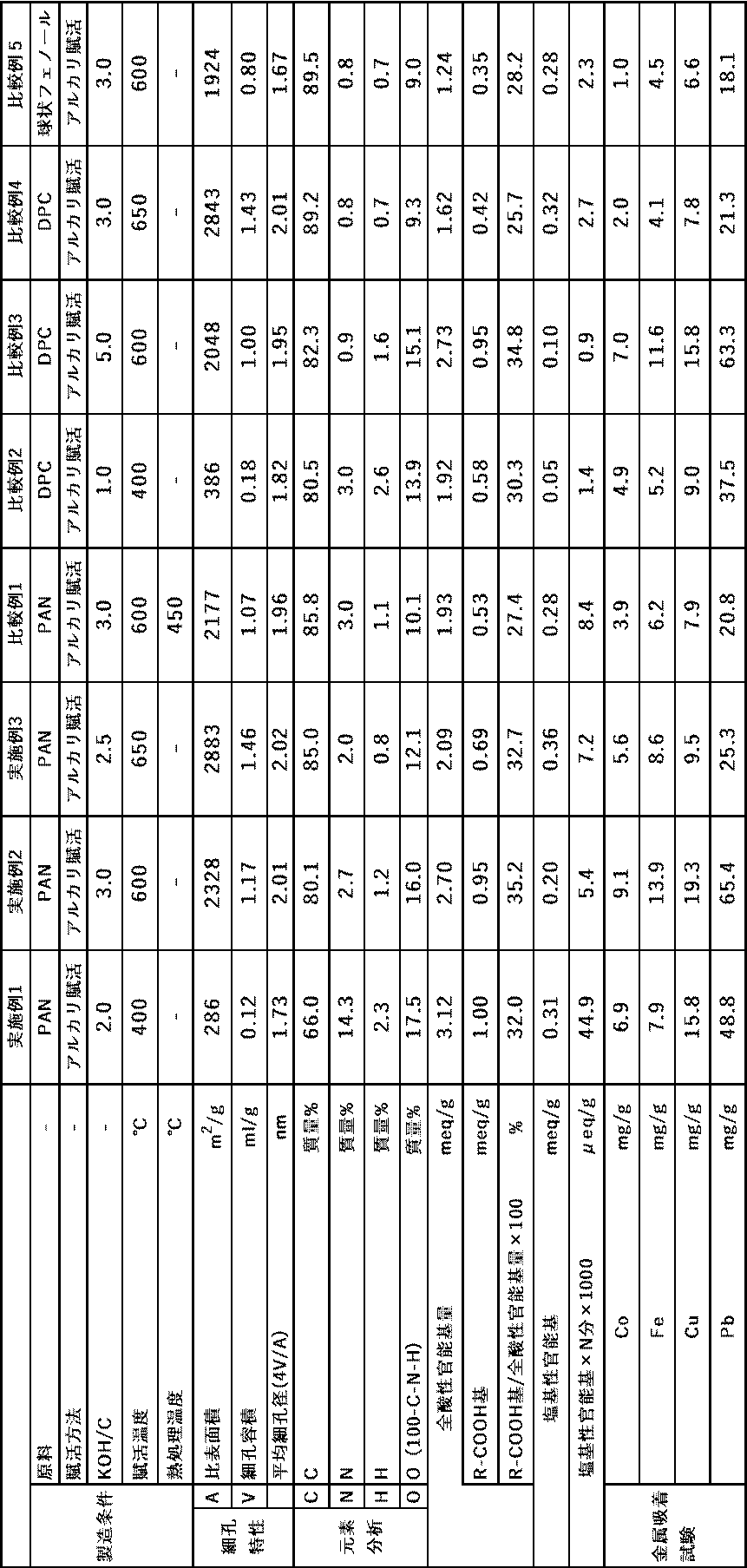
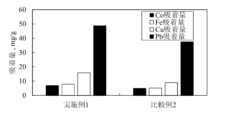
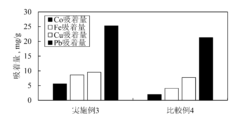
比表面積によって吸着量が変動するため、上記結果に基づいて比表面積毎に実施例と比較例を対比した結果を図1~図4に示す。なお、図中左よりCo、Fe、Cu、Pbの各吸着量である。
図1に示すように比較例2は実施例1よりも比表面積が大きいが、各金属の吸着量は少なかった。
同様に図2~4に示すように実施例2、3も夫々同等の比表面積を有する比較例1、3、4、5よりも各金属の吸着量が多かった。
なお、Pbの吸着量が突出しているのは、Pbは原子量がCo、Fe、Cuよりも大きくmg/g換算の吸着量では差が顕著になるためである。
Since the amount of adsorption varies depending on the specific surface area, the results of comparing Examples and Comparative Examples for each specific surface area based on the above results are shown in FIGS. 1 to 4. In addition, from the left in the figure, the adsorption amounts of Co, Fe, Cu, and Pb are shown.
As shown in FIG. 1, Comparative Example 2 had a larger specific surface area than Example 1, but the amount of each metal adsorbed was small.
Similarly, as shown in FIGS. 2 to 4, Examples 2 and 3 also had larger amounts of each metal adsorbed than Comparative Examples 1, 3, 4, and 5, which had the same specific surface area.
Note that the reason why the amount of adsorption of Pb is outstanding is that the atomic weight of Pb is larger than that of Co, Fe, and Cu, and the difference in adsorption amount in terms of mg/g becomes significant.
以上の結果より、カルボキシ基量と塩基性官能基量に占める炭素系金属吸着材中の窒素分が適切に制御されている本発明の活性炭1~3は、いずれか一方、または両方を満足しない比較活性炭1~5よりも優れた金属吸着性能を示した。 From the above results, activated carbons 1 to 3 of the present invention, in which the nitrogen content in the carbon-based metal adsorbent relative to the amount of carboxy groups and the amount of basic functional groups is appropriately controlled, do not satisfy either one or both. The metal adsorption performance was superior to that of comparative activated carbons 1 to 5.
Claims (6)
カルボキシ基量が0.6~5.0meq/g、且つ
塩基性官能基量に占める炭素系金属吸着材中の窒素分が3~100μeq/g、
である炭素系金属吸着材。 Specific surface area is 100 to 4000 m 2 /g,
The amount of carboxy groups is 0.6 to 5.0 meq/g, and the nitrogen content in the carbon-based metal adsorbent relative to the amount of basic functional groups is 3 to 100 μeq/g,
A carbon-based metal adsorbent.
前記塩基性官能基量が0.17meq/g超、0.60meq/g以下、
である請求項1に記載の炭素系金属吸着材。 The ratio of nitrogen to the total amount of carbon, nitrogen, hydrogen, and oxygen obtained by elemental analysis of the carbon-based metal adsorbent is 1 to 20% by mass, and the amount of basic functional groups is more than 0.17 meq/g, 0 .60meq/g or less,
The carbon-based metal adsorbent according to claim 1.
全酸性官能基量に対するカルボキシ基量の比率が31~100%、
である請求項1に記載の炭素系金属吸着材。 The total amount of acidic functional groups is 1.5 to 5.0 meq/g, and the ratio of the amount of carboxy groups to the total amount of acidic functional groups is 31 to 100%,
The carbon-based metal adsorbent according to claim 1.
Priority Applications (1)
| Application Number | Priority Date | Filing Date | Title |
|---|---|---|---|
| JP2022136073A JP7576596B2 (en) | 2022-08-29 | 2022-08-29 | Carbon-based metal adsorbent |
Applications Claiming Priority (1)
| Application Number | Priority Date | Filing Date | Title |
|---|---|---|---|
| JP2022136073A JP7576596B2 (en) | 2022-08-29 | 2022-08-29 | Carbon-based metal adsorbent |
Publications (2)
| Publication Number | Publication Date |
|---|---|
| JP2024032425A true JP2024032425A (en) | 2024-03-12 |
| JP7576596B2 JP7576596B2 (en) | 2024-10-31 |
Family
ID=90192895
Family Applications (1)
| Application Number | Title | Priority Date | Filing Date |
|---|---|---|---|
| JP2022136073A Active JP7576596B2 (en) | 2022-08-29 | 2022-08-29 | Carbon-based metal adsorbent |
Country Status (1)
| Country | Link |
|---|---|
| JP (1) | JP7576596B2 (en) |
Citations (7)
| Publication number | Priority date | Publication date | Assignee | Title |
|---|---|---|---|---|
| JPS54478B1 (en) * | 1969-04-09 | 1979-01-11 | ||
| JP2004168587A (en) * | 2002-11-19 | 2004-06-17 | Toyota Central Res & Dev Lab Inc | Nitrogen-containing carbon-based porous material and method for producing the same |
| JP2004315243A (en) * | 2003-04-11 | 2004-11-11 | Kuraray Co Ltd | Activated carbon and manufacturing method thereof |
| JP2017172099A (en) * | 2016-03-15 | 2017-09-28 | 関西熱化学株式会社 | Active carbon fiber and method of producing the same |
| JP2019155290A (en) * | 2018-03-14 | 2019-09-19 | 株式会社大阪ソーダ | Heavy metal treatment agent and method for producing heavy metal treatment agent |
| JP2021000612A (en) * | 2019-06-25 | 2021-01-07 | 関西熱化学株式会社 | Separation agent and production method thereof |
| CN112892477A (en) * | 2021-01-15 | 2021-06-04 | 武汉金特明新材料科技有限公司 | Preparation and application of nitrogen-rich porous activated carbon adsorbent derived from microporous polymer |
-
2022
- 2022-08-29 JP JP2022136073A patent/JP7576596B2/en active Active
Patent Citations (7)
| Publication number | Priority date | Publication date | Assignee | Title |
|---|---|---|---|---|
| JPS54478B1 (en) * | 1969-04-09 | 1979-01-11 | ||
| JP2004168587A (en) * | 2002-11-19 | 2004-06-17 | Toyota Central Res & Dev Lab Inc | Nitrogen-containing carbon-based porous material and method for producing the same |
| JP2004315243A (en) * | 2003-04-11 | 2004-11-11 | Kuraray Co Ltd | Activated carbon and manufacturing method thereof |
| JP2017172099A (en) * | 2016-03-15 | 2017-09-28 | 関西熱化学株式会社 | Active carbon fiber and method of producing the same |
| JP2019155290A (en) * | 2018-03-14 | 2019-09-19 | 株式会社大阪ソーダ | Heavy metal treatment agent and method for producing heavy metal treatment agent |
| JP2021000612A (en) * | 2019-06-25 | 2021-01-07 | 関西熱化学株式会社 | Separation agent and production method thereof |
| CN112892477A (en) * | 2021-01-15 | 2021-06-04 | 武汉金特明新材料科技有限公司 | Preparation and application of nitrogen-rich porous activated carbon adsorbent derived from microporous polymer |
Also Published As
| Publication number | Publication date |
|---|---|
| JP7576596B2 (en) | 2024-10-31 |
Similar Documents
| Publication | Publication Date | Title |
|---|---|---|
| JP3709267B2 (en) | Mesopore carbon and method for producing the same | |
| Wang et al. | Removal of lead (II) from aqueous solution by adsorption onto manganese oxide-coated carbon nanotubes | |
| JP5781992B2 (en) | Parenteral adsorbent provided with basic functional group and method for producing the same | |
| Ruparelia et al. | Potential of carbon nanomaterials for removal of heavy metals from water | |
| JP4126399B2 (en) | Iron oxyhydroxide production method and iron oxyhydroxide adsorbent | |
| AU2022386222A1 (en) | Method for preparing titanium-based lithium ion exchanger | |
| Khelifi et al. | Nickel (II) adsorption from aqueous solutions by physico-chemically modified sewage sludge | |
| JP6218748B2 (en) | Filter media containing metal-containing fine particles | |
| JPWO2014017588A1 (en) | Activated carbon with high active surface area | |
| KR20140105587A (en) | Filtration medium comprising a thermolysis product of a carbon oxychalcogenide and a metal salt, method of removing chloramine with this filtration medium and method of making this filtration medium | |
| JP6517607B2 (en) | Method of producing activated carbon, activated carbon and electrode material for electric double layer capacitor | |
| CN108367267A (en) | Sorbing material particle | |
| Joshi et al. | Sodium hydroxide activated nanoporous carbons based on Lapsi seed stone | |
| WO2022085550A1 (en) | Carbonaceous material and method for producing same, and fluorine-containing organic compound removing material, water purification filter, and water purifier | |
| Zhang et al. | Fabrication and characterization of magnetic eucalyptus carbon for efficient Cr (VI) removal in aqueous solution and its mechanisms | |
| CN116351392A (en) | Modified straw biochar and preparation method thereof and application of modified straw biochar in adsorption of heavy metals | |
| JP7354336B1 (en) | porous carbon material | |
| Yang et al. | KOH-modified bamboo charcoal loaded with α-FeOOH for efficient adsorption of copper and fluoride ions from aqueous solution | |
| JP2012192326A (en) | Material for removing sulphur-containing gas, method of manufacturing the same and method for removing sulphur-containing gas | |
| JP6601716B2 (en) | Carbonaceous composite and method for producing the same | |
| JP7576596B2 (en) | Carbon-based metal adsorbent | |
| JP2008050237A (en) | Spherical porous carbon particle powder and production method therefor | |
| JPWO2006011191A1 (en) | Anion adsorbent, method for producing the same, and water treatment method | |
| Chen et al. | Multiple chemical modifications and Cd 2+ adsorption characteristics of sludge-based activated carbon | |
| Xiong et al. | Adsorbent nanoarchitectonics of m MnO 2/n FeOOH/KIT-6 for As (iii) adsorption from wastewater |
Legal Events
| Date | Code | Title | Description |
|---|---|---|---|
| A621 | Written request for application examination |
Free format text: JAPANESE INTERMEDIATE CODE: A621 Effective date: 20220829 |
|
| A131 | Notification of reasons for refusal |
Free format text: JAPANESE INTERMEDIATE CODE: A131 Effective date: 20231004 |
|
| A521 | Request for written amendment filed |
Free format text: JAPANESE INTERMEDIATE CODE: A523 Effective date: 20231201 |
|
| A02 | Decision of refusal |
Free format text: JAPANESE INTERMEDIATE CODE: A02 Effective date: 20240305 |
|
| A521 | Request for written amendment filed |
Free format text: JAPANESE INTERMEDIATE CODE: A523 Effective date: 20240605 |
|
| A911 | Transfer to examiner for re-examination before appeal (zenchi) |
Free format text: JAPANESE INTERMEDIATE CODE: A911 Effective date: 20240613 |
|
| TRDD | Decision of grant or rejection written | ||
| A01 | Written decision to grant a patent or to grant a registration (utility model) |
Free format text: JAPANESE INTERMEDIATE CODE: A01 Effective date: 20241008 |
|
| A61 | First payment of annual fees (during grant procedure) |
Free format text: JAPANESE INTERMEDIATE CODE: A61 Effective date: 20241021 |
|
| R150 | Certificate of patent or registration of utility model |
Ref document number: 7576596 Country of ref document: JP Free format text: JAPANESE INTERMEDIATE CODE: R150 |