JP3557723B2 - Flexible sheet sticking method and peeling method - Google Patents
Flexible sheet sticking method and peeling method Download PDFInfo
- Publication number
- JP3557723B2 JP3557723B2 JP15697995A JP15697995A JP3557723B2 JP 3557723 B2 JP3557723 B2 JP 3557723B2 JP 15697995 A JP15697995 A JP 15697995A JP 15697995 A JP15697995 A JP 15697995A JP 3557723 B2 JP3557723 B2 JP 3557723B2
- Authority
- JP
- Japan
- Prior art keywords
- flexible sheet
- adhesive
- entire
- base material
- peeling
- Prior art date
- Legal status (The legal status is an assumption and is not a legal conclusion. Google has not performed a legal analysis and makes no representation as to the accuracy of the status listed.)
- Expired - Fee Related
Links
- 238000000034 method Methods 0.000 title claims description 26
- 239000000853 adhesive Substances 0.000 claims description 67
- 230000001070 adhesive effect Effects 0.000 claims description 67
- 229920005989 resin Polymers 0.000 claims description 44
- 239000011347 resin Substances 0.000 claims description 44
- XTXRWKRVRITETP-UHFFFAOYSA-N Vinyl acetate Chemical compound CC(=O)OC=C XTXRWKRVRITETP-UHFFFAOYSA-N 0.000 claims description 39
- 239000000463 material Substances 0.000 claims description 29
- 239000000758 substrate Substances 0.000 claims description 26
- 238000001035 drying Methods 0.000 claims description 20
- 239000011120 plywood Substances 0.000 claims description 15
- 229910052751 metal Inorganic materials 0.000 claims description 14
- 239000002184 metal Substances 0.000 claims description 14
- 239000000344 soap Substances 0.000 claims description 13
- 239000000839 emulsion Substances 0.000 claims description 11
- 238000003825 pressing Methods 0.000 claims description 8
- 238000001816 cooling Methods 0.000 claims description 6
- 230000037303 wrinkles Effects 0.000 claims description 6
- 239000001993 wax Substances 0.000 description 16
- XLYOFNOQVPJJNP-UHFFFAOYSA-N water Substances O XLYOFNOQVPJJNP-UHFFFAOYSA-N 0.000 description 10
- 238000010438 heat treatment Methods 0.000 description 8
- 239000003292 glue Substances 0.000 description 7
- 238000002156 mixing Methods 0.000 description 6
- -1 polyvinylamine Substances 0.000 description 6
- 239000000126 substance Substances 0.000 description 6
- 239000004698 Polyethylene Substances 0.000 description 4
- 229920000573 polyethylene Polymers 0.000 description 4
- 229920003169 water-soluble polymer Polymers 0.000 description 4
- 239000004372 Polyvinyl alcohol Substances 0.000 description 3
- CJZGTCYPCWQAJB-UHFFFAOYSA-L calcium stearate Chemical compound [Ca+2].CCCCCCCCCCCCCCCCCC([O-])=O.CCCCCCCCCCCCCCCCCC([O-])=O CJZGTCYPCWQAJB-UHFFFAOYSA-L 0.000 description 3
- 239000008116 calcium stearate Substances 0.000 description 3
- 235000013539 calcium stearate Nutrition 0.000 description 3
- 229920002451 polyvinyl alcohol Polymers 0.000 description 3
- 235000021355 Stearic acid Nutrition 0.000 description 2
- 238000002844 melting Methods 0.000 description 2
- 230000008018 melting Effects 0.000 description 2
- 239000011859 microparticle Substances 0.000 description 2
- QIQXTHQIDYTFRH-UHFFFAOYSA-N octadecanoic acid Chemical compound CCCCCCCCCCCCCCCCCC(O)=O QIQXTHQIDYTFRH-UHFFFAOYSA-N 0.000 description 2
- OQCDKBAXFALNLD-UHFFFAOYSA-N octadecanoic acid Natural products CCCCCCCC(C)CCCCCCCCC(O)=O OQCDKBAXFALNLD-UHFFFAOYSA-N 0.000 description 2
- 239000002245 particle Substances 0.000 description 2
- 238000005096 rolling process Methods 0.000 description 2
- 239000008117 stearic acid Substances 0.000 description 2
- AVXURJPOCDRRFD-UHFFFAOYSA-N Hydroxylamine Chemical compound ON AVXURJPOCDRRFD-UHFFFAOYSA-N 0.000 description 1
- 229920002472 Starch Polymers 0.000 description 1
- 238000004026 adhesive bonding Methods 0.000 description 1
- 238000007664 blowing Methods 0.000 description 1
- 239000011449 brick Substances 0.000 description 1
- 159000000007 calcium salts Chemical class 0.000 description 1
- 239000005018 casein Substances 0.000 description 1
- BECPQYXYKAMYBN-UHFFFAOYSA-N casein, tech. Chemical compound NCCCCC(C(O)=O)N=C(O)C(CC(O)=O)N=C(O)C(CCC(O)=N)N=C(O)C(CC(C)C)N=C(O)C(CCC(O)=O)N=C(O)C(CC(O)=O)N=C(O)C(CCC(O)=O)N=C(O)C(C(C)O)N=C(O)C(CCC(O)=N)N=C(O)C(CCC(O)=N)N=C(O)C(CCC(O)=N)N=C(O)C(CCC(O)=O)N=C(O)C(CCC(O)=O)N=C(O)C(COP(O)(O)=O)N=C(O)C(CCC(O)=N)N=C(O)C(N)CC1=CC=CC=C1 BECPQYXYKAMYBN-UHFFFAOYSA-N 0.000 description 1
- 235000021240 caseins Nutrition 0.000 description 1
- 239000003795 chemical substances by application Substances 0.000 description 1
- 239000011248 coating agent Substances 0.000 description 1
- 238000000576 coating method Methods 0.000 description 1
- 239000000084 colloidal system Substances 0.000 description 1
- 239000004567 concrete Substances 0.000 description 1
- 230000007423 decrease Effects 0.000 description 1
- 230000000694 effects Effects 0.000 description 1
- 239000004744 fabric Substances 0.000 description 1
- 238000009472 formulation Methods 0.000 description 1
- 230000002209 hydrophobic effect Effects 0.000 description 1
- 238000007654 immersion Methods 0.000 description 1
- 159000000003 magnesium salts Chemical class 0.000 description 1
- 238000004519 manufacturing process Methods 0.000 description 1
- 239000000203 mixture Substances 0.000 description 1
- 239000004570 mortar (masonry) Substances 0.000 description 1
- 239000004745 nonwoven fabric Substances 0.000 description 1
- 239000012188 paraffin wax Substances 0.000 description 1
- 238000005192 partition Methods 0.000 description 1
- 239000002985 plastic film Substances 0.000 description 1
- 229920001495 poly(sodium acrylate) polymer Polymers 0.000 description 1
- 229920000098 polyolefin Polymers 0.000 description 1
- 230000001681 protective effect Effects 0.000 description 1
- 150000003839 salts Chemical class 0.000 description 1
- 238000007790 scraping Methods 0.000 description 1
- NNMHYFLPFNGQFZ-UHFFFAOYSA-M sodium polyacrylate Chemical compound [Na+].[O-]C(=O)C=C NNMHYFLPFNGQFZ-UHFFFAOYSA-M 0.000 description 1
- 159000000000 sodium salts Chemical class 0.000 description 1
- 238000005507 spraying Methods 0.000 description 1
- 235000019698 starch Nutrition 0.000 description 1
- 239000008107 starch Substances 0.000 description 1
- 238000003756 stirring Methods 0.000 description 1
- 229920005992 thermoplastic resin Polymers 0.000 description 1
- 239000002023 wood Substances 0.000 description 1
- 150000003751 zinc Chemical class 0.000 description 1
Landscapes
- Compositions Of Macromolecular Compounds (AREA)
- Adhesives Or Adhesive Processes (AREA)
Description
【0001】
【産業上の利用分野】
本発明は合板、壁等に経師紙(化粧紙)、樹脂製フィルム等の可撓性シートを接着する方法及び可撓性シートを剥離する方法に関する。
【0002】
【従来の技術】
展示会等においては、展示領域を区画するため、合板等からなるパネルを立てつけている。また、このパネルに対しては経師紙等を貼りつけて表面化粧を施すことが行われている。かかる展示会等のパネルはその繰り返し使用を行うため、経師紙を剥がし、新たな経師紙を貼りつける作業が頻繁に行われている。このような経師紙の接着は、従来、澱粉糊等の水溶性の糊剤(商品名「アミノール」等)を水に溶かし、この糊溶液を経師紙に塗り、糊剤塗布状態の経師紙を合板、壁等の基材に貼り付けていた。
【0003】
一方、パネルの再使用のための経師紙の剥離は、以上のようにして接着された経師紙を手で剥がすものであり、剥離が不十分の場合は、残っている経師紙をカッター等を用いて、削り取ることが行われていた。
【0004】
【発明が解決しようとする課題】
上述した従来の接着方法では、接着剤が当初から粘着性を有しているため、パネル等の表面への塗布を均一に行うこと難しいと共に、経師紙等のシートの接着剤塗布面が粘ってその取り扱いが面倒となっている。また、接着剤は乾燥すると、接着力が無くなるため、水が共存した湿気を有した状態で接着作業を行う必要がある。このため接着作業に迅速性が要求され、塗布後に長時間放置しておくことができず、例えば、接着作業を中断する等の作業手順の変更もできない不便さを有している。さらに、水溶性の接着剤を経師紙に塗布するため、経師紙に皺を生じ易く、基材への貼り付けに熟練を要している。
【0005】
一方、接着後に剥離する場合においては、手作業で行っており、作業が面倒となっている。また、紙全体の剥離が難しく、部分的に残存し易く、この残存によってカッターを用いた削り取りが必要となり、剥離作業が長時間となる問題を有している。
【0006】
本発明はこのような事情を考慮してなされたものであり、迅速性を要求されることなく、しかも皺等の発生がなく、熟練を要することのない接着方法を提供することを目的とする。また、本発明は接着状態からのシートの剥離を簡単に、しかも完全に行うことができる剥離方法を提供することを目的とする。
【0007】
【問題点を解決するための手段及び作用】
経師紙からなる可撓性シートを合板からなるパネル又は壁の基材面に全体的に貼り付けるシート貼付方法において、作業現場で、可撓性シートを貼り付けるべき基材面上に全体的に、酢酸ビニル樹脂を主成分とし、金属石鹸及びワックスを含有したエマルジョン型接着剤を塗布し、接着剤塗布後、自然乾燥又は加熱乾燥によって、接着剤塗布面に水分が完全になくなるまで乾燥させ、接着剤塗布面が乾燥した後、可撓性シートを基材面に当接し、可撓性シートを基材面に当接した状態で、可撓性シートを通して基材面全面にわたり乾燥状態の接着剤に熱エネルギーを作用させ、接着剤に熱エネルギーを作用させると同時に可撓性シートを基材面全面にわたって押圧し、可撓性シートを基材面全面にわたって押圧した状態で冷却させることよりなり、可撓性シート全体を基材面に皺なく簡単に貼付することを特徴とする。更に、本願発明剥離方法は、更に、可撓性シートの使用後に、新たな可撓性シートに貼り替えるため、使用済み可撓性シートの上から基材面全面にわたって熱エネルギーを作用させて接着剤を熱軟化し、接着剤が熱軟化した状態で使用済み可撓性シートを基材面から剥離することよりなり、使用済み可撓性シート全体の簡単な剥離を可能にしたことを特徴とする。
【0008】
本発明の接着方法及び剥離方法に使用されるエマルジョン型接着剤は酢酸ビニル樹脂を主成分としており、この樹脂に対して金属石鹸及びワックスを添加したものである。酢酸ビニル樹脂は熱可塑性樹脂の一種であり、従来より木工用の接着剤として使用されている。この酢酸ビニル樹脂はその熱軟化温度以上に加熱することにより、接着力が発現されて基材とシートとを接着する。
【0009】
本発明では、この酢酸ビニル樹脂を水に分散したエマルジョンの形態で使用する。酢酸ビニル樹脂は本質的に疎水性であるところから、水溶性高分子物質を適量、添加して保護コロイドとし、水系内での安定化を図るものである。この水溶性高分子物質としては、ポリビニルアルコール(PVA)、ポリアクリル酸ナトリウム、ポリビニルアミン、カゼイン等の内の一種または複数を選択することができる。酢酸ビニル樹脂の水への配合比は接着力、粘性、乾燥度合い等の条件を加味して、選定され、水45〜65重量部に対して、酢酸ビニル樹脂が35〜50重量部、より好ましくは、40〜45重量部が配合される。35重量部以下では、良好な接着力を発揮することができず、50重量部以上では接着剤の粘性が大きくなって、取り扱いに不便となると共に、塗布を均一に行うことが難しくなる。また、水溶性高分子物質は0.2〜0.5重量部、好ましくは、0.3重量部前後、添加されたものを本発明に用いることができる。
【0010】
金属石鹸及びワックスは酢酸ビニル樹脂系エマルジョンに配合されることにより、エマルジョンの骨材として作用すると共に、熱伝導を良好にする。すなわち、これらはその溶融温度(mp)が酢酸ビニル樹脂の熱軟化温度よりも高温のものが使用され、これにより、熱軟化のための酢酸ビニル樹脂への加熱時にも溶融することがなく、ミクロ粒子となって接着剤中に分散している。これにより、これらの物質は接着後において酢酸ビニル樹脂内で分散して、樹脂相互の結合力を高めると共に、その良好な熱伝導によって加熱時に酢酸ビニル樹脂が熱軟化温度へ達することを助長する。
【0011】
かかる金属石鹸としては、ステアリン酸の金属塩が良好であり、特にそのカルシウム塩(mp150℃)、マグネシウム塩(mp110℃)、亜鉛塩(mp120℃)が好適である。なお、ステアリン酸のナトリウム塩はゼラチン状となって乾燥性が低下するため、使用上、好ましくない。ワックスとしては、パラフィンワックス、ポリオレフィンワックス等を使用できるが、特に熱伝導性、安定性、溶融温度等の特性からポリエチレンワックス(mp110℃)が良好である。これらの金属石鹸及びワックスの配合比は酢酸ビニル樹脂35〜50重量部に対して、2〜5重量部、より好ましくは3重量部前後である。
【0012】
このような接着剤の作製は、酢酸ビニル樹脂、水溶性高分子物質、金属石鹸を水に混合し、その後、ワックスを投入して攪拌することにより行われ、これにより白濁状のエマルジョンとなる。作製されたエマルジョンは安定で、長期間放置しておいても、分離することがなく、接着にそのまま使用することができる。また、このエマルジョンは粘性が小さく、このため取り扱いが容易であると共に、基材への塗布を均一に行うことができる。
【0013】
本発明の接着方法は、以上のような配合比で作製されたエマルジョン型接着剤を基材面上に塗布することにより行う。基材としては、合板、木板、モルタル、コンクリート、煉瓦等、種々のものを用いることができる。この塗布後においては、接着剤を乾燥する。乾燥は天日や放置等の自然乾燥、ドライヤー等を用いた加熱乾燥その他の方法によって行うことができるが、迅速で大量の処理を行うことができる点で加熱乾燥が良好である。この乾燥は水を完全に除去するまで行うものであり、乾燥後においては、基材面が乾燥状態となっている。このため、基材を積み重ねても、基材が相互に結着することがなく、その取り扱いが容易となる。
【0014】
この乾燥の後、可撓性シートを基材面に当接し、乾燥状態の接着剤に対して熱エネルギーを作用させる。可撓性シートとしては、経師紙等の紙類、不織布、布或いはプラスチックシートその他のものを使用できる。この可撓性シートを基材面に接触させた状態で熱エネルギーを付与する。この熱エネルギーは、加熱、超音波振動その他の手段により付与することができる。かかる熱エネルギーは酢酸ビニル樹脂が熱軟化するまで作用させるものである。これにより酢酸ビニル樹脂の接着力が発現して、シートを基材面に接着することができる。この熱エネルギーの付与時において、金属石鹸及びワックスはミクロ粒子の状態で接着剤の塗布領域に均一に分散している。そして、これらの粒子は付与された熱を即座に且つ良好に酢酸ビニル樹脂に伝達する。このため、基材面に塗布された酢酸ビニル樹脂の全体が均一に熱伝導されて、均一の加熱状態となる。これにより酢酸ビニル樹脂が均一の接着力を発現することができ、シートも全体を均等に基材面に接着することができる。
【0015】
この熱エネルギーの付与と共に、シートを基材面に加圧すると良い。この加圧はローラ等を転接させたり、プレス板を押しつける等により行うことができる。この加圧により、シートが可撓性を有していても、良好な引張状態となって、全面が基材面と接触するため、皺の発生がない状態でシートを接着することができる。この場合、加圧と熱エネルギーの付与とを同時に行っても良い。これは例えば、加熱状態のローラを転接したり、ヒータ内蔵のプレス板を用いることにより、簡単に達成することができ、これにより、接着を迅速に行うことができる。
【0016】
以上のような加熱及び加圧の後、基材を冷却することにより接着が終了する。この冷却は放冷でも良く、ファン等により空気を吹きつけて行っても良い。また、この冷却時においては、シートを基材面に押圧した状態で行うことが好ましく、これにより、シートが巻き癖等を備えていても、全体を基材面に接着させることができる。
【0017】
以上のような接着方法は、エマルジョン型接着剤を完全に乾燥した後に、熱エネルギーを作用させて接着を行うため、接着剤の乾燥状態のまま、基材を放置することができる。すなわち、接着剤の乾燥に続いてシートの接着を行う必要がなく、接着作業全体を一連させて行う必要がなくなる。このため、例えば、まず接着剤の塗布、乾燥だけを行い、その後、シートの接着だけをまとめて行う等の作業手順の変更もでき、計画性のある作業工程を組むことができる。
【0018】
本発明の剥離方法は、以上のようにして酢酸ビニル樹脂系エマルジョン型接着剤を用いて接着した構造体に対して、熱エネルギーを作用させて可撓性シートを剥離するものである。この熱エネルギーの付与は接着と同様に、加熱、超音波振動その他の手段により行うことができる。この熱エネルギーの付与により、酢酸ビニル樹脂が熱軟化する。この熱エネルギーの付与時において、金属石鹸及びワックスはミクロ粒子の状態となっており、付与された熱を即座に且つ良好に酢酸ビニル樹脂に伝達する。このため、酢酸ビニル樹脂の全体が均一に熱伝導されて、加熱されるため、熱軟化を均等に行うことができる。
【0019】
かかる酢酸ビニル樹脂の熱軟化状態で、シートを基材から引き剥がすことにより、シートの剥離を行う。このような剥離では、熱エネルギーの付与で酢酸ビニル樹脂が熱軟化しているため、シート全体を円滑に剥がすことができ、しかもシートが基材面に部分的に残存することもない。また、従来のように、水への浸漬や、水のスプレー等を行う必要がないため、剥離を簡単に行うことができる。なお、熱エネルギーの付与に際しては、接着と同様に、熱ローラ、ヒータ内蔵のプレス板を用いて行っても良い。
【0020】
本発明においては、この剥離を行った後に、シートを再度、基材に接着することも可能である。すなわち、シートを剥離した後の基材面に接着剤が付着している場合においては、新たなシートをこの基材面に接触させて、上述と同様に熱エネルギーを付与する。これにより基材面に付着している酢酸ビニル樹脂が再度、熱軟化して接着力が発現し、シートの接着を行うことができる。一方、基材面に付着している接着剤の量が少ない場合には、その不足量の接着剤を新たに塗布することにより、シートの再接着を行うことができる。このように本発明では、熱エネルギーの付与を繰り返すことにより、接着、剥離を繰り返すことができ、特に、展示会用のパネルに対する経師紙の頻繁な接着、剥離に適用することにより、これらの作業を迅速に、しかも簡単に行うことができるメリットがある。
【0021】
【実施例】
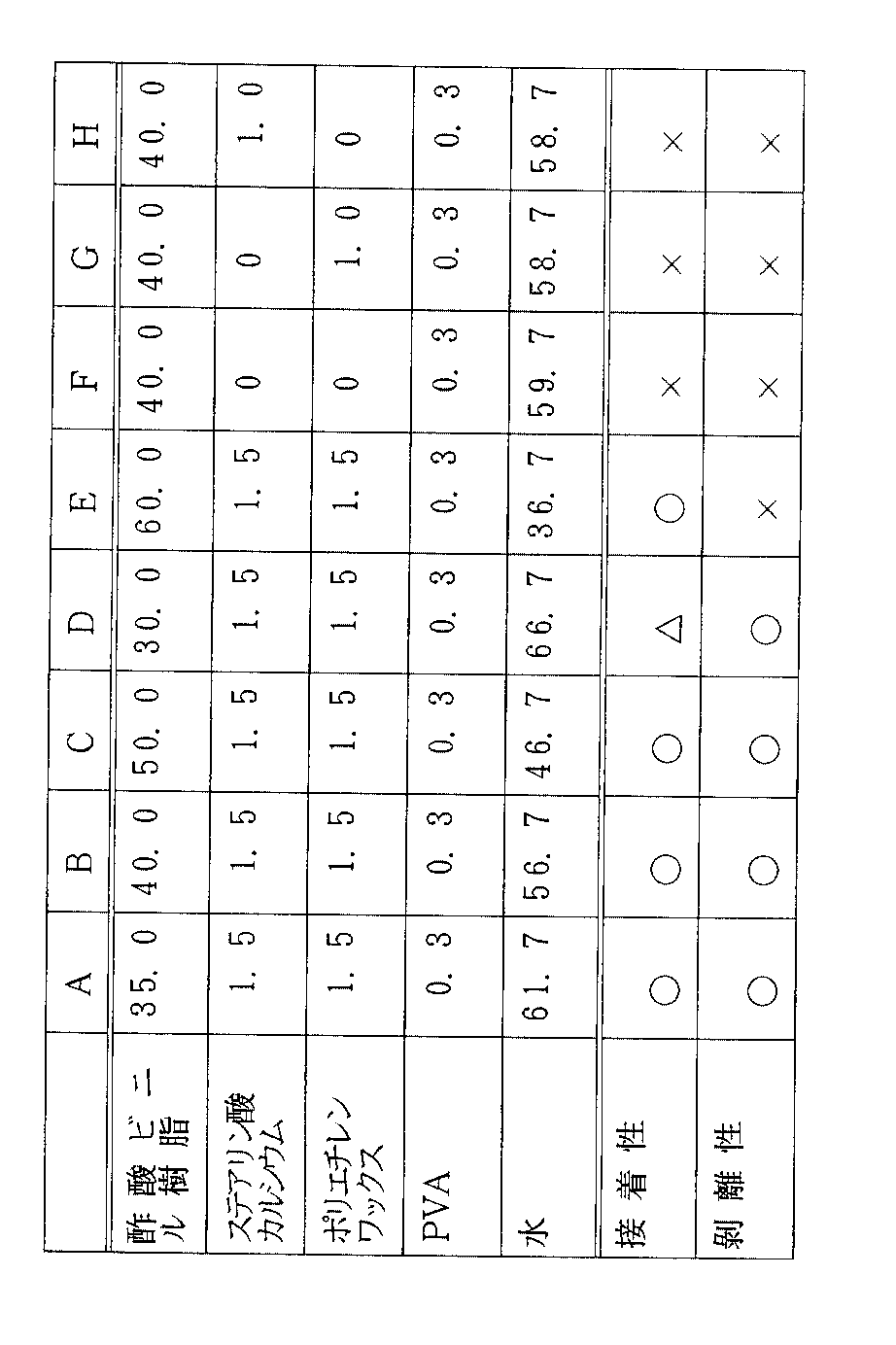
金属石鹸としてステアリン酸カルシウム、ワックスとしてポリエチエンワックス、水溶性分散物質としてPVAを用い、表1の処方により接着剤A〜Hを作製した。表1において、各欄の数値は重量比である。これらの接着剤を1m四方の合板に刷毛によって塗布した。塗布量はいずれも、30g/m2 とした。この塗布後に、ドライヤーから50〜60℃の温度の温風を各合板に吹きつけて乾燥した。この乾燥は水が完全に蒸発するまで行い、各合板の表面には固形化した接着剤が白濁状態で残存した。
【0022】
次に、1m四方の経師紙を各合板の表面に載置し、熱エネルギーを付与して、接着した。この熱エネルギーの付与は接着剤Bに対しては、超音波振動子を経師紙上に接触させ、超音波振動させながら、経師紙面を摺動させることで行い、他の接着剤に対しては、ヒータ内蔵のプレス板を経師紙上に押圧させることで行った。この場合、プレス板の表面温度は80〜90℃であった。この熱エネルギーの付与後に、各合板への経師紙の接着状態を観察した。
【0023】
結果を表1の「接着性」欄に記載してある。同欄における「○」は経師紙に皺がなく、しかもその全面が合板に良好に密着したものである。「△」は経師紙の一部に接着不良があったものを、「×」は経師紙のほとんどが接着不良となっていたものを示す。接着剤Dにおいては、酢酸ビニル樹脂の配合比が少なく、接着力が充分でないため、接着不良となったものと思われる。接着剤F、G、Hはステアリン酸カルシウム及び/またはポリエチレンワックスが充分に配合されていないため、熱エネルギーが酢酸ビニル樹脂に良好に伝達されず、酢酸ビニル樹脂が充分に熱軟化しなかったためと思われる。
【0024】
次に、以上のようにして接着が終了したものに対して、ヒータ内蔵のプレス板を加熱状態で接触させた。このときのプレス板の表面温度は80〜90℃であった。このプレス板の接触による加熱の後、直ちに経師紙を掴んで、それぞれの合板から引き剥がし、その状態を観察した。
【0025】
結果を表1の「剥離性」欄に記載してある。同欄における「○」は経師紙の全体が合板から良好に剥がれ、部分的にも残存していないものを示し、「×」は経師紙の一部が残存したものを示す。接着剤Eにおいては、酢酸ビニル樹脂の配合比が多すぎて、酢酸ビニル樹脂の全体が充分に熱軟化しなかったためと思われる。接着剤F、G、はステアリン酸カルシウム及び/またはポリエチレンワックスの量が不十分で、酢酸ビニル樹脂に熱が充分に伝達しなかったためと思われる。
【0026】
【表1】
【発明の効果】
本発明の接着方法は、酢酸ビニル樹脂、金属石鹸、ワックスを含有するエマルジョン型接着剤を完全に乾燥した後に、熱エネルギーを作用させて接着を行うため、接着剤の乾燥状態のまま、放置することができる。すなわち、接着剤の乾燥に続いてシートの接着を行う必要がなく、接着作業全体を一連させて行う必要がなくなる。このため、例えば、接着剤の塗布、乾燥だけを行い、その後、シートの接着だけを行う等の作業手順の変更もでき、計画性のある作業工程を組むことが可能となる。また、シートが可撓性を有していても、接着剤が完全な乾燥状態で接着されるため、皺等を生じることなく、外観の向上した接着状態とすることができると共に熟練を要することがない。
【0028】
本発明の剥離方法は、上述した酢酸ビニル樹脂系エマルジョン型接着剤を用いて接着した構造体に対して、熱エネルギーを作用させるものであり、この熱エネルギーは金属石鹸及びワックスにより良好に酢酸ビニル樹脂に伝達されるため、酢酸ビニル樹脂を確実に熱軟化させることができる。これにより、シートの部分的な残存がなく、シートの全体を簡単にしかも確実に剥離することができると共に、短時間での剥離が可能となる。[0001]
[Industrial applications]
TECHNICAL FIELD The present invention relates to a method for bonding a flexible sheet such as koshishi (decorative paper) or a resin film to a plywood or a wall, and a method for peeling a flexible sheet.
[0002]
[Prior art]
In exhibitions and the like, panels made of plywood or the like are erected to partition the exhibition area. In addition, it is practiced to attach surface paper to this panel to apply surface makeup. In order to use such panels repeatedly at exhibitions and the like, the work of peeling off the paper and attaching a new paper is frequently performed. Conventionally, such gluing of glue paper has conventionally been carried out by dissolving a water-soluble glue such as starch glue (trade name “Aminol”) in water, applying this glue solution to the glue paper, and applying the glue paste to the glue paper. The teacher paper was stuck on the base material such as plywood and wall.
[0003]
On the other hand, the peeling of the kojishi paper for the reuse of the panel is to manually peel off the glued kojishi paper as described above, and if the peeling is insufficient, the remaining kojishi paper is removed. Shaving has been performed using a cutter or the like.
[0004]
[Problems to be solved by the invention]
According to the conventional bonding method described above, since the adhesive has tackiness from the beginning, it is difficult to uniformly apply the adhesive to the surface of a panel or the like, and the adhesive applied surface of a sheet such as koshi paper is sticky. The handling is complicated. Further, when the adhesive is dried, the adhesive force is lost, so that it is necessary to perform the bonding operation in a state where moisture coexists with water. For this reason, quickness is required for the bonding operation, and it cannot be left for a long time after the application, and for example, there is an inconvenience that the operation procedure cannot be changed such as interrupting the bonding operation. Furthermore, since the water-soluble adhesive is applied to the koshi paper, the wrinkle paper is apt to be wrinkled, and the skill of attaching to the base material is required.
[0005]
On the other hand, in the case of peeling after bonding, the work is performed manually, which is troublesome. In addition, the entire paper is difficult to peel off, and is likely to partially remain, which requires a scraping operation using a cutter, and has a problem that the peeling operation takes a long time.
[0006]
The present invention has been made in view of such circumstances, and it is an object of the present invention to provide a bonding method that does not require quickness, does not generate wrinkles, and does not require skill. . Another object of the present invention is to provide a peeling method capable of easily and completely peeling a sheet from a bonded state.
[0007]
[Means and actions for solving the problems]
In a sheet sticking method in which a flexible sheet made of koshishi paper is entirely stuck on a base material surface of a panel or wall made of plywood, at a work site, the flexible sheet is entirely stuck on a base material surface to be stuck. Then, an emulsion adhesive containing vinyl acetate resin as a main component and metal soap and wax is applied, and after the adhesive is applied, the adhesive is dried by natural drying or heat drying until the adhesive applied surface is completely free of moisture. After the adhesive-coated surface is dried, the flexible sheet is brought into contact with the base material surface, and the flexible sheet is brought into contact with the base material surface. Applying thermal energy to the adhesive, applying thermal energy to the adhesive, pressing the flexible sheet over the entire surface of the base material, and cooling the flexible sheet while pressing the flexible sheet over the entire surface of the base material. Ri, characterized by attaching a flexible overall sheet easily without wrinkling the substrate surface. Furthermore, in the peeling method of the present invention, further, after using the flexible sheet, it is bonded by applying thermal energy from the top of the used flexible sheet to the entire surface of the base material in order to replace the flexible sheet with a new flexible sheet. The used flexible sheet is peeled from the substrate surface in a state where the agent is thermally softened and the adhesive is thermally softened, thereby enabling easy peeling of the entire used flexible sheet. I do.
[0008]
The emulsion type adhesive used in the bonding method and the peeling method of the present invention has a vinyl acetate resin as a main component, and a metal soap and a wax are added to the resin. Vinyl acetate resin is a kind of thermoplastic resin and has been used as an adhesive for woodworking. By heating the vinyl acetate resin to a temperature higher than its thermal softening temperature, an adhesive force is developed to bond the base material and the sheet.
[0009]
In the present invention, this vinyl acetate resin is used in the form of an emulsion dispersed in water. Since vinyl acetate resin is inherently hydrophobic, a suitable amount of a water-soluble polymer substance is added to form a protective colloid to stabilize the resin in an aqueous system. As the water-soluble polymer substance, one or more of polyvinyl alcohol (PVA), sodium polyacrylate, polyvinylamine, casein and the like can be selected. The mixing ratio of vinyl acetate resin to water is selected in consideration of conditions such as adhesive strength, viscosity, and degree of dryness. For 45 to 65 parts by weight of water, 35 to 50 parts by weight of vinyl acetate resin is more preferable. Is incorporated in an amount of 40 to 45 parts by weight. If the amount is less than 35 parts by weight, good adhesive strength cannot be exerted. If the amount is more than 50 parts by weight, the viscosity of the adhesive becomes large, which makes it inconvenient to handle and makes it difficult to perform uniform application. The water-soluble polymer substance added in an amount of 0.2 to 0.5 part by weight, preferably about 0.3 part by weight can be used in the present invention.
[0010]
The metal soap and wax are incorporated into the vinyl acetate resin-based emulsion to act as an aggregate for the emulsion and to improve the heat conduction. In other words, those having a melting temperature (mp) higher than the thermal softening temperature of the vinyl acetate resin are used, so that they do not melt even when heating the vinyl acetate resin for thermal softening, and The particles are dispersed in the adhesive. As a result, these substances are dispersed in the vinyl acetate resin after bonding and enhance the bonding strength between the resins, and their good heat conduction promotes the vinyl acetate resin to reach the thermal softening temperature during heating.
[0011]
As such a metal soap, a metal salt of stearic acid is preferable, and a calcium salt (mp 150 ° C.), a magnesium salt (mp 110 ° C.), and a zinc salt (mp 120 ° C.) are particularly preferable. In addition, the sodium salt of stearic acid is not preferable in use since it becomes gelatinous and the drying property decreases. As the wax, paraffin wax, polyolefin wax or the like can be used, but polyethylene wax (mp 110 ° C.) is particularly preferable from the viewpoints of properties such as thermal conductivity, stability and melting temperature. The mixing ratio of these metal soaps and waxes is 2 to 5 parts by weight, more preferably about 3 parts by weight, based on 35 to 50 parts by weight of the vinyl acetate resin.
[0012]
The production of such an adhesive is carried out by mixing a vinyl acetate resin, a water-soluble polymer substance, and a metal soap with water, and then adding wax and stirring to form a cloudy emulsion. The prepared emulsion is stable, does not separate even after being left for a long time, and can be used as it is for adhesion. In addition, this emulsion has a small viscosity, so that it can be easily handled and can be uniformly applied to a substrate.
[0013]
The bonding method of the present invention is performed by applying the emulsion-type adhesive prepared at the above-described mixing ratio on the surface of the base material. Various materials such as plywood, wood board, mortar, concrete, brick and the like can be used as the base material. After this application, the adhesive is dried. Drying can be performed by natural drying such as sunlight or standing, heat drying using a drier, or other methods, but heat drying is preferable in that rapid and mass processing can be performed. This drying is performed until the water is completely removed, and after the drying, the substrate surface is in a dry state. For this reason, even if the base materials are stacked, the base materials do not bind to each other, and the handling becomes easy.
[0014]
After this drying, the flexible sheet is brought into contact with the surface of the base material, and heat energy is applied to the adhesive in a dry state. As the flexible sheet, papers such as koshi-shi, non-woven fabric, cloth, plastic sheet and the like can be used. Heat energy is applied while the flexible sheet is in contact with the substrate surface. This heat energy can be applied by heating, ultrasonic vibration, or other means. Such heat energy acts until the vinyl acetate resin is softened by heat. Thereby, the adhesive force of the vinyl acetate resin is developed, and the sheet can be adhered to the substrate surface. At the time of applying the heat energy, the metal soap and the wax are uniformly dispersed in the area where the adhesive is applied in the form of microparticles. These particles transfer the applied heat to the vinyl acetate resin immediately and satisfactorily. For this reason, the entire vinyl acetate resin applied to the base material surface is uniformly thermally conducted, and is brought into a uniform heating state. As a result, the vinyl acetate resin can exhibit uniform adhesive strength, and the entire sheet can be evenly adhered to the substrate surface.
[0015]
The sheet may be pressed against the surface of the substrate together with the application of the heat energy. This pressing can be performed by rolling a roller or the like or pressing a press plate. By this pressurization, even if the sheet has flexibility, the sheet is in a good tensile state and the entire surface is in contact with the base material surface, so that the sheet can be bonded without wrinkles. In this case, pressurization and application of thermal energy may be performed simultaneously. This can be easily achieved, for example, by rolling the rollers in a heated state or using a press plate with a built-in heater, whereby the bonding can be performed quickly.
[0016]
After the above-described heating and pressurizing, the bonding is completed by cooling the substrate. This cooling may be performed by cooling, or by blowing air with a fan or the like. In addition, it is preferable that the cooling is performed in a state where the sheet is pressed against the surface of the base material, whereby even if the sheet has a curl or the like, the whole can be bonded to the surface of the base material.
[0017]
In the bonding method as described above, after the emulsion-type adhesive is completely dried, the bonding is performed by applying thermal energy. Therefore, the substrate can be left in a dry state of the adhesive. That is, there is no need to bond the sheets following the drying of the adhesive, and it is not necessary to perform the entire bonding operation in a series. For this reason, for example, it is also possible to change the work procedure such that only the application of the adhesive and the drying are performed first, and then only the bonding of the sheets is performed at a time.
[0018]
In the peeling method of the present invention, the flexible sheet is peeled by applying thermal energy to the structure bonded using the vinyl acetate resin emulsion type adhesive as described above. This application of heat energy can be performed by heating, ultrasonic vibration, or other means as in the case of adhesion. By the application of this thermal energy, the vinyl acetate resin is thermally softened. At the time of applying the heat energy, the metal soap and the wax are in a state of microparticles, and the applied heat is immediately and satisfactorily transmitted to the vinyl acetate resin. For this reason, the entire vinyl acetate resin is uniformly heat-conductive and heated, so that the thermal softening can be performed uniformly.
[0019]
The sheet is peeled off by peeling the sheet from the base material in the heat-softened state of the vinyl acetate resin. In such peeling, since the vinyl acetate resin is thermally softened by the application of thermal energy, the entire sheet can be smoothly peeled, and the sheet does not partially remain on the substrate surface. Further, since it is not necessary to perform immersion in water, spraying of water, or the like as in the related art, peeling can be performed easily. The application of heat energy may be performed by using a heat roller or a press plate with a built-in heater in the same manner as the bonding.
[0020]
In the present invention, it is also possible to adhere the sheet to the substrate again after performing the peeling. That is, when the adhesive is adhered to the substrate surface after the sheet has been peeled off, a new sheet is brought into contact with the substrate surface and heat energy is applied in the same manner as described above. As a result, the vinyl acetate resin adhering to the base material surface is again softened by heat and an adhesive force is developed, so that the sheet can be bonded. On the other hand, when the amount of the adhesive adhered to the base material surface is small, the sheet can be re-adhered by newly applying the insufficient amount of the adhesive. Thus, in the present invention, by repeating the application of thermal energy, adhesion and peeling can be repeated, and in particular, by applying to the frequent bonding and peeling of Kyoshi paper to exhibition panels, these adhesives can be removed. There is an advantage that work can be performed quickly and easily.
[0021]
【Example】
Using calcium stearate as a metal soap, polyethylene wax as a wax, and PVA as a water-soluble dispersing substance, adhesives A to H were prepared according to the formulations shown in Table 1. In Table 1, the values in each column are weight ratios. These adhesives were applied by brush to 1 m square plywood. The coating amount was 30 g / m 2 . After this application, hot air at a temperature of 50 to 60 ° C. was blown onto each plywood from a dryer to dry. This drying was performed until the water completely evaporated, and the solidified adhesive remained on the surface of each plywood in a cloudy state.
[0022]
Next, a 1-meter square koshishi paper was placed on the surface of each plywood, and heat energy was applied to bond them. This heat energy is applied to the adhesive B by bringing the ultrasonic vibrator into contact with the koji paper and sliding the koji paper while ultrasonically vibrating. Was carried out by pressing a press plate with a built-in heater onto the paper. In this case, the surface temperature of the press plate was 80 to 90 ° C. After the application of this thermal energy, the state of adhesion of the kushishi paper to each plywood was observed.
[0023]
The results are shown in the "Adhesion" column of Table 1. "O" in the same column indicates that the kushishi paper had no wrinkles and the whole surface was in good contact with the plywood. "△" indicates that some of the koshi paper had poor adhesion, and "x" indicates that most of the koshi paper had poor adhesion. In the adhesive D, the mixing ratio of the vinyl acetate resin was small, and the adhesive strength was not sufficient. Adhesives F, G and H were not sufficiently mixed with calcium stearate and / or polyethylene wax, so that thermal energy was not transferred well to the vinyl acetate resin, and the vinyl acetate resin did not sufficiently soften. It is.
[0024]
Next, a press plate with a built-in heater was brought into contact with the one having been bonded as described above in a heated state. At this time, the surface temperature of the press plate was 80 to 90 ° C. Immediately after the heating by the contact of the press plate, the paper was grasped and peeled off from each plywood, and the state was observed.
[0025]
The results are shown in the column of "Releasability" in Table 1. In the same column, “○” indicates that the entirety of the kushishi paper was successfully peeled off from the plywood and did not partially remain, and “x” indicates that some of the koshishi paper remained. This is probably because the mixing ratio of the vinyl acetate resin in the adhesive E was too large, and the entire vinyl acetate resin was not sufficiently heat-softened. It is considered that adhesives F and G had insufficient amounts of calcium stearate and / or polyethylene wax and did not sufficiently transfer heat to the vinyl acetate resin.
[0026]
[Table 1]
【The invention's effect】
In the bonding method of the present invention, after completely drying an emulsion-type adhesive containing a vinyl acetate resin, a metal soap, and a wax, bonding is performed by applying thermal energy, and the adhesive is left in a dry state. be able to. That is, there is no need to bond the sheets following the drying of the adhesive, and it is not necessary to perform the entire bonding operation in a series. For this reason, for example, it is also possible to change the work procedure such as performing only the application and drying of the adhesive and then performing only the bonding of the sheet, and it is possible to form a planned work process. In addition, even if the sheet has flexibility, the adhesive is bonded in a completely dry state, so that the appearance can be improved without wrinkles and the like, and skill is required. There is no.
[0028]
The peeling method of the present invention is to apply heat energy to the structure bonded using the above-mentioned vinyl acetate resin-based emulsion-type adhesive, and this heat energy is favorably applied to vinyl acetate by metal soap and wax. Since the resin is transmitted to the resin, the vinyl acetate resin can be surely softened by heat. Accordingly, there is no partial remaining of the sheet, the entire sheet can be easily and reliably peeled, and the peeling can be performed in a short time.
Claims (2)
作業現場で、前記可撓性シートを貼り付けるべき基材面上に全体的に、酢酸ビニル樹脂を主成分とし、金属石鹸及びワックスを含有したエマルジョン型接着剤を塗布し、
接着剤塗布後、自然乾燥又は加熱乾燥によって、接着剤塗布面に水分が完全になくなるまで乾燥させ、
接着剤塗布面が乾燥した後、可撓性シートを基材面に当接し、
可撓性シートを基材面に当接した状態で、可撓性シートを通して基材面全面にわたり乾燥状態の接着剤に熱エネルギーを作用させ、
接着剤に熱エネルギーを作用させると同時に可撓性シートを基材面全面にわたって押圧し、
可撓性シートを基材面全面にわたって押圧した状態で冷却させる
ことよりなり、可撓性シート全体を基材面に皺なく簡単に貼付することを特徴とする可撓性シート貼付方法。In a sheet sticking method of entirely sticking a flexible sheet made of koshishi paper on a substrate surface of a panel or wall made of plywood,
At the work site, on the entire surface of the base material to which the flexible sheet is to be attached, a vinyl acetate resin as a main component, an emulsion type adhesive containing metal soap and wax is applied,
After applying the adhesive, dry it by natural drying or heat drying until the adhesive applied surface is completely free of moisture,
After the adhesive-coated surface has dried, the flexible sheet is brought into contact with the substrate surface,
In a state where the flexible sheet is in contact with the substrate surface, the thermal energy is applied to the adhesive in a dry state over the entire substrate surface through the flexible sheet,
Pressing the flexible sheet over the entire surface of the base material at the same time as applying heat energy to the adhesive,
A flexible sheet sticking method, comprising: cooling a flexible sheet while pressing the entire surface of a base material, and easily sticking the entire flexible sheet to the base material surface without wrinkles.
作業現場で、可撓性シートを貼り付けるべき基材面上に全体的に、酢酸ビニル樹脂を主成分とし、金属石鹸及びワックスを含有したエマルジョン型接着剤を塗布し、
接着剤塗布後、自然乾燥又は加熱乾燥によって、接着剤塗布面に水分が完全になくなるまで乾燥させ、
接着剤塗布面が乾燥した後、可撓性シートを基材面に当接し、
可撓性シートを基材面に当接した状態で、可撓性シートを通して基材面全面にわたり乾燥状態の接着剤に熱エネルギーを作用させ、
接着剤に熱エネルギーを作用させると同時に可撓性シートを基材面全面にわたって押圧し、
可撓性シートを基材面全面にわたって押圧した状態で冷却させて可撓性シートを基材面全面にわたり貼付し、
前記可撓性シートの使用後に、新たな可撓性シートに貼り替えるため、使用済み可撓性シートの上から基材面全面にわたって熱エネルギーを作用させて接着剤を熱軟化し、
接着剤が熱軟化した状態で使用済み可撓性シートを基材面から剥離する
ことよりなり、使用済み可撓性シート全体の簡単な剥離を可能にしたことを特徴とする可撓性シート剥離方法。In a peeling method of peeling a used flexible sheet when a flexible sheet made of kyoshi paper is entirely stuck on a substrate surface of a panel or wall made of plywood and replaced with a new flexible sheet,
At the work site, an emulsion type adhesive containing metal soap and wax as a main component, which is mainly composed of vinyl acetate resin, is applied on the base material surface to which the flexible sheet is to be attached,
After applying the adhesive, dry it by natural drying or heat drying until the adhesive applied surface is completely free of moisture,
After the adhesive-coated surface has dried, the flexible sheet is brought into contact with the substrate surface,
In a state where the flexible sheet is in contact with the substrate surface, the thermal energy is applied to the adhesive in a dry state over the entire substrate surface through the flexible sheet,
Pressing the flexible sheet over the entire surface of the base material at the same time as applying heat energy to the adhesive,
The flexible sheet is cooled while being pressed over the entire surface of the substrate, and the flexible sheet is attached over the entire surface of the substrate,
After the use of the flexible sheet, in order to replace the new flexible sheet, the adhesive is thermally softened by applying heat energy over the entire surface of the substrate from above the used flexible sheet,
A flexible sheet peeling method comprising peeling a used flexible sheet from a substrate surface in a state where an adhesive is thermally softened, thereby enabling easy peeling of the entire used flexible sheet. Method.
Priority Applications (1)
| Application Number | Priority Date | Filing Date | Title |
|---|---|---|---|
| JP15697995A JP3557723B2 (en) | 1995-05-31 | 1995-05-31 | Flexible sheet sticking method and peeling method |
Applications Claiming Priority (1)
| Application Number | Priority Date | Filing Date | Title |
|---|---|---|---|
| JP15697995A JP3557723B2 (en) | 1995-05-31 | 1995-05-31 | Flexible sheet sticking method and peeling method |
Publications (2)
| Publication Number | Publication Date |
|---|---|
| JPH08325530A JPH08325530A (en) | 1996-12-10 |
| JP3557723B2 true JP3557723B2 (en) | 2004-08-25 |
Family
ID=15639520
Family Applications (1)
| Application Number | Title | Priority Date | Filing Date |
|---|---|---|---|
| JP15697995A Expired - Fee Related JP3557723B2 (en) | 1995-05-31 | 1995-05-31 | Flexible sheet sticking method and peeling method |
Country Status (1)
| Country | Link |
|---|---|
| JP (1) | JP3557723B2 (en) |
Families Citing this family (2)
| Publication number | Priority date | Publication date | Assignee | Title |
|---|---|---|---|---|
| JP4528909B2 (en) * | 2003-05-23 | 2010-08-25 | サンノプコ株式会社 | Wax-metal soap composite emulsion dispersion |
| JP4560319B2 (en) * | 2004-03-30 | 2010-10-13 | 積水化学工業株式会社 | Surface material peeling method |
-
1995
- 1995-05-31 JP JP15697995A patent/JP3557723B2/en not_active Expired - Fee Related
Also Published As
| Publication number | Publication date |
|---|---|
| JPH08325530A (en) | 1996-12-10 |
Similar Documents
| Publication | Publication Date | Title |
|---|---|---|
| US4054697A (en) | Decorative sheet material | |
| US4830633A (en) | Depilation method | |
| WO1991002120A1 (en) | Heat-bondable paper sheet | |
| US4355074A (en) | Bonding sheet-like material to a substrate from which it can be dry-stripped | |
| JP3557723B2 (en) | Flexible sheet sticking method and peeling method | |
| TW200424065A (en) | Method for the manufacture of corrugated board | |
| JPS631354B2 (en) | ||
| JPS6174894A (en) | Preparation of thermal recording sheet | |
| JPS5825710B2 (en) | Kannetsusetuchiyakuseishi | |
| JPH0754021B2 (en) | Ceiling board construction method | |
| JPS6053578A (en) | Fast-curable adhesive composition | |
| JPS5947273A (en) | Adhesive for paper/aluminum foil | |
| JPH08232197A (en) | Wallpaper and its peeling method | |
| JP3807034B2 (en) | Decorative sheet | |
| RU2061013C1 (en) | Bonding together articles made of polystyrene foam | |
| JPH02150480A (en) | Heat-bonding film | |
| JPS6134527Y2 (en) | ||
| JPH07300800A (en) | Wallpaper and its peeling method | |
| JPS62121053A (en) | Surface protective sheet | |
| JPH0654707B2 (en) | Adhesion method for surface heating tool | |
| JP3990031B2 (en) | Delaminated heat-sensitive adhesive sheet | |
| JPH07126602A (en) | Adhesive of natural resin | |
| JPH0532943A (en) | Composite ribbon for adhesive pattern formation | |
| JPH01266178A (en) | Sheet coated with pressure-sensitive adhesive | |
| JPS587532B2 (en) | label no tenchiyakuhouhou |
Legal Events
| Date | Code | Title | Description |
|---|---|---|---|
| A521 | Written amendment |
Free format text: JAPANESE INTERMEDIATE CODE: A523 Effective date: 20031211 |
|
| A521 | Written amendment |
Free format text: JAPANESE INTERMEDIATE CODE: A523 Effective date: 20040128 |
|
| A131 | Notification of reasons for refusal |
Free format text: JAPANESE INTERMEDIATE CODE: A131 Effective date: 20040224 |
|
| A521 | Written amendment |
Free format text: JAPANESE INTERMEDIATE CODE: A523 Effective date: 20040324 |
|
| TRDD | Decision of grant or rejection written | ||
| A01 | Written decision to grant a patent or to grant a registration (utility model) |
Free format text: JAPANESE INTERMEDIATE CODE: A01 Effective date: 20040420 |
|
| R150 | Certificate of patent or registration of utility model |
Free format text: JAPANESE INTERMEDIATE CODE: R150 |
|
| A61 | First payment of annual fees (during grant procedure) |
Free format text: JAPANESE INTERMEDIATE CODE: A61 Effective date: 20040510 |
|
| S111 | Request for change of ownership or part of ownership |
Free format text: JAPANESE INTERMEDIATE CODE: R313113 |
|
| R350 | Written notification of registration of transfer |
Free format text: JAPANESE INTERMEDIATE CODE: R350 |
|
| R250 | Receipt of annual fees |
Free format text: JAPANESE INTERMEDIATE CODE: R250 |
|
| FPAY | Renewal fee payment (event date is renewal date of database) |
Free format text: PAYMENT UNTIL: 20100528 Year of fee payment: 6 |
|
| FPAY | Renewal fee payment (event date is renewal date of database) |
Free format text: PAYMENT UNTIL: 20130528 Year of fee payment: 9 |
|
| FPAY | Renewal fee payment (event date is renewal date of database) |
Free format text: PAYMENT UNTIL: 20140528 Year of fee payment: 10 |
|
| R250 | Receipt of annual fees |
Free format text: JAPANESE INTERMEDIATE CODE: R250 |
|
| LAPS | Cancellation because of no payment of annual fees |