JP3766112B2 - Game machine - Google Patents
Game machine Download PDFInfo
- Publication number
- JP3766112B2 JP3766112B2 JP09515993A JP9515993A JP3766112B2 JP 3766112 B2 JP3766112 B2 JP 3766112B2 JP 09515993 A JP09515993 A JP 09515993A JP 9515993 A JP9515993 A JP 9515993A JP 3766112 B2 JP3766112 B2 JP 3766112B2
- Authority
- JP
- Japan
- Prior art keywords
- game
- value
- gaming state
- random number
- special
- Prior art date
- Legal status (The legal status is an assumption and is not a legal conclusion. Google has not performed a legal analysis and makes no representation as to the accuracy of the status listed.)
- Expired - Lifetime
Links
- 230000015654 memory Effects 0.000 claims description 50
- 238000000034 method Methods 0.000 claims description 31
- 238000006243 chemical reaction Methods 0.000 claims description 3
- 238000012545 processing Methods 0.000 description 35
- 230000008569 process Effects 0.000 description 30
- 238000001514 detection method Methods 0.000 description 12
- 238000003780 insertion Methods 0.000 description 6
- 230000037431 insertion Effects 0.000 description 6
- 238000010586 diagram Methods 0.000 description 5
- 230000006870 function Effects 0.000 description 5
- 230000000694 effects Effects 0.000 description 3
- 230000000717 retained effect Effects 0.000 description 3
- 230000008859 change Effects 0.000 description 2
- 238000013461 design Methods 0.000 description 2
- 230000002159 abnormal effect Effects 0.000 description 1
- 230000009471 action Effects 0.000 description 1
- 230000007175 bidirectional communication Effects 0.000 description 1
- 230000005540 biological transmission Effects 0.000 description 1
- 230000004397 blinking Effects 0.000 description 1
- 230000006854 communication Effects 0.000 description 1
- 238000004891 communication Methods 0.000 description 1
- 238000007599 discharging Methods 0.000 description 1
- 239000000284 extract Substances 0.000 description 1
- 210000003746 feather Anatomy 0.000 description 1
- 230000014759 maintenance of location Effects 0.000 description 1
- 230000007246 mechanism Effects 0.000 description 1
Images




Landscapes
- Pinball Game Machines (AREA)
Description
【0001】
【産業上の利用分野】
本発明は、パチンコ球を用いて遊技を行う遊技機(所謂パチンコ機)に関し、特に、所定の条件が達成された場合に遊技者にとって有利な特別遊技状態が発生される遊技機に関する。
【0002】
【従来の技術】
従来の遊技機においては、所定遊技条件の成立に基づいて特別遊技状態を発生させるものがあり、遊技中に遊技機の遊技状態が様々に変化することで、遊技に多様性を持たせ遊技上の興趣を高めるようになっている。
【0003】
【発明が解決しようとする課題】
しかし、上記従来の遊技機においては、停電等に基づく電源断により遊技機の電源がOFFになると、記憶保持されていた各種の遊技関連情報(遊技用の乱数値など)は消滅するような構成となっており、電源復帰した場合に、電源断前の遊技状態から遊技を再開することはできなかった。そのため、大当たり中あるいは確率が高く変動している期間中に例えば停電が生じたりすると、遊技者にとって有利なその遊技状態に制御している制御情報も消滅してしまい、遊技者にとっては折角の特典を享受できずに非常に不利となってしまう、という問題点もあった。
【0004】
【課題を解決するための手段】
上記の課題を解決するため、請求項1に係る遊技機は、遊技用の乱数値を更新する乱数値更新手段と、始動入賞口への遊技球の入賞に基づき、前記乱数値更新手段が更新した乱数値を抽出し、該抽出した乱数値を予め定めた判定基準に基づき判定する乱数値判定手段と、前記乱数値判定手段の判定結果に基づき遊技者にとって有利な特別遊技状態を発生可能な特別遊技状態発生手段と、を備えた遊技機において、当該遊技機への供給電源が電源断となっても、電源断発生前の遊技関連情報を記憶保持可能な記憶保持手段を備えるものとし、前記記憶保持手段は、電源断発生前に前記乱数値更新手段が更新した乱数値を遊技関連情報として記憶保持し、前記乱数値更新手段は、電源復帰した場合に、前記記憶保持手段の記憶保持する乱数値から乱数値の更新を再開するようにしたことを特徴とする。
また、請求項2に係る遊技機は、予め定めた始動入賞口への遊技球の入賞に基づいて可変表示装置により可変表示ゲームを実行し、該可変表示ゲームの停止結果態様に基づいて遊技者にとって有利な特別遊技状態を発生可能な遊技機において、当該遊技機の遊技状態が特別遊技状態である場合に、供給電源が電源断となっても、電源断発生前の遊技関連情報を記憶保持可能な記憶保持手段と、前記可変表示ゲームの停止結果態様が特別の図柄の場合には、当該特別遊技状態の終了後に、遊技状態を、特別遊技状態の発生確率が通常時よりも高い確率となるラッキーナンバー遊技状態に変換する遊技状態変換制御手段と、を備えるものとし、前記記憶保持手段が記憶保持する遊技関連情報は、当該特別遊技状態終了後に遊技状態をラッキーナンバー遊技状態へ変換する権利の情報を含むことを特徴とする。
また、請求項3に係る遊技機は、請求項2において、前記可変表示装置における可変表示ゲームの実行に関連する前記始動入賞口への遊技球の入賞が所定数まで記憶される入賞始動記憶の記憶数である入賞始動記憶数を表示可能な記憶表示手段を備えるものとし、前記遊技関連情報として、入賞始動記憶数を含むことを特徴とする。
【0005】
【作用】
上記構成を有する請求項1に係る発明によれば、遊技機への供給電源が電源断となっても、乱数値更新手段により更新されると共に特別遊技状態を発生するか否かの判定に供される乱数値が、遊技関連情報として記憶保持手段に記憶保持され、電源復帰した場合には、記憶保持手段に記憶保持された乱数値から乱数更新手段が乱数値の更新を再開する。
また、請求項2に係る発明によれば、特別遊技状態における遊技機への供給電源が電源断となっても、当該特別遊技状態終了後に遊技状態をラッキーナンバー遊技状態へ変換する権利の情報が、遊技関連情報として記憶保持手段に記憶保持される。
また、請求項3に係る発明によれば、遊技関連情報として入賞始動記憶数が記憶保持手段に記憶保持される。
【0006】
【実施例】
以下、本発明の実施例を図面にもとづいて説明する。本発明の一実施例であるパチンコ遊技機1の構成を図1に、このパチンコ遊技機1における遊技盤の構成を図2に、背面構成を図3に、それぞれ示す。
パチンコ遊技機1は、図に示すように、遊技盤2を備え、遊技盤2の表面にはガイドレール3で囲まれた遊技部2Aが形成され、遊技部2A内の中央上部寄りに特図記憶表示器25Aを含む可変表示装置6が、この可変表示装置6を挟む左右両側には普通図柄ゲート27,27が、可変表示装置6の下方には始動口7Hと普通図柄表示器29と普図記憶表示器25Bとを含む普通電動役物7が、それぞれ配設され、その周囲に適宜一般入賞口4が配設されて構成されている。
【0007】
そして、可変表示装置6は、図に示すように、3基の可変表示器を備えている。また、可変表示装置6の上方には、上記の普通電動役物7に入賞し、この可変表示装置6の可変表示を行う権利である始動記憶の数(最大4個まで)を表示するLED等から成る特図記憶表示器25Aが設けられている。すなわち、この特図記憶表示器25Aは、「始動入賞口への遊技球の入賞が所定数まで記憶される入賞始動記憶の記憶数である入賞始動記憶数を表示可能な記憶表示手段」として機能する。
また、このパチンコ遊技機1の盤面上には、図2に示すように、大当りランプ5A、サイドランプ5B、リーチランプ5C等の各種の装飾用ランプが設けられている。
【0008】
また、上記の普通電動役物7は、図に示すように、左右1対の羽根7a,7bを備えており、この羽根7a,7bが後述の条件により開成するとパチンコ球が始動口7H内に入り易くなる。
【0009】
この普通電動役物7には、1基の可変表示器から成る普通図柄表示器29と、4個のLED等から成る普図記憶表示器25Bとが設けられている。上記の普通図柄ゲート27,27をパチンコ球が通過した場合、これを普通図柄ゲート27,27が検出し、この検出信号を遊技盤制御装置17内の役物用CPU30(図4)が受け取り、普通図柄表示器29を可変表示させる権利の記憶値(始動記憶値)として1回につき1個の普図記憶表示器25Bを点灯表示させる。そして、これらの普図記憶表示器25Bの可変表示の記憶値に基づき、普通図柄表示器29を可変表示させる。
【0010】
そして、上記の役物用CPU30は、普通図柄表示器29の停止図柄に基づき、停止図柄が「7」などの場合には、上記の普通電動役物7の羽根7a,7bを開成させるのである。
【0011】
また、このパチンコ遊技機1は、球貸しを行う機能も有しており、パチンコ遊技機1の前面側には、このパチンコ遊技機1に対して有価価値記憶媒体であるプリペイドカード等により球貸しを行うために遊技者がカードを挿入するカード挿入孔12が設けられている。そして、カード挿入孔12の近傍には、カードが既に挿入され使用中であることを点灯により表示したり、カードが排出されることを点滅等により表示するカード保持表示器23が設けられている。
【0012】
また、このパチンコ遊技機1には、カードによる球貸しが可能であること(カードを受け付け可能な状態であること)を表示する球貸有効表示器16と、上記のカード挿入孔12に球貸用カードが挿入された場合にその残存度数を表示するカード残高表示器13と、1回のスイッチ操作により所定数の球貸を行わせる球貸制御信号を内蔵する球排出装置19(後述)に発するための球貸スイッチ14と、遊技の終了時等にカードの返却を行うためのカード返却スイッチ24と、球貸しにより球排出装置19(図3)から排出された遊技球あるいは賞球を受けるための上皿9および下皿15と、この上皿9上の遊技球を上記遊技部2Aに向け1個宛発射可能な遊技媒体発射手段である発射装置11(図3)と、遊技者がこの発射装置11を操作するための操作ハンドル10と、が設けられている。
【0013】
また、図3に示すように、このパチンコ遊技機1の裏側には、賞球タンク28と、球排出装置19と、上記の可変表示装置6や変動入賞装置8を制御する遊技盤制御装置17と、上記球排出装置19を制御する排出制御装置18と、上記発射装置11を制御する発射制御装置21と、球貸し動作を制御するための球貸制御装置22と、後述する確率設定変更手段である確率設定装置20が設けられている。
【0014】
次に、上記のパチンコ遊技機1のさらに詳細な機構とその動作について、図4ないし図11を参照しつつ説明を行う。
【0015】
遊技者が球貸用カードをカード挿入孔12からカードリーダ26に挿入すると、パチンコ遊技機の球貸制御装置22内の球貸制御CPU(図示せず)は、そのカードが不正カードや異常カード(他の種類のプリペイドカード等)ではないか否か、カードの残高が零でないか否か等を即座に判定する。判定の結果、不正カードや残高の無いカードの場合は、カードを強制排出し、この情報を双方向通信回線により遊技盤制御装置17内の遊技制御CPUに転送し(図示せず)、遊技者に対し「このカードは使用できない」あるいは「カードの度数残高がない」旨を、例えばLEDやスピーカ38等により報知する一方、不正カードの場合には、遊技店の管理装置側へも通報を行う。この場合には、球貸有効表示器16は消灯したままとなり、球貸スイッチ14の操作を行っても受け付けない。
【0016】
カードが正常で、残高が存在する場合は、球貸制御CPUは、その残高をカード残高表示器13に表示させる。そして、球貸スイッチ14の操作が有効(球貸し可能)な状態となった場合は、球貸制御装置22から球貸有効表示器16に信号を発して点灯させる等して「球貸し可能」の旨を遊技者等に報知する。また、カードが挿入中であることをカード保持表示器23により表示させる。
【0017】
次に、遊技者が、球貸スイッチ14を操作(1回押す等)すると、これを受けて、球貸制御装置22内の球貸制御CPUは、有価価値の残高が零でなければ、その操作内容に応じて所定量の有価価値をその遊技機の使用する遊技媒体(例えばパチンコ球)の数に変換し、その数の実球を排出すべき旨の排出指令信号を双方向通信回線を介して排出制御装置18に送る。排出制御装置18は、この排出指令信号を受けて、その数の球を上皿9に排出する。この際、上記の球貸制御CPUは、同時に、遊技媒体に変換させた分の有価価値をカードの記憶値から減算させる。
【0018】
遊技者は、発射装置11を操作ハンドル10(あるいは図示しないタッチスイッチ)でコントロールすることにより、排出された(球貸しを受けた)球を遊技部2A内へ打ち込み、遊技を行う。この遊技において、打球が上記の普通図柄ゲート27を通過すると、遊技盤制御装置17内の遊技制御CPUがこれを検出し、普通図柄表示器29の可変表示を行わせる権利(普図始動記憶)が発生し、この遊技制御CPUが普通図柄表示器29の可変表示を開始させ、所定の時間後に停止させる。その結果、停止表示態様が所定の条件を具備すれば、上記の遊技制御CPUがこれを判別して羽根7a,7bを開成させる。
【0019】
次に、打球が上記の普通電動役物7の始動口7Hへ入賞すると、遊技盤制御装置17内の遊技制御CPUがこれを検出し、可変表示装置6の可変表示を行わせる権利(始動記憶)が発生し、この遊技制御CPUが3つの表示器の可変表示を開始させ、所定の時間後にそれぞれ停止させる(可変表示ゲーム)。その結果、停止表示態様が所定の条件を具備すれば、上記の遊技制御CPUがこれを判別していわゆる「大当り」状態(特別遊技状態)が発生し、変動入賞装置8の大入賞口を所定時間、所定回数開成する。また、停止表示態様が上記の大当たり図柄のうち、さらに特別の図柄の場合は、いわゆる「ラッキーナンバー大当たり」として、この大当たり状態が終了した後の遊技状態において、再度大当たり状態が発生しやすいように、上記の普通図柄や特別図柄の停止表示態様の当り図柄の発生確率が高い確率に高められる。上記の大当たり状態及びこのラッキーナンバーの遊技状態は、特定遊技状態に相当する。上記のラッキーナンバー遊技では、遊技機内に設けられた確率アップカウンタに所定の値を加えることにより確率変動中であることを示す。すなわち、この確率アップカウンタの値が、「特別遊技状態終了後に遊技状態をラッキーナンバー遊技状態へ変換する権利の情報」に相当する。
【0020】
上記の動作について、図4のブロック図及び図5ないし図11のフローチャート図を参照しつつ説明を行う。図5は、本実施例の遊技機の基本フローチャート図を示している。
上記の遊技制御CPU(役物用CPU)は、まず、遊技店開店時等の電源投入時であるか否かを判定する(ステップS1)。電源投入時ではなければ、次に割込信号が有るか否かを判定する(ステップS2)。ステップS2において割込信号がなければステップS4に移行するが、割込信号が有れば次にバックアップ処理サブルーチン(ステップS3)を実行してステップS4に移行する。
【0021】
この割込信号とは、図4における停電検出回路37から役物用CPUに出力される信号で、電源電圧低下信号に相当する。また、停電検出回路37は停電検出手段に相当している。この停電検出回路37には、電源回路36が接続されており、遊技機に供給される外部電源の供給状態を検出して電源供給状態検出信号を上記の停電検出回路37に出力している。この場合、電源回路36は電源供給状態検出手段に相当している。電源供給状態検出信号を受け取った停電検出回路37は、その電源供給状態検出信号に基づいて電源電圧の低下を検出し、電源電圧低下信号である割込信号を出力するのである。
【0022】
上記の割込信号が出力された場合、瞬時に、バックアップ処理サブルーチン(ステップS3)では、図6に示すように、処理ナンバーを記憶し(ステップS21)、次いで大当たり処理データを記憶し(ステップS22)、次いで確率変動データを記憶し(ステップS23)、次いで乱数処理データを記憶し(ステップS24)、次いで変動処理データを記憶し(ステップS25)、次いで管理データを記憶し(ステップS26)、次いでベース値を記憶する(ステップS27)。斯くして、当該パチンコ遊技機1への供給電源が電源断となっても、電源断発生前の遊技関連情報を記憶保持できる。
【0023】
上記において、処理ナンバーとは、後述する分岐処理の番号である。また、大当たり処理データとは、大当たり図柄、Vフラグ、入賞球のカウント数、継続回数等である。確率変動データとは、普通図柄のアップカウンタの値、特別図柄のアップカウンタの値等をいう。また、乱数処理データとは、乱数更新値をいう。変動処理データとは、特別図柄や普通図柄の始動記憶数、抽出乱数値等である。また、管理データとは、始動回数、大当たり回数等、遊技店としてのデータとなる値をいう。ベース値とは、発射球100に対する賞球数の割合をいい、遊技店側の営業指標となる値である。これらのデータは、重要なものから順に記憶される。
【0024】
これらの各種のデータは、遊技機の電源がONの状態では、図4におけるRAM32に格納されているが、割込信号の発生と同時に、役物用CPU30の指令により、図4におけるEEPROM33に記憶される。EEPROMとは、電気的に書込消去可能なプログラム可能なROMであり、上記の割込信号の出力毎に書き換えられ、情報を記憶・保持することができ、電源がOFFとなっても電源が再度ONとなれば記憶された情報を読み出すことができる。このEEPROM33は、遊技関連情報を記憶保持可能な記憶保持手段に相当している。
【0025】
上記のバックアップ処理サブルーチン3が終了すると、次にステップS4に移行して、リセット信号の有無を判定する。リセット信号がなければ、ステップS7に移行するが、リセット信号があればステップS5に移行する。ステップS5では、上記のEEPROM33内のバックアップデータをクリアし、ついでステップS6で上記のRAM32内のデータもクリアする。この場合、リセットスイッチ50(あるいはリセット信号)を操作することにより、例えば、バックアップしているラッキーナンバー遊技の権利を必要に応じて消滅させることも可能である。
【0026】
次に、ステップS7では、スイッチ入力処理サブルーチンを実行する。すなわち、図7(A)に示すように、まず図2における始動入賞口である普通電動役物7の始動入賞口7Hに入賞が有ったか否かを判定する(ステップS31)。始動入賞がなければこのサイクルの処理を終了するが、始動入賞が有れば、次のステップS32において、始動記憶が記憶可能上限値(本実施例の場合は4)に達したか否かについて判定する。始動記憶が記憶可能上限値(本実施例の場合は4)に達していればこのサイクルの処理を終了するが、始動記憶が記憶可能上限値(本実施例の場合は4)に達していなければ、次のステップS33において、始動記憶数を「1」だけインクリメントし、乱数を抽出して(ステップS34)このサイクルの処理を終了する。すなわち、上記の処理を行う遊技盤制御装置17が、「遊技用の乱数値を更新する乱数値更新手段」としての機能を含むのである。
【0027】
次に、図5のフローチャートにおいて、ステップS8で、上記の処理ナンバーにより、普段処理、変動処理、大当たり処理、外れ処理のうちいずれかを分岐して処理を行う。
【0028】
普段処理では、図7(B)に示すように、まず始動記憶の有無を判定し(ステップS41)、始動記憶がなければこのサイクルの処理を終了するが、始動記憶が有れば、次のステップS42において、始動記憶値を「1」だけデクリメントする。次に、ステップS43において、確率アップカウンタの値が零であるか否かを判定する。確率アップカウンタの値が零であれば、通常の当り値とするが(ステップS44)、確率アップカウンタの値が零でなければ、通常よりも確率が高められた当り値とする(ステップS45)。この確率アップカウンタは、上記のラッキーナンバーの場合に、その図柄等に応じて「1」とか「2」等の値をセットするもので、大当たり状態終了までの一つの遊技期間が終了すると「1」ずつデクリメントされていく。確率アップカウンタの現時点の値が零の場合には、その大当たりが終了した後は、確率は通常値に戻される。
【0029】
次に、ステップS46において、乱数値が当り値か否かを判定する。乱数値が当り値でなければ、外れ図柄を選択するが(ステップS47)、乱数値が当り値であれば、当り図柄を選択する(ステップS48)。次に、処理ナンバーを「変動処理」に変更してこのサイクルの処理を終了する。すなわち、上記の処理を行う遊技盤制御装置17が、「始動入賞口への遊技球の入賞に基づき、前記乱数値更新手段が更新した乱数値を抽出し、該抽出した乱数値を予め定めた判定基準に基づき判定する乱数値判定手段」としての機能を含むのである。
【0030】
変動処理では、図8に示すように、まず変動停止タイミングであるか否かを判定し(ステップS51)、変動停止タイミングではなければ、図柄変動タイミングであるか否かを判定し(ステップS52)、図柄変動タイミングではなければこのサイクルの処理を終了するが、図柄変動タイミングであれば、次のステップS53において、図柄変動処理を実行する。
【0031】
次回以降のサイクルの判定ステップS51において、変動停止タイミングである、と判定された場合には、次に、ステップS54において、変動のトータル回数を「1」だけインクリメントし、次いで変動を停止させる(ステップS55)。
【0032】
そして、停止した図柄が大当たり図柄か否かを判定し(ステップS56)、大当たり図柄ではなければ、外れ処理を行い(ステップS57)、普段処理を実行する(ステップS58)。
【0033】
一方、大当たり図柄であれば、次ぎのステップS59で、特別図柄の確率アップカウンタの値が零か否かの判定を行い、特図確率アップカウンタ値が零であればステップS61に移行するが、特図確率アップカウンタ値が零でなければ次ぎのステップS60で特図確率アップカウンタ値を「1」だけデクリメントする。すなわち、可変表示ゲームにおける停止図柄が大当たり図柄に該当することに基づいて、遊技者にとって有利な特別遊技状態が発生する。また、可変表示ゲームの停止図柄は、抽出乱数の判定結果に基づき決定されるものであるから、上記の処理を行う遊技盤制御装置17が、「乱数値判定手段の判定結果に基づき遊技者にとって有利な特別遊技状態を発生可能な特別遊技状態発生手段」としての機能を含むのである。
【0034】
次に、ステップS61で、普通図柄の確率アップカウンタの値が零か否かの判定を行い、普図確率アップカウンタ値が零であればステップS63に移行するが、普図確率アップカウンタ値が零でなければ次ぎのステップS62で普図確率アップカウンタ値を「1」だけデクリメントする。
【0035】
次いで、特別図柄の大当たり図柄が特図ラッキーナンバー図柄か否かを判定し(ステップS63)、大当たり図柄が特図ラッキーナンバー図柄でなければステップS65に移行するが、大当たり図柄が特図ラッキーナンバー図柄であれば、ステップS64において、特図確率アップカウンタをセットする。斯くすることで、上述したように、この大当たり状態が終了した後の遊技状態において、再度大当たり状態が発生し易いように、特別図柄の停止表示態様の当り図柄の発生確率が高い確率に高められるのである。すなわち、上記の処理を行う遊技盤制御装置17が、「可変表示ゲームの停止結果態様が特別の図柄の場合には、当該特別遊技状態終了後に、遊技状態を、特別遊技状態の発生確率が通常時よりも高い確率となるラッキーナンバー遊技状態に変換する遊技状態変換制御手段」としての機能を含むのである。また、次に、特別図柄の大当たり図柄が普図ラッキーナンバー図柄か否かを判定し(ステップS65)、大当たり図柄が普図ラッキーナンバー図柄でなければステップS67に移行するが、大当たり図柄が普図ラッキーナンバー図柄であれば、ステップS66において、普図確率アップカウンタをセットする。
【0036】
次いで、大当たりトータルカウンタを「1」だけインクリメントし(ステップS67)、大当たり処理に処理を変更して(ステップS68)このサイクルの処理を終了する。
【0037】
大当たり処理では、図9に示すように、まず変動入賞装置8内のV入賞口(図示せず)への入賞があったか否かを判定し(ステップS71)、V入賞がなければステップS74に移行するが、V入賞があった場合には、次ぎのステップS72において、その回が最終の回か否かを判定する。最終回であればステップS74に移行するが、最終回ではなければ、V入賞フラグをセットする(ステップS73)。
【0038】
ステップS74においては、カウント入賞(最大カウント値は10まで)があったか否かを判定する。そして、次に、1サイクルの終了条件(例えば、30秒が経過した場合、あるいはカウント入賞値が10に達した場合等)が成立したか否かを判定する(ステップS76)。
【0039】
この結果、1サイクルの終了条件が成立してはいない場合は処理を終了するが、次回以降のステップS76で1サイクルの終了条件が成立したと判定された場合は、次にカウント数をクリアする(ステップS77)。
【0040】
次に、V入賞フラグの有無を判定し(ステップS78)、V入賞フラグがなければ、特図または普図の確率アップカウンタ値が零であるか否かを判定し(ステップS79)、特図または普図の確率アップカウンタ値が零であれば普段処理に移行するが(ステップS81)、特図または普図の確率アップカウンタ値が零ではなければ、特図または普図の確率を高め(ステップS80)、普段処理に移行する(ステップS81)。
【0041】
一方、次回以降のステップS78において、V入賞フラグがあると判定された場合は、V入賞フラグをクリアし(ステップS82)、継続回数値を「1」だけインクリメントした(ステップS83)後、次ぎのサイクルの大当たり処理を実行する(ステップS84)。
【0042】
そして、図5の分岐処理が終了した後は、ステップS13において普図普電処理を実行し、次いでベース処理サブルーチン(ステップS14)を実行する。ベース処理サブルーチンでは、図10に示すように、パチンコ球の発射数を監視し(ステップS91)、次に入賞数を監視する(ステップS92)。次いで、普通図柄の確率が変動中であるか否かを判定し(ステップS93)、普図の確率変動中であれば、この回の処理を終了するが、普図の確率変動中ではなければ、次に大当たり中か否かを判定する(ステップS94)。
【0043】
その結果、大当たり中であれば、この回の処理を終了するが、大当たり中ではなければ、次にベース値が設定した値よりも低いか否かを判定する(ステップS95)。そして、その結果、ベース値が設定した値よりも低ければ、普通図柄の当り確率を通常よりも高い確率にする(ステップS96)。また、ベース値が設定した値と等しいか高ければ、普通図柄の当り確率を通常の確率にする(ステップS97)。
【0044】
そして、図5に示すように、ベース処理サブルーチン(ステップS14)を実行した後は、乱数更新サブルーチン(ステップS15)を実行する。乱数更新サブルーチンでは、図11に示すように、まず特別図柄の乱数を更新する(ステップS101)。次に、設定された確率値に対する乱数上限値を選択する(ステップS102)。次に、乱数の更新結果が上記の上限値に達したか否かを判定し(ステップS104)、上限値に達していなければステップS105に移行するが、上限値に達していれば特図乱数を零にして(ステップS104)、ステップS105に移行する。ステップS105では、普通図柄の乱数を更新し、設定された確率値に対する乱数上限値を選択する(ステップS106)。次いで、乱数の更新結果が上記の上限値に達したか否かを判定し(ステップS107)、上限値に達していなければこの回の処理を終了するが、上限値に達していれば普図乱数を零にして(ステップS108)、この回の処理を終了する。
【0045】
一方、上記の図5のステップS1において、電源投入時である、と判定された場合は、ステップS16に移行し、上記のEEPROM33に記憶・保持されたバックアップデータを復帰させる。そして、次に、上記の確率設定装置20の操作により確率設定値に変更があったか否かを判定する(ステップS17)。確率設定値に変更があれば、その確率設定値をその時点でバックアップ(記憶・保持)する(ステップS18)。
【0046】
すなわち、この遊技機においては、上記の遊技関連情報の記憶タイミングと、上記の確率設定値(変更値)の記憶タイミングとは、それぞれ異なっている。これは、一度に全部の情報を記憶しないで済むように構成することにより、短時間で記憶を完了することができるようにするためである。
【0047】
上記のようにして遊技を行った後、そのパチンコ遊技機での遊技を終了する場合は、遊技者は、図1におけるカード返却スイッチ24を操作する。このカード返却スイッチ24からの排出操作指令によりカードは、カード挿入孔12から排出される。このとき、カード保持表示器23が点滅等してカードの排出を報知する。
【0048】
なお、本発明は、上記実施例に限定されるものではない。上記実施例は、例示であり、本発明の特許請求の範囲に記載された技術的思想と実質的に同一な構成を有し、同様な作用効果を奏するものは、いかなるものであっても本発明の技術的範囲に包含される。
【0049】
【発明の効果】
以上説明したように、上記構成を有する請求項1に係る発明によれば、遊技機への供給電源が電源断となっても、乱数値更新手段により更新されると共に特別遊技状態を発生するか否かの判定に供される乱数値が、遊技関連情報として記憶保持手段に記憶保持され、電源復帰した場合には、記憶保持手段に記憶保持された乱数値から乱数更新手段が乱数値の更新を再開するので、従来の遊技機の如く、電源復帰後に所定の乱数生成アルゴリズムに基づいて最初から乱数生成を行うことに起因して抽出乱数値に偏りが生ずることを回避でき、電源断により起こり得る抽出乱数値の偏りを是正できるという効果を期せる。
また、請求項2に係る発明によれば、特別遊技状態における遊技機への供給電源が電源断となっても、当該特別遊技状態終了後に遊技状態をラッキーナンバー遊技状態へ変換する権利の情報が、遊技関連情報として記憶保持手段に記憶保持されるので、特別遊技状態が中断されたという遊技関連情報だけでなく、特別遊技状態終了後に行われる予定であったラッキーナンバー遊技状態へ変換する権利の情報も記憶保持されるので、停電に基づく電源断で遊技者が被る不利益を極力抑えることが可能となる。
また、請求項3に係る発明によれば、遊技関連情報として入賞始動記憶数が記憶保持手段に記憶保持されるので、電源復帰後には、この入賞始動記憶に基づく可変表示ゲームが実行されることとなり、遊技者の利益保護を図れる。
【図面の簡単な説明】
【図1】本発明の一実施例であるパチンコ遊技機の全体構成を示す正面図である。
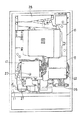
【図2】図1に示すパチンコ遊技機の遊技盤の詳細構成を示す図である。
【図3】図1に示すパチンコ遊技機の背面の構成を示す背面図である。
【図4】図1に示すパチンコ遊技機の全体構成を示すブロック図である。
【図5】図1に示すパチンコ遊技機の制御の流れを示すフローチャート図(1)である。
【図6】図1に示すパチンコ遊技機の制御の流れを示すフローチャート図(2)である。
【図7】図1に示すパチンコ遊技機の制御の流れを示すフローチャート図(3)である。
【図8】図1に示すパチンコ遊技機の制御の流れを示すフローチャート図(4)である。
【図9】図1に示すパチンコ遊技機の制御の流れを示すフローチャート図(5)である。
【図10】図1に示すパチンコ遊技機の制御の流れを示すフローチャート図(6)である。
【図11】図1に示すパチンコ遊技機の制御の流れを示すフローチャート図(7)である。
【符号の説明】
1 パチンコ遊技機
2 遊技盤
2A 遊技部
3 ガイドレール
4 一般入賞口
5A 大当りランプ
5B サイドランプ
5C リーチランプ
6 可変表示装置
7 普通電動役物
7a,7b 羽根
7H 始動口
8 変動入賞装置
9 上皿
10 操作ハンドル
11 発射装置
12 カード挿入孔
13 カード残高表示器
14 球貸スイッチ
15 下皿
16 球貸有効表示器
17 遊技盤制御装置
18 排出制御装置
19 球排出装置
20 確率設定装置
21 発射制御装置
22 球貸制御装置
23 カード保持表示器
24 カード返却スイッチ
25A 特図記憶表示器
25B 普図記憶表示器
26 カードリーダ
27 普通図柄ゲート
28 賞球タンク
29 普通図柄表示器
30 役物用CPU
31 ROM
32 RAM
33 EEPROM
34 バス
35 分周回路
36 電源回路
37 停電検出回路
38 スピーカ
39 アンプ
40 サウンドジェネレータ
41 出力ポート
42 ドライバ
43 バッファゲート
44 ローパスフィルタ
45 大入賞口ソレノイド
46 普電ソレノイド
47 始動スイッチ
48 カウントスイッチ
49 継続Vスイッチ
50 リセットスイッチ
55 装飾ランプ
P パチンコ球[0001]
[Industrial application fields]
The present invention relates to pachinko.Play a game using a ballGame machine(So-called pachinko machine)In particular, it is advantageous for the player when a predetermined condition is achieved.Special gamesStatusIs generatedRelated to the gaming machine.
[0002]
[Prior art]
In conventional gaming machines,There are things that generate special gaming state based on the establishment of a predetermined gaming condition, and the gaming state of the gaming machine changes variously during the game, so that the game is diversified and the gaming interest is enhanceding.
[0003]
[Problems to be solved by the invention]
However, in the above-mentioned conventional gaming machine, when the power of the gaming machine is turned off due to a power interruption due to a power failure or the like, various kinds of game-related information (random numbers for gaming) stored and retained are stored.ValueEtc.) is configured to disappear, and when the power is restored, the game cannot be resumed from the gaming state before the power was turned off. Therefore, if, for example, a power failure occurs during a big hit or a period of high probability, the control information that controls the gaming state that is advantageous to the player will be lost, and the player will have special benefits. There was also a problem that it was very disadvantageous because it could not be enjoyed.
[0004]
[Means for Solving the Problems]
In order to solve the above-mentioned problem, the gaming machine according to
Further, the gaming machine according to
According to a third aspect of the present invention, there is provided a gaming machine according to the second aspect of the present invention, wherein in the second aspect, a winning start memory for storing a predetermined number of game balls to the starting winning opening related to execution of the variable display game in the variable display device is stored. Memory display means capable of displaying a winning start memory number which is a memory numberTheShall be providedGame relatedInformation includes winning start memory number.
[0005]
[Action]
According to the first aspect of the present invention having the above configuration, even when the power supply to the gaming machine is cut off, it is updated by the random value updating means and used to determine whether or not a special gaming state is generated. The stored random number value is stored and held in the storage holding means as game related information, and when the power is restored, the random number updating means restarts the update of the random number value from the random value stored and held in the storage holding means.
Further, according to the invention according to
According to the invention of
[0006]
【Example】
Embodiments of the present invention will be described below with reference to the drawings. FIG. 1 shows a configuration of a
As shown in the figure, the
[0007]
The
Further, as shown in FIG. 2, various decorative lamps such as a
[0008]
Further, as shown in the figure, the ordinary
[0009]
The normal
[0010]
Then, the
[0011]
Further, the
[0012]
In addition, the
[0013]
Also, as shown in FIG. 3, on the back side of the
[0014]
Next, a more detailed mechanism and operation of the
[0015]
When a player inserts a ball lending card into the
[0016]
When the card is normal and there is a balance, the ball lending control CPU displays the balance on the
[0017]
Next, when the player operates the ball lending switch 14 (presses once or the like), the ball lending control CPU in the ball
[0018]
The player controls the
[0019]
Next, when the hit ball wins the start opening 7H of the above-described ordinary
[0020]
The above operation will be described with reference to the block diagram of FIG. 4 and the flowcharts of FIGS. FIG. 5 shows a basic flowchart of the gaming machine of this embodiment.
First, the game control CPU (a CPU for an accessory) determines whether or not the power is turned on such as when a game store is opened (step S1). If it is not when the power is turned on, it is next determined whether or not there is an interrupt signal (step S2). If there is no interrupt signal in step S2, the process proceeds to step S4. If there is an interrupt signal, the backup processing subroutine (step S3) is executed next, and the process proceeds to step S4.
[0021]
This interrupt signal is a signal output from the power
[0022]
When the interrupt signal is output, the backup processing subroutine (step S3) instantaneously stores the processing number (step S21) and then the jackpot processing data (step S22) as shown in FIG. ), Then the probability variation data is stored (step S23), then the random number processing data is stored (step S24), then the variation processing data is stored (step S25), then the management data is stored (step S26), and then The base value is stored (step S27).Thus, even if the power supply to the
[0023]
In the above description, the process number is a branch process number to be described later. The jackpot processing data includes a jackpot symbol, a V flag, a winning ball count, a continuation count, and the like. The probability variation data refers to a normal symbol up-counter value, a special symbol up-counter value, and the like. The random number processing data refers to a random number update value. Fluctuation processing data is the number of stored starting symbols, extracted random numbers, etc. for special symbols and ordinary symbols. Further, the management data refers to values that become data as a game store, such as the number of start-ups and the number of jackpots. The base value refers to the ratio of the number of prize balls to the launch ball 100, and is a value that serves as a sales index on the game store side. These data are stored in order of importance.
[0024]
These various data are stored in the RAM 32 in FIG. 4 when the power of the gaming machine is ON, but are stored in the
[0025]
When the
[0026]
Next, in step S7, a switch input processing subroutine is executed. That is, as shown in FIG. 7A, first, it is determined whether or not there is a winning in the
[0027]
Next, in the flowchart of FIG. 5, in step S <b> 8, depending on the processing number, one of normal processing, variation processing, jackpot processing, and outlier processing is branched to perform processing.
[0028]
In the normal process, as shown in FIG. 7B, first, the presence or absence of the start memory is determined (step S41). If there is no start memory, the process of this cycle is terminated. In step S42, the start memory value is decremented by "1". Next, in step S43, it is determined whether or not the value of the probability up counter is zero. If the value of the probability up counter is zero, the normal hit value is set (step S44). If the value of the probability up counter is not zero, the hit value having a higher probability than the normal value is set (step S45). . This probability up counter sets a value such as “1” or “2” depending on the symbol or the like in the case of the above-mentioned lucky number. When one game period until the end of the jackpot state ends, “1” "It will be decremented one by one. If the current value of the probability up counter is zero, the probability is returned to the normal value after the jackpot ends.
[0029]
Next, in step S46, it is determined whether or not the random value is a winning value. If the random value is not a winning value, an off symbol is selected (step S47). If the random value is a winning value, a winning symbol is selected (step S48). Next, the processing number is changed to “variation processing” and the processing of this cycle is completed.That is, the game
[0030]
In the variation process, as shown in FIG. 8, it is first determined whether or not it is a variation stop timing (step S51). If it is not the variation stop timing, it is determined whether or not it is a symbol variation timing (step S52). If it is not the symbol variation timing, the processing of this cycle is terminated. If it is the symbol variation timing, the symbol variation processing is executed in the next step S53.
[0031]
If it is determined in the next cycle determination step S51 that the fluctuation stop timing is reached, then in step S54, the total number of fluctuations is incremented by "1" and then the fluctuation is stopped (step S54). S55).
[0032]
Then, it is determined whether or not the stopped symbol is a jackpot symbol (step S56). If the symbol is not a jackpot symbol, a removal process is performed (step S57), and a normal process is performed (step S58).
[0033]
On the other hand, if it is a jackpot symbol, in the next step S59, it is determined whether or not the value of the special symbol probability up counter is zero. If the special symbol probability up counter value is zero, the process proceeds to step S61. If the special figure probability up counter value is not zero, the special figure probability up counter value is decremented by "1" in the next step S60.That is, based on the fact that the stop symbol in the variable display game corresponds to the jackpot symbol, a special game state advantageous to the player is generated. In addition, since the stop symbol of the variable display game is determined based on the determination result of the extracted random number, the game
[0034]
Next, in step S61, it is determined whether or not the value of the normal symbol probability up counter is zero. If the normal symbol probability up counter value is zero, the process proceeds to step S63. If not zero, the usual probability up counter value is decremented by "1" in the next step S62.
[0035]
Next, it is determined whether or not the special symbol jackpot symbol is a special symbol lucky number symbol (step S63). If so, a special figure probability up counter is set in step S64. By doing so, as described above, in the gaming state after the jackpot state ends, the probability of winning the winning symbol in the special symbol stop display mode is increased to a high probability so that the jackpot state is likely to occur again. It is. That is, the game
[0036]
Next, the jackpot total counter is incremented by “1” (step S67), the processing is changed to jackpot processing (step S68), and the processing of this cycle is terminated.
[0037]
In the jackpot process, as shown in FIG. 9, it is first determined whether or not there is a winning in a V winning opening (not shown) in the variable winning device 8 (step S71), and if there is no V winning, the process proceeds to step S74. However, if there is a V-win, it is determined in the next step S72 whether or not that time is the final time. If it is the final round, the process proceeds to step S74. If it is not the final round, the V winning flag is set (step S73).
[0038]
In step S74, it is determined whether or not there is a count prize (the maximum count value is up to 10). Then, next, it is determined whether or not an end condition of one cycle (for example, when 30 seconds have elapsed or when the count winning value has reached 10) is established (step S76).
[0039]
As a result, if the end condition for one cycle is not satisfied, the process ends. However, if it is determined that the end condition for one cycle is satisfied in the next step S76, the count number is cleared next. (Step S77).
[0040]
Next, it is determined whether or not there is a V winning flag (step S78). If there is no V winning flag, it is determined whether or not the special figure or ordinary probability up counter value is zero (step S79). Or, if the probability up counter value of the usual figure is zero, the routine proceeds to normal processing (step S81), but if the probability up counter value of the special figure or ordinary figure is not zero, the probability of the special figure or ordinary figure is increased ( Step S80), the routine proceeds to normal processing (Step S81).
[0041]
On the other hand, if it is determined in the next step S78 that there is a V winning flag, the V winning flag is cleared (step S82), the continuation count value is incremented by "1" (step S83), and the next A big hit process of the cycle is executed (step S84).
[0042]
Then, after the branching process of FIG. 5 is completed, the ordinary power transmission process is executed in step S13, and then the base process subroutine (step S14) is executed. In the base processing subroutine, as shown in FIG. 10, the number of pachinko balls fired is monitored (step S91), and then the number of winnings is monitored (step S92). Next, it is determined whether or not the probability of the normal symbol is fluctuating (step S93). If the probability of the normal diagram is changing, the process of this time is terminated. Next, it is determined whether or not the jackpot is being hit (step S94).
[0043]
As a result, if it is a big hit, the process of this time is terminated. If it is not a big hit, it is next determined whether or not the base value is lower than the set value (step S95). As a result, if the base value is lower than the set value, the normal symbol hit probability is set to a higher probability than normal (step S96). If the base value is equal to or higher than the set value, the normal symbol hit probability is set to the normal probability (step S97).
[0044]
Then, as shown in FIG. 5, after executing the base processing subroutine (step S14), a random number updating subroutine (step S15) is executed. In the random number update subroutine, as shown in FIG. 11, first, the random number of the special symbol is updated (step S101). Next, a random number upper limit value for the set probability value is selected (step S102). Next, it is determined whether or not the update result of the random number has reached the upper limit value (step S104). If the upper limit value has not been reached, the process proceeds to step S105. Is set to zero (step S104), and the process proceeds to step S105. In step S105, the random number of the normal symbol is updated, and a random number upper limit value for the set probability value is selected (step S106). Next, it is determined whether or not the update result of the random number has reached the above upper limit value (step S107). If the upper limit value has not been reached, the process of this time is terminated. The random number is set to zero (step S108), and this process ends.
[0045]
On the other hand, if it is determined in step S1 of FIG. 5 that the power is on, the process proceeds to step S16, and the backup data stored and held in the
[0046]
That is, in this gaming machine, the above gameRelationThe storage timing of information and the storage timing of the probability setting value (change value) are different from each other. This is because the storage can be completed in a short time by configuring so as not to store all the information at once.
[0047]
After the game is performed as described above, when the game in the pachinko gaming machine is to be ended, the player operates the
[0048]
In addition, this invention is not limited to the said Example. The above-described embodiment is an exemplification, and the present invention has the same configuration as the technical idea described in the claims of the present invention, and any device that exhibits the same function and effect is the present embodiment. It is included in the technical scope of the invention.
[0049]
【The invention's effect】
As described above, according to the invention according to
Further, according to the invention according to
According to the invention of
[Brief description of the drawings]
FIG. 1 is a front view showing an overall configuration of a pachinko gaming machine that is an embodiment of the present invention.
2 is a diagram showing a detailed configuration of a game board of the pachinko gaming machine shown in FIG.
FIG. 3 is a rear view showing the configuration of the back surface of the pachinko gaming machine shown in FIG. 1;
4 is a block diagram showing an overall configuration of the pachinko gaming machine shown in FIG. 1. FIG.
FIG. 5 is a flowchart (1) showing a control flow of the pachinko gaming machine shown in FIG. 1;
FIG. 6 is a flowchart (2) showing a control flow of the pachinko gaming machine shown in FIG. 1;
FIG. 7 is a flowchart (3) showing a flow of control of the pachinko gaming machine shown in FIG. 1;
FIG. 8 is a flowchart (4) showing a control flow of the pachinko gaming machine shown in FIG. 1;
FIG. 9 is a flowchart (5) showing a control flow of the pachinko gaming machine shown in FIG. 1;
FIG. 10 is a flowchart (6) showing a control flow of the pachinko gaming machine shown in FIG. 1;
FIG. 11 is a flowchart (7) showing a control flow of the pachinko gaming machine shown in FIG. 1;
[Explanation of symbols]
1 Pachinko machine
2 Game board
2A Game Department
3 Guide rail
4 general prize winning gates
5A jackpot lamp
5B Side lamp
5C reach lamp
6 Variable display device
7 Ordinary electric equipment
7a, 7b feather
7H Start port
8 Fluctuation winning equipment
9 Fine dishes
10 Operation handle
11 Launcher
12 Card insertion hole
13 Card balance indicator
14 Ball switch
15 Lower plate
16 ball rental effective indicator
17 Game board control device
18 Emission control device
19 ball ejector
20 Probability setting device
21 Launch control device
22 Ball rental control device
23 Card holding indicator
24 card return switch
25A special figure memory indicator
25B Universal memory display
26 Card reader
27 Normal design gate
28 prize ball tank
29 Normal symbol display
30 CPU
31 ROM
32 RAM
33 EEPROM
34 Bus
35 divider circuit
36 Power supply circuit
37 Power failure detection circuit
38 Speaker
39 amplifier
40 sound generator
41 Output port
42 drivers
43 Buffer Gate
44 Low-pass filter
45 Solitary solenoid
46 Solenoid solenoid
47 Start switch
48 count switch
49 Continuation V switch
50 Reset switch
55 Decorative Lamp
P Pachinko ball
Claims (3)
始動入賞口への遊技球の入賞に基づき、前記乱数値更新手段が更新した乱数値を抽出し、該抽出した乱数値を予め定めた判定基準に基づき判定する乱数値判定手段と、
前記乱数値判定手段の判定結果に基づき遊技者にとって有利な特別遊技状態を発生可能な特別遊技状態発生手段と、
を備えた遊技機において、
当該遊技機への供給電源が電源断となっても、電源断発生前の遊技関連情報を記憶保持可能な記憶保持手段を備えるものとし、
前記記憶保持手段は、電源断発生前に前記乱数値更新手段が更新した乱数値を遊技関連情報として記憶保持し、前記乱数値更新手段は、電源復帰した場合に、前記記憶保持手段の記憶保持する乱数値から乱数値の更新を再開するようにしたことを特徴とする遊技機。Random number updating means for updating a random number for gaming;
Random value determination means for extracting a random value updated by the random value updating means based on the winning of a game ball at the start winning opening, and determining the extracted random value based on a predetermined criterion;
Special gaming state generating means capable of generating a special gaming state advantageous to the player based on the determination result of the random number determination means;
In a gaming machine equipped with
Even if the power supply to the gaming machine is cut off, it is provided with a memory holding means capable of storing and holding game-related information before the occurrence of the power interruption,
The memory holding means stores and holds the random number value updated by the random number value updating means before the occurrence of power interruption as game related information, and the random number value updating means stores the memory holding value of the memory holding means when power is restored. The game machine is characterized in that the updating of the random number value is resumed from the random number value to be played.
当該遊技機の遊技状態が特別遊技状態である場合に、供給電源が電源断となっても、電源断発生前の遊技関連情報を記憶保持可能な記憶保持手段と、
前記可変表示ゲームの停止結果態様が特別の図柄の場合には、当該特別遊技状態の終了後に、遊技状態を、特別遊技状態の発生確率が通常時よりも高い確率となるラッキーナンバー遊技状態に変換する遊技状態変換制御手段と、
を備えるものとし、
前記記憶保持手段が記憶保持する遊技関連情報は、当該特別遊技状態終了後に遊技状態をラッキーナンバー遊技状態へ変換する権利の情報を含むことを特徴とする遊技機。A game in which a variable display game is executed by a variable display device based on a winning of a game ball in a predetermined start winning opening, and a special game state advantageous to the player can be generated based on a stop result mode of the variable display game In the machine
A memory holding means capable of storing and holding game-related information before the occurrence of power interruption even when the power supply is cut off when the gaming state of the gaming machine is a special gaming state ;
When the result of stopping the variable display game is a special symbol, after the special gaming state is finished, the gaming state is converted into a lucky number gaming state in which the probability of occurrence of the special gaming state is higher than normal. Gaming state conversion control means,
With
Said Yu technique-related information that the storage holding means to hold stored, the gaming machine characterized in that it comprises the information of the right to convert the game state after the special game state ends to lucky number gaming state.
前記遊技関連情報として、入賞始動記憶数を含むことを特徴とする請求項2に記載の遊技機。 The storage display means capable of displaying a winning start memory number winning the game ball is a storage number of the winning start memory stored up to a predetermined number to the start winning opening associated with the execution of the variable display games in the variable display device Shall be prepared,
The gaming machine according to claim 2, wherein the game-related information includes a winning start memory number .
Priority Applications (1)
| Application Number | Priority Date | Filing Date | Title |
|---|---|---|---|
| JP09515993A JP3766112B2 (en) | 1993-03-31 | 1993-03-31 | Game machine |
Applications Claiming Priority (1)
| Application Number | Priority Date | Filing Date | Title |
|---|---|---|---|
| JP09515993A JP3766112B2 (en) | 1993-03-31 | 1993-03-31 | Game machine |
Publications (2)
| Publication Number | Publication Date |
|---|---|
| JPH06285231A JPH06285231A (en) | 1994-10-11 |
| JP3766112B2 true JP3766112B2 (en) | 2006-04-12 |
Family
ID=14130008
Family Applications (1)
| Application Number | Title | Priority Date | Filing Date |
|---|---|---|---|
| JP09515993A Expired - Lifetime JP3766112B2 (en) | 1993-03-31 | 1993-03-31 | Game machine |
Country Status (1)
| Country | Link |
|---|---|
| JP (1) | JP3766112B2 (en) |
Families Citing this family (42)
| Publication number | Priority date | Publication date | Assignee | Title |
|---|---|---|---|---|
| JP3763545B2 (en) * | 1995-01-27 | 2006-04-05 | 株式会社ソフィア | Amusement hall equipment |
| JP4556003B2 (en) * | 1999-03-29 | 2010-10-06 | 株式会社大一商会 | Game machine |
| JP2000279579A (en) * | 1999-03-30 | 2000-10-10 | Fuji Shoji:Kk | Ball game machine |
| JP2001046602A (en) * | 1999-08-06 | 2001-02-20 | Heiwa Corp | Game machine and controller for game machine |
| JP3447669B2 (en) * | 1999-09-03 | 2003-09-16 | 奥村遊機株式會社 | Pachinko machine |
| JP2001145768A (en) * | 1999-09-09 | 2001-05-29 | Okumura Yu-Ki Co Ltd | Pachinko machine |
| JP3380498B2 (en) * | 1999-09-16 | 2003-02-24 | 奥村遊機株式會社 | Pachinko machine |
| JP4614191B2 (en) * | 1999-09-20 | 2011-01-19 | サミー株式会社 | Slot machine |
| JP4614192B2 (en) * | 1999-09-20 | 2011-01-19 | サミー株式会社 | Slot machine |
| JP3809493B2 (en) * | 1999-12-28 | 2006-08-16 | マルホン工業株式会社 | Game system |
| JP2001246120A (en) * | 2000-03-02 | 2001-09-11 | Fuji Shoji:Kk | Gaming machine |
| JP4947827B2 (en) * | 2000-03-03 | 2012-06-06 | 株式会社藤商事 | Game machine |
| JP3621627B2 (en) * | 2000-04-28 | 2005-02-16 | 株式会社三共 | Game machine |
| JP2002000846A (en) * | 2000-06-16 | 2002-01-08 | Maruhon Ind Co Ltd | Game restarting method and device for game machine |
| JP2002000897A (en) * | 2000-06-19 | 2002-01-08 | Maruhon Ind Co Ltd | Game restarting method for game machine |
| JP2002035244A (en) * | 2000-07-25 | 2002-02-05 | Mrd:Kk | Power feeder for pachinko machine |
| JP4665297B2 (en) * | 2000-08-21 | 2011-04-06 | 株式会社竹屋 | Game machine |
| JP4683449B2 (en) * | 2001-03-09 | 2011-05-18 | 高砂電器産業株式会社 | Game machine control board, game machine using the same, and game machine control device |
| JP4578720B2 (en) * | 2001-05-25 | 2010-11-10 | 株式会社平和 | Gaming machine fraud prevention system |
| JP2002095805A (en) * | 2001-08-09 | 2002-04-02 | Okumura Yu-Ki Co Ltd | Pachinko game machine |
| JP3900405B2 (en) * | 2001-10-18 | 2007-04-04 | 奥村遊機株式會社 | Pachinko machine |
| JP2004057620A (en) * | 2002-07-30 | 2004-02-26 | Taiyo Elec Co Ltd | Gaming machine |
| JP2004000760A (en) * | 2003-08-29 | 2004-01-08 | Sanyo Product Co Ltd | Game machine |
| JP2009273896A (en) * | 2003-10-20 | 2009-11-26 | Daiichi Shokai Co Ltd | Game machine |
| JP2008067968A (en) * | 2006-09-15 | 2008-03-27 | Daito Giken:Kk | Game machine |
| JP5088934B2 (en) * | 2007-02-27 | 2012-12-05 | 株式会社平和 | Game machine |
| JP2008043807A (en) * | 2007-10-31 | 2008-02-28 | Sanyo Product Co Ltd | Game machine |
| JP4494482B2 (en) * | 2008-03-04 | 2010-06-30 | 株式会社三共 | Game machine |
| JP4494485B2 (en) * | 2008-03-04 | 2010-06-30 | 株式会社三共 | Game machine |
| JP4494484B2 (en) * | 2008-03-04 | 2010-06-30 | 株式会社三共 | Game machine |
| JP4494481B2 (en) * | 2008-03-04 | 2010-06-30 | 株式会社三共 | Game machine |
| JP4494483B2 (en) * | 2008-03-04 | 2010-06-30 | 株式会社三共 | Game machine |
| JP4494480B2 (en) * | 2008-03-04 | 2010-06-30 | 株式会社三共 | Game machine |
| JP4880013B2 (en) * | 2009-07-28 | 2012-02-22 | 株式会社大一商会 | Game machine |
| JP4748547B2 (en) * | 2009-09-14 | 2011-08-17 | 株式会社大一商会 | Game machine |
| JP4864127B2 (en) * | 2009-09-15 | 2012-02-01 | 株式会社大一商会 | Game machine |
| JP4942054B2 (en) * | 2010-01-06 | 2012-05-30 | サミー株式会社 | Slot machine |
| JP5307062B2 (en) * | 2010-03-18 | 2013-10-02 | 株式会社三共 | Game machine |
| JP5015291B2 (en) * | 2010-06-30 | 2012-08-29 | 株式会社サンセイアールアンドディ | Game machine |
| JP2011020002A (en) * | 2010-11-05 | 2011-02-03 | Sanyo Product Co Ltd | Ball pull-out device for hit ball feed plate in pachinko machine |
| JP5535983B2 (en) * | 2011-05-24 | 2014-07-02 | サミー株式会社 | Slot machine |
| JP5590082B2 (en) * | 2012-09-05 | 2014-09-17 | 株式会社三洋物産 | Pachinko machine |
-
1993
- 1993-03-31 JP JP09515993A patent/JP3766112B2/en not_active Expired - Lifetime
Also Published As
| Publication number | Publication date |
|---|---|
| JPH06285231A (en) | 1994-10-11 |
Similar Documents
| Publication | Publication Date | Title |
|---|---|---|
| JPH06285231A (en) | Amusement machine | |
| JP3986582B2 (en) | Game machine | |
| JP7458687B2 (en) | gaming machine | |
| JP2004057268A (en) | Game machine | |
| JP4621830B2 (en) | Game machine | |
| JP3611337B2 (en) | Game machine | |
| JP2000140285A (en) | Game machine | |
| JP2009005971A (en) | Game machine | |
| JPH09168645A (en) | Pachinko machine | |
| JPH06238047A (en) | Amusement machine | |
| JP2021069850A (en) | Game machine | |
| JP2005312671A (en) | Game machine | |
| JP2000140212A (en) | Slot machine | |
| JP7332889B2 (en) | game machine | |
| JP7393631B2 (en) | gaming machine | |
| JP3285542B2 (en) | Gaming machine | |
| JP2009050633A (en) | Game machine | |
| JPH11188150A (en) | Gaming machine | |
| JP2008183161A (en) | Game machine | |
| JP2008154798A (en) | Game machine | |
| JP3370360B2 (en) | Ball game machine | |
| JP2813884B2 (en) | Pachinko machine | |
| JP2900167B2 (en) | Pachinko machine winning equipment | |
| JP3242070B2 (en) | Gaming machine | |
| JP2000140210A (en) | Slot machine |
Legal Events
| Date | Code | Title | Description |
|---|---|---|---|
| A131 | Notification of reasons for refusal |
Free format text: JAPANESE INTERMEDIATE CODE: A131 Effective date: 20040302 |
|
| A521 | Written amendment |
Free format text: JAPANESE INTERMEDIATE CODE: A523 Effective date: 20040427 |
|
| TRDD | Decision of grant or rejection written | ||
| A01 | Written decision to grant a patent or to grant a registration (utility model) |
Free format text: JAPANESE INTERMEDIATE CODE: A01 Effective date: 20060104 |
|
| A61 | First payment of annual fees (during grant procedure) |
Free format text: JAPANESE INTERMEDIATE CODE: A61 Effective date: 20060126 |
|
| R150 | Certificate of patent or registration of utility model |
Free format text: JAPANESE INTERMEDIATE CODE: R150 |
|
| FPAY | Renewal fee payment (event date is renewal date of database) |
Free format text: PAYMENT UNTIL: 20090203 Year of fee payment: 3 |
|
| FPAY | Renewal fee payment (event date is renewal date of database) |
Free format text: PAYMENT UNTIL: 20100203 Year of fee payment: 4 |
|
| FPAY | Renewal fee payment (event date is renewal date of database) |
Free format text: PAYMENT UNTIL: 20100203 Year of fee payment: 4 |
|
| FPAY | Renewal fee payment (event date is renewal date of database) |
Free format text: PAYMENT UNTIL: 20110203 Year of fee payment: 5 |
|
| S533 | Written request for registration of change of name |
Free format text: JAPANESE INTERMEDIATE CODE: R313533 |
|
| FPAY | Renewal fee payment (event date is renewal date of database) |
Free format text: PAYMENT UNTIL: 20110203 Year of fee payment: 5 |
|
| FPAY | Renewal fee payment (event date is renewal date of database) |
Free format text: PAYMENT UNTIL: 20110203 Year of fee payment: 5 |
|
| R350 | Written notification of registration of transfer |
Free format text: JAPANESE INTERMEDIATE CODE: R350 |
|
| FPAY | Renewal fee payment (event date is renewal date of database) |
Free format text: PAYMENT UNTIL: 20120203 Year of fee payment: 6 |
|
| FPAY | Renewal fee payment (event date is renewal date of database) |
Free format text: PAYMENT UNTIL: 20120203 Year of fee payment: 6 |
|
| FPAY | Renewal fee payment (event date is renewal date of database) |
Free format text: PAYMENT UNTIL: 20130203 Year of fee payment: 7 |
|
| FPAY | Renewal fee payment (event date is renewal date of database) |
Free format text: PAYMENT UNTIL: 20130203 Year of fee payment: 7 |
|
| FPAY | Renewal fee payment (event date is renewal date of database) |
Free format text: PAYMENT UNTIL: 20130203 Year of fee payment: 7 |
|
| FPAY | Renewal fee payment (event date is renewal date of database) |
Free format text: PAYMENT UNTIL: 20130203 Year of fee payment: 7 |
|
| EXPY | Cancellation because of completion of term |