JP4332017B2 - Steel strip cooling device for continuous annealing furnace - Google Patents
Steel strip cooling device for continuous annealing furnace Download PDFInfo
- Publication number
- JP4332017B2 JP4332017B2 JP2003387429A JP2003387429A JP4332017B2 JP 4332017 B2 JP4332017 B2 JP 4332017B2 JP 2003387429 A JP2003387429 A JP 2003387429A JP 2003387429 A JP2003387429 A JP 2003387429A JP 4332017 B2 JP4332017 B2 JP 4332017B2
- Authority
- JP
- Japan
- Prior art keywords
- nozzle
- cooling
- steel strip
- protruding
- gas
- Prior art date
- Legal status (The legal status is an assumption and is not a legal conclusion. Google has not performed a legal analysis and makes no representation as to the accuracy of the status listed.)
- Expired - Fee Related
Links
Images




Landscapes
- Coating With Molten Metal (AREA)
- Heat Treatments In General, Especially Conveying And Cooling (AREA)
- Heat Treatment Of Strip Materials And Filament Materials (AREA)
Description
本発明は、例えば、鋼帯の連続焼鈍設備、連続式溶融亜鉛めっき設備、カラーコーティングラインおよびステンレス酸洗焼鈍ライン等において、連続して走行する鋼帯を冷却する装置に関するものである。 The present invention relates to an apparatus for cooling a continuously running steel strip in, for example, a continuous annealing equipment for a steel strip, a continuous hot dip galvanizing equipment, a color coating line, a stainless acid pickling annealing line, and the like.
連続焼鈍炉設備は良く知られているように、鋼帯を連続的に加熱・均熱および冷却し、必要により過時効処理する工程を備えている。ところで、鋼帯の特性を所望のものにするためには、加熱温度や均熱時間のほかに、その鋼帯を均一急速冷却することが重要である。鋼帯の冷却方法として、現状各種の冷却媒体が採用されており、この冷媒の選択によって鋼帯の冷却速度も異なってくる。 As is well known, continuous annealing furnace equipment includes a process of continuously heating, soaking, and cooling a steel strip and, if necessary, overaging. By the way, in order to obtain the desired properties of the steel strip, it is important to uniformly and rapidly cool the steel strip in addition to the heating temperature and the soaking time. Various cooling media are currently used as a method for cooling the steel strip, and the cooling speed of the steel strip varies depending on the selection of the refrigerant.
このうち、水を冷媒として用いる場合、かなり高い冷却速度が得られ超急冷域までの冷却が可能であるが、焼き入れ歪によってクーリングバックルといわれる鋼帯の形状変化が発生することが最大の難点である。また、水との接触により鋼帯の表面に酸化膜が生じ、これを除去するための設備が別に必要となり、経済的に有利な設備とはいえない。 Among these, when water is used as a refrigerant, a considerably high cooling rate can be obtained and cooling to a super-quenching region is possible, but the biggest difficulty is that the shape change of the steel strip called a cooling buckle occurs due to quenching strain. It is. In addition, an oxide film is formed on the surface of the steel strip due to contact with water, and a separate facility is required to remove it, which is not economically advantageous.
この問題を解決するため、ロールの内部に水またはその他の冷却媒体を通し、この冷却されたロール表面に鋼帯を接触させて冷却するロール冷却方法がある。 In order to solve this problem, there is a roll cooling method in which water or other cooling medium is passed through the inside of the roll, and a steel strip is brought into contact with the cooled roll surface for cooling.
この方法には次のような問題がある。すなわち、連続焼鈍炉を通過する鋼帯はすべて平坦度を保っているとは限らない。従って、冷却ロールに接する際に、局部的に非接触となる場合があり、この非接触により鋼帯の幅方向の冷却が不均一となり、鋼帯の形状が変形する原因となる。そのため、冷却ロールへの接触前に鋼帯の平坦化を行う手段が必要となり、これが設備費をアップさせていた。 This method has the following problems. That is, not all the steel strips passing through the continuous annealing furnace maintain flatness. Therefore, when contacting the cooling roll, there is a case where it is locally not in contact, and this non-contact causes cooling in the width direction of the steel strip, which causes deformation of the steel strip. Therefore, a means for flattening the steel strip is required before contact with the cooling roll, which increases the equipment cost.
別の冷却手段としてガスを冷媒とする冷却方法が実用化され、多くの実績を挙げている。この方法は、前記した水冷却やロール冷却に比べて冷却速度が遅いが、比較的鋼帯の幅方向の均一な冷却が可能である。このガス冷却の最大の難点である、冷却速度を上げるため、ガスを噴射するノズルの先端を鋼帯に極力近づけて熱伝達率を上げて冷却速度を上げるものや、冷却媒体として水素ガスの濃度を上げて熱伝達率を上げたものを採用したものが開示されている。 As another cooling means, a cooling method using a gas as a refrigerant has been put into practical use, and many achievements have been given. This method has a slower cooling rate than the above-described water cooling and roll cooling, but relatively uniform cooling in the width direction of the steel strip is possible. In order to increase the cooling rate, which is the biggest difficulty of this gas cooling, the tip of the nozzle that injects the gas is brought close to the steel strip as much as possible to increase the heat transfer rate, and the concentration of hydrogen gas as the cooling medium. The thing which employ | adopted what raised the heat transfer rate by raising is disclosed.
噴射するノズルの先端を鋼帯に近接させて熱伝達率を上げるものとして、特許文献1に開示された技術がある。この技術は、ノズルの先端と鋼帯との距離を小さくして効率よい冷却を可能にしたものである。具体的には、冷却ガス室に設けられた冷却ガス室表面から突出する突出ノズルの長さを100mm−Z以上とし、突出ノズルから噴射されたガスが鋼帯に当たって背部に逃げる部分が設けられている。これにより、噴射されたガスが鋼帯表面に滞留することを減少させ、鋼帯の幅方向における冷却均一性を向上させることが開示されている。なお、Zは突出ノズル先端と鋼帯との距離を示す。
As a technique for increasing the heat transfer coefficient by bringing the tip of a nozzle to be sprayed close to a steel strip, there is a technique disclosed in
また、ノズルの突出高さを50mm−Zから200mm−Zまで種々変えて熱伝達係数の最適点を導き出す実験を行っている。そして、連続焼鈍炉の冷却帯に用いられる冷却装置として、この実験から効率的冷却能力を持つ冷却装置を提案している。この冷却装置により、通常100kcal/m2h℃であった熱伝達係数が400kcal/m2h℃まで上げることが出来るようになった。 Also, experiments are conducted to derive the optimum point of the heat transfer coefficient by changing the protrusion height of the nozzle from 50 mm-Z to 200 mm-Z. As a cooling device used in the cooling zone of the continuous annealing furnace, a cooling device having an efficient cooling capacity is proposed from this experiment. The cooling device, the heat transfer coefficient was usually 100kcal / m 2 h ℃ has become possible to raise up 400kcal / m 2 h ℃.
しかし、さらなる冷却速度の向上が望まれるようになり、通常の冷却媒体としてN2:95%程度+H2:5%程度の雰囲気ガスを循環させる既存の冷却装置では限界があった。この問題を解決するため、冷却媒体として水素ガスを使用することが考えられた。水素ガスを採用することにより冷却能力が向上することは、古くから知られていたが、水素ガスの危険性から実機への適用はされていなかった。 However, further improvement in the cooling rate has been desired, and there is a limit to existing cooling devices that circulate atmospheric gas of about N 2 : 95% + H 2 : 5% as a normal cooling medium. In order to solve this problem, it has been considered to use hydrogen gas as a cooling medium. Although it has been known for a long time that the cooling capacity is improved by using hydrogen gas, it has not been applied to actual machines due to the danger of hydrogen gas.
この水素ガス濃度を上げて急速冷却する技術が特許文献2に開示されている。この技術は急速冷却帯において、冷却ガスの水素濃度を30%〜60%、その吹き付け速度を100m/秒〜150m/秒として鋼帯に吹き付けて冷却する。このように、水素ガスを採用するための具体的技術が開発され、実機化されようとしている。
通常、N2ガス主体の雰囲気ガスによる冷却からH2濃度を上げて、かつ、ノズルからの吐出流速を100m/秒〜150m/秒とすることが必要なため、鋼帯に吹き付けられるガスの量も多量となる。また、吐出流速100m/秒〜150m/秒でガスをノズルから噴出させるための圧力も必要となる。一般にこれらの冷却装置は、鋼帯に吹き付けた冷却媒体をダクトを介して循環させ、再度吹き付ける循環式冷却装置を採用している。この循環式冷却装置では、鋼帯に吹き付けた冷却媒体が炉内に排出され、炉体に設けた吸い込みダクトから循環ブロワによって吸引される。循環ブロワの前には、鋼帯への吹き付けで温度上昇した冷却媒体を吹き付け温度に冷却する熱交換機が設置されており、これらの装置により循環を行いながら鋼帯を冷却するようになっている。 Usually, it is necessary to increase the H 2 concentration from cooling with the atmospheric gas mainly composed of N 2 gas and to set the discharge flow rate from the nozzle to 100 m / second to 150 m / second, so the amount of gas blown to the steel strip Will also be large. Further, a pressure for ejecting gas from the nozzle at a discharge flow rate of 100 m / sec to 150 m / sec is also required. Generally, these cooling devices employ a circulation type cooling device in which a cooling medium sprayed on a steel strip is circulated through a duct and sprayed again. In this circulation type cooling device, the cooling medium sprayed on the steel strip is discharged into the furnace and sucked by the circulation blower from the suction duct provided in the furnace body. In front of the circulation blower, a heat exchanger that cools the cooling medium whose temperature has been increased by spraying to the steel strip to the spray temperature is installed, and the steel strip is cooled while circulating by these devices. .
これら循環装置での必要圧力はノズルから噴出させる際に必要な圧力が一番高く、このノズル部の圧損を極力低くすることが望まれていた。
そこで本発明は、前述したような従来技術の問題点を解決し、高冷却速度を得るためにノズルからのガス噴出速度を速くし、ノズルの抵抗係数を小さくして、ガス循環設備をコンパクトにした鋼帯の冷却装置を提供することを課題とする。 Therefore, the present invention solves the problems of the prior art as described above, increases the gas ejection speed from the nozzle to obtain a high cooling rate, reduces the resistance coefficient of the nozzle, and makes the gas circulation facility compact. It is an object of the present invention to provide a steel strip cooling device.
本発明は、冷却箱の表面に突出ノズルを配置し、この突出ノズルから冷媒を噴出させて連続して走行する鋼帯を冷却する鋼帯の冷却装置において、ノズル先端から鋼帯面までの距離L1を30〜100mmに保持した複数の突出ノズルを冷却箱表面から突出させ、この突出ノズルのA/aを2≦A/a≦9(a:ノズル先端部の開口断面積、A:ノズル基部の開口断面積)とし、冷却箱表面から突出ノズルのノズル先端までの距離L2を150〜200mmとし、前記複数の突出ノズルを、そのノズル先端の開口面積の総和が前記冷却箱の表面積の2〜4%になるように配置し、冷却箱に直径DN(DN:ノズル基部より先端側10mm±3mmの範囲における突出ノズルの外径)の取り付け孔を設け、この取り付け孔にノズル基部を差し込み、拡管接合により突出ノズルを冷却箱に固定したことを特徴とするものである。 The present invention provides a cooling device for a steel strip in which a projecting nozzle is arranged on the surface of a cooling box and a coolant is ejected from the projecting nozzle to continuously cool the steel strip, and the distance from the nozzle tip to the steel strip surface. A plurality of protruding nozzles holding L1 at 30 to 100 mm are protruded from the surface of the cooling box, and A / a of the protruding nozzles is 2 ≦ A / a ≦ 9 (a: opening cross-sectional area of nozzle tip, A: nozzle base) The distance L2 from the cooling box surface to the nozzle tip of the protruding nozzle is 150 to 200 mm, and the total opening area of the nozzle tips of the plurality of protruding nozzles is 2 to 2 of the surface area of the cooling box. Arranged so as to be 4%, the cooling box is provided with a mounting hole with a diameter DN (DN: the outer diameter of the protruding nozzle in the range of 10 mm ± 3 mm tip side from the nozzle base), and the nozzle base is inserted into this mounting hole , It is characterized in that it has secured the protruding nozzle to the cooling box by tube expansion junction.
また、突出ノズルは、そのノズル基部が冷却箱内面より突出しないように取り付られ、かつ、前記ノズル基部の端部と前記取り付け孔の内面を溶接にて接合するとともに、この溶接の肉盛り部が前記冷却箱内面より突出しないように施工することもできる。 The protruding nozzle is attached so that the nozzle base does not protrude from the inner surface of the cooling box, and joins the end of the nozzle base and the inner surface of the mounting hole by welding, However, it can also be constructed so as not to protrude from the inner surface of the cooling box.
さらに、冷媒としては、H2ガス、又は、H2ガスとN2ガスその他の不活性ガスとの混合ガスを用いることができる。 Furthermore, as the refrigerant, H 2 gas or a mixed gas of H 2 gas and N 2 gas or other inert gas can be used.
本発明によれば、高冷却速度を得るためにノズルからのガス噴出速度を速くしても、ノズルの抵抗係数を小さくすることができ、ガス循環設備をコンパクトにすることができる。 According to the present invention, even if the gas ejection speed from the nozzle is increased in order to obtain a high cooling rate, the resistance coefficient of the nozzle can be reduced, and the gas circulation facility can be made compact.
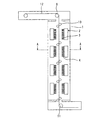
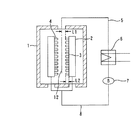
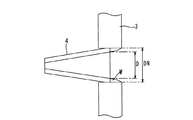
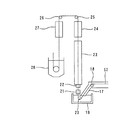
以下に本発明を図面に示す実施例に基づいて詳細に説明する。図1は本発明を適用した連続焼鈍設備の冷却装置の側部断面図、図2は図1のA−A矢視図、図3は本発明の突出ノズルの詳細図、図4は本発明の突出ノズルの取り付け要領を示す図、図5は突出ノズルの抵抗係数を示すグラフ、図6は連続式塗装ラインに本発明の冷却装置を適用した概略図、図7、図8は連続溶融亜鉛めっき設備のめっき後の鋼帯を冷却する冷却装置に本発明を適用した概略図、図9はステンレス連続式焼鈍酸洗設備の冷却帯に本発明の冷却装置を適用した概略図である。 Hereinafter, the present invention will be described in detail based on embodiments shown in the drawings. FIG. 1 is a side sectional view of a cooling device for a continuous annealing facility to which the present invention is applied, FIG. 2 is a view taken along the line AA of FIG. 1, FIG. 3 is a detailed view of a protruding nozzle of the present invention, and FIG. FIG. 5 is a graph showing the resistance coefficient of the protruding nozzle, FIG. 6 is a schematic view of the cooling device of the present invention applied to a continuous coating line, and FIGS. 7 and 8 are continuous molten zinc. FIG. 9 is a schematic diagram in which the present invention is applied to a cooling device for cooling a steel strip after plating in a plating facility, and FIG. 9 is a schematic diagram in which the cooling device of the present invention is applied to a cooling zone in a stainless steel continuous annealing pickling facility.
図1において、鋼帯12を搬送する上ロール9、下ロール11間に設置され、この上下ロール間に、ガスを噴出する冷却装置2の一対を鋼帯12の面に対向して設け、この冷却装置2を鋼帯12の流れに沿って複数段配置している。そして、この冷却装置2の上下間には鋼帯のバタツキを防止する押さえロール10を鋼帯12を挟持するように配置している。
In FIG. 1, a pair of
図2は、図1のA−A矢視図であり、冷却装置2により鋼帯12に吹き付けられたガスは循環系を介して冷却ガスとして再利用される。本発明において、冷却ガスを含む冷媒としては、H2ガスおよびN2ガスその他の不活性ガスからなる混合ガスであり、H2濃度を0〜100%、残りをN2またはその他の不活性ガスとすることが好ましい。すなわち、吹き付けられたガスは、炉体1に設けられたガス吸い込み口から吸い込まれ、吸引側ダクト5、熱交換機6、循環ブロワ7および吐出側ダクト8を介し、さらに、炉体1内の冷却箱3に連結された循環系により、冷却箱3の鋼帯12面側に設けられた突出ノズル4から鋼帯12に向けて再び噴出される。このように、鋼帯12に吹き付けられた炉体1内のガスを循環して使用する。
FIG. 2 is an AA arrow view of FIG. 1, and the gas blown to the
冷却装置2は、冷却箱3とこの冷却箱3の鋼帯12面側に設けた突出ノズル4からなっている。この突出ノズル4としては、ノズル基部(冷却箱3側)の開口断面積Aとノズル先端(鋼帯12側)の開口断面積aの比(A/a)が2.0〜9.0となるようなノズルを選定し、配置している。突出ノズル4のノズル先端から鋼帯12面までの距離L1は30〜100mmの範囲で設定し、冷却箱3表面から突出ノズル4のノズル先端までの距離L2は150〜200mmの範囲で設定する。また、突出ノズル4は、各突出ノズル4のノズル先端の開口面積の総和が冷却箱3の表面積の2〜4%となるように配置している。
The
図3には、本発明の突出ノズル4の形状を示し、Dはノズル基部の内径(ここで、ノズル基部とは冷却箱3への取り付け側をいう)、D0はノズル基部の外径で、dはノズル先端の内径、L3はノズル全長、DNはノズル基部を起点として、(ノズル全長L3)−(10mm±3mm)の範囲、言い換えると、ノズル基部より先端側10mm±3mmの範囲におけるノズルの外径を指している。突出ノズル4は円錐形状となるため、SUS(ステンレス鋼)のプレートを板巻きして製作した。突出ノズルは板巻きのほか、引き抜き鋼管や削り出し、又は、鋳造で製作することも可能である。ノズル全長L3を200mmとしてA/aが種々のものを製作して実験を行った。 FIG. 3 shows the shape of the protruding nozzle 4 of the present invention, where D is the inner diameter of the nozzle base (here, the nozzle base refers to the side attached to the cooling box 3), D0 is the outer diameter of the nozzle base, d is the inner diameter of the nozzle tip, L3 is the total length of the nozzle, DN is the starting point of the nozzle base, (nozzle total length L3 )-(10 mm ± 3 mm), in other words, the nozzle in the range of 10 mm ± 3 mm on the tip side from the nozzle base Refers to the outer diameter. Since the protruding nozzle 4 has a conical shape, it was manufactured by winding a SUS (stainless steel) plate. In addition to plate winding, the protruding nozzle can be manufactured by drawing steel pipe, cutting out, or casting. Experiments were conducted with various nozzles with A / a of 200 mm in total nozzle length L3 .
図4には、本発明の突出ノズル4を冷却箱3に取り付けたときの状況を示し、冷却箱3の鋼帯12側の面にDN径の取り付け孔を設ける。取り付け孔の数はノズル先端の開口総面積(総和)が冷却箱3の表面積の2〜4%なるように設けている。
FIG. 4 shows a situation when the protruding nozzle 4 of the present invention is attached to the
詳述すると、まず、冷却箱3の表面にDN径の取り付け孔を開ける。この取り付け孔に外径D0のノズル基部を差し込み、ポンチ(図示せず)にて図4に示すように冷却箱3に打ち込む。突出ノズル4を打ち込む際、図4のようにノズル基部が冷却箱3の内面に突出しないように打ち込む。図4ではノズル基部が冷却箱3にその内面より10mmを残して装入されるように打ち込んでいる。そして、打ち込まれた突出ノズル4のノズル基部側から装入した拡管機(図示せず)により基部側ノズル内径Dを拡管し、冷却箱3に設けた取り付け孔DN径に圧着する。さらに、ノズル基部の端部と取り付け孔の内面を溶接にて接合する。このとき、図4のように溶接の肉盛り部Wが冷却箱3の内面より突出しないように施工される。以上のように、拡管機により拡管接合することで、従来、溶接で取り付けていた場合よりも突出ノズル4の取り付け精度は向上する。
Specifically, first, a DN-diameter mounting hole is formed in the surface of the
なお、DN径の位置を上記のように限定したのは、上限以上(10mm+3mmを超える)とすると、冷却箱への挿入が困難となり、また下限より少ないと密着性が劣ることによる。 The reason why the position of the DN diameter is limited as described above is that if it is equal to or higher than the upper limit (exceeding 10 mm + 3 mm), it is difficult to insert into the cooling box.
以上のとおり、図4では突出ノズル4の抵抗係数を減じるために冷却箱3の内面より10mmを残してノズル基部を埋設したが、抵抗係数を減じるものであれば、冷却箱3の内面に合わせることも可能である。また、図4では拡管接合して溶接を行ったが、拡管接合以外の手段によって取り付けて溶接を行ってもよい。
As described above, in FIG. 4, in order to reduce the resistance coefficient of the protruding nozzle 4, the nozzle base portion is embedded leaving 10 mm from the inner surface of the
以上の要領で製作した突出ノズル4について実験装置により圧力損失を求め、それぞれの抵抗係数を算出した。その結果を図5に示す。A/a=1.0、すなわち、従来のストレートノズルに比べA/a=2.0〜9.0のときが抵抗係数が小さく4.0近傍が最も小さいことが判明した。このように、従来のストレートノズルに比べノズルの抵抗係数が30%程度小さくなる。また、ノズル先端部を楕円として鋼帯の幅方向噴出幅を拡げることもできる。 The pressure loss was calculated | required with the experimental apparatus about the protrusion nozzle 4 manufactured in the above way, and each resistance coefficient was computed. The result is shown in FIG. It was found that the resistance coefficient is small when A / a = 1.0, that is, A / a = 2.0 to 9.0 compared with the conventional straight nozzle, and the vicinity of 4.0 is the smallest. Thus, the resistance coefficient of the nozzle is about 30% smaller than that of the conventional straight nozzle. Moreover, the nozzle width direction ejection width can also be expanded by making the nozzle tip part an ellipse.
図6に連続式塗装ラインの塗装および乾燥・焼付け炉の配置を示す。鋼帯S1は、コーター設備14にて表面に塗装をコーティングされ、乾燥・焼付け炉15において所定の温度パターンに沿って乾燥、焼付けされる。引き続いて冷却装置16で常温近くまで冷却される。従来、この冷却装置16は前段を空冷、後段を水冷することによって、冷却前段での塗料表面品質確保と後段での急速冷却を実現していた。冷却装置16を本発明による突出ノズルを用いた冷却装置とすることで、水冷を用いることなく冷却効率のよい設備構成とすることができる。
Fig. 6 shows the arrangement of the painting and drying / baking furnace on the continuous painting line. The surface of the steel strip S1 is coated with a
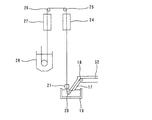
図7は、連続式溶融亜鉛めっき設備のメッキ合金化処理後の冷却装置に本発明による突出ノズルを用いた冷却装置を適用する例を示す。鋼帯S2はターンダウンセクション17内に設けられたターンダウンロール18を経てメッキポット19に導入される。シンクロール20を介して垂直に引き上げられ、メッキ機21にて所定のメッキ厚みに調整された後、合金化加熱装置22で合金化処理温度に加熱され、引き続き保持炉23で保熱される。合金化を完了した鋼帯S2は冷却装置24、上ロール25,26、及びダウンパスに設けられた冷却装置27にて冷却され、最終冷却である浸漬冷却装置28へ送られる。本発明よる突出ノズルを用いた冷却装置を冷却装置24及び冷却装置27へ適用することで、冷却効率を高め合金化炉全体を低層化することが可能となり、また、合金化処理後の鋼帯S2を急速冷却することで合金層の健全化を計ることが可能となる。
FIG. 7 shows an example in which the cooling device using the protruding nozzle according to the present invention is applied to the cooling device after the plating alloying treatment of the continuous hot dip galvanizing equipment. The steel strip S2 is introduced into the plating
図8は、同じく連続式溶融亜鉛めっき設備のメッキ後の冷却装置に本発明による突出ノズルを用いた冷却装置を適用する例を示す。鋼帯S2は、メッキ機21にて所定のメッキ厚みに調整された後、冷却装置24及びダウンパスに設けられた冷却装置27にて冷却され、最終冷却である浸漬冷却装置28へ送られる。本発明よる突出ノズルを用いた冷却装置を冷却装置24及び27へ適用することで、冷却効率を高め合金化炉全体を低層化することが可能となる。
FIG. 8 shows an example in which the cooling device using the protruding nozzle according to the present invention is applied to the cooling device after plating in the same continuous hot dip galvanizing equipment. The steel strip S2 is adjusted to a predetermined plating thickness by the plating
図9は、ステンレス鋼帯の連続焼鈍酸洗設備の一例を示す。ステンレス鋼帯S3は、加熱帯29において所定の焼鈍温度に加熱・均熱された後、冷却帯30において所定冷却速度で終点温度まで冷却される。引き続いて脱スケール装置31にてステンレス鋼帯S3の上下面に配設したロール群によってステンレス鋼帯表面に生成したスケールが除去される。その後、酸洗槽32に導入される。冷却帯30に本発明による突出ノズルを用いた冷却装置を適用することで、冷却効率を高めコンパクトな装置構成とすることができる。
FIG. 9 shows an example of a continuous annealing pickling facility for a stainless steel strip. The stainless steel strip S3 is heated and soaked at a predetermined annealing temperature in the
上述したように、本発明によれば、高冷却速度を得るため、益々、ノズルからの噴出速度を速くし、ノズルの抵抗係数を小さくして、ガス循環設備をコンパクトにした鋼帯の冷却装置を提供すること、また、拡管機による圧着構造とすれば、溶接によるノズルの歪も解消し、製作精度を向上させた鋼帯の冷却装置を提供することが可能となる。 As described above, according to the present invention, in order to obtain a high cooling rate, the steel strip cooling device in which the gas circulation equipment is made compact by increasing the ejection speed from the nozzle and decreasing the resistance coefficient of the nozzle. In addition, if a crimping structure using a pipe expander is used, it is possible to provide a steel strip cooling device that eliminates distortion of the nozzle due to welding and improves manufacturing accuracy.
1 炉体
2 冷却装置
3 冷却箱
4 突出ノズル
5 吸引側ダクト
6 熱交換機
7 循環ブロワ
8 吐出側ダクト
9 上ロール
10 押さえロール
11 下ロール
12 鋼帯
14 コーター設備
15 乾燥・焼付け炉
16 冷却装置
17 ターンダウンセクション
18 ターンダウンロール
19 メッキポット
20 シンクロール
21 メッキ機
22 合金化加熱装置
23 保持炉
24 冷却装置
25、26 上ロール
27 冷却装置
28 浸漬冷却装置
29 加熱帯
30 冷却帯
31 脱スケール装置
32 酸洗槽
S1〜S3 鋼帯
W 溶接の肉盛り部
DESCRIPTION OF
Claims (3)
Priority Applications (1)
| Application Number | Priority Date | Filing Date | Title |
|---|---|---|---|
| JP2003387429A JP4332017B2 (en) | 2003-11-18 | 2003-11-18 | Steel strip cooling device for continuous annealing furnace |
Applications Claiming Priority (1)
| Application Number | Priority Date | Filing Date | Title |
|---|---|---|---|
| JP2003387429A JP4332017B2 (en) | 2003-11-18 | 2003-11-18 | Steel strip cooling device for continuous annealing furnace |
Publications (2)
| Publication Number | Publication Date |
|---|---|
| JP2005146373A JP2005146373A (en) | 2005-06-09 |
| JP4332017B2 true JP4332017B2 (en) | 2009-09-16 |
Family
ID=34694784
Family Applications (1)
| Application Number | Title | Priority Date | Filing Date |
|---|---|---|---|
| JP2003387429A Expired - Fee Related JP4332017B2 (en) | 2003-11-18 | 2003-11-18 | Steel strip cooling device for continuous annealing furnace |
Country Status (1)
| Country | Link |
|---|---|
| JP (1) | JP4332017B2 (en) |
Families Citing this family (3)
| Publication number | Priority date | Publication date | Assignee | Title |
|---|---|---|---|---|
| JP4901276B2 (en) * | 2006-04-10 | 2012-03-21 | 新日本製鐵株式会社 | Steel strip cooling device |
| JP4977878B2 (en) | 2009-10-27 | 2012-07-18 | Jfeスチール株式会社 | Gas jet cooling device for continuous annealing furnace |
| KR101406513B1 (en) * | 2011-11-15 | 2014-06-13 | 주식회사 포스코 | Method for manufacturing coated steel shhet having excellent surface appearance |
-
2003
- 2003-11-18 JP JP2003387429A patent/JP4332017B2/en not_active Expired - Fee Related
Also Published As
| Publication number | Publication date |
|---|---|
| JP2005146373A (en) | 2005-06-09 |
Similar Documents
| Publication | Publication Date | Title |
|---|---|---|
| EP1935522B1 (en) | Reversing rolling mill with cooling facility and corresponding method of cooling a steel plate or sheet | |
| EP2112238A1 (en) | Continuous annealing equipment | |
| EP0921208A2 (en) | Method and system for cooling strip material | |
| KR19980702237A (en) | Primary cooling method in continuous annealing of steel strip | |
| EP2495343B1 (en) | Gas jet cooling device for continuous annealing furnace | |
| JP4331982B2 (en) | Steel strip cooling device | |
| EP1359230A1 (en) | Production method for steel plate and equipment therefor | |
| JP4332017B2 (en) | Steel strip cooling device for continuous annealing furnace | |
| CN100379886C (en) | Rapid cooling device for steel strip in continuous annealing equipment | |
| JP4537875B2 (en) | Steel strip cooling device | |
| CN100402674C (en) | Steel strip cooling device | |
| JP5482705B2 (en) | Cooling device and cooling method | |
| JP2006274365A (en) | Steel strip cooling device | |
| JP4901276B2 (en) | Steel strip cooling device | |
| JPH09256076A (en) | Cooling method for steel strip in continuous annealing and its cooling device | |
| JP4340090B2 (en) | Steel strip cooling device | |
| JP2006307244A (en) | Sealing device and method for cooling process in continuous heat treatment equipment for steel strip | |
| JP4564765B2 (en) | Thermal crown control device | |
| JP6904370B2 (en) | Gas jet cooling device and cooling method | |
| JP2000073125A (en) | Vertical cooling apparatus and cooling method for steel strip | |
| JP2807134B2 (en) | Gas jet chamber sealing device | |
| JPH07290136A (en) | Method and apparatus for cooling H-section steel | |
| JP4426886B2 (en) | Annealing equipment in continuous hot dip coating line | |
| JPH1161368A (en) | Hot rolled steel sheet hot dip coating equipment | |
| JPH09206819A (en) | Cooling device for the bottom surface of hot-rolled steel strip |
Legal Events
| Date | Code | Title | Description |
|---|---|---|---|
| A621 | Written request for application examination |
Free format text: JAPANESE INTERMEDIATE CODE: A621 Effective date: 20050914 |
|
| A977 | Report on retrieval |
Free format text: JAPANESE INTERMEDIATE CODE: A971007 Effective date: 20070403 |
|
| A131 | Notification of reasons for refusal |
Free format text: JAPANESE INTERMEDIATE CODE: A131 Effective date: 20080711 |
|
| A521 | Request for written amendment filed |
Free format text: JAPANESE INTERMEDIATE CODE: A523 Effective date: 20080901 |
|
| A02 | Decision of refusal |
Free format text: JAPANESE INTERMEDIATE CODE: A02 Effective date: 20090116 |
|
| A521 | Request for written amendment filed |
Free format text: JAPANESE INTERMEDIATE CODE: A523 Effective date: 20090311 |
|
| A911 | Transfer to examiner for re-examination before appeal (zenchi) |
Free format text: JAPANESE INTERMEDIATE CODE: A911 Effective date: 20090408 |
|
| TRDD | Decision of grant or rejection written | ||
| A01 | Written decision to grant a patent or to grant a registration (utility model) |
Free format text: JAPANESE INTERMEDIATE CODE: A01 Effective date: 20090612 |
|
| A01 | Written decision to grant a patent or to grant a registration (utility model) |
Free format text: JAPANESE INTERMEDIATE CODE: A01 |
|
| A61 | First payment of annual fees (during grant procedure) |
Free format text: JAPANESE INTERMEDIATE CODE: A61 Effective date: 20090619 |
|
| R151 | Written notification of patent or utility model registration |
Ref document number: 4332017 Country of ref document: JP Free format text: JAPANESE INTERMEDIATE CODE: R151 |
|
| FPAY | Renewal fee payment (event date is renewal date of database) |
Free format text: PAYMENT UNTIL: 20120626 Year of fee payment: 3 |
|
| FPAY | Renewal fee payment (event date is renewal date of database) |
Free format text: PAYMENT UNTIL: 20130626 Year of fee payment: 4 |
|
| FPAY | Renewal fee payment (event date is renewal date of database) |
Free format text: PAYMENT UNTIL: 20130626 Year of fee payment: 4 |
|
| S531 | Written request for registration of change of domicile |
Free format text: JAPANESE INTERMEDIATE CODE: R313531 |
|
| FPAY | Renewal fee payment (event date is renewal date of database) |
Free format text: PAYMENT UNTIL: 20130626 Year of fee payment: 4 |
|
| R350 | Written notification of registration of transfer |
Free format text: JAPANESE INTERMEDIATE CODE: R350 |
|
| S533 | Written request for registration of change of name |
Free format text: JAPANESE INTERMEDIATE CODE: R313533 |
|
| FPAY | Renewal fee payment (event date is renewal date of database) |
Free format text: PAYMENT UNTIL: 20130626 Year of fee payment: 4 |
|
| R350 | Written notification of registration of transfer |
Free format text: JAPANESE INTERMEDIATE CODE: R350 |
|
| S533 | Written request for registration of change of name |
Free format text: JAPANESE INTERMEDIATE CODE: R313533 |
|
| R350 | Written notification of registration of transfer |
Free format text: JAPANESE INTERMEDIATE CODE: R350 |
|
| LAPS | Cancellation because of no payment of annual fees |