JP4411706B2 - Coating material for coated granular fertilizer and coated granular fertilizer using the same - Google Patents
Coating material for coated granular fertilizer and coated granular fertilizer using the same Download PDFInfo
- Publication number
- JP4411706B2 JP4411706B2 JP27431999A JP27431999A JP4411706B2 JP 4411706 B2 JP4411706 B2 JP 4411706B2 JP 27431999 A JP27431999 A JP 27431999A JP 27431999 A JP27431999 A JP 27431999A JP 4411706 B2 JP4411706 B2 JP 4411706B2
- Authority
- JP
- Japan
- Prior art keywords
- elution
- coating material
- granular fertilizer
- film
- coated
- Prior art date
- Legal status (The legal status is an assumption and is not a legal conclusion. Google has not performed a legal analysis and makes no representation as to the accuracy of the status listed.)
- Expired - Lifetime
Links
- 239000003337 fertilizer Substances 0.000 title claims description 58
- 238000000576 coating method Methods 0.000 title claims description 45
- 239000011248 coating agent Substances 0.000 title claims description 44
- 239000000463 material Substances 0.000 title claims description 43
- 229920000642 polymer Polymers 0.000 claims description 27
- 125000000217 alkyl group Chemical group 0.000 claims description 23
- -1 diene compounds Chemical class 0.000 claims description 21
- 229920013716 polyethylene resin Polymers 0.000 claims description 21
- 125000004432 carbon atom Chemical group C* 0.000 claims description 17
- OKTJSMMVPCPJKN-UHFFFAOYSA-N Carbon Chemical compound [C] OKTJSMMVPCPJKN-UHFFFAOYSA-N 0.000 claims description 16
- VGGSQFUCUMXWEO-UHFFFAOYSA-N Ethene Chemical compound C=C VGGSQFUCUMXWEO-UHFFFAOYSA-N 0.000 claims description 16
- 239000005977 Ethylene Substances 0.000 claims description 16
- 229910052799 carbon Inorganic materials 0.000 claims description 15
- KAKZBPTYRLMSJV-UHFFFAOYSA-N Butadiene Chemical compound C=CC=C KAKZBPTYRLMSJV-UHFFFAOYSA-N 0.000 claims description 14
- 229920001577 copolymer Polymers 0.000 claims description 11
- 239000004711 α-olefin Substances 0.000 claims description 9
- 239000000155 melt Substances 0.000 claims description 3
- 125000004122 cyclic group Chemical group 0.000 claims 2
- 238000010828 elution Methods 0.000 description 75
- 239000010408 film Substances 0.000 description 40
- 239000002689 soil Substances 0.000 description 22
- 229920005989 resin Polymers 0.000 description 21
- 239000011347 resin Substances 0.000 description 21
- 239000003054 catalyst Substances 0.000 description 20
- 238000000034 method Methods 0.000 description 18
- 238000006116 polymerization reaction Methods 0.000 description 14
- 239000000126 substance Substances 0.000 description 14
- 238000004519 manufacturing process Methods 0.000 description 13
- 238000003860 storage Methods 0.000 description 13
- 229920005672 polyolefin resin Polymers 0.000 description 12
- XLYOFNOQVPJJNP-UHFFFAOYSA-N water Substances O XLYOFNOQVPJJNP-UHFFFAOYSA-N 0.000 description 9
- 238000004090 dissolution Methods 0.000 description 7
- YXFVVABEGXRONW-UHFFFAOYSA-N Toluene Chemical compound CC1=CC=CC=C1 YXFVVABEGXRONW-UHFFFAOYSA-N 0.000 description 6
- 229920001971 elastomer Polymers 0.000 description 6
- 125000001495 ethyl group Chemical group [H]C([H])([H])C([H])([H])* 0.000 description 6
- 239000007789 gas Substances 0.000 description 6
- 238000005259 measurement Methods 0.000 description 6
- 230000001737 promoting effect Effects 0.000 description 6
- 239000002904 solvent Substances 0.000 description 6
- 238000000354 decomposition reaction Methods 0.000 description 5
- VLKZOEOYAKHREP-UHFFFAOYSA-N n-Hexane Chemical compound CCCCCC VLKZOEOYAKHREP-UHFFFAOYSA-N 0.000 description 5
- 239000002245 particle Substances 0.000 description 5
- 229920005678 polyethylene based resin Polymers 0.000 description 5
- 239000005060 rubber Substances 0.000 description 5
- VXNZUUAINFGPBY-UHFFFAOYSA-N 1-Butene Chemical compound CCC=C VXNZUUAINFGPBY-UHFFFAOYSA-N 0.000 description 4
- IJGRMHOSHXDMSA-UHFFFAOYSA-N Atomic nitrogen Chemical compound N#N IJGRMHOSHXDMSA-UHFFFAOYSA-N 0.000 description 4
- RRHGJUQNOFWUDK-UHFFFAOYSA-N Isoprene Chemical compound CC(=C)C=C RRHGJUQNOFWUDK-UHFFFAOYSA-N 0.000 description 4
- 239000004698 Polyethylene Substances 0.000 description 4
- 238000009825 accumulation Methods 0.000 description 4
- 229920003232 aliphatic polyester Polymers 0.000 description 4
- 229910002091 carbon monoxide Inorganic materials 0.000 description 4
- 230000015556 catabolic process Effects 0.000 description 4
- 150000001875 compounds Chemical class 0.000 description 4
- 238000006731 degradation reaction Methods 0.000 description 4
- 229910052500 inorganic mineral Inorganic materials 0.000 description 4
- 229920000573 polyethylene Polymers 0.000 description 4
- 239000000843 powder Substances 0.000 description 4
- XSQUKJJJFZCRTK-UHFFFAOYSA-N Urea Chemical compound NC(N)=O XSQUKJJJFZCRTK-UHFFFAOYSA-N 0.000 description 3
- 150000001336 alkenes Chemical class 0.000 description 3
- 229920006167 biodegradable resin Polymers 0.000 description 3
- 238000006065 biodegradation reaction Methods 0.000 description 3
- 239000004202 carbamide Substances 0.000 description 3
- 239000003795 chemical substances by application Substances 0.000 description 3
- 239000004927 clay Substances 0.000 description 3
- 150000001993 dienes Chemical class 0.000 description 3
- 230000000694 effects Effects 0.000 description 3
- 230000004720 fertilization Effects 0.000 description 3
- 239000012530 fluid Substances 0.000 description 3
- 230000012010 growth Effects 0.000 description 3
- 230000007246 mechanism Effects 0.000 description 3
- 239000000203 mixture Substances 0.000 description 3
- 230000003647 oxidation Effects 0.000 description 3
- 238000007254 oxidation reaction Methods 0.000 description 3
- 238000001782 photodegradation Methods 0.000 description 3
- 229920001195 polyisoprene Polymers 0.000 description 3
- 229920000098 polyolefin Polymers 0.000 description 3
- 239000002002 slurry Substances 0.000 description 3
- 239000007921 spray Substances 0.000 description 3
- 239000004094 surface-active agent Substances 0.000 description 3
- 239000000454 talc Substances 0.000 description 3
- 229910052623 talc Inorganic materials 0.000 description 3
- LIKMAJRDDDTEIG-UHFFFAOYSA-N 1-hexene Chemical compound CCCCC=C LIKMAJRDDDTEIG-UHFFFAOYSA-N 0.000 description 2
- KWKAKUADMBZCLK-UHFFFAOYSA-N 1-octene Chemical compound CCCCCCC=C KWKAKUADMBZCLK-UHFFFAOYSA-N 0.000 description 2
- UGFAIRIUMAVXCW-UHFFFAOYSA-N Carbon monoxide Chemical compound [O+]#[C-] UGFAIRIUMAVXCW-UHFFFAOYSA-N 0.000 description 2
- 241000196324 Embryophyta Species 0.000 description 2
- 239000004609 Impact Modifier Substances 0.000 description 2
- UQSXHKLRYXJYBZ-UHFFFAOYSA-N Iron oxide Chemical compound [Fe]=O UQSXHKLRYXJYBZ-UHFFFAOYSA-N 0.000 description 2
- IMNFDUFMRHMDMM-UHFFFAOYSA-N N-Heptane Chemical compound CCCCCCC IMNFDUFMRHMDMM-UHFFFAOYSA-N 0.000 description 2
- UFWIBTONFRDIAS-UHFFFAOYSA-N Naphthalene Chemical compound C1=CC=CC2=CC=CC=C21 UFWIBTONFRDIAS-UHFFFAOYSA-N 0.000 description 2
- VYPSYNLAJGMNEJ-UHFFFAOYSA-N Silicium dioxide Chemical compound O=[Si]=O VYPSYNLAJGMNEJ-UHFFFAOYSA-N 0.000 description 2
- 230000004075 alteration Effects 0.000 description 2
- 238000009395 breeding Methods 0.000 description 2
- 230000001488 breeding effect Effects 0.000 description 2
- 230000008859 change Effects 0.000 description 2
- 239000003610 charcoal Substances 0.000 description 2
- 230000000052 comparative effect Effects 0.000 description 2
- 238000007796 conventional method Methods 0.000 description 2
- 238000007334 copolymerization reaction Methods 0.000 description 2
- 230000007423 decrease Effects 0.000 description 2
- 238000001035 drying Methods 0.000 description 2
- 230000007613 environmental effect Effects 0.000 description 2
- 230000005496 eutectics Effects 0.000 description 2
- 229930195733 hydrocarbon Natural products 0.000 description 2
- 150000002430 hydrocarbons Chemical class 0.000 description 2
- 125000000959 isobutyl group Chemical group [H]C([H])([H])C([H])(C([H])([H])[H])C([H])([H])* 0.000 description 2
- 238000000691 measurement method Methods 0.000 description 2
- 125000002496 methyl group Chemical group [H]C([H])([H])* 0.000 description 2
- 239000010445 mica Substances 0.000 description 2
- 229910052618 mica group Inorganic materials 0.000 description 2
- 230000000813 microbial effect Effects 0.000 description 2
- 229910052757 nitrogen Inorganic materials 0.000 description 2
- HEOTUWROLIPMOE-UHFFFAOYSA-N nonoxybenzene;oxirane Chemical compound C1CO1.CCCCCCCCCOC1=CC=CC=C1 HEOTUWROLIPMOE-UHFFFAOYSA-N 0.000 description 2
- 239000003921 oil Substances 0.000 description 2
- 125000002524 organometallic group Chemical group 0.000 description 2
- 230000000704 physical effect Effects 0.000 description 2
- 229920001282 polysaccharide Polymers 0.000 description 2
- 238000005507 spraying Methods 0.000 description 2
- 238000000859 sublimation Methods 0.000 description 2
- 230000008022 sublimation Effects 0.000 description 2
- 229920003002 synthetic resin Polymers 0.000 description 2
- 229910052719 titanium Inorganic materials 0.000 description 2
- 229910052723 transition metal Inorganic materials 0.000 description 2
- 150000003623 transition metal compounds Chemical class 0.000 description 2
- 150000003624 transition metals Chemical class 0.000 description 2
- 230000001960 triggered effect Effects 0.000 description 2
- 235000021122 unsaturated fatty acids Nutrition 0.000 description 2
- 229910052720 vanadium Inorganic materials 0.000 description 2
- AHAREKHAZNPPMI-AATRIKPKSA-N (3e)-hexa-1,3-diene Chemical compound CC\C=C\C=C AHAREKHAZNPPMI-AATRIKPKSA-N 0.000 description 1
- DSSYKIVIOFKYAU-XCBNKYQSSA-N (R)-camphor Chemical compound C1C[C@@]2(C)C(=O)C[C@@H]1C2(C)C DSSYKIVIOFKYAU-XCBNKYQSSA-N 0.000 description 1
- 238000001644 13C nuclear magnetic resonance spectroscopy Methods 0.000 description 1
- 238000005160 1H NMR spectroscopy Methods 0.000 description 1
- IGLWCQMNTGCUBB-UHFFFAOYSA-N 3-methylidenepent-1-ene Chemical compound CCC(=C)C=C IGLWCQMNTGCUBB-UHFFFAOYSA-N 0.000 description 1
- WSSSPWUEQFSQQG-UHFFFAOYSA-N 4-methyl-1-pentene Chemical compound CC(C)CC=C WSSSPWUEQFSQQG-UHFFFAOYSA-N 0.000 description 1
- 239000004215 Carbon black (E152) Substances 0.000 description 1
- 241000723346 Cinnamomum camphora Species 0.000 description 1
- 229920000089 Cyclic olefin copolymer Polymers 0.000 description 1
- 102000004190 Enzymes Human genes 0.000 description 1
- 108090000790 Enzymes Proteins 0.000 description 1
- 238000005481 NMR spectroscopy Methods 0.000 description 1
- CTQNGGLPUBDAKN-UHFFFAOYSA-N O-Xylene Chemical compound CC1=CC=CC=C1C CTQNGGLPUBDAKN-UHFFFAOYSA-N 0.000 description 1
- CYTYCFOTNPOANT-UHFFFAOYSA-N Perchloroethylene Chemical group ClC(Cl)=C(Cl)Cl CYTYCFOTNPOANT-UHFFFAOYSA-N 0.000 description 1
- 229920003171 Poly (ethylene oxide) Polymers 0.000 description 1
- 239000005062 Polybutadiene Substances 0.000 description 1
- 229910004298 SiO 2 Inorganic materials 0.000 description 1
- NINIDFKCEFEMDL-UHFFFAOYSA-N Sulfur Chemical compound [S] NINIDFKCEFEMDL-UHFFFAOYSA-N 0.000 description 1
- XSTXAVWGXDQKEL-UHFFFAOYSA-N Trichloroethylene Chemical group ClC=C(Cl)Cl XSTXAVWGXDQKEL-UHFFFAOYSA-N 0.000 description 1
- XTXRWKRVRITETP-UHFFFAOYSA-N Vinyl acetate Chemical compound CC(=O)OC=C XTXRWKRVRITETP-UHFFFAOYSA-N 0.000 description 1
- QFHMNFAUXJAINK-UHFFFAOYSA-N [1-(carbamoylamino)-2-methylpropyl]urea Chemical compound NC(=O)NC(C(C)C)NC(N)=O QFHMNFAUXJAINK-UHFFFAOYSA-N 0.000 description 1
- PNNCWTXUWKENPE-UHFFFAOYSA-N [N].NC(N)=O Chemical compound [N].NC(N)=O PNNCWTXUWKENPE-UHFFFAOYSA-N 0.000 description 1
- 230000001133 acceleration Effects 0.000 description 1
- 239000002253 acid Substances 0.000 description 1
- 239000012190 activator Substances 0.000 description 1
- 239000004480 active ingredient Substances 0.000 description 1
- 239000000654 additive Substances 0.000 description 1
- 230000002776 aggregation Effects 0.000 description 1
- 238000004220 aggregation Methods 0.000 description 1
- 239000003905 agrochemical Substances 0.000 description 1
- 150000005215 alkyl ethers Chemical class 0.000 description 1
- WNROFYMDJYEPJX-UHFFFAOYSA-K aluminium hydroxide Chemical compound [OH-].[OH-].[OH-].[Al+3] WNROFYMDJYEPJX-UHFFFAOYSA-K 0.000 description 1
- 239000002280 amphoteric surfactant Substances 0.000 description 1
- 239000003945 anionic surfactant Substances 0.000 description 1
- 150000004945 aromatic hydrocarbons Chemical class 0.000 description 1
- 150000008378 aryl ethers Chemical class 0.000 description 1
- QVGXLLKOCUKJST-UHFFFAOYSA-N atomic oxygen Chemical compound [O] QVGXLLKOCUKJST-UHFFFAOYSA-N 0.000 description 1
- 230000000975 bioactive effect Effects 0.000 description 1
- 231100000209 biodegradability test Toxicity 0.000 description 1
- 230000015572 biosynthetic process Effects 0.000 description 1
- 229920001400 block copolymer Polymers 0.000 description 1
- 229960000846 camphor Drugs 0.000 description 1
- 229930008380 camphor Natural products 0.000 description 1
- 239000003093 cationic surfactant Substances 0.000 description 1
- 238000006243 chemical reaction Methods 0.000 description 1
- 150000008280 chlorinated hydrocarbons Chemical class 0.000 description 1
- 239000000470 constituent Substances 0.000 description 1
- 150000004292 cyclic ethers Chemical class 0.000 description 1
- 230000007547 defect Effects 0.000 description 1
- GDVKFRBCXAPAQJ-UHFFFAOYSA-A dialuminum;hexamagnesium;carbonate;hexadecahydroxide Chemical compound [OH-].[OH-].[OH-].[OH-].[OH-].[OH-].[OH-].[OH-].[OH-].[OH-].[OH-].[OH-].[OH-].[OH-].[OH-].[OH-].[Mg+2].[Mg+2].[Mg+2].[Mg+2].[Mg+2].[Mg+2].[Al+3].[Al+3].[O-]C([O-])=O GDVKFRBCXAPAQJ-UHFFFAOYSA-A 0.000 description 1
- YNLAOSYQHBDIKW-UHFFFAOYSA-M diethylaluminium chloride Chemical compound CC[Al](Cl)CC YNLAOSYQHBDIKW-UHFFFAOYSA-M 0.000 description 1
- 239000006185 dispersion Substances 0.000 description 1
- 239000000806 elastomer Substances 0.000 description 1
- 229940117927 ethylene oxide Drugs 0.000 description 1
- 239000005038 ethylene vinyl acetate Substances 0.000 description 1
- 238000011156 evaluation Methods 0.000 description 1
- 239000003925 fat Substances 0.000 description 1
- 239000011888 foil Substances 0.000 description 1
- 238000010528 free radical solution polymerization reaction Methods 0.000 description 1
- 125000000524 functional group Chemical group 0.000 description 1
- 238000012685 gas phase polymerization Methods 0.000 description 1
- 239000011521 glass Substances 0.000 description 1
- 239000010439 graphite Substances 0.000 description 1
- 229910002804 graphite Inorganic materials 0.000 description 1
- 229910052735 hafnium Inorganic materials 0.000 description 1
- 229920001519 homopolymer Polymers 0.000 description 1
- 229910001701 hydrotalcite Inorganic materials 0.000 description 1
- 229960001545 hydrotalcite Drugs 0.000 description 1
- 239000011256 inorganic filler Substances 0.000 description 1
- 229910003475 inorganic filler Inorganic materials 0.000 description 1
- 239000011980 kaminsky catalyst Substances 0.000 description 1
- 239000004611 light stabiliser Substances 0.000 description 1
- 239000007788 liquid Substances 0.000 description 1
- 229910052749 magnesium Inorganic materials 0.000 description 1
- 229910052751 metal Inorganic materials 0.000 description 1
- 239000002184 metal Substances 0.000 description 1
- 244000005700 microbiome Species 0.000 description 1
- 238000002156 mixing Methods 0.000 description 1
- TVMXDCGIABBOFY-UHFFFAOYSA-N n-Octanol Natural products CCCCCCCC TVMXDCGIABBOFY-UHFFFAOYSA-N 0.000 description 1
- 125000004108 n-butyl group Chemical group [H]C([H])([H])C([H])([H])C([H])([H])C([H])([H])* 0.000 description 1
- 125000001280 n-hexyl group Chemical group C(CCCCC)* 0.000 description 1
- 239000002736 nonionic surfactant Substances 0.000 description 1
- JRZJOMJEPLMPRA-UHFFFAOYSA-N olefin Natural products CCCCCCCC=C JRZJOMJEPLMPRA-UHFFFAOYSA-N 0.000 description 1
- 238000010525 oxidative degradation reaction Methods 0.000 description 1
- 229910052760 oxygen Inorganic materials 0.000 description 1
- 239000001301 oxygen Substances 0.000 description 1
- 230000035699 permeability Effects 0.000 description 1
- 150000002978 peroxides Chemical class 0.000 description 1
- 239000011990 phillips catalyst Substances 0.000 description 1
- 230000008635 plant growth Effects 0.000 description 1
- 229920001200 poly(ethylene-vinyl acetate) Polymers 0.000 description 1
- 229920002857 polybutadiene Polymers 0.000 description 1
- 229920000570 polyether Polymers 0.000 description 1
- 230000000379 polymerizing effect Effects 0.000 description 1
- 229920002451 polyvinyl alcohol Polymers 0.000 description 1
- 235000019422 polyvinyl alcohol Nutrition 0.000 description 1
- 230000008569 process Effects 0.000 description 1
- QQONPFPTGQHPMA-UHFFFAOYSA-N propylene Natural products CC=C QQONPFPTGQHPMA-UHFFFAOYSA-N 0.000 description 1
- 125000004805 propylene group Chemical group [H]C([H])([H])C([H])([*:1])C([H])([H])[*:2] 0.000 description 1
- 102000004169 proteins and genes Human genes 0.000 description 1
- 108090000623 proteins and genes Proteins 0.000 description 1
- 230000009257 reactivity Effects 0.000 description 1
- 238000005464 sample preparation method Methods 0.000 description 1
- 229930195734 saturated hydrocarbon Natural products 0.000 description 1
- 239000000377 silicon dioxide Substances 0.000 description 1
- 230000003068 static effect Effects 0.000 description 1
- 229910052717 sulfur Inorganic materials 0.000 description 1
- 239000011593 sulfur Substances 0.000 description 1
- 238000012360 testing method Methods 0.000 description 1
- 229950011008 tetrachloroethylene Drugs 0.000 description 1
- 239000010409 thin film Substances 0.000 description 1
- VOITXYVAKOUIBA-UHFFFAOYSA-N triethylaluminium Chemical compound CC[Al](CC)CC VOITXYVAKOUIBA-UHFFFAOYSA-N 0.000 description 1
- MCULRUJILOGHCJ-UHFFFAOYSA-N triisobutylaluminium Chemical compound CC(C)C[Al](CC(C)C)CC(C)C MCULRUJILOGHCJ-UHFFFAOYSA-N 0.000 description 1
- 150000004670 unsaturated fatty acids Chemical class 0.000 description 1
- 239000008096 xylene Substances 0.000 description 1
- 229910052726 zirconium Inorganic materials 0.000 description 1
Images
Landscapes
- Paints Or Removers (AREA)
- Fertilizers (AREA)
Description
【0001】
【発明の属する技術分野】
本発明は、生分解性と光分解性を併せ持つ樹脂を主成分とする粒状肥料用コーティング材及びそれを使用して被覆された粒状肥料に関する。更に詳しくは、本発明は、土壌中にて肥料成分の溶出が制御され、且つコーティング材の皮膜が土壌内外で分解することにより生態系に蓄積することがない被覆粒状肥料とそのために使用するコ−ティング材に関する。
【0002】
【従来の技術】
土壌中に施肥された肥料成分の溶出を物理的に制御するために、粒状肥料の表面を高分子を用いた皮膜で被覆する検討が広く実施されてきた。特に、特公昭54−3104、特公昭60−3040及び特公昭60−37074に開示されているポリオレフィン樹脂を主材料とする皮膜材を用いた被覆肥料は、溶出制御性が良好で実用化に至っている。被覆材に低透湿性のポリオレフィン樹脂を使用すると、直線型溶出タイプ及びシグモイド型溶出タイプ等の様々な溶出タイプを創製可能であり、且つ温度と水分以外の土壌条件に溶出が左右されないので、作物の生育に合わせた施肥管理が可能となる。
本発明者等は、先にオレフィン系のホモポリマーをベ−スにエチレン−α-オレフィンコポリマ−を組み合わせることにより、薄い皮膜で40日以上の溶出防止期間を有するようなS型被膜の形成を提案した(特開平10−203886)が、ポリマーを混合物とするため、製品の安定性や2種類以上のブレンド操作の煩雑さ等にやや問題があった。
ところで、近年、ポリオレフィン樹脂が非分解性のため、被覆肥料が投入された圃場での皮膜殻の蓄積、さらには圃場域外への流出と生態系での蓄積が問題点として指摘されている。
【0003】
そこで、ポリオレフィン樹脂に崩壊性・分解性を付与するために種々の物質を添加する技術が提案されているが、各々に問題があり、満足すべきものが得られていない。
例えば、被覆材としてのポリオレフィン樹脂に光分解性樹脂を添加して皮膜に崩壊性を付与する技術が提案され、その光分解性樹脂としてジエン系重合体(特公平6−99207)、ゴム系樹脂(特公平5−30798)、エチレン・酢酸ビニル・一酸化炭素共重合体(特公平2−23515)、ジエン系ブロック共重合体(特開平3−75288)が開示されている。しかし、これらは主被覆材であるポリオレフィン樹脂それ自体の分解を促進するものではないこと、及び露光条件下での分解のため、圃場での蓄積及び圃場域外への流出を回避できる物では無い欠点がある。
【0004】
そこで、ポリオレフィン樹脂に光分解促進剤として、特定の有機金属錯体を添加し皮膜の強度を低下させ崩壊に至らしめる技術が開示された(特開平5−201786)が、これも露光条件下での崩壊のため、圃場での蓄積及び圃場域外への流出を回避できる物では無い欠点を有している。
また、低分子量ポリオレフィンを必須成分とし、これに有機金属錯体を添加して土中崩壊性を高めた技術も開示された(特開平10−231190)が、耐磨耗性が弱いため溶出制御性が不安定になる欠点がある。
【0005】
更に、ポリオレフィン樹脂に生分解性資材を添加し皮膜を崩壊に至らしめる技術が提案され、その際、生分解性資材として糖重合体及びその誘導体(特開平6−87684)、脂肪族ポリエステル(特開平9−263476)を使用することが開示されている。しかしながら、主被覆材であるポリオレフィン樹脂の分解を促進するものではないこと、加えて生分解性資材の増加に伴う溶出パターンの促進と土壌中での溶出制御性が不安定である問題点を有している。
ポリオレフィン樹脂に酸化促進物質・生分解資材・昇華性物質・水溶性物質から選ばれる2種以上の物質を添加し皮膜を崩壊に至らしめる技術が開示された(特開平6−144981、特開平7−48194、特開平9−309783、特開平9−309784、特開平10−1386)が、皮膜組成が複雑になること、保存安定性が悪い、溶出制御性が不安定になる等により実用化に至っていない。
上記した技術の欠点を補うために2層以上の皮膜で粒状肥料を被覆する技術が開示された(特開平7−133179、特開平9−194280、特開平9−194281、特開平10−25179、特開平10−218693、特開平10−231191)が、被覆操作が煩雑になる等により実用化に至っていない。
【0006】
一方、被覆材自体に分解性を付与する技術も種々開示されているが、各々に欠点があり、充分な問題解決に至っていない。
例えば、光分解性樹脂を皮膜主成分とする技術が提案され、その光分解性樹脂としてエチレン・一酸化炭素共重合体(特公平2−23516)、ビニルケトン共重合体(特公平7−506)、オレフィン類・一酸化炭素・オレフィン性不飽和化合物共重合体(特開平6−56568)を用いることが示されているが、これらは露光条件下での分解のため、圃場での蓄積及び圃場域外への流出を回避できる物ではなく、また保存中における皮膜変質によって溶出制御性が不安定になる問題がある。
また、生分解性樹脂を皮膜主成分とする技術も提案され、その生分解性樹脂としては種々の脂肪族ポリエステル類(特公平2−23517、特公平7−505、特開平4−89384、特開平5−85873、特開平7−33577、特開平7−61884、特開平7−315976、特開平8−157290、特開平9−24977、特開平10−7484)が知られているが、これらは土壌中で生分解により溶出が不安定なこと、透湿性が高いため溶出停滞期を持つ溶出パターンを設定できない等の問題点がある。
【0007】
ここで、「土壌中での溶出制御性が良好である」とは、土壌中の水分と温度条件のみで溶出を予測することが可能で、作物の生育に合わせた施肥管理を可能とすることを意味する。また、「溶出制御性が不安定である」とは、皮膜の崩壊性・分解性が水分と温度のみならず、微生物活性・pH等に影響されるので変化の予測が困難であり、よって分解に伴う溶出促進も予測困難であるので、土壌中での溶出を制御するに至っていないことを意味する。
【0008】
【発明が解決しようとする課題】
本発明は、以下の3つの課題を満たし、実質的に皮膜の非崩壊性による環境負荷を回避することができ、しかも各種溶出パターンの溶出制御性が良好な被覆粒状肥料及びそのための被覆用コーティング材を提供することにある。
本発明の第1の課題は、被覆粒状肥料の皮膜の成分である高分子を土壌中での生分解により圃場での蓄積を回避し、分解に伴い皮膜が容易に崩壊することで中空粒子の浮上や圃場域外への流出を抑制し、さらに、流出した皮膜は生態系の微生物や紫外線により分解させることで、生態系に蓄積させないことである。
【0009】
第2の課題は、被覆材成分を調整することにより、種々のタイプの溶出パターンを創製することである。特に、シグモイドタイプの溶出パターンを得るためには、被覆処理により適度の溶出停止性を付与することが必要である。例えば、樹脂単独の被覆材からなる被覆肥料の場合には、その溶出速度、即ち、25℃で100日後の溶出率が好ましくは50%以下、より好ましくは30%以下、特に好ましくは10%以下である。溶出停止後の溶出速度の加速及び溶出パターンの直線化は、従来の方法、例えば無機フィラーや界面活性剤等の皮膜内への添加によって調整される。
さらに、本発明の第3の課題は、土壌中での溶出制御性が良好で且つ保管中に皮膜の変質により溶出制御性を変化させないことである。
【0010】
【課題を解決するための手段】
本発明者らは、上述の課題を解決するために、シグモイドタイプの溶出パターンが可能なポリエチレン系樹脂の被覆材としての特性について鋭意検討した結果、土中で生分解を受けつつあるポリエチレンには1640cm-1に吸収が見られ、それは主鎖中に二重結合が生じ、そこがトリガ−になって生分解が進行すると推定されていること(日本ゴム協会誌、67 (6) 448-455 ('94) など)から、ポリエチレン樹脂の主鎖中に予め二重結合を導入すれば、生分解性が促進され、しかも尿素などの溶出性に関する特性はポリエチレン樹脂と同様に維持されるとの想定に基づき本発明に到達した。
【0011】
即ち、上記課題を解決するための本発明の要旨は、主鎖中に、環状構造を有せず、主鎖中の炭素数1000個当たり2〜100個の炭素不飽和二重結合並びに2〜70個の短鎖アルキル分岐を含有するエチレンと共役ジエン化合物及びα−オレフィンとの共重合体からなる生分解性ポリエチレン系樹脂を皮膜の主高分子成分となすことを特徴とする被覆粒状肥料用コ−ティング材及び該コ−ティング材で粒状肥料が被覆された被覆粒状肥料に存する。
【0012】
本発明の好ましい態様としては、主鎖中に、環状構造を有せず、主鎖中の炭素数1000個当たり2〜100個の炭素不飽和二重結合並びに2〜70個の短鎖アルキル分岐を含有するエチレンと共役ジエン化合物及びα−オレフィンとの共重合体からなる生分解性ポリオレフィン系樹脂のメルトインデックスが0.01〜1000であり、又該ポリエチレン系樹脂において、共役ジエン化合物は1,3−ブタジエンであり、短鎖アルキル分岐は炭素数1〜8アルキル基であるコ−ティング材及び該コ−ティング材で粒状肥料が被覆された被覆粒状肥料が挙げられる。
【0013】
【発明の実施の形態】
以下、本発明につき詳細に説明する。
本発明の被覆粒状肥料用コ−ティング材の一成分は、主鎖中に、主鎖中の炭素数1000個当たり2〜100個の炭素不飽和二重結合並びに2〜70個の短鎖アルキル分岐を有するポリエチレン系樹脂である。
本発明のポリエチレン系樹脂は、エチレンと共役ジエン化合物及びα−オレフィンとを共重合するによって得られる。
共役ジエン化合物としては、1,3-ブタジエン、イソプレン、2-エチル-1,3-ブタジエン、1,3-ヘキサジエンなどを挙げることができるが、価格や反応性の点で、1,3-ブタジエン、イソプレンが好ましく、特に1,3-ブタジエンが好ましい。
【0014】
共役ジエン化合物とエチレンとのモル比は、特に制限されないが、主鎖中に主鎖中の炭素数1000個当たり2〜100個の炭素不飽和二重結合を含有させるように選定することが必要である。
主鎖中の炭素不飽和二重結合の数は、主鎖中の炭素数1000個当たり3〜80個が好ましく、より好ましくは、5〜70個、更に好ましくは7〜50個含有することであり、特に好ましくは10〜35個であり、15〜25個含有することが最も好ましい。
炭素不飽和二重結合の数が主鎖中の炭素数1000個当たり2個より少ない場合は、分解性が悪く、100個より多い場合は、結晶性が低下したり、安定性が悪化し、また被覆後の肥料の溶出速度が大きくシグモイド型の溶出パターンを創製出来ないし、生分解性が速いため土壌溶出制御性が不安定になるので好ましくない。
【0015】
本発明のポリエチレン系樹脂はその主鎖に所定個数の短鎖アルキル分岐を有することが必須であり、短鎖アルキル分岐の側鎖としてのアルキル基は、炭素数1〜8のアルキル基であり、具体的にはメチル、エチル、n-ブチル、n-ヘキシル、イソブチルなどのアルキル基を挙げることができるが、エチル以上の高級アルキル基が好ましい。このようなアルキル基の導入は、それぞれ、プロピレン、1-ブテン、1-ヘキセン、1-オクテン、4-メチルペンテン-1などのα−オレフィンをエチレン及び共役ジエン化合物と共に共重合させることにより行うことが出来る。α−オレフィンとエチレンとのモル比は、特に制限されないが、主鎖中に主鎖中の炭素数1000個当たり2〜70個の短鎖アルキル分岐を有するように選定することが必要である。
短鎖アルキル分岐の数は、主鎖中の炭素数1000個当たり2〜70個であり、5〜40個が好ましい。特に8〜30個が好ましく、15〜25個が最も好ましい。2個を下回ると強度やタフさ(強靱性)がさほど顕著に現れないため、成膜時に欠陥が発生し初期溶出が増加するので好ましくなく、他方70個を越えると、結晶化度が低下して、肥料などの溶出が早くなり過ぎ好ましくない。
【0016】
本発明のポリエチレン系樹脂は、主鎖に側鎖としての短鎖アルキル基が導入され分岐構造を有するので、結晶化度が適当に低下され、強度が高まり、タフさ(強靱性)も高められるために、該樹脂を含むコーティング材の成膜性及び皮膜強度が高まり溶出制御が容易となる。例えば、当該樹脂を皮膜材に使用した場合、40日程度、肥料などが溶出しない理想型を創ることを可能にするのである。また生分解性が向上するという観点からも本発明の樹脂は重要である。即ち、短鎖アルキル側鎖をポリエチレン系樹脂に導入しておくことにより、タフマ−のような分岐の多い衝撃改良材や、エラストマーやゴムなどの衝撃改良材を添加しなくても分解性がよくなる点である。
【0017】
共重合反応に使用する触媒としては、この種の重合反応に使用されている公知の触媒から適宜選定し、使用することができ、具体的にはZiegler触媒(IV族の遷移金属化合物(例えばTi、Zr、Hfなどの化合物)と有機Al化合物の組み合わせ)や高活性なZiegler触媒(Mg、V、SiO2などに担持したタイプ、共晶タイプなど)が挙げられ、これらは例えば、特開昭55−82104,特開昭55−82105、特開昭56−61406、特開昭57−131206、特開昭58−1708,特開昭64−54007などに多数開示されている。更に、他の触媒としてPhillips触媒(Cr系)、Standard Oil触媒(Mo系)、Kaminsky触媒、Brookhart触媒なども使用することができる。これらの触媒中、Ziegler触媒や高活性なZiegler触媒を用いるのが、共役ジエン化合物が優先的に1,4-付加し、活性もある程度示すので好ましく、特に活性の面から、高活性なZiegler触媒を用いるのが好ましい。
【0018】
共触媒には有機Al化合物を使用するのが好ましく、有機Al化合物としては、トリエチルアルミニウム、トリイソブチルアルミニウム、ジエチルアルミニウムクロライドなどを挙げることができる。このような触媒を用いた場合の重合反応の圧力は、2気圧から100気圧、特に5気圧から30気圧で重合を行うのが好ましい。
重合反応の形式は特に制限されず、不活性炭化水素溶媒下でスラリー重合を行ってもよいし、溶液重合を行ってもよい。また無溶媒下で気相重合を行ってもよい。スラリー重合がプロセス的に簡便で少量スケ−ルには適しており、スラリ−重合の場合は50〜90℃で重合を行うことが好ましい。
又、他の方法としてパ−オキサイドを触媒として使用し、数100〜数1000気圧の高圧下で重合させることにより本発明のポリエチレン系樹脂を製造することが可能である。
【0019】
ポリエチレン系樹脂の分子量に特に制限は無いが、MI(メルトインデックス)が0.01〜1000であるものが好ましい。MIが1000より大きいと皮膜の強度が低下して好ましくない。他方、MIが0.01より小さいと被覆するための溶媒に溶解し難くなって好ましくない。
MIとしては、0.1〜100が好ましく、特に0.5〜50が好ましく、1〜30が最も好ましい。
分子量の調整は、重合反応時にH2 ガスを導入することにより行うことができる。
また、上記のエチレン、共役ジエン化合物及びα−オレフィンを共重合させる以外の製法として、ポリブタジエン、ポリイソプレン、IIR(イソブチルゴム)などの主鎖中に二重結合を有するゴムを部分水添する方法も有り、この方法で製造してもよい。
【0020】
本発明のポリエチレン系樹脂は、主鎖中に特定量の不飽和二重結合及びアルキル側鎖を有するので、この樹脂を有効成分とするコーティング材で粒状肥料を被覆すると、皮膜は生分解され、しかも直線タイプ及びシグモイドタイプの溶出パターンが得られるので作物の生育に適合した溶出パターンが得られ、土壌中での溶出制御性も良好で、且つ保管中に溶出制御性が変化しない利点を有する。
本発明のポリエチレン系樹脂の分解促進の機構は、炭素不飽和結合部位がトリガーとなり、微生物酵素及び酸素の存在下に酸化分解を受けて低分子化され、また光を受けてラジカルが発生し、これにより主鎖切断が起こり低分子化されるが、これら低分子化された炭化水素は、従来の機構で更に分解されるものと推定される。
この様に、本発明のポリエチレン系樹脂を構成成分とするコーティング材からなる皮膜は、ポリエチレン系樹脂そのものが分解されるので、従来、種々のポリオレフィン樹脂、光分解性樹脂、生分解性樹脂の1種以上に分解促進剤を組合せた皮膜材とはその分解機作が相違し、従って、該ポリエチレン系樹脂で被覆された粒状肥料の特性も異なることは明らかである。
【0021】
本発明のポリエチレン系樹脂を粒状肥料の被覆材として使用する場合は、その目的を損なわない範囲で、従来の樹脂被覆肥料と同様種々の添加物を用いて肥料を溶出制御するとともに皮膜の分解性を高めることができる。
分解性を促進する目的で、例えば、光分解性資材、生分解性資材、酸化促進物質、光分解促進物質、昇華性物質等の1種以上を加えることができる。
光分解性資材として特に制限は無いが、感光性官能基が導入された樹脂、例えば、一酸化炭素とオレフィン類の共重合体、ジエン系重合体、ビニルケトン系共重合体が好ましい。添加量としては、溶出制御性・分解性・保存安定性を考慮して適宜決定されるが、概ね高分子全体に対して80(重量)%以下、好ましくは50(重量)%以下、特に好ましくは20(重量)%以下である。添加方法としては、本発明のポリエチレン系樹脂に必要があれば相溶化剤を用いて均一に分散させても良いし、微粉末状で分散させても構わない。
【0022】
生分解資材として特に制限は無いが、糖重合体及びその誘導体、蛋白質及びその誘導体、脂肪族ポリエステル、芳香族又は環状エーテルが導入された脂肪族ポリエステル、水溶性樹脂(例えばポリエーテル、ポリビニルアルコール、ポリリンゴ酸)が好ましい。添加量としては、溶出制御性・分解性・保存安定性を考慮して適宜決定されるが、概ね高分子全体に対して50(重量)%以下、好ましくは20(重量)%以下、特に好ましくは10(重量)%以下である。添加方法としては、本発明のポリエチレン系樹脂に必要があれば相溶化剤を用いて均一に分散させても良いし、微粉末状で均一分散させても構わない。
【0023】
酸化促進物質・光分解促進物質として特に制限はないが、炭素不飽和結合を有する不飽和脂肪酸、不飽和脂肪酸エステル、油脂類、遷移金属、遷移金属化合物、遷移金属錯体が好ましい。添加量としては、溶出制御性・分解性・保存安定性を考慮して適宜決定されるが、概ね高分子全体に対して20(重量)%以下、好ましくは10(重量)%以下、特に好ましくは5(重量)%以下である。
昇華性物質として特に制限は無いが、ナフタリン、樟脳、硫黄が好ましい。添加量としては、溶出制御性・分解性・保存安定性を考慮して適宜決定されるが、概ね高分子全体に対して等量以下、好ましくは50(重量)%以下、特に好ましくは20(重量)%以下である。
また、保存安定性を考慮して、光安定剤を添加しても構わない。
【0024】
溶出パターンを調整する目的でポリオレフィン重合体(例えばポリエチレン)又はポリオレフィンを含む共重合体(例えばエチレン−酢酸ビニル共重合体)の1種以上を添加できる。特に、低分子量のポリエチレンワックスは生分解性があるので好ましい。添加量としては、溶出制御性・分解性・保存安定性を考慮して適宜決定されるが、概ね高分子全体に対して等量以下、好ましくは50(重量)%以下、特に好ましくは20(重量)%以下である。
同様に、溶出パターン調整の目的で、界面活性剤類も添加できる。界面活性剤としては、カチオン界面活性剤、アニオン界面活性剤、ノニオン界面活性剤、両性界面活性剤の何れをも使用できるが、例えばポリオキシエチレンノニルフェニルエーテル、ポリオキシエチレンアルキルエーテル等のノニオン界面活性剤が好ましい。添加量は、目的とする溶出パターンに合わせて適宜選択される。
【0025】
更に、高価な樹脂の使用量の低減及び温度依存性を低減する目的で、例えば、無機粉末を添加するのが好ましい。特に、天然無機鉱物は、相当量添加しても溶出制御性が高く、かつ安価であるので好ましい。具体的には、タルク、マイカ、セリサイト、ガラスフレーク、金属箔、黒鉛、板状酸化鉄、板状水酸化アルミ、ハイドロタルサイト、炭カル、シリカ、クレーなどが挙げられ、特にタルク、マイカ、炭カル、クレーなどが好ましい。これらの天然無機鉱物は、いずれも添加量があまりに多すぎると、皮膜強度ならびに破砕強度が極端に低下し、溶出制御性が低下する。このような観点から、皮膜中の天然無機鉱物の添加割合は、重量で0〜80%の範囲である。また、いずれの天然無機鉱物も皮膜の連続性を阻害せず、かつ粉体同士が凝集を起こさない粒径、例えば膜厚の1/2以下の粒径が好ましい。
また、皮膜中に他の肥料成分、農薬、植物生理活性物などの農業資材、または植物の生長促進物質を混用することができる。それらの資材の皮膜中の分散位置に特に制限はない。
【0026】
本発明に使用される粒状肥料は特に限定されないが、溶出制御の観点から肥料成分が高く肥効が最も顕著に現れる尿素は特に好ましい。また、肥料自体に溶出制御性のあるイソブチリデンジウレアなどの化合物型緩効性肥料を用いるとさらに多様な溶出制御性が得られるので好ましい。さらに、粒状肥料の形状の真球性が高い場合、被覆均一性が高くなるので好ましい。
【0027】
本発明肥料の被覆率は特に限定されるものではなく、経済性、溶出制御性及び分解性を考慮して適宜選択される。経済性を高めるためには、被覆率が低いほうが有利である。一方溶出制御性を高めるには、被覆率が高いほうが有利である。皮膜の分解性を高めるためには、比表面積の小さい低被覆率が有利である。これらを考慮すると、被覆される肥料の重量に対して、被覆率が重量で4〜30%、好ましくは6〜20%の範囲である。最も好ましくは、8〜15%の範囲である。
溶出制御性、分解性、保存安定性、皮膜強度を考慮して、皮膜は2層以上の構造でも構わない。
【0028】
皮膜の被覆方法は特に限定されず、常法により行うことができるが、使用される被覆材を溶剤に溶解または分散して肥料に噴霧後、瞬時に溶剤を乾燥させると均一被覆性が高くなるので好ましい。
使用される溶媒は被覆材を溶解または分散させ、速乾性のものであれば良い。具体的には、トリクロロエチレン、テトラクロロエチレン等の塩素化炭化水素、ヘキサン、ヘプタン等の飽和炭化水素、トルエン、キシレン等の芳香族炭化水素等が用いられる。
【0029】
【実施例】
以下、製造例及び実施例により本発明をさらに詳細に説明するが、本発明はその要旨を超えない限り以下の実施例に限定されるものではない。
尚、下記製造例における生成ポリマーの基礎物性及び生分解性は下記の方法で測定した。
I.基礎物性の測定
(1)MI測定:ASTM−1238に基づき、メルトインデクサーを使用して190℃にて測定した。
(2)主鎖中の二重結合導入量及びエチル分岐数の測定:500MHz−H-NMRを使用して測定した。
(3)1,4-付加量は( 1,2-付加品の有無も含め)13C−NMRで確認した。
【0030】
II.生分解性の測定
▲1▼ 試料作成法
圧力プレス機にて各生成ポリマーのフィルム(厚さ30μm)を調製後10cmに切断し供試品とした。

製造例
(I)ポリエチレン系樹脂の製造
[製造1]
1リットルのオ−トクレ−ブに380mlのn-ヘキサンを仕込み、1,3-ブタジエンと1-ブテンを所定量仕込んだ。触媒として、特開昭55−82104及び特開昭55−82105に記載されているSiO2に担持されたTiのTHF錯体を担持した高活性Ziegler触媒を使用した。共触媒の有機Al化合物としては、トリエチルアルミニウム化合物を使用した。これらの触媒を仕込んだ後、H2 ガス、更にエチレンを導入した。70℃で1時間反応させた。H2 ガス量で分子量を調整し、H2とエチレンの合計圧として、圧力は10気圧を保った。
重合終了後、生成ポリマ−が130g得られた。得られたポリマーのMIは8.6であった。又、NMRでポリマーの主鎖中の二重結合導入量及び分岐した側鎖の数を測定したところ、二重結合導入量は8個(炭素数1000個当たり)、エチル分岐数は7個(炭素数1000個当たり)であった。
【0032】
[製造2]
2リットルのオ−トクレ−ブを使用し、触媒として特開昭56−61406や特開昭57−131206に記載されているMg−Ti共晶タイプの高活性Ziegler触媒を使用し、1,3-ブタジエン量を増量して3時間重合反応を行った以外は[製造1]と同様にして重合を行った。重合終了後、生成ポリマ−は243g得られ、そのMIは14であった。又、ポリマー中の炭素数1000個当たり二重結合導入量は16個であり、エチル分岐数は17個導入されていた。
【0033】
[製造3]
触媒として、VとTi共晶タイプの触媒(高活性Ziegler触媒)を使用した以外は[製造1]と同様にして重合反応を行った。
重合終了後、生成ポリマ−は114g得られ、そのMIは32であった。又、ポリマー中の炭素数1000個当たり二重結合導入量は13個であり、エチル分岐数は12個導入されていた。
【0034】
得られたポリマー(樹脂)及び対照ポリマーの基礎物性及び生分解性を纏めて表−1及び表−2に示す。
尚、対照のポリマーは市販品のポリエチレン(日本ポリケム社製)及びポリイソプレン(日本ゼオン社製)を使用した。
【表1】
生分解性試験結果
【表2】
実施例1〜5及び比較例1〜2
(1)被覆肥料の製造
表−1に示した生成ポリマー(樹脂)及び対照ポリマーを用い、各々をトルエンに溶解した噴霧液(濃度5w/v%、100℃)2kgを、粒径2〜4mmの尿素粒1kgに図1に示す噴流式コーティング装置を使用し、乾燥風(流動ガス)温度90℃、風量100m3N2/時間で噴霧被覆し、被覆率10%(対肥料)の被覆粒状肥料を得た(実施例1〜3、比較例1〜2)。
さらに、表−1の樹脂種▲2▼ を用い、皮膜組成が樹脂種▲2▼/タルク/エチレンノニルフェニルエーテルエチレンオキサイド8モル付加物=6/4/0.4(実施例4)、樹脂種▲2▼/クレイ/エチレンノニルフェニルエーテルエチレンオキサイド8モル付加物=5/5/0.1(実施例5)に調整した以外は上記と同様の方法で被覆粒状肥料を得た。
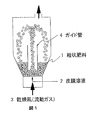
なお、図1の装置においては、槽内に充填した粒状肥料1を、下部から導入される乾燥風(流動ガス)3で噴流させながら、これに皮膜材料を溶解または分散した噴霧液(皮膜溶液)2を噴霧することにより肥料を被覆するものである。
【0037】
(2)被覆肥料の溶出特性の評価
下記a)〜c)の測定を行い、その結果を表−3及び表−4に示す。
a)水中溶出測定法
(1)で製造した被覆肥料を25℃恒温水中に7g/200ccの割合で投じ、経時的に水中の尿素態窒素を定量した。
b)暴露処理
(1)で製造した被覆肥料を自然光暴露1ヶ月経時させた後にa)と同様の方法で水中溶出測定を行った。
c)土壌中溶出測定法
(1)で製造した被覆肥料を沖積土壌乾土200gに対し、窒素として60mgを加え、水を350cc添加し、25℃で静置培養した。経時的に土壌中から被覆肥料を取り出し、残存窒素を定量し溶出量を算出した。
【0038】
【表3】
【表4】
本発明の主鎖中に、主鎖中の炭素数1000個当たり炭素不飽和二重結合を2〜100個、並びに短鎖アルキル分岐を2〜70個有するポリエチレン系樹脂は、表−2に示した結果から明らかなように、黴の繁殖が認められ生分解性を示しており、黴の繁殖程度は炭素不飽和結合数が多いほど旺盛であった。又、表−3に示したように、樹脂単独で被覆された肥料での水中溶出停止性は25℃100日間で10%以下であり、充分な溶出停止性を示すが、同時にフィラー及び界面活性剤を添加した被覆ではシグモイド型(溶出速度が途中から加速する)及び直線型の溶出を示し、種々の溶出パターンが得られることを明らかにしている。
更に、本発明の被覆肥料は自然光に暴露後も溶出パターンは変化せず、保存安定性が高いことが明らかである。表−4に示した結果は、土壌中での溶出パターンは水中溶出パターンと同一であり、土壌中での溶出制御性も良好であることは明らかで、本発明の課題を達成している。
【0041】
これに対し、炭素不飽和結合のないポリエチレンは、溶出停止性及び土壌中溶出制御性は良好な結果を示す(表−3、4)ものの、生分解性が認められず(表−2)、また、炭素不飽和結合数が250でメチル分岐数が250のポリイソプレンは、生分解性が良好であった(表−2)が、水中での溶出停止性が不十分なだけでなく保存時に溶出が変化(40日後に45%から90%、表−3)し、土壌中でも溶出速度が1割以上(対水中)大きくなる(表−3、4)ので、いずれのポリマーも本発明の課題を達成していない。
【0042】
【発明の効果】
主鎖中に、主鎖中の炭素数1000個当たり炭素不飽和二重結合を2〜100個、短鎖アルキル分岐を2〜70個有する含有するポリエチレン系樹脂を少なくとも1成分とするコーティング材で被覆された被覆粒状肥料は、実質的に皮膜の環境負荷を回避でき、各種溶出パターンの溶出制御性が良好であるので該コーティング材で被覆した被覆肥料は極めて有用である。
【図面の簡単な説明】
【図1】実施例の被覆肥料の製造に使用した噴流式コーティング装置を示す概略図
【符号の説明】
1 粒状肥料
2 皮膜溶液
3 乾燥風(流動ガス)
4 ガイド管[0001]
BACKGROUND OF THE INVENTION
The present invention relates to a granular fertilizer coating material mainly composed of a resin having both biodegradability and photodegradability, and a granular fertilizer coated using the same. More specifically, the present invention relates to a coated granular fertilizer in which elution of fertilizer components is controlled in the soil and the coating of the coating material does not accumulate in the ecosystem due to decomposition inside and outside the soil, and the coagulate used therefor. -Relating to ting materials.
[0002]
[Prior art]
In order to physically control the elution of fertilizer components fertilized in soil, studies have been widely conducted to coat the surface of granular fertilizer with a film using a polymer. In particular, the coated fertilizer using a coating material mainly composed of a polyolefin resin disclosed in JP-B-54-3104, JP-B-60-3040 and JP-B-60-37074 has good elution controllability and has been put into practical use. Yes. Using a low moisture-permeable polyolefin resin as the coating material allows creation of various elution types such as linear elution type and sigmoid elution type, and elution is not affected by soil conditions other than temperature and moisture. It becomes possible to manage fertilization according to the growth of the plant.
The present inventors previously formed an S-type film having an anti-elution period of 40 days or more with a thin film by combining an ethylene-α-olefin copolymer based on an olefin homopolymer. As proposed (Japanese Patent Laid-Open No. 10-203886), since a polymer is used as a mixture, there are some problems in the stability of the product and the complexity of two or more kinds of blending operations.
By the way, since polyolefin resin is non-degradable in recent years, accumulation of film shells in a field where coated fertilizer is introduced, and outflow from the field and accumulation in ecosystems have been pointed out as problems.
[0003]
Therefore, techniques for adding various substances to impart disintegration / decomposability to the polyolefin resin have been proposed, but there are problems with each of them, and satisfactory ones have not been obtained.
For example, a technique has been proposed in which a photodegradable resin is added to a polyolefin resin as a coating material to impart disintegration to the film. As the photodegradable resin, a diene polymer (Japanese Patent Publication No. 6-99207), a rubber resin (JP-B-5-30798), an ethylene / vinyl acetate / carbon monoxide copolymer (JP-B-2-23515), and a diene block copolymer (JP-A-3-75288) are disclosed. However, these do not promote the degradation of the polyolefin resin itself, which is the main coating material, and are disadvantageous in that it cannot be prevented from accumulating in the field and flowing out of the field due to degradation under exposure conditions. There is.
[0004]
Thus, a technique has been disclosed in which a specific organometallic complex is added to a polyolefin resin as a photodegradation accelerator to reduce the strength of the film and cause collapse (Japanese Patent Laid-Open No. 5-201786). Due to the collapse, it has the disadvantage that it is not a thing that can avoid accumulation in the field and outflow outside the field.
In addition, a technique in which low molecular weight polyolefin is an essential component and an organometallic complex is added to increase the disintegration property in the soil has been disclosed (Japanese Patent Laid-Open No. 10-231190). Has the disadvantage of becoming unstable.
[0005]
Furthermore, a technique for adding a biodegradable material to a polyolefin resin to cause the film to collapse is proposed. In this case, as the biodegradable material, a sugar polymer and a derivative thereof (JP-A-6-87684), an aliphatic polyester (special The use of Kaihei 9-263476) is disclosed. However, it does not promote the degradation of the polyolefin resin, which is the main coating material. In addition, it has problems that the elution pattern is increased due to the increase in biodegradable materials and the elution controllability in soil is unstable. is doing.
Techniques have been disclosed in which two or more substances selected from oxidation promoting substances, biodegradable substances, sublimable substances, and water-soluble substances are added to polyolefin resins to cause the film to collapse (Japanese Patent Laid-Open Nos. 6-144981 and 7). -48194, JP-A-9-309783, JP-A-9-309784, JP-A-10-1386) are put into practical use due to complicated film composition, poor storage stability, and unstable elution controllability. Not reached.
In order to compensate for the drawbacks of the above-described technique, techniques for coating granular fertilizer with a coating of two or more layers have been disclosed (JP-A-7-133179, JP-A-9-194280, JP-A-9-194281, JP-A-10-25179, Japanese Patent Laid-Open Nos. 10-218693 and 10-231191) have not been put into practical use because the covering operation becomes complicated.
[0006]
On the other hand, various techniques for imparting degradability to the covering material itself have been disclosed, but each has its own drawbacks, and has not yet been fully solved.
For example, a technique in which a photodegradable resin is the main component of the film has been proposed, and as the photodegradable resin, an ethylene / carbon monoxide copolymer (JP-B-2-23516), a vinyl ketone copolymer (JP-B-7-506). Olefins, carbon monoxide and olefinically unsaturated compound copolymers (Japanese Patent Laid-Open No. 6-56568) have been shown to be used, but these are accumulated in the field and field because of decomposition under exposure conditions. There is a problem that the elution controllability becomes unstable due to the alteration of the film during storage.
In addition, a technique using a biodegradable resin as a main component of the film has also been proposed. As the biodegradable resin, various aliphatic polyesters (JP-B-2-23517, JP-B-7-505, JP-A-4-89384, Kaihei 5-85873, JP-A-7-33577, JP-A-7-61884, JP-A-7-315976, JP-A-8-157290, JP-A-9-24977, JP-A-10-7484) are known. There are problems that elution is unstable due to biodegradation in soil and elution patterns with elution stagnation period cannot be set due to high moisture permeability.
[0007]
Here, “elution controllability in soil is good” means that elution can be predicted only by moisture and temperature conditions in the soil, and that fertilization management in accordance with the growth of the crop should be possible. Means. “Unstable elution control” means that the disintegration / degradability of the film is affected not only by moisture and temperature, but also by microbial activity, pH, etc., making it difficult to predict changes, and therefore It is difficult to predict the elution promotion associated with this, which means that elution in the soil has not been controlled.
[0008]
[Problems to be solved by the invention]
The present invention satisfies the following three problems, can substantially avoid the environmental burden due to the non-disintegrating property of the film, and has excellent dissolution controllability of various dissolution patterns, and coated coating for the same To provide materials.
The first problem of the present invention is to avoid the accumulation in the field by biodegradation of the polymer, which is a component of the coated granular fertilizer, in the soil, and the coating is easily disintegrated along with the decomposition so that the hollow particles It is to prevent floating and outflow to the outside of the field, and to prevent the outflowing film from accumulating in the ecosystem by decomposing it with microorganisms and ultraviolet rays.
[0009]
The second problem is to create various types of elution patterns by adjusting the coating material components. In particular, in order to obtain a sigmoid-type elution pattern, it is necessary to provide an appropriate elution stopping property by coating treatment. For example, in the case of a coated fertilizer made of a resin-only coating material, the dissolution rate, that is, the dissolution rate after 100 days at 25 ° C. is preferably 50% or less, more preferably 30% or less, and particularly preferably 10% or less. It is. The acceleration of the elution rate after the elution is stopped and the linearization of the elution pattern are adjusted by a conventional method, for example, addition of an inorganic filler or a surfactant into the film.
Furthermore, the third problem of the present invention is that the elution controllability in soil is good and the elution controllability is not changed due to alteration of the film during storage.
[0010]
[Means for Solving the Problems]
In order to solve the above-mentioned problems, the present inventors have intensively studied the characteristics of a polyethylene-based resin coating material capable of a sigmoid-type elution pattern. 1640cm -1 It is estimated that a double bond is formed in the main chain, and this is triggered to cause biodegradation (Journal of Japan Rubber Association, 67 (6) 448-455 ('94 ), Etc.) based on the assumption that if a double bond is introduced into the main chain of the polyethylene resin in advance, biodegradability will be promoted and the properties relating to elution properties such as urea will be maintained as in the case of the polyethylene resin. The present invention has been reached.
[0011]
That is, the gist of the present invention for solving the above problems is in the main chain. Without a ring structure, Contains 2 to 100 carbon unsaturated double bonds per 1000 carbons in the main chain as well as 2 to 70 short alkyl branches Biodegradability composed of copolymers of ethylene with conjugated diene compounds and α-olefins Polyethylene resin As the main polymer component of the film Coated granular fertilizer coating material characterized by the above, and the coating material Granular fertilizer It exists in the coated granular fertilizer.
[0012]
In a preferred embodiment of the present invention, in the main chain, Without a ring structure, Contains 2 to 100 carbon unsaturated double bonds per 1000 carbons in the main chain as well as 2 to 70 short alkyl branches Biodegradability composed of copolymers of ethylene with conjugated diene compounds and α-olefins The melt index of the polyolefin resin is 0.01 to 1000, and the polyethylene Resin The conjugated diene compound is 1,3-butadiene, and the short-chain alkyl branch is an alkyl group having 1 to 8 carbon atoms. A coating material and the coating material Granular fertilizer The coated granular fertilizer is mentioned.
[0013]
DETAILED DESCRIPTION OF THE INVENTION
Hereinafter, the present invention will be described in detail.
One component of the coating material for coated granular fertilizer of the present invention includes 2 to 100 carbon unsaturated double bonds and 2 to 70 short chain alkyls per 1000 carbon atoms in the main chain in the main chain. It is a polyethylene-based resin having a branch.
The polyethylene resin of the present invention is obtained by copolymerizing ethylene with a conjugated diene compound and an α-olefin.
Examples of the conjugated diene compound include 1,3-butadiene, isoprene, 2-ethyl-1,3-butadiene, and 1,3-hexadiene. From the viewpoint of price and reactivity, 1,3-butadiene is preferable. Isoprene is preferred, and 1,3-butadiene is particularly preferred.
[0014]
The molar ratio of the conjugated diene compound and ethylene is not particularly limited, but it is necessary to select the main chain to contain 2 to 100 carbon unsaturated double bonds per 1000 carbon atoms in the main chain. It is.
The number of carbon unsaturated double bonds in the main chain is preferably 3 to 80 per 1000 carbon atoms in the main chain, more preferably 5 to 70, and even more preferably 7 to 50. Yes, particularly preferably 10 to 35, and most preferably 15 to 25.
When the number of carbon unsaturated double bonds is less than 2 per 1000 carbon atoms in the main chain, the decomposability is poor, and when it is more than 100, the crystallinity decreases or the stability deteriorates. Moreover, the elution rate of the fertilizer after coating is so large that it is impossible to create a sigmoid type elution pattern, and the biodegradability is so fast that the soil elution controllability becomes unstable.
[0015]
The polyethylene resin of the present invention must have a predetermined number of short-chain alkyl branches in the main chain, and the alkyl group as a side chain of the short-chain alkyl branch is an alkyl group having 1 to 8 carbon atoms, Specific examples include alkyl groups such as methyl, ethyl, n-butyl, n-hexyl, and isobutyl. Higher alkyl groups of ethyl or higher are preferred. The introduction of such an alkyl group should be carried out by copolymerizing an α-olefin such as propylene, 1-butene, 1-hexene, 1-octene, 4-methylpentene-1 with ethylene and a conjugated diene compound, respectively. I can do it. The molar ratio of the α-olefin and ethylene is not particularly limited, but it is necessary to select so that the main chain has 2 to 70 short-chain alkyl branches per 1000 carbon atoms in the main chain.
The number of short-chain alkyl branches is 2 to 70 per 1000 carbon atoms in the main chain, preferably 5 to 40. In particular, 8 to 30 are preferable, and 15 to 25 are most preferable. If the number is less than 2, the strength and toughness (toughness) do not appear so markedly, which is not preferable because defects occur during film formation and the initial dissolution increases. On the other hand, if the number exceeds 70, the crystallinity decreases. Therefore, the elution of fertilizer etc. becomes too fast, which is not preferable.
[0016]
Since the polyethylene resin of the present invention has a branched structure in which a short-chain alkyl group as a side chain is introduced into the main chain, the crystallinity is appropriately reduced, the strength is increased, and the toughness (toughness) is also increased. For this reason, the film formability and film strength of the coating material containing the resin are increased, and elution control is facilitated. For example, when the resin is used as a coating material, it is possible to create an ideal mold that does not elute fertilizers or the like for about 40 days. The resin of the present invention is also important from the viewpoint of improving biodegradability. That is, by introducing a short-chain alkyl side chain into a polyethylene-based resin, the decomposability is improved without adding an impact modifier such as a tougher, or an impact modifier such as an elastomer or rubber. Is a point.
[0017]
The catalyst used in the copolymerization reaction can be appropriately selected and used from known catalysts used in this type of polymerization reaction. Specifically, a Ziegler catalyst (group IV transition metal compound (eg, Ti , Zr, Hf, etc.) and organic Al compounds) and highly active Ziegler catalysts (Mg, V, SiO 2 And the like, for example, JP 55-82104, JP 55-82105, JP 56-61406, JP 57-131206, JP 58-1708, JP-A 64-54007 and the like. Furthermore, Phillips catalyst (Cr-based), Standard Oil catalyst (Mo-based), Kaminsky catalyst, Brookhart catalyst and the like can be used as other catalysts. Among these catalysts, it is preferable to use a Ziegler catalyst or a highly active Ziegler catalyst because the conjugated diene compound is preferentially 1,4-added and exhibits a certain degree of activity. Is preferably used.
[0018]
An organic Al compound is preferably used as the cocatalyst, and examples of the organic Al compound include triethylaluminum, triisobutylaluminum, and diethylaluminum chloride. When such a catalyst is used, the polymerization reaction pressure is preferably 2 to 100 atm, particularly 5 to 30 atm.
The form of the polymerization reaction is not particularly limited, and slurry polymerization may be performed in an inert hydrocarbon solvent, or solution polymerization may be performed. Further, gas phase polymerization may be performed in the absence of a solvent. Slurry polymerization is simple in terms of process and suitable for a small scale, and in the case of slurry polymerization, polymerization is preferably performed at 50 to 90 ° C.
As another method, the polyethylene resin of the present invention can be produced by using peroxide as a catalyst and polymerizing under a high pressure of several hundred to several thousand atmospheres.
[0019]
Although there is no restriction | limiting in particular in the molecular weight of a polyethylene-type resin, MI (melt index) is what is 0.01-1000. When MI is larger than 1000, the strength of the film is lowered, which is not preferable. On the other hand, if MI is smaller than 0.01, it is difficult to dissolve in a solvent for coating, which is not preferable.
As MI, 0.1-100 are preferable, 0.5-50 are especially preferable, and 1-30 are the most preferable.
The molecular weight is adjusted by H during the polymerization reaction. 2 This can be done by introducing gas.
Further, as a production method other than the copolymerization of ethylene, a conjugated diene compound and an α-olefin, a method of partially hydrogenating a rubber having a double bond in a main chain such as polybutadiene, polyisoprene and IIR (isobutyl rubber). May be manufactured by this method.
[0020]
Since the polyethylene-based resin of the present invention has a specific amount of unsaturated double bonds and alkyl side chains in the main chain, when the granular fertilizer is coated with a coating material containing this resin as an active ingredient, the film is biodegraded, Moreover, since linear and sigmoid type elution patterns can be obtained, an elution pattern suitable for the growth of crops can be obtained, the elution controllability in soil is good, and the elution controllability does not change during storage.
The mechanism of promoting the degradation of the polyethylene resin of the present invention is triggered by a carbon unsaturated bond site, undergoes oxidative degradation in the presence of microbial enzymes and oxygen, is reduced in molecular weight, and receives light to generate radicals, As a result, the main chain is cleaved to reduce the molecular weight, but it is presumed that these low molecular weight hydrocarbons are further decomposed by the conventional mechanism.
As described above, since the film made of the coating material containing the polyethylene resin of the present invention as a constituent component is decomposed, the polyethylene resin itself is decomposed. Therefore, conventionally, various polyolefin resins, photodegradable resins, and biodegradable resins 1 It is obvious that the decomposition mechanism is different from the coating material in which a decomposition accelerator is combined with more than the seeds, and therefore the characteristics of the granular fertilizer coated with the polyethylene resin are also different.
[0021]
When the polyethylene-based resin of the present invention is used as a coating material for granular fertilizers, the elution control of the fertilizer is carried out using various additives as in the case of conventional resin-coated fertilizers, and the degradability of the film is within the range that does not impair the purpose. Can be increased.
For the purpose of promoting degradability, for example, one or more of a photodegradable material, a biodegradable material, an oxidation promoting substance, a photodegradation promoting substance, a sublimation substance, and the like can be added.
Although there is no restriction | limiting in particular as a photodegradable material, For example, the resin in which the photosensitive functional group was introduce | transduced, for example, the copolymer of carbon monoxide and olefins, a diene polymer, and a vinyl ketone copolymer are preferable. The addition amount is appropriately determined in consideration of elution controllability, degradability, and storage stability, but is generally 80% by weight or less, preferably 50% by weight or less, particularly preferably based on the whole polymer. Is 20 (weight)% or less. As an addition method, if necessary for the polyethylene resin of the present invention, it may be uniformly dispersed using a compatibilizing agent, or may be dispersed in the form of fine powder.
[0022]
There are no particular restrictions on the biodegradable material, but sugar polymers and derivatives thereof, proteins and derivatives thereof, aliphatic polyesters, aliphatic polyesters into which aromatic or cyclic ethers have been introduced, water-soluble resins (for example, polyethers, polyvinyl alcohols, Polymalic acid) is preferred. The addition amount is appropriately determined in consideration of elution controllability, degradability, and storage stability, but is generally 50% by weight or less, preferably 20% by weight or less, and particularly preferably based on the whole polymer. Is 10% by weight or less. As a method of addition, if necessary for the polyethylene resin of the present invention, it may be uniformly dispersed using a compatibilizing agent, or may be uniformly dispersed in a fine powder form.
[0023]
Although there is no restriction | limiting in particular as an oxidation promotion substance and a photodegradation promotion substance, The unsaturated fatty acid which has a carbon unsaturated bond, unsaturated fatty acid ester, fats and oils, a transition metal, a transition metal compound, and a transition metal complex are preferable. The amount to be added is appropriately determined in consideration of elution controllability, degradability and storage stability, but is generally 20% by weight or less, preferably 10% by weight or less, particularly preferably based on the whole polymer. Is 5 (wt)% or less.
Although there is no restriction | limiting in particular as a sublimation substance, A naphthalene, camphor, and sulfur are preferable. The addition amount is appropriately determined in consideration of elution controllability, degradability, and storage stability, but is generally equal to or less than the total polymer, preferably 50 (weight)% or less, particularly preferably 20 ( Weight)% or less.
In consideration of storage stability, a light stabilizer may be added.
[0024]
For the purpose of adjusting the elution pattern, one or more of a polyolefin polymer (for example, polyethylene) or a copolymer containing polyolefin (for example, ethylene-vinyl acetate copolymer) can be added. In particular, low molecular weight polyethylene wax is preferred because it is biodegradable. The addition amount is appropriately determined in consideration of elution controllability, degradability, and storage stability, but is generally equal to or less than the total polymer, preferably 50 (weight)% or less, particularly preferably 20 ( Weight)% or less.
Similarly, surfactants can be added for the purpose of adjusting the elution pattern. As the surfactant, any of a cationic surfactant, an anionic surfactant, a nonionic surfactant, and an amphoteric surfactant can be used. For example, nonionic interfaces such as polyoxyethylene nonylphenyl ether and polyoxyethylene alkyl ether are used. Activators are preferred. The addition amount is appropriately selected according to the target elution pattern.
[0025]
Furthermore, for the purpose of reducing the amount of expensive resin used and reducing temperature dependence, for example, it is preferable to add inorganic powder. In particular, natural inorganic minerals are preferable because they have high elution controllability and are inexpensive even when added in a considerable amount. Specific examples include talc, mica, sericite, glass flake, metal foil, graphite, plate-like iron oxide, plate-like aluminum hydroxide, hydrotalcite, charcoal cal, silica, clay, etc. Especially talc, mica , Charcoal cal, clay and the like are preferable. If any of these natural inorganic minerals is added too much, the film strength and the crushing strength are extremely lowered, and the elution controllability is lowered. From such a viewpoint, the addition ratio of the natural inorganic mineral in the film is in the range of 0 to 80% by weight. Further, any natural inorganic mineral preferably has a particle size that does not inhibit the continuity of the film and does not cause aggregation between the powders, for example, a particle size that is 1/2 or less of the film thickness.
In addition, other fertilizer components, agricultural chemicals such as plant bioactive substances, or plant growth promoting substances can be mixed in the film. There are no particular restrictions on the position of dispersion of these materials in the film.
[0026]
The granular fertilizer used in the present invention is not particularly limited, but urea is particularly preferred from the viewpoint of elution control, since it has a high fertilizer component and the most remarkable effect of fertilization. In addition, it is preferable to use a compound-type slow-acting fertilizer such as isobutylidene diurea, which has elution controllability, in the fertilizer itself, because more various elution controllability can be obtained. Furthermore, when the sphericity of the shape of the granular fertilizer is high, the coating uniformity becomes high, which is preferable.
[0027]
The coverage of the fertilizer of the present invention is not particularly limited, and is appropriately selected in consideration of economy, elution controllability, and degradability. In order to improve economy, a lower coverage is advantageous. On the other hand, in order to improve elution controllability, a higher coverage is advantageous. In order to improve the decomposability of the film, a low coverage with a small specific surface area is advantageous. Considering these, the coverage is in the range of 4 to 30%, preferably 6 to 20% by weight with respect to the weight of the fertilizer to be coated. Most preferably, it is 8 to 15% of range.
Considering elution controllability, decomposability, storage stability, and film strength, the film may have a structure of two or more layers.
[0028]
The coating method of the film is not particularly limited, and can be performed by a conventional method. However, the uniform coating property is improved by instantaneously drying the solvent after dissolving or dispersing the coating material used in the solvent and spraying it on the fertilizer. Therefore, it is preferable.
Any solvent may be used as long as it dissolves or disperses the coating material and can be quickly dried. Specifically, chlorinated hydrocarbons such as trichlorethylene and tetrachloroethylene, saturated hydrocarbons such as hexane and heptane, aromatic hydrocarbons such as toluene and xylene, and the like are used.
[0029]
【Example】
EXAMPLES Hereinafter, although this invention is demonstrated further in detail by a manufacture example and an Example, this invention is not limited to a following example, unless the summary is exceeded.
In addition, the fundamental physical property and biodegradability of the production | generation polymer in the following manufacture example were measured with the following method.
I. Measurement of basic physical properties
(1) MI measurement: Based on ASTM-1238, it measured at 190 degreeC using the melt indexer.
(2) Measurement of double bond introduction amount and number of ethyl branches in main chain: Measured using 500 MHz-H-NMR.
(3) 1,4-addition amount (including the presence of 1,2-additional products) 13 Confirmed by C-NMR.
[0030]
II. Measurement of biodegradability
(1) Sample preparation method
A film of each polymer produced (thickness 30 μm) was prepared with a pressure press machine and cut to 10 cm to prepare a test sample.
Production example
(I) Production of polyethylene resin
[Manufacturing 1]
A 1 liter autoclave was charged with 380 ml of n-hexane, and predetermined amounts of 1,3-butadiene and 1-butene were charged. As the catalyst, SiO described in JP-A-55-82104 and JP-A-55-82105 is used. 2 A highly active Ziegler catalyst carrying Ti complex of Ti supported on was used. A triethylaluminum compound was used as the organic Al compound of the cocatalyst. After charging these catalysts, H 2 Gas and further ethylene were introduced. The reaction was carried out at 70 ° C. for 1 hour. H 2 Adjust the molecular weight with the amount of gas, H 2 As the total pressure of ethylene and ethylene, the pressure was maintained at 10 atm.
After the polymerization was completed, 130 g of the produced polymer was obtained. The MI of the obtained polymer was 8.6. Moreover, when the amount of double bonds introduced in the polymer main chain and the number of branched side chains were measured by NMR, the amount of double bonds introduced was 8 (per 1000 carbon atoms), and the number of ethyl branches was 7 ( Per 1,000 carbon atoms).
[0032]
[Manufacturing 2]
A 2 liter autoclave was used, and a Mg-Ti eutectic type highly active Ziegler catalyst described in JP-A-56-61406 or JP-A-57-131206 was used as a catalyst. -Polymerization was carried out in the same manner as in [Production 1] except that the amount of butadiene was increased and the polymerization reaction was carried out for 3 hours. After the completion of the polymerization, 243 g of the produced polymer was obtained, and its MI was 14. Further, the number of double bonds introduced per 1000 carbon atoms in the polymer was 16, and 17 ethyl branches were introduced.
[0033]
[Manufacturing 3]
The polymerization reaction was carried out in the same manner as in [Production 1] except that a V and Ti eutectic type catalyst (highly active Ziegler catalyst) was used as the catalyst.
After completion of the polymerization, 114 g of the produced polymer was obtained, and its MI was 32. Further, the number of introduced double bonds per 1000 carbon atoms in the polymer was 13, and 12 ethyl branches were introduced.
[0034]
The basic properties and biodegradability of the obtained polymer (resin) and control polymer are summarized in Table-1 and Table-2.
As the control polymer, commercially available polyethylene (manufactured by Nippon Polychem) and polyisoprene (manufactured by Nippon Zeon) were used.
[Table 1]
Biodegradability test results
[Table 2]
Examples 1-5 and Comparative Examples 1-2
(1) Manufacture of coated fertilizer
Using the produced polymer (resin) and the control polymer shown in Table 1, 2 kg of a spray solution (concentration 5 w / v%, 100 ° C.) each dissolved in toluene is converted into 1 kg of urea particles having a particle diameter of 2 to 4 mm. Using the jet type coating device shown in Fig. 1, the drying air (fluid gas) temperature is 90 ° C and the air volume is 100m Three N 2 Spray coated at a time to obtain a coated granular fertilizer with a coverage of 10% (vs. fertilizer) (Examples 1-3, Comparative Examples 1-2).
Furthermore, using resin type (2) in Table 1, the film composition is resin type (2) / talc / ethylene nonylphenyl ether ethylene oxide 8-mole adduct = 6/4 / 0.4 (Example 4), resin type Coated granular fertilizer was obtained in the same manner as described above except that it was adjusted to 2 ▼ / clay / ethylene nonylphenyl ether ethylene oxide 8 mol adduct = 5/5 / 0.1 (Example 5).
In the apparatus of FIG. 1, the granular fertilizer 1 filled in the tank is sprayed with a dry air (fluid gas) 3 introduced from below, and a spray liquid (film solution) in which the film material is dissolved or dispersed therein ) The fertilizer is coated by spraying 2).
[0037]
(2) Evaluation of dissolution characteristics of coated fertilizer
The following measurements a) to c) are performed, and the results are shown in Table-3 and Table-4.
a) Elution measurement method in water
The coated fertilizer produced in (1) was poured into 25 ° C. constant temperature water at a rate of 7 g / 200 cc, and urea nitrogen in the water was quantified over time.
b) Exposure treatment
After the coated fertilizer produced in (1) was exposed to natural light for 1 month, elution measurement in water was performed in the same manner as in a).
c) Soil dissolution measurement method
60 mg of nitrogen was added to the coated fertilizer produced in (1) as 200 g of alluvial soil dry soil, 350 cc of water was added, and static culture was performed at 25 ° C. The coated fertilizer was taken out from the soil over time, the residual nitrogen was quantified, and the elution amount was calculated.
[0038]
[Table 3]
[Table 4]
Polyethylene resins having 2 to 100 carbon unsaturated double bonds and 2 to 70 short chain alkyl branches per 1000 carbon atoms in the main chain in the main chain of the present invention are shown in Table 2. As can be seen from the results, the breeding of cocoons was recognized and showed biodegradability, and the degree of breeding of the cocoons increased as the number of carbon unsaturated bonds increased. Moreover, as shown in Table-3, the elution stopping property in water with a fertilizer coated with resin alone is 10% or less at 25 ° C. for 100 days, indicating a sufficient elution stopping property. In the coating with the added agent, sigmoid type (elution speed is accelerated from the middle) and linear type elution are shown, and various elution patterns are obtained.
Furthermore, it is clear that the coated fertilizer of the present invention does not change its elution pattern even after exposure to natural light and has high storage stability. The results shown in Table 4 clearly show that the elution pattern in the soil is the same as the elution pattern in water, and that the elution controllability in the soil is good, and the object of the present invention is achieved.
[0041]
On the other hand, polyethylene without carbon unsaturated bond shows good results in elution stopping properties and soil elution controllability (Tables 3 and 4), but biodegradability is not recognized (Table 2), In addition, polyisoprene having 250 carbon unsaturated bonds and 250 methyl branches had good biodegradability (Table 2), but it was not only insufficient in elution stopping property in water but also during storage. Since elution changes (45% to 90% after 40 days, Table-3), and the elution rate in soil increases by 10% or more (with respect to water) (Tables 3 and 4), any polymer is a subject of the present invention. Not achieved.
[0042]
【The invention's effect】
A coating material comprising at least one polyethylene resin containing 2 to 100 carbon unsaturated double bonds and 2 to 70 short-chain alkyl branches per 1000 carbon atoms in the main chain in the main chain. Since the coated granular fertilizer can substantially avoid the environmental load of the film and has good elution controllability of various elution patterns, the coated fertilizer coated with the coating material is extremely useful.
[Brief description of the drawings]
FIG. 1 is a schematic view showing a jet-type coating apparatus used for production of a coated fertilizer of an example.
[Explanation of symbols]
1 granular fertilizer
2 Film solution
3 Dry air (fluid gas)
4 Guide tube
Claims (5)
Priority Applications (1)
| Application Number | Priority Date | Filing Date | Title |
|---|---|---|---|
| JP27431999A JP4411706B2 (en) | 1999-09-28 | 1999-09-28 | Coating material for coated granular fertilizer and coated granular fertilizer using the same |
Applications Claiming Priority (1)
| Application Number | Priority Date | Filing Date | Title |
|---|---|---|---|
| JP27431999A JP4411706B2 (en) | 1999-09-28 | 1999-09-28 | Coating material for coated granular fertilizer and coated granular fertilizer using the same |
Publications (2)
| Publication Number | Publication Date |
|---|---|
| JP2001089282A JP2001089282A (en) | 2001-04-03 |
| JP4411706B2 true JP4411706B2 (en) | 2010-02-10 |
Family
ID=17540002
Family Applications (1)
| Application Number | Title | Priority Date | Filing Date |
|---|---|---|---|
| JP27431999A Expired - Lifetime JP4411706B2 (en) | 1999-09-28 | 1999-09-28 | Coating material for coated granular fertilizer and coated granular fertilizer using the same |
Country Status (1)
| Country | Link |
|---|---|
| JP (1) | JP4411706B2 (en) |
Cited By (1)
| Publication number | Priority date | Publication date | Assignee | Title |
|---|---|---|---|---|
| US10081578B2 (en) | 2015-05-22 | 2018-09-25 | Honeywell International Inc. | Wax-based fertilizer coatings with polyethylene- or polypropylene-based polymers |
-
1999
- 1999-09-28 JP JP27431999A patent/JP4411706B2/en not_active Expired - Lifetime
Cited By (1)
| Publication number | Priority date | Publication date | Assignee | Title |
|---|---|---|---|---|
| US10081578B2 (en) | 2015-05-22 | 2018-09-25 | Honeywell International Inc. | Wax-based fertilizer coatings with polyethylene- or polypropylene-based polymers |
Also Published As
| Publication number | Publication date |
|---|---|
| JP2001089282A (en) | 2001-04-03 |
Similar Documents
| Publication | Publication Date | Title |
|---|---|---|
| KR100340610B1 (en) | Granular fertilizer coated with decomposable coating film and process for producing the same | |
| US7592408B2 (en) | Olefin copolymers containing hydrolytically cleavable linkages and use thereof in degradable products | |
| US7399817B2 (en) | Olefin copolymers containing hydrolytically cleavable linkages and use thereof in degradable products | |
| US5677375A (en) | Process for producing an in situ polyethylene blend | |
| US6248831B1 (en) | High strength polyethylene film | |
| DE69732033T2 (en) | POLYPROPYLENE COMPOSITION, METHOD FOR THE PRODUCTION THEREOF AND POLYMERIZATION CATALYST FOR IT | |
| JPH07500868A (en) | Chemically degradable polyolefin film | |
| HU180968B (en) | Process for producing film from ethylene-containing copolimere of low viscisity | |
| EP0435557A2 (en) | Dimethylaluminum chloride-activated olefin polymerisation catalyst composition | |
| CN102131838A (en) | Polyolefin compositions with improved optical and mechanical properties | |
| JP4411706B2 (en) | Coating material for coated granular fertilizer and coated granular fertilizer using the same | |
| JP4050052B2 (en) | Coated granular fertilizer | |
| JP4411705B2 (en) | Coating material for coated granular fertilizer and coated granular fertilizer using the same | |
| DE69229427T2 (en) | Catalyst composition for producing linear low-density ethylene-hexene copolymers and films made therefrom | |
| RU2418014C1 (en) | Biodegradable thermoplastic composition using natural filler | |
| JP4923422B2 (en) | Polyethylene resin composition and film comprising the same | |
| JP4212677B2 (en) | Degradable coating-coated granular fertilizer and method for producing the same | |
| JP4804632B2 (en) | Degradable sigmoid-eluting coated granular fertilizer | |
| JPS6244004B2 (en) | ||
| KR19990076732A (en) | Ethylene Copolymer Compositions and Molded Articles | |
| JP3987218B2 (en) | Polyethylene extrusion molding method | |
| JP2001089530A (en) | Olefin-conjugated diene copolymer and method for producing the same | |
| JPH0971666A (en) | Agricultural coating film | |
| JP2004002158A (en) | Coated granular fertilizer | |
| JP7750917B2 (en) | Polyethylene composition and molded article |
Legal Events
| Date | Code | Title | Description |
|---|---|---|---|
| A621 | Written request for application examination |
Free format text: JAPANESE INTERMEDIATE CODE: A621 Effective date: 20060904 |
|
| RD03 | Notification of appointment of power of attorney |
Free format text: JAPANESE INTERMEDIATE CODE: A7423 Effective date: 20060904 |
|
| A977 | Report on retrieval |
Free format text: JAPANESE INTERMEDIATE CODE: A971007 Effective date: 20090805 |
|
| A131 | Notification of reasons for refusal |
Free format text: JAPANESE INTERMEDIATE CODE: A131 Effective date: 20090811 |
|
| A521 | Written amendment |
Free format text: JAPANESE INTERMEDIATE CODE: A523 Effective date: 20090925 |
|
| TRDD | Decision of grant or rejection written | ||
| A01 | Written decision to grant a patent or to grant a registration (utility model) |
Free format text: JAPANESE INTERMEDIATE CODE: A01 Effective date: 20091027 |
|
| A01 | Written decision to grant a patent or to grant a registration (utility model) |
Free format text: JAPANESE INTERMEDIATE CODE: A01 |
|
| A61 | First payment of annual fees (during grant procedure) |
Free format text: JAPANESE INTERMEDIATE CODE: A61 Effective date: 20091109 |
|
| FPAY | Renewal fee payment (event date is renewal date of database) |
Free format text: PAYMENT UNTIL: 20121127 Year of fee payment: 3 |
|
| R150 | Certificate of patent or registration of utility model |
Ref document number: 4411706 Country of ref document: JP Free format text: JAPANESE INTERMEDIATE CODE: R150 Free format text: JAPANESE INTERMEDIATE CODE: R150 |
|
| FPAY | Renewal fee payment (event date is renewal date of database) |
Free format text: PAYMENT UNTIL: 20121127 Year of fee payment: 3 |
|
| S111 | Request for change of ownership or part of ownership |
Free format text: JAPANESE INTERMEDIATE CODE: R313113 |
|
| FPAY | Renewal fee payment (event date is renewal date of database) |
Free format text: PAYMENT UNTIL: 20121127 Year of fee payment: 3 |
|
| R350 | Written notification of registration of transfer |
Free format text: JAPANESE INTERMEDIATE CODE: R350 |
|
| FPAY | Renewal fee payment (event date is renewal date of database) |
Free format text: PAYMENT UNTIL: 20131127 Year of fee payment: 4 |
|
| R250 | Receipt of annual fees |
Free format text: JAPANESE INTERMEDIATE CODE: R250 |
|
| R250 | Receipt of annual fees |
Free format text: JAPANESE INTERMEDIATE CODE: R250 |
|
| R250 | Receipt of annual fees |
Free format text: JAPANESE INTERMEDIATE CODE: R250 |
|
| R250 | Receipt of annual fees |
Free format text: JAPANESE INTERMEDIATE CODE: R250 |
|
| R250 | Receipt of annual fees |
Free format text: JAPANESE INTERMEDIATE CODE: R250 |
|
| R250 | Receipt of annual fees |
Free format text: JAPANESE INTERMEDIATE CODE: R250 |
|
| R250 | Receipt of annual fees |
Free format text: JAPANESE INTERMEDIATE CODE: R250 |
|
| EXPY | Cancellation because of completion of term |