JP5382000B2 - Method for producing silicon compound having oxetanyl group - Google Patents
Method for producing silicon compound having oxetanyl group Download PDFInfo
- Publication number
- JP5382000B2 JP5382000B2 JP2010544012A JP2010544012A JP5382000B2 JP 5382000 B2 JP5382000 B2 JP 5382000B2 JP 2010544012 A JP2010544012 A JP 2010544012A JP 2010544012 A JP2010544012 A JP 2010544012A JP 5382000 B2 JP5382000 B2 JP 5382000B2
- Authority
- JP
- Japan
- Prior art keywords
- silicon compound
- group
- reaction
- compound
- mol
- Prior art date
- Legal status (The legal status is an assumption and is not a legal conclusion. Google has not performed a legal analysis and makes no representation as to the accuracy of the status listed.)
- Active
Links
Classifications
-
- C—CHEMISTRY; METALLURGY
- C07—ORGANIC CHEMISTRY
- C07F—ACYCLIC, CARBOCYCLIC OR HETEROCYCLIC COMPOUNDS CONTAINING ELEMENTS OTHER THAN CARBON, HYDROGEN, HALOGEN, OXYGEN, NITROGEN, SULFUR, SELENIUM OR TELLURIUM
- C07F7/00—Compounds containing elements of Groups 4 or 14 of the Periodic Table
- C07F7/02—Silicon compounds
- C07F7/08—Compounds having one or more C—Si linkages
- C07F7/0834—Compounds having one or more O-Si linkage
- C07F7/0838—Compounds with one or more Si-O-Si sequences
- C07F7/0872—Preparation and treatment thereof
- C07F7/0874—Reactions involving a bond of the Si-O-Si linkage
Landscapes
- Chemical & Material Sciences (AREA)
- Organic Chemistry (AREA)
- Chemical Kinetics & Catalysis (AREA)
- Silicon Polymers (AREA)
Description
本発明は、オキセタニル基を有するケイ素化合物の製造方法に関する。更に詳しくは、従来の製造方法では、反応中にゲル化してしまう組成のケイ素化合物を、ゲル化を起こさずに高濃度で製造できる製造方法に関する。 The present invention relates to a method for producing a silicon compound having an oxetanyl group. More specifically, the conventional manufacturing method relates to a manufacturing method capable of manufacturing a silicon compound having a composition that gels during the reaction at a high concentration without causing gelation.
加水分解性基を有するケイ素化合物の加水分解縮合においては酸性、アルカリ性いずれの条件でも触媒作用があるが、酸性条件とアルカリ性条件では縮合の化学的機構が異なることは古くから知られている。例えば、非特許文献1には、SiX4型のケイ素化合物であるテトラエトキシシランは酸およびアルカリ性触媒のどちらでも加水分解するが、RSiX3型であるモノメチルトリエトキシシランは酸触媒では反応するがアルカリ性触媒ではほとんど反応しないことが記載されている。In hydrolytic condensation of a silicon compound having a hydrolyzable group, there is a catalytic action under both acidic and alkaline conditions, but it has long been known that the chemical mechanism of condensation differs between acidic and alkaline conditions. For example, in Non-Patent Document 1, tetraethoxysilane, which is a SiX 4 type silicon compound, is hydrolyzed by both an acid and an alkaline catalyst, whereas monomethyltriethoxysilane, which is an RSiX 3 type, reacts with an acid catalyst but is alkaline. It is described that the catalyst hardly reacts.
特許文献1には、酸触媒がオキセタニル基を開環させてしまうことの記載があり、オキセタニル基を有し3個の加水分解性基を有するケイ素化合物を、アルカリ性条件下で加水分解重縮合させることにより、オキセタニル基を有する縮合されたケイ素化合物を製造する方法が開示されている。 Patent Document 1 describes that an acid catalyst causes ring opening of an oxetanyl group, and hydrolytic polycondensates a silicon compound having an oxetanyl group and three hydrolyzable groups under alkaline conditions. Thus, a method for producing a condensed silicon compound having an oxetanyl group is disclosed.
特許文献2には、オキセタニル基を有し3個の加水分解性基を有するケイ素化合物を、一分子中に一つ以上のシロキサン結合生成基を有する反応性シリコーンと共にアルカリ性条件下で加水分解共縮合することができ、得られた縮合物を硬化させたものはシリコーン鎖の効果により耐汚染性に優れることが開示されている。 In Patent Document 2, a silicon compound having an oxetanyl group and having three hydrolyzable groups is hydrolyzed and co-condensed under alkaline conditions together with a reactive silicone having one or more siloxane bond-forming groups in one molecule. It is disclosed that a cured product of the obtained condensate is excellent in stain resistance due to the effect of the silicone chain.
一方、特許文献3には、オキセタニル基を有し3個の加水分解性基を有するケイ素化合物を、酸性触媒存在下で加水分解重縮合させる、オキセタニル基を有する縮合されたケイ素化合物の製造方法が開示されている。この方法で得られる縮合されたケイ素化合物を硬化させた被膜は、特許文献2の実施例で開示されたシリコーンを含む硬化被膜に比べて鉛筆硬度試験の結果が著しく優れており、表面硬度の求められる用途には適したものであった。 On the other hand, Patent Document 3 discloses a method for producing a condensed silicon compound having an oxetanyl group, in which a silicon compound having an oxetanyl group and having three hydrolyzable groups is hydrolytically polycondensed in the presence of an acidic catalyst. It is disclosed. The film obtained by curing the condensed silicon compound obtained by this method has a remarkably superior result of the pencil hardness test as compared with the cured film containing silicone disclosed in the example of Patent Document 2, and the surface hardness is obtained. Suitable for the intended use.
しかし、特許文献3の比較例1には、オキセタニル基を有し3個の加水分解性基を有するケイ素化合物と、3個のシロキサン結合生成基を有するケイ素化合物とを、アルカリ性条件下で加水分解共縮合させたところゲル化したことが開示されていることから、オキセタニル基を有し3個の加水分解性基を有するケイ素化合物をアルカリ性条件下で加水分解縮合するとゲル化が起きてしまう可能性が知られていたと言うことができる。 However, in Comparative Example 1 of Patent Document 3, a silicon compound having an oxetanyl group and having three hydrolyzable groups and a silicon compound having three siloxane bond-forming groups are hydrolyzed under alkaline conditions. Since it has been disclosed that gelation has occurred after co-condensation, there is a possibility that gelation will occur when a silicon compound having an oxetanyl group and having three hydrolyzable groups is hydrolyzed under alkaline conditions. Can be said to have been known.
また、特許文献3には、4個のシロキサン結合生成基を有するケイ素化合物と3個の加水分解性基を有するケイ素化合物を酸性触媒で共縮合させた具体例が実施例8に例示されているが、加水分解共重縮合によって得られたケイ素化合物の硬化物の評価は、3個のシロキサン結合生成基を有するケイ素化合物を用いる場合と比較して差のないものであった。すなわち、オキセタニル基を有し3個の加水分解性基を有するケイ素化合物と4個のシロキサン結合生成基を有するケイ素化合物とをアルカリ性条件で共縮合することには、ゲル化する可能性を示唆する文献と、特別な効果が予想されないことを示唆する先行文献とが知られていたということができる。 Further, Patent Document 3 illustrates in Example 8 a specific example in which a silicon compound having four siloxane bond-forming groups and a silicon compound having three hydrolyzable groups are co-condensed with an acidic catalyst. However, the evaluation of the cured product of the silicon compound obtained by hydrolysis copolycondensation was not different from the case of using the silicon compound having three siloxane bond-forming groups. In other words, co-condensation of a silicon compound having an oxetanyl group and having three hydrolyzable groups and a silicon compound having four siloxane bond-forming groups under alkaline conditions suggests the possibility of gelation. It can be said that the literature and prior literature suggesting that no special effects are expected.
従来技術では、縮合に酸触媒を用いるとオキセタニル基が開環してしまい、一方でアルカリ性触媒ではゲル化しやすいことや、表面硬度の高い硬化物を与えるために、4個のシロキサン結合生成性基を有するケイ素化合物を共縮合しても、効果が表れないという問題があった。
本発明は、オキセタニル基を有し、表面硬度の高い硬化物を与えることのできるケイ素化合物を、反応途中でゲル化の問題を生じることなく、高濃度で製造できる方法を提供することを課題とする。
In the prior art, when an acid catalyst is used for condensation, the oxetanyl group is ring-opened. On the other hand, an alkaline catalyst is easy to gel, and in order to give a cured product with high surface hardness, four siloxane bond-forming groups are provided. There was a problem that the effect was not exhibited even when a silicon compound having a hydrogen content was co-condensed.
An object of the present invention is to provide a method capable of producing a silicon compound having an oxetanyl group and capable of giving a cured product having a high surface hardness at a high concentration without causing a gelation problem during the reaction. To do.
4個のシロキサン結合生成基を有するケイ素化合物(A)と、オキセタニル基を有するケイ素化合物(B)とを、1−プロパノールでアルコール交換反応する第一工程と、第一工程を経たケイ素化合物(AP),(BP)を、特定割合でアルカリ性条件下で加水分解共重縮合する第二工程を含む製造方法によって、ゲル化を引き起こすことなく、オキセタニル基を有するケイ素化合物(C)を得ることができることを見出し、本願発明を完成した。 A first step in which an alcohol exchange reaction of a silicon compound (A) having four siloxane bond-forming groups and a silicon compound (B) having an oxetanyl group with 1-propanol, and a silicon compound (AP ), (BP) can be obtained by a production method including hydrolysis and copolycondensation at a specific ratio under alkaline conditions without causing gelation without causing a silicon compound (C) having an oxetanyl group. The present invention was completed.
本発明によって、硬化物の表面硬度を高める効果をもたらす4個のシロキサン結合生成基を有するケイ素化合物(A)と、カチオン硬化性をもたらすオキセタニル基を有するケイ素化合物(B)との共重縮合物であるケイ素化合物(C)を、安価な原料からゲル化を引き起こすことなく製造することができる。得られたケイ素化合物(C)は溶媒可溶で各種用途への応用が容易である。 According to the present invention, a copolycondensation product of a silicon compound (A) having four siloxane bond-forming groups that brings about an effect of increasing the surface hardness of a cured product and a silicon compound (B) having an oxetanyl group that gives cationic curability. The silicon compound (C) can be produced from an inexpensive raw material without causing gelation. The obtained silicon compound (C) is soluble in a solvent and can be easily applied to various uses.
本発明の製造方法で得られるケイ素化合物(C)は溶媒可溶であることの他に、保存中に増粘やゲル化を起こさず、安定性に優れるものでもあり、また、本発明の製造方法は高濃度の仕込み濃度でも反応途中でのゲル化の問題を起こし難いという効果を奏する。 In addition to being soluble in a solvent, the silicon compound (C) obtained by the production method of the present invention does not cause thickening or gelation during storage, and has excellent stability. The method has an effect that it is difficult to cause a gelation problem during the reaction even at a high concentration.
ケイ素化合物(C)が保存安定性に優れる理由は、主にアルカリ性触媒を用いる本発明の第二工程に起因する。ケイ素化合物の製造方法において、酸性条件下での加水分解反応は反応が不十分となる場合が多く、アルカリ性条件下での加水分解反応に比べて、未反応のアルコキシ基の含有量が多くなる恐れがある。したがって、酸性条件下において加水分解・共重縮合により製造されたケイ素化合物は、未反応のアルコキシ基等のシロキサン結合生成基を含み、その未反応基が保存中に徐々に架橋するために粘度上昇やゲル化などの問題を生じさせる恐れがある。本発明の第二工程はアルカリ性触媒を必須とするものであり、未反応のシロキサン結合生成基が残り難いという特徴があるため、得られるケイ素化合物(C)は保存安定性に優れ、長期保存しても高粘度化やゲル化が起き難いという効果を奏するものである。 The reason why the silicon compound (C) is excellent in storage stability is mainly due to the second step of the present invention using an alkaline catalyst. In the method for producing a silicon compound, the hydrolysis reaction under acidic conditions often results in insufficient reaction, and the content of unreacted alkoxy groups may increase compared to the hydrolysis reaction under alkaline conditions. There is. Therefore, silicon compounds produced by hydrolysis and copolycondensation under acidic conditions contain siloxane bond-forming groups such as unreacted alkoxy groups, and the unreacted groups gradually crosslink during storage, resulting in increased viscosity. And may cause problems such as gelation. In the second step of the present invention, an alkaline catalyst is essential, and unreacted siloxane bond-forming groups are unlikely to remain. Therefore, the resulting silicon compound (C) has excellent storage stability and can be stored for a long time. However, there is an effect that high viscosity and gelation hardly occur.
一方、アルカリ性条件下での加水分解反応は、反応が進行しやすいが、そのために縮合反応中にゲルが生じやすいという問題がある。この理由は、4個のシロキサン結合生成基を有するケイ素化合物(Qモノマーと呼ぶ)を使用して製造された硬化性含ケイ素化合物は硬化性に優れ、得られる硬化物は高い表面硬度を持つが、Qモノマーをアルカリ性条件下において加水分解・共重縮合させると、Qモノマーの縮合反応が優先的に進行し、主にQモノマーだけによるネットワークが生じて反応中にゲルが生じる恐れがあるからである。 On the other hand, the hydrolysis reaction under alkaline conditions tends to proceed, but there is a problem that a gel is likely to form during the condensation reaction. This is because a curable silicon-containing compound produced using a silicon compound having four siloxane bond-forming groups (referred to as Q monomer) has excellent curability, and the resulting cured product has high surface hardness. When the Q monomer is hydrolyzed and copolycondensed under alkaline conditions, the condensation reaction of the Q monomer proceeds preferentially, and a network is formed mainly by the Q monomer, which may cause a gel during the reaction. is there.
一般的に、反応中のゲル化を回避する方法としては反応物の濃度を下げることが有効であるが、濃度が低いと大きな反応容器で合成をおこなってもわずかな生成物しか得られないから非効率であり、経済的にも不利である。また大量の溶剤を使用するため経済的でなく、かつ環境負荷も大きくなるので好ましくない。
一方、高い濃度で反応を行うことは、効率が上がり経済的であるものの、反応性シラン同士の接触確率が上がり、分子間反応が進んでゲルが生じやすくなる恐れがある。Generally, reducing the concentration of reactants is an effective way to avoid gelation during the reaction, but if the concentration is low, only a small amount of product can be obtained even if synthesis is performed in a large reaction vessel. It is inefficient and economically disadvantageous. Moreover, since a large amount of solvent is used, it is not economical and the environmental load is increased, which is not preferable.
On the other hand, the reaction at a high concentration is efficient and economical, but the contact probability between the reactive silanes is increased, and the intermolecular reaction is likely to proceed to easily generate a gel.
本発明の第一工程は、4個のシロキサン結合生成基を有するケイ素化合物(A)およびオキセタニル基を有するケイ素化合物(B)を、1−プロパノール中でアルコール交換反応させるものであるが、該アルコール交換反応によって、反応が速く進行しやすいケイ素化合物(A)のシロキサン結合生成基と、反応が遅く共縮合物に取り込まれ難いケイ素化合物(B)の加水分解性基との反応性のバランスが良くなるために、反応中のゲルの生成が抑えられ、高濃度で反応させてもゲル化しにくなる。すなわち、アルカリ性条件下では、反応の速いQモノマーの縮合反応だけが優先的に進行してしまうところ、第一工程のアルコール交換において、反応の速すぎるシロキサン結合生成基はそれだけ速く1−プロパノール中とアルコール交換し、反応の遅い加水分解性基はそれなりの速度で1−プロパノール中とアルコール交換するために、第二工程の加水分解共重縮合では、ケイ素化合物AとBとがバランスよく反応するものに変わっているため、高濃度でもゲル化せずに縮合反応させることができるという原理に基づくものであり、本発明の製造方法は高濃度仕込みにより効率的な製造ができるという効果をも奏するものである。 In the first step of the present invention, a silicon compound (A) having four siloxane bond-forming groups and a silicon compound (B) having an oxetanyl group are subjected to an alcohol exchange reaction in 1-propanol. A good balance of reactivity between the siloxane bond-forming group of the silicon compound (A), which is likely to proceed rapidly through the exchange reaction, and the hydrolyzable group of the silicon compound (B), which is slow in reaction and difficult to be incorporated into the cocondensate. Therefore, the formation of gel during the reaction is suppressed, and gelation hardly occurs even when the reaction is performed at a high concentration. In other words, under alkaline conditions, only the condensation reaction of the fast-reacting Q monomer preferentially proceeds. In the alcohol exchange in the first step, the siloxane bond-forming groups that are too fast to react are rapidly increased in 1-propanol. In the second step hydrolysis copolycondensation, the silicon compounds A and B react in a well-balanced manner, because the alcohol-exchangeable and slowly reacting hydrolyzable groups exchange alcohol with 1-propanol at a reasonable rate. Therefore, it is based on the principle that it can be condensed without gelation even at high concentrations, and the production method of the present invention also has the effect of being able to produce efficiently by charging at high concentrations. It is.
また、この原理によれば、ケイ素化合物(A)のシロキサン結合生成基と(B)の加水分解性基が、すべて1−プロポキシ基である場合よりも、本発明のアルコール交換を用いる製造方法の方が結果において優れていることはいうまでもないが、そもそもケイ素化合物(A)、(B)の製造においても、1−プロパノールは反応性が低いために、1−プロポキシ体は工業的にも高価で入手しにくいものであるから、本発明はこの意味でも経済的に優れたものである。
Further, according to this principle, the production method using alcohol exchange of the present invention is more effective than the case where the siloxane bond-forming group of the silicon compound (A) and the hydrolyzable group of (B) are all 1-propoxy groups. Needless to say, the results are superior, but in the first place, in the production of the silicon compounds (A) and (B), 1-propanol is low in reactivity, so that the 1-propoxy compound is industrially Since it is expensive and difficult to obtain, the present invention is also economically superior in this sense.
以下、本発明を詳しく説明する。
本発明のケイ素化合物(C)の製造方法は、上記一般式(1)で表されるケイ素化合物(A)と上記一般式(2)で表されるケイ素化合物(B)を、1−プロパノール中でアルコール交換反応させる第一工程と、上記反応させて得られた組成物をアルカリ性条件下で加水分解共重縮合させる第二工程とを備えることを特徴とする。The present invention will be described in detail below.
In the method for producing the silicon compound (C) of the present invention, the silicon compound (A) represented by the general formula (1) and the silicon compound (B) represented by the general formula (2) are mixed in 1-propanol. And a second step of hydrolyzing and copolycondensing the composition obtained by the above reaction under alkaline conditions.
<ケイ素化合物(C)>
本発明で得られるケイ素化合物(C)は、ケイ素化合物(A)、第1工程によりケイ素化合物(A)から生じるケイ素化合物(APと呼ぶ)、ケイ素化合物(B)及び第1工程によりケイ素化合物(B)から生じるケイ素化合物(BPと呼ぶ)との加水分解共重縮合によって生成するものである。以下に説明する第二工程により、A,B,AP,BPに含まれるシロキサン結合生成基、加水分解性基及びn−プロポキシ基の大部分はシロキサン結合に転化されるので、ケイ素化合物(C)は、シロキサン結合生成基、加水分解性基及びn−プロポキシ基が加水分解して形成された三次元のシロキサン結合(Si−O−Si)からなるポリシロキサンであるということができる。<Silicon compound (C)>
The silicon compound (C) obtained by the present invention comprises a silicon compound (A), a silicon compound (referred to as AP) generated from the silicon compound (A) in the first step, a silicon compound (B), and a silicon compound ( It is produced by hydrolysis copolycondensation with a silicon compound (referred to as BP) derived from B). In the second step described below, most of the siloxane bond-forming groups, hydrolyzable groups and n-propoxy groups contained in A, B, AP and BP are converted to siloxane bonds, so that the silicon compound (C) Can be said to be a polysiloxane composed of a three-dimensional siloxane bond (Si—O—Si) formed by hydrolysis of a siloxane bond-forming group, a hydrolyzable group and an n-propoxy group.
ケイ素化合物(C)は炭素原子を含む有機部分及び炭素原子を含まない無機部分を有する。ケイ素化合物(B)を表す式(2)におけるR0及びRは有機部分を形成する。また、ケイ素化合物(A)、ケイ素化合物(AP)、ケイ素化合物(B)及びケイ素化合物(BP)に由来する加水分解性基(アルコキシ基等)の一部が残存する場合は、これも有機部分を形成する。上記有機部分以外の部分は、炭素原子を含まない無機部分である。The silicon compound (C) has an organic part containing a carbon atom and an inorganic part containing no carbon atom. R 0 and R in formula (2) representing the silicon compound (B) form an organic moiety. Moreover, when a part of hydrolyzable group (alkoxy group etc.) derived from a silicon compound (A), a silicon compound (AP), a silicon compound (B), and a silicon compound (BP) remains, this is also an organic part. Form. The portion other than the organic portion is an inorganic portion that does not contain a carbon atom.
また、ケイ素化合物(C)は、オキセタニル基を有するため、カチオン硬化性を備える。ケイ素化合物(C)をカチオン硬化させることにより、表面硬度が大きく耐磨耗性に優れた硬化物被膜を与えることができる。 Moreover, since the silicon compound (C) has an oxetanyl group, it has cationic curability. By cationically curing the silicon compound (C), a cured product film having a large surface hardness and excellent abrasion resistance can be provided.
ケイ素化合物(B)として、一般式(2)におけるnが0の化合物(加水分解性基を3個有するTモノマー)が使用される場合には、ケイ素化合物(AP)、ケイ素化合物(A)(シロキサン結合生成基を4個有するQモノマー)との加水分解・縮合反応の結果、得られるケイ素化合物(C)は、構成単位としてTモノマー単位及びQモノマー単位を有するものとなる。
上記の場合、ケイ素化合物(C)は、部分的にラダー(はしご)状、かご状又はランダム状の構造をとることができる。When the compound (T monomer having three hydrolyzable groups) in which n is 0 in the general formula (2) is used as the silicon compound (B), the silicon compound (AP), the silicon compound (A) ( As a result of the hydrolysis / condensation reaction with the Q monomer having four siloxane bond-forming groups, the resulting silicon compound (C) has T monomer units and Q monomer units as constituent units.
In the above case, the silicon compound (C) can partially have a ladder-like, cage-like or random-like structure.
ケイ素化合物(C)は、ケイ素化合物(AP)および/またはケイ素化合物(A)の加水分解性基(本発明では、シラノールも含めたシロキサン結合生成基を加水分解性基と呼ぶ。)と、ケイ素化合物(BP)および/またはケイ素化合物(B)の加水分解性基、との92モル%以上が縮合されたものであることが好ましく、さらに好ましくは95モル%以上が縮合されたものであり、より好ましくはモル98%以上が縮合されたものである。特に好ましくは加水分解性基の実質的に全てが縮合されていることである。残存する加水分解性基の割合が使用原料に含まれていた加水分解性基の8モル%を超えると、設計された構造よりも無機部分の割合が小さいものとなる(ポリシロキサン構造が十分に形成されない)ため、得られる被膜の硬度が低下する恐れがある。また、ケイ素化合物(C)の貯蔵安定性が低下する恐れがある。
さらに、残存するアルコキシ基の種類としては、残存アルコキシの中で少なくともプロポキシ基などの炭素数3以上のアルコキシ基が50モル%以上含まれることが好ましく、より好ましくは70モル%以上であり、さらに好ましくは90モル%以上含まれることが好ましい。炭素数2以下のメトキシ基やエトキシ基は反応性が高く、保存中に架橋反応を起こして保存安定性が低下する恐れがあるからである。The silicon compound (C) includes a hydrolyzable group of the silicon compound (AP) and / or the silicon compound (A) (in the present invention, a siloxane bond-forming group including silanol is referred to as a hydrolyzable group), silicon. It is preferable that 92 mol% or more of the compound (BP) and / or the hydrolyzable group of the silicon compound (B) is condensed, and more preferably 95 mol% or more is condensed. More preferably, 98% or more of the mole is condensed. Particularly preferably, substantially all of the hydrolyzable group is condensed. When the ratio of the remaining hydrolyzable groups exceeds 8 mol% of the hydrolyzable groups contained in the raw materials used, the ratio of the inorganic portion becomes smaller than the designed structure (the polysiloxane structure is sufficiently Therefore, there is a possibility that the hardness of the obtained coating film is lowered. Moreover, there exists a possibility that the storage stability of a silicon compound (C) may fall.
Further, as the type of the remaining alkoxy group, it is preferable that at least 50 mol% or more of an alkoxy group having 3 or more carbon atoms such as a propoxy group is included in the remaining alkoxy, more preferably 70 mol% or more, Preferably 90 mol% or more is contained. This is because a methoxy group or an ethoxy group having 2 or less carbon atoms has high reactivity and may cause a crosslinking reaction during storage, resulting in a decrease in storage stability.
シロキサン結合生成基(加水分解性基を含む)の残存割合は1H−NMR(核磁気共鳴スペクトル)チャートから算出することができる。また、「加水分解性基の実質的に全てが縮合されている」ことは、例えば、得られたケイ素化合物(C)(ポリシロキサン化合物)の1H−NMRチャートにおいて加水分解性基に基づくピークがほとんど観察されないことにより確認できる。The residual ratio of siloxane bond-forming groups (including hydrolyzable groups) can be calculated from a 1 H-NMR (nuclear magnetic resonance spectrum) chart. In addition, “substantially all of the hydrolyzable groups are condensed” means, for example, a peak based on hydrolyzable groups in the 1 H-NMR chart of the obtained silicon compound (C) (polysiloxane compound). Can be confirmed by almost no observation.
<ケイ素化合物(A)>
本発明におけるケイ素化合物(A)は、下記一般式(1)で表される化合物である。
SiX4 (1)
〔一般式(1)において、Xはシロキサン結合生成基であり、Xは同一であっても異なっても良い。〕
ケイ素化合物(A)はシロキサン結合生成基であるXを4個有するもの(Qモノマーとも呼ばれる。)であり、このシロキサン結合生成基は、ケイ素化合物(B)の加水分解性基との反応により、シロキサン結合を生成する。その結果得られるケイ素化合物(C)は、1つ以上の有機基を有するケイ素化合物を縮合させた場合にくらべて、SiやOといった無機成分の質量組成が大きくなり、結果的に耐熱性や硬度といった無機的な特徴をより強く示すようになるため、Qモノマーは得られる縮合物の無機部分を大きくする原料成分であるということができる。<Silicon compound (A)>
The silicon compound (A) in the present invention is a compound represented by the following general formula (1).
SiX 4 (1)
[In General Formula (1), X is a siloxane bond-forming group, and X may be the same or different. ]
The silicon compound (A) has four siloxane bond-forming groups X (also referred to as Q monomer), and this siloxane bond-forming group reacts with the hydrolyzable group of the silicon compound (B), A siloxane bond is formed. As a result, the resulting silicon compound (C) has a larger mass composition of inorganic components such as Si and O than the case where a silicon compound having one or more organic groups is condensed, resulting in heat resistance and hardness. Thus, it can be said that the Q monomer is a raw material component that enlarges the inorganic portion of the resulting condensate.
上記一般式(1)におけるシロキサン結合生成基Xは、水酸基(シラノール基とも呼ばれる)又は加水分解性基を意味する。上記ケイ素化合物(A)は、ケイ素がシロキサン結合生成基を4個有するものであれば、特に限定されない。また、複数存在するXは、互いに同一であっても異なっていても良い。加水分解性基としては、加水分解性を有する基であれば良く、具体的には、水素原子、アルコキシ基、シクロアルコキシ基、アリールオキシ基及びアリールアルコキシ基等が挙げられる。 The siloxane bond-forming group X in the general formula (1) means a hydroxyl group (also called a silanol group) or a hydrolyzable group. The silicon compound (A) is not particularly limited as long as silicon has four siloxane bond-forming groups. A plurality of Xs may be the same or different from each other. As a hydrolysable group, what is necessary is just a group which has hydrolyzability, and a hydrogen atom, an alkoxy group, a cycloalkoxy group, an aryloxy group, an arylalkoxy group etc. are mentioned specifically ,.
上記アルコキシ基としては、例えばメトキシ基、エトキシ基、n−プロポキシ基、iso−プロポキシ基、n−ブトキシ基、iso−ブトキシ基、sec−ブトキシ基、t−ブトキシ基、n−ペンチル基及びn−ヘキシル基等が挙げられる。
上記シクロアルコキシ基としては、例えばシクロペンチルオキシ基及びシクロヘキシルオキシ基等が挙げられる。アラルキルオキシ基の例としては、ベンジルオキシ基、2−フェニルエチルオキシ基等が挙げられる。アリールオキシ基としては、例えばフェニルオキシ基、o−トルイルオキシ基、m−トルイルオキシ基、p−トルイルオキシ基及びナフチルオキシ基等が挙げられる。これらのうち、加水分解性が良好であることからアルコキシ基が好ましく、炭素数1〜3のアルコキシ基がより好ましく、原料入手が容易であり安価であること、並びに加水分解反応が制御しやすいことから、メトキシ基が更に好ましい。これらは1種のみ用いてもよく、2種以上を混合して用いてもよい。上記ケイ素化合物(A)として好ましい化合物は、テトラメトキシシラン、テトラエトキシシランおよびテトラn−プロポキシシランである。更に、入手が容易であることから、より好ましくはテトラメトキシシランである。
尚、シロキサン結合生成基の少なくとも一部は、後述のアルコール交換反応により、n−プロポキシ基に交換される。Examples of the alkoxy group include methoxy, ethoxy, n-propoxy, iso-propoxy, n-butoxy, iso-butoxy, sec-butoxy, t-butoxy, n-pentyl and n- A hexyl group etc. are mentioned.
Examples of the cycloalkoxy group include a cyclopentyloxy group and a cyclohexyloxy group. Examples of the aralkyloxy group include a benzyloxy group and a 2-phenylethyloxy group. Examples of the aryloxy group include a phenyloxy group, an o-toluyloxy group, an m-toluyloxy group, a p-toluyloxy group, and a naphthyloxy group. Of these, alkoxy groups are preferable because of good hydrolyzability, alkoxy groups having 1 to 3 carbon atoms are more preferable, raw materials are easily available and inexpensive, and the hydrolysis reaction is easy to control. Therefore, a methoxy group is more preferable. These may be used alone or in combination of two or more. Preferred compounds as the silicon compound (A) are tetramethoxysilane, tetraethoxysilane and tetra n-propoxysilane. Furthermore, tetramethoxysilane is more preferable because it is easily available.
In addition, at least a part of the siloxane bond generating group is exchanged for an n-propoxy group by an alcohol exchange reaction described later.
<ケイ素化合物(B)>
本発明におけるケイ素化合物(B)は、オキセタニル基を有する有機基を有するものであり、本発明の製造方法により得られるケイ素化合物(C)にカチオン硬化性を付与するための成分であり、下記一般式(2)で表される化合物である。
〔式(2)において、R0はオキセタニル基を有する有機基であり、R0は同一であっても異なっても良く、Rは炭素数1〜6のアルキル基、炭素数7〜10のアラルキル基、炭素数6〜10のアリール基、またはオキセタニル基を有する有機基であり、Rは同一であっても異なっても良く、Yは加水分解性基であり、Yは同一であっても異なってもよく、nは0または1である。〕<Silicon compound (B)>
The silicon compound (B) in the present invention has an organic group having an oxetanyl group, and is a component for imparting cationic curability to the silicon compound (C) obtained by the production method of the present invention. It is a compound represented by Formula (2).
[In Formula (2), R 0 is an organic group having an oxetanyl group, R 0 may be the same or different, and R is an alkyl group having 1 to 6 carbon atoms and an aralkyl having 7 to 10 carbon atoms. Group, an organic group having 6 to 10 carbon atoms, or an oxetanyl group, R may be the same or different, Y is a hydrolyzable group, and Y is the same or different. N may be 0 or 1. ]
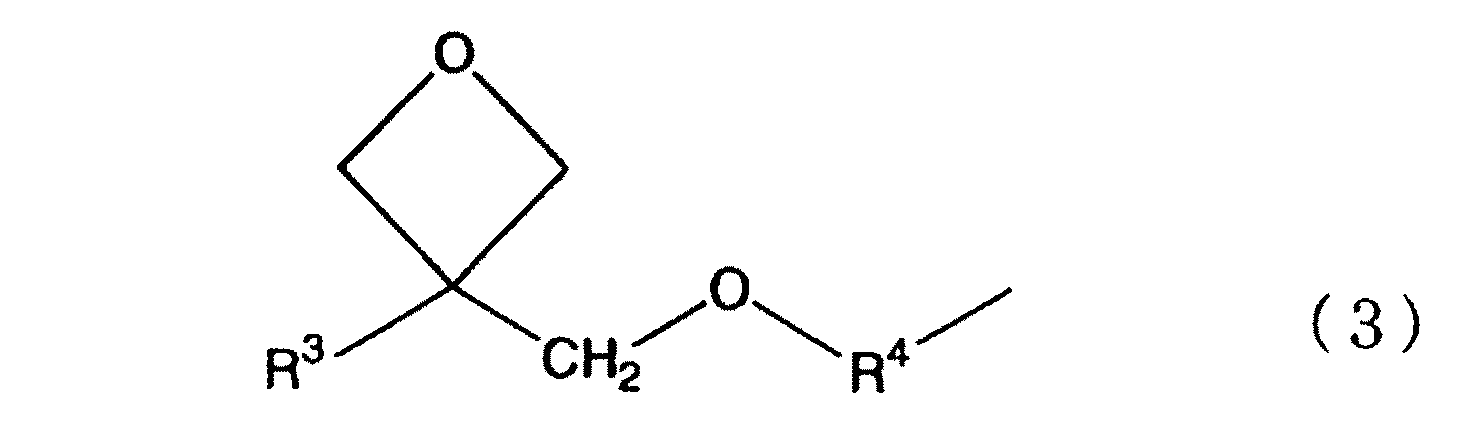
R0はオキセタニル基を有する有機基であり、該有機基は炭素数が20以下であるものが好ましい。R0の炭素数が20以下の場合、本発明の製造方法により得られるケイ素化合物(C)に、良好且つ安定したカチオン硬化性を付与することができる。なかでも、下記一般式(3)で表される構造を有する有機基は、R0として好ましいものである。一般式(3)において、R3は炭素数が小さい方が、得られるケイ素化合物(C)が無機部分の割合の大きいものになりやすく、得られる硬化物の表面硬度が大きくなり易いので好ましい。好ましいR3は、水素原子又は炭素数1〜6のアルキル基であり、さらに好ましくはエチル基である。
一般式(3)におけるR4は、炭素数が小さい方が、得られるケイ素化合物(C)が無機部分の割合の大きいものになりやすく、得られる硬化物の表面硬度が大きくなり易いので好ましい。好ましいR4は炭素数2〜6のアルキレン基であり、さらに好ましくはプロピレン基(トリメチレン基)である。その理由は、このような有機官能基を形成する化合物の工業的入手又は合成が容易なためである。R 4 in the general formula (3) is preferably smaller in carbon number because the obtained silicon compound (C) tends to have a larger proportion of the inorganic portion and the surface hardness of the obtained cured product tends to be larger. R 4 is preferably an alkylene group having 2 to 6 carbon atoms, and more preferably a propylene group (trimethylene group). The reason is that it is easy to industrially obtain or synthesize a compound that forms such an organic functional group.
nが0である化合物は、加水分解性基を3個有しており、Tモノマーとも呼ばれる。また、nが1である化合物は、加水分解性基を2個有しており、Dモノマーとも呼ばれる。得られるケイ素化合物(C)の無機部分の割合をより大きくするためには、nは0であることが好ましい。また、得られるケイ素化合物(C)の溶剤への溶解性を向上させるためには、nは1であることが好ましい。
更に、無機部分の割合量と溶剤への溶解性とのバランスから、nが0のケイ素化合物とnが1のケイ素化合物とを併用することができる。併用する場合、nが0のケイ素化合物とnが1のケイ素化合物との配合割合は、得られるケイ素化合物(C)を用いる用途により適宜選択される。本発明において好ましいのは、平均値でn=0〜0.5、さらに好ましくはn=0〜0.3の範囲となるものである。A compound in which n is 0 has three hydrolyzable groups and is also called a T monomer. Moreover, the compound whose n is 1 has two hydrolyzable groups, and is also called D monomer. In order to increase the proportion of the inorganic portion of the obtained silicon compound (C), n is preferably 0. In order to improve the solubility of the resulting silicon compound (C) in the solvent, n is preferably 1.
Furthermore, from the balance between the proportion of the inorganic part and the solubility in the solvent, a silicon compound having n = 0 and a silicon compound having n = 1 can be used in combination. When used in combination, the blending ratio of the silicon compound with n = 0 and the silicon compound with n = 1 is appropriately selected depending on the use of the resulting silicon compound (C). In the present invention, the average value is preferably n = 0 to 0.5, more preferably n = 0 to 0.3.
上記一般式(2)におけるYは加水分解性基であり、加水分解性を有する基であれば良く、具体的には、水素原子、アルコキシ基、シクロアルコキシ基、アリールオキシ基及びアリールアルコキシ基等が挙げられる。アルコキシ基としては、例えばメトキシ基、エトキシ基、n−プロポキシ基、iso−プロポキシ基、n−ブトキシ基、iso−ブトキシ基、sec−ブトキシ基、t−ブトキシ基、n−ペンチル基及びn−ヘキシル基等が挙げられる。シクロアルコキシ基としては、例えばシクロペンチルオキシ基及びシクロヘキシルオキシ基等が挙げられる。アラルキルオキシ基の例としては、ベンジルオキシ基、2−フェニルエチルオキシ基等が挙げられる。アリールオキシ基としては、例えばフェニルオキシ基、o−トルイルオキシ基、m−トルイルオキシ基、p−トルイルオキシ基及びナフチルオキシ基等が挙げられる。これらのうち、加水分解性が良好であることからアルコキシ基が好ましく、炭素数1〜3のアルコキシ基がより好ましく、原料入手が容易であり安価であること、並びに加水分解反応が制御しやすいことから、メトキシ基が更に好ましい。これらは1種のみ用いてもよく、2種以上を混合して用いてもよい。 Y in the general formula (2) is a hydrolyzable group and may be any group having hydrolyzability. Specifically, a hydrogen atom, an alkoxy group, a cycloalkoxy group, an aryloxy group, an arylalkoxy group, and the like Is mentioned. Examples of alkoxy groups include methoxy, ethoxy, n-propoxy, iso-propoxy, n-butoxy, iso-butoxy, sec-butoxy, t-butoxy, n-pentyl and n-hexyl. Groups and the like. Examples of the cycloalkoxy group include a cyclopentyloxy group and a cyclohexyloxy group. Examples of the aralkyloxy group include a benzyloxy group and a 2-phenylethyloxy group. Examples of the aryloxy group include a phenyloxy group, an o-toluyloxy group, an m-toluyloxy group, a p-toluyloxy group, and a naphthyloxy group. Of these, alkoxy groups are preferable because of good hydrolyzability, alkoxy groups having 1 to 3 carbon atoms are more preferable, raw materials are easily available and inexpensive, and the hydrolysis reaction is easy to control. Therefore, a methoxy group is more preferable. These may be used alone or in combination of two or more.
これらの内、Yとして好ましいのは、アルコキシ基、シクロアルコキシ基およびアリールオキシ基であり、さらに好ましくはアルコキシ基、具体的にはメトキシ基、エトキシ基およびn−プロポキシ基である。この中でもメトキシ基は、工業的に入手や合成が容易なものであり好ましい。尚、Yの少なくとも一部は、後述のアルコール交換反応により、n−プロポキシ基に交換される。 Among these, preferred as Y are an alkoxy group, a cycloalkoxy group and an aryloxy group, more preferably an alkoxy group, specifically a methoxy group, an ethoxy group and an n-propoxy group. Of these, a methoxy group is preferred because it is easily available and synthesized industrially. At least a part of Y is exchanged for an n-propoxy group by an alcohol exchange reaction described later.
シロキサン結合生成基を1個しか有しないケイ素モノマーはMモノマーとも呼ばれる。Mモノマーは有機基を3つ有するもので、Q,T,Dモノマーに比べて得られる縮合物の無機部分を減らすものである。反応中のゲル化を防ぐ方法として、トリメチルアルコキシシランやヘキサメチルジシロキサンのようなMモノマーを末端封止剤として作用させることでゲル化を回避する方法も知られているが、Mモノマーは加えることで、ゲル化は回避できても得られる縮合物の無機部分が減少し、硬化物の耐熱性や表面硬度などの無機的性質は低下する傾向にある。本発明では、Mモノマーを末端封止剤として用いる代わりに、Tモノマー及び/又はDモノマーと、Qモノマーとをゲル化させずに共重縮合させることが特徴である。 Silicon monomers having only one siloxane bond-forming group are also called M monomers. The M monomer has three organic groups, and reduces the inorganic part of the condensate obtained compared to the Q, T, and D monomers. As a method for preventing gelation during the reaction, a method for avoiding gelation by using an M monomer such as trimethylalkoxysilane or hexamethyldisiloxane as an end-capping agent is also known. Thus, even if gelation can be avoided, the inorganic part of the resulting condensate is reduced, and the inorganic properties such as heat resistance and surface hardness of the cured product tend to be reduced. The present invention is characterized by copolycondensation of the T monomer and / or D monomer and the Q monomer without gelation instead of using the M monomer as a terminal blocking agent.
また、本発明においては、無機的性質を下げない程度の低い割合でMモノマーを加えることは可能であり、具体的には、共重縮合の際にQモノマーとTモノマー及び/又はDモノマーの合計モル数に対して、その1/10モル以下のMモノマーを加えて反応させることができ、その結果得られる組成物も本発明の範疇に該当する。 Further, in the present invention, it is possible to add the M monomer at such a low rate that the inorganic properties are not lowered. Specifically, in the copolycondensation, the Q monomer, the T monomer and / or the D monomer are added. M monomer of 1/10 mol or less can be added and reacted with respect to the total number of moles, and the resulting composition also falls under the category of the present invention.
<第一工程>
本発明の第一工程は、上記一般式(1)で表されるケイ素化合物(A)と上記一般式(2)で表されるケイ素化合物(B)を、1−プロパノール中でアルコール交換反応させる反応工程である。第一工程において用いる有機ケイ素化合物(A)は1種のみでもよく、2種以上であってもよい。同様に、ケイ素化合物(B)は1種のみでもよく、2種以上であってもよい。<First step>
In the first step of the present invention, the silicon compound (A) represented by the general formula (1) and the silicon compound (B) represented by the general formula (2) are subjected to an alcohol exchange reaction in 1-propanol. It is a reaction process. The organic silicon compound (A) used in the first step may be only one type or two or more types. Similarly, the silicon compound (B) may be only one type or two or more types.
第一工程では、ケイ素化合物(A)が有するシロキサン結合生成基と1−プロパノールとのアルコール交換反応により、上記1−プロパノール由来のn−プロポキシ基を含むものとなる。
また、上記ケイ素化合物(B)が有する加水分解性基と1−プロパノールとのアルコール交換反応により、ケイ素化合物(B)は、上記1−プロパノール由来のn−プロポキシ基を含むものとなる。
この第一工程によりn−プロポキシ基を有する有機ケイ素化合物(A)の反応物(以下、「ケイ素化合物(AP)」という)と、n−プロポキシ基を有する有機ケイ素化合物(B)の反応物(以下、「ケイ素化合物(BP)」という)が製造される。
上記ケイ素化合物(AP)は、上記ケイ素化合物(A)が有する4個のシロキサン結合生成基のうち、少なくとも1個がn−プロポキシ基に交換されているものである。
また、上記ケイ素化合物(BP)は、上記ケイ素化合物(B)が有する2個または3個の加水分解性基のうち、少なくとも1個がn−プロポキシ基に交換されているものである。In the first step, the 1-propanol-derived n-propoxy group is contained by an alcohol exchange reaction between the siloxane bond-forming group of the silicon compound (A) and 1-propanol.
Moreover, the silicon compound (B) contains the n-propoxy group derived from the 1-propanol by an alcohol exchange reaction between the hydrolyzable group of the silicon compound (B) and 1-propanol.
By this first step, a reaction product of an organosilicon compound (A) having an n-propoxy group (hereinafter referred to as “silicon compound (AP)”) and a reaction product of an organosilicon compound (B) having an n-propoxy group ( Hereinafter, “silicon compound (BP)”) is produced.
The silicon compound (AP) is one in which at least one of the four siloxane bond-forming groups of the silicon compound (A) is replaced with an n-propoxy group.
The silicon compound (BP) is one in which at least one of the two or three hydrolyzable groups possessed by the silicon compound (B) is replaced with an n-propoxy group.
第一工程で用いられるアルコールは、1−プロパノールである。これにより、ケイ素化合物(A)が有するシロキサン結合生成基の少なくとも一部がn−プロポキシ基へ、ケイ素化合物(B)が有する加水分解性基の少なくとも一部がn−プロポキシ基へ交換されることにより、後述する第二工程で、両モノマーがバランスよく共重縮合反応することができる。ケイ素化合物(A)のシロキサン結合生成基が、反応性の高いメトキシ基又はエトキシ基等であった場合、もともとQモノマーは反応性の高い傾向がある事から、Qモノマーだけが縮合架橋反応を進め、ネットワークを形成してゲル化する恐れがあるが、適度に反応性の低いn−プロポキシ基に交換されることにより、より効果的に縮合反応を円滑に進行させることができる。 The alcohol used in the first step is 1-propanol. Thereby, at least a part of the siloxane bond-forming group of the silicon compound (A) is exchanged with an n-propoxy group, and at least a part of the hydrolyzable group of the silicon compound (B) is exchanged with an n-propoxy group. Thus, both monomers can be copolycondensed in a balanced manner in the second step described later. When the siloxane bond-forming group of the silicon compound (A) is a highly reactive methoxy group or ethoxy group, since the Q monomer originally tends to be highly reactive, only the Q monomer advances the condensation crosslinking reaction. Although there is a possibility of forming a network and gelling, the condensation reaction can be smoothly and smoothly proceeded more effectively by exchanging with an n-propoxy group having a moderately low reactivity.
第一工程のアルコールに2−プロパノール及び1−ブタノール等のアルコールを用いた場合は、得られる反応物は反応性の低いi−プロポキシ基やn−ブトキシ基を有することとなり、第一工程で得られた化合物(AP)と(BP)との縮合が円滑に進行しない恐れがある。
また、第一工程のアルコールとしてメタノールやエタノールを用いた場合、得られる反応物は、1−プロパノールを用いた場合に得られる反応物よりも反応性が比較的高いメトキシ基やエトキシ基を有することとなり、得られた化合物(AP)と(BP)との加水分解共重縮合反応が均一に進行せずゲルが生じたり、安定性の低いものが得られるたりする恐れがある。When alcohol such as 2-propanol and 1-butanol is used as the alcohol in the first step, the obtained reaction product has an i-propoxy group or n-butoxy group having low reactivity, and is obtained in the first step. There is a possibility that the condensation of the obtained compound (AP) and (BP) does not proceed smoothly.
In addition, when methanol or ethanol is used as the alcohol in the first step, the obtained reaction product has a methoxy group or ethoxy group that is relatively more reactive than the reaction product obtained when 1-propanol is used. Thus, the hydrolysis copolycondensation reaction of the obtained compounds (AP) and (BP) does not proceed uniformly, and a gel may be formed or a product with low stability may be obtained.
上記第一工程における反応温度は0〜100℃が好ましく、より好ましくは10〜90℃であり、更に好ましくは20〜80℃である。
また、反応時間は5分〜30時間が好ましく、さらに好ましくは10分〜24時間、より好ましくは15分〜24時間である。The reaction temperature in the first step is preferably 0 to 100 ° C, more preferably 10 to 90 ° C, and further preferably 20 to 80 ° C.
The reaction time is preferably 5 minutes to 30 hours, more preferably 10 minutes to 24 hours, and more preferably 15 minutes to 24 hours.
上記第一工程におけるpH条件は、アルカリ性及び中性並びに酸性のいずれでも構わないが、後述の第二工程がアルカリ性条件で加水分解共重縮合反応を進行させることから、アルカリ性条件下で行うことが好ましい。
上記第一工程がアルカリ性条件下である場合、反応液のpHは7を超える値である。その場合、反応液のpHは、好ましくは8以上であり13以下である。さらに好ましくはpHが9以上である。The pH condition in the first step may be any of alkaline, neutral and acidic. However, since the second step described below causes the hydrolysis copolycondensation reaction to proceed under alkaline conditions, the pH condition may be performed under alkaline conditions. preferable.
When the first step is under alkaline conditions, the pH of the reaction solution is a value exceeding 7. In that case, the pH of the reaction solution is preferably 8 or more and 13 or less. More preferably, the pH is 9 or more.
第一工程のpH条件をアルカリ性条件下とするためには、アルカリ剤が添加される。そのアルカリ剤は、上記有機ケイ素化合物(A)および上記ケイ素化合物(B)のアルコキシ基と1−プロパノールとのアルコール交換反応を円滑に進行させるための反応触媒としても作用する。
上記アルカリ剤としては、例えば、アンモニア、有機アミン類、水酸化テトラメチルアンモニウム、水酸化テトラエチルアンモニウム、水酸化テトラプロピルアンモニウム、水酸化テトラブチルアンモニウム、コリン、水酸化ナトリウム、水酸化カリウム及び水酸化カルシウム等が挙げられる。これらのうち、触媒活性の良好な第4級窒素原子を有するアンモニウム化合物が好ましく、更に入手が容易な水酸化テトラメチルアンモニウムがより好ましい。これらは1種のみ用いてもよく、2種以上を混合して用いてもよい。In order to make the pH condition of the first step alkaline, an alkaline agent is added. The alkaline agent also acts as a reaction catalyst for smoothly proceeding the alcohol exchange reaction between the organosilicon compound (A) and the alkoxy group of the silicon compound (B) and 1-propanol.
Examples of the alkali agent include ammonia, organic amines, tetramethylammonium hydroxide, tetraethylammonium hydroxide, tetrapropylammonium hydroxide, tetrabutylammonium hydroxide, choline, sodium hydroxide, potassium hydroxide and calcium hydroxide. Etc. Among these, an ammonium compound having a quaternary nitrogen atom having good catalytic activity is preferable, and tetramethylammonium hydroxide, which is easily available, is more preferable. These may be used alone or in combination of two or more.
上記アルカリ剤の使用量は、ケイ素化合物(A)およびケイ素化合物(B)の合計モル数を100モルとした場合に、1〜20モルが好ましく、より好ましくは3〜15モルである。アルカリ剤の使用量が5〜10モルである場合、アルコール交換反応の進行が好適であり、経済的にも好ましい。 The amount of the alkali agent used is preferably 1 to 20 mol, more preferably 3 to 15 mol, when the total number of moles of the silicon compound (A) and the silicon compound (B) is 100 mol. When the usage-amount of an alkaline agent is 5-10 mol, progress of alcohol exchange reaction is suitable and it is preferable economically.
<第二工程>
上記第二工程は、上記第一工程により得られた組成物に、アルカリ性条件下で水を加え、加水分解共重縮合させる工程である。
上記第一工程により得られた組成物は、第一工程における反応後の反応溶液をそのまま用いることができ、上記組成物には、アルコール交換反応により得られたn−プロポキシ基を有するケイ素化合物(AP)及びケイ素化合物(BP)が含有される。<Second step>
The second step is a step in which water is added to the composition obtained in the first step under alkaline conditions to cause hydrolytic copolycondensation.
The composition obtained in the first step can use the reaction solution after the reaction in the first step as it is, and the composition contains a silicon compound having an n-propoxy group obtained by an alcohol exchange reaction ( AP) and silicon compounds (BP) are contained.
上記ケイ素化合物(AP)及び上記ケイ素化合物(BP)の配合割合は、上記ケイ素化合物(BP)1モルに対して、上記ケイ素化合物(AP)が0.3〜2.8モルであり、好ましくは0.8〜2.5モルであり、更に好ましくは1〜2.3モルである。上記ケイ素化合物(BP)1モルに対して、上記ケイ素化合物(AP)が0.3〜2.8モルである場合、加水分解共重縮合反応が好適に進行し、ゲルを生ずることなく、ケイ素化合物(C)を良好に製造することができる。なお、上記ケイ素化合物(AP)及び上記ケイ素化合物(BP)は、それぞれケイ素化合物(A)及びケイ素化合物(B)を含んでもよいものであるので、配合割合は第一工程における(A)および(B)の仕込み割合から算出してもよい。したがって、第一工程の前の(B)の1モルに対して(A)が0.3〜2.8モルと表現しても実質的には同じことを意味する。 The compounding ratio of the silicon compound (AP) and the silicon compound (BP) is such that the silicon compound (AP) is 0.3 to 2.8 mol with respect to 1 mol of the silicon compound (BP), preferably It is 0.8-2.5 mol, More preferably, it is 1-2.3 mol. When the silicon compound (AP) is 0.3 to 2.8 mol with respect to 1 mol of the silicon compound (BP), the hydrolysis copolycondensation reaction proceeds favorably without generating a gel. Compound (C) can be produced satisfactorily. In addition, since the said silicon compound (AP) and the said silicon compound (BP) may contain a silicon compound (A) and a silicon compound (B), respectively, a mixture ratio is (A) and ( You may calculate from the preparation ratio of B). Therefore, even if (A) is expressed as 0.3 to 2.8 mol with respect to 1 mol of (B) before the first step, it means substantially the same thing.
上記第二工程において、系をアルカリ性条件下とするために、アルカリ剤が添加される。そのアルカリ剤は、上記第一工程により得られたケイ素化合物(AP)及び上記有機ケイ素化合物(BP)が有する加水分解性基であるアルコキシ基を加水分解し、有機ケイ素化合物(AP)と上記有機ケイ素化合物(BP)との加水分解共重縮合反応を円滑に進行させるための反応触媒として作用する。
上記アルカリ剤としては、例えば、アンモニア、有機アミン類、水酸化テトラメチルアンモニウム、水酸化テトラエチルアンモニウム、水酸化テトラプロピルアンモニウム、水酸化テトラブチルアンモニウム、コリン、水酸化ナトリウム、水酸化カリウム及び水酸化カルシウム等が挙げられる。これらのうち、触媒活性の良好な第4級窒素原子を有するアンモニウム化合物が好ましく、更に入手が容易な水酸化テトラメチルアンモニウムがより好ましい。これらは1種のみ用いてもよく、2種以上を混合して用いてもよい。In the second step, an alkaline agent is added to bring the system under alkaline conditions. The alkali agent hydrolyzes an alkoxy group which is a hydrolyzable group of the silicon compound (AP) obtained in the first step and the organosilicon compound (BP), and the organosilicon compound (AP) and the organic It acts as a reaction catalyst for smoothly proceeding the hydrolysis copolycondensation reaction with the silicon compound (BP).
Examples of the alkali agent include ammonia, organic amines, tetramethylammonium hydroxide, tetraethylammonium hydroxide, tetrapropylammonium hydroxide, tetrabutylammonium hydroxide, choline, sodium hydroxide, potassium hydroxide and calcium hydroxide. Etc. Among these, an ammonium compound having a quaternary nitrogen atom having good catalytic activity is preferable, and tetramethylammonium hydroxide, which is easily available, is more preferable. These may be used alone or in combination of two or more.
第二工程における上記アルカリ剤の使用量は、上記ケイ素化合物(AP)及び有機ケイ素化合物(BP)の合計モル数を100モルとした場合に、1〜20モルが好ましく、さらに好ましくは3〜15モル、より好ましくは5〜10モルであり、アルコール交換反応の進行が好適であり、経済的にも好ましいものとなる。 The amount of the alkali agent used in the second step is preferably 1 to 20 mol, more preferably 3 to 15 when the total number of moles of the silicon compound (AP) and the organosilicon compound (BP) is 100 mol. Mol, more preferably 5 to 10 mol, and the alcohol exchange reaction proceeds favorably and economically.
上記第二工程はアルカリ性条件下での反応であり、反応液のpHは7を超える値である。反応液のpHは好ましくは8以上であり13以下である。更に好ましくはpHが9以上13以下であり、加水分解共重縮合の反応が良好に進行する。 The second step is a reaction under alkaline conditions, and the pH of the reaction solution is a value exceeding 7. The pH of the reaction solution is preferably 8 or more and 13 or less. More preferably, the pH is 9 or more and 13 or less, and the hydrolysis copolycondensation reaction proceeds well.
酸性条件下(pH7未満)で加水分解共重縮合させて得られるケイ素化合物は、保存安定性に劣り、反応条件等によっては保存中にゲル化する恐れがある。
また、中性条件下(pH7付近)では、加水分解共重縮合反応が進行し難い。
すなわち、アルカリ性条件下(pH7超)で有機ケイ素化合物(AP)と有機ケイ素化合物(BP)との加水分解共重縮合を進行させることによって保存安定性の高いケイ素化合物を得ることができる。Silicon compounds obtained by hydrolytic copolycondensation under acidic conditions (less than pH 7) are poor in storage stability and may gel during storage depending on reaction conditions and the like.
Further, under neutral conditions (around pH 7), the hydrolysis copolycondensation reaction hardly proceeds.
That is, a silicon compound having high storage stability can be obtained by proceeding hydrolysis copolycondensation between the organosilicon compound (AP) and the organosilicon compound (BP) under alkaline conditions (more than pH 7).
上記第二工程では、反応溶媒として、有機溶媒を用いることができる。この有機溶媒としては、例えば、メチルアルコール、エチルアルコール、1−プロパノール、2−プロパノール等のアルコール類;アセトン、メチルエチルケトン等のケトン類;テトラヒドロフラン、トルエン、1,4−ジオキサン、ヘキサン、リグロイン等が挙げられる。このうち、アルコール類等の極性の高い溶媒は、ケイ素化合物(C)の溶解性が高いため好ましい。上記第一工程において1−プロパノールを用い、その第一工程により得られた組成物を第二工程に用いることができることから、用いる反応溶媒としては、1−プロパノールがさらに好ましい。尚、これらは1種のみ用いてもよく、2種以上を混合して用いてもよい。 In the second step, an organic solvent can be used as the reaction solvent. Examples of the organic solvent include alcohols such as methyl alcohol, ethyl alcohol, 1-propanol, and 2-propanol; ketones such as acetone and methyl ethyl ketone; tetrahydrofuran, toluene, 1,4-dioxane, hexane, ligroin, and the like. It is done. Among these, highly polar solvents such as alcohols are preferable because the solubility of the silicon compound (C) is high. Since 1-propanol is used in the first step and the composition obtained in the first step can be used in the second step, 1-propanol is more preferable as the reaction solvent to be used. In addition, these may use only 1 type and may mix and use 2 or more types.
また、上記第二工程において、加水分解する際、水が添加される。その水の添加量は、上記アルコキシ基1当量に対して0.5〜10当量であることが好ましく、より好ましくは1〜5当量である。水の使用量が0.5当量より少ない場合、反応が不十分となる恐れがあり、水の使用量が10当量より多い場合、反応後に水を除去する工程が長くなり経済的でなく、また、ゲルが生じる恐れがある。 In the second step, water is added during hydrolysis. The amount of water added is preferably 0.5 to 10 equivalents, more preferably 1 to 5 equivalents, relative to 1 equivalent of the alkoxy group. If the amount of water used is less than 0.5 equivalents, the reaction may be insufficient. If the amount of water used is more than 10 equivalents, the process of removing water after the reaction will be long and not economical. There is a risk of gel formation.
上記第一工程において水を加える際には、水だけを滴下しても、適当な有機溶媒で希釈して滴下しても良い。好ましくは適当な有機溶媒で希釈することが好ましい。この理由は、水のみを滴下した場合、滴下場所で局所的に水の濃度が高くなるため、水過剰の条件で不均一な反応が起き、ゲルが生じる恐れがあるためである。
上記の適当な有機溶媒としては、メチルアルコール、エチルアルコール、イソプロピルアルコール等のアルコール類、アセトン、メチルエチルケトン等のケトン類、テトラヒドロフラン、1,4−ジオキサン等のエーテル類等が挙げられる。有機溶剤は2種類以上が併用されてもよい。アルコール類は、原料および生成物の溶解性が良好であり好ましい有機溶媒である。さらに、反応溶媒として使用している溶媒を用いて希釈することが好ましく、1−プロパノールが最も好ましい。When adding water in the first step, only water may be added dropwise or diluted with a suitable organic solvent and added dropwise. It is preferable to dilute with an appropriate organic solvent. The reason for this is that when only water is dropped, the concentration of water locally increases at the dropping site, so that a non-uniform reaction may occur under excessive water conditions and a gel may be formed.
Examples of the appropriate organic solvent include alcohols such as methyl alcohol, ethyl alcohol and isopropyl alcohol, ketones such as acetone and methyl ethyl ketone, ethers such as tetrahydrofuran and 1,4-dioxane, and the like. Two or more organic solvents may be used in combination. Alcohols are preferable organic solvents because of good solubility of raw materials and products. Furthermore, it is preferable to dilute with a solvent used as a reaction solvent, and 1-propanol is most preferable.
上記第二工程の反応液において、ケイ素化合物(AP)および/または(A)と、(BP)および/または(B)の合計仕込み濃度は、あまり高いとゲル化が生じやすくなり、あまり低くては経済的でない。好ましい濃度は、生成するケイ素化合物(C)の質量濃度に換算して、1%以上60%以下、さらに好ましくは5%以上40%以下、より好ましくは10%以上30%以下である。
また、第二工程における反応温度は高いほど反応が速く進むが、低い方が副反応を抑えることができるので好ましい。0〜120℃が好ましく、さらに好ましくは10〜100℃であり、より好ましくは40〜100℃、特に好ましくは40〜80℃である。第二工程の反応時間としては30分〜30時間が好ましく、さらに好ましくは30分〜10時間、より好ましくは1〜8時間である。In the reaction solution of the second step, if the total charged concentration of the silicon compound (AP) and / or (A) and (BP) and / or (B) is too high, gelation is likely to occur, and it is too low. Is not economical. A preferred concentration is 1% or more and 60% or less, more preferably 5% or more and 40% or less, and more preferably 10% or more and 30% or less in terms of the mass concentration of the silicon compound (C) to be produced.
In addition, the higher the reaction temperature in the second step, the faster the reaction proceeds, but a lower one is preferable because side reactions can be suppressed. 0-120 degreeC is preferable, More preferably, it is 10-100 degreeC, More preferably, it is 40-100 degreeC, Most preferably, it is 40-80 degreeC. The reaction time in the second step is preferably 30 minutes to 30 hours, more preferably 30 minutes to 10 hours, and more preferably 1 to 8 hours.
<その他の工程>
また、本発明のケイ素化合物の製造方法において、上記第二工程の後、更に、中和工程、揮発成分除去工程(1)、溶解工程、洗浄工程及び揮発成分除去工程(2)を備えるのが好ましい。<Other processes>
Moreover, in the manufacturing method of the silicon compound of this invention, after the said 2nd process, it is further equipped with the neutralization process, the volatile component removal process (1), the melt | dissolution process, the washing | cleaning process, and the volatile component removal process (2). preferable.
上記中和工程は、上記第二工程で得られた組成物に酸を添加して、上記第一工程及び上記第二工程において使用されたアルカリ剤を中和する工程である。酸の例としては、リン酸、硝酸、硫酸、塩酸等の無機酸;酢酸、蟻酸、乳酸、アクリル酸、シュウ酸等のカルボン酸;p−トルエンスルホン酸及びメタンスルホン酸等のスルホン酸等が挙げられる。酸の使用量は、アルカリ剤1当量に対して1〜1.1当量であることが好ましく、1〜1.05当量であることがより好ましい。 The neutralization step is a step of adding an acid to the composition obtained in the second step to neutralize the alkali agent used in the first step and the second step. Examples of acids include inorganic acids such as phosphoric acid, nitric acid, sulfuric acid and hydrochloric acid; carboxylic acids such as acetic acid, formic acid, lactic acid, acrylic acid and oxalic acid; and sulfonic acids such as p-toluenesulfonic acid and methanesulfonic acid. Can be mentioned. It is preferable that the usage-amount of an acid is 1-1.1 equivalent with respect to 1 equivalent of alkali agents, and it is more preferable that it is 1-1.05 equivalent.
上記揮発成分除去工程(1)は、上記中和工程で得られた中間処理物(「各工程で得られる処理組成物」のことをいう。以下同様。)から揮発成分を除去する工程である。この揮発成分除去工程(1)は、常圧(大気圧)又は減圧条件における蒸留による。除去される揮発成分としては、上記中和工程の反応溶媒として使用された有機溶剤が主たる対象である。反応溶媒として例えばメタノールのように水と混和する有機溶剤が使用された場合には、後述する水による洗浄に支障が出る場合があるため、本工程を実施することが好ましい。
反応溶媒として使用された有機溶剤が水と混和しないものであり、中間処理物の水による洗浄に適した有機溶剤である場合、またはアルコール等の水と混和する溶媒であったとしても、中間処理物の水による洗浄に適した有機溶剤を多量に追加することで洗浄工程を行うことが可能な場合には、この揮発成分除去工程(1)及び後述の溶解工程は省略することができるが、それでも揮発成分除去工程(1)を行うことは経済的に好ましい。The volatile component removal step (1) is a step of removing volatile components from the intermediate treatment product obtained in the neutralization step (referred to as “treatment composition obtained in each step”). . This volatile component removal step (1) is based on distillation under normal pressure (atmospheric pressure) or reduced pressure conditions. As a volatile component to be removed, an organic solvent used as a reaction solvent in the neutralization step is a main target. When an organic solvent miscible with water, such as methanol, is used as the reaction solvent, this step is preferably carried out because it may hinder the washing with water described later.
If the organic solvent used as the reaction solvent is immiscible with water and is an organic solvent suitable for washing the intermediate treatment product with water, or even if it is a solvent miscible with water such as alcohol, the intermediate treatment If the washing step can be performed by adding a large amount of an organic solvent suitable for washing with water, the volatile component removal step (1) and the dissolution step described later can be omitted. Nevertheless, it is economically preferable to perform the volatile component removal step (1).
溶解工程は、上記揮発成分除去工程(1)で得られた中間処理物を洗浄用有機溶剤に溶解する工程であり、本発明において好ましい工程である。洗浄用有機溶剤としては、反応生成物であるケイ素化合物(C)を溶解し、水と混和せず、後述する洗浄工程において水洗浄した後の分離が良いものを使用する。ここで、水と混和しないとは、水と十分混和した後、静置すると水層と有機層とに分離することを意味する。好ましい洗浄用有機溶剤については、後述する洗浄工程の説明に記載されている。 The dissolution step is a step of dissolving the intermediate treatment product obtained in the volatile component removal step (1) in a cleaning organic solvent, and is a preferable step in the present invention. As the organic solvent for washing, a solvent in which the silicon compound (C) as a reaction product is dissolved and is not miscible with water and can be separated after washing with water in a washing step described later is used. Here, the phrase “not miscible with water” means that the mixture is sufficiently mixed with water and then separated into an aqueous layer and an organic layer upon standing. A preferable organic solvent for cleaning is described in the description of the cleaning step described later.
洗浄工程は、上記溶解工程で得られた中間処理物(揮発成分除去工程及び溶解工程が省略された場合は中和工程で得られた中間処理物)を水により洗浄する工程であり、本発明において好ましい工程である。第二工程において使用されたアルカリ剤、及び中和工程において使用された酸、並びにそれらの塩は、この洗浄工程の水洗浄によって有機層から実質的に除くことができる。 The washing step is a step of washing the intermediate treatment product obtained in the dissolution step (an intermediate treatment product obtained in the neutralization step when the volatile component removal step and the dissolution step are omitted) with water, and the present invention. Is a preferable step. The alkaline agent used in the second step, the acid used in the neutralization step, and salts thereof can be substantially removed from the organic layer by water washing in this washing step.
洗浄用有機溶剤(洗浄工程における水洗浄対象物を溶解している有機溶剤)としては、メチルイソブチルケトン等のケトン類、ジイソプロピルエーテル等のエーテル類、トルエン等の芳香族炭化水素、ヘキサン等の炭化水素、酢酸エチルやプロピレングリコールモノメチルエーテルアセテート(以下「PGMEA」という)等のエステル類が挙げられる。 Organic solvents for cleaning (organic solvents that dissolve the object to be washed in the cleaning process) include ketones such as methyl isobutyl ketone, ethers such as diisopropyl ether, aromatic hydrocarbons such as toluene, carbonization such as hexane Examples thereof include esters such as hydrogen, ethyl acetate and propylene glycol monomethyl ether acetate (hereinafter referred to as “PGMEA”).
洗浄工程は、水と中間処理物とを混合し、水と中間処理物とを接触させる工程、及び水層と有機層(中間処理物)と分離させる工程を含む。水と中間処理物との混合、及び水と中間処理物との接触が不十分の場合、並びに水層と有機層(中間処理物)との分離が不十分の場合等には、得られるケイ素化合物(C)は不純物を多く含む恐れがあり、また、安定性の悪いケイ素化合物(C)となる恐れがある。
洗浄工程における、水と中間処理物とを混合し、水と中間処理物とを接触させる工程、及び水層と有機層(中間処理物)とを分離させる工程での温度は特に限定されないが、0〜70℃が好ましく、10〜60℃がより好ましく、分離時間が短縮される40〜60℃が更に好ましい。The washing step includes a step of mixing water and the intermediate treatment product, bringing the water and the intermediate treatment product into contact with each other, and a step of separating the water layer from the organic layer (intermediate treatment product). Silicon obtained when mixing of water and intermediate treatment, and contact between water and intermediate treatment are insufficient, and when separation between the water layer and the organic layer (intermediate treatment) is insufficient The compound (C) may contain a large amount of impurities and may become a silicon compound (C) having poor stability.
The temperature in the step of mixing the water and the intermediate treatment product in the washing step, bringing the water and the intermediate treatment product into contact with each other, and separating the water layer and the organic layer (intermediate treatment product) is not particularly limited. 0-70 degreeC is preferable, 10-60 degreeC is more preferable, and 40-60 degreeC in which a separation time is shortened is still more preferable.
上記揮発成分除去工程(2)は、上記洗浄工程で得られた中間処理物から揮発成分を除去する工程であり、本発明において好ましい工程である。この揮発成分除去工程(2)は、常圧(大気圧)又は減圧条件における蒸留による。揮発成分除去工程(2)において除去される主要成分は有機溶剤であるが、他に揮発成分が含まれていれば同時に除去される。
ケイ素化合物(C)を単離することなく、洗浄用有機溶剤がそのままケイ素化合物(C)の溶剤として使用される場合には、揮発成分除去工程(2)は省略することができる。
The said volatile component removal process (2) is a process of removing a volatile component from the intermediate processed material obtained by the said washing | cleaning process, and is a preferable process in this invention. This volatile component removal step (2) is performed by distillation under normal pressure (atmospheric pressure) or reduced pressure conditions. The main component removed in the volatile component removal step (2) is an organic solvent, but if other volatile components are contained, they are removed simultaneously.
When the cleaning organic solvent is used as it is as the solvent for the silicon compound (C) without isolating the silicon compound (C), the volatile component removal step (2) can be omitted.
以下、本発明を実施例により具体的に説明する。但し、本発明はこの実施例に何ら限定されるものではない。尚、実施例の記載における「Mn」は数平均分子量を意味し、「Mw」は重量平均分子量を意味し、ゲルパーミエーションクロマトグラフ法(以下GPCと略す)によりポリスチレン分子量標準との保持時間の比較に基づいて算出した。Mw/Mnは通常、ポリマーの多分散度と呼ばれる数字であり、全ての分子が同一である時に1になり、分子量分布が広がるほど大きくなる指標として理解されている。 Hereinafter, the present invention will be specifically described by way of examples. However, the present invention is not limited to the examples. In the description of Examples, “Mn” means number average molecular weight, “Mw” means weight average molecular weight, and the retention time of polystyrene molecular weight standard by gel permeation chromatography (hereinafter abbreviated as GPC). Calculated based on comparison. Mw / Mn is usually a number called polydispersity of the polymer, and is understood as an index that becomes 1 when all the molecules are the same and increases as the molecular weight distribution increases.
[1]ケイ素化合物の製造
(実施例1:ケイ素化合物C1の製造)
攪拌機および温度計を備えた反応器に、下記式(4)で表される3−エチル−3−((3−(トリメトキシシリル)プロポキシ)メチル)オキセタン(生成するケイ素化合物(C)において、T構造単位を与えるモノマーの一種であり、以下、「TMSOX」という)1.1kg(4.01mol)、テトラメトキシシラン(Q構造単位を与えるモノマーの一種であり、以下、「TMOS」という)1.1kg(7.24mol)と1−プロパノール1.1kgを仕込んだ後、25%水酸化テトラメチルアンモニウムメタノール溶液0.29kg(メタノール6.8mol、水酸化テトラメチルアンモニウム0.8mol)を徐々に加えた。60℃で1時間反応させた後、反応液を攪拌しながら水750g(41mol)と1−プロパノール750gの混合液を0.5時間かけて滴下した。滴下時間も含めて60℃で6時間反応させたあと、反応液に硝酸を加えて中和した。減圧下で有機溶剤と水を留去して、得られた残さをPGMEAに溶解させ、水洗を行うことで塩類や過剰の酸を除去した。得られたPGMEA溶液から減圧下で溶剤を留去し、無色の固体(化合物C1)を得た。収量1.2kg。仕込み原料の量から算出される質量収率は91%であった。[1] Production of silicon compound (Example 1: Production of silicon compound C1)
In a reactor equipped with a stirrer and a thermometer, 3-ethyl-3-((3- (trimethoxysilyl) propoxy) methyl) oxetane (the generated silicon compound (C)) represented by the following formula (4): 1.1 kg (4.01 mol) of a monomer giving a T structural unit, hereinafter referred to as “TMSOX”), tetramethoxysilane (a kind of monomer giving a Q structural unit, hereinafter referred to as “TMOS”) 1 After adding 1 kg (7.24 mol) and 1.1 kg of 1-propanol, 0.29 kg of 25% tetramethylammonium hydroxide methanol solution (6.8 mol of methanol, 0.8 mol of tetramethylammonium hydroxide) was gradually added. It was. After making it react at 60 degreeC for 1 hour, the liquid mixture of 750 g (41 mol) of water and 750 g of 1-propanol was dripped over 0.5 hour, stirring a reaction liquid. After reacting at 60 ° C. for 6 hours including the dropping time, the reaction solution was neutralized by adding nitric acid. The organic solvent and water were distilled off under reduced pressure, and the resulting residue was dissolved in PGMEA and washed with water to remove salts and excess acid. The solvent was distilled off from the obtained PGMEA solution under reduced pressure to obtain a colorless solid (compound C1). Yield 1.2 kg. The mass yield calculated from the amount of charged raw materials was 91%.
化合物C1を1H NMR分析およびIR(赤外吸収)分析し、オキセタニル基が存在することを確認した。
1H NMR分析は、ケイ素化合物C1の1gおよび内部標準物質であるヘキサメチルジシロキサン(以下、「HMDSO」という)の100mgを、それぞれ精秤して混合し、HMDSOのプロトンのシグナル強度を基準として定量計算を行った。この1H NMR分析により、ケイ素化合物(AP)、即ち、TMSOXに由来する構造単位(Tモノマー単位)の含有量および化合物C1のアルコキシ基の含有量を求め、これらを基にしてケイ素化合物(BP)、即ち、TMOSに由来する構造単位(Qモノマー単位)の含有量を計算した。その結果、得られた有機ケイ素化合物C1は、ケイ素化合物(AP)およびケイ素化合物(BP)が化学量論的に反応して得られた共重縮合物であることが確認された。Compound C1 was analyzed by 1 H NMR analysis and IR (infrared absorption) to confirm the presence of an oxetanyl group.
In 1 H NMR analysis, 1 g of silicon compound C1 and 100 mg of hexamethyldisiloxane (hereinafter referred to as “HMDSO”), which is an internal standard substance, were weighed and mixed together, and the signal intensity of the proton of HMDSO was used as a reference. Quantitative calculation was performed. By this 1 H NMR analysis, the content of the silicon compound (AP), that is, the content of the structural unit (T monomer unit) derived from TMSOX and the content of the alkoxy group of the compound C1 are obtained, and based on these, the silicon compound (BP ), That is, the content of structural units (Q monomer units) derived from TMOS was calculated. As a result, it was confirmed that the obtained organosilicon compound C1 was a copolycondensate obtained by a stoichiometric reaction between the silicon compound (AP) and the silicon compound (BP).
ケイ素化合物C1の1H NMRチャートから算出したアルコキシ基(ケイ素原子に結合したメトキシ基)の含有量は、仕込み原料に含まれていたアルコキシ基の全体に対して0.8%に相当する量であった。
また、得られたケイ素化合物のMnは3,200、Mwは350,000であり、保持時間6分から10分付近の高分子領域にピークは見られなかった。Mw/Mnは108と算出され、上記ケイ素化合物C1において、無機部分の割合は50%であった。
実施例1で得られた化合物C1を等量のPGMEAに溶解させ60℃のオイルバスに浸し、経時的に外観を観察したところ5日経過してもゲル化せず均一溶液のままであった。
Further, Mn of the obtained silicon compound was 3,200, and Mw was 350,000, and no peak was observed in the polymer region having a retention time of 6 minutes to 10 minutes. Mw / Mn was calculated as 108, and in the silicon compound C1, the proportion of the inorganic portion was 50%.
Compound C1 obtained in Example 1 was dissolved in an equal amount of PGMEA and immersed in an oil bath at 60 ° C., and the appearance was observed over time. .
(実施例2:ケイ素化合物C2の製造)
攪拌機および温度計を備えた反応器に、式(4)で表されるTMSOXを27.82g(0.1mol)、TMOSを28.19g(0.185mol)と1−プロパノール111.5gを仕込んだ後、25%水酸化テトラメチルアンモニウムメタノール溶液7.29g(メタノール0.17mol、水酸化テトラメチルアンモニウム20mmol)を徐々に加えた。60℃で1時間反応させた後、水18.72g(1.04mmol)と1−プロパノール20.0gの混合液を0.5時間かけて滴下した。滴下時間も含めて60℃で6時間反応させたあと、硝酸を加えて中和した。減圧下で有機溶剤と水を留去して、得られた残さをPGMEAに溶解させ、水洗を行うことで塩類や過剰の酸を除去した。得られたPGMEA溶液から減圧下で溶剤を留去し、無色の固体(化合物C2)を得た。収量28.8g。質量収率90%。(Example 2: Production of silicon compound C2)
A reactor equipped with a stirrer and a thermometer was charged with 27.82 g (0.1 mol) of TMSOX represented by formula (4), 28.19 g (0.185 mol) of TMOS and 111.5 g of 1-propanol. Thereafter, 7.29 g of a 25% tetramethylammonium hydroxide methanol solution (methanol 0.17 mol, tetramethylammonium hydroxide 20 mmol) was gradually added. After making it react at 60 degreeC for 1 hour, the liquid mixture of 18.72 g (1.04 mmol) of water and 1-propanol 20.0g was dripped over 0.5 hour. After reacting at 60 ° C. for 6 hours including the dropping time, the mixture was neutralized by adding nitric acid. The organic solvent and water were distilled off under reduced pressure, and the resulting residue was dissolved in PGMEA and washed with water to remove salts and excess acid. The solvent was distilled off under reduced pressure from the obtained PGMEA solution to obtain a colorless solid (compound C2). Yield 28.8g. Mass yield 90%.
ケイ素化合物C2を1H NMR分析およびIR(赤外吸収スペクトル)法で分析し、オキセタニル基が存在することを確認した。
また、この有機ケイ素化合物C2についても、実施例1と同様にした1H NMR分析により、TMSOXとTMOSとが化学量論的に反応して得られた共重縮合物であることが確認された。
ケイ素化合物C2の1H NMRチャートから算出したアルコキシ基(ケイ素原子に結合したメトキシ基)の含有量は、仕込み原料に含まれていたアルコキシ基の全体に対して0.9%に相当する量であった。The silicon compound C2 was analyzed by 1 H NMR analysis and IR (infrared absorption spectrum) method, and it was confirmed that an oxetanyl group was present.
This organosilicon compound C2 was also confirmed to be a copolycondensate obtained by a stoichiometric reaction of TMSOX and TMOS by 1 H NMR analysis as in Example 1. .
The content of the alkoxy group (methoxy group bonded to the silicon atom) calculated from the 1 H NMR chart of the silicon compound C2 is an amount corresponding to 0.9% with respect to the entire alkoxy group contained in the raw material. there were.
また、上記ケイ素化合物C2において、無機部分の割合は50%であった。
得られたケイ素化合物のMnは3,500、Mwは400,000であり、保持時間6分から10分付近の高分子領域にピークは見られなかった。MW/Mnは114と算出された。
実施例2で得られた化合物C2を等量のPGMEAに溶解させ60℃のオイルバスに浸し、経時的に外観を観察したところ5日経過後には、ゲル化せず均一溶液のままであった。Moreover, in the silicon compound C2, the proportion of the inorganic portion was 50%.
The obtained silicon compound had Mn of 3,500 and Mw of 400,000, and no peak was observed in the polymer region having a retention time of 6 minutes to 10 minutes. MW / Mn was calculated to be 114.
Compound C2 obtained in Example 2 was dissolved in an equal amount of PGMEA and immersed in an oil bath at 60 ° C., and the appearance was observed over time. After 5 days, it did not gel and remained a homogeneous solution. .
(実施例3:ケイ素化合物C3の製造)
攪拌機および温度計を備えた反応器に、式(4)で表されるTMSOXを27.82g(0.1mol)、TMOSを28.19g(0.185mol)と1−プロパノール111.5gを仕込んだ後、25%水酸化テトラメチルアンモニウムメタノール溶液7.29g(メタノール0.17mol、水酸化テトラメチルアンモニウム20mmol)を徐々に加えた。20℃で1時間反応させた後、水18.72g(1.04mmol)と1−プロパノール20.0gの混合液を0.5時間かけて滴下した。滴下時間も含めて20℃で6時間反応させたあと、硝酸を加えて中和した。減圧下で有機溶剤と水を留去して、得られた残さをPGMEAに溶解させ、水洗を行うことで塩類や過剰の酸を除去した。得られたPGMEA溶液から減圧下で溶剤を留去し、無色の固体(化合物C2)を得た。収量27.2g。質量収率85%。(Example 3: Production of silicon compound C3)
A reactor equipped with a stirrer and a thermometer was charged with 27.82 g (0.1 mol) of TMSOX represented by formula (4), 28.19 g (0.185 mol) of TMOS and 111.5 g of 1-propanol. Thereafter, 7.29 g of a 25% tetramethylammonium hydroxide methanol solution (methanol 0.17 mol, tetramethylammonium hydroxide 20 mmol) was gradually added. After making it react at 20 degreeC for 1 hour, the liquid mixture of water 18.72g (1.04 mmol) and 1-propanol 20.0g was dripped over 0.5 hour. After reacting at 20 ° C. for 6 hours including the dropping time, the mixture was neutralized by adding nitric acid. The organic solvent and water were distilled off under reduced pressure, and the resulting residue was dissolved in PGMEA and washed with water to remove salts and excess acid. The solvent was distilled off under reduced pressure from the obtained PGMEA solution to obtain a colorless solid (compound C2). Yield 27.2g. Mass yield 85%.
化合物C3を1H NMR分析およびIR(赤外吸収スペクトル)法で分析し、オキセタニル基が存在することを確認した。
また、この有機ケイ素化合物C2についても、実施例1と同様にした1H NMR分析により、TMSOXとTMOSとが化学量論的に反応して得られた共重縮合物であることが確認された。
ケイ素化合物C3の1H NMRチャートから算出したアルコキシ基(ケイ素原子に結合したメトキシ基)の含有量は、仕込み原料に含まれていたアルコキシ基の全体に対して2.0%に相当する量であった。Compound C3 was analyzed by 1H NMR analysis and IR (infrared absorption spectrum) method, and it was confirmed that an oxetanyl group was present.
This organosilicon compound C2 was also confirmed to be a copolycondensate obtained by a stoichiometric reaction of TMSOX and TMOS by 1 H NMR analysis as in Example 1. .
The content of the alkoxy group (methoxy group bonded to the silicon atom) calculated from the 1 H NMR chart of the silicon compound C3 is an amount corresponding to 2.0% with respect to the entire alkoxy group contained in the charged raw material. there were.
また、上記ケイ素化合物C2において、無機部分の割合は50%であった。
得られたケイ素化合物のGPC分析では、3,800、Mwは500,000で、保持時間6分から10分付近の高分子領域にピークは見られなかった。MW/Mnは132と算出された。
実施例3で得られた化合物C3を等量のPGMEAに溶解させ60℃のオイルバスに浸し、経時的に外観を観察したところ5日経過後には、わずかに粘度上昇があったがゲル化せず均一溶液のままであった。Moreover, in the silicon compound C2, the proportion of the inorganic portion was 50%.
In the GPC analysis of the obtained silicon compound, 3,800, Mw was 500,000, and no peak was observed in the polymer region having a retention time of 6 minutes to 10 minutes. The MW / Mn was calculated to be 132.
Compound C3 obtained in Example 3 was dissolved in an equal amount of PGMEA and immersed in an oil bath at 60 ° C., and the appearance was observed over time. After 5 days, the viscosity increased slightly but did not gel. It remained a homogeneous solution.
(比較例1)
攪拌機および温度計を備えた反応器に、TMSOX39.2g(0.14mol)、TMOS39.6g(0.26mol)とメタノール39.3gを仕込んだ後、25%水酸化テトラメチルアンモニウムメタノール溶液10.4g(メタノール0.24mol、水酸化テトラメチルアンモニウム28mmol)を徐々に加えた。21℃で1時間反応させた後、水26.3g(1.46mol)と1−プロパノール26.6gの混合液を滴下したところ、滴下中にゲル化してしまった。(Comparative Example 1)
A reactor equipped with a stirrer and a thermometer was charged with 39.2 g (0.14 mol) of TMSOX, 39.6 g (0.26 mol) of TMOS and 39.3 g of methanol, and then 10.4 g of a 25% tetramethylammonium hydroxide methanol solution. (Methanol 0.24 mol, tetramethylammonium hydroxide 28 mmol) was gradually added. After reacting at 21 ° C. for 1 hour, a mixture of 26.3 g (1.46 mol) of water and 26.6 g of 1-propanol was dropped, and gelation occurred during the dropping.
(比較例2)
攪拌機および温度計を備えた反応器に、TMSOX27.73g(0.1mol)、TMOS 28.12g(0.18mol)とメタノール 27.57gを仕込んだ後、25%水酸化テトラメチルアンモニウムメタノール溶液7.41g(メタノール0.18mol、水酸化テトラメチルアンモニウム 20mmol)を徐々に加えた。60℃で1時間反応させた後、水 18.9g(1mol)とメタノール 18.91gを滴下し、60℃で6時間反応させた。硝酸を加えて中和した。減圧下で有機溶剤と水を留去した。得られた残さをPGMEAに溶解させ、水洗を行うことで塩類や過剰の酸を除去しようとした。
水洗途中の有機層のGPCを測定したところ、保持時間6分から10分付近の高分子領域に大きなピークが見られ、分子量40万を超える高分子量成分が多量に存在することがわかり、安定性の悪いことが推測された。表1にはこの測定結果を載せた。また、水洗中水層と有機層の分離が非常に悪く、明確に分離することはできなかったために目的物を単離することができなかった。(Comparative Example 2)
A reactor equipped with a stirrer and a thermometer was charged with 27.73 g (0.1 mol) of TMSOX, 28.12 g (0.18 mol) of TMOS and 27.57 g of methanol, and then added with 25% tetramethylammonium hydroxide methanol solution. 41 g (methanol 0.18 mol, tetramethylammonium hydroxide 20 mmol) was gradually added. After reacting at 60 ° C. for 1 hour, 18.9 g (1 mol) of water and 18.91 g of methanol were added dropwise and reacted at 60 ° C. for 6 hours. Nitric acid was added for neutralization. The organic solvent and water were distilled off under reduced pressure. The resulting residue was dissolved in PGMEA and washed with water to remove salts and excess acid.
When the GPC of the organic layer during washing with water was measured, it was found that a large peak was observed in the polymer region with a retention time of 6 minutes to 10 minutes, and a large amount of a high molecular weight component having a molecular weight exceeding 400,000 was found. I guess it was bad. Table 1 lists the measurement results. In addition, the water layer and the organic layer were very poorly separated during washing, and the target product could not be isolated because it could not be clearly separated.
(比較例3)
攪拌機および温度計を備えた反応器に、TMSOX 27.70g(0.1mol)、TMOS 28.5g(0.185mol)とエタノール27.54を仕込んだ後、25%水酸化テトラメチルアンモニウムメタノール溶液7.3g(メタノール0.18mol、水酸化テトラメチルアンモニウム20mmol)を徐々に加えた。60℃で1時間反応させた後、水 18.74g(1mol)とエタノール 18.7gを滴下し、60℃で6時間反応させた。硝酸を加えて中和した。減圧下で有機溶剤と水を留去して、得られた残渣をPGMEAに溶解させ、水洗を行うことで塩類や過剰の酸を除去した。PGMEA溶液から溶剤を減圧下で留去し、淡黄色の固体を得た。収量29.08g。収率91%。
生成物を1H NMR分析およびIR(赤外吸収スペクトル)分析し、オキセタニル基が存在することを確認した。
また、この有機ケイ素化合物C4についても、実施例1と同様にした1H NMR分析により、ケイ素化合物(A)およびケイ素化合物(B)が化学量論的に反応して得られた共重縮合物であることが確認された。
ケイ素化合物C4の1H NMRチャートから算出したアルコキシ基(ケイ素原子に結合したメトキシ基)の含有量は、仕込み原料に含まれていたアルコキシ基の全体に対して2.6%に相当する量であった。
また、得られたケイ素化合物のMnは4,300、Mwは3,000,000と算出されたが、保持時間6分から10分付近の高分子領域に大きなピークが見られ、Mwは40万を超えており定量性の乏しい領域なので、表1にはMw>100万より大(>100万)と表記し、Mw/Mnも200より大(>200)と表記した。
比較例3で得られた化合物を等量のPGMEAに溶解させ60℃のオイルバスに浸し、経時的に外観を観察したところ翌日にはゲル化していた。残存アルコキシ基がエトキシ基のみのものは安定性が低いことがわかった。(Comparative Example 3)
A reactor equipped with a stirrer and a thermometer was charged with 27.70 g (0.1 mol) of TMSOX, 28.5 g (0.185 mol) of TMOS and 27.54 ethanol, and then 25% tetramethylammonium hydroxide methanol solution 7 0.3 g (0.18 mol of methanol, 20 mmol of tetramethylammonium hydroxide) was gradually added. After reacting at 60 ° C. for 1 hour, 18.74 g (1 mol) of water and 18.7 g of ethanol were added dropwise and reacted at 60 ° C. for 6 hours. Nitric acid was added for neutralization. The organic solvent and water were distilled off under reduced pressure, and the resulting residue was dissolved in PGMEA and washed with water to remove salts and excess acid. The solvent was distilled off from the PGMEA solution under reduced pressure to obtain a pale yellow solid. Yield 29.08 g. Yield 91%.
The product was analyzed by 1 H NMR analysis and IR (infrared absorption spectrum) to confirm the presence of an oxetanyl group.
Further, this organosilicon compound C4 was also subjected to a 1 H NMR analysis in the same manner as in Example 1 to obtain a copolycondensate obtained by reacting the silicon compound (A) and the silicon compound (B) stoichiometrically. It was confirmed that.
The content of the alkoxy group (methoxy group bonded to the silicon atom) calculated from the 1 H NMR chart of the silicon compound C4 is an amount corresponding to 2.6% with respect to the entire alkoxy group contained in the charged raw material. there were.
Further, the Mn of the obtained silicon compound was calculated to be 4,300, and Mw was calculated to be 3,000,000. However, a large peak was observed in the polymer region with a retention time of 6 minutes to 10 minutes, and the Mw was 400,000. Since this is a region that exceeds the limit and has a low quantitative property, it is expressed in Table 1 as Mw> 1 million (> 1 million), and Mw / Mn is also expressed as greater than 200 (> 200).
When the compound obtained in Comparative Example 3 was dissolved in an equal amount of PGMEA and immersed in an oil bath at 60 ° C. and the appearance was observed over time, it gelled on the next day. It was found that the remaining alkoxy group having only an ethoxy group has low stability.
(比較例4)
攪拌機および温度計を備えた反応器に、TMSOX 27.74g(0.1mol)、TMOS 28.20g(0.185mol)と2−プロパノール27.54gを仕込んだ後、25%水酸化テトラメチルアンモニウムメタノール溶液7.3g(メタノール0.18mol、水酸化テトラメチルアンモニウム20mmol)を徐々に加えた。60℃で1時間反応させた後、水 18.87g(1mol)と2−プロパノール 18.88gを滴下し、60℃で6時間反応させた。硝酸を加えて中和した。減圧下で有機溶剤と水を留去して、得られた残渣をPGMEAに溶解させようとしたが、水洗を行うことで塩類や過剰の酸を除去した。PGMEA溶液から溶剤を減圧下で留去し、淡黄色の固体を得た。収量は28.73gで収率90%。
反応を終え、硝酸で中和した直後の反応液のガスクロ分析を行ったところ、シランモノマー由来のピークが残存していることがわかった。一方、反応終了後の溶液のGPC分析を行ったところ、また、得られたケイ素化合物のMnは3,300、Mwは11,000,000と算出されたが、保持時間6分から10分付近の高分子領域に大きなピークが見られ、Mwは40万を超えており定量性の乏しい領域なので、表1にはMw>100万より大(>100万)と表記し、Mw/Mnも200より大(>200)と表記した。モノマーが残る一方で、ポリマーの高分子量化が進んでいることから原料モノマーの加水分解・共重縮合反応が均一に進行していないことがわかった。
比較例4で得られたケイ素化合物を等量のPGMEAに溶解させ60℃のオイルバスに浸し、経時的に外観を観察したところ4日目にはゲル化していた。(Comparative Example 4)
A reactor equipped with a stirrer and a thermometer was charged with 27.74 g (0.1 mol) of TMSOX, 28.20 g (0.185 mol) of TMOS and 27.54 g of 2-propanol, and then 25% tetramethylammonium hydroxide methanol. 7.3 g of solution (methanol 0.18 mol, tetramethylammonium hydroxide 20 mmol) was gradually added. After making it react at 60 degreeC for 1 hour, 18.87 g (1 mol) of water and 18.88 g of 2-propanol were dripped, and it was made to react at 60 degreeC for 6 hours. Nitric acid was added for neutralization. The organic solvent and water were distilled off under reduced pressure, and the resulting residue was dissolved in PGMEA. However, salts and excess acid were removed by washing with water. The solvent was distilled off from the PGMEA solution under reduced pressure to obtain a pale yellow solid. Yield was 28.73 g, yield 90%.
A gas chromatographic analysis of the reaction solution immediately after neutralization with nitric acid was completed, and it was found that a peak derived from the silane monomer remained. On the other hand, when GPC analysis of the solution after completion of the reaction was performed, Mn of the obtained silicon compound was calculated to be 3,300 and Mw was 11,000,000, but the retention time was around 6 to 10 minutes. A large peak is seen in the polymer region, and Mw exceeds 400,000 and the quantitative property is poor. Therefore, Table 1 shows Mw> 1 million (> 1 million), and Mw / Mn is also 200 Large (> 200). While the monomer remained, it was found that the hydrolysis / copolycondensation reaction of the raw material monomer did not proceed uniformly since the polymer had a higher molecular weight.
When the silicon compound obtained in Comparative Example 4 was dissolved in an equal amount of PGMEA and immersed in an oil bath at 60 ° C. and the appearance was observed over time, it was gelled on the fourth day.
(比較例5)
攪拌機および温度計を備えた反応器に、TMSOX27.89g(0.1mol)、TMOS28.84g(0.185mol)と1−プロパノール27.69gを仕込んだ後、反応溶液を60℃へ昇温した。25%水酸化テトラメチルアンモニウム水溶液7.3g(水酸化テトラメチルアンモニウムとして20mmol)と水18.53g(1mol)と1−プロパノール 17.75gの混合液を滴下した。滴下を始めてすぐにゲル化した。すなわち、本発明の第一工程と第二工程を分離しない製造方法ではゲル化を抑えることはできなかった。(Comparative Example 5)
A reactor equipped with a stirrer and a thermometer was charged with 27.89 g (0.1 mol) of TMSOX, 28.84 g (0.185 mol) of TMOS and 27.69 g of 1-propanol, and then the reaction solution was heated to 60 ° C. A mixed solution of 7.3 g of a 25% tetramethylammonium hydroxide aqueous solution (20 mmol as tetramethylammonium hydroxide), 18.53 g (1 mol) of water and 17.75 g of 1-propanol was added dropwise. The gelation occurred immediately after the start of dropping. That is, gelation could not be suppressed by a production method that does not separate the first step and the second step of the present invention.
実施例および比較例の結果を表1に示す。表1において「−」の記号は、実施していない、あるいは測定していないことを示す。
第一工程における「溶媒」とは、第一工程においてアルコール交換に用いた溶媒を示し、比較例5では独立した第一工程を有しないので「−」とした。第2工程における「C濃度」とは、原料モノマー(A),(B)の量から算出される、第二工程において完全に加水分解縮合したときのケイ素化合物(C)の生成質量の計算値を、第二工程における全仕込み質量で割ったときの%で表される。尚、モノマーが完全に加水分解縮合したときとは、加水分解縮合により4つのシロキサン結合生成基を持ったケイ素化合物(Qモノマー)からは、SiO2が、3つの加水分解性基を持ったケイ素化合物(Tモノマー)からはSiO1.5、2つの加水分解性基を持ったケイ素化合物(Dモノマー)からはSiO1が得られたことをいう。The results of Examples and Comparative Examples are shown in Table 1. In Table 1, the symbol “-” indicates that the measurement is not performed or not measured.
The “solvent” in the first step indicates the solvent used for the alcohol exchange in the first step, and Comparative Example 5 does not have an independent first step, and is therefore “−”. The “C concentration” in the second step is calculated from the amount of the raw material monomers (A) and (B), and is a calculated value of the generated mass of the silicon compound (C) when completely hydrolyzed and condensed in the second step. Is expressed in% when divided by the total charge mass in the second step. When the monomer is completely hydrolytically condensed, the silicon compound (Q monomer) having four siloxane bond-forming groups by hydrolytic condensation is different from SiO 2 having silicon having three hydrolyzable groups. This means that SiO 1.5 was obtained from the compound (T monomer) and SiO 1 from the silicon compound (D monomer) having two hydrolyzable groups.
(2)物性評価
上記ケイ素化合物の製造において、ゲル化することなく製造できたケイ素化合物(C)に関して、そのケイ素化合物の収率(%)及び残留アルコキシ基の含有量(%)を下記要領で測定及び算出した。
収率(%)は、(化合物Cの単離収量)/(QモノマーのアルコキシシランがすべてSiO2に変わり、TモノマーのアルコキシシランがすべてSiO1.5に、DモノマーのアルコキシシランがすべてSiO1に変わったと仮定したときの理論収量)×100によって算出した。残留アルコキシ基の含有量(%)は、1H−NMR(核磁気共鳴スペクトル)チャートから算出した。実施例1〜3の中でも、第二工程の反応温度が高かった実施例1および2では残留アルコキシ基の含有量が1%を下回っており、特に優れていた。(2) Evaluation of physical properties Regarding the silicon compound (C) produced without gelation in the production of the silicon compound, the yield (%) of the silicon compound and the content (%) of the residual alkoxy group are as follows. Measured and calculated.
Yield (%) is alkoxysilane / (Q monomer (Isolated yield of the compound C) is changed, all the SiO 2, the alkoxysilane T monomers are all SiO 1.5, the SiO 1 all alkoxysilane D monomer It was calculated by (theoretical yield when assumed to be changed) × 100. The residual alkoxy group content (%) was calculated from a 1 H-NMR (nuclear magnetic resonance spectrum) chart. Among Examples 1 to 3, in Examples 1 and 2 where the reaction temperature in the second step was high, the content of residual alkoxy groups was less than 1%, which was particularly excellent.
(3)安定性評価
上記ケイ素化合物の安定性評価を行った。実施例で得られた化合物Cと比較例3、4で得られた化合物Cとをそれぞれを等重量のPGMEAに溶解させ、この溶液を5ml容量のガラス製サンプル管に2ml入れて密封し、60℃の空気恒温槽内で保管して経時的に外観を観察した。サンプル管をさかさまにしても液体が流れない状態をゲル化したと判断した。比較例3で得られた生成物は1日後、比較例4は4日後にはゲル化していたのに対し、実施例で得られた生成物は5日経ってもゲル化はしていなかった。(3) Stability evaluation Stability evaluation of the silicon compound was performed. Compound C obtained in Examples and Compound C obtained in Comparative Examples 3 and 4 were each dissolved in an equal weight of PGMEA, and 2 ml of this solution was placed in a 5 ml glass sample tube and sealed. It was stored in an air constant temperature bath at 0 ° C. and the appearance was observed over time. When the sample tube was turned upside down, it was judged that the liquid did not flow and gelled. The product obtained in Comparative Example 3 was gelled after 1 day and Comparative Example 4 was gelled after 4 days, whereas the product obtained in Example was not gelled even after 5 days. .
(4)分子量評価
Mw/Mnは通常、ポリマーの多分散度と呼ばれる数字であり、全ての分子が同一である時に1になり、分子量分布が広がるほど大きくなる指標として理解されている。実施例1〜3ではこの値が200より小さかったが、比較例の内、反応中にゲル化しなかった比較例2〜4では200より大きい値になった。実施例1〜3では、第一工程を経ることにより、モノマーの反応性がバランスよく均一化したために、化合物Cの分子量も均一化したからであると考えられる。また実施例1のMw/Mnが108と、最も小さかった理由は第二工程がC濃度が25%となる仕込み濃度で、反応温度が60℃と、高温かつ高濃度の条件で反応させたために、縮合反応と同時にアルコール交換反応や加アルコール分解反応(アルコリシス反応)が活発に起き、結果的に分子量分布がより均一化された結果であると考えられる。(4) Molecular weight evaluation Mw / Mn is usually a number called polydispersity of a polymer, and is understood as an index that becomes 1 when all the molecules are the same and increases as the molecular weight distribution increases. In Examples 1 to 3, this value was smaller than 200, but in Comparative Examples 2 to 4 which did not gel during the reaction, the value was larger than 200. In Examples 1 to 3, it is considered that the molecular weight of Compound C was also uniformized because the monomer reactivity was uniformized in a well-balanced manner through the first step. The reason why Mw / Mn of Example 1 was the smallest, 108, was that the second step was a charge concentration at which the C concentration was 25%, and the reaction temperature was 60 ° C., and the reaction was performed under a high temperature and high concentration condition. It is considered that alcohol exchange reaction and alcoholysis decomposition reaction (alcolysis reaction) occur actively at the same time as the condensation reaction, resulting in a more uniform molecular weight distribution.
本発明の製造方法で得られるケイ素化合物は溶媒可溶であり、保存安定性が良好なコーティング材料として利用できる。しかも、カチオン硬化性を有するので、各種基材、物品の表面等への塗工が容易であり、その硬化物は、高い表面硬度を有するのでハードコート、各種基材の保護膜、レジスト被膜として有用である。 The silicon compound obtained by the production method of the present invention is soluble in a solvent and can be used as a coating material having good storage stability. In addition, since it has cationic curability, it can be easily applied to various substrates, the surface of articles, etc., and the cured product has a high surface hardness, so that it can be used as a hard coat, protective film for various substrates, or a resist film. Useful.
Claims (8)
SiX4 (1)
(式(1)において、Xはシロキサン結合生成基であり、Xは同一であっても異なっていても良い。)
SiX 4 (1)
(In formula (1), X is a siloxane bond-forming group, and X may be the same or different.)
Priority Applications (1)
| Application Number | Priority Date | Filing Date | Title |
|---|---|---|---|
| JP2010544012A JP5382000B2 (en) | 2008-12-26 | 2009-12-14 | Method for producing silicon compound having oxetanyl group |
Applications Claiming Priority (4)
| Application Number | Priority Date | Filing Date | Title |
|---|---|---|---|
| JP2008332075 | 2008-12-26 | ||
| JP2008332075 | 2008-12-26 | ||
| JP2010544012A JP5382000B2 (en) | 2008-12-26 | 2009-12-14 | Method for producing silicon compound having oxetanyl group |
| PCT/JP2009/070845 WO2010073933A1 (en) | 2008-12-26 | 2009-12-14 | Process for producing silicon compound having oxetanyl group |
Publications (2)
| Publication Number | Publication Date |
|---|---|
| JPWO2010073933A1 JPWO2010073933A1 (en) | 2012-06-14 |
| JP5382000B2 true JP5382000B2 (en) | 2014-01-08 |
Family
ID=42287549
Family Applications (1)
| Application Number | Title | Priority Date | Filing Date |
|---|---|---|---|
| JP2010544012A Active JP5382000B2 (en) | 2008-12-26 | 2009-12-14 | Method for producing silicon compound having oxetanyl group |
Country Status (6)
| Country | Link |
|---|---|
| US (1) | US8110613B2 (en) |
| EP (1) | EP2371879B1 (en) |
| JP (1) | JP5382000B2 (en) |
| KR (1) | KR101621576B1 (en) |
| CN (1) | CN102264801B (en) |
| WO (1) | WO2010073933A1 (en) |
Families Citing this family (1)
| Publication number | Priority date | Publication date | Assignee | Title |
|---|---|---|---|---|
| TWI519560B (en) | 2014-11-24 | 2016-02-01 | 財團法人工業技術研究院 | Resin and resin composition containing oxetane group and epoxy group |
Citations (3)
| Publication number | Priority date | Publication date | Assignee | Title |
|---|---|---|---|---|
| JPH11199673A (en) * | 1998-01-13 | 1999-07-27 | Toagosei Co Ltd | Photo-cationically hardenable resin composition |
| WO2004076534A1 (en) * | 2003-02-27 | 2004-09-10 | Toagosei Co., Ltd | Process for producing cation-curable silicon compound |
| JP2008133204A (en) * | 2006-11-27 | 2008-06-12 | Toagosei Co Ltd | Method for producing multifunctional oxetane |
Family Cites Families (17)
| Publication number | Priority date | Publication date | Assignee | Title |
|---|---|---|---|---|
| US5463084A (en) * | 1992-02-18 | 1995-10-31 | Rensselaer Polytechnic Institute | Photocurable silicone oxetanes |
| US6096903A (en) * | 1997-03-25 | 2000-08-01 | Ivoclar Ag | Hydrolysable and polymerizable oxetane silanes |
| JP3598749B2 (en) | 1997-07-07 | 2004-12-08 | 東亞合成株式会社 | Method for producing photocationically curable composition and photocationically curable hard coat agent composition |
| US6121342A (en) * | 1998-01-13 | 2000-09-19 | Toagosei Co., Ltd. | Photocationically curable compositions and process for producing the same |
| DE19860361A1 (en) * | 1998-12-24 | 2000-06-29 | Espe Dental Ag | Crosslinkable monomers based on cyclosiloxane, their preparation and their use in polymerizable compositions |
| DE19934407A1 (en) * | 1999-07-22 | 2001-01-25 | Espe Dental Ag | Novel hydrolyzable and polymerizable silanes are useful in dental applications for the production of filler, cement, crown- and bridging material, blending agents, lacquer, sealers and primers |
| TWI300516B (en) * | 2001-07-24 | 2008-09-01 | Jsr Corp | |
| US6743510B2 (en) * | 2001-11-13 | 2004-06-01 | Sumitomo Chemical Company, Limited | Composition comprising a cationic polymerization compound and coating obtained from the same |
| EP1403953A3 (en) * | 2002-09-26 | 2009-07-29 | FUJIFILM Corporation | Organic-inorganic hybrid material, organic-inorganic hybrid proton-conductive material and fuel cell |
| AU2003304346A1 (en) * | 2003-07-22 | 2005-02-04 | Canon Kabushiki Kaisha | Ink jet head and its manufacture method |
| US7524553B2 (en) * | 2004-05-31 | 2009-04-28 | Fujifilm Corporation | Optical film, polarizing plate and image display using the same |
| WO2006013863A1 (en) * | 2004-08-04 | 2006-02-09 | Toagosei Co., Ltd. | Polyorganosiloxane and curable composition containing same |
| JP3976778B2 (en) * | 2005-02-08 | 2007-09-19 | 横浜ゴム株式会社 | Oxetane compound and curable composition containing the same |
| JP4872549B2 (en) * | 2005-11-15 | 2012-02-08 | セントラル硝子株式会社 | Manufacturing method of heat ray shielding film forming substrate |
| KR101587297B1 (en) * | 2008-01-15 | 2016-01-20 | 도아고세이가부시키가이샤 | Organosilicon compounds which have oxetanyl groups, and a method for the production and curable compositions of the same |
| JP5454762B2 (en) * | 2008-02-06 | 2014-03-26 | 東亞合成株式会社 | Cationic curable composition |
| CN102746467B (en) * | 2008-04-22 | 2015-01-14 | 东亚合成株式会社 | Curable composition and process for production of organosilicon compound |
-
2009
- 2009-12-14 JP JP2010544012A patent/JP5382000B2/en active Active
- 2009-12-14 CN CN2009801526581A patent/CN102264801B/en not_active Expired - Fee Related
- 2009-12-14 WO PCT/JP2009/070845 patent/WO2010073933A1/en not_active Ceased
- 2009-12-14 EP EP09834736.2A patent/EP2371879B1/en not_active Not-in-force
- 2009-12-14 US US13/128,308 patent/US8110613B2/en active Active
- 2009-12-14 KR KR1020117011861A patent/KR101621576B1/en not_active Expired - Fee Related
Patent Citations (3)
| Publication number | Priority date | Publication date | Assignee | Title |
|---|---|---|---|---|
| JPH11199673A (en) * | 1998-01-13 | 1999-07-27 | Toagosei Co Ltd | Photo-cationically hardenable resin composition |
| WO2004076534A1 (en) * | 2003-02-27 | 2004-09-10 | Toagosei Co., Ltd | Process for producing cation-curable silicon compound |
| JP2008133204A (en) * | 2006-11-27 | 2008-06-12 | Toagosei Co Ltd | Method for producing multifunctional oxetane |
Also Published As
| Publication number | Publication date |
|---|---|
| EP2371879A1 (en) | 2011-10-05 |
| CN102264801B (en) | 2013-05-01 |
| JPWO2010073933A1 (en) | 2012-06-14 |
| US8110613B2 (en) | 2012-02-07 |
| EP2371879A4 (en) | 2012-08-01 |
| KR20110099223A (en) | 2011-09-07 |
| KR101621576B1 (en) | 2016-05-16 |
| US20110245448A1 (en) | 2011-10-06 |
| WO2010073933A1 (en) | 2010-07-01 |
| EP2371879B1 (en) | 2013-10-02 |
| CN102264801A (en) | 2011-11-30 |
Similar Documents
| Publication | Publication Date | Title |
|---|---|---|
| CN114929784B (en) | Functionalized Q-T-siloxane-based polymer materials with low siloxane ring content and preparation methods | |
| CN102741326A (en) | Novel organomodified siloxanes having primary amino functions, novel organomodified siloxanes having quaternary ammonium functions and the method for the production thereof | |
| JPH0718077A (en) | Production of carbinol-functional siloxane | |
| JP5990909B2 (en) | One-end functional group-containing organopolysiloxane and method for producing the same | |
| JP3598749B2 (en) | Method for producing photocationically curable composition and photocationically curable hard coat agent composition | |
| JP3652151B2 (en) | Method for producing curable polymethylsilsesquioxane | |
| KR100492279B1 (en) | Curable Polymethylsilsesuccioxane Composition | |
| JP2009167325A (en) | Silanol group-containing curable cage-type silsesquioxane compound, copolymer using the same, and production method thereof | |
| US20070055034A1 (en) | Process for producing cation-curable silicon compound | |
| WO2005000857A1 (en) | Organic silicon compound and method for producing same, and polysiloxane and method for producing same | |
| JP5382000B2 (en) | Method for producing silicon compound having oxetanyl group | |
| KR101877599B1 (en) | Method for producing polysiloxane | |
| RU2428438C2 (en) | Method of producing polyorganosiloxanes based on organoalkoxysilanes | |
| JPH07173220A (en) | Reaction product of organic polymer with an inorganic alkoxide or halosilane | |
| JP2006274082A (en) | Method for producing organic silicon compound having radically polymerizable group | |
| JP3199598B2 (en) | Method for producing (meth) acryloyloxyl group-containing organopolysiloxane | |
| JP5454761B2 (en) | Method for producing silicon compound having oxetanyl group | |
| US8742051B2 (en) | Method of preparing a bodied siloxane resin including M, Q, and T-propyl units and capped with additional M units | |
| TWI468444B (en) | An organopolysiloxane compound containing a? -keto ester group | |
| TW202440741A (en) | Organic polysiloxane compound, its derivatives and the production method thereof | |
| JP2006299121A (en) | (Poly) siloxane compound and process for producing the same | |
| JPH11106511A (en) | Organosilicon compound and preparation thereof |
Legal Events
| Date | Code | Title | Description |
|---|---|---|---|
| A131 | Notification of reasons for refusal |
Free format text: JAPANESE INTERMEDIATE CODE: A131 Effective date: 20130618 |
|
| A521 | Request for written amendment filed |
Free format text: JAPANESE INTERMEDIATE CODE: A523 Effective date: 20130809 |
|
| TRDD | Decision of grant or rejection written | ||
| A01 | Written decision to grant a patent or to grant a registration (utility model) |
Free format text: JAPANESE INTERMEDIATE CODE: A01 Effective date: 20130903 |
|
| A61 | First payment of annual fees (during grant procedure) |
Free format text: JAPANESE INTERMEDIATE CODE: A61 Effective date: 20130916 |
|
| R150 | Certificate of patent or registration of utility model |
Ref document number: 5382000 Country of ref document: JP Free format text: JAPANESE INTERMEDIATE CODE: R150 Free format text: JAPANESE INTERMEDIATE CODE: R150 |
|
| R250 | Receipt of annual fees |
Free format text: JAPANESE INTERMEDIATE CODE: R250 |
|
| R250 | Receipt of annual fees |
Free format text: JAPANESE INTERMEDIATE CODE: R250 |
|
| R250 | Receipt of annual fees |
Free format text: JAPANESE INTERMEDIATE CODE: R250 |
|
| R250 | Receipt of annual fees |
Free format text: JAPANESE INTERMEDIATE CODE: R250 |
|
| R250 | Receipt of annual fees |
Free format text: JAPANESE INTERMEDIATE CODE: R250 |
|
| R250 | Receipt of annual fees |
Free format text: JAPANESE INTERMEDIATE CODE: R250 |
|
| R250 | Receipt of annual fees |
Free format text: JAPANESE INTERMEDIATE CODE: R250 |
|
| R250 | Receipt of annual fees |
Free format text: JAPANESE INTERMEDIATE CODE: R250 |
|
| R250 | Receipt of annual fees |
Free format text: JAPANESE INTERMEDIATE CODE: R250 |
|
| R250 | Receipt of annual fees |
Free format text: JAPANESE INTERMEDIATE CODE: R250 |